
Castle Hill Enhanced Floating Rate Opportunities Limited
|
|
|
- Arabella Warner
- 10 years ago
- Views:
Transcription
1 Castle Hill Enhanced Floating Rate Opportunities Limited (a private company with limited liability incorporated under the laws of Ireland, under company number ) Up to 2,000,000,000 Senior Secured Deferrable Floating Rate Notes Castle Hill Enhanced Floating Rate Opportunities Limited (the "Issuer") may from time to time issue Senior Secured Deferrable Floating Rate Notes with an aggregate principal amount of up to 2,000,000,000 (or such other amount as the Noteholders acting by Ordinary Resolution agree) with the terms and conditions set out herein (the "Notes"). It is anticipated that a majority of the assets securing the Notes will be Senior Secured Obligations and other Investments in respect of which Castle Hill Asset Management LLP and Castle Hill Asset Management LLC (the "Investment Managers) shall act as joint Investment Managers. The issue price of each Note will be set out in the relevant Final Terms. The Notes will be issued and secured pursuant to a supplemental trust deed, which is supplemental to the trust deed dated 1 May 2009 as supplemented and novated on 23 October 2012 (the "Initial Trust Deed") made between (amongst others) the Issuer and BNY Mellon Corporate Trustee Services Limited, in its capacity as trustee (the "Trustee") (such supplemental trust deed together with the Initial Trust Deed, each as supplemented, novated, amended and/or restated from time to time, the "Trust Deed"). Scheduled Interest on the Notes shall accrue from the relevant Interest Accrual Start Date of such Notes and payments of interest will be made quarterly in arrears on the Payment Dates in each year, and ending on the Maturity Date (as defined below). The Notes will be subject to optional redemption as described herein. See Condition 7 (Redemption and Purchase). The Notes will not be rated by any rating agency. See "Risk Factors" beginning on page 10 for a discussion of certain factors to be considered in connection with an investment in the Notes. This Base Prospectus constitutes the Base Prospectus (the "Base Prospectus") for the purposes of the Prospectus Directive. The expression "Prospectus Directive" means Directive 2003/71/EC (and amendments thereto, including the 2010 PD Amending Directive, to the extent implemented in a Member State of the European Economic Area (each a "Relevant Member State")) and includes any relevant implementing measure in the Relevant Member State and the expression "2010 PD Amending Directive" means Directive 2010/73/EU. This Base Prospectus has been approved by the Central Bank of Ireland, as competent authority under the Prospectus Directive. The Central Bank of Ireland only approves this Base Prospectus as meeting the requirements imposed under Irish and EU law pursuant to the Prospectus Directive. Such approval relates only to the Notes which are to be admitted to trading on a regulated market for the purposes of Directive 2004/39/EC and/or which are to be offered to the public in any Member State of the European Economic Area. Application has been made to the Irish Stock Exchange for Notes to be admitted to the Official List and trading on its regulated market. There can be no assurance that such listing and admission to trading will be granted or if granted, will be granted by the relevant Issue Date. The applicable Final Terms will specify whether or not the Notes are to be listed on the Official List of the Irish Stock Exchange and traded on the regulated market and/or any other stock exchanges. The Issuer may also issue unlisted Notes and/or Notes not admitted to trading on any market. The Notes are limited recourse obligations of the Issuer that are payable solely out of amounts received by or on behalf of the Issuer in respect of the Collateral (as defined herein). The net proceeds of the

2 realisation of the security over the Collateral following an Event of Default (as defined herein) may be insufficient to pay all amounts due to the Noteholders (as defined herein) after making payments to other creditors of the Issuer ranking prior thereto or pari passu therewith. In the event of a shortfall in such proceeds, the Issuer will not be obliged to pay, and the other assets (including the rights of the Issuer under the Corporate Services Agreement (as defined herein)) of the Issuer will not be available for payment of, such shortfall, all claims in respect of which shall be extinguished. See Condition 4 (Security). The Notes have not been and will not be registered under the United States Securities Act of 1933, as amended (the "Securities Act") or the securities laws of any state of the United States or any other jurisdiction. The Notes will be offered outside the United States to persons who are not U.S. Persons (as defined in Regulation S, a "U.S. Person") in offshore transactions in compliance with Regulation S ("Regulation S") under the Securities Act. Neither the Issuer nor the pool of underlying assets will be registered under the Investment Company Act. Each purchaser of Notes offered hereby in making its purchase will be deemed to have made, and in some cases, shall be required to affirmatively make, certain acknowledgements, representations and agreements as set out herein under "Note Purchase and Sale" and "Transfer Restrictions". The Notes may not be offered or sold within the United States or to, or for the account or benefit of, U.S. Persons except pursuant to an exemption from, or in a transaction not subject to, the registration requirements of the Securities Act. Interests in the Notes will be subject to certain restrictions on transfer. See "Note Purchase and Sale" and "Transfer Restrictions". The Notes are being offered by the Issuer outside the United States to non-u.s. Persons in offshore transactions in reliance on Regulation S. It is expected that delivery of the Notes will be made on or about the relevant Issue Date thereof. The date of this Base Prospectus is 1 July 2013.
3 The Issuer accepts responsibility for the information contained in this document and, to the best of the knowledge and belief of the Issuer (which has taken all reasonable care to ensure that such is the case), such information is in accordance with the facts and does not omit anything likely to affect the import of such information. The delivery of this Base Prospectus at any time does not imply that the information herein is correct at any time subsequent to the date of this Base Prospectus. The Investment Managers accept responsibility for the information contained in the section of this document headed "The Investment Managers". To the best of the knowledge and belief of the Investment Managers (which have taken all reasonable care to ensure that such is the case), such information is in accordance with the facts and does not omit anything likely to affect the import of such information. The Collateral Administrator and the Calculation Agent accept responsibility for the information contained in the section of this document headed "Description of the Collateral Administrator and the Calculation Agent" in so far as such information relates to them. To the best of the knowledge and belief of the Collateral Administrator and the Calculation Agent (which have taken all reasonable care to ensure that such is the case), such information is in accordance with the facts and does not omit anything likely to affect the import of such information. Except for the sections of this document headed "The Investment Managers", in the case of the Investment Managers and "Description of the Collateral Administrator and the Calculation Agent", in the case of the Collateral Administrator and the Calculation Agent, the Investment Managers, the Collateral Administrator and the Calculation Agent, do not accept any responsibility for the accuracy and completeness of any information contained in this Base Prospectus. None of the Trustee, the Investment Managers (save in respect of the section headed "The Investment Managers"), the Collateral Administrator (save in respect of the section headed "Description of the Collateral Administrator and the Calculation Agent"), the Calculation Agent (save in respect of the section headed "Description of the Collateral Administrator and the Calculation Agent", any Agent other than the Collateral Administrator and the Calculation Agent, any Eligible Counterparty or any other party has separately verified the information contained in this Base Prospectus and, accordingly, none of, the Trustee, the Investment Managers (save as specified above), the Collateral Administrator (save as specified above), the Calculation Agent (save as specified above), any Agent other than the Collateral Administrator and the Calculation Agent, any Eligible Counterparty (save as specified above) or any other party (save for the Issuer as specified above) makes any representation, recommendation or warranty, express or implied, regarding the accuracy, adequacy, reasonableness or completeness of the information contained in this Base Prospectus or in any further notice or other document which may at any time be supplied in connection with the Notes or their distribution or accepts any responsibility or liability therefor. None of the Trustee, the Investment Managers, the Collateral Administrator, the Calculation Agent, any other Agent, any Eligible Counterparty or any other party undertakes to review the financial condition or affairs of the Issuer during the life of the arrangements contemplated by this Base Prospectus nor to advise any investor or potential investor in the Notes of any information coming to the attention of any of the aforementioned parties which is not included in this Base Prospectus. The Trustee accepts no responsibility for the accuracy or completeness of any information contained in this Base Prospectus. This Base Prospectus does not constitute an offer of, or an invitation by or on behalf of, the Issuer, the Investment Managers, the Trustee, the Collateral Administrator, or any other person to subscribe for or purchase any of the Notes. The distribution of this Base Prospectus and the offering of the Notes in certain jurisdictions may be restricted by law. Persons into whose possession this Base Prospectus comes are required by the Issuer to inform themselves about and to observe any such restrictions. In particular, the communication constituted by this Base Prospectus is directed only at persons who (i) are outside Ireland and the United Kingdom and are offered and accept this Base Prospectus in compliance with such restrictions or (ii) are persons falling within Article 49(2)(a) to (d) (High net worth companies, unincorporated associations etc.) of the Financial Services and Markets Act 2000 (Financial Promotion) Order 2005 or who otherwise fall within an exemption set forth in such Order so that Section 21(1) of the Financial Services and Markets Act 2000 does not apply to the Issuer (all such persons together being referred to as "relevant persons"). This communication must not be distributed to, acted on or relied on by persons who are not relevant persons. Any investment or investment activity to which this communication relates is available only to relevant persons and will be engaged in only with relevant persons. For a description of certain further restrictions on offers and sales of Notes and distribution of this Base Prospectus, see "Note Purchase and Sale" and "Transfer Restrictions" herein. i

4 In connection with the issue and sale of the Notes, no person is authorised to give any information or to make any representation not contained in this Base Prospectus and, if given or made, such information or representation must not be relied upon as having been authorised by or on behalf of the Issuer, the Trustee, the Investment Managers or the Collateral Administrator. The delivery of this Base Prospectus at any time does not imply that the information contained in it is correct as at any time subsequent to its date. For the avoidance of doubt, this Base Prospectus is not intended to be used in connection with or in relation to any sale of Notes in the secondary market and none of the Issuer, the Investment Managers, the Trustee, the Collateral Administrator or anyone else takes any responsibility for the use of this Base Prospectus in connection with or in relation to, any sale of the Notes in the secondary market. Purchasers of Notes should conduct such independent investigation and analysis regarding the Issuer, the security arrangements, the Portfolio and the Notes as they deem appropriate to evaluate the merits and risks of an investment in the Notes. Purchasers of Notes should have sufficient knowledge and experience in financial and business matters, and access to, and knowledge of, appropriate analytical resources, to evaluate the information contained in this Base Prospectus and the merits and risks of investing in the Notes in the context of their financial position and circumstances. The risk factors identified in this Base Prospectus are provided as general information only and the Issuer, the Investment Managers, the Trustee and the Collateral Administrator disclaim any responsibility to advise purchasers of Notes of the risks and investment considerations associated therewith as they may exist at the date hereof or as they may from time to time alter. The Issuer is not, and will not be, regulated by the Central Bank of Ireland by virtue of the issue of the Notes. Any investment in the Notes does not have the status of a bank deposit and is not subject to the deposit protection scheme operated by the Central Bank. In this Base Prospectus, unless otherwise specified or the context otherwise requires, all references to "euro", "EUR", "Euro", and " " are to the single currency introduced at the start of the third stage of European economic and monetary union pursuant to the Treaty establishing the European Community, and all references to "GBP" and " " are to the lawful currency of the United Kingdom. ii

5 THE NOTES HAVE NOT BEEN AND WILL NOT BE REGISTERED UNDER THE UNITED STATES SECURITIES ACT OF 1933, AS AMENDED (THE "SECURITIES ACT") OR THE SECURITIES LAWS OF ANY STATE OF THE UNITED STATES OR ANY OTHER JURISDICTION. THE NOTES WILL BE OFFERED OUTSIDE THE UNITED STATES TO NON- U.S. PERSONS IN OFFSHORE TRANSACTIONS IN COMPLIANCE WITH REGULATION S ("REGULATION S") UNDER THE SECURITIES ACT. THE NOTES MAY NOT BE OFFERED OR SOLD WITHIN THE UNITED STATES OR TO, OR FOR THE ACCOUNT OR BENEFIT OF, U.S. PERSONS EXCEPT PURSUANT TO AN EXEMPTION FROM, OR IN A TRANSACTION NOT SUBJECT TO, THE REGISTRATION REQUIREMENTS OF THE SECURITIES ACT. NEITHER THE ISSUER NOR THE POOL OF UNDERLYING ASSETS WILL BE REGISTERED UNDER THE INVESTMENT COMPANY ACT. INTERESTS IN THE NOTES WILL BE SUBJECT TO CERTAIN RESTRICTIONS ON TRANSFER. SEE "NOTE PURCHASE AND SALE" AND "TRANSFER RESTRICTIONS". EACH PURCHASER OF NOTES OFFERED HEREBY IN MAKING ITS PURCHASE WILL BE DEEMED TO HAVE MADE AND IN SOME CASES WILL BE REQUIRED TO MAKE CERTAIN ACKNOWLEDGEMENTS, REPRESENTATIONS AND AGREEMENTS AS SET OUT HEREIN UNDER "NOTE PURCHASE AND SALE" AND "TRANSFER RESTRICTIONS". Information as to placement within the United States The Notes will be represented on issue by beneficial interests in one or more permanent global certificates (each, a "Global Certificate" and together, the "Global Certificates") in fully registered form, without interest coupons or principal receipts, which will be deposited on the relevant Issue Date with, and registered in the name of, The Bank of New York Depository (Nominees) Limited as nominee of The Bank of New York as common depositary for Euroclear Bank S.A./N.V. as operator of the Euroclear System ("Euroclear") and Clearstream Banking, société anonyme ("Clearstream, Luxembourg"). Ownership interests in the Global Certificates will be shown on, and transfers thereof will only be effected through, records maintained by Euroclear and Clearstream, Luxembourg and their respective participants. In each case, purchasers and transferees of Notes will be deemed to have made and in some cases will be required to affirmative make certain representations and agreements. See "Form of the Notes", "Book-Entry Clearance Procedures" and "Transfer Restrictions" herein. Except in the limited circumstances described under "Form of the Notes Exchange", Notes in definitive fully registered form (each, a "Definitive Certificate") will not be issued in exchange for beneficial interests in the Global Certificates. Neither the Issuer nor the pool of Collateral has been nor will be registered under the Investment Company Act. Each purchaser of Notes (or any interest therein) offered hereby in making its purchase will be deemed to have made certain acknowledgements, representations and agreements as set out herein under "Note Purchase and Sale" and "Transfer Restrictions". The Notes may not be offered or sold within the United States or to, or for the account or benefit of, U.S. Persons except pursuant to an exemption from, or in a transaction not subject to, the registration requirements of the Securities Act. Interests in the Notes will be subject to certain transfer restrictions set out in the legend of such Note or certificate, as the case may be, and the Trust Deed. See "Transfer Restrictions". This Base Prospectus has been prepared by the Issuer solely for use in connection with the offering of the Notes described herein. The Issuer reserves the right to reject any offer to purchase the Notes in whole or in part for any reason, or to sell less than the stated initial principal amount of any Notes offered hereby. This Base Prospectus is personal to each offeree to whom it has been delivered by the Issuer and does not constitute an offer to any other person or to the public generally to subscribe for or otherwise acquire the Notes. Distribution of this Base Prospectus to any persons other than the offeree and those persons, if any, retained to advise such offeree with respect thereto is unauthorised and any disclosure of any of its contents, without the prior written consent of the Issuer, is prohibited. Notwithstanding anything herein to the contrary, each offeree (and each employee, representative, or other agent of such offeree) may disclose to any and all other persons, without limitation of any kind, the tax treatment and tax structure of the transactions described herein (including the ownership and disposition of the Notes) and all materials of any kind (including opinions or other tax analyses) that iii
6 are provided to the offeree relating to such tax treatment and tax structure. However, any such information relating to the tax treatment or tax structure is required to be kept confidential to the extent reasonably necessary to comply with applicable federal or state laws. For the purposes of this paragraph, the terms "tax treatment" and "tax structure" have the meaning given to such terms under United States Treasury Regulation Section (c) and applicable state and local law. NOTICE TO RESIDENTS OF THE UNITED STATES THE NOTES ARE SUBJECT TO RESTRICTIONS ON TRANSFERABILITY AND RESALE AND MAY NOT BE TRANSFERRED OR RESOLD EXCEPT AS PERMITTED UNDER APPLICABLE UNITED STATES FEDERAL AND STATE SECURITIES LAWS. GENERAL NOTICE EACH PURCHASER OF THE NOTES MUST COMPLY WITH ALL APPLICABLE LAWS AND REGULATIONS IN FORCE IN EACH JURISDICTION IN WHICH IT PURCHASES, OFFERS OR SELLS SUCH NOTES OR POSSESSES OR DISTRIBUTES THIS BASE PROSPECTUS AND MUST OBTAIN ANY CONSENT, APPROVAL OR PERMISSION REQUIRED FOR THE PURCHASE, OFFER OR SALE BY IT OF SUCH NOTES UNDER THE LAWS AND REGULATIONS IN FORCE IN ANY JURISDICTIONS TO WHICH IT IS SUBJECT OR IN WHICH IT MAKES SUCH PURCHASES, OFFERS OR SALES, AND NONE OF THE ISSUER, THE INVESTMENT MANAGERS (OR ANY OF ITS AFFILIATES), THE TRUSTEE, ANY AGENT OR THE COLLATERAL ADMINISTRATOR SPECIFIED HEREIN SHALL HAVE ANY RESPONSIBILITY THEREFOR. THE NOTES ARE SUBJECT TO RESTRICTIONS ON TRANSFERABILITY AND RESALE AND MAY NOT BE TRANSFERRED OR RESOLD EXCEPT AS PERMITTED UNDER APPLICABLE UNITED STATES FEDERAL AND STATE SECURITIES LAWS. INVESTORS SHOULD BE AWARE THAT THEY MAY BE REQUIRED TO BEAR THE FINANCIAL RISKS OF THIS INVESTMENT FOR AN INDEFINITE PERIOD OF TIME. iv

7 TABLE OF CONTENTS OVERVIEW... 1 RISK FACTORS DOCUMENTS INCORPORATED BY REFERENCE TERMS AND CONDITIONS OF THE NOTES FORM OF FINAL TERMS USE OF PROCEEDS FORM OF THE NOTES BOOK-ENTRY CLEARANCE PROCEDURES THE ISSUER THE INVESTMENT MANAGERS INVESTMENT OBJECTIVE DETERMINATION OF NET ASSET VALUE, GROSS ASSET VALUE, AGGREGATE MARKET VALUE AND AGGREGATE LIABILITIES THE PORTFOLIO DESCRIPTION OF THE INVESTMENT MANAGEMENT AGREEMENT FEES AND EXPENSES DESCRIPTION OF THE COLLATERAL ADMINISTRATOR AND THE CALCULATION AGENT DESCRIPTION OF THE REPORTS TAX CONSIDERATIONS NOTE PURCHASE AND SALE TRANSFER RESTRICTIONS GENERAL INFORMATION EXTRACT OF AUDITED FINANCIAL STATEMENTS OF THE ISSUER FOR THE YEAR ENDED 31 DECEMBER Page v
8 OVERVIEW The following overview does not purport to be complete and is qualified in its entirety by reference to the detailed information appearing elsewhere in this Base Prospectus and related documents referred to herein. Capitalised terms not specifically defined in this overview have the meanings set out in Condition 1 (Definitions) under "Terms and Conditions of the Notes" below or are defined elsewhere in this Base Prospectus. An index of defined terms appears at the back of this Base Prospectus. References to a "Condition" are to the specified Condition in the "Conditions of the Notes" below. For a discussion of certain risk factors to be considered in connection with an investment in the Notes, see "Risk Factors". Issuer Castle Hill Enhanced Floating Rate Opportunities Limited Investment Managers The Issuer initially appointed Axial Investment Management Limited (the "Original Investment Manager") to carry out certain investment management functions including (but not limited to) selecting, acquiring, monitoring, managing and disposing of a Portfolio of Investments, pursuant to the Investment Management Agreement and including (but not limited to) the management of cash held by the Issuer and the hedging strategies to be entered into by the Issuer, as described in greater detail under "The Portfolio" and "Description of the Investment Management Agreement" below. Pursuant to a novation agreement dated 22 July 2010, the Original Investment Manager transferred by way of novation its rights and obligations under the Investment Management Agreement to Ignis Investment Services Limited (the "Successor Investment Manager"). Pursuant to a novation and amendment and restatement deed dated 23 October 2012, the Successor Investment Manager transferred by way of novation its rights and obligations under the Investment Management Agreement to Castle Hill Asset Management LLP and Castle Hill Asset Management LLC, as new joint Investment Managers therein. Trustee Collateral Administrator Additional Notes BNY Mellon Corporate Trustee Services Limited acting through its office at One Canada Square, London E14 5AL. The Bank of New York Mellon acting through its office at One Canada Square, London E14 5AL. The Issuer may from time to time issue Additional Notes subject to certain conditions being met. In the event of any issuance of Additional Notes on any date the Conditions and the provisions of any other applicable Transaction Documents shall be amended to the extent required, if any, as determined by the Investment Managers in their absolute discretion, but subject to the prior consent of the Noteholders acting by an Ordinary Resolution in order to ensure that all Noteholders are treated equally following the issuance of such Additional Notes. See Condition 14(f) (Further Issue Amendments). Subject to the above and Condition 17 (Additional Issuances), the Issuer may issue Additional Notes of a new series whether or not having the same terms and conditions as existing Notes of any series. The terms of such Additional Notes may be identical to the terms of the existing Notes of the relevant series, other than the date of issuance, the issue price, the date from which interest will 1
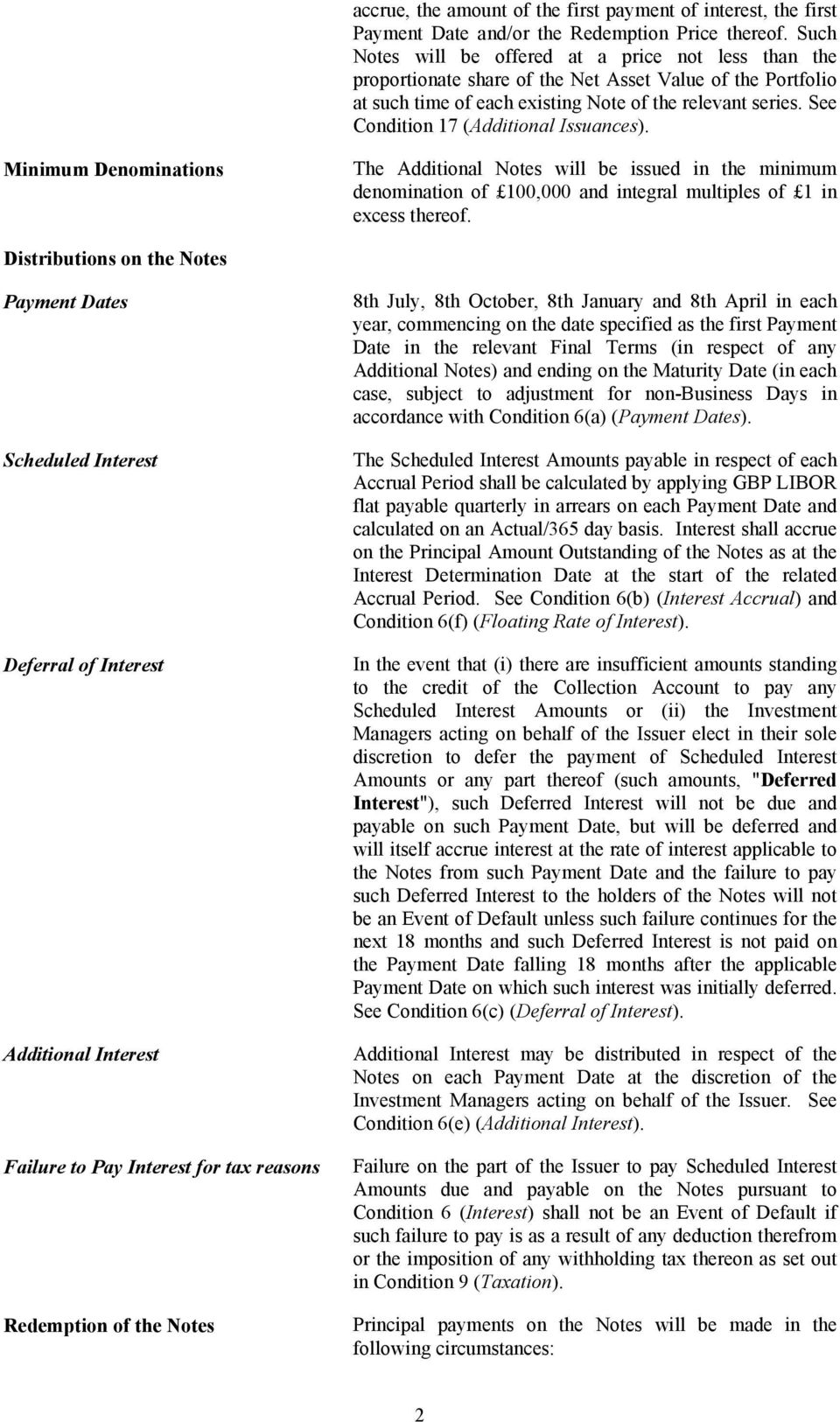
9 accrue, the amount of the first payment of interest, the first Payment Date and/or the Redemption Price thereof. Such Notes will be offered at a price not less than the proportionate share of the Net Asset Value of the Portfolio at such time of each existing Note of the relevant series. See Condition 17 (Additional Issuances). Minimum Denominations The Additional Notes will be issued in the minimum denomination of 100,000 and integral multiples of 1 in excess thereof. Distributions on the Notes Payment Dates Scheduled Interest Deferral of Interest Additional Interest Failure to Pay Interest for tax reasons Redemption of the Notes 8th July, 8th October, 8th January and 8th April in each year, commencing on the date specified as the first Payment Date in the relevant Final Terms (in respect of any Additional Notes) and ending on the Maturity Date (in each case, subject to adjustment for non-business Days in accordance with Condition 6(a) (Payment Dates). The Scheduled Interest Amounts payable in respect of each Accrual Period shall be calculated by applying GBP LIBOR flat payable quarterly in arrears on each Payment Date and calculated on an Actual/365 day basis. Interest shall accrue on the Principal Amount Outstanding of the Notes as at the Interest Determination Date at the start of the related Accrual Period. See Condition 6(b) (Interest Accrual) and Condition 6(f) (Floating Rate of Interest). In the event that (i) there are insufficient amounts standing to the credit of the Collection Account to pay any Scheduled Interest Amounts or (ii) the Investment Managers acting on behalf of the Issuer elect in their sole discretion to defer the payment of Scheduled Interest Amounts or any part thereof (such amounts, "Deferred Interest"), such Deferred Interest will not be due and payable on such Payment Date, but will be deferred and will itself accrue interest at the rate of interest applicable to the Notes from such Payment Date and the failure to pay such Deferred Interest to the holders of the Notes will not be an Event of Default unless such failure continues for the next 18 months and such Deferred Interest is not paid on the Payment Date falling 18 months after the applicable Payment Date on which such interest was initially deferred. See Condition 6(c) (Deferral of Interest). Additional Interest may be distributed in respect of the Notes on each Payment Date at the discretion of the Investment Managers acting on behalf of the Issuer. See Condition 6(e) (Additional Interest). Failure on the part of the Issuer to pay Scheduled Interest Amounts due and payable on the Notes pursuant to Condition 6 (Interest) shall not be an Event of Default if such failure to pay is as a result of any deduction therefrom or the imposition of any withholding tax thereon as set out in Condition 9 (Taxation). Principal payments on the Notes will be made in the following circumstances: 2
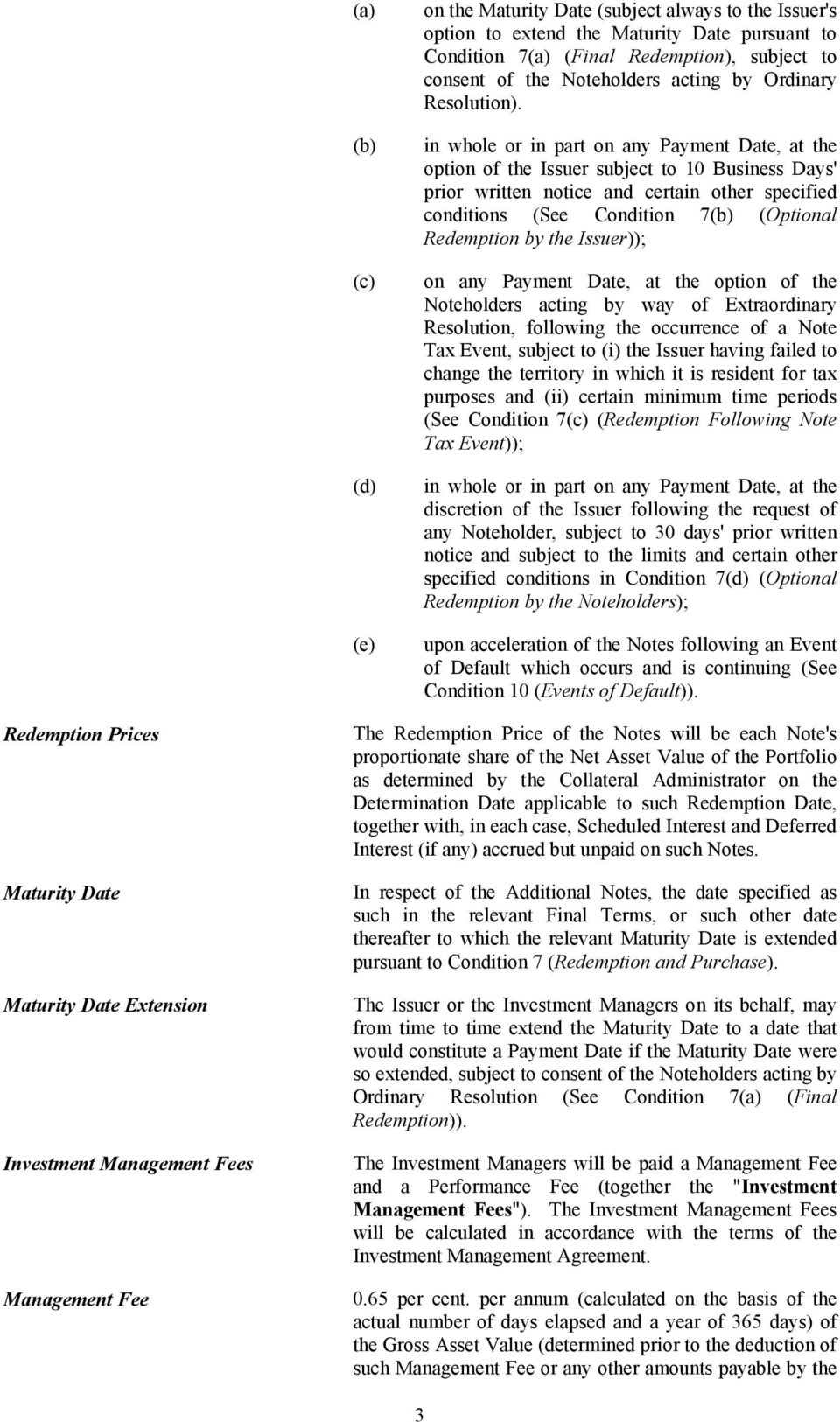
10 (a) (b) (c) (d) (e) on the Maturity Date (subject always to the Issuer's option to extend the Maturity Date pursuant to Condition 7(a) (Final Redemption), subject to consent of the Noteholders acting by Ordinary Resolution). in whole or in part on any Payment Date, at the option of the Issuer subject to 10 Business Days' prior written notice and certain other specified conditions (See Condition 7(b) (Optional Redemption by the Issuer)); on any Payment Date, at the option of the Noteholders acting by way of Extraordinary Resolution, following the occurrence of a Note Tax Event, subject to (i) the Issuer having failed to change the territory in which it is resident for tax purposes and (ii) certain minimum time periods (See Condition 7(c) (Redemption Following Note Tax Event)); in whole or in part on any Payment Date, at the discretion of the Issuer following the request of any Noteholder, subject to 30 days' prior written notice and subject to the limits and certain other specified conditions in Condition 7(d) (Optional Redemption by the Noteholders); upon acceleration of the Notes following an Event of Default which occurs and is continuing (See Condition 10 (Events of Default)). Redemption Prices Maturity Date Maturity Date Extension Investment Management Fees Management Fee The Redemption Price of the Notes will be each Note's proportionate share of the Net Asset Value of the Portfolio as determined by the Collateral Administrator on the Determination Date applicable to such Redemption Date, together with, in each case, Scheduled Interest and Deferred Interest (if any) accrued but unpaid on such Notes. In respect of the Additional Notes, the date specified as such in the relevant Final Terms, or such other date thereafter to which the relevant Maturity Date is extended pursuant to Condition 7 (Redemption and Purchase). The Issuer or the Investment Managers on its behalf, may from time to time extend the Maturity Date to a date that would constitute a Payment Date if the Maturity Date were so extended, subject to consent of the Noteholders acting by Ordinary Resolution (See Condition 7(a) (Final Redemption)). The Investment Managers will be paid a Management Fee and a Performance Fee (together the "Investment Management Fees"). The Investment Management Fees will be calculated in accordance with the terms of the Investment Management Agreement per cent. per annum (calculated on the basis of the actual number of days elapsed and a year of 365 days) of the Gross Asset Value (determined prior to the deduction of such Management Fee or any other amounts payable by the 3
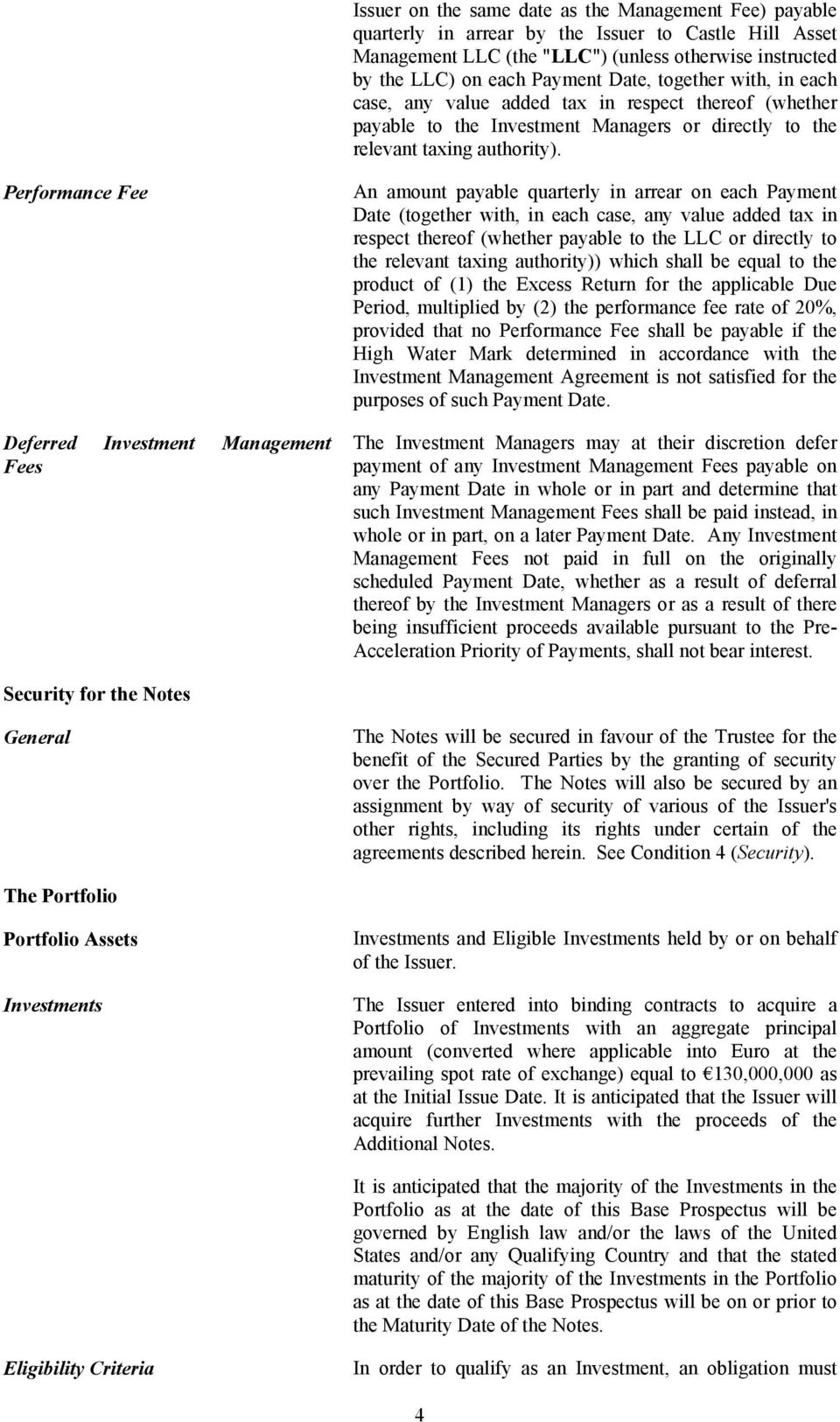
11 Issuer on the same date as the Management Fee) payable quarterly in arrear by the Issuer to Castle Hill Asset Management LLC (the "LLC") (unless otherwise instructed by the LLC) on each Payment Date, together with, in each case, any value added tax in respect thereof (whether payable to the Investment Managers or directly to the relevant taxing authority). Performance Fee Deferred Investment Management Fees An amount payable quarterly in arrear on each Payment Date (together with, in each case, any value added tax in respect thereof (whether payable to the LLC or directly to the relevant taxing authority)) which shall be equal to the product of (1) the Excess Return for the applicable Due Period, multiplied by (2) the performance fee rate of 20%, provided that no Performance Fee shall be payable if the High Water Mark determined in accordance with the Investment Management Agreement is not satisfied for the purposes of such Payment Date. The Investment Managers may at their discretion defer payment of any Investment Management Fees payable on any Payment Date in whole or in part and determine that such Investment Management Fees shall be paid instead, in whole or in part, on a later Payment Date. Any Investment Management Fees not paid in full on the originally scheduled Payment Date, whether as a result of deferral thereof by the Investment Managers or as a result of there being insufficient proceeds available pursuant to the Pre- Acceleration Priority of Payments, shall not bear interest. Security for the Notes General The Notes will be secured in favour of the Trustee for the benefit of the Secured Parties by the granting of security over the Portfolio. The Notes will also be secured by an assignment by way of security of various of the Issuer's other rights, including its rights under certain of the agreements described herein. See Condition 4 (Security). The Portfolio Portfolio Assets Investments Investments and Eligible Investments held by or on behalf of the Issuer. The Issuer entered into binding contracts to acquire a Portfolio of Investments with an aggregate principal amount (converted where applicable into Euro at the prevailing spot rate of exchange) equal to 130,000,000 as at the Initial Issue Date. It is anticipated that the Issuer will acquire further Investments with the proceeds of the Additional Notes. It is anticipated that the majority of the Investments in the Portfolio as at the date of this Base Prospectus will be governed by English law and/or the laws of the United States and/or any Qualifying Country and that the stated maturity of the majority of the Investments in the Portfolio as at the date of this Base Prospectus will be on or prior to the Maturity Date of the Notes. Eligibility Criteria In order to qualify as an Investment, an obligation must 4
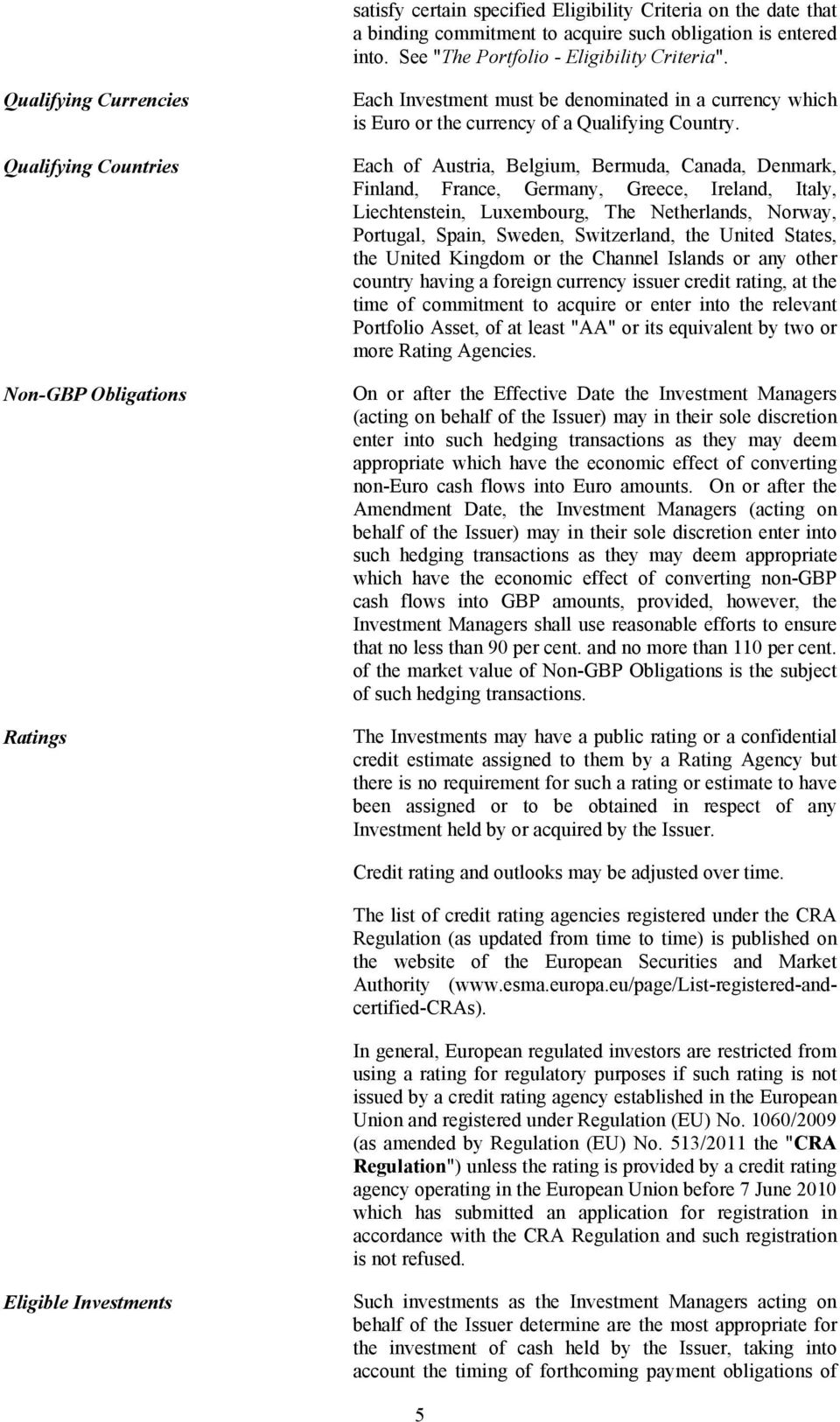
12 satisfy certain specified Eligibility Criteria on the date that a binding commitment to acquire such obligation is entered into. See "The Portfolio - Eligibility Criteria". Qualifying Currencies Qualifying Countries Non-GBP Obligations Ratings Each Investment must be denominated in a currency which is Euro or the currency of a Qualifying Country. Each of Austria, Belgium, Bermuda, Canada, Denmark, Finland, France, Germany, Greece, Ireland, Italy, Liechtenstein, Luxembourg, The Netherlands, Norway, Portugal, Spain, Sweden, Switzerland, the United States, the United Kingdom or the Channel Islands or any other country having a foreign currency issuer credit rating, at the time of commitment to acquire or enter into the relevant Portfolio Asset, of at least "AA" or its equivalent by two or more Rating Agencies. On or after the Effective Date the Investment Managers (acting on behalf of the Issuer) may in their sole discretion enter into such hedging transactions as they may deem appropriate which have the economic effect of converting non-euro cash flows into Euro amounts. On or after the Amendment Date, the Investment Managers (acting on behalf of the Issuer) may in their sole discretion enter into such hedging transactions as they may deem appropriate which have the economic effect of converting non-gbp cash flows into GBP amounts, provided, however, the Investment Managers shall use reasonable efforts to ensure that no less than 90 per cent. and no more than 110 per cent. of the market value of Non-GBP Obligations is the subject of such hedging transactions. The Investments may have a public rating or a confidential credit estimate assigned to them by a Rating Agency but there is no requirement for such a rating or estimate to have been assigned or to be obtained in respect of any Investment held by or acquired by the Issuer. Credit rating and outlooks may be adjusted over time. The list of credit rating agencies registered under the CRA Regulation (as updated from time to time) is published on the website of the European Securities and Market Authority ( In general, European regulated investors are restricted from using a rating for regulatory purposes if such rating is not issued by a credit rating agency established in the European Union and registered under Regulation (EU) No. 1060/2009 (as amended by Regulation (EU) No. 513/2011 the "CRA Regulation") unless the rating is provided by a credit rating agency operating in the European Union before 7 June 2010 which has submitted an application for registration in accordance with the CRA Regulation and such registration is not refused. Eligible Investments Such investments as the Investment Managers acting on behalf of the Issuer determine are the most appropriate for the investment of cash held by the Issuer, taking into account the timing of forthcoming payment obligations of 5
13 the Issuer, the ability to liquidate such investment without penalty, the return receivable in respect of such investment and the risk profile thereof at the time. Investment Restrictions The Collateral Administrator will measure the Investment Restrictions on the Effective Date and as at the date to which each Monthly Report is prepared. The Investment Restrictions will only apply on and after the Effective Date. It is anticipated that the Investment Restrictions will be satisfied as at the Effective Date but no assurance can be given that this will be the case. The Investment Managers will endeavour to dynamically manage compliance with the Investment Restrictions upon the purchase and sale of each Investment. In the event that the Investment Restrictions are not in compliance as at any Measurement Date, the Investment Managers, acting on behalf of the Issuer, will use commercially reasonable efforts to bring the Investment Restrictions back into compliance. However no assurance can be given that such compliance will be achieved, or achieved within a specific timescale. The Investment Restrictions may be amended from time to time by the Issuer, with the consent of the Investment Managers and the Trustee, provided that not more than 50 per cent. of the Noteholders object to such amendment within 60 days following notice thereof having been given in accordance with Condition 16 (Notices). The percentage requirements applicable to different types of Investments specified in the Investment Restrictions below shall be determined by reference to the Aggregate Market Value of the Investments specified as a percentage of the Net Asset Value. Secured subordinated Investments (including Mezzanine Obligations and Second Lien Obligations) Unsecured Obligations Single Obligor Credit Short Obligations Eligible Investments Unlisted investments Leverage Ratio Not more than 20 per cent. of the Adjusted Net Asset Value. Not more than 10 per cent. of the Adjusted Net Asset Value. Not more than 10 per cent. (excluding specified derivative instrument exposure) of the Adjusted Net Asset Value. Aggregate notional amount of all Credit Short Obligations not to exceed 100 per cent. of the Adjusted Net Asset Value (subject to haircuts in respect of Credit Short Obligations linked to baskets and/or indices) Up to 100 per cent. of the Portfolio may comprise Eligible Investments. There will be no requirement that a minimum proportion of Investments held by the Issuer are listed. Leverage Ratio will be satisfied if the Net Asset Value as at any date of determination is greater than or equal to the Leverage 6

14 Amount divided by 3. If the Issuer or the Investment Managers on behalf of the Issuer have purchased credit protection by entering into a Derivative Instrument which is a credit default swap or similar instrument in respect of an Investment then for the purposes of the calculation of the Investment Restrictions related to secured subordinated Investments, Unsecured Obligations, and single Obligor exposure, as described above, the Net Asset Value of the Investment shall be included only to the extent that the Net Asset Value of such Investment exceeds the notional amount of the Derivative Instrument for which the Issuer or the Investment Managers on behalf of the Issuer have purchased credit protection. Derivative Instruments The Investment Managers on behalf of the Issuer may enter into or acquire one or more Derivative Instruments including without limitation: (a) (b) (c) (d) (e) (f) (g) (h) (i) interest rate swap or hedge transactions; forward foreign exchange transactions and currency swap or hedge transactions, including options; swaptions and options; funded or unfunded credit default transactions pursuant to which the Issuer sells credit protection in respect of a specified reference obligation or reference obligations or reference entity or reference entities; Credit Short Obligations; funded or unfunded total return swaps; derivatives and options linked to the performance of indices; any other instrument which is broadly similar in economic risk profile to any of those listed above; and such other derivative instruments which in the sole discretion of the Investment Managers do not fall within the definition of paragraphs (a) to (h) (inclusive) above but which are determined by the Investment Managers on behalf of the Issuer as being appropriate for entry into by the Issuer and which have not been objected to by the holders of more than 50 per cent of the Principal Amount Outstanding of Notes within 10 days following notification thereof by the Issuer to the Noteholders in accordance with Condition 16 (Notices); Each Derivative Instrument entered into by the Issuer must be with an Eligible Counterparty. Leverage The Investment Managers on behalf of the Issuer may from time to time enter into Leverage Instruments provided always that the Leverage Ratio described above is not exceeded at any time. Leverage may also be introduced into the Portfolio by the Issuer entering into certain Derivative Instruments including, without limitation, total return swaps, unfunded 7

15 credit default swaps or unfunded Participations, subject always to the Issuer complying with the Leverage Ratio. The Investment Managers, in managing the Portfolio on behalf of the Issuer shall take into account all contingent payment obligations of the Issuer under any Leverage Instrument or other Investment with a view to ensuring that the Issuer has sufficient cash proceeds available to meet such obligations as and when they fall due. Leverage Instruments Governing Law The Offering Form, Registration and Transfer of the Notes Borrowing facilities (or any other instrument which has the economic effect of borrowing that is not a Derivative Instrument) entered into with Eligible Counterparties which may be secured or unsecured. The Leverage Instruments entered into by the Investment Managers on behalf of the Issuer from time to time may be secured in priority to the Notes. In addition Leverage Providers may require the imposition of additional restrictions on the Investment Managers' management of the Portfolio or additional test requirements in respect of the Portfolio. The Notes, the Trust Deed, the Investment Management Agreement, the Agency Agreement and all other Transaction Documents (save for the Corporate Services Agreement and the Declaration of Trust) shall be governed by English law. The Corporate Services Agreement and the Declaration of Trust shall each be governed by Irish law. The Notes will be offered outside of the United States to non-u.s. Persons in "offshore transactions" in reliance on Regulation S. The Notes will be sold outside the United States to non-u.s. Persons in reliance on Regulation S under the Securities Act and will each be represented on issue by beneficial interests in one or more permanent global certificates in fully registered form, without interest coupons or principal receipts (each, a "Global Certificate" and together, the "Global Certificates") and will be deposited on the relevant Issue Date with Euroclear and Clearstream, Luxembourg. See "Form of the Notes", "Book-Entry Clearance Procedures" and "Transfer Restrictions". The Global Certificates will bear a legend, and such Global Certificates or any interest therein may not be transferred except in compliance with the transfer restrictions set out in such legend. See "Transfer Restrictions". Except in the limited circumstances described herein, Notes in definitive, certificated, fully registered form ("Definitive Certificates") will not be issued in exchange for beneficial interests in the Global Certificates. See "Form of the Notes Exchange of Global Certificates for Definitive Certificates". Listing Unless otherwise specified in the relevant Final Terms, application will be made to the Irish Stock Exchange for the Notes to be admitted to the Official List and trading on its regulated market. There can be no assurance that such listing and admission to trading will be granted or if granted, will be granted by the relevant Issue Date. See "General 8
16 Information". Tax Status Withholding Tax See "Tax Considerations". The Issuer is not and shall not be under any obligation to gross-up in respect of any payments to the Noteholders. See Condition 9 (Taxation). The Notes are subject to redemption at the option of the Noteholders, acting by Extraordinary Resolution, following the occurrence of a Note Tax Event, subject to (i) the Issuer having failed to change the territory in which it is resident for tax purposes and (ii) certain minimum time periods. See Condition 7(c) (Redemption following Note Tax Event). 9

17 RISK FACTORS An investment in the Notes involves certain risks, including risks relating to the Collateral securing the Notes and risks relating to the structure and rights of the Notes and the related arrangements. Prospective investors should carefully consider the following factors, in addition to the matters set forth elsewhere in this document, prior to investing in the Notes. 1. GENERAL 1.1 General It is intended that the Issuer will invest in primarily Senior Secured Obligations and other financial assets with certain risk characteristics as described below and subject to the Investment Restrictions described in "The Portfolio" below. There can be no assurance that the Issuer's investments will be successful, that its investment objective will be achieved, that the holders of Notes will receive the full amounts payable by the Issuer under the Notes or that they will receive any return on their investment in the Notes. Prospective investors are therefore advised to review this entire Prospectus carefully and should consider, among other things, the factors set out below before deciding whether to invest in the Notes. The Trustee does not undertake to review the financial condition or affairs of the Issuer or the Investment Managers during the life of the arrangements contemplated by this Base Prospectus nor to advise any investor or potential investor in the Notes of any information coming to the attention of the Trustee which is not included in this Base Prospectus. 1.2 Suitability Prospective purchasers of the Notes should ensure that they understand the nature of the Notes and the extent of their exposure to risk, that they have sufficient knowledge, experience and access to professional advisers to make their own legal, tax, accounting, regulatory and financial evaluation of the merits and risks of investment in the Notes and that they consider the suitability of the Notes as an investment in the light of their own circumstances and financial condition. 1.3 Limited Sources of Funds to Pay Expenses of the Issuer The funds available to the Issuer to pay its expenses on any Payment Date are limited as provided in the Priorities of Payment. In the event that such funds are not sufficient to pay the expenses incurred by the Issuer, the ability of the Issuer to operate effectively may be impaired, and it may not be able to defend or prosecute legal proceedings brought against it or which it might otherwise bring to protect its interests or be able to pay the expenses of legal proceedings against persons it has indemnified. 1.4 Net Proceeds Less than Aggregate Amount of the Notes It is anticipated that the net proceeds received by the Issuer on the Issue Date from the issuance of the Notes will be less than the aggregate principal amount outstanding of the Notes due to fees, expenses and other amounts payable by the Issuer on such date. Consequently, it is anticipated that on the Issue Date the Collateral would be insufficient to redeem the Notes upon the occurrence of an Event of Default on or about that date. In addition, there can be no assurances that upon the maturity of the Notes that the value of the Collateral securing the Notes will be sufficient to redeem the Notes in full. To the extent such amounts are insufficient to redeem the Notes in full, there will be no other assets of the Issuer available to repay the Notes. 1.5 Recent Events in the Credit Markets and Leveraged Finance Markets The global economy is currently being affected by a crisis in the credit markets and is experiencing a general downturn and, in certain countries, a recession. Among the sectors of the global credit markets that are experiencing particular difficulty are the credit markets and leveraged finance markets. 10
18 There exist significant risks for the Issuer and investors as a result of the current economic conditions. These risks include, among others, (i) the likelihood that the Issuer will find it more difficult to sell any of its assets in the secondary market, (ii) the possibility that, on or after the Issue Date, the price at which assets can be sold by the Issuer will have deteriorated from their effective purchase price and (iii) the illiquidity of the Notes. These additional risks may affect the returns on the Notes to investors and/or the ability of investors to realise their investment in the Notes prior to their stated maturity. In addition, the primary market for a number of financial products including leveraged loans has stalled. As a result, there exists a large volume of leveraged loans that remain on the books of arranging banks, that have not yet been sold to investors, including to collateralised debt obligation and other investment vehicles. This may reduce opportunities for the Issuer to purchase assets in the primary market. Whilst it is anticipated that new loans entered into after the date of the onset of the credit crisis will have a different set of covenants imposed on the relevant Obligors (as compared with those loans entered into prior to the onset of the credit crisis), the ability of private equity sponsors and leveraged loan arrangers to effectuate new leveraged buy-outs and the ability of the Issuer to make purchases of such assets may be partially or significantly limited to the secondary market. The impact of the current economic crisis on the primary market may adversely affect the servicing flexibility of the Investment Managers in relation to the Portfolio and, ultimately the returns on the Notes to investors. As the credit crisis continues it has had an increasing impact on the economic conditions in a number of jurisdictions. The slow down in growth or commencement of a recession in such economies will have an adverse effect on the ability of consumers and businesses to repay or refinance their existing debt. On 1 December 2008 the United States National Bureau of Economic Research announced that the United States economy has been in a recession since December It is generally accepted that the economies of the United Kingdom and most Member States of the European Union are also in recession. It is also likely that other countries are also in a recession. As discussed further in paragraph 1.8 (Euro and Euro zone Risk) below, it is possible that countries that have adopted the Euro could return to a national currency. The effect on a national economy as a result of leaving the Euro is impossible to predict, but is likely to be negative. The exit of one or more countries from the Euro zone could have a destabilising effect on all European economies and possibly the global economy as well. Adverse macro economic conditions may adversely affect the rating, performance and the realisation value of the Collateral. Default rates on loans underlying many credit markets and leveraged loan funds are likely to increase and, accordingly, the performance of many credit markets transactions and leveraged loan funds will suffer as a result. It is possible that the Portfolio will experience higher default rates than anticipated and that performance will suffer. Some leading global financial institutions have been forced into mergers with other financial institutions, partially or fully nationalised or have gone bankrupt or insolvent. The bankruptcy or insolvency of a major financial institution may have an adverse effect on the Issuer, particularly if such financial institution is a grantor of a participation in a collateral loan obligation or is a hedge counterparty to a swap or hedge involving the Issuer, or a counterparty to a buy or sell trade that has not settled with respect to a collateral loan obligation with the Issuer or the administrative agent of a collateral loan obligation. The bankruptcy or insolvency of another financial institution may result in the disruption of payments to the Issuer. In addition, the bankruptcy or insolvency of one or more additional financial institutions may trigger additional crises in the global credit markets and overall economy which could have a significant adverse effect on the Issuer, the Portfolio and the Notes. It is likely that one of the effects of the global credit crisis and the failure of financial institutions will be an introduction of a significantly more restrictive regulatory environment including the implementation of new accounting and capital adequacy rules in addition to further regulation of derivative instruments. Such additional rules and regulations could, among other things, adversely affect Noteholders as well as the flexibility of the Investment Management in liquidating and administering the Portfolio. 11

19 In addition these types of products have come under stricter scrutiny since the onset of the credit crisis. It is likely that these instruments will be subject to increased regulation and monitoring. While it is possible that current conditions may improve for certain sectors of the global economy, there can be no assurance that the credit markets or leveraged finance markets will recover at the same time or to the same degree as such other recovering sectors. 1.6 Force Majeure The Issuer and the Investments in the Portfolio may be adversely affected by a wide range of factors and events beyond their control, such as natural disasters, wars, strikes, acts of terrorism, communications errors or failures, fraud at the underlying investment level, and other social, economic or political events. 1.7 Business and Regulatory Risks for Vehicles with Investment Strategies such as the Issuer's Legal, tax and regulatory changes could occur over the course of the life of the Notes that may adversely affect the Issuer. The regulatory environment for vehicles of the nature of the Issuer is evolving, and changes in the regulation of the same may adversely affect the value of investments held by the Issuer and the ability of the Issuer to obtain the leverage it might otherwise obtain or to pursue its investment and trading strategies. In addition, the securities and futures markets are subject to comprehensive statutes, regulations and margin requirements. Certain regulators and self-regulatory organisations and exchanges are authorised to take extraordinary actions in the event of market emergencies. The regulation of derivatives transactions and vehicles that engage in such transactions is an evolving area of law and is subject to modification by government and judicial action. The effect of any future regulatory change on the Issuer could be substantial and adverse. 1.8 Euro and Euro zone Risk The ongoing deterioration of the sovereign debt of several countries, in particular Greece, together with the risk of contagion to other, more stable, countries, particularly France and Germany, has exacerbated the global economic crisis. This situation has also raised a number of uncertainties regarding the stability and overall standing of the European Economic and Monetary Union and may result in changes to the composition of the Euro zone. As a result of the credit crisis in Europe, in particular in Greece, Italy, Ireland, Portugal and Spain, the European Commission created the European Financial Stability Facility (the "EFSF") and the European Financial Stability Mechanism (the "EFSM") to provide funding to Euro zone countries in financial difficulties that seek such support. In March 2011, the European Council agreed on the need for Euro zone countries to establish a permanent stability mechanism, the European Stability Mechanism (the "ESM"), which will be activated by mutual agreement, to assume the role of the EFSF and the EFSM in providing external financial assistance to Euro zone countries after June Despite these measures, concerns persist regarding the growing risk that other Euro zone countries could be subject to an increase in borrowing costs and could face an economic crisis similar to that of Greece, Italy, Spain and Portugal, together with the risk that some countries could leave the Euro zone (either voluntarily or involuntarily), and that the impact of these events on Europe and the global financial system could be severe which could have a negative impact on the Collateral. Furthermore, concerns that the Euro zone sovereign debt crisis could worsen may lead to the reintroduction of national currencies in one or more Euro zone countries or, in more extreme circumstances, the possible dissolution of the Euro entirely. The departure or risk of departure from the Euro by one or more Euro zone countries and/or the abandonment of the Euro as a currency could have major negative effects on the Issuer and the Notes. Should the Euro dissolve entirely, the legal and contractual consequences for holders of Euro-denominated obligations would be determined by laws in effect at such time. These potential developments, or market perceptions concerning these and related issues, could adversely 12
20 affect the value of the Notes. It is difficult to predict the final outcome of the Euro zone crisis. Investors should carefully consider how changes to the Euro zone may affect their investment in the Notes. 1.9 Regulatory initiatives In Europe, the U.S. and elsewhere there is increased political and regulatory scrutiny of the banks, financial industry and asset-backed securities industry. This has resulted in a raft of measures for increased regulation which are currently at various stages of implementation and which may have an adverse impact on the regulatory capital charge to certain investors in securitisation exposures and/or the incentives for certain investors to hold asset-backed securities, and may thereby affect the liquidity of such securities. Investors in the Notes are responsible for analysing their own regulatory position and none of the Issuer, the Investment Managers, the Trustee nor any of their affiliates makes any representation to any prospective investor or purchaser of the Notes regarding the regulatory capital treatment of their investment in the Notes on the Issue Date or at any time in the future U.S. Dodd-Frank Act The Dodd-Frank Wall Street Reform and Consumer Protection Act (the "Dodd-Frank Act") was signed into law on 21 July The Dodd-Frank Act represents the most comprehensive change to financial regulation in the United States, and affects virtually every area of the capital markets. Implementation of the Dodd-Frank Act requires many lengthy rulemaking processes that will ultimately result in the adoption of a multitude of new regulations potentially applicable to the Investment Managers and its subsidiaries and affiliates and the Issuer that transact business in the U.S. or with U.S. persons outside the U.S. Once fully implemented, the Dodd-Frank Act will affect many aspects, in the U.S. and internationally, of the business of the Investment Managers, including securitisation, proprietary trading, investing, creation and management of investment funds, OTC derivatives and other activities. While certain regulations implementing various provisions of the Dodd- Frank Act have been finalised and adopted, many implementing regulations currently exist only in draft form and are subject to comment and revision, while other implementing regulations have not yet been proposed. It is therefore difficult to predict whether and to what extent the businesses of the Investment Managers and its subsidiaries and affiliates and the Issuer, will be affected by the Dodd-Frank Act as implementing regulations are finalised over time and come into effect Commodity Pool Regulation The U.S. Commodity Futures Trading Commission (the "CFTC") has recently rescinded the rule which formerly provided an exemption from registration as a "Commodity Pool Operator" (a "CPO") and a "commodity trading advisor" ("CTA") under the U.S. Commodity Exchange Act, as amended (the "CEA"), in respect of certain transactions. In addition, the Dodd-Frank Act expanded the definition of a "commodity pool" to include any form of enterprise operated for the purpose of trading in commodity interests, including swaps. Similarly, the term "commodity pool operator" has been expanded to include any person engaged in a business that is of the nature of a commodity pool or similar enterprise and in connection therewith, solicits, accepts, or receives from others, funds, securities or property for the purpose of trading in commodity interests, including any swaps. The CFTC has taken an extremely expansive interpretation of these definitions, and has expressed the view that entering into a single swap (apparently without distinguishing between trading and holding a swap position) could make an entity a "commodity pool" subject to regulation under the CEA. It should also be noted that the definition of "swaps" under the Dodd-Frank Act is itself extremely broad, and expressly includes interest rate swaps, cross-currency swaps and total return swaps. Although the CFTC has recently provided guidance that certain securitisation transactions, including CLOs, will be excluded from the definition of "commodity pool," it is unclear if such exclusion will apply to all CLOs and, in certain instances, the investment manager of a securitisation vehicle may be required to register as a CPO with the CFTC or apply for an exemption from registration. In addition, no assurance can be made that the United States federal government or any U.S. regulatory body (or other authority or regulatory body) will 13
21 not continue to take further legislative or regulatory action, and the effect of such actions, if any, cannot be known or predicted. If the Issuer were deemed to be a "commodity pool", then both the CPO and the CTA of the Issuer would be required to register as such with the CFTC and the National Futures Association (the "NFA") on and after 31 March 2013, or by the initial offering date of the Notes, if later. Because there has previously been an exemption from such registration for most securitisation and investment fund transactions, there is little, if any, guidance as to which entity or entities would be regarded as the Issuer's CPO and CTA and thus be required to register. While there remain certain limited exemptions from registration, because the wording of these regulations applies to traditional commodity pools and was not drafted with transactions such as the Issuer and its investment activities in mind, it is unclear whether and to what extent any of these exemptions would be available to avoid registration with respect to the Issuer. In addition, if the Issuer were deemed to be a "commodity pool", it would have to comply with a number of reporting requirements that are geared to traded commodity pools. It is presently unclear how an investment vehicle such as the Issuer could comply with certain of these reporting requirements on an ongoing basis. Such registration and other requirements would involve material ongoing costs to the Issuer. The scope of such requirements and related compliance costs is uncertain but could adversely affect the amount of funds available to make payments on the Notes. Furthermore, even if an exemption were available, the limits imposed by such exemption may prevent the Issuer from entering into hedging transactions which the Investment Managers believe would be advisable or result in the Issuer incurring financial risks that would have been hedged absent such limits. In light of the foregoing, the Investment Managers will not permit the Issuer to enter into any agreement that would fall within the definition of "swap" as set out in the CEA, until such time as it shall have received legal advice from reputable counsel to the effect that none of the Issuer, its directors or officers, the Investment Managers or any of its or their affiliates or any other person would be required to register as a CPO with the CFTC with respect to the Issuer Volcker Rule Another potential consequence of the CFTC's expansive interpretation of commodity pool and related definitions is presented under Section 619 of the Dodd-Frank Act (the "Volcker Rule"). In their proposed rulemaking, the agencies charged with drafting regulations under the Volcker Rule, including the CFTC, construed the statutory definition therein of "hedge fund" and "private equity fund" as providing them with discretion to define the term "covered fund" to include any commodity pool as defined in the CEA, without regard as to whether the commodity pool is in the nature of a hedge fund or a private equity fund. If the Issuer is deemed to be a commodity pool, and commodity pools are treated as "covered funds", then in the absence of regulatory relief, the provisions of the Volcker Rule, including the so-called "Super 23A" provisions, would generally prohibit U.S. banking institutions and other banking entities subject to the Volcker Rule from maintaining an ownership interest in the Issuer, extending credit to the Issuer, or entering into derivate transactions with the Issuer. Any entity that is a "banking entity" as defined under the Volcker Rule and is considering an investment in the Notes should consider the potential impact of the Volcker Rule in respect of such investment and on its portfolio generally Flip Clauses The validity and enforceability of certain provisions in contractual priorities of payments which purport to alter the priority in which a particular secured creditor is paid as a result of the occurrence of one or more specified trigger events, including the insolvency of such creditor ("flip clauses"), have been challenged recently in the English and U.S. courts on the basis that the operation of a flip clause as a result of such creditor's insolvency breaches the "anti-deprivation" principles of English and U.S. insolvency law. This principle prevents a party from agreeing to a provision that deprives its creditors of an asset upon its insolvency. The English Supreme Court has, in Belmont Park Investments Pty Limited v BNY Corporate Trustee Services Limited and Lehman Brothers Special Financing Inc. [2011] UKSC 38, 14
22 upheld the validity of a flip clause contained in an English-law governed security document, stating that the anti-deprivation principle was not breached by such provisions. In the U.S. courts, the U.S. Bankruptcy Court for the Southern District of New York in Lehman Brothers Special Financing Inc. v. BNY Corporate Trustee Services Limited. (In re Lehman Brothers Holdings Inc.), Adv. Pro. No JMP (Bankr. S.D.N.Y. May 20, 2009) examined a flip clause and held that such a provision, which seeks to modify one creditor's position in a priority of payments when that creditor files for bankruptcy, is unenforceable under the U.S. Bankruptcy Code. Judge Peck acknowledged that this has resulted in the U.S. courts coming to a decision "directly at odds with the judgement of the English Courts". While BNY Corporate Trustee Services Ltd filed a motion for and was granted leave to appeal with the U.S. Bankruptcy Court, the case was settled before the appeal was heard. In 2012, a new suit was filed in the U.S. Bankruptcy Court by claimants in the Belmont case asking, among other things, for the U.S. Bankruptcy Court to recognise and enforce the decision of the English Supreme Court and to declare that flip clauses are enforceable under U.S. bankruptcy law notwithstanding that court's earlier decision. Plaintiffs in that suit have also filed a companion motion alleging that the issues in their complaint are tangential to the bankruptcy before the U.S. Bankruptcy Court and that, therefore, the suit should be removed to a U.S. district court. Given the current state of U.S. and English law, this is likely to be an area of continued judicial focus particularly in respect of multijurisdictional insolvencies. The flip clause examined in the Belmont case is similar in substance to the relevant provisions in the Priorities of Payments, however the context and manner of subordination which may be applied to a Eligible Counterparty in accordance with such provisions will not be identical; and the judgments in Belmont and subsequent litigation in which the same rule has been applied have noted that English law questions relating to the anti-deprivation principle will be determined on the basis of the particular terms at hand and their commercial context. As such, it is not necessarily settled that the particular flip clauses contained in the Priorities of Payment would certainly be enforceable as a matter of English law, in the case of insolvency of a Eligible Counterparty. Moreover, if the Priorities of Payments are the subject of litigation in any jurisdiction outside England and Wales, in particular in the United States of America, and such litigation results in a conflicting judgment in respect of the binding nature of the Priorities of Payments, it is possible that termination payments due to the Eligible Counterparties would not be subordinated as envisaged by the Priorities of Payments and as a result, the Issuer's ability to repay the Noteholders in full may be adversely affected. There is a particular risk of such conflicting judgments where a Eligible Counterparty is the subject of bankruptcy or insolvency proceedings outside England and Wales LIBOR and EURIBOR Reform Concerns have been raised by a number of regulators that some of the member banks surveyed by the British Bankers' Association (the "BBA") in connection with the calculation of the London interbank offered rate ("LIBOR") across a range of maturities and currencies may have been manipulating the inter-bank lending rate. There have also been allegations that member banks may have manipulated EURIBOR and other inter-bank lending rates. If manipulation of EURIBOR or LIBOR or another inter-bank lending rate occurred, it may have resulted in that rate being artificially lower (or higher) than it would otherwise have been. A review of LIBOR was conducted at the request of the UK Government, following which a number of recommendations for changes with respect to LIBOR including the introduction of statutory regulation of LIBOR, replacing the BBA as administrator of LIBOR with an independent administrator, changes to the method of compilation of lending rates and new regulatory oversight and enforcement mechanisms for rate-setting and reduction in the number of currencies and tenors for which LIBOR is published. It is anticipated that a reform of EURIBOR will be implemented also, which may (but will not necessarily) be in a similar fashion. Accordingly, EURIBOR calculation and publication could be altered, suspended or discontinued. It is not possible to predict the effect of any changes in the methods pursuant to which the LIBOR and/or EURIBOR rates are determined and any other reforms to LIBOR 15
23 and/or EURIBOR that will be enacted in the UK and elsewhere. Any such changes or reforms to LIBOR and/or EURIBOR may result in a sudden or prolonged increase or decrease in reported LIBOR and/or EURIBOR rates, which could have an adverse impact on the value of the Notes and any payments linked to LIBOR and/or EURIBOR thereunder. Any new administrator of LIBOR and/or EURIBOR may make methodological changes that could change the level of LIBOR or EURIBOR, which in turn may adversely affect the value of the floating rate Investments. Any new administrator of LIBOR or EURIBOR may also alter, discontinue or suspend calculation or dissemination of LIBOR or EURIBOR. No administrator of LIBOR or EURIBOR will have any obligation to any investor in respect of any floating rate Investments. The administrator of LIBOR or EURIBOR may take any actions in respect of LIBOR or EURIBOR without regard to the interests of any investor in the Notes, and any of these actions could have an adverse effect on the value of the Notes. The proposals to reform LIBOR in the UK also include compelling more banks to provide LIBOR submissions, and basing these submissions on actual transaction data. This may cause LIBOR to be more volatile than it has been in the past, which may adversely affect the value of the floating rate Investments and, in turn, the Notes. It is uncertain if such changes will be made to LIBOR and if so whether corresponding changes will be made to EURIBOR. If any proposed changes when implemented change the way in which LIBOR or EURIBOR is calculated with respect to floating rate Investments, this could result in the rate of interest being lower than anticipated, which would adversely affect the value of the Notes. As the substantial majority of the interest payments due on the Issuer's assets are expected to be calculated based upon LIBOR or EURIBOR and the Notes pay interest based upon LIBOR, an inaccurate LIBOR or EURIBOR setting could have adverse effects on the Issuer and/or the holders of the Notes. For example, holders of the Notes would receive lower GBP amounts as interest payments if LIBOR was artificially lower than a properly functioning market would otherwise set LIBOR. Other negative consequences of the perceived inaccuracy of LIBOR or EURIBOR could include fewer loans utilising LIBOR or EURIBOR as an index for interest payments and/or erratic swings in LIBOR or EURIBOR, both of which could result in interest rate mismatches between the Issuer's assets and its liabilities and expose the Issuer to cash shortfalls. Furthermore, questions surrounding the integrity in the process for determining LIBOR or EURIBOR may have other unforeseen consequences, including potential litigation against banks and/or obligors on loans, which could result in a material and adverse effect on the Issuer or the holders of the Notes. Investors should consider these recent developments when making their investment decision with respect to the Notes Adverse Effect of Determination of U.S. Trade or Business It is intended that the Issuer will not operate so as to be engaged in a trade or business in the United States for U.S. federal income tax purposes and, accordingly, will not be subject to U.S. federal income taxes on its net income. Although there is no direct authority addressing transactions similar to those contemplated herein, under current law and assuming compliance with the Issuer's organisational documents and with the Transaction Documents, and assuming the Issuer conducts its affairs in accordance with certain assumptions and representations as to the Issuer's contemplated activities, the Issuer believes its contemplated activities will not cause it to be engaged in a trade or business in the United States. However, if the IRS were to successfully assert that the Issuer is engaged in a U.S. trade or business, there could be material adverse financial consequences to the Issuer and to persons who hold the Notes. There can be no assurance, that the Issuer's net income will not become subject to U.S. federal net income tax as a result of unanticipated activities by the Issuer, changes in law, contrary conclusions by U.S. tax authorities or other causes. In such a case, the Issuer would be potentially subject to substantial U.S. federal income tax and, in certain circumstances interest payments by the Issuer under the Notes could be subject to U.S. withholding tax. The imposition of any of the foregoing taxes would materially affect the Issuer's ability to pay principal, interest, and other amounts owing in respect of the Notes. 16
24 1.16 FATCA New tax provisions commonly known as the Foreign Account Tax Compliance Act ("FATCA") may impose a 30 per cent. withholding tax on payments of U.S. source interest and dividends made on or after 1 January 2014 and of gross proceeds from the sale of certain U.S. assets made on or after 1 January 2017 to a foreign financial institution (or "FFI") (such as the Issuer) that, unless exempted or deemed compliant, does not enter into, and comply with, an agreement with the U.S. Internal Revenue Service ("IRS") to provide certain information on its U.S. accountholders. Further, FATCA may impose a withholding tax of up to 30 per cent. on gross payments due under derivatives in certain circumstances. To avoid the withholding tax, the Issuer may enter into an agreement with the IRS (an "IRS Agreement"). Unless exempted or deemed compliant, an FFI that does not enter into such agreement or whose agreement is voided by the IRS will be treated as a "non-participating FFI". The Issuer expects that the IRS Agreement will require the Issuer (or an intermediary financial institution, broker or agent (each, an "Intermediary") through which a beneficial owner holds its interest in a Note) to agree to (i) obtain certain identifying information regarding the holder of such Note to determine whether the holder is a U.S. person or U.S. owned foreign entity and to periodically provide identifying information about the holder to the IRS and (ii) comply with withholding and other requirements. In order to comply with its information reporting obligation under the IRS Agreement, the Issuer will be obliged to obtain information from all Noteholders. To the extent any payments in respect of the Notes are made to a Noteholder by an Intermediary, such Noteholder may be required to comply with the Intermediary's requests for identifying information that would permit the Intermediary to comply with its own IRS Agreement. Any Noteholder that fails to properly comply with the Issuer's or an Intermediary's requests for certifications and identifying information or, if applicable, a waiver of non-u.s. law prohibiting the release of such information to a taxing authority, will be treated as a "Recalcitrant Holder". The Issuer or an Intermediary or any Agent may be required to deduct a withholding tax of up to 30 per cent. on payments (including gross proceeds and redemptions) made on or after 1 January 2017 to a Recalcitrant Holder or a Noteholder that itself is an FFI and, unless exempted or otherwise deemed to be compliant, does not have in place an effective IRS Agreement (i.e., the Noteholder is a non- Participating FFI). Neither the Issuer nor an Intermediary will make any additional payments to compensate a Noteholder or beneficial owner for any amounts deducted pursuant to FATCA. It is also possible that the Issuer may be required to cause the disposition or transfer of Notes held by a Recalcitrant Holder and the proceeds from any such disposition or transfer may be an amount less than the then current fair market value of the Notes transferred. In general, U.S. source obligations that are outstanding as of 31 December 2013 and non-u.s. source obligations that are outstanding six months after the adoption of final U.S. Treasury regulations addressing withholding on "foreign passthru payments" and, in each case, that are not modified and treated as reissued, for U.S. federal income tax purposes, after the relevant date (such obligations, "Grandfathered Obligations") will not be subject to withholding. Obligations that are treated as equity and certain debt obligations lacking a definitive term (such as saving and demand deposits), however, are not eligible for grandfathering. Because the Notes are expected to be treated as non-u.s. source obligations and final regulations addressing foreign passthru payments have not yet been issued, Notes (other than Notes characterised as equity in the Issuer) should qualify for the grandfathering exemption. If the Issuer decides not to enter into an IRS Agreement, the Issuer may be subject to a 30 per cent. withholding tax on certain payments to it. Further, the Issuer's failure to enter into an IRS Agreement may preclude certain of its affiliates from themselves complying with FATCA. The United States has recently concluded several intergovernmental agreements ("IGAs") with other jurisdictions in respect of FATCA. Ireland has entered into an IGA with the United States,. Although the final Irish legislation has not yet been published, it is expected that the Issuer will not be required to enter into an agreement with the IRS but instead will be required to comply with legislation enacted by Ireland that would be implemented to give effect to such IGA. In that event, the Issuer would be subject to modified FATCA requirements. 17
25 There can be no assurance that payments to the Issuer in respect of its assets, including on a Investment will not be subject to withholding under FATCA. In addition, even if a beneficial owner of a payment complies with requests for identifying information, the ultimate payment to such beneficial owner could be subject to withholding if an Intermediary is subject to withholding for its failure to comply with FATCA. Accordingly, a holder should consult its own tax advisors as to the potential implication of the U.S. withholding taxes on the Notes before investing. 2. RELATING TO THE NOTES 2.1 Limited Liquidity and Restrictions on Transfer Although there is a limited market for notes backed by financial instruments such as leveraged loans and investment grade securities, there can be no assurance that any secondary market for the Notes will develop or, if a secondary market does develop, that it will provide the Noteholders with liquidity of investment or continue for the life of such Notes. Furthermore, the Notes will not be registered under the Securities Act or any U.S. state securities laws, and the Issuer has no plans, and is under no obligation, to register the Notes under the Securities Act. The Notes are subject to certain transfer restrictions and can be transferred only to certain transferees. See "Note Purchase and Sale" and "Transfer Restrictions". Such restrictions on the transfer of the Notes may further limit their liquidity. Consequently, a purchaser must be prepared to hold such Notes for an indefinite period of time or until the Maturity Date. 2.2 Limited Recourse Obligations The Notes are limited recourse obligations of the Issuer and are payable solely from amounts received in respect of the Investments and other Collateral securing the Notes. Payments on the Notes both prior to and following enforcement of the security over the Collateral are subordinated to the prior payment of certain fees and expenses of, or payable by, the Issuer. None of the Trustee, the Investment Managers, the Collateral Administrator, the Share Trustee, the Corporate Service Provider, the Directors or any of their Affiliates or any other person or entity (other than the Issuer) will be obligated to make payments on the Notes. Consequently, the Noteholders must rely solely on distributions on the Portfolio Assets and amounts received under the other Collateral securing the Notes for the payment of principal and interest. There can be no assurance that the distributions on the Portfolio Assets and amounts received under the other Collateral securing the Notes will be sufficient to make payments on the Notes after making payments to other creditors ranking senior to or pari passu with the payment in Notes pursuant to the Priorities of Payment. If distributions on such Portfolio Assets and other Collateral are insufficient to make payments on the Notes, no other assets will be available for payment of the deficiency and, following realisation of the security over the Collateral and the application of the proceeds thereof in accordance with the Priorities of Payment, the obligations of the Issuer to pay such shortfall shall be extinguished. In addition, at any time while the Notes are Outstanding, none of the Noteholders, the Trustee nor any other Secured Party (nor any other person acting on behalf of any of them) shall be entitled at any time to institute against the Issuer, or join in any institution against the Issuer of, any bankruptcy, reorganisation, arrangement, insolvency, winding-up or liquidation proceedings or any proceedings for the appointment of a liquidator or administrator or a similar official, or other proceedings under any applicable bankruptcy or similar law in connection with any obligations of the Issuer relating to the Notes, the Trust Deed or otherwise owed to the Noteholders, save for lodging a claim in the liquidation of the Issuer which is initiated by another party or taking proceedings to obtain a declaration or judgment as to the obligations of the Issuer nor shall any of them have a claim arising in respect of the share capital of the Issuer. 2.3 Defined Net Asset Value Subordination All of the Issuer's net assets, save its shareholders' equity, are attributable to investors pursuant to the conditions of the Notes. Those net assets are recorded in the Issuer's Net Asset Value which ensures that investors are entitled to the Issuer's net assets, thereby creating an 18
26 arrangement whereby investors are contractually subordinated to other counterparties of the Issuer (including swap, repurchase and securities lending counterparties and other service providers). 2.4 Amount and Timing of Payments Payments of interest and principal on the Notes (including Scheduled Interest) will only be made to the extent that there are Collections available for such purpose in accordance with the Priorities of Payment on any applicable Payment Date. No interest or principal may therefore be payable on the Notes for an unlimited period of time, to maturity or at all. Investment in the Notes involves a degree of risk arising from fluctuations in the amount and timing of receipt of the principal and interest on the Portfolio Assets by or on behalf of the Issuer and the amounts of the claims of creditors of the Issuer ranking in priority to the holders of the Notes. In particular, prospective purchasers of such Notes should be aware that the amount and timing of payments of the principal and interest on the Portfolio Assets will depend upon the detailed terms of the documentation relating to each of the Portfolio Assets and on whether or not any obligor thereunder defaults in its obligations. In the event that (i) there are insufficient amounts standing to the credit of the Collection Account to pay any Scheduled Interest Amounts or (ii) the Investment Managers acting on behalf of the Issuer elect in their sole discretion to defer the payment of Scheduled Interest Amounts or any part thereof (such amounts "Deferred Interest"), such Deferred Interest will not be due and payable on such Payment Date, but will be deferred. Notwithstanding that Scheduled Interest is payable on the Notes on each Payment Date, no Event of Default will arise as a result of non-payment thereof unless such non-payment continues for 18 months and such Scheduled Interest is not paid in full on the Payment Date falling 18 months after the Payment Date on which such Scheduled Interest was originally deferred. Any Scheduled Interest not paid in full on any Payment Date will be deferred in accordance with the provisions of Condition 6(c) (Deferral of Interest). 2.5 Payments of Additional Interest and Early Redemption of the Notes out of Available Proceeds To the extent that there are any Available Proceeds remaining following payments of amounts required in accordance with the Priorities of Payment, whether any such amounts are paid out to the Noteholders by way of Additional Interest or in redemption of the Notes on any Payment Date in accordance with the Conditions of the Notes will be purely at the discretion of the Investment Managers, acting on behalf of the Issuer. No assumption should be made that any such payments will be made at any time prior to the Maturity Date or, if earlier, the date on which the Notes are redeemed in full. 2.6 Optional Redemption A form of liquidity for the Notes is the optional redemption provision set out in Condition 7(d) (Optional Redemption by the Noteholders). The exercise of such right of optional redemption is, however, subject to certain conditions including there being sufficient amounts in cash and/or Eligible Investments that can be liquidated without penalty by the Business Day prior to the scheduled Redemption Date standing to the credit of the Collection Account and to the condition that any individual Noteholder may not redeem any more than 25 per cent. of the aggregate Principal Amount Outstanding of Notes held by such Noteholder or, if lower, an amount of such Notes equal to the Minimum Denomination on any specified Payment Date. There can therefore be no assurance that such optional redemption provision will be capable of exercise on any specific Payment Date and in any amount by a Noteholder. 2.7 No Pre-emption Rights to the existing Noteholders The Issuer may from time to time and subject to the satisfaction of certain requirements with the consent of the Trustee but without the consent of the Noteholders (or any requirement for the Trustee to obtain their consent), issue Additional Notes having the same terms and conditions as the existing Notes. 19
27 The existing Noteholders do not have any right to purchase the Additional Notes issued by the Issuer from time to time. The issuance of any Additional Notes may dilute the percentage of the Principal Amount Outstanding of Notes held by the Noteholders immediately prior to such additional issuance. See Condition 17 (Additional Issuance). 2.8 Withholding Tax on the Notes Although no withholding tax is currently imposed on payments of interest on the Notes, there can be no assurance that as a result of any change in any applicable law, treaty, rule, regulation, or interpretation thereof, the payments on the Notes would not in the future become subject to withholding taxes. In the event that any withholding tax or deduction for tax is imposed on payments of interest on the Note, the holders of the Notes will not be entitled to receive grossed-up amounts to compensate for such withholding tax and no Event of Default shall occur as a result of any such withholding or deduction. In the event of the occurrence of a Note Tax Event pursuant to which any payment on the Notes becomes properly subject to any withholding tax or deduction on account of tax, the Notes may be redeemed in whole but not in part at the direction of the holders of the Notes, acting by Extraordinary Resolution see Condition 7(c) (Redemption following Note Tax Event) under "Conditions of the Notes". 2.9 Security Clearing Systems: Portfolio Assets or other assets forming part of the Collateral which are in the form of securities (if any) will be held by the Custodian on behalf of the Issuer. The Custodian will hold such assets through its accounts with a recognised clearing system or through its sub-custodians who will in turn hold such assets which are securities both directly and through any appropriate clearing system. Those assets held in clearing systems will not be held in special purpose accounts and will be fungible with other securities from the same issue held in the same accounts on behalf of the other customers of the Custodian or its subcustodian, as the case may be. A first fixed charge over the Portfolio will be created under English law pursuant to the Trust Deed on the Issue Date and will take effect as a security interest over the right of the Issuer to require delivery of equivalent securities from the Custodian in accordance with the terms of the Agency Agreement (as defined in the Conditions) which may expose the Secured Parties to the insolvency of the Custodian or its sub-custodian. In any event, the charge created pursuant to the Trust Deed may be insufficient or ineffective to grant security over the Investments which are securities for the benefit of Noteholders, particularly in the event of any insolvency or liquidation of the Custodian or any subcustodian that has priority over the right of the Issuer to require delivery of such assets from the Custodian in accordance with the terms of the Agency Agreement. In addition, custody and clearance risks may be associated with Portfolio Assets for the Portfolio Assets which are securities. There is a risk, for example, that such securities could be counterfeit, or subject to a defect in title or claims to ownership by other parties. Any risk of loss arising from any insufficiency or ineffectiveness of the security for the Notes or the custody and clearance risks which may be associated with assets comprising the Portfolio will be borne by the Noteholders without recourse to the Issuer, the Trustee, the Investment Managers, the Collateral Administrator, the Share Trustee, the Corporate Service Provider, the Custodian, any Eligible Counterparties, the Directors or any other party. Fixed Security: Although the security constituted by the Trust Deed over the Collateral held from time to time, including the security over the Collection Account, is expressed to take effect as a fixed charge, it may (as a result of, among other things, the substitutions of Investments or Eligible Investments contemplated by the Investment Management Agreement and the payments to be made from the Collection Account in accordance with the Conditions and the Trust Deed) take effect as a floating charge which, in particular, would rank after a subsequently created fixed charge. However, the Issuer has covenanted in the Trust Deed not 20
28 to create any such subsequent security interests (other than those permitted under the Trust Deed) without the consent of the Trustee Examiners, Preferred Creditors under Irish law and Floating charges The Issuer has its registered office in Ireland. As a result there is a rebuttable presumption that its centre of main interest ("COMI") is in Ireland and consequently that any main insolvency proceedings applicable to it would be governed by Irish law. In the decision by the European Court of Justice ("ECJ") in relation to Eurofood IFSC Limited, the ECJ restated the presumption in Council Regulation (EC) No. 1346/200 of 29 May, 2000 on Insolvency Proceedings that the place of a company s registered office is presumed to be the company s COMI and stated that the presumption can only be rebutted if "factors which are both objective and ascertainable by third parties enable it to be established that an actual situation exists which is different from that which locating it at the registered office is deemed to reflect". As the Issuer has its registered office in Ireland, has Irish directors, is registered for tax in Ireland and has an Irish corporate services provider, the Issuer does not believe that factors exist that would rebut this presumption, although this would ultimately be a matter for the relevant court to decide, based on the circumstances existing at the time when it was asked to make that decision. An examiner may be appointed to an Irish company in circumstances where it is unable, or likely to be unable, to pay its debts. One of the effects of such an appointment is that during the period of appointment, there is a prohibition on the taking of enforcement action by any creditors of the company. Given that the Issuer is a special purpose entity with no employees, the limited recourse nature of the Issuer s liabilities and the structure of the transaction, it is unlikely that an examiner would be appointed to the Issuer. In an insolvency of the Issuer, the claims of certain preferential creditors (including the Irish Revenue Commissioners for certain unpaid taxes) will rank in priority to claims of unsecured creditors and claims of creditors holding floating charges. In addition, the claims of creditors holding fixed charges may rank behind other "super" preferential creditors (including expenses of any examiner appointed and certain capital gains tax liabilities) and, in the case of fixed charges over book debts, may rank behind claims of the Irish Revenue Commissioners. In certain circumstances, a charge which purports to be taken as a fixed charge may take effect as a floating charge. Under Irish law, for a charge to be characterised as a fixed charge, the charge holder is required to exercise the requisite level of control over the assets purported to be charged and the proceeds of such assets including any bank account into which such proceeds are paid. If the Issuer becomes subject to an insolvency proceeding and the Issuer has obligations to creditors that are treated under Irish law as creditors that are senior relative to the Noteholders, the Noteholders may suffer losses as a result of their subordinated status during such insolvency proceeding Resolutions, Amendments and Waivers Decisions may be taken by Noteholders by way of Ordinary Resolution or Extraordinary Resolution. Such Resolutions can be effected either at a duly convened meeting of the applicable Noteholders or by the applicable Noteholders resolving in writing. Meetings of the Noteholders may be convened by the Issuer, the Trustee or by one or more Noteholders holding not less than ten per cent. in aggregate of the Principal Amount Outstanding of the Notes, subject to certain conditions including minimum notice periods. In the event that a meeting of Noteholders is called to consider a Resolution, determination as to whether the requisite number of Notes has been voted in favour of such Resolution will be determined by reference to the percentage which the Notes voted in favour represent of the total amount of Notes held or represented by any person or persons entitled to vote which are present at such meeting and not by the aggregate original principal amount or Principal Amount Outstanding of Notes of all such Notes which are entitled to be voted in respect of such Resolution. This means that a lower percentage of Noteholders may pass a Resolution 21
29 which is put to a meeting of Noteholders than would be required for a Written Resolution in respect of the same matter. There are however quorum provisions which provide that Noteholders representing a minimum amount of the aggregate Principal Amount Outstanding of the Notes be present at any meeting to consider an Extraordinary Resolution or Ordinary Resolution. In the case of an Extraordinary Resolution, this is one or more persons holding or representing not less than 50 per cent. of the aggregate Principal Amount Outstanding of Notes and in the case of an Ordinary Resolution this is one or more persons holding or representing not less than ten per cent. of the Principal Amount Outstanding of the Notes. Such quorum provisions still, however, require considerably lower thresholds than would be required for a Written Resolution. In addition, in the event that a quorum requirement is not satisfied at any meeting, lower quorum thresholds will apply at any meeting previously adjourned for want of quorum as set out in Condition 14(b) (Decisions and Meetings of Noteholders) and in the Trust Deed. Certain entrenched rights relating to the Terms and Conditions of the Notes including the currency thereof, Payment Dates applicable thereto, the Priorities of Payment, the provisions relating to quorums and the percentages of votes required for the passing of an Extraordinary Resolution, cannot be amended or waived by Ordinary Resolution but require an Extraordinary Resolution. It should however be noted that amendments may still be effected and waivers may still be granted in respect of such provisions in circumstances where not all Noteholders agree with the terms thereof and any amendments or waivers once passed in accordance with the provisions of the Terms and Conditions of the Notes and the provisions of the Trust Deed will be binding on all such dissenting Noteholders. In addition to the Trustee's right to agree to changes to the Transaction Documents to correct a manifest error, or to changes which, in its opinion, are not materially prejudicial to the interests of the Noteholders without the consent of the Noteholders, modifications may also be made and waivers granted in respect of certain other matters, subject to the prior consent of the Trustee but without the consent of the Noteholders as set out in Condition 14(c) (Modification and Waiver) Investor Tax Information Investors should be aware that certain fiscal authorities may provide a better tax treatment if certain information reporting is provided to Noteholders by the Issuer. Unless expressly agreed in writing with the Issuer or the Investment Managers or unless set out in the section entitled "Taxation" and "Tax Considerations" the Issuer cannot guarantee to provide tax reporting to Noteholders and accepts no liability as a respect of such a failure. No assurance can be given that even if tax reporting is provided it will be accurate in all respects or that it will be provided by the date a Noteholder is due to report to its fiscal authorities or that it will be provided by the statutory due date. 3. RELATING TO THE COLLATERAL 3.1 General The Collateral on which the Notes and the claims of the other Secured Parties are secured will be subject to credit, liquidity, interest rate and exchange rate risks, general economic conditions, operational risks, structural risks, the condition of financial markets, political events, developments or trends in any particular industry, changes in prevailing interest rates and periods of adverse performance. 3.2 Characteristics of the Investments The Investments may comprise a wide variety of assets acquired by the Investment Managers on behalf of the Issuer which satisfy the Eligibility Criteria including, as stated in the Eligibility Criteria, Senior Secured Obligations, Unsecured Obligations, Mezzanine Obligations, Second Lien Obligations, Derivative Instruments, Equity Securities or other investments (which the Investment Managers consider to be appropriate Investments for the Issuer) acquired or entered into by the Issuer or the Investment Managers on its behalf in accordance with the Investment Management Agreement. It is anticipated that the Investments will comprise primarily Senior Secured Obligations although no assurance can be 22
30 given as to this fact and the Investment Restrictions applicable to the Portfolio are limited in terms of the parameters they impose see "Limited Parameters for Investment". These Risk Factors include a description of the risks inherent in investments in leverage loans which encompass Senior Secured Obligations, Unsecured Obligations, Mezzanine Obligations (including Second Lien Obligations) and other Investments, as well as certain of the risks inherent in Derivative Instruments. It is possible that the Issuer or the Investment Managers on its behalf may from time to time acquire Investments which satisfy the Eligibility Criteria but which are not referred to above and which are not specifically discussed in detail in these Risk Factors. Each type of Investment will have its own specific attendant risks as well as risks that are common to a number of the Investments which may be acquired. Potential investors in the Notes should ensure that they are comfortable that the Investment Managers have broad discretion to acquire a wide range of Investments on behalf of the Issuer, the risks inherent to which may be discussed here but which may also involve other risks which are not discussed in detail in these Risk Factors. No investor should acquire an interest in the Notes unless they are comfortable that the level of discretion given to the Investment Managers and the limited parameters it is subject to in making investment decisions on behalf of the Issuer are acceptable to it. 3.3 Information about the Investments Purchasers of any of the Notes will not have an opportunity to evaluate for themselves the relevant economic, financial and other information regarding the investments to be made by the Investment Managers, acting on behalf of the Issuer and, accordingly, will be dependent upon the judgment and ability of the Investment Managers in acquiring Investments for purchase on behalf of the Issuer over time. No assurance can be given that the Investment Managers, acting on behalf of the Issuer, will be successful in obtaining suitable Investments or that, if such Investments are acquired, the investment objective of the Issuer will be achieved. None of the Investment Managers or any other transaction party will be required to provide periodic pricing or valuation information to investors. Investors will receive limited information with regard to the Investments and none of the transaction parties (including the Issuer, Trustee, or Investment Managers) will be required to provide any information other than what is required in the Trust Deed, the Agency Agreement or the Investment Management Agreement. Furthermore, if any information is provided to the Noteholders (including required reports under the Trust Deed and/or the Agency Agreement), such information may not be audited. Finally, the Investment Managers may be in possession of material, non-public information with regard to the Investments and will not be required to disclose such information to the Noteholders. 3.4 Limited Parameters for Investments Each Investment entered into by the Issuer or the Investment Managers on its behalf is required to satisfy the Eligibility Criteria at the time of entry into a binding commitment to acquire such Investment: In addition, it is anticipated that the Investment Restrictions described under "The Portfolio Investment Restrictions" will be satisfied as at the Effective Date although no assurance can be given as to such compliance. The Investment Managers will endeavour to dynamically manage compliance with the Investment Restrictions upon the purchase and sale of each Investment. In calculating the Investment Restrictions if the Issuer or the Investment Managers on behalf of the Issuer has purchased credit protection by entering into a Derivative Instrument which is a credit default swap or similar instrument in respect of an Investment then for the purposes of calculation of Investment Restrictions related to secured subordinated Investments, Unsecured Obligations and single Obligor, the Net Asset Value of the Investment shall be included only to the extent that the Net Asset Value of such Investment exceeds the notional amount of the Derivative Instrument for which the Issuer or the Investment Managers on behalf of the Issuer has purchased credit protection. In the event that 23
31 the Investment Restrictions are not in compliance as at any Measurement Date, the Investment Managers, acting on behalf of the Issuer, will use commercially reasonable efforts to bring the Investment Restrictions back into compliance although again no assurance can be given as to such compliance being achieved within a specified timescale or at all. The parameters by reference to which the Issuer or the Investment Managers on its behalf will enter into Investments are therefore fairly wide and such Investments may be selected by the Investment Managers at its discretion acting on behalf of the Issuer. The Investment Restrictions are also not absolute restrictions and there is no requirement for any action to be taken in the event that they are breached, save to the extent described above. In addition, the Investments that form the Issuer's Portfolio will change from time to time at the discretion of the Investment Managers within the parameters of the Investment Restrictions and as a result, investors must rely on the ability of the Investment Managers to make appropriate Investments and to manage and dispose of such Investments at its discretion on behalf of the Issuer. While the Investment Managers intend to make only carefully selected Investments that meet the criteria described above, the Investment Managers have complete discretion with respect to the selection of such Investments. No disclosure of the individual Investments entered into will be included in the Monthly Reports to be made available to Noteholders. 3.5 Value of the Investments The Issuer has not made and will not make any investigation into the obligors under individual Investments. The value of the Portfolio may fluctuate from time to time (as a result of substitution or otherwise) and none of the Issuer, the Trustee, the Custodian, the Investment Managers, the Collateral Administrator, or any Eligible Counterparty with whom the Issuer has entered into a Derivative Instrument (the "Transaction Parties") or any of their Affiliates are under any obligation to maintain the value of the Investments at any particular level. None of the Transaction Parties or any of their Affiliates has any liability to the Noteholders as to the amount or value of, or any decrease in the value of, the Investments from time to time. 3.6 Timing of Payment Risk Investment in the Notes involves a degree of risk arising from fluctuations in the amount and timing of receipt of the principal, interest and the amounts of the claims of creditors of the Issuer ranking in priority to the holders of the Notes. In particular, prospective purchasers of the Notes should be aware that the amount and timing of payment of the principal, interest and other amounts in respect of the Investments will depend upon the detailed terms of the documentation relating to each of the Investments and on whether or not any obligor thereunder defaults in its obligations. 3.7 Default and Concentration Risk The Investment Restrictions provide that not more than ten per cent. of the Net Asset Value may comprise the obligations of any single obligor provided that any Derivative Instrument which references an index or does not reference an underlying Cash Asset or Cash Assets or Obligor thereunder shall be excluded. No other specific limits will be included in respect of the exposure to industry and country concentration to which the Issuer is exposed pursuant to the Investments held by it. The risk that payments on the Notes could be adversely affected by defaults on the Investments held by the Issuer will increase to the extent that the Portfolio of Investments is concentrated in any one obligor, industry, region or country as a result of the increased potential for correlated defaults in respect of a single obligor or within a single industry, region or country as a result of downturns relating generally to such industry, region or country. In addition as referred to above under "Limited Parameters for Investments" the Investment Restrictions do not operate as absolute limits on the type of assets that may be acquired by or on behalf of the Issuer or require that action be taken in order to bring such Investment Restrictions back into compliance. 24
32 3.8 Acquisition and Disposal Risk The financial markets may experience substantial fluctuations in the prices of Investments acquired by or on behalf of the Issuer and limited liquidity for such obligations. The Issuer's ability to continue to source suitable Investments is dependent on the continued issuance and/or availability of such Investments (which may in turn be dependent on prevailing tax, regulatory, legal and market conditions and the Issuer) and that the Issuer will compete with other potential investors to acquire interests in appropriate Investments. No assurance can be given that the conditions giving rise to such price fluctuations and limited liquidity will not occur, subsist or become more acute following the relevant Issue Date. During periods of limited liquidity and higher price volatility, the Issuer's ability to acquire or dispose of Investments at a price and time that the Issuer deems, or the Investment Managers on its behalf deem advantageous may be impaired. As a result, in periods of rising market prices, the Issuer may be unable to participate in price increases fully in the event that it is either unable to dispose of Investments whose prices have risen or to acquire Investments whose prices are increasing; the Issuer's inability to dispose fully and promptly of Investments in declining markets will conversely cause the net asset value of the Portfolio to decline. A decrease in the market value of the Investments would also adversely affect the proceeds of sale that could be obtained upon the sale of the Investments and could ultimately affect the ability of the Issuer to pay in full or redeem the Notes. Accordingly, no assurance can be given as to the amount of proceeds of any sale or disposition of such Investments at any time, or that the proceeds of any such sale or disposition would be sufficient to repay a corresponding par amount of principal of and interest on the Notes after, in each case, paying all amounts payable prior thereto pursuant to the Priorities of Payment. Moreover, there can be no assurance as to the timing of any recoveries received in respect of defaulted Investments. 3.9 Reinvestment Risk; Uninvested Cash Balances To the extent the Investment Managers maintain cash balances invested in short-term Eligible Investments instead of higher yielding Investments, Portfolio income will be reduced which will result in reduced amounts available for payment on the Notes. In general, the larger the amount and the longer the time period during which cash and Eligible Investments remain uninvested in Investments the greater the adverse impact on Portfolio income which will reduce amounts available for payment on the Notes. The extent to which cash and Eligible Investments remain uninvested will be subject to a variety of factors, including future market conditions and is difficult to predict Default risks restructuring costs and voting risks Debt obligations may become non-performing for a variety of reasons and may require substantial workout negotiations or restructuring that may entail, among other things, a substantial reduction in the interest rate, a substantial write-down of the principal of the loan or security, as applicable, the deferral of payments and/or further borrowings by the underlying obligor. In addition, additional expenses may be incurred to the extent it is necessary to seek recovery upon a default on a debt obligation or participate in the restructuring of such obligation. Debt obligations which are loans are often syndicated facilities and there is no assurance that the Issuer will hold an interest in such a debt obligation that is sufficient to control creditor decisions. The same issue will arise in the event that the Issuer is holding a debt security representing only part of the total issue amount thereof. Therefore, although the Issuer may recommend the exercise of voting rights with respect to an individual debt obligation, there can be no certainty that the Issuer will be able to exercise votes in respect of a sufficient percentage of voting rights with respect to such debt obligation to determine the outcome of such vote. In addition, the Investment Managers, who, pursuant to the Investment Management Agreement, are responsible for managing the Issuer's Investments, will be required from time to time to resolve conflicts of interest that occur as a result of the Issuer (or any entity or other investment vehicle for which the Investment Managers acts) holding debt obligations at different levels of priority in an obligor or an obligor group's financial structure. This conflict of interest is likely to be magnified in a workout situation and, while the Investment Managers will seek to ensure that such conflicts of interest are fairly resolved, there can be no assurance 25
33 that such a conflict of interest will not exist and/or cause material prejudice to the Issuer's ability to make appropriate returns on the Notes. (See also "Certain Conflicts of Interest" below) Litigation Risk The Issuer may participate in restructuring activities relating to its holdings of Investments and accordingly become involved in litigation. The decision whether to become involved in litigation or not will be at the absolute discretion of the Investment Managers on behalf of the Issuer. Any government, legal or arbitration proceedings arising from such litigation may have a significant adverse impact on the Issuer's financial position if, for example, the Issuer has to bear the cost of any litigation. Investors should also note that the likely complexity and duration of any legal proceeding, would necessitate the substantial involvement of the Investment Managers and may impair its ability to manage the Investments. Should increases in default rates occur with respect to the types of debt obligation in which the Issuer invests, the actual default rates of the debt obligations in the portfolio may exceed the hypothetical default rates assumed by investors in determining whether to purchase any of the Notes True Sale Generally, certain types of transactions may be set aside by an insolvency court if, for example, (i) the transferor of an asset was insolvent at the time of the transfer; (ii) as a result of the transfer the transferor has become insolvent; or (iii) if a transferor has not secured valuable consideration for the transfer of the assets. If the Investments which the Issuer has made are set aside by an insolvency court or similar body there may be insufficient funds for the Issuer to satisfy its obligations under the Notes LMA/LSTA Representations and Warranties Certain Investments acquired by the Issuer, including those acquired pursuant to the Note Purchase and Asset Acquisition Agreement, may be transferred to the Issuer without LMA/LSTA representations and warranties being given by the transferor in respect of such Investments. As a result, if the Issuer subsequently sells any such Investment and provides representations and warranties on LMA/LSTA standard terms, the Issuer could face a claim by the purchaser of such Investment without the benefit of a back-to-back claim against the initial transferor Purchase of Investments on or following the Issue Date It is anticipated that the proceeds received by the Issuer on the Issue Date from the issuance of the Notes, net of certain fees and expenses will be used for the acquisition of Investments. The prices paid for such Investments will be the market value thereof. Events occurring between the date of entry into a binding commitment and the settlement date will be for the benefit or the detriment (as the case may be) of the holders of the Notes. Such events include changes in prevailing interest rates, prepayments of principal, developments or trends in any particular industry, changes in the financial condition of the obligors under Investments and a number of other factors beyond the Issuer's control, including the condition of certain financial markets, general economic conditions and international political events, could adversely affect the market value of the Investments acquired on or after the Issue Date. To the extent that any losses are suffered on the Investments acquired by the Issuer, such losses will be shared by both the holders of the Initial Notes and the holders of the Notes. For reasons not necessarily attributable to any of the risks set forth herein (for example, supply/demand imbalances or other market forces), the prices of the Investments in which the Issuer invests may decline substantially. In particular, purchasing assets at what may appear to be "undervalued" levels is no guarantee that these assets will not be trading at even lower levels at a time of valuation or at the time of sale. It may not be possible to predict, or to hedge against, such risk. 26
34 3.15 Leverage The Issuer may utilise leverage in the Investments acquired by it or on its behalf by the Investment Managers and by drawing amounts down under Leverage Instruments in order to increase the investment capacity of the Investment Managers. Utilisation of such leverage techniques will be subject to the Leverage Ratio Investment Restriction which it is anticipated will be satisfied on the Initial Issue Date (although no assurance to this fact can be given) and which the Investment Managers will use commercially reasonable efforts to bring back into compliance in the event that it is not satisfied which provides that the Leverage Ratio will be satisfied as at any date of determination if the Net Asset Value is greater than or equal to the Leverage Amount divided by three. Leverage creates opportunities for greater total returns for the Notes but simultaneously creates special risk considerations. The use of leverage is a speculative investment technique which increases the risk to the holders of the Notes. It may exaggerate changes in the total value of the net assets of the Issuer and in the yield in the Investments and subsequently the yield on the Notes. The Eligible Counterparties with whom Derivative Instruments are entered into and Leverage Providers may impose additional restrictions on the Issuer including requiring certain limits to be met in respect of the Portfolio or tests to be satisfied or covenants to be complied with, including covenants requiring the value of investments provided as security to remain above a certain level and may also require their consent to certain actions being taken by the Issuer or the Investment Managers on its behalf, including actions in respect of the Investments to be purchased and sold in accordance with the Investment Management Agreement and any modifications required to the Transaction Documents. In order to maintain compliance with any such covenants the Issuer may be required to dispose of Investments at times which will not necessarily be advantageous to it or to the Noteholders. The interests of any Eligible Counterparty with whom the Issuer has entered into a Derivative Instrument or Leverage Provider may conflict with the interests of the Noteholders in such regard. In addition the Issuer may be required to grant security over the Portfolio or specific Investments or to transfer specific Investments outright to an Eligible Counterparty in connection with any Derivative Instrument or Leverage Instrument entered into in order to provide leverage to the Issuer. Where the Issuer has been required to make an outright transfer of Investments to an Eligible Counterparty as security for its obligations under a Derivative Instrument or Leverage Instrument, the Issuer will be subject to the additional risk that the Eligible Counterparty may become insolvent or otherwise default in its obligation to return such Investment to the Issuer. In addition any security granted to an Eligible Counterparty in connection with a Derivative Instrument or Leverage Instrument may rank in priority to the security granted in respect of the Issuer's obligations under the Notes which means that, to the extent of such security, the holders of the Notes would only be paid out after any such Eligible Counterparty had been paid out in full out of the proceeds of any security which is enforced following a default or insolvency of the Issuer Hedging Arrangements The Investment Managers acting on behalf of the Issuer may from time to time enter into hedging arrangements through the derivative market or otherwise. Such hedging will not cover all the risks to which the Issuer is exposed by virtue of its acquisition of the Portfolio Assets and its liabilities under the Notes. In addition, there can be no assurance any hedging arrangements entered into will cover all risks which they are intended to address and some residual risks may remain as a result of imperfections and inconsistencies in the market caused by, for example, timing differences between the purchase and sale of an Investment and the implementation/unwinding of any market hedge. Furthermore, default by any Eligible Counterparty in the performance of its obligations under any hedging arrangements could expose the Issuer to additional credit and market risk. Failure to hedge any market risk associated with entry into the Investments and/or the default of an Eligible Counterparty in the performance of obligations under any hedging arrangements may have a negative effect on the yield on the Notes and the amounts ultimately repaid to the Noteholders. 27
35 3.17 Interest Rate Risk The Notes bear interest at a floating rate of GBP LIBOR. The Investments acquired and held by the Issuer from time to time may bear interest at a fixed rate or a floating rate which is determined differently to the GBP LIBOR used for the calculation of Scheduled Interest on the Notes. As a result of this, it is expected that there will be a fixed/floating rate mismatch and/or a floating rate basis mismatch between the Notes and the Investments held by the Issuer. Such mismatch may be material and may change as the composition of the related Investments change and as the Notes are repaid. Such mismatches could adversely affect the ability to make payments on the Notes. In addition there could be timing mismatches between the payment of Scheduled Interest on the Notes and the dates on which interest on Investments is payable to the Issuer which could result in the Issuer being unable to pay Scheduled Interest due on any Payment Date in full. The Conditions of the Notes provide that no Event of Default will occur under the Notes in the event of any non-payment in full by the Issuer of Scheduled Interest due on any Payment Date until such non-payment has subsisted for 18 months. The Investment Managers on behalf of the Issuer may enter into Derivative Instruments that are interest rate hedging arrangements to reduce the effect of any such interest rate mismatches. There can be no assurance however that the interest rate hedging entered into by the Issuer will achieve the intended result or that the Investments securing the Notes will in all circumstances generate sufficient proceeds to make timely payments of interest on the Notes or that any particular levels of return will be generated on the Notes. The Issuer will be dependent upon its ability to identify one or more suitable Eligible Counterparties and upon each Eligible Counterparty performing its obligations under any Derivative Instrument representing interest rate hedging arrangements. If such an Eligible Counterparty defaults or becomes unable to perform due to insolvency or otherwise, the Issuer may not receive payments it would otherwise be entitled to from the Eligible Counterparty to cover its interest rate exposure. The Issuer may be required to make payments to an Eligible Counterparty upon termination or any reduction of the notional amount of any interest rate hedging arrangements entered into. The payments associated with such hedging arrangements generally rank senior to payments on the Notes Currency Risk The Notes are denominated in GBP but there is no requirement that the Issuer or the Investment Managers on its behalf acquire Investments that are denominated in GBP provided that they are denominated in Euro or a Qualifying Currency. Such mismatch exposes the Issuer to foreign exchange rate risk to the extent that it needs to convert amounts received in respect of non-gbp-denominated Investments to meet its payment obligations under the GBP denominated Notes or in the event that it converts the proceeds received in respect of one non- GBP-denominated Investment in order to acquire or make payments in respect of another non- GBP-denominated Investment that is denominated in a different Qualifying Currency. In order to address such mismatch, the Investment Managers (acting on behalf of the Issuer) may in its sole discretion enter into such hedging transactions as it may deem appropriate which have the economic effect of converting non-gbp cash flows into GBP amounts provided, however, the Investment Managers shall use reasonable efforts to ensure that, on or after the Amendment Date, no less than 90 per cent. and no more than 110 per cent. of the market value of Non-GBP Obligations is the subject of such hedging transactions. It is likely however that such currency hedging arrangements will not cover all of the currency exposure of the Issuer and there can be no assurance that such currency hedging arrangements will achieve the intended result or that the Investments securing the Notes will in all 28
36 circumstances generate sufficient proceeds to make timely payments of interest on the Notes or that any particular levels of return will be generated on the Notes. The Issuer will be dependent upon its ability to identify one or more suitable Eligible Counterparties and upon each Eligible Counterparty performing its obligations under any Derivative Instrument representing currency hedging arrangements. If such an Eligible Counterparty defaults or becomes unable to perform due to insolvency or otherwise, the Issuer may not receive payments it would otherwise be entitled to from the Eligible Counterparty to cover its foreign currency exposure and may expose the Issuer to further foreign currency exposure in the event that the Issuer does not have amounts available in the currency in which such payments are due in order to make such payments. The Issuer's ongoing payment obligations under any currency hedging arrangements may be significant. The Issuer may be required to make payments to an Eligible Counterparty upon termination or any reduction of the notional amount of any currency hedging arrangements entered into. The payments associated with such hedging arrangements generally rank senior to payments on the Notes Insolvency of Obligors under Investments The Investments may be subject to various laws enacted for the protection of creditors in the jurisdictions of incorporation of the obligors thereunder and, if different, the jurisdictions from which the obligors conduct their business and in which they hold their assets, which may adversely affect the ability of the Issuer to receive payment from such obligors on a full or timely basis. These insolvency considerations will differ depending on the country in which each obligor or its assets is located and may differ depending on the legal status of the obligor. In particular, it should be noted that a number of continental European and emerging market jurisdictions operate "debtor-friendly" insolvency regimes which could result in delays in payments under Investments where obligations thereunder are subject to such regimes in the event of their insolvency. The different insolvency regimes applicable in the different jurisdictions is likely to result in a corresponding variability of recovery rates for obligations owed by obligors in such jurisdictions. No reliable historical data for such recovery rates is available Tax Risk Associated with Investments An Investment will be eligible for purchase by the Issuer irrespective of whether the payments thereon are subject to withholding tax or the obligor thereof (and the guarantor, if any) is required to make "gross-up" payments that cover the full amount of any such withholding taxes. There can be no assurance that, either now or as a result of any change in any applicable law, treaty, rule, regulation or interpretation thereof, payments on an Investment are not or will not be subject to withholding taxes. If the obligors under any such Investment are not required to make "gross-up" payments that cover the full amount of any such withholding taxes, the amounts available to make payments on the Notes would accordingly be reduced Counterparty Risk Participations and Derivative Instruments involve the Issuer entering into contracts with counterparties. Pursuant to such contracts, the counterparties agree to make payments to the Issuer under certain circumstances as described therein. The Issuer will be exposed to the credit risk of the counterparty with respect of any such payments. Similarly, the Issuer will be exposed to the credit risk of the Account Bank and the Custodian to the extent of, respectively, all cash of the Issuer held in the Accounts and all securities of the Issuer held by the Custodian. 29
37 4. RISKS RELATING TO SPECIFIC INVESTMENTS 4.1 Investments Which are Loans Characteristics of Senior Secured Obligations, Second Lien Loans, Mezzanine Obligations and Unsecured Obligation Senior Secured Obligations and Mezzanine Obligations (including Second Lien Loans) are of a type generally incurred by the obligors thereunder in connection with highly leveraged transactions, often (although not exclusively) to finance internal growth, acquisitions, mergers and/or stock purchases. As a result of, among other things, the additional debt incurred by the obligor in the course of such a transaction, the obligor's creditworthiness is often judged by the rating agencies to be below investment grade. Senior Secured Obligations are typically at the most senior level of the capital structure with Second Lien Loans and Mezzanine Obligations being subordinated thereto. Senior Secured Obligations are generally secured on shares in certain group companies and may also be secured by specific collateral or guarantees, including but not limited to, trademarks, patents, accounts receivable, inventory, equipment, buildings, real estate, franchises and common and preferred stock of the obligor and its subsidiaries although the security granted in respect of some Senior Secured Obligations may be limited to share security over the obligor group and some Senior Secured Obligations may also be unsecured. In continental Europe security is often limited to shares in certain group companies, accounts receivable, bank account balances and intellectual property rights. This security may well not be perfected. Mezzanine Obligations often have the benefit of a second (or, if Second Lien Loans feature in the capital structure, third) charge over the assets on which more senior ranking obligations are secured. Senior Secured Obligations usually have shorter terms than more junior obligations and often require mandatory prepayments from excess cash flow, asset dispositions and offerings of debt and/or equity securities on a priority basis. Mezzanine Obligations and Second Lien Loans generally take the form of medium-term loans repayable shortly (perhaps six months or one year) after the senior debt of the obligor thereunder. Because Mezzanine Obligations and Second Lien Loans are only repayable after the senior debt of an obligor (and interest payments may be blocked to protect the position of senior debt interest in certain circumstances), they may carry higher rates of interest to reflect the greater risk of their not being repaid. Due to the greater risk associated with Mezzanine Obligations and other secured subordinated Investments as a result of their subordination below senior debt of an obligor, mezzanine or subordinated lenders may be granted share options, warrants in or higher cash paying instruments or payments in kind by the obligor which can be exercised in certain circumstances, principally being immediately prior to the obligor's shares being sold or floated in an initial public offering. Investments which are loans or debt securities are subject to the risk of default. Default in the payment of interest or principal in respect of any such Investment will result in a reduction of income for the Issuer and a reduction in the value of such Investment and therefore ultimately a risk of non-payment of interest and principal on the Notes. Risks Associated with Senior Secured Obligations and Mezzanine Obligations (including Second Lien Loans) In addition to the limited liquidity and restrictions on transfer of the Notes, there are limited liquidity risks associated with Senior Secured Obligations and Mezzanine Obligations including Second Lien Loans. As referred to above, the obligor under a leveraged loan often provides the lenders thereunder with extensive information about its business which is not generally available to the public. Because of the provision of such confidential information, the unique and customised nature of a loan agreement, and the private syndication of the loan, leveraged loans are generally not as easily purchased or sold as publicly traded securities and negotiating a secondary market purchase or sale may involve a degree of complexity which may not exist, for example, in the bond market. Historically, the trading volume in the loan markets has been small relative to, for example, the high yield bond market. 30
38 Historically, investors in or lenders under Senior Secured Obligations and Mezzanine Obligations have been predominantly commercial banks and investment banks. The range of investors for such loans has broadened to include money managers, insurance companies, arbitrageurs, hedge funds, distressed investors and mutual funds seeking increased potential total returns and portfolio managers of trusts or special purchase companies issuing collateralised bond and loan obligations. As secondary market trading volumes increase, new loans are frequently adopting more standardised documentation to facilitate loan trading which may improve market liquidity. There can be no assurance, however, that future levels of supply and demand in loan trading will provide the degree of liquidity which currently exists in the market. This means that such assets will be subject to greater disposal risk in the event that such assets are sold following enforcement of the security over the Collateral or otherwise. Increased Risks for Mezzanine Obligations and other Secured Subordinated Investments The market for Mezzanine Obligations and other secured subordinated Investments are generally less liquid than that for Senior Secured Obligations, resulting in increased disposal risk for such. The fact that Mezzanine Obligations are generally subordinated to any Senior Loan and potentially other indebtedness of the relevant obligor thereunder, may have a longer maturity than such other indebtedness and will generally only have a second (or third) ranking security interest over any security granted in respect thereof, increases the risk of non-payment of such obligations in an enforcement situation. Mezzanine Obligations and secured subordinated Investments are often entered into in connection with leveraged acquisitions or recapitalisations in which the obligors thereunder incur a substantially higher amount of indebtedness than the level at which they previously operated and, as referred to above, sit at a subordinated level in the capital structure of such companies. Such obligations may also provide that all or part of the interest accruing thereon will not be paid on a current basis but will be deferred. Risks Associated with Unsecured Obligations Unsecured Obligations will ordinarily be subject to the same risks as those described in respect of Senior Secured Obligations but such risks will be increased by the lack of security over the assets of the Obligor or Obligor group. The unsecured nature of the claim will, in circumstances of the insolvency and liquidation of the relevant Obligor, mean that the entitlement of the Issuer to have its claims satisfied out of the assets and revenues of the obligor will be subordinated to the claims of any secured creditor to the extent of the security over the assets and revenues of the Obligor and that it will rank alongside all other unsecured creditors. In addition, the Issuer may incur additional expenses to the extent that it is required to seek recovery upon a default in respect of the Unsecured Obligation or participate in the restructuring of such an obligation. Bespoke Terms of Leverage Investments Although any particular Senior Loan, Mezzanine Obligation, Secured Lien Loan or Secured Subordinated Investment often will share many similar features with other loans and obligations of its type, the actual terms of any particular Senior Loan, Mezzanine Obligation, Second Lien Loan or Secured Subordinated Investment will have been a matter of negotiation and will thus be unique. Any particular loan or obligation may contain terms that are not standard and that provide less protection to creditors than might be expected, including in respect of covenants, events of default, security or guarantees. The leveraged credit markets are constantly evolving. In the years immediately preceding the credit crunch in the summer of 2007, there was an increasing trend of less protection for creditors in terms of covenants and other terms than had historically been the case. The Investment Managers may select Investments for acquisition by the Issuer in the secondary market that provide less protection for creditors in the event of a default than was customary or current in the market today. 31
39 Defaults and Recoveries There is limited historical data available as to the levels of defaults and/or recoveries that may be experienced on Senior Secured Obligations, Mezzanine Obligations or Second Lien Loans and no assurance can be given as to the levels of default and/or recoveries that may apply to any such Investments purchased by the Issuer. As referred to above, although any particular Senior Loan, Mezzanine Obligation, Second Lien Loan or secured subordinated Investment will often share many similar features with other loans and obligations of its type, the actual terms of any particular such obligation will have been a matter of negotiation and will thus be unique. The level of protection afforded to creditors will therefore vary from Investment to Investment. Recoveries on Senior Secured Obligations, Mezzanine Obligations, Second Lien Loans and Secured Subordinated Investments may also be affected by the different bankruptcy regimes applicable in different jurisdictions and the enforceability of claims against the obligors thereunder. See "Insolvency of Obligors under Investments" above. The holders of Senior Secured Obligations, Mezzanine Obligations, and other secured Subordinated Investments are more diverse than ever before, including not only banks and specialist finance providers but also potentially alternative investment managers, specialist debt and distressed debt investors and other financial institutions. The increasing diversification of the investor base has also been accompanied by an increase in the use of hedges, swaps and other derivative instruments to protect against or spread the economic risk of defaults. All of these developments may further increase the risk that historical recovery levels will not be realised. The returns on such Investments may not adequately reflect the risk of future defaults and the ultimate recovery rates. A non-investment grade loan or debt obligation or an interest in a non-investment grade loan is generally considered speculative in nature and may default for a variety of reasons. Upon default an Investment may become subject to either workout negotiations or restructuring, which may entail, among other things, a substantial reduction in the interest rate, a substantial write-down of principal and/or material charges to the terms, conditions and covenants applicable to such Investment. In addition, such negotiations or restructuring may be quite extensive and protracted over time, and therefore may result in uncertainty with respect to ultimate recovery on such Investment. The liquidity for defaulted Investments may be limited, and to the extent that defaulted Investments are sold, it is highly unlikely that the proceeds from such sale will be equal to the amount of unpaid principal and interest thereon. Prepayment Risk Loans are generally prepayable in whole or in part at any time at the option of the obligor thereof at par plus accrued and unpaid interest thereon. Prepayments on loans may be caused by a variety of factors, which are difficult to predict. Accordingly, there exists a risk that loans purchased at a price greater than par may experience a capital loss as a result of such a prepayment. In addition, amounts received upon such a prepayment are subject to reinvestment risk. Any inability of the Issuer to reinvest such amounts received upon prepayment of any Investment in permitted Investments with comparable yields may adversely affect the timing and amount of payments and distributions received by the Noteholders and the yield to maturity of the Notes. Credit Risk Risks applicable to Senior Secured Obligations, Mezzanine Obligations and other Secured Subordinated Investments also include the possibility that earnings of the obligor may be insufficient to meet its debt service obligations thereunder and the declining creditworthiness and potential for insolvency of the obligor of such loans during periods of rising interest rates and economic downturn such as that which is currently being experienced. An economic downturn could severely disrupt the market for leveraged loans and adversely affect the value thereof and the ability of the obligor thereunder to repay principal and interest. 32
40 Lender Liability Considerations; Equitable Subordination In recent years, a number of judicial decisions in the United States and other jurisdictions have upheld the right of borrowers to sue lenders or bondholders on the basis of various evolving legal theories (collectively, termed "lender liability"). Generally, lender liability is founded upon the premise that an institutional lender or bondholder has violated a duty (whether implied or contractual) of good faith and fair dealing owed to the borrower or issuer or has assumed a degree of control over the borrower or issuer resulting in the creation of a fiduciary duty owed to the borrower or issuer or its other creditors or shareholders. Although it would be a novel application of the lender liability theories, the Issuer may be subject to allegations of lender liability. However, the Issuer does not intend to engage in, and the Investment Managers do not intend to advise the Issuer with respect to any, conduct that would form the basis for a successful cause of action based upon lender liability. In addition, under common law principles that in some cases form the basis for lender liability claims, if a lender or bondholder (a) intentionally takes an action that results in the undercapitalisation of a borrower to the detriment of other creditors of such borrower, (b) engages in other inequitable conduct to the detriment of such other creditors, (c) engages in fraud with respect to, or makes misrepresentations to, such other creditors or (d) uses its influence as a stockholder to dominate or control a borrower to the detriment of other creditors of such borrower, a court may elect to subordinate the claim of the offending lender or bondholder to the claims of the disadvantaged creditor or creditors, a remedy called "equitable subordination". Because of the nature of the Investments the Issuer may be subject to claims from creditors of an obligor that Investments issued by such obligor that are held by the Issuer should be equitably subordinated. However, neither the Issuer nor the Investment Managers intend to engage in any conduct that would form the basis for a successful cause of action based upon the equitable subordination doctrine described above. The preceding discussion is based upon principles of United States federal and state laws. Insofar as Investments that are obligations of non-united States obligors are concerned, the laws of certain foreign jurisdictions may impose liability upon lenders or bondholders under factual circumstances similar to those described above, with consequences that may or may not be analogous to those described above under United States federal and state laws Participations The Issuer may acquire interests in Investments which are loans either directly (by way of novation or assignment) or indirectly (by way of participation or sub-participation (each a "Participation"). The purchaser of a loan by way of novation or assignment typically succeeds to all the rights of the assigning Selling Institution and becomes entitled to the benefit of the loans and the other rights of the lender under the loan agreement. The Issuer as an assignee will generally have the right to receive directly from the obligor all payments of principal and interest to which it is entitled, provided that notice of such Assignment has been given to the obligor. A Participation entered into by the Issuer with a selling institution (a "Selling Institution") typically results in a contractual relationship only with such Selling Institution and not with the borrower under such loan. The Issuer would, in such case, have the right to receive payments of principal and interest to which it is entitled only upon receipt by the Selling Institution of such payments from the obligor. In purchasing Participations, the Issuer generally will have no right to enforce compliance by the obligor with the terms of the applicable loan agreement, nor any rights of set-off against the borrower under the Loan and the Issuer may not directly benefit from the collateral supporting the loan in respect of which it has purchased a Participation. As a result, the Issuer will assume the credit risk of both the obligor and the Selling Institution selling the Participation. In the event of the insolvency of the Selling Institution selling a Participation, the Issuer may experience delays in receiving payments made to the Selling Institution by the borrower and may be treated as a general creditor of the Selling Institution and may not benefit from any set-off between the Selling Institution and the obligor and the Issuer may suffer a loss to the extent that the obligor may set-off claims against the Selling Institution. If the Issuer is treated as a general creditor of the 33
41 Selling Institution, it may not have any exclusive or senior claim with respect to the Selling Institution's interest in, or to the collateral securing, the loan in question. The Issuer may purchase a Participation from a Selling Institution that does not itself retain any economic interest in the loan, and therefore, may have limited interest in monitoring the terms of the loan agreement and the continuing creditworthiness of the borrower. When the Issuer holds a Participation in a loan it generally will not have the right to vote to waive enforcement of any covenants breached by an obligor. However, most participation agreements provide that the Selling Institution may not vote in favour of any amendment, modification or waiver that forgives principal or interest, reduces principal or interest that is payable, postpones any payment of principal (other than a mandatory pre-payment) or interest or release substantially all of the collateral without the consent of the participant at least to the extent the participant would be affected by any such amendment, modification or waiver. A Selling Institution voting in connection with a potential waiver of a restrictive covenant may have interests which are different from those of the Issuer and such Selling Institutions are not required to consider the interest of the Issuer in connection with the exercise of its votes. Assignments and Participations are sold strictly without recourse to the Selling Institutions and the Selling Institution will generally make no representations or warranties about the underlying loan, the borrowers thereunder, the documentation or any collateral securing the loans. In addition, the Issuer will be bound by provisions of the underlying loan agreements, if any, that require the preservation of the confidentiality of information provided by the borrower. Additional risks are therefore associated with the purchase of Participations by the Issuer. 4.2 Risks Relating to Investment Grade Securities The Issuer or the Investment Managers on its behalf may acquire Investments that are investment grade, as determined by the Investment Managers on behalf of the Issuer. Such Investments may be publicly rated investment grade or the Issuer may have received confidential credit estimates in respect thereof which are investment grade or the Investment Managers may have determined that in their opinion such Investments are investment grade without obtaining any such rating on the basis that in their opinion, acting reasonably, it would be uneconomic for it to do so. A credit rating is not a guarantee that any such Investment will not suffer default and it is possible that the ratings of Investments held by the Issuer may be downgraded or withdrawn at any time after the date of acquisition thereof by the Issuer. 4.3 Risks relating to Collateralised Debt Obligations It is possible that the Investment Managers may acquire collateralised debt obligations ("CDOs") and collateralised loan obligations on behalf of the Issuer from time to time. CDOs generally are limited-recourse obligations of the issuer thereof payable solely from the underlying amounts received in respect of assets owned by the issuer thereof. The underlying assets of the CDO may consist of corporate debt securities, asset-backed securities, high yield debt securities, loans, structured finance securities, emerging market debt securities, synthetic securities and other debt and derivative instruments, which may be rated below investment grade (or of equivalent credit quality). Consequently, the ability of an issuer of a CDO to make payments in respect of those securities will depend on the distributions on, and proceeds of, the underlying assets. Each of these underlying assets has its own risks. If distributions or proceeds on these underlying assets are insufficient, no other assets will be available to pay the deficiency and following realisation of the underlying securities and, the obligations of such issuer to pay such deficiency will be extinguished. Any such non-payment may have an adverse effect on the ability of the Issuer to meet its payment obligations under the Notes. In addition, the performance of a CDO will be affected by a variety of factors, including its priority in the capital structure of the issuer thereof, the availability of any credit enhancement, and the level and timing of payments under such CDO. A decrease in the market value of a CDO following any default thereunder would adversely affect the Net Asset Value of the Portfolio and may ultimately affect the ability of the Issuer to make payments of interest and principal on the Notes. 34
42 4.4 Zero Coupon and Deferred Interest Bonds The Issuer may invest in zero coupon bonds and deferred interest bonds which are debt obligations issued at a significant discount from face value. The original discount approximates the total amount of interest the bonds will accrue and compound over the period until maturity or the first interest accrual date at a rate of interest reflecting the market rate of the security at the time of issuance. While zero coupon bonds do not require the periodic payment of interest, deferred interest bonds generally provide for a period of delay before the regular payment of interest begins. Such investments experience greater volatility in the market value due to changes in interest rates in comparison to debt obligations which provide for regular payments of interest. 4.5 Event Orientated Trading and Special Situation Investments The Investment Managers may cause the Issuer to engage in event-orientated trading and investment in special situation investments, which often involve the purchase of a company's securities and other debt after the company's announcement of a significant event. The Issuer may invest and trade in securities of companies that it believes are undervalued because, although such companies are not the subject of an announced tender offer, merger or acquisition transaction, in the Investment Managers' view such companies are likely candidates for such a transaction or that the debt of such a company is undervalued at the date of acquisition thereof and that the realisation values achievable in respect thereof will be higher than the acquisition cost thereof. In such a case, if the anticipated transaction does not in fact occur, the Issuer may sell the securities or such other debt at a loss. The Issuer may invest in securities and other debt of entities in a weak financial condition, experiencing poor operating results, having substantial capital or liquidity needs or negative net worth, facing special competitive or product obsolescence problems, or that are involved in bankruptcy or reorganisation proceedings. Investments of this type may involve financial and business risks that can result in losses. Among the risks inherent in investments in troubled entities is the inability to obtain information as to the true condition of such entities. Such investments may also be affected adversely by laws relating to, among other things, fraudulent transfers and other voidable transfers or payments, lender liability and the courts' power to disallow, reduce, subordinate or disenfranchise particular claims. The market prices of such debt instruments are also subject to abrupt and erratic market movements and above average price volatility, and the spread between the bid and asked prices of such debt instruments may be greater than normally expected with respect to non-troubled obligors. It may take a number of years for the market price of such debt instruments to reflect their intrinsic value. The debt instruments of financially troubled companies require active monitoring and may, at times, require participation in bankruptcy or reorganisation proceedings by the Investment Managers. To the extent that the Investment Managers become involved in such proceedings, the Issuer may have a more active participation in the affairs of the obligor under such instrument than that assumed generally by an investor. In liquidation (both in and out of bankruptcy) and other forms of corporate reorganisation, there exists the risk that the reorganisation either will be unsuccessful (due to, for example, failure to obtain requisite approvals), will be delayed (for example, until various liabilities, actual or contingent, have been satisfied) or will result in a distribution of cash or a new security the value of which will be less than the purchase price to the Issuer of the security in respect of which such distribution was made. In certain transactions the Issuer may not be hedged against the risk of market fluctuations or, in liquidation situations, the Investment Managers on behalf of the Issuer may not assess accurately the value of the assets of the company being liquidated. This can result in losses, even if the proposed transaction is consummated. 35
43 The Investment Managers attempt to assess all of the foregoing risk factors, and others, in determining the extent of the position the Issuer will take in the debt instruments and the price it is willing to pay therefor. However, such risks cannot be eliminated. 4.6 Risks Associated with Equity Securities The Investment Restrictions does not provide any restriction of acquisition of Equity Securities. No assurance can be given that the value of any Equity Securities received will equal the acquisition cost of the Investments converted or that the Investment Managers, acting on behalf of the Issuer, will be able to sell such Equity Securities at any particular price, within the required time limit or at all. 4.7 Risks Related to Synthetic Securities Exposure to counterparty and no underlying rights In the event that Investments acquired by or on behalf of the Issuer from time to time are credit default swaps, the Issuer will be subject to the credit risk of the applicable Eligible Counterparty. The Issuer will have a contractual relationship with the relevant Eligible Counterparty only and not with any reference entity to which such credit default swap may be linked. The Issuer generally will have no right directly to enforce compliance by any such reference entity with the terms of the underlying reference obligation nor any rights of set-off against such reference entity, nor have any voting rights with respect to such reference obligation. The Issuer will not directly benefit from any collateral supporting such reference obligation and will not have the benefit of the remedies that would normally be available to a holder of such reference obligation. Unsecured creditor of counterparty In addition to the risks described above, in the event of the insolvency of any Eligible Counterparty, the Issuer will be treated as a general unsecured creditor of such Eligible Counterparty, and will not have any claim with respect to any underlying reference entity or obligation. Consequently, the Issuer will be subject to the credit risk of the Eligible Counterparty as well as that of any reference entity or obligor or index underlying the credit default swap. Single counterparty risk Furthermore, concentrations of Derivative Instruments in any one Eligible Counterparty subject the Notes to an additional degree of risk with respect to defaults by such Eligible Counterparty as well as by the credit risk to which such credit default swap is linked. The Investment Restrictions provide that not more than ten per cent. of the Net Asset Value may comprise the obligations of a single obligor. In the event that the Issuer is a credit protection buyer under a Derivative Instrument that is a credit default swap there is no guarantee that where such credit default swap is to be cash settled, there is no guarantee that the amount paid to the Issuer upon any default of the reference entity or obligation thereunder will fully over the actual loss suffered by the Issuer. 4.8 Risks Associated with Derivative Instruments General There is a general risk attendant to Investments that the value of a particular Investment will change in a way detrimental to the Issuer's interest. While the prudent use of derivatives can be beneficial, derivatives also involve risks different from, and, in certain cases, greater than, the risks presented by investment in Cash Assets. The following is a general discussion of the important risk factors and issues concerning the use of derivatives which investors should understand before investing in the Notes. 36
44 Liquidity and Counterparty Credit Risk If a derivative transaction is particularly large or if the relevant market is illiquid (as may be the case with many privately negotiated derivatives), it may not be possible to initiate a transaction or liquidate a position at an advantageous price. The derivative market has grown substantially in recent years with a large number of banks and investment banking firms acting both as principals and as agents utilising standardised swap documentation. As a result, the derivative market has become liquid but there can be no assurance that a liquid secondary market will exist at any specified time for any particular derivative transaction. The Issuer may enter transactions in over-the-counter markets which will expose it to the credit of its counterparties and their ability to satisfy the terms of such contracts. For example, the Issuer may enter into forward contracts, options and credit default swaps and other swap arrangements and derivative techniques, each of which expose the Issuer to the risk that the counterparty may default on its obligations to perform under the relevant contract. In the event of a bankruptcy or insolvency of a counterparty, the Issuer could experience delays in liquidating the position and significant losses. There is also a possibility that ongoing derivative transactions are terminated due, for instance, to bankruptcy, supervening illegality or change in the tax or accounting laws relative to those transactions at the time the agreement was originated. In accordance with standard industry practice, it is the Issuer's policy to net exposures against its counterparties. The stability and liquidity of swap and related transactions depend in large part on the creditworthiness of the parties to the transactions. The creditworthiness of counterparties with which the Issuer enters into swaps, other derivatives and repurchase and/or securities lending agreements will be monitored by the Investment Managers on an ongoing basis. The Issuer, or the Investment Managers on its behalf, may only enter into Derivative Instruments with Eligible Counterparties. These are counterparties which have been and remain approved by the Investment Managers pursuant to its internal procedures as a counterparty with which it can enter into derivative arrangements for its own account. In the event that a counterparty to any Derivative Instrument ceases to be an Eligible Counterparty at any time, the Investment Managers, acting on behalf of the Issuer, shall use commercially reasonable efforts to replace such counterparty with a different Eligible Counterparty. If there is a default by any Eligible Counterparty under a Derivative Instrument it has entered into with the Issuer there will be contractual remedies available under such Derivative Instrument. However, exercising such contractual rights may involve delays or costs which could have an adverse effect on the economic return on the Notes. Leverage Risk Since many Derivative Instruments have a leverage component, adverse changes in the value or level of the underlying asset, rate or index can result in a loss substantially greater than the amount invested in the derivative itself. Certain derivatives have the potential for unlimited loss regardless of the size of the initial investment. Tax Risk In addition to the tax risks described elsewhere in this Base Prospectus, the Issuer may be required to make additional payments to Eligible Counterparties under Derivative Instruments in respect of certain taxes incurred by such Eligible Counterparties. Changes in tax law and practice may accordingly impact the amounts available to make payment on the Notes. Risks of Using Futures for Hedging Purposes There are several risks associated with the use of futures for hedging purposes. There can be no assurance that a liquid market will exist at a time when the Issuer seeks to close out a futures contract. 37
45 Most futures exchanges and boards of trade limit the amount of fluctuation permitted in futures contract prices during a single day, once the daily limit has been reached on a particular contract, so that no trades may be made that day at a price beyond the limit. In addition, certain of these instruments are relatively new and without a significant trading history. As a result, there is no assurance that an active secondary market will develop or continue to exist. Lack of a liquid market for any reason may prevent the Issuer from liquidating an unfavourable position and the Issuer would remain obliged to meet margin requirements until the position is closed. There can be no guarantee that there will be a correlation between price movements in the hedging transaction and in the related Investments being hedged. An unexpected variation could result in a loss on both the hedged Investments and the hedging transaction so that the related return on the Portfolio might have been greater had hedging not been attempted. Risks of Using Credit Default Swaps Credit default swaps involve certain risks as they are difficult to value, are highly susceptible to liquidity and credit risk and generally only generate income for the party who has paid the premium in the event of an actual default by or insolvency of the obligor of the underlying obligation (as opposed to a credit downgrade or other indication of financial difficulty). Further risks for a credit protection buyer exist where the asset to which the credit default swap relates is restructured and the credit default swap is effectively "orphaned" by updated documentation or the contract as a result in which case the credit default swap along with periodic payments under it will continue for its original term but in respect of an obligation that may no longer exist and may not be replaced. If the Issuer is acting as a credit protection seller in a credit default swap, the Issuer bears the risk of default by the obligor of the underlying obligation. Whereas the credit default derivative markets for bonds and related indexes are well established, the Issuer may also execute credit default swaps in relation to loans and loan indices. The loan credit default swap (or LCDS) market is new and may expose the Issuer to additional risks, which may in turn affect the yield on the Notes. Other Risks Relating to Derivative Transactions Other risks in using derivatives include the risk of differing valuations of derivatives arising out of different permitted valuation methods and the inability of derivatives to correlate perfectly with underlying securities, rates and indices. Many derivatives, in particular overthe-counter derivatives, are complex and often valued subjectively and the valuation can only be provided by a limited number of market professionals which often are acting as counterparties to the transaction to be valued. Inaccurate valuations can result in increased cash payment requirements to counterparties or a loss of value to the Notes. Derivatives do not always perfectly track or even highly correlate to the value of the securities, rates or indices they are designed to track. Consequently, the Issuer's use of derivative techniques may not always be an effective means of, and sometimes could be counter-productive to, the Issuer's investment objective. An adverse price movement in a derivative position may require cash payments of variation margin by the Issuer which might in turn require, if there is insufficient cash available in the portfolio, the sale of Investments under disadvantageous conditions. There is also the risk of loss of margin deposits in the event of bankruptcy of a broker with whom the Investment Managers on behalf of the Issuer have an open position in a futures contract. The Issuer may enter into collateral arrangements with respect to hedging and related transactions, repurchase and/or securities lending agreements, reverse repurchase agreements, cross-currency swaps, interest rate swaps and credit derivatives transactions. The obligations of the Issuer under hedging and related transactions, repurchase and securities lending agreements, reverse repurchase agreements and credit derivatives transactions may be secured and/or subject to certain financial covenants and/or termination events. If the Issuer were to breach any such covenants or otherwise terminate (or be required to terminate) swap positions, 38
46 it (and Noteholders in turn) may suffer loss, particularly if the Issuer is unable to find appropriate replacement swap lines. Whereas the market risk associated with any swap that relates to any given series of Notes will remain with those Notes, the credit risk associated with any such swap will remain with the Issuer as a whole and any losses caused by counterparty credit failure will be borne by the investors as a whole. New financial products continue to be developed and the Issuer's assets may be invested in any such products to the extent consistent with the Issuer's investment objective and applicable restrictions and applicable regulatory requirements. Operational Risk Operational risks exist in the management of the Investments. However, the Investment Managers have purchased and implemented a sophisticated treasury and risk management system to support and manage the Investments. Control and Monitoring The products in which the Issuer will deal are highly specialised instruments that require sophisticated investment techniques and risk analysis. In particular, the use of derivative techniques requires an understanding not only of the underlying asset but also of the derivative itself, without the benefit of observing the performance of the derivative under all possible market conditions. The use and complexity of derivatives require the maintenance of adequate controls to monitor the transactions entered into, the ability to assess the risk that a derivative adds to the derivative counterparty and the ability to forecast the relative price, interest rate or currency rate movements correctly. Although the Investment Managers have extensive expertise in this area, the risk exists that, due to unforeseen changes in the personnel and organisation of the Investment Managers, the expertise required to control and monitor these risks may not be available. In addition these types of products have come under stricter scrutiny since the onset of the credit crisis. It is likely that these instruments will be subject to increased regulation and monitoring. It is uncertain what effect a regulatory change could have on these types of products. Custodial and Payment Risks As the Issuer may invest in markets where custodian and/or settlement systems are not fully developed, the assets of the Issuer which are traded in such markets and which have been entrusted to sub-custodians, in circumstances where the use of such sub-custodians is necessary, may be exposed to risk in circumstances where the Custodian and/or Prime Broker will have no liability. The risks associated with the sale and purchase of bonds and other similar securities will usually be limited because such trades typically take place on a delivery against payment basis in a reputable clearing system. As the transfer of loans, however, does not ordinarily involve a delivery against payment basis, there are transfer risks involved in loan trading primarily of counterparty default prior to settlement of a trade. The Issuer believes that these loan trading risks are minimised by the fact that the loan market is characterised by the strong credit standing of the arranging and trading entities (or their parent groups) operating in the loan market. Similarly, derivative trades will only be entered into with Eligible Counterparties. See "Risk Associated with Derivative Instruments" above. All other payments (such as professional fees and expenses and other payments unrelated to the investment management of the programme) will only be executed by or on the instructions of the Custodian or the Prime Broker. Payments in relation to Derivative Instruments are typically "free" and if there is a default by the other party to such transaction, there will be contractual remedies pursuant to the 39
47 agreements related to the transaction; however, exercising such contractual rights may involve delays or costs which could result in the value of the total assets of the related portfolio being less than if the transaction had not been entered into. The Issuer has procedures in place to minimise payment risk in respect of Derivative Instruments. The Issuer intends that operational risk in connection with payments be minimised and to that end the Investment Managers are not authorised to hold any money for or make any payments on behalf of the Issuer. 5. INVESTMENT MANAGERS 5.1 Dependence on the Investment Managers and its Key Personnel Since the Investments will vary over time, the performance of the Issuer depends heavily on the skills of the Investment Managers in analysing, selecting and managing the Investments. Consequently, the Issuer will be highly dependent on the financial and managerial experience of certain individuals associated with the Investment Managers. The loss of one or more of these individuals could have a material adverse effect on the performance of the Issuer. Due diligence by the Investment Managers The Investment Managers are given authority in the Investment Management Agreement to manage the Portfolio and act as agent of the Issuer pursuant to and in accordance with the parameters and criteria set out in the Investment Management Agreement. See "Description of the Portfolio" and "Description of the Investment Management Agreement". Any analysis by the Investment Managers (on behalf of the Issuer) of obligors under Investments which it is intending to purchase or which are held in the Portfolio will be limited to a review of readily available public information and will not include due diligence of the kind generally undertaken in a primary securities offering or loan origination together with, in respect of any non-public information made available to the Investment Managers, in respect of Investments which are leverage loans, due diligence of the kind generally carried out in relation to senior and mezzanine loans of such kind. Past Performance not Indicative of Future Performance The past performance of other investments or portfolios managed by the Investment Managers or its principals or its Affiliates may not be indicative of the results that the Investment Managers may be able to achieve with the Investments. Similarly, the past performance of the Investment Managers or its principals over a particular period may not necessarily be indicative of the results that may be expected in future periods. Furthermore, the nature of, risks associated with, and strategies guiding the Issuer's investments may differ substantially from those investments and strategies undertaken historically by the Investment Managers or its principals. There can be no assurance that the Issuer's Investments will perform as well as past investments of the principals or Affiliates of the Investment Managers, that the Issuer will be able to avoid losses, that the Issuer will be able to make investments similar to the past investments of the Investment Managers or its principals or any other Person described herein. In addition, such past investments may have been made utilising a leveraged capital structure, an asset mix and fee arrangements that are different from the anticipated capital structure, asset mix and fee arrangements of the Issuer. Moreover, because the investment criteria that govern investments in the Issuer's portfolio do not govern the Investment Managers or its principals' investments and investment strategies generally, such investments conducted in accordance with such criteria, and the results they yield, are not directly comparable with, and may differ substantially from other investments undertaken by the Investment Managers or its principals. The nature of, and risks associated with, the Investments to be acquired by the Issuer may differ materially from those investments and strategies undertaken historically by the Investment Managers, including by reason of the diversity and other parameters required by the Investment Management Agreement. There can be no assurance that the Issuer's investments will perform as well as any past investments managed by the Investment Managers. 40
48 Investment Managers' Liability The liability of the Investment Managers to the Issuer under the Investment Management Agreement is limited to damage caused by acts or omissions constituting Investment Manager Breach. The Investment Management Agreement is terminable by the Issuer or the Trustee at the directions of the Noteholders, acting by Extraordinary Resolution for Cause upon 30 days' prior written notice and an Investment Manager may resign upon 90 days' prior written notice to the Issuer, the Collateral Administrator and the Trustee, each as more fully described in the Investment Management Agreement. Fees of the Investment Managers The payment of any Performance Fee to the LLC (unless otherwise instructed by the LLC) based on the performance of the Notes may create an incentive for the Investment Managers to make Investments that are riskier or more speculative than would be the case if these fees were not paid. Since the Investment Managers' management and performance fees are calculated by the Investment Managers on a basis which includes unrealised appreciation of the Issuer's assets, such fees may be greater than if they were based solely on realised gains. See section entitled "Fees and Expenses" below. Dealing with Non-Public Information The Investment Managers, in connection with its business activities (including its management of investments for the Issuer), may acquire material non-public confidential information that may restrict it from purchasing securities or selling securities for itself or its clients (including the Issuer) or otherwise using such information for the benefit of its clients or itself. The Investment Managers will, to the extent practicable and consistent with applicable law and in accordance with the customary policies of the Investment Managers, adopt appropriate information barriers and other procedures for the purpose of minimising restrictions on its ability to perform the services to be provided by it under the Investment Management Agreement as a consequence of the possession by it, by virtue of unrelated activities, of material non-public information. See also "Conflicts of Interest" below. 6. CERTAIN CONFLICTS OF INTEREST With respect to the Notes, conflicts of interest may arise as a result of various factors involving the Investment Managers, the Collateral Administrator, their Affiliates and others. The following briefly summarises some of these conflicts, but is not intended to be an exhaustive list of all such potential conflicts. The Investment Managers and/or their Affiliates, its clients and other portfolios which they manage or advise may invest in investments that would be appropriate as Investments for the Issuer. Such investments may be different from those made on behalf of the Issuer. The Investment Managers and their Affiliates may also have ongoing relationships with, render services to or engage in transactions with, companies whose securities or obligations are pledged to secure the Notes and may own equity securities or debt instruments of obligors under the Investments held by the Issuer from time to time. As a result, individuals or Affiliates of the Investment Managers may possess information relating to obligors under Investments which is not known to the individuals and the Investment Managers responsible for monitoring the Investments and performing the other obligations under the Investment Management Agreement. In addition, Affiliates and clients and other portfolios managed or advised by the Investment Managers may invest in loans and securities that are senior to, or have interests different from or adverse to, the Investments that are pledged to secure the Notes. The Investment Managers and/or their Affiliates may at certain times be simultaneously seeking to purchase or dispose of investments for its or their own account, for the Issuer, for any similar entity for which it serves as manager or adviser and for its clients or Affiliates. 41
49 It is intended, however, that all Investments will be purchased and sold by the Issuer on terms prevailing in the market. Neither the Investment Managers nor any of their Affiliates are under any obligation to offer investment opportunities of which they have become aware to the Issuer or to account to the Issuer (or share with the Issuer or inform the Issuer of) any such transaction or any benefit received by them from any such transaction. Furthermore, the Investment Managers and/or their Affiliates may make an investment on behalf of any account that they manage or advise without offering the investment opportunity to or making any investment on behalf of the Issuer. The Investment Managers and/or their Affiliates have no affirmative obligation to offer any investments to the Issuer or to inform the Issuer of any investments before offering any investments to other funds or accounts that the Investment Managers and/or their Affiliates manage or advise. Furthermore, Affiliates of the Investment Managers may make an investment on their own behalf without offering the investment opportunity to, or the Investment Managers making any investment on behalf of, the Issuer. Affirmative obligations may exist or may arise in the future, whereby Affiliates of the Investment Managers are obliged to offer certain investments to funds or accounts that such Affiliates manage or advise before or without the Investment Managers offering those investments to the Issuer. Affiliates of the Investment Managers have no affirmative obligation to offer any investments to the Issuer or to inform the Issuer of any investments before engaging in any investments for themselves. The Investment Managers will endeavour to resolve conflicts with respect to investment opportunities in a manner which it deems equitable to the extent possible under the prevailing facts and circumstances. Although the professional staff of the Investment Managers will devote as much time to the Issuer as the Investment Managers deems appropriate to perform its duties in accordance with the Investment Management Agreement, those staff may have conflicts in allocating their time and services among the Issuer and the Investment Managers' other accounts. Each Investment Manager, on behalf of the Issuer, may conduct principal trades with itself and its Affiliates, subject to applicable law. The Investment Managers may also effect client crosstransactions where the Investment Managers cause a transaction to be effected between the Issuer and another account advised by it or any of its Affiliates. Client cross-transactions enable the Investment Managers to purchase or sell a block of securities for the Issuer at a set price and possibly avoid an unfavourable price movement that may be created through entrance into the market with such purchase or sell order. In addition, with the prior authorisation of the Issuer, which may be revoked at any time, the Investment Managers may enter into agency cross-transactions where any of its Affiliates acts as broker for the Issuer and for the other party to the transaction, in which case any such Affiliate will receive commissions from, and have a potentially conflicting division of loyalties and responsibilities regarding, both parties to the transaction. It is possible that the Investment Managers or its Affiliates may have purchased certain of the Investments, will own equity or other debt of obligors under Investments and will have provided, advisory, management and other services to obligors under Investments. In addition, the Investment Managers and/or their Affiliates may have ongoing relationships (including, without limitation, the provision of and advisory and management services) with such obligors and may own equity or other securities of obligors to issuers of Investments while also maintaining ongoing relationships (including, without limitation, the provision of management and advisory services) with purchasers of the Notes. From time to time the Issuer may invest in the securities of companies affiliated with the Investment Managers or its respective Affiliates or companies in which the Investment Managers or its respective Affiliates have an equity or participation interest. In addition, it is the purchase, holding and sale of such investments by the Issuer that may enhance the profitability of the Investment Managers' or its Affiliates' own investments in such companies. There is no limitation or restriction on the Investment Managers, or any of its Affiliates acting as Investment Managers or adviser (or in any similar role) to other parties or persons. This and other future activities of the Investment Managers and their Affiliates may give rise to additional conflicts of interest. 42
50 In certain circumstances the Investment Managers or its Affiliates or both may receive compensation in connection with the acquisition of or entry into certain Investments from the managers of such Investments. There will be no restriction on the ability of the Trustee, the Investment Managers, the Collateral Administrator, any Eligible Counterparty or any of their respective Affiliates or employees to purchase Notes (either upon initial issuance or through secondary transfers) and to exercise any voting rights to which such Notes are entitled. The interests of such holders may differ from those of other holders. Upon any resignation or removal of the Investment Managers while any of the Notes are Outstanding, the Issuer shall appoint an institution as replacement Investment Managers in accordance with the provisions of the Investment Management Agreement. Any Notes held by (but not on behalf of) the Investment Managers, one or more of its Affiliates and/or any one or more directors thereof will have no voting rights with respect to any vote (or written direction or consent) in connection with the removal of the Investment Managers and will be deemed not to be Outstanding in connection with any such vote; provided, however, that any Notes held by the Investment Managers, one or more of its Affiliates and/or one or more directors thereof will have voting rights (including in respect of written directions and consents) with respect to all other matters as to which Noteholders are entitled to vote, including, without limitation, any vote in connection with the appointment of a replacement Investment Managers which is not Affiliated with the Investment Managers in accordance with the Investment Management Agreement. See "Description of the Investment Management Agreement". Pursuant to the terms of the Investment Management Agreement, the Investment Managers have discretionary authority in respect of the Portfolio. The Investment Managers may be subject to certain conflicts of interest in determining whether and to what extent to exercise its discretionary authority given the Management Fee and Performance Fee payable to it. However, an Investment Manager's management of the Portfolio is governed by its fiduciary obligations and its internal policies with respect to the management of accounts as well as by the requirement that it comply with the investment guidelines and its other obligations set out in the Investment Management Agreement. 7. REGULATORY RISK 7.1 Issuer not Regulated The Issuer is not conducting banking or financial services activity requiring licences or consents from regulators in its jurisdiction of incorporation and seeks to comply with all applicable laws and regulations applicable to it of which it is aware in all jurisdictions with which the transaction is connected. The possibility cannot be excluded, however, that either by reason of a change in law or regulation or their interpretation in any applicable jurisdiction or by reason of law or regulation of which the Issuer is unaware, certain of its activities or those of its agents in relation to the issue and offering of the Notes and the acquisition, trading and management of the Portfolio may constitute the provision of cross-border banking or financial services which are regulated in other jurisdictions. Should it be determined that the Issuer has failed to comply with any applicable licence or consent requirements under any applicable banking or financial services law or regulation in any jurisdiction in relation to the issue and offering of the Notes and the acquisition, trading and management of the Portfolio, the regulators in such jurisdiction could, to the extent they have authority to do so, impose sanctions on certain of the parties involved, including the Issuer, seeking the immediate cessation of such parties' activities in that jurisdiction, liquidation of the transactions conducted by it in that jurisdiction or with investors in or from that jurisdiction and even the imposition of criminal sanctions. 7.2 Risk of Tax and Regulatory Changes The Net Asset Value of the Portfolio may be adversely affected by changes in tax laws, treaties, regulations and interpretations, international political developments (such as dissolution of the European Monetary Union), changes in government policies and 43
51 regulations, restrictions on foreign investment and currency repatriation, and other developments in the laws and regulations of the countries in which the Issuer invests. 7.3 Not a Bank Deposit Any investment in the Notes does not have the status of a bank deposit in Ireland and is not within the scope of the deposit protection scheme operated by the Central Bank of Ireland. The Issuer is not and will not be regulated by the Central Bank of Ireland by virtue of the issue of the Notes. 7.4 Risk Relating to The Banking Act 2009 On 12 February 2009, the Banking Act 2009 (the "Banking Act") received royal assent. The Banking Act outlines the special resolution powers and mechanisms to be made available to the Bank of England, the Treasury and the Prudential Regulation Authority (the "PRA") (together, the "Authorities") to deal with banks that are, or are likely to fail the threshold conditions under FSMA to carry on regulated activities. If the appropriate triggers are met, the Authorities may: (i) transfer shares in, or the property of a bank to a commercial purchaser; (ii) transfer the property of a bank to a bridge company which is wholly owned by the Bank of England; or (iii) transfer shares of a bank to a nominee of the Treasury. Under the Banking Act, the Authorities can order the transfer of any property of a bank without regard to any requirements for consent to transfer or any contractual or other restrictions on transfer. If the Issuer has entered into agreements with an affected bank, the rights of the Issuer under any transferred property may be compromised. Further, if any property held on trust for the Issuer by the affected bank is transferred, the Authorities may order the alteration or removal of such trust. The Banking Act requires the Treasury to produce a code of practice giving guidance on the exercise of the above powers. However, this has not yet been published and until a code of practice is established, there is no certainty as to how such powers may be exercised. 44
52 DOCUMENTS INCORPORATED BY REFERENCE This Base Prospectus should be read and construed in conjunction with each supplement to this Base Prospectus and the following documents incorporated by reference into this Base Prospectus and the documents incorporated by reference into each supplement to this Base Prospectus: (a) (b) the audited financial statements of the Issuer (formerly known as Axial Enhanced Floating Rate Opportunities Limited) for the year ended 31 December 2011, except that the information on page 8 under "Investment Manager's Report" is not incorporated by reference; and the terms and conditions on pages 38 to 76 of the base prospectus dated 1 May 2009 relating to issues of senior secured deferrable floating rate notes by the Issuer (formerly known as Axial Enhanced Floating Rate Opportunities Limited). For the purposes of Article 28.4 of Commission Regulation (EU) No 809/2004, any non-incorporated parts of a document referred to herein are either deemed not relevant for an investor or are otherwise covered elsewhere in this Base Prospectus. Following publication of this Base Prospectus a supplement may be prepared by the Issuer and approved by the Central Bank of Ireland in accordance with Article 16 of the Prospectus Directive. Statements contained in any such supplement (or contained in any document incorporated by reference therein) shall, to the extent applicable (whether expressly, by implication or otherwise), be deemed to modify or supersede statements contained in this Base Prospectus or in a document which is incorporated by reference in this Base Prospectus. Any statement so modified or superseded shall not, except as so modified or superseded, constitute a part of this Base Prospectus. Investors in the Notes shall be deemed to have notice of all information contained in the documents incorporated by reference into this Base Prospectus, as if all such information were included in this Base Prospectus. Investors who have not previously reviewed such information should do so in connection with their purchase of Notes. Copies of all of the documents incorporated by reference into this Base Prospectus will be available on the Irish Stock Exchange website ( 1&uID=3182&FIELDSORT=docId). No websites that are cited or referred to in this Base Prospectus, shall be deemed to form part of, or to be incorporated by reference into, this Base Prospectus. 45
53 TERMS AND CONDITIONS OF THE NOTES The following are the conditions of the Notes that, subject to completion of the relevant Final Terms, shall be applicable to the Notes. The full text of these conditions together with the applicable Final Terms shall be endorsed on such Notes if issued in definitive certificated form, which will be incorporated by reference into the Global Certificates representing such Notes, subject to the provisions of such Global Certificates, some of which will modify the effect of these Terms and Conditions of the Notes. See "Form of the Notes - Amendments to Terms and Conditions". The issue of up to 2,000,000,000 (amended as at the Amendment Date to 2,000,000,000) Senior Secured Deferrable Floating Rate Notes of Castle Hill Enhanced Floating Rate Opportunities Limited (the "Issuer") was authorised by resolution of the Board of Directors of the Issuer dated 30 April The 130,000,000 Senior Secured Deferrable Floating Rate Notes due 2019, as at the Amendment Date, redenominated to 111,410,000 Senior Secured Deferrable Floating Rate Notes due 2019 (the "Initial Notes") together with any additional notes issued by the Issuer from time to time (the "Additional Notes") shall constitute the notes of the Issuer (the "Notes"). The Initial Notes are constituted by a trust deed (together with any other security document entered into in respect of the Notes and any deed supplemental thereto, the "Trust Deed") dated on or about the Initial Issue Date as amended and novated on 23 October 2012 and as further amended by the Supplemental Trust Deed (as defined below) and as further supplemented, novated, amended and/or restated from time to time, between (amongst others) the Issuer and BNY Mellon Corporate Trustee Services Limited, in its capacity as trustee (the "Trustee", which expression shall include all persons for the time being the trustee or trustees under the Trust Deed) for the Noteholders. References herein to the "Notes" shall be to all Notes that are issued and Outstanding or deemed to be issued and Outstanding from time to time. The Additional Notes will be constituted by a supplemental trust deed dated on or about the relevant Issue Date thereof, between, inter alios, the Issuer and the Trustee (the "Supplemental Trust Deed"). These Terms and Conditions (the "Terms and Conditions" or the "Conditions") of the Notes include summaries of, and are subject to, the detailed provisions of the Trust Deed (which includes the forms of the certificates representing the Notes). The following agreements have been entered into in relation to the Notes: (a) (b) (c) an agency agreement dated on or about the Initial Issue Date as supplemented, novated, amended and/or restated from time to time (the "Agency Agreement") between, amongst others, the Issuer, The Bank of New York Mellon (Luxembourg) S.A., as registrar and transfer agent (respectively, the "Registrar", and the "Transfer Agent", which term shall include any successor or substitute registrar or transfer agent appointed pursuant to the terms of the Agency Agreement) and The Bank of New York Mellon acting through its London Branch, as collateral administrator, principal paying agent, account bank, calculation agent, and custodian (respectively, "Collateral Administrator", "Principal Paying Agent", the "Account Bank", "Calculation Agent", and "Custodian", which terms shall include any successor or substitute principal paying agent, account bank, calculation agent, or custodian, respectively, appointed pursuant to the terms of the Agency Agreement) and the Trustee; an investment management agreement dated on or about the Initial Issue Date, as supplemented, novated, amended and/or restated from time to time (the "Investment Management Agreement") between, amongst others, Castle Hill Asset Management LLC and Castle Hill Asset Management LLP as joint Investment Managers in respect of the Portfolio (the "Investment Managers", which term shall include any successor investment manager(s) appointed pursuant to the terms of the Investment Management Agreement), the Issuer and The Bank of New York Mellon acting through its London Branch, as collateral administrator (the "Collateral Administrator", which term shall include any successor Collateral Administrator pursuant to the terms of the Investment Management Agreement); a corporate services agreement dated on or about the Initial Issue Date as supplemented, novated, amended and/or restated from time to time (the "Corporate Services Agreement") between the Issuer and Maples Fiduciary Services (Ireland) Limited (formerly known as MFD Limited) (the "Corporate Services Provider"). 46
54 Copies of the Trust Deed, the Agency Agreement, the Investment Management Agreement, and the Corporate Services Agreement are available for inspection during usual business hours at the principal office of the Trustee (presently at One Canada Square, London E14 5AL). The holders of the Notes are entitled to the benefit of, are bound by and are deemed to have notice of all the provisions of, the Trust Deed and are deemed to have notice of all the provisions of the Agency Agreement, the Corporate Services Agreement and the Investment Management Agreement applicable to them. While the Agency Agreement makes provision for the appointment of a Custodian, a Custodian will only be appointed if an Investment is made which is required to be held through a custodian. The Final Terms for the Notes (or the relevant provisions thereof) are endorsed on the Notes and complete these Terms and Conditions. References herein to the "Final Terms" are to the Final Terms endorsed on the Note. 1. DEFINITIONS "Accrual Period" means the period from and including the Interest Accrual Start Date to, but excluding, the first Payment Date and each successive period from and including each Payment Date to, but excluding, the following Payment Date. "Additional Interest" means interest paid or payable on any Payment Date pursuant to Condition 6(e) (Additional Interest). "Administrative Expenses" means amounts due and payable by the Issuer: (a) (b) (c) (d) (e) (f) (g) (h) (i) (j) (k) (l) to the Agents (including the Custodian) pursuant to the Agency Agreement and to the Collateral Administrator pursuant to the Investment Management Agreement and, if applicable, any other Transaction Document; to the Corporate Services Provider pursuant to the Corporate Services Agreement; to the Investment Managers under the Investment Management Agreement, save for the Investment Management Fees but including any amounts payable by way of indemnity; to the independent certified public accountants, auditors, agents and counsel of the Issuer; to any Rating Agency which may from time to time be requested to assign a rating or confidential credit estimate to any of the Investments, for fees and expenses (including surveillance fees) in connection with any such rating or confidential credit estimate including, in each case, the ongoing monitoring thereof; to any other Person in respect of any governmental fee or charge (for the avoidance of doubt excluding any taxes) or any statutory indemnity; to any prime broker appointed by or on behalf of the Issuer; in respect of any costs and expenses associated with the entry into, acquisition, maintenance, disposal of or exercise of rights under any Portfolio Asset, including, without limitation, brokerage commissions, bank service fees and clearing fees; to any legal adviser retained by the Issuer or any other person in connection with the Notes, any part of the Portfolio or any Leverage Instrument; to any other Person in respect of any other fees, expenses or indemnities contemplated in the Conditions of the Notes and in the Transaction Documents or any other documents delivered pursuant to or in connection with the issue and sale of the Notes or which arise in relation to the acquisition, disposal, holding or restructuring of any Portfolio Asset; to the Irish Listing Agent and/or to the Irish Stock Exchange, or such other stock exchange or exchanges upon which any of the Notes are listed from time to time; and to the payment of any applicable value added tax required to be paid by the Issuer in respect of any of the foregoing. 47
55 "Affiliate" or "Affiliated" means with respect to a Person: (a) (b) any other Person who, directly or indirectly, is in control of, or controlled by, or is under common control with, such Person; or any other Person who is a director, officer or employee: (i) (ii) (iii) of such Person; of any subsidiary or parent company of such Person; or of any Person described in paragraph (a) above. For the purposes of this definition, control of a Person shall mean the power, direct or indirect, (A) to vote more than 50 per cent. of the securities having ordinary voting power for the election of directors of such Person, or (B) to direct or cause the direction of the management and policies of such Person whether by contract or otherwise. "Agent" means each of the Registrar, the Principal Paying Agent, the Calculation Agent, the Transfer Agent, the Account Bank, the Custodian and each of their permitted successors or assigns appointed as agents of the Issuer pursuant to the Agency Agreement and "Agents" shall be construed accordingly. "Amendment Date" means 1 July 2013 (or such other date as may be notified by or on behalf of the Issuer to the Noteholders in accordance with Condition 16 (Notices) and the Irish Stock Exchange). "Arranger and Placement Agent" means Axial Investment Management Limited as Arranger and Placement Agent pursuant to the Placement Agency Agreement dated on or about 1 May 2009 in connection with the issuance of the Initial Notes. "Authorised Denomination" means, in respect of any Note, the Minimum Denomination thereof and any denomination equal to one or more integral multiples of the Authorised Integral Amount in excess of the Minimum Denomination thereof. "Authorised Integral Amount" means 1. "Authorised Officer" means with respect to the Issuer, any Director of the Issuer or person who is authorised to act for the Issuer in matters relating to, and binding upon, the Issuer. "Available Proceeds" means, in respect of any Payment Date, amounts standing to the credit of the Collection Account on the related Determination Date less any amounts required to pay Scheduled Interest and other amounts due and payable pursuant to paragraphs (i) to (ix) (inclusive) of the Pre- Acceleration Priorities of Payment and paragraphs (i) to (x) (inclusive) of the Post-Acceleration Priorities of Payments on such Payment Date. "Business Day" means (save to the extent otherwise defined) a day: (a) (b) (c) for the purposes of the definition of Presentation Date, in relation to any place, on which commercial banks and foreign exchange markets settle payments in that place. (other than Saturday or Sunday) on which commercial banks and foreign exchange markets settle payments and are open for general business (including dealing in foreign exchange and foreign currency deposits) in London; and either (1) in relation to any sum payable in a currency other than Euro, on which commercial banks and foreign exchange markets settle payments and are open for general business (including dealing in foreign exchange and foreign currency deposits) in the principal financial centre of the country of the relevant currency; or (2) in relation to any sum payable in Euro, which is a TARGET Settlement Day. "Collateral" means the property, assets and rights described in Condition 4(a) (Security) which are charged and/or assigned to the Trustee and/or held on trust from time to time for the benefit of the Secured Parties pursuant to the Trust Deed. 48
56 "Collection Account" means the interest-bearing account of the Issuer with the Account Bank which shall comprise sub-accounts denominated in GBP and each other currency in which any Portfolio Asset is denominated from time to time. "Collections" means all amounts received in respect of any Portfolio Asset held by or on behalf of the Issuer from time to time. "Corporate Services Agreement" means the corporate services agreement relating to the Issuer dated on or about the Initial Issue Date as supplemented, novated, amended and/or restated from time to time between the Issuer and Maples Fiduciary Services (Ireland) Limited (formerly known as MFD Limited). "Credit Short Obligation" means a Derivative Instrument under which the Issuer buys credit protection in respect of a specified reference obligation or reference entity(ies). "Deferred Interest" has the meaning given thereto in Condition 6(c) (Deferral of Interest). "Deferred Investment Management Fees" has the meaning given thereto in the Investment Management Agreement. "Derivative Instrument" means any of the following derivative instruments which are entered into with an Eligible Counterparty: (a) (b) (c) (d) (e) (f) (g) (h) (i) interest rate swap or hedge transactions; forward foreign exchange transactions and currency swap or hedge transactions, including options; swaptions and options; funded or unfunded credit default transactions pursuant to which the Issuer sells credit protection in respect of a specified reference obligation or reference obligations or reference entity or reference entities; Credit Short Obligations; funded and unfunded total return swaps; derivatives and options linked to the performance of indices; any other instrument which is broadly similar in economic risk profile to any of those listed above; and such other derivative instruments which in the sole discretion of the Investment Managers do not fall within the definition of paragraphs (a) to (h) (inclusive) but which are determined by the Investment Managers on behalf of the Issuer as being appropriate for entry into by the Issuer and which have not been objected to by the holders of more than 50 per cent of the Principal Amount Outstanding of Notes within 10 days following notification thereof by the Issuer to the Noteholders in accordance with Condition 16 (Notices). "Determination Date" means the last Business Day of each Due Period, or in the event of any redemption of the Notes, following the occurrence of an Event of Default in accordance with Condition 10 (Events of Default), one Business Day prior to the applicable Redemption Date. "Directors "means Stephen O'Donnell, Padraic Doherty or such other person(s) who may be appointed as Director(s) of the Issuer from time to time. "Due Period" means, with respect to any Payment Date, the period commencing on and including the first day of the calendar month in which the preceding Payment Date falls (or commencing on the Initial Issue Date in the case of the Due Period which commences prior to the first Payment Date) and ending on but excluding the first day of the calendar month in which such Payment Date falls (or, in the case of the Due Period applicable to the Payment Date which is the Redemption Date on which the 49
57 Notes are to be redeemed in full, ending on and including the Business Day preceding such Payment Date). "Effective Date" means the later of: (a) the date designated for such purpose by the Investment Managers by written notice to the Issuer, Collateral Administrator and the Trustee; and (b) 30 October "Eligible Counterparty" means, with respect to a Derivative Instrument or Leverage Instrument, a counterparty which has been, and remains, approved by the Investment Managers pursuant to their respective internal procedures, as a counterparty with which it is permitted to enter into derivative transactions or borrowing arrangements, as applicable, for its own account. "Eligible Investment" means an investment which the Investment Managers acting on behalf of the Issuer determine is the most appropriate for the investment of cash held by the Issuer, taking into account the timing of forthcoming payment obligations of the Issuer, the ability to liquidate such investment without penalty, the return receivable in respect of such investment and the risk profile thereof at the time. "Eligibility Criteria" means the eligibility criteria specified in the Investment Management Agreement, which are required to be satisfied in respect of each Investment acquired by the Investment Managers (on behalf of the Issuer) on the date a binding commitment to acquire such obligation is entered into. "Equity Security" means any warrant or equity security. "Euro" and " " means the currency introduced at the start of the third stage of European economic and monetary union pursuant to the Treaty establishing the European Community, as amended from time to time. "Event of Default" means each of the events defined as such in Condition 10(a) (Events of Default). "Extraordinary Resolution" means an Extraordinary Resolution as described in Condition 14 (Meetings of Noteholders, Modification, Waiver and Substitution) and as further described in, and as defined in, the Trust Deed. "Floating Rate of Interest" has the meaning given thereto in Condition 6(f) (Floating Rate of Interest). "GBP" and " " means the lawful currency of the United Kingdom. "GBP LIBOR" means the rate determined in accordance with Condition 6(f) (Floating Rate of Interest) as applicable to GBP deposits. "Initial Issue Date" means 1 May "Interest Determination Date" means the first day of each Accrual Period. "Interest Accrual Start Date" means, in respect of: (a) (b) the Initial Notes, the Initial Issue Date; or any Additional Notes, the date specified as such in the relevant Final Terms. "Investment" means any Senior Secured Obligation, Unsecured Obligation, Mezzanine Obligation, Second Lien Obligation, Derivative Instrument, Equity Security or other investment (which the Investment Managers consider an appropriate investment for the Issuer) acquired or entered into (or to be acquired or entered into) by the Issuer or the Investment Managers on its behalf from time to time (including any additional amounts advanced by the Issuer in respect of any such investment in connection with any restructuring thereof) in accordance with the Investment Management Agreement, each of which the Investment Managers have determined in accordance with the Investment 50
58 Management Agreement, satisfies the Eligibility Criteria on the date a binding commitment is entered into by or on behalf of the Issuer to acquire or enter into it. For the avoidance of doubt, the failure of any obligation to satisfy the Eligibility Criteria at any time after the later of (a) the Initial Issue Date and (b) the date on which the Issuer or the Investment Managers on behalf of the Issuer have entered into a binding agreement to purchase it shall not cause such obligation to cease to constitute an Investment. "Investment Restrictions" means the investment restrictions specified in the Investment Management Agreement. "Investment Management Fees" means each of the Management Fee and the Performance Fee. "Issue Date" means the Initial Issue Date or, in respect of any Additional Notes, the date on which such Additional Notes are issued as specified in the Final Terms. "Issuer Irish Account" means the account in the name of the Issuer with The Governor and Company of the Bank of Ireland, St. Stephen's Green branch, Dublin 2, Ireland. "Leverage Instrument" means any borrowing facility (or other instrument with the economic effect of borrowing that is not a Derivative Instrument) entered into with an Eligible Counterparty, which may be secured or unsecured; "Leverage Provider" means an Eligible Counterparty with whom the Issuer enters into a Leverage Instrument. "Leverage Ratio" means the leverage ratio as defined in the Investment Management Agreement. "LLC" means Castle Hill Asset Management LLC. "London Banking Day" means a day on which commercial banks are open for general business (including dealings in foreign exchange and foreign currency deposits) in London. "Management Fee" means the fees of such name specified in the Investment Management Agreement, payable to the LLC quarterly in arrears pursuant to the Investment Management Agreement. "Maturity Date" means, in respect of (a) (b) the Initial Notes, the Payment Date falling on or nearest to May 2019; or any other Notes, the date specified as such in the relevant Final Terms, or such other date thereafter to which the Maturity Date is extended pursuant to Condition 7 (Redemption and Purchase). "Measurement Date" means the date as of which any Report is prepared. "Mezzanine Obligation" means a mezzanine loan obligation or other comparable debt obligation, including: (a) Second Lien Obligations; (b) any such loan obligation with attached warrants or other options to acquire a share or other equity interest; (c) cash pay or non-cash pay obligations; and (d) any such obligation which is evidenced by an issue of notes or similar instruments as determined by the Investment Managers in their reasonable business judgement, or a Participation therein. "Minimum Denomination" means 100,000. "Monthly Report" means the monthly report defined as such in the Investment Management Agreement which is prepared by the Collateral Administrator (in consultation with, and in part based on certain information provided by, the Investment Managers) on behalf of the Issuer on such dates as are set forth in the Investment Management Agreement, which is deliverable to the Issuer, the Trustee, the Investment Managers, any Leverage Provider and the Arranger and Placement Agent (regardless of whether it is a Noteholder or Secured Party at such time) by posting on a secure website (with a copy ed to both Investment Managers) and, upon request therefor in accordance with Condition 4(f) (Information Regarding the Collateral), to any Noteholder who has provided a written request to the Collateral Administrator for access to such reports along with evidence that such Noteholder is a 51
59 beneficial holder of the Notes and which shall include details of, among other things, the Net Asset Value and whether or not the Portfolio is satisfying the Investment Restrictions specified in the Investment Management Agreement, as at the applicable Measurement Date. For the avoidance of doubt, there will also be a Monthly Report produced in the same month in which a Payment Date Report is due. "Net Asset Value" means, as at any date of determination the net asset value determined in accordance with the Investment Management Agreement. "Noteholders" means, at any time, the persons in whose name the Notes are registered at such time. "Note Tax Event" means, at any time, (a) the introduction of a new, or any change in, any home jurisdiction or foreign tax statute, treaty, regulation, rule, ruling, practice, procedure or judicial decision or interpretation (whether proposed, temporary or final) which results in (or would on the next Payment Date result in) any payment of principal or interest on the Notes becoming subject to any withholding tax or (b) net income, profits or similar tax being imposed upon the Issuer by the state or federal tax authorities of any jurisdiction which is not the jurisdiction of incorporation of the Issuer, including, without limitation the United States or the United Kingdom. "Notes" means the notes comprising, where the context permits, the Notes constituted by the Trust Deed or the Principal Amount Outstanding thereof for the time being or, as the context may require, a specific number thereof and includes any replacements for Notes issued pursuant to Condition 13 (Replacement of Notes) of the Notes. References in these Conditions of the Notes to the "Notes" (unless the context requires otherwise) include any other notes issued pursuant to Condition 17 (Additional Issuances) and if applicable, forming a single series with the Notes. "Ordinary Resolution" means an Ordinary Resolution as described in Condition 14 (Meetings of Noteholders, Modification, Waiver and Substitution) and as further described in, and as defined in, the Trust Deed. "Outstanding" means in relation to the Notes as of any date of determination, all of the Notes issued that have not been redeemed, purchased or cancelled or as further defined in the Trust Deed. "Participation" means an interest in a Mezzanine Obligation, Second Lien Obligation, Unsecured Obligation or a Senior Secured Obligation acquired indirectly by the Issuer by way of subparticipation. "Payment Date" means the 8th day of July, October, January and April in each year, commencing on and including 8 October 2009 up to and including the Maturity Date and any Redemption Date, provided that if any Payment Date would otherwise fall on a day which is not a Business Day, it shall be postponed to the next day that is a Business Day (unless it would thereby fall in the following month, in which case, it shall be brought forward to the immediately preceding Business Day). "Payment Date Report" means the accounting report defined as such in the Investment Management Agreement which is prepared by the Collateral Administrator (in consultation with, and based in part on certain information provided by, the Investment Managers) on behalf of the Issuer and made available to the Issuer, the Trustee, the Investment Managers, any Leverage Provider, the Arranger and Placement Agent (regardless of whether it is a Noteholder or a Secured Party at such time) by posting on a secure website (with a copy ed to both Investment Managers) and upon request therefor in accordance with Condition 4(f) (Information regarding the Collateral), to any Noteholder who has provided a written request to the Collateral Administrator for access to such reports along with evidence that such Noteholder is a beneficial holder of the Notes not later than the 5th Business Day preceding the related Payment Date, which sets out details of the amounts to be paid on such Payment Date. "Performance Fee" means the fee of such name specified in the Investment Management Agreement, payable to the LLC on each Payment Date in arrears pursuant to the Investment Management Agreement. "Person" means an individual, corporation (including a business trust), partnership, joint venture, association, joint stock company, trust (including any beneficiary thereof), unincorporated association or government or any agency or political subdivision thereof. 52
60 "Portfolio" means the portfolio of Portfolio Assets held by or on behalf of the Issuer from time to time. "Portfolio Asset" means each Investment and Eligible Investment held by or on behalf of the Issuer from time to time. "Post-Acceleration Priority of Payments" means the priority of payments set out in Condition 11(c) (Post-Acceleration Priority of Payments); "Pre-Acceleration Priority of Payments" means the priority of payments set out in Condition 8(c) (Pre-Acceleration Priority of Payments); "Presentation Date" means a day which (subject to Condition 12 (Prescription)): (a) (b) (c) is a Business Day; is or falls after the relevant due date or, if the due date is not or was not a Business Day in the place of presentation, is or falls after the next following Business Day which is a Business Day in the place of presentation; and is a Business Day in which the account specified by the payee is open. "Principal Amount Outstanding" means the aggregate principal amount of Notes of the relevant Series outstanding at that time, which shall for the avoidance of doubt not include any interest that is deferred pursuant to Condition 6(c) (Deferral of Interest). "Priorities of Payment" means, (a) following acceleration of the Notes following an Event of Default pursuant to Condition 10 (Events of Default) which has not been rescinded and annulled in accordance with Condition 10(c) (Curing of Default) or upon any redemption of the Notes in whole pursuant to Condition 7(c) (Redemption following Note Tax Event) or Condition 7(b) (Optional Redemption by the Issuer), the Post-Acceleration Priority of Payments; (b) in any other circumstances, the Pre-Acceleration Priority of Payments. "Qualifying Country" means each of Austria, Belgium, Bermuda, Canada, Denmark, Finland, France, Germany, Greece, Ireland, Italy, Liechtenstein, Luxembourg, The Netherlands, Norway, Portugal, Spain, Sweden, Switzerland, the United States, the United Kingdom or the Channel Islands or any other country having a foreign currency issuer credit rating, at the time of commitment to acquire or enter into the relevant Portfolio Asset, of at least "AA" or its equivalent by two or more Rating Agencies. "Qualifying Currency" means, at any time, the lawful currency of any Qualifying Country. "Rating Agency" means any internationally recognised credit rating agency. "Record Date" means the fifteenth day before the relevant due date for payment of principal and interest in respect of a Note. "Redemption Date" means each date specified for a redemption of the Notes pursuant to Condition 7 (Redemption and Purchase) or the date on which the Notes are accelerated pursuant to Condition 10 (Events of Default), or in each case, if such day is not a Business Day, the next following Business Day. "Redemption Price" means, in respect of the Notes, the Net Asset Value of the Portfolio as determined by the Collateral Administrator on the Determination Date applicable to such Redemption Date, in respect of each Note to be so redeemed, a percentage of such Net Asset Value equal to the percentage which the original face amount of such Note represents of the original aggregate principal amount of all Notes issued on any Issue Date minus the original aggregate principal amount of all Notes previously redeemed or purchased and cancelled pursuant to Condition 7 (Redemption and Purchase), together with, in each case, Scheduled Interest and Deferred Interest (if any) accrued but unpaid on such Notes. 53
61 "Reference Banks" has the meaning given thereto in Condition 6(f)(i)(C)(1) (Rate of Interest). "Register" means the register of holders of the legal title to the Notes kept by the Registrar pursuant to the terms of the Agency Agreement. "Report" means each Monthly Report and/or Payment Date Report. "Resolution" means any Ordinary Resolution or Extraordinary Resolution, as the context may require. "Scheduled Interest" in respect of the Notes shall have the meaning specified in Condition 6(f) (Floating Rate of Interest). "Scheduled Interest Amount" in respect of the Notes shall have the meaning specified in Condition 6(f) (Floating Rate of Interest). "Second Lien Obligation" means an obligation which constitutes a second ranking obligation, as determined by the Investment Managers in their reasonable business judgement, or a Participation therein. "Secured Parties" means each of the entities to whom any Secured Obligations are owed by the Issuer and "Secured Party" means any such entity. "Senior Expenses Cap" means, in respect of each Due Period, 400,000 or such higher amount as determined by the Investment Managers, acting reasonably, is necessary in order to reflect increased expenses. "Senior Secured Obligation" means an obligation which is a senior secured obligation as determined by the Investment Managers in their reasonable business judgement, or a Participation therein. "TARGET" means the Trans-European Automated Real-Time Gross Settlement Express Transfer (TARGET2) System, or any successor system thereto. "TARGET Settlement Day" means any day on which TARGET is open for the settlement of payments in euro. "Transaction Documents" means the Trust Deed, the Agency Agreement, the Investment Management Agreement, the Placement Agency Agreement, the Note Purchase and Asset Acquisition Agreement, any Derivative Instrument, any Leverage Instrument, and the Corporate Services Agreement. "Transfer Value" shall have the meaning specified in Condition 7(f)(iii)(B) (Cancellation). "Trustee Fees and Expenses" means the fees, expenses, costs, claims, charges, indemnities, disbursements and liabilities and other amounts payable to the Trustee pursuant to the Trust Deed or any other Transaction Document from time to time including any applicable value added tax thereon payable under the Trust Deed or any other Transaction Document. "Unsecured Obligation" means an Investment that is not secured on the shares and/or assets of one or more members of the group of which the relevant borrower(s) or obligor(s) form(s) part, provided that the Investment Managers (in their sole opinion) consider it to be market practice for such investment to be an Unsecured Obligation, or a Participation therein. "Upfront Costs" means the out-of-pocket costs and expenses of the Issuer, the Investment Managers, the Trustee and the Collateral Administrator incurred in connection with the establishment of the Issuer, the negotiation, preparation, execution and delivery of the Transaction Documents and the documents and instruments referred to therein in connection with the Initial Issue Date or any subsequent Issue Date. "USD" or "$" means the lawful currency of the United States of America. "Written Resolution" means any Resolution of the Noteholders which is passed in writing, as described in Condition 14 (Meetings of Noteholders, Modification, Waiver and Substitution) and as further described in, and as defined in, the Trust Deed. 54
62 2. FORM AND DENOMINATION, TITLE AND TRANSFER (a) Form and Denomination The Notes are in definitive fully registered form, without interest coupons or principal receipts attached, in the applicable Authorised Denomination. A Definitive Certificate will be issued to each Noteholder in respect of its registered holding or holdings of Notes. Each Definitive Certificate will be numbered serially with an identifying number which will be recorded in the Register which the Issuer shall procure to be kept by the Registrar. An up-to-date copy of the Register shall be kept at the registered office of the Issuer. (b) Title to the Registered Notes Title to the Notes passes upon registration of transfers in the Register in accordance with the provisions of the Agency Agreement and the Trust Deed. Notes will be transferable only on the books of the Issuer and its agents. The registered holder of any Note will (except as otherwise required by law) be treated as its absolute owner for all purposes (whether or not it is overdue and regardless of any notice of ownership, trust or any interest in it, any writing on it, or its theft or loss) and no person will be liable for so treating the holder. (c) Transfer One or more Notes may be transferred in whole or in part in nominal amounts of the applicable Authorised Denomination only upon the surrender, at the specified office of the Registrar, of the Definitive Certificate representing such Note(s) to be transferred, with the form of transfer endorsed on such Definitive Certificate duly completed and executed and together with such other evidence as the Registrar may reasonably require. In the case of a transfer of part only of a holding of Notes represented by one Definitive Certificate, a new Definitive Certificate will be issued to the transferee in respect of the part transferred and a further new Definitive Certificate in respect of the balance of the holding not transferred will be issued to the transferor. (d) Delivery of New Certificates Each new Definitive Certificate to be issued pursuant to Condition 2(c) (Transfer) will be available for delivery within 7 Business Days of receipt of such form of transfer or of surrender of an existing Definitive Certificate upon partial redemption. Delivery of new Definitive Certificate(s) shall be made at the specified office of the Registrar, as the case may be, to whom delivery or surrender shall have been made or, at the option of the holder making such delivery or surrender as aforesaid and as specified in the form of transfer or otherwise in writing, shall be mailed by pre-paid first class post, at the risk of the holder entitled to the new Definitive Certificate, to such address as may be (or in any other manner acceptable to the Registrar, as applicable) so specified. In this Condition 2(d), "Business Day" means a day, other than a Saturday or Sunday, on which banks are open for business in the place of the specified offices of the Registrar. (e) Transfer Free of Charge Transfer of Notes and Definitive Certificates representing such Notes in accordance with these Conditions of the Notes on registration or transfer will be effected without charge by or on behalf of the Issuer, the Registrar, but upon payment (or the giving of such indemnity as the Registrar may require in respect thereof) of any tax or other governmental charges which may be imposed in relation to it. (f) Closed Periods No Noteholder may require the transfer of a Note to be registered (i) during the period of 15 calendar days ending on the due date for redemption (in full) of that Note or (ii) during the period of seven calendar days ending on (and including) any Record Date. (g) Regulations Concerning Transfer and Registration 55
63 All transfers of Notes and entries on the Register will be made subject to the detailed regulations concerning the transfer of Notes scheduled to the Trust Deed, including without limitation, that a transfer of Notes in breach of certain of such regulations will result in such transfer being void ab initio. The regulations may be changed by the Issuer in any manner which is reasonably required by the Issuer (after consultation with the Trustee and the Registrar) to reflect changes in legal or regulatory requirements or in any other manner which, in the opinion of the Issuer (after consultation with the Trustee and subject to not less than 60 days' notice of any such change having been given to the Noteholders in accordance with Condition 16 (Notices), is not prejudicial to the interests of the holders of the Notes. A copy of the current regulations may be inspected at the office of the Registrar during usual business hours on any weekday (Saturdays, Sundays and public holidays excepted) for the term of the Notes and will be sent by the Registrar to any Noteholder who so requests. 3. STATUS (a) Status The Notes constitute direct, general, secured, unconditional obligations of the Issuer, recourse in respect of which is limited in the manner described in Condition 4(c) (Limited Recourse). The Notes are secured in the manner described in Condition 4(a) (Security) and shall at all times rank pari passu and without any preference amongst themselves. The Notes are constituted by the Trust Deed and are secured on the Collateral as further described in the Trust Deed. 4. SECURITY (a) Security Pursuant to the Trust Deed, the obligations of the Issuer under the Notes, the Trust Deed, each Leverage Instrument, the Agency Agreement and the Investment Management Agreement (together with the obligations owed by the Issuer to the other Secured Parties) are secured in favour of the Trustee for the benefit of the Secured Parties by: (i) (ii) an assignment by way of security of all the Issuer's present and future rights, title and interest (and all entitlements or other benefits relating thereto) in respect of all Portfolio Assets (save to the extent that it would cause the Issuer to be in breach of any obligations by which it is bound which relate to any such Portfolio Assets) and any other assets held by the Issuer from time to time (where such rights are contractual rights, other than contractual rights the assignment of which would require the consent of a third party or where such contractual rights arise other than under securities), including, without limitation, moneys received in respect thereof, all dividends and distributions paid or payable thereon, all property paid, distributed, accruing or offered at any time on, to or in respect of or in substitution therefor and the proceeds of sale, repayment and redemption thereof, subject, in each case, to the rights of any Eligible Counterparty with whom the Issuer has outstanding any Leverage Instrument or Derivative Instrument and to whom the Issuer has granted a security interest over any such Portfolio Asset as security for its obligations under such Leverage Instrument or Derivative Instrument, as applicable; a first fixed charge and first priority security interest granted over all the Issuer's present and future rights, title and interest (and all entitlements or other benefits relating thereto) in respect of all Portfolio Assets and any other assets held by the Issuer (where such assets are securities or contractual rights not assigned by way of security pursuant to paragraph (i) above and which are capable of being the subject of a first fixed charge and first priority security interest), including, without limitation, all moneys received in respect thereof, all dividends and distributions paid or payable thereon, all property paid, distributed, accruing or offered at any time on, to or in respect of or in substitution therefor and the proceeds of sale, repayment and redemption thereof, subject, in each case, to the rights of any Eligible Counterparty with whom the Issuer has outstanding any Leverage Instrument or Derivative Instrument and to whom the Issuer has granted a security interest over any such 56
64 Portfolio Asset as security for its obligations under such Leverage Instrument or Derivative Instrument, as applicable; (iii) (iv) (v) (vi) (vii) (viii) (ix) (x) (xi) a first fixed charge over all present and future rights, title and interest of the Issuer in respect of the Collection Account (or any other account of the Issuer) and all moneys from time to time standing to the credit of the Collection Account (or any other account of the Issuer) and the debts represented thereby and including, without limitation, all interest accrued and other moneys received in respect thereof and the debts represented thereby and all of its right, title, interest and benefit (and all its entitlements relating thereto) therein; an assignment by way of security of all the Issuer's present and future rights (and all entitlements or other benefits relating thereto) against the Custodian under the Agency Agreement; an assignment by way of security of all the Issuer's present and future rights (and all entitlements or other benefits relating thereto) under each Derivative Instrument (including the Issuer's rights under any guarantee or credit support annex entered into pursuant to any Derivative Instrument, provided that such assignment by way of security shall not in any way restrict the release of collateral granted thereunder in whole or in part at any time pursuant to the terms thereof); an assignment by way of security of all the Issuer's present and future rights (and all entitlements or other benefits relating thereto) under each Leverage Instrument; an assignment by way of security of all the Issuer's present and future rights (and all entitlements or other benefits relating thereto) under the Investment Management Agreement; a first fixed charge over all moneys held from time to time by the Principal Paying Agent and any other Agent for payment of principal, interest or other amounts on the Notes (if any); an assignment by way of security of all the Issuer's present and future rights (and all entitlements or other benefits relating thereto) under the Agency Agreement; an assignment by way of security of all the Issuer's present and future rights (and all entitlements or other benefits relating thereto) under the Note Purchase and Asset Acquisition Agreement; and to the fullest extent permitted by applicable law, a floating charge over the whole of the Issuer's undertaking and all its property, assets and rights, both present and future to the extent that the same are not subject to any other security created pursuant to the Trust Deed; excluding for the purpose of (i) to (xi) (inclusive) above, (A) the Issuer's rights under the Corporate Services Agreement; and (B) any and all amounts standing to the credit of the Issuer Irish Account. Pursuant to the Trust Deed, if, for any reason, the purported assignment by way of security of, and/or the grant of first fixed charge over, the property, assets, rights and/or benefits described in paragraphs (i) to (xi) (inclusive) above is found to be ineffective in respect of any such property, assets, rights and/or benefits (together, the "Affected Collateral"), the Issuer shall hold the benefit of the Affected Collateral and any sums received in respect thereof or any security interest, guarantee or indemnity or undertaking of whatever nature given to secure such Affected Collateral (together, the "Trust Collateral") on trust (or as fiduciary on a fiduciary basis) for the Trustee and shall (i) account to the Trustee for or otherwise apply all sums received in respect of such Trust Collateral as the Trustee may direct (provided that, subject to these Conditions and the terms of the Investment Management Agreement, if no Event of Default has occurred and is continuing, the Issuer shall be entitled to apply the benefit of such Trust Collateral and such sums in respect of such Trust Collateral received by it and held on trust under this clause without prior direction from the Trustee), (ii) exercise any 57
65 rights it may have in respect of the Trust Collateral at the direction of the Trustee and (iii) at its own cost take such action and execute such documents as the Trustee may in its sole discretion require. The Issuer may from time to time grant security by way of a first priority security interest to a Derivative Counterparty, Leverage Provider, prime broker, to any exchange or any third party over assets either retained by the Issuer or deposited by the Issuer with such Derivative Counterparty, Leverage Provider or prime broker, exchange or third party, in each case, as security for the Issuer's obligations under a Derivative Instrument, Leverage Instrument, prime brokerage agreement, exchange traded derivative or any other transaction, as applicable. All deeds, documents, assignments, instruments, bonds, notes, negotiable instruments, papers and any other instruments comprising, evidencing, representing and/or transferring the Portfolio will be deposited with or held by or on behalf of the Custodian until the security over such obligations is irrevocably discharged in accordance with the provisions of the Trust Deed. Pursuant to the terms of the Trust Deed, the Trustee is exempted from any liability in respect of any loss or theft or reduction in value of the Collateral, from any obligation to insure the Collateral and from any claim arising from the fact that the Collateral is held in a clearing system or in safe custody by the Custodian, a bank or other custodian. The Trustee has no responsibility for the adequacy or sufficiency of the security purported to be created over the Collateral, management of the Portfolio by the Investment Managers or to supervise the administration of the Portfolio by the Collateral Administrator or any other party and is entitled to rely on the certificates or notices of any relevant party without further enquiry. The Trust Deed also provides that the Trustee shall accept without investigation, requisition or objection such right, benefit, title and interest, if any, as the Issuer may have in and to any of the Collateral and is not bound to make any investigation into the same or into the Collateral in any respect. (b) Application of Proceeds upon Acceleration The Trust Deed provides that the net proceeds of realisation of, or enforcement with respect to, the security over the Collateral constituted by the Trust Deed shall be applied in accordance with the Post-Acceleration Priorities of Payment. (c) Limited Recourse The obligations of the Issuer to pay amounts due and payable in respect of the Notes and to the other Secured Parties at any time shall be limited to the proceeds available at such time to make such payments in accordance with the Terms of the Trust Deed. If the net proceeds of realisation of the security constituted by the Trust Deed, upon enforcement thereof in accordance with Condition 11 (Enforcement) and the provisions of the Trust Deed are less than the aggregate amount payable in such circumstances by the Issuer in respect of the Notes and to the other Secured Parties (such negative amount being referred to herein as a "shortfall"), the obligations of the Issuer in respect of the Notes and its obligations to the other Secured Parties in such circumstances will be limited to such net proceeds, which shall be applied in accordance with the Terms of the Trust Deed. In such circumstances, the other assets (including the Issuer Irish Account and its rights under the Corporate Services Agreement) of the Issuer will not be available for payment of such shortfall which shall be borne by the Noteholders, the Trustee and the other Secured Parties in accordance with the Terms of the Trust Deed. The rights of the Secured Parties to receive any further amounts in respect of such obligations shall be extinguished and none of the Noteholders, the Trustee or the other Secured Parties may take any further action to recover such amounts. None of the Noteholders, the Trustee or the other Secured Parties (nor any other person acting on behalf of any of them) shall be entitled at any time to institute against the Issuer, or join in any institution against the Issuer of, any bankruptcy, examinership, reorganisation, suspension of payments, composition with creditors, arrangement, insolvency, winding-up or liquidation proceedings or other proceedings under any applicable bankruptcy or similar law in connection with any obligations of the Issuer relating to the Notes, the Trust Deed or otherwise owed to the Secured Parties, save for lodging a claim in the liquidation of the Issuer 58
66 which is initiated by another non-affiliated party or taking proceedings to obtain a declaration or judgement as to the obligations of the Issuer. None of the Trustee, the Directors, the Arranger and Placement Agent, the Investment Managers, the Derivative Counterparties, the Collateral Administrator, the Principal Paying Agent, the Registrar or the Custodian has any obligation to any Noteholder for payment of any amount by the Issuer in respect of the Notes. (d) Acquisition and Sale of Portfolio The Investment Managers are required to manage the Portfolio and to act in specific circumstances in relation to the Portfolio on behalf of the Issuer pursuant to the terms of, and subject to the parameters set out in, the Investment Management Agreement and subject to the overall supervision and control of the Issuer. Under the Investment Management Agreement, the holders of the Notes have certain rights in respect of the removal of the Investment Managers and the appointment of a replacement Investment Manager(s). (e) Exercise of Rights in Respect of the Portfolio Pursuant to the Investment Management Agreement, the Issuer authorises the Investment Managers, prior to enforcement of the security over the Collateral and subject to the overall supervision and control of the Issuer, to exercise all rights and remedies of the Issuer in its capacity as a holder of, or person beneficially entitled to, the Portfolio. In particular, the Investment Managers are authorised, subject to any specific direction given by the Issuer, to attend and vote at any meeting of holders of, or other persons interested or participating in, or entitled to the rights or benefits (or a part thereof) under, the Portfolio and to give any consent, waiver, indulgence, time or notification, make any declaration or agree any composition, compounding or other similar arrangement with respect to any Portfolio forming part of the obligations. The Investment Managers owe no fiduciary duties to any of the Issuer, the Trustee, the Noteholders or any other person. Nothing herein shall be construed in any way to constitute a waiver or limitation of any rights that the Issuer, the Trustee or Noteholders may have under U.S. federal or state securities laws. (f) Information Regarding the Collateral The Collateral Administrator, acting on behalf of the Issuer, shall procure that a copy of each Monthly Report and any Payment Date Report is posted in a secure manner on the website of the Collateral Administrator (with a copy ed to both Investment Managers) and such reports are made available to each Noteholder who has provided a written request to the Collateral Administrator for access to such reports along with evidence that such Noteholder is a beneficial holder of the Notes. The Issuer authorises each Noteholder to provide copies of any Reports received by it to any person with an economic exposure to the Notes directly or indirectly through or from such Noteholder (subject to such Noteholder ensuring that such person signs a confidentiality agreement in form and substance acceptable to the Investment Managers (acting on behalf of the Issuer) prior to such Noteholder providing any Reports) with no additional liability attaching to any of the Issuer, the Trustee, the Investment Managers or the Collateral Administrator as a result of a Noteholder so providing such copies. 5. COVENANTS OF AND RESTRICTIONS ON THE ISSUER (a) Covenants of the Issuer Unless otherwise provided and as more fully described in the Trust Deed, the Issuer covenants to the Trustee on behalf of the holders of the Notes that, for so long as any Note remains Outstanding, the Issuer will: (i) take such steps as are reasonable to enforce all its rights: 59
67 (A) (B) (C) (D) (E) (F) (G) (H) under the Trust Deed; in respect of the Collateral; under the Agency Agreement; under the Investment Management Agreement; the Note Purchase and Asset Acquisition Agreement; under the Corporate Services Agreement; under any Leverage Instruments; and under any Derivative Instruments. (ii) (iii) (iv) (v) (vi) (vii) (viii) (ix) (x) comply with its obligations under the Notes, the Trust Deed, the Agency Agreement, the Investment Management Agreement and each other Transaction Document to which it is a party; keep proper books of account in accordance with the laws of Ireland (such books to be maintained at the Issuer's registered office) and allow the Trustee and any Person appointed by the Trustee, to whom the Issuer shall have no reasonable objection, access to the books of account of the Issuer at all reasonable times during normal business hours and shall send to any such person on request, or if so stipulated, at specific intervals, copies thereof and other supporting documents relating thereto as such Person may specify; at all times maintain its tax residence outside the United Kingdom and the United States and will not establish a branch, agency (other than the appointment of the Investment Managers and the Collateral Administrator pursuant to the Investment Management Agreement and a process agent pursuant to a process agent appointment letter) or place of business or register as a company in the United Kingdom or the United States; pay all amount received as either principal or interest in respect of the underlying Portfolio of Investments into the Collection Account; pay its debts generally as they fall due; do all such things as are necessary to maintain its corporate existence and remain a "qualifying company" within the meaning of Section 110 of the Taxes Consolidation Act 1997 ("TCA 1997"); use its best endeavours to obtain and maintain in respect of the outstanding Notes a listing on the Irish Stock Exchange and an admission to trading on its regulated market. If, however, it is unable to do so, having used such endeavours, or if the maintenance of such listing and admission are agreed by the Trustee to be unduly onerous and the Trustee is satisfied that the interests of the holders of the Outstanding Notes would not thereby be materially prejudiced, the Issuer will instead use all reasonable endeavours promptly to obtain and thereafter to maintain a listing for such Notes on such other stock exchange(s) as it may (with the approval of the Trustee) decide or failing such decision as the Trustee may reasonably determine; at all times use all reasonable efforts to minimise taxes and any other costs arising in connection with its activities; not cause the Issuer to be engaged in a trade or business in any jurisdiction other than its jurisdiction of incorporation or otherwise subject the Issuer to tax on income in any such jurisdiction; and 60
68 (xi) ensure that its "centre of main interests" (as that term is referred to in article 3(1) of Council Regulation (EC) No. 1346/2000 on Insolvency Proceedings) and its tax residence is and remains at all times in Ireland. (b) Restrictions on the Issuer As more fully described in the Trust Deed, for so long as any of the Notes remain Outstanding, save as contemplated in the Transaction Documents, the Issuer covenants to the holders of such Outstanding Notes that (to the extent applicable) it will not, without the prior written consent of the Trustee in relation to paragraphs (iii) to (xiv) below: (i) (ii) sell, factor, discount, transfer, assign, lend or otherwise dispose of any of its right, title or interest in or to the Collateral, other than in accordance with the Investment Management Agreement, nor will it create or permit to be outstanding any mortgage, pledge, lien, charge, encumbrance or other security interest over the Collateral except in accordance with the Trust Deed or pursuant to the Investment Management Agreement; engage in any business other than: (A) (B) (C) (D) acquiring and holding any property, assets or rights that are Portfolio Assets and that are capable of being effectively charged in favour of the Trustee or that are capable of being held on trust by the Issuer in favour of the Trustee under the Trust Deed; issuing and performing its obligations under the Notes; entering into, exercising its rights and performing its obligations under or enforcing its rights under the Trust Deed, the Agency Agreement, the Investment Management Agreement, each Leverage Instrument, each Derivative Instrument, each prime brokerage agreement, and each other Transaction Document to which it is a party, as applicable; and/or performing any act incidental to or necessary in connection with any of the above; (iii) (iv) (v) amend any term or condition of the Notes (save in accordance with these Conditions and the Trust Deed); agree to any amendment to any provision of, or grant any waiver or consent under the Trust Deed, the Agency Agreement, the Investment Management Agreement, the Corporate Services Agreement or any other Transaction Document to which it is a party; incur any indebtedness for borrowed money, other than in respect of: (A) the Notes (including the issuance of Additional Notes pursuant to Condition 17 (Additional Issuances)) or any document entered into in connection with the Notes or the sale thereof (including the issuance of Additional Notes pursuant to Condition 17 (Additional Issuances)); (B) (C) Leverage Instruments permitted pursuant to the Investment Management Agreement; or as otherwise permitted pursuant to the Trust Deed; (vi) (vii) amend its constitutional documents (except if such amendment is not material to the Trustee); have any subsidiaries or establish any offices, branches or other "establishments" (as that term is used in article 2(h) of Council Regulation (EC) No. 1346/2000 on Insolvency Proceedings) anywhere in the world; 61
69 (viii) (ix) (x) (xi) (xii) (xiii) (xiv) have any employees (for the avoidance of doubt the Directors of the Issuer do not constitute employees); enter into any reconstruction, amalgamation, merger or consolidation; convey or transfer all or a substantial part of its properties or assets (in one or a series of transactions) to any person, otherwise than as contemplated in these Conditions and except for dividends payable to the shareholders; issue any shares (other than such shares as are in issue as at the Initial Issue Date) nor redeem or purchase any of its issued share capital; enter into any material agreement or contract with any Person (other than an agreement on customary market terms, which terms do not contain the provisions below) unless such contract or agreement contains "limited recourse" and "non-petition" provisions similar to those included in the Trust Deed, such Person shall not take any action or institute any proceeding against the Issuer under any insolvency law applicable to the Issuer or which would reasonably be likely to cause the Issuer to be subject to or seek protection of, any such insolvency law; provided that such Person shall be permitted to become a party to and to participate in any proceeding or action under any such insolvency law that is initiated by any other Person other than one of its Affiliates; otherwise than as contemplated in the Transaction Documents, release from or terminate the appointment of the Custodian or the Account Bank under the Agency Agreement, the Investment Managers or the Collateral Administrator under the Investment Management Agreement or any Leverage Provider under any Leverage Instrument or any Eligible Counterparty under any Derivative Instrument or the guarantor under any Derivative Instrument (including, in each case, any transactions entered into thereunder) or, in each case, from any executory obligation thereunder; or enter into any lease in respect of, or own, premises. 6. INTEREST (a) Payment Dates The Notes bear interest from and including the relevant Interest Accrual Start Date thereof and such interest will be payable quarterly (or for the relevant period of the initial Accrual Period,) in arrear on each Payment Date. (b) Interest Accrual Each Note will cease to bear interest from the due date for redemption unless, upon due presentation, payment of principal is improperly withheld or refused. In such event, it shall continue to bear interest in accordance with this Condition 6 (Interest) (both before and after judgment) until whichever is the earlier of (i) the day on which all sums due in respect of such Note up to that day are received by or on behalf of the relevant Noteholder and (ii) the day falling seven days after the Trustee or Principal Paying Agent notifying the Noteholders in accordance with Condition 16 (Notices) of receipt of all sums due in respect of all the Notes up to that seventh day (except to the extent that there is failure in the subsequent payment to the relevant holders under these Conditions). (c) Deferral of Interest In the event that (i) there are insufficient amounts standing to the credit of the Collection Account to pay any Scheduled Interest Amounts or (ii) the Investment Managers acting on behalf of the Issuer elect in their sole discretion to defer the payment of Scheduled Interest Amounts or any part thereof (such amounts, "Deferred Interest"), which would, but for this Condition 6(c) otherwise be due and payable on the Notes on a Payment Date other than the Maturity Date or a date on which the Notes are to be redeemed in full in accordance with these Conditions, such Deferred Interest will not be due and payable on such Payment Date, but will be deferred and will itself accrue interest at the rate of interest applicable to the Notes from 62
70 such Payment Date and the failure to pay such Deferred Interest to the holders of the Notes will not be an Event of Default unless such failure continues for the next 18 months and such Deferred Interest is not paid on the Payment Date falling 18 months after the applicable Payment Date on which such interest was initially deferred pursuant to this Condition 6(c). (d) Deferred Interest: Notification to the Irish Stock Exchange For as long as the Notes are listed on the Irish Stock Exchange, amounts of Deferred Interest shall be notified to the Irish Stock Exchange as described in Condition 6(g) (Publication of Floating Rates of Interest, Scheduled Interest Amounts and Deferred Interest) below. (e) Additional Interest The Investment Managers acting on behalf of the Issuer may from time to time, at their complete discretion, determine to pay Additional Interest on any Payment Date, out of Available Proceeds relating to such Payment Date in accordance with the Priorities of Payment by not later than the Determination Date relating to such Payment Date. Details of any Additional Interest payable on any Payment Date shall be notified to the Noteholders in accordance with Condition 16 (Notices). (f) Floating Rate of Interest (i) Rate of Interest The rate of interest in respect of the Notes from time to time (the "Floating Rate of Interest") will be determined by the Calculation Agent on the following basis: (A) (B) (C) On each Interest Determination Date, the Calculation Agent will determine in respect of the series of Notes denominated in GBP, the offered rate for threemonth deposits in GBP as at a.m. (London time) on the Interest Determination Date in question. Such offered rate will be that which appears on the relevant display designated as Reuters Screen LIBOR01 Page (or such other page or service as may replace them for the purpose of displaying LIBOR rates). The Floating Rate of Interest applicable to the Notes for such Accrual Period shall be the applicable rate which so appears, all as calculated and determined by the Calculation Agent. If the offered rate appearing on the relevant Reuters Screen Page is replaced by the corresponding rates of more than one bank then paragraph (A) above shall be applied, with any necessary consequential changes, to the arithmetic mean (rounded, if necessary, to the nearest one hundred-thousandth of a percentage point (with being rounded upwards)) of the rates (being at least two) which so appear, as determined by the Calculation Agent. (1) If for any other reason such offered rate does not so appear, or if the relevant page is unavailable, the Calculation Agent will request each of four major banks in the London interbank market acting in each case through its principal London office (in each case, the "Reference Banks") to provide the Calculation Agent with its offered quotation to prime banks for three-month deposits for the Accrual Period in GBP in the London interbank market, at approximately a.m. (London time) on the Interest Determination Date in question. The Floating Rate of Interest applicable to the Notes for the applicable Accrual Period shall be the arithmetic mean (rounded, if necessary, to the nearest one-hundredthousandth of a percentage point (with being rounded upwards)) of such quotations (or of such of them, being at least two, as are so provided), all as calculated and determined by the Calculation Agent. (2) If on the relevant Interest Determination Date one only or none of the Reference Banks provides such quotation, the Floating Rate of Interest applicable to the Notes for the next Accrual Period shall be the rate per annum which the Calculation Agent determines to be either the arithmetic mean (rounded, if necessary, to the nearest one hundred-thousandth of a percentage 63
71 point (with being rounded upwards)) of the rates which three major banks in the London interbank market selected by the Calculation Agent are quoting on the relevant Interest Determination Date for loans in GBP for a period equal to the relevant Accrual Period to leading European banks. If no such quotations are available, the Floating Rate of Interest shall be as determined by the Calculation Agent in its sole discretion. (ii) Determination of Floating Rate of Interest and Calculation of Scheduled Interest Amount Other than as set out below, the Calculation Agent will, as soon as practicable after the relevant time on such day as the Calculation Agent may be required to calculate the Floating Rate of Interest and interest amount payable in respect of the Notes, but in no event later than the second Business Day after the Interest Determination Date, determine the Floating Rate of Interest (the "Scheduled Interest") applicable to the Notes and calculate the interest amount payable in respect of original principal amounts equal to the Authorised Integral Amount for the relevant Accrual Period. The amount of interest (the "Scheduled Interest Amount") payable in respect of the Notes (by reference to each original Authorised Integral Amount thereof) shall be calculated by applying the Floating Rate of Interest to an amount equal to the aggregate Principal Amount Outstanding as at the Interest Determination Date at the start of such Accrual Period and multiplying the product by the actual number of days in the Accrual Period concerned, divided by 365 and rounding the resultant figure to the nearest 0.01 (0.005 being rounded upwards) and multiplying the product thereof by a percentage equal to such original Authorised Integral Amount, as applicable, divided by the aggregate original principal amount of all the Notes issued on any Issue Date minus the aggregate original amount of all Notes previously redeemed or purchased pursuant to Condition 7 (Redemption and Purchase). (iii) Reference Banks and Calculation Agent The Issuer will procure that, so long as any Note remains Outstanding: (A) (B) a Calculation Agent shall be appointed and maintained for the purposes of determining the Floating Rate of Interest and the Scheduled Interest Amount payable in respect of the Notes; and in the event that the Floating Rate of Interest applicable to the Notes is to be calculated by reference to rates quoted by Reference Banks pursuant to paragraph (C) of Condition 6(f)(i) (Rate of Interest), that the number of Reference Banks required pursuant to such Condition are appointed. If the Calculation Agent is unable or unwilling to continue to act as the Calculation Agent hereunder or fails duly to establish the Floating Rate of Interest applicable to the Notes for any Accrual Period, or to calculate the Scheduled Interest Amount applicable to the Notes, the Issuer shall (with the prior approval of the Trustee) appoint some other leading bank to act as such in its place. The Calculation Agent may not resign its duties without a successor (approved by the Trustee) having been so appointed. (g) Publication of Floating Rates of Interest, Scheduled Interest Amounts and Deferred Interest The Calculation Agent will cause the Floating Rate of Interest, the Scheduled Interest Amount, the amount of any Deferred Interest due but not paid applicable to the Notes for each Accrual Period and Payment Date, any Additional Interest determined to be paid on any Payment Date and the Principal Amount Outstanding of the Notes as of the applicable Payment Date to be notified to the Issuer, Registrar, the Trustee, the other Agents, the Collateral Administrator, the Investment Managers and the Irish Stock Exchange (for as long as such Notes are listed on the Irish Stock Exchange) as soon as possible after their determination but in no event later than the fourth Business Day thereafter, and the Principal Paying Agent shall cause each such rate, amount and date to be notified to the Noteholders in 64
72 accordance with Condition 16 (Notices) as soon as possible following notification to the Principal Paying Agent but in no event later than the third Business Day after such notification. The Scheduled Interest Amounts and Payment Date in respect of the Notes, so published, may subsequently be amended (or appropriate alternative arrangements made with the consent of the Trustee by way of adjustment) without notice in the event of an extension or shortening of the Accrual Period or a reduction or increase in the amount of collections. If any of the Notes become due and payable under Condition 10 (Events of Default), interest shall nevertheless continue to be calculated by the Calculation Agent in accordance with this Condition 6 (Interest) but no publication of the applicable Scheduled Interest Amounts shall be made unless the Trustee so agrees. (h) Determination or Calculation by the Trustee If the Calculation Agent does not at any time for any reason so determine the Floating Rate of Interest applicable to the Notes or calculate the Scheduled Interest Amounts payable in respect of the Notes for an Accrual Period, the Trustee (or a person appointed by it for the purpose) may do so and such determination or calculation shall be deemed to have been made by the Calculation Agent and shall be binding on the Noteholders. In so doing, the Trustee, or such person appointed by it, shall apply the foregoing provisions of this Condition 6 (Interest) with any necessary consequential amendments that, in its opinion and in the circumstances, to the extent that it can do so, and, in all other respects it shall do so in such manner as it shall deem fair and reasonable and in reliance on such persons as it has appointed for such purpose. The Trustee shall have no liability to any person in connection with any determination or calculation it is required to make pursuant to this Condition 6(h) (Determination or Calculation by the Trustee). (i) Notifications, etc to be Final All notifications, opinions, determinations, certificates, quotations and decisions given, expressed, made or obtained for the purposes of the provisions of this Condition 6 (Interest), whether by the Reference Banks (or any of them), the Calculation Agent or the Trustee, will (in the absence of manifest error) be binding on the Issuer, the Reference Banks, the Calculation Agent, the Trustee, the Registrar, the Principal Paying Agent and all Noteholders and no liability to the Issuer or the Noteholders shall attach to the Reference Banks, the Calculation Agent or the Trustee in connection with the exercise or non-exercise by them of their powers, duties and discretions under this Condition 6 (Interest). 7. REDEMPTION AND PURCHASE (a) Final Redemption Save to the extent previously redeemed or purchased and cancelled, the Notes will be redeemed on the Maturity Date of such Notes at their applicable Redemption Price. Notes may not be redeemed or purchased other than in accordance with this Condition 7 (Redemption and Purchase). The Issuer, acting on the recommendation of the Investment Managers, may from time to time propose the extension of the Maturity Date to a date that would constitute a Payment Date if the Maturity Date were so extended subject to the consent of the Noteholders acting by Ordinary Resolution. For so long as the Notes are listed on the Irish Stock Exchange, any extension of the Maturity Date shall be notified to the Irish Stock Exchange. Notwithstanding any other provisions of the Conditions or the Trust Deed, all references herein and therein to any of the Notes being redeemed in full or at their Principal Amount Outstanding or their Redemption Price shall be deemed to be amended to the extent required to ensure that 1 principal amount of the Notes remains Outstanding at all times and any amounts which are to be applied in redemption of such Notes pursuant hereto which are in excess of the Principal Amount Outstanding thereof minus 1, shall constitute interest payable in respect of such Notes and shall not be applied in redemption of the Principal Amount Outstanding thereof, provided always however that such 1 shall no longer remain outstanding 65
73 and the Notes shall be redeemed in full on the date on which all of the Collateral securing the Notes has been realised and is to be finally distributed to the Noteholders. (b) Optional Redemption by the Issuer The Issuer may at its option (acting following advice received from the Investment Managers) redeem the Notes in whole at the applicable Redemption Price or in part on a pro rata basis on any Payment Date out of amounts standing to the credit of the Collection Account (following conversion thereof into GBP, if applicable), to the extent there are sufficient amounts standing to the credit of the Collection Account to pay all amounts due and payable (including without limitation Scheduled Interest and Deferred Interest) pursuant to paragraphs (i) to (viii) (inclusive) of the Pre-Acceleration Priority of Payments on such Payment Date. The Issuer shall procure that notice of any such redemption shall be given to all Noteholders in accordance with Condition 16 (Notices) not less than 10 Business Days prior to the applicable Redemption Date. (c) Redemption following Note Tax Event Subject to Condition 9 (Taxation) upon the occurrence of a Note Tax Event, the Issuer shall, subject to and in accordance with the terms of the Trust Deed, use all reasonable endeavours to arrange for the substitution of a company incorporated in another jurisdiction approved by the Trustee as the principal obligor under the Notes, or to change its tax residence to another jurisdiction approved by the Trustee to remedy/remove the Note Tax Event. Upon the earlier of: (i) (ii) the date upon which the Issuer notifies (or procures the notification of) the Noteholders that it is not able to effect such change of residence; and the date which is 90 days from the date upon which the Issuer first becomes aware of such Note Tax Event (provided that such 90 day period shall be extended by a further 90 days in the event that during the former period the Issuer has notified (or procured the notification of) the Noteholders that, based on advice received by it, it expects that it shall have substituted a company incorporated in another jurisdiction for the Issuer as principal obligor and/or changed its residence by the end of the latter 90 day period), the Noteholders, acting by Extraordinary Resolution, may elect that the Notes shall redeemed, in whole but not in part, on any Payment Date thereafter (provided that the Notes may only be redeemed on such Payment Date if such Note Tax Event would be in effect as at such Payment Date or would come into effect before the next Payment Date), and the Issuer shall redeem the Notes on such Payment Date at their respective Redemption Prices. (d) Optional Redemption by the Noteholders (i) Optional Redemption at the applicable Redemption Prices Subject to the provisions of Condition 7(d)(ii) (Terms and Conditions of Optional Redemption), the Notes held by any Noteholder may be redeemed by the Issuer, in whole or in part, at the applicable Redemption Prices, on any Payment Date, at the discretion of the Issuer, following receipt of advice from the Investment Managers in accordance with the Investment Management Agreement, upon request by such Noteholder not less than 30 days' prior to the applicable Redemption Date in accordance with the procedures described in Condition 7(d)(iii) (Mechanics of Redemption) below. The Issuer shall procure that notice of any such redemption shall be given to all the Noteholders in accordance with Condition 16 (Notices) not less than 10 days prior to the applicable Redemption Date. (ii) Terms and Conditions of Optional Redemption Redemption at the option of any Noteholder of any Notes held by it pursuant to this Condition 7(d) (Optional Redemption by the Noteholders) shall be subject to: 66
74 (A) (B) such Noteholder not exceeding the Optional Redemption Limit applicable thereto (for the purposes of which the amount of Notes which may be redeemed shall be rounded down to the nearest Authorised Integral Amount or the Minimum Denomination, if applicable); there being sufficient amounts in cash and/or Eligible Investments that can be liquidated without penalty by the Business Day prior to the scheduled Redemption Date standing to the credit of the Collection Account (such amounts "Available Optional Redemption Proceeds") not less than five Business Days prior to the scheduled Redemption Date to effect such redemption and to the extent that there are not sufficient amounts the amount of Notes requested to be redeemed shall be scaled back on a pro rata basis (taking into account the Authorised Denominations of the Notes) to an amount the aggregate Redemption Prices payable in respect of which equal such Available Optional Redemption Proceeds. "Optional Redemption Limit" means in respect of any Noteholder and any Payment Date, 25 per cent of the aggregate Principal Amount Outstanding of the Notes held by such Noteholder or, if lower, an amount of such Notes equal to the Minimum Denomination. (iii) Mechanics of Redemption Any exercise of a right of optional redemption pursuant to this Condition shall be effected by delivery to the Registrar by any applicable Noteholder of the Notes held thereby that it wishes to have redeemed together with a duly completed redemption notice not less than 30 days prior to the Payment Date on which it wishes such Notes to be redeemed. No redemption notice and Note so delivered may be withdrawn without the prior consent of the Issuer. The Registrar shall copy each redemption notice received to each of the Issuer, the Trustee, the Collateral Administrator and the Investment Managers. The Issuer shall notify the Collateral Administrator, the Trustee, the Investment Managers, each Eligible Counterparty with whom any Derivative Instrument or Leverage Instrument has been entered into, the Principal Paying Agent and the Noteholders not later than five days prior to the applicable Redemption Date whether the conditions set out in Condition 7(d)(ii) (Terms and Conditions of Optional Redemption) above have been satisfied and the amount of Notes (if any) to be redeemed on such date. (e) Redemption All Notes in respect of which any notice of redemption is given shall be redeemed on the Redemption Date at their applicable Redemption Price, to the extent specified in such notice and in accordance with the requirements of this Condition. (f) Cancellation All Notes redeemed in full will be cancelled and may not be reissued or resold. (g) Notice of Redemption The Issuer shall procure that notice of any redemption in accordance with this Condition 7 (Redemption and Purchase) is given to the Trustee and the Noteholders in accordance with Condition 16 (Notices) and, for so long as the Notes are listed on the Irish Stock Exchange, the Irish Stock Exchange. Notice of the Redemption Price payable in respect of any Note to be redeemed (as determined on the immediately preceding Determination Date) will be given to the Noteholders not later than three Business Days prior to the Redemption Date on which such Notes are to be so redeemed in accordance with Condition 16 (Notices) and, for as long as the Notes are listed on the Irish Stock Exchange, to the Irish Stock Exchange. (h) Purchase The Issuer may at any time at its discretion (acting following advice received from the Investment Managers) purchase Notes at the request of a Noteholder, in the open market or 67
75 otherwise, at an amount equal to the Redemption Price thereof determined 5 Business Days prior to such purchase. In such case, all rights attached to the Notes may not be exercised by the Issuer until the Issuer transfers the Notes to another party. 8. COLLECTIONS AND PAYMENTS (a) Collections and Drawings The Issuer shall procure that all Collections are paid into the Collection Account, together with all amounts received in respect of any Leverage Instrument, in each case, promptly following receipt thereof. (b) Payments out of the Collection Account Prior to any acceleration of the Notes following an Event of Default pursuant to Condition 10 (Events of Default), the Issuer may from time to time pay any amounts due and payable by it pursuant to the Transaction Documents and/or any Upfront Costs and/or amounts payable in connection with the acquisition or entry into, holding, restructuring or disposal of any Investment or other Portfolio Asset or the exercise of any rights or performance of any obligations thereunder, including without limitation, the posting of any margin that may be required by any counterparty or exchange, out of the Collection Account, save for those amounts which are specified as being payable on any Payment Date pursuant to paragraphs (v) to (xi) (inclusive) of the Pre-Acceleration Priority of Payments and provided that the aggregate amount of Trustee Fees and Expense and Administrative Expenses (save for the payment of any Administrative Expenses in respect of amounts owed to the Investment Managers in accordance with paragraph (iv) below) paid out in any Due Period may not exceed the Senior Expenses Cap applicable to such Due Period. In addition the Investment Managers, (acting on behalf of the Issuer) may use funds standing to the credit of the Collection Account in accordance with Priorities of Payment to the extent such amounts may be used in accordance with and subject to the terms of the Investment Management Agreement. (c) Pre-Acceleration Priority of Payments The Collateral Administrator shall (on the basis of the Payment Date Report prepared by the Collateral Administrator in consultation with the Investment Managers pursuant to the terms of the Investment Management Agreement on each Determination Date), on each Payment Date cause the Account Bank to disburse amounts standing to the credit of the Collection Account (to the extent such amounts (or a portion thereof) are not retained in the Collection Account or otherwise designated for another purpose by the Investment Managers acting on behalf of the Issuer in accordance with and subject to the Investment Management Agreement), in accordance with the following Pre-Acceleration Priority of Payments: (i) (ii) (iii) to the payment on a pro rata basis of (A) any Upfront Costs (if any) and (B) taxes provided such taxes are certified by an Authorised Officer of the Issuer to the Trustee as in each case owing by the Issuer and accrued in respect of the related Due Period, if any, (save for any value added tax payable in respect of any Investment Management Fees); to the payment of accrued and unpaid Trustee Fees and Expenses up to an amount equal to the Senior Expenses Cap in respect of any Due Period, provided that the Senior Expenses Cap shall not apply following the occurrence of an Event of Default or the taking of any Enforcement Action; to the payment on a pro rata basis of Administrative Expenses up to an amount equal to the Senior Expenses Cap in respect of the related Due Period less (i) the aggregate amount of Administrative Expenses paid out of the Collection Account during the immediately preceding Due Period and (ii) any amounts paid pursuant to paragraph (ii) above; 68
76 (iv) (v) (vi) (vii) (viii) (ix) (x) (xi) to the payment of any remaining Administrative Expenses but only in respect of amounts owed to the Investment Managers in accordance with the definition thereof and then only to the extent not paid in full pursuant to paragraph (iii) above as a result of the operation of the Senior Expenses Cap; to the payment of any Deferred Interest due and payable on the Notes on such Payment Date; to the payment to the Investment Managers of any Investment Management Fees and Deferred Investment Management Fees due and payable on such Payment Date, together with any value added tax payable in respect thereof whether payable to the Investment Managers or directly to the relevant tax authority; on a pro rata basis, to the payment of Scheduled Interest due and payable on the Notes on such Payment Date; to the payment of any Trustee Fees and Expenses or Administrative Expenses not paid in full pursuant to paragraphs (ii) and (iii) above as a result of the operation of the Senior Expenses Cap; to the payment of the Redemption Prices of any Notes to be redeemed on such Payment Date in accordance with Condition 7(b) (Optional Redemption by the Issuer) (save where such redemption is in whole) or Condition 7(d) (Optional Redemption by the Noteholders); to the payment of any Additional Interest due and payable in respect of the Notes on such Payment Date at the discretion of the Investment Managers acting on behalf of the Issuer; and to the redemption of the Notes and following redemption of the Notes in full, in payment to the Noteholders on a pro rata basis (determined upon redemption in full thereof by reference to the proportion that the principal amount of the Notes held by the Noteholders bore to the Principal Amount Outstanding of the Notes and immediately prior to such redemption). To the extent that any of the amounts payable pursuant to any of paragraphs (i) to (xi) (inclusive) above on any Payment Date (save in the case of unpaid Scheduled Interest which shall then become Deferred Interest in accordance with Condition 6(c) (Deferral of Interest)), such amounts shall remain due and payable and shall be payable by the Issuer on the next Payment Date pursuant to the same paragraph of the Pre-Acceleration Priority of Payments. (d) Non-payment of Scheduled Interest Amounts Failure on the part of the Issuer to pay Scheduled Interest Amounts due and payable on the Notes pursuant to Condition 6 (Interest) shall not be an Event of Default (a) unless such failure continues for the next 18 months and is not cured on or before the Payment Date falling 18 months after the Payment Date on which such interest was initially deferred pursuant to Condition 6(c) (Deferral of Interest); or (b) if such failure to pay is as a result of any deduction therefrom or the imposition of any withholding tax thereon. (e) De minimis Amounts The Trustee may adjust the amounts required to be applied in payment on the Notes from time to time so that the amount to be so applied in respect of each Note is a whole amount, not involving any fraction of a (f) Publication of Amounts The Collateral Administrator will cause details of the amounts of interest and principal to be paid, and any amounts of interest payable but not paid, on each Payment Date in respect of the Notes to be notified at the expense of the Issuer to the Issuer, the Trustee, the Principal Paying Agent, the Registrar and the Irish Stock Exchange by no later than a.m. (London time) 69
77 on the second Business Day following the applicable Determination Date and the Registrar shall procure that details of such amounts are notified at the expense of the Issuer to the Noteholders in accordance with Condition 16 (Notices) as soon as reasonably practicable after notification thereof to the Registrar in accordance with the above. (g) Collections All amounts received by the Issuer from time to time in respect of the Investments, Eligible Investments, any Derivative Instrument, or Leverage Instrument shall be paid into the Collection Account. (h) Method of Payment Payments of principal upon final redemption in respect of each Note will be made against presentation and surrender (or, in the case of part payment only, endorsement) of such Note at the specified office of the Principal Paying Agent by cheque drawn on a bank in Western Europe. Payments of interest on each Note and, prior to redemption in full thereof, principal in respect of each Note, will be made by cheque drawn on a bank in Western Europe and posted on the Business Day immediately preceding the relevant due date to the holder (or to the first named of joint holders) of the Note appearing on the Register at the close of business on the Record Date at his address shown on the register on the Record Date. Upon application of the holder to the specified office of the Principal Paying Agent not less than five Business Days before the due date for any payment in respect of a Note, the payment may be made (in the case of any final payment of principal against presentation and surrender (or, in the case of part payment only of such final payment, endorsement) of such Note as provided above) by wire transfer, in immediately available funds, on the due date to a GBP account maintained by the payee with a bank in Western Europe. (i) Payments All payments are subject in all cases to any applicable fiscal or other laws, regulations and directives, but without prejudice to the provisions of Condition 9 (Taxation). No commission shall be charged to the Noteholders. (j) Payments on Presentation Dates A holder shall be entitled to present a Note for payment only on a Presentation Date and shall not, except as provided in Condition 6 (Interest), be entitled to any further interest or other payment if a Presentation Date falls after the due date. If a Note is presented for payment at a time when, as a result of differences in time zones it is not practicable to transfer the relevant amount to an account as referred to above for value on the relevant Presentation Date, the Issuer shall not be obliged so to do but shall be obliged to transfer the relevant amount to the account for value on the first practicable date after the Presentation Date. (k) Principal Paying Agent The names of the initial Registrar and Principal Paying Agent and their initial specified offices are set out herein. The Issuer reserves the right at any time, with the approval of the Trustee, to vary or terminate the appointment of the Registrar and Principal Paying Agent and appoint additional or other agents, provided that (A) it will maintain (i) a Registrar and (ii) Principal Paying Agent having specified offices in at least two major European cities approved by the Trustee and (B) it will appoint an additional paying agent in a Member State of the European Union that will not be obliged to withhold or deduct tax pursuant to the Directive (as defined below) and shall procure that it shall at all times maintain a Custodian, Account Bank, Investment Managers and Collateral Administrator. Notice of any change in any of the Registrar, the Principal Paying Agent, the Account Bank or the Custodian or of their specified offices or in Collateral Administrator will promptly be given to the Noteholders by the Issuer in accordance with Condition 16 (Notices). 9. TAXATION 70
78 (a) Taxation All payments of principal and interest in respect of the Notes shall be made free and clear of, and without withholding or deduction for, any taxes, duties, assessments or governmental charges of whatever nature imposed, levied, collected, withheld or assessed by or within Ireland, or any political sub-division or any authority therein or thereof having power to tax, unless such withholding or deduction is required by law. For the avoidance of doubt, the Issuer is not and shall not be under any obligation to gross up any payments made to Noteholders and shall withhold or deduct from any such payments any amounts on account of tax where so required by law or any relevant taxing authority. Any such withholding or deduction shall not constitute an Event of Default under Condition 10(a) (Events of Default). Subject as provided below, if the Issuer satisfies the Trustee that it has or will on the occasion of the next payment due in respect of the Notes become obliged by the laws of Ireland to withhold or account for tax so that it would be unable to make payment of the full amount that would otherwise be due but for the imposition of such tax, the Issuer (with the consent of the Trustee and save as provided below) shall use all reasonable endeavours to arrange for the substitution of a company incorporated in another jurisdiction approved by the Trustee as the principal obligor under the Notes, or to change its tax residence to another jurisdiction approved by the Trustee. Notwithstanding the above, if any taxes referred to in this Condition 9 (Taxation) arise: (a) (b) (c) (d) due to the connection of any Noteholder with Ireland otherwise than by reason only of the holding of any Note or receiving principal or interest in respect thereof; or by reason of the failure by the relevant Noteholder to comply with any applicable procedures required to establish non-residence or other similar claim for exemption from such tax; or in respect of a payment made or secured for the immediate benefit of an individual or a non-corporate entity pursuant to Council Directive 2003/48/EC on Taxation of Savings Income (the "Directive") in the Form of Interest Payments or any law implementing or complying with, or introduced in order to conform to, such Directive, or any arrangements entered into between the Member States and certain other third countries and territories in connection with the Directive; or as a result of presentation for payment by or on behalf of a Noteholder who would have been able to avoid such withholding or deduction by presenting the relevant Note to another Transfer Agent in a Member State of the European Union, the requirement to substitute the Issuer as a principal obligor and/or change its residence for taxation purposes shall not apply. (b) U.S. Foreign Account Tax Compliance Act (FATCA) The Issuer is authorised to withhold or deduct from amounts payable under the Notes to a Holder or beneficial owner of Notes funds for the payment of any tax that it is required to withhold or deduct pursuant to (a) sections 1471 to 1474 of the U.S. Internal Revenue Code or any associated regulations or other official guidance (the "U.S. Provisions"); (b) any treaty, law, regulation or other official guidance enacted in any other jurisdiction, which facilitates the implementation of the U.S. Provisions (the "Foreign Provisions"); (c) any intergovernmental agreement between the United States and any other jurisdiction, which facilitates the implementation of the U.S. Provisions (the "Intergovernmental Agreement"); or (d) any agreement regarding the implementation of the U.S. Provisions, the Foreign Provisions and any Intergovernmental Agreement entered into by the Issuer with the U.S. Internal Revenue Service, the U.S. government or any governmental or taxation authority in any other jurisdiction ("FATCA"). The Issuer will not be required to make any payment of additional amounts for or on account of any withholding tax deducted by the Issuer or an intermediary in compliance with FATCA. 71
79 The Issuer may force the sale of a Noteholder's Notes in order to comply with FATCA, including Notes held by a Noteholder that fails to provide the required information or if the Issuer otherwise reasonably determines that a Noteholder's acquisition or holding of an interest in such a Note would cause the Issuer to be unable to comply with FATCA (and such sale could be for less than its then fair market value). For these purposes, the Issuer shall have the right to sell a Noteholder's interest in its Notes in its entirety notwithstanding that the sale of a portion of such an interest would permit the Issuer to comply with FATCA. If the Issuer is required to force such sale, the Trustee, at the direction of the Issuer, shall require the Holder to sell its Notes to a purchaser selected by the Issuer on such terms as the Issuer may choose, subject to the transfer restrictions set out herein. The Issuer may select the purchaser by soliciting one or more bids from one or more brokers or other market professionals that regularly deal in securities and selling such Notes to the highest such bidder. However, the Issuer may select a purchaser by any other means determined by it in its sole discretion. Each Noteholder, nominee and beneficial owner of a Note, by its acceptance of an interest in the Notes, agrees to cooperate with the Issuer and the Trustee to effect such transfers. The proceeds of such sale, net of any commissions, expenses and taxes due in connection with such sale shall be remitted to the selling Noteholder. The terms and conditions of any sale hereunder shall be determined in the sole discretion of the Issuer subject to the transfer restrictions set out herein, and neither the Issuer nor the Trustee shall be liable to any person having an interest in the Notes sold as a result of any such sale or the exercise of such discretion. The Issuer and the Trustee reserve the right to require any holder of Notes to provide any information required under FATCA. 10. EVENTS OF DEFAULT (a) Events of Default The occurrence of any of the following events shall constitute an "Event of Default": (i) Non-payment of interest The Issuer fails to pay any Deferred Interest in respect of any Note on the Payment Date falling 18 months after the Payment Date on which such interest was initially deferred pursuant to Condition 6(c) (Deferral of Interest) (save, in each case, as the result of any deduction therefrom or the imposition of withholding thereon in the circumstances described in Condition 9 (Taxation) and provided that in the event that any such failure to pay results from an administrative error, such failure to pay continues for a period of at least 10 Business Days); (ii) Non-payment of principal The Issuer fails to pay any principal when the same becomes due and payable on any Note on any Redemption Date and provided that any such failure to pay continues for a period of at least 30 Business Days (or, if such failure to pay results from an administrative error, such failure to pay continues for a period of at least 10 Business Days); (iii) Breach of Other Obligations The Issuer does not perform or comply with any other of its covenants, warranties or other agreements of the Issuer under the Notes, the Trust Deed, the Agency Agreement, the Investment Management Agreement or any other Transaction Document (other than a covenant, warranty or other agreement a default in the performance or breach of which is dealt with elsewhere in this Condition 10(a) and other than the failure to meet any Investment Restriction), or any representation, warranty or statement of the Issuer made in the Trust Deed, Investment Management Agreement, or any other Transaction Document or in any certificate or other writing delivered pursuant thereto or in connection therewith ceases to be correct in all material respects when the same shall have been made, and the continuation of such default, breach or failure for a period of 30 days (or 15 days, in the case of any default, breach or failure of representation or 72
80 warranty in respect of the Collateral) after notice thereof shall have been given by registered or certified mail or overnight courier, to the Issuer by the Trustee specifying such default, breach or failure and requiring it to be remedied and stating that such notice is (a "Notice of Default") hereunder; (iv) Insolvency Proceedings Proceedings are initiated against the Issuer under any applicable liquidation, insolvency, examinership, reorganisation, (together, "Insolvency Law"), or a receiver, trustee, examiner, administrator, custodian, receiver, liquidator or other similar official (a "Receiver") is appointed in relation to the Issuer or in relation to the whole or any substantial part of the undertaking or assets of the Issuer; or the Issuer is, or initiates or consents to judicial proceedings relating to itself under any applicable Insolvency Law, or seeks the appointment of a Receiver, or makes a conveyance or assignment for the benefit of its creditors generally or otherwise becomes subject to any reorganisation or amalgamation (other than on terms previously approved in writing by the Trustee); or (v) Illegality It is or will become unlawful for the Issuer to perform or comply with any one or more of its obligations under the Notes. (b) Acceleration (i) (ii) If an Event of Default occurs and is continuing, the Trustee may, at its discretion and shall, at the direction of the Noteholders acting by Extraordinary Resolution (subject to being indemnified and/or secured to its satisfaction against all liabilities, proceedings, claims and demands to which it may thereby become liable and all costs, charges and expenses which may be incurred by it in connection therewith), give notice to the Issuer that all the Notes are to be immediately due and payable. Upon any such notice being given to the Issuer in accordance with paragraph (i) of this Condition 10(b), all of the Notes shall immediately become due and repayable at their applicable Redemption Prices, provided that no such notice shall be required in the case of the Event of Default referred to in Condition 10(a)(iv) (Insolvency Proceedings), the occurrence of which shall result in automatic acceleration of the Notes in accordance with this Condition 10(b). (c) Curing of Default At any time after a notice of acceleration of maturity of the Notes has been given, or automatic acceleration has occurred, in each case following the occurrence of an Event of Default and prior to enforcement of the security pursuant to Condition 11 (Enforcement), the Trustee may and shall, if so directed by the Noteholders acting by Extraordinary Resolution (subject, in each case, to the Trustee being indemnified and/or secured to its satisfaction against all liabilities, proceedings, claims and demands to which it may thereby become liable and all costs, charges and expenses which may be incurred by it in connection therewith) rescind and annul such notice of acceleration under paragraph (b)(i) above or automatic acceleration under paragraph (b)(ii) above and its consequences if: (i) the Issuer has paid or deposited with the Trustee a sum sufficient to pay: (A) (B) (C) (D) all overdue payments of interest and principal on the Notes; all due and unpaid Investment Management Fees; all due but unpaid taxes owing by the Issuer, as certified by a Director of the Issuer to the Trustee; all unpaid Administrative Expenses of the Issuer and all amounts owing and unpaid by the Issuer to the Trustee; 73
81 (E) all amounts due and payable under any Leverage Instrument or Derivative Instrument; and (ii) the Trustee has determined that all Events of Default have been cured or waived, other than the non-payment of interest in respect of, or principal of, the Notes that have become due solely as a result of the acceleration thereof under paragraph (b) above due to such Events of Default. Any previous rescission and annulment of a notice of acceleration or automatic acceleration pursuant to this paragraph (c) shall not prevent the subsequent acceleration of the Notes if the Trustee, at its discretion or, having been subsequently directed to accelerate the Notes in accordance with paragraph (b)(i) above, accelerates the Notes or upon subsequent automatic acceleration in accordance with paragraph (b)(ii) above. (d) Notification and Confirmation of No Default The Issuer shall promptly notify the Trustee, the Investment Managers, the Agents, the Noteholders, each Leverage Provider and each Eligible Counterparty upon becoming aware of the occurrence of an Event of Default. The Trust Deed contains provision for the Issuer to provide written confirmation to the Trustee on an annual basis or on request that no Event of Default has occurred and that no condition, event or act has occurred which, with the lapse of time and/or the issue, making or giving of any notice, certification, declaration and/or request and/or the taking of any similar action and/or the fulfilment of any similar condition could constitute an Event of Default and that no other matter which is required (pursuant thereto) to be brought to the Trustee's attention has occurred. 11. ENFORCEMENT (a) Security Becoming Enforceable Subject as provided in paragraph (b) below, the security constituted under the Trust Deed over the Collateral shall become enforceable upon an acceleration of the maturity of any of the Notes pursuant to Condition 10 (Events of Default). (b) Enforcement At any time after the Notes become due and payable and the security under the Trust Deed over the Collateral becomes enforceable, the Trustee may, at its discretion and shall if so directed by the Noteholders acting by Extraordinary Resolution institute such proceedings against the Issuer as it may think fit to enforce the terms of the Trust Deed and the Notes and pursuant and subject to the terms of the Trust Deed and the Notes, realise and/or otherwise liquidate or sell the Collateral in whole or in part and/or take such action as may be permitted under applicable laws against any obligor in respect of the Collateral and/or take any other action to enforce the security over the Collateral (such actions together, "Enforcement Actions"), in each case without any liability as to the consequence of any action and without having regard (save to the extent provided in Condition 14(e) (Entitlement of the Trustee and Conflicts of Interest)) to the effect of such action on individual Noteholders or any other Secured Party provided however that: (i) (ii) no such Enforcement Actions may be taken by the Trustee unless consent to the taking of Enforcement Action is received from the Noteholders acting by an Extraordinary Resolution; and the Trustee shall not be bound to institute any such proceedings or take any such other action, including any Enforcement Actions, unless it is directed by the Noteholders acting by Extraordinary Resolution at such time and, in each case, the Trustee is indemnified and/or secured to its satisfaction against all liabilities, proceedings, claims and demands to which it may thereby become liable and all costs, charges and expenses which may be incurred by it in connection therewith. Following redemption and payment in full of the Notes, the Trustee shall (provided it is indemnified and/or secured to its satisfaction against all liabilities, proceedings, claims and demands to which it may thereby become liable and all costs, charges and expenses which may be 74
82 incurred by it in connection therewith), if so directed, act upon the directions of the Noteholders acting by Extraordinary Resolution. The Trustee shall notify the Noteholders, the Issuer, the Agents, the Collateral Administrator and the Investment Managers in the event that it takes any Enforcement Action at any time (such notice an "Enforcement Notice"). The net proceeds of enforcement of the security over the Collateral shall be credited to the Collection Account or such other account as the Trustee may direct and shall be distributed in accordance with the Post-Acceleration Priority of Payments. (c) Post-Acceleration Priority of Payments The net proceeds of enforcement of the security over the Collateral shall be applied in accordance with the following Post-Acceleration Priority of Payments: (i) (ii) (iii) (iv) (v) (vi) (vii) (viii) (ix) (x) (xi) (xii) to the payment of any Upfront Costs; to the payment of accrued and unpaid Trustee Fees and Expenses; to the payment of all amounts due and owing to any Leverage Provider or Eligible Counterparty, other than payments due and payable to an Eligible Counterparty upon termination of any Derivative Instrument in respect of which the Eligible Counterparty was the 'Defaulting Party' or sole 'Affected Party'; to the payment on a pro rata basis of Administrative Expenses other than those specified in paragraphs (e), (f), (j) and (k) of the definition thereof on a pro rata basis, up to an amount equal to the Senior Expenses Cap in respect of the related Due Period less (i) the aggregate amount of Administrative Expenses paid out of the Collection Account during the immediately preceding Due Period and (ii) any amounts paid pursuant to paragraph (ii) above; to the payment on a pro rata basis of all other Administrative Expenses up to an amount equal to the Senior Expenses Cap in respect of the relevant Due Period less (i) the aggregate amount of Administrative Expenses not paid in accordance with paragraphs (ii) and (iv) above paid out of the Collection Account during the immediately preceding Due Period and (ii) any amounts paid pursuant to paragraphs (ii) and (iv) above; to the payment of any remaining Administrative Expenses but only in respect of amounts owed to the Investment Managers in accordance with the definition thereof and then only to the extent not paid in full pursuant to paragraphs (iv) or (v) above as a result of the operation of the Senior Expenses Cap; to the payment of any Deferred Interest due and payable on the Notes on such Payment Date; to the payment to the Investment Managers of any Investment Management Fees and any Deferred Investment Management Fees due and payable on such Payment Date, together with any interest accrued thereon and any value added tax in respect thereof whether payable by the Investment Managers or directly to the relevant tax authority; to the payment on a pro rata basis of Scheduled Interest due and payable on the Notes on such Payment Date; to the payment of any Administrative Expenses not paid in full pursuant to paragraphs (iv) and (v) above as a result of the operation of the Senior Expenses Cap; to the payment of any Additional Interest due and payable in respect of the Notes on such Payment Date; to the redemption of the Notes and following redemption of the Notes in full, in payment to the Noteholders on a pro rata basis (determined upon redemption in full 75
83 thereof by reference to the proportion that the principal amount of the Notes held by the Noteholders bore to the Principal Amount Outstanding of the Notes and immediately prior to such redemption). (d) Only Trustee to Act Only the Trustee may pursue the remedies available under the Trust Deed to enforce the rights of the Noteholders or of any of the other Secured Parties under the Trust Deed and the Notes and no Noteholder or other Secured Party may proceed directly against the Issuer or any of its assets unless the Trustee, having become bound to proceed in accordance with the terms of the Trust Deed, fails or neglects to do so within a reasonable period of time following the instance of the obligation to proceed having arisen and such failure or neglect is continuing. After realisation of the security which has become enforceable and the distribution of the net proceeds, no Noteholder or other Secured Party may take any further steps against the Issuer to recover any sum still unpaid in respect of the Notes or the Issuer's obligations to such Secured Party and all claims against the Issuer to recover any sum still unpaid in respect of the Notes or the Issuer's obligations to such Secured Party and all claims against the Issuer in respect of such sums unpaid shall be extinguished. In particular, none of the Trustee, any Noteholder or any other Secured Party shall be entitled in respect thereof to petition or take any other step for the winding-up of the Issuer except to the extent permitted under the Trust Deed. (e) Purchase of Collateral by Noteholders Upon any sale of any part of the Collateral following the occurrence of an Event of Default, whether made under the power of sale under the Trust Deed or by virtue of judicial proceedings, any Noteholder may (but shall not be obliged to) bid for and purchase the Collateral or any part thereof and, upon compliance with the terms of sale, may hold, retain, possess or dispose of such property in its or their own absolute right without accountability. In addition, any purchaser in any such sale which is a Noteholder may deliver Notes held by it in place of payment of the purchase price for such Collateral where the amount payable to such Noteholder in respect of such Notes out of the net proceeds of such sale is equal to or exceeds the purchase moneys so payable. 12. PRESCRIPTION Claims in respect of principal and interest payable on redemption in full of the relevant Notes will become void unless presentation for payment is made as required by Condition 7 (Redemption and Purchase) within a period of five years, in the case of interest, and ten years, in the case of principal, from the appropriate Record Date. 13. REPLACEMENT OF NOTES If any Note is lost, stolen, mutilated, defaced or destroyed it may be replaced at the specified office of any Transfer Agent, subject in each case to all applicable laws and Irish Stock Exchange requirements, upon payment by the claimant of the expenses incurred in connection with such replacement and on such terms as to evidence, security, indemnity and otherwise as the Issuer may require (provided that the requirement is reasonable in the light of prevailing market practice). Mutilated or defaced Notes must be surrendered before replacements will be issued. 14. MEETINGS OF NOTEHOLDERS, MODIFICATION, WAIVER AND SUBSTITUTION (a) Provisions in Trust Deed The Trust Deed contains provisions for convening meetings of the Noteholders (and for passing Written Resolutions) to consider matters affecting the interests of the Noteholders including, without limitation, modifying or waiving certain of the provisions of these Conditions and the substitution of the Issuer in certain circumstances. The provisions in this Condition 14 are descriptive of the detailed provisions of the Trust Deed. 76
84 (b) Decisions and Meetings of Noteholders (i) General Decisions may be taken by Noteholders by way of Ordinary Resolution or, to the extent required, Extraordinary Resolution. Such Resolutions can be effected either at a duly convened meeting of the applicable Noteholders or by the applicable Noteholders resolving in writing, in each case, in at least the minimum percentages specified in the table "Minimum Percentage Voting Requirements" in paragraph (iii) below. Meetings of the Noteholders may be convened by the Issuer, the Trustee or by one or more Noteholders holding not less than ten per cent. in aggregate of the Principal Amount Outstanding of the Notes, subject to certain conditions including minimum notice periods. (ii) Quorum The quorum required for any meeting convened to consider an Ordinary Resolution or Extraordinary Resolution of the Noteholders or at any adjourned meeting to consider such a Resolution, shall be as set out in the relevant column and row corresponding to the type of Resolution in the table "Quorum Requirements" below. Quorum Requirements Type of Resolution Extraordinary Resolution of all Noteholders Ordinary Resolution of all Noteholders Any meeting other than a meeting adjourned for want of quorum One or more persons holding or representing not less than 50 per cent. of the aggregate Principal Amount Outstanding of Notes One or more persons holding or representing not less than 10 per cent. of the aggregate Principal Amount Outstanding of Notes Meeting previously adjourned for want of quorum One or more persons holding or representing any Notes regardless of the aggregate Principal Amount Outstanding of Notes so held or represented One or more persons holding or representing any Notes regardless of the aggregate Principal Amount Outstanding of Notes so held or represented (iii) Minimum Voting Rights Set out in the table "Minimum Percentage Voting Requirements" below are the minimum percentages required to pass the Resolutions specified in such table which, (A) in the event that such Resolution is being considered at a duly convened meeting of Noteholders, shall be determined by reference to the percentage which the aggregate Principal Amount Outstanding of the Notes held or represented by any person or persons entitled to vote in favour of such Resolution represents of the aggregate Principal Amount Outstanding of all applicable Notes which are represented at such meeting and are entitled to vote or, (B) in the case of any Written Resolution, shall be determined by reference to the percentage which the aggregate Principal Amount Outstanding of the Notes entitled to be voted in respect of such Resolution which are voted in favour thereof represent of the aggregate Principal Amount Outstanding of all the Notes entitled to vote in respect of such Written Resolution. Minimum Percentage Voting Requirements Type of Resolution Extraordinary Resolution of all Noteholders Per cent. At least 66⅔ per cent. of the aggregate of the Principal Amount Outstanding of the Notes 77
85 Ordinary Resolution of Noteholders More than 50 per cent. of the aggregate Principal Amount Outstanding of Notes (iv) Written Resolutions Any Written Resolution may be contained in one document or in several documents in like form each signed by or on behalf of one or more of the relevant Noteholders and the date of such Written Resolution shall be the date on which the latest such document is signed. (v) All Resolutions Binding Any Resolution of the Noteholders duly passed (and whether passed in person or by Written Resolution) shall be binding on all Noteholders, regardless of whether or not a Noteholder was present at the meeting at which such Resolution was passed. (vi) Extraordinary Resolution Any Resolution to sanction any of the following items will be required to be passed by an Extraordinary Resolution (in each case, subject to anything else contemplated in the Trust Deed (other than paragraph (c) below), the Investment Management Agreement or the relevant Transaction Document, as applicable) in each case, save to the extent that any such item relates to a Further Issue Amendment as defined in Condition 14(f) (Further Issue Amendment): (A) (B) (C) (D) (E) (F) (G) (H) (I) the exchange or substitution for the Notes, or the conversion of the Notes into, shares, bonds or other obligations or securities of the Issuer or any other entity; the modification of any provision relating to the timing and/or circumstances of redemption of the Notes at maturity or otherwise (including the circumstances in which the maturity of such Notes may be accelerated); the modification of any of the provisions of the Trust Deed which would directly and adversely affect the calculation of the amount of any payment of interest or principal on any Note; the adjustment of the Principal Amount Outstanding of the Notes other than in connection with a further issue of Notes pursuant to Condition 17 (Additional Issuances); a change in the currency of payment of the Notes; the modification of the provisions concerning the quorum required at any meeting of Noteholders or the minimum percentage required to pass an Extraordinary Resolution or any other provision of these Conditions which requires the written consent of the holders of a requisite Principal Amount Outstanding of the Notes; any modification of any Transaction Document having a material adverse effect on the security over the Collateral constituted by the Trust Deed; any item requiring approval by Extraordinary Resolution pursuant to these Conditions or any Transaction Document; and any modification of this Condition 14(b). The Noteholders shall have the power by Ordinary Resolution to approve any other matters save to the extent otherwise specified in the Trust Deed, these Conditions or any other Transaction Document. (c) Modification and Waiver 78
86 The Trust Deed and the Investment Management Agreement both provide that, without the consent of the Noteholders and without any requirement for the Trustee to consult with the Noteholders concerning such amendments, modifications, supplements or waivers to the extent they fall within paragraphs (i) to (xiii) (inclusive) below and subject always to Condition 14(f) (Further Issue Amendments) below, the Issuer may amend, modify, supplement and/or waive the relevant provisions of the Trust Deed and/or the Investment Management Agreement and/or any other Transaction Document (subject to the consent of the other parties thereto provided that the Trustee shall execute any documents required to give effect to any such amendments, modifications, supplements or waivers to any Transaction Document which falls within paragraphs (i) to (xiii) (inclusive) below without any additional requirement for the consent of or consultation with the Noteholders) (as applicable) for any of the following purposes: (i) (ii) (iii) (iv) (v) (vi) (vii) (viii) (ix) (x) (xi) to add to the covenants of the Issuer, the Trustee or the Custodian for the benefit of the Noteholders or to surrender any right or power in the Trust Deed or the Investment Management Agreement (as applicable) conferred upon the Issuer; to charge, convey, transfer, assign, mortgage or pledge any property to or with the Trustee; to correct or amplify the description of any property at any time subject to the security of the Trust Deed, or to better assure, convey and confirm unto the Trustee any property subject or required to be subject to the security of the Trust Deed (including, without limitation, any and all actions necessary or desirable as a result of changes in law or regulations) or subject to the security of the Trust Deed any additional property; to evidence and provide for the acceptance of appointment under the Trust Deed by a successor Trustee subject to and in accordance with the terms of the Trust Deed and to add to or change any of the provisions of the Trust Deed as shall be necessary to facilitate the administration of the trusts under the Trust Deed by more than one Trustee, pursuant to the requirements of the relevant provisions of the Trust Deed; to make such changes as shall be necessary or advisable in order for the Notes to be (or to remain) listed on the Irish Stock Exchange or any other exchange; save as contemplated in paragraph (d) below, to take any action advisable to prevent the Issuer from becoming subject to withholding or other taxes, fees or assessments; to take any action advisable to prevent the Issuer from being treated as resident in the UK for UK tax purposes, as trading in the UK for UK tax purposes or as subject to UK value added tax in respect of any Investment Management Fees; to take any action advisable to prevent the Issuer from being (A) treated as engaged in a United States trade or business or otherwise be subject to United States federal, state or local income tax on a net income basis or (B) subject to income or profit tax in any jurisdiction other than the jurisdiction of incorporation of the Issuer; to enter into any additional agreements not expressly prohibited by the Trust Deed or the Investment Management Agreement (as applicable); to amend any of the Investment Restrictions, subject to the consent of the Noteholders acting by Ordinary Resolution and 21 days' prior written notice to the Trustee and the Collateral Administrator; to modify the restrictions on and procedures for resales and other transfers of Notes to reflect any changes in applicable law or regulation (or the interpretation thereof) to enable the Issuer to rely upon any exemption from registration under any applicable banking or securities laws or to remove restrictions on resale and transfer to the extent not required thereunder or otherwise to make any such modifications to the restrictions on and procedures for resales and other transfers of Notes as shall be necessary or advisable; 79
87 (xii) (xiii) to make any other modification of any of the provisions of the Trust Deed, the Investment Management Agreement or any other Transaction Document which, in the opinion of the Trustee, is of a formal, minor or technical nature or is made to correct a manifest error or cure any ambiguity; and to make any other modification (save as otherwise provided in the Trust Deed, the Investment Management Agreement or the relevant Transaction Document), and/or give any waiver or authorisation of any breach or proposed breach, of any of the provisions of the Trust Deed or any other Transaction Document which is, in the opinion of the Trustee, not materially prejudicial to the interests of the Noteholders. Any such modification, authorisation or waiver shall be binding on all Noteholders and shall be notified to the Noteholders as soon as practicable in accordance with Condition 16 (Notices). Under no circumstances shall the Trustee be required to agree to such amendment, modification, supplement or waiver on less than 21 days' prior written notice and the Trustee shall be entitled to obtain such advice and/or opinions in connection with agreeing to such amendment, modification, supplement or waiver as it sees fit (and to be indemnified and/or secured to its satisfaction in respect of all of its costs and expenses in obtaining such advice). For the avoidance of doubt, the foregoing shall not oblige the Trustee to agree to such proposed amendment, modification, supplement or waiver where such proposed amendment, modification, supplement or waiver (other than one falling within paragraphs (x) or (xii) above, where no determination of material prejudice to the interests of the Noteholders shall be made by the Trustee) would, in the Trustee's sole determination, be materially prejudicial to the interests of the Noteholders. (d) Substitution The Trust Deed contains provisions permitting the Trustee to agree, subject to such amendment of the Trust Deed and such other conditions as the Trustee may require (without the consent of the Noteholders) to the substitution of any other company in place of the Issuer, or of any previous substituted company, as principal debtor under the Trust Deed and the Notes, if required for taxation purposes. In the case of such a substitution the Trustee may agree, without the consent of the Noteholders, to a change of the law governing the Notes and/or the Trust Deed, provided that such change would not in the opinion of the Trustee be materially prejudicial to the interests of the Noteholders. Any substitution agreed by the Trustee pursuant to this paragraph (d) shall be binding on the Noteholders, and shall be notified to the Noteholders as soon as practicable in accordance with Condition 16 (Notices). The Trustee may, subject to the satisfaction of certain conditions, and such opinions as the Trustee shall deem appropriate, for taxation purposes without the consent of the Noteholders, agree to substitute the Issuer for a company incorporated in another jurisdiction as the principal obligor under the Notes or agree to change its tax residence to another jurisdiction approved by the Trustee in order to remedy/remove a Note Tax Event which has occurred. The Issuer shall procure that, so long as the Notes are listed on the Irish Stock Exchange any material amendments or modifications to the Conditions of the Notes, the Trust Deed or such other conditions made pursuant to this Condition 14 shall be notified to the Irish Stock Exchange. (e) Entitlement of the Trustee and Conflicts of Interest In connection with the exercise of its trusts, powers, duties and discretions (including but not limited to those referred to in this Condition 14 the Trustee shall have regard to the interests of the Noteholders and shall not have regard to the consequences of such exercise for individual Noteholders and the Trustee shall not be entitled to require, nor shall any Noteholder be entitled to claim, from the Issuer, the Trustee or any other person any indemnification or payment in respect of any tax consequence of any such exercise upon individual Noteholders except to the extent already provided for in Condition 9 (Taxation). In addition, the Trust Deed provides that in the event of any conflict of interest between the Noteholders and any 80
88 other Secured Party, the Trustee shall give effect to such interests in reflection of the Priorities of Payment. (f) Further Issue Amendments In the event of any issuance of Additional Notes on any date these Conditions and the provisions of any other applicable Transaction Documents shall be amended to the extent required, if any, as determined by the Investment Managers in their absolute discretion, but subject to the prior consent of the Noteholders acting by an Ordinary Resolution in order to ensure that all Noteholders are treated equally following the issuance of such Additional Notes, which may include, without limitation, the issuance of notes which are not Additional Notes and/or the creation of additional tranches or series of notes and amendments relating to the Net Asset Value applicable to the existing Notes of any series and/or tranches and any such Additional Notes or notes and the determination of Investment Management Fees and amendments to the Conditions and/or such other changes as the Investment Managers in their absolute discretion determines are advisable (each a "Further Issue Amendment") and the Issuer and the Trustee and each of the other parties to the Transaction Documents agree that they will use reasonable efforts to facilitate such amendments including, without limitation by the execution of any supplements to the Transaction Documents to which they are a party in order to effect such amendments. 15. INDEMNIFICATION OF THE TRUSTEE The Trust Deed contains provisions for the indemnification of the Trustee and for its relief from responsibility in certain circumstances, including provisions relieving it from instituting proceedings to enforce repayment or to enforce the security constituted by or pursuant to the Trust Deed, unless indemnified and/or secured to its satisfaction. The Trustee is entitled to enter into business transactions with the Issuer and any entity related to the Issuer without accounting for any profit. The Trustee is exempted from any liability in respect of any loss or theft or reduction in value of the Collateral from any obligation to insure, or to monitor the provisions of any insurance arrangements in respect of, the Collateral (for the avoidance of doubt, under the Trust Deed the Trustee is under no such obligation) and from any claim arising from the fact that the Collateral is held by the Custodian or is otherwise held in safe custody by a bank or other custodian. The Trustee shall not be responsible for the performance by the Custodian or any other Agent of any of its duties under the Agency Agreement or for the performance by the Investment Managers of any of their duties under the Investment Management Agreement, for the performance by the Collateral Administrator of its duties under the Investment Management Agreement or for the performance by any other person appointed by the Issuer in relation to the Notes. The Trustee shall not have any responsibility for the administration, sufficiency, adequacy, management or operation of the Collateral including the request by the Investment Managers to release any of the Collateral from time to time and furthermore the Trustee shall not have any responsibility for the enforceability of the security constituted by the Trust Deed. The Trust Deed contains provisions for the retirement of the Trustee and the removal of the Trustee by Extraordinary Resolution of the Noteholders, but no such retirement or removal shall become effective until a successor trustee is appointed. 16. NOTICES Notices to Noteholders will be valid if posted to the address of such Noteholder appearing in the Register at the time of publication of such notice by pre-paid, first class mail (or any other manner approved by the Trustee which may be by electronic transmission) and (for so long as the Notes are listed on the Irish Stock Exchange and the rules of the Irish Stock Exchange so require) shall be sent to the Company Announcements Office of the Irish Stock Exchange. Any such notice shall be deemed to have been given three days (in the case of inland mail) or seven days (in the case of overseas mail) after the date of dispatch thereof to the Noteholders. The Trustee shall be at liberty to sanction some other method of giving notice to the Noteholders or a category of them if, in its opinion, such other method is reasonable having regard to market practice then prevailing and to the rules of the stock exchange on which the 81
89 Notes are then listed and provided that notice of such other method is given to the Noteholders in such manner as the Trustee shall require. A copy of any such notice shall also be delivered to the Arranger and Placement Agent regardless of whether it is a Noteholder at such time. 17. ADDITIONAL ISSUANCES (a) (b) (c) (d) (e) Subject to Condition 14(f) (Further Issue Amendments), the Issuer may from time to time with the consent of the Trustee but without the consent of the Noteholders (or any requirement for the Trustee to obtain their consent) to the extent that the aggregate Principal Amount Outstanding of the Notes, together with the Additional Notes which are proposed to be issued, does not exceed 2,000,000,000, create and issue Additional Notes (on any Payment Date or such other date as may be specified by the Investment Managers in their sole discretion) (i) of a new series and/or (ii) having the same terms and conditions as the existing Notes of any series (subject as provided below) (such Additional Notes in paragraph (ii), the "Relevant Notes"). Subject to Condition 14(f) (Further Issue Amendments), no term or condition set out in these Conditions may be supplemented or modified in respect of any such Relevant Notes issued save for the issue price thereof, the date of issuance thereof, the date from which interest will accrue thereon, the amount of the first payment of interest thereon, the first Payment Date thereon and/or the Redemption Price thereof. The Issuer or the Investment Managers on their behalf will invest the proceeds of sale of any such Additional Notes in additional Portfolio Assets and, if applicable, entry into additional Derivative Instruments in accordance with the Investment Management Agreement. Subject to receipt of such opinions and/or confirmations as it deems appropriate and to it being satisfied that the following conditions are met, the Trustee shall consent to such further issuance; the issue price or subscription price of any Relevant Notes is not less than the share of the Net Asset Value of the Portfolio of each existing Note of any relevant series as calculated by the Collateral Administrator on the Determination Date immediately preceding the proposed Issue Date thereof, determined, in respect of each Note to be so issued, as a percentage of such Net Asset Value equal to the percentage which the original face amount of such Note represents of the original aggregate principal amount of all Notes of the relevant series issued on any Issue Date minus the original aggregate principal amount of all Notes of the relevant series previously redeemed or purchased and cancelled pursuant to Condition 7 (Redemption and Purchase); subject to Condition 17(a) above the terms (other than the date of issuance, the issue price, the date from which interest will accrue, the amount of the first payment of interest, the first Payment Date and/or the Redemption Price thereof) of the Relevant Notes must be identical to the terms of the previously issued Notes of the relevant series; (so long as the existing Notes of the relevant series are listed on the Irish Stock Exchange) such Relevant Notes to be issued are in accordance with the requirements of the Irish Stock Exchange and will, once issued, be listed on the Irish Stock Exchange (for so long as the rules of the Irish Stock Exchange so requires); and such additional issuances are in accordance with all applicable laws including, without limitation, the securities and banking laws and regulations of Ireland. Subject to the express prior written consent of the Investment Managers, a purchaser may purchase any such Additional Notes at the issue price or subscription price by delivering Investments to the Issuer with an Aggregate Market Value at least equal to the issue price or subscription price calculated in accordance with and subject to (b) above. References in these Conditions to the "Notes" include (unless the context requires otherwise) the Additional Notes, including the Relevant Notes issued pursuant to this Condition. Any further securities forming a single series with Notes constituted by the Trust Deed or any deed supplemental to it shall, and any other securities may (with the consent of the Trustee), be constituted by a deed supplemental to the Trust Deed. 18. THIRD PARTY RIGHTS 82
90 No person shall have any right to enforce any term or condition of the Note under the Contracts (Rights of Third Parties) Act GOVERNING LAW (a) Governing Law The Trust Deed and the Notes are governed by and shall be construed in accordance with English law. (b) Jurisdiction The courts of England are to have exclusive jurisdiction to settle any disputes which may arise out of or in connection with the Notes, and accordingly any legal action or proceedings arising out of or in connection with the Notes ("Proceedings") may be brought in such courts. The Issuer has in the Trust Deed irrevocably submitted to the jurisdiction of such courts and waives any objection to Proceedings in any such courts whether on the ground of venue or on the ground that the Proceedings have been brought in an inconvenient forum. This submission is made for the benefit of each of the Noteholders and the Trustee and shall not limit the right of any of them to take Proceedings in any other court of competent jurisdiction nor shall the taking of Proceedings in one or more jurisdictions preclude the taking of Proceedings in any other jurisdiction (whether concurrently or not). (c) Agent for Service of Process The Issuer appoints Maples and Calder, (having an office, at the date hereof, at 11th floor, 200 Aldersgate Street, London, EC1A 4HD) to receive service of process on its behalf as its authorised agent for service of process in England. If for any reason the Issuer does not have such agent in England, it will promptly appoint a substitute process agent and notify the Trustee and the Noteholders of such appointment. Nothing herein shall affect the right to service of process in any other manner permitted by law. 83
91 FORM OF FINAL TERMS The Final Terms in respect of each Tranche of Notes will be substantially in the following form, duly completed to reflect the particular terms of the relevant Notes and their issue. Text in this section appearing in italics does not form part of the form of Final Terms but denotes directions for completing the Final Terms. Final Terms dated [ ] Castle Hill Enhanced Floating Rate Opportunities Limited (a private company with limited liability incorporated under the laws of Ireland, under company number ) Programme for the issuance of up to 2,000,000,000 Senior Secured Deferrable Floating Rate Notes [Aggregate Nominal Amount of Tranche] [Title of Notes] [due [ ]] [(to be consolidated and to form a single Series with [insert amount and name of the existing Tranche] (the "Tranche [ ] Notes") issued on [insert issue date of the existing Tranche] (ISIN: [ ]))(in the case of fungible issues only)] Any person making or intending to make an offer of the Notes may only do so in circumstances in which no obligation arises for the Issuer or any Dealer to publish a prospectus pursuant to Article 3 of the Prospectus Directive or supplement a prospectus pursuant to Article 16 of the Prospectus Directive, in each case, in relation to such offer. Neither the Issuer nor any Dealer has authorised, nor do they authorise, the making of any offer of Notes in any other circumstances. The expression "Prospectus Directive" means Directive 2003/71/EC (and amendments thereto, including the 2010 PD Amending Directive, to the extent implemented in a Member State of the European Economic Area (each a "Relevant Member State")) and includes any relevant implementing measure in the Relevant Member State and the expression "2010 PD Amending Directive" means Directive 2010/73/EU. PART A - CONTRACTUAL TERMS Terms used herein shall be deemed to be defined as such for the purposes of the Conditions (the "Terms and Conditions") set forth in the Base Prospectus dated [ ] which [together with the supplement to the Base Prospectus dated [ ]] constitute[s] a base prospectus for the purposes of the Prospectus Directive. This document constitutes the Final Terms of the Notes described herein for the purposes of Article 5.4 of the Prospectus Directive and must be read in conjunction with such Base Prospectus [as so supplemented]. Full information on the Issuer and the offer of the Notes is only available on the basis of the combination of these Final Terms and the Base Prospectus [as so supplemented]. The Base Prospectus [and the supplement to the Base Prospectus] [is] [are] available for viewing [at [ or [[and] during normal business hours at [address] [and copies may be obtained from [address]].] [The following alternative language applies if the first tranche of an issue which is being increased was issued under a Base Prospectus with an earlier date.] Terms used herein shall be deemed to be defined as such for the purposes of the Conditions (the "Terms and Conditions") set forth in the Base Prospectus dated 1 May This document constitutes the Final Terms of the Notes described herein for the purposes of Article 5.4 of the Prospectus Directive and must be read in conjunction with the Base Prospectus dated [ ] [and the supplement to the Base Prospectus dated [ ]], which [together] constitute[s] a base prospectus for the purposes of the Prospectus Directive, save in respect of the Conditions which are extracted from the Base Prospectus dated 1 May 2009 and are incorporated by reference into the Base Prospectus dated [ ]. Full information on the Issuer and the offer of the Notes is only available on the basis of the 84
92 combination of these Final Terms and the Base Prospectuses dated 1 May 2009 and [ ] [and the supplements to the Base Prospectuses dated [ ] and [ ]]. The Base Prospectuses [and the supplements to the Base Prospectuses] are available for viewing [at [ or [[and] during normal business hours at [address] [and copies may be obtained from [address]].] [Include whichever of the following apply or specify as "Not Applicable" (N/A). Note that the numbering should remain as set out below, even if "Not Applicable" is indicated for individual paragraphs (in which case the sub-paragraphs of the paragraphs which are not applicable can be deleted). Italics denote guidance for completing the Final Terms.] [Include whichever of the following apply or specify as "Not Applicable" (N/A). Note that the numbering should remain as set out below, even if "Not Applicable" is indicated for individual paragraphs (in which case the sub-paragraphs of the paragraphs which are not applicable can be deleted). Italics denote guidance for completing the Final Terms.] 1. Issue Date: [ ] 2. Maturity Date: [ ] 3. (i) Series Number: [ ] (ii) Tranche Number: [ ] 4. Aggregate Nominal Amount: (i) Series: [ ] (ii) Tranche: [ ] [The Notes will be consolidated and form a single series with the [insert amount and name of the existing Tranche] (the "Tranche [ ] Notes"] issued on [insert issue date of the existing Tranche] (ISIN: [ ]) [on the Issue Date] (in the case of fungible issues only)] 5. Issue Price: [ ] per cent. of the Aggregate Nominal Amount[, plus accrued interest from [insert date] to [insert date] in respect of the Scheduled Interest Amount payable on [insert date] (in the case of fungible issues only, if applicable)]. 6. Interest: (i) Interest Accrual Start Date: [Issue Date/specify] (ii) First Payment Date: [ ] PURPOSE OF FINAL TERMS These Final Terms comprise the final terms required for issue [and admission to trading, on the regulated market of the Irish Stock Exchange] of the Notes described herein pursuant to the Base Prospectus for the issuance of up to 2,000,000,000 Senior Secured Deferrable Floating Rate Notes by Castle Hill Enhanced Floating Rate Opportunities Limited. Signed on behalf of the Issuer: By:... Duly authorised 85
93 PART B - OTHER INFORMATION 1. LISTING AND ADMISSION TO TRADING [Application has been made by the Issuer (or on its behalf) for the Notes to be admitted to the Official List of the Irish Stock Exchange and to trading on the regulated market of the Irish Stock Exchange with effect from [specify date].] [Not Applicable] (Where documenting a fungible issue, indicate that original securities are already admitted to trading.) 2. INTERESTS OF NATURAL AND LEGAL PERSONS INVOLVED IN THE ISSUE/OFFER (Need to include a description of any interest, including conflicting ones, that is material to the issue/offer, detailing the persons involved and the nature of the interest. May be satisfied by the inclusion of the following statement: "Save as discussed in ["Note Purchase and Sale" or "Transfer Restrictions"], so far as the Issuer is aware, no person involved in the offer of the Notes has an interest material to the offer." (Amend as appropriate if there are other interests.)) [Not Applicable] 3. ESTIMATED TOTAL EXPENSES RELATED TO THE ADMISSION TO TRADING [Not Applicable] [specify] 4. OPERATIONAL INFORMATION (i) ISIN Code: [ ] (ii) Common Code: [ ] 5. DATE OF RESOLUTION AUTHORISING ISSUE OF NOTES [The issue of the Notes was authorised by resolution of the Board of Directors of the Issuer passed on [ ].] [Not applicable.] 86
94 USE OF PROCEEDS The Principal Amount Outstanding of the Notes issued to the holders of the Notes will be reflective of the market value (determined on the Determination Date prior to the relevant Issue Date) of the Portfolio. The proceeds of the Notes after payment of fees and expenses on or about the relevant Issue Date will be used by the Issuer to finance the acquisition of additional Investments on or after the relevant Issue Date. 87
95 FORM OF THE NOTES Initial Issue of Global Certificates The Notes will be represented on issue by a Global Certificate deposited on their relevant Issue Date with and registered in the name of The Bank of New York Depository (Nominees) Limited as nominee for The Bank of New York Mellon, as common depositary for Euroclear and Clearstream, Luxembourg (each, a "Global Certificate"). Beneficial interests in a Global Certificate may be held only through Euroclear or Clearstream, Luxembourg at any time. See "Book-Entry Clearance Procedures". By acquisition of a beneficial interest in a Global Certificate, the purchaser thereof will be deemed to represent, among other things (i) prior to the expiry of the 40-Day Distribution Compliance Period, the purchaser is (A) located outside the United States, (B) not a U.S. person and (C) not purchasing the Notes or for the account or benefit of U.S. persons, or (ii) following the expiry of the 40-Day Distribution Compliance Period, such purchaser is either (A) (1) located outside the United States, (2) not a U.S. person and (3) not purchasing the Notes for the account or benefit of U.S. persons, or (B) is purchasing the Notes pursuant to an exemption from or in a transaction not subject to the registration requirements of the Securities Act, and in each case, if, in the future it determines to transfer such beneficial interest, it will transfer such beneficial interest only to a person who the seller reasonably believes complies with restrictions set forth in the Trust Deed and all applicable securities laws. See "Transfer Restrictions". "40-Day Distribution Compliance Period" the period commencing on the Issue Date thereof and ending on the later of (i) the commencement of the offering and (ii) such Issue Date. See "Transfer Restrictions". Except in the limited circumstances described below, owners of beneficial interests in Global Certificates will not be entitled to receive physical delivery of certificated Notes. The Notes will not be issued in bearer form. Amendments to Terms and Conditions Each Global Certificate contains provisions that apply to the Notes that they represent, some of which modify the effect of the Conditions in definitive form (see "Terms and Conditions of the Notes"). The following is a summary of those provisions. Payments Payments of principal and interest in respect of Notes represented by a Global Certificate will be made against presentation and, if no further payment fails to be made in respect of the relevant Notes, surrender of such Global Certificate to or to the order of the Principal Paying Agent or such other Agent as shall have been notified to the relevant Noteholders for such purpose. On each occasion on which a payment of interest (unless the Notes represented thereby do not bear interest) or principal is made in respect of the relevant Global Certificate, the Registrar shall note the same in the Register and cause the aggregate principal amount of the Notes represented by a Global Certificate to be decreased accordingly. Notices So long as any Notes are represented by a Global Certificate and such Global Certificate is held on behalf of a clearing system, notices to Noteholders may be given by, and shall be deemed to have been delivered to such Noteholders upon, delivery of the relevant notice to that clearing system for communication by it to entitled account holders in substitution for delivery thereof as required by the Terms and Conditions provided that such notice is also made to the Company Announcement Office of the Irish Stock Exchange for so long as such Notes are listed on the Irish Stock Exchange and the rules of the Irish Stock Exchange so require. Any such notice shall be deemed to have been given on the date of delivery to such clearing system. Prescription Claims against the Issuer in respect of principal and interest on the Notes while the Notes are represented by a Global Certificate will become void unless presented for payment within a 88
96 period of ten years (in the case of principal and five years (in the case of interest) from the date on which any payment first becomes due. Meetings The holder of each Global Certificate will be treated as being two persons for the purposes of any quorum requirements of, or the right to demand a poll at, a meeting of Noteholders and, at any such meeting, as having one vote in respect of each 1 of original principal amount of Notes for which the relevant Global Certificate may be exchanged. Trustee's Powers In considering the interests of Noteholders while the Global Certificates are held on behalf of a clearing system, the Trustee may have regard to any information provided to it by such clearing system or its operator as to the identity (either individually or by category) of its account holders with entitlements to each Global Certificate and may consider such interests as if such account holders were the holders of any Global Certificate. Cancellation Cancellation of any Note required by the Terms and Conditions to be cancelled will be effected by reduction in the principal amount of the Notes on the Register, with a corresponding notation made on the applicable Global Certificate. Optional Redemption The Noteholders option in Condition 7(c) (Redemption following Note Tax Event) and Condition 7(d) (Optional Redemption by the Noteholders) may be exercised by the holder of any Global Certificate representing the Notes of the Noteholders giving notice to the Registrar of the principal amount of Notes of the Noteholders in respect of which the option is exercised and presenting such Global Certificate for endorsement of exercise within the time limits specified in Condition 7(c) (Redemption following Note Tax Event) and Condition 7(d) (Optional Redemption by the Noteholders). Exchange of Global Certificates for Definitive Certificates Each Global Certificate will be exchangeable, free of charge to the holder, on or after its Definitive Registered Exchange Date (as defined below), in whole but not in part, for Definitive Certificates if the Global Certificate is held (directly or indirectly) on behalf of Euroclear or Clearstream, Luxembourg or an alternative clearing system and any such clearing system is closed for business for a continuous period of 14 days (other than by reason of holiday, statutory or otherwise) or announces its intention to permanently cease business or does in fact do so. The Registrar will not register the transfer of, or exchange of interests in, a Global Certificate for Definitive Certificates for a period of 15 calendar days before the date for any payment of principal or interest in respect of the Notes. "Definitive Registered Exchange Date" means a day falling not less than 30 days after that on which the notice requiring exchange is given and on which banks are open for business in the city in which the specified office of the Registrar is located and in the cities in which the relevant clearing system is located. If only one of the Global Certificates (the "Exchanged Global Certificate") becomes exchangeable for Definitive Certificates in accordance with the above paragraphs, transfers of Notes may not take place between, on the one hand, persons holding Definitive Certificates issued in exchange for beneficial interests in the Exchanged Global Certificate and, on the other hand, persons wishing to purchase beneficial interests in the Global Certificates. Delivery In such circumstances described above, the relevant Global Certificate shall be exchanged in full for Definitive Certificates and the Issuer will, at the cost of the Issuer (but against such indemnity as the 89
97 Registrar may require in respect of any tax or other duty of whatever nature which may be levied or imposed in connection with such exchange), cause sufficient Definitive Certificates to be executed and delivered to the Registrar for completion, authentication and dispatch to the relevant Noteholders. A person having an interest in a Global Certificate must provide the Registrar with a written order containing instructions and such other information as the Issuer and the Registrar may require to complete, execute and deliver such Notes. Legends The holder of a Regulation S Definitive Certificate may transfer the Notes represented thereby in whole or in part in the applicable minimum denomination by surrendering it at the specified office of the Registrar, together with the completed form of transfer thereon. Upon the transfer, exchange or replacement of a Regulation S Definitive Certificate bearing the legend referred to under "Transfer Restrictions" and upon the transfer, exchange or replacement of a Regulation S Definitive Certificate bearing a Regulation S Definitive Certificate, the Issuer will deliver only Definitive Certificates that bear such legend or will refuse to remove such legend, as the case may be, unless there is delivered to the Issuer and the Registrar such satisfactory evidence, which may include an opinion of counsel, as may reasonably be required by the Issuer that neither the legend nor the restrictions on transfer set out therein are required to ensure compliance with the provisions of the Securities Act. 90
98 BOOK-ENTRY CLEARANCE PROCEDURES The information set out below has been obtained from sources that the Issuer believes to be reliable, but prospective investors are advised to make their own enquiries as to such procedures. In particular, such information is subject to any change in or interpretation of the rules, regulations and procedures of Euroclear or Clearstream, Luxembourg (together, the "Clearing Systems") currently in effect and investors wishing to use the facilities of any of the Clearing Systems are therefore advised to confirm the continued applicability of the rules, regulations and procedures of the relevant Clearing System. None of the Issuer, the Trustee and Arranger and Placement Agent or any Agent party to the Agency Agreement (or any Affiliate of any of the above, or any person by whom any of the above is controlled for the purposes of the Securities Act), will have any responsibility for the performance by the Clearing Systems or their respective direct or indirect participants or accountholders of their respective obligations under the rules and procedures governing their operations or for the sufficiency for any purpose of the arrangements described below. 1. EUROCLEAR AND CLEARSTREAM, LUXEMBOURG Custodial and depositary links have been established between Euroclear and Clearstream, Luxembourg to facilitate the initial issue of the Notes and cross market transfers of the Notes associated with secondary market trading (See "Settlement and Transfer of Notes" below). (a) Euroclear and Clearstream, Luxembourg Euroclear and Clearstream, Luxembourg each hold securities for their customers and facilitate the clearance and settlement of securities transactions through electronic book entry transfer between their respective accountholders. Indirect access to Euroclear and Clearstream, Luxembourg is available to other institutions which clear through or maintain a custodial relationship with an accountholder of either system. Euroclear and Clearstream, Luxembourg provide various services including safekeeping, administration, clearance and settlement of internationally traded securities and securities lending and borrowing. Euroclear and Clearstream, Luxembourg also deal with domestic securities markets in several countries through established depositary and custodial relationships. Euroclear and Clearstream, Luxembourg have established an electronic bridge between their two systems across which their respective customers may settle trades with each other. Their customers are worldwide financial institutions including underwriters, securities brokers and banks, trust companies and clearing corporations. Investors may hold their interests in such Global Certificates directly through Euroclear or Clearstream, Luxembourg if they are accountholders ("Direct Participants") or indirectly ("Indirect Participants" and together with Direct Participants, "Participants") through organisations which are accountholders therein. 2. BOOK ENTRY OWNERSHIP Each Global Certificate will have an ISIN and a Common Code and will be registered in the name of The Bank of New York Depository (Nominees) Limited as nominee of The Bank of New York as common depositary on behalf of Euroclear and Clearstream, Luxembourg. 3. RELATIONSHIP OF PARTICIPANTS WITH CLEARING SYSTEMS Each of the persons shown in the records of Euroclear or Clearstream, Luxembourg as the holder of a Note represented by a Global Certificate must look solely to Euroclear or Clearstream, Luxembourg (as the case may be) for his share of each payment made by the Issuer to the holder of such Global Certificate and in relation to all other rights arising under the Global Certificate, subject to and in accordance with the respective rules and procedures of Euroclear or Clearstream, Luxembourg (as the case may be). The Issuer expects that, upon receipt of any payment in respect of Notes represented by a Global Certificate, the common depositary by whom such note is held, will immediately credit the relevant participants' or accountholders' accounts in the relevant Clearing System with payments in amounts proportionate to their respective beneficial interests in the principal amount of the relevant Global Certificate as shown in the records of the relevant Clearing System or its nominee. The Issuer also expects that payments by Direct Participants in any Clearing System to owners of beneficial interests in any Global Certificate held through such Direct Participants in any Clearing System will be governed by standing instructions and customary practices. Save as aforesaid, such persons shall have no claim directly against the Issuer in respect of payments due on the Notes for so long as the Notes are 91
99 represented by such Global Certificate and the obligations of the Issuer will be discharged by payment to the registered holder, as the case may be, of such Global Certificate in respect of each amount so paid. None of the Issuer, the Trustee or any Agent will have any responsibility or liability for any aspect of the records relating to or payments made on account of ownership interests in any Global Certificate or for maintaining, supervising or reviewing any records relating to such ownership interests. 4. SETTLEMENT AND TRANSFER OF NOTES Subject to the rules and procedures of each applicable Clearing System, purchases of Notes held within a Clearing System must be made by or through Direct Participants, which will receive a credit for such Note on the Clearing System's records. The ownership interest of each actual purchaser of each such Note (the "Beneficial Owner") will in turn be recorded on the Direct Participant's Indirect Participant's records. Beneficial Owners will not receive written confirmation from any Clearing System of their purchase, but Beneficial Owners are expected to receive written confirmations providing details of the transaction, as well as periodic statements of their holdings, from the Direct Participant or Indirect Participant through which such Beneficial Owner entered into the transaction. Transfers of ownership interests in Notes held within the Clearing System will be effected by entries made on the books of Participants acting on behalf of Beneficial Owners. Beneficial Owners will not receive certificates representing their ownership interests in such Notes, unless and until, interests in any Global Certificate held within a Clearing System are exchanged for Definitive Certificates. No Clearing System has knowledge of the actual Beneficial Owners of the Notes held within such Clearing Systems and their records will reflect only the identity of the Direct Participants to whose accounts such Notes are credited, which may or may not be the Beneficial Owners. The Participants will remain responsible for keeping account of their holdings on behalf of their customers. Conveyance of notices and other communications by the Clearing Systems to Direct Participants, by Direct Participants to Indirect Participants, and by Direct Participants and Indirect Participants to Beneficial Owners will be governed by arrangements among them, subject to any statutory or regulatory requirements as may be in effect from time to time. Trading between Euroclear and/or Clearstream, Luxembourg Participants Secondary market sales of book-entry interests in the Notes held through Euroclear or Clearstream, Luxembourg to purchasers of book-entry interests in the Notes held through Euroclear or Clearstream, Luxembourg will be conducted in accordance with the normal rules and operating procedures of Euroclear and Clearstream, Luxembourg and will be settled using the procedures applicable to conventional Eurobonds. 92
100 THE ISSUER Description of the Issuer The Issuer was registered and incorporated on 18 November 2008 as a private limited company in Ireland under the Irish Companies Acts with registration number The Issuer has been incorporated for an indefinite period. The Issuer has been established as a special purpose vehicle for the purpose of issuing asset backed securities. The registered office of the Issuer is at 2nd Floor, Beaux Lane House, Mercer Street Lower, Dublin 2, Ireland (tel. number ). The authorised share capital of the Issuer is 100,000 divided into 100,000 ordinary shares of 1 each. The issued share capital of the issuer is one ordinary share of 1 which has been issued and is fully paid up. The issued share is held to the order of Maples Fiduciary Services (Ireland) Limited (formerly known as MFD Limited) as share trustee (the "Share Trustee") under the terms of a declaration of trust (the "Declaration of Trust") dated 18 March 2009 under which the Share Trustee holds them on trust for the holders of Notes until all payments in respect of such Notes have been duly made and thereafter on trust for charitable purposes. The Share Trustee has no beneficial interest in and derives no benefit (other than its fees for acting as Share Trustee) from its holding of the shares of the Issuer. Capitalisation The capitalisation of the Issuer as at the date of this Offering Circular, adjusted for the issue of the Notes but prior to the redenomination of the Initial Notes as at the Amendment Date, is as follows: Share Capital Issued and fully paid one ordinary share of 1 1 Loan Capital 130,000,000 Senior Secured Deferrable Floating Rate Notes due 2019 (as at the Amendment Date, to be redenominated to 111,410,000 Senior Secured Deferrable Floating Rate Notes due 2019) 130,000,000 Total Capitalisation 130,000,001 Directors The Directors of the Issuer are as follows: Name Stephen O'Donnell Padraic Doherty Principal Occupation Senior Vice President, Maples Fiduciary Services (Ireland) Limited Senior Vice President, Maples Fiduciary Services (Ireland) Limited The business address of the Directors is the same as the registered office of the Issuer. Maples Fiduciary Services (Ireland) Limited (formerly known as MFD Limited), a company incorporated in the Cayman Islands, acting through its Dublin branch and registered in Ireland under branch registration number , of 2nd floor, Beaux Lane House, Mercer Street Lower, Dublin 2, Ireland is the corporate services provider (the "Corporate Service Provider") of the Issuer. Its duties include the provision of certain management, administrative, accounting and related services. The appointment of the Corporate Service Provider may be terminated and the Corporate Service Provider may retire upon 14 days notice at any time within 12 months of the happening of certain events and upon 3 months notice subject to the appointment of an alternative corporate service provider on similar terms to the existing corporate service provider. Financial Statements Financial statements of the Issuer have been prepared for the accounting periods ending on 31 December 2009, 31 December 2010 and 31 December
101 THE INVESTMENT MANAGERS Both Castle Hill Asset Management LLP and Castle Hill Management LLC have replaced Ignis Investment Services Limited as successor Investment Managers under a novation, amendment and restatement deed dated 23 October Pursuant to a novation agreement dated 22 July 2010, Ignis Investment Services Limited replaced Axial Investment Management Limited, which was initially appointed by the Issuer as Investment Manager under the Investment Management Agreement. Castle Hill Asset Management LLP is a limited liability partnership established under the laws of England and Wales with registered number OC and having its registered office at Grosvenor Gardens, London SW1W 0EB. Castle Hill Asset Management LLC is a Delaware limited liability company having its registered office at 2711 Centerville Road, Suite 400, Wilmington, DE As at February 2013, the principals of Castle Hill, Jaime Vieser and Brian Bassett, together represent a controlling 60% interest in Castle Hill Asset Management LLC. Ignis Investment Services Limited currently holds the remaining 40% interest in Castle Hill Asset Management LLC through a whollyowned subsidiary. Castle Hill Asset Management LLP is owned by Castle Hill Asset Management LLC and various members/partners of the firm. As at February 2013, the Investment Managers had assets under management in excess of $2bn. Both Castle Hill Asset Management LLP and Castle Hill Management LLC are part of a specialist asset management group with 18 professionals across the United Kingdom and United States. The group have a total of over 100 years of experience with product expertise which include leveraged loans, investment grade bonds, high yield bonds, ABS, special situations and equities. 94
102 INVESTMENT OBJECTIVE The investment objective of Castle Hill Enhanced Floating Rate Opportunities Limited is to provide to investors with attractive risk-adjusted returns. It is anticipated that majority of the Issuer's investments will be Senior Secured Obligations, though the Issuer, or the Investment Managers on its behalf, may also invest in certain other Investments, including mezzanine, subordinated and unsecured investments and various derivative products subject always to the limits specified in the Investment Restrictions (as described under "The Portfolio" below). The Investment Managers will manage the Portfolio Assets on behalf of the Issuer and will seek to generate a total return to investors in the Notes of GBP LIBOR plus 3.50 per cent. per annum. There is no assurance that such total return will be generated. It is anticipated that returns on the Portfolio will be generated from both current income and capital appreciation. The Investment Managers acting on behalf of the Issuer may, from time to time, seek to enhance returns with the employment of strategies that may include leverage or derivatives. The investment policies adopted by the Issuer have been formulated by the Directors, acting upon the advice received from the Investment Managers, whose employees have extensive credit market experience. The Investment Managers may amend or change the investment objective from time to time with the agreement of the Issuer, subject to the prior agreement of the holders of the Notes acting by Extraordinary Resolution and notification of any such change to the Noteholders in accordance with Condition 16 (Notices) of the Conditions of the Notes. 95
103 DETERMINATION OF NET ASSET VALUE, GROSS ASSET VALUE, AGGREGATE MARKET VALUE AND AGGREGATE LIABILITIES The Collateral Administrator shall determine the Aggregate Market Value, Gross Liabilities, Net Liabilities, Gross Asset Value, Net Asset Value and Adjusted Net Asset Value as at each Measurement Date, each Determination Date and each other date on which it is requested to do so by the Issuer or the Investment Managers acting on its behalf in accordance with the following: (a) the Issuer's assets for the purpose of determining the "Aggregate Market Value" shall include: (i) (ii) (iii) (iv) all Investments and Eligible Investments; all interest premia and other amounts accrued on or in respect of such Investments and/or Eligible Investments but not yet paid to the Issuer unless such amount is included in the principal amount of any such Investment or Eligible Investment; the Issuer's formation costs and all other costs incurred in connection with the issuance of the Notes, to the extent that these have not yet been amortised; without double counting any of the amounts referred to in (i) to (iii) above (inclusive), all other assets of the Issuer of whatever nature including amounts payable to the Issuer under Derivative Instruments, drawings under any Leverage Instrument and any increase in value of any unfunded commitment of the Issuer above the original purchase price paid by the Issuer; (b) the Issuer's liabilities for the purpose of determining the "Gross Liabilities" shall include the following but shall exclude the Notes issued by the Issuer: (i) (ii) (iii) (iv) (v) (vi) all borrowings outstanding under Leverage Instruments, bills due and accounts payable; all interest accrued and unpaid on any borrowings outstanding under Leverage Instruments; all known liabilities whether due or not, including all matured contractual liabilities payable either in cash or in the form of assets; all provisions for capital gains tax and income tax up to the Determination Date and any other provisions authorised or approved by the Directors of the Issuer; any decrease in value of any unfunded commitment of the Issuer below the original purchase price paid by the Issuer; all of the Issuer's other accrued and outstanding liabilities regardless of their nature, including all Administrative Expenses, Investment Management Fees and Trustee Fees and Expenses and all other operating expenses. The Collateral Administrator may calculate any such fees and expenses which are of a regular or recurring nature in advance on the basis of an estimated figure for one year or other periods and may fix, in advance, proportional fees or expenses for any such period; (c) (d) (e) the Issuer's "Net Liabilities" as at any date of determination shall be the Gross Liabilities excluding all accrued and unpaid Investment Management Fees and Scheduled Interest and all other amounts payable in priority to Scheduled Interest on the Notes pursuant to the Priorities of Payment on the next following Payment Date; the "Gross Asset Value" as at any date of determination shall be the Aggregate Market Value less the Net Liabilities; the "Net Asset Value" as at any date of determination shall be the Aggregate Market Value less the Gross Liabilities; 96
104 (f) the "Aggregate Market Value" of the Issuer's assets will be determined as follows: (i) (ii) (iii) (iv) any Eligible Investments (other than money market instruments), receivables, prepaid expenses, cash dividends and interest or premia or other amounts declared or accrued and not yet received will be valued taking their full value into account, unless it is unlikely that such amount will be paid or received in full in the opinion of the Investment Managers, acting on behalf of the Issuer, in which case the value thereof will be determined applying a discount that the Investment Managers deem appropriate in order to reflect the true value of the asset; money market instruments or derivatives admitted to an official stock exchange or traded on any other regulated market, will be based on the last available price on the principal market on which these securities, money market instruments or derivatives are traded, as provided by a recognised listing service approved by the Investment Managers, acting on behalf of the Issuer. If such prices are not representative of the fair value, these securities, money market instruments or derivatives they will be valued on the basis of their foreseeable sale prices, as determined in good faith by the Investment Managers, acting on behalf of the Issuer; money market instruments which are not listed or traded on any regulated market will be value based on the last available price, unless such prices is not representative of their true value; in this case, the valuation will be based on the foreseeable sale price of the security, as determined in good faith by the Investment Managers, acting on behalf of the Issuer; loans and securities will be valued as follows: (A) (B) (C) (D) firstly, using the bid price shown on any internationally recognised independent price quotation service for such Investment, if available and applicable to such Investment; or secondly, using the mean of the bid prices determined by two independent broker-dealers active in the trading of Investments of the applicable type; or thirdly, using the bid price obtained from the institution that originally underwrote or arranged such Investment; or fourthly if the determinations of such independent pricing service, brokerdealers or underwriter/arranger are not available or if, in the opinion of the Investment Managers, such price does not represent a fair and actionable bid price for such Investment, then the fair market value thereof determined by the Investment Managers on a best efforts basis in a manner consistent with reasonable and customary market practice; (v) (vi) (vii) the valuation of swaps is based on their market value, which itself depends on various factors such as the level and volatility of the underlying indices, market interest rates or the residual duration of the swap; the valuation of derivatives traded over-the-counter (OTC), such as futures, forwards or options not traded on a stock exchange or another regulated market, will be based on their net liquidation value as determined by the Investment Managers, acting on behalf of the Issuer, in a manner consistently applied for each type of contract. The net liquidation value of a derivative position corresponds to the unrealised profit/loss with respect to the relevant position. This valuation is based on or controlled by the use of a model recognised and commonly practiced on the market; the value of other assets will be determined prudently and in good faith by the Investment Managers, acting on behalf of the Issuer in accordance with generally accepted valuation principles and procedures; (g) the "Adjusted Net Asset Value" as at any date of determination shall be the Net Asset Value plus any accrued unpaid Scheduled Interest including any Deferred Interest outstanding; 97
105 (h) (i) the Directors of the Issuer may, at their complete discretion, authorise an alternative valuation method suggested by the Investment Managers to be used if they consider that such a valuation better reflects the fair value of any asset of the Issuer; and the valuation of the Issuer's assets and liabilities expressed in currencies which are not GBP will be converted into GBP at the applicable spot rate of exchange as determined by the Collateral Administrator. 98
106 THE PORTFOLIO Terms used and not otherwise defined herein or in this Base Prospectus as specifically referenced herein shall have the meaning given to them in Condition 1 (Definitions) of the Terms and Conditions of the Notes. 1. ACQUISITION OF INVESTMENTS The Investment Managers on behalf of the Issuer will, in accordance with the Investment Management Agreement select, acquire, monitor, manage and dispose of a Portfolio of Senior Secured Obligations, Unsecured Obligations, Mezzanine Obligation, Second Lien Obligation, Derivative Instrument, Equity Security or other investment. The Investment Restrictions will not apply to the Portfolio of Investments prior to the Effective Date. 2. ELIGIBILITY CRITERIA Each Investment must, at the time of entry into a binding commitment to acquire such obligation by, or on behalf of, the Issuer (and, in the case of all Investments acquired by the Issuer on the Initial Issue Date, as at the Initial Issue Date), satisfy the following "Eligibility Criteria": (a) (b) (c) (d) (e) it is an Investment; it is denominated in Euro or a Non-Euro Qualifying Currency and is not convertible into or payable in any other currency; it is capable of being transferred to or entered into by the Issuer and is capable of being sold or terminated by the Issuer; other than in the case of a Non-Cash Paying Obligation, it is an obligation that pays interest no less frequently than annually; it is not convertible into equity save at the sole option of the Issuer and is not Margin Stock as defined under Regulation U issued by The Board of Governors of the Federal Reserve System. The subsequent failure of any Investment to satisfy any of the Eligibility Criteria shall not prevent any obligation which would otherwise be an Investment from being an Investment so long as such obligation satisfied the Eligibility Criteria when the Issuer or the Investment Managers on behalf of the Issuer entered into a binding agreement to acquire or enter into such obligation. "Cash Asset" means Investments which are not Derivative Instruments. "Margin Stock" has the meaning given to such term in Regulation U issued by the Board of Governors of the Federal Reserve System. "Non-Cash Paying Obligations" means any PIK Securities, Step Up Coupon Securities and/or Zero Coupon Securities. "Non-Euro Obligation" means any Investment purchased by or on behalf of the Issuer which is denominated in a Non-Euro Qualifying Currency and that satisfies each of the Eligibility Criteria to the extent required to do so. "Non-Euro Qualifying Currency" means a Qualifying Currency other than Euro. "Non-GBP Obligation" means any Investment purchased by or on behalf of the Issuer which is denominated in a Non-GBP Qualifying Currency and that satisfies each of the Eligibility Criteria to the extent required to do so. "Non-GBP Qualifying Currency" means Euro or a Qualifying Currency other than GBP. 99
107 "PIK Security" means any debt security (other than any Mezzanine Obligation which by its terms provides for the deferral of interest) which, by its terms, may pay interest thereon other than on a current basis. "Step Up Coupon Security" means a security (i) which does not pay interest over a specified period of time ending prior to its maturity, but which does provide for the payment of interest after the expiration of such specified period or (ii) the interest rate of which increases over a specified period of time other than due to the increase of the floating rate index applicable to such security. "Zero Coupon Security" means a security (other than a Step Up Coupon Security) that, at the time of determination, does not provide for periodic payments of interest. 3. INVESTMENT RESTRICTIONS Measurement of Investment Restrictions The Collateral Administrator will measure the Investment Restrictions on the Effective Date and as at the date on which each Monthly Report is prepared. The Investment Restrictions will only apply after the Effective Date. The Investment Managers will endeavour to dynamically manage compliance with the Investment Restrictions upon the purchase and sale of each Investment. In the event that the Investment Restrictions are not in compliance as at any Measurement Date, the Investment Managers, acting on behalf of the Issuer, will use commercially reasonable efforts to bring the Investment Restrictions back into compliance. However no assurance can be given that such compliance will be achieved, or achieved within what timescale. The Investment Managers will, however, take into account any breach of the Investment Restrictions when considering changes or additions to the Investments or drawing any amounts under any Leverage Instruments. The failure of the Portfolio to meet the requirements of the Investment Restrictions at any time shall not prevent any obligation which would otherwise be an Investment from being an Investment. The Investment Restrictions may be amended from time to time by the Issuer, with the consent of the Investment Managers and the Trustee, provided that not more than 50 per cent. of the Noteholders object to such amendment within 60 days following notice thereof having been given to them in accordance with Condition 16 (Notices). Investment Restrictions The Investment Restrictions will consist of each of the following: (a) (b) (c) (d) not more than 20 per cent. of the Adjusted Net Asset Value may comprise secured subordinated Investments (including Mezzanine Obligations and Second Lien Loans); not more than ten per cent. of the Adjusted Net Asset Value may comprise Unsecured Obligations; not more than ten per cent. of the Adjusted Net Asset Value may comprise the obligations of any single Obligor thereunder, for the purposes of which determination any Derivative Instrument which references an index or does not reference an underlying Cash Asset or Cash Assets or Obligor thereunder shall be excluded; the aggregate notional amount of Credit Short Obligations shall not exceed 100 per cent. of the Adjusted Net Asset Value, provided that for the purposes of determining compliance with this Investment Restriction the notional amount of each Credit Short Obligation which: (i) references five or more reference obligations or reference entities shall be 85 per cent. of the notional amount thereof; or 100
108 (ii) references one or more indices, shall be 70 per cent. of the notional amount thereof; (e) (f) up to 100% of the Portfolio may comprise Eligible Investments; the Leverage Ratio is satisfied, If the Issuer or the Investment Managers on behalf of the Issuer has purchased credit protection by entering into a Derivative Instrument which is a credit default swap or similar instrument in respect of an Investment then for the purposes of the calculation of the Investment Restrictions in paragraphs (a) to (c) (inclusive) above the Net Asset Value of the Investment shall be included only to the extent that the Net Asset Value of such Investment exceeds the notional amount of the Derivative Instrument for which the Issuer or the Investment Managers on behalf of the Issuer has purchased credit protection. There is no requirement that a minimum proportion of Investments held by the Issuer be listed. The following provisions shall apply to the determination of the Investment Restrictions: (i) (ii) (iii) (iv) (v) (vi) the percentage requirements applicable to different types of Investments specified in the Investment Restrictions shall be determined by reference to the Aggregate Market Value of such type of Investments; the Adjusted Net Asset Value used for the purposes of measuring compliance with the Investment Restrictions shall be, for the purposes of each Report, the Adjusted Net Asset Value determined for inclusion in such Report, and otherwise, the Adjusted Net Asset Value specified in the last published Monthly Report; Derivative Instruments shall be included in the limits specified in the Investment Restrictions that apply to specific Investments in the event that they reference one or more assets that would fall within such category of Investments, as determined appropriate by the Investment Managers, acting on behalf of the Issuer; obligations which are to constitute Investments in respect of which the Issuer has entered into a binding commitment to purchase but which have not yet settled shall be included as Investments in the calculation of the Investment Restrictions at any time as if such purchase had been completed; obligations which are to constitute Investments in respect of which the Issuer has entered into a binding commitment to sell but which have not yet settled shall be excluded as Investments in the calculation of the Investment Restrictions at any time as if such sale had been completed; for the purposes of calculating compliance with the Investment Restrictions, the market value of the relevant category of obligations may be rounded with any amounts equal to or less than EUR 500 rounded downwards and any amounts greater than EUR 500 rounded upwards. "Adjusted Net Asset Value" as at any date of determination shall be the Net Asset Value plus any accrued unpaid Scheduled Interest including any Deferred Interest outstanding. "Credit Short Obligation" means a Derivative Instrument under which the Issuer buys credit protection in respect of a specified reference obligation or reference entity(ies). "Leverage Amount" means the sum of: (a) the aggregate amount that may potentially be payable by the Issuer, other than at its option, under any Derivative Instrument regardless of whether the obligation to pay such amount at a future date has crystallised but for the avoidance not including any undrawn committed amounts that the Issuer may be required to advance under any Investment; 101
109 (b) (c) in the case of any Derivative Instrument the exposure under which is leveraged, such additional amount as the Investment Managers, acting on behalf of the Issuer, determine fairly represents such leverage, minus the aggregate principal amount of any collateral provided by the Issuer in respect of the exposures referred to in (a) and (b) above, in each case, converted into GBP where applicable at the prevailing spot rate of exchange as determined by the Collateral Administrator. The "Leverage Ratio" will be satisfied if the Net Asset Value as at any date of determination is greater than or equal to the Leverage Amount divided by 3. "Obligor" means, in respect of a Cash Asset, the borrower thereunder or issuer thereof or, in either case, the guarantor thereof (as determined by the Investment Managers on behalf of the Issuer) or, in the case of any Derivative Instrument which references one or more Cash Assets, such underlying Cash Asset, the borrower under such Cash Asset or issuer thereof or, in either case, the guarantor thereof (as determined by the Investment Managers on behalf of the Issuer) or in the case of any other Derivative Instrument the applicable Derivative Counterparty. 4. INVESTMENT PRACTICES It should be noted that the descriptions below are general in nature and do not detail every variation of the types of Investments in which the Issuer may invest or trade or techniques the Issuer (or the Investment Managers on its behalf) may adopt. The descriptions below are also summaries only and do not purport to be complete. Please see also "Risk Factors" and in particular "Risk Factors Risk Relating to Specific Investments". 5. MANAGEMENT OF THE PORTFOLIO 5.1 Investment Managers The Investment Managers acting on behalf of the Issuer are permitted, in certain circumstances, subject to the requirements specified in the Investment Management Agreement and subject to the overall policies, direction and control of the Issuer, to buy or sell Investments, to enter into (or cause the Issuer to enter into) and manage Derivative Instruments and to enter into (or cause the Issuer to enter into) and manage Leverage Instruments. The maturity of the Investments and the legal jurisdiction by which each Investment is governed shall be as set out in the terms of the Investment. The activities referred to below that the Investment Managers may undertake on behalf of the Issuer are subject to the Issuer monitoring the performance of the Investment Managers under the Investment Management Agreement. 5.2 Investment and Reinvestment The Investment Managers on behalf of the Issuer, may from time to time invest all or part of any Collections and drawings under Leverage Instruments standing to the credit of the Collection Account in Portfolio Assets. 5.3 The Collateral Administrator to consult with the Investment Managers The Collateral Administrator shall consult with the Investment Managers from time to time prior to each Determination Date in relation to the exercise by the Investment Managers of any of its discretion on behalf of the Issuer pursuant to the Priorities of Payment including but not limited to the designation of proceeds for reinvestment and the deferral of interest in respect of the Notes. 102
110 5.4 Monitoring of the Portfolio The Investment Managers, acting on behalf of the Issuer shall monitor the Portfolio to the extent practicable using sources of information reasonably available to it with a view to achieving the Investment Objective of the Issuer. In particular, the Investment Managers shall monitor any contingent payment obligations the Issuer may have under any Leverage Instrument or Investment with a view to ensuring that the Issuer has sufficient cash available from Collections and amounts that can be drawn under or otherwise realised through Leverage Instruments or Derivative Instruments to meet its payment obligations as they fall due. 5.5 Extension of the Maturity Date The Issuer, acting on the recommendation of the Investment Managers, may from time to time propose the extension of the Maturity Date to a date that would constitute a Payment Date if the Maturity Date were so extended subject to the consent of the Noteholders acting by Ordinary Resolution. For so long as the Notes are listed on the Irish Stock Exchange, any extension of the Maturity Date shall be notified to the Irish Stock Exchange. 5.6 Ratings The Investments which are Cash Assets may have a public rating or a confidential credit estimate assigned to them by a Rating Agency but there is no requirement for such a rating or estimate to have been assigned or to be obtained in respect of any Investment held by or acquired by the Issuer. 5.7 Eligible Investments The Investment Managers, acting on behalf of the Issuer, may from time to time purchase Eligible Investments out of amounts standing to the credit of the Collection Account. For the avoidance of doubt, Eligible Investments may be sold by the Investment Managers, acting on behalf of the Issuer, at any time. 5.8 Margin Stock The Investment Management Agreement requires that the Investment Managers, on behalf of the Issuer, shall sell any Investment which is or at any time becomes Margin Stock as soon as practicable following such event. 5.9 Derivative Instruments The Issuer or the Investment Managers, acting on behalf of the Issuer, may from time to time acquire Investments which are Derivative Instruments. Derivative Instruments may comprise any of the following entered into with an Eligible Counterparty: (a) (b) (c) (d) (e) (f) (g) (h) interest rate swap or hedge transactions; forward foreign exchange transactions and currency swap or hedge transactions, including options; swaptions and options; funded or unfunded credit default transactions pursuant to which the Issuer sells credit protection in respect of a specified reference obligation or reference obligations or reference entity or reference entities; Credit Short Obligations; funded and unfunded total return swaps; derivatives and options linked to the performance of indices; any other instrument which is broadly similar in economic risk profile to any of those listed above; 103
111 (i) such other derivative instruments which in the sole discretion of the Investment Managers do not fall within the definition of paragraphs (a) to (h) (inclusive) but which are determined by the Investment Managers on behalf of the Issuer as being appropriate for entry into by the Issuer and which have not been objected to by the holders of more than 50 per cent of the Principal Amount Outstanding of Notes within 10 days following notification thereof by the Issuer to the Noteholders in accordance with Condition 16 (Notices) Interest Rate Swaps, Caps and Floors The Issuer may enter into interest rate swaps, caps and floors. An interest rate swap is where the Issuer may swap payments determined by reference to one interest rate with payments determined by reference to another, either a fixed for floating rate or one basis for another or a swap pursuant to which the timing of interest receipts may be varied. A cap is an agreement under which the seller agrees to compensate the buyer if interest rates rise above a pre-agreed strike rate on pre-agreed dates during the life of the agreement. In return the buyer pays the seller a premium up front. A floor is similar to a cap except that the seller compensates the buyer if interest rates fall below a pre-agreed strike rate on pre-agreed dates during the life of the agreement. As with a cap, the buyer pays the seller a premium up front Foreign Exchange Hedging The Issuer may enter into a variety of derivative instruments in order to hedge foreign exchange risk including rolling forward FX contracts, cross currency transactions, currency options, spot foreign exchange contracts, forward foreign exchange contracts and currency swaptions (including any option with respect to any of these transactions and any combination of the foregoing) Swaptions The Issuer may enter into swaptions. A swaption is a contract whereby one party receives a fee in return for agreeing to enter into a forward swap at a predetermined fixed rate if some contingency event occurs (normally where future rates are set in relation to a fixed benchmark) Options The Issuer may enter into options. Options may be used for hedging purposes to reduce unwanted market risk Credit Default Swaps Credit derivatives are transactions which are designed to isolate and transfer the credit risk associated with a third party (the reference entity) in respect of a specific Reference Obligation or a basket/index of reference entities. Such credit default products will typically be divided into two categories, namely "funded" and "unfunded", depending on whether or not the credit protection seller makes an initial principal payment to the protection buyer. The parties' obligations under a credit default related product depend on whether a "credit event" has occurred in relation to a particular reference obligation or reference entity. The credit events are specified in the contract and are intended to identify the occurrence of a significant deterioration in the creditworthiness of the reference asset. The settlement of such credit derivative transaction may involve either a cash settlement or a physical delivery of an obligation of the reference entity following a default. In entering into these credit default products, the Issuer may be a credit protection buyer, as in the case of Credit Short Obligations, or a credit protection seller Total Return Swaps Total return swaps are transactions whereby the holder of the asset (whether a loan or a debt security) passes on all the payments it receives in respect of that asset in return for an agreed payment stream. The asset may also be marked to market periodically with the parties agreeing to pass on any increase or decrease in its market value over time. 104
112 5.16 Forward Rate Agreements The Issuer may enter into forward rate agreements. A forward rate agreement is a contract in which two parties agree the interest rate to be paid on a notional deposit of specified maturity on a specific future date. At maturity the seller pays the purchaser for any increase in rates over the agreed rate and if rates have fallen the purchaser pays the seller for any decrease in rates over the agreed rate. The amount of the settlement is discounted by the rate set at the beginning of the deposit period Futures Contracts Whereas there is no intention to enter into futures contracts, the Issuer may enter into futures contracts of various kinds for the purposes of hedging interest rate risk in the Investments. An interest rate futures contract is a standardised exchange-traded contract entered into between two parties (buyer and seller) to take or make delivery of a specified quantity of financial instruments (such as Treasury bonds) at a specified price at a future date. An interest rate futures contract may be satisfied or closed out by delivery or purchase, as the case may be, of the financial instrument. A futures contract on an index is a standardised exchange-traded contract entered into between two parties (buyer and seller) to take or make delivery of an amount of cash equal to the difference between the value of the index at the last trading day of the contract and the price at which the index contract was originally written. Contractual obligations under futures contracts, depending on whether one is the buyer or seller, may also be satisfied either by taking or making an offsetting sale or purchase of an equivalent but opposite futures contract on the same exchange prior to the delivery or settlement date. Frequently, using futures to effect a particular strategy instead of using the underlying or related asset or index results in lower transaction costs being incurred Leverage Instruments Leverage Instruments are borrowing facilities (or any other instrument with the economic effect of borrowing that is not a Derivative Instrument) entered into with Eligible Counterparties which may be secured or unsecured. The Leverage Instruments entered into by the Investment Managers on behalf of the Issuer from time to time may be secured in priority to the Notes. In addition Leverage Providers may require the imposition of additional restrictions on the Investment Managers' management of the Portfolio or additional test requirements in respect of the Portfolio. The Issuer or the Investment Managers, on its behalf, may from time to time acting in accordance with the Investment Management Agreement leverage the Portfolio by entering into Leverage Instruments provided always that the Leverage Ratio Investment Restriction described above is not exceeded at any time. The Issuer shall not enter into any Leverage Instrument unless specifically advised to do so by the Investment Managers. Leverage may also be introduced into the Portfolio by the Issuer entering into Derivative Instruments that include (without limitation) total return swaps, unfunded credit default swaps and unfunded Participations, subject always to the Leverage Ratio. The Investment Managers, in managing the Portfolio on behalf of the Issuer, shall take into account all contingent payment obligations of the Issuer under any Leverage Instrument or other Investment with a view to ensuring that the Issuer has sufficient cash proceeds available to meet such obligations as and when they fall due. The Issuer or the Investment Managers, acting on behalf of the Issuer, may draw down amounts under any Leverage Instrument in order to satisfy any payment obligation of the Issuer from time to time, including without limitation to pay any Administrative Expenses, Investment Management Fees or amounts payable by the Issuer in respect of any Investment or pursuant to the Priorities of Payment. The Investment Managers shall be authorised by the Issuer to make drawings on its behalf under any Leverage Instrument as and when they determine appropriate or may advise the Issuer of their recommendation to make any such drawing. 105
113 5.19 Prime Brokerage The Issuer or the Investment Managers, on its behalf, may from time to time acting in accordance with the Investment Management Agreement appoint a prime broker. The appointment of the prime broker will be pursuant to a prime brokerage agreement pursuant to which the prime broker will hold assets of the Issuer (over which it shall have a security interest) and clear and settle transactions, financings, and effect derivative and foreign exchange transactions on behalf of the Issuer. Pursuant to the terms of the prime brokerage agreement the prime broker may be authorised to collect and receive, on behalf of the Issuer, all income and other payments and distributions in respect of the Investments, and credit the same to the Collection Account Equity Securities The Issuer or the Investment Managers on its behalf may from time to time acquire Equity Securities provided that such Equity Securities are acquired: (a) (b) (c) (d) (e) as a package or unit with an Investment; upon conversion of, or exchange for, or exercise of an option under, an Investment; by the Issuer in lieu of cash in any restructuring or work-out arrangements; by the Issuer in connection with a defaulted or restructured Investment; or for the purposes of hedging any exposure that the Issuer has to the issuer of such Equity Security Non-Euro Obligations or Non-GBP Obligations On or after the Effective Date the Investment Managers (acting on behalf of the Issuer) may in their sole discretion enter into such hedging transactions as they may deem appropriate which have the economic effect of converting non-euro cash flows into Euro amounts. On or after the Amendment Date, the Investment Managers (acting on behalf of the Issuer) may in their sole discretion enter into such hedging transactions as they may deem appropriate which have the economic effect of converting non-gbp cash flows into GBP amounts, provided, however, the Investment Managers shall use reasonable efforts to ensure that no less than 90 per cent. and no more than 110 per cent. of the market value of Non-GBP Obligations is the subject of such hedging transactions Restructurings and Workouts The Investment Managers may either advise the Issuer to or on the Issuer's behalf, advance additional amounts in respect of any Investment in connection with any restructuring thereof if it considers such advance to be appropriate in the circumstances and may take any other action on the Issuer's behalf in respect of any restructuring which it considers to be appropriate, having regard to its obligations under the Investment Management Agreement Mandatory Sale of Collateral Prior to Maturity Date In the event of any redemption of the Notes in whole prior to the Maturity Date pursuant to Condition 7(c)(Redemption following Note Tax Event) the Issuer will procure liquidation of the Collateral (and the Investment Managers will advise the Issuer in respect of such liquidation) in order to procure that the proceeds thereof are in immediately available funds by the Business Day prior to the applicable Redemption Date Custody The Issuer has appointed The Bank of New York Mellon of One Canada Square, London, E14 5AL as a custodian to hold assets purchased by the Issuer pursuant to the Agency Agreement dated 1 May
114 DESCRIPTION OF THE INVESTMENT MANAGEMENT AGREEMENT The Issuer appoints the Investment Managers and the Collateral Administrator to act on its behalf pursuant to and in accordance with the terms of the Investment Management Agreement. Investment Managers The investment management functions described herein will be performed by the Investment Managers pursuant to authority granted to the Investment Managers by the Issuer under the Investment Management Agreement, subject to the Issuer monitoring the performance of the Investment Managers. Pursuant to the Investment Management Agreement, the Issuer has delegated and may further delegate authority to the Investment Managers to carry out certain functions in relation to the Portfolio and the hedging arrangements without the requirement for specific approval by the Issuer, the Collateral Administrator or the Trustee. The Investment Managers have agreed to perform the investment management and related functions described herein. Fees In connection with the performance of the Investment Managers under the Investment Management Agreement, Castle Hill Asset Management LLC (the "LLC") (unless otherwise directed by the LLC to the Trustee and the Issuer) shall be paid a Management Fee quarterly in arrear on each Payment Date up to the Maturity Date (or, if earlier, the date upon which the Notes are to be redeemed in full) equal to 0.65 per cent. per annum (calculated on the basis of the actual number of days elapsed and a year of 365 days) of the Gross Asset Value (determined prior to the deduction of such Management Fee or any other amounts payable by the Issuer on the same date as the Management Fee) by the Issuer on each Payment Date, together with, in each case, any value added tax in respect thereof (whether payable to the Investment Managers or directly to the relevant taxing authority). In addition, the LLC (unless otherwise directed by written notice of the LLC to the Trustee) shall be entitled to be paid a Performance Fee in arrear on each Payment Date (together with, in each case, any value added tax in respect thereof (whether payable to the Investment Managers or directly to the relevant taxing authority)) which shall be equal to the product of (1) the Excess Return for the applicable Due Period, multiplied by (2) a performance fee rate of 20 per cent., provided that no Performance Fee shall be payable if the High Water Mark determined as provided below is not satisfied for the purposes of such Payment Date. "Excess Return" shall mean in respect of any Due Period, the amount by which the Performance Level determined as at the Determination Date for such Due Period exceeds the Hurdle Amount applicable to such Due Period. The "Performance Level" for each Due Period shall be the greater of (a) zero; and (b) the Gross Asset Value at the end of such Due Period minus the sum of (i) the Net Asset Value as at the first day of such Due Period and (ii) if the Issue Date of any Notes of a new series and/or tranche falls within such Due Period but other than on the first day of such Due Period, an amount equal to the product of the Aggregate Nominal Amount of the relevant new series and/or tranche issued and the Issue Price thereof. "Hurdle Amount" means an amount determined in respect of any Due Period which is equal to the sum of: (a) (b) GBP LIBOR per cent. per annum of the Net Asset Value as at the first day of such Due Period (on the basis of an Actual/365-day year), for the purposes of which GBP LIBOR (the "Relevant GBP LIBOR") shall be determined in respect of the Notes for the Accrual Period ending on the Payment Date applicable to such Due Period; and if the Issue Date of any Notes of a new series and/or tranche falls within such Due Period but other than on the first day of such Due Period, the Relevant GBP LIBOR per cent. per annum of the product of the Aggregate Nominal Amount of the relevant new series and/or tranche issued and the Issue Price thereof (on the basis of an Actual/365-day year for the 107
115 period from and including the Issue Date thereof to and including the last day of such Due Period). The Hurdle Amount will have to be met for such Due Period only, but will not have to take into account any Hurdle Amount for any prior Due Period. In other words, the Hurdle Amount is not cumulative from Due Period to Due Period. The Performance Fee will be subject to a "High Water Mark" being satisfied as at the Determination Date relating to the Payment Date on which such fee may be payable. The initial High Water Mark shall be determined on or prior to the Initial Issue Date in respect of each Note Outstanding. Satisfaction of the High Water Mark shall be determined by the Collateral Administrator (in consultation with and based on certain information provided by the Investment Managers) on each Determination Date by calculating each Note's proportionate share of the Net Asset Value determined as at the Determination Date of the related Due Period (such amount the "PNNAV") which shall be determined, in respect of each Note, as a percentage of such Net Asset Value equal to the percentage which the original face amount of such Note represents of the original aggregate principal amount of all Notes issued on any Issue Date minus the original aggregate principal amount of all Notes previously redeemed or purchased and cancelled pursuant to Condition 7 (Redemption and Purchase). If the PNNAV decreases over any quarterly period and is lower than the applicable High Water Mark, no such Performance Fee will be payable until such time as the PNNAV is equal to such High Water Mark. If the PNNAV on any Determination Date is higher than the existing High Water Mark it will become the new High Water Mark. The Investment Managers may at their discretion defer payment of any Investment Management Fees payable on any Payment Date in whole or in part and determine that such Investment Management Fees shall be paid instead, in whole or in part, on a later Payment Date, such fees ("Deferred Investment Management Fees"). Any Investment Management Fees not paid in full on the Payment Date on which they are originally scheduled to be so paid, whether as a result of deferral thereof by the Investment Managers or as a result of there being insufficient proceeds available pursuant to the Pre- Acceleration Priority of Payments, shall not bear interest. Removal and Resignation Removal for Cause An Investment Manager may be removed for Cause upon thirty days' prior written notice by the Issuer in its own discretion or the Trustee (and in the case of the Trustee, subject to it being indemnified and/or secured to its satisfaction), at the direction of the holders of the Noteholders, acting by Extraordinary Resolution, provided that notice of such removal shall have been given to the holders of the Notes by the Issuer in accordance with Condition 16 (Notices). For purposes of the Investment Management Agreement, "Cause" will mean, in respect of an Investment Manager: (a) (b) (c) wilful violation or wilful breach by the Investment Manager of a material provision of the Investment Management Agreement or the Trust Deed applicable to the Investment Manager (and for the purposes of this paragraph (a) the economic performance of the Investments shall be disregarded); breach by the Investment Manager of any provision of the Investment Management Agreement or the Trust Deed applicable to it which breach (x) has a material adverse effect on the Noteholders and (y) if capable of being cured, is not cured within 30 days of the Investment Manager becoming aware of, or receiving notice from, the Issuer or the Trustee of, such breach; the failure of any representation, warranty, certification or statement made or delivered by the Investment Manager in or pursuant to the Investment Management Agreement or the Trust Deed to be correct in any material respect when made and such failure (x) has a material adverse effect on the Noteholders and (y) no correction is made for a period of 30 days after the Investment Manager becoming aware of, or its receipt of notice from the Issuer or the Trustee of, such failure; 108
116 (d) (e) certain events of bankruptcy or insolvency in respect of the Investment Manager; the Investment Manager or any employee, officer or director of the Investment Manager which is involved in the day to day management of the Portfolio on behalf of the Issuer being found guilty of having committed a criminal offence materially related to the management of investments similar in nature and character to those which comprise the Collateral or the Investment Manager ceasing to be permitted to act as such under the laws of United Kingdom or failing to register under the United States Investment Managers Act of 1940, as amended, if required by such Act to do so or such Investment Manager otherwise becoming unable, under applicable law, to perform its obligations under the Investment Management Agreement. Resignation An Investment Manager may at any time resign upon 90 days' prior written notice to the Issuer, the Collateral Administrator and the Trustee. If one of the Investment Managers resigns, the other Investment Manager will be deemed to have resigned on the same terms as the resigning Investment Manager unless the Issuer consents to the non-resigning Investment Manager continuing in its role as an investment manager under the Investment Management Agreement. No Resignation or Removal without the Appointment of a Successor Notwithstanding the above, no purported resignation or removal of an Investment Manager shall be effective until a successor Investment Manager has been appointed in the manner specified in the Investment Management Agreement. Successor Investment Managers In the event of any purported resignation or removal of the Investment Managers as described above (and as more fully set out in the Investment Management Agreement), the parties specified in the table below under "Right to Nominate" shall (on a sequential basis from paragraph 1 to 4 in such table) have the right within the time period specified under "Time Period for Nominations" to nominate a successor Investment Manager the appointment of which shall be subject to the parties specified in the table below under "Disapproval Rights" not disapproving of such appointment within the time limit specified in such table under "Time Period for Disapproval". The appointment of any potential successor Investment Manager is subject to: (a) the proposed successor Investment Manager: (i) (ii) in the sole opinion and determination of the Trustee based on such advice as it shall deem appropriate (which shall not be called into question by subsequent events), having demonstrated an ability professionally and competently to perform duties similar to those imposed upon the Investment Managers including offering Portfolio management services to Irish residents; and being legally qualified and having the regulatory capacity as a matter of Irish law to act as Investment Manager; (b) (c) the Issuer not becoming an investment company under the Investment Company Act as a result of such appointment; and not causing the Issuer to be, or being deemed to be, resident for tax purposes or be engaged or deemed to be engaged, in the conduct of a trade or business in any jurisdiction other than Ireland. Right to Nominate Time Period for Nomination Disapproval Rights Time Period for Disapproval 1 Issuer or Trustee acting on behalf of the Noteholders acting by way of Within 45 days after notice to Noteholders of purported resignation or Noteholders acting by way of Ordinary Resolution Within 21 days after notice of initial nomination to the Noteholders 109
117 Ordinary Resolution removal 2 Issuer or Trustee acting on behalf of the Noteholders acting by way of Ordinary Resolution Within 21 days after expiry of disapproval period or earlier notice of disapproval under 1 above Noteholders acting by way of Ordinary Resolution Within 21 days after second notice of nomination to the Noteholders 3 Any Investment Manager Within 21 days after expiry of disapproval period or earlier notice of disapproval under 2 above Noteholders acting by way of Ordinary Resolution Within 21 days after third notice of nomination to the Noteholders 4 Any Investment Manager Within 21 days after expiry of disapproval period or earlier notice of disapproval under 3 None N/A No compensation payable to a successor Investment Manager from payments on the Collateral shall be greater than that paid to the Investment Managers without the prior written consent of holders of the Notes, acting by Ordinary Resolution. The fees payable to any successor Investment Manager may be adjusted as contemplated in the Investment Management Agreement subject to the prior consent of the Trustee and the Noteholders acting by Extraordinary Resolution. Upon termination of the appointment of the Investment Managers as specified in the Investment Management Agreement, all authority and power of the Investment Managers under the Investment Management Agreement, whether with respect to the Collateral or otherwise, shall automatically and without action by any person or entity pass to and be vested in the successor Investment Manager upon the appointment thereof. No Voting Rights Any Notes held by (but not on behalf of) the Investment Managers, one or more of its Affiliates and/or any one or more directors thereof will have no voting rights with respect to any vote (or written direction or consent) in connection with the removal of the Investment Managers and will be deemed not to be Outstanding in connection with any such vote; provided, however, that any Notes held by an Investment Manager, one or more of its Affiliates and/or one or more directors thereof will have voting rights (including in respect of written directions and consents) with respect to all other matters as to which Noteholders are entitled to vote, including, without limitation, any vote in connection with the appointment of a replacement Investment Manager which is not Affiliated with the Investment Managers in accordance with the Investment Management Agreement. Standard of Care and Liability The Investment Managers jointly and severally agree in the Investment Management Agreement to perform their obligations and discretions under the Investment Management Agreement and the Trust Deed and, subject to the terms and conditions of the Investment Management Agreement shall exercise a standard of care which is equal to the standard of care which the Investment Managers exercise with respect to comparable assets and liabilities that they manage for themselves and others and, in each case in a manner consistent with practices and procedures followed by reputable institutional investment managers of international standing managing investments or advising in respect of assets and liabilities similar in nature and character to those which the Investment Managers are managing 110
118 pursuant the Investment Management Agreement. The Investment Managers are exempted from liability arising out of or in connection with the performance of their duties under the Investment Management Agreement except by reason of acts or omissions constituting fraud, wilful misconduct or negligence of the Investment Managers. The Issuer, the Trustee, the Custodian and Collateral Administrator are entitled to rely on any advice or instruction of either Investment Manager as if such advice or instruction had been given by both Investment Managers, provided for the avoidance of doubt, that any consent of the Investment Managers required under the Investment Management Agreement is required to be given by both Investment Managers. The Investment Management Agreement provides that the Investment Managers shall have no fiduciary duties to the Issuer, the Trustee, any Noteholder or any other person. Delegation The Investment Managers, without the prior consent of the Issuer, any Noteholder or the Trustee, may employ third parties, including their respective Affiliates, to render assistance in connection with their obligations under the Investment Management Agreement. The Investment Managers shall not be liable for any loss resulting from any act or omission of any third party appointed by the Investment Managers provided that such appointment has been made by the Investment Managers in accordance with the standard of care specified in the Investment Management Agreement and that monitoring (if any) is also carried out in accordance with such standard of care. Collateral Administrator The Collateral Administrator has agreed to perform certain functions with respect to the Portfolio on behalf of the Issuer. Fees As compensation for the performance of its obligations as Collateral Administrator under the Investment Management Agreement, the Collateral Administrator shall be paid a fee payable in arrears on each Payment Date in accordance with the Priorities of Payment. Duties of the Collateral Administrator The Collateral Administrator will be required pursuant to the terms of the Investment Management Agreement to, among other things: (a) (b) (c) (d) to design, programme, implement and maintain a portfolio testing system for running the Investment Restrictions and for tracking cash flows; provide daily estimates of Net Asset Value, Gross Asset Value, Aggregate Market Value and Aggregate Liabilities to the Investment Managers, save that no such estimates shall be required in respect of those dates on which determinations are made in accordance with paragraph (g) below; to determine (in consultation with and based on certain information provided by the Investment Managers) the satisfaction of the High Water Mark; to create and maintain a collateral database (the "Collateral Database") in such form as shall be agreed between the Collateral Administrator and the Investment Managers from time to time, which shall contain details of the Portfolio from time to time, which shall include: (i) (ii) (iii) in respect of each Investment, the stated maturity, the Obligor, industry, principal amount, interest rate, the applicable public rating or assigned confidential credit estimate assigned thereto (if any) and any other relevant information applicable thereto; in respect of each Derivative Instrument, type of Derivative Instrument, the principal amount and expiry date, the Obligor, country and industry classification; in respect of each Leverage Instrument, the applicable Leverage Provider, aggregate amount drawn, aggregate available amount, commitment expiry date and maturity date; 111
119 (iv) (v) (vi) the balance of the Collection Account and details of the Eligible Investments standing to the credit of such account including the principal amount, stated maturity and interest rate; details of all other arrangements entered into in respect of the Portfolio including, securities trading and repo transactions and any arrangements entered into with a prime broker; in respect of each Investment: (A) (B) (C) (D) (E) (F) (G) (H) (I) (J) the purchase price of the Investment; the current price of the Investment; whether such Investment is a cash or a synthetic Investment; whether such Investment is a leveraged or unleveraged Investment; whether such Investment is par or distressed; whether such Investment is a long or a short position; whether a such Investment is a Senior Secured Obligation, a Mezzanine Obligation, a Second Lien Obligation, Unsecured Obligation or any other type of Investment; the next payment date under such Investment; the estimated amount of net payment under such Investment; whether the Investment is defaulted, and to permit access to the Collateral Database information by the Investment Managers, to monitor public ratings and credit estimates (where publicly available) of Investments periodically and update the Collateral Database for ratings changes, to take account of the sale and/or acquisition of Investments and to monitor current rates in respect of any floating rate instruments and input changes, and track acquisition price, accrued interest disposition proceeds, gains and losses; (e) (f) (g) (h) (i) (j) to assist accountants appointed by the Issuer to perform the functions in respect of the Portfolio; to assist in the determination on each Measurement Date in respect of each Investment whether such Investment satisfies each of the Eligibility Criteria as of such Measurement Date; to determine the Gross Asset Value, Net Asset Value, Adjusted Net Asset Value, Aggregate Market Value and Aggregate Liabilities on each Measurement Date and on each other day the Investment Managers or the Issuer may reasonably request in accordance with the Investment Management Agreement; to consult with the Investment Managers from time to time prior to each Determination Date in relation to the exercise by the Investment Managers of any discretion on behalf of the Issuer pursuant to the Priorities of Payment including but not limited to the designation of proceeds for reinvestment and the deferral of interest in respect of the Notes; to promptly notify the Investment Managers in writing of any Material Error (as defined in the Investment Management Agreement) in any previous calculations of Net Asset Value, if and to the extent such Material Error is identified by the Collateral Administrator; to investigate and assess the cause of any Material Error at the request of an Investment Manager and to take the necessary course of action required to rectify such Material Error, to the satisfaction of the Investment Managers; 112
120 (k) (l) (m) (n) (o) (p) (q) (r) (s) (t) to determine compliance or non-compliance with the Investment Restrictions on each Measurement Date and to notify the Investment Managers and Issuer of the results; to prepare and distribute each of the Reports and the Investment Management Reports (as defined in the Investment Management Agreement) in accordance with the Investment Management Agreement; to maintain all records of transactions undertaken by the Issuer or the Investment Managers on its behalf in respect of the Portfolio, the Investment Liabilities and the Collection Account; to calculate all Scheduled Interest Amounts, Deferred Interest and any other interest amounts payable on the Notes on each Payment Date; to calculate the amounts to be disbursed on each Payment Date pursuant to the Priorities of Payment; to manage the Collection Account and monitor the balances in the Collection Account from time to time; to calculate the issue price or subscription price of any Additional Notes in accordance with Condition 17 (Additional Issuances); to calculate the Redemption Price payable upon any redemption or purchase of the Notes and the Optional Redemption Limit, Available Optional Redemption Proceeds and all other amounts required to be determined upon any redemption of the Notes in accordance with Condition 7(d) (Optional Redemption by the Noteholders); to the extent that such is reasonably within its power, carry out and/or assist the Investment Managers, the Issuer and the Trustee in carrying out such other calculations and determinations as may be required in respect of the Collateral or the Notes from time to time as specified in any of the Transaction Documents to which the Collateral Administrator is a party, provided that the Collateral Administrator shall not be required to carry out and/or assist in carrying out such calculations and determinations if to do so would require the Collateral Administrator to incur any additional expense not covered within the definition of Administrative Expenses (unless the Collateral Administrator is reimbursed and/or pre-funded to its satisfaction against such additional expense by the Issuer); and to carry out all other duties and functions, expressly required of the Collateral Administrator pursuant to the Conditions or the Trust Deed. Removal and Resignation Removal Without Cause Subject to the appointment of a successor collateral administrator, the appointment of the Collateral Administrator may be terminated without cause at any time, upon 60 Business Days' prior written notice by (a) the Issuer or (b) the Trustee at its discretion or acting upon the directions of the holders of the Notes acting by Ordinary Resolution, to the Collateral Administrator copied to the Issuer or Trustee (as applicable) and the Investment Managers and upon written notice to the Noteholders in accordance with Condition 16 (Notices). Removal of Collateral Administrator With Cause Subject to the appointment of a successor collateral administrator, the appointment of the Collateral Administrator may be terminated, for cause by (a) the Issuer or (b) the Trustee at its discretion or acting upon the directions of the holders of the Notes each acting by Ordinary Resolution forthwith upon prior written notice to the Collateral Administrator copied to the Issuer or the Trustee (as applicable) and the Investment Managers and upon written notice to the Noteholders in accordance with Condition 16 (Notices). For purposes of the Investment Management Agreement, "cause" shall mean any one of the following events: 113
121 (a) (b) the Collateral Administrator shall default in the performance of any of its duties under the applicable Transaction Documents and shall not cure such default within 30 days of the occurrence of such default; certain events of bankruptcy or insolvency in respect of the Collateral Administrator. Resignation of Collateral Administrator Notwithstanding any other provision of the Investment Management Agreement to the contrary, but subject to the appointment of successor collateral administrator, the Collateral Administrator may resign its appointment pursuant to the Investment Management Agreement without cause by the Collateral Administrator giving 90 days' prior written notice, and with cause by the Collateral Administrator giving 10 days' prior written notice to the Issuer, the Trustee and the Investment Managers. Appointment of Successor Collateral Administrator No termination of the appointment or resignation of the Collateral Administrator shall be effective until the date as of which a successor collateral administrator have agreed in writing to assume all of the Collateral Administrator's duties and obligations pursuant to the Investment Management Agreement and notice of such appointment shall have been given to the Noteholders in accordance with Condition 16 (Notices). Upon the termination of the appointment of the Collateral Administrator or upon the resignation of the Collateral Administrator, in either case pursuant to the Investment Management Agreement, the Investment Managers on behalf of the Issuer shall use their best efforts to appoint a successor collateral administrator identified by the Investment Managers, provided, however, that if within 60 days of the resignation of the Collateral Administrator the Investment Managers on behalf of the Issuer have not appointed a successor to the Collateral Administrator, the Collateral Administrator may itself appoint a successor collateral administrator reasonably acceptable to the Issuer, the Trustee and the Investment Managers, upon such appointment becoming effective, the resignation of the existing Collateral Administrator shall become effective. Standard of Care of the Collateral Administrator The Collateral Administrator agrees to provide its services in relation to the Portfolio with reasonable skill, care and diligence and subject to the terms and conditions of the Investment Management Agreement and to perform its obligations thereunder in good faith in a manner consistent with practices and procedures generally following by prudent institutional servicing agents and collateral administrators relating to assets of the nature of those comprised in the Portfolio. Subject to the preceding sentence, the Collateral Administrator shall follow its customary standards, policies and procedures in performing its duties under the Investment Management Agreement. Liability of the Collateral Administrator The Collateral Administrator will agree in the Investment Management Agreement to perform its obligations under the Investment Management Agreement with reasonable care and subject to the terms and conditions of the Investment Management Agreement. The Collateral Administrator is exempted from liability arising out of or in connection with the performance of its duties under the Investment Management Agreement except by reason of acts or omissions constituting fraud, wilful misconduct or negligence of the Collateral Administrator. The Investment Management Agreement provides that the Collateral Administrator shall have no fiduciary duties to the Issuer, the Trustee, any Noteholder or any other person. Delegation The Collateral Administrator may not delegate to or employ third parties, including its Affiliates, to render assistance in connection with its obligations under the Investment Management Agreement. 114
122 FEES AND EXPENSES Ongoing Costs Certain fees and expenses will be payable by the Issuer from time to time out of amounts standing to the credit of the Collection Account which amounts may be paid in priority to amounts due and payable on the Notes depending on the timing of each such payment, as follows: (a) (b) (c) (d) (e) (f) (g) (h) (i) (j) (k) (l) (m) fees, expenses and other amounts payable to the Trustee pursuant to the Trust Deed, the Agents pursuant to the Agency Agreement and the Collateral Administrator pursuant to the Investment Management Agreement; the Investment Management Fees (see "Description of the Investment Management Agreement - Fees"); other amounts payable to the Investment Managers pursuant to the Investment Management Agreement (including indemnities provided for therein), but excluding any Investment Management Fees or any value added tax payable thereon; amounts payable to the independent certified public accountants, auditors, agents and counsel of the Issuer; amounts payable to any Rating Agency which may from time to time be requested to assign a public rating or confidential credit estimate to any of the Investments, for fees and expenses (including surveillance fees) in connection with any such rating or confidential credit estimate including, in each case, the ongoing monitoring thereof; taxes payable by the Issuer in respect of any taxable profits retained in the Issuer; amounts payable to any other Person in respect of any governmental fee or charge (for the avoidance of doubt excluding any taxes) or any statutory indemnity; amounts payable to any prime broker appointed by or on behalf of the Issuer; amounts payable in respect of any costs and expenses associated with the entry into, acquisition, maintenance, disposal of or exercise of rights under any Portfolio Asset, including, without limitation, brokerage commissions, bank service fees and clearing fees; amounts payable to any legal adviser retained by the Issuer or any other person in connection with the Notes, the Portfolio or any Leverage Instrument; amounts payable to any other Person in respect of any other fees, expenses or indemnities contemplated in the Conditions of the Notes and in the Transaction Documents or any other documents delivered pursuant to or in connection with the issue and sale of the Notes; amounts payable to the Irish Stock Exchange, or such other stock exchange or exchanges upon which any of the Notes are listed from time to time; and any applicable value added tax required to be paid by the Issuer in respect of any of the foregoing. 115
123 DESCRIPTION OF THE COLLATERAL ADMINISTRATOR AND THE CALCULATION AGENT THE BANK OF NEW YORK MELLON (formerly The Bank of New York) The Bank of New York Mellon, a wholly, owned subsidiary of The Bank of New York Mellon Corporation, is incorporated, with limited liability by Charter, under the Laws of the State of New York by special act of the New York State Legislature, Chapter 616 of the Laws of 1871, with its Head Office situate at One Wall Street, New York, NY 10286, USA and having a branch registered in England & Wales with FC No and BR No with its principal office in the United Kingdom situated at One Canada Square, London E14 5AL. The Bank of New York Mellon's corporate trust business services $12 trillion in outstanding debt from 55 locations around the world. It services all major debt categories, including corporate and municipal debt, mortgage-backed and asset-backed securities, collateralized debt obligations, derivative securities and international debt offerings. The Bank of New York Mellon's corporate trust and agency services are delivered through The Bank of New York Mellon and The Bank of New York Mellon Trust Company, N.A. The Bank of New York Mellon Corporation is a global financial services company focused on helping clients manage and service their financial assets, operating in 34 countries and serving more than 100 markets. The company is a leading provider of financial services for institutions, corporations and high-net-worth individuals, providing superior asset management and wealth management, asset servicing, issuer services, clearing services and treasury services through a worldwide client-focused team. It has more than $23 trillion in assets under custody and administration and more than $1.1 trillion in assets under management. Additional information is available at bnymellon.com. 116
124 DESCRIPTION OF THE REPORTS Terms used and not otherwise defined herein or in this Base Prospectus as specifically referenced herein shall have the meaning given to them in Condition 1 (Definitions) of the Terms and Conditions of the Notes. Monthly Reports The Collateral Administrator, on behalf, and at the expense, of the Issuer and in consultation with and based on certain information provided by the Investment Managers shall, not later than the 10 th Business Day after the last calendar day of each month, (or if such day is not a Business Day, the immediately following Business Day) compile in respect of the preceding month a report (a "Monthly Report"), which shall contain details of: (a) (b) (c) (d) (e) (f) (g) (h) (i) (j) the Net Asset Value; the Adjusted Net Asset Value; the Gross Asset Value; the Aggregate Market Value; the Aggregate Liabilities; whether the Portfolio satisfies each of the Investment Restrictions, together with the results of the determination of each Investment Restriction; the ratings distribution of Investments in the Portfolio; the balance standing to the credit of the Collection Account; Aggregate Market Value of Non-GBP Obligations; such other information as may be agreed from time to time between the Collateral Administrator and the Investment Managers, and in each case measured as at the last calendar day of such month (or if such day is not a Business Day, the immediately preceding Business Day) (each a "Monthly Reporting Date"). The Collateral Administrator shall have no obligation to produce a Monthly Report in the first eight weeks after the Initial Issue Date. For the avoidance of doubt, there will also be a Monthly Report produced in the same month in which a Payment Date Report is due. Nothing in any of the foregoing shall oblige the Issuer or the Investment Managers to disclose, whether directly or indirectly, any information held under an obligation of confidentiality. Payment Date Report The Collateral Administrator, on behalf, and at the expense, of the Issuer and in consultation with and based upon certain information provided by the Investment Managers, shall, not later than the related Payment Date, prepare an accounting report prepared and determined as of each Determination Date and compile in respect of the preceding month a report (the "Payment Date Report"), which shall contain details of: (a) (b) the amount payable pursuant to the Priorities of Payments; and the Trustee Fee and Expenses, the amount of Management Fee and the amount of Performance Fee, Administrative Expenses, Upfront Costs payable on the related Payment Date, in each case on an itemised basis. Delivery of Reports Each Monthly Report shall be delivered to the Issuer, the Trustee, the Investment Managers and the Arranger and Placement Agent (regardless of whether it is a Noteholder or Secured Party at such time) 117
125 and, upon request therefor in accordance with Condition 4(f) (Information Regarding the Collateral) of the Conditions of the Notes, to any Noteholder or any other Secured Party not later than the 10 th Business Day after the related Monthly Reporting Date commencing from June Each Payment Date Report shall be delivered to the Issuer, the Trustee, the Investment Managers and the Arranger and Placement Agent (regardless of whether it is a Noteholder or Secured Party at such time) and, upon request therefor in accordance with Condition 4(f) (Information Regarding the Collateral) of the Conditions of the Notes, to any Noteholder or any other Secured Party not later than the related Payment Date Miscellaneous The contents of any Report may be changed as agreed between the Collateral Administrator and the Investment Managers without any requirement to get consent from the Noteholders. The Collateral Administrator shall not publish or send any Report to any person unless such Report has been approved by the Investment Managers. Each Report shall state that it is for the purposes of information only, that certain information included in the report is estimated, approximated or projected and that it is provided without any representations or warranties as to the accuracy or completeness thereof and that none of the Collateral Administrator, the Trustee, the Issuer or the Investment Managers will have any liability for estimates, approximations or projections contained therein. The Issuer authorises each Noteholder to provide copies of any Reports received by it to any person with an economic exposure to the Notes directly or indirectly through or from such Noteholder (subject to such Noteholder ensuring that such person signs a confidentiality agreement prior to such Noteholder providing any Reports) with no additional liability attaching to any of the Issuer, the Trustee, the Investment Managers or the Collateral Administrator as a result of a Noteholder so providing such copies. 118
126 TAX CONSIDERATIONS 1. GENERAL The following is a summary based on present law of certain Irish tax considerations and European Union income tax considerations for prospective purchasers of the Notes. The discussion is a general summary, it is not exhaustive and nor does it purport to be legal or taxation advice. The discussion does not consider the circumstances of particular purchasers, some of whom may be subject to special taxation regimes in Ireland or elsewhere. Potential purchasers who are in any doubt about their tax position on purchase, ownership, transfer or exercise of any Note should consult their own tax Advisers. In particular, no representation is made as to the manner in which payments under the Notes would be characterised by any relevant taxing authority. Potential investors should be aware that the relevant fiscal rules or their interpretation may change, possibly with retrospective effect, and that this summary is not exhaustive. This summary does not constitute legal or tax advice or a guarantee to any potential investor of the tax consequences of investing in the Notes. Purchasers of Notes may be required to pay stamp taxes and other charges in accordance with the laws and practices of the country of purchase, in addition to the Issue Price of each Note. 2. IRELAND TAXATION The following is a summary of certain Irish tax consequences of the purchase, ownership and disposition of the Notes. The summary does not purport to be a comprehensive description of all of the tax considerations that may be relevant to a decision to purchase, own or dispose of the Notes. The summary relates only to the position of persons who are the absolute beneficial owners of the Notes and may not apply to certain other classes of persons such as dealers in securities. The summary does not apply to alternative investments. The summary is based upon Irish tax laws and the practice of the Irish Revenue Commissioners as in effect on the date of this Base Prospectus, which are subject to prospective or retroactive change. Prospective investors in the Notes should consult their own advisors as to the Irish or other tax consequences of the purchase, beneficial ownership and disposition of the Notes including, in particular, the effect of any state or local tax laws. Income Tax In general, persons who are resident in Ireland or ordinarily resident in Ireland are liable to Irish taxation on their world-wide income whereas persons who are not resident in Ireland are only liable to Irish taxation on their Irish source income. All persons are under a statutory obligation to account for Irish tax on a self-assessment basis and there is no requirement for the Irish Revenue Commissioners to issue or raise an assessment. A Note issued by the Issuer may be regarded as property situate in Ireland (and hence Irish source income) on the grounds that a debt is deemed to be situate where the debtor resides. However, interest on the Notes will be exempt from Irish income tax if: (a) the Notes are quoted Eurobonds and are exempt from withholding tax as set out below and the recipient of the interest is: (i) (ii) a company which is resident in a relevant territory; or a company: (A) (B) which is controlled, directly or indirectly, by persons who are resident in a relevant territory who are not, themselves, controlled by persons who are not so resident; or the principal class of shares of which are substantially and regularly traded on a recognised stock exchange in a relevant territory; or 119
127 (b) the recipient of the interest is resident in a relevant territory and either: (i) (ii) the Issuer is a qualifying company within the meaning of Section 110 TCA 1997 and the interest is paid out of the assets of the Issuer; or if the Issuer has ceased to be a qualifying company, the recipient of the interest is a company and the relevant territory in which the company is resident imposes a tax that generally applies to interest receivable in that territory by companies from sources outside it, or the interest is exempt from income tax under the provisions of a double taxation agreement that was then in force when the interest was paid or would have been exempt had a double taxation agreement that was signed at the date the interest was paid been in force at that date. For the purposes of the exemptions described at (a) and (b) above, the residence of the recipient in a relevant territory is determined by reference to: (i) (ii) the relevant treaty between Ireland and the relevant territory, where such treaty has been entered into and has the force of law; under the laws of that territory, where there is no relevant treaty which has the force of law. A relevant territory for this purpose is a Member State of the European Communities (other than Ireland) or not being such a Member State a territory with which Ireland has entered into a double tax treaty. A list of countries with which Ireland has entered into a double tax treaty is available on Notwithstanding these exemptions from income tax, a corporate recipient that carries on a trade in Ireland through a branch or agency in respect of which the Notes are held or attributed may have a liability to Irish corporation tax on the interest. If the above exemptions do not apply it is understood that there is a long standing unpublished practice whereby no action will be taken to pursue any liability to such Irish tax in respect of persons who are regarded as not being resident in Ireland except where such persons: (a) (b) (c) are chargeable in the name of a person (including a trustee) or in the name of an agent or branch in Ireland having the management or control of the interest; or seek to claim relief and/or repayment of tax deducted at source in respect of taxed income from Irish sources; or are chargeable to Irish corporation tax on the income of an Irish branch or agency or to income tax on the profits of a trade carried on in Ireland to which the interest is attributable. There can be no assurance that this practice will continue to apply. Withholding Taxes In general, tax at the standard rate of income tax (currently 20 per cent), is required to be withheld from payments of Irish source interest which may include interest payable on the Notes. However, an exemption from withholding on interest payments exists under Section 64 TCA 1997 for certain securities ("quoted Eurobonds") issued by a body corporate (such as the Issuer) which are interest bearing and quoted on a recognised stock exchange. Any interest paid on such quoted Eurobonds can be paid free of withholding tax provided: (a) (b) the person by or through who the payment is made is not in Ireland; or the payment is made by or through a person in Ireland, and either: (i) the quoted Eurobond is held in a clearing system recognised by the Irish Revenue Commissioners (Euroclear, Clearstream and Luxembourg, amongst others, are so recognised), or 120
128 (ii) the person who is the beneficial owner of the quoted Eurobond and who is beneficially entitled to the interest is not resident in Ireland and has made a declaration to the relevant person (such as an Irish paying agent, if any) in the prescribed from. So long as the Notes are quoted on a recognised stock exchange and are held on any of the Euroclear, Clearstream and Luxembourg, interest on the Notes can be paid by any paying agent acting on behalf of the Issuer without any withholding or deduction for or on account of Irish income tax. If, for any reason, the quoted Eurobond exemption referred to above ceases to apply, the Issuer can still pay interest on the Notes free of withholding tax provided it is a qualifying company (within the meaning of Section 110 TCA 1997) and provided the interest is paid to a person resident in a relevant territory (as defined above). For this purpose, residence is determined by reference to the law of the country in which the recipient claims to be resident. This exemption from withholding tax will not apply, however, if the interest is paid to a company in connection with a trade or business carried on by it through a branch or agency located in Ireland. Encashment Tax Irish tax will be required to be withheld at the standard rate of income tax (currently 20 per cent) from interest on any Notes, where such interest is collected or realised by a bank or encashment agent in Ireland on behalf of any Noteholder. There is an exemption from encashment tax where the beneficial owner of the interest is not resident in Ireland and has made a declaration to this effect in the prescribed form to the encashment agent or bank. Capital Gains Tax A Noteholder will not be subject to Irish taxes on capital gains provided that such Noteholder is neither resident nor ordinarily resident in Ireland and such Noteholder does not have an enterprise, or an interest in an enterprise, which carries on business in Ireland through a branch or agency or a permanent representative to which or to whom the Notes are attributable. Capital Acquisitions Tax If the Notes are comprised in a gift or inheritance taken from an Irish domiciled, resident or ordinarily resident disponer or if the donee/successor is resident or ordinarily resident in Ireland, or if any of the Notes are regarded as property situate in Ireland, the donee/successor may be liable to Irish capital acquisitions tax. As a result, a donee/successor may be liable to Irish capital acquisitions tax, even though neither the disponer nor the donee/successor may be domiciled, resident or ordinarily resident in Ireland at the relevant time. Stamp duty For as long as the Issuer is a qualifying company within the meaning of Section 110 TCA, no Irish stamp duty will be payable on either the issue, transfer or redemption of the Notes, provided that the money raised by the issue of the Notes is used in the course of the Issuer s business. European Savings Directive (Council Directive 2003/48/EC) EU Directive 2003/48/EC on the taxation of savings income obliges a Member State to provide to the tax authorities of another Member State details of payments of interest or other similar income payments made by a person within its jurisdiction for the immediate benefit of an individual or to certain non-corporate entities resident in that other Member State (or for certain payments secured for their benefit). However, Austria, Belgium and Luxembourg opted out of the reporting requirements and instead applied a special withholding tax for a transitional period in relation to such payments of interest, deducting tax at rates rising over time to 35 per cent. This transitional period commenced on 1 July 2005 and will terminate at the end of the first fiscal year following agreement by certain non-eu countries to the exchange of information relating to such payments. Belgium decided to discontinue applying the transitional withholding tax as of 1 January A number of non-eu countries and certain dependent or associated territories of Member States have also adopted similar measures (either provision of information or transitional withholding) in relation to payments of interest or other similar income payments made by a person in that jurisdiction for the 121
129 immediate benefit of an individual or to certain non-corporate entities in any Member State. The Member States have entered into reciprocal provision of information or transitional special withholding tax arrangements with certain of those dependent or associated territories. These apply in the same way to payments by persons in any Member State to individuals or certain non-corporate residents of those territories. THE DISCUSSION ABOVE IS A GENERAL SUMMARY. IT DOES NOT COVER ALL TAX MATTERS THAT MAY BE OF IMPORTANCE TO A PARTICULAR INVESTOR. EACH PROSPECTIVE INVESTOR IS STRONGLY URGED TO CONSULT ITS OWN TAX ADVISER ABOUT THE TAX CONSEQUENCES OF AN INVESTMENT IN THE NOTES UNDER THE INVESTOR S OWN CIRCUMSTANCES. 122
130 NOTE PURCHASE AND SALE The Issuer will, on or around the Issue Date of any Notes (other than the Initial Notes), enter into a note purchase agreement (the "Note Purchase Agreement") pursuant to which, subject to the satisfaction of certain conditions, the Notes will be subscribed and paid for at the relevant issue price (such subscriber, the "Initial Purchaser"). The Initial Purchaser will agree to comply with the following selling restrictions: (a) (b) This Base Prospectus is furnished to the Initial Purchaser solely for information and may not be reproduced or redistributed to any other person. It is solely destined for persons or institutions to which it was initially supplied. This document does not constitute an offer or an invitation to subscribe for or to purchase any securities and neither this document nor anything contained herein shall form the basis of any contract or commitment whatsoever; and No action has been or will be taken by the Issuer that would permit a public offering of the Notes or possession or distribution of this Base Prospectus or any other offering material in relation to the Notes in any jurisdiction where action for the purpose is required. No offers, sales or deliveries of any Notes, or distribution of this Base Prospectus or any other offering material relating to the Notes, may be made in or from any jurisdiction, except in circumstances which will result in compliance with any applicable laws and regulations and will not impose any obligations on the Issuer. United States The Notes have not been and will not be registered under the Securities Act and may not be offered, sold or delivered within the United States or to, or for the account or benefit of, U.S. Persons except pursuant to an exemption from, or in a transaction not subject to, the registration requirements under the Securities Act and in a manner so as not to require the registration of the Issuer or the pool of Collateral as an "investment company" pursuant to the Investment Company Act. Each purchaser of a Note agrees to be bound by the foregoing restriction on transfers. Terms used in this paragraph have the meanings given to them by Regulation S. The Issuer proposes to offer and sell the Notes outside the United States to non-u.s. Persons in offshore transactions in reliance on Regulation S. In the Note Purchase Agreement, the Initial Purchaser will represent and agree that : (a) (b) (c) (d) neither the Initial Purchaser, its Affiliates (if any) nor any Persons acting on their behalf have engaged or will engage in any directed selling efforts with respect to the Note, and they have complied and will comply with the offering restrictions requirements of Regulation S; it has not offered or sold the Notes and will not offer or sell the Notes as part of their distribution except to non-u.s Persons in offshore transactions in accordance with Regulation S; prior to the expiration of the 40-Day Distribution Compliance Period, the Notes may not be offered or sold in the United States or to, or for the account or benefit of, U.S. Persons and any such sales conducted by a broker/dealer (whether or not it is participating in the offering) may violate the registration requirements of the Securities Act. Following the expiry of the 40-Day Distribution Compliance Period, the Notes may not be offered or sold within the United States or to or for the account or benefit of U.S. Persons except in certain transactions exempt from, or not subject to, the registration requirements of the Securities Act; and that neither it nor any of its Affiliates nor anyone acting on its or their behalf will, acting either as principal or agent, offer, sell, reoffer or resell any Notes to U.S. Persons at any time or otherwise until after the expiry of the 40-Day Distribution Compliance Period within the United States or to, or for the account or benefit of, U.S. Persons. Neither it nor any of its Affiliates nor anyone acting on its or their behalf will, acting either as principal or agent, offer, sell, reoffer or resell any of such Notes (or approve the resale of any of such Notes) by means of any form of general solicitation or general advertising, including but not limited to (1) any advertisement, article, notice or other communication published in any newspaper, magazine 123
131 or similar media or broadcast over television or radio and (2) any seminar or meeting whose attendees have been advised by any general solicitation or general advertising. This Prospectus has been prepared by the Issuer for use in connection with the offer and sale of the Notes outside the United States to non-u.s. Persons in offshore transactions and for the listing of the Notes on the Irish Stock Exchange. The Issuer and the Initial Purchaser reserve the right to reject any offer to purchase, in whole or in part, for any reason, or to sell less than the principal amount of Notes which may be offered. This Prospectus does not constitute an offer to any U.S. Person. Distribution of this Prospectus to any U.S. Person or to any Person within the United States is unauthorised and any disclosure of any of its contents, without the prior written consent of the Issuer, is prohibited. Public Offer Selling Restriction under the Prospectus Directive In relation to each Member State of the European Economic Area which has implemented the Prospectus Directive (each, a "Relevant Member State"), each Dealer has represented and agreed, and each further Dealer appointed under the Programme will be required to represent and agree, that with effect from and including the date on which the Prospectus Directive is implemented in that Relevant Member State (the "Relevant Implementation Date") it has not made and will not make an offer of Securities which are the subject of the offering contemplated by this Base Prospectus as completed by the final terms in relation thereto to the public in that Relevant Member State except that it may, with effect from and including the Relevant Implementation Date, make an offer of such Securities to the public in that Relevant Member State: (a) (b) (c) (d) if the final terms in relation to the Securities specify that an offer of those Securities may be made other than pursuant to Article 3(2) of the Prospectus Directive in that Relevant Member State (a "Non-exempt Offer"), following the date of publication of a prospectus in relation to such Securities which has been approved by the competent authority in that Relevant Member State or, where appropriate, approved in another Relevant Member State and notified to the competent authority in that Relevant Member State, provided that any such prospectus has subsequently been completed by the final terms contemplating such Non-exempt Offer, in accordance with the Prospectus Directive, in the period beginning and ending on the dates specified in such prospectus or final terms, as applicable and the Issuer has consented in writing to its use for the purpose of that Non-exempt Offer; at any time to any legal entity which is a qualified investor as defined in the Prospectus Directive; at any time to fewer than 100 or, if the Relevant Member State has implemented the relevant provision of the 2010 PD Amending Directive, 150 natural or legal persons (other than qualified investors as defined in the Prospectus Directive), subject to obtaining the prior consent of the relevant Dealer or Dealers nominated by the Issuer for any such offer; or at any time in any other circumstances falling within Article 3(2) of the Prospectus Directive, provided that no such offer of Securities referred to in (b) to (d) above shall require the Issuer or any Dealer to publish a prospectus pursuant to Article 3 of the Prospectus Directive, or supplement a prospectus pursuant to Article 16 of the Prospectus Directive. For the purposes of this provision, the expression "an offer of Securities to the public" in relation to any Securities in any Relevant Member State means the communication in any form and by any means of sufficient information on the terms of the offer and the Securities to be offered so as to enable an investor to decide to purchase or subscribe the Securities, as the same may be varied in that Member State by any measure implementing the Prospectus Directive in that Member State, the expression "Prospectus Directive" means Directive 2003/71/EC (and amendments thereto, including the 2010 PD Amending Directive, to the extent implemented in the Relevant Member State), and includes any relevant implementing measure in the Relevant Member State and the expression "2010 PD Amending Directive" means Directive 2010/73/EU. United Kingdom The Initial Purchaser will represent, warrant and agree that: 124
132 (a) (b) (c) in relation to any Securities which have a maturity of less than one year (i) it is a person whose ordinary activities involve it in acquiring, holding, managing or disposing of investments (as principal or agent) for the purposes of its business and (ii) it has not offered or sold and will not offer or sell any Securities other than to persons whose ordinary activities involve them in acquiring, holding, managing or disposing of investments (as principal or as agent) for the purposes of their businesses or who it is reasonable to expect will acquire, hold, manage or dispose of investments (as principal or agent) for the purposes of their businesses where the issue of the Securities would otherwise constitute a contravention of section 19 of the Financial Services and Markets Act 2000 (the "FSMA") by the Issuer; it has only communicated or caused to be communicated and will only communicate or cause to be communicated any invitation or inducement to engage in investment activity (within the meaning of section 21 of the FSMA) received by it in connection with the issue or sale of the Notes in circumstances in which section 21(1) of the FSMA does not apply to the Issuer; and it has complied and will comply with all applicable provisions of the FSMA with respect to anything done by it in relation to the Notes in, from or otherwise involving the United Kingdom. The Initial Purchaser further acknowledges that this Base Prospectus is being issued only to, and/or directed only at, persons who are professional clients or eligible counterparties for the purposes of the Financial Conduct Authority's and PRA's Conduct of Business Sourcebook and will represent and warrant that it falls within either category. Ireland Irish Selling Restriction The Initial Purchaser will represent, warrant and agree that: (a) (b) (c) (d) (e) it has not and will not underwrite the issue of, or place the Notes, otherwise than in conformity with the provisions of S.I. No. 60 of 2007, European Communities (Markets in Financial Instruments) Regulations 2007, including, without limitation, Parts 6, 7 and 12 thereof, any codes of conduct or rules issued in connection therewith and any conditions, requirements or other enactments imposed or approved by the Central Bank of Ireland (the "Central Bank") and the provisions of the Investor Compensation Act 1998; it has not and will not underwrite the issue of, or placed, and will not underwrite the issue of, or place, any Notes, otherwise than in conformity with the provisions of the Central Bank Acts 1942 to 2011 (as amended) and any codes of conduct rules made under Section 117(1) of the Central Bank Act 1989; it has not and will not underwrite the issue of, or placed, and will not underwrite the issue of, or place, or do anything in Ireland in respect of any Notes otherwise than in conformity with the provisions of the Prospectus (Directive 2003/71/EC) Regulations 2005 and any rules issued under Section 51 of the Investment Funds, Companies and Miscellaneous Provisions Act 2005, by the Central Bank; it has not and will not underwrite the issue of, or placed, and will not underwrite the issue of, place or otherwise act in Ireland in respect of any Notes, otherwise than in conformity with the provisions of the Market Abuse (Directive 2003/6/EC) Regulations 2005 and any rules issued under Section 34 of the Investment Funds, Companies and Miscellaneous Provisions Act 2005 by the Central Bank; and no Notes will be offered or sold with a maturity of less than 12 months except in full compliance with Notice BSD C 01/02 issued by the Central Bank. General The Initial Purchaser will agree that it will comply with all applicable securities laws and regulations in force known by it, or which reasonably should have been known by it in any jurisdiction in which it purchases, offers, sells or delivers Securities or possesses or distributes this Base Prospectus or any 125
133 other offering material and will obtain any consent, approval or permission required by it for the purchase, offer, sale or delivery by it of Securities under the laws and regulations in force in any jurisdiction to which it is subject or in which it makes such purchases, offers, sales or delivery and the Issuer shall have no responsibility therefor. It will also ensure that no obligations or liabilities are imposed on the Issuer in any such jurisdiction as a result of any of the foregoing actions. The Issuer does not represent that Securities may at any time lawfully be sold in compliance with any applicable registration or other requirements in any jurisdiction, or pursuant to any exemption available thereunder, nor assumes any responsibility for facilitating such sale. Neither this Base Prospectus nor any Final Terms constitute, nor may be used for or in connection with, an offer or solicitation by anyone in any jurisdiction in which such offer or solicitation is not authorised or to any person to whom it is unlawful to make such an offer or solicitation. The distribution of this Base Prospectus and the offering and sale of the Securities may be restricted by law in certain jurisdictions. Persons into whose possession this Base Prospectus comes are required by the Issuer to inform themselves about and to observe any such restrictions. 126
134 TRANSFER RESTRICTIONS Because of the following restrictions, purchasers are advised to consult legal counsel prior to making any offer, resale, pledge or transfer of the Notes. Each purchaser of Notes will be deemed to have represented and agreed as follows: (a) (i) prior to the expiry of the 40-Day Distribution Compliance Period, the purchaser is (A) located outside the United States, (B) not a U.S. Person and (C) not purchasing the Notes or for the account or benefit of U.S. Persons; or (ii) following the expiry of the 40-Day Distribution Compliance Period, such purchaser is either (A) (1) located outside the United States, (2) not a U.S. Person and (3) not purchasing the Notes or for the account or benefit of U.S. Persons, or (B) is purchasing the Notes pursuant to an exemption from or in a transaction not subject to the registration requirements of the Securities Act. (b) (c) The purchaser understands that the Notes have not been and will not be registered under the Securities Act and that the Issuer has not been registered and will not register under the Investment Company Act. It agrees, for the benefit of the Issuer that, if it decides to resell, pledge or otherwise transfer such Notes (or any beneficial interest or participation therein) purchased by it, any offer, sale or transfer of such Notes (or any beneficial interest or participation therein) will be made in compliance with the Securities Act and only to a non- U.S. Person in an offshore transaction in accordance with Rule 903 or Rule 904 (as applicable) under Regulation S or pursuant to an exemption from, or in a transaction not subject to, the registration requirements of the Securities Act. The purchaser understands that pursuant to the terms of the Trust Deed, the Issuer has agreed that the Notes offered in reliance on Regulation S will bear the legend set forth below, and, on issue, will be represented by one or more Notes. Before any interest in the Notes may be offered, resold, pledged or otherwise transferred to any person, the transferor will be required to provide the Trustee with a written certification (in the form provided in the Trust Deed) as to compliance with the transfer restrictions. THE NOTES HAVE NOT BEEN AND WILL NOT BE REGISTERED UNDER THE UNITED STATES SECURITIES ACT OF 1933, AS AMENDED (THE "SECURITIES ACT"), AND THE ISSUER HAS NOT BEEN REGISTERED UNDER THE UNITED STATES INVESTMENT COMPANY ACT OF 1940, AS AMENDED (THE "INVESTMENT COMPANY ACT"). THE HOLDER HEREOF, BY PURCHASING THE NOTES IN RESPECT OF WHICH THIS CERTIFICATE HAS BEEN ISSUED OR ANY BENEFICIAL INTEREST HEREIN, AGREES FOR THE BENEFIT OF THE ISSUER THAT THIS NOTE MAY BE OFFERED, SOLD, PLEDGED OR OTHERWISE TRANSFERRED, ONLY (A) IN AN OFFSHORE TRANSACTION COMPLYING WITH RULE 903 OR RULE 904 OF REGULATION S OF THE SECURITIES ACT OR PURSUANT TO AN EXEMPTION FROM OR IN A TRANSACTION NOT SUBJECT TO THE REGISTRATION REQUIREMENTS OF THE SECURITIES ACT, AND IN EACH CASE, IN A PRINCIPAL AMOUNT OF NOT LESS THAN 100,000 FOR THE PURCHASER AND FOR EACH ACCOUNT FOR WHICH IT IS ACTING, AND (B) IN ACCORDANCE WITH ALL APPLICABLE SECURITIES LAWS OF THE STATES OF THE UNITED STATES. ANY TRANSFER IN VIOLATION OF THE FOREGOING WILL BE OF NO FORCE AND EFFECT, WILL BE VOID AB INITIO AND WILL NOT OPERATE TO TRANSFER ANY RIGHTS TO THE TRANSFEREE, NOTWITHSTANDING ANY INSTRUCTIONS TO THE CONTRARY TO THE ISSUER, THE TRUSTEE OR ANY INTERMEDIARY. EACH PURCHASER OF THE NOTES REPRESENTED BY THIS CERTIFICATE OR ANY BENEFICIAL INTEREST HEREIN UNDERSTANDS THAT THE ISSUER MAY RECEIVE A LIST OF PARTICIPANTS HOLDING POSITIONS IN THE NOTES FROM ONE OR MORE BOOK- ENTRY DEPOSITORIES. TRANSFERS OF THE NOTES REPRESENTED BY THIS CERTIFICATE OR OF PORTIONS OF THE NOTES REPRESENTED BY THIS CERTIFICATE SHOULD BE LIMITED TO TRANSFERS 127
135 MADE IN ACCORDANCE WITH THE RESTRICTIONS SET FORTH IN THE TRUST DEED REFERRED TO HEREIN. PRINCIPAL OF THE NOTES REPRESENTED BY THIS CERTIFICATE IS PAYABLE AS SET FORTH HEREIN. ACCORDINGLY, THE PRINCIPAL AMOUNT OUTSTANDING OF THE NOTES REPRESENTED BY THIS CERTIFICATE AT ANY TIME MAY BE LESS THAN THE AMOUNT SHOWN ON THE FACE HEREOF. ANY PERSON ACQUIRING THE NOTES REPRESENTED BY THIS CERTIFICATE MAY ASCERTAIN ITS CURRENT PRINCIPAL AMOUNT BY INQUIRY OF THE REGISTRAR. EACH PURCHASER OR TRANSFEREE OF A NOTE OR ANY INTEREST IN SUCH NOTE WILL BE DEEMED TO HAVE REPRESENTED AND WARRANTED, AT THE TIME OF ITS PURCHASE AND THROUGHOUT THE PERIOD THAT IT HOLDS SUCH NOTE, THAT (1) IT IS NOT (A) AN EMPLOYEE BENEFIT PLAN (AS DEFINED IN SECTION 3(3) OF THE UNITED STATES EMPLOYEE RETIREMENT INCOME SECURITY ACT OF 1974, AS AMENDED ("ERISA")) THAT IS SUBJECT TO THE FIDUCIARY RESPONSIBILITY PROVISIONS OF TITLE I OF ERISA, (B) A PLAN THAT IS SUBJECT TO SECTION 4975 OF THE UNITED STATES INTERNAL REVENUE CODE OF 1986, AS AMENDED (THE "CODE"), OR (C) ANY ENTITY WHOSE UNDERLYING ASSETS INCLUDE "PLAN ASSETS" BY REASON OF ANY SUCH EMPLOYEE BENEFIT PLAN'S OR PLAN'S INVESTMENT IN THE ENTITY AND (2) IF IT IS A GOVERNMENTAL, CHURCH, NON-U.S. OR OTHER PLAN, (A) IT IS NOT, AND FOR SO LONG AS IT HOLDS A NOTE OR AN INTEREST THEREIN IT WILL NOT BE, SUBJECT TO ANY FEDERAL, STATE, LOCAL, NON-U.S. OR OTHER LAW OR REGULATION THAT COULD CAUSE THE UNDERLYING ASSETS OF THE ISSUER TO BE TREATED AS ASSETS OF THE PURCHASER OR TRANSFEREE IN ANY NOTE (OR INTEREST THEREIN) BY VIRTUE OF ITS INTEREST AND THEREBY SUBJECT THE ISSUER, THE TRUSTEE OR ANY INVESTMENT MANAGER (OR OTHER PERSONS RESPONSIBLE FOR THE INVESTMENT AND OPERATION OF THE ISSUER'S ASSETS) TO LAWS OR REGULATIONS THAT ARE SUBSTANTIALLY SIMILAR TO THE PROHIBITED TRANSACTION PROVISIONS OF SECTION 406 OF ERISA OR SECTION 4975 OF THE CODE ("SIMILAR LAW"), AND (B) ITS ACQUISITION, HOLDING AND DISPOSITION OF A NOTE WILL NOT CONSTITUTE OR RESULT IN A NON-EXEMPT VIOLATION OF ANY APPLICABLE STATE, LOCAL, OTHER FEDERAL OR NON-U.S. LAWS OR REGULATIONS THAT ARE SUBSTANTIALLY SIMILAR TO THE PROHIBITED TRANSACTION PROVISIONS OF SECTION 406 OF ERISA OR SECTION 4975 OF THE CODE ("OTHER PLAN LAW"). NO TRANSFER OF A NOTE OR ANY INTEREST THEREIN WILL BE PERMITTED, AND THE ISSUER WILL NOT RECOGNIZE ANY SUCH TRANSFER, IF IT WOULD CAUSE ANY NOTE TO BE HELD BY BENEFIT PLAN INVESTORS. ANY PURPORTED TRANSFER OF ANY NOTES, OR ANY INTEREST THEREIN, TO A PURCHASER OR TRANSFEREE THAT DOES NOT COMPLY WITH THE FOREGOING REQUIREMENTS WILL BE OF NO FORCE AND EFFECT, SHALL BE NULL AND VOID AB INITIO AND THE ISSUER WILL HAVE THE RIGHT TO DIRECT THE PURCHASER OR TRANSFEREE TO TRANSFER THE NOTES, OR ANY INTEREST THEREIN, AS APPLICABLE, TO A PERSON WHO MEETS THE FOREGOING REQUIREMENTS. (d) (e) (f) (g) The purchaser is not purchasing such Notes with a view to the resale, distribution or other disposition thereof in violation of the Securities Act. The purchaser is aware that the sale of Notes to it is being made in reliance on the exemption from registration provided by Regulation S. The purchaser understands that the Notes may not, at any time, be held by, or on behalf of, U.S. Persons except pursuant to an exemption from, or in a transaction not subject to, the registration requirements of the Securities Act. The purchaser understands that an investment in the Notes involves certain risks, including the risk of loss of all or a substantial part of its investment under certain circumstances. The purchaser has had access to such financial and other information concerning the Issuer and the Notes as it deemed necessary or appropriate in order to make an informed investment decision with respect to its acquisition of the Notes, including an opportunity to ask questions of and request information from the Issuer. 128
136 (h) (i) (j) (k) In connection with the purchase of the Notes: (i) none of the Issuer or the Investment Managers is acting as a fiduciary or financial or investment adviser for the purchaser, (ii) the purchaser is not relying (for purposes of making any investment decision or otherwise) upon any advice, counsel or representations (whether written or oral) of the Issuer or the Investment Managers other than this Prospectus for such Notes and any representations expressly set forth in a written agreement with such party, (iii) none of the Issuer or the Investment Managers has given to the purchaser (directly or indirectly through any other person) any assurance, guarantee, or representation whatsoever as to the expected or projected success, profitability, return, performance, result, effect, consequence, or benefit (including legal, regulatory, tax, financial, accounting, or otherwise) as to an investment in the Notes, (iv) the purchaser has consulted with its own legal, regulatory, tax, business, investment, financial, and accounting advisers to the extent it has deemed necessary, and it has made its own investment decisions (including decisions regarding the suitability of any transaction pursuant to the Trust Deed) based upon its own judgement and upon any advice from such Advisers as it has deemed necessary and not upon any view expressed by the Issuer or the Investment Managers, (v) the purchaser has evaluated that the rates, prices or amounts and other terms of the purchase and sale of the Notes with a full understanding of all of the risks thereof (economic and otherwise), and it is capable of assuming and willing to assume (financially and otherwise) those risks, and (vi) the purchaser is a sophisticated investor. The purchaser will not, at any time, offer to buy or offer to sell the Notes by any form of general solicitation or advertising, including, but not limited to, any advertisement, article, notice or other communication published in any newspaper, magazine or similar medium or broadcast over television or radio or seminar or meeting whose attendees have been invited by general solicitations or advertising. The purchaser will provide notice to each person to whom it proposes to transfer any interest in the Notes of the transfer restrictions and representations set forth herein. The purchaser acknowledges that the Issuer, the Registrar and their affiliates and others will rely upon the truth and accuracy of the foregoing acknowledgements, representations and agreements. 129
137 GENERAL INFORMATION 1. Clearing Systems 2. Listing Unless otherwise specified in the relevant Final Terms, the Notes will be accepted for clearance through Euroclear and/or Clearstream, Luxembourg. The Common Code and International Securities Identification Number ("ISIN") for the Notes will be set out in the relevant Final Terms. Unless otherwise specified in the relevant Final Terms, application will be made to the Irish Stock Exchange for the Notes to be admitted to the Official List and trading on its regulated market. There can be no assurance that such listing and admission to trading will be granted or if granted, will be granted by the relevant Issue Date. 3. Consents and Authorisations This Base Prospectus was authorised by resolution of the Board of Directors of the Issuer on 28 June The date of the resolution of the Board of Directors of the Issuer authorising the issue of the Notes (other than the Initial Notes) will be as specified in the relevant Final Terms. 4. No Significant or Material Change There has been no significant change in the financial or trading position or prospects of the Issuer since 31 December 2011 (other than its entering into certain binding contracts to acquire Investments) and there has been no material adverse change in the financial position or prospects of the Issuer since 31 December 2011 (other than its entering into certain binding contracts to acquire Investments). 5. No Litigation The Issuer is not involved, and has not been involved, in any governmental, legal or arbitration proceedings (including any such proceedings which are pending or threatened of which the Issuer is aware) during the 12 month period ending on the date of this Base Prospectus which may have or have had a significant effect on the Issuer's financial position. 6. Accounts The most recently prepared audited financial statements of the Issuer were for the year ended 31 December So long as any Note remains outstanding, copies of the most recent annual audited financial statements of the Issuer can be obtained by physical or electronic means at the specified offices of the Transfer Agents during normal business hours. The annual accounts of the Issuer will be audited. The Issuer will not prepare interim financial statements. The independent auditors of the Issuer are Ernst and Young, Ernst & Young Building, Harcourt Centre, Harcourt Street, Dublin 2, a firm of chartered accountants, members of the Institute of Chartered Accountants in Ireland and qualified to act as auditors in Ireland. The financial statements of the Issuer will be prepared in accordance with IFRS. The Trust Deed requires the Issuer to provide written confirmation to the Trustee on an annual basis and otherwise promptly on request that no Event of Default or Potential Event of Default (as defined in the Trust Deed) or other matter which is required to be brought to the Trustee's attention has occurred. 7. Documents Available For the life of this Base Prospectus, copies of the following documents may be inspected by physical or electronic means at the registered office of the Issuer during usual business hours on any weekday (Saturdays, Sundays and public holidays excepted) for the term of the Notes. 130
138 (1) the Articles of Association of the Issuer; (2) the audited financial statements of the Issuer for the last two years; (3) the Trust Deed (which includes the form of each Note); (4) the Agency Agreement; (5) the Investment Management Agreement; (6) each Monthly Report; and (7) each Payment Date Report. 8. Enforceability of Judgments The Issuer is a company incorporated under the laws of Ireland. None of the directors and executive officers of the Issuer are residents of the United States, and all or a substantial portion of the assets of the Issuer and such persons are located outside of the United States. As a result, it may not be possible for investors to effect service of process within the United States upon the Issuer or such persons or to enforce against any of them in the United States courts judgments obtained in United States courts, including judgments predicated upon civil liability provisions of the securities laws of the United States or any State or territory within the United States. 9. The Issuer was established as a special purpose vehicle for the purposes of issuing asset backed securities. 10. Any website mentioned in this Base Prospectus does not form part of the prospectus prepared for the purpose of seeking admission to the regulated market of the Irish Stock Exchange. 11. Maples and Calder, as the Irish Listing Agent, is acting solely in its capacity as listing agent for the Issuer in connection with the Notes and is not itself seeking admission of the Notes to the Official List of the Irish Stock Exchange or to trading on the Irish Stock Exchange for the purposes of the Prospectus Directive. 131
139 EXTRACT OF AUDITED FINANCIAL STATEMENTS OF THE ISSUER FOR THE YEAR ENDED 31 DECEMBER 2010 The following is an extract of the audited financial statements of the Issuer for the year ended 31 December 2010 but excluding the section titled "Investment Manager's Report": 132
140
141
142
143
144
145
146
147
148
149
150
151
152
153
154
155
156
157
158
159
160
161
162
163
164
165
166
167 INDEX OF DEFINED TERMS Page $ ii, 50...ii, PD Amending Directive...1, 85, Day Distribution Compliance Period...90 Account Bank...46 Accrual Period...47 Additional Interest...47 Additional Notes...46 Adjusted Net Asset Value...99, 103 Administrative Expenses...47 Affected Collateral...58 Affiliate...48 Affiliated...48 Agency Agreement...46 Agent...48 Aggregate Market Value...98, 99 Amendment Date...48 an offer of Securities to the public Arranger and Placement Agent...48 Authorised Denomination...48 Authorised Integral Amount...48 Authorised Officer...48 Authorities...44 Available Optional Redemption Proceeds...67 Available Proceeds...48 Banking Act...44 Base Prospectus...1 Beneficial Owner...94 Business Day
168 Calculation Agent...46 Cash Asset Cause Central Bank Clearing Systems...93 Clearstream, Luxembourg...iii Collateral...49 Collateral Administrator...46 Collateral Database Collection Account...49 Collections...49 COMI...21 Condition...1 Conditions...46 Corporate Service Provider...95 Corporate Services Agreement...47, 49 Corporate Services Provider...47 CRA Regulation...5 Credit Short Obligation...49, 103 Declaration of Trust...95 Deferred Interest...2, 19, 49, 63 Deferred Investment Management Fees...49, 110 Definitive Certificate...iii Definitive Certificates...8 Definitive Registered Exchange Date...91 Derivative Instrument...49 Determination Date...50 Direct Participants...93 Directive...72 Directors...50 Due Period...50 ECJ
169 Effective Date...50 Eligibility Criteria...50, 101 Eligible Counterparty...50 Eligible Investment...50 Enforcement Actions...75 Equity Security...50 EUR...ii euro...ii Euro...ii, 50 Euroclear...iii Event of Default...50 Excess Return Exchanged Global Certificate...91 Extraordinary Resolution...50 FATCA...17, 72 FFI...17 Final Terms...47 Floating Rate of Interest...50, 64 Foreign Provisions...72 FSMA Further Issue Amendment...81 GBP...ii, 50 GBP LIBOR...51 Global Certificate...iii, 8, 90 Global Certificates...iii, 8 Gross Asset Value...98 Gross Liabilities...98 High Water Mark Hurdle Amount Indirect Participants...93 Initial Issue Date...51 Initial Notes
170 Initial Purchaser Initial Trust Deed...1 Insolvency Law...73 Interest Accrual Start Date...51 Interest Determination Date...51 Intergovernmental Agreement...72 Investment...51 INVESTMENT COMPANY ACT Investment Management Agreement...46 Investment Management Fees...3, 51 Investment Managers...1, 46 Investment Restrictions...51 IRS...17 IRS Agreement...17 ISIN Issue Date...51 Issuer...1, 46 Issuer Irish Account...51 lender liability...33 Leverage Amount Leverage Instrument...51 Leverage Provider...51 Leverage Ratio...51, 104 LLC...4, 51, 109 London Banking Day...51 Management Fee...51 Margin Stock Maturity Date...51 Measurement Date...52 Mezzanine Obligation...52 Minimum Denomination...52 Monthly Report...52,
171 Monthly Reporting Date Net Asset Value...52, 98 Net Liabilities...98 Non-Cash Paying Obligations Non-Euro Obligation Non-Euro Qualifying Currency Non-exempt Offer Non-GBP Obligation Non-GBP Qualifying Currency Note Purchase Agreement Note Tax Event...52 Noteholders...52 Notes...1, 46, 52 Notice of Default...73 Obligor Ordinary Resolution...52 Original Investment Manager...1 Outstanding...52 Participants...93 Participation...53 Payment Date...53 Payment Date Report...53, 119 Performance Fee...53 Performance Level Person...53 PIK Security PNNAV Portfolio...53 Portfolio Asset...53 Post-Acceleration Priority of Payments...53 Pre-Acceleration Priority of Payments...53 Presentation Date
172 Principal Amount Outstanding...53 Principal Paying Agent...46 Priorities of Payment...53 Proceedings...83 Prospectus Directive...1, 85, 126 Qualifying Country...54 Qualifying Currency...54 quoted Eurobonds Rating Agency...54 Receiver...73 Record Date...54 Redemption Date...54 Redemption Price...54 Reference Banks...54, 64 Register...54 Registrar...46 Regulation S...2 REGULATION S...iii Relevant GBP LIBOR Relevant Implementation Date Relevant Member State...1, 85, 126 Relevant Notes...82 relevant persons...i Report...54 Resolution...54 Scheduled Interest...54, 64 Scheduled Interest Amount...54, 64 Second Lien Obligation...54 Secured Parties...54 Secured Party...54 Securities Act...2 SECURITIES ACT...iii,
173 Selling Institution...33 Senior Expenses Cap...54 Senior Secured Obligation...55 Share Trustee...95 Step Up Coupon Security Successor Investment Manager...1 Supplemental Trust Deed...46 TARGET...55 TARGET Settlement Day...55 TCA Terms and Conditions...46, 85 Transaction Documents...55 Transaction Parties...24 Transfer Agent...46 Transfer Value...55 Trust Collateral...58 Trust Deed...1, 46 Trustee...1, 46 Trustee Fees and Expenses...55 U.S. Person...2 U.S. Provisions...72 Unsecured Obligation...55 Upfront Costs...55 USD...55 Written Resolution...55 Zero Coupon Security
174 REGISTERED OFFICE OF THE ISSUER Castle Hill Enhanced Floating Rate Opportunities Limited 2 nd floor, Beaux Lane House, Mercer Street Lower Dublin 2 CALCULATION AGENT, PRINCIPAL PAYING AGENT, COLLATERAL ADMINISTRATOR AND CUSTODIAN The Bank of New York Mellon One Canada Square London E14 5AL REGISTRAR AND TRANSFER AGENT The Bank of New York Mellon (Luxembourg) S.A. Aerogolf Centre 1A Hoehenhof L-1736 Senningerberg Luxembourg INVESTMENT MANAGERS Castle Hill Asset Management LLC 2711 Centerville Road, Suite 400, Wilmington, Delaware, DE19808; Castle Hill Asset Management LLP Grosvenor Gardens, London SW1W OEB TRUSTEE BNY Mellon Corporate Trustee Services Limited One Canada Square London E14 5AL To the Investment Managers as to English Law Ashurst LLP Broadwalk House 5 Appold Street London EC2A 2HA LEGAL ADVISERS To the Issuer as to Irish Law Maples and Calder 75 St. Stephen's Green Dublin 2 Ireland IRISH LISTING AGENT Maples and Calder 75 St. Stephen's Green Dublin 2 Ireland To the Trustee as to English Law Allen &Overy LLP One Bishops Square London E1 6AD 140
CHF25,000,000 Class H-7C1 Fairway Series 1 (Omega Capital Europe p.l.c. Series 23) Secured 5 per cent Notes due 2013 Issue price: 100 per cent.
 PROSPECTUS DATED 17 JANUARY 2008 OMEGA CAPITAL EUROPE P.L.C. (a public limited company incorporated in Ireland) CHF25,000,000 Class H-7C1 Fairway Series 1 (Omega Capital Europe p.l.c. Series 23) Secured
ICE GLOBAL CREDIT (DCAM) FUND LIMITED
 ICE GLOBAL CREDIT (DCAM) FUND LIMITED (incorporated with limited liability in Ireland with registration number 544525) USD 2,000,000,000 Asset Backed Pass Through Notes due 30 July 2045 On 3 September
This Information Memorandum has been prepared for use only in connection with Securities issued by the Issuer.
 INFORMATION MEMORANDUM dated 4 November 2015 Argon Capital Public Limited Company (incorporated with limited liability in Ireland under registered number 351104) U.S.$50,000,000,000 Limited Recourse Secured
CITIFIRST PRODUCT PROGRAMME. Citibank International plc. Arranger
 CITIFIRST PRODUCT PROGRAMME Citibank International plc Arranger Citigroup Global Markets Limited BASE PROSPECTUS FOR THE ISSUANCE OF SECURITIES THIS DOCUMENT COMPRISES A BASE PROSPECTUS FOR THE PURPOSES
DENALI CAPITAL CLO VII, LTD. DENALI CAPITAL CLO VII (DELAWARE) LLC
 DENALI CAPITAL CLO VII, LTD. DENALI CAPITAL CLO VII (DELAWARE) LLC U.S.$150,000,000 Class A-1LR Variable Funding Notes Due January 2022 U.S.$482,000,000 Class A-1L Floating Rate Notes Due January 2022
PROSPECTUS Hypo Real Estate Bank International AG, Stuttgart ESTATE US-1
 PROSPECTUS Hypo Real Estate Bank International AG, Stuttgart ESTATE US-1 USD 700,000 Class A1+ Floating Rate Amortising Credit-Linked Notes Issue Price: 100% USD 14,300,000 Class A2 Floating Rate Amortising
Malachite Funding Limited (incorporated with limited liability in the Cayman Islands) U.S.$5,000,000,000 Income Note Programme
 IMPORTANT NOTICE The information contained in the electronic copy of the Base Prospectus attached hereto has been formatted in a manner which should exactly replicate the printed Base Prospectus; however,
INFORMATION MEMORANDUM dated 30 July 2014
 INFORMATION MEMORANDUM dated 30 July 2014 Douro Finance B.V. (incorporated with limited liability in the Netherlands under registered number 55482643) EUR5,000,000,000 Limited Recourse Secured Debt Issuance
TAURUS CAPITAL SA. Limited Recourse Securities Programme
 BASE PROSPECTUS TAURUS CAPITAL SA. (a public limited liability company (société anonyme) incorporated under the laws of the Grand Duchy of Luxembourg, having its registered office at 19, rue de Bitbourg
Base Prospectus Ipanema Capital p.l.c. 40,000,000,000 Programme for the issue of Notes Issuer Notes Programme Base Prospectus Prospectus Directive
 Base Prospectus Ipanema Capital p.l.c. (incorporated as a public limited company in Ireland with registered number 577640) 40,000,000,000 Programme for the issue of Notes It is intended that Ipanema Capital
CAVENDISH OPPORTUNITY INVESTMENTS LIMITED
 143,550,000 Series 1 Participating Notes due 2015 (the "Series 1 Participating Notes") issued pursuant to the Multi-Issuer Secured Note Programme (the Programme) CAVENDISH OPPORTUNITY INVESTMENTS LIMITED
Arrangers for the Programme
 Yorkshire Building Society (incorporated in England and Wales under the Building Societies Act 1986, as amended) 7.5 billion Global Covered Bond Programme unconditionally and irrevocably guaranteed as
g 230,000,000 DePfa Bank Capital Funding Trust
 g 230,000,000 DePfa Bank Capital Funding Trust (a subsidiary of DePfa Bank AG, Wiesbaden, Germany) 7.125% Noncumulative Trust Preferred Securities (Liquidation Preference Amount h 25 per Trust Preferred
LIMA LS PLC. (a company incorporated in England and Wales with limited liability under registered number 7434324)
 LIMA LS PLC (a company incorporated in England and Wales with limited liability under registered number 7434324) USD650,000,000 Asset-Backed Securities due 2050 The USD650,000,000 Asset-Backed Securities
Neither the Issuer nor any Dealer has authorised, nor do they authorise, the making of any offer of Notes in any other circumstances.
 Final Terms dated 20 May 2011 ING Bank N.V. Issue of a minimum of EUR 25,000,000 5 Year Floored Floater Notes due June 2016 issued pursuant to a 50,000,000,000 Global Issuance Programme The Base Prospectus
Open Joint Stock Company Gazprom
 EXECUTION COPY FINAL TERMS DATED 9 APRIL 2008 Open Joint Stock Company Gazprom Series 17 U.S.$1,100,000,000 8.146 per cent. Loan Participation Notes due 11 April 2018 issued by, but with limited recourse
How To Define The Terms Of A Loan Note
 CLIFFORD CHANCE LLP EXECUTION VERSION DATED 18 DECEMBER 2014 NEWDAY PARTNERSHIP LOAN NOTE ISSUER LTD AS LOAN NOTE ISSUER NEWDAY PARTNERSHIP RECEIVABLES TRUSTEE LTD AS RECEIVABLES TRUSTEE CITICORP TRUSTEE
Globaldrive Auto Receivables 2015-A B.V. (incorporated under the laws of The Netherlands with its corporate seat in Amsterdam)
 Before you purchase any notes, be sure you understand the structure and the risks. You should consider carefully the risk factors beginning on page 12 of this prospectus. The notes will be obligations
SSgA Qualified Trust. SSgA LDI Leveraged UK Real Rate Swap 2030 Fund SUPPLEMENT NO. 22 DATED: 30 APRIL 2015 MANAGER
 The Directors of the Manager of the Trust whose names appear under the section Trust and Management Information - The Manager in the Prospectus are the persons responsible for the information contained
Final Terms dated 25 June 2013. ROYAL BANK OF CANADA (a Canadian chartered bank)
 Final Terms dated 25 June 2013 ROYAL BANK OF CANADA (a Canadian chartered bank) Issue of USD 80,000,000 4.20 per cent. Fixed Rate Notes due 25 June 2038 under the Programme for the Issuance of Securities
Prudential plc (incorporated with limited liability in England and Wales under the Companies Act 1985 with registered number 1397169)
 DRAWDOWN PROSPECTUS DATED 13 DECEMBER 2013 Prudential plc (incorporated with limited liability in England and Wales under the Companies Act 1985 with registered number 1397169) as Issuer Issue of 700,000,000
Bank of America, National Association Sponsor, Servicer and Originator. BA Credit Card Funding, LLC Transferor and Depositor
 Prospectus Dated November 20, 2015 Bank of America, National Association Sponsor, Servicer and Originator The issuing entity BA Credit Card Funding, LLC Transferor and Depositor BA Credit Card Trust Issuing
Deliverable Obligation Characteristics for North American Corporate Transaction Type
 ISDA International Swaps and Derivatives Association, Inc. 360 Madison Avenue, 16th Floor New York, NY 10017 United States of America Telephone: 1 (212) 901-6000 Facsimile: 1 (212) 901-6001 email: [email protected]
Globaldrive Auto Receivables 2014-A B.V. (incorporated under the laws of The Netherlands with its corporate seat in Amsterdam)
 Before you purchase any notes, be sure you understand the structure and the risks. You should consider carefully the risk factors beginning on page 12 of this prospectus. The notes will be obligations
PROSPECTUS AQUARIUS + INVESTMENTS PLC. (the "Issuer") (incorporated with limited liability in Ireland)
 PROSPECTUS AQUARIUS + INVESTMENTS PLC (the "Issuer") (incorporated with limited liability in Ireland) Delaware Structured Finance Issuance, Inc. (the "Co-Issuer") (a corporation incorporated under the
Bank of Ireland. Bank of Ireland UK Holdings plc
 OFFERING CIRCULAR 28 February 2001 Bank of Ireland Bank of Ireland UK Holdings plc (Incorporated with limited liability in Northern Ireland) 600,000,000 7.40 per cent. Guaranteed Step-up Callable Perpetual
Globaldrive Auto Receivables 2013-A B.V. (incorporated under the laws of The Netherlands with its corporate seat in Amsterdam)
 Before you purchase any notes, be sure you understand the structure and the risks. You should consider carefully the risk factors beginning on page 12 of this prospectus. The notes will be obligations
SUMMARY TERMS AND CONDITIONS
 THIS DOCUMENT IS FOR INFORMATION PURPOSES ONLY. THIS IS NOT AN OFFERING MEMORANDUM OR PROSPECTUS AND SHOULD NOT BE TREATED AS OFFERING MATERIAL OF ANY SORT AND IS FOR INFORMATION PURPOSES ONLY. NOT FOR
Chase Issuance Trust. Chase Bank USA, National Association
 Prospectus dated August 8, 2011 Chase Issuance Trust Issuing Entity Chase Bank USA, National Association Sponsor, Depositor, Originator, Administrator and Servicer The issuing entity You should consider
Bank of Ireland Group
 Bank of Ireland Group BOI CAPITAL FUNDING (NO. 4) LP (a limited partnership established under the laws of England and Wales) 500,000,000 Fixed Rate/Floating Rate Guaranteed Non-voting Non-cumulative Perpetual
CGWM Total Return Bond Fund
 To us there are no foreign markets. TM CGWM Total Return Bond Fund Supplement dated 6 October 2015 to the Prospectus dated 6 October 2015 This Supplement contains specific information in relation to the
CB MezzCAP Limited Partnership (a limited partnership established under the laws of Jersey)
 PROSPECTUS CB MezzCAP Limited Partnership (a limited partnership established under the laws of Jersey) EUR 137,800,000 Class A Floating Rate Notes due 2036 EUR 20,000,000 Class B Floating Rate Notes due
Chase Issuance Trust
 The information in this prospectus is not complete and may be changed. This prospectus is not an offer to sell these securities and we are not seeking an offer to buy these securities in any state where
Issuer: SIGNUM FINANCE III PLC MAJOR
 28 July 2015 Issuer: SIGNUM FINANCE III PLC MAJOR Multi-Jurisdiction Repackaging Note Programme arranged by Goldman Sachs International PROSPECTUS Series: 2015-08 NOK 310,000,000 Fixed Rate Notes due 2037
487,650,000.00. Arranger and Lead Manager for the Class A Notes. Deutsche Bank. The issuer will issue:
 The issuer will issue: 487,650,000.00 Globaldrive Auto Receivables 2009-C B.V. (a private company incorporated under the laws of The Netherlands with its corporate seat in Amsterdam) FCE Bank plc Seller
estpac NZ Covered Bond Limited (incorporated with limited liability in New Zealand, company number 3201526)
 estpac Securities NZ Limited (acting through its London branch) (incorporated with limited liability in New Zealand company number 1859984) 5 billion Global Covered Bond Programme unconditionally guaranteed
DEUTSCHE POSTBANK AG, BONN. Fixed rate unsecured callable subordinated Notes of [ ]/ [ ] TERMS AND CONDITIONS. 1 (Denomination, Form and Delivery)
![DEUTSCHE POSTBANK AG, BONN. Fixed rate unsecured callable subordinated Notes of [ ]/ [ ] TERMS AND CONDITIONS. 1 (Denomination, Form and Delivery)](/thumbs/28/12874139.jpg "DEUTSCHE POSTBANK AG, BONN. Fixed rate unsecured callable subordinated Notes of [ ]/ [ ] TERMS AND CONDITIONS. 1 (Denomination, Form and Delivery)") DEUTSCHE POSTBANK AG, BONN Fixed rate unsecured callable subordinated Notes of [ ]/ [ ] TERMS AND CONDITIONS 1 (Denomination, Form and Delivery) (1) The fixed rate unsecured callable subordinated notes
DEUTSCHE POSTBANK AG, BONN Fixed rate unsecured callable subordinated Notes of [ ]/ [ ] TERMS AND CONDITIONS 1 (Denomination, Form and Delivery) (1) The fixed rate unsecured callable subordinated notes
IMPORTANT NOTICE NOT FOR DISTRIBUTION TO ANY U.S. PERSON OR TO ANY PERSON OR ADDRESS IN THE U.S.
 Level: 5 From: 5 Wednesday, June 13, 2007 5:19 pm mac5 3685 Important Notice : 3685 Important Notice IMPORTANT NOTICE NOT FOR DISTRIBUTION TO ANY U.S. PERSON OR TO ANY PERSON OR ADDRESS IN THE U.S. IMPORTANT:
CMBX TRANSACTIONS STANDARD TERMS SUPPLEMENT (published on March 7, 2006 and amended and restated as of May 16, 2006) 1
 CMBX TRANSACTIONS STANDARD TERMS SUPPLEMENT (published on March 7, 2006 and amended and restated as of May 16, 2006) 1 This CMBX Transactions Standard Terms Supplement (the CMBX Standard Terms ) hereby
F. van Lanschot Bankiers N.V. (incorporated in the Netherlands with its statutory seat in 's-hertogenbosch)
 20 December 2012 FIFTH SUPPLEMENT TO THE BASE PROSPECTUS IN RESPECT OF THE EURO 5,000,000,000 DEBT ISSUANCE PROGRAMME F. van Lanschot Bankiers N.V. (incorporated in the Netherlands with its statutory seat
CONTRIBUTION AGREEMENT of INCROWD ALABAMA FUND I, LLC
 CONTRIBUTION AGREEMENT of INCROWD ALABAMA FUND I, LLC INSTRUCTIONS TO INVESTORS EACH PROSPECTIVE INVESTOR IN INCROWD ALABAMA FUND I, LLC (THE COMPANY ) SHOULD EXAMINE THE SUITABILITY OF THIS TYPE OF INVESTMENT
Credit Suisse AG acting through its London Branch
 Credit Suisse AG acting through its London Branch USD 50,000,000 CALLABLE RMS RANGE ACCRUAL NOTES DUE 2021 Series SPLB 2011-269 (the Securities ) Issue Price: 100 per cent. of the Aggregate Nominal Amount
Arranger Deutsche Bank AG, London Branch
 OFFERING CIRCULAR DATED 3 MAY 2011 GLOBAL BOND SERIES IX, S.A. (a public limited liability company (société anonyme), incorporated under the laws of the Grand Duchy of Luxembourg, having its registered
$250,000,000 AEGON N.V. (a Netherlands public company with limited liability) Floating Rate Perpetual Capital Securities
 Prospectus Supplement (To Prospectus dated May 20, 2005) $250,000,000 23MAY200515574389 AEGON N.V. (a Netherlands public company with limited liability) Floating Rate Perpetual Capital Securities We are
OFFERING MEMORANDUM 27 February 2015. PROVINCE OF MANITOBA (Canada) U.S.$2,500,000,000 Euro Medium Term Note Programme
 OFFERING MEMORANDUM 27 February 2015 PROVINCE OF MANITOBA (Canada) U.S.$2,500,000,000 Euro Medium Term Note Programme The Province of Manitoba (the Issuer or the Province ) has established a Euro Medium
STANDARD LIFE INVESTMENTS PROPERTY INCOME TRUST LIMITED
 This document is issued by Standard Life Investments Property Income Trust Limited (the "Company") and is made available by Standard Life Investments (Corporate Funds) Limited (the AIFM ) solely in order
KAZAKHSTAN LAW ON JOINT STOCK COMPANIES
 KAZAKHSTAN LAW ON JOINT STOCK COMPANIES Important Disclaimer This does not constitute an official translation and the translator and the EBRD cannot be held responsible for any inaccuracy or omission in
ING Groep N.V. 7.20% ING Perpetual Debt Securities
 PROSPECTUS SUPPLEMENT (To prospectus dated July 1, 2002) $1,000,000,000 ING Groep N.V. 7.20% ING Perpetual Debt Securities We are issuing $1,000,000,000 aggregate principal amount of 7.20% ING Perpetual
TwentyFour Global Investment Funds p.l.c.
 TwentyFour Global Investment Funds p.l.c. An open-ended umbrella investment company with variable capital and segregated liability between sub-funds incorporated with limited liability in Ireland under
ACAS BUSINESS LOAN TRUST 2007-2
 OFFERING MEMORANDUM [LOGO] ACAS BUSINESS LOAN TRUST 2007-2 U.S.$300,500,000 CLASS A FLOATING RATE ASSET BACKED NOTES DUE 2019 U.S.$37,500,000 CLASS B FLOATING RATE DEFERRABLE ASSET BACKED NOTES DUE 2019
ING Groep N.V. 8.50% ING Perpetual Hybrid Capital Securities
 PROSPECTUS SUPPLEMENT (To Prospectus dated December 1, 2005) $1,750,000,000 ING Groep N.V. 8.50% ING Perpetual Hybrid Capital Securities We are issuing $1,750,000,000 aggregate principal amount of 8.50%
Irish Life & Permanent plc
 BASE PROSPECTUS Irish Life & Permanent plc (formerly called Irish Permanent plc) (Incorporated in Ireland under the Companies Acts, 1963 to 2009, Registered number 222332) 15,000,000,000 Euro Note Programme
Credit Suisse Tailored Loan and Options Facility Terms and Conditions
 Dated 4 June 2013 Issued by Credit Suisse Investment Services (Australia) Limited (ABN 26 144 592 183 AFSL 370450) Credit Suisse Tailored Loan and Options Facility Terms and Conditions 1. OPTIONS FACILITY...
Espírito Santo Investment p.l.c. Banco Espírito Santo de Investimento, S.A.
 OFFERING CIRCULAR Espírito Santo Investment p.l.c. (incorporated with limited liability in Ireland) Banco Espírito Santo de Investimento, S.A. (incorporated with limited liability in the Republic of Portugal)
NAB Equity Lending. Facility Terms
 NAB Equity Lending Facility Terms This document contains important information regarding the terms and conditions which will apply to your NAB Equity Lending Facility. You should read this document carefully
Lead Manager and Bookrunner HSBC
 Pricing Supplement dated May 11, 2011 HSBC Bank Brasil S.A. Banco Múltiplo (a sociedade por ações incorporated in the Federative Republic of Brazil) U.S.$3,000,000,000 Global Medium-Term Note Programme
BANCA IMI S.p.A. CERTIFICATES PROGRAMME
 BASE PROSPECTUS BANCA IMI S.p.A. (incorporated with limited liability in the Republic of Italy) CERTIFICATES PROGRAMME Under the terms of its Certificates Programme (the "Programme"), Banca IMI S.p.A.
TERMS AND CONDITIONS FOR SECURITIES TRADES Valid and effective from 18 September 2013
 TERMS AND CONDITIONS FOR SECURITIES TRADES Valid and effective from 18 September 2013 Page 1 of 6 1. INTRODUCTION Danske Bank A/S trading in the Republic of Ireland as Danske Bank (the Bank) is authorised
CN - 1 $50,000 (YOUR COMPANY NAME HERE) CONVERTIBLE SUBORDINATED PROMISSORY NOTE
 THIS NOTE HAS NOT BEEN REGISTERED UNDER THE SECURITIES ACT OF 1933, AS AMENDED, NOR UNDER ANY STATE SECURITIES LAW AND MAY NOT BE PLEDGED, SOLD, ASSIGNED OR TRANSFERRED UNLESS (I) A REGISTRATION STATEMENT
SECOND AMENDED AND RESTATED SUPPLEMENTAL TRUST DEED. April 7, 2016
 Execution Version SECOND AMENDED AND RESTATED SUPPLEMENTAL TRUST DEED April 7, 2016 (supplemental to the Trust Deed dated 2 July 2013, as amended on June 27, 2014, December 23, 2014 and June 24, 2015)
investing in the Company (including, without limitation, investment in securities and other interests in the Company);
 The Trust Deed is a complex document and the following is a summary only. Recipients of this prospectus and all prospective investors should refer to the Trust Deed itself to confirm specific information
FCO EUROPE MA MI DAC
 FCO EUROPE MA MI DAC (a designated activity company with limited liability incorporated under the Companies Act 2014 of Ireland (the "2014 Act") with number 563647) USD2,000,000,000 Asset-Backed Security
350,000,000 Non-cumulative Trust Preferred Securities (Liquidation Preference Amount of 50,000 per Trust Preferred Security)
 Hypo Real Estate International Trust I Wilmington, Delaware, United States of America (a wholly-owned subsidiary of Hypo Real Estate Bank International AG, Stuttgart, Federal Republic of Germany) 350,000,000
USD 1.25 million Worst of Barrier Reverse Convertible Notes due 4 June 2008 Final Terms & Conditions
 XS0349134980 Royal Bank of Canada Europe Limited 71 Queen Victoria Street London EC4V 4DE Switchboard: +44 (0)20 7489 1188 Facsimile: +44 (0)20 7329 6144 USD 1.25 million Worst of Barrier Reverse Convertible
NOT FOR DISTRIBUTION TO ANY U.S. PERSON OR TO ANY PERSON OR ADDRESS IN THE U.S. IMPORTANT:
 IMPORTANT NOTICE NOT FOR DISTRIBUTION TO ANY U.S. PERSON OR TO ANY PERSON OR ADDRESS IN THE U.S. IMPORTANT: You must read the following notice before continuing. The following notice applies to the attached
Morgan Stanley. Arranger for the Program PROSPECTUS
 PROSPECTUS International Finance Corporation Global Medium-Term Note Program for issues of Notes with maturities of three months or longer from the date of the original issue Under the Global Medium-Term
ARCH CAPITAL ADVISORS
 ARCH CAPITAL ADVISORS TERM SHEET Mezzanine Debt This term sheet does not constitute an offer and is solely for discussion purposes. This term sheet shall not be construed as creating any obligations on
LEHMAN BROTHERS TREASURY CO. B.V. (incorporated with limited liability in The Netherlands and having its statutory domicile in Amsterdam)
 SUMMARY NOTE dated 8 August 2008 LEHMAN BROTHERS TREASURY CO. B.V. (incorporated with limited liability in The Netherlands and having its statutory domicile in Amsterdam) Issue of up to EUR 25,000,000
GUIDE TO LISTING OF PIK NOTES ON THE CISE: PRIVATE EQUITY TRANSACTIONS IN THE CHANNEL ISLANDS
 GUIDE TO LISTING OF PIK NOTES ON THE CISE: PRIVATE EQUITY TRANSACTIONS IN THE CHANNEL ISLANDS CONTENTS PREFACE 1 1. PIK Notes 2 2. CISE Listing 2 3. Appleby Securities (Channel Islands) Limited 2 APPENDIX
DECISION NO (94/R) OF 2005 CONCERNING THE LISTING OF DEBT SECURITIES
 DECISION NO (94/R) OF 2005 CONCERNING THE LISTING OF DEBT SECURITIES The Chairman of the Board of Directors of the Stocks and Commodities Authority has, After pursuing the provisions of Federal Law No.
THIS PROSPECTUS AND ANY ACCOMPANYING DOCUMENTS ARE IMPORTANT AND REQUIRE YOUR IMMEDIATE ATTENTION. 1 3) 2007 1995 2000 ( FSMA
 THIS PROSPECTUS AND ANY ACCOMPANYING DOCUMENTS ARE IMPORTANT AND REQUIRE YOUR IMMEDIATE ATTENTION. If you are in any doubt as to what action you should take, you are recommended to consult immediately,
INTERNATIONAL COLLECTIVE INVESTMENT SCHEMES LAW
 REPUBLIC OF CYPRUS INTERNATIONAL COLLECTIVE INVESTMENT SCHEMES LAW (No 47(I) of 1999) English translation prepared by The Central Bank of Cyprus ARRANGEMENT OF SECTIONS PART I PRELIMINARY AND GENERAL Section
The Merchant Securities FTSE 100. Hindsight II Note PRIVATE CLIENT ADVISORY
 The Merchant Securities FTSE 100 Hindsight II Note Our first FTSE-100 Hindsight Note is now fully subscribed; however, as a result of exceptional investor demand we are launching the FTSE- 100 Hindsight
Financial Report Annual Financial Report 2015
 Deutsche Postbank Funding Trust IV (a statutory trust formed under the Delaware Statutory Trust Act with its principal place of business in New York, NY, U.S.A.) Financial Report Annual Financial Report
Term Sheet ISIN: NO 0010672827. FRN Marine Harvest ASA Senior Unsecured Open Bond Issue 2013/2018 (the Bonds or the Loan )
 Term Sheet ISIN: NO 0010672827 FRN Marine Harvest ASA Senior Unsecured Open Bond Issue 2013/2018 (the Bonds or the Loan ) Settlement date: Expected to be 12 March 2013 Issuer: Currency: Loan Amount / First
IMPORTANT NOTICE NOT FOR DISTRIBUTION TO ANY U.S. PERSON OR TO ANY PERSON OR ADDRESS IN THE U.S
 IMPORTANT NOTICE NOT FOR DISTRIBUTION TO ANY U.S. PERSON OR TO ANY PERSON OR ADDRESS IN THE U.S. EXCEPT TO QUALIFIED INSTITUTIONAL BUYERS (AS DEFINED BELOW) IMPORTANT: You must read the following before
LONDON STOCK EXCHANGE HIGH GROWTH SEGMENT RULEBOOK 27 March 2013
 LONDON STOCK EXCHANGE HIGH GROWTH SEGMENT RULEBOOK 27 March 2013 Contents INTRODUCTION... 2 SECTION A ADMISSION... 3 A1: Eligibility for admission... 3 A2: Procedure for admission... 4 SECTION B CONTINUING
NOTICE OF SHAREHOLDERS EXTRAORDINARY GENERAL MEETING
 Announcement NOTICE OF SHAREHOLDERS EXTRAORDINARY GENERAL MEETING Nicosia, 1 March 2011 Founded in 1899, the Bank of Cyprus Group is the leading Cypriot banking and financial services group. In addition
FIA Card Services, National Association. BA Credit Card Funding, LLC. BA Credit Card Trust
 Prospectus Supplement dated July 26, 2007 to Prospectus dated July 17, 2007 FIA Card Services, National Association Sponsor, Servicer and Originator BA Credit Card Funding, LLC Transferor and Depositor
Final Terms dated 6 June 2013
 Final Terms dated 6 June 2013 ROYAL BANK OF CANADA (a Canadian chartered bank) Issue of EUR 1,000,000 Phoenix Autocallable Index Linked Interest and Index Linked Redemption Notes Linked to a Basket of
FASTNET SECURITIES 2 PLC (incorporated in Ireland with limited liability under registered number 420155)
 IMPORTANT NOTICE IMPORTANT: You must read the following before continuing. The following applies to the prospectus following this page (the Prospectus ), and you are therefore advised to read this carefully
CIS General Insurance Limited. (Incorporated as a registered society in England and Wales with Registered no. 29999R)
 PROSPECTUS DATED 6 MAY 2015 CIS General Insurance Limited (Incorporated as a registered society in England and Wales with Registered no. 29999R) 70,000,000 Callable Dated Deferrable Tier Two Notes due
RL Finance Bonds No. 2 plc
 PROSPECTUS DATED 27 NOVEMBER 2013 RL Finance Bonds No. 2 plc (incorporated with limited liability in England and Wales with registered number 8764613) 400,000,000 6.125 per cent. Fixed Rate Reset Callable
Half - Year Financial Report January June 2015
 Deutsche Bank Capital Finance Trust I (a statutory trust formed under the Delaware Statutory Trust Act with its principle place of business in New York/New York/U.S.A.) Half - Year Financial Report January
Structured Note Programme
 BASE PROSPECTUS Dated 26 June 2012 UNICREDIT S.p.A. (incorporated with limited liability as a Società per Azioni in the Republic of Italy under registered number 00348170101) and UNICREDIT BANK IRELAND
PART I GENERAL. Chapter 1. General provisions. Section 1. General scope of application of the Act
 1(49) Unofficial translation Amendments up to 258/2013 included 746/2012 Issued in Helsinki on 14 December 2012 Securities Markets Act Pursuant to the decision of Parliament, the following is enacted:
APPENDIX IV-10 FORM HUD 1731 - PROSPECTUS GINNIE MAE I MORTGAGE-BACKED SECURITIES (CONSTRUCTION AND PERMANENT LOAN SECURITIES)
 GINNIE MAE 5500.3, REV. 1 APPENDIX IV-10 FORM HUD 1731 - PROSPECTUS GINNIE MAE I MORTGAGE-BACKED SECURITIES (CONSTRUCTION AND PERMANENT LOAN SECURITIES) Applicability: Purpose: Prepared by: Prepared in:
BANCA IMI S.p.A. (incorporated with limited liability in the Republic of Italy) Structured Note Programme
 BANCA IMI S.p.A. (incorporated with limited liability in the Republic of Italy) Structured Note Programme Under this Structured Note Programme (the Programme) Banca IMI S.p.A. (the Issuer) may from time
BANCA IMI S.p.A. CREDIT LINKED CERTIFICATES PROGRAMME
 BASE PROSPECTUS BANCA IMI S.p.A. (incorporated with limited liability in the Republic of Italy) CREDIT LINKED CERTIFICATES PROGRAMME Under the terms of its Credit Linked Certificates Programme (the Programme),