
Indiana Medicaid Managed Care Quality Strategy Plan 2015
|
|
|
- Angelica Shields
- 10 years ago
- Views:
Transcription
1 Indiana Medicaid Managed Care Quality Strategy Plan 2015 OFFICE OF MEDICAID POLICY AND PLANNING FAMILY AND SOCIAL SERVICES ADMINISTRATION STATE OF INDIANA

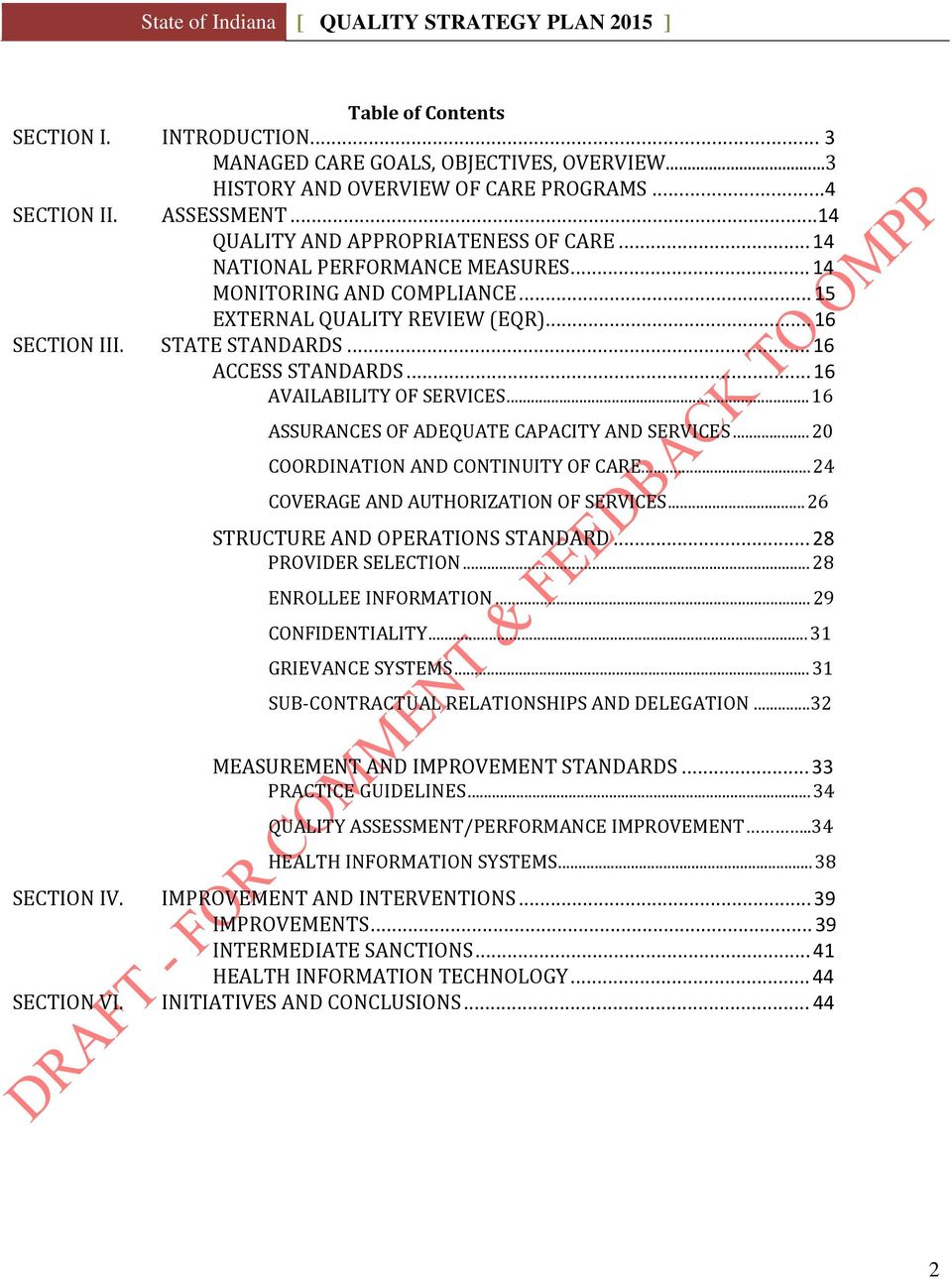
2 Table of Contents SECTION I. INTRODUCTION... 3 MANAGED CARE GOALS, OBJECTIVES, OVERVIEW...3 HISTORY AND OVERVIEW OF CARE PROGRAMS...4 SECTION II. ASSESSMENT...14 QUALITY AND APPROPRIATENESS OF CARE NATIONAL PERFORMANCE MEASURES MONITORING AND COMPLIANCE EXTERNAL QUALITY REVIEW (EQR) SECTION III. STATE STANDARDS ACCESS STANDARDS AVAILABILITY OF SERVICES ASSURANCES OF ADEQUATE CAPACITY AND SERVICES COORDINATION AND CONTINUITY OF CARE COVERAGE AND AUTHORIZATION OF SERVICES STRUCTURE AND OPERATIONS STANDARD PROVIDER SELECTION ENROLLEE INFORMATION CONFIDENTIALITY GRIEVANCE SYSTEMS SUB-CONTRACTUAL RELATIONSHIPS AND DELEGATION...32 MEASUREMENT AND IMPROVEMENT STANDARDS PRACTICE GUIDELINES QUALITY ASSESSMENT/PERFORMANCE IMPROVEMENT..34 HEALTH INFORMATION SYSTEMS SECTION IV. IMPROVEMENT AND INTERVENTIONS IMPROVEMENTS INTERMEDIATE SANCTIONS HEALTH INFORMATION TECHNOLOGY SECTION VI. INITIATIVES AND CONCLUSIONS
3 SECTION I. INTRODUCTION MANAGED CARE GOALS, OBJECTIVES, OVERVIEW Overview of Indiana Health Coverage Programs Indiana continues to engage in activities to improve the lives of its members through planning and initiatives concentrating on timely access to health care, quality and cost management in Medicaid managed care. This strategy includes an interdisciplinary, collaborative approach through partnerships with enrollees, other governmental departments and divisions, providers, contractors, Managed Care Entities (MCE), Care Management Organizations (CMOs), academics, as well as community and advocacy groups. The Indiana Family and Social Services Administration (FSSA) is the single State agency responsible for administering Medicaid programs. Per the US Census Bureau, the population of Indiana in 2014 was million. Per Indiana s Office of Data Management, Reports, and Analysis (DMA) the Medicaid enrollment in December of 2014 was 1,117,418. Thus, Medicaid provides vital health care to approximately one in six Hoosiers. In 2015, Indiana s health care coverage will include services through the Hoosier Healthwise program (HHW), Children s Health Insurance Program (CHIP), Healthy Indiana Plan (HIP), Care Select (CS), Hoosier Care Connect (HCC) or fee-for-service. Indiana s risk based managed care (RBMC) programs include HHW, HIP and HCC. The CHIP members may be served through RBMC or fee-for service. The Care Select program is scheduled to sunset in 2015 with HCC serving the majority of those members in risk based managed care (RBMC). FSSA is charged with oversight of the Managed Care Entities and the Care Management Organizations through reporting, contract compliance and quality initiatives specific to HHW, CHIP, HIP, Care Select and HCC programs. Together, the FSSA Operations Team and the Office of Medicaid Policy and Planning (OMPP) Quality/Policy Team monitor the health plans from different perspectives. The Quality/Policy team monitors data and reporting and seeks opportunities to enhance the quality of care provided to members. The Operations team provides contract compliance monitoring and supervision. Data collection and reporting is facilitated through the health plans quarterly and annual self-reporting as well as through the Enterprise Data Warehouse program-wide reports. The OMPP Quality/Policy team utilizes data reporting for ongoing quality initiatives to identify areas for improvement. The contracted health plans must meet FSSA contract requirements which include developing a Quality Management and Improvement Program (QMIP) for each line of State business to monitor, evaluate and take action on aspects that impact the quality of care provided to members. Four important components of the QMIP are: the plan s Consumer Assessment of Healthcare Providers and Systems (CAHPS), Healthcare Effectiveness Data and Information Set (HEDIS), meeting the requirements of the National Committee for Quality Assurance (NCQA) and addressing opportunities for improvements identified in the External Quality Review. In addition to the plans QMIP, each plan must annually conduct and submit to OMPP their CAHPS and HEDIS results and the NCQA rankings. Since a large portion of the delivery of health care to Indiana Medicaid members is via a managed care model, it is Indiana s goal to ensure that the contracted health plans not only perform the administrative functions of a typical insurer, but also be adept at addressing the unique challenges and needs of lowincome populations. The plans are also expected to manage and integrate care along the continuum of health care services. OMPP expects the contracted health plans to: Improve overall health outcomes 3

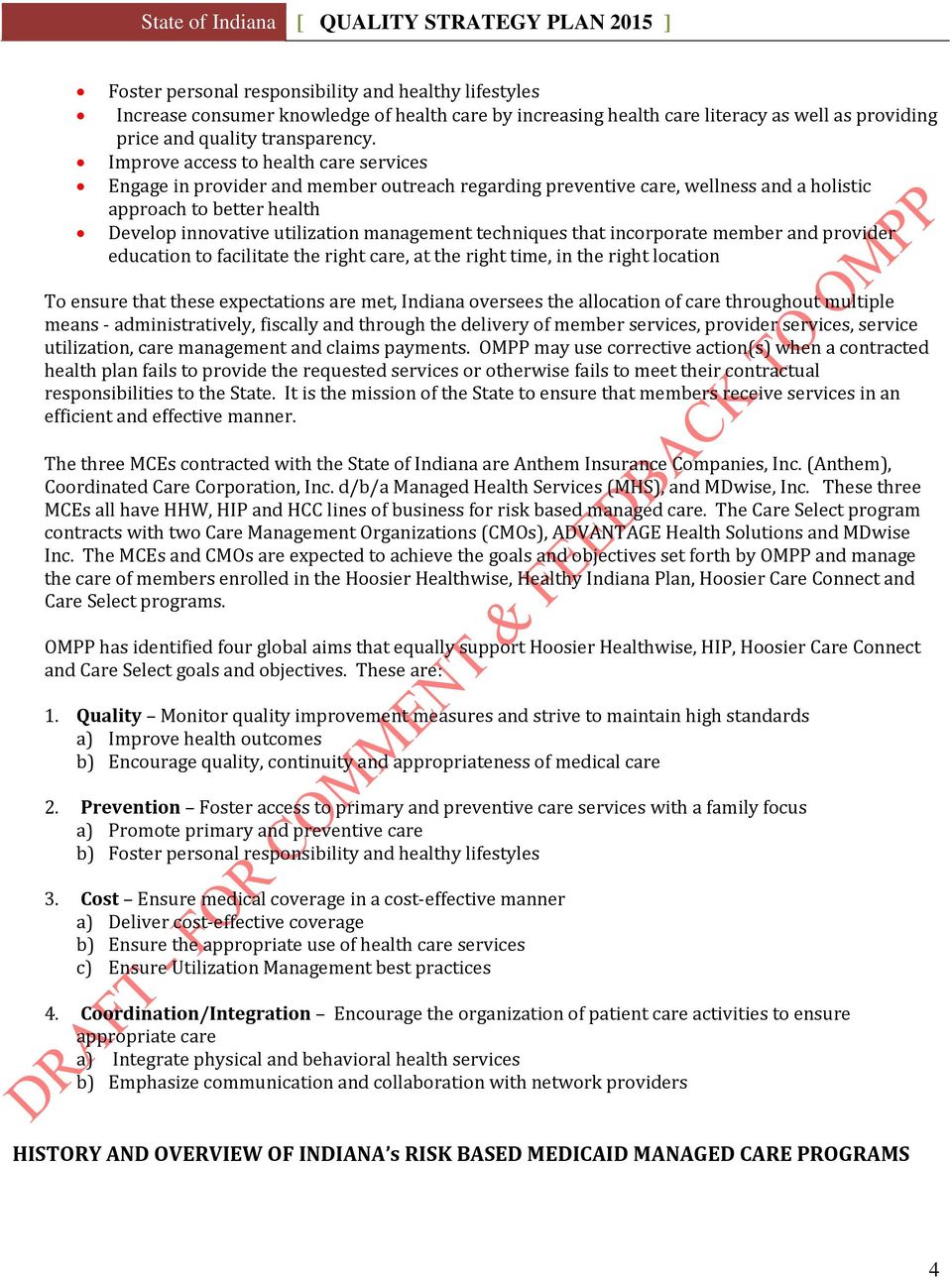
4 Foster personal responsibility and healthy lifestyles Increase consumer knowledge of health care by increasing health care literacy as well as providing price and quality transparency. Improve access to health care services Engage in provider and member outreach regarding preventive care, wellness and a holistic approach to better health Develop innovative utilization management techniques that incorporate member and provider education to facilitate the right care, at the right time, in the right location To ensure that these expectations are met, Indiana oversees the allocation of care throughout multiple means - administratively, fiscally and through the delivery of member services, provider services, service utilization, care management and claims payments. OMPP may use corrective action(s) when a contracted health plan fails to provide the requested services or otherwise fails to meet their contractual responsibilities to the State. It is the mission of the State to ensure that members receive services in an efficient and effective manner. The three MCEs contracted with the State of Indiana are Anthem Insurance Companies, Inc. (Anthem), Coordinated Care Corporation, Inc. d/b/a Managed Health Services (MHS), and MDwise, Inc. These three MCEs all have HHW, HIP and HCC lines of business for risk based managed care. The Care Select program contracts with two Care Management Organizations (CMOs), ADVANTAGE Health Solutions and MDwise Inc. The MCEs and CMOs are expected to achieve the goals and objectives set forth by OMPP and manage the care of members enrolled in the Hoosier Healthwise, Healthy Indiana Plan, Hoosier Care Connect and Care Select programs. OMPP has identified four global aims that equally support Hoosier Healthwise, HIP, Hoosier Care Connect and Care Select goals and objectives. These are: 1. Quality Monitor quality improvement measures and strive to maintain high standards a) Improve health outcomes b) Encourage quality, continuity and appropriateness of medical care 2. Prevention Foster access to primary and preventive care services with a family focus a) Promote primary and preventive care b) Foster personal responsibility and healthy lifestyles 3. Cost Ensure medical coverage in a cost-effective manner a) Deliver cost-effective coverage b) Ensure the appropriate use of health care services c) Ensure Utilization Management best practices 4. Coordination/Integration Encourage the organization of patient care activities to ensure appropriate care a) Integrate physical and behavioral health services b) Emphasize communication and collaboration with network providers HISTORY AND OVERVIEW OF INDIANA s RISK BASED MEDICAID MANAGED CARE PROGRAMS 4
5 Collectively, Hoosier Healthwise, Healthy Indiana Plan, Hoosier Care Connect and Care Select share in ensuring members access to primary and preventive care services by seeking to improve quality, continuity and appropriateness of medical care. The historical timeline for Indiana s risk based managed care program is contained in Appendix 1. Hoosier Healthwise (HHW) - Indiana established the Hoosier Healthwise program in 1994 under the administration of OMPP. The State first introduced a Primary Care Case Management (PCCM) delivery system called PrimeStep. Two years later, the State added a risk based managed care (RBMC) delivery system made up of MCE contracted health plans, which are Health Maintenance Organizations (HMOs), authorized by the Indiana Department of Insurance, and contracted with OMPP. The historical timeline may be found in Appendix 2. Hoosier Healthwise provides health care coverage for low income families, pregnant women, and children. The program covers medical care including, but not limited to, doctor visits, prescription medicine, mental health care, dental care, hospitalizations, surgeries, and family planning at little or no cost to the member or the member's family. Hoosier Healthwise members are eligible for benefits either through Medicaid or through the Children s Health Insurance Program (CHIP). CHIP health care coverage is for children up to age 19 and available to members who may earn too much money to qualify for the standard Hoosier Healthwise coverage. A child may be covered in CHIP Package C by paying a low-cost monthly premium. Hoosier Healthwise Strategic Objectives for Quality Improvements 2015 The development of the HHW Quality Strategy Initiatives is based on identified trends in health care issues within the State of Indiana, attainment of the current quality strategy goals, close monitoring by OMPP of the Managed Care Entities performance and unmet objectives, opportunities for improvement identified in the EQR and issues raised by external stakeholders and partners. OMPP has outlined initiatives for 2015 specific to the Hoosier Healthwise Program in Table 1. Some of these objectives have been monitored and maintained from previous years, while other measures are new for the 2015 Quality Strategy. TABLE Hoosier Healthwise Initiatives OBJECTIVE METHODOLOGY GOAL 1. Improvements in Children and Adolescents Well-Care Percentage of members with well-child visits during first 21 years of life. HEDIS measure using hybrid data. OMPP utilizes HEDIS measures for tracking the percentages of well-child services in children and adolescents. Achieve at or above the 90 th percentile for improvements in children and adolescent wellchild (HEDIS). 2. Early Periodic Screening, Diagnosis and Treatment (EPSDT) OMPP is aligning its EPSDT program requirements with the American Academy of Pediatrics Bright Futures Guidelines. OMPP anticipates the contracted health plans will provide follow-up and outreach to providers about the Bright Futures Guidelines and provider toolkits. Improve the EPSDT participation rate to 80% in

6 3. Improvement in Behavioral Health Percentage of members who received follow-up within 7 days of discharge from hospitalization for mental health disorders 4. Ambulatory Care Number of outpatient and emergency department visits per member months 5. Smoking Cessation Percentage of smokers advised to quit during at least one visit with health care provider during measurement year 6. Diabetes Care Percentage of diabetic members that received a LDL- C screening during the measurement year 7. Full term pregnancy Decrease the number of early elective deliveries 8. Frequency of Prenatal and Post-Partum Care (HEDIS) Increase the frequency of care for pregnant women OMPP uses HEDIS measures for tracking the percentages of members receiving follow-up. OMPP is using HEDIS AMB to track the utilization of ambulatory outpatient and emergency department visits to promote best practices in Utilization Management. OMPP will utilize the CAHPS survey for tracking the percentages of members advised to quit smoking. OMPP is using HEDIS measures for tracking the percentages of members who receive a LDL-C Screening. OMPP has developed in collaboration with the contracted health plans and external stakeholders an early elective delivery policy effective in order to reduce the number of elective inductions and cesarean deliveries prior to 39 weeks gestation to improve birth outcomes. OMPP is using HEDIS measures for tracking the percentage of women receiving prenatal and postpartum care. Prenatal care HEDIS FPC Post-partum care PPC Achieve at or above the 90 th percentile for members who receive follow-up within 7 days of discharge from hospitalization for mental health disorders (HEDIS) Achieve at or above the 75th percentile of Ambulatory Outpatient Care Visits (HEDIS). Achieve at or below the 10% percentile of Ambulatory Emergency Department Care Visits (HEDIS). Achieve at or above 75th percentile for members who are advised to quit during at least one visit with a health care provider. Achieve a rate at or above the 75 th percentile of diabetic members who receive a LDL-C Screening. Benchmark the early elective delivery rate at the 1 year mark of policy implementation. Achieve at or above the 90 th percentile for the frequency of prenatal, and at or above the 90 th percentile for post-partum care. 6

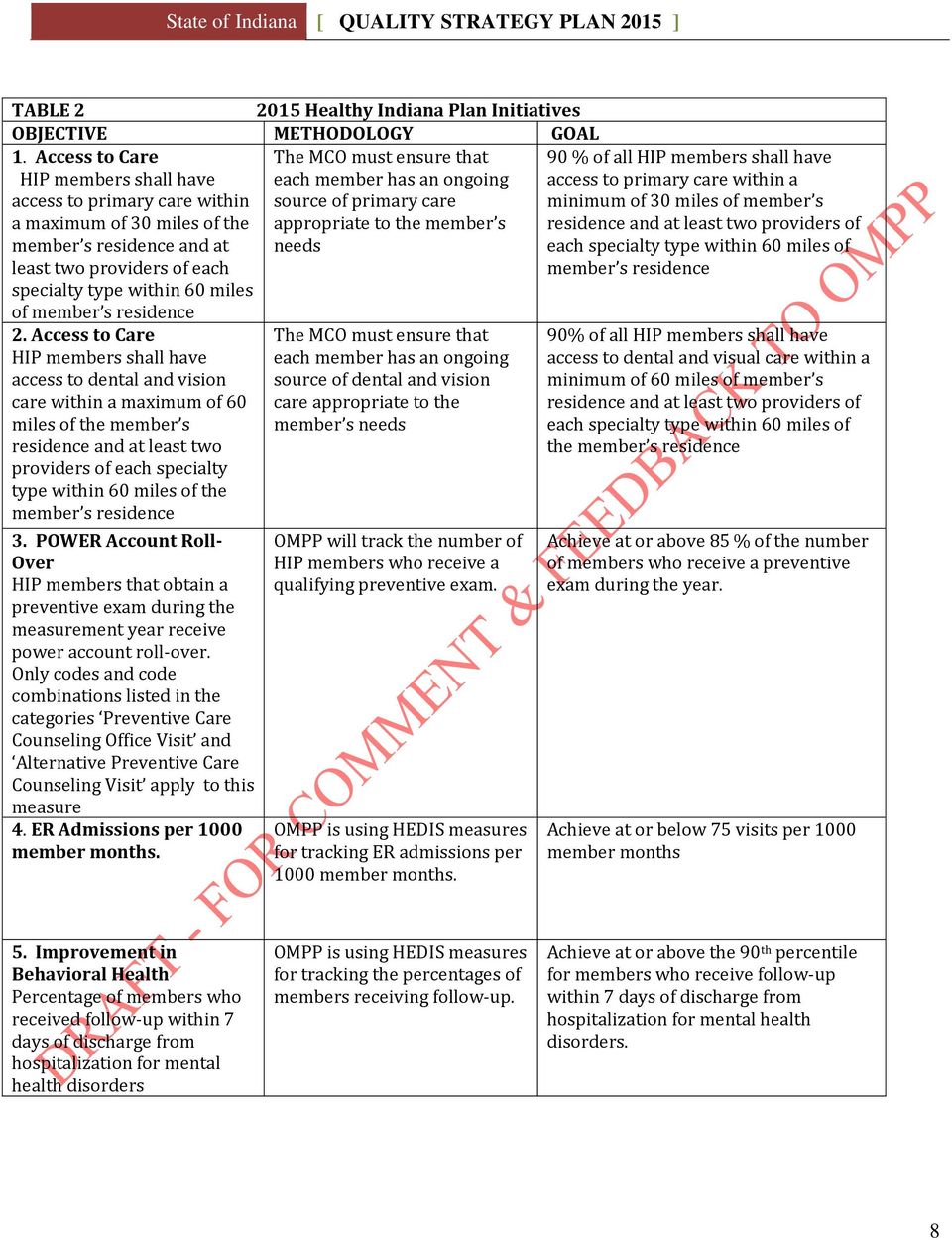
7 9. Monitoring Presumptive Eligibility for Pregnant Women (PE): Improve access to early prenatal care for low income pregnant women through PE 11. Right Choices Program (RCP): Provide quality health care through health care management; RCP administrators conduct utilization reviews, create a care coordination team and collaborate with the member to ensure that the member receives appropriate, medically necessary care The Neonatal Quality Subcommittee will review utilization of PE applications and collaborate with MCEs and other stakeholders to meet objectives. OMPP monitors monthly data to assess the contracted health plans utilization management efforts to reduce inappropriate hospital, pharmacy, and physician utilization while making efforts to improve the member s health status and increase provider participation in the RCP program. Increase the number of submitted PE applications during the 1 st trimester of pregnancy by 2%. Achieve at or above the 96% of the RCP Periodic reviews that are completed on time. Healthy Indiana Plan (HIP) - Indiana established the Healthy Indiana Plan in 2008 under the administration of OMPP. HIP is a health insurance program for uninsured adults between the ages of 19 and 64. HIP is a State-sponsored program and requires minimal monthly contributions from the participant. It offers health benefits including such as hospital services, mental health care, physician services, prescriptions and diagnostic exams. Healthy Indiana Plan - Enhanced Services Plan (HIP-ESP) The HIP-ESP was a special plan for some HIP enrollees with certain high risk medical conditions and administered by the Indiana Comprehensive Health Insurance Association (ICHIA). Members were screened for high cost, complex medical conditions such as cancer, HIV/AIDS, hemophilia, transplants, and aplastic anemia. Due to changes with the Affordable Care Act (ACA), this group of members was incorporated into the HIP program and is no longer a stand-alone program. In 2015, these individuals are being served as HIP s medically frail members. The Hoosier Healthwise and the Healthy Indiana Plans were aligned in 2011 to function under a family-focused approach. The family-approach was intended to align these two programs and allow a seamless experience for Hoosier families to establish a medical home model for increased continuity of care. The programs remained two distinct programs with two waivers/demonstrations from the federal government. In 2015, HIP emphasizes personal responsibility and preventive health services. OMPP will gather data in 2015 regarding the members identified as medically frail to establish a baseline to determine if they are receiving necessary health care and to determine if there are access to care issues. The historical timeline may be found in Appendix 3. HIP Strategic Objectives for Quality Improvement 2015 Table 2 demonstrates the objectives specific to OMPP s Healthy Indiana Plan. Some of these objectives have been monitored and maintained from previous years while other measures are new for the 2015 quality strategy. 7

8 TABLE Healthy Indiana Plan Initiatives OBJECTIVE METHODOLOGY GOAL 1. Access to Care HIP members shall have access to primary care within a maximum of 30 miles of the member s residence and at least two providers of each specialty type within 60 miles of member s residence The MCO must ensure that each member has an ongoing source of primary care appropriate to the member s needs 2. Access to Care HIP members shall have access to dental and vision care within a maximum of 60 miles of the member s residence and at least two providers of each specialty type within 60 miles of the member s residence 3. POWER Account Roll- Over HIP members that obtain a preventive exam during the measurement year receive power account roll-over. Only codes and code combinations listed in the categories Preventive Care Counseling Office Visit and Alternative Preventive Care Counseling Visit apply to this measure 4. ER Admissions per 1000 member months. The MCO must ensure that each member has an ongoing source of dental and vision care appropriate to the member s needs OMPP will track the number of HIP members who receive a qualifying preventive exam. OMPP is using HEDIS measures for tracking ER admissions per 1000 member months. 90 % of all HIP members shall have access to primary care within a minimum of 30 miles of member s residence and at least two providers of each specialty type within 60 miles of member s residence 90% of all HIP members shall have access to dental and visual care within a minimum of 60 miles of member s residence and at least two providers of each specialty type within 60 miles of the member s residence Achieve at or above 85 % of the number of members who receive a preventive exam during the year. Achieve at or below 75 visits per 1000 member months 5. Improvement in Behavioral Health Percentage of members who received follow-up within 7 days of discharge from hospitalization for mental health disorders OMPP is using HEDIS measures for tracking the percentages of members receiving follow-up. Achieve at or above the 90 th percentile for members who receive follow-up within 7 days of discharge from hospitalization for mental health disorders. 8
9 6. Ambulatory Care Number of outpatient and emergency department visits per member months 7. Improvement in Behavioral Health Percentage of members who received follow-up within 7 days of discharge from hospitalization for mental health disorders 8. Right Choices Program (RCP) Provide quality health care through health care management. RCP administrators conduct utilization reviews, create a care coordination team and collaborate with the member to ensure that the member receives appropriate, medically necessary care. 9. Medically Frail Provide quality health care to members identified as medically frail OMPP is using HEDIS AMB as a data based evidence to promote best practices in Utilization Management. OMPP uses HEDIS measures for tracking the percentages of members receiving follow-up. OMPP monitors monthly data to assess the MCEs utilization management efforts to reduce inappropriate hospital, pharmacy, and physician utilization while making efforts to improve the member s health status and increase provider participation in the RCP program. Administrative Reporting Achieve at or above the 90% percentile of Outpatient Visits (HEDIS) Achieve at or below the 10 th percentile of Emergency Department Visits (HEDIS) Achieve at or above the 90 th percentile for members who receive follow-up within 7 days of discharge from hospitalization for mental health disorders (HEDIS) Achieve at or above the 96% of the RCP Periodic reviews that are completed on time Establish baseline data Care Select The Indiana Care Select program is a primary care case management program with disease management, care management and complex case management services designed to individually tailor health care benefits more effectively, improve the quality of care and health outcomes and provide a more holistic approach to members chronic conditions. The Care Select program focuses on members diagnosed with asthma, diabetes, congestive heart failure, coronary heart disease, chronic obstructive pulmonary disease, hypertension, chronic kidney disease, severe mental illness, serious emotional disturbance and/or depression. Chronic obstructive pulmonary disease was added in 2014 to address the large number of individuals with pulmonary related emergency department and inpatient hospitalization visits. The historical timeline may be found in Appendix 4. Indiana contracts with two care management organizations, ADVANTAGE Health Solutions and MDwise, Inc. to meet the needs of the Care Select members. Care Select Strategic Objectives for Quality Improvement 2015 The Care Select Program is sunsetting June 30, The current members will be transitioned in 2015 over a 3 month period to the Hoosier Care Connect risk based managed care program for individuals who are aged, blind or disabled. Due to the programmatic changes, an abbreviated set of quality initiatives will be tracked for these members. Measures are intended to promote positive health outcomes and to assess health care costs 9

10 during the program transition. Table 3 demonstrates the objectives specific to the Care Select program. These objectives were monitored in previous years and are maintained for the 2015 quality strategy. TABLE Care Select Initiatives OBJECTIVE METHODOLOGY GOAL 1. Outpatient Visits (HEDIS AMB) Percentage of outpatient visits 2. Inpatient Bounce Back (30 days) (< 16%): (HEDIS). ED Visits (< 12%)(HEDIS AMB) Percentage of members who experience an ED visit Overview of Traditional Medicaid Populations Administrative reporting using HEDIS specifications. Administrative reporting using HEDIS specifications More than 55% of members will have one outpatient visit. Less than 12% of members will experience an ED visit The Indiana Traditional Medicaid Population is comprised of those groups of members not currently enrolled in Hoosier Healthwise, the Healthy Indiana Plan or Care Select. Some individuals are waiting for a primary medical provider assignment. Other members are being served through other programs such as Medicare or special aid categories such as the breast and cervical cancer programs. The following are individuals covered under traditional Medicaid receiving fee for service benefits: Dually enrolled receiving Medicare and Medicaid benefits Persons receiving Home and Community Based Services Waiver benefits Individuals awaiting an assignment with Hoosier Care Connect Persons receiving care in a nursing facility or other State operated facility Individuals in a specific Medicaid aid category, such as Refugee or the Breast and Cervical Cancer aid Category Others not in risk based managed care Traditional Medicaid Strategic Objectives for Quality Improvement 2015 In 2015, OMPP will continue efforts to involve the traditional Medicaid population into the overall quality improvement efforts. OMPP will look at baseline data for two questions regarding the Traditional Medicaid population: How healthy are they? What type of care are they receiving? Table 4 shows the initiatives for which baseline data will be analyzed. TABLE Traditional Medicaid Initiatives OBJECTIVE METHODOLOGY GOAL 10

11 1. Preventive Care (HEDIS AAP-like) Administrative reporting through EDW using HEDIS specifications. 2. Ambulatory Care Number of outpatient and emergency department visits per member months Administrative reporting through EDW using HEDIS specifications. More than 7% of members will have one preventive care visit. More than 7% of members will have one or more preventive care visits. Establish baseline data for emergency department visits. 3. Improvement in Behavioral Health Percentage of members who received follow-up within 7 days of discharge from hospitalization for mental health disorders Administrative reporting through EDW using HEDIS specifications. Establish baseline data Hoosier Care Connect In 2013 Indiana House Enrolled Act 1328 (HEA 1328) was passed by the Indiana General Assembly. This act tasked FSSA with managing care of the aged, blind and disabled (ABD) Medicaid enrollees. In response, FSSA convened the ABD Task Force (Task Force) comprised of staff from across key FSSA divisions and community stakeholders who worked in 2013 and 2014 to design the Hoosier Care Connect risk based managed care program for individuals with significant needs. The historical timeline may be found in Appendix 5. Hoosier Care Connect Strategic Objectives for Quality Improvement 2015 In 2015 the Care Select and Traditional Medicaid members will be transitioned over a 3 month period to the Hoosier Care Connect risk based managed care program for individuals who are 65+ years of age, blind or disabled. Due to the members multiple needs a longer period of transition was planned to aid them in the decision making process of choosing a health plan. Overall goals for the first year is to have health needs screens and comprehensive assessments completed, connecting individuals to care management and assuring that members have access to care. Measures are intended to promote positive health outcomes and to assess health care costs. Table 5 demonstrates the objectives specific to the Hoosier Care Connect program. With program initiation, OMPP will be monitoring program access and establishing baseline for 2016 planning. TABLE Hoosier Care Connect Initiatives GOAL/OBJECTIVE METHODOLOGY MEASURE 1. Preventive Care (HEDIS AAP-like) Administrative Establish baseline data reporting through EDW using HEDIS specifications. 2. Outpatient Ambulatory Visits (HEDIS AMBlike for outpatient) Administrative reporting through EDW using HEDIS specifications Establish baseline data 11

12 3. Completion of Health Needs Screen ( 73%) Administrative reporting 4. Completion of Comprehensive Health Assessment Tool 5. Hoosier Care Connect Members to provide more effective and ongoing health promotion and disease prevention activities 6. Complex Case Management - to effectively tailor benefits to member need. Administrative reporting Administrative reporting Administrative reporting Percentage of newly enrolled MCE members, net of terminated members that have had a health screen assessment completed within 90 days. Percentage of newly enrolled MCE members, net of terminated members that have had a comprehensive health assessment completed within 150 days. Establish baseline data. Number of members identified by stratification level, program participation length and average contacts per member per month. Number of CCM members by disease state, total contacts and average contacts per reporting period. Development and Review of Quality Strategy The OMPP Quality Team monitors the trends in health care in the State of Indiana for all Medicaid members. Quality measures are re-evaluated and established annually in the MCE contracts as a component of State wide quality initiatives as well as pay for performance metrics. OMPP monitors the progress of the metrics with the goal of improving health care for Medicaid members served by the contracted health plans. Periodically, external stakeholders identify issues or initiatives for OMPP consideration and the impact on the State. For example, in 2014 an initiative targeted at smoking cessation and pregnant women was added to pay for outcomes metrics and MCE contracts. The Indiana Medicaid Managed Care programs are reviewed through a variety of forums. Input from those forums are used to review the Quality Strategy Plan and to make annual adjustments. OMPP and the MCE executive staff have regular meetings to address topics applicable to all care programs. A review of each program s accomplishments, paired with a fiscal analysis concerning program expenditures, allows OMPP to continue to progress through the strategic initiatives, making adjustments as necessary. Items identified in the executive meetings may be included in the Quality Strategy Plan as efforts to improve the delivery of health care, increase the quality of health care for those enrolled in Medicaid or improve fiscal responsibility. The MCE quality directors include OMPP in monthly collaboration meetings to review and discuss their ongoing Quality Improvement Projects (QIPs), Quality Management and Improvement Program (QMIP) Work Plans, and strategic initiatives. The contracted health plans use the group for focused problem-solving, clarification, and joint partnership in quality reporting. These collaboration meetings will continue in OMPP holds Quality Strategy meetings quarterly with these representatives to discuss progress of quality improvement projects, quality subcommittee activities, and reports of outcomes measures. The health plans submit quality improvement projects for discussion at each quarterly meeting. The Hoosier 12

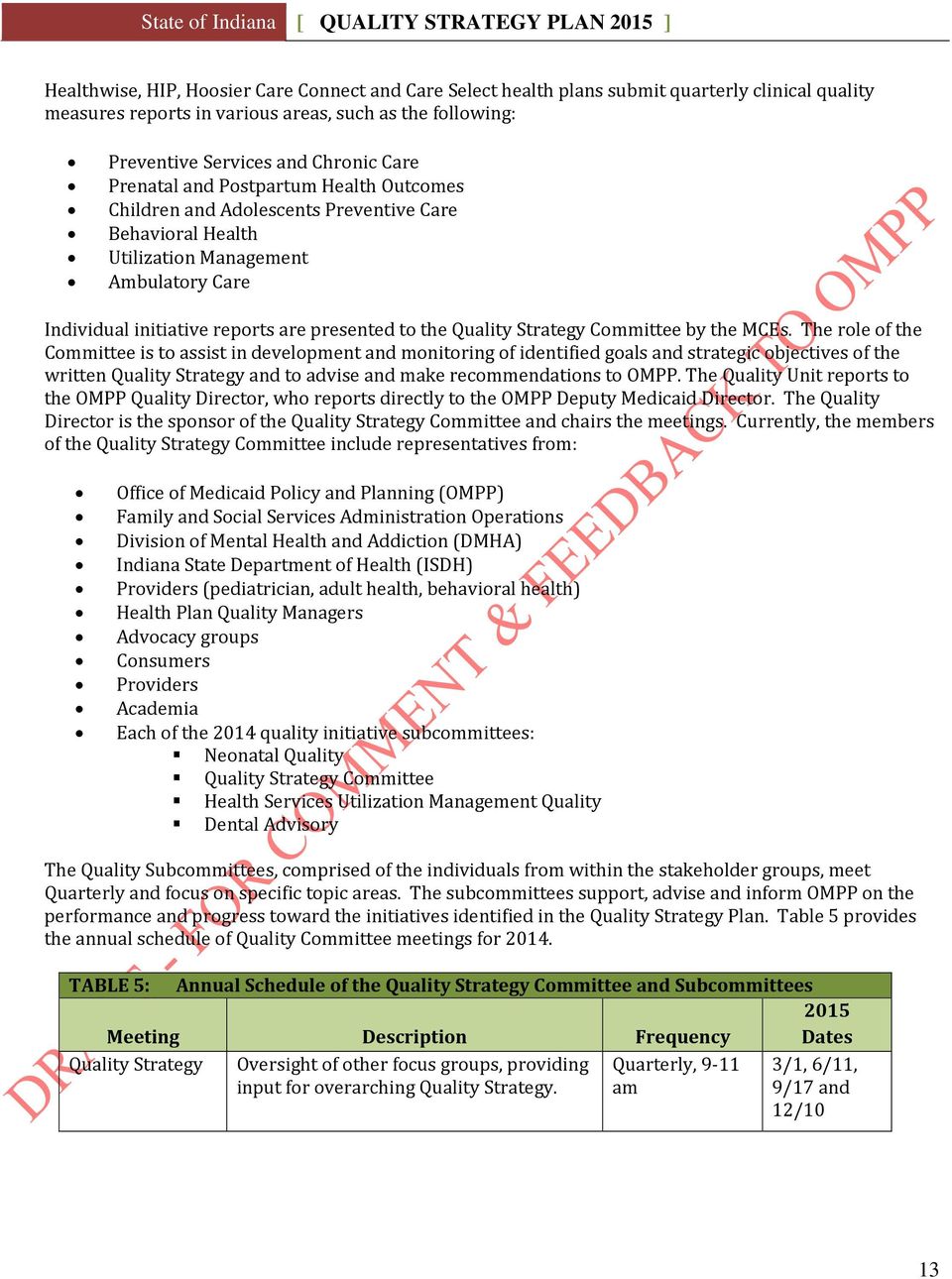
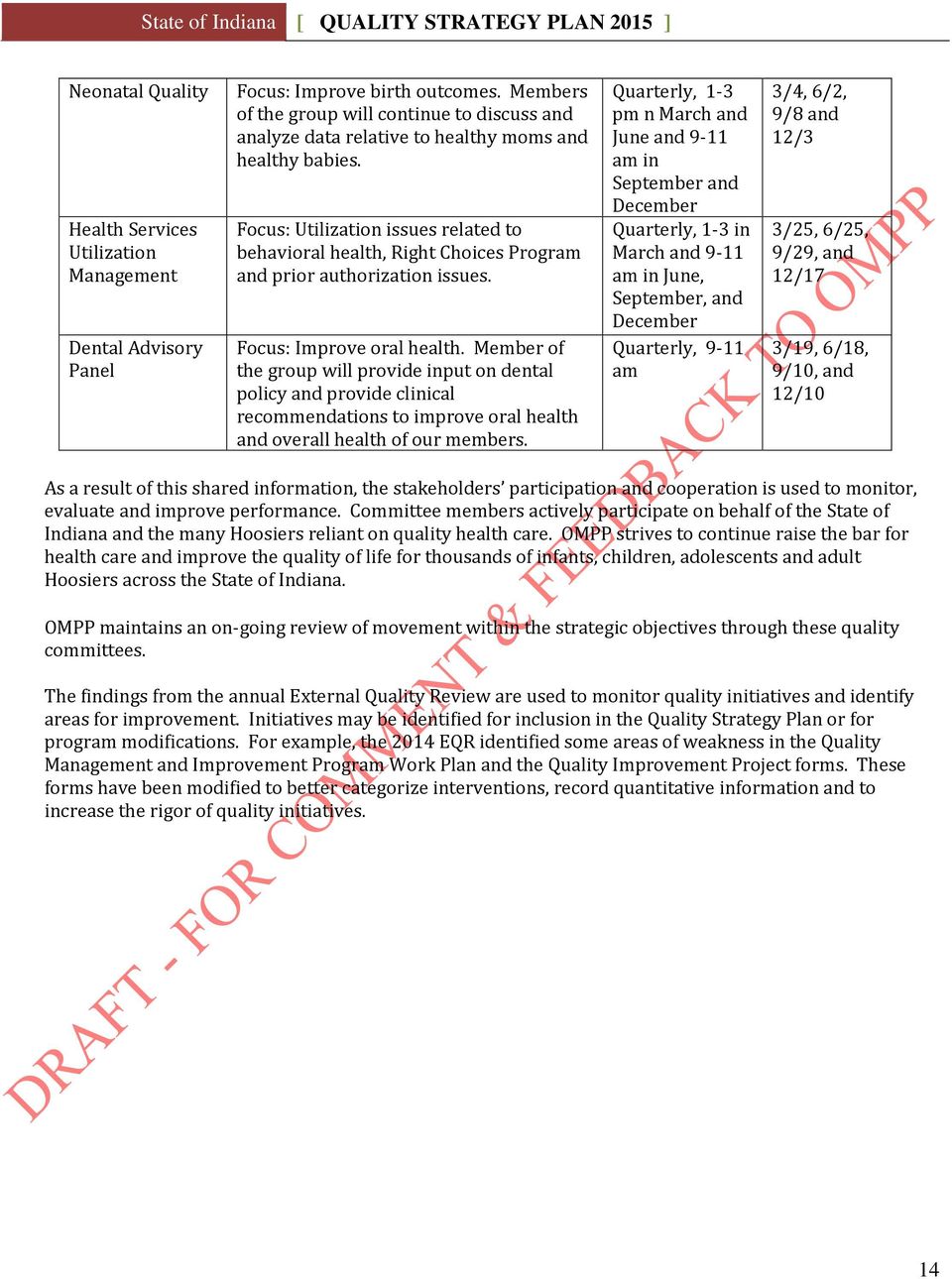
13 Healthwise, HIP, Hoosier Care Connect and Care Select health plans submit quarterly clinical quality measures reports in various areas, such as the following: Preventive Services and Chronic Care Prenatal and Postpartum Health Outcomes Children and Adolescents Preventive Care Behavioral Health Utilization Management Ambulatory Care Individual initiative reports are presented to the Quality Strategy Committee by the MCEs. The role of the Committee is to assist in development and monitoring of identified goals and strategic objectives of the written Quality Strategy and to advise and make recommendations to OMPP. The Quality Unit reports to the OMPP Quality Director, who reports directly to the OMPP Deputy Medicaid Director. The Quality Director is the sponsor of the Quality Strategy Committee and chairs the meetings. Currently, the members of the Quality Strategy Committee include representatives from: Office of Medicaid Policy and Planning (OMPP) Family and Social Services Administration Operations Division of Mental Health and Addiction (DMHA) Indiana State Department of Health (ISDH) Providers (pediatrician, adult health, behavioral health) Health Plan Quality Managers Advocacy groups Consumers Providers Academia Each of the 2014 quality initiative subcommittees: Neonatal Quality Quality Strategy Committee Health Services Utilization Management Quality Dental Advisory The Quality Subcommittees, comprised of the individuals from within the stakeholder groups, meet Quarterly and focus on specific topic areas. The subcommittees support, advise and inform OMPP on the performance and progress toward the initiatives identified in the Quality Strategy Plan. Table 5 provides the annual schedule of Quality Committee meetings for TABLE 5: Annual Schedule of the Quality Strategy Committee and Subcommittees Meeting Description Frequency 2015 Dates Quality Strategy Oversight of other focus groups, providing input for overarching Quality Strategy. Quarterly, 9-11 am 3/1, 6/11, 9/17 and 12/10 13
14 Neonatal Quality Health Services Utilization Management Dental Advisory Panel Focus: Improve birth outcomes. Members of the group will continue to discuss and analyze data relative to healthy moms and healthy babies. Focus: Utilization issues related to behavioral health, Right Choices Program and prior authorization issues. Focus: Improve oral health. Member of the group will provide input on dental policy and provide clinical recommendations to improve oral health and overall health of our members. Quarterly, 1-3 pm n March and June and 9-11 am in September and December Quarterly, 1-3 in March and 9-11 am in June, September, and December Quarterly, 9-11 am 3/4, 6/2, 9/8 and 12/3 3/25, 6/25, 9/29, and 12/17 3/19, 6/18, 9/10, and 12/10 As a result of this shared information, the stakeholders participation and cooperation is used to monitor, evaluate and improve performance. Committee members actively participate on behalf of the State of Indiana and the many Hoosiers reliant on quality health care. OMPP strives to continue raise the bar for health care and improve the quality of life for thousands of infants, children, adolescents and adult Hoosiers across the State of Indiana. OMPP maintains an on-going review of movement within the strategic objectives through these quality committees. The findings from the annual External Quality Review are used to monitor quality initiatives and identify areas for improvement. Initiatives may be identified for inclusion in the Quality Strategy Plan or for program modifications. For example, the 2014 EQR identified some areas of weakness in the Quality Management and Improvement Program Work Plan and the Quality Improvement Project forms. These forms have been modified to better categorize interventions, record quantitative information and to increase the rigor of quality initiatives. 14
15 SECTION II. ASSESSMENT QUALITY AND APPROPRIATENESS OF CARE The MCEs are contractually required to maintain an administrative and organizational structure that supports effective and efficient delivery of services to members. Furthermore, the State is continually evaluating ways to increase cost-effectiveness. The overarching goal to improve access to care extends throughout the quality improvement efforts of OMPP and is embedded into the expectations of the contracted health plans. NATIONAL PERFORMANCE MEASURES The MCEs monitor, evaluate and take effective action to identify and address needed improvements in the quality of care delivered to members in the Hoosier Healthwise, HIP, Hoosier Care Connect and Care Select programs. This includes necessary improvements by all providers in all types of settings. In compliance with State and federal regulations, the contracted health plans submit quality improvement data, including data that meets HEDIS standards for reporting and measuring outcomes, to OMPP. This includes data on the status and results of quality improvement projects. Additionally, the MCEs submit information requested by OMPP to complete annual quality reports. MONITORING AND COMPLIANCE The State conducts multiple monitoring activities to maintain oversight and allegiance to stated goals within this Quality Strategy. Monitoring activities include: Quality Management and Improvement Program Work Plans (QMIPs) Data Analysis Enrollee hotlines operated by the State s Enrollment Broker Geographic mapping for provider network External Quality Review (EQR) Network adequacy assurance submitted by plan On-site Monitoring Reviews Recognized performance measures reports Surveys The FSSA Operations unit oversees contract compliance by enforcing reporting requirements mandated within the MCEs contracts. Each contracted health plan is required to document outcomes and performance results, as instructed within each program reporting manual, to demonstrate data reliability, accuracy and validity. The MCE Reporting Manuals provide guidance by OMPP on required performance reporting for the health plans contracted to deliver services for Hoosier Healthwise, HIP, Hoosier Care Connect and Care Select. The Reporting Manuals are tailored to the goals of each program and describe the reporting process, submission requirements, report descriptions, definitions and templates of all reports with an OMPP required format. The reports submitted in compliance with MCE Reporting Manual specifications are generally referred to as periodic MCE reports. In 2015, the periodic MCE reports timeframes for submission were increased in order to closely monitor the start-up of the HIP program expansion and the phase in of Hoosier Care Connect. To more closely 15

16 monitor implementation, daily and weekly reports were submitted by the MCEs to track member and provider concerns. In general, reports are submitted monthly and quarterly to monitor and compare clinical outcomes against targets, standards and benchmarks as established by OMPP. The FSSA Operations staff directly manages all contracted health plan reporting to ensure timely submissions. This management supports OMPP s capacity to align and increase oversight processes across the MCEs and the programs. FSSA staff conducts a comparative review of the report submissions by the MCEs to ensure that key performance indicators, both operational and clinical, are effectively being identified, collected, validated and analyzed. Anomalies are identified and targeted for discussion at the Quality Strategy Committees and/or the monthly on-site visit. FSSA Operations sends a confirmation report to the plans confirming the receipt of required data along with any inquiries related to questionable data points. An analysis memo that reviews the finalized performance results, as well as the metrics which fail to meet specified targets, is returned to the plans. The alignment of program processes has continued, as both the HIP and the Care Select programs have similar processes in place. These actions have been undertaken to improve accountability, compliance, and reliance on the operations and health outcome achievements of the State s contracted health plans. While the contracted health plans are required to submit annual HEDIS and CAHPS data, OMPP also collects quarterly reports on a variety of quality indicators for preventive health; children and adolescents; and mothers and newborns. This increased access to data has allowed OMPP to continually track and monitor performance on key quality indicators and steer the focus toward improvement activities. Typically, OMPP and the FSSA Operations staff review and update the reporting manuals annually based on current needs of the programs and in conjunction with the contracted health plans. For 2015, the HIP reporting manual underwent an extensive overhaul to better reflect the priorities of the HIP program. Draft versions were sent to the health plans for input and clarification to better ensure integrity of data. The Hoosier Care Connect reporting manual was developed by utilizing a combination of reports from Hoosier Healthwise and Care Select in order to best reflect the program priorities. The Hoosier Healthwise 2015 reporting manual underwent minor changes from 2014 to bring consistency between the same reports for different programs. There were no changes for Care Select in the 2015 reporting manual. The typical annual review of the managed care reporting manuals may trigger: Changes to reporting requirements Improvement of submission processes, templates and retention Manual revisions which clarify and document specification changes Increases in reporting consistency across contracted health plans OMPP incorporated multiple steps within the Hoosier Healthwise, HIP, Hoosier Care Connect and Care Select report review processes to reinforce OMPP s commitment to receive quality data in a complete, timely and accurate manner. Validation of submitted data is crucial to ensure that performance analysis is based on sound information. FSSA Operations reviews data for contract compliance, adherence to established standards and comparisons between health plans. OMPP reviews data for progress toward pay for outcomes measures and quality initiatives. A dashboard comparison of quality initiatives is shared at the quarterly Quality Strategy Subcommittee meetings. EXTERNAL QUALITY REVIEW (EQR) OMPP contracts with Burns & Associates, Inc. (B&A) to conduct the required External Quality Reviews (EQR) for Hoosier Healthwise, HIP and the Indiana s Children s Health Insurance Program (CHIP). The 16

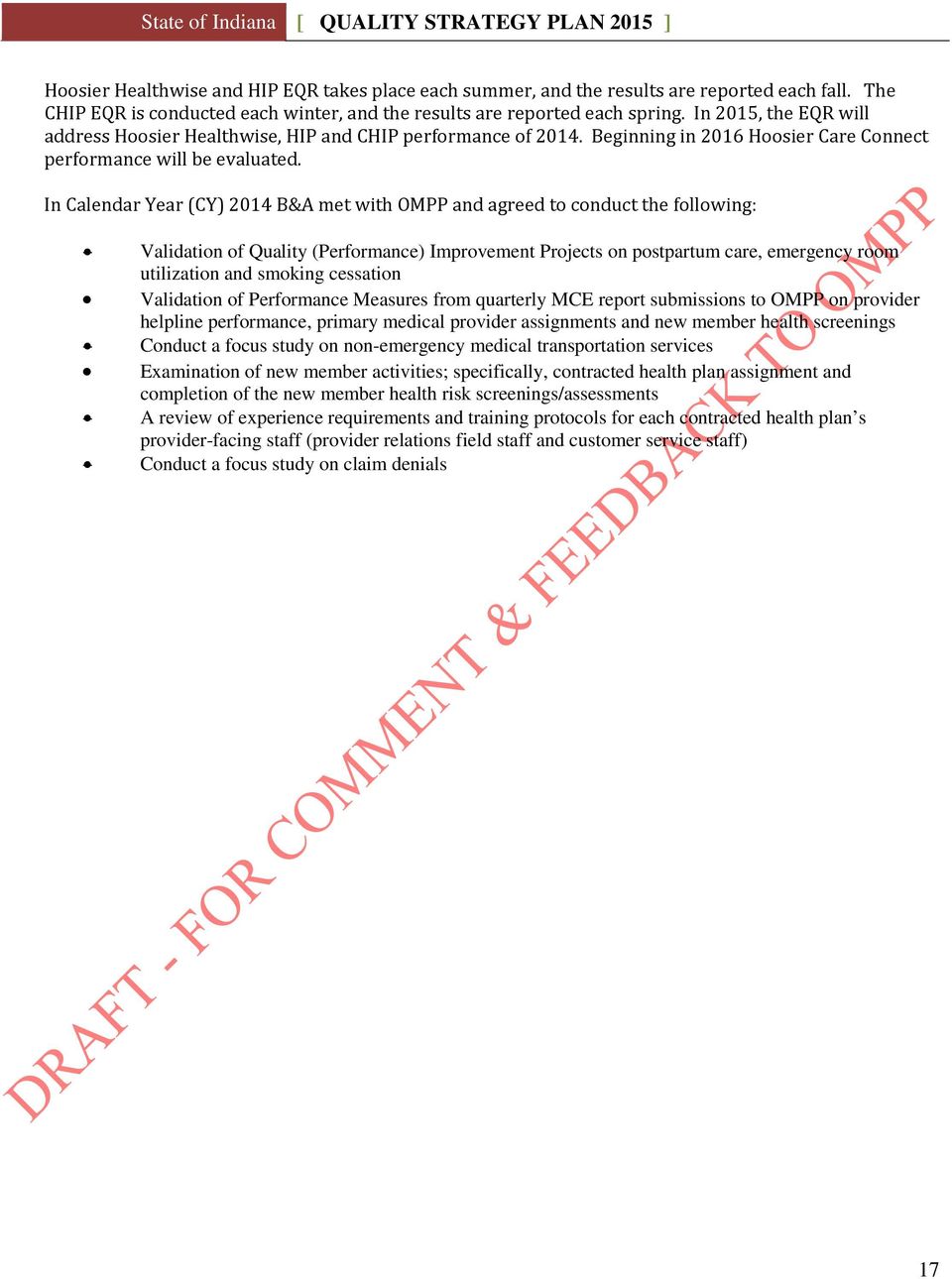
17 Hoosier Healthwise and HIP EQR takes place each summer, and the results are reported each fall. The CHIP EQR is conducted each winter, and the results are reported each spring. In 2015, the EQR will address Hoosier Healthwise, HIP and CHIP performance of Beginning in 2016 Hoosier Care Connect performance will be evaluated. In Calendar Year (CY) 2014 B&A met with OMPP and agreed to conduct the following: Validation of Quality (Performance) Improvement Projects on postpartum care, emergency room utilization and smoking cessation Validation of Performance Measures from quarterly MCE report submissions to OMPP on provider helpline performance, primary medical provider assignments and new member health screenings Conduct a focus study on non-emergency medical transportation services Examination of new member activities; specifically, contracted health plan assignment and completion of the new member health risk screenings/assessments A review of experience requirements and training protocols for each contracted health plan s provider-facing staff (provider relations field staff and customer service staff) Conduct a focus study on claim denials 17
18 SECTION III. STATE STANDARDS Many of OMPP s monitoring and oversight activities address compliance with access to care and quality of services. The FSSA Operations unit has contracts with the MCEs to ensure adequate access and availability of health care services to Medicaid members. Contracts are written based on state and federal regulations. The following sections are extracted from the health plans contracts. ACCESS STANDARDS AVAILABILITY OF SERVICES FSSA requires the MCEs to develop and maintain a comprehensive network to provide services to its Hoosier Healthwise, HIP and Hoosier Care Connect members. The network must include providers serving special needs populations such as people who are aged, blind, or disabled. For its Hoosier Healthwise population, the network must include providers serving children with special health care needs. The MCEs contractual obligations with FSSA are aimed at ensuring that covered services are available to Indiana Medicaid members and delivered in a culturally competent manner. The MCEs must have written provider agreements with providers in the networks. The MCEs are responsible for ensuring covered services are available and geographically accessible. The networks must provide adequate numbers of facilities, physicians, ancillary providers, service locations and personnel for the provision of high-quality covered services for all Indiana Medicaid members. The health plans must ensure that all of their contracted providers are registered Indiana Health Coverage Program (IHCP) providers and can respond to the cultural, racial and linguistic needs of its member populations. Each MCE is contractually obligated to meet the unique needs of its members, particularly those with special health care needs, within their networks. For members who may require out-of-network services, the out-of-network providers must be IHCP providers in order to receive reimbursement from the MCEs. The contracted health plans encourage out-of-network providers, particularly emergency services providers, to enroll in the IHCP. Each health plan must develop and have under contract its specialist and ancillary provider network prior to receiving enrollment. In 2015, for Hoosier Care Connect, MCEs who did not meet network adequacy requirement prior to the program s implementation date were required to have an open network of IHCP providers until such time that network adequacy requirements were met. In 2015 for HIP, the MCEs must assure that network adequacy requirement is met for the new dental carve-in service. If not, then the health plans are required to have an open network of IHCP providers until such time that network adequacy requirements were met. Maintain and Monitor Network of Appropriate Providers: The MCEs are obligated to consider the following elements when developing, maintaining and monitoring the provider networks: Anticipated enrollment Expected utilization of services, taking into consideration the characteristics and health care needs of Hoosier Healthwise, HIP and Hoosier Care Connect members Numbers and types of providers required, including training, experience and specialization, to furnish the contracted services Numbers of network providers who are not accepting new members 18

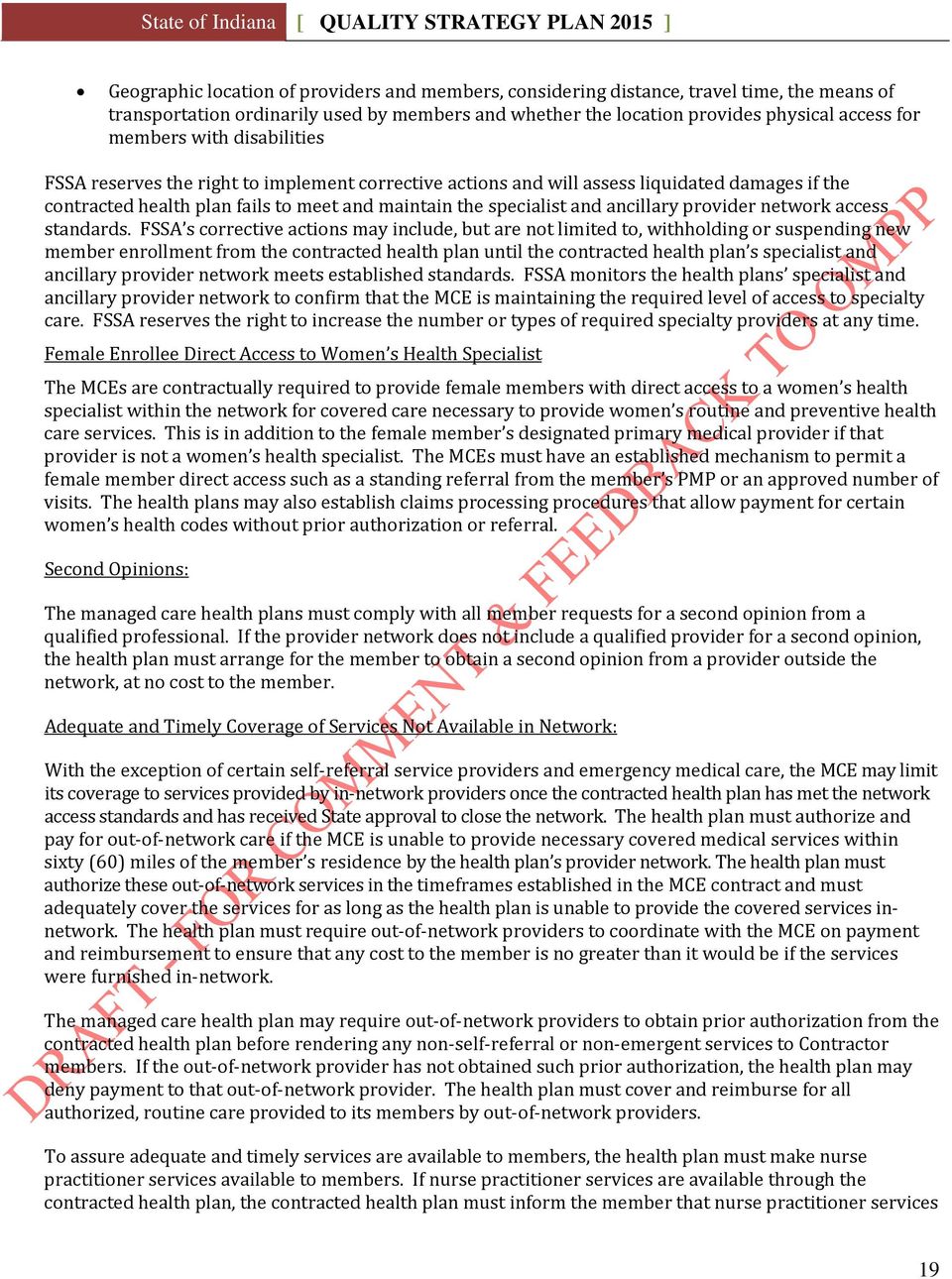
19 Geographic location of providers and members, considering distance, travel time, the means of transportation ordinarily used by members and whether the location provides physical access for members with disabilities FSSA reserves the right to implement corrective actions and will assess liquidated damages if the contracted health plan fails to meet and maintain the specialist and ancillary provider network access standards. FSSA s corrective actions may include, but are not limited to, withholding or suspending new member enrollment from the contracted health plan until the contracted health plan s specialist and ancillary provider network meets established standards. FSSA monitors the health plans specialist and ancillary provider network to confirm that the MCE is maintaining the required level of access to specialty care. FSSA reserves the right to increase the number or types of required specialty providers at any time. Female Enrollee Direct Access to Women s Health Specialist The MCEs are contractually required to provide female members with direct access to a women s health specialist within the network for covered care necessary to provide women s routine and preventive health care services. This is in addition to the female member s designated primary medical provider if that provider is not a women s health specialist. The MCEs must have an established mechanism to permit a female member direct access such as a standing referral from the member s PMP or an approved number of visits. The health plans may also establish claims processing procedures that allow payment for certain women s health codes without prior authorization or referral. Second Opinions: The managed care health plans must comply with all member requests for a second opinion from a qualified professional. If the provider network does not include a qualified provider for a second opinion, the health plan must arrange for the member to obtain a second opinion from a provider outside the network, at no cost to the member. Adequate and Timely Coverage of Services Not Available in Network: With the exception of certain self-referral service providers and emergency medical care, the MCE may limit its coverage to services provided by in-network providers once the contracted health plan has met the network access standards and has received State approval to close the network. The health plan must authorize and pay for out-of-network care if the MCE is unable to provide necessary covered medical services within sixty (60) miles of the member s residence by the health plan s provider network. The health plan must authorize these out-of-network services in the timeframes established in the MCE contract and must adequately cover the services for as long as the health plan is unable to provide the covered services innetwork. The health plan must require out-of-network providers to coordinate with the MCE on payment and reimbursement to ensure that any cost to the member is no greater than it would be if the services were furnished in-network. The managed care health plan may require out-of-network providers to obtain prior authorization from the contracted health plan before rendering any non-self-referral or non-emergent services to Contractor members. If the out-of-network provider has not obtained such prior authorization, the health plan may deny payment to that out-of-network provider. The health plan must cover and reimburse for all authorized, routine care provided to its members by out-of-network providers. To assure adequate and timely services are available to members, the health plan must make nurse practitioner services available to members. If nurse practitioner services are available through the contracted health plan, the contracted health plan must inform the member that nurse practitioner services 19
20 are available. Members are allowed to use the services of out-of-network nurse practitioners if no nurse practitioner is available in the member s service area and within the MCE s network. For HIP members, MCEs must make covered services provided by Federally Qualified Healthcare Centers (FQHCs) and Rural Health Clinics (RHCs) available to members out-of-network if an FQHC or RHC is not available in the member s service area within the contracted health plan s network. The contracted health plan may not require an out-of-network provider to acquire an MCE-assigned provider number for reimbursement. An NPI number shall be sufficient for out-of-network provider reimbursement. Out-of-Network Provider Coordination with MCEs for Payment: Out-of-Network Provider Reimbursement Hoosier Healthwise The contracted health plan must reimburse any out-of-network provider s claim for authorized services provided to Hoosier Healthwise members at a rate it negotiates with the out-of-network provider, or the lesser of the following: The usual and customary charge made to the general public by the provider or The established Indiana Medicaid Fee-for-Service (FFS) reimbursement rates that exist for participating IHCP providers at the time the service was rendered. Out-of-Network Provider Reimbursement HIP The contracted health plan must reimburse any out-of-network provider s claim for authorized services provided to HIP members at the Medicare rate, or if the service does not have a Medicare rate, 130% of the Medicaid rate for that service. Provider Credentialing: All managed care health plans must have written credentialing and re-credentialing policies and procedures to ensure quality of care is maintained or improved and to assure that all contracted providers hold current State licensure and enrollment in the IHCP. The MCEs credentialing and re-credentialing process for all contracted providers must meet the National Committee for Quality Assurance (NCQA) guidelines. The same provider credentialing standards must apply across all managed care programs, including Hoosier Healthwise, HIP and Hoosier Care Connect programs. The MCEs use FSSA s standard provider credentialing form during the credentialing process. The contracted health plans must ensure that providers agree to meet all of FSSA s and the MCEs standards for credentialing PMPs and specialists and maintain IHCP manual standards, including: Compliance with State record keeping requirements FSSA s access and availability standards Quality improvement program standards The MCEs provider credentialing and selection policies must not discriminate against particular providers that serve high-risk populations or specialize in conditions that require costly treatment. The MCEs must not employ or contract with providers that have been excluded from participating in federal health care programs under Section 1128 or Section 1128A of the Social Security Act. 20

21 MCEs must ensure that the network providers offer hours of operation that are no less than the hours of operation offered to their commercial members, if the health plan also serves commercial members. The health plan must also make covered services available twenty four (24)-hours-a-day, seven (7)-days-aweek, when medically necessary. In meeting these requirements, the MCE must: Establish mechanisms to ensure compliance by providers Monitor providers regularly to determine compliance Take corrective action if there is a failure to comply Each MCE must provide FSSA written notice at least ninety (90) calendar days in advance of the contracted health plan s inability to maintain a sufficient network in any county. Provider Incentive Program MCEs are contractually required to comply with Section 1876(i)(8) of the Social Security Act and federal regulations 42 CFR 438.6(h), 42 CFR and 42 CFR The health plans must supply to FSSA information on its plan as required in the regulations and with sufficient detail for FSSA to determine whether incentive plans comply with federal requirements regarding physician incentive plans. The health plans must provide information concerning its physician incentive plan, upon request, to its members and in any marketing materials in accordance with the disclosure requirements stipulated in the federal regulations. Similar requirements apply to subcontracting arrangements with physician groups and intermediate entities. Physician incentive plans must comply with the federal requirement to refrain from making any specific payment directly or indirectly to a physician or physician group as an inducement to reduce or limit medically necessary services furnished to an individual member. The health plans must also meet requirements for stop-loss protection, member survey and disclosure requirements under 42 CFR 438.6(h). Cultural Competency Data on race, ethnicity and primary language is sent to the MCEs via the Enrollment Roster. This information is to be utilized by the health plans to communicate effectively and appropriately with their population. The health plans must make all written information available in English and Spanish, and other prevalent languages, including American Sign Language, identified by OMPP, upon the member s request. In addition, each health plan must identify additional languages that are prevalent among its membership. The MCE must also inform members that information is available upon request in alternative formats and how to obtain them. OMPP defines alternative formats as Braille, large-font letters, audio, prevalent languages and verbal explanation of written materials. All materials must be approved by FSSA and be culturally appropriate. Verbal interpretation services must also be available and provided by the health plans upon request. The MCEs must also ensure that all of its contracted providers can respond to the cultural, racial and linguistic needs of the populations that they serve. FSSA will assess liquidated damages and impose other authorized remedies for an MCE s non-compliance with the network development and network composition requirements. ASSURANCES OF ADEQUATE CAPACITY AND SERVICES All MCEs are contractually obligated to: Serve the expected enrollment 21
22 Offer an appropriate range of services and access to preventive and primary care services for the population expected to be enrolled Maintain a sufficient number, mix and geographic distribution of providers FSSA Operations requires each of the contracted health plans to submit network access reports. For Hoosier Healthwise, the plans submit these reports annually. For HIP and Hoosier Care Connect, the network access reports are submitted quarterly in 2015 in order for the State to monitor new program implementation and network adequacy. Once the health plan demonstrates compliance with FSSA s access standards, the MCE will submit network access reports on an annual basis and at any time there is a significant change to the provider network. OMPP reserves the right to expand or revise the network requirements due to changing provider or member enrollment, as it deems appropriate. FSSA stipulates that an MCE may not discriminate with respect to participation, reimbursement or indemnification of any provider, solely on the basis of such license or certification, who is acting within the scope of the provider's license or certification under applicable State law. However, the MCEs may include providers only to the extent necessary to meet the needs of the health plan s members. The MCEs may also manage provider enrollment in order to establish and maintain quality measures and control costs consistent with the health plan s responsibilities. Acute Care Hospital Facilities FSSA requires that all health plans provide a sufficient number and geographic distribution of acute care hospital facilities to serve the expected enrollment. Inpatient services are covered when such services are prescribed by a physician and when the services are medically necessary for the diagnosis or treatment of the member's condition. Primary Medical Provider (PMP) Requirements In order to assure availability of primary medical providers for members around the State, FSSA s managed care contracts include provisions on PMPs: PMPs are allowed to contract with one or multiple health plans. A PMP may also participate as a specialist in another health plan. The PMP may maintain a patient base of individuals who are not members of Hoosier Healthwise, HIP and/or Hoosier Care Connect (e.g., commercial, traditional Medicaid or Care Select members). The MCEs may not prevent the PMP from contracting with other MCEs. The health plans must ensure that each member has a PMP who is responsible for providing an ongoing source of primary care appropriate to the member s needs. PMPs must coordinate each member's physical and behavioral health care and make any referrals necessary. In Hoosier Healthwise a referral from the member s PMP is required when the member receives physician services from any provider other than his or her PMP, unless the service is a self-referral service. The MCEs must provide access to PMPs within at least thirty (30) miles of the member s residence. Providers that may serve as PMPs include internal medicine physicians, general practitioners, family medicine physicians, pediatricians, obstetricians (Hoosier Healthwise only), gynecologists and endocrinologists (if primarily engaged in internal medicine). Due to the characteristics of needs for members who are aged, blind or disabled, in Hoosier Care Connect any physician may be an individual s PMP. The health plan s PMP contract must state the PMP panel size limits, and the MCE must assess the PMP's non-hoosier Healthwise, HIP and Hoosier Care Connect practice when assessing the PMP s capacity to serve the health plan s members. The fiscal agent maintains a separate panel for PMPs 22
23 contracted with more than one contracted health plans. The FSSA operations team monitors the MCE s PMP network to evaluate its member-to-pmp ratio. Each health plan must have a mechanism in place to ensure that contracted PMPs provide or arrange for coverage of services twenty four (24)-hours-a day, seven (7)-days-a-week. In addition, PMPs must have a mechanism in place to offer members direct contact with their PMP, or the PMP s qualified clinical staff person, through a toll-free telephone number twenty four (24)-hours-a-day, seven (7)-days-a-week. Each PMP must be available to see members at least three (3) days per week for a minimum of twenty (20) hours per week at any combination of no more than two (2) locations. Each MCE must also assess the PMP's patient base who are not members of Hoosier Healthwise, HIP and Hoosier Care Connect to ensure that the PMP s Hoosier Healthwise, HIP and Hoosier Care Connect population is receiving services on an equal basis with the PMP s nonmanaged care population. The health plans must ensure that the PMP provide live voice coverage after normal business hours. After-hour coverage for the PMP may include an answering service or a shared-call system with other medical providers. The health plans must also ensure that members have telephone access to their PMP (or appropriate designee such as a covering physician) in English and Spanish twenty four (24)-hours-a-day, seven (7)-days-a-week. The MCEs must ensure that PMPs are maintaining the PMP medical care standards and practice guidelines detailed in the IHCP Provider Manual. The health plans must monitor medical care standards to evaluate access to care and quality of services provided to members and to evaluate providers regarding their practice patterns. Specialist and Ancillary Provider Network Requirements In addition to maintaining a network of PMPs, the MCEs must provide and maintain a comprehensive network of IHCP provider specialists and ancillary providers. As with PMPs, specialist and ancillary providers may serve in all MCE networks. In addition, physicians contracted as a PMP with one health plan may contract as a specialist with other health plans. The MCEs must ensure that specialists are maintaining the medical care standards and practice guidelines detailed in the IHCP Provider Manual. FSSA requires the health plans to monitor medical care standards to evaluate access to care and quality of services provided to members and to evaluate providers regarding their practice patterns. FSSA requires the MCEs to develop and maintain a comprehensive network of specialty providers, listed in Table 6 below. For providers identified with an asterisk (*), the contracted health plans must provide, at a minimum, two specialty providers within sixty (60) miles of the member s residence. For providers identified with two asterisks (**), the contracted health plans must provide, at a minimum, one specialty provider within ninety (90) miles of the member s residence. 23
24 Table 6 Network Provider Specialties Specialties Ancillary Providers Anesthesiologists* Diagnostic testing* Cardiologists* Durable Medical Equipment Cardiothoracic surgeons** providers Dentists/Oral Surgeons (HIP & Hoosier Home Health Care Connect)** Prosthetic suppliers** Dermatologists** Endocrinologists* Gastroenterologists* General surgeons* Hematologists Infectious disease specialists** Interventional radiologists** Nephrologists* Neurologists* Neurosurgeons** Non-hospital based anesthesiologist (e.g., pain medicine)** OB/GYNs* Occupational therapists* Oncologists* Ophthalmologists* Optometrists* Orthopedic surgeons* Orthopedists Otolaryngologists Pathologists** Physical therapists* Psychiatrists* Pulmonologists* Radiation oncologists** Rheumatologists** Speech therapists* Urologists* FSSA requires that the MCEs maintain additional network access standards for DME and home health providers: Two durable medical equipment providers must be available to provide services to the health plan s members in each county or contiguous county Two home health providers must be available to provide services to each health plan s members in each county or contiguous county In addition, the health plans must demonstrate the availability of a few specialty providers. The MCEs must have providers with training, expertise and experience in providing smoking cessation services, especially to pregnant women. Evidence that providers are trained to provide smoking cessation services must be available during FSSA s monthly on-site visits. The MCEs must also contract with the Indiana Hemophilia 24
25 and Thrombosis Center or a similar FSSA-approved, federally recognized treatment center. This requirement is based on the findings of the Centers for Disease Control and Prevention (CDC) which illustrate that persons affected by a bleeding disorder receiving treatment from a federally recognized treatment center require fewer hospitalizations, experience less bleeding episodes and experience a forty percent (40%) reduction in morbidity and mortality. The health plans must also arrange for laboratory services only through those IHCP enrolled laboratories with Clinical Laboratory Improvement Amendments (CLIA) certificates. Non-Psychiatrist Behavioral Health Providers FSSA requires that the health plans include psychiatrists in their networks as required above. In addition to the MCEs regular oversight of contracted community mental health centers (CMHCs), the health plans must utilize the results of State oversight reviews to inform contracting decisions, to monitor contracted CMHCs and to develop improvement plans with the affected CMHCs. The health plans must meet specific network composition requirements for non-psychiatrist behavioral health providers: In urban areas, the MCEs must provide at least one behavioral health provider within thirty (30) minutes or thirty (30) miles Due to the availability of professionals, access problems may be especially acute in rural areas. In rural areas, the MCE must provide at least one behavioral health provider within forty-five (45) minutes or forty-five (45) miles. The health plan must provide assertive outreach to members in rural areas where behavioral health services may be less available than in urban areas. The health plans also must monitor utilization in rural and urban areas to assure equality of service access and availability. The following list represents behavioral health providers that should be available in each health plan s network: Outpatient mental health clinics Community mental health centers Psychologists Certified psychologists Health services providers in psychology (HSPPs) Certified social workers Certified clinical social workers Psychiatric nurses Independent practice school psychologists Advanced practice nurses under IC (b)(3), credentialed in psychiatric or mental health nursing by the American Nurses Credentialing Center Persons holding a master s degree in social work, marital and family therapy or mental health counseling COORDINATION AND CONTINUITY OF CARE If a member is also enrolled in or covered by another insurer, the MCE is responsible for coordinating benefits to maximize the utilization of third party coverage. The health plan must share information regarding its members, especially those with special health care needs, with other payers as specified by FSSA and in accordance with 42 CFR (b) regarding coordination of care. In the process of coordinating care, the health plan must protect each member s privacy in accordance with the confidentiality requirements stated in 45 CFR 160 and 164, which address security and privacy of 25
26 individually identifiable health information. The health plan is responsible for payment of the member's coinsurance, deductibles, co-payments and other cost-sharing expenses. However, the MCE s total liability must not exceed what the contracted health plan would have paid in the absence of third party liability (TPL), after subtracting the amount paid by the primary payer. FSSA requires that each MCE coordinate benefits and payments with the other insurer for services authorized by the MCE that were provided outside the MCE s plan. Such authorization may occur prior to provision of service, but any authorization requirements imposed on the member or provider of service by the contracted health plan must not prevent or unduly delay a member from receiving medically necessary services. Each health plan remains responsible for the costs incurred by the member with respect to care and services which are included in the MCE s capitation rate and not covered or payable under the other insurer's plan. In accordance with IC and 405 IAC , FSSA has a lien upon any money payable by any third party who is or may be liable for the medical expenses of a Medicaid recipient when Medicaid provides medical assistance. An MCE may exercise independent subrogation rights it may have under Indiana law in pursuit or collection of payments it has made when a legal cause of action for damages is instituted by the member or on behalf of the member. Coordination of Benefits Package A, B and P If a Hoosier Healthwise or Hoosier Care Connect member s primary insurer is a commercial HMO and the contracted health plan cannot efficiently coordinate benefits because of conflicts between the primary HMO's rules and the contracted health plan s rules, the MCE may submit to the Enrollment Broker a written request for disenrollment. The request must provide the specific description of the conflicts and explain why benefits cannot be coordinated. The Enrollment Broker will consult with FSSA, and the request for disenrollment will be considered and acted upon accordingly. Coordination of Benefits Hoosier Healthwise, Package C (CHIP) An individual is not eligible for Hoosier Healthwise Package C if they have other health insurance coverage. If the MCE discovers that a Hoosier Healthwise Package C member has other health insurance coverage, they are not required to coordinate benefits but must report the member s coverage to the State. FSSA requires the MCE to assist the State in its efforts to terminate the member from Hoosier Healthwise Package C due to the existence of other health insurance. The MCEs should coordinate with other insurance types such as worker s compensation insurance and automobile insurance. Coordination of Benefits HIP Special Needs: In accordance with 42 CFR (c), FSSA requires each contracted health plan to allow members with special needs to directly access a specialist for treatment via an established mechanism such as a standing referral from the member s PMP or an approved number of visits. This provision is for members who are determined to need a course of treatment or regular care monitoring. Treatment provided by the specialist must be appropriate for the member s condition and identified needs. 26
27 In accordance with 42 CFR (c)(2), which specifies allowable staff, FSSA requires each MCE to have a health care professional assess the member through a comprehensive health assessment tool if the health screening identifies the member as potentially having a special health care need. When the further assessment confirms the special health care need, the member must be placed in the appropriate level of care coordination, either care management or complex case management. Each MCE must offer continued coordinated care services to members with special health care needs transferring into the MCE s health plan from another health plan. Contractor activities supporting special health care needs populations must include, but are not limited to: Conducting the initial screening and a comprehensive health assessment to identify members who may have special needs Scoring the initial screening and comprehensive health assessment results Distributing findings from the health assessment to the member s PMP, FSSA and other appropriate parties in accordance with state and federal confidentiality regulations Coordinating care through a Special Needs unit or comparable program services in accordance with the member s care plan Analyzing, tracking and reporting to OMPP the issues related to children with special health care needs, including grievances and appeals data Participating in clinical studies of special health care needs as directed by the State COVERAGE AND AUTHORIZATION OF SERVICES OMPP requires all MCEs to operate and maintain a utilization management program. The health plans may place appropriate limits on coverage on the basis of medical necessity or utilization control criteria, provided the services furnished can reasonably be expected to achieve their purpose. The health plans are prohibited from arbitrarily denying or reducing the amount, duration or scope of required services solely because of diagnosis, type of illness or condition. The MCEs must establish and maintain medical management criteria and practice guidelines in accordance with state and federal regulations that are based on valid and reliable clinical evidence or consensus among clinical professionals and consider the needs of the contracted health plans members. Pursuant to 42 CFR (b), relating to authorization of services, the contracted health plans must: Consult with contracting health care professionals in developing practice guidelines and must have mechanisms in place to ensure consistent application of review criteria for authorization decisions and consult with the provider that requested the services when appropriate Have sufficient staff with clinical expertise and training to interpret and apply the utilization management criteria and practice guidelines to providers requests for health care or service authorizations for the contracted health plans members Periodically review and update the guidelines, distribute the guidelines to providers and make the guidelines available to members upon request. Utilization management staff must receive ongoing training regarding interpretation and application of the utilization management guidelines Be prepared to provide a written training plan, which shall include dates and subject matter, as well as training materials, upon request by FSSA The State reserves the right to standardize certain parts of the prior authorization reporting process across the MCEs, such as requiring the MCEs to adopt and apply the same definitions regarding pended, denied, suspended claims, etc. 27
28 Each health plan s utilization management program policies and procedures must meet all NCQA standards and must include appropriate timeframes for: Completing initial requests for prior authorization of services Completing initial determinations of medical necessity Completing provider and member appeals and expedited appeals for prior authorization of service requests or determinations of medical necessity, per State law Notifying providers and members in writing of the contracted health plan s decisions on initial prior authorization requests and determinations of medical necessity Notifying providers and members of the contracted health plan s decisions on appeals and expedited appeals of prior authorization requests and determinations of medical necessity FSSA requires each MCE to report its medical necessity determination decisions and must describe its prior authorization and emergency room utilization management processes. When the MCE conducts a prudent layperson (PLP) review to determine whether an emergency medical condition exists, the reviewer must not have more than a high school education and must not have training in a medical, nursing or social work-related field. OMPP requires that each health plan s utilization management program: Not be limited to traditional utilization management activities, such as prior authorization Integrate with other functional units as appropriate and support the Quality Management and Improvement Program Have policies, procedures and systems in place to assist utilization management staff to identify instances of over- and under-utilization of emergency room services and other health care services; identify aberrant provider practice patterns (especially related to emergency room, inpatient services, transportation, drug utilization, preventive care and screening exams); ensure active participation of a utilization review committee; evaluate efficiency and appropriateness of service delivery; incorporate subcontractor s performance data; and facilitate program management and long-term quality and identify critical quality of care issues Link members to disease management, care management and complex case management Encourage health literacy and informed, responsible medical decision making. For example, the health plan should develop member incentives designed to encourage appropriate utilization of health care services, increase adherence to keeping medical appointments and obtain services in the appropriate treatment setting. Each health plan is also responsible for identifying and addressing social barriers which may inhibit a member s ability to obtain preventive care. OMPP requires that the health plan monitors utilization through retrospective reviews, identifies areas of high and low utilization and identifies key reasons for the utilization patterns. Each health plan must identify those members that are high utilizers of emergency room services and/or other services and perform the necessary outreach and screening to ensure the member s services are coordinated and that the member is aware of and participating in the appropriate disease management, care management or complex case management services. The health plan must also use this data to identify additional disease management programs that are needed. Any member with emergency room utilization at least three (3) standard deviations outside of the mean for the population group is to be referred to care management or complex case management. When identifying members who over-utilize services, the health plan may use Indiana s restricted card program, the Right Choices Program (RCP), or they may refer members to care management or complex case management. 28
29 The health plans must monitor pharmacy utilization as identified when stratifying a member for care. Hoosier Healthwise members pharmacy utilization is carved out of the managed care arrangement. Pharmacy services for HIP and Hoosier Care Connect members are managed by the MCE through their own pharmacy benefits managers. As a part of the utilization review, the health plans will assess a member s utilization as compliant with, contraindicated or in conflict with their diagnoses and health care needs. As part of its utilization review, the health plans should monitor access to preventive care, specifically to identify members who are not accessing preventive care services in accordance with accepted preventive care standards such as those published by the American Academy of Pediatrics and the American College of Obstetrics and Gynecology. The MCEs should target education, incentives and outreach plans tailored to its member population to increase member compliance with preventive care standards and to decrease inappropriate use of health care. To monitor potential under- or over-utilization of behavioral health services, the MCEs submit utilization reports including behavioral health services to OMPP. The health plans monitor use of services for their members with special needs as well as members with a diagnosis of serious emotional disturbance, severe mental illness and/or substance abuse. STRUCTURE AND OPERATIONS STANDARD PROVIDER SELECTION Provider Enrollment and Disenrollment The contracted health plans must follow established procedures to enroll and disenroll providers, including PMPs. In enrolling and disenrolling providers, the MCEs may distinguish whether the provider participates in Hoosier Healthwise, Hoosier Care Connect, HIP and/or the Care Select programs. The Managed Care Policies and Procedures Manual provides detailed information on PMP and provider enrollment and disenrollment procedures. Once enrolled at the MCE, enrollment information is entered into Web Interchange with the fiscal agent to complete the enrollment process. The MCEs must notify the State fiscal agent of the intent to disenroll a PMP within five (5) business days of the receipt/issuance of the PMP s disenrollment by the health plan. The fiscal agent must receive all enrollment and disenrollment requests prior to the 24 th day of the month before the date the enrollment or disenrollment becomes effective. OMPP reserves the right to take corrective actions if the State fiscal agent is not notified in a timely manner and to immediately disenroll any provider if the provider becomes ineligible to participate in IHCP. If a PMP disenrolls from the Hoosier Healthwise, Hoosier Care Connect or HIP program, but remains an IHCP provider, the health plan must ensure that the PMP provides continuation of care for his/her Hoosier Healthwise, Hoosier Care Connect and/or HIP members for a minimum of thirty (30) calendar days or until the member s link to another PMP becomes effective. When a PMP disenrolls from Hoosier Healthwise, Hoosier Care Connect or HIP, the health plan is responsible for assisting members assigned to that PMP in selecting a new PMP within the network. If the member does not select another PMP, the contracted health plan assigns the member to another PMP in network before the original PMP s disenrollment is effective. The health plan must make a good faith effort to provide written notice of a provider s disenrollment to any member that has received primary care services from that provider or otherwise sees the provider on a 29
30 regular basis. Such notice must be provided within fifteen (15) calendar days of the MCE s receipt or issuance of the provider termination notice. ENROLLEE INFORMATION Member Enrollment Applicants for the Hoosier Healthwise, Hoosier Care Connect and HIP programs have an opportunity to select a health plan on their application. The health plans are expected to conduct marketing and outreach efforts to raise awareness of both the programs and their product. The Enrollment Broker is available to assist members in choosing a contracted health plan. Applicants who do not select a health plan on their application will be auto-assigned to an MCE according to the State s auto-assignment methodology. New Member Materials Within five (5) calendar days of a new member s enrollment, the MCE sends the new member a Welcome Packet. The Welcome Packet includes a minimum of a new member letter, explanation of where to find information about the health plan s provider network and a copy of the member handbook. Hoosier Healthwise, Hoosier Care Connect and HIP members receive a member ID card with the Welcome Packet. The member ID card includes the member s RID number and the applicable emergency services copayment amount. For HIP members, the Welcome Packet and a POWER Account debit card are sent for new member enrollment. The same card may serve as both the member ID card and POWER Account debit card. The Welcome Packet contains information about selecting a PMP, completing a health needs screening and the health plan s educational programs and enhanced services. For example, if the health plan incentivizes members to complete a health needs screening, a description of the member incentive is included in the Welcome Packet. For HIP members, the Welcome Packet includes educational materials about the POWER Account and POWER Account roll over as well as the recommended preventive care services for the member s benefit year. PMP Selection FSSA requires each MCE to ensure that each member has a PMP who is responsible for providing an ongoing source of primary care appropriate to the member s needs. Following a member s enrollment, the MCE must assist the member in choosing a PMP. If the member has not selected a PMP within thirty (30) calendar days of the member s enrollment, the health plan assigns the member to a PMP. Unless the member elects otherwise, the member must be assigned to a PMP within thirty (30) miles of the member s residence and the health plan considers any prior provider relationships when making the assignment. The MCE must document at least three (3) telephone contact attempts made to assist the member in choosing a PMP. FSSA approves the health plan s PMP auto-assignment process prior to implementation, and the process must comply with any guidelines set forth by the State. The member may make PMP changes at any time. If the member was auto-assigned a PMP, the member may change to another provider which s/he prefers. The member may also work with the MCE to find a new PMP if they move or otherwise desire a change. Providers that may serve as PMPs include internal medicine physicians, general practitioners, family medicine physicians, pediatricians, obstetricians, gynecologists and endocrinologists (if primarily engaged in internal medicine). Hoosier Care Connect allows any treating specialist to be a member s PMP due to the unique health needs of members. Health Needs Screening 30
31 Since February 2011, each MCE has been required to conduct a health needs screening for new members. The health needs screening is used to identify the member s physical and/or behavioral health care needs, special health care needs, as well as the need for disease management, care management and/or complex case management services. The health needs screening may be conducted in person, by phone, online or by mail. The health plans use an OMPP-approved standard health screening tool. The Health Needs Screener (HNS) may be supplemented with additional questions developed by the health plan or partnered with the health plan s comprehensive health assessment tool. Any additions to the health screening tool must be approved by OMPP. For pregnant Hoosier Healthwise members, a completed Notification of Pregnancy (NOP) form fulfills the health needs screening requirement. In 2014, the HNS was reviewed and modified to meet updated NCQA standards. The MCEs worked with OMPP to ensure that the screening tool met the needs of initial member screening and to identify HIP members who may be medically frail individuals. The new tool was operationalized in The health screening must be conducted within ninety (90) calendar days of a new member s enrollment in the plan. The contracted health plan is encouraged to conduct the health screening at the same time it assists the member in making a PMP selection. Non-clinical staff may conduct the health needs screening. Data from the health screening or NOP assessment form, current medications and self-reported medical conditions will be used to meet the needs of individual members through disease management or care coordination. Each MCE may use its own proprietary stratification methodology to determine which members should be referred to specific disease management programs, ranging from member education and awareness efforts to care coordination. In the Care Select program, members are stratified based on their health needs screen which is subsequently linked to the per-member-per-month capitation rate. The results of this health screening are transferred to FSSA. HIP members may be identified as medically frail through application, claims analysis or self-report during enrollment. The MCEs have 60 days to confirm the member s status in order to assure appropriate care coordination is provided to the member. The initial health screening is followed by a detailed comprehensive health assessment by a health care professional when a member is identified through the screening as having a special health care need or when there is a need to follow up on problem areas found in the initial health screening. FSSA also requires each health plan to conduct a subsequent comprehensive health assessment if a member s health care status is multifaceted or has changed since the original screening. Possible overutilization of health care services as identified through claims review may also trigger a comprehensive health assessment. The comprehensive health assessment may include, but is not limited to, discussion with the member, a review of the member s claims history and/or contact with the member s family or health care providers. These interactions must be documented and shall be available for review by OMPP. The MCE must maintain records of those members found to have special health care needs based on the health needs screen, including documentation of the follow-up comprehensive health assessment and contacts with the member, their family or health care providers. Children with Special Health Care Needs FSSA requires each MCE to have care plans to address the special needs populations and for provision of medically necessary, specialty care through direct access to specialists. The Hoosier Healthwise managed care program uses the definition and reference for children with special health care needs as adopted by the Maternal and Child Health Bureau (MCHB) and published by the American Academy of Pediatrics (AAP): 31
32 "Children with special health care needs are those who have or are at increased risk for a chronic physical, developmental, behavioral, or emotional condition and who also require health and related services of a type or amount beyond that required by children generally." The health needs screening tool will assign children to one of the Living with Illness Measures (LWIM) screener health domains based on the National Committee on Quality Assurance study design. The scoring for the LWIM screener identifies a child as potentially having a special health care need if the screening identifies needs in one or more of seven (7) different health domains: Functional limitations only Dependency on devices only Service use or need only Functional limitations and a dependency on devices Functional limitations and a service use or need Dependency on devices and a service use or need Functional limitations, a dependency on devices and a service use or need Member Disenrollment from contracted health plans In accordance with 42 CFR 438.6(k) regarding enrollment and disenrollment, each MCE may neither terminate enrollment nor encourage a member to disenroll because of a member s health care needs or a change in a member s health care status. A member s health care utilization pattern may not serve as the basis for disenrollment from the contracted health plan. The MCE must notify the local county DFR office, within thirty (30) calendar days of the date it becomes aware of the death of one of its members, giving the member's full name, address, Social Security Number, member identification number and date of death. The MCE will have no authority to pursue recovery against the estate of a deceased Medicaid member. CONFIDENTIALITY The MCE must ensure that member medical records and all other health and enrollment information that contains individually identifiable health information, is used and disclosed in accordance with the privacy requirements set forth in the Health Insurance Portability and Accountability Act (HIPAA) Privacy Rule (see 45 CFR parts 160 and 164, subparts A and E, which address security and privacy of individually identifiable health information). FSSA requires that each MCE comply with all other applicable state and federal privacy and confidentiality requirements and have a plan for creating, accessing, storing and transmitting health information data in a manner that is compliant with HIPAA standards for electronic exchange, privacy and security requirements. FSSA requires that each health plan s Information System (IS) supports HIPAA Transaction and Code Set requirements for electronic health information data exchange, National Provider Identifier requirements and Privacy and Security Rule standards. The MCEs electronic mail encryption software for HIPAA security purposes must be the same as the State s. The MCEs IS plans for privacy and security shall include, but not be limited to: Administrative procedures and safeguards (45 CFR ) Physical safeguards (45 CFR ) Technical safeguards (45 CFR ) 32
33 GRIEVANCE SYSTEMS FSSA requires each MCE to establish written policies and procedures governing the resolution of grievances and appeals. The grievance system must include a grievance process, an appeal process, expedited review procedures, external review procedures and access to the State s fair hearing system. The MCEs grievances and appeals system, including the policies for record keeping and reporting of grievances and appeals, must comply with state and federal regulations. The health plans appeals process must: Allow members, or providers acting on the member s behalf, thirty (30) days from the date of action notice within which to file an appeal Ensure that oral requests seeking to appeal an action are treated as appeals. However, an oral request for an appeal must be followed by a written request, unless the member or the provider requests an expedited resolution Maintain an expedited review process for appeals when the contracted health plan or the member s provider determines that pursuing the standard appeals process could seriously jeopardize the member s life or health or ability to attain, maintain or regain maximum function In accordance with IC and IC , each health plan must maintain an external grievance procedure for the resolution of decisions related to an adverse utilization review determination, an adverse determination of medical necessity or a determination that a proposed service is experimental or investigational. An external review does not inhibit or replace the member s right to appeal a contractor decision to a State fair hearing. Member Notice of Grievance, Appeal and Fair Hearing Procedures The MCE must provide specific information regarding member grievance, appeal and state fair hearing procedures and timeframes to members. This information is included in the MCE Welcome Packet and is available upon request. The MCE must also supply providers and subcontractors information on member grievance, appeal and state fair hearing procedures and timeframes at the time they enter into a contract with the MCE. SUB-CONTRACTUAL RELATIONSHIPS AND DELEGATION According to IC , subcontracts, including provider agreements, cannot extend beyond the term of the Contract between the MCE and the State. A reference to this provision and its requirements must be included in all provider agreements and subcontracts. The MCE is responsible for the performance of any obligations that may result from the Contract. Subcontractor agreements do not terminate the legal responsibility of the MCE to the State to ensure that all activities under the Contract are carried out. The MCE must oversee subcontractor activities and submit an annual report on its subcontractors compliance, corrective actions and outcomes of the contracted health plan s monitoring activities. The MCE will be held accountable for any functions and responsibilities that it delegates. The MCE must comply with 42 CFR , which contains federal subcontracting requirements, and the following subcontracting requirements: 33
34 The health plan must obtain the approval of FSSA before subcontracting any portion of the project s requirements. Subcontractors may include, but are not limited to a transportation broker, behavioral health organizations, pharmacy benefits managers and Physician Hospital Organizations. All subcontractors must fulfill all state and federal requirements appropriate to the services or activities delegated under the subcontract. The health plans must have policies and procedures addressing auditing and monitoring subcontractors data, data submissions and performance. The Contracted health plans must integrate subcontractors financial and performance data (as appropriate) into the contracted health plans information system to accurately and completely report Contractor performance and confirm contract compliance. FSSA reserves the right to audit MCEs subcontractors self-reported data and change reporting requirements at any time with reasonable notice. FSSA may require corrective actions and will assess liquidated damages, as specified in Contract Exhibit 2, for non-compliance with reporting requirements and performance standards. If the health plan uses subcontractors to provide direct services to members, such as behavioral health services, the subcontractors must meet the same requirements as the health plan. The health plan must demonstrate its oversight and monitoring of the subcontractor s compliance with these requirements. The health plan must require subcontractors providing direct services to have quality improvement goals and performance improvement activities specific to the types of services provided by the subcontractors. MEASUREMENT AND IMPROVEMENT STANDARDS Table 7 indicates the 2015 OMPP Care Programs Quality Measures which apply to Hoosier Healthwise, the Healthy Indiana Plan, Hoosier Care Connect and Care Select. OMPP continues a commitment to quality improvement and closely monitors the health care program goals and works closely with the contracted health plans to ensure quality improvement. Table 7 Program Hoosier Healthwise P4O Goals HEDIS Code OMPP Quality Measures For 2015 CAHPS State Description Reports AMB QR-GSU1 Ambulatory Care W15 QR-CA1 Well-Child Annual in the First 15 Months - Six or More Visits W34 QR-CA2 Well-Child Annual Visits in the Third, Fourth, Fifth and Sixth Years of Life AWC QR-CA3 Adolescent Well Child Visits FUH QR-BH2 Follow-up After Hospitalization for Mental Illness: 7-Day Follow-Up PPC QR-MN3 Postpartum Care - Percentage of Deliveries with Post-Partum Visit FPC QR-MN3 Frequency of Ongoing Prenatal Care CAHPS Medical Assistance with Smoking and Tobacco Use Cessation 34
35 HIP P4O Goals Care Select P4O Goals Hoosier Care Connect P4O AMB QR-GSU8 ER Admissions per 1000 Member Months QR-PCC2 Roll-Over Measure - Preventive Exams FUH QR-BH2 Follow-up After Hospitalization for Mental Illness: 7-Day Follow-Up QR-HS1 Health Risk Assessments AAP QR-PCC1, Adult Ambulatory and Preventive Care QR-PCC2 CAHPS Medical Assistance with Smoking and Tobacco Use Cessation FUH QR-BH2 Follow-up After Hospitalization for Mental Illness: 7-Day Follow-Up AMB QR-DPS1, Ambulatory care QR-DPS2, QR-CDS AMB QR-CDS Frequency of emergency room utilization AAP QR-DPS1, QR-DPS2 Adult Ambulatory and Preventive Care FUH QR-BH2 Follow-up After Hospitalization for Mental Illness: 7-Day Follow-Up with MRO Services FUH QR-BH2 Follow-up After Hospitalization for Mental Illness: 30-Day Follow-Up QR-HS1 Health Risk Assessments QR-CHAT1 Comprehensive Health Assessment Tool QR-PHARM Capitation Rate Calculation Sheet - Rx PDL QR-CRCS Capitation Rate Calculation Sheet - Other PRACTICE GUIDELINES Health plans develop or adopt practice guidelines based on valid and reliable clinical evidence and/or through consensus of health care professionals in the field. These practice guidelines are evaluated according to the needs of Indiana Medicaid members and are periodically reviewed and updated. Periodically, the health plans meet to consult on best practices and effective interventions. Practice guidelines are distributed to providers through the plans provider relations representative visits and/or mailings and may be available on plans websites. QUALITY ASSESSMENT/PERFORMANCE IMPROVEMENT The State places great emphasis on the delivery of quality health care to Hoosier Healthwise, HIP, Hoosier Care Connect and Care Select members. Performance monitoring and data analysis are critical components in assessing how the health plans maintain and improve quality of care delivered across the State. Each reportable measure monitored by OMPP is either a HEDIS specification or is a State initiative. OMPP works 35
36 with the health plans to establish common definitions and understanding across plans for consistency in meeting HEDIS specifications and/or meeting State needs. MCE reporting is monitored monthly, quarterly and annually. In 2015, with the HIP expansion and implementation of Hoosier Care Connect, some weekly reporting is being used to track critical implementation indicators. Data is compared to contract specifications, HEDIS measures and between plans. During Quality Strategy Committee meetings quarterly MCE performance data is shared. Specific priorities of each health care program have been identified and are presented on a dashboard comparing the health plans performance. FSSA uses a confirmation report process to provide feedback periodically to the health plans on individual values. Evaluation of reporting standards, definitions and templates is a continuous process. As HEDIS revisions occur, OMPP makes reporting adjustments to reflect current national benchmarking practices. As Indiana initiatives evolve, reporting changes are made to analyze the data and contract compliance. Concurrently, the development and implementation of overarching quality strategy initiatives reflects HEDIS measures and State data reporting. It is the expectation that the accuracy and comparative populations are consistent across all Medicaid programs. OMPP identified Pay-for-Outcomes measures by program. As illustrated in Table 8, a performance measure may apply to one or more health care programs. Annually, drafts of the following year s Quality Management and Improvement Work Plans (QMIPs) and Quality Improvement Project plans (QIPs) are submitted to OMPP for review and approval. The QIPs are the equivalent of the CMS-required Performance Improvement Plan (PIP). OMPP has worked with the health plans in the last year to identify sources of input to the QMIP. Table 8 below illustrates a minimum of six sources: the External Quality Review, HEDIS outcomes, CAPHS outcomes, Pay for Outcomes results and other identified areas for improvement. Gaps in any of these sources should be addressed in the health plan s QMIP as well as any additional areas identified by OMPP. Table 8 *Any other identifiable areas for improvement QMIP (*Quality Management Improvement Work Plan) Pay for Outcomes External Quality Review CAHPS Results *All gaps in any of the above areas should be addressed in the QMIP. *Any additional areas for improvement will be identified by OMPP. HEDIS Measures 36
37 In the 2014 EQR process the QMIP and QIP forms were updated, a new schedule of submission was established and the MCEs were provided with training and guidance in regards to the development and implementation of their QMIPS. The QIP templates were revised to allow for greater detail and efficacy in their development and subsequently that of the QMIP while focusing on improving the delivery of health care benefits and services to members. The MCEs are required to develop an individualized QMIP for each of their Medicaid lines of business; although, a specific PIP may be utilized across multiple programs. The MCEs develop and submit draft QMIPS and PIPs by October 31 for the prospective year. OMPP provides feedback to the MCEs as needed prior to implementation of the QMIP on January 1. To assess quality strategy effectiveness and to determine strategies for the following year, the health plans review and monitor current member service utilization. Monitoring is conducted through data mining at the MCE level, reviewing data reports from the state fiscal agent HP and referrals from providers. Individuals with extensive utilization are further assessed for appropriateness in Indiana s restricted card program, the Right Choices Program, or for disease management, care management or complex case management programs. Individuals who underutilize appropriate healthcare services are encouraged to participate in preventive care services, and their PMPs are provided gaps in care reports to increase the utilization of preventive care. Health need assessments are used to identify individuals with special health care needs. In 2015, the Indiana Care Select program will provide disease management for individuals with diabetes, congestive heart failure, coronary artery disease, chronic kidney disease, severe mental illness, COPD, severe emotional disturbance, depression and/or the co-morbidities of diabetes and hypertension as well as the co-morbidities of any combination of these disease states until such time as the member transitions to Hoosier Care Connect. Hoosier Healthwise and HIP provide disease management, care management and complex case management programs targeting individuals with special health care needs. OMPP has outlined eighteen (18) quality-related incentives measures in The outcome measures are composed of withhold measures and bonus measures. Across all four (4) Medicaid programs there are eight Healthcare Effectiveness Data and Information Set (HEDIS) withhold measures; one HEDIS-like measure; one CAHPS withhold measure; and eight administrative measures. Targets for HEDIS measures are reviewed annually and updated when new NCQA benchmarks become available. The State recognizes that performance improvement is an ongoing process and intends to retain targets for at least two years. This allows for a longer timeframe for initiatives to take shape. At the end of 2014, performance measures were reviewed and certain targets were dropped or added to create targets more appropriate for meeting the needs of the Medicaid population and current State initiatives. Contract amendments occur on an annual basis, or more frequently as needed, if program changes occur. The Pay-for-Outcomes program is reviewed and updated as needed during the annual contract process. Table 9 reflects the performance measures established by the OMPP for the Pay-for-Outcomes program CY14. Table 9 Pay-for-Outcomes Contracting CY15 Hoosier Healthwise Healthy Indiana Plan Hoosier Care Connect Care Select P4O Measures Aligned Across Programs Ambulatory Care Ambulatory Care Ambulatory Care Follow-up After Follow-up After Follow-up After Follow-up After Hospitalization for Hospitalization for Mental Hospitalization for Hospitalization for 37
38 Mental Illness: 7-Day Follow-up Illness: 7-Day Follow-up Mental Illness: 7-Day Follow-up Mental Illness: 7-day Follow-up Heath Needs Screen Heath Needs Screen Heath Needs Screen Adult Access to Preventive Care Adult Access to Preventive Care Program Specific P4O Measures Well-Child Visits in the First 15 months - Six or more visits Well Child Visits in the third, Fourth, Fifth and Sixth Years of Life Adolescent Well Child Visits Postpartum Care - Percentage of Deliveries with Post- Partum Visit Frequency of Ongoing Prenatal Care Pregnant Women and Smoking Cessation Roll-Over Measure - Preventive Exams ER Admissions per 1000 member months Comprehensive Health Assessment Follow-up After Hospitalization for Mental Illness: 30-Day Follow-up Preventive Care Pharmacotherapy Management of COPD Exacerbation The contracted health plans may receive additional compensation for achieving or exceeding established metrics for Pay-for-Outcomes measures. Such additional compensation is subject to the health plans complete and timely satisfaction of its obligations under the state fiscal year 2015 contract. This includes timely submission of the contracted health plans HEDIS Report for the measurement year, the Certified HEDIS Compliance Auditor s attestation, the Consumer Assessment of Healthcare Providers and Systems report as well as timely submission of the Priority Reports. Consumer self-report surveys allow OMPP to gather data from the unique perspective of the Medicaid consumer. Like many other state Medicaid agencies, OMPP has elected to use the Consumer Assessment of Healthcare Providers and Systems (CAHPS ) to assess member satisfaction. OMPP has required the use of the CAHPS since measurement year Each health plan is required to submit a final report from the survey vendor to OMPP by July 31 st of each calendar year. Survey participants are contacted during the months of January to May each year. Members are required to be a health plan member at the time of the survey and for at least five of the six prior months. A health plan may, at the discretion of FSSA, lose eligibility for compensation under the Pay-for-Outcomes program if: FSSA has suspended capitation payments or enrollment to the contracted health plan; FSSA has assigned the membership and responsibilities of the contracted health plan to another participating managed care organization FSSA has assumed or appointed temporary management with respect to the contracted health plan The contracted health plan s contract has been terminated 38
39 The contracted health plan has, in the determination of the Director of the Office of Medicaid Policy and Planning, failed to execute a smooth transition at the end of the contract term, including failure to comply with the contracted health plan s responsibilities set forth in the Scope of Work Pursuant to the Contract, FSSA has required a corrective action plan or assessed liquidated damages against a contracted health plan in relation to its performance under the contract during the measurement year FSSA may, at its option, reinstate a health plan s eligibility for participation in the Pay-for-Outcomes program once the contracted health plan has properly remediated all prior instances of non-compliance and OMPP has satisfactory assurances of acceptable future performance. To provide an incentive to the MCEs for submitting encounter claims, Pay-for-Outcomes results are verified by the FSSA. Data must reconcile to a variance no greater than 2 percent for Hoosier Healthwise, Hoosier Care Connect and HIP. OMPP works diligently to organize monitoring and reporting systems. One aspect of the OMPP quality improvement program is the monthly on-site monitoring visit with each contracted health plan. OMPP completes an in-depth review of various operational, reporting and quality topics at the on-site visit. A Monthly On-site Monitoring Tool is jointly prepared by FSSA Operations and OMPP Quality teams based on a selected topic of focus and sent to each health plan at the first of the month. The purpose of the Monthly On-site Monitoring Tool is to gain practical insight into the current daily operational practices, reporting results and internal quality assurance programs relative to the current month s chosen topic. The health plan returns the Monthly On-site Monitoring Tool to FSSA with written responses to topic inquiries and other detailed quality and operational documentation for review by Operations and Quality. Requested data for review often consists of policies and procedures, trending and collection data, member/topic examples and other specific information. FSSA completes a detailed review of the supporting documentation submitted by the contracted health plan. Based on this detailed review, FSSA prepares the agenda and a set of drill-down questions that is sent to the health plan in advance of the on-site visit. At the on-site visit, FSSA staff discusses the health plan s performance as it relates to the operational, reporting and quality expectations. The health plans have an opportunity to provide additional topic information and ask questions to gain a better understanding of the state s expectations and suggestions for improvement. The on-site visit offers an opportunity for the health plans and FSSA to discuss other issues not included on the agenda. Upon conclusion of the monthly on-site monitoring visits, FSSA prepares and sends a Feedback Tool to each health plan that summarizes specific on-site visit information, action items and discussion of other high-level issues. The on-site visit is an integral part of the process to ensure that the contracted health plans are operating according to their contractual obligations. State Defined Performance/Quality Improvement Projects OMPP requires standard processes for submission of QMIP Work Plans and Performance/Quality Improvement Projects (QIPs) from the contracted health plans. QMIP Work Plan template: contracted health plans are required to use a standard template for submission of QMIP Work Plans. This standardized template is a helpful tool for reviewing the draft work plans as well as the quarterly progress updates submitted by the contracted health plans. QIPs: contracted health plans are required to submit QIPs prospectively using the OMPP approved standard template for each quality improvement project. The use of a standard form was a recommendation from the External Quality Review (EQR), performed by Burns and Associates. 39
40 Table 10 exhibits identified Performance/Quality Improvement Project topics of focus for 2015 for Care Select and Hoosier Healthwise. TABLE 10 Performance/Quality Improvement Projects for 2015 Hoosier Healthwise, HIP, Care Select and Hoosier Care Connect Hoosier Healthwise HIP Care Select Hoosier Care Connect* Advantage Utilization of ambulatory care in the categories of outpatient visits and ED visits Adult ambulatory and preventive care Health Risk Screenings *Hoosier Care Connect began on April 1, QMIPs are under development for submission to OMPP in July Anthem Well-Child Visits 3-6 years Health Needs Screen Treatment of COPD MDwise MHS Health Needs Screen Postpartum Care Non-emergency Medical Transportation Monitoring Follow-up After Behavioral Health Inpatient Stay Health Needs Screen Tobacco Cessation Adolescent Well- Child Visits Health Needs Screen Follow-up After Behavioral Health Inpatient Stay Follow-up After Behavioral Health Inpatient Stay Utilization of ambulatory care in the categories of outpatient visits and ED visits Adult ambulatory and preventive care Health Risk Screenings Treatment of COPD Tobacco cessation Addictions treatment followup 40
41 HEALTH INFORMATION SYSTEMS FSSA requires all MCEs to operate and maintain an Information System (IS) sufficient to support the Hoosier Healthwise, Hoosier Care Connect and HIP program requirements and capable of collecting and transmitting required data and reports to FSSA in the format specified by FSSA. Each contracted health plan maintains an Information System that collects, analyzes, integrates and reports data. Contracted health plans report data to FSSA on: Utilization management health risk assessments, health screenings, prior authorization, care management, complex case management, disease management, services utilization, pregnancy identification Member services - member helpline, grievances, hearings and appeals, Consumer Assessment of Healthcare Providers and Systems (CAHPS) Provider reports claims disputes, credentialing, enrollments and disenrollments, geographic access, compliance Quality management and improvement quality management and improvement work plan, program integrity report, quality improvement projects, HEDIS Financial reports TPL, Benefit limits, spending by source and service, Stop Loss, physician incentive plan Clinical reports newborns, well child visits, preventive exams, health screenings, ambulatory care, ER and inpatient utilization, follow up after hospitalization, inpatient readmissions The contracted health plans are obligated to maintain an IS with capabilities to perform the data receipt, transmission, integration, management, assessment and system analysis tasks. Data from the Plans is used to complete monthly and quarterly reports as required by FSSA. Also, data is utilized internally to assess member s service utilization and prioritize for engagement with case/care/disease management programs. Periodically, OMPP requests member level data from the plans to monitor quality initiatives. FSSA requires that all contracted health plans develop Information system contingency plan in accordance with 45 CFR , which relates to administrative safeguards and to comply with 42 CFR relative to data. 41
42 SECTION IV. IMPROVEMENT AND INTERVENTIONS IMPROVEMENTS OMPP s strategic plan for 2015 builds upon the plans from 2012 and There is a continued focus on preventive health care for all programs as well as a Hoosier Healthwise priority on healthy moms and healthy children to ensure that quality health care is provided to Indiana Medicaid members. While each MCE has identified quality improvements for 2015, there are several initiatives in place that encompass all Medicaid programs. The interventions listed in Table 9 are at the forefront of planning and implementation of this Quality Strategy. On-going monitoring will provide OMPP with quality-related data for future monitoring and planning. Some of the interventions that encompass all Medicaid programs are tracked through the Pay-for- Outcomes measures described by OMPP within this document. The Hoosier Healthwise performance contracting is based on HEDIS results submitted by the contracted health plans to OMPP. Table 11 displays all cross-cutting interventions for the managed care programs. TABLE 11 Cross-Cutting Interventions for all Managed Care Programs Intervention Process Stakeholders Outcome-Based Contracting Prenatal/Post- Natal Care Initiatives Improve Healthcare for Indiana s Children/EPSDT Behavioral Health Pay-for-Outcomes (P4O) Maintain and improve current metrics with slight modifications Require reporting that matches State s goals Monitor enrollment in the Right Choices program Monitor Presumptive Eligibility for Pregnant Women; further review of provider participation Modify the Notification of Pregnancy at the provider level Further refine smoking cessation initiatives for pregnant women Monitoring women s access to care Increase % of children and adolescents receiving well-care Develop protocol for provider adherence to indepth physical and mental health screenings On-going provider education, monitoring, and outreach Monitor collaboration efforts between mental health services, PRTF and Money Follows the Person services. Develop a CDC/CMS data linkage Collaborative project focused on follow-up after mental health hospitalization OMPP Contracted Health Plans OMPP Contracted Health Plans ISDH IPN Providers OMPP Contracted Health Plans HP DMHA EPSDT OMPP DMHA Contracted Health Plans 42
43 Improving Access to Prenatal Care & Case Management of High-Risk Pregnancies by improving the process for Presumptive Eligibility for Pregnant Women (PE) and Notification of Pregnancy (NOP) Programs. Monitor the improvements in the PE and NOP process made in Monitor with OMPP Data Management Analysis teams monthly and quarterly reports to assess the effectiveness of PE and NOP improvements. OMPP IPN CKF Contracted Health Plans ISDH Providers 43
44 INTERMEDIATE SANCTIONS For contract year 2013, Table 12 describes MCE performance results upon which payout percentages are based upon. Table 12 Pay-for-Outcomes Measures Overview for Measurement Year 2013 MCE Anthem MHS MDwise P4O MEASURE ER - Custom Measure of Recipients who returned to the ER within 30 days. Contract 2012 performance rates 18.83% 19.40% 25.28% 18.20% 18.63% 12.7% 17.70% 17.88% 25.5% <= 19.0% <= 18.0% <= 17.0% Contract 2013 performance rates <= 19.0% <= 18.0% <= 17.0% Well Child Visits (0-15 months) Percentage of members with 6 or more visits during the first 15 months of life. HEDIS measure (HEDIS W15) using hybrid data. Well Child Visits (3-6 years). Percentage of members ages 3-6 years with one or more well child visit during the measurement year. HEDIS measure (HEDIS W34) using hybrid data % 70.31% 66.38% 61.18% 65.12% 71.74% 62.77% 65.21% 71.05% 68.88% 73.33% 70.43% 65.05% 67.55% 72.63% 69.10% 69.34% 76.89% 62.9% 70.70% 77.31% 72.26% 79.32% 83.0% 65.16% 70.90% 77.44% 72.26% 78.51% 82.08%
45 Adolescent Well Care Visits (12-21 years). Percentage of members years who had at least one comprehensive well child exam with a PCP or OB/GYN practitioner. HEDIS measure (HEDIS AWC) using hybrid data. Follow-up after Hospitalization for Mental Illness. Percentage of members who received follow-up within 7 days of discharge from hospitalization for mental health disorders. HEDIS measure (HEDIS FUH) using administrative data. Post-Partum Visits. Percentage of deliveries that had a postpartum visit on or between 21 and 56 days after delivery (includes deliveries between Nov 6 th of the year prior to the measurement year and Nov 5 th of the measurement year). HEDIS measure using hybrid data % 55.09% 60.93% 55.10% 54.30% 62.03% 58.88% 50.85% 58.88% 75.84% 74.24% 65.42% 59.54% 61.06% 63.09% 50.85% 51.40% 51.66% 76.36% 76.39% 75.41% 70.66% 73.78% 70.95% 71.53% 73.24% 71.53% 49.65% 57.61% 69.57% 46.06% 57.68% 69.57% N/A N/A 7473% 48.18% 57.40% 65.45% 44.65% 54.80% 68.79% N/A N/A 73.83% 45
46 Comprehensive Diabetes Care Cholesterol Screening. Percentage of diabetic members that received a LDL-C screening during the measurement year. HEDIS measure (HEDIS CDC using hybrid data). Percentage of Smokers Advised to Quit (CAHPS survey) 63.32% 66.42% 65.33% 56.58% 61.01% 62.16% 66.97% 66.24% 69.53% 72.30% 74.91% 72.28% 72.30% 72.00% 73.80% 68.60% 72.80% 74.90% 70.34% 73.0% 80.88% 70.0% 73.0% 76.0% 71.03% 76.28% 80.54% 70.0% 73.0% 76.0% 46
47 Indiana health plan contracts include provisions for failure to perform remedies. Noncompliance remedies include written warning, formal corrective actions, withhold of payments, suspending enrollments, immediate sanctions and contract termination. These remedies provide FSSA with an administrative procedure to address issues. To assure quality care for members, OMPP monitors quality and performance standards through several means including reporting and monthly on-site monitoring visits. OMPP works collaboratively with the contracted health plans and holds them accountable for maintaining and improving Medicaid programs. The disposition of any corrective action depends upon the nature, severity and duration of a deficiency or non-compliance. HEALTH INFORMATION TECHNOLOGY FSSA requires all contracted health plans to operate and maintain an Information System (IS) sufficient to support the Hoosier Healthwise, HIP, Hoosier Care Connect and Care Select program requirements. IS must be capable of collecting and transmitting required data and reports to the OMPP in the format specified by the OMPP. Data from the contracted health plans are used to complete monthly, quarterly, and annual reports to monitor and compare clinical outcomes against targets, standards and benchmarks as set forth by FSSA. The State staff directly manages all health plan report submissions. This direct management supports and deepens the OMPP s capacity to align and increase oversight processes across the health plans and the Medicaid programs. Through the course of this alignment, a full comparative review of the report submissions by the contracted health plans takes place to ensure that key performance indicators, both operational and clinical, are effectively being identified, collected, validated and analyzed. Reports are presented to the Quality Strategy Committee. The role of the Committee is to assist in the development and monitoring of the identified goals and strategic objectives of the written Quality Strategy and to advise and make recommendations to OMPP. While the MCEs are required to submit annual HEDIS data, OMPP also collects quarterly reports on a variety of quality indicators for preventive health, children and adolescents, and mothers and newborns. The increased access to data allows OMPP to continually track and monitor performance on key quality indicators and steer the focus toward improvement activities. For 2015, the MCE Hoosier Healthwise, HIP and Hoosier Care Connect reporting manuals have been tailored more precisely to reflect the priorities and focus of each program. The specificity enables a more thorough analysis of the population served and expectations set for the MCEs. While there are numerous commonalities for program comparisons, each program-specific reporting manual s geared toward that program s priorities. This will assist in receiving meaningful quality data. 47
48 SECTION VI. INIATIATIVES AND CONCLUSIONS THE OMPP INITIATIVES FOR 2015 Hoosier Healthwise The primary aim of the Hoosier Healthwise program is to provide comprehensive health care coverage for uninsured Hoosiers to improve overall health, promote prevention and encourage healthy lifestyles. A strong focus is on healthy moms and healthy babies in order to improve birth outcomes. Families have access to health care through the same PMP for each member whenever possible. Continuity of care for family members provides enhanced opportunities for health care to all members of the household. Healthy Indiana Plan The primary aim of the Healthy Indiana Plan program is to provide adults access to a health care plan that empowers them to take charge of their health and prepares them to move to private insurance as they improve their lives. HIP provides incentives for members to be more health conscious and encourages appropriate use of the emergency room. Hoosier Care Connect The primary aim of Hoosier Care Connect in 2015 is to transition eligible members who are age 65 and over, with blindness or a disability to a coordinated care program where their multiple health needs may be coordinated. Health needs screens and comprehensive health assessments will be instrumental to identifying member needs, coordinating care and improving quality outcomes and consistency of care for these vulnerable members. Right Choices Program The primary aim of the Right Choices Program is to assist members in obtaining the right care at the right time. Within this model, RCP members are restricted to one PMP, one hospital and one pharmacy. This allows all care to be managed by the member s PMP to ensure the member is receiving appropriate care. The health plans evaluate members for potential enrollment in the program when members are identified as not utilizing health care services appropriately, such as multiple Emergency Room visits, pharmacy visits and physician visits that are not medically necessary. The program s design is to assist RCP enrollees by creating a medical home to support the member in obtaining the appropriate care at the right time in the right place. Policy Governance The OMPP Policy Consideration unit continues to facilitate the structured policy consideration process in order to advance a value-driven program, focusing on cost effective improvements to the health of the Indiana Medicaid population. The Medicaid policy decision-making process defines how requests enter the system and are sorted through the Medicaid office. A policy library was created to store information pertaining to policy requests that funnel through the system, including background information on the request, research, dates of use and policy decisions. 48
49 Monitoring and Reporting Quality The OMPP Quality staff works collaboratively with the health plans to improve the oversight and reporting processes by ensuring that all contracted health plans are measuring, calculating and reporting in the same manner. Quality team staff reviewed the health plans' proposed 2015 QMIP Work Plans and QIPs. QMIP Work Plan progress is monitored during On-site Monitoring Visits. Under the alignment of programming described in this quality strategy, the OMPP Quality team will continue to collaborate to identify areas needing improvement and determine a collaborative approach to monitoring and reporting. Improving Birth Outcomes In 2013 the Medicaid Medical Advisory Cabinet, the entity which provides medical expertise, data and analytic resources to OMPP, provided scholarly literature research on presumptive eligibility (PE) and notice of pregnancy (NOP) initiatives. In this endeavor, potential barriers were identified and modifications were made to PE and NOP in OMPP will continue to monitor the PE and NOP changes to validate improvement within the PE process and the program and data reporting. In 2014, as part of OMPP s commitment to healthy babies and healthy moms, the Hoosier Healthwise MCEs developed detailed marketing/strategy plans for approval by OMPP that targeted smoking cessation in pregnant women. These marketing/strategy plans were required to contain eight (8) components such as counseling, Indiana Tobacco Quitline, incentives, pharmacology, rural outreach and involvement, early identification and increased identification of pregnant members and data collection. In 2015, these efforts will be continued with the overall aim of healthy moms and healthy babies. In 2015 OMPP will be monitoring services to pregnant HIP women and the subsequent birth outcomes using the same metrics as currently used in Hoosier Healthwise. OMPP will use this baseline data to identify HIP quality initiatives in Adult Quality Initial Core Set Measures Grant: The Affordable Care Act made $300 million available nationwide for Adult Medicaid Quality Core Set Measures Grant activities to be completed over an initial two year period (December 21, 2012 to December 21, 2014). Indiana was awarded $1 million for each year of the two year project period. In adherence to the grant s requirements, OMPP has used the grant funds for three projects: Testing and evaluating methods for collection and reporting of the Initial Core Set Measures in varying delivery care settings (managed care, fee-for-service, long term care). Developing staff capacity to report, analyze and use the Core Set Measures data for monitoring and improving access and the quality of care in Medicaid and Conducting two Medicaid quality improvement projects in the northern part of Indiana (St. Joseph, LaPorte, Marshall, Elkhart, and Starke counties). 49
50 In late 2014, Indiana applied for and was granted a no-cost extension that will allow these quality improvement projects to continue through July 19, Table 13 illustrates how the contracted health plans QMIPs, CAHPS scores, HEDIS scores, contract requirements and External Quality Review all contribute to the Quality Strategy Plan. Table 13 *Any other identifiable areas for improvement Pay for Outcomes QMIP (*Quality Management Improvement Work Plan) Quality Strategy Plan External Quality Review CAHPS Results *All gaps in any of the above areas should be addressed in the QMIP. *Any additional areas for improvement will be indentified by OMPP. HEDIS Measures CONCLUSION There are ongoing initiatives which describe the State s monitoring, measuring and reporting process in a transparent fashion. The State of Indiana strives to demonstrate the overall commitment to quality of services available to our Medicaid recipients. Collaboration among the health plans, state agencies, providers, advocacy groups and OMPP is representative of the State s dedication to performance and quality. Throughout the process of developing and narrowing the focus for improvements in 2015, OMPP gathered input for this Quality Strategy from a variety of staff and stakeholders. Additionally, the Quality Strategy Committee and its sub-committees will drill down further to sculpt the focus of the strategic objectives described in this quality strategy to monitor outcomes and plan for future endeavors. 50
51 The State of Indiana 2015 Quality Strategy will be presented to the Quality Strategy Committee and will be made available through a public posting on the State website. 51
52 Appendix 1 Risk Based Managed Care Historical Timeline 1994 Began with PCCM delivery system 1996 Enrollment into MCE contracted health plans was optional 1998 Expanded to include CHIP Package A (Medicaid Expansion up to 150% FPL) 2000 Expanded to include CHIP Package C (Separate State-designed benefit package; to 200% FPL) 2005 Enrollment into MCE contracted health plans became mandatory statewide, PCCM discontinued 2007 New MCE contracted health plans contract cycle; Behavioral health carved-into MCE plans capitation 2007 Expansion of pregnancy-related coverage (Package B) from 150 to 200 %FPL 2007 Indiana Check-up Plan legislation signed into law authorizing the Healthy Indiana Plan and a Request for Services is released to procure health plans; Initial 1115 Demonstration Waiver Application submitted to CMS and is approved in December; DFR began processing applications 2008 Expansion of CHIP Package C from 200 to 250 %FPL 2008 Implementation of HIP 2008 Enrollment into HIP began 2009 HIP waitlist began. Waitlist opened in November of 2009 and five thousand (5,000) individuals on waitlist invited to apply for the Healthy Indiana Plan 2009 Implementation of Open Enrollment (Plan Lock-in); Notification of Pregnancy (NOP); Pharmacy carve-out implemented Implementation of the POWER account debit card; HIP opens 8,000 slots and waitlist members are invited to apply 2011 HIP and Hoosier Healthwise aligned under a family-focused approach House Enrolled Act 1328 (HEA 1328) was passed by the Indiana General Assembly. This act tasked FSSA with managing care of the aged, blind and disabled (ABD) Medicaid enrollees. In response, FSSA convened the ABD Task Force (Task Force) which was comprised of staff from across key FSSA divisions HIP-ESP is folded into the HIP program 52
53 2015 HIP 2.0 modified with Pharmacy, Dental and Vision services carve-in 2015 Hoosier Care Connect implemented on April 1 st. Pharmacy, Dental and Vision services carve-in 2015 With complete integration of Hoosier Care Connect occurring on July 1 st, the Care Select program is set to expire in August 53
54 Appendix 2 Hoosier Healthwise Historical Timeline 1994 Began with PCCM delivery system 1996 Enrollment into MCE contracted health plans was optional 1998 Expanded to include CHIP Package A (Medicaid Expansion up to 150% FPL) 2000 Expanded to include CHIP Package C (Separate State-designed benefit package; to 200% FPL) 2005 Enrollment into MCE contracted health plans became mandatory statewide, PCCM discontinued 2007 New MCE contracted health plans contract cycle; Behavioral health carved-into MCE plans capitation 2007 Expansion of pregnancy-related coverage (Package B) from 150 to 200 %FPL 2008 Expansion of CHIP Package C from 200 to 250 %FPL 2009 Implementation of Open Enrollment (Plan Lock-in); Notification of Pregnancy (NOP); Pharmacy carve-out implemented HIP and Hoosier Healthwise aligned under a family-focused approach. 54
55 Appendix 3 Healthy Indiana Plan & Enhanced Services Plan Historical Timeline 2007 Indiana Check-up Plan legislation signed into law authorizing the Healthy Indiana Plan and a Request for Services is released to procure health plans; Initial 1115 Demonstration Waiver Application submitted to CMS and is approved in December; DFR began processing applications 2008 Enrollment into HIP began 2009 HIP waitlist began. Waitlist opened in November of 2009 and five thousand (5,000) individuals on waitlist invited to apply for the Healthy Indiana Plan 2011 Implementation of the POWER account debit card; HIP and Hoosier Healthwise aligned under a family-focused approach; HIP opens 8,000 slots and waitlist members are invited to apply 2014 HIP-ESP is folded into the HIP program 2015 HIP 2.0 takes on a new focus for individuals to be more accountable with their health care choices. 55
56 Appendix 4 Care Select Historical Timeline Start of Care Select program in the Central Region Auto-assignment began in the Central Region 2008 Rollout of Care Select program in other regions Auto-assignment of remaining members Inclusion of wards and fosters in Care Select Auto-assignment of wards and fosters in Care Select 2010 Auto-assignment of remaining HCBS waiver members into Care Select 2010 Redesign of Care Select 2014 Redesign of Care Select, adding COPD as a disease state 56
57 Appendix 5 Hoosier Care Connect Historical Timeline 2013 House Enrolled Act 1328 (HEA 1328) was passed by the Indiana General Assembly. This act tasked FSSA with managing care of the aged, blind and disabled (ABD) Medicaid enrollees. In response, FSSA convened the ABD Task Force (Task Force) which was comprised of staff from across key FSSA divisions Hoosier Care Connect implemented on April 1 st. Pharmacy, Dental and Vision services carve-in With complete integration of Hoosier Care Connect occurring on July 1 st, the Care Select program is set to expire in August. 57
How to Code Well-Care Visits for Children and Adolescents
 How to Code Well-Care Visits for Children and Adolescents to meet NCQA s HEDIS Quality Goals and Receive Appropriate Reimbursement and Credit for Providing Quality Care TABLE OF CONTENTS Introduction...
Published May 2011. Following these questions and answers, please find a guide to abbreviations and special terms.
 Frequently Asked Questions for Indiana FQHCs and RHCs: Working with Managed Care Entities / Health Plans Indiana Health Coverage Programs, Hoosier Healthwise and HIP Published May 2011 The Indiana Federally
Medicaid Basics and Indiana Health Coverage Programs (IHCPs) Module #2 Training Resource for Indiana Navigators
 Medicaid Basics and Indiana Health Coverage Programs (IHCPs) Module #2 Training Resource for Indiana Navigators 2 Module #2 Objectives After reviewing this module, you will be able to: Assess whether someone
Medical Management. G.2 At a Glance. G.3 Procedures Requiring Prior Authorization. G.5 How to Contact or Notify Medical Management
 Page1 G.2 At a Glance G.3 Procedures Requiring Prior Authorization G.5 How to Contact or Notify G.6 When to Notify G.11 Case Management Services G.14 Special Needs Services G.16 Health Management Programs
IHCP bulletin INDIANA HEALTH COVERAGE PROGRAMS BT201503 JANUARY 27, 2015
 IHCP bulletin INDIANA HEALTH COVERAGE PROGRAMS BT201503 JANUARY 27, 2015 FSSA announces the NEW Healthy Indiana Plan! Coverage for qualifying Hoosiers will start effective Feb. 1, 2015 The Indiana Family
Quality Improvement Program
 Quality Improvement Program Section M-1 Additional information on the Quality Improvement Program (QIP) and activities is available on our website at www.molinahealthcare.com Upon request in writing, Molina
IHCP 3 rd Quarter Workshop Hoosier Healthwise/HIP. MDwise Claims HHW HIPP0264 (6/13) Exclusively serving Indiana families since 1994.
 IHCP 3 rd Quarter Workshop Hoosier Healthwise/HIP MDwise Claims HHW HIPP0264 (6/13) Exclusively serving Indiana families since 1994. Agenda 1. Provider Enrollment 2. Claim submission for MDwise Hoosier
Coventry Health Care of Florida, Inc. Coventry Health Plan of Florida, Inc. Coventry Health and Life Insurance Company Commercial Lines of Business
 Coventry Health Care of Florida, Inc. Coventry Health Plan of Florida, Inc. Coventry Health and Life Insurance Company Commercial Lines of Business Quality Management Program 2012 Overview Quality Improvement
Maryland Data as of July 2003. Mental Health and Substance Abuse Services in Medicaid and SCHIP in Maryland
 Mental Health and Substance Abuse Services in Medicaid and SCHIP in Maryland As of July 2003, 638,662 people were covered under Maryland's Medicaid/SCHIP programs. There were 525,080 enrolled in the Medicaid
How To Manage Health Care Needs
 HEALTH MANAGEMENT CUP recognizes the importance of promoting effective health management and preventive care for conditions that are relevant to our populations, thereby improving health care outcomes.
2013 IHCP Annual Provider Seminar Prior Authorization 101 For Traditional Medicaid and Care Select
 2013 IHCP Annual Provider Seminar Prior Authorization 101 For Traditional Medicaid and Care Select This presentation can be downloaded at: www.advantageplan.com/advcareselect http://www.mdwise.org/providers-workshops.html
Mental Health and Substance Abuse Services in Medicaid and SCHIP in Colorado
 Mental Health and Substance Abuse Services in Medicaid and SCHIP in Colorado As of July 2003, 377,123 people were covered under Colorado s Medicaid and SCHIP programs. There were 330,499 enrolled in the
Florida Data as of July 2003. Mental Health and Substance Abuse Services in Medicaid and SCHIP in Florida
 Mental Health and Substance Abuse Services in Medicaid and SCHIP in Florida As of July 2003 2,441,266 people were covered under Florida's Medicaid and SCHIP programs. There were 2,113,820 enrolled in the
HEALTHY INDIANA PLAN FREQUENTLY ASKED QUESTIONS (FAQs)
 HEALTHY INDIANA PLAN FREQUENTLY ASKED QUESTIONS (FAQs) Eligibility Who is eligible for The Healthy Indiana Plan? The Healthy Indiana Plan (HIP) will provide health insurance for uninsured adult Hoosiers
Coventry Health Care of Florida, Inc. Coventry Health Plan of Florida, Inc. Summit Health Plan of Florida
 Coventry Health Care of Florida, Inc. Coventry Health Plan of Florida, Inc. Summit Health Plan of Florida Medicare Quality Management Program Overview Quality Improvement (QI) Overview At Coventry, we
Department of Human Services Health Care Reform Review Committee Representative George Keiser, Chairman March 19, 2014
 Department of Human Services Health Care Reform Review Committee Representative George Keiser, Chairman March 19, 2014 Chairman Keiser, members of the Health Care Reform Review Committee, I am Julie Schwab,
Kansas Data as of July 2003. Mental Health and Substance Abuse Services in Medicaid and SCHIP in Kansas
 Mental Health and Substance Abuse Services in Medicaid and SCHIP in Kansas As of July 2003, 262,791 people were covered under Kansas's Medicaid and SCHIP programs. There were 233,481 enrolled in the Medicaid
Medical Management. G.2 At a Glance. G.3 Procedures Requiring Prior Authorization. G.5 How to Contact or Notify Medical Management
 G.2 At a Glance G.3 Procedures Requiring Prior Authorization G.5 How to Contact or Notify Medical Management G.6 When to Notify Medical Management G.9 Case Management Services G.12 Special Needs Services
More than a score: working together to achieve better health outcomes while meeting HEDIS measures
 NEVADA ProviderNews Vol. 3 2014 More than a score: working together to achieve better health outcomes while meeting HEDIS measures We know you ve heard of Healthcare Effectiveness Data and Information
Health Reform and the AAP: What the New Law Means for Children and Pediatricians
 Health Reform and the AAP: What the New Law Means for Children and Pediatricians Throughout the health reform process, the American Academy of Pediatrics has focused on three fundamental priorities for
Quality Improvement Program Description
 ABH 2013 Quality Improvement Program Description, Work Plan, and Evaluation 1 Appendix A Quality Improvement Program Description ABH 2013 Quality Improvement Program Description, Work Plan, and Evaluation
CHAPTER 535 HEALTH HOMES. Background... 2. Policy... 2. 535.1 Member Eligibility and Enrollment... 2. 535.2 Health Home Required Functions...
 TABLE OF CONTENTS SECTION PAGE NUMBER Background... 2 Policy... 2 535.1 Member Eligibility and Enrollment... 2 535.2 Health Home Required Functions... 3 535.3 Health Home Coordination Role... 4 535.4 Health
Utah Data as of July 2003. Mental Health and Substance Abuse Services in Medicaid and SCHIP in Utah
 Mental Health and Substance Abuse Services in Medicaid and SCHIP in Utah As of July 2003, 196,600 people were covered under Utah s Medicaid/SCHIP programs. There were 157,322 enrolled in the Medicaid program,
Section IX Special Needs & Case Management
 Section IX Special Needs & Case Management Special Needs and Case Management 179 Integrated Care Management/Complex Case Management The Case Management/Care Coordination (CM/CC) program is a population-based
Anthem Blue Cross and Blue Shield
 Anthem Blue Cross and Blue Shield Anthem webinar series Access to care standards Serving Hoosier Healthwise, Healthy Indiana Plan and Hoosier Care Connect Operational responsibilities: Access to care Overview
2014 IHCP Annual Provider Seminar Prior Authorization 101 For Traditional Medicaid and Care Select
 2014 IHCP Annual Provider Seminar Prior Authorization 101 For Traditional Medicaid and Care Select This presentation can be downloaded at: www.advantageplan.com/advcareselect DOC-1212-14 Agenda Prior Authorization
Making the Grade! A Closer Look at Health Plan Performance
 Primary Care Update August 2011 Making the Grade! A Closer Look at Health Plan Performance HEDIS (Healthcare Effectiveness Data and Information Set) is a set of standardized measures designed to track
Mental Health. HP Provider Relations
 Mental Health Guidelines and Billing Practices HP Provider Relations July 2011 Agenda Session Objectives Outpatient Mental Health Medicaid Rehabilitation Option (MRO) Risk-Based Managed Care (RBMC) Eligibility
How Health Reform Will Help Children with Mental Health Needs
 How Health Reform Will Help Children with Mental Health Needs The new health care reform law, called the Affordable Care Act (or ACA), will give children who have mental health needs better access to the
Colorado Choice Health Plans
 Quality Overview Colorado Choice Health Plans Accreditation Exchange Product Accrediting Organization: Accreditation Status: URAC Health Plan Accreditation (Marketplace HMO) Provisional Accreditation Commercial
HEDIS/CAHPS 101. August 13, 2012 Minnesota Measurement and Reporting Workgroup
 HEDIS/CAHPS 101 Minnesota Measurement and Reporting Workgroup Objectives Provide introduction to NCQA Identify HEDIS/CAHPS basics Discuss various components related to HEDIS/CAHPS usage, including State
Maryland Medicaid Program. Aaron Larrimore Medicaid Department of Health and Mental Hygiene May 15, 2012
 Maryland Medicaid Program Aaron Larrimore Medicaid Department of Health and Mental Hygiene May 15, 2012 1 Maryland Medicaid In Maryland, Medicaid is also called Medical Assistance or MA. MA is a joint
Anthem Hoosier Healthwise / Healthy Indiana Plan. Behavioral Health Provider Training
 Anthem Hoosier Healthwise / Healthy Indiana Plan Behavioral Health Provider Training An Innovative Solution for Hoosier Healthwise and Healthy Indiana Plan Members Connecting everyone involved to help
EQR PROTOCOL 6 CALCULATION OF PERFORMANCE MEASURES
 OMB Approval No. 0938-0786 EQR PROTOCOL 6 CALCULATION OF PERFORMANCE MEASURES A Voluntary Protocol for External Quality Review (EQR) Protocol 1: Assessment of Compliance with Medicaid Managed Care Regulations
ENSURING STABLE AND CONTINUOUS HEALTH INSURANCE COVERAGE FOR CHILDREN WITH ASTHMA
 About This Series In February 2010, the George Washington University School of Public Health and Health Services, Department of Health Policy released Changing po 2 licy: The Elements for Improving Childhood
V. Utilization Management (UM) Program
 V. Utilization Management (UM) Program Overview Better Health Network s Utilization Management (UM) Program is designed to provide quality, cost-effective and medically necessary services while meeting
Welcome to Magellan Complete Care
 Magellan Complete Care of Florida Provider Newsletter Welcome to Magellan Complete Care On behalf of Magellan Complete Care of Florida, thank you for your continued support and collaboration. As the only
Oregon Data as of July 2003. Mental Health and Substance Abuse Services in Medicaid and SCHIP in Oregon
 Mental Health and Substance Abuse Services in Medicaid and SCHIP in Oregon As of July 2003, 398,874 people were covered under Oregon s Medicaid/SCHIP programs. There were 380,546 enrolled in the Medicaid
INSTRUCTIONS FOR ENROLLMENT AND CREDENTIALING WITH HOOSIER HEALTHWISE (HHW), HEALTHY INDIANA PLAN (HIP) AND CARE SELECT MANAGED CARE ENTITIES
 INSTRUCTIONS FOR ENROLLMENT AND CREDENTIALING WITH HOOSIER HEALTHWISE (HHW), HEALTHY INDIANA PLAN (HIP) AND CARE SELECT MANAGED CARE ENTITIES To reduce the need for practitioners to complete multiple enrollment
Health Homes (Section 2703) Frequently Asked Questions
 Health Homes (Section 2703) Frequently Asked Questions Following are Frequently Asked Questions regarding opportunities made possible through Section 2703 of the Affordable Care Act to develop health home
Maryland Medicaid Program: An Overview. Stacey Davis Planning Administration Department of Health and Mental Hygiene May 22, 2007
 Maryland Medicaid Program: An Overview Stacey Davis Planning Administration Department of Health and Mental Hygiene May 22, 2007 1 Maryland Medicaid In Maryland, Medicaid is also called Medical Assistance
EQR PROTOCOL 1 ASSESSING MCO COMPLIANCE WITH MEDICAID AND CHIP MANAGED CARE REGULATIONS
 EQR PROTOCOL 1 ASSESSING MCO COMPLIANCE WITH MEDICAID AND CHIP MANAGED CARE REGULATIONS Attachment D: The purpose of this Attachment to Protocol 1 is to provide the reviewer(s) with sample review questions
UnitedHealthcare. Confirmed Complaints: 44. Quality Overview. How Often Do Members Complain About This Company? Accreditation Exchange Product
 Quality Overview United Accreditation Exchange Product Accrediting Organization: NCQA Health Plan Accreditation (Marketplace ) Accreditation Status: Interim (Expires 1/215) Accreditation Commercial Product
Provider Manual. Hoosier Healthwise and Healthy Indiana Plan (HIP) February 2015 Updated: 4.29.15 HIP2P0007 (1/15)
 Provider Manual Hoosier Healthwise and Healthy Indiana Plan (HIP) February 2015 Updated: 4.29.15 HIP2P0007 (1/15) Providers with questions regarding this manual can submit those to the MDwise Provider
HealthCare Partners of Nevada. Heart Failure
 HealthCare Partners of Nevada Heart Failure Disease Management Program 2010 HF DISEASE MANAGEMENT PROGRAM The HealthCare Partners of Nevada (HCPNV) offers a Disease Management program for members with
Quality and Performance Improvement Program Description 2016
 Quality and Performance Improvement Program Description 2016 Introduction and Purpose Contra Costa Health Plan (CCHP) is a federally qualified, state licensed, county sponsored Health Maintenance Organization
Managed Care in New York
 Managed Care in New York This profile reflects state managed care program information as of August 2014, and only includes information on active federal operating authorities, and as such, the program
Clinic/Provider Name (Please Print or Type) North Dakota Medicaid ID Number
 Contract to Provide Health Management Services Supplementary Agreement Between The Department of Human Services, Medical Services Division (North Dakota Medicaid) and Clinic/Provider Name (Please Print
Medicaid Managed Care Things Just Got Tougher for the MCOs
 Medicaid Managed Care Things Just Got Tougher for the MCOs Jud DeLoss & Laura Ashpole September 10, 2015 AGENDA 1. Background on Medicaid Managed Care 2. Applicable Federal Regulations & Impact 3. Parity
Response to Serving the Medi Cal SPD Population in Alameda County
 Expanding Health Coverage and Increasing Access to High Quality Care Response to Serving the Medi Cal SPD Population in Alameda County As the State has acknowledged in the 1115 waiver concept paper, the
GENERAL GOVERNMENT ADMINISTRATION EXECUTIVE RECORDS RETENTION AND DISPOSITION SCHEDULES (ERRDS) ERRDS, HEALTH POLICY COMMISSION
 TITLE 1 CHAPTER 18 PART 669 GENERAL GOVERNMENT ADMINISTRATION EXECUTIVE RECORDS RETENTION AND DISPOSITION SCHEDULES (ERRDS) ERRDS, HEALTH POLICY COMMISSION 1.18.669.1 ISSUING AGENCY: New Mexico Commission
Innovative State Practices for Improving The Provision of Medicaid Dental Services:
 Innovative State Practices for Improving The Provision of Medicaid Dental Services: SUMMARY OF EIGHT STATE REPORTS: (Alabama, Arizona, Maryland, Nebraska, North Carolina, Rhode Island, Texas and Virginia)
8/14/2012 California Dual Demonstration DRAFT Quality Metrics
 Stakeholder feedback is requested on the following: 1) metrics 69 through 94; and 2) withhold measures for years 1, 2, and 3. Steward/ 1 Antidepressant medication management Percentage of members 18 years
Statewide Medicaid Managed Care Managed Medical Assistance Program Update
 Statewide Medicaid Managed Care Managed Medical Assistance Program Update Beth Kidder Assistant Deputy Secretary for Medicaid Operations Agency for Health Care Administration Presented to the KidCare Coordinating
Home Care Association of Washington Conference. MaryAnne Lindeblad, State Medicaid Director Washington Health Care Authority
 Home Care Association of Washington Conference MaryAnne Lindeblad, State Medicaid Director Washington Health Care Authority April 25, 2013 Overview Overview of Health Care Authority Public Employees Benefits
Texas Medicaid Managed Care and Children s Health Insurance Program
 Texas Medicaid Managed Care and Children s Health Insurance Program External Quality Review Organization Summary of Activities and Trends in Healthcare Quality Contract Year 2013 Measurement Period: September
Office of Medical Assistance Programs Mission and Goals. Historical Perspective
 Mission Department of Human Services Office of Medical Assistance Programs Mission and Goals To plan and implement medical programs assuring access to basic care for eligible clients Goals Increase access
Update January 2008. BadgerCare Plus Information for Providers. BadgerCare Plus Overview. Definition of the New Benefit. No.
 Update January 2008 No. 2008-04 BadgerCare Plus Information for Providers To: All Providers, HMOs and Other Managed Care Programs Mental Health and Substance Abuse Screening, Preventive Mental Health Counseling,
Riverside Physician Network Utilization Management
 Subject: Program Riverside Physician Network Author: Candis Kliewer, RN Department: Product: Commercial, Senior Revised by: Linda McKevitt, RN Approved by: Effective Date January 1997 Revision Date 1/21/15
How to Bill for a School-Based Clinic
 How to Bill for a School-Based Clinic MDwise.org MDwise is a Hoosier Healthwise/HIP Plan A Hoosier Healthwise/HIP Plan Table of Contents Introduction... 3 The Importance of School-Based Clinics... 3 Covered
The Healthy Michigan Plan Handbook
 The Healthy Michigan Plan Handbook Introduction The Healthy Michigan Plan is a health care program through the Michigan Department of Community Health (MDCH). Eligibility for this program will be determined
STATE STANDARDS FOR ACCESS TO CARE IN MEDICAID MANAGED CARE
 Department of Health and Human Services OFFICE OF INSPECTOR GENERAL STATE STANDARDS FOR ACCESS TO CARE IN MEDICAID MANAGED CARE Suzanne Murrin Deputy Inspector General for Evaluation and Inspections September
Mental Health. HP Provider Relations/October 2014
 Mental Health HP Provider Relations/October 2014 Agenda Objectives Outpatient Mental Health Inpatient Mental Health Eligibility and Aid Categories Prior Authorization Medicaid Rehabilitation Option (MRO)
Iowa s Maternal Health, Child Health and Family Planning Business Plan
 Iowa s Maternal Health, Child Health and Family Planning Business Plan CHILD HEALTH Who we are... A public-private partnership that... Promotes access to regular preventive health care services for children
Indiana Coalition for Human Services ICHS) Comments on the Healthy Indiana Plan (HIP) 2.0 Waiver Application (submitted 9/20/14)
 Indiana Coalition for Human Services ICHS) Comments on the Healthy Indiana Plan (HIP) 2.0 Waiver Application (submitted 9/20/14) Indiana Coalition for Human Services (ICHS) appreciates the opportunity
HP Managed Care Unit. Hoosier Healthwise and Healthy Indiana Plan MCE Policies and Procedures Manual
 HP Managed Care Unit I N D I A N A H E A L T H C O V E R A G E P R O G R A M S Hoosier Healthwise and Healthy Indiana Plan MCE Policies and Procedures Manual L I B R A R Y R E F E R E N C E N U M B E R
Assertive Community Treatment (ACT) Providing Health Home Care Management Interim Instruction: February 19, 2014
 Assertive Community Treatment (ACT) Providing Health Home Care Management Interim Instruction: February 19, 2014 Introduction The Office of Mental Health (OMH) licensed and regulated Assertive Community
Informational Series. Community TM. Glossary of Health Insurance & Medical Terminology. (855) 624-6463 HealthOptions.
 Informational Series Glossary of Health Insurance & Medical Terminology How to use this glossary This glossary has many commonly used terms, but isn t a full list. These glossary terms and definitions
2014 Quality Improvement and Utilization Management Evaluation Summary
 2014 Quality Improvement and Utilization Management Evaluation Summary INTRODUCTION The Quality Improvement (QI) and Utilization Management (UM) Program Evaluation summarizes the completed and ongoing
DCS Medicaid Training
 DCS Medicaid Training HP Provider Relations March 2012 1 2010 Hewlett-Packard Development Company, L.P. The information contained herein is subject to change without notice Agenda What is Medicaid Outpatient
Section 6. Medical Management Program
 Section 6. Medical Management Program Introduction Molina Healthcare maintains a medical management program to ensure patient safety as well as detect and prevent fraud, waste and abuse in its programs.
New Substance Abuse Screening and Intervention Benefit Covered by BadgerCare Plus and Medicaid
 Update December 2009 No. 2009-96 Affected Programs: BadgerCare Plus, Medicaid To: All Providers, HMOs and Other Managed Care Programs New Substance Abuse Screening and Intervention Benefit Covered by BadgerCare
Division of Medical Assistance Programs
 January 23-24, 2007 CLIENTS WE SERVE Medicaid eligibility is limited to individuals who fall into specified categories and who are in financial need. The federal Medicaid statute identifies over 25 different
Aetna Better Health Aetna Better Health Kids. Quality Management Utilization Management. 2013 Program Evaluation
 Aetna Better Health Aetna Better Health Kids Quality Management Utilization Management 2013 Program Evaluation EXECUTIVE SUMMARY Introduction Aetna Better Health implemented its Medicaid Physical Health-Managed
Redesigning the Publicly-Funded Mental Health System in Texas
 Redesigning the Publicly-Funded Mental Health System in Texas Access to care when services are needed Choice in health plans for consumers and providers Integration of care at the plan and provider level
Contra Cost Health Plan Quality Program Summary November, 2013
 Contra Cost Health Plan Quality Program Summary November, 2013 Mission Statement: Contra Costa Health Plan, along with our community and county health care providers, is committed to ensure our diverse
The Healthy Michigan Plan Handbook
 The Healthy Michigan Plan Handbook Introduction The Healthy Michigan Plan is a health care program through the Michigan Department of Community Health (MDCH). The Healthy Michigan Plan provides health
Exhibit 4. Provider Network
 Exhibit 4 Provider Network Provider Contract Requirements ICS must develop, implement, and maintain a comprehensive provider network that assures access to primary and specialty health related care that