
3GPP TR V ( )
|
|
|
- Hollie Chambers
- 10 years ago
- Views:
Transcription
1 TR V ( ) Technical Report 3rd Generation Partnership Project; Technical Specification Group Services and System Aspects; Single Sign On (SSO) application security for Common IP Multimedia Subsystem (IMS) based on Session Initiation Protocol (SIP) Digest (Release 11) The present document has been developed within the 3 rd Generation Partnership Project ( TM ) and may be further elaborated for the purposes of. The present document has not been subject to any approval process by the Organizational Partners and shall not be implemented. This Specification is provided for future development work within only. The Organizational Partners accept no liability for any use of this Specification. Specifications and reports for implementation of the TM system should be obtained via the Organizational Partners' Publications Offices.
2 2 TR V ( ) Keywords IMS, Security Postal address support office address 650 Route des Lucioles - Sophia Antipolis Valbonne - FRANCE Tel.: Fax: Internet Copyright Notification No part may be reproduced except as authorized by written permission. The copyright and the foregoing restriction extend to reproduction in all media. 2012, Organizational Partners (ARIB, ATIS, CCSA, ETSI, TTA, TTC). All rights reserved. UMTS is a Trade Mark of ETSI registered for the benefit of its members is a Trade Mark of ETSI registered for the benefit of its Members and of the Organizational Partners LTE is a Trade Mark of ETSI currently being registered for the benefit of its Members and of the Organizational Partners GSM and the GSM logo are registered and owned by the GSM Association

3 3 TR V ( ) Contents Foreword... 4 Introduction Scope References Definitions, symbols and abbreviations Definitions Abbreviations Description of SSO feature System architecture and assumptions Overview of Existing Systems Use of SIP Digest in Common IMS Uses of GBA High-level architecture for SSO to applications for Common IMS based on SIP Digest Support for the Ut reference point Interworking with Liberty Alliance Interworking with OpenId Security requirements Solutions General Solution 1 SIP Digest based GBA solution Solution 1 Architecture for SIP Digest based GBA (GBA_Digest) SIP Digest based GBA (GBA_Digest) bootstrapping procedure and its use Interworking of SIP digest based GBA with other SSO systems Evaluation Solution 2 SIP Digest based Authentication and Lightweight Security (SDALS) solution Architecture and Interworking for SDALS Solution 2 High-level architecture Interworking of SDALS (solution 2) with other SSO systems Background Co-hosting AS and OP Co-hosting AS and IdP (Liberty Alliance) Co-hosting IdP (SSO Server) and OP Message Flows for Solution 2 SDALS Basic message flow Message Flow with IdP (SSO Server) and OP co-hosting Message Flow with AS and OP co-hosting Solution 2 (SDALS) Improvements with RP authentication for IdP (SSO Server) and OP cohosting case Solution 2 SDLAS - evaluation The Use of protocol binding for SIP Digest over TLS to prevent MitM attacks Annex A: Use of the key derivation function A.1 Derivation of passwd and Ks A.2 NAF specific key derivation in GBA_Digest Annex B: Change history... 47
4 4 TR V ( ) Foreword This Technical Report has been produced by the 3 rd Generation Partnership Project (). The contents of the present document are subject to continuing work within the TSG and may change following formal TSG approval. Should the TSG modify the contents of the present document, it will be re-released by the TSG with an identifying change of release date and an increase in version number as follows: Version x.y.z where: x the first digit: 1 presented to TSG for information; 2 presented to TSG for approval; 3 or greater indicates TSG approved document under change control. y the second digit is incremented for all changes of substance, i.e. technical enhancements, corrections, updates, etc. z the third digit is incremented when editorial only changes have been incorporated in the document. Introduction The present document aims to describe the re-use of non-uicc credentials, in particular SIP Digest credentials, to provide security for access to applications. The process of providing security in a certain context (application) based on security already defined in some other context (e.g. network access, IMS) is often called bootstrapping of security. Bootstrapping enables Single Sign- On (SSO) to applications using the security infrastructure already present for e.g. network access or IMS. The Generic Bootstrapping Architecture (GBA), as defined in TS [2], provides a bootstrapping mechanism, but it is limited to UICC-based credentials. This means that other types of credentials, e.g. credentials used for access to the Common IMS, cannot benefit from GBA to provide security for the access to applications based on the security for network access or IMS. TS [4] defines, in particular, SIP Digest as an authentication mechanism for access to the Common IMS core over a non- access network, such as e.g. TISPAN NASS, or BBF, or cable access, or 2 access, or WiMAX access. The credentials used with SIP Digest are shared secrets, or passwords, stored in the HSS and in the terminal, or held by the user. By means of bootstrapping, GBA enables single sign-on to applications using the security infrastructure already present for network access or IMS. As an example, GBA may be used for providing the security for the Ut interface used for self-administration of IMS subscribers, cf. TS [4]. This Technical Report takes into consideration the benefits of SSO to applications and the provision of cryptographic keys to terminals and application servers, bootstrapped from IMS credentials that are available in those scenarios where non-uicc based authentication mechanisms, in particular SIP Digest, are used. SIP Digest is arguably the most commonly used authentication mechanism in current IMS deployments. As an example, an automated way for providing the security for the Ut interface, used for self-administration of IMS subscribers, would be for the benefit of subscribers using SIP Digest credentials. The re-use of SIP Digest credentials for SSO to applications would bring the benefit that there is no need to roll out a separate security infrastructure for these applications. In this way, a SSO mechanism re-using SIP Digest credentials would ease the introduction of new applications and services for the operator whose subscribers use SIP Digest credentials in Common IMS. Users would benefit from SSO as it reduces complexity for users when accessing applications. Furthermore, operators could provide a chargeable service to application providers. Charging users for the use applications could be tied to the IMS subscription, although this is a matter for further discussion. A similar need for the re-use of SIP Digest credentials for applications has been recognized by ETSI TISPAN.
5 5 TR V ( ) 1 Scope The objective of this study item is to provide reference material for IMS based non-uicc based Single Sign On (SSO) to applications. This study item targets to re-use the SIP Digest Credentials for SSO to applications by re-using Common IMS and existing security elements. The study should describe needed extension to enable a re-use of SIP Digest credentials in Common IMS for providing security between a terminal and an application server. The study aims to maximise the commonalities of the SSO_APS with the currently defined application security approaches in while efficiently satisfying the needs of Common IMS deployments using SIP Digest. The Technical Report targets to bring forth approaches with a security level for access to applications using SSO_APS that is at least as good as that provided by SIP Digest for Common IMS. This Technical Report is intended to be used where the usage of UICC is not possible in a UICC-less environment. If the usage of UICC is possible, then it is expected to used, but that is outside the scope of the present study. The scope of this Technical Report (Study Item Code SSO_APS) is restricted to environments where the storage of credentials on a UICC is not mandated. 2 References The following documents contain provisions which, through reference in this text, constitute provisions of the present document. - References are either specific (identified by date of publication, edition number, version number, etc.) or non-specific. - For a specific reference, subsequent revisions do not apply. - For a non-specific reference, the latest version applies. In the case of a reference to a document (including a GSM document), a non-specific reference implicitly refers to the latest version of that document in the same Release as the present document. [1] TR : "Vocabulary for Specifications". [2] TS : "Generic Authentication Architecture (GAA); Generic Bootstrapping Architecture". [3] TS : "3G Security, Access security for IP-based services". [4] TS : "Presence Services, Security". [5] IETF, RFC 2617 (1999): "HTTP Authentication: Basic and Digest Access Authentication". [6] TS : "Generic Authentication Architecture (GAA); Access to network application functions using Hypertext Transfer Protocol over Transport Layer Security (HTTPS)". [7] TS : "Extensible Markup Language (XML) Configuration Access Protocol (XCAP) over the Ut interface for Manipulating Supplementary Services". [8] TR : "Interworking of Liberty Alliance Identity Federation Framework (ID-FF), Identity Web Service Framework (ID-WSF) and the Generic Authentication Architecture (GAA)". [9] TR : "Identity management and security interworking; Identity management and Generic Authentication Architecture (GAA) interworking". [10] TS : "IP multimedia call control protocol based on Session Initiation Protocol (SIP) and Session Description Protocol (SDP); Stage 3". [11] TS : "Generic Authentication Architecture (GAA); Zh and Zn Interfaces based on the Diameter protocol; Stage 3". [12] TS : "Bootstrapping interface (Ub) and network application function interface (Ua); Protocol details".
6 6 TR V ( ) [13] IETF, RFC 3261: "SIP: Session Initiation Protocol". [14] OpenID Foundation "OpenID Authentication 2.0", [15] IETF, RFC 5705: "Keying Material Exporter for Transport Layer Security (TLS)". [16] TS : "Generic Authentication Architecture (GAA); Support for subscriber certificates". [17] N. Asokan, V. Niemi, K. Nyberg: 3 Definitions, symbols and abbreviations 3.1 Definitions For the purposes of the present document, the terms and definitions given in TR [1] and the following apply. A term defined in the present document takes precedence over the definition of the same term, if any, in TR [1]. The definitions of Relaying Party (RP), OpenID Provider (OP) and Identity Provider (IdP) can be found in TR [9]. 3.2 Abbreviations For the purposes of the present document, the abbreviations given in TR [1] and the following apply. An abbreviation defined in the present document takes precedence over the definition of the same abbreviation, if any, in TR [1]. AA AKA AS BA BSF HSS IdP IMPI IMS GAA GBA GUSS NAF OP RP S-CSCF SD-AV SSO SIP SLF UE Authenticating Agent Authentication and Key Agreement Protocol Application Server Browsing Agent Bootstrapping Server Function Home Subscriber Server Identity Provider IP Multimedia Private Identity IP Multimedia Subsystem Generic Authentication Architecture Generic Bootstrapping Architecture GBA User Security Settings Network Application Function OpenID Provider Relaying Party Serving Call State Control Function SIP Digest Authentication Vector Single Sign On Session Initiation Protocol Subscriber Locator Function User Equipment 4 Description of SSO feature Single Sign On (SSO) is a feature of an access control system for a range of independent systems, which are affiliated. The systems often are application services. This feature allows that the authentication process takes place once, and the user gains access to all affiliated systems without the need to authenticate again. The SSO subsystem provides the initial authentication and provides authentication information to the Application Server which is part of the SSO subsystem. The SSO feature in this report is meant to - support the re-use of SIP Digest credentials as specified in TS , Annex N for initial authentication to the SSO subsystem for terminals that are not equipped with a UICC.
7 7 TR V ( ) NOTE: The S-CSCF needs to be involved when SIP digest is performed in IMS as specified in TS , Annex N. However, the client need not even to be registered in IMS when SIP Digest credentials are re-used in the SSO subsystem. This implies in particular that the S-CSCF is not involved when SIP digest credentials are re-used in the SSO subsystem. - support interworking and exploit commonalities with existing SSO subsystem deployments e.g. OpenID, GBA, Liberty Alliance. 5 System architecture and assumptions 5.1 Overview of Existing Systems Use of SIP Digest in Common IMS SIP Digest is specified as an authentication method for Common IMS in TS [3], Annex N. SIP Digest is allowed to be used under conditions specified there. SIP Digest authentication and the requirements from TS [3] Annex N, do not apply to access networks defined in specifications. The use of SIP Digest in Common IMS is a -defined profile of HTTP Digest as defined in RFC 2617 [5]. The IMS entities actively involved in providing SIP Digest in IMS are: the UE, the S-CSCF, and the HSS. The UE plays the role of the HTTP client. The user name from RFC 2617 [5] corresponds to the IMPI in IMS. The S-CSCF and the HSS combined play the role of the HTTP server in RFC As the interplay of S-CSCF and HSS is not a standard feature of HTTP Digest as used outside the IMS world we quote the crucial text from TS [3] Annex N.2 here: "Upon receiving the SIP REGISTER the S-CSCF shall use a SIP Digest Authentication Vector (SD-AV) for authenticating the user. If the S-CSCF has no valid SD-AV for the specific IMPI, then the S-CSCF shall send a request for SD-AV(s) to the HSS in CM1 where the number m of SD-AVs wanted is equal to 1. " and "Upon receipt of a request from the S-CSCF, the HSS sends one SD-AV to the S-CSCF using CM2. The SD-AV consists of the qop (quality of protection) value, the authentication algorithm, realm, and a hash, called H(A1), of the IMPI, realm, and password. Refer to RFC 2617 [12] for additional information on the values in the authentication vector for SIP Digest based authentication. The qop value shall be set to "auth" since SIP Digest, as used in IMS, can only provide authentication, not message integrity." and "The S-CSCF generates a random nonce, stores H(A1) and the nonce against the IMPI, and then sends a SIP 401 Auth_Challenge i.e., an authentication challenge towards the UE including the nonce in SM4. It also includes the realm, qop and algorithm parameters. RFC 2617 [12] specifies how to populate the parameters of a 401 Auth_Challenge." According to TS [10], the "realm" header field parameter is set to the domain name of the home network. As a general feature of the IMS security architecture, SIP-based access to IMS application servers attached to the S- CSCF via the Isc interface does not require a separate authentication in addition to the authentication performed during IMS (re-)registration. This applies to all authentication mechanisms supported in Common IMS, and thus consequently applies also when SIP Digest is used as an authentication mechanism Uses of GBA The GBA baseline architecture is described in TS [2]. It can be considered a Single Sign-On system in the sense that it re-uses credentials already available on the user and the operator side for accessing the IMS using IMS AKA for authentication (with the ISIM as the credential) or for accessing a -defined radio network using GSM AKA, UMTS AKA, or EPS AKA for authentication (with the SIM or USIM as the credential). Whether and how the GBA extensions specified in TSs [16] and [6] could be applied when an UE is authenticated using HTTP Digest is assessed in the evaluation sections of the solutions in clause 7. In Figure only the relation of GBA with IMS is shown. The relation with -defined radio network is analogous.
8 8 TR V ( ) It is important to note that GBA depends on IMS and -defined radio networks only in that GBA re-uses the corresponding credentials. The UE is not required to be registered in IMS or the -defined radio network while employing GBA and hence does not rely on transport in IMS or transport provided by -defined radio networks. Figure 5.1-1: Relation of GBA with the Common IMS has also described how GBA can interwork with non--defined SSO systems, namely with Liberty Alliance systems in TR [8] and with OpenID in TR in [9]. Here, only the architectural principles of the interworking between GBA and Liberty Alliance are presented. Interworking between GBA and OpenID follows similar principles. From a high-level architectural point of view, basically two different approaches are described in TR [8]: - The Identity Provider (IdP) of Liberty Alliance is realized as a NAF in the sense of GBA; - The Identity Provider (IdP) of Liberty Alliance is realized as a BSF in the sense of GBA. In this case, the full GBA baseline architecture is not used. The following two figures and depict these two different approaches described in TR [8].
![1-1: Relation of GBA with the Common IMS has also described how GBA can interwork with non--defined SSO systems, namely with Liberty Alliance systems in TR 33.980 [8] and with OpenID in TR in 33.](/docs-images/55/9076010/images/page_8.jpg "924 [9]. Here, only the architectural principles of the interworking between GBA and Liberty Alliance are presented. Interworking between GBA and OpenID follows similar principles.")

9 9 TR V ( ) Figure 5.1-2: Relation of GBA with the Common IMS and interworking with Liberty Alliance collocating IdP and NAF
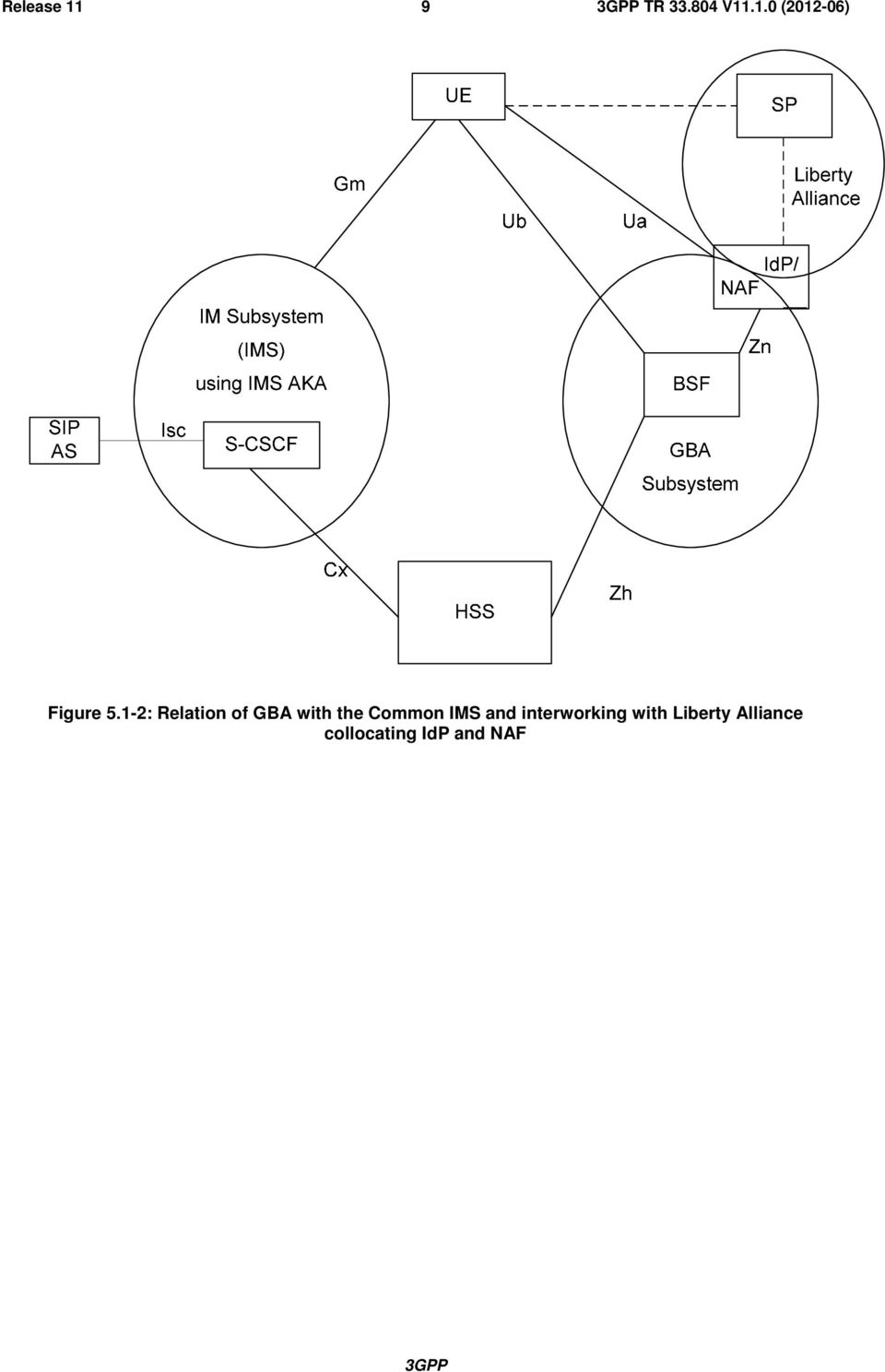
10 10 TR V ( ) UE SP Gm Ub Ua Liberty Alliance NAF/IdP IM Subsystem (IMS) BSF using IMS AKA SIP AS Isc S CSCF GBA Subsystem Cx Zh HSS Figure 5.1-3: Relation of GBA with the Common IMS and interworking with Liberty Alliance collocating IdP and BSF From a high-level architectural point of view, basically two different approaches are described in TR [9]: - The authenticating agent (AA) and the browsing agent (BA) reside in the same device; The AA and the BA reside in different devices (split terminal scenario), in that case some variants may occur depending on the availability of a local link and on the triggering of the authentication procedure. The following two figures and depict these two different approaches described in TR [9].

11 11 TR V ( ) UE OpenID RP Gm OpenID Ub Ua IM Subsystem (IMS) OP/ NAF Zn using IMS AKA BSF SIP AS Isc S CSCF GBA Subsystem Cx HSS Zh Figure 5.1-4: Relation of GBA with the Common IMS and interworking with OpenID 5.2 High-level architecture for SSO to applications for Common IMS based on SIP Digest Figure shows the current use of SIP Digest in IMS on the left hand side. On the right hand side, an application server (AS) is shown that is connected to an SSO subsystem, which in turn is connected to the HSS. HTTP is certainly the most commonly used protocol with application servers or service providers. The study of other such protocols is not precluded, however. The SSO subsystem is to contain one or more functional elements that are required to provide the SSO service to application servers based on SIP Digest. It is one of the main tasks of this study to define this SSO subsystem, i.e. to define the functional elements in the SSO subsystem, and their interworking with each other and with the application server and the HSS. It is clearly shown in the figure that the HSS is the linking element between the IMS subsystem and the SSO subsystem, which results from the fact that HSS stores the permanent credentials used in both subsystems. The right hand side shows three new reference points linking the UE and the HSS to the SSO subsystem, as well as linking the UE and the AS. The reference points SSOh and SSOb are required to provide the SSO functionality. The reference point SSOa is SSO system specific and may be out of scope of.

12 12 TR V ( ) UE Gm SSOb SSOa AS SIP AS IM Subsystem (IMS) using SIP Digest Isc S CSCF SSO Subsystem Cx HSS SSOh Figure 5.2-1: Relation of SIP Digest-based SSO with the Common IMS 5.3 Support for the Ut reference point The Ut reference point is between a UE and an application server. TS [4] defines the security for the Ut reference point, basically by referring back to TS [6]. And TS uses GBA, as defined in TS [2]. TS [7] on "Extensible Markup Language (XML) Configuration Access Protocol (XCAP) over the Ut interface for Manipulating Supplementary Services" defines an additional security mechanism for the Ut reference point, namely HTTP Digest according to RFC 2617 [5] as an alternative to the use of GBA. By the very definition of GBA, a form of single sign-on to the application server over Ut is provided as the SIM/USIM/ISIM credentials are re-used in GBA. The application server takes the role of a NAF in this case. No such single sign-on is available when an UE is authenticated over Ut using HTTP Digest according to TS [7]. Whether and how single sign-on to an AS over the Ut reference point should be provided when an UE is authenticated using HTTP Digest is assessed in the evaluation sections of the solutions in clause 7. Note that the user is able to manipulate his data on the application server even when the user is not registered in IMS as the use of GBA with an ISIM does not require the user to be registered in IMS, cf. clause 5.1. There are two cases to consider, with and without an authentication proxy, as shown in the following two figures taken from TS [7].
![141 [4] defines the security for the Ut reference point, basically by referring back to TS 33.222 [6]. And TS 33.222 uses GBA, as defined in TS 33.220 [2]. TS 24.](/docs-images/55/9076010/images/page_12.jpg "623 [7] on \"Extensible Markup Language (XML) Configuration Access Protocol (XCAP) over the Ut interface for Manipulating Supplementary Services\" defines an additional security mechanism for the Ut")
13 13 TR V ( ) UE Ut AS Figure 5.3-1: Ut interface Quote from TS [7]: "Authentication of the user with HTTP may take place directly at the AS, such as in figure 1, or with the support of an Authentication Proxy, such as in figure 2. The architecture for authentication is provided in TS [6]. NOTE: The Network Application Function (NAF) can be an AS." UE Ut Authentication Proxy Ut AS Figure 5.3-2: Authentication proxy in the Ut interface path 5.4 Interworking with Liberty Alliance The SSO subsystem under study is meant to provide some form of interworking with, or support for, other SSO systems, notably Liberty Alliance, cf. this clause, and OpenID, cf. clause 5.5. Interworking of GBA with Liberty Alliance systems is described in TR [8]. It may be useful to take the approaches in TR [8] into account when studying the interworking of the SIP Digest-based SSO subsystem defined in this TR with Liberty Alliance, cf. clause The results of the study shall not be bound by the approaches taken in TR [8] in any way, however. A high-level architecture for interworking of SIP Digest-based SSO with Liberty Alliance that takes into account the baseline architecture from clause 5.2 is shown in Figure The interfaces between the UE and the SP and the SP and the IdP are out of scope of. It should be noted that the two different approaches in TR [8] for interworking between GBA and Liberty Alliance, cf. clause 5.1.2, map to the same high-level architecture for the SIP-Digest based SSO case at this level of granularity. This is so because the SIP-Digest based SSO subsystem shows no substructure at this level of granularity with roles equivalent to BSF and NAF.
![The architecture for authentication is provided in TS 33.222 [6]. NOTE: The Network Application Function (NAF) can be an AS." UE Ut Authentication Proxy Ut AS Figure 5.](/docs-images/55/9076010/images/page_13.jpg "3-2: Authentication proxy in the Ut interface path 5.")
14 14 TR V ( ) Figure 5.4-1: Relation of SIP Digest-based SSO with the Common IMS and interworking with Liberty Alliance 5.5 Interworking with OpenId Interworking with OpenID is quite analogous with interworking with Liberty Alliance. The SSO subsystem under study is meant to provide some form of interworking with or support also for, other SSO systems, notably Liberty Alliance, cf. previous clause 5.4. A high-level architecture for interworking of SIP Digest-based SSO with OpenID that takes into account the baseline architecture from clause 5.2 are shown in Figure and The - Interface between the UE and the RP and the - Interface between RP and the OP are out of scope of and based on the OpenID protocols. Interworking of GBA with OpenID systems is described in TR [9]. It may be useful to take the approaches in TR into account when studying the interworking of the SIP Digest-based SSO subsystem defined in this TR with OpenID, cf. clause The results of the study shall not be bound by the approaches taken in TR in any way, however. TR [9] describes two basic scenarios, in the first one the user browses and authenticates with the same device (c.f ) and in the second one the authentication agent (AA) and the browsing agent (BA) are in different entities. The second split terminal scenario has also several variants depending on the actual connection from the BA to the AA and on which entity triggers the authentication. NOTE: In both figures below the SSOa interface is based on OpenID protocols and uses HTTPS.


15 15 TR V ( ) Figure 5.5-1: Relation of SIP Digest-based SSO with the Common IMS and interworking with OpenID Figure covers all the split terminal variants outlined in TR [9], but it should be noted that the connection between the BA and AA might not be present depending on the variant.
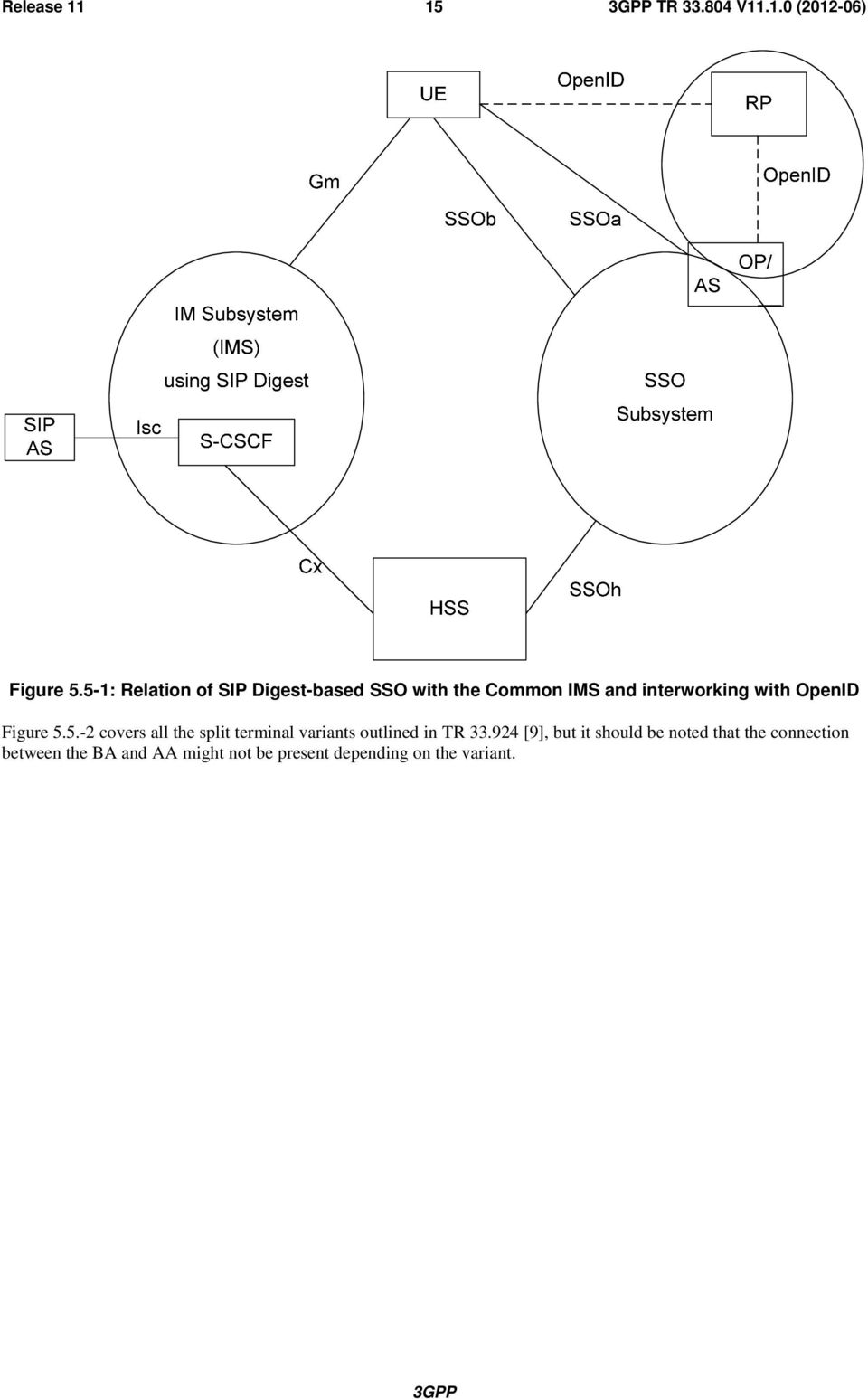

16 16 TR V ( ) Figure 5.5-2: Relation of SIP Digest-based SSO with the Common IMS and interworking with OpenID for the split terminal scenarios 6 Security requirements - The design of a SIP Digest-based SSO system shall allow for the possibility of interworking with a larger range of SSO providers. - It shall be ensured that the compromise of one SSO service shall not compromise the security of the IMS core or of another SSO service, or an application server. - It shall be ensured that the compromise of application server or an external SSO server shall not compromise the security of the SSO subsystem. - Information leakage of the permanent secrets stored in the HSS/HLR due to credential usage for SSO that are available to application servers or entities outside the operator's control shall be prevented. - The SIP Digest-based SSO service should allow indicating to the application server the strength of the authentication method used. - IMS core network nodes shall not be modified for supporting the SIP Digest-based SSO service. - Identity providers and service providers in SSO deployments that were not designed by should not need to support additional protocols, besides the protocols already specified for them.

17 17 TR V ( ) - The approach to utilize SIP Digest authentication for SSO shall maximize commonalities with the already defined approaches for interworking with non--defined SSO systems as described in TR and TR The operator should be able to control the security level of the SSO system, either by operating the SSO system themselves or by contractual agreements with trusted partners. - Where user privacy is required, the design of a SIP Digest based SSO system should not allow affiliated non- IMS domain services drawing conclusions about IMS domain identities, e.g., the SSO subsystem should hide IMPIs from application services. - Any solution should take into account the following design guidelines for HSS-related security: - The number of different types of interfaces to the HSS should be minimized in order to keep the complexity of the HSS low. This applies in particular to interfaces over which authentication vectors are retrieved from the HSS as they are highly security-critical. - In order to minimize any security risks due to excessive use/abuse of authentication vectors, as well as any performance impact to HSS, the overall number of authentication vectors requested from the authentication centre as well as the number of requests should be kept low. Mechanisms which make economical use of authentication vectors should be preferred. In particular, mechanisms which avoid bursts in authentication vector requests should be preferred. - The core network load should be minimized and also the SSO subsystem should be designed in an efficient manner to minimize UE authentication and CN interaction to avoid that SSO subsystem is the bottleneck of the application service or other SSO systems. - Any SSO solution should allow an operator to enforce the condition specified in Annex N of TS [3] that SIP Digest authentication shall not apply to access networks defined in specifications. According to Annex P of TS [3], the enforcement mechanisms may involve implementation-dependent steps. 7 Solutions 7.1 General This sub clause provides a solution which describes the re-usage of non-uicc credentials to provide security for the access to applications bases on SIP Digest authentication mechanism. In the High-level architecture for SSO to applications for Common IMS based on SIP Digest, the HSS is the linking element between the IMS subsystem and the SSO subsystem, which results from the fact that HSS stores the permanent credentials used in both subsystems. The credentials used with SIP Digest in the non-uicc are shared secrets or passwords stored in the HSS and in the terminal, or held by the user. The solution also provides mutual authentication between the application server and the UE. It defines functional elements in the SSO subsystem and their interworking with each other and with the application server and the HSS. These functional elements can provide the SSO service to application servers based on SIP Digest in the UICC-less environment. After the authentication procedure, the UE shares secrets respectively with the SSO and the RP, the SIP Digest credentials can be reused in Common IMS for providing security between a terminal and an application server. Besides, this solution also supports interworking and exploits commonalities with existing SSO subsystem deployments e.g. OpenID, GBA, Liberty Alliance. It also improves user security by engaging a user-trusted operator in the access control to the applications. 7.2 Solution 1 SIP Digest based GBA solution Solution 1 Architecture for SIP Digest based GBA (GBA_Digest) In this solution, it is described how SIP Digest authentication can be integrated into the Generic Bootstrapping Architecture (GBA) as defined in TS [2]. SIP Digest Authentication in Common IMS is a -defined profile of HTTP Digest as defined in RFC 2617 [5].

18 18 TR V ( ) GBA Digest is an extension of the GBA version currently defined in TS [2]. In GBA_Digest, SIP Digest credentials, such as shared secret or password, are re-used instead of the credentials stored in the SIM, USIM or ISIM for authentication. In GBA_Digest, the function of BSF is extended based on the BSF in TS [2]. The architecture of GBA_Digest is described in Figure For the purpose of GBA_Digest the function of the BSF is extended compared to the BSF as currently defined in TS [2]. Reference points: Figure Architecture of GBA_Digest - The Ua and Zn [11] interface can be used as defined in TS , with the extensions for the initiation of bootstrapping mentioned at the start of clause and for the Zn interface for indications relating to SIP Digest credentials towards the end of clause The Ua protocol is application specific. It could use e.g. HTTPS, as defined in TS [6]. The bootstrapping procedure over the Ub reference point is defined below. It extends the procedure over Ub defined in the main body of TS in a way similar to 2G GBA, defined in Annex I of TS There is mutual authentication between UE and BSF based on the SIP Digest credential used in the IMS. In addition, there is BSF-to-UE authentication by means of TLS. - The BSF retrieves a SIP Digest authentication vector (SD-AV ) and, if available, the GUSS from the HSS by using an extended Zh interface. In reference to chapter 5, the SSO Subsystem consists out of the GBA Bootstrapping Server Function (BSF) with SIP digest specific enhancements and the NAF functionality. NOTE 1: GBA only provides an application-specific shared secret, the so-called NAF keys. It is not in itself an authentication mechanism for applications. The derivation of Ks_NAF for GBA_Digest is defined at the end of clause Clause explains how Ks_NAF can be used for authentication between a UE and an identity provider (IdP) in an existing Single Sign-On system, such as OpenID or Liberty Alliance.
![In GBA_Digest, the function of BSF is extended based on the BSF in TS 33.220 [2]. The architecture of GBA_Digest is described in Figure 7.2-1.](/docs-images/55/9076010/images/page_18.jpg "For the purpose of GBA_Digest the function of the BSF is extended compared to the BSF as currently defined in TS 33.220 [2]. Reference points: Figure 7.")
19 19 TR V ( ) SIP Digest based GBA (GBA_Digest) bootstrapping procedure and its use We assume that the UE contacts the NAF and the NAF indicates to the UE that it should use GBA. The NAF demands that bootstrapping is required and gives an indication as described, for the general case, in clause 'Initiation of bootstrapping' of TS [2] and, for the special case of an HTTPS-based Ua interface, in clause 5.3 of TS [6] and clause of TS [12]. For the special case of an HTTPS-based Ua interface, the messaging contents over Ua reference point to indicate GBA_Digest are described as follows: 1) The request for service message from the UE to the NAF A new "product" token to the "User Agent" header will indicate that the UE requests the use of GBA_Digest by including a static string "3gpp-gba-sip-digest". 2) The code 401 "Unauthorized" response to the request for service (NAF to UE) contains the WWW-Authenticate header A new prefix "-bootstrapping-gba-sip-digest@" in the "realm" attribute in the header will indicate that the UE is allowed to perform non-uicc SIP Digest GBA. If the 401 "Unauthorized" response received by the UE does not include an indication with this new prefix, the UE shall not use GBA_Digest. This indication shall trigger the UE to run GBA_Digest bootstrapping procedure over the Ub interface (suitably extended for the purposes of GBA_Digest) as is described below: UE BSF HSS Initial GET request (IMPI) AV Request generation of response using sip digest credential generation of bootstrapping key material 401 Unauthorized ( nonce) GET request (RESP, cnonce) 200 OK B-TID AV Response authentication and generation of bootstrapping key material such as Ks, B-TID Figure GBA_Digest bootstrapping procedure NOTE 1: The figure above only shows an example flow for visualization and not all details are included. Step 0: The UE and the BSF establish a TLS tunnel with server authentication using a server certificate. The use of TLS message integrity is mandatory, while the use of TLS encryption is optional. All further messages between the BSF and UE are sent through this tunnel.
![220 [2] and, for the special case of an HTTPS-based Ua interface, in clause 5.3 of TS 33.222 [6] and clause 5.2.4 of TS 24.109 [12].](/docs-images/55/9076010/images/page_19.jpg "For the special case of an HTTPS-based Ua interface, the messaging contents over Ua reference point to indicate GBA_Digest are described as follows: 1) The request for service message from the UE to")
20 20 TR V ( ) NOTE 2: TLS encryption can be useful for protecting the user identity privacy when the TMPI mechanism defined in TS [2] is not used. Step 1: In this HTTP request message from the UE to the BSF, the UE shall include Authorization header containing the IMPI and a token indicating the use of GBA_Digest. NOTE 3: It should be noted that it would have been possible to select an alternative information flow as follows: the UE would not convey its IMPI to the BSF in step 1 but only in the second GET request (step 5). In this case the AV request / response exchange between BSF and HSS would be deferred, until this second GET request was received by the BSF. But the information flow presented here was preferred because it maximizes commonality with GBA, as defined in TS [2]. This would be possible in GBA_Digest, in contrast to GBA, as the nonce serving as a challenge in GBA_Digest is generated by the BSF while the challenge RAND AUTN in GBA has to be generated by the HSS. The delayed approach would maximize the similarities with HTTP Digest as used on the web. Note that since this flow requires the realm to be pre-configured in the BSF, all users served by the BSF must use identical realm values in the HSS. NOTE 4: The token is only required for GBA_Digest, not for AKA-based GBA variants already defined in TS [2]. This ensures backward compatibility. Step 2: The BSF requests a SIP Digest Authentication Vector (SD_AV) and, optionally, inserts into the request the timestamp of the locally stored GUSS for this user, if such is available. NOTE 5: If there is no timestamp the HSS will send the GUSS for this user if it exists if there is a timestamp, then the HSS will only send the GUSS if it is more recent. The SD-AV is defined in TS [3] Annex N. The username field in the Multimedia Auth Request contains the IMPI. If a token indicating the use of GBA_Digest was received by the BSF in step 1 then the BSF shall indicate in the Multimedia Auth Request that the requested Authentication Vectors are for SIP Digest credentials. NOTE 5: If no token indicating the use of GBA_Digest was received by the BSF in step 1 then the BSF knows that the subscription is AKA-based, but the BSF may not be able to determine at this point whether the subscription type is 2G or 3G, hence the authentication scheme is not indicated in the Multimedia Auth Request. Note that the subscription type can be either 2G or 3G, but not both. Step 3: The HSS retrieves the SIP Digest authentication vector SD-AV corresponding to the IMPI and sends it to the BSF in a Multimedia Auth Answer. The GUSS is only returned when requested by the BSF, supported by the HSS, and the timestamp in the BSF indicates that the one in the HSS is fresher. The qop value shall be set to "auth". NOTE 6: The additional protection afforded by qop set to "auth-int" is not needed due to the fact that the messages exchanged between UE and BSF run inside a TLS tunnel. The use of qop set to "auth" is less complex. Step 4: In the 401 response from the BSF to the UE, the BSF shall include parameters to WWW-Authenticate header as specified in RFC 2617 [5]. The realm, qop, and algorithm are provided in the SD-AV and the nonce=base64encode(16 byte random value) is generated by the BSF. The BSF sends the challenge to the UE in an HTTP 401 Unauthorized response.the WWW-Authenticate header is included in the HTTP 401 Unauthorized response. Step 5: When responding to a challenge from the BSF, the UE generates a cnonce randomly, and calculates the response RESP. The RESP is put into the Authorization header and sent back to the BSF in the GET request.
21 21 TR V ( ) RESP is computed as a Digest-response according to RFC 2617 [5] (HTTP Digest) from the most recent GBA_Digest challenge and a password 'passwd' that is generated as follows: passwd = KDF (H(A1), "GBA_Digest_RESP", TLS_MK_Extr) where H(A1) is the hash of the following three parameters: the user name and password used by the user in IMS for SIP Digest according to TS , Annex N, and the realm, cf. also RFC 2617 [5]. "GBA_Digest_RESP" is a character string. TLS_MK_Extr is extracted from the TLS master key according to RFC5705 [15] with the optional context value being omitted and the label set to "EXPORTER_GBA_Digest", and the length set equal to the length of the TLS master secret (48 bytes). KDF is the key derivation function as specified in Annex B in TS [2]. NOTE 7: A cautionary note on notation: According to RFC 2617 [5], the computation of RESP from the password 'passwd' defined above entails again a parameter called H(A1). This parameter will differ from the value of H(A1) that is input to the above formula because the passwords from which these two H(A1) values are derived differ. But no new notation is deemed necessary here as the notation H(A1), when H(A1) is derived from 'passwd', is not explicitely used in the text of the present document. NOTE 8: The label for the exporter function EXPORTER_GBA_Digest, cf. RFC 5705 [15], needs to be registered with IANA when the work proceeds to normative stage. Step 6: Upon receiving a GET request carrying the authentication response RESP, the BSF checks that the expected RESP (calculated by the BSF in the same way as the UE in step 5) matches the received RESP. If the check is successful then the user has been authenticated. The BSF then derives Ks as follows: Ks = KDF (H(A1), "GBA_Digest_Ks", TLS_MK_Extr, RESP) where H(A1), RESP, and TLS_MK_Extr are defined as in step 5, and "GBA_Digest_Ks" is a character string. The BSF generates the bootstrapping transaction identifier (B-TID) for the IMPI and stores the tuple <B- TID,IMPI,Ks>. The B-TID shall be constructed in the format of a NAI by taking the nonce from step 4, and the BSF server name, i.e. nonce@bsf_server_domain_name. The BSF sends 200 OK response to the UE to indicate the success of the authentication. In this message from the BSF to the UE, the BSF shall include bootstrapping transaction identifier (B-TID) and the key lifetime in an XML document in the response payload. The BSF may also include additional server specific data to the XML document. An Authentication-Info header according to RFC 2617 [5] shall be included into the 200 OK response. The UE aborts the procedure if the server authentication according to [5] fails. Otherwise, the UE derives Ks in the same way as the BSF did above. NOTE9: The B-TID construction above is almost identical to the one used in TS [2]. The difference is that in TS [2] the username part is constructed from the (base64 encoded) RAND value. After successful bootstrapping procedure the UE and the BSF contain the key Ks and the B-TID. In addition, the BSF stores an indication of the underlying security quality, i.e. SIP Digest, like it is doing for 2G GBA. The key Ks is then used in the BSF and in the UE to derive NAF specific key(s) Ks_NAF to secure Ua reference points in the following way: - Ks_NAF is computed as Ks_NAF = KDF (Ks, "gba-digest", nonce, IMPI, NAF_Id), where KDF is the key derivation function as specified in Annex B of TS [2], and the input parameters consist of the user's IMPI, the NAF_Id and 'nonce'. 'nonce' is the nonce that was used for computing the RESP that was input to the derivation of Ks. The NAF_Id is constructed as in TS [2], clause The "gba-digest" parameter is a static character string. NOTE10: The above derivation of Ks_NAF is analagous to the derivation in TS [2], clause 4.5.2, step 9 and the same KDF can be utilized.
22 22 TR V ( ) When the BSF delivers a Ks_NAF to a NAF it shall indicate that this Ks_NAF was derived from SIP Digest credentials. The BSF shall deliver a Ks_NAF to the NAF only after the NAF has indicated its willingness to accept SIP Digest credentials. The KDF shall be implemented in the BSF and in the terminal. The UE and the BSF shall store the key Ks with the associated B-TID and the nonce for further use, until the key Ks is updated or deleted Interworking of SIP digest based GBA with other SSO systems The approach outlined above for the non-uicc based GBA solution could interwork with existing SSO subsystems, such as OpenID and Liberty Alliance. The Ks_NAF derived from the Ks by the UE and the BSF can be used for authentication between UE and Identity Provider in OpenID as outlined in TR or for Liberty Interworking as outlined in TR [8]. Also for other services the derived Ks_NAF can be used. The following figures depict the interworking between non-uicc based GBA, IMS subsystem and Liberty Alliance. NOTE: Figure interworking with Liberty Alliance The figure contains a potential set-up where the BSF supports an IdP/NAF, but also delivers NAF specific keys directly to an application server, which is not part of the service supported by the IdP Evaluation Compatibility with other GBA-related specifications:
23 23 TR V ( ) GBA_Digest can be used with TSs [16] and [6] because GBA_Digest provides as output a key Ks_NAF (cf. clause 7.2.3) and an identifier B-TID (cf. clause 7.2.2) as well as information in the BSF about the underlying security quality, i.e. SIP digest authentication, (cf. clause 7.2.2). This is the input required for TSs [16] and [6] to become applicable. Single sign-on to an AS over the Ut reference point can, hence, also be provided using GBA_Digest, as TS [4] defines the security for the Ut reference point by referring back to TS [6]. Advantages of solution 1: The non-uicc based GBA solution has the following advantages: - Re-use of the SIP Digest subscriber credentials stored in HSS. - Re-use of Ua interface and Zn interface (with adding one field for indicating GBA_Digest) as specified in TS [2]. - Support for the existing GBA based applications. - Enhanced security over plain SIP Digest (without TLS) - Seamless evolution and migration to GBA variants using a SIM, USIM, or ISIM possible on the network side when clients are upgraded to contain a UICC Security considerations on solution 1: The role of TLS: The use of TLS in GBA_Digest provides the following advantages: - Parameters derived from the SIP Digest password and exchanged between UE and BSF can be observed by an attacker when the TLS connection is not encrypted. In order to make it much more difficult for the attacker to infer (e.g. by codebook attacks) the SIP Digest password from the observed parameters GBA_Digest was constructed such that the computation of these parameters additionally requires the knowledge of the TLS master key. It is true that the attacker could just as well attempt to infer the SIP Digest password from parameters exchanged during a SIP Digest run in IMS, as defined in TS [3] Annex N. However, this is not possible in IMS when these parameters are sent over an encrypted TLS connection, as defined in TS [3] Annex O. In order to achieve at least the same the level of protection against password cracking in GBA_Digest as that afforded in IMS by TS [3] Annex O, the TLS master key is used in the construction of the GBA_Digest parameters. - But it should be noted that the use of TLS differs between 2G GBA and GBA_Digest: it is not required in GBA_Digest to use TLS with encryption, cf. clause 7.2.2, step 0. Mandating TLS encryption was avoided as it might conflict with national regulation. - TLS provides 'perfect forward secrecy' when used with suitable cipher suites. This property means that, when a compromise of a permanent secret has occurred, session keys agreed prior to the time of the compromise cannot be reconstructed by the attacker knowing the permanent secret. As the TLS master key is input to the computation of the key Ks resulting from a GBA_Digest run this property is inherited by GBA_Digest. This property is especially desirable for a password-based scheme as passwords are more prone to compromise than UICC-based credentials. - The role of TLS in protecting against man-in-the-middle attacks is described below. Protection against man-in-the-middle attacks: Two types of man-in-the-middle attacks need to be considered: Man-in-the-middle attacks through BSF impersonation - An attacker could set up a server and trick a terminal into believing that it was talking to a genuine BSF and sending the authentication response to the attacker's server. The attacker could then use this response to impersonate the user towards the genuine BSF.
24 24 TR V ( ) - This can be prevented by requiring the use of TLS between UE and BSF and ensuring that the UE authenticates the TLS server before sending anything over the TLS connection. This authentication is provided by TLS server certificates and the fact that the UE checks as part of the authentication process that the name in the certificate coincides with the BSF name configured in the UE. - It should be noted, though, that even a successful BSF impersonation attack would be of limited value to the attacker as he could still not obtain the key Ks. However, the attack would not be detected during the GBA_Digest run, but only later when the key Ks would be used. Man-in-the-middle attacks in tunnelled authentication protocols - When authenticating the client end point of a TLS session by means of a shared key protocol the so-called 'man-in-the-middle-attacks in tunnelled authentication protocols' Asokan, Niemi & Nyberg [17] needs to be considered. The man-in-the-middle-attacks exploit a situation where the same authentication protocol and credentials are used by the client in two different contexts, and the authentication responses may be sent both inside and outside the TLS connection. In the context of GBA_Digest, the shared key protocol used for client authentication is HTTP Digest. An attacker could establish a TLS connection with the BSF and at the same time trick the UE into running HTTP Digest with him outside the TLS connection, thus obtaining the desired authentication response. The attacker would then send the obtained response over the TLS connection to the BSF. In this way, the attacker could impersonate the UE towards the BSF without knowing the user's password. - In GBA_Digest, this attack is thwarted by making the authentication response different from any parameter used outside the context of the GBA_Digest protocol through the use of different input parameters that, in particular, binds the authentication response to the TLS master secret. - It should be noted, though, that even a successful man-in-the-middle-attack would be of limited value to the attacker as he could still not obtain the key Ks. However, the attack would not be detected during the GBA_Digest run, but only later when the key Ks would be used. In the SSO solution described in 7.2. the BSF server has to support the following specific functionalities: - Interface to HSS to obtain the SD-AV, user profile and related attributes - Storage and handling of data related to (nonce, H(A1))
25 25 TR V ( ) 7.3 Solution 2 SIP Digest based Authentication and Lightweight Security (SDALS) solution Architecture and Interworking for SDALS Solution 2 High-level architecture UE Gm SSOb SSOa IM Subsystem (IMS) SSO Subsystem RP(AS) using SIP Digest SIP AS Isc S CSCF IdP(SSO Server) Cx SSOh HSS Figure 7.3-1: Architecture for SIP Digest based Authentication and Lightweight Security (SDALS) Figure shows a high-level architecture for SIP Digest based Authentication and Lightweight Security (SDALS). The authentication between UE and IdP (SSO Server) is based on SIP Digest, and the solution creates two keys, one key (k 0 ) used between UE and IdP (SSO Server) is negotiated and generated based on challenge, and the other key (K 1 ), used between UE and RP, is generated by UE and by IdP (SSO Server) and delivered to RP via the UE, being protected by a key that is pre-shared by the IdP and the RP.The IdP (SSO Server) contained in the substructure of the SSO subsystem which could be leveraged to enable application servers and on the user side to establish shared keys could provide the SSO service to application servers based on SIP Digest. There are three new reference points linking the UE and the HSS to the IdP (SSO Server), as well as linking the UE and the RP. The reference points SSOh and SSOb could provide the SSO functionality. General requirements for the functionality of the IdP (SSO Server) are: - It shall be able to communicate securely with the HSS and the UE and the RP. - It shall be able to perform authentication based on SIP digest based credentials. - It shall be able to generate a shared key and a session key with a UE. - It shall be able to send the aforementioned session key to the RP, encrypted by a key that is pre-shared by the IdP and the RP, inside a message to the UE. - It shall be able to manage the Identity-related security keys and credentials.
26 26 TR V ( ) The required functionalities for a UE are: - Supporting authentication using SIP digest credentials. - Generating a shared key and a session key with the IdP. The requirements for the reference point SSOa are: - The reference point SSOa carries the application protoco l,which is secured using a session key shared between a UE and the RP The requirements for the reference point SSOb are: - The reference SSOb shall provide mutual authentication between the IdP and a UE based on the SIP Digest method - The reference SSOb shall support messages which cause the IdP and a UE to generate shared keys - The reference SSOb shall allow the IdP to identify the UE - - The reference SSOb shall allow the IdP to indicate to the UE the lifetime of the shared key - The reference SSOb shall allow the IdP to send an encrypted K 1 to the RP inside a message which is sent via the UE. The requirements for the reference point SSOh are: - The IdP shall be able to retrieve SD-AV from the HSS, so we can re-use the Cx interface as the SSOh reference point Interworking of SDALS (solution 2) with other SSO systems Background The solution of SDALS has the following advantages: The approach outline above for the non-uicc solution could provide some forms of interworking with other existing SSO subsystem, notably OpenID and Liberty Alliance Co-hosting AS and OP The architecture for interworking of the SDALS with OpenID that co-hosts AS and OP, which takes into account the baseline architecture from clause is shown in Figure It makes the Application Server (AS) in the SSO subsystem and the OpenID Provider (OP) in the OpenID as an entity, and the interface between the UE and the RP and the interface between RP and the OP are out of scope of and based on the OpenID protocols.

27 27 TR V ( ) Figure 7.3-2: Interworking with OpenID that co-hosts AS and OP Co-hosting AS and IdP (Liberty Alliance) Interworking with Liberty Alliance which co-hosts AS and IdP (Liberty Alliance) is quite analogous with interworking with OpenID that co-hosts AS and OP. The approach outline above for the non-uicc solution could provide some forms of interworking with other existing SSO subsystem, Interworking of GBA with Liberty Alliance systems is described in TR [8]. It may be useful to take the approaches in TR [8] into account when studying the interworking of the SIP Digest-based SSO subsystem defined in this TR with Liberty Alliance. The results of the study shall not be bound by the approaches taken in TR [8] in any way, however. The approach outline above for the non-uicc solution could provide some forms of interworking with Liberty Alliance, The architecture for interworking of the SDALS with Liberty Alliance that co-hosts AS and IdP (Liberty Alliance), which takes into account the baseline architecture from clause is shown in Figure It makes the Application Server (AS) in the SSO subsystem and the Identity Provider (L_IdP) in the Liberty Alliance as an entity. The interface between the UE and the SP, and the interface between the SP and the L_IdP are out of scope of, both of them are based on the Liberty Alliance protocols.

28 28 TR V ( ) UE SP Gm SSOb SSOa L_IdP /AS Liberty Alliance IM Subsystem (IMS) using SIP Digest SSO SIP AS Isc S CSCF Subsystem IdP(SSO Server) Cx SSOh HSS Figure 7.3-3: Interworking with Liberty Alliance that co-hosts AS and IdP (Liberty Alliance) Co-hosting IdP (SSO Server) and OP The architecture for interworking of the DT-Digest with OpenID that co-hosts IdP (SSO Server) and OP, which takes into account the baseline architecture from clause 7.3.1, is shown in Figure It makes the IdP in the SSO subsystem and the OpenID Provider (OP) in the OpenID as an entity.
29 29 TR V ( ) UE Gm SSOa SSOb RP(AS) IM Subsystem SIP AS Isc (IMS) Using SIP Digest S CSCF SSO Subsystem OP(SSO Server) Cx SSOh HSS Figure 7.3-4: Interworking with OpenID that co-hosts IdP (SSO Server) and OP Message Flows for Solution 2 SDALS Basic message flow Editor's Note: The solution above and below have some overlap and need to be sorted out, how is for further study. The solution realizes a SSO function that is available when an IMS UE is authenticated over SIP Digest authentication mechanism. Figure shows the message flow of the authentication process to realize SIP Digest-based SSO with the Common IMS in the UICC-less environment.
30 30 TR V ( ) The basic steps are as follows: Figure SDALS Procedure 1) The UE issues a service request to RP without user identifier. 2) The RP sends a response to the UE the RP Authentication Request. The response includes the RP identifier (RP_credential). The RP identifier may be FQDN. 3) The UE sends a HTTP request to the IdP known by the UE with the UE authentication request and RP Authentication Request. The request includes the UE identifier (U_credential). The UE identifier may be IMPI or TMPI. NOTE 1: The address of the IdP (SSO Server) can be configured in UE, or, can be generated by UE based on UE identifier, e.g. if the user identifier is user_name@domain, then the address of IdP (SSO Server) can be idp_sso.domain. 4) The IdP authenticates the RP based on the RP_credential and generates related authentication result RP_Auth. According to the U_credential, the IdP first checks whether there is already a shared secret K0 between the UE and IdP. If K0 exists, the process jumps to step 11; otherwise, the process goes on to the next step.
31 31 TR V ( ) NOTE2: The RP and the IdP shall have a shared secret (Kr,i) using existing mechanism, for example, using the Diffie-Hellman Key Exchange Protocol or pre-shared secret, the details of shared key establishment between the RP and IdP are out of scope. With this shared secret the IdP can sign subsequent messages and the RP can verify those messages. 5) The IdP sends authentication request to the HSS, it then obtains the SIP Digest authentication vector SD-AV and the user profile based on the U_credential from the HSS. The SD-AV consists of the qop (quality of protection) value, the authentication algorithm, realm, and a hash, called H (A1), of the U_credential, realm, and password. Refer to RFC 2617[5] for additional information on the values in the authentication vector for SIP Digest based authentication. In a multiple HSS environment, the IdP may have to obtain the address of the HSS where the UE is stored by querying the SLF. 6) The IdP generates a random nonce, stores H(A1) and the nonce against the U_credential. 7) The IdP sends a 401 Auth_Challenge to the UE which includes the nonce, the realm, qop, algorithm and U_credential. 8) Upon receiving the challenge, the UE generates a random cnonce and the H(A1), and then generates the shared secret K0 based on the H(A1), the cnonce, etc. It then uses the cnonce as well as parameters provided in the 401 Auth_Challenge such as nonce, U_credential and qop to calculate an authentication response according to RFC 2617[5]. 9) The UE sends a response to the IdP which includes the cnonce, the nonce, the response, the realm, the U_credential, qop, algorithm, nonce-count and digest-url. 10) Upon receiving the response, the IdP uses the previously stored nonce to check against the nonce included in the response. If the check is successful, the IdP calculates the expected response (Xresponse) using the previously stored H (A1) and the nonce together with other parameters contained in the response (e.g.cnonce, nonce-count, qop, as specified in RFC 2617[5]) and uses this to check against the response sent by the UE. If the check is successful, the authentication of the UE is succeeded, else the authentication fails. If the UE is successfully authenticated, the IdP calculates the value of rspauth based on SIP Digest as specified in RFC 2617 [5] and generates the shared secret K0 based on the H(A1), the cnonce, etc. 11) The IdP knows the User authentication conclusion (UE_Auth); and then the IdP generates a random nonce1 and generates a shared secret K1 based on K0 and nonce1. The IdP encrypts the nonce1 and RP_Auth using K0, i.e. EK0(nonce1,RP_Auth); and encrypts the K1 and UE_Auth using Kr,i, i.e. EKr,i (K1,UE_Auth). 12) The IdP sends the UE an message including EK0(nonce1,RP_Auth) and EKr,i (K1,UE_Auth),the value of rspauth with redirection. 13) The UE decrypts the EK0(nonce1,RP_Auth) and then obtains RP_Auth and nonce1. Based on the RP_Auth the UE knows the legitimacy of the requested RP. If the authentication result indicates that the RP is not valid, the UE will stop visiting the RP. The UE calculates the rspauth in the same way as the IdP did in step 9, and uses it to check against the rspauth sent by the IdP. If the check is successful, the authentication of the Network is succeeded, else the authentication fails. If the Network is successfully authenticated, and then the UE will generates the shared secret K1 based on K0, nonce1. 14) The message sent by the IdP is redirected to the RP including EKr,i (K1,UE_Auth). 15) The RP decrypts the EKr,i (K1,UE_Auth), and obtains UE_Auth and K1. 16) After verifying the UE_Auth, the RP generates authorization information for the UE, i.e. UE_Author and encrypts UE_Author using K1 EK1(UE_Author). 17) The RP notifies the UE about the authorization information. 18) The UE decrypts the EK1(UE_Author) and then accesses to the requested service. NOTE 3: The last 3 steps 16, 17 and 18 are application specific, they are optional steps and not required for SSO authentication purpose. If there is a failure in steps 1 through 15 the authentication procedure stops.
32 32 TR V ( ) Message Flow with IdP (SSO Server) and OP co-hosting The SSO subsystem under the solution can provide some forms of interworking with, or support for, other SSO systems, notably OpenID and Liberty Alliance. In the following a message flow of the authentication process is defined to describe business cases where while an operator wishes to be OpenID provider. It makes the operator a critical part of OpenID framework in this case, and allows the operator to leverage their valuable assets, such as subscription credentials and their customers' trust, effectively enabling operators to become OpenID providers. Figure Interworking of SDALS with the OpenID that co-hosts IdP (SSO Server) and OP The basic steps are as follows: 1) The UE issues an authentication request AuthnOpenID to the RP which includes an OpenID identifier. 2) The OpenID Identifier is normalized as described in Appendix A.1 of [14].The RP (Application server), using the presented OpenID identifier, discovers the URL of the OpenID identity provider OP, and redirects the user authentication request to that URL. The request includes the RP identifier (RP_credential).
33 33 TR V ( ) 3) The authentication request is redirected to the OpenID identity provider (OP). After this step the OP correlates the OpenID identifier with the UE identifiers. 4) The OP authenticates the RP based on the RP identifier. Assuming RP authentication success, the OP checks whether there is already a shared secret K0 between the UE and the OP according to the OpenID identifier. If K0 exists, the process jumps to step 11; otherwise, the process goes on to the next step. NOTE 1: The RP and the OP shall have a shared secret (Kr, o) using existing mechanism, for example, using the Diffie-Hellman Key Exchange Protocol or pre-shared secret, the details of shared key establishment between the RP and OP are out of scope. With this shared secret the OP can sign subsequent messages and the RP can verify those messages. NOTE 2: The OP is the sole decision point for RP's authenticity, and this means that any explicit messaging, e.g. to the UE, regarding the OP's decision on the authenticity of the RP, is redundant and unnecessary. NOTE 3: There may be security concerns if this message (about OP notifying the UE about failure of OP authentication of the RP) is sent unprotected. 5) The OP sends authentication request to the HSS, then it obtains the SIP Digest authentication vector SD-AV and the user profile based on the U_credential from the HSS. The SD-AV consists of the qop (quality of protection) value, the authentication algorithm, realm, and a hash, called H (A1), of the U_credential, realm, and password. Refer to RFC 2617 [5] for additional information on the values in the authentication vector for SIP Digest based authentication. In a multiple HSS environment, the OP may have to obtain the address of the HSS where the UE is stored by querying the SLF. 6) The OP generates a random nonce, stores H(A1) and the nonce against the U_credential. 7) The OP sends a 401 Auth_Challenge to the UE which includes the nonce, the realm, qop, algorithm and U_credential. 8) Upon receiving the challenge, the UE generates a random cnonce and the H(A1), and then generates the shared secret K0 based on the H(A1), the cnonce, etc. It then uses the cnonce as well as parameters provided in the 401 Auth_Challenge such as nonce, U_credential and qop to calculate an authentication response according to RFC 2617[5]. 9) The UE sends a response to the OP which includes the cnonce, the nonce, the response, the realm, the U_credential, qop, algorithm, nonce-count and Digest-url. 10) Upon receiving the response, The OP uses the previously stored nonce to check against the nonce included in the response. If the check is successful, the OP calculates the expected response (Xresponse) using the previously stored H(A1) and the nonce together with other parameters contained in the response (e.g.cnonce, nonce-count, qop, as specified in RFC 2617[5]) and uses this to check against the response sent by the UE. If the check is successful the authentication of the UE is succeeded, else the authentication fails. The OP stores an authentication assertion (UE_Assert). If the UE is successfully authenticated, the OP generates the shared secret K 0 based on the H(A1), the cnonce, etc. 11) The OP generates a random nonce1 and generates a shared secret K1 based on K0, nonce1. The OP encrypts the nonce1 using K0, i.e. EK0(nonce1); and encrypts the K1 and UE_Assert using Kr,o, i.e. EKr,o (K1,UE_Assert). 12) The OP sends the UE an message including EK0(nonce1) and EKr,o (K1,UE_Assert) with redirection. 13) The UE decrypts the EK0(nonce1); and then obtains the nonce1; The UE will generates the shared secret K1 based on K0, nonce1. 14) The message sent by the OP is redirected to the RP including EKr,o (K1,UE_Assert). 15) The RP decrypts the EKr,o (K1,UE_Assert), and obtains UE_Assert and K1. 16) After verifying the UE_Assert, the RP generates authorization information for the UE, i.e. UE_Author and encrypts UE_Author using K1 EK1(UE_Author). 17) The RP notifies the UE about the authorization information. 18) The UE decrypts the EK1(UE_Author) and then accesses to the requested service.
34 34 TR V ( ) NOTE 4: The last 3 steps 16, 17 and 18 are application specific, they are optional steps and not required for SSO authentication purpose. If there is a failure in steps 1 through 18 the authentication procedure stops. NOTE 5: In the message flow of the authentication process above, steps 1 through 3 and steps 12 through 15 comply with OpenID specification, step 4 authenticates RP, which is similar to the association establishment process in OpenID specification, steps 5 through 11 belong to SIP Digest-based authentication, steps 16 through 18 provide application security. Editor's Note: The aspects of providing keys for general application security between a terminal and application server, not only for interwoking with OpenID, should be also taken into account in the solution. NOTE 6: The interworking with the Liberty Alliance is similar to the interworking with the OpenID Message Flow with AS and OP co-hosting The solution to utilize SIP Digest authentication for SSO can maximize commonality with the already defined approaches for interworking with non--defined SSO system as described in TR [9] and TR [8].In the following a message flow is defined to allow the interworking with OpenID and the specific message flow is depicted as shown in Figure
35 35 TR V ( ) Figure Interworking of SDALS with OpenID that co-hosts AS and OP The basic message flow is as follows: To initiate OpenID Authentication, the Relying Party should present the end user with a form that has a field for entering a User-Supplied Identifier. The form field's "name" attribute should have the value "openid_identifier". 1) The browser in the ME sends a User-Supplied Identifier to the Relying Party 2) The User-Supplied Identifier is normalized as described in Appendix A.1 of [14]. The RP retrieves the address of the OP and performs a discovery of the OP Endpoint URL (based on the User-Supplied Identifier) that the end user wishes to use for authentication.
36 36 TR V ( ) 3) The RP and the OP may then establish a shared secret (called association) using the Diffie-Hellman Key Exchange Protocol. The purpose of this shared secret is that the OP can sign subsequent messages and the RP can verify those messages. NOTE 1: The Diffie-Hellman Key Exchange Protocol between the OP and the RP lies outside of the specifications, this association using Diffie Hellman is an optional feature and not required for interworking purposes. If the OP and RP do not both reside under the control of the same MNO, the usage of this option seems strongly advisable 4) The RP redirects the ME's browser to the OP with an OpenID Authentication Request as defined in chapter 9 in [14]. The RP inserts into the openid.claimed_id and into the openid.identity fields the user supplied identifier of step 1. 5) Following this redirection the ME sends a HTTPS GET request to the OP. 6) The OP/AS initiates the ME authentication and responds with a HTTPS response code 401 "Unauthorized", which contains a WWW Authenticate header carrying a challenge requesting the UE to use SIP Digest Authentication with SSO_APS. The response message also includes the OP/AS credential (OP/AS_credential). NOTE 2: The OP/AS and the IdP shall have a shared secret (Ko,i) using existing mechanism, for example, using the Diffie-Hellman Key Exchange Protocol or pre-shared secret, the details of shared key establishment between the OP/AS and IdP are out of scope. 7) If no valid K0 is available, then the ME sends a second HTTP request to the IdP with a UE Authentication Request carrying the UE credential (U_credential) and OP/AS_credential. 8) The IdP obtains the OP/AS_credential; The IdP authenticates the RP based on the OP/AS_credential; then generates and stores related authentication result OP/AS_Auth. According to the U_credential, the IdP first checks whether there is already a shared secret K0 between the UE and IdP. If K0 exists, the process jumps to step 15; otherwise, the process goes on to the next step. 9) The IdP sends authentication request to the HSS, it then obtains the SIP Digest authentication vector SD-AV and the user profile based on the U_credential from the HSS. The SD-AV consists of the qop (quality of protection) value, the authentication algorithm, realm, and a hash, called H (A1), of the U_credential, realm, and password. Refer to RFC 2617[5] for additional information on the values in the authentication vector for SIP Digest based authentication. In a multiple HSS environment, the IdP may have to obtain the address of the HSS where the UE is stored by querying the SLF. 10) The IdP generates a random nonce, stores H(A1) and the nonce against the U_credential. 11) The IdP sends a 401 Auth_Challenge to the UE which includes the nonce, the realm, qop, algorithm and U_credential. 12) Upon receiving the challenge, the UE generates a random cnonce and the H(A1), and then generates the shared secret K0 based on the H(A1), the cnonce, etc. It then uses the cnonce as well as parameters provided in the 401 Auth_Challenge such as nonce, U_credential and qop to calculate an authentication response according to RFC 2617[5]. 13) The UE sends a response to the IdP which includes the cnonce, the nonce, the response, the realm, the U_credential, qop, algorithm, nonce-count and digest-url. 14) Upon receiving the response, the IdP uses the previously stored nonce to check against the nonce included in the response. If the check is successful, the IdP calculates the expected response (Xresponse) using the previously stored H (A1) and the nonce together with other parameters contained in the response (e.g.cnonce, nonce-count, qop, as specified in RFC 2617[5]) and uses this to check against the response sent by the UE. If the check is successful, the authentication of the UE is succeeded, else the authentication fails. If the UE is successfully authenticated, the IdP calculates the value of rspauth based on SIP Digest as specified in RFC 2617 [5] and generates the shared secret K0 based on the H(A1), the cnonce, etc. 15) The IdP knows the User authentication conclusion (UE_Auth); and then the IdP generates a random nonce1 and generates a shared secret K1 based on K0 and nonce1. The IdP encrypts the nonce1 and OP/AS_Auth using K0, i.e. EK0(nonce1,OP/AS_Auth); and encrypts the K1 and UE_Auth using Ko,i, i.e. EKo,i (K1,UE_Auth). 16) The IdP sends the UE an message including EK0(nonce1,OP/AS_Auth), EKo,i (K1,UE_Auth),and the value of rspauth with redirection.
37 37 TR V ( ) 17) The UE decrypts the EK0(nonce1,OP/AS_Auth) and then obtains OP/AS_Auth and nonce1. Based on the OP/AS_Auth the UE knows the legitimacy of the requested OP/AS. If the authentication result indicates that the OP/AS is not valid, the UE will stop visiting the OP/AS. The UE calculates the rspauth in the same way as the IdP did in step 14, and uses it to check against the rspauth sent by the IdP. If the check is successful, the authentication of the Network is succeeded, else the authentication fails. If the Network is successfully authenticated, and then the UE will generates the shared secret K1 based on K0, nonce1. 18) The message sent by the IdP is redirected to the OP/AS including EKo,i (K1,UE_Auth). 19) The OP/AS decrypts the EKo,i (K1,UE_Auth), and obtains UE_Auth and K1. The OP/AS establishes whether the end user is authorized to perform OpenID Authentication and wishes to do so based on the authorization information stored in the UE_Auth. In particular, the UE_Auth may contain information about the type of information which is allowed to be shared with the RP. The OP/AS authenticates the user of OpenID using SSOa reference point, and generates an assertion based on the authorization information. 20) The OP/AS redirects the browser to the return OpenID address i.e. the OP/AS redirects the ME's browser back to the RP with either an assertion that authentication is approved or a message that authentication failed. The response header contains a number of fields defining the authentication assertion which may be protected by the shared secret between OP/AS and RP. The protection is especially important if the OP/AS and the RP do not reside both in the same MNO network. 21) The RP validates the assertion i.e. checks if the authentication was approved. The authenticated identity of the user is provided in the response message towards the RP. If a shared secret was established in step 3, then it is now used to verify the message from the OP/AS. If the validation of the assertion and the verification of the message are successful, then the user is logged in to the service of the RP. If there is a failure in steps 1 through 21 the authentication procedure stops Solution 2 (SDALS) Improvements with RP authentication for IdP (SSO Server) and OP co-hosting case Editor's note: It is FFS whether this solution with RP authentication is in scope of 's responsibility. Achieving RP authentication at the OP The protocol depicted in Figure does not show how RP authentication can be achieved. Particularly, it is not clear whether and how RP uses any secret in the steps 1-4 towards the OP. In order to achieve RP authentication, additional steps need to be considered. If we assume that the OP and RP already share a secret Kr,o this secret has to be used for RP authentication with the OP. Not shown in the protocol figure are the association creation steps of the OpenID protocol. Note that the inclusion of RP authentication in the OpenID protocol requires changes to the OpenID protocol itself as well as to the implementations of the OP and RP. Thus, any such change should be carefully weighed for benefits versus the cost. Moreover, it is desired that any such RP authentication method should NOT affect implementations on the UE. In general RP authentication will consist in a challenge response step between OP and RP, where the OP has to send a challenge with a proof of freshness to the RP, e.g. via a nonce. The RP can then use the pre-established shared secret Kr,o to sign this nonce and return the answer to the OP. The response to the authentication challenge can be as a direct response to the OP authentication challenge, or can be integrated in the redirect message, which sends the UE to the OP. In either case it needs to be ensured that the OP can have reliable evidence on the authentication of the RP before engaging in actual UE authentication. This allows to stop the protocol in the case of a failed RP authentication, and saves communication effort between UE and OP in the case of such a failed RP authentication. The OP can then directly convey the information on the failed RP authentication to the UE. Using Associations for RP authentication If the RP establishes an association with the OP, the OpenID association protocol can be slightly modified to incorporate a challenge from the OP to be conveyed to the RP for the purpose of RP authentication. During the association establishment the OP and RP can set up a message authentication code (MAC) key which is later used to sign the assertion message. This key is sent encrypted using a temporary secret key which is negotiated between OP and RP using Diffie-Hellman (DH). In addition to that key, deviating from the OpenID specs, the OP can include a nonce, also encrypted with the DH-key, in the response to the RP.
38 38 TR V ( ) The RP can then decrypt the nonce and the MAC key based on the negotiated DH-key. The RP then uses its own preestablished Kr,o key to sign (or encrypt) the nonce as received from the OP and adds it as an additional parameter to the redirect message which is sent to the UE. Since the UE follows the redirect to the OP, the OP receives the signed (or encrypted) nonce, and can use the shared key Kr,o to authenticate the RP. In the case of a failed authentication, the OP can send an alert message to the UE to protect it from unauthenticated RPs. In the case of a successful RP authentication, the OP can proceed with the protocol. Simplified Variant Protocol with RP authentication and HTTPS protection Figure depicts a revised protocol where the RP is authenticated by the OP using a modified OpenID association messaging
39 39 TR V ( )
40 40 TR V ( ) Figure Interworking of SDALS with IdP (SSO Server) and OP co-hosting, with RP authentication
41 41 TR V ( ) The steps of this variant protocol are as follows: 1) The UE issues an authentication request AuthnOpenID to the RP which includes an OpenID identifier. 2) The RP sends an (OpenID) association request to the OP. The RP and the OP then establish a Diffie-Hellman Key D-H, according to Section 8 of [14]. OP generates an association secret and association handle (together called association according to [14]). 3) The OP sends RP an association response according to [14], Section 8.2, including association secret and nonce0, both encrypted with the D-H key established in step 2. 4) The RP decrypts the received encrypted nonce0 and encrypted association secret, and signs nonce0 with Kr,o. NOTE 1: HMAC or another suitable symmetrical signature algorithm may be used to sign nonce0 NOTE 2: The RP and the OP shall have a shared secret (Kr, o) using existing mechanism, for example, using the Diffie-Hellman Key Exchange Protocol or pre-shared secret, the details of shared key establishment between the RP and OP are out of scope. With this shared secret the OP can sign subsequent messages and the RP can verify those messages. 5) The RP redirects the authentication request sent by the UE which includes the OpenID identifier, the RP identifier (RP_credential), and the signed nonce0. 6) The authentication request is redirected to the OP. The redirection includes OpenID identifier and RP_credential. 7) (Optionally) The OP may set up TLS and initiates HTTPS communiation with UE. This could be done by configuration of the OP web server. 8) The OP verifies the signature of nonce0 to authenticate the RP. 9) If RP authentication of step 9 failed, the OP sends an alert message 10b, (optionally protected by HTTPS if step 7 is taken), to indicate RP authentication failure, to the UE. If RP authentication in step 9 succeeded, proceed to step ) The OP determines if a valid key K 0 exists. If the answer is no, proceed to step 11. If yes, proceed to step ) The OP sends authentication request to the HSS, then it obtains the SIP Digest authentication vector SD-AV and the user profile based on the U_credential from the HSS. The SD-AV consists of the qop (quality of protection) value, the authentication algorithm, realm, and a hash, called H (A1), of the U_credential, realm, and password. Refer to RFC 2617 [5] for additional information on the values in the authentication vector for SIP Digest based authentication. In a multiple HSS environment, the OP may have to obtain the address of the HSS where the UE is stored by querying the SLF. 12) The OP generates a random nonce, stores H(A1) and the nonce against the U_credential. 13) The OP sends, optionally protected by HTTPS, a 401 Auth_Challenge (as a SIP-Digest Auth challenge) to the UE which includes the nonce, the realm, qop, algorithm and U_credential. 14) Upon receiving the challenge, the UE generates a random cnonce and the H(A1), and then generates the shared secret K0 based on the H(A1), the cnonce, etc. It then uses the cnonce as well as parameters provided in the 401 Auth_Challenge such as nonce, U_credential and qop to calculate an authentication response according to RFC 2617[5]. 15) The UE sends a challenge response, optionally protected by HTTPS, to the OP which includes the cnonce, the nonce, the response, the realm, the U_credential, qop, algorithm, nonce-count and Digest-url. 16) Upon receiving the response, The OP uses the previously stored nonce to check against the nonce included in the response. If the check is successful, the OP calculates the expected response (Xresponse) using the previously stored H(A1) and the nonce together with other parameters contained in the response (e.g.cnonce, nonce-count, qop, as specified in RFC 2617[5]) and uses this to check against the response sent by the UE. If the check is successful the authentication of the UE is succeeded, else the authentication fails. If the UE is successfully authenticated, the OP generates the shared secret K0 based on the H(A1), the cnonce, etc. 17) The OP creates an authentication assertion (UE_Assert) signed using the association secret (from step 3 above).
42 42 TR V ( ) 18) The OP generates a random nonce1 and generates a shared secret K1 based on K0, nonce1. The OP encrypts the nonce1 using K0, i.e. EK0(nonce1); and encrypts the K1 and the signed UE_Assert using Kr,o, i.e. EKr,o (K1, signed(ue_assert)). 19) The OP sends the UE an message including EK0(nonce1) and EKr,o (K1, signed(ue_assert)) with redirection to RP. 20) The UE decrypts the EK0(nonce1); and then obtains the nonce1; The UE will generates the shared secret K1 based on K0, nonce1. 21) The message sent by the OP is redirected to the RP including EKr,o (K1,signed UE_Assert). 22) The RP decrypts the EKr,o (K1, signed UE_Assert), and obtains UE_Assert and K1. RP verifies signature of UE_Assert using the association secret shared with OP. 23) After verifying the UE_Assert, the RP generates an authorization information for the UE, i.e. UE_Author and encrypt UE_Author using K1 EK1(UE_Author). 24) The RP notifies the UE about the authorization information, which is contained in this message, encrypted with K 1. 25) The UE decrypts the EK1(UE_Author) and then accesses to the requested service Solution 2 SDLAS - evaluation In the variant described in the OpenID Identity Provider server (figure 7.3-6) has to support the following specific functionalities: - Establishment of a shared secret between RP and OP - Validation of K0 - Interface to HSS to obtain the SD-AV, user profile and related attributes - Handling of User credentials in addition to OpenID identifier - Storage and handling of data related to U_credential (nonce, H(A1)) - Extensive generation and handling of nonces (nonce, nonce1, cnonce) compared to OpenID which only uses one nonce to prevent replay attacks against the RP In addition the RP needs to support non-openid specific extensions with regard to the incoming redirection (step 14, figure 7.3-6), where the assertion and a key are together encrypted. If solution 2 is used in conjunction with Liberty Alliance as outlined in in the text above figure 7.3-7, then also specific extensions to the IdP and the service provider similar to the one above for OpenID are needed (figure where the IdP is a Liberty Alliance compliant IdP). The variant of solution 2 in improves the RP security by adding authentication and usage of associations. This improvement is specific and not part of OpenID and requires additional functionality from the RP and OP. For all variants of solution 2 the OpenID is collocated with the IdP and Liberty Alliance identity management specifications and their extensions are not part of the specification family. All variants of solution 2 introduce some extensions to the non- specific protocols and either they create a specific extension which non nodes and services have to follow or they create a dependency to an external standardization body with a different release schedule. 7.4 The Use of protocol binding for SIP Digest over TLS to prevent MitM attacks The solution described in this section assumes the same architectural framework given in figure The new solution improves upon the solution depicted in Figure in two aspects: 1) The solution uses TLS as an underlying security protocol for SIP Digest, providing basic protection against simple MitM attacker.
43 43 TR V ( ) 2) The solution further uses binding between the TLS tunnel and the SIP digest protocol, thereby providing protection against man-in-the-middle (MitM) attackers by preventing such an attacker from running a TLS session with the BSF and interacting with the UE via HTTP outside of the TLS tunnel. The new solution, which is a non-uicc based (SIP Digest) protocol on top of a TLS tunnel, employs a generic form of GBA based on the solution provided in TS [2]. The binding solution makes explicit use of the shared SIP Digest credentials between the network and the UE. As a result of the binding between the TLS and SIP-Digest, this solution prevents a MitM attacker from taking advantage of the dual authentication aspects of the protocol. The following Figure and the step-wise description below the figure explain the protocol flow of the new solution. Figure procedure of non-uicc based GBA solution, using TLS and binding to SIP-Digest The proposed binding solution is illustrated in Fig above and described as follows: 1) The UE starts the bootstrapping procedure by initiating a TLS session with the BSF. The UE and BSF. The UE authenticates the BSF by the certificate presented by the BSF. The BSF does not require authentication from the UE at this point. 2) Following the establishment of the TLS tunnel the UE sends an HTTP Request message (which includes the IMPI) to the BSF. 3) The BSF requests an authentication vector (AV) from the HSS.
44 44 TR V ( ) 4) The HSS sends the AV to the BSF. 5) The BSF sends the UE an authentication challenge in a HTTP 401 Unauthorized response. This challenge includes a www-authenticate header and a randomly generated nonce. 6) The UE calculates a cnonce and generates an HTTP request message which is calculated according RFC While calculating this response, the UE also generates a SIP-Digest response session key, denoted Ksip-digest, from the SIP Digest credential, H(A1), and cnonce. The UE then generates a message authentication code (MAC) value Bres using both the TLS tunnel session key and Ksip-digest as inputs for the MAC algorithm. This binds the TLS tunnel authentication with the SIP-Digest authentication within GBA. Editor's note: Definition and derivation of Ksip-digest is needed. 7) Both the SIP-Digest authentication challenge response and Bres are sent back to the BSF as part of the Authorization header in a GET request message. The Get request message is integrity protected using the key Ksip-digest. Editor's Note: The solution proposes to use the same Digest Response as used in IMS registration. A solution for protocol separation is ffs. NOTE 1: Bres may be calculated by the same algorithm as the authentication response, however with different input parameters. 8) The BSF receives the GET request which contains the authentication challenge response and checks that the expected response, i.e., the integrity value which is to be calculated by the BSF, matches the integrity value of the received challenge response. The BSF calculates Ksip-digest from the SIP-Digest credential H(A1) it already has from the AV and the cnonce received from the GET request. The BSF then checks Bres against its own, computed expected value (called XBres). It can do so because it now knows both keys (Ksip-digest and the TLS tunnel session key) used in the calculation of Bres. If the received Bres matches XBres, and the received authentication challenge response integrity value matches its expected integrity value the BSF determines that the UE has been authenticated and also assures itself that, because of the binding effect verified from the matching of the Bres and XBres, the entity (UE) that was authenticated in the formation of the tunnel is the same entity it (the BSF) just authenticated in the GBA aspect of the protocol. If these checks are successful, the user is considered authenticated and the user's private user identity is registered to the BSF. Editor's note: The consistency of this step with the lack of authentication step in Step 1 needs to be explained. Editor's note: The channel binding requires a new RFC. Editor's note: Channel binding for the UE to verify the BSF is FFS. Editor's note: Protocol separation from ordinary IMS usage is FFS. 9) The BSF indicates to the UE the successful authentication of the user by sending the UE a 200 OK response which includes B-TID, Ks_lifetime, and rspauth (generated according to RFC 2617).
45 45 TR V ( ) Annex A: Use of the key derivation function A.1 Derivation of passwd and Ks Derivation of passwd and Ks for GBA_Digest follows the same procedure as NAF specific key derivation in GBA and GBA_U (TS [2] Annex B.3). The input parameters for the key derivation function to derive passwd and Ks shall be the following: - FC = 0x01, - P1 = TLS_MK_Extr, - L1 = length of TLS_MK_Extr is 48 octets (i.e. 0x00 0x30), In the derivation of passwd as specified in Clause 7.2.2, Step 5, - P0 = "GBA_Digest_RESP" (i.e. 0x47 0x42 0x41 0x5F 0x44 0x69 0x67 0x65 0x73 0x74 0x5F 0x52 0x45 0x53 0x50), and - L0 = length of P0 is 15 octets (i.e., 0x00 0x0F). In the key derivation of Ks as specified in Clause 7.2.2, Step 6, - P0 = "GBA_Digest_Ks" (i.e. 0x47 0x42 0x41 0x5F 0x44 0x69 0x67 0x65 0x73 0x74 0x5F 0x4B 0x73), - L0 = length of P0 is 13 octets (i.e., 0x00 0x0D), - P2 = RESP, and - L2 = length of RESP is variable and depends on the algorithm used in HTTP Digest (e.g., 32 if MD5 is used) The Key to be used in the key derivation function shall be: - H(A1) as specified in Clause 7.2.2, step 5 NOTE: In the specification this function is denoted as: passwd = KDF (H(A1), "GBA_Digest_RESP", TLS_MK_Extr), and Ks = KDF (H(A1), " GBA_Digest_Ks", TLS_MK_Extr, RESP). A.2 NAF specific key derivation in GBA_Digest In GBA_Digest, the input parameters for the key derivation function to derive Ks_NAF shall be the following: - FC = 0x01, - P0 = "gba-digest" (i.e. 0x67 0x62 0x61 0x2d 0x64 0x69 0x67 0x65 0x73 0x74), and - L0 = length of P0 is 10 octets (i.e., 0x00 0x0a). - P1 = nonce, - L1 = length of nonce is variable (not greater than 65535), - P2 = IMPI encoded to an octet string using UTF-8 encoding (see clause B.2.1 of TS [2]), - L2 = length of IMPI is variable (not greater than 65535), - P3 = NAF_ID with the FQDN part of the NAF_ID encoded to an octet string using UTF-8 encoding (see clause B.2.1 of TS [2]), and
46 46 TR V ( ) - L3 = length of NAF_ID is variable (not greater that 65535). The Key to be used in key derivation shall be: - Ks as specified in clause A.1 of the present document, NOTE: In clause this function is denoted as: Ks_NAF = KDF (Ks, "gba-digest", nonce, IMPI, NAF_Id).
47 47 TR V ( ) Annex B: Change history Change history Date TSG # TSG Doc. CR Rev Subject/Comment Old New SP-52 SP Presentation to SA for Information SP-55 SP Presentation to SA for Approval SP-55 Approved SP-56 SP Correction of editorial errors and inconsistencies in the high level architecture for SDALS SP-56 SP Minor corrections on evaluation of GBA_Digest
ARIB TR-T12-33.918 V7.0.0
 ARIB TR-T12-33.918 V7.0.0 Generic Authentication Architecture (GAA); Early implementation of Hypertext Transfer Protocol over Transport Layer Security (HTTPS) connection between a Universal Integrated
3GPP TS 33.220 V6.13.0 (2007-06)
 TS 33.220 V6.13.0 (2007-06) Technical Specification The present document has been developed within the 3 rd Generation Partnership Project ( TM ) and may be further elaborated for the purposes of. The
3GPP TS 24.623 V8.1.0 (2008-09)
 TS 24.623 V8.1.0 (2008-09) Technical Specification 3rd Generation Partnership Project; Technical Specification Group Core Network and Terminals; Extensible Markup Language (XML) Configuration Access Protocol
ETSI TR 133 919 V6.1.0 (2004-12)
 TR 133 919 V6.1.0 (2004-12) Technical Report Universal Mobile Telecommunications System (UMTS); Generic Authentication Architecture (GAA); System description (3GPP TR 33.919 version 6.1.0 Release 6) 1
GAA/GBA: a new Architecture for single sign-on
 GAA/GBA: a new Architecture for single sign-on 2nd ETSI Security Workshop: Future Security 16-17 January 2007 Sophia- Antipolis (France) SER MÁS LÍDERES Wednesday, 17th January 2007 [email protected]
3GPP TS 32.141 V6.1.0 (2004-03)
 TS 32.4 V6..0 (2004-03) Technical Specification 3rd Generation Partnership Project; Technical Specification Group Services and System Aspects; Telecommunication management; Subscription Management (SuM)
ETSI TS 124 423 V8.4.0 (2012-01)
 TS 124 423 V8.4.0 (2012-01) Technical Specification Digital cellular telecommunications system (Phase 2+); Universal Mobile Telecommunications System (UMTS); LTE; TISPAN; PSTN/ISDN simulation services;
3GPP TS 32.531 V9.4.0 (2010-12)
 TS 32.531 V9.4.0 (2010-12) Technical Specification 3rd Generation Partnership Project; Technical Specification Group Services and System Aspects; Telecommunication management; Software Management (SWM);
3GPP TS 31.220 V8.0.0 (2008-03)
 TS 31.220 V8.0.0 (2008-03) Technical Specification 3rd Generation Partnership Project; Technical Specification Group Core Network and Terminals; Characteristics of the Contact Manager for UICC applications
3GPP TS 32.593 V9.0.0 (2009-12)
 TS 32.593 V9.0.0 (2009-12) Technical Specification 3rd Generation Partnership Project; Technical Specification Group Services and System Aspects; Telecommunication management; Home enode B (HeNB) Operations,
ETSI TS 124 147 V6.8.0 (2008-04) Technical Specification
 TS 124 147 V6.8.0 (2008-04) Technical Specification Digital cellular telecommunications system (Phase 2+); Universal Mobile Telecommunications System (UMTS); Conferencing using the IP Multimedia (IM) Core
ARIB STD-T63-26.412 V7.0.0. Source code for 3GP file format (Release 7)
 ARIB STD-T63-26.412 V7.0.0 Source code for 3GP file format (Release 7) Refer to Industrial Property Rights (IPR) in the preface of ARIB STD-T63 for Related Industrial Property Rights. Refer to Notice in
3GPP TS 32.372 V8.0.0 (2008-12)
 TS 32.372 V8.0.0 (2008-12) Technical Specification 3rd Generation Partnership Project; Technical Specification Group Services and System Aspects; Telecommunication management; Security services for Integration
CHANGE REQUEST. 2 (GSM Phase 2) A (corresponds to a correction in an earlier release) R96 (Release 1996) B (addition of feature),
 TSG-CN Meeting #25 Palm Springs, USA. 8 th to 10 th September 2004. Tdoc NP-040427 revision of Tdoc N1-041566 in NP-040380 TSG-CN1 Meeting #35 Sophia Antipolis, France, 16-20 August 2004 Tdoc N1-04xxxx
ETSI TS 124 238 V8.2.0 (2010-01) Technical Specification
 TS 124 238 V8.2.0 (2010-01) Technical Specification Universal Mobile Telecommunications System (UMTS); LTE; Session Initiation Protocol (SIP) based user configuration; Stage 3 (3GPP TS 24.238 version 8.2.0
TS-3GA-32.341(Rel7)v7.0.0 Telecommunication management; File Transfer (FT) Integration Reference Point (IRP): Requirements
 TS-3GA-32.341(Rel7)v7.0.0 Telecommunication management; File Transfer (FT) Integration Reference Point (IRP): Requirements 2008 3 31 THE TELECOMMUNICATION TECHNOLOGY COMMITTEE 本 書 は ( 社 ) 情 報 通 信 技 術 委
3GPP TS 29.161 V6.3.0 (2007-12)
 TS 29.161 V6.3.0 (2007-12) Technical Specification 3rd Generation Partnership Project; Technical Specification Group Core Network and Terminals; Interworking between the Public Land Mobile Network (PLMN)
ARIB STD-T63-31.221 V10.0.0. Contact Manager Application Programming Interface (API); Contact Manager API for Java Card (Release 10)
 ARIB STD-T63-31.221 V10.0.0 Contact Manager Application Programming Interface (API); Contact Manager API for Java Card (Release 10) Refer to Industrial Property Rights (IPR) in the preface of ARIB STD-T63
ETSI TS 184 011 V3.1.1 (2011-02) Technical Specification
 TS 184 011 V3.1.1 (2011-02) Technical Specification Telecommunications and Internet converged Services and Protocols for Advanced Networking (TISPAN); Requirements and usage of E.164 numbers in NGN and
ETSI TS 132 454 V10.0.0 (2011-04) Technical Specification
 TS 132 454 V10.0.0 (2011-04) Technical Specification Universal Mobile Telecommunications System (UMTS); LTE; Telecommunication management; Key Performance Indicators (KPI) for the IP Multimedia Subsystem
ARIB STD-T63-26.451 V12.0.0. Codec for Enhanced Voice Services (EVS); Voice Activity Detection (VAD) (Release 12)
 ARIB STD-T63-26.451 V12.0.0 Codec for Enhanced Voice Services (EVS); Voice Activity Detection (VAD) (Release 12) Refer to Industrial Property Rights (IPR) in the preface of ARIB STD-T63 for Related Industrial
ARIB STD-T63-31.221 V1.0.0. Contact Manager Application Programming Interface; Contact Manager API for Java Card (Release 8)
 ARIB STD-T63-31.221 V1.0.0 Contact Manager Application Programming Interface; Contact Manager API for Java Card (Release 8) Refer to Industrial Property Rights (IPR) in the preface of ARIB STD-T63 for
3GPP TS 29.119 V7.0.0 (2007-06)
 TS 29.119 V7.0.0 (2007-06) Technical Specification 3rd Generation Partnership Project; Technical Specification Group Core Network; GPRS Tunnelling Protocol (GTP) specification for GLR (Release 7) The present
ETSI TS 182 023 V2.1.1 (2009-01) Technical Specification
 TS 182 023 V2.1.1 (2009-01) Technical Specification Telecommunications and Internet converged Services and Protocols for Advanced Networking (TISPAN); Core and enterprise NGN interaction scenarios; Architecture
Conferencing Using the IP Multimedia (IM) Core Network (CN) Subsystem
 GPP X.S00-0 Version.0 Version Date: May 00 Conferencing Using the IP Multimedia (IM) Core Network (CN) Subsystem Revision: 0 COPYRIGHT GPP and its Organizational Partners claim copyright in this document
3GPP TS 05.15 V8.1.0 (2006-01)
 TS 05.15 V8.1.0 (2006-01) Technical Specification 3rd Generation Partnership Project; Technical Specification Group GSM/EDGE Radio Access Network; Release independent Downlink Advanced Receiver Performance
3GPP TS 24.604 V8.2.0 (2008-12)
 TS 24.604 V8.2.0 (2008-12) Technical Specification 3rd Generation Partnership Project; Technical Specification Group Core Network and Terminals; Communication Diversion (CDIV) using IP Multimedia (IM)
3GPP TSG SA WG3 Security S3#25 S3-020572 8-11 October 2002 Munich, Germany
 3GPP TSG SA WG3 Security S3#25 S3-020572 8-11 October 2002 Munich, Germany Title: Response to: Source: To: Cc: Liaison on HTTP Security investigation within IMS LS S3-020475 (S2-022609) on Liaison on Security
TS-3GA-22.082(Rel6)v6.0.0 Call Forwarding (CF) supplementary services - Stage 1
 TS-3GA-22.082(Rel6)v6.0.0 Call Forwarding (CF) supplementary services - Stage 1 2005 3 4 THE TELECOMMUNICATION TECHNOLOGY COMMITTEE TS-3GA-22.082(Rel6)v6.0.0 Call Forwarding (CF) supplementary services
ARIB STD-T63-27.103 V3.1.0. Wide area network synchronisation standard
 ARIB STD-T63-27.103 V3.1.0 Wide area network synchronisation standard Refer to "Industrial Property Rights (IPR)" in the preface of ARIB STD-T63 for Related Industrial Property Rights. Refer to "Notice"
ETSI TS 133 203 V5.1.0 (2002-03)
 TS 133 203 V5.1.0 (2002-03) Technical Specification Universal Mobile Telecommunications System (UMTS); 3G security; Access security for IP-based services (3GPP TS 33.203 version 5.1.0 Release 5) 1 TS 133
TECHNICAL REPORT End to End Network Architectures (E2NA); Location of Transcoders for voice and video communications
 TR 103 279 V1.1.1 (2014-08) TECHNICAL REPORT End to End Network Architectures (E2NA); Location of Transcoders for voice and video communications 2 TR 103 279 V1.1.1 (2014-08) Reference DTR/E2NA-00006-Loc-Transcoders
PacketCable 2.0. HSS Technical Report PKT-TR-HSS-V01-060914 RELEASED. Notice
 PacketCable 2.0 HSS Technical Report RELEASED Notice This PacketCable technical report is a cooperative effort undertaken at the direction of Cable Television Laboratories, Inc. (CableLabs ) for the benefit
3GPP TS 23.011 V5.0.0 (2002-06)
 TS 23.011 V5.0.0 (2002-06) Technical Specification 3rd Generation Partnership Project; Technical Specification Group Core Network; Technical realization of Supplementary Services (Release 5) GLOBAL SYSTEM
2. Archtiecture overview related to support for use of a reverse http proxy
 3GPP TSG SA WG3#30 S3-030576 6-10 Okt 2003 Povoa de Varzim, Porugal Agenda Item: Source: Title: Document for: GBA Alcatel Comparison of different solutions for GBA and AP based AS: standard TLS versus
3GPP TS 24.082 V4.0.1 (2002-06)
 TS 24.082 V4.0.1 (2002-06) Technical Specification 3rd Generation Partnership Project; Technical Specification Group Core ; Call Forwarding (CF) supplementary services - Stage 3 (Release 4) GLOBAL SYSTEM
3GPP TS 23.207 V9.0.0 (2009-12)
 TS 23.207 V9.0.0 (2009-12) Technical Specification 3rd Generation Partnership Project; Technical Specification Group Services and System Aspects; End-to-end Quality of Service (QoS) concept and architecture
ETSI TS 131 220 V13.0.0 (2016
 TS 131 220 V13.0.0 (2016 16-02) TECHNICAL SPECIFICATIONION Universal Mobile Telecommunications System (UMTS); LTE; Characteristics of the Contact Manager for 3GPP UICC applications (3GPP TS 31.220 version
XML Document Management Architecture
 XML Document Management Architecture Candidate Version 2.0 02 Dec 2010 Open Mobile Alliance OMA-AD-XDM-V2_0-20101202-C OMA-AD-XDM-V2_0-20101202-C Page 2 (30) Use of this document is subject to all of the
ETSI TS 129 119 V9.0.0 (2010-01) Technical Specification
 TS 129 119 V9.0.0 (2010-01) Technical Specification Universal Mobile Telecommunications System (UMTS); LTE; GPRS Tunnelling Protocol (GTP) specification for Gateway Location Register (GLR) (3GPP TS 29.119
ETSI TS 131 103 V10.1.0 (2011-04) Technical Specification
 TS 131 103 V10.1.0 (2011-04) Technical Specification Digital cellular telecommunications system (Phase 2+); Universal Mobile Telecommunications System (UMTS); LTE; Characteristics of the IP Multimedia
Technical Specifications (GPGPU)
 TS 131 116 V6.7.0 (2005-03) Technical Specification Digital cellular telecommunications system (Phase 2+); Universal Mobile Telecommunications System (UMTS); Remote APDU Structure for (Universal) Subscriber
Security considerations for IMS access independence
 3GPP TSG SA WG3 Security S3#20 S3-010468 16-19 October, 2001 Sydney, Australia Source: Title: Document for: Agenda Item: Telia / independence Information Security Security considerations for access independence
3GPP TR 23.912 V3.1.0 (2001-12)
 TR 23.912 V3.1.0 (2001-12) Technical Specification 3rd Generation Partnership Project; Technical Specification Group Core Network; Technical report on Super-Charger (Release 1999) The present document
ETSI TR 183 070 V3.1.1 (2009-08) Technical Report
 TR 183 070 V3.1.1 (2009-08) Technical Report Telecommunications and Internet converged Services and Protocols for Advanced Networking (TISPAN); Resource and Admission Control Sub-System (); Rr interface
ETSI TS 182 024 V3.0.0 (2015-10)
 TS 182 024 V3.0.0 (2015-10) TECHNICAL SPECIFICATION Network Technologies (NTECH); Hosted Enterprise Services; Architecture, functional description and signalling 2 TS 182 024 V3.0.0 (2015-10) Reference
ETSI TS 184 009 V2.0.0 (2008-06) Technical Specification
 TS 184 009 V2.0.0 (2008-06) Technical Specification Telecommunications and Internet converged Services and Protocols for Advanced Networking (TISPAN); Rules covering the use of TV URIs for the Identification
ETSI TS 131 221 V9.0.0 (2010-02) Technical Specification
 TS 131 221 V9.0.0 (2010-02) Technical Specification Universal Mobile Telecommunications System (UMTS); LTE; Contact Manager Application Programming Interface (API); Contact Manager API for Java Card (3GPP
3GPP TS 24.605 V8.1.0 (2008-09)
 TS 24.605 V8.1.0 (2008-09) Technical Specification 3rd Generation Partnership Project; Technical Specification Group Core Network and Terminals; Conference (CONF) using IP Multimedia (IM) Core Network
ETSI TS 102 588 V7.1.0 (2007-07) Technical Specification
 TS 102 588 V7.1.0 (2007-07) Technical Specification Smart Cards; Application invocation Application Programming Interface (API) by a UICC webserver for Java Card platform; (Release 7) 2 TS 102 588 V7.1.0
A Call Conference Room Interception Attack and its Detection
 A Call Conference Room Interception Attack and its Detection Nikos Vrakas 1, Dimitris Geneiatakis 2 and Costas Lambrinoudakis 1 1 Department of Digital Systems, University of Piraeus 150 Androutsou St,
A Proposed Model For QoS guarantee In IMSbased Video Conference services
 International Journal of Intelligent Information Technology Application, 2009, 2(5):243-249 A Proposed Model For QoS guarantee In IMSbased Video Conference services Maryam Kiani Department of Electrical
Delivery of Voice and Text Messages over LTE
 Delivery of Voice and Text Messages over LTE 1. The Market for Voice and SMS! 2. Third Party Voice over IP! 3. The IP Multimedia Subsystem! 4. Circuit Switched Fallback! 5. VoLGA LTE was designed as a
3GPP TR 23.981 V6.4.0 (2005-09)
 TR 23.981 V6.4.0 (2005-09) Technical Report 3rd Generation Partnership Project; Technical Specification Group Services and System Aspects; Interworking aspects and migration scenarios for based IMS Implementations
Presence SIMPLE Architecture
 Presence SIMPLE Architecture Approved Version 1.1 27 Jun 2008 Open Mobile Alliance OMA-AD-Presence_SIMPLE-V1_1-20080627-A OMA-AD-Presence_SIMPLE-V1_1-20080627-A Page 2 (21) Use of this document is subject
3GPP TS 23.082 V8.0.0 (2008-12)
 TS 23.082 V8.0.0 (2008-12) Technical Specification 3rd Generation Partnership Project; Technical Specification Group Core Network and Terminals; Call Forwarding (CF) supplementary services; Stage 2 (Release
ETSI TS 102 778 V1.1.1 (2009-04) Technical Specification
 TS 102 778 V1.1.1 (2009-04) Technical Specification Electronic Signatures and Infrastructures (ESI); PDF Advanced Electronic Signature Profiles; CMS Profile based on ISO 32000-1 2 TS 102 778 V1.1.1 (2009-04)
Authentication and Authorisation for Integrated SIP Services in Heterogeneous Environments 1
 Authentication and Authorisation for Integrated SIP Services in Heterogeneous Environments 1 Dorgham Sisalem, Jiri Kuthan Fraunhofer Institute for Open Communication Systems (FhG Fokus) Kaiserin-Augusta-Allee
... Figure 2: Proposed Service Invocation Mechanism. AS Service invocation 2 SC invocation 2. Session/Call Control Function
 Next Generation Network Service Architecture in the IP Multimedia Subsystem Anahita Gouya, Noël Crespi, Lina Oueslati, {anahita.gouya, noel.crespi, lina.oueslati}@int-evry.fr, Institut National des Télécommunications
3GPP TS 23.167 V9.4.0 (2010-03)
 TS 23.167 V9.4.0 (2010-03) Technical Specification 3rd Generation Partnership Project; Technical Specification Group Services and System Aspects; IP Multimedia Subsystem (IMS) emergency sessions (Release
ETSI TS 124 303 V8.9.0 (2012-07)
 TS 124 303 V8.9.0 (2012-07) Technical Specification Digital cellular telecommunications system (Phase 2+); Universal Mobile Telecommunications System (UMTS); LTE; Mobility management based on Dual-Stack
3GPP TS 29.311 V9.1.0 (2011-09)
 TS 29.311 V9.1.0 (2011-09) Technical Specification 3rd Generation Partnership Project; Technical Specification Group Core Network and Terminals; Service Level Interworking (SLI) for Messaging Services
3GPP TS 24.147 V8.4.0 (2011-12)
 TS 24.147 V8.4.0 (2011-12) Technical Specification 3rd Generation Partnership Project; Technical Specification Group Core Network and Terminals; Conferencing using the IP Multimedia (IM) Core Network (CN)
How To Understand Gsm (Gsm) And Gsm.Org (Gms)
 TSG-SA Working Group 1 (Services) meeting #2 Edinburgh, Scotland 9 th -12 th March 1999 TSGS1#2(99)116 Agenda Item: 9.4 Source: Coordinator Title: Document for: Information I Universal Mobile Telecommunications
Technical Specification LTE; Evolved Universal Terrestrial Radio Access (E-UTRA); Layer 2 - Measurements (3GPP TS 36.314 version 11.1.
 TS 136 314 V11.1.0 (2013-02) Technical Specification LTE; Evolved Universal Terrestrial Radio Access (E-UTRA); Layer 2 - Measurements (3GPP TS 36.314 version 11.1.0 Release 11) 1 TS 136 314 V11.1.0 (2013-02)
3GPP TS 31.103 V5.13.1 (2007-06)
 TS 31.103 V5.13.1 (2007-06) Technical Specification 3rd Generation Partnership Project; Technical Specification Group Core Network and Terminals; Characteristics of the IP Multimedia Services Identity
ARIB STD-T63-33.210 V6.6.0. 3G Security; Network Domain Security; IP network layer security (Release 6)
 ARIB STD-T63-33.210 V6.6.0 3G Security; Network Domain Security; IP network layer security (Release 6) Refer to "Industrial Property Rights (IPR)" in the preface of ARIB STD-T63 for Related Industrial
ETSI TS 129 162 V7.2.0 (2009-02) Technical Specification
 TS 129 162 V7.2.0 (2009-02) Technical Specification Digital cellular telecommunications system (Phase 2+); Universal Mobile Telecommunications System (UMTS); LTE; Interworking between the IM CN subsystem
3GPP TR 23.812 V11.0.0 (2011-12)
 TR 23.812 V11.0.0 (2011-12) Technical Report 3rd Generation Partnership Project; Technical Specification Group Services and System Aspects; Feasibility study on IP Multimedia Subsystem (IMS) evolution
ETSI TS 187 003 V1.7.1 (2008-02) Technical Specification
 TS 187 003 V1.7.1 (2008-02) Technical Specification Telecommunications and Internet converged Services and Protocols for Advanced Networking (TISPAN); NGN Security; Security Architecture 2 TS 187 003 V1.7.1
Security and Authentication Concepts
 Security and Authentication Concepts for UMTS/WLAN Convergence F. Fitzek M. Munari V. Pastesini S. Rossi L. Badia Dipartimento di Ingegneria, Università di Ferrara, via Saragat 1, 44100 Ferrara, Italy
XML Document Management (XDM) Specification
 XML Document Management (XDM) Specification Approved Version 1.1 27 Jun 2008 Open Mobile Alliance OMA-TS-XDM_Core-V1_1-20080627-A OMA-TS-XDM_Core-V1_1-20080627-A Page 2 (39) Use of this document is subject
Location in SIP/IP Core (LOCSIP)
 in SIP/IP Core (LOCSIP) Conveyance with IMS: the OMA LOCSIP Service Enabler Mike Loushine / Don Lukacs Telcordia Applied Research 2009, Telcordia Technologies Inc. in SIP/IP Core (LOCSIP) Topics General
This Specification is provided for future development work within onem2m only. The Partners accept no liability for any use of this Specification.
 This Specification is provided for future development work within onem2m only. The Partners accept no liability for any use of this Specification. The present document has not been subject to any approval
3GPP TS 34.109 V3.10.0 (2004-09)
 TS 34.109 V3.10.0 (2004-09) Technical Specification 3rd Generation Partnership Project; Technical Specification Group Radio Access Network; Terminal logical test interface; Special conformance testing
ETSI TS 123 251 V6.5.0 (2005-09)
 TS 123 251 V6.5.0 (2005-09) Technical Specification Universal Mobile Telecommunications System (UMTS); Network sharing; Architecture and functional description (3GPP TS 23.251 version 6.5.0 Release 6)
ETSI TS 129 118 V11.8.0 (2013-10)
 TS 129 118 V11.8.0 (2013-10) Technical Specification Universal Mobile Telecommunications System (UMTS); LTE; Mobility Management Entity (MME) - Visitor Location Register (VLR) SGs interface specification
Universal Mobile Telecommunications System (UMTS); Service aspects; Virtual Home Environment (VHE) (UMTS 22.70 version 3.0.0)
 TSG-SA Working Group 1 (Services) meeting #2 Edinburgh, Scotland 9 th -12 th March 1999 TSGS1#2(99)120 Agenda Item: 9.8 Source: Coordinator Title: Document for: Information I Universal Mobile Telecommunications
ETSI TS 182 025 V3.3.1 (2011-03) Technical Specification
 TS 182 025 V3.3.1 (2011-03) Technical Specification Telecommunications and Internet converged Services and Protocols for Advanced Networking (TISPAN); Business trunking; Architecture and functional description
3GPP TSG SA WG3 Security S3#20 S3-010580 27-30 November, 2001 Sophia Antipolis, France
 TSG SA WG3 Security S3#20 S3-010580 27-30 November, 2001 Sophia Antipolis, France Source : Subject : Gemplus ISIM Application The following document is a draft TS describing the ISIM characteristics. It
ETSI TS 102 640-4 V2.1.1 (2010-01) Technical Specification
 TS 102 640-4 V2.1.1 (2010-01) Technical Specification Electronic Signatures and Infrastructures (ESI); Registered Electronic Mail (REM) Part 4: REM-MD Conformance Profiles 2 TS 102 640-4 V2.1.1 (2010-01)
ETSI SR 003 091 V1.1.2 (2013-03)
 SR 003 091 V1.1.2 (2013-03) Special Report Electronic Signatures and Infrastructures (ESI); Recommendations on Governance and Audit Regime for CAB Forum Extended Validation and Baseline Certificates 2
ETSI TR 103 123 V1.1.1 (2012-11)
 TR 103 123 V1.1.1 (2012-11) Technical Report Electronic Signatures and Infrastructures (ESI); Guidance for Auditors and CSPs on TS 102 042 for Issuing Publicly-Trusted TLS/SSL Certificates 2 TR 103 123
ETSI TS 102 778-3 V1.1.2 (2009-12) Technical Specification
 TS 102 778-3 V1.1.2 (2009-12) Technical Specification Electronic Signatures and Infrastructures (ESI); PDF Advanced Electronic Signature Profiles; Part 3: PAdES Enhanced - PAdES-BES and PAdES-EPES Profiles
ETSI TS 102 640-3 V1.1.1 (2008-10) Technical Specification
 TS 102 640-3 V1.1.1 (2008-10) Technical Specification Electronic Signatures and Infrastructures (ESI); Registered Electronic Mail (REM); Architecture, Formats and Policies; Part 3: Information Security
HRPD Support for Emergency Services
 GPP X.S000-0 Version.0 Date: July 00 HRPD Support for Emergency Services COPYRIGHT GPP and its Organizational Partners claim copyright in this document and individual Organizational Partners may copyright
TECHNICAL REPORT onem2m; Application Developer Guide (onem2m TR-0025 version 1.0.0 Release 1)
 TR 118 525 V1.0.0 (2016-03) TECHNICAL REPORT onem2m; Application Developer Guide (onem2m TR-0025 version 1.0.0 Release 1) 2 TR 118 525 V1.0.0 (2016-03) Reference DTR/oneM2M-000025 Keywords application,