
WORKING CAPITAL REQUIREMENT FINANCING AND FIRM PERFORMANCE
|
|
|
- Branden O’Connor’
- 10 years ago
- Views:
Transcription
1

2

3 CONTENTS ABSTRACT INTRODUCTION WORKING CAPITAL REQUIREMENT FINANCING AND FIRM PERFORMANCE MODEL AND DATA EMPIRICAL EVIDENCE WORKING CAPITAL REQUIREMENT FINANCING AND ABILITY TO GENERATE INTERNAL FUNDS CONCLUSIONS REFERENCES ENTIDADES PATRONO DE LA FUNDACIÓN DE ESTUDIOS FINANCIEROS

4

5 WORKING CAPITAL REQUIREMENT FINANCING AND SPANISH SMES PERFORMANCE ABSTRACT Our study investigates the relation between working capital requirement (WCR) financing strategies and firm performance for a sample of small and medium-sized firms. A risky financing strategy (a large proportion of WCR financed with short-term funds) can have a positive influence on firm s performance because it has lower interest costs, can mitigate agency costs, it allows firms to signal their positive prospects and facilitates bank relations. However, it can also have a negative influence on firm s performance because of higher refinancing and interest rate risks. Our results indicate that how SMEs finance their WCR affects their performance. Moreover, we find that this relationship depends on a firm s ability to generate internal funds. 1. INTRODUCTION Since Smith (1980) suggested that working capital management is important because of its effects on a firm s profitability and risk, and consequently on its value, the literature on investment in working capital has been extended. In particular, Chiou, Cheng and Wu (2006), Baños, García and Martínez (2010), and Hill, Kelly and Highfield (2010) analyze the determinants of working capital investment for firms. The influence of investment in working capital on firm performance has also been demonstrated by a number of publications (Jose, Lancaster and Stevens, 1996; Shin and Soenen, 1998; Wang, 2002; Deloof, 2003; García and Martínez, 2007; and Baños, García and Martínez (2011); among others). Investment in working capital, however, might not be the only important concern for firms when they make their working capital decisions, because the way in which it is 5

6 financed might also affect their performance. Indeed, the literature on corporate finance shows that a firm s value depends on its financing decisions. Although a lot of literature demonstrates the influence of investment in working capital on firms performance, there is no empirical evidence that also analyzes the possible influence of working capital requirement (WCR) financing on their performance. Hence, this paper examines whether the kind of financing used by firms to finance their WCR affects their performance, where WCR is defined as current assets net of accounts payable. Since a positive WCR needs to be financed, it indicates a need for funds that firms have to finance internally, using free cash flow, or externally, via long-term or short-term debt. Firms can finance a high proportion of their WCR with long-term sources of funds, that is, they can use a less risky WCR financing strategy, which allows them to reduce both refinancing and interest risk. Alternatively, firms that use a risky WCR financing strategy, one that finances a high proportion of their WCR with short-term funds, might reduce their financing costs, obtain credit condition benefits, mitigate agency costs and signal their positive prospects to market. We also investigate whether this relation between WCR financing and firm performance is influenced by a firm s ability to generate internal funds. We use a sample of non-financial Spanish SMEs for two reasons. First, Peel and Wilson (1996) and Peel, Wilson and Howorth (2000) suggest that an efficient working capital management is particularly important for small and medium-sized firms due to the greater difficulties they have in obtaining funding on the long-term capital markets (Petersen and Rajan, 1997) and, hence, the great importance of bank financing (Berger and Udell, 1998; and De la Torre, Martínez and Schmukler, 2010) and trade credit as sources of debt, particularly for them. Second, Spain, as occurs in most European countries, has a banking-oriented financial system, where capital markets are less developed and banks play an important role (Schmidt and Tyrell 1997). Thus, in the Spanish case, there is a large fraction of bank-dependent SMEs (Carbó, Rodríguez and Udell, 2009). Our results may also be of interest for other SMEs established in countries with similar financial systems. To our knowledge, this is the first paper to analyze how the WCR financing strategy selected by firms affects their performance. The findings confirm the importance of the way in which a firm finances its WCR due to its influence on its performance. Hence, according to our results, investment in working capital should not be the only important concern for firms when they make their working capital decisions; the way in which this investment is financed should also be considered. In addition, analyses reveal that a firm s cash flow and market power affects the WCR financing-performance relation. 6

7 The rest of this paper is organized as follows. Section 2 links WCR financing and performance. Section 3 describes the empirical model and data. The results are presented in Section 4. Section 5 analyzes how the ability to generate internal funds of a firm affects the WCR financing-performance relation. Section 6 concludes the paper. 2. WORKING CAPITAL REQUIREMENT FINANCING AND FIRM PERFORMANCE Since Modigliani and Miller (1958) proved that, under perfect and frictionless capital markets, the choice between debt and equity financing has no effects on a firm s value or on the cost or availability of capital, much research effort has been directed at understanding firms capital structure decisions and the corresponding effects on firm value. More recently, since Stiglitz (1974) suggested that the terms of debt were also irrelevant under perfect capital markets, researchers have also tried to explain the debt maturity structure (see, for instance, Stohs and Mauer, 1996; Ozkan, 2000; Antoniou, Guney and Paudyal, 2006; among others). A positive WCR needs to be financed and, hence, a greater WCR indicates a need for additional capital that firms can finance internally, using free cash flow, or externally, via long-term or short-term debt. Given the differences in costs and risks between the various sources of finance available to firms, the way in which a firm finances its WCR might affect its performance. Our study indicates that Spanish SMEs use a high proportion of total short-term debt over their total debt (83.82%). This is consistent with the small-business finance literature, which shows that SMEs rely heavily on short-term financing. According to Walker (1989), since small firms rarely obtain long term debt or equity in traditional financial markets, they rely on trade credit and bank credit as major sources of debt. In this line, Hughes (1997) indicates that small firms have a much greater reliance on short-term bank loans in financing their assets than large companies. In the Spanish case, moreover, the financial system is dominated by credit institutions, where banks play an important role (Schmidt and Tyrell, 1997) and there is a large fraction of bankdependent SMEs (Carbó, Rodríguez and Udell, 2009). Although short-term bank debt enjoys several advantages, it also brings with it significant risks. Thus, the influence of a higher percentage of WCR financed with short-term bank debt on firm s performance may be positive or negative. 7

8 Greater short-term debt might positively influence a firm s performance for several reasons. First, as Jun and Jen (2003) indicate, the nominal rate of short-term debt is lower than that of long-term debt, due to default and inflation premiums, which tend to increase as debt maturity lengthens. Second, Jun and Jen (2003) also suggest that short-term debt adapts more easily to a firm s financial needs. Third, Petersen and Rajan (1994) indicate that short-term debt facilitates bank relations between the firm and the lender due to frequent renewals and, hence, firms might obtain credit condition benefits. In this line, Cole (1998) shows that potential lenders are more likely to extend credit to SMEs in the presence of pre-existing transactions. This might be because previous banking relations help convey private information about SMEs near-term financial performance (Vos, Yeh, Carter and Tagg, 2007). Fourth, short-term debt can mitigate agency conflicts between shareholders and debtholders. Empirical evidence confirms that firms can use short-term loans to solve the problem of underinvestment because management is more frequently monitored due to periodic credit renewal (see, for example, Myers, 1977; Barclay and Smith, 1995; and Ozkan, 2000). In the case of SMEs, the problem of underinvestment could be a particularly severe problem (MacMahon, 2003). Finally, as Flannery (1986) and Kale and Noe (1990) note, firms with high-quality investment projects use short-term loans to transmit their positive prospects to the market. However, more short-term bank debt could also negatively affect firm performance due to an increase in both refinancing and interest risk. Firms might face difficulties in renewing their short-term loans or they might have to pay higher interest rates on new loans, which would negatively affect their performance. Given these positive and negative effects of short-term bank debt, a greater use of shortterm bank debt to finance a firm s WCR might positively or negatively affect its performance. When a low percentage of WCR is financed with short-term bank debt, riskier WCR financing may increase firm s performance because the positive influence of short-term bank debt is expected to outweigh the negative influence. In particular, firms might reduce their interest costs, obtain credit condition benefits, mitigate agency costs and signal their positive prospects to suppliers of funds. In contrast, when firms finance a high percentage of their WCR with short-term bank debt, risky WCR financing might negatively affect firm s performance due to interest and refinancing risk. Thus, at sufficiently high percentages of WCR financed with short-term bank debt, the negative influence of short-term bank debt is expected to be the dominant factor. Therefore, we expect a positive relation between the proportion of short-term bank debt used to finance a firm s WCR and its performance when a low percentage of WCR is 8

9 financed with short-term bank debt. However, we expect this relation to be negative when firms finance a high percentage of their WCR with short-term bank debt. 3. MODEL AND DATA 3.1. Model and methodology To analyze the relation between WCR financing and a firm s performance we use the variable WCF as a measure of the WCR financing. This is calculated by the following ratio: short-term bank debt / WCR; where WCR is defined as current assets minus accounts payable. A greater WCF means riskier WCR financing, since it measures the percentage of WCR that is financed with short-term bank debt. Thus, to test both the possible positive and negative effects of WCF on performance, we regress the firm s performance against WCF variable and its square. Additional variables are also included in the performance regression model to control for other potential influences on the performance of the firm. In particular, we include the firm size, sales growth, leverage and return on assets. Thus, we estimate the relation between WCR financing and firm s performance using the following regression: (1) where ROE i,t is the return on equity, which is defined as net profit / equity; WCF i,t is the WCR financing; and WCF 2 i,t its square. The inclusion of these two variables allows us to test both the positive and negative effects commented above. SIZE i,t is measured by the natural logarithm of sales; GROWTH i,t is calculated by the ratio (sales i,t sales i,t-1 )/sales i,t-1 ; LEV i,t is defined as the ratio of total (long-term+shortterm) debt to total assets; and ROA i,t is measured by the ratio earnings before interest and taxes over total assets. Parameter λ t is a time dummy variable that changes in time but is equal for all firms in each of the time periods considered. This parameter is designed to capture the influence of economic factors that may also affect firm performance, but which firms cannot control. η i is the unobservable heterogeneity or the firm s unobservable individual effects, so we can control for the particular characteristics of each firm. Finally, ε i,t is the random disturbance. We also control for industry effects by introducing industry dummy variables. 9
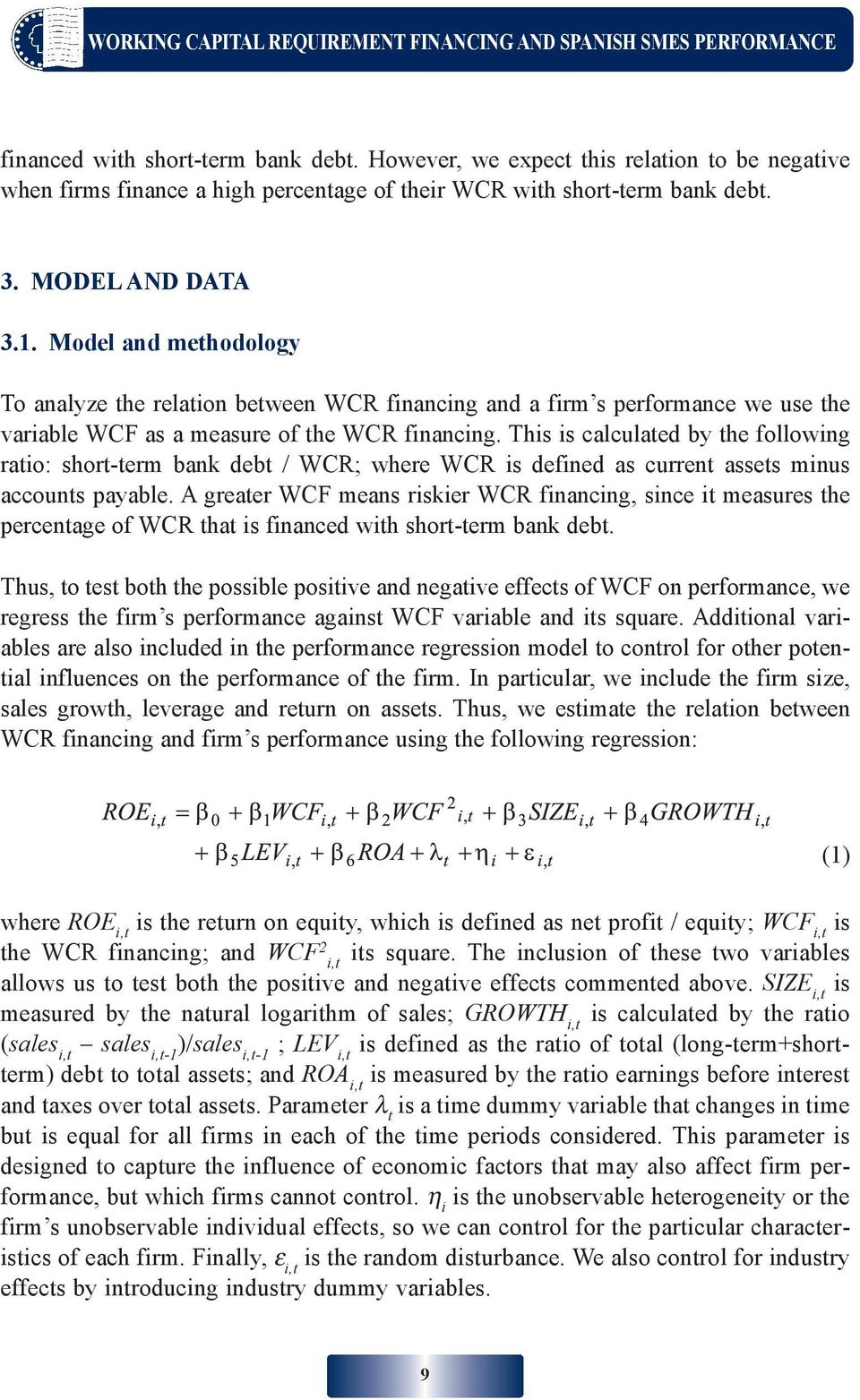
10 Since our aim is to analyze the effect of WCR financing on firms performance, we only include in our analyses those observations which have a positive WCR and, hence, the need to be financed. The coefficients on WCF and WCF 2 variables obtained from equation (1) allow us to determine the breakpoint in the WCR financing-firm performance relation, which can be calculated by: β 1 / 2β 2. Given the positive and negative effects of short-term bank debt mentioned in the previous section, we expect a concave relation between WCF and return on equity. To verify our hypothesis, this inflection point should be a maximum and, hence, β 1 is hypothesised to be positive and β 2 negative. We use the panel data methodology to estimate our model because of the benefits it provides. First, it allows us to control for unobservable heterogeneity and, therefore, eliminate the risk of obtaining biased results arising from the same (Hsiao 1985). Firms are heterogeneous and there are always characteristics that might influence their performance that are difficult to measure or hard to obtain, and which are not in our model (Himmelberg, Hubbard, and Palia, 1999). Second, panel data also allows us to avoid the problem of possible endogeneity. We estimated our models using the two-step generalized method of moments (GMM) estimator based on Arellano and Bond (1991), which allows us to control for endogeneity by using instruments Data and summary statistics The study uses a data panel of non-financial Spanish SMEs. The data were obtained from the SABI (Iberian Balance Sheets Analysis System) database, which was developed by Bureau Van Dijk and contains accounting and financial information for Spanish firms. The sample comprises small and medium-sized firms from Spain for the period The selection of SMEs was carried out according to the requirements established by European Commission recommendation 2003/361/EC of 6 May, 2003, i.e. they had fewer than 250 employees, turned over less than 50 million euros a year and possessed less than 43 million euros worth of total assets. The information obtained was refined. Specifically, we eliminated firms with lost values, cases with errors in the accounting data and extreme values presented by all variables. In addition, we also required firms to have presented data for at least five consecutive years. Finally, we obtained an unbalanced panel of 1,062 firms (7,557 observations). Table 1 reports descriptive statistics on return on equity, WCF and the control variables. Table 2 provides Pearson correlations for variables in equation (1). Moreover, to ensure 10

11 that the multicollinearity problem is not present in our analysis, we calculated the Variance Inflation Factor (VIF) for each independent variable included in our model (results not presented but available from the authors upon request). Since the largest VIF value is far from 5, it can be concluded that multicollinearity is not a concern in the present sample (Studenmund, 1997). TABLE 1 SUMMARY STATISTICS TABLE 2 CORRELATION MATRIX 11

12 4. EMPIRICAL EVIDENCE 4.1. Univariate analyses Table 3 provides preliminary insights into the relation between WCR financing and return on equity. The sample is sorted annually into quartiles based on the WCR financing. Specifically, WCF 1 consists of firms with the lowest level of WCF ratio, while WCF 4 includes firms with the highest WCF ratio. Thus, Table 3 reports mean and median values for return on equity across WCF quartiles. Consistent with our hypothesis, the results suggest a non-monotonic relation between WCR financing and return on equity. We find that the mean and medium return on equity first increase and then decline with the WCF ratio. The mean ROE increases from in WCF 1 to in WCF 3. However, for the highest level of WCF, we find a reversal in pattern for return on equity, since the mean decreases to for the last quartile. The median ROE has a similar pattern. TABLE 3 WORKING CAPITAL REQUIREMENT FINANCING AND RETURN ON EQUITY We illustrate this non-monotonic relation between WCR financing and return on equity in Figure 1, which shows the mean and median ROE across the WCF quartiles. Quartiles are represented on the horizontal axis. The vertical axis represents the mean and median ROE. The results seem to indicate that the use of short-term bank debt to finance a firm s WCR positively affects its performance. However, at sufficiently high percentages of WCR financed with short-term bank debt, the negative influence of short-term bank debt outweighs the positive influence and, hence, riskier WCR financing negatively affects a firm s performance. 12

13 FIGURE 1 WORKING CAPITAL REQUIREMENT FINANCING AND RETURN ON EQUITY This figure reports the mean and median return on equity across WCF quartiles. The sample is sorted annually into quartiles based on the WCF ratio. WCF is the ratio shortterm bank debt/wcr Multivariate analyses Whereas the conclusions in the above section are based on a univariate analysis, we now explore the effect of the WCR financing on firms performance by estimating the model (1) proposed in Section 3. The results obtained are presented in Column (1) of Table 4. Our findings indicate that β 1 is positive and β 2 is negative, and both coefficients are significant, which confirms that there is a concave relation between WCF and firm s performance. When a low percentage of WCR is financed with short-term bank debt, firms may increase their performance with riskier WCR financing due to the advantages associated with shortterm bank debt. Specifically, firms might reduce their interest costs, obtain credit condition benefits, mitigate agency costs and signal their positive prospects to suppliers of funds. 13

14 In contrast, when firms finance a high percentage of their WCR with short-term bank debt, riskier WCR financing negatively affects a firm s performance because the negative influence of short-term bank debt outweighs the positive influence. Although firms enjoy several advantages with short-term debt, it also introduces interest and refinancing risk, which can in turn cause high financial distress costs (Jun and Jen, 2003). Thus, at sufficiently high WCF levels, the negative influence of riskier WCR financing is the dominant factor 1. Our results suggest that, for our sample, the WCF-firm performance relation has a breakpoint of around In Column (2), following Ghosh and Moon (2010), we use an alternative research design based on spline regressions to give robustness to the results obtained from equation (1). Specifically, we estimate the following model: (2) where we replace the WCF variable and its square (WCF 2 ) with WCF (0, 1.29) and WCF (1.29,. We use the breakpoint obtained from equation (1) to divide WCF into low and high Max) range categories. In particular, WCF (0, 1.29) equals WCF if WCF lies between 0 and 1.29; and 1.29 otherwise. WCF (1.29,Max) equals WCF minus 1.29 if WCF is greater than 1.29, and 0 otherwise. All the other variables are the same as those specified in equation (1). Consistent with the findings obtained in Column (1), the results obtained from equation (2) indicate that there is a concave relation between the variable WCF and a firm s performance, since the coefficient on WCF (0, 1.29) is positive and significant, but that on WCF (1.29, Max) is negative and significant. These indicate that a riskier WCR financing strategy has a positive influence on performance at low levels of the WCF ratio, but that this effect becomes negative at high levels. Additionally, to give greater robustness to our results, and since the WCR financing strategy selected by firms might differ across industries, we have also re-estimated the quadratic model by taking sub-samples by industry in order to check whether the con- * We also obtain this concave relation between WCF and firm s performance if we measure the WCF variable by the ratio short-term bank debt/(accounts receivable + inventories - accounts payable). 14

15 cave relation between WCF and firm s performance is maintained. In particular, we have re-estimated the quadratic relation for the following five sub-samples: Agriculture and Mining; Manufacturing; Construction; Wholesale and Retail trade; and Service and Transport. The results obtained are presented in Table 5. They confirm this concave relation between WCF and performance for all sub-samples, except for the Agriculture and Mining sector, where the coefficients are not significant. However, this non significant result might be due to the small number of firms in this sub-sample. TABLE 4 ESTIMATION RESULTS OF WORKING CAPITAL REQUIREMENT FINANCING-PERFORMANCE RELATION 15

16 TABLE 5 SUB-SAMPLES BY INDUSTRY ESTIMATION RESULTS OF WORKING CAPITAL REQUIREMENT FINANCING-PERFORMANCE RELATION 16

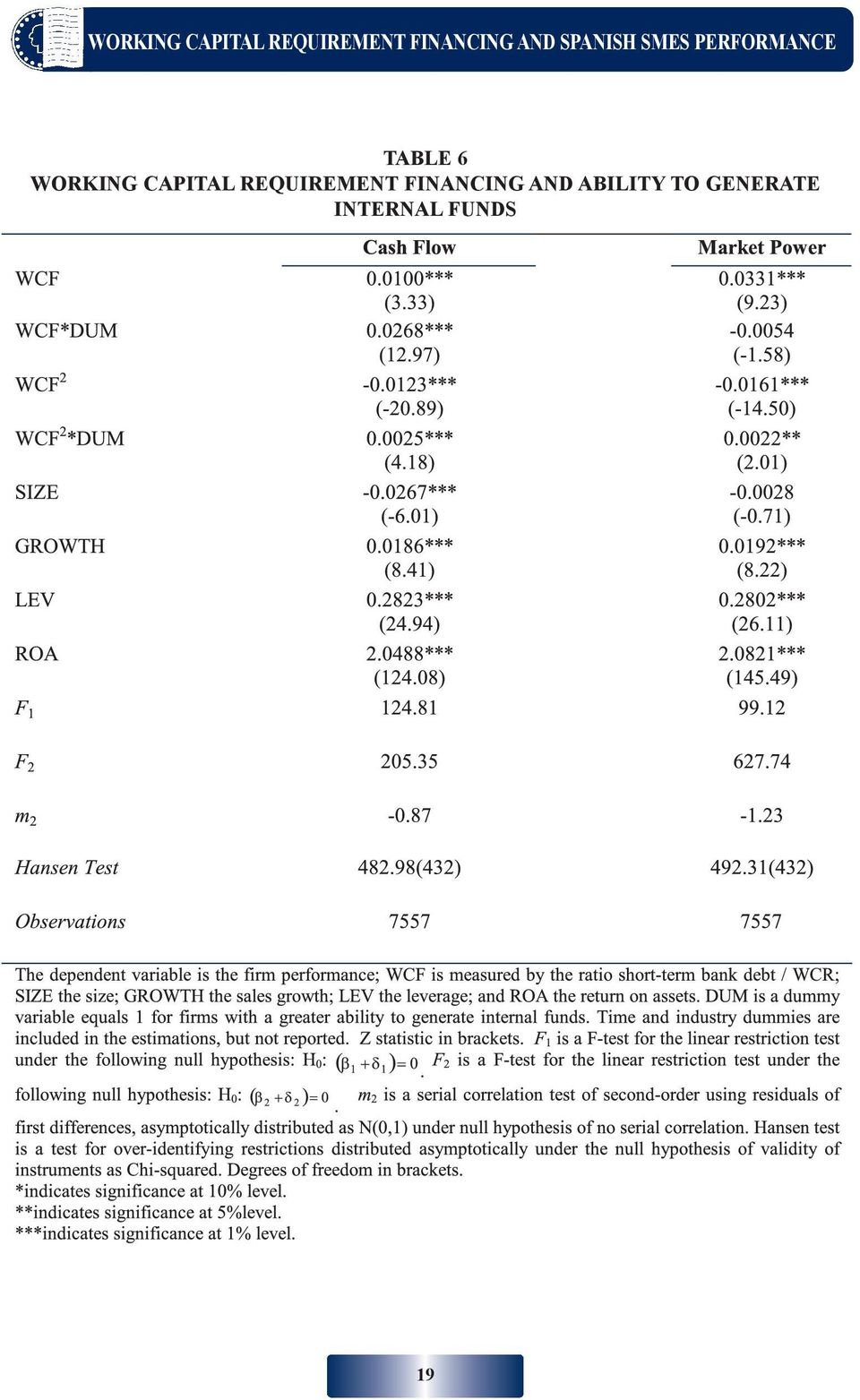
17 5. WORKING CAPITAL REQUIREMENT FINANCING AND ABILITY TO GENERATE INTERNAL FUNDS Having found that there is a percentage of WCR financed with short-term bank debt beyond which the relation between WCF and performance becomes negative, this section explores whether the breakpoint of this WCF-performance relation depends on a firm s ability to generate internal funds. Indeed, Rahaman (2011) indicates that internal funds may have collateral value for banks loans in environments with asymmetric information because this is a proxy for a firm s internal financial capacity and provides a signal about the quality of future growth opportunities. Firms with a greater ability to generate internal finance may meet their payment obligations more easily and, consequently, they might obtain more short-term bank loans and better credit conditions, that is, they would have a lower refinancing and interest risk. Thus, one could expect that these firms can finance a greater portion of their WCR with short-term bank debt (without harming their performance). In order to test our new hypothesis, we classify firms on the basis of their ability to generate internal funds and we estimate the breakpoint of the WCF-performance relation for these sub-samples. We use two proxies for the ability to generate internal funds. First, we use the cash flow variable, measured by the ratio net profit plus depreciation to total assets, with a higher ratio meaning a greater ability to generate internal funds. Second, following Demirguc-Kunt and Maksimovic (1998), we have also categorized firms according to their market power. They indicate that firms that have sufficient market power or that face high demand could generate sufficient cash flow. Following Hill et al., (2010), we measure the market power (MP) as the lagged ratio of a firm s annual sales to the total annual sum of sales in a given industry. This is a proxy for a firm s ability to negotiate bilaterally as both customer and supplier, with a higher ratio indicating a greater bargaining power and, hence, a greater ability to generate internal funds. In order to test whether or not the breakpoint of the WCR financing-performance relation varies according to the ability to generate internal funds, equation (1) is extended by incorporating a dummy variable that distinguishes between firms with more and less ability to generate internal financing. Specifically, DUM is a dummy variable that takes a value of 1 for firms with a greater ability to generate internal funds than the sample median, and 0 otherwise. Thus, we estimate the following model: 17

18 (3) All dependent and independent variables are as previously defined. By construction, the expression β 1 / 2β 2 measures the breakpoint of the WCF-performance relation for firms with a lower ability to generate internal funds. The breakpoint of this relation for firms with a greater ability is captured by (β 1 +δ 1 ) /2 (β 2.+ δ 2 ). The results, which are presented in Table 6, confirm again our hypothesis that the relation between WCF and performance is concave. In addition, we find that, for the firms with a greater ability to generate internal funds, the percentage of WCR financed with short-term bank debt beyond which riskier WCR financing starts to affect a firm s performance negatively is greater. That is, our findings indicate that these firms can finance a greater percentage of their WCR with short-term bank debt without harming their performance, which may be due to their lower refinancing and interest risk, given that they are expected to obtain short-term bank debt more easily and better credit conditions. 6. CONCLUSIONS This paper analyzes the relation between WCR financing and firms performance for a sample of small and medium-sized firms. Although there is a large amount of literature that studies the effect of the investment in working capital on firm s performance, the possible influence of WCR financing on performance is a topic that has not yet been explored. Hence, this paper examines whether the way in which a firm finances its WCR also influences its performance. To control for unobservable heterogeneity and for possible endogeneity problems, we use a panel data model and employ the two-step generalized method of moments (GMM) estimator. Our findings indicate that investment in working capital should not be the only important concern for firms when they make their working capital decisions, but that WCR financing should also be considered. In particular, our results show that a suitable WCR financing strategy can help firms to increase their performance. For low percentages of WCR financed with short-term bank debt, riskier WCR financing might increase a firm s performance due to the advantages associated with short-term bank debt. Specifically, firms might reduce their interest costs, obtain credit condition benefits, mitigate agency costs and signal their positive prospects to suppliers of funds. 18

19 TABLE 6 WORKING CAPITAL REQUIREMENT FINANCING AND ABILITY TO GENERATE INTERNAL FUNDS 19
20 However, for high percentages of WCR financed with short-term bank debt, riskier WCR financing might negatively affect firm s performance because of greater interest and refinancing risk. Moreover, additional analyses reveal that this WCR financing-performance relation depends on a firm s ability to generate internal funds. Since financing options and methods are quite different between small and large firms, due to their differences in ownership structure, flexibility and taxes (Heyman, Deloof, and Ooghe, 2003), further research focused on quoted companies or different financial systems could be interesting. REFERENCES Antoniou, A., Guney, Y., Paudyal, K., The determinants of debt maturity structure: Evidence from France, Germany and the UK. European Financial Management 12, Arellano, M., Bond, S., Some test of specification for panel data: Monte Carlo evidence and an application to employment equations. Review of Economics Studies 58, Baños, S., García, P. J., Martínez, P., Working capital management in SMEs. Accounting and Finance 50, Baños, S., García, P. J., Martínez, P., How does working capital management affect Spanish SMEs profitability?. Small Business Economics, forthcoming. Barclay, M.J., Smith, C.W., The maturity structure of corporate debt. Journal of Finance 50, Berger, A., Udell, G., The economics of small business finance: the roles of private equity and debt markets in the financial growth cycle. Journal of Banking and Finance 22, Carbó, S., Rodríguez, F., Udell, G., Bank market power and SME financing constraints. Review of Finance 13, Chiou, J. R., Cheng, L., Wu, H.W., The determinants of working capital management. Journal of American Academy of Business 10, Cole, R. A., The importance of relationships to the availability of credit. Journal of Banking and Finance 22, De la Torre, A., Martínez, M., Schmukler, S., Bank involvement with SMEs: beyond relationship lending. Journal of Banking and Finance 34, Deloof, M., Does working capital management affect profitability of Belgian firms?. Journal of Business Finance & Accounting 30,

21 Demirguc-Kunt, A., Maksimovic, V., Law, finance, and firm growth. Journal of Finance 53, Flannery, M.J., Asymmetric information and risky debt maturity choice. Journal of Finance 41, García, P. J., Martínez, P., Effects of working capital management on SME profitability. International Journal of Managerial Finance 3, Ghosh, A., Moon, D., Corporate debt financing and earnings quality, Journal of Business Finance & Accounting 37, Heyman, D., Deloof, M., Ooghe, H., The debt maturity structure of small firms in a creditor oriented environment. Working Paper, Universiteit Gent. Hill, M.D., Kelly, G., Highfield, M.J., Net operating working capital behaviour: a first look. Financial Management 39, Himmelberg, C., Hubbard, R., Palia, D., Understanding the determinants of managerial ownership and the link between ownership and performance. Journal of Financial Economics 53, Hsiao, C., Benefits and limitations of panel data. Econometrics Review 4, Hughes, A., Finance for SMEs: a UK perspective. Small Business Economics 9, Jose, M. L., Lancaster, C., Stevens, J.L., Corporate return and cash conversion cycle. Journal of Economics and Finance 20, Jun, S. G., Jen, F. C., Trade-off model on debt maturity structure. Review of Quantitative Finance and Accounting 20, Kale, J.R., Noe, T.H., Risky debt maturity choice in a sequential game equilibrium. Journal of Financial Research 13, MacMahon, R., An exploratory study of under and over investment amongst manufacturing SMEs from Australia s business longitudinal survey. International Small Business Journal 21, Modigliani, F., Miller, M.H., The cost of capital, corporation finance and the theory of investment. American Economic Review 48, Myers, S.C., Determinants of corporate borrowing. Journal of Financial Economics 5, Ozkan, A., An empirical analysis of corporate debt maturity structure. European Financial Management 6, Peel, M., Wilson, N., Working capital and financial management practices in the small firm sector. International Small Business Journal 14,
22 Peel, M. J., Wilson, N., Howorth, C., Late payment and credit management in the small firm sector: Some empirical evidence. International Small Business Journal 18, Petersen, M. A., Rajan, R. G., The benefits of lending relationships: Evidence from small business data. Journal of Finance 43, Petersen, M., Rajan, R., Trade credit: theories and evidence. Review of Financial Studies 10, Rahaman, M., Access to financing and firm growth. Journal of Banking and Finance 35, Schmidt, R., Tyrell, M., Financial systems, corporate finance and corporate governance. European Financial Management 3, Shin, H. H., Soenen, L., Efficiency of working capital and corporate profitability. Financial Practice and Education 8, Smith, K., Profitability versus liquidity tradeoffs in working capital management. In: Smith, K. V. (Eds.), Readings on the Management of Working Capital. St Paul,MN. Stiglitz, J., On the irrelevance of corporate financial policy. American Economic Review 64, Stohs, M. H., Mauer, D.C., The determinants of corporate debt maturity structure. Journal of Business 69, Studenmund, A. H., Using econometrics: A practical guide. New York, Addison-Wesley. Vos, E., Yeh, A., Carter, S., Tagg, S., The happy story of small business financing. Journal of Banking and Finance 31, Walker, D., Financing the small firm. Small Business Economics 1, Wang, Y. J., Liquidity management, operating performance, and corporate value: evidence from Japan and Taiwan. Journal of Multinational Financial Management 12,
23 ENTIDADES PATRONO ENTIDADES PATRONO de la Fundación de Estudios Financieros BANCO SANTANDER, S.A. TELEFÓNICA, S.A. ENDESA, S.A. BANCO BILBAO VIZCAYA ARGENTARIA CITI BANCO SABADELL BANKIA CLIFFORD CHANCE ERNST & YOUNG FIDELITY WORLDWIDE INVESTMENT FUNDACIÓN REPSOL INDITEX KPMG LA CAIXA MAPFRE ZURICH ESPAÑA BOLSAS Y MERCADOS ESPAÑOLES URIA & MENÉNDEZ ACS DELOITTE FUNDACIÓN PRICEWATERHOUSE COOPERS INDRA SISTEMAS, S.A. FUNDACIÓN ABERTIS BAKER & MCKENZIE J&A GARRIGUES, S.L. CECA 23
24
EFFECTS OF WORKING CAPITAL MANAGEMENT ON SME PROFITABILITY *
 EFFECTS OF WORKING CAPITAL MANAGEMENT ON SME PROFITABILITY * Pedro Juan García-Teruel Dept. Organización de Empresas y Finanzas Facultad de Economía y Empresa Universidad de Murcia Campus Espinardo, s/n
Determinants of Capital Structure in Developing Countries
 Determinants of Capital Structure in Developing Countries Tugba Bas*, Gulnur Muradoglu** and Kate Phylaktis*** 1 Second draft: October 28, 2009 Abstract This study examines the determinants of capital
The Determinants and the Value of Cash Holdings: Evidence. from French firms
 The Determinants and the Value of Cash Holdings: Evidence from French firms Khaoula SADDOUR Cahier de recherche n 2006-6 Abstract: This paper investigates the determinants of the cash holdings of French
An Empirical Analysis of Insider Rates vs. Outsider Rates in Bank Lending
 An Empirical Analysis of Insider Rates vs. Outsider Rates in Bank Lending Lamont Black* Indiana University Federal Reserve Board of Governors November 2006 ABSTRACT: This paper analyzes empirically the
Working Capital, Financing Constraints and Firm Financial Performance in GCC Countries
 Information Management and Business Review Vol. 7, No. 3, pp. 59-64, June 2015 (ISSN 2220-3796) Working Capital, Financing Constraints and Firm Financial Performance in GCC Countries Sree Rama Murthy Y
Economics and Finance Review Vol. 1(3) pp. 30 40, May, 2011 ISSN: 2047-0401 Available online at http://wwww.businessjournalz.
 ABSTRACT FACTORS THAT INFLUENCE WORKING CAPITAL REQUIREMENTS IN CANADA Amarjit Gill Professor of Business Administration College of Business Administration, Trident University International, 5665 Plaza
Effective Working Capital Management Affects Profitability: Evidence from Asia
 Effective Working Capital Management Affects Profitability: Evidence from Asia Hyder Ali Khawaja, Niaz Ahmed Bhutto 2, Falahuddin Butt 3 & Ghulam Abbas 4 Abstract The purpose of this study is to investigate
Determinants of working capital management: Case of Singapore firms
 Abstract Determinants of working capital management: Case of Singapore firms Ebrahim Manoori 1 Datin Dr Joriah Muhammad 2 1. PhD Candidate, School of Management, University Sains Malaysia(USM), 11800 Pulu
How Do Small Businesses Finance their Growth Opportunities? The Case of Recovery from the Lost Decade in Japan
 How Do Small Businesses Finance their Growth Opportunities? The Case of Recovery from the Lost Decade in Japan Daisuke Tsuruta National Graduate Institute for Policy Studies and CRD Association January
Journal of Business & Economics Research December, 2010 Volume 8, Number 12
 The Effect Of Working Capital Management On Firm s Profitability: Empirical Evidence From An Emerging Market Melita Stephanou Charitou, University of Nicosia, Cyprus Maria Elfani, University of Nicosia,
How To Find Out If A Firm Is Profitable
 IMPACT OF WORKING CAPITAL ON CORPORATE PERFORMANCE A CASE STUDY FROM CEMENT, CHEMICAL AND ENGINEERING SECTORS OF PAKISTAN Naveed Ahmad Faculty of Management sciences, Indus international institute, D.
The Relationship Between Working Capital Management and Profitability of Companies Listed on the Johannesburg Stock Exchange
 Journal of Modern Accounting and Auditing, ISSN 1548-6583 August 212, Vol. 8, No. 8, 124-1213 D DAVID PUBLISHING The Relationship Between Working Capital Management and Profitability of Companies Listed
Small Business Borrowing and the Owner Manager Agency Costs: Evidence on Finnish Data. Jyrki Niskanen Mervi Niskanen 10.11.2005
 Small Business Borrowing and the Owner Manager Agency Costs: Evidence on Finnish Data Jyrki Niskanen Mervi Niskanen 10.11.2005 Abstract. This study investigates the impact that managerial ownership has
Effects of Working Capital Management on the Profitability of Thai Listed Firms
 Effects of Working Capital Management on the Profitability of Thai Listed Firms Kulkanya Napompech Abstract Working capital is needed for day-to-day operations of a firm. The primary purpose of this research
How does profitability get affected by working capital management in food and beverages industry?
 MPRA Munich Personal RePEc Archive How does profitability get affected by working capital management in food and beverages industry? Priya Darshini Pun Thapa London School of Commerce 28. August 2013 Online
The Relationship Between Working Capital Management And Profitability: Evidence From The United States
 1 The Relationship Between Working Capital Management And Profitability: Evidence From The United States *Amarjit Gill 1, Nahum Biger 2, Neil Mathur 3 1 College of Business Administration, TUI University,
Impact of Working Capital Management on Profitability of Micro and Small Enterprises in Ethiopia: The Case of Bahir Dar City Administration
 International Journal of Accounting and Taxation, Vol. 1 No. 1, December 2013 15 Impact of Working Capital Management on Profitability of Micro and Small Enterprises in Ethiopia: The Case of Bahir Dar
Firm characteristics. The current issue and full text archive of this journal is available at www.emeraldinsight.com/0307-4358.htm
 The current issue and full text archive of this journal is available at www.emeraldinsight.com/0307-4358.htm How firm characteristics affect capital structure: an empirical study Nikolaos Eriotis National
Working Capital Management and Corporate Profitability: Evidence from Iran
 World Applied Sciences Journal 12 (7): 1093-1099, 2011 ISSN 1818-4952 IDOSI Publications, 2011 Working Capital Management and Corporate Profitability: Evidence from Iran Mohammad Alipour Islamic Azad University,
How To Calculate Financial Leverage Ratio
 What Do Short-Term Liquidity Ratios Measure? What Is Working Capital? HOCK international - 2004 1 HOCK international - 2004 2 How Is the Current Ratio Calculated? How Is the Quick Ratio Calculated? HOCK
The Impact of Company Characteristics on Working Capital Management
 Journal of Applied Finance & Banking, vol.2, no.1, 2012, 105-125 ISSN: 1792-6580 (print version), 1792-6599 (online) International Scientific Press, 2012 The Impact of Company Characteristics on Working
Effects of Working Capital Management on Profitability for a Sample of European Firms
 Effects of Working Capital Management on Profitability for a Sample of European Firms Erasmus University Rotterdam Faculty of Economics of Business Department of Economics Supervisor: S. Gryglewicz Name:
The Use of Trade Credit by Businesses
 Amy Fitzpatrick and Bobby Lien* Trade credit is an important source of funding for some businesses, particularly those in the unlisted business sector. Nonetheless, little is known about the use of trade
DETERMINANTS OF ACCOUNTS RECEIVABLE AND ACCOUNTS PAYABLE: A CASE OF PAKISTAN TEXTILE SECTOR
 DETERMINANTS OF ACCOUNTS RECEIVABLE AND ACCOUNTS PAYABLE: A CASE OF PAKISTAN TEXTILE SECTOR MUBASHIR ALI KHAN (Corresponding Author) MS Scholar Sukkur Institute of Business Administration Airport Road
EFFECTS OF WORKING CAPITAL MANAGEMENT ON PROFITABILITY: THE CASE FOR SELECTED COMPANIES IN THE ISTANBUL STOCK EXCHANGE (2005-2008)
 EFFECTS OF WORKING CAPITAL MANAGEMENT ON PROFITABILITY: THE CASE FOR SELECTED COMPANIES IN THE ISTANBUL STOCK EXCHANGE (2005-2008) Hasan Agan KARADUMAN Yıldız Technical University Faculty of Economics
The Relationship between Working Capital Management and Profitability: Empirical Evidence from Morocco
 Global Review of Accounting and Finance Vol. 6. No. 1. March 2015 Issue. Pp. 118 139 The Relationship between Working Capital Management and Profitability: Empirical Evidence from Morocco Samir Aguenaou*,
Accounts Receivable and Accounts Payable in Large Finnish Firms Balance Sheets: What Determines Their Levels?
 LTA 4/00 P. 489 503 JYRKI NISKANEN & MERVI NISKANEN Accounts Receivable and Accounts Payable in Large Finnish Firms Balance Sheets: What Determines Their Levels? ABSTRACT This study empirically examines
UNIVERSITY OF WAH Department of Management Sciences
 BBA-330: FINANCIAL MANAGEMENT UNIVERSITY OF WAH COURSE DESCRIPTION/OBJECTIVES The module aims at building competence in corporate finance further by extending the coverage in Business Finance module to
WORKING PAPER SERIES FINANCING CONSTRAINTS AND FIRMS CASH POLICY IN THE EURO AREA NO 642 / JUNE 2006. by Rozália Pál and Annalisa Ferrando
 WORKING PAPER SERIES NO 642 / JUNE 2006 FINANCING CONSTRAINTS AND FIRMS CASH POLICY IN THE EURO AREA by Rozália Pál and Annalisa Ferrando WORKING PAPER SERIES NO 642 / JUNE 2006 FINANCING CONSTRAINTS AND
Affects of Working Capital Management on Firm s Performance: Evidence from Turkey
 International Journal of Economics and Financial Issues Vol. 2, No. 4, 2012, pp.488-495 ISSN: 2146-4138 www.econjournals.com Affects of Working Capital Management on Firm s Performance: Evidence from Turkey
The Equity Gap and Knowledge-based Firms: Executive Summary
 The Equity Gap and Knowledge-based Firms: Executive Summary Nick Wilson Credit Management Research Centre Leeds University Business School Tel: +44 (0) 113 343 4472 Email: [email protected] Mike Wright
The Effect Of Working Capital Management On Profitability
 The Effect Of Working Capital Management On Profitability To maintain efficient levels of components of working capital, current liabilities and current assets is a strategy of managerial level accounting
AN ANALYSIS OF WORKING CAPITAL MANAGEMENT EFFICIENCY IN TELECOMMUNICATION EQUIPMENT INDUSTRY
 RIVIER ACADEMIC JOURNAL, VOLUME 3, NUMBER 2, FALL 2007 AN ANALYSIS OF WORKING CAPITAL MANAGEMENT EFFICIENCY IN TELECOMMUNICATION EQUIPMENT INDUSTRY Vedavinayagam Ganesan * Graduate Student, EMBA Program,
Working Capital Management and Performance of Sabah s Public Listed Firms
 International Journal of Managerial Studies and Research (IJMSR) Volume 3, Issue 12, December 2015, PP 1-6 ISSN 2349-0330 (Print) & ISSN 2349-0349 (Online) www.arcjournals.org Working Capital Management
Financial Statement Analysis of Leverage and How It Informs About Profitability and Price-to-Book Ratios
 Financial Statement Analysis of Leverage and How It Informs About Profitability and Price-to-Book Ratios Doron Nissim Graduate School of Business Columbia University 3022 Broadway, Uris Hall 604 New York,
FINANCIAL PERFORMANCE INDICATORS FOR CANADIAN BUSINESS. Concepts, Sources and Methods
 FINANCIAL PERFORMANCE INDICATORS FOR CANADIAN BUSINESS Concepts, Sources and Methods Symbols The following standard symbols are used in Statistics Canada publications:.. figures not available.... figures
The Capital Structure, Ownership and Survival of Newly Established Family Firms
 Irene Wahlqvist Sonica Narula BI Norwegian Business School - Master Thesis - The Capital Structure, Ownership and Survival of Newly Established Family Firms Submission Date 01.09.2014 Supervisor: Bogdan
 Working Capital Requirements and the Determining Factors in Pakistan Mian Sajid Nazir* and Talat Afza** Literature on corporate finance has traditionally focused on the study of long-term financial decisions.
International Review of Business Research Papers Vol.3 No.1. March 2007, Pp.279-300
 International Review of Business Research Papers Vol.3 No.1. March 2007, Pp.279-300 Working Capital Management And Profitability Case Of Pakistani Firms Abdul Raheman* and Mohamed Nasr ** Working Capital
Autoria: Eduardo Kazuo Kayo, Douglas Dias Bastos
 Frequent Acquirers and Financing Policy: The Effect of the 2000 Bubble Burst Autoria: Eduardo Kazuo Kayo, Douglas Dias Bastos Abstract We analyze the effect of the 2000 bubble burst on the financing policy.
THE EURO AREA BANK LENDING SURVEY 1ST QUARTER OF 2014
 THE EURO AREA BANK LENDING SURVEY 1ST QUARTER OF 214 APRIL 214 European Central Bank, 214 Address Kaiserstrasse 29, 6311 Frankfurt am Main, Germany Postal address Postfach 16 3 19, 666 Frankfurt am Main,
ICAP GROUP S.A. FINANCIAL RATIOS EXPLANATION
 ICAP GROUP S.A. FINANCIAL RATIOS EXPLANATION OCTOBER 2006 Table of Contents 1. INTRODUCTION... 3 2. FINANCIAL RATIOS FOR COMPANIES (INDUSTRY - COMMERCE - SERVICES) 4 2.1 Profitability Ratios...4 2.2 Viability
Why Do Firms Hold Cash? Evidence from EMU Countries
 European Financial Management, Vol. 10, No. 2, 2004, 295 319 Why Do Firms Hold Cash? Evidence from EMU Countries Miguel A. Ferreira ISCTE Business School Lisbon, Complexo INDEG/ISCTE, Av. Prof. Anibal
option: Evidence from a bank-based economy
 Accounts receivable management and the factoring option: Evidence from a bank-based economy Thomas Hartmann-Wendels Alwin Stöter Abstract: We analyze a firm s decision of whether to manage trade credits
WORKING CAPITAL MANAGEMENT AND PROFITABILITY: EVIDENCE FROM PAKISTAN FIRMS
 Abstract WORKING CAPITAL MANAGEMENT AND PROFITABILITY: EVIDENCE FROM PAKISTAN FIRMS Ahsen Saghir Faculty Member of APCOMS, Rawalpindi Muhammad Ali Jinnah University, Islamabad Faisal Mehmood Hashmi Muhammad
RELATIONSHIP BETWEEN WORKING CAPITAL MANAGEMENT AND PROFITABILITY EMPIRICAL EVIDENCE FROM VIETNAMESE LISTED FIRMS
 RELATIONSHIP BETWEEN WORKING CAPITAL MANAGEMENT AND PROFITABILITY EMPIRICAL EVIDENCE FROM VIETNAMESE LISTED FIRMS Thoa T.K Tu, MA Abstract. Thoa T.K. Tu* and Uyen T.U. Nguyen* * School of Finance, University
Determinants of Trade Credit: A Study of Listed Firms
 Determinants of Trade Credit: A Study of Listed Firms in the Netherlands Xiuli Li (s1000314) Master Thesis in Business Administration Track: Financial Management School of Management and Governance University
How To Find Out If Working Capital Strategy And Risk Are Related To The Money And Profit
 Financial Internet Quarterly e-finanse 2013 vol. 9 nr 3 Financial Internet Quarterly e-finanse 2013 vol. 9 nr 3 WORKING CAPITAL MANAGEMENT, PROFITABILITY AND RISK ANALYSE OF COMPANIES LISTED ON THE WARSAW
EAD Calibration for Corporate Credit Lines
 FEDERAL RESERVE BANK OF SAN FRANCISCO WORKING PAPER SERIES EAD Calibration for Corporate Credit Lines Gabriel Jiménez Banco de España Jose A. Lopez Federal Reserve Bank of San Francisco Jesús Saurina Banco
Small Business Funding in Australia
 Small Business Funding in Australia Mihovil Matic, Adam Gorajek and Chris Stewart Smaller businesses typically access funding on less favourable terms than larger businesses. The reasons mostly relate
Bank Credit, Trade Credit or No Credit: Evidence from the Surveys of Small Business Finances
 Bank Credit, Trade Credit or No Credit: Evidence from the Surveys of Small Business Finances by Rebel Cole Chicago, IL 60602 for under contract number SBAHQ-08-M-0464 Release Date: June 2010 This contract
The interrelationship between working capital and profitability: a pre-crisis examination of the Cyprus Stock Exchange.
 The interrelationship between working capital and profitability: a pre-crisis examination of the Cyprus Stock Exchange. ABSTRACT The purpose of the current study was to investigate the interrelationship
The Effect of Capital Structure on the Financial Performance of Small and Medium Enterprises in Thika Sub-County, Kenya
 International Journal of Humanities and Social Science Vol. 5, No. 1; January 2015 The Effect of Capital Structure on the Financial Performance of Small and Medium Enterprises in Thika Sub-County, Kenya
Determinants of short-term debt financing
 ABSTRACT Determinants of short-term debt financing Richard H. Fosberg William Paterson University In this study, it is shown that both theories put forward to explain the amount of shortterm debt financing
Financing Behavior of Romanian Listed Firms in Adjusting to the Target Capital Structure
 JEL Classification: G32, C33 Keywords: target capital structure, adjustment speed, dynamic panel data, Generalized Method of Moments Financing Behavior of Romanian Listed Firms in Adjusting to the Target
保 理 在 中 国 情 境 下 的 融 资 作 用
 所 属 领 域 : 资 产 证 券 化 Category: Asset securitization 发 表 语 言 : 英 文 In English 保 理 在 中 国 情 境 下 的 融 资 作 用 The financing role of factoring in China context Shuzhen Chen 1 School of Management, University of
Chapter 12 Practice Problems
 Chapter 12 Practice Problems 1. Bankers hold more liquid assets than most business firms. Why? The liabilities of business firms (money owed to others) is very rarely callable (meaning that it is required
Asian Journal of Business and Management Sciences ISSN: 2047-2528 Vol. 2 No. 2 [51-63]
![Asian Journal of Business and Management Sciences ISSN: 2047-2528 Vol. 2 No. 2 [51-63]](/thumbs/29/13245996.jpg "Asian Journal of Business and Management Sciences ISSN: 2047-2528 Vol. 2 No. 2 [51-63]") DETERMINANTS OF CAPITAL STRUCTURE: (A Case Study of Machinery & Equipment Sector of Islamic Republic of Iran) Dr. Abdolmahdi Ansari Faculty of administrative Sciences and Economics, Department of Accounting,
DETERMINANTS OF CAPITAL STRUCTURE: (A Case Study of Machinery & Equipment Sector of Islamic Republic of Iran) Dr. Abdolmahdi Ansari Faculty of administrative Sciences and Economics, Department of Accounting,
Chapter 9 Solutions to Problems
 Chapter 9 Solutions to Problems 1. a. Cash and cash equivalents are cash in hand and in banks, plus money market securities with maturities of 90 days or less. Accounts receivable are claims on customers
Working Capital Management and Profitability: A Sensitivity Analysis
 Working Capital Management and Profitability: A Sensitivity Analysis Arunkumar ON & T Radha Ramanan Department of Mechanical Engineering, National Institute of Technology Calicut, Calicut 673601, Kerala,
WORKING CAPITAL MANAGEMENT AND PROFITABILITY IN SUGAR INDUSTRY OF PAKISTAN
 WORKING CAPITAL MANAGEMENT AND PROFITABILITY IN SUGAR INDUSTRY OF PAKISTAN Muhammad Ehsan Javaid Leghari PhD Management Sciences COMSATS Institute of Information Technology Islamabad, Pakistan Email:[email protected]
DETERMINANTS OF THE CAPITAL STRUCTURE: EMPIRICAL STUDY FROM THE KOREAN MARKET
 DETERMINANTS OF THE CAPITAL STRUCTURE: EMPIRICAL STUDY FROM THE KOREAN MARKET Doug S. Choi Metropolitan State University of Denver INTRODUCTION This study intends to examine the important determinants
TERMS OF LENDING FOR SMALL BUSINESS LINES OF CREDIT: THE ROLE OF LOAN GUARANTEES
 The International Journal of Business and Finance Research Volume 5 Number 1 2011 TERMS OF LENDING FOR SMALL BUSINESS LINES OF CREDIT: THE ROLE OF LOAN GUARANTEES Raymond Posey, Mount Union College Alan
CAPITAL STRUCTURE AND DEBT MATURITY CHOICES FOR SOUTH AFRICAN FIRMS: EVIDENCE FROM A HIGHLY VARIABLE ECONOMIC ENVIRONMENT
 CAPITAL STRUCTURE AND DEBT MATURITY CHOICES FOR SOUTH AFRICAN FIRMS: EVIDENCE FROM A HIGHLY VARIABLE ECONOMIC ENVIRONMENT Pierre Erasmus Stellenbosch University Department of Business Management Faculty
RETURN ON CURRENT ASSETS, WORKING CAPITAL AND REQUIRED RATE OF RETURN ON EQUITY
 Financial Internet Quarterly e-finanse 2014, vol. 10/nr 2, p. 1-10 10.14636/1734-039X_10_2_005 RETURN ON CURRENT ASSETS, WORKING CAPITAL AND REQUIRED RATE OF RETURN ON EQUITY Monika Bolek* 1 Abstract The
RELATIONSHIP BETWEEN WORKING CAPITAL MANAGEMENT AND PROFITABILITY IN TURKEY INDUSTRIAL LISTED COMPANIES
 RELATIONSHIP BETWEEN WORKING CAPITAL MANAGEMENT AND PROFITABILITY IN TURKEY INDUSTRIAL LISTED COMPANIES Prof.Dr. Necdet SAGLAM Lecturer Aziz KAGITCI Assistant Prof.Dr. Semih BUYUKIPEKCI Abstract The present
HAS FINANCE BECOME TOO EXPENSIVE? AN ESTIMATION OF THE UNIT COST OF FINANCIAL INTERMEDIATION IN EUROPE 1951-2007
 HAS FINANCE BECOME TOO EXPENSIVE? AN ESTIMATION OF THE UNIT COST OF FINANCIAL INTERMEDIATION IN EUROPE 1951-2007 IPP Policy Briefs n 10 June 2014 Guillaume Bazot www.ipp.eu Summary Finance played an increasing
THE ROLE OF BANK CREDIT IN BUSINESS FINANCING IN POLAND
 Working Papers No. 3/2016 (194) ANNA BIAŁEK-JAWORSKA NATALIA NEHREBECKA THE ROLE OF BANK CREDIT IN BUSINESS FINANCING IN POLAND Warsaw 2016 The role of bank credit in business financing in Poland ANNA
Borrowing Patterns, Bankruptcy and Voluntary Liquidation
 Borrowing Patterns, Bankruptcy and Voluntary Liquidation José Mata Universidade Nova de Lisboa, António Antunes Banco de Portugal, Pedro Portugal Banco de Portugal and Universidade Nova de Lisboa April
Do capital expenditures determine debt issues?
 Economic and Financial Report 2001/02 Do capital expenditures determine debt issues? Federico Galizia and Dermot O Brien * European Investment Bank 100, blvd. Konrad Adenauer L-2950 Luxembourg Email: [email protected]
The Role of Bond Covenants and Short-Term Debt: Evidence from Brazil
 Available online at http:// BAR, Rio de Janeiro, v. 10, n. 3, art. 5, pp. 323-346, July/Sept. 2013 The Role of Bond Covenants and Short-Term Debt: Evidence from Brazil Vinícius Augusto Brunassi Silva E-mail
THE DETERMINANTS OF CAPITAL STRUCTURE: EVIDENDCE FROM MACEDONIAN LISTED AND UNLISTED COMPANIES. Fitim DEARI *, Media DEARI **
 ANALELE ŞTIINłIFICE ALE UNIVERSITĂłII ALEXANDRU IOAN CUZA DIN IAŞI Tomul LVI ŞtiinŃe Economice 2009 THE DETERMINANTS OF CAPITAL STRUCTURE: EVIDENDCE FROM MACEDONIAN LISTED AND UNLISTED COMPANIES Fitim
The Relationship Between Debt Financing and Market Value of Company: Empirical Study of Listed Real Estate Company of China
 Proceedings of the 7th International Conference on Innovation & Management 2043 The Relationship Between Debt Financing and Market Value of Company: Empirical Study of Listed Real Estate Company of China