
NIRAJ CEMENT STRUCTURALS LIMITED
|
|
|
- Matilda Ray
- 10 years ago
- Views:
Transcription
1 PROSPECTUS Dated June 04, 2008 Please NIRAJ read CEMENT Section 60B STRUCTURALS of the Companies LIMITED Act, 1956 (100 % Book Built Issue) (Company Identification Number: U26940MH1998PTC114307) (Originally incorporated in India as Niraj Cement Structurals Private Limited on April 1, 1998 under the Companies Act, 1956 and converted to Public Limited Company w.e.f. January 12, 2006.) Registered Office: Niraj House, Sunder Baug, Opp. Deonar Depot, Chembur, Mumbai Tel. No.: / 3541; Fax No.: ; Website: [email protected] Contact Person & Compliance Officer : Mr. Soni Agarwal, General Manager - Finance PUBLIC ISSUE OF 32,50,000 EQUITY SHARES OF RS. 10/- EACH FOR CASH AT A PRICE OF RS. 190/- PER EQUITY SHARE AGGREGATING RS LAKHS (HEREINAFTER REFERRED TO AS THE ISSUE ) BY NIRAJ CEMENT STRUCTURALS LIMITED (HEREINAFTER REFERRED TO AS NCSL OR THE COMPANY OR THE ISSUER ). THE ISSUE COMPRISES OF RESERVATION FOR ELIGIBLE EMPLOYEES OF 3,25,000 EQUITY SHARES OF RS. 10/- EACH, AT THE ISSUE PRICE AND NET ISSUE TO THE PUBLIC OF 29,25,000 EQUITY SHARES OF RS. 10/- EACH (HEREINAFTER REFERRED TO AS THE NET ISSUE ). THE ISSUE WOULD CONSTITUTE 31.42% OF THE TOTAL POST ISSUE PAID-UP EQUITY CAPITAL OF THE COMPANY. ISSUE PRICE IS RS. 190/- PER EQUITY SHARE OF THE FACE VALUE OF RS. 10/- EACH AND THE ISSUE PRICE IS 19.0 TIMES OF THE FACE VALUE In case of revision in the Price Band, the Bidding/Issue Period will be extended for 3 additional working days after such revision, subject to the Bidding/ Issue Period not exceeding 10 working days. Any revision of Price Band and the revised Bid/Issue Period, if applicable will be widely disseminated by notification to Bombay Stock Exchange Limited (BSE) and The National Stock Exchange of India Limited (NSE), by issuing a press release, and also by indicating the change on the website of the Book Running Lead Manager (BRLM) and at the terminals of the Syndicate. The Issue is being made through the 100% book building process wherein upto 50% of the Net Issue to the public shall be offered on a proportionate basis to Qualified Institutional Buyers (QIBs). 5% of the QIB portion shall be available for allocation in a proportionate basis to Mutual Funds only. Further, not less than 15% of the net issue to the public shall be available for allocation on a proportionate basis to Non-Institutional Bidders and not less than 35% of the net Issue to the public shall be available for allocation on a proportionate basis to Retail Individual Bidders, subject to valid Bids being received at or above the Issue Price. RISKS IN RELATION TO THE FIRST ISSUE This being the first issue of Niraj Cement Structurals Limited, there has been no formal market for the shares of the Company. The face value of the shares is Rs. 10/- and the Issue Price is 19.0 times of the face value. The Price band (has been determined by the Company in consultation with the Book Running Lead Manager on the basis of assessment of market demand for the Equity Shares offered by Book Building) should not be taken to be indicative of the market price of the Equity Shares after the Equity Shares are listed. No assurance can be given regarding an active and/or sustained trading in the Equity Shares of the Company or regarding the price at which the Equity Shares will be traded after listing. GENERAL RISK Investment in Equity and Equity related securities involve a degree of risk and investors should not invest any funds in this Issue unless they can afford to take the risk of losing their investment. Investors are advised to read the risk factors carefully before taking an investment decision in this offering. For taking an investment decision, investors must rely on their own examination of the Issuer and the Issue including the risk involved. The Equity Shares offered in the Issue have not been recommended or approved by the Securities and Exchange Board of India (SEBI) nor does the SEBI guarantee the accuracy or adequacy of this document. Specific attention of the investors is invited to the statement of Risk Factors beginning on page xii of the Prospectus. ISSUER S ABSOLUTE RESPONSIBILITY The Company, having made all reasonable inquiries, accepts responsibility for, and confirms that the Prospectus contains all information with regard to the Company and the Issue, which is material in the context of the Issue; that the information contained in the Prospectus is true and correct in all material respects and is not misleading in any material respect; that the opinions and intentions expressed herein are honestly held and that there are no other facts the omission of which makes this document as a whole or any of such information or the expression of any such opinions or intentions misleading in any material respect. LISTING The Equity Shares offered through this Prospectus are proposed to be listed on the BSE We have received in-principle approval from the BSE for the listing of our Equity Shares pursuant to letter dated DCS/IPO/SI/IPO-IP/1483/ dated December 17,2007. BSE shall be the Designated Stock Exchange. IPO GRADING TheIssue has been graded by CARE and has been assigned the CARE IPO GRADE 1 [Grade One] indicating poor fundamentals vide letter dated April 27,2007 and revalidated vide letter dated April 02,2008. For more information on IPO grading please refer to page 11 of this Prospectus. BOOK RUNNING LEAD MANAGER TO THE ISSUE Allbank Finance Limited (Wholly owned Subsidiary of Allahabad Bank) SEBI Registration No.: INM nd Floor, Allahabad Bank Building, 37, Mumbai Samachar Marg, Fort, Mumbai Tel Fax No: niraj_ [email protected] Website: Contact Person: Mr. K.Shiv Shankar Crisp.Clear.Connected REGISTRAR TO THE ISSUE Intime Spectrum Registry Limited SEBI Registration No.: INR C-13, Pannalal Silk Mills Compound LBS Marg, Bhandup (West) Mumbai Tel: ; Fax: [email protected] Website: Contact Person: Mr. Sachin Achar ISSUE PROGRAMME ISSUE OPENED ON: MAY 26, 2008 (MONDAY) ISSUE CLOSED ON: MAY 30, 2008 (FRIDAY) xxvii

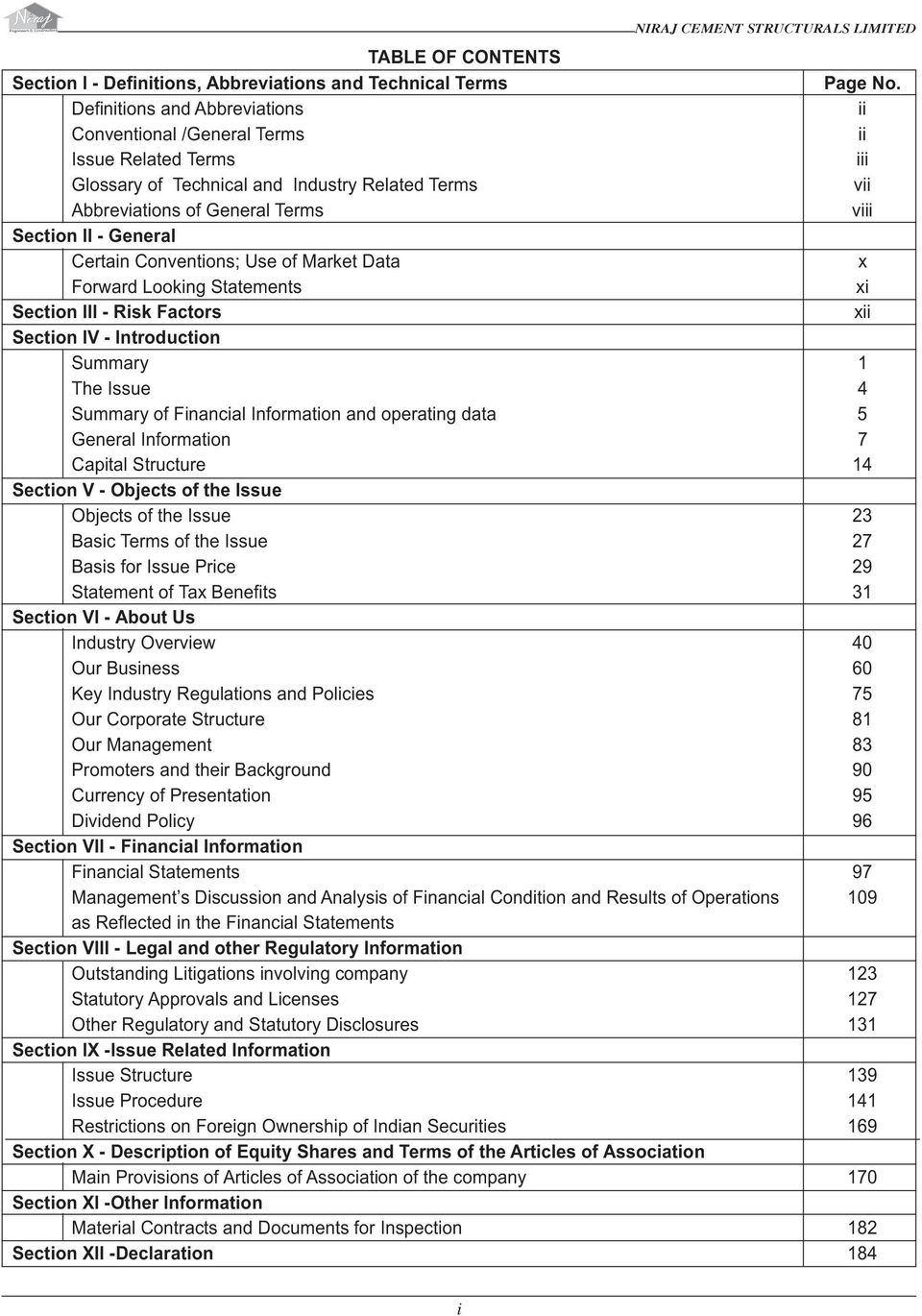
2 TABLE OF CONTENTS Section I - Definitions, Abbreviations and Technical Terms Page No. Definitions and Abbreviations ii Conventional /General Terms ii Issue Related Terms iii Glossary of Technical and Industry Related Terms vii Abbreviations of General Terms viii Section II - General Certain Conventions; Use of Market Data x Forward Looking Statements xi Section III - Risk Factors xii Section IV - Introduction Summary 1 The Issue 4 Summary of Financial Information and operating data 5 General Information 7 Capital Structure 14 Section V - Objects of the Issue Objects of the Issue 23 Basic Terms of the Issue 27 Basis for Issue Price 29 Statement of Tax Benefits 31 Section VI - About Us Industry Overview 40 Our Business 60 Key Industry Regulations and Policies 75 Our Corporate Structure 81 Our Management 83 Promoters and their Background 90 Currency of Presentation 95 Dividend Policy 96 Section VII - Financial Information Financial Statements 97 Management s Discussion and Analysis of Financial Condition and Results of Operations 109 as Reflected in the Financial Statements Section VIII - Legal and other Regulatory Information Outstanding Litigations involving company 123 Statutory Approvals and Licenses 127 Other Regulatory and Statutory Disclosures 131 Section IX -Issue Related Information Issue Structure 139 Issue Procedure 141 Restrictions on Foreign Ownership of Indian Securities 169 Section X - Description of Equity Shares and Terms of the Articles of Association Main Provisions of Articles of Association of the company 170 Section XI -Other Information Material Contracts and Documents for Inspection 182 Section XII -Declaration 184 i
3 ii NIRAJ CEMENT STRUCTURALS LIMITED SECTION I - GENERAL DEFINITIONS, ABBREVIATIONS AND TECHNICAL TERMS Definitions and Abbreviations Term Description NCSL, the Company and our Unless the context otherwise require, refers to Niraj Cement Company, We or us and our Structurals Limited, a Public limited company incorporated under the Companies Act, 1956 having its registered office at Niraj House, Sunder Baug, Opp. Deonar Depot, Chembur, Mumbai Conventional / General Terms Terms Description Articles / Articles of Association Articles of Association of Niraj Cement Structurals Limited Auditors The Statutory Auditors of the Company. i.e. Mr. Ajay B. Garg, Chartered Accountant. Board of Directors / Board The Board of Directors of Niraj Cement Structurals Limited Cement Structurals The company is manufacturing cement Precast articles and elements which are called as Structurals and the company derived its name from the above business. Companies Act The Companies Act, 1956, as amended from time to time Depositories Act The Depositories Act, 1996, as amended from time to time Director(s) Director(s) of Niraj Cement Structurals Limited, unless otherwise specified Equity Shares Equity Shares of the Company of face value of Rs. 10 each unless otherwise specified in the context thereof GDP GIR Number HUF Indian GAAP MOA / Memorandum/ Memorandum of Association Non Residents NRIs/ Non-Resident Indians Order Book Overseas Corporate Body / OCB Gross Domestic Product General Index Registry Number Hindu Undivided Family Generally Accepted Accounting Principles in India Memorandum of Association of Niraj Cement Structurals Limited All eligible bidders, including eligible NRIs, FIIs registered with SEBI and FVCIs registered with SEBI, who are not persons resident in India A person resident outside India, as defined under FEMA and who is a citizen of India or a person of Indian origin, each such term as defined under the Foreign Exchange Management (Transfer or Issue of Security by a Person Resident Outside India) Regulations, 2000, as amended. Unbilled revenue from the uncompleted portions of our existing contracts, i.e., the total contract value of the existing contracts secured by NCSL as reduced by the value of construction work billed until the date of such Order Book. A company, partnership, society or other corporate body owned directly or indirectly to the extent of at least 60% by NRIs including overseas trusts, in which not less than 60% of beneficial interest is irrevocably held by NRIs directly or indirectly as defined under Foreign Exchange Management (Transfer or Issue of Security by a Person Resident Outside India) Regulations, 2000

4 Person or Persons Promoters Promoter group Registered Office SEBI SEBI Act SEBI Guidelines SEBI Takeover Regulations Stock Exchange(s) U.S. GAAP Issue Related Terms Terms Allotment NIRAJ CEMENT STRUCTURALS LIMITED Any individual, sole proprietorship, unincorporated association, unincorporated organization, body corporate, corporation, company, partnership, limited liability company, joint venture, or trust or any other entity or organization validly constituted and/or incorporated in the jurisdiction in which it exists and operates, as the context requires Mr. Vijay K. Chopra and Mr. Gulshan V. Chopra Ms Asha V.Chopra and Ms Pooja G. Chopra Niraj House Sunder Baug, Opp. Deonar Depot, Chembur, Mumbai The Securities and Exchange Board of India constituted under the SEBI Act, 1992 Securities and Exchange Board of India Act, 1992, as amended from time to time SEBI (Disclosure and Investor Protection) Guidelines, 2000 issued by SEBI on January 27, 2000, as amended, including instructions and clarifications issued by SEBI from time to time Securities and Exchange Board of India (Substantial Acquisition of Shares and Takeover) Regulations, 1997, as amended from time to time BSE Generally Accepted Accounting Principles in the United States of America Description Issue of Equity Shares pursuant to the Issue to the successful Bidders as the context requires Allottee The successful bidder to whom the Equity Shares are being / have been issued. Bankers / Escrow Bankers to the Issue Axis Bank Ltd, HDFC Bank Ltd,, Standard Chartered Bank, Yes Bank Ltd Bid An indication to make an offer during the Bidding Period by a prospective investor to subscribe to or purchase our Equity Shares at a price within the Price Band, including all revisions and modifications thereto. An indication to make an offer during the Bidding Period by a prospective investor to subscribe to or purchase our Equity Shares at a price within the Price Band, including all revisions and modifications thereto. Bid Amount The highest value of the optional Bids indicated in the Bid-cum- Application Form and payable by the Bidder on submission of the Bid in the Issue Bid Closing Date/ Issue Closing date The date after which the members of the Syndicate will not accept any Bids for the Issue, which shall be notified in an English National Daily, a Hindi National Daily and Marathi Regional Newspaper, all with wide circulation. iii
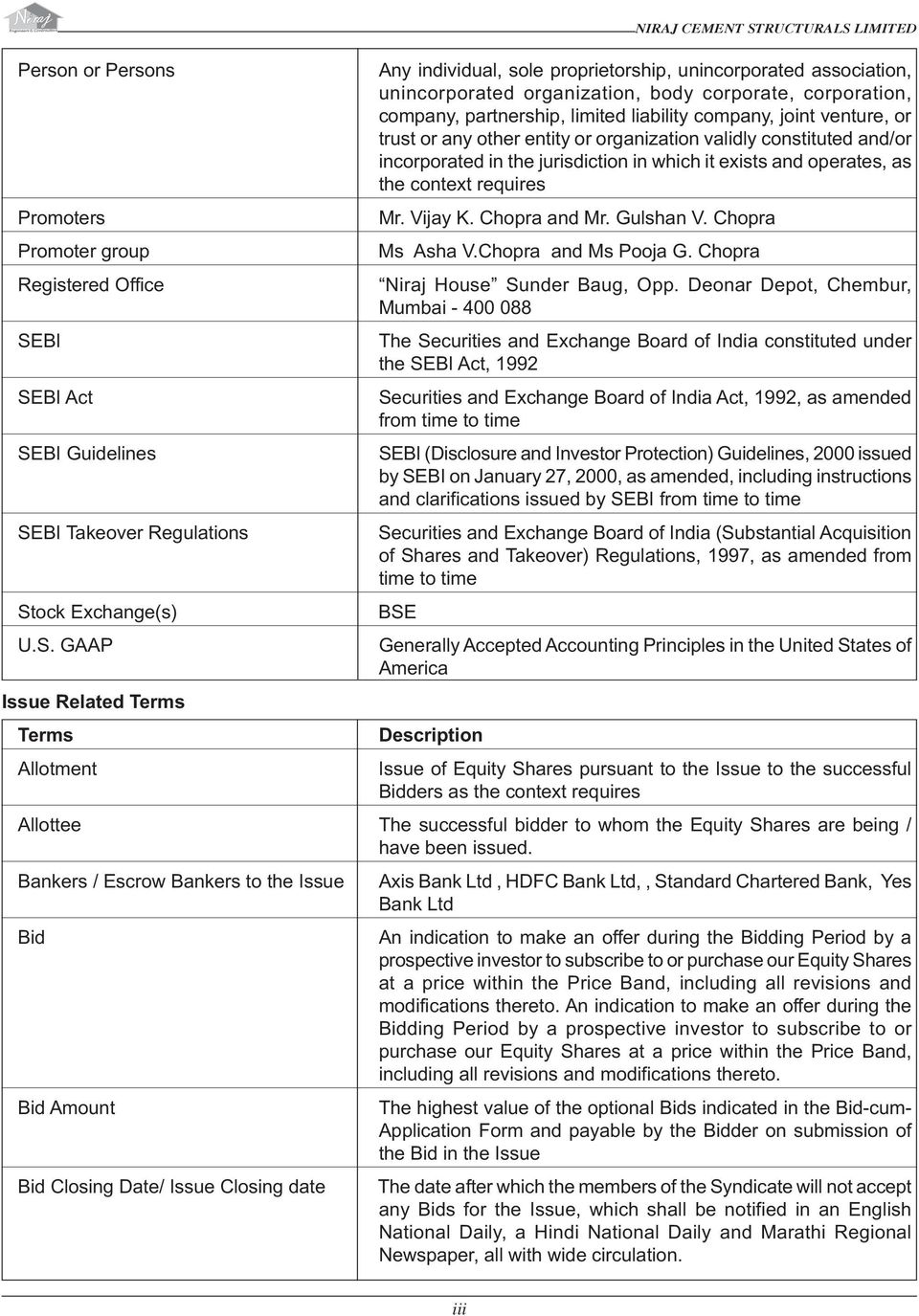
5 Bid cum Application Form/ Bid Form Bid Opening Date/ Issue Opening Date Bidder Bidding Period/ Issue Period Book Building Process BRLM/Book Running Lead Manager BSE CAN/ Confirmation of Allocation Note Cap Price CDSL Cut-off Price Depository Depository Participant Designated Date Designated Stock Exchange Draft Red Herring Prospectus ECS Employee or Eligible Employee (in the context of Employee Reservation Portion) The form in terms of which the Bidder shall make an offer to subscribe the equity shares of the Company in terms of this Prospectus. The date after which the members of the Syndicate shall start accepting Bids for the Issue, which shall be notified in an English National Daily, a Hindi National Daily and Marathi Regional Newspaper, all with wide circulation. Any prospective investor who makes a Bid pursuant to the terms of this Prospectus. The period between the Bid/Issue Opening Date and the Bid/ Issue Closing Date inclusive of both days and during which prospective Bidders may submit their Bids Book Building route as provided under Chapter XI of the SEBI Guidelines, in terms of which the Issue is being made Book Running Lead Manager to the Issue being Allbank Finance Limited Bombay Stock Exchange Limited. The note or advice or intimation of allocation of Equity Shares sent to the Bidders who have been allocated Equity Shares in the Book Building Process The higher end of the Price Band, above which Issue Price will not be finalized and above which no Bids will be accepted The Central Depository Services (India) Limited. The Issue Price finalized by the Company in consultation with the BRLM. A Bid submitted at Cut-off Price is a valid Bid at all price levels within the Price Band A depository registered with SEBI under the SEBI (Depositories and Participant) Regulations, 1996 as amended from time to time A depository participant as defined under the Depositories Act The date on which funds are transferred from the Escrow Account to the Public Issue Account after the Prospectus is filed with the RoC, following which the Board of Directors shall allot the Equity Shares to successful Bidders Bombay Stock Exchange Limited This Draft Red Herring Prospectus filed with SEBI, which does not have complete particulars on the price at which the Equity Shares are offered and size of the Issue Electronic Clearing System. Subject to the next paragraph, all or any of the following: (a) A permanent employee of the Company; (b) A Director of the Company, whether a whole time Director, part time Director or otherwise; or An Employee or Eligible Employee, as used in the context of the Employee Reservation Portion, means an Indian National (as defined herein) that is a person resident in India (as defined under FEMA), and excludes any Promoter or member of the Promoter Group. The Eligible Employee should be on the payroll of the Company on the date of filing the Prospectus with the RoC. Employee(s) or Eligible Employee(s) may also be referred to as Bidder(s) in the Employee Reservation Portion in this Prospectus. iv
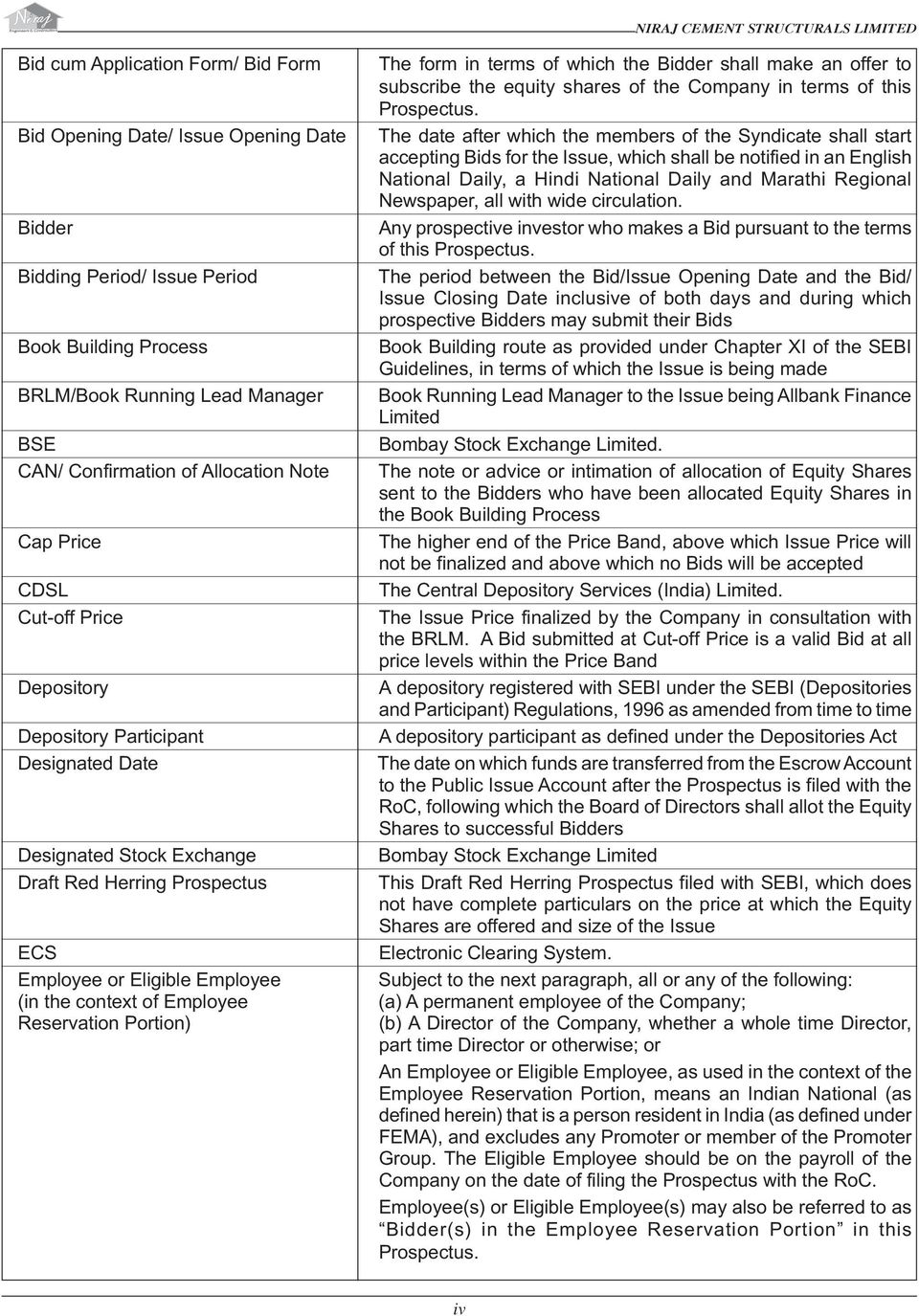
6 Employee Reservation portion Escrow Account Escrow Agreement Escrow Collection Bank(s) FEMA FII Financial Year/Fiscal year /FY First Bidder Floor Price Indian GAAP Issue Price Issue Account / Public Issue Account Issue Period Margin Amount Members of the Syndicate Mutual funds Mutual Fund portion MICR Net Issue Non-Institutional Portion Non-Institutional Bidders The portion of the Issue being up to 325,000 Equity Shares available for allocation to the Employees. Account opened with the Escrow Collection Bank(s) and in whose favour the Bidder will issue cheques or drafts in respect of the Bid Amount when submitting a Bid Agreement entered into amongst the Company, Syndicate Members, the Registrar, the Escrow Collection Bank(s) and the BRLM for collection of the Bid Amounts and for remitting refunds (if any) of the amounts collected to the Bidders The banks which are clearing members and registered with SEBI as Bankers to the Issue at which bank(s) the Escrow Account of the Company will be opened The Foreign Exchange Management Act, 1999, as amended Foreign Institutional Investors, as defined under the Securities and Exchange Board of India (Foreign Institutional Investors) Regulations, 1995, as amended and registered with SEBI. A period of twelve months ended March 31 of that particular year, unless otherwise stated. The Bidder whose name appears first in the bid cum application form or revision form The price advertised by the Company prior to the Bid/Issue Opening Date, below which the Issue Price will not be finalized and below which no Bids will be accepted Generally accepted accounting principles in India. The final price at which the Equity Shares will be allotted in terms of the Prospectus, as determined by the Company in consultation with BRLM on the Pricing Date Account opened with the Bankers to the Issue to receive monies from the Escrow Account for the Issue on the Designated Date The period between the Bid / Issue Opening Date and Bid / Issue Closing Date including both these dates The amount paid by the Bidder at the time of submission of the Bid, being 10% to 100% of the Bid Amount. The BRLM and the Syndicate Members Mutual funds registered with SEBI under the Securities and Exchange Board of India (Mutual Funds) Regulations, 1996, as amended. 5% of QIB portion or 73,125 Equity shares available to allocation to Mutual Funds only, out of QIB portion. Magnetic Ink Character Recognition. The Issue less the Equity Shares included in the Employee Reservation portion The portion of this Issue being at least 15% of the Net Issue Size consisting of 4,38,750 Equity Shares of Rs. 10 each aggregating Rs lakhs, available for allocation to Non Institutional Bidders. All Bidders that are not eligible Qualified Institutional Buyers for this Issue, including affiliates of BRLM and Syndicate Members, or Retail Individual Bidders and who have bid for an amount more than Rs. 100,000. v

7 NSDL NSE Pay-in-Date Pay-in-Period Price Band Pricing Date Prospectus Public Issue/ Issue Public Issue Account QIB / Qualified Institutional Buyers QIB Portion Red Herring Prospectus or RHP The National Securities Depository Limited. The National Stock Exchange of India Limited Bid Closing Date or the last date specified in the CAN sent to Bidders, as applicable Means: i) With respect to Bidders whose Margin Amount is 100% of the Bid Amount, the period commencing on the Bid/ Issue Opening Date and extending until the Bid/Issue Closing Date; and ii) With respect to QIBs, whose Margin Amount is 10% of the Bid Amount, the period commencing on the Bid/Issue Opening Date and extending until the closure of the Payin Date. Being the price band of a minimum price of Rs.175] per Equity Share (Floor Price) and the maximum price of Rs. 190 per Equity Share (Cap Price) (both inclusive), and including revision thereof. Means the date on which the Company, in consultation with the BRLM, finalizes the Issue Price The Prospectus, filed with the RoC containing, inter alia, the Issue Price that is determined at the end of the Book Building Process, the size of the Issue and certain other information Initial public offering of 32, 50,000 equity shares of Rs. 10/- each at a price of Rs. 190/- for cash aggregating to Rs lakhs (hereinafter referred to as the Net Issue ) and a reservation for eligible employees of 3, 25,000 equity shares of Rs. 10/- each at the Issue Price. The issue would constitute % of the fully diluted post issue paid up equity capital of the company. Account opened with Bankers to the Issue for the purpose of transfer of monies from the Escrow Account on or after the Bid / Issue Opening Date As defined under the SEBI Guidelines and includes public financial institutions as defined in Section 4A of the Companies Act, FIIs, scheduled commercial banks, mutual funds, multilateral and bilateral development financial institutions, VCFs, state industrial development corporations, insurance companies registered with the Insurance Regulatory and Development Authority, provident funds with a minimum corpus of Rs. 25 crore and pension funds with a minimum corpus of Rs. 25 crore. Consists of 14, 62,500 Equity Shares of Rs. 10 each aggregating at a price of Rs.190/- for cash aggregating Rs lakhs being at least 50% of the Net Issue, available for allocation to QIBs. 5% of the QIB Portion shall be available for allocation on a proportionate basis to Mutual Funds only. Means the document issued in accordance with Section 60B of the Companies Act and does not have complete particulars on the price at which the Equity Shares are offered and the size of the Issue. It carries the same obligations as are applicable in case of a Prospectus and will be filed with RoC at least three days before the Bid/ Issue Opening Date. It will become a Prospectus after filing with RoC after the pricing and allotment. vi

8 Registrar/Registrar to the Issue Refund Banker RoC / Registrar of Companies Retail Portion Retail Individual Bidders Revision Form RTGS Syndicate Agreement Syndicate Members TRS or Transaction Registration Slip NIRAJ CEMENT STRUCTURALS LIMITED Registrar to the Issue being Intime Spectrum Registry Limited. The Refund Banker in this Issue being Axis Bank Limited Registrar of Companies, Maharashtra situated at 100, Everest, Marine Lines Mumbai Consists of 10, 23,750 Equity shares of Rs.10 each aggregating Rs lakhs, being at least 35% of the Net Issue, available for allocation to Retail Individual Bidder(s). Individual Bidders (including HUFs and NRIs) who have made their bid for Equity Shares for a cumulative amount of not more than Rs. 100,000. The form used by the Bidders to modify the quantity of Equity Shares or the Bid Price in any of the Bid options as per their Bidcum-Application Form and as modified by their subsequent Revision Form(s), if any. Real Time Gross Settlement. Agreement to be entered into amongst the BRLM, Syndicate Member(s) and the Company in relation to the collection of Bids in the Issue Intermediaries registered with SEBI and eligible to act as underwriters. Syndicate Members are appointed by the BRLM and in this case, being Aryaman Financial Services Limited The slip or document registering the Bids, issued by the Syndicate Members to the Bidder as proof of registration of the Bid on submission of the Bid cum Application Form in terms of this Prospectus Underwriters The BRLM and the Syndicate Members Underwriting Agreement The agreement dated June 02, 2008 among the members of the Syndicate, the BRLM to the Issue and our Company. VCF/Venture Capital Fund Foreign Venture Capital Funds (as defined under the Securities and Exchange Board of India (Venture Capital Funds) Regulations, 1996) registered with SEBI under applicable laws in India. Glossary of Technical and Industry Terms BOQ Bill of Quantities BOT Build Operate Transfer BOOT Build Own Operate Transfer CACG CRISINFAC DRE EMD EPC FRL Compounded Annual Growth Rate CRIS INFAC Industry Information Service, a brand of CRISIL Research & Information Services Limited Dispute Review Expert Earnest Money Deposit Engineering, Procurement and Construction. Finished Road Level vii
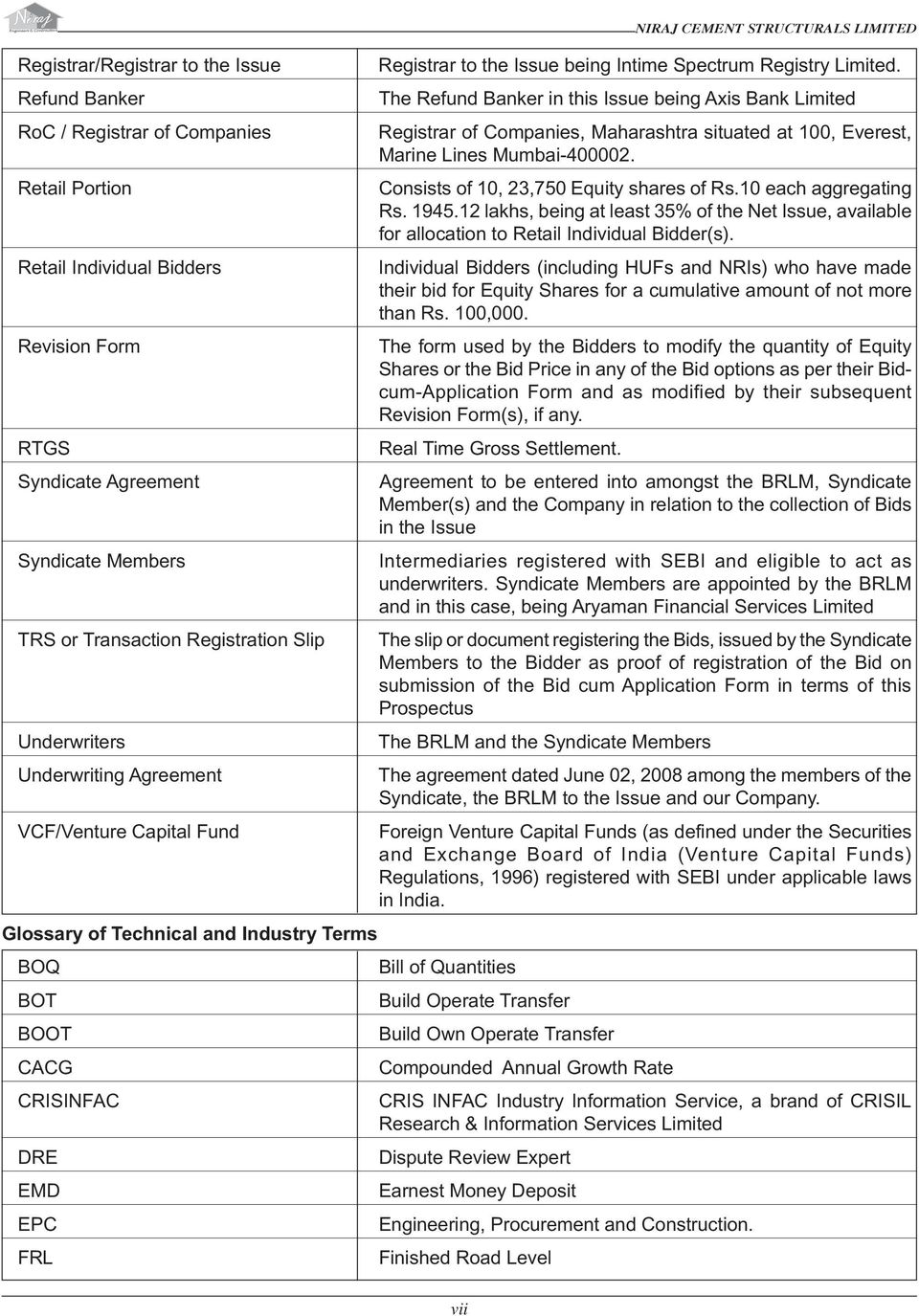
9 IN SITU MoRTH NRRDA NHAI NHDP NOC PMGSY R & D RCC Abbreviations of General Terms Abbreviation AS A/c BSE CDSL EPS EGM FCNR Account FIPB FY / Fiscal/Financial Year FEMA FIIs GoI GIR Number HUF I.T. Act MoF MOU NAV NPV NRIs NRE Account In place Ministry of Road, Transport and Highways The National Rural Roads Development Agency National Highways Authority of India National Highways Development Project No Objection Certificate The Pradhan Mantri Gram Sadak Yojana Research and Development Reinforced Concrete Cement Full Form Accounting Standards as issued by the Institute of Chartered Accountants of India Account Bombay Stock Exchange Limited Central Depository Services (India) Limited Earning Per Share Extraordinary General Meeting Foreign Currency Non Resident Account Foreign Investment Promotion Board Period of twelve months ended March 31 of that particular year, unless otherwise stated Foreign Exchange Management Act, 1999, as amended from time to time, and the regulations framed there under Foreign Institutional Investors (as defined under FEMA (Transfer or Offer of Security by a Person Resident outside India) Regulations, 2000) registered with SEBI under applicable laws in India Government of India General Index Registry Number Hindu Undivided Family Income Tax Act, 1961, as amended from time to time Ministry of Finance, Government of India Memorandum of Understanding Net Asset Value Net Present Value Non Resident Indians Non Resident External Account viii

10 NRO Account NSE NSDL P. A. Per Annum P/E Ratio PAN PAT RBI RoC ROE RONW Rs. SCRR SCRA Sec. US USD/ US$/ $ Non Resident Ordinary Account The National Stock Exchange of India Limited National Securities Depository Limited Price/Earnings Ratio Permanent Account Number Profit After Tax The Reserve Bank of India Registrar of Companies, Mumbai, Maharashtra Return on Equity Return on Net Worth NIRAJ CEMENT STRUCTURALS LIMITED Rupees Securities Contracts (Regulation) Rules, 1957, as amended from time to time Securities Contract (Regulation) Act, 1956, as amended from time to time Section United States of America United States Dollar ix

11 SECTION II - GENERAL CERTAIN CONVENTIONS; USE OF MARKET DATA In this Prospectus, all references to India are to the Republic of India, all references to Rupees Rs. are to the legal currency of India, all references to U.S. Dollars, and US$ are to the legal currency of the United States of America. References to the singular also refers to the plural and one gender also refers to any other gender, wherever applicable, and the words Lakh or Lac means 100 thousand and the word million or mn means 10 lakh and the word crore means 10 million or 100 lakhs and the word billion means 1,000 million or 100 crores. Throughout this Prospectus, all figures have been expressed in Lakhs unless otherwise stated. Any percentage amounts, as set forth in Risk Factors, Business, Management s Discussion and Analysis of Financial Condition and Results of Operations and elsewhere in this Prospectus, unless otherwise indicated, have been calculated on the basis of the financial statements prepared in accordance with Indian GAAP and wherever not covered are declared by the company. In this Prospectus, any discrepancies in any table between total and the sums of the amount listed are due to rounding off Unless stated otherwise, the financial data in the Prospectus is derived from our financial statements prepared and restated in accordance with Indian GAAP, the Companies Act and SEBI Guidelines included elsewhere in the Prospectus. We have no subsidiaries. Accordingly, financial information relating to us is presented on a non-consolidated basis. Our fiscal year commences on April 1 and ends on March 31. There are significant differences between Indian GAAP and U.S. GAAP; accordingly, the degree to which the Indian GAAP financial statements included in the Prospectus will provide meaningful information is entirely dependent on the reader s level of familiarity with Indian accounting practices. Any reliance by persons not familiar with Indian accounting practices on the financial disclosures presented in the Prospectus should accordingly be limited. We have not attempted to explain those differences or quantify their impact on the financial data included herein, and we urge you to consult your own advisors regarding such differences and their impact on our financial data. For additional definitions, see the section titled Definitions and Abbreviations on page ii of the Prospectus. In the section titled Main Provisions of Articles of Association of the Company beginning on 174 of the Prospectus, defined terms have the meaning given to such terms in the Articles of Association of the Company. Use of Market Data Unless stated otherwise, macroeconomic, industry and market data used throughout the Prospectus has been obtained from industry publications and Company representations. Industry publications generally state that the information contained in those publications has been obtained from sources believed to be reliable but that their accuracy and completeness are not guaranteed and their reliability cannot be assured. Although the Company believes market data used in this Prospectus is reliable, it has not been independently verified. Similarly, Company representations, while believed by the Company to be reliable, have not been verified by any independent source. x

12 FORWARD LOOKING STATEMENTS This Prospectus contains certain forward-looking statements. These forward looking statements can generally be identified by words or phrases such as expect, estimate, contemplate anticipate, intend, may, shall, will, should, plan, project, aim, believe will likely result, will continue, will pursue seek to, goal, objective, future, or other words or phrases of similar import. Similarly, statements that describe our objectives, strategy, plans or goals are also forward-looking statements. All forward looking statements are subject to risks, uncertainties and assumptions about the Company that could cause actual results to differ materially from those contemplated by the relevant forward-looking statement. Important factors that could cause actual results to differ materially from the expectations include, among others: General economic and business conditions; Our ability to successfully implement our strategy, our growth and expansion plans and technological changes; Increasing competition in and the conditions of our customers and the infrastructure and construction industry; Increases in labour costs, raw materials prices, freight rates, prices of plant & machineries and insurance premia; Manufacturers defects or mechanical problems with our plant & machineries; Changes in the value of the Indian rupee and other currencies; Cyclical or seasonal fluctuations in the operating results due to prevailing market conditions; Amount that we are able to realize from clients; Changes in laws and regulations that apply to our customers and the infrastructure and construction industry; Allocation of funds by the government or government controlled authorities; Changes in fiscal, economic or political conditions in India; Social or civil unrest or hostilities with neighbouring countries or acts of international terrorism; Changes in the foreign exchange control regulations, interest rates and tax laws in India. For further discussion of factors that could cause Company s actual results to differ, please see the section entitled Risk Factors included in this Prospectus. In the light of inherent risks and uncertainties, the forward looking statements, events and circumstances discussed in this Prospectus might not occur and are not guarantees of future performance. By their nature, certain market risk disclosures are only estimates and could be materially different from what actually occurs in the future. As a result, actual future gains or losses could materially differ from those that have been estimated. Neither the Company, its Directors and Officers, any member of the Issue Management Team nor any of their respective affiliates has any obligation to update or otherwise revise any statements reflecting circumstances arising after the date hereof or to reflect the occurrence of underlying events, even if the underlying assumptions do not come to fruition. In accordance with SEBI requirements, for purposes of the Issue, the Company and the Book Running Lead Manager to the Issue will ensure that investors in India are informed of material developments relating to the business until such time as the grant of listing and trading permission by the Stock Exchanges. xi

13 SECTION III - RISK FACTORS An investment in equity involves a higher degree of risk. You should carefully consider all the information in this Prospectus, including the risks and uncertainties described below, before making an investment in our equity shares. Any of the following risks as well as other risks and uncertainties discussed in this Prospectus could have a material adverse affect on our business, financial condition and results of operations and could cause the trading price of our Equity Shares to decline, which could result in the loss of all or part of your investment. Unless specified or quantified in the relevant risk factors below, we are not in a position to quantify the financial implication or other of any of the risks described in this section. The risks have been determined on the basis of their materiality, the following factors have been considered for determining the materiality: a. Some events may not be material individually but may be found materially collectively; b. Some events may have material impact qualitatively instead of quantitatively; c. Some events may not be material at present but may have material impacts in future. INTERNAL RISK FACTORS: 1. Criminal proceeding pending against our Directors which if determined against them could adversely affect our business i. Bombay JCB Earth Movers (JCBEM) had rented out two of its excavating machines to Niraj Cement Structurals Ltd and we had executed a rental agreement on We had submitted 11 Post dated cheques for an aggregate amount of Rs lakhs as a security for the transaction. There is a dispute regarding performance of the machinery during the contractual period However, the party had claimed payment for full period of contractual utilization of the machines instead of their actual utilization. Thus there is a dispute between the company and the firm. In the meantime JCBEM presented the post dated cheques which were offered as security for payment even after making an aggregate payment of Rs lakhs. On presentation the cheques were dishonored by us as the payment of this amount was not due by us to JCBEM as per the terms of the contract. The firm issued a notice to on us August 9, 2005 under sec 138 of NI act. and a criminal complaint was filed against the company as well as the Managing Director of the company (no of 2005) in the Court of Judicial Magistrate First Class, Vashi at CBD, Navi Mumbai. The matter was posted for hearing on November 20, 2006 when the Company was ordered to file an Affidavit in reply and the matter has been adjourned to July 23, ii. The company had borrowed from Mr Jugal Kishore Gupta, Mrs Uma J. Gupta and Ms Reema J. Gupta a sum aggregating to Rs lakhs on various dates as unsecured loans and we have given them Post dated cheques. Mr Jugal Kishore Gupta, Mrs Uma J. Gupta and Ms Reema J. Gupta have presented the cheques for payment which were dishonoured. The lenders has filed 4 cases against the company for recovery of money in the court of Judicial Magistrate First Class Cantt, Pune. The matter is posted for hearing on 30th June, There are certain legal proceedings that have been initiated against us in connection with our Business. which if determined against us could adversely affect our business: The table below summarises the outstanding litigations, disputes as of April 30, 2008 We cannot assure you that these legal proceedings and disputes will be decided in our favour. Any adverse decision may have a significant effect on our business and results of operations. xii
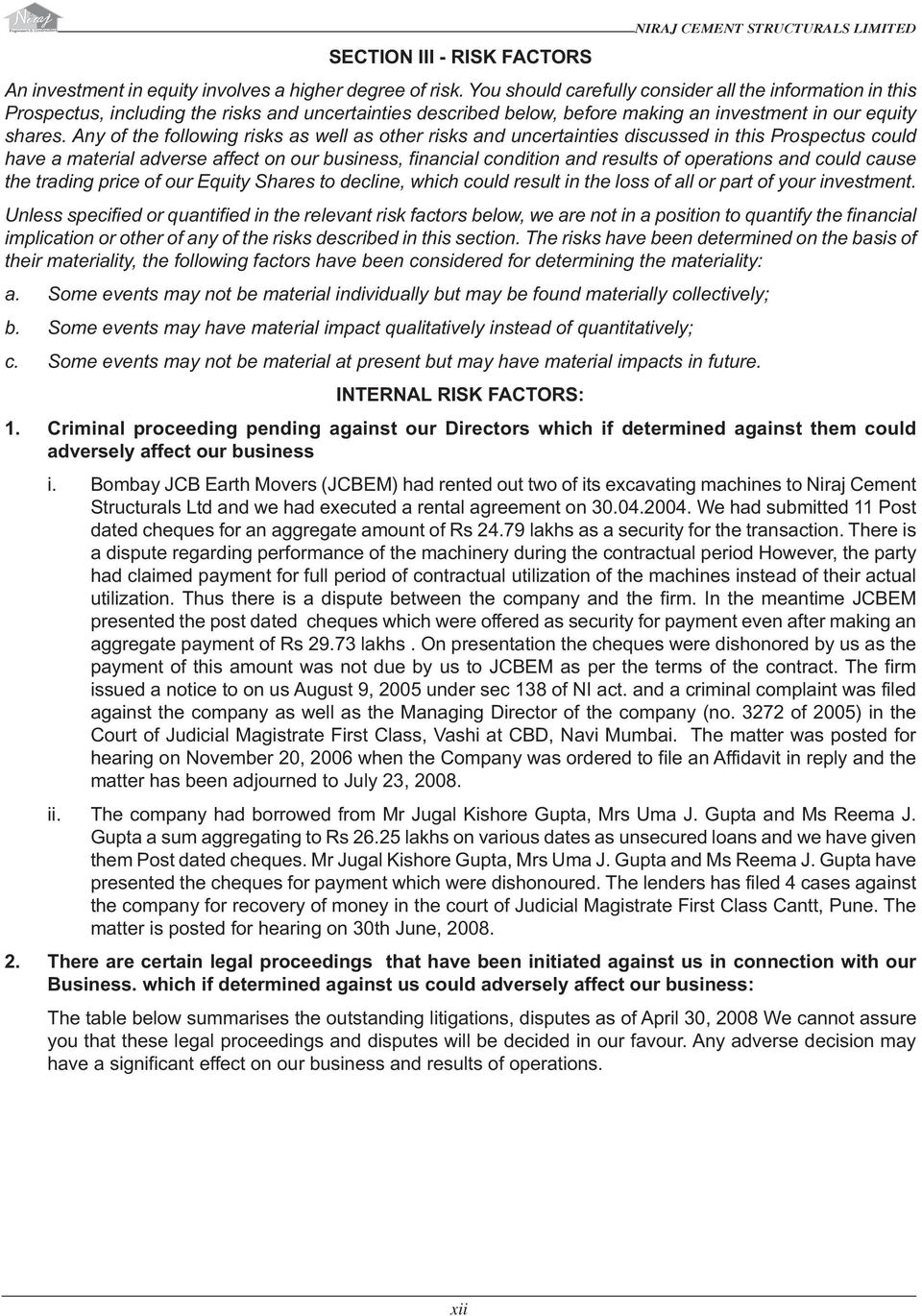
14 Cases/Notices Particulars of the cases No. of Amount cases involved where quantifiable (Rs. Lakhs) Cases filed against the 1) Indian Infrastructure Equipment Ltd Company Case filed under section 433 & 434 now disposed and referred to Arbitration 2) Bombay JCB Case filed under section 138 of Negotiable Instrument Act Jugal Kishore Gupta and others Cases filed by the Deepak Menghnani Contracts Company Private Limited Cases against Group Jugal Kishore Gupta and others Companies Cases filed by Group Nil Nil Nil Companies Notices against the Swiss Consultancy under section Company Notices against Group nil nil Company Disputed payment by the 1. M/s. Deepak Menghnani Nil Not Company Quantified 2. Mr. Shamsher Singh of Vijay Construction For further information, please refer Outstanding Litigations and Material Developments on page no.123 of this Prospectus. 3. M/s Deepak Menghnani Contracts Pvt Ltd ( DMCPL) a sub contractor in our LBS MARG, Mumbai Road Contract has issued a notice against the company for recovery of dues and winding up on Sept 13,2007 under section 560 of the Companies Act, DMCPL has claimed a total payment of Rs lakhs based on the full work of contract. No legal proceedings have been initiated. Our company refuted the claim and had approved an amount of Rs lakhs work. Our company has filed a counter case in High court, Mumbai for recovery of Rs lakhs excess amount paid to DMCPL which is registered as suit no 2885 of The suit is pending. 4. Our funding requirements and deployment schedule for purchase of machinery and working capital requirements are based on management estimates and have not been independently appraised. The funding requirements for capital expenditure, working capital requirements and General Corporate expenditure have not been appraised by any Bank/Financial Institution /third party and all amounts mentioned in the objects of the issue are based on our own estimates. These are based on current conditions and are subject to changes in external circumstances or costs, or in other financial condition. We may have to revise our management estimates from time to time and consequently our funding requirements may also change. This may result in the increase or decrease in the proposed expenditure which may adversely impact our results of operations. Our estimates for capital investments have been based on various quotations received by us from suppliers. 5. We have not entered into any definitive agreements to utilise the net proceeds of the Issue Any failure to enter into arrangements on favourable terms and conditions may have an adverse affect on our business and financial results. xiii
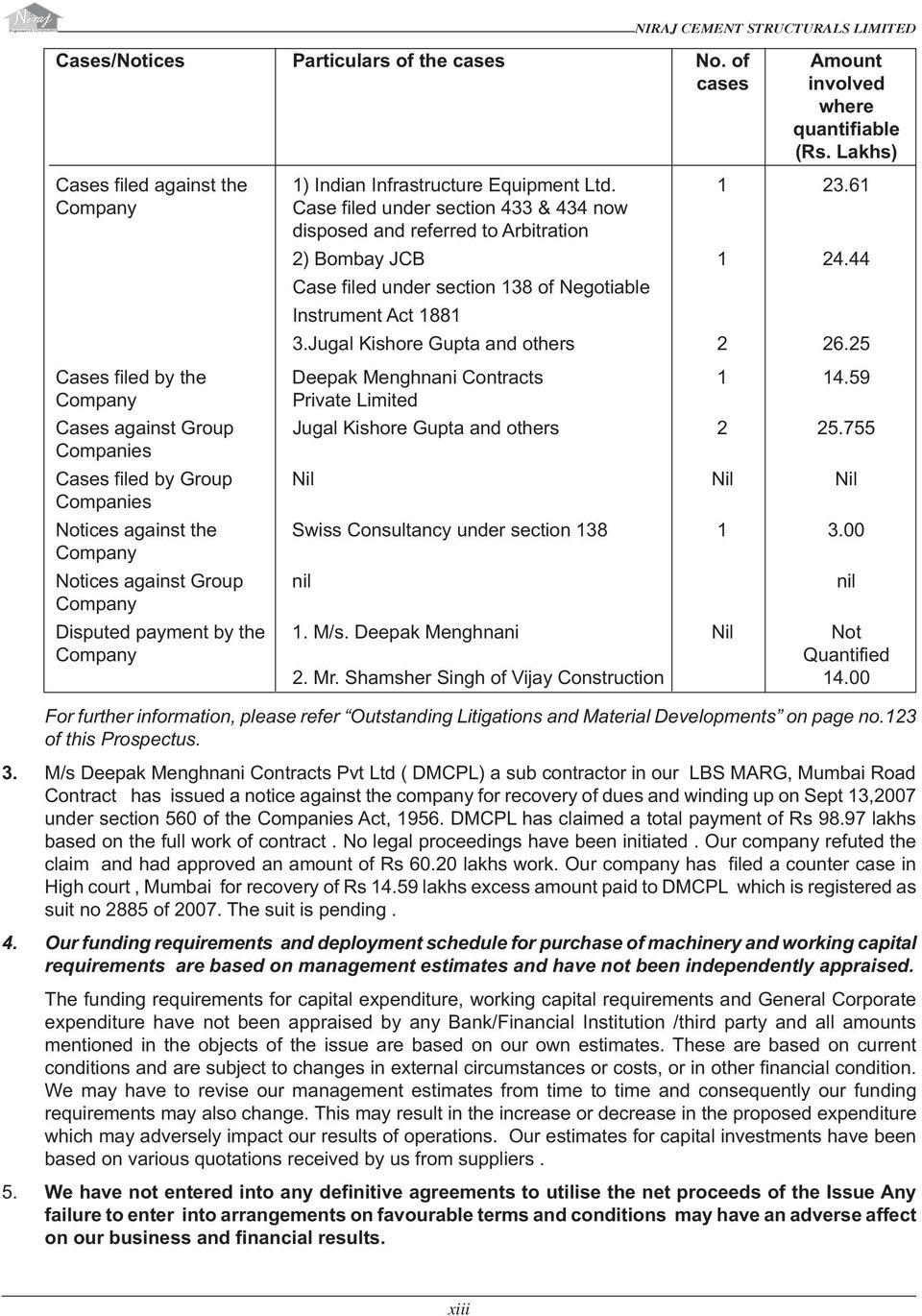
15 xiv NIRAJ CEMENT STRUCTURALS LIMITED We intend to use the net proceeds of the Issue for purchase of machinery, for meeting working capital needs of the company and for general corporate purposes. As described in the section Objects of the Issue on 25. We have not entered into any definitive agreements to utilise the proceeds of the Issue.Any delay in placing the orders for procurement of plant and machinery may delay implementation schedule. Such delays may also lead to increase in prices of these equipments further affecting the total cost. There can be no assurance that the Company will be able to conclude definitive agreements for such proposed use of the net proceeds of the Issue on terms commercially acceptable to us.. our long term working capital requirements may exceed the estimations which may require us to reschedule our project expenditure and may have an adverse impact on our business, financial condition and results of operations. We have also not formed any special purpose vehicles or joint ventures or identified any BOT / BOOT project(s). There can be no assurance that we will be able to identify special purpose vehicle or joint ventures in which we wish to or are able to invest. The Company s management will have significant flexibility in applying the net proceeds received by us from the Issue. 6. We had defaulted on payment of interest and repayment of loan to a few Banks / financial institutions. We had availed Finance for purchase of equipment from Kotak Mahindra Bank and HDFC Bank Ltd, ICICI Bank Ltd, SREI Infrastructure Finance ltd and Ashok Leyland Finance Ltd Due to temporary mismatches in the cash flows we could not honor the original repayment schedules of these institutions. As a result the overdue installments with these institutions were Rs 85 Lakhs as on and Rs 389 Lakhs as on Considering the genuine problems faced by the company the institutions have agreed to revise the repayment terms. The overdues of Kotak Mahindra Ltd,and HDFC Bank Ltd have been repaid in full by We are repaying the other loans as per the mutually agreed terms. The outstanding loans of these Institutions/Banks are as under. Amount in Rs lakhs Nature of Type of Loan Sanctioned Outstanding Borrowing Amount amount as on 31st March 2008 ICICI Bank Hire purchase equipment finance SREI Infrastructure Limited Hire purchase equipment finance Ashok Leyland Finance Hire purchase equipment finance 1, (Merged with Indusind Bank) 7. The Company had earlier filed the DRHP with SEBI on April 02,2007 and had withdrawan the same on July 12,2007. The withdrawal was requested as there was a material change in the terms and conditions of offer and refiled the document on August 02, We have withdrawn our application for listing of our Equity Shares on the NSE which may affect the post issue tradability of our shares We had filed applications for grant of in-principal approval for listing of our Equity Shares on the BSE and NSE under our letter dated April, 02, However, to hasten the IPO Process we withdrew our application for listing on NSE under our letter dated May,29,2007 and we cannot assure you that our inability to list our Equity Shares on the NSE will not have an adverse affect on our liquidity, tradability or marketability of our Equity Shares. 9. The Issue has been graded by CARE and has been assigned the CARE IPO GRADE 1 [Grade One] indicating poor fundamentals through their letter dated April 27,2007 and revalidated vide their letter dated April 02,2008. A CARE IPO grade represents CARE s overall assessment of the fundamentals of the issue concerned in relation to other listed equity securities in India. The IPO grading are assigned on a five point scale from 1 to 5, with IPO Grade 5 indicating strong fundamentals and IPO Grade 1 indicating poor fundamentals.care s IPO Grading does not take cognizance of the price of the security and it is not a recommendation to buy, sell or hold shares/securities.

16 10. M/S Deepak Menghnani Contracts Pvt Ltd, a sub contractor in their letter dated December 18,2007 had alleged that Sri G.R. Kamath, one of the Directors of our Company as paid Director of our company. Mr G.R.Kamath is an Independent Non Executive Director of our Company but not a Paid Director 11. As part of our business we have entered into sub contracting arrangement for some of the ongoing project works. Our receivables from these projects are dependent upon the relationship between the principal contractor and project owner and which in turn will affect our working capital requirements and financials of the company. Generally, one of the terms of sub-contract is that the principal contractor will make payment to the sub contractor only on receipt of payments from the project owner. The payment of the full contracted amount to the principal contractor by the project owner is dependant on their relationship with each other in addition to fulfilment of the terms and conditions of the contract.if their relations are cordial the release of funds based on the progress of work and as per the milestones defined in their contract agreement shall be smooth.thus receivables of sub contractors from such contracts are dependent on the relationship between them, exposing the sub contractors to risk of realisation of receivables. In the past, the principal contractor viz. L&T Limited had a dispute with the project owner viz. NHAI and the payment terms of subcontracting were dependent on L&T receiving the payment from NHAI. We cannot assure you that these receivables will be fully or partly recovered from our main contractors. In that scenario, our business and financial operations could be adversely affected. 12. Delays associated with the collection of receivables from our clients may adversely affect our business and results of our operations. There may be delays associated with the collection of receivables from our clients, including government owned, controlled or funded entities and related parties. Significant proportion of our sales is on credit, which always carries a business risk of any receivable turning bad. The details are as under. S.No. Financial Year Gross sales Sundry Debtors Amount In Amount In % Gross Rs lakhs Rs lakhs sales , , , , , , , , , , We have Rs Lakhs as receivables for the year ended on March 31, 2008 that constituted around % of total revenues of Rs Lakhs for the FY Further an amount of Rs. 3, lakhs constituting 33% of sundry debtors and 37% of gross revenue is receivable for a period exceeding 6 months as on March 31, Our operations involve significant working capital requirements and delayed collection of receivables could adversely affect our liquidity and results of operations. In addition, we may be subject to additional regulatory or other scrutiny associated with commercial transactions with government owned, controlled or funded entities..further,the balances are subject to confirmation and reconciliation if any from our debtors. 13. Our business has experienced growth in the past, which we may not be able to sustain in the future. Revenues and profitability are dependent on a number of factors, and may vary significantly from quarter to quarter. Therefore, historical financial results may not be an accurate indicator of future performance. We have experienced high growth in recent years and expect our business to grow significantly as a result of our expanded operations Our revenues have grown from Rs lakhs in FY to Rs lakhs in FY , Rs lakhs in FY , Rs lakhs in FY and Rs lakhs during F.Y at an annual growth of 4.89%, %, 13.31% and 5.14% respectively During there was a net profit of Rs lakhs and subsequently the net profit grew consistently year after year to Rs lakhs during xv

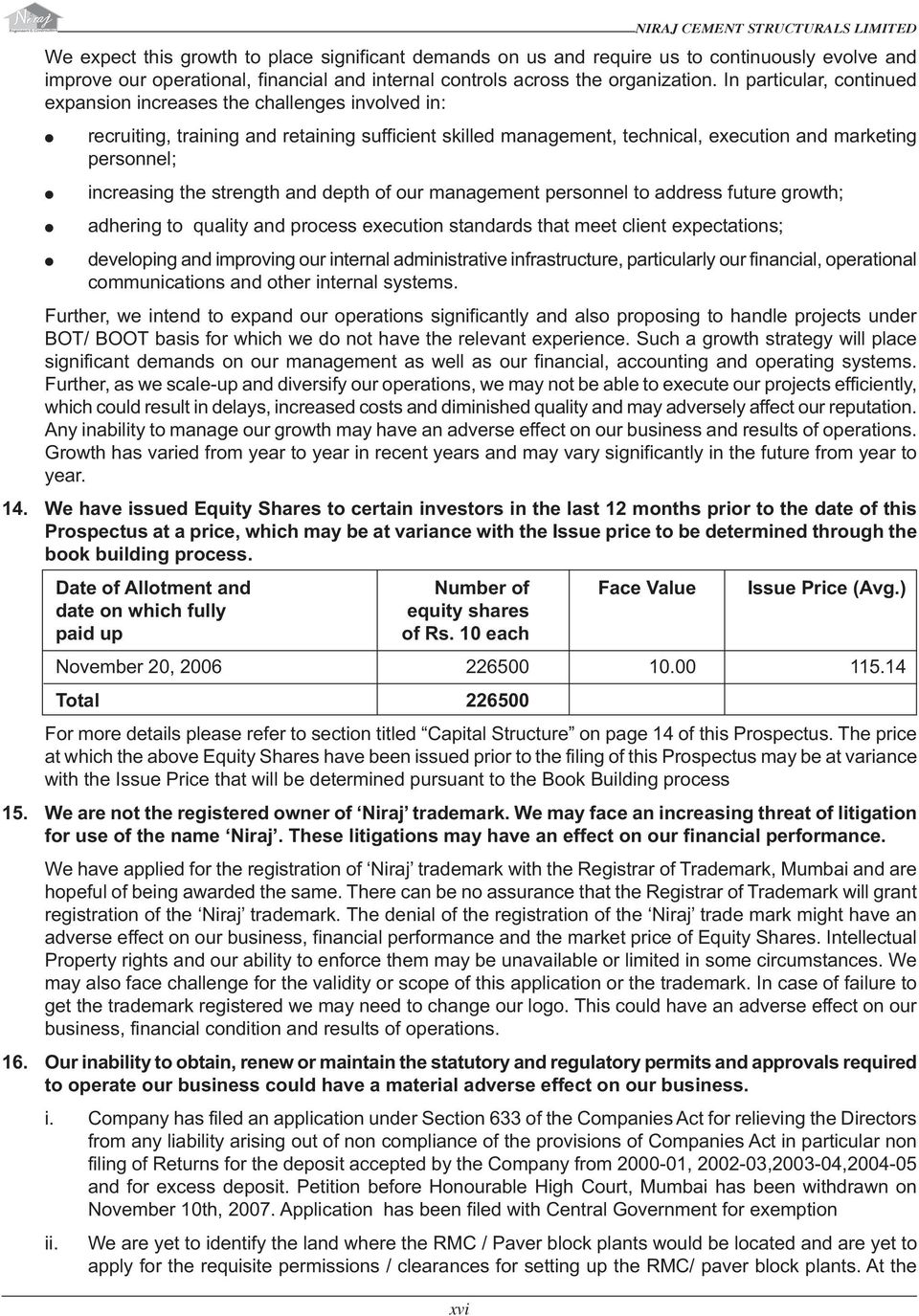
17 xvi NIRAJ CEMENT STRUCTURALS LIMITED We expect this growth to place significant demands on us and require us to continuously evolve and improve our operational, financial and internal controls across the organization. In particular, continued expansion increases the challenges involved in: recruiting, training and retaining sufficient skilled management, technical, execution and marketing personnel; increasing the strength and depth of our management personnel to address future growth; adhering to quality and process execution standards that meet client expectations; developing and improving our internal administrative infrastructure, particularly our financial, operational communications and other internal systems. Further, we intend to expand our operations significantly and also proposing to handle projects under BOT/ BOOT basis for which we do not have the relevant experience. Such a growth strategy will place significant demands on our management as well as our financial, accounting and operating systems. Further, as we scale-up and diversify our operations, we may not be able to execute our projects efficiently, which could result in delays, increased costs and diminished quality and may adversely affect our reputation. Any inability to manage our growth may have an adverse effect on our business and results of operations. Growth has varied from year to year in recent years and may vary significantly in the future from year to year. 14. We have issued Equity Shares to certain investors in the last 12 months prior to the date of this Prospectus at a price, which may be at variance with the Issue price to be determined through the book building process. Date of Allotment and Number of Face Value Issue Price (Avg.) date on which fully equity shares paid up of Rs. 10 each November 20, Total For more details please refer to section titled Capital Structure on page 14 of this Prospectus. The price at which the above Equity Shares have been issued prior to the filing of this Prospectus may be at variance with the Issue Price that will be determined pursuant to the Book Building process 15. We are not the registered owner of Niraj trademark. We may face an increasing threat of litigation for use of the name Niraj. These litigations may have an effect on our financial performance. We have applied for the registration of Niraj trademark with the Registrar of Trademark, Mumbai and are hopeful of being awarded the same. There can be no assurance that the Registrar of Trademark will grant registration of the Niraj trademark. The denial of the registration of the Niraj trade mark might have an adverse effect on our business, financial performance and the market price of Equity Shares. Intellectual Property rights and our ability to enforce them may be unavailable or limited in some circumstances. We may also face challenge for the validity or scope of this application or the trademark. In case of failure to get the trademark registered we may need to change our logo. This could have an adverse effect on our business, financial condition and results of operations. 16. Our inability to obtain, renew or maintain the statutory and regulatory permits and approvals required to operate our business could have a material adverse effect on our business. i. Company has filed an application under Section 633 of the Companies Act for relieving the Directors from any liability arising out of non compliance of the provisions of Companies Act in particular non filing of Returns for the deposit accepted by the Company from , , , and for excess deposit. Petition before Honourable High Court, Mumbai has been withdrawn on November 10th, Application has been filed with Central Government for exemption ii. We are yet to identify the land where the RMC / Paver block plants would be located and are yet to apply for the requisite permissions / clearances for setting up the RMC/ paver block plants. At the
18 xvii NIRAJ CEMENT STRUCTURALS LIMITED time of purchase of these equipment and machinery our company would be approaching the Authorities for approval. Any delay in receiving any of the clearances may affect the benefits that would be derived from the investment. For details of various government approvals, licenses, registrations please refer to section titled Government Approvals / Licensing Arrangements are appearing on page 127. We require certain statutory and regulatory approvals, licences, registrations and permissions, and applications need to be made at the appropriate stages. In our construction business, government delays in obtaining approvals may result in cost increases in the price of construction materials from original estimates which cannot generally be passed on to clients and may also adversely affect our ability to mobilise equipment and labour due to overlapping commitments.there can be no assurance that the relevant authorities will issue these approvals or licences, or renewals thereof in a timely manner, or at all.. As a result, we may not be able to execute our business plan as planned. An inability to obtain or maintain approvals or licences required for our operations may adversely affect our operations. For further information on various approvals or licenses required in connection with our operations, see Government and Other Approvals on page no 127 of this RHP 17. Expansion plans are dependent on Issue proceeds as we are proposing to fund the entire requirements through this issue. The proposed capital expenditure as specified under Objects of the Issue will be entirely funded through the proceeds of the issue. Any delay / failure in pubic issue process may disrupt the implementation of these proposed plans which could have a material adverse effect on our financial condition and results of our operations. 18. Seasonality and weather conditions may adversely affect the business operations and execution of the project. Our business operations may be adversely affected by severe weather, which may require us to evacuate personnel or curtail services and it may result in damage to a portion of our fleet of equipment or facilities resulting in the suspension of operations and may prevent us from delivering materials to our jobsites in accordance with contract schedules or generally reduce our productivity. Our operations are also adversely affected by difficult working conditions like extremely high temperatures during summer months and heavy rainfall during monsoon season which will restrict our ability to carry on construction activities and fully utilize our resources. Further, road construction works are generally not undertaken during monsoon and extreme weather conditions. 19. Majority of our the contracts that we execute, Government or Government owned entities are the project owners and our ability to negotiate standard form government contracts may be limited. Counterparties to most of our infrastructure development and construction contracts are government entities, and we have only a limited ability to negotiate the standard terms of government contracts which means that many terms in the agreement tend to favour the client. For example, it is not always clear whether design review and approval by a client releases us from design and engineering liability, in particular latent defects. There are generally no caps on our liability as a contractor, and it is not always clear whether we can be liable for consequential and/or economic loss to a client. Further, infrastructure contracts awarded by the Government of India and state governments may include provisions which enable the client to terminate the contract without cause following provision of notice. Performance guarantees are also common features of our contracts and are typically unconditional and payable on demand, and can be invoked by the client in accordance with the terms of such contracts. Since the majority of our projects are contracts with the Government of India and state governments or their agencies, we are susceptible to such termination or invocation of performance guarantees which may adversely affect our results of operations and financial condition. Further, any change in the governments focus or the policy framework regarding private sector participation in infrastructure development and/or changes in budgetary allocation may adversely affect the business and results of company s operations. In certain cases, the delay in implementation of budgetary allocations, changes in external budgetary allocation or insufficiency of funds may also result in delay in receipt of payment against running bills account.

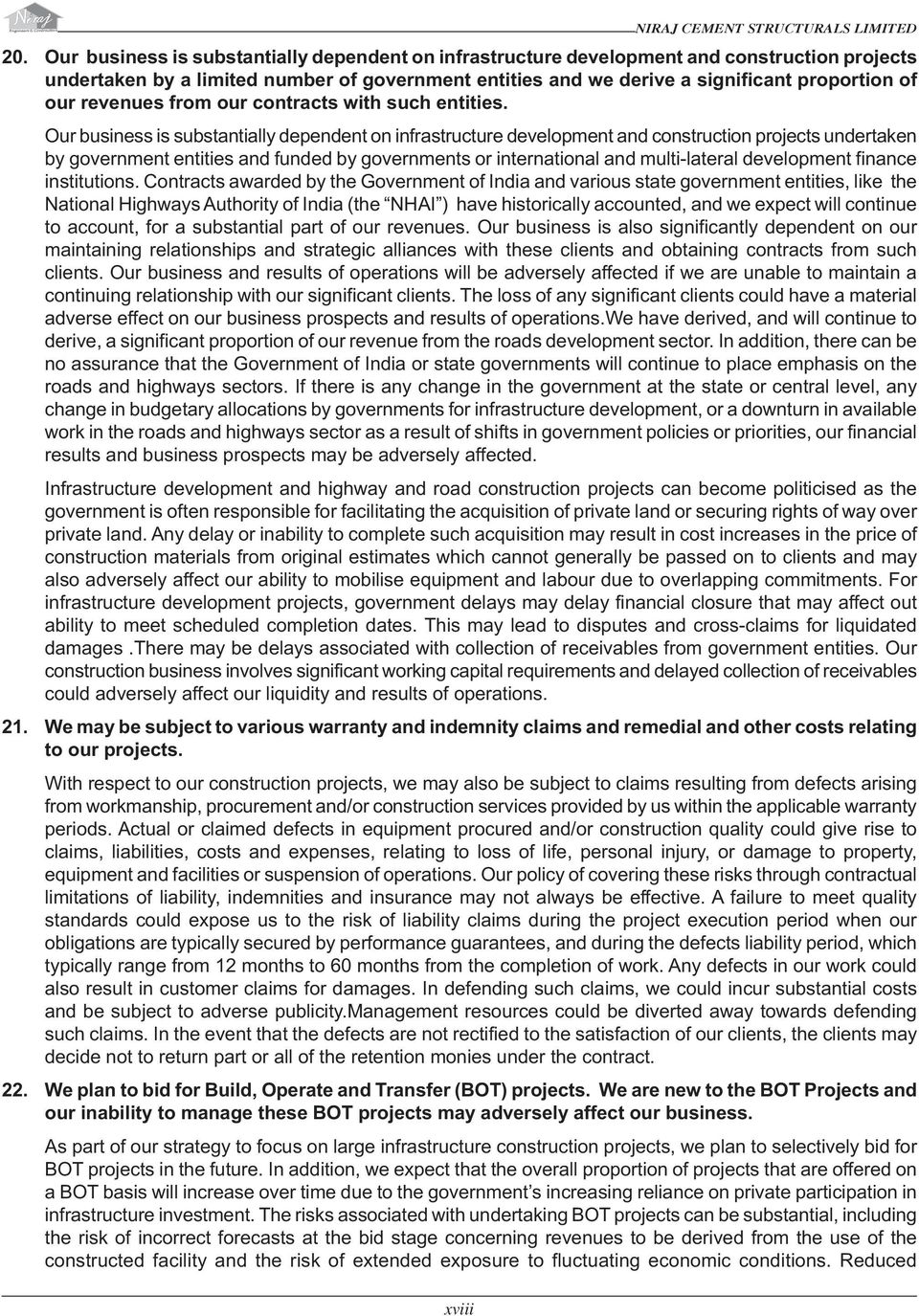
19 20. Our business is substantially dependent on infrastructure development and construction projects undertaken by a limited number of government entities and we derive a significant proportion of our revenues from our contracts with such entities. Our business is substantially dependent on infrastructure development and construction projects undertaken by government entities and funded by governments or international and multi-lateral development finance institutions. Contracts awarded by the Government of India and various state government entities, like the National Highways Authority of India (the NHAI ) have historically accounted, and we expect will continue to account, for a substantial part of our revenues. Our business is also significantly dependent on our maintaining relationships and strategic alliances with these clients and obtaining contracts from such clients. Our business and results of operations will be adversely affected if we are unable to maintain a continuing relationship with our significant clients. The loss of any significant clients could have a material adverse effect on our business prospects and results of operations.we have derived, and will continue to derive, a significant proportion of our revenue from the roads development sector. In addition, there can be no assurance that the Government of India or state governments will continue to place emphasis on the roads and highways sectors. If there is any change in the government at the state or central level, any change in budgetary allocations by governments for infrastructure development, or a downturn in available work in the roads and highways sector as a result of shifts in government policies or priorities, our financial results and business prospects may be adversely affected. Infrastructure development and highway and road construction projects can become politicised as the government is often responsible for facilitating the acquisition of private land or securing rights of way over private land. Any delay or inability to complete such acquisition may result in cost increases in the price of construction materials from original estimates which cannot generally be passed on to clients and may also adversely affect our ability to mobilise equipment and labour due to overlapping commitments. For infrastructure development projects, government delays may delay financial closure that may affect out ability to meet scheduled completion dates. This may lead to disputes and cross-claims for liquidated damages.there may be delays associated with collection of receivables from government entities. Our construction business involves significant working capital requirements and delayed collection of receivables could adversely affect our liquidity and results of operations. 21. We may be subject to various warranty and indemnity claims and remedial and other costs relating to our projects. With respect to our construction projects, we may also be subject to claims resulting from defects arising from workmanship, procurement and/or construction services provided by us within the applicable warranty periods. Actual or claimed defects in equipment procured and/or construction quality could give rise to claims, liabilities, costs and expenses, relating to loss of life, personal injury, or damage to property, equipment and facilities or suspension of operations. Our policy of covering these risks through contractual limitations of liability, indemnities and insurance may not always be effective. A failure to meet quality standards could expose us to the risk of liability claims during the project execution period when our obligations are typically secured by performance guarantees, and during the defects liability period, which typically range from 12 months to 60 months from the completion of work. Any defects in our work could also result in customer claims for damages. In defending such claims, we could incur substantial costs and be subject to adverse publicity.management resources could be diverted away towards defending such claims. In the event that the defects are not rectified to the satisfaction of our clients, the clients may decide not to return part or all of the retention monies under the contract. 22. We plan to bid for Build, Operate and Transfer (BOT) projects. We are new to the BOT Projects and our inability to manage these BOT projects may adversely affect our business. As part of our strategy to focus on large infrastructure construction projects, we plan to selectively bid for BOT projects in the future. In addition, we expect that the overall proportion of projects that are offered on a BOT basis will increase over time due to the government s increasing reliance on private participation in infrastructure investment. The risks associated with undertaking BOT projects can be substantial, including the risk of incorrect forecasts at the bid stage concerning revenues to be derived from the use of the constructed facility and the risk of extended exposure to fluctuating economic conditions. Reduced xviii
20 profitability or losses from BOT projects that do not perform as per our forecast could have a material effect on our results of operations. Additionally, growth in BOT infrastructure projects may require increasing private sector participation. Investment by the private sector in such projects is dependent on the potential returns from such projects and is therefore linked to government policies relating to public-private participation and the sharing of risks and returns from such projects. Any changes in government policies that may lead to a reduction in capital investment in the infrastructure sector by the private sector could have a material adverse impact on our business and our results of operations. Moreover, we have not yet undertaken any BOT projects on our own. Any inability to execute or handle BOT projects may adversely affect our business. Additionally, the government has also not awarded any BOT project since the new model concession agreement was finalized in March 2006 on account of various factors including problems associated with land acquisition. Our ability to be able to enter into BOT projects will also be impacted in the event the government does not settle such issues. 23. Increases in interest rates may materially impact our results of operations. As construction business is capital intensive, we are exposed to interest rate risk. Interest rates for borrowings have increased in India in recent periods. Our development and construction projects are funded to a large extent by debt and increases in interest expense may have an adverse effect on our results of operations and financial condition. 24. Our construction contracts are dependent on adequate and timely supply of key raw materials at competitive rates. Costs of raw materials may fluctuate as they are market price movements, which are outside our control; Volatility in raw material prices could affect the operations and profitability. In our business, timely procurement of materials such as cement, steel, diesel, furnace oil, aggregate and bitumen, the quality of the material and the price at which it is procured, plays an important role in the successful execution of any project. We have not entered into any long-term supply contracts with our suppliers and for each project the supplier is finalized through the process of negotiation, considering the geographical location of the project and the lead-time in supply of the material. Transportation strikes by, for example truckers unions and various legal or regulatory restrictions placed on transportation providers have had in the past, and could have in the future, an adverse effect on our receipt of supplies. The raw materials required by us are subject to price fluctuations and are volatile and price sensitive commodity, which could affect us especially in cases where the contract prices are negotiated in advance. In case we are unable to procure the requisite quantities of raw materials well in time and at competitive prices, the performance of our business and results of operations may be adversely affected. 25. Information relating to our Order Book may not be representative of our future results :. Our Order Book, as of March 31, 2008, is disclosed in the section Our Business beginning on page 60 of this Prospectus. Our Order Book as of any particular date consists of unbilled revenue from the uncompleted portions of our existing contracts, i.e., the total contract value of the existing contracts secured by our Company as reduced by the value of construction work billed until the date of such Order Book. For purposes of our Order Book, we define existing contracts as construction contracts relating to funded construction projects or part of a BOT project, that have been awarded to us and for which all preconditions to entry into force have been met. Our Order Book is not audited and may not reflect our financial results. The Order Book amount does not necessarily indicate future earnings related to the performance of that work and if we do not achieve our expected margins or suffered losses on one or more of these contracts, this could reduce our income or cause us to incur a loss. Future earnings related to the performance of the work in the Order Book may not necessarily be realised. Although projects in the Order Book represent business that we consider firm, cancellations or scope adjustments may occur. Due to changes in project scope and schedule, we cannot predict with any certainty when or if the projects in our Order Book will be performed and will generate revenue. In addition, even where a project proceeds as scheduled, it is possible that contracting parties may default and fail to pay amounts owed or dispute the amounts owed to us. There may also be delays associated with collection of receivables from clients. Any delay, cancellation or payment default could materially harm our cash flow position, revenues or profits, and adversely affect the trading price of our Equity Shares. Investors xix

21 26. Our revenues from our construction and infrastructure businesses depend upon the award of new contracts and payment terms under such contracts. Our revenues are derived primarily from contracts awarded to us on a project-by-project basis. Generally, it is very difficult to predict whether or when we will be awarded a new contract since many potential contracts involve a lengthy and complex bidding and selection process that may be affected by a number of factors, including changes in existing or assumed market conditions, financing arrangements, governmental approvals and environmental matters. Because our revenues are derived primarily from these contracts, our results of operations and cash flows can fluctuate materially from period to period depending on the timing of contract awards. The uncertainty associated with the timing of contract awards may increase our cost of doing business over a short period or a comparatively longer term. If an expected contract award is delayed or not received, we could incur costs in maintaining an idle workforce that may have a material adverse effect on our results of operations. Reducing our workforce could also impact our results of operations if we are unable to adequately staff projects that are awarded subsequent to a workforce reduction. 27. We have a high working capital requirement. In case there is insufficient cash flow to meet our requirement of working capital or pay our debts, there may be adverse effect on the results of our operations. Our business demands substantial working capital in the form of fund and non-fund based working capital facilities. In our industry, it is a common practice to provide letters of credit, bank guarantees or performance bonds in favour of principal contractor / clients to secure obligations under contracts. Any delay in disbursement of funds from the Banks and Financial Institutions may limit our ability to enter into new contracts. In a typical construction contract, the payments from clients are milestone based i.e. the payments are released on achieving certain milestones over the execution period of the contract. Therefore our working capital requirements may increase if, under certain contracts, payment terms do not include advance payments or have payment schedules that shift payments towards the end of a project. Due to various factors including delay in disbursement, if we are unable to finance our working capital needs or arrange other financing when needed, it may adversely affect our performance. 28. Contracts are awarded following competitive bidding processes and as a result we may be required to lower the prices we charge for our services in response to competition from other players in Industry, which may adversely impact our operating revenue and profitability. The contracts are awarded following competitive bidding processes and satisfaction of other prescribed pre-qualification criteria. We face intense competition from domestic construction companies who operate at the national level as well as with numerous smaller localized contractors / companies. Once the prospective bidders clear the technical requirements of the tender, the sub-contract is usually awarded based on price quoted by the prospective bidder. The nature of this process may cause us and other prospective bidders to lower prices for award of the tender, so as to maintain respective market share. As a result of this competition, we face margin pressure. Consequently, this could have a negative effect on our financial condition. 29. Our insurance Policies may not provide adequate protection against various risks associated with our operations. Infrastructure development projects and construction contracts are subject to various risks including: a. political, regulatory and legal actions that may adversely affect a project s viability; b. changes in government and regulatory policies; c. delays in construction and operation of projects; d. the willingness and ability of consumers to pay for infrastructure services; e. shortages of or adverse price movement for construction materials; xx
22 f. design and engineering defects; g. breakdown, failure or substandard performance of equipment; h. improper installation or operation of equipment; i. labour disturbances; j. terrorism and acts of war; k. inclement weather and natural disasters; l. environmental hazards, including earthquakes, flooding, tsunamis and landslides; m. industrial accidents; and n. adverse developments in the overall economic environment in India. While we insure against loss due to the occurrence of accidents in the conduct of our business, there can be no assurance that all risks are adequately insured against, that a particular claim will be paid or that we will be able to procure adequate insurance coverage at commercially reasonable rates in the future. Natural disasters in the future may cause significant disruption to our operations, damage to our properties and the environment that could have a material adverse impact on our business and operations. In addition, not all of the above risks may be insurable, on commercially reasonable terms or at all. Although we believe that we have obtained insurance coverage customary to our business, such insurance may not provide adequate coverage in certain circumstances and is subject to certain deductibles, exclusions and limits on coverage. To the extent that we suffer damage or losses for which we did not obtain or maintain insurance, that is not covered by insurance, or exceeds our insurance coverage, the loss would have to be borne by us. The proceeds of any insurance claim may also be insufficient to cover the rebuilding costs as a result of inflation, changes in regulations regarding infrastructure projects, environmental and other factors. We cannot assure you that material losses in excess of insurance proceeds will not occur in the future. 30. Introduction of new and technologically better products by competitors can adversely affect our operations. We would be adversely affected if we fail to keep pace with technical and technological developments in construction industry. Infrastructure construction is gradually moving towards developing larger, more technically complex projects in the civil construction and infrastructure sector. To meet our clients needs, we must regularly update existing technology and acquire or develop new technology for our services. In addition, rapid and frequent technology and market demand changes can often render existing technologies and equipments obsolete, requiring substantial new capital expenditures and / or write-down of assets. Our failure to anticipate or to respond adequately to changing technical, market demands and / or client requirements could adversely affect our business and financial results. 31. Delays in the completion of current contracts or complying with the contract schedules could adversely affect our financial condition and results of operations. The industry in which we operate, the execution of contracts is time bound. Even the payments are linked to milestones to be achieved within the prescribed time frame. Our contracts generally carry a clause for levy of penalty in case of failure in meeting the milestones and/or completion of the project within the specified time on account of lapse on part of the company. However, at times due to circumstances beyond the control of the Company, there may be some delays in completing the projects, which may lead to payment of damages. Our obligations under the contractual arrangements to pay these penalties require us to complete these constructions on time. We cannot assure you that we will always finish the construction on time. Any such inability of ours to complete these constructions in a timely manner without a reasonable cause could adversely affect our business, financial condition and results of operations. xxi
23 32. Certain projects may require us to undertake additional work and incur cost, which is more than the contract price specified by the client. Our failure to recover the claims may have an adverse impact on our financial condition and profitability. In cases where the client enhances the pre-stated scope of work or the work is delayed due to factors beyond our control, we have to incur additional cost on account of labour, raw material etc to execute the additional work under the contract. We may not be reimbursed for the additional cost incurred by us, which is in excess of the contract price. Project claims are claims brought by us against our clients for additional work and costs incurred in excess of the contract price or amounts not included in the contract price. These claims typically arise from changes in the initial scope of work or from delays caused by the client. These claims are often subject to lengthy arbitration, litigation or other dispute resolution proceedings. The costs associated with these changes or client caused delays include additional direct costs, such as labour and material costs associated with the performance of the additional work, as well as indirect costs that may arise due to delays in the completion of the project, such as increased labour costs resulting from changes in labour markets. We may use significant additional working capital in projects with cost overruns pending the resolution of the relevant project claims 33. We are smaller in size compared to the industry leaders in road projects, which can act as a deterrent in being awarded large projects. We have been working on contracts for NHAI as -contractors for the projects of,indore Development Authority, Jaipur Development Authority,Mangalore Port Trust etc. There are several leading construction companies in the field who are major players in infrastructure construction domain. Going forward, small contractors might not be able to bid on their own. The projects being awarded by NHAI are increasingly being biased towards bigger size contractors along with requirement for stronger pre-qualification criterion and we might have to remain content with executing the contracts as contractors or at best bidding along with a major player in the industry with a minority equity stake thus affecting our positioning and financial performance. 34. The successful completion of projects will also depend on our joint venture partners and is therefore contingent on their performance. While bidding for larger scale projects, we generally form alliances with various companies by entering into joint venture agreements with them to meet pre-qualification criteria like capital adequacy, technical competence etc and also to ensure successful execution of the project. In our construction business, delay or failure on the part of a joint venture partner to timely perform its obligations could result in delayed payments to us, additional liabilities, or termination of a contract.. The inability of a joint venture partner to continue with a project due to financial or legal difficulties could mean that, as a result of our joint and several liabilities, we may be required to make additional investments and/or provide additional services to ensure the performance and delivery of the contracted services. Such joint and several obligations could have an adverse effect on our financial results and business prospects. 35. Our operations and our work force are exposed to various hazards. There are certain unanticipated or unforeseen risks that may arise due to adverse weather and geological conditions such as storm, tempest, hurricane, lightning, flood, landslide, rockslide and earthquake, specification changes and other reasons. Additionally, our operations are subject to hazards inherent in providing architectural and construction services, such as risk of equipment failure, impact from falling objects, collision, work accidents, fire, or explosion, including hazards that may cause injury and loss of life, severe damage to and destruction of property and equipment, and environmental damage. Although we have taken sufficient insurance coverage to reduce the damage or losses (if any) from such circumstances, we cannot assure you that we will not bear any liability as a result of these hazards. 36. Work stoppages and other labor problems could adversely affect our business. We operate in a labor-intensive industry and hire casual labor in relation to specific projects. If we are unable to negotiate with the labor unions on acceptable terms, it could result in strikes, work stoppages or xxii
24 increased operating costs as a result of higher than anticipated wages or benefits. In addition, we may not be able to procure required casual labor for our existing or future projects. These factors could adversely affect our business, financial position, results of operations and cash flows. 37. We are dependent on a number of key personnel and the loss of or our inability to attract or retain such persons could adversely affect us. Our performance depends largely on the efforts and abilities of our senior management and other personnel, including our present officers. The loss of the services of any key management personnel would have a material adverse impact on our business. We are dependent on members of our senior management team and the loss of the services of these individuals could adversely affect us. Our performance also depends on our ability to identify, attract and retain talent such as engineers, architects, project managers, and if we are unable to attract or retain such persons as required, our business could be adversely affected. 38. Post this issue, our Promoter Group will continue to retain control in our Company which will allow them to influence corporate actions even after the completion of the Public Issue. Members of our promoter group will continue to hold 31.78% of our post issue equity share capital. As a result the Promoter Group will have the ability to exercise significant influence over all matters requiring shareholder s approval, including election or termination of directors, timing and distribution of dividends, sale of assets and approval of any significant corporate transaction. Such concentration of ownership may also have the effect of delaying, deferring or preventing a change in control of the company, preventing a merger, consolidation, takeover or discouraging a potential acquirer from making a tender offer or otherwise attempting to obtain control of the Company even if it is in the Company s best interest. Also as long as the Promoters continue to own Equity Shares representing more than 50% of the voting strength in our Company, they will be able to determine the outcome of all matters requiring a simple majority in the shareholders meeting. As significant shareholders, the promoter group may take actions, which may conflict with the company s interests or the interests of the minority shareholders. 39. The market price of our Equity Shares post listing may be adversely affected by additional issues of equity or equity linked securities by the Company or by sale of a large number of our Equity Shares by our significant shareholders. Any future issuance of shares by the company may be dilutive on promoter control as well as investors / shareholders rights. This may also adversely affect the market price of our Equity Shares. The perception that any such issue or secondary sale may occur may also adversely affect the market price of our Equity Shares. 40. We avail certain tax benefits under the provisions of Income Tax Act, which if withdrawn, may adversely affect our financial condition and results of operations. Taxes and other levies imposed by the Central or State Governments in India that affect our industry include VAT, income tax, service tax and other taxes, duties or surcharges introduced from time to time. The central and state tax scheme in India is extensive and subject to change from time to time. Any adverse changes in any of the taxes levied by the central or state governments may adversely affect our competitive position and profitability. Currently, we have been claiming certain tax credits under Section 80-IA of the Income Tax Act, relating to infrastructure development projects, which decrease the effective tax rates compared to the statutory tax rates. The Section 80 IA of the Income-Tax (l-t) Act grants a tax holiday to companies developing infrastructure. In the latest Budget presented for the year , the government issued a clarification on this Section. It said that the benefits of this Section are not available to companies, which just execute a works contract. And more than this, the clarification has been issued with retrospective effect from Accordingly we not only have to pay taxes at full rate going forward, but also will have to rework our past-tax liabilities from financial years and make provision for the same. The non-availability of these tax incentives could adversely affect our financial condition and results of operations. xxiii
25 xxiv NIRAJ CEMENT STRUCTURALS LIMITED 41. We do not have a firm arrangements for the Consumption / Marketing of finished products We had consumed 20,000 Cubic Meters of RMC in the Financial Year in all our projects, whereas the RMC batching plant capacity that we intend to set up as per the Objects of the Issue is equivalent to approximately 1,44,000 Cubic Meters of RMC in a year. No arrangements have been made to sell the excess expected production as we are relying on an increase in captive consumption and may also resort to merchanting or hire of capacities so as to productively utilize the capacities and equipments on a need basis. If we fail to sell the excess production our existing operations and in turn financial position could be affected adversely. The additional capacity and Equipment base would allow us to bid and be eligible for tenders wherein technical capacity is pre qualification parameter. 42. There are certain Restrictive Covenants of the Lenders as per the Sanction Letters require prior approval of Lenders. The covenants in borrowings from banks and financial institutions, among other things, require us to obtain the approval of these banks/institutions for various activities, including, amongst others, alteration of our capital structure or our memorandum or articles of association, undertaking new projects, undertaking any merger/amalgamation/restructuring, change in the shareholding pattern of our Directors, principal shareholders and promoters. Though, we have received approval from our lenders for this Issue, these restrictive covenants may also affect some of the rights of our shareholders, including the payment of dividends. For details of these restrictive covenants, see the section titled our business beginning on page 60 of this RHP. We cannot assure you that our lenders will provide us with these approvals in the future. 45. M/S Asha Trading, one of our group companies, has incurred losses in recent fiscal periods. Asha Trading, one of our group concerns has incurred losses in recent fiscal periods as set forth in the table below. Particulars March 31, 2006 March 31, 2007 March 31, 2008 Net Loss ( Rs in lakhs ) (1.51) (1.70) profit 0.25 Our Company has no common pursuits with this concern and hence the above will not affect our performance. 46. We have contingent liability of Rs lakhs as on March 31, 2008 which is not provided for and our profitability could be adversely affected if any of these contingent liabilities materialises Particulars As on 31/03/08 Amount in Lakhs Bank guarantee issued by the Banks on behalf of the Company Corporate guarantee issued by the company on behalf of its associates NIL Claims against company not acknowledged as debts (As certified by - the Management) Total As on March 31,2008 the contingent liabilities appearing in our restated statements aggregated to Rs lakhson account of guarantees and counter guarantees given by the Company are not provised for. If any or all of of these contingent liabilities materialise, our profitability may be adversely affected. For more detailed descriptions of our contingent liabilities, see Financial Information beginning on page 97 of this RHP. 47. We have entered into various transactions with related parties. We have entered into transactions with certain promoter and promoter group companies and affiliates. While we believe that all such transactions have been conducted on an arm s length basis, there can be no assurance that we could not have achieved more favorable terms had such transactions not been entered into with related parties. Further more, it is likely that we may enter into related party transactions in the future. There can be no assurance that such transactions, individually or in the aggregate, will not have an adverse effect on our financial condition and results of operations.
26 xxv NIRAJ CEMENT STRUCTURALS LIMITED EXTERNAL RISK FACTORS: 1. Our business could be adversely impacted by economic, political and social developments in India and particularly in the regional markets that we construct, develop and sell projects. Our performance and growth are dependent on the health of the Indian economy and in particular the economies of the regional markets we serve. These economies could be adversely affected by various factors, such as political and regulatory action including adverse changes in liberalization policies, social disturbances, terrorist attacks and other acts of violence or war, natural calamities, interest rates, commodity and energy prices and various other factors. Any slowdown in these economies could adversely affect our prospective customers, which in turn would adversely impact our business and financial performance and the price of our Equity Shares. 2. After this Issue, the price of Equity Shares may be highly volatile, or an active trading market for the Equity Shares may not develop. The prices of the Equity Shares on the Indian stock exchanges may fluctuate after this Issue as a result of several factors, including: volatility in the Indian and global securities market; our operations and performance; performance of our competitors, and the perception in the market about investments in the construction sector; adverse media reports about us or the Indian construction sector; changes in the estimates of our performance or recommendations by financial analysts; significant developments in India s economic liberalisation and deregulation policies; and significant developments in India s fiscal regulations. There has been no public market for the Equity Shares and the prices of the Equity Shares may fluctuate after this Issue. There can be no assurance that an active trading market for the Equity Shares will develop or be sustained after this Issue, or that the prices at which the Equity Shares are initially traded will correspond to the prices at which the Equity Shares will trade in the market subsequent to this Issue. The Issue Price of our Equity shares may not be indicative of the market price of our Equity Shares after the Issue as the market price of our Equity shares could be subject to significant fluctuations after the Issue and may decline below the Issue Price. There is no guarantee that you will be able to resell your shares at or above the Issue Price. 3. Stability of policies and political situation in the country Any change in government policy towards infrastructure development or any global, political and economic factors that are outside the control of the company like interest rates, rates of economic growth, liberalization policies of governments, inflation, deflation etc may have an adverse effect on the operations and results of the company. Any political instability could delay the reform process and may diminish investor s confidence in the Indian markets, which in turn would adversely affect the market for our shares. 4. Terrorist attacks or acts of war may seriously harm our business. Terrorist attacks may cause damage or disruption to our company, our employees, our facilities and our customers, which could impact our results from operations. Any future terrorist attacks, the national and international responses to terrorist attacks, or other acts of war or hostility may cause greater uncertainty and cause our business to suffer in ways that we currently cannot predict. 5. Future issues or sales of our Equity Shares may affect the trading price of the Equity Shares. Future issue of Equity Shares /convertible instruments by us or the disposal of Equity Shares by any of the major shareholders or the perception that such issues or sales may occur may affect trading price of the Equity Shares. Other than the lock-in of pre-issue capital as prescribed under SEBI Guidelines, none of our shareholders are subject to any lock-in arrangements restricting their ability to issue Equity Shares or the Shareholders ability to dispose of their Equity Shares, and there can be no assurance that any shareholder will not dispose of, encumber, or pledge, its shares. For details of lock in of pre-issue Equity Share capital and Promoters contribution please see the section titled Capital Structure beginning on this Prospectus. 6. Natural calamities could have a negative impact on the Indian economy and cause our business to suffer. India has experienced natural calamities such as earthquakes, a tsunami, floods and drought in the past few years. The extent and severity of these natural disasters determines their impact on the Indian economy. For example, as a result of drought conditions in the country during fiscal 2003, the agriculture sector
27 xxvi NIRAJ CEMENT STRUCTURALS LIMITED recorded a negative growth of 5.2%. The erratic progress of the monsoon in 2004 has also adversely affected the sowing operations of certain crops. Further prolonged spells of rainfall below normal levels or other natural calamities could have a negative impact on the Indian economy, adversely affecting our business and results of operations. 7. You will not be able to sell or transfer any of our Equity Shares till the date of listing of our Equity Shares. Under the SEBI Guidelines, we are required to allot Equity Shares within 15 days of the Bid/Issue Closing Date. Consequently, Equity Shares purchased in the Issue will not be credited to your demat account until approximately 15 days after the Bid/Issue Closing Date. Further, you will not be able to sell or otherwise transfer such Equity Shares till the date of listing of our Equity Shares on the Stock Exchanges. We shall be liable to pay interest at 15% per annum, if Allotment is not made, refund orders are not dispatched and/ or demat credits are not made to investors within the 15 day time prescribed above. Notes to Risk Factors: 1. Public issue of 32,50,000 equity shares of Rs.10/- each for cash at a price of Rs. 190/- per equity share aggregating Rs lakhs (hereinafter referred to as the Issue ) by Niraj Cement Structurals Limited (hereinafter referred to as NCSL or the Company or the Issuer ). The Issue comprises a reservation for eligible employees of 3, 25,000 equity shares of Rs. 10/- each, at the issue price and net issue to the public of 29,25,000 equity shares of Rs. 10/- each (hereinafter referred to as the net issue ). The issue would constitute 31.42% of the total post issue paid-up equity capital of the company. 2. Based on our restated financial statements, the Net asset value per equity share based on our net worth of Rs lakhs as of March 31, 2008 was Rs and the size of the Issue is Rs lakhs. 3. The average cost of acquisition of Equity shares of the Promoters is Rs per share of Rs.10/- each. 4. The size of the Present Issue - Public Issue of 32, 50,000 Equity Shares of Rs. 10/- each at a price of Rs. 190/- per Equity Share aggregating to Rs Lakhs. 5. This Issue is being made through a 100% Book Building Process wherein not more than 50% of the Net Issue to Public shall be available for allocation on a proportionate basis to Qualified Institutional Buyers ( QIBs ). 5% of the QIB Portion shall be available for allocation on a proportionate basis to Mutual Funds only and the remainder shall be available for allotment on a proportionate basis to QIBs and Mutual Funds, subject to valid bids being received from them at or above the Issue Price. Further,not less than 15% of the Net Issue to Public shall be available for allocation on a proportionate basis to Non Institutional Bidders and not less than 35% of the Net Issue to Public shall be available for allocation on a proportionate basis to Retail Individual Bidders, subject to valid bids being received at or above the Issue Price. 6. None of the other Ventures of the Promoters have business interests / other interests in the Issuer Company except as disclosed in the Related Party Information on 94 of this Prospectus. 7. No loans and advances have been made to any person(s) / Companies in which the Director(s) of the Company are interested except as stated in the Auditors Certificate. For details please refer to section titled Financial Information of the Company on page 97 of the Prospectus. 8. Details of Related Party Information as on page 94 on this Prospectus. 9. The Investors are advised to refer to the Para on Basis for Issue Price on page 29 of this Prospectus before making any investment in this Issue. 10. Investors may note that in case of over-subscription, in the issue allotment to non institutional and retail portion, allotment shall be on proportionate basis. For more information, see Issue procedure beginning on page 141 of this Prospectus. 11. The Investors may contact the Book Running Lead Manager to the Issue or the Compliance Officer for any complaint / clarification / information pertaining to the Issue, who will be obliged to attend to the same. 12. No part of the Issue proceeds will be paid as consideration to promoters, directors, key managerial personnel, associate or Group Companies. 13. Trading in Equity Shares of our Company for all investors shall be in dematerialized form only. 14. Investors may contact the BRLM for any complaints, information or clarifications pertaining to the Issue. 15. Under subscription in any category except in the QIB portion will be allowed to be met with spill over from any category.
28 SECTION IV - INTRODUCTION Summary of Industry and Business This is only a summary and does not contain all the information that you should consider before investing in our Equity Shares. You should read the entire Prospectus, including the information contained in the chapters titled Risk Factors and Financial Statements and related notes beginning on page 97 of the Prospectus before deciding to invest on our Equity Shares. INDIAN ECONOMY : The Indian economy continued to expand at a robust pace during for the fifth consecutive year. According to the advance estimates released by Central Statistical Organisation (CSO), the real GDP growth rate was placed at 8.7 per cent in as compared with 9.6 per cent in , reflecting moderation in growth in all the three sectors, viz., agriculture and allied activities, industry and services. Notwithstanding the moderation, the growth performance was in tune with the high average real GDP growth of 8.7 per cent per annum during the five-year period, to Infrastructure - construction industry Infrastructure related Construction activity is an integral to the infrastructure and industrial development of India and involves construction of urban infrastructure, townships, highways, bridges, roads, rail network, ports, airports and power system. The infrastructure industry globally has witnessed tremendous growth in the past few years. A significant part of the global engineering construction activity is concentrated in the oil and gas industry, the power sector, roads construction and the metals and mining sector. Construction Industry plays a major role in the economic growth of India and occupies a pivotal position in the nation s development plans. India s construction industry employs a work force of nearly 32 million and its market size is worth about Rs. 2,48,000 crores. It is the second largest contributor to the GDP after the agricultural sector. Construction sector is viewed as a service industry. It generates substantial employment and provides growth impetus to other manufacturing sectors like cement, bitumen, iron and steel, chemicals, bricks, paints, tiles etc. Roads are the key to the development of our economy. A good road network constitutes the basic infrastructure that propels the development process through connectivity and opening up the backward regions to trade and investment. However, despite their importance to the national economy, the road network in India is grossly inadequate. The existing network is unable to cope up with high traffic density. Roads are now recognized as an infrastructure critical to economic and industrial growth. India has one of the largest road networks in the world, aggregating to about 33 lakh km length of roads at present. The country s road network consists of National Highways, State Highways,Major District Roads and Village and Other District Roads. The National Highways comprises only 2% of the total length of roads, but carries over 40% of the total traffic across the length and breadth of the country. The development and maintenance of National Highways are the responsibility of the Central Government, whereas the State Government concerned is responsible for road other than National Highways. (Source : Report of Working Group on Roads - 11th Five Year Plan, April, 2007) The Indian road network is divided into two categories - Urban Network Non-urban Network - further divided into 3 main classes National Highways (NH) - traverse all the States, and form a principal network for overall commercial, and strategic transportation requirements. State Highways (SH) - serve as main roads in the States, and 1
29 District Roads - that take traffic from the main roads to the interior of the districts. District roads are further sub-divided into Major District Roads (MDR), Other District Roads (ODR), and Village Roads (VR) Business Overview We are an engineering and construction company focusing on road construction development. We were incorporated on April 1, 1998 as a private company. We took over the business of Niraj Cement Structurals (partnership firm) in December 1999, which was engaged in cement structural business since We are carrying out the manufacturing of cement structurals also in addition to the construction activities at our Navi Mumbai, Mumbai factory.however this business constitutes a negligible portion of our gross revenue at present as we are focussing on our infrastructure construction activity. We are catering to road projects. We are headquartered at Chembur, Mumbai and have capability to execute various road construction projects. Our major clients / employer include New Mangalore Port Trust Orissa Work Govt. Dept. Indore Development Authority Jaipur Development Authority Kidco Our present areas of operations are Road construction and other infrastructure related works including providing EPC services. We have a fleet of construction equipment all of which we own directly or through our joint ventures. We believe that our employee resources and fleet of equipment, along with our engineering skills and capabilities, enable us to successfully implement a wide variety of road construction projects that involve varying degrees of complexity. Our present orders 1. Improvement such as providing two lanes rigid pavement carriageway with paved shoulders of 1.5m on both sides with reconstruction / rehabilitation / widening of CD works to Cuttack - Paradeep road (SH-12) from 43/000 to 82/000 Km 2. Construction of Pilot Corridor on A.B. Road (Niranjanpur to Rajiv Gandhi Square) 3. Construction of Link Road (White Church to Byepass) 4. Construction of Cement Concrete Road MR-9 5. Construction of BRTS Pilot Corridor and Development Road - Jaipur 6. Development of Keonjar Road (Rigid Pavement) 7. Strengthening and Extension of Container Yard at NMPT With Paver Blocks 8. Providing Heavy Duty Pavement behind Berth No.5 to Berth No.7 9. Providing works as a backup requirement to the Deep Draft Multipurpose Berth at NMPT 10. Improvement such as providing two lanes rigid pavement carriageway with paved shoulders of 1.5m on both sides with reconstruction / rehabilitation / widening of CD works to Cuttack - Paradeep road (SH-12) from 0/000 to 43/000 Km 2
30 We procure contracting assignments primarily through a competitive bidding process. We execute most of our projects As the project sizes are expanding we team with major contractors to meet specific eligibility requirements for certain larger projects, including requirements relating to particular types of experience and financial resources, we also enter into project-specific joint ventures with other construction companies at times as minor partners and EPC contractor. Our Strategy Construction of Roads, paving etc: We intend to bid for road related infrastructure projects - leveraging and building the specialization and prequalification and thereby participating in more states and regions and gaining access to more complex projects. We will leverage our strength in Road Construction to bid for projects on BOOT and BOT basis which will enhance the core competence of the company. Focus on building strategic alliances to win large-scale projects The pre-qualification criteria for contracts generally include past experience in projects of similar nature, organizational structure, manpower and machinery and financial strength. In our business, we enter into projectspecific joint ventures or form strategic alliances to meet the pre-qualification criteria and to increase our probability of winning the bid. In order to bid for and win high value and large-scale construction projects, we intend to establish strategic alliances with other competent players in our industry, who can complement our skills and resources and enhance our technical and financial strength. Spread our geographical area of operations We are currently executing projects in the State of Maharashtra, Madhya Pradesh, Karnataka and Orissa. In future, we intend to spread our area of operations to other States as well, which is one of the effective ways to mitigate the risks associated with road infrastructure projects. Bid for contracts offered on BOT and annuity basis Government of India is offering several road projects to be completed on a BOT or annuity basis. We have participated in bidding for such project and also intend to further implement projects on BOT / BOOT / Annuity basis. Target road construction projects in Special Economic Zones (SEZ) and Container Freight Stations (CFS), The SEZ policy introduced on 1st April 2000 provides for setting up of SEZs in the public, private, joint sector or by State Governments. We intend to target the road projects wherever proposed in these Special Economic Zones. Focus on execution of projects in a timely manner Our Company intends to maintain quality standard and ensure timely completion of the projects. We also intend to focus on employing latest technology with experienced manpower to give a quality output in a timely manner. 3
31 THE ISSUE Equity Shares Offered: Particulars No. Of Equity Shares Public Issue of Equity Shares by the Company 32,50,000 Equity Shares of Rs. 10 each for cash at a premium of Rs.180. Reserved for Employees on a competitive 3,25,000 Equity Shares of Rs. 10 each for cash at a premium of Rs.180. Net Issue to Public 29,25,000 Equity Shares of Rs. 10 each for cash at a premium of Rs.180. Of which: A) Qualified Institutional Buyers Portion including Up to 14,62,500 Equity Shares of Rs. 10 each for cash Mutual Funds at a premium of Rs constituting 50% of the Net issue to the Public (Allocation on proportionate basis) out of which 5% i.e. 73,125 Equity Shares will be available for allocation to Mutual Funds only and the remaining QIB portion will be available for allocation to QIBs, including Mutual Funds. B) Non Institutional Portion * Atleast 4,38,750 Equity Shares of Rs. 10 each for cash at a premium of Rs.180. (Allocation on a proportionate basis) C) Retail Portion* Atleast 10,23,750 Equity Shares of Rs. 10 each for cash at a premium of Rs.180. (Allocation on a proportionate basis) Equity Shares outstanding prior to the Issue 70,92,800 Equity Shares of Rs. 10 each at a premium of Rs.180. Equity Shares outstanding after the Issue 1,03,42,800 Equity Shares of Rs. 10 each at a premium of Rs Objects of the Issue Please see the section entitled Objects of the Offer on page 23 of this With employee reservation portion the holding of the promoters shall not increase dierectly or indirectly. For Eligible Employee, see the section Definitions and Abbreviations - Issue Related Terms - Employee or Eligible Employee beginning on page iii of this Prospectus. *Under subscription, if any, in any of the categories, would be allowed to be met with spill over from any of the other categories including from over subscription in the Employee Reservation Portion at the sole discretion of our Company, in consultation with the BRLM and the designated Stock Exchange. The unsubscribed portion in the employee reservation portion, if any, shall be added back to the Net Issue to the public. In case of under subscription in the net issue to the public portion, spill over to the extent of under subscription shall be permitted from the reserved category to the net public Issue portion. 4
32 Summary of Financial and Operating Data The following table sets forth selected financial information of the Company as of and for the financial years ended March 31, 2004, 2005, 2006,2007 and 2008 read together with significant accounting policies after making adjustments as stated in the notes to accounts: all prepared in accordance with Indian GAAP, the Companies Act and restated under the SEBI Guidelines. You should read the following information together with the information contained in the Auditors report included in the Section titled Financial Information on page 97 in the Prospectus. SUMMARY STATEMENT OF PROFITS AND LOSSES, AS RESTATED Rs lakhs For the period ended /03/07 31/03/08 Revenue: a) Contract Receipts 2, , , , , b) Sales Precast c) Contract Receipts-Joint Venture Total 3, , , , , Other Income Total (A) 3, , , , , Expenditure: Construction and operating expenses 2, , , , , Expenses-Joint Venture Staff Costs Selling, Administration & Other Expenses Interest Managerial Remuneration Depreciation Miscellaneous Expenditure Expenses W/off 0.05 Total (B) 3, , , , , Net Profit Before Tax Current Taxation Deferred Tax Fringe Benefit Tax Previous Year Adjustments Profit After Tax Dividend Tax Net Profit Before Extra-Ordinary items write back of Prelim exp Extra-Ordinary items (Net of Tax) Net Profit After Extra-Ordinary items
33 SUMMARY STATEMENTOF ASSETS AND LIABILITIES, AS RESTATED NIRAJ CEMENT STRUCTURALS LIMITED Rs lakhs As at /03/ /03/2008 A Fixed Assets: Gross Block 2, , , , , Less: Depreciation Net Block 2, , , , , Less: Revaluation Reserve Total (A) 2, , , , , B Investments Investments in Joint Venture (B) C Current Asstes, Loans and Advances: Inventories Sundry 1, , , , , Cash and Bank Balances Loans and Advances , , , Total (C) 2, , , , , D Liabilities & Provisions: Secured Loans 1, , , , , Unsecured Loans 1, , , , , Deferred Tax Liability Current Liabilities and Provisions , , , Total (D) 3, , , , , E Net Worth (A)+(B)+(C)-(D) 1, , , , , F Represented by 1 Share Capital Share Application Money , Reserves & Surplus , , , Less:Revaluation Reserve Less:Misc. Expenses Reserves (Net of Revaluation Reserves) , , , Networth (excluding revaluation 1, , , , , reserve) Our Company is following the Mercantile basis of accounting wherein the income is booked based on the amount of work completed. In Government contracts there would be some time lag between the date of completion of a work and receipt of payment from the Project owners.till such time they are realised the amounts receivables from such projects are reflected in the form of Sundry Debtors.Further, the company had undertaken some projects as a sub contractor where the terms of payment were on back to back basis ie.the payments would be received by the sub contractor only after receipt of payments bythe Principal Cntractor.The receivables are subject to scrutiny of works, reconcilation, claims, counter claims between Sub contractor and Principal contractor and also between Project owner and Principal Contractor.In the following projects executed by us, the principal contractors had raised claims against the project owners and the payment may be received by us on settlements of these claims.thus we have a level of sundry debtors in relation to our total revenue. I Widening to 4/6 lanes and strengthening of existing 2 lane carriageway of NH-60 in the state of Orissa from Km. t Km. Contract Package IV ii. Widening and construction of LBS Marg from Sion to Kanjurmarg (Km 0.00 to ) 6
34 GENERAL INFORMATION Niraj Cement Structurals Limited (Originally incorporated in India as Niraj Cement Structurals Private Limited on April 1, 1998 under the Companies Act, 1956 and converted to Public Limited Company w.e.f. January 12, 2006.) Our Company Identification Number (CIN): U26940MH1998PTC Registered Office of our Company: Niraj House, Sunder Baug, Opp. Deonar Depot Chembur, Mumbai Tel. No.: /3541 Fax No.: Website: [email protected] Address of Registrar of Companies: The Registrar of Companies, Maharashtra 100, Everest, Marine Lines Mumbai Board of Directors: The following persons constitute our Board of Directors: Sr. No Name Designation 1. Mr. Vijay K. Chopra Chairman and Managing Director 2. Mr. Gulshan V. Chopra Whole-time Director 3. Mr. Akash Madan Independent Director 4. Mr. G. R. Kamath Independent Director Details of the Chairman and Managing Director and Whole Time Director Mr. V. K. Chopra (Chairman and Managing Director): 59 years, is Chairman and Managing Director and founder of our Company. He graduated in science from K.J. Somaiya College, Bombay University in the year 1969 and has more than three decades of experience in construction business, initially starting with dealership of cement and building materials and later on venturing into manufacture of pre-casted cement products. He currently looks after strategy and overall management of Niraj Cement Structurals Limited. Mr. Gulshan. V. Chopra (Director): 33 years, is Director of our Company. He has been associated with the company s affairs for the last 15 years and has over the years gained experience in construction and infrastructure business. He oversees the overall operations at Niraj Cement Structurals Limited. For further details of our Board of Directors, see Our Management on page 83 of this Prospectus. Company Secretary Ms. Dipti Gupta Company Secretary Niraj Cement Structurals Limited Niraj House, Sunder Baug Opp. Deonar Depot Chembur, Mumbai Tel. No / 3541 Fax No [email protected] 7
35 Compliance Officer Mr. Soni Agarwal General Manager, Finance Niraj Cement Structurals Limited Niraj House, Sunder Baug Opp. Deonar Depot Chembur, Mumbai Tel. No / 3541 Fax No [email protected] Website: Investors can contact the Compliance Officer in case of any pre-issue or post-issue related problems such as non-receipt of letters of allotment, credit of allotted shares in the respective beneficiary account or refund orders, etc. Book Running Lead Manager Allbank Finance Limited (Wholly owned Subsidiary of Allahabad Bank) SEBI Registration No. INM nd Floor, Allahabad Bank Building, 37, Mumbai Samachar Marg, Fort, Mumbai Tel Fax No: [email protected] Website: www. allbankfinance.com Contact Person: Mr. K. Shiv Shankar Syndicate Member Aryaman Financial Services Limited SEBI Registration No. INM ,Mint Chambers, 45/47, Mint Road, Fort, Mumbai Tel.No Fax.No.: Website : [email protected] Contact person: Mr Amit Kumar/Mr Ajit Joshi Registrars to the Issue Intime Spectrum Registry Limited SEBI Registration No. INR C-13, Pannalal Silk Mills Compound LBS Marg, Bhandup (West) Mumbai Tel. No.: Fax No.: [email protected] Website: Contact Person: Mr. Sachin Achar Legal Advisor to the Issue M/s. S.K.Srivastav & Co Advocate & Solicitors 201, Yeshwant Chambers, 2nd Floor, 18, Burjorji Bharucha Marg, Fort Mumbai Tel No: Fax No: E Mail: [email protected] Contact Person: Mr S.K.Srivastav 8
36 Bankers to the Company State Bank of Indore HDFC Bank Empire House, 214, Ghatkopar (E) Branch D.N. Road, Fort, 001/002 Samyak Darshan Mumbai Tilak Road & Vallabh Baug Lane Junction Phone: Ghatkopar (E), Mumbai Fax: Tel: / 2352 Fax : State Bank of Hyderabad IDBI Bank Overseas Branch 5th floor, World Trade Centre, Colaba, Mumbai Cuffe Parade branch, Tel : Cuffe Parade, Fax : Coloba, Mumbai Tel: Fax: Bankers to the Issue and Escrow Collection Banks Axis Bank Limited Standard Chartered Bank Universal Building, Sir, P.M. Road, 90, Mahatma Gandhi Road, Fort, Fort, Mumbai Mumbai Tel: Tel: ; Fax: Fax; banhid. [email protected] [email protected] Rajesh.malwade@ in.standardchartered.com Website: Website: Contact person; Mr. Roshan Mathias Contact person; Mr Banhid Bhattacharya /Mr Rajesh Malwade HDFC Bank Limited Yes Bank Limited HDFC Bank House, Senapati Bapat Marg, Nehru Centre, 9th Floor, Discovery of India, Parel, Mumbai Dr. A.B. Road, Worli, Mumbai Tel : / Tel: Fax No. : Fax; ; [email protected] ; [email protected] Website: Website : Contact person: Mr. Deepak Rane Contact person: Mr.Latish Somaya Kotak Mahindra Bank Limited 13 th Floor, Nariman Bhavan, 227, Nariman Point, Mumbai Tel: Fax: Tel : Mob : Refund Banker Axis Bank Limited Universal Building, Sir, P.M. Road, Fort, Mumbai Tel: Fax; [email protected] Website: Contact person; Mr. Roshan Mathias 9
37 Statutory Auditor to the Company Ajay B Garg Chartered Accountant , Shreekant Chambers V. N. Purav Marg, Chembur Mumbai Tel: Fax: [email protected] Credit Rating As the Issue is of Equity Shares, credit rating is not required. Trustees As the Issue is of Equity Shares, the appointment of Trustees is not required. IPO Grading Grading Agency: Credit Analysis & Research Limited ( CARE) 4th Floor, Godrej Coliseum, Somaiya Hospital Road, Off Eastern Express highway, Sion, (East), Mumbai Tel: Fax: [email protected] Website:www. careratings.com Pursuant to the clauses 2.5A, 5.6 B and A of the SEBI guidelines this Issue has been graded by Credit Analysis & Research Ltd. (CARE) and has been assigned the IPO Grade 1 indicating poor fundamentals, through its letter dated April 27,2007 and revalidated through its letter dated April 02,2008 which is valid for a period of two months. The IPO grading is assigned on a five point scale from 1 to 5 with an IPO Grade 5 indicating strong fundamentals and an IPO Grade 1 indicating poor fundamentals. A copy of the report provided by CARE, furnishing the rationale for its grading is available for inspection at our Registered Office from am to 4.00 pm on Working Days from the date of this Prospectus until the Bid/Issue Closing Date. A summary of the rationale for the grading assigned by CARE to the Issue is extracted below: The grading reflects small size of the operations, long gestation period of projects, majority of NCSL s experience as a sub contractor, lack of diversification in other areas of construction business and low order book position as on date. The grading also takes into account past history of delay and default to lenders and litigations against the company, high dependence on main contractors and promoters, lack of experience in BOT projects and challenges for getting suitable manpower to support its growth plans. Corporate governance practices of the company can be considered low because of recent incorporation of independent Directors and limited functioning of the Board of committees. The grading is underpinned by experienced promoters, expected increase in infrastructure spending across the sectors including roads, better profitability and past association of the company with construction contractors. Disclaimer by CARE CARE s IPO grading is a one time assessment and the analysis draws heavily from the information provided by the issuer as well as information obtained from sources believed by CARE to be accurate and reliable. However, CARE, does not guarantee the accuracy, adequacy or completeness of any information and is not responsible for any errors or omissions or for the results obtained from the use of such information. CARE s IPO grading does not take cognizance of the price of the security and it is not a recommendation to buy, sell or hold shares/ 10
38 securities. It is also not a comment on the offer price or the listed price of the scrip. It does not imply that CARE performs an audit function or forensic exercise to detect fraud. It is also not a forecast of the future market performance and the earnings prospects of the issuer; also it does not indicate compliance/violation of various statutory requirements. CARE shall not be liable for any losses incurred by users from any use of the IPO grading. Book Building Process Book Building, refers to the process of collection of Bids from investors, on the basis of the Prospectus within the Price Band. The Issue Price is fixed after the Bid / Issue Closing Date. The principal parties involved in the Book Building Process are: Our Company; Book Running Lead Manager; Syndicate Member who are intermediaries registered with SEBI or registered as brokers with BSE/NSE and are eligible to act as Underwriters. Syndicate Members are appointed by the BRLM; Escrow Collection Bank(s); and Registrar to the Issue. This Issue is being made through a 100% Book Building Process wherein not more than 50% of the Net Issue to Public shall be available for allocation on a proportionate basis to Qualified Institutional Buyers ( QIBs ). 5% of the QIB Portion shall be available for allocation on a proportionate basis to Mutual Funds only and the remainder shall be available for allotment on a proportionate basis to all QIBs including Mutual Funds, subject to valid bids being received from them at or above the Issue Price. Further, not less than 15% of the Net Issue to Public shall be available for allocation on a proportionate basis to Non Institutional Bidders and not less than 35% of the Net Issue to Public shall be available for allocation on a proportionate basis to Retail Individual Bidders, subject to valid bids being received at or above the Issue Price. Though the process of Book Building under the SEBI Guidelines is not new, investors are advised to make their own judgment about investment through this process prior to making a Bid or Application in the Issue. Our Company shall comply with guidelines issued by SEBI for this Issue. In this regard, our Company has appointed Book Running Lead Manager to manage the Issue and Syndicate Member to procure subscription to the Issue. QIBs are not allowed to withdraw their Bids after the Bid/Issue Closing Date. In addition, QIBs are now required to pay 10% Margin Amount upon submission of their Bid and allocation to QIBs will be on a proportionate basis. Please refer to the section titled Issue Procedure beginning on page no. 141 of this Prospectus for more details. Steps to be taken by the Bidder for bidding: Check eligibility for making a bid, see the section titled Issue Procedure- beginning on page no 141 of this Prospectus; Ensure that you have a demat account and the demat account details are correctly mentioned in the Bid cum Application Form Ensure that the Bid cum Application Form is duly completed as per instructions given in this Prospectus and in the Bid cum Application Form and Each of the bidders should hold a valid Permanent Account Number allotted under IT Act and mention his/ her PAN No. while bidding for this issue. For details please refer to the section titled Issue Procedure beginning on page no. 148 of this Prospectus. Bidders are specifically requested not to submit their General Index Register number instead of Permanent Account Number as the Bid is liable to be rejected on those grounds. 11
39 Illustration of Book Building and Price Discovery Process (Investors should note that this example is solely for illustrative purposes and is not specific to this Issue) Bidders can bid at any price within the price band. For instance, assume a price band of Rs. 30 to Rs. 34 per share, issue size of 3,000 equity shares and receipt of five bids from Bidders, details of which are shown in the table below. A graphical representation of the consolidated demand and price would be made available at the bidding centers during the bidding period. The illustrative book as shown below shows the demand for the shares of the company at various prices and is collated from bids from various investors. Bid Quantity Bid Price (Rs.) Cumulative Quantity Subscription % % % % % The price discovery is a function of demand at various prices. The highest price at which the issuer is able to issue the desired number of shares is the price at which the book cuts off, i.e., Rs. 32 in the above example. The issuer, in consultation with the Book Running Lead Manager, will finalize the issue price at or below such cut off price, i.e., at or below Rs. 32. All bids at or above this issue price and cut-off bids are valid bids and are considered for allocation in the respective categories. WITHDRAWAL OF THE ISSUE We, in consultation with the BRLM, reserve the right not to proceed with the Issue at any time after the Bid/Issue Opening Date but before Allotment, without assigning any reason therefor. Bid/Issue Programme Bidding Period/Issue Period BID/ISSUE OPENED ON MAY 26, 2008 (Monday) BID/ISSUE CLOSED ON: MAY 30, 2008 (Friday) Bids and any revision in Bids will be accepted only between 10 a.m. and 3 p.m. (Indian Standard Time) during the Bid/Issue Period as mentioned above at the bidding centres mentioned in the Bid cum application Form except that on the Bid/Issue Closing Date, Bids shall be accepted only between 10 a.m. and 3 p.m. (Indian Standard Time) and uploaded until 5.00 p.m. in case of Bids by QIB Bidders, Non-Institutional Bidders and Employees bidding under the Employee Reservation Portion where the Bid Amount is in excess of Rs. 100,000 and (ii) till such time as permitted by the BSE and the NSE, in case of Bids by Retail Individual Bidders and Employees Bidding under the Employee Reservation Portion where the Bid Amount is up to Rs. 100,000. Bids will be accepted only on working days i.e. Monday to Friday (excluding public holidays). Due to limitation of time available for uploading the Bids on the Bid/Issue Closing Date, the Bidders are advised to submit their Bids one day prior to the Bid/Issue Closing Date and, in any case, no later than 1.00 p.m (Indian Standard Time) on the Bid/Issue Closing Date. Bidders are cautioned that in the event a large number of Bids are received on the Bid/ Issue Closing Date, as is typically experienced in public offerings, which may lead to some Bids not being uploaded due to lack of sufficient time to upload, such Bids that cannot be uploaded will not be considered for allocation under the Issue and the Issuer / BRLM and the Syndicate Member will not be responsible for such Bids not being uploaded. Bids will only be accepted on working days i.e. Monday to Friday (excluding any public holiday). On the Bid / Issue Closing Date, extension of time will be granted by the Stock Exchanges only for uploading the Bids received by Retail Bidders after taking into account the total number of Bids received upto the closure of the timing for acceptance of Bid-cum-Application From as stated herein and reported by the BRLM to the Stock Exchange within half an hour of such closure. Our Company reserves the right to revise the Price Band during the Bid/Issue Period in accordance with the SEBI Guidelines provided that the Cap Price is less than or equal to 120% of the Floor Price. The Floor Price can be revised up or down to a maximum of 20% of the Floor Price advertised at least one day before the Bid /Issue Opening Date. In case of revision of the Price Band, the Bid/Issue Period will be extended for three 12
40 additional days after revision of the Price Band subject to the total Bid /Issue Period not exceeding 10 days. Any revision in the Price Band and the revised Bid/Issue period, if applicable, will be widely disseminated by notification to the BSE and the NSE, by issuing a press release and also by indicating the changes on the web sites of the BRLM and at the terminals of the Syndicate Underwriting Agreement After the determination of the Issue Price and allocation of our Equity Shares but prior to filing of the Prospectus with the RoC, our Company will enter into an Underwriting Agreement with the Underwriters for the Equity Shares proposed to be issued through this Issue. It is proposed that pursuant to the terms of the Underwriting Agreement, the BRLM shall be responsible for bringing in the amount devolved in the event that its Syndicate Member does not fulfil its underwriting obligation. The Underwriters have indicated their intention to underwrite the following number of Equity Shares: (This portion has been intentionally left blank and will be filled in before filing of the Prospectus with the Registrar of Companies) (Rs. in lakhs) Name and Address Indicative Amount of the Underwriters Number of Equity Underwritten Shares to be Underwritten Allbank Finance Limited 13, nd Floor, Allahabad Bank Building, 37, Mumbai Samachar Marg, Fort, Mumbai Tel Fax No: [email protected] Website: www. allbankfinance.com Contact Person: Mr. K. Shiv Shankar Aryaman Financial Services Limited 32,36, ,Mint Chambers, 45/47, Mint Road, Fort, Mumbai Tel.No Fax.No.: Website : [email protected] Contact person: Mr Amit Kumar/Mr Ajit Joshi Total 32,50, The above-mentioned amount is indicative underwriting and this would be finalized after pricing and actual allocation. The above Underwriting Agreement is dated June 02, In the opinion of the Board of Directors and the BRLM (based on certificates given to them by the Underwriters), the resources of all the above mentioned Underwriters are sufficient to enable them to discharge their respective underwriting obligations in full. The above-mentioned Underwriters are registered with SEBI under Section 12(1) of the Securities and Exchange Board of India Act, 1992 or registered as brokers with the Stock Exchange(s). The above underwriting agreement has been accepted by the Board of Directors at the meeting held on June 02, 2008 and the Company has issued letters of acceptance to the underwriters. Allocation among Underwriters may not necessarily be in proportion to their underwriting commitments. Notwithstanding the above table, the Underwriters shall be responsible for ensuring payment with respect to Equity Shares allocated to investors procured by them. In the event of any default, the respective Underwriter in addition to other obligations to be defined in the Underwriting Agreement will also be required to procure / subscribe to the extent of the defaulted amount. 13
41 CAPITAL STRUCTURE OF THE COMPANY Our Share Capital as on date of Prospectus with ROC is set forth below: Rs. in Lakhs Particulars Aggregate Aggregate Nominal Value value at Issue Price (A) Authorized Share Capital 1,20,00,000 Equity Shares of Rs.10/- each 1, (B) Issued, Subscribed and Paid-up Capital 70,92,800 Equity Shares of Rs.10/- each fully paid up (C) Present Issue in terms of this Prospectus 32,50,000 Equity Shares of Rs.10/- each fully paid up (D) Employees Reservation 3,25,000 equity shares of Rs.10/- each fully paid up (E) Net Issue to the Public 29,25,000 equity shares of Rs.10/- each fully paid up (F) Paid up capital after the Issue 103,42,800 Equity shares of Rs.10/- each fully paid up 1, (G) Share Premium Account - Before the Issue After the Issue* *The share premium account shall be determined after the Book Building With employee reservation portion the holding of the promoters shall not increase dierectly or indirectly. For Eligible Employee, see the section Definitions and Abbreviations - Issue Related Terms - Employee or Eligible Employee beginning on page iii of this Prospectus. DETAILS OF INCREASE IN AUTHORISED CAPITAL (Rs. In lakhs) Date of Change Nature of increase Number of Face Value Authorised /change Equity Shares Share Capital April 1, 1998 On Incorporation December 31, 2001 Increase March 30, 2002 Increase April 1, 2005 Increase March 11, 2006 Increase September 30, 2006 Increase
42 NOTES TO THE CAPITAL STRUCTURE: 1. Share Capital History / Capital Build up: (Rs. In Lakhs) Date of No. of Cumulative Face Issue Conside- Reasons Cumulative Allotment Shares Total Shares Value Price ration For Allotment Share Premium 24-Apr Cash Allotment to Subscribers to the Nil memorandum 31-Mar Cash Allotment to Promoters/ Promoter Group Nil 18-Jan Cash Allotment to Promoters/ Promoter Group Nil 30-Mar Cash Allotment to Promoters/ Promoter Group Nil 05-Apr Cash Allotment to Promoters/ Promoter Group Nil and Individuals 23-Apr Cash Allotment to Private Corporate Bodies and Individuals 23-Apr Cash Allotment to Individuals Apr Cash Allotment to Individuals May Cash Allotment to Private Corporate Bodies and Individuals 30-May Cash Allotment to Individuals May Cash Allotment to Individuals Jun Cash Allotment to Private Corporate Bodies and Individuals 09-Jun Cash Allotment to Individuals Jun Cash Allotment to Private Corporate Bodies and Individuals 20-Nov Cash Allotment to Individuals Nov Cash Allotment to Individuals Nov Cash Allotment to Individuals Nov Cash Allotment to Individuals No shares have been issued for consideration other than cash 2. Promoters Contribution and Lock-in i) Build-up of Promoter and Promoter Group Shareholding Date of Date when Reasons Consideration No. of Face Issue/ % of Post issue Allotment / Fully paid up of Allotment shares Value (Rs.) Transfer paid up capital Transfer Price (Rs.) Mr. V.K.Chopra 01-Apr Apr-98 Allotment Cash Mar Mar-01 Allotment Cash 99, Jan Jan-02 Allotment Cash 2,02, Jan Jan-02 Transfer Cash 1,37, Mar Mar-02 Allotment Cash 1,57,
43 16 NIRAJ CEMENT STRUCTURALS LIMITED Date of Date when Reasons Consideration No. of Face Issue/ % of Post issue Allotment / Fully paid up of Allotment shares Value (Rs.) Transfer paid up capital Transfer Price (Rs.) 30-Mar Mar-02 Transfer Cash Nov-03 Transfer Cash (3,73,089) Apr Apr-05 Allotment Cash 7,89, Apr-05 Transfer Cash (70) Apr Apr-06 Transfer Cash 1,10, May May-06 Transfer Cash 30, Total 11,53, % Mr. Gulshan Chopra 01-Apr Apr-98 Allotment Cash Mar Mar-01 Allotment Cash 74, Jan Jan-02 Transfer Cash 2,00, Mar Mar-02 Allotment Cash 1,73, Mar Mar-02 Transfer Cash Nov Nov-03 Transfer Cash Apr Apr-05 Allotment Cash 6,52, Apr-05 Transfer Cash (10) Total 11,00, % Ms. Asha V. Chopra 01-Apr Apr-98 Allotment Cash Mar Mar-01 Allotment Cash 74, Jan Jan-02 Allotment Cash 43, Jan Jan-02 Transfer Cash 1,60, Mar Mar-02 Allotment Cash 1,69, Mar Mar-02 Transfer Cash Nov-03 Transfer Cash (3,73,063) Apr Apr-05 Allotment Cash 9,65, Apr-05 Transfer Cash (39,920) Total 10,00, % Ms. Pooja Chopra 05-Apr Apr-05 Allotment Cash 10,00, Total 10,00, % Grand Total 42,53, % ii) Lock-in of Minimum Promoters Contribution Pursuant to the SEBI (DIP) Guidelines, an aggregate of 20% of the shareholding of the Company s Promoters shall be locked in for a period of three years from the date of allotment in the Issue. The lockin details are as under:
44 Sr. Name of Promoter No. of Face % of post Lock-in No Shares Value (Rs.) issue paid Period up capital 1 Mr. Vijay Kumar Chopra 10,13, % 3 years 2. Mr. Gulshan Chopra 11,00, % 3 years Total 21,13, % a. Other than the above, our entire Pre-issue Equity Share Capital of the Company i.e. 49,79,050 Equity Shares will be locked in for a period of one year from the date of allotment of Equity Shares in this Issue. b. The Promoters have, vide their letter dated 23rd July 2007, given their consent for lock in of shares as stated above. Equity Shares issued last shall be locked in first. The shares acquired last have been locked in first and lock in period shall commence from the date of allotment of shares in the Public Issue. c. As per clause of the SEBI Guidelines, the locked in Equity Shares held by the Promoters can be pledged only with banks or financial institutions as collateral security for loans granted by such banks or financial institutions, provided that the pledge of the Equity Shares one of the terms of the sanction of the loan. Further the Equity Shares constituting 20% of the fully diluted post- Issue capital of the Company held by the Promoters that are locked in for a period of three years from the date of the Allotment of Equity Shares may be pledged only if, in addition to complying with the aforesaid conditions, is when the loan has been granted by such banks or financial institutions for the purpose of financing one or more of the objects of the Issue. d. The Equity Shares held by the promoters under lock-in period shall not be sold/ hypothecated/ transferred during the lock-in period. However in terms of clause (b) of the SEBI Guidelines, Equity Shares held by the Promoter may be transferred to and amongst the Promoters / Promoter Group or to a new promoter or persons in control of the Company subject to continuation of the lockin in the hands of the transferees for the remaining period and compliance with SEBI (Substantial Acquisition of Shares and Takeover Regulations), 1997 as applicable. e. Further, in terms of clause (a) of the SEBI (DIP) Guidelines, locked in Equity Shares held by shareholders other than the Promoters may be transferred to any other person holding shares which are locked-in as per Clause 4.14 of the SEBI Guidelines, subject to continuation of the lock-in in the hands of the transferees for the remaining period and compliance with SEBI (Substantial Acquisition of Shares and Takeover) Regulations, 1997 as applicable. Our Company confirms that the Promoter contribution does not consist of: Shares acquired for consideration other than cash and revaluation of assets or capitalization of intangible assets or bonus shares out of revaluation reserves or reserves without accrual of cash resources. Securities issued during the preceding one year, at a price lower than the price at which equity shares is being offered to public. Private placement made by solicitation of subscription from unrelated persons either directly or through any intermediary. Shares for which specific written consent has not been obtained from the respective shareholders for inclusion of their subscription in the minimum promoters contribution subject to lock-in. Shares issued to promoters on conversion of partnership firms into limited company. Shares with a contribution less than Rs.25,000/- per application from each individual and contribution less than Rs.1,00,000/- from firms and companies 17
45 3. a. Details of top ten shareholders as on April 28, 2008 filing the RHP with SEBI were as follows: Sr. No. Name of the Shareholder Total No. of % of total Shares share holding 1 Vijay K. Chopra 11,53, Gulshan V. Chopra 11,00, Asha V. Chopra 10,00, Pooja G. Chopra 10,00, Spotlight Securities Private Limited 5,00, Nirmal Kotecha 4,50, Mohan Lal Fatehpuria 3,73, Ravindra Kumar Jain 1,86, Adarsh Jain 1,86, Bhupatrai Sanghrajka 1,40, b. Details of top ten shareholders as on April 18, 2008 filing the RHP with SEBI were as follows (ten days): Sr. No. Name of the Shareholder Total % of total No. of Shares share holding 1 Vijay K. Chopra 11,53, Gulshan V. Chopra 11,00, Asha V. Chopra 10,00, Pooja G. Chopra 10,00, Spotlight Securities Private Limited 5,00, Nirmal Kotecha 4,50, Mohan Lal Fatehpuria 3,73, Ravindra Kumar Jain 1,86, Adarsh Jain 1,86, Bhupatrai Sanghrajka 1,40, c. Details of top ten shareholders as on April 01, 2006 filing the RHP with SEBI were as follows (two years): Sr. No. Name of the Shareholder Total % total No. of Shares share holding 1 Gulshan V. Chopra Asha V. Chopra Pooja G. Chopra V.K.Chopra Mohan Lal Fatehpuria Ravindra Kumar Jain Adarsh Jain Baldev Raj Sharma Kamlesh Rani Sharma Vishal Sharma HUF Total
46 4. The shareholding of the Promoters / Directors of the promoter Group Companies in the Company as on April, 28,2008 is as follows: Name of Promoter/ Promoter Group Number of % Of Pre Issue Shares Paid up Capital (A).Promoters - Core Promoters Vijay K. Chopra 11,53, Gulshan V. Chopra 11,00, Sub-Total (A) 22,53, (B). Promoter Group Asha V. Chopra 10,00, Pooja G. Chopra 10,00, Sub-Total (B) 20,00, (C) Others PAC-Others 28,38, Total (A) + (B)+ (C) 70,92, Pre-Issue and Post-Issue Shareholding of Promoter and Promoter Group - Particulars Pre-Issue Post -Issue No. of % No. of % Equity holding Equity holding Shares Shares A. Promoter s Holding Promoters & Promoter Group i. Promoter 22,53, ,53, ii. Promoters group 20,00, ,00, iii. Persons Acting in Concert 28,38, ,38, Total Promoter and Promoter Group (A) 70,92, ,92, B. Non-Promoter s Holding Employees - - 3,25, Public ,25, Total Non-Promoter Holding (B) ,50, Total 70,92, ,03,42, There has been no sale or purchase of Equity Shares of the Company by the Directors / Promoters and Promoter Group, during the period of six months preceding the date on which the Prospectus is filed with SEBI. 7. There are no partly paid up Equity Shares as on the date of Prospectus. 8. On the date of filing the Prospectus with SEBI, there are no outstanding financial instruments or any other rights, which would entitle the existing Promoters or shareholders, or any other person any option to receive Equity Shares after the Issue. 9. No further issue of capital whether by way of issue of bonus shares, preferential allotment, rights issue or in any other manner will be made by the Company during the period commencing from submission of the 19
47 Red Herring Prospectus with SEBI till the equity shares referred to in this Prospectus have been fully paid up and shares are listed or application money is refunded in case of failure of the Issue. 10. The Company presently does not have any intention or proposal to alter its capital structure for a period of six months from date of opening of the Issue, by way of split/consolidation of the denomination of Equity shares or further issue of Equity shares (including issue of securities convertible into Equity Shares) whether preferential or otherwise. However, during such period or a later date, it may issue Equity Shares pursuant to the plan or issue Equity shares or securities linked to equity shares to finance an acquisition, merger or joint venture or as consideration for such acquisition, merger or joint venture, or for regulatory compliance or such other scheme of arrangement if an opportunity of such nature is determined by its Board of Directors to be in the interest of the Company. 11. The Promoters and Directors of the Company and Book Running Lead Manager of the Issue have not entered into any Buyback or Standby or similar arrangement for the purchase of Equity Shares offered through the Prospectus. 12. The Company has not raised any bridge loans against the proceeds of this Issue. For details on use of proceeds, see the section titled Objects of the Issue on page no. 23 of this Prospectus. 13. The Company has not issued any shares for consideration other than cash. 14. At any given point of time there shall be only one denomination for a class of Equity Shares of the Company, unless otherwise permitted by law and the Company shall comply with disclosures and accounting norms as may be specified by SEBI from time to time. 15. The Equity Shares offered through this public issue shall be made fully paid up and the unpaid Equity Shares may be forfeited within 12 months from the date of allotment of shares in the manner specified as per clause of the SEBI (Disclosure of Investor Protection) Guidelines. 16. The Company has not issued any bonus shares out of revaluation reserves or reserves without accrual of cash resources. 17. The Company has not offered any Employees Stock Option Scheme or Employees Stock Purchase Scheme for its employees. 18. The company has 91 shareholders as on the date of filing of this Prospectus with the SEBI. 19. A Bidder cannot make a Bid for more than the number of Equity Shares offered through this Issue, subject to the maximum limit of investment prescribed under the relevant laws applicable to each category of investor. 20. Only Eligible Employees would be eligible to apply in this Issue under the Employee Reservation Portion on competitive basis. Bid/ Application by Eligible Employees can be made also in the Net Issue to the Public and such Bids shall not be treated as multiple Bids. 21. Under-subscription, if any, in the Employee Reservation Portion will be added back to the Net Issue. In case of under subscription in the Net Issue, spill-over to the extent of under-subscription shall be permitted from the Employee Reservation Portion to the net public Offer. 22. Not more than 50% of the Net Issue to the public shall be allocated to QIBs on a proportionate basis out of which 5% shall be available for allocation on proportionate basis to Mutual Funds only and the remainder shall be available for allotment on a proportionate basis to QIBs and Mutual Funds, subject to valid bids being received from them at or above the Issue Price. Further, not less than 15% of the Net Issue will be available for allocation on a proportionate basis to Non-Institutional Bidders and the remaining 35% of the Net Issue will be available for allocation to Retail Individual Bidders, subject to valid Bids being received from them at or above the Issue Price. Under-subscription, if any, in any category would be met with spill over from other categories at our sole discretion, in consultation with the BRLM. 20
48 23. Our Company has not revalued its assets. 24. In the case of employee reservation category, a single applicant in the employee reservation category can make an application for a number of Equity Shares, which exceed the employee reservation. 25. Investors may note that in case of over-subscription, allotment will be on proportionate basis as detailed in Section titled issue procedure begining on page no.141 of this Prospectus. 26. A Bidder cannot make a Bid for more than the number of Equity Shares offered in this Issue, subject to the maximum limit of investment prescribed under relevant laws applicable to each category of investor. 27. An over-subscription to the extent of 10% of the Net Issue to the Public can be retained for the purpose of rounding off to the nearest multiple, while finalizing the allotment. 28. We have made the following allotments of Equity Shares in last twelve months before the date of Red Herring Prospectus and the price of Issuance may be lower than the Issue Price: Date of Name Issue Price No. of Shares Allotment 20-Nov-2006 Farookh Beharam Daruwala Nov-2006 Sridhar Rao Nov-2006 K. Subramaniam Nov-2006 Shabir Ahmad Abdul Latif Nov-2006 Maujibhai P. Maru Nov-2006 Irfan Mohsin Karim Nov-2006 Vinod Jeshingbhai Patel Nov-2006 Harpreet Singh Sablok Nov-2006 Pritam Singh Sablok Nov-2006 Pramila Bhatia Nov-2006 Vinod Bhatia Nov-2006 Achuta Sachdev Nov-2006 Gunvanti G. Gundana Nov-2006 Sharda Gupta Nov-2006 Bharat Gupta Nov-2006 Sakshi Aggarwal Nov-2006 Rajiv Aggarwal Nov-2006 Satish Gupta Nov-2006 Salim Peerbhoy Nov-2006 Priya Chandiramani Nov-2006 Reva Saluja Nov-2006 Prem Karla Nov-2006 Mahesh G. Maniar Nov-2006 Rajnikant G. Maniar Nov-2006 Sharda Maniar Nov-2006 Bhavana Maniar Nov-2006 Bhupatra Sanghrajka Nov-2006 Bhupatra Sanghrajka Total
49 29. Restrictive Covenants of Lenders NIRAJ CEMENT STRUCTURALS LIMITED The covenants in borrowings from banks, among other things, require us to obtain the bank s consent to effect any adverse changes in Company s capital structure, enter into any scheme of amalgamation/ reconstruction, implement any scheme of expansion or diversification or capital expenditure, effect any change in the constitution of the Company, enter into borrowing or non-borrowing arrangements either secured or unsecured with any other bank, financial institution etc., sell or dispose off or create security or encumbrances on the assets charged to bank, repay monies brought in by the promoters, partners, directors, shareholders their friends and relatives, to declare dividend or pay dividend from profits which are not for current year, to invest by way of share capital or lend or advance funds or place deposit with or undertake guarantee obligation on behalf of any other concern. 22
50 SECTION V OBJECTS OF THE ISSUE The proceeds from the proposed issue of shares are intended to be deployed for: 1. Investment in capital equipment 2. Funding long term working capital requirements 3. General Corporate Purposes 4. Meeting the issue expenses The proceeds of the Issue would be utilized to finance the fund requirements as under: (Rs. In lakhs) Particulars Fund Requirement Investment in capital equipment Funding long term working capital requirements General Corporate Purposes Meeting the issue expenses Total The means of finance to meet the estimated funds requirement for the above stated objects is set forth in the table below: (Rs. in lakhs) Particulars Means of Finance Proceeds of the Issue The fund requirement and means of finance is based on internal management estimates and has not been appraised by any bank or financial institution. The entire requirement of the funds is proposed to be met through the IPO. In the event of any shortfall in raising the required amount through the IPO the same will be met from internal accruals or promoters contribution. In case the company realises a surplus amount then the same will be used for general corporate purposes as detailed hereunder. Details of Use of Proceeds 1. Investment in capital equipment: We need to make investments in capital equipment on a recurring basis. We intend to use Rs lakhs from the net proceeds of the Issue for purchase of capital equipment to meet the requirements of its various projects. We have projected capital expenditure plan of Rs lakhs based on our order book as of March, 2007 and future requirements as estimated by the management. The details of the equipment we intend to purchase and their estimated costs, including the estimated costs of associated spares, attachments and other accessories, are specified in the following capital expenditure plan: a) RMC Plant 4 Nos: Amount in Rs lakhs S.NO Equipmnt Name of Date of MODEL NO CAPICITY Unit Price QTY/ Value Name Supplier Quotation NOS 1 RMC PLANT STETTER 2/5/2008 CP CUM/HR CEMENT SILO LOCAL 2/5/ TONNES TRANSIT MIXERS BNK 2/5/ CUM CONCRETE PUMP PUTZMEISTER 3/5/ D 20 CUM/HR DG SETS POWERICA 10/5/ KVA JCB L&T BACKO 2/5/ S 0.24 CUM BOLERO VEHICLE MAHINDRA 5/5/2008 Bolero-EII LAND RENT FOR RMC RS. 1.25/ M2 PER DAY X 3000 M2 PER UNIT X 4 PLANTS X 60 MONTHS= TOTAL
51 b) PAVER BLOCK PLANT Amount in Rs lakhs S.NO Equipmnt Name of Date of MODEL NO CAPICITY Unit Price QTY/ Value Name Supplier quotation NOS 1 CONCRETE COLUMBIA 2/5/2008 MODEL 15-R 250 SQM/ PAVERS BLOCKS HRS. 2 DGSETS POWERICA 10/5/ BT 5.9 GI 82.5 KVA FORK LIFT GODREJ 3/5/ TONNS RACKS LOCAL M/S STEEL 48 PLATTES PALLETS LOACAL STEEL 288 PAVERS PLATES 6 PAN MIXER ESQUIRE PAN TYPE 300 LTS LAB EQUIPN- SONU LUMSUM MENTS ENTERPRICES 8 JEEP MAHENDRA UTILITY SEATER LAND RENT FOR RMC RS. 1.25/ M2 PER DAY X 3000 M2 PER UNIT X 4 PLANTS X 60 MONTHS= TOTAL (Source: Company s estimate) For the above estimates most of the equipment or machinery is yet to be ordered and the Company has relied upon quotations received by it and its past experience. The Company has not yet made a decision to finalize the suppliers for the above equipment. The figures in the Company s capital expenditure plans are based on management estimates and have not been appraised by an independent organization. In addition, the Company s capital expenditure plans are subject to a number of variables, including possible cost overruns, construction delays or defects and changes in the management s views of the desirability of current plans, among others. 2. Funding of working capital margin requirements Our existing and expected working capital requirements and funding for the same is as follows: COMPUTATION OF WORKING CAPITAL RS IN LAKHS Particulars 31-Mar Mar Mar-09 Actuals Actuals Estimate Current Assets: Inventories Work in progress Debtors Advances to Contractors Other Current Assets Total Current Liabilities and Provisions Sundry Creditors
52 Advances received Liabilities - Others Total Working Capital Gap Financed by: Working capital funding from Banks Own Funds Part proceeds of the Issue Particulars Number of days outstanding 31-Mar Mar Mar-09 Sundry Debtors Inventories Other Current Assets Current Liabilities The Company proposes to raise a sum of Rs lakhs for its additional working requirements. The amount is difference between the Margin requirements as on and incremental Margin requirements as on General Corporate Purposes We intend to continue and strengthen our operations in the construction sector by exploring various options to invest in BOT / BOOT projects. Accordingly, we intend to use a part of the net proceeds from the issue towards such growth plans. We continue to evaluate various opportunities and may bid for new projects. We therefore intend to bid for projects taken on BOT / BOOT basis and investment in various JVs. We cannot assure you that any or all of our bids will be successful. Our management will have the flexibility in utilizing these proceeds under the overall guidance and policies laid down by our Board. 4. Meeting the Issue Expenses The Issue expenses include fees payable to BRLMs to the Issue, Registrar to the Issue, Legal Advisors to the Issue, Auditors, Underwriting Commission, Selling Commission, Escrow Bankers charges, Printing and Stationery, Advertising Expenses and all other incidental and miscellaneous expenses for listing of the Equity Shares on the Stock Exchanges. The total estimated expenses are Rs lakhs, which is 4.11% of the Issue size. All expenses with respect to the Issue will be borne by our Company. The details of the expenses are as given below: (Rs. in lakhs) Activity Amount % of Issue % of Issue Size Expenses Lead Management, underwriting and selling commissions Registrar s Expenses Advertising and marketing expenses Printing and Stationery Others Total estimated issue expenses
53 We may have to revise our business plans from time to time and consequently our capital requirements may also change including revision of our capital expenditure programmes. Schedule of implementation (Rs. in lakhs) S.No Particulars Funds Deployed May 2008 Total till to Dec Investment in capital equipment Nil Funding long term working capital requirements Nil General Corporate purposes** Meeting the issue expenses Total Note: ** General corporate purpose shall be decided based on the size of issue. Deployment of funds The expenditure incurred in respect of Public Issue upto 30April,2008 as certified by the Company s Statutory Auditor, Ajay B. Garg, pursuant to their certificate dated, April 30,2008 and was Rs lakhs, as given in the table below: Deployment of Funds Amount In Rs lakhs) Public Issue Expenses Total Sources of Funds Internal Accruals Total Interim Use of Proceeds The Company s management, in accordance with the policies established by the Board, will have flexibility in deploying the proceeds received from the Issue. Pending utilization of the proceeds out of the Issue for the purposes described above, we intend to temporarily invest the funds in fixed deposits either with nationalized or scheduled commercial banks, as the case may be. Such investments would be in accordance with the investment policies approved by the Board from time to time. Monitoring of Utilisation of funds The appointment of monitoring agency was not required in accordance with Clause 8.17 of SEBI (DIP) Guidelines, We will disclose the utilization of proceeds under a separate head in our Company s balance sheet for fiscal 2008 clearly specifying the purpose for which such proceeds have been utilized. We, in our balance sheet for fiscal 2008, provide details, if any, in relation to all such proceeds of the issue that have not been utilized thereby also indicating investments, if any, of such unutilized proceeds of the issue. The Company, as consideration to Promoters, Directors, Promoter Group Companies, will pay key managerial personnel except in the usual course of business no part of the issue proceeds. 26
54 TERMS OF THE ISSUE The Equity Shares being issued are subject to the provisions of the Companies Act, our Memorandum and Articles of Association, the terms of the the Red Herring Prospectus, the Prospectus, the Bid cum Application Form, the Revision Form, the Confirmation of Allocation Note and other terms and conditions as may be incorporated in the allotment advices and other documents/certificates that may be executed in respect of the Issue. The Equity Shares shall also be subject to laws as applicable, guidelines,notifications and regulations relating to the issue of capital and listing and trading of securities issued from time to time by SEBI, the Government of India, the Stock Exchange, the RBI, the RoC and/or other authorities, as in force on the date of the Issue and to the extent applicable. Ranking of Equity Shares The Equity Shares being issued shall be subject to the provisions of the Memorandum and Articles of Association and shall rank pari passu with the existing Equity Shares of the Company including rights in respect of dividends. The allottees of the Equity Shares under this Issue shall be entitled to dividends and other corporate benefits, if any, declared by the Company after the date of Allotment. For further details see the section entitled Main Provisions of the Articles of Association beginning on page no170. of this Prospectus. Mode of payment of Dividend Our Company shall pay dividend to its shareholders as per the provisions of the Companies Act, 1956, if recommend by their board and declared at its general meeting. Face value and Issue Price The Equity Shares with a face value of Rs. 10/- each are being issued in terms of this Prospectus at an Issue Price of Rs. [ ] per Equity Share. At any given point of time there shall be only one denomination for the Equity Shares. Compliance with SEBI Guidelines We shall comply with all disclosure and accounting norms as specified by SEBI from time to time. Rights of the Equity Shareholders Subject to applicable laws, the equity shareholders shall have the following rights: Right to receive dividend, if declared; Right to receive the notices and to attend general meetings and exercise voting powers, unless prohibited by law; Right to vote on a poll either in person or by proxy; Right to receive offers for rights shares and be allotted bonus shares, if announced; Right to receive surplus on liquidation; Right of free transferability of shares; and Such other rights, as may be available to a shareholder of a listed public Company under the Companies Act and Memorandum and Articles of Association of the Company. For a detailed description of the main provisions of Articles of Association of the Company dealing with voting rights, dividend, forfeiture and lien, transfer and transmission and/or consolidation/splitting, refer to the section on Main Provisions of Articles of Association of the Company beginning on page no.170 of this Prospectus. Market lot and trading lot In terms of Section 68B of the Companies Act, the Equity Shares of the Company shall be allotted only in dematerialised form. As per existing SEBI Guidelines, the trading of Equity Shares of the Company shall only be in dematerialised form. Since trading of Equity Shares of the Company is compulsorily in dematerialized mode, the tradable lot is one Equity Share. Allotment through this Issue will be done only in electronic form in multiples of one Equity Shares subject to a minimum Allotment of 30 Equity Shares. 27
55 Nomination Facility to the Investor In accordance with Section 109A of the Companies Act, the sole or first Bidder, along with other joint Bidder,may nominate any one person in whom, in the event of the death of sole Bidder or in case of joint Bidders,death of all the Bidders, as the case may be, the Equity Shares allotted, if any, shall vest. A person, being anominee, entitled to the Equity Shares by reason of the death of the original holder(s), shall in accordance with Section 109A of the Companies Act, be entitled to the same advantages to which he or she would be entitled if he or she were the registered holder of the Equity Share(s). Where the nominee is a minor, the holder(s) may make a nomination to appoint, in the prescribed manner, any person to become entitled to Equity Share(s) in the event of his or her death during the minority. A nomination shall stand rescinded upon a sale/ transfer/alienation of Equity Share(s) by the person nominating. A buyer will be entitled to make a fresh nomination in the manner prescribed. Fresh nomination can be made only on the prescribed form available on request at the registered office of the Company or at the Registrar and Transfer Agents of the Company. In accordance with Section 109B of the Companies Act, any person who becomes a nominee by virtue of the provisions of Section 109A of the Companies Act, shall upon the production of such evidence as may be required by the Board, elect either: to register himself or herself as the holder of the Equity Shares; or to make such transfer of the Equity Shares, as the deceased holder could have made. Further, the Board may at any time give notice requiring any nominee to choose either to be registered himself or herself or to transfer the Equity Shares, and if the notice is not complied with, within a period of ninety days, the Board may thereafter withhold payment of all dividends, bonuses or other monies payable in respect of the Equity Shares, until the requirements of the notice have been complied with. Since the allotment of Equity Shares in the Issue will be made only in dematerialised mode, there is no need to make a separate nomination with the Company. Nominations registered with the respective depository participant of the applicant would prevail. If an investor needs to change the nomination, they are requested to inform their respective depository participant. Minimum Subscription If our Company does not receive the minimum subscription of 90% of the Net Issue to the public including devolvement of the members of the syndicate, within 60 days from the Bid/Issue Closing Date, our Company shall forthwith refund the entire subscription amount received. If there is a delay beyond eight days after our Company becomes liable to pay the amount, our Company shall pay interest prescribed under Section 73 of the Companies Act. Withdrawal of the issue The Company, in consultation with the BRLM, reserves the right not to proceed with the Issue at anytime before the Bid/Issue Opening Date, without assigning any reason thereof. Notwithstanding the foregoing, the Issue is also subject to obtaining (i) the final listing and trading approvals of the Stock Exchange, which the Company shall apply for after Allotment and (ii) the final RoC approval of the Prospectus after it is filed with the RoC. If the Company does not receive minimum subscription of 90% of the Issue size, including devolvement of the members of the syndicate, the Company shall forthwith refund the entire subscription amount received. In case, the Company receives minimum subscription but wishes to withdraw the Issue after Issue Opening but before allotment, the Company will give public notice giving reasons for withdrawal of Issue. The public notice will appear in an English National Newspaper, a Hindi National Newspaper and one Regional language (Marathi) newspaper with wide circulation. Restriction on transfer of shares There are no restrictions on transfers and transmission of shares/ debentures and on their consolidation/splitting except as provided in our Articles. See Main Provisions of our Articles of Association onbegining on page no.170 of this Prospectus. Arrangements for disposal of odd lots Since the market lot for Equity Shares of our Company will be one, no arrangements for disposal of odd lots are required. Jurisdiction Exclusive jurisdiction for the purpose of this Issue is with competent courts/authorities in Mumbai,Maharashtra India. 28
56 BASIS FOR ISSUE PRICE The Issue Price has been determined by the Company in consultation with the BRLM on the basis of assessment of market demand for the offered Equity Shares by the Book Building Process. The face value of the Equity Shares is Rs. 10 and Issue Price is Rs times the face value. Investors should read the following summary with the risk factors beginning from page x and the details about our Company and its financial statements included in this Prospectus. The trading price of the Equity Shares of the Company could decline due to these risk factors and you may loose all our part of your investments. QUALITATIVE FACTORS 1. Our Company is an existing profit making company. The Company has been earning profits for the last 5 years, as under: (Rs. in Lakhs) Financial Year Restated PAT before Extra Ordinary Items Professional Management We have a team of qualified persons with relevant experience in their domain. Board of Directors having relevant experience in this industry supports the management team. 3. Having confirmed orders in hand worth Rs Lakhs as on Our Company has contracts worth Rs lakhs on hand from clients. The details of these orders are mentioned in section Our Business beginning on page no. 60 of this Prospectus. 4. Joint Ventures We have entered into projects specific Joint Ventures with different companies to meet pre-qualification criteria for various projects tendered by NHAI and other Roads & Building Department of State Governments. 5. Capital Equipments We own and employ modern, specialized and critical equipment especially in Highway Construction like Excavators, Dumpers, Bulldozers, Crushing Plants, TIL Crane, Sensor etc which are essential to execute projects effectively. QUANTITATIVE FACTORS: 1. Adjusted Basic Earning Per Share (EPS) Period Rupees Weight Year ended 31st March, Year ended 31st March, Year ended 31st March Weighted Average
57 2. Price/Earning (P/E) ratio in relation to Issue Price of Rs. 190/- per share of Rs. 10/- each. Issue price i. P.E. Ratio based on weighted average EPS of Rs ii. P.E.Ratio based adjusted EPS of Rs 9.20 for the year Industry (construction) P/E i) Highest ii) Lowest 2.20 iii) Average (Source: Capital Market Vol xxiii/05 dated May 2008) 3. Return on Net worth (RONW) Period % Weight Year ended 31st March, Year ended 31st March, Year ended 31st March Weighted Average Minimum Return on Increased Net Worth to maintain pre-issue EPS of Rs is 8.50%. 5. Net Asset Value (NAV) per share: NAV as on is Rs Issue Price at higher price band Rs.190/- is determined on basis of the demand from investors through the Book Building. NAV at Issue price of Rs. 190/- per share is Rs Comparison with Industry Peers The comparable ratios of companies, which are in similar line of business and similar size of operations in terms of total income, are given below: Name of Face Value Sales E.P.S. P/E Book RONW (%) Company (Rs.) (Rs.) Value Rs Crores) (TTM) (Rs.) Valecha Engineering Ansal Buildwell C&C Construction BSEL Infrastructure MSK Projects Roman Tarmat NCSL (Source: Capital Market dated vol XXIII/05 May 05-18, 2008) The face value of the shares of the Company is Rs. 10/- per share and the issue price of Rs. 190/- per share is 19.0 times of the face value of the shares of the Company.The BRLMs believe that the issue price of Rs.190/- is justified in view of the above qualitative and quantitative factors. See the section titled Risk Factors and Financial Statements beginning on page x and 4 of this Prospectus, including important profitability and return ratios, as set out in the Auditors Report beginning on page 97 for further information. 30
58 STATEMENT OF TAX BENEFITS There are no special tax benefits available to the Company. Further, there are certain general tax benefits, which are available to usually all the companies and to the shareholders of any company, after fulfilling certain conditions as required in the respective acts. The statement of general tax benefits, as are given by Ajay M. Garg, Chartered Accountants, which are available to us and our shareholders are mentioned hereunder. To The Board of Directors Niraj Cement Structurals Limited Mumbai Dear Sirs, Re. : Statement of Possible Direct Tax Benefits & Indirect Tax Benefits We hereby report that the enclosed annexure states the possible tax benefits available to Niraj Cement Structurals Limited ( Company ) and its shareholders under the current tax laws in India. Several of these benefits are dependent on the Company of its shareholders fulfilling the conditions prescribed under the relevant tax laws. Hence, the ability of the Company or its shareholders to derive the tax benefits is dependent upon fulfilling such conditions, which based on business imperatives the Company faces in the future, the Company may or may not choose to fulfill. The benefits discussed below are not exhaustive. This statement is only intended to provide general information to the investors and is neither designed nor intended to be a substitute for professional tax advice. In view of the individual nature of the tax consequences and the changing tax laws, each investor is advised to consult his or her own tax consultant with respect to the specific tax implications arising out of their participation in the issue. We do not express any opinion or provide any assurance: The Company or its shareholder will continue to obtain these benefits in future; or The conditions prescribed for availing the benefits have been or would be met with. The contents of this annexure are based on information, explanations and representation obtained from the Company and on the basis of our understanding of the business activities and operations of the Company. We have no objection if the attached annexure i.e. Tax Benefits Available to the company is incorporated in the information memorandum to be submitted to the concerned stock exchange. Our views expressed herein are based on the facts and assumptions indicated by you. No assurance is given that the revenue authorities / courts will concur with the views expressed herein. Our views are based on the existing provision of law and its interpretation, which are subject to change from time to time. We do not assume responsibility to update the views consequent to such changes. The views are exclusively for the use of NIraj Cement Structurals Limited. Yours faithfully, FOR Ajay B. Garg, Chartered Accountants A.Garg, Date : April 22,2008 PROPRIETOR Place: Mumbai. Membership Number:
59 ANNEXURE TO STATEMENTS OF POSSIBLE TAX BENEFITS AVAILABLE TO NIRAJ CEMENT STRUCTURALS LIMITED AND TO ITS SHAREHOLDERS SPECIAL TAX BENEFITS:- I. BENEFITS AVAILABLE TO THE COMPANY These are no special tax benefits available to Niraj Cement Structurals Limited II. BENEFITS AVAILABLE TO THE SHAREHOLDERS OF THE COMPANY There are no special tax benefits available to Shareholders of NIraj Cement Structurals Limited GENERAL TAX BENEFITS These are the general tax benefits available to the all companies and shareholders, subject to compliance with relevant provisions. A. Under the Income Tax Act, 1961 ( the Act ) I. Benefits available to the Company 1. As per section 10(34) of the Act, any income by way of dividends referred to in section 115-O (i.e. dividends declared, distributed or paid on or after 1st April, 2003 by domestic companies) received on the shares of any company is exempt from tax. 2. As per section 10(35) of the Act, the following income will be exempt in the hands of the Company: a. Income received in respect of the units of a Mutual Fund specified under clause (23D) of section 10 : or b. Income received in respect of units from the Administrator of the specified undertaking: or c. Income received in respect of units from the specified company: However, this exemption does not apply to any income arising from transfer of units of the Administrator of the specified undertaking or of the specified Company or of a mutual fund, as the case may be. For the purpose (i) Administrator means the Administrator as referred to in section 2 (a) of the Unit Trust of India (Transfer of Undertaking and Repeat) Act, 2002 and (ii) Specified Company means a Company as refereed to in section 2(h) of the said Act. 3. As per section 2(29A) read with section 2(42A), shares held in a company or a Unit of a Mutual Fund specified under clause (23D) of section 10 are treated as long term capital assets if the same are held by the assessee for enumerated below in respect of long term capital assts would be available if the shares in a company or a Unit of a Mutual Fund specified under clause (23D) of section 10 are held for more than twelve months. 4. As per section 10(38) of the Act, Long term capital gains arising to the company from the transfer of long term capital asset being an equity share in a company or a unit of an equity oriented fund where such transaction is chargeable to securities transaction tax will be exempt in the hands of the Company. For this purpose, Equity Oriented Fund means a fund:- (i) where the ingestible funds are invested by way of equity shares in domestic companies to the extent of more than sixty five percent of the total proceeds of such funds; and (ii) Which has been set up under a scheme of a Mutual Fund specified under section 10(23D) of the Act. As per section 115JB, while calculating book profits the Company will not be able to reduce the long term capital gains to which the provisions of section 10(38) of the Act apply and will be required to pay Minimum Alternate 10% (plus applicable surcharge and education cess) of the book profits. 5. The company is entitled to claim additional 20% (10% if the assts are used for less than 182 days) in accordance with provisions of section 32(1)(iia) for the purchase of new plant and machinery acquired and installed after 31st March,
60 6. In accordance with and subject to the provisions of Section 35, the Company would be entitled to deduction in respect of expenditure laid out of expended on scientific research related to the business. 7. The company will be entitled to amortize preliminary, being expenditure incurred on public issue of shares, under section 35D(2)(c)(iv) of the Act, subject to the limit specified in section 35D(3). 8. As per section 54EC of the Act and subject to the conditions and to the extent specified therein, long - term capital gains (in cases not covered under section 10(38) of the Act) arising on the transfer of long - term capital assets will be exempt from capital gains tax to the extent such capital gains tax to the extent such capital gains are invested in a long term specified asset within a period of 6 months after the date of such transfer the date of such transfer. It may be noted that investment made on or after April 1, 2007 in the long term specified asset by an assessee during any financial year cannot exceed Rs. 50 Lacs. However, if the assessee transfer or converts the long term specified asset into money within a period of three years from the date of its acquisition, the amount of capital gains exempted earlier would become chargeable to tax as long-term capital gains in the year in which the long term specified asset is transferred or converted into money. A long term specified asset for making investment under this section on or after 1st April 2007 means any bond, redeemable after three years and issued on or after the 1st April 2007 by: (i) National Highways Authority of India constituted under section 3 of the National Highways Authority of India Act, 1988; or (ii) Rural Electrification Corporation Limited, a company formed and registered under the Companies Act, As per Section 74 Short - term capital loss suffered during the year is allowed to be set-off against short - term as well as long - term capital gains of the said year. Balance loss, could be carried forward for eight years of claiming set-off against subsequent years short - term capital gains. Long - term capital loss suffered during the year is allowed to be set - off against long - term capital gains. Balance loss, if any, could be carried forward for eight years for claiming set-off against subsequent years long - term capital gains. 10. As per Section 80JJAA, and subject to the conditions laid down therein, of the Act further deduction is allowable is equal to thirty per cent of additional wages paid to the new regular workmen employed by it is the previous year for three assessment years including the assessment year relevant year relevant to the previous year in which such employment is provided. For this purpose, additional wages means the wages paid to the new regular workmen in excess of one hundred workmen employed during the pervious year. However, in the case of an existing undertaking, the additional wages shall be nil if the increase in the number of regular workmen employed during the year is less than ten per cent of existing number of workmen employed in such undertaking as on the last day of the preceding year. 11. As per section 111A of the Act, short term capital gains arising to the Company from the sale of equity shears or a unit of an equity oriented fund transacted through a recognized stock exchange in India, where such transaction is chargeable to securities transaction tax, will be taxable at the rate of 10% (plus applicable surcharge and education cess). 12. As per section 112 of the Act, taxable long - term capital gains, if nay, on sale of listed securities or units or zero coupon bonds will be charges to tax at the concessional rate of 20% (plus applicable surcharge and education cess) after considering indexation benefits in accordance with and subject to the provisions of section 48 of the act or at 10% (plus applicable surcharges and education cess) without indexation benefits, at the option of the Company. Under section 48 of the Act, the long term capital gains arising out of sale of capital assets excluding bonds and debentures (except Capital Indexed Bonds issued by the Government) will be computed after indexing the cost of acquisition / improvement. 13. Under section 115JAA(1A) of the Act, credit is allowed in respect of any Minimum Alternate Tax ( MAT ) paid under section 115JB of the Act, for any assessment year commencing on or after April 1, Tax credit eligible to be carried forward will be the difference between MAT paid and the tax computed as per 33
61 the normal provisions of the Act for the assessment year. Such MAT credit is allowed to be carried forward for set off purposes for up to 7 years succeeding the year in which the MAT credit is allowed. II. Benefits available to Resident Shareholders. 1. As per section 10(34) of the Act, any income by way of dividends referred to in section 115-O (i.e. dividends declared, distributed or paid on or after 1 April, 2003 by the domestic companies) received on the shares of the Company is exempt from tax. 2. As per section 2(29A) read with section 2(42A), shares held in a company are treated as long term capital asset if the same are held by the assessee for more than twelve months period immediately preceding the date of its transfer, Accordingly, the benefits enumerated below in respect of long term capital assets would be available if the shares are held for more than twelve months. 3. As per section 10(38) of the Act, long term capital gains arising from the transfer of a long term capital asset being an equity share of the Company, where such transaction is chargeable to securities transaction tax, will be exempt in the hands of the shareholders. 4. As per section 54EC of the Act and subject to the conditions and to the extent specified therein, long - term capital gains (in cases not covered under section 10(38) of the Act) arising on the transfer of a long - term capital asset will be exempt from capital gains tax to the extent such capital gains are invested in a long term specified asset within a period of 6 months after the date of such transfer. It may be noted that investment made on or after April 1, 2007 in the long term specified asset by an assessee during may financial year cannot exceed Rs. 50 Lacs. However, if the assessee transfer or converts the long term specified asset into money within a period of three years from the date of its acquisition, the amount of capital gains exempted earlier would become chargeable to tax as long-term capital gains in the year in which the long term specified asset is transferred or converted into money. A long term specified asset means any bond, redeemable after three years and issued on or after the 1st day of April 2007: (i) By the National Highways Authority of India constituted under section 3 of the National Highways Authority of India Act, 1988: or (ii) By the Rural Electrification Corporation Limited, a company formed and registered under the Companies Act, As per section 54F of the act, long term capital gains (in cases not covered under section 10(38)) arising on the transfer of the shares of the Company held by an individual or Hindu Undivided Family (HUF) will be exempt from capital gains tax if the net consideration is utilized, within a period of one year before, or two years after the date or transfer, in the purchase of a residential house, or for construction of a residential house within three years. Such benefit will not be available. (a) If the individual or Hindu Undivided Family - owns more than one residential house, other than the new residential house, on the date of transfer of the shares; or - purchases another residential house within a period of one year after the date of transfer of the shares; of - constructs another residential house within a period of three years after the date of transfer of the shares; and (b) The income from such residential house, other than the one residential house owned on the date of transfer of the original asset, is chargeable under the head income from house property.if only a part of the net consideration is so invested, so much of the capital gain as bears to the whole of the capital gain, the same proportion as the cost of the new residential house to the net consideration, will be exempt. If the new residential house is transferred within a period of three years from the date of purchase or construction, the amount of capital gains on which tax was not charged earlier, will be deemed to be income chargeable under the head Capital Gains of the year in which the residential house is transferred. 34
62 6. As per Section 74 Short-term capital loss suffered during the year is allowed to be set-of against shortterm as well as long-term capital gains of the said year. Balance loss, if any, could be carried forward for eight years for claiming set-off against subsequent years short-term as well as long-term capital gains. Long - term capital loss suffered during the year is allowed to be set-off against long term capital gains. Balance loss, if any, could be carried forward for eight years for claiming set-off against subsequent years long-term capital gains. 7. As per section 88E of the Act, securities transaction tax paid by the shareholders in respect of taxable securities transactions entered into in the course of the business will be eligible for deduction from the amount of income tax on the incomes chargeable under the head Profits and Gains of Business or Profession arising from taxable securities transaction, subject to certain limit specified in the section. 8. As per section 111A if the Act, short term capital gains arising from the sale of equity shares of the Company transacted through a recognized stock exchange in India, where such transaction is chargeable to securities transaction tax, will be taxable at the rate of 10% (plus applicable surcharged and education cess). 9. As per section 112 of the Act, taxable long - term capital gains, if any, on sale of listed securities will be charged to tax at the rate of 20% (plus applicable surcharge and education cess) without indexation benefits, whichever is less. Under section 48 of the Act, the long term capital gains arising out of sale of capital assets excluding bonds and debentures (except Capital Indexed Bonds issued by the Government) will be computed after indexing the cost of acquisition / improvement. III. Benefits available to Non - Resident Indians/ Non - Resident Shareholders (Other than FIIs) 1. As per section 10(34) of the Act, any income by way of dividends referred to in section 115-O (i.e.dividends declared, distributed or paid on or after 1 April 2003 by the Company) received on the shares of the Company is exempt from tax. 2. As per section 2(29A) read with section 2(42A), shares held in a company are treated as long term capital asset if the same are held by the assessee for more than twelve months period immediately preceding the date of its transfer. Accordingly, the benefits enumerated below in respect of long term capital assets would be available if the shares are held for more than twelve months. 3. As per section 10(38) of the Act, long tern capital gains arising from the transfer of long term capital asset being an equity share of Company, where such transaction is chargeable to securities transaction tax, will be exempt in the hands of the shareholders. 4. As per first proviso section 48 of the Act, in the case of a non resident shareholder, the capital gain /loss arising from transfer of shares of the Company, acquired in convertible foreign exchange, is to be computed by converting the cost of acquisition, sales consideration and expenditure incurred wholly and exclusively incurred in connection with such transfer, into the same foreign currency which was initially utilized in the purchase of shares, Cost Indexation benefit will not be available in such a case. As per section 112 of the Act, taxable long - term capital gains, if any, on sale of shares of the company will be charged to tax at the rate 20% (plus applicable surcharge and education cess). 5. As per section 54EC of the Act and subject to the conditions and to the extent specified therein, long-term capital gains (in cases not covered under section 10(38) of the Act) arising on the transfer of a long-term capital asset will be exempt from capital gains tax to the extent such capital gains are invested in a longterm specified asset within a period of 6 months after the date of such transfer. It may be noted that investment made on or after April 1, 2007 in the long term specified asset by an assessee during any financial year cannot exceed Rs. 50 Lacs. However, if the assessee transfer or coverts the long term specified asset into money within a period of three years from the date of its acquisition, the amount of capital gains exempted earlier would become chargeable to tax as long-term capital gains in the year in which the long term specified asset is transferred or converted into money. A long term specified asset for making investment under this section on or after 1st April 2007 means any bond, redeemable after three years and issued on or after the 1st April 2007 by: 35
63 (i) National Highways Authority of India constituted under section 3 of the National Highway Authority of India Act, 1988; or (ii) Rural Electrification Corporation Limited, a company formed and registered under the Companies Act, As per section 54F of the Act, long tem capital gains (in cases not covered under section 10(38)) arising on the transfer of the shares of the Company held by an individual or Hindu Undivided Family (HUF) will be exempt from capital gains tax if net consideration is utilized, within a period of one year before, or two years after the date of transfer in the purchase of a residential house, or for construction of a residential house within three years. Such benefit will not be available. (a) If the Individual or Hindu Undivided Family - owns more than one residential house, other than the new residential house, on the date of transfer of the shares; or - purchases another residential house within a period of one year after the date of transfer of the shares; or - constructs another residential house within a period of three years after the date of transfer of the shares; and (b) The income from such residential house, other than the one residential house owned on the date of transfer of the original asset, is chargeable under the head income from house property. If only a part of the net consideration is so invested, so much of the capital gain as bears to the whole of the capital gain, the same proportion as the cost of the new residential house bears to the net consideration, will be exempt. If the new residential house is transferred within a period of three years from the date of purchase or construction, the amount of capital gains on which tax was not charged earlier, will be deemed to be income chargeable under the head Capital Gains of the year in which the residential house is transferred. 7. As per Section 74 Short - term capital loss suffered during the year is allowed to be set-off against shortterm as well as long-term capital gains of the said year. Balance loss, if any, could be carried forward for eight years for claiming set-off against subsequent years short-term as well as long-term capital gains. Long-term capital loss suffered during the year is allowed to be set-off against long term capital gains. Balance loss, if any, could be carried forward for eight years for claiming set-off against subsequent years long-term capital gains. 8. As per section 88E of the Act, securities transactions tax paid by the shareholders in respect of taxable securities transactions entered into in the course of the business will be eligible for deduction from the amount of income tax on the income chargeable under the head Profits & Gains of Business or Profession arising from taxable securities transactions subject to certain limit specified in the section. 9. As per section 111A of the Act, short term capital gains arising from the sale of equity shares of the Company transacted through a recognized stock exchange in India, where such transaction is chargeable to securities transaction tax, will be taxable at the rate of 10% (plus applicable surcharge and deduction cess). 10. As per section 115E of the Act, in the case of shareholder being a Non - Resident Indian, and subscribing to the shares of the Company in convertible foreign exchange, in accordance with and subject to the prescribed conditions, long term capital gains arising on transfer of the shares of the Company (in cases not covered under section 10(38) of the Act) will be subject to tax at the rate of 10% (plus applicable surcharge and education cess). Without any indexation benefit. 11. As per section 115F of the Act and subject to the conditions specified therein, in the case of shareholder being a Non - Resident Indian, gains arising on transfer of long term capital asset being shares of the Company will not be chargeable to tax if the entire net consideration received on such transfer is invested within the prescribed period of six months in any specified asset or savings certificate refereed to in section 10(4B) of the Act, if part of such net consideration is invested within the prescribed period of six months in any specified asset or savings certificates referred to in section 10(4B) of the Act then such gains would not be chargeable to tax on a proportionate basis. Further, if the specified asset or savings 36
64 certificate in which the investment has been made is transferred within a period of three years from the date of investment, the amount of capital gains tax exempted earlier would become chargeable to tax as long term capital gains in the year in which such specified assets or savings certificates are transferred. 12. As per section 115G of the Act, Non-Resident Indians are not obliged to file a return of income under section 139(1) of the Act, if their source of income is income from specified investments or long tem capital gains earned on transfer of such investments or both, provided tax has been deducted at source from such income as per the provisions of Chapter XVII - B of the Act. 13. As per section 115H of the Act, where Non - Resident Indian becomes assessable at a resident in India, he may furnish a declaration is writing to the assessing Officer, along with his return of income for that year under section 139 of the Act to the effect that the provisions of Chapter XII-A shall continue to apply to him in relation to such investment income derived from the specified assets for that year and subsequent assessment years until such assets are converted into money. 14. As per section 115I of the Act, Non - Resident Indian may elect not to be governed by the provisions of Chapter XII - A for any assessment year by furnishing a declaration along with his return of income for that assessment year under section 139 of the Act, that the provisions of Chapter XII - A shall not apply to him for that assessment year and accordingly his total income for that assessment year will be computed in accordance with the other provisions of the Act. For the purpose of aforesaid clause Non - Resident Indian means an individual, being a citizen of India or a person of Indian origin who is not a resident A person shall be deemed to be of Indian origin if he, or either of his parent or any of his grand - parents, was born in undivided India. Provisions of the Act vis-à-vis provisions of the Tax Treaty 15. In respect of non - resident, the tax rates and consequent taxation mentioned above will be further subject to any benefits available under the Tax Treaty, if any, between Indian and the country in which the non - resident if resident. As per the provisions of section 90(2) of the Act, the provisions of the Act would prevail over the provisions of the Tax Treaty to the extent they are more beneficial to the non - resident. IV. Benefits available to Foreign Institutional Investors ( FIIs ) 1. As per section 10(34) of the Act, any income by way of dividends refereed to in section 115-O (i.e. dividends declared, distributed or paid on or after 1 April 2003 by the Company) received on the shares of the Company is exempt from tax. 2. As per section 2(29A) read with section 2(42A), shares held in a company are treated as long term capital asset if the same are held by the assessee for more than twelve months period immediately preceding the date of its transfer. Accordingly, the benefits enumerated below in respect of long term capital assets would be available if the shares are held for more than twelve months. 3. As per section 10(38) of the Act, long term capital gains arising from the transfer of long term capital assets being an equity share of the Company, where such transaction is chargeable to securities transaction tax, will be exempt to tax in the hands of the FIIs. 4. As per section 54EC of the Act and subject to the conditions and to the extent specified therein, long - term capital gains (in cases not covered under section 10(38) of the Act) arising on the transfer of long-term capital asset will be exempt from capital gains tax to the extent such capital gains are invested in a long term specified asset within a period of 6 months after the date of such transfer. It may be noted that investment made on or after April 1, 2007 in the long term specified asset by an assessee during any financial year cannot exceed Rs. 50 Lacs. However, if the assess transfer or converts the long term specified asset into money within a period of three years from the date of its acquisition, the amount of capital gains exempted earlier would become chargeable to tax long - term capital gains in the year in which the long term specified asset is transferred or converted into money. 37
65 A long term specified asset for making investment under this section on or after 1st April 2007 means any bond, redeemable after three years and issued on or after the 1st April 2007 by: (i) National Highways Authority of India constituted under section 3 of the National Highways Authority of India Act, 1988; or (ii) Rural Electrification Corporation Limited, a company formed and registered under the Companies Act, As per Section 74 Short-term capital loss suffered during the year is allowed to be set-off against shortterm as well as long-term capital gains of the said year. Balance loss, if any, could be carried forward for eight years for claiming set-off against subsequent years short-term as well as long-term capital gains. Long-term capital loss suffered during the year is allowed to be set-off against long term capital gains. Balance loss, if any, could be carried forward for eight years for claiming set-off against subsequent years long-term capital gains. 6. The tax rates and consequent taxation mentioned above will be further subject to any benefits available under the Tax Treaty, if any, between Indian and to country in which the FII is resident. As per the provisions of section 90(2) of the Act, the provisions of the Act would prevail over the provisions of the Tax to the extent they are more beneficial to the FII. 7. As per section 111A of the Act, short term capital gains arising from the sale of equity shares of the Company transacted through a recognized stock exchange in India, where such transaction is chargeable to securities transaction tax, will be taxable at the rate of 10% (plus surcharge and education cess). 8. As per section 115AD of the Act, FIIs will be taxed to the capital gains that are not exempt the provision of section 10(38) of the Act, at the flowing rates: Nature of Income Rate of Tax (%)* Long term capital gains Not covered under section 10(38) 10 Short term capital gains ( As per section 111A of the IT Act) 10 Short term capital gains (other than referred to in section 111A 30 * The above tax rates have to be increased by the applicable surcharge and education cess. In case of long term capital gains, (in cases not covered under section 10(38) of the Act), the tax is levied on the capital gains computed without considering the cost indexation and without considering foreign exchange fluctuation. 9. As per section 196D, no tax is to be deducted from any income, by way of capital gains arising from the transfer of shares payable to Foreign Institutional Investor. VI. Benefits available to Mutual Funds As per section 10(23D) of the Act, any income of Mutual Funds registered under the Securities and Exchange Board of India act, 1992 or Regulation made there under, Mutual Funds set up by public section banks or public bank or public financial institutions and Mutual Funds authorized by the Reserve Bank of India will be exempt from Income tax, subject to such conditions as the Central Government may, by notification in the Official Gazette, specify in this behalf. B. Benefits available under the Wealth Tax Act, 1957 Asset as defined under section 2(ea) of the Wealth Tax Act, 1957 does not include shares in companies and hence, shares of the Company are not liable to wealth tax in the hands of shareholders. C. Benefits available under the Gift Tax Act. Gift tax is not leviable in respect of any gifts made on or after October 1, Therefore, any gift of shares of the Company will not attract gift tax. 38
66 The above Statement of Possible Direct Tax Benefits sets out the provisions of law in a summary manner only and is not a complete analysis or listing of all potential tax consequence of the purchase, ownership and disposal of shares. Notes 1. All the above possible benefits are as per the current tax laws as amended by the Finance Act, All the stated possible benefits are as per the current tax law and will be available only to the sole / first named holder in case the shares are held by joint holders. 3. In respect of non - residents, the tax rates and the consequent taxation mentioned above shall be further subject to any benefits available under the double taxation avoidance agreements, if any, between India and the country in which the non - resident has fiscal domicile. 4. In view of the individual nature of tax consequences, each investor is advised to consult his /her / its own tax advisor with respect to specific tax consequences of his / her / its participation in the scheme. The shareholders is also advised to consider in his / her / its own case, the tax implications of an investment in the Equity Shares, particularly in view of the fact that certain recently enacted legislations may not have direct legal precedent or may have a different interpretation on his benefits which an investor can avail. 39
67 SECTION VI - ABOUT US INDUSTRY OVERVIEW The information in this section is derived from various government publications and their websites and other industry sources. Neither we nor any other person connected with the Issue have verified this information. The data source has been mentioned wherever relevant however the language of the same is modified so as to make it relevant in the context Industry sources and publications generally state that the information contained therein has been obtained from sources generally believed to be reliable, but that their accuracy, completeness and underlying assumptions are not guaranteed and their reliability cannot be assured and accordingly, investment decisions should not be based on such information. INDIAN ECONOMY : The Indian economy continued to expand at a robust pace during for the fifth consecutive year. According to the advance estimates released by Central Statistical Organisation (CSO), the real GDP growth rate was placed at 8.7 per cent in as compared with 9.6 per cent in , reflecting moderation in growth in all the three sectors, viz., agriculture and allied activities, industry and services. Notwithstanding the moderation, the growth performance was in tune with the high average real GDP growth of 8.7 per cent per annum during the five-year period, to India s GDP at Curent Prices : U S D B illio n India's GDP atc urrentprices: (AE) AE -Advance Estimates Source: Ministry of Statistics and programme Implementation- accessed on 30 March, 2008 The total food grains production is slated to reach an all-time high at million tonnes, recording an increase of 4.6 per cent over the previous year (217.3 million tonnes). During (April-February) the index of industrial production (IIP) rose by 8.7 per cent, the manufacturing sector 9.1 per cent, and the infrastructure sector 5.6 per cent as compared with 11.2,9.1,8.7 per cent respectively during the corresponding period of the previous year, reflecting deceleration in all the sectors despite some moderation in pace. The services sector maintained its double-digit growth at 10.6 per cent during despite some moderation in pace. It continued to be the major contributor to GDP growth. Merchandise exports increased by 22.8 per cent in US dollar terms as compared with 23.2 per cent while Imports showed an increase of 30.1 per cent as compared with 25.2 per cent during the same period. 40
68 1,200 U S D B illio n 1, Agriculture Industry Services Source: Ministry of Statistics and programme Implementation- accessed on 30 March, 2008 India s balance of payments position remained comfortable during Foreign exchange reserves increased by US $ billion during to US $ billion as on April 18, 2008.Gross Domestic Saving (GDS), as percentage of GDP at current market prices, was placed at 34.8 per cent in as compared with 34.3 per cent in , reflecting improved saving performance by the private corporate and public sectors. On the other hand, the household saving rate declined marginally in from the previous year on account of decline in the financial saving rate. [Source: the Annual Policy Statement for the Year released by RBI on April,29,2008] INDIAN INFRASTRUCTURE Infrastructure refers to all those services and facilities that constitute the basic support system of an economy. It is the foundation on which the day to day functioning of all the economic activities of a country depends. It consists of the transportation network in the form of railways, roadways, ports and civil aviation; the telecommunication system as well as the power sector. All such utilities, through their backward and forward linkages, provide an enabling environment for facilitating the growth of a nation. India s gross domestic product (GDP) has grown from US$400bn a decade ago to nearly US$1tn. Corresponding increases in manufacturing, disposable incomes and personal consumption have put tremendous strain on the country s already inadequate infrastructure. Demand for power, transport and urban infrastructure facilities have increased substantially without much change in supply. The Indian Government has been fully aware of the link between infrastructure facilities and progress of a nation, right from the beginning of the planning era. Since then, infrastructure development has been perceived as a priority sector. Initially, investment in this industry was considered to be a monopoly of the public sector. This is because of the large financial outlays, long gestation periods, uncertain returns and associated externalities involved in the infrastructural projects. Investment in existing and new infrastructure projects involves high risks, low returns, huge capital, high incremental capital/ output ratio, long payback periods as well as superior technology. Hence, in order to bring in adequate resources (physical, financial and technical) for setting up of a sound and efficient infrastructural base, the Government has entered into the Public Private Partnership (PPP) programme. This programme involves long-term detailed contracts between the Government and the private players, spelling out the rights and obligations of both the contracting parties. Such public-private partnership encourages better risk sharing, accountability, cost recovery and management of infrastructure. Through such initiatives, the Government is moving away from its traditional role of provider of services to that of a facilitator and regulator. 41
69 As a facilitator, the Government has been engaged in instilling confidence in the private sector by creating an appropriate policy framework. The policies envisage several incentives and schemes to attract massive capital into the infrastructure industry. At the same time, the Government continues to fulfill its social obligations through proper checks and balances in the form of a transparent regulatory system. The role for regulation is to protect the interests of consumers and foster an institutional set up, which helps in delivering infrastructure services of high quality at low prices. (SOURCE; ) INVESTMENT IN INFRASTRUCTURE SECTOR Source: Investment in Infrastructure during the Eleventh Plan October Planning commission documentwebsite- 42
70 Some Physical Targets for Infrastructure in the Eleventh Plan NIRAJ CEMENT STRUCTURALS LIMITED Sector Wise Projections Of Investment During Eleventh Plan 43
71 Source: Investment in Infrastructure during the Eleventh Plan October Planning commission documentwebsite- Between the Tenth and Eleventh Plans, the shares of different sectors in infrastructure investment are largely unchanged. For the Eleventh Plan, the share of investment in each sector (public and private) is based on the detailed sectoral projection exercise which is consistent with the Eleventh Plan quantitative targets in Box. In the transport sector, shares of ports and airports have increased, in line with the policy thrust on removing transport bottlenecks to trade and the emphasis on attracting private investment through Public Private Partnerships (PPPs). Although relative sector shares of roads and railways are projected to decrease slightly but there is substantial increase in the volumes of projected investment in these sectors. Political economy and performance issues in water supply and sanitation have historically slowed the pace of investment in the sector. In view of the pressing need to increase coverage, the government has decided to give a renewed thrust to investment in water supply and sanitation, particularly in urban areas, under the Eleventh Plan. The share of water supply and sanitation in total infrastructure investment has also, accordingly, increased. The growth in private investment in telecommunication is expected to continue and underlies the significant increase in the share of the sector. The relative share of irrigation in total infrastructure investment has come down significantly, although projected investment is almost double the anticipated expenditure during the Tenth Plan. Limited absorptive capacity of the sector has been adduced as the reason for the decline in its share of total investment. These allocations, however, should be viewed along with the significant increase proposed for investment in agriculture as per cent of GDP during the Eleventh Plan. The share of power sector in total investment in infrastructure has also declined significantly. However, in absolute terms as also in terms of its share in GDP, the allocations for power sector would rise significantly Projected investment as a percentage of GDP Source: Investment in Infrastructure during the Eleventh Plan October Planning commission documentwebsite- 44
72 During the Eleventh Plan, spending of Rs. 8,04,429 crore by the Centre and Rs. 6,20,780 crore by the States is envisaged, aggregating to total public sector investment of Rs. 14,25,210 crore. Investment by the private Sector makes up the balance of Rs. 6,01,959 crore. The private sector category includes PPP projects as well as pure private sector projects. While the former must be based on a concession agreement with the government such as for toll roads, ports, and airports, the latter are market-based such as in telephony and merchant power stations. Investment in irrigation, rural roads, other roads in backward and remote areas, and in the water supply and sanitation sector will be almost entirely undertaken by the public sector. Private investment is expected to constitute more than 65 per cent of total investment in telecom, ports and airport sectors during the Eleventh Plan. For the power sector, it would rise to 26 per cent and for the road sector to 36 per cent. The shares of public and private investment in total infrastructure investment during the Eleventh Plan are projected to be about 70 per cent and 30 per cent respectively; in contrast with 82 per cent and 18 per cent respectively, during the Tenth Plan. However, if we focus on the increment in investment in the Eleventh Plan over the Tenth Plan, increased private investment is expected to provide 38.3 per cent of the increase and the share of private sector in total investment will increase from 18.5 per cent to 29.7 per cent. Investment in Rural Infrastructure Improvement in rural infrastructure is one of the key indicators for the development of the economy and the Government has launched a special programme,bharat Nirman, for upgradation of rural infrastructure, which aims to provide electricity to the remaining 1,25,000 villages and to 23 million households, to connect the remaining 66,802 habitations with all weather roads, and construct 1,46,185 km of new rural roads network, to provide drinking water to 55,067 uncovered habitations, and to provide irrigation to an additional 10 million hectares, besides connecting the remaining 66,822 villages with telephones. It is estimated that out of the total projected investment of Rs. 14,25,210 crore to be incurred by the Centre and the States in the Eleventh Plan, Rs. 4,05,360 crore would be spent exclusively towards improvement of rural infrastructure in accordance with the distribution across sector. Source: Investment in Infrastructure during the Eleventh Plan October Planning commission documentwebsite- 45
73 Investment Requirement during Twelfth Plan It is obvious that the thrust for development of infrastructure would continue during the Eleventh Plan and beyond if the country has to continue the growth achieved in the economy during the recent years. Improvements in infrastructure would thus be an important component of the Twelfth Plan. Projections for the Twelfth Plan have been done assuming that GCF in infrastructure as percentage of GDP would rise from 9 per cent in to per cent in and that GDP would continue to grow at 9 per cent per annum. Based on the above the required GCF in the infrastructure sector during the Twelfth Plan would be order of Rs. 40,55,235 crore i.e. US$ 989 billion. If the projected investment for the Eleventh Plan and Twelfth Plan are aggregated to arrive at a ten-year plan for investment in infrastructure, the total requirement would be Rs. 60,82,404 crore (US$ 1,483 billion). Source: Investment in Infrastructure during the Eleventh Plan October Planning commission documentwebsite- INFRASTRUCTURE CONSTRUCTION -ROAD SECTOR - Roads are considered to be one of the most cost effective and preferred modes of transportation It is a key infrastructural unit which provides linkages to other modes of transportation like railways, shipping, airways, etc. Hence, an efficient and well-established road network is inevitable for promoting trade and commerce as well as meeting the needs of a sound transportation system in the country. Indian road network of 33 lakh Km.is second largest in the world and consists of : Length(In Km) Expressways 200 National Highways 66,590 State Highways 1,31,899 Major District Roads 4,67,763 Rural and Other Roads 26,50,000 Total Length 33 Lakhs Kms(Approx) Source: National Highways Authority of India (NHAI) - website accessed as of April 30,
74 India has one of the largest road networks in the world, aggregating to 3.34 million kilometers and consists of Expressways, National Highways, State Highways, Major District Roads, Other District Roads and Village Roads. The National Highways (NHs), with a total length of 66,590 km, serve as the arterial network of the country. They connect the State capitals, ports and big cities. They comprise only about 2 per cent of the total length of roads, but carry about 40 per cent of the total traffic. Out of their total length, 32 per cent is single lane/ intermediate lane; 56 per cent is 2-lane standard; and the balance of 12 per cent is 4-lane standard or more. While, the State Highways (1,28,000 km) are the main roads of the State. They connect the capital and major cities of the States. The major district roads has a total length of 4,70,000 km and facilitate the linkage between the main roads and rural roads. The other district and rural roads, account for about 26,50,000 km, provide villages accessibility to other roads in order to meet their social needs, such as transporting agriculture produce to nearby markets. In India, the Department of Road Transport and Highways, under the Ministry of Shipping, Road Transport and Highways, is the main authority concerned with the development of roadways. It has the overall responsibility for planning, construction and development of National highways in the country. While, all roads (other than NHs) fall within the jurisdiction of the respective State Governments and local bodies. The department is entrusted with the task of formulation of broad policies relating to regulation of road transport in the country, besides making arrangements for movement of vehicular traffic with the neighbouring countries. POTENTIAL Road development is recognised as essential to sustain India s economic growth The Government is planning to increase spends on road development substantially with funding already in place based on a cess on fuel A large component of highways is to be developed through public-private partnerships Several high traffic stretches already awarded to private companies on a BOT basis Two successful BOT models are in place - the annuity model and the upfront/lumpsum payment model 40% of India s villages do not have access to All-Weather roads The government has identified rural roads as one of the six components of the US$40 billion Bharat Nirman Programme to improve rural India Investment opportunities exist in a range of projects being tendered by NHAI for implementing the remaining phases of the NHDP - contracts are for construction or BOT basis depending on the section being tendered. Annual growth projected at 12-15% for passenger traffic, and 15-18% for cargo traffic. Over US$90 billion investment is required over the next 5 years to improve road infrastructure Road sector investments expected to grow at 19 per cent p.a. About 65% of freight and 80% passenger traffic is carried by the roads. National Highways constitute only about 2% of the road network but carry about 40% of the total road traffic. Number of vehicles has been growing at an average pace of 10.16% per annum over the last five years. Source: Investment commission Planning Commission, (planning commission. nic.in), Department of Road Transport and Highways, Ministry of Shipping, Road Transport and Highways ( National Highways Authority of India ( websites accessed on 30April,2008 The Ministry of Shipping, Road Transport and Highway is carrying out the operations of National Highways through three agencies, that is, State Public Works Department (PWD), Border Roads Organisation (BRO) and National Highways Authority of India (NHAI). The execution of works and day-to-day management of most National highways in States are looked after by the respective PWDs. While, BRO is primarily responsible for 47
75 construction and maintenance of roads in the border areas, classified as General Staff (GS) roads. It has not only linked the border areas of the north and northeast with the rest of the country, but has also developed the road infrastructure in Bihar, Maharashtra, Karnataka, Rajasthan, Andhra Pradesh, the Andaman and Nicobar Islands, Uttaranchal and Chhattisgarh. There are about 49,214 km of National Highways whose development and maintenance are presently being carried out by the respective PWDs and the BRO. Source: NHDP 48
76 The National Highways Authority of India (NHAI), constituted under the National Highways Authority of India Act, is the major agency for implementing the important projects on National highways in the country. Traditionally, these road/ national highway projects were fully financed and controlled by the Government. But the increasing pressure of traffic and the resulting demand for road infrastructure had made it imperative to attract private investments into the sector. Hence, National Highways Act (NH Act) 1956 was amended in June 1995 and private persons were allowed to invest in the NH projects; levy, collect and retain fee from users; etc. The beginning of significant private participation in roadways was made with the launching of India s largest road project called as the National Highways Development Project (NHDP). The NHDP is a massive project taken up for the improvement and development of National Highways in the country and is being implemented in a phased manner by the NHAI The NHDP consists of the following components:- NHDP Phase I & II - envisage four/six laning of about 14,471 km of National Highways, at a total estimated cost of Rs.65,000 crore (at 2004 prices). These two phases majorly comprise of Golden Quadrilateral (GQ) and North-South and East-West Corridors. The Golden Quadrilateral (GQ-5,846 km) connects the four major cities of Delhi, Mumbai, Chennai and Kolkata. While, the North-South and East-West Corridors (NS-EW-7,300 km) connect:- i. Srinagar in the North to Kanyakumari in the South, including spur from Salem to Kochi and ii. Silchar in the East to Porbandar in the West. The NHDP also includes Port Connectivity Project comprising a length of 380 km for improvement of roads connecting 12 major ports in the country and other projects involving a length of 945 km. NHDP Phase III - envisage four / six laning of 11,113 km of National Highways on Build, Operate and Transfer (BOT) basis. It consists of stretching the National Highways carrying high volume of traffic; connecting State capitals with the NHDP Phases I and II network; as well as providing connectivity to places of economic, commercial and tourist importance. It involves four laning of 4035 km at an estimated cost of Rs.22,207 crore under NHDP Phase-IIIA and preparation of the Detailed Project Reports (DPRs) for the balance length (7,078 km) under Phase-IIIB. NHDP Phase IV- envisage two laning of 20,000 km at an indicative cost of Rs.25,000 crore. It aims to provide balanced and equitable distribution of the improved/widened highways network throughout the country. NHDP Phase V - envisage six laning of 6,500 km of national highways on Build, Operate and Transfer (BOT) basis. It comprises of 5,700 km of GQ and balance 800 km of certain other high density stretches, at a cost of Rs.41,210 crore. NHDP Phase VI - envisage construction of 1,000 km of expressways with full access control on new alignments at a cost of Rs.16,680 crore. This would be beneficial for several growing urban centres of India, particularly those located within a few hundred kilometers of each other. NHDP Phase VII - envisage other Highway Projects at an indicative cost of Rs.15,000 crore. It includes construction and development of ring roads of major towns, bypasses,service roads, flyovers, etc. on National Highways, with a view to fully utilise the highway capacity as well as enhance safety and efficiency FUNDING OF NHAI PROJECTS NHAI proposes to finance its projects by a host of financing mechanisms. Some of them are as I. Through budgetary allocations from the Government of India CESS: In a historic decision,the Government of India introduced a Cess on both Petrol and Diesel. This amount at that time (at 1999 prices) came to a total of approximately Rs. 2,000 crores per annum. Further, Parliament decreed that the fund so collected were to be put aside in a Central Road Fund (CRF) for exclusive utilization for the development of a modern road network. The developmental work that it could be tapped to fund, an the agencies to whom it was available were clearly defined as follows :-: 49
77 Construction and Maintenance of State Highways by State Governments. Development of Rural Roads by State Governments Construction of Rail over- bridges by Indian Railways NIRAJ CEMENT STRUCTURALS LIMITED Construction and Maintenance of National Highways by NHDP and Ministry of Road Transport & Highways Today, the Cess contributes between Rs 5 to 6 Thousands crores per annum towards NHDP II. Loan assistance from international funding agencies. Loan assistance is available from multilateral development agencies like Asian Development Bank and World Bank or Other overseas lending agencies like Japanese Bank of International Co - Operation. III. Market borrowing. NHAI proposes to tap the market by securities cess receipts IV. Private sector participation. Major policy initiatives have been taken by the Government to attract foreign as well as domestic private investments. To promote involvement of the private sector in construction and maintenance of National Highways, Some Projects are offered on Build Operate and Transfer (BOT) basis to private agencies. After the concession period,which can range up to 30 years, this road is to be transferred back to NHAI by the Concessionaries. NHAI funds are also leveraged by the setting up of Special Purpose Vehicles (SPVs).The SPVs will be borrowing funds and repaying these through toll revenues in the future. This model will also be tried in some other projects. Some more models may emerge in the near future for better leveraging of funds available with NHAI such as Annuity, which is a variant of BOT mode), Source: National Highways Authority of India (NHAI) - website accessed as of April 30,2008) NHDP AND OTHER NHAI PROJECTS - STATUS AS ON NHDP Port Others Total Connectivity by NHAI GQ NS - NHDP NHDP NHDP EW Phase Phase V Total Ph. I III & II Total Length (Km.) 5,846 7, , Already 4-Laned (Km.) 5, , Under Implementation (Km.) Contracts Under Implementation (No.) Balance length , , ,351 for award (Km.) Source: National Highways Authority of India (NHAI) - website accessed as of April 30,2008 Also, the Special Accelerated Road Development Programme for North Eastern region (SARDP-NE) has been announced as a part of NHDP Phase -VII programme. The Department of Road Transport and Highways has been paying special attention to the development of National highways in the North-Eastern (NE) region of 50
78 the country. SARDP-NE aims to improve road connectivity to all the State capitals, district headquarters and remote places in the NE region. It envisages two / four laning of about 3228 km of National Highways; two laning / improvement of about 2500 km of State roads; and roads of strategic importance with a length of 1888 km. This will ensure connectivity of 85 district headquarters in the eight North-Eastern States to the National Highways /State roads. The programme is to be implemented in two phases:- Phase A - consists of 1110 km of National Highways and 200 km of State / General Staff (GS) roads at an estimated cost of Rs.4618 crore. Out of 1110 km of National Highways, 603 km is to be executed on BOT (annuity) basis by the NHAI. However, the Government has accorded approval for the implementation of Phase A and the construction work on 454 km length has been commenced. The likely target date of completion is March Phase B - involves improvement of 2118 km of National Highways and 4188 km of State / General Staff (GS) roads. The Government has accorded approval for the preparation of Detailed Project Reports (DPRs) for roads. Besides, the Government is actively undertaking several other initiatives to improve and strengthen the network of national highways, State highways, roads in major districts and rural areas. It is also making all efforts to encourage greater private sector participation in the roads sector so as to develop well-planned road network in the country SOURCE: Roads sector investment during the Eleventh Plan is projected at Rs. 3,66,843 crore or US$ 89.5 billion at price level. While projected investment by type of roads is at Table II.1, projected investment by public and private sector is depicted in Table II.2. The detailed distribution across National Highways (NH) under the NH Development Programme (NHDP) and other NH, State roads (highways, major district roads and other roads), rural roads and the roads of the North East is depicted in Table II.3. Approximately Rs. 1,81,459 crore is projected to be invested in NH, Rs. 1,36,527 crore is in State roads, Rs. 43,251 crore in rural roads, and Rs. 5,605 crore in roads in the North- East. 51
79 Projected Investment in Roads ( Rs Crores) NIRAJ CEMENT STRUCTURALS LIMITED Source: Investment in Infrastructure during the Eleventh Plan October Planning commission documentwebsite- Projections were derived as follows. Projected investment on NH was broken into investment under NHDP and spending on other NH as well as highways that fall under the Border Roads Development Board (BRDB). NHDP investment numbers have been taken from the financing plan for NHDP, converted at price level, but re-phased (within the same total envelope) to permit a gradual rise for both public and private contributions to the programme. Spending on other NH is considered to grow at a rate of 5 per cent from a base level of Rs. 1,750 crore per annum (somewhat above actual Plan spending in ). It is anticipated that spending on other NH will not grow at the same pace as in previous years since most of the NH have now been brought into the ambit of the NHDP; as a result growth in spending will come from the NHDP. State highways investment levels are projected at 137 per cent of public support to NHDP,in line with the average ratio of 1.7 of State to Central Plan spending on the roads sector during the first three years of the Tenth Plan. Starting values of State public investment are based on the historical evolution of spending under the State Plans. Private spending on State roads (through PPPs) is projected at 36 per cent of private investment attracted to NHDP (under NHDP financing plan). Projected Investment by Public & Private Sector ( Rs Crores) Investment on rural roads is sourced from the Prime Minister s Grameen Sadak Yojana (PMGSY) under Bharat Nirman. Investment in highways and roads of the North East will be taken up under the Special Accelerated Road Development Program for the North East (SARDP), which assumes an expenditure of Rs. 12,000 crore over ten years from to Since spending has been around Rs. 500 crore each year in and , it is assumed that spending under SARDP will gradually accelerate to Rs 1,375 crore by the terminal year of the Plan. 52
80 Projections (Amount In Rs Crores) Source: Investment in Infrastructure during the Eleventh Plan October Planning commission documentwebsite- CONSTRUCTION INDUSTRY Construction industry provides a large scope for direct and indirect employment of persons with a wide range of skills and also of unskilled persons. It employs over 30 million people, many of them women and migrants, and has been growing at over 10% per year over the last five years. It covers rural and urban infrastructure, roads, airports, sea-ports, and commercial and residential buildings.infrastructure development has been identified as a major thrust area emphasized through such projects as Bharat Nirman, Pradhan Mantri Grameen Sadak Yojana, the National HighwaysDevelopment Programme, airport modernization etc. Construction has great possibilities for creating employment which need to be fully exploited. In order to provide impetus to the construction industry the 11th Plan would need to devise ways of meeting the vast human resource needs of the sector and suggest improvements in tender documents and contract procedures in government, including the establishment of expeditious dispute settlement procedures and make recommendations on overall regulatory aspects for achieving quality in buildings and other construction works. Induction of advanced and innovative technologies will also need attention, with emphasis on the use of new materials, economy in construction, energy conservation,impact of construction activities on environment and technologies suitable for natural disaster prone areas. Source: Towards Faster and More Inclusive Growth- An Approach to the 11th Five Year Plan Planning commission- December 2006 CONSTRUCTION INDUSTRY PARTICIPANTS: The key participants in execution of a construction project include the owner! Sponsor! Promoter, contractors and sub-contractors, consultants, licensors, and suppliers of equipment and raw material. Owner: A project s owner may be a public or private entity responsible for implementing it. This includes tying up funding (from financial institutions, banks, or the government), and awarding contracts for consulting and execution. Project sponsors, for instance, include municipalities for urban infrastructure projects, National Highway Authority of India (NHAI) and Road Development Corporations (ROC) for executing road projects, and promoters for executing private corporate projects. Contractor: The responsibility of the contractor is to take a project from design to completion. The qualification criteria include past experience in execution of similar projects, technical expertise and financial strength. Contractors mobilize construction machinery, employ engineers, managers and laborers (skilled and unskilled), and procure supplies for the project. 53
81 Consultant: A consultant s role is to provide detailed project designs, and to supervise the project before, during and after its implementation. Consultants are highly specialised, and are available for architecture, structural designs, soil investigation and the preparation of contract documents. There are over 5,000 consulting organisations in India. Until the early 1990s, government owned consulting companies controlled a large chunk of the market, as most large engineering projects were executed by the public sector. Since India s economic liberalisation in 1991, several foreign consulting companies have set up offices in the country. However, public sector consultants continue to play a dominant role in project execution. Major public sector consultants include RITES, Telecommunications Consultants India Ltd (TCIL), Project and Development India Ltd (POLL), Engineers India Ltd (ELL) for oil and petrochemical projects, and FACT Engineering & Design Organisation (FEDO) for fertilizer projects. Process licensors: These entities provide the technical know-how and license to use a particular technology/ process, and are present mainly in industrial and power projects. Raw material suppliers: The main raw materials used in the construction sector (cement, steel, bricks/tiles, sand/aggregates, fixtures/fittings, paints and chemicals) are easily available, as India is self-sufficient in these resources. Most project contracts are structured as contracts with cost-escalation clauses on direct inputs. Construction equipment suppliers: Construction equipment broadly comprises earthmoving, lifting, paving and trucking equipment. As 20-25% of the construction machinery is imported, contractors are exposed to foreignexchange fluctuations and customs tariffs on imported equipment The construction industry can be broadly classified into three sectors: Infrastructure (roads, urban infrastructure, power, railways and irrigation, etc) and Industrial construction (metals, oil and gas, textiles, automobiles, etc). Real estate construction (residential and commercial construction) Structure Of Indian Construction Industry The construction Contractors can be classified into two categories: public sector (e.g. IRCON, ElL and HUDCO) and private sector (Shapoorji & Pallonji, Gammon, L&T, HCC, Jaiprakash, IVRCL and Nagarjuna). Industry consultants like RITES, NBCC and DEC assess projects, and perform technical and feasibility studies CONSTRUCTION DOMESTIC PLAYERS INTERNATIONAL PLAYERS Ex: LG ENGINEERING PUBLIC SECTOR PRIVATE SECTOR CONTRACTOR IRCON HUDCO CONSULTANT MECON RITES UNLISTED Shapoorji & Pallonji LISTED Gammon, L& T 54
82 Infrastructure Construction Investments in construction of infrastructure will be mainly in the areas of roads, water supply and sanitation, power, railways and irrigation, which are supported by favourable government policies/regulation, increasing private sector participation and availability of funds (budgetary supports and multilateral funds). Road projects drive construction investments in the infrastructure sector. Road programmes such as the NHDP and Pradhan Mantri Gram Sadak Yojana (PMGSY), together with state level projects, will provide a fillip to the construction industry. Other sectors such as irrigation (especially in Andhra Pradesh), water supply and sanitation (WSS) - driven by Jawaharlal Nehru National Urban Renewal Mission (JNNURM) and Bharat Nirman, railways - driven by freight corridor programmes and other rail capital outlays, and power - driven by capacity additions in thermal and hydel sectors will act as catalysts for construction investment. Types of Contracts used in the Infrastructure and Construction Industries There are different models currently being adopted for PPPs in India which vary in the distribution of risks and responsibility between the public and the private sectors for financing, constructing, operating, and maintaining projects. Two important types of contracts - BOT and BOOT - are explained below, as well as certain other contracts generally used in the Indian construction industry. Build, Operate and Transfer (BOT) Under this type of PPP contract, the Government grants to a contractor a concession to finance, build, operate and maintain a facility for a concession period. During the life of the concession, the operator collects user fees and applies these to cover the costs of construction, debt-servicing and operations. At the end of the concession period, the facility is transferred back to the public authority. BOT is the most commonly used approach in relation to new highway projects in India, and is also used in the energy and port sectors. Build, Own, Operate and Transfer (BOOT) BOOT contracts are similar to BOT contracts, except that in this case the contractor owns the underlying asset, instead of only owning a concession to operate the asset. For example, in the case of hydroelectric power projects, the contractor would own the asset during the underlying concession period and the asset would be transferred to the Government at the end of that period pursuant to the terms of the concession agreement. Design, Build, Finance and Operate (DBFO) The NHAI is planning to award new highway contracts under the DBFO scheme, wherein the detailed design work is done by the concessionaire. The NHAI would restrict itself to setting out the exact requirements in terms of quality and other structure of the road, and the design of the roads will be at the discretion of the concessionaire. The NHAI expects the DBFO scheme will improve the design efficiency, reduce the cost of construction and reduce time to commence operations, in addition to giving the concessionaire greater flexibility in terms of determining the finer details of the project in the most efficient manner. Item Rate Contracts These contracts are also known as unit-price contracts or schedule contracts. For item rate contracts, contractors are required to quote rates for individual items of work on the basis of a schedule of quantities furnished by the customer. The design and drawings are provided by the customer. The contractor bears almost no risk in these contracts, except escalation in the rates of items quoted by the contractor, as it is paid according to the actual amount of work on the basis of the per-unit price quoted. Engineering Procurement Construction/Lump-Sum Turnkey Contracts In this form of contract, contractors are required to quote a fixed sum for the execution of an entire project including design, engineering and execution in accordance with drawings, designs and specifications submitted by the contractor and approved by the customer. The contractor bears the risk of incorrectestimation of the amount of work, materials or time required for the job. Escalation clauses might exist in some cases to cover, at least partially, cost overruns. Operations and Maintenance (O&M) Contracts Typically an operations and maintenance contract is issued for operating and maintaining facilities. This could be in sectors such as water, highways, buildings and power. The contract specifies routine maintenance activities to be undertaken at a 55
83 predetermined frequency as well as break-down maintenance during the contract period. While the contractor is paid for the routine maintenance based on the quoted rates which are largely a function of manpower, consumables and maintenance equipment to be deployed at the site, any breakdown maintenance is paid for on a cost-plus basis. Front End Engineering and Design (FEED) Contracts Ordinarily, FEED work is carried out as a part of a consultancy assignment where the consultant provides FEED data to the project owner to enable it to take a decision on making a tender for construction. In addition to this, the FEED is also a prerequisite to enable a contractor to bid for EPC/turnkey projects. A FEED project can be an independent consultancy project or a part of an EPC/turnkey contract. Price Preference In tenders for the projects funded by multilateral agencies such as the World Bank and the Asian Development Bank, where there is international competitive bidding, generally there is a clause giving a price preference of 7.5% for domestic Indian bidders. In this case, if the bid by the domestic Indiancontractor is 7.5% higher than the lowest international bid, then the employer has to award the project tothe domestic bidder. This would be subject to certain conditions specific to the project. In case the domestic bidder is in a joint venture with an international bidder, then the domestic bidder would need to own 51% or more in the joint venture in order to qualify for the preferential treatment. Purchase Preference In government tenders for projects normally less than Rs billion, there is a purchase preference clause wherein a tender submitted by a Public Sector Undertaking (PSU) will entail 10% price preference over other bidders. In this case, if the bid by the PSU is 10% higher than the lowest bidder, the employer reserves the right to award the project to the PSU if they can match the price of the lowest bidder. Business Models Used in the Infrastructure and Construction Industries Although many projects are undertaken by one company, in the case of large projects, companies have adopted two critical approaches in order to obtain and execute the contract: joint ventures and sub contracting. While companies have entered into joint ventures (JVs) in order to secure the projects, project execution is normally undertaken largely through subcontracting. Joint Ventures (JVs) JVs are usually project-specific and are contractual obligations among two or more either domestic or foreign companies. Besides pre-qualifying for projects, JVs are formed to reduce the risk exposure in large projects and combine specialist skills. JVs are usually project-specific, with revenues/profits shared on a pre-determined basis. For instance, in the case of road projects, all the stretches under Phase III of the NHDP have been planned on BOT basis, and therefore, will need higher level of investments. This has compelled smaller companies to join hands with bigger companies, and together on a joint venture basis, bid for the projects. The bigger companies benefit from the joint venture as, to some extent, their equity and project completion risk is shared by the other smaller members of the joint venture. The bigger company is likely to get higher margins as compared to the smaller company as it assumes greater equity risk in the project. The larger projects will also bring in economies of scale and thereby can reduce the construction cost to some extent. Sub-contracting Sub-contract arrangements are widespread in the construction industry because of the diversified nature of the jobs in a project. Moreover, the use of sub-contract arrangements enable larger construction companies to maintain flexibility in operations and lower their overheads, while enabling the relatively smaller contractors to gain expertise and increase their turnover. In sub-contracting, smaller companies undertake tasks that are not undertaken by the principal contractor, or specialized tasks, through a sub-contract arrangement. Normally, no more than 30% of a project can be sub-contracted. Sub-contracting practices are adopted by both large and small contractors. While sub-contracting decreases the capital investment of prime contractors and enhances the likelihood of timely completion and lower overhead expenses, it also results in lower profit margins for the prime contractors. 56
84 Costing issues: Construction equipment comprises earthmoving, lifting, paving and trucking equipment. Contractors usually own such equipment, as it is used in practically all projects, and its possession is often a key criterion for qualification. Construction equipment - mainly bought outright Construction equipment comprises earthmoving, lifting, paving and trucking equipment. Contractors usually own such equipment, as it is used in practically all projects, and its possession is often a key criterion for qualification. General-purpose equipment is bought or sold according to requirement. Specialised equipment, which may not find use after the project at hand, is usually hired. Construction companies have been buying a lot of equipment over the past three years for two reasons. a) Companies wish to modernise and implement new technologies. b) The equipment is a pre-condition to pre-qualify for road-construction projects (say, to prepare pavementquality concrete.) Source: construction industry development council survey-10th PLAN-Vol-II Chapter 7.7. Process of awarding of Contracts in Infrastructure construction The process of awarding of contracts revolves around the following basic requirements namely pre-qualification parameters and bidding strategy. These are explained below: Pre-qualification parameters The Project owner normally sets out pre-qualifying criteria for each of the projects. Typically, these are as follows: Technical Capability: The company should have experience in projects of similar nature and possess technology, manpower and machinery (either owned or hired), Financial Strength: This includes criteria such as minimum annual turnover, net worth as well as ability to arrange for working capital facilities. In case the company does not possess the pre-qualification to take up the project independently and the project allows association of more than one company to participate and bid for the project, then companies can form Joint Ventures and bid for the project. Joint Venture participation allows individual partners to pool in their resources for pre-qualifying to bid for large projects. These Joint Ventures can be either project specific JVs/ MOUs or generic MOUs/JVs. The former type of Joint Ventures exists till the completion of the project, if awarded and ceases to exist if the project is not awarded. Generic JVs/MOUs are not project specific and are partnerships where the Joint Venture can submit their pre-qualification and bid for various projects. It does not involve any transfer of technology and the parties are limited to their respective scope of work based on their expertise. 57
85 Bidding process The Project owner /Employer invites pre qualifications from bidders. The contractors analyse the scope of the project considering factors like the risks involved, location, technology and machinery required, manpower, and such other requirements. A detailed study of the technical and financial aspects of the project is conducted. Based on the assessment and parameters provided they prepare the pre-qualification bids. If the company pre-qualifies independently or through joint venture/ MOU they bid for the contract by submitting a technical bid and financial bid. In some cases the pre-qualification and financial bids are submitted simultaneously. If the project is awarded to the company then the client issues the Letter of Acceptance (LOA). Generally, the contract is awarded to the lowest bidder. The bidder is also required to furnish a bid security along with the bid application. On award and signing the contract, the project owner returns the bid security taken from the contractor. The contractor has to provide a performance guarantee from the bank for the project, which is usually five per cent of the contract value. On commencement of work the Employer releases the mobilization advance against furnishing mobilization advance guarantee as per the agreement. Further the Government/Agency releases the machinery advance as per the agreement against furnishing machinery advance guarantee as well as deploying machineries of equivalent or more value at the project site. The said machineries cannot be shifted from the project site elsewhere without the prior approval of the Employer during the currency of project period. These advances are usually interest free loans given by the Employer to the contractor. The monthly payment to the contractor for work completed depends on the certification of the work by the consultant appointed by the project owner. At the time of payment, the Employer retains a percentage of the bill amount as retention money as agreed in the terms of the agreement. The project owner releases the retention money against a bank guarantee based on the terms specified in the agreement. The tender document specifies penalties for delay in completion of the project by the contractor. Each agreement stipulates a period after handing over the project to the Employer as a Defect Liability Period. It is agreed between both the parties, that the contractor shall rectify any defect during this period at his cost. In case the contractor fails to do so, the Employer can invoke the performance guarantee/the bank guarantee for retention money for the same. In other cases, the performance guarantee/bank guarantee for retention money is returned to the contractor at the end of the Defects Liability Period. The Various stages involved in project management are detailed below:- PHASE I Awarding the contract Expression of interest- called for by the project owner Request for Qualification (RFQ) or Pre-qualification Invitation to tender / request for proposal / (RFP) Obtain Document- purchase of tender document Site Visit and Pre-Bid Queries Post -qualification / technical Documentation and Financial Bid Submission of the tender along with Earnest Money Deposit ( EMD ) Award of the contract to the lowest bidder and issue of Letter of Intent Signing of the contract along with submission of performance securities and refund of EMD PHASE II Execution of the project Prepare the Project Cost and Analysis for execution, detailed execution plan, detailed resource plan and expenditure plan 58
86 Kick -off meetings. Mobilization of resources Purchase of materials required in the project Execution of the project as per execution plan Raising monthly (As per tender condition) Interim Payment Certificates Project Closure Implement all project completion activities to the satisfaction of the client. Receipt of final bill Taking substantial completion certificate Taking handling over certificate Implementing Defect Liability /O & M period, if there is any Receive the final retention money after Defect Liability Period Project Cycle NIRAJ CEMENT STRUCTURALS LIMITED Business Development Project Identification Pre-Qualification Tender Preparation Submit financial bid, EMD & PG Result Not Awarded Letter of intent Work awarded Signing of Agreement Performance Guarantee (PG) Execution Plan Return of EMD Execution Completion Obtaining Experience Certificate Mobilisation Advance/ Guarante/Funds Return of Funds Defect Liability Period Compltion Return of MABG 59
87 OUR BUSINESS We are an engineering and construction company focusing on road construction development. We were incorporated on April 1, 1998 as a private company. We took over the business of Niraj Cement Structurals (partnership firm) in December 1999, which was engaged in cement structural business since We are carrying out the manufacturing of cement structurals also in addition to the construction activities at our Navi Mumbai, Mumbai factory.however this business constitutes a negligible portion of our gross revenue.at present as we are focussing on our infrastructure construction activity. We are engaged in construction of road projects. We are headquartered at Chembur, Mumbai and have capability to execute various aspects of road construction projects. Our present areas of operations are contracting including providing EPC services besides manufacturing of cement structurals.. We have a fleet of construction equipment all of which we own directly or through our joint ventures. We believe that our employee resources and fleet of equipment, along with our engineering skills and capabilities, enable us to successfully implement a wide variety of road construction projects that involve varying degrees of complexity. We enter into sub-contracting assignments primarily through a competitive bidding process. We execute most of our projects as the sub-contractor. As the project sizes are expanding we team with major contractors to meet specific eligibility requirements for certain larger projects, including requirements relating to particular types of experience and financial resources, we also enter into project-specific joint ventures with other construction companies at times as minor partners and EPC sub-contractor. Our Strengths Track record of profitability Our Company has a track record of profitability for the last 5 years. Owned fleet of construction equipment Our Company owns a fleet of construction equipment including mechanical paver finishers, transit mixers, porcelain, concrete pumps, batching plants and dumpers. To cater to our requirement we have ready mix concrete plant and having installed capacity of / xxxx cum / hr. Qualified employee base and experienced management team We have qualified and experienced manpower. Our skilled labour force with experience in the road construction industry, gives us the flexibility to adapt to the changing needs of the client and the technical requirements of the projects that we undertake. We also focus to develop expertise and knowledge of our employees to ensure they possess all the requisite skills for the effective execution of the project. Our Management team is well experienced in the road construction industry. Our Strategy Construction of Roads, paving etc: We have developed expertise in the business of road construction. We intend to bid for road related construction projects - leveraging and building the specialization and prequalification and thereby participating in more states and regions and gaining access to more complex projects. We will be getting into need based joint ventures with stronger and expertised construction companies in order to achieve the objective of winning projects on offer. Focus on building strategic alliances to win large-scale projects The pre-qualification criteria for contracts generally include past experience in projects of similar nature, organizational structure, manpower and machinery and financial strength. In our business, we enter into projectspecific joint ventures or form strategic alliances to meet the pre-qualification criteria and to increase our probability of winning the bid. In order to bid for and win high value and large-scale construction projects, we intend to establish strategic alliances with other competent players in our industry, who can complement our skills and resources and enhance our technical and financial strength. 60
88 Spread our geographical area of operations We are currently executing projects in the State of Maharashtra and Orissa. In future, we intend to spread our area of operations to other States as well, which is one of the effective ways to mitigate the risks associated with road construction projects. Bid for contracts offered on BOT and annuity basis Government of India is offering several road projects to be completed on a BOT or annuity basis. We have participated in bidding for such project and also intend to further implement projects on BOT / BOOT / Annuity basis though we have not been successful in getting any such projects. Target road construction projects in Special Economic Zones (SEZ) and Container Freight Stations (CFS), The SEZ policy introduced on 1st April 2000 provides for setting up of SEZs in the public, private, joint sector or by State Governments. We intend to target the road projects wherever proposed in these Special Economic Zones. Focus on execution of projects in a timely manner Our Company intends to maintain quality standard and ensure timely completion of the projects. We also intend to focus on employing latest technology with experienced manpower to give a quality output in a timely manner. Our Business Model Our business revolves around the following basic requirements namely pre-qualification parameters and bidding strategy. These are explained below: Pre-qualification parameters The Employer normally sets out pre-qualifying criteria for each of the projects. Typically, these are as follows: Technical Capability: The company should have experience in projects of similar nature and possess technology, manpower and machinery (either owned or hired), Financial Strength: This includes criteria such as minimum annual turnover, net worth as well as ability to arrange for working capital facilities. In case the company does not possess the pre-qualification to take up the project independently and the project allows association of more than one company to participate and bid for the project, then companies can form Joint Ventures and bid for the project. Joint Venture participation allows individual partners to pool in their resources for pre-qualifying to bid for large projects. These Joint Ventures can be either project specific JVs/ MOUs or generic MOUs/JVs. The former type of Joint Ventures exists till the completion of the project, if awarded and ceases to exist if the project is not awarded. Generic JVs/MOUs are not project specific and are partnerships where the Joint Venture can submit their pre-qualification and bid for various projects. It does not involve any transfer of technology and the parties are limited to their respective scope of work based on their expertise. Bidding Strategy and awarding of contract The Employer invites pre qualifications from bidders. We analyse the scope of the project considering factors like the risks involved, location, technology and machinery required, manpower, and such other requirements. A detailed study of the technical and financial aspects of the project is conducted. Based on the assessment and parameters provided to us we prepare the pre-qualification bids. If the company pre-qualifies independently or through joint venture/ MOU they bid for the contract by submitting a technical bid and financial bid. In some cases the pre-qualification and financial bids are submitted simultaneously. If the project is awarded to the company then the client issues the Letter of Acceptance (LOA). Generally, the contract is awarded to the lowest bidder. The bidder is also required to furnish a bid security along with the bid application. On award and signing the contract, the project owner returns the bid security taken from the contractor. The contractor has to provide a performance guarantee from the bank for the project, which is usually five per cent of the contract value. On commencement of work the Employer releases the mobilization advance against furnishing mobilization advance guarantee as per the agreement. Further the 61
89 Government/Agency releases the machinery advance as per the agreement against furnishing machinery advance guarantee as well as deploying machineries of equivalent or more value at the project site. The said machineries cannot be shifted from the project site elsewhere without the prior approval of the Employer during the currency of project period. These advances are usually interest free loans given by the Employer to the contractor. The monthly payment to the contractor for work completed depends on the certification of the work by the consultant appointed by the project owner. At the time of payment, the Employer retains a percentage of the bill amount as retention money as agreed in the terms of the agreement. The project owner releases the retention money against a bank guarantee based on the terms specified in the agreement. The tender document specifies penalties for delay in completion of the project by the contractor. Each agreement stipulates a period after handing over the project to the Employer as a Defect Liability Period. It is agreed between both the parties, that the contractor shall rectify any defect during this period at his cost. In case the contractor fails to do so, the Employer can invoke the performance guarantee/the bank guarantee for retention money for the same. In other cases, the performance guarantee/bank guarantee for retention money is returned to the contractor at the end of the Defects Liability Period. The Major Projects executed by the Company through Joint Venture: We have executed following two contracts, which were sub, contracted to our Joint ventures: Amount in Rs Crores Location of our projects Sr. No. Project Name /Nature of Work 1 Bandra Worli sea link Package III, Construction of solid approach road from end of improved Mahim flyover upto start of toll plaza 2 Construction of Mumbai - Pune Expressway Part Kno to Kalamboli (Bypassing Panvl Town) Package - 1 From km 0/ 000 to km 8/200 & Shedung Connector - Construction of Dry Lean Concrete and Pavement Quality Concrete with Slip Form Paver at Part Kon to Kalamboli (Bypassing Panvel Town) Package - 1 Nature of Contract Date of Commencement Sub- Contract Sub- Contract Operating Vehicle Name of Project Owner - Principal Contractor PCNS M S R D C Limited - P r a k a s h Construction & Engineering Co. PCNS MSRDC Limited - Prakash Construction & Engineering Co. Joint Venture with Prakash Building Associates Limited Contract Value at Completion / Work Done) Total NCSL share in Contract JV@ 45% Initial Date of Completion Date of Actual Completion July 2, 1999 July 1, 2001 July 31, May 17, December 31,
90 The Major Projects Completed by the Company S. No Name of the contract, location and nature of the work 1 Worli-Bandra sea link Package - construction of solid approach road from end of improved mahim flyover upto start of toll plaza area on Bandra side 2 Construction of apron flooring in connection with construction of Air India, Hanger Project, Mumai 3 Construction Dry clean concrete & pavement quality with slip form paver at part Kon to Kalaboli 4 Replacement of existing concrete pavement panels in front of Air India Hanger No1 & 2 at old airport, Mumbai 5 Construction of new fire station at Mumbai airport, mumbai 6 Execution of track lining works in between Tomka- Keonjhar on E.C Railway Contract No & date CA.No. MSRDC / ED/BWP W.ONO: PFD/201/ MISC/ (T)/B/ 020/ dated 11/10/01 AAMup/D-1/ 290/01dated 0/12/01 LOA dated 01/07/2006 % And amount of participation of firm in the project Sub contract 45% work awarded as per Internal MOU Sub contract 45% work awarded as per Internal MOU 100% Sub contractor 100% Sub contractor 100% Sub contractor 100% Sub Contractor Name of client Contract value MSRDCL Rs Crores. Contract value increased Rs crores IRCON International Prakash Construction JV, Prakash Building Association Ltd Rs crores, Contract value increased Total work done Rs crores Rs cores Total work done Rs crores NIRAJ CEMENT STRUCTURALS LIMITED Stipulated period of completion Value of outstanding work Estimated completion date 24 months Nil Work completed 9 months Nil Work completed 12 months Nil Work completed Air- India ltd Rs cores 8 months Nil Work completed Air port Authority of India Rail Vikas Nigam Ltd Lacs 7 months Nil Work completed 1489 Lacs 9 Months Nil Work Completed. 7 Widening to 4/6 lanes and strengthening of existing 2 lane carriageway of NH-60 in the state of Orissa from Km. t Km. Contract Package IV C.A. 0032/ NH60/GQ/ GM/GM (E)/ 2001 dated 23/3/01 100% Sub- Contractor National Highways Authority of India Main Contractor LARSEN & TOUBRO LTD. ECC Division Headquaters office at Mount Poonamallee Road, Manapakkam, Chennai - 89 Rs Crores 24 Months Rs Crores 30/06/
91 S. No Name of the contract, location and nature of the work Contract No & date % And amount of participation of firm in the project Name of client Contract value Stipulated period of completion Value of outstanding work Estimated completion date 8 Widening and construction of LBS Marg from Sion to Kanjurmarg (Km 0.00 to ) EDBKC/ MUIP/TN-1/ 2003/13 Dated 19/5/ % Nominated Sub-Contractor Mumbai Metropolitan Region Development Authority (MMRDA) Bandra - Kurla Complex, Bandra (E), Mumbai-51 Main Contractor Ashoka Buildcon Ltd - Nashik Rs Crores 12 Months Rs Crores 30/06/ Widening and construction of LBS Marg from Kanjurmarg to Mulund Check Naka (Km to Km ) 10 Constrution of Road Bed (expect Major Bridges) Facilities and General Electrification for doubling of Railway line between Barang- Rajatgarh (25Km), Cuttack- Barang (12KM) and 3rd line between Barang-Khurda Road (35Km) in East Coast Railway in the State of Orissa, India EDBKC/ MUIP/TN-1/ 2003/14 Dated 19/5/ % Nominated Sub- Contractor 100% Nominated Sub- Contractor Bandra - Kurla Complex, Bandra (E), Mumbai-51 Main Contractor Ashoka Buildcon Ltd - Nashik Rs Crores 12 Months Rs crores 5 months Rs Crores Rs crores 30/06/
92 The Major Projects currently under execution: At present, the company has an order book position of Rs Lakhs of construction. We are currently executing the following projects: Sr. No. Name of the contract, Location and Nature of the work 1 Development of Keonjar Road (Rigid Pavement) Contract No. & Date % and amount of Participation of firm in the Project Name and Address of Client 100% KIDCO Main Contractor Niraj Cement Structurals Ltd. Contract Value Rs Crores Stipulated Period of completion Value of work done 15 Months Rs.1.00 crores Estimated Completion Date Total Value of work in Niraj Scope 13/3/2009 Rs Strengthening and Extension of Container Yard at NMPT With Paver Blocks 13/21/CDNI/ 2006-TS 22/ 11/06 100% New Mangalore Port Trust - Mangalore Rs Crores 10 Months Rs crores 30/06/2008 Rs.5.73 Main Contractor Niraj Cement Structurals Ltd. 3 Providing Heavy Duty Pavement behind Berth No.5 to Berth No.7 11/1/HDP- 567/CE (C)/ DDGB/ /TS Dtd. 16/1/ % New Mangalore Port Trust - Mangalore Main Contractor Niraj Cement Structurals Ltd. Rs Crores 9 Months Rs crores 30/06/2008 Rs Providing works as a backup requirement to the Deep Draft Multipurpose Berth at NMPT 5 Improvement such as providing two lanes rigid pavement carriageway with paved shoulders of 1.5m on both sides with reconstruction / rehabilitation / widening of CD works to Cuttack - Paradeep road (SH-12) from 0/000 to 43/000 Km 30/7/DW/ DDGB/ 2005/06/ TS Dtd. 25/01/ /24/ 04/ % New Mangalore Port Trust - Mangalore Main Contractor Niraj Cement Structurals Ltd. 60% Client Orissa Work Govt. Dept. Main Contractor Niraj - ARSS (Joint Venture) Rs.5.17 Crores Rs Crores 10 Months Rs crores 24 Months Rs crores 30/06/2008 Rs Months Rs Improvement such as providing two lanes rigid pavement carriageway with paved shoulders of 1.5m on both sides with reconstruction / rehabilitation / widening of CD works to Cuttack - Paradeep road (SH-12) from 43/000 to 82/000 Km 16704/24/04/ % Client Orissa Work Govt. Dept. Main Contractor Niraj - ARSS (Joint Venture) Rs Crores 24 Months Rs crores 24 Months Rs
93 Sr. No. Name of the contract, Location and Nature of the work Contract No. & Date % and amount of Participation of firm in the Project Name and Address of Client Contract Value Stipulated Period of completion Value of work done Estimated Completion Date Total Value of work in Niraj Scope 7 Construction of Pilot Corridor on A.B. Road (Niranjanpur to Rajiv Gandhi Square) Sr dated 8/8/ % Indore Development Authority 7, Race Course Road, Indore Rs crores 24 Months Rs.3.50 crores 24 Month Rs Construction of Link Road (White Church to Byepass) SR-4/06/ / 5674 Dated 2/8/07 100% Indore Development Authority 7, Race Course Road, Indore Main Contractor Niraj Cement Structurals Ltd. Rs crores 18 Months Rs crores 18 Months Rs Construction of Cement Concrete Road MR-9 SR-4/06/ / 5677 Dated 2/8/07 100% Indore Development Authority 7, Race Course Road, Indore Main Contractor Niraj Cement Structurals Ltd. Rs crores 21 Months 1st RA Bill under preparation 21 Months Rs Construction of BRTS Pilot Corridor and Development Road - Jaipur JDA/BRTS/ 07-08/D-1 Dated % Client Jaipur Development Authority Main Contractor Niraj - ARSS (Joint Venture) Rs Months Rs crores 11 Months Rs Construction of BRTS Pilot Corridor and Development Road - Jaipur JDA/ZE (BRTS-II)/ 2008/D-19 Dated 26/3/ % Client Jaipur Development Authority Main Contractor Niraj Cement Structurals Ltd. Rs Crores 18 Months Work will start after signing of agreement 18 Months Rs We execute construction contracts for Government, Semi Government agencies at several places in India. Considering the nature of Company s business the location of project depends upon the contracted site, which usually varies from project to project. Currently, we are executing at: Mangalore port trust Project 66
94 Indore Development Authority 7, Race Course Road Indore Jaipur Develpment Authority Kheonjar Orissa NIRAJ CEMENT STRUCTURALS LIMITED Cuttack Paradeep Properties: 1. Our Promoter Sri V.K. Chopra owns the premises of our registered office and the details of Leave and License agreements are as under: Sr. Location of property Nature of Title/Interest Details of lease No. 1. Registered Office at Leave and License Basis Date of Leave and License - April 30,2008 Niraj House, sunder Period of lease - 12 months renewable on Baug, Deonar, terms mutually acceptable to both the parties Mumbai Lessor - Mr. V K Chopra Security Deposit - Rs.20, 000 as refundable security deposit without interest. Monthly Rent - Rs.20, 000/- per month on or before 10th of each month. 2. C-55 TTC industrial Estate, pawne village thane belapur road, vashi navi mumbai. in the name of our Company and our cement precasting activity is being undertaken from this premises. PLANT AND MACHINERY Our strategic investment in equipment and fixed assets is an advantage that enables us to rapidly mobilize our equipment to project sites as needs arise. We own a fleet of construction equipment assets, including crushers, excavators, cranes, batching plants, pavers, etc. Having such an asset base is in our view an important advantage in serving the technically challenging and diverse nature of the highway and road projects in which we are engaged. We have key equipments that are required for smooth execution of the contracts and for avoiding dependency on the leased or rented equipments. The list of major equipments that are owned by us as on March 31,2008 are as follows: We propose to buy RMC and Paver Bocks from out of the issue proceeds. This equipment shall be initially deployed at our Orissa and Jaipur Project sites besides at our Mumbai Head Office. Sr. Description Nos. Manufactures Purchase Capacity No. & Model/ Type year of Eqpt. 1 Hydraulic Excavator 1 L & T Komastu PC Cu.Mt. Bucket 2 Vibratory Soil Compactor 1 L & T Case 1107 D Kg. 3 L & T Loader Backhoe 2 L & T Case Equipment Ltd Cu. Mt. 4 Tandem Vibratory Compactor 2 L & T - Case Equipment Pvt Tone Ltd. Model Volve Motor Grader Model - G720 1 VOLVO India Ltd Tones class machine 6 Crane Model - Hydra 10 1 Escorts Construction Tone capacity Equipment Ltd. 7 JCB 430Z 1 Escorts JCB Ltd Cu.Mt. 8 Concrete Batching Plant 1 SIMEM India Pvt. Ltd cum/hr. 9 Slipform Paver S Ancon International G & Z 2002 Paving 17 mtr. Wide 10 Bituminous Paver Finisher 1 Ingersoll - Rand 2002 Paving 10 mtr. Wide 67
95 11 Total Station 1 Pentax ATS & Level /5sec +/- 2mm/+2pp m AL Concrete Cutting Saw Machine Capacity 110mm 13 Vibratory Compactor for 1 Ingersoll - Rand Tonne bituminous Work 14 Escorts Vibratory Roller 1 ESCORT KN (Road Roller) 15 Concrete Paver Block Machine 3 Columbia (USA) Nos Per day/per Machine 16 Tippers & Dumpers 29 Ashok Leyland 2001 & /cum 30 Tones 17 Tailor 1 Ashok Leyland long 18 Weigh Bridge 2 Vinil Process Controls M.T Pvt. Ltd. 19 Crushing Plant 1 Puzzolana Machinery TPH Fabricators (Hyderabad) 20 Chilling Plant 1 Reynold India Pvt. Ltd Humboldt USA make Moiture Density Gauge 1 AE & C Model HS C D. G. Set 4 TIL/ CAT KVA 320 KVA 180 KVA 600 KVA 23 Transit Mixer 2 BNK M3 24 Pentax Automatic Level 5 Lawrence & Mayo 2002 AP-240 Telescopic 4 Meters 25 D. G. Sets 1 Powerica Ltd KVA 26 Tandem Vibratory 1 L & T - Class Equipment Ltd Tonne Compactor (Baby Roller) Model 450 Technology The company does not have any agreement with parties for providing technology for its operations. The projects undertaken by the company generally specify the technologies or methodology to be adopted for which key technical personal of company are experienced; hence there is no need for any outside collaboration. The technology and methodology to be adopted are specified in the tender conditions too. It is a normal practice in tendering that a bidder in order to pre-qualify should have implemented projects involving similar technology. Most of the projects involve technologies, which are available domestically. Marketing and Sales Construction contracts for infrastructure works in India are substantially offered by the government sector like Central government, the state governments, Municipal Corporations etc. Funds for these are allocated through their budgetary support as well as through international and domestic financial institutions such as World Bank, Asian Development Bank, Japan Bank for International Cooperation, Housing and Urban Development Corporation, National Bank for Agriculture and Rural Development etc. In view of the nature of our market, the major sources of information of ensuing tenders for construction contracts are newspapers and government gazettes. In addition to this, construction contracts are also offered by the private sector which follows a similar 68
96 practice with regard to taking decision on capital construction works i.e. issue of tender notice for pre-qualification followed by bids from pre-qualified contractors and finalization of contract with the lowest bidder. Collaboration, any performance guarantee or assistance in marketing by collaborator: Except for the joint venture agreements details of which have been mentioned in the section titled our business beginning from page no.75 of this Prospectus, there are no other collaborations entered into by us. Infrastructure Facilities: Raw Materials The requirement of raw materials like cement, steel, diesel, furnace oil, aggregate and bitumen is project specific and are determined by the total orders received for projects. This requirement is processed through negotiations with the suppliers keeping in view the logistics of location of project and timing of supply. The procurement of raw materials is centralized at the purchase department, which is based on the delivery schedule of each project. We have a set of suppliers for cement, steel, diesel and bitumen with whom we at times enters into long term contract thus ensuring continuous supply and at a right price. The tender documents for all contracts awarded to our Company include contingencies for price escalation of raw materials. In the event of price escalation we would be indemnified as against the difference in cost after escalation as per the conditions of the tender document. In case of small requirements the company procures from local suppliers. Lands near the construction sites are taken on lease from Government or private parties for boulders, which are using the crushing plants installed at the site. Water Water is largely project specific and is procured locally at construction sites. Electricity The construction projects are not power intensive. Power is required at site for running various machineries and equipments and also for lighting. Generally power requirements are met at site through normal distribution channel like relevant Electricity Board / Discoms. This is also generated by DG sets. We own 8 DG Sets of different capacity ranging from 5.5 KVA to 600 KVA used as per the requirements. Environmental Clearance Any delay in the clearance can stall the project for a long time thereby causing losses. In projects executed by us Environmental Clearance is the obligation of the project authority / project owner. Fuel The requirement of diesel for operating the machinery / equipment and generating sets is met by supplies from the local markets. Manpower The Company has 110 permanent employees working as on 31 st March The details of manpower employed by the Company are as follows: Particulars No. of Employees Managerial 10 Skilled 40 Unskilled 60 Total
97 Products / Services of the Company We are currently operating in the Sub-contracting and Engineering, Procurement and Construction (EPC) segment of construction of Roads / Infrastructure. However there are a variety of types of contracts that are in vogue and the definitions are being redrawn with the progress of the industry. The construction industry operates on the basis of contractual agreements. Different types of contracts have evolved over the years keeping in line with the changing nature and needs of the economy. Those contracts related to our business are Item Rate Contracts, Percentage rate, Lump Sum Turn Key ( LSTK ) Engineering, Procurement and Construction ( EPC ), and sub contracts. The nomenclatures have been explained below: 1. Item Rate Contract: In these contracts, contractors are required to quote rates for individual items of work on the basis of schedule of quantities (Bill of Quantities - BOQ) furnished by the client. This schedule indicates full nomenclature of the items as per order. This is one of the distinguishing features of the industry wherein the criteria for each project are different depending on the location, climate and other existing conditions. The pre-qualified contractors are invited to submit the financial bids. The bids have to be quoted for each activity individually and the most competitive bidder is awarded the contract. The design and drawings and specifications will be provided by the project owner. 2. Percentage Rate: In this type of contract, the Company is required to quote the percentage above or below or at par of the estimated cost mentioned in the tender. The design and drawings and specifications are provided by the project owner. 3. Lump Sum Turnkey (LSTK) / Engineering Procurement & Commissioning (EPC): In this form of contract contractors are required to quote a fixed sum for execution of a work complete in all respects, i.e., design engineering, execution as per the drawing, design and specifications submitted by the contractor and approved by the client. The client will provide the tentative quantities involved and any increase or decrease of the quantities will have to be absorbed by the contractor. 4. Sub-contracts It is a common practice in the industry to sub-contract the whole or part of the work to sub-contractors. Sub-contracts can be either piecemeal or back to back basis. In piecemeal contracts, the original contractor sub-contracts a small part of the project work to a smaller contractor. In back to back contracts the entire project is executed by the sub contractor and paid to by the main contractor. In certain back-to-back contracts the sub contractor is a nominated sub-contractor. It means that the client has approved of the sub-contractor and therefore the sub-contractor can reflect the work done as part of the pre qualification criteria. The sub-contractors who are not so nominated cannot include such work done in the pre-qualification criteria for bidding for future projects Our Joint Ventures The Company has entered into a Joint Venture Agreement with Prakash Construction & Engineering Limited for the purpose of undertaking work of civil engineering nature. The Company has carried two projects through the said Joint Venture: Construction of Solid Approach for Bandra- Worli Sea Link from Mahim flyover upto Toll Plaza Chainage 445 to 1481 Meters and Construction of Mumbai- Pune Expressway Part Kon to Kalamboli (Bypassing Pnvel Town) Package-I from 0/000 Km to 8/200 Km and Shedung Connector. However, for the last three years the Company has not executed any projects with Prakash Construction & Engineering Limited. 70
98 We are executing the following projects through Joint ventures. 1. The Company has entered into a Joint Venture Agreement with ARSS Infrastructure Limited for the purpose of undertaking work of civil engineering nature and has formed a joint venture called Niraj ARSS Joint venture.the Joint Venture has been awarded the Cuttak Paradeep Package1 and 2 in Orissa.1., valued at Rs lakhs llows :tak Paradeep Package1 and 2.The total Contract Work, valued at Rs lakhs. 2. The Company has entered into a Joint Venture Agreement with ARSS Infrastructure Limited for the purpose of undertaking work of civil engineering nature and has formed a joint venture called Niraj ARSS Joint venture.the Joint Venture has been awarded the Construction of BRTS Pilot Corridor nad Development Road, Jaipur in Rajasthan. 1., valued at Rs lakhs llows :tak Paradeep Package1 and 2.The total Contract Work, valued at Rs 5460 lakhs 3. The Company has entered into a Joint Venture Agreement with Pratibha Industries limited for the purpose of undertaking work of civil engineering nature and formed a joint venture called Niraj Pratibha Joint venture.the Joint Venture has been awarded the Construction of Pilot Corridor on AB Road to Rajiv Gandhi Square Indore in Madhya Pradesh. The total Contract Work, valued at Rs lakhs Future Prospects We look at future of road construction industry with optimism. It derives its optimism from various factors including Government emphasis on creating world class infrastructure, favorable investment climate leading to industrial growth and booming housing sector. The dynamics of road construction industry has undergone a massive change in the last few years. Though the importance of road infrastructure and the crucial role it plays in the growth of the economy was never in doubt, it has nonetheless remained undermined. However, its acknowledged importance and the impetus provided by the Central and State Governments have ensured that the sector gets due attention. Capacity and Capacity Utilization The nature of our business is project specific not in the nature of a manufacturing concern with specified installed capacity, therefore, the installed and utilization capacity can not be determined. Competition We operate in a competitive environment. It depends on a host of other factors, such as the type of project, contract value and potential margins, the complexity and location of the project, the reputation of the client and the risks relating to revenue generation. While service quality, technical ability, performance record, experience, health and safety records and the availability of skilled personnel are key factors in client decisions among competitors, price is often the deciding factor in most tender awards. We mainly compete with domestic Indian entities in the different segments in which we operate. Some of key competitors are Prathibha Industries,Limited, Roman Tarmat, Sadbhav Engineering Limited, and Unity Infraprojects Limited. Guarantees We are often required to provide financial and performance guarantees guaranteeing our performance and financial obligations in relation to a project. The amount of guarantee facilities available to us depends upon our financial condition and the availability of adequate security for the banks and financial institutions that provide us with such facilities. 71
99 Insurance The Company has availed of the following insurance policies. No Policy No. Period Particulars From To /31/05/ The insurance certificate is for car bearing registration number MH-04-BH-9274 at Chembur, Mumbai. The vehicle is insured in the name of the Company. The insurance provider is The New India Assurance Company Ltd. The premium to be paid is Rs. 7,425/ /31/06/ The insurance certificate is for commercial vehicle Ashok Leyland Dumper bearing registration number OR-01-G-8214 at Balasore, Orissa. The vehicle is insured in the name of the Company. The insurance provider is ICICI Lombard Insurance Co. Ltd. The premium to be paid is Rs.7011/ /31/06/ The insurance certificate is for commercial vehicle Ashok Leyland Dumper bearing registration number OR-01-G-8209 at Balasore, Orissa. The vehicle is insured in the name of the Company. The insurance provider is ICICI Lombard Insurance Co. Ltd. The premium to be paid is Rs.7011/ /31/06/ The insurance certificate is for commercial vehicle Ashok Leyland Dumper bearing registration number OR-01-G-8203 at Balasore, Orissa. The vehicle is insured in the name of the Company. The insurance provider is ICICI Lombard Insurance Co. Ltd. The premium to be paid is Rs.7011/ /31/05/ The insurance certificate is for Tata Water Tanker bearing registration number OR-01-G-8225 at Balasore, Orissa. The vehicle is insured in the name of the Company. The insurance provider is National Insurance Co. Ltd. The premium to be paid is Rs. 4,193/-. 72
100 73 NIRAJ CEMENT STRUCTURALS LIMITED /31/05/ The insurance certificate is for Tata Truck bearing registration number OR-01-G-8219 at Balasore, Orissa. The vehicle is insured in the name of the Company. The insurance provider is National Insurance Co. Ltd. The premium to be paid is Rs. 4,193/ /31/06/ The insurance certificate is for Ashok Leyland Dumper bearing registration number OR-01-G-8206 at Baleshwar, Orissa. The vehicle is insured in the name of the Company. The insurance provider is ICICI Lombard Insurance Co. Ltd. The premium to be paid is Rs.7011/-. Purchase of property The proceeds of the issue will not be utilized for purchase of any property. Our Indebtedness Amount Rs lakhs Nature of Type Sanctioned Outstanding Repayment Rate of Security Borrowing of Loan Amount amount as on 31 ST Schedule Interest March 2008 Canara Bank Cash Hypothecation of stocks and other Credit current assets of the company. Also secured by way of EMT of premises at Navi Mumbai and Chembur and personal guarantee of the Chairman and Managing Director and Mrs Asha Chopra and M/s Asha Trading Co. IDBI BANK Cash % Parri passu charge with Canara Bank Credit on Fixed and current assets of the company ICICI Bank Hire Repayable in 9.00% Hypothecation of various Machinery purchase 36 monthly and equipments equipment instalments finance beginning Sept 2004 SREI Hire Repayable in 12.00% Hypothecation of various Machinery Infrastructure purchase 54 monthly and equipments Limited equipment instalments finance beginning March 2003 Indusind Hire 1, Repayable 12.00% Hypothecation of various Machinery Bank purchase in 36 monthly and equipments equipment instalments finance beginning June 2003
101 State Cash % Parri passu charge with Canara Bank Bank of Credit and IDBI Bank on Fixed and current Hyderabad assets of the company State Cash 1, , % Parri passu charge with Canara Bank Bank of Credit on Fixed and current assets of the Indore company State Term Repayable in Hypothecation of Machinery and Bank of Loan 5 Quarterly continuing liability of working Indore instalments capital loan beginning April 2008 State Term Repayable in Hypothecation of Machinery and Bank of Loan 5 Quarterly continuing liability of working Indore instalments capital loan beginning April 2008 Union SOD % SOD against our fixed deposit Bank of of Rs 1000 Lacs India 74
102 KEY INDUSTRY REGULATIONS AND POLICIES The following description is a summary of the relevant regulations and policies as prescribed by the Government of India. The summary of regulations set out below is not exhaustive, and is only intended to provide general information to the investors and is neither designed nor intended to be a substitute for professional legal advice. There are no specific regulations in India governing the construction industry. Set forth below are however certain significant legislations and regulations that are generally adhered to by this industry in India: General Our Company is engaged in the business of infrastructure projects and is mainly into building of roads, bridges, construction and up-gradation of airports, highways and other civil construction. Contracts by our Company are executed in pursuance of tenders issued by the Government, Government agencies, Government companies, private companies, public companies and multinational companies or by orders placed by them. For the purpose of executing the work undertaken by the Company, we may be required to obtain licenses and approvals depending upon the prevailing laws and regulations applicable in the relevant State and depending on the project required to be executed. For details of such approvals please see section Government Approvals beginning on page 127 of this RHP/Prospectus. Regulation for the road sector The primary central legislations governing the road sector are the National Highway Act, 1956 and the National Highway Authority of India Act, National Highways Act, 1956 ( NHA ) Under NHA, the central government is vested with the power to declare a highway as a national highway and also to acquire land for this purpose. The Central Government may by notification, declare its intention to acquire any land when it is satisfied that for a public purpose such land is required for the building, maintenance, management or operation of a national highway. NHA prescribes the procedure for the same. Such procedure relates to declaration of an intention to acquire, entering and inspecting such land, hearing of objections, declaration required to be made for the acquisition and the mode of taking possession. The Central Government is responsible for the development and maintenance of national highways. However, it may direct that State Governments may also exercise such functions. Further, the Central Government has the power to enter into an agreement with any person for the development and maintenance of a part or whole of the highway. Such person would have the right to collect and retain fees at such rates as may be notified by the Central Government. The National Highways (Collection of Fees by any Person for the use of Section of National Highways / Permanent Bridge/ Temporary Bridge on National Highways) Rules, 1997 provides that the Central Government may enter into agreements with persons for development and maintenance of the whole or part of a national highway / permanent bridge / temporary bridge on national highway. Such person may invest his own funds for development or maintenance and is allowed to collect and retain the fees at agreed rates from different categories of vehicles for an agreed period for the use of the facilities created herein. The rates of fees and the period of collection are decided by the Central Government and the factors taken into account to decide the same include expenditure involved in building; maintenance, management and operation of the whole or part of such section; interest on the capital invested; reasonable return, the volume of traffic; and the period of such agreement. Once the period of collection of fees by the person is completed, all rights pertaining to the section, permanent bridge or the temporary bridge on the national highway would be deemed to have been taken over by the Central Government. 75
103 National Highways Authority of India ( NHAI Act ) The NHAI Act provides for the constitution of an authority for the development, maintenance and management of national highways. Pursuant to the same the National Highways Authority of India ( NHAI ) was set up in Under the NHAI Act, the Central Government carries out development and maintenance of the national highway system through NHAI, an autonomous body. Pursuant to the same, NHAI has the power to enter into and perform any contract necessary for the discharge of its functions under the NHAI Act. The NHAI commenced the National Highway Development Project involving the conversion of 14,279 kilometers of national highways to 4/6-lanes, at a total estimated cost of Rs. 54,000 Crore. This development program is founded on a revenue model comprising tolls and a cess on fuel, to build roads which deliver sustained performance. In an effort to provide for additional financing of its projects, the NHAI has taken measures to attract private sector participation in development of projects. The NHAI Act prescribes a limit in relation to the value of the contracts that may be entered into by NHAI. However, such contracts can exceed the value so specified with the prior approval of the Central Government. The NHAI provides that the contracts for acquisition, sale or lease of immovable property cannot exceed a term of thirty days. The Government aims to attract both foreign and domestic private investments in construction and maintenance of National Highways. Projects may be offered on Build Own Transfer ( BOT ) basis to private agencies. The concession period can be unto a maximum of 30 years, after which the road is transferred back to NHAI by the concessionaries. The bidding for the projects takes place in two stages as per the process provided below: In the pre-qualification stage, NHAI selects certain bidders on the basis of technical and financial expertise, prior experience in implementing similar projects and previous track record; and In the second stage, NHAI invites commercial bids from the pre-qualified bidders on the basis of which the right to develop the project is awarded. Where projects are funded by multilateral funding agencies such as the World Bank or the Asian Development Bank, the selection takes place in consultation and concurrence with the funding organization. For other types of projects, selection is as per standards work procedures. Wide publicity is given to NHAI tenders so as to attract attention of leading contractors and consultants. Notice inviting tenders is posted on the web site of the NHAI and published in leading newspapers. Private sector participation in the road sector is sought to be promoted through the following initiatives as well: the Government ensures that all preparatory work including land acquisition and utility removal is completed before awarding of the project; right of way is made available to the concessionaires free from all encumbrances; NHAI / Government may provide capital grant up to 40% of project cost to enhance viability on a case to case basis; 100% tax exemption for 5 years and 30% relief for next 5 years, which may be availed of in 20 years; and Duty free import of specified modern high capacity equipment for highway construction. Joint Ventures between the public and private sectors The Government is seeking greater private sector participation and financing in the modernization and upgrading of existing airport facilities including through BOT, Build Own Lease Transfer (BOLT), Build Own Operate Transfer (BOOT), Lease Develop Operate (LDO), Joint Ventures (JV) and management contracts. Besides the current proposals for Mumbai and Delhi airports, this also includes plans to modernize thirty non-metro airports by inviting private participation. 76
104 Environmental and Labour Regulations Depending upon the nature of the projects undertaken by the Company, applicable environmental and labour laws and regulations include the following: Contract Labour (Regulation and Abolition) Act, 1970; Building and Other Construction Workers (Regulation of Employment and Conditions of Service) Act, 1996; Factories Act, 1948; Payment of Wages Act, 1936; Payment of Bonus Act, 1965; Employees State Insurance Act, 1948; Employees Provident Funds and Miscellaneous Provisions Act, 1952; Payment of Gratuity Act, 1972; Shops and Commercial Establishments Acts, where applicable; Environment Protection Act, 1986; Minimum Wages Act, 1948; Hazardous Waste (Management and Handling) Rules, 1989; Workmen s Compensation Act, 1923; Environment Protection Act, 1986; The Water (Prevention and Control of Pollution) Act, 1974; and The Air (Prevention and Control of Pollution) Act, Inter State Migrant Workers Act, The following paragraphs detail the major legislations applicable to our business. LABOUR REGULATIONS Contract Labour (Regulation and Abolition) Act, 1970 The Contract Labour (Regulation and Abolition) Act, 1970 ( CLRA ) has been enacted to regulate the employment of contract labour in certain establishments, the regulation of their conditions and terms of service and to provide for its abolition in certain circumstances. The CLRA applies to every establishment in which 20 or more workmen are employed or were employed on any day of the preceding 12 months as contract labour. The CLRA vests the responsibility on the principal employer of an establishment to which the CLRA applies to make an application to the registered officer in the prescribed manner for registration of the establishment. In the absence of registration, contract labour cannot be employed in the establishment. Likewise, every contractor to whom the CLRA applies is required to obtain a license and not to undertake or execute any work through contract labour except under and in accordance with the license issued. To ensure the welfare and health of the contract labour, the CLRA imposes certain obligations on the contractor in relation to establishment of canteens, rest rooms, drinking water, washing facilities, first aid, other facilities and payment of wages. However, in the event the contractor fails to provide these amenities, the principal employer is under an obligation to provide these facilities within a prescribed time period. Penalties, including both fines and imprisonment, may be levied for contravention of the provisions of the CLRA. 77
105 Employee State Insurance Act, 1948 The Employee State Insurance Act, 1948 ( ESIA ) aims to provide benefits for employees or their beneficiaries in case of sickness, maternity, disablement and employment injury and to make provision for the same. It applies to, inter alia, seasonal power using factories employing ten or more persons and non-power using factories employing 20 or more persons. Every factory or establishment to which the ESIA applies is required to be registered in the manner prescribed in the ESIA. Under the ESIA every employee (including casual and temporary employees), whether employed directly or through a contractor, who is in receipt of wages upto Rs. 7,500 per month is entitled to be insured. In respect of such employees, both the employer and the employee must make certain contributions to the Employee State Insurance Corporation. Currently, the employee s contribution rate is 1.75% of the wages and that of employer s is 4.75% of the wages paid/payable in respect of the employee in every wage period. The ESIA states that a principal employer, who has paid contribution in respect of an employee employed by or through an immediate employer, shall be entitled to recover the amount of the contribution so paid from the immediate employer, either by deduction from any amount payable to him by the principal employer under any contract, or as a debt payable by the immediate employer. Minimum Wages Act, 1948 The Minimum Wages Act, 1948 ( MWA ) came into force with an objective to provide for the fixation of a minimum wage payable by the employer to the employee. Under the MWA, every employer is mandated to pay the minimum wages to all employees engaged to do any work skilled, unskilled, and manual or clerical (including out-workers) in any employment listed in the schedule to the MWA, in respect of which minimum rates of wages have been fixed or revised under the MWA. It prescribes penalties for non-compliance by employers for payment of the wages thus fixed. Workmen s Compensation Act, 1923 The Workmen s Compensation Act, 1923 ( WCA ) has been enacted with the objective to provide for the payment of compensation to workmen by employers for injuries by accident arising out of and in the course of employment, and for occupational diseases resulting in death or disablement. The WCA makes every employer liable to pay compensation in accordance with the WCA if a personal injury/ disablement/loss of life is caused to a workman (including those employed through a contractor) by accident arising out of and in the course of his employment. In case the employer fails to pay compensation due under the WCA within one month from the date it falls due, the commissioner appointed under the WCA may direct the employer to pay the compensation amount along with interest and may also impose a penalty. Payment of Gratuity Act, 1972 The Payment of Gratuity Act, 1972 ( PGA ) was enacted with the objective to regulate the payment of gratuity, to an employee who has rendered for his long and meritorious service, at the time of termination of his services. Gratuity is payable to an employee on the termination of his employment after he has rendered continuous service for not less than five years: (a) on his/her superannuation; (b) on his/her retirement or resignation; (c) On his/her death or disablement due to accident or disease (in this case the minimum requirement of five years does not apply). The PGA establishes a scheme for the payment of gratuity to employees engaged in every factory, mine, oil field, plantation, port and railway company; every shop or establishment in which ten or more persons are employed or were employed on any day of the preceding twelve months; and in such other establishments in which ten or more persons are employed or were employed on any day of the preceding twelve months, as the central government may, by notification, specify. Penalties are prescribed for non-compliance with statutory provisions. 78
106 Employees Provident Funds and Miscellaneous Provisions Act, 1952 Employees Provident Funds and Miscellaneous Provisions Act, 1952 ( EPFA ) was introduced with the object to institute provident fund for the benefit of employees in factories and other establishments. It provides for the institution of provident funds and pension funds for employees in establishments, which employ more than 20 persons, and factories specified in Schedule I of the EPFA. Under the EPFA, the central government has framed the Employees Provident Fund Scheme, Employees Deposit-linked Insurance Scheme and the Employees Family Pension Scheme. The funds constituted under these schemes consist of contributions from both the employer and the employees, in the manner specified in the statute. The EPFA prescribes penalties for avoiding payments required to be made under the above-mentioned schemes. Factories Act, 1948 The Factories Act, 1948 ( Factories Act ) aims at regulating labour employed in factories. A factory is defined as any premises whereon ten or more workers are working or were working on any day of the preceding twelve months, and in any part of which a manufacturing process is being carried on with the aid of power, or is ordinarily so carried on, or whereon twenty or more workers are working, or were working on any day of the preceding twelve months, and in any part of which a manufacturing process is carried on without the aid of power, or is ordinarily so carried on under the Factories Act, the state government may make rules mandating approval for proposed factories and requiring licensing and registration of factories. The Factories Act makes detailed provision for ensuring sanitary conditions in the factory and safety of the workers and also lays down permissible working hours, leave etc. In addition, it makes provision for the adoption of worker welfare measures. The prime responsibility for compliance with the Factories Act and the rules there under rests on the occupier, being the person who has ultimate control over the affairs of the factory. The Factories Act states that save as otherwise provided in the Factories Act and subject to provisions of the Factories Act which impose certain liability on the owner of the factory, in the event there is any contravention of any of the provisions of the Factories Act or the rules made there under or of any order in writing given there under, the occupier and the manager ohe factory shall each be guilty of the offence and punishable with imprisonment or with fine. The occupier is required to submit a written notice to the chief inspector of factories containing all the details of the factory, the owner, manager and himself, nature of activities and such other prescribed information prior to occupying or using any premises as a factory. The occupier is required to ensure, as far as it is reasonably practicable, the health, safety and welfare of all workers while they are at work in the factory. Local Shops and Establishments Legislations Under the provisions of local shops and establishments legislations applicable in the states in which establishments are set up, establishments are required to be registered. Such legislations regulate the working and employment conditions of the workers employed in shops and establishments including commercial establishments and provide for fixation of working hours, rest intervals, overtime, holidays, leave, termination of service, maintenance of shops and establishments and other rights and obligations of the employers and employees. Environmental Legislations Water (Prevention and Control of Pollution) Act 1974 The Company is required to obtain consent under the Water (Prevention and Control of Pollution) Act 1974 for discharge of sewage and trade effluent. The Company has been granted consent under Section 26 of the Water (Prevention and Control of Pollution) Act 1974 for discharge of effluent in respect of its Factory by the Maharashtra Pollution Control Board. Air (Prevention and Control of Pollution) Act 1981 The Company is required to obtain consent under the Air (Prevention and Control of Pollution) Act, 1981 for establishing and operating industrial plant. 79
107 The Company has been granted consent under Section 21 of the Air (Prevention and Control of Pollution) Act, 1981 for discharge of effluent in respect of its Factory by the Maharashtra Pollution Control Board. Hazardous Wastes (Management and Handling) Rules, 1989 The Company is required to obtain consent under the Air (Prevention and Control of Pollution) Act, 1981 for establishing and operating industrial plant. The Company has been granted consent under Rule 5 of the Hazardous Wastes (Management and Handling) Rules, 1989 for its Factory by the Maharashtra Pollution Control Board. REGULATIONS REGARDING FOREIGN INVESTMENT Under the Industrial Policy and FEMA, Foreign Direct Investment ( FDI ) up to 100% is permitted under the automatic route in projects for construction and maintenance of roads, highways, vehicular bridges, toll roads, vehicular bridges and ports and harbours. Further, subject to certain conditions and guidelines, the Industrial Policy and FEMA further permit up to 100% FDI in townships, housing, built-up infrastructure and construction development projects which include, but are not restricted to, housing, commercial, premises, hotels, resorts, hospitals, educational institutions, recreational facilities and city and regional level infrastructure. In respect of the companies in infrastructure/ service sector, where there is a prescribed cap for foreign investment, only the direct investment is considered for the prescribed cap. Investment by Foreign Institutional Investors Foreign Institutional Investors ( FIIs ) can invest in all the securities traded on the primary and secondary markets in India. FIIs are required to obtain an initial registration from the SEBI and a general permission from RBI to engage in transactions regulated under FEMA. FIIs are further required to comply with the provisions of SEBI (Foreign Institutional Investors) Regulations, 1995, as amended from time to time. With the initial registration and RBI s general permission a registered FII is entitled to buy (subject to the ownership restrictions discussed below) and sell freely securities issued by Indian companies, to realise capital gains or investments made through the initial amount invested in India, to subscribe or renounce rights issues for shares, to appoint a domestic custodian for custody of investments held and to repatriate the capital, capital gains, dividends, income received by way of interest and any compensation received towards sale or renunciation of rights issues of shares. Ownership restrictions of FIIs Under the portfolio investment scheme, the overall issue of equity shares to FIIs on a repatriation basis should not exceed 24% of post-issue paid-up capital of a company. However, the limit of 24% can be raised up to the permitted sectoral cap for that company after approval of the Board of Directors and shareholders of the company. The total holding of a single FII should not exceed 10% of the total issued capital of the company or in case of a sub- account, 5% of the total issues capital in case where such sub-account is a foreign corporate or an individual. In respect of an FII investing in equity shares of a company on behalf of its sub-accounts, the investment on behalf of each sub-account shall not exceed 10% of the total issued capital of that company. RBI has, by its circular being A.P. (DIR Series) circular No. 16 dated October 4, 2004, granted general permission for the transfer of shares of an Indian company by non-residents to residents and residents to non-residents, subject to the terms and conditions, including pricing guidelines, specified in the said circular. No approvals of FIPB or RBI are required for such allotment of Equity Shares under this Issue. Our Company will be required to make however make certain filings with RBI after the completion of the Issue. 80
108 81 NIRAJ CEMENT STRUCTURALS LIMITED OUR CORPORATE STRUCTURE We are an engineering and construction company focusing on road construction development. We were incorporated on April 1, 1998 as a private company. We took over the business of Niraj Cement Structurals (partnership firm) in December 1999, which was engaged in cement structural business since We are catering to road projects through sub contracting. We are headquartered in Mumbai and have capability to execute various road construction projects. Our present areas of operations are sub-contracting including providing EPC services. We have a fleet of construction equipment all of which we own directly or through our joint ventures. We believe that our employee resources and fleet of equipment, along with our engineering skills and capabilities, enable us to successfully implement a wide variety of road construction projects that involve varying degrees of complexity. We enter into sub-contracting assignments primarily through a competitive bidding process. We execute most of our projects as the sub-contractor though we aim to establish our direct presence over a period of time. As the project sizes are expanding we team with major contractors to meet specific eligibility requirements for certain larger projects, including requirements relating to particular types of experience and financial resources, we also enter into project-specific joint ventures with other construction companies at times as minor partners and EPC sub-contractor. HISTORY AND MAJOR EVENTS Year Event 1998 Incorporated as a Private Limited Company 1999 Forayed into Project Execution with setting up of a Joint Venture with Prakash Construction & Engineering Company 1999 Joint Venture with Prakash Construction awarded Bandra- Worli Sealink (Pkg III) 2001 Awarded Orissa Project 2002 Imported concrete slip form paver machines-1000 from Guntert & Zimmerman, USA of 17 meter wide paving capacity Imported concrete batching plant from SIMEM, Italy with capacity 160 Cum/ Hr 2006 Conversion from Private Limited Company to Public Limited Company Rolling quality Trophy Award for the year of L& T Ltd, ECC division for our Project of Widening to 4/6 lanes and strengthening of existing 2 lane Carriage way of NH 60 In the state of Orissa Changes in Registered Office of our Company There is no Change in address of the Registered Office of the Company since incorporation. MAIN OBJECTS OF THE COMPANY The main objects of our Company as contained in our Memorandum of Association are as set forth below: To takeover the business of Niraj Cement Structurals a partnership firm to enter into partnership with the partners of the said firm on such terms and conditions as may be mutually agreed upon and to carry on the business of cement structures in its form and intants.* *Clause No. 1 replaced by Special Resolution passed on December 9, 1999 vide certificate dated December 28, 1999 issued by Registrar of Companies, Maharashtra, Mumbai. 1. To carry on the business of construction of highway expressways, turnkey projects, roads, bridges, tunnels, setting up of various infrastructure facilities for mall, village, town/ city developments, turnkey projects and to carry on the business of builders, contractors, dealers in and manufacturers of pre fabricated and precaste houses, buildings, and erections and materials, tools implements, machinery and metal ware in connection therewith or incidental thereto and to carry on any other business that is customarily, usually and conveniently carried on therewith.
109 2. To carry on the business of manufacturers, dealers, processors, fabricators, drawers grills, importers, exporters, traders, buyers, sellers, retailers, wholesalers, suppliers, rollers and reorders of ferrous and non-ferrous metals, iron, brass, lead, silver, steels, bimetal products, copper and copper alloys, alloy steels, stainless steels, bars, shafting, squares from scrap, sponge iron, pre-reduced pillars, cements, cement structural, billets, including manufacturing processing, and fabricating of pipes, wires, nails, wireropes, wire products, screws, expended metal hinges, plates, hopes angles and to manufacture any other engineering products to be used for constructions and infrastructure. Changes in Memorandum of Association Date of Shareholders Approval Changes in the Memorandum of Association December 9, 1999 Alteration in the Main Object Clause to facilitate take over of partnership business carried on in the name of Niraj Cement Structurals December 31, 2001 Increase in Authorized Capital from Rs. 25,00,000 to 1,00,00,000 March 30, 2002 Increase in Authorized Capital from Rs. 1,00,00,000 to 2,00,00,000 April 01, 2005 Increase in Authorized Capital from Rs. 2,00,00,000 to 5,00,00,000 January 12, 2006 Change in the name of the company due to change in the status of Company March 11, 2006 Increase in Authorized Capital from Rs 5,00,00,000 to 7,00,00,000 September 30, 2006 Increase in Authorized Capital from Rs. 7,00,00,000 to 12,00,00,000 Raising of Equity For details in relation to the raising of equity, please refer to section titled Capital Structure on beginning on page no.14 of the Prospectus. Subsidiaries We do not have any subsidiaries as on date of filing of the prospectus. Shareholders Agreement We do not have any shareholder Agreement as on date of filing of the prospectus. Other Agreements There are no other agreements entered into by Company except as mentioned elsewhere in the Prospectus for Joint Venture. Strategic Partners We currently have no strategic partners Financial Partners There are no financial partnership agreements entered into by Company. 82
110 OUR MANAGEMENT Board of Directors Under our Articles of Association, we cannot have less than 3 (Three) and more than12 (twelve) directors. We currently have 4 (Four) Directors on our Board. The following table sets forth current details regarding our Board of Directors: Name, Designation, Father s Date of Appointment Other Directorships Name, Age, Address, Occupation and Term Mr. Vijay Kumar Chopra April 1, 1998 Mugtangan Developers Chairman and Managing Director Private Limited DIN: S/o Raj Kumar Chopra 59 Years Niraj House, Sunder Baug Neer Deonar Bus Depot Chembur Mumbai Occupation: Business Mr. Gulshan V. Chopra April 1, 1998 Nil Whole-time Director DIN: S/o. Mr. V.K. Chopra 33 Years Niraj House, Sunder Baug Near Deonar Bus Depot Chembur Mumbai Occupation: Business Mr Akash H Madan July 24,2007 Avsar Automotive DIN NO : Pvt. Ltd. S/o Shri HarishChandra Madan Zenith Park Devnar Farm Road Deonar Mumbai Mr. G. R. Kamath September 30, 2006 Nil Independent Director DIN No S/o. Ramdas Kamat 62 Years A1-5, Shayagiri, Deonar Baug, Next to Telecom Factory, Chembur, Mumbai Occupation: Retired Details of Directors Mr. V. K. Chopra (Chairman and Managing Director): 59 years, is Chairman and Managing Director and founder of our Company. He graduated in science from K.J. Somaiya College, Bombay University in the year 1969 and has more than three decades of experience in construction business, initially starting with dealership of cement and building materials and later on venturing into manufacture of pre-casted cement products. He currently looks after strategy and overall management of Niraj Cement Structurals Limited. 83
111 Mr. Gulshan. V. Chopra (Whole-time Director): 33 years, is Director of our Company. He cleared his H.S.C. in the year 1990 and has over the years gained experience in construction and infrastructure business. He oversees the overall operations at Niraj Cement Structurals Limited. Mr. Akash H. Madan 29 years, is an independent director on our board. A commerce graduate from R.A.Podar College of Commerce & Economics, he completed his Post Graduate Diploma in Business Administration with a specialization in Marketing from Welingkar Institute of Management in the year After brief stints with the Times of India Group and Ashok Leyland Finance Limited, he is currently a director on the board of Avsar Automotive Private Limited, a sub-dealer for Ashok Leyland commercial vehicles. Mr. G.R. Kamath Mr. G. Ramdas Kamath aged 62 years is an Ex-General Manager of Canara Bank, He obtained his degree in commerce and accounting at St. Alyonis College Mangalore. He had completed part-i CAIIB. Mr. Kamath joined the bank in the year 1966 and during his career held various positions including General Manager, Canara Bank heading north circle Mumbai Borrowing Powers of the Board The board of Directors is authorized to mortgage and / or change, in addition to the mortgage / charges / created / to be created by the company in such form and manner and with such ranking and at such time and on such terms as the Board may consider determine all or any of the moveable and / or immovable properties of the company, both present and future and /or the whole or any part of the undertakings of the company together with the power to take over the management of the business and concern of the company in certain events of defaults in favour of the agents / trustees/ lenders for securing the said equity shares as may be stipulated in that behalf and agreed to between the board of directors or committee thereof and the agents/ trustees/ lenders / financial institutions upto a limit of Rs. 50,000 lakhs (Fifty thousand lakhs Only) maximum. Compensation of Managing Directors / Whole Time Directors: Vijay Kumar Chopra, Chairman and Managing Director Vijay Kumar Chopra was appointed as our Chairman and Managing Director pursuant to the provisions of the Companies Act for a period of 5 years with effect from April 1, 2006, a resolution of our Board on April 1, 2006 and a resolution of our shareholders at the EGM held on September 30, 2006 and under an agreement executed between us and Mr. Vijay Kumar Chopra. The significant employment terms are as follows: Particulars Remuneration a. Salary Rs. 50,000 per month b. Perquisites (i) House Rent AllowanceRs.10,000 per month (ii) Medical BenefitsRs.10,000 per month (iii) Club Fees: Fees for two Clubs not including Admission & Life Membership Fees Provident Fund, Superannuating and Gratuity will be allowed as per the Rules of the Company. c. Other Perquisites He will be provided Car for use on Company s Business and will also be provided Mobile and a Telephone at his residence, as per the Rules of the Company, which shall not be included in the computation of Perquisites. 84
112 Gulshan V. Chopra, Whole-time Director Gulshan V. Chopra was appointed as our director pursuant to the provisions of the Companies Act for a period of 5 years with effect from April 1, 2006, a resolution of our Board on April 1, 2006 and a resolution of our shareholders at the EGM held on September 30, 2006 and under an agreement executed between us and Mr. Gulshan V. Chopra. The significant terms of his employment are as follows: Particulars Remuneration a. Salary Rs. 50,000 per month b. Perquisites (i) House Rent Allowance Rs. 10,000 per month (ii) Medical Benefits Rs. 10,000 per month (iii) Club Fees: Fees for two Clubs not including Admission & Life Membership Fees Provident Fund, Superannuating and Gratuity will be allowed as per the Rules of the Company. c. Other Perquisites He has been provided Car for use on Company s Business and will also be provided Mobile and a Telephone at his residence, as per the Rules of the Company, which shall not be included in the computation of Perquisites. Corporate Governance The provisions of the Listing Agreement to be entered into with the Stock Exchange with respect to corporate governance will be applicable to us immediately upon the listing of our Equity Shares with the Stock Exchange. We have already initiated steps to comply with the requirements of Corporate Governance Code in accordance to Clause 49 (as applicable) of the Listing Agreement to be entered into with the stock exchange (s) prior to the listing of our Equity Shares. The Board has four Directors, of which the Chairman of the Board is an executive Director. In compliance with the requirements of Clause 49 of the Listing Agreement, we have two executive Directors and two independent Directors on our Board. We have also constituted various committees viz. Audit Committee, Remuneration Committee and Investors Grievances Committee in compliance Clause 49 of the Listing Agreement dealing with Corporate Governance. Further, our Company undertakes to comply with all the other requirements of Corporate Governance as may be applicable to the Company upon listing of its equity shares. Committees of the Board 1. Audit Committee The Audit Committee was constituted by our Directors at their Board meeting held on July 24,2007. The purpose of the audit committee is to ensure the objectivity, credibility and correctness of the Company s financial reporting and disclosure processes, internal controls, risk management policies and processes, tax policies, compliance and legal requirements and associated matters. The audit committee consists of Mr Akash Madan (Chairman) Mr. Gulshan V.Chopra Member Mr. G.R. Kamat Member The terms of reference of the audit committee are in accordance with the requirements under Clause 49 of the Listing Agreement. 2. Remuneration Committee The Remuneration Committee was constituted by our Directors at their Board meeting held on July 24,2007. The Committee s goal is to ensure that the Company attracts and retains highly qualified employees in accordance with its business plans, that the Company fulfils its ethical and legal responsibilities to its employees, and that management compensation is appropriate. 85
113 The Remuneration Committee consists of Mr. G.R. Kamat (Chairman) Mr. Gulshan V.Chopra Member Mr Akash Madan Member The terms of reference of the Remuneration Committee include the following: To determine the remuneration, review performance and decide on variable pay of executive Directors; Establishment and administration of employee compensation and benefit plans. 3. Investor Grievances Committee The Investor Grievance Committee was constituted by our Directors at their Board meeting held on July 24,2007. This Committee is responsible for the redressal of shareholder grievance. The Investor Grievances Committee consists of Mr. Gulshan V.Chopra (Chairman) Mr Akash MadanMember Mr. G.R. Kamat Member The terms of reference of the Investor Grievance Committee are as follows: Investor relations and redressal of shareholders grievances in general and relating to non receipt of dividends, interest and non receipt of annual report, including the balance sheet. Such other matters as may from time to time be required by any statutory, contractual or other regulatory requirements to be attended to by such committee. Shareholding of the Directors in the Company Our Articles of Association do not require our Directors to hold any qualification Equity Shares in our Company. The following table details the shareholding of our Directors in their personal capacity and either as sole or first holder, as of the date of this Prospectus. Sr. No. Name No. of shares % of Pre-Issue % of Post-Issue Capital Capital 1 Mr. Vijay Kumar Chopra 11,53, % 11.16% 2 Mr. Gulshan V. Chopra 11,00, % 10.64% 3 Mr Akash Madan Nil Nil Nil 4 Mr. G. R. Kamat Nil Nil Nil INTEREST OF DIRECTORS / PROMOTERS All of our Directors may be deemed to be interested to the extent of fees payable to them for attending meetings of the Board or a committee thereof as well as to the extent of other remuneration and reimbursement of expenses payable to them under our Articles of Association, and to the extent of remuneration paid to them for services rendered as an officer or employee of our Company. Our Directors may also be regarded as interested in the Equity Shares, if any, held by them or by the companies/ firms/ventures promoted by them or that may be subscribed by or allotted to the companies, firms, trusts, in which they are interested as Directors, members, partners, trustees and Promoters, pursuant to this Issue. All of our Directors may also be deemed to be interested to the extent of any dividend payable to them and other distributions in respect of the said Equity Shares. Our Directors may be deemed to be interested in the contracts, agreements/arrangements entered into or to be entered into by us with any Company in which they hold Directorships or any partnership firm in which they are partners as declared in their respective declarations. Our executive Directors receive remuneration from us. For further details see the section titled Our Management beginning from page 83 of this Prospectus. 86
114 Changes in Directors during the last three years Name Date of Appointment / Reason (Cessation) Mr. Ravindra.K. Jain (March 28, 2006) Resignation Mr. Adarsh Jain (March 28, 2006) Resignation Mr. Mohanlal Fatehpuria (March 28, 2006) Resignation Mr. Ashwin Mehta (March 28, 2006) Resignation Mr. Ajay Modi (March 28, 2006) Resignation Ms. Asha V. Chopra September 30, 2006 Resignation Dr. B.Samal September 30, 2006 Appointed as Additional Director Mr. G.R. Kamat September 30, 2006 Appointed as Additional Director Dr. B.Samal July,24,2007 Resignation Mr. Akash Madan July,24,2007 Appointment as Director Management Organization Structure Board of Directors Chairman & Managing Director Directors Sr.Manager Sr.Manager Manager(Mech) Admn. Incharge Company Secretary President Commercial Supporting Staff Supporting Staff Supporting Staff GM- Finance Supporting Staff 87
115 Other than Vijay K. Chopra and Gulshan V. Chopra our Key Managerial Personnel are as follows: Brief Profile of the Key Managerial Personnel Brief Profile of our Key Managerial Personnel other than directors is as follows: Name Designation Experience Date of Gross Salary Qualification Previous (in yrs.) Joining p.a. Employment Rs lakhs) Mr.M.Das President 49 years April 1, 5.54 B.Com, Materials Garuda Carriers Commercial 2002 Management from and Shipping Calcutta Company Productivity Council, Limited Materials Management from Administration Staff College, Hyderabad, DBM Mr.Soni General 8 years April 1, 2.84 B.Com, M.B.A. Nil Agarwal Manager, 1998 (Finance) Finance Mr.Vivek Project 11 Years 05/09/ Rs B.E. Civil Gamon India Ltd. Sharma Manager 2007 Mr.Nirmal General 17 Years 17/01/ Rs Diploma in Civil Reliance S.Nadgonde Manager 2007 Construction Co. (Operations) Mr.K. Senior 26 Years 30/12/ Rs.3.00 B.E. Mechanical Brahampura- Raghunath Manager 2006 Putra (Projects) Consortium Mr.Bhojraj Manger 14 years December 4.44 Diploma in Fire Prakash Krishna Projects 12, 1999 Engineering and Construction Diploma in and Niraj Automobile Structurals-JV Engineering Mr. M. Das (President Commercial) 68 years is President - Commercial of our Company is a graduate in commerce, DBM, Member - Indian Institute of Materials Management, Arbitration Council of India and Association of Stores and Materials Controllers, London. He has 48 years of experience in activities of commercial, finance, costing, arbitration and contractual obligations etc with companies like GKW Ltd, Brown Boveri Ltd., Mahindra Ugine Steel Co. Ltd, Ispat Industries and Garuda Carriers and Shipping Co. Ltd. Mr. Soni Agarwal (General Manager, Finance) 36 years, is General Manager, Finance of our company. He graduated in commerce in year 1993 from Poddar College, Bombay University and has completed Masters in Business Administration from Wellingkar Institute in the year Mr. Soni Agarwal has more than 10 years experience in the business and oversees the finance function of our Company. 88
116 Mr. Vivek Sharma - Project Manager Has completed his B.E. Civil from Silchar in the year 1995 with distinction mark 73.37% 1st class, having 10 years experience in the filed of Infrastructure development, Highways, Runways, Bridge, joined to our company in the month of October 2007 as Project Manager for our Paradeep to Cuttack Project, 82 Kms rigid pavement. Mr. K Raghunath Has completed his B.E. Mechanical Degree from the University of Mysore NIT in the year 1980, 1st Class, having 26 years of experience in Mechanical filed, Vast knowledge of equipments spare parts, construction equipments and highway construction equipments, he has joined to our company in the month of December 2006, he is designated as Senior Manager (Projects) at our New Mangalore Port Trust Project at Mangalore Mr. Bhojraj Krishna - Manager, Projects 36 Years, has done a Diploma in Automobile Engineering in 1990 and Diploma in Fire Engineering in He has around 14 years of experience in construction. He joined our company in December 1999 and is currently designated as Manager, Projects. The persons whose names appear as key management personnel are on the rolls of the Company as permanent employees. There is no arrangement or understanding with major shareholders, customers, suppliers or others pursuant to which any person was selected as director or member of senior management. None of the key managerial personnel have any relationship with our promoters or directors. Shareholding of the Key Managerial Personnel: None of the key managerial personnel hold any shares in the company. Bonus or Profit Sharing Plan for the Key Managerial Personnel: Except the payment of salaries and perquisites, we provide other benefits to employees that are uniform to all the employees and performance based ex-gratia payments. We do not have any profit sharing or stock option plans for any of our employees. Interest of Key Managerial Personnel The Key Managerial Personnel of our Company do not have any interest in our Company other than to the extent of the remuneration or benefits to which they are entitled to as per their terms of appointment and reimbursement of expenses incurred by them during the ordinary course of business and to the extent of Equity Shares held by them in the Company. Loans to key managerial personnel There are no loans outstanding against key managerial personnel as on March 31, Changes in the Key Managerial Personnel The changes in our Key Managerial Personnel during the last 12 months are as follows: No. Name Designation Reasons Date 1. Ms Dipti Gupta Company Secretary appointment 05/11/ Mr. Vivek Sharma Project Manager appointment 05/09/ Mr. Nirmal S. Nadgonde General Manager (Operations) appointment 17/01/ Mr. Nirmal S. Nadgonde General Manager (Operations) Resigned 31/08/ Mr. K. Raghunath Senior Manager (Projects) appointment 30/12/2006 There have been no other changes in the key management personnel during the last 12 months for existing activities. Employees Share Purchase Scheme/Employee Stock Option Scheme We do not have any stock option scheme or stock purchase scheme for the employees of our Company. Payment or benefit to officers of our Company Except statutory benefits upon termination of their employment in our Company or superannuation, no officer of our Company is entitled to any benefit upon termination of his employment in our Company. 89
117 PROMOTERS AND THEIR BACK GROUND Details of the promoters Mr. Vijay Kumar Chopra Voter ID No.: MT/07/046/ Driving Licence No.: 84/E/38255 Passport No.: F Permanent Account No.: AABPC5074D Bank Account No: 9678, Canara Bank, Sindhi Society Branch, Sion Trombay Road, Chembur, Mumbai DIN: Mr. V. K. Chopra (Chairman and Managing Director): 59 years, is chairman and managing director and founder of our company. He graduated in science from K.J. Somaiya College, Bombay University in the year 1969 and has more than three decades of experience in construction business, initially starting with dealership of cement and building materials and later on venturing into manufacture of pre-casted cement products. He currently looks after strategy and overall management of Niraj Cement Structurals Limited. Mr. Gulshan Vijay Kumar Chopra Voter ID No.: N.A. Driving Licence No.: MH03/90/19004 Passport No. : F Permanent Account No.: AABP5068K Bank Account No: Canara Bank, Sindhi Society Branch, Sion Trombay Road, Chembur, Mumbai DIN: Mr. Gulshan. V. Chopra (Whole-time Director): 33 years, is director of our company and has over the years gained experience in construction and infrastructure business. He oversees the overall operations at Niraj Cement Structurals Limited. Common Pursuits There are no common pursuits Payment or benefit to Promoters Except to the extent of salary and benefits as stated in the chapter Our Management and rent payable to one of the Promoters as stated in sub section Related Party Information on page no. 98 of this Prospectus, and their shareholding in the Company as stated in the section titled Capital Structure of the Company beginning on the page no.14 of this Prospectus, the Promoters of the Company have no interest in the business of the Company. Other Confirmations We confirm that the details of the permanent account numbers, bank account numbers and passport numbers of our Promoters will be submitted to the Stock Exchange at the time of filing this Prospectus with the Stock Exchanges. Further, our Promoters and Promoter group entities, including relatives of the Promoters have confirmed that they have not been detained as wilful defaulters by the RBI or any other governmental authority and there are no violations of securities laws committed by them in the past or are pending against them. None of our Promoters have been restricted from accessing the capital markets. 90
118 91 NIRAJ CEMENT STRUCTURALS LIMITED OUR GROUP COMPANIES / JOINT VENTURES Asha Trading Company: Asha Trading Company is a registered partnership firm. This firm was originally formed on February 10, The firm is engaged in the business of trading and commission agents of cements and building materials. The details of partners of the Asha Trading Company are as under: Sr. No. Name of Partner Profit Sharing Ratio Losses Sharing Ratio 1. Smt. Asha Chopra 30 % 30 % 2. Shri Gulshan Chopra 30 % 30 % 3. Shri Vijay K Chopra 40 % 40 % Financial Highlights The Audited financial highlights for the last 3 years are as follows (Rs. in Lakhs) Particulars March 31, 2006 March 31, 2007 March 31,2008 Total Income Net Profit after Tax (1.51) (1.70) 0.25 Partners Capital / Net Worth of Firm There are no defaults in meeting any statutory/bank/institutional dues. No proceedings have been initiated for economic offences against the firm. There are no litigations pending by or against the company except as disclosed under section Outstanding Litigation, Defaults and Material Development begining on page no. 123 of this Prospectus. Mugtangan Developers Private Limited (MDPL) MDPL was incorporated on May 10, 2005 by Mr. Vinayak B Kulkarni. The Company is in the business of development of land and real estate and dealing in properties both residential and commercial complexes. The Board of Directors of MDPL are as under: Mr. Vinayak B Kulkarni Mr. Rohit R Katyal Mr. Vijaykumar Chopra Shareholding Pattern of MDPL As on the date, the paid up equity capital of Rs. 40, 00,000 is divided into 4, 00,000 Equity Shares of Rs.10 each and the same is owned as follows: No. Name of the Shareholders No. of Shares % of Shareholding 1. Pratibha Industries Limited % 2. Mr. Vijaykumar Chopra % 3. Mr. Rohit Katyal % The Summary of financials performance of MDPL for the last one year is given below: (Rs. in lakhs) Particulars March 31, 2007 March 31, 2008 Sales NIL NIL Other Income NIL NIL Net Profit after Tax NIL NIL Share Capital Reserves and Surplus NIL NIL EPS NIL NAV 9.79 Currently there is no commercial activity being undertaken by MDPL.
119 Joint Ventures The Company has entered into a Joint Venture Agreement with Prakash Construction & Engineering Limited for the purpose of undertaking work of civil engineering nature and incorporated a joint venture company called Prakash Construction Niraj Structurals. The Company has carried out various projects through the aforesaid Joint Venture Company: Construction of Solid Approach for Bandra- Worli Sea Link from Mahim flyover upto Toll Plaza Chainage 445 to 1481 Meters; Construction of Apron Flooring in connection with Construction of Air India Hangar Project, Mumbai; and Construction of Mumbai- Pune Expressway Part Kon to Kalamboli (Bypassing Panvel Town) Package-I from 0/000 Km to 8/200 Km and Shedung Connector. However, for the last three years the Company has not executed any projects with Prakash Construction & Engineering Co.. (Amount in Lakhs) Particulars March 31, 2006 March 31, 2005 March 31, 2004 Contract Receipts NIL NIL Other Income Net Profit Capital Existing Joint Ventures : 4. The Company has entered into a Joint Venture Agreement with ARSS Infrastructure Limited for the purpose of undertaking work of civil engineering nature and has formed a joint venture called Niraj ARSS Joint venture.the Joint Venture has been awarded the Cuttak Paradeep Package1 and 2 in Orissa. The Joint Venture Members and shareholding is as follows : No. Particulars % of Profit Sharing 1 Niraj Cement Structurals Limited 60 % 2 ARSS infrastructure limited 40 % 1. Paradeep Package1 and 2.The total Contract Work, valued at Rs lakhs is being executed by respective parties in equal proportion and the financials are incorporated in the respective balance sheet. 2. The Company has entered into a Joint Venture Agreement with ARSS Infrastructure Limited for the purpose of undertaking work of civil engineering nature and has formed a joint venture called Niraj ARSS Joint venture.the Joint Venture has been awarded the Construction of BRTS Pilot Corridor nad Development Road, Jaipur in Rajasthan. The Joint Venture Members and shareholding is as follows : No. Particulars % of Profit Sharing 1 Niraj Cement Structurals Limited 51 % 2 ARSS infrastructure limited 49 % 1. The total Contract Work, valued at Rs lakhs llows :tak Paradeep Package1 and 2.The total Contract Work, valued at Rs 5460 lakhs is being executed by respective parties in equal proportion and the financials are incorporated in the respective balance sheet. 2. The Company has entered into a Joint Venture Agreement with Pratibha Industries limited for the purpose of undertaking work of civil engineering nature and formed a joint venture called Niraj Pratibha Joint venture.the Joint Venture has been awarded the Construction of Pilot Corridor on AB Road to Rajiv Gandhi Square Indore in Madhya Pradesh. 92
120 The Joint Venture Members and shareholding is as follows : No. Particulars % of Shareholding 1 Niraj Cement Structurals Limited 51 % 2 Pratibha Industries limited 49 % THE TOTAL CONTRACT WORK, VALUED AT RS LAKHS IS BEING EXECUTED BY THE JOINT VENTURE AND THE FINANCIALS ARE AS FOLLOWS : Particulars March 31, 2008 Rs in lakhs Contract Receipts Other Income Nil Net Profit Capital
121 RELATED PARTY TRANSACTIONS RELATED PARTY DISCLOSURES a. List of related parties with whom transactions have taken place i Key management personnel ( Directors ) 1. Vijay Kumar Chopra 2. Gulshan V. Chopra 3.Asha V. Chopra ii Relatives of Key Managerial personnel Kishan Kumar R. Chopra iii Entities & Associates 1. Asha Trading Company 2. Prakash Construction Niraj Structurals - JV 3. Niraj Pratibha JV AMOUNT IN RS LAKHS For the Year/ Period Ended on I. Key Management Personnel /03/07 31/03/08 and their relatives Loans taken during the year Loans repaid during the year Unsecured Loan at Balance Sheet Date Directors Remuneration Salaries With related entities & associates Asha Trading Company: Paid for Materials Asha Trading Company Prakash Construction Niraj structurals JV: Contract Revenue NCSL Investment as on date of Balance Sheet Transport Charges received from PCNS NCSL Share of Profit and Loss NCSL Labour charges paid to NCS NCSL Misc. Receipts to NCS NCSL Sale of Asset to NCS NCSL Niraj Pratibha JV Contract Revenue NCSL Investment as on date of Balance Sheet Share of Profit and Loss NCSL
122 CURRENCY OF PRESENTATION In this Prospectus, all references to Rupees and Rs. are to the legal currency of India. In this Prospectus, throughout all figures have been expressed in Lakhs. The word Lakhs or Lakhs means One hundred thousand. Any percentage amounts, as set forth in Risk Factors, Our Business, Management s Discussion and Analysis of Financial Conditions and Results of Operation and elsewhere in this Prospectus, unless otherwise indicated, have been calculated on the basis of our financial statements prepared in accordance with Indian GAAP. 95
123 DIVIDEND POLICY NIRAJ CEMENT STRUCTURALS LIMITED The declaration and payment of dividends will be recommended by the Board of Directors and the shareholders of the Company, in their discretion, and will depend on a number of factors, including but not limited to the profits, capital requirements and overall financial condition. The Company has not declared or distributed any dividend on Equity shares of the Company since incorporation. 96
124 SECTION VII - FINANCIAL INFORMATION OF THE COMPANY NIRAJ CEMENT STRUCTURALS LIMITED FINANCIAL STATEMENTS SUMMARY STATEMENTS OF ASSETS AND LIABILITIES AND PROFITS AND LOSSES FOR THE YEARS ENDED MARCH 31, 2004, 2005, 2006, 2007 AND 2008 AND CASH FLOWS FOR THE YEARS ENDED MARCH 31, 2004, 2005, 2006, 2007 AND 2008 AS RESTATED, OF NIRAJ CEMENT STRUCTURALS LIMITED Auditors report as required by Part II of Schedule II to the Companies Act, 1956 To The Board of Directors, Niraj Cement Structurals Ltd. Sunder Baug, Deonar Mumbai Dear Sirs, We have examined the financial information of Niraj Cement Structurals Ltd. annexed to this report, for the purposes of inclusion in the Prospectus, which has been prepared in accordance with the requirements of: a. paragraph B (1) of Part II of Schedule II to the Companies Act, 1956 ( the Act ); b. the Securities and Exchange Board of India (Disclosure and Investor Protection) Guidelines 2000 ( the Guidelines ) issued by the Securities and Exchange Board of India ( SEBI ) on January 19, 2000, as amended from time to time, in pursuance of Section 11 of the Securities and Exchange Board of India Act, 1992; and c. the terms of reference received from the Company, requesting us to carry out work, proposed to be included in the RHP of the Company in connection with its proposed Public Issue. d. The Public Issue will be for a fresh issue by the Company of 32,50,000 equity shares of Rs. 10 each, at such premium, by way of book building process, as may be decided by the Board of Directors (referred to as the Issue ). The Offer is being made through the 100 percent book-building scheme. e. Financial information as per the audited financial statements : We have examined the attached restated summary statement of assets and liabilities of the Company as at, March 31 st, 2008, 2007, 2006, 2005, and 2004 the attached restated summary statement of profits and losses for each of the period/years ended on those dates and the attached restated summary statement of cash flows for the years ended March 31 st, 2008, 2007, 2006, 2005, and 2004 ( summary statements ) (see Annexure 1, 2 and 3) as prepared by the Company and approved by the Board of Directors. These profits have been arrived at after making such adjustments and regroupings as in our opinion are appropriate and more fully described in the notes appearing in Annexure 4 to this report. The summary statements for the years ended March 31 st, 2008, 2007, 2006, 2005, and 2004 are based on the financial statements for those period/years, which have been solely audited and reported upon by us as their statutory auditors. there are no extraordinary items, which need to be disclosed separately in the summary statements and There are no qualifications in the auditors reports, which require any adjustments to the summary statements. 2. The summary of significant accounting policies adopted by the Company pertaining to the audited financial statements as at March 31 st, 2008, 2007, 2006, 2005, and 2004 are enclosed as Annexure 5 to this report. 97
125 Other financial information 3. We have examined the following financial information of the Company proposed to be included in the RHP as approved by the Board of Directors and annexed to this report: Details of rates of dividend as enclosed in Annexure 6; Accounting ratios based on the restated profits relating to earnings per share (basic and diluted), net asset value and return on net worth as enclosed in Annexure 7; Details of other income, as appearing in Annexure 8; Details of unsecured loans, as appearing in Annexure 9; Details of sundry debtors, as appearing in Annexure 10; Details of secured loans, as appearing in Annexure 11; Details of loans and advances, as appearing in Annexure 12; Capitalisation statement as at March 31,2008 as enclosed in Annexure 13; Statement of tax shelters as enclosed in Annexure 14 Details of related party transactions, as appearing in Annexure 15; Details of contingent liabilities in Annexure 16 and Statement of possible tax benefits available to the Company and its shareholders as enclosed in Annexure In our view, the Financial information as per the audited financial statements and other financial information mentioned above has been prepared in accordance with Part II of Schedule II of the Act and the Guidelines. 5. This report should not be in any way construed as a reassurance or reing of any of the previous audit reports issued by us nor should this report be construed as a new opinion on any of the financial statements referred to herein. 6. This report is intended solely for your information and for inclusion in the RHP in connection with the proposed IPO of the Company and is not to be used, referred to or distributed for any other purpose without our prior written consent. For Ajay B Garg Chartered Accountant A Garg Mem. No Mumbai
126 ANNEXURE: I : SUMMARY STATEMENT OF PROFITS AND LOSSES, AS RESTATED Amount in Rs lakhs For the period ended Revenue: a) Contract Receipts 2, , , , , b) Sales Precast c) Contract Receipts-Joint Venture Total 3, , , , , Other Income Total (A) 3, , , , , Expenditure: Construction and operating expenses 2, , , , , Expenses-Joint Venture Staff Costs Selling, Administration & Other Expenses Interest Managerial Remuneration Depreciation Miscellaneous Expenditure Expenses W/off 0.05 Total (B) 3, , , , , Net Profit Before Tax Current Taxation Deferred Tax Fringe Benefit Tax Previous Year Adjustments Profit After Tax Dividend Tax Net Profit Before Extra-Ordinary items write back of Prelim exp Extra-Ordinary items (Net of Tax) Net Profit After Extra-Ordinary items
127 ANNEXURE: 2 :SUMMARY STATEMENTOF ASSETS AND LIABILITIES, AS RESTATED Amount in Rs lakhs As at A Fixed Assets: Gross Block 2, , , , , Less: Depreciation Net Block 2, , , , , Less: Revaluation Reserve Total (A) 2, , , , , B Investments Investments in Joint Venture (B) C Current Asstes, Loans and Advances: Inventories Sundry Debtors 1, , , , , Cash and Bank Balances Loans and Advances , , , Total (C) 2, , , , , D Liabilities & Provisions: Secured Loans 1, , , , , Unsecured Loans 1, , , , , Deferred Tax Liability Current Liabilities and Provisions , , , Total (D) 3, , , , , E Net Worth (A)+(B)+(C)-(D) 1, , , , , F Represented by 1 Share Capital Share Application Money , Reserves & Surplus , , , Less:Revaluation Reserve Less : Misc. Expenses Reserves (Net of Revaluation Reserves) , , , Networth (excluding revaluation reserve) (1+2+3) 1, , , , ,
128 ANNEXURE: 3: SUMMARY STATEMENT OF CASH FLOWS, AS RESTATED Amount in Rs lakhs For the period ended A.Cash Flow arising from Operating Activities (I) Net Profit Before Tax & Extra Ordinary Items Add back Depreciation Prior Period Adjustment Intersest Income Interest Expenses (II) Total Operating Profit before Working Capital Changes (I) + (II) , , , Adjustment for Inventories (45.97) (464.60) Trade and Other Receivable (915.27) (795.43) (1,944.39) (2,705.47) (6,400.68) Trade Payable and other Liabilities (203.76) Income Tax Paid (17.47) (18.04) (67.58) (286.70) (293.53) Dividend Tax paid Total (637.11) (798.66) (2,192.71) (2,572.77) (5,983.12) Cash Generated from Operations 0.70 (308.46) (995.53) (1,183.54) (4,224.82) Interest Received (17.25) (18.29) (22.77) (20.65) (58.92) Net cash from Operating activities (16.55) (326.75) (1,018.30) (1,204.19) (4,283.74) B. Cash flow from Investing activities Purchase on fixed assets (including CWIP) (401.13) (118.27) (24.87) (245.55) Purchase of Investments Net Cash from Investing Activities (401.13) (118.27) (24.87) (245.55) C. Cash Flow from Financing Activities Interest Paid (217.37) (130.79) (206.97) (331.78) (506.06) Proceeds from Long Term Borrowings , Dividend Paid Net Cash (used in) / from Financing Activities (21.26) (157.72) 4, Net Increase /(Decrease) in Cash and Cash Equivalents (362.25) Cash (Opening balances) Cash (Closing balances)
129 Annexure 4 : Notes on adjustments for restated financial statements A. Adjustments resulting from changes in the Accounting policies 1. Deferred Taxes The Company has adopted Accounting Standard (AS) - 22, Accounting for Taxes on Income issued by the Institute of Chartered Accountants of India ( the ICAI ) for the first time in preparation of the financial statements for the year ended March 31, Accordingly, for the purpose of this statement, the deferred tax asset/liability has been recognized in the respective years of origination with a corresponding effect to the summary statement of profits and losses, as restated, with a corresponding adjustment to general reserve as at March 31, B. Other adjustments 1. On the basis of information available and provided by its suppliers the company has no Outstanding dues to any small scale undertakings as on 31st March,2008 Annexure 5: Significant Accounting Policies 1. Statement of Significant Accounting Polices a. Basis of accounting: The accounts of company are prepared under historical cost convention and in accordance with applicable accounting standards except where otherwise stated. Accounting policies not specifically referred to are consistent with generally accepted accounting practices. Revenue / Income and Costs and Expenditure are generally accounted on accrual basis, as they are earned or incurred. b. Fixed Assets and Depreciation : i. All the fixed assets purchased are stated at cost of acquisition except in case of those assets which are revalued. ii. Depreciation: Depreciation of other assets is provided on Straight line Method, at the rates prescribed by Schedule XIV to the Companies Act, c. Sundry Debtors/Loans and Advances: are stated net of provision for identified doubtful debts/advances. d. Valuation of work in progress: The work in progress has been determined by the Management at the estimated realizable cost. e. Revenue Recognition: In respect of Construction contracts, revenue is recognized on Percentage completion method based on the Bills submitted, certified and sanctioned by the appropriate authorities. The relevant cost is recognized in accounts in the year of recognition of the revenue. The total costs of contract are estimated, based on technical and other estimates. f. Borrowing cost: Borrowing cost is accounted on accrual basis. g. Contract Receipts - Joint venture: Proportionate Consolidation method of accounting and reporting is followed in respect of Joint venture entered into by the Company. Retirement Benefits: h. The retirement benefits in the form of Provident Fund and Pension Schemes, whether in pursuance of any law or otherwise, is accounted on accrual basis and charged to the profit and loss account of the year 102
130 ANNEXURE: 6 : STATEMENT OF DETAILS OF DIVIDEND /03/ /03/2008 On Equity Shares No. of Equty Shares of Rs. 10 each 14,92,300 14,92,300 50,00,000 70,92,800 70,92,800 Rate % 0% 0% 0% 0% 0% Amount of Dividend (Rs.in lakhs) Dividend Tax (Rs. in lakhs) Total Pay out (Rs. in lakhs) ANNEXURE: 7 : STATEMENT OF ACCOUNTING RATIOS For the year ended Particulars /03/ /03/2008 Face Value Per Share (Rs.) EPS Basic (Rs.) Basic & Diluted Return on Networth (RONW) (%) 50.51% 24.18% 43.49% 14.43% 12.87% Net Worth (Rs. in Lakhs) , , , Net Worth excluding Share Application Money , , , Net Asset Value Per Share (NAV) -Rs Weighted Average No. of Shares 13,04,800 14,92,300 47,07,692 68,01,817 70,92,800 Note: 1 Earning per share represents earning per share calculated on the basis of Adjusted profit divided by the weighted number of equity shares ( Basic /Diluted) as at the end of year 2. Return on Net worth as a percentage represents Adjusted profit after tax divided by Net worth at the end of each financial year 3. Net Asset value has been computed on the basis of Net Equity Method ( Net worth at the end of each financial Year divided by the weighted average number of equity shares at the end of each financial year.profit and loss as restated has been considered for ANNEXURE 10 :DETAILS OF OTHER INCOME Rs in lakhs For the Year ended on /03/ /03/2008 Recurring and Related to Business Miscellaneous Income Hire Charges Received Interest received Total
131 ANNEXURE 11: STATEMENT OF UNSECURED LOANS Rs in lakhs For the Year ended on Particulars /03/ /03/ From Directors From Share Holders From Others Mobilisation Advances 1, , , , , Total 1, , , , , Note : 1. The Unsecured loans from shareholders, Directors are non interest bearing funds and are repayable on demand 2. Mobilisation advances are received from the Principal and deducted at a predetermined percentage on achieving of a pre specified benchmark. ANNEXURE : STATEMENT OF SUNDRY DEBTORS Rs in lakhs For the Year ended on Partiulars /03/ /03/2008 Over six Months 1, , , , , Other Debts , , , , , , , , Less - Provision for Doutful Debts Total 1, , , , , NOTE: No debts are due from related parties ANNEXURE :STATEMENT OF SECURED LOANS For the Year ended on Rs in lakhs Particulars /03/ /03/2008 Term Loans From various Financial Institutions for Acquisition of Fixed Assets 1, Working Capital Loans Canara Bank State Bank of Indore 1, State Bank of Hyderabad IDBI , , , , , Note: 1. Equipment finance loans are secured by way of hypothecation of equipments financed. 2. Working Capital Loans are secured by hypothecation of receivables and work in progress and guaranteed by the Chariman, Managing Director and Mrs Asha Chopra and EMT of preoperties. 3. The company has credit limits from Canara Bank for its working capital. 104
132 Secured loans Rs in lakhs Nature of Type of Sanctioned Outstanding Repayment Rate of Security Borrowing Loan Amount amount as on 31 ST, March 2008 Schedule Interest Canara Bank Cash Credit % Hypothecation of stocks and other current assetsof the company. Also secured by way of EMT of premises at Navi Mumbai and Chembur and personal guarantee of the Chairman and Managing Director and Mrs Asha Chopra and M/s Asha Trading Co. IDBI BANK Cash Credit % Parri passu charge with Canara Bank on Fixed and current assets of the company Canara Bank Term Loan - - Hypothecation of Machinery and continuing liability of working capital loan Canara Bank Demand - - Comfort letter of Larsen Promissory and Toubro Limited and loan continuing liability of working capital loan ICICI Bank Hire Repayable in 9.00% Hypothecation of various purchase 36 monthly Machinery and equipment instalments equipments finance beginning Sept 2004 SREI Infrastructure Hire purchase Repayable in 54 monthly 12.00% Hypothecation of various Machinery and Limited equipment instalments equipments finance beginning March 2003 Indusind Hire 1, Repayable in 12.00% Hypothecation of various Bank purchase 36 monthly Machinery and equipment instalments equipments finance beginning June 2003 State Bank Cash Credit 1, , % Parri passu charge with of Indore Canara Bank on Fixed and current assets of the company State Bank Term Loan Repayable in Hypothecation of of Indore 5 Quarterly Machinery and continuing instalments liability of working capital beginning loan April 2008 State Bank Cash Credit % Parri passu charge with of Hyderabad Canara Bank on Fixed and current assets of the company IDBI BANK Term Loan Repayable in Hypothecation of 24 monthly Machinery and continuing instalments liability of working capital beginning loan Feb 2007 Union SOD % SOD against our fixed Bank of deposit of Rs 1000 Lakhs India 105
133 ANNEXURE: 12: LOANS AND ADVANCES Rs in lakhs For the Year ended on /03/07 31/03/08 Advances recoverable in cash or in kind or of for value to be received (Unsecured considered Good) Advances to Sub contractors , Deposits Staff Advances Retention Money Other Misc. Advances , , , Note: No advances are paid to related parties. ANNEXURE: 13: CAPITALISATION STATEMENT Rs in lakhs Particulars Post issue Secured Loans 3, , Unsecured Loans 5, , Total Debt 8, , Less :Short term debt - - Total Long Term Debt 8, , Shareholders funds Share Capital , Reserve & Surplus 4, , Total Shareholders Funds 5, , Long term Debt / Equity Ratio Note : This is not part of Auditors Report but has been seperately certified by the Auditor. For the Year ended on /03/ /03/2008 Tax Rate (including Surcharge &Cess) 36.59% 36.59% 36.59% 30.61% 33.99% Profit as per Profit & Loss Account Tax at Notional Rate Adjustments Diff. between Tax depreciation and Book Depreciation (91.45) Net Adjustment (31.08) Tax Saving thereon (307.47) (262.82) Taxable Income as per MAT Tax as per returned Income Note:1. the information pertaining to the years March 2004 to 2007 is as per the return of income filed by the company. 106
134 ANNEXURE: 15 Related PARTY TRANSACTIONS RELATED PARTY DISCLOSURES a. List of related parties with whom transactions have taken place i Key management personnel ( Directors ) 1.Vijay Kumar Chopra 2. Gulshan V. Chopra 3.Asha V. Chopra i Relatives of Key Managerial personnel Kishan Kumar R. Chopra iii Entities & Associates 1. Asha Trading Company 2. Prakash Construction Niraj Structurals - JV 3. Niraj Pratibha Joint Venture AMOUNT IN RS LAKHS NIRAJ CEMENT STRUCTURALS LIMITED For the Year/ Period Ended on I. Key Management Personnel and their relatives /03/07 31/03/08 Loans taken during the year Loans repaid during the year Unsecured Loan at Balance Sheet Date Directors Remuneration Salaries With related entities & associates Asha Trading Company: Paid for Materials Asha Trading Company Prakash Construction Niraj structurals JV: Contract Revenue NCSL Investment as on date of Balance Sheet Transport Charges received from PCNS NCSL Share of Profit and Loss NCSL Labour charges paid to NCS NCSL Misc. Receipts to NCS NCSL Sale of Asset to NCS NCSL Niraj Pratibha JV Contract Revenue NCSL Investment as on date of Balance Sheet Share of Profit and Loss NCSL
135 ANNEXURE 16: CONTINGENT LIABILITY NOT PROVIDED FOR NIRAJ CEMENT STRUCTURALS LIMITED For the Year/ Period Ended on /3/07 31/3/08 Bank guarantee issued by the Banks on behalf of the Company 1, , , , , Corporate guarantee issued by the company on behalf of its associates Claims against company not acknowledged as debts ( As certified by the Management ) Total 1, , , , ,
136 MANAGEMENT S DISCUSSION AND ANALYSIS OF FINANCIAL CONDITION AND RESULTS OF OPERATIONS AS REFLECTED IN THE FINANACIAL STATEMENTS You should read the following discussion and analysis of our financial condition and results of operations together with our financial statements included in this Prospectus. You should also read the section titled Risk Factors beginning on page xi of this Prospectus, which discusses a number of factors and contingencies that could impact our financial condition, results of operations and cash flows. The following discussion relates to our Company and is based on our restated financial statements, which have been prepared in accordance with Indian GAAP, the accounting standards referred to in Section 211(3C) of the Companies Act and the other applicable legal provisions. The following discussion is also based on internally prepared statistical information and on publicly available information. Our Fiscal year ends on March 31, so all references to a particular Fiscal year are to the twelve-month period ended March 31. Certain industry, technical and financial terms used in this discussion shall have the meanings ascribed to them in the section entitled Definitions and Abbreviations beginning on page ii of this Prospectus. Overview The company is engaged in execution of Infrastructure and civil construction projects. The segment in which the company is operating is the major thrust area of Economy. Having realised the requirement and need for a rapid growth in the country the overall emphasis is on the Private Public participation for the development and provision of the infrastructure facilities. We have over the years executed some of the prestigious projects in Infrastructure sector. Our project expertise includes: Civil construction projects, which include structures such as roads, bridges, pavements, industrial structures, airport runways, and other misc. structures. The company is operating from Mumbai and at present executing project in Orissa and Maharashtra The company has achieved substantial growth in terms of operations and the business. Since the Promoters started our business over three decades ago, they have steered the company to position of strength and have acquired significant expertise in civil construction, having executed a diverse portfolio of urban and rural civil construction projects. The company is having a work force of 110 full time employees. The company is also having state of art and sophisticated construction equipment and machineries, including a slip form concrete paver and high capacity concrete batching plants, Block making plants. Order on Hand The Major Projects currently under execution: At present, the company has an order book position of Rs66029 Lakhs of construction. We are currently executing the following projects: Sr. Name of the contract, No. Location and Nature of the work 1 Development of Keonjar Road (Rigid Pavement) 2 Strengthening and Extension of Container Yard at NMPT With Paver Blocks Contract No. & Date 13/21/CDNI/ 2006-TS 22/ 11/06 % and amount of Participation of firm in the Project Name and Address of Client 100% KIDCO Main Contractor Niraj Cement Structurals Ltd. 100% New Mangalore Port Trust - Mangalore Main Contractor Niraj Cement Structurals Ltd. Contract Value Rs Crores Rs Crores Stipulated Value of Estimated Period of completion work done Completion Date 15 Months Rs.1.00 crores 10 Months Rs crores Total Value of work in Niraj 13/3/2009 Rs /06/2008 Rs
137 3 Providing Heavy Duty Pavement behind Berth No.5 to Berth No.7 4 Providing works as a backup requirement to the Deep Draft Multipurpose Berth at NMPT 5 Improvement such as providing two lanes rigid pavement carriageway with paved shoulders of 1.5m on both sides with reconstruction / rehabilitation / widening of CD works to Cuttack - Paradeep road (SH- 12) from 0/000 to 43/000 Km 11/1/HDP- 567/CE (C)/ DDGB/ /TS Dtd. 16/1/207 30/7/DW/ DDGB/2005/06/ TS Dtd. 25/01/ /24/04/ % New Mangalore Port Trust - Rs Crores 9 Months Rs crores Mangalore Main Contractor Niraj Cement Structurals Ltd. 100% New Mangalore Port Trust - Rs.5.17 Crores 10 Months Rs crores Mangalore Main Contractor Niraj Cement Structurals Ltd. 60% Client Orissa Work Govt. Rs Crores Dept. Main Contractor Niraj - ARSS (Joint Venture) 24 Months Rs crores 30/06/ /06/ Months Rs.5.89 Rs.5.17 Rs Improvement such as providing two lanes rigid pavement carriageway with paved shoulders of 1.5m on both sides with reconstruction / rehabilitation / widening of CD works to Cuttack - Paradeep road (SH- 12) from 43/000 to 82/000 Km 16704/24/04/ % Client Orissa Work Govt. Rs Crores Dept. Main Contractor Niraj - ARSS (Joint Venture) 24 Months Rs crores 24 Months Rs Construction of Pilot Corridor on A.B. Road (Niranjanpur to Rajiv Gandhi Square) Sr dated 8/8/ % Indore Development Authority Rs crores 7, Race Course Road, Indore Months Rs crores 24 Month Rs
138 8 Construction of Link Road (White Church to Byepass) SR-4/06/ /5674 Dated 2/8/07 100% Indore Development Rs crores Authority 7, Race Course Road, Indore Main Contractor Niraj Cement Structurals Ltd. 18 Months Rs crores 18 Months Rs Construction of Cement Concrete Road MR-9 SR-4/06/ /5677 Dated 2/8/07 100% Indore Development Rs crores Authority 7, Race Course Road, Indore Main Contractor Niraj Cement Structurals Ltd. 21 Months 1st RA Bill 21 Months Rs under preparation 10 Construction of BRTS Pilot Corridor and Development Road - Jaipur JDA/BRTS/07-08/D-1 Dated % Client Jaipur Development Rs Months Rs crores Authority Main Contractor Niraj - ARSS (Joint Venture) 11 Months Rs Construction of BRTS Pilot Corridor and Development Road - Jaipur JDA/ZE (BRTS-II)/ 2008/D-19 Dated 26/3/ % Client Jaipur Development Rs Crores Authority Main Contractor Niraj Cement Structurals Ltd. 18 Months Work will start after signing of agreement 18 Months Rs Factors affecting our results of operations As an infrastructure project development company, our financial condition and results of operations are affected by numerous factors and the following are of particular importance: Macro economic conditions and its impact on business in India: Our business is significantly dependant on the general economic conditions and the activity in the real estate and infrastructure sectors,in India in which we operate primarily and the state government along with central governments policies relating to real estate and infrastructure development projects. At present Government s policy of encouraging greater private sector participation as well as increased funding in infrastructure projects in India have resulted in large infrastructure projects in India. There can be no assurance that this will continue in future as well. Also, improvements in infrastructure facilities have a strong impact upon GDP growth. The overall economic growth will therefore impact the results of our operations. Government policy and regulations towards infrastructure spending: Changes in the government policies, which began in the early 90 s, facilitated the entry of private capital into infrastructure and led to rapid growth in certain sectors. Recently the policy changes in energy, transportation,urban infrastructure and Industrial and Commercial infrastructure sectors have begun to 111
139 attract private investment. If the present trend continues, we believe that our growth and financial operations will be positively impacted. Dependence upon limited number of clients and projects We are dependent on a very limited number of clients and projects and we depend on getting a repeat business from such clients. Our top clients vary from period to period depending on the completion schedule of the projects and this may result in variations in our revenue and profits during such periods. Any loss of a significant client will have an adverse effect on our business and results pf operations. Our business will be adversely affected if we are unable to develop and maintain a continuous relationship with our key clients and any loss of a key client will reduce or eliminate or reduce the business operations. Our top ten customers account for 100 % of our revenue during the last three years.we source our raw materials from a number of suppliers and do not have excessive dependence on any single supplier. Competition and our bidding and execution capability in comparison to them: We face intense competition from big international and domestic construction companies and expect competition to strengthen due to possible new entrants in the market, existing competitors further expanding their operations and our entry into new markets where we may compete with well-establishment infrastructure companies. Our competition varies depending upon size, nature and complexity of the project. Contracts in the infrastructure sector are awarded on the basis of pre-qualification criteria and competitive bidding processes..once the technical requirements of the tender are cleared, the contract is usually awarded on the basis of the competitive price quoted by the bidder. Availability of cost effective raw material, labor and other inputs The cost of raw materials, fuel, labor and other inputs constitutes a significant part of our operating expenses and we rely on third parties to provide us such inputs. Even though our long term contracts have a price escalation cause in case of steel and cement, we are still liable for the increases in the cost of other raw materials. Any unanticipated increases in the cost of raw materials, fuel, labor or other inputs; unforeseen construction conditions, including the inability of the client to obtain requisite environmental and other approvals, resulting in delays and increased costs; delays caused by local weather conditions; and suppliers or subcontractors failures to perform can have a compounding effect by increasing the costs of performing other parts of the contract. These variations and risks generally inherent to the construction industry may result in our profits on a project being less than as originally estimated or may result in our experiencing losses and depending on the size of a project. We are also liable for a specified period following the completion of the project for any defects arising out of the services provided by us. Availability of cost effective funding sources We will need significant funds which are cost effective for our future growth. Need of additional working capital to finance our future business plans and, in particular, our plan for expansion is significant. All these funding sources depend on various factors, including certain extraneous factors such as changes in tariff regulations, interest rates, insurance and other costs or borrowing and lending restrictions, if any, we may not be able to finance our working capital needs, or secure other financing as an when needed, on acceptablecommercial terms. Any such situation would adversely affect our business and growth prospects. We believe for growth the availability of cost effective funding sources would be of importance. Ability to attract and retain skilled personnel: Our ability to meet future business challenges depends on our ability to attract, recruit and retain talented and skilled personnel. We are highly dependent on our senior management, our Directors and other key personnel, including skilled project management personnel. A significant number of our employees are skilled engineers and we face strong competition to recruit and retain skilled and professionally qualified staff. Due to the limited pool of available skilled personnel, competition for senior management and skilled engineers in our industry is intense. We may experience difficulties in attracting, recruiting and retaining an appropriate number of managers and engineers for our business needs. We may also need to increase our pay structures to attract and retain such personnel. Our future performance will depend upon the continued services of these persons. The loss of any of the members of our senior management, our Directors or 112
140 113 NIRAJ CEMENT STRUCTURALS LIMITED other key personnel or an inability to manage the attrition levels in different employee categories may materially and adversely impact our business and results of operations. Changes in Tax Laws: We believe that any change in the existing tax benefits and incentives can affect our financial condition and operations. Infrastructure sector enjoys many benefits as per Current Tax Laws. Accounting Policies The Company maintains its accounts on an accrual basis and in accordance with the accounting standards referred to in Section 211(3c) and other provisions of the Companies Act. The Company seeks to apply its accounting policies consistently from period to period. Basis of accounting : The accounts of company are prepared under historical cost convention and in accordance with applicable accounting standards except where otherwise stated. Accounting policies not specifically referred to are consistent with generally accepted accounting practices. Revenue / Income and Costs and Expenditure are generally accounted on accrual basis, as they are earned or incurred. Fixed Assets and Depreciation: All the fixed assets purchased are stated at cost of acquisition. No assets are revalued. Depreciation: Depreciation of other assets is provided on Straight line Method, at the rates prescribed by Schedule XIV to the Companies Act, Sundry Debtors : Our Company is following the Mercantile basis of accounting wherein the income is booked based on the amount of work completed. In Government contracts there would be some time lag between the date of completion of a work and receipt of payment from the Project owners.till such time they are realised the amounts receivables from such projects are reflected in the form of Sundry Debtors.Further, the company had undertaken some projects as a sub contractor where the terms of payment were on back to back basis ie.the payments would be received by the sub contractor only after receipt of payments bythe Principal Cntractor.The receivables are subject to scrutiny of works, reconcilation, claims, counter claims between Sub contractor and Principal contractor and also between Project owner and Principal Contractor.In the following projects executed by us, the principal contractors had raised claims against the project owners and the payment may be received by us on settlements of these claims.thus we have a level of sundry debtors in relation to our total revenue.. I Widening to 4/6 lanes and strengthening of existing 2 lane carriageway of NH-60 in the state of Orissa from Km. t Km. Contract Package IV ii. Widening and construction of LBS Marg from Sion to Kanjurmarg (Km 0.00 to ) Valuation of work in progress: The work in progress has been determined by the Management at the estimated realizable cost. Revenue Recognition: In respect of Construction contracts, revenue is recognized on Percentage completion method based on the Bills submitted, certified and sanctioned by the appropriate authorities. The relevant cost is recognized in accounts in the year of recognition of the revenue. The total costs of contract are estimated, based on technical and other estimates. Borrowing cost: Borrowing cost is accounted on accrual basis. Contract Receipts - Joint venture: Proportionate Consolidation method of accounting and reporting is followed in respect of Joint venture entered into by the Company. Retirement Benefits: The retirement benefits in the form of Provident Fund and Pension Schemes, whether in pursuance of any law or otherwise, is accounted on accrual basis and charged to the profit and loss account of the year. Taxes on Income. Tax expense / (Tax saving) is the aggregate of current year tax and deferred tax charged (or credited) to the profit and loss account for the year: Current tax is the provision made for income tax liability on the profits for the year in accordance with applicable Indian tax laws. Where there is unabsorbed depreciation or carry-forward losses, deferred tax assets are recognized only to the extent that there is virtual certainty of realization of such assets and, in other cases, to the extent that there is reasonable certainty of their realization in the future.
141 Revenues Our revenues, referred to in our financial statements as total income, consist principally of (i) (ii) Income from Contract and Other income. (iii) Sale of Structural products Our operating income consists of contract revenue from procurement and construction services provided to our clients and our share of profits from our joint ventures. Included in contract revenue are amounts received by us pursuant to sub-contracts that we have entered into with joint ventures to which we are a party. Included in our share of profits from joint ventures are only those amounts that we receive as a part participant in the net profits of our joint ventures. We have other additional sources of income, such as (i) Interest on fixed deposits, (ii) Transport charges received (iii) Hire charges received and (iv) Miscellaneous income. Our total expenditures consist principally of our operating expenses, administrative expenses and other expenses. Operating expenses consist of (i) raw materials consumed, (ii) labour charges and (iii) sub-contracting charges. Raw materials consumed include construction materials used in our projects such as steel, cement, electrical items and other materials, net of adjustments of opening and closing stock of raw materials. Labour charges include amounts paid for the provision of contract labour. Sub-contracting charges include charges paid to subcontractors to whom we have contracted a part of our project responsibilities, including the materials and the labour elements associated with the sub-contracted portion of the project. Administrative expenses consist of personnel expenses (including salaries, wages and bonus payments to employees on our payroll, contributions made to provident funds and employees state insurance and expenses relating to personnel and staff welfare) and general administrative expenses (including site expenses incurred for the execution of projects, diesel and fuel costs, repair and maintenance costs of our equipment and facilities, freight and cartage costs, rent paid for facilities, hire charges paid for the hire of equipment from third parties, insurance charges, travelling and conveyance charges, fees and taxes paid, consultancy and professional charges paid, auditor s remuneration and other miscellaneous administrative expenses). Other expenses include depreciation, finance charges and preliminary expenditure written off. Finance charges include (i) interest payable on term loans and working capital loans and interest payable on vehicle and equipment financing by banks and financial institutions, (ii) interest payable on mobilization advances and other advances received from clients and (iii) charges payable on letters of credit and bank guarantees and other miscellaneous bank charges. Results of Operations: Our Income and Expenditure on specific projects and the results of operations may vary from period to period depending on the geographical location and the working environment and nature of projects undertaken by us. The other factors, which also have a bearing on the results of operations, is the completion schedule, nature of work involved and project centric specifications. The following table sets forth certain information with respect to our results of operations for the period indicated: 114
142 Rs lakhs For the period ended Particulars /03/07 31/03/08 Revenue: a) Contract Receipts 2, , , , , b) Sales Precast c) Contract Receipts-Joint Venture Total 3, , , , , Other Income Total (A) 3, , , , , Expenditure: Construction and operating 2, , , , , expenses Expenses-Joint Venture Staff Costs Selling, Administration & Other Expenses Interest Managerial Remuneration Depreciation Miscellaneous Expenditure 0.05 Expenses W/off Total (B) 3, , , , , Net Profit Before Tax Current Taxation Deferred Tax Fringe Benefit Tax Previous Year Adjustments Profit After Tax Dividend Tax Net Profit Before Extra-Ordinary items write back of Prelim exp Extra-Ordinary items (Net of Tax) Net Profit After Extra-Ordinary items Note1. Depreciation has been recalculated to confirm to Straight Line Method 115
143 Results of operations Comparison of Fiscal 2008 over Fiscal 2007 Our operations in the year ended 31 st March 2008 in comparision to 2007 can be attributed to the following factors: Total Revenue Our total revenue increased by 16.57% from Rs lakhs in the year ended March 31, 2007 to Rs lakhs in the year ended March 31, 2008, primarily due to increased construction activity. Our company has executed works under joint venture agreement and our share of revenue under JV agreements is Rs. 895 lakhs. Against Rs. nil during the last year. Income from operations Our income from operations increased by 5.14% from Rs lakhs in the year ended March 31, 2007 to Rs lakhs in the year ended March 31, 2008, primarily due to increased construction activity. Other operating Income Our income from sale of recast marginally decreased to Rs lakhs in the year ended on 31st March 2008 from Rs lakhs in the year ended March 31, The decrease in sales is primarily attributed to the fact that the company has been concentrating on execution of projects. Other Income Our other income increased from Rs lakhs in the year ended 31st March 2007 to Rs lakhs in the year ended 31st March The increase can be attributed to increase in the interest received of Rs lakhs and Machinery hire charges of Rs 8.66 lakhs. Expenditure Our total expenditure increased by 18.41% from Rs lakhs in the year ended March 31, 2007 to Rs lakhs in the year ended March 31, 2008, primarily due to corresponding increase in construction activity and our share of expenditure in the JV was Rs 870 lakhs against Nil during the last year. Construction Expenses Our Construction expenditure increased by 2.50% from Rs lakhs in the year ended March 31, 2007 to Rs lakhs in the year ended March 31, 2008, primarily due to corresponding increase in construction activity. Employees Cost Our Staff expenditure marginally increased by 4.80% from Rs lakhs in the year ended March 31, 2007 to Rs lakhs in the year ended March 31, 2008, Other Expenses Our Other expenditure decreased by about 20% from Rs lakhs in the year ended March 31, 2007 to Rs lakhs in the year ended March 31, 2008.Overall expenditure is under strict control. EBIDTA Our earning before providing depreciation and interest increased from Rs to Rs lakhs during the year which constitutes 18.30% of total revenue In comparision to 17.18% during fiscal The increase in EBIDTA was due to cost control measures undertaken by us. Interest Cost Our Interest cost increased by 52% from Rs lakhs to Rs lakhs in The increase was due to increase in working capital and term loan from Bank and Financial institution to support the increased business operations during the year. 116
144 Depreciation Our depreciation cost increased by 18.8% from Rs lakhs to Rs lakhs due to setting up of offices including furniture and fixtures and project work sheds at our new project sites Profit before Tax Our profit before tax was marginally increased from Rs lakhs in 2007 to Rs lakhs due to increase in Interest and depreciation expenditure. Profit after Taxes Profit after tax was Rs lakhs against Rs lakhs during A marginal increase of Rs lakhs inspite of higher EBIDTA margins due higher incidence of depreciation and interest costs as explained above. Comparison of Fiscal 2007 and Fiscal 2006 Our operations in the year ended 31 st March 2006 and 2007 can be attributed to the following factors: Total Revenue Our total revenue increased by 13% from Rs lakhs in the year ended March 31, 2006 to Rs lakhs in the year ended March 31, 2007, primarily due to increased construction activity. Income from operations Our income from operations increased by 13% from Rs lakhs in the year ended March 31, 2006 to Rs lakhs in the year ended March 31, 2007, primarily due to increased construction activity. Other operating Income Our income from sale of recast decreased to Rs lakhs in the year ended on 31 st March 2007 from Rs lakhs in the year ended March 31, The decrease in sales is primarily attributed to the fact that the company has been concentrating on execution of projects. Other Income Our other income increased from Rs lakhs in the year ended 31 st March 2006 to Rs lakhs in the year ended 31 st March The increase can be attributed to increase in the interest received of Rs lakhs and Machinery hire charges of Rs lakhs. Expenditure Our total expenditure increased by 13.80% from Rs lakhs in the year ended March 31, 2006 to Rs lakhs in the year ended March 31, 2007, primarily due to corresponding increase in construction activity. Construction Expenses Our Construction expenditure increased by 12.6% from Rs lakhs in the year ended March 31, 2006 to Rs lakhs in the year ended March 31, 2007, primarily due to corresponding increase in construction activity. Employees Cost Our Staff expenditure increased by 6% from Rs lakhs in the year ended March 31, 2006 to Rs lakhs in the year ended March 31, 2007 against the 13% increase in business. Other Expenses Our Other expenditure increased by 5% from Rs lakhs in the year ended March 31, 2006 to Rs lakhs in the year ended March 31, 2007.Overall expenditure is under strict control. 117
145 EBIDTA Our earning before providing depreciation and interest increased from Rs to Rs lakhs during the year which constitutes 17.18% of total revenue. During fiscal % the increase in EBIDTA was due to cost control measures undertaken by us. Interest Cost Our Interest cost increased by 60% from Rs lakhs to Rs lakhs in The increase was due to increase in working capital and term loan from Bank and Financial institution to support the increased business operations during the year. Depreciation Our depreciation cost was remained same at the level of last year i.e. Rs lakhs Profit before Tax For reasons discussed above our profit before tax was Rs lakhs in 2007 reflecting an increase of 8% from Rs lakhs during fiscal It was 11.62% of the turnover and the growth was attributed to the increased construction activity during the year under review. Provision for Taxes Provision for tax was Rs lakhs, comprising Rs lakhs as Income tax, deferred tax was Rs lakhs and Fringe benefit tax was Rs.1.21 lakhs. Profit after Taxes Profit after tax was Rs lakhs which declined from Rs lakhs during fiscal 2006 due to incidence of higher tax. Comparison of Fiscal 2006 and Fiscal 2005 Our operations in the year ended 31 st March 2005 and 2006 can be attributed to the following factors: Total Revenue Our total revenue increased by % from Rs lakhs in the year ended March 31, 2005 to Rs lakhs in the year ended March 31, During 2001 sub contract was awarded to us by L&T, however due to non handing over of some sites the activity was slow during and major portion of the work was executed during Further two more projects were awarded to us in Mumbia during the year. This had resulted in more than doubling of gross revenue during the year. Income from operations Our income from operations increased by % from Rs lakhs in the year ended March 31, 2005 to Rs lakhs in the year ended March 31, 2006, primarily due to increased construction activity. Other operating Income Our income from sale of precast decreased to Rs lakhs in the year ended on 31st March 2006 from Rs lakhs in the year ended March 31, The decrease in sales is primarily attributed to the fact that the company has been concentrating on execution of projects. Other Income Our other income increased from Rs lakhs in the year ended 31st March 2005 to Rs lakhs in the year ended 31 st March The increase can be attributed to increase in the interest received of Rs lakhs from Rs lakhs and Machinery hire charges of Rs lakhs. Expenditure Our total expenditure increased by % from Rs lakhs in the year ended March 31, 2005 to Rs lakhs in the year ended March 31, 2006, primarily due to corresponding increase in construction activity. 118
146 Construction Expenses Our Construction expenditure increased by % from Rs lakhs in the year ended March 31, 2005 to Rs lakhs in the year ended March 31, 2006, primarily due to corresponding increase in construction activity. Employees Cost Our Staff expenditure decreased by 23.63% from Rs lakhs in the year ended March 31, 2005 to Rs lakhs in the year ended March 31, 2006, primarily due to rationalization and reorganisation of staff contract. Other Expenses Our Other expenditure decreased by % from Rs lakhs in the year ended March 31, 2005 to Rs lakhs in the year ended March 31, 2006, primarily due to reduction in bank charges from Rs lakhs in 2005 to Rs lakhs in 2006, reduction in professional charges from lakhs in 2005 to Rs lakhs in 2006, reduction in vehicle hire and maintenance from Rs lakhs in 2005 to Rs lakhs in 2006 and overall strict expenditure control. EBIDTA Our earning before providing depreciation and interest was lakhs and the EBIDTA Margin was 16.68%. Interest Cost Our Interest cost increased by % from Rs lakhs to Rs lakhs in The increase was due to increase in working capital and term loan from Bank and Financial institution. Depreciation Our depreciation cost was Rs lakhs during the period ended 31st March Profit before Tax For reasons discussed above our profit before tax was Rs lakhs in 2006 reflecting an increase of % from Rs lakhs in 31 st March It was 12.17% of the turnover and the growth was attributed to the increased construction activity during the year under review. Provision for Taxes Provision for tax was Rs lakhs, comprising Rs lakhs as Income tax, deferred tax was Rs lakhs and Fringe benefit tax was Rs lakhs. Profit after Taxes Profit after tax was Rs lakhs an increase of % from Rs lakhs for the period ended 31st March Comparison of Fiscal 2005 and Fiscal 2004 Our operations in the year ended 31st March 2004 and 2005 can be attributed to the following factors: Total Revenue Our total revenue marginally decreased by 3.91% from Rs lakhs in the year ended March 31, 2004 to Rs lakhs in the year ended March 31, Though the construction activity has increased by 4.89%, there has been a drop in sales of Joint venture by Rs lakhs and in other income by lakhs. Income from operations Our income from operations increased by 4.89% from Rs lakhs in the year ended March 31, 2004 to Rs lakhs in the year ended March 31, 2005, primarily due to increased construction activity. 119
147 Other operating Income Our income from sale of precast has decreased to Rs lakhs in the year ended on 31st March 2005 from Rs lakhs in the year ended March 31, The decrease in sales is primarily attributed to the fact that the company has been concentrating on execution of projects. Other Income Our other income has decreased from Rs lakhs in the year ended 31st March 2004 to Rs lakhs in the year ended 31st March The decrease can be attributed to drop in Machinery hire charges of Rs lakhs and miscellaneous income of Rs lakhs. Expenditure Our total expenditure decreased by 2.30% from Rs lakhs in the year ended March 31, 2004 to Rs lakhs in the year ended March 31, 2005, primarily due to decrease in expenditure on account of Joint venture. Construction Expenses Our Construction expenditure increased by 6.72% from Rs lakhs in the year ended March 31, 2004 to Rs lakhs in the year ended March 31, 2005, primarily due to corresponding increase in construction activity. Employees Cost Our Staff expenditure increased by 35.46% from Rs lakhs in the year ended March 31, 2004 to Rs lakhs in the year ended March 31, 2005, primarily due to increase in construction activity. Other Expenses Our Other expenditure increased by 18.83% from Rs lakhs in the year ended March 31, 2004 to Rs lakhs in the year ended March 31, 2005, primarily due to increase in bank charges from Rs lakhs in 2004 to Rs lakhs in 2005, increase in professional charges from Rs lakhs in 2004 to Rs lakhs in 2005, increase in vehicle hire and maintenance from Rs lakhs in 2004 to Rs lakhs in EBIDTA Our earning before providing depreciation and interest was lakhs and the EBIDTA Margin was 14.95%. Interest Cost Our Interest cost decreased by % from Rs in 2004 to Rs lakhs in The decrease was due to induction of funds by the promoters by way of share application money. Depreciation Our depreciation cost was Rs lakhs during the period ended 31st March Profit before Tax For reasons discussed above our profit before tax was Rs lakhs in 2005 reflecting a decrease of 21.05% from Rs lakhs in 31st March 2004? It was 7.09% of the turnover. Provision for Taxes Provision for tax was Rs lakhs, comprising Rs lakhs as Income tax, deferred tax was Rs lakhs. Profit after Taxes Profit after tax was Rs lakhs in 2005, a decrease of % from Rs lakhs for the period ended 31st March During the year under review, we had completed a major project in Joint venture and that resulted in drop in profit. 120
148 quidity and Capital Resources Historically, our principal liquidity requirements have been to finance our working capital needs and our capital expenditures. Our business requires a significant amount of working capital to finance the purchase of materials and the performance of engineering, construction and other work on projects before payment is received from clients. To fund these costs, we have relied on short-term and other borrowings, including working capital financing, and on cash flows from operating activities REASONS FOR THE CHANGES IN SIGNIFICANT ITEMS OF INCOME AND EXPENDITURE: 1. Unusual or infrequent events or transactions There are no unusual or infrequent events or transactions having significant impact on the operations of our Company. 2. Significant economic changes that materially affected or likely to affect income from continuing operations. There are no significant economic changes that materially affected or likely to affect income from existing operations. 3. Known trends or uncertainties that have had or are expected to have a material adverse impact on sales, revenue or income from continuing operations Apart from the risks disclosed in this Red Herring Prospectus, there are no other trends and uncertainties that have had or are expected to have material adverse impact on sales, revenues or income from continuing operations. 4. Future changes in relationships between costs and revenues in case of events such as future increase in labour or material cost or prices that will cause material change are known. There are no such changes in relationship between cost and revenues. 5. The extent to which material increases in net sales or revenue are due to increased sales volume,introduction of new products or services or increased sales prices. The material increase in revenue has been mainly due to higher income from contracts executed. 6. Total turnover of each major industry segment in which our Company operated. Our Company is engaged in only one reportable segment viz. Construction and also operates in India and hence there are no geographical segments. 7. Status of any publicly announced new products or business segment. Our Company has not publicly announced any new products or segments other than those mentioned in this Prospectus. 8. The extent to which our Company s business is seasonal Our business operations may be materially and adversely affected by severe weather, which may require us to evacuate personnel or curtail services and may result in damage to a portion of our fleet of equipment or facilities resulting in the suspension of operations and, may further prevent us from delivering materials to our project sites in accordance with contract schedules or generally reduce our productivity. Difficult working conditions and extremely high temperatures also adversely affect our operations during summer months and during monsoon, which restrict our ability to carry on construction activities and fully utilize our resources. We record revenues for those stages of a project that we complete, after we receive certification from the client that such stage has been successfully completed. Revenues recorded between April and September, are traditionally substantially lower compared to revenues recorded October and March due to the peak summer and monsoon seasons falling in the April to September period. During periods of curtailed activity due to adverse weather conditions, we may continue to incur operating expenses, but our revenues from operations may be delayed or reduced. 121
149 9. Any significant dependence on a single or few suppliers or customers Majority of our contracts are from various government departments. 10. Competitive conditions For details of competitive conditions, please refer the chapters titled, Our Business and Risk Factors beginning on page no. 60 and page no. x respectively of this RHP. Material Developments after the date of the last Balance sheet: In the opinion of the Board of Directors of the Company, there have not arisen, since the date of the last financial statements disclosed in this Prospectus, any circumstances that materially or adversely affect or are likely to affect the profitability of the Company or the value of its assets or its ability to pay its liabilities within the next twelve months. Almondz Global Securities Limited and Canara Bank (Merchant Banking Division) were earlier appointed as Co BRLMs for the issue. The DRHP was submitted containing the names of the above agencies as Co BRLMs. Our Company has since discontinued the services of both the co BRLMs for our issue with effect from 12th May M/S Aryaman Financial Services Limited, has been appointed by our company as a syndicate member on 13th May 2008, for underwriting and Marketing of the Issue and to assist BRLM in formulating marketing strategies, 122
150 SECTION VIII - LEGAL AND OTHER REGULATORY INFORMATION: Except as described below, based on records available, there are no outstanding litigations/pending litigation, suits or criminal or civil prosecutions or tax liabilities by or against the Company, its directors, Promoters or companies promoted by its promoters (or Promoter Group) that would have a material impact on the business of the Company and there are no defaults, non payment of statutory dues to, financial institutions/bank dues and dues payable to holders of debentures, bonds and fixed deposits and arrears of preference shares default in creating full security as per the terms of issue / other liabilities, proceedings initiated for economic / civil and other offences (including past cases where penalties may or may not have been awarded and irrespective of whether they are specified under paragraph (i) of part 1 of schedule XIII of the Companies Act, 1956) that would result in material adverse effect on our consolidated business taken as a whole, that would have a material adverse effect on the business other than unclaimed liabilities by the Company or its directors, its Promoters or companies promoted by its promoters(or Promoter Group). Further, the directors, promoters or companies promoted by the promoters have not been declared as wilful defaulter by Reserve Bank of India, and also have not been debarred from dealing in securities and/or accessing the capital markets by SEBI and no disciplinary action has been taken against them by SEBI or any stock exchanges. OUTSTANDING LITIGATIONS INVOLVING COMPANY A. FILED BY THE COMPANY M/s Deepak Menghnani Contracts Pvt Ltd was one of the sub contractor of the Company. The contractor has claimed a sum of Rs lakhs for the work purportedly done by them.the company refutes the same and has approved a sum of Rs lakhs as value of work done. M/s Deepak Menghnani Contracts Pvt ltd has issued a notice against the company for recovery of dues and winding up on 13/09/07 under section 560 of the Companies Act, 1956 and the company has filed a counter case in High court for winding up. The dispute is not resolved B. FILED AGAINST THE COMPANY: 1. LITIGATION INVOLVING CRIMINAL LAWS: Application under Negotiable Instruments Act has been filed against the company in the Court of Judicial Magistrate, First Class, Vashi, CBD Navi Mumbai against the Company as below: (i) Bombay JCB Earth Movers (JCBEM) had rented out two of its excavating machines to Niraj Cement Structurals Ltd and we had executed a rental agreement on We had submitted 11 Post dated cheques for an aggregate amount of Rs lakhs as a security for the transaction. There is a dispute regarding performance of the machinery during the contractual period However, the party had claimed payment for full period of contractual utilization of the machines instead of their actual utilization. Thus there is a dispute between the company and the firm. In the meantime JCBEM presented the post dated cheques which were offered as security for payment even after making an aggregate payment of Rs lakhs. On presentation the cheques were dishonored by us as the payment of this amount was not due by us to JCBEM as per the terms of the contract. The firm issued a notice to on us August 9, 2005 under sec 138 of NI Act and a criminal complaint was filed against the company as well as the Managing Director of the company (no of 2005) in the Court of Judicial Magistrate First Class, Vashi at CBD, Navi Mumbai. The matter was posted for hearing on November 20, 2006 when the Company was ordered to file an Affidavit in reply and the matter has been posted to 23 RD July 2008 for orders. Application under Negotiable Instruments Act has been filed against the company in the Court of Judicial Magistrate, First Class, Cantt Pune against the Company as below:- ii) The company had borrowed from Mr Jugal Kishore Gupta, Mrs Uma J. Gupta and Ms Reema J. Gupta a sum aggregating to Rs lakhs on various dates as unsecured loans and we have given them Post dated cheques. Mr Jugal Kishore Gupta, Mrs Uma J. Gupta and Ms Reema J. Gupta have presented the cheques for payment which were dishonoured. The lenders has filed 4 cases against the company for recovery of money in the court of Judicial Magistrate First Class Cantt, Pune. The matter is posted for hearing on June 30,
151 Matters / litigations against the company settled. Matters / disputes with following parties are settled as on date and the details are: i. Mrs S. Agarwal : Mrs S. Agarwal w/o Sri Amit Agarwal had provided an unsecured loan to the issuer company based on the post dated cheques of the company. 11 Complaints under section 138 were filed in the Hon. Court of M.M. New Delhi for an aggregate amount of Rs 37 lacs. On we have amicably decided to settle the dispute and have filed a joint application before the Hon. Court for recording a compromise. As per the settlement we have to pay the Principal amount of Rs 39 lacs (including Rs 2.00 lacs for which complaint under sec.138 was not filed). A repayment programme has been agreed to by both the parties and the final payment has to be made by We are adhering to the repayment programme as decided in the compromise and only Rs 1.00 Lac has to be paid. ii. M/s. Ashok Leyland Finance Ltd: M/s. Ashok Leyland Finance Ltd had granted loans for purchase of new machinery and refinance against the used machinery about Rs. 12 Crores which were repayable in 4 years period. Out of the said amount Rs 8.75 Crores was paid till and an amount of approx. Rs Crores was overdue at the end of contract period. M/s. Ashok Leyland Finance Ltd. (presently merged with Indus Ind Bank) has issued a notice for repayment but no suit was filed. Both the parties have decided to settle the dispute amicably but, no written agreement is entered into between us to this effect. As per the settlement between the two parties the company has paid Rs Crores during the financial year and the remaining amount is payable by June LITIGATION INVOLVING SECURITIES AND ECONOMIC LAWS: There is no litigation involving securities and economic laws by the Company. 3. LITIGATION INVOLVING STATUTORY LAWS: There is no litigation involving statutory laws. 4. LITIGATION INVOLVING CIVIL LAWS: Legal Notice from M/s Swiss Consultancy, Mumbai i) M/s. SWIS CONSULTANCY, MUMBAI M/s. Swiss Consultancy provides management consultancy services to the companies. Niraj Cement Structurals Ltd to come out with an IPO in the year 2005 and has approached M/s. Swiss Consultancy to assist them in that behalf for a fee of Rs 20 lacs. The Company has paid an initial amount of Rs.2 lacs and issued a post dated cheque for an amount of Rs.3 lacs. However, the same was dishonoured. The consultancy firm has issued a legal notice on but no action has been initiated under section 138 till date. The firm has not provided the required professional services and hence the payments were withheld. Payment dispute with M/s Deepak Meganani - a drain contractor MMRDA (client) has awarded a contract for widening of LBS Marg from Sion to Mulund to Ashoka Buildcon Ltd (Main contractor). A part of the contract work was sub contracted to us (Sub contractor) and an agreement was entered between the main contractor and us on We had appointed M/S Deepak Menghnani contractors Pvt Ltd (DMCPL) to execute a portion of the above work contract on 19,11,2004. As per the terms of the work order, the payment to DMCPL was to be released progressively based on the certified bill by us, main contractor and the client. DMCPL has not completed the allocated work and hence the claim bills were not certified by the main contractor and client. Further DMCPL did not respond to the joint inspection. No legal proceedings have been initiated so far. We have paid an excess amount of Rs 9.59 lakhs to DMCPL. Payment dispute with M/s Samser singh of M/s Vijay construction M/s. Vijay Construction was awarded a contract on back to back basis at the Mumbai site of the Company. The payment was to be made on the basis of certification by department. M/s. Vijay Construction is seeking Rs.14 lacs more from us but Vijay constructions is not accounting for the material recoveries. However, the dispute is being sorted out for settlement with the said M/s. Vijay Construction. However, No legal proceedings have been initiated. 124
152 Payment dispute with Late Mr Jaykar Shetty of Technomech Engineers We had awarded Technomech Engineering a contract on back to back basis at the LBS work site. The payment was to be made on the basis of certification by MMRDA. However, we have received a Notice u/s 220 of the Income-tax Act restraining us from making any payment to Technomech Engineering and called upon us to pay Rs.57 lacs as Technomech Engineering had some income tax liabilities. We have disputed the amount being payable to Technomech Engineering and, therefore, filed an affidavit with the Income-tax Department undertaking to pay to income tax, if any amount is due and payable by us to the said Technomech Engineering. LITIGATION PERTAINING TO COMPANY LAW: a. Company has filed an application under Section 633 of the Companies Act for relieving the Directors from any liability arising out of non compliance of the provisions of Companies Act in particular non filing of Returns for the deposit accepted by the Company from , , , and for excess deposit. Application has been filed with Central Government for exemption.. However save and except this Company has not filed any litigation. b. However the Company has received a winding up notice under Section 434 as stated below. INDIAN INFRASTRUCTURE EQUIPMENT LIMITED : For the purpose of executing a contract namely OR IV at - Balsore, Orissa, we needed various types of machineries and, therefore, placed 4 orders between February 2004 and November 2004 with IIEL. IIEL has deployed machinery and raised hire bill for Rs 26 lacs against our estimate of Rs lacs. A winding-up petition has been filed in the Hon ble High Court at Bombay under Sections 433 & 434 of the Companies Act, We had filed a reply opposing the winding-up petition. We had agreed to deposit an Rs lacs with the Prothonotary and Senior Master and the winding-up petition has been disposed off on referring the said dispute to arbitration. II. OUTSTANDING LITIGATION INVOLVING DIRECTORS AND PROMOTERS A. AGAINST THE DIRECTORS/PROMOTERS 1. LITIGATION INVOLVING CRIMINAL LAWS Company has not filed any criminal proceedings against any parties. However one application under Section 138 Negotiable Instruments Act has been filed in the Court of Judicial Magistrate, First Class, Vashi, CBD Navi Mumbai against the Company and the Directors and the details are as under. Bombay JCB Earth Movers (JCBEM) had rented out two of its excavating machines to Niraj Cement Structurals Ltd and we had executed a rental agreement on We had submitted 11 Post dated cheques for an aggregate amount of Rs lakhs as a security for the transaction. There is a dispute regarding performance of the machinery during the contractual period However, the party had claimed payment for full period of contractual utilization of the machines instead of their actual utilization. Thus there is a dispute between the company and the firm. In the meantime JCBEM presented the post dated cheques which were offered as security for payment even after making an aggregate payment of Rs lakhs. On presentation the cheques were dishonored by us as the payment of this amount was not due by us to JCBEM as per the terms of the contract. The firm issued a notice to on us August 9, 2005 under sec 138 of NI act. and a criminal complaint was filed against the company as well as the Managing Director of the company (no of 2005) in the Court of Judicial Magistrate First Class, Vashi at CBD, Navi Mumbai. The matter was posted for hearing on November 20, 2006 when the Company was ordered to file an Affidavit in reply and the matter has been posted adjourned for orders to 14 th September 2007 The company had borrowed from Mr Jugal Kishore Gupta, Mrs Uma J. Gupta and Ms Reema J. Gupta a sum aggregating to Rs lakhs on various dates as unsecured loans and we have given them Post dated cheques.mr Jugal Kishore Gupta, Mrs Uma J. Gupta and Ms Reema J. Gupta have presented the 125
153 cheques for payment which were dishonoured. The lenders has filed 4 cases against the company for recovery of money in the court of Judicial Magistrate First Class Cantt, Pune. The matter is posted for hearing on June 30, LITIGATION INVOLVING SECURITIES AND ECONOMIC LAWS There is no litigation involving securities and economic laws by or against the Promoters / Directors. 3. LITIGATION INVOLVING STATUTORY LAWS. There is no litigation involving statutory laws. 4. LITIGATION INVOLVING CIVIL LAWS There is no litigation involving civil laws. 5. LITIGATION INVOLVING LABOUR LAWS There is no litigation involving labour laws. B. FILED BY THE DIRECTORS/PROMOTERS 1. LITIGATION INVOLVING CRIMINAL LAWS There is no litigation by Directors/Promoters involving criminal laws. 2. LITIGATION INVOLVING SECURITIES AND ECONOMIC LAWS There is no litigation involving securities and economic laws by the Promoters / Directors 3. LITIGATION INVOLVING STATUTORY LAWS. There is no litigation involving statutory laws by the Promoters / Directors. 4. LITIGATION INVOLVING CIVIL LAWS There is no litigation involving civil laws by the Promoters / Directors. 5. LITIGATION INVOLVING LABOUR LAWS There is no litigation involving labour laws by the Promoters / Directors. III. OUTSTANDING LITIGATIONS INVOLVING PROMOTER S GROUP COMPANIES. A. FILED AGAINST THE PROMOTERS/DIRECTORS COMPANY 1. LITIGATION INVOLVING CRIMINAL LAWS There is only one sister concern Asha Trading Company and there is no litigation involving securities and economic laws by the Promoters / Directors of sister concerns. B. FILED AGAINST THE COMPANY Application under Negotiable Instruments Act has been filed against the company in the Court of Judicial Magistrate, First Class, Cantt Pune against the Company as below The company had borrowed from Mr Jugal Kishore Gupta, Mrs Uma J. Gupta and Ms Reema J. Gupta a sum aggregating to Rs lakhs on various dates as unsecured loans and we have given them Post dated cheques.mr Jugal Kishore Gupta, Mrs Uma J. Gupta and Ms Reema J. Gupta have presented the cheques for payment which were dishonoured. The lenders has filed 4 cases against the company for recovery of money in the court of Judicial Magistrate First Class Cantt, Pune. The matter is posted for hearing on June 30,
154 STATUTORY APPROVALS AND LICENSES GOVERNMENT APPROVALS The Company does not require any letter of intent or industrial license from the GoI for carrying out its current operations or those proposed in this Prospectus. The Company also does not require any permission osr approval from the GoI and various GoI agencies for proceeding with the proposed capital expenditure from the proceeds of the Issue except those mentioned in this Prospectus. The Company does not require any further approval from any GoI authority or RBI to undertake the proposed activities save and except those consents and approvals, which it may require to take in the normal course of business from time to time. The Company has received all the necessary consents, licenses, permissions and approvals from the GoI and various GoI agencies / private certification bodies required for our present business and no further approvals are required for carrying on the present as well as our proposed business except as mentioned herein. It must, however, be distinctly understood that in granting the above consents/ licenses/ permissions/ approvals, the GoI does not take any responsibility for our financial soundness or for the correctness of any of the statements or any commitments made or opinions expressed. GOVERNMENT APPROVALS In view of the approvals listed below, we can undertake this issue and our current business activities and no further major approvals from any governmental or regulatory authority of any other entity are required to undertake or continue our business activities. Unless otherwise stated, these approvals are valid as of the date of this prospectus. Approval for the Company Sr. No. Issuing Authority Registration/ License No. Nature of License/Registration Validity 1. Registrar of Companies Certificate of Incorporation - 2. Income Tax Department AABCN1596J Permanent Account Number - 3. Income Tax Department MUMN12771D TAN - 4. Superintendent of AABCN1596J-XM-001 Registration under Central Central Excise Excise Act, 1944 for manufacturing at C-55 T.T.C. Industrial Area, MIDC, Thane, Belapur. 5. Regional P.F. Commissioner, MH/24292/PF/ Registration under E.P.F. Act, - Maharashtra & Goa APP/VTS/ Foreign Trade Development Import-Export Code Number - Officer 7. Superintendent Service Tax ST/DIV-V/ REGN/ST/ Registration under Service Tax DIV-V/ REGN/GTA /2277/
155 Approval for our Business We have received the following significant Government and other approvals pertaining to our business Sr.No. Issuing Authority Registration/ Nature of Validity License No. License/Registration 1. Office of the Inspector under ME-II/ Registration Certificate of - Shops and Establishment Act, Establishment Office of the Asst. Commissioner Registration Certificate of of Labour & Registrating & Contract Labour. Licensing under Contract Labour (R&A) Act, Public Works Department 16/ Registration as a contractor under Class 1-A 4. Brihan-Mumbai Corporation 586 Registration as a contractor December 31, under class AA for Buildings, 2008 Class A for Bridges and Class AA for Roads. 5. Chief Inspector, Factory Thane/2(m)(i)/329.3 Registration under Factories Act, 31st December, 1948 to employed up to workers on any day. 6. Directorate of Construction, DCSE/PEQ/W/ Approval for inclusion of service and Estate Management 51/120/514 Company s name in the recommended list 7. Regional Office Maharashtra A-46 Registration under Employee Employees State Insurance And State Insurance Act to provide Corporation insurance and other benefits to the employees of the Company 8. Dy. Commissioner (Cess), NMMC/CEG/04/01672 Registration under Navi Mumbai Navi Mumbai Mahanagar Municipal Corporation, Palika Cess Department 9. Department of Atomic Energy, DCSE/PEQ/W/ Approval for Manufacture /Supplier Government of India 51(120)/514 of Precast cement items 10. Deputy Director Industries DICT/SSI/PMT/1130 Permanent Registration as a unit (M.M.R.) Dist. Industries Centre, for the manufacturing of Precast Thane (W) Cement Items 128
156 Registration under Local Sales Tax Act and Central Sales Tax Act. Sr.No. Issuing Authority Registration/ Nature of Validity License No. License/Registration 1. Profession Tax Officer PTR/1/1/31/5243 Certificate of registration under - the Maharashtra Sales Tax on Professions, Trades, Callings and Employments Act, Sales Tax Department, /S/904 Certificate of registration under - Maharashtra Section 22/22A of the Bombay Sales Tax Act, Central Sales Tax Department, /C/791 Certificate of registration under - Maharashtra Section 7(1)/7(2) of the Central Sales Tax Act, Sales Tax Department, Orissa BA Certificate of registration under - Section 9/9A and 9C of the Orissa Sales Tax Act, Central Sales Tax Department, BAC Certificate of registration under - Orissa Section 7(1)/7(2) of the Central Sales Tax Act, Sales Tax Department, W/IM-426 Registration as a dealer unders - Maharashtra ection 7 of the Maharashtra Sales Tax on the Transfer of Property in Goods involved in the Execution of the Works Contract Act, 1985 Exemption from Central Government : Company has filed an application under Section 633 of the Companies Act for relieving the Directors from any liability arising out of non compliance of the provisions of Companies Act in particular non filing of Returns for the deposit accepted by the Company from , , , and for excess deposit. Petition before Honourable High Court, Mumbai has been withdrawn on November 10th, Application has been filed with Central Government for exemption. 129
157 MATERIAL DEVELOPMENTS No circumstances have arisen since the date of last financial statement until the date of filing of this Prospectus with SEBI, which materially and adversely affect or is likely to affect the operations or profitability of our Company, or value of its assets, or its ability to pay its liability within next twelve months. Almondz Global Securities Limited and Canara Bank (Mercahnt Banking Division) were earlier appointed as Co BRLMs for the issue. The DRHP was submitted containing the names of the above agencies as Co BRLMs. Our Company has since discontinued the services of both the co BRLMs for our issue with effect from 12th May M/S Aryaman Financial Services Limited, has been appointed by our company as a syndicate member on 13th May 2008, for underwriting and Marketing of the Issue and to assist BRLM in formulating marketing strategies. There is no other development after the date of the Auditor s Report, which will have a material impact on the reserves, profits, earnings per share and book value of the Equity Shares of our Company. 130
158 OTHER REGULATORY AND STATUTORY DISCLOSURES NIRAJ CEMENT STRUCTURALS LIMITED Authority for the Issue The Issue of Equity Shares in the Issue by the Company has been authorised by the resolution of the Board of Directors passed at their meeting held on September 01, 2006, subject to the approval of shareholders through a special resolution to be passed pursuant to Section 81(1A) of the Companies Act, The shareholders approved the issue at the Annual General Meeting (AGM) of the Company held on September 30, Prohibition by SEBI Neither the Company, nor its Promoters, its directors, any of its Group Companies, and the companies or entities with which directors of the Company are associated, as directors or promoters, have been prohibited from accessing or operating in the capital market or restrained from buying, selling or dealing in securities under any order or directions passed by SEBI. None of the Promoters, their relatives, the Company or the Promoter Group Companies are detained as willful defaulters by RBI/ government authorities and there are no proceedings relating to violations of securities laws pending against them and there are no violations of securities laws committed by them in the past. The Listing of any securities of the Issuer has never been refused at anytime by any of the Stock Exchanges in India. Eligibility for the Issue As per Clause of SEBI Guidelines, the Company may make an initial public offering of equity shares or any other securities that may be converted into or exchanged with equity shares at a later date, only if it meets all the following conditions: 1 The Company has net tangible assets of atleast Rs. 300 lakhs in each of the 3 preceding full years (of 12 months each) of which not more than 50% is held in monetary assets. 2 The Company has a track record of Distributable Profits as per Section 205 of the Companies Act, 1956, for atleast three out of immediately preceding five years. 3 The Company has a pre-issue Net Worth of atleast Rs. 100 lakhs in each of the preceding 3 full years (of 12 months each). 4 The proposed issue size does not exceed five (5) times the pre-issue net worth of the Company as per the audited accounts for the year ended March 31, The following table shows the net tangible assets, monetary assets, distributable profits and net worth for the past five financial years in accordance with Indian GAAP: (Rs. in lakhs) Financial Year Net Tangible Assets 1, , , Monetary Assets Distributable Profits Net Worth 1, , , (1) Net Tangible Assets are defined as the sum of fixed assets (including capital work in progress and excluding revaluation reserves, if any), trade investments, current assets (excluding deferred tax assets) less current liabilities (excluding deferred tax liabilities) and secured as well as unsecured long term liabilities and nontrade investments. 131
159 (2) Monetary Assets are defined as the sum of cash on hand, Non Trade Investments, Balance with Scheduled Bank in Current accounts and Fixed Deposits and balance with Post Office Savings account. (3) Net Worth includes equity share capital and reserves (net off miscellaneous expenditure not written off) SEBI DISCLAIMER CLAUSE: AS REQUIRED, A COPY OF THE DRAFT RED HERRING PROSPECTUS HAS BEEN SUBMITTED TO SEBI. IT IS TO BE DISTINCTLY UNDERSTOOD THAT SUBMISSION OF OFFER DOCUMENT TO SEBI SHOULD NOT IN ANY WAY BE DEEMED OR CONSTRUED THAT THE SAME HAS BEEN CLEARED OR APPROVED BY SEBI. SEBI DOES NOT TAKE ANY RESPONSIBILITY EITHER FOR THE FINANCIAL SOUNDNESS OF ANY SCHEME OR THE PROJECT FOR WHICH THE ISSUE IS PROPOSED TO BE MADE OR FOR THE CORRECTNESS OF THE STATEMENTS MADE OR OPINIONS EXPRESSED IN THE OFFER DOCUMENT. THE LEAD MANAGER i.e. ALL BANK FINANCE LTD HAVE CERTIFIED THAT THE DISCLOSURES MADE IN THE OFFER DOCUMENT ARE GENERALLY ADEQUATE AND ARE IN CONFORMITY WITH SEBI GUIDELINES FOR DISCLOSURE AND INVESTOR PROTECTION IN FORCE FOR THE TIME BEING. THIS REQUIREMENT IS TO FACILITATE INVESTORS TO TAKE AN INFORMED DECISION FOR MAKING INVESTMENT IN THE PROPOSED ISSUE. IT SHOULD ALSO BE CLEARLY UNDERSTOOD THAT WHILE THE ISSUER COMPANY IS PRIMARILY RESPONSIBLE FOR THE CORRECTNESS, ADEQUACY AND DISCLOSURE OF ALL RELEVANT INFORMATION IN THE OFFER DOCUMENT, THE LEAD MANAGER ALL BANK FINANCE LIMITED IS EXPECTED TO EXERCISE DUE DILIGENCE TO ENSURE THAT THE COMPANY DISCHARGES ITS RESPONSIBILITY ADEQUATELY IN THIS BEHALF AND TOWARDS THIS PURPOSE, THE LEAD MANAGER ALL BANK FINANCE LIMITED HAVE FURNISHED TO SEBI, DUE DILIGENCE CERTIFICATE DATED AUGUST 1 st, 2007 IN ACCORDANCE WITH SEBI (MERCHANT BANKERS) REGULATIONS, 1992, WHICH READS AS FOLLOWS: I. WE HAVE EXAMINED VARIOUS DOCUMENTS INCLUDING THOSE RELATING TO LITIGATION LIKE COMMERCIAL DISPUTES, PATENT DISPUTES, DISPUTES WITH COLLABORATORS ETC. AND OTHER MATERIALS, MORE PARTICULARLY REFERRED TO IN THE ANNEXURE HERETOIN CONNECTION WITH THE FINALISATION OF THE PROSPECTUS PERTAINING TO THE SAID ISSUE; II. ON THE BASIS OF SUCH EXAMINATION AND THE DISCUSSIONS WITH THE COMPANY, ITS DIRECTORS AND OTHER OFFICERS, OTHER AGENCIES, INDEPENDENT VERIFICATION OF THE STATEMENTS CONCERNING THE OBJECTS OF THE ISSUE, PROJECTED PROFITABILITY, PRICE JUSTIFICATION AND THE CONTENTS OF THE DOCUMENTS MENTIONED IN THE ANNEXURE AND OTHER PAPERS FURNISHED BY THE COMPANY. WE CONFIRM THAT a. THE PROSPECTUS FORWARDED TO BOARD IS IN CONFORMITY WITH THE DOCUMENTS, MATERIALS AND PAPER RELEVANT TO THE ISSUE; b. ALL THE LEGAL REQUIREMENTS CONNECTED WITH THE SAID ISSUE, AS ALSO THE GUIDELINES, INSTRUCTIONS, ETC. ISSUED BY SEBI, THE GOVERNMENT AND ANY OTHER COMPETENT AUTHORITY IN THIS BEHALF HAVE BEEN DULY COMPLIED WITH; c. THE DISCLOSURES MADE IN THE PROSPECTUS ARE TRUE, FAIR AND ADEQUATE TO ENABLE THE INVESTORS TO MAKE A WELL INFORMED DECISION AS TO THE INVESTMENT IN THE PROPOSED ISSUE; d. BESIDE OURSELVES, ALL THE INTERMEDIARIES NAMED IN THE RED HERRING PROSPECTUS ARE REGISTERED WITH SEBI AND TILL DATE SUCH REGISTRATION IS VALID; e. WE CERTIFY THAT WRITTEN CONSENT FROM SHAREHOLDERS HAS BEEN OBTAINED FOR INCLUSION OF THEIR SECURITIES AS A PART OF PROMOTERS CONTRIBUTION SUBJECT TO LOCK-IN AND THE SECURITIES PROPOSED TO FORM PART OF PROMOTERS CONTRIBUTION SUBJECT TO LOCK-IN, SHALL NOT BE DISPOSED / SOLD / TRANSFERRED BY THE PROMOTERS DURING THE PERIOD STARTING FROM THE DATE OF FILING THE RED HERRING PROSPECTUS 132
160 WITH THE BOARD TILL THE DATE OF COMMENCEMENT OF LOCK-IN PERIOD AS STATED IN THE PROSPECTUS. THE FILING OF THE RED HERRING PROSPECTUS DOES NOT, HOWEVER, ABSOLVE THE COMPANY FROM ANY LIABILITIES UNDER SECTION 63 OF THE COMPANIES ACT, 1956 OR FROM THE REQUIREMENT OF OBTAINING SUCH STATUTORY OR OTHER CLEARANCES AS MAY BE REQUIRED FOR THE PURPOSE OF THE PROPOSED ISSUE. SEBI, FURTHER RESERVES THE RIGHT TO TAKE UP, AT ANY POINT OF TIME, WITH THE LEAD MANAGER (S), (MERCHANT BANKERS) ANY IRREGULARITIES OR LAPSES IN OFFER DOCUMENT. ALL PUBLICITY MATERIALS / ADVERTISEMENTS SHOULD NOT CONTAIN MATTERS EXTRANEOUS TO THE INFORMATION CONTAINED IN THE OFFER DOCUMENT. ATTENTION SPECIALLY DRAWN TO THE PROVISIONS OF SECTION 68 OF THE COMPANIES ACT, 1956 ALL LEGAL REQUIREMENTS PERTAINING TO THE ISSUE WILL BE COMPLIED WITH AT THE TIME OF FILING OF THE RED HERRING PROSPECTUS WITH THE ROC IN TERMS OF SECTION 60B OF THE COMPANIES ACT, ALL LEGAL REQUIREMENTS PERTAINING TO THE ISSUE WILL BE COMPLIED WITH AT THE TIME OF REGISTRATION OF THE RED HERRING PROSPECTUS WITH THE ROC IN TERMS OF SECTIONS 60 AND 60B OF THE COMPANIES ACT. DISCLAIMER FROM THE ISSUER AND THE BOOK RUNNING LEAD MANAGER The Company, its Directors and the Book Running Lead Manager accepts no responsibility for statements made otherwise than in this Prospectus or in the advertisement or any other material issued by or at instance of the Company and that anyone placing reliance on any other source of information, including our website would be doing so at his or her own risk. The BRLMs accept no responsibility, save to the limited extent as provided in the Memorandum of Understanding entered into between the Book Running Lead Manager Allbank Finance Limited and the Company. All information shall be made available by the BRLM and the Company to the public and investors at large and no selective or additional information would be available for a section of investors in any manner whatsoever including road show presentations, research or sales reports or at collection centres or elsewhere. Neither the Company nor BRLM or Syndicate Members shall be liable to the Bidders for any failure in downloading the bids due to faults in any software/ hardware system or otherwise. CAUTION Investors that bid in this Issue will be required to confirm and will be deemed to have represented to the Company and the Underwriters and their respective directors, officers, agents, affiliates and representatives that they are eligible under all applicable laws, rules, regulations, guidelines and approval to acquire Equity Shares and will not offer, sell, pledge or transfer the Equity Shares to any person who is not eligible under applicable laws, rules, regulations, guidelines and approval to acquire Equity Shares. The Company and the Underwriters and their respective directors, officers, agents, affiliates and representatives accept no responsibility or liability for advising any investor on whether such investor is eligible to acquire Equity Shares. DISCLAIMER IN RESPECT OF JURISDICTION This Issue is being made in India to Persons resident in India (including Indian nationals resident in India) who are majors, HUFs, companies, corporate bodies and societies registered under the applicable laws in India and authorised to invest in shares, Indian mutual funds registered with SEBI, Indian financial institutions, commercial banks, regional rural banks, co-operative banks (subject to RBI permission), or trusts under the applicable trust law and who are authorized under their constitution to hold and invest in shares, public financial institutions as specified in Section 4A of the Companies Act, venture capital funds registered with SEBI, state industrial development corporations, insurance companies registered with Insurance Regulatory and Development Authority, provident funds (subject to applicable law) with minimum corpus of Rs. 250 million and pension funds with minimum corpus of Rs. 250 million, and to permitted nonresidents, FVCIs, FIIs registered with SEBI and Eligible NRIs provided that they are eligible under all applicable laws and regulations to hold Equity Shares of our 133
161 Company. This Prospectus does not, however, constitute an invitation to subscribe to Equity Shares offered hereby in any other jurisdiction to any person to whom it is unlawful to make an offer or invitation in such jurisdiction. Any person into whose possession this Prospectus comes is required to inform himself or herself about and to observe, any such restrictions. Any dispute arising out of this Issue will be subject to the jurisdiction of appropriate court(s) in Mumbai only. No action has been or will be taken to permit a public offering in any jurisdiction where action would be required for that purpose, except that this Prospectus has been filed with SEBI for observations. Accordingly, the Equity Shares, represented thereby may not be offered or sold, directly or indirectly, and this Prospectus may not be distributed, in any jurisdiction, except in accordance with the legal requirements applicable in such jurisdiction. Neither the delivery of this Prospectus nor any sale hereunder shall, under any circumstances, create any implication that there has been no change in our affairs from the date hereof or that the information contained herein is correct as of any time subsequent to this date. The Equity Shares have not been and will not be registered under the US Securities Act of 1933 ( the Securities Act ) or any state securities laws in the United States and may not be offered or sold within the United States or to, or for the account or benefit of, U.S. Persons (as defined in Regulation S under the Securities Act), except pursuant to an exemption from or in a transaction not subject to, registration requirements of the Securities Act. Accordingly, the Equity Shares are only being offered or sold outside the United States to certain Persons in offshore transactions in compliance with Regulation S under the Securities Act and the applicable laws of the jurisdictions where those offers and sales occur. The Equity Shares have not been and will not be registered, listed or otherwise qualified in any other jurisdiction outside India and may not be offered or sold, and Bids may not be made by persons in any such jurisdiction, except in compliance with the applicable laws of such jurisdiction. DISCLAIMER CLAUSE OF BOMBAY STOCK EXCHANGE LIMITED (BSE, the Designated Stock Exchange) Bombay Stock Exchange Limited (the Exchange) has given vide its letter dated December 17,2007 permission to this Company to use the Exchange s name in this offer document as one of the Stock Exchanges on which this Company s securities are proposed to be listed. The Exchange has scrutinized this offer document for its limited internal purpose of deciding on the matter of granting the aforesaid permission to this Company. The Exchange does not in any manner: i. warrant, certify or endorse the correctness or completeness of any of the contents of this offer document; or ii. warrant that this Company s securities will be listed or will continue to be listed on the Exchange; or iii. take any responsibility for the financial or other soundness of this Company, its promoters, its management or any scheme or project of this Company; and it should not for any reason be deemed or construed that this offer document has been cleared or approved by the Exchange. Every person who desires to apply for or otherwise acquires any securities of this Company may do so pursuant to independent inquiry, investigation and analysis and shall not have any claim against the Exchange whatsoever by reason of any loss which may be suffered by such person consequent to or in connection with such subscription/ acquisition whether by reason of anything stated or omitted to be stated herein or for any other reason whatsoever. Disclaimer by CARE CARE s IPO grading is a one time assessment and the analysis draws heavily from the information provided by the issuer as well as information obtained from sources believed by CARE to be accurate and reliable. However, CARE, does not guarantee the accuracy, adequacy or completeness of any information and is not responsible for any errors or omissions or for the results obtained from the use of such information. CARE s IPO grading does not take cognizance of the price of the security and it is not a recommendation to buy, sell or hold shares/ securities. It is also not a comment on the offer price or the listed price of the scrip. It does not imply that CARE performs an audit function or forensic exercise to detect fraud. It is also not a forecast of the future market performance and the earnings prospects of the issuer; also it does not indicate compliance/violation of various statutory requirements. CARE shall not be liable for any losses incurred by users from any use of the IPO grading. 134
162 FILING A copy of the Draft Red Herring Prospectus has been filed with SEBI at Corporation Finance Department, SEBI Bhavan, Plot No. C-4A, G Block, Bandra Kurla Complex, Bandra (East), Mumbai for the purpose of observation. A copy of this Red Herring Prospectus has been filed with SEBI at Corporation Finance Department, SEBI Bhavan, Plot No. C-4A, G Block, Bandra Kurla Complex, Bandra (East), Mumbai A copy of the Red Herring Prospectus, along with the material contracts and documents required to be filed under section 60 of the Companies Act, 1956 having being attached thereto, has been delivered for registration to the Registrar of Companies, Maharashtra, 100,Everest, Marine Lines, Mumbai LISTING The initial listing applications have been made to Bombay Stock Exchange Limited. (BSE) for permission to list the Equity Shares and for an official quotation of the Equity Shares of the Company. BSE will be the Designated Stock Exchange. In case the permission for listing of the Equity Shares and for official quotation of the Equity Shares is not granted by any of the above mentioned Stock Exchanges, the Company shall forthwith repay, without interest, all monies received from the applicants in pursuance of this Prospectus and if such money is not repaid within eight days after the day from which the Issuer becomes liable to repay it, then the Company and every director of the Company who is an officer in default shall, on and from the expiry of 8 days, be jointly and severally liable to repay the money with interest prescribed under Section 73 of the Companies Act The Company with the assistance of the Book Running Lead Managers shall ensure that all steps for the completion of the necessary formalities for listing and commencement of trading at both the Stock Exchanges mentioned above are taken within seven working days of finalization and adoption of the basis of allotment for the Issue. CONSENTS Consents in writing of Directors, the Company Secretary, Compliance Officer, the Auditors, Bankers to the Company, Bankers to the Issue, IPO Grading Rating Agency, Book Running Lead Managers to the Issue, Co- Book Running Lead Managers to the Issue, Registrars to the Issue and Legal advisors, Syndicate Members, Underwriters to the Issue, to act in their respective capacities, have been obtained and shall be filed along with a copy of the Prospectus with the Registrar of Companies, as required under Sections 60 of the Companies Act, 1956 and such consents have not been withdrawn up to the time of delivery of a copy of this Prospectus, for registration with the Registrar of Companies, 100 Everest Building, Marine Lines, Mumbai Ajay Garg, Statutory Auditors, have also given their consent to the inclusion of their report as appearing hereinafter in the form and context in which it appears in this Prospectus and also tax benefits accruing to the Company and to the members of the Company and such consent and report have not been withdrawn up to the time of delivery of this Prospectus for registration with the Registrar of Companies, 100 Everest Building, Marine Lines, Mumbai EXPERT OPINION Except as stated in the section titled Financial Statements beginning on page 97 of this Prospectus, we have not obtained any expert opinions. PUBLIC ISSUE EXPENSES The expenses for this Issue includes issue management fees, selling commission, distribution expenses, legal fees, fees to advisors, stationery costs, advertising expenses and listing fees payable to the Stock Exchanges, among others. The total expenses for this Issue are estimated at approximately Rs lakhs, details of which are as under: 135
163 (Rs. in Lakhs) Activity Amount % Total Issue Size % Total Issue Expenses Issue Management Fee* Registrars fees ** Fee for Legal Counsel Printing and Distribution of Issue Stationery ** Advertising and Marketing expenses ** Other expenses (stamp duty, initial listing fees, depository fees, charges for using the book building software of the exchanges and other related expenses)** Total All expenses with respect to the Issue will be borne by our Company. Fees Payable to the Lead Manager, Brokerage and Selling Commission The total fees payable to the BRLMs including brokerage and selling commission for the Issue will be as per the Engagement Letter copy of which is available for inspection at the Registered Office of the Company. Fees Payable to the Registrar The total fees payable to the Registrar to the Issue will be as per the Memorandum of Understanding executed between the Company and the Registrar dated May 18, 2006, copy of which is available for inspection at the Registered Office of the Company. Adequate funds will be provided to the Registrar to the Issue to enable them to send refund order(s) or allotment advice by registered post or speed post or under certificate of posting. Previous Public and Rights Issues The Company has not made any public or rights issue since its inception. Previous Issues of Shares Otherwise than for Cash The Company has not issued shares for consideration other than for Cash, except as stated in the Section Capital Structure beginning from page no. 14 of this RHP Commission and Brokerage paid on Previous Issues Since this is the initial public offer of the Company, no sum has been paid or has been payable as commission or brokerage for subscribing to or procuring or agreeing to procure subscription for any of Equity Shares of the Company since its incorporation Companies under the Same Management There are no companies under the same management within the meaning of Section 370 (1B) of the Companies Act, 1956 which has made any capital issues during the last three years. Promise v/s Performance (A) Last issue made by the Issuer Company The Company has not made any issue of Equity Shares to the public prior to the present Public Issue. 136
164 (B) NIRAJ CEMENT STRUCTURALS LIMITED Last issue of group/ associate companies The Promoters of the Company does not have any listed venture and consequently the Company is not required to furnish details of promise v/s performance in respect of the last issues of its Promoter companies. Option to Subscribe Equity Shares being issued through this Prospectus can be applied for in Dematerialized form only. Outstanding Debentures, Bonds, Redeemable Preference Shares or other Instruments The Company, since its incorporation has not issued any Redeemable Preference shares and debentures, bonds or other instruments. Stock Market Data for our Equity Shares This being the Initial Public Issue of the Company, the equity shares are not listed on any stock exchange. Mechanism for Redressal of Investor Grievances The Company has appointed Intime Spectrum Registry Limited as the Registrar o the Issue, to handle the investor grievances in co-ordination with Compliance Officer of the Company. All grievances relating to the present issue may be addressed to the registrar with a copy to the Compliance Officer, giving full details such as name, address of the applicant, number of Equity Shares applied for, amount paid on application and Bank branch where the application was submitted. The Company will monitor the work of the Registrar to ensure that the grievances are settled expeditiously and satisfactorily. Disposal of Investor Grievances Intime Spectrum Registry Limited, the Registrar to the Issue, will handle investor grievances pertaining to the Issue. A fortnightly status report of the complaints received and redressed by them would be forwarded to the Company. The Company would also be coordinating with Registrar to the Issue in attending to the grievances of the investors. The Company assures that the Board of Directors, in respect of the complaints, if any, to be received, shall adhere to the following schedules: Sr. No. Nature of Complaint Time Taken 1. Non-receipt of refund Within 7 days of receipt of complaint, subject toproduction of satisfactory evidence. 2. Change of Address notification Within 7 days of receipt of Information 3. Any other complaint in relation to Public Issue Within 7 days of receipt of complaint with all relevant details The Company has appointed Mr. Soni Agarwal, General Manager, Finance of the Company, as Compliance Officer who would directly deal with SEBI with respect to implementation /compliance of various laws, regulations and other directives issued by SEBI and matters related to investor Complaints. The investor may contact the Compliance Officer in case of any pre issue/post issue related problems. The Compliance Officer can be contacted at the following address: Soni Agarwal Niraj Cement Structurals Limited Niraj House, Sunder Baug Opp. Deonar Depot, Chembur Mumbai Tel. No.: / 3541 Fax No.: [email protected] Website: 137
165 Changes in Auditors There has been no change in the Auditors of the Company during the last three years. Capitalization of Reserves or Profits (during the last five years) The Company has not capitalized its profits or reserves at any time except as stated in the section titled Capital Structure beginning from page no.14 of this Prospectus. Revaluation of Assets (during the last five years) The Company has not revalued its assets during the last five years. Payment or Benefit to officers of our Company Except statutory benefits upon termination of their employment in our Company or superannuation, no officer of our Company is entitled to any benefit upon termination of his employment in our Company or superannuation. Except as stated in the sub section titled Related Party Transactions on page no. 94 of this Red Herring Prospectus, none of the beneficiaries of loans and advances and sundry debtors are related to the Directors of the Company. 138
166 ISSUE STRUCTURE SECTION IX - ISSUE RELATED INFORMATION NIRAJ CEMENT STRUCTURALS LIMITED PUBLIC ISSUE OF 32,50,000 EQUITY SHARES OF RS. 10/- EACH FOR CASH AT A PRICE OF RS. 190/- PER EQUITY SHARE AGGREGATING RS LAKHS (HEREINAFTER REFERRED TO AS THE ISSUE ) BY NIRAJ CEMENT STRUCTURALS LIMITED (HEREINAFTER REFERRED TO AS NCSL OR THE COMPANY OR THE ISSUER ). THE ISSUE COMPRISES of RESERVATION FOR ELIGIBLE EMPLOYEES OF 3,25,000 EQUITY SHARES OF RS. 10/- EACH, AT THE ISSUE PRICE AND NET ISSUE TO THE PUBLIC OF 29,25,000 EQUITY SHARES OF RS. 10/- EACH (HEREINAFTER REFERRED TO AS THE NET ISSUE ). THE ISSUE WOULD CONSTITUTE 31.42% OF THE TOTAL POST ISSUE PAID-UP EQUITY CAPITAL OF THE COMPANY. THE FACE VALUE OF THE EQUITY SHARE IS RS. 10/- EACH AND THE ISSUE PRICE IS 19.0 TIMES OF THE FACE VALUE Particulars Number of Equity Shares* Percentage of Issue Size Available for allocation Basis of Allocation if respective category is oversubscribed Minimum Bid Maximum Bid QIBs Not more than 14,62,500 Equity Shares or Net Issue less allocation to Non-Institutional Bidders and Retail Individual Bidders. Not more than 50% of the Net Issue or Net Issue less allocation to Non-Institutional Bidders and Retail Individual Bidders. However, 5% of the QIB portion shall be available for allocation proportionately to Mutual funds only. Mutual Funds participating in the 5% reservation in the QIB portion will also be eligible for allocation in the remaining QIB portion. The unsubscribed portion in the Mutual Fund reservation will be available to QIBs. Proportionate a. Equity Shares shall be allocated on proportionate basis to Mutual Funds in the Mutual Fund portion; b. Equity Shares shall be allocated on proportionate basis to all QIBs including Mutual Funds receiving allocation as per (a) above. Such number of Equity Shares in multiples of 30 Equity Shares so that the Bid Amount exceeds Rs.1,00,000. Such number of Equity Shares in multiples of 30 Equity Shares so that the Bid does not exceed the Net Issue, subject to applicable limits. Non-Institutional Bidders Not less than 4,38,750 Equity Shares or Net Issue less allocation to QIB Bidders and Retails Individual Bidders. Not less than 15% of Net Issue or Net Issue less allocation to QIB Bidders and Retail Individual Bidders Retail individual Bidders Not less than 10,23,750 Equity Shares or Net Issue less allocation to QIB Bidders and Non- Institutional Bidders Not less than 35% of Net Issue or Net Issue less allocation to QIB Bidders and Non-Institutional Bidders Eligible Employees/ Employee Reservation Portion Upto 3,25,000 Equity Shares of Rs 10 each at a price of Rs 190/- aggregating to Rs Lakhs Upto 10% of the issue size Proportionate Proportionate Proportionate Such number of Equity Shares in multiples of 30 Equity Shares so that the bid Bid Amount exceeds Rs.1,00,000. Such number of Equity Shares in multiples of 30 Equity Shares so that the Bid does not exceed the Net Issue, subject to applicable limits. 30 Equity shares 30 Equity Shares Such number of Equity in multiples of 30 Equity Shares so that the Bid amount does not exceed Rs.1,00,000. Not exceeding 3,25,000 Equity Shares Mode of Allotment Compulsorily in dematerialised Compulsorily in Compulsorily in Compulsorily in mode dematerialised mode dematerialised mode Dematerialized mode Trading Lot One Equity Share One Equity Share One Equity Share One Equity Share Who can apply** Public financial institutions, as specified in Section 4A of the Companies Act, scheduled Resident Indian individuals, HUF (in the name of Karta), companies, corporate Individuals (including NRIs and HUFs) applying for Equity Shares such that the All or any of the following:(a)a permanent employee 139
167 Terms of Payment commercial banks, mutual funds, foreign institutional investors registered with SEBI, multilateral and bilateral development financial institutions, venture capital funds registered with SEBI, foreign venture capital investors registered with SEBI and state Industrial Development Corporations, permitted insurance companies registered with the Insurance Regulatory and Development Authority, provident funds with minimum corpus of Rs. 250 million and pension funds with minimum corpus of Rs. 250 million in accordance with applicable laws, National Investment Fund set up by resolution F.No. 2/3/2005- DD-11 dated November 23,2005 of Government of India. Margin amount applicable to QIBs at the time of submission of Bid cum Application Form to the Syndicate Members. bodies, NRIs, scientific institutions, societies and trusts. Margin amount applicable to Non institutional Bidders at the time of submission of Bid cum Application Form to the Syndicate Members. Bid amount does not exceed Rs. 100,000 in value. Margin amount applicable to Retail Individual Bidders at the time of submission of Bid cum Application Form to the Syndicate Members. of the Company as on the date of filing of the Red Herring Prospectus with the RoC and based working and present in India as on the date of submission of the Bid cum Application Form.(b) a director of the Company, except any Promoters or members of the Promoter group, whether a whole time Director part time Director or otherwise as of the date Red Herring Prospectus based and present in India as on the date of submission of the Bid cum Application Form. Margin Amount applicable to Retail Individual Bidders at the time of submission of Bid cum Application form to the members of the syndicate Margin Amount At least 10% of the bid amount in respect of bids placed by QIB bidder on bidding. Full Bid amount on Bidding Full Bid amount on Bidding Full bid amount on bidding * Subject to valid bids being received at or above the Issue Price. The Issue is being made through a 100% Book Building Process wherein not more than 50% of the Net Issue shall be available for allocation on a proportionate basis to Qualified Institutional Buyers ("QIBs"). 5% of the QIB Portion shall be available for allocation on a proportionate basis to Mutual Funds only. Further, not less than 15% of the Net Issue to Public shall be available for allocation on a proportionate basis to Non Institutional Bidders and not less than 35% of the Net Issue shall be available for allocation on a proportionate basis to Retail Individual Bidders, subject to valid Bids being received at or above the Issue Price. Further, 3,25,000 Equity Shares shall be available for allocation on a proportionate basis to Employees, subject to valid Bids being received at our above the Issue Price. Any under-subscription in the Employee Reservation Portion will be added back to the Net Issue to the Public. If the aggregate demand in the Employee Reservation Portion is greater than 3,25,000 Equity Shares at or above the Issue Price, allocation shall be made on a proportionate basis, provided that the maximum allotment to any Employee shall be capped at upto 3,25,000 Equity Shares. Undersubscription, if any, in any category would be met with spill over from other categories at the sole discretion of the Company, in consultation with the BRLM. ** In case the bid cum application form is submitted in joint names, the investors should ensure that the demat account is also held in the same joint names and are in the same sequence in which they appear in the bid cum application form. 140
168 ISSUE PROCEDURE Book Building Procedure The Issue is being made through the 100% Book Building Process wherein not more than 50% of the Net Issue shall be available for allocation on a proportionate basis to QIB Bidders, out of which 5% of the QIB Portion shall be available for allocation on a proportionate basis to Mutual Funds only, and the remainder of the QIB Portion shall be available for allocation on a proportionate basis to all Qualified Institutional Buyers, including Mutual Funds, subject to valid Bids being received at or above Issue Price. Further, atleast 35% of the Net Issue shall be available for allocation on a proportionate basis to Retail Individual Bidders and atleast 15% of the Net Issue shall be available for allocation on a proportionate basis to Non- Institutional Bidders, subject to valid Bids being received at or above the Issue Price. Further, up to 3,25,000 Equity Shares shall be available for allocation on a proportionate basis to Employees under the Employee Reservation Portion, subject to valid bids being received at or above the Issue Price. Bidders are required to submit their Bids through the Syndicate Member only. Further QIB Bids can be submitted only through BRLM or Syndicate Member. In case of QIB Bidders, our Company in consultation with BRLM may reject Bid at the time of acceptance of Bid cum Application Form provided that the reasons for rejecting the same are provided to such Bidders in writing. In case of Non-Institutional Bidders, Retail Individual Bidders and bids under the Employee Reservation Portion, our Company would have a right to reject the Bids only on technical grounds. Investors should note that Equity Shares would be allotted to all successful Bidders only in dematerialized form. Bidders will not have the option of getting allotment of the Equity Shares in physical form. The Equity Shares on allotment shall be traded only in the dematerialized segment of the Stock Exchange. Bid-cum-Application Form Bidders shall only use the specified Bid cum Application Form bearing the stamp of a member of the Syndicate for the purpose of making a Bid in terms of the Prospectus. The Bidder shall have the option to make a maximum of three Bids in the Bid cum Application Form and such options shall not be considered as multiple Bids. Upon the allocation of Equity Shares, dispatch of the CAN, and filing of the Prospectus with the ROC, the Bid cum Application Form shall be considered as the Application Form. Upon completing and submitting the Bid cum Application Form to a member of the Syndicate, the Bidder is deemed to have authorized our Company to make the necessary changes in the Prospectus and the Bid cum Application Form as would be required for filing the Prospectus with the ROC and as would be required by ROC after such filing, without prior or subsequent notice of such changes to the Bidder. The prescribed colour of the Bid-cum-Application form for various categories is as follows: Category Colour of Bid-cum-Application Form Indian Nationals or NRIs applying on a non-repatriation basis White NRIs or FIIs or Foreign Venture Capital Funds registered with SEBI, Blue Multilateral and Bilateral Development Financial Institutions applying on a repatriation basis Eligible Employees of the Company. Pink Who Can Bid? Persons eligible to invest under all applicable laws, rules, regulations and guidelines; Indian nationals resident in India who are majors, in single or joint names (not more than three) or in the names of their minor children as natural/legal guardians in single or joint names (not more than three); HUFs, in the individual name of the Karta. The Bidder should specify that the Bid is being made in the name of the HUF in the Bid cum Application Form as follows: Name of Sole or First Bidder: XYZ Hindu Undivided Family applying through XYZ, where XYZ is the name of the Karta. Bids by HUFs would be considered at par with those from individuals; 141
169 Eligible NRIs on a repatriation basis or a non-repatriation basis subject to compliance with applicablelaws. NRIs, other than Eligible NRIs, are not permitted to participate in this Issue. Companies and corporate bodies registered under the applicable laws in India and authorized to invest in Equity shares; Trusts/societies registered under the Societies Registration Act, 1860, as amended, or under any other law relating to trusts/societies and who are authorized under their constitution to hold and invest in equity shares; Mutual funds registered with SEBI; Indian financial institutions, scheduled commercial banks (excluding foreign banks), regional rural banks, co-operative banks (subject to RBI regulations and SEBI Guidelines and Regulations, as applicable); FIIs registered with SEBI; Venture capital funds registered with SEBI; Foreign venture capital investors registered with SEBI, subject to compliance with applicable laws, rules, regulations, guidelines and approvals in the issue; State Industrial Development Corporations; Insurance companies registered with the Insurance Regulatory and Development Authority; As permitted by the applicable laws, Provident funds with minimum corpus of Rs Lakhs and who are authorized under their constitution to invest in Equity Shares; Pension funds with minimum corpus of Rs lakhs and who are authorized under their constitution to invest in Equity Shares; Multilateral and bilateral development financial institutions; National Investment Fund set up by resolution F.No. 2/3/2005-DD-11 dated November 23, 2005 of Government of India. Eligible Non-residents including NRIs and FIIs on a repatriation basis or a non- repatriation basis subject to applicable local laws; and Scientific and/or industrial research organizations authorized under their constitution to invest in equity shares. Eligible Employees As per existing regulations, OCBs are prohibited from investing in this Issue. Note: The BRLM and Syndicate Member shall not be entitled to subscribe to this Issue in any manner except towards fulfilling their underwriting obligations if any. However, associates and affiliates of the BRLMs and Syndicate Member are entitled to bid and subscribe to Equity Shares in the Issue either in the QIB Portion or in Non Institutional Portion as may be applicable to such investors, where the allotment will be on a proportionate basis. Such bidding and subscription may be on their own account or on behalf of their clients. Bidders are advised to ensure that any single Bid from them does not exceed the investment limits or maximum number of Equity Shares that can be held by them under applicable law. Bids by Mutual Funds An eligible Bid by a Mutual Fund shall first be considered for allocation proportionately in the Mutual Funds Portion. In the event that the demand is greater than 90,500 Equity Shares, allocation shall be made to Mutual Funds on proportionate basis to the extent of the Mutual Funds Portion. The remaining demand by Mutual Funds shall, as part of the aggregate demand by QIB Bidders, be made available for allocation proportionately out of the remainder of the QIB Portion, after excluding the allocation in the Mutual Funds Portion. 142
170 The Bids made by the asset management companies or custodian of Mutual Funds shall specifically state the names of the concerned schemes for which the Bids are made. In case of a Mutual Fund, a separate Bid can be made in respect of each scheme of the Mutual Fund registered with SEBI and such Bids in respect of more than one scheme of the Mutual Fund will not be treated as multiple Bids provided that the Bids clearly indicate the scheme for which the Bid has been made. As per the current regulations, the following restrictions are applicable for investments by Mutual Funds: No Mutual Fund scheme shall invest more than 10% of its net asset value in equity shares or equity related instruments of any company provided that the limit of 10% shall not be applicable for investments in index funds or sector or industry specific funds. No Mutual Fund under all its schemes should own more than 10% of any company s paid-up capital carrying voting rights. Bids by Eligible NRIs Eligible NRI Bidders to comply with the following: Individual NRI Bidders can obtain the Bid cum Application Forms from Registered Office of our Company, members of the Syndicate or the Registrar to the Issue. Eligible NRI Bidders may please note that only such Bids as are accompanied by payment in free foreign exchange shall be considered for allotment. Eligible NRIs who intend to make payment through Non- Resident Ordinary (NRO) accounts shall use the Bid cum Application Form meant for resident Indians (White in color). All instruments accompanying bids shall be payable in Mumbai only. Bids by FIIs As per the current regulations, the following restrictions are applicable for investments by FIIs: No single FII can hold more than 10% of post-issue paid-up capital of our Company (i.e., 10% of 103,42,800 Equity Shares). In respect of an FII investing in Equity Shares of our Company on behalf of its sub-accounts,the investment on behalf of each sub-account shall not exceed 10% of total issued capital or 5% of our total issued capital of our Company in case such sub-account is a foreign corporate or an individual. Under the current foreign investment policy applicable to us foreign equity participation up to 100% is permissible under the automatic route. Subject to compliance with all applicable Indian laws, rules, regulations guidelines and approvals in terms of Regulation 15A(1) of the Securities Exchange Board of India (Foreign Institutional Investors) Regulations, 1995,as amended, an FII or its sub account may issue, deal or hold, off shore derivative instruments such as Participatory Notes, equity-linked notes or any other similar instruments against underlying securities listed or proposed to be listed in any stock exchange in India only in favour of those entities which are regulated by any relevant regulatory authorities in the countries of their incorporation or establishment subject to compliance of know your client requirements. An FII or sub-account shall also ensure that no further downstream issue or transfer of any instrument referred to hereinabove is made to any person other than a regulated entity. P-Notes have not been and are not being offered or sold pursuant to this Prospectus. This Prospectus does not contain any information concerning P-Notes, including, without limitation, any information regarding any risk factors relating thereto. The SEBI, through its Press Release (PR No. 286/2007) dated October 25, 2007 has decided that with respect to P-Notes. FIIs and their sub-accounts shall not issue/renew offshore derivative instruments with underlying securities as derivatives with immediate effect. They are required to wind up the current position over 18 months, during which period SEBI will review the position from time to time. Further issuance of offshore derivative instruments by the sub-accounts of FIIs will be discontinued with immediate effect. They will be required to wind up the current position over 18 months, during which period SEBI will review the position from time to time. 143
171 144 NIRAJ CEMENT STRUCTURALS LIMITED The FIIs who are currently issuing offshore derivative instruments with notional value of P-Notes outstanding (excluding derivatives) as a percentage of their assets under custody in India of less than 40% shall be allowed to issue further offshore derivative instruments only at the incremental rate of 5% of their assets under custody in India. Those FIIs with notional value of Participatory Notes outstanding (excluding derivatives) as a percentage of their AUC in India of more than 40% shall issue Participatory Notes only against cancellation / redemption / closing out of the existing Participatory Notes of at least equivalent amount. Any P-Notes that may be issued are not the securities of the Company and do not constitute any obligation of, claims on or interests in our Company. Our Company has not participated in any offer of any P-Notes, or in the establishment of the terms of any P-Notes, or in the preparation of any disclosure related to the PNotes. Any P-Notes that may be offered are issued by, and are the sole obligations of, third parties that are unrelated to our Company. Our Company does not make any recommendation as to any investment in PNotes and does not accept any responsibility whatsoever in connection with the P-Notes. Any P-Notes that may be issued are not securities of the BRLMs and do not constitute any obligations or claims on the BRLMs. Prospective investors interested in purchasing any P-Notes have the responsibility to obtain adequate disclosures as to the issuer(s) of such P-Notes and the terms and conditions of any such P-Notes. Neither SEBI nor any other regulatory authority has reviewed or approved any P-Notes or any disclosure related thereto. Prospective investors are urged to consult with their own financial, legal, accounting and tax advisors regarding any contemplated investment in P-Notes, including whether P-Notes are issued in compliance with applicable laws and regulations. Bids by SEBI registered VCF and FVCI The SEBI (Venture Capital) Regulations, 1996, and the SEBI (Foreign Venture Capital Investor) Regulations,2000, prescribe investment restrictions on venture capital funds and foreign venture capital investors registered with SEBI. Accordingly, the investment by any VCF or FVCI should not exceed the prescribed investment limit as the case may be. The SEBI has issued a press release on 26 June, 2006 stating that the shareholding of SEBI registered Venture Capital Funds and Foreign Venture Capital Investors held in a company prior to making an initial public offering would be exempt from lock-in requirements only if the shares have been held by them for at least one year prior to the time of filing the draft prospectus with the SEBI. Bids and revision of Bids by non-residents including Eligible NRIs, FIIs and Foreign Venture capital Funds registered with SEBI on a repatriation basis must be made: On the prescribed Bid cum Application Form or Revision Form, as applicable (blue in colour) and completed in full in BLOCK LETTERS in ENGLISH in accordance with the instructions contained therein. Incomplete Bid cum Application Forms or Revision Forms are liable to be rejected; In a single name or joint names (not more than three and in the same order as their Depository Participant details); Eligible NRIs for a Bid Amount of up to Rs. 1,00,000 would be considered under the Retail Bidders portion for the purposes of allocation and Bids for a Bid amount of more than Rs. 1,00,000 would be considered under the Non-Institutional Bidders portion for the purposes of allocation; Other Non- Resident Bidders must bid for a minimum of such number of Equity Shares and in multiples of 30 thereafter that the Bid amount exceeds Rs. 1,00,000; for further details see sub section Maximum and Minimum Bid Size in the section issue structure beginning from page no.139 of this Prospectus. In the names of individuals, or in the names of FIIs or in the names of Foreign Venture Capital Funds, Multilateral and Bilateral Development Financial Institutions but not in the names of minors, OCBs,firms or partnerships, foreign nationals (excluding NRIs) or their nominees. Refunds, dividends and other distributions, if any, will be payable in Indian Rupees only and net of bank charges and / or commission. In case of Bidders who remit money through Indian Rupee drafts purchased abroad, such
172 145 NIRAJ CEMENT STRUCTURALS LIMITED payments in Indian Rupees will be converted into U.S. Dollars or any other freely convertible currency as may be permitted by the RBI at the rate of exchange prevailing at the time of remittance and will be dispatched by registered post or if the Bidders so desire, will be credited to their Non-Resident External (NRE) accounts, details of which should be furnished in the space provided for this purpose in the Bid-cum-Application Form. The Company will not be responsible for loss, if any, incurred by the Bidder on account of conversion of foreign currency. It is to be distinctly understood that there is no reservation for Non Residents, NRIs, FIIs and Foreign Venture Capital Funds and all Non Residents, NRI, FII and Foreign Venture Capital Funds applicants will be treated on the same basis with other categories for the purpose of allocation. Bids by Employees For the purpose of the Employee Reservation Portion, Employee means all or any of the following: a permanent employee of the Company as of Bid/Issue Opening Date and based in, working and present in India as on the date of submission of the Bid cum Application Form. a director of the Company, whether a whole time director except any Promoters or members of the Promoter group, part time director or otherwise as of Bid/Issue Opening Date and based and present in India as on the date of submission of the Bid cum Application Form. Bids under Employee Reservation Portion by Employees shall be: Made only in the prescribed Bid cum Application Form or Revision Form (i.e. pink colour Form). The sole/ first Bidder should be Employees. Only Employees (as defined above) would be eligible to apply in this Issue under the Employee Reservation Portion. Only those bids, which are received at or above the Issue Price, would be considered for allocation under this category. Employees who Bid for Equity Shares of or for a value of not more than Rs. 100,000 in any of the bidding options can apply at Cut-Off Price. This facility is not available to other Employees whose Bid Amount in any of the bidding options exceeds Rs. 100,000. The maximum bid under Employee Reservation Portion by an Employee cannot exceed the total number of Equity Shares allocated for the Employee Reservation portion. Bid by Employees can be made also in the Net Issue portion and such Bids shall not be treated as multiple bids. If the aggregate demand in this category is less than or equal to 3,25,000 Equity Shares at or above the Issue Price, full allocation shall be made to the Employees to the extent of their demand. Undersubscription, if any, in the Employee Reservation Portion will be added back to the Net Issue. If the aggregate demand in this category is greater than 3,25,000 Equity Shares at or above the Issue Price, the allocation shall be made on a proportionate basis. For the method of proportionate basis of allocation, please see sub section Basis of Allocation in the section Issue procedure beginning on page no 141 of this Prospectus. Under-subscription, if any, in the Employee Reservation portion will be added back to the Net Issue, and the ratio amongst the investor categories will be at the discretion of the Company and the Book Runners. In case of under-subscription in the Net Issue, spill over to the extent of under subscription shall be permitted from the Employee Reservation portion. The above information is given for the benefit of the Bidders. Our Company and the BRLM are not liable for any amendments or modifications or changes in the applicable laws or regulations, which may occur after the date of this Prospectus. Bidders are advised to make their independentinvestigations and ensure that the number of Equity Shares bid for do not exceed the applicable limits under laws or regulations.
173 Maximum and Minimum Bid size For Retail Bidders: The Bid must be for minimum of 30 Equity Shares and in multiples of 30 Equity Shares and it must be ensured that the Bid Amount payable by the Bidder does not exceed Rs. 1,00,000. Bidders may note that the total Bid amount will be used to determine if a Bid is in the retail category or not, and not just the amount payable on Application. In case of revision of Bids, the Retail Individual Bidders have to ensure that the Bid amount does not exceed Rs. 1,00,000. In case the Bid amount is over Rs. 1,00,000 due to revision of the Bid or revision of the Price Band or on exercise of option to Bid at Cut-off price, the Bid would be considered for allocation under the Non-Institutional Portion. The option to Bid at Cut-off price is an option given only to the Retail Individual Bidders indicating their agreement to bid and purchase Equity Shares at the final Issue Price as determined at the end of the Book Building Process. For Non-Institutional Bidders and QIBs Bidders: The Bid must be for a minimum of such number of Equity Shares in multiples of 30 Equity Shares such that the Bid Amount payable by the Bidder exceeds Rs. 1,00,000 and in multiples of 30 Equity Shares thereafter. A Bid cannot be submitted for more than the Issue size. However, the maximum Bid by a QIB should not exceed the investment limits prescribed for them by applicable laws. Under the existing SEBI guidelines, a QIB Bidder cannot withdraw its Bid after the Bid/Issue Closing Date and is required to pay the QIB margin amount upon submission of the Bid. In case of revision in Bids, the Non-Institutional Bidders who are individuals have to ensure that the Bid Amount is greater than Rs. 1,00,000, for being considered for allocation in the Non-Institutional Portion. In case the Bid Amount reduces to Rs. 1,00,000 or less due to a revision in Bids or revision of the Price Band, the same would be considered for allocation under the Retail Portion in respect of the Bids by Non-Institutional Bidders who are otherwise eligible for allocation under the Retail Portion. Non Institutional Bidders and QIBs are not allowed to Bid at Cut-off. For Bidders in the Employee Reservation Portion: Bidders in the Employee Reservation Portion applying for a maximum Bid in any of the bidding options not exceeding Rs.1,00,000 may bid at Cut-off Price. The Bids must be for a minimum of 30 Equity Shares and in multiples of 30 Equity Shares thereafter.the allotment in the Employee Reservation Portion will be on a proportionate basis. However, in case of an oversubscription in the Employee Reservation Portion, the maximum allotment to any Employee will be capped at up to 3,25,000 Equity Shares. Bidders are advised to ensure that any single Bid from them does not exceed the investment limits or maximum number of Equity Shares that can be held by them under applicable law or regulation or as specified in this Prospectus. Information for the Bidders Our Company will file the Prospectus with the RoC at least three days before the Bid/Issue Opening Date. Our Company and the BRLM shall declare the Bid/Issue Opening Date, Bid/Issue Closing Date and Price Band at the time of filing the Prospectus with RoC and also publish the same in two widely circulated national newspapers (one each in English and Hindi) and a regional language (Marathi) newspaper of wide circulation in the place where our Registered Office is situated. This advertisement, subject to the provisions of Section 66 of the Companies Act shall be in the format prescribed in Schedule XX-A of the SEBI DIP Guidelines, as amended vide SEBI Circular No. SEBI/CFD/DIL/DIP/17/2005/11/11 dated November 11, The members of the syndicate shall accept the bids from the bidders during the bidding/ issue period in accordance of the terms of the syndicate agreement. The members of the Syndicate will circulate copies of the Prospectus along with the Bid-cum-Application Form to their potential investors. Any investor (who is eligible to invest in the Equity Shares) desirous of obtaining a copy of the Prospectus along with the Bid-cum Application Form can obtain the same from the registered office of our Company or from the BRLM, or from a member of the Syndicate. Eligible investors who are interested in subscribing for the Equity Shares should approach the BRLM or Syndicate Member or their authorized agent(s) to register their Bids. 146
174 The Bids should be submitted on the prescribed Bid-cum-Application Form only. Bid-cum-Application Forms should bear the stamp of a member of the Syndicate. The Bid-cum-Application Forms, which do not bear the stamp of a member of the Syndicate, will be rejected. The Bidding/Issue Period shall be a minimum of three working days and shall not exceed seven working days. The members of the Syndicate shall accept Bids from the Bidders during the Bidding/Issue Period in accordance with the terms of the Syndicate Agreement. The Issue Price has been fixed at Rs. 190/-per Equity Share. The Bidders can bid at any price within the Price Band, in multiples of Rs.1 (One). In accordance with the SEBI Guidelines, our Company, in consultation with the BRLM, reserves the right to revise the Price Band during the Bidding Period. The cap on the Price Band should not be more than 20% of the floor of the Price Band. Subject to compliance with the immediately preceding sentence, the floor of the Price Band can move up or down to the extent of 20% of the floor of the Price Band. In case the Price Band is revised, the Bidding/ Issue Period may be extended, if required, by an additional three days, subject to the total Bidding/ Issue Period not exceeding 10 working days. The revised Price Band and Bidding/ Issue Period, if applicable, will be widely disseminated by notification to the BSE and the NSE, and by issuing press release to be published in two national newspapers (one each in English and Hindi) and a regional language newspaper (Marathi) of wide circulation in the place where our Registered Office is situated and also by indicating the change on the websites of the Book Runner and at the terminals of the members of the Syndicate. We, in consultation with the BRLM, can finalise the Issue Price within the Price Band, without the prior approval of, or intimation to, the Bidders. Method and Process of bidding 1. Each Bid cum Application Form will give the Bidder the choice to bid for up to three optional prices (for details refer to the paragraph titled Bids at Different Price Levels in the issue procedure beginning from page no.141 of this Prospectus) within the Price Band and specify the demand (i.e., the number of Equity Shares bid for) in each option. The price and demand options submitted by the Bidder in the Bid cum Application Form will be treated as optional demands from the Bidder and will not be cumulated. After determination of the Issue Price, the maximum number of Equity Shares bid for by a Bidder at or above the Issue Price will be considered for allocation and the rest of the Bid(s), irrespective of the Bid price, will become automatically invalid. 2. The Bidder cannot bid on another Bid cum Application Form after Bids on one Bid cum Application Form have been submitted to any member of the Syndicate. Submission of a second Bid cum Application Form to either the same or to another member of the Syndicate will be treated as multiple bidding and is liable to be rejected either before entering the Bid into the electronic bidding system, or at any point of time prior to the allotment of Equity Shares in this Issue. However, the Bidder can revise the Bid through the Revision Form, the procedure for which is detailed in the paragraph Build up of the Book and Revision of Bids in the section Issue procedure beginning on page no.141. of this Prospectus. 3. The members of the Syndicate will enter each bid option into the electronic bidding system as a separate Bid and generate a Transaction Registration Slip, ( TRS ), for each price and demand option and give the same to the Bidder. Therefore, a Bidder can receive up to three TRSs for each Bid cum application Form. 4. During the Bidding Period, the Bidders may approach the Syndicate to submit their Bid. Every member of the Syndicate shall accept Bids from all clients/investors who place orders through them and shall have the right to vet the Bids, subject to the terms of the Syndicate Agreement and this Prospectus. 5. Along with the Bid cum Application Form, all Bidders will make payment in the manner described under the paragraph Terms of Payment and Payment into the Escrow Account on page no. 150 of this Prospectus. 147
175 148 NIRAJ CEMENT STRUCTURALS LIMITED Bids at Different Price Levels and Revision of Bids The Price Band has been fixed at Rs.175/-to Rs. 190/-per Equity Share of Rs. 10/- each, Rs.175 being the lower end of the Price Band and Rs. 190 being the higher end of the Price Band. The Bidders can bid at any price with in the Price Band, in multiples of Re. 1 (One). Our Company, in consultation with the BRLM, can revise the Price Band during the Bid/Issue Period in accordance with the SEBI Guidelines, in which case the Bidding Period shall be extended further for a period of three additional days, subject to the total Bidding Period not exceeding ten working days. The cap on the Price Band should not be more than 20% of the Floor of the Price-band. Subject to compliance with the immediately preceding sentence, the floor of Price Band can move up or down to the extent of 20% of the Floor Price disclosed in this Prospectus. Any revision in the Price Band and the revised Bid /Issue Period, if applicable, will be widely disseminated by informing the stock exchanges, by issuing a public notice in two widely circulated newspapers (one each in English and Hindi) and in one Marathi newspaper with a wide circulation and also indicating the change on the relevant website of the BRLM, Company and the terminals of the members of the Syndicate. The Company, in consultation with the BRLM, can finalise the Issue Price within the Price Band, in accordance with this clause, without the prior approval of, or intimation to, the Bidders. The Bidder can bid at any price within the Price Band. The Bidder has to bid for the desired number of Equity Shares at a specific price. Retail Individual Bidders and Bidders in the Employee Reservation Portion applying for a maximum Bid in any of the bidding options not exceeding Rs. 1,00,000 may bid at Cut-off. However, bidding at Cut-off is prohibited for QIB, Non Institutional Bidders and Employees bidding under the Employee Reservation Portion where the Bid amount exceeds Rs. 1,00,000 and such Bids from QIBs,Non Institutional Bidders and Employees shall be rejected. Retail Individual Bidders and the bidders in the Employee Reservation Portion who bid at Cut-Off Price agree that they shall purchase the Equity Shares at any price within the Price Band. Retail Individual Bidders and bidders in the Employee Reservation Portion bidding at Cut-Off shall deposit the bid amount based on the Cap Price in the Escrow Account. In the event the bid amount is higher than the subscription amount payable by the Retail Individual Bidders and bidders in the Employee Reservation Portion, who bid at the Cut-Off (i.e. the total number of Equity Shares allocated in the Issue multiplied by the Issue Price), Retail Individual bidders and bidders in the Employee reservation portion shall receive the refund of the excess amounts from the respective Refund Account. In case of an upward revision in the Price Band announced as above, Retail Individual Bidders and Employees bidding under the Employee Reservation Portion at Cut-Off Price, who had bid at Cut-Off rice could either (i) revise their Bid or (ii) make additional payment based on the cap of the revised Price Band (such that the total amount i.e. original Bid Amount plus additional payment does not exceed Rs. 1,00,000 if the bidder wants to continue to bid at Cut-off Price), with the member of the Syndicate to whom the original Bid was submitted. In case the total amount (i.e. original Bid Amount plus additional payment) exceeds Rs.1, 00,000, the Bid by a retail Individual Bidder will be considered for allocation under the Non-Institutional portion in terms of this Prospectus. If, however,the Bidder does not either revise the Bid or make additional payment and the Issue Price is higher than the higher end of the Price Band prior to revision, the number of Equity Shares bid for shall be adjusted downward for the purpose of allocation, such that no additional payment would be required from the Bidder and the Bidders is deemed to have approved such revised Bid at Cutoff Price. In case of a downward revision in the Price Band, announced as above, Retail Individual Bidders and Employees bidding under the Employee Reservation Portion, who have bid at Cut-off could either revise their Bid or the excess amount paid at the time of bidding would be refunded from the Escrow Account or the Refund Account, as the case may be. In the event of any revision in the Price Band, whether upwards or downwards, the minimum application size shall be within the range of Rs. 5,000 to Rs. 7,000. The Company in consultation with the BRLM shall accordingly stipulate the minimum application size (in terms of number of shares) falling within the aforesaid range.
176 During the Bidding/Issue Period, any Bidder who has registered his or her interest in the Equity Shares at a particular price level is free to revise his or her Bid within the Price Band during the Bidding/Issue Period using the printed Revision Form, which is a part of the Bid cum Application Form. Revisions can be made in both the desired number of Equity Shares and the Bid price by using the Revision Form. Apart from mentioning the revised options in the Revision Form, the Bidder must also mention the details of all the options in his or her Bid cum Application Form or earlier Revision Form. For example, if a Bidder has Bid for three options in the Bid cum Application Form and he is changing only one of the options in the Revision Form, he must still fill the details of the other two options that are not being changed in the Revision Form. Incomplete or inaccurate Revision Forms will not be accepted by the members of the Syndicate. The Bidder can make revision any number of times during the Bidding Period. However, for any revision(s) in the Bid, the Bidders will have to use the services of the same member of the Syndicate through whom he or she had placed the original Bid. Bidders are advised to retain copies of the blank Revision Form and the revised Bid must be made only in such Revision Form or copies thereof. Any revision of the Bid shall be accompanied by payment in the form of cheque or demand draft forthe incremental amount, if any, to be paid on account of the upward revision of the Bid. The excess amount, if any, resulting from downward revision of the Bid would be returned to the Bidder at the time of refund in accordance with the terms of the Prospectus. In case of QIB Bidders, the members of the Syndicate shall collect the payment in the form of cheque or demand draft for the incremental amount in the QIB margin amount, if any, to be paid on account of upward revision of the Bid at the time of one or more revisions by the QIB Bidders. When a Bidder revises his or her Bid, he or she shall surrender the earlier TRS and get a revised TRS from the members of the Syndicate. It is the responsibility of the Bidder to request for and obtain the revised TRS, which will act as proof of his or her having revised the previous Bid. Bids and revisions of Bids must be: Made only in the prescribed Bid cum Application Form or Revision Form, as applicable (white colour for Resident Indians and non-residents applying on a non-repatriation basis; blue colour for the Eligible NRIs, FIIs applying on a repatriation basis and [pink] colour for eligible employees applying in the Employee Reservation Portion). In single name or in joint names (not more than three, and in the same order as their Depository Participant details). Completed in full, in BLOCK LETTERS in ENGLISH and in accordance with the instructions contained herein, in the Bid cum Application Form or in the Revision Form. The Bids from the Retail Individual Bidders must be for a minimum of 30 Equity Shares and in multiples of 30 Equity Shares thereafter, subject to a maximum Bid Amount of Rs. 100,000. For Non-Institutional Bidders and QIB Bidders, Bids must be for a minimum of such number of Equity Shares in multiples of 30 Equity Shares such that the Bid Amount exceeds Rs. 100,000. Bids cannot be made for more than the Net Issue. Bidders are advised to ensure that a single Bid from them should not exceed the investment limits or maximum number of shares that can be held by them under the applicable laws or regulations. For Bidders bidding under the Employee Reservation Portion, the Bid must be for a minimum of 30 Equity Shares in multiple of Equity Shares thereafter subject to a maximum of Bid of 3,25,000 EquityShares. Thumb impressions and signatures other than in the languages specified in the Eighth Schedule in the Constitution of India must be attested by a Magistrate or a Notary Public or a Special Executive Magistrate under official seal. 149
177 Application in the Issue Equity Shares being issued through this Prospectus can be applied for in the dematerialized form only. PAYMENT INSTRUCTION Escrow Mechanism 1. The Company and members of the Syndicate shall open Escrow Accounts with one or more Escrow Collection Banks in whose favour the Bidders shall make out the cheque or demand draft in respect of his or her Bid and/or revision of the bid. Cheques or demand drafts received for the full Bid amount from Bidders in a certain category would be deposited in the Escrow Account for the Issue. The Escrow Collection Banks will act in terms of the Prospectus and an Escrow Agreement. The monies in the Escrow Account of the Company shall be maintained by the Escrow Collection Bank(s) for and on behalf of the Bidders. The Escrow Collection Bank(s) shall not exercise any lien whatsoever over the monies deposited therein and shall hold the monies therein in trust for the Bidders. On the Designated Date, the Escrow Collection Banks shall transfer the monies from the Escrow Account to the Public Issue Account with the Bankers to the Issue and to the Refund Account as per the terms of the Escrow Agreement. Payment of refund to the Bidders shall also be made from the Refund Account as per the terms of the Escrow Agreement and this Prospectus. 2. The Bidders may note that the Escrow Mechanism is not prescribed by SEBI and the same has been established as an arrangement between the Company, the Syndicate, Escrow Collection Bank(s) and the Registrars to the Issue to facilitate collections from the Bidders. Terms of Payment and Payment into the Escrow Collection Account Each Bidder, shall provide the applicable Margin Amount, with the submission of the Bid-cum-Application Form by drawing a cheque, demand draft in favour of the Escrow Account of the Escrow Collection Bank(s) as per the below terms: The members of the Syndicate shall deposit the cheque or demand draft with the Escrow Collection Bank(s), which will hold the monies for the benefit of the Bidders till the Designated Date. On the Designated Date, the Escrow Collection Bank(s) shall transfer the funds whose bids have been accepted from the Escrow Account, as per the terms of the Escrow Agreement, into the Public Issue Account with the Banker(s) to the Issue. The balance amount after transfer to the Public Issue Account shall be held in the Refund Account for the benefit of the Bidders who are entitled to refunds. Each category of Bidders (i.e. QIBs, Non Institutional Bidders, Retail Individual Bidders and Employees bidding under the Employee Reservation Portion) would be required to pay their applicable Margin Amount at the time of the submission of the Bid-cum-Application Form by way of a cheque or demand draft for the maximum amount of his/ her Bid in favour of the Escrow Account of the Escrow Collection Bank(s) and submit the same to the member of the Syndicate to whom the Bid is being submitted. (For details please see the section titled Issue Procedure - Payment Instructions Section beginning on page no 141. The Margin Amount payable by each category of Bidders is mentioned in the section titled Basic Terms of Issue beginning on page no. 27 of this Prospectus. Bid cum Application Forms accompanied by cash shall not be accepted. The maximum Bid Price has to be paid at the time of submission of the Bid cum Application Form based on the highest bidding option of the Bidder. Where the Margin Amount applicable to the Bidder is less than 100% of the Bid Amount, any difference between the amount payable by the Bidder for Equity Shares allocated at the Issue Price and the Margin Amount paid at the time of Bidding, shall be payable by the Bidder no later than the Pay-in- Date which shall be a minimum period of two (2) days from the date of communication of the allocation list to the members of the Syndicate by the BRLM. If the payment is not made favouring the Escrow account within the time stipulated above, the Bid of the Bidder is liable to be cancelled. However, if the members of the Syndicate do not waive such payment, the full amount of payment has to be made at the time of submission of the Bid-cum-Application Form. 150
178 Where the Bidder has been allocated lesser number of Equity Shares than he or she had bid for, the excess amount paid on bidding, if any, after adjustment for allocation, will be refunded to such Bidder within 15 days from the Bid /Issue Closing Date, failing which the Company shall pay per annum for any delay beyond the periods mentioned above. The Bidders for whom the applicable margin amount is equal to 100% shall, with the submission of the Bid cum Application Form, draw a payment instrument for the Bid Amount in favour of the Escrow Account of the Company and submit the same to the member of the Syndicate. In case the above Margin Amount paid by the Bidders during the Bidding Period is less than the Issue Price multiplied by the Equity Shares allocated to the Bidder, the balance amount shall be paid by the Bidders into the Escrow Account of the Company within the period specified in the CAN which shall be subject to a minimum period of two days from the date of communication of the allocation list to the members of the Syndicate by the BRLM. The payment instruments for payment into the Escrow Account of the Company should be drawn in favour of: In case of resident QIB Bidders- Escrow Account-NIRAJ CEMENT STRUCTURALS LIMITED Public Issue - QIB-R In case of other resident Bidders - Escrow Account- NIRAJ CEMENT STRUCTURALS LIMITED Public Issue - R In case of Non-Resident QIB Bidders- Escrow Account- NIRAJ CEMENT STRUCTURALS LIMITED Public Issue-QIB-NR In case of NRI Bidders - Escrow Account - NIRAJ CEMENT STRUCTURALS LIMITED Public Issue - NR In case of Employees- Escrow Account- NIRAJ CEMENT STRUCTURALS LIMITED Public Issue - Employees In case of Bids by NRIs applying on repatriation basis, the payments must be made through Indian Rupee drafts purchased abroad or cheques or bank drafts, for the amount payable on application remitted through normal banking channels or out of funds held in Non-Resident External (NRE) Accounts or Foreign Currency Non-Resident (FCNR) accounts, maintained with banks authorised to deal in foreign exchange in India, along with documentary evidence in support of the remittance. Payment will not be accepted out of a Non-Resident Ordinary Account of a Non-Resident bidder bidding on a repatriation basis. Payment by drafts should be accompanied by a bank certificate confirming that the draft has been issued by debiting an NRE or FCNR Account. In case of Bids by NRIs applying on non repatriation basis, the payments must be made through Indian Rupee drafts purchased abroad or cheques or bank drafts, for the amount payable on application remitted through normal banking channels or out of funds held in Non-Resident External (NRE) Accounts or Foreign Currency Non-Resident (FCNR) accounts, maintained with banks authorised to deal in foreign exchange in India, along with documentary evidence in support of the remittance or out of an NRO account of a Nonresident bidder bidding on non repatriation basis Payment by drafts should be accompanied by a bank certificate confirming that the draft has been issued by debiting an NRE or FCNR Account or an NRO account. In case of Bids by FIIs, FVCI s registered with SEBI the payment should be made out of funds held in a Special Rupee Account along with documentary evidence in support of the remittance. Payment by drafts should be accompanied by a bank certificate confirming that the draft has been issued by debiting the Special Rupee Account. Where a bidder has been allocated a lesser number of equity shares then the bidder has bid for, the excess amount, if any, paid on bidding, after adjusting towards the balance payable on equity shares allocated, will be refunded to the bidder from the refund amount. 151
179 The monies deposited in the Escrow Account of the Company will be held for the benefit of the Bidders till the Designated Date. On the Designated Date, the Escrow Collection Banks shall transfer the funds from the Escrow Account of the Company as per the terms of the Escrow Agreement into the Public Issue Account with the Bankers to the Issue. On the Designated Date and no later than 15 days from the Bid/Issue Closing Date, the Escrow Collection Bank shall refund all amounts payable to unsuccessful Bidders and the excess amount paid on Bidding, if any, after adjusting for allocation to the Bidders. Payments should be made by cheque, or demand drafts drawn on any Bank (including a Co-operative Bank), which is situated at, and is a member of or sub-member of the bankers clearing house located at the center where the Bid cum Application Form is submitted. Outstation cheque/bank drafts drawn on banks not participating in the clearing process will not be accepted and applications accompanied bysuch cheques or bank drafts are liable to be rejected. Cash/ Stockinvest/ Money Orders/ Postal Orders will not be accepted. Bidders are advised to mention the number of the Bid Cum Application Form on the reverse of the cheque or demand draft to avoid misuse of the instrument submitted along with the Bid cum application Form. Payment by Stock-invest In terms of Reserve Bank of India Circular No. DBOD No. FSC BC 42/ / dated November 5,2003, the option to use the stock-invest instrument in lieu of cheques or bank drafts for payment of Bid money has been withdrawn. Hence, payment through stock-invest would not be accepted in this Issue. Electronic Registration of Bids The members of the Syndicate will register the Bids using the on-line facilities of NSE and BSE. There will be at least one NSE/ BSE on-line connectivity to each city where a Stock Exchange is located in India and the Bids are accepted. The NSE and BSE will offer a screen-based facility for registering Bids for the Issue. This facility will be available on the terminals of the members of the Syndicate and their authorized agents during the Bidding Period. The members of the Syndicate can also set up facilities for off-line electronic registration of Bids subject to the condition that they will subsequently upload the off-line data file into the on-line facilities for book building on a regular basis. On the Bid Closing Date, the Syndicate Member shall upload the Bids till such time as may be permitted by the Stock Exchanges. The aggregate demand and price for bids registered on the electronic facilities of NSE and BSE will be displayed on-line at all bidding centers and the websites of NSE and BSE. A graphical representation of consolidated demand and price would be made available at the bidding centers during the bidding period. At the time of registering each Bid, the members of the Syndicate shall enter the following details of the investor in the on-line system: Name of the Bidder(s): Bidders should ensure that the name given in the Bid cum Application Form is exactly the same as the name in which the Depository Account is held. In case the Bid-cum- Application Form is submitted in joint names, investors should ensure that the Depository Account is also held in the same joint names and are in the same sequence in which they appear in the Bid-cum-Application Form; Investor Category - Individual, Corporate, NRI, FII, or Mutual Fund, etc.; Numbers of Equity Shares bid for; Bid price; Bid-cum-Application Form number; Whether Margin Amount, as applicable, has been paid upon submission of Bid-cum-Application Form; and Depository Participant Identification Number and Client Identification Number of the Beneficiary Account of the Bidder. 152
180 A system generated TRS will be given to the Bidder as a proof of the registration of each of the bidding options. It is the Bidder s responsibility to obtain the TRS from the members of the Syndicate. The registration of the Bid by the members of the Syndicate does not guarantee that the Equity Shares shall be allocated either by the members of the Syndicate or our Company. Such TRS will be non-negotiable and by itself will not create any obligation of any kind. The BRLM/ member of the Syndicate have the right to accept the Bid or reject it in case of QIBs; However, such rejection should be made at the time of receiving the bid and only after assigning a reason for such rejection in writing. In case of Non-Institutional Bidders and Retail Individual Bidders, Bids should not be rejected except on the technical grounds listed in the section issue procedure beginning on page no.141 of this Prospectus. It is to be distinctly understood that the permission given by NSE and BSE to use their network and software of the online IPO system should not in any way be deemed or construed to mean that the compliance with various statutory and other requirements by the Company or BRLM are cleared or approved by NSE and BSE; nor does it in any manner warrant, certify or endorse the correctness or completeness of any of the compliance with the statutory and other requirements nor does it take any responsibility for the financial or other soundness of our Company, our Promoters, our management or any scheme or project of our Company. It is also to be distinctly understood that the approval given by BSE should not in any way be deemed or construed that this Prospectus has been cleared or approved by BSE nor does it in any manner warrant, certify or endorse the correctness or completeness of any of the contents of this Prospectus; nor does it warrant that the Equity Shares will be listed or will continue to be listed on the BSE. Only Bids that are uploaded on the online IPO system of the NSE and BSE shall be considered for allocation/ allotment. In case of discrepancy of data between BSE or NSE and members of the Syndicate, the decision of the BRLM based on the physical records of Bid-cum-Application Form shall be final and binding to all concerned. Build Up of the Book and Revision of Bids (a) Bids registered by various Bidders through the members of the Syndicate shall be electronically transmitted to the NSE or BSE mainframe on a regular basis. (b) The book gets build up at various price levels. This information will be available with the BRLM on a regular basis. (c) During the Bidding Period, any Bidder who has registered his or her interest in the Equity Shares at a particular price level is free to revise his or her Bid within the price band using the printed Revision Form, which is a part of the Bid-cum-Application Form. (d) Revisions can be made in both the desired numbers of Equity Shares and the bid price by using the Revision Form. Apart from mentioning the revised options in the revision form, the Bidder must also mention the details of all the options in his or her Bid-cum-Application Form or earlier Revision Form. For example, if a Bidder has bid for three options in the Bid-cum-Application Form and he is changing only one of the options in the Revision Form, he must still fill the details of the other two options that are not being changed, in the Revision Form unchanged. Incomplete or inaccurate Revision Forms will not be accepted by the members of the Syndicate. (e) Any revision of the Bid shall be accompanied by payment in the form of cheque or demand draft for the incremental amount, if any, to be paid on account of the upward revision of the Bid. The excess amount, if any, resulting from downward revision of the Bid would be returned to the Bidder at the time of refund in accordance with the terms of the Prospectus. In case of QIB Bidders, the members of the Syndicate shall collect the payment in the form of cheque or demand draft or electronic transfer of funds through RTGS for the incremental amount in the QIB Margin Amount, if any, to be paid on account of the upward revision of the Bid at the time of one or more revisions by the QIB Bidders. 153
181 (f) The Bidder can make this revision any number of times during the Bidding Period. However, for any revision(s) in the Bid, the Bidders will have to use the services of the same member of the Syndicate through whom he or she has placed the original Bid. Bidders are advised to retain copies of the blank Revision Forms and the revised Bid must be made only in such Revision Form or copies thereof. (g) When a Bidder revises his or her Bid, he or she shall surrender the earlier TRS and get a revised TRS from the members of the Syndicate. It is the responsibility of the Bidder to request for and obtain the revised TRS, which will act as proof of his or her having revised the previous Bid. (h) Only Bids that are uploaded on the online IPO system of the NSE and BSE shall be considered for allocation/ allotment. In case of discrepancy of data between BSE or NSE and members of the Syndicate, the decision of the BRLM based on the physical records of Bid-cum-Application Form shall be final and binding to all concerned. Price Discovery and Allocation After the Bid/Issue Closing Date, the BRLM shall analyze the demand generated at various price levels. Our Company, in consultation with the BRLM shall finalise the Issue Price, and the number of Equity Shares to be allotted in each category to Bidders. The allocation for QIBs would be not more than 50% of the Net Issue and to Non-Institutional Bidders and Retail Individual Bidders will be not less than 15% and not less than 35% of the Net Issue,respectively, on proportionate basis in the manner specified in the SEBI guidelines and this Prospectus and in consultation with the Designated Stock Exchange subject to valid bids received at or above the Issue price. The allocation under the Employee Reservation Portion would be on a proportionate basis, in the manner specified in the SEBI Guidelines and this Prospectus, in consultation with the Designated Stock Exchange, subject to valid Bids being received at or above the Issue price. Any undersubscription in the Employee Reservation Portion would be included in the Net Issue. Under-subscription, if any, in any category of the Net Issue, would be allowed to be met with spill over from any of the other categories at the discretion of our Company, in consultation with the BRLM. However, if the aggregate demand by Mutual Funds is less than 73,125 Equity Shares, the balance Equity Shares available for allocation in the Mutual Fund Portion will first be added to the QIB Portion and be allotted proportionately to the QIB Bidders. Allocation to Eligible NRIs, FIIs, foreign venture capital funds, multi-lateral and bilateral development financial institutions registered with SEBI applying on repatriation basis will be subject to the applicable laws, rules, regulations, guidelines and approvals. The BRLM, in consultation with the Company shall notify the Syndicate Member of the Issue Price and allocations to their respective Bidders, where the full Bid Amount has not been collected from the Bidders. In terms of SEBI DIP guidelines, QIB bidders shall not be allowed to withdraw their bid after the bid /issue closing date. The allotment details shall be put on the website of the Registrar. Signing of Underwriting Agreement and ROC Filing (a) Our Company, the BRLM, and the Syndicate Member has entered into an Underwriting Agreement dated on June 2, (b) After signing the Underwriting Agreement, our Company will update and file the updated Prospectus with RoC. The Prospectus would have details of the Issue Price, Issue Size, underwriting arrangements and would be complete in all material respects. Filing of the Prospectus with ROC The Company will file a copy of the Prospectus with the The Registrar of Companies, Maharashtra 100, Everest, Marine Lines Mumbai in terms of Section 56, Section 60 and Section 60B of the Companies Act,
182 Announcement of Pre-Issue Advertisement Subject to section 66 of the Companies Act, our Company shall after receiving final observation, if any, on this Prospectus with SEBI, and filing of the Prospectus with RoC, publish an advertisement, in the form prescribed by the SEBI (DIP) Guidelines in two widely circulated newspapers (one each in English & Hindi) and a Marathi newspaper with a wide circulation. Advertisement regarding Issue Price and Prospectus A statutory advertisement will be issued by our Company in two widely circulated newspapers (one each in English & Hindi) and a Marathi newspaper with a wide circulation, after filing of the Prospectus with the RoC. This advertisement in addition to the information that has to be set out in the statutory advertisement shall indicate the Issue Price. Any material updates between the date of the Prospectus and the Prospectus will be included in such statutory advertisement. Issuance of Confirmation of Allocation Note Upon approval of the basis of Allotment by the Designated Stock Exchange, the BRLM or the Registrar to the Issue shall send to the members of the Syndicate a list of their Bidders who have been allocated Equity Shares in the Issue. The approval of the basis of allocation by the Designated Stock Exchange for QIB Bidders may be done simultaneously with or prior to the approval of the basis of allocation for the Retail and Non-Institutional Bidders and bids for Employees bidding in the Employee Reservation portion. Investor should note that our Company shall ensure that the demat credit of the Equity Shares pursuant to allotment shall be made on the same date to all investors in this Issue; The BRLM or the members of the Syndicate would then send the CAN to their Bidders who have been allocated Equity Shares in the Issue. The dispatch of a CAN shall be deemed to be a valid, binding and irrevocable contract for the Bidder to pay the entire Issue Price for all the Equity Shares allocated to such Bidder. Those Bidders who have not paid the full Bid Amount into the Escrow Account on or prior to the time of bidding shall pay in full amount into the Escrow Account on or prior to the Pay-in Date specified in the CAN; Such Bidders who have been allocated Equity Shares and who have already paid the full Bid Amount into the Escrow Account at the time of bidding shall directly receive the CAN from the Registrars to the Issue subject, however, to realization of their cheque or demand draft paid into the Escrow Account. The dispatch of a CAN shall be deemed to be a valid, binding and irrevocable contract for the Bidder. The Issuance of CAN is subject to Notice to QIBs: Allotment Reconciliation and Revised CANs as set forth below in this Prospectus. Notice to QIBs: Allotment Reconciliation and Revised CANs After the Bid/Issue Closing Date, an electronic book will be prepared, by the Registrar, on the basis of, Bids uploaded on the BSE/NSE system. Based on the electronic book, QIBs will be sent a CAN, indicating the number of Equity Shares that may be allocated to them. This CAN is subject to the basis of final Allotment, which will be approved by the Designated Stock Exchange and reflected in the reconciled book prepared by the Registrar. Subject to SEBI Guidelines, certain Bid applications may be rejected due to technical reasons, non-receipt of funds, cancellation of cheques, cheque bouncing, incorrect details, etc., and these rejected applications will be reflected in the reconciliation and basis of Allotment as approved by the Designated Stock Exchange. As a result, a revised CAN may be sent to QIBs, and the allocation of Equity Shares in such revised CAN may be different from that specified in the earlier CAN. QIBs should note that they may be required to pay additional amounts, if any, by the Pay-in Date specified in the revised CAN, for any increased allocation of Equity Shares. The CAN will constitute the valid, binding and irrevocable contract (subject only to the issue of a revised CAN) for the QIB to pay the entire Issue Price for all the Equity Shares allocated to such QIB. The revised CAN, if issued, will supersede in entirety the earlier CAN. 155
183 Designated Date and Allotment of Equity Shares 1. Our Company will ensure that the allotment of Equity Shares is done within 15 days of the Bid/Issue Closing Date. After the funds are transferred from the Escrow Account to the Public Issue Account and Refund Account on the Designated Date, our Company would ensure the credit to the successful Bidders depository account of the allotted Equity Shares to the allottees within two working days of the date of finalization of the basis of allotment. 2. As per the SEBI (DIP) Guidelines, Equity Shares will be issued and allotment shall be made only in the dematerialised form to the allottees. Allottees will have the option to re-materialise the Equity Shares so allotted, if they so desire, as per the provisions of the Companies Act and the Depositories Act. Investors are advised to instruct their Depository Participant to accept the Equity Shares that may be allocated to them pursuant to this Issue. General Instructions Do s: Check if you are eligible to apply having regard to applicable laws, rules, regulations, guidelines and approvals and the terms of this Prospectus; Read all the instructions carefully and complete the Bid-cum-Application Form (white or blue or pink in colour) as the case may be; Ensure that the details about Depository Participant and Beneficiary Account are correct and the beneficiary account is activated, as allotment of Equity Shares will be in the dematerialized form only. Ensure that the Bids are submitted at the Bidding Centers only on forms bearing stamp of the Syndicate Member; Investors must ensure that the name given in the Bid cum Application form is exactly the same as the name in which the Depository account is held. In case the Bid cum Application Form is submitted in Joint names, it should be ensured that the Depository account is also held in the same Joint names and are in the same sequence in which they appear in the Bid cum Application Form. Ensure that you have been given a TRS for all your Bid options; Submit Revised Bids to the same Syndicate Member through whom the original Bid was placed and obtain a revised TRS; Ensure that the Bid is within the Price Band. Each of Bidders should hold valid Permanent Account Number (PAN) allotted under the I.T. Act.and mention his/her Permanent Account Number in the application form while bidding for the same. It is to be specifically noted that the bidders should not submitted GIR No. instead of PAN as the bid is liable to be rejected on this ground. Ensure that demographic details (as defined herein below) are updated true and correct in all respects. Don ts: Do not Bid if you are prohibited from doing so under the law of your local jurisdiction; Do not Bid for lower than minimum Bid size; Do not Bid or revise the Bid to less than the lower end of the Price Band or higher than the higher end of the Price Band; Do not Bid on another Bid cum Application Form after you have submitted a Bid to the members of the Syndicate; Do not pay Bid amount in cash, money order, postal order or by stockinvest; 156
184 Do not Bid at cut off price (for QIB Bidders, Non-Institutional Bidders and Bidders bidding under the Employee Reservation Portion for Bid Amount exceeding Rs. 1,00,000); Do not bid where bid amount exceeds Rs. 1,00,000 (for Retail Individual Bidders) Do not fill up the Bid cum Application Form for an amount that exceeds the Issue size and / or investment limit or maximum number of Equity Shares that can be held by a Bidder under the applicable laws / regulations or maximum amount permissible under the applicable regulations. Do not send Bid cum Application Form by post; instead submit the same to a member of the Syndicate only. Do not provide your GIR number instead of your PAN as bid is liable to be rejected on those ground. Do not submit the Bid without the QIB Margin Amount, in case of a Bid by QIB. Bidder s Bank Details Bidders should note that on the basis of name of the Bidders, Depository Participant s name, Depository Participant- Identification number and Beneficiary Account Number provided by them in the Bid cum Application Form, the Registrar to the Issue will obtain, from the Depositories, the Bidders bank account details, including the nine digit MICR code as appearing on a cheque leaf. These bank account details would be printed on the refund order, if any, to be sent to Bidders or used for sending the refund through Direct Credit to or ECS. Hence, Bidders are advised to immediately update their bank account details as appearing on the records of the depository participant. Please note that failure to do so could result in delays in dispatch of refund orders or refunds through electronic transfer of funds, as applicable, and such delay shall be at the Bidders sole risk and neither our Company, the Registrar, Escrow Collection Bank(s), Bankers to the Issue nor BRLM shall be liable to compensate for the losses caused to the Bidders due to any such delay or liable to pay any interest for such delay. Bidder s Depository Account Details IT IS MANDATORY FOR ALL THE BIDDERS TO GET THEIR EQUITY SHARES IN THE DEMATERIALISED FORM. ALL BIDDERS SHOULD MENTION THEIR DEPOSITORY PARTICIPANT S NAME, DEPOSITORY PARTICIPANT S IDENTIFICATION NUMBER AND BENEFICIARY ACCOUNT NUMBER IN THE BID-CUM- APPLICATION FORM. INVESTORS MUST ENSURE THAT THE NAME GIVEN IN THE BID CUM APPLICATION FORM IS EXACTLY THE SAME AS THE NAME IN WHICH THE DEPOSITORY ACCOUNT IS HELD. IN CASE THE BID-CUM APPLICATION FORM IS SUBMITTED IN JOINT NAMES, IT SHOULD BE ENSURED THAT THE DEPOSITORY ACCOUNT IS ALSO HELD IN THE SAME JOINT NAMES AND ARE IN THE SAME SEQUENCE IN WHICH THEY APPEAR IN THE BID CUM APPLICATION FORM. Bidders should note that on the basis of name of the Bidders, Depository Participant s name, Depository Participant-Identification number and Beneficiary Account Number provided by them in the Bid cum Application Form, the Registrar to the Issue will obtain from the Depository demographic details of the Bidders such as address, bank account details for printing on refund orders or giving credit through ECS, Direct Credit, RTGS or NEFT and occupation (hereinafter referred to as Demographic Details ). Hence,Bidders should carefully fill in their Depository Account details in the Bid-cum-Application Form. These Demographic Details would be used for all correspondence with the Bidders including mailing of the refund orders/ CANs/Allocation Advice and printing of Bank particulars on the refund order or for refunds through electronic transfer of funds, as applicable. The Demographic Details given by Bidders in the Bid-cum-Application Form would not be used any other purposes by the Registrars to the Issue. Hence, Bidders are advised to update their Demographic Details as provided to their Depository Participants and ensure that they are true and correct. By signing the Bid-cum-Application Form, Bidder would be deemed to have authorised the depositories to provide, upon request, to the Registrar to the Issue, the required Demographic details as available on its records. Refund Orders/ Allocation Advice/ CANs would be mailed at the Bidder as per the Demographic Details received from the Depositories. Bidders may note that delivery of refund orders/ allocation advice/ CANs may get delayed if the same once sent to the address obtained from the depositories are returned undelivered. 157
185 In such an event, the address and other details given by the Bidders in the Bid cum Application Form would be used only to ensure dispatch of refund orders. Please note that any such delay shall be at the Bidders sole risk. Please note that any such delay shall be at the Bidders sole risk and neither the Company, the Registrar,Escrow Collection Bank(s) nor the BRLM shall be liable to compensate the Bidder for any losses caused to the Bidder due to any such delay or liable to pay any interest for such delay. In case of refunds through electronic modes as detailed in this Prospectus, bidders may note that refunds may get delayed if bank particulars obtained from the depository participants are incorrect. In case no corresponding record is available with the Depositories that matches three parameters, namely,names of the Bidders (including the order of names of joint holders), the Depository Participant s identity (DP ID) and the beneficiary s identity, then such Bids are liable to be rejected. Our Company in its absolute discretion, reserve the right to permit the holder of the power of attorney to request the Registrar that for the purpose of printing particulars on the refund order and mailing of the refund order/ CANs/allocation advice/ refunds through electronic transfer of funds, the Demographic Details given on the Bid cum Application Form should be used (and not those obtained from the Depository of the Bidder). In such cases, the Registrar shall use Demographic Details as given in the Bid cum Application Form instead of those obtained from the depositories. Refunds, dividends and other distributions, if any, will be payable in Indian Rupees only and net of bank charges and / or commission. In case of Bidders who remit money through Indian Rupee drafts purchased abroad, such payments in Indian Rupees will be converted into US Dollars or any other freely convertible currency as may be permitted by the RBI at the rate of exchange prevailing at the time of remittance and will be dispatched by registered post or if the Bidders so desire, will be credited to their NRE accounts,details of which should be furnished in the space provided for this purpose in the Bid cum Application Form. The Company and/or the Book Runners will not be responsible for loss, if any, incurred by the Bidder on account of conversion of foreign currency. Bids under Power of Attorney In case of bids made pursuant to a power of attorney or by limited companies, corporate bodies, registered Societies, a certified copy of the Power of Attorney or the relevant resolution or authority, as the case may be,along with a certified copy of the Memorandum and Article of Association and/or Bye Laws must be lodged along with the Bid cum Application Form. Failing this, our Company reserves the right to accept or reject any bid in whole or in part, in either case, without assigning any reason thereof. In case of Bids made pursuant to a Power of Attorney by FIIs, a certified copy of the power of attorney or the relevant resolution or authority, as the case may be, along with a certified copy of their SEBI registration certificate must be submitted with the Bid-cum-Application Form. Failing this, the Company reserves the right to accept or reject any Bid. in whole or in part, in either case without assigning any reason thereof. In case of Bids made by insurance companies registered with Insurance Regulatory and Development Authority, a certified copy of the certificate of registration issued by Insurance Regulatory and Development Authority must be submitted with the Bid-cum-Application Form. Failing this, the Company reserves the right to accept or reject any Bid in whole or in part, in either case without assigning any reason thereof. In case of Bids made by provident fund with the minimum corpus of Rs. 2,500 lakhs (subject to applicable law) and pension fund with the minimum corpus of Rs lakhs, a certified copy of certificate from a chartered accountant certifying the corpus of the provident fund/ pension fund must be lodged with the Bid-cum-Application Form. Failing this, the Company reserves the right to accept or reject any Bid in whole or in part,in either case without assigning any reason thereof. In case of Bids made pursuant to Power of Attorney by Mutual Fund registered with SEBI, venture capital fund registered with SEBI and foreign venture capital investor registered with SEBI, a certified copy of the relevant resolution or authority, as the case may be, along with a certified copy of their SEBI registration 158
186 certificate must be submitted with the Bid cum Application Form. Failing this, the Company reserves the right to accept or reject any Bid in whole or in part, in either case, without assigning any reason. In case of Bids made pursuant to Power of Attorney by National Investment Fund set up by resolution F.No. 2/3/2005-DD-II dated November 23, 2005 of Government of India published in the Gazette of India, a certified copy of the relevant resolution or authority, as the case may be must be submitted with the Bid cum Application Form. Failing this, the Company reserves the right to accept or reject any Bid in whole or in part, in either case, without assigning any reason. Our Company, in its absolute discretion, reserves the right to relax the above condition of simultaneous lodging of the power of attorney along with the Bid-cum-Application Form, subject to such terms and conditions as the Company and the BRLM may deem fit. The Company in its absolute discretion reserves the right to permit the holder of the power of attorney to request the Registrar to the issue that for the purpose of printing particulars on the refund order and mailing of the refund order/ CAN s/ allocation advice, the Demographic details given on the Bid cum application form should be used (and not those obtained from the Depository of the Bidder). In such cases, the Registrar to the Issue shall use Demographic details as given on the Bid cum application form instead of those obtained from the Depositories. Submission of Bid-cum-Application Form All Bid-cum-Application Forms or Revision Forms duly completed and accompanied by Account Payee cheques or drafts equivalent to the margin amount shall be submitted to the Members of the Syndicate at the time of submitting the Bid-cum-Application Form. No separate receipts shall be issued for the money payable on submission of Bid-cum-Application Form or Revision Form. However, the collection centre of the Members of the Syndicate will acknowledge the receipt of the Bid cum Application Forms or Revision Forms by stamping and returning to the Bidder the acknowledgement slip. This acknowledgement slip will serve as the duplicate of the Bid-cum- Application Form for the records of the Bidder. OTHER INSTRUCTIONS Joint Bids in the case of Individuals Individuals may make bid in single or joint names (not more than three). In the case of joint Bids, all refunds will be made out in favour of the Bidder whose name appears first in the Bid-cum-Application Form or Revision Form ( First Bidder ). All communications will be addressed to the First Bidder and will be dispatched to his or her address as per the Demographic Details received from the Depository. Multiple Bids A Bidder should submit only one Bid (and not more than one) for the total number of Equity Shares required. Two or more Bids will be deemed to be multiple Bids if the sole or First Bidder is one and the same. In this regard, illustrations of certain procedures, which may be followed by the Registrar to the Issue to detect multiple applications, are provided below: 1. All applications with the same name and age will be accumulated and taken to a separate process file,which would serve as a multiple master. 2. In this master, a check will be carried out for the same PAN. In cases where the PAN numbers are different, the same will be deleted from this master. 3. The Registrar will obtain, from depositories, details of the applicants address based on the DP ID and Beneficiary Account Number provided in the Bid-cum-Application Form and create an address master. 4. The addresses of all the applicants in the multiple master will be strung from the address master. This involves putting the addresses in a single line after deleting non-alpha and non-numeric characters i.e. commas, full stops, hash etc. Sometimes, the name, the first line of addresses and pin code will be converted into a string for each application received and a photo match will be carried out amongst all the 159
187 application processed. A print-out of the addresses will be taken to check for common names. The application with same name and same address will be treated as multiple applications. 5. The applications will be scrutinized for their DP ID and Beneficiary Account Numbers. In case applications bear the same DP ID and Beneficiary Account Numbers, these will be treated as multiple applications. 6. Subsequent to the aforesaid procedures, a print out of multiple master will be taken and applications physically verified to tally signatures as also father s/husband s names. On completion of this, the applications will be identified as multiple applications. In case of a mutual fund, a separate Bid can be made in respect of each scheme of the mutual fund registered with SEBI and such Bids in respect of more than one scheme of the mutual fund will not be treated as multiple bids provided that the Bids clearly indicate the scheme concerned for which the Bid has been made. Bids made by Employees both under Employees Reservation Portion as well as in the Net Issue shall not be treated as multiple Bids. The Company reserves the right to reject, in their absolute discretion, all or any multiple Bids in any or all categories. Permanent Account Number (PAN) The Bidders or in the case of Bids made in joint names, each of the Bidder, should mention his or her Permanent Account Number (PAN) allotted under the I.T. Act. In accordance with the SEBI Guidelines, the PAN would be the sole identification number for the participants transacting in the securities market, irrespective of the amount of transaction. Any Bid cum Application Form without the PAN is liable to be rejected. It is to be specifically noted that Bidders should not submit the GIR number instead of the PAN,as the Bid is liable to be rejected on this ground. Right to Reject Bids In case of QIB Bidders, the Company in consultation with the BRLM may reject a Bid placed by a qualified QIB for reasons to be recorded in writing, provided that such rejection shall be made at the time of submission of the Bid and the reasons therefore shall be disclosed to the QIB Bidders in writing. In case of Non-Institutional Bidders and Retail Individual Bidders, the Company would have a right to reject Bids only on technical grounds. Grounds for Technical Rejections Bidders are advised to note that Bids are liable to be rejected on, inter alia, on the following technical grounds: 1. Amount paid doesn t tally with the amount payable for the highest value of Equity Shares bid for; 2. Age of First Bidder not given; 3. In case of Partnership firms, the shares may be registered in the name of individual partners and no such partnership firm shall be entitled to apply. 4. Bids by Persons not competent to contract under the Indian Contract Act, 1872, including minors, insane Persons; 5. Bids for lower number of Equity Shares than specified for that category of investors; 6. Bids at a price less than the lower end of the Price Band; 7. Bids at a price more than the higher end of the Price Band; 8. Bids at cut-off price by Non-Institutional and QIB Bidders and such Bidders in the Employee Reservation Portion whose maximum Bid exceeds Rs. 100, Bids for number of Equity Shares, which are not in multiples of 30; 10. Category not ticked; 11. Multiple bids as defined in this Prospectus; 160
188 12. In case of Bid under power of attorney or by limited companies, corporate, trust etc., relevant documents are not submitted; 13. Bids accompanied by Stock invest/money order/ postal order/ cash; 14. Signature of sole and/or joint Bidders missing; 15. Bid-cum-Application Form does not have the stamp of the BRLM or the Syndicate Member; 16. Bid-cum-Application Form does not have Bidder s depository account details; 17. Bid-cum-Application Forms are not submitted by the Bidders within the time prescribed as per the Bidcum- Application Form and this Prospectus and as per the instructions in this Prospectus and the Bid-cum- Application Form; or 18. Bids for amounts greater than the maximum permissible amounts prescribed by the regulations. 19. In case no corresponding record is available with the Depositories that matches three parameters, namely,names of the Bidders (including the order of names of joint holders), the depository participant s identity (DP ID) and the beneficiary s account number; 20. Bids by OCBs; 21. Bids by US persons other than Qualified Institutional Buyers as defined in Rule 144A of the Securities Act or other than in compliance with Regulation S under the Securities Act; 22. Bids by QIBs not submitted through BRLM or members of the syndicate: 23. Bids by NRIs not disclosing their residential status; 24. If GIR number is mentioned instead of PAN number: 25. Bids where clear funds are not available in Escrow Accounts as per final certificate from the Escrow Collection Banks; 26. Bids by persons prohibited from buying, selling or dealing in the shares directly or indirectly by SEBI or any other regulatory authority; and 27. Bids by any person resident outside India, if not in compliance with applicable foreign and Indian laws. Equity Shares in Dematerialised Form with NSDL or CDSL As per the provisions of Section 68B of the Companies Act, the Equity Shares in this Issue shall be allotted onlyin a de-materialised form, (i.e. not in the form of physical certificates but be fungible and be represented by the statement issued through the electronic mode). In this context, two tripartite agreements have been signed among the Company, the Depositories and the Registrar, 1. Tri-partite Agreement dated August 22,2007 between NSDL, the Company and Intime Spectrum Registry Limited. 2. Tri-partite Agreement dated June 07,2007 between CDSL, the Company and Intime Spectrum Registry Limited. All Bidders can seek allotment only in Dematerialized mode. Bids from any Bidder without the following details of his or her depository account are liable to be rejected: 1. A Bidder applying for Equity Shares must have at least one beneficiary account with either of the Depository Participants of NSDL or CDSL prior to making the Bid. 2. The Bidder must necessarily fill in the details (including the beneficiary account number and Depository Participant s Identification number) appearing in the Bid cum Application Form or Revision Form. 3. Equity Shares allotted to a successful Bidder will be credited in electronic form directly to the beneficiary account (with the Depository Participant) of the Bidder. 4. Names in the Bid-cum-Application Form or Revision Form should be identical to those appearing in the 161
189 account details in the Depository. In case of joint holders, the names should necessarily be in the same sequence as they appear in the depository account details of the Bidder(s) with the Depository. 5. If incomplete or incorrect details are given under the heading Bidders Depository Account Details in the Bid-cum-Application Form or Revision Form, it is liable to be rejected. 6. The Bidder is responsible for the correctness of his or her demographic details given in the Bid-cum- Application Form vis-à-vis those with his or her Depository Participant. 7. It may be noted that Equity Shares in electronic form can be traded only on the stock exchanges having electronic connectivity with NSDL or CDSL. All the stock exchanges where Equity Shares are proposed to be listed are connected to NSDL and CDSL. 8. The trading of Equity Shares of the Company would only be in dematerialized form for all investors in the demat segment of the respective Stock exchanges. COMMUNICATIONS All future communications in connection with Bids made in this Issue should be addressed to the Registrar to the Issue quoting the full name of the sole or First Bidder, Bid cum Application Form number, details of Depository Participant, number of Equity Shares applied for, date of Bid form, name and address of the member of the Syndicate where the Bid was submitted and cheque or draft number and issuing bank thereof. Investors can contact the Compliance Officer or the Registrar to the Issue in case of any pre-issue or post-issue related problems such as non-receipt of letters of allotment, credit of allotted shares in respective beneficiary accounts, refund orders etc. Procedure and Time Schedule for Allotment The Issue will be conducted through a 100% book building process pursuant to which the Underwriters will accept bids for the Equity Shares during the Bidding Period. The Bidding Period will commence on May and expire on May 30, Following the expiration of the Bidding Period, our Company, in consultation with the BRLM, will determine the issue price, and, in consultation with the BRLM, the basis of allotment and entitlement to allotment based on the bids received and subject to the confirmation by the BSE. Successful bidders will be provided with a confirmation of their allocation and will be required to pay any unpaid amount for the Equity Shares within a prescribed time. The Prospectus will be filed with SEBI and the Registrar of Companies and will be made available to investors. SEBI Guidelines require our Company to complete the allotment to successful bidders within 15 days of the expiration of the Bidding Period. The Equity Shares will then be credited and allotted to the investors demat accounts maintained with the relevant depository participant. Upon approval by the Stock Exchange, the Equity Shares will be listed and trading will commence. IMPERSONATION Attention of the applicants is specifically drawn to the provisions of sub-section (1) of Section 68A of the Companies Act, which is reproduced below: Any person who: makes in a fictitious name, an application to a Company for acquiring or subscribing for, any shares therein, or otherwise induces a Company to allot, or register any transfer of shares therein to him, or any other person in a fictitious name,shall be punishable with imprisonment for a term which may extend to five years. Basis of Allocation A. For Retail Individual Bidders Bids received from the Retail Individual Bidders at or above the Issue Price shall be grouped together to determine the total demand under this category. The allotment to all the successful Retail individual Bidders will be made at the Issue Price. The Net Issue size less allocation to Non-Institutional Bidders and QIB Bidders shall be available for 162
190 allocation to Retail Individual Bidders who have bid in the Issue at a price, which is equal to or greater than the Issue Price. If the valid Bids in this category is less than or equal to 10,23,750 Equity Shares at or above the Issue Price, full allotment shall be made to the Retail Individual Bidders to the extent of their valid bids. If the valid Bids in this category is greater than 10,23,750 Equity Shares at or above the Issue Price, the allocation shall be made on a proportionate basis up to a minimum of 30 Equity Shares and in multiples of 1 Equity Shares thereafter. For the method of proportionate basis of allocation, refer below. B. For Non Institutional Bidders Bids received from Non-Institutional Bidders at or above the Issue Price shall be grouped together to determine the total demand under this category. The allotment to all successful Non-Institutional Bidders will be made at the Issue Price. The Issue size less allocation to QIB Bidders and Retail Individual Bidders shall be available for allocation to Non- Institutional Bidders who have bid in the Issue at a price, which is equal to or greater than the Issue Price. If the valid Bids in this category is less than or equal to 4,38,750Equity Shares at or above the Issue Price, full allotment shall be made to Non-Institutional Bidders to the extent of their demand. In case the valid Bids in this category is greater than 4,38,750 Equity Shares at or above the Issue Price; allocation shall be made on a proportionate basis up to a minimum of 30 Equity Shares and in multiples of 1 Equity Shares thereafter. For the method of proportionate basis of allotment refer below. C. For Employee Reservation Portion Bids received from the Eligible Employees at or above the Issue Price shall be grouped together to determine the total demand under this category. The allocation to all the successful Eligible Employees will be made at the Issue Price. If the aggregate demand in this category is less than or equal to 325,000 Equity Shares at or above the Issue Price, full allocation shall be made to the Employees to the extent of their demand. If the aggregate demand in this category is greater than 325,000 Equity Shares at or above the Issue Price, the allocation shall be made on a proportionate basis up to a minimum of 30 Equity Shares and in multiple of 1 Equity Share thereafter. For the method of proportionate basis of allocation, refer below. Only Eligible Employees eligible to apply under Employee Reservation Portion. D. For QIB Bidders Bids received from the QIB Bidders at or above the Issue Price shall be grouped together to determine the total demand under this portion. The allocation to all the QIBs will be made at the issue price. The Issue size less allocation to Non-Institutional portion and Retail Portion shall be available for allocation to QIB Bidders who have bid in the Issue at a price, which is equal to or greater than the Issue Price. However, eligible Bids by Mutual Funds only shall first be considered for allocation proportionately in the Mutual Funds Portion. After completing proportionate allocation to Mutual Funds for an amount of up to 90,500 Equity Shares (the Mutual Funds Portion), the remaining demand by Mutual Funds, if any, shall then be considered for allocation proportionately, together with Bids by other QIBs, in the remainder of the QIB Portion (i.e. after excluding the Mutual Funds Portion). For the method of allocation in the QIB Portion, see the paragraph titled Illustration of Allotment to QIBs appearing below. If the valid Bids by Mutual Funds are for less than 73,125 Equity Shares, the balance Equity Shares available for allocation in the Mutual Funds Portion will first be added to the QIB Portion and allocated proportionately to the QIB Bidders. The allotment shall be undertaken in the following manner - (a) In the first instance, allocation to mutual funds for upto 5% of the QIB portion shall be determined as follows- 163
191 In the event that bids from mutual funds exceed 5% of the QIB portion, allocation tomutual funds shall be done on a proportionate basis upto 5% of the QIB portion. In the event that the aggregate demand from mutual funds is less than 5% of QIB ortion, then all mutual funds shall get full allotment to the extent of valid bids received above the issue price. Equity Shares remaining unsubscribed, if any, not allocated to mutual funds shall be vailable to all QIB Bidders as set out in as (b) below; (b) In the second instance, allocation to all QIBs shall be determined as follows - In the event that the over subscription in the QIB portion, all QIB Bidders who have submitted Bids above the Issue Price shall be allotted Equity Shares on a proportionate basis for upto 95% of the QIB portion. Mutual Funds, who have received allocation as per (a) above, for less than the number of equity shares Bid for by them, are eligible to receive Equity Shares on a proportionate basis along with other QIB Bidders. Under-subscription below 5% of the QIB portion, if any, from Mutual Funds, would be included for allocation to the remaining QIB Bidders on a proportionate basis. Under subscription, if any, in any category would be allowed to be met with spillover from any other category at the sole discretion of our Company and the BRLM Illustration of Allotment to QIBs and Mutual Funds ( MF ) a. Issue details Sr. No. Particulars Issue details 1 Issue size 100 lakhs Equity Shares 2 Allocation to QIB (minimum 10% of the Issue) 50 lakhs Equity Shares Of which: a. Reservation For Mutual Funds, (5%) 2.50 lakhs Equity Shares b. Balance for all QIBs including Mutual Funds lakhs Equity Shares 3 Number of QIB applicants 10 4 Number of Equity Shares applied for 250 lakhs Equity Shares b. Details of QIB Bids Sr. No. Type of QIB bidders# No. of shares bid for (in Lakhs) 1 A A A A A MF MF MF MF MF5 10 TOTAL 250 # A1-A5: (QIB Bidders other than Mutual Funds), MF1-MF5 (QIB Bidders which are Mutual Funds) 164
192 c. Details of Allotment to QIB Bidders/Applicants (Number of equity shares in lakhs) Type of Shares bid Allocation of 5 /1 Allocation of balance Aggregate QIB for lakh Equity 180 lakhs Equity Shares allocation bidders Shares to MF to QIBs proportionately to MFs proportionately (please see note 4 (please see note below) 2 below) A A A A A MF MF MF MF MF Please note: 1. The illustration presumes compliance with the requirements specified in this Prospectus in the section titled Issue Structure beginning on page 139 of this Prospectus. 2. Out of 50 lakhs Equity Shares allocated to QIBs, 2.50 lakh (i.e. 5%) will be allocated on proportionate basis among five Mutual Fund applicants who applied for 100 lakh shares in the QIB Portion. 3. The balance lakhs Equity Shares [i.e (available for Mutual Funds only)] will be allocated on proportionate basis among 10 QIB Bidders who applied for 250 lakh Equity Shares (including 5 Mutual Fund applicants who applied for 100 lakh Equity Shares). 4. The figures in the fourth column titled Allocation of balance 95 lakhs Equity Shares to QIBs proportionately in the above illustration are arrived as under: 1. For QIBs other than Mutual Funds (A1 to A5) = Number of Equity Shares Bid for X 47.5/ For Mutual Funds (MF1 to MF5)= [(No. of shares bid for (i.e., in column II of the table above) less Equity Shares allotted ( i.e., column III of the table above)] X 47.5/ The numerator and denominator for arriving at allocation of 47.5 lakhs Equity Shares to the 10 QIBs are reduced by 2.5 lakh shares, which have already been allotted to Mutual Funds in the manner specified in column III of the table above. Method of Proportionate Basis of Allocation In the event of the issue being over-subscribed, our Company shall finalize the basis of allotment to Retail Individual Bidders and Non-Institutional Bidders in consultation with the Designated Stock Exchange. The Executive Director or Managing Director (or any other senior official nominated by them) of the Designated Stock Exchange along with the BRLM and the Registrars to the issue shall be responsible for ensuring that the basis of allotment is finalized in a fair and proper manner. 165
193 Bidders will be categorized according to the number of Equity Shares applied for by them and the allotment shall be made on a proportionate basis as explained below: (a) The total number of Equity Shares to be allotted to each category as a whole shall be arrived at on a proportionate basis, which is the total number of Equity Shares applied for in that category (number of Bidders in the category multiplied by the number of Equity Shares applied for) multiplied by the inverse of the over-subscription ratio. (b) Number of Equity Shares to be allotted to the successful Bidders will be arrived at on a proportionate basis, which is the total number of Equity Shares applied for by each Bidder in that category multiplied by the inverse of the over-subscription ratio. (c) If the proportionate allotment to a Bidder is a number that is more than 30 but is not a multiple of 30 (which is the market lot), the decimal would be rounded off to the higher whole number if that decimal is 0.5 or higher. If that number is lower than 0.5, it would be rounded off to the lower whole number.allotment to all Bidders in such categories would be arrived at after such rounding off. (d) In all Bids where the proportionate allotment is less than 30 Equity Shares per Bidder, the allotment shall be made as follows: _ Each successful Bidder shall be Allotted a minimum of 30 Equity Shares; and _ The successful Bidders out of the total Bidders for a category shall be determined by draw of lots in a manner such that the total number of Equity Shares allotted in that category is equal to the number of Equity Shares calculated in accordance with (b) above; and (e) If the Equity Shares allocated on a proportionate basis to any category are more than the Equity Shares allotted to the Bidders in that category, the remaining Equity Shares available for allotment shall be first adjusted against any other category, where the allotted Equity Shares are not sufficient for proportionate allotment to the successful Bidders in that category. The balance Equity Shares, if any, remaining after such adjustment will be added to the category comprising Bidders applying for minimum number of Equity Shares. Disposal of Applications and Applications Money Our Company shall give credit to the beneficiary account with depository participants within 2 working days of finalisation of the basis of allotment of Equity Shares. Applicants having bank accounts at any of the 68 centres where clearing houses are managed by the Reserve Bank of India (RBI) will get refunds through Electronic Credit Service (ECS) only, except where applicant is otherwise disclosed as eligible to get refunds through direct credit or Real Time Gross Settlement (RTGS). In case of other applicants, our Company shall dispatch refund orders, if any, of value upto Rs. 1,500 by Under Certificate of Posting, and will dispatch refund orders above Rs. 1,500, if any, by registered post only at the sole or first Bidder s sole risk within 15 days of the Bid / Issue Closing date. Applicants to whom refunds are made through Electronic transfer of funds will be sent a letter through Under Certificate of Posting within 15 days of closure of issue, intimating them about the mode of credit of refund, the bank where refunds shall be credited along with the amount and the expected date of electronic credit of refund. Our Company will provide adequate funds required for dispatch of refund orders or for credit of refunds,as the case may be, to the Registrar to the Issue. We undertake that all steps will be taken for completion of necessary formalities for listing and commencement of trading at all the stock exchange where the Equity Shares are proposed to be listed within seven working days of finalization of basis of allotment. Interest in Case of Delay in Despatch of Allotment Letters/ Refund Orders. In accordance with the Companies Act, the requirements of the Stock Exchanges and the SEBI guidelines, our Company undertakes that: * Allotment shall be made only in dematerialized form within 15 days from the Bid/Issue Closing Date; 166
194 * Dispatch of refund orders will be done within 15 days from the Bid / Issue Closing Date at the sole or First Bidder s sole risk; and * Our Company shall pay interest at 15% per annum (for any delay beyond the 15 day time period as mentioned above), if allotment is not made, refund orders have not been dispatched to the applicants or if, in case where the refund or portion thereof is made in electronic manner, the refund instructions have not been given to the clearing system in the disclosed manner within 15 days from Bid / Issue closing date. Save and except refunds effected through the electronic mode i.e. ECS, direct credit or RTGS, refunds will be made by cheques, pay-orders or demand drafts drawn on the Refund Bank and payable at par at places where Bids are received. The Bank charges, if any, for encashing such cheques, pay orders or demand drafts at other centres will be payable by the Bidders. MODE OF MAKING REFUNDS The payment of refund, if any, would be done through various modes in the following order of preference - ECS - Payment of refund would be done through ECS for applicants having an account at any of the following 68 centers - Ahmedabad, Bangalore, Bhubneshwar, Kolkatta, Chandigarh, Chennai, Guwahati, Hyderabad, Jaipur, Kanpur, Mumbai, Nagpur, New Delhi, Patna and Thiruvanthapuram (managed by RBI); Baroda,Dehradun, Nashik, Panaji, Surat, Trichy, Trichur, Jodhpur, Gwalior, Jabalpur, Raipur, Calicut, Siliguri (Non-MICR), Pondicherry, Hubli, Shimla (Non-MICR), Tirupur, Burdwan (Non-MICR), Durgapur (Non- MICR),Sholapur, Ranchi, Tirupati (Non-MICR), Dhanbad (Non-MICR), Nellore (Non-MICR) and Kakinada (Non- MICR) (managed by State Bank of India); Agra, Allahabad, Jalandhar, Lucknow, Ludhiana, Varanasi,Kolhapur, Aurangabad, Mysore, Erode, Udaipur, Gorakpur and Jammu (managed by Punjab National Bank); Indore (managed by State Bank of Indore); Pune, Salem and Jamshedpur (managed by Union Bank of India); Visakhapatnam (managed by Andhra Bank); Mangalore (managed by Corporation Bank); Coimbatore and Rajkot (managed by Bank of Baroda); Kochi/Ernakulum (managed by State Bank of Travancore); Bhopal (managed by Central Bank of India); Madurai (managed by Canara Bank); Amritsar (managed by Oriental Bank of Commerce); Haldia (Non-MICR) (managed by United Bank of India); Vijaywada (managed by State Bank of Hyderabad); and Bhilwara (managed by State Bank of Bikaner and Jaipur). This mode of payment of refunds would be subject to availability of complete bank account details including the MICR Code as appearing on a cheques leaf from the Depositories. The payment of refunds is mandatory through this mode for applicants having a bank account at any of the above-mentioned 68 centers, except where the applicant,being eligible, opts to receive refund through direct credit or RTGS or NEFT. Refunds through ECS may also be done at other locations based on operational efficiency and in terms of demographic details obtained by the Registrar from the Depository participant. 1. Direct Credit - Applicants having bank accounts with the Refund Banker in this case being Axis Bank, shall be eligible to receive funds through direct credit. Charges, if any, levied by the Refund Banker for the same would be borne by the Company. 167
195 2. RTGS - Applicants having a bank account at any of the above-mentioned 68 centers and whose refund amount exceeds Rs. Ten lakhs, have the option to receive refund through RTGS. Such eligible applicants who indicate their preference to receive refund through RTGS are required to provide the IFSC Code in the Bid-cum-Application form. In the event the same is not provided, refund shall be made through ECS.Charges, if any, levied by the refund banks for the same would be borne by the Company. Charges, if any,levied by the applicants bank receiving the credit would be borne by the applicant. 3. NEFT - Payment of refund shall be undertaken through NEFT wherever the applicants bank has been assigned the IFSC, which can be linked to a MICR, if any, available to that particular bank branch. IFSC will be obtained from the website of RBI as on a date immediately prior to the date of payment of refund,duly mapped with MICR numbers. Wherever the applicants have registered their nine digit MICR number and their bank account number while opening and operating the demat account, the same will be duly mapped with the IFSC of that particular bank branch and the payment of refund will be made to the applicants through this method. The process flow in respect of refunds by way of NEFT is at an evolving stage hence use of NEFT is subject to operational feasibility, cost and process efficiency. In the event that NEFT is not operationally feasible, the payment of refunds would be made through any one of the other modes as discussed in the sections. 4. Refund Orders - For all other applicants, including those who have not updated their bank particulars with the MICR code, the refund orders will be dispatched under certificate of posting for value up to Rs. 1,500 and through Speed Post/ Registered Post for refund orders of Rs. 1,500 and above. Such refunds will be made by cheques, pay orders or demand drafts drawn on the Escrow Collection Banks and payable at par at places where Bids are received. Bank charges, if any, for cashing such cheques, pay orders or demand drafts at other centres will be payable by the Bidders. Please note that only applicants having a bank account at any of the 15 centres where clearing houses for ECS are managed by the RBI are eligible to receive refunds through the modes detailed in 1, 2, 3 & 4 hereinabove. For all the other applicants, including applicants who have not updated their bank particulars along with the nine digit MICR code, the refund orders would be dispatched Under Certificate of Posting for refund orders of value upto Rs. 1,500 and through Speed Post / Registered Post for refund orders of Rs. 1,500 and above. UNDERTAKING BY THE COMPANY Our Company undertake as follows: (a) that the complaints received in respect of this Issue shall be attended to by us expeditiously and satisfactorily; (b) that all steps will be taken for the completion of the necessary formalities for listing and commencement of trading at all the stock exchange where the Equity Shares are proposed to be listed within seven working days of finalisation of the basis of allotment; (c) that the funds required for making refunds to unsuccessful applicants as per the mode(s) disclosed under the heading Mode of Making Refunds in the section Issue procedure on page no141 of this Prospectus shall be made available to the Registrar to the Issue by our Company; (d) that where refunds are made through electronic transfer of funds, a suitable communication shall be sent to the applicant within 15 days of closure of Issue, giving details of the bank where refunds shall be credited along with the amount and expected date of electronic credit of refund; (e) that the refund orders or allotment advice to the Eligible NRIs or FIIs shall be dispatched within specified time; and (f) that no further Issue of Equity Shares shall be made until the Equity Shares Issued through this Prospectus are listed or until the Bid Money s are refunded on account of non-listing, under subscription etc. UTILISATION OF ISSUE PROCEEDS Our Board of Directors of the Company certifies that: 168
196 (a) all monies received out of the Issue shall be credited / transferred to a separate bank account other than the bank account referred to in sub-section (3) of Section 73 of the Companies Act; (b) details of all monies utilized out of the Issue referred above shall be disclosed under an appropriate separate head in its balance sheet indicating the purpose for which such monies have been utilized; (c) details of all unutilized monies out of the Fresh Issue, if any, shall be disclosed under the appropriate separate head in its balance sheet indicating the form in which such unutilised monies have been invested; (d) details of utilization of monies received under Employee Reservation Portion shall be disclosed under an appropriate separate head in its balance sheet indicating the purpose for which such monies have been utilized; (e) details of all unutilized monies out of the funds received from the Employee Reservation Portion shall be disclosed under the appropriate separate head in its balance sheet indicating the form in which such unutilized monies have been kept. (f) Our Company shall not have recourse to the Issue proceeds until the approval for trading of the Equity Shares from the Stock Exchange where listing is sought has been received. Restrictions on Foreign Ownership of Indian Securities Foreign investment in Indian securities is regulated through the Industrial Policy, 1991 of the GoI and FEMA. While the Industrial Policy prescribes the limits and the conditions subject to which foreign investment can be made in different sectors of the Indian economy, FEMA regulates the precise manner in which such investment may be made. Under the Industrial Policy of the Government of India, unless specifically restricted, foreign investment is freely permitted in all sectors of Indian economy up to any extent and without any prior approvals, but the foreign investor is required to follow certain prescribed procedures for making such investment. Subscription by Non-Residents The Equity Shares have not been and will not be registered under the Securities Act or any state securities laws in the United States and may not be offered or sold within the United States or to, or for the account or benefit of, U.S. persons (as defined in Regulation S under the Securities Act), except pursuant to an exemption from, or in a transaction not subject to, the registration requirements of the Securities Act or the requirements of the Investment Company Act. Accordingly, the Equity Shares are only being offered and sold (i) in the United States to entities that are both qualified institutional buyers, as defined in Rule 144A of the Securities Act and qualified purchasers as defined under the Investment Company Act and (ii) outside the United States to certain persons in offshore transactions in compliance with Regulation S under the Securities Act and the applicable laws of the jurisdiction where those offers and sales occur. As per the current regulations, OCBs cannot participate in this Issue. The above information is given for the benefit of the Bidders. The Company, the BRLM are not liable for any amendments or modification or changes in applicable laws or regulations, which may happen after the date of this Prospectus. Bidders are advised to make their independent investigations and ensure that the number of Equity Shares bid for do not exceed the applicable limits under laws or regulations. However we shall update this Prospectus and keep the public informed of any material changes in matters concerning our business and operations till the listing and commencement of trading of the Equity Shares. 169
197 SECTION X - DESCRIPTION OF EQUITY SHARES AND TERMS OF THE ARTICLES OF THE ASSOCIATION MAIN PROVISIONS OF ARTICLES OF ASSOCIATION OF COMPANY Capitalised terms used in this section have the meaning given to such terms in the Articles of the Company. Pursuant to Schedule II of the Companies Act, 1956 and the SEBI (DIP) Guidelines, the main provisions of the Articles of Association of the Company relating to voting rights, dividend, lien, forfeiture, restrictions on transfer and transmission of equity shares and or their consolidation/splitting are detailed below. 4. Share capital i. The Authorized Share Capital of the company is Rs.12,00,00,000/- (Rupees Twelve Crores only) divided into 1,20,00,000 (One Crore Twenty Lakhs only) equity shares of Rs.10/- (Rupees ten only) each. ii. Paid Up Capital of the Company shall be minimum Rs.5,00,000/- (Rs. Five Lakhs Only) 5. Board s right to issue shares (a) The Board may, at its discretion, issue any part or parts of the un issued shares upon terms and conditions and with such rights and privileges annexed there to as the Board at its discretion and subject to the provisions of Section 81 of the Act thinks fit. Provided that option or right to call of shares shall not be given to any person or persons without the sanction of the company in General Meeting. 7. Allotment The Board may, at any time increase the subscribed capital of the Company by the issue of new shares out of the un issued part of the share capital in the original or subsequently created capital but subject to Section 81 of the Act and the following provisions, namely : (a) Where the offer and allotment of such shares are made within two years from the date of incorporation of the company or within one year from the first allotment of shares made after incorporation, whichever is earlier the Board shall be at liberty to offer the shares and allot the same to any person or persons at their discretion. (b) In respect of offers and allotments made subsequent to the date set out in Clause (a) above, the directors shall subject to the provisions of Section 81 of the Act and of sub clause (c) hereunder observe the following conditions :- i) Such new shares shall be offered to the persons who at the date of the offer are holders of the equity shares of the company in proportion as nearly as circumstances indent, to the capital paid up on these shares at that date. ii) The offer aforesaid shall be made by notice specifying the number of shares offered and limiting a time not being less than thirty days from the date of the offer within which the offer it net accepted will be deemed to have been declined. iii) The offer aforesaid shall be deemed to include a right exercisable by the person concerned to renounce the shares offered, the Board may dispose of them in such manner as it thinks most beneficial to the company. (c) The directors may with sanction of the company in general meeting offer and allot shares to any person at their discretion provided that such sanction is accorded either by. i) a Special resolution passed at any general meeting or ii) by an ordinary resolution passed at a general meeting by majority of the votes cast and with the approval of the Central Government in accordance with Section 81 of the Act. 170
198 2) Nothing in this clause shall apply to the increase in the subscribed capital of the company caused by the exercise of an option attached to debentures issued or loans raised by the company i) to convert such debentures or loans into shares in the company or ii) to subscribe for share in the company Provided that the terms of issue of such debentures or the terms of such loans include a term providing for such option and such term. a) has been approved by a special resolution passed by the company in general meeting before the issue of the debentures or the raising of the loans and also b) either has been approved by the Central Government before the issue of the debentures on the raising of the loans or is in conformity with the rules, if any, made by the Government in this behalf. 8. Power of General Meeting In addition to and without derogating from the powers for the purpose conferred on the Board under Article 7 the company in General Meeting may determine that any shares (whether forming part of the original capital or of any increased capital of the company) shall be offered to such persons (whether members or holders of debentures of the company or not) in such proportion and on such terms and conditions and either at premium or at par, or (subject to compliance with the provisions of Section 79 of the Act) at a discount, as such General Meeting shall determine and with full power to give any person (whether a member or holder of debentures of the company or not) the option to call for or be allotted shares of any class of the Company either at a premium or at par, or (subject to compliance with the provisions of Section 79 of the Act) at a discount, such option being exercisable at such times and for such consideration as may be directed by such General Meeting or the Company in General Meeting may make any other provisions whatsoever for the issue, allotment or disposal of any shares. 9. Variations of rights The rights attached to each class of shares (unless otherwise provided by the terms of issue of the shares of that class) may, subject to the provisions of Sections 106 and 107 of the Act, be varied with the consent in writing of the holders of three-fourths of the issued shares of that class or with the sanction of a special resolution passed at a separate meeting of the holders of the shares of that close. The every such separate meeting the provisions of these Articles relating to General Meetings shall mutinied apply except that the necessary quorums shall be two persons at least holding or representing by proxy one third of the issued shares of that class. 14. Joint Holders Where two or more persons are registered as joint holders of any share, they shall be deemed to hold the same as joint tenants with benefit of survivorship subject to the following provisions. a) The person whose name stands first on the register in respect of such share shall alone be entitled to delivery of certificate thereof. b) Any one of such persons may give effectual for any dividend, bonus or return of capital payable in respect of such share and such joint holders shall be severally as well as jointly liable for payment of all instalments and calls due in respect of such share/shares. c) Any one of such persons may vote at any meeting either personally or by proxy in respect of such shares, as if he were solely entitled thereto and if more than one of such joint holders be present at any meeting personally or by proxy, that one of the said persons to present whose name stands first on the register in respect of such share, shall alone be entitled to vote thereof several executors or administrators of a deceased member in whose name any share stands shall for the purpose of this Article be deemed joint holders thereof. d) In case of death of any one or more of such joint holders the survivors shall be the only persons recognized by the company as having any title to or interest in such share but the directors may 171
199 require such evidence of death as they may deem fit and nothing herein contained shall be taken to release the estate of a deceased joint holder from any liability on shares held by him jointly with any other person. e) All notices directed to be given to the members shall be given to such person who is named first in the register and notice to given shall be sufficient notice to all the holders of such shares. 15. Issue of share certificate Every certificate of title to shares shall be issued under the seal of the company. Every share certificate and every document of title to the shares whether in renewal of an existing share certificate or other document of title or issued for the first time shall be issued under the authority of the Board of Directors and in accordance with the provisions of the Companies (issue of share certificates) Rules, 1960 or any modification thereof and in accordance with the provisions of law or other rule having the force of law applicable thereto. 16. Rights to Certificate a) Every person whose name is entered as a member in the register shall be entitled to receive without payment. i) One certificate for all his shares, or ii) Where the shares so allotted at any one time exceed the number of shares fixed as marketable lot in accordance with the usages of the stock exchange or at the request of the shareholder, several certificates one each per marketable lot and one for the balance. b) The company shall within two months after the allotment or within one month from the receipt of application for the registration of the transfer of any share or debentures send the certificates for all the shares and debentures so allotted or transferred unless the conditions of issue of the said shares or debentures otherwise provide. c) Every certificate shall be under the seal and shall specify the shares or debentures to which it relates and the amount paid up thereon. d) The provisions of clauses (2) & (3) above shall apply mutates mutandis to debentures and debenture stock allotted or transferred. e) No fee shall be charged for the issue of a new share certificate either for sub-division of the existing share certificates or for the consolidation of several share certificates into market lot or for issue of fresh share certificates in lieu of share certificates on the back of which there is no space for endorsement for transfer or for issue of duplicate share certificate in replacement of those which are old and decrepit or for registration of any probate, letters of administration succession certificate or like document, or for registration of any Power of Attorney or other similar documents. 17. One certificate for Joint Holders In respect of share held jointly by several persons, the company shall not be bound to issue more than one certificate for the same share and delivery of a certificate for share to one of several joint holders shall be sufficient delivery to all such holders. Subject as aforesaid the joint holders shall be entitled to apply for several certificate each for one or more shares held by them in accordance with articles 16 above. 19. Renewal of Certificate If a certificate be worn out, defaced, destroyed or lost or if there is no further space on the back thereof for endorsement of transfer, if shall if requested, be replaced, by a new certificate free of charge provided however that such new certificate shall not be granted except upon delivery of the worn out or defaced or used up certificate for the purpose of cancellation in accordance with the Companies (Issue of Share Certificates) Rules, 1960 or upon proof of destruction or loss and on such indemnity as the Board may require in the case of the certificate having been destroyed or lost. Any duplicate shall be marked as such. 172
200 33. Procedure as to transfer of shares a) The instrument of transfer of any shares in the company shall be executed both by the transferor and the transferee and the transferor shall be deemed to remain holder of the shares until the name of the transferee is entered in the register of members in report thereof. The instrument of transfer shall be in respect of only, one class of shares and should be in the form prescribed under section 108 of the Act. b) The Board of Directors shall not register any transfer of shares unless a proper instrument of transfer duly stamped and executed by the transferor and the transferee has been delivered to the company along with the certificate relating to the shares and such other evidence as the company may require to prove the title of the transferor or his right to transfer the shares. Provided that where it is proved to the satisfaction of the Board of Directors think fit, on an application in writing made by the transferee and bearing the stamp required on an instrument of transfer, register the transfer on such terms as to indemnity, as the Board of Directors may think fit c) An application for the registration of the transfer of any share or shares may be made either by the transferor or by the transferee provided that where such application is made by the transferor no registration shall in the case of partly paid shares be effected unless the company given notice of the application to the transferee and the company shall, unless objection is made by the transferee, within two weeks from the date of receipt of the notice, enter in the register the nature of the transferee in the same manner and subject to the same conditions as if the application for registration was made by the transferee. d) For the purpose of sub-clause (3) notice to the transferes shall be deemed to have been duly given if dispatched by prepaid registered post to the transferee at the address given in the instrument of transfer and shall be deemed to have been delivered in the ordinary course of post. e) Nothing in Clause (4) shall prejudice any power of the Board to register as a shareholder any person to whom the right to any share has been transmitted by operation of law. 34. Form of Transfer The shares in the company shall be transferred by instrument in writing in the prescribed form, duly stamped and in the manner provided under the provisions of Section 108 of the Act and any modification thereof and the Rules prescribed there under. 35. Board s right to refuse to register a) Subject to the provisions of Section III of the Act and Section 22 (A) of Securities Contracts (Regulation) Act the Board may at any time in their absolute discretion and without assigning any reasons decline to register any transfer of or transmission by operation of law of the right to a share, whether fully paid up or not and whether the transferee is a member of the company or not and may also decline to register any transfer of shares on which the company has a lien. Provided further that the registration of transfer shall not be refused on the ground of the transferor being alone or either jointly with any other person or person indebted to the company on any account except a lien on the shares. b) If the Board refuses to register any transfer or transmission of right, they shall within one month from the date on which the instrument of transfer or the intimation of such transmission was delivered to the company send notice of the refusal to the transferees and the transferor or to the person giving intimation of such transmission, as the case may be. c) In case of such refusal by the Board, the decision of the Board shall be subject of the right of appeal conferred by section III of the Act and Section 22 (A) of Securities Contracts (Regulation) Act, e) The provisions of this clause shall apply to transfers of stock also. 173
201 36. Further right of Board of Directors to refuse to register The Board of Directors may also decline to recognize any instrument of transfer unless: i) The instrument of transfer is accompanied by the certificate of shares to which it relates and such other evidence as the Board of Directors may reasonably require to show the right of transferor to make the transfer; and ii) The instrument of transfer is in respect of only one class of shares. 37. Endorsement of transfer and issue of certificate a) Every endorsement upon the certificate of any share in favor of any transferee shall be signed by the Managing Director or by some other person for the time being duly authorized by the Board of Directors in this behalf. IN case any transferee of a share shall apply for a new certificate in lieu of the old or existing certificate he shall be entitled to receive a new certificate in respect of which the said transfer has been applied for and upon his delivering up to cancel every old or existing certificate which is to be replaced by a new one. b) Notwithstanding any other provisions to the contrary in these presents, no fee shall be charged for any of the following viz. i) for registration of transfer of shares and debentures or for transmission of shares and debentures; ii) for sub-division and consolation of shares and debentures, certificates and for sub-division of letter of allotment and spilt, consolidation, renewal and pucca transfer receipts into denomination corresponding to the market units of trading. iii) for sub-division of renounce able Letters of Rights iv) for issue of certificates in replacement of those which are old decrepit or worn out or where the cages on the reverse for recording transfers have been fully utilized v) for registration of any power of attorney, probate, letters of administration or similar other documents. 38. Register of Member The company shall keep a book to be called the Register of Members and therein shall be entered the particulars of every transfer of transmission of any shares and all other particulars of shares required by the Act to be entered in such register. 40. Closure of Register of Members The Board of Directors may after giving not less than 15 days previous notice by advertisement in some newspapers circulating in the district in which the Registered Office of the company is situated close the Register or Member or the Register of Debenture holder for any period or periods not exceeding in the aggregate 30 days in each calendar year but not exceeding 15 days 41. Transmission of Registered Shares a) The executors or administrators of a deceased member (not being one of several joint holders) shall be the only person recognized by the company, as having any title to the shares registered in the name of such member and in the case of death of any one or more of the joint holders of any registered shares, the survivors shall be only persons recognized by the company as having any title to or interest in such shares. Provided that if the member should have been a member of a Joint Hindu Family the Board on being satisfied to that effect and on being satisfied that the shares standing in his name in fact belonging to the joint family may recognize the survivors or the kartha thereof as having title to the shares registered in the name of such member, provided further in any case it shall be lawful for the Board in their absolute discretion to dispense with the production of probate or letter of administration or other legal representation upon such terms as to indemnity or otherwise as to he Board may deem just. 174
202 b) Nothing in Clause (1) shall release the estate of a deceased joint holder from any liability in respect of any shares which were jointly held by him with other persons. 42. Rights and liabilities of legal representatives a) Any person becoming entitled to a share in consequence of the death or insolvency of a member may, upon such evidence being produced as may from time to time be required by the board and subject as hereinafter provided elect either: i) To be registered himself as holder of the shares; or ii) To make such transfer of the shares as the deceased or insolvent member could have made. b) The Board shall, in either case, have the same right to decline or suspend registration as they would have had, if the deceased or insolvent member had transferred the shares before his death or insolvency. 44. If call or instalment not paid notice may be given If a member fails to pay any call or instalment of a call on the day appointed for the payment thereof, the Board of Directors may at any time thereafter during such time as any part of such a call or instalment remains unpaid serve a notice on him requiring payment of so much of the call or instalment as remains unpaid, together with any interest, which may have accrued. 45. Form of notice of forfeiture The notice shall name a further day (not earlier than expiration of fourteen days from the date of service of the notice), on or before which the payment required by the notice is to be made and shall state that in the event of non-payment on or before the day named the shares in respect of which the call was made will be liable to be forfeited. 46. Board s right to forfeit if requirements of notice are not complied with If the requirements of any such notice as aforementioned are not complied with any share in respect of which the notice has been given may at any time thereafter before the payment require by the notice has been made, be forfeited by a resolution of the Board of Directors to that effect. 47. Share of forfeited shares A forfeited share may be sold or otherwise disposed of on such terms end in such manner as the Board of Directors may think fit and at any time before a sale or disposition, the forfeiture may be cancelled on such terms as the Board of Directors may think fit. 48. Liability after forfeiture A person whose shares have been forfeited shall cease to be a member in respect of the forfeited shares but shall notwithstanding remain liable to pay and shall forthwith pay to the company all moneys which at the date of forfeiture were presently payable by him to the company in respect of the shares, but his liability shall cease if and when the company receives payment in full or the nominal amount of share. 49. Declaration of forfeiture A duly verified declaration in writing that the declaring is a Director of the company and that a share in the company has been duly forfeited on that date stated in the declaration shall be conclusive evidence of the facts therein stated as against all persons claiming to be entitled to the shares and that declaration and receipt of the company for the consideration given for the shares on the sale or disposition thereof, shall constitute a good title to the share and the person to whom the share is sold or disposed of shall be registered as the holder of the share and shall not be bound to see to the application or the purchase money not shall his title to the share be affected by way of any irregularity or invalidity in the proceedings in reference to the forfeiture, sale or disposal of the share. 175
203 50. Non payment of sum payable at fixed times The provisions of these Regulations as to forfeiture shall apply in the case of non payment of any sum which by the terms of issue of a share, become payable at a fixed time, whether an account of the amount of the share or by way of premium or otherwise as if the same had been payable by virtue of a call duly made and notified. 61A DEMATERIALISATION OF SECURTIES 1 For the purpose of this Articles;- Beneficial Owner means a persons or persons whose name is recorded as such with depository; SEBI means the Securities and Exchange Board of India ; Depository means a company formed and registered under the Companies Act,1956 and which has been grated a certificate of registration to act as a depository under the Securities and Exchange Board of India Act,1992; and Securities means such security as may be specified by the SEBI Board from time to time. 2 Notwithstanding anything contained in these Articles,the Company shall be entitled to Dematerialize its securities and to offer securities in a dematerialize from pursuant to the Depositories Act, Every person subscribing to securities offered by the Company shall have the option to receive security certificates or to hold the securities with a depository. Such a person who is the beneficial owner of the securities can at any time opt out of a depository, if permitted by law; if permitted by law, in respect of any security in the manner provided by the Depository Act,1996,and the Company shall, in the manner and within the time prescribed, issue to the beneficial owner the required Certificate to securities. If a person opts to hold his security with a depository the Company shall intimates such depository the details of allotment of the security,and on receipt of the information, the depository shall enter in his record the name of the allotee as the beneficial owner the security. 4 All securities held by a depository shall be dematerialized and in a fungible form,.nothing contained in Section 153,153A,187A,187H,187C and 372A of the Act shall apply to a depository in respect of the securities held by its on behalf of the beneficial owners. 5 a) Notwithstanding anything to the contrary contained in the Act or these Articles, a depository shall be deemed to be the registered owner for the purpose of effecting transfer of ownership of security on behalf of the beneficial owner. b) Save as otherwise provided in (a) above, the depository as the registered owner of the securities shall not have any voting rights or any other rights in respect of the securities held of it. c) Every person holding securities of the Company and whose name is entered as the beneficial owner in the records of the depository shall be deemed to be a member of the Company.The beneficial owner of the securities shall be entitled to all rights and benefits and subject to all the liabilities in respect of his securities which are held by a depository. 6 Notwithstanding anything contained in the Act or this articles in the contrary, where securities are held in a depository the records of the beneficial ownership may be served by such depository on the Company by the means of electronic mode or by delivery of floppies or discs. 7 Nothing contained in section 108 of the Act or these Articles shall apply to a transfer of securities effected by a transferor or transferee both of whom are entered as beneficial owners on the record of a depository. 8 Notwithstanding anything contained in the Act or these Articles, where securities are dealt with by a depository immediately on allotment of such securities. 9 Nothing contained in the Act or these articles regarding the necessity of having distinctive numbers for securities issued by the Company shall apply to securities held with a depository. 10 The Registrar and issue of beneficial owners maintained by a depository under the Depository Act, 1996, shall be deemed to be the Register and Index of members and Security holders for these articles. 176
204 62. Annual General Meeting The company shall in addition to other meetings hold a general meeting which shall be styled as its Annual General Meeting at intervals and in accordance with the provisions specified below :- a) The first Annual General Meeting of the company shall be held within eighteen month of its incorporation subject to Section 210 (3) of the Act. b) Thereafter an Annual General Meeting of the company shall be held once in every calendar year within 6 months after the expiry of each financial year, subject, however, to the power of the Register of Companies to extend the time within which such a meeting can be held for a period not exceeding 3 months and subject thereto not more than fifteen months shall elapse from the date of one annual general meeting and that of the next. c) Every annual meeting shall be called for at a time during the business hours on a day that is not public holiday and shall be held either at the registered office of the company or at some other place within the city, town or village in which the registered office of the company is situated. d) Notice calling such meetings shall specify them as the annual general meetings. e) All other meetings shall be referred to as extra-ordinary general meetings. 63. Extra-ordinary General Meetings The Board of Directors may whenever think fit, convene an Extra-ordinary General Meeting at such time and at such place as they deem fit. Subject to such directors, if any given by the Board, the Managing Director or the secretary may convene an Extra-Ordinary General Meeting. 64. Extra-Ordinary General Meeting by requisition a) The Board of Directors shall on the requisition of such number of members of the company as is specified below proceed duly to call on extra-ordinary general meeting of the company with the provisions of the act in relation to meetings on requisition. b) The requisition shall set out matters for consideration of which they meeting is to be called shall be signed by the requisitions and shall be deposited at the registered office of the company or send to the company by registered post addressed to be company at its registered office. c) The requisition may consist of several documents in like form, each signed by one or more requisitions. d) The number of members entitled to requisition a meeting with regard to any matter shall be such number of them as held at the date of the deposit or dispatch to the registered office of the requisition, not less than 1/10th of such of the paid up capital of the company as at that date carries the right of voting in regards to the matter set out in requisition. e) If the Board of Directors do not, within twenty-one days from the date of deposit of requisition with regard to any matters, proceed duly to call a meeting for the consideration of those matters on a date not later than forty five days from the date of the deposit of the requisition the meeting may be called by the requisitions as represent either majority in value of the paid up share capital held by all of them or of not less than 1/10th of such paid up capital of the company as is referred to in sub clause (d) above. 65. Length of notice of calling meeting A general meeting of the company may be called by giving not less than 21 day s notice in writing, provided that a general meeting may be called after giving shorter notice it consent thereto is accorded in the case of the annual general meeting by all the members, in any other case by members of the company holding not less than 95% of that part of the paid up share capital which gives the right to vote on the matters to be considered to vote only on some resolution or resolutions to be moved at a meeting and not on the others, those members shall be taken into account for 5the purpose of this Article in respect of the former resolution or resolutions and not in respect of the latter. 177
205 66. Accidental omission to give notice not to invalidate meeting. The accidental omission to give notice of any meeting to or the non-receipt of any such notice by any of the members shall not invalidate the proceedings of, or any resolution passed at such meeting. 67. Special Business a) All business shall be deemed special that is transacted at an Extra-Ordinary General Meeting and also that is transacted at the Annual General meeting with the exception of business relating to :- i) The consideration of the accounts, Balance Sheet, Report of the Directors and Auditors: ii) The declaration of dividend iii) The appointment of directors in the place of those retiring, and iv) The appointment and fixing of the remuneration of the Auditors b) Where any item of business to be transacted at the meeting are deemed to be special as aforesaid there shall be annexed to the notice of the meeting a statement setting out all material facts concerning each such items\ of business, including in particular the nature of the concern or interest if any therein of every director and the managing director, if any, where any item of business consists of the according of approval to any document in place at which and the time during which such a document can be inspected shall be specified in the statement aforesaid. Provided that where any item of special business as aforesaid is to be transacted at the meeting of the company relates to or affects any other company of every director and the managing director of the company shall also be set out in the statement if the extent of such share holding interest is not less than 20% of the paid up share capital of that other company. 68. Quorum Five members personally present shall be a quorum for a general meeting and no business shall be transacted at any general meeting unless that requisite quorum is present at the commencement at the business. 69. If quorum not present when the meeting to be dissolved and when to be adjourned. If within half an hour from the time appointed for the meeting a quorum is not present the meeting if called upon by the requisition of the members shall be dissolved in any other case it shall stand adjourned to the same day in the next week at the same time and place or such other day and at such other time and place as the Board may determine and if at the adjourned meeting a quorum is not present within half an hour from the time appointed for the meeting the members present shall be a quorum. 72. Adjournment of Meeting The Chairman may, with the consent of any meeting at which a quorum is present (and shall, if so directed by the meeting) adjourn that meeting from time to time and from place to place but no business shall be transacted at any adjourned meeting other than the business left unfinished at the meeting from which the adjournment took place. When a meeting is adjourned for thirty days or more notice of the adjourned meeting. Save as aforesaid, it shall not be necessary to give any notice if adjournment or of the business to be transacted at an adjourned meeting. 77. Voting right of members a) Every member holding any equity shares shall have a right to vote in respect of such shares on every resolution placed before the meeting. On a show of hands every such member present in person shall have one vote. On a poll, his voting right in respect on his equity shares shall be in proportion to his share of the paid up capital in respect of the equity shares. b) In the event of the company issuing any performance shares the holders of such preference shares shall have the voting rights set out in that behalf in Section 87 of the Act. 178
206 79. Voting rights of Joint Holders In the case of joint holders the vote of the first named of such joint holders who tenders a vote whether in person or by proxy, shall be accepted to the exclusion of the votes of the other joint holders. 80. Qualification of Joint Holders A member or unsound mind or in respect of whom an order has been made by any Court having jurisdiction in lunacy may vote, whether on a show of hands or on a poll, by his committee or other legal guardian may, on a poll, vote by proxy. 81. No member entitled to vote while call due to Company No member shall be entitled to vote in any general meeting unless all calls or other sums presently payable by him in respect of his shares in the company have been paid. 82. Proxies permitted on Poll On a poll, votes may be given either personally or by proxy. 83. Proxies Any member entitled to attend and vote at a meeting of the company shall be entitled to appoint any person whether a member or not as his proxy to attend and vote instead of himself, but the proxy so appointed shall not unless he be a member have any right to speak at the meeting and shall not be entitled to vote except on a poll. 84. Instrument of Proxy a) The instrument appointing a proxy shall be in writing under the hand of the appointed or of his attorney duly authorized in writing or if the appointed is a Corporation either under the common seal or under the hand of an office of attorney so authorized. Any person may act as proxy whether he is a member or not. b) Corporate body (whether a company within the meaning of the Act or not) may, if it is a member or a creditor or a debenture holder of the company, by the resolution of its Board of Directors or other governing body authorize such person as it thinks fit to act as its representative at any meeting of the company or at any meeting of any class of members of the company or at any meeting of the creditors of the company held in pursuance of the provisions contained in any debenture of trust deed as the case may be. The person so authorized by resolution as aforesaid shall be entitled to exercise the same rights and power s(including the right to vote by proxy) on behalf of the body corporate which he represents, as that body could exercise if it were an individual member, creditor or holder of debentures of the company. c) So as an authorization under clause (b) above is in force, the power to appoint proxy shall be exercised only by the person so appointed as representative. 85. Proxy to be deposited at the office The instrument appointing a proxy and the power of attorney if any, under which it is signed or a neutral certified copy of that power of authority, shall be deposited at the registered office of the company not less than 48 hours before the time fixed for holding the meeting or adjourned meeting at which the person named in the instrument proposes to vote or in the case of a poll not less than 24 hours before the time appointed for taking of the poll, and in default the instrument of proxy shall not be treated as valid. 86. Validity of vote by Proxy A vote given in accordance with the terms of an instrument of proxy shall be valid, notwithstanding the previous death of the principal or the revocation proxy of or transfer of shares in respect of which the proxy is given. Provided that no intimation in writing of the death, revocation or transfer shall have been received at the registered office of the company before the commencement of the meeting or adjourned meeting at which the proxy is used. 179
207 87. Every instrument appointing a proxy shall be retained by the company and shall be in either of the former specified in Schedule IX of the Act or a form as near there to as circumstances will admit Borrowing 1. The Board of Directors may from time to time but with such consent of the company in General Meeting as may be required Under Section 293 raise any moneys or sums of money for the purpose of the Company, provided that the moneys to be borrowed by the company apart from temporary loans obtained from the company s bankers in the ordinary course of business shall not without the sanction of the company at the general meeting exceed the aggregate of the paid up capital of the company and its free reserves that is to say reserves not set apart for any specific purpose and in particular, but subject to the provisions of the Section 292 of the Act, the Board may from time to time at their discretion raise or borrow or secure the payment of any such sum of money for the purpose of the company by the issue of debentures, perpetual or otherwise including debentures convertible into shares of this or any other company or perpetual annuities and in security of any such money so borrowed, raised or received mortgage, pledge or charge the whole or any part of the property, assets or revenue of the company, present or future, including its uncalled capital by special assignment or otherwise or to transfer or convey the same absolutely or in trust and to give the lenders powers of sale and other powers as may be expedient and to purchase, redeem or pay off any such securities. 2. The Directors may be a resolution at a meeting of the Board delegate the above powers to borrow money otherwise than or debentures to a committee of directors or the managing director if any within the limits prescribed. 3. Subject to the provision of the above sub-clause, the directors may, from time to time, at their discretion, raise or borrow or secure the repayment of any sum or sums of money for the purpose of the company, at such time and in such manner and upon such terms and conditions in all respects as they think fit, and in particular by promissory notes or by opening current accounts or by receiving deposits and advances with or without security, or by the issue of bonds, perpetual or redeemable debentures or debenture-stock of the company (both present and future) including its uncalled capital for the time being, or by mortgaging or charging or pledging any lands, buildings, goods or other property and securities of the company, or by such other means as to them may seem expedient Capitalization of Profit 1. The company in general meeting may on recommendation of the board, resolve: a) That it is desirable to capitalize any part of the amount for the time being standing to the credit of the company s reserve accounts of he credit of the Profit and Loss accounts or otherwise available for distribution; and b) That such sum be accordingly set free for distribution in the manner specified in sub-clause (2) amongst the members who would have been entitled thereto if distributed by way of dividend and in the same proportion. 2. The sum aforesaid shall not be paid in cash but shall be applied, subject to the provisions contained in sub-clause (3) either in or towards: i) Paying up any amounts for the time being unpaid on shares held by such members respectively. ii) Paying up in full, un issued shares of the company to be allotted and distributed, credited is fully paid up to and amongst such members in the proportions aforesaid, or iii) Partly in the way specified in sub-clause (i) and partly in that specified in sub-clause (ii) 3. A share premium account and a capital redemption reserve account may for the purpose of this regulation only, be applied in paying up of un issued shares to be issued to members of the company as fully paid bonus shares. 4. The Board shall give effect to the resolutions passed by the company in pursuance of this regulations. 180
208 171. Secrecy No member shall be entitled to inspect the company s works without the permission of the director, or managing director, or to require discovery of or any information respecting any detail of the company s trading or any matter which is or may be in the nature of trade secret, mystery of trade or secret process which may relate to the conduct of the business of the company and which in the opinion of the directors it will be inexpedient in the interests of the company to communicate to the public Duties of officers to observe secrecy Every director, Managing director, manager, secretary, auditor, trustee, members of a committee, officer, servant, agent, accountant or other person employed in the business of the company, shall if so required by the directors before entering upon his duties, of at any time during his term of offices sign declaration pledging himself to observe strict secrecy respecting all transactions of the company and the state of accounts and in matters relating thereto, and shall by such declaration pledge himself not to reveal any of the matters which may come to his knowledge in the discharge of his duties except when required so to do by the directors or any general meeting or by a Court of Law or by the person to whom such powers was given. 181
209 SECTION XI - OTHER INFORMATION MATERIAL CONTRACTS AND DOCUMENTS FOR INSPECTION The following contracts (not being contracts entered into in the ordinary course of business carried on by the Company) which are or may be deemed material have been entered or to be entered into by the Company. These contracts, copies of which have been attached to the copy of the Red Herring Prospectus, have been delivered to the Registrar of Companies, Mumbai for registration and also the documents for inspection referred to hereunder, may be inspected at the Registered Office of the Company, from a.m. to 4.00 p.m. on any working day from the date of the Red Herring Prospectus until the date of closing of the Issue. Material Contracts 1. Memorandum of Understanding, dated signed between the Company and Allbank Finance Limited, the Book Running Lead Manager to the Issue. 2. Memorandum of Understanding dated May 18, 2006 signed between the Company and Intime Spectrum Registry Limited, the Registrar to the Issue. 3. Escrow Agreement dated May 13,2008 between our company, BRLM, Escrow Collection Bank and the Registrar; 4. Syndicate Agreement dated May 12,2008 between our company, BRLM and the Syndicate Members; 5. Underwriting Agreement dated June 02, 2008 between our company, BRLM and the Syndicate Members; 6. Copy of the Tri-partite Agreement dated August 22,2007 between NSDL, the Company and Intime Spectrum Registry Limited. 7. Copy of the Tri-partite Agreement dated June 07,2007 between CDSL, the Company and Intime Spectrum Registry Limited. Documents for Inspection 1. Memorandum and Articles of Association of Niraj Cement Structurals Limited as amended from time to time. 2. Certificate of Incorporation of Niraj Cement Structurals Limited dated April 1, Copy of Special resolution passed at AGM dated September 30, 2006 u/s 81 (1A) authorizing the Issue of Equity Shares. 4. Copies of letters to BSE regarding In-principle approval for Listing. 5. Copies of In-principle approval from BSE dated vide its letter no. DCS/IPO/SI/IPO-IP/1483/ dated December 17, Copies of Auditors Reports issued by Statutory Auditors of the Company Ajay B. Garg, Chartered Accountants, dated April 22, Copy of Tax Benefits Certificate issued by Statutory Auditors of the Company Ajay B. Garg, Chartered Accountants, dated April 22, Copy of letter dated April 22, from Legal Advisors for the vetting and approval of the Prospectus. 9. Copies of quotation obtained and purchase orders placed for plant and machinery. 10. Consent letters from Promoters, Directors, Book Running Lead Manager to the Issue, Co- Book Running Lead Manager to the Issue, Escrow Collection Bankers to the Issue, Bankers to the Company, Auditors, Legal Advisors to the Issue, Registrar to the Issue, IPO Grading Agency, Syndicate Members, Company Secretary & Compliance Officer to act in their respective capacities and for inclusion of their names in the Red Herring Prospectus. 182
210 11. Copies of Annual Reports of the Company for the last 5 accounting periods i.e.fy 2004, FY 2005, FY 2006, FY 2007 and FY Copies of Annual Reports of the Group Companies / Joint ventures viz. Asha Trading Company, Mugtangan Developers Private Limited and Prakash Construction Niraj Structurals 13. Joint Venture Agreement dated May 18, 2007 with M/s ARSS Infrastructure Limited for Niraj ARSS Joint venture 14. Joint Venture Agreement dated March 29, 2008 with M/s ARSS Infrastructure Limited for Niraj ARSS Joint venture 15. Joint Venture Agreement dated August 10, 2007 with M/s Pratibha Infrastructure Limited for Niraj Pratibha Joint Venture 16. Due Diligence Certificate dated August 1, 2007 issued by Book Running Lead Manager to the Issue, Allbank Finance Limited. 17. A copy of the SEBI Observation letter no. CFD/DIL/PB/SR/118762/2008 dated February 28, 2008 received from SEBI, Mumbai in respect of the Issue. 18. A copy of certificate issued by IPO Grading agency i.e. credit analysis and research limited (CARE) dated 27th April, 2007 and revalidation letter dated April, 02, Letter dated December 18, 2007 of Deepak Menghnani Contracts Pvt Ltd and our replies dated December 31,2007 and January 05, Copies of letters dated May 12,2008 by the company addressed to Almondz Globl securities Ltd (AGSL) and Canara bank withdrawing their services as Co BRLMs and letters of AGSL and Canara Bank dated May 13, 2008 accepting the company s letter. 21. Copy Certificate of conversion from Pvt Limited to Public Limited on Copies of form nos. 2,5,23,32,20B,23AC,23ACA filed with ROC Maharashtra Mumbai on respective date. 23. Certificate of Other Object issued by ROC Maharashtra Mumbai dated
211 SECTION XII - DECLARATION All the relevant provisions of the Companies Act, 1956, and the guidelines issued by the Government of India or the guidelines issued by Securities and Exchange Board of India, established under Section 3 of the Securities and Exchange Board of India Act, 1992, as the case may be, have been complied with and no statement made in this Prospectus is contrary to the provisions of the Companies Act, the Securities and Exchange Board of India Act, 1992 or rules made there under or guidelines issued, as the case may be. We further certify that all statements in this Prospectus are true and fair. Signed by the Directors of Issuer Company Mr. Vijay K. Chopra Mr. Gulshan V. Chopra Mr Akash H.Madan Mr. G. R. Kamat Chairman and Managing Director Director Director Director Signed By General Manager - Finance And Compliance Officer Mr. Soni Agarwal Signed by Company Secretary Ms. Dipti Gupta Date: June 4, 2008 Place: Mumbai 184
Price Band: Rs. 100/- To Rs. 120/- per Equity Share of Rs. 10/- each.
 Red Herring Prospectus Dated March 21, 2006 Please read Section 60B of the Companies Act, 1956 100% Book Building Issue EMKAY SHARE AND STOCK BROKERS LIMITED (The Company was incorporated as Emkay Share
DRAFT RED HERRING PROSPECTUS
 DRAFT RED HERRING PROSPECTUS Please read Section 60B of the Companies Act, 1956 (The Draft Red Herring Prospectus will be updated upon RoC filing) Dated January 6, 2006 100% Book Built Issue MAHINDRA &
CRP TECHNOLOGIES (INDIA) LIMITED
 DRAFT RED HERRING PROSPECTUS June 28, 2011 Please read Section 60B of the Companies Act, 1956 (The Draft Red Herring Prospectus will be updated and become Red Herring Prospectus upon RoC filing) 100% Book
BID / ISSUE PROGRAMME
 DRAFT RED HERRING PROSPECTUS Dated: March 30, 2011 Please read Section 60B of the Companies Act, 1956 (This Draft Red Herring Prospectus will be updated upon filing with the RoC) 100% Book Built Issue
BOOK RUNNING LEAD MANAGER REGISTRAR TO THE ISSUE C M Y K
 C M Y K DRAFT RED HERRING PROSPECTUS Dated September 25, 2009 Please read Section 60B of the Companies Act, 1956 (This Draft Red Herring Prospectus will be updated upon filing with the RoC) 100% Book Built
Infonet IT Solutions (I) Limited
 DRAFT RED HERRING PROSPECTUS September 23, 2011 Please read Section 60B of the Companies Act, 1956 (The Draft Red Herring Prospectus will be updated and become Red Herring Prospectus upon RoC filing) 100%
The Float Guide How to float a company in India
 The Float Guide How to float a company in India Contact: Haigreve Khaitan Khaitan & Co [email protected] INTRODUCTION This guide introduces the practice and procedure related to public floats
RISKS IN RELATION TO THE FIRST ISSUE
 Draft Red Herring Prospectus Dated: December 24,2007 Please read Section 60B of the Companies Act, 1956 100% Book Built Issue (The Draft Red Herring Prospectus will be updated upon RoC filing) (The Company
MOBME WIRELESS SOLUTIONS LIMITED
 DRAFT RED HERRING PROSPECTUS Please read Section 60B of the Companies Act, 1956 Dated February 7, 2013 Book Building Issue MOBME WIRELESS SOLUTIONS LIMITED Our Company was incorporated as MobME Wireless
BID / ISSUE PROGRAMME BID/ISSUE OPENS ON [ ] BID/ISSUE CLOSES ON [ ]
![BID / ISSUE PROGRAMME BID/ISSUE OPENS ON [ ] BID/ISSUE CLOSES ON [ ]](/thumbs/26/8816382.jpg "BID / ISSUE PROGRAMME BID/ISSUE OPENS ON [ ] BID/ISSUE CLOSES ON [ ]") R DRAFT RED HERRING PROSPECTUS December 27, 2010 Please read Section 60B of the Companies Act, 1956 (The Draft Red Herring Prospectus will be updated and become Red Herring Prospectus upon filing with
R DRAFT RED HERRING PROSPECTUS December 27, 2010 Please read Section 60B of the Companies Act, 1956 (The Draft Red Herring Prospectus will be updated and become Red Herring Prospectus upon filing with
VKS PROJECTS LIMITED
 PROSPECTUS Dated: July 07, 2012 Please read Section 60 B of Companies Act, 1956 100% Book Building Issue VKS PROJECTS LIMITED (Our Company was incorporated in India as Chaitanya Contractors & Engineers
Advanced Securities Law
 READING MATERIAL Advanced Securities Law UNIT 2 Public Issues: Initial Public Offering- II ADVANCED SECURITIES LAW 2 In the previous Unit we began our study of initial public offers ( IPOs ). We looked
DRAFT RED HERRING PROSPECTUS Dated January 24, 2011 Please read Section 60B of the Companies Act, 1956 Book Building Issue
 DRAFT RED HERRING PROSPECTUS Dated January 24, 2011 Please read Section 60B of the Companies Act, 1956 Book Building Issue JAWED HABIB HAIR & BEAUTY LIMITED (The Company was incorporated in Mumbai, Maharashtra
SECTION I - GENERAL DEFINITIONS AND ABBREVIATIONS
 SECTION I - GENERAL DEFINITIONS AND ABBREVIATIONS Unless the context otherwise requires, the terms and abbreviations stated hereunder shall have the meanings as assigned therewith. TERM ABECL, Asian Business
TIMKEN INDIA LIMITED
 The information in this Red Herring Prospectus is not complete and may be changed. The Issue is meant only for Qualified Institutional Buyers and is not an offer to any other person or class of investors
REGISTRAR TO THE ISSUE BOOK RUNNING LEAD MANAGER
 DRAFT RED HERRING PROSPECTUS Dated May 15, 2008 Please read Section 60B of the Companies Act, 1956 The Draft Red Herring Prospectus will be updated upon RoC filing 100% Book Built Issue TRIVENI INFRASTRUCTURE
COMPLIANCE CERTIFICATE FOR LISTING AT SME PLATFORM STOCK EXCHANGES
 COMPLIANCE CERTIFICATE FOR LISTING AT SME PLATFORM OF STOCK EXCHANGES 1 COMPLIANCE CERTIFICATE For listing / issue of (Nos.) Equity Shares / Other Securities (please specify) of Rs. each (hereinafter referred
FUNNY SOFTWARE LIMITED
 DRAFT PROSPECTUS Fixed Price Issue Please read Section 26 & 32 of the Companies Act, 2013 Dated 4 th March, 2015 FUNNY SOFTWARE LIMITED (CIN-U72300DL2007PLC165836) Our Company was originally incorporated
FAQs 1. WHAT IS AN INSTITUTIONAL TRADING PLATFORM ( ITP ) AND HOW IS IT DIFFERENT FROM OTHER TRADING PLATFORMS?
 LISTING ON INSTITUTIONAL TRADING PLATFORM UNDER THE SECURITIES AND EXCHANGE BOARD OF INDIA (ISSUE OF CAPITAL AND DISCLOSURE REQUIREMENTS) REGULATIONS, 2009 FAQs 1. WHAT IS AN INSTITUTIONAL TRADING PLATFORM
PER EQUITY SHARE OF 1 EACH
 Draft Red Herring Prospectus Dated [ ] (to be dated after filing with the Registrar of Companies) Please read Section 60B of the Companies Act, 1956 Red Herring Prospectus will be updated upon ROC filing
INDEX SECTION I GENERAL...
 Draft Prospectus Fixed Price Issue Dated: 26 th March, 2015 Please read Section 32 of the Companies Act, 2013 BLUEBLOOD VENTURES LIMITED Our Company was incorporated as BLUEBLOOD EQUITY TRADING PRIVATE
ISSUE PROGRAMME Bid/Issue Opens on [ ] Bid/Issue Closes on [ ]
![ISSUE PROGRAMME Bid/Issue Opens on [ ] Bid/Issue Closes on [ ]](/thumbs/31/15194326.jpg "ISSUE PROGRAMME Bid/Issue Opens on [ ] Bid/Issue Closes on [ ]") DRAFT RED HERRING PROSPECTUS 27 th March, 2012 Please read Section 60B of the Companies Act, 1956 100% Book Building Issue ACE TOURS WORLDWIDE LIMITED Our Company was originally incorporated as Ace Tours
DRAFT RED HERRING PROSPECTUS 27 th March, 2012 Please read Section 60B of the Companies Act, 1956 100% Book Building Issue ACE TOURS WORLDWIDE LIMITED Our Company was originally incorporated as Ace Tours
CIRCULAR. Sub.: Applications Supported by Blocked Amount (ASBA) facility in public issues
 CIRCULAR CIR/CFD/DIL/7/2010 July 13, 2010 To All Stock Exchanges To All Registered Merchant Bankers To All Registered Registrars to an Issue To All Registered Bankers to an Issue Dear Sirs, Sub.: Applications
Ramky Infrastructure Limited
 DRAFT RED HERRING PROSPECTUS Dated March 29, 2010 (This Draft Red Herring Prospectus will be updated upon filing with the RoC) 100% Book Built Issue Ramky Infrastructure Limited Our Company was incorporated
PUBLIC ISSUE OF [ ] EQUITY SHARES OF RS. 10 EACH OF ARAVALI INFRAPOWER LIMITED ( ARAVALI OR THE COMPANY OR THE ISSUER ) FOR CASH AT A PRICE OF RS
![PUBLIC ISSUE OF [ ] EQUITY SHARES OF RS. 10 EACH OF ARAVALI INFRAPOWER LIMITED ( ARAVALI OR THE COMPANY OR THE ISSUER ) FOR CASH AT A PRICE OF RS](/thumbs/26/8979740.jpg "PUBLIC ISSUE OF [ ] EQUITY SHARES OF RS. 10 EACH OF ARAVALI INFRAPOWER LIMITED ( ARAVALI OR THE COMPANY OR THE ISSUER ) FOR CASH AT A PRICE OF RS") Draft Red Herring Prospectus Dated: September 24, 2010 Please read Section 60B of the Companies Act, 1956 100 % Book Built Issue Aravali Infrapower Limited (Our Company was originally incorporated as Aravali
Draft Red Herring Prospectus Dated: September 24, 2010 Please read Section 60B of the Companies Act, 1956 100 % Book Built Issue Aravali Infrapower Limited (Our Company was originally incorporated as Aravali
SECURITIES AND EXCHANGE BOARD OF INDIA (ISSUE OF CAPITAL AND DISCLOSURE REQUIREMENTS) REGULATIONS, 2009
 THE GAZETTE OF INDIA EXTRAORDINARY PART III SECTION 4 PUBLISHED BY AUTHORITY NEW DELHI, AUGUST 26, 2009 SECURITIES AND EXCHANGE BOARD OF INDIA NOTIFICATION Mumbai, 26 th August, 2009 SECURITIES AND EXCHANGE
Sub: Buyback of equity shares by OnMobile Global Limited- Board Resolution Copy
 February 5, 2016 Bangalore To Securities and Exchange Board of India Plot No. C4-A, G Block Bandra Kurla Complex, Bandra East Mumbai 400 051 Dear Sir/Madam, Sub: Buyback of equity shares by - Board Resolution
HOV SERVICES LIMITED
 Red Herring Prospectus Dated August 24, 2006 Please read Section 60B of the Companies Act, 1956 100% Book Building Issue HOV SERVICES LIMITED Registered Office: 3rd Floor, Sharda Arcade, Pune Satara Road,
DRAFT LETTER OF OFFER Dated: March 26, 2010 For Equity Shareholders of the Company only
 DRAFT LETTER OF OFFER Dated: March 26, 2010 For Equity Shareholders of the Company only ROHIT FERRO-TECH LIMITED (Incorporated in India on April 07, 2000 as Rohit Ferro-Tech Private Limited under the Companies
CODE OF CONDUCT FOR PREVENTION OF INSIDER TRADING. (Amended version as approved by the Board of Directors of the Company)
 I. PREAMBLE CODE OF CONDUCT FOR PREVENTION OF INSIDER TRADING (Amended version as approved by the Board of Directors of the Company) The Securities and Exchange Board of India (Prohibition of Insider Trading)
The Company may consider participation by Anchor Investor. The Anchor Investor Bid/Issue Period shall be one day prior to the Bid/Issue Opening Date
 RED HERRING PROSPECTUS Dated April 19, 2010 Please read Section 60B of the Companies Act, 1956 The Red Herring Prospectus will be updated upon RoC filing 100% Book Built Issue TARA HEALTH FOODS LIMITED
Shriram Transport Finance Company Ltd (STFC)
 July 02, 2014 Shriram Transport Finance Company Ltd (STFC) Secured NCD Issue (Taxable) Summary: Shriram Transport Finance Company Ltd (STFC), one of the largest asset financing NBFCs in India, has come
JOINT BOOK RUNNING LEAD MANAGERS (In an alphabetical order)
 Placement Document Not for Circulation Serial Number APOLLO HOSPITALS ENTERPRISE LIMITED (Incorporated in the Republic of India with limited liability with corporate identification number of L85110TN1979PLC008035
KAZAKHSTAN LAW ON JOINT STOCK COMPANIES
 KAZAKHSTAN LAW ON JOINT STOCK COMPANIES Important Disclaimer This does not constitute an official translation and the translator and the EBRD cannot be held responsible for any inaccuracy or omission in
TABLE OF CONTENTS SECTION TITLE PAGE NO
 TABLE OF CONTENTS SECTION TITLE PAGE NO I GENERAL DEFINITIONS AND ABBREVIATIONS 1 PRESENTATION OF FINANCIAL, INDUSTRY AND MARKET DATA 6 FORWARD LOOKING STATEMENTS 7 II RISK FACTORS 8 III INTRODUCTION SUMMARY
Name of the issue: Coal India Limited Last Updated 20-Jun-13
 A. For Equity Issues Name of the issue: Coal India Limited Last Updated 20-Jun-13 1 Type of issue (IPO/ FPO) IPO 2 Issue size (Rs crore) 15199.44 (1) (1) After adjusting for Retail & Employee Discount
Creating imaginative spaces across India. NRI/PIO/OCI Real Estate Investment Guidelines
 Creating imaginative spaces across India NRI/PIO/OCI Real Estate Investment Guidelines C O N T E N T S NRI/PIO/OCI Definition and general guidelines 04 Documents required for buying property 06 Tax on
Discussion Paper on 1. Alternate Capital Raising Platform and 2. Review of other regulatory requirements
 Discussion Paper on 1. Alternate Capital Raising Platform and 2. Review of other regulatory requirements 1. Background 1.1. With a view to provide easier exit options for informed investors like Angel
FAQs FOR NRI - TRADING ACCOUNT
 FAQs FOR NRI - TRADING ACCOUNT Q1 Definition of Non-Resident Indian (NRI)? Foreign Exchange Regulation Act (FERA) defines Non-Resident Indian (NRI) as a person who is not resident in India but who is a
CHAPTER II COMMON CONDITIONS FOR PUBLIC ISSUES AND RIGHTS ISSUES
 CHAPTER II COMMON CONDITIONS FOR PUBLIC ISSUES AND RIGHTS ISSUES General conditions. 4. (1) Any issuer offering specified securities through a public issue or rights issue shall satisfy the conditions
RISK IN RELATION TO FIRST ISSUE
 PROSPECTUS Please read Section 60B of the Companies Act, 1956 100% Book Built Issue DATED AUGUST 11, 2006 TECH MAHINDRA LIMITED (We were incorporated as Mahindra-British Telecom Limited on October 24,
WIPRO DOHA LLC FINANCIAL STATEMENTS AS AT AND FOR THE YEAR ENDED MARCH 31, 2016
 WIPRO DOHA LLC FINANCIAL STATEMENTS AS AT AND FOR THE YEAR ENDED MARCH 31, 2016 WIPRO DOHA LLC BALANCE SHEET (Amount in ` except share and per share data, unless otherwise stated) As at March 31, 2016
CHAPTER 16 INVESTMENT ENTITIES
 CHAPTER 16 INVESTMENT ENTITIES Introduction 16.1 This Chapter sets out the requirements for the listing of the securities of investment entities, which include investment companies, unit trusts, closed-end
NOTICE INVITING PROPOSAL
 NOTICE INVITING PROPOSAL Sl. Pg. 1 1. CIDCO of Maharashtra Limited through the process of e-tendering invites On-line Proposal from single business entities fulfilling the eligibility criteria for PMIC
ESCROW AGREEMENT DATED BETWEEN SELLING SHAREHOLDER AND COMPANY AND BRLM AND REGISTRAR AND SYNDICATE MEMBER AND ESCROW BANKER AND REFUND BANKER
 ESCROW AGREEMENT DATED BETWEEN SELLING SHAREHOLDER AND COMPANY AND BRLM AND REGISTRAR AND SYNDICATE MEMBER AND ESCROW BANKER AND REFUND BANKER 1 Table of Contents 1. DEFINITIONS... 5 2. ESCROW COLLECTION
TACTEX F1 PRIVATE EQUITY FUND LP SUMMARY OF PRINCIPAL TERMS
 TACTEX F1 PRIVATE EQUITY FUND LP SUMMARY OF PRINCIPAL TERMS Certain terms and attributes of Tactex F1 Private Equity Fund LP (the Partnership ) are highlighted below. This summary is qualified in its entirety
DIVISION 3 STRUCTURED WARRANT
 DIVISION 3 Contents STRUCTURED WARRANT C O N T E N T S Page Chapter 1 1-1 GENERAL Chapter 2 2-1 FRONT COVER Chapter 3 3-1 INSIDE COVER/FIRST PAGE Chapter 4 4-1 TIME TABLE/DEFINITIONS/TABLE OF CONTENTS/CORPORATE
ANUBHAV INFRASTRUCTURE LIMITED
 Prospectus Fixed Price Offer Dated: November 13, 2014 Please read Section 32 of the Companies Act, 2013 ANUBHAV INFRASTRUCTURE LIMITED (Corporate Identity Number: U51109WB2006PLC107433) Our Company was
FAQs on Securities and Exchange Board of India (Listing of Specified Securities on Institutional Trading Platform) Regulations, 2013
 FAQs on Securities and Exchange Board of India (Listing of Specified Securities on Institutional Trading Platform) Regulations, 2013 Q.1. What is an Institutional Trading Platform and is it different from
FAQs FOR NRI - TRADING ACCOUNT
 FAQs FOR NRI - TRADING ACCOUNT Q1 Q2 Q3 Who is a non-resident Indian (NRI)? Non-Resident Indian (NRI) means a person resident outside India who is a citizen of India or is a person of Indian origin"[as
Muthoot finance ltd. (mfl) IPO note
 Muthoot finance ltd. (mfl) IPO note Issue Details Issue Date April 18, 2011 April 21, 2011 Issue Size Rs. 8.24-9.01bn Price Band Rs. 160-175 FV Rs.10 Fresh issue 51.5 mn equity shares QIB 50% Non Institutional/HNIs
DECISION NO (94/R) OF 2005 CONCERNING THE LISTING OF DEBT SECURITIES
 DECISION NO (94/R) OF 2005 CONCERNING THE LISTING OF DEBT SECURITIES The Chairman of the Board of Directors of the Stocks and Commodities Authority has, After pursuing the provisions of Federal Law No.
Regulatory Framework for Capital Raising and Listing on Institutional Trading Platform
 Regulatory Framework for Capital Raising and Listing on Institutional Trading Platform 1.0 Objective 1.1. This memorandum seeks approval of the Board to amend the provisions of SEBI (Issue of Capital and
Your rights will expire on October 30, 2015 unless extended.
 DIVIDEND AND INCOME FUND 11 Hanover Square New York, NY 10005 September 28, 2015 Re: Rights Offering. Prompt action is requested. Dear Fellow Shareholder: Your rights will expire on October 30, 2015 unless
Credit Analysis and Research Ltd. CARE : SUBSC RIBE 4th December, 2012. Financial summary (Consolidated) - Rs. mn
 Credit Analysis and Research Ltd. CARE : SUBSC RIBE 4th December, 2012 CARE is a full service credit rating company in India and currently the second largest rating company in India in terms of rating
Citibank N.A. is a registered service mark of Citibank N.A. CITI NEVER SLEEPS is a service mark of Citigroup Inc.
 Citibank N.A. is a registered service mark of Citibank N.A. CITI NEVER SLEEPS is a service mark of Citigroup Inc. 1 Other banks may charge a transaction fee for using their ATMs for cash withdrawal overseas,
(i) after Chapter XB, the following Chapter shall be inserted, namely:-
 THE GAZETTE OF INDIA EXTRAORDINARY PART III SECTION 4 PUBLISHED BY AUTHORITY NEW DELHI, OCTOBER 8, 2013 SECURITIES AND EXCHANGE BOARD OF INDIA NOTIFICATION Mumbai, the 8 th October, 2013 SECURITIES AND
PROMOTER OF OUR COMPANY: MR. CHINTAN N. PARIKH FOR PRIVATE CIRCULATION TO THE ELIGIBLE EQUITY SHAREHOLDERS OF OUR COMPANY ONLY GENERAL RISK
 Letter of Offer Dated October 28, 2015 For Eligible Equity Shareholders of the Company L I M IT E D Our Company was incorporated on June 17, 1982 as Ashima Syntex Private Limited under the Companies Act,
Dumfries Mutual Insurance Company Financial Statements For the year ended December 31, 2010
 Dumfries Mutual Insurance Company Financial Statements For the year ended December 31, 2010 Contents Independent Auditors' Report 2 Financial Statements Balance Sheet 3 Statement of Operations and Unappropriated
DRAFT PROSPECTUS Fixed Price Issue Please read Section 60B of the Companies Act, 1956 Dated 27 th March, 2012
 DRAFT PROSPECTUS Fixed Price Issue Please read Section 60B of the Companies Act, 1956 Dated 27 th March, 2012 MAX ALERT SYSTEMS LIMITED Our Company was originally incorporated in Mumbai as Max Alert Systems
MOUNTAIN EQUIPMENT CO-OPERATIVE
 Consolidated Financial Statements of MOUNTAIN EQUIPMENT CO-OPERATIVE KPMG LLP PO Box 10426 777 Dunsmuir Street Vancouver BC V7Y 1K3 Canada Telephone (604) 691-3000 Fax (604) 691-3031 Internet www.kpmg.ca
2. Definitions of Terms
 PUBLIC DEBT LAW I. GENERAL PROVISIONS 1. Subject of the Law Article 1 This Law regulates conditions, manner and procedure under which the Republic of Serbia (hereinafter referred to as: the Republic) may
Due Diligence Process
 Due Diligence Process Steps involved in legal due diligence Issues Introduction to Due Diligence Description Due diligence is a process of thorough and objective examination that is undertaken before corporate
Credit Suisse Tailored Loan and Options Facility Terms and Conditions
 Dated 4 June 2013 Issued by Credit Suisse Investment Services (Australia) Limited (ABN 26 144 592 183 AFSL 370450) Credit Suisse Tailored Loan and Options Facility Terms and Conditions 1. OPTIONS FACILITY...
AGENCY MANAGEMENT FRAMEWORK FOR INSURANCE AGENT
 GENERAL INSURANCE ASSOCIATION OF SINGAPORE AGENCY MANAGEMENT FRAMEWORK FOR INSURANCE AGENT APPENDIX B1 OF GIARR General Insurance Association of Singapore 180 Cecil Street, #15-01 Bangkok Bank Building
MONEY MASTERS LEASING & FINANCE LIMITED
 PROSPECTUS Dated: July 11, 2013 Please read Section 60B of the Companies Act, 1956 Fixed Price Issue MONEY MASTERS LEASING & FINANCE LIMITED Incorporated as Money Masters Leasing & Finance Private Limited
Daily Income Fund Retail Class Shares ( Retail Shares )
 Daily Income Fund Retail Class Shares ( Retail Shares ) Money Market Portfolio Ticker Symbol: DRTXX U.S. Treasury Portfolio No Ticker Symbol U.S. Government Portfolio Ticker Symbol: DREXX Municipal Portfolio
www.3i infotech.com SECTOR: IT SOFTWARE REPORTING DATE: 31 ST MAY, 2016 3i Infotech Ltd.
 3i Infotech Ltd. 31 st May, 2016 TABLE 1 MARKET DATA (STANDALONE) (As on 31 st May, 2016) NSE Code 3IINFOTECH NSE Market Price ( ) 3.85 NSE Market Cap. ( Cr.) 255.04 Sector IT Software Face Value ( ) 10.00
HSBC Mutual Funds. Simplified Prospectus June 8, 2015
 HSBC Mutual Funds Simplified Prospectus June 8, 2015 Offering Investor Series, Advisor Series, Premium Series, Manager Series and Institutional Series units of the following Funds: HSBC Global Corporate
Finshore Management Services Limited
 DRAFT PROSPECTUS Dated September 26, 2012 Please read Section 60B of the Companies Act, 1956 Fixed Price Issue Finshore Management Services Limited Our Company was originally incorporated with the Registrar
www.pvpglobal.com SECTOR: REALTY REPORTING DATE: 31 ST MAY, 2016 PVP Ventures Ltd
 31 st May, 2016 TABLE 1 MARKET DATA (STANDALONE) (As on 31 st May, 2016) NSE Code PVP NSE Market Price ( ) 4.50 NSE Market Cap. ( Cr.) 118.85 Sector Realty Face Value ( ) 10.00 Equity ( Cr.) 245.05 52
ZLL ESOP 2010 - AMENDED 2015
 ZZLLLL -- EEmppl looyyeeeess SSt toocckk Oppt tioonn SScchheemee 22001100 -- AAMEENNDEED 22001155 1. Name, Objective and Term of the Scheme 1.1 This Scheme shall be called the ZLL ESOP 2010 - AMENDED 2015
CHINA BILLION RESOURCES LIMITED * (Incorporated in the Cayman Islands with limited liability)
 Hong Kong Exchanges and Clearing Limited and The Stock Exchange of Hong Kong Limited take no responsibility for the contents of this announcement, make no representation as to its accuracy or completeness
Companies (Acceptance of Deposits) Rules, 1975
 Companies (Acceptance of Deposits) Rules, 1975 In exercise of the powers conferred by section 58A, read with section 642 of the Companies Act, 1956(1 of 1956), the Central Government, in consultation with
FINANCIAL SUMMARY. (All financial information has been prepared in accordance with U.S. generally accepted accounting principles)
 FINANCIAL SUMMARY FY2015 First Quarter (April 1, 2014 through June 30, 2014) English translation from the original Japanese-language document TOYOTA MOTOR CORPORATION FY2015 First Quarter Consolidated
Term Sheet ISIN: NO 0010672827. FRN Marine Harvest ASA Senior Unsecured Open Bond Issue 2013/2018 (the Bonds or the Loan )
 Term Sheet ISIN: NO 0010672827 FRN Marine Harvest ASA Senior Unsecured Open Bond Issue 2013/2018 (the Bonds or the Loan ) Settlement date: Expected to be 12 March 2013 Issuer: Currency: Loan Amount / First
F. van Lanschot Bankiers N.V. (incorporated in the Netherlands with its statutory seat in 's-hertogenbosch)
 20 December 2012 FIFTH SUPPLEMENT TO THE BASE PROSPECTUS IN RESPECT OF THE EURO 5,000,000,000 DEBT ISSUANCE PROGRAMME F. van Lanschot Bankiers N.V. (incorporated in the Netherlands with its statutory seat
SAMPLE TIME AND RESPONSIBILITY SCHEDULE FOR AN INITIAL PUBLIC OFFERING OF COMMON STOCK
 SAMPLE TIME AND RESPONSIBILITY SCHEDULE FOR AN INITIAL PUBLIC OFFERING OF MMON STOCK John K. Hoyns May 1, 2001 Sample Timetable and Responsibility Schedule for an Initial Public Offering of Common Stock
Webcast on Revised Schedule VI. CA. Pankajj Goel
 Webcast on Revised Schedule VI CA. Pankajj Goel Overview Background and Applicability Significant Features Major Changes Structure of Revised Schedule VI Form of Balance Sheet Statement of Profit and Loss
Frequently Asked Questions (FAQs) on Issues:
 Disclaimer: The information presented on this section of the SEBI website is concise and summarized and is merely illustrative for the purpose of investor information. SEBI does not certify the authenticity
16 LC 37 2118ER A BILL TO BE ENTITLED AN ACT BE IT ENACTED BY THE GENERAL ASSEMBLY OF GEORGIA:
 Senate Bill 347 By: Senator Bethel of the 54th A BILL TO BE ENTITLED AN ACT 1 2 3 4 5 6 To amend Title 33 of the Official Code of Georgia Annotated, relating to insurance, so as to provide for extensive
Update. SEBI Allows Promoters of Listed Companies to Sell Shares through Stock Exchange Mechanism. -Nivedita Shankar nivedita@vinodkothari.
 Vinod Kothari & Company SEBI Allows Promoters of Listed Companies to Sell Shares through Stock Exchange Mechanism -Nivedita Shankar [email protected] Check at: www.indiafinancing.com/staffpublications.htm
Daily Income Fund Retail Class Shares ( Retail Shares )
 Daily Income Fund Retail Class Shares ( Retail Shares ) Money Market Portfolio Ticker Symbol: DRTXX U.S. Treasury Portfolio No Ticker Symbol U.S. Government Portfolio Ticker Symbol: DREXX Municipal Portfolio
Insurance Market Solutions Group, LLC Sub-Producer Agreement
 Insurance Market Solutions Group, LLC Sub-Producer Agreement This Producer Agreement is made and entered into effective the day of, 20, by and between Insurance Market Solutions Group, LLC a Texas Company
TRIPARTITE AGREEMENT BETWEEN STOCK BROKER, SUB - BROKER AND CLIENT
 TRIPARTITE AGREEMENT BETWEEN STOCK BROKER, SUB - BROKER AND CLIENT This Agreement (hereinafter referred to as Agreement ) is entered into on this day of 20, by and between M/s. First Global Stockbroking
HSBC Mutual Funds. Simplified Prospectus June 15, 2016
 HSBC Mutual Funds Simplified Prospectus June 15, 2016 Offering Investor Series, Advisor Series, Premium Series, Manager Series and Institutional Series units of the following Funds: Cash and Money Market
AUNDE INDIA LIMITED POLICY FOR DETERMINATION OF MATERIALITY FOR DISCLOSURES
 AUNDE INDIA LIMITED POLICY FOR DETERMINATION OF MATERIALITY FOR DISCLOSURES 1. BACKGROUND The Securities and Exchange Board of India ( SEBI ), vide its Notification dated September 2, 2015, issued the
SETTLEMENT AGREEMENT
 Settlement Agreement File no: 200401 IN THE MATTER OF A SETTLEMENT HEARING PURSUANT TO SECTION 24.4 OF BY-LAW NO. 1 OF THE MUTUAL FUND DEALERS ASSOCIATION OF CANADA Re: Investors Group Financial Services
Prospectus Dated: August 17, 2015 Please read Section 32 of Companies Act,2013 Fixed Price Issue
 Prospectus Dated: August 17, 2015 Please read Section 32 of Companies Act,2013 Fixed Price Issue P. B. FILMS LIMITED CIN: U92100WB2007PLC119040 Our Company was originally incorporated as P. B. Films Private
Graphite Electrodes. Imposition of antidumping duty augurs well. Sector Update. ICICI Securities Ltd Retail Equity Research.
 Sector Update Rating matrix Target price Company Old New CMP Potential Upside HEG 225 275 238 19% Graphite India 85 15 91 18% Target period 12-15 months Price performance (%) Return % 1M 3M 6M 12M HEG
BANK OF MONTREAL SHAREHOLDER DIVIDEND REINVESTMENT AND SHARE PURCHASE PLAN
 BANK OF MONTREAL SHAREHOLDER DIVIDEND REINVESTMENT AND SHARE PURCHASE PLAN This Offering Circular covers common shares of Bank of Montreal (the Bank ) which may be purchased on the open market through
41. The company agrees to comply with the following provisions:
 41. The company agrees to comply with the following provisions: I) Preparation and Submission of Financial Results a) The financial results filed and published in compliance with this clause shall be prepared
SUPPLEMENTAL AGREEMENT BETWEEN STOCK BROKER AND CLIENT
 SUPPLEMENTAL AGREEMENT BETWEEN STOCK BROKER AND CLIENT THIS SUPPLEMENTAL AGREEMENT entered into on this day of 200_, to the AGREEMENTS BETWEEN STOCK BROKER AND CLIENT for Cash and Derivatives Segment of