
AUDIT. The Alcohol Use Disorders Identification Test: Interview Version
|
|
|
- Hubert Bates
- 10 years ago
- Views:
Transcription
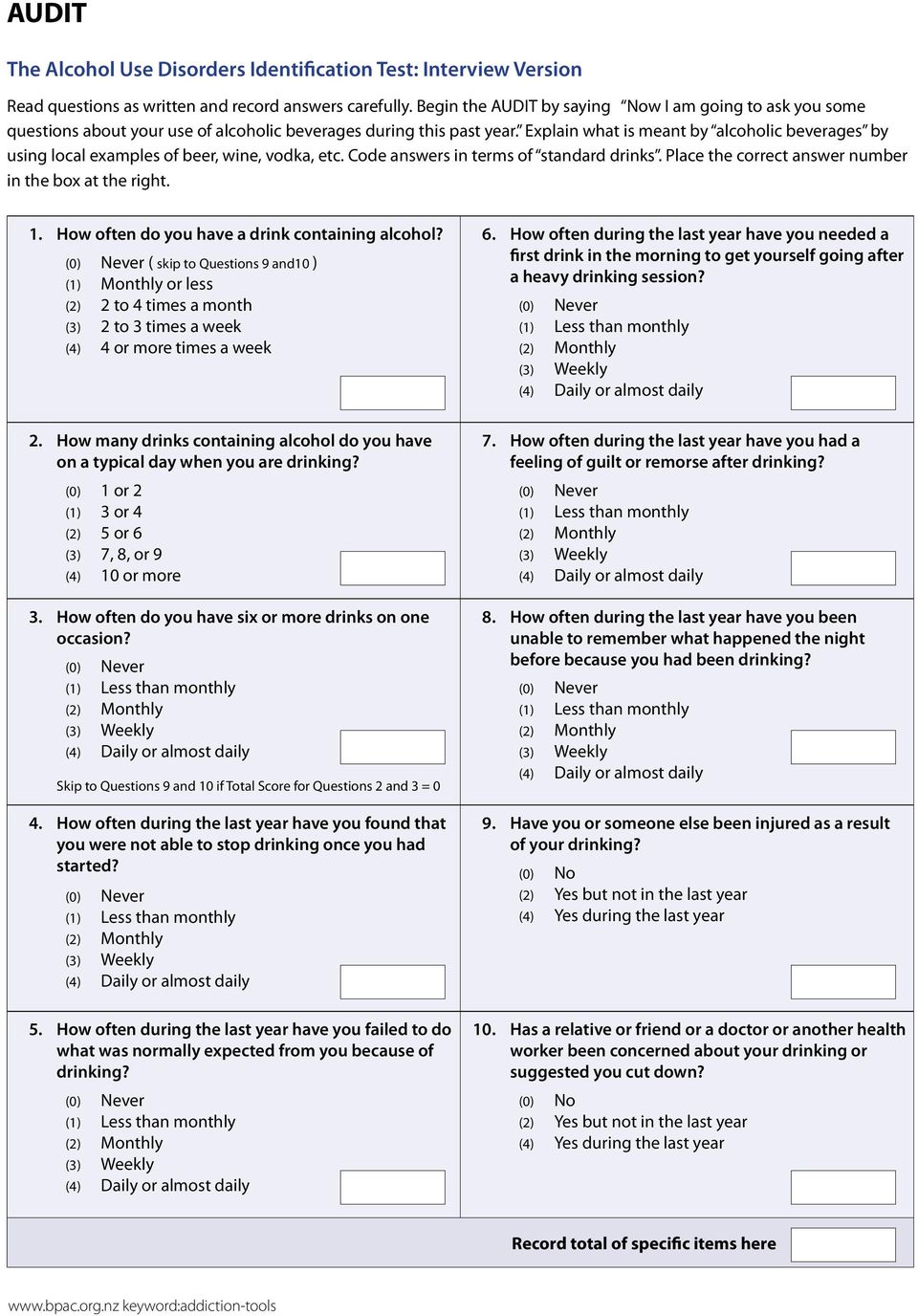
1 AUDIT The Alcohol Use Disorders Identification Test: Interview Version Read questions as written and record answers carefully. Begin the AUDIT by saying Now I am going to ask you some questions about your use of alcoholic beverages during this past year. Explain what is meant by alcoholic beverages by using local examples of beer, wine, vodka, etc. Code answers in terms of standard drinks. Place the correct answer number in the box at the right. 1. How often do you have a drink containing alcohol? (0) ( skip to Questions 9 and10 ) (1) or less (2) 2 to 4 times a month (3) 2 to 3 times a week (4) 4 or more times a week 2. How many drinks containing alcohol do you have on a typical day when you are drinking? (0) 1 or 2 (1) 3 or 4 (2) 5 or 6 (3) 7, 8, or 9 (4) 10 or more 3. How often do you have six or more drinks on one occasion? (0) (2) (3) Skip to Questions 9 and 10 if Total Score for Questions 2 and 3 = 0 4. How often during the last year have you found that you were not able to stop drinking once you had started? (0) (2) (3) 5. How often during the last year have you failed to do what was normally expected from you because of drinking? (0) (2) (3) 6. How often during the last year have you needed a first drink in the morning to get yourself going after a heavy drinking session? (0) (2) (3) 7. How often during the last year have you had a feeling of guilt or remorse after drinking? (0) (2) (3) 8. How often during the last year have you been unable to remember what happened the night before because you had been drinking? (0) (2) (3) 9. Have you or someone else been injured as a result of your drinking? (0) No (2) Yes but not in the last year (4) Yes during the last year 10. Has a relative or friend or a doctor or another health worker been concerned about your drinking or suggested you cut down? (0) No (2) Yes but not in the last year (4) Yes during the last year Record total of specific items here
2 AUDIT The Alcohol Use Disorders Identification Test: Self-Report Version PATIENT because alcohol can affect your health and can interfere with certain medications and treatments, it is important that we ask some questions about your use of alcohol. Your answers will remain confidential so please be honest. Place an x in one box that best describes your answer to each question. Questions 1. How often do you have a drink containing alcohol? or less 2 to 4 times a month 2 to 3 times a week 4 or more times a week 2. How many drinks containing alcohol do you have on a typical day when you are drinking? 1 or 2 3 or 4 5 or 6 7 to 9 10 or more 3. How often do you have six or more drinks on one occasion? 4. How often during the last year have you found that you were not able to stop drinking once you had started? 5. How often during the last year have you failed to do what was normally expected from you because of drinking? 6. How often during the last year have you needed a first drink in the morning to get yourself going after a heavy drinking session? 7. How often during the last year have you had a feeling of guilt or remorse after drinking? 8. How often during the last year have you been unable to remember what happened the night before because you had been drinking? 9. Have you or someone else been injured as a result of your drinking? No Yes but not in the last year Yes during the last year 10. Has a relative or friend or a doctor or another health worker been concerned about your drinking or suggested you cut down? No Yes but not in the last year Yes during the last year Total

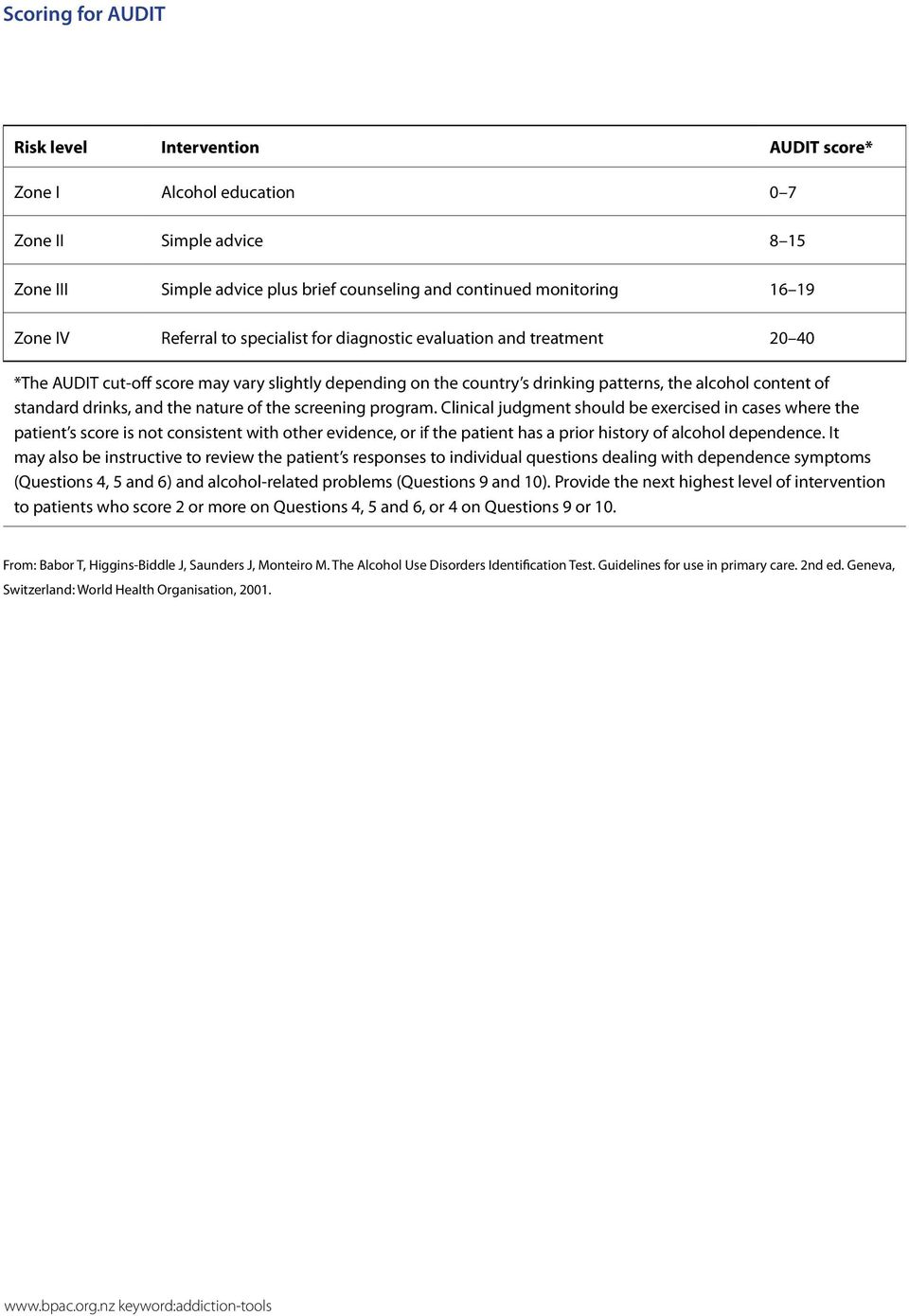
3 Scoring for AUDIT Risk level Intervention AUDIT score* Zone I Alcohol education 0 7 Zone II Simple advice 8 15 Zone III Simple advice plus brief counseling and continued monitoring Zone IV Referral to specialist for diagnostic evaluation and treatment *The AUDIT cut-off score may vary slightly depending on the country s drinking patterns, the alcohol content of standard drinks, and the nature of the screening program. Clinical judgment should be exercised in cases where the patient s score is not consistent with other evidence, or if the patient has a prior history of alcohol dependence. It may also be instructive to review the patient s responses to individual questions dealing with dependence symptoms (Questions 4, 5 and 6) and alcohol-related problems (Questions 9 and 10). Provide the next highest level of intervention to patients who score 2 or more on Questions 4, 5 and 6, or 4 on Questions 9 or 10. From: Babor T, Higgins-Biddle J, Saunders J, Monteiro M. The Alcohol Use Disorders Identification Test. Guidelines for use in primary care. 2nd ed. Geneva, Switzerland: World Health Organisation, 2001.
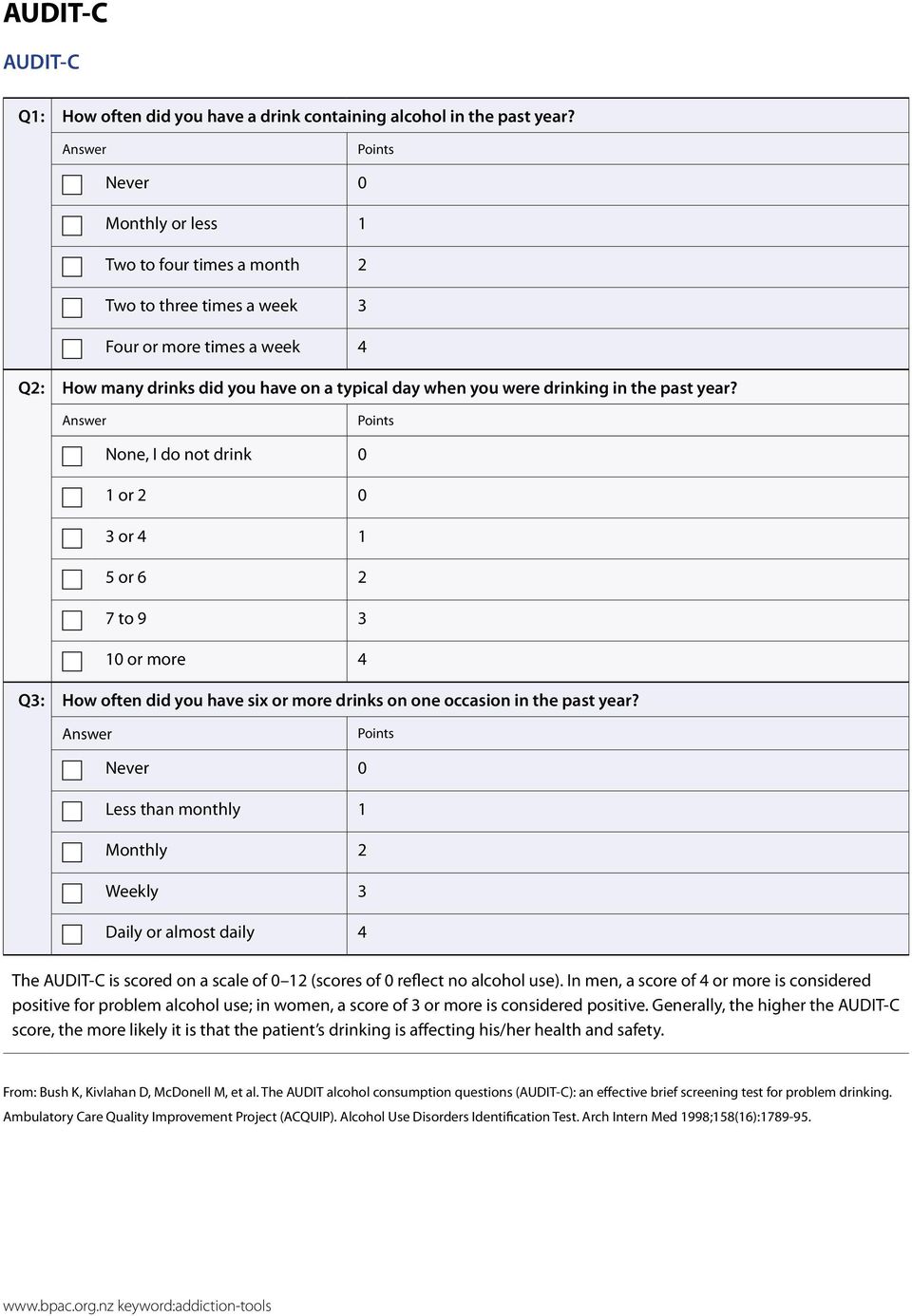
4 AUDIT-C AUDIT-C Q1: How often did you have a drink containing alcohol in the past year? Answer Points 0 or less 1 Two to four times a month 2 Two to three times a week 3 Four or more times a week 4 Q2: How many drinks did you have on a typical day when you were drinking in the past year? Answer Points None, I do not drink 0 1 or or or to or more 4 Q3: How often did you have six or more drinks on one occasion in the past year? Answer Points The AUDIT-C is scored on a scale of 0 12 (scores of 0 reflect no alcohol use). In men, a score of 4 or more is considered positive for problem alcohol use; in women, a score of 3 or more is considered positive. Generally, the higher the AUDIT-C score, the more likely it is that the patient s drinking is affecting his/her health and safety. From: Bush K, Kivlahan D, McDonell M, et al. The AUDIT alcohol consumption questions (AUDIT-C): an effective brief screening test for problem drinking. Ambulatory Care Quality Improvement Project (ACQUIP). Alcohol Use Disorders Identification Test. Arch Intern Med 1998;158(16):
5 Cannabis The Cannabis Use Disorder Identification Test Revised (CUDIT-R) Have you used any cannabis over the past six months? YES / NO If YES, please answer the following questions about your cannabis use. Circle the response that is most correct for you in relation to your cannabis use over the past six months: 1. How often do you use cannabis? or less 2-4 times a month 2 3 times a week 4 or more times a week 2. How many hours were you stoned on a typical day when you had been using cannabis? 1 1 or 2 3 or 4 5 or 6 7 or more 3. How often during the past 6 months did you find that you were not able to stop using cannabis once you had started? 4. How often during the past 6 months did you fail to do what was normally expected from you because of using cannabis? 5. How often in the past 6 months have you devoted a great deal of your time to getting, using, or recovering from cannabis? 6. How often in the past 6 months have you had a problem with your memory or concentration after using cannabis? 7. How often do you use cannabis in situations that could be physically hazardous, such as driving, operating machinery, or caring for children: 8. Have you ever thought about cutting down, or stopping, your use of cannabis? Yes, but not in the past 6 months Yes, during the past 6 months Scores of 8 or more indicate hazardous cannabis use. Scores of 12 or more indicate a possible cannabis use disorder, for which further intervention may be required. For further interpretation see: Adamson S, Kay-Lambkin F, Baker A, et al. An improved brief measure of cannabis misuse: The Cannabis Use Disorders Identification Test Revised (CUDIT-R). Drug Alcohol Depend 2010: (In Press).

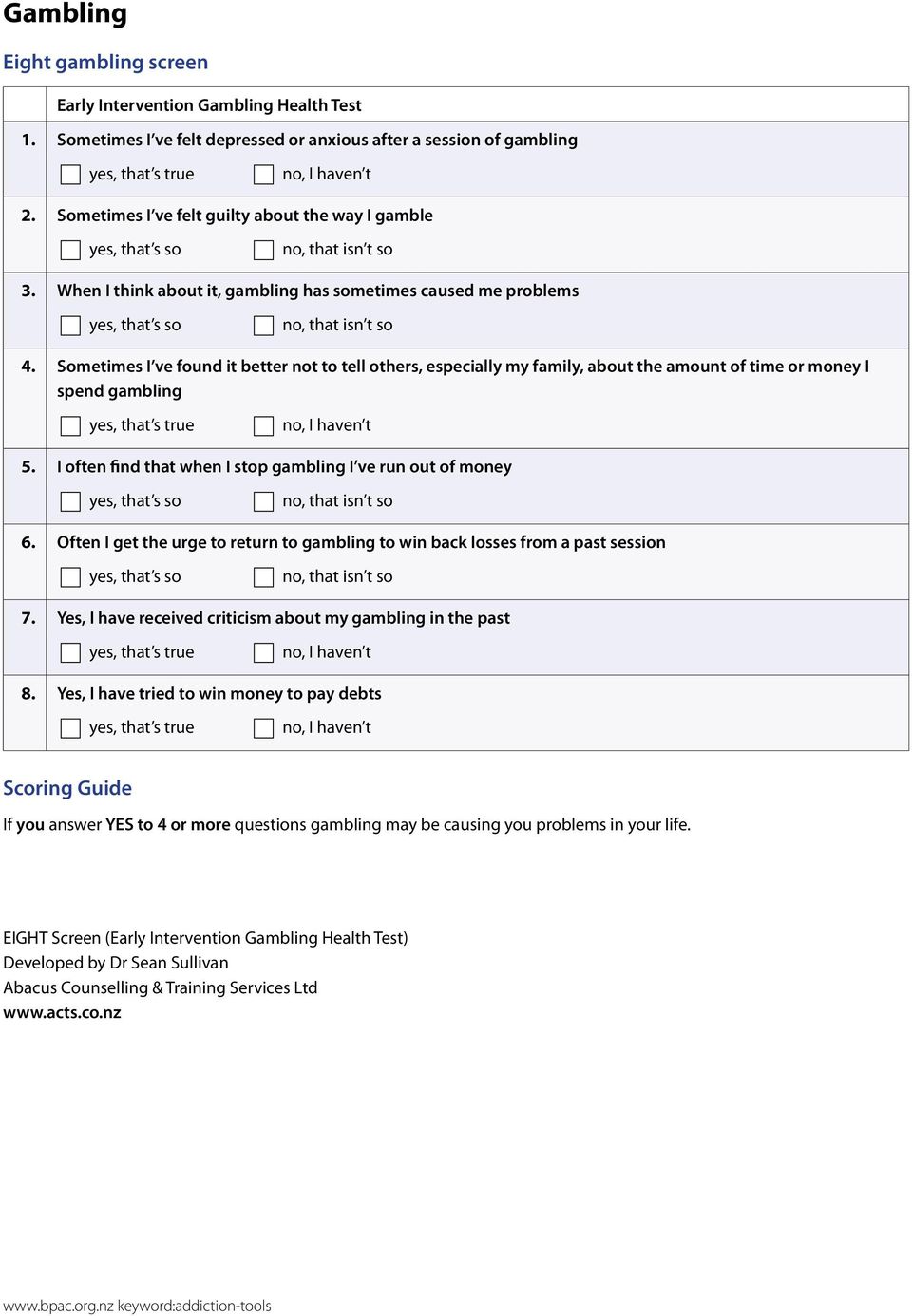
6 Gambling Eight gambling screen Early Intervention Gambling Health Test 1. Sometimes I ve felt depressed or anxious after a session of gambling 2. Sometimes I ve felt guilty about the way I gamble yes, that s so no, that isn t so 3. When I think about it, gambling has sometimes caused me problems yes, that s so no, that isn t so 4. Sometimes I ve found it better not to tell others, especially my family, about the amount of time or money I spend gambling 5. I often find that when I stop gambling I ve run out of money yes, that s so no, that isn t so 6. Often I get the urge to return to gambling to win back losses from a past session yes, that s so no, that isn t so 7. Yes, I have received criticism about my gambling in the past 8. Yes, I have tried to win money to pay debts Scoring Guide If you answer YES to 4 or more questions gambling may be causing you problems in your life. EIGHT Screen (Early Intervention Gambling Health Test) Developed by Dr Sean Sullivan Abacus Counselling & Training Services Ltd
CAGE. AUDIT-C and the Full AUDIT
 CAGE In the past have you ever: C tried to Cut down or Change your pattern of drinking or drug use? A been Annoyed or Angry because of others concern about your drinking or drug use? G felt Guilty about
How To Diagnose And Treat An Alcoholic Problem
 guideline for identification and treatment of alcohol abuse/dependence in primary care This guideline is informational in nature and is not intended to be a substitute for professional clinical judgment.
Seek, Test, Treat and Retain for Vulnerable Populations: Data Harmonization Measure
 Seek, Test, Treat and Retain for Vulnerable Populations: Measure Drug and Alcohol Use Drug and Alcohol Measure References: 1) Adapted from: Babor, T.F., Higgins-Biddle, J.C., Saunders, J.B. & Monteiro,
Alcohol Identification and Brief Advice
 Alcohol Identification and Brief Advice Alcohol Identification and Brief Advice (IBA) is an evidence based brief intervention directed at people drinking at increasing and higher risk levels who are not
SBIRT: Behavioral Health Screenings & Patient- Centered Care. Presented By: Zoe O Neill July 24, 2013
 SBIRT: Behavioral Health Screenings & Patient- Centered Care Presented By: Zoe O Neill July 24, 2013 Welcome! Type questions into the Questions Pane Patient-Centered Primary Care Institute History and
Chapter 7. Screening and Assessment
 Chapter 7 Screening and Assessment Screening And Assessment Starting the dialogue and begin relationship Each are sizing each other up Information gathering Listening to their story Asking the questions
Alcohol, drugs and older people
 Alcohol, drugs and older people This leaflet is for older people (defined as those aged 55 or over) who are worried about their use of alcohol, illegal drugs and/or prescribed/over-the-counter medications.
Screening and Brief Intervention Steps: Quick Guide
 Screening and Brief Intervention Toolkit Screening and Brief Intervention Steps: Quick Guide Steps 1. Have student complete the AUDIT test. Procedures and Discussion 2. Introduce yourself and establish
Alcohol and Dependence
 The facts about... Alcohol and Dependence Five key things you need to know A glass of wine with dinner, a beer after work, a cocktail in the sunshine on holiday. Alcohol makes an appearance in so many
Alcohol. Alcohol INFORMATION SHEET. Page 1 of 18
 Alcohol INFORMATION SHEET Page 1 of 18 Contents Drinking problem?... 3 Units of alcohol... 3 Units and drinks... 4 Why drink?... 5 Hangovers... 6 Getting help... 7 Am I drinking too much? (AUDIT)... 9
What are some of the signs that alcohol is a problem?
 Problems with Alcohol How can I tell if alcohol is a problem for me? Alcohol is a problem if it affects any part of your life, including your health, your work and your life at home. You may have a problem
Alcohol Identification and Brief Advice (IBA) in Buckinghamshire
 Alcohol Identification and Brief Advice (IBA) in Buckinghamshire A resource for frontline health and multi-agency professionals to identify and respond to alcohol consumption above recommended levels This
Alcohol and Opiates Disorders
 BRIEF SCREENING, INTERVENTION, AND REFERRAL The Problem According to the National Institute on Alcohol Abuse and Alcoholism 3 in 10 adults drink at levels that elevate their risk of physical, mental health,
Addiction and the Brain's Pleasure Pathway: Beyond Willpower
 Addiction and the Brain's Pleasure Pathway: Beyond Willpower The human brain is an extraordinarily complex and fine-tuned communications network containing billions of specialized cells (neurons) that
Alcohol Awareness Month October 2013. Chad Asplund, MD, FACSM Medical Director, Student Health Georgia Regents University
 Alcohol Awareness Month October 2013 Chad Asplund, MD, FACSM Medical Director, Student Health Georgia Regents University Alcohol Statistics According to the Office of Juvenile Justice and Delinquency
Facts About Alcohol. Addiction Prevention & Treatment Services
 Facts About Alcohol Addiction Prevention & Treatment Services Table of Contents Facts about alcohol: What is harmful involvement with alcohol?... 2 What is alcohol dependence?... 3 What Is BAC?... 4 What
Understanding Coding & Reimbursement for SBI. Presented By: Jen Cohrs CPC, CPMA, CGIC Director of Educational Strategies Wisconsin Medical Society
 Understanding Coding & Reimbursement for SBI Presented By: Jen Cohrs CPC, CPMA, CGIC Director of Educational Strategies Wisconsin Medical Society CPT codes, descriptions and material only are Copyright
Substance Use Education for Nurses Screening, Brief Intervention and Referral to Treatment (SBIRT) SBIRT: An Effective Approach
 Substance Use Education for Nurses Screening, Brief Intervention and Referral to Treatment (SBIRT) University of Pittsburgh The ATN-SBIRT Program is a partnership with the University of Pittsburgh and
FAQ' s on Alcohol Abuse and Alcoholism
 FAQ' s on Alcohol Abuse and Alcoholism It is important to understand that these answers are not meant to provide specific medical advice, but to provide information to better understand the health consequences
Action plan for reducing risky drinking
 AMA Healthier Life Steps A physician-patient alliance for a longer, healthier life Action plan for reducing risky drinking The goal For adults who choose to consume alcohol, moderation as defined by the
Alcohol Use Disorder Identification Test Self-Report Version (AUDIT-SR)
 Alcohol Use Disorder Identification Test Self-Report Version (AUDIT-SR) Questionnaire Supplement to the Study Data Tabulation Model Implementation Guide for Human Clinical Trials Prepared by TBI Standards
Alcohol Screening and Brief Intervention (SBI) for Trauma Patients
 Alcohol Screening and Brief Intervention (SBI) for Trauma Patients AMERICAN COLLEGE OF SURGEONS Committee on Trauma U.S. DEPARTMENT OF HEALTH AND HUMAN SERVICES Centers for Disease Control and Prevention,
Implementation of SBIRT onto Electronic Health Records: From Documentation to Data
 Implementation of SBIRT onto Electronic Health Records: From Documentation to Data John R. McAteer, LCSW-R New York City Department of Health and Mental Hygiene Bureau of Alcohol and Drug Use Prevention,
A L C O H O L D R U G S and G A M B L I N G
 IT S OUR BUSINESS Does someone I work with have a problem? A L C O H O L D R U G S and G A M B L I N G in the Workplace S O M E O N E A T W O R K H A S A P R O B L E M 3 Co-workers often get to know each
Screening, Brief Intervention, Referral, and Treatment (SBIRT) in Psychiatry
 Screening, Brief Intervention, Referral, and Treatment (SBIRT) in Psychiatry Steve Martino, Ph.D. The SBIRT Training in Yale Residency Programs (SAMHSA 1U79Ti020253-01; PI: Gail D Onofrio, M.D.) At Issue
Alcohol Risk Assessment
 Alcohol Risk Assessment NHS Health Check Challenges Don Lavoie Alcohol Programme Manager What I hope to cover Why Alcohol - what is the problem? What can Health Check do about it? How do you do it? What
Sample Script of an Initial Brief Alcohol Counseling Session
 Information Sheet for Behavioral Health Providers in Primary Care Sample Script of an Initial Brief Alcohol Counseling Session Introduce the Subject with a Transitional Statement From your answers it appears
Older Adults and Alcohol
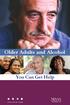 Older Adults and Alcohol You Can Get Help 5 What s Inside? Read this booklet to learn about alcohol and aging. Share this booklet with your friends and family. Use this booklet to start talking about how
BRIEF INTERVENTION. For Hazardous and Harmful Drinking. Thomas F. Babor John C. Higgins-Biddle. A Manual for Use in Primary Care
 WHO/MSD/MSB/01.6b Original: English Distribution: General Thomas F. Babor John C. Higgins-Biddle BRIEF INTERVENTION For Hazardous and Harmful Drinking A Manual for Use in Primary Care World Health Organization
Screening Patients for Substance Use in Your Practice Setting
 Screening Patients for Substance Use in Your Practice Setting Learning Objectives By the end of this session, participants will Understand the rationale for universal screening. Identify potential health
A safe, healthy and drug-free workplace is everybody s responsibility. Thanks for making it yours.
 TOOL BOX TALK 1: DRUG-FREE WORKPLACES: The Basic Message Worksite alcohol and drug use cannot be taken lightly, especially on construction sites where we rely on each other for safety. As a worker on this
Alcohol Screening and Brief Interventions of Women
 Alcohol Screening and Brief Interventions of Women Competency #2 Midwest Regional Fetal Alcohol Syndrome Training Center Competency 2: Screening and Brief Interventions This competency addresses preventing
My Choice. A workbook for making changes
 My Choice A workbook for making changes Table of Contents Introduction...1 Is drinking a problem for me?... 2 AUDIT (Alcohol Use Disorders Identification Test) Exercise...3 Am I ready?...5 Alcohol: Stages
NZQA registered unit standard 27079 version 2 Page 1 of 5. Support addiction service users with self-reporting screening tools and brief interventions
 Page 1 of 5 Title Support addiction service users with self-reporting screening tools and brief interventions Level 4 Credits 5 Purpose People credited with this unit standard are able to: describe self-reporting
Substance Abuse Screening
 The Goal of Substance Abuse Screening The goal of substance abuse screening is to identify individuals who have or are at risk for developing alcohol or drug-related problems, and within that group, identify
D.G. Counseling Inc.
 D.G. Counseling Inc. March 2009 Newsletter T H I S M O N T H W E E N J O Y A N A R T I C L E W R I T T E N B Y J U D I T H F A W E L L ATTENTION: Two of the books Donna Gluck coauthored with Dr. Rob Bollendorf
NAMIBIA MOHSS STRATEGY FOR ALCOHOL CONTROL
 NAMIBIA MOHSS STRATEGY FOR ALCOHOL CONTROL PEPFAR Southern & Eastern Africa Meeting on Alcohol and HIV Prevention Presented by: René A. Adams Programme Manager: Substance Abuse, Prevention, Drug Control
Alcohol and Drug Use Following Traumatic Brain Injury. Patient Information Booklet. Talis Consulting Limited
 Alcohol and Drug Use Following Traumatic Brain Injury Patient Information Booklet Talis Consulting Limited Why does Alcohol and Drug Use Matter after a Head Injury? Alcohol and drugs affect our behaviour,
Small changes can make a big difference in reducing your chances of having alcohol-related problems. Here are some strategies to try.
 Small changes can make a big difference in reducing your chances of having alcohol-related problems. Here are some strategies to try. Check off some to try the first week, and add some others the next.
Older Adults and Alcohol
 Older Adults and Alcohol You can get help From the National Institute on Aging Table of Contents What s inside 1 Get the facts about aging and alcohol 2 You can become more sensitive to alcohol as you
Problem Gambling. Over the last decade, legalized gambling in Canada has grown - rapidly! So has problem gambling!
 Problem Gambling Introduction Over the last decade, legalized gambling in Canada has grown - rapidly! So has problem gambling! Should people with mood disorders be especially concerned? Probably yes! There
SCORING AND INTERPRETATION OF AUDIT
 page 11 This should not discourage health workers from conducting the remaining items of the Clinical Instrument and using this information to supplement their interpretation of AUDIT. SCORING AND INTERPRETATION
Luton Alcohol Strategy 2012-2015
 Luton Drug & Alcohol Partnership Luton Alcohol Strategy 2012-2015 The Luton alcohol strategy for 2012 2015 reflects the increasing emphasis on working in partnership to reduce alcohol related harm to young
Older Adults and Alcohol. You can get help
 Older Adults and Alcohol You can get help Table of Contents What s inside 1 Get the facts about aging and alcohol 2 You can become more sensitive to alcohol as you get older 2 Heavy drinking can make
Brief Interventions for other drugs? Luke Mitcheson, Clinical Psychologist,
 Brief Interventions for other drugs? Luke Mitcheson, Clinical Psychologist, Ideas in development For who? Delivered by? What? When? How to disseminate outside of specialist commissioned services? Implementation
Alcohol Awareness. When Does Alcohol Abuse Become Alcoholism?
 Alcohol Awareness When Does Alcohol Abuse Become Alcoholism? Heavy drinkers may appear to function day to day yet still be putting themselves and others at risk. Learn how to recognize problem drinking.
Assessment of depression in adults in primary care
 Assessment of depression in adults in primary care Adapted from: Identification of Common Mental Disorders and Management of Depression in Primary care. New Zealand Guidelines Group 1 The questions and
Alcohol ABC for General Practices and
 Alcohol ABC for General Practices and Maternal & Child Health Services Project Agnes Hermans, Project Co-ordinator Alcohol Northland PHOs [email protected] Alcohol - it s as easy as..abc Overall project
AMIEU ALCOHOL AND OTHER DRUGS POLICY
 AMIEU ALCOHOL AND OTHER DRUGS POLICY Whilst alcohol and illicit drug use is a broad social problem, it impacts on the workplace in many ways. Most people who suffer are employed; More than 5% of the workforce
Addiction is a complex problem that not only affects the physical and mental health of the individual but also his/her family and friends.
 Alcohol and Drugs Addiction is a complex problem that not only affects the physical and mental health of the individual but also his/her family and friends. It is normal to feel helpless, frustrated, worried
Understanding. Depression. The Road to Feeling Better Helping Yourself. Your Treatment Options A Note for Family Members
 TM Understanding Depression The Road to Feeling Better Helping Yourself Your Treatment Options A Note for Family Members Understanding Depression Depression is a biological illness. It affects more than
Vermont Department of Health. Substance Abuse Prevention and Intervention Programs for Adolescents
 Substance Abuse Prevention and Intervention Programs for Adolescents Alcohol and Drug Abuse Programs December 20, 2013 School-Based Substance Abuse Services (SBSAS) Grants Awarded to 21 Supervisory Unions,
Alcohol and Drugs Policy. Committee responsible for review. Agreed date Autumn 2013
 Alcohol and Drugs Policy Committee responsible for review Resource Agreed date Autumn 2013 Review date Autumn 2016 Contents Page Introduction 3 The need for compliance 3 Management responsibilities 4 Individual
ALCOHOLISM. getting the facts
 ALCOHOLISM getting the facts U.S. Department of Health and Human Services National Institutes of Health National Institute on Alcohol Abuse and Alcoholism ALCOHOLISM getting the facts For many people,
Reference document. Alcohol addiction
 Reference document Alcohol addiction Table of content Introduction 2 Definition 2 Signs and symptoms 3 Intervening with an employee 4 Available treatments and resources 5 Conclusion 5 Reference document
General Information. Age: Date of Birth: Gender (circle one) Male Female. Address: City: State: Zip Code: Telephone Numbers: (day) (evening)
 Kelly Bernstein, MS, LCDC, LPC Medical Center Psychological Services 7272 Wurzbach Road, Suite 1504 San Antonio, Texas 78240 Office: (210) 522-1187 Fax: (210) 647-7805 Functional Assessment Tool The purpose
Alcohol. And Your Health. Psychological Medicine
 Alcohol And Your Health Psychological Medicine Introduction Alcohol, when used in moderation and as part of a healthy lifestyle, can have beneficial effects for some people, particularly in the prevention
Alcohol Addiction. Introduction. Overview and Facts. Symptoms
 Alcohol Addiction Alcohol Addiction Introduction Alcohol is a drug. It is classed as a depressant, meaning that it slows down vital functions -resulting in slurred speech, unsteady movement, disturbed
WIC HEALTH AND BEHAVIOR WORKBOOK
 WIC HEALTH AND BEHAVIOR WORKBOOK This workbook is based on research protocols tested in Project CARE funded by NIAAA (R01#AA12480) and the Office of Research on Minority Health (ORMH). Nutritionist's Copy
Alcohol Withdrawal. A Guide for Patients and Families
 Alcohol Withdrawal A Guide for Patients and Families Table of Contents Page 1...Do I need to stop drinking? Page 2...How do I know if I am addicted? Page 3...What are alcohol withdrawal symptoms? Page
Screening, Assessment. Evaluation
 Screening, Assessment and Evaluation alcohol and other drug, smoking and gambling Screening, Assessment and Evaluation alcohol and other drug, smoking and gambling Screening, Assessment and Evaluation
How to Represent Yourself on a Drink Driving Charge in NSW
 How to Represent Yourself on a Drink Driving Charge in NSW 1. Introduction Many people who are charged with a drink driving offence decide not to contest the charge because they cannot afford a lawyer
Alcohol Screening and Brief Intervention. A guide for public health practitioners
 Alcohol Screening and Brief Intervention A guide for public health practitioners Table of Contents Overview... 2. Alcohol Problems and Their Impact... 3. The Numbers and Impact Types of Alcohol Use Why
Alcohol Screening and Brief Intervention. A guide for public health practitioners
 Alcohol Screening and Brief Intervention A guide for public health practitioners Table of Contents Overview... 2. Alcohol Problems and Their Impact... 3. The Numbers and Impact Types of Alcohol Use Why
The SAOR Model for Screening and Initial Assessment
 The SAOR Model for Screening and Initial Assessment The key components of the SAOR model are outlined below: Support Ask & Assess Offer Assistance Refer The support aspect of the intervention is guided
Hope, Help & Healing. A guide to helping someone who might have a drug or alcohol problem. www.drugfree.org
 Hope, Help & Healing A guide to helping someone who might have a drug or alcohol problem www.drugfree.org Are you worried that someone you care about has a drug or alcohol problem? Or do you feel your
Screening, Brief Intervention and Referral to Treatment (SBIRT) for Substance Use: A Public Health Approach. Joan Dilonardo, Ph.D., R.
 Screening, Brief Intervention and Referral to Treatment (SBIRT) for Substance Use: A Public Health Approach Joan Dilonardo, Ph.D., R.N What is SBIRT? Some definitions Screening: a preliminary systematic
California Society of Addiction Medicine (CSAM) Consumer Q&As
 C o n s u m e r Q & A 1 California Society of Addiction Medicine (CSAM) Consumer Q&As Q: Is addiction a disease? A: Addiction is a chronic disorder, like heart disease or diabetes. A chronic disorder is
Alcohol and Reproduction
 The facts about... Alcohol and Reproduction Five key things you need to know Even small amounts of alcohol can interfere with our reproductive systems. The more you drink, the greater the effect it can