
Who will own the countryside?
|
|
|
- Gwendolyn Ramsey
- 10 years ago
- Views:
Transcription

1 Who will own the countryside? Dispossession, rural youth and the future of farming International Institute of Social Studies Valedictory Lecture 13 October 2011 Professor Ben White ISS is the International Institute of Social Studies of Erasmus University Rotterdam

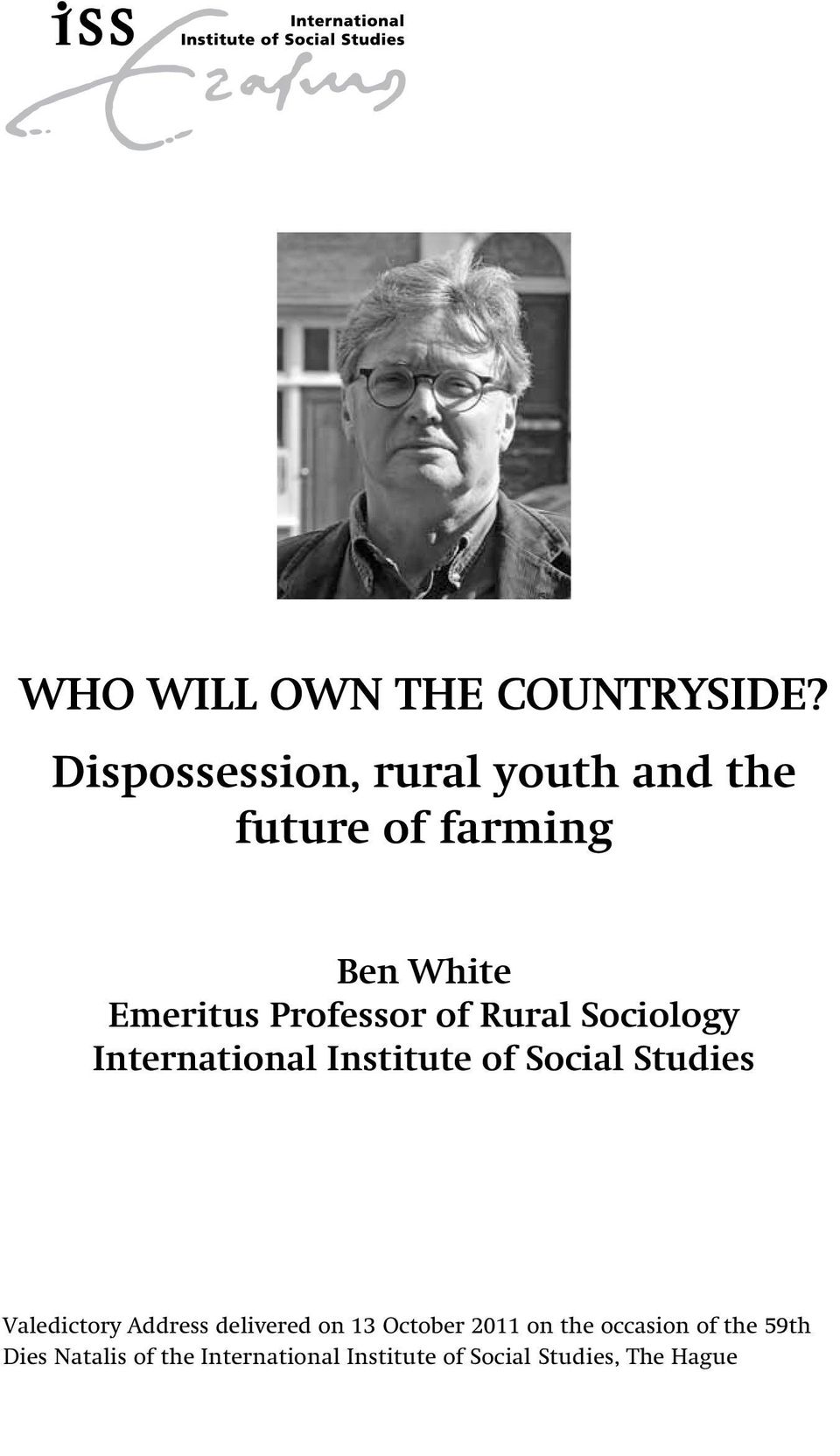
2 WHO WILL OWN THE COUNTRYSIDE? Dispossession, rural youth and the future of farming Ben White Emeritus Professor of Rural Sociology International Institute of Social Studies Valedictory Address delivered on 13 October 2011 on the occasion of the 59th Dies Natalis of the International Institute of Social Studies, The Hague 1
3

4 Preface The choice of today s topic should be explained. In 1980, when I started working at ISS, I joined the agricultural and rural development group. In 1986 when I had only been here for a few years the new ISS Rector Dick Wolfson invited me to give the ISS 34 th Dies Natalis Address and to provide a critical overview of this field of the ISS work. I did this in an address called Rural Development: Rhetoric and Reality. 1 Eight years later when appointed Professor of Rural Sociology, since my views on agricultural and rural development had not changed much I used the occasion of my Inaugural Address to introduce another of my interests which at that time was hardly on the agenda of the ISS at all, the problems of children and young people, hoping to stimulate interest in new initiatives in teaching and research in this area. That Address was called Children, Work and Child Labour : Changing Responses to the Employment of Children, 2 A decade later, when the field of child and youth studies had indeed taken off at the ISS, another Rector asked me to deliver the 51 st Dies Natalis Address in 2003, and it seemed appropriate to provide a view of this new field. That Address was called A World Fit for Children? Children and Youth in Development Studies and Policy. 3 Now the time has come to deliver my Valedictory Address and the 59 th Dies Natalis Address, my interests and work have swung back to agrarian issues and particularly land questions, and it seems logical to bring these two lines of interest agricultural and rural development, and youth together, by considering the problems which both the world s young people and the world s agriculture are experiencing today, and to think about the place that young people might or might not have in future agrarian renewal. The Hague is a good place to reflect on possible trajectories of agrarian renewal, and particularly the future of the world s small-scale agricultural producers. Almost 140 years ago, on the Lombardstraat just a few minutes walk from where we are sitting, on the first floor of Café Excelsior, the International Working Men s Association met for the closing day of its 5 th Congress, on the 7 th of September It was on that day that the persistent quarrels between Karl Marx and Mikhail Bakunin came finally and irrevocably to a head, and the Congress voted to expel Bakunin from the International. One of the two main issues between them was the role of small-scale agricultural producers the European peasantry in an imagined future, fairer, more rational society. From that day to this, this debate has split progressive social movements, and has also split the academic world of agrarian studies in a parallel debate between the Marxists and the so-called neo-populists. As in most cases of such heated debates, both sides were partly right. i

5

6 LAND, YOUTH AND AGRICULTURAL FUTURES Today I would like to draw your attention to the importance of the youth dimension, or the generational dimension, in discussions of agrarian questions in the contemporary world, and to use this as a lens to think about the future of agriculture and the struggle against rural poverty. 4 We do not need to justify a focus on agriculture and on rural poverty. It should not have been allowed to slip off the international and national policy agendas in the last three decades, and in recent years it is rightly regaining its place. Despite urbanization, rural populations in most of the global south are still growing in absolute terms. More than half the population of the developing countries, and 70 per cent of all those living in extreme poverty, live in rural areas. In the developing countries it is only in Latin America, the Caribbean region, the Middle East and North Africa that the majority of the poor live in urban areas. More than 80 percent of rural households are involved directly in farming to some extent, and it is typically the poorest households that rely most on farming and farm labour. Agriculture is still the world s single biggest source of employment. 5 The issues, in a nutshell, are these. In the present times of rising global prices of food, and also of land, many parts of the developing world are experiencing a new phase of land enclosures and dispossession and a shift from individual and community to corporate control of land and water resources. Behind this lies an ongoing battle for agriculture between large-scale, industrial, energy intensive, earth-warming, water-wasting, unsustainable forms of agricultural production on the one hand, and on the other a hard-pressed small-farm alternative which claims to be able both to feed the world, to do this in sustainable ways, and also to provide employment and incomes to vastly greater numbers of people than industrial farming. The coming years will see how this battle is resolved. At the same time there is a growing and seemingly intractable problem of mass youth unemployment and underemployment. Small-scale agriculture is now, and has the potential to remain, the developing world s single biggest source of employment. But claims about future small-scale alternatives assume that there is a generation of rural youth who want to be small farmers, while mounting evidence from all over the world suggests strongly that young people are increasingly uninterested in farming or in rural futures. If this is the case, then we have no argument against a future agriculture based on largescale, capital intensive, corporate farming. It is therefore quite important to ask what lies behind rural young men and women s apparent rejection of farming futures, in other words to de-construct this aspect of the world of today s rural youth. I will start with rural youth, their problematic transitions and their turn away from farming. I will then consider some of the reasons behind this, including the battle for agriculture and the global squeeze on land, and then return to rural youth. 1
7 RURAL YOUTH TRANSITIONS: UNEMPLOYMENT, MIGRATION AND THE TURN AWAY FROM FARMING The new youth studies: strengths and weaknesses One important strength of childhood and youth studies, as they have evolved in recent decades, is their insistence that we study young people in their own right and from their own perspectives, thus giving a certain conceptual autonomy to youth studies which had previously been hidden in various applied disciplines such as criminology, social work, health and family studies. Understanding young people s lives requires that we look both at how youth is constructed (imagined and represented as a meaningful social, economic and political category), and, also how it is actually experienced by the young. The sometimes wide gap between construction and experience is one key to the understanding of young people. This understanding however also requires us to position young people within larger social structures, and this relational dimension has been relatively neglected in the new social studies of childhood and youth. Notions of generation, 6 and of social reproduction 7 help to make this link. As we are all aware, youth (like childhood and adulthood) is socially constructed, not biologically fixed; its meaning and boundaries vary: over time, between societies and within societies. All age-based boundaries of the categories of childhood and youth, whether established by UN agencies or by national governments, are arbitrary and certainly many children and young people do not feel they fit them; yet these constructions have real impacts on young people s lives. Many young people over the age of 13, for example, do not consider themselves children, and defining all people under the age of 18 as child (as in the UN Convention on the Rights of the Child) risks infantilizing those towards the upper limit, the only thing that binds 0 to 17 year olds together being their lack of full legal and political standing in most countries. Similarly, the practice of pushing the age-limits of childhood and youth upwards with youth now defined as up to age 35, even 40, in some countries 8 - may function to infantilize or juvenilize young adults, to exclude them from mainstream social, economic and political processes as something less than full members of society, less than full citizens. Youth is coming to be increasingly defined by an individual s inability to take on the responsibilities of adulthood, 9 and since this is a constructed inability for which the adult world is largely responsible, this is a frequent source of tension between the generations, as we will see later in the rural context. Theories of youth approach the study of young people in many interesting and useful ways: youth as action, youth as (sub)cultural practice, youth as identity, youth as generation. 10 This last dimension, the generational one, underlines the importance of a relational approach, seeing youth in terms of the dynamics of their relationship with others (adults) in larger structures of social reproduction. The scientific and policy construction of youth, however, tends to see 2
8 it as typically a period of transition (from child to adult, from education to employment, from family of origin to family of destination). The World Bank for example sees youth in terms of these interlinked transitions in its report on Development and the Next Generation. 11 But it is important to understand that young people do not necessarily see themselves in this way, or do not see themselves only in this way. Young men and women are busy developing youth cultures and identities in their own right, i.e. trying to be successful in the eyes of their peers as youth, rather than trying to prepare themselves to be successful adults. This may be especially so in contemporary situations where the neoliberal ascendancy has made the prospects for successful transition so difficult, and young people may see themselves rather in a process of transition to nowhere. 12 Youth transitions: education, un(der)employment and crises of social reproduction In many countries, rural youth s transition to adulthood is being prolonged as they remain longer enrolled in education, their average age at first marriage rises, and their entry into the labour force is postponed. Each new generation of rural young men and women now grows up, on the whole, better educated than their parents. This however has not been matched with expansion of employment opportunities for educated youth. The start towards a working life and economic autonomy is widely considered a key marker of young people s independence. But the transition to employment is often difficult, involving long spells of inactivity and/or underemployment. 13 During the past two decades youth unemployment has increased in most regions, and many others are underemployed - having insufficient work, earning inadequate incomes from it, and/or in insecure and poor-quality informal sector employment. Youth unemployment rates are typically around twice the general adult rate, rural unemployment is higher than urban, and something close to half the world s unemployed are youth. 14 This is a serious problem, not only a tragic waste of potential in human terms but also a reflection of the sheer irrationality of the economic structures in which we live. How can we possibly allow one-fifth of the world s young people to be unemployed and countless millions more to be underemployed? If this is all that free markets can give us, then it is time to add employment, and particularly youth employment, to the long list of policy arenas (along with food, land, health, education and many more) that are much too important to be left to the market. The ILO has had the issue of youth unemployment on its agenda since 1935, and UN Millennium Development Goal 8 has as one of its targets to develop and implement strategies for decent and productive work for youth. But neither the ILO, nor other development agencies or national governments, have any 3

9 idea how to generate decent and productive work for youth on the huge scale which is needed, as we shall see later. Rural youth and crises of social reproduction These problems of (agrarian and youth) transition reflect an underlying crisis of social reproduction. Contemporary forms of agrarian transition involve investments and dispossession that expel people from agriculture without absorbing their labour in manufactures or elsewhere in the economy, and create an agrarian question of labour 15 involving large surplus populations of the dispossessed. 16 This probably represents a majority of historical capitalist agrarian transitions worldwide, the main exceptions being the classic agrarian transitions of (parts of) industrializing Europe and East Asia. Surplus population here is nothing to do with Malthusian or neo-malthusian theories of absolute overpopulation (the notion that human populations have some natural tendency to grow until they outstrip the limits of subsistence) but a historically-specific relative surplus population, itself the result of capital accumulation and technical progress, which is surplus not to society s capacity to provide subsistence but to capital s requirements for labour, resulting in low wages of the employed and pauperism of the un- and underemployed even in contexts of rapid economic development, producing the wonderful phenomenon that a nation must starve to death from sheer wealth and abundance. 17 Nowadays it is not only agriculture, but also many other sectors whose development through capital investment and technical change involves the shedding, rather than the absorption, of labour. Globalization embraces the world s young people in global culture and consumerism, but also marginalizes most youth because of their limited economic means. No matter how much they respond to the call to remain longer in school or college, no matter how well they do in school, their education does not open doors into secure employment, giving rise to the huge contingents of young, relatively educated, unemployed men and women in both rural and urban areas. Recent years have seen some path breaking research on the lives and cultures of these globalized, un(der)employed, relatively well educated youth. In the Middle East region researchers trying to capture this extended transition period during which young people wait for pieces of their lives to fall together, have coined the term waithood. 18 The anxiety and frustration of waiting (for jobs, and housing and marriage which usually depend on jobs) are captured by one of our former colleague Linda Herrera s young respondents in Alexandria: They are saying there are opportunities. Where are these opportunities? Where is the starting point, the beginning? If only I could start I could continue my life. But where is the starting point? Tell me, where can I begin? 19 4

10 In urban Ethiopia, where youth unemployment rates are estimated at more than 50 per cent and most first-time job seekers remain unemployed for three to four years, Daniel Mains has noted that one of the problems young male job seekers have to confront in contrast to their previous busy lives in school or college is simply the problem of passing excessive amounts of time : These young men spoke about time as an overabundant and potentially dangerous quantity. They passed their days chewing chat, a locally grown stimulant; watching the latest videos from Hollywood, Bollywood, or, much more infrequently, Ethiopia; and, above all, engaging with one another in chewata, the playful conversation that is a favorite pastime of many Ethiopians. 20 In India, Craig Jeffrey studied the young sons of lower middle class Jat farmers, the majority of them college graduates, in the town of Meerut (Uttar Pradesh). They expressed their activities in precisely those terms, as timepass, a kind of purposeless waiting. 21 In rural Philippines, where in one study one-fifth of all adults, mostly between 15 and 30 years old, classified themselves as on standby : neither employed, nor any longer in education, but waiting for a suitable opportunity. 22 These young people in timepass, standby or waithood mode are not necessarily completely idle, but we know very little about their activities. Anecdotal evidence suggests they may take on various kinds of casual, short-term jobs, or help parents in a family enterprise where one exists, but report themselves as unemployed because they are waiting and looking for what they consider appropriate jobs. We may thus need to introduce a new category of the working unemployed. Against this background the absence of any workable or far-reaching ideas in the policy world is perhaps not surprising. In neoliberal crises of social reproduction policies take the work of social reproduction out of the public sphere and either commoditize it or throw the responsibility back on individuals, families and communities. The young, like others, may be forced to improvise their own survival strategies and this is reflected in current policy shifts away from genuine employment generation to a kind of do-it-yourself employment strategy for the young: the new focus on entrepreneurship, seen in the increasing emphasis on promotion of entrepreneurial skills in national youth and education policies, and World Bank and ILO policy discourse. There is little evidence that these policies increase employment prospects or earnings. As a recent study on these problems in Indonesia concludes Youth employment projects should not be directed to entrepreneurship or self-employment, because the youth themselves are more interested in 5
11 paid employment in the formal sector, do not have sufficient technical expertise in the field and are too young to start a business 23 Turning away from farming? Agriculture is one of the few sectors certain to grow in the longer term. It is the developing world s single biggest employer, and if given appropriate support it has the potential to provide livelihoods for many more. But it appears to be so unattractive to young people that in some rural areas we see agricultural labour shortage coexisting with high levels of youth unemployment. Although this is a largely unresearched topic, anecdotal evidence from all over the world, and some research suggests strongly that young people are increasingly uninterested in agricultural or rural futures. The Future Agricultures Consortium, which will hold an important conference on this topic early next year, writes that young Africans are increasingly reluctant to pursue agriculture-based livelihoods. 24 For Southeast Asia, Derek Hall, Philip Hirsch and Tania Li conclude in their new book Powers of Exclusion: there is increasing evidence from across Southeast Asia that farmers would like to get out of agriculture themselves and, even more, that they hope their children will not become farmers. 25 Claims about smallscale alternatives for the world s agriculture assume that there is a generation of rural youth who want to be the world s future small farmers. If not, then of course small-farmer proponents have no argument against a future agriculture based on large-scale, corporate, industrial farming. It is therefore quite important to ask what lies behind rural youth s apparent rejection of farming futures. Young people s turn away from agriculture is certainly fact, but should not be taken for granted, until we understand better the reasons behind it. This requires us to take account of a number of problems, which we will explore in the next sections. They include: the de-skilling of rural youth with regard to agricultural knowledge, and the downgrading of farming and rural life; the chronic government neglect of small-scale agriculture and rural infrastructure in many regions; the corporate grabbing of land; and the problems that young rural people increasingly have, even if they want to become farmers, in getting access to land while still young. De-skilling and the assault on rural culture Various authors have noted how education as currently practiced (particularly secondary education) contributes to a process of de-skilling of rural youth in which farming skills are neglected and farming itself downgraded as an occupation, something for those who don t do well in school. 26 In a recent study, children in rural Gujarat (India) said they were not interested in farming (although they wanted to keep their land if inherited); when Yogesh, a 14 year old boy was questioned further as to who should take up farming, he replied maybe those children that don t do well in their studies must become farmers. 27 6
12 This can be seen as part of a more general assault on rural culture 28 which goes far beyond education and works through the commercial world of advertising and media of all kinds. The absence of basic infrastructure in rural areas which for today s young people includes communications infrastructure should not be ignored. We need to know a lot more about this; even if farming could be made more attractive to young people and land available, would rural life still be unattractive to today s globalized youth simply because their Blackberries don t work there, and they can t be in touch with their Facebook friends? This is actually the easiest part of the problem to take care of, and it will be solved in the not-too-distant future. 29 On the subject of de-skilling it is interesting to note how the idea of young people s right to earn a livelihood has disappeared from international policy discourse. In the League of Nations Declaration of the Rights of the Child (1924) The child must be put into a position to earn a livelihood and must be protected against every form of exploitation, and in the Universal Declaration of Human Rights (1948) The child must receive a training which will enable it at the right time to earn a livelihood and must be protected against every form of exploitation. This theme however has disappeared in subsequent human rights and child rights conventions including the United Nations Convention on the Rights of the Child (1989), in which preparation for earning a livelihood is not mentioned as a goal of education. 30 The situation is made worse by the rigid and misguided political correctness of many organizations which argue and campaign for the right of children to complete their entire childhoods without any experience of the world of work, while many studies have shown that young people who have combined school and part-time work have much better chances in labour markets after leaving school. 31 This misguided view, shared by many on the left, goes directly against the advice of Karl Marx himself, who wrote clearly in a policy brief on juvenile and children s labour: We consider the tendency of modern industry to make children and juvenile persons of both sexes co-operate in the great work of social production, as a progressive, sound and legitimate tendency, although under capital it was distorted into an abomination. In a rational state of society every child whatever, from the age of 9 years, ought to become a productive labourer in the same way that no able-bodied adult person ought to be exempted from the general law of nature, viz.: to work in order to be able to eat, and work not only with the brain but with the hands too. 32 Problems of rural infrastructure can be relatively easily overcome. So also, though less easily, can problems of the irrelevance and anti-rural bias of education, if educationalists are willing to follow the proposals of IFAD s latest Rural Poverty Report: 7

13 A new and broader approach to, and a new emphasis on, agricultural education and training are required [ ] to provide the next generation with the skills, understanding and innovative capacity that they require to practice sustainable agricultural intensification as well as to strengthen individual capabilities and human capital that are important for better addressing risk, achieving food security, and taking part in rural development and growth. 33 But suppose that a new generation of rural school leavers and college graduates do wish to make their futures in the agrarian side of the great work of social production, what are their chances of acquiring a farm? Today s rural young men and women, even if interested in farming, are confronted by the increased narrowing and sometimes complete closure of access to land. This may be the due to corporate or absentee acquisition of community land; the local micro-land grabs and intimate exclusions resulting from internal processes of everyday accumulation, land concentration and dispossession; 34 or simply the local structures of rural patriarchy which give the older generation control of land resources, and make them reluctant to transfer this control to the next generation. 8

14 THE BATTLE FOR AGRICULTURE AND THE GLOBAL SQUEEZE ON FARM LAND In his recent book The Global Food Economy Tony Weis describes the global battle for the future of farming. 35 In the context of rising and highly volatile food prices, and rising, much less volatile land prices world wide we can talk of a contest for control of land, agriculture and food regimes between, on the one hand: corporate, industrial, energy-intensive, planet-warming agriculture, and on the other the small scale alternative of peasant or small farmer based agriculture, not always clearly defined but marked by in what its proponents claim are both more ecologically rational and socially just systems of food production, which they also claim can efficiently provision the world. Much interesting work has been done on the global and local histories and characters of changing food regimes. The food regime concept 36 allows us to refocus from the commodity as object to the commodity as relation, with definite geo-political, social, ecological and nutritional relations at significant historical moments 37 and through this to understand better what Harriet Friedmann calls the pathologies of globalized agriculture. 38 Historian Jason Moore has noted that during the past six centuries, every great wave of capitalist development has been paved with cheap food, made possible by a series of agrarian crises followed by agrarian re-organization, involving changing property relations and processes of dispossession and differentiation: every great wave of world accumulation, and every great ( hegemonic ) power, has developed on the basis of far-flung reconstitutions of world-ecology, with agricultural revolutions at their centre. 39 Actually we are talking not only about food, but about all the agriculture-based wage goods: food (for humans), feed (for livestock), fuel, fibre, and a number of other crops that are sometimes grown on a wide scale but fit into none of these categories, like tobacco and medicinal crops; but for the sake of simplicity we will continue to talk about food. We are now looking at the end of both cheap food and cheap fuel, as real food prices which in 2001 had fallen as low as they had ever been, then rose by late 2007 to the highest they had ever been since record keeping began in This prompts Moore and others to raise the question whether the presently dominant global food regime has reached the end of the road. 41 If they are right, then we can accurately speak of a crisis in the world s agriculture. And as crisis studies literature tells us, crises are essentially turning points, at which things can go one way or the other, but they cannot stay the same. More than 40 years ago the Polish economist Michal Kalecki, after visiting Egypt, Indonesia and some other postcolonial countries, noted the survival and apparent resilience of what he called the intermediate classes in agriculture and other sectors (by which he meant small- and medium-scale farms and other enterprises). But he also raised the question whether, at some future moment, we would see their disappearance in the final submission of the lower middle 9

15 class to the interests of big business. 42 When we observe the current wave of large-scale, government-supported corporate acquisition of contested lands and common lands today in Africa, Asia, Latin America, and the former Soviet Union - one wonders whether Kalecki s moment has finally arrived. In the last few years reports of both mainstream international agencies and more critical NGOs have established beyond doubt that large-scale land acquisition of this kind, and the accompanying dispossession of local farmers, pastoralists and forest users is occurring on an unprecedented scale, particularly but not only in sub-saharan Africa. 43 The academic world also has been quick to respond to these developments. There is now quite an industry of academic, field research based land-grab studies underway, by established scholars but also particularly by graduate students and we will see an explosion of interesting dissertations, conferences, special issues of journals and so on in the coming years. 44 Most regions of the global South, as well as the global North, have a long history of land grabbing on a large scale. In the North major episodes have been the European enclosures, the dispossession of the native peoples of North America, and of course socialist collectivization. In the South, land was grabbed first by pre-colonial rulers in chronic territorial wars with each other, then by colonial governments. In the post-colonial decades, some governments and agrarian social movements attempted to correct these historical distortions by land reforms or other means of breaking up large private or corporate estates and re-distributing them to smallholders. This was often done with the support of international agencies the World Bank for example was a major proponent of the breakup of large estates in favour of small farmer based agricultural development strategies in those years. Paradoxically, these policies are now reversed as governments and international agencies support the acquisition of great expanses of land by large corporations, both foreign and domestic, usually in the form of long-term concessions or leases rather than outright purchase, in the name of development. Some of these individual deals, as we know, run into the hundreds of thousands of hectares; it is thought that at least 200 million hectares have been acquired in this way in the last few years. 45 Potentially these deals represent a truly wide-ranging global land reform but in this case, an upside-down land reform where governments take land from the poor and give it (or lease it) to the rich. While the media often focus on the role of foreign governments who are concerned to safeguard supplies of agricultural products and raw materials, the actual grabbing of land by which we mean the dispossession and exclusion of local people and the enclosure of a tract of land for sale or lease to a corporate investor is commonly done by local governments, working together with local corporations, and local elites. These local companies may be locally owned, foreign owned or jointly owned. 10

16 This current corporate land rush, and the discourse of governments, investors and international agencies that comes with it, is full of contradictions. On the one hand most countries of the global south report declining farm sizes, land shortage and often food insecurity while states and corporations claim the availability of huge areas of empty or unused land in the same countries. These deals are usually based on government and corporate promises to develop modern, industrial forms of agricultural production of food, feed, fuel or fibre for export, and to provide work and incomes for local people. Research has long ago shown, however, that such industrial (capital- and energy-intensive) forms of agriculture are unsustainable, and will accelerate global warming rather than slowing it down. They also don t provide employment on any significant scale, tending to create enclaves of capital intensive, monocrop farming with minimal linkages to the local economy. 46 But key international agencies, quite aware of this research and having sponsored and published some of it, seem to have accepted that this form of agriculture is going to be the main motor of agricultural growth in the coming years. In many countries, the current and planned expansion of corporate farming is based in areas of land which provide livelihoods to millions of cultivators and forest users under a wide variety of unofficial and semi-official or customary, individual or collective, tenurial relationships, while states claim sovereign ownership of the same land. The informal and insecure tenure under which many cultivators and forest users operate such lands makes for vulnerability in contexts of globalisation and transnational or domestic corporate land-grabbing, which in turn has prompted calls for greater security of tenure, both by peasant activists and external organisations. At the same time however, in many countries we have seen in the past few years active developments in national law-making and government regulations aimed at creating a legal framework that will facilitate the corporate acquisition of land held under customary title. Where local elders and elites have authority to allocate and re-assign land rights in customary tenure, they often profit from signing away community land. These land deals are typically shrouded in secrecy, and the agreements or contracts themselves are rarely publicly available. As Lorenzo Cotula has observed in a recent report: Land deal negotiations are unfolding fast and behind closed doors. But secrecy and haste are no friends of good deals. 47 Cotula and his team analyzed the contents of contracts for twelve land deals in seven African countries (Cameroon, Ethiopia, Liberia, Madagascar, Mali, Senegal and Sudan); the contracts were generally made between host governments and foreign investors, with local landholders or communities, or their representatives, having no formal role at all. 48 Besides asking why the corporate land rush is happening now, we could equally ask, why is it only happening now, or why did it not happen already long ago? In a neoliberal world markets in land, like markets in everything else, should be 11
17 laid open, not only locally but also to cross-border transactions and buyers. Land markets in countries like the USA, the Netherlands, Australia (to mention a few) have long been open to foreign buyers some of them actually had never closed them, so far as I know. The nations of the global south are now expected to do the same and realise the neoliberal dream of a world in which every bit of the planet is potentially up for sale, or at least for long-term lease, to whoever wants to buy it. This helps to explain why the response of the major international agencies has been so feeble and contradictory. The World Bank, which for some years has combined politically correct messages about the need to support small farmers with policy and financial support for agribusiness, 49 can hardly oppose large-scale corporate investment in farmland when it is itself an important promotor and facilitator of these investments. Through its private-sector arm the International Finance Corporation, the Bank finances legal reform mechanisms in land tenure to facilitate large-scale agricultural investment, and investment promotion agencies to attract the investors, in the words of an Oakland Institute researcher developing and advertising a veritable smorgasbord of incentives not just to attract foreign investments in farmland but also to ensure maximum profits to investors. 50 The World Bank s recent publication Rising global interest in farmland can it yield sustainable and equitable benefits? 51 embodies these contradictions. The Bank commissioned eighteen country case studies in Africa, Asia and Latin America, in countries which were expected to provide at least some success stories. These studies showed clearly that corporate land investments are not fulfilling their promise of employment creation for local people, they are environmentally destructive, they disadvantage women, they ignore the proper legal procedures for land acquisition and forcibly displace large numbers of people. 52 But the same report proposes that any problems of governance, illegality, environmental destruction and so on can be prevented by the acceptance and implementation of a voluntary code of conduct, which will ensure that corporate capital will behave more responsibly in future. The policy response of international agencies, faced with the realities of environmentally and socially irresponsible behaviour of corporate agribusiness, has in been to propose the adoption of such non-binding rules or principles for responsible corporate behaviour: The World Bank s Principles for Responsible Agro-investment, or FAO s Voluntary Guidelines on Responsible Governance of Tenure of Land and Other Natural Resources. 53 The World Bank group s seven Principles for Responsible Agro-Investment, for example, are the following: respecting land and resource rights; ensuring food security; ensuring transparency, good governance, and a proper enabling environment; consultation and participation; responsible agro-enterprise investing; social sustainability; and environmental sustainability

18 There are many problems with this idea. First, why should we expect capitalist corporations to act on a basis of voluntary corporate social responsibility? The experience of already-existing bodies such as the Round Table on Sustainable Palm Oil and the similar set-ups for soya and mining give no grounds for optimism on the capacity of voluntary guidelines and codes of conduct to protect the interests of local cultivators, gender rights, labour and the environment. 55 Capitalist firms are not Boy Scouts, and they are unlikely to place moral codes above the interests and demands of their owners or shareholders. Second, as Philippe De Schutter the UN Special Rapporteur on the Right to Food has argued, to see the solution in terms of guidelines for the responsible expansion of large-scale, capital-intensive farming is to narrow the terms of the debate, accepting that future agricultural development will be based on large scale, capital and energy intensive agro-industrial monocrop ventures and closing the door to other alternatives, in which small-scale, labour-intensive, environmentally friendly modes of cultivation remain the core units of feeding the planet and keeping it cool. 56 Professor De Schutter has become a lone voice within the UN family arguing for a broader vision that goes beyond disciplining land deals and providing policymakers with a checklist of how to destroy the global peasantry responsibly, 57 promoting investment that reduces hunger and malnutrition, rather than aggravating them. In his official reports to the UN General Assembly and Human Rights Council, 58 in academic publications and numerous keynote addresses and media articles 59 he has taken a firm stance against the current narrow framing of the debate on land grabbing. He has argued consistently that the most pressing issue regarding investment in agriculture is not how much, but how: what we need is not to regulate land grabbing as if this were inevitable, but to put forward an alternative programme for agricultural investment. 60 These alternatives, he argues, must not be based on speculative large-scale acquisition of farmland, nor on the creation of a market for land rights based on individual titling, but on security of tenure, agrarian reform where land concentration has become excessive, and reorientation of agricultural systems towards agroecological modes of production that are both productive, sustainable and contribute to the progressive realization of the human right to adequate food. De Schutter therefore arrives at a quite different set of principles, in which Land investments implying an important shift in land rights should represent the last and least desirable option, acceptable only if no other investment model can achieve a similar contribution to local development and improve the livelihoods within the local communities concerned. 61 What about these alternative models? The Via Campesina, an influential global network of small-farmer organisations and movements, campaigns against land grabbing with slogans like 13
19 Land-grabbing causes hunger! Let small-scale farmers feed the world!, and Small scale sustainable farmers are cooling down the earth and therefore demands: 1/ The complete dismantling of agribusiness companies: they are stealing the land of small producers, producing junk food and creating environmental disasters. 2/ The replacement of industrialized agriculture and animal production by small-scale sustainable agriculture supported by genuine agrarian reform programmes. 62 Is this romantic nonsense? The claims of small-farmerists also need to be critically interrogated. In fact, quite authoritative support on the technical side comes from an important but almost unnoticed international study, Agriculture at a Crossroads, the synthesis report of the International Assessment of Agricultural Science and Technology for Development. This report was commissioned by a number of UN agencies including the World Bank and FAO, and drew on the expertise of about 400 specialists from all over the world. It shows quite clearly that agriculture can and must be reinvented if it is going to provision the world s expanding population sustainably. It concludes that the dominant practice of industrial, large-scale agriculture is unsustainable, mainly because of the dependence of such farming on cheap energy, its negative effects on ecosystems, and growing water scarcity. Instead, industrial monocultures must be reconsidered in favour of agro-ecosystems that combine mixed crop production with conserving water supplies, preserving biodiversity, and improving the livelihoods of the poor in small-scale mixed farming. 63 There are plenty of opportunities for governments, international agencies and even corporate capital to invest in support of this new direction. These do not require the financing of corporate acquisition of land but rather investment in public goods, in rural infrastructure and various forms of support to small-scale agriculture. In recent decades, though, governments in the south and the north have placed their focus elsewhere. For the last decade or so, developing country states and the international community have been withdrawing more and more from their role of supporting small farmers and rural development generally, with development aid to these sectors declining by more than 50 per cent. 64 Small farmerism of course is not without its own problems. Agrarian structures based on small-scale ( peasant ) farming are inherently unstable under conditions of commodity economy, due to the in-built mechanisms of land concentration and agrarian differentiation, which many authors from Lenin onwards have described. 65 But these problems are not impossible to overcome, once we 14
20 get away from fixations on private ownership titling to other forms of secure individual tenure, subject to maximum holdings and periodic redistribution. One way to reflect on these futures is to consider what kind of rural future lies ahead for the next generation of rural people. While some local elders and elites may become rich by facilitating land dispossession and exclusion, and some cultivators may be seduced by immediate cash payments for relinquishing their land, or the prospect of guaranteed markets as contract farmers, we also need to consider what kind of future these land deals imply for the next generation in rural areas, those who will inherit this future. 15

21 THE PROBLEM OF GENERATIONS AND THE AUTONOMY OF LABOUR With the development of settled agriculture, first appearing about 10,000 years ago and developing much later in some parts of the world, agrarian societies generally moved towards patriarchy in both gender and generational relations. The need for parents to control their children s work is reflected in patterns of harsh discipline, and cultural emphasis on respect for the older generation, which are commonly seen in peasant societies world-wide (Stearns 2006:11-13). Within these patriarchal structures young people are not passive victims, but exercise a constrained agency. Ethnographic studies of traditional rural ways of growing up provide many examples in which children (mostly male, in some cases also female) who wish to farm are allocated a plot of land to farm themselves by parents or other adult relatives, or engage in paid work on the farms of others, and control to greater or lesser extent the product of their farming work. 66 One interesting example is from Tania Li s research on the Lauje hill farmers of Central Sulawesi. She describes how in 1991 We were out on the platform behind the house when one of the girls began to pull out bundles of garlic and arrange them in the sun to dry. Who do they belong to? I asked. That one belongs to my mother, those belong to my older brother, those belong to my sister, these here are mine, and those belong to my father, she replied. This was my introduction to the economic autonomy of household members, each of whom created personal property through their own labour 67 Among the Tonga in Zimbabwe, Elisabeth Colson observed in the 1950s that many children had their own fields. Unmarried boys or girls might be given a portion of a field belonging to either father or mother before obtaining their own fallowed land, and after harvest might have their own bins in which to store grain from these plots. 68 A generation later Pamela Reynolds described how young boys often work, and are sometimes allowed to make their own farms, on the land of a parent or other relative, and actively direct their labour contributions in accord with various strategies that maximize their chances of meeting current needs, and establishing links among kin and neighbours that will enhance future security. 69 In the Javanese village of Kali Loro, almost 40 years ago, a 15 year old boy from a share-tenant household told me proudly how he had used his own earnings (from farm labour and bamboo mat-weaving) to pay for his own school fees since the last years of primary school, and since entering lower secondary school at age 13 had paid for all his expenses except food, including school fees, clothes and even the purchase of his own goats
22 In Bolivia, Samantha Punch describes how children from about the age of 12 onwards begin to negotiate with their parents for some recognition and reward of the work they do to support the family economy, either helping on the family farm or earning money outside. One thirteen year old boy, for example, had persuaded his father to give him a small plot of land on which he grew peanuts and also raised some goats. His brother helped him with the planting and Antonio gave him part of the harvest in return. His sister, who had worked as a domestic service in the nearby town since she was 12, also had her own goats and chickens; when she is away her mother helps to look after them, and again is rewarded by her daughter with a gift of some of the chicks raised. 71 In how many countries and regions is it still possible for young people to slip themselves into independent agricultural production and earning in the way that these examples have shown? One reason why young people express a reluctance to farm may reflect not an aversion to farming as such, but to the long period of waiting that they would have to face before they have a chance to engage in independent farming. Even when land is available, young people may have to wait a very long time for it. In many or most agrarian societies parents or community elders in places where land is controlled not individually but by customary law - retain control of land as long as possible. Intergenerational tensions regarding the transfer of land or other assets from one generation to the next are, of course, not new. The tension between the desires of aging parents to keep the household together under their authority by retaining control of family assets, and the desire of children to receive their share of these assets, form their own independent households, and attain the status of economic and social adulthood, is such a common feature of agrarian societies that it is surprising how neglected it is in recent research. We can find plenty of examples in the history of European peasant societies. In the 15 th century, in the region around Florence, most old men kept a firm grasp on the management of the family farm until they became senile or died. This meant that young potential heirs had to wait around until they were 45 or 50 before they could come into their inheritance. 72 In the countryside around Pisa, by age 25 more than two-thirds of young men, even if married, had not yet been able to set up a household of their own. Once the peasant in this region had reached a position of authority late in life, he did not loose his grasp until the very end and gradually filled his house with his sons children as his own family let daughters marry and leave the family group. 73 Elderly people who retained control of the means of production were thus in a position to frustrate the ambitions of youth. Not surprisingly, then, young people regarded their elders with ambivalence. On the one hand it was held that old people should be honoured [ ] they held the treasured memories of the community and were the custodians of oral history, yet as Sir Walter Raleigh put it in 1614 by how 17
23 much the more we are accompanied with plenty, by so much the more greedily is our end desired, we become a burden to ourselves, being of no other use than to hold the riches we have from our successors. 74 When elderly peasants did transfer control of land to their children, they felt it necessary to safeguard their position against the loss of power and livelihood, often in written contracts. In 17 th century Calenberg (Lower Saxony), if legal transfer of the farm to the heir was made during the lifetime of the parents, they made a contract called Leibzucht. The retirement contract usually stipulated that the heir would provide a defined amount of food, shelter and clothing for the retired parents, and it guaranteed them the produce or income from certain parts of the farm. 75 In 15 th century Languedoc, in France, special clauses were inserted in the contracts in order to forestall the revolts that were always brewing against the old man of the house. A contract specified that the grandfather s bed was sacred, as was his ration of food. Cursed be the young couple who would sell the one or reduce the other! And cursed be the grandchild who would sell his grandmother s bestead and bedspread! 76 Karl Polanyi s student Conrad Arensberg observed in rural Ireland in the 1930s: even at forty-five and fifty, if the couple have not yet made over the farm, the countryman remains a boy in respect to farm work and in the rural vocabulary. This is understandable in view of the alternative, since at the transfer of land, all vestiges of strict parental control are destroyed parents can no longer demand the services of their children. 77 It is not surprising then if young men and women today, having experienced some years of education, are reluctant to engage in long years of agrarian timepass, working for parents or other elder relatives: who wants to wait until they are 40 or 50 years old to be a farmer? Julian Quan in an overview of changes in intra-family land relations in sub-saharan Africa notes: The position of youth is widely believed to be one of disinterest in landbased livelihoods. However, limitations in young people s access to land, land concentration, and land sales and allocations outside the kin group by older generations can become highly problematic where alternative livelihoods are not available, and can trigger wide social conflicts. 78 One important strategy in negotiating transition is young people s mobility, which now extends to all social classes and (in most countries) both genders. The great majority of the world s labour migrants (both domestic and international) are young people, pushed by the unavailability of appropriate jobs or farm land - at home and pulled by the hopes of better opportunities in the usually urban destination regions. These migrations are not always permanent; 18
24 we need to explore further the phenomenon of cyclical, part-lifetime migration. Village (and also farm ) can become, for young people, the place where you grow up, which you will leave in search of urban employment, but where you may later leave your children in the care of their grandparents, and where you may later return to be a farmer yourself, when land becomes available and urban work has provided some capital for improvements. 79 Among the few scholars who have been arguing consistently for the need to find ways to make farming a better, and a possible option for young people are Paul Richards and his former student Krijn Peters. Peters studied young people including ex-combatants in conflict-torn regions of Sierra Leone over a period of a decade ( ) and describes in detail the mismanagement and stagnation of the agricultural sector, the false hope that education gave young people of recognition and success, and the vulnerability of young people to local seniors, through the elders control over customary courts, land, agricultural labour and the allocation of marriage partners, in this gerontocratic society where the politics of wealth-in-people [ ] is sustained by customs that are legally binding, and imposed by the customary court system but subject to increasing and incalculable arbitrariness: The point is that the African rural setting is not only inhabited by landowning peasants, but increasingly by numbers of young people who lack the basic modalities even to be peasants. Marginalized by customary institutional exactions, first begun under colonial rule and maintained by rural elites ever since, they become a class of strangers and vagrants, neither citizen nor subject [ ] They cannot even mobilize their own labour to work the allegedly abundant land, since this would be vulnerable to extraction from them by marriage payments and court fines for infringements of a traditional code of behaviour regulated by elders. 80 Peters rightly questions the common assumption that ex-combatants have little interest in agriculture, and argues that the dislike of rural youth [for agriculture] is not focused on agriculture as such, but on their vulnerability, in village conditions, to exploitation by local elites and gerontocrats. 81 Reviewing recent proposals for (bio)technical solutions to African agrarian poverty, Richards concludes.perhaps an even bigger focus for reform [than biotechnology] is the need to open up land to more intensive use by making it more readily accessible to young people, free from control by a local gerontocratic order. 82 How many governments, international agencies or NGOs have young people s access to land on their policy agendas, as more than rhetoric? The FAO lists, as one of the policy goals on youth employment it shares with ILO, to provide rural youth, particularly women, with access to land and the financial services that are available to adults, but none of the specific projects they list under youth employment seem to have this focus
25 In conclusion, I hope to have shown that the developments I have summarized raise many fundamental questions both about the future of rural youth, and of agriculture itself. IFAD s latest Rural Poverty Report for the first time gives special attention to young people, and notes: It is [ ] tomorrow s rural generations who most need to see rural areas as places where they can fulfill their aspirations. Already today, more and more youth are unwilling farmers or livestock producers and reluctant residents in rural areas. Environmental degradation and climate change, combined with persisting policy neglect of agriculture and of rural areas, can only accentuate this process. [ Robust action] needs to turn rural areas from backwaters into places where people have access to quality services and profitable opportunities, and where innovation takes place, whether in agricultural production and marketing, in non-farm enterprises or in energy generation. 84 The many problems I have touched on are likely to worsen in the context of rising global prices of food and other agricultural commodities, the parallel rise in land values, new patterns of corporate land grabbing, and other forms of land concentration, in many regions. As I have tried to indicate, the current debate about land grabbing is in fact a debate about the future shape of farming and the fate of rural populations. If visions of a future based on smallholderbased agriculture are to be realized, these problems have to be taken seriously and given much more attention than has been the case in recent policy debate, and in recent research. There are no easy answers to these questions, and that is why they deserve a place on our research agenda in the coming years. That concludes the academic part of my address. 20
26 A word of thanks When I gave my Inaugural Address here in 1994, it was not yet the custom at ISS to close by thanking those who have helped you on the way. So I would like to do it now, in abbreviated form. First, to all my teachers in England and in the United States, who stimulated in me a chronic curiosity about the world, and particularly its material dimensions, which George Orwell, writing in the year of my birth, described well: to love the surface of the earth, and to take pleasure in solid objects and scraps of useless information. 85 Before coming to ISS I spent five years in Indonesia working with the Agro- Economic Survey of Indonesia, a small and relatively independent organization which was one of the main sources of critical studies of Indonesia s green revolution, by both Indonesians and foreigners. These were for me formative years, in which I learned much from both my Indonesian colleagues and the various foreign researchers who used our sample villages as basis for their research. It has been an enormous privilege to work in this International Institute of Social Studies. When I first heard of ISS and came as a visitor in in the middle of the only student strike the ISS has ever known - I knew it as one of the best institutes of development studies in the world. A few years later, when we gained the distinction of being the only non-university institute to have the right to award our own PhD degrees, I believe with others that it became the best small university in the world. Now, since we have become part of Erasmus University, we can no longer claim to be the best small university, but we can certainly claim to be the best University Institute in the world. At the ISS, I would like to thank most especially my colleagues past and present in what used to be the agricultural and rural development and population and development groups and then became rural development, environment and population studies. I am lucky to have been a part of the group of engaged academics who together, and in their own ways, have made a name for the ISS school of agrarian studies, and also to have been part of the group who have pioneered the field of child and youth studies here at ISS. Over the years we have been supported by a wonderful group of friendly, helpful and competent administrators. I believe strongly in the principle of self-management in academic institutions. This has led to me spending a lot of time in the various bodies involved in the ISS middle management. I have appreciated very much the dedication and friendship of all those I worked with in the Institute Council, Works Council, the Academic Council, the Appointment and Promotions Committee, the PhD Programme, and of course during my 17 years on the editorial board of Development and Change. And to all my colleagues in every corner and in every 21
27 kind of job in the ISS building, and all my students, thank you for singly and together making me look forward every day to walking into the building and meeting your friendly faces. 22
28 References Abbink, J. (2005) Being young in Africa: the politics of despair and renewal in J. Abbink & J. van Kessel eds Vanguard or Vandals: Youth, politics and Conflict in Africa. Leiden: Brill, pp Akram-Lodhi, Haroon (208) (Re)imagining agrarian relations? The World Development Report 2008: Agriculture for Development, Development and Change 39 (6), pp Alanen, Leena 2001 Explorations in generational analysis in L. Alanen & B. Mayall eds Conceptualizing Child-Adult Relations. London: Routledge, Ch. 2. Ansell, Nicola (2005) Children, Youth and Development. London: Routledge. Araghi, F. The invisible hand and the visible foot: peasants, dispossession and globalization, in Haroon Akram-Lodhi and Cristobal Kay (eds) Peasants and Globalization: Political Economy, Rural transformation, and the Agrarian Question. London: Routledge. Arensberg, Conrad and Solon Kimball 1968 Family and Community in Ireland. 2 nd ed. Cambridge: Harvard University Press. Assaad, Ragui and Mohamed Ramadan (2008) Did housing policy reform curb the delay in marriage among young men in Egypt?, Middle East Youth Initiative Policy Outlook No. 1. Dubai: Brookings Institute and Dubai School of Government. Beckford, George (1972) Persistent Poverty: Underdevelopment in the Plantation Economies of the Third World. New York: Oxford University Press. Berkner, Lutz k. (1976) Inheritance, land tenure and peasant family structure: a German regional comparison, in J. goody, J. Thirsk and E.P. Thompson (eds) Family and Inheritance: Rural Society in Western Europe, Cambridge: University Press, pp Bernstein, Henry (2004) Changing before our very eyes : Agrarian questions and the politics of land in capitalism today, Journal of Agrarian Change 4 (1-2), pp Bernstein, Henry (2010) Class Dynamics of Agrarian Change. Halifax: Fernwood and Sterling, VA: Kumarian Press. Borras, Saturnino and Jenny Franco (2010) From threat to opportunity? Problems with the idea of a Code of Conduct for land-grabbing, Yale Human Rights and Development Law Journal 13: Bourdillon, Michael, Deborah Levison, William Myers and Ben White (2010) Rights and Wrongs of Children s Work. Rutgers NJ: Rutgers University Press, Series in Childhood Studies. Bretton Woods Project (2011) World Bank policies enabling African land grab September. Colson, Elizabeth (1960) Social Organization of the Gwemba Tonga. Manchester: Manchester University Press. Committee on Food Security (2010) Policy Roundtable: Land Tenure and International Investments in Agriculture. Rome: Food and Agriculture Organization, Committee on Food Security, 36 th Session (October). 23
29 Committee on Food Security (2011) Land Tenure and International Investments in Agriculture. A report by the High Level Panel of Experts on Food Security and Nutrition of the Committee on Food Security. Rome: Food and Agriculture Organization. Cotula, Lorenzo (2011) Land Deals in Africa: What is in the Contracts? London: International Institute of Environment and Development. Cotula, Lorenzo, S. Vermeulen, R. Leonard, and J. Keeley (2009). Land Grab or Development Opportunity? Agricultural Investment and International Land Deals in Africa. London/Rome: IIED/FAO/IFAD. De Schutter, O (2011a) How not to think of land-grabbing : three critiques of large-scale investments in farmland, The Journal of Peasant Studies 38 (2), pp De Schutter (2011b) Promoting the Right to Food. Activity Report of the UN Special Rapporteur on the Right to Food (May 2008 May 2011). Dhanani, Shafiq, Iyanatul Islam and Anis Chowdhury (2009) The Indonesian Labour Market: Changes and Challenges. London: Routledge. Friedmann, Harriet (2005) Feeding the empire: the pathologies of globalized agriculture, in L. Panitch and C. Leys (eds) Socialist Register London: Merlin Press, pp Friedmann, Harriet and Philip McMichael (1989) Agriculture and the state system: the rise and fall of national agricultures Sociologia Ruralis 29 (2), pp Future Agricultures Consortium (2010) Future Farmers? Exploring Youth Aspirations for African Agriculture. FAC Policy brief GRAIN, Seized: The 2008 Land Grab for Food and Financial Security. Barcelona: GRAIN. Hall, Derek, Philip Hirsch and Tania Murray Li (2011) Powers of Exclusion: Land Dilemmas in Southeast Asia. Singapore: NUS Press. Hansen, Karen T. et al. (2008) Youth and the City in the Global South. Bloomington: Indiana University Press. Herrera, L When does life begin? Youth perspectives from Egypt DevISSues 6 (2) December 2006, pp HLPE (2011a) Price Volatility and Food Security. A Report by the High Level Panel of Experts on Food Security and Nutrition. Rome: United Nations Committee on World Food Security. HLPE (2011b) Land Tenure and International Investments in Agriculture. A Report by the High Level Panel of Experts on Food Security and Nutrition. Rome: United Nations Committee on World Food Security. IAASTD (2009) Synthesis Report: Agriculture at a Crossroads: International Assessment of Agricultural Science and Technology for Development. Washington: Island Press. IFAD (2010) Rural Poverty Report Rome: International Fund for Agricultural Development. Jeffrey, Craig (2009) Fixing futures: educated unemployment through a North Indian lens, Comparative Studies in Society and History 25 (21), pp
30 Jeffrey, Craig (2010b) Timepass: Youth, Class and the Politics of Waiting in India. Stanford: Stanford University Press. Jones, Gill (2009) Youth. Cambridge: Polity Press. Kalecki, Micha? (1972) Social and economic aspects of Intermediate regimes in M. Kalecki, Selected Essays on the Economic Growth of the Socialist and the Mixed Economy. Cambridge: University Press, pp (orig. 1967). Katz, Cindi 2004 Growing Up Global: Economic Restructuring and Children s Everyday Lives. Minneapolis: University of Minnesota Press. Kelly, P.F. (1999) Rethinking the local in labour markets; the consequences of cultural embeddedness in a Philippine growth zone, Singapore Journal of Tropical Geography 20, pp Klapisch, Christiane and Michel Demonet (1976) A uno pane e uno vino : the rural Tuscan family at the beginning of the Fifteenth Century, in R. Forster and O. Ranum (eds) Family and Society: Selections from the Annales Economies, Sociétés, Civilisations. Baltimore: Johns Hopkins University Press, pp Koning, Juliet (2004) Generations of Change: Migration, Family Life and Identity Formation in a Javanese Village During the New Order. Yogyakarta: Gadjah Mada University Press. Le Roy Ladurie, Emmanuel 1974 The Peasants of Languedoc. Trans. John Day. Urbana, Illinois: University of Illinois Press. Li, Tania M. (2009) Exit from agriculture: a step forward or a step backward for the rural poor? Journal of Peasant Studies 36 (3), pp Li, Tania M. (2010) To make live or let die? Rural dispossession and the protection of surplus populations Antipode 41 (S1), pp Mains, Daniel (2007) Neoliberal times: progress, boredom, and shame among young men in urban Ethiopia, American Ethnologist 34 (4), pp Mains, Daniel (2011 in press) Hope is Cut: Youth, Unemployment and the Future in Urban Ethiopia. Philadelphia: Temple University Press. Mannheim, Karl (1952) The problem of generations in P. Kecskemeti ed. Karl Mannheim: Essays on the Sociology of Knowledge. London: Routledge. Marx, Karl (1866) The Different Questions: Instructions for the Delegates of the Provisional General Council.? The International Workingmen s Association, First published in Der Vorbote Nos. 10 and 11, 1866 and The International Courier Nos. 6/7 and 8/10, works/1866/08/instructions.htm. Marx, Karl (1977) Capital. Vol. 1. London: Lawrence and Wishart. McMichael, Philip (2009) A food régime genealogy, Journal of Peasant Studies 36 (1), pp Moore, Jason (2010) The end of the road? Agricultural revolutions in the capitalist world-ecology, , Journal of Agrarian Change 10 (3), pp Morarji, Karuna (2010) Where does the rural educated person fit? Development and social reproduction in contemporary India, in Philip McMichael (ed.) Contesting Development: Critical Struggles for Social Change. New York and London: Routledge, pp
31 Oxfam (2011) Land and Power. The Growing Scandal Surrounding the New Wave of Investment in Land. Oxford: Oxfam Briefing Paper no Oya, Carlos (2009) The World Development Report 2008: inconsistencies, silences, and the myth of win-win scenarios, Journal of Peasant Studies 36 (3), pp Peters, Krijn 2011 War and the Crisis of Youth in Sierra Leone. Cambridge: University Press. Punch, Samantha 2010 Generational power relations in rural Bolivia, in R. Panelli, S. Punch and E. Robson eds Global Perspectives on Rural Childhood and Youth: Young Rural Lives. London: Routledge Studies in Human Geography no. 17. Quan, Julian (2007) Changes in intra-family land relations in Lorenzo Cotula (ed.) Changes in Customary Land tenure Systems in Africa. London: IIED, pp Reynolds, Pamela 1991 Dance Civet Cat: Child Labour in the Zambezi Valley. London: Zed Books. Richards, Paul 2010 Do peasants need GM crops? Journal of Peasant Studies 37 (3): Scoones, Ian (2010) Investing in land: a commentary on the World Bank report. News item, 16 September Singerman, Diana (2007) The economic imperative of marriage: emerging practices and identities among youth in the Middle East. Middle East Youth Initiative, Dubai: Brookings Institute and Dubai School of Government. Stearns, Peter 2006, Childhood in World History. London: Routledge. UN General Assembly (2010a) Report of the Special Rapporteur on the Right to Food. New York: United Nations General Assembly, 65 th Session, August UN General Assembly (2010b), Report submitted by the Special Rapporteur on the Right to Food United Nations General Assembly, Human Rights Council, 16 th session, December Von Braun, J. and R. Meinzen-Dick, Land Grabbing by Foreign Investors in Developing Countries: Risks and Opportunities. IFPRI Policy Brief 13, April Washington DC: IFPRI. Watts, Sheldon J A Social History of Western Europe, : Tensions and Solidarities Among Rural People. London etc.: Hutchison University Library. Weis, Tony (2007) The Global food Economy: The Battle for the Future of Farming. London: Zed Books and Halifax: Fernwood Publishing. Weis, Tony (2010) The accelerating biophysical contradictions of industrial capitalist agriculture, Journal of Agrarian Change 10 (3), pp Wells, Karen (2009) Childhood in a Global Perspective. Cambridge: Polity Press. White, Ben (1986) Rural Development: Rhetoric and Reality. 34 th Dies Natalis address. The Hague: Institute of Social Studies. White, Ben (1987) Rural development: rhetoric and reality, Journal für Entwicklungspolitik 1:
32 White, Ben (1994a) Children, Work and Child Labour : Changing Responses to the Employment of Children. Inaugural Address. The Hague: Institute of Social Studies. White, Ben (1994b) Children, work and child labour : changing responses to the employment of children Development and Change 25 (4): White, Ben (2003) A World Fit for Children? Children and Youth in Development Studies and Policy. 51 st Dies Natalis Address. The Hague: Institute of Social Studies. White, Ben (2005) Shifting positions on child labour: the views and practice of intergovernmental organizations, in Burns Weston (ed.) Child Labour and Human Rights: Making Children Matter. Boulder and London: Lynne Rienner, pp White, Ben (in press) Changing childhoods: Javanese village children in three generations, Journal of Agrarian Change 12 (1), World Bank ( 2006) Development and the Next Generation: World Development Report Washington DC: The World Bank. World Bank (2007) Agriculture for Development: World Development Report Washington DC: The World Bank. World Bank (2010) Rising Global Interest in Farmland: Can it Yield Sustainable and Equitable Benefits? Washington DC: The World Bank. 27
33 Endnotes 1 White (1986, 1987) 2 White (1994a, 1994b) 3 White (2003) 4 This talk is a trial shot in a project which I plan to work on in the next two years, to write a short book on agriculture and the problem of generations. 5 IFAD (2010: Chapter 2) 6 Generation: the social (or macro-) structure that is seen to distinguish and separate children [and youth] from other social groups, and to constitute them as a social category through particular relations of division, difference and inequality between categories [i.e. between children/ youth and adults] (Alanen 2001:13. See also Mannheim 1958). 7 Social reproduction: The material and discursive practices which enable the reproduction of a social formation (including the relations between social groups) and its members over time (Wells 2009: 78). 8 Abbink (2005), Hansen (2009:102) 9 Mains (2007:660) 10 Jones (2009: Ch. 1) 11 World Bank (2006) 12 Thanks to Rekopantswe Mate, ISS PhD candidate, for this phrase. 13 World Bank (2006); Jeffrey (2009, 2010); Morarji (2010) 14 World Bank (2006) 15 Bernstein (2004) 16 Li (2009, 2010); Araghi (2009) 17 Marx (1977: 591f.) 18 Assaad and Ramadan (2008:1), Singerman (2007) 19 Ahmed (22 years), Alexandria, in Herrera (2007) 20 Mains (2007: 659, 665). 21 Jeffrey (2010: 34f.) 22 Kelly (1999), cited in Ansell (2005: 186). 23 Dhanani et al. (2009: 80) 24 Future Agricultures Consortium(2010: 3) 25 Hall et al. (2011: 118) 26 Katz (2004); Morarji (2010) 27 Quoted with permission from the MA research-in-progress of Vinita Marlene Thomas, ISS. In contrast, in the same study children in Jharkand State seemed closer to the land, and said they wanted to learn better farming methods and become better farmers. 28 This term was used by Diane Rocheleau in a panel discussion at the International Conference on Global Land Grabbing, Institute of Development Studies, Brighton, April Anecdotal evidence suggests that in parts of rural Thailand where good transport and communications infrastructure are now available, young 28
34 people now find it attractive to remain in the countryside (information from Peter Vandergeest in a discussion at University of Toronto). 30 White (2005:324) 31 Bourdillon et al. (2010: Chapter 6) 32 (Marx 1866). Marx proposed that the employment of the 9-12 year olds in any workshop or housework be legally restricted to two hours per day; that of year olds to four; and that of the year olds, to six hours, and that all employers would be obliged to ensure that children s work was combined with education for children of both sexes, to include both mental, bodily and technological training. 33 IFAD (2010:171) 34 Hall et al. (2011: Chapter 5) 35 Weis (2007) 36 The concept was developed initially by Harriet Friedmann and Philip McMichael (1989). 37 McMichael (2009:163) 38 Friedmann (2005) 39 Moore (2010:389, 396) 40 Moore (2010: 397f.) 41 Moore (2010), cf. Weis (2010) 42 Kalecki (1967: 163) 43 Among the standard sources are GRAIN (2008) and many other reports available at Von Braun and Meinzen-Dick (2009), Cotula et al. (2009), De Schutter 2011a, World Bank (2010) and most recently Committee on Food Security (2011), HLPE (2011b) and Oxfam (2011). 44 An indication of the current popularity of the topic is the response to the Land Deals Politics Initiative (LDPI) s call for research proposals on land grabbing last year, in which we received about 150 proposals for the (very) small research grants we had to offer; a few months later our call for papers for the LDPI International Conference on Global Land Grabbing held in Brighton last April resulted in more than 350 abstracts submitted, nearly all from researchers promising to present the results of their empirical research. 45 Oxfam (2011:2) 46 The classic statement of the enclave thesis is Beckford s (1972) Persistent Poverty: Underdevelopment in the Plantation Economies of the Third World. 47 Cotula (2011, 3) 48 The single exception was Madagascar, where one of the contracts analyzed involved representatives of 13 farmer associations. 49 Oya (2009:595), cf. Akram-Lodhi (2008) 50 Bretton Woods (2011) 51 World Bank (2010) 52 For a brief critique see Scoones (2010). 53 Von Braun and Meinzen-Dick (2009); org; Committee on Food Security (2010) 29
35 54 World Bank (2010: x) 55 Years after the establishment of the Round Table, only a tiny fraction of global palm oil production is certified and there is hardly any market for certified palm oil. 56 On this point, see also Borras & Franco (2010). 57 De Schutter (2011a: 275) 58 UN General Assembly (2010a, 2010b) 59 These are documented in De Schutter (2011b). 60 De Schutter (2011: 250) 61 De Schutter (2010a: 20, emphasis added). 62 See various La Via Campesina position papers on 63 IAASTD (2009). This report is not mentioned in the World Bank Report on Rising global interest in farm land, although the Bank was one of the sponsors. See also the UN Special Rapporteur s report on agroecology as scientific framework to facilitate the transition towards a low-carbon, resource-preserving type of agriculture that benefits the poorest farmers (UN General Assembly 2010b:3). 64 HLPE (2011:29f.). 65 Summarized in Bernstein (2010: Chapter 7). 66 The phenomenon of child farmers, widely signaled in regions of high HIV/AIDS related mortality and orphanhood, is thus not in itself new, although the reasons for it have changed. 67 Quoted with permission from Tania Murray Li s manuscript-in-progress Land s End: Wealth and Poverty on an Indonesian Frontier. 68 Colson (1960: 79-89) 69 Reynolds (1991: xxvii) 70 White (in press) 71 Punch (2010: 156-9) 72 Watts (1984:59) 73 Klapisch and Demonet (1976: 46, 49) 74 Watts (1984: 59-60) 75 Berkner (1976:78) 76 Le Roy Ladurie (1974:33) 77 Arensberg and Kimball (1968:40) 78 Quan (2007: 57) 79 These new understandings of village and rural life are carefully described for Java in Juliet Koning s Generations of Change (2004). 80 Peters (2011:224f.) 81 Peters (2011:203) 82 Richards (2010: 560) 83 See ILO website various documents under youth employment. 84 IFAD (2010:219f.) 85 In Orwell s essay Why I write. 30
36 Address International Institute of Social Studies P.O. Box LT The Hague Location: Kortenaerkade AX The Hague The Netherlands T F E [email protected] Ben White, 2011 Material contained in this publication may be freely quoted and reproduced for individual use or for research, scholarly or educational purposes. It may not be used in any way for profit. For reproduction in compiled volumes, readers or inclusion in any information storage or retrieval system, the permission of the author is required. Requests should be sent to [email protected]. In any subsequent use of this work, the author should be given appropriate acknowledgement.
Business as Usual is Not an Option: Trade and Markets
 Issues in Brief Business as Usual is Not an Option: Trade and Markets Underinvestment in developing country agriculture including in local and regional market infrastructure, information and services has
Sundsvall Statement on Supportive Environments for Health
 Sundsvall Statement on Supportive Environments for Health Third International Conference on Health Promotion, Sundsvall, Sweden, 9-15 June 1991 The Third International Conference on Health Promotion: Supportive
DRYLAND SYSTEMS Science for better food security and livelihoods in the dry areas
 DRYLAND SYSTEMS Science for better food security and livelihoods in the dry areas CGIAR Research Program on Dryland Agricultural Production Systems The global research partnership to improve agricultural
SOCIAL PROTECTION BRIEFING NOTE SERIES NUMBER 4. Social protection and economic growth in poor countries
 A DFID practice paper Briefing SOCIAL PROTECTION BRIEFING NOTE SERIES NUMBER 4 Social protection and economic growth in poor countries Summary Introduction DFID s framework for pro-poor growth sets out
VOLUNTARY GUIDELINES ON THE GOVERNANCE OF TENURE. At a glance
 VOLUNTARY GUIDELINES ON THE GOVERNANCE OF TENURE At a glance VOLUNTARY GUIDELINES ON THE GOVERNANCE OF TENURE At a glance FOOD AND AGRICULTURE ORGANIZATION OF THE UNITED NATIONS Rome, 2012 The designations
You re One in Seven Billion!
 You re One in Seven Billion! We ve all heard the expression, You re one in a million!. With the ever-growing number of people on the planet, it might be more accurate to say, You re one in seven billion!
YOUTH UNEMPLOYMENT ANALYSIS
 1 514.5 511.6 509.2 505.9 507.2 508.4 511.2 513.5 517.3 521.5 523.8 528.8 529.6 525.3 528.8 535.3 539.9 540.4 538.5 538.4 539.8 67.3 67.1 66.7 69.7 69.6 70.0 70.5 71.2 70.5 71.3 11.1 11.4 11.5 72.8 73.4
Economic Growth, Poverty and The Child*
 2 Economic Growth, Poverty and The Child* INTRODUCTION In spite of rapid economic growth in many Third World countries, a disturbingly high rate of death due to child malnutrition continues. The physical
GLOBAL ALLIANCE FOR CLIMATE-SMART AGRICULTURE (GACSA)
 GLOBAL ALLIANCE FOR CLIMATE-SMART AGRICULTURE (GACSA) FRAMEWORK DOCUMENT Version 01 :: 1 September 2014 I Vision 1. In today s world there is enough food produced for all to be well-fed, but one person
Research to improve the use and conservation of agricultural biodiversity for smallholder farmers
 Research to improve the use and conservation of agricultural biodiversity for smallholder farmers Agricultural biodiversity the variability of crops and their wild relatives, trees, animals, arthropods,
PUBLIC POLICY IN FOOD AND AGRICULTURE - Food Security and Government Intervention - Samarendu Mohanty, E. Wesley F. Peterson
 FOOD SECURITY AND GOVERNMENT INTERVENTION Samarendu Mohanty Assistant Professor, Department of Agricultural and Applied Economics, Texas Tech University, Lubbock, Texas, USA E. Department of Agricultural
Why a Floating Exchange Rate Regime Makes Sense for Canada
 Remarks by Gordon Thiessen Governor of the Bank of Canada to the Chambre de commerce du Montréal métropolitain Montreal, Quebec 4 December 2000 Why a Floating Exchange Rate Regime Makes Sense for Canada
HLPE report on Nutrition and Food Systems
 HLPE report on Nutrition and Food Systems e-consultation on an Issues Note proposed by the HLPE Steering Committee From 9 December 2015 to 15 February 2016 Short Summary by the HLPE Secretariat 1 There
Summary. Developing with Jobs
 Do not publish or DiStribute before 00:01 Gmt on tuesday 27 may 2014 Summary Developing with Jobs World of Work Report 2014 Developing with jobs Executive Summary INTERNATIONAL LABOUR ORGANIZATION RESEARCH
The Business of Higher Education in England. Ken Jones
 1 The Business of Higher Education in England Ken Jones Since the devolution of some political power from London to Wales, Scotland and Northern Ireland in the late 1990s, education in the 4 territories
THE ROLE OF VET IN FACILITATING DEVELOPMENT OF AGRICULTURAL SECTOR IN TANZANIA
 THE ROLE OF VET IN FACILITATING DEVELOPMENT OF AGRICULTURAL SECTOR IN TANZANIA Abstract Agriculture industry is the foundation of Tanzanian economy. It accounts for about half of the national income, three
Joint conclusions of the Spanish Presidency EU Youth Conference youth employment and social inclusion, Jerez, Spain 13-15 April 2010
 Joint conclusions of the Spanish Presidency EU Youth Conference youth employment and social inclusion, Jerez, Spain 13-15 April 2010 Youth Employment is the common theme of the three EU Youth Conferences
The IBIS Education for Change strategy states the overall objective
 CONCEPT PAPER: YOUTH EDUCATION & TRAINING 1 Concept Paper youth education & training Photo: Ricardo Ramirez The IBIS Education for Change strategy states the overall objective of IBIS work with education
Underlying Factors for Gender Inequality in African Agriculture
 Underlying Factors for Gender Inequality in African Agriculture Gender perspectives in research for development (R4D), Annual Conference North-South Centre, ETH Zurich, Tuesday, June 12, 2012 Chinwe Ifejika
United Nations Programme on Youth. Interagency Expert Group Meeting on. Goals and Targets for Monitoring the Progress of Youth in the Global Economy
 BACKGROUND PAPER United Nations Programme on Youth Interagency Expert Group Meeting on Goals and Targets for Monitoring the Progress of Youth in the Global Economy New York, 30-31 May 2007 INTRODUCTION
Recent reports of corporate downsizing,
 Into contingent and alternative employment: by choice? Workers enter contingent and alternative arrangements from many different activities and for a wide variety of reasons; while some workers are involuntarily
As of 2010, an estimated 61 million students of primary school age 9% of the world total - are out of school vi.
 YOUTH AND EDUCATION HIGHLIGHTS 10.6% of the world s youth (15-24 years old) are non-literate i. Data from 2011 indicates that in developing countries, the percentage of non-literate youth is 12.1%, with
MARK SCHEME for the May/June 2012 question paper for the guidance of teachers 0495 SOCIOLOGY. 0495/13 Paper 1, maximum raw mark 90
 www.xtremepapers.com UNIVERSITY OF CAMBRIDGE INTERNATIONAL EXAMINATIONS International General Certificate of Secondary Education MARK SCHEME for the May/June 2012 question paper for the guidance of teachers
How To Help The World
 The World We Want A North-East Asian Youth Vision This Declaration was handed to His Excellency Kim Sung-hwan, Minister of Foreign Affairs and Trade of the Republic of Korea, in Seoul on 9 th of January
FEED THE FUTURE LEARNING AGENDA
 FEED THE FUTURE LEARNING AGENDA OBJECTIVE OF THE LEARNING AGENDA USAID s Bureau of Food Security will develop Feed the Future s (FTF) Learning Agenda, which includes key evaluation questions related to
G20 FOOD SECURITY AND NUTRITION FRAMEWORK
 G20 FOOD SECURITY AND NUTRITION FRAMEWORK G20 Food Security a nd Nutrition Framework 2 G20 Food Security and Nutrition Framework INTRODUCTION Food security and nutrition requires an inclusive economic
Food Security in a Volatile World
 Issues in Brief Food Security in a Volatile World Developments in agriculture over the last fifty years have increased yields sufficiently to provide on average more than enough food for every person on
Peasant Welfare in England 1290-1348
 Peasant Welfare in England 1290-1348 Determine Welfare Means different things in different historical periods Basic to all time periods Access to Land Income Shelter/Rents Clothing Food Taxes Why Care
The future agenda for development cooperation: voices of Dutch society
 The future agenda for development cooperation: voices of Dutch society Contribution prepared for the High Level Panel on the Post 2015 development agenda - March 2013 Prepared by NCDO, in cooperation with
Corporate Social Responsibility (CSR) for Responsible Agricultural Investments (RAI)
 Corporate Social Responsibility (CSR) for Responsible Agricultural Investments (RAI) Background note for consultation meeting - Dar es Salaam, Tanzania, 9 10 October 2012 Francesca Dalla Valle For info
Fact Sheet: Youth and Education
 Fact Sheet: Youth and Education 11% of the world s youth (15-24 years old) are non-literate. Data from 2005-2008 indicates that in developing countries, the percentage of nonliterate youth is 13%, with
Fairtrade certified cotton. How do I get the Fairtrade Certification Mark on a cotton product and what difference will it make?
 Fairtrade certified cotton How do I get the Fairtrade Certification Mark on a cotton product and what difference will it make? Photography: Kennet Havgaard, Morten Holtum, Simon Rawles and Stefan Lechner.
Therefore, AGE Platform Europe would be pleased if the Committee could take into account the following amendments.
 Suggestions for amending the Draft General Comment on the Right to just and favourable conditions of work (article 7 of the International Covenant on Economic, Social and Cultural Rights) (E/C.12/54/R.2)
Evolution of informal employment in the Dominican Republic
 NOTES O N FORMALIZATION Evolution of informal employment in the Dominican Republic According to official estimates, between 2005 and 2010, informal employment fell from 58,6% to 47,9% as a proportion of
1. RURAL DEVELOPMENT IN THE CAP. CURRENT REGIME
 THE SECOND PILLAR OF THE CAP TOWARDS 2020. MISSION, OBJECTIVES AND PRIORITIES OF RURAL DEVELOPMENT Dr. Pablo Amat Llombart Prof. of Civil Law. Universidad Politécnica de Valencia (Spain) 1. RURAL DEVELOPMENT
Global Demographic Trends and their Implications for Employment
 Global Demographic Trends and their Implications for Employment BACKGROUND RESEARCH PAPER David Lam and Murray Leibbrandt Submitted to the High Level Panel on the Post-2015 Development Agenda This paper
Progress and prospects
 Ending CHILD MARRIAGE Progress and prospects UNICEF/BANA213-182/Kiron The current situation Worldwide, more than 7 million women alive today were married before their 18th birthday. More than one in three
The role of Agricultural cooperatives in accessing input and output markets An overview of experiences of SRFCF, SNNPR, Ethiopia
 The role of Agricultural cooperatives in accessing input and output markets An overview of experiences of SRFCF, SNNPR, Ethiopia By Yehulashet A.Argaw Managing director, Southern Region Farmers Cooperative
Child Labour What is child labour? What is the difference between child labour and child slavery?
 Child Labour What is child labour? In 2010, the International Labor Organization estimated that there are over 306 million children aged 5-17 in the world who are economically active. This includes most
CHAPTER 8: Organisational objectives, growth and scale
 CHAPTER 8: Organisational objectives, growth and scale The Objectives of Organisations Key Revision Points Organisational goals can be classified into a number of categories: Those that aim to make a profit
CHAPTER 11: The Problem of Global Inequality
 CHAPTER 11: The Problem of Global Inequality MULTIPLE CHOICE 1. The claim that poverty is unethical is essentially a. Normative c. political b. theoretical d. scientific 2. Self-interest is an important
Speech at the High-Level Conference on World Food Security
 Speech at the High-Level Conference on World Food Security SUN Zhengcai Minister of Agriculture People s Republic of China Rome, June 2008 Distinguished Chairperson, Excellencies, Ladies and Gentlemen,
Succession Planning Case Studies
 Succession Planning Case Studies Prepared by NCFC Business Consulting INTRODUCTION The following are brief descriptions of how some intergenerational business succession plans have been implemented. These
Eliminating child labour in agriculture
 Eliminating child labour in agriculture Gender, Equity and Rural Employment Division Economic and Social Development Department Food and Agriculture Organization of the United Nations May 2010 The following
The Work on Gender Mainstreaming in the Ministry of Employment by Agnete Andersen, legal adviser
 The Work on Gender Mainstreaming in the Ministry of Employment by Agnete Andersen, legal adviser Agnete Andersen The outset for the work on gender mainstreaming Gender equality is a difficult bird because
AGRI MEGA PARK, BREDARSDORP, OVERBERG DISCTRICT, WESTERN CAPE
 MINISTER S SPEAKING NOTES AGRI MEGA WEEK FOR INTERNATIONAL FOOD SECURITY AGRI MEGA PARK, BREDARSDORP, OVERBERG DISCTRICT, WESTERN CAPE 17 SEPTEMBER 2015 Program Director Honourable Mayor, Richard Mitchell
Mirror for Humanity by Kottack Quiz #10 C. Milner-Rose
 Mirror for Humanity by Kottack Quiz #10 C. Milner-Rose Chapter 10: The World System and Colonialism Multiple Choice Questions 1. What fueled the European Age of Discovery? A. A desire to save the souls
of European Municipal Leaders at the Turn of the 21 st Century
 The Hannover Call of European Municipal Leaders at the Turn of the 21 st Century A. PREAMBLE We, 250 municipal leaders from 36 European countries and neighbouring regions, have convened at the Hannover
Principles for Responsible Agricultural Investment that Respects Rights, Livelihoods and Resources
 Principles for Responsible Agricultural Investment that Respects Rights, Livelihoods and Resources Synoptic Version A discussion note prepared by FAO, IFAD, the UNCTAD Secretariat and the World Bank Group
How To Help The World Coffee Sector
 ICC 105 19 Rev. 1 16 October 2012 Original: English E International Coffee Council 109 th Session 24 28 September 2012 London, United Kingdom Strategic action plan for the International Coffee Organization
INTEGRATING GENDER INTO SUSTAINABLE TOURISM PROJECTS BY LUCY FERGUSON AND DANIELA MORENO ALARCÓN FOR EQUALITY IN TOURISM: CREATING CHANGE FOR WOMEN
 INTEGRATING GENDER INTO SUSTAINABLE TOURISM PROJECTS BY LUCY FERGUSON AND DANIELA MORENO ALARCÓN FOR EQUALITY IN TOURISM: CREATING CHANGE FOR WOMEN OCTOBER 2013 INTRODUCTION In recent years, a number of
MAJOR PROBLEMS FACING EDUCATIONAL PLANNING IN THE NEXT DECADE by Philip H. Coombs
 No, 13 MAJOR PROBLEMS FACING EDUCATIONAL PLANNING IN THE NEXT DECADE by Philip H. Coombs IIEP/TM/13/67 July 197^ INTERNATIONAL INSTITUTE FOR EDUCATIONAL PLANNING (established by Unesco) 7-9* rue Eugène-Delacroix.,
Co-operatives for Europe: Moving forward together
 Co-operatives for Europe: Moving forward together 3 In Finland, 75% of the population are members of a co-operative enterprise. In Belgium, when you enter a pharmacy, there is a 1 in 5 chance that you
 11th International Conference on Urban Drainage, Edinburgh, Scotland, UK, 2008 communities where livelihoods are more vulnerable with virtually all the members of the community suffering because of food
INSTITUTIONAL AND ORGANISATIONAL CHANGE j) Mainstreaming a gender equality perspective in the Consolidated Inter-Agency Appeals BACKGROUND
 INSTITUTIONAL AND ORGANISATIONAL CHANGE j) Mainstreaming a gender equality perspective in the Consolidated Inter-Agency Appeals BACKGROUND A gender perspective in humanitarian assistance: what does it
Agriculture, Food Security and Climate Change A Triple Win?
 Agriculture, Food Security and Climate Change A Triple Win? Dr. Andrew Steer Special Envoy for Climate Change The World Bank Group Your Royal Highnesses, Excellencies, Ladies and Gentlemen, Let me begin
THE HON JULIA GILLARD MP DEPUTY PRIME MINISTER Minister for Education Minister for Employment and Workplace Relations Minister for Social Inclusion
 THE HON JULIA GILLARD MP DEPUTY PRIME MINISTER Minister for Education Minister for Employment and Workplace Relations Minister for Social Inclusion SPEECH ***CHECK AGAINST DELIVERY*** Address to Sydney
18.01.2014 Final Communiqué of the GFFA 2014
 18.01.2014 Final Communiqué of the GFFA 2014 "Empowering Agriculture: Fostering Resilience Securing Food and Nutrition" We, the Agriculture Ministers of 65 states of the world, assembled here in Berlin
ZAMBIA EMERGENCY HUMANITARIAN FOOD ASSISTANCE TO FLOOD VICTIMS
 AFRICAN DE DEVELOPMENT BANK Prepared by: OSAN Original: English ZAMBIA EMERGENCY HUMANITARIAN FOOD ASSISTANCE TO FLOOD VICTIMS DEPARTMENT OF AGRICULTURE AND AGRO-INDUSTRY, OSAN April 2008 The Government
Moving on! Not Everyone Is Ready To Accept! The Fundamental Truths Of Retail Trading!
 Moving on If you re still reading this, congratulations, you re likely to be in the minority of traders who act based on facts, not emotions. Countless others would have simply denied the facts, and moved
BILET 2. AŞAMA ÖRNEK SINAV READING SECTION. Siblings Relationships: A Brief Analysis
 READING SECTION Siblings Relationships: A Brief Analysis 1 During childhood, sisters and brothers are a major part of each other s lives for better or for worse. As adults they may drift apart as they
Global water resources under increasing pressure from rapidly growing demands and climate change, according to new UN World Water Development Report
 WWDR4 Background Information Brief Global water resources under increasing pressure from rapidly growing demands and climate change, according to new UN World Water Development Report As demand for water
Education for All An Achievable Vision
 Education for All An Achievable Vision Education for All Education is a fundamental human right. It provides children, youth and adults with the power to reflect, make choices and enjoy a better life.
FromDisappearance to Recovery? Family Farming in Central Europe
 Centre d étude des mondes russe, caucasien et centre-européen FromDisappearance to Recovery? Family Farming in Central Europe Marie-Claude Maurel Directrice d études EHESS-Paris International Conference
2011 Tunza International Children and Youth Conference Bandung Declaration October 1, 2011. The Voice of Children & Youth for Rio+20
 1 2 3 4 5 6 7 8 9 10 11 12 13 14 15 16 17 18 19 20 21 22 23 24 25 26 27 28 29 30 31 32 33 2011 Tunza International Children and Youth Conference Bandung Declaration October 1, 2011 The Voice of Children
YOUTH AND MIGRATION HIGHLIGHTS
 YOUTH AND MIGRATION HIGHLIGHTS In 2010, there were 27 million international migrants aged 15 to 24 in the world, accounting for 12.4 per cent of the 214 million international migrants worldwide 1. In 2010,
Employment creation in innovative public work programs: Phase III
 EPr1 Employment creation in innovative public work programs: Phase III 129 130 As of the end of October 2014, Egypt was host to some 140,000 registered Syrian refugees. While the influx of refugees has
Advocate for Women s Rights Using International Law
 300 Appendix A Advocate for Women s Rights Using International Law The United Nations (UN) brings together almost every government in the world to discuss issues, resolve conflicts, and make treaties affecting
THE GLOBAL AGENDA FOR SOCIAL WORK AND SOCIAL DEVELOPMENT COMMITMENT TO ACTION March 2012
 THE GLOBAL AGENDA FOR SOCIAL WORK AND SOCIAL DEVELOPMENT COMMITMENT TO ACTION March 2012 OUR COMMITMENTS As social workers, educators and social development practitioners, we witness the daily realities
REMARKS TO FUDAN JOURNALISM SCHOOL Ernest J. Wilson III Dean, Annenberg School for Communication & Journalism
 1 REMARKS TO FUDAN JOURNALISM SCHOOL Ernest J. Wilson III Dean, Annenberg School for Communication & Journalism Journalism and communications schools around the world are at an important crossroads in
INTRODUCTION THE 2ND EUROPEAN YOUTH WORK CONVENTION
 INTRODUCTION This Declaration, prepared within the framework of the Belgian Chairmanship of the Committee of Ministers of the Council of Europe, is addressed to the Member States of the Council of Europe,
WOMEN AND FOOD SECURITY: ROLES, CONSTRAINTS, AND MISSED OPPORTUNITIES
 WOMEN AND FOOD SECURITY: ROLES, CONSTRAINTS, AND MISSED OPPORTUNITIES Lynn R. Brown World Bank, Washington, DC, USA Keywords: Poverty alleviation, nutrition, labor, land tenure, marriage, inheritance,
PREREQUISITES FOR HEALTH
 Charter The first International Conference on Health Promotion, meeting in Ottawa this 21 st day of November 1986, hereby presents this CHARTER for action to achieve Health for All by the year 2000 and
Social Protection in the post-2015 Development Agenda
 Social Protection in the post-2015 Development Agenda armando barrientos and david hulme, brooks world poverty institute, school of environment and development, university of manchester, uk text: Armando
The UNIDROIT/FAO/IFAD Legal Guide on Contract Farming
 The UNIDROIT/FAO/IFAD Legal Guide on Contract Farming An Overview What is Contract Farming? The Importance of the Legal Framework The UNIDROIT/FAO/IFAD Legal Guide on Contract Farming Purpose of the Guide
Allianz Reducing the risks of the poor through microinsurance
 DEDICATED TO MAKING A DIFFERENCE World Business Council for Sustainable Development Case Study 2009 Allianz Reducing the risks of the poor through microinsurance The business case The Allianz Group has
AG R I C U LT U R E GREEN ECONOMY
 THIS IS THE STORY OF AG R I C U LT U R E GREEN ECONOMY We need to make the global economy green. provides significant opportunities for growth, investment and jobs to help make this happen. $ Everyone
How can an Ecological Footprint Contribute to Green Economy in Africa?
 RIO+20 AFRICAN DEVELOPMENT BANK How can an Ecological Footprint Contribute to Green Economy in Africa? Introduction Fundamentally we all depend on nature, the ecological infrastructure of the planet that
Men in Charge? Gender Equality and Children s Rights in Contemporary Families
 International Day of Families 2015 Observance Men in Charge? Gender Equality and Children s Rights in Contemporary Families Background Note Gender equality and children s rights in family laws Fair legal
WHY SHOULD THE DRAFT LAW ON FORESTRY AND WILDLIFE REGULATIONS BE ADOPTED? POSITION OF THE TRADITIONAL AUTHORITIES OF CAMEROON
 WHY SHOULD THE DRAFT LAW ON FORESTRY AND WILDLIFE REGULATIONS BE ADOPTED? POSITION OF THE TRADITIONAL AUTHORITIES OF CAMEROON A Proposal ratified during the brainstorming workshop by Traditional Rulers
The Human Right to Peace
 The Human Right to Peace By Senator Douglas Roche, O.C. Address to Liu Institute for Global Issues Host: The Simons Centre for Peace & Disarmament Studies Vancouver, April 2, 2003 This text is adapted
Deloitte Millennial Innovation survey
 Deloitte Millennial Innovation survey S U M M A R Y O F G L O B A L F I N D I N G S 19 th December 2012 1 Research Approach WHO? Millennials born January 1982 onwards Degree educated In full-time employment
95% of asset management CEOs say they re very or somewhat confident about growth over the coming three years
 18th Annual Global CEO Survey Redefining competition in a world without boundaries 95% of asset management CEOs say they re very or somewhat confident about growth over the coming three years 82% of asset
Human Resources Development for Economic Development examples and lessons from ACP countries
 A presentation to the ACP EU Economic and Social Interest Group, Brussels, 5 March 08 : Human Resources Development for Economic Development examples and lessons from ACP countries Brenda King Member of
Compass Interdisciplinary Virtual Conference 19-30 Oct 2009
 Compass Interdisciplinary Virtual Conference 19-30 Oct 2009 10 Things New Scholars should do to get published Duane Wegener Professor of Social Psychology, Purdue University Hello, I hope you re having
Deforestation in the Amazon
 Deforestation in the Amazon By Rhett A Butler Rainforests once covered 14% of the earth's land surface; now they cover a mere 6% and experts estimate that the last remaining rainforests could be consumed
Concept Note and. Call for Papers
 Concept Note and Call for Papers AFRICAN ECONOMIC CONFERENCE 2015 ADDRESSING POVERTY AND INEQUALITY IN THE POST 2015 DEVELOPMENT AGENDA Kinshasa, Democratic Republic of Congo 2-4 November, 2015 1 1. Introduction
Financial Freedom: Three Steps to Creating and Enjoying the Wealth You Deserve
 Financial Freedom: Three Steps to Creating and Enjoying the Wealth You Deserve What does financial freedom mean to you? Does it mean freedom from having to work, yet still being able to enjoy life without
ILO 2012 Global estimate of forced labour Executive summary
 ILO 2012 Global estimate of forced labour Executive summary UNDER EMBARGO UNTIL JUNE 1, 2012, 8:30 a.m. GMT RESULTS Using a new and improved statistical methodology, the ILO estimates that 20.9 million
The Economic Transition and Employment Generation in Indian Economy: Role of Market, Policy and Institutions
 The Economic Transition and Employment Generation in Indian Economy: Role of Market, Policy and Institutions Pulak Mishra & Bhagirath Behera Department of Humanities and Social Sciences Indian Institute
Statement of. Jim McCarthy, Merrill Lynch & Co., Inc. on behalf of the Savings Coalition of America. Before the UNITED STATES SENATE
 Statement of Jim McCarthy, Merrill Lynch & Co., Inc. on behalf of the Savings Coalition of America Before the UNITED STATES SENATE COMMITTEE ON FINANCE June 30, 1999 This statement is presented on behalf