
APPENDIX 4A SPILL PREVENTION CONTROL AND COUNTERMEASURE PLAN
|
|
|
- Terence Brown
- 10 years ago
- Views:
Transcription
1 APPENDIX 4A SPILL PREVENTION CONTROL AND COUNTERMEASURE PLAN

2 NEWMONT MINING CORPORATION APPENDIX C SPILL PREVENTION, CONTROL & COUNTERMEASURES PLAN LONG CANYON PROJECT Elko County, Nevada March 2012 Prepared by: Newmont Mining Corporation 1655 Mountain City Highway Elko, Nevada 89801

3

4 TABLE OF CONTENTS 1.0 INTRODUCTION AND PURPOSE Introduction Purpose SPCC Plan Amendments SPCC Plan Amendment due to U.S. Navigable Waters Discharge Event GENERAL FACILITIES INFORMATION (A)(3) Long Canyon Project Project Location Proximity to Navigable Waters Long Canyon Project Area Location and Facility Maps OIL, CONTAINER TYPES, AND DISCHARGE PREVENTION MEASURES Oil Natural Gas Hazardous Substances and Hazardous Waste Synthetic Oils Animal Fats and Vegetable Oils Activities Involving Oil and Different Container Types Bulk Storage Containers Oil-Filled Electrical Equipment Oil-Filled Operational Equipment Mobile Equipment Petroleum Contaminated Soil (PCS) Miscellaneous Sources Future Installations Discharge Prevention Measures and Environmental Equivelency Secondary Containment Material Compatibility Stormwater Drainage Integrity Testing Inspections Overfill Protection Correction of Visible Leakage Field Constructed Containers Facility Drainage Controls and General Secondary Containment Security Measures OIL CONTAINING FACILITIES INCLUDING EQUIPMENT Mining Facilites Processing Facilities... 11

5 4.3 Ancillary Facilities Electrical, Operational, Mobile, and Miscellaneous Equipment Electrical Equipment Operational Equipment Long Canyon Project Mobile Equipment Miscellaneous Sources PROCEDURES AND BEST MANAGEMENT PRACTICES Training Loading Trucks With Tanks Vehicle Fueling Newmont Oil Handling Procedures Piping Oil Transporters SPILL CONTROL, REPORTING, CLEAN UP AND DISPOSAL General Emergency Control Catastrophic Emergency Small Oil Spill Control Oil Releases and Discharge Control Immediately reportable Communication Procedures for Releases Post Emergency Activities Clean Up And Disposal EXHIBIT A: REGULATORY CITATION CROSS REFERENCE EXHIBIT B: DEFINITIONS EXHIBIT C: ACRONYMS EXHIBIT D: EMERGENCY PROCEDURES AND NOTIFICATIONS EXHIBIT E: CONTACT LIST ( 112.7(a) (3) (vi)) EXHIBIT F: NRC and EPA NOTIFICATION PROCEDURE EXHIBIT G: CERTIFICATION PAGE (d) EXHIBIT H: MANAGEMENT COMMITMENT (d)(2) EXHIBIT I: ANNUAL REVIEW EXHIBIT J: TECHNICAL AMENDMENTS EXHIBIT K: ANNUAL REVIEW EXHIBIT L: NEGATIVE DETERMINATION OF SUBSTANTIAL HARM CRITERIA (e)... 33

6 1.0 INTRODUCTION AND PURPOSE 1.1 Introduction The purpose of this Spill Prevention Control and Countermeasure (SPCC) plan (Plan) is to prevent oil spills from occurring, and to perform safe, efficient and timely response in the event of a release. The SPCC rule is a performance based regulation that allows Newmont flexibility in meeting many of the prevention requirements. Deviation from the substantive requirements of the SPCC rule is allowed through the environmental equivalence provision by implementing alternative measures that provide equivalent environmental protection. In accordance with United States Environmental Protection Agency (EPA) oil pollution prevention regulations (40 CFR 112), Newmont has prepared and implemented an SPCC plan for facilities that could reasonably be expected to discharge oil into or upon navigable waters or adjoining shorelines and has above-ground oil storage capacity exceeding 1320 gallons. An SPCC plan is not required to be filed with the EPA, but a copy must be available for on-site EPA review. The plan undergoes review and evaluation annually with considerations to implementing field-proven best management practices that will significantly reduce the likelihood of a spill. Newmont plans to begin operations in the Long Canyon Operational Area in The initial SPCC plan will be finalized in 2013 as part of the Nevada Division of Environmental Protection Bureau of Mining Regulation and Reclamation (NDEP-BMRR) Water Pollution Control Permit Application. Records of spills that have been cleaned up will be kept under normal and customary business practices as outlined within this Plan. 1.2 Purpose This Plan aids in the establishment of an effective petroleum spill prevention program. There are several aspects to the Plan including an inventory of bulk storage containers, secondary containment information, inspections, tests, and records requirements, as well as personnel training, and an outline of spill management procedures. In addition to satisfying a regulatory requirement, this SPCC plan is a working document at Long Canyon. The plan should be used frequently as the following:: Reference for oil storage and containment system information; Tool for informing new employees and refreshing existing employees on practices for preventing and responding to spills; Aid to periodic training programs for employees; Guide to facility inspections; and, Resource during an emergency response. 1.3 SPCC Plan Amendments This Plan shall be reviewed and evaluated with any updates on an annual basis to ensure all the requirements within this Plan are achieved. The annual review is conducted by a P.E. or designated agent familiar with the site. Each facility is visited by the P.E or a designated agent during the annual review. Plan amendments organization is the responsibility of the Newmont Environmental and Social Responsibility (ESR) Department. Revisions to facilities are the responsibility of the facility personnel with communication of revisions to ESR for incorporation in to the Plan. 1

7 The Plan will be reviewed and updated under the following circumstances: Annual review, evaluation and update completed in February for the previous year; Subsequent to an inspection or other determination that the Plan or any portion thereof is ineffective, or is otherwise not achieving the general objectives of the Plan; Subsequent to the commission or decommission of any aboveground storage tanks (ASTs); Subsequent to the replacement, reconstruction, or movement of AST s; Subsequent to any construction or demolition that could alter secondary containment systems of the ASTs; Subsequent to any revisions of standard operation or maintenance procedures that pertain to AST s, piping, and drainage; Subsequent to the reconstruction, replacement, or installation of piping systems; Subsequent to changes in product or service; Subsequent to any changes in spill management procedures; and/or, Subsequent to any changes to the Emergency Response Plans that directly affect this Plan. See Preface I for a list of the Plans. During the annual review and evaluation, each revision will be incorporated into the Plan. The annual review, evaluation and updates to the Plan are completed on or before the last day of February for any revisions in the previous year. The responsible person at each facility is required to ensure necessary changes to oil inventories occur and is updated on the oil inventory form, failure scenarios are addressed and updated, and map mark-ups are completed and then communicate those updates to ESR by the end of January. Any facility environmental equivalencies are worked out in conjunction with ESR. Any technical amendment to the Plan requires a Professional Engineer certification and completion of P.E. statement. See Exhibit for Technical Amendments, Professional Engineer s Statement. Documentation of the annual review and evaluation is through the Newmont North America (NNA) controlled document management procedures including the use of the form titled, Control Document Change Request. If the amendments are technical in nature, it must be certified by a Professional Engineer using the statement in Preface vii, Technical Amendments, Professional Engineer Statement. This statement is filed with the completed form, Control Document Change Request and a copy is included in the Appendix: Annual Review and Amendments. Filing completed forms and certifications follow the Newmont s usual and customary document management practices. It is important to note that after the annual review and evaluation, if there are no changes to the Plan, a signed statement is required per (b) (see Exhibits). A copy of the signed statement is filed in the Annual Review and Amendments Appendix and the original filed with the Control Document Change Request SPCC Plan Amendment due to U.S. Navigable Waters Discharge Event Facility information related to the SPCC plan must be submitted to the Environmental Protection Agency (EPA) Regional Administrator whenever the facility discharges more than 1,000 gallons to in a single event, or discharges more than 42 gallons of oil in each of two spill events within a 12-month period. The Exhibits outline the reporting procedures when a discharge event occurs. Once information outlining the discharge event is submitted, the State Agency may conduct a review and make recommendations as to further procedures, methods, equipment, and other requirements necessary to prevent and contain discharges at Long Canyon Project. Upon completion of the review, the EPA Regional Administrator may require amending the SPCC plan to prevent and contain discharges from Long Canyon Project and the EPA Regional Administrator notices to amend the Plan are delivered by certified mail or personal delivery. The EPA Regional Administrator is also required to notify the registered agent of Newmont Mining Corporation. 2

8 Within thirty days from receipt of the notice, a written response may be submitted to the EPA Regional Administrator. If Long Canyon Project amends the Plan without a written response to the EPA Regional Administrator, it must occur within 30 days of notice to amend. 2.0 GENERAL FACILITIES INFORMATION (A)(3) 2.1 Long Canyon Project Project Location Newmont s Long Canyon Project, is located on the eastern flank of the Pequop Mountains, approximately 28 miles east-southeast of the town of Wells and 32 miles west-northwest of the town of West Wendover, Nevada. The facilities are located on approximately 3,634 acres of private and public land in Elko County Nevada, Mount Diablo Baseline and Meridian (MDB&M): Township 35 North, Range 66 East, Sections 3, 4, 9, 10, 13, 15, and 16; Township 36 North, Range 66 East, Sections 15, 16, 20, 21, 22, 27, 28, 29, 32, 33, 34, and 35. The Long Canyon Project consists of an operations area which will include an open mine pit, haul roads, access roads, tailing storage facilities, waste rock storage facility, stockpiles, mill and heap leach facilities, a non-hazardous solid waste landfill, and office and shop complexes. This Plan groups these areas for clarity purposes and facilities are identified follows: Long Canyon Project Leach Facilities, Ancillary Facilities, Mill, and Pit. The facilities are designed, constructed, operated, and closed without discharge or release in excess of regulatory standards except for meteorological events that exceed 24-hour, 100-year design storm event. Long Canyon Project will conduct its operations 24 hours a day, 7 days a week. 2.2 Proximity to Navigable Waters Although there are no navigable waters of the US at the Long Canyon Project, Newmont has given great consideration and care to secondary containment and diversionary structures for oil-containing facilities. In addition, specific release management procedures have been developed and implemented that will prevent oil from reaching surface water Long Canyon Project Area The Long Canyon Project Area is located in the Goshute Valley Hydrographic Basin No. 187 within the Central Hydrographic Region. Topography around the project area varies from steep to relatively flat. Elevation ranges from 5,600 to 7,700 feet above mean sea level (amsl). The drainages within the area are formed from ephemeral runoff from rains and winter snowpack. Drainage flows generally to the east from the Pequop Range toward Hardy Creek and Big Springs. The ephemeral drainages typically infiltrate into the ground prior to reaching Hardy Creek and Big Springs, and there are no channels (beds and banks) connecting these ephemeral drainages to Hardy Creek, the primary drainage near the Long Canyon Project. The nearest known source of permanent surface water is the Johnson Spring system, which discharges groundwater to the surface, producing localized perennial surface flows of Hardy Creek. The principal discharge of the Johnson Spring system is known as Big Springs. Big Springs is located on the Big Springs Ranch in the southwest corner of the southeast quarter of Section 28, Township36 North, Range 66 East. A portion of the flow from Big Springs is diverted into a pipeline and used as a source of municipal water for West Wendover, Nevada, and Wendover, Utah. Much of the flow from the smaller springs in the Johnson Spring system, as well as some of the flow from Big Springs, is used by Big Springs Ranch for irrigation. The remaining surface flows from the Johnson Spring system converge to form Hardy Creek, 3
9 which flows for approximately 3 miles south before water is consumed by vegetation, lost to evaporation, or infiltrates into the ground. 2.3 Location and Facility Maps An appendix will be developed for each facility identified in this Plan with facilities divided into the following groups: Mining, Long Canyon Project Leach and Tailings Facilities, Processing, and Ancillary Facilities. Within each facility appendix will be a map depicting the location of bulk storage containers, transfer stations, and transfer piping. The facility maps will be prepared in accordance with good engineering practice, and are sufficiently detailed for facility personnel to undertake prevention activities and responders to take effective measures. These facility maps will be supplemented with inventories that describe the contents of containers, shell capacities, containment, failure scenarios, and direction of flow in the event of a release. This information complements the facility map, maintains map simplification, and should be used in conjunction with the facility maps. As applicable to each facility, also included in each appendix will be: Total oil storage capacity; Inspection and Testing schedule; and, Environmental Equivalencies. 3.0 OIL, CONTAINER TYPES, AND DISCHARGE PREVENTION MEASURES 3.1 Oil Oil of any kind or in any form is covered under this Plan; including, but not limited to: fats, oils, greases of animal, fish, or marine mammal origin; vegetable oils, including oils from seeds, nuts, fruits, or kernels; and other oils and greases, including petroleum, fuel oil, sludge, synthetic oils, mineral oils, oil refuse, or oil mixed with wastes other than dredged spoil Natural Gas Natural Gas (including liquid natural gas and liquid petroleum gas) is not considered oil due to its high volatility once in contact with air or water, therefore is not addressed in this Plan Hazardous Substances and Hazardous Waste Oils covered under the SPCC requirements include hazardous substances or hazardous wastes that are mixed with oil, as well as hazardous substances or hazardous wastes that are themselves oils Synthetic Oils Synthetic oils covered under the SPCC requirements are defined as those created by chemical synthesis versus refining petroleum crude or the extraction from plant seeds. The base materials from which synthetic oils are made include glycols, esters, polyalphaolefins, aromatics, silicone fluids and others Animal Fats and Vegetable Oils Oils that are of seeds, nuts, fruits, are also covered by the SPCC Plan. Bio-diesel fuels made with oil seeds (camelina and canola) is an example of oils that fall under this category. 4
10 3.2 Activities Involving Oil and Different Container Types In general, the equipment that is used to conduct oil management activities are covered in this Plan. Exemptions are containers that have a storage capacity less than 55-gallons and any permanently closed aboveground storage container(s) Bulk Storage Containers Bulk storage containers include containers 55 gallons or greater used specifically for the standby storage, seasonal storage, or temporary storage (and not otherwise permanently closed) of oil-containing products. Non-portable and non-mobile bulk storage containers are subject to specific sized containment, drainage, testing, visual inspections, and high level liquid alarms requirements. Portable storage containers, when positioned, must be equipped with a secondary means of containment with sufficient freeboard that is that it is large enough to contain the largest tank volume and precipitation. Any tote or other container that is managed like a fixed bulk storage container is not portable, and therefore subject to the specific management requirements such as equipped with overfill protection, integrity testing and visual inspections. Additionally, any 55-gallon or larger bulk storage container that is used once and then disposed of, is not subject to these requirements. Each facility appendix will contain bulk storage container inventory information with associated shell capacities and contents Oil-Filled Electrical Equipment Oil-Filled equipment is not considered a bulk storage container under the SPCC Rule, so it is subject to the general rule requirements. To comply with the countermeasures for discharge discovery, this equipment undergoes inspections on a scheduled basis. Oil-filled electrical transformers include all electrical transformers containing 55-gallons or greater of oil, ranging from smaller transformers that may be relocated depending on operational changes or current active mining needs, to large stationary substations Oil-Filled Operational Equipment These facilities include operational equipment, such as hydraulic systems, lubricating systems (including lubricating systems for pumps, compressors, and other rotating equipment), gear boxes, machining coolant systems, heat transfer systems, transformers and other electrical equipment which require lubricants or other hydrocarbons in 55 gallons or greater. Any equipment that relies on the presence of oil for functionality falls in this category Mobile Equipment Mobile equipment includes mechanized equipment which contains several individual oil containers to provide service or fuel to mining equipment throughout the site. Since active mining areas frequently change, mobile equipment is necessary to efficiently conduct mining activities with the containment system consisting of well-maintained berms throughout the Long Canyon Project site. These vehicles will undergo regularly scheduled maintenance including a daily pre-shift inspection. Motive power containers are located in or on a motor vehicle used solely to power the movement of a vehicle, or ancillary oil-filled operational equipment used solely to facilitate its operation. Heavy mechanized equipment containing 55-gallons or more of oil in these motive power containers includes haul trucks, loaders, shovels, etc. Newmont provides good engineering practices including active controls, overall site drainage controls, and spill response for this equipment. Additionally, this equipment is on a regular and scheduled preventative maintenance schedule, which includes identifying and correcting 5
11 drips, leaks, cracks and other problems that may contribute to a discharge. When not in use, truck operators will park the equipment at designated areas designed to prevent a discharge. Refer to each facility appendix for specific information regarding mobile equipment (vehicles contain tanks specific for delivering oil) at Long Canyon Project s operations facilities. Motor vehicles that have motive power containers are not inventoried and part of the Plan Petroleum Contaminated Soil (PCS) Spilled petroleum products in soil is managed under Newmont s Petroleum Contaminated Management Plan which outlines the requirements for placing PCS on containment until it has cleared screening criteria. Each of the identified placement locations have undergone a risk evaluation to mitigate the risks posed by PCS. The risk evaluations take into account stormwater management, including identifying the methods used for monitoring of process and stormwater solutions via the Fluid Management Plan(s). Best Management practices are outlined in the Stormwater Pollution Prevention Plan. Inspections of PCS placement areas are conducted and documented using the form titled, PCS Facility Inspection Form Miscellaneous Sources Various sources that may contain residual hydrocarbons such as truck-wash sumps, oil-water separators, drainage sumps, and petroleum contaminated soil (PCS) are included in this category. These facilities are designed to control runoff that may contain residual amounts of constituents like oil and suspended solids that could be harmful to the environment. For purposes of applicability to this Plan, these facilities are inspected on a regular basis but are not included in the total oil stored because the sources are part of a secondary containment system and not intended for oil storage. Miscellaneous sources are not subject to the tank integrity testing or overfill protection requirements applicable to bulk storage containers Future Installations Any procedures, methods, or equipment that is not yet operational are identified in the facility appendices. When installation, procedures, or methods are completed, submittals of the changes are submitted to the ESR department within 30 days. The ESR department will update the Plan during the annual review and evaluation period. 3.3 Discharge Prevention Measures and Environmental Equivelency This section outlines the prevention measures to minimize the potential for a discharge. Because the SPCC rule is performance based, there is allowance for deviations from these specific requirements, as long as the alternative measures provide equivalent environmental protection. Whenever environmental equivalency is utilized, there is a description of how the equivalent protection is achieved in each of the applicable facility appendices. Environmental equivalency is not allowed for training, secondary containment, or record keeping Secondary Containment All parts of every facility are subject to the general secondary requirements, however, there are some areas that have certain types of containers, activities, or equipment that are subject to additional more stringent containment requirements, including specifications for minimum capacity. Stringent containment requirements Bulk storage containers (including portable); Mobile containers 6
12 General containment requirements Piping; Non-bulk containers; Transfer areas (as long as they are non-rack) Containment systems are based on good engineering practice; designed and sized so the oil will not escape the containment system before a clean-up occurs. Examples of general containment are: dikes, berms, retaining walls sufficiently impervious to contain oil, curbing, culverts, gutters, weirs, booms, spill diversion ponds, or sorbent materials. Secondary containment is sized based on the magnitude of the most likely discharge, taking into consideration the specific features of Long Canyon Project. Stringent containment requirements are such that bulk storage and mobile containers meet the specific secondary requirements in that containment is sized for the entire capacity of the largest single container and sufficient freeboard to contain precipitation. These areas are sufficiently impervious to contain discharged oil. Secondary containment must hold the entire capacity of the largest container with sufficient freeboard to contain precipitation. Alternatively, a drainage trench enclosure can be designed so that any discharge terminates and safely confined in a facility catchment basin or holding pond. Mobile containers stringent secondary containment requirements apply when they are in a stationary, unattended mode. While in operation, general containment requirements apply and the use of berms and diversions are employed. Containment details which identify the failure scenarios associated with all bulk and non-bulk containers are included in each facility appendix Material Compatibility Bulk storage containers materials are compatible with the materials stored and other conditions such as pressure and temperature are evaluated for compatibility Stormwater Drainage Newmont s Stormwater Pollution Prevention Plan (SWPPP) outlines best management practices implemented in accordance with good engineering practices at Long Canyon Project. Some key components for maintaining good quality storm water is to ensure bulk storage tanks are installed within secondary containment areas that are sufficiently impermeable and designed to contain 110% of the volume of the largest tank, mobile or portable oil and fuel storage tanks are isolated to prevent discharge; and above ground pipelines are subject to inspections by qualified personnel on a regular basis Integrity Testing All non-portable/non-mobile bulk storage containers shall be tested on a regular schedule and whenever material repairs are made unless: there is an environmental equivalency identified that has given consideration to good engineering practices and verified by the Professional Engineer who certified the Plan or it is exempt. See the facility appendices for bulk storage containers for information on all tanks by area, including those that have noted deviations from this requirement. Steel Tank Institute STI SP001 industry standard is followed unless the tank is 50-feet or taller, or 30-feet or greater in diameter; then refer to API 653 Standard. Records of integrity testing are maintained according to Newmont s usual and customary business practices. The following table shows the integrity testing schedule and required frequency in years per SP001: 7
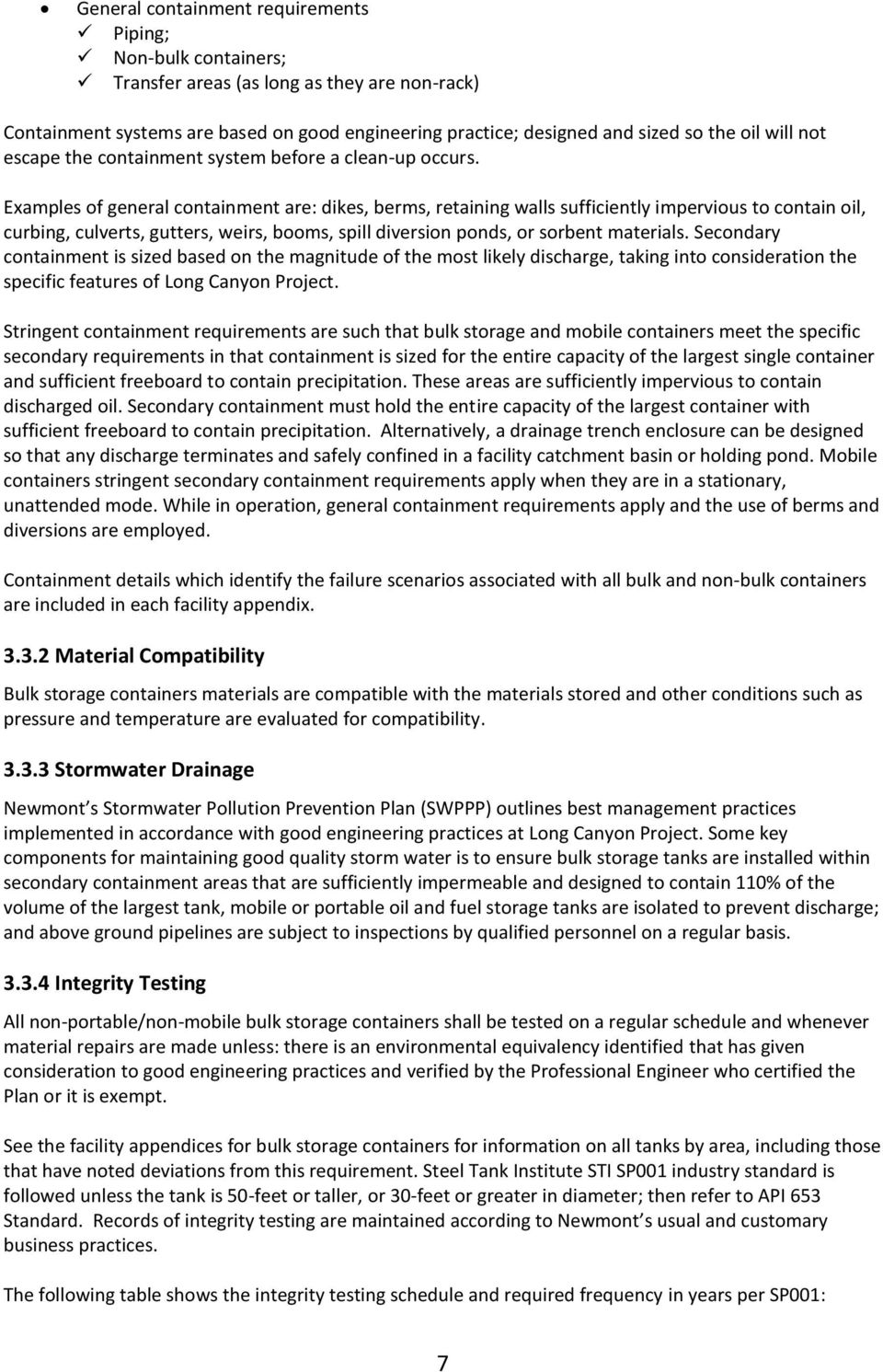
13 Tank Capacity (U.S. gallons) Category 1 Category 2 Category 3 0 1,100 n/a n/a E&L (10) 1,101-5,000 n/a E&L (10) E&L (5), I (10) or L(2), E(5) 5,001-30,000 E(20) E (10), I(20) or E (5), L (10) E&L (5), I(10) or L (1), E(5) 30,001-50,000 E(20) E&L (5), I(15) E&L(5), I(10) E Formal external inspection by certified inspector I Formal internal inspection by certified inspector L Leak test Depending on the risk a tank system poses to the environment, it is ranked as a category 1, 2, or 3. SP001 divides ASTs into these three categories. These categories are based on whether there are safeguards to prevent spills from entering the environment. Category Safeguards Spill control* (means of preventing a release to the environment) and a continuous release detection method* Spill control* (means of preventing a release to the environment) and without a continuous release detection method* Without Spill control* (means of preventing a release to the environment) and without a continuous release detection method* Inspections *see the definitions section of this Plan All bulk storage containers shall be inspected on a regular schedule, including the outside of the container for deterioration, discharges, or accumulations of oil inside containment. The visual inspection is conducted by Newmont qualified and trained personnel. A walk around inspection is intended for portable bulk storage containers while non-portable bulk storage containers are subject to the inspection requirements as outlines in STI SP001 Standard. Inspection of oil filled equipment or mobile equipment tanks are subject to the existing operating, maintenance and inspection procedures for each piece of machinery or equipment. Documentation and record keeping of these inspections are managed through Newmont s usual and customary business practices. Non-portable bulk storage containers are subject of routine visual inspections per STI SP001 Standard. Inspections are conducted by Newmont qualified and trained personnel with exception to those conducted by certified inspectors per the SP001 Standard. Refer to NNA form 0065 Oil Containing Facility Inspection used by Newmont personnel for inspections on all non-portable bulk storage containers. Any tanks subject to a different inspection schedule than the one outlined in the Inspection portion of the SP001 Standard are identified in the facility appendices. The inspection exceptions are based on good engineering practices, determined by the professional judgment of the Professional Engineer who certified the Plan and has given consideration to industry standards. Documentation and record keeping of these inspections are managed through Newmont s usual and customary business practices. 8
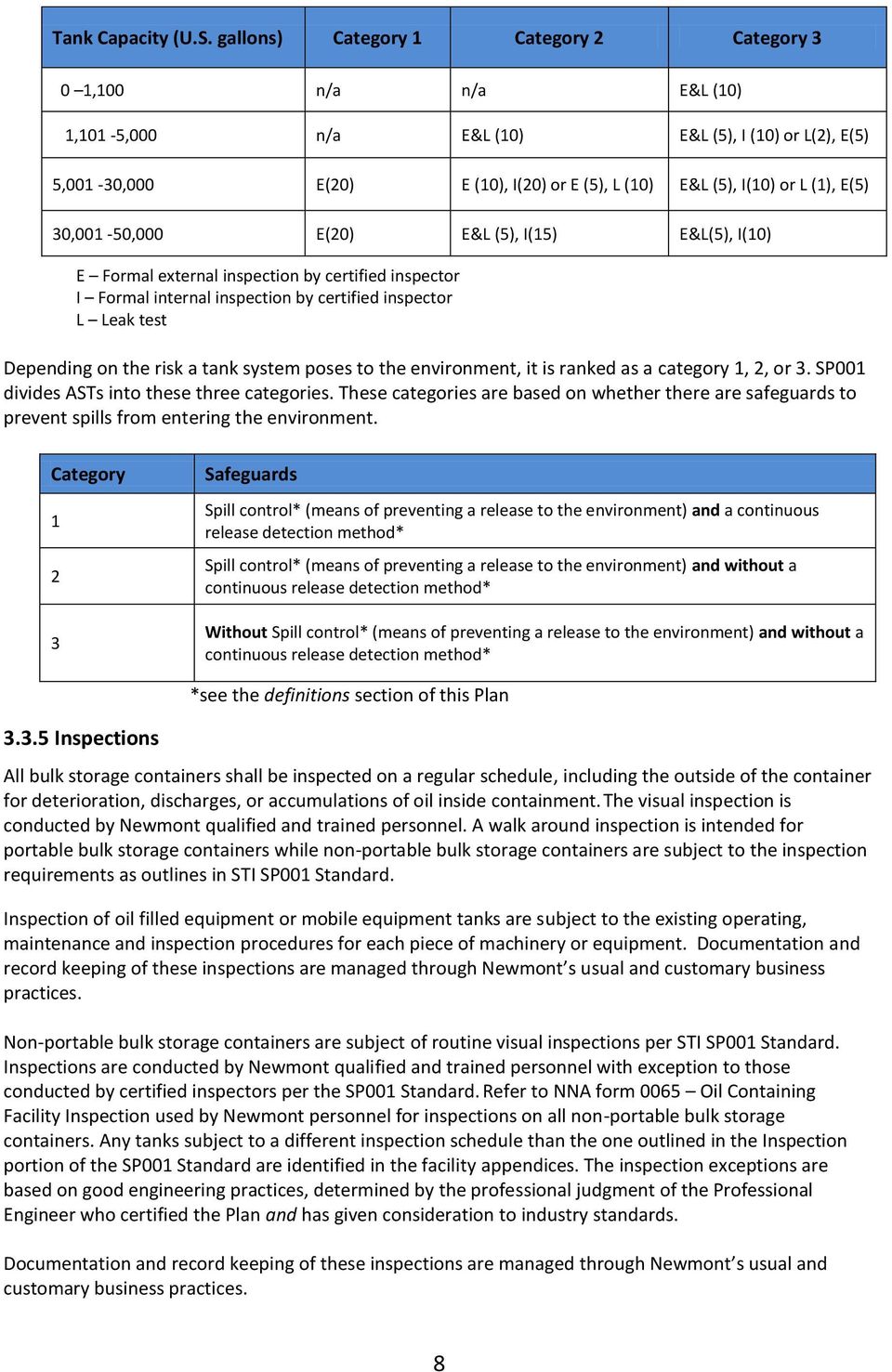
14 The following table shows the visual inspection schedule and required frequency in years per SP001: Tank Capacity (U.S. gallons) Category 1 Category 2 Category 3 0 1,100 P P P, E&L (10) 1,101-5,000 P P, E&L (10) P, E&L(5), I(10) or P, L(2), E(5) 5,001-30,000 P, E(20) P, E(10), I(20) or P, E(5), L(10) P, E&L(5), I(10) or P, L(1), E(5) 30,001-50,000 P, E(20) P, E&L(5), I(15) P, E&L(5), I(10) P Periodic external visual inspection (typically by tank owner, conducted at least monthly) E Formal external inspection by certified inspector I Formal internal inspection by certified inspector L Leak test Depending on the risk a tank system poses to the environment, it is ranked as a category 1, 2, or 3. SP001 divides ASTs into these three categories. These categories are based on whether there are safeguards to prevent spills from entering the environment. Category Safeguards Spill control* (means of preventing a release to the environment) and a continuous release detection method* Spill control* (means of preventing a release to the environment) and without a continuous release detection method* Without Spill control* (means of preventing a release to the environment) and without a continuous release detection method* *see the definitions section of this Plan Overfill Protection All non-portable/non-mobile bulk storage containers shall be equipped with overfill protection with one of the following devices is required: High liquid level alarms with an audible or visual signal at a constantly attended operation; High liquid level pump cutoff device set to stop flow at a predetermined container content level; Direct audible or code signal communication between the tank gauge and pumping station; Fast response system for determining the liquid level of each bulk storage container such as digital computers, telepulse, or direct vision gauges. With this alternative a person (driver) must be present to monitor gauges and the overfilling of bulk storage containers during delivery. Exceptions to the aforementioned requirements are identified in the facility Appendices and will apply under this condition: An environmental equivalency identified based on good engineering practices that is based on the professional judgment of the Professional Engineer who certified the Plan and has given consideration to industry standards. All liquid level sensing devices undergo tests to ensure proper operation Correction of Visible Leakage Any non-portable/non mobile storage container (not oil filled equipment) that has visible leakage from locations such as seams, gaskets, pumps, valves, rivets, or bolts is corrected promptly by qualified 9

15 persons. Any accumulation of oil in these bulk storage containers containment areas is to be removed promptly as well Field Constructed Containers If a field constructed aboveground container undergoes repair, alteration, reconstruction, or a change in service that might affect the risk of a discharge or failure due to brittle fracture or other catastrophe, the container is evaluated to determine the risk of discharge or failure. 3.4 Facility Drainage Controls and General Secondary Containment Long Canyon Project operations drainage is controlled through the use of berms, catchment basins, and overall contouring or grading of the site. Any discharge from a loading or from vehicles may flow to a catchment basin designed to retain oil or return it to the process. The site diversion system is designed to retain oil in the event of an uncontrolled release. Berms are required within most areas where mining equipment is located to meet MSHA regulations. Berms are also used along road edges and around surface operations areas. As part of a general secondary containment system, these berms restrain or direct flows of storm water within the site boundaries, especially in areas where oil is stored. Contouring of sites and constructed catchment basins or sumps are also used in certain cases to serve as drainage control, and provide additional secondary containment. Water accumulating in contoured low areas of the site is typically allowed to evaporate. Water collected within sump systems is typically first treated with absorbent material booms to collect any oil sheen on the surface within the sump. If additional treatment is required, accumulated water is manually pumped or transferred to an oil-water separator. Whenever uncertainty exists regarding the quality of water in the sumps due to unusual color, clarity, odor, or any other reason, samples are collected and analyzed. In all cases, water collected within bermed areas, secondary containments or sumps is not discharged. All catchment or retention areas are located away from flood areas.. Whenever uncertainty exists regarding the quality of water in the sumps due to unusual color, clarity, odor, or any other reason, samples are collected and analyzed. 3.5 Security Measures The Long Canyon Project will be operated 24-hours per day, 365 days per year. Operations and Security personnel will be present at all times at Long Canyon Project. The public is allowed to enter Long Canyon Project s operations only by appointment, go through Security, and must be accompanied by Newmont personnel while on site. All unauthorized personnel will be directed to security. Access into Long Canyon Project without going through security is limited by access cards only available to employees or vendors of Newmont. The combination of security and operations personnel available 24-hours per day, locked or access-card required entry at main access points and fencing minimizes the potential for unauthorized access and acts of vandalism at Long Canyon Project. In addition to the security measures mentioned above, the following security procedures will be followed where applicable for oil-containing facilities at Long Canyon Project. Master flow and drain valves and any other valves permitting direct outward flow of the container s contents are locked or sealed so that they remain in the closed position when in nonoperating or non-standby status. For unattended oil-containing fueling facilities, pump starter controls are locked, or access cards are required so that oil contents are accessible only to authorized personnel. 10

16 Loading/unloading connections of piping are securely capped or blank-flanged when not in service or when in standby service for an extended period of time. Adequate facility lighting (including the use of portable light plants) is available in areas where oil is stored to assist in the discovery of any discharges occurring during hours of darkness and to prevent discharges occurring through acts of vandalism. Based on the security measures that will be employed by Newmont at Long Canyon Project, unauthorized access or vandalism to oil-containing areas is unlikely. 4.0 OIL CONTAINING FACILITIES INCLUDING EQUIPMENT The following sections outline the specific details for oil-containing facilities for areas identified within the Long Canyon Project and are grouped and identified as follows: Mining Facilities; Processing Facilities; Ancillary Facilities As shown in the Appendix: Oil Containing Facilities Long Canyon Project (To Be Completed) depicts the location of the each of the areas within Long Canyon Project separated into area categories. There will be maps for each location showing the physical layout of each facility and respective container location. General locations of portable containers will be identified as well. The Facility appendices contain information for each location describing the shell capacity, contents, and containment of bulk storage containers. Additionally, each portable container is not individually identified but includes an estimation of the total number of portable containers and capacities. 4.1 Mining Facilites Ore and waste rock are drilled and blasted in benches to facilitate material excavation, loading and haulage. Dependent on the material characteristics and gold grade, the blasted material can be sent to the mills, heap leach facilities,, or waste rock disposal areas. The blasted material is loaded into haul trucks, using hydraulic shovels or front end loaders. The trucks then travel over a network of haul roads, both within and outside the immediate pit areas. This network of roads is bermed and maintained on a continuous basis, ensuring efficient management of any released oils. Each mining facility appendix will include tank locations, shell capacities, contents, failure mode, direction of flow, and details regarding secondary containment, testing and inspections, and any environmental equivalence for each of these areas and identified as follows: Mine Area; Fuel Area; Maintenance. 4.2 Processing Facilities Ore processing facilities at Long Canyon Project consist of a mill, tailings, and heap leach facility. Each processing facility appendix will include tank locations, shell capacities, contents, failure mode, direction of flow, and details regarding secondary containment, testing and inspections, and any environmental equivalence for each of these areas and identified as follows: Mill; Heap Leach; Tailings Facility. 11

17 4.3 Ancillary Facilities The Long Canyon Project ancillary facilities specific to this Plan include the mining and equipment maintenance shops and fueling areas. Each ancillary facility appendix will include tank locations, shell capacities, contents, failure mode, direction of flow, and details regarding secondary containment, testing and inspections, and any environmental equivalence for each of these areas and identified as follows: Shop; ANFO Manufacturing Facility. 4.4 Electrical, Operational, Mobile, and Miscellaneous Equipment These various types of above ground storage containers are subject to the general requirements of the SPCC rule. Exempt containers that are not included are any container with a storage capacity of less than 55 gallons of oil, permanently closed containers, one time use containers, and motive power containers Electrical Equipment Various types of electrical non-pcb transformers containing oil are located throughout the Long Canyon Project area. A complete list of the transformers broken down by facility location is provided in each of the Facility Appendices to this Plan. Secondary containment is provided through active control measures including spill response capabilities through the use of trained spill response personnel. Additionally, engineered drainage controls structures such as berms, ditches, retention basins, and overall site contouring are located throughout the Operations Areas and are effective means of spill control and containment. Refer to Section 3.4 Facility Drainage Controls for detailed information pertaining to this type of containment. The units are inspected regularly for signs of leaks or damage, and repairs are made as necessary to minimize the risk of larger spills or failures. Refer to outlining general requirements for oil filled electrical equipment Operational Equipment Long Canyon Project Operational Equipment can be found in the Mine and Process areas, and the Ancillary Facilities. Each of these facility appendices will summarize the operational equipment within Long Canyon Project as well as the type and quantity of oil contained within the system at 55-gallons or greater. Secondary containment is provided through active control measures including spill response capabilities through the use of trained spill response personnel, the use of drip pans, floor dry and absorbents. These materials are readily available and can be accessed in a timely manner. Additionally, engineered drainage controls structures such as berms, ditches, retention basins, and overall site contouring are located throughout the project area and are effective means of spill control and containment. Refer to Section 3.4 Facility Drainage Controls for detailed information pertaining to this type of containment. Maintenance personnel conduct pre-shift inspections and preventative maintenance is conducted on a regularly scheduled basis. These preventative actions minimize the risk of a discharge Mobile Equipment Motive power containers are located in or on a motor vehicle used solely to power the movement of a vehicle and are subject to Newmont s good engineering practices which include general secondary 12
18 containment using well maintained diversionary drainage controls throughout Long Canyon Project. See Section 3.4 for specific information on secondary containment and drainage controls. Equipment with motive power containers are not identified in this Plan, however, mobile equipment that have individual oil non-bulk containers used solely to hold oil for delivery to operative equipment located at Long Canyon Project are shown in each of the facility appendices. For general information regarding mobile equipment and its applicability under the SPCC rule, see Section of this Plan. All mobile equipment is subject to pre-use inspections per Newmont s Standard Operating Procedure, Inspections. Additionally, mobile equipment when not in use it is parked in areas that capable of containing oil until a clean-up takes place. The areas, known as ready lines are comprised of compacted soil and are clear of vegetation that could compromise the integrity of the imperviousness of the soil Miscellaneous Sources Miscellaneous sources include truck wash sumps, oil-water separators, and drainage sumps various sources that may contain residual hydrocarbons. These facilities are designed to control water runoff that may contain residual amounts of constituents like oil and suspended solids that could be harmful to the environment. For purposes of applicability to this SPCC Plan, these facilities are noted and are inspected regularly but are not included in the total oil capacity determination for Long Canyon Project. 5.0 PROCEDURES AND BEST MANAGEMENT PRACTICES To comply with regulatory requirements, procedures must be implemented to prevent any discharge of oil at the Long Canyon Project operations. 5.1 Training Employees that handle and use oil associated with transfer, storage, and maintenance are trained in the operation and maintenance of equipment to prevent discharges; discharge procedure protocols, and are trained to implement spill management practices to work with and around petroleum sources. Training includes annual hazardous waste management training and Annual Refresher Training that provides an overview regarding pollution control laws, rules, and regulations. All new hires receive training on the provisions of the SPCC Plan. Specific information associated with the content of the SPCC Plan is discussed during discharge prevention briefings and is offered at least annually to oil handling personnel. The briefings also include descriptions and discussions of releases and petroleum related events, malfunctioning components that may contribute to a discharge, as well as an overview of any recently developed precautionary measures. Sign in sheets for briefings and training records are kept on file following Newmont s usual and customary business practices. Petroleum delivery company employees understand the provisions of the SPCC Plan. Additionally, it is the responsibility of the petroleum delivery company employees to be familiar with the layout of the site, know the protocols for entering the site and unloading, and have the necessary spill equipment on trucks to respond to a spill from a vehicle or vehicle delivery hose. As a reference to review between training sessions, the following simple practices will minimize the potential for a petroleum release: Keep container lids securely fastened at all times; Do not leave portable sources unattended without any containment (i.e. drip pan); Return portable containers to storage location after use; Use drip pads, drip pans, and funnels when transferring petroleum products from a portable/mobile container; Use drip pans and/or oil absorbents to catch leaks; 13
19 Protect oil sources from damage by moving equipment; Do not store petroleum sources near catch basins or floor drains; Ensure proper dispensing techniques, such as checking delivery hoses and nozzles for leaks; Ensure all valves are closed after fuel or oil transfers; Secure vehicles during fueling using the emergency brake and/or chock; Provide warnings to all vehicles entering the site that vehicles will not endanger above ground piping or other oil transfer operations; Follow applicable Standard Operating Procedures including Hazardous Materials and Chemicals; Ensure oil-handling personnel are trained and qualified, including safe work practices and emergency and evacuation procedures; Use common sense and good housekeeping practices. Additionally, it is the responsibility of the oil suppliers to be familiar with the layout of the site, know the protocols for entering the site and unloading, and have the necessary spill equipment available to respond to a spill from a vehicle or vehicle delivery hose. 5.2 Contractor Instructions In order that there is no misunderstanding on joint and respective duties and responsibilities to perform deliveries of oil in a safe manner, contractors understand procedures outlined in the SPCC Plan and associated Standard Operating Procedures, including the Environmental Policy for Contractors and Vendors located on the NevadaNet ESR portal. 5.3 Loading Trucks With Tanks Loading operations including vehicle fueling operations that are performed by facility personnel trained in the specific operation. Following these procedures will aid in minimizing a discharge: Check the vehicle to ensure it is properly secured before making connections; Inspect the storage and delivery system, hoses, connections, and the receiving container before beginning operations; Drains and outlets on the tank trucks are inspected for leaks before departure; Monitor the transfer operation in-person from beginning to end; Monitor the liquid level in the receiving tank during transfer to prevent tank overfill; Check and ensure the vehicle has been disconnected before departure; Ensure understanding of all applicable loading Standard Operating Procedures; Ensure safe practices are followed; Check labeling and placards ensuring the right oil is being transferred to the right container; Secure the storage and delivery systems after use. 5.4 Vehicle Fueling Light vehicle dispensing operations are performed by employees. To minimize the potential for a discharge the following actions are considered best practice: Area employees monitor the fueling area for safe and proper operation, and take immediate action to correct any deficiencies; Read posted operating instructions; Turn off engine while fueling; Set emergency brake and chock vehicle; Stay with vehicle during vehicle fueling; Do not block open the fuel pump handle trigger; Ensure gas nozzle is fully inserted into gas tank throat; Check to ensure gas cap is attached and gas tank door is closed when fueling is complete; 14
20 Understanding of Newmont Standard: Vehicles and Mobile Equipment; Be familiar with emergency procedures. 5.5 Newmont Oil Handling Procedures The following provides a bulk storage container and containment overview outlining procedures that are followed while handling and storing oil at Long Canyon Project: Use only containers fabricated with materials compatible with the material stored and the conditions of storage such as pressure and temperature; New bulk storage designs have secondary containment that is 110% of the volume of the largest tank in the containment area; Secondary containments and/or facility drainage is designed such that they will be sufficiently impervious to contain a discharge of oil, and ensure that a discharge will be contained within the facility to prevent a discharge into surface water; Rainwater collected, or effluent is not discharged into any open watercourse, lake or pond. Any water collected on site will remain on site, or be treated using on-site best management practices. Currently there are no buried or partially buried metallic tanks used to store hydrocarbons at the Long Canyon Project. No buried tanks shall be installed; Any oil drips, leaks, or flows noted by site personnel from bulk storage containers and associated valves, gaskets, pipes, etc. will be promptly corrected and oil will be removed and not allowed to accumulate in containment areas; Follow applicable Standard Operating Procedures; Hazardous Materials and Chemicals. 5.6 Piping Transfer operations include transfer of oil from bulk storage containers through piping to associated facility processes. In very few instances are buried pipes used to transfer oil.. Additionally, a passive system is used to detect leaks and recover product. The protective piping also serves as secondary containment in the event of a leak or rupture of oil containing piping. Pipe supports are designed to minimize abrasion and corrosion and allow for expansion and contraction. Warning signs are posted in all areas where vehicular traffic enters areas of above ground piping or other oil transfer operations. Above ground piping and appurtenances associated with the piping are inspected regularly as outlined in in the Plan and associated Facility Appendices. In the event facilities are not in service or in standby service for extended periods of time, piping terminal connections at transfer points will be marked as to origin and capped or blank-flanged. 5.7 Oil Transporters Oil transporters contracted with Newmont meet the appropriate guidelines of Newmont s Hazardous Material and Handling Policy Compliance Manual, comply with Newmont standards. Contractors understand emergency response and spill clean-up measures and are incorporated into their contracts. The following is a general overview of guidelines and requirements for Contractors: The vehicles and tanks are suitable for oil and are maintained in adequate condition to ensure proper handling of oil; Appropriate labeling and placarding is used on tanks; Bulk transfer of oil during delivery is observed by Newmont personnel trained in preliminary hazard analysis methods; Standard Operating Procedures are followed for unloading are understood, kept current, and personnel trained. 15
21 The commercial tank trucks are exempt from the provisions of the SPCC Plan, but are required to comply with other regulatory requirements, which include spill prevention. The commercial tanker trucks adhere to the requirements and regulations of the Department of Transportation (DOT). 6.0 SPILL CONTROL, REPORTING, CLEAN UP AND DISPOSAL The Long Canyon Project Emergency Response Plans outline the requirements necessary to respond to leaks, spills and releases. The Plan describes a discharge as Emergency Level High and includes a general response procedure. Specifically for an oil release the response procedure includes: Extinguish/remove all sources of ignition from the spill area (i.e. motors, electrical circuits); Shut down source of oil supply; Use spill response material or other barriers in the path of the release; Non dripping absorbent materials may be taken to the landfill. When an Emergency High Level discharge takes place, ensure that affected landowners are notified and permission is granted to clean up the area. Follow the Emergency Procedures and Notifications located in the Preface section of this Plan. The Preface section also includes a Contact List, and outlines the National Response Center Notification procedure. Spill kits (to be installed) will be maintained throughout Long Canyon Project at locations that are readily accessible in areas where oil-containing containers and equipment are located. The Long Canyon Project also will have the available equipment and manpower to respond to any larger spill that could occur to minimize the risk of a discharge outside of containment. Reasonable measures are required to ensure releases do not spread: Stopping, controlling, or containing the source of the release; Containing the released oil to minimize spreading; Eliminate or control the health and safety hazards; Collect and containerize the oil; Clean up. 6.1 General Emergency Control In addition to up to date Emergency Response Plans that allows Long Canyon Project to effectively respond to an emergency, it is necessary to have the resources available to minimize adverse impacts to the environment. This includes a trained emergency response team that are on site 24/7 to assist in an emergency response as well as a site emergency response coordinator that assures responders and equipment is available. Additionally, the site general manager ensures that resources are provided and are outlined as follows: General Radio/phone communications to advice of the release/discharge; Personnel familiar with the hazardous products location on site; Material Safety Data Sheets for all petroleum products located on site; Spill Control equipment. Heavy Equipment Haul Trucks; Back Hoes; Fork Lifts (with and without drum handlers); Loaders; Graders; Vacuum/Guzzler Trucks; Water Trucks; Trained and experienced equipment operators. Fire Equipment 16
22 Halon Fire Extinguishers (approved for electrical fires); Dry Chemical Fire Extinguishers; Water Trucks. Heavy equipment and emergency response equipment is regularly inspected and maintained to ensure it is in proper working order and a state or readiness. Reviews are conducted at least once a year to check and ensure emergency equipment is of sufficient quantities and of the correct type of any foreseeable emergencies. 6.2 Catastrophic Emergency Long Canyon Project will enter in a Mutual Aid Emergency Response agreement with the Northeastern Nevada Local Emergency Planning Committee. This written agreement will set forth between private companies and local government to provide trained personnel and equipment resources that could respond to catastrophic emergencies. 6.3 Small Oil Spill Control Some examples of spill control actions taken in the event of a small spill, include stopping the leak by plugging the leak and/or closing the valve. The spill area should be confined through earthen berms or absorbent materials such as spill socks. Safety of personnel must always be assured. Ensure that persons not needed to help with spill remediation leave the area. Clean-up of the spill must take place immediately following containment of the spill. Long Canyon Project employees under the direction of an authorized person will conduct the clean-up operation. 6.4 Oil Releases and Discharge Control Examples of spill control actions taken in the event of a spill of significant size, direct countermeasures include the necessary action to stop the source of the flow of oil. Personnel must exercise every available option, without disregard to their own safety, to stop and confine the spill. Dig a trench or dike or do whatever else is necessary to confine the area of the spill or to stop it from spreading, entering a waterway, or leaving the property boundary. Water can be diverted around the spill area using earthen berms and ditches. Safety of personnel must always be assured. Oil-absorbent materials such as spill socks and mats or any other safe means may be used to prevent hydrocarbon products from flowing into watercourses or off property boundaries. Other actions such as plugging floor drains or placing absorbent booms around the spill to minimize environmental damage must be taken. 6.5 Immediately reportable Discharge to surface water or a release to land surfaces or soil is an immediately reportable defined as: Any discharge or disposal of oil, grease or other petroleum product that enters or threatens to enter a river, stream, canal, septic system, lake or pond; Newmont s policy: oil spills in any amount to soils or land surface; Any hydrocarbon spill within one-mile radius of Big Springs is reported to the city of West Wendover, Nevada; State reporting requirement: 100 gallons or more of petroleum product; Spill that cannot be cleaned up without enlisting help of an outside contractor; Any leakage or spillage of oil that is in danger of leaving or has left company property. All immediate reportable spills require reporting spill information to Security and entry into the Cintellate System by the area supervisor or designee. Refer to the Sections 6.6 and
23 6.6 Communication Procedures for Releases Communication procedures for releases to land surfaces or soils requires the area supervisor or designee to contact Security and report the release amount, date and time of the release, location, excavation information etc. Security documents this information and contacts ESR. Additionally, the area supervisor or designee must enter the details associated with the release into Cintellate. The ESR department is required to report the release to appropriate State regulatory agencies. 6.7 Post Emergency Activities Whenever a release takes places, a full investigation is carried out by the emergency response coordinator or HSLP to determine the cause of the incident, and how to prevent future actions and how they might be improved. Any deficiencies that are identified are communicated to appropriate personnel and included in the facility corrective action system. 6.8 Clean Up And Disposal Petroleum releases should be handled only by personnel knowledgeable in this type of response and cleanup. When cleaning up oils, all spent cleanup material such as rags, absorbent materials, oil, and/or blankets must be placed in 55-gallon drums and disposed of in accordance with Newmont s approved disposal procedures which are based on State and Federal regulatory requirements. Only pre-approved locations shall be used to dispose of cleanup materials. Always check with the ESR for assistance in managing the materials before disposal. Petroleum contaminated soils shall be managed according to regulatory requirements. There may be instances where characterization is required. If the material is a hazardous waste, facility personnel involved with handling must be current on RCRA training, which is required annually. Training records are maintained in the ESR department. During clean up excavation of materials may be required; check with HSLP to determine if is necessary to obtain an excavation permit. Spill response equipment used during clean-up is replaced and located where response personnel have knowledge of the location and accessibility is adequate and ready for future deployment. 18
24 EXHIBIT A: REGULATORY CITATION CROSS REFERENCE To comply with 40 CFR 112.7, General Requirements for SPCC plans, and facilitate the usefulness of this Plan, the following table outlines the pertinent sections of the regulations relating to individual oil containing facilities addressed in this Plan where applicable (a) - (c) Date facility began operations for determining plan effective dates (a) 112.4(d), (e) 112.5(a) Reportable discharges submitted to Regional Administrator, if applicable. Description of changes or amendments required by the Regional Administrator, if applicable Description of amendments to the SPCC Plan The Plan must be in writing and the sequence must be followed per 112.7, if any variation occurs, a supplement is necessary with a crossreferencing section 112.7(a)(1) Complete discussion of conformance with applicable requirements (a)(2) 112.7(a)(3) 112.7(a)(3)(i) 112.7(a)(3)(ii) If applicable, deviations from conformance, reasons for nonconformance, alternative measures described in detail that provide equivalent environmental protection A description and physical layout of all facilities and facility diagram that marks locations of containers (per amendment EPA Dec. 5, 2008) mobile/portable containers can be identified by a mark on diagrams. Indicate (range): #, contents, capacities. An oil inventory depicting quantities of product and used oils in storage Containers and the storage capacity Duscharge prevention measures including procedures for routine handling of products 19 Preface: NRC and EPA Notification Procedure Preface: Annual Review, 1.3 and Appendix: Cross Reference Facility Appendices 2.0, 4.0 and Facility Appendices Facility Appendices 112.7(a)(3)(iii) Discharge or drainage controls and procedures for discharge control 3.4 and (a)(3)(iv) Countermeasures for discharge, discovery, response, and cleanup (a)(3)(v) 112.7(a)(3)(vi) 112.7(a)(4) 112.7(a)(5) (b) 112.7(c) 112.7(c)(2)(i)(ii) Methods of disposal of recovered materials in accordance with applicable legal requirements Contact List and phone numbers for agencies, on-site Emergency Contacts Provide procedures and information to ensure a person reporting a discharge can relate pertinent information Organize portions of the Plan describing procedures to use when a discharge occurs to make it readily usable in an emergency A written discussion and map depicting the direction of flow in the event of a spill where experience indicates a reasonable potential for equipment failure, qty of oil that can be discharged from the facility as a result of a major equipment failure Provisions for and discussion of containment and or diversionary structures or equipment to prevent discharges (dikes, berms, retaining walls, curbing, culverts, gutters, weirs, booms, retention ponds, etc.) Minimum prevention systems are curbing or drip pans; or sumps and collection systems Preface: Contact List Preface: Contact List Preface: NRC and EPA Notification Procedures 6.5, 6.6, 6.7 Preface: Contact List Preface: NRC and EPS Notification procedures Facility Appendices , 3.3.1, , 3.4
25 112.7(d) 112.7(e) Explanation of why appropriate containment is not practicable, where applicable and if not practibable then conduct integrity testing of tanks, leak and valve testing and provide an oil spill contigency plan per part 109 of the chapter and a written commitment of manpower and resources. Conduct inspections and tests in accordance with written procedures that are developed for the facility. Written procedures and a record of the inspections and tests, signed by the appropriate supervisor or inspector. The record of inspections and tests can be kept under usual and customary business practices 112.7(f)(1)(3) Training of personnel including briefings 5.1 Facility Appendices (if applicable) 3.3.4, (f)(2) Designated person accountable for discharge prevention Facility Appendices 112.7(g)(1) Fully fence each facility and lock and guard entrance gates (g)(2) 112.7(g)(3) 112.7(g)(4) 112.7(g)(5)(i)(ii) 112.7(5)(h) 112.7(5)(i) 112.7(5)(j) Ensure flow valves have adequate security measures to they remain closed when in non-operational or stand-by status Lock the starter control on each oil pump in the off position and locate it at a site accessible to only authorized personnel Securely cap and flange the loading/unloading connections of oil pipelines or facility piping when not in service for extended time Provide facility lighting to aid in the discovery of discharges during darkness and prevention of discharges from acts of vandalism Facility tank car and tank truck loading/unloading rack containment is required if drainage flow doesn t flow into a catchment basin ot facility designed to handle discharges If field constructed aboveground container undergoes a repair, alteration, reconstruction or a change in service that may affect a risk in discharge or failure, a risk assessment is done, and appropriate actions taken based on outcome Include complete conformance with the applicable requirements and other effective discharge and containment procedures or any applicable more stringent State rules, regulations, and guidelines (a)-(d) Prevention and containment procedures n/a , 5.2, 5.3, 5.4, (a)-(d) Discharge prevention and containment procedures 5.0, 3.4, 3.3.1, ( c) (6) 112.8(c)(8)(i)(ii)(ii i)(iv)(v) ( c) (9)(10) ( c) (11) Integrity test each aboveground container on a regular schedule and when material repairs are made High liquid level alarms installed and tested Promptly correct visible leaks and spills from the container. Remove accumulated oil in diked areas, Position or locate mobile or portable containers to prevent a discharge , ( d) (1)-(5) Facility transfer operations, pumping, and facility process 3.3.5,
26 EXHIBIT B: DEFINITIONS Bulk Storage Container: any container used to store oil. These containers are used for purposes including, but not limited to, the storage of oil prior to use, while being used, or prior to further distribution in commerce. From 112.1(d)(2)(ii) only containers of oil with a capacity of 55 gallons or greater are counted toward the 1,320-gallon threshold. The threshold applies to storage capacity contained in operating equipment as well as to storage capacity in containers (see page of the July 17, 2002 Federal Register). Completed Buried Tank: any container completely below grade and covered with earth, sand, gravel, asphalt or other material. Containers in vaults, bunkered tanks, or partially buried tanks are considered above ground storage containers. Discharge: includes, but is not limited to, any spilling, leaking, pumping, pouring, emitting, emptying, or dumping of oil into or upon the navigable waters of the United States or adjoining shorelines, or into or upon the waters of the contiguous zone, or in connection with activities under the Outer Continental Shelf Lands Act or the Deep water Port Act of 1974, or that may affect natural resources belonging to, appertaining to, or under the exclusive management authority of the United States (including resources under the Magnuson Fishery Conservation and Management Act) Facility: any mobile or fixed onshore or offshore building, structure, installation, equipment, pipe, or pipeline (other than a vessel or a public vessel) used in oil well drilling operations oil storage, oil gathering, oil processing, oil transfer, oil distribution, and waste treatment, or in which oil is used. The boundaries of a facility depend on several site-specific factors, including, but not limited to, the ownership or operation of buildings, structures, and equipment on the same site and the types of activity at the site. Oil: oil of any kind or in any form, including petroleum, fuel oil, sludge, synthetic oils, mineral oils, oil refuse, or oil mixed with wastes other than dredged spoil. Onshore Facility: any facility of any kind located in, on, or under any land within the United States, other than submerged lands. Owner or Operator: any person owning or operating an onshore facility. Permanently closed: any container or facility for which: 1. All the liquid and sludge has been removed from the container and connecting line; and 2. All connecting pipes and lines have been disconnected from the container and blanked off, all valves (except for ventilation valves) have been closed and locked, and conspicuous signs have been posted on each container stated that it is a permanently closed container and noting the date of such closure. SPCC Plan: the document required by 40 CFR that details the equipment, workforce, procedures, and steps to prevent, control, and provide adequate countermeasures to a discharge. Definitions per STI SP001 Standard (Inspection of Aboveground Storage Tanks) CONTINUOUS RELEASE DETECTION METHOD (CRDM): a means of detecting a release of liquid through inherent design. It is passive because it does not require sensors or power to operate. Liquid releases are visually detected by facility operators. The system shall be designed in accordance with good engineering practice. Several acceptable and commonly used CRDM systems are as follows: Release prevention barrier (RPB) described in definition of release prevention barrier. Secondary containment AST including double wall ASTs, double bottom ASTs, or other ASTs defined in secondary containment 21
27 Elevated AST with release prevention barrier FIELD-ERECTED AST: a welded metal AST erected on-site where it will be used. For the purpose of this standard, ASTs meeting either of the following descriptions are to be inspected as field-erected ASTs: a. An AST where the nameplate (or other identifying means such as accurate drawings) indicates that it is a field -erected AST. These are limited to a maximum shell height of 50 feet (15.24 meters) and a maximum diameter of 30 feet (9.14 meters). b. An AST without a nameplate (or other identifying means such as accurate drawings) that is more than 50,000 U.S. gallons (189,271 liters) and a maximum shell height of 50 feet (15.24 meters) and a maximum diameter of 30 feet (9.14 meters). FORMAL EXTERNAL INSPECTION (FEI): a documented external inspection conducted by a certified inspector to assess the condition of the AST and determine its suitability for continued service without entry into the AST interior. FORMAL INTERNAL INSPECTION (FII): a documented internal inspection conducted by a certified inspector to assess the internal and external condition of the AST and determine its suitability for continued service. This includes the inspection requirements of a formal external inspection. A formal internal inspection satisfies the requirements of a formal external inspection and shall be considered equivalent to or better than a formal external inspection for the purposes of scheduling. LEAK TESTING METHOD (LTM): a point in time test method to determine if an AST is liquid tight. Leak testing is not preventive in the sense that it provides an indication only if the AST integrity has already been breached. Therefore, it may be used as a tank integrity measure or as a supplement to other inspection procedures. LTMs may include the following technologies: 1. Gas pressure decay (includes vacuum decay) 2. Gas pressure soap bubble testing 3. Gas tracers (e.g., helium tracer) 4. Soil tracers (chemical marker) 5. Mass measurement 6. Level measurement 7. Hydrostatic test PERIODIC AST INSPECTION: a visual, documented inspection conducted by an owner s inspector, to assess the general AST conditions, as best as possible, without suspending AST operations or removing the AST from service. RELEASE PREVENTION BARRIER (RPB): a liquid containment barrier that is sufficiently impervious to the liquid being stored and is installed under the AST. Its purpose is to divert leaks toward the perimeter of the AST where they can be easily detected as well as to prevent liquid from contaminating the environment. RPBs are composed of materials compatible with the liquid stored in the AST and meet proper engineering standards. Examples are steel (such as in steel double-bottom tanks), concrete, elastomeric liners, or other suitable materials provided the above criteria are met. SECONDARY CONTAINMENT AST: an AST which is either a double-wall AST, or an AST with an integral secondary containment dike. These integral secondary containment dikes may be pans, boxes or containers and are designed to contain the contents of the primary tank if the primary tank fails. A secondary containment AST may be open or closed to the atmosphere. If precipitation cannot readily enter the integral secondary containment, then the containment need only be sized for the primary tank volume. If precipitation can enter the secondary containment, then the secondary containment is sized to contain the primary tank volume and with sufficient freeboard to contain precipitation. SHOP-FABRICATED: a welded metal AST fabricated in a manufacturing facility or an AST not otherwise identified as field-erected with a volume less than or equal to 50,000 U.S. gallons (189,271 liters). 22
28 SPILL CONTROL: a means of preventing a release of liquid to the environment including adjoining property and waterways. Methods include the following: 1. Remote impounding 2. Secondary containment dike/berm 3. Secondary containment AST 4. Secondary containment system SUFFICIENTLY IMPERVIOUS: Sufficient resistance to diffusion and transport of hydrocarbon or other chemical substances to prevent contamination of the environment until clean-up occurs. Determination of sufficiently impervious is a technical consideration that a Professional Engineer or other qualified professional (such as Professional Geologist, Environmental Professional, etc.) must make. This determination is to be based on sound technical considerations, the site specific conditions, as well as risk based considerations, such that ground and groundwater contamination is prevented, using current normally accepted engineering practices and principles. Sufficiently impervious does not necessarily mandate the use of a liner. Additional information about liners is found in API 341, A Survey of Diked-area Liner Use at Aboveground Storage Tank Facilities. 23
29 EXHIBIT C: ACRONYMS API BCA CFR EPA GMO MSHA NAC NDEP NMC NRC OEM PCB PCS PE RA SEM SOP SPCC STI US American Petroleum Institute Bureau of Corrective Actions Code of Federal Regulations Environmental Protection Agency General Manager Operations Mine Health and Safety Administration Nevada Administrative Code Nevada Department of Environmental Protection Newmont Mining Corporation National Response Center Office of Emergency Management Polychlorinated biphenyl Petroleum Contaminated Soil Professional Engineer Regional Administrator of an EPA Region Senior Environmental Manager Standard Operating Procedure Spill Prevention, Control, and Countermeasure Steel Tank Institute United States 24
30 EXHIBIT D: EMERGENCY PROCEDURES AND NOTIFICATIONS ( 112.7(a) (3) (iv), 112.7(a) (4) 112.7(a) (5)) Description of Emergency Procedures The following is a description of the immediate actions to be taken by facility personnel in the event of a discharge to navigable waters or adjoining shorelines [ 112.7(a)(3)(iv) and 112.7(a)(5)]: 1) Assess Safety and Detection by determining safety to yourself and others, shut off source if safe to do so. IF THE SUBSTANCE IS UNKNOWN GO TO STEP #4 2) Trace source of the spill and determine if spill is continuing 3) Stop or Control the leakage by shutting valves, plugging valves, moving mobile equipment 4) Emergency Notification to Security 5) Secure area and divert traffic and/or people away from immediate area 6) If possible, safe, and trained to do so, identify and secure source of the discharge and contain the discharge with temporary berms, sorbents, sandbags, or other material from the spill kits 7) Recover material such as any free liquid into purpose built containers if possible 8) Clean up the release by pumping or absorbing 9) Dispose of spilled material as directed by ESR. Any contaminated soil shall be removed to the appropriate area 10) Clean up obvious contamination as instructed by ESR department, collect samples for analysis 11) Confirm the cleanup and ensure reporting to Security (82911) and Cintellate entry (located on the NevadaNet homepage) 12) Replace used equipment that was consumed during the cleanup operation 13) Monitor the spill site and validate the clean up If necessary, the appropriate department personnel contacts regulatory authorities and other response personnel and organizations (see Contact List). For additional information on emergency and countermeasure procedures, refer to the following available on Newmont ESR and HSLP Portals: Long Canyon Project Surface Operations Site Emergency Response Plan Petroleum Hydrocarbon Release Standard Operating Procedure Environmental Policy for Contractors and Vendors Long Canyon Project Emergency Response Plan Emergency Contingency Hazardous Waste Plan Environmental On-Call Protocol Emergency Preparedness and Response Standard Operating Procedure Hazard Communication Program Fluid Management Plans 25
31 EXHIBIT E: CONTACT LIST ( 112.7(a) (3) (vi)) Contact Organization / Person National Response Center (NRC) Telephone Number Report via - Telephone: or On-line: Cleanup Personnel General Foreman Surface Operations Foreman Mine Operations To Be Determined Key Facility Personnel Designated Person Accountable for Discharge Prevention: Security To Be Determined Emergency Response Coordinator State Oil Pollution Control Agencies Bureau of Corrective Actions NDEP Bureau of Mining and Regulation and Reclamation NDEP Other State, Federal, and Local Agencies Elko County Emergency Management (OEM) Nevada Dept. of Public Safety Duty Officer EPA Region 9 EPA Region 9 Water Division NV State Fire Marshal and State Emergency Response Commission Office: To Be Determined Emergency: To Be Determined Office: To Be Determined Emergency: To Be Determined Duty Officer [email protected] business hours after hours Office: 866-EPA-WEST Local Emergency Planning Committee Elko County Mike Hecht Local Sheriff Department 911 or Hospital Northeastern Nevada Regional Hospital Other Contact References City of West Wendover Police Chief City of West Wendover City of Wells Police Department City of Wells
32 EXHIBIT F: NRC AND EPA NOTIFICATION PROCEDURE (ESR RESPONSIBILITY) ( 112.7(a) (4) and (a) (5)) NRC Notification Procedure In the event of a discharge of any amount of oil to navigable waters or adjoining shorelines, the following information shown below will be provided to the National Response Center immediately following identification of a discharge to navigable waters or adjoining shorelines: [See National Response Center Report Form in Appendix: FORMS] [ 112.7(a)(4)] The exact address or location and phone number of the facility; Date and time of the discharge; Type of material discharged; Estimate of the total quantity discharged; Estimate of the quantity discharged to navigable waters; Source of the discharge; Description of all affected media; Cause of the discharge; Any damages or injuries caused by the discharge; Actions being used to stop, remove, and mitigate the effects of the discharge; Whether an evacuation may be needed; and Names of individuals and/or organizations who have also been contacted. SPCC Spill Reporting Requirements (Report within 60 days) ( 112.4): Submit information to the EPA Regional Administrator (RA) and the appropriate agency or agencies in charge of oil pollution control activities in the State in which the facility is located within 60 days from one of the following discharge events: A single discharge of more than 1,000 U.S. gallons of oil to navigable waters or adjoining shorelines or Two discharges to navigable waters or adjoining shorelines each more than 42 U.S. gallons of oil occurring within any twelve month period You must submit the following information to the EPA Regional Administrator (Region IX) (1) Name of the facility; (2) Your name; (3) Location of the facility; (4) Maximum storage or handling capacity of the facility and normal daily throughput; (5) Corrective action and countermeasures you have taken, including a description of equipment repairs and replacements; (6) An adequate description of the facility, including maps, flow diagrams, and topographical maps, as necessary; (7) The cause of the reportable discharge, including a failure analysis of the system or subsystem in which the failure occurred; and (8) Additional preventive measures you have taken or contemplated to minimize the possibility of recurrence (9) Such other information as the Regional Administrator may reasonably require pertinent to the Plan or discharge 27
33 EXHIBIT G: CERTIFICATION PAGE (D) The undersigned Registered Professional Engineer is familiar with all of the Long Canyon Project Operations facilities and also understands the Rules and Regulations promulgated under 40 CFR Part 112 Oil Pollution Prevention. The SPCC Plan has been prepared in accordance with good engineering practices, including considerations given for applicable industry standards as well as the requirements of 40 CFR Part 112. Procedures for inspecting and testing the tanks and containers have been established and are herein incorporated. Based on my professional engineering judgment, this SPCC Plan is adequate for the Long Canyon Project Operations Facilities. Johnny P. Torres, P.E. (Nevada P.E. Registration Number ) Date: Seal: 28
34 EXHIBIT H: MANAGEMENT COMMITMENT (D)(2) Newmont management is committed to the prevention of discharges of oil to navigable waters or the environment, and maintains the highest standards for spill prevention and control and countermeasures through periodic review, updating, and implementation of this Spill Prevention Control and Countermeasures (SPCC) Plan. Newmont will provide the necessary manpower, equipment, and materials to control and remove any quantity of oil discharged that may be harmful as outlined in this SPCC Plan per 40 CFR 112.7(d)(2). Signed: Title: Printed Name: Date: 29
35 EXHIBIT I: ANNUAL REVIEW The annual review is conducted by a P.E. or designated agent that is familiar with the site and each facility is visited by the P.E or a designated agent during the annual review and evaluation. Plan amendments organization is the responsibility of the ESR department. Revisions to facilities are the responsibility of the facility personnel with communication of revisions to ESR for incorporation in to the Plan. The Plan will be reviewed and updated under the following circumstances: Annual review, evaluation and update completed in February for the previous year; Subsequent to an inspection or other determination that the Plan or any portion thereof is ineffective, or is otherwise not achieving the general objectives of the Plan; Subsequent to the commission or decommission of any aboveground storage tanks (ASTs); Subsequent to the replacement, reconstruction, or movement of AST s; Subsequent to any construction or demolition that could alter secondary containment systems of the ASTs; and Subsequent to any revisions of standard operation or maintenance procedures that pertain to AST s, piping, and drainage; Subsequent to the reconstruction, replacement, or installation of piping systems; Subsequent to changes in product or service; Subsequent to any changes in spill management procedures; Subsequent to any changes to the Emergency Response Plans that directly affect this Plan. See Preface i for a list of the Plans. During the annual review and evaluation, each revision will be incorporated into the Plan. The annual review, evaluations and updates to the Plan are completed on or before the last day of February for any revisions in the previous year. The responsible person at each facility is required to ensure necessary changes to oil inventories occur and is updated on the oil inventory form, failure scenarios are addressed and updated, and map mark-ups are completed and then communicate those updates to ESR by the end of January. Any facility environmental equivalencies are worked out in conjunction with ESR. Any technical amendment to the Plan requires a Professional Engineer certification and completion of P.E. statement. See Preface vii, Technical Amendments, Professional Engineer s Statement. Documentation of the annual review and evaluation is through the Newmont North America (NNA) controlled document management procedures including the use of the form titled, Control Document Change Request. If the amendments are technical in nature, it must be certified by a Professional Engineer using the statement in Preface vii, Technical Amendments, Professional Engineer Statement. This statement is filed with the completed form, Control Document Change Request and a copy is included in the Appendix: Annual Review and Amendments. Filing completed forms and certifications follow the Newmont Mining Corporation s usual and customary document management practices. It is important to note that after the annual review and evaluation, if there are no changes to the Plan, a signed statement is required per (b) and is outlined in Preface viii. A copy of the signed statement is filed in the Annual Review and Amendments Appendix and the original filed with the Control Document Change Request. 30
36 EXHIBIT J: TECHNICAL AMENDMENTS PROFESSIONAL ENGINEER STATEMENT I have completed review and evaluation of the technical amendments in SPCC Plan for Newmont Mining Corporation, Long Canyon Project Operations, on (date), and based on my professional judgment certify the technical amendments have been prepared in accordance with good engineering practice, including consideration of applicable industry standards.there are procedures for inspections and testing, and the Plan is adequate for this facility. I or my agent has visited and examined the facility in accordance with (d)(ii). Johnny P. Torres, P.E. (Nevada P.E. Registration Number ) Date: Seal: 31
37 EXHIBIT K: ANNUAL REVIEW NO PLAN AMENDMENTS I have completed review and evaluation of the SPCC Plan for Newmont Mining Corporation, Long Canyon Project Operations on [date], and will not amend the Plan as a result. General Manager Date This statement is filed in the Appendix titled: ANNUAL REVIEW AND AMENDMENTS. 32
38 EXHIBIT L: NEGATIVE DETERMINATION OF SUBSTANTIAL HARM CRITERIA (E) 1. Do any of the facilities transfer oil over water to or from vessels and does the facility have a total oil storage capacity greater than or equal to 42,000 gallons? NO 2. Do any of the facilities have a total oil storage capacity greater than or equal to 1 million gallons and does the facility lack secondary containment that is sufficiently large to contain the capacity of the largest aboveground oil storage tank plus sufficient freeboard to allow for precipitation within any aboveground oil storage tank area? NO 3. Do any of the facilities have a total oil storage capacity greater than or equal to 1 million gallons and is the facility located at a distance such that a discharge from the facility could cause injury to fish and wildlife and sensitive environments? For further description of fish and wildlife and sensitive environments, see Appendices I, II, and III to DOC/NOAA's "Guidance for Facility and Vessel Response Plans: Fish and Wildlife and Sensitive Environments" and the applicable Area Contingency Plan. NO 4. Do any of the facilities have a total oil storage capacity greater than or equal to 1 million gallons and is the facility located at a distance such that a discharge from the facility would shut down a public drinking water intake? NO 5. Do any of the facilities have a total oil storage capacity greater than or equal to 1 million gallons and has the facility experienced a reportable oil spill in an amount greater than or equal to 10,000 gallons within the last 5 years? NO Based on the above negative determination of substantial harm, the Long Canyon Project Operations covered by this Plan is not required to prepare and implement a Facility Response Plan as outlined in 40 CFR
39
40
41
ABOVE-GROUND STORAGE TANKS
 ABOVE-GROUND STORAGE TANKS Above-ground storage tanks in Georgia are regulated by the State Fire Marshall and by the EPA. Above-ground tanks containing 1,100 gallons or less do not require any secondary
Spill Prevention, Control and Countermeasure (SPCC)
 Spill Prevention, Control and Countermeasure (SPCC) History Original promulgation 1973, effective 1974 Codified in 40 CFR 112 (EPA Jurisdiction) Proposed rulemaking 1991, 1993 and 1997 Amended July 17,
Spill Prevention, Control and Countermeasure (SPCC) Rule
 Spill Prevention, Control and Countermeasure (SPCC) Rule Code of Federal Regulations Title 40 CFR Part 112 Training Guide for Oil and Fuel handlers on Farms 1 Purpose of SPCC Rule To prevent oil discharges
Spill Prevention, Control, and Countermeasures (SPCC) Regulations Update
 Spill Prevention, Control, and Countermeasures (SPCC) Regulations Update The current deadline for most facilities (including typical mining and aggregate operations) is November 10, 2011. All facilities
Critical Regulations SUMMARY OF. Stormwater Management Regulations (National Pollutant Discharge Elimination System or "NPDES ) 40 CFR 122.
 SUMMARY OF Critical Regulations Stormwater Management Regulations (National Pollutant Discharge Elimination System or "NPDES ) 40 CFR 122.26 Spill Prevention, Control, and Countermeasures Rule (SPCC) 40
OIL STORAGE REQUIREMENTS OF THE SPCC REGULATIONS. Christopher J. Ecsedy, P.E. Fuss & O'Neill, Inc. 146 Hartford Road Manchester, CT 06040
 ABSTRACT OIL STORAGE REQUIREMENTS OF THE SPCC REGULATIONS Christopher J. Ecsedy, P.E. Fuss & O'Neill, Inc. 146 Hartford Road Manchester, CT 06040 The SPCC regulations entail numerous requirements for the
ACTIVITY NAME. Training Requirements for Spill Prevention Control and Countermeasures (SPCC) 40 CFR Part 112 Naval Air Station Corpus Christi Texas
 ACTIVITY NAME Training Requirements for Spill Prevention Control and Countermeasures (SPCC) 40 CFR Part 112 Naval Air Station Corpus Christi Texas CY 2014 BOTTOM LINE UP FRONT To prevent oil discharges
SPILL PREVENTION, CONTROL AND COUNTERMEASURE PLAN
 SPILL PREVENTION, CONTROL AND COUNTERMEASURE PLAN XXXX FARM (CITY OR COUNTY), MICHIGAN CONTACT (NAME), OWNER CERTIFICATION: I hereby certify that I have examined the facility, and being familiar with the
TRAINING SPCC/SWPP Training UGA. Automotive Center. Campus Transit
 SPILL PREVENTION, CONTROL, AND COUNTERMEASURE TRAINING SPCC/SWPP Training UGA STORM WATER Automotive Center POLLUTION Campus Transit PREVENTION PLAN PLAN Goals of SPCC/SWPP Training Introduce facility
Kurt Wilson Louisiana Dept. of Environmental Quality Business & Community Outreach Division Small Business/Small Community Assistance Program
 Kurt Wilson Louisiana Dept. of Environmental Quality Business & Community Outreach Division Small Business/Small Community Assistance Program LDEQ Water Regulations Spill Prevention and Control (SPC) Authorized
Section 5. Secondary Containment and Impracticability. (as applicable to APSA tank facilities)
 Section 5 Secondary Containment and Impracticability (as applicable to APSA tank facilities) Summary Secondary Containment Requirements APSA/SPCC Plan Compliance Primer Several SPCC rule requirements and
 Section A SPCC Plan Implementation Checklist This section of the report addresses compliance with certain requirements of Federal Regulations 40 CFR 112. I. STATUS OF SPCC PLAN (40 CFR 112.3) YES NO A.
SPILL PREVENTION, CONTROL AND COUNTERMEASURE PLAN. for the PIÑON RIDGE MILL 16910 HIGHWAY 90 BEDROCK, COLORADO 81411. Prepared by:
 SPILL PREVENTION, CONTROL AND COUNTERMEASURE PLAN for the PIÑON RIDGE MILL 16910 HIGHWAY 90 BEDROCK, COLORADO 81411 Prepared by: ENERGY FUELS RESOURCES CORPORATION September 2009 SPILL PREVENTION, CONTROL,
Spill Control Prevention Plan (SCPP)
 Spill Control Prevention Plan (SCPP) FACILITY INFORMATION PLEASE PRINT Facility Name: Mailing Address: Physical address if different: Owner Name: Owner Address: Primary Contact Name: Work Phone Number:
Spill Prevention, Control & Cleanup SC-11
 Objectives Cover Contain Educate Reduce/Minimize Product Substitution Description Spills and leaks, if not properly controlled, can adversely impact the storm drain system and receiving waters. Due to
U.S. ENVIRONMENTAL PROTECTION AGENCY TIER I QUALIFIED FACILITY SPCC PLAN TEMPLATE
 U.S. ENVIRONMENTAL PROTECTION AGENCY TIER I QUALIFIED FACILITY SPCC PLAN TEMPLATE Instructions to Complete this Template This template is intended to help the owner or operator of a Tier I qualified facility
ALLEGANY WIND POWER PROJECT CONSTRUCTION SPILL PREVENTION PLAN
 ALLEGANY WIND POWER PROJECT CONSTRUCTION SPILL PREVENTION PLAN Best Management Practices (BMPs) will be implemented during construction of the Allegany Wind Power Project to prevent and contain spills.
History of the SPCC Rule
 2010 SPCC Training SPCC Rule History of the SPCC Rule The SPCC plan is a document required under the clean water act (CWA) It became effective in 1972 and has changed little in 32 years. The rule was formally
Spill Prevention Control and Countermeasure (SPCC) Regulations Fact Sheet
 Spill Prevention Control and Countermeasure (SPCC) Regulations Fact Sheet REGULATORY SUMMARY The Spill Prevention Control and Countermeasure (SPCC) regulations strive to prevent oil from entering navigable
Chapter 2 Stormwater Pollution Prevention Plan (SWPPP) for Park Operations
 SWPPP for Park Operations 2 Chapter 2 Stormwater Pollution Prevention Plan (SWPPP) for Park Operations Bordered by Lake Washington & Lake Sammamish, the City of Bellevue has more than 60 miles of streams,
Appendix VIII: Spill Prevention, Control and Countermeasure (SPCC) Plans
 Appendix VIII: Spill Prevention, Control and Countermeasure (SPCC) Plans Background What is a Spill Prevention, Control and Countermeasure (SPCC) Plan? An SPCC plan is a written document that describes
DIRECTIVE 055: STORAGE REQUIREMENTS FOR THE UPSTREAM PETROLEUM INDUSTRY. August 2012
 DIRECTIVE 055: STORAGE REQUIREMENTS FOR THE UPSTREAM PETROLEUM INDUSTRY August 2012 SECTION 2 The storage requirements in Directive 055 apply to upstream petroleum facilities, well sites, and pipelines
Spill Prevention, Control and Countermeasure (SPCC) Training
 Spill Prevention, Control and Countermeasure (SPCC) Training Fort Jackson 2015 Origins of SPCC Regulatory History 1972 Clean Water Act Oil Pollution Act of 1990 Spill Prevention Control and Countermeasures
MODULE IV Secondary Containment, Oil Spill Control & Spill Prediction
 Page 1 How to Prepare Your Own SPCC Plan: A Step-by-Step Guide for Tier 1 Qualified Facilities Using the US EPA Tier I SPCC Template MODULE IV Secondary Containment, Oil Spill Control & Spill Prediction
OIL POLLUTION PREVENTION REGULATIONS
 OIL POLLUTION PREVENTION REGULATIONS The Newly Revised SPCC Rules Spill Prevention Control and Countermeasure NON-TRANSPORTATION RELATED ONSHORE AND OFFSHORE FACILITIES Code of Federal Regulations Title
Petroleum Tanks at Municipal Facilities
 January/February 2013 Petroleum Tanks at Municipal Facilities This document was reprinted with permission from the New York Association of Towns Talk of the Towns/Topics magazine January/February 2013
Inspections Standard Operating Procedure 5 Aboveground Storage Tanks
 Aboveground Storage Tanks Aboveground Storage Tank Inspection This Standard Operating Procedure describes the steps that campus units that manage aboveground oil storage tanks (ASTs) or containers must
SPCC. Created by EPA in 1973 under the Clean Water Act. 10/22/2014. Spill Prevention Control & Countermeasure Plan
 SPCC Created by EPA in 1973 under the Clean Water Act. Purpose: To protect the "navigable" waters of the United States, a business or organization must develop a plan that would prevent any pollution from
Environmental Health & Safety
 Environmental Health & Safety Title: Oil Spill Notification, Reporting, and Response Effective Date: 04/01/2008 Document #: PBS-007-001.JPB Revision Date: Rev. 0 I. Purpose of the Policy: To ensure Oil
UNIVERSITY OF WISCONSIN MADISON
 UNIVERSITY OF WISCONSIN MADISON Contractor Spill Contingency Plan (while working on campus) Departments of: Environment, Health & Safety Physical Plant Table of Contents Spill Contingency Plan Most Common
SPILL PREVENTION, CONTROL AND COUNTERMEASURE (SPCC) PLAN
 SPILL PREVENTION, CONTROL AND COUNTERMEASURE (SPCC) PLAN HUDSON VALLEY COMMUNITY COLLEGE 80 VANDENBURGH AVENUE TROY, NEW YORK March 2015 Page i FIVE-YEAR SPCC PLAN REVIEW AND EVALUATION In accordance with
DOES YOUR COMPANY NEED AN SPCC PLAN? Larry Seabolt Remtech Engineers Remediation Specialists
 DOES YOUR COMPANY NEED AN SPCC PLAN? Larry Seabolt What is a Spill Prevention, Control and Countermeasures Plan? Is your company required to have a SPCC plan? What constitutes a SPCC plan? The answer to
~CSRMA ALERT~ REVISED SPCC RULE WILL IMPACT MOST POTW S
 ~CSRMA ALERT~ September 17, 2004 REVISED SPCC RULE WILL IMPACT MOST POTW S A CSRMA member in the San Francisco Bay Area was recently inspected by the EPA and Bay Area Regional Water Quality Control Board
for Gary Hughes GARY HUGHES SELF SERVICE LLC State of Missouri ID: ST 3004261
 SPILL PREVENTION CONTROL & COUNTERMEASURE (SPCC) PLAN for Gary Hughes GARY HUGHES SELF SERVICE LLC State of Missouri ID: ST 3004261 Reporting conditions as of January 1, 2005 TABLE OF CONTENTS Subpart
How To Safely Handle A Spill
 WD DWGB 22 6 2010 Best Management Practices for Fueling and Maintenance of Excavation and Earthmoving Equipment Env Wq 401, Best Management Practices for Groundwater Protection, applies to a variety of
Contact Person Sarah Morris-Benavides Revision 1.1 Document Plan 10200.037 Effective Date 07/01/2014 Review Date 03/15/2017.
 Ames Laboratory Federal SPCC regulations (40 CFR Part 112) were created under the authority of the Clean Water Act. The stated purpose is " to prevent oil discharges from reaching navigable waters of the
SPILL PREVENTION AND RESPONSE PLAN TEMPLATE FOR BUSINESSES IN DAYTON S SOURCE WATER PROTECTION AREA
 SPILL PREVENTION AND RESPONSE PLAN TEMPLATE FOR BUSINESSES IN DAYTON S SOURCE WATER PROTECTION AREA Regulated Substance Management: All Regulated Substances, including chemical wastes, are to be managed
APPENDIX O. Spill Prevention and Emergency Response Plan. G3 Terminal Vancouver Port Metro Vancouver Project Permit Application APPENDIX O
 APPENDIX O Spill Prevention and Emergency Response Plan APPENDIX O G3 Terminal Vancouver Port Metro Vancouver Project Permit Application G3 TERMINAL VANCOUVER: PORT METRO VANCOUVER SPILL PREVENTION AND
Spill Prevention, Control and Countermeasure Plan Checklist
 Spill Prevention, Control and Countermeasure Plan Checklist Attachments To complete your SPCC plan for this facility, it will be necessary to prepare and attach the following documents including, but not
CHAPTER 62-740 PETROLEUM CONTACT WATER
 CHAPTER 62-740 PETROLEUM CONTACT WATER 62-740.010 Declaration of Intent (Repealed) 62-740.020 Applicability 62-740.030 Definitions 62-740.040 General 62-740.100 Management Practices for Producers of PCW
Good Housekeeping Practices for DPW/Fleet Maintenance Facilities
 Good Housekeeping Practices for DPW/Fleet Maintenance Facilities Kevin P. Walker C&S Engineers, Inc. Best Management Practices Best Management Practices (BMPs) are measures and/or controls used to prevent
Extraction Oil and Gas, LLC. Diamond Valley Central Oil Terminal Waste Management Plan
 Extraction Oil and Gas, LLC. Diamond Valley Central Oil Terminal Waste Management Plan Scope: This Extraction Oil and Gas Waste Management Plan has been prepared to provide operations personnel at the
Safety Manual Title: Spill Prevention & Response Review Date: 6/1/2014
 Operation s Purpose The purpose of this plan is to document spill prevention and response requirements. Each Elkhorn Construction, Inc. jobsite will develop a spill prevention and response plan based on
Outdoor Storage of Raw Materials SC-33
 Objectives Cover Contain Educate Reduce/Minimize Description Raw materials, by-products, finished products, containers, and material storage areas exposed to rain and/or runoff can pollute stormwater.
SPILL PREVENTION, CONTROL AND COUNTERMEASURES (SPCC) PLAN
 Note: This sample plan was developed by the U.S. Environmental Protection Agency Region 5 The following is a sample SPCC Plan for a small marina in the Midwest which stores petroleum products. This fictional
Improper storage of fuel on construction sites will increase the risk of water pollution that may occur as a result of leaks or spills.
 WQ-10 Best Management Practice (BMP) Water Quality Protection Guideline Secondary Containment Design Standards Fuel Storage on Construction Sites According to the EPA, the majority of water pollution in
Chaffee Landfill & CID Hauling 10860 Olean Road Chaffee, New York 14030
 SPILL PREVENTION CONTROL AND COUNTERMEASURE (SPCC) PLAN Chaffee Landfill & CID Hauling 10860 Olean Road Chaffee, New York 14030 May 2007 Revised November 2008 Prepared By: 3556 Lakeshore Road Buffalo,
FACILITY ENVIRONMENTAL COMPLIANCE
 FACILITY ENVIRONMENTAL COMPLIANCE 2014 TxDOT Environmental Conference 2014 TxDOT Environmental Conference 2014 TxDOT Environmental Conference Table of Contents 1 Introduction 1 2 Facility Environmental
CITY OF WASHINGTON SPILL PREVENTION, CONTROL AND COUNTERMEASURE PLAN
 CITY OF WASHINGTON SPILL PREVENTION, CONTROL AND COUNTERMEASURE PLAN Adopted October 5, 2009 Table of Contents Chapter Description Page 1 Facility Descriptions... 3 1.1 Municipal Power Plant, 1001 Park
The Federal Spill Prevention, Control & Countermeasures (SPCC) Rule Overview
 The Federal Spill Prevention, Control & Countermeasures (SPCC) Rule Overview January 2012 Presented by: Annie Macmillan, Stephanie Congo The purpose of the SPCC rule is to prevent discharges of oil into
Civil Engineering Sector Labour-Management Health and Safety Committee
 PROCEDURE FOR THE STORAGE AND HANDLING OF FUEL ON CONSTRUCTION SITES Civil Engineering Sector Labour-Management Health and Safety Committee July 2008 PROCEDURE FOR THE STORAGE AND HANDLING OF FUEL ON CONSTRUCTION
SPILL PREVENTION, CONTROL AND COUNTERMEASURE (SPCC) PLAN
 SPILL PREVENTION, CONTROL AND COUNTERMEASURE (SPCC) PLAN DEPARTMENT OF PUBLIC WORKS, New Jersey Prepared by Date This is a sample document and is not to be used as an actual SPCC Plan for the applicable
Waste Handling & Disposal
 Objectives Cover Contain Educate Reduce/Minimize Product Substitution Description Improper storage and handling of solid wastes can allow toxic compounds, oils and greases, heavy metals, nutrients, suspended
SPILL PREVENTION CONTROL AND COUNTERMEASURE PLAN PREPARED FOR: ARKANSAS STATE UNIVERSITY JONESBORO, ARKANSAS ORIGINAL DATE OF PLAN: APRIL 2005
 SPILL PREVENTION CONTROL AND COUNTERMEASURE PLAN PREPARED FOR: ARKANSAS STATE UNIVERSITY JONESBORO, ARKANSAS ORIGINAL DATE OF PLAN: APRIL 2005 DATE OF LAST PLAN AMENDMENT/P.E. CERTIFICATION: MAY 24, 2005
Stormwater BMPs: Secondary Containment and Spill Control. September 2012
 Stormwater BMPs: Secondary Containment and Spill Control September 2012 Secondary Containment Secondary Containment Helps to minimize the potential for pollution by: Keeping spills in a confined area Preventing
Draft. ATLANTIC COAST PIPELINE, LLC ATLANTIC COAST PIPELINEINE Docket No. PF15-6-000. and
 ATLANTIC COAST PIPELINE, LLC ATLANTIC COAST PIPELINEINE Docket No. PF15-6-000 and DOMINION TRANSMISSION, INC SUPPLY HEADER PROJECT Docket No. PF15-5-000 Draft Prepared by July 2015 TABLE OF CONTENTS 1.0
U.S. ENVIRONMENTAL PROTECTION AGENCY TIER I QUALIFIED FACILITY SPCC PLAN TEMPLATE
 U.S. ENVIRONMENTAL PROTECTION AGENCY TIER I QUALIFIED FACILITY SPCC PLAN TEMPLATE Instructions to Complete this Template This template is intended to help the owner or operator of a Tier I qualified facility
IAC 7/2/08 Agriculture and Land Stewardship[21] Ch 44, p.1
![IAC 7/2/08 Agriculture and Land Stewardship[21] Ch 44, p.1](/thumbs/39/20233896.jpg "IAC 7/2/08 Agriculture and Land Stewardship[21] Ch 44, p.1") IAC 7/2/08 Agriculture and Land Stewardship[21] Ch 44, p.1 CHAPTER 44 ON-SITE CONTAINMENT OF PESTICIDES, FERTILIZERS AND SOIL CONDITIONERS [Prior to 7/27/88, see 21 Ch 9] PESTICIDES 21 44.1(206) Definitions.
IAC 7/2/08 Agriculture and Land Stewardship[21] Ch 44, p.1 CHAPTER 44 ON-SITE CONTAINMENT OF PESTICIDES, FERTILIZERS AND SOIL CONDITIONERS [Prior to 7/27/88, see 21 Ch 9] PESTICIDES 21 44.1(206) Definitions.
MAINE DEPARTMENT OF ENVIRONMENTAL PROTECTION
 Oxford Hills Bus Garage 36 Brown St, Norway, ME Oil Storage Inspection 2/20/14 CONDITIONS OBSERVED Underground Oil Storage: 12,000 gallon underground oil storage tank (split 10,000 gallon diesel/2,000
Florida Department of Environmental Protection
 Florida Department of Environmental Protection Background Mobile vehicle and equipment washing involves washing at a location where vehicles are based (such as a trucking company, warehouse, bus station,
Temporary Batch Plants
 Categories EC SE TC WE NS WM Erosion Control Sediment Control Tracking Control Wind Erosion Control Non-Stormwater Management Control Waste Management and Materials Pollution Control Legend: Primary Category
TULANE UNIVERSITY SPILL PREVENTION CONTROL & COUNTERMEASURE (SPCC) PLAN FOR OIL STORAGE AREAS
 TULANE UNIVERSITY SPILL PREVENTION CONTROL & COUNTERMEASURE (SPCC) PLAN FOR OIL STORAGE AREAS Office of Environmental Health and Safety (504) 988-5486 FAX (504) 988-1693 Revised: Dec 7, 2011 S\BM\emresponseplans\SPCC2011
Outdoor Liquid Container Storage
 Outdoor Liquid Container Storage SC-31 Objectives Cover Contain Educate Reduce/Minimize Description Accidental releases of materials from above ground liquid storage tanks, drums, and dumpsters present
SPILL CONTAINMENT AND CONTROL PLAN
 SPILL CONTAINMENT AND CONTROL PLAN PUD NO. 1 TREATMENT PLANT 1257 GLASS ROAD PORT ANGELES, WASHINGTON PUD No. 1 Treatment Plant 2431 East Highway 101 P.O. Box 1090 Port Angeles, WA 98362 Facility Description:
Suffolk County Department of Health Services. Division of Environmental Quality
 Suffolk County Department of Health Services Division of Environmental Quality Guidelines For the Construction of Storage Areas for Portable Containers ~~~~ Clare B. Bradley, M.D., M.P.H. Suffolk County
MAGB HEALTH, SAFETY AND ENVIRONMENT GROUP POLLUTION INCIDENT RESPONSE PLAN
 MAGB HEALTH, SAFETY AND ENVIRONMENT GROUP POLLUTION INCIDENT RESPONSE PLAN SCOPE: This guidance sets out best practice for producing a Pollution Incident Response Plan to deal with an environmental incident
SPILL RESPONSE PLAN. What is the Issue? Regulatory Requirements. General Information
 An equal opportunity university SPILL RESPONSE PLAN What is the Issue? Accidental spills of petroleum products, common household cleaning products, hazardous materials or hazardous waste, can have negative
Spill Prevention, Control and Countermeasures (SPCC) 40 CFR 112. For Bulk Facilities
 Spill Prevention, Control and Countermeasures (SPCC) 40 CFR 112 For Bulk Facilities Section 311(c) and/or (e) Administrative Order if threat or actual discharge At time of inspection, could not conclude
The potential to adversely affect human
 Purpose and Applicability of Regulations The potential to adversely affect human health and the environment is always present when using, storing, and transporting regulated materials. Consequently, numerous
Chapter 4 Secondary Containment and Impracticability
 Chapter 4 Secondary Containment and Impracticability 4.1 Introduction The purpose of the SPCC rule is to prevent discharges of oil into navigable waters of the United States and adjoining shorelines. One
The Fuel Storage Tank Regulations 2009
 The Fuel Storage Tank Regulations 2009 October 2009 ED/RO1/015 The Fuel Storage Tank Regulations Issued by: The Regulation and Supervision Bureau for the water, wastewater and electricity sector in the
SUFFOLK COUNTY DEPARTMENT OF HEALTH SERVICES TOXIC/HAZARDOUS MATERIAL TRANSFER FACILITY DESIGN GUIDELINES
 SUFFOLK COUNTY DEPARTMENT OF HEALTH SERVICES TOXIC/HAZARDOUS MATERIAL TRANSFER FACILITY DESIGN GUIDELINES 1.0 GENERAL 1.1 Article 12 of the Suffolk County Sanitary Code requires that toxic/hazardous material
Appendix N Framework Spill Prevention, Containment, and Countermeasures Plan Prepared by: Idaho Power Company 1221 W Idaho Street Boise, ID 83702
 Appendix N Framework Spill Prevention, Containment, and Countermeasures Plan Prepared by: Idaho Power Company 1221 W Idaho Street Boise, ID 83702 November 2011 TABLE OF CONTENTS 1.0 PURPOSE... 1 2.0 RESPONSIBILITY
 Appendix I: BMP Inspection Form CASQA SWPPP Template 91 January2011 BMP INSPECTION REPORT Date and Time of Inspection: Date Report Written: Inspection Type: (Circle one) Weekly Complete Parts I,II,III
SPCC Rule Review. Spill Prevention Control & Countermeasures NON-TRANSPORTATION RELATED ONSHORE AND OFFSHORE FACILITIES
 SPCC Rule Review Spill Prevention Control & Countermeasures NON-TRANSPORTATION RELATED ONSHORE AND OFFSHORE FACILITIES Code of Federal Regulations Title 40 CFR Part 112 40 CFR PART 112 Prevention requirements:
SOP 4: Spill Response and Cleanup Procedures SOP 4: SPILL RESPONSE AND CLEANUP PROCEDURES
 SOP 4: SPILL RESPONSE AND CLEANUP PROCEDURES Municipalities are responsible for any contaminant spill or release that occurs on property they own or operate. Particular areas of concern include any facilities
City of Paso Robles Community Development Department Construction Site Storm Water Quality Requirements
 City of Paso Robles Community Development Department Construction Site Storm Water Quality Requirements Overview of the City s Construction Storm Water Program The City of Paso Robles is committed to protecting
Spill Prevention Control and Countermeasures (SPCC) Plan (Onshore, Nonproduction Facility) Kennesaw State University
 Spill Prevention Control and Countermeasures (SPCC) Plan (Onshore, Nonproduction Facility) Kennesaw State University 1000 Chastain Road Kennesaw, GA 30144 This document was prepared by AMEC Environment
Petroleum Storage Tank Compliance 101
 Petroleum Storage Tank Compliance 101 Palm Beach County Board of County Commissioners Department of Environmental Resources Management Petroleum Storage Tank Compliance Section www.pbcgov.com/erm 561-233-2400
Spill Prevention, Control and Countermeasure Plan (SPCC) Program
 United States Environmental Protection Agency Office of Emergency Management August 2013 www.epa.gov/emergencies Spill Prevention, Control and Countermeasure Plan (SPCC) Program Bulk Storage Container
Natural Resources Conservation Authority Guidelines for Secondary Containment of Hazardous Liquids stored Above-ground
 Natural Resources Conservation Authority Guidelines for Secondary Containment of Hazardous Liquids stored Above-ground December 2011 Table of Contents Definition of Terms... 2 Requirements for Secondary