
STUDENT FINANCIAL ASSISTANCE
|
|
|
- August Jonah Hunt
- 10 years ago
- Views:
Transcription
1 Information on the Loans and Bursaries Program STUDENT FINANCIAL ASSISTANCE The earlier, the better! In order to receive your financial assistance at the beginning of the academic year, apply on-line in May and submit all required documents as soon as possible. This will speed up processing of your file. Apply online there are so many advantages! When you apply on our Web site instead of with paper forms, you will be able to upload any required documents right into your personal online file. FALL WINTER / SUMMER

2 Gouvernement du Québec Ministère de l Éducation, de l Enseignement supérieur et de la Recherche, 2015 English version ISSN (Online) ISBN (PDF) Version française ISSN (En ligne) ISBN (PDF) Legal deposit Bibliothèque et Archives nationales du Québec, 2015

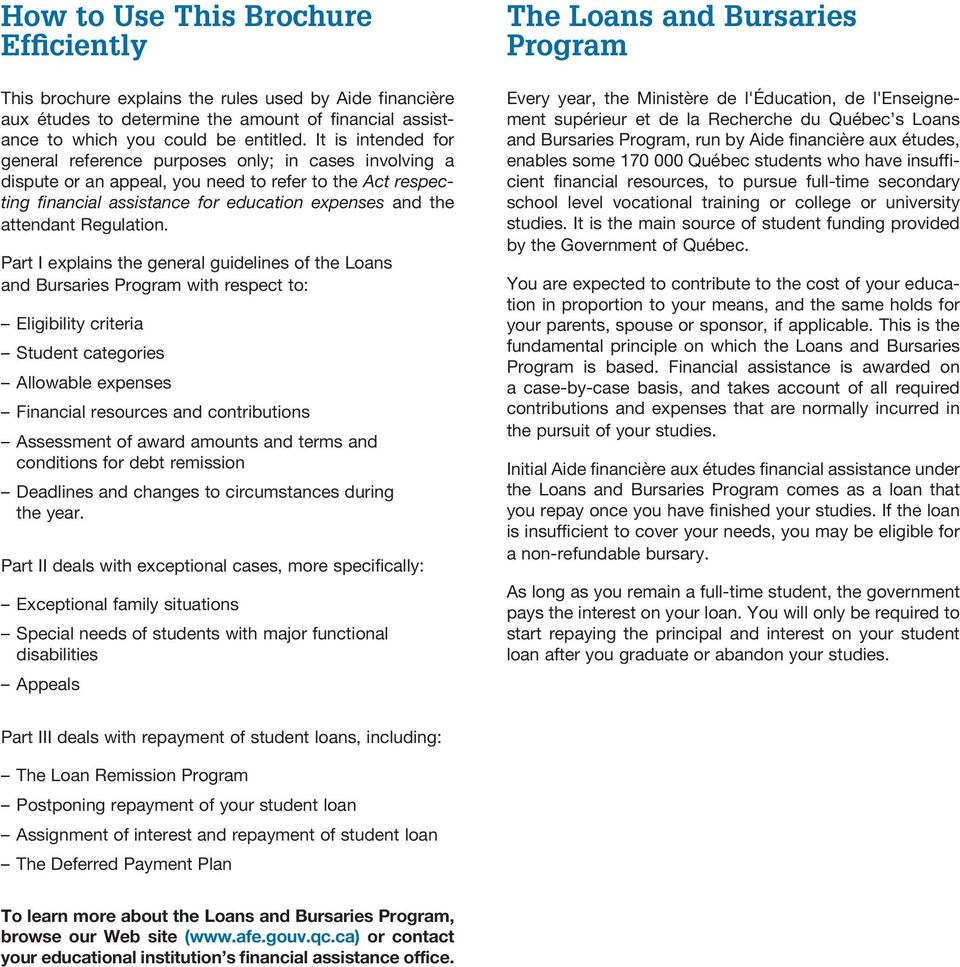
3 How to Use This Brochure Efficiently This brochure explains the rules used by Aide financière aux études to determine the amount of financial assistance to which you could be entitled. It is intended for general refe rence purposes only; in cases involving a dispute or an appeal, you need to refer to the Act respecting financial assistance for education expenses and the attendant Regulation. Part I explains the general guidelines of the Loans and Bursaries Program with respect to: Eligibility criteria Student categories Allowable expenses Financial resources and contributions Assessment of award amounts and terms and conditions for debt remission Deadlines and changes to circumstances during the year. Part II deals with exceptional cases, more specifically: Exceptional family situations Special needs of students with major functional disabilities Appeals The Loans and Bursaries Program Every year, the Ministère de l'éducation, de l'enseignement supérieur et de la Recherche du Québec s Loans and Bursaries Program, run by Aide financière aux études, enables some Québec students who have insufficient financial resources, to pursue full-time secon dary school level vocational training or college or university studies. It is the main source of student funding provided by the Government of Québec. You are expected to contribute to the cost of your education in proportion to your means, and the same holds for your pa rents, spouse or sponsor, if applicable. This is the fundamental principle on which the Loans and Bursaries Program is based. Financial assistance is awarded on a case-by-case basis, and takes account of all required contributions and expenses that are normally incurred in the pursuit of your studies. Initial Aide financière aux études financial assistance under the Loans and Bursaries Program comes as a loan that you repay once you have finished your studies. If the loan is insufficient to cover your needs, you may be eligible for a non-refundable bursary. As long as you remain a full-time student, the government pays the interest on your loan. You will only be required to start repaying the principal and interest on your student loan after you graduate or abandon your studies. Part III deals with repayment of student loans, including: The Loan Remission Program Postponing repayment of your student loan Assignment of interest and repayment of student loan The Deferred Payment Plan To learn more about the Loans and Bursaries Program, browse our Web site ( or contact your educational institution s financial assistance office.
4 TABLE OF CONTENTS Glossary PART I RULES FOR AWARDING LOANS AND BURSARIES 1 Eligibility Canadian Citizenship and Other Statuses recognized by the Loans and Bursaries Program Residence in Québec Recognized Educational Institutions and Programs Full-Time or Deemed Full-Time Status Eligibility Periods Student Loan Debt Limits Student Categories Students With a Spousal Contribution Students Without a Parental Contribution Students With a Parental Contribution Allowable Expenses Tuition Fees and Related Expenses Allowance for Training Support Materials Living Expenses Living Expenses for Students Deemed Enrolled Children s Living Expenses and Childcare Expenses Expenses for Single-Parent Families Transportation Costs Practicum Expenses Other Expenses Additional Expenses That Relate to the Student s Contribution Financial Resources and Contributions Student s Financial Resources and Contribution Parental Financial Resources and Contribution Spousal Financial Resources and Contribution Assessment of Financial Assistance and Terms and Conditions of Payment Assessment of Financial Assistance Payment of Financial Assistance Deadlines and Changes to Your Circumstances During the Year Deadlines Changes During the Award Year PART II EXCEPTIONAL CASES 7 Exceptional Family Situations Students Placed in a Foster Home or a Youth Protection Centre Students Placed in the Custody of a Guardian Students Whose Family Situation Has Deteriorated Students Whose Parents or Spouse Cannot Be Located Students Whose Parents (or Custodial Parent) Live in a Protected Residence Students Who Live in a Halfway House Major Functional Disabilities Exceptional Cases What You Need to Do Appeals Complaints Appealing a Decision Exceptional Cases PART III REPAYMENT AND REMISSION OF YOUR STUDENT LOAN 10 The Loan Remission Program Postponing Repayment of Your Student Loan Assignment of Interest and Repayment of Student Loan The Deferred Payment Plan APPENDIX 1 Several sample assessments of financial assistance that could be granted Balancing Studies and Family Obligations Measures to Help Students with Major Functional Disabilities. 33

5 Glossary Assessment: Procedure by which the amount of financial assistance to be awarded to a student is determined on the basis of allowable expenses and expected contributions. Award year: The annual period starting September 1 rst and ending August 31 rst. Bursary: Financial assistance awarded to a student by the govern ment when the amount that may be granted in the form of a loan for an award year does not cover the difference between the student s allowable expenses and his or her contributions. This type of assistance does not have to be repaid. The bursary amount corresponds to the portion of financial assistance that the government repays the financial institution at the end of the award year to convert part of the loan into a bursary. Calendar year: The annual period starting January 1 st and ending December 31 st. Civil union: Commitment made by two persons who consent to live together. The civil union is contracted openly before a competent celebrant and is witnessed through a civil union act. Confirmation of financial resources: Form on which students confirm or update the income they reported on their application for financial assistance. This form must be completed twice du ring the award year (i.e. in September and January). If students fail to complete and return this form on the dates indicated, payment of their financial assistance is suspended. Contribution: Amount provided by a student, or the student s parents, spouse or sponsor, toward the cost of the student s education. Co-op programs: Study programs that includes full-time paid workplace practicum in addition to coursework. Also known as work-study programs. Deemed enrolled: Status that enables certain students to be covered by the Loans and Bursaries program while they are between two study periods for a time that does not exceed four months 1. Deemed full-time: Status that enables certain part-time students to benefit from the Loans and Bursaries Program 2. Dependent child: A single child who does not have children and is of minor age or, if of major age, is a full-time student living with his or her parents, or if not living with the parents, where a parental contribution is required. Full exemption period: Grace period during which students are not required to repay their student loan, nor the accruing interest. Guarantee certificate: A document that is usually issued at the beginning of a student s first period of studies and which is required to take out a student loan at a financial institution. The certificate is only issued once for the entire period of studies unless the recipient interrupts them for more than six months. Head of a single parent family: Person living with at least one child, having custody at least 25% of the time and is single, a widow or widower, legally or de facto divorced and single or separated or whose spouse cannot be located. Loan: Financial assistance paid into your account by your financial institution based on a government-guaranteed loan authorization. No interest is due on such loans for the entire duration of the exemption period. Loan authorization: Electronic transaction performed by Aide financière aux études on a monthly or periodic basis to enable your financial institution to deposit funds to your account. Loan-to-bursary conversion: Electronic transfer of funds from the government to your financial institution for the purpose of converting to a bursary, part of the financial assistance that was originally provided to you as a loan and paid as such into your bank account. This transfer is performed at the end of each school year after the student s income has been verified with Revenu Québec. Major functional disabilities: For the purposes of the Loans and Bursaries Program, the term students with major functional disabilities refers to individuals whose permanent severe visual, hearing, motor or organ impairment significantly and persistently limits their ability to study. 3 Parent: Your father or your mother. Partial exemption period: Grace period after students complete their studies during which they become responsible for the interest on their student loans. Students are not required to start making payments on the loan principal during this period. Sponsor: Person, other than a parent or spouse, who endorsed a student s application for permanent residence in Canada or naturalization in accordance with the provisions of the Immigration and Refugee Protection Act. Spouse: Person to whom a student is married or with whom the student is living in a civil union or living as though married, along with a child, who may be either the student s or the spouse s (the latter part of this definition also applies to samesex partners). Student loan repayment deferment: This is a debt repayment exemption period that is granted following a temporary interruption of full-time studies. Study period: Usually lasting four months, this period may vary in accordance with the educational institution s academic calendar. As an example, for a college program that ends in May, the winter study period lasts five months. 1. See section 3.4 for details on the notion of deemed enrolled. 2. See section 1.4 for details on the notion of deemed full-time. 3. See Section 8, Major Functional Disabilities for further details. 1

6 PART I Rules for Awarding Loans and Bursaries 1 Eligibility In order to qualify for the Loans and Bursaries Program: You must be a Canadian citizen or have legal status in Canada. You must be a Québec resident or be deemed to reside in Québec within the meaning of Section 1.2, Residence in Québec. You must have been admitted to a recognized educational institution and be pursuing or be deemed to be pursuing full-time studies in a recognized program. You must not have exceeded the number of months of eligibility for which financial assistance may be awarded. You must not have reached the debt limit for your level of education, type of degree or program. You do not have sufficient financial resources to pursue your studies. 1.1 Canadian Citizenship and Other Statuses Recognized by the Loans and Bursaries Program The first requirement you must meet in order to be eligible for the Loans and Bursaries Program is to be in one of the following categories: A Canadian citizen A holder of permanent residence status A holder of refugee status A holder of protected person status 1.2 Residence in Québec The second requirement you must meet in order to be eligible for the Loans and Bursaries Program is to reside in Québec or be deemed to reside in Québec. This means that you are in one of the following situations: You were born in Québec or you were adoted by a person who resided in Québec at the time of your adoption. One of your parents resides in Québec. You hold a selection certificate issued under the Act respecting immigration to Québec. Your parents are deceased, but one of them resided in Québec at the time of his or her death. You still have your residence in Québec, although your parents now live elsewhere. Québec is the last place where you resided for 12 consecutive months without pursuing full-time studies during that period. You have been living in Québec for at least three months and have not resided in another Canadian province for more than three months. You have resided in Québec in accordance with one of the above statements for three consecutive years within the last five years. Your spouse satisfies one of the above criteria. In addition, if you are studying outside Québec, you are deemed a Québec resident if besides meeting one of the above criteria, you are in one of the following situations: You live in Québec and travel morning and evening to and from your educational institution outside Québec. Your parents reside in Québec. Your parents no longer reside in Québec, but moved out of the province no more than five years ago. You have not interrupted your full-time studies for more than 12 consecutive months following the date of your departure. Your spouse has not worked outside Québec for more than 12 months following the date of your departure. 2

7 1.3 Recognized Educational Institutions and Programs To qualify for the Loans and Bursaries Program, you must have been admitted to an educational institution recognized by the Ministère and pursue full-time studies or studies that are deemed full-time in a recognized program. 4 The criteria used to recognize an educational institution and a program vary according to whether the institution is located in Québec or outside Québec. Some programs are recognized for the purpose of loans only, while others are recognized for both loans and bursaries. Educational Institutions and Programs in Québec Recognized for Loans and Bursaries Educational Institutions Program 5 Level of Education University-level educational institutions governed by the Act respecting educational institutions at the university level (R.S.Q., c. E-14.1) and the Act respecting the Université du Québec (R.S.Q., c. U-1) Subsidized programs leading to a degree, certificate, certification or a university diploma as an independent student 6 Subsidized micro-programs (short programs) leading to certification Professional training programs in accounting, not including practical training Medical programs, excluding remunerated professional training (internship) University General and vocational colleges governed by the General and Vocational Colleges Act (R.S.Q., c. C-29, and Private colleges (subsidized or not) governed by the Act respecting private education (R.S.Q., c. E-9.1) Subsidized programs that are recognized under the College Education Regulations and leading to a DCS or an ACS College School boards Recognized subsidized vocational training programs leading to a Diploma of Vocational Studies (DVS) or Skills Training Certificate (STC) Subsidized programs that are recognized under the Education Act (CQLR c I-13.3) leading to a Skills Training Certificate (STC) Secondary Music and theatre arts conservatories governed by the Act respecting the Conservatoire de musique et d art dramatique du Québec (R.S.Q., c. C-62.1) Programs recognized under the college education regulations and leading to a DCS Programs authorized by the Minister of Education, Higher Education and Research leading to a higher education diploma or a certificate College University or equivalent Agri-food technology institutes Vocational training programs recognized Under the Basic Vocational Training Regulation and leading to a DVS Programs recognized under the college education regulations and leading to a DCS or an ACS Secondary College 4. As defined by Aide financière aux études. Please see glossary. 5. Programs lasting less than three months, programs in alternative medicine (except for acupuncture) and those only offered part-time are not recognized. 6. Students taking second-language courses and who receive financial support from the Ministère de l Immigration, de la Diversité et de l Inclusion are not eligible. 3

8 Educational Institutions and Programs in Québec Recognized for Loans and Bursaries (continued) Educational Institutions Program 7 Level of Education The Institut de tourisme et d hôtellerie du Québec under the Act respecting the Institut de tourisme et d hôtellerie du Québec (R.S.Q., c. I-13.02) The École du Barreau du Québec under the Act respecting the Barreau du Québec (R.S.Q., c. B-1) Vocational training programs recognized under the Basic Vocational Training Regulation and leading to a DVS or an AVS Programs that are recognized under the College Education Regulations leading to a Diploma of College Studies (DCS) or Skills Training Certificate (STC) University programs offered at the institute Professional program offered by the Québec bar school (excluding practicum) Secondary College University University or equivalent Subsidized private colleges providing vocational training The École nationale de police du Québec Subsidized or unsubsidized recognized vocational training programs leading to a Diploma of Vocational Studies (DVS) or Skills Training Certificate (STC) Basic police training programs Secondary College Private colleges not subsidized under the Act respecting private education (R.S.Q., c. E-9.1) but subsidized by the ministère de la Culture et des Communications or one of its agencies Unsubsidized programs that are recognized under the College Education Regulations leading to a DCS or an ACS College Educational Institutions and Programs in Québec Recognized for Loans Only Educational Institutions Program 8 Level of Education University-level educational institutions governed by the Act respecting educational institutions at the university level (R.S.Q., c. E-14.1) and the Act respecting the Université du Québec (R.S.Q., c. U-1) Unsubsidized programs leading to a degree, a certificate, certification or a university diploma 9 Micro-programs (short programs) leading to certification University General and vocational colleges governed by the General and Vocational Colleges Act (R.S.Q., c. C-29, s. 25) Unsubsidized programs recognized under the college education regulations and leading to a DCS or an ACS College Private colleges (subsidized or not) governed by the Act respecting private education (R.S.Q., c. E-9.1) Unsubsidized programs recognized under the college education regulations and leading to a DCS or an ACS College 4 7. Programs lasting less than three months, programs in alternative medicine (except for acupuncture) and those only offered part-time are not recognized. 8. Programs lasting less than three months, programs in alternative medicine (except for acupuncture) and those only offered part-time are not recognized. 9. Students taking second-language courses and who receive financial support from the Ministère de l Immigration, de la Diversité et de l Inclusion are not eligible.

9 Note Students auditing courses do not qualify for the Loans and Bursaries Program. In Québec, graduate studies are deemed to include professional development courses and examinations given by a professional corporation governed by the Professional Code or a school under its control. Out-of-Province Educational Institutions If you attend an out-of-province educational institution, you can qualify for financial assistance if the Minister recognizes both the institution and your program. The following list details the various categories of out-of-province educational institutions that are recognized for the purposes of both loans and bursaries, or for loans only. Outside Québec but Within Canada The following institutions and programs are recognized for the purposes of both loans and bursaries. 10 Educational Institutions Program Level of Education Canadian postsecondary institutions recognized (accredited) by their respective provincial governments Canadian universities that are recognized (accredited) by their respective provincial governments University of Ottawa, as recognized (accredited) by the Province of Ontario Programs that are subsidized by the government of the province in which the educational institution is located and that meet the requirements that apply to programs leading to a DCS or an ACS in Québec Programs that are subsidized by the government of the province in which the university is located and that meet the requirements that apply to pro grams leading to a university degree, certificate or diploma in Québec Medical programs, excluding remunerated professional training (internship) College University University Outside Québec but Within Canada The following institutions and programs are recognized for the purposes of loans only. 11 Educational Institutions Program Level of Education Canadian postsecondary institutions recognized (accredited) by their respective provincial governments Programs that are not subsidized by the government of the province in which the educational institution is located and that meet the requirements that apply to programs leading to a DCS or an ACS in Québec Collegel Canadian universities recognized (accredited) by their respective provincial governments Programs that are not subsidized by the government of the province in which the university is located and that meet the requirements that apply to programs leading to a university degree, certificate or diploma in Québec University 10. Religious schools and programs, programs in alternative medicine (except for acupuncture) distance-only programs, programs lasting less than three months, programs only offered part-time, aircraft piloting programs and programs with quotas (including for the preparatory year) set by the Government of Québec and/or the Ministère (except for programs in medicine at the University of Ottawa) are excluded. 11. Religious schools and programs, programs in alternative medicine (except for acupuncture) distance-only programs, programs lasting less than three months, programs only offered part-time, aircraft piloting programs and programs with quotas (including for the preparatory year) set by the Government of Québec and/or the Ministère are excluded. 5

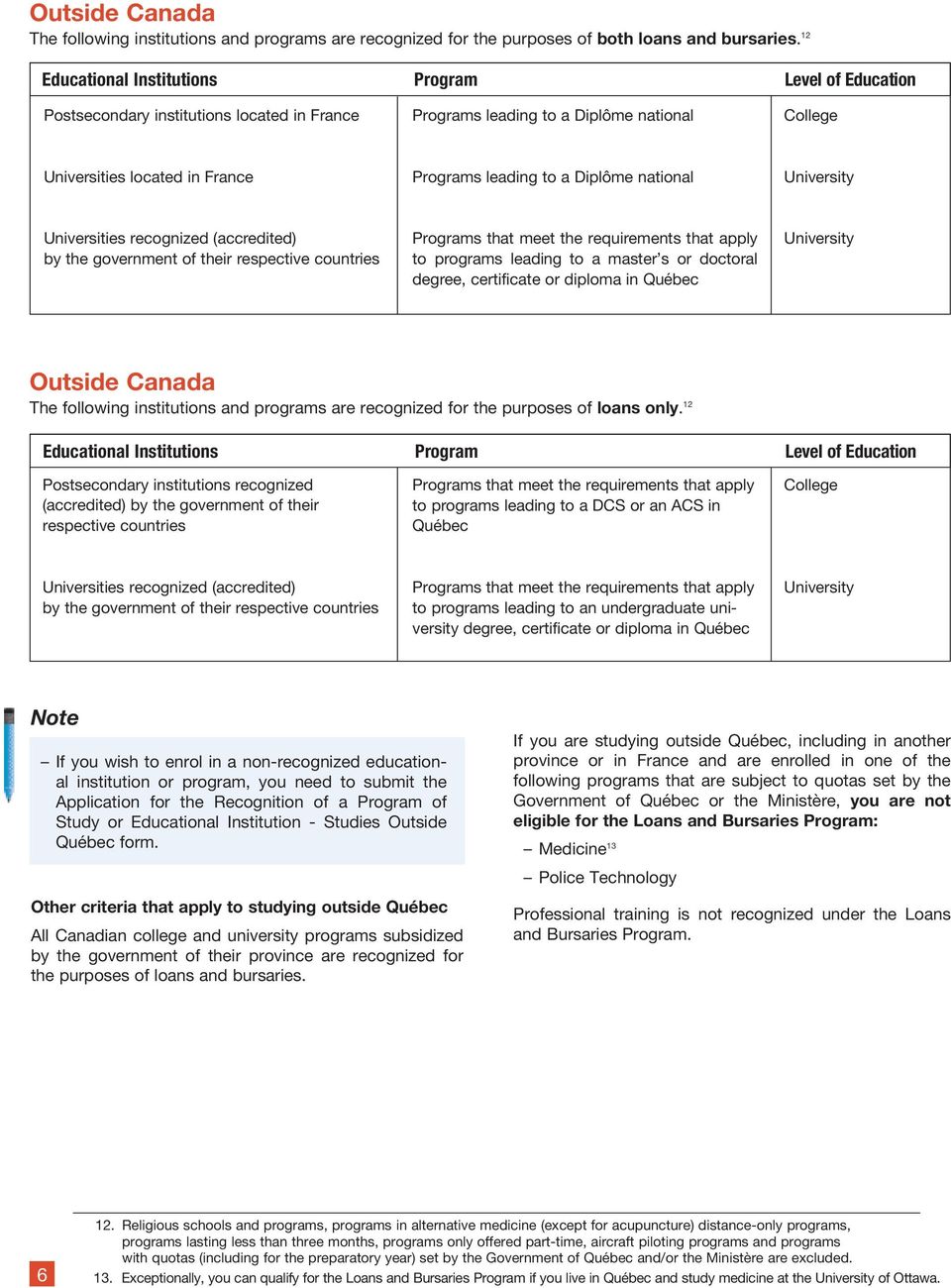
10 Outside Canada The following institutions and programs are recognized for the purposes of both loans and bursaries. 12 Educational Institutions Program Level of Education Postsecondary institutions located in France Programs leading to a Diplôme national College Universities located in France Programs leading to a Diplôme national University Universities recognized (accredited) by the government of their respective countries Programs that meet the requirements that apply to programs leading to a master s or doctoral degree, certificate or diploma in Québec University Outside Canada The following institutions and programs are recognized for the purposes of loans only. 12 Educational Institutions Program Level of Education Postsecondary institutions recognized (accredited) by the government of their respective countries Programs that meet the requirements that apply to programs leading to a DCS or an ACS in Québec College Universities recognized (accredited) by the government of their respective countries Programs that meet the requirements that apply to programs leading to an undergraduate university degree, certificate or diploma in Québec University Note If you wish to enrol in a non-recognized educational institution or program, you need to submit the Application for the Recognition of a Program of Study or Educational Institution - Studies Outside Québec form. Other criteria that apply to studying outside Québec All Canadian college and university programs subsidized by the government of their province are recognized for the purposes of loans and bursaries. If you are studying outside Québec, including in another province or in France and are enrolled in one of the following programs that are subject to quotas set by the Government of Québec or the Ministère, you are not eligible for the Loans and Bursaries Program: Medicine 13 Police Technology Professional training is not recognized under the Loans and Bursaries Program Religious schools and programs, programs in alternative medicine (except for acupuncture) distance-only programs, programs lasting less than three months, programs only offered part-time, aircraft piloting programs and programs with quotas (including for the preparatory year) set by the Government of Québec and/or the Ministère are excluded. 13. Exceptionally, you can qualify for the Loans and Bursaries Program if you live in Québec and study medicine at the University of Ottawa.
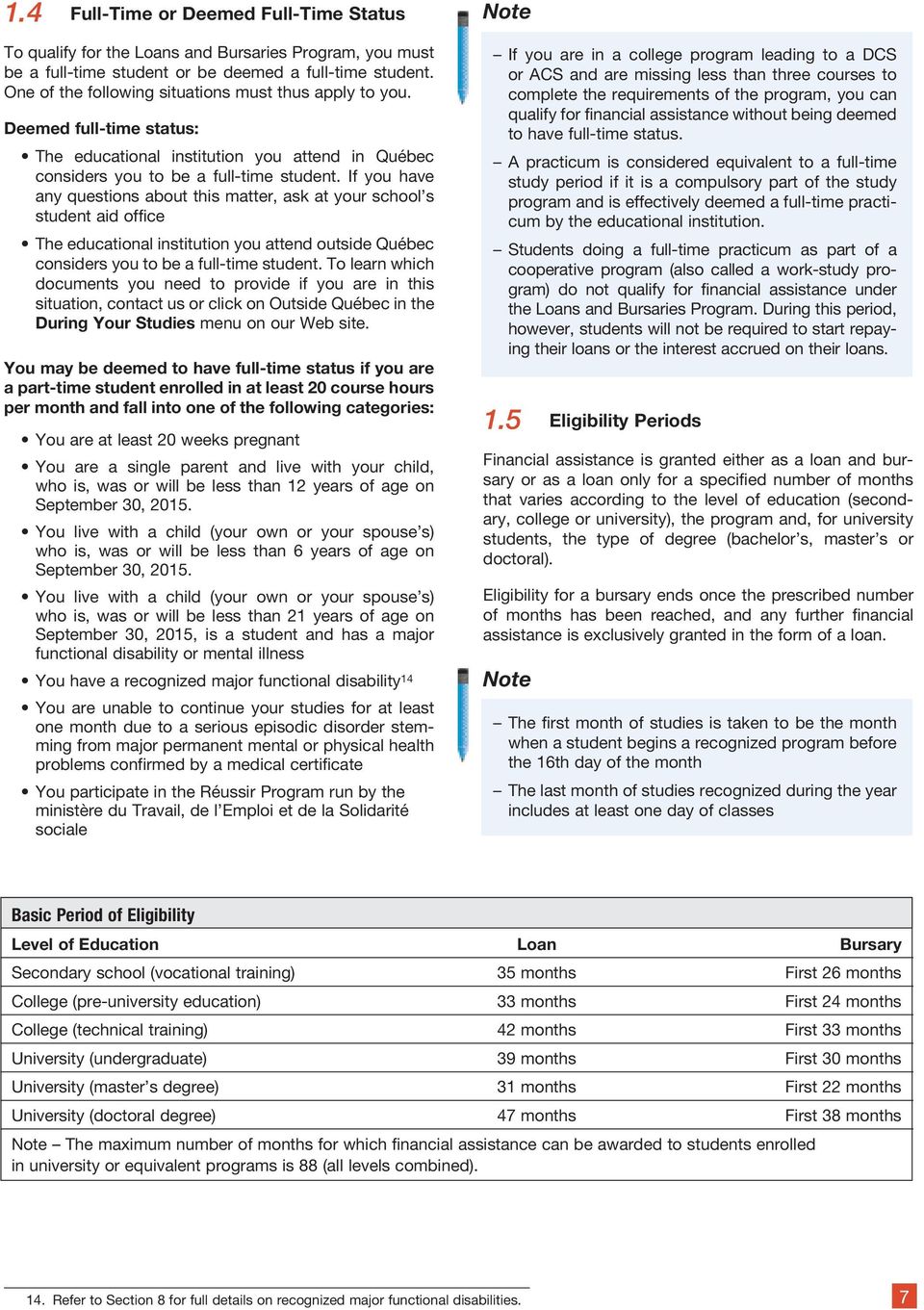
11 1.4 Full-Time or Deemed Full-Time Status To qualify for the Loans and Bursaries Program, you must be a full-time student or be deemed a full-time student. One of the following situations must thus apply to you. Deemed full-time status: The educational institution you attend in Québec considers you to be a full-time student. If you have any questions about this matter, ask at your school s student aid office The educational institution you attend outside Québec considers you to be a full-time student. To learn which documents you need to provide if you are in this situation, contact us or click on Outside Québec in the During Your Studies menu on our Web site. You may be deemed to have full-time status if you are a part-time student enrolled in at least 20 course hours per month and fall into one of the following categories: You are at least 20 weeks pregnant You are a single parent and live with your child, who is, was or will be less than 12 years of age on September 30, You live with a child (your own or your spouse s) who is, was or will be less than 6 years of age on September 30, You live with a child (your own or your spouse s) who is, was or will be less than 21 years of age on September 30, 2015, is a student and has a major functional disability or mental illness You have a recognized major functional disability 14 You are unable to continue your studies for at least one month due to a serious episodic disorder stemming from major permanent mental or physical health problems confirmed by a medical certificate You participate in the Réussir Program run by the ministère du Travail, de l Emploi et de la Solidarité sociale Note If you are in a college program leading to a DCS or ACS and are missing less than three courses to complete the requirements of the program, you can qualify for financial assistance without being deemed to have full-time status. A practicum is considered equivalent to a full-time study period if it is a compulsory part of the study program and is effectively deemed a full-time practicum by the educational institution. Students doing a full-time practicum as part of a cooperative program (also called a work-study program) do not qualify for financial assistance under the Loans and Bursaries Program. During this period, however, students will not be required to start repaying their loans or the interest accrued on their loans. 1.5 Eligibility Periods Financial assistance is granted either as a loan and bursary or as a loan only for a specified number of months that varies according to the level of education (secondary, college or university), the program and, for university students, the type of degree (bachelor s, master s or doctoral). Eligibility for a bursary ends once the prescribed number of months has been reached, and any further financial assistance is exclusively granted in the form of a loan. Note The first month of studies is taken to be the month when a student begins a recognized program before the 16th day of the month The last month of studies recognized during the year includes at least one day of classes Basic Period of Eligibility Level of Education Loan Bursary Secondary school (vocational training) 35 months First 26 months College (pre-university education) 33 months First 24 months College (technical training) 42 months First 33 months University (undergraduate) 39 months First 30 months University (master s degree) 31 months First 22 months University (doctoral degree) 47 months First 38 months Note The maximum number of months for which financial assistance can be awarded to students enrolled in university or equivalent programs is 88 (all levels combined). 14. Refer to Section 8 for full details on recognized major functional disabilities. 7
12 Note Students who qualify for financial assistance at the beginning of an award year, remain eligible for the entire year. However, should their study program change during the year, their eligibility period will be revised in accordance with the level of education of the new program. If you are a full-time university Québec student with self-directed studies status, you can qualify for the Loans and Bursaries Program for no more than eight months at each level of education. Students with dependent children qualify for an bursary eligibility extension of nine months. However, the bursary amount awarded may be limited. The eligibility period for loan financial assistance must correspond to at least the expected duration of studies plus 15 months, and for bursaries, the duration plus 6 months. This means that if a study program is longer, the eligibility period will be extended per the preceding rules. How the Period of Eligibility is Calculated Each month for which allowable expenses are recognized is included in the calculation of the eligibility period, except for the months during which students are deemed enrolled, which are not counted when determining this number. To determine the eligibility of a person who is deemed a full-time student, half the number of months of study are considered for the study period in which this status applies. The number of months of study for which students have received financial assistance under the Loans Program for Part-Time Studies does not decrease the number of months counted toward eligibility for the Loans and Bursaries Program, and vice-versa. 1.6 Student Loan Debt Limits If, at the beginning of an award year, you have already reached the debt limit for your level of education, type of degree or program, you no longer qualify for financial assistance. If you qualify for financial assistance at the beginning of an award year, this status applies for the entire award year. However, if you change programs during the year, or if a change in your circumstances for a previous year leading to an increase in the loan amount awarded to you for the current year is recognized, your eligibility for financial assistance will be reassessed in the light of your level of indebtedness at the beginning of the year. Student Loan Debt Limits by Level of Education Level of education Student Loan Debt Limit Secondary school Vocational training $ College Pre-university education $ Technical training Subsidized programs $ Subsidized programs offered at a private educational institution $ Unsubsidized technical training $ University Bachelor s degree Programs lasting less than 28 months $ Programs lasting 28 months or more $ Master s degree Programs lasting less than 20 months $ Programs lasting 20 months or more $ Doctoral degree All programs $ All undergraduate and graduate degrees Programs outside Québec but in Canada $ Programs outside Canada $

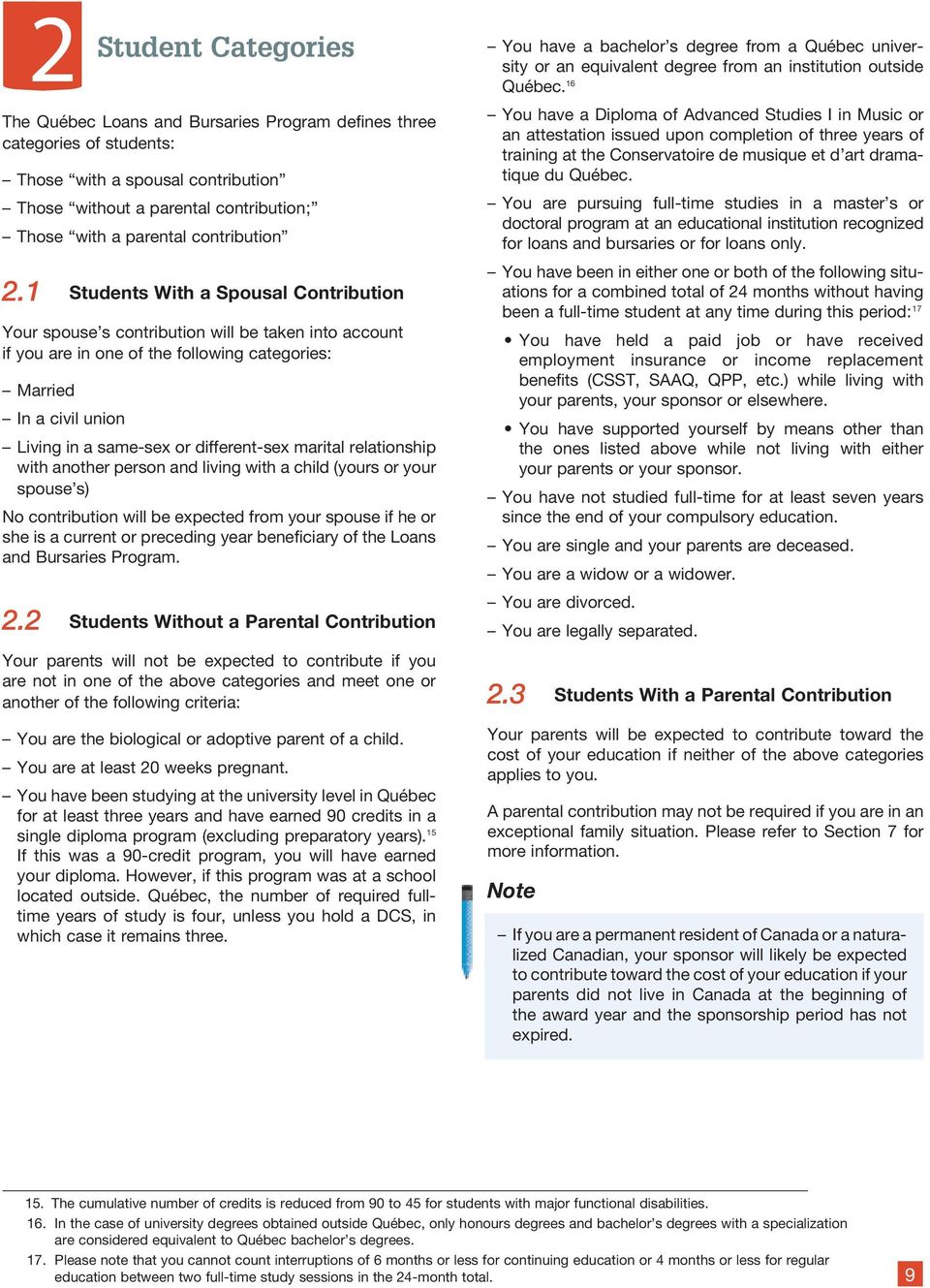
13 2 Student Categories The Québec Loans and Bursaries Program defines three categories of students: Those with a spousal contribution Those without a parental contribution ; Those with a parental contribution 2.1 Students With a Spousal Contribution Your spouse s contribution will be taken into account if you are in one of the following categories: Married In a civil union Living in a same-sex or different-sex marital relationship with another person and living with a child (yours or your spouse s) No contribution will be expected from your spouse if he or she is a current or preceding year beneficiary of the Loans and Bursaries Program. 2.2 Students Without a Parental Contribution Your parents will not be expected to contribute if you are not in one of the above categories and meet one or another of the following criteria: You are the biological or adoptive parent of a child. You are at least 20 weeks pregnant. You have been studying at the university level in Québec for at least three years and have earned 90 credits in a single diploma program (excluding preparatory years). 15 If this was a 90-credit program, you will have earned your diploma. However, if this program was at a school located outside. Québec, the number of required fulltime years of study is four, unless you hold a DCS, in which case it remains three. You have a bachelor s degree from a Québec university or an equivalent degree from an institution outside Québec. 16 You have a Diploma of Advanced Studies I in Music or an attestation issued upon completion of three years of training at the Conservatoire de musique et d art dramatique du Québec. You are pursuing full-time studies in a master s or doctoral program at an educational institution recognized for loans and bursaries or for loans only. You have been in either one or both of the following situations for a combined total of 24 months without having been a full-time student at any time during this period: 17 You have held a paid job or have received employment insurance or income replacement benefits (CSST, SAAQ, QPP, etc.) while living with your parents, your sponsor or elsewhere. You have supported yourself by means other than the ones listed above while not living with either your parents or your sponsor. You have not studied full-time for at least seven years since the end of your compulsory education. You are single and your parents are deceased. You are a widow or a widower. You are divorced. You are legally separated. 2.3 Students With a Parental Contribution Your parents will be expected to contribute toward the cost of your education if neither of the above categories applies to you. A parental contribution may not be required if you are in an exceptional family situation. Please refer to Section 7 for more information. Note If you are a permanent resident of Canada or a naturalized Canadian, your sponsor will likely be expected to contribute toward the cost of your education if your parents did not live in Canada at the beginning of the award year and the sponsorship period has not expired. 15. The cumulative number of credits is reduced from 90 to 45 for students with major functional disabilities. 16. In the case of university degrees obtained outside Québec, only honours degrees and bachelor s degrees with a specialization are considered equivalent to Québec bachelor s degrees. 17. Please note that you cannot count interruptions of 6 months or less for continuing education or 4 months or less for regular education between two full-time study sessions in the 24-month total. 9
14 3 Allowable Expenses The Loans and Bursaries Program recognizes that some expenses are required for students to pursue their studies, and takes account of them in assessing the assistance that could be awarded to you. Allowable expenses are divided into two categories: monthly expenses (recurring on a monthly basis) and one-time expenses (occurring only in certain months, depending on students needs). The expenses may be taken into account for the month or months when you: Are a full-time student Are deemed a full-time student Are a student deemed enrolled 18 Have dropped one or more courses Have abandoned your studies, as long as you pursue full-time studies in the following period 3.1 Tuition Fees and Related Expenses This refers to the amount you pay to your educational institution (admission, registration and tuition fees, fees related to instructional services and other fees) and the normal costs of textbooks and supplies. The following table lists the amounts normally allowed for textbooks and school supplies. Amount Allowed for Textbooks, School Supplies or Specialized Equipment per Study Period Secondary school vocational training program $186 Pre-university college program $186 College technical training program $210 University program $402 Architecture, Visual Arts, Chiropractic, Physical Education, Occupational Therapy, Medicine, Veterinary Medicine, Music, Speech Therapy, Audiology, Optometry, Pharmacy, Physiotherapy and Engineering $459 Master s or doctoral programs, when the term is devoted to writing a dissertation or thesis $210 No expenses will be considered for the month or months when: You are receiving social assistance or social solidarity benefits, with the exception of the first month, during which certain expenses may be allowed. You are taking part in a program of study offered and paid for by Human Resources and Skills Development Canada. You are taking part in an Emploi-Québec manpower training measure (employment assistance allowance) in a program offered at a public secondary school or college, if the program is subsidized. You are taking part in an Emploi-Québec manpower training measure at a private secondary school or college or at a university or public college, if the program is not subsidized. However, if a government ministry or agency does not pay the tuition fees, they will be deemed allowable expenses. You are incarcerated. However, allowable expenses may be considered if you are serving your sentence in a halfway house or on weekends only, are not incarcerated during an entire study period or are not incarcerated even though you have been sentenced to serve time. You are doing a full-time practicum as part of a work-study college program or cooperative university program. Note There is a $6 000 cap on recognized tuition fees charged by educational institutions per period of studies. Expenses related to specialized equipment may be allowed for some study programs. For secondary school vocational training, the total amount that could be allowed for school supplies is taken into account in the first month of the award year. 3.2 Allowance for Training Support Materials This is an optional, $150 allowance per recognized study period, granted as a loan only, and intended to enable the purchase of various additional school supplies. To receive this allowance, you must qualify for the Loans and Bursaries Program, then apply. Note School supply expenses and the allowance for training support materials are not awarded during full-time practicum periods As defined by Aide financière aux études. Please refer to the glossary.

15 3.3 Living Expenses Living expenses include applicable housing, food, personal expenses and the cost of public transit. Living Expenses for Students Who Live with Their Parents You are in the category of students with a parental or sponsor s contribution: If you effectively live with them or If you do not live with them but your parent or sponsor lives in the same residential zone, where the educational institution is served by public transit You are in the category of students without a parental or spouse s contribution, effectively live with them and are single, with no children. Living Expenses for Students Who Do Not Live with Their Parents If you fall into the other student categories, including students who are at least 20 weeks pregnant, you are deemed not to be living with your parents. Amounts allowed for living expenses are $388 per month of studies if you live with your parents, and $828 per month of studies if you do not. Note Your living expenses will be reduced by $100 per month if you withdraw from any of your courses. This amount rises to $200 per month if you withdraw from all of your courses, but return to your study program during the following period. The reduction takes effect the month following the date of withdrawal. Students who do not return to their study programs during the following period will not be entitled to the allowance for living expenses as of the month that follows the date of withdrawal. 3.4 Living Expenses for Students Deemed Enrolled If you are in one of the following situations, you could receive living expenses between two periods of study if the number of months involved does not exceed four and you are not a full-time student, or so deemed: You are in a situation of complete destitution within the meaning of Section 49 of the Individual and Family Assistance Act (L.R.Q., c. A ). You have a major functional disability. You live with your child. You are at least 20 weeks pregnant. You are a beneficiary of the Réussir program of the ministère du Travail, de l Emploi et de la Solidarité sociale because you have a major employment constraint. You have a serious episodic disorder. If you live with your parents, allowable living expenses are $ % of your employment income, up to a maximum of $388 per month. If you do not live with your parents, allowable living expenses are $ % of your employment income, up to a maximum of $828 per month. You may also be entitled to living expenses for dependent children and expenses incurred as head of a single-parent family during the time when you are deemed enrolled. 3.5 Children s Living Expenses and Childcare Expenses Children s living expenses You may be awarded living expenses for a dependent child, provided the child is single, is not a parent and meets one of the following conditions: Aged 18 years or over, is a full-time student and lives with you Aged 18 years or over, is a full-time student, does not live with you, but you are expected to contribute to the cost of his or her education These expenses are also allowed if you are at least 20 weeks pregnant and last until the month when you give birth. Living expenses are $249 per month for each child. 11

16 Note Living expenses for shared custody children aged 18 years or over are pro-rated to the amount of time the child spends with you, on condition that this proportion is at least 25%. Childcare Expenses Students are allowed $157 per month for each child they report who is under 12 years of age on September 30 th of the current award year, to cover childcare expenses. An amount may also be allowed to cover childcare expenses for children 12 years of age or over who have major functional disabilities or mental disorders. Note If you and the other parent of the child are spouses, both students and both received assistance under the Loans and Bursaries Program, living and childcare expenses will be awarded to the mother unless otherwise requested by both parents. If such a request is made, the change will apply either for the entire award year or for a specific period. If you and your spouse are not both the parents of the child, the living and childcare expenses will be awarded to whichever one is the parent. If you have custody of the child for more than 50% of the time, the full amount of childcare expenses will be recognized. However, when custody is shared equally, monthly expenses will be divided in two. 3.6 Expenses for Single-Parent Families If you are the head of a single-parent family and your child is under age 18, monthly living expenses of $67 are allowed per child. This amount rises to $187 per month if you have no minor dependent children but have custody of a child age 18 or over. If you are at least 20 weeks pregnant and have no other children living with you, these living expenses are also recognized from the month following the 20 th week to the month after you give birth. If you are a single student, a widow or widower, divorced, separated (legally or de facto) or if your spouse cannot be located and you have custody at least 25% of the time, you are considered to be a single parent. 3.7 Transportation Expenses Non-existent or inadequate public transit Public transit expenses are included in monthly living expenses recognized for students who are living with their parents. However, additional expenses in the amount of $94 may be allowed if the location of your parent s home is not adequately served by public transit, or no public transit is available. Special transportation costs If there is no overland transportation between your home and your educational institution or the organization hosting your practicum, and if both are located in Québec, expenses equivalent to the cost of two round-trip economy-class airline tickets between your home and the closest road link are included in your transportation costs unless you are studying or doing a practicum full-time for only one study period, in which case you are entitled to just one round trip. 3.8 Practicum Expenses A practicum is a period of practical training in the workplace. A practicum that is equivalent to a full-time period of studies A practicum is deemed a full-time period of studies if is a compulsory part of the program and your educational institution considers you to be a full-time student. During the practicum, you must live elsewhere than at your usual place of residence (where your spouse continues to live). Additional monthly practicum expenses allowed in this case, but cannot exceed the maximum amount authorized for the given award year. A practicum within a period of studies Monthly practicum expenses may be added to your living expenses. Practicum expenses are allowed when the practicum is a compulsory part of your program and you live elsewhere than your usual place of residence at least once in any given month, whether or not you live with your parents or your sponsor. Your living expenses, however, will not be modified. The allowance for practicum expenses in this case is $274 per month up to a maximum of $1 273 per award year. 12

17 3.9 Other Expenses Expenses related to outlying cities, regions and RCMs If you are in the category of students with a parental contribution but do not live with them, additional timely expenses of $72 per month of studies are allowed, up to a maximum of $572 per award year, and are paid at the beginning of each period of studies, provided that your parent s place of residence or the educational institution you attend is located in a city, region or RCM that is considered an outlying area. This measure applies to the following regions, RCMs and city: Bas-Saint-Laurent Gaspésie Îles-de-la-Madeleine Saguenay Lac-Saint-Jean Côte-Nord Nord-du-Québec Abitibi-Témiscamingue Pontiac RCM Vallée-de-la-Gatineau RCM Antoine-Labelle RCM City of La Tuque Medication and Chiropractic Expenses Allowable expenses may include the cost of medication and chiropractic treatments prescribed by a doctor, provided that these expenses are not covered by the Québec Health Insurance Plan or by a private insurance plan. If such is the case, only the portion of the expenses not already covered will be considered. The portion exceeding $16 per month will be considered at the time of purchase, provided the expenses were for yourself, your children or your spouse s children. Only medications on the list published by the Institut national d excellence en santé et en services sociaux can be covered. These expenses are allowed on a one-time basis, usually for the month when the cost of medication or medical care is incurred. Expenses Allowed for Eyeglasses or Contact Lenses Additional expenses are allowed for purchasing eyeglasses or contact lenses for yourself or your children. Eyeglasses (including frames and lenses) and contact lenses must be prescribed by an optometrist, an ophthalmologist or other doctor. The expenses are recognized only after purchase, and apply to you and to children for whom you or your spouse have custody. The maximum amount reimbursed is $185 per person in each two consecutive award year period. These are one-time expenses, usually recognized during the month of purchase. 13

18 Summary Table of Monthly Expenses Living expenses, including the cost of public transit Student in a full-time program or practicum (excluding co-op internships) and who lives with his or her parents Student in a full-time program or practicum (excluding co-op internships) and who does not live with his or her parents $388 per month of studies $828 per month of studies Student deemed enrolled and who lives with his or her parents Each month: $ % of employment income Maximum: $388 per month Student deemed enrolled and who does not live with his or her parents Each month: $ % of employment income Maximum : 828 $ par mois Single Parent Family Expenses With a child of minor age $67 per month Without a child of minor age $187 per month Children s living expenses Per child $249 per month Childcare expenses (subsidized daycare) Non-existent or inadequate public transit expenses Short-term practicum expenses (Shorter than the period of studies) $157 per month of studies $94 per month of studies $274 per month Maximum: $1 273 per year One-Time Expenses Tuition and related expenses Allowance for training support materials Special transportation costs Recognized during the fourth month of each study period. $150 per period of studies (as a loan) This expense is recognized in the first month of each period of studies. Expenses related to outlying cities, regions and RCMs $72 per month of studies Maximum: $572 per year This expense is recognized in the first month of each period of studies. Expenses for eyeglasses or contact lenses Medication and chiropractic expenses $185 per person (student or child) per consecutive two award years. This expense is recognized during the month it is incurred. The portion exceeding $16 per month. These expenses are recognized during the month they are incurred unless covered by Québec Health Insurance Plan or a private insurance plan. 14

19 3.10 Additional Expenses That Relate to the Student s Contribution In some circumstances, calculation of your contribution could lead to additional expenses being allowed. If you were a beneficiary of the Loans and Bursaries Program in the preceding award year and the calculation of your contribution gives a negative result, you may qualify for additional allowable expenses equal to that amount. If you were a full-time student between January and December and have seen your income fall by at least 10% during the current calendar year, you may qualify for a supplement of one-third of the difference between your contribution assessment for the year preceding the drop in income and your assessed contribution for the year during which your income dropped, if applicable. However, this amount will only be added if you received a bursary during the preceding award year. Income replacement benefits received under the Act respecting industrial accidents and occupational diseases or similar federal or provincial legislation, the Automobile Insurance Act, the Crime Victims Compensation Act or the Act to promote good citizenship Retirement or disability pension benefits received under the Act respecting the Québec Pension Plan or the Canada Pension Plan Benefits received under the Act respecting employment insurance in Canada Benefits received under the Québec Parental Insurance Plan An amount received from Emploi-Québec as a result of participating in a manpower training measure or from the ministère de l'immigration, de la Diversité et de l'inclusion under the financial aid program for the linguistic integration of immigrants (PAFILI) Benefits received under a private or public pension plan 4 Financial Resources and Contributions Note Income stemming from work in a governmentmandated election (school board, municipal, provincial or federal) is not considered. Other income includes: Contributions are calculated for the entire award year. They may be reduced to take certain exceptional situations into account. 4.1 Student s Financial Resources and Contribution Your contribution is assessed on the basis of your employment and other income for the calendar year ending during the award year Your Financial Resources For the purposes of the Loans and Bursaries Program, employment income includes the following: Gross income from full-time and part-time employment, including severance pay, tips and bonuses, as well as practicum income Net business or self-employment income within the meaning of the Taxation Act for the calendar year ending in the current award year Death benefits in the form of pensions paid subject to the application of a law Pensions for a disabled person s child and surviving spouse s pensions under the Act respecting the Québec Pension Plan or the Canada Pension Plan Income from an estate, trust or gift 19 Allowances from the Solicitor General of Canada or the ministère de la Sécurité publique and allowances from Aboriginal Affairs and Northern Development Canada or a band council Investment income (interest, dividends, capital gains) Pensions paid under the Crime Victims Compensation Act to the child of a crime victim Bursaries received from associations, private firms and/ or government bodies, and scholarships awarded by educational institution foundations Alimony and child support payments 19. Income from an estate includes interest, dividends or other benefits derived from a sum of money received as an inheritance. 15

20 Note Under the Act to facilitate the payment of support, you must report the true amount received in support payments from your ex-spouse or from your child s father or mother to Aide financière aux études. The reported support payments must include all amounts that can be used at your discretion, as well as money paid to third parties and considered support in a court judgment. If the court judgment stipulates that the support granted does not have to be declared for tax purposes, the amounts actually received must be declared. Court-mandated support payments that are paid to you by either or both of your parents are taken into account and replace the expected individual parental contribution. An exemption of $1 200 with respect to reported support payments for each dependent child will be applied when assessing eligibility for financial assistance. An exemption of $1 200 will also be applied to students who receive support payments but have no dependent children. Other income that should not be reported: Amounts paid by the Régie des rentes du Québec (RRQ) as part of its child assistance measure (provincial family allowances) Canada Child Tax Benefit Universal Child Care Benefit Social assistance or social solidarity benefits Educational assistance payments received under a registered education savings plan (RESP) Amounts paid by the Société de l assurance automobile du Québec (SAAQ) or the Commission de la santé and de la sécurité du travail (CSST) as compensation, for example, for the loss of a limb or to reimburse certain expenses (physiotherapy, orthopedic devices, etc.) Withdrawals from a pension plan (registered retirement savings plan [RRSP], registered retirement income fund [RRIF], Régime de retraite des employés du gouvernement et des organismes publics [RREGOP], etc.) Benefits from a strike fund Income from rental units Social assistance or social solidarity benefits Explore program bursaries and bursaries awarded by Aide financière aux etudes (Loans and Bursaries Program, Programme de bourses pour les permanentes et les permanents élus des associations étudiantes nationales and Allowance for Special Needs Program). Calculation of Your Contribution Your contribution is calculated as follows: The exemptions to which you are entitled are deducted from your employment income. The result is multiplied by 50% (40% if you did not receive financial assistance under the Loans and Bursaries Program the previous year). To this amount is added 100% of your other income, % of support payments (less any applicable exemptions) and 100% of any bursary totals that were considered in excess of $ The contribution reductions that correspond to your situation are then applied. Exemptions In order to calculate your exemptions, we first determine the number of months between January 1 st of the previous award year and the last month of the current award year for which expenses are allowed. This number of months is then used to calculate your protected income, as follows: $1 122 X the number of months during which no expenses are allowed. This result or a portion thereof serves to determine your exemptions: Basic Exemption We determine your basic exemption on the basis of the lesser of your employment income and the amount corresponding to 30% of your protected income. Additional Exemption This amount is determined by your circumstances during the first month of studies, as follows. An amount equal to the sum of 35% of your protected income and 35% of your employment income is added to your basic exemption if one of the following situations applies to you: You do not live with your parents and are in the category of students who do not receive a parental contribution. You have a dependent child, are at least 20 weeks pregnant, are separated or divorced or are a widow or widower and live with your parents. You are in the category of students who receive a spousal contribution Excluding bursaries and support payments.

21 The additional exemption may not exceed 70% of your protected income. If none of these situations apply to you, the equivalent of 5% of your employment income will be added to your basic exemption, up to an amount equal to 5% of your protected income. Exemptions Basic exemption The lesser of the two following amounts: 100% of your employment income or 30% of your protected income Additional exemption 5% of your employment income, up to an amount equal to 5% of your protected income 35% of your protected income + 35% of your employment income, up to an amount equal to 70% of your protected income Contribution reductions Contribution reductions are granted in the following cases: You are pursuing studies without being a full-time student within the four-month period that precedes a month of full-time studies. 21 You are in the first situation (and we have calculated an additional exemption of 5% in assessing your contribution) but do not live with your parents during the months for which no expenses are allowed. An additional reduction will be added to the first one. You are employed (and we have calculated an additional exemption of 5% in assessing your contribution) but do not live with your parents during the months for which no expenses are allowed. Contribution Reductions You are pursuing studies that are not full-time studies: University: $255 X number of credits College (private educational institutions): $22 X number of course hours College (public educational institutions) and secondary school (vocational training): $15 X number of course hours less (2.5% of your employment income up to an amount equal to your protected income, X [number of course hours 15] or the number of credits) You are eligible for an additional 5% exemption in the assessment of your contribution, do not live with your parents and are pursuing studies that are not full-time studies: University: $120 X number of credits College and secondary school (vocational training): $8 X number of course hours You are eligible for an additional 5% exemption in the assessment of your contribution, do not live with your parents and are employed: $380 X the lesser of the following two amounts: number of months taken into account when calculating your protected income (number of credits 3) or (number of course hours 45) or your employment income $ Not granted if you are a beneficiary of the Loans Program for Part-Time Studies. 17
22 Examples Frank is a single student without parental contribution. He is beginning his first year of university graduate studies. He was enrolled in a study program during the previous winter but did not apply for financial assistance. For the fall and winter terms, he is deemed not to be living with his parents. He earned $ during the summer. How Frank s Contribution is Calculated Number of months during which no expenses are allowed: 8 (from January to August, inclusively) Calculation of protected income: 8 X $1 122 = $8 976 Employment income $ EXEMPTIONS Basic exemption Employment income (maximum of 30% of protected income) $2 693 Additional exemption Student who is not deemed to be living with parents 35% of protected income + 35% of employment income (maximum of 70% of protected income) $6 283 Total exemption ($ $6 283) - $8 976 Employment income minus total exemption ($ $8 976) $1 024 Contribution determined according to employment income (40% of the previous amount) $410 Frank s total contribution $410 Gabrielle is a single student with a parental contribution. She is beginning her second year of university and received assistance for the winter term preceding this application for financial assistance. For the fall and winter terms, she is deemed to be living with her parents. During the summer, she earned $5 000 and was not living with her parents. How Gabrielle s Contribution is Calculated Number of months during which no expenses are allowed: 4 (from May to August, inclusively) Calculation of protected income: 4 X $1 122 = $ Employment income $5 000 EXEMPTIONS Basic exemption Employment income (maximum of 30% of protected income) $1 346 Additional exemption Student who is deemed to be living with her parents 5% of employment income (maximum of 5% of protected income) $224 Total exemption ($ $224) - $1 570 Employment income minus total exemption ($ $1 570) $3 430 Contribution determined according to employment income (50% of the previous amount) $1 715 CONTRIBUTION REDUCTION Student who is not deemed to be living with parents and who is working 4 months X $380 $1 520 Total contribution reduction - $1 520 Gabrielle s total contribution $195
23 4.2 Parental Financial Resources and Contribution Under the Civil Code of Québec, parents are required to contribute toward the cost of their child s education. It is their duty to feed, maintain and educate their child, even if the child is over 18 years old. The amount of the parental contribution is usually based on the incomes of both parents. However, if the parents no longer live together, only the income of the parent with whom you reside or last resided will be taken into account. If you do not currently reside with one of your parents or have not resided with either of them since their separation, the income of the parent you designate will be taken into account. If you have a sponsor, only that person s financial resources will be considered, and the contribution will be established in the same way as the parental contribution. Parents Financial Resources The parents financial resources are defined as their combined total income for the calendar year preceding the current award year. Total income includes: Total reported income in the calendar year preceding the current award year, as defined by the Taxation Act Québec government child assistance payments (calculated by Aide financière aux études); Canada Child Tax Benefits (calculated by Aide financière aux études). Note To find out which situations do not require a parental contribution, see Sections 2.1 and 2.2. If the income of either or both of your parents dropped by 10% or more during the calendar year that ended during the current award year as compared to the previous calendar year, the expected contribution is assessed on the basis of current year income. In this case, your parent or parents must provide a Declaration of income drop of at least 10% form for the current calendar year. If a contribution is expected from both of your parents, their combined income drop must be at least 10%. If there is a difference between the total amount actually received in Québec government child assistance payments and Canada Child Tax benefits and the amount that was considered in the parental contribution assessed by Aide financière aux études, your parent may request a correction. Parental Contribution In order to establish the parental contribution when assessing the eligible loan amount, the following exemptions are subtracted from the parents total income: Parental Contribution Exemption Amount Dependent children Each child (excluding the student) $2 987 Student applying for financial assistance has a major functional disability (additional exemption) $2 535 A progressive contribution rate is then applied to the resulting disposable income that takes account of individual parental situations, as shown in the following tables. Contribution of Parents Living Together $0 to $ $0 $ to $ $0 on the first $ and 19% on the remainder $ to $ $5 130 on the first $ and 29% on the remainder $ to $ $8 030 on the first $ and 39% on the remainder $ and + $ on the first $ and 49% on the remainder Contribution of a Single Parent $0 to $ $ $ to $ $0 on the first $ and 19% on the remainder $ to $ $5 130 on the first $ and 29% on the remainder $ to $ $8 030 on the first $ and 39% on the remainder $ and + $ on the first $ and 49% on the remainder The resulting amount is divided by the number of children in the category of students with a parental contribution. Sponsors Contribution Sponsors contributions are established in the same way as for single parents, except that only their personal financial resources are taken into account when assessing their contribution, whether or not they have a spouse. 19
24 4.3 Spousal Financial Resources and Contribution The contribution expected from a spouse who is not receiving financial assistance under the Loans and Bursaries Program is based on his or her financial resources. No contribution will be expected from a spouse who is currently receiving financial assistance or who qualified for financial assistance in the preceding award year. Spousal Financial Resources Spousal income for the calendar year preceding the award year includes total income within the meaning of the Taxation Act. Note If the income of your spouse dropped by 10% or more during the calendar year that ended during the current award year as compared to the previous calendar year, the expected contribution is assessed on the basis of current year income. In this case, your spouse must provide a Declaration of income drop of at least 10% form for the current calendar year. Spousal Contribution The spousal contribution is calculated by subtracting an exemption of $2 535 from his or her recognized income if you have a major functional disability. A progressive contribution rate is then applied to the resulting disposable income, as shown in the following table. Spouse s Contribution $0 to $ $0 $ to $ $0 on the first $ and 19% on the remainder $ to $ $5 130 on the first $ and 29% on the remainder $ to $ $8 030 on the first $ and 39% on the remainder $ to + $ on the first $ and 49% on the remainder 5 Assessment of Financial Assistance and Terms and Conditions of Payment The amount of financial assistance awarded to you by the government is assessed on the basis of your allowable expenses, recognized additional expenses and expected contributions. As soon as the initial assessment is made, you will be informed of the total amount of financial assistance to which you are entitled, as well as the instalment breakdown (monthly or periodic payments). Financial assistance assessments are made for an entire award year, which usually runs from September 1 st to August 31 st. 5.1 Assessment of Financial Assistance How the amount of your financial assistance is calculated Financial assistance is calculated as follows: Allowable expenses (including any supplements) - Contributions (yours, your spouse s and your parents or sponsor s, when applicable) = Financial assistance needs Your financial assistance award amount is determined on the basis of the information you reported in your application. This amount may change subsequently, following the verification of this information, for instance. The result is then divided by the sum of one plus the number of dependent children for whom a parental contribution is required and who are enrolled in full-time secondary level vocational training or in full-time postsecondary studies or, in the case of a child suffering from a major functional disability, who is deemed to be a full-time student. 20
25 Established Loan Amounts Level of Education Amount Secondary school (vocational training) Subsidized programs (public educational institutions) $202/month of study Subsidized programs (private educational institutions) $202/month of study + compulsory fees charged by the educational institution Unsubsidized programs $202/month of study + compulsory fees charged by the educational institution College 22 Subsidized programs (public educational institutions) $222/month of study Subsidized programs (private educational institutions) $222/month of study + compulsory fees charged by the educational institution Unsubsidized programs (private educational institutions) $960/month of study Unsubsidized programs (private educational institutions $318/month of study + compulsory fees charged that receive a subsidy from the ministère de la Culture, by the educational institution des Communications et de la Condition féminine: Ateliers de danse moderne de Montréal inc., École de danse de Québec, École nationale de l humour, École nationale de théâtre du Canada and Musitechnic services éducatifs inc.) University Undergraduate 22 $308/month of study Master s and doctoral degrees 22 $409/month of study Bachelor s degree holder 22 $409/month of study Programs recognized for the purposes of loans only $960/month of study If applicable, amounts may be added to these loan amounts as allowances for the purchase of training support materials. Other Calculation Methods When the level of financial assistance needed is less than the amount of the approved loan for a given award year (see table entitled Established Loan Amounts), a new calculation method is used. This method does not take account of your employment income. The amount of financial assistance granted by this calculation method for the award year is limited to the amount of the approved loan. Assessment of the Loan Portion of Financial Assistance Please note that the loan to which you are entitled is determined on the basis of the number of months during which you are studying and for which allowable expenses are recognized. Additionally, if the assessed level of your financial needs is less than the first portion of the loan ($1 000 for vocational and college levels and $2 400 for university level studies), a new assessment will be made without considering the parental contribution. In this case, the financial assistance granted for the given award year is limited to the amount of the first portion of the loan. 22. If the student is pursuing studies outside Québec, the monthly loan is increased to cover the compulsory fees charged by the educational institution (maximum $6 000/study period). 21
26 Special Allowance for Tuition Fees A special allowance in the form of a loan is meant to cover the annual increase in university tuition fees. It is intended for students enrolled at a Québec university who have reached their loan ceiling or first part thereof and do not qualify for a bursary. The amount of the special allowance will vary in accordance with the number of credits for which the applicant is enrolled. The Special Allowance for Tuition Fees is awarded when an individual enrolled in a Québec university program is entitled to financial assistance in the light of an assessment, which is shown in the box entitled Other Assessment on page 21. Assessment of the Bursary Portion of Financial Assistance When your financial needs exceed the maximum loan amount, you will be awarded a bursary, which is calculated as follows: Financial needs maximum loan amount in the award year = bursary amount Note Sample assessment The following example illustrates how bursaries are calculated. Garry is a single student with a parental contribution. He is beginning his second year of university and received student financial assistance in the previous winter term. His financial assistance needs for the eight months of study in the award year are calculated as follows. Assessment of Financial Assistance Allowable expenses $9 225 Student s contribution $500 Parental contribution (parental income of $30 000, one other dependent child): $0 Financial needs: $8 725 Loan amount: 8 X $308 = $2 464 Loan amount: $2 464 Bursary amount: $6 261 University students in Québec who receive a bursary and for whom the bursary is less than the amount of the Special Allowance for Increased University Tuition Fees may receive the offsetting Offset Allowance. The offsetting allowance is an additional loan amount aimed at providing assistance and is in general equivalent to tuition fees plus school supplies. 22
27 Financial Assistance Amount that may Be Granted Financial assistance that may be granted cannot exceed the sum of the following amounts: Financial Assistance Amount that may Be Granted Educational institutions recognized for the purposes of loans and bursaries $ at the secondary and college levels $ at the university level + $3 895 for 1 child $4 929 for 2 children $5 969 for 3 or more children + Financial assistance that corresponds to the loan amount (see table on page 21) Educational institutions recognized for the purposes of loans only $960 per month of studies 5.2 Payment of Financial Assistance You need to obtain a Guarantee Certificate in order to receive the financial assistance to which you are entitled. This document is provided only once, at the start of your studies, and is valid for the entire duration of your studies unless you interrupt them for more than six months. If you return to your studies after that period of time, you will receive a new Guarantee Certificate, provided that you remain eligible for the Loans and Bursaries Program. All financial assistance paid during the award year is in the form of a loan. Payments are deposited to your bank account monthly or periodically. After verifying your income with Revenu Québec (usually in the spring), the government reimburses your financial institution for the portion of your financial assistance that corresponds to the bursary to which you are entitled. This reduces your loan balance by the bursary amount. Note Payments may be suspended if you have not submitted confirmation of your financial resources or change of address by the prescribed deadlines. If you are only entitled to financial assistance as a loan, payment is made in accordance with the number of your study periods. Instalments start at the beginning of each term, in order to make things easier, and allowances for training support materials are added to the first payment in each study period. Guarantee Certificates are not sent to individuals suffering from major functional deficiencies that have been recognized prior to certificate issuance, as they receive financial assistance by direct deposit only. If this applies to you, please fill out and submit the Application for Direct Deposit form (see Section 8). Participating Financial Institutions The following financial institutions participate in the Loans and Bursaries Program: Desjardins Bank of Montreal Laurentian Bank National Bank of Canada Royal Bank of Canada 23
28 Assistance Instalment Payments Financial assistance awarded to you is paid in instalments, in order to meet your financial needs in each of the months of the award year during which you are studying or are deemed enrolled. Note Scheduling of your assistance payments is reassessed with each new calculation. New breakdowns take account of amounts already paid, as applicable. When a bursary is granted for an award year, payments are usually made during each month of studies. However, due to expenses that are recognized at the beginning of a period, payments could be made only in specific months during the award year. Anticipated financial assistance may be granted to you in the form of a loan if we are unable to perform an assessment of the financial assistance to which you are entitled and you are in danger of becoming destitute within the meaning of the Act Respecting Income Support, Employment Assistance and Social Solidarity. Beneficiaries of the Social Assistance Program or the Social Solidarity Program who return to their studies are deemed to be in this situation. Apply online using the electronic form that is available under the Full-time Forms tab in your online file ( there are so many advantages! Forms are tailored to your situation Secure transmission of your personal information Upload any required documents right into your online file Documents requested by Aide financière aux études must be sent within 45 days. If you fail to provide Aide financière aux études with the requested document by this 45-day deadline, analysis of your file will be suspended. Applying on our Web site instead of with paper forms lets you upload any required documents rright into your personal online file. In addition, if you are not applying for financial assistance for the first time, your Web form will be personalised. To facilitate the process, Aide financière aux études will have already filled in part of the form using information from your file. 6.2 Changes During the Award Year 6 Deadlines and Changes to Your Circumstances During the Year Changes to Your Circumstances Your circumstances or those of your parents or spouse may change over the course of the award year. Since these changes are likely to affect the amount of financial assistance to which you are entitled, you must report all of them to Aide financière aux études. The following rules relate to deadlines for submitting documents and changes to your circumstances during the year and to the terms and conditions of payment of financial assistance. 6.1 Deadlines Deadline for Submitting an Application for Financial Assistance or Providing a Required Document When changes occur during the year, the new assessment of financial assistance could be less than the previous one, or even less than the amount that has already been paid to you. If this is the case, all or part of the financial assistance overpayment may be recovered during the year or in subsequent years. The manner in which the assistance is recovered depends on whether it takes place before or after the loan-to-bursary conversion stage. You must submit your application for financial assistance within 60 days of the end of your last month of recognized studies. Documents will be accepted after the deadline only if the student can provide satisfactory proof that he or she was unable to submit them in time due to extraordinary circumstances beyond his or her control. 24
29 PART II Exceptional Cases This part of the brochure presents useful information that applies to exceptional cases. 7 Exceptional Family Situations You, or the persons expected to contribute to the cost of your education, could face difficulties that may lead to special assessment of your case. In order to have your exceptional family situation recognized, you will be required to fill out the Declaration of Exceptional Family Situation form and submit it to Aide financière aux études. 7.1 Students Placed in a Foster Home or a Youth Protection Centre If you have been placed in a foster home or youth protection centre in accordance with the Youth Protection Act, the Act respecting health services and social services or the Youth Criminal Justice Act, a parental contribution is not required while this situation lasts. Moreover, you will receive the allowance for expenses for students who do not reside with their parents, except during the times when you were under the care of a child and youth protection centre. 7.2 Students Placed in the Custody of a Guardian If you were placed in the custody of a guardian but were not legally adopted by him or her, you are considered not to be living with your parents, and no contribution is expected from your guardian or from your parents. 7.3 Students Whose Family Situation Has Deteriorated If your family situation has deteriorated to the point that you are forced to leave home, you will be considered not to be living with your parents. If, in addition to this, you must cease all communication with one of your parents, no contribution will be expected from that individual. In each of these cases, confirmation by a social worker is required. 7.4 Students Whose Parents or Spouse Cannot be Located If your parents or spouse cannot be located and his or her place of residence or work is unknown, the rule regarding expected contributions will not be applied. 7.5 Students Whose Parents (or Custodial Parent) Live in a Protected Residence If your parents (or your custodial parent) live in a reception centre, residential centre, hospital or correctional institution, you will be considered not to be living with your parents while this situation lasts. 7.6 Students Who Live in a Halfway House If you live in a halfway house, you will receive the allowance for a student who resides with his or her parents unless proof is submitted that you are required to pay rent and food. 25
30 8 Major Functional Disabilities 9 Appeals For the purposes of the Loans and Bursaries Program, the term students with major functional disabilities refers to individuals whose permanent severe visual, hearing, motor or organ impairment significantly and persistently limits their ability to study. 8.1 Exceptional Cases Certain provisions of the Loans and Bursaries Program are intended specifically for students with major functional disabilities who must study part-time because of their disabilities. These students must be enrolled for a minimum of 20 course hours per month. Note Financial assistance assessed under loan rules is awarded as a bursary in such cases. Students may receive a bursary for the maximum eligible number of periods of study at each level of education for which financial assistance exists. In the case of students who are required to study parttime, half the number of months of study are taken into account in determining their period of eligibility. If you are dissatisfied with the services you received or disagree with a decision rendered in your Aide financière aux études file, a variety of remedies are available to you that guarantee impartial treatment. Note If you are dissatisfied with the services you received or disagree with a decision rendered in your Aide financière aux études file, a variety of remedies are available to you that guarantee impartial treatment. 9.1 Complaints If you are dissatisfied with any aspect of the services provided by Aide financière aux études, you are entitled to file a complaint with the Bureau des recours. Complaints are handled with diligence, remain confidential and do not appear in your file. The following is a non-exhaustive list of reasons that could justify filing a complaint: 8.2 What You Need to Do If you have a major functional disability, you need to submit the Medical Certificate Major Functional Disabilities and Other Recognized Disabilities form duly completed by a doctor. This form needs to be submitted only once. Accuracy of information Staff courtesy and/or confidentiality issue Quality of service and/or processing time Availability of telephone services Availability of publications and/or forms. Telephone , toll-free throughout Québec Mail Bureau des recours de l'aide financière aux études Ministère de l'éducation, de l'enseignement supérieur et de la Recherche 1035, rue De La Chevrotière Québec (Québec) G1R 5A5 26
31 9.2 Appealing a Decision If you believe that a decision rendered by Aide financière aux études does not comply with the Act respecting financial assistance for education expenses and its Regulations, you are entitled to an appeal under Section 43.1 of the Act. Before filing an appeal, carefully read the notice of decision you received from Aide financière aux études. You may be able to resolve the matter yourself by submitting missing documents or other information that could change the decision. To appeal a decision, contact the Aide financière aux études Bureau des recours. Your request will be examined impartially and fairly. If warranted, a request to correct your file will be forwarded to Aide financière aux études. We will send you written notice of our decision. Your appeal must be made in writing, and include all of the following information: Your name Your mailing address Your Permanent Code The reason for your appeal Copies of all documents you submitted to Aide financière aux études that are related to your appeal Please mail your appeal to the following address: Review Bureau des recours de l'aide financière aux études Ministère de l'éducation, de l'enseignement supérieur et de la Recherche 1035, rue De La Chevrotière Québec (Québec) G1R 5A5 9.3 Exceptional Case The Examination Committee for Exceptional Cases issues waivers for exceptional situations that compromise the pursuit of studies and are not anticipated in the normal course of student financial assistance. You may apply to the Examination Committee for Exceptional Cases if you find yourself in one of the following situations that could compromise the pursuit of your studies: You no longer qualify for student financial assistance programs because you have reached the maximum number of months of eligibility or authorized debt limit. You believe that the amount of financial that was granted is insufficient to allow you to continue your studies. In either case, you will need to demonstrate the exceptional nature of your situation or the extraordinary expenses that you must incur during the award year that are not anticipated in the student financial assistance plan. Firstly, you need to read the Exceptional Case Application Guide, that can be found on Aide financière aux études Web site. You should also seek the opinion of your school s student aid office to ensure that you have all the help you need in preparing your request. Once complete, your request should be mailed to the following address by the manager of your school s student aid office: Secrétariat du Comité d'examen des demandes dérogatoires Ministère de l'éducation, de l'enseignement supérieur et de la Recherche 1035, rue De La Chevrotière Québec (Québec) G1R 5A5 Unless special circumstances apply to your file, you will receive an answer to your exceptional case application within two to three weeks of the Committee s next meeting. The Committee s meeting schedule is listed in the Exceptional Case Application Guide. 27
32 PART III Repayment and Remission of Your Student Loan Remission of Your Student Loan 10 The Loan Remission Program Students who previously started another program and then withdrew are not excluded from the Loan Remission Program. Only those months of study during which you were enrolled full-time will be considered in determining whether you completed your program within the prescribed period. The loan remission will be forwarded to your lending institution so that it may deduct the amount from your student loan debt. The loan remission is taxable. A tax slip will be issued to you. Applications for loan remission must be submitted within three years of the end of the program for which remission is requested. The purpose of the Loan Remission Program is to forgive 15 per cent of the student loan debt of any person who completed his or her studies within the prescribed period and who received a bursary under the Loans and Bursaries Program in each year of study. To be eligible for the program, you must meet one of the following conditions: Have completed a college-level technical training program leading to a Diploma of College Studies (DCS) within the prescribed period. Have completed a program leading to an undergraduate degree (bachelor s) within the prescribed period. Loan remission may also be granted for previous college studies, provided they meet the eligibility requirements. Loan remission may be granted for graduate and doctoral levels, provided you received a loan remission for undergraduate studies. Note The prescribed period is usually 27 months of study for a technical training program at the college level, 24 months for an undergraduate university program spread over a 3-year period and 32 months for an undergraduate program spread over a 4-year period. At the graduate level, the prescribed period is 16 months for a master s degree without a thesis and 20 months for a master s degree with a thesis. The prescribed period for a doctorate is 32 months. However, the duration of some programs may vary. Repayment of Your Student Loan During your studies As long as you remain a full-time student, the government will ensure interest payments on the loan you took out for either full- or part-time studies. If you temporarily interrupt your full- or part-time studies, you could qualify for postponement of repayment of your student loan. 11 Postponing Repayment of Your Student Loan You must be a full-time student or deemed as such for at least one of the six months that preceded the event that justifies your application for deferral in order to qualify for the deferral of repayment of your student loan and the payment of interest by the government. You could qualify for postponing repayment of your student loan following a temporary interruption of your studies if you are in one of the following situations: If you are a student in at least your 20 th week of pregnancy, the repayment of your student loan could be deferred by 12 months. If you are adopting a child, the repayment of your student loan could be deferred by 8 months. If your spouse gives birth during this period, the repayment of your student loan could be deferred by 8 months. If you interrupt your studies for more than one month due to disability, the repayment of your student loan could be deferred by 8 months. 28
33 If you are elected as an executive officer of a national student association, this measure could apply to you. If you are a member of the Reserve Force and participate in a mission during your posting, the repayment of your student loan debt could be deferred by up to 24 months. In all cases, the exemption is extended to September 1 st if the exemption period expires between the months of May and August. 12 Assignment of Interest and Repayment of Student Loan As of the month following completion of your full-time studies, you become responsible for the interest charges on your student loan debt. However, you are not required to start repaying the principal for six months (the 6-month option). During that period, the interest can be paid or capitalized, i.e. converted into principal and added to your outstanding debt. You may of course choose to make both principal and interest payments or just start paying interest. After the initial six months, you must begin repaying the student loan (principal and interest) to the financial institution. If you resume full-time studies during this six-month period, the government will make the interest payments on the loan on your behalf. 13 The Deferred Payment Plan The Deferred Payment Plan enables you to repay your student loan by making payments that are set on the basis of your financial capability and your family situation. If justified by your situation, it is even possible that no payment could be required for the period of time covered by your application. During this time, the government will continue to pay the interest on your loan. In addition, you will not be required to repay the interest paid on your behalf. However, you will need to provide proof of income, and the information you report will be checked. If you qualify for the Deferred Payment Plan, the period covered by your application will in general last six months. The period is set by taking account of the period of time for which you apply to benefit from a relief measure for the repayment of your student loan, as well as information in your file. It could be less than 6 months if you return to your studies during the period of time covered by your application or if you reach the cumulative 60-month lifetime limit. You can reapply to the Plan. However, you will need to submit a new application for each 6-month period for which you want to take advantage of the Plan so that your eligibility can be established. Renewal approval is subject to your having made all payments required under your preceding applications, if any. You may apply to the Plan at any time during the 10 years (120 months) that follow the end of your 6-month option. While your application can be retroactive, it cannot go back more than 6 months from the date you apply. If you wish to obtain an estimate of your monthly payment under the Deferred Payment Plan that is based on your financial and family situations, you may use the monthly payment simulator on our Web Site ( 29
34 APPENDIX 1 Several sample assessments of financial assistance that could be granted EXAMPLE 1 Eric is a student with a parental contribution who lives with his parents. He is enrolled in an 8-month undergraduate university Bachelor s degree program (September-April). He has income of $5 000 and the combined income of his parents is $ In addition to Eric, the family has another child in postsecondary education. Eric benefited from the Loans and Bursaries Program last year. Allowable expenses $6 908 Student's contribution (based on reported income) $1 715 Parental contribution (based on reported income) $0 Loan eligibility for the award year 8 months X $308 = $2 464 Financial Assistance Assessment Allowable expenses $ Student's contribution (based on reported income) $817 Financial needs $9 899 Financial needs Loan Bursary $9 899 = $ $7 901 Since the amount of financial needs exceeds the loan that could be granted for the award year, calculations stop and the student is entitled to a bursary. Financial Assistance Assessment Allowable expenses $6 908 Student's contribution (based on reported income) $1 715 Parental contribution (based on reported income) $0 Financial needs $5 193 Financial needs = Loan + Bursary $5 193 $2 464 $2 729 Since the amount of financial needs exceeds the loan that could be granted for the award year, calculations stop and the student is entitled to a bursary. EXAMPLE 2 Valerie is a single parent student and head of household, with one dependent child. She is enrolled part-time in a 9-month college-level technical course that runs from September through May. She has employment income of $5 000 and receives $1 000 in annual support payments. She benefited from financial assistance for educational expenses last year. She reports that she will not be studying next year as she will have completed her program. Allowable expenses $ EXAMPLE 3 Helen is a student with no parental contribution who is starting her graduate university study program. She does not live with her parents and is enrolled at university for 8 months (September-April). Her income is $ Hélène benefited from financial assistance last year. Allowable expenses $ Student's contribution (based on reported income) $2 756 Loan eligibility for the award year 8 months X $409 = $3 272 Financial Assistance Assessment Allowable expenses $ Student's contribution (based on reported income) $2 756 Financial needs $7 672 Financial needs Loan Bursary $7 672 = $ $4 400 Since the amount of financial needs exceeds the loan that could be granted for the award year, calculations stop and the student is entitled to a bursary. Student's contribution (based on reported income) $817 Loan eligibility for the award year 9 months X $222 = $
35 EXAMPLE 4 Malek is a student with a parental contribution who does not live with his parents. He is enrolled in a 15-credit/ session undergraduate university program that lasts 8 months per year (September-April). His income is $5 000 and the combined income of his parents is $ Malek has a sibling who is a minor. This is not the first year that he receives student financial assistance. Allowable expenses $ Student's contribution (based on reported income) $1 715 Parental contribution (based on declared income) $7 744 Loan eligibility for the award year 8 months X $308 = $2 464 Loan for the award year $2 464 First loan portion $2 400 Financial Assistance Assessment Allowable expenses $ Student's contribution (based on reported income) $1 715 Parental contribution (based on declared income) $7 744 Financial needs $669 Since the amount of financial needs is less than the loan that could be granted for the award year, calculations continue without considering employment income in assessing the student s contribution. New Financial Assistance Assessment Allowable expenses $ Student's contribution $0 Parental contribution (based on reported income) $7 744 Financial needs $2 384 Since the amount of financial needs resulting from this new assessment is less than the first loan portion, calculations continue without considering the parental contribution. New Financial Assistance Assessment Allowable expenses $ Student's contribution $0 Parental contribution $0 Financial needs $ However, financial assistance to which this student could be entitled is limited to the first loan portion plus the special award for tuition fees. Calculation of the special award for tuition fees $20.85 X 30 credits = $626 Malek is entitled to a loan of $ $ $626 = $
36 Balancing Studies and Family Obligations If you have family responsibilities, the following measures could be of benefit to you. You may be eligible for the Loans and Bursaries Program, which is usually intended for full-time students, even if you are a part-time student (you need to be enrolled for at least 20 hours of classes per month). Recognition of expenses if you are the head of a single-parent family. Recognition of living expenses for a dependent child aged 18 or over who is pursuing full-time studies. Coverage of the cost of medication or chiropractic treatments (i.e. the portion not covered by the Québec Health Insurance Plan or another insurance plan) and of the cost of eyeglasses or contact lenses for you or your children. Exemption in the assessment of your student contribution of the first $1 200 of your total annual support payments per dependent child. You may be eligible for financial assistance during the summer period even if you are not pursuing studies at that time, as long as you return to your studies the following year. Extension of the duration of your eligibility for a bursary to enable you to support one or more of your dependent children. Temporary exemption from repaying a student loan debt while you are pregnant, or following the birth or adoption of a child. If you are at least 20 weeks pregnant: You may be recognized as a self-supporting student (as a result, a parental or sponsor s contribution is not considered in the assessment of the financial assistance that could be awarded to you). Living expenses for a child could be recognized. Living expenses as a self-supporting student could be recognized, even if you live with your parents. If you do not have a spouse, expenses as a head of a single-parent family could be recognized. 32
37 Measures to Help Students with Major Functional Disabilities If you have or had permanent severe visual, hearing, motor or organ impairment that significantly and persistently limits your ability to study, the following measures could be of benefit to you. You may be eligible for the Loans and Bursaries Program, which is usually intended for full-time students, even if you are a part-time student (you need to be enrolled for at least 20 hours of teaching per month). All financial assistance to which you are entitled will be awarded as a bursary. You may be recognized as a self-supporting student if you have earned at least 45 credits in less than 3 years of studies in a single program (as a result, a parental or sponsor s contribution is not considered in the assessment of the financial assistance that could be awarded to you). You may be eligible for financial assistance during the summer period even if you are not pursuing studies at that time, as long as you return to your studies the following year. An additional exemption is allowed with respect to your parents income when assessing the parental contribution. 33
38 APPLY ON-LINE There are so many advantages: Forms are tailored to your situation Secure transmission of your personal information Upload any required documents right into your online file Information and documents are validated step-by-step Faster processing of your file It s environmentally friendly FOR FURTHER INFORMATION, CONTACT: The financial assistance office of your educational institution Our information hotline: Aide financière aux études 1035, rue De La Chevrotière Québec (Québec) G1R 5A (Québec) (Montréal) (toll-free in Canada and the United States) Our automated telephone service: (Québec City) (toll-free in Canada and the United States) 24 hours a day, 7 days a week A-15
STUDENT FINANCIAL ASSISTANCE
 2013 2014 THE EARLIER, THE BETTER! In order to receive your financial assistance at the beginning of the academic year, apply on-line in May and submit all required documents as soon as possible. This
Declaration of Parents»
 Declaration of Parents» You can file your declaration form on-line! Just go to our Web site (www.afe.gouv.qc.ca) and click on On-Line Access to Your File! What You Need to Know Before You Begin Who must
Application Guide 15/16. www.gov.nl.ca/studentaid
 Application Guide 15/16 www.gov.nl.ca/studentaid INTRODUCTION 2 APPLYING FOR ASSISTANCE 2 How to Apply 2 If not Borrowing for a Semester 2 Applying for Assistance for Second Semester Only 2 Assistance
CERTIFICATION OF STUDIES
 CERTIFICATION OF STUDIES Administrative Guide for the Certification of Studies and Management of Ministerial Examinations General Education, Youth Sector; General Education, Adult Sector Vocational Training.
CONTACT INFORMATION. Fax. Website
 CONTACT INFORMATION STUDENT FINANCIAL SERVICES NATIONAL STUDENT LOANS SERVICE CENTRE (NSLSC) Student Financial Services Department of Post-Secondary Education, Training and Labour P.O. Box 6000, 77 Westmorland
STUDENT FINANCIAL ASSISTANCE REGULATION
 Province of Alberta STUDENT FINANCIAL ASSISTANCE ACT STUDENT FINANCIAL ASSISTANCE REGULATION Alberta Regulation 298/2002 With amendments up to and including Alberta Regulation 111/2015 Office Consolidation
Quick Tips. application 13/14. to complete the
 Quick Tips to complete the application FOR FULL-TIME POST-SECONDARY STUDIES 13/14 Contents 03» Student Aid Alberta 05» Loans and Grants 06» Application Basics 07» Money You Need: Your Expenses 08» Money
manitobastudentaid.ca
 Accessible and Affordable Post-Secondary Education 2015-2016 FINANCE YOUR FUTURE! Manitoba Student Aid manitobastudentaid.ca S E C T I O N O N E PLAN AHEAD Education Costs If you have been looking at post-secondary
STUDYANDLIVE INQUEBEC
 STUDYANDLIVE INQUEBEC DARE TO EXPERIENCE QUÉBEC! MAKE YOUR EDUCATION AN UNFORGETTABLE EXPERIENCE BY COMING TO STUDY IN QUÉBEC! A HIGHLY STIMULATING EDUCATIONAL SETTING IS YOURS IN A CULTURAL ENVIRONMENT
Guide. CLAIM FOR death benefits TO THE. Claim Number DID A 7266A 45 (2014-09)
 Guide TO THE CLAIM FOR death benefits Claim Number DID A 7266A 45 (2014-09) Compensation paid by the SAAQ I Compensation paid by the SAAQ The various death benefits paid by the SAAQ are the following:
How To Get A Student Loan From Canada
 STUDENTAID Canada - Newfoundland and Labrador Student Financial Assistance Application Guide www.gov.nl.ca/studentaid14/15 STUDENTAID How does the STUDENT LOAN process work? STEP 1: APPLY ONLINE OR BY
Part-Time Studies Application
 2010/2011 Part-Time Studies Application Part-Time Studies Financial Assistance WHO IS ELIGIBLE? Applicants must: Be a Canadian citizen, permanent resident/landed immigrant, convention refugee or a protected
SUBMIT YOUR COMPLETED 2015-16 STUDENT FINANCIAL ASSISTANCE APPLICATION TO:
 SUBMIT YOUR COMPLETED 2015-16 STUDENT FINANCIAL ASSISTANCE APPLICATION TO: Student Financial Services Department of Post-Secondary Education, Training and Labour PO Box 6000, 440 King St. Fredericton,
Financial Aid @ Austin Grad Overview & Policies
 Financial Aid @ Austin Grad Overview & Policies Financial Aid Director Dave Arthur (512) 476-2772 x 105 [email protected] CONTENTS Financing your Austin Grad Education 2 The FAFSA 3 Helpful websites
Student Financial Assistance Guide and Application. For classes beginning any time between August 1, 2010 and July 31, 2011
 2010-2011 Student Financial Assistance Guide and Application For classes beginning any time between August 1, 2010 and July 31, 2011 You can apply online Go to www.studentloan.pe.ca You do not need high
MILLBROOK BAND COUNCIL POST SECONDARY EDUCATION ASSISTANCE PROGRAM
 MILLBROOK BAND COUNCIL POST SECONDARY EDUCATION ASSISTANCE PROGRAM Revised January 13, 2015 1. OBJECTIVE Millbrook Band Council Post Secondary Education Assistance Program Policy a) The objective of the
Application for Provincial Training Allowance 2016-2017 Office Use Only APPLICANT DEMOGRAPHIC APPLICANT CATEGORY. Sask. Health Services Number (HSN)
 Application for Provincial Training Allowance 2016-2017 Office Use Only Date Received File Number Bar Code PSE Number Application Number APPLICANT DEMOGRAPHIC Social Insurance Number (SIN) No SIN Sask.
PARAMETERS OF THE PERSONAL INCOME TAX SYSTEM FOR 2015. November 2014
 PARAMETERS OF THE PERSONAL INCOME TAX SYSTEM FOR 2015 November 2014 PARAMETERS OF THE PERSONAL INCOME TAX SYSTEM FOR 2015 Legal deposit November 2014 Bibliothèque et Archives nationales du Québec ISBN
Financial Aid. Financial Aid. Course Descriptions
 Monmouth University believes that financing a student s education should be a cooperative effort between the student and the institution. To that end, the staff of the Financial Aid Office is available
YORK UNIVERSITY PENSION PLAN
 YORK UNIVERSITY PENSION PLAN (Amended and Restated as at January 1, 1992) Unofficial Consolidation to December 31, 2013 This is an unofficial consolidation of the York University Pension Plan including
INFORMATION ABOUT YOUR FINANCIAL AID AWARD
 INFORMATION ABOUT YOUR FINANCIAL AID AWARD 2013-2014 We are pleased to offer financial assistance for your cost of attendance at the University of North Carolina at Chapel Hill. Your award information
Information Guide. Student Financial Assistance for Full-Time Post-Secondary Students in New Brunswick
 Information Guide Student Financial Assistance for Full-Time Post-Secondary Students in New Brunswick 2015 2016 studentaid.gnb.ca CONTACT INFORMATION STUDENT FINANCIAL SERVICES NATIONAL STUDENT LOANS SERVICE
Vocational and Technical Training in Québec
 2008 Version Vocational and Technical Training in Québec Overview Gouvernement du Québec Ministère de l Éducation, du Loisir et du Sport, 2008-08-00321 ISBN: 978-2-550-53667-3 ISBN PDF: 978-2-550-53668-0
Règlement régissant l activité étudiante à HEC Montréal Rules and Regulations. Programme de Doctorat Ph.D. Program
 Règlement régissant l activité étudiante à HEC Montréal Rules and Regulations Programme de Doctorat Ph.D. Program Mise à jour : Le 1er juin 2013 Updated : June 1, 2013 Table of Contents 1 Definitions...
COLLEGE INFORMATION GUIDE
 COLLEGE INFORMATION GUIDE 2013-2014 Table of Contents Title Page Introduction and Information on Applying to College Page 3 Ontario Colleges.ca Page 4 How to Apply To College: Step By Step Page 5 Introduction
Canada-Saskatchewan Integrated Student Loan Handbook
 Canada-Saskatchewan Integrated Student Loan Handbook Canada-Saskatchewan Integrated Student Loans Program Important Steps in Planning and Financing Your Post-Secondary Education 2015-16 saskatchewan.ca/studentloans
2015-16 Financial Aid & Awards Frequently Asked Questions
 ENROLMENT SERVICES 2015-16 Financial Aid & Awards Frequently Asked Questions OSAP Questions 1. What is a Master Student Financial Assistance Agreement (MSFAA)? The MSFAA is the student loan agreement that
AWARD LETTER COMPARISON WORKSHEET
 AWARD LETTER COMPARISON WORKSHEET Different schools have different resources, so financial aid offers can vary greatly from school to school. There are several components of an aid offer you should consider:
POLICY MANUAL 2014-2015 MINISTRY OF ADVANCED EDUCATION
 POLICY MANUAL 2014-2015 MINISTRY OF ADVANCED EDUCATION Table of Contents 2014-2015 TABLE OF CONTENTS Introduction... 1 About StudentAid BC... 1 StudentAid BC Programs... 2 Key Changes for 2014-2015...
Student Aid Alberta Operational Policy and Procedure Manual. August 1, 2015. Student Aid Alberta Operational Policy and Procedure Manual
 Student Aid Alberta Operational Policy and Procedure Manual August 1, 2015 August 1, 2015 1 Table of Contents Student Aid Alberta Operational Introduction... 8 Chapter 1: Eligibility for Student Aid...
Instructions for OSAP Paper Application Form for Full-Time Postsecondary Students 2011-2012. April 2011 Version 3
 Student Financial Assistance Branch Ministry of Training, Colleges and Universities Instructions for OSAP Paper Application Form for Full-Time Postsecondary Students 2011-2012 April 2011 Version 3 2011-2012
HOME SCHOOLING. Policy Framework
 Policy Framework Gouvernement du Québec Ministère de l Éducation, du Loisir et du Sport, 2010 ISBN 978-2-550-57805-5 (PDF) Legal deposit Bibliothèque et Archives nationales du Québec, 2010 Table of contents
Financial Aid. Application Procedure. Financial Aid
 21 Financial Aid Seattle University is pleased to offer a variety of strategies and resources aimed at helping eligible students meet the costs of education. Approximately 70 percent of undergraduate students
FINANCIAL AID. Applying for Federal Financial Aid. Eligibility for Federal and State Financial Aid
 16 Financial Aid FINANCIAL AID Columbia College s financial aid program exists to make education affordable for all students who qualify. The College believes that if students desire to attend college
FINANCIAL INFORMATION
 FINANCIAL INFORMATION Section Five A. FEES AND COSTS All fees are payable before the beginning of each semester, and registration is not complete until these fees have been paid. Payment must be made by
Set out guidelines to assist in determining when a rentgeared-to-income (RGI) tenant or co-op member should be required to pursue income.
 DURHAM SOCIAL HOUSING DIRECTIVES Subject: PURSUIT OF INCOME Directive Number: RGI 2012-05 Date: September 20, 2012 Purpose Set out guidelines to assist in determining when a rentgeared-to-income (RGI)
Canada-Saskatchewan Integrated Student Loan Instruction Guide
 Canada-Saskatchewan Integrated Student Loan Instruction Guide Canada-Saskatchewan Integrated Student Loans Program Important Steps in Planning and Financing Your Post-Secondary Education 2014-15 saskatchewan.ca/studentloans
2015-2016 Postsecondary Child Care Grant Program Application Instructions
 2015-2016 Postsecondary Child Care Grant Program Application Instructions IMPORTANT: Read instructions before completing application. Incomplete applications will not be processed. Step 1 Student completes
A Snapshot of Resource Websites per Province
 A Snapshot of Resource Websites per Province Alberta Alberta students can access resources in the form of scholarships, student loans and grants/bursaries through the Government of Alberta. http://alis.alberta.ca/ec/fo/studentsfinance/students-finance.html
Government Support Programs
 Newcomer Finances Toolkit Government Support Programs Worksheets Ottawa Community Loan Fund Fonds d emprunt Communautaire d Ottawa 22 O Meara St., Causeway Work Centre, Ottawa, ON K1Y 4N6 Tel: 613-594-3535
The Saskatchewan Student Direct Loans Regulations
 SASKATCHEWAN STUDENT DIRECT LOANS 1 The Saskatchewan Student Direct Loans Regulations being Chapter S-61.1 Reg 1* (effective August 2, 2001) as amended by Saskatchewan Regulations 13/2002, 42/2002, 76/2002,
Admissions Criteria. Ministry of Training, Colleges and Universities. Colleges of Applied Arts and Technology Policy Framework
 Admissions Criteria Issued: April 1, 2003 Revised: November 18, 2004 TABLE OF CONTENTS Purpose and Application... 1 Principles... 1 Glossary... 2 Binding Policy... 5 Exemption Applications... 9 Summary
FINANCIAL AID AND SCHOLARSHIPS
 102 Financial Aid and Scholarships FINANCIAL AID AND SCHOLARSHIPS FINANCIAL AID Columbia College s financial aid program exists to make education affordable for all students who qualify. The College believes
FINANCIAL AID. Applying for Federal Financial Aid. Eligibility for Federal and State Financial Aid
 FINANCIAL AID Columbia College s financial aid program exists to make education affordable for all students who qualify. The College believes that if students desire to attend college they should not be
Règlement régissant l activité étudiante à HEC Montréal Rules and Regulations
 Règlement régissant l activité étudiante à HEC Montréal Rules and Regulations Programmes de Maîtrise ès sciences de la gestion Master of Science in Administration Microprogramme en exploitation de données
POLICY MANUAL 2015-2016 MINISTRY OF ADVANCED EDUCATION
 POLICY MANUAL 2015-2016 MINISTRY OF ADVANCED EDUCATION Table of Contents 2015-2016 TABLE OF CONTENTS Introduction 1 About StudentAid BC... 1 StudentAid BC Programs... 2 Key Changes for 2015-2016... 3 Chapter
Canada Student Loans Program
 Innovation & Learning for Canadians Canada Student Loans Program 2003-2004 Information Guide HRIC-076-03-03 Introduction INTRODUCTION In today s job market, education brings personal success. It holds
Rules and Regulations MBA Program
 Rules and Regulations MBA Program 2009-2010 Brought up to date : March 1st, 2010 Table of Contents 1 Definitions... 2 2 Categories of Students... 4 3 Admission... 5 4 Recognition of Prior Credits... 7
REVISED 2015 When I m 64: Benefits for Seniors
 REVISED 2015 When I m 64: Benefits for Seniors This publication tells you about the government benefits you may be entitled to if you are a senior in British Columbia. It covers Old Age Security, the Canada
Nursing Education Loan/Scholarship Program BSN (NELB), RN to BSN (NELR), MSN (NELM), RN to MSN (NERM), Ph.D./DNP (NELP)
 Board of Trustees of State Institutions of Higher Learning Nursing Education Loan/Scholarship Program BSN (NELB), RN to BSN (NELR), MSN (NELM), RN to MSN (NERM), Ph.D./DNP (NELP) RULES and REGULATIONS
Post-Retirement Health Care Spending Account for CAW Retired Employees Canada. Issued April 2011 ON TRACK TOWARD THE FUTURE
 Post-Retirement Health Care Spending Account for CAW Retired Employees Canada ON TRACK TOWARD THE FUTURE Table of Contents 1 Introduction 2 Eligibility 3 Plan Description 5 Options under the HCSA 6 Who
FINANCIAL AID APPLYING FOR FINANCIAL AID ELIGIBILITY FOR FINANCIAL AID. with students by email using our address of [email protected].
 FINANCIAL AID APPLYING FOR FINANCIAL AID Application for student aid administered by the University of Maine at Machias (UMM) is made by completing the Free Application for Federal Student Aid (FAFSA)
Instructions. instructions u u u. How to complete your. Application 2015/2016. Apply online www.studentaidbc.ca
 Instructions 2015/2016 instructions u u u How to complete your StudentAid BC Application Apply online www.studentaidbc.ca When you see this symbol, you should read this book for further instructions These
ALBERTA CHILD SUPPORT GUIDELINES
 Province of Alberta FAMILY LAW ACT ALBERTA CHILD SUPPORT GUIDELINES Alberta Regulation 147/2005 With amendments up to and including Alberta Regulation 153/2009 Office Consolidation Published by Alberta
MINISTRY OF CHILDREN AND YOUTH SERVICES & MINISTRY OF TRAINING, COLLEGES AND UNIVERSITIES. LIVING AND LEARNING GRANT (LLG) Questions and Answers
 The Ministry of Children and Youth Services (MCYS) established the Youth Leaving Care Working Group in July 2012, with input from the Office of the Provincial Advocate for Children and Youth. Representatives
WI G.I. BILL BENEFITS FREQUENTLY ASKED QUESTIONS
 University of Wisconsin System WI G.I. BILL BENEFITS FREQUENTLY ASKED QUESTIONS (Service after 9/11*) *NOTE: This FAQ document is for those veterans, spouses, or children who: Are eligible for Federal
02 - HUMAN RESOURCES / STAFFING
 02 - HUMAN RESOURCES / STAFFING 02.01 Position management Electronic records Data used in the management of employment positions: incumbents, position status, job descriptions, position groups, benefit
Financial Aid. Eligibility Requirements for Federal Student Aid. University of California, Irvine 2015-2016 1. On This Page:
 University of California, Irvine 2015-2016 1 Financial Aid On This Page: Financial Aid Eligibility Requirements for Federal Student Aid UCI Policies on Satisfactory Academic Progress for Financial Aid
Family Protection Specialist Social Worker Loan/Scholarship Program (SWOR) RULES AND REGULATIONS
 Board of Trustees of State Institutions of Higher Learning Family Protection Specialist Social Worker Loan/Scholarship Program (SWOR) RULES AND REGULATIONS These Rules and Regulations are subject to change
Graduate Student Financial Need Assessment Form (NAF) Summer 2014 (May 1 August 30)
 I am applying for: Graduate Student Financial Need Assessment Form (NAF) Summer 2014 (May 1 August 30) Bursary (before July 5 th or an appointment with a financial aid counsellor is required) Work Study
VET FEE HELP STUDENT FREQUENTLY ASKED QUESTIONS
 VET FEE HELP STUDENT FREQUENTLY ASKED QUESTIONS VET FEE-HELP ASSISTANCE Why will the Government loan me this money? VET FEE-HELP is an extension of the Higher Education Loan Program (HELP). The program
STUDENT AWARDS AND FINANCIAL ASSISTANCE (SAFA) 2015/2016
 $ $ $ STUDENT AWARDS AND FINANCIAL ASSISTANCE (SAFA) 2015/2016 Supporting student success by reducing financial barriers and recognizing achievement. Services provided: $ Student Financial Planning & Advising
IATSE LOCAL 891 SCHOLARSHIP APPLICATION. NOTES AND INSTRUCTIONS: Academic year Sept. 1, 2015 - Aug. 31, 2016
 NOTES AND INSTRUCTIONS: Academic year Sept. 1, 2015 - Aug. 31, 2016 In 1998, IATSE Local 891 created a scholarship program to assist members and dependents in pursuing degree granting post-secondary studies.
Take charge of your own finances.
 Taking Care of Yourself What to expect Whether you work outside the home or are a stay-at-home parent, breast cancer might affect your ability to work, which can change your financial situation. If you
This article, prepared by PARO s auditors Rosenswig McRae Thorpe LLP, outlines some points to consider in preparing your income tax returns.
 2014 Edition for 2013 Returns This article, prepared by PARO s auditors Rosenswig McRae Thorpe LLP, outlines some points to consider in preparing your income tax returns. Remember that: RRSP Contribution
AIMC BERKELEY STUDENT CATALOG & HANDBOOK SUPPLEMENT & ADDENDUM
 AIMC BERKELEY STUDENT CATALOG & HANDBOOK SUPPLEMENT & ADDENDUM Updated August 7, 2013. Valid through June 1, 2014 ACCREDITATION & APPROVALS BUREAU FOR PRIVATE POSTSECONDARY EDUCATION Institution [AIMC
DAWSON COLLEGE, ADMISSIONS OFFICE 3040 SHERBROOKE ST. WEST, WESTMOUNT, QC H3Z 1A4
 APPLICATION INSTRUCTIONS A.E.C. Program Applications received after the deadline will only be considered, if space permits. (Please refer to the Dawson website for application deadlines) All applicants
Financial Aid Glossary
 Financial Aid Glossary Ability-to-Benefit Academic Year Accreditation Accrue Award Letter Borrower Capitalized Consolidation Cost of Attendance (COA) Default One of the criteria used to establish student
STATUTORY INSTRUMENTS. S.I. No. 155 of 2015 STUDENT GRANT SCHEME 2015
 STATUTORY INSTRUMENTS. S.I. No. 155 of 2015 STUDENT GRANT SCHEME 2015 2 [155] S.I. No. 155 of 2015 STUDENT GRANT SCHEME 2015 ARRANGEMENT OF SCHEME Part 1 Preliminary and general 1. Citation. 2. Commencement
Employee Education Benefits/Tuition Remission
 Employee Education Benefits/Tuition Remission Augustana College offers several education benefit options for employees, their spouses, and their qualifying children. Each program described below has varied
Toronto District School Board
 Toronto District School Board Title: ADMISSION ELIGIBILITY REQUIREMENTS Operational Procedure PR518 Adopted: February 1, 2002 Revised: September 1, 2003 (Replaces C-1.002), September 7, 2004, May 16, 2007,
QUEEN S UNIVERSITY BELFAST STUDENT FINANCE FRAMEWORK C O N T E N T S
 FINAL QUEEN S UNIVERSITY BELFAST STUDENT FINANCE FRAMEWORK C O N T E N T S Section 1. Introduction 2. Tuition Fees Setting and Approval Mechanism 2.1 Approval Process 2.2 Fees set by Government 2.3 Calculation
International Student Admission Information
 International Student Admission Information Application Checklist To be considered for admission to the University as an international student, in addition to meeting the University and programmatic admissions
West Virginia Department of Education and the Arts Division of Rehabilitation Services
 3600 REHABILITATION TRAINING 3604 Maximum Fees Allowable Amount for Sponsorship of Training. The maximum amount the Division will pay for training costs will not exceed the current tuition and fee rate
A Guide to Student Finance for New Students in 2015-16
 A Guide to Student Finance for New Students in 2015-16 Department of Education and Children Rheynn Ynsee as Paitchyn May 2015 DEC/1.0 CONTENTS 1 Introduction 4 Page 2 Eligibility for an award 4 2.1 Residency
3.10 Ontario Student Assistance Program
 MINISTRY OF TRAINING, COLLEGES AND UNIVERSITIES 3.10 Ontario Student Assistance Program BACKGROUND The Ontario Student Assistance Program (OSAP) is a federally and provincially funded program that provides
GRADUATE FEES BILLING STRUCTURE for Master s and PhD Programs (effective 2010/2 Fall semester)
 GRADUATE FEES BILLING STRUCTURE for Master s and PhD Programs (effective 2010/2 Fall semester) May 2010 Prepared by: Student Accounts Office, Financial Services I N D E X A. TUITION AND OTHER FEES BILLING
Lánasjóður íslenskra námsmanna Section I. Courses of Study Which Qualify for Loans
 Lánasjóður íslenskra námsmanna Section I. Courses of Study Which Qualify for Loans 1.1 General The Fund grants student loans for higher educational courses at recognized educational institutions which
Canada-Alberta Job Grant Applicant Guide
 Contents Purpose... 2 Application process... 2 Assessment process... 3 Eligible applicants and trainees... 4 Eligible applicants... 4 Alberta Corporate Access Number (ACAN)... 4 Eligible trainees... 5
Ontario Works Policy Directives
 Ontario Works Policy Directives 3.11 Sponsored Immigrants Legislative Authority Sections 13(1), 71(1) and 72 of the Act. Sections 6, 13, 15, 17 and 51 of Regulation 134/98. Audit Requirements Adequate