
In good hands. Your Statutory Accident Insurance
|
|
|
- Abner Golden
- 10 years ago
- Views:
Transcription
1 29080_DGUV IGH Broschu?re 3.7 RZ E.qxd:In guten Händen DGUV :25 Uhr Seite 61 In good hands. Your Statutory Accident Insurance Functions, services and organization BGI/GUV-I
2 29080_DGUV IGH Broschu?re 3.7 RZ E.qxd:In guten Händen DGUV :24 Uhr Seite 2 As a company, we consider ourselves very fortunate to have the German statutory accident insurance system. For an almost unbeatable price, we receive precisely the services that we need; something that many of our international subsidiaries can only dream of. Ullrich Gerhart, Managing Director STAEDTLER Mars GmbH & Co. KG (writing and drawing aids), Nuremberg

3 29080_DGUV IGH Broschu?re 3.7 RZ E.qxd:In guten Händen DGUV :24 Uhr Seite 3 In good hands. Your Statutory Accident Insurance Functions, services and organization BGI/GUV-I 506 3

4 Contents 29080_DGUV IGH Broschu?re 3.7 RZ E.qxd:In guten Händen DGUV :24 Uhr Seite 4 4

5 29080_DGUV IGH Broschu?re 3.7 RZ E.qxd:In guten Händen DGUV :24 Uhr Seite 5 Contents By way of introduction 7 I. The German statutory accident insurance institutions who we are 8 II. Companies and insured persons those we care for 16 Digression: insurance for domestic helps 19 III. Comprehensive insurance when we help 22 IV. A relationship based upon solidarity who is behind us 26 V. Responsibility for safety and health what we do 30 Preventive activity 30 Digression: research and training 36 Rehabilitation 39 Digression: the rehabilitation advisor an example 44 Financial benefits 46 VI. Safety at home and abroad where we are 48 VII. A look back where we have come from 52 VIII. A look ahead where we are going 54 5

6 29080_DGUV IGH Broschu?re 3.7 RZ E.qxd:In guten Händen DGUV :24 Uhr Seite 6 Intro 6

7 29080_DGUV IGH Broschu?re 3.7 RZ E.qxd:In guten Händen DGUV :24 Uhr Seite 7 By way of introduction 7
8 29080_DGUV IGH Broschu?re 3.7 RZ E.qxd:In guten Händen DGUV :24 Uhr Seite 8 I. The German statutory accident insurance institutions who we are. Organization and function Many people in Germany enjoy its protection, yet only a small minority are even aware that it exists: the German statutory accident insurance system. It provides insurance against occupational and commuting accidents, and against occupational diseases. Besides employees, trainees, agricultural-sector employers and their families, other groups of persons are also insured, including schoolchildren, students at vocational colleges and other institutes of higher education, and children in nursery schools and after-school care centres. With over 70 million insured persons, it constitutes an important branch of the social insurance system. Nevertheless, the public is barely aware of it, for a very simple reason: it is the only form of (mandatory) insurance for which the insured individuals themselves pay no contributions. Instead, the cost is bone entirely by their employers, or in the case of schools and public administrations, by the federal, regional and local authorities. The insurance covers not one party, but two: in the event of a commuting, school or occupational accident or an occupational disease, the insured individual benefits from full cover for the provision of both acute medical care and, if necessary, rehabilitation and compensation or a pension. At the same time, companies and institutions at which the insured person is employed are absolved of any liability, since this is assumed in full by the statutory accident insurance system. By paying his contributions and taking effective preventive measures, the employer thus meets his statutory obligations to his staff. 8

9 29080_DGUV IGH Broschu?re 3.7 RZ E.qxd:In guten Händen DGUV :24 Uhr Seite 9 The basis for the statutory accident insurance institutions' activities is the German Social Code VII. The first of their functions is that of preventing occupational accidents, occupational diseases, and work-related health hazards. At the same time, should an occupational accident or disease nevertheless occur, they employ all suitable means to restore the health and performance of the insured individual. Karola Lindequist, flight attendant, Air Berlin: We can offer our passengers outstanding service only if we are healthy. The prevention services of our statutory accident insurance institution help us to achieve this. 9

10 29080_DGUV IGH Broschu?re 3.7 RZ E.qxd:In guten Händen DGUV :24 Uhr Seite 10 The German social security system Social welfare Social insurance Support Contributions paid by employees and employers Contributions paid by employers Health insurance Retirement insurance Nursing care insurance Unemployment insurance Accident insurance Like statutory health, retirement, nursing care and unemployment insurance, statutory accident insurance is also mandatory. Its statutory basis is the German Social Code, particularly Volume 7 (SGB VII). It cannot be substituted by a private accident or liability insurance policy. Practical tip Founding a company Each employer is obliged to assume responsibility for the safety and health of his personnel. After founding a company, he must report its creation to the responsible accident insurance institution within one week. Premiums are payable only if he employs staff. Information on the procedure and on which statutory accident insurance institution or public-sector accident insurer is responsible can be obtained from the individual statutory accident insurance institutions or the DGUV. 10

11 29080_DGUV IGH Broschu?re 3.7 RZ E.qxd:In guten Händen DGUV :24 Uhr Seite 11 On a day-to-day basis, the statutory accident insurance function is fulfilled by the statutory accident insurance institutions in the industrial and agricultural sector and the public-sector accident insurers. These institutions assume responsibility for people who have suffered: An occupational accident A commuting accident An accident at a school, nursery school, after-school care centre or institute of higher education An occupational disease The insurance cover they provide extends to all salaried employees, children in educational establishments, students, and domestic helps and voluntary workers. Benefits begin directly with primary medical care and extend, where necessary, through rehabilitation to compensation in the form of a pension. Resources are also available for social and vocational rehabilitation. The statutory accident insurance system adheres to the principle of rehabilitation before pensions. This means that a modern rehabilitation approach is followed, the objective of which is for the victim of an occupational accident or disease to be able to return to their profession and to retain as much control as possible over their own life. The statutory accident insurance institutions in the industrial sector are organized on sectoral lines. They are responsible for all businesses in the commercial sector, approximately three million in number. Each of the public-sector accident insurers is generally responsible for one particular German region. The public-sector accident insurers responsible for the fire services serve several regions; those for the railway services, the postal and telecommunications services, and the insurer of the Federal authorities themselves are organized at national level. Around 28 million people, including all children in schools, nursery schools and after-school care centres, and students in higher education, fall within the responsibility of the public-sector accident insurers. The statutory accident insurance institutions in the industrial sector and the public-sector accident insurers are members of an umbrella association, the German Social Accident Insurance (DGUV), which represents their interests, for example at political level. 11

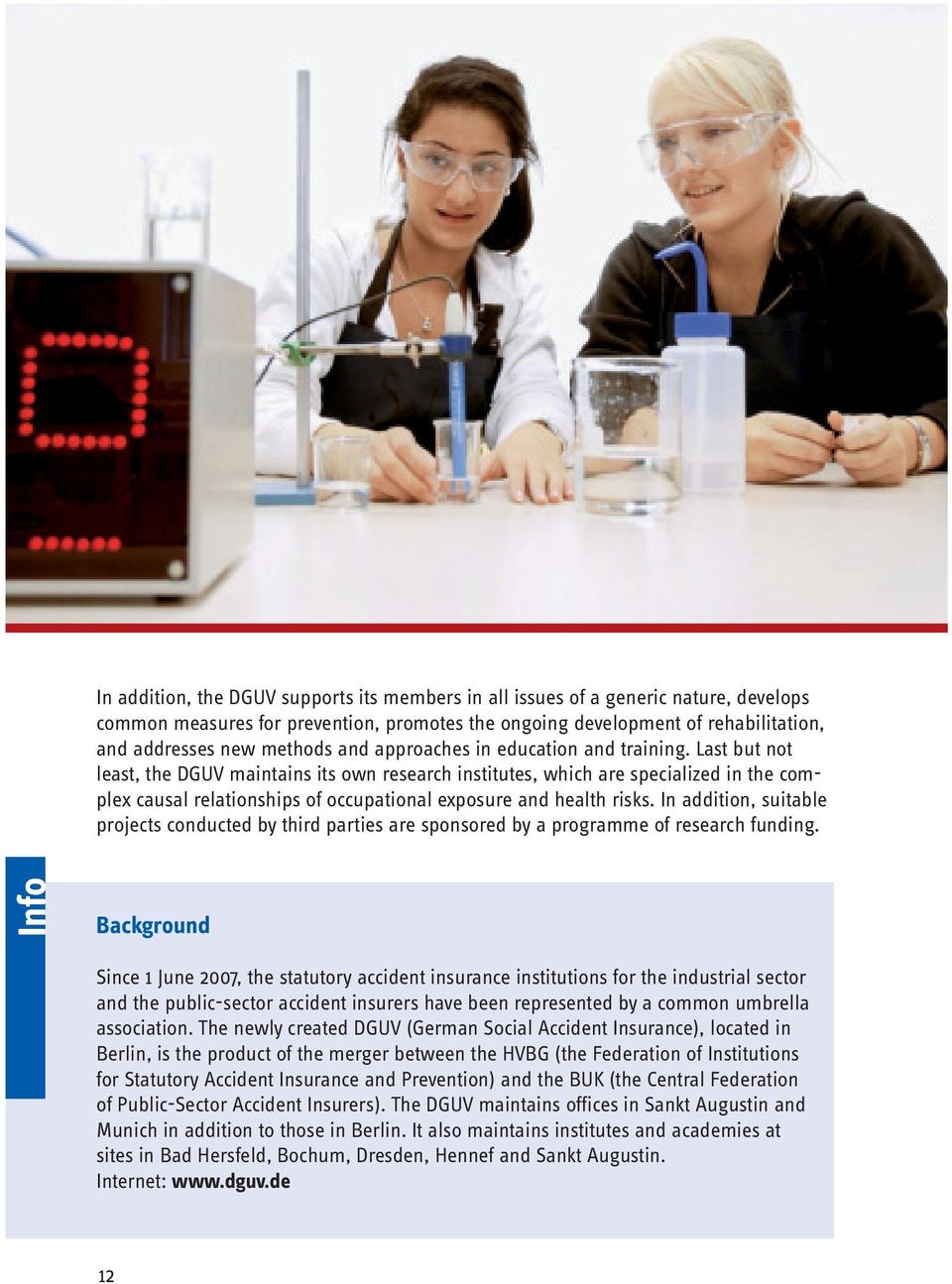
12 29080_DGUV IGH Broschu?re 3.7 RZ E.qxd:In guten Händen DGUV :24 Uhr Seite 12 In addition, the DGUV supports its members in all issues of a generic nature, develops common measures for prevention, promotes the ongoing development of rehabilitation, and addresses new methods and approaches in education and training. Last but not least, the DGUV maintains its own research institutes, which are specialized in the complex causal relationships of occupational exposure and health risks. In addition, suitable projects conducted by third parties are sponsored by a programme of research funding. Info Background Since 1 June 2007, the statutory accident insurance institutions for the industrial sector and the public-sector accident insurers have been represented by a common umbrella association. The newly created DGUV (German Social Accident Insurance), located in Berlin, is the product of the merger between the HVBG (the Federation of Institutions for Statutory Accident Insurance and Prevention) and the BUK (the Central Federation of Public-Sector Accident Insurers). The DGUV maintains offices in Sankt Augustin and Munich in addition to those in Berlin. It also maintains institutes and academies at sites in Bad Hersfeld, Bochum, Dresden, Hennef and Sankt Augustin. Internet: 12
13 29080_DGUV IGH Broschu?re 3.7 RZ E.qxd:In guten Händen DGUV :24 Uhr Seite 13 Every year, almost a million reportable occupational accidents occur in the public and private sector, and around 1.3 million reportable accidents in educational establishments. This is despite the fact that over the last twenty years, the risk of suffering injury at work or in school has fallen by more than half. It is important to consider that these figures represent the fate of many individual human beings. The primary objective must therefore be that of reducing accidents and disease even further, notwithstanding the success that has clearly already been achieved. It is therefore appropriate that the statutory accident insurance institutions make great efforts to be effective in preventing occupational accidents, occupational diseases and work- related health hazards. Preventive activity is defined by law as one of the functions of the statutory accident insurance institutions in the industrial sector and the public-sector accident insurers. In conjunction with those involved at local level such as safety professionals, safety officers and company physicians efforts are made to raise the awareness of management, employees, teaching and childcare staff and children for the hazards which they face on a daily basis, and to encourage them to adopt cautious behaviour. Responsibility within a company for the taking of preventive measures lies with the employer. He is supported in this task however by specialists from his own statutory accident insurance institution or public-sector accident insurer, who advise, inspect and provide information. In addition, highly specialized experts at the research institutes of the statutory accident insurance system continually work on improving products and procedures often in co-operation with manufacturers in order to provide greater protection and safety for insured individuals (see also Chapter V). Reinhard Gurke, head firefighter, Fürstenwalde fire service: The aspect of safety is of increasing importance in training. In my opinion, that's a good thing: we want to come home safely after a call-out, too. 13

14 29080_DGUV IGH Broschu?re 3.7 RZ E.qxd:In guten Händen DGUV :24 Uhr Seite 14 The organizational form of the statutory accident insurance system is also a product of the preventive concept: statutory accident insurance institutions for the industrial sector and the public-sector accident insurers are incorporated under public law. They fulfil their statutory functions by means of an autonomous administration, a form of management in which employers and insured individuals (employees) enjoy equal rights. This ensures that the interests of employers and insured employees are respected in equal measure. The task of legal supervision lies with the state. Social elections are held every six years at which the employers and insured individuals elect their delegates to the representatives' boards of the relevant accident insurance institutions. The representatives' board formulates the charter and by-laws of the autonomous administration. It elects the management board. Employers' and employees' delegates are represented in equal number on both the representatives' board and the management board. The social partners must consequently reach agreement on all major issues. The administration of each accident insurance institution is headed by a managing director. The managing director is an advisory member of the management board and is responsible for day-to-day administration. The members of the autonomous administration determine the budget, the hazard tariff and the staffing schedule of the administrations. This ensures a maximum of cost and expenditure transparency for the statutory accident insurance system. Employers' and employees' delegates are also present on the committees which rule on compensation payments, for example pensions. The success of the statutory accident insurance system to date above all in the area of preventive activity is attributable to the close links between its work and the field. The statutory accident insurance institutions for the industrial sector and the publicsector accident insurers are not anonymous bureaucracies, but are managed by dedicated autonomous administrations comprising delegates who represent employers and insured persons. Both sides contribute their practical and sector-specific experience, to the benefit of all involved. 14

15 29080_DGUV IGH Broschu?re 3.7 RZ E.qxd:In guten Händen DGUV :24 Uhr Seite 15 Voluntary autonomous administration Insured employees and employers elect the representatives' board with 50 % of the votes each Insured employees and employers elect the management board with 50 % of the votes each Insured employees and employers elect the managing director Full-time administration Preventive activity Rehabilitation Compensation 15

16 29080_DGUV IGH Broschu?re 3.7 RZ E.qxd:In guten Händen DGUV :24 Uhr Seite 16 II. Companies and insured persons those we care for. Facts and figures Impressive statistics: the German statutory accident insurance system is responsible for around 5.2 million companies and institutions. This figure includes 3 million companies in the commercial sector, 1.6 million companies in the agricultural sector, and around 590,000 institutions in the public sector (including 120,000 educational establishments). Over 70 million people are insured, including around 17.4 million children in schools, nursery schools and after-school care centres, and students in higher education. This therefore presents the employees of the statutory accident insurance institutions with a tremendous task. Given the huge number of parties involved and their great diversity, it is only natural that criticism is sometimes voiced. Unnecessary, expensive and interfering are the criticisms occasionally heard from employers. Conversely, what do I get out of it? is the question sometimes heard from insured individuals. It is notable, however, that anyone who has ever had need of the statutory accident insurance system has nothing but praise for it and is happy that it exists. Because it is there to help: swiftly and comprehensively. Not just with medical treatment and rehabilitation, but also with advice and practical help with the process following an accident for example the return to work. Ekkehard Band, district mayor of Tempelhof-Schöneberg: Voluntary work is an indispensable element in social co-operation. It deserves not only recognition and respect, but also the best possible support in the form of reliable accident insurance. 16

17 29080_DGUV IGH Broschu?re 3.7 RZ E.qxd:In guten Händen DGUV :24 Uhr Seite 17 The group of people covered by the statutory accident insurance system is extensive. It begins with all employees, irrespective of their age, sex, income, and whether they are employed on a permanent or temporary basis: by law, all are insured against the consequences of an occupational accident or disease. Further groups of people are also covered, such as home workers, and also volunteers working in the health and welfare services, relief organizations, for the national, regional and local authorities, and for bodies incorporated under public law. Children in schools, nursery schools and afterschool care centres, and students at vocational colleges or receiving education and training at institutes of higher education, trainees pursuing vocational education and training, development aid workers, individuals following a course of rehabilitation with a social accident insurer, and providers of first aid, for example at the scene of a traffic accident, are also insured. In contrast to their counterparts in the agricultural sector, entrepreneurs in the industrial sector, their spouses employed within their businesses, and self-employed persons regularly acting as entrepreneurs within incorporated companies or partnerships not generally subject to mandatory social insurance. These groups can however be included within the scope of the insurance by the charter of the statutory accident insurance institutions, or may opt voluntarily for insurance. The entrepreneurial persons described above may obtain insurance only voluntarily. A spouse of an entrepreneur who has a contract of employment with the latter is statutorily insured. 17
18 29080_DGUV IGH Broschu?re 3.7 RZ E.qxd:In guten Händen DGUV :24 Uhr Seite 18 Insured persons who are the responsibility of the statutory accident insurance institutions for the industrial sector: Contractual employees, trainees or apprentices in the industrial sector Persons employed abroad temporarily Persons working or conducting a business from home, teleworkers Persons undergoing rehabilitation (for example as hospital in-patients) Entrepreneurs and members of the liberal professions may also take out voluntary insurance with a statutory accident insurance institution. In some sectors, they are obliged to do so by law or charter. Insured persons who are the responsibility of the statutory accident insurance institutions in the agricultural sector: Agricultural workers (whether self-employed, employees, or working in the family business) Insured persons who are the responsibility of the public-sector accident insurers: Public-sector employees Employees in the railway, postal and telecommunications sectors Children in nursery schools and after-school care centres Schoolchildren and students Home carers Domestic helps Persons providing assistance in a disaster or emergency Blood and organ donors Voluntary helpers in institutions which provide assistance at disasters or accidents (such as the voluntary fire services, German Red Cross, etc.) Persons working in a voluntary capacity for the German state, a regional or local authority, or another institution incorporated under public law Witnesses Persons assisting in construction activity of a non-commercial nature Unemployed persons and persons receiving social security (during completion of their reporting duties) Prison convicts performing work Development aid workers 18

19 29080_DGUV IGH Broschu?re 3.7 RZ E.qxd:In guten Händen DGUV :24 Uhr Seite 19 Note: insurance cover applies even should the employer not yet have registered the company with the statutory accident insurance institution or have paid any contributions to it. This is in the interests of the employee's protection. The statutory accident insurance institutions then levy the premiums retroactively, and also fines if applicable. Should illicit work be proved, the accident insurer can also seek regress against the employer in the event of an accident, i.e. demand that he repay the costs of medical treatment and rehabilitation. Insurance for domestic helps It is often forgotten that employment in a private household constitutes a regular contract of employment, to which the usual rules apply. All persons employed in private households are therefore insured against accidents in accordance with the German Social Code (SGB VII). Domestic helps include cleaners, babysitters, kitchen helps, casual gardeners, and carers of children and adults. Employees pay no premiums for statutory accident insurance; the cost is met by the employer i.e. the person running the household. Depending upon their monthly remuneration, domestic helps must be registered either with the responsible accident insurance institution or with the Minijob Centre. Registration is obligatory, even if private insurance has already been taken out. Digression Should the monthly remuneration exceed 400, or registration with the Minijob Centre no longer be possible because the individual has several minor jobs with a total remuneration of over 400, the domestic help must be registered with the relevant accident insurance institution. Should the domestic help earn 400 or less (mini-job), registration and deregistration are solely the responsibility of the Federal Miners' Insurance Institution. Additional registration with the public-sector accident insurer is not required. Federal Miners' Insurance Institution/Minijob-Centre on the Internet Internet: 19
20 29080_DGUV IGH Broschu?re 3.7 RZ E.qxd:In guten Händen DGUV :24 Uhr Seite 20 The main statistics at a glance Figures for the statutory accident insurance institutions in the industrial sector Member companies 3,118,693 3,167,447 3,003,122 Equivalent full employees 30,208,194 29,445,332 30,202,851 Insured persons 42,659,641 42,532,196 44,323,221 Insurance relationships 55,417,451 55,283,671 58,178,055 Figures of the public-sector accident insurers Member companies/institutions 493, , ,140 Equivalent full employees 4,777,145 4,969,855 4,997,706 Insured persons 28,357,415 28,919,769 28,591,425 Insurance relationships 35,153,363 35,784,306 35,300,537 Advice and practical assistance for companies Legally, each and every company is assigned to its responsible accident insurance institution. The statutory accident insurance system absolves employers of their liability under civil law to their employees for occupational accidents and diseases. It indemnifies them against claims for damages which could threaten their livelihoods, as often happens in other countries. Companies in the industrial sector are insured by the statutory accident insurance institution for the sector concerned; business operated by the German federal, regional and local authorities and private businesses in which the state owns a majority stake are insured by the public-sector accident insurers. The public-sector accident 20

21 29080_DGUV IGH Broschu?re 3.7 RZ E.qxd:In guten Händen DGUV :24 Uhr Seite 21 insurers are structured at national, regional or local level, or are responsible for certain sectors of the economy (such as the railways, the postal and telecommunications sector or the fire services). Conversely, the statutory accident insurance institutions in the industrial sector are each responsible for a particular area of industry. The statutory accident insurance institutions advise, inspect, co-ordinate and provide information in the area of safety and health at work. The experts at the institutions are available to companies to answer their questions and to assist them with specific problems. (For more detailed information on the subject of preventive activity, see Chapter V.) Amelie Wipprecht, swimming-bath operator, Central Berlin public swimming baths: Swimming-bath personnel must be good all-rounders. The training provided by our public-sector accident insurer supports me in this function. From consultation, through research, to statistics the experts at the statutory accident insurance institutions employ a diverse range of instruments to fulfil their tasks of prevention, rehabilitation and compensation. Institutes, academies, clinics: the statutory accident insurance system maintains a wide variety of institutions, and also works hand in hand with other organizations and bodies. Throughout the process, the autonomous administration ensures that all activities are conducted in the interests of the insured individuals and of the businesses and companies, in line with the objectives and the needs on the ground. Ultimately, the companies, which pay the premiums and are responsible for implementing preventive measures, are the pillars of the entire accident insurance system. 21
22 29080_DGUV IGH Broschu?re 3.7 RZ E.qxd:In guten Händen DGUV :24 Uhr Seite 22 III. Comprehensive insurance when we help. Occupational and school accidents, and occupational diseases Any time, anywhere, and in whatever way necessary: the statutory accident insurance system provides protection at work, in schools, and during journeys to and from them. Specifically, this means that the accident insurance institutions are responsible for all consequences of occupational accidents, accidents in educational establishments, commuting accidents, and occupational diseases. Occupational, school and commuting accidents Occupational accidents are accidents suffered by insured persons in connection with their work, or whilst travelling on company business. Such accidents also include, for example, those occurring: During the transport or repair of work equipment During company sporting events, unless they are primarily of a competitive nature During company parties and trips organized by companies. School accidents are accidents suffered by children or students in their educational establishments. They include accidents suffered by children or young people whilst attending schools, nursery schools, after-school care centres or vocational colleges; or whilst under supervision by such educational establishments or in association with them immediately prior to or following lessons. This category of accidents also includes those suffered by students during education and training at institutes of higher education. 22
23 29080_DGUV IGH Broschu?re 3.7 RZ E.qxd:In guten Händen DGUV :24 Uhr Seite 23 Activities outside the educational establishment are also insured, such as: School trips School parties School sports Visits to university and public libraries Commuting accidents are accidents occurring during journeys directly to and from the workplace, school, nursery school, after-school care centre or institute of higher education. Employees are also insured on detours which are necessary, for example: In order to accommodate children during working hours For the purpose of car-sharing Owing to traffic diversions Where the workplace can be reached more quickly by a longer route (e.g. by motorway) Journeys undertaken in any connection with work are also insured. 23
24 29080_DGUV IGH Broschu?re 3.7 RZ E.qxd:In guten Händen DGUV :24 Uhr Seite 24 III. Comprehensive insurance when we help Info Company sports Statutory Accident Insurance cover does not automatically extend to all sporting events which a company permits its employees to participate in. The sporting activity must have some inherent connection with the company's activities, i.e. be in its interest. Company sport is included in the insured activity when the following criteria are met: 1. The purpose must be recreational, and not competitive 2. It must be performed regularly 3. It must essentially be limited to company employees 4. It must be conducted during, prior to or following working hours 5. It must be organized from within the company Where company sports are insured, cover also extends to journeys to and from the venue, and to changing and showering. Occupational diseases Occupational diseases are formally recognized as such when they have been contracted as a result of exposure, during insured activity, to health hazards at a higher level than the exposure for the wider population. Formally recognized occupational diseases are indicated on the list of occupational diseases which is issued by the German government with the approval of the upper chamber. Other diseases may also be recognized as being occupational in origin if new medical/scientific findings show them to meet the requirements for inclusion in the list of formally recognized occupational diseases. The list of formally recognized occupational diseases is available (in German) on the Internet: webcode: d1303 Disputes over occupational diseases Occupational diseases are a complex issue, and their formal recognition frequently becomes a matter for the courts. The fates of individuals collide with statutory limit values, individual cases with standardized patterns. Inevitably, difficult distinctions must be drawn. The legislator has nevertheless attempted to find the best solution for all 24
25 29080_DGUV IGH Broschu?re 3.7 RZ E.qxd:In guten Händen DGUV :24 Uhr Seite 25 Occupational and school accidents, and occupational diseases parties concerned. As at the end of 2006, almost 820,000 people in Germany were receiving ongoing pension payments. Pension payments for occupational diseases, occupational accidents and commuting accidents amount to approximately 5 billion. This is an enormous figure, one which assures many people of their livelihood. At the same time, it must be established in each case that the disease was in fact caused by pursuit of the occupation (principle of causality), since the costs to companies would otherwise rise unchecked and without justification, with a corresponding threat to jobs. This would be in the interests neither of the insured individuals, nor of the companies. What procedure must be followed when an accident or disease occurs? The employer is obliged to inform the statutory accident insurance institution whenever an employee is unable to work for a period exceeding three days as a result of an occupational injury. Any accident requiring treatment by a doctor which is suffered by a child or student in an educational establishment must be reported. Fatal accidents must of course also be reported to the accident insurance institutions. Forms are available for reporting accidents. No application need be made for benefits, since the benefits delivered by the statutory accident insurance system are determined by the authorities. Suspected cases of occupational disease must generally be reported both by the employer, and by the doctor treating the condition. This is a statutory requirement. Insured individuals may also contact their accident insurance institution themselves at any time should a (possible) occupational disease not yet have been reported by their employer or the doctor. The doctor first treating the condition is also obliged to produce a report. Note: Employers should also record minor occupational accidents in the company's accident book. This enables them to provide the necessary evidence more easily should the consequences of the accident prove to be more serious than was originally assumed. The administrative procedure and expert opinion are free of charge for the insured individual. Should the latter involve a lawyer, however, they must pay the associated costs themselves. The insured individual may appeal against the decision of the accident insurance institution within one month of notification. Accident insurance does not apply in the following cases: Injury caused deliberately, accidents caused by the influence of alcohol, or accidents attributable essentially to private activities. Info 25
26 29080_DGUV IGH Broschu?re 3.7 RZ E.qxd:In guten Händen DGUV :24 Uhr Seite 26 IV. A relationship based upon solidarity who is behind us. Funding, premiums system The essential concept of the employer being responsible for his employees has a long tradition, yet is as modern as ever. It creates social peace and stability at the workplace. This concept also underpins the statutory accident insurance system, which was introduced over a century ago: by eliminating claims for compensation and thus lawsuits, it serves as a liability insurance for employers against the risk of their employees suffering occupational accidents and diseases. In practice, this means that the statutory accident insurance absolves employers of their liability, and compensates employees in the event of an occupational accident or disease. In return, the employer pays premiums: his financial outlay is therefore predictable, and lawsuits with an uncertain outcome are avoided. Apportionment of costs The statutory accident insurance system is financed in accordance with the principle described above. Preventive measures, rehabilitation and compensation are funded in full by the employers. The level of premiums corresponds exactly to the payments that were required in the preceding year (adjustable contribution procedure). For this reason, the premiums are calculated retrospectively for each calendar year. The statutory accident insurance system does not generate a profit; only the actual costs are apportioned. Accident insurance costs falling within the responsibility of the accident insurance fund of the Federal government and the accident insurance institutions responsible for the regional and local authorities are financed by the relevant regional bodies for their respective regions, essentially through tax revenues. The premiums for insured individuals in private households must be paid by the person managing the household. 26
27 29080_DGUV IGH Broschu?re 3.7 RZ E.qxd:In guten Händen DGUV :24 Uhr Seite 27 Compared to other social insurance premiums, those for statutory accident insurance are very low. Averaged over many years, the premium for employers has been in the region of 1.3 %. Premiums system As with the other forms of social insurance, the level of the premium also varies according to the level of the total wage costs of the insured individuals (wages and salaries) and the expenditure of the accident insurance institution concerned. The accident risk in the corresponding sector is also significant. This is expressed by the risk category. The contribution base is calculated as a function of the financial requirement for a given year. It is the same for all insured employers, but must be recalculated each year. 27
28 29080_DGUV IGH Broschu?re 3.7 RZ E.qxd:In guten Händen DGUV :24 Uhr Seite 28 IV. A relationship based upon solidarity who is behind us. The individual premium is calculated according to the following formula: Premium = total wage costs x risk category x contribution base 1,000 For example: How is the actual statutory accident insurance premium calculated? Example: a construction company has two operations, a decorating division and a construction division with total wage costs of 200,000 and 300,000 respectively. The total wage costs for the administration division are 100,000. At an average contribution base of 3.80 per thousand euro total wage costs, the premium for the decorating division is as follows: total wage costs x risk class x contribution base 200,000 x 4.0 x 3.80 = = 3,040 Euro 1,000 1,000 The premium for the construction division is: 300,000 x 8.5 x ,000 = 9,690 Euro Owing to its low total wage costs and its low risk category, the administration division is the cheapest. Its costs are: 100,000 x 1.0 x ,000 = 380 Euro The total premium for the company would therefore be 13,110. Because the premium for the entire company is calculated as described, it is important for the total wage costs in the individual company divisions to be indicated precisely. The statutory accident insurance institutions may motivate companies by means of surcharges, discounts, or graded premiums, according to their particular accident situation. Investments in preventive measures may therefore pay dividends. 28
29 29080_DGUV IGH Broschu?re 3.7 RZ E.qxd:In guten Händen DGUV :24 Uhr Seite 29 Funding, premiums system Adjustment for excess inherited obligations in the context of the statutory accident insurance institutions for the industrial sector The concept of adjustment for excess inherited obligations has the purpose of mitigating the impact of structural change upon the premiums burden in the statutory accident insurance institutions in affected sectors. The background: the premiums levied by the statutory accident insurance institutions are calculated in consideration of both the cost entailed by new obligations arising from industrial diseases and occupational and commuting accidents, and obligations from pensions from previous years and decades (legacy obligations). The purpose of adjustment for excess inherited obligations is that of distributing these obligations across sectors. Under this principle, each statutory accident insurance institution first bears its pension obligations to the degree which it would have had to do so had the structures always been the same as in the present business year. The pension obligations lying above this figure, i.e. the excess inherited obligations, are shared between all the institutions in accordance with the solidarity principle. A further aspect is relevant, namely: between harmful exposure and the resulting incidence of an occupational disease, years and in some cases decades may pass (in the case of asbestos-induced cancer, for example, the average interval is 30 years). This hiatus is also taken into account by the adjustment for excess inherited obligations. For this reason, the new cases of occupational disease are weighted according to the size of the statutory accident insurance institution 25 years previously (25 years being the average latency period). The ratio between the size of the institution at that time and its current size yields the proportion of cases of occupational disease which must be borne by the institution today. Digression An example: if, 25 years ago, the statutory accident insurance institution were double its present size, it follows that at its present size, it must bear the costs of only half of its new cases of occupational disease itself. The costs above this level are once again borne by the mutually supportive body of all statutory accident insurance institutions. The burden is thus also shared by the statutory accident insurance institutions which have grown and which will be responsible for the bulk of cases in the future. The adjustment for excess inherited obligations is therefore a means by which the principles of both solidarity and preventive action can be reinforced. 29
30 29080_DGUV IGH Broschu?re 3.7 RZ E.qxd:In guten Händen DGUV :24 Uhr Seite 30 V. from the same source and are perfectly matched to each other. Responsibility for safety and health what we do. Functions and services The risk of a person suffering an occupational accident has been falling continually for years. Nevertheless, should it actually happen, the statutory accident insurance system takes care of it. Through its institutions, the statutory accident insurance institutions for the industrial sector and the public-sector accident insurers, it provides a comprehensive system of preventive measures and benefits for insured individuals and companies. An important aspect is that preventive measures, rehabilitation and compensation are delivered The insured individuals receive a comprehensive range of services, extending from preventive measures, through acute care, to occupational re-integration or financial compensation where appropriate. The statutory accident insurance system thus ensures a high level of social protection in schools, occupations and voluntary work. Info Functions and services of the accident insurance institutions The accident insurance institutions are mandated by law with the following functions: Prevention of occupational accidents, occupational diseases and work-related health hazards, and provision of first aid (the prevention mandate) Medical treatment and rehabilitation Financial compensation Preventive activity Prevention is better than cure : the proverb is not only familiar, but also true. And in a sense, it is also the motto of the statutory accident insurance system, since the principle is that of prevention before compensation. For this reason, the statutory accident 30
31 29080_DGUV IGH Broschu?re 3.7 RZ E.qxd:In guten Händen DGUV :24 Uhr Seite 31 insurance institutions employ a wide range of measures and resources to ensure that work is carried out safely and healthily in order to prevent accidents from occurring in the first place at workplaces or in educational establishments, or occupational diseases from being contracted. On the one hand, the accident insurance institutions have a statutory mandate to assure the prevention of school and occupational accidents, occupational diseases and workrelated health hazards by all suitable means. On the other, it is the employer's obligation to assure safety and health at his own workplaces. This results in a co-operative arrangement involving the accident insurance system and industry: the specially trained inspectors of the labour inspectorates operated by the statutory accident insurance institutions and the public-sector accident insurers advise employers on preventive measures, and monitor their implementation. In addition to state acts and regulations, accident prevention regulations constitute a further legal basis for this work. In detail: Occupational safety and health regulations These particularly include: State acts and regulations, which in many cases are transpositions of European Union directives into national law; Accident prevention regulations issued by the accident insurance institutions; Technical rules issued by the state and by the accident insurance institutions. 31
32 29080_DGUV IGH Broschu?re 3.7 RZ E.qxd:In guten Händen DGUV :24 Uhr Seite 32 V. Responsibility for safety and health what we do. The accident prevention regulations are issued by the accident insurance institutions. A small number of these apply to all sectors of the economy; others are geared to particular sectors, establishments or areas of activity. The accident prevention regulations also have the function of implementing state legislation, and are legally binding upon the affected employers and insured individuals. They are supplemented by rules and information for the protection of safety and health, and by codes of practice and other workplace-specific documents, in order to facilitate practical implementation in the various companies by means of illustrative examples and comprehensible explanations free of legalese. In contrast to the accident prevention regulations, the technical rules and other documents are not binding. However, they constitute recommendations of assured quality for how the occupational safety and health issue under consideration should be addressed properly. Should employers or insured individuals contravene accident prevention regulations deliberately or through gross negligence, the accident insurance institution may impose a fine of up to 10,000. The same applies in the event of contravention of enforceable orders, issued for example by a labour inspector from an accident insurance institution in the course of a site inspection. Protection and safety In the context of the promotion of measures for occupational safety and health in companies, engineered occupational safety and health is of great importance to the statutory accident insurance institutions, since machines, installations, work materials and procedures should be designed and selected such that when they are used as intended and work is performed correctly, accidents cannot occur, and work-related health hazards are avoided. Of much greater significance in the prevention activity of the accident insurance institutions and their labour inspectors however is the holistic approach to occupational safety and health, which takes account of the widest possible range of influencing factors, particularly the human factor. Info The prioritization of protective measures 1. Engineered protective measures (such as guards on machines, the use of substitutes for hazardous substances, etc.) 2. Organizational protective measures (such as the organization of work processes) 3. Personal protective measures (such as the wearing of protective helmets) 32
33 29080_DGUV IGH Broschu?re 3.7 RZ E.qxd:In guten Händen DGUV :24 Uhr Seite 33 Functions and services Behavioural prevention The objective of behavioural prevention is for workplaces in all areas of company activity to be made safe and healthy by the avoidance of sources of hazards and consideration for all conceivable protective facilities. It extends to organization of occupational safety and health, the safe design of working equipment, working methods and work premises, including all machines, tools and other facilities. Of particular relevance in this context is the advance testing and certification of the safety of technical work equipment performed by the test bodies of the expert committees and of the BGIA Institute for Occupational Safety and Health of the German Social Accident Insurance. These bodies also attach importance to safety during the selection and use of agents such as chemicals, in the interests of optimum behavioural prevention. Preventive plant management by the employer The employer must take all measures for a preventive approach in his plant, and issue corresponding directions. In particular, he must ensure that occupational safety and health is organized in a suitable manner, and must make the necessary resources available. He should direct his employees to work safely and to observe the acts, regulations and accident prevention regulations; and he must draw their attention to the hazards associated with their tasks. For this purpose, the insured individuals must receive instruction, on a regular basis and as necessitated by the circumstances. At the same time, the insured individuals must use the specified protective equipment and follow the instructions for the prevention of accidents. In accordance with the German Safety at Work Act and the accident prevention regulations pursuant to it, the employer must appoint company physicians and OSH professionals who support him in the prevention activity. In companies with over 20 employees, the employer must also appoint one or more safety officers in conjunction with the employee representative council. Their task is to support the employer in all occupational safety and health issues within the various areas of company operations. For this purpose, the safety officers receive initial and continual further training from the accident insurance institutions at dedicated training centres. 33
34 29080_DGUV IGH Broschu?re 3.7 RZ E.qxd:In guten Händen DGUV :24 Uhr Seite 34 V. Responsibility for safety and health what we do. Practical tip The employer model The accident insurance institutions offer the employer model to small and medium-sized businesses as an alternative to support from OSH professionals. Under this model, the accident insurance institutions raise employers' awareness of OSH problems by means of information and motivational measures, and equip them to identify these problems in plants, to resolve them themselves, or to make use of external consultancy. A very important, possibly the most important element of a modern occupational safety and health strategy is the hazard assessment which the employer must conduct for each workplace. The statutory accident insurance institutions have produced a wide range of tools for hazard assessment which assist small and medium-sized enterprises in particular in identifying weak points in the protection of safety and health at work. In this context, the prevention services of the accident insurance institutions offer comprehensive practical consultancy by which solutions can be found which are geared to the industrial sector concerned, and thus assist employers with the specific problem at hand. Special occupational preventive medicine Persons who are exposed to a particular health hazard in their occupational activity, for example during work with certain hazardous substances, receive support in accordance with the statutory accident insurance institutions' principles for preventive occupational health checks. This means that employers must arrange for regular preventive health checks for the employees performing the tasks concerned, in order to assure the best possible protection for their health. 34
35 29080_DGUV IGH Broschu?re 3.7 RZ E.qxd:In guten Händen DGUV :24 Uhr Seite 35 First aid Employers must ensure effective first aid for the event of occupational accidents. In particular, this involves the appointment of qualified first-aiders. They are supported in this function for example by the training of the mandatory in-plant first-aiders which is provided by the accident insurance institutions. Michaela Birke, deputy head of nursing care Ward D2, Berlin accident hospital: We attach great importance to preventive activity. Those of us in nursing know its value because we wonder sometimes whether we will always be physically capable of continuing our profession. 35
36 29080_DGUV IGH Broschu?re 3.7 RZ E.qxd:In guten Händen DGUV :25 Uhr Seite 36 V. Responsibility for safety and health what we do. Digression Research and training Preventive measures also mean innovation: in order for developments in the area of occupational safety and health to be promoted and continually improved, investments in research and development are absolutely essential. The German statutory accident insurance system maintains highly specialized and internationally acclaimed institutes which conduct research, development, consultancy, testing and training. Numerous innovations in the area of occupational safety and health and occupational medicine have been developed by these facilities. The research activities of the statutory accident insurance institutions are characterized by their great relevance to practice: the institutes deliver solutions to topical OSH problems in plants which are rapidly available and suitable for application in the field. Interdisciplinary co-operation also ensures that prevention issues are considered from every angle. Each research institute within the statutory accident insurance system has a particular focus: The BGIA Institute for Occupational Safety and Health of the German Social Accident Insurance The BGIA conducts research, testing and consultancy in the following fields: Chemical and biological hazards Physical hazards, such as noise, vibration and radiation Safety of new technologies and work processes Safety of engineered work equipment and structural engineering Ergonomics Personal protective equipment Explosion protection Epidemiology In conjunction with the accident insurance institutions, the BGIA maintains a system for measurement of the workplace exposure of hazardous substances (BGMG) and a hazardous substance information system (GESTIS). 36
37 29080_DGUV IGH Broschu?re 3.7 RZ E.qxd:In guten Händen DGUV :25 Uhr Seite 37 Functions and services The BGAG Institute Work and health In its capacity as a joint facility of the statutory accident insurance system, the BGAG has the following functions: Imparting of skills, Research and Consultancy. Their purpose is the raising of awareness of safety and the safeguarding of health at the workplace. The BGAG bridges the gap between theory and practice. At conferences, congresses and seminars for delegates from Germany and abroad, the latest scientific findings can be discussed with practitioners from the field. One focus is the organization of joint events with countries in Central and Eastern Europe. The location of Dresden in the heart of Europe is of particular relevance here. The BGFA Institute for Occupational Medicine of the German Social Accident Insurance An institute of the Ruhr University, Bochum The BGFA Institute for Occupational Medicine is maintained jointly by the DGUV and the statutory accident insurance institution in the mining industry. Its research foci are the effects of hazardous chemical and biological substances upon human health, and the development of corresponding preventive measures. Complex medical issues are addressed in an interdisciplinary overall concept by the five centres of competence: Medicine, Toxicology, Allergology/immunology, Molecular medicine and Epidemiology. The research institutes of the statutory accident insurance system on the Internet: BGIA Institute for Occupational Safety and Health: BGAG Institute Work and Health: BGFA Institute for Occupational Medicine: Research institutes maintained by the accident insurance institutions Besides the DGUV's own institutes, individual statutory accident insurance institutions maintain a number of different research establishments. In addition, numerous research projects conducted by external bodies are sponsored by a DGUV research fund. 37
38 29080_DGUV IGH Broschu?re 3.7 RZ E.qxd:In guten Händen DGUV :25 Uhr Seite 38 V. Responsibility for safety and health what we do. Education and training The education and training conducted by the statutory accident insurance institutions is a cornerstone upon which the high standard of occupational safety and health in Germany is built and sustained. Without knowledge of hazards, effective protection against them is not possible. The insured individuals and their superiors must therefore be informed, motivated and trained on a regular basis. The statutory accident insurance system is one of Germany's largest providers of education and training. Every year, it equips almost 400,000 people with expertise in occupational safety and health. Those trained are primarily employers and managers, OSH professionals, teachers, trainers, trainees and schoolchildren, in addition to many other groups. Seminars on special topics cover various areas, procedures, processes and substances. Education and training also serves to equip personnel to provide competent and skilled support of the insured individuals and companies. In this context, it is aimed at the staff of the accident insurance institutions and other institutions in the area of insurance, service provision and management. The DGUV Academy school of applied sciences of the German Social Accident Insurance The DGUV Academy, with sites at Bad Hersfeld and Hennef, is the central joint training establishment of the German Social Accident Insurance in the areas of rehabilitation, social legislation and public administration. It provides training in the provision of flexible and comprehensive support for insured individuals and companies. It extends the knowledge and skills of experienced personnel, experts and managers, equipping them to re-integrate employees into their vocational and social lives in accordance with their ability following injury or sickness. Joint activity and networking with national and international organizations, particularly universities and other institutes of higher education, are important pillars of the overall concept. The academies of the German Social Accident Insurance on the Internet: DGUV Academy Bad Hersfeld/Hennef ( webcode: d5251) BG Academy Dresden ( 38
39 29080_DGUV IGH Broschu?re 3.7 RZ E.qxd:In guten Händen DGUV :25 Uhr Seite 39 Functions and services Rehabilitation Even though accidents and occupational diseases have been reduced impressively as a result of the efforts made, they can never be avoided completely. Should an accident occur in an educational establishment or during salaried or voluntary work, the statutory accident insurance system provides a comprehensive system of support. The principle is that of rehabilitation before pension. This means that priority is always given to the best possible medical care for the insured person and to their occupational and social re-integration. A pension is paid only when all suitable measures for rehabilitation/ participation have been exhausted. 39
40 29080_DGUV IGH Broschu?re 3.7 RZ E.qxd:In guten Händen DGUV :25 Uhr Seite 40 V. Responsibility for safety and health what we do. Info Keyword: rehabilitation before pension Rehabilitation before pension means that priority is always given to the best possible medical care for the insured person and to their educational/occupational and social re-integration. There is no cap on the costs, since successful rehabilitation is the best solution, for both the insured individual and all other parties. A pension is therefore generally paid only when all realistic and reasonable measures for rehabilitation have been exhausted. Out-patient care Following an occupational accident or disease, competent medical care of the insured individual is particularly important. This medical care is delivered from a single source under the statutory accident insurance system. Approximately 3,500 accident insurance consultants appointed by the statutory accident insurance institutions provide patients with the necessary care and determine the form to be taken by subsequent treatment. The surgeons or orthopaedic specialists responsible have particular expertise in occupational medicine, and specialist personnel and the latest medical equipment at their disposal. Services provided in the context of medical treatment There is no time limit to the medical treatment. It encompasses all suitable measures, in particular: First aid (rescue) Medical and dental treatment Pharmaceuticals and dressings Treatments, including physiotherapy and kinesitherapy, speech therapy and occupational therapy Prostheses; orthopaedic and other aids Load testing and work therapy Home nursing 40
41 29080_DGUV IGH Broschu?re 3.7 RZ E.qxd:In guten Händen DGUV :25 Uhr Seite 41 Functions and services For insured persons who require assistance on a considerable scale for certain everyday tasks, nursing care benefits are paid, or home or institutional care services provided. In-patient treatment Victims of major injuries or occupational diseases are treated by the accident insurance consultants as in-patients in eleven dedicated clinics operated by the statutory accident insurance system or some 800 additional hospitals which are authorized to provide the relevant medical treatment. If necessary, the insured individuals receive treatment in some 300 approved in-patient rehabilitation clinics or approximately 100 extended ambulatory physiotherapy (EAP) centres. All accident clinics are staffed by highly qualified personnel and feature special wards and the necessary infrastructure. Special rehabilitation centres exist for children and young people who have suffered craniocerebral trauma. These centres feature a hospital school in which children are prepared for their return to their former school or another suitable school. 41
42 29080_DGUV IGH Broschu?re 3.7 RZ E.qxd:In guten Händen DGUV :25 Uhr Seite 42 V. Responsibility for safety and health what we do. Extra: the clinics The statutory accident insurance institutions maintain nine accident clinics, two clinics for occupational diseases, and two accident treatment centres and specialized wards. Their facilities include special departments for the treatment of: Paraplegia Severe cerebral injury and burns Hand injuries and plastic surgery All accident clinics have wards for intensive therapy and medical equipment employing the latest technology. For fast transport of accident victims, emergency doctors' vehicles and rescue helicopters are on standby at all times. Highly qualified doctors and nursing staff, psychologists, educationalists, occupational and work therapists, physiotherapists, mobility trainers and sports instructors are employed in the clinics; the accident victims thus receive preliminary care and rehabilitation measures under one roof, and can be discharged healthy and ready for work. The clinics on the Internet: Dr. Roman Feil, consultant, Berlin accident hospital: For accident insurance consultants like myself, the number-one rule is that we devote ourselves to protecting our patients and do everything in our power for their best possible rehabilitation. Occupational and social rehabilitation Even before injured persons are discharged from the clinics, rehabilitation advisers or case managers from the statutory accident insurance institutions visit them and support them throughout the rehabilitation process. The objective is to ensure that accident victims are integrated back into their educational/vocational and social environment as sustainably as possible. 42
43 29080_DGUV IGH Broschu?re 3.7 RZ E.qxd:In guten Händen DGUV :25 Uhr Seite 43 Functions and services The focus always lies upon retention of their former workplace. Should a return to the former workplace require further measures or not be possible at all, the statutory accident insurance institutions provide comprehensive alternative support. This occupational assistance is geared to occupational re-integration of victims of accidents or illness, if at all possible sustainably, and in accordance with their ability. It takes into account the insured person's suitability, willingness and previous occupation. In the case of children and young people, the function of occupational rehabilitation includes all measures necessary to prepare them for school attendance, and to enable them to complete a general education and to train for and pursue a suitable vocation, in accordance with their particular skills and abilities. Facilitating participation The statutory accident insurance institutions assume all costs associated with measures for occupational participation. These include the costs of: Assistance in retaining or finding a workplace Measures for selecting a vocation, sample work experience, and vocational preparation Education, retraining and further training Training courses and study materials Examinations Travel, board and lodging Additional accident insurance benefits may be awarded to schoolchildren: One-to-one tuition at the hospital bedside or at home, if the future course of education is at risk owing to the duration of schooling lost as a result of the accident Assumption of the cost of travel to school, in order to ensure the earliest possible resumption of lessons and to avert potential difficulties in keeping pace Provision of technical tuition and study aids Provision of schooling in a special training institution for the disabled, including accommodation in a residential or nursing home 43
44 29080_DGUV IGH Broschu?re 3.7 RZ E.qxd:In guten Händen DGUV :25 Uhr Seite 44 V. Responsibility for safety and health what we do. Social support is also an element in the social re-integration of schoolchildren or employees following an occupational accident or disease. This assistance furthers participation in community life and takes the form of household, accommodation and vehicle benefits. The affected individuals receive support for example in: Conversion of their homes (conversion of the sanitary facilities, installation of wide doors, lifts, ramps) Conversion or purchase of specially equipped vehicles Digression The rehabilitation advisor an example The task of rehabilitation advisers or case managers at the statutory accident insurance institutions is to provide victims of accidents and disease with measures to facilitate their occupational and social re-integration whilst they are still undergoing treatment and medical rehabilitation. The rehabilitation advisers and case managers organize vocational adaptation and the associated education and training, housing and vehicle benefits; assist in the search for workplaces suitable for employees with disabilities; and provide advice on social problems. In the words of Christina Gerlach, Head of Rehabilitation Management at the statutory accident insurance institution responsible for the administrative sector: Supporting the insured individuals is a process which requires close communication. Our task is to manage the process by which the needs of our customers, the insured persons, are translated into actual provision. A specific example: for an insured person who had suffered an accident and was now working as a travel journalist, a work assistant was recruited on the basis of the German Social Code IX (governing rehabilitation and participation of disabled people) to accompany and support him on his trips. In addition, the injured person received work aids, from a height-adjustable desk, through a showercompatible travel wheelchair, to a standing wheelchair. The latter has an important psychological component: At a party, being able to stand face-to-face with someone else at a high-level table may constitute a major step towards participating in social life. 44
45 29080_DGUV IGH Broschu?re 3.7 RZ E.qxd:In guten Händen DGUV :25 Uhr Seite 45 Functions and services What does DISABILITY MANAGEMENT actually mean? In accordance with the concept of managing disabilities, a person who for example suffers from a chronic disease or the consequences of an injury does not accept this as their fate, but instead makes every possible effort to return to good health and to remain capable of work. In particular, their job should not be lost. In contrast to other terms, such as case management or disease management, disability management involves an extensive network of parties within the social security system. This network compensates for the deficits which frequently present insurmountable obstacles not only for disabled people themselves, but also for employers. For further information, visit 45
46 29080_DGUV IGH Broschu?re 3.7 RZ E.qxd:In guten Händen DGUV :25 Uhr Seite 46 V. Responsibility for safety and health what we do. Financial benefits Should they not be receiving earnings, employees receive injury benefit for the duration of their incapacity for work. This constitutes 80 % of their former regular gross earnings, and must not exceed their net earnings. Schoolchildren and students likewise receive injury benefit if they were also in paid employment at the time of their incapacity for work. A temporary allowance is paid during a measure for occupational rehabilitation. Insured persons suffering an accident whilst performing a task in the public interest may receive additional benefits. These are generally paid for the duration of medical treatment and occupational rehabilitation, in addition to the insured person's or surviving dependants' pensions. Pension payments Insured persons receive a pension when their earning capacity has been reduced for over 26 weeks and the reduction in their earning capacity is at least 20 %. The pension entitlement generally begins at the point at which injury benefit ceases to be paid. In the event of complete loss of earning capacity, the full pension comprises two-thirds of the annual earnings prior to the accident or occupational disease. Where the earning capacity is partly reduced, the pension corresponds to the level of reduction, for example one-third of the previous gross earnings in the case of a 50 % reduction in earning capacity. Where children are concerned, the earning capacity is extrapolated from the potential for employment which would have existed after the accident had the child already been available for employment. Should the earning capacity be reduced by at least 20 % overall as a result of several insured events, an insured person's pension is paid for each accident. In this case however, the consequences of a discrete insured event are considered only if they reduce the earning capacity by at least 10 %. The accident insurance institutions continue to pay this pension as long as the earning capacity remains reduced, i.e. under certain circumstances for life, irrespective of whether an occupation is pursued. In the event of death, the accident insurance institutions pay the following benefits in particular: Death benefit Transportation costs Surviving dependants' pensions (to which the deceased's widow, widower, orphaned children, and under certain circumstances former spouse, relatives in the ascending line, step-parents and foster-parents are entitled). 46
47 29080_DGUV IGH Broschu?re 3.7 RZ E.qxd:In guten Händen DGUV :25 Uhr Seite 47 Functions and services Background: reduction in earning capacity Info The reduction in earning capacity is based upon the extent to which the reduction in an insured person's physical and mental performance caused by the insured event reduces their capacity for work. Should the capacity for work be reduced by several insured events, the reduction in earning capacity is determined separately for each event, and several pensions are paid accordingly. The reduction in earning capacity is stated as a percentage. Full and part pensions Should the earning capacity be lost completely (100 %), a full pension is paid. This is equal to two-thirds of annual earnings prior to the occupational accident or disease. Where the reduction in earning capacity is partial, a proportion of the full pension corresponding to the reduction is paid (part pension). Entitlement to a part pension exists where the earning capacity is reduced by 20 % or more. Example: The pension of an insured individual with annual earnings of 36,000 and a reduction in earning capacity of a) 100 % and b) 20 % is calculated as follows: a) full pension = 2/3 of 36,000 = 24,000, of which 100 % reduction in earning capacity = a pension of 24,000 per year = a pension of 2,000 per month b) part pension = 2/3 of 36,000 = 24,000, of which 20 % reduction in earning capacity = a pension of 4,800 per year = a pension of 400 per month 47
48 29080_DGUV IGH Broschu?re 3.7 RZ E.qxd:In guten Händen DGUV :25 Uhr Seite 48 VI. Safety at home and abroad where we are. Working throughout the world: in the age of globalization, a job posting many miles from home or the assignment of employees abroad is no longer unusual. In internationalized markets, it is also natural for foreign investments to be made or for companies in neighbouring countries to be contracted with work. Under certain circumstances, however, this may mean that other regulations and legislation apply than those at home. Increasingly often, employers and personnel managers face issues of cross-border insurance cover. The statutory accident insurance institutions provide support here: the liaison office processes cross-border insurance claims and provides advice to companies and insured individuals. It co-operates both with partner organizations in other countries within the European Union (EU) and European Economic Area (EEA), and with organizations in countries with which social insurance agreements have been concluded. The emphasis lies upon the implementation of European subordinate legislation and of the provisions of the applicable social insurance agreements. In addition to numerous other functions, one focus of activity is organization and assurance of the medical care of persons entitled to it in the partner country. Beyond these arrangements, the statutory accident insurance institutions co-operate with international organizations and those of other countries. Their common objective is the pooling and dissemination of experience and an agreed procedure, for example in the area of occupational safety or the legislation governing occupational disease. The German statutory accident insurance system abroad The foreign liaison office of the German accident insurance institutions The DGUV serves as the liaison office for the German statutory accident insurance institutions. 48
49 29080_DGUV IGH Broschu?re 3.7 RZ E.qxd:In guten Händen DGUV :25 Uhr Seite 49 International social legislation International social legislation covers issues such as bilateral and multilateral co-operation between countries in the context of social insurance agreements, or issues of European law. International social policy The DGUV works together with numerous international and national institutions in other countries, and advises other countries' accident insurance systems. Representation of the German social insurance system at the EU Together with the other umbrella associations of the German social insurance system, the DGUV maintains an EU liaison office in Brussels. The European Forum of Insurances against Accidents at Work and Occupational Diseases (FORUM) In FORUM, numerous European national umbrella associations of institutions for insurance against occupational accidents and diseases have joined together to promote the concept of insurance against occupational accidents and diseases throughout Europe. 49
50 29080_DGUV IGH Broschu?re 3.7 RZ E.qxd:In guten Händen DGUV :25 Uhr Seite 50 VI. Safety at home and abroad where we are. International Social Security Organization (ISSA) In the ISSA Technical Commission on Insurance against Employment Accidents and Occupational Diseases, the DGUV organizes the global exchange of good practices in this area of insurance. The beneficiaries of such practices are German companies active internationally and their employees, and employees in developing and threshold countries. Insurance protection abroad The principle is as follows: an employee who is posted abroad temporarily by their company on a national contract of employment; an entrepreneur doing business across international borders; a cross-border commuter; a schoolchild on an international school trip; or a student spending a term abroad as part of their degree (such as Socrates ) all are covered by statutory insurance against occupational accidents and diseases. In each case, the employer and employee or schoolchildren and students should obtain comprehensive information beforehand, and carry the relevant certificates with them in order to ensure smooth processing in the event of an emergency. It must also be considered that the scope and form of the insurance cover may differ from one destination country to another. Assignments within the European Union, countries of the European Economic Area, and Switzerland Under EU law (the regulation on the application of social security schemes to employed persons and their families moving within the Community), persons who are employed by a company in Germany and are posted to another EU Member State, an EEA member state (Iceland, Lichtenstein, Norway), or Switzerland continue to be subject to German social insurance legislation. A condition for this is that the anticipated length of the assignment does not exceed 12 months. Should the planned assignment period not suffice and this not have been predictable, application may be made for an extension for a maximum of a further 12 months. Application for exceptions to these principles may be made to the foreign liaison office of the German health insurance institutions ( 50
51 29080_DGUV IGH Broschu?re 3.7 RZ E.qxd:In guten Händen DGUV :25 Uhr Seite 51 Postings to countries with which agreements have been concluded These agreements contain provisions under which the protection provided by the statutory accident insurance continues to apply during a temporary assignment. The periods vary between 24 and 60 months according to the country. Agreements exist with: Bosnia-Herzegovina, Israel, Kosovo, Croatia, Morocco, Macedonia, Serbia, Montenegro, Turkey and Tunisia. Postings to countries without agreements These are countries which are subject neither to EU law, nor nor bilateral agreements (e.g. Brazil, South Africa). In these cases, statutory accident insurance cover continues to apply on the basis of the provisions of the German Social Code. For periods of employment abroad which are not limited to individuals and a few days, we recommend that contact be made with the responsible accident insurance institution. 51
52 29080_DGUV IGH Broschu?re 3.7 RZ E.qxd:In guten Händen DGUV :25 Uhr Seite 52 VI. Safety at home and abroad where we are. Benefits during assignments Should medical aid be required following an occupational accident or disease during a foreign assignment, the following applies: In EU/EEA Member States and countries with which bilateral agreements exist, care is provided on the same basis as if the person concerned were insured in the host country in accordance with the regulations in force there. The costs of treatment must not generally be disbursed by the person concerned. Where applicable, an excess must however be paid. In foreign countries with which no agreement exists, medical aid must first be obtained by the affected person themselves or by their employer, and the costs disbursed. Application for reimbursement of the costs is then made to the accident insurance institution. Short-term cash benefits, such as injury benefit for the duration of a period of incapacity for work and a pension for an occupational disease or occupational accident suffered during the foreign assignment are paid in accordance with German law in the same way as if the occupational accident or disease had occurred in Germany. Sven Böhme, qualified civil engineering foreman, RAKW GmbH & Co. KG: Accidents are always possible on a construction site, not least because many people share it as their workplace. But with proper protective measures, we can reduce the risk to a minimum. 52
53 29080_DGUV IGH Broschu?re 3.7 RZ E.qxd:In guten Händen DGUV :25 Uhr Seite 53 Occupational safety and health regulations The following principle applies: the employer has legal occupational health and safety obligations to his employees throughout their foreign assignment. This means that employees assigned abroad may generally expect the statutory accident insurance regulations to be observed during their foreign assignment. Where persons insured in Germany are assigned abroad for a limited period only (up to 12 months without interruption), they continue to be subject to the relevant accident prevention regulations, in addition to the regulations of the country in which they are working. The prevention experts of your statutory accident insurance institution will therefore be happy to assist you in organizing support in the area of safety from Germany. Occupational safety and health in Europe In past years, the European Union has adopted a number of directives governing occupational safety and health. Familiar examples are the directives governing vibration, noise and optical radiation, and the Machinery Directive. The Member States have transposed these directives into national law. As a result, the OSH legislation of all EU Member States contains similar provisions. During transposition of the relevant EU directives, the Member States may however enact stricter provisions, since the directives serve only to specify minimum standards for national legislation. Depending upon the country, OSH institutions may also permit a certain degree of flexibility. A hazard assessment which a company has drawn up in accordance with German standards may therefore be accepted in one country but give rise to problems in another. Advice is available from the statutory accident insurance institutions or a national focal point of the host country ( The foreign liaison office of the German accident insurance institutions (DVUA) on the Internet: Webcode d1227 The German focal point on the Internet: 53
54 29080_DGUV IGH Broschu?re 3.7 RZ E.qxd:In guten Händen DGUV :25 Uhr Seite 54 VII. A look back where we have come from Unlikely though it may sound, the statutory accident insurance system is one of the oldest branches of the German social insurance system. Like many social achievements, it too was the work of the former German Chancellor Otto von Bismarck. At the end of the 19th century, Bismarck ordered that a comprehensive body of social legislation be created. In the industrial society which was developing apace, blue-collar and white-collar workers alike were to be insured against sickness, old age and occupational accidents. The resulting comprehensive new body of social insurance was copied around the globe. The Accident Insurance Code adopted on 6 July 1884 was a cornerstone of this system. This legislation was the first of its kind worldwide, and marked a sea change: previously, employees had had to claim compensation for an occupational accident or disease directly from their employer often a hopeless undertaking, since fault on the part of the employer had to be proved. Since this historic change, it has been possible in the event an occupational accident or disease to make a claim to the statutory occupational accident insurance institutions, who absolve the individual employer of liability. This mechanism is also in the interest of industrial peace. From the outset, the prevention of accidents was a function of the statutory accident insurance institutions. Preventive measures and rehabilitation could thus be combined effectively. This combination was and remains a key condition for the success of the accident insurance system. 54
55 29080_DGUV IGH Broschu?re 3.7 RZ E.qxd:In guten Händen DGUV :25 Uhr Seite 55 In 1971, school and nursery-school children and students were also brought under the protection of the statutory accident insurance system. In 1995, they were followed in conjunction with the newly introduced nursing care insurance by statutory accident insurance for domestic carers, and in 1997 by children in crèches and after-school care centres. In 1996, the provisions of the German Social Insurance Code governing accident insurance were replaced by Volume VII of the new German Social Code (SGB VII). The Social Code brought the functions of the statutory accident insurance institutions up to date and placed them on a new legal footing. 55
56 29080_DGUV IGH Broschu?re 3.7 RZ E.qxd:In guten Händen DGUV :25 Uhr Seite 56 VIII. A look ahead where we are going Reform of the social insurance systems has been under discussion for some years now. Like the areas of health, unemployment and retirement insurance, reforms are being considered, by both government and industry, for the statutory accident insurance system. The statutory accident insurance institutions have been addressing the associated issues themselves for some time, particularly in the context of the autonomous administration: not least because they regard themselves as a dynamic organization, one prepared to face economic and social change and to adapt accordingly. Altogether, the statutory accident insurance system can take pride in an extremely successful organization: in contrast to the other areas of social insurance, for instance, it does not face problems of financing. Its premiums have been stable for decades, and are substantially lower than those of other social systems. Resting on one's laurels is not recommended, however: the aim of the autonomous administration, comprising employers and employees, is to ensure that the system is fit for the future. Accordingly, certain changes will be made in the coming years. Mergers among the institutions A key component in the planned reforms is a substantial reduction in the number of individual accident insurance institutions. Since 2004, the statutory accident insurance system has taken the initiative and through an intensive internal discussion process, has laid the foundations for a new institutional structure which is characterized essentially by a substantially lower number of institutions, without sacrificing the principle of orientation towards sectors and regions. 56
57 29080_DGUV IGH Broschu?re 3.7 RZ E.qxd:In guten Händen DGUV :25 Uhr Seite 57 For this purpose, the statutory accident insurance institutions have presented a concept of their own for their institutional structure. The concept makes provision for creation of a total of nine statutory accident insurance institutions for the industrial sector. These are all to be created through voluntary mergers undertaken by the autonomous administrations themselves. For the scope of the public-sector accident insurers, the objective has been formulated of retaining only one insurance institution for each German region and one institution at national level. These plans form only a part of the pending changes. The political plans also encompass areas such as those of pensions and benefits legislation. The issue of financing of the statutory accident insurance system is also repeatedly on the agenda. The statutory accident insurance system will continue to present its own, practical proposals for its further development, and to implement them. In order to continue, as before, to offer protection, health and safety to businesses and insured individuals alike. 57
58 29080_DGUV IGH Broschu?re 3.7 RZ E.qxd:In guten Händen DGUV :25 Uhr Seite 58 Legal information In good hands. Your Statutory Accident Insurance Order No. BGI/GUV-I 506 Published by: German Social Accident Insurance (DGUV) Mittelstrasse 51 D Berlin Tel.: Fax: Internet: Layout: Martin Eibes Kommunikationsdesign List of illustrations: Photodisc P. 51, Veer Fany P. 9 Goodshoot P. 49, Digital Vision P. 31, P. 35, Pixtal P. 23, PhotoAlto P. 27, Cover, Corbis P. 55, P. 57, Bananastock P. 17 Maskot P. 12, Sander P. 41, Andreas Koschate P. 45, Javier Larrea/AGE P. 39, Jan Pauls, Berlin: Portraits P. 9, P. 13, P. 16, P. 21, P. 35, P. 42, P. 52 Last updated: July 2008 ISBN:
59 29080_DGUV IGH Broschu?re 3.7 RZ E.qxd:In guten Händen DGUV :25 Uhr Seite 59
60 29080_DGUV IGH Broschu?re 3.7 RZ E.qxd:In guten Händen DGUV :25 Uhr Seite 60 Deutsche Gesetzliche Unfallversicherung (DGUV) Mittelstraße Berlin Tel.: Fax: Internet:
Institute for Work & Health
 April 15, 2010 Institute for Work & Health Germany Description of the organization of the occupational health and safety system and the delivery of prevention services Report to the Expert Advisory Panel
N.B. Unofficial translation, legally binding only in Finnish and Swedish. No. 1383/2001 Occupational Health Care Act
 Ministry of Social Affairs and Health, Finland N.B. Unofficial translation, legally binding only in Finnish and Swedish No. 1383/2001 Occupational Health Care Act Issued in Helsinki on 21 December 2001
CITIZENS' LABOR RIGHTS PROTECTION LEAGUE N.Narimanov street, 11 \ 16, Baku AZ1006, Azerbaijan
 CITIZENS' LABOR RIGHTS PROTECTION LEAGUE N.Narimanov street, 11 \ 16, Baku AZ1006, Azerbaijan INTERNATIONAL COVENANT ON ECONOMIC, SOCIAL AND CULTURAL RIGHTS ANNEX TO THE ALTERNATIVE REPORT SUBMITTED BY
Comparative Review of Workers Compensation Systems in Select Jurisdictions SASKATCHEWAN
 of Workers Compensation Systems in Select Jurisdictions JURISDICTION: SASKATCHEWAN ENVIRONMENT Population Size Labour Force Demographic and Economic Indicators 1,015,600 (1995, Stats Canada) 494,000 (1995,
[email protected] 310.519.1335 For More info... http://www.steveshorr.com/research/workers.compensation/faq.s.workers.compensation.
 3350. Unless the context otherwise requires, the definitions set forth in this article shall govern the construction and meaning of the terms and phrases used in this division. 3351. "Employee" means every
Employees. Daimler Sustainability report 2014. http://sustainability.daimler.com
 . Daimler Sustainability report. http://sustainability.daimler.com Employees. Around 280,000 people worldwide are using their power and skills to contribute to the success of our company. Fair and trusting
It is hereby notified that the President has assented to the following Act which is hereby published for general information:-
 PRESIDENT'S OFFICE No. 967. 14 June 1996 NO. 29 OF 1996: MINE HEALTH AND SAFETY ACT, 1996. It is hereby notified that the President has assented to the following Act which is hereby published for general
XVIII WORLD CONGRESS OF LABOUR AND SECURITY LAW
 XVIII WORLD CONGRESS OF LABOUR AND SECURITY LAW Paris, September 5 th to 8 th 2006 TOPIC 3 OCCUPATION RISKS : SOCIAL PROTECTION AND EMPLOYERS LIABILITY SWEDEN Lill Dahlberg Legal counsel The Swedish LO-TCO
Information for Law Firms from the Employment & Equality Law Committee. Sample Health & Safety Policy
 Information for Law Firms from the Employment & Equality Law Committee Sample Health & Safety Policy 1 Sample Health & Safety Policy Sample contracts, policies and guidelines prepared by the Law Society
NEW JERSEY COMPENSATION RATING & INSPECTION BUREAU EXPLORING THE COST OF A WORKERS COMPENSATION INSURANCE POLICY
 NEW JERSEY COMPENSATION RATING & INSPECTION BUREAU EXPLORING THE COST OF A WORKERS COMPENSATION INSURANCE POLICY 2007 INTRODUCTION This booklet provides a basic explanation of how the cost of a New Jersey
Comparative Review of Workers' Compensation Systems in Select Jurisdictions
 of Workers' Compensation Systems in Select Jurisdictions JURISDICTION: WASHINGTON ENVIRONMENT Population Size 5.5 million in 1996. Labor Force 2.8 million in 1996. Demographic and Economic Indicators The
EMPLOYMENT INJURY COMPENSATION: INTERNATIONAL TRENDS, CHALLENGES. Rationale for a Study on EI in Southern and Eastern Africa
 EMPLOYMENT INJURY COMPENSATION: INTERNATIONAL TRENDS, CHALLENGES Rationale for a Study on EI in Southern and Eastern Africa SUMMARY What is Employment Injury Social Insurance Trends and challenges of EI
Revised Scheme of Service for Occupational Health and Safety Personnel
 REPUBLIC OF KENYA Revised Scheme of Service for Personnel February, 2007 ISSUED BY THE PERMANENT SECRETARY, MINISTRY OF STATE FOR PUBLIC SERVICE OFFICE OF THE PRESIDENT NAIROBI REVISED SCHEME OF SERVICE
Employers Liability Section
 Employers Liability Section Definitions 1 lnjury Bodily injury, death, disease, illness, mental injury, mental anguish or nervous shock 2 Employee A B Any person under a contract of service or apprenticeship
How To Pay For Pension And Disability Insurance
 LAW ON MANDATORY SOCIAL SECURITY INSURANCE CONTRIBUTIONS (the Official Gazette no. 84/04, 61/05, 62/06 and 5 / 09) Revised text ended with the Amendments from the Official Gazette of the Republic of Serbia
Guide for Injured Workers
 Guide for Injured Workers This is a guide to Oklahoma workers' compensation law and rules. It is based on laws and rules in effect in 2015. Laws and rules can change by acts of the Legislature, rulemaking
Rights & Obligations under the Nebraska Workers Compensation Law
 Nebraska Workers Compensation Court Information Sheet: Rights & Obligations under the Nebraska Workers Compensation Law NEBRASKA WORKERS COMPENSATION COURT OFFICIAL SEAL What is workers compensation? Workers
How To Calculate Insurance Premium In The European
 XVIII WORLD CONGRESS OF LABOUR AND SECURITY LAW Paris, September 5 th to 8 th 2006 TOPIC 3 OCCUPATIONAL RISKS: SOCIAL PROTECTION AND EMPLOYERS LIABILITY FINLAND FINNISH REPORT Jorma Saloheimo Finnish Labour
the compensation myth
 the compensation myth The Compensation Myth It is common to hear stories of the Compensation Culture or claims that Britain is becoming Risk Averse as a result of people claiming compensation. The truth
Comparative Review of Workers Compensation Systems in Select Jurisdictions PRINCE EDWARD ISLAND
 of Workers Compensation Systems in Select Jurisdictions JURISDICTION: PRINCE EDWARD ISLAND ENVIRONMENT Population Size Labour Force Demographic and Economic Indicators 136,100 (1995, Stats Canada) 69,000
Work accident personal injury guide. Winston Solicitors LLP
 Work accident personal injury guide Winston Solicitors LLP Work related injury claims Many thousands of people are injured in accidents each year whilst in the workplace. There are thousands more suffering
Life & Living Insurance. Policy wording
 Life & Living Insurance. Policy wording What s Inside Here. 1. Welcome 1 2. General conditions 3 3. About your cover 5 3.1. Life Account 5 3.2. Living Account 6 3.3. Living + Benefits 14 3.4. Automatic
EMPLOYER S SOCIAL CONTRIBUTIONS AND EMPLOYEE SOCIAL, MEDICAL AND PENSION BENEFIT IN RUSSIA
 Authors: Jon Hellevig, Anton Kabakov, and Artem Usov. Jon Hellevig, Managing partner of Awara Group LinkedIn: http://www.linkedin.com/in/jonhellevig Facebook: http://www.facebook.com/jonhellevig E-mail:
Institute for Work & Health
 April 25, 2010 Institute for Work & Health United Kingdom Description of the organization of the occupational health and safety system and the delivery of prevention services Report to the Expert Advisory
What kind of Employment Injury Benefits Convention does the Modern Society Need?
 What kind of Employment Injury Benefits Convention does the Modern Society Need? ILO Employment Injury Benefits Convention (C121) Adopted in July 1964 Protects EMPLOYEES Time changes! Full-time employees?
www.superstaff.co.nz PO Box 11766 Ellerslie 1542 Auckland 0800 787379 TERMS OF BUSINESS
 The Engagement of Temporary Employees TERMS OF BUSINESS 1. You ( the Client ) are deemed to have accepted the Terms of Business by engaging a Temporary Employee ( Temporary ) introduced to the Client by
Chapter 16 WORKERS COMPENSATION
 Benefits Planning, Assistance and Outreach Chapter 16 WORKERS COMPENSATION General Provisions Every state has enacted workers compensation laws to protect employees against loss of income and for medical
Part B of this guidance describes the transitional arrangements for the HSC Injury benefit Scheme
 Part B Injury Allowance: A Guide for staff Introduction 1 HSC staff who are injured or become ill due to their employment may be entitled to financial assistance if their pay is reduced as a result of
Injury Allowance a guide for staff
 Injury Allowance a guide for staff Introduction 1 NHS staff who are injured or become ill due to their employment may be entitled to financial assistance if their pay is reduced as a result of their health
LAW ON SOCIAL SECURITY SCHEMES FOR PERSONS DEFINED BY THE PROVISIONS OF THE LABOUR LAW
 LAW ON SOCIAL SECURITY SCHEMES FOR PERSONS DEFINED BY THE PROVISIONS OF THE LABOUR LAW CONTENTS Chapter 1 General Provisions.1 Chapter 2 Pension Scheme.2 Chapter 3 Occupational Risk..3 Chapter 4 Common
WORKERS COMPENSATION, ASSAULT LEAVE, DISABILITY LEAVE BENEFITS
 WORKERS COMPENSATION, ASSAULT LEAVE, DISABILITY LEAVE BENEFITS FOR MEMBERS OF THE Chicago Teachers Union 111 East Wacker Drive, Suite 2600, Chicago, Illinois 60601 312-861-1800; fax, 312-861-3009 www.potterlaw.org
Injury Allowance a guide for employers
 Injury Allowance a guide for employers Introduction 1 Section 22 of the NHS terms and conditions of service handbook contains provisions for a new allowance known as the Injury Allowance that is effective
Accident/Incident Investigation & Reporting Procedure
 Accident/Incident Investigation & 1. Overview The recognises its obligation to ensure that all accidents and incidents are reported, recorded and investigated. We are committed to identifying corrective
German Tax Facts. The Expatriate Financial Guide to Germany
 The Expatriate Financial Guide to Germany German Tax Facts Introduction Tax Year Assessment Basis Income Tax Taxation in Germany occurs at a national and municipal level. The Ministry of Finance controls
Injured on the Job. Your Rights under FELA. Quick Facts: What To Do If Injured
 Injured on the Job Your Rights under FELA Quick Facts: What To Do If Injured 1. Consult your own doctor for treatment. Give your doctor a complete history of how your injury happened. Make sure that the
UNIVERSITY HOSPITALS OF LEICESTER NHS TRUST
 UNIVERSITY HOSPITALS OF LEICESTER NHS TRUST POLICY FOR TRUST INDEMNITY ARRANGEMENTS (IN RESPECT OF CLINICAL NEGLIGENCE AND OTHER THIRD PARTY LIABILITIES) 21 st November 2003 APPROVED BY: Trust Executive
SANTAM UMBRELLA LIABILITY
 SANTAM UMBRELLA LIABILITY DEFINED EVENTS 1. Damages, costs, fees and expenses which the insured shall become legally liable to pay consequent upon Injury, Damage, Malice or Negligent Advice which occur
(1) work done by apprentices and students in connection with education; (2) work done by persons involved in employment measures;
 Ministry of Social Affairs and Health Unofficial translation No. 738/2002 Occupational Safety and Health Act Chapter 1 Objectives and scope of application Section 1 Objectives The objectives of this Act
Contractor s Obligations and Liability when Work is Contracted Out
 Contractor s Obligations and Liability when Work is Contracted Out Introduction There are many ways of combating the negative effects caused to enterprises by the grey or undeclared economy and unhealthy
4 If you injure yourself or contract an illness at work on or after 31 st March 2013 you may be eligible for Injury Allowance and should read Part A
 Injury Allowance: A Guide for staff Introduction 1 NHS staff who are injured or become ill due to their employment may be entitled to financial assistance if their pay is reduced as a result of their health
A Short Guide to The Safety, Health and Welfare at Work Act, 2005
 A Short Guide to The Safety, Health and Welfare at Work Act, 2005 3 A Short Guide to the Safety, Health and Welfare at Work Act, 2005 Published in August 2005 by the Health and Safety Authority, 10 Hogan
University College Dublin UCD Income Continuance Plan. Member s Booklet
 University College Dublin UCD Income Continuance Plan Member s Booklet September 2014 2 UCD Income Continuance Plan INTRODUCTION This explanatory booklet was produced by Friends First and provides a brief
INTRODUCTION TO THE WORK HEALTH AND SAFETY ACT
 INTRODUCTION TO THE WORK HEALTH AND SAFETY ACT Harmonisation Topics Agenda Person Conducting a Business or Undertaking (PCBU s) Directors & Officers inc due diligence Workers Consultation Health & Safety
Comparative Review of Workers Compensation Systems in Select Jurisdictions
 of Workers Compensation Systems in Select Jurisdictions JURISDICTION: TEXAS ENVIRONMENT Population Size 19.3 million in 1997. Labour Force 8 million (1997) Demographic and Economic Indicators has enjoyed
Information for a person conducting a business or undertaking
 BULLETIN Information for a person conducting a business or undertaking Overview of your responsibilities to provide a healthy and safe workplace. The Work Health and Safety laws (WHS laws) aim to provide
Compensation for Work-related Injuries and Occupational Diseases
 Compensation for Work-related Injuries and Occupational Diseases 1. What is Work-Related Injury? If you sustain an injury as a result of an accident arising out of and in the course of your employment,
Civil Service Injury Benefits Scheme
 Civil Service Injury Benefits Scheme Civil Service Injury Benefits Scheme The Civil Service Injury Benefits Scheme was made on 22 July 2002 under section 1 of the Superannuation Act 1972 and came into
C162 Asbestos Convention, 1986
 C162 Asbestos Convention, 1986 Convention concerning Safety in the Use of Asbestos (Note: Date of coming into force: 16:06:1989.) Convention:C162 Place:Geneva Session of the Conference:72 Date of adoption:24:06:1986
Virginia Workers Compensation Commission Frequently Asked Insurance Questions for Employers
 Virginia Workers Compensation Commission Frequently Asked Insurance Questions for Employers The information contained below is general in nature and is not intended and may not be considered as providing
Questions and Answers about the prevention of occupational diseases
 World Day for Safety and Health at Work 28 April 2013 Questions and Answers about the prevention of occupational diseases Occupational diseases cause huge suffering and loss in the world of work. Yet,
Contractor s liability and tax number in the construction sector
 Contractor s liability and tax number in the construction sector 2 Introduction This guide provides information on the contractor s obligation to check and the tax number used at construction sites. Construction-related
ACT ON LIABILITY FOR NUCLEAR DAMAGE
 ACT ON LIABILITY FOR NUCLEAR DAMAGE Published in the Official Gazette of the Republic of Slovenia - International Treaties, No. 77/2010 UNOFFICIAL TRANSLATION I. GENERAL PROVISIONS Article 1 (Contents)
Government of India Ministry of Labour and Employment
 Government of India Ministry of Labour and Employment NATIONAL POLICY ON SAFETY, HEALTH AND ENVIRONMENT AT WORK PLACE 1. PREAMBLE 1.1 The Constitution of India provide detailed provisions for the rights
TUPE. Due. Diligence. suitable. This Due. levels of NCVO. it should
 TUPE Due Diligence Checklist August 2012, NCVO http://www.ncvo-vol.org.uk/psd/commissioning/tupe This Due Diligence checklist is for use by voluntary, community and social enterprise organisations conducting
Part 1 To be filled in by the worker. The following information is provided as guidance to workers filling in Part 1.
 Form Workers compensation claim form Part 1 To be filled in by the worker. The following information is provided as guidance to workers filling in Part 1. Notify your employer of your injury or disease
C155 - Occupational Safety and Health Convention, 1981 (No. 155)
 C155 - Occupational Safety and Health Convention, 1981 (No. 155) Convention concerning Occupational Safety and Health and the Working Environment (Entry into force: 11 Aug 1983)Adoption: Geneva, 67th ILC
Law Number : 5510 Date of Enactment : 31/5/2006 Published on Official Journal : Date: 16/6/2006 No.: 26200
 SOCIAL INSURANCE AND UNIVERSAL HEALTH INSURANCE LAW Law Number : 5510 Date of Enactment : 31/5/2006 Published on Official Journal : Date: 16/6/2006 No.: 26200 Published on Code : Group: 5 Vol.: 45 Page:
Contents. Union Representatives Workers Compensation Handbook
 Contents Introduction......................................................... 4 Union Representative s role........................................ 4 Workers Compensation a new approach................................
University of Limerick Income Continuance Plan
 University of Limerick Income Continuance Plan Introduction This explanatory booklet was produced by Willis Risk Services (Ireland) Limited and provides a brief outline only of the main benefits of the
HR Services. Employee Handbook. Conditions of Service for Support Staff. Working Week. (a) Support Staff
 HR Services Employee Handbook Conditions of Service for Support Staff Working Week (a) Support Staff (i) Full time staff are contractually required to work a 35 hour week, consisting of 9.00 a.m. -5.00
ACCIDENTS AT WORK. Summary of the law on
 Summary of the law on ACCIDENTS AT WORK The law says that employers are responsible for the safety of their workers at work. Workers have an obligation to look after themselves as well, but employers have
Workers Compensation Insurance
 Workers Compensation Insurance EMPLOYERS FREQUENTLY ASKED QUESTIONS INTRODUCTION This information is intended to provide employers with a basic overview of the workers compensation system in Arizona. The
Act on the Contractor s Obligations and Liability when Work is Contracted Out (1233/2006) (as amended by several Acts, including 678/2015)
 Unofficial Translation Ministry of Employment and the Economy, Finland September 2015 Section 1. Objectives of the Act Act on the Contractor s Obligations and Liability when Work is Contracted Out (1233/2006)
Regulatory Impact Statement: Overview of required information
 Regulatory Impact Statement: Overview of required information Regulatory Impact Statement Amending references to health practitioners in five pieces of legislation Agency Disclosure Statement This Regulatory
Comparative Review of Workers Compensation Systems in Select Jurisdictions
 of Workers Compensation Systems in Select Jurisdictions JURISDICTION: GERMANY ENVIRONMENT Population Size Labour Force Demographic and Economic Indicators 81.844 million (1996) - the largest population
Living and Working in Austria. 1 l Income tax in Austria 2 l Social Security in Austria 3 l Residence And Work Permits in Austria
 Tax l Accounting l Audit l Advisory Living and Working in Austria 1 l Income tax in Austria 2 l Social Security in Austria 3 l Residence And Work Permits in Austria We are pleased to present you in our
Unofficial translation. Employment Accidents Insurance Act (20.8.1948/608) Chapter 1. General provisions. Section 1 (28.12.
 Unofficial translation Employment Accidents Insurance Act (20.8.1948/608) Chapter 1. General provisions Section 1 (28.12.1962/677) 1. A person who by contract and for remuneration undertakes work for another
WHAT IS LABOR INSURANCE (WORKERS COMPENSATION INSURANCE)?
 WHAT IS LABOR INSURANCE (WORKERS COMPENSATION INSURANCE)? Labor insurance provides a worker working in Japan or his/her surviving family with various compensation benefits when the worker suffers from
MINISTERIAL REGULATION ON THE PRESCRIBING OF STANDARD FOR ADMINISTRATION AND MANAGEMENT OF OCCUPATIONAL SAFETY, HEALTH AND ENVIRONMENT B.E.
 MINISTERIAL REGULATION ON THE PRESCRIBING OF STANDARD FOR ADMINISTRATION AND MANAGEMENT OF OCCUPATIONAL SAFETY, HEALTH AND ENVIRONMENT B.E. 2549 (A.D.2006) «à ß 4 MINISTERIAL REGULATION ON THE PRESCRIBING
7. Work Injury Insurance
 7. Work Injury Insurance A. General Work injury insurance provides an insured person who is injured at work a right to receive a benefit or other defined assistance, in accordance with the nature of the
APRIL 2015 CARE AND SUPPORT CHARGING POLICY
 APRIL 2015 CARE AND SUPPORT CHARGING POLICY London Borough of Barking and Dagenham Care and Support Fairer Charging Policy 1.0 Introduction 1.1 The Care and Support Charging Policy is designed that the
Corporate Policy. Data Protection for Data of Customers & Partners.
 Corporate Policy. Data Protection for Data of Customers & Partners. 02 Preamble Ladies and gentlemen, Dear employees, The electronic processing of virtually all sales procedures, globalization and growing
Insurance and compensation in the event of injury in Phase I clinical trials
 Insurance and compensation in the event of injury in Phase I clinical trials Guidance developed by the Association for the British Pharmaceutical Industry, the BioIndustry Association and the Clinical
Comparative Review of Workers Compensation Systems in Select Jurisdictions
 of Workers Compensation Systems in Select Jurisdictions JURISDICTION: SWEDEN ENVIRONMENT Population Size 8,845 million (December 1996) Labour Force 3,845 million (January 1997) Demographic and Economic
Comparative Analysis of Workers Compensation Systems in Select Jurisdictions
 Comparative Analysis of Workers Compensation Systems in Select Jurisdictions JURISDICTION: MANITOBA ENVIRONMENT Population Size Labour Force Demographic and Economic Indicators 1,144,000 (1996 Stats Canada)
HEALTH & SAFETY POLICY
 HEALTH & SAFETY POLICY 1. STATEMENT OF INTENT & POLICY OBJECTIVES The Council, as the governing body of the School, recognises and accepts the responsibilities placed on it as 'Employer' by the Health
Work Injury Compensation Act. A Guide to the Work Injury Compensation Benefits and Claim Process
 Work Injury Compensation Act A Guide to the Work Injury Compensation Benefits and Claim Process Foreword This booklet provides a brief guide to the Work Injury Compensation Act which replaces the Workmen
SPECIAL REPORT TRAIN INJURY CASE Protect Your Rights: 7 Mistakes That Can Derail Your Train Injury Case
 SPECIAL REPORT TRAIN INJURY CASE Protect Your Rights: 7 Mistakes That Can Derail Your Train Injury Case If you are employed in the train industry, you should be aware of what to do should you become injured
Bernd Merz (BG BAU Prävention)
 Caisse d'assurance et de prévention des accidents du travail et des maladies professionnelles - industrie du bâtiment Institution for statutory accident insurance and prevention building and construction
Act on the Protection of Privacy in Working Life (759/2004)
 NB: Unofficial translation Ministry of Labour, Finland Chapter 1 - General provisions Section 1 Purpose of the act Act on the Protection of Privacy in Working Life (759/2004) The purpose of this Act is
WORKERS COMPENSATION SUBROGATION AND THIRD PARTY SETTLEMENTS. B. Industrial Revolution and Workers Compensation Statutes
 I. HISTORICAL BACKGROUND A. Common Law WORKERS COMPENSATION SUBROGATION AND THIRD PARTY SETTLEMENTS Before the advent of workers compensation statutes, the only protection afforded to victims of work place
Cooper Hurley Injury Lawyers
 Cooper Hurley Injury Lawyers 2014 Granby Street, Suite 200 Norfolk, VA, 23517 (757) 455-0077 (866) 455-6657 (Toll Free) YOUR RIGHTS WHEN YOU ARE INJURED ON THE RAILROAD Cooper Hurley Injury Lawyers 2014
Maritime Injury Cases
 Mailing Address: P.O. Box 34538 Seattle, WA 98124-1538 Maritime Injury Cases The following are the questions most frequently asked by our clients about Maritime injury cases. Obviously, the questions and
CITY OF TSHWANE METROPOLITAN MUNICIPALITY MANAGEMENT OF INJURIES ON DUTY POLICY AND PROCEDURE
 CITY OF TSHWANE METROPOLITAN MUNICIPALITY MANAGEMENT OF INJURIES ON DUTY POLICY AND PROCEDURE 1. AIM The aim of this policy is to ensure the uniform implementation of the Procedure for the handling of
Article 2 This Law shall govern mandatory pension and disability insurance based on generational solidarity.
 PENSION AND DISABILITY INSURANCE LAW 1 ( Official Gazette of the Republic of Montenegro, no. 54/03, 39/04, 61/04, 79/04, 81/04, 14/07 and 47/07 and Official Gazette of Montenegro, no. 79/08, 14/10 and
2014 No. 2672 SOCIAL CARE, ENGLAND. The Care and Support (Charging and Assessment of Resources) Regulations 2014
 S T A T U T O R Y I N S T R U M E N T S 2014 No. 2672 SOCIAL CARE, ENGLAND The Care and Support (Charging and Assessment of Resources) Regulations 2014 Made - - - - 22nd October 2014 Laid before Parliament