
Level 2 Book-keeping & Accounts Solutions Booklet
|
|
|
- Rosamond Andrews
- 10 years ago
- Views:
Transcription
1 Level 2 Book-keeping & Accounts Solutions Booklet For further information contact us: Tel. +44 (0) [email protected]

2

3 London Chamber of Commerce and Industry (LCCI) International Qualifications are provided by EDI, a leading international awarding body. Passport to Success Level 2 Book-keeping & Accounts Solutions Booklet
4 The initials LCCI and the words LONDON CHAMBER OF COMMERCE AND INDUSTRY are registered trademarks belonging to the London Chamber of Commerce and Industry and are used under licence. Every effort has been made to trace all copyright holders, but if any have been inadvertently overlooked the Publishers will be pleased to make the necessary arrangements at the first opportunity. EDI 2008 First published in All rights reserved. Apart from any use permitted under UK copyright law, no part of this publication may be reproduced or transmitted in any form or by any means, electronic or mechanical, including photocopying and recording, or held within any information storage and retrieval system, without permission in writing from the publisher or under licence from the Copyright Licensing Agency Limited. Further details of such licences (for reprographic reproduction) may be obtained from the Copyright Licensing Agency Limited, Saffron House, 6 10 Kirby Street, London EC1N 8TS. Cover photo:

5 CONTENTS 1 Advanced Aspects of Depreciation 1 2 Adjusting for Accruals and Prepayments 5 3 Bad Debts and Provision for Doubtful Debts 9 4 Introduction to Partnership Accounts 12 5 Admission and Retirement of Partners 17 6 Dissolution of a Partnership 21 7 Formation of a Company Meaning, Purpose and Effect 26 8 Limited Companies The Profit and Loss Account 28 9 Limited Companies The Balance Sheet Control Accounts Incomplete Records Stock Valuation Manufacturing Accounts Non -Trading Organisations Non -Trading Organisations: Subscriptions Account and Balance Sheet Errors and Use of a Suspense Account Calculation and Interpretation of Ratios Preparing Simple Financial Statements Using Ratios 71
6

7 Chapter 1 Advanced Aspects of Depreciation Answers to Think about it Questions Page 2 Specific causes of depreciation: Wear and tear Depletion (of natural resources) Technical obsolescence Inadequacy Passage of time Page 5 Three types of assets and methods to match: Hand tools revaluation method Motor vehicle reducing balance method Machinery machine hours Page 6 Effects of the different methods of depreciation: The reducing balance method had the highest depreciation charge resulting in the lowest net book value at the end of the first year. The straight-line method has the lowest depreciation charge resulting in the highest net book value at the end of the first year. Solutions to Target Practice Questions Question 1 (a) (b) Depreciation is an accounting adjustment, which measures the fall in value of a fixed asset. The charge for deprecation is posted to the debit side of the Depreciation Expense Account and the credit side of the Provision for Depreciation Account. Question 2 Machinery Cost 01/01/X5 Bank /12/X5 Balance c/d /01/X6 Balance b/d /12/X6 Balance c/d /01/X7 Balance b/d Provision for Depreciation of Machinery 31/12/X5 Balance c/d /12/X5 Depreciation Expense /01/X6 Balance b/d /12/X6 Balance c/d /12/X6 Depreciation Expense /01/X7 Balance b/d

8 Motor Vehicles Cost 01/01/X5 Bank /12/X5 Balance c/d /01/X6 Balance b/d /12/X6 Balance c/d /01/X7 Balance b/d Provision for Depreciation of Motor Vehicles 31/12/X5 Balance c/d /12/X5 Depreciation Expense /01/X6 Balance b/d /12/X6 Balance c/d /12/X6 Depreciation Expense /01/X7 Balance b/d Depreciation Expense 31/12/X5 PFD Machinery /12/X5 PFD Motor vehicles /12/X5 Profit and Loss /12/X6 PFD Machinery /12/X6 PFD Motor vehicles /12/X6 Profit and Loss Workings Machinery Motor vehicles Purchase cost Depreciation 31 December 20X x 10% x 25% Depreciation 31 December 20X x 10% x 25% N.B. PFD = Provision for Depreciation Question 3 Machines: A B C D Cost 01/01/X Depreciation charge: ( x 12%) x 10/ x 12% ( x 12%) x 4/ x 12% NBV Sales proceeds Profit/(Loss) (2 900) (6 240) 2

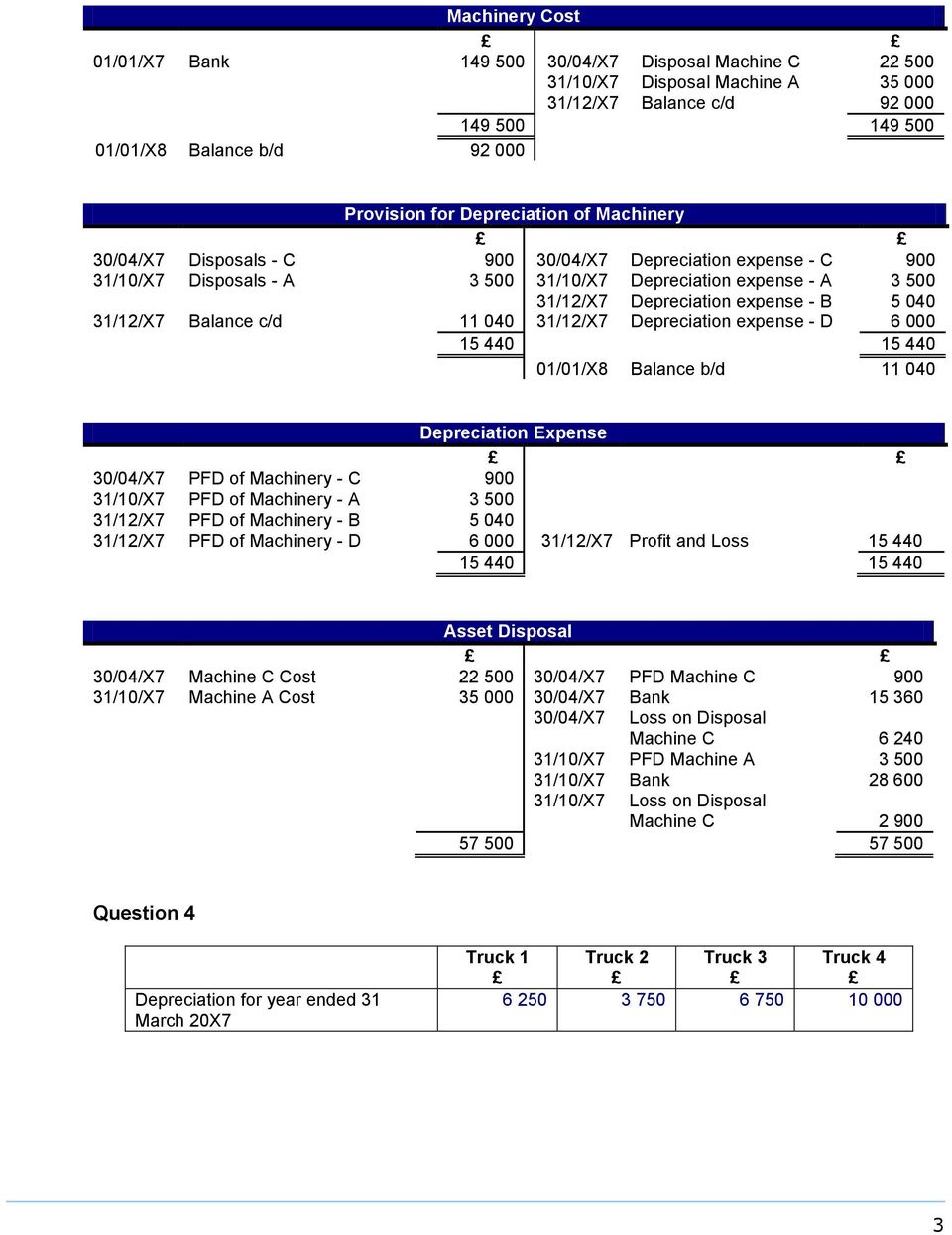
9 Machinery Cost 01/01/X7 Bank /04/X7 Disposal Machine C /10/X7 Disposal Machine A /12/X7 Balance c/d /01/X8 Balance b/d Provision for Depreciation of Machinery 30/04/X7 Disposals - C /04/X7 Depreciation expense - C /10/X7 Disposals - A /10/X7 Depreciation expense - A /12/X7 Depreciation expense - B /12/X7 Balance c/d /12/X7 Depreciation expense - D /01/X8 Balance b/d Depreciation Expense 30/04/X7 PFD of Machinery - C /10/X7 PFD of Machinery - A /12/X7 PFD of Machinery - B /12/X7 PFD of Machinery - D /12/X7 Profit and Loss Asset Disposal 30/04/X7 Machine C Cost /04/X7 PFD Machine C /10/X7 Machine A Cost /04/X7 Bank /04/X7 Loss on Disposal Machine C /10/X7 PFD Machine A /10/X7 Bank /10/X7 Loss on Disposal Machine C Question 4 Depreciation for year ended 31 March 20X7 Truck 1 Truck 2 Truck 3 Truck
10 Trucks Cost 01/04/X6 Balance b/d /09/X6 Disposal Truck /12/X6 Disposal Truck /12/X6 Balance c/d /01/X7 Balance b/d Provision for Depreciation of Trucks 01/04/X6 Balance b/d /09/X6 Disposals Truck /09/X6 Depreciation Truck /12/X6 Disposals Truck /12/X6 Depreciation Truck /03/X7 Depreciation Truck /03/X7 Balance c/d /03/X7 Depreciation Truck /04/X7 Balance b/d Depreciation Expense 30/09/X6 PFD - Truck /12/X6 PFD - Truck /03/X7 PFD - Truck /03/X7 PFD - Truck /03/X7 Profit and Loss Asset Disposal 30/09/X6 Truck 2 Cost /09/X6 PFD Truck /09/X6 Profit on disposal Truck /09/X6 Bank /12/X6 Truck 3 Cost /12/X6 PFD Truck /12/X6 Profit on disposal Truck /12/X6 Bank Question 5 Asset Disposal 01/07/X6 Machine 1 Cost /07/X6 Machine 1 Provision for Depreciation /10/X6 Machine 2 Cost /07/X6 Cost of truck (trade-in) /10/X6 Profit on Disposal 01/07/X6 Loss on disposal Machine /10/X6 Machine 2 Provision for Depreciation /10/X6 Machine 2 Cost (exchange)

11 Chapter 2 Adjusting for Accruals and Prepayments Answers to Think about it Questions Page 16 Why is an expense prepayment an asset on the balance sheet? As the expense is paid for before it is used, the supplier owes the business the amount until such time when the expense prepayment is used up. Since the expense supplier owes the business, he is similar to a debtor, which is a current asset. Page 17 Why is an expense accrual a liability on the on the balance sheet? As the expense as been used up but unpaid at the end of the period the business owes the supplier; the supplier is similar to a creditor, therefore a current liability on the balance sheet. Solutions to Target Practice Questions Question 1 (a) A prepayment for Heat and Light of 330. Dr Prepayments 330 Cr Heat and Light 330 (b) Accrued Motor Expenses of 927. Dr Motor expenses 927 Cr Accruals 927 (c) Sales of 2500 invoiced in advance. Dr Sales Cr Accruals and deferred income (d) Rent receivable but not yet collected of 700. Dr Prepayments and accrued income 700 Cr Rent receivable 700 5

12 Question 2 (a) Telephone accrual: 1/3 x 900 = 300 (b) Insurance prepayment: 7/12 x 420 = 245 (c) Electricity accrual: 2/3 x 840 = 560 (d) Rent prepayment: 1/2 x 8000 = 4000 Question 3 Telephone 30/06/X1 Accrual /06/X1 Profit and Loss Account Motor Insurance 01/02/X1 Bank /06/X1 Prepayment /06/X1 Profit and Loss Account Electricity 30/06/X1 Accrual /06/X1 Profit and Loss Account Rent 01/04/X1 Bank /06/X1 Prepayment /06/X1 Profit and Loss Account Accruals 30/06/X1 Telephone /06/X1 Balance c/d /06/X1 Electricity /07/X1 Balance b/d 860 Prepayments 30/06/X1 Motor insurance /06/X1 Rent /06/X1 Balance c/d /07/X1 Balance b/d

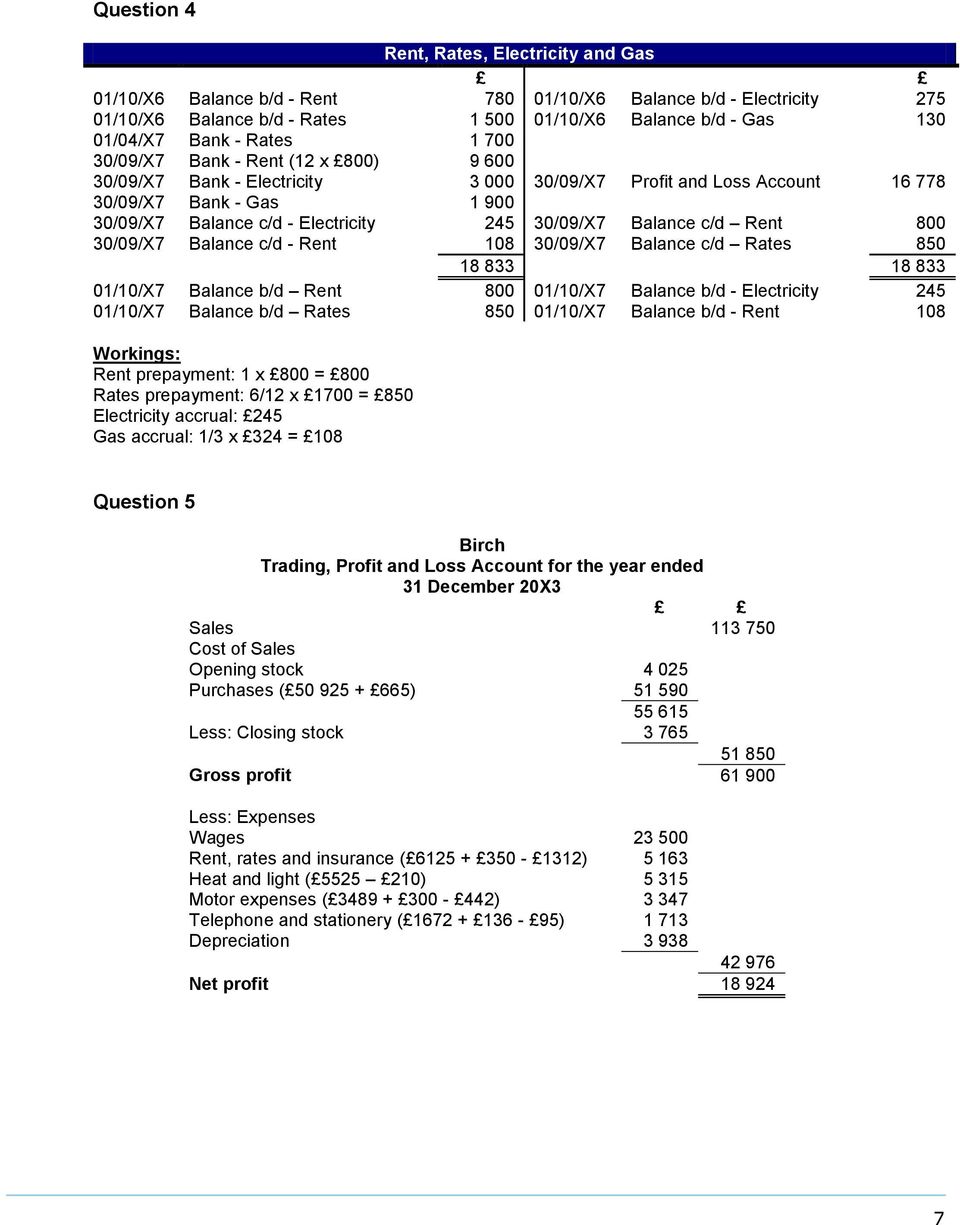
13 Question 4 Rent, Rates, Electricity and Gas 01/10/X6 Balance b/d - Rent /10/X6 Balance b/d - Electricity /10/X6 Balance b/d - Rates /10/X6 Balance b/d - Gas /04/X7 Bank - Rates /09/X7 Bank - Rent (12 x 800) /09/X7 Bank - Electricity /09/X7 Profit and Loss Account /09/X7 Bank - Gas /09/X7 Balance c/d - Electricity /09/X7 Balance c/d Rent /09/X7 Balance c/d - Rent /09/X7 Balance c/d Rates /10/X7 Balance b/d Rent /10/X7 Balance b/d - Electricity /10/X7 Balance b/d Rates /10/X7 Balance b/d - Rent 108 Workings: Rent prepayment: 1 x 800 = 800 Rates prepayment: 6/12 x 1700 = 850 Electricity accrual: 245 Gas accrual: 1/3 x 324 = 108 Question 5 Birch Trading, Profit and Loss Account for the year ended 31 December 20X3 Sales Cost of Sales Opening stock Purchases ( ) Less: Closing stock Gross profit Less: Expenses Wages Rent, rates and insurance ( ) Heat and light ( ) Motor expenses ( ) Telephone and stationery ( ) Depreciation Net profit
14 Birch Balance Sheet at 31 December 20X3 Fixed assets Motor vehicles: cost Less: Accumulated depreciation Current assets Stock Debtors Prepayments ( ) Bank Current liabilities Creditors Accruals ( ) Net Current Assets Capital account Opening Capital Add: Net profit Less: Drawings

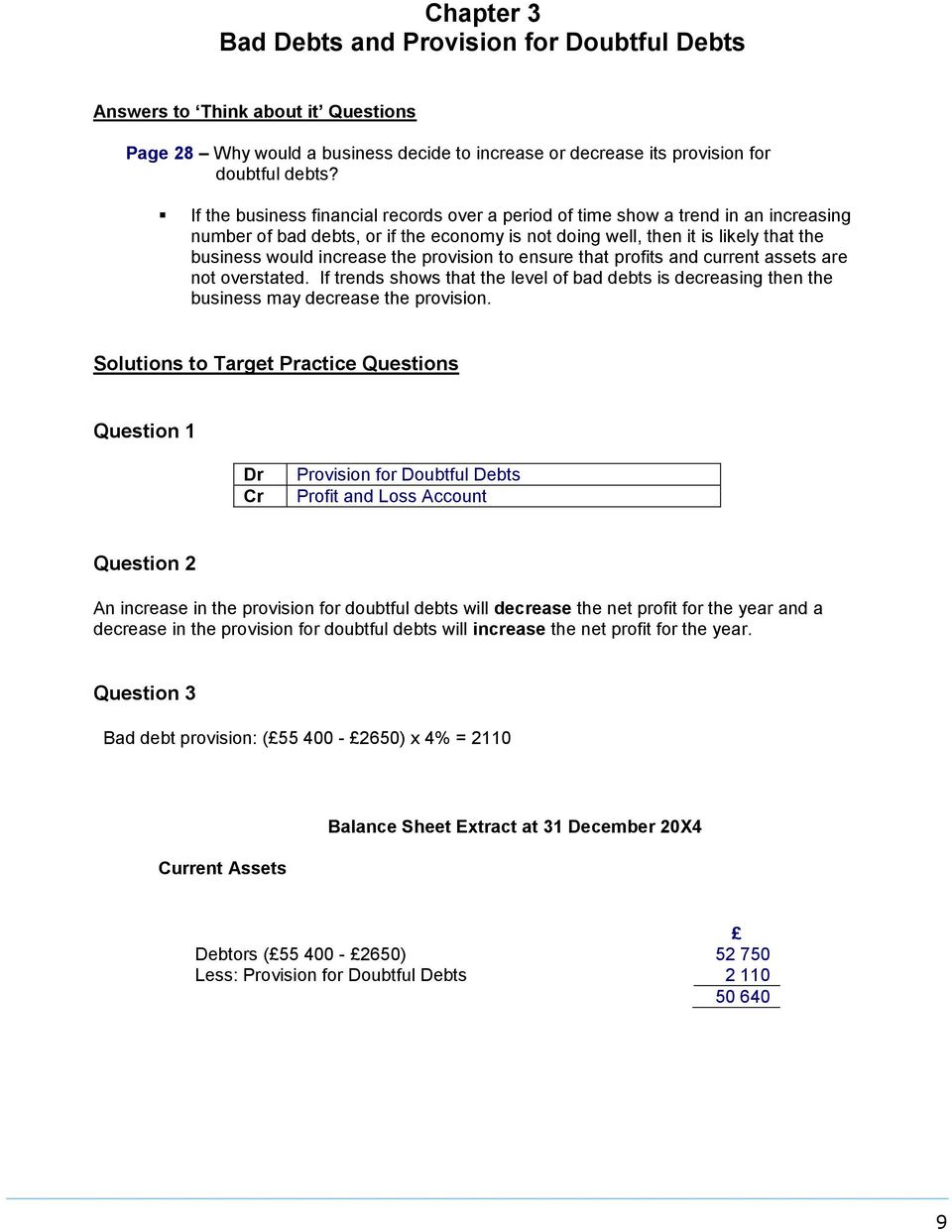
15 Chapter 3 Bad Debts and Provision for Doubtful Debts Answers to Think about it Questions Page 28 Why would a business decide to increase or decrease its provision for doubtful debts? If the business financial records over a period of time show a trend in an increasing number of bad debts, or if the economy is not doing well, then it is likely that the business would increase the provision to ensure that profits and current assets are not overstated. If trends shows that the level of bad debts is decreasing then the business may decrease the provision. Solutions to Target Practice Questions Question 1 Dr Cr Provision for Doubtful Debts Profit and Loss Account Question 2 An increase in the provision for doubtful debts will decrease the net profit for the year and a decrease in the provision for doubtful debts will increase the net profit for the year. Question 3 Bad debt provision: ( ) x 4% = 2110 Current Assets Balance Sheet Extract at 31 December 20X4 Debtors ( ) Less: Provision for Doubtful Debts
16 Question 4 Year ended 30 September: 20X5 20X6 20X7 Debtors Bad debts written off (500) (1 800) (1 926) Revised debtors Less: specific provision (850) (1 475) (1 772) Balance of debtors % 2% 3% General provision Add: specific provision Total provision Increase in provision Question 5 Bad Debts 30/09/X5 Bad debts written off /09/X5 Provision for doubtful debts /09/X5 Profit and Loss Account /09/X6 Bad debts written off /09/X6 Provision for doubtful debts /09/X6 Profit and Loss Account /09/X7 Bad debts written off /09/X7 Provision for doubtful debts /09/X7 Profit and Loss Account Bad Debts Recovered 30/09/X6 Profit and Loss Account /09/X6 Bank /09/X7 Profit and Loss Account /09/X7 Bank Provision for Doubtful Debts 30/09/X5 Balance c/d /09/X5 Bad debts /10/X5 Balance b/d /09/X6 Balance c/d /09/X6 Bad debts /10/X6 Balance b/d /09/X7 Balance c/d /09/X7 Bad debts /10/X7 Balance b/d
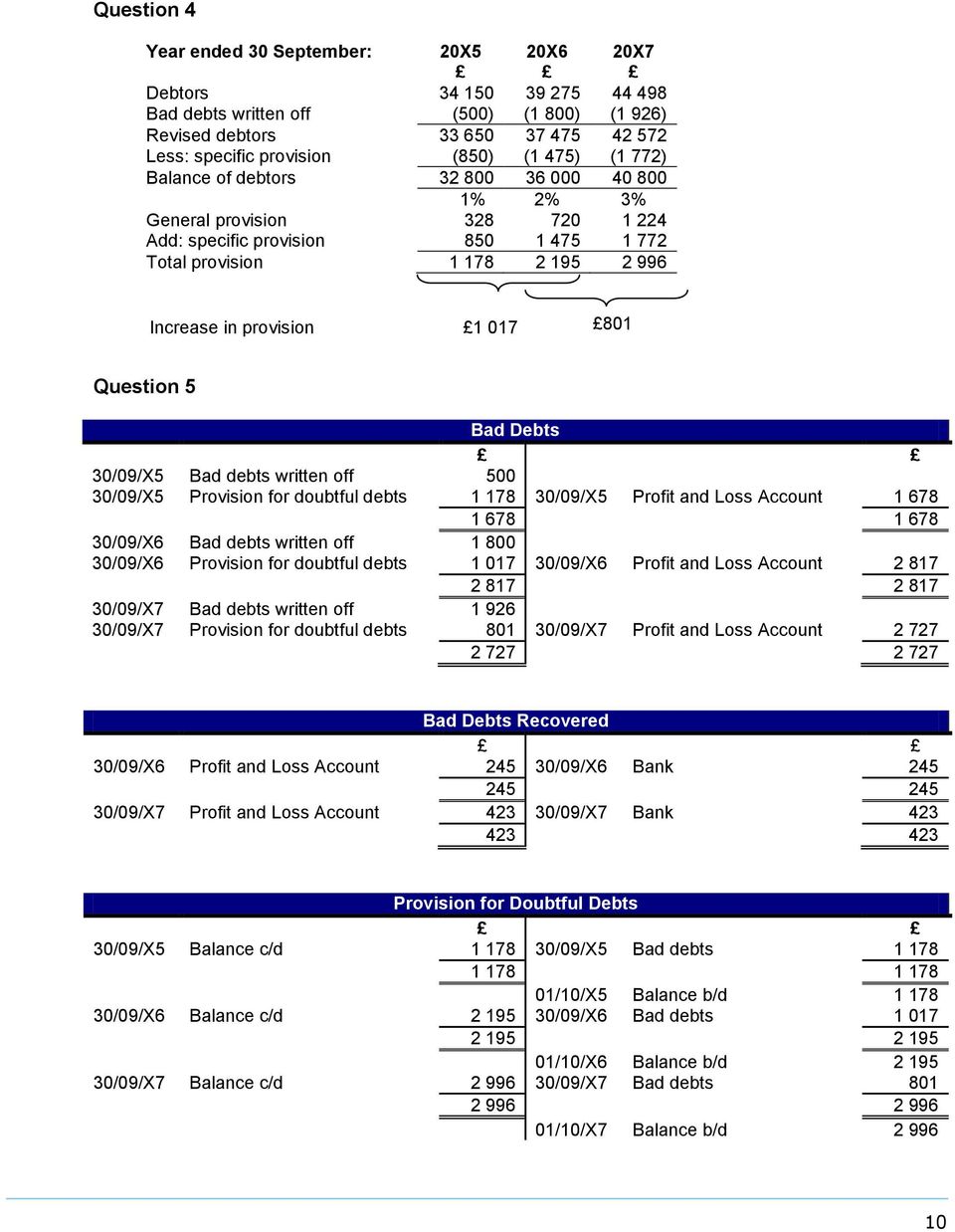
17 Alice Jones - Profit and Loss Account Extract for the year ended 30 September 20X7 Gross Profit Add: Bad debts recovered 423 Expenses Increase in provision for doubtful debts 801 Bad debts Alice Jones Balance Sheet Extract at 30 September 20X7 Current Assets Debtors Less: Provision for doubtful debts

18 Chapter 4 Introduction to Partnership Accounts Answers to Think about it Questions Page 33 What are some of the benefits of a partnership in comparison to a sole trader? More capital available to invest in the business; greater opportunity to expand the business Sharing of work load Access to a wider range of skills and knowledge which contributes to the success of the business Each partner won t have bear the loss on their own; losses are shared among partners Page 38 What do these partner balances on their current account tells you? Both George and Fred have credit balances on their current accounts; this means that the business owes them money. If the balances were debit then this would mean that the partners owe the business/partnership. Solutions to Target Practice questions Question 1 Term Partnership Partnership agreement Capital Account Current Account Interest on capital Drawings Interest on drawings Salary Profit share ratio Definition A partnership is formed when two or more people set up in business together. A written document that sets out the terms of trade with each partner. Capital is the amount invested by a partner in the business and this is held in the capital account. This is the account that records the balance owed to or from the partnership by the partners. The balance on this account will fluctuate as profits are earned and drawings are taken. This is an annual amount awarded to the partners based on a percentage of the capital they have invested. It represents a return on their investment. These are the amounts withdrawn from the partnership by the partners. This is interest charged at an agreed percentage to take account of the timing of drawings and to discourage partners from drawing from the business. This is a specified amount due to a partner before the profits are shared. The share or split of the remaining profits or losses between the partners. This could be expressed as a percentage or as a ratio e.g. 2:1 12

19 Question 2 Debit Credit Share of profit Appropriation Account Partners Current Account Share of loss Partners Current Appropriation Account account Salary Appropriation Account Partners Current Account Interest on capital Appropriation Account Partners Current Account Interest on drawings Partners Current Appropriation Account Account Interest on loan from partner Profit and Loss Account Partners Current Account or Bank account Question 3 Using the accounting equation (Assets = Capital + Liabilities), the capital introduced by each partner can be calculated: Exe Why Zed Total Plant and equipment Motor vehicles Stock Debtors Bank Creditors (5 850) (3 600) (885) (10 335)
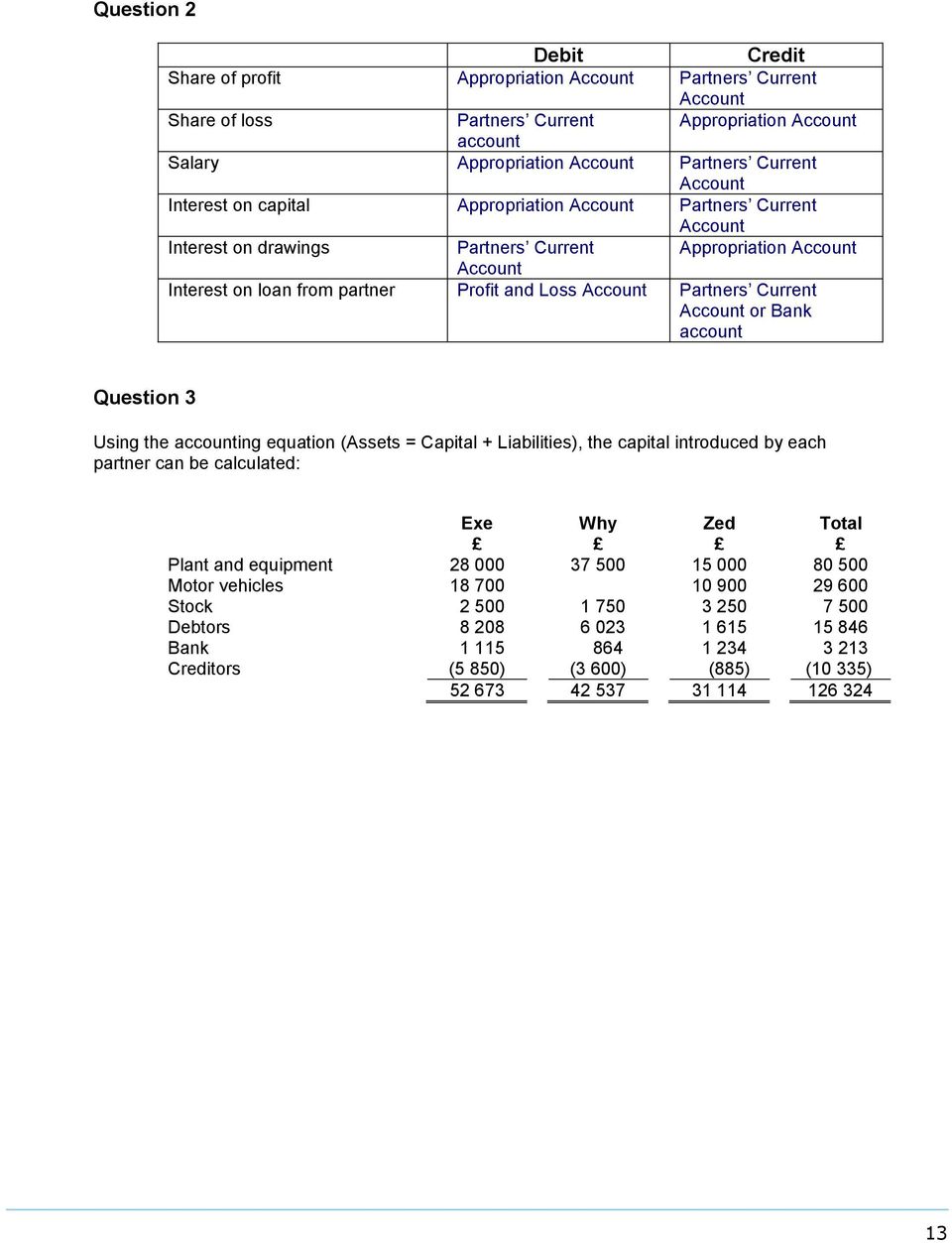
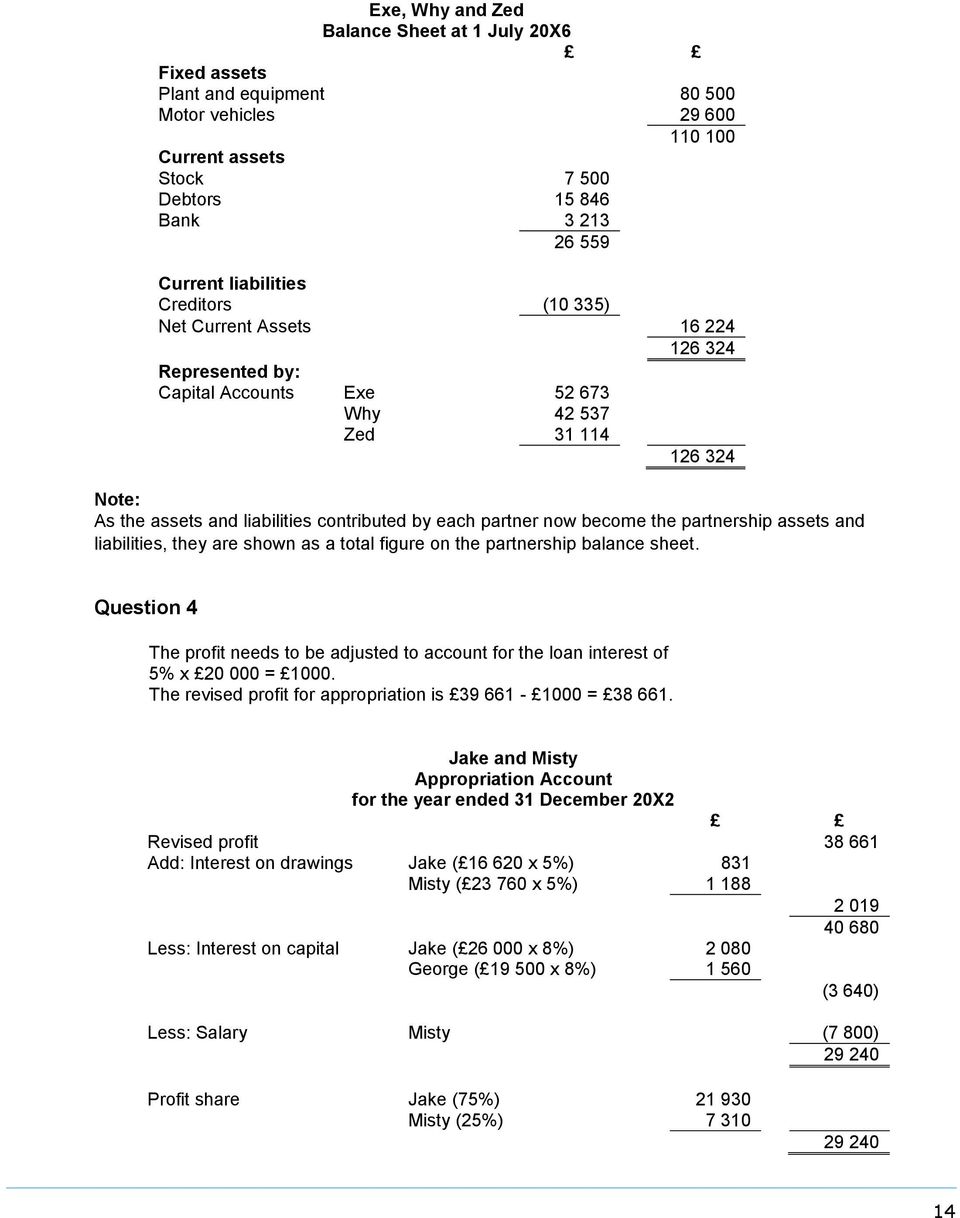
20 Exe, Why and Zed Balance Sheet at 1 July 20X6 Fixed assets Plant and equipment Motor vehicles Current assets Stock Debtors Bank Current liabilities Creditors (10 335) Net Current Assets Represented by: Capital Accounts Exe Why Zed Note: As the assets and liabilities contributed by each partner now become the partnership assets and liabilities, they are shown as a total figure on the partnership balance sheet. Question 4 The profit needs to be adjusted to account for the loan interest of 5% x = The revised profit for appropriation is = Jake and Misty Appropriation Account for the year ended 31 December 20X2 Revised profit Add: Interest on drawings Jake ( x 5%) 831 Misty ( x 5%) Less: Interest on capital Jake ( x 8%) George ( x 8%) (3 640) Less: Salary Misty (7 800) Profit share Jake (75%) Misty (25%)
21 Partners Current Accounts Jake Misty Jake Misty 01/01/X2 Balance b/d /01/X2 Balance b/d /12/X2 Interest on drawings /12/X2 Interest on capital /12/X2 Drawings /12/X2 Salary /12/X2 Profit share /12/X2 Balance c/d /12/X2 Balance c/d /01/X3 Balance b/d /01/X3 Balance b/d Question 5 Tiger and Snake Trading, Profit and Loss Account for the year ended 31 December 20X8 Sales Cost of Sales Opening stock Purchases Less: Closing stock Gross profit Less: Expenses Wages ( ) Insurance ( ) Depreciation: equipment ( x 10%) Depreciation: motor vehicles (( ) x 25%) Bad debts (( x 5%) ) Net profit Tiger and Snake Appropriation Account for the year ended 31 December 20X8 Net profit Add: Interest on drawings Tiger (2000 x 5%) 100 Snake (4000 x 5%) Less: Interest on capital Tiger ( x 7%) Snake ( x 7%) (4 200) Less: Salary Snake (4 000) Profit share Tiger (2/3) Snake (1/3)
22 Partners Current Accounts Tiger Snake Tiger Snake 31/12/X8 Interest on drawings /01/X8 Balance b/d /12/X8 Drawings /12/X8 Interest on capital /12/X8 Salary /12/X8 Balance c/d /12/X8 Profit share /01/X9 Balance b/d Tiger and Snake Balance Sheet at 31 December 20X8 Fixed assets Buildings at cost Plant and equipment (NBV) ( ) Motor vehicles (NBV) ( ) Current assets Stock Debtors ( ) Prepayments Current liabilities Bank overdraft Creditors Accruals Net Current Assets Represented by: Capital Accounts Tiger Snake Current Accounts Tiger Snake
23 Chapter 5 Admission and Retirement of Partners Answers to Think about it Questions Page 44 What are some of the specific reasons why someone would be willing to pay for goodwill? - Goodwill in a business may be based on the industry-specific knowledge, know-how and good reputation for customer service that the business has. Additionally, if it is in a good location for business then this could add to goodwill. Solutions to Target Practice Questions Question 1 Question 2 Consideration (amount paid) Assets and liabilities acquired: Fixtures and fittings Stock Debtors Creditors (2 895) Goodwill The goodwill introduced by the new partner needs to be shared between the existing partners. The share that each of the existing partners receives is based on the difference between their old profit share and the new profit share now that a new partner has been admitted. The double entry will be to debit the bank with the and credit the capital accounts of the existing partners with the appropriate share of the goodwill. Question 3 Dr CR Bank Helen Capital Account Being the payment of Helen s capital contribution into the partnership bank account Goodwill Dan Capital Account (1/2 x ) Collette Capital Account (1/2 x ) Being the creation of goodwill written into the partners capital accounts in the old profit sharing ratio Dan Capital Account (3/6 x ) Collette Capital Account (2/6 x ) Helen Capital Account (1/6 x ) Goodwill Being the goodwill written out of the partners capital accounts in the new profit sharing ratio 17
24 Partners Capital Accounts Dan Collette Helen Dan Collette Helen 01/01/X7 Goodwill /01/X7 Balance b/d /01/X7 Bank /01/X7 Balance c/d /01/X7 Goodwill /01/X7 Balance b/d Question 4 Revaluation Account Knot and Berry 31/12/X2 Plant and machinery /12/X2 Goodwill ( ) 31/12/X2 Debtors /12/X2 Capital account : Knot (2/3) /12/X2 Capital account : Berry (1/3) Bank Account 31/12/X2 Balance b/d /12/X2 Knot /12/X2 Capital account: Rasp /12/X2 Balance c/d /01/X3 Balance b/d Goodwill 31/12/X2 Revaluation /12/X2 Capital account: Berry (3/4) /12/X2 Capital accounts: Rasp /12/X2 Capital account: Rasp (1/4) Partners Capital Accounts Knot Berry Rasp Knot Berry Rasp 31/12/X2 Goodwill /12/X2 Balance b/d /12/X2 Bank /12/X2 Revaluation /12/X2 Loan /12/X2 Goodwill /12/X2 Plant and machinery 31/12/X2 Cash /12/X2 Balance c/d /12/X2 Current account /01/X3 Balance b/d
25 Berry and Rasp Balance Sheet at 1 January 20X3 Fixed assets Plant and machinery ( ) Motor vehicles Current assets Stock Debtors ( ) Bank Current liabilities Creditors (11 100) Net Current Assets Long term liabilities Loan from Knot Represented by: Capital Account Berry Rasp Current account Berry Question 5 Revaluation Account Freeman and Hardy 01/07/X1 Fixtures and Fittings /07/X1 Land and Buildings ( ) ( ) 01/07/X1 Capital Account: Freeman (3/5) /07/X1 Stock ( ) 01/07/X1 Capital Account: Hardy (2/5) /07/X1 Goodwill /07/X1 Land and Buildings /07/X1 Fixtures and fittings /07/X1 Stock /07/X1 Capital Account: Freeman (2/5) /07/X1 Goodwill /07/X1 Capital Account: Hardy (2/5) /07/X1 Capital Account: Willis (1/5) Partners Capital Accounts Freeman Hardy Willis Freeman Hardy Willis 01/07/X1 Revaluation /07/X1 Balance b/d /07/X1 Revaluation /07/X1 Balance c/d /07/X1 Bank /07/X1 Balance b/d
26 Freeman, Hardy and Willis Balance Sheet at 1 July 20X1 Fixed assets Land and buildings Fixtures and fittings Current assets Stock Debtors Bank ( ) Current liabilities Creditors (23 450) Net Current Assets Represented by: Capital accounts Freeman Hardy Willis Current accounts Freeman Hardy
27 Chapter 6 Dissolution of a Partnership Answers to Think about it Questions Page 69 How can you tell that the accounting entries for the sale of the partnership are correct? They are correct because the balances on the partners capital account (8506 and 8038 for Yum and Zip respectively) are equal exactly to the balance on the bank account. Solutions to Target Practice Questions Question 1 Debit Credit Transfer of asset balances into the dissolution Dissolution account Asset account account Transfer of liability balances into the dissolution Liability account Dissolution account account Banking the proceeds from the sale of assets Bank Dissolution account Paying the costs of dissolution Dissolution account Bank Repaying any partners loans to the partnership Partners loans Bank Question 2 Fixtures and Fittings 31/12/X7 Balance b/d /12/X7 Dissolution account Delivery Van 31/12/X7 Balance b/d /12/X7 Dissolution account Stock 31/12/X7 Balance b/d /12/X7 Dissolution account
28 Debtors 31/12/X7 Balance b/d /12/X7 Dissolution account Bank 31/12/X7 Balance b/d /12/X7 Creditors paid /12/X7 Sale of fixtures and fittings /12/X7 Costs of dissolution 600 and stock 31/12/X7 Debtors collected /12/X7 Repay loan to Jake /12/X7 Capital account: Ham /12/X7 Capital account: Shem /12/X7 Capital account: Jake Creditors 31/12/X7 Dissolution account /12/X7 Balance b/d Loan From Jake 31/12/X7 Bank /12/X7 Balance b/d Dissolution Account 31/12/X7 Fixtures and fittings /12/X7 Creditors /12/X7 Delivery van /12/X7 Fixtures and fittings and stock sale proceeds 31/12/X7 Stock /12/X7 Delivery van taken by Shem /12/X7 Debtors /12/X7 Debtors /12/X7 Dissolution costs /12/X7 Capital account: Ham /12/X7 Creditors paid /12/X7 Capital account: Shem /12/X7 Capital account: Jake Partners Current Accounts Ham Shem Jake Ham Shem Jake 31/12/X7 Balance b/d /12/X7 Balance b/d /12/X7 Capital accounts /12/X7 Capital accounts
29 Ham Shem Partners Capital Accounts Jake 31/12/X7 Current account /12/X7 Balance b/d /12/X7 Delivery van /12/X7 Current /12/X7 Dissolution account account 31/12/X7 Bank Ham Shem Jake Question 3 The deficit of needs to be shared between Cave and Round in the ratio of their capital balances at the last agreed Balance Sheet. Cave x = Round x = Partners Capital Accounts Con Cave Round Con Cave Round 30/06/X6 Balance b/d /06/X6 Balance b/d /06/X6 Share of Con s /06/X6 Transfer to debit balance other partners 30/06/X6 Bank Question 4 Realisation Account 30/06/X2 Land and buildings /06/X2 Creditors /06/X2 Plant and machinery /06/X2 Debtors collected /06/X2 Stock /06/X2 Lincoln Ltd /06/X2 Debtors /06/X2 Creditors paid /06/X2 Capital account: Ely /06/X2 Capital account: Bath Account with Lincoln Ltd 30/06/X2 Realisation account /06/X2 Bank /06/X2 Shares
30 Bank 30/06/X2 Balance b/d /06/X2 Creditors paid /06/X2 Lincoln Ltd /06/X2 Repay loan to Ely /06/X2 Debtors collected /06/X2 Capital account: Ely /06/X2 Capital account: Bath Partners Capital Accounts Ely Bath Ely Bath 30/06/X2 Shares /06/X2 Balance b/d /06/X2 Bank /06/X2 Current account /06/X2 Dissolution account Question 5 DR CR Dissolution account Goodwill Dissolution account Tangible assets Transferring the net assets of the partnership to the dissolution account. Creditors Dissolution account Transferring the liabilities of the partnership to the dissolution account. Dissolution account Bank Pay the creditors from the bank account. Bank Dissolution account Money received from debtors. Capital account: Hales Capital account: Owen Dissolution account Transferring the balance on the dissolution account to the partners capital accounts in their profit sharing ratio. 24
31 DR CR Current account: Hales Capital account: Hales Current account: Owen Current account: Owen Transferring the balances on the partners current accounts to their capital accounts. Capital account: Hales Capital account: Owen Bank Paying the final capital account balances from the bank. 25
32 Chapter 7 Formation of a Company Meaning, Purpose and Effect Answers to Think about it Questions Page 75 What are some of the advantages a limited company may have in comparison to a partnership? Liability of owners is limited; this means that owners (shareholders ) personal assets cannot be used to pay company debts. Most partnerships have unlimited partnerships A company has access to different ways of borrowing (e.g. debentures) that is not available to partnerships A company is not affected by death, retirement or bankruptcy of a shareholder; in contrast a partnership comes to an end if these events happen Shares are easily transferable without the consent of the shareholders Unlimited capital through the issue of shares. Page 77 Why can a company issue shares for more than its par or nominal value? The price of shares on the market is generally influenced by factors such as the potential earning power of the shares, financial conditions in the country and the general business and economic conditions. If a company has been trading successfully and the economic conditions in the country is favourable, this could build a potential shareholder s confidence in the earning power of the shares and so he/she may be willing to pay more than the par value of the shares to own part of the company. If a prospective shareholder is willing to pay more than the par value, then the company will sell the shares for more.. Solutions to Target Practice Questions Question 1 Dr Cr Bank ( x 1.95) Ordinary Shares ( x 1) Share Premium ( x 0.95) Being the issue of Ordinary shares of 1 at a value of 1.95 Question 2 The ordinary shareholders are the owners of the company. Ordinary shareholders will usually have the right to vote at the Annual General Meeting and are entitled to the profits of the company after all expenses have been charged against income (including any preference dividends). Once the Preference Shareholders have been paid their dividend, all remaining profits (reserves) form part of the Ordinary Shareholders funds. When the company has earned a profit, preference shareholders are guaranteed a fixed percentage dividend per share, which must be paid out before the ordinary shareholders receive a dividend. Cumulative preference shares entitle the holder to payments of previous years dividends, if these have not been paid when due because of insufficient profit and/or funds. 26
33 If the company is wound up, preference shareholders have their capital repaid before the ordinary shareholders. Because they take preference over the ordinary shares, preference shares are a less risky investment. However, preference shareholders are not normally entitled to vote at general shareholder meetings and therefore cannot influence the running of the company. So preference shareholders are more like lenders than shareholders. Question 3 Johnson Limited Balance Sheet Extract at 31 December 20X5 Creditors falling due within one year Bank loan 6000 Creditors falling due in more than one year Bank loan 9000 Note: Remember that six months of repayments will have been made between 1 July 20X5 and 31 December 20X5, totalling The total outstanding balance at 31 December will be Question 4 Question 5 Authorised share capital is the maximum number of shares that a company can issue. Issued share capital is the number of shares that have been issued or sold to shareholders. The annual charge for debenture interest is 9000 therefore the company needs to accrue the remaining It also needs to accrue an additional 3000 unsecured loan stock interest. The journal entries are: Dr Cr Debenture Interest 4500 Accruals 4500 Loan Interest 3000 Accruals 3000 Note to students: Where questions state the value of shares in pence (e.g. 5p), always remember to express the value as a proportion of a whole pound when making calculations using the share price; for example, 5p stated in a question should be expressed as 0.05 for the purpose of your calculations. 27
34 Chapter 8 Limited Companies The Profit and Loss Account Solutions to Target Practice Questions Question 1 First calculate the number of ordinary shares and then use it to calculate the dividends for ordinary shareholders: Ordinary dividend: = shares Therefore: shares x 0.08p = Preference dividend: 9% x = Question 2 Cranmer Ltd Appropriation Account for the Year Ended 31 December 20X2 Net profit for the year % Preference dividend (6% x ) Interim ordinary dividend paid Proposed final ordinary dividend 0.05 per share Transfer to replacement machinery reserve Retained profit for the year Retained profit at 1 January 20X Retained profit c/fwd Question 3 Wolsey plc Appropriation Account for the Year Ended 31 May 20X5 Net profit for the year % Preference dividend (10% x ) Proposed final ordinary dividend 0.07 per share Transfer to General Reserve Retained profit for the year Retained profit at 31 May 20X Retained profit c/fwd
35 Question 4 Thomas Ltd Profit & Loss and Appropriation Account for the year ended 30 April 20X7 Gross profit Less: Expenses Other administrative expenses Depreciation charge Auditors remuneration Directors remuneration ( ) Debenture interest ( )) Loan interest ( ) Net profit for the year % Preference dividend Interim ordinary dividend paid Proposed final ordinary dividend Transfer to General Reserve Retained profit for the year Retained profit at 1 May 20X Retained profit c/fwd
36 Chapter 9 Limited Companies The Balance Sheet Solutions to Target Practice Questions Question 1 Largo Ltd Trading, Profit & Loss and Appropriation Account for the year ended 30 September 20X Sales Cost of sales Opening stock 500 Purchases Less: Closing stock Gross profit Less: Expenses Directors remuneration 160 Wages and salaries 30 Rent, rates and insurance ( ) 252 Administrative expenses 540 Depreciation: Motor vehicles (600 x 10%) 60 Plant and machinery (( ) x 20%) 296 Debenture interest ( ) Net profit for the year Interim ordinary dividend paid 25 Proposed final ordinary dividend ( x 0.10) Retained profit for the year Retained profit b/fwd 111 Retained profit c/fwd
37 Largo Ltd Balance Sheet at 30 September 20X1 Cost 000 Acc. Dep. 000 NBV 000 Fixed assets Motor vehicles Plant and machinery Current assets Stock 568 Debtors 590 Prepayments 20 Cash in hand Creditors due within one year Creditors 476 Accruals 28 Debenture interest 48 Proposed final dividend Net current assets 752 Total assets less current liabilities Creditors falling due in more than one year 12% Debentures (20X8) 800 Net assets Shareholders funds Capital and Reserves: Ordinary Shares of 1 each 240 Profit and loss account Total shareholders funds
38 Question 2 Legato plc Trading, Profit & Loss and Appropriation Account for the year ended 31 December 20X8 Sales Cost of sales Opening stock Purchases Less: Closing stock Gross profit Less: Expenses Directors fees Wages and salaries Rent, rates and insurance General expenses Printing, telephone and stationery Depreciation: Plant ( x 10%) Motor vehicles (( ) x 25%) Debenture interest Net profit for the year Preference dividend ( x 10%) Proposed final ordinary dividend (64000 x 4 = per share) Retained profit for the year Retained profit b/fwd Retained profit c/fwd
39 Legato plc Balance Sheet at 31 December 20X8 Cost Acc. Dep. NBV Fixed assets Plant Motor vehicles Current assets Stock Debtors Cash at bank Creditors due within one year Creditors Debenture interest Preference dividend Proposed final dividend Net current assets Total assets less current liabilities Creditors falling due in more than one year 8% Debentures Net assets Shareholders funds Capital and Reserves: ordinary shares of 0.25 each Share premium Profit and loss account Ordinary shareholders (equity) funds % Preference shares Total shareholders funds
40 Question 3 Molto plc Appropriation Account for the year ended 31 December 20X3 Net profit for the year Preference dividend Proposed final ordinary dividend Transfer to general reserves Retained profit for the year Retained profit b/fwd Retained profit c/fwd Molto plc Balance Sheet at 31 December 20X3 Cost Acc. Dep. NBV Fixed assets Fixtures Vehicles Current assets Stock Debtors Prepayments Cash in hand Creditors due within one year Creditors Preference dividend Ordinary dividend Net current assets Total assets less current liabilities Creditors falling due in more than one year 5% Debentures Net assets Shareholders funds Capital and Reserves: Ordinary shares of 1 each Profit and loss account General reserves Ordinary shareholders (equity) funds 6% Preference shares Total shareholders funds
41 Question 4 Rall Ltd Trading, Profit & Loss and Appropriation Account for the year ended 31 March 20X6 Sales Cost of sales Opening stock Purchases Less: Closing stock Gross profit Less: Expenses Wages and salaries Directors remuneration ( ) Administrative expenses Distribution expenses Depreciation: Buildings ( x 4%) Motor vehicles ( ) x 25% Plant and machinery ( x 15%) Debenture interest ( ) Net profit for year Interim ordinary dividend paid Final ordinary dividend proposed Dividends paid Retained profit for the year Retained profit b/fwd Retained profit c/fwd
42 Rall Ltd Balance Sheet at 31 March 20X6 Cost Acc. Dep. NBV Fixed assets Freehold property Motor vehicles Plant and machinery Current assets Stock Debtors Less: Provision for doubtful debts Cash at bank Creditors due within one year Trade creditors Accruals Debenture interest Ordinary dividend Net current assets Total assets less current liabilities Creditors falling due in more than one year 10% Debenture 20X Net assets Shareholders funds Capital and Reserves: Ordinary shares of 1 each Share premium Retained profits Total shareholders funds
43 Question 5 Poco plc Trading, Profit & Loss and Appropriation Account for the year ended 31 May 20X8 Sales Cost of sales Opening stock Purchases Less: Closing stock Gross profit Less: Expenses Delivery expenses Wages and salaries ( ) Directors remuneration Rent and rates ( ) Advertising Sundry expenses Insurance Bad debts 763 Increase in provision for doubtful debts 650 Depreciation: Buildings ( x 4%) Motor vehicles ( x 20%) Plant and machinery ( x 40%) Bank interest Debenture interest Net profit for year Final ordinary dividend proposed Retained profit for the year Retained profit b/fwd Retained profit c/fwd
44 Poco plc Balance sheet at 31 May 20X8 Cost Acc. Dep. NBV Fixed assets Leasehold premises Motor vehicles Fixtures and fittings Current assets Stock Debtors Less: provision for bad debts Prepayments 260 Cash in hand Creditors due within one year Bank overdraft Trade creditors Accruals Debenture interest Ordinary dividend Net current assets Total assets less current liabilities Creditors falling due in more than one year 10% Debenture Net assets Shareholders funds Capital and Reserves: Ordinary shares of 1 each Share premium Profit and loss account General reserve Ordinary shareholders (equity) funds % Preference shares Total shareholders funds
45 Answers to Think about it Questions Chapter 10 Control Accounts Page 101 Other control/checking measure or process introduced at Level 1: Trial balance Bank Reconciliation statement Page 103 What does the balance on the Sales Ledger Control Account represent? As the balance is on the debit side this indicates that this is the amount owed to the business by its debtors. If the balance was on the other side, this would indicate that the business owes this amount to debtors; probably for a refund, or for a credit note, or an overpayment by the debtor. Page 106 What does the balance on the Purchases Ledger Control Account represent? As the balance is on the credit side, this indicates that this is the amount owed to creditors by the business. If the balance was on the debit side, this would indicate that a creditor(s) owes the business a refund or for a credit note for goods returned after settlement made, or for an overpayment. Solutions to Target Practice Questions Question 1 Sales Ledger Control Account 01/01/20X3 Balance b/d /01/20X3 Balance b/d /12/20X3 Credit sales /12/20X3 Bank: (payments received) /12/20X3 Bank: (payments to debtors) 42 31/12/20X3 Discounts allowed /12/20X3 Bad debts written off /12/20X3 Contra /12/20X3 Balance c/d /12/20X3 Balance c/d /01/20X4 Balance b/d /01/20X4 Balance b/d 154 Purchases Ledger Control Account 01/01/20X3 Balance b/d /01/20X3 Balance b/d /12/20X3 Purchase returns (returns outwards) /12/20X3 Credit purchases /12/20X3 Bank: (payments to creditors) /12/20X3 Discounts received /12/20X3 Contra /12/20X3 Balance c/d /12/20X3 Balance c/d /01/20X4 Balance b/d /01/20X4 Balance b/d
46 Question 2 Sales Ledger Control Account 01/01/20X4 Balance b/d /01/20X4 Balance b/d 42 30/06/20X4 Credit sales /06/20X4 Bank: (payments received) /06/20X4 Discounts allowed /06/20X4 Sales returns (returns inwards) /06/20X4 Bad debts written off /06/20X4 Contra /06/20X4 Balance c/d 28 30/06/20X4 Balance c/d /07/20X4 Balance b/d /07/20X4 Balance b/d 28 Purchases Ledger Control Account 01/01/20X4 Balance b/d 9 01/01/20X4 Balance b/d /06/20X4 Purchase returns (returns outwards) /06/20X4 Credit purchases /06/20X4 Bank: (payments to creditors) /06/20X4 Discount received /06/20X4 Contra /06/20X4 Balance c/d /06/20X4 Balance c/d /07/20X4 Balance b/d 20 01/07/20X4 Balance b/d Question 3 Sales Ledger Control Account 01/03/20X7 Balance b/d /03/20X7 Balance b/d /03/20X7 Credit sales /03/20X7 Bank: (payments received) /03/20X7 Interest charged to customers /03/20X7 Discounts allowed /03/20X7 Bank:(dishonoured cheques) /03/20X7 Sales returns (returns inwards) /03/20X7 Bad debts written off /03/20X7 Contra /03/20X7 Balance c/d /03/20X7 Balance c/d /04/20X7 Balance b/d /04/20X7 Balance b/d 268 Purchase Ledger Control Account 01/03/20X7 Balance b/d /03/20X7 Balance b/d /03/20X7 Purchase returns (returns outwards) /03/20X7 Credit purchases /03/20X7 Bank: (payments to creditors) /03/20X7 Discounts received /03/20X7 Contra /03/20X7 Balance c/d /03/20X7 Balance c/d /04/20X7 Balance b/d /04/20X7 Balance b/d
47 Foley Fixings Balance Sheet Extract at 31 March 20X7 Current Assets Debtors ( ) Current Liabilities Creditors ( )
48 Answers to Think about it Questions Chapter 11 Incomplete Records Page 119 How could we tell that the cash balances were debit ones? Because it is not possible for the cash account to have a credit balance Page 121 Why is the comparison of capital method of calculating profit not recommended? This method does not provide enough information for management purposes; for example, no information about gross profit or expenses and revenues is shown which are important for business planning Solutions to Target Practice Questions Question 1 Sales / Debtors Debts taken over Payments received Sales for the year Discounts allowed Bad debts written off 460 Contra 609 Balance c/d Workings: Debtors at 31 August 20X7: = 1755 Bad debts written off: = 460 Question 2 Purchases / Creditors Paid to creditors Creditors taken over 994 Discounts received 190 Purchases for the year Contra 609 Cash purchases 207 Balance c/d
49 Question 3 (a) Calculation of opening and closing capital 1 January 20X3 31 December 20X3 Assets and Liabilities at Shop fittings Stock Debtors Bank Cash Creditors (34 320) (26 400) Capital (b) Net profit calculation Capital at 31 December 20X Capital at 1 January 20X Increase in capital : Apparent profit Add: Drawings Estimated net profit (c) Phil Fordham Trading, Profit and Loss Account for the year ended 31 December 20X3 Sales Cost of sales Opening stock Purchases Less: Closing stock Gross profit Less: Expenses Business expenses ( ) Depreciation ( ) Net profit
50 Phil Fordham Balance Sheet at 31 December 20X3 Fixed assets Shop fittings Current assets Stock Debtors Bank Cash in hand Current liabilities Creditors Net current assets Net assets Capital Capital at 1 January 20X Profit for the year Less: Drawings Capital at 31 December 20X Workings: Sales / Debtors Balance b/d Payments received Sales for the year Cash sales Balance c/d Purchases / Creditors Paid to creditors Balance b/d Balance c/d Purchases for the year
51 Question 4 (a) Fran Fosset Statement of Affairs at 1 July 20X7 Fixed assets Motor vehicle (NBV) Current assets Stock Debtors Bank Current liabilities Creditors Capital at 1 July 20X (b) (c) Sales / Debtors Balance b/d Payments received Sales for the year Balance c/d Purchases / Creditors Paid to creditors Balance b/d Balance c/d Purchases for the year
52 (d) Fran Fosset Trading, Profit and Loss Account for the year ended 30 June 20X8 Sales Cost of sales Opening stock Purchases Less: Closing stock Gross profit Bank interest received Less: Expenses Wages for staff Rent ( ) Vehicle running expenses Other general expenses ( ) Depreciation ( ) Net profit Fran Fosset Balance Sheet at 30 June 20X8 Fixed assets Motor vehicle (NBV) Current assets Stock Debtors Prepayments 935 Bank Current liabilities Creditors Accruals Net current assets Net assets Capital Capital at 1 July 20X Profit for the year Less: Drawings Capital at 30 June 20X
53 Question 5 Workings: The following accounts need to be prepared to calculate the sales and purchases figures for the trading account and the business and depreciation expense for the profit and loss account. Sales / Debtors Balance b/d Bank Sales for the year Balance c/d Purchases / Creditors Bank Balance b/d Balance c/d Purchases for the year Business Expenses Balance b/d 420 Balance b/d 870 Bank Profit and Loss Account Balance c/d 762 Balance c/d Plant and Equipment Introduced by Far Profit and Loss Account Balance c/d Sand and Iego Trading, Profit and Loss Account for the year ended 31 March 20X2 Sales Cost of sales Opening stock Purchases Less: Closing stock Gross profit Less: Expenses Business expenses Depreciation Net profit
54 Sand and Iego Appropriation Account for the year ended 31 March 20X2 Net profit Interest on capital: Sand ( x 5%) Iego ( x 5%) Iego - Salary Profit share Sand (3/5) Iego (2/5) Sand and Iego Balance Sheet at 31 March 20X2 Fixed assets Plant and equipment Current assets Stock Debtors Bank Prepayments Liabilities Creditors Accruals Net current assets Net assets Capital accounts Sand Iego Current accounts Sand ( ) Iego ( )
55 Answers to Think about it Questions Chapter 12 Stock Valuation Page 134 Which accounting concept is the principle of valuing stock at NRV based on? It is based on the accounting concept of prudence. If stock is not valued at NRV where it is less than cost, then closing stock will be overvalued and gross profit overstated. Additionally, using this valuation principle will ensure that the loss on stock is matched to the period of purchase, where the loss occurred, rather than in the period where the goods are sold. Solutions to Target Practice Questions Question 1 Type of bird house Stock quantity (A B) per bird house Total stock value Purchases Sales (B) (A) Small hanging bird house Large hanging bird house Small thatched bird house Large thatched bird house Total stock value Geoffrey Wollowmead Trading Account for the year ended 30 June 20X7 Sales * Less: Cost of sales Purchases * Less: Closing stock Gross profit Workings: * 1 (3500 x 22 + (6200 x 25) + (6500 x 45) + (9700 x 65) * 2 (5000 x 15) + (8000 x 19) + (9000 x 35) + ( x 45) Question 2 Classy Feet: Stock valuation at 31 March 20X4 Cost NRV Total Original stock value (a) Trainers 15 x 35 = x (80% x 35) = 420 (105) (b) Boots x 30% = 600 (600) (c) Ladies shoes 20 x 26 = x (28-4) = 480 (40) (d) Men s formal footwear 500 NIL (500) Revised stock valuation
56 If the NRV is lower than the cost then the difference between the two figures must be deducted from the original stock value. Question 3 Carol Carlton Trading Account for the year ended 31 December 20X7 Sales Less: Cost of sales Opening stock Purchases Less: Closing stock (missing figure) Cost of goods sold Gross profit (35% of sales) The cost of stock stolen was = Working from the known figures to the unknown figures: Use sales less gross profit to calculate the cost of goods sold (11 700); then subtract the cost of goods sold from the cost of goods available for resale (50 720) to find closing stock. Therefore closing stock is: =
57 Chapter 13 Manufacturing Account Solutions to Target Practice Questions Question 1 Raw materials Business rates Wages of factory foreman Crane hire for one order Royalties Depreciation of machinery Machine operators wages Grease for machines Direct materials Indirect materials Direct labour Direct expenses Production overheads Question 2 Resin Ltd Manufacturing Account for the year ended 30 September 20X7 Raw materials Opening stock - raw materials Purchases raw materials Carriage on raw materials purchased Less: Returns to raw materials suppliers (26 100) Less: Closing stock - raw materials ( ) Cost of raw materials consumed Direct wages ( ) Direct expenses Prime cost Add: Production overheads Add: Opening work in progress Less: Closing work in progress ( ) (31 900) Production (manufacturing) cost
58 Question 3 Resin Ltd Manufacturing Account for the year ended 30 September 20X7 Raw materials Opening stock - raw materials Purchases raw materials Carriage on raw materials purchased Less: Returns to raw materials suppliers (26 100) Less: Closing stock - raw materials ( ) Cost of raw materials consumed Direct wages ( ) Direct expenses Prime cost Add: Opening work in progress Less: Closing work in progress ( ) ( ) Add: Production overheads Production (manufacturing) cost Manufacturing Profit Transfer to Trading Account Question 4 Kevin Coyle Manufacturing Account for the year ended 31 March 20X6 Raw materials Opening stock - raw materials Purchases raw materials Carriage inwards Less: Closing stock - raw materials (3 625) Cost of raw materials consumed Direct wages Prime cost Add: Production overheads Rent Insurance 891 General expenses Lighting Depreciation: Plant and machinery Add: Opening work in progress Less: Closing work in progress (4 500) (1 500) Production (manufacturing) cost
59 Kevin Coyle Trading & Profit and Loss Account for the year ended 31 March 20X6 Sales Opening stock finished goods Production cost Closing stock finished goods (10 250) Gross profit Add: Discount received Less: expenses Office salaries Rent General expenses 938 Insurance 297 Advertising Lighting 781 Bad debts 812 Carriage outwards 469 Depreciation: Motor vehicle Net profit Kevin Coyle Balance Sheet at 31 March 20X6 Fixed assets Plant and machinery (NBV) Motor vehicles (NBV) Current assets Stock: Raw materials Work in progress Finished goods Trade debtors Bank Creditors falling due within one year Trade Creditors Net current assets Net assets Capital Opening capital Net profit Less: Drawings
60 Question 5 (a) Edwin Crump Ltd Manufacturing Account for the year ended 31 December 20X8 Raw materials Opening stock - raw materials Purchases raw materials Carriage inwards Less: Purchase returns raw materials (19 500) Less: Closing stock - raw materials (50 700) Cost of raw materials consumed Direct wages Prime cost Add: Production overheads Indirect wages Production salaries Production overheads Depreciation Add: Opening work in progress Less: Closing work in progress (28 600) (7 800) Production (manufacturing) cost (b) Edwin Crump Ltd Trading Account for the year ended 31 December 20X8 Manufactured Bought Manufactured Bought Opening stock Sales Production (manufacturing) cost Purchases Carriage Less: Closing (44 295) (36 750) stock Cost of sales Gross profit
61 Chapter 14 Non-trading Organisations Answers to Think about it Questions Page 164 Why is it important for any organisation to prepare a bank reconciliation statement? A bank reconciliation statement is necessary to explain any differences between the cash book and the bank statement and to identify any errors that may have been made in the cash book or the bank statement. It is important that the bank balance is correct as it is shown on the balance sheet; an incorrect figure may be misleading. Solutions to Target Practice Questions Question 1 Business Profit and Loss Account Profit Loss Capital Non-trading organisation Income and Expenditure Account Surplus or Excess of income over expenditure Deficit or Excess of expenditure over income Accumulated Fund Question 2 Skitter Bowls Club Receipts and Payments Account for the year ended 31 December 20X2 RECEIPTS PAYMENTS Balance b/d Cash in hand 145 Rent paid Balance b/d Cash at bank Competition prizes 465 Subscriptions Stationery 115 Competition entry fees 600 Advertising 300 Sale of refreshments 845 Purchases of refreshments 532 Donations 200 Purchase of lawn mower Balance c/d Cash in hand 75 Balance c/d Cash at bank
62 Question 3 Skitter Bowls Club Receipts and Payments Account for the year ended 31 December 20X2 Cash in hand 145 Cash at bank Receipts Subscriptions Competition entry fees 600 Sales of refreshments 845 Donations Payments Rent paid Competition prizes 465 Stationery 115 Advertising 300 Purchase of refreshments 532 Purchase of lawn mower Cash in hand 75 Cash at bank Question 4 Dixie Railway Enthusiasts Club Catering Trading Account for the year ended 30 April 20X7 Sales ( ) Opening stock Purchases ( ) Less: Closing stock (2 850) Less: Expenses Wages for catering staff ( ) Insurance ( ) 330 Premises expenses ( ) Catering profit Notes: 1. To calculate the catering sales receipts relating to the current year, the amount of 1720, which was received for last year s sale, is subtracted and the amount owing at the end of the current year is added. 2. Purchases is also adjusted to account for the amounts owing for last year and the current year 56
63 Question 5 Seadley Boys Football Club Income and Expenditure Account for the year ended 31 August 20X9 Income Gate fees Profit from sale of refreshments Donations 460 Sponsorship Advertising revenue Less: Expenditure Rent for pitch ( ) Repairs to equipment ( ) 627 Pitch maintenance expenses 450 Groundsman s wages Printing and stationery 602 Sundry expenses Depreciation of equipment (( ) x 20%) Surplus / Excess of income over expenditure 965 Notes: 1. Equipment of 630 is added to the net book value of equipment currently on the books (3300). The total of 3930 is then used in calculating the depreciation for the year, i.e x 20% =
64 Chapter 15 Non-trading Organisations: Subscriptions Account and Balance Sheet Solutions to Target Practice Questions Question 1 Chuggle Bowls Club Subscriptions Account Balance b/d Subscriptions owing 540 Balance b/d Subscriptions prepaid 180 Income and Expenditure Account Subscriptions received re 20X1 360 Subscriptions received re 20X Subscriptions received re 20X3 240 Balance c/d Subscriptions prepaid 240 Balance c/d Subscriptions owing Balance b/d Subscriptions owing 900 Balance b/d Subscriptions prepaid 240 Question 2 Coldridge Canary Club Accumulated Fund at 31 December 20X3 Club house Motor van Stock of competition prizes 435 Bank 885 Cash in hand Loan Competition entry fees paid in advance 280 Accrued expenses for club secretary 600 Owing to suppliers of competition prizes 350 (7 930) Accumulated fund
65 Question 3 Totem Kick-boxing Club Accumulated Fund at 30 April 20X7 Club house Sports equipment Stock of merchandise Prepaid club expenses 325 Subscriptions in arrears 108 High interest bank account Cash in hand Loan Accrued staff wages 89 Subscriptions in advance 216 Bank overdraft 727 Owing to suppliers of merchandise 776 (35 558) Accumulated fund Life fund Question 4 Workings Kidling Gardeners Association Accumulated Fund at 30 June 20X5 Gardening tools and equipment Stock of seeds 130 Subscriptions in arrears 115 Bank 345 Prepaid insurance Creditor for seeds 175 Subscriptions in advance 85 (260) Accumulated fund at 30 June 20X Subscriptions Account Balance b/d Subscriptions owing 115 Balance b/d Subscriptions prepaid 85 Income and Expenditure Account Subscriptions received Balance c/d Subscriptions prepaid 145 Balance c/d Subscriptions owing
66 Kidling Gardeners Association Seed Trading Account for the year ended 30 June 20X6 Sales Opening stock 130 Purchase of seeds ( ) Less: Closing stock (145) Seeds Profit 786 Kidling Gardeners Association Income and Expenditure Account for the year ended 30 June 20X6 Income Subscriptions Profit on sale of seeds 786 Flower show entry fees 210 Flower show prizes 195 Profit on flower show 15 Annual trip to Chelsea Flower Show 650 Annual trip expenses 530 Profit on annual trip 120 Equipment hire Expenditure Costs of visiting speakers 900 Hire of hall for meetings Advertising 95 Insurance ( ) Secretary s expenses 375 Depreciation Gardening tools and equipment ( ) Surplus / Excess of income over expenditure 150 Notes: 1. Adjusted to account for the amount owing at the end of the current year as well as for the previous year. 2. Figure adjusted for prepayment at start and close of the year 3. As there were no purchases of gardening tools and equipment during the year, the difference between the net book value at start and the net book value at end is the depreciation figure. 60
67 Kidling Gardeners Association Balance Sheet at 30 June 20X6 Fixed assets Gardening tools and equipment Current assets Stock of seeds 145 Subscriptions in arrears 105 Prepaid insurance 60 Bank Current liabilities Subscriptions in advance 145 Owed to suppliers seeds Net current assets Net assets Represented by: Accumulated fund At 1 July 20X Surplus / Excess of income over expenditure 150 At 30 June 20X Question 5 Workings: Covington Handbell Ringers Society Accumulated Fund at 31 December 20X6 Handbells - valuation Bank Subscriptions in arrears Subscriptions in advance 300 Owed to suppliers of music 65 (365) Subscriptions Account Balance b/d Subscriptions owing 600 Balance b/d Subscriptions prepaid 300 Income and Expenditure Account Subscriptions received Balance c/d Subscriptions prepaid 450 Balance c/d Subscriptions owing
68 Covington Handbell Ringers Society Income and Expenditure Account for the year ended 31 December 20X7 Income Subscriptions Concert ticket sales Hire of concert venue 2025 Profit on concert Expenditure Hire of practice hall Maintenance of handbells Purchase of music ( ) Club secretary expenses 275 Depreciation: Handbells ( ) Deficit / Excess of expenditure over income (97) Covington Handbell Ringers Society Balance Sheet at 31 December 20X7 Fixed assets Handbells ( ) Current assets Subscriptions in arrears Bank Current liabilities Subscriptions in advance 450 Owed to suppliers of music Represented by: Accumulated fund At 1 January 20X Legacy donation Deficit / Excess of expenditure over income (97) At 31 December 20X Notes: 1. Figure adjusted to account for the amount owing to music suppliers and the start and end of the year.. 2. The handbells donated (4000) is added to show the total value of fixed assets (handbells) at the end of the year. 62
69 Chapter 16 Errors and the Use of a Suspense Account Answers to Think about it Questions Page 196 Now that there is no longer a balance on the suspense account (shown on the page), what does this tell you? If the balance on the suspense is cleared this indicates that all the errors, which caused the difference on the trial balance, have been found and corrected. Solutions to Target Practice Questions Question 1 Error (a) A purchases invoice for 452 had been entered into the books of account as 425. (b) A sales invoice for 200 was debited to the account of S. Smith instead of S. Smyth. (c) A purchases invoice for stationery, totalling 375 had not been entered into the books of account. (d) The purchase of a computer costing 1200 had been posted to the Stationery Account. (e) A sales receipt from Co-Com Ltd was entered in the books of account as a debit to Co-Com Ltd and a credit to the Bank. (f) The additions on the Sales Account were overcast by 200 and the additions on the Rent Account were overcast by 200. Type of Error Error of Original Entry Error of Commission Error of Omission Error of Principle Reversal of Entries Compensating Error Question 2 Dr Cr (a) Britsom Ltd Purchases Ledger Bryson Ltd Purchases Ledger (b) Sales 259 Sales Ledger Control 259 Walters Ltd Sales Ledger (memo) 259 Sales Ledger Control 295 Walters Ltd Sales Ledger (memo) 295 Sales 295 (c) Carriage inwards 62 Carriage outwards 62 63
70 Dr Cr (d) Purchases Ledger Control 678 Slipshod Ltd Purchases Ledger (memo) 678 Bank 678 Purchases Ledger Control 678 Slipshod Ltd Purchases Ledger (memo) 678 Bank 678 OR Purchases Ledger Control Slipshod Ltd Purchases Ledger (memo) Bank (e) Petrol 38 Bank 38 Question 3 Dr Cr Fixed Assets Suspense Account Suspense Account Trade Debtors Business Expenses Accruals Electricity 862 Stationery 862 Suspense Account 750 Rent receivable 750 Suspense Account Trade debtors Balance b/d Rent receivable 750 Fixed assets
71 Question 4 Suspense Account Balance b/d 442 Sales day Book under-cast 750 Bad debt 245 Understated sales receipt Sales Ledger Control Balance b/d Correct sales invoice 500 Sales Day Book under-cast 750 Bad debt 245 Unrecorded sale Understated sales receipt 63 Balance c/d Balance b/d Sales Ledger Balance b/d Incorrect sales invoice (500) Unrecorded sale Omitted account T Tallis Question 5 Dr Cr Sales Ledger Control Account 27 Suspense Account 27 Suspense Account 170 Discounts allowed 85 Discounts received 85 Bank charges 280 Suspense Account 280 Suspense Account 63 Purchases Ledger Control Account 63 Book-binding machines Purchases
72 Suspense Account Balance b/d 74 Sales Ledger Control Account 27 Discounts allowed 85 Bank charges 280 Discounts received 85 Purchases Ledger Control Account Amended profit calculation for Kandoo Books Ltd at 30 June 20X7 Draft profit Decrease in discounts allowed 85 Increase in discounts received 85 Increase in bank charges (280) Decrease in purchases Amended profit
73 Chapter 17 Calculation and Interpretation of Ratios Answers to Think about it Questions Page 205 Why would each of these parties be interested in the information provided by ratio analysis? The owners and managers would want to find out how profitable the business is and whether the business is providing a competitive return on the capital invested. They would also want to see if the forecasted growth has been achieved and where and how they are making their profit or loss. Present and potential investors would also be interested in profitability information from ratio analysis to decide whether or not the business is a good investment. Lenders and suppliers would be interested in the liquidity and the profitability of the firm; they would want to find out if the business is able to repay any loans, debts etc. The government would be interested mainly for taxation purposes and for information for national accounting Solutions to Target Practice Questions Question 1 Profitability ratios look at the relationship between profit and sales. This can be either gross profit or net profit. Profitability also looks at the relationship between profit and capital employed. Liquidity ratios measure the financial stability of the business. They consider whether the business can meets its current liabilities with its current assets. Asset utilisation ratios examine how effectively management is using the assets of the business. Question 2 (a) Gross profit margin percentage x 100 = 25.0% For every 1 of sales the business makes 0.25 of gross profit. (b) Net profit percentage x 100 = 9.9% The business makes 0.09 profit for every 1 of sales after all expenses have been accounted for. (c) Debtor collection period x 365 = 30.4 days This is the average number of days the company has to wait before receiving payment from debtors. (d) Creditors settlement period x 365 = 28.9 days This is the average number of days the company takes to pay its creditors. 67
74 (e) Working capital / Current ratio = 2.3 : This is the number of times that current liabilities are covered by current assets. The ratio indicates that Danrow has 2.30 of current assets for every 1 of current liabilities; Danrow could pay its current liabilities 2.30 times. (f) Liquidity / Acid test ratio = 1.4 : This is the number of times that current liabilities are covered by current assets without including stock. Danrow could still cover it current liabilities reasonably well without the need to convert stock to cash. Question 3 1. Gross profit margin percentage x 100 = 54.2% Net profit percentage x 100 = 25.0% Debtors collection period x 365 = 36.5 days Creditors settlement period x 365 = 69.2 days Working capital / Current ratio = 4.5 : Liquidity / Acid test ratio = 3.2 :
75 Question 4 Rond Ltd Trub Ltd Return on capital employed 1125 x 100 = 26.04% 935 x 100 =13.06% Gross profit margin percentage 2115 x 100 = 55.29% 2375 x 100 = 47.98% Net profit percentage 1125 x 100 = 29.41% 935 x 100 = 18.89% Sales to capital employed times times Stock turnover times times Debtors collection period 450 x 365 = days 1125 x 365 = days Creditors settlement period 405 x 365 = days 675 x 365 = days Working capital / Current ratio 1800 = 2.86 : = 1.74: Liquidity / Acid test ratio 675 = 1.07 : : The recommendation would be that Rond Ltd appears to offer the most attractive investment opportunity because it is more profitable, has no long term loan commitments and is more liquid. However, Steer plc would need to consider whether both companies use similar accounting policies. Question 5 30 June 20X7 30 June 20X6 1. Current ratio 2557 = 2.01: = 1.70: Acid test (Quick ratio) 1486 = 1.17: = 1.10 : Stock turnover 3570 = 3.33 times 3444 = 5.00 times Debtors collection period 1486 x 365 = 91 days 837 x 365 = 53 days Creditors settlement period 547 x 365 = 56 days 1145 x 365 = 121 days
76 Current ratio This ratio gives an overall view of the financial stability of a company by considering whether its current liabilities are adequately covered by its current assets. The results of Hymid Ltd for each of the years ended 30 June 20X6 and 30 June 20X7 indicate that it can comfortably meet its current liabilities from its current assets. In fact the current ratio has risen in 20X7. Acid test ratio This ratio gives a better indication of a company s liquidity because it excludes stock, which may not be easily or quickly converted into cash. The acid test ratio has remained fairly stable over the two years. Stock turnover This ratio measures how many times the company has replaced its stock during the year. This has fallen in 20X7 from 5.00 times to 3.33 times. This indicates that the company is either not selling its stock as quickly or it is holding higher levels of stock. Either of these will have the effect of decreasing the bank balance. Debtors collection period This is the average time it takes a company to collect its debts, expressed in days. In 20X7 Hymid Ltd took 38 days longer to collect its debts than in 20X6. This will mean that there is less cash being paid into the bank. Creditors settlement period This is the average time it takes a company to pay its debts, expressed in days. This is not a very accurate ratio since trade creditors may include overheads, and if we are not given the purchases figure and have to use the cost of sales figure, this may be subject to fluctuations in stock levels. A company will maximise its cash flow by collecting its debts before paying its creditors. In 20X6 Hymid Ltd collected its debts 68 days before paying its creditors, but in 20X7 this situation reversed, with creditors being paid 35 days earlier than debts are being collected. This will have an adverse effect on the cash flow of the company. Overall, an increase in stock holding, debtors being allowed to pay one month later than previously and a reduction in the creditors settlement period have contributed to the reduction in the bank balance. 70
77 Chapter 18 Preparing Simple Financial Statements Using Ratios Solutions to Target Practice Questions Question 1 The first step is to calculate gross profit: Therefore gross profit is Cost price + Gross profit = Selling price 9 600? Mark up x 100 = 40.0% Margin x 100 = 28.6% Question 2 Gross profit can be calculated as x 65% = Cost of sales + gross profit = sales, Therefore sales = Question 3 Gross profit can be calculated as 25% x = Cost of sales is calculated as = Cost of sales comprises: Opening stock + Purchases Closing stock = Cost of sales ? = Therefore, the figure for purchases is Question 4 Workings: (a) Average stocks ( ) 2 = (b) Calculate cost of sales using stock turnover Cost of Sales Stock? = 5 Therefore cost of sales is 5 x =
78 (c) Calculate purchases using cost of sales: Opening stock + Purchases Closing stock = Cost of sales ? = Therefore, the figure for purchases is (d) If gross profit is 40% of sales, then cost of sales is 60% of sales. Therefore, sales: x (100 60) = (e) Fixed assets: 2500 x (100 25) = value of fixed assets at beginning of year. Fixed Assets at 31 March 20X5 are = NBV at 31 March 20X5 Carmen Foulkes Trading and Profit & Loss Account for the year ended 31 March 20X5 Sales Cost of sales Opening stock Purchases Less: Closing stock (14 500) Gross profit Less: Expenses Net profit Carmen Foulkes Balance Sheet at 31 March 20X5 Fixed assets Fixtures and fittings (NBV) Current assets Stock Debtors 950 Bank Current liabilities Creditors (balancing figure) Net current assets Net assets Capital Capital at 1 April 20X Net profit Less: Drawings (150 x 52) Capital at 31 March 20X
79 Question 5 Workings: (a) Average stock ( ) 2 = (b) Calculate cost of sales using stock turnover: Cost of Sales Stock? = 15 Therefore, cost of sales is 15 x 9240 = (c) Calculate purchases using cost of sales: Opening stock + Purchases Closing stock = Cost of sales ? = Therefore, the figure for purchases is (d) Gross profit = = (e) Net profit = x 15% = (f) Calculate debtors using debtors collection period Debtors Sales x 365 days? x 365 days = 28 Therefore debtors is x = (rounded to the nearest ) (g) Calculate creditors using creditors settlement period Creditors Purchases x 365 days? x 365 days = 35 Therefore creditors is x = (rounded to the nearest ) (h) Calculate the bank overdraft using current ratio: Stock plus debtors is twice as large as creditors plus bank overdraft: = = = 1967 bank overdraft 73
80 John Duffy Trading and Profit & Loss Account for the year ended 31 December 20X8 Sales Cost of sales Opening stock Purchases Less: Closing stock (11 088) Gross profit Less: Expenses (balancing figure) Net profit John Duffy Balance Sheet at 31 December 20X8 Fixed assets Fixtures and fittings (NBV) Current assets Stock Debtors Current liabilities Creditors Bank overdraft Net current assets Net assets Capital Capital at 1 January 20X Net profit Less: Drawings (100 x 52) Capital at 31 December 20X
81 EDI International House Siskin Parkway East Middlemarch Business Park Coventry CV3 4PE UK Tel. +44 (0) Fax. +44 (0) LCCI/SB2/
Level 3 Accounting Solutions Booklet. For further information contact us: Tel. +44 (0) 8707 202909 Email. [email protected] www.lcci.org.
 Level 3 Accounting Solutions Booklet For further information contact us: Tel. +44 (0) 8707 202909 Email. [email protected] www.lcci.org.uk London Chamber of Commerce and Industry (LCCI) International
INTERNATIONAL ACCOUNTING STANDARDS. CIE Guidance for teachers of. 7110 Principles of Accounts and. 0452 Accounting
 www.xtremepapers.com INTERNATIONAL ACCOUNTING STANDARDS CIE Guidance for teachers of 7110 Principles of Accounts and 0452 Accounting 1 CONTENTS Introduction...3 Use of this document... 3 Users of financial
Trading Profit and Loss Account
 Trading Profit and Loss Account Trading Account The trading account shows the income from sales and the direct costs of making those sales. It includes the balance of stocks at the start and end of the
PRINCIPLES OF ACCOUNTS
 PRINCIPLES OF ACCOUNTS OBJECTIVE The objective of the examination is to test candidates understanding of the basic principles and methods of accounting and their application to practical situations. THE
CONTENTS. Kevin O Riordan 2000 ISBN 1841 31 3750. Folens Publishers, Hibernian Industrial Estate, Greenhills Road. Tallaght, Dublin 24.
 CONTENTS Chapter 2: Double-Entry Book-keeping and the Trial Balance... 1 Chapter 3: Profit Measurement and Balance Sheet Preparation... 5 Chapter 4: Value Added Tax and Statutory Deductions... 8 Chapter
Annual Qualification Review
 LCCI International Qualifications Level 2 Certificate in Book Keeping and Accounts Annual Qualification Review 2009 For further information contact us: Tel. +44 (0) 8707 202909 Email. [email protected]
Coimisiún na Scrúduithe Stáit State Examinations Commission. Leaving Certificate 2014. Marking Scheme. Accounting. Higher Level
 Coimisiún na Scrúduithe Stáit State Examinations Commission Leaving Certificate 2014 Marking Scheme Accounting Higher Level Note to teachers and students on the use of published marking schemes Marking
FINANCIAL STATEMENTS-II
 MODULE - 3 15 FINANCIAL STATEMENTS-II You have learnt that Income Statement i.e. Trading & Profit and Loss Account and Position Statement i.e., Balance Sheet are two financial statements, which are prepared
BUSINESS ACCOUNTS. sample documents. sourced from www.osbornebooks.co.uk
 BUSINESS ACCOUNTS sample documents sourced from www.osbornebooks.co.uk Sample documents document page invoice 3 statement 4 double-entry accounts 5 cash book 6 petty cash book 7 extended trial balance
Accounting. Financial Accounting: Published Final Accounts and Issues of Shares Pack [ADVANCED HIGHER] Anne Duff. abc
![Accounting. Financial Accounting: Published Final Accounts and Issues of Shares Pack [ADVANCED HIGHER] Anne Duff. abc](/thumbs/27/10928067.jpg "Accounting. Financial Accounting: Published Final Accounts and Issues of Shares Pack [ADVANCED HIGHER] Anne Duff. abc") Accounting Financial Accounting: Published Final Accounts and Issues of Shares Pack [ADVANCED HIGHER] Anne Duff abc The Scottish Qualifications Authority regularly reviews the arrangements for National
Accounting Financial Accounting: Published Final Accounts and Issues of Shares Pack [ADVANCED HIGHER] Anne Duff abc The Scottish Qualifications Authority regularly reviews the arrangements for National
Chart of Accounts AA Corp Tax 0000-1020 / page 1. Sales. Income from participating interests. Income from other fixed asset investments
 0000-1020 / page 1 0000 Sales 0001 Sales type A 0002 Sales type B 0003 Sales type C 0004 Sales type D 0005 Sales type E 0006 Sales type F 0007 Sales type G 0008 Sales type H 0009 Sales type I 0100 UK sales
SUGGESTED LAYOUTS FOR FINANCIAL STATEMENTS
 Appendix 2 SUGGESTED LAYOUTS FOR FINANCIAL STATEMENTS These layouts are suggestions only and are not prescriptive. Other suitable alternatives which conform to the general principles of FRS 102 will be
ACCOUNTS PRODUCTION OPEN SANS FONT FOR 2013 TAXCALC HUB AND ACCOUNTS PRODUCTION CHART OF ACCOUNTS - LIMITED COMPANY
 OPEN SANS FONT FOR 2013 TAXCALC HUB AND ACCOUNTS PRODUCTION CHART OF ACCOUNTS - LIMITED COMPANY Contents Sales 1 Other Operating Income 1 Income from Shares in Group Undertakings 1 Income from Participating
CHAPTER 10 Financial Statements NOTE
 NOTE In practice, accruals accounts and prepayments accounts are implied rather than drawn up. It is common for expense accounts to show simply a balance c/d and a balance b/d. The accrual or prepayment
Small Company Limited. Report and Accounts. 31 December 2007
 Registered number 123456 Small Company Limited Report and Accounts 31 December 2007 Report and accounts Contents Page Company information 1 Directors' report 2 Accountants' report 3 Profit and loss account
FINANCIAL ACCOUNTING
 FINANCIAL ACCOUNTING FORMATION 2 EXAMINATION - AUGUST 2012 NOTES: You are required to answer Question 1. You are also required to answer any three out of Questions 2 to 5. (If you provide answers to all
SAMPLE QUESTION PAPER IN ACCOUNTANCY. Time: Three Hours Maximum Marks: 100
 SAMPLE QUESTION PAPER IN ACCOUNTANCY Time: Three Hours Maximum Marks: 100 Note: The question paper is divided into two sections A and B. Attempt all questions of Section A and any one question of Section
CENTRE FOR CONTINUING EDUCATION BBA (AVIATION OPERATION)
 CENTRE FOR CONTINUING EDUCATION BBA (AVIATION OPERATION) BATCH: SEMESTER: NAME: ROLL NO: ASSIGNMENT 1 & 2 FOR BUSINESS ACCOUNTING BBCF 131 UNIVERSITY OF PETROLEUM & ENERGY STUDIES Assignment-1 Note: All
PREPARING FINAL ACCOUNTS. part
 15_1312MH_CH09 27/1/05 8:38 am Page 87 PREPARING part 3 FINAL ACCOUNTS 9 The final accounts of sole traders 10 Accounting principles, concepts and policies 11 Depreciation and fixed assets 12 Bad debts
Jones Sample Accounts Limited. Company Registration Number: 04544332 (England and Wales) Report of the Directors and Unaudited Financial Statements
 Company Registration Number: 04544332 (England and Wales) Report of the Directors and Unaudited Financial Statements Period of accounts Start date: 1st June 2008 End date: 31st May 2009 Contents of the
Jones Sample Accounts Limited. Company Registration Number: 04544332 (England and Wales) Report of the Directors and Unaudited Financial Statements
 Company Registration Number: 04544332 (England and Wales) Report of the Directors and Unaudited Financial Statements Period of accounts Start date: 1st June 2009 End date: 31st May 2010 Contents of the
UNIVERSITY EXAMINATIONS COURSE TITLE: FINANCIAL ACCOUNTING DATE: 19/08/2010
 KABARAK UNIVERSITY UNIVERSITY EXAMINATIONS /2010 ACADEMIC YEAR FOR THE DEGREE OF MASTER OF BUSINESS ADMINISTRATION COURSE CODE: ACCT 510 COURSE TITLE: FINANCIAL ACCOUNTING STREAM: DAY: TIME: MBA THURSDAY
Teacher Resource Bank
 Teacher Resource Bank GCE Accounting Other Guidance: ACCN2 Update on IAS ACCN3 Updates on IAS (July 2012). The Assessment and Qualifications Alliance (AQA) is a company limited by guarantee registered
Chart of Accounts - Sole Trader
 Chart of Accounts - Sole Trader The basic road map into any accounting system is the chart of accounts. It is this chart that helps establish the information that will be captured by your accounting system,
JOINT INSOLVENCY EXAMINATION BOARD
 JOINT INSOLVENCY EXAMINATION BOARD Joint Insolvency Examination Monday 3 November 2008 LIQUIDATIONS (3.5 hours) ANSWER ALL FOUR QUESTIONS QUESTIONS 1 AND 2 CARRY TWENTY MARKS EACH QUESTIONS 3 AND 4 CARRY
Accounts of the sole trader
 Unit 1 Accounts of the sole trader This unit consists of one section only: Section 1: Final accounts Section 1 Final accounts By the end of this section you should be able to: explain the position of a
2013 Accounting. Higher - Solutions. Finalised Marking Instructions
 2013 Accounting Higher - Solutions Finalised Marking Instructions Scottish Qualifications Authority 2013 The information in this publication may be reproduced to support SQA qualifications only on a non-commercial
CHAPTER 4. Final Accounts
 CHAPTER 4 Final Accounts Meaning Preparation of final account is the last stage of the accounting cycle. The basic objective of every concern maintaining the book of accounts is to find out the profit
B. Division of Costs The purpose of a Manufacturing Account is to ascertain Cost of Production ( ).
 Manufacturing Accounts ( ) S5 Manufacturing Account/LWL A. Function of a Manufacturing Acccount For those businesses which deal with manufacturing products. It is common in today s business to act both
0452 ACCOUNTING 0452/02 Paper 2, maximum raw mark 100
 www.xtremepapers.com UNIVERSITY OF CAMBRIDGE INTERNATIONAL EXAMINATIONS International General Certificate of Secondary Education MARK SCHEME for the October/November 2009 question paper for the guidance
Level 1 Book-keeping Solutions Booklet. For further information contact us: Tel. +44 (0) 8707 202909 Email. [email protected] www.lcci.org.
 Level 1 Book-keeping Solutions Booklet For further information contact us: Tel. +44 (0) 8707 202909 Email. [email protected] www.lcci.org.uk London Chamber of Commerce and Industry (LCCI) International
MARK SCHEME for the October/November 2010 question paper for the guidance of teachers 0452 ACCOUNTING. 0452/22 Paper 2, maximum raw mark 120
 www.xtremepapers.com UNIVERSITY OF CAMBRIDGE INTERNATIONAL EXAMINATIONS International General Certificate of Secondary Education MARK SCHEME for the October/November 2010 question paper for the guidance
Large Company Limited. Report and Accounts. 31 December 2009
 Registered number 123456 Large Company Limited Report and Accounts 31 December 2009 Report and accounts Contents Page Company information 1 Directors' report 2 Statement of directors' responsibilities
6. Show all your workings. icpar
 CERTIFIED PUBLIC ACCOUNTANT FOUNDATION LEVEL 1 EXAMINATION F1.3: FINANCIAL ACCOUNTING MONDAY: 10 JUNE 2013 INSTRUCTIONS: 1. Time Allowed: 3 hours 15 minutes (15 minutes reading and 3 hours writing). 2.
Advanced Financial Accounting
 Advanced Financial Accounting Sample Paper 2 Questions & Suggested Solutions Page 1 of 27 INSTRUCTIONS TO CANDIDATES PLEASE READ CAREFULLY Candidates must indicate clearly whether they are answering the
(a) (i) Marking Scheme: 1 mark for definition and 1 mark for example.
 T A S M A N I A N Accounting C E R T I F I C A T E Subject Code ACC5C O F E D U C A T I O N Question 1 T A S M A N I A N Q U A L I F I C A T I O N S A U T H O R I T Y (a) (i) Marking Scheme: 1 mark for
UNIVERSITY OF CAMBRIDGE INTERNATIONAL EXAMINATIONS International General Certificate of Secondary Education
 *0018636067* UNIVERSITY OF CAMBRIDGE INTERNATIONAL EXAMINATIONS International General Certificate of Secondary Education ACCOUNTING 0452/13 Paper 1 October/November 2013 Candidates answer on the Question
Cork Institute of Technology. Autumn 2006 Advanced Financial Accounting (Time: 3 Hours)
 Cork Institute of Technology Bachelor of Business in Accounting Award Bachelor of Business in Management - Award Instructions Answer FOUR questions Answer all THREE questions in Section A and ONE question
UNIVERSITY OF CAMBRIDGE INTERNATIONAL EXAMINATIONS International General Certificate of Secondary Education ACCOUNTING
 UNIVERSITY OF MRIGE INTERNTIONL EXMINTIONS International General ertificate of Secondary Education OUNTING 0452/01 Paper 1 Multiple hoice May/June 2006 dditional Materials: Multiple hoice nswer Sheet Soft
ΛΥΣΕΙΣ. Branch Stock Account
 ΛΥΣΕΙΣ QUESTION Exercise Branch Stock Account Selling Price Cost Price Selling Price Cost Price Stock b/d (W) 32.00 2.400 Sales Cash 5.330 5.330 Coods Sent (W2) 46.700 97.800 Sales Credit 39.560 39.560
INSTITUTE OF FINANCIAL ACCOUNTANTS JUNE 2011 EXAMINATION. D1. Financial Accounting
 1 INSTITUTE OF FINANCIAL ACCOUNTANTS JUNE 2011 EXAMINATION D1. Financial Accounting Instructions to candidates 1. Time allowed is 3 hours and 10 minutes, which includes 10 minutes reading time. 2. This
CHAPTER 1 SINGLE ENTRY SYSTEM
 ACCOUNTANCY SECTION A QUESTION NUMBERS 1 10 TOTAL MARKS 16 CHAPTER 1 SINGLE ENTRY SYSTEM 1.What is Single Entry System of Book keeping? Accounting records which are not maintained according to double entry
Paper 2 Accounting (Syllabus 2008)
 Section A- FINANCIAL ACCOUNTING 1. Which of the following is not a Fixed Asset? (a) Building (b) Bank balance (c) Plant (d) Goodwill [Hints: (b) Fixed asset is an asset held with the intention of being
This exam paper is in two sections. You should try to complete every task in both sections.
 Exam question paper NVQ/SVQ Level 4 in Accounting Drafting Financial Statements (Accounting Practice, Industry and Commerce) (DFS) 2003 Standards Diploma in Accounting (Diploma Pathway) Drafting Financial
Mustafa Khuwaja - CAT Finalist
 1 Run through the Flashcards as often as you can during your final revision period. The day before the exam, try to go through the Flashcards again. You will be well on your way to passing your exams.
MARK SCHEME for the October/November 2010 question paper for the guidance of teachers 0452 ACCOUNTING. 0452/11 Paper 1, maximum raw mark 120
 www.xtremepapers.com UNIVERSITY OF CAMBRIDGE INTERNATIONAL EXAMINATIONS International General Certificate of Secondary Education MARK SCHEME for the October/November 2010 question paper for the guidance
MARK SCHEME for the May/June 2010 question paper for the guidance of teachers 0452 ACCOUNTING. 0452/22 Paper 22, maximum raw mark 120
 www.xtremepapers.com UNIVERSITY OF CAMBRIDGE INTERNATIONAL EXAMINATIONS International General Certificate of Secondary Education MARK SCHEME for the May/June 2010 question paper for the guidance of teachers
BUSINESS BOOKKEEPING & ACCOUNTS Designed to produce bookkeeping and accounts personnel trained in the
 INTERNATIONAL DIPLOMA PROGRAM ON BUSINESS BOOKKEEPING & ACCOUNTS Designed to produce bookkeeping and accounts personnel trained in the MODERN PRACTICAL METHODS OF ACCOUNTING Trained and competent bookkeeping
Insurance Broker Guidance Notes
 Balance Sheet Liabilities 1. Other liabilities include items below: 1.1. Borrowings refers to the amount outstanding including accrued interest in respect of any overdraft arrangements or loans taken by
GRAAD 12 NATIONAL SENIOR CERTIFICATE GRADE 12
 GRAAD 12 NATIONAL SENIOR CERTIFICATE GRADE 12 ACCOUNTING NOVEMBER 2010 MARKS: 300 TIME: 3 hours This question paper consists of 21 pages and an answer book of 19 pages. Accounting 2 DBE/November 2010 INSTRUCTIONS
Cash budget Predict the movements of cash received and paid for over a period of time. Financial statements
 Achievement Standard 90976 Demonstrate understanding of accounting concepts for small entities ACCOUNTING. Externally assessed 3 credits Accounting 90976 (Accounting.) involves the recognition, definition
PART 5. External Reporting and Performance Evaluation. Statements of financial performance and position. Statement of cash flows 19
 PART 5 External Reporting and Performance Evaluation Statements of financial performance and position 18 Statement of cash flows 19 Analysis and interpretation of financial statements 20 CHAPTER 18 Statements
Glossary of Accounting Terms Peter Baskerville
 Glossary of Accounting Terms Peter Baskerville Account for or 'bring to account': An accounting phrase used to describe the recording of a financial transaction that is required under the generally accepted
6.3 PROFIT AND LOSS AND BALANCE SHEETS. Simple Financial Calculations. Analysing Performance - The Balance Sheet. Analysing Performance
 63 COSTS AND COSTING 6 PROFIT AND LOSS AND BALANCE SHEETS Simple Financial Calculations Analysing Performance - The Balance Sheet Analysing Performance Analysing Financial Performance Profit And Loss Forecast
Paper F3. Financial Accounting. Specimen Exam applicable from June 2014. Fundamentals Level Knowledge Module
 Fundamentals Level Knowledge Module Financial Accounting Specimen Exam applicable from June 2014 Time allowed: 2 hours This paper is divided into two sections: Section A ALL 35 questions are compulsory
MARK SCHEME for the May/June 2011 question paper for the guidance of teachers 0452 ACCOUNTING. 0452/11 Paper 1, maximum raw mark 120
 www.xtremepapers.com UNIVERSITY OF CAMBRIDGE INTERNATIONAL EXAMINATIONS International General Certificate of Secondary Education MARK SCHEME for the May/June 2011 question paper for the guidance of teachers
SEC Syllabus (2015) Accounting SEC SYLLABUS (2015) ACCOUNTING SEC 01 SYLLABUS
 SEC SYLLABUS (2015) ACCOUNTING SEC 01 SYLLABUS 1 Accounting SEC 01 Syllabus (not available in September) Paper 1 (2hrs) + Paper II (2 hrs) The aims of the syllabus are to enable students: 1. To understand
GRAAD 12 NATIONAL SENIOR CERTIFICATE GRADE 12
 GRAAD 12 NATIONAL SENIOR CERTIFICATE GRADE 12 ACCOUNTING NOVEMBER 2013 MARKS: 300 TIME: 3 hours This question paper consists of 24 pages and an 18-page answer book. Accounting 2 DBE/November 2013 INSTRUCTIONS
SOLE TRADER FINAL ACCOUNTS
 6 SOLE TRADER FINAL ACCOUNTS CASE STUDY Starting out in business Olivia Boulton used to work as a buyer of kitchen and cookware goods for a large department store in central London. She was good at her
EasyPC Training. Accounting Basics
 EasyPC Training Accounting Basics Contents Accounting Basics... 3 The Accounting Equation... 3 Assets... 3 Liabilities... 3 Owner s Equity... 3 The Balance Sheet... 5 Double Entry Bookkeeping... 6 Ledger
CASH FLOW STATEMENT. MODULE - 6A Analysis of Financial Statements. Cash Flow Statement. Notes
 MODULE - 6A Cash Flow Statement 30 CASH FLOW STATEMENT In the previous lesson, you have learnt various types of analysis of financial statements and its tools such as comparative statements, common size
A2 Accounting for AQA Blank photocopiable documents
 A2 Accounting for AQA Blank photocopiable documents Documents page Stores ledger record 1 Sales, production and purchases budgets 2 Trade receivables and trade payables budgets 3 Labour budgets 4 Cash
MARK SCHEME for the October/November 2011 question paper for the guidance of teachers 0452 ACCOUNTING. 0452/23 Paper 2, maximum raw mark 120
 www.xtremepapers.com UNIVERSITY OF CAMBRIDGE INTERNATIONAL EXAMINATIONS International General Certificate of Secondary Education MARK SCHEME for the October/November question paper for the guidance of
Double entry bookkeeping
 ACCOUNTS PREPARATION I Double entry bookkeeping Introduction A sound knowledge of double entry underpins many of the learning outcomes and skills required for Accounts Preparation I. A sound understanding
TRADING ACCOUNT (Horizontal Format) for the year ended. Particulars. Rs.
 Dr. To Opening Stock To Purchases Less: Returns outwards () To Frieght & Carriage To Customs & Insurance To Wages To Gas, Water & Fuel To Factory Expenses To Royalty on Production To Cargo Expenses To
Introduction. What is a business?
 1 Introduction to accounting By the end of this chapter you should be able to: define and classify businesses define accounting as a business activity state the main purpose of accounting list the qualities
Suggested layouts for financial statements in Accounting Courses National 5 and Higher
 Suggested layouts for financial statements in Accounting Courses National 5 and Higher The following suggested layouts may be used when presenting financial statements in the Accounting Courses for National
Financial Accounting Fundamentals (FAFN)
 POST EXM GUIE May 2001 Exam Financial ccounting Fundamentals (FFN) IM publishes a Question and nswer booklet for each paper of the May 2001 exam which is essential reading for students and tutors. The
Level 3 Accounting, 2010
 9 0 5 0 3 R 3 Level 3 Accounting, 2010 90503 Prepare financial statements for partnerships and companies Credits: Six 9.30 am Thursday 25 November 2010 RESOURCE BOOKLET Refer to this booklet to answer
Accounting Principles. Question Paper, Answers and Examiners Comments. Level 3 Diploma January 2013
 Accounting Principles Question Paper, Answers and Examiners Comments Level 3 Diploma January 2013 1 Copyright of the Institute of Credit Management Institute of Credit Management The Water Mill, Station
The Journal Correcting errors, posting wages & dealing with bad debts
 The Journal Correcting errors, posting wages & dealing with bad debts Sales Returns for the month of September of 1,500 have been entered into the accounts as Sales Return Account Date Details p Date Details
C02-Fundamentals of financial accounting
 Sample Exam Paper Question 1 The difference between an income statement and an income and expenditure account is that: A. An income and expenditure account is an international term for an Income statement.
UNIVERSITY OF CAMBRIDGE INTERNATIONAL EXAMINATIONS 0452 ACCOUNTING. 0452/01 Paper 1 (Multiple Choice), maximum mark 40
 www.xtremepapers.com UNIVERSITY OF CAMBRIDGE INTERNATIONAL EXAMINATIONS International General Certificate of Secondary Education MARK SCHEME for the June 2004 question papers 0452 ACCOUNTING 0452/01 Paper
Accruals and prepayments
 5 Accruals and prepayments this chapter covers... In the last chapter we have looked at the preparation of financial statements or final accounts using the extended trial balance, or spreadsheet, approach.
Accounting Principles. Question Paper, Answers and Examiner s Comments
 Accounting Principles Question Paper, Answers and Examiner s Comments Level 3 Diploma January 2015 Copyright of the Chartered Institute of Credit Management January 2015 7B/PQP/2 continued Accounting Principles
UNIVERSITY OF CAMBRIDGE INTERNATIONAL EXAMINATIONS International General Certificate of Secondary Education ACCOUNTING
 www.xtremepapers.com UNIVERSITY OF MRIGE INTERNTIONL EXMINTIONS International General ertificate of Secondary Education OUNTING 0452/01 Paper 1 Multiple hoice May/June 2005 dditional Materials: Multiple
Intermediate Stage September 2008 Examination. Financial Accounting & Reporting (FAR / 601)
 Copyright Reserved Serial No Intermediate Stage September 2008 Examination Examination Date : 20 th September 2008 Number of Pages : 07 Examination Time: 9.30a:m.-12.30p:m. Number of Questions: 05 Instructions
ACCOUNTANCY HIGHER SECONDARY SECOND YEAR VOLUME I. Untouchability is a Sin Untouchability is a Crime Untouchability is Inhuman
 ACCOUNTANCY HIGHER SECONDARY SECOND YEAR VOLUME I Untouchability is a Sin Untouchability is a Crime Untouchability is Inhuman TAMILNADU TEXTBOOK CORPORATION College Road, Chennai - 600 006. Government
MARK SCHEME for the May/June 2008 question paper 0452 ACCOUNTING. 0452/03 Paper 3, maximum raw mark 100
 www.xtremepapers.com UNIVERSITY OF CAMBRIDGE INTERNATIONAL EXAMINATIONS International General Certificate of Secondary Education MARK SCHEME for the May/June question paper 0452 ACCOUNTING 0452/03 Paper
Level 1 Certificate in Book-Keeping
 LCCI International Qualifications Level 1 Certificate in Book-Keeping Syllabus Effective for examinations to be held after 1 Jan 2008 For further information contact us: Tel. +44 (0) 8707 202909 Email.
International Examinations. IGCSE Accounting Catherine Coucom
 International Examinations IGCSE Accounting Catherine Coucom PUBLISHED BY THE PRESS SYNDICATE OF THE UNIVERSITY OF CAMBRIDGE The Pitt Building, Trumpington Street, Cambridge, United Kingdom CAMBRIDGE UNIVERSITY
COUNCIL FOR THE INDIAN SCHOOL CERTIFICATE EXAMINATIONS P-35,36, Sector VI, Pushp Vihar, New Delhi-110017 NEW DELHI ISC ACCOUNTS
 COUNCIL FOR THE INDIAN SCHOOL CERTIFICATE EXAMINATIONS P-35,36, Sector VI, Pushp Vihar, New Delhi-110017 NEW DELHI ISC ACCOUNTS Guidelines pertaining to Revised Schedule VI of Part I & II of Companies
2015 Individual Tax Return Checklist
 2015 Individual Tax Return Checklist Name of taxpayer: Address: Preferred contact no.: Income PAYG payment summaries (eg from employers) Lump sum payments (eg employment termination payment) Partnership
This stimulus material must be used for the June 2015 examination session.
 Oxford Cambridge and RSA June 2015 A2 GCE APPLIED BUSINESS F253/SM Constructing a Financial Strategy STIMULUS MATERIAL FOR ACADEMIC YEAR 2014 2015 *2709831348* SERIES 9 This stimulus material must be used
Process Accounts Payable and Receivable
 Process Accounts Payable and Receivable UNIT PURPOSE On successful completion of this unit the learner will be able to maintain financial records of a business using both manual accounting processes and
ACCOUNTANCY (CLASSES XI-XII)
 ACCOUNTANCY (CLASSES XI-XII) Rationale 136 The course in Accountancy is introduced at + 2 stage of Senior education, as mal commerce education is provided after first ten years of schooling. With the fast
NOTES TO ASSIST COMPLETION OF BUSINESS QUESTIONNAIRE
 NOTES TO ASSIST COMPLETION OF BUSINESS QUESTIONNAIRE Never change company shareholding without conferring with us because there are tax implications. Please note the following comments 1. Cars If you sell
CARELINE SERVICES LIMITED
 Registered number: 03017799 CARELINE SERVICES LIMITED DIRECTORS' REPORT AND FINANCIAL STATEMENTS COMPANY INFORMATION DIRECTORS S Ghosh (appointed 21 June 2010) P Sarkar (appointed 21 June 2010) R C Cooper-Driver
Registered No. xxxx. * Electrical Contracting Limited is a small company as defined by Section 350 of the Companies Act 2014.
 (SMALL COMPANY*) DIRECTORS REPORT & FINANCIAL STATEMENTS YEAR ENDED 31 DECEMBER 2014 Registered No. xxxx * Electrical Contracting Limited is a small company as defined by Section 350 of the Companies Act
2006 Accounting. Higher Solutions. Finalised Marking Instructions
 2006 Accounting Higher Solutions Finalised Marking Instructions The Scottish Qualifications Authority 2006 The information in this publication may be reproduced to support SQA qualifications only on a
2012 Accounting and Finance. Standard Grade Credit - Solutions. Finalised Marking Instructions
 2012 Accounting and Finance Standard Grade Credit - Solutions Finalised Marking Instructions Scottish Qualifications Authority 2012 The information in this publication may be reproduced to support SQA
ACCOUNTING 1 (ACN101- M)
 1 ACCOUNTING 1 (ACN101- M) STUDY UNIT 1: THE NATURE AND FUNCTION OF ACCOUNTING DEFINITION: Accounting can be defined as the orderly & systematic recording of the monetary values of financial transactions
How To Write A Report On The Unaudited Accounts Of A Sole Trader
 Accounts 31 December 2007 Approval statement I approve these accounts which comprise the Profit and Loss Account, Balance Sheet and related notes. I acknowledge my responsibility for the accounts, including
Financial Statements
 Financial Statements The financial information forms the basis of financial planning, analysis & decision making for an organization or an individual. Financial information is needed to predict, compare
Transition to International Financial Reporting Standards
 Transition to International Financial Reporting Standards Topps Tiles Plc In accordance with IFRS 1, First-time adoption of International Financial Reporting Standards ( IFRS ), Topps Tiles Plc, ( Topps
Grade 10 Accounting Notes SET 2: Basics Cash Retail Business Cash Transactions. Name: JCansfield Page 1 of 27
 Grade 10 Accounting Notes SET 2: Basics Cash Retail Business Cash Transactions Name: JCansfield Page 1 of 27 Accounting Cycle The Accounting cycle takes place over 12 months. We refer to this as the Financial
MARK SCHEME for the October/November 2008 question paper 0452 ACCOUNTING. 0452/03 Paper 3, maximum raw mark 100
 www.xtremepapers.com UNIVERSITY OF CAMBRIDGE INTERNATIONAL EXAMINATIONS International General Certificate of Secondary Education MARK SCHEME for the October/November question paper 0452 ACCOUNTING 0452/03
Understanding Annual Reports and Company Accounts
 Understanding Annual Reports and Company Accounts A Guide to Financial Statements Ian McIsaac www.mcisaac.co.uk 14/04/04 Page 1 of 27 Welcome to this guide to financial statements and company accounts.
SESSION 3: COMPANIES FINANCIAL STATEMENTS (THE BALANCE SHEET)
 SESSION 3: COMPANIES FINANCIAL STATEMENTS (THE BALANCE SHEET) KEY CONCEPTS: In this session we will look at: - The Balance Sheet - Notes to the Financial Statements Trading Business X-PLANATION THE BALANCE
Ford Computer Systems Ltd ACCOUNTS FOR THE YEAR ENDED 30/06/2005
 Registered number: 1111111 ACCOUNTS FOR THE YEAR ENDED 30/06/2005 Prepared By: Bloggs & Co ACCOUNTS FOR THE YEAR ENDED 30/06/2005 DIRECTORS D G Ford SECRETARY S J Ford REGISTERED OFFICE 65 High Street