
NATIONAL JUVENILE DEFENSE STANDARDS
|
|
|
- Tiffany Skinner
- 10 years ago
- Views:
Transcription
1 NATIONAL JUVENILE DEFENSE STANDARDS NATIONAL JUVENILE DEFENSE STANDARDS National Juvenile Defender Center National National Juvenile Juvenile Defender Defender Center Center

2 STATEMENT USER STATEMENT ational Juvenile The National Defense Juvenile Standards Defense were Standards promulgated were to promulgated provide guidance, to provide support, guidance, and support, and ion to juvenile direction defense to juvenile attorneys defense and other attorneys juvenile and court other stakeholders. juvenile court The stakeholders. Standards The Standards tional in scope are national and in in order scope to have and in full order force to and have effect, full force must and be effect, used in must concert be used with in concert with lling constitutional, controlling state, constitutional, and local state, laws, and rules, local policies, laws, and rules, procedures. policies, and Nothing procedures. conin these tained Standards in these or Juvenile Standards Training or Juvenile Immersion Training Program Immersion (JTIP) is Program considered (JTIP) to is be considered to be Nothing con- ndering of the legal rendering advice with of legal respect advice to with specific respect cases. to specific cases. ONAL JUVENILE NATIONAL DEFENDER JUVENILE CENTER DEFENDER CENTER ission of the The National mission of Juvenile the National Defender Juvenile Center Defender (NJDC) is Center to ensure (NJDC) excellence is to ensure in juveefense and nile promote defense justice and promote for all children. justice for NJDC all children. believes NJDC that all believes youth have that the all youth right have the right excellence in juve- lous, well-resourced to zealous, well-resourced representation representation and that the juvenile and that defense the juvenile bar must defense build bar its must build its ity to produce capacity and to support produce capable, and support well-trained capable, defenders. well-trained NJDC defenders. works to NJDC create works an to create an nment in environment which defenders in which have defenders access to have sufficient access resources, to sufficient including resources, investigative including investigative xpert assistance, and expert as well assistance, specialized as well training, as specialized adequate training, and equitable adequate compensation, and equitable compensation, anageable and caseloads. manageable NJDC caseloads. provides NJDC guidance provides and support guidance to the and field support including to the traind technical ing assistance, and technical policy assistance, reform, advocacy, policy reform, and resource advocacy, development and resource to development juvenile to juvenile field including train- ders across defenders the nation. across the nation. ight 2012 Copyright National Juvenile 2012 National Defender Juvenile Center Defender Center

3 MODELS FOR CHANGE Models for Change is an effort to create successful and replicable models of juvenile justice reform through targeted investments in key states, with core support from the John D. and Catherine T. MacArthur Foundation. Models for Change seeks to accelerate the progress toward a more efficient, fair, and developmentally sound juvenile justice system that holds young people accountable for their actions, provides for their rehabilitation, protects them from harm, increases their life chances, and manages the risk they pose to themselves and the public. The initiative is underway in Illinois, Pennsylvania, Louisiana, and Washington, and through the action networks focusing on key issues in California, Colorado, Connecticut, Florida, Kansas, Maryland, Massachusetts, New Jersey, North Carolina, Ohio, Texas, and Wisconsin.
4

5 NATIONAL JUVENILE DEFENSE STANDARDS Drafting and Review Committee Patricia Puritz, Chairperson Primary Drafters Lisa Thurau Samuel Goldberg Contributions by Cathryn Crawford Tim Curry Edited by Sue Burrell Kristin Henning Randy Hertz Mary Ann Scali Abbe Smith Reviewed by Jacqueline Baillargeon Wallace Mlyniec Bridgett Ortega Angela Vigil John Wilson With the Assistance of Rey Cheatham Banks Sarah Bergen Jaime Michel Emily Pelletier Nadia Seeratan David Shapiro Rebecca Trent National Juvenile Defense Standards 3

6 Drafting and Review Committees The Drafting and Review Committees consisted of members from the Juvenile Indigent Defense Action Network, the National Juvenile Defender Center (NJDC) Board of Directors, the directors of NJDC s nine regional juvenile defender centers, and additional specialized experts and consultants. These Committee members worked on two companion products producing the National Juvenile Defense Standards and the Juvenile Training Immersion Program. Kimberly Ambrose Bill Bachman Jacqueline Baillargeon Rey Cheatham Banks Jennifer Barnes Swan Sarah Bergen Mary Berkheiser Julie Biehl Kim Brooks Tandy Sue Burrell Elizabeth Calvin Betsy Clarke Laura Cohen Cathryn Crawford Erica Cushna Joshua Dohan Gerry Glynn Sherry Gold Samuel Goldberg Kathryn Gravely Stephanie Harrison Kristin Henning Randy Hertz Eileen Hirsch Candice Jones Corene Kendrick Julie Kilborn Barbara Krier Jonathan Laba Carrie Lee Patti Lee Marsha Levick Hector Linares Michael Lindsey Robert Listenbee Ellen Marrus Malikah Marrus Robert Mason Carlos Martinez Rhonda McKitten Wallace Mlyniec Marjorie Moss Chris Northrop Bridgett Ortega Marie Osborne Maureen Pacheco Ali Pearson Emily Pelletier Winston Peters Patricia Puritz Susan Roske Mary Ann Scali Nadia Seeratan Luciana Silva Sandra Simkins Abbe Smith Ji Seon Song Lisa Thurau Linda Uttal Angela Vigil John Wilson Wendy Wolf George Yeannakis Cyn Yamashiro Eric Zogry 4 National Juvenile Defense Standards

7 FOREWORD The role of the juvenile defender is highly complex and specialized, and juvenile defenders have fought hard to keep pace with the times. Since the United States Supreme Court s 1967 ruling in In re Gault, which established that children have the right to counsel in delinquency proceedings, there has been controversy regarding the scope and breadth of that right. Some argue that counsel is simply unnecessary or undesirable in the rehabilitative setting of the juvenile court, while others see no urgency for such appointments when compared to the ever-pressing demands of the adult indigent defense system. Children s advocates disagree and believe that skilled lawyers are essential to preserving fairness in the juvenile court. Over the years, the rehabilitative ideals of the juvenile court have weakened and changed because of political or philosophical shifts. One thing remains constant, however: children, most of all, need access to competent counsel when they come before the power of the state. Regardless of rehabilitative intentions, the truth remains that when a child s liberty and freedom are at risk, meaningful access to legal advice and counsel is essential. The post-gault effort to implement defender programs required a redefinition of the role of the lawyer in delinquency proceedings, from guardian or intermediary to defender. Implementation of these counsel programs has been slow, spotty, and insufficient, though courts at all levels have consistently acknowledged the important role that juvenile defense counsel must play in helping a child navigate the confounding justice system. Addressing this very issue, the American Bar Association, citing the Code of Professional Responsibility, stated that counsel s principle function is a derivative one; it lies in furthering the lawful objectives of his client through all reasonably available means permitted by law. This is true for children as well as adults. Evidence abounds as to the unique and special status of childhood and the impact that immaturity, disabilities, or trauma may have in the case at hand. The juvenile defender must be clear about his or her role and be able to keep pace with this growing body of scientific research and legal jurisprudence that applies directly to the representation of children. Toward that end, two companion products were developed under NJDC s guidance to integrate the law with best practices and the latest developments regarding defending children. They are these National Juvenile Defense Standards and the Juvenile National Juvenile Defense Standards 5

8 Training Immersion Program (JTIP) a complementary training program that combines substantive law and trial advocacy. Juvenile defenders have a heightened duty to meet their ethical obligations toward their child-clients. These Standards set forth a framework for representation that is anchored in the law, science, and professional codes of responsibility. They call for the early and timely appointment of counsel that extends throughout the duration of the court process, including representation in post-disposition and appellate proceedings. Uniquely, these Standards also acknowledge the important and vital role that juvenile defenders must play in the discourse on public policy and juvenile justice reform. This work builds on a solid foundation laid over the decades by legal scholars, social scientists, ethicists, commentators, and practitioners. We are grateful to those leaders who charted this course. At their best, juvenile defenders are zealous protectors and champions of children s legal rights and communities seek their partnership in the quest for fairness, justice, and safety. The National Juvenile Defense Standards strive to steadfastly balance these obligations and values in today s world. Wallace Mlyniec, President Board of Directors, National Juvenile Defender Center Lupo-Ricci Professor of Clinical Legal Studies Director, Juvenile Justice Clinic Georgetown University Law Center, Washington, DC 6 National Juvenile Defense Standards

9 ACKNOWLEDGEMENTS The development and promulgation of these Standards was made possible by the generous support of the John D. and Catherine T. MacArthur Foundation through the Models for Change Initiative a national initiative designed to accelerate the pace of juvenile justice reform across the country. These Standards represent the best and most comprehensive understanding of the role and duties of the juvenile defender in the 21st century juvenile court system. We are indebted to the Foundation, especially Laurie Garduque, Director of Justice Reform, for their support and vision. Over a 5-year period, and under the rubric of the Juvenile Indigent Defense Action Network, these Standards were drafted, promulgated, and reviewed by multi-disciplinary teams with the guidance and support of juvenile indigent defense experts and consultants from across the nation. These multi-disciplinary teams were led by juvenile defenders and included public defenders, appointed counsel, law school clinicians, non-profit attorneys, judges, legislators, prosecutors, probation officers, clinicians, government officials, advocates, philanthropists, and a myriad of other juvenile defense stakeholders. The teams also included the directors of the NJDC regional juvenile defender centers and the NJDC board of directors. Without their dedication and the countless hours they devoted to drafting, editing, reviewing, and revising these Standards, this comprehensive product would not have been possible. National Juvenile Defense Standards 7
10 INTRODUCTION The National Juvenile Defense Standards reflect a core commitment to the unique role and critical importance of specialized defense counsel in juvenile courts across America, consistent with a young person s fundamental right to counsel. These Standards respond to the growing demands placed on the juvenile defender, incorporate research regarding adolescent development and social science into practice, and strengthen juvenile defense policy and practice. Every youth accused of a delinquency offense or who is otherwise at risk of losing his or her liberty, has a constitutional right to meaningful access to counsel throughout the duration of the court process. The juvenile defender is central to the fulfillment of that right. The role of the juvenile defender has evolved to require a challenging and complex skill set needed to meet core ethical obligations. Youth need attorneys to help them navigate the complexities of the justice system. The juvenile defender enforces the client s due process rights; presents the legal case and the social case; promotes accuracy in decision making; provides alternatives for decision makers; and monitors institutional treatment, aftercare, and re-entry. Without such assistance, the due process interests of thousands of youth annually are significantly compromised and resources are wasted. Juvenile defense attorneys are a critical buffer against injustice and are at the heart of ensuring that the indigent defense system established for youth operates fairly, accurately, and humanely. Purpose of the Standards These Standards were developed in order to strengthen and clarify juvenile defense practice and policy. As state and local governments strive to more effectively manage their juvenile indigent defense systems, national standards can be used as a guidepost to develop local standards or practice guidelines. Articulating a set of practice standards and clearly defining the role of defense counsel in juvenile court lifts the practice of juvenile law. Recognizing juvenile defense as a specialized practice necessitates an institutional framework with a management and support structure, which in turn provides defenders with training, feedback, evaluation, promotion, and leadership opportunities within the juvenile indigent defense system. These Standards aim to elevate the practice of juvenile law and improve the delivery of legal services to all indigent youth. 8 National Juvenile Defense Standards
11 Scope of the Standards These Standards set forth a national vision for the role of juvenile defense counsel throughout the duration of the juvenile court process that integrates and is consistent with state and Constitutional law, codes of professional responsibility, and the science of adolescent development. These Standards acknowledge juvenile defense as a specialized practice requiring specialized skills. These Standards further acknowledge that juvenile court is an adversarial forum and that a juvenile court adjudication carries with it serious, direct, and long-term consequences. Guiding Principles These Standards were drafted with a shared understanding of purpose and a common definition. These Standards were framed by a set of Guiding Principles to ensure fidelity to a set of common values rooted in law and science during the promulgation of the Standards, including that: 1. Juvenile defenders play a critical role in the fair administration of justice for children; 2. Juvenile defense is a specialized practice anchored in juvenile-specific training and practice skills; 3. Juvenile defense requires zealous advocacy; 4. Juvenile defense requires competence and proficiency in court rules and the law; 5. Juvenile defense requires legal representation that is individualized; 6. Juvenile defense requires representation that is developmentally appropriate; 7. Juvenile defense is based on the clients expressed interests; 8. Juvenile defense requires that clients be meaningful participants in their defense; 9. Juvenile defense includes counseling clients through the legal and extralegal processes; 10. Juvenile defense includes ensuring that clients and their families are treated with dignity and respect and that there is decorum in the courtroom; 11. Systemic barriers and deficiencies impair juvenile defenders abilities to provide high-quality representation; and 12. Systemic barriers and deficiencies lead to disproportionate representation of vulnerable, underserved populations at every contact with and stage of the juvenile delinquency court process. National Juvenile Defense Standards 9

12 Format of the Standards Black Letter Standards The function of the Black Letter Standards is to provide a synthesized, exhaustive statement of the best practices in the representation of juveniles that aligns with the overarching principles set forth above. Commentary The function of the Commentary is to explicate the Black Letter Standards, providing, where possible, a political and legal framing of the issue as well as recognition of current practices and dissenting opinions. The Commentary delineates a rationale for the Standards and connects them to the Guiding Principles. 10 National Juvenile Defense Standards

13 TABLE OF CONTENTS PART I Role of Juvenile Defense Counsel 1.1 Ethical Obligations of Juvenile Defense Counsel Elicit and Represent Client s Stated Interests Specialized Training Requirements for Juvenile Defense Scope of Representation Case and File Management Obligations of Juvenile Defense Counsel Avoid Conflicts of Interest Role of Counsel Regarding Competence of Youth to Stand Trial 29 PART II Role of Juvenile Defense Counsel in the Attorney-Client Relationship 2.1 Role of Juvenile Defense Counsel at Initial Client Contact Explain the Attorney-Client Relationship Explain Client Confidences and Confidential Information Maintain Regular Contact with the Client Parents and Other Interested Third Parties Overcoming Barriers to Effective Communication with the Client 43 National Juvenile Defense Standards 11

14 2.7 Challenge Disparate Treatment of Vulnerable Clients Obligation to Investigate and Address Custodial Mistreatment 48 PART III Role of Juvenile Defense Counsel from Arrest to Initial Proceedings 3.1 Representation of the Client Prior to Initial Proceedings Representation of the Client in Police Custody Protect the Client s Interests During Police Identification and Investigative Procedures Consider and Advocate for Non-Adjudicatory Solutions Prepare Client and Parent for Probation Intake Interviews Prior to Initial Hearing Role of Counsel at Arraignment Role of Counsel at Probable Cause Hearing Role of Counsel at Detention Hearings Request Rehearing and/or Appeal Detention Decision 65 PART IV Role of Juvenile Defense Counsel Pre-Trial 4.1 Investigate Facts of the Case Develop a Theory of the Case Interview Defense and State Witnesses Obtain the Client s Social History National Juvenile Defense Standards

15 4.5 Seek Discovery Generally Seek Discovery from Law Enforcement Represent the Client through Pre-Trial Motion Practice Advocate at Pre-Trial Motion Hearings Plea Agreements Obligations When the Client Accepts a Plea Obligations Regarding Interlocutory or Collateral Review, Writs, and Stays 86 PART V Role of Juvenile Defense Counsel at Adjudicatory Hearings and Trials 5.1 Prepare Client for Adjudicatory Hearing Prepare Evidence and Witness Examinations Prior to Adjudicatory Hearing Fact-Finding Forum Judge or Jury Opening Statements Cross-Examination Challenging Evidence and Preserving the Record Obligations at the Conclusion of the Prosecution s Case Prepare and Examine Non-Client Defense Witnesses Client s Testimony 100 National Juvenile Defense Standards 13
16 5.10 Closing Statements and Motions to Dismiss Request of Specific Findings of Fact and Conclusions of Law 104 PART VI Role of Juvenile Defense Counsel at Disposition Hearings 6.1 Role of Counsel Regarding Disposition Advocacy Familiarity with the Range of Disposition Alternatives Involve Client in Development of Disposition Plan and Prepare Client for the Hearing Administration of Risk Assessments and Evaluations Prepare For, Review, and Challenge the Pre-Disposition Report Propose Independent Disposition Plan Advocate for the Client s Legal and Procedural Rights at the Disposition Hearing Review Final Disposition Plan and Collateral Consequences of Disposition Obligations to a Client Awaiting Placement 116 PART VII Role of Juvenile Defense Counsel After Disposition 7.1 Maintain Regular Contact with Client Following Disposition Disclose the Right to Appeal Trial Counsel s Obligations Regarding Appeals National Juvenile Defense Standards

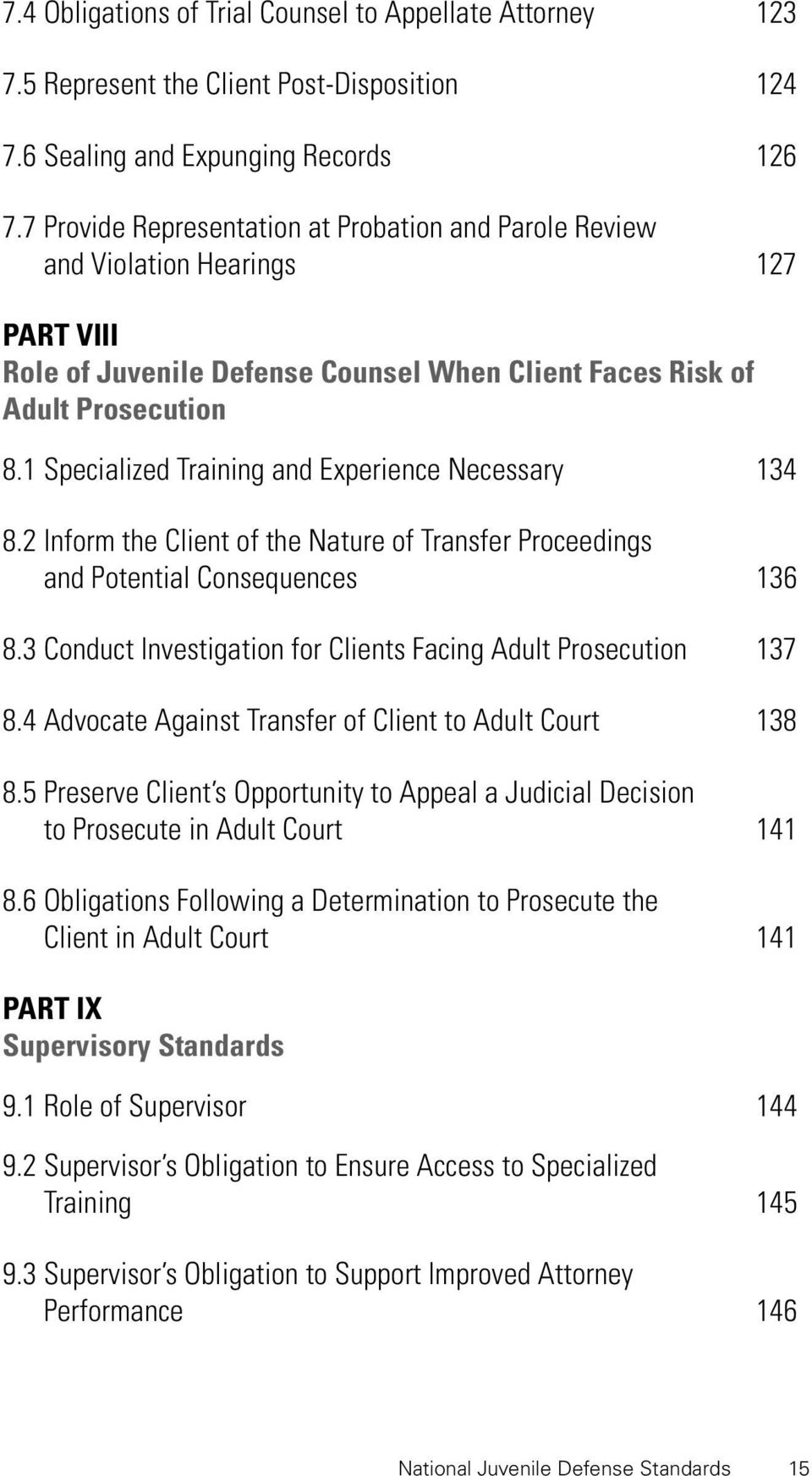
17 7.4 Obligations of Trial Counsel to Appellate Attorney Represent the Client Post-Disposition Sealing and Expunging Records Provide Representation at Probation and Parole Review and Violation Hearings 127 PART VIII Role of Juvenile Defense Counsel When Client Faces Risk of Adult Prosecution 8.1 Specialized Training and Experience Necessary Inform the Client of the Nature of Transfer Proceedings and Potential Consequences Conduct Investigation for Clients Facing Adult Prosecution Advocate Against Transfer of Client to Adult Court Preserve Client s Opportunity to Appeal a Judicial Decision to Prosecute in Adult Court Obligations Following a Determination to Prosecute the Client in Adult Court 141 PART IX Supervisory Standards 9.1 Role of Supervisor Supervisor s Obligation to Ensure Access to Specialized Training Supervisor s Obligation to Support Improved Attorney Performance 146 National Juvenile Defense Standards 15
18 9.4 Supervisor s Obligation to Enforce Performance Expectations Supervisor s Obligation to Monitor Caseloads Supervisor s Obligation to Balance the Allocation of Resources Supervisor s Obligation to Address Systemic Barriers 148 PART X Juvenile Defender s Role in Addressing System Deficiencies 10.1 Participate in Policy Development and Review Advocate for Early Access to Counsel Advocate for Presumption of Indigence Prevent Invalid Waiver of Counsel Challenge the Causes of Disparate Treatment and Discrimination Demand Adequate Resources to Provide Effective Assistance of Counsel Address Excessive Caseloads Report and Address Harmful Conditions of Confinement 161 National Juvenile Defense Standards 16 National Juvenile Defense Standards

19 PART I Role of Juvenile Defense Counsel 1.1 Ethical Obligations of Juvenile Defense Counsel 1.2 Elicit and Represent Client s Stated Interests 1.3 Specialized Training Requirements for Juvenile Defense 1.4 Scope of Representation 1.5 Case and File Management Obligations of Juvenile Defense Counsel 1.6 Avoid Conflicts of Interest 1.7 Role of Counsel Regarding Competence of Youth to Stand Trial National Juvenile Defense Standards 17 National Juvenile Defense Standards 17
20 1.1 Ethical Obligations of Juvenile Defense Counsel Counsel must provide competent, diligent, and zealous advocacy to protect the client s procedural and substantive rights. a. Counsel must be skilled in juvenile defense. Counsel must be knowledgeable about adolescent development and the special status of youth in the legal system. Counsel must be familiar with relevant statutes, case law, and court rules; b. Counsel must provide continuous, active representation throughout the entirety of the client s contact with the juvenile justice system. Counsel should avoid delays in proceedings, especially when the client is held in detention; and c. Counsel should litigate the client s case vigorously and challenge the state s ability to prove its case beyond a reasonable doubt. Counsel must always advocate for protection of the client s due process rights and ensure that any court-ordered services are provided in the least restrictive setting. Commentary: The Ten Core Principles for Providing Quality Delinquency Representation Through Public Defense Delivery Systems recognizes competent and diligent representation as the first core principle. 1 Counsel must provide representation that is diligent and competent and act with zeal when doing so. 2 The American Bar Association defines competency as the legal knowledge, skill, thoroughness and preparation reasonably necessary for representation. 3 Diligence is actively pursuing matters on the client s behalf and avoiding procrastination. 4 Zeal generally means pressing for every reasonable advantage that should be pursued. 5 Competent, diligent, and zealous representation practices are vital components in an adversarial juvenile justice system that can lead to detrimental consequences for a young and vulnerable population. While In re Gault extends the right to counsel to juveniles, the actual delivery 1 NatioNal JuveNile DefeNDer CeNter & NatioNal legal aid & DefeNDer association, ten Core PriNCiPles for ProviDiNg Quality DeliNQueNCy representation through PubliC DefeNse Delivery systems (2008) [hereinafter ten PriNCiPles]. See also, NatioNal JuveNile DefeNDer CeNter, role of CouNsel (2009) [hereinafter Role of Counsel]. 2 model rules of Prof l CoNDuCt R. 1.1, 1.3, 1.3 cmt. (2010). 3 Id. at Id. at 1.1 cmt., D.C. rules of Prof l CoNDuCt r. 1.3 cmt. (2007) (requiring a lawyer to pursue a matter on behalf of a client despite opposition, obstruction, or personal inconvenience to the lawyer, and to take whatever lawful and ethical measures are required to vindicate a client s cause or endeavor. A lawyer should act with commitment and dedication to the interests of the client. ). 18 National Juvenile Defense Standards

21 of quality representation remains out of reach for many youth. 6 Without competent, diligent, and zealous representation, youth may face unnecessary detention and excessive confinement. 7 Youth also face increasingly negative consequences from an arrest or court involvement, such as decreased educational and/or employment opportunities, restriction of access to public benefits and privileges, and compromised immigration status, as well as placement on lifelong registries. 8 There are numerous impediments to competent, diligent, and zealous representation in juvenile court. Practices that most impede counsel s ability to adhere to these standards include: failure to recognize juvenile defense as a specialty that requires preparation and intensive training; frequent and forced rotation of attorneys through the juvenile court as a training ground for adult court; failure to ensure early and timely appointment of counsel; failure to presume a youth s indigence for purposes of assigning counsel; failure to recognize the need for and the role of counsel; high caseloads that do not permit adequate preparation or investigation, much less zealous advocacy; and pressure in juvenile court to avoid adversarial positions. 9 However, counsel must work to overcome these impediments. 1.2 Elicit and Represent Client s Stated Interests Counsel s primary and fundamental responsibility is to advocate for the client s expressed interests. a. Counsel may not substitute his or her own view of the client s best interests for those expressed by the client; b. Counsel may not substitute a parent s interests or view of the client s best interests for those expressed by the client; c. Where counsel believes that the client s directions will not achieve the best long-term outcome for the client, counsel must provide the client with additional information to help the client understand the potential outcomes and offer an opportunity to reconsider; and 6 Barbara Fedders, Losing Hold of the Guiding Hand: Ineffective Assistance of Counsel in Juvenile Delinquency Representation, 14 lewis & Clark l. rev. 771 (2010) (The guarantee of counsel provided by In re Gault, 387 U.S. 1 (1967), is inadequate to ensure due process for juveniles and ineffective assistance of counsel causes of action are not meaningful remedies for juveniles seeking to redress harms of deficient legal representation). 7 See id. 8 See generally Symposium, Our Youth at a Crossroads: The Collateral Consequences of Juvenile Adjudication, 3 Duke forum for law and social ChaNge 1 (2011); See also PeNNsylvaNia JuveNile indigent DefeNse action Network, PeNNsylvaNia JuveNile Collateral CoNseQueNCes CheCklist (2010). 9 See JuDith b. JoNes, office of JuveNile JustiCe and DeliNQueNCy PreveNtioN, JuveNile JustiCe bulletin: access to CouNsel (2004) [hereinafter access to CouNsel]; ten PriNCiPles, supra note 1, PriNCiPle 2(C). National Juvenile Defense Standards 19
22 d. If the client is not persuaded, counsel must continue to act in accordance with the client s expressed interests throughout the course of the case. Commentary: While attaining the expressed interests of the client may be difficult at times, counsel must make clear with the client at the outset of the representation that the advocacy will be client-directed, and must encourage the involvement of the client at all junctures. It is important for counsel to remember that young clients lack knowledge and education about their rights and the workings of the system, and teaching youth about these is a core aspect of representation. 10 Having a client-directed approach does not mean that counsel sets aside his or her legal training and experience at the whim of a client; rather, counsel, drawing upon that training and experience, must keep the client fully informed and provide the client with information and advice on a particular matter and possible outcomes. This will help the client to make informed decisions that the lawyer should then honor. These principles are in keeping with the National Juvenile Defender Center s Role of Juvenile Defense Counsel in Delinquency Court, which states that, in view of the unique vulnerabilities of youth, it is all the more important that juvenile defense attorneys firmly adhere to their ethical obligations to articulate and advocate for the child s expressed interests, and to safeguard the child s due process rights. 11 The ABA explicitly acknowledges the centrality of the client s expressed interests: However engaged, the lawyer s principal duty is to the representation of the client s legitimate interests. 12 The ABA Model Rules of Professional Conduct also notes that when taking any protective action the lawyer should be guided by such factors as the wishes and values of the client to the extent known, the client s best interests and the goals of intruding into the client s decision-making autonomy to the least extent feasible, maximizing client capacities and respecting the client s family and social connections. 13 Although developmental science and the U.S. Supreme Court recognize that adolescents decision-making may be limited by developmental immaturity, such 10 Jodi L. Viljoen et al., Teaching Adolescents and Adults about Adjudicative Proceedings: A Comparison of Pre- and Post- Teaching Scores on the MACCAT-CA, 31 law & hum. behav. 419 (2007). 11 role of CouNsel, supra note 1, at JuveNile JustiCe standards annotated: a balanced approach, standards relating to CouNsel for Private Parties 3.1(a) (institute for JuDiCial administration/american bar association, ed., 1980) [hereinafter JuveNile JustiCe standards]., 3.1(a) (1980); see also Kristin Henning, Loyalty, Paternalism, and Rights: Client Counseling Theory and the Role of Child s Counsel in Delinquency Cases, 81 Notre Dame l. rev. 245, , (2005) [hereinafter Henning, Client Counseling Theory]. 13 model rules of Prof l CoNDuCt R cmt. (2010). 20 National Juvenile Defense Standards
23 limitations are most often manifested in situations of heightened stress and/or excitement. 14 When given the opportunity to consult with counsel and engage in deliberative thinking, these limitations are likely to dissipate significantly. 15 Counsel serves as the sole voice of the client and must therefore zealously advocate the client s expressed position. Although rehabilitation is still an important goal of delinquency proceedings, they have become more punitive and less confidential. 16 The adversarial nature of the juvenile court requires each stakeholder to play a particular role in order to come, in theory, to the best resolution. The role of counsel is not to represent what he or she thinks to be in the best interests of the client, but rather argue for the client s expressed interests, in contrast to the prosecutor, who advocates for the state, or the judge, who serves as neutral fact-finder during the adjudication Specialized Training Requirements for Juvenile Defense Specialized and comprehensive training, preparation, and education are required to provide effective representation of young people. At a minimum: a. Counsel should be familiar with and utilize state juvenile delinquency statutes, criminal statutes, case law, rules of procedure, rules of evidence, and rules of appellate procedure that impact juvenile practice; b. Counsel should be knowledgeable about the key aspects of developmental science and other research that informs specific legal questions regarding capacities in legal proceedings, amenability to treatment, and culpability; counsel should recognize when to consult experts; c. Counsel must be properly trained in effective adolescent interviewing techniques; d. Counsel must have training in the specialized skill of communicating with young clients in a developmentally appropriate and effective manner; 14 Roper v. Simmons, 543 U.S. 551 (2005); Brief of the Am. Med. Ass n., et al. as Amici Curiae in Support of Respondent in Roper v. Simmons (No ); Brief for the Am. Psychological Ass n & Missouri Psychological Ass n as Amici Curiae in Support of Respondent in Roper v. Simmons (No ). 15 Laurence Steinberg et al., Are Adolescents Less Mature than Adults: Minors Access to Abortion, the Juvenile Death Penalty, and the Alleged APA Flip-Flop, 64 amer. PsyCh. 583 (2009). 16 People v. Austin M., 975 N.E.2d 22, 40 (Ill. 2012). 17 NatioNal CouNCil of JuveNile and family Court JuDges, JuveNile DeliNQueNCy guidelines: improving Court PraCtiCe in JuveNile DeliNQueNCy Cases 30 (2005); see united states DePartmeNt of JustiCe Civil rights DivisioN, investigation of shelby CouNty JuveNile Court 47 (April 26, 2012) [hereinafter DoJ shelby CouNty report]. National Juvenile Defense Standards 21
24 e. Counsel should be up-to-date on the consequences of juvenile adjudication; and f. Counsel should be proficient with the operations of, and laws regarding, child-serving institutions, including schools, social service agencies, and mental health agencies. Commentary: Attorneys must specialize in the field of juvenile defense in order to effectively represent clients in delinquency court. 18 According to the ABA: Lawyers active in practice should be encouraged to qualify themselves for participation in juvenile and family court cases through formal training, association with experienced juvenile counsel, and by other means. 19 To provide competent representation, counsel must not only possess knowledge of the law, counsel must also be able to understand youth development and be able to interact effectively with youth. Counsel should also utilize community resources and develop relationships with local social service providers. 20 A particularly important but often overlooked piece of the specialized nature of juvenile defense practice is the enhanced skill required for both interviewing and counseling youth. Counsel must keep in mind that the counseling function is a skill that needs to be practiced and honed, despite the notion that this aspect of the work comes naturally. In rendering advice, a lawyer may refer not only to law but to other considerations such as moral, economic, social, and political factors that may be relevant to the client s situation. 21 Counsel s interactions and communications with the client require integration of knowledge and research regarding adolescent development. Juvenile defenders need to familiarize themselves with key elements of a developmentally sound practice in juvenile court, and be able to recognize, consider, and address how disabilities, trauma, and immaturity affect youths behaviors, relationships, and perceptions of safety See Patricia Puritz & Katayoon Majd, Ensuring Authentic Youth Participation in Delinquency Cases: Creating a Paradigm for Specialized Juvenile Defense, 45 family Court rev. 466 (2007) (authors highlight the importance of developing indigent defense systems of specialized practice for juvenile defense by providing holistic representation); sue burrell, JuveNile DeliNQueNCy: the Case for specialty training (2010), available at 19 JuveNile JustiCe standards, supra note 12, standards relating to CouNsel for Private Parties 2.1(a)(i). 20 ten PriNCiPles, supra note 1, PriNCiPle 7(e). 21 model rules of Prof l CoNDuCt R. 2.1 (2010). 22 Marty Beyer, Developmentally-Sound Practice in Family and Juvenile Court, 6 Nev. l. J (2006). 22 National Juvenile Defense Standards
25 To the extent possible, counsel should keep abreast of developmental science and utilize that knowledge in legal arguments at all stages of the delinquency proceedings. This includes collateral proceedings that have a direct impact on the delinquency case. Developmental science can provide important mitigating evidence at detention, transfer, adjudication, and disposition hearings. 23 In addition, the influence of developmental immaturity on clients ability to intelligently, knowingly, and voluntarily waive or assert Miranda or other constitutional rights should be recognized and incorporated into pre-trial negotiations and motions. The critical role that science can play in judicial decision-making is exemplified in a series of cases decided by the U.S. Supreme Court that recognize the developmental differences between adolescents and adults. 24 In each of the these cases about the juvenile death penalty, 25 juvenile life without parole, 26 and age as a factor in determining whether an individual is in custody for purposes of Miranda 27 the court incorporated into its legal analysis scientific evidence that demonstrates the developmental differences between adolescents and adults. 1.4 Scope of Representation Counsel must consult with the client and provide representation at the earliest stage possible, continuing until the client is discharged from the system. a. Counsel must maintain continuity of representation in all phases of the delinquency process, including arraignment, pre-trial detention hearings, discovery, trial, pleas, and disposition; b. Counsel should be familiar with alternatives to court involvement, such as diversion or mediation programs, and propose alternatives when appropriate; c. When possible, counsel should represent a client at post-disposition hearings, including probation and parole violation hearings, institutional disciplinary hearings, and extension of incarceration determinations; d. In all cases, counsel should advise the client of his or her appellate rights. When appropriate, counsel should take on the appeal of the client s case or assist the client in identifying and obtaining alternative appellate counsel; 23 See Roper v. Simmons, 543 U.S. 551 (2005); Graham v. Florida, 130 S. Ct (2010); J.D.B. v. North Carolina, 131 S. Ct (2011); Miller v. Alabama, 132 S. Ct (2012). 24 Roper, 543 U.S. 552; Graham, 130 S. Ct. 2011; J.D.B., 131 S. Ct. 2394, Miller, 132 S. Ct Roper, 543 U.S Graham, 130 S. Ct. 2011; Miller, 132 S. Ct J.D.B., 131 S. Ct National Juvenile Defense Standards 23
26 e. Counsel should represent the client in ancillary proceedings that coincide with the delinquency charge or locate social workers, educational advocates, or other qualified individuals to represent the client; and f. Counsel must advise the client of legal and extralegal issues arising from the client s court involvement. When appropriate, counsel should connect clients with attorneys or organizations specializing in those consequential matters. Commentary: Prompt advice and action can protect many important rights of clients. 28 Not only does the ABA require early appointment of counsel, but it also encourages continuity of representation from intake through post-disposition. 29 The National Council of Juvenile and Family Court Judges Guidelines echo the ABA s recommendation regarding early appointment, explaining that [i]n a juvenile delinquency court of excellence, counsel is appointed prior to the detention or initial hearing, and has time to prepare for the hearing. 30 Counsel must make every effort to gain early access to clients and, when necessary and possible, work to change the court culture and court rules to provide for earlier appointment of counsel. Early appointment may permit counsel to influence filing decisions, seek diversion or dismissal, prevent secure confinement, prevent false confession, and begin the process of investigating the client s background and the case as soon as possible. Counsel must be familiar with all available diversion, mediation, or other programming alternatives offered by the court or available in the community that might result in the client s case being diverted, informally resolved, referred to an alternative court to process, or deferred. When appropriate, and consistent with the client s wishes, counsel should advocate for the use of these alternatives in order to help the client avoid the formal court process. 28 JuveNile JustiCe standards, supra note 12, standards relating to CouNsel for Private Parties See generally JuveNile JustiCe standards, supra note 12; see also T.K. v. State, 126 Ga. App. 269 (App. Ct. 1972) (interpreting ga. CoDe ann. 24a-2001) (1971) (CurreNt version at (2012)); State ex. Rel. M.C.H. v. Kinder, 317 S.E.2d 150 (W.Va.1984) (interpreting w.va. CoDe (c)); Cal. welf. & inst. CoDe 633 (1998); N.y. fam. Ct. act 307.4(2), 320.1(2) (1999 and Supp. 2007); s.d. CoDifieD laws 26-7A-30, 26-7A-31 (1999). 30 NatioNal CouNCil of JuveNile and family Court JuDges, supra note 17, at 90 (2005). 24 National Juvenile Defense Standards
27 Counsel has an obligation to prepare for, attend, and advocate zealously on behalf of a client at all post-disposition reviews, including probation and parole violation and revocation hearings, and when possible, institutional disciplinary hearings. It is critical that counsel demand to be notified of any hearings, seek appointment, and insist on time to prepare. At the hearing, counsel should ensure that the client receives adequate due process protections. Counsel must be aware of all consequences that stem from court involvement, including, but not limited to, consequences that could affect the client s child welfare status, right to housing, public benefits, ability to continue his or her education, or immigration status. 31 Counsel must advise the client regarding such matters, or when appropriate, recommend the client contact a specialized attorney in those fields. 1.5 Case and File Management Obligations of Juvenile Defense Counsel Counsel has an obligation to keep and maintain a thorough, organized, and current file on each case. Documentation should be clear, up-to-date, and orderly, permitting a successor attorney to readily locate all information. Commentary: The duty to properly manage client files 32 begins when counsel assumes responsibility for each case and continues until all aspects of that case are resolved. When counsel represents a client on more than one case, separate case files should be maintained for each case. While some demographic information may be duplicative across files, it is essential that the full and complete history and information for each individual case be located in a single place. Counsel s quality of representation will suffer without organization of critical paperwork and information in a client s case. Courts have viewed case management as intrinsic to an attorney s professional responsibilities. 33 Inadequate file management may also signal to the client that counsel does not view their case as important or worthy of professional effort. In addition, careful organization and detailed records are critical in situations when counsel may need other attorneys to cover or stand-in on the case, or when the case may be transferred to another attorney altogether. 31 Ashley Nellis, Addressing the Collateral Consequences for Young Offenders, the ChamPioN (Nat l Ass n of Criminal Def. Lawyers, D.C.), July & Aug., Strickland v. Washington, 466 U.S. 668 (1984). 33 Id. National Juvenile Defense Standards 25
28 The better organized the case file, including electronic files, the less chance there is of important information being lost or misplaced; the easier it is for counsel to quickly access important information; and the easier it will be for supervisors, stand-in attorneys, appellate attorneys, or others who need access to the file to better understand the case. In addition, case files are critical sources of data for defender offices that are attempting to develop statistical data on their practice. 1.6 Avoid Conflicts of Interest Counsel needs to identify and address any conflicts of interest. Counsel should recognize not only actual conflicts, but also those that may raise the appearance of impropriety to the client or others. a. Counsel owes the client a duty of undivided loyalty. Counsel must be alert to and eliminate all conflicts of interest that would call the attorney s fidelity to the client into question; b. Conflicts of interest can arise from counsel s responsibilities to other clients, a former client, a third person, or a client s caretaker, or they can arise from counsel s own interests. Counsel must evaluate the particular facts and circumstances of each potential conflict with the client s expressed interests in mind; c. Only a client may waive a conflict. Conflicts are waivable only upon informed, written consent from the client; d. Even with informed written consent, a conflict cannot be waived if it is prohibited by law; if it would prevent counsel from providing competent, diligent, or zealous representation; or if it involves necessarily adversarial positions. Conflicts that are unwaivable under any circumstance include, but are not limited to: 1. Conflict between serving as defense counsel and guardian ad litem to the same child; 2. Forgoing a duty to a client in favor of a perceived responsibility to a parent or other guardian; and 3. Forgoing a duty to a client in favor of a duty to the court. e. It is not prudent to represent co-defendants. Counsel should carefully weigh whether there is a conflict of interest before agreeing to represent co-defendants. Counsel should assume that representation of co-defendants is likely to harm the quality of representation of one or both clients; 26 National Juvenile Defense Standards
29 f. When the opinions of the client and the parent diverge, counsel is required to honor the obligation to the client. Counsel should not permit the parent to direct the representation. Counsel should not share information with the parent unless disclosure of such information has been approved by the client; and g. When counsel becomes aware of a conflict, counsel should immediately seek to eliminate the conflict, or, when eliminating the conflict is not possible, withdraw if doing so will not prejudice the client. Commentary: According to the ABA Model Rules of Professional Conduct: A lawyer shall not represent a client if the representation involves a concurrent conflict of interest. A concurrent conflict of interest exists if: (1) the representation of one client will be directly adverse to another client; or (2) there is a significant risk that the representation of one or more clients will be materially limited by the lawyer s responsibilities to another client, a former client or a third person, or by a personal interest of the lawyer. 34 Exceptions may be permissible when the client provides written informed consent and when counsel reasonably believes the conflict will not harm the quality of the representation, when counsel is not representing two necessarily conflicting views, and when representation is not prohibited by law. 35 Conflicts of interest are not limited to actual conflicts; they include the appearance of impropriety. 36 The issue is whether a reasonable person would question whether the attorney was loyal to the client or to some other interest. To avoid conflicts, an attorney should not accept a dual appointment as defense attorney and guardian ad litem. In some jurisdictions, statutes, court rules, or court practice may allow for one attorney to act as both the guardian ad litem and the juvenile defender for a particular child. While the law or practice may permit it, such representation creates an unavoidable conflict of interest. 37 Due process requires that juveniles in delinquency proceedings have defense counsel, that is, counsel which can only be provided by an attorney whose singular loyalty is to the defense 34 model rules of Prof l CoNDuCt R. 1.7 (2010); monroe freedman & abbe smith, understanding lawyers ethics (3rd ed. 2004). 35 model rules of Prof l CoNDuCt R. 1.7 (2010). 36 National Criminal Defense Lawyers Association Ethics Advisory Committee Formal Opinion (2003) (quoting First American Carriers, Inc. v. Kroger Co., 302 Ark. 86, (1990) in holding that obligation to avoid an appearance of impropriety arising out of Canon 9 of the superseded Code of Professional Responsibility is still binding on lawyers; While Canon 9 is not expressly adopted by the Model Rules, the principle applies because its meaning pervades the Rules and embodies their spirit. It is included in what the preamble to the Rules refers to as moral and ethical considerations that should guide lawyers, who have special responsibility for the quality of justice. ). 37 People v. Austin M., 975 N.E.2d 22 (2012). (finding that having one lawyer functioning as both the juvenile defense attorney and the guardian ad litem is a per se conflict and a violation of the juvenile s due process rights in a delinquency proceeding). National Juvenile Defense Standards 27
30 of the juvenile. 38 Guardians ad litem are required to act in the best interests of their clients, whereas juvenile defenders are to act in the expressed interests of their clients. [W]hen counsel attempts to perform [both roles], the risk that counsel will render ineffective assistance or that an actual conflict of interest will arise is substantial. 39 It is impossible to foresee when such a divergence will occur, so counsel should avoid entering into such dual representation from the outset. If counsel waits until the actual disagreement arises, the only remedy would be for counsel to withdraw from the case as both the defender and the guardian ad litem, which would create unnecessary delay and may prejudice the client. In most instances, counsel should avoid representing co-defendants. While co-defendant representation is not always a per se conflict, the risk of a potential conflict developing is great enough that it warrants caution and careful reflection. At the outset of the representation, it may not be clear what role each co-defendant may have played in the alleged conduct and what potential defenses may exist. It is entirely possible that adverse defenses may arise, which would be a per se conflict. 40 It is also a per se conflict for a defender to argue for a benefit of one client that necessarily results in a detriment to the other client. 41 Because counsel who represents co-defendants has necessarily learned secrets and confidences about each prior to the conflict arising, once it does arise, the only remedy is for the defender to withdraw from representing both clients. The duty of confidentiality to each client does not end, even if the attorney withdraws from the case. 42 Counsel s obligation to competently, diligently, and zealously represent the expressed interests of the client includes the obligation to eliminate any conflicts of interest. 43 Counsel s confidence in his or her skill and training combined with a sense of loyalty to the client may lead counsel to want to forego concerns about conflicts of interest. However, regardless of counsel s belief in his or her own ability to be objective, when a conflict of interest arises, counsel must immediately seek to eliminate the conflict to ensure that all individuals get the most zealous, diligent, and competent representation available Id. at 40 (emphasis in original). 39 Id. at model rules of Prof l CoNDuCt R. 1.7 (2010). 41 Id. at R. 1.7(a). 42 Id. at R. 1.9(c)(2). 43 Id. at R. 1.6; People v. Hernandez, 231 Ill.2d 134, 142 (2008) (finding that effective assistance of counsel requires undivided loyalties). 44 model rules of Prof l CoNDuCt R 1.6 (2010). 28 National Juvenile Defense Standards
31 Conflicts of interest tend to undermine the court system, hinder the effectiveness of the attorney, and irreparably harm the client. The modern juvenile court system is predicated on the understanding that the youth s expressed interests will be competently, diligently, and zealously represented, ensuring a fair outcome. 45 Despite the counsel s best intentions, a conflicted counsel, in most cases, will not be able to provide the constitutional guarantee of effective assistance of counsel. 46 This failure will harm the client at every phase of the proceeding, and could amount to lackluster investigation, failure to challenge the state s evidence, less-rigorous cross-examination, and increased likelihood of incarceration. While in some rare cases waiver may be an appropriate remedy to conflict, counsel should advise the client in developmentally appropriate terms and be cautious about permitting the client to waive the conflict. The waiver may have consequences in other aspects of the case (e.g., when there is a challenge to a client s competence to waive constitutional protections) Role of Counsel Regarding Competence of Youth to Stand Trial Counsel must be able to recognize when the client may not be competent to stand trial and take appropriate action. a. Counsel must learn to recognize when a client s ability to participate in his or her own defense may be compromised due to developmental immaturity, mental health disorders, or developmental/intellectual disabilities; b. Counsel must assess whether the client s level of functioning limits his or her ability to communicate effectively with counsel, as well as his or her ability to have a factual and rational understanding of the proceedings. When counsel has reason to doubt the client s competence to stand trial, counsel must gather additional information and consider filing a pre-trial motion requesting a hearing for competence determination; c. Counsel must be versed in the rules, statutes, and case law governing juvenile competence to stand trial in the jurisdiction. Counsel 45 In re Gault, 387 U.S. 1, 30 (1967) ( we do hold that the hearing must measure up to the essentials of due process and fair treatment ). 46 model rules of Prof l CoNDuCt r. 1.7 cmt. (2010). 47 Id. National Juvenile Defense Standards 29
32 must become familiar with experts qualified to assess competence to stand trial and learn the mechanisms for requesting an evaluation. Counsel must learn the procedures for a competence hearing in his or her jurisdiction and fully comprehend the ramifications if the client is found incompetent to stand trial; d. Counsel must carefully weigh the consequences of moving forward with the case against the likely consequences of a finding of incompetence, and whether there are other ways to resolve the case, such as dismissal upon obtaining services for the client or referral to other agencies; and e. If counsel decides to proceed with a competence hearing, counsel must secure a qualified, independent expert to evaluate the client s competence. Counsel must then advise the youth about the evaluation and proceedings, analyze the results of the evaluation, prepare the expert for testimony, and prepare his or her case substantively and procedurally for the hearing. Counsel must advise the client about the content of the hearing and assist the client in navigating the complexities of the proceedings. Commentary: Juvenile defenders should approach competency issues with deliberation and caution. Whatever the finding, the decision can have short- and long-term implications on client autonomy, placement, and services. Although each state may vary in its definition of competence to stand trial, all should be consistent with the U.S. Supreme Court s definition in Dusky v. United States: whether [the defendant] has sufficient present ability to consult with his lawyer with a reasonable degree of rational understanding and whether he has rational as well as factual understanding of the proceedings against him. 48 Lawyers need to be especially sensitive to the competence of juvenile clients. Children may be incompetent for a variety of reasons. Whereas adult clients competency-related deficits are generally attributed to mental health and/or intellectual disabilities, developmental immaturity may play a significant role in adolescents competency-related deficits. 49 However, only a few states specifically acknowledge 48 Dusky v. United States, 362 U.S. 402, 402 (1960) (per curiam). 49 Thomas Grisso, et al., Juveniles Competence to Stand Trial: A Comparison of Adolescents and Adults Capacities as Trial Defendants, 27 law & hum. behav. 333 (2003) [hereinafter Grisso, Juveniles Competence to Stand Trial]; Jody L. Viljoen & Ron Roesch, Competence to Waive Interrogation Rights and Adjudicative Competence in Adolescent Defendants: Cognitive Development, Attorney Contact, and Psychological Symptoms, 29 law & hum. behav. 723 (2005). 30 National Juvenile Defense Standards
33 that incompetence may be found when competency deficits are related to immaturity, particularly when mental illness or intellectual disability is absent. 50 Regardless, counsel should be cognizant of and raise the fact that adolescents are still maturing and, as a result, may have limitations in their capacity to understand and reason. When seeking qualified experts, counsel should select one with experience in child and adolescent development. Such an expert should be versed in or be able to refer counsel to a specialist regarding the emotional, behavioral, physical, cognitive, and language impairments of children and adolescents; the cultural and social characteristics of children and adolescents; forensic evaluation of children; the competence standards and accepted criteria used in evaluating juvenile competence; and effective interventions, as well as treatment, training, and programs for the attainment of competence. Counsel must ensure the competency hearing is on the record, request factual findings, and make needed objections to preserve the record for appellate review. During the hearing, counsel must protect the client s rights against introduction of statements against interest made to the evaluator and/or other excludable evidence brought forward by other parties. Counsel should clearly understand all potential outcomes of a finding of incompetence in the jurisdiction. In all cases, when a client is found incompetent, counsel should move for a dismissal of the charges. In jurisdictions where a court can order a client to remediation services, counsel should insist that evidence is presented on the issue of whether it is possible for a client to attain competence within reasonable statutory time limits. 51 Upon a court order to work toward attainment of competence so that the client may be restored to competence, counsel should ensure youth receive remediation services in the community and avoid civil commitment. If the client does not attain competence within a reasonable time period, counsel again should seek dismissal of the charges. 50 See generally Timothy J. v. Sacramento County, 58 Cal.Rptr.3d 746 (Cal. 2007); In re Hyrum H., 131 P.3d 1058 (Ariz. 2006); Tate v. State of Florida, 864 So.2d 44 (Fla. 2003). 51 Jackson v. Indiana, 406 U.S. 715, 738 (1972). National Juvenile Defense Standards 31
34 32 National Juvenile Defense Standards
35 PART II Role of Juvenile Defense Counsel in the Attorney-Client Relationship 2.1 Role of Juvenile Defense Counsel at Initial Client Contact 2.2 Explain the Attorney-Client Relationship 2.3 Explain Client Confidences and Confidential Information 2.4 Maintain Regular Contact with the Client 2.5 Parents and Other Interested Third Parties 2.6 Overcoming Barriers to Effective Communication with the Client 2.7 Challenge Disparate Treatment of Vulnerable Clients 2.8 Obligation to Investigate and Address Custodial Mistreatment 32 National Juvenile Defense StandardsNational Juvenile Defense Standards 33
36 2.1 Role of Juvenile Defense Counsel at Initial Client Contact Counsel must provide a clear explanation, in developmentally appropriate language, of the role of both the client and counsel, and demonstrate commitment to the client s expressed interests. Counsel must elicit the client s point of view and encourage the client s full participation. a. Counsel must meet the client as soon as practicable following counsel s appointment; b. The initial interview should be in person in a private setting, away from the client s parent or other people, to maintain privilege and assure that the client knows the communication is confidential. Counsel of a detained juvenile client must visit the client in detention and ensure that the meeting occurs in a setting that allows for a confidential conversation; and c. Counsel must support the client s participation in the defense by providing information and advice in developmentally appropriate language. Commentary: Counsel must meet with the client as soon as possible, in some cases even prior to formal appointment when possible. The lawyer should confer with a client without delay. 52 Upon meeting, counsel should conduct a full-scale interview, which should cover both the information needed in order to handle the initial hearing (including all of its components: arraignment, detention hearing, and probable cause hearing) and the information needed in order to begin preparing for trial. 53 During the initial meetings with the client, counsel must explain, in developmentally appropriate language: a. The attorney-client relationship, including confidentiality; b. The role of counsel as attorney for the client, representing the client s expressed interests, not the parent s or parents objectives; 52 JuveNile JustiCe standards, supra note 12, standards relating to CouNsel for Private Parties randy hertz et al., trial manual for DefeNse attorneys in JuveNile Court 55 (1991). 34 National Juvenile Defense StandardsNational Juvenile Defense Standards 33
37 c. The role of parents in the proceedings and how counsel will interact with them; d. The roles of each juvenile court stakeholder; e. The objectives of the representation; f. The elements of each charged offense and the potential dispositions for such offenses; g. Conduct alleged in the police report and charging documents, including potential evidence or witnesses; h. The legal criteria, options, and conditions the court may set for pre-trial release; i. Diversion, detention, and placement options; j. The next procedural steps; and k. How the client can contact counsel. During the first meeting with the client, counsel must attempt to obtain from the client, outside the presence of the client s parent: a. The client s account of the incident; b. Circumstances of any police interrogations, searches, seizures, and identification procedures; c. Information about how the client was treated while in custody of the police, other investigative agencies, mental health departments, or the prosecution; d. Names, addresses, phone numbers, or any other information about witnesses who may be relevant to suppression hearings, the fact-finding hearing, or disposition; e. Information about the client s ties to the community, family relationships, immigration status, employment record and history, school record and history, and anything else that may be useful at the detention hearing and disposition; f. Information about the client s prior contact(s) with the system, including the nature of any relationships with a probation officer; g. The client s physical and mental health, child welfare status, and school experience; h. Information regarding the client s needs for immediate medical or mental health care; i. Signed releases for information from the client s school, medical, and psychological service providers; and j. Contact information for the client s closest family or caretaker. 34 National Juvenile Defense StandardsNational Juvenile Defense Standards 35
38 The initial interview provides not only concrete functions, like obtaining information, but also serves as the foundation of the attorney-client relationship, which must consist of mutual trust and confidence. Counsel can establish trust and confidence with the client by fulfilling his or her duty to advise and counsel the client; of course, trust and confidence cannot often be established at just one meeting, but a positive initial contact combined with consistent positive future interactions will likely lead to a good attorney-client relationship. 54 Similarly, many children will not have the attention span or the ability to focus during a long meeting. It may be necessary to have several meetings over a short period of time to get all the necessary information. Structural and institutional impediments impact the ability of counsel to communicate effectively with the client. 55 Many issues may be outside of counsel s direct control, including the timing of appointment of counsel, access to confidential meeting space in the courthouse, 56 having the requisite time to engage in a thoughtful and comprehensive interview with the client, or having time to get information from parents or other sources, but counsel should insist on such accommodations. Where such conditions are not available and the court fails to meet counsel s requests, counsel should make an objection on the record. Developing a good working relationship with youth under highly stressful circumstances raises unique challenges and requires special awareness and responses by counsel. Counsel s ability to both perceive and appropriately address a young client s fears and anxieties is central to counsel s ability to work effectively with the client to ensure high-quality defense. Youth in the delinquency system often have mental health issues and learning disabilities that affect critical aspects of their functioning, especially their ability to communicate and comprehend. 57 Counsel must be alert to the special needs of each client. Counsel must also use this opportunity to learn of the client s strengths be they familial, personal, or potential and help integrate those strengths into the theory of the case and the disposition planning. 54 role of CouNsel, supra note 1, at See access to CouNsel, supra note role of CouNsel, supra note 1, at Peter E. Leone et al., Understanding the Overrepresentation of Youths with Disabilities in Juvenile Detention, 3 D.C. L. rev. 389 (1995); JustiCe PoliCy institute, healing invisible wounds: why investing in trauma-informed Care for ChilDreN makes sense (2010) (Discussing children who have experienced trauma and their involvement in the juvenile justice system and noting that a decreased integration of the left and right sides of the brain following prolonged stress exposure can affect the ability to use logic and reason and can result in poor problem-solving skills. ); ProJeCt forum, the JuveNile JustiCe system and youths with Disabilities 4 (2005), available at 36 National Juvenile Defense StandardsNational Juvenile Defense Standards 35
39 2.2 Explain the Attorney-Client Relationship Counsel must explain and reinforce the structure of the attorneyclient relationship, particularly with regard to how responsibility is allocated and decisions are made. Commentary: The ABA Model Rules of Professional Conduct allocates responsibility between attorney and client, stating: [A] lawyer shall abide by a client s decisions concerning the objectives of representation and shall consult with the client as to the means by which they are to be pursued. A lawyer may take such action on behalf of the client as is impliedly authorized to carry out the representation. A lawyer shall abide by a client s decision whether to settle a matter. In a criminal case, the lawyer shall abide by the client s decision, after consultation with the lawyer, as to a plea to be entered, whether to waive jury trial and whether the client will testify. 58 In clear, concise, and developmentally appropriate terms, counsel must exercise special care at the outset of representing a client to clarify the scope and boundaries of the attorney-client relationship. Young clients are often surprised to learn that they, and not their parent or attorney, are in charge of their representation. 59 This requires youth to adopt a new posture, and demonstrate control and collaboration at exactly the moment they are likely to feel most powerless and vulnerable. It is important for attorneys to recognize that, for youth, being in charge of their representation may be a difficult adjustment. Counsel must recognize that many of the concepts inherent to the attorney-client relationship are likely to be new to young clients. For example, clients are often unaware of whether and what information counsel will disclose to parents, the court, and others. 60 The client s relative unfamiliarity with the role of counsel, limited knowledge regarding legal proceedings, 61 and potential distrust of the justice 58 model rules of Prof l CoNDuCt r. 1.2 (2010). 59 See Emily Buss, You re My What? The Problem of Children s Misperception of Their Lawyer s Roles, 64 fordham l. rev (1996). 60 Michele Peterson-Badali et al., Young People s Experience of the Canadian Youth Justice System: Integrating with Police and Legal Counsel, 17 behav. sci. & l. 455 (1999). 61 Grisso, Juveniles Competence to Stand Trial, supra note 49. See also Christine S. Pierce & Stanley Brodsky, Trust and Understanding in the Attorney-Juvenile Relationship. 20 behav. sci. & l. 89 (2002). 36 National Juvenile Defense StandardsNational Juvenile Defense Standards 37
40 system 62 require counsel to take special care to communicate and reiterate in developmentally appropriate ways the nature of the attorney-client relationship. Counsel must facilitate the client s meaningful participation in his or her own defense by using language that is understandable to the client. Counsel must provide an opportunity for the client to consider, question, and discuss his or her understanding of the relationship with counsel. Counsel must explain that he or she represents only the client s expressed interests, not the interests of the court, the parent, or counsel. Counsel must articulate the nature of attorney-client privilege and that what the client tells counsel will remain confidential, unless the client gives permission to disclose. Counsel must assist the client with making all substantive decisions regarding the investigation of the case, whether to accept a plea, whether to testify in his or her own defense, and whether to accept specific disposition recommendations. Where the choice exists, counsel must assist in making the decision as to whether to request a bench or jury trial. Counsel must discuss and clarify with the client strategic decisions regarding the method and manner of conducting the defense. Counsel must disclose to the client the factors considered in making decisions, choosing particular legal strategies, what motions to file, which witnesses to call, what questions to ask, and what other evidence to present. Counsel should engage the client in these decisions and seek the client s guidance in identifying and pursuing investigative leads. 63 When the client expresses reluctance or concern about a decision (e.g., calling a particular witness), counsel should explain the risks and benefits of taking, or declining to take, a specific action. 2.3 Explain Client Confidences and Confidential Information Counsel must clarify that the client s private conversations with counsel are protected from disclosure to anyone, including the client s parent, the prosecutor, and the court. Counsel must also explain that the attorney-client privilege is deemed waived if anyone else, including a parent, is present during a conversation between the client and counsel. a. Counsel must be familiar with local case law, statutes, and codes of professional conduct regarding disclosure of private attorney- 62 Melinda G. Schmidt, N. Dickon Reppucci, & Jennifer Woolard, Effectiveness of Participation as a Defendant: The Attorney Juvenile Client Relationship, 21 behav. sci. & l. 17 (2003); Jennifer Woolard, Samantha Harvell, & Sandra Graham, Anticipatory Injustice: Age and Racial/Ethnic Differences in Perceived Unfairness of the Justice System. 26 behav. sci. & l. 207 (2008). 63 role of CouNsel, supra note 1, at 9-10, National Juvenile Defense StandardsNational Juvenile Defense Standards 37
41 client conversations, as well as information that may embarrass or be harmful to the client. Counsel has a duty to keep all client communications, as well as information arising out of the representation, confidential unless specifically required to disclose by local rules or statutes; b. Counsel must work with the client to understand what kind of information the client is comfortable with counsel sharing, and with whom; c. Counsel must zealously protect confidential information from public disclosure. Counsel should not discuss the case or any confidential information when people other than the client are present and able to hear. Counsel must not knowingly use a confidence or secret of the client unless the client provides informed consent or does so as required by rules of professional conduct; d. Counsel must exercise discretion in revealing the contents of psychiatric, psychological, medical, social, and educational reports that bear on the client s history or condition. In general, counsel should not disclose data or conclusions contained in such reports unless the client provides informed consent, and even then, only if doing so will advance the client s stated objectives. Prior to requesting reports from outside institutions (e.g., educational reports), counsel must obtain informed consent from the client; and e. If proceedings are scheduled to be public, to protect the confidential information involved, counsel, in consultation with the client, should move to close the proceedings or request the case to be called last on the docket, when the courtroom is empty. Commentary: As part of his or her ethical obligation, [a] lawyer shall not reveal information relating to the representation of a client unless the client gives informed consent. 64 The reason for such a rule is that this contributes to the trust that is the hallmark of the client-lawyer relationship. The client is thereby encouraged to seek legal assistance and to communicate fully and frankly with the lawyer even as to embarrassing or legally damaging subject matter. The lawyer needs this information to represent the client effectively and, if necessary, to advise the client to refrain from wrongful 64 model rules of Prof l CoNDuCt r. 1.6(a). 38 National Juvenile Defense StandardsNational Juvenile Defense Standards 39
42 conduct. 65 Not only may a lawyer not directly reveal information relating to the representation of the client, but the rule also applies to disclosures by a lawyer that do not in themselves reveal protected information but could reasonably lead to the discovery of such information by a third person. 66 In order to effectively advocate for a client behind the scenes, there is some level of implied authorization to share pertinent information for the client s benefit. 67 However, counsel who has a clear understanding from the beginning of a client s goals and limits with respect to sharing information is better able to avoid violating a confidence. The ethical duty to maintain client confidences is different from, but related to, the evidentiary privilege precluding the admissibility of attorney-client communications. 68 Generally, in jurisdictions where that privilege exists, the privilege is deemed waived by the client if anyone other than the attorney or the attorney s agents is present. 69 While states differ greatly in the level of privacy and confidentiality offered young people in delinquency proceedings, counsel should argue to keep any reports or proceedings private. Maintaining privacy limits the stigma that can arise from court involvement and is vital for achieving the juvenile court s core goal of rehabilitation. The practice of shielding youth from public exposure has long been considered necessary to enable young people to rehabilitate and reintegrate into society as law-abiding citizens. 70 In addition to fostering the juvenile court s goal of rehabilitation, maintaining privacy will also build a relationship of trust between counsel and the client. 2.4 Maintain Regular Contact with the Client Counsel must maintain regular contact with the client. If a youth is in custody, counsel must visit on a regular basis. If a client is out of custody, counsel must arrange phone contacts and face-to-face meetings. Regardless of the client s custodial status, counsel must provide the client with a phone number at which counsel can be 65 Id. at 1.6 cmt. 66 Id. 67 Id. 68 Compare model rules of Prof l CoNDuCt r. 1.6 (2010), with fed. r. evid. 502, ark. r. evid. 502, N.D. r. evid. 502, and tex. r. evid See, e.g., Del. r. evid. 502(b), or. r. evid. 503(2), tex. r. evid. 503(b). 70 See David S. Tanenhaus, The Evolution of Juvenile Courts, in a CeNtury of JuveNile JustiCe 42, 61 (Margaret K. Rosenheim et al. eds., 2002). 40 National Juvenile Defense StandardsNational Juvenile Defense Standards 39
43 reached. Counsel must promptly respond to telephone calls and other types of communications from the client, ideally within one business day. At every stage of the proceeding, counsel must work to provide the client with complete information concerning all aspects of the case. Commentary: Regular communication is essential to the attorney-client relationship. Not only do youth need to understand the nature of their case and the processes of the juvenile justice system, but they must also be in a position to ask questions of counsel and direct their representation. Reasonable communication between the lawyer and the client is necessary for the client to effectively participate in the representation. 71 Failing to maintain regular and sufficient contact with the client can undermine confidence in the quality of counsel s representation. 72 Counsel must anticipate that a young client, due to his or her developmental immaturity, may require frequent contact between court dates. 73 Counsel must also assume that young clients will often not understand the language of court officers, even if they have been in court previously. Prior to court hearings, counsel should contact the client to remind him or her of the objectives of the hearing, expectations of the client and counsel at the hearing, as well as the date, time, and location of court. Counsel should clarify how and when the client should be in contact, as well as counsel s willingness to receive collect calls from detention facilities. If the client is detained, counsel, or someone from counsel s office, should visit the client in detention regularly, including regular visits in between court dates Parents and Other Interested Third Parties Counsel must inform the client and third parties (e.g., parents, other family members, clinicians, teachers, counselors, service providers, and other interested adults) that counsel is required to treat private 71 model rules of Prof l CoNDuCt r. 1.4 cmt, 1.14(a) (2010) (attorneys must maintain a normal client-lawyer relationship with juvenile clients). 72 Theresa Hughes, A Paradigm of Youth Client Satisfaction: Heightening Professional Responsibility for Children s Advocates, 40 Colum. J.l. & soc. Probs. 551 (2007). 73 See Jodi L. Viljoen & Ronald Roesch, Competence to Waive Interrogation Rights and Adjudicative Competence in Adolescent Defendants: Cognitive Development, Attorney Contact, and Psychological Symptoms, 29 law & hum. behav. 723 (2005). (Finding that spending more time with an attorney increased legal comprehension in youth). 74 role of CouNsel, supra note 1, at National Juvenile Defense StandardsNational Juvenile Defense Standards 41
44 communications with the client as confidential. Counsel is required to maintain confidentiality even when third parties are providing services to the client. a. Counsel must know state case law, statutes, and codes of professional conduct regarding all disclosures to third parties; b. Counsel should explain to the client the need to share information with third parties, and specify the information to be shared, the purpose of sharing it, and the possible consequences. Counsel must obtain permission from the client prior to communicating certain information to third parties. Counsel may not permit a third party, including a parent, to interfere with counsel s assessment of the case. Counsel shall not substitute a third party s wishes for those of the client; and c. When a third party, including a parent, is trying to direct the representation of the client, counsel should inform that person of counsel s legal obligation to represent only the expressed interests of the client. In the event of a disagreement, counsel is required to exclusively abide by the wishes of the client. Commentary: While it is a legal fact that counsel must represent solely the wishes of the client, it is a legal fiction that the client is acting in a vacuum. Every effort should be made to work collegially with the client s parent and other third parties, 75 though this may not always be possible and may even cause conflicts of interest, which counsel must take care to avoid. Third-party demands may significantly impact a youth s ability to make decisions and may place counsel in a difficult position with both third parties and the client. 76 Counsel should be aware of and prepared to explain to a client the legal consequences if a parent or other third party is present during interviews, including the lack of parent-child privilege. 77 While counsel must maintain client confidences when communicating with all third parties, parents are often the most involved. 75 See, e.g., vera institute for JustiCe, families as PartNers: supporting incarcerated youth in ohio (2012), available at vera.org/download?file=3397/families_as_partners.pdf; Cynthia Godsoe, All in the Family: Towards a New Representational Model for Parents and Children, 24 geo. J. legal ethics 303 (2011); Kristin Henning, It Takes a Lawyer to Raise a Child?: Allocating Responsibilities Among Parents, Children, and Lawyers in Delinquency Cases, 6 Nev. l.j. 836 (2006). 76 Barbara Fedders, Losing the Guiding Hand: Ineffective Assistance of Counsel in Juvenile Delinquency Representation, 14 lewis & Clark l. rev. 771, (2010). 77 hertz et al., supra note 53, at 102; Catherine J. Ross, Implementing Constitutional Rights for Juveniles: The Parent-Child Privilege in Context, 14 stan l. & Pol y rev. 85, (2003). 42 National Juvenile Defense StandardsNational Juvenile Defense Standards 41
45 Counsel must inform a parent that counsel s exclusive obligation is to the client. While counsel should attempt to engage a parent collaboratively in the representation of a client, counsel should always keep in mind the ethical obligation to represent only the expressed interests of the client. The absence of parent-child privilege and the realities of the parent-child dynamic require counsel to take special care regarding involvement of parents in communications. 78 That being said, counsel should develop a relationship with parents whereby counsel can gain a better understanding of the client from all perspectives, including potential involvement in other systems and what resources and services the client has available. Parents can be very helpful and add strength to the case, but they are most effective when counsel explains and maintains clear role boundaries. Whether and to what extent a client should take parents and other third parties guidance is a challenging and complicated matter that can lead to conflict and affect the attorney-client relationship. 79 When third parties challenge counsel s refusal to act on their requests, counsel is advised to make an internal record of the challenge, counsel s response to the challenge, and the outcome of the discussion. 2.6 Overcoming Barriers to Effective Communication with the Client Counsel must recognize barriers to effective communication. Counsel must take all necessary steps to ensure that differences, immaturity, or disabilities do not inhibit the attorney-client communication or counsel s ability to ascertain the client s expressed interests. Counsel must work to overcome barriers to effective communication by being sensitive to difference, communicating in a developmentally appropriate manner, enlisting the help of outside experts or other third parties when necessary, and taking time to ensure the client has fully understood the communication. Commentary: Counsel must be prepared to identify how differences, immaturity, and/or disabilities can negatively impact attorney-client communication. Above all, the manner in which counsel communicates to the client must be individualized. 78 Hillary B. Farber, Do You Swear to Tell the Truth, the Whole Truth, and Nothing but the Truth Against Your Child? 43 loy. l.a. l. rev. 551 (2009); Hillary B. Farber, To Testify or Not to Testify: A Comparative Analysis of Australian and American Approaches to a Parent-Child Testimonial Exemption, 46 tex. int l l.j. 109 (2010); Hillary B. Farber, Constitutionality, Competence, and Conflicts: What Is Wrong with the State of the Law When It Comes to Juveniles and Miranda? 32 New eng. J. on Crim. & Civ. CoNfiNemeNt 29 (2006) (arguing for privileged parent-child communications since children often rely on parents as legal advisors during custodial interrogations; explaining that the rights of children under criminal investigation are only protected if communications with parents are guaranteed confidentiality). 79 Henning, Client Counseling Theory, supra note National Juvenile Defense StandardsNational Juvenile Defense Standards 43
46 When communicating with the client, counsel must be cognizant of differences and preconceived notions based on characteristics such as, but not limited to: race, class, religion, ethnicity, and sexual orientation or gender identity/expression, and must provide representation that is free of bias. Counsel should be aware of his or her own attitude and behavior, as well as the attitudes and behaviors of other stakeholders, and seek cultural competence training when appropriate. The client s culture and social environment will affect both how the client views the proceedings and how players in the juvenile justice system view the client. Counsel must be sensitive to such factors when establishing effective communication techniques and developing strategies with the client. Counsel must be attuned and sensitive to the strengths and weaknesses of their clients. Substantial numbers of youth in the juvenile justice system have mental health disorders that affect their daily functioning. 80 Even when the client has the competence to proceed with trial, counsel should be wary of developmental immaturity, mental health disorders, or developmental/intellectual disabilities that may inhibit the client s ability to communicate with counsel. 81 Counsel must be conscious of how the special developmental stages and attributes of youth may affect a client s reasoning and decision-making. 82 In addition to developmental considerations, counsel must be aware of other impairments, which may directly or indirectly influence the client s ability to meaningfully participate in his or her defense. 83 Language barriers largely result from three major factors: youthfulness, disabilities, or the fact that English is not the client s primary language. When youthfulness is the issue, counsel must take the time to use developmentally appropriate language 80 See Linda A. Teplin et al., Psychiatric Disorders in Youth in Juvenile Detention, 59 archives of gen. PsyChiatry 1133 (2002); Thomas Grisso, Adolescent Offenders with Mental Disorders, 18 the future of ChilDreN 143 (2008); Solomon Moore, Mentally Ill Offenders Strain Juvenile System, N.y. times, Aug. 10, 2009, at A1; Karen M. Abram et al., Post-Traumatic Stress Disorder and Trauma in Youth in Juvenile Detention, 61 archives of gen. PsyChiatry 403 (2004) (scale study reviewing trauma history and post-traumatic stress disorder (PTSD) in juveniles detained in Cook County, Illinois, found that 92.5% of the 898 juveniles who were interviewed experienced at least one traumatic experience large in their lifetimes and that 11.2% suffered from PTSD, levels that are higher than those of the general juvenile population); Charles Huffine, Bad Conduct, Defiance, and Mental Health, 20 focal PoiNt 13 (2006) (claiming that many youth in the juvenile justice system are misdiagnosed and that conduct disorder and oppositional defiant disorder diagnoses often have co-occurring mental health conditions, like bipolar disorder or post-traumatic stress disorder requiring individualized evaluations and treatment); see generally Joel V. Oberstar et al., Cognitive and Moral Development, Brain Development, and Mental Illness: Important Considerations for the Juvenile Justice System, 32 wm. mitchell l. rev (2006). 81 ten PriNCiPles, supra note 1, Preamble. 82 See Praveen Kambam & Christopher Thompson, The Development of Decision-Making Capacities in Children and Adolescents: Psychological and Neurological Perspectives and Their Implications for Juvenile Defendants, 27 behav. sci. & l. 173 (2009) (reviewing and summarizing the findings of several studies on developmental issues, such as the influence of time perspective, impulsivity, and peers on decision-making). 83 model rules of Prof l CoNDuCt r (2010). 44 National Juvenile Defense StandardsNational Juvenile Defense Standards 43
47 with the client. A disproportionate number of youth accused of delinquent behavior, however, have speech and language impairments and/or other disabilities, 84 which could impact client-attorney communication. This in turn could affect competence to stand trial and ability to assist counsel, among other things. 85 For clients who are not fluent in spoken English (including those who communicate using American Sign Language), counsel should request an interpreter from the court to assist with pre-trial preparation, interviews, and investigation, as well as in-court proceedings. Courts willingness to provide interpreters, however, varies tremendously and is often a function of funding. 86 Counsel should use only court-certified interpreters, given the complex legal issues at stake and the chance for mistranslation. Reliance on amateur interpreters, particularly interested interpreters (e.g., friends, family, counsel, clients, victims, police, or court officers), can be highly problematic, given that the individual goals of the amateur interpreter may affect what is communicated. 87 When counsel is using an interpreter for communications with the client, counsel should take steps to ensure that the interpreter is protected by and honors the rules governing client confidentiality. 88 A client s limited literacy may also create challenges to attorney-client communications. Gauging a client s literacy level can be difficult and uncomfortable; there is the risk that a test of this level of competence may cause embarrassment and undermine a developing relationship between counsel and client. A client with reading and writing challenges may feel shame about his or her inability to understand the written word, and as such may try to divert attention from or hide the impediment 84 See Michele LaVigne & Gregory Van Rybroek, Breakdown in the Language Zone: The Prevalence of Language Impairments Among Juvenile Adult Offenders and Why it Matters, 15 u.c. Davis J. Juv. l. & Pol y 37 (2011). 85 Id. 86 laura abel, brennan CeNter for JustiCe, language access in state Courts (2009) (report providing legal obligations of state courts as well as guidelines for each state and checklist to investigate whether states are meeting their obligations to provide court interpreters); Cassandra McKeown & Michael Miller, Say What?: South Dakota s Unsettling Indifference to Linguistic Minorities in the Courtroom, 54 s. D. l. rev. 33 (2009). 87 See e.g., Commonwealth v. Seng, 436 Mass. 537, 544 (finding police interpretation of Miranda rights into Khmer for a Cambodian defendant was riddled with errors that created confusion and an uniformed waiver of the defendant s rights); see, also, Richard Rogers et al., Spanish Translation of Miranda Warnings and the Totality of Circumstances, 33 law & hum. behav. 61 (2009) (authors reviewed the accuracy of 1212 Spanish translations in 33 states and found marked differences in the reading levels of the translations, as well as substantive errors). 88 See United States v. Kovel, 296 F.2d 918 (2d Cir. 1961) (holding that attorney-client privilege applies even to communications made in the presence of third parties, if the third party is present primarily to facilitate the attorney-client communication); Elkton Care Ctr. Assoc. Ltd. v. Quality Care Mgmt. Inc., 805 A.2d 1177 (2002) (holding that when an inadvertent disclosure of confidential information occurs, the court will consider the measures taken to prevent this disclosure); see also, D.C. CoDe (1988) ( If a communication made by a communication-impaired person through an interpreter is privileged, the privilege extends also to the interpreter. ); md rules, CCCi, CaNoN 5 (2003) ( Interpreters shall protect the confidentiality of all privileged and other confidential information. ). 44 National Juvenile Defense StandardsNational Juvenile Defense Standards 45
48 and make decisions that inure to his or her disadvantage. 89 Counsel must engage the client, and consult with and hire an expert when necessary. Counsel should be sensitive to the client s emotions surrounding his or her inability to read, but if counsel believes the client may have difficulties reading such that it will impede his or her ability to meaningfully assist in his or her own defense, counsel should consult with an expert. 2.7 Challenge Disparate Treatment of Vulnerable Clients Counsel must strive to protect clients from individualized or systemic disparate treatment, especially with regard to clients from populations that face a greater likelihood of unequal treatment. Counsel should challenge bias impacting these clients and argue for individualized responses to meet their specialized needs. a. Counsel must be aware of data demonstrating that certain populations face disproportionate contact with the juvenile system, particularly African-American youth, Latino youth, Indigenous youth, and youth who are categorized by their sexual orientation or gender identity/expression; b. Counsel must inform his or her advocacy with empirical data and research on vulnerable clients and maintain a conscious awareness of potential biases acting against the client; and c. When other system stakeholders manifest any bias toward the client, counsel should raise these issues in court and make a record of any exhibited bias. Commentary: Vulnerable youth populations, such as youth of color and lesbian, gay, bisexual, and transgender youth, face a higher likelihood of entering and remaining in the juvenile justice system as a result of systemic disparate treatment. Counsel is obligated to advocate for the fair treatment of all clients by maintaining cultural competence, being self-aware and respectful of the full context in which the client lives, 90 and 89 Pamela M. Henry-Mays, Farewell Michael C., Hello Gault: Considering the Miranda Rights of Learning Disabled Children, 34 N. ky. l. rev. 343 (2007). 90 Recommendations of the UNLV Conference on Representing Children in Families: Ten Years after Fordham, 6 Nev. l.j. 592, (2006). 46 National Juvenile Defense StandardsNational Juvenile Defense Standards 45
49 confronting systemic biases. National data and other reports have documented widespread disparity in juvenile case processing of youth of color. 91 Disparate treatment of youth of color occurs at all stages of the process. 92 Counsel s obligation is to raise these disparities with stakeholders and the court. While national statistics reflect overrepresentation of youth of color at all contact points in the juvenile justice system, significant concern surrounds the disproportionate number of minority youth formally charged and held in detention and commitment facilities. Youth of color are disproportionately arrested and detained once they enter the system despite the fact that the offenses committed by all youth do not vary substantially by race and ethnicity. 93 Nationwide, African-American youth are more likely than white youth to be formally charged in juvenile court, even when referred to court for the same type of delinquent act, and they are more likely to receive out-of-home placement. 94 Lesbian, gay, bisexual, and transgender (LGBT) youth face an increased risk of court involvement and disparate treatment in the juvenile justice system. 95 Frequently, LGBT youth enter into the juvenile justice system as a result of difficulties surrounding their sexual orientation or gender identity. LGBT youth disproportionately face harassment in their homes, schools, and communities based on their sexual orientation or gender identity and face challenges arising with homelessness associated 91 See DoJ shelby CouNty report, supra note 17, at 30-46; Atasi Satpathy, Urgent Reform In the Name or Our Children : Revamping the Role of Disproportionate Minority Contact in Federal Juvenile Justice Legislation, 16 mich. J. race & l. 411 (2011); James bell et al., the keeper and the kept: reflections on local obstacles to DisParities reduction in JuveNile JustiCe systems and a Path to ChaNge (2009); see also DaNiel e. monnat & Paige a. NiChols, Tribal law and Order act Of 2010: a Primer, with reservations, the ChamPioN (Nat l Ass n of Criminal Def. Lawyers, D.C.) Dec., 2010 at 38.; NatioNal CouNCil on Crime and DeliNQueNCy, and JustiCe for some: DiffereNtial treatment of youth of Color in the JustiCe system (2007). 92 Kasey Corbit, Inadequate and Inappropriate Mental Health Treatment and Minority Overrepresentation in the Juvenile Justice System, 3 hastings race & Poverty l.j. 75 (2005); Peter e. leone et al., the NatioNal CeNter on education, Disability, and JuveNile JustiCe, school failure, race, and Disability: PromotiNg Positive outcomes, DeCreasiNg vulnerability for involvement with the JuveNile DeliNQueNCy system (2003). 93 See howard N. snyder & melissa sickmund, office of JuveNile JustiCe and DeliNQueNCy PreveNtioN, JuveNile offenders and victims: 2006 NatioNal report 201, (2006); see also, Charles PuzzaNChera, office of JuveNile JustiCe and DeliNQueNCy PreveNtioN, JuveNile arrests (2008), available at 94 See, e.g., Carl PoPe & william feyerherm, office of JuveNile JustiCe and DeliNQueNCy PreveNtioN, minorities and the JuveNile JustiCe system: research summary (1995); DoJ shelby CouNty report, supra note 17, at See Puritz & Majd, supra note 18; Angela Irvine, We ve Had Three of Them : Addressing the Invisibility of Lesbian, Gay, Bisexual and Gender Non-Conforming Youths in the Juvenile Justice System, 19 Colum. J. gender l. 675 (2010); Report of the Working Group on the Role of Sex and Sexuality at the UNLV Conference on Representing Children in Families: Children s Advocacy and Justice Ten Years After Fordham, 6 Nev. l.j. 642 (2006) (building on the recommendations of the Fordham Children s Conference in 1996 to establish principles and guidelines to enhance children s participation and voice in proceedings and policies affecting them). 46 National Juvenile Defense StandardsNational Juvenile Defense Standards 47
50 with family rejection. 96 Legislatures and courts in some states have accorded LGBT youth special protections in placement facilities. 97 To effectively and fairly advocate for LGBT youth, counsel needs to understand how LGBT bias can impact the court process and the behavioral and service needs of the youth. In addition to counsel s ethical duties to the individual client, counsel must engage in practices that address systemic disparities and advocate for fair treatment of vulnerable youth. Counsel should collaborate with specialists on disproportionate minority contact in their jurisdiction and non-profit legal centers providing advocacy for groups of vulnerable youth. Counsel must work in unison with other defenders and stakeholders to address system-wide disparate treatment of vulnerable youth. 2.8 Obligation to Investigate and Address Custodial Mistreatment If counsel learns that the client has experienced abuse or misconduct by law enforcement, detention officials, or other persons in a custodial facility, with the client s consent, counsel should document the extent of client s injuries and take appropriate steps to stop 96 Jody Marksamer, And by the Way: Do You Know He Thinks He s A Girl? The Failures of Law, Policy, and Legal Representation for Transgender Youth in Delinquency Courts, 5 sexuality res. & soc. Pol y 72 (2008); Barbara Fedders, Coming Out for Kids: Recognizing, Respecting, and Representing LGBTQ Youth, 6 Nev. l.j. 774 (2006) (helping attorneys recognize how lesbian, gay, bisexual, transgender, and queer youths are uniquely vulnerable to abuse, violence, and discrimination, and how LGBTQ youths adaptive behaviors often render them vulnerable to involvement and struggles in the child welfare and juvenile justice systems); Valerie Gwinn, Locked in the Closet: The Impact of Lawrence v. Texas on the Lives of Gay Youth in the Juvenile Justice System, 6 whittier J. ChilD & fam. advoc. 437 (2007) (examining why gay children are over-represented in the juvenile justice system, including due to parental rejection and homelessness; exploring discrimination based on sexual orientation faced during disposition and within facilities; suggesting how the Supreme Court s decision in Lawrence v. Texas might be used to protect the rights of LGBT youth in the juvenile justice system). 97 See, e.g., NatioNal CeNter for lesbian rights, CaliforNia sb 518 fact sheet (2008), available at site/docserver/sb_518_fact_sheet.pdf?docid=3221 (describing a comprehensive bill of rights to protect youth in California in juvenile justice facilities); New york office of ChilDreN and family services, Lesbian, Gay, Bisexual, Transgender, & Questioning Youth Policy (2007) (setting forth a policy prohibiting discrimination or harassment on the basis of sexual orientation, gender identity, and/or gender expression); Heather Squatrigilia, Lesbian, Gay, Bisexual and Transgender Youth in the Juvenile Justice System: Incorporating Sexual Orientation and Gender Identity into the Rehabilitative Process,14 CarDozo J.l. & gender 793 (2009); R.G. v. Koller, 415 F.Supp.2d 1129 (D. Haw. 2006) (Three juveniles who identified as lesbian, gay, bisexual, or transgender won preliminary injunction from harassment and abuse by staff at Hawaii Youth Correctional Facility, finding defendants deliberately indifferent to health and safety of the plaintiffs by failing to provide (1) policies and training necessary to protect LGBT youth, (2) adequate staffing and supervision, (3) a functioning grievance system, and (4) a classification system to protect vulnerable youth); see also Doe v. Bell, 754 N.Y.S.2d 846 (N.Y. Sup. Ct. 2003) (transgender youth s Gender Identity Disorder constitutes a disability within the meaning of the State Human Rights Law requiring Administration for Children s Services to make dress code accommodations including exemption from dress policy and permission to wear feminine clothing in all-male foster care facility); See generally Sarah E. Valentine, Queer Kids: A Comprehensive Annotated Legal Bibliography on Lesbian, Gay, Bisexual, Transgender and Questioning Youth, 19 yale l.j. & feminism 449 (2008); Maureen Carroll, Transgender Youth, Adolescent Decision-Making and Roper v. Simmons, 56 ucla l. rev. 725 (2009). 48 National Juvenile Defense StandardsNational Juvenile Defense Standards 47
51 the mistreatment. Counsel should also challenge the indiscriminate shackling of children in custody. a. Counsel must be aware of applicable state law regarding counsel s obligations to report mistreatment. Counsel must also be aware of local, state, and federal law as well as administrative policies regarding treatment of juveniles in detention centers, jails, training schools, and other custodial facilities, and the processes by which administrative or legal complaints should be filed; b. Counsel should pursue investigations into physical abuse, use of force by authorities, inadequate provision of food or medicine, or the use of cruel punishment, such as isolation or electroshock. Once the client has given counsel permission to investigate the extent of the abuse and/or misconduct, counsel should investigate and document evidence; and c. Counsel must immediately act to stop abuse and/or misconduct and remove the client from the custodial setting. When counsel s efforts to follow administrative redress fail, counsel must file a motion with the juvenile court judge to request an immediate transfer of the client to a safer, and if possible, less restrictive environment. Commentary: Counsel must be sensitive to potential abuse suffered by the client. Upon learning of abuse or mistreatment, counsel must take immediate action to prevent further harm to the client. In the context of police custody, counsel should consider using evidence of police misconduct in motions to dismiss or motions to suppress, including but not limited to motions to suppress statements as involuntary. Counsel should consider the strategy by which to document the abuse and consider involving investigators to perform these tasks so counsel does not become a witness. Counsel must consider how challenging the client s treatment may affect the client s safety and well-being while in custody. With client s consent, counsel should document any physical abuse by taking color photographs of any injuries; recording the client s statement of how the injuries occurred; arranging a timely independent medical examination; and ascertaining whether any staff sustained injuries or were treated for stress as a result of the interaction. Counsel should document police use of force by collecting details of the time, place, nature, and witnesses to the act(s) of misconduct; obtaining evidence of use of force and/ 48 National Juvenile Defense StandardsNational Juvenile Defense Standards 49
52 or misconduct; and ascertaining whether any officers sustained injuries or were treated for stress as a result of the interaction. In jurisdictions where clients are cuffed or shackled during proceedings, counsel should request that the court order their removal. If the court refuses, counsel should request a hearing to challenge the use of such restraints on the grounds that they both inappropriately influence the judge and restrict the client s ability to fully and meaningfully participate in his or her defense. Counsel should take note of the increasing number of courts and statutes that have limited the use of such restraints on juveniles during adjudicatory hearings. 98 Typically there are two avenues of redress for custodial and police abuse and misconduct: administrative and legal. The former involves filing complaints using existing administrative avenues. The latter involves initiating legal challenges. Both approaches should be considered and can be used in tandem. If counsel believes the state s detention and correction facilities are operating under illegal or unsafe conditions, or that police have engaged in unconstitutional, unreasonable, or excessive uses of force, counsel should immediately consult with local and national experts on police misconduct, prisoner s rights, and/or children s rights litigation. 99 However, prior to filing formal complaints or subsequent suits for police or custodial misconduct under 42 U.S.C. 1983, counsel must consider the potential effect of such a response on a client and on the case. Often counsel will conclude that it is better to wait to file such claims, assuming that waiting will not bar such claims from being filed. Filing claims while a case is pending may raise the stakes of the case and cause police or other custodial institutions to take a more active role in the prosecution of the client. When counsel believes the better strategy is to wait until the client s juvenile court case has been resolved, counsel should advise the client that evidence of the misconduct has been collected should the client and/or the client s parents want to lodge a complaint or bring a legal action for damages. 98 E.g., State ex rel. Juvenile Dept. of Multnomah County v. Millican, 906 P.2d 857 (Or. Ct. App. 1995) (removing leg chains in court required absent evidence that juvenile poses immediate and serious risk of dangerous or disruptive behavior); Tiffany A. v. Superior Court of Los Angeles County, 59 Cal.Rptr.3d 363 (Cal. Ct. App. 2007) (holding that juvenile delinquency court may not use physical restraints upon minors appearing in court absent an individualized determination of need); Cal. PeNal CoDe 688 (West 2012) ( No person charged with a public offense may be subjected, before conviction, to any more restraint than is necessary for his detention to answer the charge. ). 99 See generally Civil Rights of Institutionalized Persons Act, 42 U.S.C (1980) (federal law to protect the rights of people in state- and locally-run institutions, including correctional facilities for youth); Consent Decree, United States v. City of New Orleans (No. 2:12-cv SM-JC, E.D. La., July 24, 2012) (decree requiring the city and the police department to implement new policies, training, and practices to ensure that police services are rendered in compliance with the Constitution and the laws of the United States, including provisions specific to ensuring fair and equitable treatment of LGBT youth). 50 National Juvenile Defense StandardsNational Juvenile Defense Standards 49
53 PART III Role of Juvenile Defense Counsel from Arrest to Initial Proceedings 3.1 Representation of the Client Prior to Initial Proceedings 3.2 Representation of the Client in Police Custody 3.3 Protect the Client s Interests During Police Identification and Investigative Procedures 3.4 Consider and Advocate for Non-Adjudicatory Solutions 3.5 Prepare Client and Parent for Probation Intake Interviews Prior to Initial Hearing 3.6 Role of Counsel at Arraignment 3.7 Role of Counsel at Probable Cause Hearing 3.8 Role of Counsel at Detention Hearings 3.9 Request Rehearing and/or Appeal Detention Decision 50 National Juvenile Defense StandardsNational Juvenile Defense Standards 51
54 3.1 Representation of the Client Prior to Initial Proceedings Counsel should seek early appointment. When representing a client prior to his or her initial hearing is possible, counsel must move expeditiously to protect the client s interests by: a. Protecting the client from making incriminating statements or acting against the client s own interests; b. Performing a comprehensive initial interview with the client; c. Negotiating charging alternatives with the prosecutor; and d. Advocating for the client s release under conditions most favorable and acceptable to the client. Commentary: Perhaps more than anything else, the timing and extent of counsel s early involvement in the case can affect the final outcome. Many important rights of the accused can be protected and preserved only by prompt legal action. 100 Thus the role of counsel in protecting the client s rights requires immediate attention at the earliest opportunity to vindicate such rights. 101 Early involvement in the representation of juveniles is particularly important because of the impact it can have on decisions made in cases involving juveniles, as well as the significance of decisions made early in the process. Developmental research demonstrates that youth are less likely than adults to think about the future and anticipate future consequences of their decisions, generally preferring smaller, immediate rewards to larger, delayed rewards. 102 This present-oriented thinking may make youth more willing to waive their rights and make a statement in hopes that cooperation will increase the chance of being able to return home. Also, research suggests that youth are more suggestible than adults 103 and more likely 100 aba standards for CrimiNal JustiCe: ProseCutioN and DefeNse function (American Bar Association, 3d ed.1993) [hereinafter ABA standards for CrimiNal JustiCe]. 101 Id. 102 Laurence Steinberg et al., Age Differences in Future Orientation and Delay Discounting, 80 ChilD Dev. 28 (2009). 103 Kaitlyn McLachlan et al., Examining the Role of Interrogative Suggestibility in Miranda Rights Comprehension in Adolescents, 35 law & hum. behav. 165 (2011); Allison Redlich & Gail Goodman, Taking Responsibility for an Act Not Committed: The Influence of Age and Suggestibility, 27 law & hum. behav. 141 (1992); Krishna Singh & Gisli Gudjonsson, Interrogative Suggestibility Among Adolescent Boys and its Relationship with Intelligence, Memory, and Cognitive Set, 15 J. of adoles- CeNCe 155 (1992); see also Ellen Marrus, Can I Talk Now?: Why Miranda Does Not Offer Adolescents Adequate Protections, 79 temp. l. rev. 515 (2006) (review of case law of children s court confessions leads author to conclude that Miranda does not adequately protect juveniles from self-incrimination). 52 National Juvenile Defense StandardsNational Juvenile Defense Standards 51
55 than adults to comply with authority figures, 104 thus increasing their vulnerability to police coercion. 105 Counsel s immediate action increases the chances of success in any type of case. In cases where transfer to adult court is a possibility, counsel s immediate intervention is critical. In addition, immediate involvement on the client s behalf demonstrates counsel s commitment to the client, providing the best possible foundation on which to build a relationship. 3.2 Representation of the Client in Police Custody When counsel is able to represent a client in police custody, counsel must immediately inform the police that the client is represented and protect the client s expressed interests and constitutional rights. Counsel must advocate for the client s release and, when appropriate, prevent or end interrogations by police. a. Counsel must be knowledgeable about constitutional and local legal protections afforded youthful clients in police custody; b. Counsel must act on the client s behalf as soon as practicable. On meeting with the client in a police station, counsel must secure a private meeting area and explain to the client what counsel s role will be. Counsel should instruct the client, in developmentally appropriate language, not to waive rights; and c. Counsel must instruct the police to cease attempts to communicate with the client. Counsel must inform police that the client asserts the right to silence, refuses to consent to physical or mental examinations, and requires counsel to be present during any investigative procedures. Counsel must insist that the police notify all other officers of these directions. Commentary: The primary goal of station house advocacy is to help the client understand his or her rights and to prevent the client from making statements or engaging in behavior 104 Grisso, Juveniles Competence to Stand Trial, supra note Gallegos v. Colorado, 370 U.S. 49, 53 (1962) ( That which would leave a man cold and unimpressed can overawe and overwhelm a lad in his early teens. No lawyer stood guard to see to it that [the police] stopped short of the point where he became the victim of coercion. ). 52 National Juvenile Defense StandardsNational Juvenile Defense Standards 53
56 against his or her interest. In addition to instructing police not to question the client when counsel is absent, counsel needs to advise the client to remain silent. 106 Counsel s presence will promote observance of the client s constitutional rights during interrogation as well as during the collection and preservation of evidence, line-ups, and similar investigatory practices. Counsel can reduce the possibility of conflict between the client and officers by shifting the onus of refusing to speak to police from the client to counsel. Counsel should obtain copies of all written and oral statements a client makes to the police. The U.S. Supreme Court has long-recognized that as a result of their youthfulness, young clients are more susceptible to police coercion, and more in need of legal counsel while facing police interrogation. 107 As recently as 2011, the Court held that in determining whether someone is in custody for Miranda purposes, police must consider the age of the suspect. 108 The Court again articulated the differences between youth and adults, and determined that youth are subject to different rules regarding, among other things, police interrogations. 109 Protections afforded youth under In re Gault and the application of Miranda protections to youth in Fare v. Michael C. 110 establish that juveniles in police custody are due a heightened level of protection. 111 Studies make the case that this special protection is particularly necessary in the context of affording young people their Miranda rights at interrogations. Scholars have demonstrated that adolescents, especially adolescents with lower scores on intelligence tests, have difficulty comprehending Miranda warnings and are more susceptible to coercion during the interrogation process. 112 Counsel should also be aware of the special protections to be accorded young clients held in custody pursuant to the federal Juvenile Justice and Delinquency Preven- 106 Minnick v. Mississippi, 498 U.S. 146, (1990); Smith v. Illinois, 469 U.S. 91, 95 (1984); Shea v. Louisiana, 470 U.S. 51, (1985); Michigan v. Jackson, 475 U.S. 625, 635 (1986) (dictum). 107 Haley v. Ohio, 332 U.S. 596, 599 (1948) ( That which would leave a man cold and unimpressed can overawe and overwhelm a lad in his early teens. ); Gallegos, 370 U.S. at 53 (stating the same and noting that a 14 year old boy, no matter how sophisticated, is unlikely to have any conception of what will confront him when he is made accessible only to the police. That is to say, we deal with a person who is not equal to the police in knowledge and understanding of the consequences of the questions and answers being recorded and who is unable to know how to protect his own interests of how to get the benefits of the constitutional rights. ). 108 J.D.B. v. North Carolina, 131 S. Ct (2011). 109 Id. 110 Fare v. Michael C., 442 U.S. 707 (1979). 111 See also J.D.B., 131 S.Ct (holding that age is a factor for purposes of determining whether an individual is in custody). 112 See e.g., McLachlan et al., supra note 103; Zoe Overbeck, No Match for the Police: An Analysis of Miranda s Problematic Application to Juvenile Defendants, 38 hastings CoNst. l. Q (2011) (reviewing studies examining adolescents comprehension of Miranda warnings, and adolescents vulnerability in police interrogations). 54 National Juvenile Defense StandardsNational Juvenile Defense Standards 53
57 tion Act. 113 Under this law, youth must be separated, by both sight and sound, from adults in the holding area and while being transported to and from detention facilities. To the extent practicable, counsel should monitor whether the law is adhered to and the client s rights and safety are protected under the Juvenile Justice and Delinquency Prevention Act. 114 Because the likelihood of the client s release increases when a parent is available to take the client home, counsel must attempt to locate and involve the parent in the negotiations for the child s release, assuming doing so is in the client s expressed interests. Counsel should warn parents that their conduct and statements to police can be used against the client s interest. 3.3 Protect the Client s Interests During Police Identification and Investigative Procedures When counsel is able, he or she should ask to be present at all phases of the identification proceedings to act as the client s observer, record-keeper, and advocate. a. Counsel must be familiar with constitutional and local rules regarding availability of counsel during police identification and investigative procedures; b. Counsel should press for notification of and attendance at police identification and investigative procedures, including when the police explain identification or other investigative procedures to the client. Counsel should advocate for having an opportunity to confidentially advise the client on how to behave during the investigative processes; and c. Counsel should attempt to speak to any witness prior to the identification. Commentary: Beyond speaking to witnesses at or after an identification procedure, counsel should attempt to interview witnesses prior to line-up to determine the witness s memory and ability to identify, information the witness may have received from the police, U.S.C (2002). 114 Id. 54 National Juvenile Defense StandardsNational Juvenile Defense Standards 55
58 and prior identifications the witness may have made. Due to the risks of misidentification, counsel should also object to show-up procedures and demand police conduct a line-up. 115 Counsel should keep records of identification procedure details, including timing, lighting, distance, and place of line-up/show-up, as well as names of technicians and officers present during testing of material evidence. Counsel should be familiar with the extensive literature on misidentification of witnesses, especially when cross-racial identifications are made Consider and Advocate for Non-Adjudicatory Solutions 117 In appropriate cases, and when consistent with the client s expressed interest, counsel should advocate for pre-petition diversion, informal resolution, or referrals outside of the traditional court process. a. Counsel should be aware of the existence, operation, and effectiveness of programs in the jurisdiction such as court diversion, mediation, youth courts, and other alternatives that could result in the client s case being diverted, handled informally, and/or referred out of the court system. Counsel must be aware of the juvenile records that may result from the client s participation in any non-adjudicatory solution, and how these records may impact the client s housing, educational, and employment opportunities, as well as the immigration status of the client and his or her family. Based on comprehensive understanding of non-adjudicatory solutions and their potential impacts, counsel must recommend to the client the best available option; b. Counsel must be aware of any non-adjudicatory programs entry requirements, which may elicit an admission of involvement in an alleged incident. Counsel must be conscious of the potential admissibility of such statements in court, especially if there is any chance the adjudicatory process could resume; and c. Counsel must be able to articulate the advantages or disadvantages of non-adjudicatory solutions to the client, police, court, and prosecution. 115 See State v. Henderson, 27 A.3d 872 (N.J. 2011). 116 Victor Streib, Intentional Wrongful Convictions of Children, 85, Chi. kent l. rev. 163, 168 (2010); Samuel R. Gross et al., Exonerations in the United States 1989 Through 2003, 95 J. Crim. l. & CrimiNology 523 (2005); See also Henry F. Fradella, Why Judges Should Admit Expert Testimony on the Unreliability of Eyewitness Testimony, 2 fed. Cts. l. rev. 1, 6 (2007); Siegfried Ludwig Sporer, Recognizing Faces of Other Ethnic Groups: An Integration of Theories, 7 PsyChol. Pub. Pol y & l. 1 (2001). 117 This Standard does not include pre-trial motions to dismiss. 56 National Juvenile Defense StandardsNational Juvenile Defense Standards 55
59 Commentary: To support informal non-adjudicatory solutions, counsel should consider presenting the court or the prosecutor with research findings demonstrating that formal processing of youth can actually increase negative outcomes, including recidivism and school performance issues. 118 Counsel must pursue dismissal or informal resolution, even in the absence of alternative programs. Diversion programs are those that divert the child from any formal charge in the juvenile system i.e., they divert the child from involvement with the system. Many practitioners and jurisdictions use the term diversion to include programs that are initiated after the client is petitioned, but which result in a non-adjudicatory resolution and which, in some cases, may require admissions of culpability. Counsel should be aware of all available diversion programs and how they contribute to the likelihood of any positive outcome for youth. While non-adjudicatory solutions are valuable alternatives to the formal process, counsel should be aware that some programs result in net-widening and longer involvement with the court, and may drive youth more deeply into the system. 119 Counsel should advise clients about the potential pitfalls of such programs, as well their benefits, and help the client assess whether to accept these alternatives. 3.5 Prepare Client and Parent for Probation Intake Interviews Prior to Initial Hearing When counsel represents the client during a probation intake interview, or has the opportunity to prepare the client prior to the interview, counsel must warn the client, using developmentally appropriate language, that anything the client says to the probation officer will likely be shared with the court and may be used for several purposes. Counsel should inform the client not to discuss anything 118 Mark Petrosino et al., Formal System Processing of Juveniles: Effects on Delinquency, 2010:1 CamPbell systematic reviews, 1 (2010); Uberto Gatti et al., Iatrogenic Effects of Juvenile Justice, 50 ChilD PsyChology and PsyChiatry 991, 994 (2009); see also the models for ChaNge JuveNile DiversioN workgroup et al., JuveNile DiversioN guidebook (2011) (providing examples of good diversion practices); role of CouNsel, supra note 1, at Henry F. Fradella and Marcus A. Galeste, Sexting: The Misguided Penal Social Control of Teenage Sexual Behavior in the Digital Age, 47 Crim. Law Bulletin ART 4, (2011); Stephanie Bechard et al., Arbitrary Arbitration: Diverting Juveniles into the Justice System: A Reexamination After 22 Years, 55 int l J. of offender therapy and ComP. CrimiNology 4 (2010); CeNter on Juv. & Crim. Just., widening the Net in JuveNile JustiCe and the DaNgers of PreveNtioN and early intervention (Aug. 2001), available at 56 National Juvenile Defense StandardsNational Juvenile Defense Standards 57
60 about the alleged incident with the intake officer but to present a respectful demeanor and attitude at the interview. Counsel must similarly prepare the client s parents and ask them to express their willingness to support the youth, a factor weighed in intake decisions and often reported to the judge. Commentary: The Supreme Court recognized the non-neutral role of the probation officer as an employee of the state when it wrote: The probation officer is the employee of the State which seeks to prosecute the alleged offender. He is a peace officer, and as such is allied, to a greater or lesser extent, with his fellow peace officers. He owes an obligation to the State, notwithstanding the obligation he may also owe the juvenile under his supervision. In most cases, the probation officer is duty bound to report wrongdoing by the juvenile when it comes to his attention, even if by communication from the juvenile himself. Indeed, when this case arose, the probation officer had the responsibility for filing the petition alleging wrongdoing by the juvenile and seeking to have him taken into the custody of the Juvenile Court. 120 Probation officers are substantially relied upon and deferred to by all stakeholders, and in many instances assume varied (and sometimes conflicting) roles in the delinquency process. 121 In recognition of the considerable influence probation officers wield, it is important that counsel prepare the client and parent for their interactions with the probation officer. Counsel should advise the client and parent to stress the positive characteristics of the client during the intake interview and to provide information and documentation that emphasizes the client s potential and accomplishments, including if available and positive school records, proof of steady employment, and letters from neighbors, religious leaders, or other community members in support of the youth. Counsel should also work with the client and parent to collect social information likely to have impact on pre-trial detention, pre-sentencing reports, and disposition terms. 120 Fare v. Michael C., 442 U.S. 707, 720 (1979). 121 See id.; Danielle S. Rudes et al., Juvenile Probation Officers: How the Perceptions of Roles Affects Training Experiences for Evidence-Based Practice Implementation, 75 fed. ProbatioN 3, 3 (2011) (discussing the varied and conflicting roles of juvenile probation officers). 58 National Juvenile Defense StandardsNational Juvenile Defense Standards 57
61 3.6 Role of Counsel at Arraignment When appointed to represent the client at arraignment, counsel s first obligation is to preserve the client s rights. Counsel should enter a plea of not guilty, assert constitutional rights, preserve the right to file motions, demand discovery, and set the next court date. Counsel should preserve all of the client s options until adequate investigation, discovery, and legal research can be completed. a. Counsel must be familiar with local statutes, court rules, and practices to be in a position to provide zealous advocacy for the client, including familiarity with the elements of each offense alleged, grounds for the client s release, detention statutes, timing of pleadings, and discovery requests; b. Counsel must advise the client, using developmentally appropriate language, of the value of not waiving the right to representation; c. Counsel must be alert to all opportunities for obtaining discovery and strategically eliciting as much information as possible at the initial hearing regarding facts and circumstances of the case; and d. Counsel should object to any use of shackles and handcuffs during the proceeding. Commentary: The timing of appointment of counsel is critical to the outcome of the proceedings. Assessments of indigent defense systems conducted in several states indicate that many juvenile clients do not have adequate or timely access to legal representation at arraignment. 122 Given the impact of developmental immaturity on adolescent decision-making, the likelihood of juvenile clients making statements against interest and waiving their rights increases when they are unrepresented. 123 Counsel should use the time prior to arraignment to advise the client, and to engage in a frank dis- 122 See, e.g., DoJ shelby CouNty report, supra note 17, at 12-13; National Juvenile Defender Center, Assessments, (a collection of state-based assessments of access to and quality of juvenile defense counsel) [hereinafter, NJDC State Assessments]. 123 Lawrence Steinberg et al., Are Adolescents More Mature than Adults: Minors Access to Abortion, the Juvenile Death Penalty, and the Alleged APA Flip-Flop, 64 am. PsyCh. 583 (2009) (adolescents are able to make much better decisions when informed and unhurried than when under stress and peer or authority influences, indicating adolescents would be less likely to waive rights if able to consult with counsel first); cf. United States DePartmeNt of JustiCe Civil rights DivisioN, findings regarding DePartmeNt of JustiCe investigation of lauderdale CouNty youth Court, meridian PoliCe DePartmeNt, and mississippi DivisioN of youth services 6 (2012) (finding the county failed to meaningfully provide juveniles with counsel at detention or adjudication hearings, when incarceration is possible, to protect against self-incrimination, or to provide an opportunity to cross-examine witnesses), available at 58 National Juvenile Defense StandardsNational Juvenile Defense Standards 59
62 cussion of the client s interests. Counsel should provide the client and parent with complete, written contact information and note the next court date, office appointment, and any other appointments arranged during arraignment. Arraignment may be the first opportunity for counsel to demonstrate a commitment to the expressed interests of the client. By vigorously representing the expressed interests of the client, counsel can establish a solid foundation and demonstrate counsel s ability to be an effective and zealous advocate. Time pressures on counsel in many busy courts make providing this level of consultation a challenge. Last-minute appointment of attorneys to represent clients at arraignment places both the outcome of the case and counsel s effective assistance in jeopardy. Where the court rejects counsel s requests to reschedule the hearing to allow meaningful consultation with the client, counsel should insist upon interviewing the client before going forward with any of the components of the initial hearing. 124 Throughout the hearing, counsel should be conscious of things that the client may not understand or be following and may consider requesting brief pauses in the hearing during which counsel can quietly and confidentially explain things to the client. Counsel should warn the client against entering a guilty plea at arraignment. Counsel is obligated to investigate the case prior to advising the client to plead guilty. 125 While a young client can choose to plead guilty at any time and may decide to resolve his or her case at arraignment, the client must, at a minimum, have an opportunity to consult with counsel and learn about the inherent collateral consequences of a juvenile adjudication or how an investigation may help the case. Counsel must ensure that the forfeiture of the client s constitutional rights is voluntary and intelligent. This means that the child has not been subject to coercion from any source. Coercion comes in many forms, from overt pressure by judges and parents to time pressures that prevent the client and counsel from engaging in a full discussion of the ramifications of a plea. Restraints also are inherently coercive because of the physical discomfort, psychological harm, and inhibitions they place on the client and the attorney-client relationship. 126 Counsel should oppose the use of shackles on youth in the absence of proof that physical restraints are necessary to prevent escape or harm to the youth or others hertz et al., supra note 53, at 55 (noting, Any such judicial pressures to conduct a hearing without a prior client interview are simply unacceptable. ). 125 role of CouNsel, supra note 1, at In re R.W.S., 728 N.W.2d 326 (N.D. 2007), Tiffany A. v. Superior Court of Los Angeles County, 59 Cal. Rptr. 3d 363, 370 (Cal. Ct. App 2007); Robert H. Wood, Unchain the Children: Gault, Therapeutic Jurisprudence, and Shackling, 8 barry l. rev 1, John F. et al. v. Carrión, No /07 (Sup. Ct. N.Y. Co.) (January 25, 2010). Anita Nabha, Shuffling to Justice: Why Children Should Not be Shackled in Court, 73 brook l. rev (2008). 60 National Juvenile Defense StandardsNational Juvenile Defense Standards 59
63 3.7 Role of Counsel at Probable Cause Hearing At the probable cause hearing, counsel must require the state to meet its burden of showing that the act charged was committed and establish that the client committed the alleged offense. a. Counsel must be familiar with the client s constitutional and statutory rights to a probable cause hearing. Counsel must also be fully versed in the legal standard for establishing probable cause and rules of evidence for a hearing; and b. Counsel must protect the client s due process rights by challenging any assertion of probable cause and requiring any allegations be supported by evidence. Commentary: To justify detention, the state must show there is probable cause that a crime was committed by the person charged. 128 While adults have a constitutional right to a probable cause hearing within 48 hours, 129 states differ on whether that same time limitation applies to juveniles. Some appellate courts have considered statutory schemes that provide for a 72-hour limit permissible. 130 The probable cause hearing serves four very important functions: (1) if the state fails to establish probable cause, the client cannot be detained and, in some jurisdictions, the petition must be dismissed; (2) counsel gathers discovery by getting a preview of the state s case; 131 (3) in jurisdictions where the hearing involves live witnesses, the sworn, transcribed testimony can be used to impeach witnesses during the fact-finding stage; and (4) the hearing provides counsel the opportunity to gain the client s trust by zealously advocating on his or her behalf. 128 Gerstein v. Pugh, 420 U.S. 103, 125 (1975) (finding the Fourth Amendment requires that, in order for a state to detain someone arrested without a warrant, a neutral judicial officer must make a prompt finding of probable cause); Alfredo A. v. Superior Court, 865 P.2d 56, 59, (Cal. 1994), ( It is beyond dispute that Gerstein s constitutional requirements of prompt judicial determination of probable cause applies to juveniles as well ); See also Moss v. Weaver, 525 F.2d 1258 (5th Cir. 1976); Bell v. Superior Court, 574 P.2d 39 (Ariz. Ct. App. 1977); In re Roberts, 622 P.2d 1094 (Or. 1981); J.T. v. O Rourke, 651 P.2d 407, 412 (Colo. 1982); DoJ shelby CouNty report, supra note 17, at County of Riverside v. McLaughlin, 500 U.S. 44, 56-7 (1991). 130 Compare Alfredo A., 865 P.2d at (finding that McLaughlin s 48-hour rule does not automatically apply to juveniles where a state statutory scheme of 72 hours is already in place) with In re S.J. 686 A.2d 1024, 1026 n.6 (D.C. 1996) (per curiam) (applying Gerstein and McLaughlin to the juvenile delinquency context); DoJ shelby CouNty report, supra note 17, at (advocating a 48-hour rule irrespective of weekends and holidays, citing Cox v. Turley, 506 F.2d 1347, 1353 (6th Cir. 1974) ( Both the Fourth Amendment and the Fifth Amendment were violated because there was no prompt determination of probable cause a constitutional mandate that protects juveniles as well as adults. ). 131 See Coleman v. Alabama, 399 U.S. 1, 9 (1970) (plurality opinion for the Court holding that the discovery function of a probable cause hearing is a legitimate defense interest); Adams v. Illinois, 405 U.S. 278, 282; Hawkins v. Superior Court, 586 P.2d 916, (1978) (recognizing the important discovery function served by an adversarial preliminary hearing ). 60 National Juvenile Defense StandardsNational Juvenile Defense Standards 61
64 While common law envisions probable cause hearings with live testimony and an adversarial examination of witnesses, the Supreme Court does not require such an adversarial hearing at the initial probable cause determination. 132 Therefore, because states are left to define the initial manner of determining probable cause themselves, these hearings may range from consideration of hearsay or written testimony 133 to full-fledged adversarial hearings. 134 When considering how vigorously to cross-examine state witnesses and whether to call witnesses, counsel must carefully weigh the likelihood of success and the potential for discovery against the potential for damaging testimony from any of the witnesses and/or potential for prematurely revealing the defense strategy. While the decision is ultimately up to the client, counsel should urge the client not to take the stand during a probable cause hearing, except in the most unusual of circumstances. 3.8 Role of Counsel at Detention Hearings Counsel should make every effort to have meaningful contact with the client prior to the detention hearing. Counsel must seek immediate release of a detained client if doing so is consistent with the client s expressed interests. Counsel must advocate for the removal of all physical restraints. Counsel should present the court with alternatives to detention and a pre-trial release plan. a. Counsel must be versed in state statutes, case law, detention risk assessment tools, and court practice regarding the use of detention and bail for young people. Counsel should be aware of and able to invoke research on the adverse impacts of detention on youth. Counsel should independently investigate the alternatives to secure detention and review these with the client. Counsel should be familiar with and have visited the jurisdiction s detention facilities; b. Preparation for a detention hearing requires consultation with the client, and where appropriate, the client s parent. Counsel should conduct as much investigation as possible before the hearing to obtain materials that can be used to support a request for release; 132 Gerstein, 420 U.S. at Co. rev. stat. ann (2012); tex. fam. CoDe ann (2012); unif. rules Juv. Ct. 8.1 (1993). 134 D.C. CoDe ann (2011). 62 National Juvenile Defense StandardsNational Juvenile Defense Standards 61
65 c. Counsel should review detention risk assessment findings, checking for inaccuracies or mitigating factors that may affect the accuracy of risk scores assigned to the client; d. Counsel should zealously argue for pre-trial release of the client and challenge the state s information regarding the alleged crime or the client s background. Counsel has an obligation to raise any factors, such as medical, psychological, or educational needs that may be adversely affected by detention, as long as the client permits their disclosure; and e. Counsel must request detention proceedings be recorded. Commentary: The detention hearing is a critical stage of the proceeding and critically important for the client. Counsel must insist on being present at detention hearings and that detention hearings, like probable cause hearings, are held within the proper constitutional and/or statutory timeframe. 135 The overuse of preventive detention demands that counsel zealously advocate for the client at the detention hearing. Counsel should be aware of the disproportionate impact of this overuse on minority populations. 136 Counsel must challenge the court s claims there is no place else to put a youth. It is important for counsel to be aware of alternatives to detention and to have a level of familiarity with the services and programs provided at the various detention facilities so that counsel can argue that detention is inappropriate in cases in which a facility cannot attend to the child s special educational or psychological needs or in cases when the same level of rehabilitation can be achieved in the community. 137 Prior to the detention hearing, counsel should review potential release conditions and their requirements with the client to determine whether the client understands and can comply with such conditions, if released. It is important for counsel to un- 135 Compare County of Riverside v. McLaughlin, 500 U.S. 44, 56-7 (1991) (finding a detention hearing be held no later than 48 hours after arrest to comply with the Fourth Amendment), and Alfredo A., 865 P.2d at (finding that McLaughlin s 48- hour rule does not automatically apply to juveniles where a state statutory scheme of 72 hours is already in place.), with In re S.J., 686 A.2d at 1026 n.6 (per curiam) (applying Gerstein and McLaughlin to the juvenile delinquency context), and DoJ shelby CouNty report, supra note 17, at (advocating a 48-hour rule irrespective of weekends and holidays, citing Cox v. Turley, 506 F.2d 1347, 1353 (6th Cir. 1974) ( Both the Fourth Amendment and the Fifth Amendment were violated because there was no prompt determination probable cause to justify detention a constitutional mandate that protects juveniles as well as adults. )). 136 James bell et al. the keeper and the kept: reflections on local obstacles to DisParities reduction in JuveNile JustiCe systems and a Path to ChaNge (2009). 137 hertz et al., supra note 53, at National Juvenile Defense StandardsNational Juvenile Defense Standards 63
66 derstand what conditions or program placements the client would prefer, as the client may have particular challenges complying with one program over another. There is growing documentation and increasing recognition that secure detention of young people is a harmful practice that can exacerbate symptoms in children who already struggle with stress, trauma, and mental health conditions, 138 and is more likely to lead to recidivism than to promote public safety. 139 Studies suggest that the detention of a juvenile is associated with the increased likelihood of conviction at trial and receiving the most restrictive disposition. 140 Even short-term detention, which removes the client from familiar settings of family, community, and school, can have harmful effects on youth s mental and physical health, educational outcomes, post-adjudication placement, and likelihood to reoffend. Other reasons detention can be harmful include: a. Many young people are placed in detention as a result of the absence of other suitable resources for youth manifesting mental illness, 141 and that illness continues to go untreated; b. There are sizeable racial disparities in the use of detention that cannot be explained away by severity of juvenile offenses; 142 c. Detention poses special challenges for LGBT youth; See, e.g., Carla Cesaroni & Michele Peterson-Badali, Understanding the Adjustment of Incarcerated Young Offenders: A Canadian Example, 10 youth Just (2010); Carla Cesaroni & Michele Peterson-Badali Young Offenders in Custody: Risk and Adjustment, 32 Crim. adjustment and behav (2005). 139 See, e.g., Thomas J. Dishion, Joan McCord & Francois Poulin, When Interventions Harm: Peer Groups and Problem Behavior, 54 am. PsyChologist (1999); T. Dishion & J. Tipsord, Peer Contagion in Child and Adolescent Social and Emotional Development 62 ann. rev. PsyChol (2011); L. Leve & P. Chamberlain, Association with Delinquent Peers: Intervention Effects for Youth in the Juvenile Justice System, 33 J. of abnormal ChilD PsyChol (2005); richard a. mendel, the annie e. Casey foundation, No PlaCe for kids: the Case for reducing JuveNile incarceration (2011); Catherine A. Gallagher & Adam Dobrin, Can Juvenile Justice Detention Facilities Meet the Call of the American Academy of Pediatrics and National Commission on Correctional Health Care? A National Analysis of Current Practices, 119 PeDiatriCs 991 (2007). 140 Stevens H. Clarke & Gary Koch, Juvenile Court: Therapy or Crime Control, and Do Lawyers Make a Difference, 14 law & soc y rev. 263, (1980). 141 See, e.g., government accountability office, federal agencies CoulD Play a stronger role in helping states reduce the Number of ChilDreN PlaCeD solely to obtain mental health services (2003) ( State child welfare officials in 19 states and county juvenile justice officials in 30 counties who responded to our surveys estimated that in fiscal year 2001 parents in their jurisdictions placed over 12,700 children mostly adolescent males into the child welfare or juvenile justice systems so that these children could receive mental health services. ); mendel, supra note 139 at 14 (citing thomas grisso, Double JeoParDy: adolescent offenders with mental health DisorDers (2004) During the 1990s, state after state experienced the collapse of public mental health services for children and adolescents and the closing of many in some states, all of their residential facilities for seriously disturbed youths[.]... The juvenile justice system soon became the primary referral for youths with mental disorders. ). 142 w. haywood burns institute, DisProPortioNate minority CoNfiNemeNt/CoNtaCt fact sheet (2010), available at burnsinstitute.org/downloads/bi%20dmc%20fact%20sheet.pdf; See also Michael J. Leiber & Kristan C. Fox, Race and the Impact of Detention on Juvenile Justice Decision Making, 51 Crime and DeliNQ. 470 (2005); Donna M. Bishop, The Role of Race and Ethnicity in Juvenile Justice Processing, in our ChilDreN, their ChilDreN (Darnell F. Hawkins & Kimberly Kempf- Leonard eds., 2005). 143 katayoon majd et al., equity ProJeCt, hidden injustice: lesbian, gay, bisexual and transgender youth in JuveNile Court (2009). 64 National Juvenile Defense StandardsNational Juvenile Defense Standards 63
67 d. Youth who are detained are at increased risk for victimization in detention facilities; 144 and e. Youth who are detained pre-adjudication are more likely to be sent to secure confinement post-adjudication. 145 Counsel should include these facts, as appropriate, in arguments against detention. 3.9 Request Rehearing and/or Appeal Detention Decision In jurisdictions where there is a statutory or rule-based right to challenge detention decisions, counsel must advise the client about that right. a. Counsel must have a strong working knowledge of the procedures and timing for requesting a rehearing or filing an appeal, as well as an awareness of rules limiting the amount of time youth may be detained in pre-trial placements; b. Counsel must file motions to reconsider the level of detention while a rehearing or an appeal is pending; and c. Counsel must work with the client to keep the client informed about detention appeals and rehearing decisions and continue to advocate for the client s expressed interest on the matter. Commentary: Whether through a request for a rehearing, a motion to reconsider, a direct appeal, or a writ of habeas corpus, counsel should zealously challenge detention decisions. In some jurisdictions, additional facts that come to light or a change in circumstances (e.g., materialization of family support, return of a parent, positive client behavior while in detention, or opportunity for better placement for the client) may influence the judge at reconsideration or on appeal. Counsel, therefore, should continue to conduct full factual and social investigation even after losing the initial detention hearing. 144 See Douglas E. Abrams, Reforming Juvenile Delinquency Treatment to Enhance Rehabilitation, Personal Accountability, and Public Safety, 84 or. l. rev (2005). 145 hertz et al., supra note 53, at 67; office of state Courts administrator, florida JuveNile DeliNQueNCy Court assessment, 24 (2003), available at (finding that, in Florida, previously detained youth are more than three times more likely to be committed to a facility at disposition, a number in line with what studies show to be national norms); JuveNile Crime, JuveNile JustiCe, PaNel on JuveNile Crime: PreveNtioN treatment, and CoNtrol 177 (Jean McCord et al. eds., 2001). 64 National Juvenile Defense StandardsNational Juvenile Defense Standards 65
68 Challenging the decision to detain has the added benefit of demonstrating to the client early in the relationship counsel s willingness to advocate zealously on the client s behalf. Counsel must always try to limit the harms caused by detention, promote the client s ability to assist with the case, and, consistent with the client s expressed interests, advocate for the least restrictive detention. 66 National Juvenile Defense StandardsNational Juvenile Defense Standards 65
69 PART IV Role of Juvenile Defense Counsel Pre-Trial 4.1 Investigate Facts of the Case 4.2 Develop a Theory of the Case 4.3 Interview Defense and State Witnesses 4.4 Obtain the Client s Social History 4.5 Seek Discovery Generally 4.6 Seek Discovery from Law Enforcement 4.7 Represent the Client through Pre-Trial Motion Practice 4.8 Advocate at Pre-Trial Motion Hearings 4.9 Plea Agreements 4.10 Obligations When the Client Accepts a Plea 4.11 Obligations Regarding Interlocutory or Collateral Review, Writs, and Stays 66 National Juvenile Defense StandardsNational Juvenile Defense Standards 67
70 4.1 Investigate Facts of the Case Counsel must conduct a prompt, thorough, and independent investigation of the facts and circumstances of the case. a. Counsel should be familiar with case law, code of professional ethics, and any statutory authority regarding how and to what extent counsel should investigate the case, obtain discovery, and attend ongoing investigative procedures, such as line-ups; b. Counsel must zealously investigate the facts of the case and pursue resources for investigation when appropriate; c. Counsel should investigate the allegations in a timely manner. Counsel should prioritize the investigation of witnesses and evidence that will be key to the development of the theory of the case, such as going to the scene of the alleged crime, interviewing eyewitnesses, and/or obtaining relevant evidence; and d. Counsel should not knowingly use illegal means to obtain evidence or instruct others to do so. Commentary: Most cases are won on facts, not legal arguments, and it is investigation that uncovers the facts. The facts are counsel s most important asset, not only in litigating the case at trial, but in every other function counsel performs, including negotiating for reduced or dismissed charges, diversion, or a plea agreement, 146 as well as influencing a favorable disposition. An investigation is important even when the client has admitted culpability or expresses a desire to plead guilty. An investigation may yield evidence that can lead to suppression of key state evidence, negate or block the admissibility of state evidence, or limit the client s liability. Even if the investigation does not result in an acquittal or dismissal, it may yield evidence that can be useful in negotiating a more favorable plea agreement or mitigation for disposition. The timing and priority of an investigation plan is crucial. Defense counsel should conduct a prompt investigation of the circumstances of the case and explore all avenues leading to facts relevant to the merits of the case and the penalty in the event 146 JuveNile JustiCe standards, supra note 12, standards relating to CouNsel for Private Parties 4.3 cmt. ( Investigation may reveal facts mitigating the seriousness of the offense or reflecting favorably on the child and the child s family, which can lead to informal or diversionary treatment of the matter. ). 68 National Juvenile Defense StandardsNational Juvenile Defense Standards 67
71 of conviction The duty to investigate exists regardless of the accused s admissions or statements to defense counsel of facts constituting guilt or the accused s stated desire to plead guilty. 147 Some evidence that has not been collected by the police, but which may be useful to the defense may be short-lived. For example, security footage from shops or buildings near the crime scene may only be kept for a limited number of days before the footage is erased or recorded over. Counsel has a duty to promptly identify and obtain this type of evidence. It is important for counsel to be aware of the limitations on his or her role with regard to the ability to independently investigate a crime. Because, in most jurisdictions, counsel is not able to testify on behalf of his or her client, it will be necessary to have another person conduct or at least accompany counsel on investigations so that person will be able to testify at trial. Often counsel is constrained by limited time, economic resources, and ancillary services. Notwithstanding these constraints, attorneys must conduct a prompt, thorough, and independent investigation of the facts and circumstances of the case, and explore all avenues leading to facts that are relevant both to the merits of the case and to the penalty in the event of adjudication. 148 Counsel must develop investigative capacities, including requesting economic and ancillary resources from the court or other appropriate sources. It is important for counsel to note that courts may consider counsel s failure to examine crime scenes, interview clients and witnesses, probe the government s evidence, or obtain relevant documents as sufficient proof of ineffective assistance of counsel. 149 Failure to make adequate pre-trial investigation and preparation may also be grounds for finding ineffective assistance of counsel. 150 The failure to investigate can amount to ineffective assistance of counsel, even when counsel may believe his or her client will confess or plead guilty short of trial aba standards for CrimiNal JustiCe, supra note 100, role of CouNsel, supra note 1, at Id. 149 See, e.g., Kimmelman v. Morrison, 477 U.S. 365 (1986) (failure to investigate and present Fourth Amendment claim was constitutionally ineffective); In re Edward S., 92 Cal.Rptr. 3d 725, 741 (Cal.Ct. App. 2009) (finding of deficient performance for failure to investigate); Rolan v. Vaughn, 445 F.3d 671, 682 (3rd Cir. 2006) ( failure to conduct any pre-trial investigation is objectively unreasonable ). 150 aba standards for CrimiNal JustiCe, supra note 100, cmt. 151 State v. A.N.J., 225 P.3d 956, 966 (Wash. 2010) (citations omitted). 68 National Juvenile Defense StandardsNational Juvenile Defense Standards 69
72 4.2 Develop a Theory of the Case Counsel has a duty to develop a theory of the case from which to organize the facts and legal basis of the defense, create a strategy, and determine subsequent actions. a. Counsel should have a thorough understanding of the elements of each alleged crime, as well as the affirmative or general defenses to each; b. The theory of the case should always be reassessed and discussed with the client as investigation and court hearings produce new information and evidence; and c. Counsel must develop a theory of the case, even if the case is on track to end in a plea. Commentary: The theory of the case is the lens through which the defense operates, either in terms of trial defense or mitigation. An important organizing tool for proper preparation, developing a theory of the case allows counsel to organize the facts and legal basis for the basic position from which counsel decides all subsequent actions in the case. 152 Establishing a theory of the case is an essential component of competent representation, even when there is a possibility of reaching a plea agreement. A theory of the case will guide counsel in how to effectively assign priority to certain aspects of an investigation or motions that should be written and will inform plea negotiations and disposition planning. Counsel must consistently reassess the theory of the case, accounting for new information, and reevaluate previous judgments about options and alternative courses of action. Counsel should be wary of being tied to a single unchangeable theory that blinds him or her to other potentially useful outcomes or areas of investigation. 4.3 Interview Defense and State Witnesses As part of the obligation to investigate the client s case, counsel must interview all witnesses named by the client, all known state witnesses, and any other relevant witnesses the investigation or 152 maine CommissioN on indigent legal services, standards of PraCtiCe for attorneys who represent JuveNiles in JuveNile Court ProCeeDiNgs, C.M.R. ch.101, 4 (2012). 70 National Juvenile Defense StandardsNational Juvenile Defense Standards 69
73 discovery may turn up. If new evidence is revealed in the course of interviewing witnesses, counsel must locate and assess the value of the new evidence. a. Counsel should be familiar with state statutes, case law, and the code of professional conduct regarding the conducting and recording of interviews. Counsel should also be familiar with reciprocal discovery rules; b. Counsel must attempt to contact every known witness; and c. When speaking with witnesses, counsel must clearly identify himself or herself as representing the client. It is improper for counsel to state or suggest that a witness not speak to the prosecution. Counsel should investigate factors that may affect witnesses capacity for observation. Counsel must document and place in the client s file a record of all efforts to locate and speak with witnesses, as well as information gathered from such interviews. Commentary: Zealous advocacy requires that defense counsel do everything possible to contact witnesses, even when they are difficult to reach or locate. The failure to investigate and interview a witness identified by the client or in documents obtained during the course of discovery is one of the most frequent post-conviction claims of ineffective assistance of counsel. 153 Counsel must look for every potential witness in order to learn more about the strengths and weaknesses of the prosecution s case. Obtaining a statement from the witness commits the witness to one version of events, and it can be used to impeach the witness should his or her testimony at trial deviate from the statement. When interviewing witnesses, counsel should remember not to treat them as partisans. Instead, [t]hey should be regarded as impartial and as relating the facts as they see them. 154 Counsel must be aware of rules regarding the obligation for counsel to disclose to the state any notes of witness interviews and witness 153 See, e.g., Stewart v. Wolfenberger, 468 F.3d 338 (6th Cir. 2006); Towns v. Smith, 395 F.3d 251 (6th Cir. 2005); Adams v. Bertrand, 453 F.3d 428 (7th Cir. 2006); Hampton v. Leibach, 347 F.3d 219 (7th Cir. 2003); Stanley v. Bartley, 465 F.3d 810 (7th Cir. 2006); Alcala v. Woodford, 334 F.3d 862 (9th Cir. 2003); Avery v. Preslenik, 548 F.3d 434 (6th Cir. 2008), cert.denied, 130 S. Ct. 80 (2008); Romez v. Berghuins, 490 F.3d 482 (6th Cir. 2007); Gaines v. Commissioner of Correction, 7 A.3d 395 (Conn. App. Ct. 2010); State v. Smith, 85 So.3d 1063, (Ala. Crim. App. 2010). 154 aba standards for CrimiNal JustiCe, supra note 100, cmt. 70 National Juvenile Defense StandardsNational Juvenile Defense Standards 71
74 statements obtained in the course of counsel s investigative interviews and factor these rules into his or her decision on whether to take notes. 155 Interviews and investigations are time-consuming and it may take several attempts to locate a witness. If counsel is to interview a witness, he or she should engage another staff member or an investigator to accompany counsel, especially when conducting interviews of adverse witnesses. This approach helps to protect against charges of misconduct and allows someone other than counsel to serve as an impeachment witness at trial. 156 Counsel and his or her agents must clearly tell the witness that they represent the defense. Counsel also has a duty to challenge efforts by the prosecution to withhold evidence from the defense. Courts have held that prosecutors cannot instruct witnesses to refuse to speak to defense counsel. 157 When witnesses refuse to be interviewed, even where they do not have a legal obligation to cooperate, counsel may consider asking the court to: a. Dismiss the case on grounds of prosecutorial misconduct (if the witness s refusal is a result of pressure from the prosecution); b. Preclude the witness from testifying; c. Order a deposition; or d. Order a hearing in which the judge instructs the witness that he or she is free to talk to the defense. Where policies, practices, or statutes confer nonreciprocal benefits to the State, thus creating an unfair advantage to police or prosecutors, it is defense counsel s obligation to challenge the lack of reciprocity when it interferes with the defendant s ability to secure a fair trial. 158 The Supreme Court in Wardius v. Oregon 155 Cf. D.C. sup. Ct. r. of Crim. Pro. 26.2(a) (requiring the defense to turn over any statement by a witness, other than the defendant, that is in the defense s possession and that relates to the subject matter concerning which the witness has testified); tenn. r. Crim. P ( After a witness other than the defendant has testified on direct examination, the court, on motion of a party who did not call the witness, shall order the attorney for the state or the defendant and the defendant s attorney to produce, for the examination and use of the moving party, any statement of the witness that is in their possession and that relates to the subject matter of the witness s testimony. ); ill. sup. Ct. r. 413(d)(i) (requiring the defense to disclose all statements of any defense witness it intends to use at trial). 156 ABA Standards for Criminal Justice, supra note 100, See, e.g., State v. Hofstetter, 75 Wash. App. 390, 402 (Wash. Ct. App. 1994); Gregory v. United States, 369 F.2d 185, 188 (D.C. Cir. 1966); United States v. Peter Kiewit Sons Co., 655 F.Supp. 73, 78 (D.Colo. 1986); see also, model rules of Prof l CoNDuCt R. 3.4(f) (except in designated circumstances, A lawyer shall not request a person other than a client to refrain from voluntarily giving relevant information to another party. ) 158 Wardius v. Oregon, 412 U.S. 470, (1973) ( The State may not insist that trials be run as a search for truth so far as defense witnesses are concerned, while maintaining poker game secrecy for its own witnesses. It is fundamentally unfair to require a defendant to divulge the details of his own case while at the same time subjecting him to the hazard of surprise concerning refutation of the very pieces of evidence which he disclosed to the State. ). 72 National Juvenile Defense StandardsNational Juvenile Defense Standards 71
75 raises the question to what extent the state s inherent information gathering advantages suggest that if there is to be any imbalance in discovery rights, it should work in the defendant s favor. 159 Counsel must be on guard for such potential due process violations and initiate challenges to keep the balance true Obtain the Client s Social History With the client s consent, counsel must investigate the client s social history. This includes acquiring documentation and interviewing persons with information relevant to the client s background and/or character. This process begins at the initial meeting with the client. a. Counsel must be familiar with rules and procedures for obtaining and using information about the client during all stages of the delinquency proceeding, including the use of release forms and subpoenas; and b. Counsel should seek records concerning the client s mental health, involvement with the child welfare system, educational background and/or intellectual abilities, as well as documents detailing school achievement and discipline, positive community or extracurricular activities, employment, and prior police and court involvement. Commentary: Counsel must make efforts to understand the client s social history, because it will be relevant throughout all stages of the juvenile delinquency proceeding. The client s social history will be relevant to motions, including motions to suppress statements or to dismiss the charges in the interest of justice. The history will be relevant at detention hearings, adjudication, and disposition planning. This portion of the investigation is as important as any fact-finding regarding the actual incident. Any failure to investigate or failure to file appropriate motions based on the results of the social history investigation may constitute ineffective assistance of counsel. 161 Counsel must consult with the client in conducting the investigation into his or her social history. When possible, in collecting information on the client s social history, 159 Wardius, 412 U.S. at 475 n Snyder v. Massachusetts, 291 U.S. 97, 122 (1934). 161 See, e.g., Kimmelman v. Morrison, 477 U.S. 365 (1986) (failure to investigate and present colorable claim was constitutionally ineffective). 72 National Juvenile Defense StandardsNational Juvenile Defense Standards 73
76 counsel should contact attorneys who have previously represented the client. When dealing with those outside the system, counsel should avoid disclosing the fact of the client s involvement in delinquency court and/or the nature of the allegations against the client. Where counsel believes such disclosure is necessary, counsel should first obtain the client s permission. 162 Counsel should attempt to collect as much information and as many documents as possible through authorizations for release of records signed by the client and/or the parent, and limit use of the court process (including subpoenas) to instances where other efforts fail. The filing of a petition does not give the state unfettered access to confidential records. 163 Similarly, the fact that defense counsel can obtain records does not mean he or she is required to (and indeed should not) share those records with the prosecution or court unless doing so is part of the defense strategy. 4.5 Seek Discovery Generally Counsel must pursue, as soon as practicable and by all available means, all discovery to which the client is entitled, especially any exculpatory, impeachment, and mitigating evidence. Counsel must be alert to opportunities for obtaining discovery at all stages of the proceedings. a. Counsel must be familiar with the jurisdiction s applicable statutes, court rules, rules of evidence, and all federal and local case law governing discovery. Counsel should be familiar with the case law and process for filing motions to compel discovery. Counsel should be aware of available sanctions when the state fails to provide discoverable evidence; b. Counsel s discovery requests must be made in a timely manner. Counsel must give priority to discovery motions seeking to preserve evidence that may be at risk of being destroyed or altered in the course of testing or while in police custody; 162 model rules of Prof l CoNDuCt R Cf. 45 C.F.R (e) (describing the Health Insurance Portability and Accountability Act (HIPAA) procedure required for disclosure of medical information in a judicial or administrative proceeding). 74 National Juvenile Defense StandardsNational Juvenile Defense Standards 73
77 c. In jurisdictions that require reciprocity or provide the prosecution with affirmative independent discovery rights, counsel must provide disclosure in a timely manner. Counsel must consider the implications of reciprocal discovery; and d. If the prosecution fails to preserve and produce discoverable evidence in a timely manner, counsel should consider requesting sanctions. Commentary: As part of counsel s duty to investigate the facts of the client s case, counsel must know what he or she is entitled to obtain in the course of discovery in his or her jurisdiction. 164 Even in jurisdictions with limited discovery rules, counsel should file formal requests for all possible discovery in a timely manner, and know and fulfill any defense discovery obligations. As the use of digital, electronic, and social media increases, counsel should be aware of new court rules, statutes, and case law regarding discovery of these forms of information. Counsel should review case law to see whether courts have determined that the civil or criminal rules of discovery apply. 165 In some states, decisions have found that because juvenile proceedings are deemed civil proceedings, the rules of civil discovery, which are broader than those of criminal discovery, may apply. 166 When submitting discovery requests, counsel should be aware of the jurisdiction s rules and use them adroitly. 167 In addition to knowing jurisdictional rules, counsel must know the constitutional entitlements of the client, such as the due process mandate that prosecutors disclose exculpatory and impeachment material. 168 When the prosecution tenders documents from third parties, such as police records, counsel should still consider issuing subpoenas directly to the agency to ensure that the defense has all original law enforcement records and materials relating to the case. Counsel should seek discovery regarding prosecution witnesses, including: their identity and evidence impacting their credibility, such as prior adjudications or convictions; misconduct; reasons to curry favor with the government; mental health evaluations of witnesses; and evidence of witnesses bias or impairment to observe, perceive, or recall events. 164 See, e.g., State v. Aldrich, 296 S.W.3d 225 (Tex. App. 2009) (holding that counsel s lack of familiarity with the law of discovery constituted ineffective assistance of counsel). 165 See, e.g., Joe Z. v. Superior Court, 3 Cal. 3d 797, 801 (1970). 166 See, e.g., People ex. rel Hanrahan v. Felt, 48 Ill. 2d 171 (1971) (holding that civil discovery rules may apply in juvenile delinquency proceedings, based on the discretion of the court); T.P.S. v. State, 590 S.2d 946 (Tex. Civ. App. 1979). 167 hertz et al., supra note 53, at 178 (includes a comprehensive list of authority on the issue). 168 Brady v. Maryland, 373 U.S. 83 (1963). 74 National Juvenile Defense StandardsNational Juvenile Defense Standards 75
78 Counsel should seek discovery regarding the state s proposed experts, including a summary of their proposed testimony, materials used or relied upon to reach that opinion, and the factual or scientific bases of the opinion. Counsel should also request disclosure of experts curriculum vitae and a record of their training and experience in the field to determine whether they are qualified to be accepted as experts. While due process only mandates disclosure of material evidence, the Supreme Court has recognized the obligation to disclose evidence favorable to the defense may arise more broadly under a prosecutor s ethical or statutory obligations the prudent prosecutor will err on the side of transparency, resolving doubtful questions in favor of disclosure. 169 Counsel should also be aware that the due process dictates of Brady v. Maryland 170 extend to evidence known to police investigators or other government actors, even if the prosecutor is not personally aware of the evidence. 171 Counsel must engage in both formal and informal discovery. Formal approaches to discovery typically include issuing subpoenas, filing motions for a bill of particulars, requesting a list of prosecution witnesses, holding a discovery conference, or filing a generalized formal discovery motion routinely used in the jurisdiction; all requests must be as specific as possible. Counsel should also endeavor to obtain discovery informally, through a discovery letter with particularized requests for information and verbal requests to the prosecution for evidence and information. In jurisdictions with limited discovery, counsel should pursue alternative methods to obtain information from the prosecution, including but not limited to evidentiary hearings, probable cause hearings, and suppression hearings. All discovery requests, even informal requests, should be as specific as possible to ensure compliance. Counsel should keep a written record of discovery requests and responses, as the prosecution s failure to produce requested evidence may serve as grounds for sanctions, mistrial, reversal, or post-conviction relief. When the prosecution fails to preserve or disclose discoverable evidence, counsel should file a motion to compel or seek sanctions, such as dismissal of the case, exclusion of evidence or testimony, or a missing evidence instruction favorable to the defense. 169 Cone v. Bell, 556 U.S. 449, 470 n.15 (2009) U.S Strickler v. Greene, 527 U.S. 263, (1999) (quoting Kyles v. Whitely, 514 U.S. 419, 437 (1995)). 76 National Juvenile Defense StandardsNational Juvenile Defense Standards 75
79 4.6 Seek Discovery from Law Enforcement Counsel should interview all officers involved in the arrest and investigation of the case and must seek to examine all police documentation and records related to the case. When appropriate, counsel should issue subpoenas. Counsel must also collect and examine physical and forensic lab evidence in the custody of law enforcement and obtain samples of evidence that has the potential to dissipate. a. Counsel should be familiar with applicable statutes, rules, administrative guidelines, and case law regarding questioning officers and obtaining physical evidence and records from law enforcement agencies; b. Counsel should be familiar with statutes regarding the collection of law enforcement personnel records and documentation of prior misconduct; and c. Counsel should be familiar with all police forms and documentation related to the investigation of a juvenile case and understand when and under what circumstances each is required to be filled out. Commentary: Obtaining discovery from law enforcement is often the key to success at evidentiary hearings and trial. Law enforcement reports contain witness statements that not only provide insight into the prosecution s case, but also contain impeachment material and information necessary to plan for an effective cross-examination at a hearing or trial. In addition, law enforcement records often provide the foundation for a case, assisting counsel in developing the theory of the case and where to begin investigation. The types of documents counsel may seek through discovery from law enforcement include, but are not limited to: the client s incident and arrest report; supplemental reports; booking information; arrest photographs; taped recordings of 911 calls; witness reports; written confessions; firearm, drug, and property reports; photographs and diagrams; law enforcement regulations and policy statements; use of force reports; officer disciplinary records; and search and arrest warrants. Counsel has an obligation to know what potential forms exist and the rules for when they must be filled out to ensure the state is complying with its discovery obligations. It is critical that counsel attempt to speak with the officers involved. An officer may provide vital information that can be used at evidentiary and fact-finding hearings 76 National Juvenile Defense StandardsNational Juvenile Defense Standards 77
80 and may provide crucial insights into the state s theory of the case. While many lawyers assume that police officers will not speak with them, this does not always prove to be the case. If an officer refuses to speak to counsel, counsel should seek to uncover the reason. If it is because of a police department policy or a directive from a superior, counsel can file a motion challenging the police department s interference with the client s due process right to investigate the case. 172 If law enforcement fails to comply with counsel s informal requests, counsel should consider issuing subpoenas for specific evidence and documenting responses to discovery requests for use in a motion to compel discovery. Counsel should consider filing appellate challenges in case of adverse rulings. In lieu of these tactics, counsel may prefer simply to raise the officer s refusal during cross-examination of the officer. Since the U.S. Supreme Court s decision in Melendez-Diaz v. Massachusetts, counsel has the right and should take advantage of the opportunity to examine law enforcement personnel responsible for the forensic evaluation of material evidence. 173 The Court ruled that the Sixth Amendment right of confrontation is violated when defendants cannot confront the authors of written forensic lab reports. 174 Because effective confrontation of a witness requires the defense counsel to have the ability to adequately prepare for cross-examination of that witness, 175 information related to the tests and procedures about which that forensic technician will be testifying may also be discoverable. In Melendez-Diaz, the Court also upheld the constitutionality of notice and demand statutes, which require the prosecution to notify the defendant of the state s plan to raise forensic evaluation evidence without testimony and give the defendant time to object under the Confrontation Clause. 176 In states with notice and demand statutes, 177 defenders should be alert to the government s obligations of pre-trial disclosure relating to forensic technicians. Given the array of forensic lab operations that have proven inadequate and required re-opening of closed cases, 178 as well as the recent challenge to previously unassailable forensic 172 Cf. Coppoline v. Helpern, 266 F. Supp. 930, 936 (S.D.N.Y. 1967) (finding that a medical examiner acting as a state official cannot prevent colleagues from talking with or testifying for the defense); Gregory v. United States, 369 F.2d 185, (D.C. Cir. 1966); Davis v. State, 881 P.2d 657, 665 (Nev. 1994). 173 Melendez-Diaz v. Massachusetts, 557 U.S. 305 (2009). 174 Id. at Burch v. Millas, 663 F. Supp. 2d 151 (W.D.N.Y., 2009). 176 Melendez-Diaz, 557 U.S. at See cf., ga. CoDe ann (2006); tex. CoDe Crim. ProC. ann. Art (West 2005); ohio rev. CoDe ann (C) (West 2001). 178 See, e.g., Frederic Whitehurst, Forensic Crime Labs: Scrutinizing Results, Audits & Accreditation, the ChamPioN (Nat l Ass n of Criminal Def. Lawyers, D.C.), May 2004; Steven Mayer, DA s Control of Crime Lab Raises Questions, the bakersfield Califor- NiaN, July 25, 2008 (article provides a national review of similar cases); No National Standards, Little Oversight, frontline, PBS (Feb. 1, 2011), (Frontline documentary finding no national standards and little oversight). 78 National Juvenile Defense StandardsNational Juvenile Defense Standards 77
81 practices and procedures, 179 counsel should take advantage of all the opportunities offered by Melendez-Diaz. 4.7 Represent the Client through Pre-Trial Motion Practice Counsel must file motions in a timely manner, after thorough investigation and review of applicable laws. Counsel has the ongoing obligation to file motions as new information and evidence are obtained. a. Counsel must be aware of all the applicable statutes, case law, and court rules regarding the requirements of proper motions practice. With limited exception, motions should be in writing and should comport with the formal requirements of statutes and court rules; b. Counsel must be current on legal and scientific research informing motion practice; c. Counsel must consider filing all potentially colorable motions, so that the absence of a particular pre-trial motion is the result of a defensible strategic decision, rather than negligence or error; d. Counsel must respond to all pleadings in a timely manner, and if necessary and proper, seek an extension or file an imperfect motion to preserve the client s rights pending the result of further investigation; and e. Counsel must actively pursue opportunities to challenge the prosecution s case, including through oral motions when new evidence comes to light or in order to preserve an issue on which counsel did not file a written motion. Commentary: Counsel has an affirmative duty to protect the client s due process rights through zealous advocacy and to bolster the case prior to the adjudicatory hearing. Pre-trial motion practice is a cornerstone of effective defense advocacy: it provides an opportunity for relief to be granted; preserves issues for appeal; preserves the client s rights pending the results of further investigation; offers counsel an opportunity to assess the strength of the prosecutor s case; and allows counsel to acquire impeachment material of witnesses who may testify at a pre-trial, adjudicatory, or 179 Committee on identifying the NeeDs of the forensic sciences CommuNity, NatioNal research CouNCil, strengthening forensic science in the united states: a Path forward (2009), available at 78 National Juvenile Defense StandardsNational Juvenile Defense Standards 79
82 disposition hearings. It also allows counsel to demonstrate to all system stakeholders counsel s willingness to zealously advocate on the client s behalf and use constitutional due process mechanisms to ensure a just and fair system. Counsel needs to be aware of how developmental differences between adolescents and adults may impact motions practice. While the breadth of motions practice is great and may vary according to local rules and case law, some motions counsel might consider include, but are not limited to: motions to dismiss the charging papers (e.g., jurisdictional defects and double jeopardy); motions to sever counts (if charges are based on more than one incident); motions for severance of respondents; motions to suppress tangible evidence; motions to suppress confessions, admissions, and other statements that may be used against the client; motions to suppress identifications; motions to compel discovery; motions to dismiss for social reasons; motions to change venue; motions for recusal; motions for expert assistance; motions to dismiss on speedy trial grounds; motions to advance the date of a hearing or to gain a continuance; or motion to dismiss for want of prosecution. When beneficial, counsel should seek advance rulings on evidentiary or witnessrelated issues likely to arise at trial (e.g., use of prior convictions to impeach the client, prior or subsequent bad acts, reputation testimony, excited utterances, and prejudicial evidence) by filing or making oral motions in limine. If the court grants a pre-trial hearing on a motion, counsel should obtain the transcript of the hearing for use in preparing for, and as potential impeachment material at, the adjudicatory and disposition hearing. Counsel should be prepared to renew any unsuccessful pre-trial motion later in the proceedings if new supporting information is disclosed. 180 Counsel should request that the court rule on all previously filed defense motions prior to the adjudicatory hearing, unless there are sound tactical reasons for not doing so, such as an increased likelihood of success if the motion is considered in the context of a full trial. When counsel has had an adverse pre-trial ruling, counsel should be aware of governing case law and procedural rules regarding the necessity of raising the issue again at trial and opportunities for interlocutory appeal. 180 See, e.g., In re S.E., No , 2008 WL , at *1 (Ohio Ct. App. June 13, 2008) (finding ineffective assistance of counsel when counsel raised a motion to suppress a statement during pre-trial motion hearing but failed to renew a motion to suppress the statement at trial). 80 National Juvenile Defense StandardsNational Juvenile Defense Standards 79
83 4.8 Advocate at Pre-Trial Motion Hearings Counsel must advocate for the client s due process and constitutional rights at pre-trial motion hearings, including examining witnesses, when appropriate. a. Counsel should be familiar with statutes, case law, court rules, evidentiary principles, procedures applicable to the hearing, burdens of proof, and the potential advantages and disadvantages of having witnesses testify at pre-trial proceedings. Counsel must be aware of appellate issues and take action to preserve them; b. Counsel must prepare for a motion hearing just as he or she would prepare for trial, including preparing the presentation of evidence and the examination of witnesses. c. Counsel should conduct witness examinations and present oral argument in a manner that zealously advocates for the client s rights and expressed interests without revealing defense evidence or strategy. Counsel should ensure that all pre-trial hearings are on the record; and d. Counsel should consider the strategy of submitting proposed findings of fact and law to the court at the resolution of the pre-trial hearing. After an adverse ruling on a pre-trial motion, counsel should consider seeking interlocutory relief and taking necessary steps to perfect an appeal. Where no short-term relief is available, counsel should consider renewing the objection during the trial in order to preserve the issue for appeal. Commentary: Pre-trial motions hearings provide immediate and long-term benefits. Immediately, counsel has the opportunity to convince the judge that the case should be dismissed, or at the very least that certain evidence should be suppressed. Counsel also has the benefit of additional discovery through the state s responses to the motion prior to trial. In the long-term, when motions generate a hearing, counsel can gain invaluable opportunities to pin down prosecution witnesses on the record and develop transcripts that could be used to impeach the witnesses with prior inconsistent statements. Counsel has the opportunity to strengthen his or her relationship with the client 80 National Juvenile Defense StandardsNational Juvenile Defense Standards 81
84 through a demonstration of counsel s willingness to fight for the client. Because in many jurisdictions the vast majority of cases are resolved through a plea agreement, pre-trial motions practice may have an enormous impact on the kind of plea offer the prosecution is willing to consider. 4.9 Plea Agreements The ultimate decision of whether or not to plead guilty lies with the client. Prior to advising the client on whether to accept a plea offer, counsel must conduct an investigation and engage in an assessment of the strength of the case. Counsel must also explain to the client, in developmentally appropriate language, the strengths and weaknesses of the prosecution s case, the benefits and consequences of accepting a plea, and any rights the client may be forfeiting by pleading guilty. a. Counsel must be aware of applicable statutes, case law, and court rules for negotiating and accepting a plea. Counsel must be aware of, and articulate to the client using developmentally appropriate language, all short- and long-term consequences resulting from a plea and the probability of such consequences occurring; b. Counsel must communicate every extended plea offer to the client. Counsel should assist the client in weighing whether there are strategic advantages to be gained by taking a plea or whether the disposition results would be the same otherwise; and c. During plea negotiations, counsel must zealously represent the expressed interests of the client, including advocating for some benefit for the client in exchange for the plea. Counsel must protect the client s right to be allotted adequate time to consider the plea and alternative options. Commentary: In many jurisdictions, there is a large problem of youth accepting pleas without the advice of counsel. 181 While there are certainly instances in which resolving a case through a plea agreement may be beneficial to the client, counsel should generally exercise an abundance of caution when counseling clients on a plea offer. When 181 NJDC State Assessments, supra note 122; cf. DoJ shelby CouNty report, supra note 17, at National Juvenile Defense StandardsNational Juvenile Defense Standards 81
85 counsel is involved in negotiating the plea, or even entering a plea agreement on the client s behalf, counsel should perform independent investigation and other forms of pre-trial advocacy to test the strengths and weaknesses of the government s case and explain the long-term consequences of any plea. During the negotiation, counsel has a duty to relay all formal plea offers to the client 182 and advocate for the client s expressed interests with regard to those offers. Through honest and direct conversations with the client, using developmentally appropriate language, counsel will ensure not only that the client s constitutional rights are protected, but also that the client makes a carefully considered choice in accepting or rejecting a plea agreement. 183 Counsel must provide a balanced description of potential benefits and risks of accepting a plea. In presenting such information, counsel must take into account the developmental maturity of the client and the client s ability to make a decision that balances the long-term implications of a plea with the apparent short-term relief. Some of the long-term implications may pose serious consequences but may pale in comparison to the client s anxiety and desire to avoid incarceration and the courtroom. Counsel must ensure that the client has the time and information necessary to understand and reflect on the benefits and risks of accepting a plea. 184 Counsel and clients must be conscious that even a disposition of probation is not without consequences, particularly if the terms of probation are onerous or the client is unwilling or unable to comply, which would result in probation revocation and the youth s deeper involvement in the system. To help make any disposition plan more achievable for the client, it is critical for counsel to negotiate against pleas that involve conditions or terms that are unrelated to the underlying crime (e.g., drug testing for assault and battery). When considering all of the consequences of a plea, counsel must investigate and disclose their full scope, including the likelihood of fines and penalties, the effect on public housing options, the impact on immigration status, and much more. Recent legal research indicates that the consequences of arrest and court involvement increasingly go well beyond the juvenile case to include, for example, the risk to the client s family s housing. 185 Advising clients on these consequences pose complicated strategic and 182 Missouri v. Frye, 132 S. Ct (2012). 183 Abbe Smith, I Ain t Takin No Plea : The Challenges in Counseling Young People Facing Serious Time, 60 rutgers l. rev. 11 (2007) (tactics for discussing pleas). 184 role of CouNsel, supra note 1, at See, e.g., Kristin Henning, Eroding Confidentiality in Delinquency Proceedings: Should Schools and Public Housing Authorities Be Notified?, 79 N.y.u. l. rev. 520 (2004). 82 National Juvenile Defense StandardsNational Juvenile Defense Standards 83
86 ethical issues. 186 There is an increasing array of resources now available to counsel to ascertain the scope of consequences of a juvenile adjudication. 187 Failure to disclose the consequences of a guilty plea or to provide accurate information about the consequences has been reason to find ineffective assistance of counsel. 188 When counsel is required by statute to inform the client s parents of a plea offer, counsel should first disclose and discuss the plea option with the client alone and get the client s initial impressions. In those jurisdictions, counsel should inform the client of the legal obligation to disclose and meet with the client s parent and of the parent s attendance at the plea hearing. The client should attend counsel s session with the client s parent to enable counsel to demonstrate to the client that confidences have been maintained and that the client makes the final decision regarding whether to accept a plea Obligations When the Client Accepts a Plea Counsel is obliged to ensure that the client s acceptance of the plea is voluntary and knowing, and reflects an intelligent understanding of the plea, including the rights the client forfeits by pleading guilty. a. Counsel must be aware of constitutional standards for waiving the right to a trial and its companion rights including, in some circumstances, the right to appeal when the client decides to enter a plea of guilty; 186 See, e.g., Michael Pinnard, The Logistical and Ethical Difficulties of Informing Juveniles about the Collateral Consequences of Adjudications, 6 NevaDa l.j ( ). 187 See, e.g., american bar association, think before you Plea: JuveNile: JuveNile Collateral CoNseQueNCes in the united states, www. beforeyouplea.com (last visited Aug. 21, 2012) (the American Bar Associations collection of statutes regarding the creation, maintenance, and distribution of juvenile arrest and court records); barry univ. DwayNe o. andreas sch. of l. & s. Poverty law Ctr., ChargeD with a Crime: florida (2009), available at youth advocacy Div., Comm. for Pub. CouNsel services, CheCklist CoNseQueNCes of JuveNile adjudications in mass (2012), available at PaC. JuveNile DefeNDer Ctr., Collateral CoNseQueNCes of JuveNile DeliNQueNCy ProCeeDiNgs in CaliforNia: a handbook for JuveNile ProfessioNals (Sue Burrell & Rourke F. Stacy eds., 2011), available at Carlos J. martinez et al., for minors in florida CoNseQueNCes of your Plea or finding of guilt (2008), available at ChilDreN & family JustiCe Ctr., Nw univ. sch. of law & Nat l JuveNile DefeNDer Ctr., the illinois JuveNile DefeNDer PraCtiCe Notebook (2008), available at Pa. JuveNile indigent Def. action Network, PeNNsylvaNia Collateral CoNseQueNCes CheCklist (2010), available at checklist.pdf; Pa. JuveNile indigent Def. action Network et al., summary of PeNNsylvaNia JuveNile Collateral CoNseQueNCes CheCklist (2010), available at Missouri v. Frye, 132 S.Ct (2012); see also State v. ANJ, 168 Wash.2d 91 (2010); Lacey Cole Singleton, Note, Say Pleas : Juveniles Competence to Enter Plea Agreements, 9 J.l. & fam. stud. 439 (2007) (challenging the dangers of appropriating adult standards for pleas to juvenile context). 84 National Juvenile Defense StandardsNational Juvenile Defense Standards 83
87 b. Counsel must help the client understand the process for making an admission or plea, anticipate the questions the court will ask in the colloquy, and understand the rights that the client will forfeit. Counsel must also inform the client that, notwithstanding the client s decision to accept the plea, the court may reject the plea agreement if the court disagrees with the terms of the plea or determines the waiver of rights has not been knowing, intelligent, and voluntary. Counsel must explain the consequences of the court s rejection. c. If, during the plea colloquy, it becomes clear that the client does not understand the colloquy, counsel must request a recess or a continuance to assist the client. When the client makes a plea or admission, counsel must ensure that the full content and conditions of the plea agreement are placed on the record; and d. If the client is in custody or may be taken into custody after the plea or admission, counsel should prepare the client and be ready to seek release or offer an appropriate alternative to the court. Commentary: The court has a responsibility to determine whether the plea was voluntary, knowing, and intelligent or if it was induced by coercion or promises 189 through a question and answer process called a colloquy. Counsel should be aware that in many jurisdictions, judges plea colloquies are not worded in developmentally appropriate language, and that, in conjunction with the anxiety of the hearing process and the fastpaced courtroom environment, clients comprehension of the colloquy is seriously diminished. Research investigating children s comprehension of court terminology found that juvenile respondents correctly understood only 5.5% to 14% of the terms used during the plea process. 190 Counsel should ask the court to repeat and rephrase aspects of the colloquy and permit time for counsel to explain the particulars to the client. Counsel must take the time to ensure beforehand that the client knows and can explain to the court the rights he or she is waiving by entering a guilty plea. Counsel should be aware of the requirements as to the factual proffer accompanying the plea (i.e. whether the court or prosecution will require that the client admit to the facts as articulated by the state or whether an admission to the client s version of events is sufficient, as long as it meets the elements of the crime to which 189 Santobello v. New York, 404 U.S. 257, (1971). 190 See Barbara Kaban & Judith Quinlan, Rethinking a Knowing, Intelligent and Voluntary Waiver in Massachusetts Juvenile Courts, 5 J. of the Ctr. for families, ChilDreN and the Courts 35 (2004). 84 National Juvenile Defense StandardsNational Juvenile Defense Standards 85
88 he or she is pleading). It is incumbent upon counsel to ensure that the client is not pleading guilty to something he or she did not do. In anticipation of a plea agreement, counsel should advise the client on demeanor and dress as well as how to respond to the court s questions. The judge s sentencing determination and also the intermediate decision whether to detain the respondent pending disposition will turn in large part on the judge s assessment of the respondent s character, and that assessment can be significantly affected by the respondent s appearance and demeanor. 191 In some jurisdictions, a guilty plea may be vacated if the client s parent is not present. In those jurisdictions, counsel should prepare the parent to appear and/or to request appointment of a guardian ad litem when counsel anticipates either the court s concern or the parent s absence. 192 Counsel should disclose to the client the possibility of detention following a plea for the interval between adjudication and the disposition hearing, especially in jurisdictions in which judges do give serious consideration to remanding a respondent following the entry of a plea. 193 Counsel should prepare the client for this possible detention and provide an estimate of the time the client is likely to spend in detention prior to the disposition hearing Obligations Regarding Interlocutory or Collateral Review, Writs, and Stays In jurisdictions where rulings of the court may be appealed prior to a final order, counsel should strategically pursue interlocutory appeals and collateral reviews of rulings adverse to the client. a. Counsel must be versed in court rules and procedure, state statutes, and case law regarding such reviews; b. When the client has received an adverse ruling that counsel feels is legally incorrect or when the court has acted improperly, counsel should pursue review of that decision. To prepare for the interlocutory or collateral review, counsel must request a partial transcript, file a petition for leave, and when necessary, request a stay (e.g., if the request will be moot without a stay); and 191 hertz et al., supra note 53, at Id. at Id. at National Juvenile Defense StandardsNational Juvenile Defense Standards 85
89 c. When all other remedies have been exhausted, counsel may consider filing a writ of habeas corpus to challenge the client s illegal imprisonment or detention at any relevant point during the proceeding. Commentary: While jurisdictions vary as to when and how interlocutory or collateral review may occur, counsel should consider filing such appeals when the court has made an adverse decision regarding the client s detention status, the admissibility of a confession and evidence, transfer decisions, the sufficiency of evidence, and procedural or pre-adjudicatory issues, if doing so is in the client s expressed interests and permitted by statute, court rule, or case law. Filing such appeals can have numerous benefits, including winning the appeal, getting the trial court to reverse itself based solely on the threat of appeal, and gaining the trust of the client because of a demonstrated willingness on the part of counsel to zealously advocate on the client s behalf. 86 National Juvenile Defense StandardsNational Juvenile Defense Standards 87
90 88 National Juvenile Defense Standards
91 PART V Role of Juvenile Defense Counsel at Adjudicatory Hearings and Trials 5.1 Prepare Client for Adjudicatory Hearing 5.2 Prepare Evidence and Witness Examinations Prior to Adjudicatory Hearing 5.3 Fact-Finding Forum Judge or Jury 5.4 Opening Statements 5.5 Cross-Examination 5.6 Challenging Evidence and Preserving the Record 5.7 Obligations at the Conclusion of the Prosecution s Case 5.8 Prepare and Examine Non-Client Defense Witnesses 5.9 Client s Testimony 5.10 Closing Statements and Motions to Dismiss 5.11 Request of Specific Findings of Fact and Conclusions of Law National Juvenile Defense Standards 89 87
92 5.1 Prepare Client for Adjudicatory Hearing Prior to the adjudicatory hearing, counsel must communicate to the client in developmentally appropriate language what is expected to happen before, during, and after the hearing. Counsel should structure how and when the client may communicate with counsel and the court during a hearing. Counsel should provide the client with clear instructions regarding appropriate courtroom attire and conduct. Commentary: To help the client prepare for the hearing, counsel should explain the hearing process using developmentally appropriate language, so that the client understands what will happen. 194 Counsel not only needs the client s trust and confidence, but counsel requires a fully informed client in order to provide the best defense possible. If the client understands the order and rules of the hearing, he or she is less likely to become frustrated in court. Counsel should help young clients present themselves in the best light, advising them about how to dress, providing street clothes where a child may be detained and only have institutional attire, and explaining the importance of a calm demeanor free of non-verbal gestures that may give the judge a negative impression of the child. Counsel should give clients pen and paper so they can write comments and ask questions without interrupting the proceedings. Counsel should also take short breaks, or request a moment s indulgence from the Court, to make sure the client knows what is occurring so the client can meaningfully assist counsel. For those clients in custody, counsel should renew any request to remove physical restraints to ensure the client s ability to effectively participate Prepare Evidence and Witness Examinations Prior to Adjudicatory Hearing Prior to the adjudicatory hearing, counsel must organize evidence and witnesses such that they are easily accessible, prepared, and available for the hearing. a. Counsel must be skilled in the rules of evidence and insist on adherence to them throughout the trial; 194 model rules of Prof l CoNDuCt R. 1.4 (2010); role of CouNsel, supra note 1, at See supra text accompanying note National Juvenile Defense Standards
93 b. Counsel should systematically analyze all potential prosecution evidence for admissibility problems, and develop strategies for blocking its admission. Counsel should research and prepare legal arguments in support of the admission of each piece of defense evidence or testimony. Counsel should be prepared to raise affirmative defenses. Counsel should thoroughly prepare defense witnesses for the hearing; and c. Counsel should subpoena witnesses when necessary and strategically appropriate, and should consider requesting sequestration of witnesses. Commentary: Counsel must gather evidence and have it organized and be prepared to present it. Counsel s prospects for prevailing at trial will usually depend upon the thoroughness with which counsel has sought out and obtained police reports, other pertinent documents, and real evidence relevant to the case. Counsel should look for every opportunity to block the admissibility of prosecution evidence; the state cannot win if it cannot get its key evidence admitted in the case. Prior to the hearing, counsel should examine each piece of potential prosecution evidence both tangible and testimonial and determine if there is any way to keep that evidence out, such as objections based on relevance or hearsay, or via sanctions for discovery violations. Counsel should also anticipate and zealously challenge efforts to inhibit presentation of defense evidence. 196 Counsel should rely on the established right to present evidence and that the judge s discretion should fall in favor of the admissibility of evidence. 197 Counsel should be prepared to raise affirmative defenses and be knowledgeable about state law and practice regarding affirmative defenses, 198 such as selfdefense, particularly in light of the U.S. Supreme Court s decision in J.D.B. that recognizes a different standard of reasonableness for youth, in certain circumstances See Rock v. Arkansas, 483 U.S. 44, 56 (1987); Holmes v. South Carolina, 547 U.S. 319, 325 (2006). 197 See Crane v. Kentucky, 476 U.S. 683, (1986); Chambers v. Mississippi, 410 U.S. 284, 302, (1973). 198 See, e.g., Dixon v. United States, 548 U.S. 1, 7-17 (2006) (duress); Patterson v. New York, 432 U.S. 197, (1977) (dictum) (lack of criminal responsibility); Jones v. United States, 463 U.S. 354, 368 n.17 (1983) (dictum) (lack of criminal responsibility); Clark v. Arizona, 548 U.S. 735, (2006) (dictum) (lack of criminal responsibility); Martin v. Ohio, 480 U.S. 228 (1987) (self-defense); Hankerson v. North Carolina, 432 U.S. 233, 240 n.6 (1977) (dictum) (self-defense). But see Burks v. United States, 437 U.S. 1, 3 n.2 (1978) (dictum) (lack of criminal responsibility). 199 J.D.B. v. North Carolina, 131 S. Ct (2011) (addressing the standard of reasonableness for youth in the Fifth Amendment custody context); see Marsha Levick, J.D.B. v. North Carolina: The U.S. Supreme Court Heralds the Emergence of the Reasonable Juvenile in American Criminal Law, 89 Crim. l. rep. 753 (2011) (discussing how the Roper, Graham, J.D.B. Supreme Court trilogy opens the door to replacing the reasonable person standard with a reasonable child standard in multiple contexts). National Juvenile Defense Standards 91 89
94 It is important that counsel thoroughly prepare all defense witnesses prior to testifying. While counsel should never supply answers to a witness, counsel should be aware of what the witness s answers will be when asked certain questions on direct and cross-examination, so that counsel can make strategic decisions about the value or risk of calling that witness. It is extremely risky to put a witness on the stand without knowing what that witness will say; such an approach should be taken with extreme caution. While counsel may have the power to compel unfriendly or uncooperative witnesses to testify through a subpoena, counsel should make those strategic decisions on a case-by-case basis. With all defense witnesses, counsel should establish clear expectations regarding courtroom procedures and provide them with guidance regarding appropriate decorum and how questioning will proceed in court. In view of the fact that many witnesses are likely to be young and dependent on adults for transportation, counsel is well-advised to involve parents of young witnesses to enhance the likelihood that they appear on the court date. Counsel should make reminder phone calls to young witnesses and, where necessary, arrange for their and their parents transportation to court to ensure their appearance. 5.3 Fact-Finding Forum Judge or Jury Most juvenile trials are bench trials, with the judge playing a dual role as the finder of fact and the interpreter of law. In those jurisdictions where jury trials are available in delinquency proceedings, counsel must inform the client of his or her right to decide whether to proceed with a judge or a jury. When a jury trial is not an option, or in cases when there is a strategic reason for the client to waive the right to a jury, counsel must prepare accordingly for a bench trial. a. In bench trials, counsel must always be aware of the points at which the judge is acting or should be acting as either the finder of fact or the arbiter of the law and adjust strategy accordingly. Counsel must always be conscious that all information in pre-trial hearings and pleadings will influence the judge. Counsel should make every effort to shield the judge from information detrimental to the client prior to the fact-finding hearing, including requesting that pre-adjudicatory reports be placed under seal, when appropriate. When pre-trial information has potentially biased a judge s view of the client s culpability National Juvenile Defense Standards
95 sufficient to interfere with the client s due process rights, counsel may consider moving for the judge s recusal; b. Where jury trials are permitted, counsel has a duty to fully advise the client on the advantages and disadvantages of a jury trial versus a bench trial. Counsel must know when and how the client can request a jury trial and/or waive the right to a jury. Counsel must abide by all timing requirements. Counsel must be familiar with applicable statutes, case law, court rules, and local practice regarding invocation of challenges for cause and peremptory challenges as well as the voir dire procedure in the jurisdiction; and c. In all cases, counsel should develop instructions that will help guide the judge or jury in deliberations. Commentary: In McKeiver v. Pennsylvania, 200 the U.S. Supreme Court held that the right to trial by jury in the adjudicative phase of a delinquency proceeding was not guaranteed by the Due Process Clause of the Fourteenth Amendment. For decades, the American Bar Association has argued that [e]ach jurisdiction should provide by law that the respondent may demand trial by jury in adjudication proceedings when the respondent has denied the allegations of the petition. 201 In a majority of states, however, juveniles do not have the constitutional right to a trial by jury in juvenile court. 202 In jurisdictions that do have the jury option, the decision to proceed with a bench trial or jury trial will be one of the most important strategic and tactical pre-trial decisions. The right to jury trial is, however, the sort of highly personal and emotionally charged right that should ultimately be left [to] the client s wishes. 203 When determining whether to waive the right to a jury trial where that option exists, factors to consider include, but are not limited to: a. Evidence that would probably be excluded from jury consideration but would be heard by a judge nonetheless; 200 McKeiver v. Pennsylvania, 403 U.S. 528 (1971). 201 JuveNile JustiCe standards, supra note 12, standards relating to adjudication Linda A. Szymanski, Juvenile Delinquents Right to a Jury Trial (2007 Update), NCJJ snapshot, February 2008 (of the 50 states and the District of Columbia, currently only nine jurisdictions offer jury trials, 11 offer jury trials under special circumstances, and 31 states restrict all contested matter to bench trials); See also Martin Guggenheim & Randy Hertz, Reflections on Judges, Juries and Justice: Ensuring the Fairness of Juvenile Delinquency Trials, 33 wake forest l. rev. 553 (1998); but see In re L.M., 286 Kan. 460, 466, (2008) (finding that because prosecutions in Kansas s juvenile courts had become more akin to adult criminal prosecution[s], juveniles were entitled to the benefit of a jury trial). 203 hertz et al., supra note 53, at 369. National Juvenile Defense Standards 93 91
96 b. Facts or evidence that will be more or less persuasive to an experienced judge as opposed to jurors; c. Defenses that rely on facts, evidence, or legal questions that a jury will not likely be able to understand; d. Presentation of the client and the facts of the case that may illicit sympathy from a jury; and e. Characteristics of the community that may lead to a sympathetic or hostile jury pool. Counsel must keep in mind special considerations when preparing a case for a bench trial, given that the trier of fact will also have information about the client that the traditional juror would not. Judges are human and can be unduly influenced by information outside of the trial. Pre-trial reports, such as psychological reports or reports of non-compliance with conditions of release, might prejudice the judge. Under certain circumstances, counsel might consider moving for such reports to be sealed until after the fact-finding hearing. When counsel is unsuccessful in shielding the judge from prejudicial information regarding the client, counsel might consider moving for recusal of the judge on due process grounds. Counsel has a responsibility to know his or her audience and prepare for trial accordingly. When the trier of fact is a judge, counsel should try to familiarize himself or herself with that judge and the practices and procedures in place in that courtroom. In situations when counsel may not be familiar with a particular judge, counsel should watch that judge conduct other trials or proceedings to get a sense of how proceedings are conducted. Regardless of whether the adjudicatory hearing is before a jury or a judge, counsel must be fully aware of all relevant statutes, case law, and court rules that determine the conduct of bench and jury trials. 5.4 Opening Statements Counsel should prepare and make an opening statement to provide an overview of the case. a. Counsel should be familiar with the law and court rules regarding the permissible content of an opening statement by defense counsel. Counsel should be aware of established boundaries for prosecutors opening statements and be prepared to object, seek cautionary instructions, and request a mistrial where appropriate; National Juvenile Defense Standards
97 b. Counsel should consider the strategic advantages and disadvantages of disclosure of particular information during the opening statement and of deferring the opening statement until the beginning of the defense case; and c. Counsel s opening statement should forcefully establish the prosecution s burden of proof, identify weaknesses in the prosecution s case, and introduce and humanize the client. Commentary: The state presents its case first, which means the state generally gets the first word, makes the first impression, and sets the tone of the trial. 204 Therefore, despite the usual custom, particularly in bench trials, that both parties waive opening statements, counsel should consider using the opening statement to promote counsel s theory of the case. A succinct statement of the defense theory at the start of the case provides the court with a lens through which to evaluate the prosecution s evidence and begins to plant reasons to doubt in the fact-finder s mind. Notwithstanding the value of the opening statement, counsel should be aware of the dangers of promising any defense evidence in the opening statement. Courts have found ineffective assistance of counsel in cases where counsel describes witnesses and their anticipated testimony during the opening statement and then fails to present such witnesses at the hearing Cross-Examination Counsel should use cross-examination strategically to further the theory of the case. a. Counsel must be familiar with applicable law, evidentiary rules, and procedures concerning cross-examinations and impeachment of witnesses; b. Counsel should prepare for cross-examining witnesses by obtaining records of all state s witnesses statements, investigating the witnesses, and developing a cross-examination plan for each anticipated witness; c. Counsel should consider a pre-trial motion or voir dire examination of prosecution s alleged experts to determine their qualifications, their expertise, and the reliability of the anticipated opinions; and 204 See generally Guggenheim & Hertz, supra note See, e.g., English v. Romanowski, 602 F.3d 714, 728 (6th Cir. 2010). National Juvenile Defense Standards 95 93
98 d. When appropriate, counsel shall vigorously cross-examine the prosecution s witnesses in an effort to challenge the truthfulness and accuracy of the witnesses testimony and to establish facts beneficial to the defense. Commentary: The U.S. Supreme Court has recognized that the right to a probing and searching cross-examination is guaranteed by the Confrontation Clause of the Sixth Amendment. 206 The Clause s ultimate goal is to ensure reliability of evidence [by] command[ing] that reliability be assessed in a particular manner: by testing in the crucible of cross-examination. 207 Only through cross-examination by competent and prepared counsel can the veracity, reliability, and weight of a witness s testimony be tested. While counsel should be aware that it is unethical to knowingly forego or limit examination of a witness when doing so will prejudice the client s interests, 208 there are some limited instances when it may be appropriate for counsel to decline or limit cross-examination. For example, counsel may not want to cross-examine a witness on areas where that witness s direct testimony has already provided the defense with the desired answers. When a judge has precluded counsel from cross-examining a witness on a particular issue, it may be appropriate for counsel to ask the judge to allow the witness to answer to ensure clarity of the record for appellate purposes. 5.6 Challenging Evidence and Preserving the Record Counsel must be prepared to object to evidence on grounds of unreliability, prejudice, and inadmissibility. To preserve the client s constitutional and procedural rights and the right to appeal, counsel must ensure that there is an accurate and complete record of counsel s objections. a. Counsel must be familiar with constitutional rules, applicable statutes, and rules of evidence. Counsel must make objections to admission of evidence using appropriate legal authority for each objection; 206 Crawford v. Washington, 541 U.S. 36, 61 (2004); U.S. v. Owens, 484 U.S. 554, 557 (1988). 207 Crawford, 541 U.S. at JuveNile JustiCe standards, supra note 12, standards relating to CouNsel for Private Parties 7.8(a) National Juvenile Defense Standards
99 b. Prior to trial, counsel should: 1. Review every item of prosecutorial evidence, assessing its value and whether there are potential admissibility problems; 2. Litigate the admissibility of prejudicial or objectionable evidence the prosecution plans to offer by making a motion in limine; 3. Consider stipulations of fact when there is a risk that the prosecution s proof will incidentally introduce a prejudicial matter arising from an issue the prosecution can easily establish; and c. If the state uses any evidence at trial that should have been provided in discovery, but was not, counsel should request the evidence be excluded and consider moving for mistrial or seeking other sanctions. At a minimum, counsel should request adequate time to review and investigate the evidence. Commentary: Counsel must hold the prosecution to its burden of proof by challenging the admission of evidence using both case law and relevant evidentiary rules. Counsel must challenge evidence as a form of insist[ing] upon regularity of the proceedings. 209 In addition, counsel must keep abreast of case law determining rules of evidence and admissibility, which are constantly evolving in state and federal courts. 210 Counsel must object to inadmissible and prejudicial evidence, as well as any prosecutorial misconduct resulting from a failure to disclose evidence during the discovery stage, even when the objection is likely to be overruled. The U.S. Supreme Court has held that certain evidence must be challenged at trial or not at all. 211 Counsel must preserve the record for appeal by making timely objections and stating the legal reason for each objection. If counsel cannot come up with the technical term for the objection, counsel should nonetheless explain why they are objecting. Counsel has the duty to ensure that objections are preserved on the record. If the court rules against counsel s objection, counsel should not withdraw the objection. Doing so may lead an appellate court to decide that the objection has not been properly preserved for review. In some jurisdictions, it may even be necessary to object again at a later time or renew the objection. It is incumbent upon the trial 209 In re Gault, 387 U.S. 1, 36 (1967). 210 See, e.g., State v. Aldrich, 296 S.W.3d 225 (Tex. App. 2009) (finding ineffective assistance of counsel when defense counsel incorrectly interpreted relevant case law, lacked understanding of basic discovery rules, and misunderstood what legally constituted exculpatory evidence). 211 Wainwright v. Sykes, 433 U.S. 72, 86 (1977). National Juvenile Defense Standards 97 95
100 attorney to understand the rules and case law outlining how to properly preserve objections in a particular appellate jurisdiction. 5.7 Obligations at the Conclusion of the Prosecution s Case Upon conclusion of the prosecution s case, counsel should move for judgment of acquittal for each count charged. Counsel should request, when appropriate, that the court immediately rule on the motion so that counsel may make an informed decision about whether to present a defense case. Commentary: Counsel must move for a judgment of acquittal (directed verdict) at the close of the prosecution s case, regardless of the likelihood that the judge will accept the motion, for two reasons: (1) in many jurisdictions, without such a motion, the client cannot appeal the sufficiency of the evidence to support an adjudication of delinquency; and (2) the judge s denial may provide insight into how the judge views the prosecution s case, thus indicating how counsel should proceed. In complicated cases, counsel should consider filing a written memorandum in support of the motion for judgment of acquittal. If possible, and assuming no unexpected facts come out that require additional research, counsel should have the memorandum written and prepared ahead of time so that it can be handed to the court at the appropriate time. While judges may prefer to wait to rule on the motion until the defense presents its case, this is error, because it denies the client the right to have a judicial determination of the legal sufficiency of the prosecution s case before the respondent is obliged to put on a defense a right that is central to the adversarial system and protected by the constitutional privilege against self-incrimination Prepare and Examine Non-Client Defense Witnesses Counsel should prepare any fact, expert, or character witness prior to his or her testimony. Counsel must develop a plan for direct examination of each potential defense witness and ensure each witness s attendance, by subpoena if necessary. 212 See Jackson v. United States, 250 F.2d 897, 901 (5th Cir. 1958) (jury trial); Cooper v. United States, 321 F.2d 274, 277 (5th Cir. 1963) (bench trial); R.J.W. v. State, 910 So.2d 357, 359 (Fla. App. 2005) (applying state rule that governs delinquency bench trials); Smith v. Massachusetts, 543 U.S. 462, (2005); See also hertz et al., supra note 53, at National Juvenile Defense Standards
101 a. Counsel should interview and prepare all witnesses prior to trial so that the witnesses know what to expect in court and so that counsel can determine whether their testimony would be helpful or relevant to the defense; b. Counsel should consider the use of an expert where one might rebut the prosecution s case. Counsel must be aware of requirements for qualifying an expert witness, as well as whether local rules require disclosure of expert witness reports or findings in advance of trial; c. Counsel should work closely with the expert witnesses to develop testimony and, when appropriate, prepare a written report to be submitted to the court as substantive evidence; and d. Counsel must object to improper cross-examination of defense witnesses by the prosecution and should perform re-direct examination to rehabilitate witnesses when necessary. Commentary: Counsel cannot predetermine what witnesses he or she will call prior to the close of the prosecution s case-in-chief because the decision will depend on the quality and strength of the evidence presented by the state. Counsel must, however, thoroughly prepare every witness for direct and cross-examination, on the understanding that every potential witness may be called to testify. Counsel must prepare all fact witnesses to anticipate questions, as well as on how to conduct themselves on the stand. Failure to properly prepare or call important witnesses may lead to ineffective assistance of counsel. 213 Counsel should also consider the use of expert witnesses. Expert witnesses can be helpful when they assist the trier of fact to understand or determine a fact in issue. 214 Counsel should consider presenting expert testimony on scientific, technical, or other specialized knowledge when relevant. 215 Counsel should be familiar with the application of expert testimony doctrines and practices in his or her jurisdiction. Counsel should inform the expert of anticipated objections to the expert s qualifications or testimony likely to be raised by the prosecution. 213 See, e.g., Nealy v. Cabana, 764 F.2d 1173, (5th Cir. 1985) (finding counsel ineffective for failure to contact a potential alibi witness); In re K.J.O., 27 S.W.3d 340 (Tex. Ct. App. 2000). 214 Daubert v. Merrell Dow Pharmaceuticals, Inc., 509 U.S. 579, 592 (1993). 215 Daubert, 509 U.S. at 593 (The admissibility of novel scientific evidence entails a preliminary assessment of whether the reasoning or methodology underlying the testimony is scientifically valid and of whether that reasoning or methodology properly can be applied ); Kumho Tire Co. v. Carmichael, 526 U.S. 137 (1999) (extending Daubert to technical and other specialized knowledge). National Juvenile Defense Standards 99 97
102 Character witnesses can help counsel achieve positive outcomes for the client and help overcome assumptions that the client is a bad actor and other negative feelings harbored by a judge and/or jury towards the client. The rules of evidence regarding the admissibility of character witness testimony are generally quite strict, so counsel has an obligation to know how to appropriately frame the testimony to ensure its admissibility. Counsel should choose character witnesses based on the following: whether and how well the witness knows the client; the familiarity of the witness with the community where the client is known; if the witness had conversations with other people about the client that are germane to the character trait in question; and the credibility of the witness, particularly under cross-examination. Counsel should also be aware of the often-strict evidentiary standards for admissibility of character evidence and issues of relevance, and should protect defense witnesses by objecting to attempts to paint them in a negative light when not strictly complying with the rules of evidence. Counsel should be aware of any rules or case law indicating that character evidence opens the door to prior bad acts. Given that fact witnesses may often be other juveniles who have some involvement in the system, counsel has an obligation to zealously oppose disclosure of prejudicial information, prior adjudications (unless permitted by law), school records, and personal life. Counsel must invoke the client s right to prevent any cross-examination that is not reasonably related to those [matters] brought out in direct examination. 216 Counsel must vigilantly challenge any prosecution attempt to impeach such a witness with his or her prior juvenile adjudications, given that exposure of a juvenile s record of delinquency would likely cause impairment of rehabilitative goals of the juvenile correctional procedure might encourage the juvenile offender to commit further acts of delinquency or cause the juvenile offender to lose employment opportunities or otherwise suffer unnecessarily for his youthful transgression Client s Testimony The right to decide whether to testify in a case with its attendant risks rests with the client. However, counsel must communicate, in developmentally appropriate language, the advantages and disadvantages of testifying. 216 U.S. v. Nobles, 422 U.S. 225, 240 (1975) (dictum). 217 Davis v. Alaska, 415 U.S. 308, 319 (1974) National Juvenile Defense Standards
103 a. Counsel must be familiar with state law regarding examination of the client, including whether it permits the use of prior juvenile adjudications to impeach the client. Counsel must also understand evidentiary rules regarding prior bad acts and the admissibility of prior statements by the client; b. Counsel must explain the risk of self-incrimination as well as the possible consequences an admission of guilt may have upon an appeal, subsequent re-trial, or trial on other offenses. Counsel should be prepared for the strong possibility that the client may decide not to testify at trial; and c. If the client decides to testify, counsel must familiarize the client with the court procedures and what to expect during counsel s direct examination. Counsel must advise the client against providing false testimony and prepare the client for cross-examination by the state. Counsel must invoke evidentiary rules and protect the client s constitutional rights during the client s testimony, especially on cross-examination. Commentary: The right of the juvenile to avoid self-incrimination was clearly established in In re Gault, 218 and is a right ultimately left up to the client to invoke. One of [the privilege against self-incrimination s] purposes is to prevent the state, whether by force or by psychological domination, from overcoming the mind and will of the person under investigation and depriving him of the freedom to decide whether to assist the state in securing his conviction. 219 When advising the client on testifying, counsel should consider, among many other things: impeachability, believability, and likability of the client, the need for the client s direct testimony, the availability of other evidence or hearsay exceptions that may substitute for the client s direct testimony, and the client s capacity to provide direct testimony and withstand possible cross-examination. In determining the client s ability to testify, counsel should consider client s cognitive abilities, verbal skills, and ability to exhibit and maintain courtroom-appropriate behavior. If the client decides not to testify, counsel must ensure that the fact-finder, whether it be a judge or jury, is reminded that the client s privilege against self-incrimination requires that this choice can have no bearing on the decision of guilt or innocence 218 In re Gault, 387 U.S. 1 (1967). 219 Id. at 47. National Juvenile Defense Standards
104 and that the trier of fact should not speculate as to the reasons for the client s choice not to testify. In helping the client to decide whether or not to testify, counsel should explain and demonstrate the dangers of what may be revealed during the prosecution s crossexamination. Counsel should prepare the client with multiple rounds of simulated direct and cross-examination. However, if counsel believes the client s case will suffer if the client testifies, counsel should explain the strategic risks of testifying and then strongly advise the client not to testify. Counsel must protect the client during his or her testimony. Counsel must be on guard to object to the prosecution s introduction of irrelevant or prejudicial information regarding the client s character. If the client testifies, counsel should insist that the ordinary rule prevails that the respondent may not be impeached by extrinsic evidence on collateral matters those which the prosecution could not prove in its case-in-chief. 220 Counsel must also be alert to the prosecution s improper attempts to impeach the client for post-arrest silence after the client received Miranda warnings. Should counsel face the dilemma of proceeding when the client insists on testifying and discloses a plan to lie on the stand, there are various responses possible. This dilemma has been discussed and written about at length. 221 Varying approaches include withdrawing from the case, divulging the client s proposed perjury to the court, calling the client to the stand but conducting a direct examination limited to identifying the client, or directing the client without limitations. The American Bar Association Model Rules acknowledge: Because of the special protections historically provided criminal defendants, however, this Rule [requiring candor to the tribunal] does not permit a lawyer to refuse to offer the testimony of such a client where the lawyer reasonably believes but does not know that the testimony will be false. Unless the lawyer knows the testimony will be false, the lawyer must honor the client s decision to testify. 222 Some jurisdictions have delineated ethical rules or opinions on this issue, which counsel is responsible for knowing. Counsel is obligated to understand his or her local ethical responsibilities on this issue, especially if there are conflicting ethical obligations. 220 hertz et al., supra note 53, at See, e.g., Monroe H. Freedman, Professional Responsibility of the Criminal Defense Lawyer: The Three Hardest Questions, 64 mich. l. rev (1966). 222 model rules of Prof l CoNDuCt R. 3.3 cmt. (2010) National Juvenile Defense Standards
105 5.10 Closing Statements and Motions to Dismiss At the close of the defense case, counsel should renew the motion for judgment of acquittal on each charged count, and if appropriate, submit further argument to the court in writing. If that motion is denied, counsel must make a closing argument. a. Counsel should be familiar with the local rules and the individual judge s practice concerning time limits, objections during closing argument, and provisions for rebuttal argument by the prosecution; b. Counsel should prepare the closing argument and final motion to dismiss prior to the hearing, with the understanding that portions of the arguments will likely change depending on developments in the courtroom; and c. Counsel should develop and deliver a closing argument that points out how the prosecution has failed to carry its burden of proving the client guilty beyond a reasonable doubt by highlighting holes in the government s case and reiterating key evidence that favors the defense. Counsel should use this occasion to remind the fact-finder of how the client s capacity and youthfulness should be considered in determining liability. Commentary: At the close of the client s case, counsel must renew the motion for acquittal. In jurisdictions where renewal of any other motion is required to preserve the issues for appeal, counsel must also renew those. Counsel should tailor closing arguments to the appropriate audience, whether speaking to a judge at a bench trial or to a jury. For bench trials, counsel is better able to emphasize legal doctrines and case law, while jurors may be less receptive to lengthy or complicated discussions of legal doctrines. 223 It is good practice to prepare jury instructions in preparation for bench trials; counsel can use them in the closing argument either explicitly or subtly, depending on the strategy as a way to guide the judge and reiterate the essential legal points that should determine the outcome. When presenting to either judge or jury, it is generally helpful to make 223 hertz et al., supra note 53, at 675; See generally Anthony G. Amsterdam & Randy Hertz, An Analysis of Closing Arguments to a Jury, 37 N.y.l. sch. l. rev. 55 (1992). National Juvenile Defense Standards
106 common sense arguments and to reinforce the theories of the case introduced in the opening statement to weave together a coherent narrative for the closing. In cases when the client has confessed, counsel should be aware of statutes that prohibit a verdict of guilty without other corroborating evidence Request of Specific Findings of Fact and Conclusions of Law Counsel must make a clear record for appeal, including requesting the judge to clarify any findings of fact and conclusions of law. Commentary: When the client has been adjudicated delinquent and matters of substantive law are in dispute, counsel should request that the court enter specific findings of fact and conclusions of law on the record. Such findings are necessary for obtaining appellate review of the court s treatment of legal issues, because a general finding of guilt may be sustained on appeal under any theory of law, whereas special findings enable the client to obtain appellate review of the trial court s resolution of the contested legal matter. However, counsel should consider the nature of the case and the general attitude of the judge prior to making such a request, as there may be times when a general finding of guilt is preferable. 224 See, e.g., ga. CoDe ann (b) (West 2005); N.y. fam. Ct. act 344.2(3) (1999); 42 Pa. CoNs. stat. ann. 6338(b) (West 2000); tex. fam. CoDe ann (e) (West Supp. 2006); wash. rev. CoDe ann (8) (West 2004); In the Matter of R.A.B., 399 A.2d 81, 83 (D.C. 1979) National Juvenile Defense Standards
107 PART VI Role of Juvenile Defense Counsel at Disposition Hearings 6.1 Role of Counsel Regarding Disposition Advocacy 6.2 Familiarity with the Range of Disposition Alternatives 6.3 Involve Client in Development of Disposition Plan and Prepare Client for the Hearing 6.4 Administration of Risk Assessments and Evaluations 6.5 Prepare For, Review, and Challenge the Pre-Disposition Report 6.6 Propose Independent Disposition Plan 6.7 Advocate for the Client s Legal and Procedural Rights at the Disposition Hearing 6.8 Review Final Disposition Plan and Collateral Consequences of Disposition 6.9 Obligations to a Client Awaiting Placement National Juvenile Defense Standards
108 6.1 Role of Counsel Regarding Disposition Advocacy Counsel must work with the client to develop a theory of disposition and a written, individualized disposition plan that is consistent with the client s desired outcome. Counsel must present this disposition plan in court and zealously advocate on the client s behalf for such an outcome. Commentary: For many respondents, disposition is the most important phase of the juvenile court proceedings. 225 It is at disposition where youth are subject to the full consequences of their adjudication and to the discretion of the judiciary. Counsel should be fully versed in the language of the juvenile code, identify language that can be used to his or her client s advantage, and hone disposition arguments to respond to the statutory factors the court must consider. Counsel plays a critical role in advocating for a client-driven disposition plan that is the least restrictive and that best meets the client s expressed needs. Counsel must ensure that disposition plans are individualized and not used to overreach into the lives of clients and their families. Disposition must be tailored and appropriate to the offense and not be overly expansive. Rehabilitation should be viewed in terms of the offending behavior, and counsel should object to conditions or restrictions beyond those that directly relate to the adjudicated charge. Counsel must be aware of and be prepared to address express or implicit bias that impacts disposition planning Familiarity with the Range of Disposition Alternatives Counsel must be aware of all available disposition options and be able to advise the client about each. a. Counsel must be familiar with disposition sentencing guidelines and cognizant of the operation of determinate sentences, indeterminate sentences, and the short- and long-term consequences of dispositions, including consequences for clients in the child welfare system; 225 JuveNile JustiCe standards, supra note 12, standards relating to CouNsel for Private Parties 9.1cmt. 226 See, e.g., DoJ shelby CouNty report, supra note 17, at (black children have a lesser chance of receiving lenient disposition than white children in Shelby County, Tennessee); Angela Irvine, We ve Had Three of Them : Addressing the Invisibility of Lesbian, Gay, Bisexual and Gender Non-Conforming Youths in the Juvenile Justice System, 19 Colum. J. gender & l. 675 (2010); Neelum arya et al., america s invisible ChilDreN: latino youth and the failure of JustiCe (2009); Terry L. Cross, Poverty & Race Research Action Council, Native Americans and Juvenile Justice: A Hidden Tragedy, Race & Poverty (Nov./ Dec. 2008) National Juvenile Defense Standards
109 b. Counsel should identify the least restrictive options available that can be provided in conjunction with probation, restitution, community service, or suspended dispositions; c. Counsel should be aware of potential out-of-home placement options, including group homes, foster care, residential programs, and treatment facilities; and d. Counsel should visit programs and facilities to acquire knowledge from which to draw upon when counseling or advocating for a client. Commentary: The indispensable first step in representation at disposition is an educational one: counsel must be familiar with the alternatives formally available to the court and, equally important, with the actual character of those dispositions in light of prevailing conditions. 227 Just as counsel would not argue a motion without understanding the underlying legal theory, counsel may not approach the disposition stage without knowing the available disposition options. Counsel has an obligation to advocate for a disposition plan in line with the client s expressed interests. Counsel should conduct an independent investigation as to the options and resources available for and best suited to the individual client. 228 Counsel should also be aware of and prepare to address assessment tools used in the various evaluations the court will consider when determining a disposition. Counsel must be aware of the relative success of disposition alternatives and argue them to the client s advantage. Counsel should know and advise the client about the financial requirements of particular placements, and, when in line with the client s expressed interests, argue the costs and burden placed on the client and his or her family by such placements. Counsel must be aware of the educational and mental health needs of the client and must be sensitive to a youth s sexual orientation or gender identity to the extent it impacts the disposition plan. Counsel must be aware of and develop a plan for addressing the impact of dispositions on youth with unique legal status, such as undocumented youth. 227 JuveNile JustiCe standards, supra note 12, standards relating to CouNsel for Private Parties 9.2(a) cmt. 228 role of CouNsel, supra note 1, at National Juvenile Defense Standards
110 6.3 Involve Client in Development of Disposition Plan and Prepare Client for the Hearing Counsel must explore disposition options with the client, explaining the processes and the possible range of dispositions the court will consider. Counsel must advise the client about the obligations, duration, and consequences of failure to comply with a disposition order. a. Counsel must actively engage the client in discussions of available dispositions and should not recommend a disposition to the court without the client s consent; b. Counsel must prepare the client for interviews with probation officers or others developing a social history report, as well as for psychological or other evaluative testing ordered by the court or requested by counsel; c. Counsel must be aware of and be able to explain in developmentally appropriate language the use of evaluation instruments and tests; d. Counsel must advise the client about standard disposition conditions the court is likely to impose and be prepared to challenge their imposition if they are unrelated to the offense or the client s needs; e. Counsel must inform the client of his or her right to speak at the disposition hearing, the potential benefits and detriments of doing so, and the proper decorum and behavior for such hearings; and f. Counsel should confer, when appropriate, with the client s parents to explain the disposition process and inquire about the parents willingness to support the client s proposed disposition. Counsel must ensure that parents understand their role in this process. Commentary: Counsel s role at disposition is to advocate zealously for the expressed interests of the client. Counsel must elicit the client s preferred disposition and prepare the client for the hearing. Counsel must articulate all aspects of each disposition option to the client in order to guide the client toward an informed decision. Procedural justice research suggests that youth are more likely to comply with a disposition plan if they have been heard and have been given a meaningful opportunity to participate in the development National Juvenile Defense Standards
111 of that plan. 229 Counsel must present a realistic portrayal of the various dispositions and expectations to ensure that the client has a full understanding. In view of the anxiety provoked by the disposition hearing, counsel should maintain regular contact with the client prior to the hearing. Counsel has a duty to advise the client when counsel believes the client s desires or expectations for disposition are not realistic or might work against the client, but ultimately must abide by the client s wishes. While counsel must prevent the client s parent from controlling disposition planning, it is usually recommended that counsel work with the parent to craft a client-driven disposition plan the parent will support. Counsel should consult with the client s parent because: (1) he or she can help assess the relative strengths and weaknesses of a proposed disposition plan; (2) he or she often plays a significant role in the success of a disposition plan; and (3) the position a parent takes with respect to a disposition can have a significant effect on the court s decision-making. In having these discussions, counsel must be mindful that counsel s duty of loyalty and confidentiality attaches to the client, not the parent. If counsel cannot convince the parent to be an active ally in support of the client s objectives, counsel should attempt to limit the parent s negative effect on the client s outcome by limiting the parent s role in the proceeding as much as possible. 6.4 Administration of Risk Assessments and Evaluations Counsel must be aware of the different assessment tools and other evaluative instruments used to inform dispositions. Counsel must be prepared to challenge the validity and reliability of risk assessment tools, both facially and as applied to the client, where appropriate. a. Counsel must understand the mechanics of such instruments and keep abreast of challenges to their application to the client; b. Counsel should consider involving expert witnesses to challenge the use of, validity of, and conclusions drawn from risk assessments and/or other evaluative instruments for disposition decisions; and 229 Tom R. Tyler, What Is Procedural Justice?: Criteria Used by Citizens to Assess the Fairness of Legal Procedures, 22 law & soc y rev., (2005); see generally, Tom R. Tyler, why PeoPle obey the law (1990); Tom R. Tyler & Yuen Huo, trust in the law: encouraging PubliC CooPeratioN with the PoliCe and Courts (2002); cf. Jeffery Fagan & Tom R. Tyler, Legal Socialization of Children and Adolescents, 18 soc. Just. res., (2005); Mark Fondacaro et al., Procedural Justice in Resolving Family Disputes: A Psychosocial Analysis of Individual and Family Functioning in Late Adolescence, 27 J. youth & adolescence, (1998); Mark Fondacaro et al., Identity Orientation, Voice, and Judgments of Procedural Justice During Late Adolescence, 35 J. youth & adolescence 987 (2006). National Juvenile Defense Standards
112 c. Counsel should consider requesting to attend court-ordered predisposition interviews. Commentary: The use of risk assessments and other measures of the juvenile client s amenability to rehabilitation and particular disposition treatments is a complicated area of juvenile practice. These assessments are not exact sciences, but the conclusions derived from them are often treated with great significance and deference by courts. If the findings work against the client s expressed interests, counsel should consider engaging an expert familiar with the administration of and research on the assessment tool who can help challenge its validity and reliability, as well as the conclusions drawn. 230 Counsel should also insist that the tool be used only as one of the many factors to consider in the disposition decision. Counsel should determine whether, in his or her particular jurisdiction, the child s Fifth Amendment privilege against self-incrimination extends to interviews or courtordered psychological or psychiatric examinations, especially when the defense is not raising issues of mental health. Under certain circumstances, the Supreme Court has held that the privilege and the requirements of a Miranda warning are applicable to mental health evaluations that affect sentencing. 231 Some jurisdictions have applied this reasoning in extending the privilege to juvenile disposition proceedings. 232 Counsel should determine whether that issue has been settled in his or her jurisdiction and argue for an extension of the privilege where it does not already exist. 6.5 Prepare For, Review, and Challenge the Pre-Disposition Report In jurisdictions where a juvenile justice official provides a pre-disposition report to the court, counsel must discuss the importance of the report with the client, request a copy prior to the hearing, and involve the client in the review of the report. a. Counsel should be aware of statutory and case law regarding the timing of disclosure of the pre-disposition report to the court, as well as the procedures for obtaining the report prior to the disposition hearing; 230 See generally, Gina Vincent, Anna Terry & Shanan Maney, Risk/Needs Instruments for Antisocial Behavior and Violence among Youthful Populations, in handbook of violence risk assessment and treatment for forensic mental health PraCtitioNers (J. Andrade ed., 2009) (Discussing the properties of various risk assessment instruments including reliability and validity of risk assessment tools). 231 Estelle v. Smith, 451 U.S. 454 (1981) (addressing the privilege in the sentencing phase of an adult capital trial). 232 In re Appeal in Pima County, Juvenile Action No. J , 139 Ariz. 446 (Ariz. Ct. App. 1984); In re J.S.S., 20 S.W.3d 837, (Tex. App. 2000); State v. Diaz-Cardona, 89 P.3d 136, (Wash. Ct. App. 2004) National Juvenile Defense Standards
113 b. Counsel should, with the client s permission, provide records and/or positive and important information about the client to the preparer and, if possible, accompany the client and parent to the meeting with the report writer; and c. When counsel and the client disagree with the report and its recommendations, counsel should move to preclude admission of the report on evidentiary and/or substantive grounds. Counsel should promptly investigate all sources of information used in the report to be able to challenge it at the disposition hearing. Commentary: In many jurisdictions, the juvenile justice official or mental health expert who evaluates the client plays the most influential role in the judge s decisions at disposition. It is therefore crucial to advise the client and his or her family on how and what to disclose to the official or mental health expert. Counsel should inform the client and the client s parent that statements they make to such people in the course of preparing the pre-disposition report will be noted and may work against the client s interests. Counsel should actively prepare the client and his or her parents for these interviews. Counsel should obtain a copy of the pre-disposition report and other reports for use at disposition and involve the client in their review. Counsel must anticipate the need to translate the report into clear and concise developmentally appropriate language for the client. Some state statutes require disclosure of these reports to defense counsel, and in other states, case law has determined the disclosure and its timing. 233 Where such disclosure is not automatic, counsel is well advised to make a motion requesting the reports. 6.6 Propose Independent Disposition Plan Counsel has a duty to prepare a written disposition plan that counsel and the client agree will best achieve the client s goals. Counsel must also be prepared to challenge the prosecution s sentencing memorandum or disposition plan, if appropriate. a. In cases when a written sentencing memorandum is submitted by the prosecution, counsel should request an advance copy of the memorandum and verify that the information presented is accurate; and 233 See, e.g., N.y. fam. Ct. act 351.1(5)(a) (Supp. 2007); J.B. v. State, 418 So.2d 423 (Fla. Dist. Ct. App. 1982). National Juvenile Defense Standards
114 b. Counsel should submit an independent written memorandum describing factors in the client s life that address the judge s anticipated concerns and point out how the defense plan contributes to the client s rehabilitation. The report should highlight the client s strengths and establish the circumstances under which the client is most likely to succeed. Counsel should proffer evidence in support of the defense s proposed disposition plan. Commentary: Counsel should present a formal, written memorandum to augment the information available for the judge s review. Counsel should attempt to determine what position the prosecution intends to take at disposition. When possible, counsel should negotiate with the prosecution to present an agreed-upon disposition. In cases when counsel anticipates dispositions that are antithetical to the client s expressed interests and individualized needs, counsel should request funds from the court to hire an independent expert. The expert can be useful in challenging psychological or other conclusions drawn by the author of the pre-disposition report. An expert can identify alternate dispositions that are consistent with the client s expressed interests. Counsel s disposition plan should focus on the client s strengths and needs. It should strategically discuss the client s particular medical, mental health, emotional, family, or other special needs and strengths. In addition to reiterating the rehabilitative goal of the juvenile court, this document should anticipate and address the judge s concerns about the client. Counsel s disposition plan should clarify future educational plans and issues and include education records, especially individualized education programs (IEPs). 6.7 Advocate for the Client s Legal and Procedural Rights at the Disposition Hearing At the disposition hearing, counsel must advocate for the client s constitutional rights. a. Counsel should be familiar with court rules, statutes, and case law regarding the client s right to an evidentiary hearing at the disposition phase of the proceeding, including the ability to call experts or National Juvenile Defense Standards
115 other witnesses whose testimony could have bearing on the appropriateness of the disposition options; b. Counsel must ensure that the facts the court considers in reaching its disposition decision are made part of the record, as well as counsel s objections to the disposition plan and any disputed findings of fact that serve as the basis of the court s decision; and c. Counsel should ensure that the needs and rights of the client are addressed in the disposition order with specificity, including how the state will meet its obligation to provide educational, vocational, and rehabilitative services, as well as the location and duration of the services, the place of confinement, eligibility for aftercare/parole if appropriate, requirements for evaluations or treatment, assignment to drug rehabilitation, and credit for time served. Commentary: The disposition hearing is the heart of the juvenile justice process. It is the time at which individualized justice should be dispensed and when problem-solving for a particular youth and family can be addressed. Sometimes it is in the client s interest to avoid an evidentiary hearing. In such circumstances, counsel may be well advised to work with probation and the prosecution prior to the hearing. Where statute or court rules do not allow for an evidentiary hearing at the disposition phase, counsel may consider arguing that the Fourteenth Amendment s Due Process Clause requires such a hearing. Among the many issues to address at disposition, two areas of concern that counsel should be aware of are the use of restitution and psychotropic medication. Counsel should be prepared to address the prosecution s request for restitution at the disposition hearing or request a separate hearing to ensure that all due process safeguards are met before restitution is imposed. In some jurisdictions, the prosecution must produce receipts for damage and make a prima facie showing that restitution is owed and the accused juvenile has the ability to pay. 234 Counsel must be aware of all statutory and case law requirements regarding restitution, including joint and several liability by youth who offended in a group and reimbursement of insurance companies in cases where property is damaged. Counsel should investigate restitution claims as thoroughly as they would investigate any trial or disposition claim. With the increased use of psychotropic medications, counsel should be aware of local court protocols relating to the authorization of psychotropic medications and National Juvenile Defense Standards
116 statutes regarding whether or not parents retain the right to make medical decisions, including medication decisions, for a child who has been committed to the state. Counsel should take steps to protect the client s interests regarding the implementation of any medication plan as part of the disposition. 6.8 Review Final Disposition Plan and Collateral Consequences of Disposition Counsel must ensure the disposition order contains, in writing, the provisions of the disposition plan. Counsel must advise the client and inform the client s parent of the nature, conditions, obligations, duration, and collateral consequences of the disposition. Counsel must notify the client of the right to move to reconsider the disposition order. a. Counsel must obtain a written disposition order and carefully review it to ensure it accurately reflects the court s verbal order. Counsel must verify that it properly records detention credits, plea agreements, opportunities for restitution hearings, and information that may favorably affect the client; b. Counsel must understand the requirements of every program or service ordered and all attendant consequences of the disposition. Counsel must explain to the client and his or her parents what the programs will require in order for the child to be in full compliance; c. Counsel must be aware of statutes and case law regarding the disclosure of the client s record and the legal mechanisms available to limit or foreclose distribution of the client s arrest and court records. Counsel must advise the client on the timing and procedure for moving to limit disclosures where disclosure is not automatically prohibited; d. Counsel must review the written order with the client and inform the client of: 1. The short- and long-term consequences of the disposition; 2. The consequences of failure to meet the obligations of the disposition; 3. The timing and process of registry in special offender registration databases, where applicable; 234 D.C. CoDe (2001); ariz. rev. stat. ann (2011) National Juvenile Defense Standards
117 4. What entities will have access to records of the client s charges and disposition, as well as how those entities access may affect the client s opportunities and continued enrollment in programming and services; and e. Counsel should initiate a review hearing or appeal proceedings, with permission from the client, if the order fails to meet the state s obligation to provide for educational and special needs or lacks adequate specificity regarding post-disposition court review. Commentary: Disposition plans may leave the client uncertain and confused. A client may not understand terms like deferred disposition or release on probation, and often the court does not provide an adequate explanation or a written document to the client. Counsel must therefore review the order with the client to explain the client s obligations and the consequences of failure to comply with the plan. Counsel must also take steps to ensure that the parent understands the disposition plan and can support the client in meeting his or her obligations. Additionally, counsel should develop a plan for the client to contact counsel and, when appropriate, probation officials if the client is having trouble meeting the disposition obligations. An arrest, adjudication of guilt, and the accompanying disposition can result in legal discrimination against the client and the lifelong curtailment of constitutional freedoms. 235 Counsel must be aware of all the consequences of the disposition, warn the client and the client s parents of them, and take actions to limit those consequences. 236 Counsel must ensure that the client is aware of available legal mechanisms to reduce or foreclose the distribution of his or her arrest and court records. 237 In cases when restitution is ordered, counsel must ensure that the terms are equitable and the client and his or her family knows when, where, and how payment must be made. Counsel must also ensure that any proof of payment is provided to the probation department or the court as required. If a client is unable to make restitution, counsel must argue for an alternative, such as community service or accessing a victim s compensation fund. 235 See, e.g., american bar association, think before you Plea: JuveNile: JuveNile Collateral CoNseQueNCes in the united states, www. beforeyouplea.com (last visited Aug. 21, 2012) (the American Bar Associations collection of statutes regarding the creation, maintenance, and distribution of juvenile arrest and court records); Pa. JuveNile indigent Def. action Network, PeNNsylvaNia Collateral CoNseQueNCes CheCklist (2010), available at Pa. JuveNile indigent Def. action Network et al., summary of Pa. JuveNile Collateral CoNseQueNCes CheCklist (2010), available at org/file/checklist_poster.pdf; Symposium, Our Youth at a Crossroad: The Collateral Consequences of Juvenile Adjudication, 4 Duke forum for law and social ChaNge 1 (2011). National Juvenile Defense Standards
118 Counsel should discuss with the client the possibility of moving for modification or termination of dispositions when appropriate. For instance, if the client has completed all obligations of a disposition order or if the client s circumstances have changed, counsel should affirmatively move to change the order and remove the client from the court s supervision. It should be noted that in some jurisdictions, the court loses the power to direct the youth s rehabilitation if the youth is committed to a state agency. 238 In such cases, a disposition order may simply commit the youth to that agency s care, without explicitly enumerating a rehabilitation plan. It is counsel s obligation to explain the challenges and benefits of such lack of clarity to the client and his or her family. Counsel should be aware of all judicial and administrative avenues of review should the client not receive proper care or treatment during commitment to the state. 6.9 Obligations to a Client Awaiting Placement Counsel has continuing obligations to a client who is awaiting placement pursuant to a disposition order. Counsel should pursue efforts to keep the client in the least restrictive environment prior to placement. a. Counsel should be prepared to advocate for the client who is being held in secure confinement while awaiting placement; and b. In circumstances when the client poses no threat or harm to others, counsel should move for the client s release. When counsel does not prevail, counsel must seek provision of interim services for the client s educational, physical, mental health, and other needs. Commentary In moving to seek release of the client, counsel should bring the client s special medical, physical, or mental health issues, including a trauma history, to the court s attention, on the grounds that the pre-placement setting may exacerbate existing physical or mental health issues. In jurisdictions where there are long waits for placement in facilities, counsel should argue that these placements are costly and ineffective, if 236 See, e.g., Padilla v. Kentucky, 130 S.Ct (2010) (holding that a defense attorney must advise non-citizen client about deportation risks of a guilty plea). 237 In many states, the client s right to seal or expunge his or her arrest record is a function of the outcome of the case and cannot be considered prior to the disposition phase of the proceeding. 238 See, e.g., In re P.S., 821 A.2d 905 (D.C. 2003) National Juvenile Defense Standards
119 not antithetical to the goal of rehabilitation. Counsel should propose alternatives to secure confinement, including house arrest or electronic monitoring. If approved and the client adheres to the conditions pending placement, counsel should request that that court modify the disposition order, arguing that the less restrictive conditions are sufficient to achieve rehabilitation and that placement is unnecessary. National Juvenile Defense Standards
120 118 National Juvenile Defense Standards
121 PART VII Role of Juvenile Defense Counsel After Disposition 7.1 Maintain Regular Contact with Client Following Disposition 7.2 Disclose the Right to Appeal 7.3 Trial Counsel s Obligations Regarding Appeals 7.4 Obligations of Trial Counsel to Appellate Attorney 7.5 Represent the Client Post-Disposition 7.6 Sealing and Expunging Records 7.7 Provide Representation at Probation and Parole Review and Violation Hearings 116 National Juvenile Defense Standards National Juvenile Defense Standards 119
122 7.1 Maintain Regular Contact with Client Following Disposition Counsel should stay in contact with the client and continue representing him or her while under court or agency jurisdiction. Counsel must reassure the client that counsel will continue to advocate on the client s behalf regarding post-disposition hearings, conditions of confinement, and other legal issues. Continued contact is especially important when the client is incarcerated. Commentary: Youth need post-disposition access to counsel while they are under the continuing jurisdiction of the court or a state agency. Often, commitment facilities have significant waiting lists and counsel must advocate for the client to ensure they are not forgotten. Other times, facilities do not provide services as ordered, and counsel must see that the disposition requirements are enforced. Additionally, the client may face conditions of confinement that are harmful or inhumane. 239 While counsel may feel overwhelmed by more active cases, the importance of post-disposition advocacy cannot be ignored. Counsel should have periodic checkins with the client and routinely ensure that the facility or agency is adhering to the court s directives and that the client s needs are met and the client s health, welfare, and safety are protected. Counsel should pay special attention to whether secure facilities are providing educational, medical, and psychological services. If the client is committed to a state agency, counsel should maintain regular contact with the caseworker, advocate for the client as necessary, and ask to be provided copies of all agency reports documenting the client s progress. Counsel should participate in case review meetings and administrative hearings. Counsel may be the client s only point of contact with the community when the youth is placed in a residential facility. If desired by the client, counsel should ensure that the client has adequate contact with his or her family and advocate for home visits when appropriate. 239 NatioNal PrisoN rape elimination CommissioN, NatioNal PrisoN rape elimination CommissioN report (June 2009) (the report explores sexual abuse of children in juvenile detention facilities, adult jails and prisons, and estimating that 16.8 of every 1000 youth suffer sexual abuse although rates may be higher); NatioNal PrisoN rape elimination CommissioN, standards for the PreveNtioN, DeteCtioN, responses and monitoring of sexual abuse in JuveNile facilities (2009) (Commission issued standards to prevent, detect, and respond to sexual abuse in juvenile facilities); sharon shalev, lse mannheim CeNtre for CrimiNology, a sourcebook on solitary CoNfiNemeNt (2008) (sourcebook explores ramifications of use of solitary confinement on physical and mental health of the incarcerated); ben kleinman, administrative and PuNitive isolation of ChilDreN in Jails and PrisoNs: Cruel, unusual and awaiting CoNDemNatioN (2008). 120 National Juvenile Defense Standards National Juvenile Defense Standards 117
123 7.2 Disclose the Right to Appeal Once the client has been adjudicated and a final order entered, counsel must advise the client of the right to appeal. The decision regarding whether to appeal ultimately belongs to the client. a. Counsel must inform the client of the steps necessary to preserve the right to appeal, the process of appealing, and the potential consequences of an appeal; and b. Counsel must determine whether the client wants to exercise the right to appeal and explain whether counsel intends to represent the client on appeal. Commentary: Counsel is constitutionally mandated to confer with the client about the right to appeal. 240 The American Bar Association directs counsel to explain both the meaning and consequences of the court s decision and to provide the respondent with counsel s professional judgment as to whether there are meritorious grounds for appeal and as to the probable results of an appeal. 241 Counsel should address issues concerning the right to appeal as soon as possible because of often-strict timelines governing appeals. The conversation regarding appeals that occurs following the adjudication of the client should not be the first conversation counsel and the client have regarding appeals. In addition to the obligation to disclose the right to appeal, counsel must consider the need to appeal and challenge actionable errors, especially for youth who are committed. 242 Other issues that need to be discussed and may affect the client s decision whether to appeal include: a. Whether a new attorney will be appointed to handle the appeal; b. Any costs associated with the appeal; c. The likelihood of success; d. Whether a stay of the disposition order is possible pending appeal; 240 Roe v. Flores-Ortega, 528 U.S. 470, 480 (2000) ( We instead hold that counsel has a constitutionally-imposed duty to consult with the defendant about an appeal when there is reason to think either (1) that a rational defendant would want to appeal (for example, because there are non-frivolous grounds for appeal), or (2) that this particular defendant reasonably demonstrated to counsel that he was interested in appealing. ). 241 aba standards for CrimiNal JustiCe, supra note 100, 4-8.2(a). 242 See, e.g., North CaroliNa office of the JuveNile DefeNDer, 2008 youth DeveloPmeNt CeNter CommitmeNt ProJeCt report (2009) (A group of attorneys in North Carolina reviewed whether there was a need to provide access to post-disposition legal counsel for committed juveniles and found that between 16.4% and 43.8% of the files reviewed contained actionable errors.). 118 National Juvenile Defense Standards National Juvenile Defense Standards 121
124 e. Whether there are successes on appeal that the client would not want; and f. Whether the disposition requirements are likely to be completed by the time the appeal is actually decided. 7.3 Trial Counsel s Obligations Regarding Appeals When the client chooses to appeal, trial counsel must file a notice of appeal and preserve the client s right to appeal. Whenever possible, trial counsel should assist the client in obtaining appellate representation. When no appellate counsel is available, trial counsel should handle the appeal. When the client declines to appeal, trial counsel must explain to the client the consequences of the decision to waive the right to appeal. a. Trial counsel must be familiar with all state rules of appellate procedure so counsel can adequately preserve the client s right to appeal. Trial counsel should be aware of and follow procedures for obtaining a stay of execution of the judgment or implementation of the court order pending appellate review. Trial counsel must know court rules and procedure, state statutes, and case law regarding waiver of appeals; b. When the client decides to appeal, trial counsel should, if possible, seek qualified, independent appellate counsel to represent the client on appeal; and c. When the client is unable to decide whether to appeal, trial counsel should err on the side of assisting the client by conducting the preliminary steps of preserving the right to appeal. Counsel must explain all the rights the client is relinquishing by either waiving the right to appeal as part of a plea bargain or not filing a timely appeal, which essentially constitutes a waiver of those same rights. Commentary: Trial counsel must clearly delineate the rights the client will be waiving by choosing not to pursue an appeal. Trial counsel should request a stay of the court s decision and an expedited appeal, because failure to do so may in essence negate the client s right to appeal. Appeals are worth pursuing even without a stay or expedited appeal because: (1) trial counsel must act on the client s expressed wishes; (2) there 122 National Juvenile Defense Standards National Juvenile Defense Standards 119
125 is a chance that supervision is still ongoing after the appeal is decided within the normal timeframe; and (3) the consequences of an adjudication last a lifetime for many youth, affecting future employment, higher education, immigration status, and other core opportunities and entitlements. Whenever possible, trial counsel should help the client secure appellate counsel. This is a highly specialized area of law, and because appellate issues may arise from trial counsel s ineffectiveness, a fresh look is preferable. Trial counsel must clarify in person and in writing the necessary actions that the client must take to obtain new counsel and the time within which post-disposition review must be initiated by new counsel. When no appellate counsel is available, trial counsel should proceed with the appeal. A majority of courts allow a client to waive the right to appeal in exchange for a plea agreement, which means that the client may not raise any independent constitutional violations that occurred prior to the guilty plea. 243 However, a minority of jurisdictions have held that a waiver of the right to appeal is per se invalid because it fails the due process knowing and voluntary requirements, as it is inherently uninformed and unintelligent for a client to waive future rights. 244 With that in mind, trial counsel must consider the client s chronological age and level of developmental maturity, and discuss the waiver of the right to appeal. 7.4 Obligations of Trial Counsel to Appellate Attorney When alternative counsel is conducting the appeal, trial counsel is obligated to fully cooperate with appellate counsel. a. Trial counsel must provide appellate counsel with all records from the trial case, the court s final order, and any other relevant or requested information; b. Trial counsel must ensure that all case records are transferred to appellate counsel in a timely manner. The transfer of such documents should be memorialized in a letter to the client; and c. Trial counsel should be available to appellate counsel to answer questions and issues regarding the appeal. 243 See Tollett v. Henderson, 411 U.S. 258 (1973). 244 See U.S. v. Raynor, 989 F. Supp. 43, 44 (1997) ( It is this Court s view that a defendant can never knowingly and intelligently waive the right to appeal or collaterally attack a sentence that has not yet been imposed. Such a waiver is by definition uninformed and unintelligent and cannot be voluntary and knowing ). 120 National Juvenile Defense Standards National Juvenile Defense Standards 123
126 Commentary: In the event that trial counsel transfers the case to an appellate attorney, trial counsel must fully cooperate in the timeliest manner possible to ensure that the client receives access to effective appellate counsel. Trial counsel can play a critical role in helping the appellate attorney quickly learn about the facts of the case, potential areas of appeal, and information about the client. Trial counsel must not only provide appellate counsel with the client file, but must be available for follow-up questions. Many jurisdictions consider the entire client file including any work product to be the property of the client, which counsel has an obligation to turn over to whomever the client directs Represent the Client Post-Disposition Counsel must represent the client after disposition, including at post-disposition hearings. a. Counsel should be versed in relevant case law, statutes, court rules, and administrative procedures regarding the enforcement of disposition orders, as well as the methods of filing motions for post-disposition and post-adjudicatory relief, for excusal from registration requirements, and/or to review, reopen, or modify adjudicative and disposition orders; b. Counsel has a duty to independently collect information on the client s progress and monitor whether service providers and/or facilities are adhering to the terms of the disposition order; c. If it is in line with the client s expressed wishes, counsel must advocate for the client to receive the services contemplated by the court and affirmatively raise the need for modification of previous court orders. Counsel must ensure that the state is meeting its obligation to provide access to social, medical, and psychological services. 245 Cf., In re Grand Jury Proceedings, 727 F.2d 941, (10th Cir. 1984) ( [I]t is a general principle of law that client files belong to the client and indeed the court may order them surrendered to the client or another attorney on the request of the client subject only to the attorney s right to be protected in receiving compensation from the client for work done.the attorney s interest is only that of a retaining lien and his interest at best is a pecuniary one, not an interest of ownership, nor privacy. ); Resolution Trust Corp. v. H---, 128 F.R.D. 647 (N.D. Tex. 1989) (finding that, under Texas law, the entire contents of an attorney s client s file belonged to client; but, that an attorney could copy, at his own expense, portions of file that he wanted to retain). 124 National Juvenile Defense Standards National Juvenile Defense Standards 121
127 Counsel must respond to issues or complaints regarding safety of the client or conditions of the client s confinement; d. For clients whose circumstances have changed; clients whose health, safety, and welfare is at risk; or clients not receiving services as directed by the court, counsel must file motions for early discharge or dismissal of probation or commitment, early release from detention, or modification of the court order; and e. Where commitment authorities have discretion over whether to extend detention or commitment, counsel must advocate against such extensions, if that is in line with the client s wishes. Commentary: The legal needs of the client rarely end at disposition. The post-disposition legal needs of clients go beyond an appeal and include, but are not limited to: a. Probation and parole review and revocation hearings; b. Other administrative or court review hearings; c. Motions to terminate probation or modify disposition order; d. Safety and well-being in confinement, including institutional disciplinary hearings; e. Problems that may require a new placement option; f. Access to educational, medical, and psychological services; g. Appropriate, adequate access to family while in confinement; h. Right to release as determined in the disposition order; and i. Limiting access to and distribution of juvenile records by moving to seal, purge, or expunge the records. While some states permit counsel to continue representing youth in post-disposition proceedings, some states do not. 246 Regardless, counsel must endeavor to represent the client after disposition. Counsel must remember that disposition orders are just those: orders. Often the orders are not properly crafted in the first instance, or not properly implemented by the institution or service provider. Counsel must ensure that the client receives the disposition and services ordered or recommended by the court and ensure agencies responsible for the disposition are in compliance with the disposition order role of CouNsel, supra note 1, at Sandra Simkins, Out of Sight, Out of Mind: How the Lack of Post-dispositional Advocacy in Juvenile Court Increases the Risk of Recidivism and Institutional Abuse, 60 rutgers l. rev. 207 (2007). 122 National Juvenile Defense Standards National Juvenile Defense Standards 125
128 The use of post-disposition review hearings should be viewed as an opportunity for counsel to hold the facility accountable, to ensure that the client is receiving courtordered and statutorily mandated services, to monitor that the special medical and psychological needs of the client are being met, to be certain that no abuse by staff or others is occurring, and to confirm that a post-release plan is being developed. The conditions of confinement in juvenile facilities across the United States vary greatly. It is critical when gathering information about the client s post-disposition experiences that counsel obtains an accurate picture of the client s adjustment. If a client s treatment in state custody results in bodily or psychological harm due to staff abuse or misconduct, counsel should immediately move to bring attention to the situation and file administrative and legal motions for release of the client. When the facility fails to abide by the court orders and/or does not provide statutorily required services, counsel should ensure such facts are placed on the record. Counsel should be prepared to argue that the client is not progressing due to the facility s failures and press for the client s release or alternative placements and services. Counsel should consider similar arguments where the facility is performing as ordered and the client is not making progress. Finally, when the client is making progress and early release is legally possible and appears warranted, counsel should highlight such success at a disposition review hearing and, if feasible, advocate for early termination of the disposition. 7.6 Sealing and Expunging Records Counsel must inform the client of available legal processes for sealing and expunging juvenile records. Counsel should assist the client in obtaining these legal remedies. a. Counsel must be proficient in state laws governing the process of limiting the client s record from being accessed and distributed, as well as the civil and criminal consequences of wrongful disclosure of the client s records; b. Counsel should disclose to the client and the client s parent the entities permitted by statute to access the client s arrest and court records. Counsel should place special emphasis on the collateral impact of arrest and court records; and 126 National Juvenile Defense Standards National Juvenile Defense Standards 123
129 c. Counsel should represent a client seeking to seal or expunge juvenile records or, at the very least, should make a referral to an individual or organization that can do so. Commentary: Counsel must be aware of the short- and long-term impact of arrest data and court records resulting from court involvement. This information may affect a variety of issues, such as the client s ability to return to school, gain employment, remain in public housing, or maintain his or her immigrant status. Counsel has three obligations to clients regarding these consequences. First, counsel must be aware of and affirmatively disclose to the client the array of impacts. Second, counsel must minimize the impacts as much as possible by limiting the public exposure of the records. Third, counsel must explain the timing and process by which the client can seek to curtail circulation of the arrest and court record. In cases when counsel may seek to expunge or seal a juvenile record for reasons not covered by available statute or case law, counsel should consider appealing to the court s equitable powers Provide Representation at Probation and Parole Review and Violation Hearings Counsel should receive notice and represent the client at probation/ parole review or violation hearings. a. Counsel should be proficient in applicable statutes regarding probation and parole hearings, including the jurisdiction s standard of proof for a violation and the procedural requirements for revocation; b. Counsel should investigate the client s alleged failure to abide by conditions of the probation or parole order, including whether the probation officer and designated social service providers have met their obligations to the client, and advocate accordingly: 1. Counsel must offer mitigation to explain the client s failure to abide by the probation contract or parole order; 248 See, e.g., St. Louis v. Drolet, 67 Ill.2d 43 (1977); In the Matter of Dorothy D. v. New York City Probation Department, 49 N.Y.2d 212 (1980); but see Commonwealth v. Gavin G., 437 Mass. 470 (2002) (judges do not have the inherent authority to expunge records). 124 National Juvenile Defense Standards National Juvenile Defense Standards 127
130 2. When counsel s investigation reveals that the client s probation or parole officer, service providers, or family have not complied with the court s plan, counsel should either request the court enforce its existing order or propose appropriate changes to the plan; 3. When the basis of a client s probation or parole violation is a new charge, counsel may consider asking the court to delay the hearing pending the outcome of the new case; and c. Counsel must provide zealous representation at parole and probation violation hearings, with the same duty of care, level of preparation, investigation, and adherence to the principles governing representation as counsel would provide for any other proceeding. Commentary: Probation violations for technical matters fill juvenile court dockets and are the mechanism by which probation is the revolving door of the juvenile justice system. 249 For youth charged with a technical violation of conditions of probation, counsel should investigate the reasons for non-compliance. Knowing the cause of the technical violation, counsel can present the court with alternatives that will explain the circumstances of the alleged violation or ensure future compliance. When revocation of probation or parole is sought, the client has a due process right to a revocation hearing. 250 Only some jurisdictions extend the right to counsel at such a hearing. 251 Where it is extended, counsel should receive notice of the violation. 252 In those jurisdictions that do not, counsel should petition the court to be appointed or re-appointed on the client s behalf. One of the major challenges facing attorneys in the representation of clients at probation or parole hearings is lack of 249 u.s. DeP t. of JustiCe, office of JuveNile JustiCe and DeliNQueNCy PreveNtioN, focus on accountability: best PraCtiCes for JuveNile Court and ProbatioN, JuveNile accountability incentive block grants Program: bulletin 3 (August 1999) ( The juvenile courts are portrayed by critics as a revolving door, with youth often rearrested for new crimes while still under court-ordered supervision ). 250 See Gagnon v. Scarpelli, 411 U.S. 778 (1973) (announcing this rule in the context of an adult case). Accord a combination of decisions and court rules applying this principle to juvenile cases, e.g., K.W.J. v. State, 905 So.2d 17 (Ala. Crim. App. 2004); B.S. v. State, 886 So. 2d 1062 (Fla. Dist. Ct. App. 2004); State v. Doe, 717 P.2d 83 (N.M. Ct. App. 1986); G.G.D. v. State, 292 N.W.2d 853 (Wis. 1980); State ex rel. E.K.C. v. Daugherty, 298 S.E.2d 834 (W. Va. 1982). Statutes, see, e.g., Ill.ComP. stat. ann. Ch. 705, 405/5-720 (West 1999); N.y. fam. Ct. act (4) (1999); wash. rev. CoDe ann (2) (West Supp. 2007); D.C. super. Ct. Juv. r. 32(i) (2007). 251 D.C. super. Ct. Juv. r. 32(i)(3); K.E.S. v. State, 216 S.E.2d 670 (Ga. Ct. App. 1975); L.H. v. Schwarzenegger, 2008 U.S. Dist. LEXIS (E.D. Cal. 2008) (preliminary injunction granted requiring appointment of counsel to represent juvenile parolees at every parole revocation hearing). 252 B.S. v. State, 886 So. 2d 1062 (Fla. Dist. Ct. App. 2004); State ex rel. E.K.C. v. Daugherty, 298 S.E.2d 834 (W. Va 1982). 128 National Juvenile Defense Standards National Juvenile Defense Standards 125
131 sufficient notice. Counsel should not have to rely on the good graces of probation to learn that a client will appear at a revocation hearing. However, counsel s relationship with the probation officer may enable him or her to obtain early notification and affirmatively address a developing problem before a violation petition is even filed. For youth who are arrested while on probation or parole, especially for more serious charges, the result of such a violation of the conditions typically results in incarceration. Counsel should attempt to promote the view that [f]iling both a petition for an alleged new criminal act and a probation violation alleging that the youth violated probation or parole by committing the alleged criminal act is duplicative and utilizes limited resources ineffectively NatioNal CouNCil of JuveNile and family Court JuDges, JuveNile DeliNQueNCy guidelines: improving Court PraCtiCe in JuveNile DeliNQueNCy Cases 195 (2005). 126 National Juvenile Defense Standards National Juvenile Defense Standards 129
132 130 National Juvenile Defense Standards
133 PART VIII Role of Juvenile Defense Counsel When Client Faces Risk of Adult Prosecution 8.1 Specialized Training and Experience Necessary 8.2 Inform the Client of the Nature of Transfer Proceedings and Potential Consequences 8.3 Conduct Investigation for Clients Facing Adult Prosecution 8.4 Advocate Against Transfer of Client to Adult Court 8.5 Preserve the Client s Opportunity to Appeal a Judicial Decision to Prosecute in Adult Court 8.6 Obligations Following a Determination to Prosecute the Client in Adult Court National Juvenile Defense Standards
134 Introduction While the prosecution of youth in adult court is not a new phenomenon, the number of youth tried in adult court in the last 20 years has grown significantly. It has been estimated that nearly 250,000 youth under age 18 end up in the adult criminal justice system every year. 254 In more than half of the states, there is no lower age limit on who can be prosecuted as an adult. This means that in these states, very young children, even seven-year-olds, can be prosecuted as adults. 255 The National Council on Crime and Delinquency found that the incarceration of youth in adult jails increased 208% since 1990, and that on any given day, there are at least 7,000 juveniles in adult jails awaiting trial or serving time, with another 2,000 in adult prisons. 256 Racial disparities in the use of transfer, as well as dramatic differences between states treatment of youth charged with similar conduct have drawn widespread attention, with many questioning the validity of trying youth in adult court and sentencing youth to face adult penalties and consequences. 257 African-American youth represent 62% of those prosecuted in the adult criminal justice system; Latino youth are 43% more likely than white youth to be waived into adult court; and indigenous youth are 1.5 times more likely than white youth to be waived into the adult system. 258 According to the Bureau of Justice Assistance, data suggest[s] that the concerns expressed regarding the overrepresentation of minority youth among juvenile offenders in adult facilities have some basis, at least with regard to black males. 259 In addition, one of the explicit goals of most juvenile courts to address the rehabilitative needs of the youth is irreconcilable with the goals of the adult court and correctional systems, which focus on the offense and mete out punishment. Various studies have demonstrated how adult prosecution 254 united states DePartmeNt of JustiCe NatioNal institute of CorreCtioNs, you re an adult Now: youth in adult CrimiNal JustiCe systems 2 (2011) (citing PatriCk griffin, NatioNal institute of CorreCtioNs CoNveNiNg (2010)). 255 Neelum Arya, State Trends: Legislative Victories from 2005 to 2010 Removing Youth from the Adult Criminal Justice System, in Promise unfulfilled JuveNile JustiCe in america 120 (Cathryn Crawford ed., 2012). 256 Christopher Hartney, the NatioNal CouNCil on Crime and DeliNQueNCy, youth under the age of 18 in the adult CrimiNal JustiCe system, fact sheet: views from the NatioNal CouNCil on Crime and DeliNQueNCy (June 2006). 257 See, e.g., DoJ shelby CouNty report, supra note 17, at (in Shelby County, Tennessee, with all else being equal, black children were more than twice as likely as white children to be prosecuted as adults for the same behavior). 258 Neelum arya, CamPaigN for youth JustiCe, state trends: legislative ChaNges from 2005 to 2010 removing youth from the adult Crimi- Nal JustiCe system (2011), available at James austin et al., bureau of JustiCe assistance, JuveNiles in adult PrisoNs: a NatioNal assessment 41 (2000); see also howard N. snyder & melissa sickmund, office of JuveNile JustiCe and DeliNQueNCy PreveNtioN, JuveNile offenders and victims: 2006 NatioNal report (2006); allen J. beck & Paige m. harrison, bureau of JustiCe statistics, PrisoN and Jail inmates at midyear 2005 (2006) National Juvenile Defense Standards
135 fails to effectively rehabilitate youth, finding that youth in the adult system are more likely to re-offend than youth who remain in the juvenile system. 260 As the U.S. Supreme Court recognized, From a moral standpoint it would be misguided to equate the failings of a minor with those of an adult, for a greater possibility exists that a minor s character deficiencies will be reformed. Indeed, the relevance of youth as a mitigating factor derives from the fact that the signature qualities of youth are transient; as individuals mature, the impetuousness and recklessness that may dominate in younger years can subside. 261 In addition to an increase in the number of adult court prosecutions, there has also been an increase in the variation, kinds, and use of mechanisms for removing youth from the juvenile court s jurisdiction and placing them in the adult criminal justice system. The various means of trying a young person in adult court in the United States can be categorized as follows: Statutory exclusion laws grant criminal courts exclusive original jurisdiction over certain classes of cases involving juveniles when a youth is charged with a specific crime that has been excluded from juvenile court jurisdiction. These laws require that for the specified offenses the case must originate in criminal court. Judicial waiver laws allow juvenile court judges to waive their jurisdiction over individual young people accused of breaking the law, thus clearing the way for their prosecution in criminal court. Under a discretionary waiver law, a case against a youth originates in juvenile court, and may be transferred only after a judge s approval, based on articulated standards, following a formal hearing. 260 CeNters for Disease CoNtrol and PreveNtioN, effects on violence of laws and PoliCies facilitating the transfer of youth from the JuveNile to the adult JustiCe system: a report on recommendations of the task force on CommuNity PreveNtive services 56 (2007); richard e. redding, office of JuveNile JustiCe and DeliNQueNCy PreveNtioN, JuveNile transfer laws: an effective DeterreNt to DeliN- QueNCy? 5-6 (2010); laurence steinberg & ron haskins, brookings institute, the future of ChilDreN, keeping adolescents out of PrisoN (fall 2008); Jeffrey fagan, brookings institute, the future of ChilDreN, JuveNile Crime and CrimiNal JustiCe: resolving border DisPutes (fall 2008). 261 Roper v. Simmons, 543 U.S. 552, 570 (2005) (internal quotes and citations omitted); see also Laurence Steinberg & Elizabeth S. Scott, Less Guilty by Reason of Adolescence: Developmental Immaturity, Diminished Responsibility, and the Juvenile Death Penalty, 58 am. PsyChologist 1009, 1014 (2003) ( For most teens, [risky or antisocial] behaviors are fleeting; they cease with maturity as individual identity becomes settled. Only a relatively small proportion of adolescents who experiment in risky or illegal activities develop entrenched patterns of problem behavior that persist into adulthood ). National Juvenile Defense Standards
136 Prosecutorial discretion or concurrent jurisdiction laws leave the transfer decision up to a prosecutor s discretion, in specified classes of cases. The prosecutor decides whether to file charges in juvenile or criminal court, since original jurisdiction is held concurrently by both courts. There is no hearing to determine which forum is appropriate, and often no specific standards for deciding between them. Once an adult/always an adult laws require that young people who have previously been handled as adults must be criminally prosecuted for all subsequent offenses, regardless of their nature. Reverse waiver laws, which vary greatly among states, typically allow youth whose cases are in criminal court to petition to have them transferred back to juvenile court. Blended sentencing laws either provide juvenile courts with tougher sentencing options (juvenile blended sentencing), or allow criminal courts to impose juvenile dispositions (criminal blended sentencing). Regardless of the kind of transfer mechanisms in place, these standards delineate core defender duties. 8.1 Specialized Training and Experience Necessary Specialized training and experience are prerequisites to providing effective assistance of counsel to youth facing adult prosecution. a. Counsel must be familiar with relevant statutes and case law regarding the interplay between adult and juvenile prosecution, including presumptions in favor of or against keeping youth in juvenile court and the burden of proof necessary to overcome such a presumption. Counsel must be aware of the timing and process of transfer hearings and required findings for transfer of jurisdiction to adult court. In jurisdictions in which the attorney handling the transfer hearing will also represent the client at any criminal court proceedings, counsel must be aware of adult criminal court rules, sentencing guidelines, and rules of evidence; National Juvenile Defense Standards
137 b. Counsel must also be knowledgeable and aware of the extent to which adult facilities provide young clients legally mandated safety protections, medical and mental health care, rehabilitative treatment, and mandatory education services to which they are entitled; c. Counsel must pursue specialized training, including in the areas of child and adolescent development, to ensure the requisite level of knowledge and skill to represent a youth in a transfer hearing or in adult court, and be familiar with developmental issues that may affect competence to stand trial; and d. When the youth will be tried in adult court, counsel has the responsibility of educating the adult court stakeholders, including new defense counsel if applicable, of the special developmental considerations of youth. Counsel must use child development research and case law supporting the lessened culpability of adolescent offenders in arguing intent, capacity, and the appropriateness of rehabilitative sentencing options. Commentary: The representation of young people whether in juvenile court, adult court, or at proceedings that will determine which court retains jurisdiction remains a specialized practice. As the U.S. Supreme Court has recognized, [T]he legal disqualifications placed on children as a class e.g., limitations on their ability to alienate property, enter a binding contract enforceable against them, and marry without parental consent exhibit the settled understanding that the differentiating characteristics of youth are universal. 262 Because of young people s differentiating characteristics, their counsel must have specialized training. In 1966, the U.S. Supreme Court established due process protections for youth facing adult prosecution, including the right to counsel at hearings that may lead to adult prosecution: [T]here is no place in our system of law for reaching a result of such tremendous consequences without ceremony, without 262 J.D.B. v. North Carolina, 131 S.Ct. 2394, 2397 (2011). National Juvenile Defense Standards
138 hearing, without effective assistance of counsel, without a statement of reasons. It is inconceivable that a court of justice dealing with adults, with respect to a similar issue, would proceed in this manner. It would be extraordinary if society s special concern for children permitted this procedure. We hold that it does not. 263 While the decision in Kent v. United States provided the right to counsel for youth facing adult prosecution, the promise of Kent that youth facing adult prosecution receive adequate due process protection can only be fulfilled if counsel has specialized training, is competent and proficient in the law, and maintains a firm grasp of research on adolescent development Inform the Client of the Possibility of Adult Prosecution and Potential Consequences Counsel must use developmentally appropriate language to fully advise the client of the procedures that may lead to adult prosecution and the various ways that the state could proceed. a. Counsel must be well-versed in the procedures that could lead to adult prosecution, as well as the consequences of adult prosecution; and b. Counsel must explain the consequences of prosecution in adult court, including the extent of possible sentencing decisions, as well as collateral consequences. Counsel must advise which venue would be most likely to achieve the client s expressed interest. Commentary: To ensure full and fair participation of the client, counsel must keep the client fully informed, using developmentally appropriate language, of all proceedings and potential outcomes. The right of representation at transfer hearings requires not merely the presence of counsel, but rather requires the guiding hand of counsel. 265 Counsel must provide the means for the client to make a determination about how to proceed and how to best respond to the charges. Counsel must also fully prepare the client for the distinct possibility that, despite the client s chronological age, the state may attempt to charge the youth as an adult, with all the attendant consequences. 263 Kent v. United States, 383 U.S. 541, 554 (1966). 264 american bar association, youth in the CrimiNal JustiCe system: guidelines for PoliCymakers and PraCtitioNers, guiding PriNCiPles 7 (2001). 265 Powell v. Alabama, 287 U.S. 45, 69 (1932) National Juvenile Defense Standards
139 As part of counsel s obligation to inform the client about transfer proceedings, counsel should discuss with the client, at a minimum: a. The factors the court uses to determine whether to try the youth as an adult; b. The use of physical or character evidence aimed at substantiating or mitigating the need for transfer; c. The pros and cons of participating in diagnostic and treatment programs that may inform the court s decision as to whether juvenile or adult court is more appropriate; d. The overwhelming disadvantages along with the limited advantages of proceeding in adult court; e. The potential to negotiate a plea that would allow the client to remain in juvenile court or receive a more lenient sentence in adult court; and f. The potential, where it exists, of a change of counsel should the case be transferred. 8.3 Conduct Investigation for Clients Facing Adult Prosecution Counsel must conduct timely and thorough investigation of the circumstances of the allegations and the client s background in any case where the client may be prosecuted in adult court. a. Counsel must understand what factors weigh for and against transfer to adult court and must investigate the case accordingly; b. Counsel must quickly compile and coordinate all evidence and information bearing on the transfer decision, including case law and research regarding adolescent development, and develop cogent arguments that support the client s expressed interests; and c. Counsel must advocate for the client s expressed interests regarding jurisdiction with prosecutors and other stakeholders in advance of a transfer proceeding or in cases when direct file to adult court might be an option. Commentary: While counsel has an obligation to thoroughly investigate every case, comprehensive and early investigation is critical in cases when adult prosecution is a possibility. According to the U.S. Supreme Court, judges cannot determine in isolation and without the participation or any representation of the child, the critically important National Juvenile Defense Standards
140 question whether a child will be deprived of the special protections and provisions of juvenile jurisdiction. 266 Counsel should, through extensive interviewing of the client, ascertain as much information as possible about the allegations and the client s history. Counsel must verify the accuracy of any reports regarding the social history of the client, particularly the probation report, and correct errors wherever they occur. Counsel should also attempt to develop evidence that helps to explain or counter negative facts contained in such reports. Amenability to rehabilitation and histories of attempts at rehabilitation are factors judges will consider in transfer decisions. 267 When other stakeholders, such as prosecutors or probation officers, provide risk assessments or other evaluations that may influence the court s decision-making process, counsel should review the results of these tools and raise challenges to their validity and relevance. In most cases, especially when psychological assessments have been conducted, counsel should promptly move for court appointment of a defense investigator or an independent expert such as a psychologist or psychiatrist to aid in the preparation of the defense. Expert witnesses can be useful to demonstrate the client s amenability to treatment. When counsel seeks court authorization of fees to engage an expert, counsel should assert both due process and equal protection claims. 268 This is especially critical in jurisdictions where the youth s amenability to treatment in an available program generates an obligation on the part of the state to provide services in that setting prior to adult prosecution Advocate Against Transfer to Adult Court Counsel must, when in the client s expressed interests, endeavor to prevent adult prosecution of the client. a. Counsel s pleadings during the stages that determine the court of jurisdiction must specify with particularity the grounds for opposing adult prosecution, including, but not limited to: the sufficiency of the offense to warrant adult prosecution; the prosecutor s failure to establish probable cause; the client s amenability to rehabilitation 266 Kent, 383 U.S. at PatriCk griffin, PatriCia torbet & linda szymanski, trying JuveNiles as adults in CrimiNal Court: an analysis of state transfer ProvisioNs (1998), available at See, e.g., hertz et al., supra note 53, at See generally id. at National Juvenile Defense Standards
141 in the juvenile system; the client s incompetence to proceed in adult court; and other applicable state-specific statutory criteria; b. To preserve the client s right to appeal, counsel must ensure that any jurisdiction-related hearing is on the record; c. When a prosecutor could elect to file charges that lead to adult prosecution, counsel must present all facts and mitigating evidence to dissuade the prosecutor. If the prosecutor ultimately files charges that could lead to adult prosecution, counsel must insist on a hearing (whether that be a transfer hearing, reverse-waiver hearing, or some other jurisdictionally appropriate mechanism) to prevent prosecution in adult court as a matter of the client s right to due process; d. Counsel must seek to obtain and review any report developed by probation prior to the hearing; and e. At the hearing, counsel must: 1. Challenge any defect in the charges that would deprive the adult court of jurisdiction; 2. Raise any credible facial or as applied state or federal constitutional challenges to adult prosecution; 3. Present all facts, mitigating evidence, and testimony that may convince the court to keep the client in juvenile court, including the client s amenability to treatment and the availability of tailored treatment options in juvenile court; and 4. Consider use of expert witnesses to raise the client s capacity to proceed in adult court, amenability to rehabilitation in juvenile court, and related developmental issues. Commentary: Transfer to adult court presents serious, lifelong consequences that almost always outweigh any potential benefits. Counsel should advocate, with the client s approval, against transfer. Counsel should keep in mind that transfer to adult court is antithetical to the rehabilitative aspects of the juvenile court. When the decision to transfer turns on judicial discretion, a hearing must be held. 270 In any transfer or waiver hearing, the prosecution always has the burden of establishing probable cause that the crime was committed by the juvenile. The defense has the obligation to hold the government to that burden. While the prosecution often also 270 Kent, 383 U.S. at 563. National Juvenile Defense Standards
142 bears the burden of proof to establish a child is not amenable to treatment in the juvenile system, a significant minority of states presume a lack of amenability, which the youth has the burden of rebutting. 271 Defense counsel has an obligation to understand the burden requirements within the jurisdiction and act accordingly. Counsel should present testimony to prevent transfer, including testimony by people who can provide insight into the client s character, such as teachers, counselors, psychologists, community members, probation officers, religious affiliates, family members, friends, employers, or other persons with a positive personal or professional view of the juvenile. Counsel must ensure that evidence is presented under oath and as part of the record at the hearing. Notwithstanding the concerns of youth in adult court, there may be limited instances in which counsel should, with the client s approval, not advocate for keeping the client in juvenile court or at least use the transfer as leverage in plea negotiations with the prosecution. A thoughtful balancing of the pros and cons suggests that: [B]ecause sentencing in adult court is governed by statutory maximum terms graduated according to the severity of offenses rather than following the juvenile court model, which looks exclusively at the rehabilitative needs of the offender, the juvenile who is convicted only of a misdemeanor or minor felony offense [in adult court] may be eligible for, or actually receive, a sentence less severe than s/he would have received if prosecuted as a juvenile delinquent. On the debit side, the maximum sentence that the young person may receive for serious offenses frequently is considerably greater than s/he could have received if adjudicated a delinquent. 272 In making such determinations, counsel should consider the following four factors: (1) the maximum sentence the client could receive, the sentence the client is likely to receive, and in which facilities confinement would occur; (2) respective probabilities of conviction/determination of liability by the two courts; (3) the probability, duration, and conditions of pre-trial detention in juvenile and adult courts; and (4) the direct and collateral impacts of prosecution in adult court on the client NatioNal CeNter for JuveNile JustiCe, DiffereNt from adults: an updated analysis of JuveNile transfer and blended sentencing laws, with recommendations for reform 3 (2008). 272 hertz et al., supra note 53, at Id. at National Juvenile Defense Standards
143 8.5 Preserve the Client s Opportunity to Appeal a Judicial Decision to Prosecute in Adult Court Counsel must adequately preserve the record for appeal. Counsel must apprise the client, in a timely manner and using developmentally appropriate language, of the opportunity and procedures to appeal a judicial decision to prosecute the client in adult court. a. Counsel must adhere to statutory requirements for the timing and/or perfecting of the appeal of the judicial decision to prosecute the client in adult court. When appropriate, counsel should move for interlocutory appeal of the judicial decision in a timely manner to reduce the length of time a detained client spends incarcerated and to avoid the removal of the client to an adult jail; and b. Counsel should insist that the court make findings of fact and law on the record and should obtain copies of any orders detailing how the court s decisions meet the statutory requirements for adult prosecution. Commentary: Immediate appeal of a court order to try the client in adult court is not available in all jurisdictions, and the appeals process varies greatly among those jurisdictions that permit it. Regardless of the rules, however, counsel s failure to preserve the record, to request an explanation for the decision from the judge, or to file an appeal in a timely manner effectively negates the client s constitutional right to appeal. The decision whether to appeal rests with the client. 274 Counsel s failure to disclose this right, consult with the client, or file an appeal in a timely manner constitutes ineffective assistance of counsel Obligations Following a Determination to Prosecute the Client in Adult Court Upon determination that the client will be prosecuted in adult court, counsel must zealously oppose placement of the client in adult jail or detention. Counsel must be aware of and raise the risks associated 274 Jones v. Barnes, 463 U.S. 745, 751 (1983). 275 Roe v. Flores-Ortega, 528 U.S. 470, (2000). National Juvenile Defense Standards
144 with incarcerating young people among adults, and be able to propose alternative placements in the juvenile justice system and/or release of the client on bail. If the case is transferred to adult court and the client is assigned a different lawyer, counsel should work closely with the new attorney to ensure a smooth transition of the case. Commentary: Youth incarcerated in adult prisons are extraordinarily vulnerable. As the youngest and often most inexperienced members of the prison population, they face physical and sexual abuse and even death. 276 They are far more likely to be psychologically affected by the confinement and restrictions than their adult counterparts and are thus far more likely to commit suicide. 277 Also, adult jails are simply not equipped to handle the medical, social, or psychological needs of young people. 278 Both the American Correctional Association (ACA) and the American Jails Association (AJA) have passed resolutions stating the unsuitability of adult incarceration facilities for juveniles. 279 The American Jail Association resolution recommended that its membership oppose housing juveniles in any jail unless that facility is especially designed for juvenile detention and staffed with specially trained personnel. 280 The ACA resolution in January of 2009 recommends both separate housing and special programming, and strongly urges correctional officials to invoke the cost of incarcerating juveniles with adults as an argument for excluding juveniles from prisons. In addition to protecting the client from the dangers of adult prison, if a new attorney is assigned, counsel must work with the new attorney representing the client in adult proceedings. Counsel should provide the new attorney not only the complete case file and a memo explaining the client and the case, but also be available for questions and act as a resource on adolescent development and the law. Counsel should also work with the adult attorney to ensure that the juvenile proceedings are made part of, or are at least referenced in, the criminal court record for appellate purposes. 276 See, e.g., allen J. beck et al., bureau of JustiCe statistics, sexual violence reported by CorreCtioNal authorities, (2007) (finding that 13% of victims of substantiated incidents of inmate-on-inmate sexual violence in jail were under 18); todd D. minton, bureau of JustiCe statistics, Jail inmates at midyear 2011: statistical table 7 (2012) (Finding that only approximately 1% of the jail population consists of juveniles). 277 Neelum arya, CamPaigN for youth JustiCe, JailiNg JuveNiles: the DaNgers of incarcerating youth in adult Jails in america 10 (2007). 278 See liz ryan & JasoN zeidenberg, CamPaigN for youth JustiCe, the CoNseQueNCes aren t minor: the impact of trying youth as adults and strategies for reform (2007). 279 american Jail association, resolutions of the american Jail association 23 (2012), available at files/membership/resolutions%2004_2012.pdf; the american CorreCtioNal association, PubliC CorreCtioNal PoliCy on JuveNile JustiCe (2007), available at american Jail association, supra note 279, at National Juvenile Defense Standards
145 PART IX Supervisory Standards 9.1 Role of Supervisor 9.2 Supervisor s Obligation to Ensure Access to Specialized Training 9.3 Supervisor s Obligation to Support Improved Attorney Performance 9.4 Supervisor s Obligation to Enforce Performance Expectations 9.5 Supervisor s Obligation to Monitor Caseloads 9.6 Supervisor s Obligation to Balance the Allocation of Resources 9.7 Supervisor s Obligation to Address Systemic Barriers National Juvenile Defense Standards
146 Introduction There are different kinds of structures and delivery systems in place for the provision of juvenile indigent defense services. In broad strokes, they may be characterized as institutional public defender offices, assigned counsel, conflict counsel, law school clinicians, and non-profit law centers. Some states and counties combine approaches, which has consequences for supervisory relationships with attorneys. In addition, the impact of state law and the role of unions and collective bargaining agreements also influence the supervisory relationship. Regardless of the form of the legal services delivery system, these supervisory standards are applicable to those systems that are hierarchical in nature. 9.1 Role of Supervisor The supervisor must provide leadership and ensure that counsel is able to effectively offer the most competent, diligent, and zealous representation possible to protect the client s procedural and substantive rights. The supervisor s obligations include ensuring that: a. Counsel has regular and ongoing opportunities to receive relevant and specialized training and leadership development; b. Counsel s skills and abilities are a proper match with the number and complexity of cases assigned; c. Counsel receives interactive and timely feedback in the form of leadership, coaching, training, role-playing, mentoring, and other support; d. Counsel has access to investigative and other critical resources; and e. Counsel has back-up and support when systemic barriers interfere or conflict with counsel s duties to clients and undermine his or her role. Commentary: Supervisors are responsible for ensuring attorneys approach juvenile defense respectfully and creating a work environment that supports zealous defense for youth. When a defender enjoys the support of a supervisor, the defender is better able to withstand court challenges and provide competent, diligent, and zealous legal advocacy for the client National Juvenile Defense Standards
147 The supervisor must encourage and facilitate, through practice and teaching, a culture of zealous advocacy. The supervisor must intervene on behalf of counsel when the role of the juvenile defender is questioned or maligned, or when system stakeholders attempt to penalize defense counsel, or their clients, for appropriate zealous advocacy. Supervisors should not treat juvenile court as a training ground for new attorneys. 9.2 Supervisor s Obligation to Ensure Access to Specialized Training Supervisors are required to ensure that counsel has ongoing access to training and materials to ensure that counsel can meet his or her legal and ethical obligations. Commentary: Juvenile indigent defense is a specialized practice, and attorneys should gain expertise in the specialty through education and training. Lawyers active in practice should be encouraged to qualify themselves for participation in juvenile and family court cases through formal training, association with experienced juvenile counsel and by other means. 281 Supervisors play a critical role in ensuring that defenders have access to ongoing training and technical support. Supervisors should support both formal and informal training opportunities and resource development on issues relevant to juvenile defense, including but not limited to: a. Changes in case law, procedure, court rules, and rules of evidence affecting clients; b. Vital and basic lawyering skills, such as counseling, trial advocacy, research, and writing; c. Advancements in the developmental sciences and other related fields affecting adolescents law-related capacities and disposition needs; d. Changes in client demographics, disproportionate minority contact issues, sexual orientation and gender identity/expression, offending patterns, substance abuse, disposition alternatives, and institutional factors affecting clients; and e. Effective rehabilitative and community-based services and how to access them. 281 JuveNile JustiCe standards, supra note 12, standards relating to CouNsel for Private Parties 2.1(a)(i). National Juvenile Defense Standards
148 9.3 Supervisor s Obligation to Support Improved Attorney Performance It is imperative that supervisors are committed to improved attorney performance and assist in attorney development by: a. Creating mechanisms that allow and encourage counsel to request assistance; b. Responding to requests for assistance from counsel in a timely manner; c. Observing practice and providing timely and constructive feedback; and d. Referring counsel to employee assistance services, including mental health professionals, when necessary and appropriate. Commentary: The supervisor s role is to establish a relationship with employees in which the lawyers regularly seek out feedback and assistance. Supervisors can create that type of office culture through formal feedback mechanisms, observing counsel in action, providing timely advice and support, and most importantly, positive leadership. While supervisors should endeavor to coach all counsel at every opportunity, they cannot be available at all times. Therefore, supervisors should seek to promote an office culture in which counsel feels comfortable seeking guidance from colleagues as well as supervisors. While counsel should constantly hone his or her craft, it is incumbent upon supervisors to facilitate this process. When a supervisor provides timely feedback, counsel is more likely to reach out to the supervisor when in need. 9.4 Supervisor s Obligation to Enforce Performance Expectations Supervisors must promulgate, adopt, and implement performance standards or guidelines based on best practices. Counsel should be evaluated and held to the directives set forth in the guidelines or standards. The evaluation system must clearly articulate performance expectations and afford counsel feedback regarding performance. Commentary: Supervisors should combat the kiddie court mentality and take leadership in communicating expectations of high-quality juvenile defense. These expectations will impact practice if they are effectively and regularly communicated. Supervisors should develop written standards and consistent formal methods of review. Super National Juvenile Defense Standards
149 visors can promote a highly effective work environment and elevate the level of practice in a jurisdiction by providing a consistently high level of leadership, coaching, and feedback. 9.5 Supervisor s Obligation to Monitor Caseloads Supervisors are responsible for ensuring that high caseloads do not impede the quality of representation. a. Supervisors should consider counsel s knowledge, skill, and experience when assigning caseloads to ensure that counsel can provide competent, diligent, and zealous representation; and b. When caseloads exceed the ability of counsel and put the provision of quality representation at risk, breach counsel s obligations, or interfere with the speedy disposition of charges, it is the obligation of the supervisor to intervene and address the matter with the appropriate authorities. Commentary: Supervisors must monitor caseloads to ensure that counsel has the necessary time and capacity to provide effective representation. 282 Supervisors must support counsel by intervening when caseloads limit or impede the attorney s ability to provide effective assistance of counsel. If workloads are excessive, neither competent nor quality representation is possible. A lawyer s workload must be controlled so that each matter can be handled competently. 283 An excessive number of cases can create a concurrent conflict of interest, as a lawyer is forced to choose among the interests of various clients, depriving at least some, if not all clients, of competent and diligent defense services ten PriNCiPles, supra note 1, PriNCiPle 5(a). 283 model rules of Prof l CoNDuCt r. 1.3 cmt. 2 (2010). 284 See id. R. 1.3 cmt. 2, R. 1.7 cmt. 15. National Juvenile Defense Standards
150 9.6 Supervisor s Obligation to Balance the Allocation of Resources Supervisors are required to make every effort to ensure that counsel has adequate resources to provide effective assistance of counsel. Commentary: Supervisors must help counsel obtain the resources necessary to mount an adequate defense. Juvenile defenders routinely operate with inadequate access to required resources. Some counsel do not have the bare minimum necessary to prepare a defense computers, office file cabinets, access to online legal research let alone access to paralegals, investigators, social workers, or experts. Without the proper and necessary essentials, counsel cannot provide effective assistance of counsel. 285 The U.S. Supreme Court has made clear that for the due process guarantee of fundamental fairness to be realized, the state must provide the defendant with the basic tools of an adequate defense. 286 Basic tools of defense include, but are not limited to: legal resources (e.g., access to statutes, case law, and court rules via books and internet databases), investigative resources (e.g., investigators, social workers, and experts), and performance resources (e.g., office space, office supplies, telephones, computers, etc.) Supervisor s Obligation to Address Systemic Barriers Supervisors bear some responsibility for addressing institutional barriers that impede counsel s duty to provide zealous representation. Supervisors should ensure that stakeholders are aware that the supervisor will challenge systemic obstacles that undermine the due process and constitutional rights of clients. Commentary: An individual lawyer may not be able to cure systemic deficiencies. Despite their best intentions, many juvenile defenders work in juvenile court systems that promote a culture antithetical to providing zealous representation. Systemic impediments to quality representation may include the late appointment of counsel, 285 See, e.g., american bar association, eight guidelines of PubliC DefeNse related to excessive workloads (2009); Laura Cohen, New Hope Found in Practice Standards, 23 Crim. Just. 49 (2009) (use of specialized practice standards as mechanisms to ensure adequate resources for defenders). 286 Ake v. Oklahoma, 470 U.S. 68, 77 (1985) (quoting Britt v. North Carolina, 404 U.S. 226, 227 (1971)). 287 ten PriNCiPles, supra note 1, PriNCiPle 3(b) National Juvenile Defense Standards
151 pressure to accept uncounseled pleas, confusion as to the role of the defender, lack of independence of counsel, limited availability of funding and personnel to provide ancillary support (e.g., investigators, social workers, experts, etc.), lack of parity with prosecutorial resources, lack of parity between appointed, private, and full-time counsel, and burdensome caseload sizes. Supervisors play a vital role in helping counsel surmount these obstacles. National Juvenile Defense Standards
152 150 National Juvenile Defense Standards
153 PART X Juvenile Defender s Role in Addressing System Deficiencies 10.1 Participate in Policy Development and Review 10.2 Advocate for Early Access to Counsel 10.3 Advocate for Presumption of Indigence 10.4 Prevent Invalid Waiver of Counsel 10.5 Challenge the Causes of Disparate Treatment and Discrimination 10.6 Demand Adequate Resources to Provide Effective Assistance of Counsel 10.7 Address Excessive Caseloads 10.8 Report and Address Harmful Conditions of Confinement 146 National Juvenile Defense Standards National Juvenile Defense Standards 151
154 Introduction While systemic barriers outside of counsel s control often account for late appointments, limitations on the right to counsel, waiver of counsel, overbearing caseloads, and many other system deficiencies, counsel may not stand by as gross injustices occur in the jurisdiction. Counsel should address systemic deficiencies to ensure a just and fair tribunal for youth facing prosecution. This Part could not possibly address every systemic issue nationwide, but is meant to accomplish two things: (1) recognize some of the major systemic problems common to most jurisdictions; and (2) provide a basis for counsel to advocate for systemic reform so that counsel can provide the competent, diligent, and zealous representation required. 288 In addition to the systemic deficiencies addressed here, counsel must be cognizant of the failures within his or her particular jurisdiction, failures that manifest themselves in ways that only counsel working on the frontlines of the system can identify and challenge. 289 According to one scholar, [S]ystemic reform begins when an observer perceives a gap between the ideals upon which a system was founded and that system s actual mode of operation. 290 Using these standards as the foundational ideals, counsel should strive to ensure that the system in which he or she represents young clients provides a fair and formal tribunal that abides by constitutional, statutory, and ethical mandates Participate in Policy Development and Review Counsel should identify and promote potential issues and strategies that would strengthen and enhance juvenile indigent defense policy and practice, develop leadership, and build the capacity of the juvenile defense bar. Counsel should participate in ongoing policy and reform efforts that will have an impact on youth rights or juvenile court processes. 288 See NJDC State Assessments, supra note Katherine Kruse, In re Gault and the Promise of Systemic Reform, 75 tenn. l. rev. 287 (2008). 290 Id. at Jerry R. Foxhoven, Effective Assistance of Counsel: Quality of Representations for Juveniles is Still Illusory, 9 barry l. rev. 99 (2007). 152 National Juvenile Defense Standards National Juvenile Defense Standards 147
155 Commentary: Juvenile defenders, as front-line advocates, are confronting and dealing with the realities of the system on a daily basis, and are consequently uniquely aware of the challenges and impediments to due process and fair treatment. Juvenile defenders should develop a collective voice and jointly seek ways to strengthen practice and policy within their jurisdiction. Counsel should push for the creation of a juvenile indigent defense system that provides legal representation that is individualized, developmentally and age appropriate, and free of all bias. While the rehabilitation of children found to be involved in criminal conduct is a goal of the juvenile court, to ignore due process in the name of rehabilitation is exactly what the U.S. Supreme Court warned against in In re Gault. 292 The Court explicitly points to defense counsel as being the check against that danger. 293 The perspective defenders bring to systemic policies and reforms that affect clients is, therefore, essential. Counsel, or groups of defense counsel, should insist that there is a juvenile defender voice in reform efforts. When local rules or non-profit regulations prohibit individual defenders from actively engaging policymakers, defenders may consider consulting with local, state, or national policy organizations that specialize in juvenile defense reform for information on effective engagement strategies Advocate for Early Access to Counsel Counsel should advocate for reform of systemic deficiencies that prevent the timely appointment of counsel. Counsel should file appropriate motions in court and make recommendations for reforms to the administrative, judicial, and legislative entities. The early and timely appointment of counsel is vital to ensuring that clients rights are protected. Commentary: The timing of when a lawyer is appointed can have as much of an impact on a case as whether an attorney is appointed at all. Unfortunately, in many jurisdictions counsel is often appointed far too late in the process. 294 This represents the worst of both worlds: although the juvenile client is technically represented by counsel, 292 In re Gault, 387 U.S. 1, 28 ( Under our Constitution, the condition of being a boy does not justify a kangaroo court. ). 293 Id. at Marsha Levick & Neha Desai, Still Waiting: The Elusive Quest to Ensure Juveniles a Constitutional Right to Counsel at All Stages of the Juvenile Court Process, 60 rutgers l. rev. 175 (2007). 148 National Juvenile Defense Standards National Juvenile Defense Standards 153
156 counsel is effectively hamstrung from providing zealous representation as a result of the timing of appointment. In many juvenile courts across the country, defense counsel is appointed after the initial hearing. 295 This often means that although a juvenile s liberty interests might be affected, the juvenile stands alone, unrepresented at the initial hearing. This practice endures in spite of research establishing the potentially harmful influence of detention on a child s development and the increased likelihood of recidivism for youth who are detained while awaiting trial. 296 Counsel should consider filing the following pre-trial motions when the youth client has been deprived of timely access to counsel: a. A motion to dismiss the case for any violations of state rules or laws requiring early appointment of counsel; b. A stay of the initial hearing to ensure counsel has adequate time to prepare for the hearing when the client is not detained; c. A motion to reconsider when the client did not receive any or adequate counsel at the detention hearing; and d. In addition to filing motions in specific cases, when counsel becomes aware of system-wide failures to appoint counsel prior to the initial hearing, counsel should participate in efforts to file written complaints with recommendations to judges, court administrators, legislators, and other key stakeholders on how to remedy the failure to appoint counsel. It is in counsel s interest to reach across the aisle and solicit interested prosecutors or judges to assist in pushing for early access to counsel as a pillar of a system that is legitimate and just. Counsel should also consider seeking support for such systemic changes from non-profit law centers or other advocacy organizations that can focus on changing court rules or laws to ensure early appointment of counsel. 295 See generally, NJDC State Assessments, supra note See, e.g., barry holman & JasoN ziedenberg, JustiCe PoliCy institute, the DaNger of DeteNtioN: the impact of incarcerating youth in DeteNtioN and other secure facilities (2006); Thomas J. Dishion, Joan McCord & Francois Poulin, When Interventions Harm: Peer Groups and Problem Behavior, 54 am. PsyChologist 755, (1999). 154 National Juvenile Defense Standards National Juvenile Defense Standards 149
157 10.3 Advocate for Presumption of Indigence Counsel should address financial impediments to appointment by advocating for a presumption of indigence for all juvenile clients. a. Counsel must be familiar with the rules, regulations, and processes for determining indigence of clients in his or her jurisdiction; b. Counsel should advocate for legislative remedies, rule amendments, or policy recommendations to ensure youth are not denied counsel because of a parent s income. Whenever feasible, counsel should seek appointments in cases when a youth is unrepresented due to a parent s income; and c. In the absence of statutes and rules, counsel should participate in efforts to promote a juvenile court practice that allows for the presumption of indigence. Counsel should consider legislative and judicial strategies to achieve this outcome. Commentary: In many jurisdictions, a youth s ability to be appointed counsel hinges on a financial review of his or her parent s income and assets. In other jurisdictions, and sometimes within jurisdictions, the extent to which a parent s assets determine decisions about appointment of counsel is variable. This practice can impact the timing and appointment of counsel. The solution is to uniformly render all youth indigent for purposes of appointment of counsel, such as was recently done in Pennsylvania: [T]here is an inherent risk that the legal protections afforded juveniles could be eroded by the limited financial resources of their parents, particularly those parents whose income is just above the guidelines, or by the unwillingness of parents to expend their resources. There is also the risk that the attorneys hired by parents might rely upon the parents for decision-making in a case rather than rely upon the juvenile as the law requires. Accordingly, the Interbranch Commission for Juvenile Justice recommends that the Pennsylvania Supreme Court amend the Rule of Juvenile Court Procedure 151 to instruct courts that juveniles are to be deemed indigent for the purpose of appointment of counsel interbranch CommissioN on JuveNile JustiCe, report 50 (2010), available at rdonlyres/6a64ea29-b7fd cd ed9/0/icjjfinalreport_ pdf. 150 National Juvenile Defense Standards National Juvenile Defense Standards 155
158 In some jurisdictions, children are denied appointment of counsel if their parent owns a car or a home, or if relatives are deemed to have access to any assets. 298 These indigence determinations, and the threat of investigation of a parent s and/ or other relatives resources assets that are not under the control of the juvenile client often inspire fear and concern in youth. These demands and pressures play a critical role in a young client s decision to waive counsel. When the appointment of counsel is denied based on a parent s income and assets, juvenile clients may be inclined to waive counsel and proceed through juvenile court unrepresented and risk worse outcomes. Juveniles should not be forced to choose between their families financial welfare and the protection of their due process rights. 299 Even when a juvenile does not choose to waive counsel, if parents incur the cost of representation, a potential conflict between the lawyer s duty of loyalty to his or her client and a feeling of obligation to the payor may occur Prevent Invalid Waiver of Counsel Juvenile defenders should oppose mass arraignments, waivers of counsel without consultation prior to judicial proceedings, untimely appointments, and other mechanisms that directly or indirectly encourage youth to waive counsel. a. Counsel must be well-versed in the statutes, case law, and legal procedures setting forth the legal standard and process of waiver of counsel; and b. When possible, counsel should warn children, in developmentally appropriate language, of the dangers of proceeding without an attorney, such as: 1. The rights the client will forego by waiving counsel; 2. The chances of being pressured into accepting a plea bargain; 3. The direct and long-term collateral consequences of pleading guilty; 298 See generally, NJDC State Assessments, supra note brennan CeNter for JustiCe, eligible for JustiCe: guidelines for appointing DefeNse CouNsel (2008) ( The right to counsel belongs to the defendant, and the decision whether to retain counsel cannot be left to a third party. Accordingly, some jurisdictions appropriately bar consideration of the resources of friends or relatives However, because spouses and parents may be reluctant to pay legal costs, and because it may take time for defendants to enforce legal obligations establishing their right to this support, the better practice is for jurisdictions to provide free counsel to defendants and seek reimbursement from liable spouses or parents afterward. ). 156 National Juvenile Defense Standards National Juvenile Defense Standards 151
159 4. The fact that the burden is on the state to prove guilt beyond a reasonable doubt; and 5. The likelihood of being adjudicated guilty. Commentary: Waiver of counsel, prior to consultation with such counsel, is a nationwide problem in juvenile court. 300 The problem with juvenile waiver of counsel is clear: children require the advice and assistance of counsel to make decisions with lifelong consequences in the highly charged venue of a juvenile court proceeding. As a result of immaturity, anxiety, and overt pressure from judges, parents, or prosecutors, unrepresented children feel pressure to resolve their cases quickly and may precipitously enter admissions without obtaining advice from counsel about possible defenses or mitigation. In order to ensure the client s due process rights are protected, the client must have meaningful consultation with counsel prior to waiving the right to counsel. Counsel should support or spearhead efforts to provide safeguards against waiver of counsel and insist upon the early appointment of counsel. In recognition of the dangers inherent in juveniles appearing in court without representation, some states have flatly prohibited youth from waiving their right to representation in certain cases, 301 while others have attempted to increase the requirements of the court to ensure that the juvenile has been fully advised of the consequences by an attorney before waiving counsel Challenge the Causes of Disparate Treatment and Discrimination Counsel should document and address any systemic injustices or mistreatment of specific populations by encouraging the collection and use of data, developing specialized expertise, and promoting changes in policy and practice. Counsel should participate in efforts to draw attention to and change court rules, laws, and processes that reduce or eliminate discrimination or disparate treatment. 300 Mary Berkheiser, The Fiction of Juvenile Right to Counsel: Waiver in the Juvenile Courts, 54 fla. l. rev. 577 (2002); leslie J. harris et al., the oregon ChilD advocacy ProJeCt, waiver of CouNsel in DeliNQueNCy ProCeeDiNgs (2010); cf. NJDC State Assessments, supra note iowa CoDe ann (2) (2006) (prohibiting waivers for youth under 16); tex. fam. CoDe ann (b) (Supp. 2006) (prohibiting waivers at specified hearings); wis. stat. ann (1)(m)(a) (Supp. 2006) (prohibiting waivers for youth under 15); Pa st. Juv. Ct. r. 152 (near absolute prohibition for all youth in juvenile court). 302 State ex rel. J.M. v. Taylor, 276 S.E.2d 199 (W. Va. 1981) (attorney must advise juvenile); In re B.M.H., 339 S.E.2d 757 (Ga. Ct. App. 1986) (judge must advise juvenile); In re Christopher T., 740 A.2d 69, (1999) (judge must advise juvenile); N.y. fam. Ct. act 249-a (1999) (by clear and convincing evidence, juvenile must prove knowingly and intelligently waived the right to counsel and that the waiver is in the juvenile s best interest). For a recent update on state laws for juvenile waiver, see Linda Szymanski, Juvenile Delinquent s Right to Counsel and Waiver of that Right, (2008 Update) NCJJ snapshot, (Nov. 2005), available at National Juvenile Defense Standards National Juvenile Defense Standards 157
160 Commentary: Youth from a variety of populations are discriminated against at every stage of the juvenile justice system, but historically youth of color have been particularly susceptible to systemic biases. 303 Discrimination in the juvenile justice system has improved little in the decades since the Civil Rights Movement with continued overrepresentation of incarcerated youth of color. 304 This disproportionate contact exists despite the fact that the offense profiles of youth in the juvenile system do not vary substantially by race and ethnicity. 305 Nationwide, African-American youth are more likely than white youth to be formally charged in juvenile court, even when referred to court for the same type of delinquent act. 306 African-American youth are, of course, not the only population that faces discrimination in the juvenile justice system. Indigenous populations, youth with mental health issues, and youth with learning disabilities are also overrepresented. Other populations, such as the especially young, LGBT youth, girls, and immigrant youth also face special challenges, as the juvenile justice system is ill-equipped to handle these groups and sometimes actively discriminates against them. Counsel should be conscious of discrimination facing certain youth based on immutable characteristics and challenge the discrimination whenever possible, using traditional and creative means. In addition to triggering counsel s ethical duties to the individual client, counsel must act on his or her moral and ethical obligation as an officer of the court to ensure that the power and the resources of the justice system are not used to engage in patterns and practices that advance systemic discrimination and result in unjust processes and outcomes. Despite the tremendous amount of work already required of juvenile defenders, counsel must work in unison with other defenders and stakeholders to address system-wide discrimination. 303 Atasi Satpathy, Note, Urgent Reform In the Name or Our Children : Revamping the Role of Disproportionate Minority Contact in Federal Juvenile Justice Legislation, mich. J. race & l. (2011); see also Daniel E. Monnat & Paige A. Nichols, Tribal Law and Order Act of 2010: A Primer, With Reservations, the ChamPioN (Nat l Ass n of Criminal Def. Lawyers, D.C.) Dec., 2010, at 38; DoJ shelby CouNty report, supra note 17, at Dorothy E. Roberts, Criminal Justice and Black Families: The Collateral Damage of Over-Enforcement, 34 u.c. Davis l. rev. 1005, 1020 (2001). 305 See howard N. snyder & melissa sickmund, NatioNal CeNter for JuveNile JustiCe, JuveNile DefeNDers and victims: 2006 NatioNal report (2006). 306 See id.; barry krisberg & vanessa PatiNo, NatioNal CouNCil on Crime and DeliNQueNCy, reforming JuveNile DeteNtioN in florida 2 (2005). 158 National Juvenile Defense Standards National Juvenile Defense Standards 153
161 10.6 Demand Adequate Resources to Provide Effective Assistance of Counsel Defense leadership must advocate for more resources to ensure provision of high-quality juvenile defense services throughout the duration of juvenile court proceedings. a. Counsel must be aware of all resources necessary to provide effective, high-quality representation, including legal, investigative, and other useful resources; b. Counsel should participate in data collection efforts on the impact of scarce resources on the ability to adequately represent clients; c. Counsel should participate in efforts to educate lawmakers about the unconstitutional impact of scarce resources on representation and the detrimental effects on youth; and d. Counsel should refuse to accept new appointments when lack of resources prevents him or her from providing representation that meets the constitutional minimum of effective assistance of counsel. Commentary: The lack of adequate resources for indigent defense is long-standing and well documented in both the juvenile and adult systems. 307 The American Bar Association s Standing Committee on Legal Aid and Indigent Defendants concluded in 2004 that [f]unding for indigent defense services is shamefully inadequate. 308 As the committee s report further explained, Lawyers frequently are burdened by overwhelming caseloads and essentially coerced into furnishing representation in defense systems that fail to provide the bare necessities for an adequate defense (e.g., sufficient time to prepare, experts, investigators, and other paralegals), resulting in routine violations of the Sixth Amendment obligation to provide effective assistance of counsel. 309 The juvenile indigent defense system is the bottom rung of this broken system. 307 See, e.g., u.s. gov t accountability office, gao , indigent DefeNse: DoJ CoulD increase awareness of eligible funding and better DetermiNe the extent to which funds help support this PurPose (2012) (Finding that when Department of Justice grantees allocated funding for indigent defense, the amount was generally small relative to the total award. For instance, among grant recipients who reported in GAO s surveys that they had allocated funding for indigent defense, allocations as a percentage of total awards ranged from 2 percent to 14 percent. ); american bar association s standing Committee on legal aid and indigent DefeNDaNts, GideOn s broken Promise: america s CoNtiNuiNg Quest for equal JustiCe 38 (2004), available at legalservices/sclaid/defender/brokenpromise/fullreport.pdf (last visited Aug. 30, 2012) [hereinafter Gideon s broken Promise]. 308 Gideon s broken Promise, supra note 307, at Id.; See also, ABA Comm. On Ethics & Prof l Responsibility, Formal Op (2006) ( Ethical Obligation of Lawyers Who Represent Indigent Criminal Defendants When Excessive Caseloads Interfere with Competent and Diligent Representation. ). 154 National Juvenile Defense Standards National Juvenile Defense Standards 159
162 Too many juvenile defenders do not have adequate access to even the bare essentials necessary to mount a defense computers, office space, file cabinets, online legal research capacities much less access to support staff, paralegals, investigators, social workers, and experts. 310 The IJA/ABA Standards state that [c]ompetent representation cannot be assured unless adequate supporting services are available. Representation in cases involving juveniles typically requires investigatory, expert and other non-legal services. 311 Counsel must work to raise the awareness of judges and legislatures about the vital role of the juvenile defender and the impact of constitutionally deficient representation provided by under-resourced defenders. Juvenile defenders must use all means available to become established within indigent defense systems and maintain and increase funding and visibility for the defense of children Address Excessive Caseloads Counsel should advocate for caseloads that do not jeopardize effective assistance of counsel and devise strategies to address the systemic problem of excessive caseloads. a. Counsel should collect data and document when and how his or her caseload prevents counsel from providing quality representation; b. Counsel should inform community members and judicial, legislative, and executive stakeholders of the breadth and scope of the problem; and c. Counsel should take steps to form working groups or task forces to actively pursue communications, litigation, and other strategies to reduce or eliminate excessive caseloads. Commentary: High caseloads impact every facet of defense and compromise due process. They limit the ability of counsel to render effective legal services for each aspect of an individual case at all stages. Counsel should investigate current efforts to limit 310 Assessments, supra note 122; see also, Justine Finney Guyer, Note, Saving Missouri s Public Defender System: A Call for Adequate Legislative Funding, 74 mo. l. rev. 335 (2009); Deborah Hastings, Nationwide, Public Defender Offices are in Crisis, associated Press, June 3, 2009, LaDoris Cordell & Barbara Babcock, Being Penny-Wise and Justice-Foolish, san francisco ChroNiCle, May 4, 2009, JuveNile JustiCe standards, supra note 12, standards relating to CouNsel for Private Parties 2.1(C). 160 National Juvenile Defense Standards National Juvenile Defense Standards 155
163 caseloads in his or her jurisdiction and invoke sources of support to do so. 312 In discussing juvenile defense counsel caseloads, a report noted the increased array of obligations of counsel to juvenile clients and concluded: This significant change to a more punitive approach toward children has greatly raised the stakes for the defender s child client, and has led to a concomitant increase in the work required of the public defender attorney assigned to defend such cases. 313 Juvenile defenders need to use such information to advocate for reform Report and Address Harmful Conditions of Confinement Counsel is in a unique position to identify and address any harmful or unlawful conditions of confinement and to address system-wide abuses. a. Counsel should be aware of applicable local, state, and federal laws regarding treatment of youth in police custody, detention centers, jails, training schools, and other custodial facilities; b. Counsel has a duty to investigate and act upon any claims by the individual client of unlawful conditions of confinement and to document and ascertain the frequency with which such conditions have been noted by others; and c. Counsel has an obligation to move the court to stop placement of clients in facilities that engage in practices that put clients safety and well-being at risk. Commentary: When a child s liberty is curtailed, counsel needs to pay utmost attention to the conditions of that confinement and the client s rights while incarcerated. If there is a problem, it is imperative to act swiftly and with the utmost sense of care and urgency. Documented abuses in detention and correctional facilities across the country are ample and should put the juvenile defender on notice to watch for any individual 312 See, e.g., State ex rel. Missouri Pub. Defender Comm n v. Waters, 370 S.W.3d 592 (Mo. 2012) (reversing trial court s appointment of counsel from the Public Defender Office when that office had provided notice to the court that it had exceeded its caseload capacity for at least three consecutive calendar months); american CouNCil of Chief DefeNDers, statement on CaseloaDs and workloads, resolution and report, 71 (2007), available at editedfinalversionaccdcaseloadstatementsept6.pdf (recommending that defenders, contract and assigned counsel, and bar association leaders in each state review local practice conditions and consider developing standards that adjust attorney caseloads when the types and nature of the cases handed warrant it ). 313 american CouNCil of Chief DefeNDers, supra note National Juvenile Defense Standards National Juvenile Defense Standards 161
164 or systemic abuses. 314 Counsel should be aware of available statutory protections for incarcerated clients including the Civil Rights of Institutionalized Persons Act (CRIPA), 315 the Administrative Procedures Act (APA), 316 Protection and Advocacy Systems (P&A), 317 the Individuals with Disabilities Education Improvement Act (IDEIA) 318 and the Prison Rape Elimination Act (PREA). 319 If, due to office policy or state statute, counsel cannot handle these cases directly, it is nevertheless incumbent upon counsel to handle the case until the case can be referred and alternate counsel can be secured. To the extent practicable, counsel should also participate in any policy or reform efforts to reduce over-incarceration and eliminate harmful conditions of confinement. 314 See, e.g., the annie e. Casey foundation, No PlaCe for kids: the Case for reducing JuveNile incarceration, 5-9 (2011); allen J. beck, Paige m. harrison & Paul guerino, u.s. DePartmeNt of JustiCe bureau of JustiCe statistics, sexual victimization in JuveNile facilities reported by youth (2010) U.S.C j (1997) U.S.C (2004) U.S.C (2000) U.S.C (2010) U.S.C (2003). 162 National Juvenile Defense Standards National Juvenile Defense Standards 157
165 NATIONAL JUVENILE NATIONAL DEFENDER JUVENILE CENTER DEFENDER CENTER Mission Mission To ensure excellence To ensure in juvenile excellence defense in juvenile and promote defense justice and promote for all children. justice for all children. Statement of Beliefs Statement of Beliefs We believe that: We believe that: All children in the All justice children system in the must justice have system ready must and have timely ready access and to timely skilled, access well-tresourced, well-trained resourced, legal well-trained counsel; legal counsel; skilled, All children are All entitled children to constitutional are entitled to and constitutional statutory protections; and statutory protections; All children are All entitled children to legal are entitled representation to legal that representation is: client-centered; that is: client-centered; individualized; individua developmentally developmentally and age appropriate; and age and appropriate; free of bias; and free of bias; All children have All strengths children and have the strengths potential and to the become potential productive to become members productive of society; members of soc The juvenile defense The juvenile bar must defense build its bar capacity, must build develop its capacity, leadership develop and leadership demonstrate and demons a commitment to a commitment professionalism; to professionalism; The juvenile defense The juvenile bar must defense promote bar accountability must promote and accountability bring about and reform bring in about the reform i juvenile justice juvenile system; justice system; The juvenile defense The juvenile bar s role defense in the bar s justice role system in the is justice advanced system through is advanced collaboration through collabor and partnership; and andpartnership; and The juvenile defense The juvenile system defense is enhanced system by is greater enhanced community by greater involvement. community involvement. Vision Statement Vision Statement The National Juvenile The National Defender Juvenile Center Defender works to Center create works an environment to create an in environment which: in which: Children are treated Children with are respect, treated dignity with respect, and fairness; dignity and fairness; Juvenile courts Juvenile are knowledgeable, courts are knowledgeable, sensitive and responsive sensitive to and the responsive needs of children; to the needs of childr Excellence is routine Excellence in juvenile is routine defense; in juvenile defense; Juvenile defenders Juvenile have defenders the capacity have to fully the capacity protect children s to fully protect rights, children s including rights, adequate including adeq resources and compensation, resources and manageable compensation, caseloads, manageable and sufficient caseloads, access and sufficient to investigation, expert and tion, other expert ancillary and and other administrative ancillary and support; administrative support; access to inves Juvenile defenders Juvenile have defenders resources have and compensation resources and on compensation par with juvenile on par prosecutors with juvenile prosec and adult defenders; and adult and defenders; and The representation The of representation children is specialized of children and is specialized adequate opportunities and adequate exist opportunities for juvenile defenders venile to fully defenders exercise to and fully enhance exercise their and legal, enhance management, their legal, research management, and research exist fo advocacy skills. advocacy skills.
166 NATIONAL JUVENILE DEFENSE STANDARDS National National Juvenile Juvenile Defender Defender Center Center National National Juvenile Juvenile Defender Defender Center Center 1350 Connecticut 1350 Connecticut Ave. NW, Ave. Suite NW, 304 Suite Washington, Washington, DC DC DC (phone) (phone) (fax) (fax) National Juvenile Defender Center National Juvenile Defender Center 1350 Connecticut Ave. NW, Suite 304 Washington, DC (phone) (fax) ww.modelsforchange.net An initiative An An initiative supported supported by the John by by the D. the John John D. D. and Catherine and and Catherine T. MacArthur T. T. MacArthur Foundation Foundation National Juvenile Defender Center An initiative supported by the John D. and Catherine T. MacArthur Foundation National Juvenile Defender Center
STANDARDS OF REPRESENTATION
 STANDARDS OF REPRESENTATION OF CLIENTS IN JUVENILE DELINQUENCY CASES Introduction These Standards promote quality representation and uniformity of practice throughout Ohio for attorneys who represent juveniles
Early Appointment of Counsel in Juvenile Court 13
 The Importance of Early Appointment of Counsel in Juvenile Court Hon. Kenneth J. King, Associate Justice, Middlesex County Juvenile Court, Massachusetts Patricia Puritz, Executive Director, National Juvenile
Illinois. An Assessment of Access to Counsel & Quality of Representation in Delinquency Proceedings
 Illinois An Assessment of Access to Counsel & Quality of Representation in Delinquency Proceedings by the Children and Family Justice Center, Bluhm Legal Clinic, Northwestern University School of Law,
By the National Juvenile Defender Center, a member of the Models for Change Resource Center Partnership
 Juvenile Defense Attorneys: A Critical Protection Against Injustice The Importance of Skilled Juvenile Defenders to Upholding the Due Process Rights of Youth By the National Juvenile Defender Center, a
GUIDELINES FOR ATTORNEYS FOR CHILDREN IN THE FOURTH DEPARTMENT
 NEW YORK STATE SUPREME COURT APPELLATE DIVISION, FOURTH DEPARTMENT HONORABLE HENRY J. SCUDDER PRESIDING JUSTICE GUIDELINES FOR ATTORNEYS FOR CHILDREN IN THE FOURTH DEPARTMENT PREFACE The Departmental Advisory
Guidelines for Guardians ad Litem for Children in Family Court
 Guidelines for Guardians ad Litem for Children in Family Court Preamble The following are guidelines for attorneys and non-lawyer volunteers appointed as guardians ad litem for children in most family
South Carolina Juvenile Defense - Fighting Delinquency
 SOUTH CAROLINA JUVENILE INDIGENT DEFENSE: A REPORT ON ACCESS TO COUNSEL AND QUALITY OF REPRESENTATION IN DELINQUENCY PROCEEDINGS Nationa al Juvenile Defender Center Winter 2010 SOUTH CAROLINA JUVENILE
Office of Public Defense Services. Best Practices for Oregon Public Defense Providers
 Office of Public Defense Services Best Practices for Oregon Public Defense Providers Revised March 16, 2010 Preface The Quality Assurance Task Force (QATF), an advisory group formed to assist the Executive
Juvenile Defense Attorneys and Family Engagement:
 Juvenile Defense Attorneys and Family Engagement: Same Team, Different Roles When a child gets arrested, the entire family is implicated and some family members are even brought into the juvenile court
District Attorney Guidelines
 Louisiana District Attorneys Association District Attorney Guidelines by the Institute for Public Health and Justice in collaboration with the Louisiana District Attorneys Association Acknowledgements
Minimum Standards for Indigent Criminal Appellate Defense Services Including MAACS Comments
 Standard 1 Minimum Standards for Indigent Criminal Appellate Defense Services Including MAACS Comments Approved by the Michigan Supreme Court Effective January 1, 2005 Counsel shall promptly examine the
ORANGE COUNTY BAR ASSOCIATION. Formal Opinion 2011-01 (Collaborative Family Law)
 ORANGE COUNTY BAR ASSOCIATION Formal Opinion 2011-01 (Collaborative Family Law) Issue: Can a family lawyer enter into a collaborative law agreement consistent with her ethical duties, notwithstanding the
FLORIDA STATE UNIVERSITY POLICE DEPARTMENT Chief David L. Perry
 FLORIDA STATE UNIVERSITY POLICE DEPARTMENT Chief David L. Perry 830 West Jefferson Street 850-644-1234 VICTIMS' RIGHTS BROCHURE YOUR RIGHTS AS A VICTIM OR WITNESS: ------- We realize that for many persons,
[New] Standard 1. Compensation. Standard 2. Duties and Responsibilities of Counsel. Standard 3. Caseload Limits and Types of Cases
![[New] Standard 1. Compensation. Standard 2. Duties and Responsibilities of Counsel. Standard 3. Caseload Limits and Types of Cases](/thumbs/39/20483642.jpg "[New] Standard 1. Compensation. Standard 2. Duties and Responsibilities of Counsel. Standard 3. Caseload Limits and Types of Cases") STANDARDS FOR INDIGENT DEFENSE [New] Preamble The Washington Supreme Court adopts the following Standards to address certain basic elements of public defense practice related to the effective assistance
STANDARDS FOR INDIGENT DEFENSE [New] Preamble The Washington Supreme Court adopts the following Standards to address certain basic elements of public defense practice related to the effective assistance
IN THE SUPREME COURT OF THE STATE OF DELAWARE
 IN THE SUPREME COURT OF THE STATE OF DELAWARE EDWIN SCARBOROUGH, Defendant Below- Appellant, v. STATE OF DELAWARE, Plaintiff Below- Appellee. No. 38, 2014 Court Below Superior Court of the State of Delaware,
MODEL CRIMINAL DEFENSE MENTORING PROGRAM Utah State Bar New Lawyer Training Program
 MODEL CRIMINAL DEFENSE MENTORING PROGRAM Utah State Bar New Lawyer Training Program The following is submitted as a Model Mentoring Plan for the criminal defense practice field. It was prepared by an experienced
CHAPTER 6: CRIMINAL PROCEDURE MICHIGAN COURT RULES OF 1985
 CHAPTER 6: CRIMINAL PROCEDURE MICHIGAN COURT RULES OF 1985 Subchapter 6.000 General Provisions Rule 6.001 Scope; Applicability of Civil Rules; Superseded Rules and Statutes (A) Felony Cases. The rules
CITY OF EDMONDS REQUEST FOR QUALIFICATIONS FOR PUBLIC DEFENSE ATTORNEYS. The City of Edmonds ( City ), Washington, is requesting proposals from well
 CITY OF EDMONDS REQUEST FOR QUALIFICATIONS FOR PUBLIC DEFENSE ATTORNEYS The City of Edmonds ( City ), Washington, is requesting proposals from well qualified attorneys interested in providing legal representation
REPORT BY THE CRIMINAL COURTS COMMITTEE AND CRIMINAL JUSTICE OPERATIONS COMMITTEE RECOMMENDING THE ADOPTION OF A BRADY CHECKLIST
 REPORT BY THE CRIMINAL COURTS COMMITTEE AND CRIMINAL JUSTICE OPERATIONS COMMITTEE RECOMMENDING THE ADOPTION OF A BRADY CHECKLIST The Committees on Criminal Courts and Criminal Justice Operations of the
court. However, without your testimony the defendant might go unpunished.
 Office of State Attorney Michael J. Satz VICTIM RIGHTS BROCHURE YOUR RIGHTS AS A VICTIM OR WITNESS: CRIMINAL JUSTICE PROCESS The stages of the criminal justice system are as follows: We realize that for
INTRODUCTION TO LEGAL AID AND RELATED ETHICAL ISSUES I N N S O F C O U R T P U P I L A G E G R O U P 3 P R E S E N T A T I O N
 INTRODUCTION TO LEGAL AID AND RELATED ETHICAL ISSUES I N N S O F C O U R T P U P I L A G E G R O U P 3 P R E S E N T A T I O N OATH OF ATTORNEY I do solemnly swear: I will support the Constitution of the
The Foundation of Juvenile Practice Part 1: You are Adversary Counsel, NOT a GAL! Private Bar Certification Forensic Exercise November 19, 2014
 The Foundation of Juvenile Practice Part 1: You are Adversary Counsel, NOT a GAL! Private Bar Certification Forensic Exercise November 19, 2014 Role of Juvenile Defense Counsel: Forensic Exercise: Question
What to Do When Your Witness Testimony Doesn t Match His or Her Declaration
 What to Do When Your Witness Testimony Doesn t Match His or Her Declaration Russell R. Yurk Jennings, Haug & Cunningham, L.L.P. 2800 N. Central Avenue, Suite 1800 Phoenix, AZ 85004-1049 (602) 234-7819
INEFFECTIVE ASSISTANCE OF COUNSEL/ATTORNEY ETHICS
 INEFFECTIVE ASSISTANCE OF COUNSEL/ATTORNEY ETHICS Prepared and presented by: Wm. Reagan Wynn Kearney & Westfall 120 W. 3rd St., Suite 300 Fort Worth, TX 76102 817/336-5600 FAX: 817/336-5610 I. Standard
MARYLAND STANDARDS OF PRACTICE FOR COURT-APPOINTED LAWYERS REPRESENTING CHILDREN IN CUSTODY CASES
 MARYAND JUDICIAL CONFERENCE COMMITTEE ON FAMILY LAW CUSTODY SUBCOMMITTEE HON. MARCELLA HOLLAND, CHAIR MARYLAND STANDARDS OF PRACTICE FOR COURT-APPOINTED LAWYERS REPRESENTING CHILDREN IN CUSTODY CASES TEXT
Juvenile Delinquency Proceedings and Your Child. A Guide for Parents and Guardians
 Juvenile Delinquency Proceedings and Your Child A Guide for Parents and Guardians NOTICE TO READER This brochure provides basic information about family court procedures relating to juvenile delinquency
Guide for Lawyers Appointed to Represent Juveniles in Family Court Cases
 Guide for Lawyers Appointed to Represent Juveniles in Family Court Cases The Children s Law Office, University of South Carolina School of Law, has prepared this information to assist attorneys appointed
requires the legal knowledge, skill, thoroughness and preparation reasonably necessary for the representation.
 LEGAL ETHICS OPINION 1814 UNDISCLOSED RECORDING OF THIRD PARTIES IN CRIMINAL MATTERS In this hypothetical, a Criminal Defense Lawyer represents A who is charged with conspiracy to distribute controlled
Ethical Considerations for Tribal Lawyers and Judges
 Ethical Considerations for Tribal Lawyers and Judges The 19th Annual Tribal Law and Government Conference The Future of Indian Education University of Kansas March 13, 2015 Elizabeth Ann Kronk Warner Associate
Written Response to Questions from Chairwoman Linda Sanchez for. Heather E. Williams
 Written Response to Questions from Chairwoman Linda Sanchez for Heather E. Williams First Assistant Federal Public Defender District of Arizona - Tucson 4 August, 2008 Follow-up to Testimony before the
I. Introduction. Objectives. Definitions
 United States District Court Southern District of Illinois David R. Herndon, Chief United States District Judge Nancy J. Rosenstengel, Clerk of Court CRIMINAL JUSTICE ACT PLAN I. Introduction Pursuant
The Family Court Process for Children Charged with Criminal and Status Offenses in South Carolina
 The Family Court Process for Children Charged with Criminal and Status Offenses in South Carolina The Children s Law Offi ce is a training, project, and resource center in child protection and juvenile
UNITED STATES DISTRICT COURT DISTRICT OF MINNESOTA CRIMINAL JUSTICE ACT PLAN
 UNITED STATES DISTRICT COURT DISTRICT OF MINNESOTA CRIMINAL JUSTICE ACT PLAN I. AUTHORITY Under the Criminal Justice Act of 1964, as amended, (CJA), 18 U.S.C. 3006A and the Guidelines for Administering
BRYCE A. FETTER ORLANDO JUVENILE CHARGES ATTORNEY
 BRYCE A. FETTER ORLANDO JUVENILE CHARGES ATTORNEY People make mistakes, especially young people. Juvenile lawyer Bryce Fetter believes children should get a second chance through rehabilitation rather
Homeline CLE Top Ten Ethical Issue That Impact Family Law Lawyers
 Homeline CLE Top Ten Ethical Issue That Impact Family Law Lawyers I. Safekeeping Property. A. Rule 1.15 of Minnesota Rules of Professional Conduct requires a lawyer representing a party to safe keep their
I KNOW MY RIGHTS. I WANT A LAWYER.
 JUVENILE JUSTICE DO S & DON TS STOP. STAY CALM. THINK BEFORE YOU SAY OR DO ANYTHING. DO NOT TALK TO POLICE WITHOUT YOUR LAWYER I KNOW MY RIGHTS. I WANT A LAWYER. NEVER TOUCH A POLICE OFFICER BE RESPECTFUL
ISBA Advisory Opinion on Professional Conduct
 ISBA Advisory Opinion on Professional Conduct ISBA Advisory Opinions on Professional Conduct are prepared as an educational service to members of the ISBA. While the Opinions express the ISBA interpretation
WHEN A CHILD MAY HAVE A TORT CLAIM: WHAT S THE CHILD S COURT- APPOINTED ATTORNEY TO DO?
 WHEN A CHILD MAY HAVE A TORT CLAIM: WHAT S THE CHILD S COURT- APPOINTED ATTORNEY TO DO? The Oregon Child Advocacy Project Professor Leslie J. Harris and Child Advocacy Fellows Colin Love-Geiger and Alyssa
Mental Health Needs of Juvenile Offenders. Mental Health Needs of Juvenile Offenders. Juvenile Justice Guide Book for Legislators
 Mental Health Needs of Juvenile Offenders Mental Health Needs of Juvenile Offenders Juvenile Justice Guide Book for Legislators Mental Health Needs of Juvenile Offenders Introduction Children with mental
An Introduction to the Federal Public Defender=s Office and the Federal Court System
 Some Things You Should Know An Introduction to the Federal Public Defender=s Office and the Federal Court System Office of the Federal Public Defender Southern District of West Virginia 300 Virginia Street
As used in this chapter, the following words shall, unless the context clearly requires otherwise, have the following
 Page 1 Massachusetts General Laws Annotated Currentness Part IV. Crimes, Punishments and Proceedings in Criminal Cases (Ch. 263-280) Title II. Proceedings in Criminal Cases (Ch. 275-280) Chapter 278A.
Purpose of the Victim/Witness Unit
 Purpose of the Victim/Witness Unit The Victim/Witness Assistance Division of the Lake County State s Attorney s Office was formed to serve the needs of people like you. The division is meant to ensure
CrR 3.1 STANDARDS FOR INDIGENT DEFENSE. [New] Standard 1. Compensation. [Reserved.] Standard 2. Duties and Responsibilities of Counsel
![CrR 3.1 STANDARDS FOR INDIGENT DEFENSE. [New] Standard 1. Compensation. [Reserved.] Standard 2. Duties and Responsibilities of Counsel](/thumbs/39/20483700.jpg "CrR 3.1 STANDARDS FOR INDIGENT DEFENSE. [New] Standard 1. Compensation. [Reserved.] Standard 2. Duties and Responsibilities of Counsel") CrR 3.1 STANDARDS FOR INDIGENT DEFENSE [New] Preamble The Washington Supreme Court adopts the following Standards to address certain basic elements of public defense practice related to the effective assistance
CrR 3.1 STANDARDS FOR INDIGENT DEFENSE [New] Preamble The Washington Supreme Court adopts the following Standards to address certain basic elements of public defense practice related to the effective assistance
STANDARD 3.5 ON ASSISTANCE TO PRO SE LITIGANTS
 STANDARD 3.5 ON ASSISTANCE TO PRO SE LITIGANTS STANDARD In appropriate circumstances, a provider may offer pro se litigants assistance or limited representation at various stages of proceedings. COMMENTARY
Campaign for Justice 403 Seymour, Suite 201 Lansing, MI 48933 [email protected] www.mijustice.org
 ELEVEN PRINCIPLES of a Public Defense Delivery System Adopted by the State Bar of Michigan Representative Assembly, April 2002 State Bar of Michigan www.michbar.org Michigan Public Defense Taskforce www.mipublicdefense.org
*Rule 1.4(a) *Rule 1.16(a) *Rule 1.16(a)(2) *Rule 1.16(b) *Rule 3.3 *DR7-102(A)(4) *DR7-102(A)(6)
 NEW HAMPSHIRE BAR ASSOCIATION Ethics Committee Formal Opinion 1993-94/7 Candor to Tribunal: Use of Questionable Evidence In Criminal Defense January 27, 1994 RULE REFERENCES: *Rule 1.2 *Rule 1.2(a) *Rule
PARENT GUIDE TO THE JUVENILE COURT CHIPS PROCESS
 PARENT GUIDE TO THE JUVENILE COURT CHIPS PROCESS INTRODUCTION This booklet has been prepared to help parents gain a better understanding of what to expect in Juvenile Court CHIPS proceedings (Chapter 48
Sharing Information and Due Process Arizona Problem Solving Courts Conference May 14, 2013
 Sharing Information and Due Process Arizona Problem Solving Courts Conference May 14, 2013 Introductions Barbara Marshall, Division Chief, Juvenile Crimes Division, Maricopa County Attorney s Office Michelle
The right to counsel in Utah An assessment of trial-level indigent defense services
 The right to counsel in Utah An assessment of trial-level indigent defense services October 2015 The Right to Counsel in Utah: An Assessment of Trial-Level Indigent Defense Services Copyright 2015 by the
Reflections on Ethical Issues In the Tripartite Relationship
 Reflections on Ethical Issues In the Tripartite Relationship [click] By Bruce A. Campbell 1 Introduction In most areas of the practice of law, there are a number of ethical issues that arise on a frequent
GLOSSARY OF SELECTED LEGAL TERMS
 GLOSSARY OF SELECTED LEGAL TERMS Sources: US Courts : http://www.uscourts.gov/library/glossary.html New York State Unified Court System: http://www.nycourts.gov/lawlibraries/glossary.shtml Acquittal A
KENTUCKY BAR ASSOCIATION Ethics Opinion KBA E-402 Issued: September 1997
 KENTUCKY BAR ASSOCIATION Ethics Opinion KBA E-402 Issued: September 1997 Since the adoption of the Rules of Professional Conduct in 1990, the Kentucky Supreme Court has adopted various amendments, and
Comparison of Newly Adopted Utah Rules of Professional Conduct with ABA Model Rules UTAH
 Comparison of Newly Adopted Utah Rules of Professional Conduct with ABA Model Rules UTAH Rules as adopted by Utah Supreme Court to be effective 11/1/05. Changes to Rules 1.12 and 2.4 effective 11/1/06.
JUVENILE DRUG TREATMENT COURT STANDARDS
 JUVENILE DRUG TREATMENT COURT STANDARDS SUPREME COURT OF VIRGINIA Adopted December 15, 2005 (REVISED 10/07) PREFACE * As most juvenile justice practitioners know only too well, the populations and caseloads
BOARD OF PROFESSIONAL RESPONSIBILITY OF THE SUPREME COURT OF TENNESSEE FORMAL ETHICS OPINION 2013-F-157 QUESTION
 BOARD OF PROFESSIONAL RESPONSIBILITY OF THE SUPREME COURT OF TENNESSEE FORMAL ETHICS OPINION 2013-F-157 Is it a conflict of interest for a lawyer who was appointed guardian ad litem to subsequently represent
Sexual Assault & The Juvenile Court Process A Guide for Victims/Survivors & Their Families
 Sexual Assault & The Juvenile Court Process A Guide for Victims/Survivors & Their Families A publication of Connecticut Sexual Assault Crisis Services, Inc. 96 Pitkin Street v East Hartford, CT v 06108
KENTUCKY BAR ASSOCIATION Ethics Opinion KBA E-290 Issued: September 1984
 KENTUCKY BAR ASSOCIATION Ethics Opinion KBA E-290 Issued: September 1984 This opinion was decided under the Code of Professional Responsibility, which was in effect from 1971 to 1990. Lawyers should consult
KENTUCKY BAR ASSOCIATION Ethics Opinion KBA E-275 Issued: July 1983
 KENTUCKY BAR ASSOCIATION Ethics Opinion KBA E-275 Issued: July 1983 This opinion was decided under the Code of Professional Responsibility, which was in effect from 1971 to 1990. Lawyers should consult
BASIC CRIMINAL LAW. Joe Bodiford. Overview of a criminal case Presented by: Board Certified Criminal Trial Lawyer
 BASIC CRIMINAL LAW Overview of a criminal case Presented by: Joe Bodiford Board Certified Criminal Trial Lawyer www.floridacriminaldefense.com www.blawgger.com THE FLORIDA CRIMINAL PROCESS Source: http://www.fsu.edu/~crimdo/cj-flowchart.html
In care of: Bernice Seidel, Clerk to the Board of Supervisors Clerk/[email protected]
 September 29, 2013 Fresno County Board of Supervisors 2281 Tulare Street, Room 301 Fresno, CA 93721 2198 In care of: Bernice Seidel, Clerk to the Board of Supervisors Clerk/[email protected] Re: Excessive
http://www.xmission.com/~sgolding/publications/sgfp.htm
 Page 1 of 12 SPECIALTY GUIDELINES FOR FORENSIC PSYCHOLOGISTS Committee on Ethical Guidelines for Forensic Psychologists Division 41 American Psychological Association March 9, 1991 Introduction The Specialty
Criminal Justice System Commonly Used Terms & Definitions
 Criminal Justice System Commonly Used Terms & Definitions A B C D E F G H I J K L M N O P Q R S T U V W X Y Z Accused: Acquittal: Adjudication: Admissible Evidence: Affidavit: Alford Doctrine: Appeal:
Experts Concerned that LA County Youth Not Always Well Served by the Juvenile Justice System
 Experts Concerned that LA County Youth Not Always Well Served by the Juvenile Justice System Posted by : PublicCEOMarch 28, 2014 By Gary Cohn. Antonio was only 14 years old when he was charged with two
Prosecuting Attorneys Council of Georgia Transition Into Prosecution Program
 Prosecuting Attorneys Council of Georgia Transition Into Prosecution Program Office: Name of Beginning Lawyer: Bar No. Name of Mentor: Bar No. MODEL MENTORING PLAN OF ACTIVITIES AND EXPERIENCES FOR STATE
How To Know If A Prosecutor Can Contact A Victim In A Criminal Case
 Nebraska Ethics Advisory Opinion for Lawyers No. 09-03 IF THE VICTIM IN A CRIMINAL CASE THAT A COUNTY ATTORNEY IS PROSECUTING HAS RETAINED COUNSEL TO REPRESENT HIM IN A CIVIL CASE ARISING FROM THE SAME
INDIANA PARALEGAL ASSOCIATION CODE OF ETHICS AND PROFESSIONAL RESPONSIBILITY AND RULES FOR ENFORCEMENT
 INDIANA PARALEGAL ASSOCIATION CODE OF ETHICS AND PROFESSIONAL RESPONSIBILITY AND RULES FOR ENFORCEMENT PREAMBLE The Indiana Paralegal Association ("IPA") is a professional organization comprised of individual
Cynthia E. Jones. David A. Clark School of Law, University of the District of Columbia Summer 1996 Adjunct Instructor (Appellate Advocacy)
 Cynthia E. Jones Teaching Experience Assistant Professor of Law Fall 2004-present Visiting Professor 2002-2004 Courses: Evidence, Criminal Law, Criminal Procedure and Race, Crime and Politics seminar George
12/3/2015. Thomas J. Farrell Farrell and Reisinger, LLC Pittsburgh
 Brian W. Perry, Esq. PSWZ Law Firm Harrisburg David J. Freed Cumberland County District Attorney Carlisle Thomas J. Farrell Farrell and Reisinger, LLC Pittsburgh A lawyer shall not represent a client if
The Federal Criminal Process
 Federal Public Defender W.D. Michigan The Federal Criminal Process INTRODUCTION The following summary of the federal criminal process is intended to provide you with a general overview of how your case
OFFICE OF THE DISTRICT ATTORNEY Third Judicial District Of Kansas Chadwick J. Taylor, District Attorney
 OFFICE OF THE DISTRICT ATTORNEY Third Judicial District Of Kansas Chadwick J. Taylor, District Attorney Shawnee County Courthouse Fax: (785) 251-4909 200 SE 7th Street, Suite 214 Family Law Fax: (785)
BEXAR COUNTY CRIMINAL DISTRICT COURTS PLAN STANDARDS AND PROCEDURES RELATED TO APPOINTMENT OF COUNSEL FOR INDIGENT DEFENDANTS
 BEXAR COUNTY CRIMINAL DISTRICT COURTS PLAN STANDARDS AND PROCEDURES RELATED TO APPOINTMENT OF COUNSEL FOR INDIGENT DEFENDANTS The following Local Rules replace the current local rules, Part 5, Section
Snapshot of National Organizations Policy Statements on Youth in the Adult Criminal Justice System
 Snapshot of National Organizations Policy Statements on Youth in the Adult Criminal Justice System A n estimated 250,000 youth are prosecuted in the adult criminal justice system every year, and nearly
Gordon J. Campbell, Chair Members of the Board NYC Board of Correction 51 Chambers Street, Room 923 New York, NY 10007 December 19, 2014
 Natalie M. Chin Assistant Professor of Clinical Law Director Michael F. Higgins Clinical Instructor of Law Staff Attorney Advocates for Adults with Intellectual and Developmental Disabilities Clinic Gordon
Title 15 CRIMINAL PROCEDURE -Chapter 23 ALABAMA CRIME VICTIMS Article 3 Crime Victims' Rights
 Section 15-23-60 Definitions. As used in this article, the following words shall have the following meanings: (1) ACCUSED. A person who has been arrested for committing a criminal offense and who is held
How To Help A Juvenile Defense Attorney In California
 MacArthur Foundation Juvenile Indigent Defense Action Network (JIDAN) California Public Defenders Association Juvenile Defense Seminar Monterey, California (January 24, 2009) Sue Burrell, Staff Attorney,
Question 5. After the trial, Attorney sent a $500 gift certificate to Doctor, with a note thanking her for recommending that Peter call him.
 Question 5 Attorney mailed a professional announcement to several local physicians, listing his name and address and his area of law practice as personal injury. Doctor received Attorney s announcement
JUVENILE JUSTICE IN OHIO. Erin Davies, Executive Director Juvenile Justice Coalition [email protected]
 JUVENILE JUSTICE IN OHIO Erin Davies, Executive Director Juvenile Justice Coalition [email protected] Juvenile Court 101: Purpose of The Juvenile Court To provide rehabilitation and treatment to youth
Corporate Counsel Beware: Limits Of 'No Contact Rule'
 Portfolio Media. Inc. 860 Broadway, 6th Floor New York, NY 10003 www.law360.com Phone: +1 646 783 7100 Fax: +1 646 783 7161 [email protected] Corporate Counsel Beware: Limits Of 'No Contact Rule'
Advocates Role in the Criminal Justice System ~~~~~ Presented by: Sandi Matheson
 Advocates Role in the Criminal Justice System ~~~~~ Presented by: Sandi Matheson Advocates Role in the Criminal Justice System OBJECTIVES: Upon completion of this module participant will be able to: Understand
C RIMINAL LAW O V E RVIEW OF T H E T E XAS C RIMINAL J USTICE P ROCESS
 T E X A S Y O U N G L A W Y E R S A S S O C I A T I O N A N D S T A T E B A R O F T E X A S C RIMINAL LAW 1 0 1 : O V E RVIEW OF T H E T E XAS C RIMINAL J USTICE P ROCESS A C RIMINAL LAW 1 0 1 Prepared
OFFICE OF THE DISTRICT ATTORNEY Third Judicial District Of Kansas Chadwick J. Taylor, District Attorney
 OFFICE OF THE DISTRICT ATTORNEY Third Judicial District Of Kansas Chadwick J. Taylor, District Attorney Shawnee County Courthouse Fax: (785) 251-4909 200 SE 7th Street, Suite 214 Family Law Fax: (785)
Mahoning County Criminal Local Rules of Court. Table of Contents. 2 Grand Jury 2. 3 Dismissals.. 3. 4 Appointment of Counsel... 4
 Mahoning County Criminal Local Rules of Court Table of Contents Rule Page 1 Applicability. 1 2 Grand Jury 2 3 Dismissals.. 3 4 Appointment of Counsel...... 4 5 Case Filing and Court Designation. 6 6 Arraignment...
Removal of Youth in the Adult Criminal Justice System: A State Trends Update. Rebecca Gasca on behalf of Campaign for Youth Justice
 Removal of Youth in the Adult Criminal Justice System: A State Trends Update Rebecca Gasca on behalf of Campaign for Youth Justice Juvenile Court founded in 1899 to create a separate justice system for
Nebraska Ethics Advisory Opinion for Lawyers No. 07-04
 Nebraska Ethics Advisory Opinion for Lawyers No. 07-04 AN ATTORNEY MAY UNDERTAKE EMPLOYMENT AS A STAFF ATTORNEY FOR THE STANDING CHAPTER 13 BANKRUPTCY TRUSTEE IF THE ATTORNEY IS PROPERLY SCREENED FROM
TORT AND INSURANCE LAW REPORTER. Informal Discovery Interviews Between Defense Attorneys and Plaintiff's Treating Physicians
 This article originally appeared in The Colorado Lawyer, Vol. 25, No. 26, June 1996. by Jeffrey R. Pilkington TORT AND INSURANCE LAW REPORTER Informal Discovery Interviews Between Defense Attorneys and
Drafting the Joint Defense Agreement
 Drafting the Joint Defense Agreement (with Sample Provisions) Daralyn J. Durie Joint defense agreements have some obvious advantages, but some not-so-obvious disadvantages. If you plan to enter into one,
IN THE UNITED STATES DISTRICT COURT FOR THE DISTRICT OF COLORADO
 Civil Action No. IN THE UNITED STATES DISTRICT COURT FOR THE DISTRICT OF COLORADO COLORADO CRIMINAL DEFENSE BAR, a Colorado non-profit corporation; COLORADO CRIMINAL JUSTICE REFORM COALITION, a Colorado