
The Uninsured in America
|
|
|
- Randall O’Connor’
- 10 years ago
- Views:
Transcription
1 Healthcare. Affordable. Now.

2 Dear Friends, The rising number of Americans without health insurance concerns us all. The ability to live a healthy and productive life is important to everyone. Quality healthcare coverage is essential to that goal, and the lack of coverage can be devastating to families. Reducing the number of uninsured Americans and keeping quality healthcare affordable are the top priorities of the Blue Cross and Blue Shield System. As healthcare companies that have been members of the American community for more than 75 years, Blue Cross and Blue Shield Plans want to be part of the solution. There is no single magic answer to this problem. Research shows that the uninsured are diverse and that there are many reasons why some individuals and their families are uninsured. This report highlights how Blue Cross and Blue Shield has taken a leadership role at the national and local levels to keep costs in line and increase opportunities for affordable coverage. The broad range of initiatives outlined here addresses the specific needs of the many millions of people who make up the uninsured in America. At the same time, we know that the continuing vitality of America's healthcare system depends on thoughtful, coordinated contributions from all sides. That is why we also set out a series of legislative proposals in this document calling for the private sector and government to work hand-in-hand to reduce the number of the uninsured. Taken together, these proposals could reduce the ranks of the 44.7 million uninsured Americans identified in the 2004 Census report by as much as two-thirds. Yours in good health, Scott P. Serota President and CEO Blue Cross and Blue Shield Association The Blue Cross and Blue Shield Association is made up of 40 independent, locally operated Blue Cross and Blue Shield companies that collectively provide healthcare coverage for more than 91 million nearly one-in-three Americans. For more information on the Blue Cross and Blue Shield Association and its Plans, please visit

3 Who Are The Uninsured? page 3 Their diverse needs underline the relationship between affordability and access. Americans Reachable Through Existing Public Programs page 4 Nearly one-third of the uninsured are reachable through existing public programs. Americans Earning $50,000 Or More Per Year page 6 One-fifth of the uninsured earn $50,000 or more annually. Americans Ineligible For Public Programs Who May Not Be Able To Afford Coverage page 8 Almost half of the uninsured may have difficulty finding coverage they can afford. Another Look At The Uninsured page 11 More about the uninsured population s circumstances and characteristics. Blues Take A Leadership Role: Keeping Quality Healthcare Affordable page 15 How Blue Cross and Blue Shield Plans are keeping quality healthcare affordable and increasing access to coverage for millions. Blues Propose Tailored Solutions For The Uninsured page 21 Increasing options for affordable coverage. Moving Forward page 29 It is time for action.
4 Their diverse needs underline the relationship between affordability and access.

5 Who Are The Uninsured? Uninsured Americans represent diverse populations, and there are many complex reasons for their lack of healthcare coverage. The overwhelming reason, however, is that mounting healthcare costs are pushing coverage beyond the reach of millions of Americans. Any strategy for increasing the number of insured individuals and families must begin by addressing the underlying problem of rapidly rising healthcare costs. Our nation s annual healthcare expenditures have topped $1.7 trillion, and given current trends, by 2012 we can expect to spend more than $3 trillion on healthcare. Primary factors driving healthcare costs include increases in utilization of services and dramatic increases in hospital and physician services, pharmaceuticals and technology costs. Changing demographics including an aging population and excessive regulation are also driving up costs. The 2004 Census Current Population Survey (CPS) identified 44.7 million non-elderly uninsured in Blue Cross and Blue Shield Association contracted with the Actuarial Research Corporation (ARC) to provide a detailed analysis of the uninsured identified by the Census Bureau, which found: Nearly one-third were reachable through public programs, such as Medicaid and the SCHIP program for children One-fifth earn $50,000 or more annually and may be able to afford coverage Almost half may have difficulty affording coverage because they earn less than $50,000 per year. Many of these people work for small firms that do not offer health coverage Blue Cross and Blue Shield Plans have put into action a wide range of initiatives specifically designed to meet the needs of these three groups, including: Administration and promotion of existing public programs such as SCHIP in a number of states Communication of the benefits of health insurance to those who currently lack coverage but may be able to afford to enroll Providing reduced-cost, quality products and services for families and individuals who may not be able to afford more traditional health plans This document is intended to shed new light on who the uninsured are and what public policy initiatives can help them. Blue Cross and Blue Shield Plans also have initiated a wide range of innovative programs to help specific segments of the uninsured obtain coverage and address rising healthcare costs. This collaborative, public-private partnership offers sound opportunities to significantly reduce the number of uninsured. 3
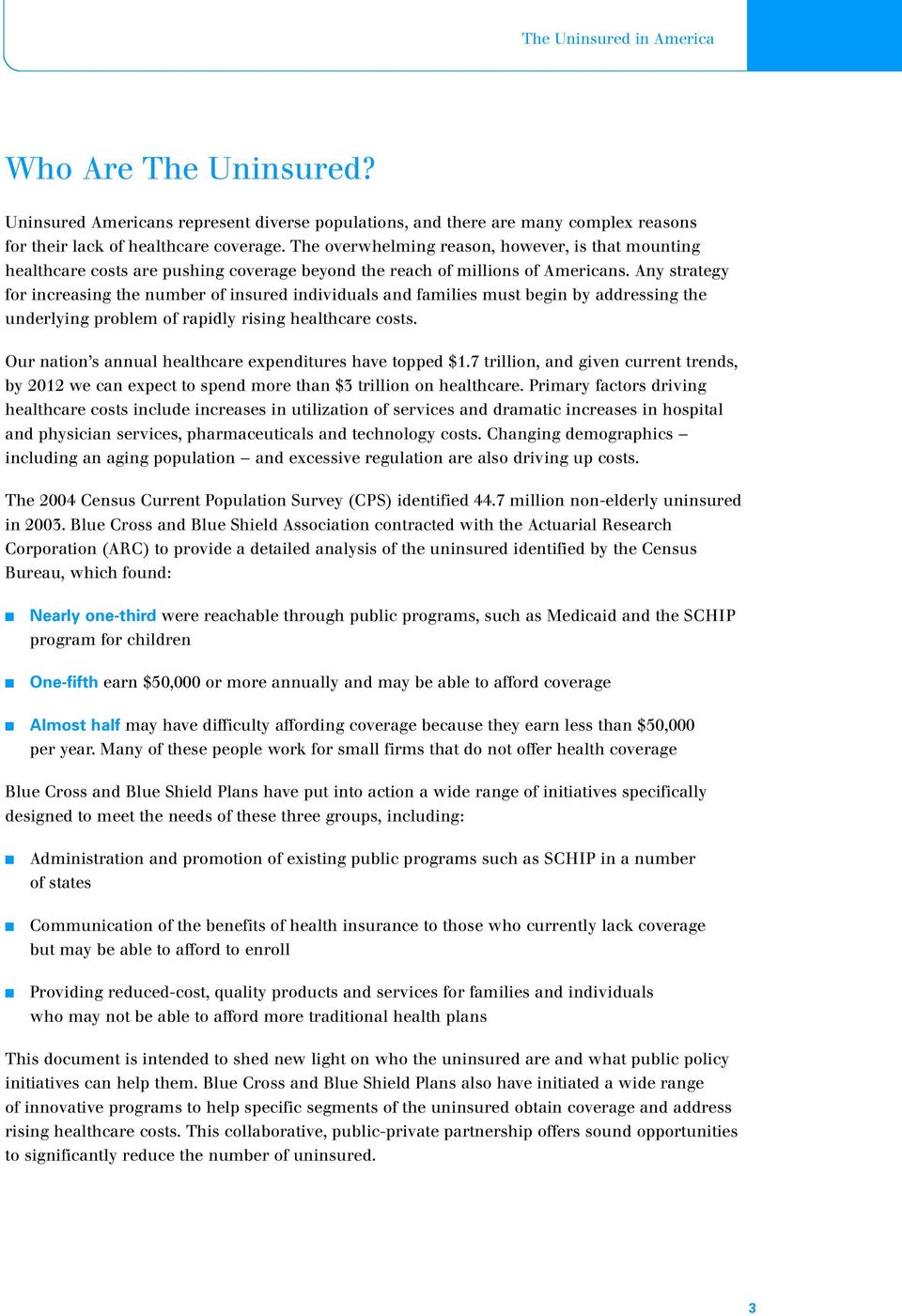
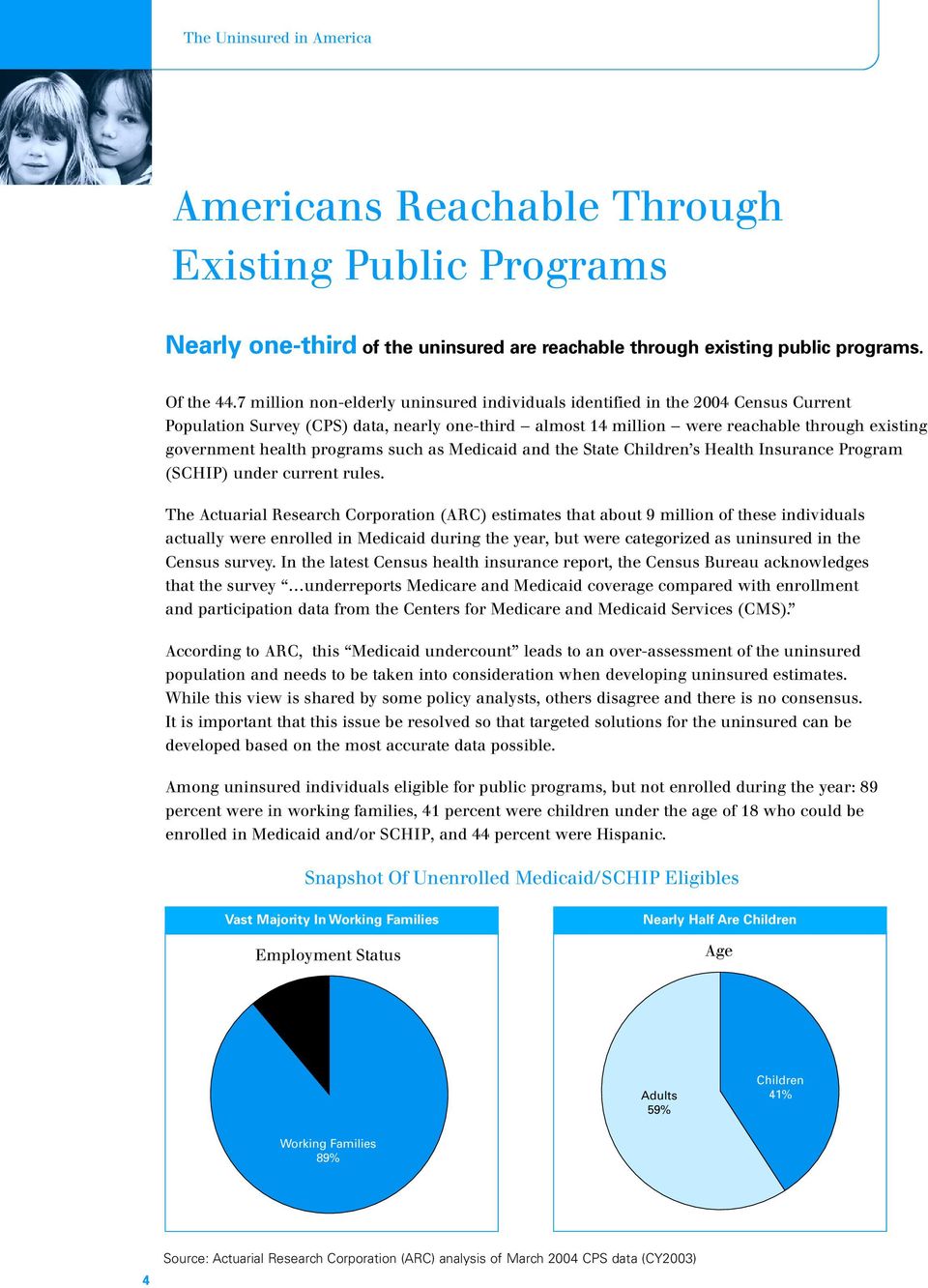
6 Americans Reachable Through Existing Public Programs Nearly one-third of the uninsured are reachable through existing public programs. Of the 44.7 million non-elderly uninsured individuals identified in the 2004 Census Current Population Survey (CPS) data, nearly one-third almost 14 million were reachable through existing government health programs such as Medicaid and the State Children s Health Insurance Program (SCHIP) under current rules. The Actuarial Research Corporation (ARC) estimates that about 9 million of these individuals actually were enrolled in Medicaid during the year, but were categorized as uninsured in the Census survey. In the latest Census health insurance report, the Census Bureau acknowledges that the survey underreports Medicare and Medicaid coverage compared with enrollment and participation data from the Centers for Medicare and Medicaid Services (CMS). According to ARC, this Medicaid undercount leads to an over-assessment of the uninsured population and needs to be taken into consideration when developing uninsured estimates. While this view is shared by some policy analysts, others disagree and there is no consensus. It is important that this issue be resolved so that targeted solutions for the uninsured can be developed based on the most accurate data possible. Among uninsured individuals eligible for public programs, but not enrolled during the year: 89 percent were in working families, 41 percent were children under the age of 18 who could be enrolled in Medicaid and/or SCHIP, and 44 percent were Hispanic. Snapshot Of Unenrolled Medicaid/SCHIP Eligibles Vast Majority In Working Families Employment Status Nearly Half Are Children Age Adults 59% Children 41% Working Families 89% 4 Source: Actuarial Research Corporation (ARC) analysis of March 2004 CPS data (CY2003)
7 There are several reasons for the lack of enrollment in public programs. Some may be unaware they are eligible for these programs. Others may perceive a stigma associated with government programs. Still others may be unable to maneuver through complicated application procedures, extensive paperwork and language barriers. Blue Cross and Blue Shield initiatives that encourage participation: Blue Cross of California provides free health information through Spanish-speaking representatives at the Mexican Consulate's "Ventanilla de Salud" (Health Window). The Health Window helps consumers understand the coverage options available to them through California's Healthy Families (SCHIP) and Medi-Cal programs and how to apply for them. In addition, the program benefits thousands of Mexicans living in California who now are encouraged to apply for private health insurance. Blue Cross and Blue Shield of Alabama administers Alabama's State Children's Health Insurance Program (SCHIP) while offering, through the Alabama Child Caring Foundation, free coverage to low-income children who are ineligible for state-funded programs. Benefits include outpatient visits and procedures, immunizations, emergency care, vision care and drugs administered in an outpatient setting. Since the Foundation was established in 1987, 47,000 previously uninsured children have been covered. Wellmark Blue Cross and Blue Shield supports Iowa s State Children s Health Insurance Program (SCHIP) by covering eligible children in those counties where no managed care plans exist, while its affiliated private charity, The Wellmark Foundation, awards nearly $1 million annually in grants to community healthcare initiatives in Iowa and South Dakota. The Foundation provides first-dollar, or seed money, to non-profit organizations to help local communities establish or expand healthcare projects that impact health status. 5
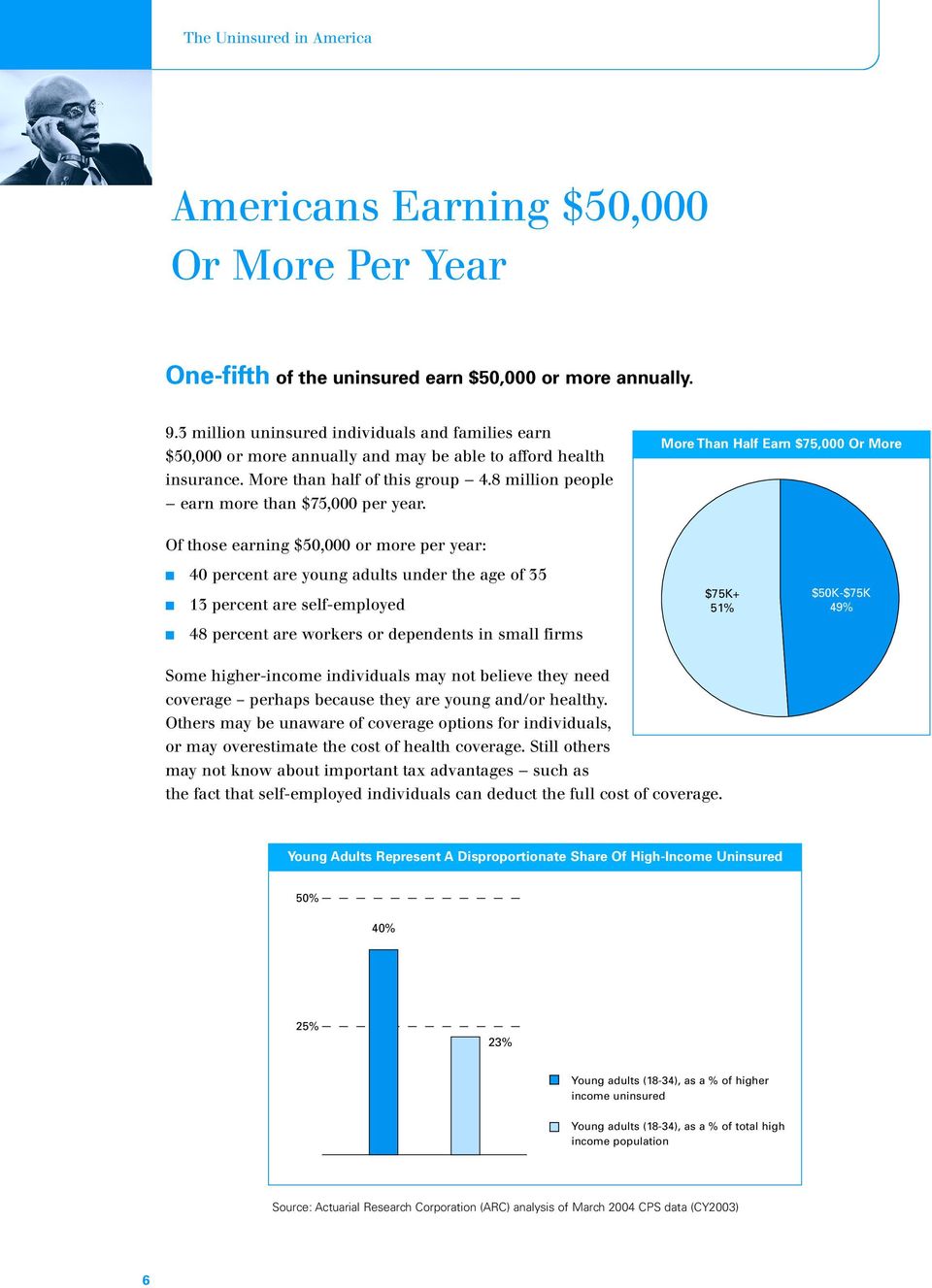
8 Americans Earning $50,000 Or More Per Year One-fifth of the uninsured earn $50,000 or more annually. 9.3 million uninsured individuals and families earn $50,000 or more annually and may be able to afford health insurance. More than half of this group 4.8 million people earn more than $75,000 per year. More Than Half Earn $75,000 Or More Of those earning $50,000 or more per year: 40 percent are young adults under the age of percent are self-employed $75K+ 51% $50K-$75K 49% 48 percent are workers or dependents in small firms Some higher-income individuals may not believe they need coverage perhaps because they are young and/or healthy. Others may be unaware of coverage options for individuals, or may overestimate the cost of health coverage. Still others may not know about important tax advantages such as the fact that self-employed individuals can deduct the full cost of coverage. Young Adults Represent A Disproportionate Share Of High-Income Uninsured 50% 40% 25% 23% Young adults (18-34), as a % of higher income uninsured Young adults (18-34), as a % of total high income population Source: Actuarial Research Corporation (ARC) analysis of March 2004 CPS data (CY2003) 6
9 Blue Cross and Blue Shield initiatives for the higher-income uninsured: Blue Cross and Blue Shield of Kansas City has addressed one of the major issues for the higher-income uninsured lack of awareness through a series of high-impact communications initiatives. Tom Bowser, the Plan CEO, has published two editorials in the Kansas City Star: Kansas City s Hidden Tax Uninsured Health Care and The Health Care Dollar Where It Goes. In addition, the Plan has executed a Medical Heroes campaign in print that communicates the ultimate benefits of medical care covered by insurance. The campaign highlights cases in which medical care saved lives or made an important difference in patients' lives. Each case ties to, and is co-branded with, an individual hospital. Regence BlueCross BlueShield of Oregon created its Individual Short Term Medical Insurance plan for the significant number of the uninsured who find themselves without coverage for short intervals. The product provides coverage for 30 to 185 days and is designed for individuals and families including those who are between jobs or who are laid off, waiting for employer group coverage, dependents falling off a parent's plan and uninsured children. To be eligible, individuals must be younger than age 65, not eligible for Medicare and not covered under any other hospital or medical plan. 7

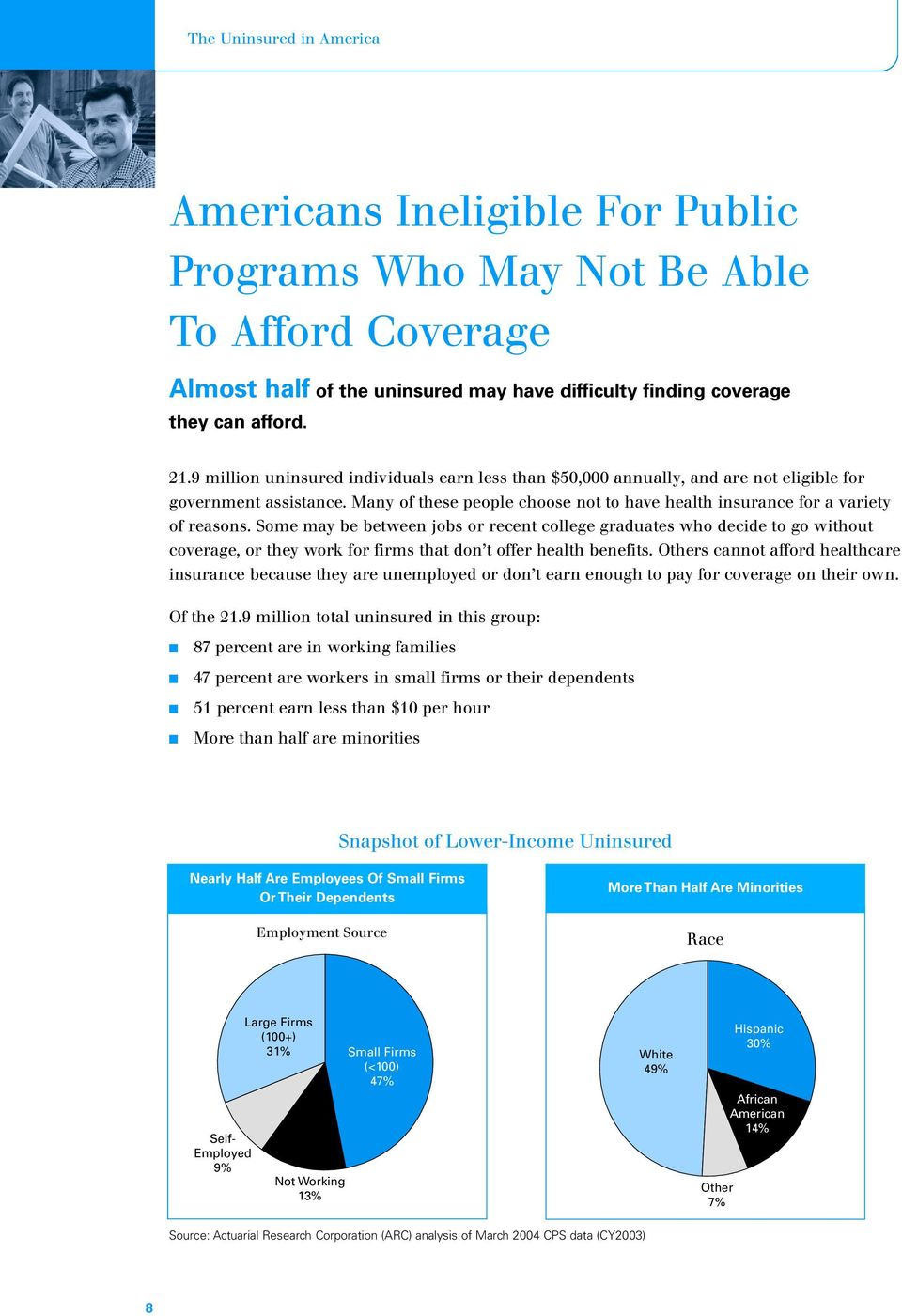
10 Americans Ineligible For Public Programs Who May Not Be Able To Afford Coverage Almost half of the uninsured may have difficulty finding coverage they can afford million uninsured individuals earn less than $50,000 annually, and are not eligible for government assistance. Many of these people choose not to have health insurance for a variety of reasons. Some may be between jobs or recent college graduates who decide to go without coverage, or they work for firms that don t offer health benefits. Others cannot afford healthcare insurance because they are unemployed or don t earn enough to pay for coverage on their own. Of the 21.9 million total uninsured in this group: 87 percent are in working families 47 percent are workers in small firms or their dependents 51 percent earn less than $10 per hour More than half are minorities Snapshot of Lower-Income Uninsured Nearly Half Are Employees Of Small Firms Or Their Dependents Employment Source More Than Half Are Minorities Race Self- Employed 9% Large Firms (100+) 31% Not Working 13% Small Firms (<100) 47% White 49% Other 7% Hispanic 30% African American 14% Source: Actuarial Research Corporation (ARC) analysis of March 2004 CPS data (CY2003) 8
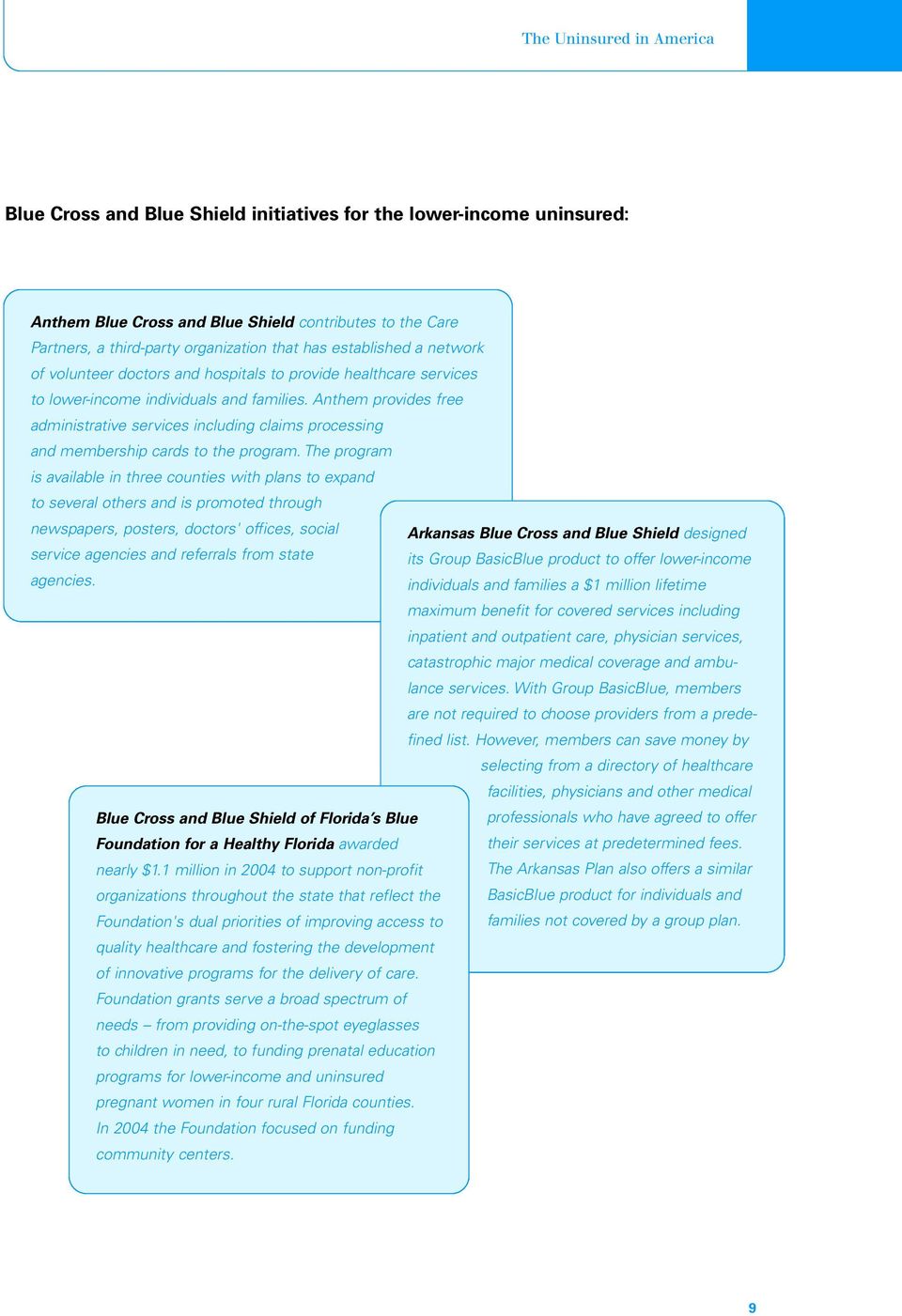
11 Blue Cross and Blue Shield initiatives for the lower-income uninsured: Anthem Blue Cross and Blue Shield contributes to the Care Partners, a third-party organization that has established a network of volunteer doctors and hospitals to provide healthcare services to lower-income individuals and families. Anthem provides free administrative services including claims processing and membership cards to the program. The program is available in three counties with plans to expand to several others and is promoted through newspapers, posters, doctors' offices, social Arkansas Blue Cross and Blue Shield designed service agencies and referrals from state its Group BasicBlue product to offer lower-income agencies. individuals and families a $1 million lifetime maximum benefit for covered services including inpatient and outpatient care, physician services, catastrophic major medical coverage and ambulance services. With Group BasicBlue, members are not required to choose providers from a predefined list. However, members can save money by selecting from a directory of healthcare facilities, physicians and other medical Blue Cross and Blue Shield of Florida s Blue professionals who have agreed to offer Foundation for a Healthy Florida awarded their services at predetermined fees. nearly $1.1 million in 2004 to support non-profit The Arkansas Plan also offers a similar organizations throughout the state that reflect the BasicBlue product for individuals and Foundation's dual priorities of improving access to families not covered by a group plan. quality healthcare and fostering the development of innovative programs for the delivery of care. Foundation grants serve a broad spectrum of needs from providing on-the-spot eyeglasses to children in need, to funding prenatal education programs for lower-income and uninsured pregnant women in four rural Florida counties. In 2004 the Foundation focused on funding community centers. 9
12 More about the uninsured population s circumstances and characteristics.

13 Another Look At The Uninsured In tailoring solutions, it is helpful to recognize that the uninsured share other common characteristics. The uninsured are often: Workers in small firms Young adults (18-34) People in families with part-time and temporary workers Minorities Workers in small firms Low-wage workers in small firms are far more likely to lack coverage than other workers. Sixty-four percent of low-wage workers in firms with fewer than 10 employees lack employer coverage. Firms with fewer than 10 employees have the highest overall uninsured rate, regardless of worker income level. Low-Wage Workers In Small Firms Are The Least Likely To Have Employer-Sponsored Coverage Percent Of Workers Without Employer-Sponsored Coverage 70% 64.2% 60% 57.3% 58.0% 53.8% 50% 45.0% 52.0% 42.7% 48.8% 40% 30% 20% 34.3% 35.0% 22.0% 28.6% 13.9% 35.0% 18.4% Under $7/hour $7-$9.99/hour $10-$14.99/hour $15/hour or more 10% 8.1% 0% < Firm Size Source: Actuarial Research Corporation (ARC) analysis of March 2004 CPS data (CY2003) 11

14 Uninsured Rates Of Small Firms Are Almost 3x Those Of Large Firms Uninsured Rates By Firm Size 30 28% 25 24% 20 18% % of Workers Uninsured 15 13% 11% < Firm Size Source: Actuarial Research Corporation (ARC) analysis of March 2004 CPS data (CY2003) Affordability is the critical barrier to small firms offering coverage. According to recent surveys, 79 percent of small firms not offering coverage cited cost as an issue, and 61 percent said their employees could not afford the premiums. Small Firms Are The Least Likely To Offer Coverage % of Firms Offering Coverage % 92% 99% 80 74% 60 52% < Firm Size Source: Kaiser/HRET Survey of Employer-Sponsored Health Benefits (2004) 12

15 Young adults Adults under age 35 are nearly twice as likely to be uninsured as those 45 and older. They represent 26 percent of the overall population, but 45 percent of those uninsured for a year or more. Young adults may lack coverage for many reasons. They may no longer be covered under a parent's policy or Medicaid, may earn less than older adults, and/or may not believe insurance is needed because they are more likely to be healthy. People in families with part-time and temporary workers Slightly more than 8 million uninsured individuals are in families of part-time or temporary workers. This is due partly to the fact that employment-based coverage is often limited to full-time employees. Frequently, uninsured part-time and temporary workers are young adults (55 percent) or Hispanics (24 percent). More than half of uninsured part-time/temporary workers had annual earnings under $10,000; 89 percent of uninsured part-time/temporary workers had annual earnings under $25,000. Minority groups Hispanics and African Americans represent 15 percent and 13 percent, respectively, of the non-elderly population, but 29 percent and 13 percent, respectively, of the uninsured. Hispanics represent almost one-third of the uninsured population and are disproportionately uninsured across all income levels. Almost all uninsured Hispanics (93 percent) are in working families. Other challenges may include language barriers and lack of awareness of the need for health insurance, as many Hispanics come from countries with national healthcare systems. The vast majority (86 percent) of uninsured African Americans are in working families. More than one-third are small-firm employees or their dependents. African Americans under the poverty level are somewhat less likely to be uninsured than Whites (13 percent vs 21 percent). However, African Americans above the poverty level are more likely to be uninsured than Whites (14 percent vs 10 percent). 13

16 How Blue Cross and Blue Shield Plans are keeping quality healthcare affordable and increasing access to coverage for millions of the uninsured.

17 Blues Take A Leadership Role: Keeping Quality Healthcare Affordable Blue Cross and Blue Shield Plans are leading the effort to increase affordability and expand access in many ways, including: support of federal and state legislation to keep quality healthcare affordable, our BlueWorks program to share what is working in local Blue Plan markets to improve affordability and quality, consumer education programs, research on healthcare cost drivers, and operating efficiently and eliminating waste. Supporting Federal and State Legislation Blue Cross and Blue Shield works with federal and state legislators to advance proposals that make affordable, quality healthcare more readily available. We support the following measures, among others: Federal regulatory and legislative actions to ensure consumers have access to safe, effective and affordable medications Reasonable tort reforms to help control litigation and medical malpractice expenses that add to healthcare costs Clinical/evidence-based determinations of the most effective means of treatment, particularly for drugs and new technologies Development of a national strategy on healthcare information technology standards by the Commission on System Interoperability under the Medicare Modernization Act Adequate funding for federal and state healthcare programs such as Medicare and Medicaid BlueWorks A first-of-its-kind partnership between Blue Cross and Blue Shield and Harvard Medical School, the BlueWorks program identifies and promotes Blue Plan initiatives that succeed at improving affordability and quality. BlueWorks concentrates on efforts to: Partner with physicians and hospitals to offer providers incentives based on improving quality and efficiency Create safe and affordable product and service options (e.g., pharmaceutical benefits) for consumers and employers Engage consumers by providing them with better information, incentives and access to programs that can help them control costs 15

18 BlueWorks Award-Winning Programs Selected by Harvard Medical School Researchers We at the Harvard Medical School are pleased to be contributing to the Blue Cross and Blue Shield Association s BlueWorks campaign an effort to focus on programs currently at work in local markets nationwide to keep quality healthcare affordable We believe the program has the potential of making real and meaningful improvements in the nation s healthcare system. V E R I TAS ~ Harvard Medical School Researchers Incenting Quality Blue Cross of California partnered with local organizations and developed bilingual materials in 11 languages on childhood asthma, and arranged for members to meet with pharmacists to discuss medication dosage and administration. Blue Cross of Northeastern Pennsylvania partnered with a non-profit healthcare network to provide affordable, accessible care to patients with mental, alcohol and substance abuse issues. Blue Cross and Blue Shield of Illinois established a quality improvement program that rewards physician groups that help to manage the rate of hospital admissions for influenza and pneumonia. Blue Cross and Blue Shield of Massachusetts provides doctors with educational tools and materials and offers them payments based on performance to improve the quality of preventive care for members. Blue Cross Blue Shield of Michigan created a database that generates evidence-based guidelines for angioplasty and related procedures, resulting in lower mortality rates, and millions of dollars saved due to fewer complications. Excellus BlueCross BlueShield uses community-wide clinical guidelines, practitioner performance profiles and other systems to improve quality for 370,000 enrollees in the Rochester area. Highmark Blue Cross Blue Shield encouraged a sharing of best practices among doctors, leading 88 percent of participating physicians to report an improved ability to care for patients while controlling costs. 16

19 Keeping Drugs Safe and Affordable Anthem Blue Cross and Blue Shield reduced narcotic abuse up to 25% by establishing a tracking program that monitors members pharmacy claims for these drugs and gives prescription providers member-specific profiles on their total drug use. Blue Cross of California, Blue Cross and Blue Shield of Georgia, and Blue Cross and Blue Shield of Missouri launched a program to educate consumers and providers about generic drugs through informative communications and waived or discounted co-pays. Blue Cross Blue Shield of Florida developed a series of mailings targeting members undergoing drug therapy for venous thromboembolic disease (VTE) informing them that lab testing and doctor follow-up are crucial for effective treatment of this disease. Premera Blue Cross encouraged physician review of medications for members taking five or more drugs, resulting in prescription refinements for one of every three targeted members. Engaging Consumers Anthem Blue Cross and Blue Shield developed a program that increases adherence to accepted standards of care by directly involving members and their families in the creation of a care plan for chronic conditions such as diabetes or congestive heart failure. Blue Shield of California has enabled more than 1,000 physicians and all their Plan enrollees to interact regarding non-urgent medical needs and save time and money through online communication of treatment guidelines, education or prescriptions. Blue Cross and Blue Shield of Montana collaborated with community members to enhance the effectiveness of the Helena Indian Alliance's clinic for low-income Native Americans through funding, IT upgrades and other initiatives. Excellus BlueCross BlueShield partnered with the Ibero-American Action League in the Rochester area to enroll uninsured Hispanics not already under a doctor's care and facilitate communication with the Hispanic community. Highmark Blue Cross Blue Shield became the first health insurer in the U.S. to offer, as a covered benefit, the Dr. Dean Ornish Program for Reversing Heart Disease, which works through nutrition, exercise and stress management. Horizon Blue Cross and Blue Shield of New Jersey implemented a computerized phone call system to recognize members preventive care needs and remind them to schedule important services. Horizon Blue Cross and Blue Shield of New Jersey created a literacy program that helped more than 1,000 children improve their reading skills while learning about the benefits of healthy lifestyle choices. 17

20 Consumer Programs The Blue Cross and Blue Shield System launched WalkingWorks to encourage healthier lifestyles and combat obesity and related diseases. Children and adults in communities served by Blue Cross and Blue Shield companies are walking their way to better health across America. WalkingWorks was developed in collaboration with the President s Council on Physical Fitness and Sports and the Congressional Fitness Caucus. Blue Cross and Blue Shield Plans are working with employers to educate their employees about how to improve their health and that of their families, while holding down personal costs. These consumer-directed messaging campaigns include communications especially tailored for employers to use with their workers, such as newsletters, paycheck flyers, worksite posters and online communications available to employees and their families. Operating Efficiently and Eliminating Waste and Fraud Blue Cross and Blue Shield Plans are working to eliminate waste and fraud and hold down our own administrative costs. For example, last year, Blue Cross and Blue Shield companies investigated 20,000 fraud cases, saving our subscribers more than $240 million. To step up the fight against healthcare fraud, we launched a special anti-fraud strike force made up of our top fraud investigators to work with the FBI and other national state and local law enforcement agencies. To help our subscribers fight back, we are educating consumers through a new annual Consumer Guide on Healthcare Fraud. And we established a new nationwide toll-free hotline and a special Web address for consumers to turn to take action if they feel they are being cheated. In addition, Blue Plans are continuing to eliminate waste in the healthcare system and we are investing in new technologies to improve customer service and reduce our own business and administrative operating expenses. On average, Blue Plans pay out more than 86 percent of their premium dollars in Blue Cross and Blue Shield of Louisiana saved almost $250,000 subscriber claims, while by identifying a medical lab that was conducting various heart monitoring tests for many different physicians and billing at a higher level maintaining industry-low administrative operating of service than actually performed. Specialized software allowed expenses of only about 11 percent. the Plan to compare the charges with those of other labs. The case represented nearly 8 percent of the Plan s total recovery and savings efforts of $3.3 million in

21 Research on Healthcare Cost Drivers As part of our campaign to keep quality healthcare affordable and reduce the number of uninsured Americans, Blue Plans have commissioned a comprehensive series of research studies examining healthcare cost drivers. Leading researchers from top academic institutions and private research firms have investigated numerous cost drivers across the industry over the last two years to help us better understand: Factors driving up physician costs as well as inpatient and outpatient hospital costs Increasing prescription drug costs The impact of new technology, especially expensive diagnostic imaging such as MRI, CT and PET scanners The mounting costs of federal regulation and the lack of legal reforms to protect physicians from the medical malpractice insurance crisis Health plans administrative costs to help us do a better job of reducing our own business and operating expenses to help keep premiums down. We have shared our research findings with national, state and local stakeholders and policymakers across the country 86 Medical Claims 11 Admin. 3 Profit 19
22 Increasing opportunities for affordable coverage.
23 Blues Propose Tailored Solutions for the Uninsured The Blue Cross and Blue Shield Association has developed a series of options to reduce the number of uninsured by holding the line on costs and helping those who are struggling to afford coverage. The solutions envision a role for both the public and private sectors. Whether someone is uninsured because they have difficulty affording coverage within their family budget, are a low-wage worker in a small firm or are confronted with government paperwork we need to make sure these people get the healthcare they need. Option 1: Helping Low-Wage Workers in Small Firms Option 2: Helping Individuals Struggling with Healthcare Costs Option 3: Helping Those Between Jobs Option 4: Expanding Government Safety Net Option 5: Helping Individuals and Families Through Collaborative Private Initiatives Option 6: Helping States Develop Tailored Initiatives Option 7: Helping States Assure Access to Coverage for Individuals Option 8: Helping States Enroll Low-Income People in Medicaid and SCHIP Option 9: Empowering States to Enroll Medicaid/SCHIP Beneficiaries in Employer Plans Option 10: Educating Americans About the Importance of Being Insured 21
24 Option 1: Helping Low-Wage Workers in Small Firms The federal government would provide a refundable tax credit to small employers with lowwage workers. This option would work in tandem with Option 2 so that low-wage employees would have a refundable tax credit available to help with their share of the premium. Low-wage workers in small firms are less likely to have employer-sponsored coverage than workers in large firms. Small employers are often not able to afford coverage. Even when employers can offer coverage, they may not offer it because they know their employees cannot afford their share of the premiums (Employee Benefit Research Institute, 2000, 2002). About 35 percent of workers in small firms earn less than 250 percent of the poverty level, compared to 23 percent of employees in firms with 100 or more employees. The credit would be limited to firms with lowwage workers to avoid subsidizing those who would be able to afford coverage on their own. Such tax credits are likely to have a significant impact on small employers willingness to offer health coverage. According to a recent survey (EBRI 2000, 2002), 77 percent of uninsured small employers said they would consider offering a health plan if the government provided tax credits to help them pay for coverage. How it might work Michael owns a gasoline station with 10 full-time employees. He selected a health plan to offer to his employees, but the monthly premium of $300 per employee far exceeded his budget that would have allowed him to contribute $100 toward the cost of his employees coverage. Since he knew his employees could not afford to pay $200 a month, he cancelled his insurance application. With a 50 percent tax credit, Michael would be able to offer coverage so that employees only paid one-third of the premium. Michael would pay $100, the tax credit would contribute $100 and the employee would contribute the remaining $
25 Option 2: Helping Individuals Struggling with Healthcare Costs A new kind of refundable federal tax credit would help millions of individuals and families who are hard pressed to pay their health insurance premiums because they do not qualify for government assistance, and health insurance premiums represent a large share of their income. Importantly, the credit would be available on an advanceable basis even to those who do not pay taxes. These innovative tax credits would vary the amount of the federal support depending on the cost of insurance and income. Middle- and lower-income individuals and families whose health insurance premiums exceed five percent of their income would receive a refundable tax credit. The credit would be adjusted by income and calculated based on the amount of their insurance premium that exceeds the income threshold. Individuals with employer sponsored coverage could use the credit to help pay for their share of the premium. Individuals without access to employer coverage could use the tax credit to purchase a policy on their own. The intent of these credits is to assure that no one would have to pay a disproportionately high percentage of their income for health insurance premiums, whether they work in small or large firms, as part-time, full-time or temporary workers, or are self-employed. How it might work Sally is a single 45-year-old earning just under $14,000 per year working part-time in a department store. She is uninsured because her employer does not offer coverage to part-time workers, and she cannot afford to pay the $200 monthly premium for an individual policy. Under this proposal, Sally would be eligible for a tax credit equal to $114 per month, reducing her cost to $86 per month. John is a married father of two who earns $47,000 per year. He cannot afford the $400 monthly premium contribution for a family policy required by his employer. However, John could afford the $257 monthly contribution that would result if a tax credit for individuals whose premiums exceed 5 percent of their income were available. 23
26 Option 3: Helping Those Between Jobs A refundable federal tax credit would help people who are between jobs and who qualify for state unemployment assistance to pay their health insurance premiums. This tax credit would be offered through an expansion of the current tax credit available to those who have lost their jobs because of international trade policy. The tax credit of 65 percent of the cost of qualified coverage would help these people keep their healthcare coverage while they seek other employment. The credit could be used to pay for the previous employer s policy under COBRA, the spouse s employer coverage or other coverage available through the state. In recognition of cash flow problems faced by people who are unemployed, the credit could be available to pay premiums upfront rather than claimed on an individual s tax return. How it might work Suzanne is a single unemployed computer programmer who lost her health insurance when her company eliminated her division last month. She didn t elect COBRA coverage because she couldn t afford to pay the $300 monthly premium. Under this proposal, the 65 percent tax credit would lower her premium to just over $100 per month and she would receive the subsidy on a monthly basis. Option 4: Expanding Government Safety Net The State Children s Health Insurance Program (SCHIP) would be extended to everyone with incomes at or below the federal poverty level ($9,310 annually for individuals/$18,850 annually for a family of four in 2004) and not already eligible for Medicaid. This would ensure that the government can help those who are truly in need. Currently, eligibility rules for Medicaid and SCHIP vary by state and do not assure that all individuals below poverty are covered. Those most frequently ineligible for coverage are childless adults. Federal funding would be provided to the states to cover 100 percent of the additional costs to enroll these individuals in SCHIP. In order to qualify for these additional funds, states would purchase employer-offered coverage by paying the employee s share of premium wherever available. How it might work Tom is a single 57-year-old former textile worker whose mill has closed. He can now only find part-time work earning $8,500 per year. He is uninsured because he does not qualify for Medicaid (despite the fact that his income is below the federal poverty level), and he is not eligible for employer coverage because of his part-time status. Under this proposal, Tom would be eligible for coverage under the SCHIP program. 24
27 Option 5: Helping Individuals and Families Through Collaborative Private Initiatives A new federal grant program would encourage innovative partnerships between insurers, physicians and hospitals to develop low-cost insurance products for uninsured individuals and their families. These partnerships would use new benefit design options, discounted fees or other methods to provide lower cost options. Partnerships already created between Blue Cross and Blue Shield Plans and their local physicians are examples of initiatives to reach out to the uninsured. How it might work John is a 42-year-old married father of two children who started his own graphics design consulting business last year in Montana. He earns about $33,000 per year and cannot afford the $497 monthly premium for a nongroup policy. Through an innovative product, Blue Care, developed recently by a statewide coalition of physicians, hospitals and Blue Cross and Blue Shield of Montana, John would qualify for family coverage that costs less than $241/month. The lower costs are the result of deep discounts that were negotiated with hospitals and physicians. Option 6: Helping States Develop Tailored Initiatives Recognizing that the states may have unique uninsured populations, a new federal grant program would allow states to develop their own initiatives. For example, some states might want to develop a special strategy to improve coverage for migrant workers, while others may want to focus on a rural strategy or improving support for community health centers. How it might work A series of small towns located in California would like to address the healthcare needs of migrant workers who seasonally move through their communities. Although each town has committed to fund the program on an ongoing basis, they lack the start-up funds to initiate the project. Under this proposal, federal grants would be available to jumpstart this program. 25
28 Option 7: Helping States Assure Access to Coverage for Individuals Federal funding for state high risk pools would be made permanent and would cover at least 50 percent of pools annual operating losses. In addition, federal grants would be made available to help states start up new pools. Thirty-two states have active high risk pools that offer subsidized coverage to individuals with serious health conditions. Most pools fund these subsidies through assessments on individual and small group insurance sold in their state. Federal funding for state high risk pools was made available for two years through the Trade Act of 2002, but expired in Increased federal funding would help ensure that individuals have access to coverage and help relieve the current assessment burden on individuals and small employers. Seed money grants would help those states without risk pools to establish them. Option 8: Helping States Enroll Low-Income People in Medicaid and SCHIP In order to enroll the more than 4 million adults and children who could be covered by Medicaid and/or SCHIP under current rules, the federal government would provide states with increased funding to improve their outreach programs. States would be encouraged to share best practices in effective outreach initiatives. There should be special emphasis on multi-lingual projects. In addition, states would be encouraged to streamline enrollment requirements. Possible actions could include: Simplifying enrollment forms and processes Eliminating burdensome requirements for verifying income and residency Decreasing the number of face-to-face interviews for periodic re-determination of eligibility Increasing Medicaid/SCHIP eligibility staff in hospitals and clinics How it might work Joe is a father of four who earns $15,000 a year as a truck driver for a small company. His entire family is eligible for public coverage, but when he tried to apply, he found the forms too confusing and was unable to supply the necessary documentation. Under this initiative, best practices like simplified enrollment would be shared among states. 26
29 Option 9: Empowering States to Enroll Medicaid/SCHIP Beneficiaries in Employer Plans The federal government would make it easier for states to pay the employee premium for children of working parents whose children are eligible for Medicaid and/or SCHIP, as an alternative to enrolling them in public programs. How it might work In addition, states would be allowed to pay the premium not only Courtney is a single mother of two for the SCHIP-eligible children, but also for low income parents young children earning $15,000 who are not otherwise eligible for public programs. The federal government would pay 100 percent of these additional costs. a year. Her children are covered through SCHIP, but she is not eligible One reason some families are not enrolled in Medicaid and for the program. She works for SCHIP programs is the perception of a stigma related to a hotel that offers health coverage, enrollment in a public program. Many of these families have but she cannot afford to pay $200 employer coverage available to them, but they cannot afford per month for her premium. Under their share of the premium. Currently, states must meet special this proposal, the federal government rules or obtain special waivers from the federal government to would pay for Courtney and her enroll children in their parent s employer plan. children to receive coverage from Allowing states to purchase employer offered coverage has her employer. many advantages. These families would be enrolled in private plans in the same policy as their coworkers, they would most likely have access to a broader network of physicians and the states would be able to leverage their funds by paying only the employee share of the premium instead of the full cost of the public program. 27
30 Option 10: Educating Americans About the Importance of Being Insured As highlighted earlier, 9 million of the uninsured are working individuals and families earning $50,000 or more annually and may be able to afford health insurance. Many of these are young and healthy, but do not have insurance to protect their health or pay the cost of care if disaster strikes. To encourage all Americans to purchase coverage, the government and the private sector should partner to launch a broad-based educational campaign on the importance of insurance, the risks both health and financial associated with being uninsured and the options available in the marketplace. This initiative would tailor its messages to key uninsured populations. Our health insurance system works best when everyone is enrolled. That means there are more of us participating in the benefits and sharing the costs. How it might work Miguel is a 25-year-old accountant who earns $65,000 per year and lives in Houston. He grew up in Mexico, but moved to the U.S. to attend college. While his employer offers health insurance and contributes to the cost of coverage, Miguel declined the coverage in favor of higher retirement contributions. Under this initiative, Miguel might be encouraged to enroll in his employer s health plan after listening to a program on a Hispanic radio station that highlighted the risks of remaining uninsured, such as the cost of a sudden illness or accident. 28
31 Moving Forward Blue Cross and Blue Shield calls on federal policymakers to step up to the challenge of stemming the growing ranks of uninsured Americans, and we offer the following road map for consideration: Strategies to Improve Enrollment in Public Programs: funding for improved outreach, streamlined enrollment and incentives for states to use Medicaid/SCHIP funds for employer coverage of low-wage workers, allowing families to be covered on a single policy Outreach to Urge Higher Income Individuals to Participate in Coverage: a broad-based public education campaign on the importance of insurance, the risks associated with being uninsured and options available in the marketplace Subsidies to Address Affordability Issues: tax credits for small employers with low-wage workers, a new tax credit for individuals tied to both the cost of coverage and the individual s income, tax credits for the unemployed, expansion of Medicaid and SCHIP to all individuals with incomes below poverty and federal grants for both private uninsured initiatives and targeted state initiatives Taken together, these proposals could reduce the 44.7 million uninsured by as much as two-thirds. The diverse array of approaches is tailored to those in need while preserving a system that works for the majority of Americans. While current economic pressures on all levels of government may make action on all of our proposals difficult at this time, we urge policymakers to enact those initiatives that are the most affordable, beginning with the tax credit proposal for small employers. Reducing the number of the uninsured will provide greater security for all of us by ensuring we can obtain reliable coverage under any circumstances. For 75 Years, Blue Cross and Blue Shield Plans have taken a leadership role in protecting the health interests of Americans. Our goal now is clearer than ever: to make quality healthcare more affordable and accessible. The time for action is now. 29
32 225 N Michigan Avenue Chicago, Illinois G Street, N.W. Washington, D.C January 2005 W
Medicaid Topics Impact of Medicare Dual Eligibles Stephen Wilhide, Consultant
 Medicaid Topics Impact of Medicare Dual Eligibles Stephen Wilhide, Consultant Issue Summary The term dual eligible refers to the almost 7.5 milion low-income older individuals or younger persons with disabilities
ASSESSING THE RESULTS
 HEALTH REFORM IN MASSACHUSETTS EXPANDING TO HEALTH INSURANCE ASSESSING THE RESULTS March 2014 Health Reform in Massachusetts, Expanding Access to Health Insurance Coverage: Assessing the Results pulls
Sources of Health Insurance Coverage in Georgia 2007-2008
 Sources of Health Insurance Coverage in Georgia 2007-2008 Tabulations of the March 2008 Annual Social and Economic Supplement to the Current Population Survey and The 2008 Georgia Population Survey William
IMPROVING CHILDREN S HEALTH: A Chartbook About the Roles of Medicaid and SCHIP by Leighton Ku and Sashi Nimalendran
 Summary IMPROVING CHILDREN S HEALTH: A Chartbook About the Roles of Medicaid and SCHIP by Leighton Ku and Sashi Nimalendran This chartbook summarizes numerous recent research findings about children who
How Health Reform Will Help Children with Mental Health Needs
 How Health Reform Will Help Children with Mental Health Needs The new health care reform law, called the Affordable Care Act (or ACA), will give children who have mental health needs better access to the
How To Improve Health Care For All
 TIMELINE FOR IMPLEMENTATION OF THE AFFORDABLE CARE ACT 2010: NEW CONSUMER PROTECTIONS Eliminated pre-existing coverage exclusions for children: under age 19. Prohibited insurers from dropping coverage:
Division of Medical Assistance Programs
 January 23-24, 2007 CLIENTS WE SERVE Medicaid eligibility is limited to individuals who fall into specified categories and who are in financial need. The federal Medicaid statute identifies over 25 different
Ohio Health Plans. Maximizing best practices & leading reform efforts. Search. Ohio Association of Health Plans
 Ohio Association of Health Plans File Edit View History Bookmarks Tools Window Help http://www.oahp.com Ohio Health Plans Search Maximizing best practices & leading reform efforts HELPING OHIOANS GET NEEDED
Your guide to finding the best health insurance plan.
 LIFE HAS OPPORTUNITIES Your guide to finding the best health insurance plan. Start saving today with the help of Excellus BlueCross BlueShield. National strength. Local focus. Individual care. SM Contents
Open Enrollment. and Summary of Material Modifications. prepared for
 2016 Open Enrollment and Summary of Material Modifications prepared for Medical/Vision, Dental, Disability, Life/AD&D, Flexible Spending Accounts, Employee Assistance Program 2016 Open Enrollment and Summary
Young Adults and the Affordable Care Act: Protecting Young Adults and Eliminating Burdens on Businesses and Families
 Young Adults and the Affordable Care Act: Protecting Young Adults and Eliminating Burdens on Businesses and Families Q: How does the Affordable Care Act help young adults? A: Before the President signed
How Non-Group Health Coverage Varies with Income
 How Non-Group Health Coverage Varies with Income February 2008 Policy makers at the state and federal levels are considering proposals to subsidize the direct purchase of health insurance as a way to reduce
Programs. Summary of State Programs and Laws Highlighted in Faces of Maryland s Newly Insured. Medical Assistance for Families (SB 6)
 Programs Summary of State Programs and Laws Highlighted in Faces of Maryland s Newly Insured Medical Assistance for Families (SB 6) Medical Assistance for Families provides full health care insurance to
Health Care in Rural America
 Health Care in Rural America Health care in rural communities has many aspects access to physicians, dentists, nurses, and mental health services; the financial circumstances of rural hospitals; federal
Non-Group Health Insurance: Many Insured Americans with High Out-of-Pocket Costs Forgo Needed Health Care
 Affordable Care Act Non-Group Health Insurance: Many Insured Americans with High Out-of-Pocket Costs Forgo Needed Health Care SPECIAL REPORT / MAY 2015 WWW.FAMILIESUSA.ORG Executive Summary Since its passage
America s Health Insurance Plans. Guaranteeing Access. to Coverage for All Americans
 America s Health Insurance Plans Guaranteeing Access to Coverage for All Americans Our Commitment The members of (AHIP) believe that all Americans regardless of health status or income should have access
The Health Insurance Marketplace 101
 The Health Insurance Marketplace 101 National Newspaper Association 127th Annual Convention & Trade Show September 13, 2013 Office of the Regional Director Community Resource California-Based Arizona,
Understanding the Affordable Care Act
 Understanding the Affordable Care Act The Affordable Care Act (officially called the Patient Protection and Affordable Care Act) is the law that mandates that everyone in the United States maintain health
GAO HEALTH INSURANCE. Characteristics and Trends in the Uninsured Population. Testimony. Before the Committee on Finance, U.S.
 GAO United States General Accounting Office Testimony Before the Committee on Finance, U.S. Senate For Release on Delivery Expected at 2:30 p.m. Tuesday, March 13, 2001 HEALTH INSURANCE Characteristics
Racial and ethnic health disparities continue
 From Families USA Minority Health Initiatives May 2010 Moving toward Health Equity: Health Reform Creates a Foundation for Eliminating Disparities Racial and ethnic health disparities continue to persist
Summary of Federal SCHIP Reauthorization, Economic Stimulus, and Health Care Reform Bills and Proposals
 Summary of Federal SCHIP Reauthorization, Economic Stimulus, and Health Care Reform Bills and Proposals I. Children s Health Insurance Program (CHIP) Reauthorization Act of 2009 A. Funding for CHIP. The
Strategies For Improving Access To Mental Health Services In SCHIP Programs
 May 2006 Strategies For Improving Access To Mental Health Services In SCHIP Programs Prepared by: Jennifer May Children and adolescents experience substantial barriers to obtaining needed mental health
National Training Program
 National Training Program Module 12 Medicaid and the Children s Health Insurance Program Session Objectives This session will help you Describe eligibility, benefits, and administration of Medicaid Define
Stable and Secure Health Care for America: The Benefits of Health Insurance Reform: Table of Contents
 Stable and Secure Health Care for America: The Benefits of Health Insurance Reform: Table of Contents HEALTH INSURANCE CONSUMER PROTECTIONS... 1 STABLE AND SECURE HEALTH CARE FOR AMERICA... 2 HEALTH INSURANCE
Key Features of the Affordable Care Act, By Year
 Page 1 of 10 Key Features of the Affordable Care Act, By Year On March 23, 2010, President Obama signed the Affordable Care Act. The law puts in place comprehensive health insurance reforms that will roll
An Internist s Practical Guide to Understanding Health System Reform
 An Internist s Practical Guide to Understanding Health System Reform Prepared by: ACP s Division of Governmental Affairs and Public Policy Updated October 2013 How to cite this guide: American College
The Uninsured Population in Texas:
 REPORT The Uninsured Population in Texas: July 2014 Understanding Coverage Needs and the Potential Impact of the Affordable Care Act Prepared by: Katherine Young and Rachel Garfield Kaiser Family Foundation
Health Insurance Reform at a Glance Implementation Timeline
 Health Insurance Reform at a Glance Implementation Timeline 2010 Access to Insurance for Uninsured Americans with a Pre-Existing Condition. Provides uninsured Americans with pre-existing conditions access
Medicare- Medicaid Enrollee State Profile
 Medicare- Medicaid Enrollee State Profile The National Summary Centers for Medicare & Medicaid Services Introduction... 1 Data Source and General Notes... 2 Types and Ages of Medicare-Medicaid Enrollees...
Profile of Rural Health Insurance Coverage
 Profile of Rural Health Insurance Coverage A Chartbook R H R C Rural Health Research & Policy Centers Funded by the Federal Office of Rural Health Policy www.ruralhealthresearch.org UNIVERSITY OF SOUTHERN
Senate Bill No. 2 CHAPTER 673
 Senate Bill No. 2 CHAPTER 673 An act to amend Section 6254 of the Government Code, to add Article 3.11 (commencing with Section 1357.20) to Chapter 2.2 of Division 2 of the Health and Safety Code, to add
california Health Care Almanac California s Uninsured
 california Health Care Almanac december 2011 Introduction Over the past two decades, California has seen an increase in the percentage of people who are uninsured. California now has the largest number
How To Get A New Bronwell Drug Plan
 Questions and Answers New Brunswick Drug Plan December 10, 2013 1) What is the New Brunswick Drug Plan? The New Brunswick Drug Plan is a prescription drug insurance plan that provides drug coverage for
Changes in the Cost of Medicare Prescription Drug Plans, 2007-2008
 Issue Brief November 2007 Changes in the Cost of Medicare Prescription Drug Plans, 2007-2008 BY JOSHUA LANIER AND DEAN BAKER* The average premium for Medicare Part D prescription drug plans rose by 24.5
Health Care Reform Frequently Asked Questions
 Health Care Reform Frequently Asked Questions On March 23, 2010, President Obama signed federal health care reform into law, also known as the Patient Protection and Affordability Act. A second, or reconciliation
AARP S MEDICARE GUIDE FOR FAMILY CAREGIVERS
 AARP S MEDICARE GUIDE FOR FAMILY CAREGIVERS CONTENTS 5 About Medicare 7 A Little More About Your Choices 8 Medicare Prescription Drug Coverage 9 Where to Start 14 Medicare Glossary 2015. Reprinting with
Transforming Health Care: American Attitudes On Shared Stewardship
 Transforming Health Care: American Attitudes On Shared Stewardship An Aspen Institute- Survey Submitted by zogby international may 2008 2008 Report Overview A new Aspen Institute/Zogby interactive survey
GAO HEALTH INSURANCE. Report to the Committee on Health, Education, Labor, and Pensions, U.S. Senate. United States Government Accountability Office
 GAO United States Government Accountability Office Report to the Committee on Health, Education, Labor, and Pensions, U.S. Senate March 2008 HEALTH INSURANCE Most College Students Are Covered through Employer-Sponsored
FINDINGS FROM THE 2014 MASSACHUSETTS HEALTH INSURANCE SURVEY
 CENTER FOR HEALTH INFORMATION AND ANALYSIS FINDINGS FROM THE MASSACHUSETTS HEALTH INSURANCE SURVEY MAY 2015 Prepared by: Laura Skopec and Sharon K. Long, Urban Institute Susan Sherr, David Dutwin, and
Health. Government of New Brunswick Questions and Answers. Page 1 of 8
 Page 1 of 8 Health Government of New Brunswick Questions and Answers 1) What is the New Brunswick Drug Plan? 2) The government s platform committed to a catastrophic drug plan. Is this the same thing?
Strengthening Medicare: Better Health, Better Care, Lower Costs Efforts Will Save Nearly $120 Billion for Medicare Over Five Years.
 Strengthening Medicare: Better Health, Better Care, Lower Costs Efforts Will Save Nearly $120 Billion for Medicare Over Five Years Introduction The Centers for Medicare and Medicaid Services (CMS) and
Center for Medicaid and State Operations SMDL #04-004 JULY 19, 2004. Dear State Medicaid Director:
 DEPARTMENT OF HEALTH & HUMAN SERVICES Centers for Medicare & Medicaid Services 7500 Security Boulevard, Mail Stop S2-26-12 Baltimore, Maryland 21244-1850 Center for Medicaid and State Operations SMDL #04-004
HEALTHCARE REFORM SOLUTIONS. Designing a Pharmacy Benefit for the New Public Health Exchange Consumers
 HEALTHCARE REFORM SOLUTIONS Designing a Pharmacy Benefit for the New Public Health Exchange Consumers FEBRUARY 2013 EXECUTIVE SUMMARY Designing a Pharmacy Benefit for the New Public Health Insurance Exchange
Children s Health Coverage Under the ACA Part III: Issue Diagnosis Evolutionary Challenges
 Children s Health Coverage Under the ACA Part III: Issue Diagnosis Evolutionary Challenges Prepared by Carolina Coleman Funded by the Lucile Packard Foundation for Children s Health January 2014 This brief
Timeline: Key Feature Implementations of the Affordable Care Act
 Timeline: Key Feature Implementations of the Affordable Care Act The Affordable Care Act, signed on March 23, 2010, puts in place health insurance reforms that will roll out incrementally over the next
Health Care Reform Legislation and You
 (Customizable space for CPA Firm Logo to go here) Health Care Reform Legislation and You Timelines and Implications of the New Law for Individuals Updated as of January 2011 The Health Care Reform Legislation
Access to Coverage and Care: Targeting Implementation of the Affordable Care Act to Improve Health in Connecticut
 AETNA FOUNDATION CHILDREN S FUND OF CONNECTICUT CONNECTICUT HEALTH FOUNDATION DONAGHUE MEDICAL RESEARCH FOUNDATION FOUNDATION FOR COMMUNITY HEALTH UNIVERSAL HEALTH CARE FOUNDATION OF CONNECTICUT KEY Findings:
BENEFITS OF PROPOSED DEMOCRATIC MEDICARE DRUG PROGRAM REFORMS IN NEW YORK S 14TH CONGRESSIONAL DISTRICT
 UNITED STATES HOUSE OF REPRESENTATIVES COMMITTEE ON GOVERNMENT REFORM MINORITY STAFF SPECIAL INVESTIGATIONS DIVISION OCTOBER 2006 BENEFITS OF PROPOSED DEMOCRATIC MEDICARE DRUG PROGRAM REFORMS IN NEW YORK
March 19, 2009. 820 First Street NE, Suite 510 Washington, DC 20002. Tel: 202-408-1080 Fax: 202-408-1056. [email protected] www.cbpp.
 820 First Street NE, Suite 510 Washington, DC 20002 Tel: 202-408-1080 Fax: 202-408-1056 [email protected] www.cbpp.org March 19, 2009 HEALTH REFORM PACKAGE REPRESENTS HISTORIC CHANCE TO EXPAND COVERAGE,
Baucus Framework Senate HELP Bill House Tri-Committee Bill President Obama
 SJR 35: HEALTH CARE Comparison of Selected Elements of the Major Federal Health Care Reform Proposals Prepared for the Children, Families, Health, and Human Services Interim Committee Sept. 11, 2009 Baucus
P a g e 1. Ken Cuccinelli Mental Health Forum Responses
 P a g e 1 Ken Cuccinelli Mental Health Forum Responses 1) Virginians of all ages and situations in life can experience mental health problems. Almost a quarter million adults in Virginia live with co-occurring
The Large Business Guide to Health Care Law
 The Large Business Guide to Health Care Law How the new changes in health care law will affect you and your employees Table of contents Introduction 3 Part I: A general overview of the health care law
Understanding the ObamaCare Health Insurance Plans in North Carolina Understanding Insurance and Affordable Care Act Terminology: ACA- Marketplace
 Understanding the ObamaCare Health Insurance Plans in North Carolina As a result of the Affordable Care Act (a.k.a. ObamaCare) the following provisions are now in place for health insurance policies with
medicaid and the uninsured June 2011 Health Coverage for the Unemployed By Karyn Schwartz and Sonya Streeter
 I S S U E kaiser commission on medicaid and the uninsured June 2011 P A P E R Health Coverage for the Unemployed By Karyn Schwartz and Sonya Streeter In May 2011, 13.9 million people in the U.S. were unemployed,
THE CHARACTERISTICS OF PERSONS REPORTING STATE CHILDREN S HEALTH INSURANCE PROGRAM COVERAGE IN THE MARCH 2001 CURRENT POPULATION SURVEY 1
 THE CHARACTERISTICS OF PERSONS REPORTING STATE CHILDREN S HEALTH INSURANCE PROGRAM COVERAGE IN THE MARCH 2001 CURRENT POPULATION SURVEY 1 Charles Nelson and Robert Mills HHES Division, U.S. Bureau of the
The Patient Protection and Affordable Care Act. Implementation Timeline
 The Patient Protection and Affordable Care Act Implementation Timeline 2009 Credit to Encourage Investment in New Therapies: A two year temporary credit subject to an overall cap of $1 billion to encourage
Supreme Court upholds the Affordable Care Act in its entirety:
 Supreme Court upholds the Affordable Care Act in its entirety: What does this mean for Seniors? The Supreme Court s decision to uphold the Affordable Care Act (ACA) in its entirety is a huge victory for
Health Care Expansion and Reform in Pennsylvania: What Is Driving It, What Are the Proposals, and What Can Be Learned from Other State Initiatives?
 Health Care Expansion and Reform in Pennsylvania: What Is Driving It, What Are the Proposals, and What Can Be Learned from Other State Initiatives? This document presents a summary of Health Care Expansion
Massachusetts has garnered national attention recently for its bipartisan
 Promising Elements of the Massachusetts Approach: A Health Insurance Pool, Individual Mandates, and Federal Tax Subsidies by President Institute for Health Policy Solutions Massachusetts has garnered national
Strengthening Community Health Centers. Provides funds to build new and expand existing community health centers. Effective Fiscal Year 2011.
 Implementation Timeline Reflecting the Affordable Care Act 2010 Access to Insurance for Uninsured Americans with a Pre-Existing Condition. Provides uninsured Americans with pre-existing conditions access
Policy Points. ARHealthNet: Helping Small Businesses Afford Employee Health Coverage. Volume 30, June 2007
 Volume 30, June 2007 Policy Points A publication of the Southern Good Faith Fund Public Policy program ARHealthNet: Helping Small Businesses Afford Employee Health Coverage One in four working-age Arkansans
Consumer Guide to. Health Insurance. Oregon Insurance Division
 Consumer Guide to Health Insurance Oregon Insurance Division The Department of Consumer and Business Services, Oregon s largest business regulatory and consumer protection agency, produced this guide.
Issue Brief: The Health Benefit Exchange and the Small Employer Market
 Issue Brief: The Health Benefit Exchange and the Small Employer Market Overview The federal health care reform law directs states to set up health insurance marketplaces, called Health Benefit Exchanges,
Health Reform and the AAP: What the New Law Means for Children and Pediatricians
 Health Reform and the AAP: What the New Law Means for Children and Pediatricians Throughout the health reform process, the American Academy of Pediatrics has focused on three fundamental priorities for
A Healthy Florida Works Program. Policy Proposal. The smart choice for individuals and businesses in Florida
 A Healthy Florida Works Program Policy Proposal The smart choice for individuals and businesses in Florida TABLE OF CONTENTS Introduction Executive Summary Program Description 3 5 6 Coverage Population
Sources of Health Insurance and Characteristics of the Uninsured: Analysis of the March 2013 Current Population Survey
 September 2013 No. 390 Sources of Health Insurance and Characteristics of the Uninsured: Analysis of the March 2013 Current Population Survey By Paul Fronstin, Ph.D., Employee Benefit Research Institute
While health care reform has its foundation and framework at
 CENTER FOR HEALTHCARE RESEARCH & TRANSFORMATION Policy Brief June 2010 The Patient Protection and Affordable Care Act at the State and Local Level While health care reform has its foundation and framework
Medicare Beneficiaries Out-of-Pocket Spending for Health Care
 Insight on the Issues OCTOBER 2015 Beneficiaries Out-of-Pocket Spending for Health Care Claire Noel-Miller, MPA, PhD AARP Public Policy Institute Half of all beneficiaries in the fee-for-service program
The Factors Fueling Rising Health Care Costs 2008
 The Factors Fueling Rising Health Care Costs 2008 Prepared for America s Health Insurance Plans, December 2008 2008 America s Health Insurance Plans Table of Contents Executive Summary.............................................................2
SENATE BUDGET AND APPROPRIATIONS COMMITTEE STATEMENT TO SENATE COMMITTEE SUBSTITUTE FOR. SENATE, No. 2236 STATE OF NEW JERSEY DATED: JUNE 23, 2005
 SENATE BUDGET AND APPROPRIATIONS COMMITTEE STATEMENT TO SENATE COMMITTEE SUBSTITUTE FOR SENATE, No. 2236 STATE OF NEW JERSEY DATED: JUNE 23, 2005 The Senate Budget and Appropriations Committee reports
Indiana Coalition for Human Services ICHS) Comments on the Healthy Indiana Plan (HIP) 2.0 Waiver Application (submitted 9/20/14)
 Indiana Coalition for Human Services ICHS) Comments on the Healthy Indiana Plan (HIP) 2.0 Waiver Application (submitted 9/20/14) Indiana Coalition for Human Services (ICHS) appreciates the opportunity
Rising Health Care Costs What Factors are Driving Increases?
 Rising Health Care Costs What Factors are Driving Increases? Rising health care costs and access to affordable coverage are prominent issues for Washington employers, health care providers, purchasers,
North Carolina Institute for Early Childhood Professional Development HEALTH INSURANCE: INFORMATION AND TIPS FOR CHILD CARE EMPLOYEES AND EMPLOYERS
 North Carolina Institute for Early Childhood Professional Development HEALTH INSURANCE: INFORMATION AND TIPS FOR CHILD CARE EMPLOYEES AND EMPLOYERS Often times in the early care and education field we