
About the British Heart Foundation
|
|
|
- Lesley King
- 10 years ago
- Views:
Transcription
1 Pacemakers

2 About the British Heart Foundation As the nation s heart charity, we have been funding cutting-edge research that has made a big difference to people s lives. But the landscape of heart disease is changing. More people survive a heart attack than ever before, and that means more people are now living with heart disease and need our help. Our research is powered by your support. Every pound raised, every minute of your time and every donation to our shops will help make a difference to people s lives. If you would like to make a donation, please: call our donation hotline on visit bhf.org.uk/give or post it to us at BHF Customer Services, Lyndon Place, 2096 Coventry Road, Birmingham B26 3YU. For more information, see bhf.org.uk
3 Contents About this booklet... 4 How does the heart beat normally?... 5 Why do I need a pacemaker?... 7 How does a pacemaker work? Which type of pacemaker will I need to have? How is the pacemaker fitted? After having your pacemaker fitted and before you leave hospital Possible complications Everyday life with a pacemaker Can everyday equipment interfere with my pacemaker? Follow-up appointments Temporary pacing How your support can help What is a cardiac arrest? For more information Index Have your say... 63

4 About this booklet This booklet is for people who are about to have, or have already had, a pacemaker implanted. It explains: why you need a pacemaker how a pacemaker works how it is implanted, and what to do, and what not to do, to make sure that your pacemaker works well. Although some people can find it difficult to ignore completely the fact that they have a pacemaker, modern pacemakers are extremely comfortable and reliable. You can be confident that, with appropriate follow-up, very little can go wrong. This booklet does not replace the advice your cardiologist, cardiac physiologist or specialist nurse may give you, but it should help you to understand what they tell you. 4 British Heart Foundation
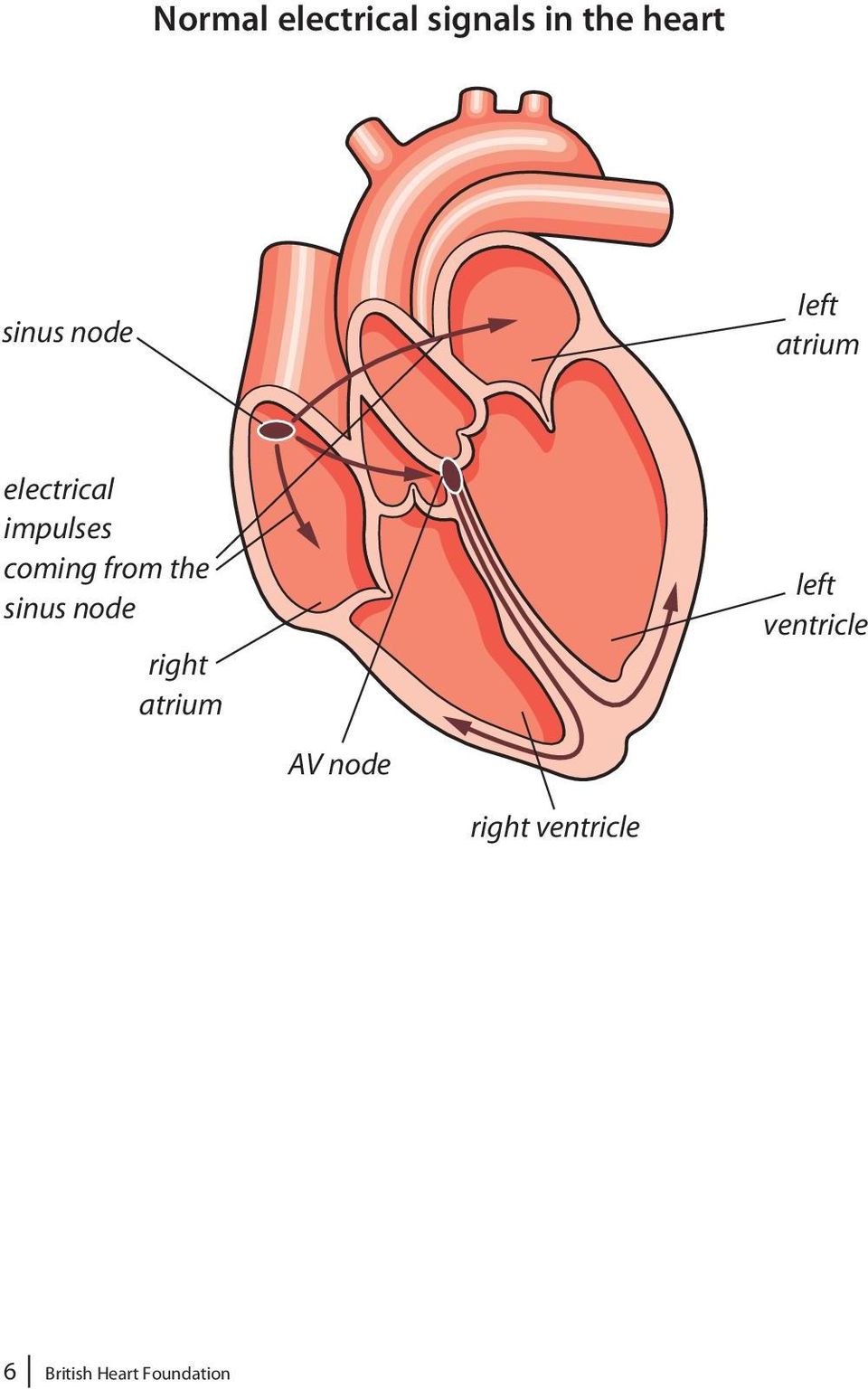
5 How does the heart beat normally? To understand how a pacemaker works, it helps to know how the heart beats normally, and how it pumps blood around your body. A normal adult heart has a regular heartbeat which is usually between 60 and 100 bpm (beats per minute) while you are resting. When you exercise, this may go up to a much higher rate, depending on your age and level of fitness. Your heart has its own natural pacemaker, called the sinus node. This sends out regular electrical impulses that travel through an electrical pathway in the heart, causing the chambers of your heart to contract and pump the blood through the heart and out to your lungs and the rest of your body. (See the illustration on the next page.) This is what causes you to feel a pulse. Pacemakers 5

6 Normal electrical signals in the heart sinus node left atrium electrical impulses coming from the sinus node right atrium AV node left ventricle right ventricle 6 British Heart Foundation
7 Why do I need a pacemaker? If there is a problem with the electrical conduction system in your heart, you may need to have a pacemaker implanted. This could be because you have one of the following conditions. Sick sinus syndrome (sinus node disease) is when the sinus node (your heart s own pacemaker) stops working properly. Heart block (also called AV block or atrioventricular block) is when there is a problem with the AV node. There is a delay or block in the electrical impulses travelling between the atria and the ventricles. Atrial fibrillation is an abnormal and often irregular heart rhythm that originates in your atria (the top two chambers of the heart). The rhythm may be too fast, or too slow. If the atrial fibrillation causes your heart to beat too slowly, you may need a pacemaker. Cardio-inhibitory syncope is when someone collapses and temporarily loses consciousness. It happens when there is a pause of a few seconds in the heart rhythm. This can happen in people with atrial fibrillation. Heart failure which causes dyssynchrony, which is when the ventricles (the bottom two chambers of the heart) don t pump in time with each other. This can cause Pacemakers 7

8 symptoms of breathlessness and feeling very tired. Below we explain more about how a pacemaker can help with each of these conditions. If you have sick sinus syndrome (sinus node disease) Sick sinus syndrome is the name given to a number of different conditions where the sinus node (your heart s own pacemaker) doesn t work properly. This can cause sudden pauses in the heart rate, or make the heart rate become too fast or too slow. It can also cause the heart rate to alternate between a fast and slow rate, known as tachybrady syndrome. Sick sinus syndrome is most common in older people as the condition of the heart is affected by age. Sometimes, a heart attack or heart surgery, or certain medicines, can also cause damage to the sinus node. The symptoms of sick sinus syndrome vary, and depend on how your heart rate is affected for example, if your heart is beating too fast or too slow. You may only feel unwell for brief episodes, but common symptoms include palpitations, dizziness and syncope (collapsing). If you have sick sinus syndrome, your cardiologist may recommend that you have a pacemaker, and you may need to take certain medicines. 8 British Heart Foundation

9 If you have heart block Heart block is when there is a problem with the AV node, and there is a delay or block in the electrical impulses travelling between the atria (the top two chambers of the heart) and the ventricles (the bottom two chambers). There are many causes of heart block, but it is commonly caused by ageing, which can cause scarring of the electrical pathway in the heart. It can also be caused by heart disease such as coronary heart disease, myocarditis or cardiomyopathy which damages the heart muscle, affecting the electrical pathway. Certain medicines can also cause heart block. In some rare cases, there may be congenital complete heart block, where a person is born with the condition. Not everyone with heart block needs a pacemaker. It depends on how severe your heart block is, how slow your heart rate is, and whether you experience symptoms such as syncope (collapsing), dizziness or confusion. Most people can arrange beforehand with their doctor or cardiologist when they will have their pacemaker fitted. However, some people with heart block may develop slow heart rhythms which can be life-threatening, and they may need to have a pacemaker fitted as an emergency. If this happens, you may be provided with temporary pacing to cover you until your permanent pacemaker can Pacemakers 9
10 be implanted. For more on this, see page 48. For more information on slow heart rhythms, see our booklet Heart rhythms. If you have atrial fibrillation (AF) Atrial fibrillation is an abnormal heart rhythm which originates in your atria (the top two chambers of the heart), and can sometimes be too fast or too slow. If it causes your heart to beat too slowly, you may need a pacemaker. Sometimes a pacemaker is used to treat atrial fibrillation which is causing the heart rate to be very slow, and which could be causing symptoms such as feeling light-headed, faint or weak, or syncope (collapsing). If you have fast atrial fibrillation that cannot be kept under control with medicines, you may have a treatment called AV node ablation, which involves having a pacemaker inserted. First, the AV node (the node between the atria and ventricles) is ablated (destroyed) by applying an electrical current directly to it, to try and control the heart rate more effectively. The diagram on page 6 shows where the AV node is. A pacemaker is then implanted to make sure that your heart doesn t beat too slowly. For more information, see our booklet Atrial fibrillation. 10 British Heart Foundation

11 A pacemaker can make sure your heart doesn t beat too slowly, but it cannot turn your atrial fibrillation into a normal heart rhythm, and it cannot control fast heart rhythms. If you have cardio-inhibitory syncope This is when someone collapses and temporarily loses consciousness. It happens when there is a pause of a few seconds in the heart rhythm. This can happen in people with atrial fibrillation. Some people who have cardio-inhibitory syncope may benefit from having a pacemaker implanted. If your doctor suspects that you have episodes of cardio-inhibitory syncope, you may have a special test, called a tilt table test, to find out if a pacemaker will help you. The tilt table test is specifically for people who have had episodes of syncope. Some people with unexplained syncope may have a monitoring device called a loop recorder fitted. This may be useful when symptoms happen less often. For more information, see our booklet Tests for heart conditions. Pacemakers 11
12 If you have heart failure Heart failure is a condition where your heart becomes less efficient at pumping blood around your body. Heart failure may cause dyssynchrony, which is when the ventricles (the bottom two chambers of the heart) don t pump in time with each other, and which can cause symptoms of breathlessness and feeling very tired. If this happens, your doctor may recommend that you have a treatment called cardiac resynchronisation therapy (CRT). This involves having a special type of pacemaker fitted, called a bi-ventricular pacemaker. We explain more about this type of pacemaker on page 16.more about this type of pacemaker on page British Heart Foundation
13 How does a pacemaker work? A pacemaker contains a pulse generator (the pacemaker box) and one, two or three electrode leads. These leads are thin pieces of insulated wire that deliver electrical impulses to and from the heart. Pacemakers with one lead are called single-chamber pacemakers. Pacemakers with two leads are called dual-chamber pacemakers. Pacemakers with three leads are called bi-ventricular pacemakers. The pacemaker box is made up of several different parts including the power supply (the battery) and the electronic circuit. It contains special software and memory so that it can monitor and store information about your heart rhythm and heart rate. It also has a special circuit that allows the pacemaker to be checked and altered by a computer at the hospital. The pacemaker is contained within a protective metal casing. It weighs only about 20 to 50 grams (1 to 2 ounces) and is smaller than a matchbox. (See the photo on the front cover.) Sometimes the pacemaker is combined with an ICD (implantable cardioverter defibrillator) a device, similar to a pacemaker, that can treat fast, life-threatening heart-rhythm problems by delivering an electrical shock if necessary. This device is a Pacemakers 13
14 Pacemaker battery electrode lead electronic circuitry Actual size = about 4 centimetres (1 1 2 inches) by 4.5 centimetres by 8 millimetres ( 1 4 inch) little bit bigger than a pacemaker and also slightly heavier. (See page 18 for more information on ICDs.) Most pacemakers are powered by a lithium battery which usually lasts between six and ten years before it needs to be replaced. The battery life depends on how hard the pacemaker has to work and how the pacemaker is programmed to work for your particular heart condition. The batteries are not rechargeable. The electrode leads conduct electrical impulses from the battery down into your heart. Each electrical impulse sent by the pacemaker stimulates the heart to contract and produce a heartbeat. The rate at which these electrical impulses are sent out is called the discharge rate. The pacemaker also monitors the electrical activity within your heart. 14 British Heart Foundation

15 Single-chamber pacemaker pacemaker pacemaker lead right atrium right ventricle Single-chamber pacemakers have one lead which goes either to the right ventricle (as shown above) or to the right atrium. Dual-chamber pacemaker atrial lead ventricular lead pacemaker Dual-chamber pacemakers have two leads. One goes to the right atrium and the other to the right ventricle. Pacemakers 15

16 Bi-ventricular pacemaker atrial lead right ventricular lead pacemaker left ventricular lead In a bi-ventricular pacemaker, one lead goes to the right atrium, one to the right ventricle and one to the left ventricle. This type of pacemaker is used in cardiac resynchronisation therapy (CRT). See page 21. Your pacemaker will be working all the time, but that doesn t necessarily mean that it is constantly pacing your heart. ( Pacing is when the pacemaker sends out electrical impulses to stimulate the heart.) Your pacemaker can be set at many different settings, depending on the condition your doctor is treating you for. We describe some of these settings below. Most pacemakers are set to work on demand. This means that, if the pacemaker senses that your heart has missed any beats, or if it is beating too slowly, it will send out electrical impulses at a steady rate. If the pacemaker 16 British Heart Foundation

17 senses that your heart is beating naturally by itself, it won t send out any electrical impulses. A fixed rate pacemaker setting paces your heart the whole time. Some types of pacemakers can also speed up the rate at which your heart is paced when you are active or exercising. The pacemaker does this by using a special sensor that recognises your body movements or breathing rate which is how your heart would respond if it were working normally. This sensor controls the pacemaker rate while you are exercising, and then allows the rate to go back to normal when you stop. Your pacemaker will be programmed to send electrical impulses to your heart at a rate that suits your particular needs. Even after the pacemaker has been implanted, it can be reprogrammed if necessary, using a special computer that transmits signals to and from the pacemaker. This is usually done at the pacemaker clinic when you go back for follow-up appointments. Pacemakers can also store and analyse information about your natural heart rhythms. During follow-up appointments at your pacemaker clinic, your cardiac physiologist can retrieve this information and use it to check how well your heart and your pacemaker are working. Pacemakers 17

18 Some pacemakers can be followed up from your home, using special software or electrical connections installed in your home. This has the advantage of allowing the hospital pacing team to keep a very close eye on your pacemaker without you having to come into hospital. This is particularly useful if you live a long distance from the hospital or if your pacemaker needs very frequent follow-up. However, this is fairly new technology and is not yet available with most pacemakers. Some people who need a pacemaker and who may also be at risk of developing dangerous abnormal heart rhythms will have an implantable cardioverter defibrillator (ICD) fitted. An ICD can pace the heart in the same way that a pacemaker does, but it can also deliver controlled electrical shocks, if necessary, if there is ever a fast, life-threatening heart rhythm. For more information about ICDs or heart rhythms, see our booklets Implantable cardioverter defibrillators (ICDs) and Heart rhythms. 18 British Heart Foundation

19 Which type of pacemaker will I need to have? As a general guide, the type of pacemaker you have will depend on the reason why you need it. If you have sick sinus syndrome The type of pacemaker most often used for this condition is a dual-chamber pacemaker. For some people, a single-chamber pacemaker may be used instead for example, if there is no evidence of heart block. If you have heart block If you have heart block, you will most probably have a dual-chamber pacemaker inserted, although this choice will depend on how well your sinus node (your heart s natural pacemaker) is working. If you have heart block and also have chronic atrial fibrillation or another underlying medical condition, your cardiologist may insert a single-chamber pacemaker. Pacemakers 19
20 If you have atrial fibrillation If you have paroxysmal atrial fibrillation (atrial fibrillation that comes and goes), and your doctor recommends that you have a pacemaker to control your heart rate, you will probably have a dual-chamber pacemaker. If you need a pacemaker for heart block and you also have well-controlled atrial fibrillation, you will probably have a single-chamber pacemaker with a lead connected to the right ventricle. If you have cardio-inhibitory syncope A dual-chamber pacemaker is used for this condition. If you have heart failure Some people who have heart failure may have one of these two treatments: cardiac resynchronisation therapy with a pacemaker (CRT-P), or cardiac resynchronisation therapy with a defibrillator (CRT-D). 20 British Heart Foundation
21 Cardiac resynchronisation therapy with a pacemaker (CRT-P) Also known as bi-ventricular pacing. This involves having a bi-ventricular pacemaker. This has three leads one to the right atrium, one to the right ventricle, and one to the left ventricle. A bi-ventricular pacemaker is only recommended as a way to try to treat heart failure for people who have dyssynchrony (when the ventricles are not beating in time with each other see page 12). It also helps people who have severe symptoms, or if certain electrical patterns are seen on an ECG, or if their left ventricle is not pumping well and they are already being treated with medicines for heart failure. CRT-P can help your heart to pump more efficiently, which can help to control your symptoms. It won t cure your heart failure, but it can improve your overall outlook and slow down the progression of your heart failure. Although doctors choose very carefully those patients who are suitable for resynchronisation therapy, a very small number of people find that having this treatment does not improve their symptoms. Pacemakers 21
22 Cardiac resynchronisation therapy with a defibrillator (CRT-D) This is where you have a single device implanted, which combines a bi-ventricular pacemaker and an ICD (implantable cardioverter defibrillator). It is used for people who have heart failure and who might also be at risk of developing fast, life-threatening heart rhythms. If you get one of these heart rhythms, the ICD can deliver an electrical shock to your heart to restore your normal heart rhythm. For more information about ICDs or heart rhythms, see our booklets Implantable cardioverter defibrillators (ICDs) and Heart rhythms. Some pacemakers can be programmed to work for two different problems which need a pacemaker. For example, if you have heart failure that s causing the ventricles to beat out of time with each other and a heart block that needs pacing, you would have one pacemaker implanted and it would be programmed to work for both conditions. 22 British Heart Foundation
23 How is the pacemaker fitted? Some people have a pacemaker implanted as a day case (which means that you don t need to stay in hospital overnight), while others have an overnight stay in hospital. Sometimes people may need to stay in hospital for a few days. The procedure usually takes about an hour, but it can take longer for some people, particularly those who are having a bi-ventricular pacemaker. It is usually done with sedation and a local anaesthetic, so you will feel relaxed during the procedure. Your pacemaker will be inserted under very sterile conditions, but you will be given some antibiotics before and after having the procedure. This is to reduce your risk of developing an infection. Most pacemakers are fitted by transvenous implantation (which is also called endocardial implantation). In a very small number of people, epicardial implantation may be used instead. Transvenous implantation Also called endocardial implantation. The pacemaker is usually implanted on your left side, as Pacemakers 23
24 this is closer to the heart and allows for the wires to be inserted easily into the heart. (See the diagram on the next page.) An incision (cut) is made just under your left collarbone, and the wires (leads) are inserted there, into one of the blood vessels that lead into the heart. The cardiologist guides these leads into the correct chambers of your heart, using X-ray screening to make sure they are correctly placed, and then connects them to the pacemaker box. The pacemaker box is then fitted into the small pocket which the cardiologist has made between your skin and your chest muscle, below your left collarbone. This may cause some bruising and swelling or tenderness, but this should settle down in the week after the procedure. Modern pacemakers are now so small that they are almost completely hidden by the chest tissue. However, if you are very thin, your pacemaker may be placed under your muscle, so that it doesn t show under your skin. This also provides extra protection to the pacemaker. In a very small number of people, the pacemaker may be placed in a different position, such as under the breast or under the arm and over the ribs. Before connecting the leads to the pacemaker, they are carefully checked to make sure that they will sense 24 British Heart Foundation
25 electrical signals coming from the heart and stimulate the heart appropriately. The settings are then adjusted to suit your needs. Transvenous implantation pacemaker lead pacemaker front view With transvenous implantation, the pacemaker is fitted between the skin and the chest muscle. pacemaker pacemaker lead side view Pacemakers 25
26 During the procedure you may feel a bit uncomfortable and you may feel some pushing and pulling, and may be asked to take some deep breaths in or give a cough, but you should not feel any pain. If you do get any pain or discomfort, you should tell the doctor or nurse, who can give you some pain relief. The incision is then stitched up or glued, and covered with a protective dressing. Epicardial implantation Here, the electrode lead is attached directly onto the outer surface of your heart the epicardium through a small incision (cut) in the wall of your abdomen or chest. Epicardial implantation pacemaker lead pacemaker pacemaker lead pacemaker front view side view 26 British Heart Foundation
27 The pacemaker box is often placed under the skin of your abdomen. This method is usually used for people who are having heart surgery and who also need to have a pacemaker implanted, so it is done during the heart surgery. It may also be used if it is difficult to get to your blood vessels using the more conventional transvenous implantation method. Pacemakers 27
28 After having your pacemaker fitted and before you leave hospital After your pacemaker has been inserted, the nursing staff on the ward or recovery area will regularly assess you, by monitoring your blood pressure and heart rhythm and checking your incision site (where the cut was made) for any bleeding or swelling. You will need to stay in bed for a little while after the procedure. Once the sedation has worn off and you begin to wake up, you will be allowed to eat and drink. The nurses will encourage you to get back on your feet again, and help to build your confidence for when you get home. You will need to be careful not to put too much pressure on the arm nearest the pacemaker site (usually the left arm), or to lift that arm up too far. Your doctor and the hospital staff will advise you on the best way to sit up, and how far you can move your arm. This helps to prevent the pacemaker leads moving before they settle into the heart s tissue. (This moving of leads is called lead displacement.) It is important to follow the same advice for a while when you get home too. 28 British Heart Foundation
29 Before you go home, the nursing staff will tell you if you had sutures (stitches) to close the wound and, if so, which type. Some types dissolve by themselves and others need to be removed after about seven days. If your stitches are not dissolvable, you will need to visit your practice nurse to have the stitches removed. Some people will have their skin glued back together using a special skin glue rather than having stitches. The glue is waterproof and will dissolve by itself. You may have a protective dressing over the wound, and maybe some extra padding over it as well, to provide pressure to help stop any bleeding. You must not get the dressing or padding wet. After you leave hospital, follow the instructions your nurse gave you for how long to leave the dressing on. You can ask the nurse for a waterproof dressing to take home with you, to help while showering. If your wound was closed using skin glue, you can shower straight away, but you should gently pat the area dry rather than rubbing it. Wearing looser clothes in the first few weeks while the wound is healing can help to protect the wound site. You may be given antibiotics to take for the first few days after you get home. Pacemakers 29
30 You may feel some pain or discomfort and there may be some bruising around the place where the pacemaker was inserted, but these problems usually disappear in a few days. Your doctor may prescribe painkillers which you can take if you need to while you are in hospital, or when you re at home again. You will have a chest X-ray before you leave hospital, to make sure the pacemaker leads are in the right position and to check for any complications. A cardiac physiologist will check your pacemaker and leads electronically using a special programmer, to make sure the chosen settings are correct for your medical condition. Before you leave hospital, you will be given a pacemaker identification card. This has details of the make and model of your pacemaker. You should always carry this card with you in case of an emergency. You will also be given an information booklet about your particular type of pacemaker. You may also be given a letter to give to your GP explaining that you have had a pacemaker fitted. 30 British Heart Foundation
31 John s story John, aged 87, describes how a pacemaker saved his life 17 years ago. I fainted one day in the post office, but blamed the heat. Shortly after, I collapsed at home and my daughter called 999. The paramedics discovered my heartbeat was dangerously slow and took me to hospital, where I received temporary pacing. Later, they inserted a permanent pacemaker. I was given a local anaesthetic and was awake chatting to the doctor the whole time. It only took 40 minutes and I went home a couple of days later. My recovery was straightforward and a few weeks later I returned for another pacing check. After that I went back for a pacing check once a year. Thirteen years after my pacemaker was first inserted that s four years ago now the battery started to run low, so I went back into hospital and the pacing box was changed. That procedure didn t go quite so smoothly, and it took longer. Unfortunately I wasn t told to stop taking my aspirin beforehand, so I had much more bruising than normal. Having a pacemaker has never been a problem. It saved my life. Pacemakers 31
32 Possible complications Infection There is always a small risk of getting an infection at the place where the pacemaker has been implanted. If, after you get home, your wound becomes a lot redder or more swollen, or if you get a discharge from the wound or develop a high temperature, contact your pacemaker clinic immediately. This is because, if you have an infection at the pacemaker site, it could spread and you may need to have the pacemaker replaced. However, this doesn t happen often. Bleeding As with any surgical procedure that involves having an incision (cut), there will be some bleeding, but if pressure is applied to the wound site, the bleeding should stop. Sometimes it may take longer for the bleeding to stop and this may cause some extra bruising. If this happens, the nursing staff may need to apply pressure dressings to the wound site to help stop the bleeding and provide protection. This is particularly common if you are on warfarin, aspirin or other medicines which reduce the risk of blood clotting. 32 British Heart Foundation
33 In some rare cases the person may need to go back to the operating theatre for the doctor to control the bleeding. Bruising Bruising is common after the procedure and you may have quite a bit of bruising on your chest and arm around the wound site for some weeks. For some people the bruising may last longer than this. If you re concerned that the bruising is spreading or getting worse, contact your pacemaker clinic or your GP. Lead displacement There is a small risk that one of the pacemaker leads might move out of position. To reduce the risk of this happening, it is best to avoid strenuous physical activity until after your first pacemaker check, which is about four to six weeks after you have your pacemaker fitted. You also need to be careful about how much you move your arm on the pacemaker side. For more on this, see Moving your arm in the first six weeks on page 35. However, to help your recovery, it is very important that you return gradually to your normal daily activities after having your pacemaker implanted. Pacemakers 33
34 Pneumothorax There is a small risk of developing a pneumothorax. This is when air leaks from your lungs into your chest during surgery. Your doctors will check for this on the chest X-ray you have before you leave hospital. This may resolve itself, but in some cases a chest drain may need to be inserted to treat it. Technical problems It is very unusual nowadays for pacemakers to have technical failures such as the pacemaker battery failing, or one of the leads fracturing or not working properly. However, if you go for regular follow-up checks at your pacemaker clinic, the staff there can detect any problems if they do happen. Most people have no problems after having a pacemaker implanted, but if you feel dizzy or breathless, or experience any of the symptoms you had before you had your pacemaker fitted, you should contact your GP or call your pacemaker clinic immediately. If you have any questions about your pacemaker, or if you are ever concerned that your pacemaker is not working properly, contact your pacemaker clinic. The cardiac physiologist can give you more advice. 34 British Heart Foundation
35 Everyday life with a pacemaker Modern pacemakers are comfortable and very reliable and should allow you to return to your normal lifestyle very quickly. Some people may find that the pacemaker improves their quality of life, and unpleasant symptoms such as fainting, dizziness or breathlessness can become a thing of the past. Here are some general guidelines to help your recovery. Moving your arm in the first six weeks Before you leave hospital, your doctors and nurses will advise you about what you can and can t do after having your pacemaker inserted. This applies especially in relation to how far you can move your arm. As a general guide, for the first six weeks don t lift above shoulder height the arm on the same side as your pacemaker. And if you re washing or combing your hair, you should move your arm very slowly. This is because sudden stretching movements may displace the pacemaker lead (or leads) in the heart. (This is called lead displacement see page 33.) After six weeks, the lead (or leads) should have become embedded in the heart and should not be able to move. This is why it is very important to return gradually to Pacemakers 35
36 normal daily activities and to keep your affected shoulder mobile by gently moving the arm on the side of the pacemaker. Also, avoid lifting heavy objects with the arm on the pacemaker side. Will I be able to feel the pacemaker inside me? Some people are aware of the pacemaker being there, but get used to it quickly. You shouldn t feel the pacemaker working. Some people may experience a twitch when their pacemaker is working. If this happens, tell your pacemaker clinic so they can change the settings to stop this happening. At first, your pacemaker may feel uncomfortable when you lie in certain positions, or perhaps when wearing certain clothes, but it can t be damaged by either of these things. Having showers and baths It is important to keep the wound dry for the first few days while it heals. This is especially important if you have removable stitches in place. If your wound has been glued back together, you can shower straight away, but you should gently pat the area dry rather than rubbing it. 36 British Heart Foundation
37 Driving Whatever type of driving licence you have, if you have had a pacemaker implanted, you must tell the DVLA (Driver and Vehicle Licensing Agency) that you now have a pacemaker. You will need to fill in a medical questionnaire which you can download from the website and send it to the DVLA. The address is on the form. The rules about driving can sometimes be complicated so, if you need help filling in the form, ask at your pacemaker clinic or your GP surgery. If you have a licence to drive a car or motorcycle You can start driving again one week after having your pacemaker inserted, as long as you don t have any other conditions that would disqualify you from driving. If you have a licence to drive a bus, coach or lorry You will not be allowed to drive these types of vehicles for six weeks after your pacemaker is fitted. The DVLA will review your case as quickly as they can and, as long as there are no other conditions that disqualify you from driving, you will then be allowed to start driving again. The DVLA may ask your cardiologist to provide medical details of your condition before clearing you to drive. Pacemakers 37
38 Telling your motor insurance company about your pacemaker Whatever sort of driving licence you have, you need to tell your motor insurance company that you have had a pacemaker fitted. If you don t, your insurance may not be valid. Sports Your doctor and nurses will advise you on what sort of activities you can do after your pacemaker has been fitted, but it is important not to do any strenuous activity before your pacemaker follow-up appointment. This is usually about four to six weeks after your pacemaker has been fitted. After this, you can carry on or take up most activities and sports. If you ever play contact sports such as football, rugby or martial arts, you should take care to avoid collisions that may damage your pacemaker. Your cardiologist and pacemaker clinic staff will be able to give you information about this. For example, they may suggest you wear a protective pad over your pacemaker site. 38 British Heart Foundation
39 Can everyday equipment interfere with my pacemaker? Pacemakers are made to the highest standards and are rigorously tested. As a result, problems are rare. All pacemakers have a protective outer metal casing to shield them from outside interference. And they have a special circuit to detect and remove unwanted electrical activity. For more information about interference, read the information booklet about your specific type of pacemaker that you were given after you had your pacemaker implanted. If you have any questions about what you can and can t do, contact your pacemaker clinic or the pacemaker manufacturer. At home Electrical equipment that you use at home such as hairdryers and microwave ovens will not be a problem, as long as you use them at least 15 centimetres (6 inches) away from your pacemaker. You should also be able to use household tools such as drills, mowers and electric screwdrivers, as long as they are in good condition and well maintained. For information about using electrical shavers, contact your pacemaker manufacturer or ask at Pacemakers 39
40 your pacemaker clinic. If you use an induction hob for cooking, keep a distance of at least 60 centimetres (2 feet) from your pacemaker, as this type of hob generates an electromagnetic field that may interfere with your pacemaker settings. Phones and computer equipment Mobile phones and cordless phones You can safely use your mobile or cordless phone, but make sure to keep the phone more than 15 centimetres (6 inches) from your pacemaker. Always use the ear on the opposite side to your pacemaker, and don t put the phone in a shirt pocket over your pacemaker. For more information, see the information booklet about your pacemaker that was given to you when you had the pacemaker fitted. Hands-free kits and bluetooth There has been no evidence suggesting that these devices affect pacemakers, but some manufacturers recommend that you use the ear on the opposite side to your pacemaker. IPods, MP3 players, palm PCs and pocket PCs You can use ipods and other brands of disk-based or 40 British Heart Foundation
41 solid-state MP3 players and palm or pocket PCs, as long as you don t place them directly over the pacemaker. Keeping at least 15 centimetres (6 inches) between the device and your pacemaker avoids any possible risk of the effects of interference. Also, avoid putting the headphones within 3 centimetres (just over 1 inch) of your pacemaker. And don t put them in a pocket near the pacemaker or let them dangle around your neck, even when you are not using them. WiFi, wireless LAN and wireless internet for computers There is no clear evidence to say that these interfere with pacemakers. Video-game machines There is no clear evidence that devices such as Wii, Playstations or Xboxes have an effect on pacemakers, but games manufacturers advise you to contact your pacemaker manufacturer for more guidance. Electronic 3D glasses for 3D TV viewing Electronic 3D glasses should be kept a minimum of 15 centimetres (6 inches) away from your pacemaker. Don t wear them while they are plugged in to charge. If you ever feel unwell while using the glasses, stop using them immediately. Pacemakers 41
42 TENS machines and body-toning equipment TENS machines (devices used for pain relief for example, for treating joint pain and arthritis) and body-toning equipment rely on fast, short, high-voltage pulses. If you have a pacemaker, contact your pacemaker clinic or manufacturer for more information about using these devices. You would usually need to test the TENS machine in the pacemaker clinic to make sure there is no interference between the machine and your pacemaker. Airport security systems Airport screening systems very rarely cause problems with pacemakers. However, the security metal detector can detect a pacemaker so, when you re travelling, make sure you carry your pacemaker identification card with you, so that you can tell the security staff that you have a pacemaker. They may do a hand search or check you with a hand-held metal detector. Make sure the metal detector is not placed directly over your pacemaker. Some countries may still insist that you to go through the security system. It is unlikely that your pacemaker will be affected by going through these systems, but it s best to move quickly though the security system and not to stand close to it for too long. 42 British Heart Foundation
43 Security systems in shops Many shops have anti-theft detectors in their doorways. If you walk steadily through and don t linger, there should be no effect on your pacemaker. It s best not to stand too close to this type of security system for long. Metal detectors Metal detectors can affect pacemakers, so you should speak to your pacemaker clinic before using one. Magnetic devices Small magnetic devices, such as magnetic fasteners on items of clothing (usually on jackets), could affect your pacemaker. Clothes with magnetic fasteners usually carry a warning label. You should avoid wearing a magnetic fastener directly over your pacemaker. At work Some workplaces have strong electromagnetic fields which can interfere with your pacemaker for example, arc-welding. If you are concerned about any equipment used at your workplace, your pacemaker clinic will be able to give you detailed advice. The MHRA (Medicines and Healthcare Products Regulatory Agency) also has up-to-date information. Their contact details are on page 45. Pacemakers 43
44 Medical and dental tests and treatments Some hospital equipment may interfere with pacemakers. Some types of equipment used in surgery can also cause problems. MRI scans are not normally used if you have a pacemaker, due to the MRI s strong magnetic field, so you must not have this test unless your doctor has discussed it very carefully both with you and with the staff at your pacemaker clinic. A very small number of people now have an MRI-safe pacemaker, but these are still quite rare. If you have one, it will be shown on your pacemaker identification card. Most other medical and dental tests will be fine, but always make sure that you tell whoever is treating you that you have a pacemaker. For more information Each pacemaker manufacturer gives detailed instructions about which sources of electromagnetic interference you should avoid. If you have any questions about your pacemaker, or if you are ever concerned that your pacemaker is not working properly, contact your pacemaker clinic. The cardiac physiologist or cardiologist there can give you more advice. 44 British Heart Foundation
45 If the pacemaker clinic cannot help you, you may want to contact the MHRA (Medicines and Healthcare Products Regulatory Agency). Their contact details are: Medicines and Healthcare Products Regulatory Agency (MHRA) Devices Division 151 Buckingham Palace Road London SW1W 9SZ. Phone: Adverse Incident Centre: Website: Pacemakers 45
46 Follow-up appointments It is very important to have regular follow-up appointments at your pacemaker clinic to get your pacemaker checked. Your appointments may be every 3 to 12 months, depending on the type of pacemaker you have and how well it has been working. You will have to have follow-up appointments for the rest of your life. Pacemaker checks are not painful or invasive as they are done on the outside of your body. At each appointment, a cardiac physiologist or cardiologist will check the discharge rate of the pacemaker, measure the strength of the electrical impulse and record the effects of the impulse on your heart. In this way, they can find and correct any faults. Most modern pacemakers can store information about the state of the battery and the performance of the pulse generator. At your follow-up appointment, the cardiac physiologist or doctor can get this information easily from the pacemaker. And, if necessary, your pacemaker can be re-programmed to the best settings for your condition. 46 British Heart Foundation
47 Changing the battery Your pacemaker will eventually need a new battery, although the batteries usually last between six and ten years (and sometimes even longer). Changing the battery involves replacing the complete pacemaker box with a new unit. The original lead (or leads) can usually be left in place. However, very occasionally there may be problems with the lead (or leads) and they may also need to be replaced. Having a new battery fitted is usually a straightforward procedure. It is similar to the procedure of inserting the pacemaker described on page 23. It may be done as a day case, or you may need to stay overnight in hospital. Pacemakers 47
48 Temporary pacing Some people are given temporary pacing while they are in hospital. Temporary pacing is sometimes used if a person s heart rhythm is very unstable and it is not safe to wait to put in a permanent pacemaker. For example, it may be used as an emergency measure when someone develops a severe bradycardia (a very low heart rate), or serious heart block, often due to a heart attack. Sometimes, temporary pacing is used in a planned way for example, as a temporary measure during surgery. There are two main ways of doing temporary pacing external temporary pacing which is done from outside the body, and internal temporary pacing which is done inside the body. External temporary pacing also called transcutaneous pacing is done by using a special pacing function on a defibrillator machine. This sends regular electrical impulses through the chest wall to the heart to act as a pacemaker. If the person is conscious, they may be given sedation and pain relief. This is a very temporary measure used in a sudden emergency. 48 British Heart Foundation
49 Internal temporary pacing also called transvenous pacing is done by inserting a pacing wire into the right side of the heart by passing it through a vein in the groin or the neck. This is done using local anaesthetic, along with sedation if necessary. This wire stays in the vein and is connected to a pacing box that stays outside the body. This is usually done as an emergency procedure because a person s heart rhythm has become unstable for example, following a heart attack. A permanent pacemaker is then sometimes needed if the heart rhythm does not return to normal. Sometimes temporary pacing is planned beforehand. For example, if someone who has heart block is having surgery, temporary pacing may be used because of the risk of a general anaesthetic affecting the heart rhythm. If the chest is already going to be cut open as in coronary artery bypass surgery, for example the pacing wires can be attached to the outside of the heart muscle (epicardial pacing). Internal temporary pacing is not used for a long time because, if the wires are left in for too many days, the risk of infection increases. Pacemakers 49
50 How your support can help For over 50 years the British Heart Foundation has pioneered research that s transformed the lives of people living with heart and circulatory conditions. Since 1961, when the first pacemaker was implanted in the UK, your continued support has helped fund research to make pacemakers much smaller and more sophisticated. We aim to play a leading role by continuing to support vital research. The number of people dying from heart and circulatory disease each year in the UK is falling. But this means that more people are living with the disease, so there is still a great deal to be done. Our next big challenge is to discover how to help the heart muscle repair itself, and find a cure for heart failure. Visit our website bhf.org.uk/findthecure to find out about our Mending Broken Hearts Appeal and see how your support can help make a difference. 50 British Heart Foundation
51 What is a cardiac arrest? A cardiac arrest is when a person s heart stops pumping blood round their body and they stop breathing normally. A person who is having a heart attack may develop a dangerously fast heart rhythm which can cause a cardiac arrest and be fatal. It is sometimes possible to shock the heart back into a normal heart rhythm by giving defibrillation. This means giving the heart an electrical shock using a defibrillator. For every minute that a person is in cardiac arrest before defibrillation, their chances of survival are reduced by about 10%. However, by doing CPR (cardiopulmonary resuscitation) you can double someone s chance of survival. We explain how to do this on page 54. Your workplace may have an automated external defibrillator (AED) which can be attached to a person and used to shock the heart back into a normal rhythm if necessary. You should find out where the AEDs are and who is trained in how to use them. The BHF offers a free Heartstart course on CPR (cardiopulmonary resuscitation) and the use of AEDs (see page 59). Pacemakers 51
52 What to do if someone has collapsed and is not responding, and may be in cardiac arrest Think DRS, ABC. D = Danger Check for danger. Approach with care, making sure that you, the person and anybody nearby are safe. R = Response Check for response. To find out if the person is conscious, gently shake him or her, and shout loudly, Are you all right? S = Shout If there is no response, shout for help. You will need to assess the person and take suitable action. Now, remember ABC airway, breathing, CPR. 52 British Heart Foundation
53 A = Airway Open the person s airway by tilting their head back and lifting their chin. B = Breathing Look, listen and feel for signs of normal breathing. Only do this for up to 10 seconds. Don t confuse gasps with normal breathing. If you re not sure if their breathing is normal, act as if it is not normal. C = CPR If the person is unconscious and is not breathing normally, they are in cardiac arrest. Call 999 immediately. Send someone else to call 999 for an ambulance while you start CPR. Or, if you are alone with the person, call 999 before you start CPR. Pacemakers 53
54 How to do CPR If you have not been trained to do CPR, or if you re not able, or not willing, to give rescue breaths, do hands-only CPR. This is described in step 1 on the next page. Keep doing the chest compressions at a rate of about 100 to 120 times a minute until: the ambulance crew arrives and takes over, or the person starts to show signs of regaining consciousness, such as coughing, opening their eyes, speaking, or moving purposefully and starts to breathe normally, or you become exhausted. 54 British Heart Foundation
55 CPR 1 Chest compressions Start chest compressions. Place the heel of one hand in the centre of the person s chest. Place the heel of your other hand on top of your first hand and interlock your fingers. Press down firmly and smoothly on the chest 30 times, so that the chest is pressed down between 5 and 6 centimetres each time. Do this at a rate of about 100 to 120 times a minute that s about two each second. 2 Rescue breaths After 30 compressions, open the airway again by tilting the head back and lifting the chin, and give two of your own breaths to the person. These are called rescue breaths. Pacemakers 55
56 To do this, pinch the soft parts of the person s nose closed. Take a normal breath, make a seal around their mouth with your mouth, and then breathe out steadily. The person s chest should rise and fall with each breath. It should take no more than 5 seconds to give the two rescue breaths. Then give another 30 chest compressions and then 2 rescue breaths. 3 Continue CPR Keep doing the 30 chest compressions followed by 2 rescue breaths until: the ambulance crew arrives and takes over, or the person starts to show signs of regaining consciousness, such as coughing, opening their eyes, speaking, or moving purposefully and starts to breathe normally, or you become exhausted. 56 British Heart Foundation
57 For more information British Heart Foundation website bhf.org.uk For up-to-date information on heart disease, the BHF and its services. Heart Helpline (a similar cost to 01 and 02 numbers) For information and support on anything heart-related. Genetic Information Service (a similar cost to 01 and 02 numbers) For information and support on inherited heart conditions. Booklets and DVDs To order our booklets or DVDs: call the BHF Orderline on , or or visit bhf.org.uk/publications You can also download many of our publications from our website. For a list of resources available from the BHF, ask for a copy of our catalogue Take heart. Our booklets are free of charge, but we would welcome a donation. (See page 2 for how to make a donation.) Pacemakers 57
58 Heart Information Series This booklet is one of the booklets in the Heart Information Series. The other titles in the series are as follows. Angina Atrial fibrillation Blood pressure Cardiac rehabilitation Caring for someone with a heart condition Coronary angioplasty Diabetes and your heart Having heart surgery Heart attack Heart rhythms Heart transplantation Heart valve disease Implantable cardioverter defibrillators (ICDs) Keep your heart healthy Living with heart failure Medicines for your heart Pacemakers Peripheral arterial disease Physical activity and your heart Primary angioplasty for a heart attack Reducing your blood cholesterol Returning to work with a heart condition Tests for heart conditions 58 British Heart Foundation
59 Our services For more information about any of our services, contact the Heart Helpline on or visit bhf.org.uk Emergency life support skills For information about Heartstart a free, two-hour course in emergency life support skills, including what to do if someone seems to be having a heart attack call the BHF Helpline on or visit bhf.org.uk Heart Matters Heart Matters is the BHF s free, personalised service that provides support and information for people who want to improve their heart health. Join today and enjoy the benefits, including heart matters magazine and an online members area. Call the Heart Helpline on , or join online at bhf.org.uk/heartmatters Heart support groups Local heart support groups give you the chance to talk about your own experience with other heart patients and their carers. They may also include exercise classes, talks by guest speakers, and social get-togethers. To find out Pacemakers 59
60 if there is a heart support group in your area, contact the Heart Helpline on Make yourself heard Heart Voices Heart Voices gives you the skills, confidence and knowledge you ll need to influence health services for the benefit of heart patients and their families across the UK. It aims to develop a nationwide network of representatives to speak out on behalf of heart patients and their carers, and to provide them with training and opportunities to have their say and get involved. 60 British Heart Foundation
61 Index AF...10 atrial fibrillation... 7, 10, 20 atrioventricular block... 7 atrium... 6 AV block... 7 AV node... 6, 7, 9, 10 AV node ablation battery... 13, 46, 47 bi-ventricular pacemaker... 13, 16, 21 bleeding bruising cardiac resynchronisation therapy cardio-inhibitory syncope... 7, 11, 20 check-ups collapsing... 7, 8, 9, 10, 11 complications CRT-D CRT-P discharge rate displacement of leads... 28, 33 driving dual-chamber pacemaker dyssynchrony... 7, 12 endocardial implantation epicardial implantation epicardial pacing Pacemakers 61
62 fixed rate pacemakers follow-up appointments heart block... 7, 9, 19 heart failure... 7, 12, 20 ICD... 13, 18, 22 identification card implantable cardioverter defibrillator... 13, 18, 22 implanting a pacemaker infection interference on-demand pacemakers pacing phones pneumothorax resynchronisation therapy sick sinus syndrome... 7, 8, 19 single-chamber pacemaker sinus node... 5 sinus node disease... 7, 8 sports stitches syncope... 7, 8, 9, 10, 11 tachybrady syndrome... 8 temporary pacing transcutaneous pacing transvenous implantation transvenous pacing ventricle... 6, 15, British Heart Foundation
63 Have your say We would welcome your comments to help us produce the best information for you. Why not let us know what you think? Contact us through our website bhf.org.uk/contact. Or, write to us at the address on the inside front cover. Acknowledgements The British Heart Foundation would like to thank all the GPs, cardiologists, nurses and other health professionals who helped to develop the booklets in the Heart Information Series, and all the patients who commented on the text and design. Particular thanks for their work on this booklet are due to: Sue Jones, Pacing/ICD Services Manager, St George s Healthcare NHS Trust, London Angela Hall, Lead CRM Specialist Nurse, James Cook University Hospital, Middlesbrough, and Dr D J Wright, Consultant Cardiologist, Liverpool Heart and Chest Hospital.
64 Coronary heart disease is the UK s single biggest killer. For over 50 years we ve pioneered research that s transformed the lives of people living with heart and circulatory conditions. Our work has been central to the discoveries of vital treatments that are changing the fght against heart disease. But so many people still need our help. From babies born with life-threatening heart problems to the many Mums, Dads and Grandparents who survive a heart attack and endure the daily battles of heart failure. Join our fght for every heartbeat in the UK. Every pound raised, minute of your time and donation to our shops will help make a diference to people s lives. British Heart Foundation 2014, registered charity in England and Wales (225971) and in Scotland (SCO39426) HIS15/0314
Pacemakers. Information for people with pacemakers, and for their family and friends
 Pacemakers Information for people with pacemakers, and for their family and friends Produced by British Heart Foundation 14 Fitzhardinge Street London W1H 6DH Phone: 020 7935 0185 Website: www.bhf.org.uk
PACEMAKER PATIENT INFORMATION
 PACEMAKER PATIENT INFORMATION Information Leaflet Your Health. Our Priority. Page 2 of 11 Contents What is a pacemaker? Why do I need a pacemaker? The heart and normal electrical conduction Complete or
What Are Arrhythmias?
 What Are Arrhythmias? Many people have questions about what the word arrhythmia means, and arrhythmias can be a difficult subject to understand. The text below should give you a better understanding of
Living With Your Pacemaker
 2012 Living With Your Pacemaker Living With Your Pacemaker The pamphlet will help you learn what your new pacemaker can do for you. The heart s natural pacemaker Your heart s natural pacemaker controls
Atrioventricular (AV) node ablation
 Patient information factsheet Atrioventricular (AV) node ablation The normal electrical system of the heart The heart has its own electrical conduction system. The conduction system sends signals throughout
About the British Heart Foundation
 Atrial fibrillation About the British Heart Foundation The British Heart Foundation (BHF) is the nation s heart charity, saving lives through pioneering research, patient care and vital information. What
Atrial Fibrillation (AF) Explained
 James Paget University Hospitals NHS Foundation Trust Atrial Fibrillation (AF) Explained Patient Information Contents What are the symptoms of atrial fibrillation (AF)? 3 Normal heartbeat 4 How common
About the British Heart Foundation
 Heart rhythms About the British Heart Foundation The British Heart Foundation (BHF) is the nation s heart charity, saving lives through pioneering research, patient care and vital information. What you
Heart Attack Your quick guide
 Heart Attack Your quick guide Coronary heart disease is the UK s single biggest killer. For over 50 years we ve pioneered research that s transformed the lives of people living with heart and circulatory
Electrophysiology study (EPS)
 Patient information factsheet Electrophysiology study (EPS) The normal electrical system of the heart The heart has its own electrical conduction system. The conduction system sends signals throughout
IMPLANTABLE CARDIOVERTER DEFIBRILLATORS (ICDs)
 Work with Your Doctor An ICD is not a cure for heart rhythm problems. You ll likely still need medications and other forms of treatment. But you can feel confident that your ICD will protect you from a
What Can I Do about Atrial Fibrillation (AF)?
 Additional Device Information 9529 Reveal XT Insertable Cardiac Monitor The Reveal XT Insertable Cardiac Monitor is an implantable patientactivated and automatically activated monitoring system that records
Cardioversion for. Atrial Fibrillation. Your Heart s Electrical System Cardioversion Living with Atrial Fibrillation
 Cardioversion for Atrial Fibrillation Your Heart s Electrical System Cardioversion Living with Atrial Fibrillation When You Have Atrial Fibrillation You ve been told you have a heart condition called atrial
Cardiac Rehabilitation Your quick guide
 Cardiac Rehabilitation Your quick guide Coronary heart disease is the UK s single biggest killer. For over 50 years we ve pioneered research that s transformed the lives of people living with heart and
Tachyarrhythmias (fast heart rhythms)
 Patient information factsheet Tachyarrhythmias (fast heart rhythms) The normal electrical system of the heart The heart has its own electrical conduction system. The conduction system sends signals throughout
Tunnelled haemodialysis catheter
 Liver, Renal & Surgery Tunnelled haemodialysis catheter Information for patients and carers This leaflet explains what a tunnelled haemodialysis catheter is and how it is put in. It also covers the risks
Living with Your Pacemaker
 Brief Statement Additional Device Information An implantable pacemaker system relieves symptoms of heart rhythm disturbances. They do this by restoring normal heart rates. A normal heart rate provides
The science of medicine. The compassion to heal.
 A PATIENT S GUIDE TO ELECTROPHYSIOLOGY STUDIES OF THE HEART The science of medicine. The compassion to heal. This teaching booklet is designed to introduce you to electrophysiology studies of the heart.
Patient Information Sheet Electrophysiological study
 Patient Information Sheet Electrophysiological study Your doctor has recommended performing an electrophysiological study (also called EPS). EPS is a diagnostic procedure designed to test and evaluate
GOING HOME AFTER YOUR TAVR PROCEDURE
 GOING HOME AFTER YOUR TAVR PROCEDURE HENRY FORD HOSPITAL CENTER FOR STRUCTURAL HEART DISEASE GOING HOME After your TAVR procedure, you will need help when you go home. It is hard to predict how much help
Catheter Ablation. A Guided Approach for Treating Atrial Arrhythmias
 Catheter Ablation A Guided Approach for Treating Atrial Arrhythmias A P A T I E N T H A N D B O O K This brochure will provide an overview of atrial arrhythmias (heart rhythm problems affecting the upper
Primary angioplasty for a heart attack
 Primary angioplasty for a heart attack About the British Heart Foundation As the nation s heart charity, we have been funding cutting-edge research that has made a big difference to people s lives. But
Electrophysiology Heart Study - EPS -
 Electrophysiology Heart Study - EPS - What is an EPS? EPS is short for ElectroPhysiology heart Study. This procedure looks at the electrical system of your heart. An EPS will show if you have a heart rhythm
Understanding your child s heart Atrial septal defect
 Understanding your child s heart Atrial septal defect About this factsheet This factsheet is for the parents of babies and children who have an atrial septal defect (ASD). It explains, what an atrial septal
Heart Attack: What You Need to Know
 A WorkLife4You Guide Heart Attack: What You Need to Know What is a Heart Attack? The heart works 24 hours a day, pumping oxygen and nutrient-rich blood to the body. Blood is supplied to the heart through
Introduction. What is syncope?
 Syncope Introduction What is syncope? Syncope (SING-kuh-pee) is a medical term for fainting. When you faint, your brain is not receiving enough blood and oxygen, so you lose consciousness temporarily.
CORONARY ARTERY BYPASS GRAFT & HEART VALVE SURGERY
 CORONARY ARTERY BYPASS GRAFT & HEART VALVE SURGERY www.cpmc.org/learning i learning about your health What to Expect During Your Hospital Stay 1 Our Team: Our cardiac surgery specialty team includes nurses,
Living with. Atrial Fibrillation
 Living with Atrial Fibrillation U nderstanding Atrial Fibrillation An estimated 2.7 million Americans are living with atrial fibrillation (AF). That makes it the most common heart rhythm abnormality in
Treatments to Restore Normal Rhythm
 Treatments to Restore Normal Rhythm In many instances when AF causes significant symptoms or is negatively impacting a patient's health, the major goal of treatment is to restore normal rhythm and prevent
ICD/S-ICD patient information
 ICD/S-ICD patient information Promoting better understanding, diagnosis, treatment and quality of life for those affected by heart rhythm disorders (cardiac arrhythmias) www.heartrhythmcharity.org.uk Registered
Femoral artery bypass graft (Including femoral crossover graft)
 Femoral artery bypass graft (Including femoral crossover graft) Why do I need the operation? You have a blockage or narrowing of the arteries supplying blood to your leg. This reduces the blood flow to
Heart information. CPR cardiopulmonary resuscitation
 Heart information CPR cardiopulmonary resuscitation Contents 3 What is CPR? 3 What is cardiac arrest? 4 Heart attack and cardiac arrest 4 Cardiopulmonary resuscitation (CPR) 5 Danger 6 Response 7 Send
Diagnostic tests for syncope
 Diagnostic tests for syncope Working together with individuals, families and medical professionals to offer support and information on syncope and reflex anoxic seizures www.stars.org.uk Registered Charity
Fainting - Syncope. This reference summary explains fainting. It discusses the causes and treatment options for the condition.
 Fainting - Syncope Introduction Fainting, also known as syncope, is a temporary loss of consciousness. It is caused by a drop in blood flow to the brain. You may feel dizzy, lightheaded or nauseous before
PATIENT INFORMATION GUIDE TO ATRIAL FIBRILLATION
 PATIENT INFORMATION GUIDE TO ATRIAL FIBRILLATION A Comprehensive Resource from the Heart Rhythm Society AF 360 provides a single, trusted resource for the most comprehensive and relevant information and
GUIDE TO ATRIAL FIBRILLATION
 PATIENT INFORMATION GUIDE TO ATRIAL FIBRILLATION Atrial Fibrillation (AF) Atrial Flutter (AFL) Rate and Rhythm Control Stroke Prevention This document is endorsed by: A Comprehensive Resource from the
HEART SERIES H6 LIVING WITH A PACEMAKER
 HEART SERIES H6 LIVING WITH A PACEMAKER Chest Heart & Stroke Scotland improves the quality of life for people in Scotland affected by chest, heart and stroke illness, through medical research, influencing
A Patient Guide to Atrial Fibrillation and Catheter Ablation
 A Patient Guide to Atrial Fibrillation and Catheter Ablation Al-Sabah Arrhythmia Institute 1111 Amsterdam Avenue New York, NY 10025 Phone: 212-523-2400 Fax: 212-523-2571 www.stlukescardiology.org Printed
John Radcliffe Hospital, Oxford Heart Centre. Discharge advice after your coronary angiogram, angioplasty or stent insertion (PCI)
 John Radcliffe Hospital, Oxford Heart Centre Discharge advice after your coronary angiogram, angioplasty or stent insertion (PCI) This booklet contains important information. Please read it carefully.
Transcatheter Aortic Valve Implantation (TAVI) A patient s guide
 Transcatheter Aortic Valve Implantation (TAVI) A patient s guide Valvular heart disease The heart is a muscle which pumps blood to your lungs and around the body. There are four valves within the heart.
Atrial Fibrillation. Information for you, and your family, whänau and friends. Published by the New Zealand Guidelines Group
 Atrial Fibrillation Information for you, and your family, whänau and friends Published by the New Zealand Guidelines Group CONTENTS Introduction 1 The heart 2 What is atrial fibrillation? 3 How common
Radiofrequency Ablation for Atrial Fibrillation. A Guide for Adults
 Radiofrequency Ablation for Atrial Fibrillation A Guide for Adults Fast Facts n There are different ways to treat atrial fibrillation (A-fib). One kind of treatment involves putting the heart back into
Pacemaker and Atrio- Ventricular Node Ablation for Atrial Fibrillation
 Pacemaker and Atrio- Ventricular Node Ablation for Atrial Fibrillation Delivering the best in care UHB is a no smoking Trust To see all of our current patient information leaflets please visit www.uhb.nhs.uk/patient-information-leaflets.htm
X-Plain Subclavian Inserted Central Catheter (SICC Line) Reference Summary
 X-Plain Subclavian Inserted Central Catheter (SICC Line) Reference Summary Introduction A Subclavian Inserted Central Catheter, or subclavian line, is a long thin hollow tube inserted in a vein under the
Varicose Veins Operation. Patient information Leaflet
 Varicose Veins Operation Patient information Leaflet 22 nd August 2014 WHAT IS VARICOSE VEIN SURGERY (HIGH LIGATION AND MULTIPLE AVULSIONS) The operation varies from case to case, depending on where the
The Patient s Guide to the Electrophysiologic Study (EPS) and Catheter Ablation
 The Patient s Guide to the Electrophysiologic Study (EPS) and Catheter Ablation 2 P a g e Table of Contents Introduction How the Heart Works 3 How the Heart s Electrical System Works 3 Commonly Used Heart
YOUR GUIDE TO TOTAL HIP REPLACEMENT
 A Partnership for Better Healthcare A Partnership for Better Healthcare YOUR GUIDE TO TOTAL HIP REPLACEMENT PEI Limited M50 Business Park Ballymount Road Upper Ballymount Dublin 12 Tel: 01-419 6900 Fax:
Cardiac Catheter Lab Information for patients having a Coronary Angiogram
 Cardiac Catheter Lab Information for patients having a Coronary Angiogram Page 1 of 5 What is a Coronary Angiogram? This is a test that uses dye and special x-rays to show the inside of your coronary arteries.
Having denervation of the renal arteries for treatment of high blood pressure
 Having denervation of the renal arteries for treatment of high blood pressure The aim of this information sheet is to help answer some of the questions you may have about having denervation of the renal
Stapedectomy / Stapedotomy / Surgery for Otosclerosis
 Patient information Stapedectomy / Stapedotomy / Surgery for Otosclerosis Ear, Nose and Throat Directorate PIF 230 V6 Your Consultant / Doctor has advised you to have a Stapedectomy / Stapedotomy / Surgery
You will be having surgery to remove a tumour(s) from your liver.
 Liver surgery You will be having surgery to remove a tumour(s) from your liver. This handout will help you learn about the surgery, how to prepare for surgery and your care after surgery. Surgery can be
Inferior Vena Cava filter and removal
 Inferior Vena Cava filter and removal What is Inferior Vena Cava Filter Placement and Removal? An inferior vena cava filter placement procedure involves an interventional radiologist (a specialist doctor)
Cardiac rehabilitation
 Cardiac rehabilitation Supporting your recovery Second edition A note about cardiac rehabilitation The National Heart Foundation of Australia and the World Health Organization recommend all patients who
Treating your abdominal aortic aneurysm by open repair (surgery)
 Patient information Abdominal aortic aneurysm open surgery Treating your abdominal aortic aneurysm by open repair (surgery) Introduction This leaflet tells you about open repair of abdominal aortic aneurysm,
Understanding. Pacemakers. Your Heart s Electrical System How a Pacemaker Can Help Your Heart Living with a Pacemaker
 Understanding Pacemakers Your Heart s Electrical System How a Pacemaker Can Help Your Heart Living with a Pacemaker Why You Need a Pacemaker Your heart has an electrical system that keeps it beating at
Diuretics: You may get diuretic medicine to help decrease swelling in your brain. This may help your brain get better blood flow.
 Hemorrhagic Stroke GENERAL INFORMATION: What is a hemorrhagic stroke? A hemorrhagic stroke happens when a blood vessel in the brain bursts. This may happen if the blood vessel wall is weak, or sometimes
Functional rehab after breast reconstruction surgery
 Functional rehab after breast reconstruction surgery UHN A guide for women who had DIEP, latissimus dorsi with a tissue expander or implant, or two-stage implant based breast reconstruction surgery Read
Pacemaker. My follow-up questions: Living With Your. sjm.com
 My follow-up questions: Global Headquarters Cardiac Rhythm One St. Jude Medical Drive Management Division St. Paul, Minnesota 55117 15900 Valley View Court USA Sylmar, California 91342 + 1 651 756 2000
What to Know About. Atrial Fibrillation
 Atrial Fibrillation What to Know About Atrial Fibrillation Understanding Afib Atrial fibrillation, or Afib, is a condition in which the heart beats irregularly speeding up or slowing down, or beating too
Level 1, 131-135 Summer Street ORANGE NSW 2800 Ph: 02 63631688 Fax: 02 63631865
 Write questions or notes here: Level 1, 131-135 Summer Street ORANGE NSW 2800 Ph: 02 63631688 Fax: 02 63631865 Document Title: Revision Total Hip Replacement Further Information and Feedback: Tell us how
Epidural Continuous Infusion. Patient information Leaflet
 Epidural Continuous Infusion Patient information Leaflet April 2015 Introduction You may already know that epidural s are often used to treat pain during childbirth. This same technique can also used as
Level 1, 131-135 Summer Street ORANGE NSW 2800 Ph: 02 63631688 Fax: 02 63631865
 Write questions or notes here: Level 1, 131-135 Summer Street ORANGE NSW 2800 Ph: 02 63631688 Fax: 02 63631865 Document Title: Total Knee Replacement Further Information and Feedback: Tell us how useful
Cheekbone (zygoma) and/or eye socket (orbit) fracture surgery
 Ambulatory Care & Local Networks Cheekbone (zygoma) and/or eye socket (orbit) fracture surgery Information for patients You have been treated in the Emergency Department for a broken (fractured) cheekbone
INSERTABLE CARDIAC MONITORING SYSTEM. UNLOCK the ANSWER. Your heart and long-term monitoring
 INSERTABLE CARDIAC MONITORING SYSTEM UNLOCK the ANSWER Your heart and long-term monitoring UNLOCK the ANSWER Irregular heartbeats can be related to a variety of conditions, including unexplained fainting,
Venefit treatment for varicose veins
 Oxford University Hospitals NHS Trust Venefit treatment for varicose veins Information for patients Your consultant has recommended that we treat your varicose veins with a procedure known as Venefit radio
This is my information booklet: Introduction
 Hip arthroscopy is a relatively new procedure which allows the surgeon to diagnose and treat hip disorders by providing a clear view of the inside of the hip with very small incisions. This is a more complicated
GENERAL HEART DISEASE KNOW THE FACTS
 GENERAL HEART DISEASE KNOW THE FACTS WHAT IS Heart disease is a broad term meaning any disease affecting the heart. It is commonly used to refer to coronary heart disease (CHD), a more specific term to
Helping you to make a speedy recovery after a groin hernia repair
 Helping you to make a speedy recovery after a groin hernia repair Groin hernia repair Contents Who this leaflet is for 2 What to expect after the operation 3 Things that will help you recover more quickly
Your pacemaker system information
 Pacemaker Therapy Your pacemaker system information Have your doctor or nurse complete these forms before you go home from the hospital. Pacemaker Model Number: Pacemaker Serial Number: Implant Date:
PATHWAY TO YOUR PACEMAKER. Patient Information Booklet (Disponible en français)
 PATHWAY TO YOUR PACEMAKER Patient Information Booklet (Disponible en français) PACEMAKER PATIENT PATHWAY WHAT IS A PACEMAKER? A pacemaker is a small device placed under the skin of your chest to help control
Northwestern Health Sciences University. Basic Life Support for Healthcare Providers
 Northwestern Health Sciences University Basic Life Support for Healthcare Providers Pretest May 2005 This examination to be used only as a PRECOURSE TEST for BLS for Healthcare Providers Courses Based
Discharge Information after a Coronary Angiogram or Coronary Angioplasty/ Stent Procedure
 Discharge Information after a Coronary Angiogram or Coronary Angioplasty/ Stent Procedure FORM # W-00500 June 2014 Discharge Information after a Coronary Angiogram or Coronary Angioplasty/ Stent Procedure
Before and After Your Cardioversion
 2013 Before and After Your Cardioversion Before and After Your Cardioversion Preparing for your cardioversion Your doctor has recommended cardioversion to treat your heart rhythm problem. This booklet
Procedure Information Guide
 Procedure Information Guide Total hip replacement Brought to you in association with EIDO and endorsed by the The Royal College of Surgeons of England Discovery has made every effort to ensure that the
Enhanced recovery after laparoscopic surgery (ERALS) programme: patient information and advice 2
 This booklet is funded by, and developed in collaboration between University Hospital Southampton NHS Foundation Trust and Pfizer Limited. NPKAM0198 March 2014 Enhanced recovery after laparoscopic surgery
V03 Varicose Veins Surgery
 V03 Varicose Veins Surgery What are varicose veins? Varicose veins are enlarged and twisted veins in the leg. They are common and affect up to 3 in 10 people. More women than men ask for treatment, with
Atrial Fibrillation and Anticoagulants
 York Teaching Hospital NHS Foundation Trust Atrial Fibrillation and Anticoagulants A guide to your diagnosis and treatment Information for patients, relatives and carers For more information, please contact:
Inguinal (Groin) Hernia Repair
 Information for patients Inguinal (Groin) Hernia Repair General Surgery Tel: 01473 712233 DMI ref: 11582-09.indd(RP) Issue 1: February 2010 The Ipswich Hospital NHS Trust, 2010. All rights reserved. Not
CorCap Cardiac Support Device Patient Information Booklet
 What is Heart Failure? CorCap Cardiac Support Device Patient Information Booklet Heart failure is a condition in which the heart is unable to pump enough blood to meet the needs of the body. To compensate
CARDIAC REHABILITATION Follow-up Options & Dismissal Instructions Open Heart Surgery
 CARDIAC REHABILITATION Follow-up Options & Dismissal Instructions Open Heart Surgery For patients of Jeffrey Kramer, MD As you re discharged from the hospital, you may have questions about your continuing
Posterior Cervical Decompression
 Posterior Cervical Decompression Spinal Unit Tel: 01473 702032 or 702097 Issue 2: January 2009 Following your recent MRI scan and consultation with your spinal surgeon, you have been diagnosed with a
CARDIOLOGIST What does a cardiologist do? A cardiologist is a doctor who specializes in caring for your heart and blood vessel health.
 YOUR TREATMENT TEAM CARDIOLOGIST What does a cardiologist do? A cardiologist is a doctor who specializes in caring for your heart and blood vessel health. To become a cardiologist, a doctor completes additional
Will I still need medicines for my arrhythmia? What kind of exercises can I do? Can I travel abroad? Is it possible to dislodge the ICD?
 Living with an internal cardiac defibrillator (ICD) to regulate your heart The aim of this leaflet is to answer any questions you may have about living with an internal cardiac defibrillator (ICD). If
Stem cell transplant, you and your rehabilitation Information for patients and their carers
 Oxford University Hospitals NHS Trust Physiotherapy department Stem cell transplant, you and your rehabilitation Information for patients and their carers Stem cell transplant exercise handout Thank you
Treating Mesothelioma - A Quick Guide
 Treating Mesothelioma - A Quick Guide Contents This is a brief summary of the information on Treating mesothelioma from CancerHelp UK. You will find more detailed information on the website. In this information
Implantable Cardioverter Defibrillator Therapy
 Implantable Cardioverter Defibrillator Therapy A Message to Patients Boston Scientific Corporation acquired Guidant Corporation in April 2006. During our transition period, you may see both the Boston
Advance Health Care Planning: Making Your Wishes Known
 Page 1 of 26 Advance Health Care Planning: Making Your Wishes Known Page 2 of 26 What s Inside Why Health Care Planning Is Important... 2 What You Can Do... 4 Work through the advance health care planning
Exercises and advice for patients recovering from thyroid surgery
 Exercises and advice for patients recovering from thyroid surgery Information for patients who have had surgery for conditions affecting their thyroid gland Following your thyroid surgery, the position
Broström Lateral Ligament Reconstruction of Ankle
 Broström Lateral Ligament Reconstruction of Ankle This leaflet aims to answer your questions about having a broström lateral ligament reconstruction of ankle under the care of Mr Sam Singh. It explains
Skin biopsy. Delivering the best in care. UHB is a no smoking Trust
 Skin biopsy Delivering the best in care UHB is a no smoking Trust To see all of our current patient information leaflets please visit www.uhb.nhs.uk/patient-information-leaflets.htm A skin biopsy is a
Atrial Fibrillation (AF) March, 2013
 Atrial Fibrillation (AF) March, 2013 This handout is meant to help with discussions about the condition, and it is not a complete discussion of AF. We hope it will complement your appointment with one
Spinal cord stimulation
 Spinal cord stimulation This leaflet aims to answer your questions about having spinal cord stimulation. It explains the benefits, risks and alternatives, as well as what you can expect when you come to
VNS Therapy for Epilepsy
 VNS Therapy for Epilepsy This pamphlet provides general information for the public. It is not intended to cover all possible uses, directions, precautions, interactions or adverse effects involving any