
UNDERGRADUATE CATALOG ADDENDUM
|
|
|
- Brittney Bates
- 10 years ago
- Views:
Transcription
1 UNDERGRADUATE CATALOG ADDENDUM This addendum only lists additions and corrections to the Undergraduate Catalog. It is a supplement to the main catalog, available in hard copy from the Office of Student Records and online at The next edition of the Texas Wesleyan University Academic Catalog will be published for academic years It will be available in June Wesleyan Fort Worth, Texas Phone: 817/ Metro phone: 817/ Fax: 817/ The University shall not discriminate against any individual because of race, color, religion, creed, national or ethnic origin, gender, age, disability, veteran's status, sexual orientation or any other reason prohibited by applicable federal, state or local laws. The statements in this publication are for information only and do not constitute a contract between the student and Texas Wesleyan University. Degree requirements in place at the time of initial enrollment will be honored for an individual student. However, the University reserves the right to change any policy, requirement, or fee at any time during the student's enrollment.

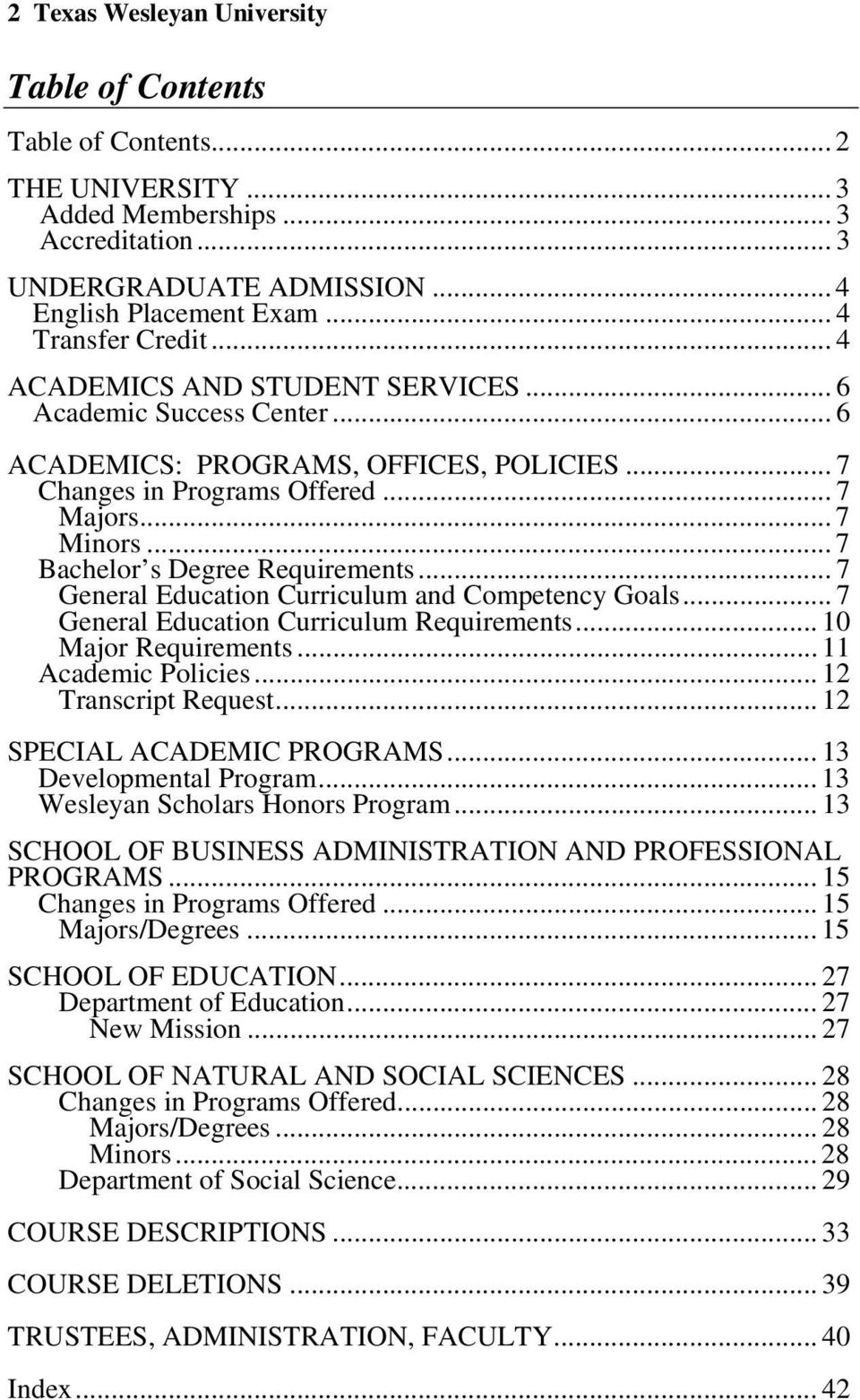
2 2 Texas Wesleyan University Table of Contents Table of Contents... 2 THE UNIVERSITY... 3 Added Memberships... 3 Accreditation... 3 UNDERGRADUATE ADMISSION... 4 English Placement Exam... 4 Transfer Credit... 4 ACADEMICS AND STUDENT SERVICES... 6 Academic Success Center... 6 ACADEMICS: PROGRAMS, OFFICES, POLICIES... 7 Changes in Programs Offered... 7 Majors... 7 Minors... 7 Bachelor s Degree Requirements... 7 General Education Curriculum and Competency Goals... 7 General Education Curriculum Requirements Major Requirements Academic Policies Transcript Request SPECIAL ACADEMIC PROGRAMS Developmental Program Wesleyan Scholars Honors Program SCHOOL OF BUSINESS ADMINISTRATION AND PROFESSIONAL PROGRAMS Changes in Programs Offered Majors/Degrees SCHOOL OF EDUCATION Department of Education New Mission SCHOOL OF NATURAL AND SOCIAL SCIENCES Changes in Programs Offered Majors/Degrees Minors Department of Social Science COURSE DESCRIPTIONS COURSE DELETIONS TRUSTEES, ADMINISTRATION, FACULTY Index... 42
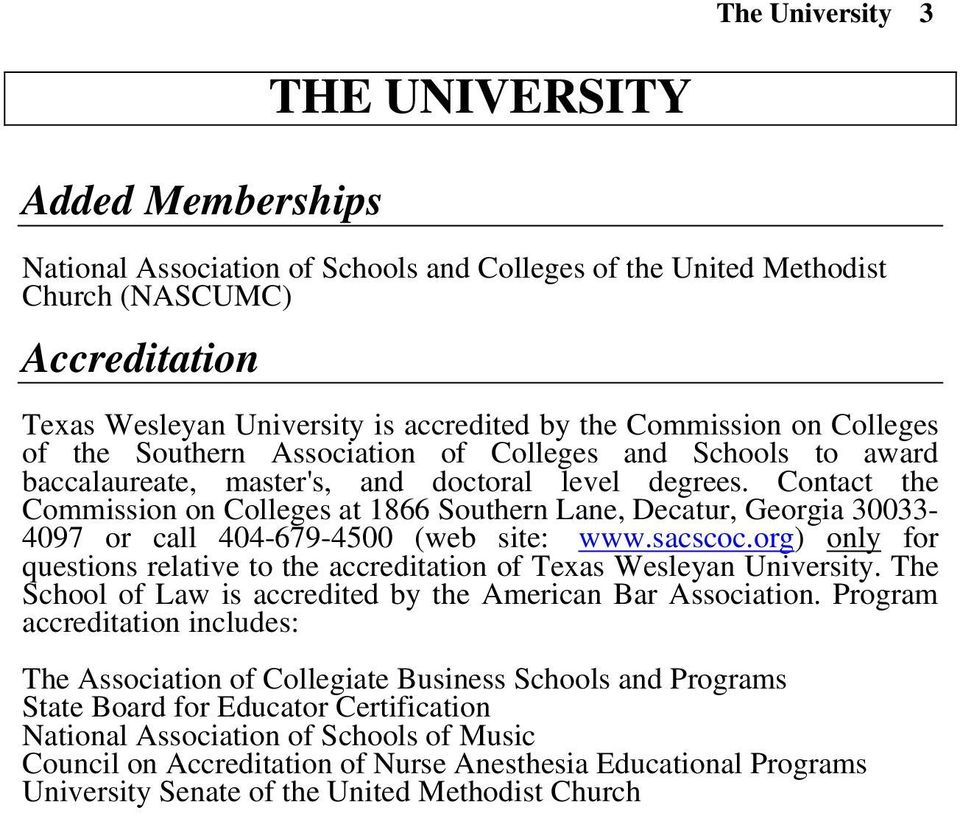
3 The University 3 Added Memberships THE UNIVERSITY National Association of Schools and Colleges of the United Methodist Church (NASCUMC) Accreditation Texas Wesleyan University is accredited by the Commission on Colleges of the Southern Association of Colleges and Schools to award baccalaureate, master's, and doctoral level degrees. Contact the Commission on Colleges at 1866 Southern Lane, Decatur, Georgia or call (web site: only for questions relative to the accreditation of Texas Wesleyan University. The School of Law is accredited by the American Bar Association. Program accreditation includes: The Association of Collegiate Business Schools and Programs State Board for Educator Certification National Association of Schools of Music Council on Accreditation of Nurse Anesthesia Educational Programs University Senate of the United Methodist Church
4 4 Texas Wesleyan University UNDERGRADUATE ADMISSION Placement Exams English Placement Exam All students who have not earned college credit for ENG 1301 are required to take the ACCUPLACER Written Essay Exam, which tests writing proficiency. Students who pass the exam with a score of 6 or higher will be eligible to enroll in English 1301; students who score 5 will also be given the Sentence Skills Exam. Those students with a 5 and an 80 or above on the Sentence Skills exam will be eligible for English 1301; students scoring below 80 will enroll in ENG All students scoring a 4 or below on the ACCUPLACER Written Essay exam will be placed into English Students must enroll in ENG 1301 and ENG 1302 within their first 30 cumulative hours. Students who transfer in ENG 1301 or score a 4 or better on the AP English exam are exempt from the English Placement Exam. Students should consult the Office of New Student Programs for scheduled testing dates. Transfer Credit A student transferring from a regionally accredited college or university will be granted credit for work earned elsewhere, provided the work is comparable to that offered by Texas Wesleyan University. All transferring student documents will be evaluated in accordance with the academic standards as outlined in the Texas Wesleyan University catalog regarding academic probation, suspension, and readmission after academic suspension. A student who transfers to Texas Wesleyan University may receive credit for courses taken more than once if, and only if, the institution of higher education granting the original credit indicates in its catalog that the course may be re-taken for credit. If a student successfully completes the state of Texas 42 semester credit hour baccalaureate core curriculum at any Texas public institution of higher education, that block of courses may be transferred to Texas Wesleyan University and will be substituted for Texas Wesleyan s General Education Curriculum (GEC). A student who transfers from a private institution with a core curriculum equivalent to Texas Wesleyan University s core curriculum may be able to transfer that block of courses as determined on a case by case basis. All students will still be required to take three hours of an approved religion course (unless already completed) as listed in the General Education Curriculum requirements. Students should also note that although exempt from the General Education requirement, they may still be required to take specific prerequisites for required courses. In the General Education Curriculum, KIN 1220 is a wellness course for which an activity course will not substitute. The University Registrar, in consultation with the appropriate academic dean, determines the transferability of courses.

5 Undergraduate Admission 5 The transfer of courses is subject to the limitations of the residency requirement for the major and for graduation. Transfer of courses is also limited by the provision that courses that were completed 10 or more years before matriculation may, at the discretion of the dean of the school in which the student is enrolled, have to be repeated.

6 6 Texas Wesleyan University ACADEMIC AND STUDENT SERVICES Academic Success Center The Academic Success Center is a critical link between undergraduate students and a fully successful academic experience. Located on the first floor of the library, the Center provides many different types of assistance including a Learning Specialist, writing and math tutoring, college study skills, a small computer lab for research and writing purposes, Developmental Programs, New Student Programs, Mentorship Program, and the Ram Parent Association. Writing and math assistance is provided by faculty and student tutors and offers Texas Wesleyan undergraduate students the opportunity to strengthen writing, math, and study skills that are necessary to succeed at the college level.

7 Academic: Programs, Offices, Policies 7 ACADEMICS: PROGRAMS, OFFICES, POLICIES Changes in Programs Offered The changes in this addendum will only apply to students who begin Texas Wesleyan University in Summer 2010 Spring MAJORS Major degree programs have been added or revised in these areas: Criminal Justice B.S. Business Administration, Accounting Concentration B.B.A./M.B.A Business Administration, Accounting Concentration with Forensic/Fraud Emphasis B.B.A. Business Administration, Accounting Concentration with Forensic/Fraud Emphasis B.B.A./M.B.A Business Administration, Management Concentration with Project Management Emphasis B.B.A. Political Science B.A., B.S. Major degree programs have been removed in these areas: Business Administration, Computer Information Systems Concentration B.B.A. Sociology, Criminal Justice Emphasis B.S. Master in Management M.i.M. MINORS Minors have been revised or added in these areas: Criminal Justice Forensic Science Bachelor s Degree Requirements Basic to all bachelor s degrees is the General Education Curriculum, to be completed by all degree candidates. Students also complete Major Requirements and Required Related Courses to qualify for a degree. Students completing a degree with secondary certification will also complete Education Requirements. Specific requirements are listed on page 88 of the catalog. GENERAL EDUCATION CURRICULUM AND COMPETENCY GOALS Each Texas Wesleyan University graduate should demonstrate competencies and attainments in preparation to be an informed and effective citizen of the world. To prepare each student for this goal, the University strives to instill literacy in the four areas of Language Literacy, Analytic Literacy, Cultural Literacy, and Social Literacy, with literacy defined as college-level knowledge with the ability to read and write. The specific expected competencies within each of these areas include the following:

8 8 Texas Wesleyan University Language Literacy Competency in a variety of communication skills o o This competency includes the ability to speak and write conventional English both clearly and correctly. The development of individual communicative style should also be encouraged. This competency also includes the ability to speak and write interactively. This includes elements of effective reading, listening, and analysis as well as the framing of appropriate and intelligible responses. A summative experience regarding the total curriculum. The graduate should reflect an ability to integrate the broad scope of her/his learning in a meaningful manner. Sufficient skills in information technology and information retrieval methods. Analytic Literacy Understanding of how, when, and in what fields the scientific method is used, including personal experience in the method in a laboratory setting and exposure to current scientific issues and knowledge. Ability to formulate a precise, concise, logical argument concerning a wide variety of problems in politics, science, mathematics, psychology, sociology, etc. The graduate should be proficient in applying problem solving skills in her/his life. Cultural Literacy An appreciation of and some direct experience with the creative arts as expressions of cultural and artistic values. This experience should include some combination of attendance at various art exhibits or performances, formal exposition of art works representative of various cultural periods, and personal participation. An understanding of the history and defining character of Western culture and an appreciation of other cultures. Cultural differences may be expressed in terms of linguistic structures, the creative arts, religious traditions, political values, etc. Knowledge of religious history and tradition from its written word, including an awareness of Judeo-Christian values and ethics and an understanding of questions of moral behavior as applied to home, professional, civic, and social life. The student should be encouraged to formulate a clearly thought-out philosophy of ethical and moral values.

9 Academic: Programs, Offices, Policies 9 Social Literacy An understanding of the social forces that influence individual and collective behavior, including economic, political, psychological, and sociological forces. Awareness of the practices required and resources available to respond purposefully to social forces that affect one s physical, mental, and emotional health. Philosophy of General Education The inclusion of specific general education requirements in all degree plans is an integral part of the overall purpose and philosophy of Texas Wesleyan University. The faculty, administration, Board of Trustees, and student body reaffirm the mission of the University to combine for the student the traditional liberal arts with preparation for a professional career in contemporary society. Thus, the curriculum followed by the student unites the general requirements outlined here and the specific offerings of the chosen major in order to provide an effective educational experience for each Texas Wesleyan University graduate. As a private, comprehensive university with a tradition in the liberal arts stressing small classes and individual attention, Texas Wesleyan is committed to the liberal arts and general education as a means to the overall goal of a complete education for each student. Departments may also recommend specific requirements within the General Education Curriculum for students planning to major in specific programs. Students should refer to the listings of major requirements for details. All students, except transfer students for whom the General Education curriculum has been waived following the policy below or those transfer students who have completed ENG 1301 or MAT 1302 or higher, are required to take the English and/or Mathematics Placement Exams prior to initial registration. All students with a verbal SAT score below 530 (or the ACT equivalent score) or transfer students with fewer than 31 hours must take the Reading Placement Exam. Students should refer to the Placement Exam section listed previously in this catalog for specific information regarding this requirement. If a student successfully completes the state of Texas 42 semester credit hour baccalaureate core curriculum at any Texas public institution of higher education, that block of courses may be transferred to Texas Wesleyan University and will be substituted for Texas Wesleyan s General Education Curriculum (GEC). A student who transfers from a private institution with a core curriculum equivalent to Texas Wesleyan University s core curriculum may be able to transfer that block of courses as determined on a case by case basis. All students will still be required to take three hours of an approved religion course (unless already completed) as listed in the General Education Curriculum requirements. Students should also note that although exempt from the General Education requirement, they may still be required to take specific prerequisites for required courses. While not part of the General Education Curriculum, ASE 1111, Freshman Seminar, is required for all first semester freshmen or freshman transfer students with 11 or fewer completed credit hours. Students receive elective credit for this course. ASE 1112, Freshman Seminar Laboratory, is a

10 10 Texas Wesleyan University mandatory course for all freshman students placed on academic probation following their first semester. GENERAL EDUCATION CURRICULUM REQUIREMENTS Language Literacy English... 9 ENG 1301 ENG 1302 one of the following courses: ENG 2301, ENG 2302, ENG 2311, ENG 2312, ENG 2321, or ENG 2322 Interdisciplinary Integrative Course... 3 choose one course: HUM 2340 HUM 2341 Analytic Literacy Choose one option: Option #1: two math / one science (10 hours); Option #2: one math / two sciences (11 hours) Mathematics: MAT 1302, MAT 1304 (if allowed by major), or any math course with MAT 1302 or higher as a prerequisite (excluding MAT 1304) Note: MAT 1304 is acceptable for all programs in the School of Natural and Social Sciences except for the programs in Biology, Chemistry, Computer Science, and Mathematics. MAT 1304 is acceptable for all programs in the School of Arts and Letters and the School of Education. MAT 1304 is not acceptable for any program in the School of Business and Professional Programs. Science: Choose 1 or 2 of the following courses with accompanying lab: BIO 1321 and 1121, BIO 1322, and 1122, BIO 1340 and 1140, BIO 1341and 1141, CHE 1315 and 1115, CHE 1316 and 1116, GEO 1401, GEO 1402, NSC 1403, NSC 1404, NSC 1405, NSC 1406, NSC 1407, NSC 1408, NSC 1409, NSC 1410, NSC 1412, NSC 1414**, NSC 2401, NSC 2402, PHY 1401, PHY 1402 Cultural Literacy HIS 2322 Choose 3 hours from one of the following: ART, FAR, MUS, or THA Choose 3 hours from one of the following: REL 1311, REL 1312, REL 1313, REL 1321, REL 1322 Choose 3 hours from one of the following: ART, FAR, MUS, THA, HIS 2321, HIS 2301, HIS 2303, PHI 2301, PHI 2321, REL 1311, REL 1312, REL 1313, or REL 1321, SPC 1301

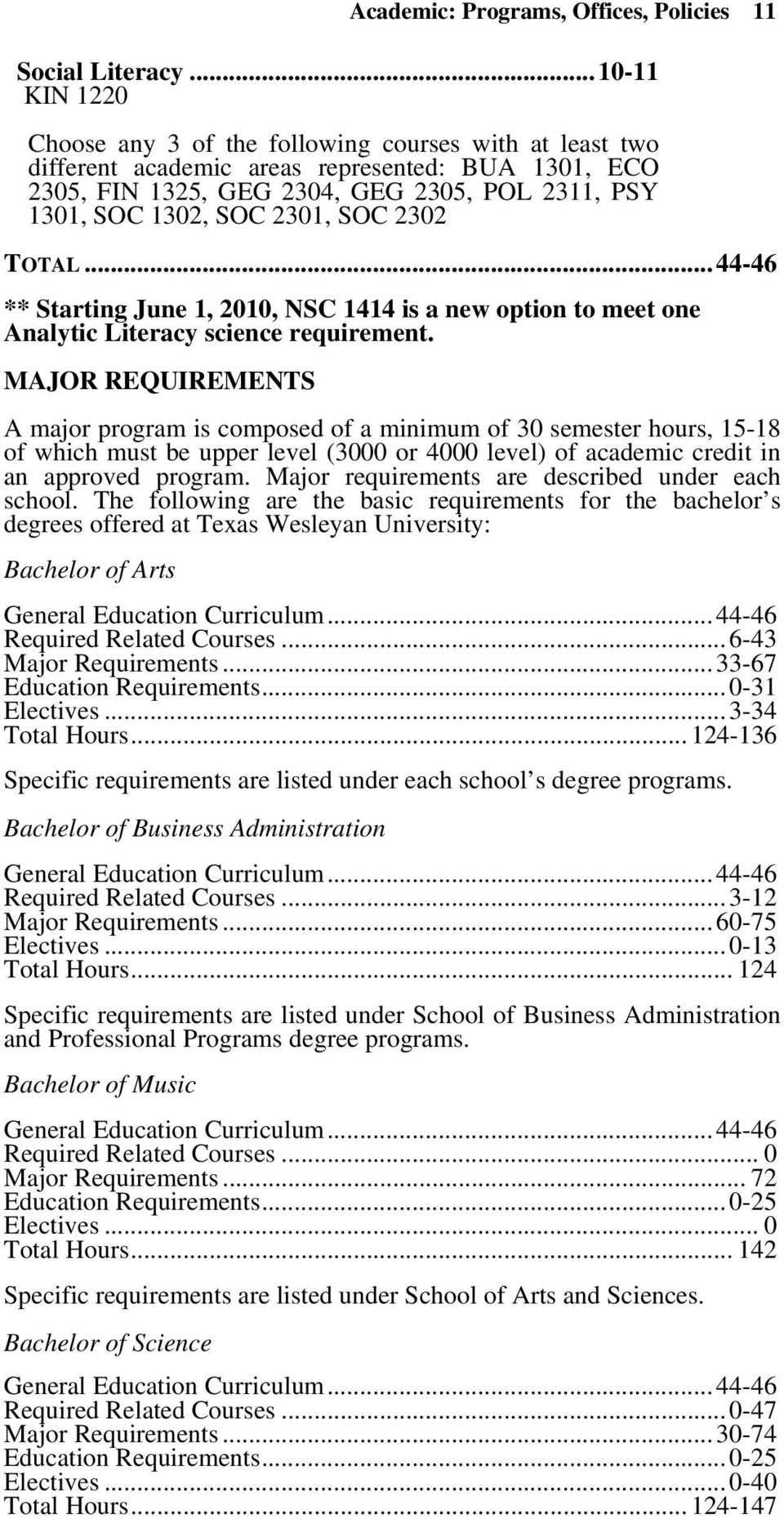
11 Academic: Programs, Offices, Policies 11 Social Literacy KIN 1220 Choose any 3 of the following courses with at least two different academic areas represented: BUA 1301, ECO 2305, FIN 1325, GEG 2304, GEG 2305, POL 2311, PSY 1301, SOC 1302, SOC 2301, SOC 2302 TOTAL ** Starting June 1, 2010, NSC 1414 is a new option to meet one Analytic Literacy science requirement. MAJOR REQUIREMENTS A major program is composed of a minimum of 30 semester hours, of which must be upper level (3000 or 4000 level) of academic credit in an approved program. Major requirements are described under each school. The following are the basic requirements for the bachelor s degrees offered at Texas Wesleyan University: Bachelor of Arts General Education Curriculum Required Related Courses Major Requirements Education Requirements Electives Total Hours Specific requirements are listed under each school s degree programs. Bachelor of Business Administration General Education Curriculum Required Related Courses Major Requirements Electives Total Hours Specific requirements are listed under School of Business Administration and Professional Programs degree programs. Bachelor of Music General Education Curriculum Required Related Courses... 0 Major Requirements Education Requirements Electives... 0 Total Hours Specific requirements are listed under School of Arts and Sciences. Bachelor of Science General Education Curriculum Required Related Courses Major Requirements Education Requirements Electives Total Hours
12 12 Texas Wesleyan University Academic Policies TRANSCRIPT REQUEST Students may order official transcripts by mailing the request to: Office of Student Records Texas Wesleyan University 1201 Wesleyan Street Fort Worth, Texas Students may also fax the request to 817/ A transcript request form is available on the Texas Wesleyan University web site, The request should include the student s name, University ID number or social security number, telephone number, approximate dates of attendance, any address to which the transcript should be sent, and the student s signature. Students may also complete a request form in the Office of Student Records. The transcript fee is $5 per copy. Allow 3-5 business days for processing. Allow additional time for processing if ordering transcripts during registration periods or graduation. Realizing that emergencies occur, a student may receive expedited mailing. There is an additional fee of $16 if the transcript is mailed using express mail.

13 Special Academic Programs 13 SPECIAL ACADEMIC PROGRAMS Developmental Program The purpose of the Texas Wesleyan Developmental Program is to provide an opportunity for students with assessed deficiencies in reading, mathematics, or writing to receive appropriate developmental education in order to perform satisfactorily in college-level coursework. Freshmen who do not meet required scores on the reading, mathematics, and English placement exams must enroll in the appropriate developmental courses. Transfer students who have not completed the Associates of Arts degree or the freshman English and/or mathematics course requirements also are required to complete the appropriate placement exams before enrollment in English or mathematics courses. The developmental course hours do count towards Financial Aid purposes but do not count towards hours needed for graduation. Developmental courses are calculated in a student s overall GPA. The following developmental courses are offered: ENG 0300 MAT 0300 MAT 0301 RDG 0301 RDG 0302 Composition and Grammar Beginning Algebra Intermediate Algebra Reading Techniques I** Reading Techniques II** **RDG 0301 and 0302 are a part of the Texas Wesleyan Developmental Program. Wesleyan Scholars Honors Program The purpose of the Wesleyan Scholars Program is to provide motivated students the opportunity to enrich their university experience, to recognize outstanding academic work beyond degree requirements, to provide a forum for student-student and student-faculty exchange of ideas, to celebrate opportunities for conversations across discipline boundaries, and to affirm the University as a place of informed and reasoned dialogue. The Wesleyan Scholars Program consists of two separate programs: University Honors and Departmental Honors. A student must earn either Departmental or University Honors (or both) for designation to appear on the student s diploma. UNIVERSITY HONORS UNIVERSITY SCHOLAR For admission into the University Honors Program, freshmen must have an SAT score of 1200 (Math and Verbal) or an ACT score of 24 and a high school GPA of 3.5. Students who transfer with fewer than 30 hours may be admitted to the University Honors Program if they have the above mentioned SAT or ACT scores and a cumulative GPA of 3.5 from their transferring institution. Texas Wesleyan and transfer students with hours may be admitted if they have a cumulative 3.5 GPA. Students with more than 60 hours are encouraged to participate in their discipline s departmental honors. **

14 14 Texas Wesleyan University To qualify for University Honors recognition on their diploma, students must complete four (4), two-hour honors seminars in sequence and maintain a cumulative GPA of 3.5. **University Honors admission policies updated.

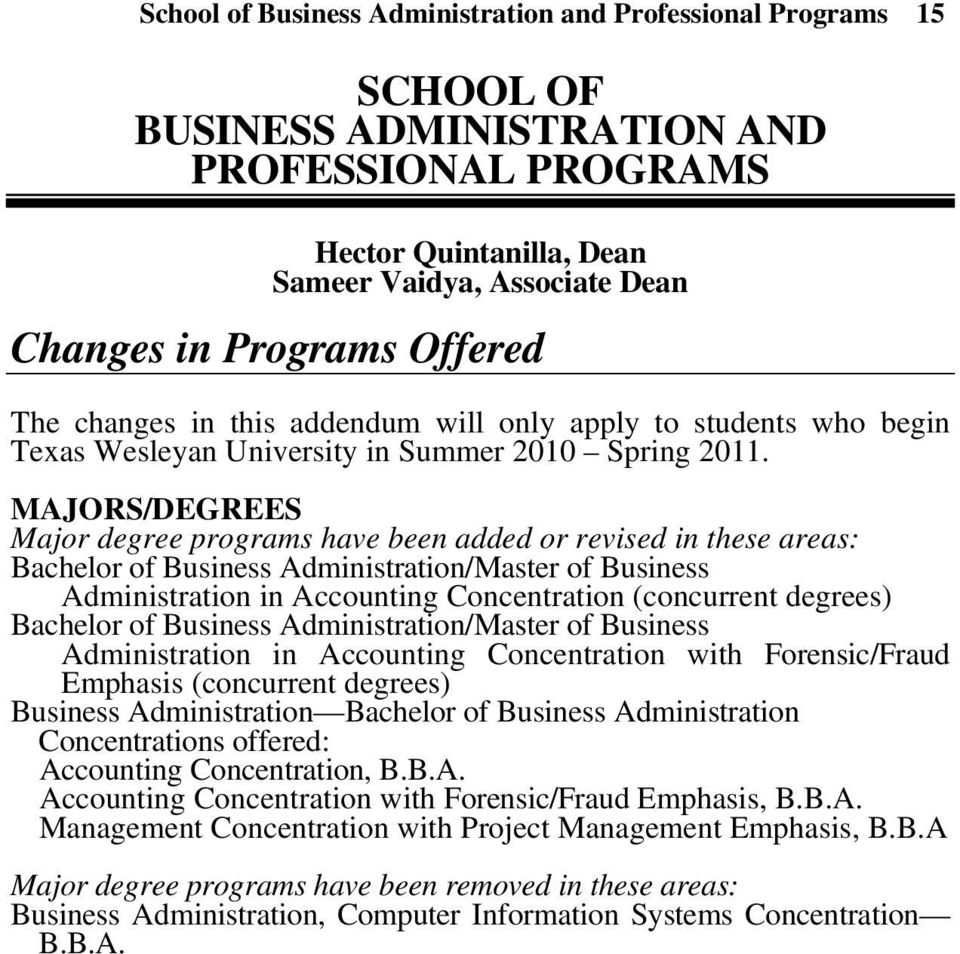
15 School of Business Administration and Professional Programs 15 SCHOOL OF BUSINESS ADMINISTRATION AND PROFESSIONAL PROGRAMS Hector Quintanilla, Dean Sameer Vaidya, Associate Dean Changes in Programs Offered The changes in this addendum will only apply to students who begin Texas Wesleyan University in Summer 2010 Spring MAJORS/DEGREES Major degree programs have been added or revised in these areas: Bachelor of Business Administration/Master of Business Administration in Accounting Concentration (concurrent degrees) Bachelor of Business Administration/Master of Business Administration in Accounting Concentration with Forensic/Fraud Emphasis (concurrent degrees) Business Administration Bachelor of Business Administration Concentrations offered: Accounting Concentration, B.B.A. Accounting Concentration with Forensic/Fraud Emphasis, B.B.A. Management Concentration with Project Management Emphasis, B.B.A Major degree programs have been removed in these areas: Business Administration, Computer Information Systems Concentration B.B.A.
16 16 Texas Wesleyan University MAJORS/DEGREES Bachelor of Business Administration/ Master of Business Administration in Accounting The joint B.B.A./M.B.A. degree with a specialty in accounting is designed for the student who desires both an undergraduate degree in accounting and an advanced degree specializing in accounting. Students who complete the joint B.B.A./M.B.A. degree program also meet the 150- credit-hour requirement to be licensed as a CPA upon successful completion of the CPA examination and the experience requirement for certification. By meeting requirements for the two degrees simultaneously, the student may earn the B.B.A. and M.B.A. degrees in a shorter length of time than would be the case if each degree were pursued consecutively. Applicants are initially admitted into the Bachelor of Business Administration with a major in Business Administration and an Accounting Concentration program and follow that program s requirements. Students may apply for admission into the M.B.A. program upon completion of 90 undergraduate credit hours in their junior year and are admitted to the M.B.A. program in their senior year. When a student has earned 115 credit hours and has been admitted into the M.B.A. program, she/he may choose to remain in her/his original undergraduate catalog year for graduate school or change to the current graduate catalog year. Applicants to the joint degree program must meet the admission requirements of both the undergraduate and the graduate programs and follow the application procedures for the respective programs. Admission to the undergraduate accounting program does not guarantee admission to the M.B.A. program. For the M.B.A. degree, the student must complete hours of the M.B.A. core courses. In addition to the core courses, students will select 3-6 hours of graduate-level electives. GENERAL EDUCATION CURRICULUM The General Education Curriculum (GEC) is listed on page 88 of the catalog. Some courses listed in program Major Requirements or Required Related Courses, (noted with an asterisk [*]), may be used to meet requirements in the GEC. Although these courses fulfill requirements in each area, credit hours for these courses, if taken for the GEC, may only be counted in the GEC. For complete Graduation Requirements, see page 89 of the catalog. REQUIRED RELATED COURSES Economics ECO 2305 Principles of Economics I* Management Information Systems... 3 MIS 2310 Advanced Business Applications Mathematics MAT 1310 Mathematics for Business and Economic Analysis*

17 School of Business Administration and Professional Programs 17 Speech SPC 1301 Fundamentals of Speech* UNDERGRADUATE MAJOR REQUIREMENTS Business Core Curriculum Students should review catalog course descriptions for any course prerequisites before registration. Students are not allowed to register for a course unless they satisfy all course prerequisites. Foundation Courses Accounting... 6 ACC 2303 Principles of Financial Accounting ACC 2304 Principles of Managerial Accounting Economics... 3 ECO 2306 Principles of Economics II Microeconomics) Finance... 3 FIN 3313 Corporate Finance Management... 6 MGT 3319 Management Theory and Practice MGT 3323 Production/Operations Management** Management Information Systems... 3 MIS 3305 MIS Analysis and Design Marketing... 3 MKT 3321 Principles of Marketing Related Courses... 9 Business Administration... 9 BUA 2321 Business Statistics BUA 3301 Business Communications BUA 3311 Business Law I Capstone Course Management MGT 4337 Business Policy and Decision Making (may be waived for dual accounting degree students) Accounting Concentration ACC 3311 Intermediate Accounting I ACC 3312 Intermediate Accounting II ACC 3325 Accounting and Financial Information Systems ACC 3340 Cost Accounting I ACC 4301 Federal Income Taxation I ACC 4307 Accounting Theory (Accounting Research Course) ACC 4311 Advanced Accounting ACC 4328 Auditing ACC 4332 Introduction to Fraud Examination Business Advanced Electives... 0 requirement fulfilled by M.B.A. courses UNDERGRADUATE ELECTIVES ** MGT 3323 added to business core.

18 18 Texas Wesleyan University MBA CORE COURSES All students seeking the Master of Business Administration degree must complete the following hours of graduate-level core courses. Specific core courses can only be substituted or waived for students presenting evidence of prior completion of graduate-level courses that are similar in objective and content as Texas Wesleyan University's core courses. Such substitution or waiver is at the discretion of and must be approved by the Dean of the School of Business Administration and is governed by the transfer of credit policy. Up to six hours maximum may be considered for the substitution or waiver. Students without a business degree will be required to enroll in foundation courses in addition to the core courses. Accounting ACC 5336 ACC 6301 Ethics and Professionalism in Accounting (If a dual accounting degree student has taken ACC 4336 as an undergraduate requirement or elective, then BUA 6309, Legal Environment and Ethics, becomes a required course.) Integrated Accounting Analysis for Decision Making (see graduate electives for option) Business Administration BUA 6305 Quantitative Methods and Decision Making Strategies BUA 6306 Applied Research and Project BUA 6310 Business and Organizational Communications Economics ECO 6308 Managerial Economics Finance FIN 6303 Integrated Advanced Financial Analysis Management MGT 6307 Business Strategy and Policy MGT 6320 Organizational Behavior Management Information Systems MIS 6302 Integrating Management Information Technology in Business Marketing MKT 6304 Marketing Management GRADUATE ELECTIVES In addition to the graduate-level core courses, students must receive credit for 3 hours of graduate-level accounting elective. Dual-degree students may choose to take an additional accounting elective in place of ACC TOTAL HOURS Bachelor of Business Administration/ Master of Business Administration in Accounting with Forensic/Fraud Emphasis The joint B.B.A./M.B.A. degree in accounting with an emphasis in forensic/fraud accounting is designed for the student who desires both an undergraduate degree in forensic/fraud accounting and an advanced degree specializing in forensic/fraud accounting. Students who complete the joint B.B.A./M.B.A. degree program also meet the 150-credit-hour requirement to be licensed as a CPA upon successful completion of the CPA examination and the experience requirement for certification. By meeting requirements for the two degrees simultaneously, the student may earn the B.B.A. and M.B.A. degrees in a shorter length of time than would be the case if each degree were pursued consecutively.

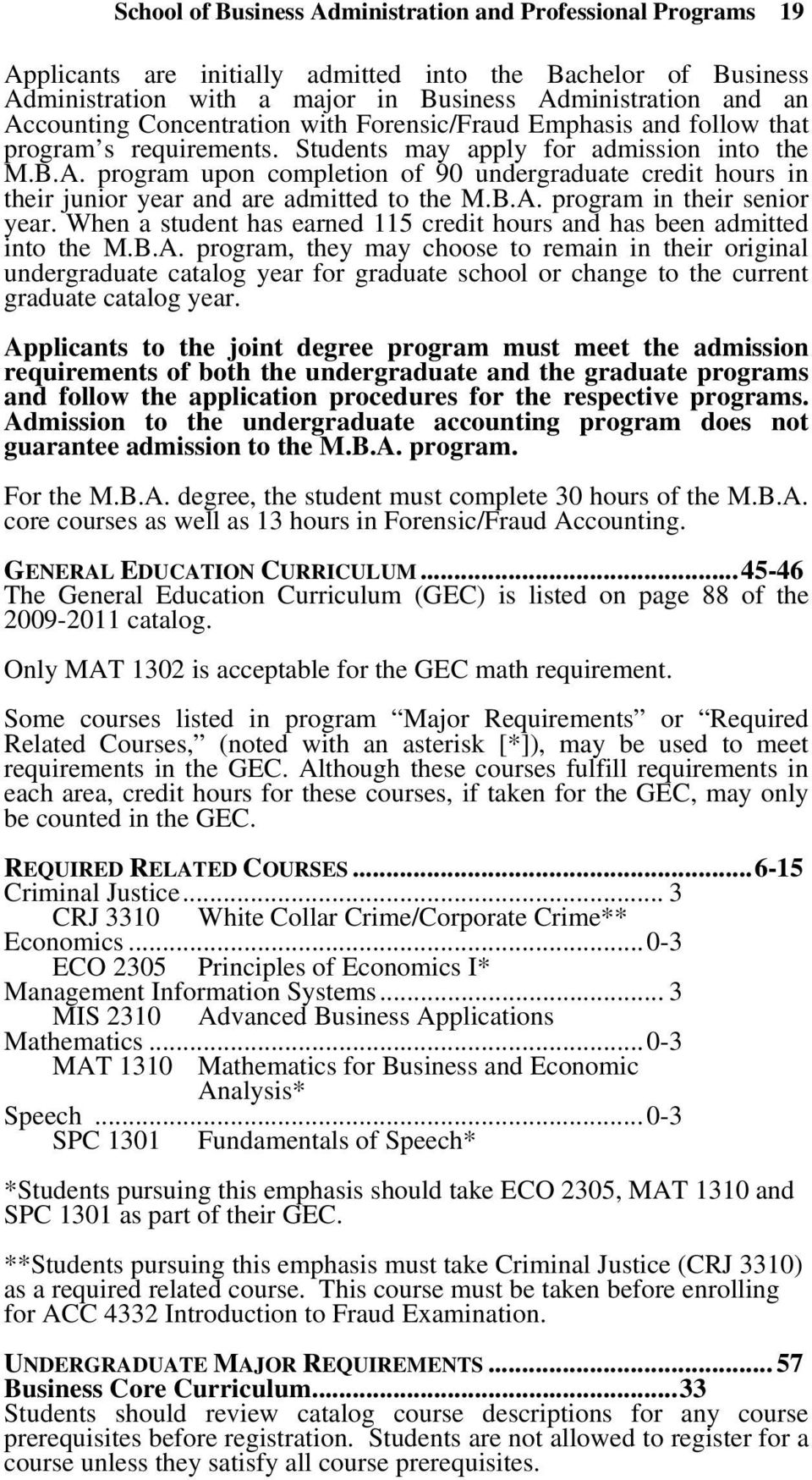
19 School of Business Administration and Professional Programs 19 Applicants are initially admitted into the Bachelor of Business Administration with a major in Business Administration and an Accounting Concentration with Forensic/Fraud Emphasis and follow that program s requirements. Students may apply for admission into the M.B.A. program upon completion of 90 undergraduate credit hours in their junior year and are admitted to the M.B.A. program in their senior year. When a student has earned 115 credit hours and has been admitted into the M.B.A. program, they may choose to remain in their original undergraduate catalog year for graduate school or change to the current graduate catalog year. Applicants to the joint degree program must meet the admission requirements of both the undergraduate and the graduate programs and follow the application procedures for the respective programs. Admission to the undergraduate accounting program does not guarantee admission to the M.B.A. program. For the M.B.A. degree, the student must complete 30 hours of the M.B.A. core courses as well as 13 hours in Forensic/Fraud Accounting. GENERAL EDUCATION CURRICULUM The General Education Curriculum (GEC) is listed on page 88 of the catalog. Only MAT 1302 is acceptable for the GEC math requirement. Some courses listed in program Major Requirements or Required Related Courses, (noted with an asterisk [*]), may be used to meet requirements in the GEC. Although these courses fulfill requirements in each area, credit hours for these courses, if taken for the GEC, may only be counted in the GEC. REQUIRED RELATED COURSES Criminal Justice... 3 CRJ 3310 White Collar Crime/Corporate Crime** Economics ECO 2305 Principles of Economics I* Management Information Systems... 3 MIS 2310 Advanced Business Applications Mathematics MAT 1310 Mathematics for Business and Economic Analysis* Speech SPC 1301 Fundamentals of Speech* *Students pursuing this emphasis should take ECO 2305, MAT 1310 and SPC 1301 as part of their GEC. **Students pursuing this emphasis must take Criminal Justice (CRJ 3310) as a required related course. This course must be taken before enrolling for ACC 4332 Introduction to Fraud Examination. UNDERGRADUATE MAJOR REQUIREMENTS Business Core Curriculum Students should review catalog course descriptions for any course prerequisites before registration. Students are not allowed to register for a course unless they satisfy all course prerequisites.
20 20 Texas Wesleyan University Foundation Courses Accounting... 6 ACC 2303 Principles of Financial Accounting ACC 2304 Principles of Managerial Accounting Economics... 3 ECO 2306 Principles of Economics II (Microeconomics) Finance... 3 FIN 3313 Corporate Finance Management... 6 MGT 3319 Management Theory and Practice MGT 3323 Production/Operations Management** Management Information Systems... 3 MIS 3305 MIS Systems Analysis and Design Marketing... 3 MKT 3321 Principles of Marketing Related Courses... 9 Business Administration... 9 BUA 2321 Business Statistics BUA 3301 Business Communications BUA 3311 Business Law I Accounting Concentration ACC 3311 Intermediate Accounting I ACC 3312 Intermediate Accounting II ACC 3325 Accounting and Financial Information Systems ACC 3340 Cost Accounting I ACC 4301 Federal Income Taxation I ACC 4307 Accounting Theory (Accounting Research Course) ACC 4311 Advanced Accounting ACC 4328 Auditing Business Advanced Electives... 0 requirement fulfilled by M.B.A. courses ** MGT 3323 added to business core. MBA CORE COURSES All students seeking the concurrent BBA/MBA accounting degrees with an emphasis in forensic/fraud must complete the following 30 hours of graduate-level core courses. Specific core courses can only be substituted or waived for students presenting evidence of prior completion of graduate-level courses that are similar in objective and content as Texas Wesleyan University's core courses. Such substitution or waiver is at the discretion of and must be approved by the Dean of the School of Business Administration and is governed by the transfer of credit policy. Up to six hours maximum may be considered for the substitution or waiver. Students without a business degree will be required to enroll in foundation courses in addition to the core courses. Accounting ACC 5336 Ethics and Professionalism in Accounting (If a dual accounting degree student has taken ACC 4336 as an undergraduate requirement or elective, then BUA 6309, Legal Environment and Ethics, becomes a required course. See graduate electives for option.)

21 School of Business Administration and Professional Programs 21 Business Administration BUA 6305 Quantitative Methods and Decision Making Strategies BUA 6306 Applied Research and Project BUA 6310 Business and Organizational Communications Economics ECO 6308 Managerial Economics Finance FIN 6303 Integrated Advanced Financial Analysis Management MGT 6307 Business Strategy and Policy MGT 6320 Organizational Behavior Management Information Systems MIS 6302 Integrating Management Information Technology in Business Marketing MKT 6304 Marketing Management FORENSIC/FRAUD ACCOUNTING EMPHASIS ACC 5332 Introduction to Fraud Examination ACC 5433 Forensic/Fraud IT Audit ACC 5334 The Legal Environment and Fraud ACC 5335 Forensic/Fraud Practicum TOTAL HOURS Business Administration Bachelor of Business Administration Students seeking a bachelor of business administration degree must complete a minimum of 124 credit hours. Depending upon a student s concentration, the actual number of required credit hours may be greater than 124 credit hours. Students must successfully complete the University s General Education Curriculum requirements, which total credit hours for business administration majors. All business administration students must satisfactorily complete the core curriculum of the School of Business Administration and Professional Programs. The core consists of 39 credit hours. Each concentration within the School of Business Administration and Professional Programs requires additional hours specific to the concentration. Students majoring in business administration also take business-advanced electives as required by the particular concentration. In addition, business majors must take a minimum of 3 hours of required related courses. If needed, students must take free elective credit hours to complete the number of hours required to obtain the bachelor of business administration degree. No more than 6 hours of business transfer credits with a grade of "D" will apply toward major requirements, and no transfer grades of "D" will apply towards concentration courses. In addition, a maximum of 6 hours of transfer credits may be applied to satisfy a concentration requirement. GENERAL EDUCATION CURRICULUM The General Education Curriculum (GEC) is listed on page 88 of the catalog. Only MAT 1302 is acceptable for the GEC math requirement.
22 22 Texas Wesleyan University Some courses listed in program Major Requirements or Required Related Courses, (noted with an asterisk [*]), may be used to meet requirements in the GEC. Although these courses fulfill requirements in each area, credit hours for these courses, if taken for the GEC, may only be counted in the GEC. For complete Graduation Requirements, see page 89 of the catalog. REQUIRED RELATED COURSES Economics ECO 2305 Principles of Economics I* Management Information Systems... 3 MIS 2310 Advanced Business Applications Mathematics MAT 1310 Mathematics for Business and Economic Analysis* Speech SPC 1301 Fundamentals of Speech* MAJOR REQUIREMENTS Business Core Curriculum Students should review catalog course descriptions for any course prerequisites before registration. Students are not allowed to register for a course unless they satisfy all course prerequisites. A prerequisite course requires completion with a grade of C or higher. Foundation Courses Accounting... 6 ACC 2303 Principles of Financial Accounting ACC 2304 Principles of Managerial Accounting Economics... 3 ECO 2306 Principles of Economics II (Microeconomics) Finance... 3 FIN 3313 Corporate Finance International Business Administration IBA 3345 International Business (Students obtaining an accounting concentration must take ACC 4311 in the accounting core to satisfy this requirement. This requirement applies to both the BBA and joint BBA/MBA degrees. Students obtaining a marketing concentration may take MKT 4342 to satisfy this requirement.) Management... 6 MGT 3319 Management Theory and Practice MGT 3323 Production/Operations Management** Management Information Systems... 3 MIS 3305 MIS Systems Analysis and Design Marketing... 3 MKT 3321 Principles of Marketing Related Courses... 9 Business Administration... 9 BUA 2321 Business Statistics BUA 3301 Business Communications BUA 3311 Business Law I Capstone Course Management MGT 4337 Business Policy and Decision Making (waived for dual Accounting students)
23 School of Business Administration and Professional Programs 23 Concentration Requirement Students should choose one of the listed concentrations outlined below. (Complete program requirements listed on following pages for new emphasis in Accounting and Management.) Accounting Management Accounting Management with Project with Forensic/Fraud Emphasis Management Emphasis Finance Marketing General Business Business Electives Business advanced electives (3000 or above) must be chosen in consultation with advisor. ELECTIVES TOTAL HOURS ** MGT 3323 added to business core. Program requirements related to each concentration within the Business Administration major (Students may choose any one of the following concentrations): Business Administration Bachelor of Business Administration Accounting Concentration GENERAL EDUCATION CURRICULUM The General Education Curriculum (GEC) is listed on page 88 of the catalog. Only MAT 1302 is acceptable for the GEC math requirement. Some courses listed in program Major Requirements or Required Related Courses, (noted with an asterisk [*]), may be used to meet requirements in the GEC. Although these courses fulfill requirements in each area, credit hours for these courses, if taken for the GEC, may only be counted in the GEC. For complete Graduation Requirements, see page 89 of the catalog. REQUIRED RELATED COURSES MAJOR REQUIREMENTS Business Core Accounting Concentration ACC 3311 Intermediate Accounting I ACC 3312 Intermediate Accounting II ACC 3325 Accounting and Financial Information Systems ACC 3340 Cost Accounting I ACC 4301 Federal Income Taxation I ACC 4307 Accounting Theory (Accounting Research Course)
24 24 Texas Wesleyan University ACC 4311 Advanced Accounting ACC 4328 Auditing ACC 4332 Introduction to Fraud Examination ACC 4336 Ethics and Professionalism in Accounting Business Electives... 9 must be business advanced electives (3000 or above) to be chosen in consultation with the accounting advisor. ELECTIVES TOTAL HOURS Business Administration Bachelor of Business Administration Accounting Concentration with Forensic/Fraud Emphasis The B.B.A. major in accounting with an emphasis in forensic/fraud examination is designed for the student who desires an undergraduate degree in accounting with specialty coursework in forensic/fraud examination. Students completing this program will have a foundation to become future fraud examiners and forensic accountants as well as opportunities in more traditional accounting careers such as auditors, cost accountants and government accountants. Students who plan on taking the CPA examination in the state of Texas must have a total of 150 semester credit hours. These additional hours of course work may be earned at either Texas Wesleyan or another university. Students may also earn these hours by obtaining the Wesleyan MBA. GENERAL EDUCATION CURRICULUM The General Education Curriculum (GEC) is listed on page 88 of the catalog. Only MAT 1302 is acceptable for the GEC math requirement. Some courses listed in program Major Requirements or Required Related Courses, (noted with an asterisk [*]), may be used to meet requirements in the GEC. Although these courses fulfill requirements in each area, credit hours for these courses, if taken for the GEC, may only be counted in the GEC. For complete Graduation Requirements, see page 89 of the catalog. REQUIRED RELATED COURSES Criminal Justice... 3 CRJ 3310 White Collar Crime/Corporate Crime** Economics ECO 2305 Principles of Economics I* Management Information Systems... 3 MIS 2310 Advanced Business Applications Mathematics MAT 1310 Mathematics for Business and Economic Analysis* Speech SPC 1301 Fundamentals of Speech*
25 School of Business Administration and Professional Programs 25 *Students pursuing this emphasis should take ECO 2305, MAT 2310 and SPC 1301 as part of their GEC. **Students pursuing this emphasis must take Criminal Justice (CRJ 3310) as a required related course. This course must be taken before enrolling for ACC 4332 Introduction to Fraud Examination. MAJOR REQUIREMENTS Business Core Curriculum (IBA 3345 is not required for the Accounting concentration) Accounting Concentration ACC 3311 Intermediate Accounting I ACC 3312 Intermediate Accounting II ACC 3325 Accounting and Financial Information Systems ACC 3340 Cost Accounting I ACC 4301 Federal Income Taxation I ACC 4307 Accounting Theory (Accounting Research Course) ACC 4311 Advanced Accounting ACC 4328 Auditing ACC 4332 Introduction to Fraud Examination ACC 4336 Ethics and Professionalism in Accounting Forensic/Fraud Accounting Emphasis ACC 4433 Forensic/Fraud IT Audit ACC 4334 The Legal Environment and Fraud ACC 4335 Forensic/Fraud Practicum ELECTIVES... 0 TOTAL HOURS *** ***This total (127 semester credit hours) assumes that students pursuing the forensic/fraud examination emphasis satisfy 9 hours of required related courses by taking them as part of the GEC. These courses are ECO 2305, MAT 1310 and SPC Business Administration Bachelor of Business Administration Management with Project Management Emphasis GENERAL EDUCATION CURRICULUM The General Education Curriculum (GEC) is listed on page 88 of the catalog. Only MAT 1302 is acceptable for the GEC math requirement. Some courses listed in program Major Requirements or Required Related Courses, (noted with an asterisk [*]), may be used to meet requirements in the GEC. Although these courses fulfill requirements in each area, credit hours for these courses, if taken for the GEC, may only be counted in the GEC. For complete Graduation Requirements, see page 89 of the catalog. REQUIRED RELATED COURSES MAJOR REQUIREMENTS... 66
26 26 Texas Wesleyan University Business Core Management Concentration with Project Management Emphasis ACC 3340 Cost Accounting MGT 3324 Project Life Cycle Management MGT 3334 Earned Value Management MGT 3336 Contract Management MGT 4312 Operations and Supply Chain Management MGT 4340 Project Performance and Quality Management MGT 4344 Project Management Business Electives... 6 must be business advanced electives (3000 or above) to be chosen in consultation with the accounting advisor. ELECTIVES TOTAL HOURS
27 New Mission School of Education/Education 27 SCHOOL OF EDUCATION Carlos Martinez, Dean DEPARTMENT OF EDUCATION Lisa Dryden, Chair The undergraduate Department of Education is committed to the preparation of reflective professionals who are knowledgeable in working collaboratively in diverse educational settings. To that end, the Department provides a student-centered, intellectual environment that promotes quality instruction and research. Our graduates will: Acquire and demonstrate knowledge, skills and understandings of appropriate best practices in school settings, Support and create environments for excellence in learning, Participate in and contribute to complex and diverse settings.
28 28 Texas Wesleyan University SCHOOL OF NATURAL AND SOCIAL SCIENCES Trevor Morris, Dean Changes in Programs Offered The changes in this addendum will only apply to students who begin Texas Wesleyan University in Summer 2010 Spring MAJORS/DEGREES Criminal Justice Bachelor of Science Political Science Bachelor of Arts, Bachelor of Science MINORS Criminal Justice Forensic Science
29 School of Natural and Social Science/Social Science 29 DEPARTMENT OF SOCIAL SCIENCE Brenda Taylor Matthews, Chair Changes in Programs Offered MAJORS/DEGREES Criminal Justice Bachelor of Science Political Science Bachelor of Arts, Bachelor of Science MINORS Criminal Justice Forensic Science Criminal Justice Bachelor of Science GENERAL EDUCATION CURRICULUM The General Education Curriculum (GEC) is listed on page 88 of the catalog. MAT 1302 or MAT 1304 is acceptable for the GEC math requirement. Some courses listed in program Major Requirements or Required Related Courses (noted with an asterisk [*]) may be used to meet requirements in the GEC. Although these courses fulfill requirements in each area, credit hours for these courses, if taken for the GEC, may only be counted in the GEC. For complete Graduation Requirements, see page 89 of the catalog. REQUIRED RELATED Laboratory Science NSC 2401 Forensics I* choose four hours from the following courses: BIO 1321 Introduction to Cell Biology* BIO 1121 Introduction to Cell Biology Laboratory* or CHE 1315 General Chemistry I* CHE 1115 General Chemistry I Laboratory* or NSC 1406 Contemporary Biology* Philosophy PHI 2301 Logic* Religion REL 1313 Ethics* MAJOR REQUIREMENTS Criminal Justice CRJ 1301 Introduction to Criminal Justice CRJ 3312 Juvenile Delinquency CRJ 3319 Criminal Law and Justice CRJ 3320 Victimology CRJ 3397 Criminal Justice Statistics CRJ 4313 Criminology
30 30 Texas Wesleyan University CRJ 4317 Forensic Sociology CRJ 4320 Criminal Justice Research CRJ 4393 Criminal Justice Internship three courses from the following (including courses from Tarrant County College or their equivalent): choose one: CRJ 1316 Criminal and Forensic Procedure CRIJ 1306 Courts and Criminal Procedures*** choose one: CRJ 2321 Forensic Investigation CRIJ 2314 Criminal Investigation *** choose one: CRJ 2316 Corrections and Community Supervision CRIJ 2323 Legal Aspects of Law Enforcement *** CRIJ 2328 Police Systems and Practice *** (*** taught at TCC or other college or university) Sociology SOC 2301 Introduction to Sociology* SOC 2390 Minority Groups SOC 3322 Family Violence SOC 3325 Deviant Behavior two courses from the following CRJ 3310 White Collar/Corporate Crime CRJ 3399 Special topics NSC 2402 Forensics II* any approved upper-level (3000 or above) CRJ course ELECTIVES TOTAL HOURS Political Science Bachelor of Arts GENERAL EDUCATION CURRICULUM The General Education Curriculum (GEC) is listed on page 88 of the catalog. MAT 1302 or MAT 1304 is acceptable for the GEC math requirement. Some courses listed in program Major Requirements or Required Related Courses (noted with an asterisk [*]) may be used to meet requirements in the GEC. Although these courses fulfill requirements in each area, credit hours for these courses, if taken for the GEC, may only be counted in the GEC. For complete Graduation Requirements, see page 89 of the catalog. REQUIRED RELATED COURSES English... 3 ENG 3300 Style and Structure** Foreign Language for alternatives see "Foreign Language Requirement" in this catalog Philosophy... 3 PHI 2321 Introduction to Philosophy Speech... 3 SPC 1301 Fundamentals of Speech
31 School of Natural and Social Science/Social Science 31 MAJOR REQUIREMENTS Political Science POL 2302 Scope and Methods of Political Science POL 2311 American Government* POL 2314 Judicial Process POL 3312 Political Theory POL 3318 Legislative Process POL 3322 American Constitutional Law I POL 3323 American Constitutional Law II POL 3331 European Governments POL 3352 Internship POL 4321 International Law POL 4322 Foreign Policy of the United States and any 3 hours of advanced political science courses (3000 or above) ELECTIVES TOTAL HOURS ** Correction made to restore ENG 3300 to related requirements. Political Science Bachelor of Science GENERAL EDUCATION CURRICULUM The General Education Curriculum (GEC) is listed on page 88 of the catalog. MAT 1302 or MAT 1304 is acceptable for the GEC math requirement. Some courses listed in program Major Requirements or Required Related Courses (noted with an asterisk [*]) may be used to meet requirements in the GEC. Although these courses fulfill requirements in each area, credit hours for these courses, if taken for the GEC, may only be counted in the GEC. For complete Graduation Requirements, see page 89 of the catalog. REQUIRED RELATED COURSES English... 3 ENG 3300 Style and Structure** Philosophy PHI 2301 Logic* PHI 2321 Introduction to Philosophy Speech... 3 SPC 1301 Fundamentals of Speech MAJOR REQUIREMENTS Political Science POL 2302 Scope and Methods of Political Science POL 2311 American Government* POL 2314 Judicial Process POL 3312 Political Theory POL 3318 Legislative Process POL 3322 American Constitutional Law I POL 3323 American Constitutional Law II POL 3331 European Governments POL 3352 Internship
32 32 Texas Wesleyan University POL 4321 International Law POL 4322 Foreign Policy of the United States and any 3 hours of advanced political science courses (3000 or above) ELECTIVES TOTAL HOURS **Correction made to restore ENG 3300 to related requirements. MINORS Criminal Justice MINOR REQUIREMENTS Criminal Justice CRJ 1301 Introduction to Criminal Justice CRJ 1316 Criminal and Forensic Procedure CRJ 2321 Forensic Investigation CRJ 3319 Criminal Law and Justice CRJ 4313 Criminology SOC 3325 Deviant Behavior Forensic Science MINOR REQUIREMENTS take 16 hours from the following: Biology take one group: BIO 1140 Human Anatomy and Physiology I Laboratory BIO 1340 Human Anatomy and Physiology I BIO 1141 Human Anatomy and Physiology II Laboratory BIO 1341 Human Anatomy and Physiology II or BIO 1121 Introduction to Cell Biology Laboratory BIO 1321 Introduction to Cell Biology BIO 1122 Introduction to Genetics Laboratory BIO 1322 Introduction to Genetics Chemistry CHE 1115 General Chemistry I Laboratory CHE 1315 General Chemistry I CHE 1116 General Chemistry II Laboratory CHE 1316 General Chemistry II or 16 hours of any science concentration in a single field Note: PHY 1401 and PHY 1402 may be taken instead of one or two of the above courses with their accompanying labs. Criminal Justice CRJ 1316 Criminal and Forensic Procedure CRJ 2321 Forensic Investigation CRJ 3319 Criminal Law and Justice CRJ 4317 CRJ 4393 Forensic Sociology Criminal Justice Internship (in an approved Forensic Science area) Natural Science... 8 NSC 2401 Forensic Science I NSC 2402 Forensic Science II
33 COURSE DESCRIPTIONS Course Descriptions 33 Changes in courses offered are listed in this section of the addendum. All other courses offered by the University on the main campus are listed the University Catalog. For a listing and descriptions of graduate courses, please refer to the Texas Wesleyan University Graduate Catalog or the School of Law bulletin. Numbering System. Each course is identified by means of a course prefix and a four-digit number. The first digit indicates course level, the second digit indicates credit hours, and the third and fourth digits indicate sequence Pre-college preparatory (no college credit given) Freshman-level courses Sophomore-level courses Junior-level courses Senior-level courses 5000 and above Graduate-level courses XXXXH Honor courses XXXXR Research-based courses Students with senior standing may register for certain 5000 or 6000 level graduate courses with the consent of the dean of their school. Course Prefixes. The prefixes used to designate courses are abbreviations of the names of departments or of fields of study within the departments. Cross-Listed Courses. Certain courses may be cross-listed, which means that students receiving credit in different disciplines may be enrolled in the same course. The course prefix and number appearing in parentheses, ( ), after the courses title designate the cross-listing(s) of a course, if any. Former Course Numbers. If the content of a course and/or its title changes, a new course number may be assigned and students may enroll in the new course to complete a degree requirement requiring the former. The former course number will appear in parentheses, ( ), after the new title in the course listing. Prerequisites. A prerequisite is any special requirement, usually one or more background courses or requirements, which must be met before enrolling in a course specifying the prerequisite. Research-based Courses. Course numbers ending in an R indicate research-based courses. Special Topics. Special topics may be offered at a level of 2000 or higher in any department; credit hours may range from one to four hours credit. The third and fourth digits in the number listing for these courses will be 99. Approval of the proposed special topics course by the dean of the school is required prior to scheduling the course. This course may be repeated with change of topic. Undergraduate/Graduate Cross-Listed Courses. Certain courses are cross-listed in the same discipline on the undergraduate and graduate levels. If a student completes a cross-listed course as an undergraduate, the student cannot later take the same course for graduate credit.
34 34 Texas Wesleyan University GUIDE TO COURSE PREFIXES Prefix Field of Study School/Academic Area ART ART Arts and Letters COU Counseling Education EDU Education Education ENG English Arts and Letters FAR Fine Arts Arts and Letters KIN Kinesiology Education MAT Mathematics Natural and Social Sciences MIS Management Information Business Administration and Systems Professional Programs MCO Mass Communications Arts and Letters MUS Music Arts and Letters NSC Natural Science Natural and Social Sciences PHI Philosophy Arts and Letters POL Political Science Natural and Social Sciences PSY Psychology Natural and Social Sciences RDG Reading Education/University - General THA Theatre Arts and Letters WST Women s Studies Arts and Letters Accounting (ACC) Introduction to Fraud Examination 3 hours Prerequisite: C or better in ACC 3311, 3312, and 3325 as well as CRJ 3310 (for majors with forensic/fraud emphasis) or their course equivalents This course examines the pervasiveness of fraud in society and the elements of the various types of frauds that occur in organizations. The course exposes students to current methodologies of fraud prevention, detection and investigation. The course also stresses the role and responsibilities of the fraud examiner/forensic accountant Forensic/Fraud IT Audit 4 hours Prerequisite: C or better in ACC 4328 and 4332, and MIS 2310 or its equivalent This course will utilize computer-aided data analysis techniques for detecting and investigating fraud cases, examine issues related to the collection and use of digital evidence and the collection of data from electronic devices. Students will use at least one generalized audit software package to create detection tools and test various transaction cycles for suspicious activity The Legal Environment and Fraud 3 hours Prerequisite: C or better in ACC 4332 This course focuses on legal concepts and evidence management, investigative and analysis techniques, interviewing skills and reporting findings in a litigious environment Forensic/Fraud Practicum 3 hours Prerequisite: C or better in ACC 4332, 4433, and 4334 The course will cover all of the major methods employees use to commit occupational fraud. Students will learn how and why occupational fraud is committed, how fraudulent conduct can be deterred, and how allegations of fraud should be investigated and resolved.
35 Course Descriptions Ethics and Professionalism in Accounting 3 hours Prerequisite: C or better in ACC 4328 This course examines various theories of ethical reasoning that accountants could use to resolve ethical dilemmas. Both ethical principles and rules are considered. In addition, the concepts of integrity, objectivity, independence, and other core values as experienced in the accounting profession will be studied. The course incorporates the essentials of professional responsibilities, including a history of the regulatory environment and its impact on accountants and the public interest. This course is intended to satisfy conditions of the Texas State Board of Public Accountancy that require candidates for the CPA Exam to have completed an approved ethics course. Biblical Studies (BIB) Prophets of the Old Testament 3 hours An introduction to the writings and religious concepts of the prophets of ancient Israel. In addition to the writings themselves, attention will be given to the roots of prophecy in ancient Near Eastern religions, the social role of the Israelite prophet, and comparisons with seers and shamans of modern religious traditions. Criminal Justice (CRJ) Introduction to Criminal Justice 3 hours A basic introduction to the Criminal Justice field Criminal and Forensic Procedure (4316) 3 hours Prerequisite: CRJ 1301 and 6 additional hours of criminal justice or sociology This course covers Texas specific Rules of Evidence and courtroom procedures such as cross-examination, how to get evidence in court and why. Using an understanding of correct forensic investigative procedures, students determine which evidence is admissible and which is not. The usual criminal procedure content, including constitutional criminal procedures such as searches, seizures, arrests, and analysis of problems encountered during police interrogation and interviewing are also covered Corrections and Community Supervision (3314) 3 hours Prerequisite: CRJ 1301 A course designed to provide students with the philosophy, nature, and scope of correctional procedures. Probation and community supervision is also covered Forensic Investigation (3321) 3 hours Prerequisite: CRJ 1301 Forensic Investigation is designed to provide students with the basic aspects of evidence collection, such as observation, documentation, preservation, and collection of human remains at the scene of death. It includes how to look for evidence, what the investigator should do and not do, what they should collect, legal rights involved in collecting evidence, and locating next of kin (notification of death).
36 36 Texas Wesleyan University White Collar Crime/Corporate Crime 3 hours Prerequisite: junior standing A study of the violent and nonviolent crimes on behalf of white collar criminals and corporations that have significant physical, fiscal and social costs. Included in this course will be a review of widespread victimization, difficulties in crime discovery, ambiguous legal definitions, corporate and individual deterrence and perceived disparities in sanctioning Juvenile Delinquency 3 hours Prerequisite: CRJ 1301 A study of possible causes and consequences of juvenile delinquency, societal reactions to it, and an overview of the juvenile justice system Victimology 3 hours Prerequisite: CRJ 1301 An overview of the history and theory of victimology in which patterns of victimization are analyzed, with emphasis o types of victims and of crimes. The interaction between victims of crime and the system of criminal justice is considered in terms of the role of the victim and the services that the victim is offered, Quantitative Methods 3 hours Prerequisite: CRJ 1301 This course provides an introduction to basic statistical techniques used by social scientists to effectively organize and present data about the social world. Interpretation of statistical information is stressed. Topics include measures of central tendency, measures of dispersion, measures of association, normal curve, ANOVA, and multivariate analysis. Students will design and do original research as well as make use of existing data sets Criminology 3 hours Prerequisite: senior standing An examination of the causes and consequences of crime and juvenile delinquency and an evaluation of penal methods and agencies for rehabilitation Forensic Sociology 3 hours Prerequisite: SOC 2301 and 6 additional hours of criminal justice or sociology This course examines the sociological causes of criminal activity and ways to use social characteristics to identify criminal tendencies. Similarities between sociology and the crime scene investigation will be explored through examination of the way in which seemingly isolated events and random pieces of information are embedded in larger frames of social and informational significance that can have predictive relevance and meaning. This course explored the interpretive approach of semiology, the science of reading signs in the social world Criminal Justice Research 3 hours Prerequisite: CRJ 3397 and 6 hours in criminal justice or sociology (or consent of instructor) An introduction to the fundamentals of designing, conducting, and evaluating Criminal Justice, sociological, and organizational research in applied settings.
37 Course Descriptions Criminal Justice Internship 3 hours Prerequisite: senior standing An academically based work experience within agencies of the criminal justice system. The goal of internship is to provide an arena for the application of classroom principles within the context of the day to day reality of the criminal justice system. The internship includes field supervision as well as classroom experience. Students with previous work experience within the criminal justice system are not eligible. English (ENG) Composition and Grammar (1300) 3 hours Prerequisite: Score of 5 on the ACCUPLACER Written Essay Exam and a score of below 80 on the Sentence Skills or a score of 4 or below on the ACCUPLACER Written Essay Exam. Designed to prepare students for ENG 1301, this course addresses grammar, punctuation rules, and essay writing. Only students who have a 70 or better in course work will be eligible to take the final exam; those students not eligible will earn a grade of F in ENG 0300 and must retake the course at Texas Wesleyan. Students earning a 70 or better in course work, including the final essay, will receive the earned grade and credit, and must enroll in ENG This course does not fulfill the English requirement within the General Education Curriculum. Management (MGT) Project Life Cycle Management 3 hours This course provides an overview and introduction to the discipline of project management with an examination of the project management process and the project management life cycle. Students learn the operational framework of project management relating to the project lifecycle of project initiating, planning, executing, controlling, and closing in manufacturing or service organizations. Course also explores quality assurance concepts and ethics. This course provides the basis for the more advanced development of project management skills in subsequent project management courses Earned Value Management 3 hours Prerequisite: C or better in MGT 3323 and MGT 3324 Course covers how to implement and use the earned value management process to establish a realistic project baseline and the strategies used to effectively monitor, measure and control cost and schedule. Topics include the purpose and management of a project baseline, the importance of organizing and defining the work to be accomplished, how to apply effective methods for identifying, monitoring and resolving variance issues of project schedule and budgets, analyzing metrics to measure project success and how this data can be used to accurately forecast project results in calculating a range of estimates (Budget at Completion [BAC]; Estimate at Completion [EAC]) and Variance at Completion [VAC]) Contract Management 3 hours Prerequisite: C or better in MGT 3324 and ACC 3340 Course includes writing, negotiating and adhering to contracts, as well as legal and ethical considerations. Procurement, including writing, clarifying and communicating specifications is covered, with an emphasis on contract administration and dealing with subcontractors. Topics include the bidding and proposal process, types of bids (including RFPs, RFQs, IFBs, etc.), types of contracts (Cost Plus, Firm Fixed Price, Fixed
38 38 Texas Wesleyan University Price Incentive, Time and Material, etc), their respective purposes, and their potential impact on project risk, project contract negotiation and project profitability. Also included are subsequent changes in contracts and methods to resolve disputes are included Operations and Supply Chain Management 3 hours Prerequisite: C or better in MGT 3323 and MGT 3324 Course provides an introduction to the study concerned with the efficient and timely flow of materials, products, and information within and among organizations within a project. Operations management encompasses the planning, control and implementation of the processes used to transform inputs into finished goods and services. Supply chain management involves the integration of business processes across organizations, from material sources and suppliers through manufacturing and processing for ultimate delivery of the product or service to the final customer Business Policy and Decision Making 3 hours Prerequisites: Business Core and senior standing or graduating semester (business major) or concurrent enrollment in ACC 4311 Course includes readings, cases, and decision simulation in the process of determining and setting policies Project Performance and Quality Management 3 hours Prerequisite: C or better in MGT 3334 and MGT 3336 Course covers quality assurance concepts and principles within the quality management framework in manufacturing or service organizations. Topics include how to develop performance measures, benchmarking, the contractual aspects of quality, statistical process control, process improvement, yield management, quality issues of incoming material control and quality audits Project Management 3 hours Prerequisite: C or better in MGT 3324, MGT 3334, MGT 3336, MGT 4312, and MGT 4340 This capstone course will provide detailed, hands-on aspects related to the project management techniques that are used to manage projects. The student will learn the basic project management framework as well as the preparation of a basic project plan. Topics include critical path analysis, scheduling metrics, cost control, procurement and contracting, and scheduled risk assessments (SRAs). Through exercises, students examine ways of identifying, evaluating and mitigating risk in project initiation, execution, and closure. Philosophy (PHI) Introduction to Ethics (REL 1313) 3 hours An examination of the traditions of moral thought, including an analysis of how traditional problems and processes are reflected in contemporary moral debates, with writing assignments designed to enhance students appreciation of ethical and moral values.
39 Course Deletions 39 COURSE DELETIONS This section of the addendum lists courses no longer offered by the University. All other courses offered by the University on the main campus are listed in the previous section and in the University Catalog. Accounting (ACC) Ethics and Professionalism in Accounting 3 hours Computer Information Systems (CIS) Business Telecommunication Network + Certification 3 hours Fundamentals of Network Security 3 hours Support Services - Microsoft Certified Desktop 3 hours Support Technician Help Desk Analyst (HAD) Advance Networking - Cisco Certified Network 3 hours Associate (CCNA) Systems Administration Microsoft Certified System 3 hours Engineering (MCSE) Criminal Justice (CRJ) Introduction to the Field I 1 hour Introduction to the Field II 1 hour Minoriy Groups 3 hours Family Violence 3 hours Deviant Behavior 3 hours Quantitative Method 4 hours Internship 3 hours Applied Research Methods 3 hours Sociology (SOC) Juvenile Delinquency 3 hours Victimology 3 hours Forensic Sociology 3 hours
40 40 Texas Wesleyan University TRUSTEES, ADMINISTRATION, FACULTY Changes in faculty information are listed in this section of the addendum. All other university faculty on the main campus are listed the University Catalog. Faculty First date indicates year of original appointment. LINDA CARROLL, Associate Professor of English, B.A., University of Texas at Arlington, 1970; M.A., Texas Woman's STEVEN DANIELL, Dean of the School of Arts and Letters, B.A., Texas Tech University, 1983; M.A., University of Illinois, 1987; Ph.D., University of Illinois, DEE ANN DAY, Instructor of English and Director of Dual-Enrollment Programs, B.S., Texas Tech University, 1981; M.A., Tarleton State University, LISA S. DRYDEN, Professor of Education and Reading, B.S., Louisiana State University, 1983; M.Ed., Louisiana State University, 1987; Ph.D., Florida State University, MICHAEL G. ELLISON, Professor of Counseling and Psychology and Director of Graduate Counseling Program, B.S., Oklahoma State University, 1972; M.S., California Coast University, 1986; Ph.D., California Coast University, MIRIAM TANKERSLEY ESPINOSA, Professor of English and Director of the M.D. Anderson Pre-Professional Program, B.A., University of Dallas, 1963; M.A., 1970; Ph.D., University of Texas at Arlington, 1981; J.D., Texas Wesleyan University, RODNEY ERAKOVICH, Assistant Professor of Public Administration and Management, B.S., Professional Aeronautics, Embry Riddle Aeronautical University, 1984; M.B.A., Embry Riddle Aeronautical University, 1986; Ph.D., University of Texas at Arlington, JOHN GREGORY GULLION, Assistant Professor of Criminal Justice and Sociology, B.S., East Texas State University, M.S., Texas A&M University Commerce, 1998, Ph.D, University of North Texas, CLARENCE BENJAMIN HALE, Professor of Mass Communication, B.A., Wheaton College, 1965; M.S., Syracuse University, 1967; Ph.D., North Texas State University, MARCEL SATSKY KERR, Associate Professor of Psychology, B.S., Texas A & M University, 1994, M.A. Texas Tech University, 1996; M.Ed., University of Texas at Brownsville; Ph.D., Texas Tech University, TWYLA MIRANDA, Professor of Education and Reading, B.S., Abilene Christian University, 1972; M.Ed., Central State University, 1976; Ph.D., University of North Texas, TREVOR MORRIS, Dean of the School of Natural and Social Sciences and Professor of Political Science, B.A., Roanoke College, 1984; M.A. University of South Carolina, 1987; Ph.D., University of South Carolina, DOUGLAS M. NANCARROW, Professor of Communication, B.S., Eastern New Mexico University, 1967; M.A., Eastern New Mexico University, 1973; Ph.D., Washington State University, 1980.
41 Trustees, Administration, Faculty 41 THOMAS W. NICHOLS, Assistant Professor of Management, B.S. Biology, Texas Wesleyan University, 1994; M.B.A., Texas Wesleyan University, 2002; Ph.D., University of North Texas, MICHELLE M. PAYNE, Assistant Professor of Political Science. B.S., Texas Wesleyan University, M.Ed., Texas Wesleyan University, J.D., Texas Wesleyan Law School, THOMAS D. SMITH, Professor of Marketing and Communication, B.B.A., University of Mississippi, 1964; M.B.A., University of Mississippi, 1965; Ph.D., University of Mississippi, SAMEER VAIDYA, Associate Professor of Management and Associate Dean of the School of Business and Professional Programs, B.Com., University of Poona, 1991, M.B.A., University of Texas Pan American, 1994, Ph.D., University of Texas Pan American, 2000.
42 42 Texas Wesleyan University Index This addendum only lists additions and corrections to the undergraduate Academic Catalog. It is a supplement to the main catalog, available in hard copy from the Office of Student Records and online at The next edition of the Texas Wesleyan University Academic Catalog will be published for academic years It will be available in June Academic and Student Services... 6 Academic Policies Academic Success Center... 6 Academics: Programs, Offices, Policies... 7 Accounting, Programs in Accounting with Forensic/Fraud Emphasis, Program in... 18,24 Accreditation... 3 Accuplacer... 4 Bachelor of Business Administration/Master of Business Administration Dual Degree Programs Bachelor s Degree Requirements... 7 Course Deletions Course Descriptions Course Prefixes... 33,34 Criminal Justice, Programs in Cross-listed Courses Department of Education Department of Social Science Developmental Program English Placement Exam... 4 Faculty General Education Curriculum and Competency Goals... 7 General Education Curriculum Requirements Majors... 7 Major Requirements Memberships... 3 Minors... 7 Philosophy of General Education... 9 Placement Exams... 4 Political Science, Programs in Prerequisites Project Management, Programs in School of Business and Professional Programs School of Education School of Natural and Social Sciences Special Academic Programs Transcript Request Trustees, Administration, Faculty Undergraduate/Graduate Cross-listed Courses University Honors Program Wesleyan Scholars Honors Program... 13
GRADUATE CATALOG 2009 2011 ADDENDUM
 GRADUATE CATALOG 2009 2011 ADDENDUM This addendum only lists additions and corrections to the 2009-2011 Graduate Catalog. It is a supplement to the main catalogs, available in hard copy from the Office
College of Liberal Arts. Dr. Christina Murphy, Dean Dr. Samuel L. Dameron, Associate Dean www.marshall.edu/cola [email protected]
 College of Liberal Arts Dr. Christina Murphy, Dean Dr. Samuel L. Dameron, Associate Dean www.marshall.edu/cola [email protected] MISSION OF THE COLLEGE The College of Liberal Arts is committed to excellence
Heider College of Business
 2014-2015 Creighton University Catalog 1 Heider College of Business Accreditation The undergraduate program of the Heider College of Business is fully accredited by the Association to Advance Collegiate
How To Transfer Credit From The Citadel To Orangeburg-Calhoun Technical College
 AGREEMENT BETWEEN THE CITADEL GRADUATE COLLEGE AND ORANGEBURG-CALHOUN TECHNICAL COLLEGE Leading to a Bachelors of Arts Degree in Criminal Justice I. INTRODUCTION This agreement establishes a formal academic
College of Business and Computer Science Troy Bethards, Dean Office: Taylor 103 - (417) 328-1757 http://www.sbuniv.edu/cobacs/index.
 79 College of Business and Computer Science Troy Bethards, Dean Office: Taylor 103 - (417) 328-1757 http://www.sbuniv.edu/cobacs/index.htm Departments within the College Accounting Business Administration
AGREEMENT BETWEEN THE CITADEL GRADUATE COLLEGE AND PIEDMONT TECHNICAL COLLEGE. Leading to a Bachelors of Arts Degree in Criminal Justice
 AGREEMENT BETWEEN THE CITADEL GRADUATE COLLEGE AND PIEDMONT TECHNICAL COLLEGE Leading to a Bachelors of Arts Degree in Criminal Justice I-INTRODUCTION This agreement establishes a formal academic transfer
Associate of Applied Science Degrees. Associate of Arts & Sciences Degrees. Administration of Justice. Business Administration
 Associate of Arts & Sciences Degrees Business Administration General Studies Specialization: African-American Studies Specialization: Appalachian Studies Specialization: Criminal Justice Specialization:
2014-2015 PETITION/PROGRAM SHEET Degree: Bachelor of Arts Major: Criminal Justice
 14-15 PETITION/PROGRAM SHEET Degree: Bachelor of Arts Major: Criminal Justice About This Major... The Bachelor of Arts in Criminal Justice is designed to provide students interested in careers in the justice
How To Get A Degree From Pace
 Lubin School of Business Bachelor / Master of Business Administration COMBINED BBA / MBA PROGRAM IN PUBLIC ACCOUNTING MAJOR TRANSFER STUDENT WORKSHEET Name: Chart of Required Undergraduate Major and other
Departments within the College. Mission Statement. Vision Statement
 79 Robert W. Plaster College of Business and Computer Science Troy Bethards, Dean Office: Taylor 103 - (417) 328-1757 http://www.sbuniv.edu/cobacs/index.htm Departments within the College Accounting Business
Associate of Applied Science Degrees
 Associate of Arts & Sciences Degrees Business Administration General Studies Specialization: Human Services Specialization: Recreation, Parks, & Leisure Studies Specialization: Visual Arts Specialization:
College of Business. Role and Mission. Idaho Falls Programs. EITC/Idaho State University Program. Undergraduate Curriculum Learning Goals.
 2015-16 Idaho State University Undergraduate Catalog 1 College of Business Faculty Dean Thomas Ottaway, Ph.D. Associate Dean for Information Assurance Corey Schou, Ph.D. Associate Dean Joanne Tokle, Ph.D.
Lewis College of Business LEWIS COLLEGE OF BUSINESS VISION STATEMENT LEWIS COLLEGE OF BUSINESS MISSION STATEMENT
 Lewis College of Business LEWIS COLLEGE OF BUSINESS VISION STATEMENT The Marshall University Elizabeth McDowell Lewis College of Business (LCOB) will be recognized as an exceptional educational value and
SORRELL COLLEGE OF BUSINESS
 61 The Sorrell College of Business supports the Troy University mission by preparing our diverse student body to become ethical professionals equipped to compete in the global business environment. To
Department of Political Science and Criminal Justice
 Department of and Department of and Department Chair: G. Michael Stathis General Classroom 406 ~ (45) 586-5429 [email protected] Administrative Assistant: Sandi Levy General Classroom 406 ~ (45) 586-5429
Course Equivalency Guide between Ashford University and MacCormac College
 Course Equivalency Guide between Ashford University and MacCormac College For the Catalog Year 2012-2013 Course Equivalency Guide between Ashford University and MacCormac College. Introduction This Articulation
University of Minnesota 2011 13 Catalog. Degree Completion
 University of Minnesota 2011 13 Catalog Degree Completion Bachelor of Arts Degree... 60 Degree Requirements... 60 Specific Provisions... 61 General Education Requirements... 61 Major or Area of Concentration...
WELCOME TO BUSINESS AT UTSA
 WELCOME TO BUSINESS AT UTSA A GUIDE FOR FRESHMAN BUSINESS MAJORS prepared by the Business Advising Center College of Business University of Texas - San Antonio The Undergraduate Business Advising Center
4. College of Business
 The University of Texas at San Antonio 1 4. College of Business Mission Statement The College of Business is dedicated to creating and sharing knowledge that enhances the translation of theory to practice.
SORRELL COLLEGE OF BUSINESS
 45 The vision of the Sorrell College of Business is to be the first choice for higher business education students in their quest to succeed in a dynamic and global economy. Sorrell College of Business
Associate of Applied Science Degree
 Associate of Applied Science Degree To qualify for an associate in applied science degree, students must successfully complete a minimum of 62 credits (exclusive of physical education) including the general
Transfer Dictionary Academic Advisor Academic Affairs Academic Program Admissions Advanced Placement Courses (AP) Application Applied Degree
 Transfer Dictionary Academic Advisor Academic advisors assist students in defining and reaching their academic and career goals. All degree-seeking, undergraduate students are assigned to an academic advisor.
Approved Electives. Approved Humanities Transfer Electives. Educational Information. Minimum Requirements for Associate Degrees in the VCCS
 Educational Information General Education Minimum Requirements for Associate Degrees in the VCCS AA AS AA&S AAA/AAS Communication (a) 6 6 6 3 Humanities / Fine Arts 6 6 6 3 Foreign Language 6 0 0 0 (Intermediate
SORRELL COLLEGE OF BUSINESS
 59 The Sorrell College of Business supports the Troy University mission by preparing our diverse student body to become ethical professionals equipped to compete in the global business environment. To
School of Business Administration and Economics
 School of Business Administration and Economics Accreditation Business programs are accredited by The Association to Advance Collegiate Schools of Business (AACSB International). Vision The vision of the
McCOY COLLEGE OF BUSINESS ADMINISTRATION
 143 McCOY COLLEGE OF BUSINESS ADMINISTRATION Denise Smart, Ph.D., Dean Robert Davis, Ph.D., Associate Dean Robert Olney, Ph.D., Associate Dean Eugene Payne, Ph.D., Assistant Dean Department Chairs Accounting...
Coastal Carolina University Catalog 2004/2005 ADMISSIONS
 ADMISSIONS 25 ADMISSION INFORMATION The Office of Admissions is committed to marketing the University and attracting students who seek to attend a comprehensive liberal arts institution. As a team, we
Associate of Arts Degree to BFA in Art: Studio Art
 Associate of Arts Degree to BFA in Art: Studio Art St. Charles Community College students who plan to transfer to Truman State University with the Associate of Arts degree are strongly encouraged to prepare
Business Administration
 Business Administration Award: Associate of Arts & Sciences Length: 4 Semesters Purpose: The curriculum is designed for the student who plans to complete a baccalaureate degree program. The transfer institution
DEPARTMENT OF ADMINISTRATION OF JUSTICE
 DEPARTMENT OF ADMINISTRATION OF JUSTICE The Department of Administration of Justice offers courses in Administration of Justice (AJ) and Military Science (MSCI) and an undergraduate degree, the Bachelor
Honors Program Student Handbook
 Honors Program Student Handbook NAU HONORS Cowden Learning Community Room 104 P.O. Box 5689 Flagstaff, AZ 86011-5689 (928) 523-3334 www.nau.edu/honors MISSION The mission of the Honors Program at Northern
Section 4 GRADUATION AND DEGREE REqUIREMENTS
 Section 4 GRADUATION and DEGREE Requirements 42 Catalog Rights marin.edu Catalog Rights The catalog sets forth graduation requirements for achieving an associate degree, and these requirements may change
Criminal Justice Articulation Agreement Henry Ford Community College & Madonna University
 36600 Schoolcraft Road Livonia, MI 48150 (734) 432-53 www.madonna.edu 5101 Evergreen Road Dearborn, MI 48128 (313) 845-9600 www.hfcc.edu & Madonna Madonna have developed this articulation agreement designed
ACCOUNTING School of Business Central Connecticut State University
 ACCOUNTING School of Business Central Connecticut State University English Literature History *ECON 200 *ECON 201 *ENG 110 Macroeconomics Microeconomics Freshman Composition *MATH 125 Applied Calculus
Table of Contents. Table of Contents... i University General Education... 1 College of Business Administration... 4
 Table of Contents Table of Contents... i University General Education... 1 College of Business Administration... 4 Bachelor of Science in Business Administration...4 Contract Management...4 Bachelor of
2015-2016 Articulation Manual
 2015-2016 Articulation Manual Ringling College of Art and Design For more information please visit: www.ringling.edu Mission Ringling College of Art and Design recognizes that artists and designers play
Strayer University Catalog 2014/2015 Spring 2015 Addendum March 16, 2015
 Strayer University Catalog 2014/ Spring Addendum Date Section Sub- Section Sub- Section II Campuses and Locations General Information General Information General Information Florida Ownership Principle
Bachelor s Degrees. You may earn a maximum of 30 college credits by examination. See page 22 for further information.
 Bachelor s Degrees Maintaining Good Standing You must maintain a minimum cumulative grade-point average of 2.0 for the Bachelor of Applied Science, the Bachelor of Science in Nursing, and the Bachelor
Master of Accountancy Program (MAcc) new cycles begin each fall semester
 Accounting 1 Accounting Eric G. Press, Chairman Office: Alter Hall 448 215-204-8127 [email protected] www.fox.temple.edu/cms_academics/dept/accounting/ The program provides students with a broad general
POLICY FOR APPLICANTS FOR UNDERGRADUATE ADMISSION: Degree and Non-Degree 11/16/2015. Policy Statement
 OFFICIAL POLICY 12.1.6 POLICY FOR APPLICANTS FOR UNDERGRADUATE ADMISSION: Degree and Non-Degree 11/16/2015 Policy Statement Undergraduate Admissions Policy Statement: In support of the statement of institutional
John Cook School of Business http://slu.edu/x13227.xml
 John Cook School of Business http://slu.edu/x13227.xml The School of Business was founded in 1910 as a distinct unit of Saint Louis University, one of the first schools in the American West to provide
COLLEGE OF ARTS AND SCIENCES
 COLLEGE OF ARTS AND SCIENCES 77 COLLEGE OF ARTS AND SCIENCES 217 VARNER HALL (248) 370-2140 Fax: (248) 370-4280 Dean: David J. Downing Office of the Dean: William A. Macauley, associate dean; Mary A. Papazian,
Master of Professional Accountancy
 Master of Professional Accountancy Administrative Unit This degree is administered by the Office of Graduate Studies and Research through the faculty of the School of Business. Objectives The Master of
ARTICULATION AGREEMENT
 ARTICULATION AGREEMENT A. Sending and Receiving Institutions Sending College: Bronx Community College of the City University of New York Department: Social Sciences Program: Liberal Arts and Sciences,
Admission to the College
 Admission to the College Admission of Curriculum Students College of The Albemarle follows the open door admissions policy of the State Board of Community Colleges. This policy provides for the admission
ARTICULATION AGREEMENT In CRIMINAL JUSTICE Between EDINBORO UNIVERSITY OF PENNSYLVANIA And JAMESTOWN COMMUNITY COLLEGE
 ARTICULATION AGREEMENT In CRIMINAL JUSTICE Between EDINBO UNIVERSITY OF PENNSYLVANIA And JAMESTOWN COMMUNITY COLLEGE Statement of Intent This articulation agreement is designed for students at Jamestown
Undergraduate Admissions Policy
 Undergraduate Admissions Policy STATEMENT OF POLICY: Winston-Salem State University (WSSU) is committed to equality of educational opportunity. Admission to the university is based on merit and there is
Morningside College Northeast Iowa Community College 2014-2015 Transfer Guide
 Morningside College Northeast Iowa Community College 2014-2015 Transfer Guide The transfer guide is designed to help NICC students who wish to transfer to Morningside College identify NICC courses that
Distance Learning Programs
 BACHELOR OF BUSINESS ADMINISTRATION Program Information Packet 2013-2014 Table of Contents Page 2: Highlights of the Bachelor of Business Administration Page 4: Bachelor Degree Requirements Page 5: Features
Department of Accounting
 The University of Texas at San Antonio 1 Department of Mission Statement The mission of the Department of is to advance accounting knowledge and practice through excellence in accounting education, high-impact
2013-2014 SOUTH UNIVERSITY CATALOG ADDENDUM I Effective January 1, 2014
 2013-2014 SOUTH UNIVERSITY CATALOG ADDENDUM I Effective January 1, 2014 See suprograms.info for program duration, tuition, fees, and other costs, median debt, federal salary data, alumni success, and other
Associate of Arts and Sciences Degree in Business Administration
 Associate of Arts and Sciences Degree in Business Administration AREA: Business Administration DEGREE: Associate of Arts and Sciences Degree LENGTH: Four semesters (two- year) program PURPOSE: There is
Graduate School. Admission to Graduate School Doctoral Program. Arriving at the Admission Score. Steps for Admission
 Dr. Angela Spaulding, interim dean Killgore Research Center, Room 102 WTAMU Box 60215 (806)651-2730 Fax (806)651-2733 www.wtamu.edu/graduateschool [email protected] Admission to Graduate School
SORRELL COLLEGE OF BUSINESS
 SORRELL COLLEGE OF BUSINESS SORRELL COLLEGE OF BUSINESS 68 The academic mission of the Sorrell College of Business is to prepare a diverse body of students for entry and personal growth in business and
TRANSFER ARTICULATION AGREEMENT JAMESTOWN COMMUNITY COLLEGE (SUNY)
 Hilbert College Jamestown Community College 5200 South Park Avenue 525 Falconer Street Hamburg, NY 14075 Jamestown, NY 14702 (716) 649-7900 (315) 786-2200 Updated: June 2014 TRANSFER ARTICULATION AGREEMENT
70 School of Business and Public Safety
 70 School of Business and Public Safety SCHOOL OF BUSINESS AND PUBLIC SAFETY Jeffrey G. Reed, Ph.D., Dean Regina Hall, room 228 (920) 923-8139 Mission Statement The Mission of the School of Business and
2013-2014 PETITION/PROGRAM SHEET Degree: Bachelor of Arts Major: Criminal Justice Concentration: Law Enforcement
 13-14 PETITION/PROGRAM SHEET Degree: Bachelor of Arts Major: Criminal Justice Concentration: Law Enforcement About This Major... The Bachelor of Arts in Criminal Justice with a concentration in law enforcement
Associate of Arts Degree to BS in Accounting
 Associate of Arts Degree to BS in Accounting St. Charles Community College students who plan to transfer to Truman State University with the Associate of Arts degree are strongly encouraged to prepare
Master of Library and Information Science (MLIS)
 St. Catherine University 1 Master of Library and Information Science (MLIS) Mission The Master of Library and Information Science (MLIS) program at St. Catherine educates students in the principles, practices
OUTDATED. 1. A completed University of Utah admission application and processing fee.
 Policy 9-6 Rev 12 Date October 14, 2002 Subject: FACULTY REGULATIONS - Chapter VI UNDERGRADUATE ADMISSION SECTION 1. APPLICATION FOR ADMISSION All prospective undergraduate students must apply through
Students in the School of Business Administration are responsible for planning their own programs and for meeting degree requirements.
 SCHOOL OF BUSINESS ADMINISTRATION - UNDERGRADUATE www.bus.miami.edu INTRODUCTION The School of Business Administration offers courses leading to the degrees of Bachelor of Business Administration (BBA)
College/University Transfer Programs
 Tidewater Community College 0-5 Catalog Transfer Education College/University Transfer Programs associate Degree Specialization Certificate Liberal Arts page Business Administration page Engineering* page
TRANSFER AGREEMENT between CONCORDIA COLLEGE SOCIAL WORK PROGRAM and WESTCHESTER COMMUNITY COLLEGE
 General Stipulations TRANSFER AGREEMENT between CONCORDIA COLLEGE SOCIAL WORK PROGRAM and WESTCHESTER COMMUNITY COLLEGE Westchester students who graduate with an A.A.S. degree in Human Services with a
AGREEMENT BETWEEN CLAFLIN UNIVERSITY AND ORANGEBURG-CALHOUN TECHNICAL COLLEGE
 AGREEMENT BETWEEN CLAFLIN UNIVERSITY AND ORANGEBURG-CALHOUN TECHNICAL COLLEGE Leading to a Bachelors of Arts Degree in Sociology/Criminal Justice Administration (For Professional and Continuing Studies
CURRICULUM PROCEDURES REFERENCE MANUAL. Section 14. Career and College Promise
 CURRICULUM PROCEDURES REFERENCE MANUAL Section 14 Career and College Promise Operating Procedures approved by State Board of Community Colleges on 10/12/11; SBCC revised 03/16/12; SBCC revised 07/19/13;
Doctor of Architecture and Master of Architecture
 Michael Speaks, Ph.D., is Dean of the. David Biagi, M.Arch., is Director of the School of Architecture. Ann Whiteside-Dickson, M.S., is Director of the. The strives to be a leading force in the world of
Completion of not less than sixty (60) semester hours, or its equivalent, of acceptable credits prior to the date of registration.
 Cardiopulmonary Science Bachelor of Science Degree Admission Requirements: Admission to the Bachelor of Science Degree Program in Cardiopulmonary Science is on a competitive basis. Satisfactory completion
College Transfer Programs of Study
 College Transfer Programs of Study College Transfer (Associate in Arts, Associate in Science and Associate in Fine Arts) The Associate in Arts (AA), Associate in Science (AS), and Associate in Fine Arts
CRIMINAL JUSTICE CORE COURSES
 Raritan Valley Community College Associate of Arts in Criminal Justice Argosy University Bachelor of Science in Criminal Justice GENERAL EDUCATION ENGL 111 English Composition I ENG101 Composition I ENGL
Admissions. Office of Admissions. Admission. When to Apply. How to Apply. Undergraduate Admission Directly from High School
 Iowa State University 2015-2016 1 Admissions Office of Admissions Director Katharine Johnson Suski Admission When to Apply Applicants for the fall semester are encouraged to apply during the fall of the
VII. BACHELOR'S DEGREE REGULATIONS
 VII. BACHELOR'S DEGREE REGULATIONS 68/ BACHELOR'S DEGREE REGULATIONS DEGREE REQUIREMENTS In order to receive a bachelor's degree from UT San Antonio, a student must comply with the following minimum requirements.
Missouri Kansas City Campus December 27, 2012 10450 Holmes Road Suite 100 Kansas City, MO 64131 816.489.4500
 STRAYER UNIVERSITY CATALOG 2012-2013 EDITION 1 August 2012 JULY 2013 ADDENDUM UPDATE: December 27, 2012 CAMPUSES AND LOCATIONS Missouri Kansas City Campus December 27, 2012 10450 Holmes Road Suite 100
Graduate Handbook. Master of Science in Criminal Justice Degree Requirements: Policies and Procedures. Department of Criminal Justice
 Department of Criminal Justice Graduate Handbook Master of Science in Criminal Justice Degree Requirements: Policies and Procedures Department of Criminal Justice Wayne State University 3293 Faculty/Administration
Department of Psychology
 Department of Dr. Brian Cronk, Chairperson [email protected] 271-4444 http://www.missouriwestern.edu// The study of psychology provides a better understanding of human nature and of the behavior
Graduate Handbook. Master of Science in Criminal Justice Degree Requirements: Policies and Procedures. Department of Criminal Justice
 Department of Criminal Justice Graduate Handbook Master of Science in Criminal Justice Degree Requirements: Policies and Procedures Department of Criminal Justice Wayne State University 3293 Faculty/Administration
Graduate Programs In Business Administration
 Graduate Programs In Business Administration Accounting Student Learning Outcomes College of Business Administration M.S. in Accounting 1. Students will receive a high quality accounting education that
College Transfer Two-Year Degree Programs
 College Transfer Two-Year Degree Programs Fairfax Community College http://www.lfcc.edu 55 Associate of Arts and Sciences Degree in Business Administration AREA: Business Administration PURPOSE: There
Pat, Best regards, Richard
 Pat, Let me provide some context for this information. You will recall that last year the Graduate Council proposed new university requirements for admission to graduate study in response to the elimination
Name Last First Middle SSN (last 4 digits)
 Effective: 2009-2011 Undergraduate Bulletin Revised 3-31-10 ADVISOR Murray State University ELEMENTARY EDUCATION Bachelor of Science, Provisional Classroom Teaching Certification (Grades P-5) Program Guide
SOCIAL WORK, MASTER OF (M.S.W.) WITH A CONCENTRATION IN ADMINISTRATION, PLANNING AND POLICY PRACTICE
 VCU 1 SOCIAL WORK, MASTER OF (M.S.W.) WITH A CONCENTRATION IN ADMINISTRATION, PLANNING AND POLICY PRACTICE Program accreditation Council on Social Work Education Program goal The VCU School of Social Work
Lubin School of Business COMBINED BBA PUBLIC ACCOUNTING / MS PROGRAM IN FINANCIAL MANAGEMENT MAJOR TRANSFER STUDENT WORKSHEET
 Lubin School of Business COMBINED BBA PUBLIC ACCOUNTING / MS PROGRAM IN FINANCIAL MANAGEMENT MAJOR TRANSFER STUDENT WORKSHEET Name: Chart of Required Undergraduate Major and other Prerequisite Courses
ARTICULATION AGREEMENT IN BUSINESS ADMINISTRATION BETWEEN JAMESTOWN COMMUNITY COLLEGE AND ALFRED UNIVERSITY
 ARTICULATION AGREEMENT IN BUSINESS ADMINISTRATION BETWEEN JAMESTOWN COMMUNITY COLLEGE AND ALFRED UNIVERSITY PURPOSE OF AGREEMENT This document establishes a transfer articulation agreement between Jamestown
SORRELL COLLEGE OF BUSINESS
 SORRELL COLLEGE OF BUSINESS SORRELL COLLEGE OF BUSINESS 69 The academic mission of the Sorrell College of Business is to prepare a diverse body of students for entry and personal growth in business and
Requirements for Admission
 Requirements for Admission 25 Requirements for Admission Admissions Office Cope Administration Building 208 Application Filing Deadlines The deadline for Fall Semester applications is July 1. The deadline
How To Pass The Cnnu Test
 Policy for CLEP and Procedures for Course Challenges Updated by the Provost -Fall 2015 General Policy for the College-Level Examination Program (CLEP) Through College-Level Examination Program (CLEP),
UNDERGRADUATE APPLICATION AND REQUIREMENTS
 www.nku.edu E-Mail: [email protected] Office of Admissions, Lucas Administrative Center 400 Nunn Drive, Highland Heights, KY 41099 UNDERGRADUATE APPLICATION AND REQUIREMENTS Northern Kentucky University
Career, Occupational, and Technical Programs and Degrees General Description
 Academic Degrees and Programs General Education Statement of Philosophy General education courses at East Arkansas Community College enhance academic skills, reasoning capabilities, and general knowledge