
Managing public money
|
|
|
- Hilda Stafford
- 10 years ago
- Views:
Transcription
1 Managing public money July 2013 with annexes revised as at August 2015

2

3 Managing public money July 2013 with annexes revised as at August 2015

4 Crown copyright 2015 This publication is licensed under the terms of the Open Government Licence v3.0 except where otherwise stated. To view this licence, visit nationalarchives.gov.uk/doc/open-government-licence/version/3 or write to the Information Policy Team, The National Archives, Kew, London TW9 4DU, or Where we have identified any third party copyright information you will need to obtain permission from the copyright holders concerned. This publication is available at Any enquiries regarding this publication should be sent to us at ISBN PU1805

5 Contents Page Foreword 3 Chapter 1 Responsibilities 5 Chapter 2 Use of Public Funds 9 Chapter 3 Accounting Officers 15 Chapter 4 Governance and Management 21 Chapter 5 Funding 33 Chapter 6 Fees, charges and levies 41 Chapter 7 Working with others 47 Annex 1.1 The Comptroller and Auditor General 57 Annex 2.1 Treasury approval of legislation 59 Annex 2.2 Delegated authorities 63 Annex 2.3 PAC Concordat of Annex 2.4 New services 69 Annex 3.1 The Governance Statement 73 Annex 4.1 Finance Directors 77 Annex 4.2 Use of models 81 Annex 4.3 Risk 83 Annex 4.4 Insurance 89 Annex 4.5 Senior Responsible Owner Accountability 95 Annex 4.6 Procurement 97 Annex 4.7 State aids 103 Annex 4.8 Expenditure and payments 105 Annex 4.9 Fraud 107 Annex 4.10 Losses and write offs 109

6 Preface Annex 4.11 Overpayments 115 Annex 4.12 Gifts 121 Annex 4.13 Special payments 125 Annex 4.14 Remedy 131 Annex 4.15 Asset management 135 Annex 5.1 Grants 141 Annex 5.2 Protecting the Exchequer interest (clawback) 145 Annex 5.3 Treatment of income and receipts 149 Annex 5.4 Liabilities 151 Annex 5.5 Lending 159 Annex 5.6 Banking and managing cash 165 Annex 6.1 How to calculate charges 171 Annex 6.2 Charging for Information 175 Annex 6.3 Competition law 177 Annex 7.1 Forming and reforming ALBs 179 Annex 7.2 Drawing up framework documents 183 Annex 7.3 Trading funds 201 Annex 7.4 Using private finance 203 Glossary 205
7 Foreword Every government needs credibility. Without it, no government can raise the funds it needs for its policies from taxpayers, from charge payers, or from borrowers. Recent international events have provided object lessons in how fragile sovereign credibility can be. This handbook helps the UK government maintain public trust. It explains how to handle public funds with probity and in the public interest. There is a lot of common sense, with a little protocol about how to respect parliament s requirements. The origins of this document trace back through the Bill of Rights to Magna Carta. These events brought the monarchs of their day up against the demands of those they governed that the funds they provided should be used wisely. The principles which emerged also underpin the rule of law, for which the UK gains international respect and trust. In modern times it is the elected government that must account to parliament; but the theory is the same. Integrity is the common thread. Transparency and value for public money are the essential results. Since I joined the Treasury three years ago I have come to realise how often the basic principles in this handbook provide the answers to old and new problems in government. The Treasury has long regarded upholding standards of public administration as one of its fundamental responsibilities. I urge everyone who works with public money to read, and to use, this handbook. My staff are ready to help anyone who needs help in thinking through the issues. Danny Alexander Chief Secretary to the Treasury

8 Foreword about this document i. This document updates the version published in Like the original, it sets out the main principles for dealing with resources in UK public sector organisations Some of the specifics, especially those in the annexes, relate to England rather than the devolved administrations, which have their own detailed rulebooks. But the same basic principles generally apply in all parts of the UK public sector, with adjustments for context. ii. The key themes also remain. They are the fiduciary duties of those handling public resources to work to high standards of probity; and the need for the public sector to work in harmony with parliament. iii. While these principles are invariant, the advice in this document cannot stand forever. The law, business practices, and public expectations all change. So public sector organisations can and should innovate in carrying out their responsibilities, using new technology and adopting good business practice. Throughout parliament always expects the government and its public servants to meet the ethical standards in this document and to operate transparently. iv. As before, the main text of the document is intended to be timeless. The Treasury will revise the annexes from time to time as the need arises. All the text is available freely on the gov.uk website. v. Above all, nothing in this document should discourage the application of sheer common sense.

9 1 Responsibilities The relationship between the government, acting on behalf of the Crown, and parliament, representing the public, is central to how public resources are managed. Ministers implement government policies, and deliver public services, through public servants; but are able to do so only where parliament grants the right to raise, commit and spend resources. It falls to the Treasury to respect and secure the rights of both government and parliament in this process. 1.1 Managing public money: principles The principles for managing public resources run through many diverse organisations delivering public services in the UK. The requirements for the different kinds of body reflect their duties, responsibilities and public expectations. The demanding standards expected of public services are set out in box 1.1. Box 1.1: standards expected of all public services honesty impartiality openness accountability accuracy fairness integrity transparency objectivity reliability carried out in the spirit of, as well as to the letter of, the law in the public interest to high ethical standards achieving value for money The principles in this handbook complement the guidance on good governance in the Corporate Governance Code 1 applying to central government departments. Some of the detail applies to England only, or just to departments of state. There is separate guidance for the devolved administrations. Where restrictions apply, they are identified Much of this document is about meeting the expectations of parliament. These disciplines also deliver accountability to the general public, on whose behalf parliament operates. The methods of delivery used should evolve as technology permits. Public services should carry on their businesses and account for their stewardship of public resources in ways appropriate to their duties and context and conducive to efficiency. 1.2 Ministers In the absence of a written constitution, the powers used to deploy public resources are a blend of common law, primary and secondary legislation, parliamentary procedure, the duties of ministers, and other long-standing practices. This mix may of course change from time to time. 1 The Corporate Governance Code see
10 1 Responsibilities As the Corporate Governance Code makes clear, the minister in charge of a department is responsible for its policy and business as part of the broad sweep of government policy determined in Cabinet. He or she: determines the policies of the departmental group; chairs the departmental board; allocates responsibilities among the ministers in the department; chooses which areas of business to delegate to officials, and on what conditions; looks to the department s accounting officer (see chapter 3) to delegate within the department to deliver the minister s decisions and to support the minister in making policy decisions and handling public funds; and also has general oversight of other bodies on whose behalf he or she may answer in parliament, including the department s arms length bodies (ALBs) The Ministerial Code 2 requires ministers to heed the advice of their accounting officers about the proper conduct of public business. See section 3.4 for how the minister may direct the accounting officer to proceed with a policy if a point of this kind cannot be resolved The minister in charge of a department may delegate defined areas of its business, or of its parliamentary work, to his or her junior ministers. Ministers have wide powers to make policies and to instruct officials Only ministers can propose legislation to parliament to raise public revenue through taxation, or to use public funds to pursue their policy objectives. Specific primary legislation is normally required to spend public funds (see section 2.1). Similarly, taxes may be collected, and public funds may be drawn, only with parliamentary authority; and only as parliament has authorised It is not normally acceptable for a private sector organisation to be granted powers to raise taxes, nor to distribute their proceeds. Parliament expects these responsibilities to fall to ministers, using public sector organisations The House of Commons (and not the House of Lords) enjoys the financial privilege to make decisions on these matters. 1.3 Parliament Parliament approves the legislation which empowers ministers to carry out their policies. It also allows finance for services when it approves each year s Estimates. See the Estimates Manual 3 for more From time to time parliament may examine government activity. Select committees examine policies, expenditure, administration and service delivery in defined areas. The Committee of Public Accounts (PAC - see section 3.5) examines financial accounts, scrutinises value for money and generally holds the government and its public servants to account for the quality of their past administration

11 1 Responsibilities 1.4 The Treasury Parliament looks to the Treasury to make sure that: departments use their powers only as it has intended; and revenue is raised, and the resources so raised spent, only within the agreed limits Hence it falls to the Treasury to: set the ground rules for the administration of public money; and account to parliament for doing so This document sets out how the Treasury seeks to meet these parliamentary expectations. The key requirements are regularity, propriety, value for money and feasibility (see box 3.2). The Treasury: designs and runs the financial planning system 4 and oversees the operation of the agreed multiyear budgets to meet ministers fiscal policy objectives; oversees the operation of the Estimates through which departments obtain authority to spend year by year; sets the standards to which central government organisations publish annual reports and accounts in the Financial Reporting Manual (FReM). This adapts International Financial Reporting Standards (IFRS) to take account of the public sector context; sets Accounts Directions for the different kinds of central government organisations whose accounts are laid in parliament; and may also work through the Cabinet Office to set certain standards applicable across central government Departments Within the standards expected by parliament, and subject to the overall control and direction of their ministers, departments have considerable freedom about how they organise, direct and manage the resources at their disposal. It is for the accounting officer in each department, acting within ministers instructions, and supported by their boards, to control and account for the department s business A departmental board, chaired by the senior minister, leads each department. Boards can bring to bear skills and experiences from elsewhere in, and outside of, the public sector (see section 4.1) Within each department, there should be adequate delegations, controls and reporting arrangements to provide assurance to the board, the accounting officer 6 and ultimately ministers about what is being achieved, to what standards and with what effect. These arrangements 4 See the Consolidated Budgeting Guidance for more See 6 If there is a change of Accounting Officer in the course of the year, the Accounting Officer in place at the year end takes responsibility for the whole year s accounts, using assurances as necessary.

12 1 Responsibilities should provide timely and prompt management information to enable plans to be adjusted as necessary. Similarly ministers should have enough evidence about the impact of their policies to decide whether to continue, modify or end them. This is discussed further in chapter In supporting ministers, civil servants should provide politically impartial advice. Should they be asked to carry out duties which appear incompatible with this obligation, the accounting officer should take the matter up with the minister concerned (see also the Civil Service Code 7 ) Departments often operate with and through a variety of partners to deliver their ministers policies. It is important that these relationships operate in the public interest: see chapter The Comptroller and Auditor General Supported by the National Audit Office (NAO), the Comptroller and Auditor General (C&AG) operates independently to help parliament scrutinise how public funds have been used in practice. Further information about the role of the NAO is available on their website 8 and in annex The C&AG provides parliament with two sorts of audit: financial audit of the accounts of departments and ALBs, covering: assurance that accounts have been properly prepared and are free of material misstatements 9 ; and confirmation that the underlying transactions have appropriate parliamentary authority; value for money reports assessing the economy, efficiency and effectiveness with which public money has been deployed in selected areas of public business. A programme of these reviews covers a variety of subjects over a period, taking account of the risks to value for money and parliament s interests The C&AG has a general right to inspect the books of a wide variety of public organisations to further these investigations. When the NAO investigates any public sector organisation, it should get full cooperation in provision of papers and other oversight. It is good practice to draw the NAO s attention to the confidentiality of any sensitive documents provided in this process. It is then for the independent C&AG to judge what material can be published in the public interest In addition, the C&AG publishes other independent reports to parliament. The PAC (see section 3.5) may hold hearings to examine evidence on any of these reports and on other related matters. Annex 1.1 The Comptroller and Auditor General The NAO website address is 9 See Audit Practice Note 10 of the Audit Practices Board on the FRC website at

13 2 Use of Public Funds This chapter explains the process for parliamentary authorisation of public resources. Parliament consents in principle to the use of public funds through legislation to enable specified policies. It then approves use of public resources to carry out those policies year by year by approving Estimates. Only rarely can lesser authority suffice. At the close of each financial year, parliament expects a clear account of the use of the public funds it has authorised. Parliament expects the Treasury to oversee the operation of these controls. The PAC may investigate specific issues further. 2.1 Conditions for use of public funds Ministers have very broad powers to control and direct their departments. In general, they may do anything that legislation does not prohibit or limit, including using common law powers to administer their operations or continue business as usual Ministers also need parliamentary authority for use of public funds before each year s expenditure can take place. The full list of requirements is set out in box 2.1. Box 2.1: requirements for use of public funds budget cover in the collectively agreed multi-year budgets with a few exceptions 1, parliamentary authorisation for each year s drawdown of funds through an Estimate, which is then approved as a Supply and Appropriation Act (see section 2.2) adequate Treasury consents (see section 2.3) assurance that the proposed expenditure is regular and proper (section 2.4) sufficient specific legal powers - though see section 2.5 for some limited exceptions The Treasury runs the control process because parliament expects the Treasury to control public expenditure as part of fiscal policy. The primary means through which the Treasury controls public expenditure is multi-year budgets, agreed collectively at spending reviews. The Consolidated Budgeting Guidance sets out the rules for their use. (See also chapter 4). 2.2 Using the Estimate The requirements in box 2.1 are to some extent interrelated. The accounting officer of a department (see also chapter 3) is responsible for ensuring that: the Estimate(s) presented to parliament for the department s annual expenditure (consolidating its ALBs) are within the statutory powers and within the government s expenditure plans; and use of resources is within the ambit of the vote and consistent with the Estimate(s)- 1 See section 5.3

14 2 Use of Public Funds and must answer to parliament for stewardship of these responsibilities. 2.3 Treasury consents Departments also need Treasury consent before undertaking expenditure or making commitments which could lead to expenditure (see annex 2.1). Usually the Treasury agrees some general approvals for each department subject to delegated limits and/or exclusions Some common approaches to setting delegations are shown in box 2.2 and are discussed further in annex 2.2. It is good practice to review delegations from time to time to make sure that they remain up to date and appropriate. Delegations can be tightened or loosened at reviews, depending on experience. Box 2.2: examples of approaches to delegated authorities objective criteria for exceptions requiring specific Treasury scrutiny or approval a sampling mechanism to allow specimen cases to be examined a lower limit above which certain kinds of projects must achieve specific consent In turn departments should agree with each of their arm s length bodies (ALBs - the public sector organisations they sponsor or finance) a similar set of delegations appropriate to their business 2 (see also chapter 7) There is an important category of expenditure commitments for which the Treasury cannot delegate responsibility. It is transactions which set precedents, are novel, contentious or could cause repercussions elsewhere in the public sector. Box 2.3 gives examples. Treasury consent to such transactions should always be obtained before proceeding, even if the amounts in question lie within the delegated limits. Box 2.3: examples of transactions requiring explicit Treasury consent extra statutory payments similar to but outside statutory schemes ephemeral ex gratia payment schemes, eg payments to compensate for official errors special severance payments, eg compromise agreements in excess of contractual commitments non-standard payments in kind unusual financial transactions, eg imposing lasting commitments or using tax avoidance unusual schemes or policies using novel techniques It is improper for a public sector organisation to spend or make commitments outside the agreed delegations. The Treasury may subsequently agree to give retrospective consent, but only if the expenditure in question would have been agreed if permission had been sought at the right time Sometimes legislation calls for explicit Treasury consent, eg for large or critical projects. There are also Whitehall wide controls on key progress points for the very largest projects. 3 In 2 Delegations to ALBs should never be greater than the delegated limits agreed between the Treasury and the sponsor department. 3 Through the Major Projects Authority, [ using powers delegated by the Treasury
15 2 Use of Public Funds such cases it is unlawful to proceed without Treasury consent - and Treasury consent cannot be given retrospectively. 2.4 Regularity and propriety The concepts of regularity and propriety, fundamental to the right use of public funds, are set out in box 2.4. The term regularity and propriety is often used to convey the idea of probity and ethics in the use of public funds that is, delivering public sector values in the round, encompassing the qualities summarised in box 1.1. Supporting this concept are the Seven Principles of Public Life - the Nolan principles 4 - which apply to the public sector at large. In striving to meet these standards, central government departments should give a lead to the partners with which they work. Box 2.4: regularity and propriety Regularity: compliant with the relevant legislation (including EU legislation), delegated authorities and following the guidance in this document. Propriety: meeting high standards of public conduct, including robust governance and the relevant parliamentary expectations, especially transparency Each departmental accounting officer should make sure that ministers in his or her department appreciate: the importance of operating with regularity and propriety; and the need for efficiency, economy, effectiveness and prudence in the administration of public resources, to secure value for public money Should a minister seek a course of action which the accounting officer cannot reconcile with any aspect of these requirements, he or she should seek instructions in writing from the minister before proceeding (see chapter 3) Should departments need to resolve an issue about regularity or propriety, they should consult the relevant Treasury spending team. Similarly, ALBs should consult their sponsor departments about such issues, and the department concerned may in turn consult the Treasury Neither improper nor irregular expenditure achieves the standards that parliament expects. So any such expenditure must be noted in the department s annual report and accounts. If the discrepancy is material it can result in a qualification to the accounts. When any expenditure of this kind comes to light, it should be drawn to the attention of both the NAO and the Treasury. The immediate follow up action is to identify the source of any systematic problems so that there is no recurrence. The PAC may also call the accounting officer to explain the matter at a public hearing. 2.5 Securing adequate legal authority Parliament usually authorises spending on a specific policy or service by approving bespoke legislation setting out in some detail how it should work. It is not normally acceptable to use a royal charter as an alternative to primary legislation, for this approach robs parliament A more detailed description of value for money is at annex 4.4

16 2 Use of Public Funds of its expectations for control and accountability. Departments should ensure that both they and their ALBs have adequate legal cover for any specific actions they undertake The Treasury takes this requirement seriously. It is fundamental to the trust and understanding between the government and parliament on which management of the public finances is founded. In the Concordat of 1932 (see annex 2.3), the Treasury undertook that departments would not spend without adequate legal authority There are some general exceptions. These kinds of expenditure do not require specific legislation in order to avoid burdening parliamentary time: routine matters covered by common law (the main examples are in box 2.5); a very limited range of Consolidated Fund Standing Services (see section 5.3); projects or services which are modest or temporary (see box 2.6) Box 2.5: expenditure which may rely on a Supply and Appropriation Act routine administration costs: employment costs, rent, cleaning etc lease agreements, eg for photocopiers, lifts contractual obligations to purchase goods or services (eg where single year contracts might be bad value) expenditure using prerogative powers such as defence of the realm and international treaty obligations In all the three cases in paragraph 2.5.3, departments may rely on the sole authority of a Supply and Appropriation Act (the culmination of the Estimates process) without the need for specific legal authority, provided that the other conditions in box 2.1 are met. Box 2.6: modest or temporary expenditure which may rely on a Supply and Appropriation Act either services or initiatives lasting no more than two years, eg a pilot study or one off intervention or expenditure of no more than 1.75m a year (amount adjusted from time to time) provided that there is no specific legislation covering these matters before parliament and existing statutory restrictions are respected. These conditions are demanding. Treasury consent is required before they may be relied on. 2.6 New services When ministers decide on a new activity, all the conditions in box 2.1 must be met before it can begin. In practical terms this means that most significant new policies which are intended to persist require specific primary legislation Sometimes ministers want to start early on a new policy which is intended to continue but whose enabling legislation has not yet secured royal assent. It may be possible to make limited preparation for delivery of the new service before royal assent, but to do so it will usually be necessary to consider borrowing from the Contingencies Fund (see annex 2.4). Access to this Fund is controlled by the Treasury, subject to the conditions in box 2.7. Specific Treasury consent is always required.

17 2 Use of Public Funds Box 2.7: conditions for access to the contingencies fund (see also annex 2.5) the proposed expenditure must be urgent and in the public interest, ie with wider benefits to outweigh the convention of awaiting parliamentary authority (political imperative is not enough) the relevant bill must have successfully passed second reading in the House of Commons the legislation must be certain, or virtually certain, to pass into law with no substantive change in the near future, and usually within the financial year the department responsible must explain clearly to parliament what is to take place, why, and by when matters should be placed on a normal footing. Annex 2.1 Annex 2.2 Treasury approval of legislation Delegated authorities Annex 2.3 The PAC concordat of 1932 Annex 2.4 New services
18

19 3 Accounting Officers This chapter sets out the personal responsibilities of all accounting officers in central government. Essentially accounting officers must be able to assure parliament and the public of high standards of probity in the management of public funds. This chapter is drawn to the attention of all accounting officers when they are appointed. 3.1 Role of the accounting officer Each organisation in central government department, agency, trading fund, NHS body, NDPB or arm s length body must have an accounting officer. This person is usually its senior official. The accounting officer in an organisation should be supported by a board structured in line with the Corporate Governance Code Formally the accounting officer in a public sector organisation is the person who parliament calls to account for stewardship of its resources. The standards the accounting officer is expected to deliver are summarised in box 3.1. The equivalent senior business managers of other public sector organisations are expected to deliver equivalent standards. 3.2 Appointment of accounting officers The Treasury appoints the permanent head of each central government department to be its accounting officer. Where there are several accounting officers in a department, the permanent head is the principal accounting officer Within departments, the Treasury also appoints the chief executive of each trading fund as its accounting officer In turn the principal accounting officer of each department normally appoints the permanent heads: of its executive agencies, as agency accounting officers for their agencies; and of other ALBs (including all NDPBs), as accounting officers for these bodies; and at his or her discretion, additional accounting officers for defined part(s) of the department s business. 3.3 Special responsibilities of accounting officers It is important that each accounting officer takes personal responsibility for ensuring that the organisation he or she manages delivers the standards in box 3.1. In particular, the accounting officer must personally sign: the accounts the annual report the governance statement (see annex 3.1);
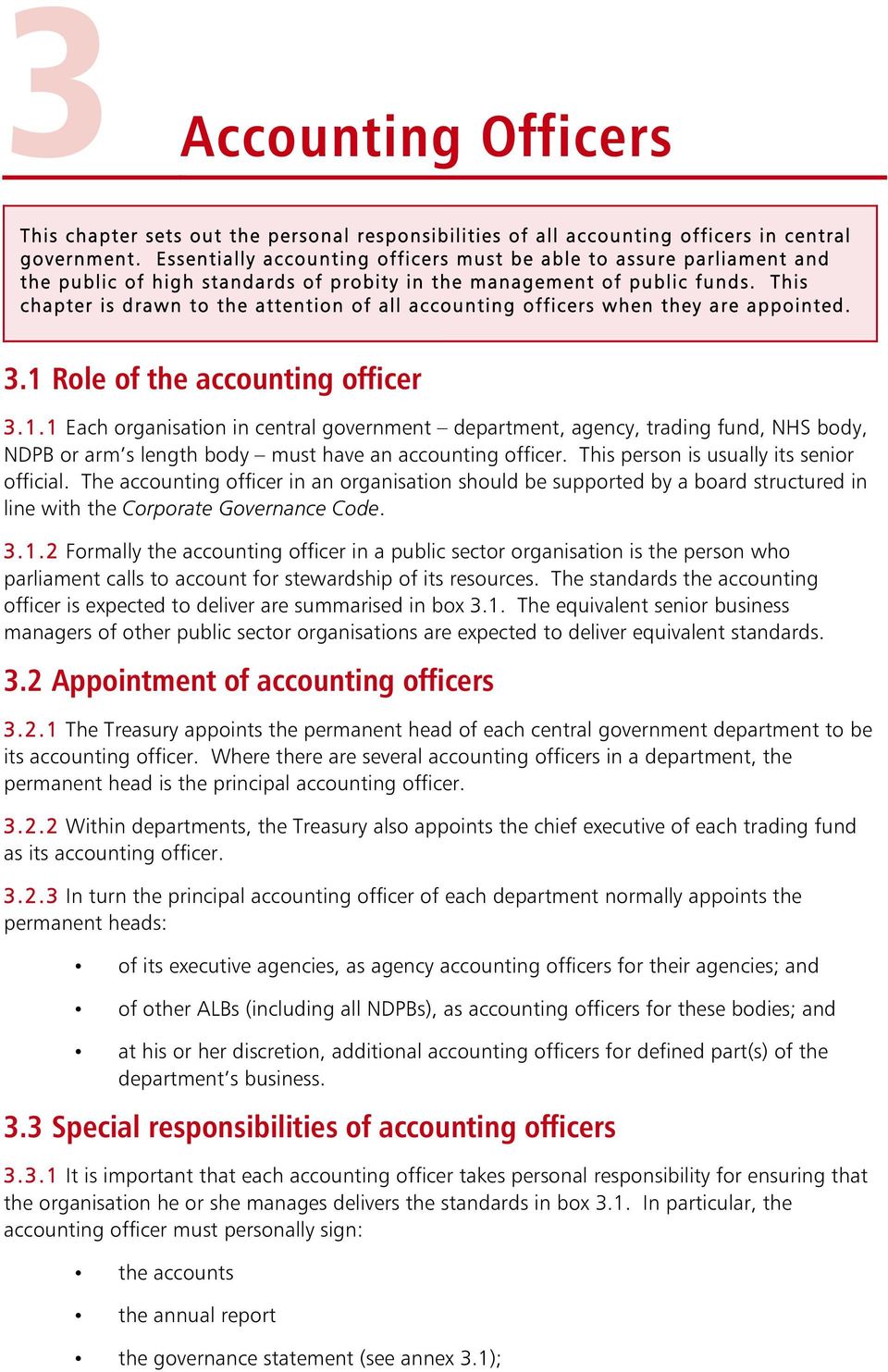
20 3 Accounting Officers and having been satisfied that they have been properly prepared to reflect the business of the organisation, must personally approve: voted budget limits; and the associated Estimates Memorandum. Box 3.1: standards expected of the accounting officer s organisation Acting within the authority of the minister(s) to whom he or she is responsible, the accounting officer should ensure that the organisation, and any ALBs it sponsors, operates effectively and to a high standard of probity. The organisation should: governance have a governance structure which transmits, delegates, implements and enforces decisions have trustworthy internal controls to safeguard, channel and record resources as intended work cooperatively with partners in the public interest operate with propriety and regularity in all its transactions treat its customers and business counterparties fairly, honestly and with integrity offer appropriate redress for failure to meet agreed customer standards give timely, transparent and realistic accounts of its business and decisions, underpinning public confidence; decision-making support its ministers with clear, well reasoned, timely and impartial advice make all its decisions in line with the strategy, aims and objectives of the organisation set by ministers and/or in legislation take a balanced view of the organisation s approach to managing opportunity and risk impose no more than proportionate and defensible burdens on business; financial management use its resources efficiently, economically and effectively, avoiding waste and extravagance plan to use its resources on an affordable and sustainable path, within agreed limits carry out procurement and project appraisal objectively and fairly, using cost benefit analysis and generally seeking good value for the Exchequer as a whole use management information systems to gain assurance about value for money and the quality of delivery and so make timely adjustments avoid over defining detail and imposing undue compliance costs, either internally or on its customers and stakeholders have practical documented arrangements for controlling or working in partnership with other organisations, as appropriate use internal and external audit to improve its internal controls and performance The accounting officer of a corporate arm s length body should arrange for a board member to sign the accounts as well as signing them himself or herself, if (unusually) he or she is not a member of the board There are several other areas where accounting officers should take personal responsibility: regularity and propriety (see box 2.4), including securing Treasury approval for any expenditure outside the normal delegations or outside the subheads of Estimates;
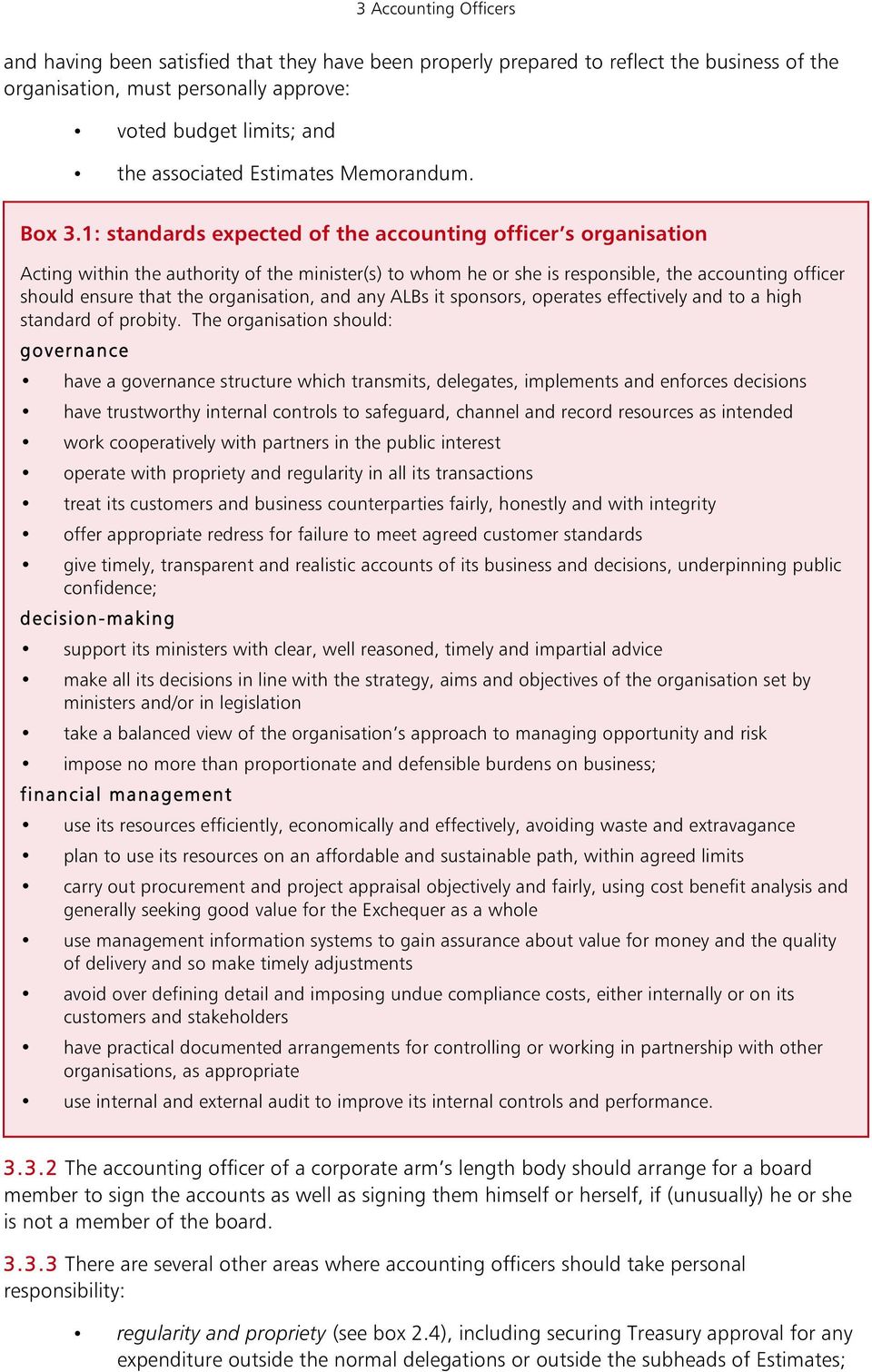
21 3 Accounting Officers affordability and sustainability: respecting agreed budgets and avoiding unaffordable longer term commitments, taking a proportionate view about other demands for resources; value for money: ensuring that the organisation s procurement, projects and processes are systematically evaluated to provide confidence about suitability, effectiveness, prudence, quality, good value judged for the Exchequer as a whole, not just for the accounting officer s organisation (eg using the Green Book 1 to evaluate alternatives); control: the accounting officer should personally approve and confirm their agreement to all Cabinet Committee papers and major project or policy initiatives before they proceed; management of opportunity and risk to achieve the right balance commensurate with the institution s business and risk appetite; learning from experience, both using internal feedback (eg through managing projects and programmes using techniques such as PRINCE2), and from right across the public sector; and accounting accurately for the organisation s financial position and transactions: to ensure that its published financial information is transparent and up to date; and that the organisation s efficiency in the use of resources is tracked and recorded In the case of principal accounting officers, these responsibilities apply to the business of the whole departmental group. 3.4 Advice to ministers Each departmental accounting officer should take care to bring to the attention of the minister(s) to whom he or she is responsible any conflict between the minister s instructions and his or her duties. The accounting officer cannot simply accept the minister s aims or policy without examination. There is no set form for registering objections, though the accounting officer should be specific about their nature. The acid test is whether the accounting officer could justify the proposed activity if asked to defend it Accounting officers should routinely scrutinise significant policy proposals or plans to start or vary major projects and then assess whether they measure up to the standards in box 3.1 so that they can identify any discrepancy 2. The accounting officer should draw any such problems to the attention of the responsible minister to see whether they can be resolved If the minister decides to continue with a course the accounting officer has advised against, the accounting officer should ask for a formal written direction to proceed. An oral direction should be confirmed in writing quickly. Examples of where this procedure is appropriate are in box to 2 The Treasury or the chair of the relevant Cabinet Committee may also ask for the accounting officer s assessment of any novel proposal.
22 3 Accounting Officers Box 3.2: when accounting officers should seek a direction Regularity: if a proposal is outside the legal powers, parliamentary authority, or Treasury delegations; or incompatible with the agreed spending budgets. Propriety: if a proposal would breach parliamentary control procedures or expectations. Value for money: if an alternative proposal, or doing nothing, would deliver better value, eg a cheaper, higher quality or more effective outcome for the Exchequer as a whole. Feasibility: where there is a significant doubt about whether the proposal can be implemented accurately, sustainably, or to the intended timetable Directions of this kind are rare. It is good practice for accounting officers to discuss the matter with the Treasury if time permits. The ultimate judgement in each case must lie with the accounting officer personally When a direction is made, the accounting officer should: copy the relevant papers to the C&AG and the TOA promptly. The C&AG will normally draw the matter to the attention of the PAC, who will attach no blame to the accounting officer; follow the minster s direction without further ado; if asked, explain the minister s course of action. This respects ministers rights to frank advice, while protecting the quality of internal debate; arrange for the existence of the direction to be published, no later than in the next report and accounts, unless the matter must be kept confidential. 3.5 Public Accounts Committee The PAC may hold public hearings on the accounts of central government organisations laid in parliament (see section 1.6). In practice most PAC hearings focus on NAO value for money studies. NAO seeks to agree the text of these reports with the accounting officer(s) concerned so there is a clear undisputed evidence base for PAC scrutiny When a hearing is scheduled, the PAC normally invites the accounting officer(s) of the relevant institution(s) to attend as witness(es). An accounting officer may be accompanied by appropriate officials. Where it is appropriate, and the PAC agrees, an accounting officer may send a substitute. The PAC may also invite other witnesses who may not be public servants to give insight into the background of the subject in hand In answering questions, the accounting officer should take responsibility for the organisation s business, even if it was delegated or if the events in question happened before he or she was appointed accounting officer. In response to specific PAC or Select Committee requests, previous accounting officers may also attend relevant PAC hearings. Recalls of this kind should be assessed case by case, depending on the circumstances. They are acceptable if the business in issue was fairly recent, and where the former accounting officer has had an opportunity to comment before publication on any NAO report which the PAC is to investigate The PAC expects witnesses to give clear, accurate and complete evidence. If evidence is sensitive, witnesses may ask to give it in private. Witnesses may offer supplementary notes if the information sought is not to hand at the meeting. Any such notes should be provided within one week unless the PAC is willing to grant an extension. They should do so without delay.
23 3 Accounting Officers The TOA (or an alternate) attends all PAC hearings. This enables the PAC to explore any more general issues arising out of the hearing. 3.6 When the accounting officer is not available Each public sector organisation must have an accounting officer available for advice or decision as necessary at short notice When the accounting officer is absent and cannot readily be contacted, another senior official should deputise. If a significant absence is planned, the accounting officer may invite the Treasury (or the sponsor department, as the case may be) to appoint a temporary acting accounting officer. 3.7 Conflicts of interest Sometimes an accounting officer faces an actual or potential conflict of interest. There must be no doubt that the accounting officer meets the standards described in box 3.1 without divided loyalties. Possible ways of managing this issue include: for a minor conflict, declaring the conflict and arranging for someone other than the accounting officer to make a decision on the issue(s) in question; for a significant but temporary conflict, inviting the Treasury (or the sponsor department, as the case may be) to appoint an interim accounting officer for the period of the conflict of interest; or for serious and lasting conflicts, resignation. 3.8 Arm s length bodies The responsibilities of accounting officers in departments and in arm s length bodies (ALBs) are essentially similar. Accounting officers in ALBs must also take account of their special responsibilities and powers. In particular, they must respect the legislation (or equivalent) establishing the organisation and terms of the framework document agreed with the sponsor department. See chapter 7 for more The framework document (or equivalent) agreed between an ALB and its sponsor always provides for the sponsor department to exercise meaningful oversight of the ALB s strategy and performance, pay arrangements and/or major financial transactions, eg by monthly returns, standard delegations and exception reporting. The sponsor department s accounts consolidate those of its ALBs so its accounting officer must be satisfied that the consolidated accounts are accurate and not misleading Overall, the accounting officer of a sponsor department should make arrangements to satisfy himself or herself that that the ALB has systems adequate to meet the standards in box 3.1. Similarly, the accounting officer of an ALB with a subsidiary should have meaningful oversight of the subsidiary. It is not acceptable to establish ALBs, or subsidiaries to ALBs, in order to avoid or weaken parliamentary scrutiny Exceptionally, the accounting officer of a sponsor department may need to intervene if an ALB drifts significantly off track, eg if its budget is threatened, its systems are badly defective or it falls into disrepute. This may include replacing some or all of the leaders of the ALB, possibly even its accounting officer.
24 3 Accounting Officers There are sensitivities about the role of the accounting officer in an ALB which is governed by an independent board, eg a charity or company. The ALB s accounting officer, who will normally be a member of the board, must take care that his or her personal legal responsibilities do not conflict with his or her duties as a board member. In particular, the accounting officer should vote against any proposal which appears to cause such a conflict; it is not sufficient to abstain Moreover, if the chair or board of such an ALB is minded to instruct its accounting officer to carry out a course inconsistent with the standards in box 3.1, then the accounting officer should make his or her reservations clear, preferably in writing. If the board is still minded to proceed, the ALB accounting officer should then: ask the accounting officer of the sponsor department to consider intervening to resolve the difference of view, preferably in writing; if the board s decision stands, seek its written direction to carry it out, asking the sponsor department to inform the Treasury; proceed to implement without delay; and follow the routine in paragraph This process is similar to what happens in departments (see section 3.4), allowing for the special position of the organisation s board, which is often appointed under statute. 3.9 In the round It is not realistic to set firm rules for every aspect of the business with which an accounting officer may deal. Sometimes the accounting officer may need to take a principled decision on the facts in circumstances with no precedents. Should that happen, the accounting officer should be guided by the standards in box 3.1 in assessing whether there is a case for seeking a direction for any of the factors in box 3.2. It is essential that accounting officers seek good outcomes for the Exchequer as a whole, respecting the key principles of transparency and parliamentary approval for management of public resources Where time permits, the Treasury stands ready to help accounting officers think such issues through. It is good practice to document decisions where the accounting officer has had to strike difficult judgements, especially where they break new ground. Annex 3.1 The Governance Statement
25 4 Governance and Management Public sector organisations should have good quality internal governance and sound financial management. Appropriate delegation of responsibilities and effective mechanisms for internal reporting should ensure that performance can be kept on track. Good practice should be followed in procuring and managing resources and assets; hiring and managing staff; and deterring waste, fraud and other malpractice. Central government departments have some specific responsibilities for reporting, including to parliament. 4.1 Governance structure Each public sector organisation should establish governance arrangements appropriate to its business, scale and culture. The structure should combine efficient decision making with accountability and transparency In doing so, central government departments should be guided by the Corporate Governance Code 1. Each public sector organisation needs clear leadership, normally provided by a board. Box 4.1 sets out best practice for departmental boards. Box 4.1: best practice for boards in central government departments chaired by the department s most senior minister, with junior ministers as members comparable numbers of official and non-executive members, including a lead non-executive and a professionally qualified finance director (see annex 4.1) meeting at least quarterly sets the department s strategy to implement ministers policy decisions leads the department s business and determines its culture ensures good management of the department s resources financial, assets, people decides risk appetite and monitors emerging threats and opportunities steers performance to keep it on track using regularly updated information about progress keeps an overview of its ALBs activities It is good practice for ALBs to use similar principles. In many ALBs some structural features, such as board composition, derive from statute but considerable discretion may remain. In some organisations it is usual, or found valuable, for the board to include members with designated responsibility or expertise, eg for regional affairs or for specialist professional skills In order to carry out its responsibilities each board needs to decide, and document, how it will operate. Box 4.2 outlines the key decisions. It is not exhaustive. Once agreed, the working rules should be reviewed from time to time to keep them relevant. Boards should 1 both the code and the good practice guidance
26 4 Governance and Management challenge themselves to improve their working methods, so that their processes can achieve and maintain good modern business practice. Box 4.2: key decisions for boards mission and objectives delegations and arrangements for reporting performance procedures and processes for business decision making scrutiny, challenge and control of significant policies, initiatives and projects risk appetite and risk control procedures, eg maintaining and reviewing a risk register control and management of associated ALBs and other partnerships arrangements for refreshing the board arrangements for reviewing the board s own performance accountability to the general public, to staff and other stakeholders (see section 4.13) how the insights of non-executives can be harnessed how often the board s working rules will be reviewed 4.2 Working methods The accounting officer of each organisation is accountable to parliament for the quality of the administration that he or she leads. The administrative standards expected are set out in the Civil Service Code 2 and the Ombudsman s Principles of Public Administration 3. They allow considerable flexibility to fit with each organisation s obligations and culture. It is against these standards that failure to deliver is assessed Another fundamental concept is the Treasury s leadership position in managing public expenditure, and setting the rules under which departments and their ALBs should deploy the assets, people and other resources under their control. In turn each public sector organisation should have robust and effective systems for their internal management. Box 4.3 outlines the key decisions each organisation needs to make To help the Treasury carry out this task properly: departments should provide the Treasury with accurate and timely information about in-year developments - their expenditure, performance against objectives and evolution of risk (eg serious unforeseen events or discovery of fraud); ALBs should provide their sponsor departments with similar information; and the established mechanisms for controlling and reporting public expenditure, including Treasury support or approval where necessary, should be respected In particular, departments should consult the Treasury (and ALBs their sponsor departments) at an early stage about proposals to undertake unusual transactions or financing techniques. This applies especially to any transactions which may have wider implications elsewhere in the public sector (see paragraph and box 2.3)
27 4 Governance and Management Working with the accounting officer, the finance director of each public sector organisation has special responsibility for seeing that the standards described in this chapter are respected. Annex 4.1.sets this out in more detail. Box 4.3: essentials of effective internal decision making choice active management of the portfolio of risks and opportunities appraisal of alternative courses of action using the techniques in the Green Book, and including assessment of feasibility to achieve value for money where appropriate, use of models (see annex 4.2) or pilot studies to provide evidence on which to make decisions among policy or project choices active steering of initiatives, eg reviews to take stock at critical points of projects operation appropriate internal delegations, with a single senior responsible officer (SRO) for each significant project or initiative, and a single senior person leading each end to end process prompt, regular and meaningful management information on costs (including unit costs), efficiency, quality and performance against targets to track progress and value for money proportionate administration and enforcement mechanisms, without unnecessary complexity use of feedback from internal and external audit and elsewhere to improve performance regular risk monitoring, to track performance and experience and make adjustments in response afterwards mechanisms to evaluate policy, project and programme outputs and outcomes, including whether to continue, adjust or end any continuing activities arrangements to draw out and propagate lessons from experience 4.3 Opportunity and risk Embedded in each public sector organisation s internal systems there should be arrangements for recognising, tracking and managing its opportunities and risks. Each organisation s governing body should make a considered choice about its desired risk appetite, taking account of its legal obligations, ministers policy decisions, its business objectives, and public expectations of what it should deliver. This can mean that different organisations take different approaches to the same opportunities or risks There should be a regular discipline of reappraising the opportunities and risks facing the organisation since both alter with time and circumstances, as indeed may the chosen responses. This process should avoid excessive caution, since it can be as damaging as unsuitable risk taking. The assessment should normally include: maintaining a risk register, covering identified risks and contingent risks from horizon scanning; reputational risks, since poor performance could undermine the credibility, and ultimately the creditworthiness, of the Exchequer as a whole; consideration of the dangers of maintaining the status quo; plans for disaster recovery;
28 4 Governance and Management appraisal of end to end risks in critical processes and other significant activities In making decisions about how to manage and control opportunity and risk, audit evidence and other assurance processes can usefully inform choice. Audit, including internal audit, can provide specific, objective and well-informed assurance and insight to help an organisation evaluate its effectiveness in achieving its objectives. It is good practice for the audit committee to advise the governing board of a public sector organisation on its key decisions on governance and managing opportunities and risks. It is also a good discipline for this process to include evaluating progress in implementing PAC recommendations, where they have been accepted In turn the board should support the accounting officer in drawing up the governance statement, which forms part of each organisation s annual accounts. See annex 3.1. Further guidance about managing risks is in annex 4.3 and the Orange Book. 4.4 Insurance In the private sector risk is often managed by taking out insurance. In central government it is generally not good value for money to do so. This is because the public sector has a wide and diverse asset portfolio; a reliable income through its ability to raise revenue through taxation; and access to borrowed funds more cheaply than any in the private sector. In addition commercial providers of insurance also have to meet their own costs and profit margins. Hence the public purse is uniquely able to finance restitution of damaged assets or deal with other risks, even very large ones. If the government insured risk, public services would cost more However, there are some limited circumstances in which it is appropriate for public sector organisations to insure. They include legal obligations 4, and occasions where commercial insurance would provide value for money 5. Further information about insurance generally is in annex Control of public expenditure The Treasury coordinates a system through which departments are allocated budget control totals for their public expenditure. Each department s allocation covers its own spending and that of its associated ALBs. Within the agreed totals, it has considerable discretion over setting priorities to deliver the public services for which it is responsible Each public sector organisation should run efficient systems for managing payments (see box 4.4). It should also keep its use of public resources within the agreed budgets, take the limits into account when entering into commitments, and generally ensure that its spending profile is sustainable Any major project, programme or initiative should be led by a senior responsible owner (SRO). It is good practice to aim for continuity in such appointments 6. 4 eg ALBs should insure vehicles where the Road Traffic Act requires it 5 eg where private sector contractors take out single-site insurance policies because they are cheaper than each individual party insuring themselves separately. 6 See annex 4.5.
29 4 Governance and Management Box 4.4: essentials of systems for committing and paying funds Selection of projects after appraisal of the alternatives (see the Green Book), including the central clearance processes for larger commitments. Open competition to select suppliers from a diverse range, preferably specifying outcomes rather than specific products, to achieve value for money (see annexes 4.6 and 4.7). Where feasible, procurement through multi-purchaser arrangements, shared services and/or standard contracts to drive down prices. Effective internal controls to authorise acquisition of goods or services (including vetting new suppliers), within any legal constraints. Separation of authorisation and payment, with appropriate controls, including validation and recording, at each step to provide a clear audit trail. Checks that the goods or services acquired have been supplied in accordance with the relevant contract(s) or agreement(s) before paying for them. Payment terms chosen or negotiated to provide good value. Accurate payment of invoices: once and on time, avoiding lateness penalties (see annex 4.8). A balance of preventive and detective controls to tackle and deter fraud, corruption and other malpractice (see annex 4.9). Integrated systems to generate automatic audit trails which can be used to generate accounts and which both internal and external auditors can readily check. Periodic reviews to benefit from experience, improve value for money or to implement developments in good practice. 4.6 Receipts Public sector organisations should have arrangements for identifying, collecting and recording all amounts due to them promptly and in full. Outstanding amounts should be followed up diligently. Key features of internal systems of control are suggested in box Public sector organisations should take care to track and enforce debts promptly. The presumption should be in favour of recovery unless it is uneconomic to do so. Box 4.5: essential features of systems for collecting sums due Adequate records to enable claims to be made and pursued in full. Routines to prevent unauthorised deletions and amendments to claims. Credit management systems to manage and pursue amounts outstanding. Controls to prevent diversion of funds and other frauds. Clear lines of responsibility for making decisions about pressing claims increasingly more firmly, and for deciding on any abatement or abandonment of claims which may be merited. Arrangements for deciding upon and reporting any write-offs (see annex 4.10). Audit trails which can readily be checked and reported upon both internally and externally. 4.7 Non-standard financial transactions From time to time public sector organisations may find it makes sense to carry out transactions outside the usual planned range, eg: write-offs of unrecoverable debts or overpayments;
30 4 Governance and Management recognising losses of stocks or other assets; long term loans or gifts of assets In each case it is important to deal with the issue in the public interest, with due regard for probity and value for money. Annexes 4.10 to 4.12 set out what is expected when such transactions take place in central government, including notifying parliament Where an organisation discovers an underpayment, the deficit should be made good as soon as is practicable and in full. If there has been a lapse of time, for example caused by legal action to establish the correct position, it may be appropriate to consider paying interest, depending on the nature of the commitment to the payee and taking into account the reputation of the organisation and value for money for the Exchequer as a whole (see also section 4.11) Similarly, public sector organisations may have reason to carry out current transactions which would not normally be planned for. These might be: extra contractual payments to service providers; extra-statutory payments to claimants (where a similar statutory scheme exists); ex gratia payments to customers (where no established scheme exists); or severance payments to employees leaving before retirement or before the end of their contract and involving payments above what the relevant pension scheme allows Again it is important that these payments are made in the public interest, objectively and without favouritism. The disciplines parliament expects of central government entities are set out in annex 4.13, which explains the notification procedure to be followed for larger one-off transactions of this kind. The steps to be considered when setting up statutory or extrastatutory compensation schemes are discussed in annex Unusual circumstances Sometimes public sector organisations face dilemmas in meeting their commitments. They may have a legal or business obligation which would be uneconomic or inappropriate to carry out assiduously to the letter. In such cases it can be justifiable to seek a pragmatic, just and transparent alternative approach, appropriately reported to parliament in the organisation s annual accounts. One-off schemes of this kind are always novel and so require Treasury approval, not least because they may also require legislation or have to rest on the authority of a Supply and Appropriation Act (see section 2.5). Box 4.6 suggests precedented examples.
31 4 Governance and Management Box 4.6: examples of one-off pragmatic schemes A court ruling could mean that a public sector organisation owed each of a large number of people a very small sum of money. The cost of setting up and operating an accurate payment scheme might exceed the total amount due. The organisation could instead make a one-off payment of equivalent value to a charity representing the recipient group. A dispute with a contractor might conclude that the contractor owed a public sector organisation an amount too big for it to meet in a single year while staying solvent. The customer might instead agree more favourable payment terms, with appropriate safeguards, if this arrangement provides better value for money. 4.9 Staff Each public sector organisation should have sufficient staff with the skills and expertise to manage its business efficiently and effectively. The span of skills required should match the organisation s objectives, responsibilities and resources, balancing professional, practical or operational skills and policy makers, and recognising the value of each discipline. Succession and disaster planning should ensure that the organisation can cope robustly with changes in the resources available, including unforeseen disruption Public sector organisations should seek to be fair, honest and considerate employers. Some desirable characteristics are suggested in box 4.7. Box 4.7: public sector organisations as good employers selection designed to value and make good use of talent and potential of all kinds fairness, integrity, honesty, impartiality and objectivity professionalism in the relevant disciplines, always including finance arrangements to make sure that staff are loaded cost effectively management techniques balancing incentives to improve and disciplines for poor performance diversity valued and personal privacy respected mechanisms to support efficient working practices, both normally and under pressure arrangements for whistleblowers to identify problems privately without repercussions Similarly public sector employers have a right to expect good standards of conduct from their employees. The qualities and standards expected of civil servants are set out in the Civil Service Code. Other public sector employees should strive for similar standards, appropriate to their context Assets All public sector organisations own or use a range of assets. Each organisation needs to devise an appropriate asset management strategy to define how it acquires, maintains, tracks, deploys and disposes of the various kinds of assets it uses. Annex 4.15 discusses how to set up and use such a strategy It is good practice for public sector organisations to take stock of their assets from time to time and consider afresh whether they are being used efficiently and deliver value for public funds. If there is irreducible spare capacity there may be scope to use part of it for other government activities, or to exploit it commercially for non-statutory business.
32 4.11 Standards of service 4 Governance and Management Poor quality public services are not acceptable. Public sector organisations should define what their customers, business counterparties and other stakeholders can expect of them Standards can be expressed in a number of ways. Examples include guidelines (eg response times), targets (eg take-up rates) or a collection of customer rights in a charter. Even where standards are not set explicitly, they may sometimes be inferred from the way the provider organisation carries out its responsibilities; so it is normally better to express them directly Whatever standards are set, they should be defined in a measurable way, with plans for recording performance, so that delivery can be readily gauged. It is good practice to use customer feedback, including from complaints, to reassess from time to time whether standards or their proxies (milestones, targets, outcomes) remain appropriate and meaningful Where public sector organisations fail to meet their standards, or where they fall short of reasonable behaviour, it may be appropriate to consider offering remedies. These can take a variety of forms, including apologies, restitution (eg supplying a missing licence) or, in more serious cases, financial payments. Decisions about financial remedies which should not be offered routinely - should include taking account of the legal rights of the other party or parties and the impact on the organisation s future business Any such payments, whether statutory or ex gratia, should follow good practice (see section 4.13). Since schemes of financial redress often set precedents or have implications elsewhere, they should be cleared with the Treasury before commitments are made, just as with any other public expenditure out of the normal pattern (see sections 2.1 to 2.4) Complaints Those public sector organisations which deal with customers directly should strive to achieve clear, accurate and reliable standards for the products and services they provide. It is good practice to arrange for complaints about performance to be reviewed by an independent organisation such as an ombudsman Often such review processes are statutory. The activities of central government departments and the NHS are open to review by the PHSO 7, whose Principles of Good Complaints Handling 8 sets out generic advice on complaints handling and administration of redress (see also annex 4.14). After investigation of cases of specific complaint, the PHSO can rule on whether injustice or hardship can be attributed to maladministration or service failure, and may recommend remedies, either for individual cases or for groups of similar cases. If departments decline to follow the PHSO s advice, they should lay a memorandum in parliament explaining why
33 4 Governance and Management 4.13 Transparency All public sector organisations should operate as openly as is compatible with the requirements of their business. In line with the statutory public rights 9, they should make available timely information about their services, standards and performance. This material should strike a careful balance between protecting confidentiality and open disclosure in the public interest All public sector organisations should adopt a publication scheme routinely offering information about the organisation s activities. They should also publish regular information about their plans, performance and use of public resources The published information should be in sufficient detail, and be sufficiently regular, to enable users and other stakeholders to hold the organisation and its ministers to account. Benchmarks can help local users to evaluate local performance more easily The primary document of record for central government departments is the report and accounts, which should consolidate information about the relevant ALBs. It should include a governance statement (see annex 3.1) In addition, the Treasury is responsible for publishing certain aggregate information about use of public resources, for example Whole of Government Accounts (WGA) consolidating all central and local government organisations accounts and comparisons of outturn with budgets. The Office for National Statistics (ONS) also uses input from data gathered by the Treasury to publish the national accounts In certain areas of public business it is also important or desirable to provide adequate public access to physical assets. Unnecessary or disproportionate restrictions should be avoided. Managed properly, this can be a valuable mechanism to promote inclusion and enhance public accountability Dealing with initiatives Public sector organisations need to integrate all the advice in this handbook when introducing new policies or planning projects. Each is unique and will need bespoke treatment. The checklist in box 4.8 brings the different factors together. It applies directly to central government organisations but the principles will be of value elsewhere. 9 Eg Freedom of information act 2000, Data protection act 1998, Environment information regulations 2004 and the Re-use of public sector information regulations 2005.
34 4 Governance and Management Box 4.8: factors to consider when planning policies or projects design Has the proposal been evaluated against alternative options, including doing nothing? Should there be pilot testing before full roll out? Are the controls agreed and documented clearly? Have the risks and opportunities been considered systematically? Is the change process resilient to shocks? What contingencies might arise? Is the intended intervention proportionate to the identified need? What standards should be achieved? How will performance be tracked and assessed? Could the proposal be simplified without loss of function? If partner(s) are involved, is the allocation of responsibilities appropriate? Will the proposal be efficient, effective and offer good value for money? Is the policy sustainable in the broadest sense? Should it have a sunset clause? Does the planned activity meet high standards of probity, integrity and honesty? Will the proposal deliver the desired outcome to time and cost? Does the accounting officer assess the initiative as compatible with the public sector standards? control What prior agreement is required, if any? How will internal governance and delegation work? Will it be effective? Is it transparent? Should there be an SRO? Is there adequate legislation? If not, what is needed to make the action lawful? Is there any conflict with European law, including limits on state aids? How will the proposal be financed? Is there budget and Estimate cover? Is it appropriate to charge to help finance the service? Are charges set within the law? Is the proposed action within the department s delegated authorities? What financial techniques will be used to manage rollout, implementation and operation? Are project and programme management techniques likely to be useful? How will the intended new arrangements be monitored and efficiency measured? How will feedback be used to improve outcomes? Does the design inhibit misuse and counter fraud? What safeguards are needed? How will the associated risks be tracked and the responses adjusted? What intervention will be possible if things go off track? Would it be possible to recover from a disaster promptly? accountability How should parliament be told of the proposal and kept informed of progress? What targets will be used? Are they sufficiently stretching? Is public access called for? How? Is the policy or service fair and impartial? Will its administration be open, transparent and accessible? Should there be customer standards? How are complaints used to improve performance? Should there be arrangements for redress after poor delivery? Is enforcement required? If so, is it proportionate? Is an appeal mechanism needed? Is regulation called for? learning lessons What audit arrangements (internal and external) are intended? What information about the activity will be published? How and how often? When and how will the policy or project be evaluated to assess its cost and benefits and to determine whether it should continue, be adjusted, replaced or ceased?
35 4 Governance and Management Annex 4.1 Annex 4.2 Annex 4.3 Annex 4.4 Annex 4.5 Annex 4.6 Annex 4.7 Annex 4.8 Annex 4.9 Annex 4.10 Annex 4.11 Annex 4.12 Annex 4.13 Annex 4.14 Annex 4.15 Finance Directors Use of models Risk Insurance Senior Responsible Owner Accountability Procurement State aids Expenditure and payments Fraud Losses and write-offs Overpayments Gifts Special payments Remedy Asset management
36
37 5 Funding This chapter explores the means by which central government organisations may obtain funds in order to finance public expenditure. The Treasury operates disciplines to respect parliament s concern to prevent unauthorised expenditure. 5.1 The framework for public expenditure control Most public expenditure is financed from centrally agreed multi-year budgets administered by the Treasury, which oversees departments use of their budget allocations. In the main, departments have considerable discretion about how they distribute these budget allocations, which are expressed net of relevant income. The main source of receipts to be netted off is fees and charges (see chapter 6) The Treasury oversees and directs the rules that departments should respect in managing their budgets. Departments are expected to live within their allocations for each financial year, with some limited exceptions, eg for certain demand led services. The budgeting framework is explained in the Consolidated Budgeting Guidance, which is refreshed each year. 5.2 Grants Each central government department decides how much of its budget provision it should cascade to its ALBs in each year of the multi-year agreement. Departments may pay them grants (for specific purposes) and grants-in-aid (unspecific support) to finance their spending; though it is the net spending of the ALB that scores in the departmental budget. Annex 5.1 explains more about grants Budgets and Estimates plan net spending and include all spending of ALBs however it is financed. In general it is sensible to consider arrangements for protecting the Exchequer interest through clawback of specific grants should the purposes for which they are agreed not materialise (annex 5.2). 5.3 Estimates The multiyear departmental budgets agreed collectively among ministers do not of themselves confer authority to spend or commit resources. Parliamentary agreement, usually through the Supply Estimate process, is also essential (see box 2.1) Departmental Estimates are put to parliament covering one financial year at a time, in the spring. Each covers the net expenditure of a department and its ALBs (ie all spending in budgets and any voted spend outside of budgets). For the year ahead, the provision sought should be taut and realistic, without padding. The Supply and Estimates Guidance Manual has more detail Before the summer recess, the provision sought in the Estimate is formally authorised in a Supply and Appropriation Act, which sets net expenditure limits for the year. The Act is then the legal authority for public expenditure within the ambit of the Estimate. The ambit itemises a specific range of permitted activities and income streams for the year.
38 5 Funding Within a financial year, there is some scope for transferring (through virement) provision from one section or subhead to another within any of the control limits in the same Estimate. There is scope for adjusting Estimate provision through a Supplementary Estimate late in the year if circumstances change. A Supplementary Estimate should show all movements between sections, even if they would otherwise have been dealt with through virement Departmental Select Committees may examine departmental witnesses on the plans contained in Estimates. Usually such hearings take place after Estimates are laid in parliament but before they are voted into law If there is underspending against Estimate provision in one year, it cannot automatically be carried forward to a later year. If a department wants to spend resources it did not consume in a previous year, it needs Treasury approval and must also obtain fresh parliamentary authority to spend in the year(s) concerned Like budgets, Estimates are set net of income. But parliament needs to be made aware of receipts since Estimates authorise gross expenditure, normally using statutory powers. Annex 5.3 explains more about of types of receipt. Chapter 6 contains guidance about setting and adjusting fees and charges Occasionally an Estimate sets a negative limit for permitted resources. This happens if income is expected to exceed the relevant gross expenditure. Similarly a Supplementary Estimate can be negative if provision for spending is to fall within a given year A department s Estimate for a year includes all spending within its agreed budget for that year, as well as any voted non-budget spending. Not all of this amount requires voted parliamentary approval since some items, such as Consolidated Fund Standing Services, are paid direct from the Consolidated Fund. Hence only the voted parts of the Estimate requiring parliamentary approval appear in the Supply and Appropriation Act. Of course the disciplines on public funds (box 3.1) apply to all the activities described in the Estimate and accounts whether within the Act or not. 5.4 Excess Votes Accounting officers have an important role in overseeing the integrity of the Estimates for which they are responsible. In particular, accounting officers are responsible for ensuring that Estimates are in good order (see section 2.2) The Treasury presents parliament each year with a Statement of Excesses to request retrospective authority for any unauthorised resources consumed above the relevant limits or outside the ambit of the Estimate. Parliament takes these excesses seriously. The PAC or departmental select committee may call witnesses to account in person or ask for a written explanation The Statement of Excesses includes two kinds of excess: spending above the amount provided in an Estimate; and irregular expenditure outside the ambit, eg on an unauthorised service.
39 5 Funding Parliament usually regards the latter as particularly unsatisfactory because it means that the department concerned has flouted parliament s intentions 1 and may have defective systems of control. The auditor may identify such excesses as spending not covered by statutory powers, even if the total amount spent does not exceed the voted limit Expenditure in excess of provision on an activity agreed by parliament is also to be avoided since the authority of a Supply and Appropriation Act is just as essential as specific statutory authority (box 2.1). It is possible, with Treasury agreement, to raise the amount in an Estimate during the course of the year in a Supplementary. But otherwise accounting officers should reduce, reprioritise or postpone use of resources to keep within the provision parliament has agreed for the year. 5.5 Commitments Parliament is not bound 2 to honour ministers commitments unless and until there are statutory powers to meet them and it authorises public funds to finance them (through an Estimate) in a given year. This discipline is especially important when ministers plan a new service Because commitments can evolve into spending, they should always be scrutinised and appraised as stringently as proposals for consumption (box 4.8 may help). Some departments may agree with the Treasury blanket authority for defined and limited ranges of non-statutory commitments, eg indemnities for board members and commitments taken on the normal course of business. All other non statutory commitments are novel, contentious or repercussive, so Treasury approval is always essential before they are undertaken Public sector organisations should give parliament prompt and timely notice of any significant new commitments, whether using existing statutory powers or to be honoured through future legislation. Non statutory contingent liabilities (above a specified threshold) should always be notified in this way. The process is set out in annex 5.4. Box 5.1: contingent liabilities: notifying parliament Parliament should be notified of uncertain liabilities in a meaningful way without spurious accuracy. It is good practice to notify parliament if a previously notified liability changes significantly, or can be clarified, eg if the timing can be firmed up. If a contingent liability affects several departments but cannot confidently be allocated among them, the relevant ministers should inform parliament in a pragmatic way. A single statement may well suffice. If, exceptionally, a new liability needs to remain confidential, the minister should inform the chairs of the relevant select committee and the PAC; then inform parliament openly when the need for confidentiality lifts. Ministers should inform parliament if an ALB assumes a contingent liability which it could not absorb within its own resources, since the risk ultimately lies with the sponsor department s budget. 1 Ie has breached the Concordat see annex Under the Concordat
40 5 Funding The general rule is to err on the side of caution in keeping parliament informed of emerging contingent liabilities. It is impossible to generalise about every possible set of circumstances but some guidance is in box Tax Public sector organisations should not engage in, or connive at, tax evasion, tax avoidance or tax planning. If a public sector organisation were to obtain financial advantage by moderating the tax paid by a contractor, supplier or other counterparty, it would usually mean that the Exchequer as a whole would be worse off thus conflicting with the accounting officer s duties (section 3.3). Thus artificial tax avoidance schemes should normally be rejected. It should be standard practice to consult HMRC 3 about transactions involving non-standard approaches to tax before going ahead There is of course no problem with using tax advisers to help meet normal legitimate requirements of carrying on public business. These include administration of VAT, PAYE and NICs, where expert help can be useful and efficient Proposals to create new taxes in order to assign their proceeds to new spending proposals are rarely acceptable. Decisions on tax are for Treasury ministers, who are reluctant to compromise their future fiscal freedom to make decision. 5.7 Public dividend capital Certain public sector businesses, notably trading funds and certain Health Trusts, are set up with public dividend capital (PDC) in lieu of equity. Like equity, PDC should be serviced, though not necessarily at a constant rate PDC is not a soft option. In view of the risk it carries, it should deliver a rate of return comparable to commercial equity investments carrying a similar level of risk. There is scope for the return to vary to reflect market conditions and investment patterns; but persistent underperformance against the agreed rate of return should not be tolerated A department needs specific statutory power to issue PDC, together with supply cover to pay it out of the Consolidated Fund. Sometimes instead of a specific issue of PDC, the legislation establishing (or financially reconstructing) a public sector business deems an issue of PDC to the new business. Dividends on PDC, and any repayments of PDC, are paid to the sponsor department of the business Further information about the use of PDC is in section 7.8 (trading funds). 5.8 Borrowing by public sector organisations Some public sector organisations, eg certain trading funds, are partly financed through loans provided through the sponsor department s Estimate; or from the National Loans Fund (NLF). In these cases Treasury consent and specific legal powers are always required. Limits and other conditions are common. See annex 5.5 for more NLF and Voted loans can only be made if there is reasonable expectation that the loan will be serviced and repaid promptly. Similarly, when ALBs borrow, their sponsor departments 3 HMRC customer relationship manager or customer co-ordinator
41 5 Funding explicitly stand behind them and so should scrutinise borrowers creditworthiness, not just relying on their track records, in order to satisfy themselves that such loans are sound. For NLF loans, if timely repayment could not realistically be expected, the loan would be unlawful Should a department become aware of concerns about the security of outstanding loans (either its own or an ALB s), it should warn the Treasury promptly and consider what action it can take to reduce or otherwise mitigate any potential loss. If a loan becomes irrecoverable, remedial treatment should be agreed with the Treasury and then notified to parliament The NLF cannot make a loss. So the interest rates charged on NLF loans, whether fixed or variable, must be higher than the rates at which the NLF could raise funds for a similar period. Early repayment is sometimes possible, eg if the borrower has windfall receipts, but never simply to refinance on terms more favourable to the borrower because a fee is charged to match the Exchequer costs when a loan ends early. This is because the NLF finances the amount outstanding using money market instruments sold at the time the loan was made, and must continue to service those instruments. So the Exchequer as a whole would make a loss if the NLF offered cheaper replacement loans While NLF loans are repaid to the NLF, voted loans are repaid to the Consolidated Fund. The treatment of repayments and interest payments in Estimates and accounts is discussed in the Consolidated Budgeting Guidance, the Estimate Manual and the FReM. The Treasury accounts for NLF transactions in the NLF s accounts. Any proposed write-offs must be notified to parliament after obtaining Treasury agreement: see annex External borrowing Public sector organisations may borrow from private sector sources only if the transaction delivers better value for money for the Exchequer as a whole. Because non-government lenders face higher costs, in practice it is usually difficult to satisfy this condition unless efficiency gains arise in the delivery of a project (eg PFI). Treasury agreement to any such borrowing, including by ALBs, is also essential. Nevertheless it can sometimes be expedient for public sector bodies to borrow short term, for example by overdraft When a sponsor department s ALB borrows, the department should normally arrange to guarantee the loan to secure a fine rate. This is not always possible, eg when a guarantee would rank as a state aid (see annex 4.7). A department which guarantees a loan normally 4 needs a specific statutory power as well as Estimate provision. On exceptional occasions temporary non-statutory loans may be possible The case for a guarantee should be scrutinised as thoroughly as if indeed a loan were made. Since guarantees always entail entering into contingent liabilities, parliament must be notified when a loan guarantee is given, using the reporting procedures in annex Occasionally there is a case for an ALB to borrow in foreign currency in its own name rather than the government s. Because this can affect the credit standing of the government as a sovereign borrower, and may well cost more, it is essential to consult the Treasury beforehand. The same principles apply to the borrowing of any bodies, such as subsidiaries, for which a department s ALBs are responsible. 4 The Concordat applies here in just the same way as to spending see annex 2.3
42 5.10 Multiple sources of funding 5 Funding Sometimes public sector organisations derive funding from more than one source. Examples of funding other than voted funds include national insurance contributions (which are dedicated to the National Insurance Fund), lottery funding and charitable funding. All of these alternatives usually come with specific conditions attached Organisations in this position should segregate and account separately for the different streams of funding so that they can apply the relevant terms and conditions to each. In particular, where a source of funding is designated to a particular purpose, it is rarely appropriate to use another instead. In those circumstances switching is novel and contentious and thus requires Treasury approval When there is doubt about how to handle multiple streams of funding, it is good practice to consult the Treasury Cash management The various organisations in central government together handle very large flows of public funds. At the end of each working day, the Exchequer must either borrow from the money market or place funds on deposit with the money market, depending on the net position reached after balancing outflows to finance expenditure against inflows from taxes and other sources So there is considerable advantage to be gained for the Exchequer as a whole by minimising this net position. In practice this means gathering balances together at the end of each working day. In aggregate all these accounts make up the Exchequer Pyramid, managed by the Treasury. Most funds are held with the Government Banking Service It is essential for central government organisations to minimise the balances in their own accounts with commercial banks. Were each to retain a significant sum in its own account with such banks, the amount of net government borrowing outstanding on any given day would be appreciably higher, adding to interest costs and hence worsening the fiscal balance Each central government organisation should establish a policy for its use of banking services. See annex 5.6 for guidance. Sponsor departments should also make sure that their ALBs are aware of the importance of managing this aspect of their business efficiently and effectively (see box 7.2) Other financing techniques Depending on its circumstances, purposes and risk profile, a public sector organisation may consider using financial instruments provided by the commercial markets. Among these techniques are foreign currency transactions and various hedging instruments designed to control or limit business risks, for example those arising out of known requirements for specific future purchases of market priced commodities. Mundane possibilities are use of credit or debit cards, in order to secure faster settlements As with making decisions about other policies and projects, an organisation considering using unfamiliar financing techniques should evaluate them carefully, especially to assess value for money. The checklists in boxes 4.5 and 4.6 have reminders of factors that may need to be considered. As such transaction(s) are almost always novel, contentious or repercussive, it is essential to consult the Treasury.
43 5 Funding Any organisation using a new or non-standard technique should ensure that it has the competence to manage, control and track its use and any resulting financial exposures, which may vary with time. In particular, departments should consult the Treasury before using derivatives for the first time (and ALBs their sponsoring departments) When assessing an unfamiliar financing technique, it is important to remember that providers of finance and complex financial instruments intend to profit from their business. And providers costs of finance are always inferior to the UK government s cost of borrowing. So it is usually right to be cautious about any novel techniques. The Treasury will always refuse proposals to speculate. Offers which appear too good to be true usually are As with managing other business, parliament may ask accounting officers to justify any decisions about use of financial transactions, especially if with hindsight they have not achieved good value for money. Annex 5.1 Annex 5.2 Annex 5.3 Annex 5.4 Annex 5.5 Annex 5.6 Grants Protecting the Exchequer interest (clawback) Treatment of income and receipts Contingent liabilities Departmental lending Banking and cash management
44
45 6 Fees, charges and levies Charges for services provided by public sector organisations normally pass on the full cost of providing them. There is scope for charging more or less than this provided that ministers choose to do so, parliament consents and there is full disclosure. Public sector organisations may also supply commercial services on commercial terms designed to work in fair competition with private sector providers. Parliament expects proper controls over how, when and at what level charges may be levied. 6.1 Why charges matter Certain public goods and services are financed by charges rather than from general taxation. This can be a rational way to allocate resources because it signals to consumers that public services have real economic costs. Charging can thus help prevent waste through badly targeted consumption. It can also make comparisons with private sector services easier, promote competition, develop markets and generally promote financially sound behaviour in the public sector There are unavoidable reasons why policy on charging is important: charges substitute for taxation (or, in the short term, borrowing) as a means of government finance. Decisions on charging policy should therefore be made with the same care, and to similar standards, as those on taxation; for this reason, parliament expects to consider legislation on whether charges should be levied; how they should be structured; and on charge levels; international standards 1 determine how income from charges is classified in the national accounts. Certain charges are treated as taxes As in other areas of managing public funds, parliament expects the Treasury to make sure that its interests are respected, including pursuit of efficiency and avoidance of waste or extravagance. Because Estimates and budgets are shown net of income, special effort is required to give parliament information about both gross and net costs, and about the sources and amounts of income. 6.2 Basic principle The standard approach is to set charges to recover full costs. Cost should be calculated on an accruals basis, including overheads, depreciation (eg for start up or improvement costs) and the cost of capital. Annex 6.1 sets out how to do this This approach is simply intended to make sure that the government neither profits at the expense of consumers nor makes a loss for taxpayers to subsidise. It requires honesty about the policy objectives and rigorous transparency in the public interest. 1 The Treasury and public accounts follow classification decisions taken by the Office for National Statistics, an independent organisation which is guided by the international standards set out in the European System of Accounts
46 6 Fees, charges and levies As elsewhere, organisations supplying public services should always seek to control their costs so that public money is used efficiently and effectively. The impact of lower costs should normally be passed on to consumers in lower charges. Success in reducing costs is no excuse for avoiding the principles in this guidance This chapter applies to all fees and charges set by ministers and by an extensive range of public bodies: departments, trading funds, NDPBs, the NHS, non-devolved services in Scotland, Wales and Northern Ireland, and most public corporations. Departments should be able to satisfy themselves that their ALBs can deliver the financial objectives for the services they charge for. This chapter also applies when one public organisation supplies another with goods or services; and to certain statutory local authority charges set by ministers. 6.3 Setting a charge: standard practice When a charge for a public service is to be made, it is normally necessary to rely on powers in primary legislation. The legislation should be designed so that ministers decide, or have significant influence over, both the structure of the charge and its level. It is common to frame primary legislation in general terms, using secondary legislation to settle detail Treasury consent is required for all proposals to extend or vary charging schemes. This holds even if the primary legislation does not call for it, or the delegated authorities within which the organisation operates would otherwise allow it It is sometimes possible to rely on secondary legislation rather than primary to determine charges: an order under s2(2) of the European Communities Act 1972 can introduce the substantive policy for certain implementing EU legislation. Or if it is possible, an order under s56 of the Finance Act 1973 can be used; restructuring of charges can sometimes be achieved by an order under s102 of the Finance (no 2) Act 1987 (see box 6.1). Box 6.1: restructuring charges using S.102 A s102 order can extend or vary powers in existing primary legislation. It can permit restructuring by specifying factors to be taken into account when setting fees. Explicit prior Treasury consent is always essential. But A s102 order cannot create a power for new charges where no primary legislation exists. Nor can it lift restrictions in (or in any other way undermine) primary legislation. Parliament is usually sceptical because s102 substitutes secondary for primary legislation When deciding the level of a charge, it is important to define:. the range(s) of services for which a charge is to be made; how any categories of service are to be differentiated, if at all, in setting charges The standard approach is that the same charge should apply to all users of a defined category of service, so recovering full costs for that category of service. Different charges may
47 6 Fees, charges and levies be set for objectively different categories of service costing different amounts to provide. Box 6.2 shows how this can work. Box 6.2: how different charges can apply to different categories of service Different categories could be recognised by: distinguishing supply differences, eg in person, by post or online priorities, eg where a quicker service costs more quality, eg charging more for a premium service with more features recognising structural differences, where it costs more to supply some consumers However, different groups of customers should not be charged different amounts for a service costing the same, eg charging firms more than individuals. Similarly, cross subsidies are not standard practice, eg charging large businesses more than small ones where the cost of supply is the same Charges within and among central government organisations should normally also be at full cost, including the standard cost of capital. Any different approach would cause one party to make a profit or loss not planned in budgets agreed by ministers collectively; while the customer organisation(s) would conversely face charges higher or lower than full costs. A number of objectionable consequences might flow from this. For instance, a question of state aid could arise; or private sector consumers of the customer organisation might be charged distorted fees Shared services (box 6.3) are a special case of charging within the public sector. Box 6.3: shared services It is often possible to make economies of scale by arranging for several public service organisations to join together to deliver services cheaper, eg by using their joint purchasing power. One organisation supplies the other(s). Since all the parties should lower their costs, the accounting officer of each organisation should have no difficulty in recognising improved value for money for the Exchequer as a whole and so justify going ahead. Public sector organisations supplying (or improving) shared services should consult the Treasury at an early stage of planning. Typically supplier organisations face the cost of setting up provision on a larger scale than they need for their own use. As with setting up any new service, plans in budgets should amortise initial costs so that they can be recovered over an appropriate period from the start of the service. More detail on shared services is in section 7.5. It is not acceptable for supplier organisations to plan to profit from, or subsidise, supply to customer organisations in the public sector. Nor is it acceptable for accounting officers to resist shared services just because the impact on their own organisation is not perceived to be favourable. 6.4 Setting a charge: non-standard approaches Ministers policy objectives for a service where a charge is levied may not fit the standard model in section 6.3. In such cases it may be possible to deliver the policy objective in another way. Some ways of doing this are described below. Explicit Treasury consent, and often formal legal authority, is always required for such variations. It is desirable to consult the Treasury at an early stage to make sure that the intended strategy can be delivered.
48 6 Fees, charges and levies Charging below cost Where ministers decide to charge less than full cost, there should be an agreed plan to achieve full cost recovery within a reasonable period. Each case needs to be evaluated on its merits and obtain Treasury clearance. If the subsidy is intended to last, this decision should be documented and periodically reconsidered. Charging above cost ONS normally classifies charges higher than the cost of provision, or not clearly related to a service to the charge payer, as taxes. Such charges always call for explicit ministerial decision as well as specific statutory authority. The Treasury does not automatically allow departments to budget for net expenditure associated with above cost charges. Netting off, or netting off up to full costs, may be agreed in certain instances, considering each case on its merits Sometimes when a change of this kind is classified as a tax, departments also propose to assign its revenue. The Treasury always treat such proposals with caution (see 5.6.3). Cross subsidies Cross subsidies always involve a mixture of overcharging and undercharging, even if the net effect is to recover full costs for the service as a whole. So cross subsidised charges are normally classified as taxes. They always call for explicit ministerial decision and parliamentary approval through either primary legislation or a s102 order. Information services In the public interest, information may be provided free or at low charge. This approach recognises the value of helping the general public obtain the data they require to function in the modern world. There are some exceptions - see annex Levies Compulsory levies, eg payments for licences awarded by statutory regulators, or duties to finance industry specific research foundations, are normally classified as taxation. Such levies may be justified in the wider public interest, not because they provide a direct beneficial service to those who pay them. Depending on the circumstances, the Treasury may allow regulators to retain the fees charged if this approach is efficient and in the public interest As with other fees and charges, levies should be designed to recover full costs. If the legislation permits, the charge can cover the costs of the statutory body, eg a regulator could recover the cost of registration to provide a licence and of associated supervision. It may be appropriate to charge different levies to different kinds of licensees, depending on the cost of providing different kinds of licences (see box 6.2). 6.6 Commercial services Some public sector services are discretionary, ie no statute underpins them. Services of this kind are often supplied into competitive markets, though sometimes the public sector supplier has a monopoly or other natural advantage Charges for these services should be set at a commercial rate. The rate should deliver a commercial return on the use of the public resources deployed in supplying the service. So the financial target should be in line with market practice, using a risk weighted rate of return on
49 6 Fees, charges and levies capital relevant to the sector concerned. The rate of return used in pricing calculations for sales into commercial markets should be: for sales into commercial markets, in line with competitors assessment of their business risk, rising to higher rates for more risky activities; or where a public sector body supplies another, or operates in a market without competitors, the standard rate for the cost of capital (see annex 6.1) If a publicly provided commercial service does not deliver its target rate of return, outstanding deficits should be recovered, eg by adjusting charges. Any objective short of achieving the target rate of return calls for ministerial agreement, and should be cleared with the Treasury. But discretionary services should never undermine the supplier organisation s public duties, including its financial objective(s) It is important for public suppliers of commercial services to respect competition law. Otherwise public services using resources acquired with public funds might disturb or distort the fair operation of the market, especially where the public sector provider might be in a dominant position: see annex Disclosure It is important that parliament is fully informed about use of charges. Each year the annual report of the charging organisation should give: the amounts charged full costs and unit costs total income received the nature and extent of any subsidies and/or overcharging the financial objectives and how far they have been met To keep parliament properly informed, Estimates should display details of expected income from charges. The Estimates Manual explains how the controls work The FReM sets out the information public sector organisations should publish in their accounts. It should include analysis of income. 6.8 Taking stock As with any other use of public resources, it is important to monitor performance so that the undertaking can be adjusted as necessary to stay on track. It is good practice to review the service routinely at least once a year, to check, and if appropriate revise, the charging level. At intervals, a more fundamental review is usually appropriate, eg on a timetable compatible with the dynamics of the service. Box 6.4 suggests some issues to examine.
50 6 Fees, charges and levies Box 6.4: reviewing a public service for which a charge is made Is it still right for a public sector body to use public resources to supply the service? Are there any related services for which there might be a case for charging? Does the business structure still make sense? Are the assets used for the service adequate? How can efficiency and effectiveness be improved so that charges can be lower or offer better value? Is the financial objective right? For a statutory (or other public sector) service, if full costs are not recovered, why not? For a commercial service, does the target rate of return still reflect market rates? Is it still appropriate to net off against costs any agreed charges above cost? Is there scope to secure economies of scale by developing a shared service? What developments might change the business climate? Do any discretionary services remain a good fit for the business model and wider objectives? Should any underused assets be redeployed, used to make a commercial return, or sold? Would another business model (eg licensing, contracting out, privatising) be better? Annex 6.1 Annex 6.2 Annex 6.3 How to calculate charges Charging for information Competition law
51 7 Working with others It often makes sense for public sector organisations to work with partners to deliver public services. This chapter outlines how sponsor departments should keep track of their ALBs, and where necessary control their activities. It is important that the public interest and the need to keep parliament informed are given priority in setting up and operating these relationships. 7.1 The case for working in partnership Public sector organisations may be able to deliver public services more successfully if they work with another body. Central government departments may find it advantageous to delegate certain functions to ALBs that can be free to concentrate on them without conflict of interest. Or it may be helpful to harness the expertise of a commercial or civil society sector organisation with skills and leverage not available to the public sector Any such relationship inevitably entails tensions as well as opportunities. The autonomy of each organisation needs to be buttressed by sufficient accountability to give parliament and the public confidence that public resources are used wisely It can be important that an ALB is demonstrably independent. This in itself does not determine the ALB s form or structure. Independence is achieved by specifying how the ALB is to operate. Functional independence is compatible with financial oversight by the ALB s parent department and with accountability It is generally helpful to deal with any potential conflicts head on by deciding at the outset how the relationship(s) between the parties should work. The key issues to tackle are set out in box 7.1. Box 7.1: Issues for partnerships with public sector members The decision to engage with a partner should rest on evaluation of a business case assessed against a number of alternatives, including doing nothing. Conflicts of interest should be identified so that handling strategies can be agreed, eg by establishing early warning processes or safeguards. The cultural fit of the partners should be close enough to give each confidence to trust the other. Accountability for use of public funds should not be weakened. The terms of engagement, including governance, should be documented in a framework agreement or equivalent (see box 7.2). 7.2 Setting up new arm s length bodies When a sponsor department sets up a new ALB, the nature of the new body should be decided early in the process. It is sensible for the functions of the new body to help determine this choice. Annex 7.1 offers advice and sources of guidance on setting up a new ALB and
52 7 Working with others compares the characteristics of agencies, non-departmental public bodies (NDPBs) and nonministerial departments (NMDs). Departments should consult the Treasury and the Cabinet Office about making the choice In general, each new ALB should have a specific purpose, distinct from its parent department. There should be clear perceived advantage in establishing a new organisation, such as separating implementation from policy making; demonstrating the integrity of independent assessment; establishing a specialist identity for a professional skill; or introducing a measure of commercial discipline. It is sensible to be sceptical about setting up a new ALB, since it will often add to costs ALBs cannot be given authority to make decisions proper to ministers, nor to perform functions proper to sponsor departments. Only rarely is a non-ministerial department the right choice as NMDs have limited accountability to parliament 1. Nor is it acceptable to use a royal charter to establish a public sector body since such arrangements deny parliament control and accountability A sponsor department cannot relinquish all responsibility for the business of its ALBs by delegation. It should have oversight arrangements appropriate to the importance, quality and range of the ALB s business. Normally new, large, experimental or innovative ALBs need more attention from the sponsor than established or small ALBs doing familiar or low risk business. And the sponsor department always needs sufficient reserve powers to reconstitute the management of each ALB should events require it (see section 3.8) The sponsor department should plan carefully to make sure that its oversight arrangements and the internal governance of any new ALB are designed to work together harmoniously without unnecessary intrusion. The ALB also needs effective internal controls and budgetary discipline so that it can live within its budget allocation and deliver its objectives. And the sponsor department must have sufficient assurance to be able to consolidate its ALBs accounts with its own There is a good deal of flexibility about form and structure. It may be expedient, for example, to set up an organisation which is eventually to be sold as a Companies Act company. Or certain NDPBs may operate most effectively when constituted as charities. Mutual structures can also be attractive. Innovation often makes sense. The standard models are all capable of a good deal of customisation If the PAC decides to investigate an ALB, the accounting officers of both the ALB and its sponsor department should expect to be called as witnesses. The PAC will seek to be satisfied that the sponsor s oversight is adequate. 7.3 What to clarify When documenting an agreement with a partner, public sector organisations should analyse the relationship and consider how it might evolve. The framework document (or equivalent) should then be kept up to date as the partnership develops. Box 7.2 contains terms which should always be considered for inclusion. The list is not exhaustive. 1 The sponsor department also has less control as each NMD has its own budget, Estimate and annual accounts. So if a ministerial department transfers work to an NMD, there is a greater risk of excess votes in each.
53 7 Working with others 7.2: framework terms for partnership agreements purpose The aims of the relationship and its working remit. Its standards, key objectives and targets. governance and accountability The legal relationship, including any financial or other limits. Any statutory requirements relating to the functions of the partnership. The governance of any ALB: its board structure, how its members are appointed (and disappointed). How the partnership should work, eg regular meetings of senior people. The extent to which any department is responsible to parliament for the conduct of a partner (essential for partnerships between departments and ALBs). Any other important features of the sponsorship role of the public sector partner, eg acting as intelligent shareholder or consulting third parties. How any relationships with departments other than the sponsor should operate. Any arrangements for regular reporting on performance to the public and/or parliament. Plans for any evolution (eg into a mutual) after a period of ALB status. Any arrangements for successor activity, eg establishing similar partnerships elsewhere. decision making How strategic decisions about the future of the partnership will be made, with timetable, terms for intervention, break points, dispute resolution procedures, termination process. How the chain of responsibility should work, eg stewardship reporting, keeping track of efficiency, risk assessment, project appraisal, management of interdependencies. How the partnership will identify, manage and track opportunities and risks. The status of the staff; and how they are to be hired, managed and remunerated. How any professional input (eg medical, scientific) is to be managed and quality assured. Arrangements for taking stock of performance and learning lessons from it. Arrangements for intervention when necessary. financial management The financial relationship of the partners, eg: - any founding capital (including assets, goods, financial sums or other valuables) - any periodic grants and their terms - how the partnership s corporate plan and annual target(s) are to be agreed - how asset management and capital projects are to be decided and managed - how cashflow is to be managed, and current expenditure financed - the distribution of income and profit flows - any financial targets, eg return on capital employed (ROCE) - how any charges to customers or users are to be set - any agreed limits on the partnership s business. Monitoring, financial reporting, regular liaison and any other tracking arrangements. Internal and external audit arrangements, with any relevant accounts directions. Arrangements for consolidation of accounts (essential for ALBs)
54 7 Working with others In framing founding documentation, the partners should adopt a proportionate approach. Parliament expects that public funds will be used in a way that gives reasonable assurance that public resources will be used to deliver the intended objectives In this process the aim should be to put the accounting officers of the parties in a position to take a well informed view on the current status of the relationship, enabling timely adjustments to be made as necessary. It is good practice to develop structured arrangements for regular dialogue between the parties to avoid misunderstandings and surprises Further advice about framework documents is in annex 7.2. It is important that such documents fit the business to which they relate (rather than following precedent or copying a standard model). 7.4 Agencies Each agency is either part of a central government department or a department in its own right. Agencies are intended to bring professionalism and customer focus to the management and delivery of central government services, operating with a degree of independence from the centre of their home departments. Some are also trading funds (see section 7.8) Each agency is established with a framework document on the lines sketched out in box 7.2. With the exception of those agencies which are trading funds (see section 7.8), they are normally funded through public expenditure supplied by Estimates. Departments should consult the Treasury and Cabinet Office about the preparation of their framework documents. 7.5 Departments working together To promote better delivery and enhance efficiency, departments often find it useful to work with other government departments (or ALBs). This can make sense where responsibilities overlap, or both operate in the same geographical areas or with the same client groups - arrangements loosely categorised as joined up government. Such arrangements can offer opportunities for departments to reduce costs overall while each partner plays to its strengths Such relationships can be constituted in a number of different ways. Some models are sketched in box 7.3. The list is not exhaustive. Box 7.3: examples of joined up activities in central government one partner can act as lead provider selling services (such as IT, HR, finance functions) to other(s) as customers, operating under service level agreement(s) cost sharing arrangements for common services (eg in a single building), allocated in line with an indicator such as numbers of staff employed or areas of office space occupied joint procurement using a collaborative protocol a joint venture project with its own governance, eg an agency or wholly owned company, selling services to a number of organisations, some or all of which may be public sector an outsourced service, delivering to several public sector customers Shared services often need funding to set up infrastructure, eg to procure IT. This could be agreed in a spending review, or customers could buy in to the partnership by transferring budget provision to the lead provider. Each of the accounting officers involved should be
55 7 Working with others satisfied that the project offers value for money for the Exchequer as a whole. The provider s charges should be at cost, following the standard fees and charges rules (see chapter 6) In any joint activity, there must be a single accounting officer so that the lines of responsibility are clear. If the PAC decides to investigate, the accounting officers of each of the participants should expect to be summoned as witnesses. 7.6 Non-departmental public bodies Non-departmental public bodies (NDPBs) may take a number of legal forms, including corporates and charities. Most executive NDPBs have a bespoke structure set out in legislation or its equivalent (eg a Royal Charter 2 ). This may specify in some detail what task(s) the NDPB is to perform, what its powers are, and how it should be financed. Sometimes primary legislation contains powers for secondary legislation to set or vary the detail of the NDPB s structure. Annex 7.1 has links to more about NDPBs Each NDPB is a special purpose body charged with responsibility for part of the process of government. Each has a sponsor department with general oversight of its activity. The sponsor department s report and accounts consolidates its NDPBs financial performance NDPBs show considerable variety of structures and working methods, with scope for innovation and customisation. Some NDPBs may also need to work with other organisations as well as with their sponsor. All this should be documented in the framework document (see annex 7.2) NDPBs sources of finance vary according to their constitution and function. Box 7.4 shows the main options available. Box 7.4: sources of finance for NDPBs specific conditional grant(s) from the sponsor department (and/or other departments) general (less conditional) grant-in-aid from the sponsor department income from charges for any goods or services the NDPB may sell income from other dedicated sources, eg lottery funding public dividend capital In practice NDPBs always operate with some independence and are not under day-to-day ministerial control. Nevertheless, ministers are ultimately accountable to parliament for NDPBs efficiency and effectiveness. This is because ministers: are responsible for NDPBs founding legislation; have influence over NDPBs strategic direction; (usually) appoint their boards; and retain the ultimate sanction of winding up unsatisfactory NDPBs. 7.7 Public corporations Some departments own controlling shareholdings in public corporations or Companies Act companies, perhaps (but not necessarily) as a step toward disposal. Public corporations powers are usually defined in statute; but otherwise all the disciplines of corporate legislation 2 This route is no longer used - see Section 2.5.
56 7 Working with others apply. The Shareholder Executive, which specialises in strategic management of corporates, may be a good way of managing departments responsibilities as shareholders Sponsor departments should define any contractual relationship with a corporate in a framework document adapted to suit the corporate context while delivering public sector disciplines. The financial performance expected should give the shareholder department a fair return on the public funds invested in the business. Box 7.5 offers suggestions. This approach may also be appropriate for a trading fund, especially if it is to become a Companies Act company in time A shareholder department may also use a company it owns as a contractor or supplier of goods or services. It is a good discipline to separate decisions about the company s commercial performance from its contractual commitments, so avoiding confusion about objectives. So there should be clear arm s length contracts between the company and its customer departments defining the customer-supplier relationship(s). Box 7.5: outline terms for a relationship with a public corporation the shareholder s strategic vision for the business, including the rationale for public ownership and the public sector remit of the business the capital structure of the business and the agreed dividend regime, with suitable incentives for business performance the business objectives the enterprise is expected to meet, balancing policy, customer, shareholder and any regulatory interests the department s rights and duties as shareholder, including: - governance of the business - procedure for appointments (and disappointments) - financial and performance monitoring - any necessary approvals processes - the circumstances of, and rights upon, intervention details of any other relationships with any other parts of government 7.8 Trading funds All trading funds are public corporations. Their activities are not consolidated with their sponsor departments business. They must finance their operations from trading activity Each trading fund is set up through an order subject to affirmative resolution. Before an order can be laid in parliament, the Treasury needs to be satisfied that a proposed trading fund can satisfy the statutory requirement that its business plan is sustainable without additional funding in the medium term. A period of shadow operation as a pilot trading fund may help inform this assessment Each trading fund must be financed primarily from its trading income. In particular, each trading fund is expected to generate a financial return commensurate with the risk of the business in which it is engaged. In practice this means the target rate of return should be no lower than its cost of capital. The actual return achieved may vary a little from one year to the next, reflecting the market in which the trading fund operates The possible sources of capital for trading funds are shown in box 7.6. They are designed to give trading funds freedom from the discipline of annual Estimate funding. The actual mix
57 7 Working with others for a given trading fund must be agreed with the sponsor department (if there is one) and with the Treasury, subject to any agreed limits, eg on borrowing Further detail about trading funds is in annex 7.3. Guidance on setting charges for the goods and services trading funds sell is in chapter 6. Box 7.6: sources of capital for trading funds public dividend capital (equivalent to equity, bearing dividends - see annex 7.4) reserves built up from trading surpluses long or short term borrowing (either voted from a sponsor department or borrowed from the National Loans Fund if the trading fund is a department in its own right) temporary subsidy from a sponsor department, voted in Estimates finance leases 7.9 Non-ministerial departments A very few central government organisations are non-ministerial departments (NMDs). It is important that there is some clear rationale for this status in each case NMDs do not answer directly to any government minister. They have their own accounting officers, their own Estimates and annual reports, and settle their budgets directly with the Treasury. However, some ministerial department must maintain a watching brief over each NMD so that a minister of that department can answer for the NMD s business in parliament; and if necessary take action to adjust the legislation under which it operates. A framework document should define such a relationship This limited degree of parliamentary accountability must be carefully justified. It can be suitable for a public sector organisation with professional duties where ministerial input would be inappropriate or detrimental to its integrity. But the need for independence is rarely enough to justify NMD status. It is possible to craft arrangements for NDPBs which confer robust independence. Where this is possible it provides better parliamentary accountability, and so is to be preferred Local government A number of central government departments make significant grants to local authorities. Some of these are specific (ring fenced). Most are not, allowing local authorities to set out their own priorities Nevertheless parliament expects assurances that such decentralised funds are used appropriately, ie that they are spent with economy, efficiency and effectiveness, and not wasted nor misused. The quality of the assurance available differs from that expected of central government organisations because local authorities prime accountability is to their electorates For these relationships a framework document is not usually the most fruitful approach. Instead. Central government departments should draw up an annual account of how their accounting officers assure themselves that grants to local government are distributed and spent appropriately; and how underperformance can be dealt with. This account forms part of the governance statement in the report and accounts of each department affected (see annex 3.1) Similar considerations apply to the NHS and centrally funded schools.
58 7 Working with others 7.11 Innovative structures Sometimes central government departments have objectives which more easily fit into bespoke structures suited to the business in hand, or to longer range plans for the future of the business. Such structures might, for example, include various types of mutual or partnership Proposals of this kind are by definition novel and thus require explicit Treasury consent. In each case, proposals are judged on their merits against the standard public sector principles after examining the alternatives, taking account of any relevant experience. The Treasury will always need to understand why one of the existing structures will not serve: eg the NDPB format has considerable elasticity in practice. Boxes 4.8 and 7.2 may help with this analysis Outsourcing Public sector organisations often find it satisfactory and cost effective to outsource some services or functions rather than provide them internally. Candidates have included cleaning, security, catering and IT support. A wider range of services is potentially suitable for this treatment. Innovative approaches should be explored constructively The first step in setting up any outsourcing agreement should be to specify the service(s) to be provided and the length of contract to be sought. At that stage it is usually desirable to draw up an outline business case to help evaluate whether outsourcing makes financial and operational sense. Any decision to outsource should then be made to achieve value for money for the Exchequer as a whole It is good practice to arrange some form of competition for all outsourcing, as for other kinds of procurement. In most cases, it is legally essential to open the competition to all firms in the EU (see annex 4.7). If services are likely to be required at short notice - for example legal services for advice on opportunities, threats or other business pressures which emerge with little warning - it is good practice to arrange a competition to establish a standing panel of providers whose members can be called upon to deal with rapidly emerging needs Contracting out does not dissolve responsibility. Public sector organisations using a contractor should set in place systems to track and manage performance under the contract. It may be appropriate to plan for penalties for disruption and/or failure if the contractor cannot deliver. The PAC may need to be satisfied that the arrangements for contracting out entail sufficient accountability for the use of public funds Private finance Where properly constructed and managed, public sector organisations can use private finance arrangements to construct assets and/or deliver services with good value for money. Structured arrangements where the private sector puts its own funds at risk can help deliver projects on time and within budget It is important to carry out a rigorous value for money analysis to determine whether these benefits are likely to exceed the additional cost of using private finance. Contracting organisations should also make sure that they are able to afford such arrangements over their working lifetimes, taking account, as far as possible, of the risk of difficult future financial environments. It is not good practice to embark on a private finance arrangement if it is dependent on other separate financial transactions taking place during the project s lifetime
59 7 Working with others Procurement using private finance is a flexible, versatile and often effective technique, so it should be considered carefully as a procurement option. Contracts should normally be built up using standard terms and guidance published by the Treasury (see Annex 7.4). Departure from standard guidance needs to be approved by the Treasury Commercial activity When public bodies have assets which are not fully used but are to be retained, it is good practice to consider exploiting the spare capacity to generate a commercial return in the public interest. This is essentially part of good asset management Any kind of public sector asset can and should be considered. Candidates include both physical and intangible assets, for example land, buildings, equipment, software and intellectual property (see annex 4.15). A great variety of business models is possible Such commercial services always go beyond the public sector supplier s core duties. Because these assets concerned have been acquired with public funds, it is important that services are priced fairly: see chapter 6. It is also important to respect the rules on state aids: see annex 4.7. Central government organisations should work through the checklist at box 7.7. Box 7.7: planning commercial exploitation of existing assets define the service to be provided establish that any necessary vires and (if necessary) Estimate provision exist identify any prospective business partners and run a selection process if the proposed activity is novel, contentious, or likely to set a precedent elsewhere, obtain Treasury approval take account of the normal requirements for propriety, regularity and value for money While it makes sense to make full use of assets acquired with public resources, such activity should not squeeze out, or risk damaging, a public sector organisation s main objectives and activities. Similarly, it is not acceptable to acquire assets just for the purpose of engaging in, or extending, commercial activity. If a public sector supplier s commercial activity demands further investment to keep it viable, reappraisal is usually appropriate. This should consider alternatives such as selling the business, licensing it, bringing in private sector capital, or seeking other way(s) of exploiting the underused potential in the assets or business It is a matter of judgement when departments should inform parliament of the existence, or growth, of significant commercial ventures. It is good practice to consult the Treasury in good time on this point so that parliament can be kept properly informed and not misled Working with civil society bodies Central government organisations may find they can deliver their objectives effectively through relationships with civil society bodies: ie charities, social, voluntary or community institutions, mutual organisation, social enterprises or other not-for-profit organisations. Such partnerships can achieve more than either the public or the civil society sector can deliver alone. For example, using a civil society sector organisation can provide better insight into demand for, and suitable means of delivery of public services.
60 7 Working with others It is good practice to plan relationships with civil society partners through a framework document, as with other partnerships. Some guidelines on how these relationships can work well in harmony with policy and spending decisions are in the Civil Society Compact In this kind of relationship a public sector organisation may fund activities, make grants, lend assets, or arrange other transfers to a civil society sector body performing or facilitating delivery of services. It is desirable to build in safeguards to ensure that resources are used as intended (see annex 5.2). This gives parliament confidence that voted resources are used for the purposes it has approved The safeguards to be applied should be agreed at the start of the relationship. Customisation in nearly always essential. It is often right to require clawback, ie to agree terms in which public sector donors reclaim the proceeds if former publicly owned assets are sold. Annex 7.1 Annex 7.2 Annex 7.3 Annex 7.4 Forming and reforming ALBs Drawing up framework documents Trading funds Using private finance 3
61 A1.1 Annex 1.1 The Comptroller and Auditor General Supported by staff of the National Audit Office (NAO), the Comptroller and Auditor General (C&AG) is the independent auditor of nearly all central government institutions. Using extensive statutory rights of access to records, the C&AG provides direct advice and assurance to Parliament. A1.1.1 The C&AG is an officer of the House of Commons appointed by The Queen. He or she is responsible for the audit of most central government institutions. This work is carried out under his or her direction by NAO staff (see or by contracting out. NAO is in the public sector but independent of central government. A1.1.2 The C&AG is appointed for a single non-renewable term of ten years; and can only be removed from office by The Queen on an address by both Houses of Parliament. In carrying out the statutory duties of the post, the C&AG is supported by the NAO s statutory board, which sets the strategic direction of the NAO. But the C&AG makes independent judgements, including on which studies to carry out and how. A1.1.3 The NAO is financed by an Estimate presented by its board to the Public Accounts Commission (TPAC), a select committee of the House of Commons. NAO s expenditure may include some non-statutory functions, if TPAC approves them. Audit A1.1.4 In order to carry out financial audit work, the C&AG has extensive statutory rights of access to information held by a wide range of public sector organisations. This material is also required to compile Whole of Government Accounts, and extends to the records of many contractors and recipients of grants. The C&AG also has a right to obtain information about, and explanations of, any of this evidence. A1.1.5 The C&AG is responsible for the financial audit of virtually all central government organisations, both their expenditure and revenue, and reports on them to Parliament. The C&AG s audits may include corporate organisations, where appropriate. Financial audits are carried out in accordance with International Standards on Auditing (UK and Ireland). A1.1.6 In addition, the C&AG may carry out audits of particular areas of central government expenditure to establish whether public funds have been used economically, efficiently and effectively. Selection of these value for money (vfm) studies is the responsibility of the C&AG alone. The C&AG has the same level of access for vfm examinations as for financial audit. A1.1.7 The C&AG does not normally need access to policy papers such as Cabinet, or Cabinet Committee, papers. Public sector organisations should cooperate with NAO requests for access to information, irrespective of its classification or other sensitivity. It can be important to work closely with NAO to avoid publication of any information too sensitive for publication. A1.1.8 The Public Accounts Committee (PAC) may decide to examine witnesses on both financial and vfm studies. The PAC may also initiate other hearings on related matters.
62 The Comptroller function A1.1 The Comptroller and Auditor General A1.1.9 A small but important part of the C&AG s responsibilities is oversight of payments from the Consolidated Fund and the National Loans Fund. In response to requests from the Treasury, NAO staff establish that the sums paid out of these funds each business day are made in accordance with legislation. Once the authorisations (credits) are given, the Treasury may make drawings from these funds to finance the Exchequer s commitments.
63 A2.1 Annex 2.1 Treasury approval of legislation This annex sets out how departments should clear proposed legislation with the Treasury where there are financial implications, either for expenditure or raising revenue. More detailed guidance on the preparation of legislation and the legislative process should be sought from departmental parliamentary clerks. Consulting the Treasury A2.1.1 When preparing legislation, departments must consult the Treasury: before any proposals for legislation with financial implications are submitted to ministers collectively for policy approval; about any provisions included in legislation with financial and public service manpower implications; on the terms of Money Resolutions and Explanatory Notes; and subsequently about any changes that are proposed to the agreed financial provisions, eg during the legislation s passage through Parliament. A2.1.2 Departments should make sure that they achieve Treasury agreement early in the process and in any event before drafting instructions to Parliamentary Counsel are prepared. Treasury consent A2.1.3 All legislation with a financial dimension should provide for specific Treasury consents to any key changes in the implementation of the powers it contains. Examples of such triggers, all requiring ministerial decisions, are in box A2.1A. Treasury consent is required to protect the authority of the Chancellor of the Exchequer in matters of finance or establishment. A2.1.4 In principle, the Chancellor's authority is protected by: the doctrine of the collective responsibility of ministers; the need for Treasury approval of Estimates before they are presented to Parliament and before resources consumed or expenditure incurred can be charged on the Consolidated Fund; but providing for statutory consent avoids any danger that the Chancellor might be committed to legislation he or she would not have agreed.
64 A2.1 Treasury approval of legislation Money resolutions A2.1.5 A money resolution is required 1 for legislation which creates a charge upon public funds, either by way of new resource expenditure or by remission of debt. Further advice on money resolutions should be sought from Parliamentary Clerks. A2.1.6 The responsible department should clear the draft with the Treasury at official level. When agreed, the Treasury will arrange for a copy initialled by the Financial Secretary to be returned to Counsel. Box A2.1A: examples of legislation matters which require explicit Treasury approval as a direct charge (a Consolidated Fund standing service), or indirectly, ie out of monies to be provided by Parliament (through Estimates): - expenditure proposals affecting public expenditure as defined in the current public expenditure planning total, eg rates of grant - contingent liabilities, including powers to issue indemnities or to give guarantees - loans taken from the National Loans Fund (NLF)- provisions for writing off NLF debt - use of public dividend capital (PDC)- provisions involving the assets and liabilities of the CF and NLF- borrowing powers - fees and charges, including changes in coverage - the form of government accounts and associated audit requirements - public service manpower - pay and conditions (eg superannuation and early severance terms) of civil servants pay and conditions of board members of statutory organisations - creation of (or alteration to) new statutory bodies and related financial arrangements - provisions affecting grant recipients, including grants in aid - provisions on audit usually giving the C&AG right of access Ways and Means resolutions A2.1.7 A ways and means resolution is required in the House of Commons where legislation directs the payment of money raised from the public to the Consolidated Fund (this technically constitutes the raising of money for the Crown to spend). Some legislation may require both a money resolution and a ways and means resolution. A2.1.8 Departments should clear ways and means resolutions with the Treasury. Further advice should be sought from parliamentary clerks. Explanatory Notes A2.1.9 Except for finance, consolidation and tax law rewrite bills, departments should prepare explanatory notes for all government bills. The main items to be covered are set out in box A2.1B. Guidance on preparation is on the Cabinet Office website 2. 1 By virtue of Standing Order 49 of the House of Commons 2
65 A2.1 Treasury approval of legislation Box A2.1B: legislation authorising expenditure: explanatory notes 1. financial effects of the legislation: estimates of expenditure expected to fall on - the Consolidated Fund (CF), distinguishing between Consolidated Fund standing services and - charges to be met from Supply Estimates; or the National Loans Fund (NLF) estimates of any other financial consequences for total public expenditure (i.e. in addition to costs which would fall on the CF or NLF) as defined in the current public-expenditure planning total; estimates of any effects on local government expenditure 2. effects of the legislation on public service manpower: forecasts of any changes (or postponement of changes) to staff numbers in government departments expected to result from the legislation; forecasts of the likely effects to other public service manpower levels, for example in nondepartmental public bodies and local authorities.
66
67 A2.2 Annex 2.2 Delegated authorities This annex expands on the requirement for departments to obtain Treasury consent to their public expenditure and the process of delegated authorities. A2.2.1 Treasury approval for expenditure is one aspect of the established understanding convention that Parliament expects the Treasury to control all other departments in matters of finance and public expenditure. Accounting officers are responsible (see first bullet of paragraph 3.3.3) for ensuring that prior Treasury approval is obtained in all cases where it is needed. A2.2.2 The need for Treasury approval embraces all the ways in which departments might make public commitments to expenditure, not just Estimates or legislation, important as they are. Box A2.2A identifies the main ways in which the need can arise. It may not be exhaustive. Box A2.2A: where Treasury approval is required public statements or other commitments to use of public resources beyond the agreed budget plans guarantees, indemnities or letters of comfort creating contingent liabilities any proposals outside the department s delegated limits all expenditure which is novel, contentious or repercussive, irrespective of size, even if it appears to offer value for money taken in isolation where legislation requires it fees and charges Where Treasury approval has been overlooked, the case should immediately be brought to the Treasury s attention. A2.2.3 Treasury approval: must be confirmed in writing, even where initially given orally; cannot be implied in the absence of a reply; must be sought in good time to allow reasonable consideration before decisions are required. A2.2.4 Departmental ministers should be made aware when Treasury consent is required in addition to their own. Delegation A2.2.5 Formally, Treasury consent is required for all expenditure or resource commitments. In practice, the Treasury delegates to departments authority to enter into commitments and to spend within predefined limits without specific prior approval from the Treasury (but see A for exceptions). Delegated authorities may also allow departments to enter into
68 A2.2 Delegated authorities commitments to spend (eg contingent liabilities) and to deal with special transactions (such as some write-offs) without prior approval. A2.2.6 Such delegated authorities strike a balance between the Treasury's need for control in order to fulfil its responsibilities to Parliament and the department's freedom to manage within its agreed budget limits and Parliamentary provision. A2.2.7 Departments should not take general Treasury approval of an Estimate as approval for specific proposals outside delegated limits even if provision for them is included in the Estimate. A2.2.8 The Treasury may also work through the Cabinet Office to set certain expenditure controls applicable across central government 1. Setting delegated authorities A2.2.9 The standard terms for inclusion in delegated authorities are set out in box A2.2B. It is best to set these out in a single document. Departments should appreciate that delegated authorities for certain kinds of expenditure can be modified or removed entirely if the Treasury is not satisfied that the department is using them responsibly. A In establishing delegated authorities, the Treasury will: agree with the department how it will take spending decisions (e.g. criteria and/or techniques for investment appraisal, project management and later evaluation); establish a mechanism for checking the quality of the department's decision-taking (e.g. by reviewing cases above a specified limit, or giving full delegation but requiring a schedule of completed cases of which a sample may be examined subsequently); and encourage delegation of authority within the department to promote effective financial management. In general, authority should be delegated to the point where decisions can be taken most efficiently. It is for the accounting officer to determine how authority should be delegated to individual managers. Box A2.2B: standard terms for delegated authorities a clear description of each item delegated the extent of each delegation, usually in financial terms, but potentially also in qualitative terms, eg all items of a certain kind to require approval any relevant authorities, eg the enabling legislation or letter from a Treasury minister the relevant budget provision the relevant section of the department s Estimate any effective dates arrangements for review. A In turn departments should agree delegated authorities with their arm s length bodies. Delegations to ALBs should be no greater than departments own delegated authorities. 1
69 A2.2 Delegated authorities In some cases express Treasury agreement may be required for some of their expenditure, eg very large projects. A There are some areas of expenditure and resource commitments which the Treasury cannot delegate: see box A.2.2C. Box A2.2C: where authority is never delegated items which are novel, contentious or repercussive, even if within delegated limits items which could exceed the agreed budget and Estimate limits contractual commitments to significant spending in future years for which plans have not been set items requiring primary legislation (eg to write off NLF debt or PDC) any item which could set a potentially expensive precedent where Treasury consent is a specific requirement of legislation A Strictly, the Treasury cannot delegate its power of approval where there is a statutory requirement for Treasury approval. But in practice it can be acceptable to set detailed and objective criteria where Treasury approval can be deemed without specific examination of each case. This may be appropriate to avoid a great deal of detailed case-by-case assessment. The Treasury may ask for intermittent sampling to check that this arrangement is operating satisfactorily. Failure to obtain Treasury authority A All expenditure which falls outside a department's delegated authority and has not been approved by the Treasury, is irregular. It cannot be charged to departmental Estimates. Similarly, any resources committed or expenditure incurred in breach of a condition attached to Treasury approval is irregular. A Where resource consumption or expenditure is irregular, the Treasury may be prepared to give retrospective approval if it is satisfied that: it would have granted approval had it been approached properly in the first place; and the department is taking steps to ensure that there is no recurrence. Requests for retrospective approval should follow the same format as requests submitted on time. A If the Treasury does not give retrospective approval or authorise write-off of irregular expenditure, the department must inform the NAO. The Treasury may also draw the matter to the attention of the responsible accounting officer. The C&AG may then qualify his or her opinion on the account and the PAC may decide to hold an oral hearing. In the case of voted expenditure, the Treasury will present an excess vote to Parliament to regularise the situation. A It is unlawful to commit resources or incur expenditure without Treasury consent, where such consent is required by statute. In such cases retrospective consent cannot confer legality. Such consumption cannot, therefore, be regularised. A In cases of unlawful expenditure, the responsible accounting officer must note the department s accounts accordingly and notify the NAO. It will then be for the C&AG to decide
70 A2.2 Delegated authorities whether to report on the matter to Parliament with the relevant accounts and whether to draw it to the attention of the PAC. A The C&AG and the Treasury cooperate closely on questions of authority for expenditure. The C&AG may bring a department s attention to any cases where the department: has ignored or wrongly interpreted a Treasury ruling; is attempting to rely on a mistaken delegated authority, eg where the delegation has been changed or where consent was given orally only; has committed resources or incurred expenditure which the Treasury might not have approved had it been consulted. A Departments should bring such cases to the attention of the Treasury, indicating clearly the NAO interest. The Treasury and NAO keep each other in touch with such cases.
71 A2.3 Annex 2.3 PAC Concordat of 1932 Chapter 2 explains that Parliament expects both specific legislation and Parliamentary authority for each year s expenditure to be in place for continuing expenditure. It expects the Treasury to police this requirement. This annex sets Parliament s concerns in context. A2.3.1 The PAC has had long standing concerns about how the government gains authority from Parliament for each area of spending. A2.3.2 In the mid 19th century it became customary for governments to gain Parliamentary authority for some areas of expenditure simply by use of the Contingencies Fund, without troubling to obtain specific powers for them. Shortly after its formation in 1862, the PAC protested about this practice, partly because it involved less stringent audit. It urged that the Contingencies Fund should be used only for in-year funding of pressing needs, and that all continuing and other substantive spending should be submitted to the Estimates process with due itemisation. A2.3.3 By 1885 the PAC had become concerned that the authority of the Estimate and its successor Appropriation Act was not really sufficient either: cannot accept the view in a legal, still less in a financial, sense that the distinct terms of an Act of Parliament may be properly overridden by a Supplementary Estimate supported by the Appropriation Act this matter is one of great importance from a constitutional point of view... A2.3.4 While the Treasury agreed in principle, the practice did not die out because in 1908 the PAC again complained: while it is undoubtedly within the discretion of Parliament to override the provisions of an existing statute by a vote in Supply confirmed by the Appropriation Act, it is desirable in the interests of financial regularity and constitutional consistency that such a procedure should be resorted to as rarely as possible, and only to meet a temporary emergency. A2.3.5 The PAC reverted to the issue in 1930 and again in 1932, citing a number of cases involving various departments. It was concerned to specify how far an annual Appropriation Act could be regarded as sufficient authority for the exercise of functions by a government department in cases where no other specific statutory authority exists. It took the view that: where it is desired that continuing functions should be exercised by a government department, particularly where such functions may involve financial liabilities extending beyond a given financial year, it is proper, subject to certain recognised exceptions, that the powers and duties to be exercised should be defined by specific statute. A2.3.6 In reply, the Treasury Minute said: while it is competent to Parliament, by means of an annual vote embodied in the Appropriation Acts, in effect to extend powers specifically limited by statute,
72 A2.3 PAC Concordat of 1932 constitutional propriety requires that such extensions should be regularised at the earliest possible date by amending legislation, unless they are of a purely emergency or noncontinuing character. while the Executive Government must continue to be allowed a certain measure of discretion in asking Parliament to exercise a power which undoubtedly belongs to it, they agree that practice should normally accord with the view expressed by the Committee that, where it is desired that continuing functions should be exercised by a government department (particularly where such functions involve financial liabilities extending beyond a given year) it is proper that the powers and duties to be exercised should be defined by specific statute. The Treasury will, for their part, continue to aim at the observance of this principle. A2.3.7 With this Concordat, the matter still lies. A2.3.8 Use of the Supply and Appropriation Acts as authority for expenditure is discussed in annex 2.4.
73 A2.4 Annex 2.4 New services Chapter 2 outlines how public spending is authorised by parliament, controlled by the Treasury, and accounted for in public. This annex explores some limited exceptions to the rule that all spending should rest on specific legislation. A2.4.1 Chapter 2 (box 2.1) sets out the essential conditions for authorisation of public spending. New services are exceptions, ie services for which parliament would normally expect to provide authorising legislation but has not yet done so. They can include altering the way in which an existing service is delivered as well as services not previously delivered. When the Supply and Appropriation Act suffices A2.4.2 Notwithstanding the general rules ion box 2.1, in some circumstances it is not necessary to have specific enabling legislation in place. Parliament accepts that agreement to the Estimate 1 is sufficient authority for the kinds of expenditure listed in boxes 2.5 or 2.6. The content of these boxes is reproduced in box A2.4A. They can all be considered part of business as usual. Box A2.4A: Expenditure parliament accepts may rest on a Supply and Appropriations Act routine administration costs: employment costs, rent, cleaning etc; lease agreements, eg for photocopiers; expenditure using prerogative powers, notably defence of the realm and international treaty obligations; temporary services or continuing services of low cost, provided that there is no specific legislation covering these matters before parliament and existing statutory restrictions are respected, specifically o o initiatives lasting no more than two years, eg a pilot study or one off intervention; or expenditure of no more than 1.75m a year (amount adjusted from time to time). A2.4.3 It is important not to exceed these limits. The Treasury has agreed in the Concordat (see annex 2.3) to seek to make sure they are respected. So departments should consult the Treasury before relying upon them. Anticipating a bill A2.4.4 In addition, parliament is prepared to accept that departments may undertake certain preparatory work while a bill is under consideration and before royal assent. Examples are listed in box A2.4B. 1 Which becomes a Supply and Appropriation Act once it has been through its parliamentary stages
74 A2.4 New services Box A2.4B: expenditure that can be incurred before royal assent pilot studies informing the choice of the policy option (because this process is part of designing, modifying or even deciding to abandon the policy); scoping studies designed to identify in detail the implications of a proposal in terms of staff numbers, accommodation costs and other expenditure to inform the legislative process; in-house project teams and/or project management boards; use of private sector consultants to help identify the chosen policy option, assist with scoping studies or other work informing the legislative process; work on the legislative process associated with the new service. A2.4.5 Departments may be able to finance activities such as those in box A2.4B out of their existing resources. When this happens, departments should make sure that the ambit 2 of the relevant Estimate covers the planned expenditure. A2.4.6 It is also important to understand in which areas of new business parliament does expect the normal rigour for authorisation (box 2.1) to apply. For the avoidance of doubt, some examples are shown in box A2.4C. Box A2.4C: expenditure which may not normally incurred before royal assent significant work associated with preparing for or implementing the new task enabled by a bill, eg renting offices hiring expert consultants or designing or purchasing significant IT equipment; recruitment of chief executives and board members of a new public sector organisation; recruitment of staff for a new public sector organisation. Providing for a new service A2.4.7 Some new services go well beyond the examples in box A2.4B. They include such things as paying a new grant, providing a new registration service, transforming the delivery of existing service or setting up a new public sector organisation. Even if a bill providing for a new service is before parliament, the activity the bill provides for cannot normally go ahead before royal assent. It is therefore good practice to plan the timetable for achieving the new service so that it is compatible with the bill timetable. A2.4.8 Sometimes it is convenient to use a paving bill to provide the necessary powers to get a new service under way quickly. A paving bill can provide powers to allow expenditure which would be nugatory if the subsequent detailed legislation for the new service does not proceed, eg employing consultants to design a significant IT or regulatory system. Paving bills are usually short, though they may be contentious (and time consuming) as they can prompt parliamentary discussion of the underlying substance of the measure. A2.4.9 Departments which do not use paving bills may want to make an early start on legislation contained in a bill during its passage through parliament. Usually the spending in question lacks both adequate statutory underpinning and authorisation in Estimates. 2 See para 3.9 of the Estimates Manual
75 A2.4 New services A In these circumstances there is a risk that allowing the spending to proceed might be wasteful if royal assent is not achieve as expected. So it is good practice to try to find other ways of making progress with the policy without anticipating royal assent. A If, nevertheless. a department wants to spend early on matters to be empowered by a bill before parliament, it may make a claim for an advance from the Contingencies Fund with a plan to repay it out of the next Estimate when agreed 3. The spending must meet the conditions in box A2.4D. Box A2.4D: Criteria for drawings on the Contingencies Fund the bill in question must have reached second reading in the Commons; and the bill must be virtually certain to achieve royal assent with minimal change, preferably within a year; and genuine urgency in the public interest, ie where postponing expenditure until after royal assent would: o o o cause additional wasteful expenditure or lose (not just defer) efficiency savings; or cause other damage or public detriment. A The Treasury judges applications for access to the Contingencies Fund cautiously and on their merits. It is important to note that neither political imperative nor ministerial preference is relevant to making this assessment. A In rare circumstances a Contingencies Fund advance may be awarded to make senior appointments to a new public sector body being set up under a bill. When this is allowed, the people appointed must be clear that if for any reason the legislation fails, the provisional appointments would have to be cancelled. Notifying parliament A The instances described in this annex all mean that parliament has less control over certain items of public expenditure than it would normally expect. Departments should therefore take great care to keep parliament informed of what is happening and why. A A timely written ministerial statement giving the amounts involved and their timing is the essential minimum before Contingencies Fund resources can be released. If possible an oral explanation at second reading, or a separate oral statement, is desirable. In addition there should be: notes in the explanatory memorandum and impact assessment to the relevant bill; and notes in the relevant Estimate - especially important if a department wants to anticipate secondary legislation which a bill will empower. A If the effect of the measure changes significantly, parliament should be given timely information to keep it abreast of developments. 3 Se section 5..8 of the Estimates Manual
76 A2.4 New services A It is good practice to keep the Treasury informed of the disclosure intended. The Treasury pulls all information about anticipation of parliamentary agreement together and publishes it annually at the close of each session. Directions A The exceptions in this annex to the requirements of box 2.1 provide a lot of scope for pragmatic progress of essential government business. The advice in this annex may be regarded as judicious extensions of the requirements of propriety, and acceptable only if parliament is not misled. A But sometimes even these easements are not enough. If the Accounting Officer is unable to design the minister s policy to fit within the standards in this annex, he or she will need to seek a ministerial direction (see section 3.4). The usual rules about disclosure of course apply.
77 A3.1 Annex 3.1 The Governance Statement It is fundamental to each accounting officer s responsibilities to manage and control the resources used in his or her organisation. The governance statement, a key feature of the organisation s annual report and accounts, manifests how these duties have been carried out in the course of the year. It has three components: corporate governance, risk management and, in the case of some departments, oversight of certain local responsibilities. Purpose A3.1.1 Each accounting officer (AO) delegates responsibilities within his or her organisation so as to control its business and meet the standards set out in box 3.1 (see chapter 3). The systems used to do this should give adequate insight into the business of the organisation and its use of resources to allow the AO to make informed decisions about progress against business plans and if necessary steer performance back on track. In doing this the AO is usually supported by a board. A3.1.2 These responsibilities are central to the AO s duties. To carry them out the AO needs to develop a keen sense of the risks and opportunities the organisation faces. In the light of the board s assessment of the organisation s appetite for risk, the AO needs to decide how to respond to the evolving perceived risks. A3.1.3 The governance statement, for which the AO takes personal responsibility, brings together all these judgements about use of public resources as part of the annual report and accounts. It should give the reader a clear understanding of the dynamics and control structure of the business. Essentially, it records the stewardship of the organisation. Supplementing the accounts, it should provide a sense of the organisation s vulnerabilities and resilience to challenges. Preparing the governance statement A3.1.4 The governance statement is published in each organisation s annual report and accounts. It should be assembled from work through the year to gain assurance about performance and insight into the organisation s risk profile, its responses to the identified and emerging risks and its success in tackling them. A3.1.5 There is no set template for the governance statement. A3.1.6 The AO and the board have a number of inputs into this process: the board s annual review of its own processes and practices, informed by the views of its audit committee on the organisation s assurance arrangements; insight into the organisation s performance from internal audit, including an audit opinion on the quality of the systems of governance, management and risk control; feedback from the delegation chain(s) within the organisation about its business, its use of resources, its responses to risks, the extent to which in year budgets and
78 A3.1 The Governance Statement other targets have been met, and any other internal accountability mechanisms; including: bottom-up information and assessments to generate a full appreciation of performance and risks as they are perceived from within the organisation; end-to-end assessments of processes, since it is possible to neglect interdependent and compounded risks if only the components are considered; a high level overview of the organisation s business so that systemic risks can be considered in the round; any evidence from internal control failures or poor risk management; potentially, information from whistleblowers; material from any arm s length bodies (ALBs) connected with the organisation which may shed light on the performance of the organisation or its board. A3.1.7 It is important that the governance statement covers the material factors affecting the organisation in the round, not neglecting the more serious (if remote) risks 1, emerging technology and other cutting edge developments. It should also mention any protective security concerns in suitably careful terms 2, with details reported to the external auditor. Content of governance statement A3.1.8 With the board s support, it is for the AO to decide how to: organise the governance statement; take account of input from within the organisation and from the board and its committees; where relevant, integrate information about the organisation s ALBs, some of which may be material to the consolidated organisation; provide an explanation of how the department ensures that use of any resources granted to certain locally governed organisations (including the NHS) is satisfactory. See A A3.1.9 Box A3.1A summarises subjects that should always be covered. A All the items in this box are important. The risk assessment is critical. This is where the AO, supported by the board, should discuss how the organisation s risk management and internal control mechanism work, and why they were chosen to deliver reasonable assurance about prevention, deterrent or other appropriate action to manage the actual and potential problems (or opportunities) facing the organisation. Avoiding lengthy description of process, it should assess the evidence about the effectiveness in practice of the risk management processes in place. In doing so it should face frankly up to any revealed deficiencies as risks have materialised. 1 Including the external risks identified in the National Risk Assessment 2 As set out in the Security Policy Framework
79 A3.1 The Governance Statement Box A3.1A: essential features of the governance statement the governance framework of the organisation, including information about the board s committee structure, its attendance records, and the coverage of its work; the board s performance, including its assessment of its own effectiveness; highlights of board committee reports, notably by the audit and nomination committees; an account of corporate governance, including the board s assessment of its compliance with the Corporate Governance Code, with explanations of any departures; information about the quality of the data used by the board, and why the board finds it acceptable; where relevant (for certain central government departments), an account of how resources made available to certain locally governed organisations are distributed and how the department gains assurance about their satisfactory use; a risk assessment (see annex 4.3), including the organisation s risk profile, and how it is managed, including, subject to a public interest test: - any newly identified risk - a record of any ministerial directions given - a summary of any significant lapses of protective security (eg data losses). A In putting together the governance statement, the AO needs to take a view on the extent to which items are significant enough to the welfare of the organisation as a whole to be worth recording. There are no hard and fast rules about this. Some factors to take into account are suggested in box A3.1B. Box A3.1B: deciding what to include in the governance statement might the issue prejudice achievement of the business plan? or other priorities? could the issue undermine the integrity or reputation of the organisation? what view does the board s audit committee take on the point? what advice or opinions have internal audit and/or external audit given? could delivery of the standards expected of the AO (box3.1) be at risk? might the issue make it harder to resist fraud or other misuse of resources? does the issue put a significant programme or project at risk? could the issue divert resources from another significant aspect of the business? could the issue have a material impact on the accounts? might national security or data integrity be put at risk? Localism A Government departments should include in their governance statements a summary account of how they achieve accountability for the grants they distribute to local government, schools, similar local government organisations and/or the NHS. It should cover: an account of how resources are distributed, eg in response to needs or desired change; how the AO gains assurance about probity in the use of public funds;
80 A3.1 The Governance Statement how the AO achieves or encourages value for money in the local use of grants, eg through local arrangements which provide incentives to achieve good value; the use the AO makes of disaggregated information about performance, including investigating apparent outliers and/or requiring those responsible locally to explain their results. A This part of the governance statement should usually be backed by a fuller accountability systems statement on the department s website. Issues to cover in the system statement are set out in Accountability: Adapting to Decentralisation at Annex B 3. The system statement must be clear on the core data and information flows that the system will rely on. An understanding of these core data requirements should be developed collaboratively with local service providers and users so as to meet the need for effective accountability locally and nationally. A Accountability system statements should evolve to reflect improving practice. Where a Department proposes making major changes, it should contact Treasury and also consider consulting the relevant Parliamentary committees by providing them with a draft and the opportunity to comment. External audit A The organisation s external auditor will review the governance statement for its consistency with the audited financial statement. The external auditor may report on: any inconsistency between evidence collected in the course of the audit and the discussion of the governance statement; and/or; any failure to meet the requirement to comply with or explain departures from the Corporate Governance Code or any other authoritative guidance. 3 See Accountability: adapting to decentralisation at for more detail
81 A4.1 Annex 4.1 Finance Directors It is government policy that all departments should have professional finance directors reporting to the permanent secretary with a seat on the departmental board, at a level equivalent to other board members. It is good practice for all other public sector organisations to do the same, and to operate to the same standards. This annex sets out the main duties and responsibilities of finance directors. The finance function A4.1.1 The finance director of a public sector organisation should: be professionally qualified 1 ; have board status equivalent to other board members; report directly to the permanent head of the organisation; be a member of the senior leadership team, the management board and the executive committee (and/or equivalent bodies). A4.1.2 This demanding leadership role requires a persuasive and confident communicator with the stature and credibility to command respect and influence at all levels through the organisation. Its main features are described in box A4.1A. Many of the day-to-day responsibilities may in practice be delegated, but the finance director should maintain oversight and control. In large part these duties consist of ensuring that the financial aspects of the accounting officer s responsibilities are carried through to the organisation and its arm s length bodies (ALBs) in depth. A4.1.3 The finance function should maintain a firm grasp of the organisation s financial position and performance. Supporting the accounting officer, the finance director should ensure that there is sufficient expertise in depth, supported by effective systems, to discharge this responsibility and challenge those responsible for the organisation s activities to account for their financial performance. It is important that financial management is taken seriously throughout each public sector organisation. Financial leadership A4.1.4 The finance director is responsible for leadership of financial responsibilities within the organisation and its ALBs. He or she should ensure that the information on which decisions about the use of resources are based is reliable. Box A4.2B explains some specific responsibilities of the role. 1 The term professional finance director in this context means both being a qualified member of one of the five bodies comprising the Consultative Committee of Accounting Bodies (CCAB) in the UK and Ireland, ie the Chartered Institute of Public Finance and Accountancy, the Institute of Chartered Accountants in England and Wales, the Institute of Chartered Accountants of Scotland, the Institute of Chartered Accountants in Ireland, the Association of Chartered Certified Accountants, or having equivalent professional skills and/or qualifications; and having relevant prior experience of financial management in either the private or the public sector.
82 A4.1 Finance Directors Box A4.1A: the role of the finance director governance financial leadership, both within the organisation and to its ALBs, at both a strategic and operational level ensuring sound and appropriate financial governance and risk management leading, motivating and developing the finance function, establishing its full commercial contribution to the business planning and delivering the financial framework agreed with the Treasury or sponsoring organisation against the defined strategic and operational criteria challenging and supporting decision makers, especially on affordability and value for money, by ensuring policy and operational proposals with a significant financial implication are signed-off by the finance function internal controls co-ordinating the planning and budgeting processes applying discipline in financial management, including managing banking, debt and cash flow, with appropriate segregation of duties preparation of timely and meaningful management information ensuring that delegated financial authorities are respected selection, planning and oversight of any capital projects ensuring efficiency and value for money in the organisation s activities provision of information and advice to the Audit Committee leading or promoting change programmes both within the organisation and its ALBs external links preparing Estimates, annual accounts and consolidation data for whole of government accounts liaison with the external auditor liaison with PAC and the relevant Select Committee(s) Box A4.1B: financial management leadership providing professional advice and meaningful financial analysis enabling decision makers to take timely and informed business decisions maintaining a long term financial strategy to underpin the organisation s financial viability within the agreed framework developing and maintaining an effective resource allocation model to optimise outputs ensuring financial probity, regularity and value for money developing and maintaining appropriate asset management and procurement strategies reporting accurate and meaningful financial information about the organisation s performance to ONS, parliament, the Treasury and the general public setting the strategic direction for any commercial activities acting as head of profession in the organisation
83 A4.1 Finance Directors Internal financial discipline A4.1.5 The finance director should maintain strong and effective policies to control and manage use of resources in the organisation s activities. This includes improving the financial literacy of budget holders in the organisation. Similarly, he or she should ensure that there are similar disciplines in the organisation s ALBs. These should all draw on best practice in accounting and respect the Treasury s requirements, including, where relevant, accounts directions. These responsibilities are described in box A4.1C. Box A4.1C: financial control enforcing financial compliance across the organisation while guarding against fraud and delivering continuous improvement in financial control applying strong internal controls in all areas of financial management, risk management and asset control establishing budgets, financial targets and performance indicators to help assess delivery reporting performance of both the organisation and its ALBs to the board, the Treasury and other parties as required value management of long term commercial contracts ensuring that the organisation s capital projects are chosen after appropriate value for money analysis and evaluation using the Green Book A4.1.6 Individual finance director posts will of course have duties specific to their organisations and contexts in addition to those delineated in this annex. But all finance director posts should seek to operate to these standards as an essential minimum.
84
85 A4.2 Annex 4.2 Use of models In modern government modelling is important. It can guide policy development; help determine implementation plans; and suggest how policies may evolve. Models should be controlled and understood in their proper context, with effective quality assurance, so that they can be used to good effect. Control and governance A4.2.1 Supported by the board, the accounting officer of a central government organisation should oversee the use and quality assurance (QA) of models within the organisation. There should be sufficient feedback for the accounting officer to be able to track progress and adjust the process. A4.2.2 Each business critical model should be managed by a senior responsible officer (SRO) of sufficient seniority and experience, supported by experts and specialists, to understand the use of the model in context. Project and programme management techniques can be useful. It is good practice to avoid changing the SRO frequently. A4.2.3 Each model is limited by the quality of its input data and founding assumptions. So the results of any model need to be treated with a degree of scepticism. It is vital to build sufficient governance into each model to help its users understand the value and weaknesses of its results. The apparent precision of mathematical models should not mislead uses into putting more weight on them than can be justified. Transparency should be the norm in the development and use of all models. Quality assurance A4.2.4 Whatever the complexity of the model, its governance should include an element of structured critical challenge to provide a sense check. It can take a number of forms: for example a steering group, a project board or outside assessment. New or untried models tend to require more QA than those using recognised techniques. A4.2.5 In an organisation using a great deal of modelling, it is good practice for the accounting officer to appoint a QA champion. Effective QA demands dispassionate scrutiny by people disengaged with the project but with sufficient knowledge and experience to help steer the model into a successful approach. There may be a case for ensuring that different models in different parts of the organisation use consistent approaches. A4.2.6 It is always good practice to evaluate the risks associated with any model so that the ultimate users of the model can appreciate what it can and cannot deliver. Sophisticated models may demand specialist expertise and leadership but the vital element of constructive lay oversight should never be skimped. Otherwise there can be a danger that flaws are overlooked because the experts concentrate on the technical complexities. A4.2.7 In managing a model, the SRO should consciously decide how it can provide good value for money. There is no point, for instance, in data collection to a high degree of accuracy
86 A4.2 Use of models if the assumptions used in the model cannot be exact. Similarly, there is a stronger case for investing in a model if it forms a central part of a decision making process. A4.2.8 References: QA of government models: Guidance on long term financial modelling:
87 A4.3 Annex 4.3 Risk Each public sector organisation should have systems for identifying and managing risk both opportunities and threats suited to its business, circumstances and risk appetite. The board should lead the assessment and management of risk, and support the accounting officer in drawing up the governance statements (see annex 3.1). The case for managing risk A4.3.1 Every public sector organisations faces a variety of uncertainties, both positive and negative, which can affect its success in delivering its objectives, budget and value for money. So the board of each public sector organisation should actively seek to recognise both threats and opportunities, and to decide how to respond to them, including how to set internal controls. A4.3.2 Managing risk should be integrated into the normal management systems of each public sector organisation so that it can achieve its goals and maintain a reputation of credibility and reliability. It is for each accounting officer (AO), supported by the board, to decide how. A4.3.3 The board should make a strategic choice about the style, shape and quality of risk management within each organisation. This is risk tolerance, ie the extent to which the organisation is willing to accept loss or detriment either in the performance of its regular services or in order to secure better outcomes. Different risk tolerances will apply to different circumstances, eg mission critical programmes or policies might find service failure scarcely tolerable, whereas investment bodies may care more about achieving financial success even at the price of some failures. Boards should be willing to take a proportionate approach so that less important risks do not crowd out the vital ones. Risk management in practice A4.3.4 The board s strategic guidance on risk appetite should permeate each organisation s programmes, policies, processes and projects. It should determine how delegations and reporting arrangements work so that departures from plan can be picked up and dealt with promptly. A4.3.5 Feedback from working level should also inform each board reassessment of risk. Thus risk management should be a continuous cycle of assessment and feedback, responding to new information and developments. The essentials of the process are summarised in box A4.3A. A4.3.6 Each organisation should decide how this cycle should work, in line with its circumstances, priorities and working practices. The final word must always be for the AO supported by the board, taking a broad and connected view across the whole organisation.
88 A4.3 Risk Box A4.3A: outline of the risk management cycle 1 The board defines the organisation s risk tolerance. 2 The organisation identifies and categorises its risks. 3 The organisation assesses the risks identified: how likely their possible impact, identifying which are beyond tolerance and when. 4 The board scans the horizon for any remote overlooked risks. 5 The board decides which risks matter and what action should be taken, if any. 6 Downward delegation of management, coupled with upward reporting of risks through the organisation enables the board to track performance 7 Using this feedback, the board takes a rounded overview, and may adjust decisions eg on tolerance or on response. 8 Back to step 1 and iterate as the board chooses. Identifying risks A4.3.7 It is important to capture all the organisation s risks so that they can be evaluated properly in context. A4.3.8 There is value in getting each part of the organisation to think through its own risks. At working level operational risks may loom large. It may only be at board level that it is really possible to scan the horizon for emerging trends, problems or opportunities that might change the organisation s working environment. Some of the critical risks that are easily overlooked are shown in box 4.3B. Box A4.3B: examples of risk which are easily missed Information security risks: unsecured digital information can be misplaced or copied. High impact low probability risks: remote risks with serious effect if they happen. Opportunity risks: where some choices may close off other alternatives;. End to end risks: which emerge when an operational chain fails simultaneously in several places in a linked set of processes. Inter-organisational risks; which can cause failure of the organisation s business because of links to partners, suppliers and other stakeholders. Cumulative risks: which happen if several risks precipitate at once, eg in response to the same trigger. A4.3.9 As well as drawing on risk assessment from within the organisation, it may be valuable to use an external source to make sure that nothing important has been overlooked. Sometimes different public sector organisations can help each other out in this way, to their mutual advantage. And it can be useful to get staff to work together to consider the subject, eg in facilitated groups. A Once the organisation s risks have been identified, it is possible to draw up a risk register. This is a list of recognised risks which can be kept up to date and which the board can review regularly. Each organisation needs to decide how to prioritise its total risk exposure so that the board can take an informed strategic approach to risk for the organisation as whole.
89 A4.3 Risk Responding to risk A Each organisation needs to decide whether, and if so how, to respond to its identified risks. Some standard responses are listed in box A4.3C. Box A4.3C: some standard responses to risk Treat: a common response. Treatment can mean imposing controls so that the organisation can continue to operate; or setting up prevention techniques. See box 4.3D for possible treatments. Transfer: another organisation might carry out an activity in which it is more expert. Insurance is not usually open to public sector organisations (see annex 4.4) but other forms of transfer are, eg using a payroll bureau. Some risks cannot be transferred, especially reputational risk. So delegating organisations should retain oversight of their agents, with scope for remedial action when necessary. Terminate: it may be best to stop (or not to start) activities which involve intolerable risks or those where no response can bring the residual risk to a tolerable level, eg failing projects where it is cheaper to start again. This option is not always available in the public sector, which sometimes has to shoulder difficult risks typically remote but potentially serious ones which the private sector can choose to avoid. Tolerate: for risks where the downside is containable with appropriate contingency plans; for some where the possible controls cannot be justified (eg because they would be disproportionate); and for unavoidable risks, eg terrorism. Take the opportunity: boards may embrace some risks, accepting their downside perhaps with controls or preventative action, in the expectation of beneficial outcomes. Avoiding all risk can be as irresponsible as disregarding risk. A In choosing responses, the acid test is whether the residual risk can be made acceptable after action. All controls should be realistic, proportionate to the intended reduction of risk, and offer good value for money. The more common types are listed in box A4.3D. Box A4.3D: common controls Preventive action: measures to eliminate or limit undesirable outcomes, eg improving training or risk awareness; or stopping transfer of digital information using datasticks. Beware of imposing unnecessary costs or damaging innovation. Corrective controls: measures to deal with damaging aspects of realised risks, eg clauses to recover the cost of failure of a contract. Includes contingency planning. Directive controls: measures designed to specify the way in which a process is carried out to rule out some obvious potential damage, eg hygiene requirements. Detective controls: measures to identify damage so that it can be remedied quickly. Especially useful where prevention is not appropriate, but can be a useful cross check elsewhere, eg stock controls. A However it is treated, it is usually impossible to eliminate all risk. It would often be poor value for money to do so were it possible. So it is good practice to associate application of controls with contingency planning to cope with resolution of damage when risks precipitate. Many organisations find it useful to dry run these plans: first to check that they work, second to make sure they are proportionate and third to boil out any unnecessary features they may have.
90 A4.3 Risk The Board A Risk management is a key governance task for the board. It should take a strategic view of risk in the organisation in the round 1, factoring together all the relevant input it can reasonably use. For example, it may consider to what extent risks interact, cumulate or cancel each other out. And consideration of risk should feature in all the board s significant decisions. A It is good practice for the board to consider risk regularly as part of its normal flow of management information about the organisation s activities. It is good practice for each layer of management to give upward assurance about its performance, so reinforcing responsibility through the structure. A It is up to each board to decide how frequently it wants to consider risk. Some set regular timetables to consider the whole risk register, while some choose to look at parts of the risk register in a regular sequence. Scrutiny of this kind enables the board to assess developments in context and make confident decisions about their relevance and significance. A It is good practice for the board to make these assessments on the advice of its Audit Committee, though it should form its own view. Audit committees can also add value by chasing up implementation of the organisation s responses to PAC reports. Each Audit Committee should be chaired by a non- executive board member, drawing on input from the organisation s internal reporting and internal audit functions. A Having weighed the identified risks, the board should also seek to distinguish unidentified risks, some of which may be remote. Box 4.3B offers some possibilities though it is not exhaustive. This process may lead the board to reconsider its strategy on risk tolerance. A A useful focus of board risk work is supporting the AO in preparation of the governance statement for publication in its annual report (se annex 3.1). It should include an account of how the organisation has responded to risk and what it is doing both to contain and manage risk; and also to rise to opportunities. A More generally, the board should make sure that lessons are learned from the organisation s experience. This applies particularly to perceived failures, eg an unforeseen risk or a crystallised risk which turned out more damaging than expected. But it is equally true of successes, especially those where risk was managed well, to see whether there is anything to be gained by repeating effective techniques elsewhere. A Finally, the board should consider whether the organisation s risks are being treated appropriately. If damage has been prevented, it may be possible to adjust the existing response to risk to achieve equally successful results by less expensive or less invasive techniques, eg replacing physical controls with security cameras. Departmental Groups A Nearly all government departments sponsor one or more arm s length bodies (ALBs) for which they take ultimate responsibility while allowing them a degree of (or sometimes considerable) independence (see chapter 7). The accounts of these ALBs are consolidated with their sponsor department s accounts, emphasising that the sponsor stands behind them. 1 For example using enterprise risk management or an equivalent technique for embedding risk management in organisational management such as that on the Institute of Risk Management website
91 A4.3 Risk A It follows that each department board should consider the group s risk profile including the businesses of its ALBs. The potential liabilities of some ALBs (eg in the nuclear field) can be so great that they may overshadow the department s own, so this is essential hygiene. A References: The Orange Book: Other Treasury risk guidance: NAO report on Managing risks in government: GAD s practical guide to strategic risk management:
92
93 A4.4 Annex 4.4 Insurance Central government organisations should not generally take out commercial insurance because it is better value for money for the taxpayer to cover its own risks. However, there are some circumstances where commercial insurance is appropriate. This annex sets out the issues to be considered. This guidance applies to departments and their arms-length bodies. A4.4.1 Central government organisations should not normally buy commercial insurance to protect against risk. Since the government can pool and spread its own risks, there is little need to pay the private sector to provide this service. In general it is cheaper for the government to cover its own risks. A4.4.2 However, in certain circumstances, as part of forming a risk management strategy, the accounting officer in a public sector organisation may choose to purchase commercial insurance to protect certain parts of the organisation s portfolio. Such decisions should always be made after cost benefit analysis in order to secure value for money for the Exchequer as a whole. Some acceptable reasons for using insurance are set out in box A4.4A. Box A4.4A: where commercial insurance may be justified Building insurance as a condition of the lease and where the lessor will not accept an indemnity: commercial insurance may be taken out where the cost of accommodation, together with the cost of insurance, is more cost effective than other accommodation options. Overall site insurance: private sector contractors and developers usually take out a single-site insurance policy because it is cheaper than each individual party insuring themselves separately. So a client organisation may be able to cover its risks at little or no extra cost. Insurance of boilers and lifts: which may be a condition of taking out a lease, and typically involves periodic expert inspection designed to reduce the risk of loss or damage. Commercial initiatives: because these activities are outside the government s core responsibilities, losses on a department s discretionary commercial activities could reduce resources available for its core activities (see chapter 7). It will usually therefore make sense to insure them. Any goods used for services sold to other parts of central government should not, however, be insured. Where commercial insurance is integral to a project: eg, where private contractors insist, it may be appropriate to purchase insurance even if the net benefit is negative. But this may be a sign that the project needs restructuring to avoid any requirement to buy commercial insurance, perhaps through letters of comfort or statements of support. The costs and benefits of taking out insurance should be included in the appraisal of the project as a whole. A4.4.3 Some ALBs may be in a slightly different position to central government departments. Box A4.4B gives examples of some items they may choose to insure commercially.
94 A4.4 Insurance Box A4.4B: items ALBs may insure items the ALB is required to insure, eg vehicles where the Road Traffic Acts require it. physical assets where a cost benefit analysis supports the case for insurance and the sponsor department agrees. goods owned by ALBs receiving less than 50% of their income from the Exchequer (through grant-in-aid or fees and charges). Commercial insurance protects the risk to the Exchequer from claims from third parties. items used by an ALB for income generation schemes to supplement the approved level of public spending. Commercial insurance is appropriate to cover the risks lest costs or losses could not be met out of receipts. Appraising the options A4.4.4 Decisions on whether to buy insurance should be based on objective cost-benefit analysis, using guidance in the Green Book 1. Box A4.4C outlines some factors which are often worth considering in such assessments. Box A4.4C: costs and benefits which could be included in assessments Costs: the insurance premium which may be paid the administrative cost of managing claims with the insurance company Benefits: transfer of risk, valued at the expected compensation for the insured losses claims handling, where the insurance company will manage claims against third parties the value of guaranteed business recovery: the potential reduction in the time taken to reinstate losses, reducing business interruption Setting fees and charges A4.4.5 If a central government organisation insures risks arising in supplying a service for which a fee or charge is levied, the actual premium payments should be included in the calculation of costs when deciding the fee or charge. Similarly, where a central government organisation selfinsures, the notional cost of premium payments should be taken into account. See Chapter 6 for further details. Claims administration A4.4.6 Managing claims against third parties can be time-consuming and require expert attention. Insurance companies may be better placed than public sector organisations to deal with claims economically and efficiently. So contracting-out claims administration to an insurance company might be more cost-effective than retaining the work in-house. 1
95 A4.4 Insurance Reporting A4.4.7 Departments should inform their Treasury spending team of: any decision to use the services of commercial insurance companies any reviews of insurance, or alternatives to insurance, that might contain lessons of wider application. A4.4.8 In turn ALBs should consult their sponsor departments in similar circumstances. Dealing with losses Uninsured losses (except traffic accidents) A4.4.9 Where a loss occurs or a third-party claim is received, public sector organisations should initially consider whether the loss should be made good or the claim accepted. Thus: loss of or damage to assets: the question of repair or replacement should always be carefully considered, taking account of the need for the asset and current policies. This decision is, in effect, a new investment decision and should be appraised accordingly; third-party claims: the justification for the claim should be carefully considered with appropriate legal advice. A If the organisation decides to repair or replace an asset, or meet a third party claim, it should normally expect to meet the cost from within its existing allocations. The Treasury does not routinely entertain bids for additional resources in such cases. If a bid did arise the Treasury would consider it on its merits and in the light of the resources available, in the same way as other bids for increases in provision. Similarly, ALBs should not normally expect their sponsor departments to meet claims for reimbursement of loss. Insured losses A Public sector organisations should make insurance claims in accordance with the terms of the policy. A ALBs may retain amounts paid under commercial insurance policies to meet expenditure resulting from losses or third-party claims. If it is decided not to replace or to repair an insured asset, the sponsor department may reduce any grant in aid payable to the ALB. Claims between public sector organisations A If two uninsured departments are involved in an incident causing loss to one or other, it is immaterial to the Exchequer whether one claims on the other for the damage. For small claims it would not be value for money for the Exchequer to make interdepartmental adjustments in the case of minor damage. Similar waiver arrangements should apply up to mutually agreed limits between other public sector organisations. But waiver arrangements of this kind are not appropriate where there are rights of claim against third parties. A Box A4.4D shows how to proceed when one central government organisation makes a larger claim against one or more others.
96 A4.4 Insurance Box A4.4D: handling claims between public sector organisations Insurance status All insured All uninsured Organisation at fault uninsured, other organisation(s) insured Organisation at fault insured, other organisation(s) uninsured settlement of claims Insurers settle claims Organisation(s) at fault negotiate about whether to reimburse the other(s) Insured organisation claims on its insurance policy. Uninsured organisation(s) deal with claims from the insurers on the basis of strict legal liability Uninsured organisation(s) seek financial satisfaction through the insurers of the organisation(s) at fault Vehicles A Most ALBs insure third-party vehicle claims to comply with the Road Traffic Acts. Public sector organisations that are not insured for traffic accidents should refer any third-party claims, either for or against, to the Treasury Solicitor who acts on behalf of the government. A Many claims between public sector organisations involving damage to, or loss caused by, vehicles, can be handled using the arrangements in paragraph A A Vehicles travelling in other EU countries must comply with Directives. These require vehicles of a member state operating in another s territory to be covered by insurance to the extent required by the legislation in territory of the journey, unless there are acceptable alternative arrangements, eg indemnities. Loans A When government assets are loaned to a body other than a public sector organisation which does not insure, it is important to protect the interests of the lending organisation. So the borrower should insure against damage or loss of the assets from the time of receipt and against claims by third parties including its own employees. An indemnity by the borrower is an acceptable substitute if the lender is satisfied that the borrower could and would meet any damage or other loss. A Public sector organisations are usually expected to meet the cost of insuring any government assets (eg. equipment or stores) held by a contractor in the normal course of business. The cost of any insurance against risks arising from negligence or wilful misconduct by the contractor's employees should be borne by the contractor. These arrangements should be explicitly set out in the relevant contract. A Public sector organisations which borrow objects of value from a non-government body should normally offer the owner an indemnity against damage or loss. Such indemnities should leave no doubt as to the extent and duration of the borrowing organisation's liability. And they may need to be reported if they fall within the parliamentary reporting requirements (see annex 5.4). A Borrowers should only take out commercial insurance for loaned items of value if the owner insists upon it, or if the borrower has reason to believe that commercial insurance would be more cost effective than giving an indemnity.
97 A4.4 Insurance Employers liability A The Crown is not bound by the Employers' Liability (Compulsory Insurance) Act So departments need not insure the risks outlined in the Act. Decisions on whether to insure should be taken on value for money grounds after an appraisal. Similarly, parliamentary bodies such as the National Audit Office, the Parliamentary Commissioner (Ombudsman) and the Independent Parliamentary Standards Authority need not insure against employers liability risks as they are exempted under the Employers Liability (Compulsory Insurance) (Amendment) Regulations 2011 (SI 2011/686). A A body funded by grant in aid need not insure against employers' liability risks. This is because the Employers' Liability (Compulsory Insurance) Regulations 1998 (SI 1998/2573) provide exemption for any body (or person who may be an employer) holding a certificate issued by a government department. Again, the decision on whether to insure will depend on a value for money assessment. If the organisation chooses not to insure, responsibility for the issue of certificates in accordance with the Act rests with the department responsible for paying grant in aid, provided that it is satisfied that this is the appropriate course. A The scope of the certificate should be strictly confined to the risks with which the Employers' Liability (Compulsory Insurance) Act 1969 is concerned, and may not be extended to any other risks. It should be in the form set out in Box A4.4E. Departments should ensure that the circumstances in which certificates have been issued are reviewed from time to time, so that certificates may be revoked if circumstances change. Box A4.4E: form of exemption certificate In accordance with the provisions of paragraph 1 of Schedule 2 of the Employers' Liability (Compulsory Insurance) Regulations 1998 (SI 1998/2573), the Minister of.../secretary of State for... hereby certifies that any claim established against [here specify the body or person] in respect of any liability to [here specify the employees involved] of the kind mentioned in section 1(1) of the Employers' Liability (Compulsory Insurance) Act 1969 will, to any extent to which it is otherwise incapable of being satisfied by the aforementioned employer, be satisfied out of moneys provided by parliament.
98
99 A4.5 Annex 4.5 Senior Responsible Owner Accountability Civil servants appear in front of Select Committees on behalf of their Ministers and under their directions because it is the Minister, who is accountable to Parliament for the evidence given to the Committee. Senior Responsible Owners are in a special position. A4.5.1 Senior Responsible Owners (SRO) for Major Projects (as defined in the Government s Major Project Portfolio) are in a special position in that they are expected to account for and explain the decisions and actions they have taken to deliver the projects for which they have personal responsibility. This line of accountability should be made clear to SROs in their published appointment letter. A4.5.2 The Government publishes on an annual basis a list of the SROs for the Government s Major Project Portfolio (as defined by the Major Projects Authority). A4.5.3 Where a Committee wishes to take evidence from an SRO of one of these major projects it will be on the understanding that the SRO will be expected to account for the implementation and delivery of the project and for their own actions. Appointment letters will make clear the point at which an SRO becomes directly accountable for the implementation of the project in question. The SRO will also be able to disclose to the Committee where a Minister or official has intervened to change the project during the implementation phase in a way which has implications for cost and/or timeline of implementation. In this respect the SRO should also be able to disclose their advice about any such changes. A4.5.4 Accounting Officers are ultimately accountable for the performance of all the business under their control, including major projects for which an individual SRO has direct accountability and responsibility. And in this respect, if a Select Committee calls for evidence from an SRO, the Accounting Officer of the department may also be called to support the SRO at a hearing. A4.5.5 This line of direct accountability for SROs does not alter the special position and relationship of Accounting Officers with the PAC. A4.5.6 Further information is available in Cabinet Office guidance for officials from departments and agencies on giving evidence to Parliamentary Select Committees (the Osmotherly Rules)
100
101 A4.6 Annex 4.6 Procurement It is important to secure value for money in asset management through sound procurement. Public sector organisations should normally acquire goods and services through fair and open competition, acting on Cabinet Office advice. This annex provides an overview of the policy framework for public procurement. A4.6.1 Good procurement practice demands that public sector organisations buy the goods, works and services they need using fair and open procurement processes, guarding against corruption and meeting the standards in MPM. European Union (EU) law and World Trade Organisation (WTO) agreements underpin these principles. The specific responsibilities are set out in box A4.6A. Box A4.6A: checklist of key purchasing responsibilities General value for money, normally through competition; compliance with legal obligations under EU rules and other international agreements; follow Government Procurement Service 1 policies and standards on public procurement. Management approach leadership on the importance of procurement in delivering objectives; define roles and responsibilities of key staff, with adequate separation of duties; promote awareness (including in ALBs) of the importance of procurement policy and the GPS guidance. Planning and engagement clarify objectives of procurement from the start consider how the procurement strategy could attract a diverse range of suppliers including SMEs and civil society organisations; consider collaborative or shared procurement with other organisations to maximise purchasing power; design procurement strategy and engage with the market early and well before competition starts; consult GPS on any difficult legal issues. Skills use procurement professionals throughout; ensure that there is sufficient skills capacity in undertaking and managing procurements and projects. Review apply the Gateway TM review process; draw issues which may have wider implications to the Cabinet Office s attention. 1
102 A4.6 Procurement A4.6.2 This guidance is intended to be fully consistent with the UK's EU and international obligations. It does not create any rights or legal obligations. Value for money A4.6.3 Value for money is a key concept (see paragraph and box A4.6B). It means securing the best mix of quality and effectiveness for the least outlay over the period of use of the goods or services bought. It is not about minimising up front prices. Whether in conventional procurement, market testing, private finance or some other form of public private partnership, finding value for money involves an appropriate allocation of risk. Box A4.6B: securing value for money Cost: the key factor is whole life cost, not lowest purchase price. Whole life cost takes into account the cost over time, including capital, maintenance, management, operating and disposal costs. For complex procurements, whole-life cost can be very different from initial price. Quality: paying more for higher quality may be justified if the whole life cost is better, for example, taking into account maintenance costs, useful life and residual value. The purchaser should determine whether increased benefits justify higher costs. Perspective: each public sector organisation s procurement strategy should seek to achieve the best value outcome for the Exchequer as a whole, not just for the organisation itself. This should be designed in before the invitation to tender is published. Collaborative procurement: in the vast majority of cases, standardising and aggregating procurement requirements will deliver better value for money. Public sector organisations, including smaller ones, should therefore collaborate as far as possible on procurement in line with GPS practice. A4.6.4 Purchasers need to develop clear strategies for continuing improvement in the procedures for acquisition of goods, works and services. Public sector organisations should collaborate with each other, following guidance, in order to secure economies of scale, unless they can achieve better value for the Exchequer as a whole some other way. Smaller suppliers should have fair access to see if they able to deliver better value for money. Legal framework A4.6.5 Public sector organisations are responsible for ensuring that they comply with the law on procurement (see box A4.6C) taking account of Cabinet Office guidance 2. EU Treaty principles apply to all procurement, and there are specific EU rules that apply to most contracts where the estimated value exceeds a specified threshold. The user s requirement A4.6.6 Procurement should help deliver relevant departmental and government-wide strategies and policies. The procuring organisation should establish that the supply sought is really needed, is likely to be cost effective and affordable. And the published specification should explain clearly what outcomes are required, since this is crucial to obtaining the supply required. Once it is decided that third party procurement appears better value for money than provision in-house, a range of models should be considered, for example employee-led mutuals and joint ventures as well as more traditional outsourcing. 2 Cabinet Office guidance:
103 A4.6 Procurement Box A4.6C: the legal framework for public procurement EU procurement and remedies rules (the Treaty and procurement directives) international obligations, notably WTO agreements domestic legislation, including subordinate legislation implementing directives; contract and commercial law in general relevant Court of Justice of the European Union case law domestic case law The procurement process and suppliers A4.6.7 Competition promotes economy, efficiency and effectiveness in public expenditure. Works, goods and services should be acquired through competition unless there are convincing reasons to the contrary, and where appropriate should comply with EU and domestic advertising rules and policy. The form of competition chosen should be appropriate to the value and complexity of the goods or services to be acquired. A4.6.8 Public sector organisations should aim to treat suppliers responsibly to maintain good reputations as purchasers (see box A4.6D), taking account of the government s Procurement pledge to help stimulate economic growth 3. Box A4.6D: relationships with suppliers high professional standards in the award of contracts clear procurement contact points adequate information for suppliers to respond to the bidding process the outcome of bids announced promptly (in accord with EU standards) feedback to winners and losers on request on the outcome of the bidding process high professional standards in the management of contracts prompt, courteous and efficient responses to suggestions, enquiries and complaints A4.6.9 In carrying out efficient sourcing projects, central government should follow best practice. A One such approach is LEAN approach 4 whose principles are designed to make doing business with government more efficient and cost-effective (for both buyers and suppliers) to support economic growth. A During the evaluation stage of sourcing, it is important to for public sector procuring organisations to: establish the propriety of candidate suppliers taking account of the requirement to exclude those convicted of, for example, fraud, theft, fraudulent trading or cheating HMRC; 3 Procurement Pledge ( 4
104 A4.6 Procurement Contracts assess suppliers economic and financial standing to gain confidence of their capacity to carry out fully what the buyer requires within the pre-determined timescale and deliver value for money; secure value for money (see box A.4.6B), using relevant and consistent criteria for evaluating the key factors (cost, size, sustainability, design etc). A In drawing up contracts, purchasers should, where possible: use model terms and conditions developed in the light of collective experience and which may help avoid prejudicing the position of others using the same supplier; avoid variation of price clauses in contracts of less than two years' duration; and Include prompt payment clauses. A Purchasers cannot enter into contracts with other parts of the legal entity to which they belong, so different parts of the Crown cannot contract with each other. Instead internal agreements which fall short of being contracts are used (typically service level agreements). These may have all the hallmarks of contracts other than scope for legal enforcement. Since service level agreements between bodies which are not part of the Crown may be subject to EU procurement rules, it is usually wise to take legal advice when entering into them. Central purchasing bodies and agencies A Central government organisations are required to use the services and collaborative procurement deals managed by the Government Procurement Service on behalf of government 5. A If public sector purchasers employ private sector agents to undertake procurement on their behalf they should: Taxation require compliance with the law (see box A4.6C); ensure clear allocation of responsibilities; and where appropriate, obtain the agent s indemnity against any costs incurred as a result of its failure to comply with the legal framework on its behalf. A Central government bodies should: base procurement decisions independent of any tax advantages that may arise from a particular bid; avoid contractors using offshore jurisdictions, consistent with EU and other international obligations and the government s stated objectives on tax transparency and openness; be vigilant in not facilitating tax arrangements with suppliers or their agents that are detrimental or disadvantageous to the Exchequer. Public sector organisations 5 Cabinet Office guidance:
105 A4.6 Procurement need to take special care in relation to the tax arrangements of public appointees (see Cabinet Office guidance 6 ); employ internal management processes to ensure that transactions that give rise to questions of propriety of tax arrangements are brought to the accounting officer s or, if necessary, ministers attention. A In the case of bids under the Private Finance (PF2), it is particularly important to ensure that comparisons of competing bids take account of any tax planning by bidders. The Treasury s Green Book provides for a tax adjusted Public Sector Comparator to allow for the (usually) material tax difference between a PF2 option and the wholly public sector alternative. It would be inappropriate to apply this to bids where tax planning has cancelled out this effect. A Public procurement projects involving the transfer of real estate or assets that are likely to appreciate in value can often give rise to specific tax issues, in particular liability to capital gains tax. If public sector organisations are negotiating with bodies that wish to structure procurement proposals in this way, they should consult the Treasury and HMRC at an early stage to identify the likely tax implications and assess the proposal for propriety generally. Further guidance A Central sources of guidance on procurement and related issues include: the Government Procurement Service of the Cabinet Office ( the Treasury s Green Book on project appraisal and evaluation in central government ( 349/green_book_complete.pdf.pdf); Department for Business, Innovation and Skills on state aid rules ( Cartels and bid-rigging ( 413/oft435.pdf ); and HM Revenue and Customs on tax avoidance issues ( Guidance on the EU rules (available on the Government Procurement website) is also published by the European Commission, but public sector organisations are advised not to seek advice from the Commission without first consulting their own and their sponsor department s procurement units, who may, in turn, consult the Cabinet Office. 6 Cabinet Office guidance: Procurement Policy Note Tax arrangements of Public Appointees
106
107 A4.7 Annex 4.7 State aids While a great deal of public expenditure is not classified as state aid, any funding favouring a particular company or sector could be subject to the EU rules and, in certain circumstances, require notification to the Commission. A4.7.1 Article 107(1) of the EU Treaty prohibits in principle any form of preferential government assistance state aid - to commercial undertakings. The purpose is to prevent distortion of competition within the EU. A4.7.2 There is no precise definition of state aid. Box A4.7A provides a statement of principle. Its battery of tests may need to be applied to a wide variety of policies since for these purposes commercial undertakings can include public organisations, charities and not-for-profit organisations if they engage in economic activities or compete with commercial organisations. And the European Commission may judge that even small amounts of aid could distort competition. It is sometimes possible to escape the last test on tradable activity for very small scale and localised assistance. Box A4.7A: characteristics of state aids the aid is granted by a member state or through state resources (including eg lottery distributions and European funds) it favours certain commercial undertakings it distorts or threatens to distort competition the activity is tradable between member states. All four tests have to be met for the state aid rules to apply. A4.7.3 However, a measure meeting all the tests in box A4.7A is not automatically illegal. Article 107 sets out circumstances when state aid can be considered permissible eg to encourage cultural and regional development. European Commission frameworks and guidelines also enable member states to target market failures in order to achieve desirable policy outcomes, eg to facilitate competitiveness through research spending, improve access to venture capital for small firms, support the environment, help provide access to training, or encourage regional development. A4.7.4 Before state aid can be given, the public organisation responsible should notify the Commission and obtain approval. This process, which can take 6-9 months, must be conducted through the state aid teams in BIS, DEFRA or DfT depending on the type of aid. A4.7.5 The General Block Exemption Regulation (GBER) exempts a number of types of aid from the need for prior notification. The GBER covers aid for regional development, SMEs, risk capital, research, development and innovation, environmental protection, disadvantaged workers and training. As long as the aid meets the strict conditions set out in the regulations, member states simply have to inform the Commission and confirm compliance with the regulation within 20 days of implementing it, rather than going through the notification process.
108 A4.7 State aids A4.7.6 There is also a de minimis regulation which allows member states to give small amounts of aid (200,000 euros over a three-year period) to any enterprise of any size (with certain restrictions) as long as a number of administrative procedures are completed. A4.7.7 When designing policies, it is wise to consider early whether state aids rules apply. This allows time to work out whether any exemptions are available; or if necessary to seek Commission agreement. The sources in box A4.7B are a good place to start. Depending on the context, queries on aid should be referred to Defra (agriculture), DfT (transport) or the Treasury (banks). Questions on all other aid should be referred to BIS. Box A4.7B: further guidance The BIS State Aid Unit website State aid approval process flowchart European Commission State aid website
109 A4.8 Annex 4.8 Expenditure and payments As part of the process of authorising and controlling commitments and expenditure of public funds, public sector organisations should time their expenditure and payments to provide good value for public money. A4.8.1 Public sector organisations should use good commercial practice in managing the flows of expenditure and commitments they deal with. Box 4.3 has some sound high level principles. These need to be interpreted in the context of each organisation s business, in line with current legislation and using modern commercial practice. The actual techniques used may thus change from time to time and from place to place. A4.8.2 In particular, public sector organisations should; explain payment procedures to suppliers; agree payment terms at the outset and stick to them; pay bills in accordance with agreed terms, or as required by law; tell suppliers without delay when an invoice is contested; and settle quickly when a contested invoice gets a satisfactory response. A4.8.3 Public sector organisations are also bound by legislation 1 aiming to ensure that in commercial transactions, the payment period does not exceed 30 calendar days after the debtor receives an invoice. Further advice is available from the Cabinet Office and BIS. A4.8.4 However, the Government recognises that the public sector should set a strong example by paying promptly. Central government departments should aim to pay 80% of undisputed invoices within 5 days. They should also include a clause in their contracts requiring prime contractors to pay their suppliers within 30 days. The principles in Box 4.4 must still be applied to all payments. Further guidance is available 2. Payments outside the normal pattern A4.8.5 Payments in advance of need should be exceptional, and should only be considered if a good value for money case for the Exchequer can be made. Even then, as advance payments lead to higher Exchequer financing costs, such payments are novel and contentious and require specific Treasury approval. Advance payment should never be used to circumvent expenditure controls or budgetary limits. A4.8.6 In particular, it is not good value for money for public sector organisations to act as a source of finance to contractors who have access to other forms of loan finance. So advance payments to contractors (ie payments made before equivalent value is received in return) should 1 The Late Payment of Commercial Debts (Interest) Act 1998 (as amended by The Late Payment of Commercial Debt Regulations 2002 (SI 1674) and the Late Payment of Commercial Debt Regulations 2013). 2 The Prompt Payment Code
110 A4.8 Expenditure and payments only be considered if, for example, a price discount commensurate with the time value of the funds in question can provide a good value for money case. Exceptions to these guidelines, which would not normally require specific Treasury approval, include: service and maintenance contracts which require payment when the contract commences, provided that the service is available and can be called on from the date of payment; grants to small voluntary or community bodies where the recipient needs working capital to carry out the commitment for which the grant is paid and private sector finance would reduce value for money; minor services such as training courses, conference bookings or magazine subscriptions, where local discretion is acceptable; and prepayments up to a modest limit agreed with the Treasury, where a value for money assessment demonstrates clear advantage in early payment. A4.8.7 Interim payments may have an element of prepayment and so public sector organisations should consider them carefully before agreeing to them. However, if they are genuinely linked to work completed or physical progress satisfactorily achieved, preferably as defined under a contract, they may represent acceptable value for public funds. Taking legal advice as necessary, organisations should, however, consider whether: the contractor s reduced need for working capital should be reflected in reduced prices; the contractor should provide a performance bond in the form of a bank guarantee to deal with possible breach of contract. A4.8.8 Public sector organisations should not, however, use interim payments to circumvent public spending controls. For example, it is not acceptable to make payments where value has not been received, simply to avoid underspending. A4.8.9 Deferred payments are generally not good practice. They normally mean paying more to compensate the contractor for higher financing costs and are thus poor value for money (at the margin the Exchequer can always borrow more cheaply than the private sector). So any proposal for deliberate late payment is potentially novel and contentious. Any central government organisation considering deferred payments must thus seek Treasury approval before proceeding.
111 A4.9 Annex 4.9 Fraud Governance in public sector organisations includes arrangements for preventing, countering and dealing with fraud. This annex provides further detail. A4.9.1 Accounting officers are responsible for managing public sector organisations risks, including fraud. Each organisation faces a range of fraud risks specific to its business, from internal and external sources. The risk of a given fraud is usually measured by the probability of its occurring and its impact in monetary and reputational terms should it occur. A4.9.2 In broad terms, managing the risk of fraud involves: assessing the organisation s overall vulnerability to fraud; identifying the areas most vulnerable to fraud risk; evaluating the scale of fraud risk; responding to fraud risk; measuring the effectiveness of the fraud risk strategy; and reporting fraud. The most effective way to manage the risk of fraud is to prevent it from happening by developing an effective anti-fraud culture. A4.9.3 For guidance on all these areas, see Tackling Internal Fraud 1 and Tackling External Fraud 2. Assessing vulnerability to fraud A4.9.4 Each organisation should identify, itemise and assess how it might be vulnerable to fraud, covering the risks in some detail. Fraud should be always considered as a risk for the departments risk register. Evaluating the scale of fraud risk A4.9.5 Public sector organisations should evaluate the possible impact and likelihood of the specific fraud risks it has identified. These should be reviewed regularly. From this, each organisation should deduce a priority order for managing its fraud risks and target its interventions accordingly. This will inform decisions about the actions to be taken to manage fraud risk effectively
112 A4.9 Fraud Responding to fraud risk A4.9.6 The organisation s response to fraud risk should be customised to the risks it faces. Typically it will involve some or all of the following. Developing a Fraud Policy Statement, a Fraud Risk Strategy and a Fraud Response Plan (key documents that every organisation should have). Developing and promoting an anti-fraud culture, maybe through a clear statement of commitment to ethical behaviour to promote awareness of fraud. Recruitment screening, training and maintaining good staff morale can also be important. Allocating responsibilities for the overall and specific management of fraud risk so that these processes are integrated into management. Establishing cost-effective internal systems of control to prevent and detect fraud. Developing the skills and expertise to manage fraud risk effectively and to respond to fraud effectively when it arises. Establishing well publicised avenues for staff and members of the public to report suspicions of fraud. Responding quickly and effectively to fraud when it arises. Establishing systems for investigations into allegations of fraud. Using Internal Audit to advise on fraud risk and drawing on their experience to strengthen control. Taking appropriate action (criminal, disciplinary) against fraudsters and seeking to recover losses. Continuously evaluating the effectiveness of anti-fraud measures in reducing fraud. Working with stakeholders to tackle fraud through intelligence sharing, joint investigations, etc. A4.9.7 It is good practice to measure the effectiveness of actions taken to reduce the risk of fraud. Assurances about these measures can be obtained from Internal Audit, stewardship reporting, control risk self assessment, monitoring or from other review bodies. Reporting fraud A4.9.8 Public sector organisations should retain records of internal frauds discovered and actions taken, including an assessment of the value of any losses. They may need to contribute to occasional reports and analysis of frauds. A4.9.9 Public sector organisations should also provide the Cabinet Office (Fraud, error and debt team) with details, of any novel or unusual frauds (or attempted frauds) so that this information can be shared more widely. Public sector organisations should also consider reporting frauds and suspected fraud to the NAO.
113 A4.10 Annex 4.10 Losses and write offs This annex sets out what is expected when departments and their arms length bodies (ALBs) incur losses or write off the values of assets, including details of when to notify parliament. A As parliament does not agree or approve advance provision for potential future losses when voting money or passing specific legislation, such transactions when they arise are subject to greater scrutiny and control than other payments. Public sector organisations should only consider accepting losses and write-offs after careful appraisal of the facts (including whether all reasonable action has been taken to effect recovery see Annex 4.11), and should be satisfied that there is no feasible alternative. In dealing with individual cases, departments must always consider the soundness of their internal control systems, the efficiency with which they have been operated, and take any necessary steps to put failings right. Levels of delegation A Departments have delegated authority to deal with all losses, unless there are specific delegations put in place, subject to paragraph A Box A4.10A provides examples of the different categories of loss. Box A4.10A: examples of losses Losses cash losses: physical losses of cash and its equivalents (eg credit cards, electronic transfers) bookkeeping losses: unvouched or incompletely vouched payments, including missing items, or inexplicable or erroneous debit balances exchange rate fluctuations: losses due to fluctuations in exchange rates or revaluations in currencies losses of pay, allowances and superannuation benefits paid to civil servants, members of the armed forces and ALB employees: including overpayments due to miscalculation, misinterpretation, or missing information; unauthorised issues; and other causes losses arising from overpayments: of social security benefits, grants, subsidies etc losses arising from failure to make adequate charges: eg for the use of public property. Losses of accountable stores losses through fraud, theft, arson or any other deliberate act losses arising from other causes. Fruitless payments and constructive losses Claims waived or abandoned Consulting the Treasury A When departments identify losses and write-offs, they should consult the Treasury, using the guidance in Box A4.10B, irrespective of the amount of money concerned, if they:
114 A4.10 Losses and write offs involve important questions of principle; raise doubts about the effectiveness of existing systems; contain lessons which might be of wider interest; are novel or contentious; might create a precedent for other departments in similar circumstances; arise because of obscure or ambiguous instructions issued centrally. A Similarly, ALBs should consult their sponsor departments about similar cases. In turn departments may need to consult the Treasury. Box A4.10B: consulting the Treasury on losses Departments should consult the Treasury as soon as possible, outlining: the nature of the case, the amount involved and the circumstances in which it arose; the reasons for the proposed write-off, including any legal advice; the reason for consulting the Treasury; whether fraud (suspected or proven) is involved; whether the case resulted from dereliction of duty; whether failure of supervision is involved; whether appropriate legal and/or disciplinary action has been taken against those involved including supervisors, and, if not, why not; whether those primarily involved will be required to bear any part of the loss; and whether the investigation has shown any defects in the existing systems of control and, if so, what action will be taken. Notification to parliament A Losses should be brought to parliament s attention at the earliest opportunity, normally by noting the department's annual accounts, whether or not they may be reduced by subsequent recoveries. For serious losses, departments should also consider the case for a written statement to parliament. Departments should not hesitate to notify parliament of any losses which it would be proper to bring to their attention. Losses and claims records A Public sector organisations should maintain an up to date record of losses. The record should show: the nature, gross amount (or estimate where an accurate value is unavailable), and cause of each loss; the action taken, total recoveries and date of write-off where appropriate; and the annual accounts in which each loss is to be noted. A A losses statement is required in annual accounts where total losses exceed 300,000. Individual losses of more than 300,000 should be noted separately. Losses should be reported on an accruals basis.
115 A4.10 Losses and write offs A Where efforts are still being made to secure recovery of cash losses formally written off, charged to the accounts and noted, public sector organisations should consider including them in a record of claims to ensure that recovery is not overlooked. Accounting for cash losses A Cash losses may initially be accounted for as debtors in annual accounts pending recovery or write-off. A When a department incurs a cash loss it should charge it to the appropriate budget subhead in the Estimate, and for accounts recognise the cost in accordance with the FReM. A Where a cash loss is wholly or partly recovered by reducing the amounts of pay or pension 1 which would otherwise be due, or under statutory or other specific powers 2, only the resulting outstanding balance is treated as a loss to be written off. The sum(s) are charged to the relevant budget boundary as if they had been paid to the individual concerned who then used the money to pay the claim. A Similarly, where the loss is wholly or partly met by voluntary payments by the person responsible or by a payment from an insurance company or other non-public source, only the net loss is written off. If, however, there are no powers to apply the sums withheld by non-issue of pay etc, the gross amount of the loss is written off. A Generally, no note is necessary if the net loss is nil by the time the annual accounts are finalised. There may, however, be exceptions (eg losses arising from culpable causes) where the circumstances of the loss are such as to make it proper to bring them to the notice of parliament by inclusion in the Losses Statement. Stores losses A Stores losses are, in effect, money spent without the authority of parliament. In establishing the amount of the loss, and hence whether the annual account should be noted, the net value of the loss after crediting any sums recovered will be the determining factor. A Losses of stores arising from culpable causes should be noted in departmental records, in accordance with normal practice. Such losses should also be noted in the annual account, to ensure that such losses are brought to the attention of parliament in the appropriate manner, and to aid departmental management in managing and accounting for stores. A Where there is an identifiable claim against some person, the loss need not be noted immediately. However, if the department subsequently decides to waive the claim, or finds that it cannot be presented or enforced, the loss should be treated as an abandoned claim (see paragraph A ) and noted accordingly. A Any loss recoverable from a third party, where a decision is taken to waive recovery because of a knock for knock agreement, should be noted as a stores loss. 1 Tax must be deducted from pay or pension subject to PAYE withheld in settlement of a loss, to arrive at the amount attributed to debt repayment. 2 For example, Queen s Regulations
116 A4.10 Losses and write offs A Where stores are to be written off, gifted, or transferred to other departments, they should be valued in accordance with the FReM, unless circumstances justify exceptional treatment, or other arrangements have been agreed 3. Fruitless payments A A fruitless payment is a payment which cannot be avoided because the recipient is entitled to it even though nothing of use to the department will be received in return. Some examples are in box A4.10C. A As fruitless payments will be legally due to the recipient, they are not regarded as special payments. However, as due benefit has not been received in return, they should be treated as losses, and brought to the attention of parliament in the same way as stores losses. Box A4.10C: examples of fruitless payments A fruitless payment is a payment for which liability ought not to have been incurred, or where the demand for the goods and services in question could have been cancelled in time to avoid liability, for example: forfeitures under contracts as a result of some error or negligence by the department; payment for travel tickets or hotel accommodation wrongly booked or no longer needed, or for goods wrongly ordered or accepted; the cost of rectifying design faults caused by a lack of diligence or defective professional practices; and extra costs arising from failure to allow for foreseeable changes in circumstances. Constructive losses A A constructive loss is a similar form of payment to stores losses and fruitless payments, but one where procurement action itself caused the loss. For example, stores or services might be correctly ordered, delivered or provided, then paid for as correct; but later, perhaps because of a change of policy, they might prove not to be needed or to be less useful than when the order was placed. A Constructive losses need not be noted in the Losses Statement in the annual accounts unless they are significant. Claims waived or abandoned A Losses may arise if claims are waived or abandoned because, though properly made, it is decided not to present or pursue them. Some examples are in box A4.10D. A The following should not be treated as claims waived or abandoned. any claims wrongly identified or presented, whether in error or otherwise. A claim should not, however, be regarded as withdrawn where there is doubt as to whether it would succeed if pursued in a court of law, or if the liability of the debtor has not or cannot be accurately assessed; 3 Stores held by the Ministry of Defence may be valued according to their estimated supply price.
117 A4.10 Losses and write offs waivers or remission of tax. HMRC have special rules about remissions of tax. Departments should consult the Treasury about treatment when a case arises; or a claim for a refund of an overpayment which fails or is waived. This should be regarded as a cash loss. Box A4.10D: examples of waived and abandoned claims where it is decided to reduce the rate of interest on a loan, and therefore to waive the right to receive the amount of the reduction claims actually made and then reduced in negotiations or for policy reasons claims which a department intended to make, but which could not be enforced, or were never presented failure to make claims or to pursue them to finality, e.g. owing to procedural delays allowing the Limitations Acts (annex ) to become applicable claims arising from actual or believed contractual or other legal obligations which are not met (whether or not pursued), e.g. under default or liquidated damages clauses of contracts amounts by which claims are reduced by compositions in insolvency cases, or in out-of-court settlements, other than reductions arising from corrections of facts claims dropped on legal advice, or because the amounts of liabilities could not be determined remission of interest on voted loans. A Waivers should be noted in annual accounts in accordance with the FReM. In addition: a claim not presented should normally be noted at its original figure; where more than one department is involved, each should note its records to the extent of its interest, without attempting spurious accuracy. There is no need to note annual accounts if claims between departments are waived or abandoned. These are domestic matters.
118
119 A4.11 Annex 4.11 Overpayments This annex discusses how, and how far, public sector organisations should seek to recover overpayments one case of special payments outside normal parliamentary process (section 4.7). In difficult cases it is important to act on legal advice. A Even good payment systems sometimes go wrong. Most organisations responsible for making payments will sometimes discover that they have made overpayments in error. A In principle public sector organisations should always pursue recovery of overpayments, irrespective of how they came to be made. In practice, however, there will be both practical and legal limits to how cases should be handled. So each case should be dealt with on its merits. Some overpayment scenarios are outlined in box A4.11A. Where recovery of overpayments is not pursued the guidance in annex A4.10 should be followed. Box A4.11A: possible reasons for overpayment Contractors and suppliers Overpayments in business transactions should always be pursued, irrespective of cause. It is acceptable to recover by abating future payments if this approach offers value for money and helps preserve goodwill. If the contractor resists, the overpaying organisation should consider taking legal action, taking account of the strength of the case, and of legal advice. Grants and subsidies Overpayments to persons or corporate bodies should be treated as business transactions and a full refund sought. The overpaying organisation should ask recipients to acknowledge the amount of the debt in writing. Pay, allowances, pensions Overpayments to: civil servants members of the armed forces employees of NDPBs retired teachers and NHS employees and the dependants of any of these should be pursued, taking proper account of how far recipients have acted in good faith. Similar cases should be treated consistently. After warning recipients, recovery through deduction from future salary or pension is often convenient. Legal advice is often wise to make sure that proper account has been taken of any valid defence against recovery recipients may have. A When deciding on appropriate action, taking legal advice, organisations should consider: the type of overpayment; whether the recipient accepted the money in good or bad faith;
120 A4.11 Overpayments the cost-effectiveness of recovery action (either in house or using external companies). Advice that a particular course of action appears to offer good value may not be conclusive since it may not take account of the wider public interest; any relevant personal circumstances of the payee, including defences against recovery; the length of time since the payment in question was made; and the need to deal equitably with overpayments to a group of people in similar circumstances. A It is good practice to consider routinely whether particular cases reveal concerns about the soundness of the control systems and their operation. It is important to put failings right. Payments made with parliamentary authority A Sometimes overpayments are made using specific legal powers but making mistakes of fact or law. These are legally recoverable, subject to the provisions of the Limitation Acts and other defences against recovery (see below). The presumption should always be that recovery should be pursued, irrespective of the circumstances in which it arose. Good faith A The decision on how far recovery of an overpayment should be pursued in a particular case will be influenced by whether the recipient has acted in good or bad faith: where recipients of overpayments have acted in good faith, eg genuinely believing that the payment was right, they may be able to use this as a defence (though good faith alone is not a sufficient defence); where recipients of overpayments have acted in bad faith, recovery of the full amount overpaid should always be sought. A Recipients may be inferred to have acted in bad faith if they have wilfully suppressed material facts or otherwise failed to give timely, accurate and complete information affecting the amount payable. Other cases, eg those involving recipients carelessness, may require judgement. And some cases may involve such obvious error, eg where an amount stated is very different from that paid, that no recipient could reasonably claim to have acted in good faith. A In forming a judgement about whether payments have been received in good faith, due allowance should be made for: Fraud the complexity of some entitlements, eg to pay or benefits; how far the payment depended on changes in the recipient s circumstances of which he or she was obliged to tell the payer; the extent to which generic information was readily available to help recipients understand what was likely to be due. A If a public sector organisation is satisfied that the circumstances of an overpayment involved bad faith on the part of the recipient, it should automatically consider the possibility of
121 A4.11 Overpayments fraud in addition to recovery action. For example, the recipient may have dishonestly given false information or knowingly failed to disclose information. If there is evidence of fraudulent intent, prosecution or disciplinary action should be undertaken where appropriate and practicable. A criminal conviction in such a case will not eliminate the public debt which had resulted from the overpayment, and so recovery of the debt should also be pursued by any available means. Cost-effectiveness A Public sector organisations should take decisions about their tactics in seeking recovery in particular cases on the strength of cost benefit analysis of the options. Decisions not to pursue recovery should be exceptional and taken only after careful appraisal of the relevant facts, taking into account the legal position. The option of abating future payments to the recipient should always be considered. Defences against recovery A Defences which may be claimed against recovery include: Lapse of time the length of time since the overpayment was made change of position estoppel good consideration hardship. A There can be time limitations on recovery. In England and Wales, a recipient might plead that a claim is time-barred under the provisions of the Limitation Acts. Proceedings to recover overpayments must generally be instituted within six years (twelve years if the claim is against the personal estate of a deceased person) of discovery of the mistake or the time when the claimant could, with reasonable diligence, have discovered it. A When public sector organisations claim against a private sector organisation or people who ignore or dispute the claim, the organisation should take legal advice about proceeding with the claim in good time so that it does not become time barred. A If someone claims that they have overpaid a public sector organisation, they should be told promptly if the claim is time barred. But if, on its merits, the recipient organisation decides that there is a case for an ex gratia payment, it should obtain Treasury consent if the amount involved is outside the organisation s delegated powers. Similarly, there may be a case for ex gratia payments to make good underpayments to government employees unless they were dilatory in making their claims. Change of position A The recipient of an overpayment may seek to rely on change of position if he or she has in good faith reacted to the overpayment by relying on it to change their lifestyle. It might then be inequitable to seek to recover the full amount of the overpayment. The paying organisation s reaction should depend on the facts of the case. The onus is on the recipient to show that it would be unfair to repay the money. This defence is difficult to demonstrate.
122 A4.11 Overpayments Estoppel A A recipient who has changed his or her position may also be able to rely on the rule of evidence estoppel if the paying organisation misled the recipient about his or her entitlement, even if the overpayment was caused by a fault on the part of the recipient. However, a mistaken payment will not normally of itself constitute a representation that the payee can keep it. There must normally be some further indication of the recipient's supposed title other than the mere fact of payment. A The paying organisation can be prevented from recovery even where it has made no positive statement to the payee that the latter is entitled to the money received. If, following a demand for repayment, the recipient can give reasons why repayment should not be made, then silence from paying organisation would almost certainly entitle the recipient to conclude that the reply was satisfactory and that he or she could keep the money. A It is essential for public sector organisations to seek legal advice where change of position or estoppel is offered as defence against recovery. Good consideration A Another possible defence against recovery is where someone makes a payment for good consideration, i.e. where the recipient gives something in return for the payment. For example, payment might be made to discharge a debt; or where the payment is part of a compromise to deal with an honest claim. If such payments are later found to be more than was strictly due, the extent to which the paying organisation was acting in good faith should be taken into account. Hardship A Public sector organisations may waive recovery of overpayments where it is demonstrated that recovery would cause hardship. But hardship should not be confused with inconvenience. Where the recipient has no entitlement, repayment does not in itself amount to hardship, especially if the overpayment was discovered quickly. Acceptable pleas of hardship should be supported by reasonable evidence that the recovery action proposed by the paying organisation would be detrimental to the welfare of the debtor or the debtor's family. Hardship is not necessarily limited to financial hardship; public sector organisations may waive recovery of overpayments where recovery would be detrimental to the mental welfare of the debtor or the debtor's family. Again, such hardship must be demonstrated by evidence. Collective overpayments A If a group of people have all been overpaid as a result of the same mistake, the recipients should be treated in the same way. However, that does not mean that recovery of all such overpayments should be automatically written off. For example, it may be legitimate to continue to effect recovery from those who have offered to repay, or some may not be subject to the same level of hardship. A Public sector organisations should decide how best to handle collective overpayments so that they do not inhibit the maximum recovery possible. If it is deemed impractical to pursue recovery from some members of an equivalent group, there should be no inhibition on pursuing others who may be able to pay. There is no obligation to inform the group generally about what action is being taken against particular members since all have the same legal obligation. Any differential treatment should be based on advice.
123 A4.11 Overpayments A If a public sector organisation is minded to forgo recovery of the whole or any part of a collective overpayment, it should consult the Treasury (or its sponsor department, as the case may be) before telling the recipients of the overpayments. The Treasury will need to be satisfied that a collective waiver is defensible in the public interest or as value for money. And any such waivers should be exceptional.
124
125 A4.12 Annex 4.12 Gifts This annex explains how departments should notify parliament of gifts, both given and received. It is important to assure parliament that propriety has been respected through transparent reporting A A gift is something voluntarily donated, with no preconditions and without the expectation of any return. In this document, the term gift includes all transactions which are economically indistinguishable from gifts: see box A4.12A. A It is also important to be clear about transactions which do not score as gifts. For example: transfers of assets between government departments should generally be at full current market value; assets transferred under a transfer of functions order to implement a machinery of government change are generally made at no charge. In neither case are such transfers regarded as gifts; grants and grants-in-aid are not gifts as they are made under legislation, subject to conditions, with some expectation that the government will receive value through the furtherance of its policy objectives. Box A4.12A: definition of gifts Gifts include all transactions economically equivalent to free and unremunerated transfers from departments to others, such as: loan of an asset for its expected useful life sale or lease of assets at below market value (the difference between the amount received and the market value is the value of the gift) donations by departments transfers of land and buildings, or assignment of leases, to private sector bodies at less than market price (the gift is valued at the difference between the price agreed and the market price). Approval A Treasury approval is needed for all gifts valued at more than 300,000, and any other gifts not covered by a department's delegated authorities. Similarly, ALBs should consult their sponsor departments about gifts, and the department concerned may need in turn to consult the Treasury. A As parliament does not provide for gifts when voting Estimates or passing specific legislation, parliament should be notified of gifts worth more than 300,000. Ideally this should be through Estimates. Alternatively, where time does not permit, a written ministerial statement (WMS) and a departmental minute should be laid in parliament.
126 A4.12 Gifts Reporting A If the Estimates timetable permits, departments planning to make a gift worth more than 300,000 should notify parliament in their Estimates (Main or Supplementary depending on timing), providing details of the gift and its cost. A Departments wishing to make a gift over 300,000, who have been unable to include it in their Estimates, should notify parliament by laying a WMS and a departmental minute. This should happen even if parliamentary authority will be sought in a subsequent Estimate for funds to replace an existing asset to be given. Treasury approval must be obtained before the WMS and departmental minute are laid. A The WMS and minute must then be laid before the House of Commons, on the same day, at least fourteen parliamentary sitting days before the department proposes to make the gift. In cases of special urgency, it is permissible, exceptionally, for all or part of the fourteen day notice period to fall during an adjournment or recess, or for a shorter notice period to be given. In such cases, with Treasury approval, the reasons for urgency should be explained. A The WMS and minute must contain the standard opening and closing paragraphs in box A4.12B. These terms have the PAC s endorsement and can be changed only with Treasury approval. Box A4.12B: standard paragraphs for written ministerial statement and departmental minute Opening paragraph: It is the normal practice when a government department proposes to make a gift of a value exceeding 300,000, for the department concerned to present to the House of Commons a minute giving particulars of the gift and explaining the circumstances; and to refrain from making the gift until fourteen parliamentary sitting days after the issue of the minute, except in cases of special urgency. Closing paragraph: The Treasury has approved the proposal in principle. If, during the period of fourteen parliamentary sitting days beginning on the date on which this minute was laid before the House of Commons, a Member signifies an objection by giving notice of a Parliamentary Question or a Motion relating to the minute, or by otherwise raising the matter in the House, final approval of the gift will be withheld pending an examination of the objection. A The WMS and minute should also set out briefly the nature of the gift, its value, the circumstances in which it is being given, and the recipient. Where the gift is to be replaced, information about the cost and nature of the replacement, when it is expected to be acquired, and the Estimate to which the expenditure will be charged should be included. In the case of non-voted expenditure, the account to which the replacement cost will be charged should be quoted. Parliamentary objections A Members of Parliament may object to gifts by letter, Parliamentary Question or through an Early Day Motion. In such cases, departments may wish to advise their ministers to take the initiative by making contact with the MP concerned. This may be particularly appropriate if it is proposed to make the gift urgently or promptly on expiry of the waiting period.
127 A4.12 Gifts A Where an objection is raised, the gift should not normally be made until the objection has been answered. In the case of an Early Day Motion, the MP should be given an opportunity to make a direct personal representation to the Minister. The Treasury should be notified of the outcome of any representations made by MPs. Noting annual accounts A Annual accounts should include a note on gifts made by departments if their total value exceeds 300,000. Gifts with a value of more than 300,000 should be noted individually, with a reference to the appropriate WMS and departmental minute. Exceptionally, where gifts are made between government departments, the receiving department should notate its accounts, not the donor. Gifts received A Departments should maintain a register detailing gifts they have received, their estimated value and what happened to them (whether they were retained, disposed of, etc). Gifts received need not be noted in accounts unless the Treasury or department concerned considers there is a special need for them to be brought to parliament's attention. A Donations, sponsorship or contributions, eg from developers should also be treated as gifts. A Guidance on gifts made to individual civil servants is in the Civil Service Management Code
128
129 A4.13 Annex 4.13 Special payments This annex explains how public sector organisations should approach current transactions outside the usual planned range. It is often right, or essential, to consult the Treasury beforehand. In some cases, it is also important to notify parliament. A In voting money or passing specific legislation, parliament does not and cannot approve special payments outside the normal range of departmental activity. Such transactions are therefore subject to greater control than other payments. A Departments should authorise special payments only after careful appraisal of the facts and when satisfied that the best course has been identified. It is good practice to consider routinely whether particular cases reveal concerns about the soundness of the control systems; and whether they have been respected as expected. It is also important to take any necessary steps to put failings right. A Arm s length bodies should operate to similar standards as departments unless there are good reasons to the contrary, eg overriding requirements of the statutory framework for Companies Act companies. Departments should ensure that their oversight arrangements (see chapter 7) enable them to be satisfied that their arm s length bodies observe the standards. Dealing with special payments A Departments should always consult the Treasury about special payments unless there are specific agreed delegation arrangements in place. So a department should seek Treasury approval, in advance, for any special payment for which it has no delegated authority, or which exceeds its authority. Similarly, ALBs should consult their sponsor departments in comparable circumstances. In turn, the department may need to consult the Treasury. A The special payments on which the Treasury may need to be consulted are summarised in box A4.13A. The list is not exclusive. If a department is in doubt, it is usually better to consult the Treasury. A In particular, it is important to consult the Treasury about any cases, irrespective of delegations, which: involve important questions of principle; raise doubts about the effectiveness of existing systems; contain lessons which might be of wider interest; might create a precedent for other departments; or arise because of obscure or ambiguous instructions issued centrally.
130 A4.13 Special payments Box A4.13A: special payments extra-contractual payments: payments which, though not legally due under contract, appear to place an obligation on a public sector organisation which the courts might uphold. Typically these arise from the organisation s action or inaction in relation to a contract. Payments may be extra-contractual even where there is some doubt about the organisation s liability to pay, eg where the contract provides for arbitration but a settlement is reached without it. (A payment made as a result of an arbitration award is contractual.) extra-statutory and extra-regulatory payments are within the broad intention of the statute or regulation, respectively, but go beyond a strict interpretation of its terms. compensation payments are made to provide redress for personal injuries (except for payments under the Civil Service Injury Benefits Scheme), traffic accidents, damage to property etc, suffered by civil servants or others. They include other payments to those in the public service outside statutory schemes or outside contracts. special severance payments are paid to employees, contractors and others outside of normal statutory or contractual requirements when leaving employment in public service whether they resign, are dismissed or reach an agreed termination of contract. ex gratia payments go beyond statutory cover, legal liability, or administrative rules, including: - payments made to meet hardship caused by official failure or delay - out of court settlements to avoid legal action on grounds of official inadequacy - payments to contractors outside a binding contract, eg on grounds of hardship. A The Treasury does not condemn all special payments out of hand. Each needs to be justified properly in the public interest against the key public sector principles set out in Chapter 1, box 1.1, with particular emphasis on value for money since there is no legal liability. Any proposal to keep a special payment confidential must be justified especially carefully since confidentiality could appear to mask underhand dealing. Also financial reporting requirements and Freedom of Information legislation should be complied with. The Treasury s bottom line is usually to ask the department to establish that the responsible accounting officer(s) would feel able to justify the proposed payment in parliament if challenged. A Departments should also consult the Treasury about proposals for special payments above the relevant delegated limits. They should explain: the nature and circumstances of the case; the amount involved; the legal advice, where appropriate; the management procedures followed; an assessment of the value for money of the case any non-financial aspects; whether the case in question could have wider impact. Severance Payments A Special severance payments when staff leave public service employment should be exceptional. They always require Treasury approval because they are usually novel, contentious
131 A4.13 Special payments and potentially repercussive. So departments should always consult the Treasury in advance when considering a special severance payment. A The Treasury adopts a sceptical approach to proposals for special severance settlements, in particular: precedents from other parts of the public sector may not be a reliable guide in any given case; legal advice that a particular severance payment appears to offer good value for the employer may not be conclusive since such advice may not take account of the wider public interest; even if the cost of defeating an apparently frivolous or vexatious appeal will exceed the likely cost of that particular settlement to the employer, it may still be desirable to take the case to formal proceeding; winning such cases demonstrates that the government does not reward failure and should enhance the employer s reputation for prudent use of public funds. Severance payments will only be approved where they provide value for money for the Exchequer as a whole, rather than simply for the body concerned. A Departments should not treat special severance as a soft option, eg to avoid management action, disciplinary processes, unwelcome publicity or reputational damage. Box A4.13B sets out the factors the Treasury needs to evaluate in dealing with special severance cases. A It is important to ensure that Treasury approval is sought before any offers, whether oral or in writing, are made. A proforma for seeking Treasury approval is available 1. A Departments and their ALBs are also required to seek ministerial approval (including the approval of the Minister for the Cabinet Office) of confidentiality clauses in certain circumstances. Cabinet Office guidance on the use and approval of such agreements is also available 2. Box A4.13B: factors to consider in special severance cases Any case for special severance put to the treasury should explain: the circumstances of the case any scope for reference to a tribunal with its potential consequences, including the legal assessment of the organisation s chances of winning or losing the case and likely scale of any award the management procedures followed the value for money offered by the possible settlement any non-financial considerations, eg where it is desirable to end someone s employment without dismissal, perhaps because of restructuring whether the case could have wider impact, eg for a group of potential tribunal cases
132 A4.13 Special payments A Particular care should be taken to: avoid unnecessary delays which might lead to greater severance payments than might otherwise be merited; avoid offering the employee concerned consultancy work after severance unless best value for money can be demonstrated and the proposal is in line with Cabinet Office approvals and controls 3 ; ensure any undertakings about confidentiality leave severance transactions open to adequate public scrutiny, including by the NAO and the PAC; ensure special severance payments to senior staff are transparent and negotiated avoiding conflicts of interest. A Organisations seeking retrospective Treasury approval for special severance payments should not take it for granted that approval will be provided, since such payments usually appear to reward failure and set a poor example for the public sector generally. Requests for retrospective approval will be considered as if the request had been made at the proper time and should contain the same level of detail as if the case had been brought to the Treasury in advance. Retention Payments A Retention payments, designed to encourage staff to delay their departures, particularly where transformations of ALBs are being negotiated, are also classified as novel and contentious. Such payments always require explicit Treasury approval, whether proposed in individual cases or in groups. Treasury approval must be obtained before any commitment, whether oral or in writing, is made. A Organisations considering proposals for retention payments should subject them to strict value for money analysis. Sponsor departments should submit a business case to the Treasury, supported by market evidence, together with an evaluation of the risks and costs of alternative options. The Treasury will always be sceptical of whether they are necessary. Reporting A As parliament does not provide for special payments when voting Estimates or passing specific legislation, special payments should be brought to parliament s attention, usually through a note in the organisation s account. Any special severance payments for senior staff will in any case be itemised in annual accounts. A Notification is separate from accounting treatment, which will depend on the nature of the special payment. Special payments should be noted in the accounts even if they may be reduced by subsequent recoveries. A Special payments should be noted in annual accounts where the total value exceeds 300,000. Individual payments of more than 300,000 should be noted separately. 3
133 A4.13 Special payments Reporting to Cabinet Office A Departments and their ALBs are required to report to the Minister for the Cabinet Office on a quarterly basis any special severance payment made in connection with the termination of employment. These returns will enable Cabinet Office to provide assurance on whether the use of special severance payments across the Civil Service is both proportionate and appropriate, including the use of any confidentiality clauses alongside such payments. A pro forma is available 4 A Civil Service-wide data on special severance payments will be published annually by the Cabinet Office. 4
134
135 A4.14 Annex 4.14 Remedy Prompt and efficient complaint handling is an important way of ensuring customers receive the service to which they are entitled and may save public sector organisations time and money by preventing a complaint escalating unnecessarily. If their services have been found deficient, public sector organisations should consider whether to provide remedies to people or firms who complain. This is separate from administering statutory rights or other legal obligations, eg to make payments to compensate. Remedies may take several different forms and should be proportionate and appropriate. Dealing with complaints A Public sector organisations should operate clear accessible complaints procedures. They are a valuable source of feedback which can help shed light on the quality of service provided, and in particular how well it matches up to policy intentions. So all complaints should be investigated. The Parliamentary and Health Service Ombudsman (PHSO) has published Principles of good complaint handling 1 to help public bodies when dealing with complaints. A Systems for dealing with complaints should operate promptly and consistently. Those making complaints should be told how quickly their complaints can be processed. Where groups of complaints raise common issues, the remedies offered should be fair, consistent and proportionate. A Public sector organisations should seek to learn from their complaints. If an internal or external review, or a PHSO investigation, shows there are systemic faults, defective systems or procedures should be overhauled and corrected. Remedies A As section 4.11 explains, when public sector organisations have caused injustice or hardship because of maladministration or service failure, they should consider: providing remedies so that, as far as reasonably possible, they restore the wronged party to the position that they would be in had things been done correctly, and whether policies and procedures need change, to prevent the failure reoccurring. The remedies available A Remedies can take a variety of forms, including (alone or in combination): an apology; an explanation; 1
136 A4.14 Remedy correction of the error or other remedial action; an undertaking to improve procedures or systems; or financial payments, eg one off or as part of a structured settlement. A Financial remedies for individual cases are normally ex gratia payments. Where a pattern develops, and a number of cases raising similar points need to be dealt with, it may make sense to develop an extra statutory scheme (see annex 4.10). If any such scheme seems likely to persist, the organisation concerned should consider whether to bring forward legislation to set it on a statutory footing (see sections 2.5 and 2.6). Designing remedies A The normal approach to complaints where no financial payment is called for is to offer an apology and an explanation. This may be a sufficient and appropriate response in itself. People complaining may also want reassurance that mistakes will not be repeated. A It may be more difficult to judge whether financial compensation is called for, and if so how much, especially if there is no measurable financial detriment. Great care should be taken in designing financial compensation schemes since they may set expensive precedents. A Where financial remedies are identified as the right approach to service failure, they should be fair, reasonable and proportionate to the damage suffered by those complaining. Financial remedies should not, however, allow recipients to gain a financial advantage compared to what would have happened with no service failure. A Public sector organisations deciding on financial remedies should take into account all the relevant factors. Some which are often worth considering are outlined in box A4.14A. The list may not be exhaustive. Box A4.14A: factors to consider in deciding whether financial compensation is appropriate Whether a loss has been caused by failure to pay an entitlement, eg to a grant or benefit. Whether someone has faced any additional costs as a result of the action or inaction of a public sector organisation, eg because of delay. Whether the process of making the complaint has imposed costs on the person complaining, eg lost earnings or costs of pursuing the complaint. The circumstances of the person complaining, eg whether the action or inaction of the public sector organisation has caused knock on effects or hardship. Whether the damage is likely to persist for some time. Whether any financial remedy would be taxable when paid to the person complaining. Any advice from the PHSO. A If a compensation payment includes an element because the person complaining has had to wait for their award, it should be calculated as simple interest. The interest rate to be applied should be appropriate to the circumstances and defensible against the facts. Some rates worth considering are the rate HMRC pays on tax repayments and the rate used in court settlements.
137 A4.14 Remedy A When a public sector organisation recognises that it needs a scheme for a set of similar or connected claims after maladministration or service failure, it should ensure that the arrangements chosen deal with all potential claimants equitably. It is important that such schemes take into account the PHSO s Principles of good administration 2. They must be well designed since costs can escalate if a problem turns out to be more extensive than initially expected. A If those seeking compensation have suffered injustice or hardship in a way which is likely to persist, it may not be appropriate to pay compensation as a lump sum. Instead it may make sense to award a structured settlement with periodic (eg monthly or annual) payments. Public sector organisations considering such settlements should seek both legal and actuarial advice in drawing them up. A Essentially, designing a compensation scheme is no different from designing other services. Good management, efficiency, effectiveness and value for money are key goals (see Chapter 4). Some specific issues which may require special care for compensation schemes are outlined in box A4.14B. Box A4.14B: Issues to consider in designing compensation schemes Clarify the coverage of the scheme. Set clear scheme rules, with supporting guidance, to implement the policy intention. Make the remedies fair and proportionate, avoiding bias, discrimination or prejudice. Ensure the scheme s systems work, eg through pilot testing. Design in sufficient flexibility to cope with the characteristics of the claimant population. Check that the administration cost is not excessive or simplify the scheme. If the scheme sets a precedent, make sure that it is acceptable generally. Inform parliament appropriately, eg through a written statement and/or in the estimates / annual accounts. Plan to evaluate the scheme at suitable point(s). Provide for closure of the scheme, unless there is good reason not to. Consulting the Treasury A When considering making individual remedy payments, departments need to consult the Treasury (and sponsored bodies need to consult their sponsor departments) about cases which: fall outside their delegated authorities; or raise novel or contentious issues; or could set a potentially expensive precedent or cause repercussions for other public sector organisations. A Public sector organisations developing schemes to pay remedies should consult the Treasury before finalising them. Proposed schemes drawn up in response to a PHSO recommendation also require Cabinet Office approval. Once a scheme is agreed, it is only 2
138 A4.14 Remedy necessary to consult the Treasury further about cases outside the agreed boundaries for the scheme, or the delegated authority applying to it. Reporting ex gratia payments A Departments should ensure that ex gratia payments have Estimate cover, and that the ambit of the vote concerned is wide enough for the purpose. Ex gratia payments score as special payments in departments' accounts. Departments and agencies should include summary information on compensation payments arising from maladministration in their annual reports.
139 A4.15 Annex 4.15 Asset management Each public sector organisation is expected to develop and operate an asset management strategy underpinned by a reliable and up to date asset register. The board should review the strategy annually as part of the corporate or business plan. A Accounting officers of public sector organisations are responsible for managing their assets. This aspect of financial management covers the acquisition, use, maintenance, and disposal of assets for the benefit of the organisations and indeed for the Exchequer as whole. A Each organisation needs to have a clear grasp of: the content of its current assets base; the assets it needs to deliver efficient, cost effective public services; what this means for asset acquisition, use, maintenance, renewal, upgrade and disposal; whether any gains could be achieved by working with other public sector organisations; how use of assets fits within the corporate plan. A Normally, these responsibilities will be dispersed in an organisation through a system of delegations with appropriate reporting arrangements. Similarly, departments should ensure that each of their sponsored organisations has equivalent arrangements. Asset registers A It is good practice for each organisation to draw up, and keep up to date, a register of all the assets it owns and uses. This will usually be needed for preparation of its financial accounts. It is also essential to undertake regular stock taking of the organisation s current assets base and thus for planning change. A The assets on an organisation s register should include both tangible and intangible assets, covering both owned assets and assets under its legal control such as leased or private finance assets. Box A.4.15A lists the main groups of assets but is not exhaustive. Each organisation should decide on a meaningful valuation threshold in line with best practice. A In drawing up the asset register, particular care should be taken with two sorts of asset: attractive items, such as works of art and items similarly susceptible to theft. These may be included even if they are below the valuation threshold, in line with guidance provided by the Government Art Collection; and investments in the form of debentures and shares in commercial companies. These should be checked at least annually.
140 A4.15 Asset management Box A4.15A: main categories of public sector assets tangible assets wholly owned land and buildings leased fixed assets (including those acquired through private finance) raw materials stocks and stores plant, machinery, equipment, tools furniture and fittings assets under construction donated physical assets heritage assets antiques and works of art economic infrastructure assets (including highways, railways, airports, utilities communication networks and power generation and transmission) intangible assets copyrights, including Crown copyright trademarks franchises patents and other intellectual property rights, including in house software goodwill data and information knowledge and know-how software licences public dividend capital loans and deposits investments including shares and debentures in companies Asset management strategies A The asset management strategy of a public sector organisation should be integrated into its corporate and annual business plans. It should thus be possible to help plan change in asset use or deployment when necessary. Box A.4.15B suggests some key steps. The organisation s board should take stock of progress in delivering its asset management strategy from time to time, and at least annually. Box A4.15B: steps for developing asset management plans Review the asset register to assess its adequacy for the organisation s objectives and functions. Plan how retained assets will be used efficiently for the organisation s core functions. Plan asset acquisitions, e.g. to extend, modify or replace the existing asset base. Identify disposals, and plan to use the proceeds. Once decided upon, disposals should be as swift as the market will allow with reasonable value for money). Treasury approval is required for spending or retaining receipts. Plan any loans of assets, with charges and conditions for their return, liability, damage. Consider whether any retained assets have potential to generate revenue through commercial services. A Assets should be managed like other parts of organisation s business, with up to date and reliable information systems to provide feedback on performance, efficiency and value for money. The organisation is expected to: view value for money from the asset from the perspective of the whole Exchequer, taking account of opportunities to work with other public sector organisations to minimise the government s overall required asset base;
141 A4.15 Asset management manage the assets in a way which aims to optimise cost sustainability through their effective lives; use commercial terms for the delivery and support of assets; incorporate adequate flexibility to cope with the organisation s future change programme. Efficiency improvements A Efficiency in the use of workspace may make it possible for a public sector organisation to occupy less space. It is good practice to dispose of surplus property, or to share accommodation on the civil estate with other public sector organisations where this is practicable. It may be necessary to consider a budget transfer between organisations, with Treasury consent, to help meet the initial relocation costs. A Prior to marketing any land or building asset, public sector organisations should also make use of the following: Disposal of Surplus Public Sector Land and Buildings Protocols for Land holding Departments 1 which describes the procedures to be followed to dispose of land with development potential; The Cabinet Office s National Property Controls which detail the rules on lease extensions, lease renewals, acquisitions, disposals as well as required space standards associated with major refurbishments of buildings; The Register of Surplus Land, part of epims (electronic Property Management Information Mapping Service), a mandatory central database recording information on the civil estate. The data base does not cover leasehold property with less than 99 years outstanding; the Civil Estate Occupancy Agreement governing relationships among Crown bodies sharing accommodation and the Civil Estate Coordination Protocol which is designed to improve the planning, acquisition, management, rationalisation and disposal of property and other workspace on the civil estate; latest guidance and advice available from the Government Property Unit. Transfer of property A Public sector organisations may transfer property among themselves without placing the asset on the open market, provided they do so at market prices and in appropriate circumstances. They should follow the guidelines in box A4.15C. 1
142 A4.15 Asset management Box A4.15C: protocol for transfers of assets Consult epims to see if properties on the civil estate can be used. Value assets at market prices using Royal Institute Chartered Surveyors Red Book ( The original and prospective owners should work collaboratively to agree a price. It is good practice to commission a single independent valuation to settle the price to be paid. The organisations should take legal advice, especially where sponsored organisations are involved as these may have specific legal requirements. There is no need for full investigation of legal title since full transfer is rarely necessary because of the indivisibility of the Crown. Consult the Government Property Unit of the Cabinet Office, who may be able to help with coordination. The terms of transfer should not normally involve neither clawback (rights to share disposal proceeds) or overage (rights to share future profits on disposal) though see A below. A Sometimes transfers of assets result from machinery of government changes. The relevant legislation (eg a transfer of functions order) should prescribe the terms of any such transfers. A In certain limited circumstances overage provisions can be considered. The circumstances where overage is acceptable are: where the property is sold to a private developer for housing development; there is a realistic prospect that selling will improve the outcome for housing policy, e.g. by creating an aggregated composite site; the accounting officers of the relevant public sector organisations are convinced that, in this transaction, overage offers value for money for the Exchequer as a whole; the development gains are split equally between the original and prospective owners; and the Treasury agrees (these transaction are always novel and contentious). Disposals of property and land assets A Public sector organisations should take professional advice when disposing of land and property assets. Some key guidelines are in box A4.15D. Box A4.15D: protocol for disposal of land, property and other assets Value assets at market prices using Royal Institute of Chartered Surveyors Red Book ( Dispose of surplus land property within three years. Dispose of surplus residential property within six months. Sell plant, machinery, office equipment, furniture and consumable stores by public auction as seen; or by open tender. Obtain payment before releasing the goods. If an asset is sold or leased at a loss, the proceeds forgone (compared to market value) should be treated as a gift, and the routine in annex 4.12 should be followed.
143 A4.15 Asset management A Sometimes private finance projects involve disposals. Each such case should be evaluated as part of the private finance project, with due attention to the need to secure good value for money. Further guidance is an annex 7.4. A Public sector organisations which make grants to third parties for the acquisition of assets should normally include a clawback condition under which they can recoup the proceeds if the recipient of the grant later sells the asset. There is some scope for flexibility in this discipline: see annex 5.2. A Disposals to charities require particular care. Their trust deeds sometimes place restrictions on how they may use their assets. It is good practice to consider the possible disposal of assets by such recipients before making gifts to them. Economic infrastructure assets A Managing economic infrastructure affects the quality of delivery of services. It is also central to achievement of the national infrastructure goals detailed in the National Infrastructure Plan. These factors need to be incorporated into the business plans and objectives of public sector organisations which hold, use and manage such assets. A Good asset management of economic infrastructure thus calls for the responsible organisations to coordinate their own and their stakeholders objectives. Sometimes securing value for money for the taxpayer means compromise between cost, risks, opportunities and performance. Finding the right solution can affect organisations long-term plans, their prioritisation of resources and work to achieve realism in stakeholder expectations, as set out in the National Infrastructure Plan. Central asset registers A From time to time government gathers information in order to publish a national assets register. Central government organisations and NHS bodies should supply the information on their assets when requested. A Under Crown copyright policy, certain public sector organisations are required to supply details for the official bibliographic database. See annex 6.2 for further details. Digest of guidance Government Property Unit (Cabinet Office) - Government s Estate Strategy: delivering a modern estate - Common Minimum Standards - procurement of built environments in the public sector recording property details on the government s epims (electronic Property Information System) g%20e-pims.pdf?id=258687de-b5ce-4d e259c56897b National property controls -
144 A4.15 Asset management Estate rationalisation - Property disposal - Crichel Down rules - offering land and property acquired by the public sector back to former owners Disposal of Heritage Assets -
145 A5.1 Annex 5.1 Grants This annex sets out how government departments should arrange and control grants, including to arm s length bodies such as NDPBs. A5.1.1 Central government departments normally offer two kinds of financial support to third parties, using statutory powers: grants: made for specific purposes, under statute, and satisfying specific conditions, eg about project terms, or with other detailed control; grants in aid: providing more general support, usually for an NDPB, with fewer specific, but more general controls on the body, and less oversight by the funder. A5.1.2 Grants should not be confused with contracts. A public sector organisation funds by grant as a matter of policy, not in return for services provided under contract. Payment A5.1.3 Grants should be paid on evidence of need or qualification, depending on the terms of the grant scheme. For example: the recipient may need to submit a claim with evidence of eligibility; the recipient may need to show that it meets the conditions of the scheme, eg a farmer may need to disclose details of his or her business; there may be a timing condition; small third sector organisations may need to demonstrate a clear operational requirement for project funding to be made before grant is paid. A5.1.4 Grants in aid should also match the recipient s need. Significant sums should be phased through the year in instalments designed to echo the recipient s expenditure pattern. In this way the recipient organisation need not carry significant cash balances, which would be an inefficient use of public money. Control A5.1.5 Payment of both grants and grants in aid normally requires specific empowering legislation as well as cover in Estimates. There is scope for temporary ex gratia grant schemes to be financed on the authority of the Appropriation Act alone provided that the scheme meets the standard conditions (see section 2.5). A5.1.6 The accounting officer of the funding organisation is responsible for ensuring that grant recipients are eligible and use the grant in the way envisaged in the founding legislation. For grants in aid, it is usual to arrange this by setting out terms and conditions in a framework document sent to recipients to explain their responsibilities. Such framework documents should strike an appropriate balance among:
146 A5.1 Grants ensuring prudent management of grant in aid funds; achieving value for money; assuring funders that grants are used as envisaged; while allowing recipients reasonable freedom to take their own decisions. However, care needs to be taken as general and wide ranging conditions attached to grant in aid can transfer control of a body to a funder for public sector classification purposes. A5.1.7 Departments should understand enough about the other sources of a grant recipient s income to be satisfied that the same need is not funded twice. It is usually essential to segregate inflows from different recipients since they are usually intended for different purposes. A5.1.8 Departments which provide grants of either kind to an arm s length body should document how the recipient is expected to handle the funds. See annex 7.2 for more. A5.1.9 Departments should ensure that they have adequate assurance arrangements in place from and that the Comptroller and Auditor General has adequate access rights to grant recipients. Protecting the Exchequer A If public sector organisations provide grants to private sector organisations to acquire or develop assets, suitable and proportionate steps should be taken to safeguard both their financial interests and those of the Exchequer. Donors should consider setting grant conditions designed to ensure that the Exchequer s interest is not overlooked if the asset is not used as expected (see annex 5.2). Endowments A Grants and grants in aid are normally paid to meet the needs of the recipients. Exceptionally, there may be a case for funding by way of endowment or dowry, ie a modest one-off grant to enable the recipient to set up a fund from which to draw down over several years. The recipient should then be able to make a clean break with the need for support. A Departments contemplating such funding arrangements should consult the relevant Treasury spending team (and in turn arm s length bodies should consult their sponsor departments) as this form of funding is always novel and contentious. The Treasury will need to consider the value for money case for this form of funding, including: the opportunity cost of locking public funds into a particular endowment, using investment appraisal techniques; the value of the particular programme or project against others. The Treasury will need to be satisfied that such funding would not protect any low-value projects or programmes from proper expenditure scrutiny; the sustainability of the funded body and whether such funding will remove future reliance on public funding; whether there are clear objectives, outputs and outcomes of the funding; and the risk of further call on public funds.
147 A5.1 Grants A Any such endowment should: reflect genuine need for capital funding that could not be raised through other methods; be made only to recipients with the competence to manage the endowment over time; and avoid skewing public funding away from other projects that have genuine cash needs. A The terms of an endowment should: be clear that the funded body should not subsequently approach the donor for annual funding; maintain clear boundaries between the funder and recipient. A Endowments should never be used as a way of bringing expenditure forward to avoid an underspend. Nor is it acceptable to make a string of endowment payments to a single recipient instead of taking specific provision in legislation to pay grants. A Endowments are intended for situations where a clear financial break will be advantageous to both recipient and donor. Normally the recipient will be a civil society body or equivalent status.
148
149 A5.2 Annex 5.2 Protecting the Exchequer interest (clawback) This annex discusses how public sector organisations which provide grants to the private sector and others should protect their investments where grants are used to buy or improve assets. Clawback A5.2.1 Public sector organisations providing funds to others to acquire or develop assets should take steps to make sure that public sector funds are used for the intended purposes for which the grant is made. It is usual to consider setting conditions on such grants, taking into account the value of the grant, the use of the asset to be funded and its future value. A5.2.2 A standard grant condition is clawback. This is achieved by setting a condition on the grant that gives the funding body a charge over the asset so that, if the recipient proposes to sell or change the use of the asset acquired with the grant, it must: consult the funder; return the grant to the funder; or yield the proceeds of sale (or a specified proportion) to the funder. A5.2.3 However, a charge over the asset is not always essential. Some ground rules are suggested in box A5.2A. Box A5.2A: when to consider clawback clawback desirable tangible or tangible or intangible assets, including intellectual property rights, crown copyright, patents, designs and database rights, financed directly, whether wholly or partly by grants or grants in aid; tangible or intangible assets developed by the funded body itself, financed indirectly by a grant for a related purpose or by grant in aid clawback not always necessary procurement of goods and services, where any liability is adequately discharged once the goods and services have been provided where a grant has been provided for research and not specifically for the creation of physical asset, the successful conclusion of the research might be adequate return A5.2.4 Because funders, recipients and circumstances can vary so much, there is no single model for clawback. Bespoke terms are often desirable. They should allow as much flexibility as seems sensible. The aim should be to help recipients develop and provide services over the longer term while securing value for public funds. Drawing on the ideas in box 7.2, funders should always settle the terms of each grant with its recipient at the start of the relationship, consistent with its objectives.
150 Designing clawback conditions A5.2 Protecting the Exchequer interest (clawback) A5.2.5 The design of clawback conditions for a grant should take account of its circumstances, the underlying policy objective(s) and the funder s approach to risk. A checklist of some common factors to consider is in box A5.2B. Using this tailored approach can mean different organisations take very different approaches to the same risks. Box A5.2B: factors to consider in designing clawback terms the nature and purpose of the grant how the asset will help secure the policy objectives behind the grant the expected life of the asset the extent to which the recipient is financed out of public funds how the asset will be used by the recipient, eg scope for appreciation or generating profit how long the funder should retain an interest in the asset whether the asset may be sold, with any restrictions on disposal, eg as to price or purchaser whether there is sense in reassessing after a certain period or on a given trigger whether the terms of clawback should vary according to a factor such as the asset value (in which case the terms may need to provide for periodic valuations) when the policy objectives should be delivered the funder s legal powers and the recipient s legal position (eg as a company or charity) any other relevant legal factors, eg EU rules on state aids A5.2.6 In setting terms and conditions for grants, funders should consider what could happen if things do not proceed as intended, notably what should happen if: the recipient does not behave as expected; or external conditions are very different to plans; or the recipient goes into liquidation (eg should the funder take priority over unsecured creditors). Duration of charge A5.2.7 It can make sense to relate the funder s right to clawback to the policy objectives of making the grant rather than allowing it to persist indefinitely unchanged. Some policy options are outlined in box A5.2C. If the clawback is linked to the value of an asset which is likely to appreciate, there is a risk that the recipient may face a disincentive to participate, so care and sensitivity may be needed. A5.2.8 However, it can also make sense to moderate grants conditions by using terms such as: a break clause allowing the funder and recipient to consider whether the objectives of the funding have been achieved, triggering the end or reduction of the funder s interest in the asset; a review clause allowing scope to retain the charge and review the clawback period if the project has not met the agreed objectives;
151 A5.2 Protecting the Exchequer interest (clawback) releasing the funder s interest in the asset (and so permitting its disposal or use as collateral) at the end of the agreed charge or clawback period. Box A5.2C: options for clawback duration or assets as collateral keying it to the objectives of the grant relating it to the period over which the intended benefits are to be delivered settling clawback rights on a declining scale, eg falling to zero by the end of an agreed period, or the asset s useful life, or by when the policy objectives are deemed delivered allowing the recipient to use as collateral the difference between the market value of the asset and the original grant A5.2.9 It is common to prohibit recipients from using the assets they acquire or improve using grants as collateral in borrowing transactions. This is because the public sector funder might be forced to take up the recipient s legal liability to service debt should it fail. However, if a funder agrees that a recipient may use assets acquired or developed with grants as collateral, it should consider carefully what conditions it should apply. Some freedom of this kind may help the recipient make the transition to viability or independence. For example, a funder might allow a recipient to retain income generated by using spare capacity in the funded asset. A But normally it is important for the funder to retain some control over any use of the funded asset outside the grant conditions. Typically the funder will require the recipient to obtain the funder s consent before raising funds on any part of a funded asset so long as the clawback period continues. Any further conditions should be proportionate, striking a proper balance between encouraging the recipient to be self-supporting and allowing the recipient to use public funds for its own purpose. Enforcing a claim on a funded asset A Where appropriate, funders should secure a formal legal charge on funded assets. This may be particularly important for high risk projects or to prevent the funder becoming exposed to assuming the recipient s debts. It is usual to take a registered charge on land under the Land Registration Act 2002 and its Rules. If the recipient is a Companies Act company, it may make sense to secure a registered charge on the company s book debts. A The form and intended duration of any charge should be recorded in the founding documents charting the relationship between the funder and recipient. Both parties will need legal advice, eg covering the statutory background, any relevant EU rules (eg on state aids) and on how the charge would be enforceable. Both parties should also keep track of their outstanding charges. It is good practice to register a land charge, so that it will automatically be taken into account during any sale process. A Sometimes a funder may decide not to enforce clawback when a funded asset is sold, even though the agreed clawback period is still in force. Funders should take any such decision consciously on its merits, not letting it go by default. Reasons why a funder might take this approach include: the objectives of the grant may have been achieved; the recipient may propose to use the funded asset in an acceptable way different from the original purpose;
152 A5.2 Protecting the Exchequer interest (clawback) the recipient may intend to finance an alternative asset or project within the objectives of the grant scheme out of the proceeds of the sale; the funder might agree to abate future grants to the recipient instead of taking the proceeds of sale. A If a department decides to waive a clawback condition, it should consider whether it needs to report that waiver as a gift. If so, it should follow the gift reporting requirements in annex A If it is proposed to sell a grant recipient with a live charge, the funder should take legal advice on whether it can enforce the charge on the proceeds of the sale. The funder should consider the legal position of the proposed purchaser of the grant recipient, and in particular whether its objectives (eg charitable or as a social enterprise) are in line with the original grant conditions. If the funder becomes aware that such a sale is possible at the time the grant is awarded, it would usually be appropriate to require the recipient to obtain its consent before proceeding. And any request for endorsement of a sale should be evaluated objectively.
153 A5.3 Annex 5.3 Treatment of income and receipts The rules on use of income and receipts are designed to control the circumstances in which they can finance use of public resources. A5.3.1 Parliament controls departments use of income and receipts, just as it controls the raising of tax, since both may finance use of public resources. Departments should ensure that all income and associated cash is recorded in full and collected promptly. A5.3.2 Unless otherwise authorised, cash receipts must be paid into the Consolidated Fund. Sometimes specific legislation requires this for certain income streams; for many others the Civil List Act 1952 classifies them as hereditary revenues to be paid into the Consolidated Fund. A5.3.3 Hereditary revenue is: virtually all non-statutory receipts; cash receipts received by virtue of specific statutory authority; and receipts where statute does not say otherwise. Unless it can be established that a particular type of receipt or surplus cash is not hereditary revenue, the default position is that it is, and that the Civil List Act 1952 requires it to be paid into the Consolidated Fund. A5.3.4 The main categories of income and associated receipts are shown in Box A.5.3A. Box A5.3A: the different kinds of central government income the proceeds of taxation: paid into the Consolidated Fund repayment of principal and interest on NLF loans: paid direct to the NLF sums due under bespoke legislation: paid as specified, eg the proceeds of national insurance contributions paid into the National Insurance Fund receipts of trading funds: treated as specified in the founding legislation sums due to departments financed through Estimates: - either paid into the Consolidated Fund as CFERs - or applied to support spending in the Estimate if the Treasury agrees. A5.3.5 Specific legislation, with Treasury approval, is normally required to authorise use of income directly to meet resource consumption ie to offset current or capital expenditure. In effect this process means that the department seeks less finance through Estimates because part of the cost of the service is met from income. Parliament has an interest because otherwise resource consumption would require specific approval through the Estimates process.
154 A5.3 Treatment of income and receipts A5.3.6 Following the Clear Line of Sight reforms, there is no longer a specific control over the amount of income that can be retained by departments and used to offset spending. However controls over income remain. A5.3.7 In order for a department to retain income to offset against spending within the Estimate it must be within the budget boundary (i.e. classed by the Treasury as negative DEL or departmental AME) and be properly described in the Estimate. There must also be a direct relationship between the income and the spending and departments may not use additional income on one part of the Estimate to offset shortfalls of income (or overspends) in another part of the Estimates without Treasury approval. Such approval will only be given where the additional income has an appropriate relationship to the expenditure it is being used to cover. Authority to retain and use income A5.3.8 The Treasury has powers to direct that income included in a departmental Estimate and approved by Parliament may be retained and used by the department. This Treasury direction is included within the introductory text to the Main Supply Estimates publication 1. The direction provides that the income in the relevant Estimate may be applied against resources (current or capital) within that Estimate. Without such authority the cash must be surrendered to the Consolidated Fund as extra receipts (CFERs). A5.3.9 Sometimes departments have excess income, ie income is anticipated to be higher than the expenditure stream it matches, or more income than was anticipated in the Estimate. When income is anticipated to be higher than the expenditure stream it matches departments may present an Estimate with a negative budgetary limit at the start of the financial year, although this is relatively rare. When more income is received than was anticipated in the Estimate, departments are allowed to treat the income as negative DEL as long as it is no more than 20% above the level envisaged for that year as part of the Spending Review settlement 2. Any income in excess of this will normally be treated as non-budget and will need to be surrendered as a CFER. 1 (see Estimates Manual 2
155 A5.4 Annex 5.4 Liabilities Parliament expects advance notice of any commitments to future use of public funds for which there is no active request for resources through Estimates. This annex discusses how a number of different kinds of liability should be dealt with. A5.4.1 As with expenditure, ministers may enter into liabilities in effect, commitments to future expenditure without explicit parliamentary authority. But parliament expects to be notified of the existence of these commitments when they are undertaken. Should they eventually give rise to the need for public expenditure, they will require the authority of an Appropriation Act and frequently also specific enabling legislation. A5.4.2 Because the Crown is indivisible, ministers (and their departments) cannot give guarantees to each other. They can, however, enter into commitments to conditional support with the same effect though this is rare. A5.4.3 Some liabilities are uncertain. These contingent liabilities recognise that future expenditure may arise if certain conditions are met or certain events happen. That is, the risk of a call on Exchequer funds in the future will depend on whether or not certain circumstances arise. For example, payment under a government guaranteed loan would only be required if the body covered by the guarantee was unable to repay the loan. A5.4.4 Arm s length bodies (ALBs) sponsored by departments do not generally have powers to take on liabilities, because these would in effect bind their sponsoring departments. So the documentation governing the relationship between a department and an ALB (see chapter 7 and annex 7.4) should require the ALB to gain the sponsor department s agreement to any commitment, including borrowing, into which it proposes to enter. Departments should ensure that ALBs have systems to appraise and manage liabilities to the standards in this annex, so that they can report to parliament any liabilities assumed by ALBs in the same way as they would their own. Need for statutory powers A5.4.5 It is good practice to enter into liabilities on the strength of specific statutory powers as with items of expenditure. This is essential if a regular scheme of loan guarantees or other support is intended. Departments should consult the Treasury about proposals for such legislation, which should include arrangements for reporting new liabilities to parliament. It is usual to put a statement to both Houses when statutory liabilities are undertaken. Provision in budgets and Estimates should be scored as the department s best assessment of the need to pay out in support of the liabilities. A5.4.6 In the nature of giving liabilities, many will arise with little notice. Departments should report these to parliament at the earliest opportunity. There is a standard procedure for doing this: see paragraphs A to A of this annex. A5.4.7 If a liability taken on in this way seems likely to persist, the department concerned should consider backing it with statutory cover. This is because any expenditure which arises because of it is subject to the same parliamentary expectations about statutory
156 A5.4 Liabilities powers as any other expenditure (see section 2.1). If a contingent liability could give rise to a loan, the organisation should ensure that there is reasonable likelihood of the loan being serviced and repaid (see section 5.6). A5.4.8 There is an exception to the need for statutory powers for accepting liabilities. Commitments taken on in the normal course of business do not need specific cover, just as routine administrative expenditure does not (see para 2.3.2). The standard conditions for treating liabilities as undertaken in the normal course of business are set out in box A.5.4A, with some common examples. Box A5.4A: liabilities in the normal course of business In order to treat a liability as arising in the normal course of business, the organisation concerned should be able to show that: the activity is an unavoidable part of its business and/or parliament could reasonably be assumed to have accepted that such liabilities can rest on the sole authority of the Appropriation Act. Examples of common liabilities arising in the normal course of business include: liabilities arising in the course of the purchase or supply of goods and services in the discharge of the department's business contractual commitments to make payments in future years arising under long-term contracts, eg major building works commitments to pay grants in future years under a statutory grant scheme contingent liabilities resulting from non-insurance (see annex 4.5). A5.4.9 If procurement in the normal course of business gives rise to proposals for liabilities outside the normal range (eg a cap on the contractor s liabilities), the public sector organisation should consider renegotiating. The acid test is whether two private sector bodies would use the same terms. In cases of doubt, the Treasury should be consulted. A PFI contracts are a special case of procurement and so can cause departments to take on liabilities. There is no need to notify use of standard PFI terms to parliament, but any use of non-standard terms should be reported like any other. A There are additional conditions for taking on non-standard conditions, namely: the need must be urgent and unlikely to be repeated; and it would be in the national interest to act even though there is no statutory authority. Taking on liabilities A Before accepting any liability, the organisation should appraise the proposal using the Green Book 1, to secure value for money, just like a proposal to undertake any other project. The liability should be designed to restrict exposure to the minimum, eg by imposing conditions about duration. Other possible features to limit liabilities might include: 1
157 A5.4 Liabilities a commitment fee from the beneficiary (though this does not remove the need for appraisal of the proposition) and/or arrangements to lift the liability if the beneficiary no longer needs it. A Similarly, it is not good practice to take on liabilities to contractors which would indemnify them in the event of their own negligence or that of a sub-contractor. But it may be reasonable to give an indemnity to a private sector body against damage to property it owns arising out of government use, eg if a public sector organisation uses a private sector body s premises or equipment. Any such indemnity should of course exclude damage caused by the body s own staff or contractors. A Subject to the statutory powers of the public sector organisation and its delegated authorities, it is important for an organisation contemplating assuming a new liability to consult the Treasury (or the sponsor department, as the case may be) before assuming it. Departments delegated authorities for incurring liabilities should include the liabilities of any sponsored bodies. Types of liability A Public sector organisations may take on liabilities by: issuing specific guarantees, usually of loans; writing a letter or statement of comfort; or providing indemnities. A It is important to remember that any of these instruments issued by a minister may be legally enforceable. A Guarantees should normally arise using statutory powers. They typically involve guarantees against non-payment of debts to third parties. A Letters of comfort, however vague, give rise to moral and sometimes legal obligations. They should therefore be treated in the same way as any other proposal for a liability. Great care should be taken with proposals to offer general statements of awareness of a third party s position, or oral statements with equivalent effect. Creditors could easily take these to mean more than intended and threats of legal action could result. Treasury approval is essential. A It is common to give certain kinds of indemnity to members of boards of central government departments or of NDPBs; or to civil servants involved in legal proceedings or formal enquiries as a consequence of their employment, perhaps by acting as a board member of a company. The standard form is set out in box A.5.4B, in line with the Civil Service Management Code 2. This cover is comparable to what is obtainable on the commercial insurance market. So it excludes personal criminal liability, reckless acts or business done in bad faith. A Liabilities of this kind to individuals do not normally need to be reported to parliament unless they go beyond the standard form or are particularly large or risky. 2
158 A5.4 Liabilities Box A5.4B: standard indemnity for board members The government has indicated that an individual board member who has acted honestly and in good faith will not have to meet out of his or her personal resources any personal civil liability which is incurred in the execution or the purported execution of his or her board functions, save where the board member has acted recklessly. Notifying liabilities to parliament A The rules for notifying parliament of liabilities are very similar to those for public expenditure: there is no need to tell parliament about: new liabilities arising under statutory powers unless the legislation calls for it; liabilities taken on in the normal course of business, except for those not in standard form and above 300,000; departments should notify parliament of: statutory liabilities, in the form expected by the legislation; any liability outside the normal course of business and above 300,000; any liability of a non-standard kind undertaken in the normal course of business; any liability which is novel, contentious or significant in relation to the organisation s (or the particular programme) expenditure, which is large and unquantifiable. A It is important to note that undertakings in the normal course of business should be judged against the department s normal business pattern authorised by parliament. So what may be normal for some departments may not be normal for others. In cases of doubt it is best to report. A Non-statutory liabilities which need to be reported to parliament should be notified by Written Ministerial Statement and accompanying departmental Minute (see box A5.4C). Treasury approval is required before going ahead. It is sometimes necessary, with Treasury agreement, to adapt the form of wording, eg if the liability arises immediately. A Written Ministerial Statements and departmental Minutes should be laid in the House of Commons, on the same day, and should briefly outline the nature of the contingent liability and confirm that a departmental Minute providing full details has been laid in the House of Commons. A Departmental Minutes should: use the standard wording for the opening and closing passages, which has been agreed with the PAC (box A.5.4C); describe the amount and expected duration of the proposed liability, giving an estimate if precision is impossible; explain which bodies are expected to benefit, and why;
159 A5.4 Liabilities if applicable, explain why the matter is urgent and cannot observe the normal deadlines (paragraph A5.4.26_); explain that authority for any expenditure required under the liability will be sought through the normal Supply procedure; be copied to the chairs of both the PAC and departmental committee. A The indemnity should not go live until 14 parliamentary sitting days, after the Minute has been laid. Every effort should be made to ensure that the full waiting period falls while parliament is in session. A If an MP objects by letter, Parliamentary Question or Early Day Motion, the indemnity should not normally go live until the objection has been answered. In the case of an Early Day Motion, the Member(s) should be given an opportunity to make direct personal representations to the minister, eg proactively arranging a meeting with them. The Treasury should be kept in touch with representations made by MPs and of the outcome. A If, exceptionally, the guarantee or indemnity would give rise to an actual liability, the department should consult the Treasury about the wording of the Minute. The department should discuss the implications for the actual liability on its budget, Estimate and accounts. Box A5.4C: standard text for departmental Minutes on liabilities Opening passage It is normal practice, when a government department proposes to undertake a contingent liability in excess of 300,000 for which there is no specific statutory authority, for the Minister concerned to present a departmental Minute to parliament a giving particulars of the liability created and explaining the circumstances; and to refrain from incurring the liability until fourteen parliamentary sitting days after the issue of the Minute, except in cases of special urgency. The body of the Minute should include: If the liability is called, provision for any payment will be sought through the normal Supply procedure. Closing passage The Treasury has approved the proposal in principle. If, during the period of fourteen parliamentary sitting days beginning on the date on which this Minute was laid before parliament, a member signifies an objection by giving notice of a Parliamentary Question or by otherwise raising the matter in parliament, final approval to proceed with incurring the liability will be withheld pending an examination of the objection. Non-standard notification A Sometimes it is not possible to give details of a contingent liability with full transparency. In such cases the department should write to the chairs of both the PAC and departmental committee to provide the same details as those outlined in paragraph A5.4.24, with the same notice period. The letters should explain the need for confidentiality. Any objection by either chair should be approached in the same way as MPs objections (paragraph A ). If departments continue to have concerns about writing to parliament, in particularly sensitive or confidential cases, they should seek advice from the Treasury. A Sometimes departments want to report an urgent contingent liability providing less than the required 14 days notice. In such cases, the department should follow the procedure in
160 A5.4 Liabilities paragraph A and explain the need for urgency, agreeing revised wording to the final standard paragraph with the Treasury. A Departments may also want to report a contingent liability at short notice, ie less than 14 days before the end of the session. In such cases the contingent liability should only go live after lying before parliament during 14 sitting days, ie some days after the start of the next session. If the proposal is more urgent than this rule would allow, the department should write to the chairs of the PAC and the departmental committee, giving the information in paragraph A and explaining the need for urgency. As a matter of record, when parliament reconvenes, a Written Ministerial Statement and departmental Minute should be laid explaining what has happened, including any liabilities undertaken. A The same procedure as in paragraph A should be used to report liabilities during a parliamentary recess. In such cases the notice period should be 14 working days notice, ie excluding weekends and bank holidays. A Similarly, it is possible that a department might want to undertake a non-statutory contingent liability when parliament is dissolved. Every effort should be made to avoid this, since members cease to be MPs on dissolution, and committees will be reconstituted in the new parliament. If the department nonetheless considers the proposed liability to be essential, it should consult the Treasury. When parliament reconvenes a Written Ministerial Statement should be laid explaining what has happened, including any liabilities undertaken. Reporting liabilities publicly A Any changes to existing liabilities should be reported in the same way as they were originally notified to parliament, explaining the reasons for the changes. If an originally confidential liability (see paragraph A5.4.29) can be reported transparently, the standard Minute (paragraph A ) should be laid. A Departments should report all outstanding single liabilities, or schemes of liabilities, in their accounts unless they are confidential. Any which would fall as a direct charge on the Consolidated Fund should be reported in the Consolidated Fund accounts. The conventions in the FreM should be used. A Estimates should similarly be noted with amounts of any contingent or actual liabilities. The figures quoted should be the best assessments possible at the time of publication. Actual liabilities should appear as provisions. The rubric should refer back to notification of parliament. A When the conditional features of contingent liabilities are met, it is good practice to wait until parliament has approved the relevant Estimate before providing the necessary resources. But if providing support is more urgent, departments should apply for an advance from the Contingencies Fund (see Annex 2.5 and the Estimates Manual 3 under the usual conditions. If an advance is approved, a statement to parliament should explain what is happening, and in particular how the crystallised liability is to be met. 3
161 A5.4 Liabilities International agreements A International treaties, agreements or commercial commitments which mean the UK incurring specific contingent liabilities should follow the parliamentary reporting procedures as far as possible whether or not the agreement is covered by legislation. Even if an international agreement does not require legislation for ratification, it should nevertheless be laid before parliament, accompanied by an explanatory memorandum, for 21 sitting days before it is ratified (the Ponsonby rule).
162
163 A5.5 Annex 5.5 Lending Government departments may borrow from the Estimate or NLF and then on-lend to third parties. There are some key disciplines required to protect the Exchequer from loss. It is also important to keep parliament informed, especially about risk exposures. A5.5.1 The government provides loan finance to public sector organisations through departmental Estimates and the National Loans Fund (NLF). The broad principles of this annex also apply to Public Dividend Capital (PDC) and government loan guarantees. Statutory authority A5.5.2 The NLF needs specific statutory authority to lend to each of its borrowers, normally found in the enabling legislation of the borrower. Similarly, departments must normally have specific statutory authority to make voted loans. Box A5.5A identifies the provisions which should be specified in the enabling legislation. Departments setting up new powers should consult their Treasury spending team early in the drafting process. If NLF lending is intended, they should also consult the Exchequer Funds and Accounts team (EFA) in the Treasury. Loans from the NLF A5.5.3 The Treasury is accountable for the management of the NLF. In turn departments responsible for on-lending are accountable for the specific advances they make. So they should ensure that the conditions for their loans are satisfied and that repayments of interest and principal are received on time. A5.5.4 The NLF cannot lend at a loss 1. Interest on NLF loans must therefore be sufficient to cover the cost of government borrowing, on the same terms and for the same period. This makes sure that lending is unsubsidised and that no final charge rests on the NLF. A5.5.5 Because the government s credit rating is better than commercial borrowers the NLF can both borrow and lend at fine rates. NLF lending is not available to commercial entities in the private sector. A5.5.6 Similarly, NLF loans can only be made where there is a reasonable expectation that they will be serviced and repaid on the due dates. Lending departments should consider whether to take security in order to fully protect the NLF s position. And if a lending department becomes concerned about the security of any of its loans to third parties, it should discuss them with the Treasury at an early stage. Departments automatically stand behind all NLF loans to arm s length bodies (ALBs) and should agree this with them, formally in writing.is intended, they should also consult the Treasury s Exchequer Funds and Accounts team (EFA). 1 S5, NLF Act 1968
164 A5.5 Lending Box A5.5A: powers in legislation enabling lending NLF loans the Secretary of State or Minister may lend to relevant bodies; the Treasury may issue funds from the NLF to the Secretary of State; the purpose for which loans may be made; a limit on total lending outstanding; (sometimes) a power to raise this limit by order within a further absolute ceiling; a requirement for interest and principal repayments collected by departments to be surrendered to the NLF; a requirement to present an annual account to parliament, prepared by the sponsor department, of loans made and repaid. voted loans the circumstances in which loans may be made; repayment of principal and interest should be made to the Consolidated Fund. conditionality associated with the loans; a borrowing limit, sometimes including a power to raise this limit by order within a further absolute ceiling specified in the primary legislation; the terms and conditions to be attached to loans and how interest rates are to be determined; Interest on NLF loans A5.5.7 Interest on temporary NLF loans of up to 6 months is fixed and repayable with the principal on maturity. A5.5.8 Long-term NLF loans may be issued at fixed or variable rates. Fixed rate loans may be repaid by: equal instalments of principal (EIP) throughout the life of the loan, normally twice a year; or equal repayments (ER) comprising varying proportions of interest and principal over the life of the loan, normally twice a year; or exceptionally, interest over the life of the loan with repayment of principal in full at maturity. A5.5.9 The length and type of loan should be matched to the type of asset being acquired and the expected payback period. Variable rate loans can be rolled over at one, three, or six monthly intervals. Penalty interest may be charged if a payment of interest or principal is not received on time. EFA can advise on the details of the terms and conditions. A The Treasury sets all NLF interest rates (including on appropriate rollover dates for variable rate loans) for the different maturities available in the light of prevailing interest rates. Interest rates for long-term loans are set out on the website of the Public Works Loan Board 2 (PWLB). 2 The PWLB is an NDPB which lends NLF funds to local authorities and others
165 A5.5 Lending Early repayment of NLF loans A As the government lends at very competitive rates, it is not usually possible for borrowers to repay loans early in order to refinance on more advantageous terms. If this were possible, any savings the borrower might make would be at the expense of the NLF, leaving the Exchequer as a whole worse off. However, there may be a case for early repayment (other than for temporary loans) where there are genuinely surplus funds (eg from the sale of assets or trading activities). Similarly, it may also be possible to refinance existing loans where material, demonstrable and sustained changes (eg in asset life or technology) make a different maturity period more appropriate. A Any proposals for early repayment must be agreed with the Treasury beforehand. If agreed, the borrower pays: interest up to the day before the loan is prematurely repaid; plus a sum, calculated by the Treasury, equal to the present value of all future repayments of principal and interest on the original schedule. This sum is designed to leave the Exchequer no worse off. It may be higher or lower than the total of the sums due on the loan for the outstanding period under the original schedule. The difference (ie the discount or premium) then scores as an adjustment to interest in the accounts. Write off or repayment of NLF loans by grant A Departments should consult the Treasury about any proposals for a capital reconstruction involving repayment or write off of NLF loans. It requires primary legislation to write off NLF loans. Interest remains payable on debts up to the day before repayment or write off. A Capital reconstruction of the debts of an organisation which will remain in the public sector also requires specific statutory powers. Typically the legislation achieves capital reconstruction of its assets and liabilities by issuing it with voted grants to repay its NLF debt. A Change of status and capital reconstruction ahead of privatisation is different. When the borrower s status changes from public to private sector, it is no longer appropriate for it to enjoy the fine rates the NLF achieves. So all NLF loans must be repaid. Departments should agree the approach with the Treasury. Accounting for NLF loans A Legislation authorising an ALB to borrow from the NLF normally specifies that its sponsor department should prepare its annual accounts. Sponsor departments should also account for NLF transactions in their accounts in accordance with the FReM. Voted loans A Like NLF loans, voted loans should only be made where there is a reasonable expectation of their being properly serviced and repaid. Departments making voted loans should ensure that the conditions in the enabling legislation are met and that the Estimate provides for advances of principal. If the legislation leaves the lending department with discretion over terms and conditions, interest rates should be set to reflect the cost to the
166 A5.5 Lending government of borrowing. Otherwise the same disciplines apply to voted loans as to NLF loans (paragraphs A ). A Voted loans are technically assets of the Consolidated Fund. So payments of interest and principal should normally be surrendered to the Consolidated Fund. However if there is related expenditure within the same budget boundary as the receipt, such payments may be retained if the Treasury agrees. Repaying early and writing off voted loans A The Treasury should be consulted about any proposals for the early repayment of voted loans. The rules applying to early repayment of NLF loans (A ) normally apply. A Treasury approval is required to write off loans of more than 20m. The department concerned should notify parliament in a Treasury Minute using the standard opening and closing paragraphs in box A.5.5B. If it is not possible for the Minute to be laid allowing fourteen days of parliamentary time, the Minute should explain why. A Should a Member of Parliament object to the write-off, the minister responsible should give the MP the opportunity to make a personal representation about his or her objections. Only when this dialogue has been concluded will the Treasury be able to give consent to the write-off. A Treasury agreement is also required for smaller write offs unless specific delegations have been agreed. Departments writing off loans should follow the procedure in annex 4.10 to notify parliament. Box A5.5B: Treasury Minute on loan write-offs: standard paragraphs Opening paragraph: When a government department proposes to write off the repayment of an Exchequer loan whose principal outstanding exceeds 20 million, it is the normal practice for the Treasury to present to the House of Commons a Minute explaining the circumstances and giving particulars of the write-off. Except in cases of special urgency, Treasury consent is withheld until fourteen parliamentary sitting days after the issue of the Minute. Closing paragraph: The Treasury has approved the proposal in principle. If, during the period of fourteen parliamentary sitting days beginning on the date on which this Minute was laid before the House of Commons, a Member signifies an objection (for example by giving notice of a Parliamentary Question or of a Motion relating to the Minute), final Treasury approval of the remission will be withheld pending an examination of the objection. Lending to competitive organisations A The requirements described above always apply to NLF and voted loans. Some additional disciplines apply to loans to public sector organisations which operate in commercial markets. These disciplines are justified by the need to: avoid distorting competition in the markets in which these organisations operate; achieve compliance with the EU state aids directive [Annex 4.7];
167 A5.5 Lending deliver vfm for the Exchequer as a whole by maximising the efficiency of the pooled borrowing approach and minimising subsequent cost of funds. A The competitive organisations and transactions in the public sector to which these disciplines apply are: those organisations that compete with the private sector for more than 75% of their business; many organisations that compete for between 20% and 75% of their business, considered case by case; usually organisations using loan finance for a particular discrete activity that would compete with the private sector. A The disciplines required are all intended to ensure that the public sector organisations concerned do not exploit any competitive advantage they might otherwise enjoy through access to cheaper finance. They are set out in box A5.5C. Box A5.5C: Disciplines for commercial lending All borrowing must be agreed with the Treasury spending team. The borrower, or its sponsor department, should obtain a credit rating, using independent financial advice and excluding any implicit or explicit government guarantees. Any guarantee of an organisation s borrowing should rest on explicit statutory powers. There may be terms and conditions, eg a cap on the amount. The borrower organisation should satisfy the Treasury that the proposed transactions are justified within its corporate plan; or for large singleton transaction that it delivers value for money. Short term finance ie less than seven days, should be obtained from commercial providers, eg through overdrafts. Longer term borrowing, whether from the NLF or through voted loans, should be at interest rates comparable to what similar competitor firms in the private sector would pay, and must as a minimum cover the government s cost of borrowing and equal or exceed the EU reference rate. The Treasury will determine the interest rate to be applied. External borrowing and government guarantees A Public sector organisations sometimes undertake limited, short-term borrowing from the private sector, for example through a bank overdraft, in order to meet very short term requirements not available through public sector lenders. Such borrowing should be explicitly guaranteed by the government to secure the finest terms unless there are good policy reasons otherwise. A Guarantees should normally only be given with an explicit statutory power, which should specify: the circumstances in which guarantees may be given and the terms and conditions to be attached; a limit on the total sum which may be covered by guarantees at any one time, which may include power to raise the limit by order within a further absolute ceiling specified in the primary legislation;
168 A5.5 Lending a requirement for parliament to be notified once the guarantee has been given; and authority for any costs resulting from the guarantee to be met from Estimates. A Even if the enabling legislation does not require the sponsor department to notify parliament of new guarantees, the department should follow the standard procedure for notifying parliament of contingent liabilities (annex 5.4). A In principle government guarantees may also be given for longer term borrowing, including in foreign currencies. Such guarantees will only be considered where the guaranteed borrowing is on terms at least as fine as the government could obtain in its own name. This is a stringent test. Private sector borrowers cannot often meet it. Departments should therefore ensure that all their sponsored bodies consult them in advance about the terms of any proposed private sector or overseas borrowing. In no circumstances should any central government organisation borrow on terms more costly than those available to the government without Treasury approval. A As foreign borrowing may also have implications for the credit standing on the international money markets of the UK public sector, proposals for such borrowing must be cleared with the Treasury in advance. This applies to all ALBs. A It is good practice to keep parliament informed when guarantees are first used, or varied significantly.
169 A5.6 Annex 5.6 Banking and managing cash Public sector organisations should run their cash management processes to provide good value for the Exchequer as a whole. This means using the Government Banking Service, limiting use of commercial banking (with Treasury consent in each instance), and providing the Treasury with accurate forecasts of cashflows. Any use of nonstandard techniques should be kept within defined bounds and controlled carefully. A5.6.1 Together public sector organisations process large volumes of cash each day in order to carry out their functions. It is important that the cashflows involved achieve good value for the Exchequer as a whole by minimising the government s borrowing at the end of each working day. So as much as possible of the government s cashflow should be contained within the Exchequer pyramid. A5.6.2 Public sector organisations should generally hold their cash balances with the Government Banking Service (GBS). This makes it possible to sweep the contents of these accounts to high level Exchequer accounts so that at the end of each working day the Debt Management Office (DMO) can assess the government s cash position overall. Thus DMO can then finance just the net government overnight debt, if any, or invest any overnight balance. Any other arrangement leads to increased government borrowing costing the Exchequer more overall and exposes the Exchequer to increased credit risk. A5.6.3 Accounting officers are responsible for managing the risks inherent in this process actively, including any credit exposures of funds held in commercial banks outside the Exchequer pyramid. Each public sector organisation should establish a banking policy in order to carry out this task. Cash management A5.6.4 Good cash management means having the right amount of cash available when needed, without inefficient unused surpluses. Each public sector organisation should plan its own cash management efficiently, following the guidelines in box A5.6A. It is usually convenient for sponsor departments to include their ALBs flows with their own for this purpose. With this information Exchequer Funds and Accounts (EFA) in the Treasury can enable departments to draw cash as they need it within their voted provisions in Estimates. A5.6.5 EFA need to understand the dynamics of public sector organisations demands for cash and similarly the income they may generate. With this information they can identify peaks and troughs in the public sector s overall need for cash so that the DMO can plan its debt management activity. For this purpose EFA need to know the annual, monthly and daily sequences of cash flow, including any major one-off items. A5.6.6 As a matter of good financial management, public sector organisations should never go overdrawn. Exchequer costs rise if unplanned large payments are not forecast in advance. So overdrafts will normally bear penalty interest at current base rate plus 2%.
170 A5.6 Banking and managing cash Box A5.6A: planning cash management Forecast cash flows and provide EFA with detail within agreed timescales. Tell EFA of the major cash flows even if a definite transaction date has not been agreed. Keep EFA advised if payment or receipt dates are moved even if this is outside normal deadlines. Negotiate payment dates, put them in contracts with counterparties and stick to them. Negotiate the main inflows to take place on specific dates, and specify receipt in the morning as late receipts (after 3pm) may not be swept into the Exchequer pyramid that day. Transact large Chaps payments (eg above 5m) in the morning. Departments should keep commercial accounts at minimum levels and ensure they are not funded in advance of need. Banking A5.6.7 Each public sector organisation should establish a banking policy for control of its working balances and its transmission of funds. Its centrepiece should be use of the GBS, which automatically deposits funds into the Exchequer pyramid each day. For that reason commercial accounts should be used only where a good business case can be made for doing something else, eg if the GBS cannot provide a necessary service or legislation requires it. A5.6.8 The Head of the Government Banking Service, who is the Crown Commercial Representative (CCR), has responsibility for strategic management of banking services and their suppliers across the whole of the Exchequer. So departments (and their ALBs) should gain his approval before setting up, or altering, any commercial accounts. Specific Treasury agreement to each commercial account is also required before it is established. A5.6.9 A banking policy should cover at least the features outlined in box A5.6B. Once settled, the policy should be reviewed regularly to make sure that it remains appropriate and up to date. Box A5.6B: an organisation s banking policy The bank accounts to be operated within the GBS, with their purposes (eg to contain income from different sources). Any commercial accounts, how they should operate, and why they are justified. How and where working overnight balances required for day to day operation are to be held. How the risks of fraud and overpayments are to be prevented, countered systemically and managed when discovered. How any non-exchequer funds should be managed and kept separate from public money. When and how payment by cheque, credit card or direct debit is acceptable. Any use of non- standard financial instruments, eg agreeing foreign exchange hedging contracts with commercial banks (see paragraph A5.6.19). Record keeping, including frequent bank statement reconciliations.
171 A5.6 Banking and managing cash A Where a public sector organisation plans to use commercial bank account(s), it should follow the guidelines in box A5.6C. Only commercial banks which are members of the relevant UK clearing bodies should be considered for this purpose 1. Box A5.6C: guidelines for using commercial bank accounts Use commercial accounts (with CCR and Treasury approval) when the GBS cannot provide suitable services or if they offer better value for money for the Exchequer overall. Consult the CCR to agree the approach to negotiations with potential suppliers and to ensure leverage of government s relationship with key banking suppliers. Ensure that cleared funds will reach accounts as early as possible in the relevant clearing cycle. Obtain specific charges for money transmission and other services so that costs are transparent and comparable. Obtain gross interest on cleared credit balances, at rates as close as possible to the Bank of England s interbank rate or better (subject to credit risk and other liquidity considerations). Refuse arrangements that involve maintaining minimum balances since these increase Exchequer debt and raise Exchequer costs, even if the offer appears superficially attractive because of reduced charges. Negotiate with care any indemnities that commercial banks may seek to replace their normal arrangements (eg to protect the bank from incorrect BACS debits), after taking legal advice and obtaining clearance from the Treasury. Surrender interest receipts as Consolidated Fund Extra Receipts. Minimise balances in commercial accounts without going overdrawn, holding only enough for immediate needs. Money transmission A Public sector organisations should generally use the cheapest, safest and quickest means of moving public funds, depending on the context. Generally this means adopting the hierarchy in box A.5.6D. Sometimes it is necessary to strike a balance among these desirable features to achieve the best outcome. For inward payments, it may be appropriate to apply credit controls or other safeguards A For outgoing payments it is good practice for public sector organisations to use BACS 2 Grade 3 (Government Grade). This service allows paying organisations to forecast their payments on day 1 then fund them on day 3 of the BACS cycle. So it provides good settlement at the Bank of England and reduces exposure to the commercial banks. Borrowing A Public sector organisations should not normally rely on obtaining finance by borrowing from commercial banks as it is almost always more expensive than relying on the government s credit rating. Any expenditure financed by such borrowing without explicit Treasury consent would be considered irregular. 1 and 2 BACS (formerly the Bankers Automated Clearing Service) is the commonly used three-day electronic payments and receipts system
172 A5.6 Banking and managing cash A Certain arm s length bodies, such as public corporations, trading funds and NHS Foundation Trusts may, however, borrow from commercial banks for short term needs. This is only possible if it has been agreed in the founding documentation for the body (see chapter 7). Box A5.6D: money transmission services ranked in order of choice Internal transfers (requests for fund transfers) within the GBS. These are free. Electronic methods (BACS, faster payments and CHAPS) provided through the commercial banking system using GBS contracts, including transfers to and from GBS accounts and direct debits: o o where used for payments, with safeguards to prevent damage to the Exchequer; where used for receipts, with arrangements for prompt credit. Credit and other payment cards: only where accepting such payments represents value for money compared to the cost of commissions to the card user, eg in terms of faster or more certain credit of funds, and usually with safeguards such as limits on value or circumstances. Where these are not possible, payable orders and cheques. but not usually Cash, uncrossed cheques, order books or other methods involving high security risks. Exotic transactions A Sometimes public sector organisations face financial risks which they find uncomfortable. In these circumstances they may consider hedging using commercial financial instruments. Speculation is never acceptable. A In principle risks of this kind are no different to the other risks with which public sector organisations grapple. They should be managed in a similar way, balancing the scale and likelihood of the risk against the cost of purchasing protection or taking other mitigating action. A When considering use of financial instruments, it is important to remember that: their use may entail taking on new risks, which themselves must be managed. It is therefore necessary for any organisation using them to ensure that it has sufficient expertise in depth for this task; those selling financial instruments do so for profit so their customers should be confident that the risk avoided is worth the additional cost they incur. As with insurance (see annex 4.4), the cost of this sort of protection is not always worthwhile; provisions for their use should be contained in the organisation s banking policy (box A5.6B). A Any decision to use financial instruments is automatically novel and contentious and should be cleared with the Treasury accordingly. The Treasury will normally be sceptical because, like insurance, financial hedging incurs costs in circumstances where the government may in principle be able to bear the risks and could usually do so more cheaply. It is also important to bear in mind that there are some risks that only the government can bear, and that these may be impossible to hedge at tolerable cost. A If an organisation considers using financial instruments to hedge, its accounting officer will need to be satisfied that the cost and management effort of operating the hedging
173 A5.6 Banking and managing cash policy offers value for money. The organisation should clear its strategy with the Treasury and draw up a bespoke section of its banking policy for the purpose. An outline is shown at box A5.6E. Box A5.6E: 0utline management policy for using financial instruments Define the risks to be controlled, their volume, frequency and the rationale for control. Governance of and accountability for the various elements of the organisation s hedging policy, both at working level and on the board. List of acceptable counterparties (after assessing their credit risks and competence), with exposure limits (which may differ for different financial instruments). Arrangements for defining acceptable risk, differentiated as necessary among the different methods of dealing with them. Arrangements for monitoring and reporting exposures and forecasts. Foreign exchange A The most powerful case for hedging arises when a public sector organisation must make regular and predictable transactions in foreign currencies whose scale is material to the organisation s business. The standard advice about operating a forex hedging strategy is set out in box A5.6F. When drawing up the strategy It is important to remember that: the costs of hedging are certain though the benefits are not; commercial advisers on hedging often have an interest in selling relatively complicated instruments when simpler approaches might suffice. Box A5.6F: standard practice for managing risk relating to foreign exchange Foreign Currency balances: just as for management of sterling, to be minimised. Spot trades: use the GBS for transactions below 2m equivalent and the Bank of England for others. Forward transactions: use the Bank of England unless specific Treasury agreement is given to do something else (this is the most common and appropriate form of hedging). Options: better avoided since they usually involve a measure of speculation. Currencies: plan to use sterling, US dollars or Euros where possible as markets in other currencies are less liquid. Exposures: avoid taking long term positions which are usually expensive. Value for money: the essential test for all strategies. Foreign exchange hedging arrangements needs to be made visible to CCR.
174
175 A6.1 Annex 6.1 How to calculate charges This annex discusses how to calculate the cost of public services for which a fee is charged. Introducing a new or updated charge bearing service A6.1.1 Public sector organisations planning to set up or update a service for which a fee may be charged should ensure early engagement with Treasury. Advice should be sought at the earliest opportunity if there are any variations on the standard model. Proposed variations may be agreed in certain instances, considering each on its merits. Each will need to be justified in the public interest and on value for money grounds. A6.1.2 Practical issues which organisations will need to consider when setting up or refreshing a charge bearing service include: the definition of the service and its rationale; the proposed financial objective (for instance, full cost recovery; 70% of full cost plus a 30% public subsidy); how the service is to be delivered and which organisation is to deliver it; whether the provider should retain any income from charges; the proposed charging structure (for instance, a single service or several sub-services). Organisations will also need to refer to the checklist in box 4.9 of factors to consider when planning policies and projects. Measuring the full cost of a service A6.1.3 With agreed exceptions, fees for services should generally be charged at cost, sometimes with an explicit additional element to match the returns of commercial competitors. So to set fees for public services it is essential to calculate the cost of providing them accurately. A6.1.4 The main features to be taken into account in measuring the annual cost of a service are set out in box A6.1A. Not everything in the list will apply to every service and the list may not be exhaustive. It is important that the calculation is comprehensive, including all relevant overheads and non-cash items. A6.1.5 So far as possible the calculation should use actual costs, where they are known. For services just starting, there may be no alternative to using best estimates, geared to estimated consumption patterns. A6.1.6 Start up costs which are capitalised in the accounts and the cost of fixed capital items are scored in the accounts in full. These costs should be attributed to the cost of the service as the depreciated value each year. A6.1.7 Start up costs which cannot be capitalised in the accounts are scored as they are incurred. Such costs may be recovered through fees and charges by spreading them over the first few years of service provision. It is also good practice to set fees to recover costs which cannot be capitalised in the accounts and which have been incurred to improve efficiency and effectiveness so that charges are lower or offer better value. This needs explicit Treasury agreement and may require statutory backing.
176 A6.1 How to calculate charges A6.1.8 For services which are charged at different rates, the same procedure should be used to set the different rates. That is, the cost of any premium service should be objectively justifiable by its additional cost (eg where faster shipping is offered); or conversely any discount should be justifiable by saving to the supplier (eg using the internet rather than over the counter). Note, however, that sometimes the legislation permits differential pricing unrelated to the relative underlying costs though even then there should be good policy reason for the difference. Box A6.1A: elements to cost in measuring fees accommodation, including capital charges for freehold properties fixtures and fittings maintenance, including cleaning utilities office equipment, including IT systems postage, printing, telecommunications total employment costs of those providing the service, including training overheads, eg (shares of) payroll, audit, top management costs, legal services, etc raw materials and stocks research and development depreciation of start up and one-off capital items taxes: VAT, council tax, stamp duty, etc capital charges notional or actual insurance premiums fees to sub-contractors distribution costs, including transport advertising bad debts compliance and monitoring 1 costs provisions but not externalities imposed on society (eg costs from pollution and crime) costs of policy work (other than policy on the executive delivery of the service) enforcement costs 1 replacement costs of items notionally insured start up costs (those which are capitalised in the accounts) and one-off capital items Financial objectives A6.1.9 The standard approach to setting charges for public services (including services supplied by one public sector organisation to another) is full cost recovery. It normally means recovering 1 See the HM Treasury publication Class (2010)2
177 A6.1 How to calculate charges the standard cost of capital, currently 3.5% in real terms. Some exceptions are noted in section 6.4. A One other exception is commercial services, ie those services which compete or may compete with private sector suppliers of similar services. These should aim to recover full costs including a real rate of return in line with the rates achieved by comparable businesses facing a similar level of risk. The normal range of rates is 5-10% but rates as high as 15% may be appropriate for the very highest risk businesses. A Great care should be taken in pricing commercial services where public sector suppliers have a natural dominant position. The market prices of competitors will often be a good guide to the appropriate rate of return if there is genuine competition in the market. Where there are limited numbers of buyers and sellers in a market, it may be better to take other factors into account as well. These might include past performance, the degree of risk in the underlying activity and issues bearing on future performance. Accidental surpluses and deficits A Despite every effort to measure and forecast costs, surpluses and deficits are bound to arise from time to time. Causes may include variations in demand, in year cost changes, and so on. It is good practice to consider mid-year adjustment to fee levels if this is feasible. A It is also good practice to set fees to recover accumulated past deficits. This may require statutory backing through a s102 order (see paragraph 6.3.3).
178
179 A6.2 Annex 6.2 Charging for Information This annex discusses how public sector organisations should charge for information. There are exceptions to the general policy of charging at full cost. A6.2.1 The policy is that much information about public services should be made available either free or at low cost, in the public interest. Anything originating in Crown bodies, including many public sector organisations, has the protection of Crown copyright. So people may need to pay if they want to duplicate or process (reuse) such material for profit. A6.2.2 Information products have an unusual combination of properties: typically, high cost of production combined with low cost or reproduction. So information products are frequently licensed for the use of many customers simultaneously rather than being sold or otherwise transferred. This can make for complex charging arrangements to recover costs accurately. Rights to access A6.2.3 Most public organisations freely post information about their activities and services on the internet. It is good practice to make available recent legislation, public policy announcements, consultation documents and supporting material sufficient to understand the business of each public sector organisation. In addition, some of this information, eg about benefits and taxes, may also be available in free leaflets. A6.2.4 More extensive paper or IT (eg CD ROM) versions of information available on the internet may carry a charge to cover the cost of production. This should also apply to printed versions of material viewed for free in public offices. There should be no additional charge for material made available to meet the needs of particular groups of people, eg in Braille or other languages. A6.2.5 Most public sector organisations choose, as a matter of policy, to make available on the internet copies of information disclosed in response to requests under the Freedom of Information Act 2000 and Environment Information Regulations Information carrying charges A6.2.6 A number of public sector organisations supply information for which charges are made. These include: services commissioned in response to particular requests; services where there are statutory powers to charge; information sold or licensed by trading funds (trading funds are free to choose how they allocate their fixed costs to their various products when pricing their information services); publications processing publicly gathered data for the convenience of the public, through editing, reclassification or other analysis; retrieval software, eg published as a key to using compiled data.
180 A6.2 Charging for Information A6.2.7 The terms on which this information are made available should be made clear at the point of sale or licensing. There is a clear public interest in maximising access to much public sector material, and this should be borne in mind when deciding what charges should be levied. For this reasons many publications can be reused by others free of charge. However, public sector organisations should take a careful policy view of the copyright issues, using legal advice as necessary. A6.2.8 However, public sector organisations can charge for supplying some information which recipients intend to process, eg for publication in another format. The norm is: Raw data: license and charge at marginal cost; Value added data and information supplied by trading funds: charge at full cost including an appropriate rate of return (see paragraph A ). Licenses supplied in this way may take a number of forms, including royalties on each additional copy sole in the case of the most commercial applications. A6.2.9 Public sector organisations should maintain information asset registers as part of their asset management strategy. For further information see The Office of Public Sector Information (OPSI part of the National Archives) can also advise on compliance with the Re-use of Public Sector Information Regulations. A Where it is intended to charge for environmental information within the scope of Directive 2003/4/EC or for spatial data services within the scope of Directive 2007/2/EC on establishing an infrastructure for Spatial Information in the European Community (INSPIRE) it is important to comply with Regulations 1. 1 INSPIRE Regulations 2009 (SI 2009/3157)
181 A6.3 Annex 6.3 Competition law Public sector organisations need to take care if they provide services which compete with private sector suppliers of similar services, or may do so. It is important that they respect the requirements of competition law. A6.3.1 UK competition law is founded on Articles 81 and 82 of the EU Treaty, applied through the Competition Act Together these prohibit business agreements that prevent, restrict or distort competition in trade in the UK and EU. They also disallow market abuse on the part of any business in a dominant 1 in a market. A6.3.2 In particular, the following kinds of unfair competition are not allowed: very high prices that may exploit market power; very low prices that may exclude competitors; differential prices (or other terms and conditions of service) for the same product to different customers (except for objective reasons such as differences in quality or quantity) that distort competition; or refusing to supply competitors without objective justification such as poor customer credit worthiness. Pricing in competitive markets A6.3.3 Services should be costed in line with the normal rules for full cost recovery. Charges should be set to achieve the appropriate financial objective, normally at least recovering full costs. A6.3.4 Some public sector organisations both supply data for use in providing public services and sell services using their data in competition with commercial firms. Such organisations need to take particular care not to abuse their competitive position in the market, especially if it is dominant. This could happen if a dominant supplier organisation allocated its costs in such a way that an efficient competitor could not operate profitably. A6.3.5 There can be circumstances which merit departing from the normal principle of full cost recovery. The justification is normally to achieve greater efficiency and sensitivity in responding to patterns of demand or cost, eg: if the service cannot be expanded, but customers are willing to pay more, there may be a case for increasing the price; if there is excess capacity and customers are not willing to pay the current charge, there may be a case for reducing the charge or reducing output; 1 A business is deemed to be in a dominant position if it can generally behave independently of competitive pressures in its field.
182 A6.3 Competition law incentive charging, ie charging below cost to encourage demand, or above cost to discourage it. A6.3.6 If a public sector organisation decides not to recover full costs for a while, it should take care that: its prices are not reduced in such a way as to stifle competition (a rapid cut in prices could be unfair to private sector competitors); its products and services are not charged at less than their average variable costs or short run marginal costs (though this does not preclude charging at less than break even for a short period, eg to match competition); the charging strategy is compatible with full cost recovery over the medium term. This may mean ceasing to offer a service which has become unviable against the competition; any cross subsidies between services should not drive prices below average variable cost or short run marginal cost; if, exceptionally, a supplier charges below full cost because it has surplus capacity, there must be broader benefits and prices should not fall below average variable or short run marginal cost. Delivering financial objectives A6.3.7 Public sector organisations should normally plan to achieve their financial objectives. If necessary this may mean adjusting prices or managing the cost structure of the supply to deliver adequate efficiency. In particular, if a public sector supplier forecasts a deficit, it should take remedial action promptly. A6.3.8 If a public sector supplier moves away from full cost charging, there may be a case for reviewing its financial objective. Normally any such change needs the agreement of both the responsible minister and the Treasury. Taking things further A6.3.9 The following may be particularly useful: the Competition Act and public bodies at /OFTwork/publications/publication-categories/guidance/competition-act/ agreements and concerted practices at /shared_oft/business_leaflets/ca98_mini_guides/oft443.pdf abuse of a dominant position 422/oft402.pdf. A More generally, it is good practice for bodies supplying goods or services into competitive markets to seek legal advice on the application of competition law at an early stage.
183 A7.1 Annex 7.1 Forming and reforming ALBs This annex covers the processes of setting up new arm s length bodies and reshaping existing ones, either by merger, dissolution or other transformation. While the processes are flexible, there are some common themes centring on accountability and streamlining government processes. Rationale for ALBs A7.1.1 The government works through ALBs when there is a good reason to do so, usually when it is helpful for a specialist body to carry out a function where independence is important. Each ALB has its own bespoke reason for existing and many are established under specific legislation determining their form, functions and powers. A7.1.2 The three main kinds of ALBs are agencies, non departmental public bodies (NDPBs) and non-ministerial departments (NMDs). Each has its strengths and is appropriate for a range of functions. The three are compared in box A7.1A. Setting up a new ALB A7.1.3 It is good practice to decide early which kind of body is most appropriate when setting up a new ALB (sources of guidance on setting up ALBs are in box A7.1B). Parliament is concerned that hiving off functions into an ALB should not diminish accountability. For that reason NMDs are rarely the right solution. A7.1.4 It is important to remember that effective functional independence does not necessarily require a specific structure. Ministers can choose to stand back from the decisions made or opinions published by any ALB while maintaining financial control and oversight, eg ministers never interfere with HMRC s decisions on individual taxpayers affairs. A7.1.5 The next step is to develop a memorandum of understanding (or equivalent) setting out the relationship between the new ALB and its parent department. Advice on this is in annex 7.2. These should be periodically reviewed to keep abreast of experience and the changing context 1. A7.1.6 Decisions on the form of any particular ALB must ultimately be for ministers. They will depend in part on perceptions of the function in question, and on the extent to which ministers think it right to take a day to day interest in its affairs. Generally, the closer the ALB s functions are to the centre of government, the more likely it is to be an agency; while NMD status is appropriate for organisations of some size carrying out professional functions. The form and structure of the NDPB is very flexible, suiting specific and technical functions. 1 See the Cabinet Office Guidance on Reviews of Non Departmental Public Bodies which is available on the Cabinet Office website
184 A7.1 Forming and reforming ALBs A7.1.7 When an ALB is planned, it is essential to consult both the Treasury and the Cabinet Office about its powers, status and funding 2. Box A7.1A: comparison of the three main kinds of ALB in central government Feature agency non-departmental public body (NDPB) Status Part of a department Independent organisation. May be a company and/ or a charity Crown body Yes Not usually Yes non-ministerial department (NMD) Department in its own right Established by Governance Ministerial accountability Administrative action (usually quick and easy) CEO supported by a board A minister in the parent department makes key decisions on the agency s affairs Usually bespoke primary legislation (may take time). Independent board led by non-executive Chair A minister in the sponsor department decides key matters, eg whether to adjust functions, whether to wind up or replace Parent department Has direct control Subject to formally agreed memorandum, may be light touch Funding Estimates and/or fee income Grant(s) from department(s), and / or income from fees or levies Employees Civil servants Not usually civil servants Accounts etc Publishes plans and accounts as part of parent department s central accounts Parliamentary CEO is Agency Accounting Officer, oversight by departmental PAO Publishes own plans and accounts; also consolidated into sponsor department s accounts CEO is normally the Accounting Officer, oversight by departmental PAO Administrative action, often supplemented by primary legislation (if needed, may take time) Permanent Secretary supported by a board Rarely needed, but when necessary, a minister in the parent department decides Remote Estimates and/or fee income Civil servants Publishes own plans and accounts Permanent Secretary is Accounting Officer, sponsor department s PAO could step in if required A7.1.8 It is worth remembering that the three kinds of ALB in box A7.1A are only the most common. Others are possible. Cabinet Office guidance on the categories of Public Bodies 3 2 See for example: Executive Agencies: A guide for Departments and Public Bodies: A Guide for Departments -
185 A7.1 Forming and reforming ALBs explains in more detail. They include public corporations and various kinds of cooperative arrangements with the private or voluntary sector, some fairly loose. And there is scope to establish one-off arrangements for special bodies where circumstances demand something different. Special structures must of course be evaluated carefully, on the strength of a comparative business case, to make sure that they will deliver value for money to the public purse. A7.1.9 Whatever the legal status of an ALB, its sponsor department should have a mechanism for asserting an appropriate degree of control over it, especially in financial matters and in relation to issues of ethics in the use of public funds. In general, the greater the extent of public funding, the greater the degree of control called for. A If legislation is required to set up an ALB, it is important to observe the new services rules (Section 2.6). Strictly this means that royal assent is required before resources can be committed to getting the organisation on its feet. In some urgent cases it may be possible to make a claim on the Reserve to make an earlier start, but even so only after second reading in the Commons to an uncontroversial bill and with safeguards to allow commitments to be unwound if the bill does not pass. A Whatever the approach taken to setting up the new organisation, it is often desirable to operate a period of shadow running before it starts in earnest. And do be aware that the process of preparation can take time eg often a couple of years or more for an NDPB. Box A7.1B: sources of guidance Guide to the Establishment and Operation of Trading Funds Making and Managing Public Appointments Corporate Governance in Central Government Departments: Code of Good Practice includes references to NDPBs and Agencies Financial Reporting Manual includes guidance for NDPBs and Agencies, including form of Annual Reports Consolidated Budgeting Guidance includes guidance in relation to NDPBs and public corporations Reforming ALBs A Valuable as they can be, proliferation of ALBs is not good practice. It adds to administrative costs generally and can fragment accountability. So it can be necessary or desirable to wind up or merge ALBs in the light of experience. 3 Categories of Public Bodies: A Guide for Departments and is available on the Cabinet Office website
186 A7.1 Forming and reforming ALBs A The process of decision making is similar to that for setting up a new ALB if there is to be a successor organisation. It is good practice to decide on a suitable shape for the new organisation and then plan legislation, if necessary, to achieve it. A The predecessor organisation(s) must be wound up in an orderly fashion, with final accounts to close its affairs (including a comprehensive list of assets and liabilities). If a closing organisation has no staff by the time the final accounts are draw up, it is usual for the accounting officer of the successor organisation, if there is one, to take responsibility for signing them off. If this is not possible, for example if there is no successor, the PAO of the parent department should sign them off. A When staff are to be migrated into a new organisation, it is important to respect their statutory employment rights. Planning for this should form a key part of the transition preparations. Mistakes can be costly.
187 A7.2 Annex 7.2 Drawing up framework documents Departments need arrangements to monitor and understand their arms-length bodies strategy, performance and delivery, usually built around a framework document. This annex offers an outline of how this can be drawn up, with a possible specimen, though this is not the only way in which a framework document can be drafted. A7.2.1 This annex contains an outline menu of terms suitable for inclusion in the framework document for agencies, non-departmental public bodies (NDPBs) and other arms-length bodies (ALBs) controlled by departments. Each body will need a bespoke specification suited to its specific structure and responsibilities. The document should focus clearly on its relationship with the sponsor department, and with any other departments with interest(s) in the ALB s business. A7.2.2 The outline below could be adapted or used as a basis for framework documents for any ALB. Some aspects must be tailored accordingly, in particular corporate governance ant the roles of the chair, board and CEO are likely to be different for, e.g. executive agencies and NDPBs. Those drawing up framework documents are not bound to follow the specimen, which is offered by way of illustration. The paragraph numbering in the specimen framework document follows that of the outline menu. FRAMEWORK DOCUMENT FOR AN ALB: outline menu Purpose of the ALB 1. Statement of: any statutory (and/or other) duties strategic aims any mission statement or equivalent. Governance and accountability 2. Statement of any legal origin(s) of its powers and duties. 3. Statement of aims set by the sponsor department s minister and any other ministers. 4. Statement of which minister will account for the ALB s business in parliament. 5. Statement of the responsibilities of the accounting officer in the sponsor department, especially: regular monitoring and general oversight over the ALB s business accounting for any disbursements of grant to the ALB sponsorship of its aims in central government relationship with any other department(s) with an interest in the ALB s business.
188 A7.2 Drawing up framework documents 6. Statement of the responsibilities of the organisation s accounting officer (usually the chief executive) to account to: parliament the sponsor department the ALB s board other stakeholders. 7. Statement of the responsibilities of the ALB s: board chairman individual board members. 8. Specification of the essential publications of the ALB, including annual report and accounts, including its governance statement any statutory reports any bespoke requirements, eg related to its business sector. 9. Statement of internal audit arrangements, including access by sponsor department s internal audit service. 10. Statement of external audit arrangements, including: the auditor (usually the C&AG) the accounts direction (issued by the Secretary of State with the concurrence of the Treasury) value for money audits by the C&AG. Management and financial responsibilities 11. Statement that the ALB should follow the standards, rules, guidance and advice in, referring any difficulties or potential bids for exceptions to its sponsor department in the first instance. Specification of any standard exceptions to or elaborations of this general requirement. 12. Details of corporate governance arrangements. 13. Details of risk management procedures and arrangements. 14. Requirements for developing and revising the corporate plan, with the expected frequency, and arrangements for clearance with the sponsor department. 15. Details of budgeting procedures. 16. Details of the terms and conditions of payment of the grant-in-aid and any ring-fenced grants made by the sponsor or other departments.
189 A7.2 Drawing up framework documents 17. Details of reporting to the sponsor department, with the expected frequency, including: the ALB s main activities; its financial performance; its expenditure against its budget boundary; other monitoring information; working level liaison arrangements. 18. Specification of the activities of, and changes within, the body which require clearance from the sponsor department, including delegated limits for new activities and capital projects. 19. Staff. 20. Arrangements for reviews of the ALB S status. 21. Procedures for winding up.
190 Appendix to Annex 7.2 FRAMEWORK DOCUMENT: specimen A7.2 Drawing up framework documents This framework document has been drawn up by [the department] in consultation with [the named ALB]. This document sets out the broad framework within which the [named body] will operate. The document does not convey any legal powers or responsibilities. It is signed and dated by [the department] and [the ALB]. Copies of the document and any subsequent amendments have been placed in the Libraries of both Houses of Parliament and made available to members of the public on the ALB website. Purpose of the [named ALB] 1.1 Under the [Name] Act, the [name of ALB] has been set up in order to support the strategic aims and business plan of the [sponsor] department(s). Its main aim is to [ ]. 1.2 Its statutory duties are to: [short summary of overarching statutory duties] 1.3 The [ALB s] strategic aims are to: [explain big picture aims] Aim 1 Aim Its mission statement (if any) is: Governance and accountability 2 [ALB s] legal origins of powers and duties 2.1 The [ALB s] powers and duties stem from sections [?] and [Schedule?] of the [establishing legislation, include both primary and secondary legislation, as necessary]. 3 Overall aims 3.1 The Secretary of State/responsible Minister(s) has agreed that, subject to 1.3, the aims of [the ALB] should be as follows: i) ii) iii) 4 Ministerial responsibility 4.1 The [name or office of the responsible and successor minister] will account for business in Parliament. 5 Sponsor department s accounting officer s specific accountabilities and responsibilities as Principal Accounting Officer (PAO) 5.1 The Principal Accounting Officer (PAO) of [sponsor department] has designated the chief executive as [the ALB s] accounting officer. (The respective responsibilities of the PAO and accounting officers for ALBs are set out in Chapter 3 of which is sent separately to the accounting officer on appointment.)
191 A7.2 Drawing up framework documents 5.2 The PAO is accountable to parliament for the issue of any grant-in-aid to [the ALB]. The PAO is also responsible for advising the responsible minister: on an appropriate framework of objectives and targets for [the ALB] in the light of the department s wider strategic aims and priorities; on an appropriate budget for the ALB in the light of the sponsor department s overall public expenditure priorities; and how well the ALB is achieving its strategic objectives and whether it is delivering value for money. 5.3 The PAO is also responsible for ensuring arrangements are in place in order to: monitor the ALB s activities; address significant problems in the ALB, making such interventions as are judged necessary; periodically carry out an assessment of the risks both to the department and the ALB s objectives and activities; inform the ALB of relevant government policy in a timely manner; and bring concerns about the activities of the ALB to the full (ALB) board,and, as appropriate to the departmental board requiring explanations and assurances that appropriate action has been taken. 5.4 [Named team] in the department is the primary contact for the ALB. They are the main source of advice to the responsible minister on the discharge of his or her responsibilities in respect of the ALB. They also support the PAO on his or her responsibilities toward the ALB. 6 Responsibilities of the ALB s chief executive as accounting officer General 6.1 The chief executive as accounting officer is personally responsible for safeguarding the public funds for which he or she has charge; for ensuring propriety, regularity, value for money and feasibility in the handling of those public funds; and for the day-to-day operations and management of the [named ALB]. In addition, he or she should ensure that the [named ALB] as a whole is run on the basis of the standards, in terms of governance, decision-making and financial management that are set out in Box 3.1 of. Responsibilities for accounting to parliament 6.2 The accountabilities include: signing the accounts and ensuring that proper records are kept relating to the accounts and that the accounts are properly prepared and presented in accordance with any directions issued by the Secretary of State; preparing and signing a Governance Statement covering corporate governance, risk management and oversight of any local responsibilities, for inclusion in the annual report and accounts; ensuring that effective procedures for handling complaints about the ALB are established and made widely known within the ALB;
192 A7.2 Drawing up framework documents acting in accordance with the terms of this document, and other instructions and guidance issued from time to time by the Department, the Treasury and the Cabinet Office; giving evidence, normally with the PAO, when summoned before the PAC on the ALB s stewardship of public funds. Responsibilities to the [named sponsor department] 6.3 Particular responsibilities to [named sponsor department] include: establishing, in agreement with the department, the [named ALB s] corporate and business plans in the light of the department s wider strategic aims and agreed priorities; informing the department of progress in helping to achieve the department s policy objectives and in demonstrating how resources are being used to achieve those objectives; and ensuring that timely forecasts and monitoring information on performance and finance are provided to the department; that the department is notified promptly if over or under spends are likely and that corrective action is taken; and that any significant problems whether financial or otherwise, and whether detected by internal audit or by other means, are notified to the department in a timely fashion. Responsibilities to the board 6.4 The chief executive is responsible for: advising the board on the discharge of the [ALB Board s] responsibilities as set out in this document, in the founding legislation and in any other relevant instructions and guidance that may be issued from time to time; advising the board on the [named ALB s] performance compared with its aim[s] and objectives; ensuring that financial considerations are taken fully into account by the Board at all stages in reaching and executing its decisions, and that financial appraisal techniques are followed; taking action as set out in paragraph of if the board, or its chairman, is contemplating a course of action involving a transaction which the chief executive considers would infringe the requirements of propriety or regularity or does not represent prudent or economical administration, efficiency or effectiveness, is of questionable feasibility, or is unethical. The [named ALB s] Board 7.1 The board should ensure that effective arrangements are in place to provide assurance on risk management, governance and internal control. The board must [set up an Audit Committee chaired by an independent non-executive member to provide independent advice/ensure that the department s Audit Committee provides assurance on risk]. The board is expected to assure itself of the effectiveness of the internal control and risk management systems. 7.2 The board is specifically responsible for:
193 A7.2 Drawing up framework documents establishing and taking forward the strategic aims and objectives of the ALB consistent with its overall strategic direction and within the policy and resources framework determined by the Secretary of State; ensuring that the responsible minister is kept informed of any changes which are likely to impact on the strategic direction of the [named ALB Board] or on the attainability of its targets, and determining the steps needed to deal with such changes; ensuring that any statutory or administrative requirements for the use of public funds are complied with; that the board operates within the limits of its statutory authority and any delegated authority agreed with the sponsor department, and in accordance with any other conditions relating to the use of public funds; and that, in reaching decisions, the Board takes into account guidance issued by the sponsor department; ensuring that the board receives and reviews regular financial information concerning the management of the [named ALB]; is informed in a timely manner about any concerns about the activities of the [named ALB]; and provides positive assurance to the department that appropriate action has been taken on such concerns; demonstrating high standards of corporate governance at all times, including by using the independent audit committee to help the Board to address key financial and other risks; [unless the establishing legislation provides for other arrangements] appoint [with the responsible minister s approval] a chief executive and, in consultation with the department, set performance objectives and remuneration terms linked to these objectives for the chief executive which give due weight to the proper management and use and utilization of public resources. [Set out the arrangements in legislation if different from this.] The chairman s personal responsibilities 7.3 The chairman is responsible to the named minister. Communications between the [named ALB s] board and the responsible minister should normally be through the chairman. He or she is responsible for ensuring that policies and actions support the responsible minister s [and where relevant other ministers ] wider strategic policies and that its affairs are conducted with probity. Where appropriate, these policies and actions should be clearly communicated and disseminated throughout the ALB. 7.4 In addition, the Chairman has the following leadership responsibilities: formulating the board s strategy; ensuring that the board, in reaching decisions, takes proper account of guidance provided by the responsible minister or the department; promoting the efficient and effective use of staff and other resources; delivering high standards of regularity and propriety; and representing the views of the board to the general public.
194 A7.2 Drawing up framework documents 7.5 The chairman also has an obligation to ensure that: the work of the board and its members are reviewed and are working effectively; the board has a balance of skills appropriate to directing the [named ALB s] business, as set out in the Government Code of Good Practice for Corporate Governance; board members are fully briefed on terms of appointment, duties, rights and responsibilities; he or she, together with the other board members, receives appropriate training on financial management and reporting requirements and on any differences that may exist between private and public sector practice; the responsible minister is advised of [named ALB s] needs when board vacancies arise; he or she assesses the performance of individual board members when being considered for re-appointment; there is a Board Operating Framework in place setting out the role and responsibilities of the Board consistent with the Government Code of Good Practice for Corporate Governance there is a code of practice for board members in place, consistent with the Cabinet Office Code of Conduct for Board Members of Public Bodies. Individual board members responsibilities 7.6 Individual board members should: comply at all times with the Code of Conduct for Board Members of Public Bodies and with the rules relating to the use of public funds and to conflicts of interest; not misuse information gained in the course of their public service for personal gain or for political profit, nor seek to use the opportunity of public service to promote their private interests or those of connected persons or organisations; comply with the board s rules on the acceptance of gifts and hospitality, and of business appointments; act in good faith and in the best interests of the [named ALB]. 8 Annual report and accounts 8.1 The [ALB Board] must publish an annual report of its activities together with its audited accounts after the end of each financial year. The [named ALB] shall provide the department its finalised (audited) accounts by [date] each year in order for the accounts to be consolidated within the [named department s]. 8.2 The annual report must: cover any corporate, subsidiary or joint ventures under its control; comply with the Treasury s Financial Reporting Manual (FreM);
195 A7.2 Drawing up framework documents outline main activities and performance during the previous financial year and set out in summary form forward plans. 8.3 Information on performance against key financial targets is within the scope of the audit and should be included in the notes to the accounts. The report and accounts shall be laid in parliament and made available on the [named ALB s] website, in accordance with the guidance in the FReM. A draft of the report should be submitted to the department [two weeks] before the proposed publication date. The accounts should be prepared in accordance with the relevant statutes and specific accounts direction issued by the department as well as the FReM. 9 Internal audit 9.1 [Named ALB] shall: [establish and maintain arrangements for internal audit in accordance with the Treasury s Public Sector Internal Audit Standards (PSIAS) ( )/ ensure that the sponsor department s internal audit team have complete access to all relevant records] [delete as appropriate] [in the event that the body has its own internal audit service] ensure the sponsor department is satisfied with the competence and qualifications of the Head of Internal Audit and the requirements for approving appointments in accordance with PSIAS; [set up an audit committee of its board in accordance with the Code of Good Practice for Corporate Governance and the Audit and Risk Assurance Committee Handbook, or be represented on the [named] sponsor department s Audit Committee]; forward the audit strategy, periodic audit plans and annual audit report, including the [named ALB] Head of Internal Audit opinion on risk management, control and governance as soon as possible to the sponsor department; and keep records of, and prepare and forward to the department an annual report on fraud and theft suffered by the [named ALB] and notify the sponsor department of any unusual or major incidents as soon as possible. 9.2 The internal audit service has a right of access to all documents, including where the service is contracted out. 10 External audit 10.1 [The Comptroller & Auditor General (C&AG) audits the [named ALB s] annual accounts and lays them before parliament, together with his report/ The C&AG passes the audited accounts to the Secretary of State who will lay the accounts together with the C&AG s report before parliament.] [Delete as applicable.] In the event that the [named ALB] has set up and controls subsidiary companies, the [named ALB] will [in the light of the provisions in the Companies Act 2006] ensure that the C&AG is appointed auditor of those company subsidiaries that it controls and/or whose accounts are consolidated within its own accounts. The [ALB] shall discuss with the sponsor department the procedures for appointing the C&AG as auditor of the companies.]
196 A7.2 Drawing up framework documents 10.2 The C&AG: will consult the department and the ALB on whom the NAO or a commercial auditor shall undertake the audit(s) on his behalf, though the final decision rests with the C&AG; has a statutory right of access to relevant documents, including by virtue of section 25(8) of the Government Resources and Accounts Act 2000, held by another party in receipt of payments or grants from the [ALB]; will share with the sponsor department information identified during the audit process and the audit report (together with any other outputs) at the end of the audit, in particular on issues impacting on the Department's responsibilities in relation to financial systems within the [named ALB]; will, where asked, provide departments and other relevant bodies with Regulatory Compliance Reports and other similar reports which departments may request at the commencement of the audit and which are compatible with the independent auditor's role The C&AG may carry out examinations into the economy, efficiency and effectiveness with which the ALB has used its resources in discharging its functions. For the purpose of these examinations the C&AG has statutory access to documents as provided for under section 8 of the National Audit Act In addition, the ALB shall provide, in conditions to grants and contracts, for the C&AG to exercise such access to documents held by grant recipients and contractors and sub-contractors as may be required for these examinations; and shall use its best endeavours to secure access for the C&AG to any other documents required by the C&AG which are held by other bodies. Right of access 10.4 The department has the right of access to all ALB records and personnel for any purpose including, for example, sponsorship audits and operational investigations. Management and financial responsibilities 11 and other government-wide corporate guidance and instructions 11.1 Unless agreed by the department and, as necessary, HM Treasury, [Named ALB] shall follow the principles, rules, guidance and advice in, referring any difficulties or potential bids for exceptions to [named team] in [department] in the first instance. A list of guidance and instructions with which the ALB should comply is in Appendix [?] Once the budget has been approved by the sponsor department [and subject to any restrictions imposed by statute][the responsible minister s instructions][this document], the ALB shall have authority to incur expenditure approved in the budget without further reference to the sponsor department, on the following conditions: the ALB shall comply with the delegations set out in Appendix 2. These delegations shall not be altered without the prior agreement of the sponsor department;
197 A7.2 Drawing up framework documents the ALB shall comply with regarding novel, contentious or repercussive proposals; inclusion of any planned and approved expenditure in the budget shall not remove the need to seek formal departmental approval where any proposed expenditure is outside the delegated limits or is for new schemes not previously agreed; the ALB shall provide the sponsor department with such information about its operations, performance individual projects or other expenditure as the sponsor department may reasonably require. 12 Corporate governance Board appointments - the chairman and board members 12.1 The ALB chairman and board members are appointed for a period of [three] years by the responsible minister. Such appointments will comply with the Commissioner for Public Appointments Code of Practice for Ministerial Appointments to Public Bodies. Board appointments the chief executive 12.2 [The chief executive is appointed by the responsible minister in consultation with [with the agreement of] the chairman./the chief executive is appointed by the ALB s Board, consulting the responsible minister and PAO, as required.] [Delete as necessary] Composition of the board 12.3 In line with the government s Code of good Practice ( the Board will consist of a chairman, together with [number] of executive members that have a balance of skills and experience appropriate to directing the ALB s business. For [named ALB] there should be members who have experience of [add/delete as necessary or appropriate] its business, operational delivery, corporate services such as HR, IS, technology, property asset management, estate management, communications and performance management. The board should include [number] of independent non-executive members to ensure that executive members are supported and constructively challenged in their role. 13 Risk management 13.1 The [named ALB] shall ensure that the risks that it faces are dealt with in an appropriate manner, in accordance with relevant aspects of best practice in corporate governance, and develop a risk management strategy, in accordance with the Treasury guidance Management of Risk: Principles and Concepts ( ). It should adopt and implement policies and practices to safeguard itself against fraud and theft, in line with the Treasury s guidance on tackling fraud ( It should also take all reasonable steps to appraise the financial standing of any firm or other body with which it intends to enter into a contract or to give grant or grant-in-aid. 14 Corporate and business plans 14.1 [By date] the [named ALB] shall submit annually to the sponsor department a draft of the corporate plan covering [three] years ahead. The draft should be submitted by [date]. The
198 A7.2 Drawing up framework documents ALB shall agree with the department the issues to be addressed in the plan and the timetable for its preparation. The plan shall reflect the ALB s statutory and/or other duties and, within those duties, the priorities set from time to time by the responsible minister (including decisions taken on policy and resources in the light of wider public expenditure decisions). The plan shall demonstrate how the ALB contributes to the achievement of the department s priorities The first year of the corporate plan, amplified as necessary, shall form the business plan. The business plan shall be updated to include key targets and milestones for the year immediately ahead and shall be linked to budgeting information so that resources allocated to achieve specific objectives can readily be identified by the department. Subject to any commercial considerations, [a digest of] the corporate and business plans should be published by the ALB on its website and separately be made available to staff The following key matters should be included in the plans: key objectives and associated key performance targets for the forward years, and the strategy for achieving those objectives; key non-financial performance targets; a review of performance in the preceding financial year, together with comparable outturns for the previous [2-5] years, and an estimate of performance in the current year; alternative scenarios and an assessment of the risk factors that may significantly affect the execution of the plan but that cannot be accurately forecast; and other matters as agreed between the department and the ALB. 15 Budgeting procedures 15.1 Each year, in the light of decisions by the department on the updated draft corporate plan, the department will send to the ALB [by date]: a formal statement of the annual budgetary provision allocated by the department in the light of competing priorities across the department and of any forecast income approved by the department; and a statement of any planned change in policies affecting the ALB The approved annual business plan will take account both of approved funding provision [where this applies] and any forecast receipts, and will include a budget of estimated payments and receipts together with a profile of expected expenditure and of draw-down of any departmental funding and/or other income over the year. These elements form part of the approved business plan for the year in question. 16 Grant-in-aid and any ring-fenced grants 16.1 Any grant-in-aid provided by the department for the year in question will be voted in the department's Supply Estimate and be subject to Parliamentary control The grant-in-aid will normally be paid in monthly instalments on the basis of written applications showing evidence of need. The [named ALB] will comply with the general principle, that there is no payment in advance of need. Cash balances accumulated during the course of the year from grant-in-aid or other Exchequer funds shall be kept to a minimum level consistent with the efficient operation of the ALB. Grant-in-aid not drawn down by the end of the
199 A7.2 Drawing up framework documents financial year shall lapse. Subject to approval by parliament of the relevant Estimates provision, where grant-in-aid is delayed to avoid excess cash balances at the year-end, the department will make available in the next financial year any such grant-in-aid that is required to meet any liabilities at the year end, such as creditors [In the event that the department provides the ALB separate grants for specific (ringfenced) purposes, it would issue the grant as and when the ALB needed it on the basis of a written request. The ALB would provide evidence that the grant was used for the purposes authorised by the department. The ALB shall not have uncommitted grant funds in hand, nor carry grant funds over to another financial year.] 17 Reporting performance to the department 17.1 The ALB shall operate management, information and accounting systems that enable it to review in a timely and effective manner its financial and non-financial performance against the budgets and targets set out in the corporate and business plans. The ALB shall inform the sponsor department of any changes that make achievement of objectives more or less difficult. It shall report financial and non-financial performance, including performance in helping to deliver ministers policies, and the achievement of key objectives regularly [specify]. The ALB s performance shall be formally reviewed by the department twice a year. The responsible minister will meet the [board][chairman][chief executive] once a year. Providing monitoring information to the department 17.2 As a minimum, the ALB shall provide the department with information monthly that will enable the department satisfactorily to monitor: the ALB s cash management; its draw-down of grant-in-aid; forecast outturn by resource headings; other data required for the Online System for Central Accounting and Reporting (OSCAR). ALB/Department working level liaison arrangements 17.3 Officials of [named] team in the sponsor department will liaise regularly with ALB officials to review financial performance against plans, achievement against targets and expenditure against its DEL and AME allocations. The [team] will also take the opportunity to explain wider policy developments that might have an impact on the ALB. 18 Delegated authorities 18.1 The ALB s delegated authorities are set out in [appendix 2]. The ALB shall obtain the department s prior written approval before: entering into any undertaking to incur any expenditure that falls outside the delegations or which is not provided for in the ALB s annual budget as approved by the department; incurring expenditure for any purpose that is or might be considered novel or contentious, or which has or could have significant future cost implications;
200 A7.2 Drawing up framework documents making any significant change in the scale of operation or funding of any initiative or particular scheme previously approved by the department; making any change of policy or practice which has wider financial implications that might prove repercussive or which might significantly affect the future level of resources required; or carrying out policies that go against the principles, rules, guidance and advice in. 19 [ALBs that employ their own staff] Staff Broad responsibilities for staff 19.1 Within the arrangements approved by the responsible minister [and the Treasury] the ALB will have responsibility for the recruitment, retention and motivation of its staff. The broad responsibilities toward its staff are to ensure that: Staff costs the rules for recruitment and management of staff create an inclusive culture in which diversity is fully valued; appointment and advancement is based on merit: there is no discrimination on grounds of gender, marital status, sexual orientation, race, colour, ethnic or national origin, religion, disability, community background or age; the level and structure of its staffing, including grading and staff numbers, are appropriate to its functions and the requirements of economy, efficiency and effectiveness; the performance of its staff at all levels is satisfactorily appraised and the ALB performance measurement systems are reviewed from time to time; its staff are encouraged to acquire the appropriate professional, management and other expertise necessary to achieve the ALB s objectives; proper consultation with staff takes place on key issues affecting them; adequate grievance and disciplinary procedures are in place; whistle-blowing procedures consistent with the Public Interest Disclosure Act are in place; [a code of conduct for staff is in place based on the Cabinet Office s Model Code for Staff of Executive Non-departmental Public Bodies 82/PublicBodiesGuide2006_5_public_body_staffv2_0.pdf.] 19.2 Subject to its delegated authorities, the ALB shall ensure that the creation of any additional posts does not incur forward commitments that will exceed its ability to pay for them. Pay and conditions of service 19.3 [NB the department should have regard to chapter 5 of the Cabinet Office s Public Bodies: A Guide for Departments that provides guidance on staff issues in public bodies ( diesguide2006_5_public_body_staffv2_0.pdf).] The ALB s staff are subject to levels of
201 A7.2 Drawing up framework documents remuneration and terms and conditions of service (including pensions) within the general pay structure approved by the sponsor department [and the Treasury]. The ALB has no delegated power to amend these terms and conditions If civil service terms and conditions of service apply to the rates of pay and non-pay allowances paid to the staff and to any other party entitled to payment in respect of travel expenses or other allowances, payment shall be made in accordance with the Civil Service Management Code ( ) except where prior approval has been given by the department to vary such rates Staff terms and conditions should be set out in an Employee Handbook, which should be provided to the department together with subsequent amendments The ALB shall operate [a performance-related pay scheme that shall form part of the annual aggregate pay budget approved by the department or the general pay structure approved by the department and the Treasury whichever is applicable] The travel expenses of board members shall be tied to the rates allowed to senior staff of the ALB or departmental rates [whichever is applicable]. Reasonable actual costs shall be reimbursed The ALB shall comply with the EU Directive on contract workers the Fixed-Term Employees (Prevention of Less Favourable Treatment) Regulations. Pensions, redundancy and compensation 19.9 ALB staff shall normally be eligible for a pension provided by [its own scheme][state second pension][pcsps][lgps][other]. Staff may opt out of the occupational pension scheme provided by the ALB, but that employers contribution to any personal pension arrangement, including stakeholder pension shall normally be limited to the national insurance rebate level. [Note that there is an exception for ALBs covered by the PCSPS partnership arrangement, and for PCSPS by-analogy versions.] Any proposal by the ALB to move from the existing pension arrangements, or to pay any redundancy or compensation for loss of office, requires the prior approval of the department. Proposals on severance must comply with the rules in chapter 4 of. 20 Review of ALB s status (and winding-up arrangements) 20.1 The ALB will be reviewed every [3] years. The date of the next review will be in 20[?]. 21 Arrangements in the event that the ALB is wound up 21.1 The sponsor department shall put in place arrangements to ensure the orderly winding up of the ALB. In particular it should ensure that the assets and liabilities of the ALB are passed to any successor organisation and accounted for properly. (In the event that there is no successor organisation, the assets and liabilities should revert to the sponsor department.) To this end, the department shall: ensure that procedures are in place in the ALB to gain independent assurance on key transactions, financial commitments, cash flows and other information needed to handle the wind-up effectively and to maintain the momentum of work inherited by any residuary body;
202 A7.2 Drawing up framework documents specify the basis for the valuation and accounting treatment of the ALB s assets and liabilities; ensure that arrangements are in place to prepare closing accounts and pass to the C&AG for external audit, and that, for non-crown bodies funds are in place to pay for such audits. It shall be for the C&AG to lay the final accounts in Parliament, together with his report on the accounts; arrange for the most appropriate person to sign the closing accounts. In the event that another ALB takes on the role, responsibilities, assets and liabilities, the succeeding ALB AO should sign the closing accounts. In the event that the department inherits the role, responsibilities, assets and liabilities, the sponsor department s AO should sign The ALB shall provide the department with full details of all agreements where the ALB or its successors have a right to share in the financial gains of developers. It should also pass to the department details of any other forms of claw-back due to the ALB. LIST OF APPENDICES TO THE SPECIMEN DOCUMENT Appendix 1 - List of delegated authorities (not attached) Appendix 2 - List of government-wide corporate guidance instructions (attached) Signed... Signed. Date... (On behalf of the department) Date.. (On behalf of the ALB)
203 A7.2 Drawing up framework documents APPENDIX 2 TO SPECIMEN DOCUMENT Compliance with government-wide corporate guidance and instructions [NB to check/update references.] The Body shall comply with the following general guidance documents and instructions: this document; Appropriate adaptations of sections of Corporate Governance in Central Government Departments: Code of Good Practice ; Code of Conduct for Board Members of Public Bodies Code of Practice for Ministerial Appointments to Public Bodies (MPM); Public Sector Internal Audit Standards, Management of Risk: Principles and Concepts: ; HM Treasury Guidance on Tackling Fraud, ; Government Financial Reporting Manual (FReM), Fees and Charges Guide, Chapter 6 of ; Departmental Banking: A Manual for Government Departments, annex 5.6 of ; relevant Dear Accounting Officer letters ; Regularity, Propriety and Value for Money, The Parliamentary and Health Service Ombudsman s Principles of Good Administration ; Consolidation Officer Memorandum, and relevant DCO letters;
204 A7.2 Drawing up framework documents relevant Freedom of Information Act guidance and instructions (Ministry of Justice); [Model Code for Staff of Executive Non-departmental Public Bodies (Cabinet Office) 82/PublicBodiesGuide2006_5_public_body_staffv2_0.pdf]; other relevant guidance and instructions issued by the Treasury in respect of Whole of Government Accounts; other relevant instructions and guidance issued by the central Departments; specific instructions and guidance issued by the sponsor Department; recommendations made by the Public Accounts Committee, or by other Parliamentary authority, that have been accepted by the Government and relevant to the ALB.
205 A7.3 Annex 7.3 Trading funds This annex discusses how sponsor departments should assess proposals for trading fund status, control and monitor their trading funds, and deal with public dividend capital (PDC). Proposals for trading fund status A7.3.1 Bodies seeking trading fund status will usually need two years or so to get their proposals agreed. They will need to demonstrate that their income will largely sustain their operations and that they have the capacity to control and manage their business effectively. It is usual to establish a trading fund 1 to begin on 1 April with a trading year to coincide with the government s financial year, ending at end March. The key steps are set out in box A7.3A. A7.3.2 Further guidance may be found in the Treasury s Guide to the Establishment and Operation of Trading Funds 2. Public dividend capital A7.3.3 Trading funds are normally established with deemed capital in the form of public dividend capital (PDC) though often no cash transaction takes place. PDC may include an allowance for working capital. Once established, the trading fund should pay a dividend on the PDC and to service any loan capital from the NLF. A7.3.4 Under resource budgeting arrangements, sponsor departments score their trading funds PDC as an asset. They also incur a cost of capital charge on the value of the net assets of bodies in which they have an investment, including trading funds. This charge is offset by the receipt of dividends on the PDC and interest on any loan capital. So if the trading fund is unable to pay a dividend, the sponsor department may need to find offsetting savings. Monitoring and control A7.3.5 Sponsor departments should monitor the performance of their trading funds, as any other part of their departments or ALBs. They should take an active part in assessing the (annual) corporate plans prepared by their trading funds, which should be agreed with the relevant departmental minister. A7.3.6 The trading fund s corporate plan should be supplemented by a more detailed annual business plan against which the sponsor department should measure performance monthly. In some cases, the Shareholder Executive may act for or advise the sponsor department. 1 Under the Government Trading Fund Act
206 A7.3 Trading funds A7.3.7 The Treasury takes a strategic role. It needs to be confident that the department has adequate procedures for monitoring and controlling its trading funds. It may take a more direct role if particular questions or problems arise. Box A7.3A: main steps in processing applications for trading fund status Any body proposing to become a trading fund should be part of a department or a department in its own right. Sponsor departments should: consider whether the body really will get most of its income from trading; assess whether trading fund status will improve the body s efficiency and effectiveness in managing its activities; obtain the agreement of both departmental ministers and the Chief Secretary to the body s outline business case; prepare a detailed business case, including financial forecasts, financing arrangements (eg loans or PDC), valuation of specialised assets, and determination of financial targets; arrange independent assessment of the business case (perhaps by private sector consultants), including a fitness to trade review where goods or services are not currently charged for. The review will need to confirm that the systems are adequate to identify costs of goods or services provided, make necessary charges to customers, control debtors, manage incoming cash, and maintain adequate accounting and reporting systems; consult and advise customers, staff and other stakeholders about the proposal to establish a trading fund (the results of the consultation will eventually be laid before Parliament); consult the Treasury about: - the capitalisation of the trading fund, eg a cash injection, NLF loans or PDC - arrangements for monitoring the financial performance of the trading fund - financial targets - appointment of the Accounting Officer for the trading fund - the Framework Document - the draft Trading Fund order; seek final approval of both departmental ministers and the Chief Secretary; arrange the necessary Parliamentary debate. The Treasury agrees the basic business case and capitalisation of the trading fund; issues a direction under the Government Trading Funds Act 1973 setting out how the assets and liabilities to be appropriated to the trading fund are to be valued; directs the trading fund to be guided by the FReM and by standard directions on its report and accounts.
207 A7.4 Annex 7.4 Using private finance Some public services are delivered in partnership with private sector providers, using some carefully controlled private finance. Because the private sector contractor puts its own funds at risk, it can incentivise delivery of assets and services to time and cost, and can offer value for money where the benefits of risk transfer and private sector delivery offset the additional cost of private finance. Such deals are not appropriate for every project. A7.4.1 Although the use of private finance in the delivery of public sector assets and services is one method of procurement, it is not suited to all types. Where it is used effectively it can offer a number of strengths in delivering public assets (see box A7.4A). These stem from: sharing risk in delivering public projects within a structure in which the private sector contractor puts its own capital at risk; payment to the private sector being structured in such a way as to ensure the private sector is incentivised to deliver the required services or obligations under the arrangement; and the private sector being incentivised to grow market share in the joint delivery of services, or to grow the value in the joint management of assets. A7.4.2 Contracts using private finance may include the ongoing maintenance and operation of the asset and the delivery of associated services to outcome specifications set by the public sector. Generally they are long term arrangement between the parties. Box A7.4A: strengths of using private finance to deliver public sector assets and services getting projects built to time and to budget improving whole-of-life risk allocation and management, creating disciplines and incentives on the private sector to manage risk effectively securing a greater focus on due diligence securing better integration of design, construction and operational skills securing a greater focus on growing market share or value of a joint asset or business A7.4.3 Private finance does not suit every project. It should only be used after the rigorous scrutiny of all alternative procurement options, where: the use of private finance offers better value for money for the public sector compared with other forms of procurement. Annex 4.6 gives additional guidance on the value for money analysis that is required alongside the assurance and approval process;
208 A7.4 Using private finance the structure of the project allows the public sector to define its needs after construction as service outputs that can be adequately contracted for in a way that ensures an effective and accountable delivery of long-term public services; the public sector partner is able to predict the nature and level of its long term service requirements with a reasonable degree of certainty. A7.4.4 Conversely, private finance is not usually suitable for: individual projects too small to justify the transaction costs; or large innovative IT projects, or other services where it is not practical to specify the requirements sufficiently firmly in advance or over the long time-frame of the prospective contract life. A7.4.5 The main procurement principles continue to apply when using private finance. It is important that the output to be achieved is clearly specified rather than the method to be used in carrying out the contract, so that the supplier can innovate and manage risk effectively. However, it is sensible to clarify key areas of design early on, to prevent false starts and later misunderstandings. A7.4.6 Public sector organisations should not, however, use standard contracts automatically. They should be intelligent customers, providing incentives to stimulate enough competition to achieve good value in procurement costs. They should also be aware that their own reputations may be at risk when privately financed contracts are carried out. Where contracts include the ongoing maintenance and operation of assets, public sector organisations need to commit sufficient resource to effective long term contract management, including monitoring performance and managing any service variation requirements or other contract delivery issues over the project life. A7.4.7 Once a major asset has been constructed, it may be possible for the private sector partner to refinance the project debt on more favourable terms than achieved at financial close. The contract should specify how the financial benefit of any refinancing should be shared with the public sector purchaser. The Treasury has produced a standard refinancing protocol to achieve this.
209 Glossary Name Accounting officer Accounts direction Affirmative resolution Annually Managed Expenditure, AME Arm s length bodies, ALBs Capital spending Central government bodies Chief executive Civil Service Code Clawback Commercial banks Committee of Public Accounts Common law Definition A person appointed by the Treasury or designated by a department to be accountable for the operations of an organisation and the preparation of its accounts. The appointee is the head of a department or other organisation or the Chief Executive of a non-departmental public body (NDPB) or other arms-length-body. See chapter 3. A direction issued setting out the accounts which a body must prepare, and the form and content of those accounts. A parliamentary procedure exercising control over secondary legislation (ie, a Statutory Instrument in the form of an order or regulation). Parliament s positive approval is required before the instrument can take effect. Spending included in Total Managed Expenditure (TME), which does not fall within Departmental Expenditure Limits (DELs). Expenditure in AME is generally less predictable and controllable than expenditure in DEL. Central government bodies that carry out discrete functions on behalf of departments, but which are controlled or owned by them. They include executive agencies, NDPBs and government-owned companies. Spending on the purchase of assets (including buildings, equipment and land), above a certain threshold (set by the body concerned), which are expected to be used for a period of at least one year. Items valued below it are not counted as capital assets, even where they have a productive life of more than one year. Departments and departmental executive agencies, NDPBs, and NHS health authorities and boards. The Office for National Statistics determines which bodies are classified to central government. Title for the head of an arm s length body, normally appointed as accounting officer. A concise statement issued by the Cabinet Office setting out the framework within which all civil servants work, and the core values and standards they are expected to hold. The concept that where an asset financed by public money is sold, all or part of the proceeds of the sales should be returned to the Exchequer. Bodies other than the Government Banking Service which provide banking services, including private sector banks and building societies. A committee of the House of Commons which examines the accounting for, and the regularity and propriety of, government expenditure. It also examines the economy, efficiency and effectiveness, and feasibility of expenditure. Commonly known as the Public Accounts Committee (PAC). One of the historical sources of law in the United Kingdom. Often used to distinguish judge-made case-law and longstanding legal principles from legislation which has been made by parliament.
210 Glossary Comptroller and Auditor General, C&AG Concordat Consolidated Fund, CF Consolidated Fund standing services Consolidated Fund extra receipt (CFER) Contingencies Fund Contingent liabilities Corporate governance Cost of capital Data Protection Act Delegated authority Depreciation Derivative Detective controls The chief executive of the National Audit Office, appointed by the Crown, and an Officer of the House of Commons. As Comptroller, the C&AG s duties are to authorise the issue by the Treasury of public funds from the Consolidated Fund and the National Loans Fund to government departments and others: As Auditor General, the C&AG certifies the accounts of all government departments and some other public bodies, and carries out value-for-money examinations. See annex 1.1. A long-standing agreement between the Treasury and the Public Accounts Committee that continuing functions of government should be defined in specific statute. See annex 2.3. The government s current account, operated by the Treasury, through which most government payments and receipts pass. Payments for services which Parliament has decided by statute should be met directly from the Consolidated Fund, rather than financed annually by voted money. Income, or related cash, that passes through a department s accounts but may not be retained by the department and is surrendered to the Consolidated Fund. A government fund, controlled by the Treasury, which, subject to certain criteria, can provide repayable advances to finance urgent expenditure in anticipation of parliamentary approval of legislation or Estimates, or used to finance expenditure in advance of receipts. See annex 2.4. Potential liabilities that are uncertain but recognise that future expenditure may arise if certain conditions are met or certain events happen. The system and principles by which organisations are directed and controlled. The cost to the government of financing investment, ie the rate at which it borrows. This is included in the calculation when setting fees and charges and is calculated as a percentage of the net asset value. Legislation (1998) which governs how organisations can use personal information which they hold. A standing authorisation by the Treasury under which a body may commit resources or incur expenditure from money voted by Parliament without specific prior approval from the Treasury. Delegated authorities may also authorise commitments to spend (including the acceptance of contingent liabilities) and to deal with special transactions (such as write-offs) without prior approval. A measure of the wearing out, consumption or other reduction in the useful life of a fixed asset whether arising from use, passage of time or obsolescence through technological or market changes. A financial instrument derived from another, usually sold singly or in packages to promote hedging, eg, interest rate and exchange rate options. Controls designed to detect error, fraud, irregularity or inefficiency.
211 Glossary Devolved administrations Discretionary services Efficiency and Reform Group Estimate Manual Estimates Memorandum Excess Vote Exchequer Exchequer Pyramid Feasibility Finance Act Framework document Freedom of Information Full cost Funding Generally accepted accounting practice in the UK, UK GAAP Governance Statement The administrations established in Scotland, Wales and Northern Ireland under the Scotland Act 1998, the Government of Wales Act 1998 and the Northern Ireland Act Services that are not required by statute but are provided, often into competitive markets. A part of the Cabinet Office, which works closely with the Treasury to tackle waste and improve accountability across Whitehall. A practical reference guide issued by the Treasury which provides detailed information on the Supply Estimates policy and process. An explanation of how provision sought in the Estimate is intended to be used and the relationship with other spending controls. Primarily provided for the departmental select committee but made freely available online. The means by which excess expenditure, or otherwise unauthorised expenditure, of cash, capital or resources, is regularised through an additional vote by Parliament. See section 5.4. Central government s central financing arrangements, based on the Consolidated Fund and National Loans Fund, and managed by the Treasury and the Bank of England. A serious of accounts held at the Bank of England through which the overnight sweep and funding flows. The principle that proposals with public expenditure implications should be implemented accurately, sustainable and to the intended timetable. The legislation through which Parliament agrees the government s tax decisions. Normally passed in the summer after the spring budget. A document setting out the accountabilities and relationships of armslength-bodies with their sponsor departments see annex 7.2 Legislation designed to promote public access to a wide range of public sector data and information (but not personal data). The total cost of all the resources used in providing a good or service in any accounting period (usually one year). This includes all direct and indirect costs of producing the output (cash and non-cash costs) including a full proportional share of overhead costs and any selling and distribution costs, insurance, depreciation, and the cost of capital, including any appropriate adjustment for expected cost increases. Transferring monies to an account, so that they are available when needed for payments. The accounting and disclosure requirements of the Companies Act and pronouncements by the Financial Reporting Council (principally accounting standards and Urgent Issues Task Force abstracts), supplemented by accumulated professional judgements. An annual statement that accounting officers are required to make as part of the accounts on a range of risk and control issues.
212 Glossary Grant Grant in aid Hedging International Financial Reporting Standards (IFRS) Irregular expenditure outside the ambit of a vote Joined-up government Judicial review Levies Misstatement National Accounts National Audit Office, NAO National Insurance Fund, NIF National Loans Fund, NLF Non-departmental public body, NDPB Notional costs of insurance Office for National Statistics, ONS Office of the Paymaster General, OPG Payments made by departments to outside bodies to reimburse expenditure on agreed items or functions, and often paid only on statutory conditions. Regular payments by departments to outside bodies (usually NDPBs) to finance their operating expenditure. Transaction(s) designed to reduce or eliminate financial risk, eg, because of interest rate or exchange rate fluctuations. International accounting standards reflected in UK GAAP. Adapted by government for the public sector. Expenditure outside the ambit of a vote, ie resources spent on matters which were not included in the relevant ambit in the departmental Estimate and therefore Parliament has not authorised. See section 5.4. Arrangements under which policy-making and service delivery are unhindered by departmental boundaries. A procedure by which the courts can review the legality of decisions and actions of public authorities, including the government. Judicial review looks at the fairness of the decision-making process rather than the merits of the decision itself. Licences to operate public goods, often set to recover associated costs such as supervision by a regulator. A statement which is untrue. The maker of a misstatement can be sued for damages by those who have relied on the misstatement, but only if in the circumstances it was reasonable to rely on it. Accounts produced by the Office for National Statistics in accordance with the European System of Accounts 1995, which promotes standardisation in the way in which public sector income and expenditure is measured. A corporate Parliamentary body set up to provide resources, support and constructive challenge to the C&AG. See annex 1.1. A government fund used to meet the cost of contribution-based benefits, financed mainly by contributions paid by employers and individuals. The fund through which passes most of the government s borrowing transactions and some domestic transactions. A body with a role in the processes of government, but not a government department or part of one. NDPBs accordingly operate at arm s length from Ministers. A cost which is taken into account in setting fees and charges to improve comparability with private sector service providers. The charge takes account of the fact that public bodies do not generally pay an insurance premium to a commercial insurer. The independent body responsible for collecting and publishing official statistics about the UK s society and economy. Now incorporated within the Government Banking Service, it has statutory responsibilities to hold accounts and make payment for government departments and other public bodies.
213 Glossary Orange book Overdraft Parliamentary authority Prerogative powers Primary legislation Propriety Public Accounts Committee The informal title for Management of Risks: Principles and Concepts, guidance published by the Treasury for public sector bodies. An account with a negative balance. Parliament s formal agreement to authorise an activity or expenditure. Powers exercisable under the Royal Prerogative, ie, powers which are unique to the Crown, as contrasted with common-law powers which may be available to the Crown on the same basis as to natural persons. Acts which have been passed by the Westminster Parliament and, where they have appropriate powers, the Scottish Parliament and the Northern Ireland Assembly. Begin as Bills until they have received Royal Assent. The principle that patterns of resource consumption should meet high standards of public conduct, and robust governance and respect Parliament s intentions, conventions and control procedures, including any laid down by the PAC. See box 2.4. See Committee of Public Accounts. Public Accounts Commission A Select Committee of the House of Commons set up under the National Audit Act 1983 to regulate the National Audit Office. Public corporation A trading body controlled by central government, local authority or other public corporation that has substantial day to day operating independence. See section 7.7. Public Dividend Capital, PDC Finance provided by government to public sector bodies as an equity stake; an alternative to loan finance. Public Private partnership, PPP Rate of return Regularity Restitution Return on capital employed, ROCE Royal charter Second reading A structured arrangement between a public sector and a private sector organisation to secure an outcome delivering good value for money for the public sector. It is classified to the public or private sector according to which has more control. The financial remuneration delivered by a particular project or enterprise, expressed as a percentage of the net assets employed. The principle that resource consumption should accord with the relevant legislation, delegated authorities and this document. See box 2.4. A legal concept which allows money and property to be returned to its rightful owner. It typically operates where another person can be said to have been unjustly enriched by receiving such monies. The ratio of profit to capital employed of an accounting entity during an identified period. Various measures of profit and of capital employed may be used in calculating the ratio. The document setting out the powers and constitution of a corporation established under prerogative power of the monarch acting on Privy Council advice. The second formal time that a House of Parliament may debate a bill, although in practice the first substantive debate on its content. If successful, it is deemed to denote parliamentary approval of the principle of the proposed legislation.
214 Glossary Secondary legislation Section Select Committee Service-level agreement Shareholder Executive Spending review State aid Statement of Excesses Supply Supply and Appropriation Acts Supplementary Estimate Target rate of return Trading fund Value for money Laws, including orders and regulations, which are made using powers in primary legislation. Normally used to set out technical and administrative provision in greater detail than primary legislation, they are subject to a less intense level of scrutiny in Parliament. European legislation is, however, often implemented in secondary legislation using powers in the European Communities Act An Estimate line within the Part II: Subhead detail table in an Estimate. Both Houses of Parliament have select committees that scrutinise the work and expenditure of government. In the House of Commons, responsibilities of departmental select committees include oversight of the policies, administration and spending of particular government departments. Agreement between parties, setting out in detail the level of service to be performed. Where agreements are between central government bodies, they are not legally a contract but have a similar function. A body created to improve the government s performance as a shareholder in businesses. A cross-government review of departmental aims and objectives and analysis of spending programmes. Results in the allocation of multi-year budgetary limits. State support for a domestic body or company which could distort EU competition and so is not usually allowed. See annex 4.7. A formal statement detailing departments overspends and irregular spending as identified by the Comptroller and Auditor General as a result of undertaking annual audits. Resources voted by Parliament in response to Estimates, for expenditure by government departments. Acts of Parliament, which give formal approval to departmental Supply Estimates. The Main Estimates are approved by a Supply and Appropriation (Main Estimates) Act and the Supplementary Estimates by a Supply and Appropriation (Anticipation and Adjustments) Act. The means by which departments seek to amend parliamentary authority provided through Main Estimates by altering the limits on resources, capital and/or cash or varying the way in which provision is allocated. Normally presented in February each year. The rate of return required of a project or enterprise over a given period, usually at least a year. Public sector organisation that has a financing framework allowing it to meet outgoings from commercial revenues. In national accounts they are normally classified as public corporations. The process under which organisation s procurement, projects and processes are systematically evaluated and assessed to provide confidence about suitability, effectiveness, prudence, quality, value and avoidance of error and other waste, judged for the Exchequer as a whole.
215 Glossary Virement Vote The use of savings on one or more sections (Estimate lines) or subheads to meet excesses on another section or subhead within the same voted limit in an Estimate. The process by which Parliament approves funds in response to supply Estimates. Voted expenditure Windfall Provision for expenditure that has been authorised by Parliament. Parliament votes authority for public expenditure through the Supply Estimates process. Most expenditure by central government departments is authorised in this way. Monies received by a department which were not anticipated in the spending review.
216
217 HM Treasury contacts This document can be downloaded from If you require this information in an alternative format or have general enquiries about HM Treasury and its work, contact: Correspondence Team HM Treasury 1 Horse Guards Road London SW1A 2HQ Tel: [email protected]
Corporate governance in central government departments: Code of good practice 2011
 Corporate governance in central government departments: Code of good practice 2011 July 2011 Corporate governance in central government departments: Code of good practice 2011 July 2011 Official versions
Practice Note. 10 (Revised) October 2010 AUDIT OF FINANCIAL STATEMENTS OF PUBLIC SECTOR BODIES IN THE UNITED KINGDOM
 October 2010 Practice Note 10 (Revised) AUDIT OF FINANCIAL STATEMENTS OF PUBLIC SECTOR BODIES IN THE UNITED KINGDOM The Auditing Practices Board (APB) is one of the operating bodies of the Financial Reporting
House of Commons Corporate Governance Framework
 House of Commons Corporate Governance Framework What is Corporate Governance? 1. Good corporate governance is fundamental to any effective organisation and is the hallmark of any well-managed corporate
BRITISH MUSEUM MANAGEMENT STATEMENT AND FINANCIAL MEMORANDUM
 BRITISH MUSEUM MANAGEMENT STATEMENT AND FINANCIAL MEMORANDUM PART ONE: MANAGEMENT STATEMENT I. INTRODUCTION This document Paragraph(s) 1-7 Founding legislation; status 8 Classification 9-11 The functions,
Audit and risk assurance committee handbook
 Audit and risk assurance committee handbook March 2016 Audit and risk assurance committee handbook March 2016 Crown copyright 2016 This publication is licensed under the terms of the Open Government Licence
How To Be Accountable To The Health Department
 CQC Corporate Governance Framework Introduction This document describes the components of CQC s Corporate Governance Framework: what it is intended to achieve, what the components of the Framework are
UNITED KINGDOM DEBT MANAGEMENT OFFICE. Executive Agency Framework Document
 UNITED KINGDOM DEBT MANAGEMENT OFFICE Executive Agency Framework Document April 2005 UNITED KINGDOM DEBT MANAGEMENT OFFICE Executive Agency Framework Document April 2005 FOREWORD BY THE FINANCIAL SECRETARY
The Role and Responsibilities of Accounting Officers. A Memorandum for Accounting Officers
 The Role and Responsibilities of Accounting Officers A Memorandum for Accounting Officers Government Accounting Section Department of Finance December 2003 2 3 THE ROLE AND RESPONSIBILITIES OF ACCOUNTING
CODE OF PRACTICE DEALING WITH THE RELATIONSHIP BETWEEN THE NATIONAL AUDIT OFFICE AND THE COMPTROLLER AND AUDITOR GENERAL
 CODE OF PRACTICE DEALING WITH THE RELATIONSHIP BETWEEN THE NATIONAL AUDIT OFFICE AND THE COMPTROLLER AND AUDITOR GENERAL The Budget Responsibility and National Audit Act received Royal Assent in March
Code of Audit Practice
 Code of Audit Practice APRIL 2015 Code of Audit Practice Published pursuant to Schedule 6 Para 2 of the Local Audit and Accountability This document is available on our website at: www.nao.org.uk/ consultation-code-audit-practice
FMCF certification checklist 2014-15 (incorporating the detailed procedures) 2014-15 certification period. Updated May 2015
 FMCF certification checklist 2014-15 (incorporating the detailed procedures) 2014-15 certification period Updated May 2015 The Secretary Department of Treasury and Finance 1 Treasury Place Melbourne Victoria
INSURANCE ACT 2008 CORPORATE GOVERNANCE CODE OF PRACTICE FOR REGULATED INSURANCE ENTITIES
 SD 0880/10 INSURANCE ACT 2008 CORPORATE GOVERNANCE CODE OF PRACTICE FOR REGULATED INSURANCE ENTITIES Laid before Tynwald 16 November 2010 Coming into operation 1 October 2010 The Supervisor, after consulting
Electricity Settlements Company Ltd Framework Document
 Electricity Settlements Company Ltd Framework Document This framework document has been drawn up by the Department of Energy and Climate Change in consultation with the Electricity Settlements Company.
Appendix 14 CORPORATE GOVERNANCE CODE AND CORPORATE GOVERNANCE REPORT
 Appendix 14 CORPORATE GOVERNANCE CODE AND CORPORATE GOVERNANCE REPORT The Code This Code sets out the principles of good corporate governance, and two levels of recommendations: code provisions; and recommended
Framework Agreement between the Department of Health and the NHS Trust Development Authority. Annex C: Finance and Accounting
 Framework Agreement between the Department of Health and the NHS Trust Development Authority Annex C: Finance and Accounting 2014 1. The Framework Agreement sets out the governance and accountability arrangements
The Role and Responsibilities of Accounting Officers. A Memorandum for Accounting Officers
 The Role and Responsibilities of Accounting Officers A Memorandum for Accounting Officers Government Accounting Section Department of Public Expenditure and Reform September 2011 2 THE ROLE AND RESPONSIBILITIES
Agencies and Public Bodies Team Public Bodies: A Guide for Departments
 Agencies and Public Bodies Team Public Bodies: A Guide for Departments Chapter 7: Financial Management Planning, Funding and Control Chapter 7: Financial Management - Planning, Funding and Control FINANCIAL
The NHS Foundation Trust Code of Governance
 The NHS Foundation Trust Code of Governance www.monitor-nhsft.gov.uk The NHS Foundation Trust Code of Governance 1 Contents 1 Introduction 4 1.1 Why is there a code of governance for NHS foundation trusts?
The Audit Committee self-assessment checklist
 GOOD PRACTICE The Audit Committee self-assessment checklist 2nd edition January 2012 Financial Management and Reporting 2 The Audit Committee self-assessment checklist Our vision is to help the nation
States of Jersey Comptroller & Auditor General
 States of Jersey Comptroller & Auditor General Code of Audit Practice (Prepared under Article 18 of the Comptroller and Auditor General (Jersey) Law 2014) 28 November 2014 Foreword Independent external
F I N A N C I A L R E G U L A T I O N S
 F I N A N C I A L R E G U L A T I O N S South Downs National Park Authority March 2014 Page 0 of 17 F I N A N C I A L R E G U L A T I O N S Contents Page 1 INTRODUCTION Purpose of Financial Regulations
DWP / HSE FRAMEWORK DOCUMENT
 DWP / HSE FRAMEWORK DOCUMENT This framework document has been drawn up by the Department for Work and Pensions (DWP) in consultation with the Health and Safety Executive (HSE). It sets out the broad framework
Regulatory Standards of Governance and Financial Management
 Regulatory Standards of Governance and Financial Management 5. Regulatory Standards of Governance and Financial Management Introduction 5.1. This section sets out our Regulatory Standards of Governance
Part 1 National Treasury
 PUBLIC FINANCE MANAGEMENT ACT 1 OF 1999 [ASSENTED TO 2 MARCH 1999] [DATE OF COMMENCEMENT: 1 APRIL 2000] (Unless otherwise indicated) (English text signed by the President) as amended by Public Finance
Charter for Budget Responsibility: Autumn Statement 2014 update
 Charter for Budget Responsibility: Autumn Statement 2014 update December 2014 Charter for Budget Responsibility: Autumn Statement 2014 update Presented to Parliament pursuant to Section 1 of the Budget
www.monitor.gov.uk The NHS Foundation Trust Code of Governance
 www.monitor.gov.uk The NHS Foundation Trust Code of Governance About Monitor Monitor is the sector regulator for health services in England. Our job is to protect and promote the interests of patients
Corporate Governance Framework. for the Single Source Regulations Office (SSRO) Version 0.2
 Corporate Governance Framework for the Single Source Regulations Office (SSRO) Version 0.2 Corporate Governance Framework for the Single Source Regulations Office 1 Contents Foreword 2 Part 1 Statutory
Code of Practice for Ministerial Appointments to Public Bodies
 This Code of Practice is published by the Commissioner for Public Appointments in fulfilment of his duties as set out in the Order in Council for Public Appointments 2002 (as amended). This Code is effective
Request for feedback on the revised Code of Governance for NHS Foundation Trusts
 Request for feedback on the revised Code of Governance for NHS Foundation Trusts Introduction 8 November 2013 One of Monitor s key objectives is to make sure that public providers are well led. To this
OECD GUIDELINES FOR PENSION FUND GOVERNANCE
 OECD GUIDELINES FOR PENSION FUND GOVERNANCE These Guidelines were approved by the Working Party on Private Pensions on 5 June 2009. OECD GUIDELINES FOR PENSION FUND GOVERNANCE 1 I. GOVERNANCE STRUCTURE
The audit and inspection of local authorities
 The audit and inspection of local authorities Memorandum from the Department for Communities and Local Government 1. Summary and introduction The Audit Commission was set up in 1983 to audit local authorities,
Appendix 15 CORPORATE GOVERNANCE CODE AND CORPORATE GOVERNANCE REPORT
 Appendix 15 CORPORATE GOVERNANCE CODE AND CORPORATE GOVERNANCE REPORT The Code This Code sets out the principles of good corporate governance, and two levels of recommendations: code provisions; and recommended
- 1 - CATHAY PACIFIC AIRWAYS LIMITED. Corporate Governance Code. (Amended and restated with effect from 3rd March 2014)
 - 1 - CATHAY PACIFIC AIRWAYS LIMITED (Amended and restated with effect from 3rd March 2014) This Code sets out the corporate governance practices followed by the Company. The Board and its responsibilities
Corporate Governance Statement
 Corporate Governance Statement The Board of Directors of APN Outdoor Group Limited (APO) is responsible for the overall corporate governance of APO, including establishing the corporate governance framework
Statement of responsibilities of auditors and audited bodies: Local authorities, NHS bodies and small authorities.
 Statement of responsibilities of auditors and audited bodies: Local authorities, NHS bodies and small authorities. 1. This statement serves as the formal terms of engagement between appointed auditors
AUDIT ACT. 2008 Revised Edition CAP. 32.02
 AUDIT ACT CAP. 32.02 Audit Act CAP. 32.02 Arrangement of Sections AUDIT ACT Arrangement of Sections Section PART 1 PRELIMINARY 7 1 Short title... 7 2 Definitions... 7 PART 2 AUDITOR-GENERAL AND THE AUDIT
Corporate governance statement
 Corporate governance statement Compliance with the UK Corporate Governance Code In the period to 30 March 2013, as detailed below and in the risk and risk management report and the remuneration report
INTERNAL AUDIT FRAMEWORK
 INTERNAL AUDIT FRAMEWORK April 2007 Contents 1. Introduction... 3 2. Internal Audit Definition... 4 3. Structure... 5 3.1. Roles, Responsibilities and Accountabilities... 5 3.2. Authority... 11 3.3. Composition...
HMG Security Policy Framework
 HMG Security Policy Framework Security Policy Framework 3 Foreword Sir Jeremy Heywood, Cabinet Secretary Chair of the Official Committee on Security (SO) As Cabinet Secretary, I have a good overview of
REFORM OF STATUTORY AUDIT
 EU BRIEFING 14 MARCH 2012 REFORM OF STATUTORY AUDIT Assessing the legislative proposals This briefing sets out our initial assessment of the legislative proposals to reform statutory audit published by
LOSSES AND SPECIAL PAYMENTS PROCEDURE. February 2015
 LOSSES AND SPECIAL PAYMENTS PROCEDURE February 2015 Authorship : CSU Corporate Strategy & Policy Manager Committee Approved : Approved Date : 24 February 2015 Review Date : February 2017 Finance, Performance
A Short Guide to NHS Foundation Trusts
 A Short Guide to NHS Foundation Trusts 1 A new type of NHS hospital NHS Foundation Trusts Ten Key Points 1.1 NHS Foundation Trusts are at the cutting edge of the Government s commitment to devolution and
A Guide to Corporate Governance for QFC Authorised Firms
 A Guide to Corporate Governance for QFC Authorised Firms January 2012 Disclaimer The goal of the Qatar Financial Centre Regulatory Authority ( Regulatory Authority ) in producing this document is to provide
Annex B: Payment and Expenses for Governors
 A REVIEW OF FURTHER EDUCATION AND SIXTH FORM COLLEGE GOVERNANCE Annex B: Payment and Expenses for Governors JULY 2013 Annex B: Payment and Expenses for Governors Introduction 1. This document has been
Statement of responsibilities of auditors and audited small bodies
 Statement of responsibilities of auditors and audited small bodies The Audit Commission is a public corporation set up in 1983 to protect the public purse. The Commission appoints auditors to councils,
Financial Management Framework >> Overview Diagram
 June 2012 The State of Queensland (Queensland Treasury) June 2012 Except where otherwise noted you are free to copy, communicate and adapt this work, as long as you attribute the authors. This document
THE GROUP S CODE OF CORPORATE GOVERNANCE
 THE GROUP S CODE OF CORPORATE GOVERNANCE REVISED SEPTEMBER 2012 CONTENTS INTRODUCTION..... p. 4 A) RULES OF OPERATION OF UNIPOL GRUPPO FINANZIARIO S.p.A. s MANAGEMENT BODIES....... p. 6 A.1 BOARD OF DIRECTORS....
A Short Guide to NHS Foundation Trusts
 A Short Guide to NHS Foundation Trusts 1. A new type of NHS hospital 1.1 The next five years will see major changes to the way hospital services are provided. Local communities and staff are to be given
Rolls Royce s Corporate Governance ADOPTED BY RESOLUTION OF THE BOARD OF ROLLS ROYCE HOLDINGS PLC ON 16 JANUARY 2015
 Rolls Royce s Corporate Governance ADOPTED BY RESOLUTION OF THE BOARD OF ROLLS ROYCE HOLDINGS PLC ON 16 JANUARY 2015 Contents INTRODUCTION 2 THE BOARD 3 ROLE OF THE BOARD 5 TERMS OF REFERENCE OF THE NOMINATIONS
The Education Fellowship Trust. Review of financial management and governance
 The Education Fellowship Trust Review of financial management and governance April 2014 Contents Executive Summary 3 Background to the Trust 5 Findings 6 Governance 6 Risk and Financial Control Framework
BERMUDA MONETARY AUTHORITY
 BERMUDA MONETARY AUTHORITY BANKS AND DEPOSIT COMPANIES ACT 1999 THE BERMUDA MONETARY AUTHORITY S RELATIONSHIP WITH AUDITORS AND REPORTING ACCOUNTANTS OF BANKS AND DEPOSIT COMPANIES DECEMBER 2012 Table
Definitions used in these Grant Conditions can be found at paragraph 13.
 GRANT CONDITIONS These Grant Conditions, together with the Award Letter and the Policies and Positions Statements, set out the terms and conditions on which the Grant is made by the Funders to the Host
PUBLIC FINANCE MANAGEMENT ACT
 LAWS OF KENYA PUBLIC FINANCE MANAGEMENT ACT CHAPTER 412C Revised Edition 2014 [2013] Published by the National Council for Law Reporting with the Authority of the Attorney-General www.kenyalaw.org [Rev.
Code of Corporate Governance
 www.surreycc.gov.uk Making Surrey a better place Code of Corporate Governance October 2013 1 This page is intentionally blank 2 CONTENTS PAGE Commitment to good governance 4 Good governance principles
DRAFT. Anti-Bribery and Anti-Corruption Policy. Introduction. Scope. 1. Definitions
 DRAFT Change History: Anti-Bribery and Anti-Corruption Policy Control Risks Group Ltd Commercial in confidence Introduction This document defines Control Risks policy on the avoidance of bribery and corruption.
Charity Number: 238005
 Charity Number: 238005 ADOPTED 3 rd December 1997 (Amended 2 nd December 1998; 16 th February 1999; 14 th December 2005; and 22 nd October 2014) 1. NAME 1.1. The name of the Council is "The Council of
Good Practice Guide: the internal audit role in information assurance
 Good Practice Guide: the internal audit role in information assurance Janaury 2010 Good Practice Guide: the internal audit role in information assurance January 2010 Official versions of this document
Transport for London. Code of Conduct MAYOR OF LONDON
 Transport for London Code of Conduct Effective from 1 October 2008 MAYOR OF LONDON Transport for London This Code of Conduct describes TfL s ethical values and vision and sets out the behaviour that is
GOOD HE GO ERNANCE. Governance Code and Supporting Guidelines for Members of the Governing Bodies of Higher Education Institutions in Scotland
 Governance Code and Supporting Guidelines for Members of the Governing Bodies of Higher Education Institutions in Scotland July 2013 Preface I am pleased to publish a new Scottish Code of Good Higher Education
PUBLIC FINANCE MANAGEMENT ACT NO. 1 OF 1999
 PUBLIC FINANCE MANAGEMENT ACT NO. 1 OF 1999 [ASSENTED TO 2 MARCH, 1999] [DATE OF COMMENCEMENT: 1 APRIL, 2000] (Unless otherwise indicated) (English text signed by the President) NATIONAL TREASURY This
John A Manzoni Chief Executive of the Civil Service. Email [email protected]
 John A Manzoni Chief Executive of the Civil Service Email [email protected] 70 Whitehall London SW1A 2AS Telephone +44 (0) 20 7271 8822 Web www.cabinetoffice.gov.uk Paul Chinn Cabinet
PUBLIC FINANCE MANAGEMENT ACT NO. 1 OF 1999
 PUBLIC FINANCE MANAGEMENT ACT NO. 1 OF 1999 as amended by Public Finance Management Amendment Act, No. 29 of 1999 ACT To regulate financial management in the national government and provincial governments;
NOTICE 158 OF 2014 FINANCIAL SERVICES BOARD REGISTRAR OF LONG-TERM INSURANCE AND SHORT-TERM INSURANCE
 STAATSKOERANT, 19 DESEMBER 2014 No. 38357 3 BOARD NOTICE NOTICE 158 OF 2014 FINANCIAL SERVICES BOARD REGISTRAR OF LONG-TERM INSURANCE AND SHORT-TERM INSURANCE LONG-TERM INSURANCE ACT, 1998 (ACT NO. 52
Internal Audit Standards
 Internal Audit Standards Department of Public Expenditure & Reform November 2012 Copyright in material supplied by third parties remains with the authors. This includes: - the Definition of Internal Auditing
UNSOLICITED PROPOSALS
 UNSOLICITED PROPOSALS GUIDE FOR SUBMISSION AND ASSESSMENT January 2012 CONTENTS 1 PREMIER S STATEMENT 3 2 INTRODUCTION 3 3 GUIDING PRINCIPLES 5 3.1 OPTIMISE OUTCOMES 5 3.2 ASSESSMENT CRITERIA 5 3.3 PROBITY
Code of Conduct for NHS Managers
 Code of Conduct for NHS Managers October 2002 Code of Conduct for NHS Managers Crown Copyright 2002 Produced by Department of Health 29495 1p 1k Oct 02 (CWP) CHLORINE FREE PAPER The text of this document
Guidance on Audit Committees
 Guidance Corporate Governance Financial Reporting Council September 2012 Guidance on Audit Committees The FRC does not accept any liability to any party for any loss, damage or costs howsoever arising,
Settling large tax disputes
 REPORT BY THE COMPTROLLER AND AUDITOR GENERAL HC 188 SESSION 2012-13 14 JUNE 2012 HM Revenue & Customs Settling large tax disputes Our vision is to help the nation spend wisely. We apply the unique perspective
Public Sector Internal Audit Standards. Applying the IIA International Standards to the UK Public Sector
 Public Sector Internal Audit Standards Applying the IIA International Standards to the UK Public Sector Issued by the Relevant Internal Audit Standard Setters: In collaboration with: Public Sector Internal
Audit, Risk Management and Compliance Committee Charter
 Audit, Risk Management and Compliance Committee Charter Woolworths Limited Adopted by the Board on 27 August 2013 page 1 1 Introduction This Charter sets out the responsibilities, structure and composition
Assessment of compliance with the Code of Practice for Official Statistics
 Assessment of compliance with the Code of Practice for Official Statistics Statistics from the National Travel Survey (produced by the Department for Transport) Assessment Report 58 October 2010 Crown
Application of King III Corporate Governance Principles
 APPLICATION of KING III CORPORATE GOVERNANCE PRINCIPLES 2013 Application of Corporate Governance Principles This table is a useful reference to each of the principles and how, in broad terms, they have
Triennial Review of NHS Litigation Authority. Annexes to Main Report
 Triennial Review of NHS Litigation Authority Annexes to Main Report CONTENTS ANNEX A - COMPLIANCE WITH PRINCIPLES OF GOOD CORPORATE GOVERNANCE... 3 ANNEX B - GOVERNANCE ASSESSMENT... 4 ANNEX C - NHS LA
Item: 16 Page: 5. 1. Purpose
 Item: 16 Page: 5 1. Purpose 1.1 Improving Choice in Verification of Building Standards. A Scottish Government consultation on the introduction of the National House Building Council (NHBC) for the verification
APES 320 Quality Control for Firms
 APES 320 Quality Control for Firms APES 320 Quality Control for Firms is based on International Standard on Quality Control (ISQC 1) (as published in the Handbook of International Auditing, Assurance,
GUIDELINE ON THE APPLICATION OF THE OUTSOURCING REQUIREMENTS UNDER THE FSA RULES IMPLEMENTING MIFID AND THE CRD IN THE UK
 GUIDELINE ON THE APPLICATION OF THE OUTSOURCING REQUIREMENTS UNDER THE FSA RULES IMPLEMENTING MIFID AND THE CRD IN THE UK This Guideline does not purport to be a definitive guide, but is instead a non-exhaustive
EXAMINING PUBLIC SPENDING. Estimates Review: A Guide for Parliamentarians
 EXAMINING PUBLIC SPENDING Estimates Review: A Guide for Parliamentarians Some information for this booklet was taken from the Treasury Board of Canada Secretariat s website. A description of the Expenditure
NEATH PORT TALBOT LOCAL HEALTH BOARD CORPORATE GOVERNANCE HANDBOOK
 NEATH PORT TALBOT LOCAL HEALTH BOARD CORPORATE GOVERNANCE HANDBOOK Purpose of this Handbook This handbook sets out, in broad terms, the Corporate Governance arrangements in place within Neath Port Talbot
For personal use only
 Statement of Corporate Governance for the Year Ended 30 June 2015 This Corporate Governance Statement is current as at 1 September 2015 and has been approved by the Board of Equus Mining Limited ( the
Royal Borough of Kensington and Chelsea. Data Quality Framework. ACE: A Framework for better quality data and performance information
 Royal Borough of Kensington and Chelsea Data Quality Framework ACE: A Framework for better quality data and performance information March 2010 CONTENTS FOREWORD 2 A CORPORATE FRAMEWORK FOR DATA QUALITY
How To Understand The Concept Of Control In Ifrs 10
 IFRS Group Accounting Standards: application guidance April 2014 IFRS Group Accounting Standards: application guidance April 2014 Crown copyright 2014 You may re-use this information (excluding logos)
Application of King III Corporate Governance Principles
 Application of Corporate Governance Principles Application of Corporate Governance Principles This table is a useful reference to each of the principles and how, in broad terms, they have been applied
Australian Charities and Not-for-profits Commission: Regulatory Approach Statement
 Australian Charities and Not-for-profits Commission: Regulatory Approach Statement This statement sets out the regulatory approach of the Australian Charities and Not-for-profits Commission (ACNC). It
Electricity Market Reform:
 Electricity Market Reform: Consultation on Low Carbon Contracts Company s and Electricity Settlements Company s operational costs 2015/16 Government Response January 2015 Crown copyright 2015 URN 15D/001
Business Ethics Policy
 Business Ethics Policy Page 1 of 12 Preface and document control This document is intended to provide information in respect of G4S Group Head Office policy, procedure, standards or guidance and will be
Corporate Governance Code for Banks
 Corporate Governance Code for Banks Foreword Further to issuing the Bank Director s Handbook of Corporate Governance in 2004, the Central Bank of Jordan is continuing in its efforts to enhance corporate
Model Financial Policies and Procedures. February 2015
 Model February 2015 Finance and Planning Division Department of Environment, Land, Water and Planning Level 13, 8 Nicholson Street East Melbourne Victoria 3002 Australia Telephone: 136 186 Note to agencies:
BOARD CHARTER Link Administration Holdings Limited ("Company") ABN 27 120 964 098
 1. Role of the Board BOARD CHARTER Link Administration Holdings Limited ("Company") ABN 27 120 964 098 This Board Charter sets out the principles for the operation of the board of directors of the Company
Lord Chancellor s Code of Practice on the management of records issued under section 46 of the Freedom of Information Act 2000
 Lord Chancellor s Code of Practice on the management of records issued under section 46 of the Freedom of Information Act 2000 Lord Chancellor s Code of Practice on the management of records issued under
Internal Audit Quality Assessment Framework
 Internal Audit Quality Assessment Framework May 2013 Internal Audit Quality Assessment Framework May 2013 Crown copyright 2013 You may re-use this information (excluding logos) free of charge in any format