
DoDI IA Control Checklist - MAC 2-Sensitive. Version 1, Release March 2008
|
|
|
- Adele Barker
- 10 years ago
- Views:
Transcription
1 DoDI IA Control Checklist - MAC 2-Sensitive Version 1, Release 1.4 Developed by DISA for the DOD

2 UNTILL FILLED IN CIRCLE ONE FOR OFFICIAL USE ONLY (mark each page) CONFIDENTIAL and SECRET (mark each page and each finding) Classification is based on classification of system reviewed: Unclassified System = FOUO Checklist Confidential System = CONFIDENTIAL Checklist Secret System = SECRET Checklist Top Secret System = SECRET Checklist Site Name Address Phone Position Name Phone Number Area of Responsibility IAM IAO Page 2 of 91

3 COAS-2 V CAT I Proper Alternate Site is not Identified IA Control: COAS-2 References: Department of Defense Instruction (DODI ), NIST Special Publication (SP ) Vulnerability Proper Alternate Site is not Identified Vulnerability Failure to provide for restoral of mission and business essential functions will result in mission failure in the event of natural disaster, Discussion fire, or other catastrophic failure of the Information System COAS-2 Validate that the disaster recovery plan reviewed in CODP -2 and CODP -3 and COEF-2 includes an alternate site for restoration of all mission or business essential functions. Verify agreements with the alternate site are in place and the necessary equipment and supplies either in place or contracts in place to allow ordering. (NIST CP-7) Verify that the organization has identified potential accessibility problems to the alternate processing site in the event of an areawide disruption or disaster and has outlined explicit mitigation actions. (NIST CP-7) Verify that the alternate processing site agreements contain priority of service privisions in accordance with the organization's availability requirements. NIST (CP-7) Details An alternate site is not identified that permits the restoration of all mission or business essential functions Agreements with the site are not in place Equipment and supplies or contracts to allow ordering are not in place Potential accessibility problems and mitigations have not been identified Agreements do not contain priority-of-service provisions COAS-2 Identify an alternate site for restoration of all mission or business essential functions. Ensure agreements with the alternate site are in place and the necessary equipment and supplies either in place or contracts in place to allow ordering. (NIST CP-7 Identify potential accessibility problems to the alternate processing site in the event of an area-wide disruption or disaster and has outline explicit mitigation actions. (NIST CP-7) Ensure that the alternate processing site agreements contain priority-ofservice provisions in accordance with your availability requirements. (NIST CP-7) Page 3 of 91

4 COBR-1 V CAT I Inadequate Protection of Assets IA Control: COBR-1 References: Department of Defense Instruction (DODI ) Vulnerability Inadequate Protection of Backup and Restoration Assets Vulnerability Protection of backup and restoral assets is essential for the successful restoral of operations after a catastrophic failure or damage to Discussion the system or data files. Failure to follow proper procedures may result in the permanent loss of system data and/or the loss of system capability resulting in failure of the customers mission COBR-1 Validate that backup and recovery procedures incorporate protection of the backup and restoration assets. Note: This check validates the assets such as SANS, Tapes, backup directories, software, etc that house the backup data and the assets (equipment and system software) used for restoration. This does not address that the data is backed up appropriately. Back-up data is covered in CODB1, 2, and 3. Default Finding Protection of backup and restoral assets is inadequate. Details COBR-1 Develop and implement procedures to insure that backup and restoral assets are properly protected and stored in an area/location where it is unlike they would be affected by an event that would affect the primary assets. Page 4 of 91

5 CODB-2 V CAT II Data backup is not performed daily IA Control: CODB-2 References: Department of Defense Instruction (DODI ), NIST Special Publication (SP ) Vulnerability Data backup is not performed daily. Vulnerability If backups are not properly processed and protected, recovery of system failure or implementation of a contingency plan would not Discussion include the data necessary to fully recover in the time required to insure continued mission support CODB-2 Validate that the procedures which detail that backups are to be performed at least daily are implemented and the process is executed. Validate recovery media is stored off-site at a location that affords protection of the data in accordance with its mission assurance category and confidentiality level. This validation can be performed by examining an SLA or MOU/MOA that states the protection levels of the data and how it should be stored. (Indicate in the finding details what form of documentation was provided to verify the control.) A sampling of system backups should be checked to ensure compliance with the control. Verify that the organization tests backup information [Assignment: organization-defined frequency but at least annually] to ensure media reliability and information integrity. NIST CP-9 Verify that the organization selectively uses backup information in the restoration of information system functions as part of annual contingency plan testing. NIST CP-9 For lab tested systems, ensure this requirement is addressed in the PM's deployment plan. Details Daily data backup is not performed. Recovery media is not stored off-site at a location that affords protection of the data in accordance with its mission assurance category and confidentiality level. The organization does not test backup information at least annually to ensure media reliability and information integrity. NIST CP-9 The organization does not selectively use backup information in the restoration of information system functions as part of annual contingency plan testing. NIST CP-9 Data back-up and testing requirements are not addressed in the PMs deployment plan CODB-2 Implement procedures which detail that backups are to be performed daily and insure the process is properly executed. Implement procedures to ensure backups are stored at a location that affords protection of the data in accordance with its mission assurance category and confidentiality level. Implement procedures to test backup information at least annually to ensure media reliability and information integrity. Implement Procedures to selectively use backup information in the restoration of information system functions as part of annual contingency plan testing. Include Data back-up and testing requirements in the System deployment plan. (PM Managed Systems) Page 5 of 91

6 CODP-2 V CAT II Inadequate Disaster Recovery Plan IA Control: CODP-2 References: Department of Defense Instruction (DODI ) Vulnerability Disaster Recovery Plan does not allow for the resumption of mission or business critical functions within 24 hours. Vulnerability Well thought out recovery plans are essential for system recovery and/or business restoral in the event of catastrophic failure or Discussion disaster CODP-2 Verify that a written plan exists that addresses the partial resumption of mission or business essential functions with 24 hours of activation. Verify the plan includes: Business recovery plans. System contingency plans. Facility disaster recovery plans. Verify that the plan has been officially accepted by the system owner or the DAA. For lab tested systems ensure this requirement is addressed in the PM's deployment plan. Details The Disaster Recovery Plan does not exist The plan does not provide for partial resumption of mission or business essential function within 24 hours The plan does not contain business recovery plans The plan does not contain system contingency plans The plan does not contain facility disaster recovery plans The plan has not been officially accepted CODP-2 Develop a Disaster Recovery Plan for the Information System or Facility Insure the plan: provides for partial resumption of function within 24 hours contains business recovery plans contains system contingency plans contains facility disaster recovery plans is officially accepted by the IS or facility owner Page 6 of 91

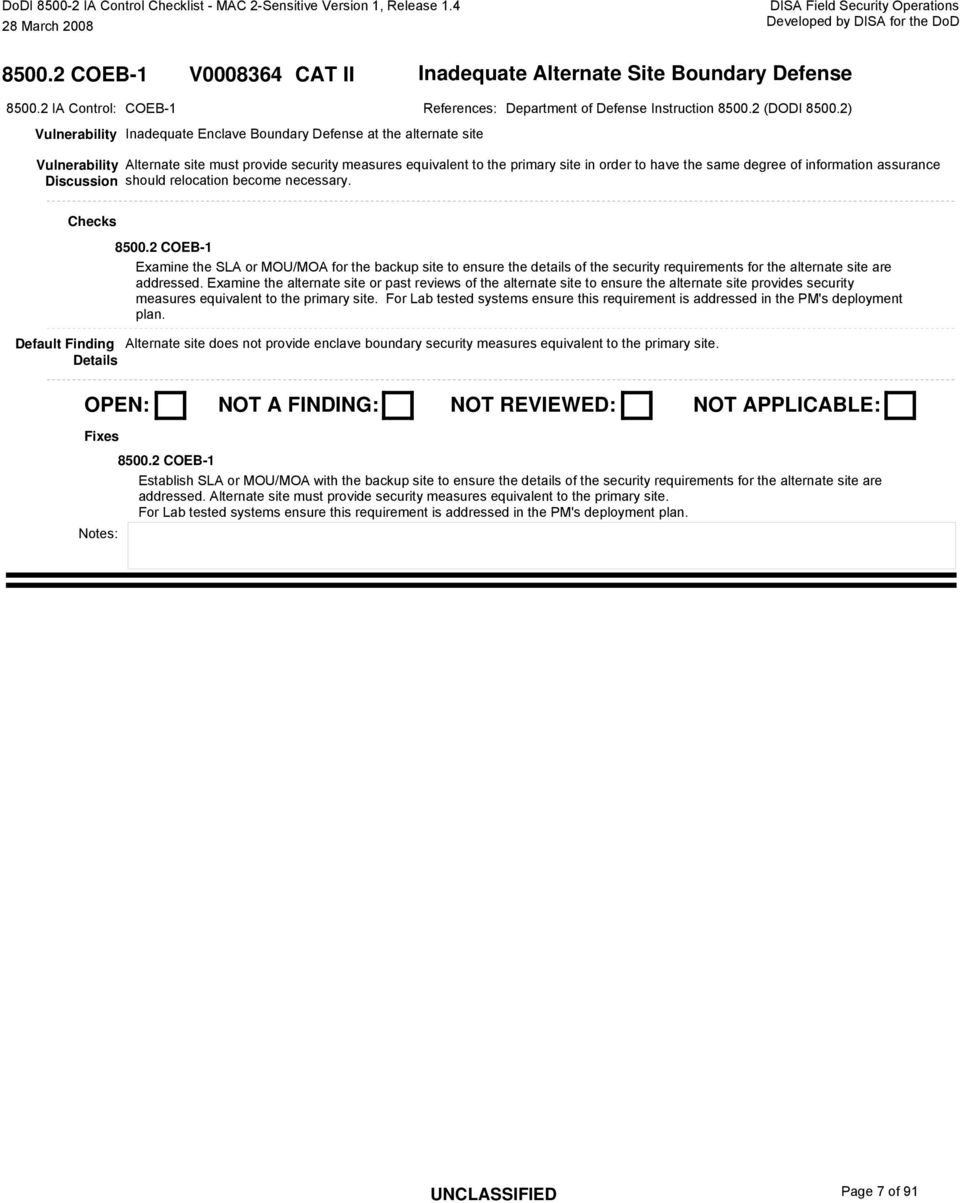
7 COEB-1 V CAT II Inadequate Alternate Site Boundary Defense IA Control: COEB-1 References: Department of Defense Instruction (DODI ) Vulnerability Inadequate Enclave Boundary Defense at the alternate site Vulnerability Alternate site must provide security measures equivalent to the primary site in order to have the same degree of information assurance Discussion should relocation become necessary COEB-1 Examine the SLA or MOU/MOA for the backup site to ensure the details of the security requirements for the alternate site are addressed. Examine the alternate site or past reviews of the alternate site to ensure the alternate site provides security measures equivalent to the primary site. For Lab tested systems ensure this requirement is addressed in the PM's deployment plan. Default Finding Alternate site does not provide enclave boundary security measures equivalent to the primary site. Details COEB-1 Establish SLA or MOU/MOA with the backup site to ensure the details of the security requirements for the alternate site are addressed. Alternate site must provide security measures equivalent to the primary site. For Lab tested systems ensure this requirement is addressed in the PM's deployment plan. Page 7 of 91
8 COED-1 V CAT III Inadequate exercising of COOP/DRP IA Control: COED-1 References: Department of Defense Instruction (DODI ), NIST Special Publication (SP ) Vulnerability Inadequate exercising of continuity of operations or disaster recovery plans Vulnerability If plans are not adequately exercised there can be no assurance they will work when required. Discussion COED-1 Examine the report of the last exercise of the COOP or DRP to ensure it is within the last 365 days and that critical steps of the plan were exercised. Ensure a test of the backup media was included in the exercise. Ensure the exercise plan includes a strategy for testing all parts of the COOP and DRP over a period of time. Verify that appropriate officials within the organization review the contingency plan test results and initiate corrective actions. (NIST CP-4) Verify that the organization coordinates contingency plan testing with organizational elements responsible for related plans (e.g., Business Continuity Plan, Disaster Recovery Plan, Continuity of Operations Plan, Business Recovery Plan, Incident Response Plan). (NIST CP-4) Details Last exercise of the COOP or DRP was not within the last 365 days Critical steps of the plan were not exercised. Test of the backup media was not included in the exercise The exercise plan does not include a strategy for testing all parts of the COOP and DRP over a period of time No evidence found that appropriate officials within the organization reviewed the contingency plan test results and initiated corrective actions. No evidence found that the organization coordinates contingency plan testing with organizational elements responsible for related plans (e.g., Business Continuity Plan, Disaster Recovery Plan, Continuity of Operations Plan, Business Recovery Plan, Incident Response Plan) COED-1 Set up procedures to insure the COOP or DRP is exercised annually and that critical steps of the plan are exercised. Ensure a test of the backup media is included in the exercise. Ensure the exercise plan includes a strategy for testing all parts of the COOP and DRP over a period of time. Ensure that appropriate officials within the organization review the contingency plan test results and initiate corrective actions. Ensure that the organization coordinates contingency plan testing with organizational elements responsible for related plans (e.g., Business Continuity Plan, Disaster Recovery Plan, Continuity of Operations Plan, Business Recovery Plan, Incident Response Plan. Page 8 of 91

9 COEF-2 V CAT II Essential functions and assets not identified IA Control: COEF-2 References: Department of Defense Instruction (DODI ), NIST Special Publication (SP ) Vulnerability Mission and business essential functions and assets are not identified in the COOP/DRP Vulnerability Failure to identify the Mission and Business essential functions and assets required for restoral could dramatically increase downtime in Discussion the event of a disaster COEF-2 Examine the COOP and DRA plan to ensure that mission and business essential functions and the assets required for restorationmare identified and prioritized. Verify the organization has identified primary and alternate telecommunications services to support the information system and initiates necessary agreements to permit the resumption of system operations for critical mission/business functions within [Immediately for MAC 1 systems; Within 24 hours for MAC 2 systems] when the primary telecommunications capabilities are unavailable. (NIST CP-8) Verify that, when the primary and/or alternate telecommunications services are provided by a wireline carrier, the organization has requested Telecommunications Service Priority (TSP) for all telecommunications services used for national security emergency preparedness (see for a full explanation of the TSP program). (NIST CP-8) Verify that primary and alternate telecommunications service agreements contain priority-of-service provisions in accordance with the organization s availability requirements. (NIST CP-8) Verify that alternate telecommunications services do not share a single point of failure with primary telecommunications services. Verify that alternate telecommunications service providers are sufficiently separated from primary service providers so as not to be susceptible to the same hazards. (NIST CP-8) Verify that primary and alternate telecommunications service providers have adequate contingency plans. (NIST CP-8) For Lab tested systems ensure this requirement is addressed in the PM's deployment plan. Details Mission and business essential functions are not identified and prioritized in the COOP and DRA plan. The assets required for restoration of mission and business essential functions are not identified and prioritized in the COOP and DRA plan. Agreements/procedures for alternate Telecommunications services are not in place to permit proper restoral of services (immediately for MAC 1; within 24 hours for MAC 2) Proper Telecommunications Service Priority (TSP) has not been requested Primary and alternate telecommunications service agreements do not contain priority-of-service provisions in accordance with the organizations availability requirements. (NIST CP-8) Alternate telecommunications services share a single point of failure with primary telecommunications services. Alternate telecommunications service providers are not sufficiently separated from primary service providers so as not to be susceptible to the same hazards. (NIST CP-8) Primary and alternate telecommunications service providers do not have adequate contingency plans. (NIST CP-8) COEF-2 Ensure that mission and business essential functions and the assets required for restoration are identified and prioritized in the COOP and DRA plan. Identify primary and alternate telecommunications services to support the information system and initiate necessary agreements to permit the resumption of system operations for critical mission/business functions within [Immediately for MAC 1 systems; Within 24 hours for MAC 2 systems] when the primary telecommunications capabilities are unavailable. (NIST CP-8) When the primary and/or alternate telecommunications services are provided by a wireline carrier, request Telecommunications Service Priority (TSP) for all telecommunications services used for national security emergency preparedness (see for a full explanation of the TSP program). (NIST CP-8) Insure that primary and alternate telecommunications service greements contain priority-of-service provisions in accordance with the organizationæs availability requirements. (NIST CP-8) Insure that alternate telecommunications services do not share a single point of failure with primary telecommunications services. Insure that alternate telecommunications service providers are sufficiently separated from primary service providers so as not to be susceptible to the same hazards. (NIST CP-8) Insure that primary and alternate telecommunications service providers have adequate contingency plans. (NIST CP-8) Page 9 of 91

10 COMS-2 V CAT II Inadequate Maintenance support for key IT assets IA Control: COMS-2 References: Department of Defense Instruction (DODI ), NIST Special Publication (SP ) Vulnerability Inadequate Maintenance support for key IT assets Vulnerability Proper Maintenance is a key element of Information Assurance. Speed of response affects the capability to restore primary service and Discussion backups and careful control of all aspects of the maintenance process is necessary to maintain system integrity and to prevent compromise or theft of sensitive information or devices and system components COMS-2 Examine SLA and MOU/MOA and vendor agreements to ensure that that key assets are covered by a 24x7 response agreement. Verify the organization schedules, performs, and documents routine preventative and regular maintenance on the components of the information system in accordance with manufacturer or vendor specifications and/or organizational requirements. NIST MA-2 Verify that appropriate organizational officials approve the removal of the information system or information system components from the facility when repairs are necessary. NIST MA-2 Verify that if the information system or component of the system requires off-site repair, the organization removes all information from associated media using approved procedures. NIST MA-2 Verify that after maintenance is performed on the information system, the organization checks the security features to ensure that they are still functioning properly. NIST MA-2 (MAC 1&2 and all classified) The organization maintains a maintenance log for the information system that includes: (i) the date and time of maintenance; (ii) name of the individual performing the maintenance; (iii) name of escort, if necessary; (iv) a description of the maintenance performed; and (v) a list of equipment removed or replaced (including identification numbers, if applicable). NIST MA-2 (Mac 1) The organization employs automated mechanisms to ensure that periodic maintenance is scheduled and conducted as required, and that a log of maintenance actions, both needed and completed, is up to date, accurate, complete, and available. NIST MA-2 (MAC 2&3 and all Classified) Verify the organization approves, controls, and monitors the use of information system maintenance tools and maintains the tools on an ongoing basis. NIST MA-3 (MAC 1 and all Classified) NIST MA-3 (1) Verify that the organization inspects all maintenance tools (e.g., diagnostic and test equipment) carried into a facility by maintenance personnel for obvious improper modifications. (2) Verify that the organization checks all media containing diagnostic test programs (e.g., software or firmware used for system maintenance or diagnostics) for malicious code before the media are used in the information system. (3) Verify that the organization checks all maintenance equipment with the capability of retaining information to ensure that no organizational information is written on the equipment or the equipment is appropriately sanitized before release; if the equipment cannot be sanitized, the equipment remains within the facility or is destroyed, unless an appropriate organization official explicitly authorizes an exception. Remote Maintenance (NIST MA-4) Verify the organization approves, controls, and monitors remotely executed maintenance and diagnostic activities. Verify the organization describes the use of remote diagnostic tools in the security plan for the information system. Verify the organization maintains maintenance logs for all remote maintenance, diagnostic, and service activities. Verify that appropriate organization officials periodically review maintenance logs. Other techniques to consider for improving the security of remote maintenance include: (i) encryption and decryption of diagnostic communications; (ii) strong identification and authentication techniques, such as Level 3 or 4 tokens as described in NIST Special Publication ; and (iii) remote disconnect verification. Verify that when remote maintenance is completed, the organization (or information system in certain cases) terminates all sessions and remote connections. Verify that if password-based authentication is used during remote maintenance, the organization changes the passwords following each remote maintenance service. Verify that if remote diagnostic or maintenance services are required from a service or organization that does not implement for its own information system the same level of security as that implemented on the system being serviced, the system being serviced is sanitized and physically separated from other information systems before the connection of the remote access line. If the Page 10 of 91

11 information system cannot be sanitized (e.g., due to a system failure), remote maintenance is not allowed. Control Enhancements (MAC 1 and classified): (1) The organization audits all remote maintenance sessions, and appropriate organizational personnel review the audit logs of the remote sessions. (2) The organization addresses the installation and use of remote diagnostic links in the security plan for the information system. (3) Remote diagnostic or maintenance services are acceptable if performed by a service or organization that implements for its own information system the same level of security as that implemented on the information system being serviced. For Lab tested systems ensure this requirement is addressed in the PM's deployment plan. Details key assets are not covered by a 24 x 7 response agreement that provides maintenance support immediately upon failure. the organization does not schedule, performs, and document routine preventative and regular maintenance on the components of the information system in accordance with manufacturer or vendor specifications and/or organizational requirements. NIST MA-2 No evidence that appropriate organizational officials must approve the removal of the information system or information system components from the facility when repairs are necessary. NIST MA-2 No evidence that if the information system or component of the system requires off-site repair, the organization removes all information from associated media using approved procedures. NIST MA-2 No evidence that after maintenance is performed on the information system, the organization checks the security features to ensure that they are still functioning properly. NIST MA-2 ( all Classified) no evidence that the organization approves, controls, and monitors the use of information system maintenance tools and maintains the tools on an ongoing basis. NIST MA-3 No evidence that the organization inspects all maintenance tools (e.g., diagnostic and test equipment) carried into a facility by maintenance personnel for obvious improper modifications. No evidence that the organization checks all media containing diagnostic test programs (e.g., software or firmware used for system maintenance or diagnostics) for malicious code before the media are used in the information system. No evidence that the organization checks all maintenance equipment with the capability of retaining information to ensure that no organizational information is written on the equipment or the equipment is appropriately sanitized before release; if the equipment cannot be sanitized, the equipment remains within the facility or is destroyed, unless an appropriate organization official explicitly authorizes an exception. Remote Maintenance (NIST MA-4) No evidence that the organization approves, controls, and monitors remotely executed maintenance and diagnostic activities. No evidence that the organization describes the use of remote diagnostic tools in the security plan for the information system. No evidence that the organization maintains maintenance logs for all remote maintenance, diagnostic, and service activities. No evidence that that appropriate organization officials periodically review maintenance logs. No evidence that that when remote maintenance is completed, the organization (or information system in certain cases) terminates all sessions and remote connections. No evidence that if password-based authentication is used during remote maintenance, the organization changes the passwords following each remote maintenance service. No evidence that if remote diagnostic or maintenance services are required from a service or organization that does not implement for its own information system the same level of security as that implemented on the system being serviced, the system being serviced is sanitized and physically separated from other information systems before the connection of the remote access line. If the information system cannot be sanitized (e.g., due to a system failure), remote maintenance is not allowed. Control Enhancements ( classified): No evidence that the organization audits all remote maintenance sessions, and appropriate organizational personnel review the audit logs of the remote sessions. No evidence that the organization addresses the installation and use of remote diagnostic links in the security plan for the information system COMS-2 Establish or amend SLA and MOU/MOA and vendor agreements to ensure that that key assets are covered by a 24 X & response agreement. Insure the organization schedules, performs, and documents routine preventative and regular maintenance on the components of the information system in accordance with manufacturer or vendor specifications and/or organizational requirements. NIST MA-2 Insure that appropriate organizational officials approve the removal of the information system or information system components from the facility when repairs are necessary. NIST MA-2 Insure that if the information system or component of the system requires off-site repair, the organization removes all information from associated media using approved procedures. NIST MA-2 ( all Classified) Insure that after maintenance is performed on the information system, the organization checks the security features to ensure that they are still functioning properly. Insure the organization approves, controls, and monitors the use of information system maintenance tools and maintains the tools Page 11 of 91

12 on an ongoing basis. (all Classified) NIST MA-3 Insure that the organization inspects all maintenance tools (e.g., diagnostic and test equipment) carried into a facility by maintenance personnel for obvious improper modifications. Insure that the organization checks all media containing diagnostic test programs (e.g., software or firmware used for system maintenance or diagnostics) for malicious code before the media are used in the information system. ( all Classified) that the organization checks all maintenance equipment with the capability of retaining information to ensure that no organizational information is written on the equipment or the equipment is appropriately sanitized before release; if the equipment cannot be sanitized, the equipment remains within the facility or is destroyed, unless an appropriate organization official explicitly authorizes an exception. Remote Maintenance (NIST MA-4) Insure the organization approves, controls, and monitors remotely executed maintenance and diagnostic activities. Insure the organization describes the use of remote diagnostic tools in the security plan for the information system. Insure the organization maintains maintenance logs for all remote maintenance, diagnostic, and service activities. Insure that appropriate organization officials periodically review maintenance logs. Other techniques to consider for improving the security of remote maintenance include: (i) encryption and decryption of diagnostic communications; (ii) strong identification and authentication techniques, such as Level 3 or 4 tokens as described in NIST Special Publication ; and (iii) remote disconnect verification. Insure that when remote maintenance is completed, the organization (or information system in certain cases) terminates all sessions and remote connections. Insure that if password-based authentication is used during remote maintenance, the organization changes the passwords following each remote maintenance service. Insure that if remote diagnostic or maintenance services are required from a service or organization that does not implement for its own information system the same level of security as that implemented on the system being serviced, the system being serviced is sanitized and physically separated from other information systems before the connection of the remote access line. If the information system cannot be sanitized (e.g., due to a system failure), remote maintenance is not allowed. Control Enhancements ( classified): Insure The organization audits all remote maintenance sessions, and appropriate organizational personnel review the audit logs of the remote sessions.insure The organization addresses the installation and use of remote diagnostic links in the security plan for the information system. Note: Remote diagnostic or maintenance services are acceptable if performed by a service or organization that implements for its own information system the same level of security as that implemented on the information system being serviced. Page 12 of 91

13 COPS-2 V CAT II Lack of uninterruptible power IA Control: COPS-2 References: Department of Defense Instruction (DODI ) Vulnerability Lack of uninterruptible power Vulnerability Electrical interruptions are the most common cause of system failures. To prevent such service interruptions, MAC 2 systems must be Discussion configured to allow continuous or uninterrupted power to key IT assets. This may include an uninterrupted power supply coupled with emergency generators COPS-2 Verify that continuous or uninterrupted power to key IT assets is available. This may include an uninterrupted power supply coupled with emergency generators. This check includes verification of the presence of an operable power supply and the connection of the assets to it. For Lab tested systems ensure this requirement is addressed in the PM's deployment plan. Default Finding Electrical systems are not configured to allow continuous or uninterrupted power to key IT assets. Details COPS-2 Arrange for installation of continuous or uninterrupted power to key IT assets. This may include an uninterrupted power supply coupled with emergency generators COSP-1 V CAT II Maintenance spares not available within 24 hrs IA Control: COSP-1 References: Department of Defense Instruction (DODI ) Vulnerability Maintenance spares and spare parts for key IT assets cannot be obtained within 24 hours of failure. Vulnerability a source for spare parts for key IT assets is essential for rapid restoral of systems in the event of equipment failure. Failure to have Discussion such sources in place can lead to extended periods when the system is unavailable to perform its function COSP-1 Examine SLA and MOU/MOA and vendor agreements to ensure spare parts for key assets are covered by a 24 hour response agreement. For Lab tested systems ensure this requirement is addressed in the PM's deployment plan. Default Finding Maintenance spares and spare parts for key IT assets cannot be obtained within 24 hours of failure. Details COSP-1 Modify or implement SLA and MOU/MOA and vendor agreements to ensure spare parts for key assets are covered by a 24 hour response agreement. Page 13 of 91

14 COSW-1 V CAT I Inadequate Back-up Software IA Control: COSW-1 References: Department of Defense Instruction (DODI ) Vulnerability Inadequate Back-up Software Vulnerability Inadequate back-up software or improper storage of back-up software can result in extended outages of the information system in the Discussion event of a fire or other situation that results in destruction of the operating copy COSW-1 Verify that a licensed copy of the operating system software and other critical software is in a fire rated container or stored separately (offsite) from the operational software. For Lab tested systems ensure this requirement is addressed in the PM's deployment plan. Details There are no back-up copies of the operating system and other critical software Back-up copies of the operating system and other critical software are collocated with the operational software and not stored in a fire rated container COSW-1 Store a licensed copy of the operating system software and other critical software in a fire rated container or store it separately (off-site) from the operational software. Page 14 of 91

15 COTR-1 V CAT I Inadequate Recovery Procedures IA Control: COTR-1 References: Department of Defense Instruction (DODI ) Vulnerability Inadequate Recovery Procedures Vulnerability Improper system recovery can result in loss or compromise of sensitive information and/or compromise of the system by unauthorized Discussion individuals who seize the opportunity to exploit known vulnerabilities COTR-1 Verify that the DRP or SOP has recovery procedures that indicate the steps needed for secure recovery. Verification process can include original COTS or GOTS installation media or a hash of the installation program. Verify that the recovery procedures include anyspecial considerations for trusted recovery such as network attachment or placement. Verify the procedures include the list of authorized personnel that perform the function. For Lab tested systems ensure this requirement is addressed in the PM's deployment plan. Details Recovery procedures and technical system features do not exist to ensure that recovery is done in a secure and verifiable manner. Circumstances that can inhibit a trusted recovery are not documented. Circumstances that can inhibit trusted recover are documented but appropriate mitigating procedures are not in place. There is no list of personnel authorized to perform the recover function COTR-1 Insure that the DRP or SOP has recovery procedures that indicate the steps needed for secure recovery. Verification process can include original COTS or GOTS installation media or a hash of the installation program. Ensure the recovery procedures include any special considerations for trusted recovery such as network attachment or placement. Ensure the recovery procedure includes the list of authorized personnel that perform the function. For Lab tested systems, ensure this requirement is addressed in the PM's deployment plan. Page 15 of 91

16 DCAR-1 V CAT II No Annual Comprehensive IA Review IA Control: DCAR-1 References: Department of Defense Instruction (DODI ) Vulnerability No Annual Comprehensive IA Review Vulnerability A comprehensive annual IA review that evaluates existing policies and processes is necessary to ensure consistency and to ensure Discussion that procedures fully support the goal of uninterrupted operations DCAR-1 Examine the results of the last comprehensive IA review (including self assessments). Verify the review has been performed within the last 365 days. Note: An Information Assurance Readiness Review (IARR) is a comprehensive review. Default Finding No Annual IA Review is conducted that comprehensively evaluates existing policies and processes to ensure procedural consistency Details and to ensure that they fully support the goal of uninterrupted operations DCAR-1 Arrange for, or perform a comprehensive IA review every 12 months. Page 16 of 91

17 DCAS-1 V CAT I Unevaluated IA Products Procured IA Control: DCAS-1 References: Department of Defense Instruction (DODI ) Vulnerability Unevaluated IA Products Procured Vulnerability IA or IA enabled products that have not been evaluated can not be trusted to operate as advertised. Discussion DCAS-1 This policy applies to the acquisition process. Verify for new system or product acquisitions that the PM or site manager is compliant with the policy. Review the SSAA for a list of the products used. The list should detail the information regarding compliance with this control. If the validation information is not listed, verify the products are listed on the NIST or FIPS web sites. The NIST web site ( lists the NIAP approved software and the FIPS approved and validated algorithms. Default Finding The acquisition of IA- and IA-enabled GOTS IT products is not limited to products that have been evaluated by the NSA or in Details accordance with NSA-approved processes DCAS-1 Limit the acquisition of all IA- and IA-enabled COTS IT products to products that have been evaluated or validated through one of the following sources - the International Common Criteria (CC) for Information Security Technology Evaluation Mutual Recognition Arrangement, - the NIAP Evaluation and Validation Program, or - the FIPS validation program. Robustness requirements, the mission, and customer needs will enable an experienced information systems security engineer to recommend a Protection Profile, a particular evaluated product or a security target with the appropriate assurance requirements for a product to be submitted for evaluation. The NIST web site ( lists the NIAP approved software and the FIPS approved and validated algorithms. Page 17 of 91

18 DCBP-1 V CAT II Inadequate Security Design IA Control: DCBP-1 References: Department of Defense Instruction (DODI ) Vulnerability Inadequate Security Design Vulnerability Use of security best practices makes security implementation and checking easier and results in fewer security problems. Security Discussion designs should follow approporiate security guidance and employ DOD Defense in depth techniques DCBP-1 This deals with processes, procedures, and system design/enclave architecture. This check does not deal with configuration settings. Types of items to be checked include: Strong (2 factor) Authentication for management/admin traffic Presence of a firewall (not firewall configuration settings) Non-Use of Unsupported Software Biometrics Publicly accessible systems are in a DMZ Out of Band Management Two person control Presence of ACLs (not the actual ACL settings) Security designs should follow approporiate security guidance and employ DOD Defense in depth techniques. Default Finding The DoD information system security design does not incorporate best security practices such as single sign-on, PKE, smart card, and Details biometrics. Security designs should follow approporiate security guidance and employ DOD Defense in depth techniques DCBP-1 Consider the following enhancements to the system design: Strong (2 factor) Authentication for management/admin traffic A firewall Non-Use of Unsupported Software Biometrics DMZ for Publicly accessible systems Out of Band Management Two person control Use of ACLs Page 18 of 91

19 DCCB-2 V CAT II Inadequate Configuration Control Board IA Control: DCCB-2 References: Department of Defense Instruction (DODI ) Vulnerability Inadequate Configuration Control Board. Vulnerability Security integrity of the system and the ability to back-up and recover from failures cannot be maintained without control of the system Discussion configuration. Unless the configuration is controlled by an independent board it much less likely to be in its approved and accredited state DCCB-2 Is the system controlled by a CCB that meets regularly and includes the IAM as a member? This should be documented in the SOP for system changes and/or the SSAA. Details All information systems are not under the control of a chartered Configuration Control Board (CCB) that meets regularly according to DCPR-1. The CCB is not documented in the SOP for system changes and/or the SSAA The IAM is not a member of the CCB DCCB-2 Put the system(s) under the control of a chartered CCB that meets regularly. Document this in the SOP for system changes and/or the SSAA. Appoint the IAM as a member of the CCB DCCS-2 V CAT I Use of Improper Security Configuration Guidance IA Control: DCCS-2 References: Department of Defense Instruction (DODI ) Vulnerability Use of Improper Security Configuration Guidance Vulnerability Use of approved configuration guidance ensures the system is initially free of security issues inherent in newly deployed IA and IA Discussion enabled products DCCS-2 This checks ensures the SAs and NAs use DOD approved configuration security documents. This does not check the actual configuration compliance with the approved guides. This is checked with ECSC - 1. Default Finding The organization does not use A DoD reference document, such as a Security Technical Implementation Guide (STIG) or Security Details Recommendation Guide (SRG) as the primary source for security configuration or implementation guidance DCCS-2 Use A DoD reference document, such as a security technical implementation guide (STIG) or security recommendation guide as the primary source for security configuration or implementation guidance for the deployment IA- and IA-enabled IT products. If a DoD reference document is not available, work with DISA or NSA to draft configuration guidance for inclusion in a Departmental reference guide. Page 19 of 91

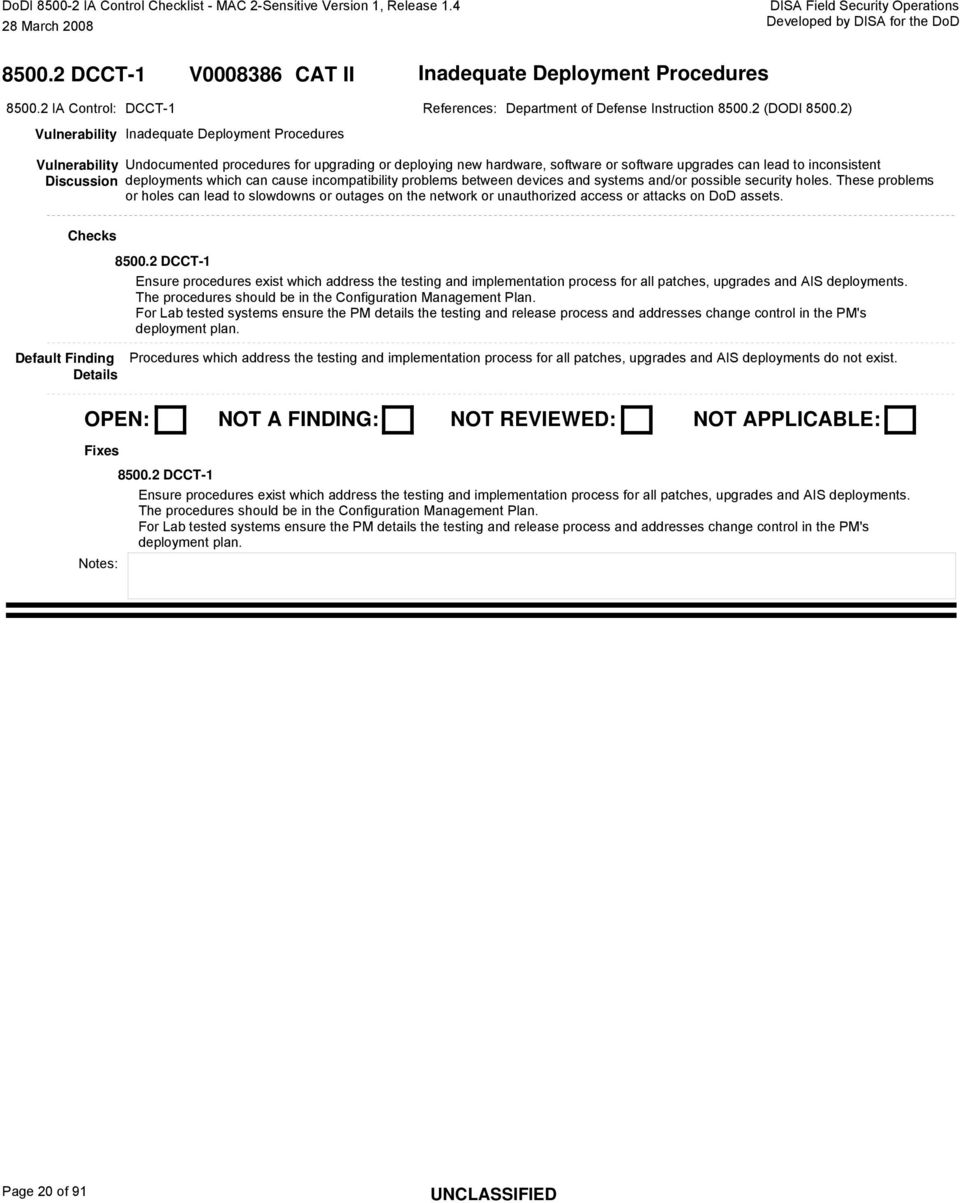
20 DCCT-1 V CAT II Inadequate Deployment Procedures IA Control: DCCT-1 References: Department of Defense Instruction (DODI ) Vulnerability Inadequate Deployment Procedures Vulnerability Undocumented procedures for upgrading or deploying new hardware, software or software upgrades can lead to inconsistent Discussion deployments which can cause incompatibility problems between devices and systems and/or possible security holes. These problems or holes can lead to slowdowns or outages on the network or unauthorized access or attacks on DoD assets DCCT-1 Ensure procedures exist which address the testing and implementation process for all patches, upgrades and AIS deployments. The procedures should be in the Configuration Management Plan. For Lab tested systems ensure the PM details the testing and release process and addresses change control in the PM's deployment plan. Default Finding Details Procedures which address the testing and implementation process for all patches, upgrades and AIS deployments do not exist DCCT-1 Ensure procedures exist which address the testing and implementation process for all patches, upgrades and AIS deployments. The procedures should be in the Configuration Management Plan. For Lab tested systems ensure the PM details the testing and release process and addresses change control in the PM's deployment plan. Page 20 of 91
21 DCDS-1 V CAT II Outsourcing Risk Assessment IA Control: DCDS-1 References: Department of Defense Instruction (DODI ), NIST Special Publication (SP ) Vulnerability Outsourcing Risk Assessment Vulnerability Formal risk assessment is necessary to insure that all IA requirements are considered in outsourcing situations. DOD Component CIO Discussion Approval is required. Default Finding Details DCDS-1 Determine if the PM or enclave owner is outsourcing any IA services supporting the application or enclave. If so, determine if the DOD Component CIO has approved a formal risk analysis of the acquisition or the outsourcing of an IA service. Verify that the IA Requirements are identified in the acquisition of all system technologies and supporting infrastructures (NIST SA-4) Verify the activity monitors compliance with contracted security requirements. (NIST SA-4) The following issues were noted: Outsourcing of an IA service was accomplished without a formal risk assessment. Risk assessment was not approved by the DOD Component CIO IA Requirements are not adequately identified in the acquisition of system technologies and/or supporting infrastructures. (NIST SA-4) Contracted security requirements are not adequately monitored. (NIST SA-4) DCDS-1 Complete a formal risk assessment and obtain DOD Component CIO approval before outsourcing of an IA service. Insure IA Requirements are identified in the acquisition of all system technologies and supporting infrastructures. Insure the activity monitors compliance with contracted security requirements. Page 21 of 91
22 DCFA-1 V CAT II Inadequate Functional Architecture Documentation IA Control: DCFA-1 References: Department of Defense Instruction (DODI ), NIST Special Publication (SP ) Vulnerability Inadequate Functional Architecture Documentation Vulnerability The detailed functional architecture must be documented in the SSAA to insure all risks are assessed and mitigated to the maximum Discussion extent practical. Failure to do so may result in unexposed risk and failure to mitigate the risk leading to failure or compromise of the system DCFA-1 This applies to major functional applications. Examine the SSAA for the AIS to determine if the following are present and up to date (The Network reviewer can verify the external interface information is in accordance with the documentation.): All external interfaces The information being exchanged The protection mechanisms associated with each interface User roles required for access control and the access privileges assigned to each role (See ECAN) Unique security requirements (e.g., encryption of key data elements at rest) Categories of sensitive information processed or stored by the AIS application, and their specific protection plans (e.g., Privacy Act, HIPAA) Restoration priority of subsystems, processes, or information (See COEF) Verify the organization includes documentation describing the design and implementation details of the security controls employed within the information system with sufficient detail to permit analysis and testing of the controls (including functional interfaces among control components) NIST SA-5 Details The documentation of the functional architecture is not up to date The functional architecture documentation does not contain: All external interfaces The information being exchanged The protection mechanisms associated with each interface User roles required for access control The access privileges assigned to each role Unique security requirements (e.g., encryption of key data elements at rest) Categories of sensitive information processed or stored by the AIS application Specific protection plans (e.g., Privacy Act, HIPAA) Restoration priority of subsystems, processes, or information The organization has not included documentation describing the design and implementation details of the security controls employed within the information system with sufficient detail to permit analysis and testing of the controls (including functional interfaces among control components). NIST SA-5) DCFA-1 This applies to major functional applications. Amend the SSAA for the AIS to ensure the following are present and up to date: All external interfaces The information being exchanged The protection mechanisms associated with each interface User roles required for access control and the access privileges assigned to each role (See ECAN) Unique security requirements (e.g., encryption of key data elements at rest) Categories of sensitive information processed or stored by the AIS application, and their specific protection plans (e.g., Privacy Act, HIPAA) Restoration priority of subsystems, processes, or information (See COEF) Include documentation describing the design and implementation details of the security controls employed within the information system with sufficient detail to permit analysis and testing of the controls (including functional interfaces among control components) NIST SA-5 Page 22 of 91
23 DCHW-1 V CAT I Inadequate baseline inventory of hardware IA Control: DCHW-1 References: Department of Defense Instruction (DODI ), NIST Special Publication (SP ) Vulnerability Inadequate baseline inventory of hardware Vulnerability Rigid control of the system baseline is required if the system is to have any assurance of Information Systems Security. New Discussion vulnerabilities are discovered continuously in commercial systems. Care must be taken to track all versions of all commercial products in use so that these deficiencies can be fixed quickly since they are almost immediately the subject of attempted exploits DCHW-1 Examine the hardware inventory and to ensure it includes the manufacturer, type, model, and physical location of each device and spot check to ensure it is up to date. Ensure backup copies of hardware inventories are either stored off-site or in a firerated container. Other requirements (from NIST CM-2): (1) MAC 1 &2 and all Classified -The organization updates the baseline configuration as an integral part of information system component installations. (2) MAC 1 - The organization employs automated mechanisms to maintain an up-to-date, complete, accurate, and readily available baseline configuration. Details There was no Baseline inventory of hardware. The baseline inventory is not properly stored. The baseline inventory was not complete. The baseline inventory is out of date. The baseline inventory does not contain all required elements of information The organization does not update the baseline configuration as an integral part of information system component installations. (NIST CM-2) The organization does not employ automated mechanisms to maintain an up-to-date, complete, accurate, and readily available baseline configuration. (NIST CM-2) DCHW-1 Compile A current and comprehensive baseline inventory of all hardware (HW) (to include manufacturer, type, model, physical location and network topology or architecture) required to support enclave operations and set up procedures to insure it is maintained by the Configuration Control Board (CCB) and as part of the SSAA. A backup copy of the inventory must be stored in a fire-rated container or otherwise not collocated with the original. Other requirements (from NIST CM-2): (1) MAC 1 &2 and all Classified -The organization updates the baseline configuration as an integral part of information system component installations. (2) MAC 1 - The organization employs automated mechanisms to maintain an up-to-date, complete, accurate, and readily available baseline configuration. Page 23 of 91
24 DCID-1 V CAT I Inadequate Interconnection Documentation in SSAA IA Control: DCID-1 References: Department of Defense Instruction (DODI ) Vulnerability Inadequate Interconnection Documentation in the SSAA Vulnerability Full interconnection documentation is required to ensure that adequate security controls are built into the system and tested before Discussion deployment DCID-1 Examine the SSAA. For applications: Determine if there is a list of current and potential hosting enclaves for the AIS application. Ensure that there is documentation in the deployment guide which details the requirements for the hosting enclave. For enclaves: Ensure there is a list of the hosted AIS applications and interconnections with outsourced IT-based processes and interconnected IT platforms. Details For applications: There is not a list of current and potential hosting enclaves for the AIS application. There is no documentation in the deployment guide which details the requirements for the hosting enclave. For enclaves: There is no list of the hosted AIS applications and interconnections with outsourced IT-based processes and interconnected IT platforms DCID-1 For applications: Compile a list of current and potential hosting enclaves for the AIS application. Ensure that there is documentation in the deployment guide which details the requirements for the hosting enclave. For enclaves: Ensure there is a list of the hosted AIS applications and interconnections with outsourced IT-based processes and interconnected IT platforms. Page 24 of 91
25 DCII-1 V CAT II Proposed changes not assessed for IA impact IA Control: DCII-1 References: Department of Defense Instruction (DODI ) Vulnerability Proposed changes not assessed for IA impact Vulnerability IA assessment of proposed changes is necessary to insure security integrity is maintained. Discussion DCII-1 Examine the CCB process documentation to ensure potential changes to the AIS or the enclave are evaluated to determine impact on IA (to include connection approval) and the accreditation. Default Finding Changes to the DoD information system are not assessed for IA and accreditation impact prior to implementation. Details DCII-1 Amend the CCB process documentation to require that potential changes to the AIS or the enclave are evaluated to determine impact on IA (to include connection approval) and the accreditation DCIT-1 V CAT I Acquisition does not address IA roles IA Control: DCIT-1 References: Department of Defense Instruction (DODI ) Vulnerability Acquisition does not address IA roles and responsibilities. Vulnerability Security procedures are vital to ensure the integrity, confidentiality and availability of systems and data. In outsourcing situations the Discussion requirements and responsibilities to perform them must be spelled out to ensure all are accomplished DCIT-1 Examine acquisition and outsourcing documents including task orders to ensure IT services explicitly addresses Government, service provider, and end user IA roles and responsibilities. Ensure the organization monitors compliance. Details Government, service provider, and end user IA roles and responsibilities are not explicitely stated in acquisition or outsourcing requirements. The organization is not monitoring compliance of IT roles and responsibilities in outsourcing agreements DCIT-1 Amend IT services acquisition and outsourcing documents including task orders to ensure explicitly addresses Government, service provider, and end user IA roles and responsibilities are explicitly addressed. Insure the organization monitors contractor compliance with all contract provisions plus applicable federal laws, directives, policies, regulations, standards, guidance, and established service level agreements. Page 25 of 91
26 DCMC-1 V CAT II Improper Use of Mobile Code IA Control: DCMC-1 References: Department of Defense Instruction (DODI ) Vulnerability Improper Use of Mobile Code Vulnerability Improper use of mobile code equals compromised systems and data Discussion DCMC-1 Use input from the following checklists and PDIs to determine the status of this check: 1. Application Checklist - Mobile Code Section 2. Desktop Application Checklist - Browser, Office Automation, General Windows 3. If the application or device under test is not covered in the checklist, question the PM to determine how they meet the intent of this control. Details Emerging mobile code technologies that have not undergone a risk assessment by NSA and been assigned to a Risk Category by the DoD CIO is used. The following issues were noted: Emerging mobile code technologies that have not undergone a risk assessment by NSA and been assigned to a Risk Category by the DoD CIO are in use Unsigned category 1 mobile code is used (must be signed with a DoD-approved PKI code-signing certificate; Use of unsigned Category 1 mobile code is prohibited) Category 1 mobile code technologies that cannot block or disable unsigned mobile code (e.g., Windows Scripting Host) is in use Untrusted Category 2 mobile code is in use ( Category 2 mobile code which executes in a constrained environment without access to system resources (e.g., Windows registry, file system, system parameters, network connections to other than the originating host) may be used. Category 2 mobile code that does not execute in a constrained environment may be used when obtained from a trusted source over an assured channel (e.g., SIPRNET, SSL connection, S/MIME), code is signed with a DoD-approved code signing certificate. All other use of Category 2 mobile code is prohibited. DoD workstation and host software are configured to allow the download and execution of mobile code that is prohibited Automatic execution of all mobile code in is allowed software is not configured to prompt the user prior to executing mobile code in attachments DCMC-1 Discontinue use of all emerging mobile code technologies that have not undergone a risk assessment by NSA and been assigned to a Risk Category by the DoD CIO. Discontinue use of all category 1 mobile code that is not signed with a DoD-approved PKI code-signing certificate. Discontinue use of Category 1 mobile code technologies that cannot block or disable unsigned mobile code (e.g., Windows Scripting Host) Category 2 mobile code, which executes in a constrained environment without access to system resources (e.g., Windows registry, file system, system parameters, network connections to other than the originating host) may be used. Category 2 mobile code that does not execute in a constrained environment may be used when obtained from a trusted source over an assured channel (e.g., SIPRNET, SSL connection, S/MIME), code is signed with a DoD-approved code signing certificate. Discontinue all other use of Category 2 mobile code. Configure all DoD workstation and host software, to the extent possible, to prevent the download and execution of mobile code that is prohibited Prohibit the automatic execution of all mobile code in . Configure all software to prompt the user prior to executing mobile code in attachments. Page 26 of 91
27 DCNR-1 V CAT II Algorithms are not FIPS compliant IA Control: DCNR-1 References: Department of Defense Instruction (DODI ) Vulnerability Algorithms are not FIPS compliant Vulnerability Approved algorithms are necessary to prevent compromise and theft of data. Discussion DCNR-1 Determine the functions of the application and the enclave (network) that address: Digital signature Hash Determine algorithms being used. Ensure the algorithms are FIPS compliant by checking the NIST web site ( Default Finding Functions of the application and the enclave (network) that implement encryption, digital signature, key exchange and/or hash use Details algorithms that are not FIPS compliant DCNR-1 Ensure the algorithms are FIPS compliant by checking the NIST web site ( Replace or upgrade systems that do not use approved algorithms. Page 27 of 91
28 DCPA-1 V CAT III User interface services not separated IA Control: DCPA-1 References: Department of Defense Instruction (DODI ) Vulnerability User interface services not separated Vulnerability Discussion DCPA-1 Is there a logical separation between user interfaces and data within the application? This should include things such as web server and web services and DBMSs. A separate machine is not required but is recommended. Separation may be accomplished through the use of different computers, different CPUs, different instances of the operating system, different network addresses, combinations of these methods, or other methods, as appropriate. Default Finding User interface services are not physically or logically separated from data storage and management services. Details DCPA-1 Insure there is a logical separation between user interfaces and data within the application. This should include things such as web server and web services and DBMSs. A separate machine is not required but is recommended. Separation may be accomplished through the use of different computers, different CPUs, different instances of the operating system, different network addresses, combinations of these methods, or other methods, as appropriate DCPB-1 V CAT I No Budget line item for Information Assurance IA Control: DCPB-1 References: Department of Defense Instruction (DODI ) Vulnerability A discrete line item for Information Assurance is not established in programming and budget documentation. Vulnerability Discussion DCPB-1 This is a policy for the PM and IAM to follow. Interview the PM or IAM to ensure a budget line exists for IA. Default Finding A discrete line item for Information Assurance is not established in programming and budget documentation. Details DCPB-1 Establish a discrete line item for Information Assurance in programming and budget documentation. Insure adequate funds are programmed to handle IA requirements and mitigate vulnerabilities. Page 28 of 91
29 DCPD-1 V CAT II Unauthorized use of software IA Control: DCPD-1 References: Department of Defense Instruction (DODI ), NIST Special Publication (SP ) Vulnerability Unauthorized use of software Vulnerability Public domain software is shareware and there cannot be any assurance the products integrity or security mechanisms exist without a Discussion code review or vulnerability analysis. Failure to properly authorize shareware before it is installed or used on corporate AISs could result in compromise of sensitive corporate resources DCPD-1 Scan the machines to determine if shareware/freeware exists. For each item found, verify that documentation exists either in the DAA signed SSAA or acknowledgement in a formal DAA signed accreditation document. If the freeware/shareware programs found on the scan are not listed, then the systems is non-compliant. Verify the organization complies with software usage restrictions. (NIST SA-6) Insure software and associated documentation are used in accordance with contract agreements and copyright laws. For software and associated documentation protected by quantity licenses, the organization employs tracking systems to control copying and distribution. The organization controls and documents the use of publicly accessible peer-to-peer file sharing technology to ensure that this capability is not used for the unauthorized distribution, display, performance, or reproduction of copyrighted work. (NIST SA-6) Details Binary or machine executable public domain software products and other software products with limited or no warranty such as those commonly known as freeware is being used without the approval or acknowledgement of the DAA. The organization is not in compliance with software licensing agreements The organization is not in compliance with software usage restrictions DCPD-1 Document and obtain the DAA's acknowledgement and approval for all binary or machine executable public domain software products (i.e. freeware/shareware0 and other software products with limited or no warranty. Implement policy and procedures to ensure the the organization is in compliance with software licensing agreements. Implement policy and procedures to ensure the the organization is in compliance with software usage restrictions. Page 29 of 91
30 DCPP-1 V CAT II Noncompliance with DOD PPS CAL requirements IA Control: DCPP-1 References: Department of Defense Instruction (DODI ) Vulnerability Noncompliance with DOD PPS CAL requirements Vulnerability Failure to comply with DoD ports, protocols, and services (PPS) CAL requirements can result in compromise of enclave boundary Discussion protections and/or functionality of the AIS DCPP-1 For applications: Examine the SSAA and the network interfaces listed. Ensure that the network ports, protocols, and services are listed for each interface. Ensure that all ports, protocols, and services are registered in accordance with the DOD PPS. For Lab tested systems ensure this information is addressed in the PM's deployment plan for the hosting enclave. (See DCID-1) For Enclaves: Refer to the firewall section and the packet filtering and logging section of the Network Checklist. Ensure that enclaves have registered all active ports, protocols, and services in accordance with DoD and DoD Component guidance. Details System SSAA does not list the network ports, protocols, and services for each application interface All System ports, protocols, and services are not registered in accordance with the DOD PPS CAL. Enclave has not registered all active ports, protocols, and services in accordance with DoD and DoD Component guidance DCPP-1 For applications: Ensure your SSAA lists all interfaces and the ports, protocols and services used for each Insure that all ports, protocols, and services are registered in accordance with the DOD PPS. For Lab tested systems ensure this information is addressed in the PM's deployment plan for the hosting enclave. (See DCID-1) For Enclaves: Register all active ports, protocols, and services in accordance with DoD and DoD Component guidance. Page 30 of 91
31 DCPR-1 V CAT I Inadequate Configuration Management (CM) process IA Control: DCPR-1 References: Department of Defense Instruction (DODI ) Vulnerability Inadequate Configuration Management (CM) process Vulnerability Security integrity of the system and the ability to back-up and recover from failures cannot be maintained without control of the system Discussion configuration. Unless the configuration is controlled by rigid processes administered by an independent board it much less likely to be in its approved and accredited state DCPR-1 Verify that a CM process exists and it contains the following: (1) Formally documented CM roles, responsibilities, and procedures to include the management of IA information and documentation (2) A configuration control board that implements procedures to ensure a security review and approval of all proposed DoD information system changes, to include interconnections to other DoD information systems (DCCB-1 and DCCB-2) (3) A testing process to verify proposed configuration changes prior to implementation in the operational environment (see also DCCT-1) (4) A verification process to provide additional assurance that the CM process is working effectively and that changes outside the CM process are technically or procedurally not permitted. Enhancements from NIST CM-3, Required for MAC 1 and Classified; Recommended for all others. (1) The organization employs automated mechanisms to: (i) document proposed changes to the information system; (ii) notify appropriate approval authorities; (iii) highlight approvals that have not been received in a timely manner; (iv) inhibit change until necessary approvals are received; and (v) document completed changes to the information system. Note: This control requires a testing process; DCCT-1 requires the testing to be performed. Default Finding The following CM issues were noted: Details There is no formal Configuration Management Process The CM process does not include formally documented CM roles, responsibilities, and procedures to include the management of IA information and documentation The CM process does not include a configuration control board that implements procedures to ensure a security review and approval of all proposed DoD information system changes, to include interconnections to other DoD information systems The CM process does not include a testing process to verify proposed configuration changes prior to implementation in the operational environment The CM process does not include a verification process to provide additional assurance that the CM process is working effectively and that changes outside the CM process are technically or procedurally not permitted The organization does not employ automated mechanisms to: (i) document proposed changes to the information system; (ii) notify appropriate approval authorities; (iii) highlight approvals that have not been received in a timely manner; (iv) inhibit change until necessary approvals are received; and (v) document completed changes to the information system DCPR-1 Implement a CM process that contains the following: (1) Formally documented CM roles, responsibilities, and procedures to include the management of IA information and documentation (2) A configuration control board that implements procedures to ensure a security review and approval of all proposed DoD information system changes, to include interconnections to other DoD information systems (DCCB-1 and DCCB-2) (3) A testing process to verify proposed configuration changes prior to implementation in the operational environment (see also DCCT-1) (4) A verification process to provide additional assurance that the CM process is working effectively and that changes outside the CM process are technically or procedurally not permitted. Enhancements from NIST CM-3, Required for MAC 1 and Classified; Recommended for all others. (1) The organization employs automated mechanisms to: (i) document proposed changes to the information system; (ii) notify appropriate approval authorities; (iii) highlight approvals that have not been received in a timely manner; (iv) inhibit change until necessary approvals are received; and (v) document completed changes to the information system. Page 31 of 91
32 DCSD-1 V CAT I Inadequate IA Documentation IA Control: DCSD-1 References: Department of Defense Instruction (DODI ) Vulnerability Inadequate IA Documentation Vulnerability If the DAA, IAM/IAO are not performing assigned functions in accordance with DoD requirements, it could impact the overall security of Discussion the facility, personnel, systems, and data, which could lead to degraded security. If the DAA, IAM/IAO are not appointed in writing, there will be no way to ensure they understand the responsibilities of the position and the appointment criteria. The lack of a complete System Security Plan could lead to ineffective secure operations and impede accreditation DCSD-1 Validate that the required IA roles are established in writing. These roles are DAA and IAM/IAO. This must include assigned duties and appointment criteria such as training, security clearance, and IT-designation. Ensure a System Security Plan exists that describes the technical, administrative, and procedural IA program and policies that govern the DoD information system, and identifies all IA personnel and specific IA requirements and objectives (e.g., requirements for data handling or dissemination, system redundancy and backup, or emergency response). Note: The System Security Plan is "Appendix S" in the SSAA. Details Required IA roles are not established in writing. (DAA, IAM/IAO) Appointments of required IA Roles do not include assigned duties and appointment criteria such as training, security clearance, and ITdesignation. A System Security Plan does not exist; It should be Appendix s of the SSAA System Security Plan does not include the following required information: Description of the technical, administrative, and procedural IA program and policies that govern the DoD information system Identification of all IA personnel Specific IA requirements and objectives (e.g., requirements for data handling or dissemination, system redundancy and backup, or emergency response) DCSD-1 Establish the required IA roles in writing. The directive must include assigned duties and appointment criteria such as training, security clearance, and IT-designation. Prepare a System Security Plan that describes the technical, administrative, and procedural IA program and policies that govern the DoD information system, and identifies all IA personnel and specific IA requirements and objectives (e.g., requirements for data handling or dissemination, system redundancy and backup, or emergency response). Page 32 of 91
33 DCSL-1 V CAT II Improper management of system libraries IA Control: DCSL-1 References: Department of Defense Instruction (DODI ) Vulnerability Improper management of system libraries Vulnerability Liibraries contain program modules which possess a significant level of security bypass capability. Unauthorized access could result in Discussion the compromise of the operating system environment, ACP, and customer data DCSL-1 Verify that proper DACLs are in place for directories and files that contain system binaries. This verification could also include digital signature or comparison of hash values through an automated process. Note: This will be a manual check if the libraries are not online. The following PDIs apply to this control: PDI-Application 5.2.1, APP0610, ORAOFAM, AAMV0020, AAMV0030, AAMV0040, AAMV0050, AAMV0060, AAMV0070, AAMV0320, AAMV0330, AAMV0340, AAMV0350, ACP00060, ACP00070, ACP00100, ACP00110, ACP00140, ACP00240, ZOMG0010, S A review of results will provide information on compliance with the first part of the IA Control. Verify the organization enforces explicit rules governing the downloading and installation of software by users. (NIST SA-7) Default Finding System libraries are not managed and maintained to protect privileged programs and to prevent or minimize the introduction of Details unauthorized code. The following issues were noted: Proper DACLs are not in place for directories and files that contain system binaries The organization does not enforce explicit rules governing the downloading and installation of software by users DCSL-1 Insure proper DACLs are in place for directories and files that contain system binaries. For Lab tested systems address this item in the PM's deployment plan. Establish and enforce explicit rules governing the downloading and installation of software by users. (NIST SA-7) Page 33 of 91
34 DCSP-1 V CAT II The security support structure is not isolated IA Control: DCSP-1 References: Department of Defense Instruction (DODI ) Vulnerability The security support structure is not isolated Vulnerability Discussion DCSP-1 This speaks to the enclave requirement to isolate the security devices such as audit servers, IA tools management consoles and firewall controls in a separate addressable domain. Ensure these types of devices are in a separate domain protected/isolated from any other production or user based traffic. For Lab tested IA tools ensure this requirement is addressed in the PM's deployment plan. Note: This check also is meant to ensure that security devices execute dedicated services. For example, a firewall should not run DNS or a Domain Controller should not run a user accessible web server. Details Security devices such as audit servers, IA tools management consoles and firewall controls are not located in a separate addressable domain. Insure these types of devices are in a separate domain protected/isolated from any other production or user based traffic. For Lab tested IA tools ensure this requirement is addressed in the PMs deployment plan. Insure that security devices execute dedicated services. For example, a firewall should not run DNS or a Domain Controller should not run a user accessible web server DCSP-1 Isolate the security devices such as audit servers, IA tools management consoles and firewall controls in a separate addressable domain. Ensure these types of devices are in a separate domain protected/isolated from any other production or user based traffic. For Lab tested IA tools ensure this requirement is addressed in the PM's deployment plan. Insure that security devices execute dedicated services. For example, a firewall should not run DNS or a Domain Controller should not run a user accessible web server. Page 34 of 91
35 DCSQ-1 V CAT II Software quality requirements not specified IA Control: DCSQ-1 References: Department of Defense Instruction (DODI ) Vulnerability Software quality requirements not specified Vulnerability Inattention to software quality requirements and validation methods will result in flawed or malformed software that can negatively Discussion impact integrity or availability (e.g., buffer overruns) DCSQ-1 This check is limited to software development initiatives (not known COTS software issues). For GOTS developed applications, ensure that the software development life cycle includes steps that address software quality and validation requirements during development and testing. For vendor developed or COTs products, check for evidence of compliance with software quality initiatives, such as, ISO 9000 or CMMI. Details Software quality requirements are not specified in system requirements statements and/or contracts. Software development life cycle does not include steps that address software quality and validation requirements during development and testing. There is no evidence that vendor developed or COTS products used complied with software quality initiatives (i.e. ISO 5000 or CMMI) DCSQ-1 Amend contracts and/or requirements statements to include software quality requirements. For GOTS developed applications, develop and implement processes to ensure that the software development life cycle includes steps that address software quality and validation requirements during development and testing. For vendor developed or COTs products, include requirements for compliance with software quality initiatives, such as, ISO 9000 or CMMI. Page 35 of 91
36 DCSR-2 V CAT I Medium Robustness Protection Profiles not met IA Control: DCSR-2 References: Department of Defense Instruction (DODI ) Vulnerability Medium Robustness Protection Profiles not met Vulnerability At a minimum, medium-robustness (EAL 2) COTS IA and IA-enabled products must be used to protect sensitive information when the Discussion information transits public networks or the system handling the information is accessible by individuals who are not authorized to access the information on the system. The medium-robustness requirements for products are defined in the Protection Profile Consistency Guidance for Medium Robustness published under the IATF DCSR-2 Medium robustness security services and mechanisms provide for additional safeguards above Basic. Medium robustness technical solutions require, at a minimum, strong (e.g., crypto-based) authenticated access control, NSA-approved key management, NIST FIPS-validated cryptography, and the assurance properties as specified in NSA-endorsed medium robustness protection profiles or the Protection Profile Consistency Guidance for Medium Robustness. The SSAA should list the products that are used. Compare that list against the approved products. Default Finding COTS IA and IA-enabled products do not meet Medium Robustness Protection Profiles Details DCSR-2 List the products that are used. Compare that list against the approved products. Replace those that don't meet the medium robustness profile. Page 36 of 91
37 DCSS-2 V CAT II Insufficient secure state assurance IA Control: DCSS-2 References: Department of Defense Instruction (DODI ) Vulnerability Insufficient secure state assurance. Vulnerability Discussion DCSS-2 Rely on NIAP certification of devices and ensure STIG requirements have been applied for each technology. Ensure each component of the system is checked. Review test results to verify tests exist and that they are executed at least annually. Details System initialization, shutdown, and aborts are not configured to ensure that the system remains in a secure state. Tests are not run to ensure the integrity of the system state. Frequency of testing did not meet the annual requirement DCSS-2 Rely on NIAP certification of devices and ensure STIG requirements have been applied for each technology. Insure each component of the system meets the requirements. Run annual tests to verify Page 37 of 91
38 DCSW-1 V CAT I Inadequate Baseline Software Inventory IA Control: DCSW-1 References: Department of Defense Instruction (DODI ), NIST Special Publication (SP ) Vulnerability Inadequate Baseline Software Inventory Vulnerability Rigid control of the system baseline is required if the system is to have any assurance of Information Systems Security. New Discussion vulnerabilities are discovered continuously in commercial systems. Care must be taken to track all versions of all commercial products in use so that these deficiencies can be fixed quickly since they are almost immediately the subject of attempted exploits DCSW-1 Examine the software inventory and to verify it includes the manufacturer, type, version, and installation manuals and procedures of each product and spot check to ensure it is up to date. Verify backup copies of software inventory list are stored off-site or in a fire-rated container. Other requirements (from NIST CM-2): (1) MAC 1 &2 and all Classified -Verify that the organization updates the baseline configuration as an integral part of information system component installations. (2) MAC 1 - Verify that the organization employs automated mechanisms to maintain an up-to-date, complete, accurate, and readily available baseline configuration. Details A baseline software inventory does not exist The baseline software inventory does not contain all required information The baseline software inventory does not list all software The baseline software inventory is not current Backup copies of software inventory list are not stored off-site or in a fire-rated container. MAC 1 2 and all classified - The organization does not update the baseline configuration as an integral part of information system component installations. (NIST CM-2) MAC 1 - The organization employs automated mechanisms to maintain an up-to-date, complete, accurate, and readily available baseline configuration. (NIST CM-2) DCSW-1 Establish a baseline software inventory and ensure it includes the manufacturer, type, version, and installation manuals and procedures of each product. Establish procedures to keep the sofrware inventory up to date. Ensure backup copies of software inventory list are stored off-site or in a fire-rated container. Other requirements (from NIST CM-2): (1) MAC 1 &2 and all Classified -Establish procedures to update the baseline configuration as an integral part of information system component installations. (2) MAC 1 - Employ automated mechanisms to maintain an up-to-date, complete, accurate, and readily available baseline configuration. Page 38 of 91
39 EBBD-2 V CAT II Inadequate Boundary Defense IA Control: EBBD-2 References: Department of Defense Instruction (DODI ) Vulnerability Inadequate Boundary Defense Vulnerability If intrusion detection and intrusion prevention devices are not installed on the host site network, and key boundary points, network and Discussion system attacks or compromises cannot be detected or prevented. Without the Dual-Homed screened subnet (DMZ) architecture traffic that would be normally destined for the DMZ would have to be redirected to the sites internal network. This would allow for a greater opportunity for hackers to exploit EBBD-2 For enclaves, ensure a firewall and IDS are in place at the enclave boundary. Review network topology to identify key boundary points (security domains, VPN subnets, enclave to enclave interconnections, remote access points, management subnets, etc) to determine if additional firewall or network IDSs are required. Ensure Internet access is proxied through the internet access point (layer 7 firewall or application proxy) that meets the DoD requirement that such contacts are isolated from other DoD systems by physical or technical means. Ensure all Internet access points are under the management and control of the enclave. It is acceptable, if there is an upstream provider and the site has an agreement for the upstream provider to manage it. Details Intrusion detection (NID/JID) devices and intrusion deterrence (Firewall) devices are not installed. Intrusion detection (NID/JID) devices and intrusion deterrence (Firewall) devices do not cover all key boundary points A dual-homed screened subnet architecture (DMZ) does not exist or is not being used to protect the enclave as required. Internet access exists that is not under the control of the enclave manager EBBD-2 For enclaves, install a firewall and IDS at the enclave boundary and at key boundary points (security domains, VPN subnets, enclave to enclave interconnections, remote access points, management subnets, etc) Insure Internet access is proxied through the internet access point (layer 7 firewall or application proxy) that meets the DoD requirement that such contacts are isolated from other DoD systems by physical or technical means. Ensure all Internet access points are under the management and control of the enclave. Page 39 of 91
40 EBCR-1 V CAT II Noncompliance with connection rules IA Control: EBCR-1 References: Department of Defense Instruction (DODI ) Vulnerability Noncompliance with connection rules Vulnerability Discussion EBCR-1 Examine the SSAA to ensure that the IATC and/or ATC exists. Ensure that a connection approval exists for the site from the appropriate connection approval office (e.g.,. SCAO, SNAP) and it is being followed. Ensure that major systems (networks) maintain their own connection approval process for governing the connection of their customers and users. Default Finding The Approval to connect to DOD Information Systems does not exist or is out dated. Details The site does not have the Connection Approval Process (CAP) documentation. The Enclave is not in compliance with the rules governing the connection approval EBCR-1 For an Enclave: Obtain the appropriate connection approval (IATC or ATC). Insure guidance from the appropriate office (e.g.,. SCAO, SNAP) is available and that it is followed. For a Network: Develop and implement a connection approval process for governing the connection of customers and users EBPW-1 V CAT I Direct access allowed IA Control: EBPW-1 References: Department of Defense Instruction (DODI ) Vulnerability Direct access allowed. Vulnerability Connections between DoD enclaves and the Internet or other public or commercial wide area networks require a demilitarized zone Discussion (DMZ) to insure risk to DOD Systems is minimized EBPW-1 If the application or enclave is publicly accessible, ensure that the traffic is being routed through a DMZ. Default Finding Public or Commercial Access to the DOD System is not through a demilitarized zone (DMZ). Details EBPW-1 Reconfigure the application or system to ensure that the commercial and public access is through a DMZ. Page 40 of 91
41 EBRP-1 V CAT I Insufficiently controlled remote access for privil IA Control: EBRP-1 References: Department of Defense Instruction (DODI ) Vulnerability Insufficiently controlled remote access for privileged functions Vulnerability To prevent possible compromise of sensitive information (Privileged logon information) remote access for privileged functions must be Discussion discouraged, must be permitted only for compelling operational needs, and must be strictly controlled. In addition to EBRU-1, sessions must employ security measures such as a VPN with blocking mode enabled. A complete audit trail of each remote session must be recorded, and the IAM/O must review the log for every remote session EBRP-1 Verify remote access function is documented and approved by the local DAA. Verify remote access employs FIPS encryption to protect information in transit. Verify users are authenticated against an external directory service (i.e., RADIUS, TACACS+, Active Directory, LDAP) Verify a complete audit trail of each remote session recorded to include who connected, when and for how long. Verify user network traffic is monitored by an intrusion detection system. Verify the IAM/O reviews the log for every remote session weekly. Details Remote access for privileged functions is not discouraged. Remote access for privileged functions is permitted for other than compelling operational needs. Remote access for privileged functions is not strictly controlled. Remote access for privileged functions sessions does not employ security measures such as a VPN with blocking mode enabled. A complete audit trail of each Remote access for privileged functions session is not recorded. The IAM/O does not review the log of every instance of remote access for privileged functions session on a weekly basis EBRP-1 Insure all remote access for privileged function is documented and approved by the local DAA. Insure remote access for privileged function employs FIPS encryption to protect information in transit. Insure remote access for privileged function users are authenticated against an external directory service (i.e., RADIUS, TACACS+, Active Directory, LDAP) Insure a complete audit trail of each remote for privileged function session is recorded to include who connected, when and for how long. Insure remote access for privileged function user network traffic is monitored by an intrusion detection system. Insure the IAM/O reviews the log for every remote access for privileged function session weekly. Page 41 of 91
42 EBRU-1 V CAT I Insufficiently controlled remote access IA Control: EBRU-1 References: Department of Defense Instruction (DODI ) Vulnerability Insufficiently controlled remote access Vulnerability In order to protect DOD data and systems all remote access to DoD information systems must be mediated through a managed access Discussion control point, such as a remote access server in a DMZ EBRU-1 Ensure all remote access to DoD information systems is mediated through a managed access control point, such as a remote access server in a DMZ. Verify that remote access uses NIST validated encryption for sensitive and classified data. Ensure that passwords used for remote access comply with IAIA -1 and IAIA-2. Ensure that the organization provides a means for employees using remote access to communicate with information system security staff in case of security problems. (NIST PE-17) Details Remote access to DoD information systems is not mediated through a managed access control point Remote access does not use NIST validated encryption for sensitive and classified data. Passwords used for remote access do not comply with IAIA -1 and IAIA-2. The organization does not provide a means for employees using remote access to communicate with information system security staff in case of security problems EBRU-1 Reconfigure all remote access to DoD information systems so that it is mediated through a managed access control point, such as a remote access server in a DMZ. Reconfigure remote access to use NIST validated encryption for sensitive and classified data. Establish control to insure that passwords used for remote access comply with IAIA -1 and IAIA-2. Provide a means for employees using remote access to communicate with information system security staff in case of security problems. (NIST PE-17) Page 42 of 91
43 EBVC-1 V CAT II VPN traffic not visible to IDS IA Control: EBVC-1 References: Department of Defense Instruction (DODI ) Vulnerability VPN traffic not visible to IDS Vulnerability Intruders can escape detection by hijacking a VPN connection from a trusted enclave or assuming the identity of a trusted user of the Discussion VPN EBVC-1 Verify the VPN tunnel terminates prior to the network intrusion detection systems (IDS/Firewall) and the unencrypted data payload is monitored by an active Network IDS or Firewall. PDI, Net1625, directly applies. PDIs Net1800 and Net1820 also may apply. Default Finding VPN traffic is not visible to network intrusion detection systems (IDS firewalls). Details EBVC-1 Reconfigure the connection to terminate the VPN tunnel prior to the network intrusion detection systems (IDS) so that the unencrypted data payload is monitored by an active Network IDS. Page 43 of 91
44 ECAD-1 V CAT II Inadequate Affiliation Information IA Control: ECAD-1 References: Department of Defense Instruction (DODI ) Vulnerability Inadequate Affiliation Information Vulnerability To help prevent inadvertent disclosure of controlled information, all contractors are identified by the inclusion of the abbreviation ctr and Discussion all foreign nationals are identified by the inclusion of their two character country code ECAD-1 1. For enclaves, if the application displays, or automatically generates, individual's names or controls addresses (e.g., collaboration servers, IM applications, servers), ensure that the individual's affiliation is displayed. For contractors, this includes the abbreviation "ctr". For all foreign nationals this includes the their two character country code. Foreign national contractors will have both.ctr and their 2 digit country code. 2. Note: Three checks are required; display names, addresses and automated signature blocks. Details Inadequate affiliation information in addresses Inadequate affiliation information in display names Inadequate affiliation information in automated signature blocks ECAD-1 For enclaves, if the application displays, or automatically generates, individual's names or controls addresses (e.g., collaboration servers, IM applications, servers), reconfigure the system to ensure that the individual's affiliation is displayed. For contractors, this includes the abbreviation "ctr". For all foreign nationals this includes their two character country code. Foreign national contractors will have both.ctr and their 2 digit country code. Note: This requirement applies to display names, addresses and automated signature blocks. Page 44 of 91
45 ECAN-1 V CAT I Improper access to data IA Control: ECAN-1 References: Department of Defense Instruction (DODI ) Vulnerability Improper access to data Vulnerability Discussion ECAN-1 This is a two part manual check requiring interview and observation. Technical checks can also be used to verify roles based or discretionary access control is generally in use in the organization. Technical checks may also verify proper audit records are created but should they not be relied upon for system and application ST&E. Interview the IAO/IAM and verify that the need to know is established before access is granted to classified or sensitive data. Verify that this is enforced by either discretionary or role-based access controls. Verify that proper auditing is performed by observing both access and attempted access and verifying proper audit records are created. There are scores of PDIs that may apply directly to access control portion of this control. Get specific input from your technical reviewers Details Access to classified or sensitive data is granted without verifying need-to-know Access is not enforced by discretionary or role-based access controls Proper audit of access is not performed ECAN-1 develop, implement and enforce procedure to insure that the need to know is established before access is granted to classified or sensitive data. Develop and implement discretionary or role-based access controls. Ensure proper auditing is performed of both access and attempted access and insure proper audit records are created. Page 45 of 91
46 ECAR-2 V CAT II Inadequate audit record content IA Control: ECAR-2 References: Department of Defense Instruction (DODI ), NIST Special Publication (SP ) Vulnerability Inadequate audit record content Vulnerability Minimum Audit record content is required to insure detection, attribution and recovery from changes to DOD Information and systems. Discussion ECAR-2 Review the audit records and ensure audit records include: User ID. Successful and unsuccessful attempts to access security files (e.g.. audit records, password files, access control files). Date and time of the event. Type of event. Success or failure of event. Successful and unsuccessful logons. Denial of access resulting from excessive number of logon attempts. Blocking or blacklisting a user ID, terminal or access port and the reason for the action. Activities that might modify, bypass, or negate safeguards controlled by the system (system administrator logon, logging directly onto a router vs. using TACACS+, altering access control lists, or altering security files). Accounts creation or deletion ( NIST AC-2) Identity of the IS component where the event occurred (NIST AU-3) Default Finding The following required data was missing from audit records: Details User ID. Successful and unsuccessful attempts to access security files Date and time of the event Type of event. Success or failure of event. Successful and unsuccessful logons. Denial of access resulting from excessive number of logon attempts. Blocking or blacklisting a user ID, terminal or access port and the reason for the action. Activities that might modify, bypass, or negate safeguards controlled by the system (system administrator logon, logging directly onto a router vs. using TACACS+, altering access control lists, or altering security files). Accounts creation or deletion on critical systems (NIST AC-2) (There is a STIG Check for this.) Identity of the IS Component where the event occurred (NIST AU-3) ECAR-2 Configure system to insure that audit records include: User ID. Successful and unsuccessful attempts to access security files (e.g.. audit records, password files, access control files) Date and time of the event. Type of event. Success or failure of event. Successful and unsuccessful logons. Denial of access resulting from excessive number of logon attempts. Blocking or blacklisting a user ID, terminal or access port and the reason for the action. Activities that might modify, bypass, or negate safeguards controlled by the system (system administrator logon, logging directly onto a router vs. using TACACS+, altering access control lists, or altering security files). Accounts creation or deletion (NIST AC-2) Identity of the IS Component where the event occurred. (NIST AU-3) Page 46 of 91
47 ECAT-1 V CAT III Inadequate audit record review IA Control: ECAT-1 References: Department of Defense Instruction (DODI ) Vulnerability Inadequate audit record review Vulnerability Audit records for all sources must be regularly reviewed and suspected violations of IA Policies must be analyzed and reported. This is Discussion to protect Critical DOD Systems from possible harm and/or exploitation and to protect Critical DOD Information ECAT-1 Interview the IAM and look at the SOPs to ensure that audit records are reviewed regularly and suspected violations of IA policies are analyzed and reported. Select a sampling of components/devices and verify that the audit records have been reviewed by looking for incidents of read access to the audit files in the audit logs. Details Audit trail records from all available sources are not regularly reviewed for indications of inappropriate or unusual activity. Suspected violations of IA policies are not analyzed Suspected violations of IA Policies are not reported in accordance with DoD information system IA procedures ECAT-1 Develop and implement SOPs to ensure that audit records are reviewed regularly and suspected violations of IA policies are analyzed and reported. Page 47 of 91
48 ECAT-2 V CAT II Inadequate audit record review IA Control: ECAT-2 References: Department of Defense Instruction (DODI ), NIST Special Publication (SP ) Vulnerability Inadequate audit record review Vulnerability Audit records for all sources are regularly reviewed and suspected violations of IA Policies must be analyzed and reported. For critical Discussion and classified systems, an automated, continuous on-line monitoring and audit trail creation capability must be deployed with the capability to immediately alert personnel of any unusual or inappropriate activity with potential IA implications, and with a user configurable capability to automatically disable the system if serious IA violations are detected. This is to protect Critical DOD Systems from possible harm and/or exploitation and to protect Critical DOD Information ECAT-2 Interview the IAM and look at the SOPs to ensure that audit records from all sources are reviewed regularly and suspected violations of IA policies are analyzed and reported. Select a sampling of components/devices and verify that the audit records have been reviewed by looking for incidents of read access to the audit files in the audit logs. Examine the system to determine if an automated, continuous on-line monitoring and audit trail creation capability is present with the capability to immediately alert personnel of any unusual or inappropriate activity with potential IA implications, and with a user configurable capability to automatically disable the system if serious IA violations are detected. Additional Requirements (from NIST AU-3): (1) MAC 1&2: Verify that the information system provides the capability to include additional, more detailed information in the audit records for audit events identified by type, location, or subject. (2) MAC 1: Verify that the information system provides the capability to centrally manage the content of audit records generated by individual components throughout the system. Note: There may not be a solution that fulfills this requirement. Details Audit trail records from all available sources are not regularly reviewed for indications of inappropriate or unusual activity. Suspected violations of IA policies are not analyzed Suspected violations of IA Policies are not reported in accordance with DoD information system IA procedures. There is no automated, continuous on-line monitoring and audit trail creation capability The automated audit feature does not have the capability to immediately alert personnel of any unusual or inappropriate activity with potential IA implications There is no user configurable capability to automatically disable the system if serious IA violations are detected. Reference NIST AU-3: The information system has no capability to include additional, more detailed information in the audit records for audit events identified by type, location, or subject. The information system has no capability to centrally manage the content of audit records generated by individual components throughout the system ECAT-2 Develop and implement SOPs to ensure that audit records are reviewed regularly and suspected violations of IA policies are analyzed and reported. Deploy an automated, continuous on-line monitoring and audit trail creation capability with the ability to immediately alert personnel of any unusual or inappropriate activity with potential IA implications, and with a user configurable capability to automatically disable the system if serious IA violations are detected. Additional Requirements (from NIST AU-3): (1) MAC 1&2: Implement a capability to include additional, more detailed information in the audit records for audit events identified by type, location, or subject. (2) MAC 1: Implement a capability to centrally manage the content of audit records generated by individual components throughout the system. Page 48 of 91
49 ECCD-2 V CAT I Inadequate access control mechanisms IA Control: ECCD-2 References: Department of Defense Instruction (DODI ) Vulnerability Inadequate access control mechanisms Vulnerability Without access control the data is not secure. It can be compromised, misused, or changed by unauthorized access at any time. Discussion ECCD-2 Examine the system verify access control mechanisms have been established and are in place to ensure that data is accessed and changed only by authorized personnel. Ensure transaction logs exist that record access and changes to the data. Ensure the transaction logs are reviewed periodically or immediately upon system security events. Ensure users are notified of time and date of the last change in data content. (This may not be possible on most systems.) Details Access control mechanisms are not in place to ensure that data is accessed and changed only by authorized personnel. Transaction logs that record access and changes to the data do not exist Transaction logs are not reviewed periodically (monthly at a minimum) and immediately upon system security events. Ensure users are notified of time and date of the last change in data content. (This may not be possible on most systems.) ECCD-2 Establish access control mechanisms to ensure that data is accessed and changed only by authorized personnel. Ensure transaction logs record access and changes to the data. Establish and enforce procedures to ensure the transaction logs are reviewed periodically (monthly at a minimum) and immediately upon system security events. Implement a process to notify users of time and date of the last change in data content. Page 49 of 91
50 ECCR-1 V CAT III Inadequate encryption of stored sensitive informat IA Control: ECCR-1 References: Department of Defense Instruction (DODI ) Vulnerability Inadequate encryption of stored sensitive information Vulnerability If encryption of stored sensitive information is required by the data owner, NIST-certified cryptography must be used. Discussion ECCR-1 Review the SSAA or interview the information owner to determine if a requirement exists to encrypt stored, sensitive information. If a requirement exists to encrypt, ensure encryption is being performed using NIST FIPS validated encryption. Details Stored sensitive information is not encrypted although such encryption is required by the data owner NIST-certified cryptography is not used to encrypt stored sensitive information ECCR-1 Configure system to encrypt stored sensitive information as required by the data owner; ensure encryption is performed using NIST FIPS validated encryption. Replace cryptography that is not NIST Certified; Page 50 of 91
51 ECCT-1 V CAT II Inadequate encryption of transmitted data IA Control: ECCT-1 References: Department of Defense Instruction (DODI ) Vulnerability Inadequate encryption of transmitted data Vulnerability Failure to encrypt sensitive information during transmission may result in compromise of the information Discussion ECCT-1 Interview the information owner or IAM/O to determine if sensitive data transits a commercial circuit or wireless network (e.g., NIPRNet, ISP). If sensitive data does transit a commercial circuit or wireless network, ensure NIST FIPS validated encryption is used to encrypt the data. Note: This may be accomplished via layer 3, 4, or 7 encryption mechanisms via a user session or WAN boundary encryption device. Details Unclassified, sensitive data transmitted through a commercial or wireless network are not encrypted Unclassified, sensitive data transmitted through a commercial or wireless network are not encrypted using NIST-certified cryptograph ECCT-1 Reconfigure the system to ensure NIST FIPS validated encryption is used to encrypt sensitive data during transmission. Note: This may be accomplished via layer 3, 4, or 7 encryption mechanisms via a user session or WAN boundary encryption device. Page 51 of 91
52 ECDC-1 V CAT II Transaction journaling not implemented IA Control: ECDC-1 References: Department of Defense Instruction (DODI ) Vulnerability Transaction journaling not implemented. Vulnerability Transaction based systems must have transaction roll-back and transaction journaling, or technical equivalents implemented to insure Discussion the system can recover from attack or faulty transaction data ECDC-1 If performing an ST&E of a transaction-based system; ensure the requirement for transaction roll-back and transaction journaling is being met by interviewing the PM as to the methodology being employed and then performing specific checks to insure the system works as planned and meets the requirements. If reviewing an enclave; Interview the IAM/O and/or review the SSAA to identify if a local transaction-based system exists. If yes, verify that the transaction-based system implements roll-back and transaction journaling. Default Finding Transaction roll-back and transaction journaling requirements are not met Details ECDC-1 Implement a change to the system to meet transaction roll-back and transaction journaling requirements. Page 52 of 91
53 ECIC-1 V CAT I Controlled interface is not used IA Control: ECIC-1 References: Department of Defense Instruction (DODI ) Vulnerability Controlled interface is not used Vulnerability Discretionary access controls are a sufficient IA mechanism for connecting DoD information systems operating at the same Discussion classification, but with different need-to-know access rules. However, A controlled interface is required for interconnections among DoD information systems operating at different classifications levels or between DoD and non-dod systems or networks to insure that only predetermined information is passed to the connected system. This safeguard prevents loss or compromise of classified or sensitive information ECIC-1 Review topology documentation to identify interconnections between different networks and systems. Validate the classification level of interconnected systems and networks by interviewing the IAM/O. If networks or systems of varying classification levels, or networks or system between DOD and Non-DOD, are interconnected, validate that a controlled interface (e.g., cross domain solution, DISN approved DMZ) is implemented to control the transfer of data between the systems or networks. Default Finding Controlled interface is required but not in use. Details ECIC-1 Install a controlled interface (e.g., cross domain solution, DISN approved DMZ) to control the transfer of data between the systems or networks. Page 53 of 91
54 ECID-1 V CAT II Host-based intrusion detection systems are not pro IA Control: ECID-1 References: Department of Defense Instruction (DODI ) Vulnerability Host-based intrusion detection systems are not properly deployed Vulnerability To protect systems from attack, Host-based intrusion detection systems must be deployed for major applications and for network Discussion management assets, such as routers, switches, and domain name servers (DNS) ECID-1 Within our DOD customer base, policy requires that all servers employ host based IDS and that it be monitored and reviewed. To perform this check obtain a list of all servers and verify that these servers are running a Host Based IDS, the systems are properly set up and the system output is being monitored. Details Host-based intrusion detection systems are not deployed Host-based intrusion detection systems are deployed but not set up properly or not being monitored ECID-1 Implement Host-based intrusion detection on all servers Implement procedures to insure Host-based intrusion detection is monitored and logs are reviewed. Page 54 of 91
55 ECIM-1 V CAT II Unapproved Instant messaging IA Control: ECIM-1 References: Department of Defense Instruction (DODI ) Vulnerability Unapproved Instant messaging Vulnerability Instant messaging has been subject of multiple security vulnerabilities that have permitted unauthorized access to users computers, Discussion denial of service attacks, and message spoofing. Only DOD approved IM services are allowed to transit the enclave boundary ECIM-1 Review firewall and router configurations and verify that only DOD approved IM services are allowed to transit the enclave boundary. If IM services are running and connecting to services outside the DOD, check to verify they are proxied at the enclave boundary. Also, verify that unapproved IM clients / services are uninstalled or disabled on all operating systems. Details Unapproved IM clients / services are installed Unapproved IM Services are in use Firewall and router configurations allow IM Services ECIM-1 Establish firewall and router configurations to ensure that only DOD approved IM services are allowed to transit the enclave boundary. If IM services are running and connecting to services outside the DOD, reconfigure to ensure they are proxied at the enclave boundary. Ensure that unapproved IM clients / services are uninstalled or disabled on all operating systems. Page 55 of 91
56 ECLO-1 V CAT II Successive logon attempts are not controlled IA Control: ECLO-1 References: Department of Defense Instruction (DODI ), NIST Special Publication (SP ) Vulnerability Successive logon attempts are not controlled Vulnerability Attempted logons must be controlled to hamper password guessing exploits. Discussion Concurrent sessions per individual must be controlled to limit denial of service attacks ECLO-1 Review the output from the SRRs and verify that one of the approved methods are used to restrict the logon attempts to the system. If the system allows multiple concurrent sessions per user, review the documentation that describes the security controls that are in place to control the number of concurrent logon sessions allowed per user and verify that the controls are working properly. (NIST-AC-10) Details Successive logon attempts are not controlled The number of concurrent sessions allowed per user is not controlled. NIST AC-10 - The information system limits the number of concurrent sessions for any user ECLO-1 Control successive logon attempts using one or more of the following: - Deny access after multiple unsuccessful logon attempts. - Limit the number of access attempts in a given period is limited. - Employ a time-delay control system. Limit the number of concurrent logon sessions per individual. Page 56 of 91
57 ECLP-1 V CAT I Separation of duties and least privilege principle IA Control: ECLP-1 References: Department of Defense Instruction (DODI ) Vulnerability Separation of duties and least privilege principles not enforced Vulnerability Without a least privilege policy a user can gain access to information that he or she is not entitled to and can compromise Discussion confidentiality, integrity, and availability of the system. Also, if a hacker gains access to an account they assume the privileges of the user; minimizing privileges reduces the risk associated with hijacked accounts. Using a privileged account to perform routine functions makes the computer vulnerable to attack by any virus or Trojan Horse inadvertently introduced during a session that has been granted full privileges. The rules of least privilege and separation of duties must always be enforced ECLP-1 Verify that the organization uses and enforces the least privilege principle. S , ISS - 110, ACF0790, ACF0750, 1.006, DO0121, DO0120, DG0080, APP0520, NPR250, NET1374, NET0465, and NCV050 can be used as indicators. Verify that privileged users have separate accounts for privileged functions and non-privileged functions. Ensure that they not using their privileged account for non-privileged functions. Examine the audit log for record of functions being performed by the privileged account. Some examples of inappropriate use would be: , IM and web browsing. Details The principle of least privilege is not being rigorously applied. The principle of separation of duties is not being enforced ECLP-1 Establish and enforce a least privilege policy that controls access to systems and services, user data, configuration and management data and install security mechanisms. Insure that privileged users have separate accounts for privileged functions and non-privileged functions. Set up and enforce procedures to ensure that privileged users do not use their privileged account for non-privileged functions. Page 57 of 91
58 ECML-1 V CAT I Failure to properly Mark and Label IA Control: ECML-1 References: Department of Defense Instruction (DODI ) Vulnerability Failure to properly Mark and Label Vulnerability Without marking storage and output media, classified material can be inadvertently mixed with unclassified material leading to its Discussion possible loss or compromise. Failure to properly mark classified and Controlled Unclassified Information (CUI) documents and devices can lead to the loss or compromise of classified or sensitive information ECML-1 In an Enclave, check results of checks NET0060, AE14, FSO-CMM0900, AG-210, C2G-120, TDX-180, IS - 040, IS - 200, AE14, to gauge the organizations Marking and Labeling processes. Failures to properly mark documents and devices is a failure of this element. Ask the application representative for the application s classification guide. This guide should document the data elements and their classification. For each function, note whether the appropriate markings appear on the displayed and printed output. If a classification document does not exist, data must be marked at the highest classification of the system. Appropriate markings for an application are as follows: For classified data, markings are required at a minimum at the top and the bottom of screens and reports. For FOUO data, markings are required at a minimum on the bottom of the screen or report. After completing the test, destroy all printed output using the site s preferred method for disposal (e.g., shredder approved for the destruction of classified information). verify that components of sensitive and classified systems are appropriately marked. Default Finding The following violations of marking and labeling policy were noted: Details Output and storage media not properly marked Printer output not properly marked Controlled Unclassified Information (CUI) documents not properly marked Classified documents not properly marked Cover sheets not in use for classified and/or sensitive documents ECML-1 Insure adequate marking and labeling policy is in place and enforced. Page 58 of 91
59 ECMT-1 V CAT II Inadequate Conformance Testing Program IA Control: ECMT-1 References: Department of Defense Instruction (DODI ) Vulnerability Inadequate Conformance Testing Program Vulnerability Network intrusions occur at an unacceptably high rate. Our adversaries are easily exploiting our slow response to system patching and Discussion failures of some SAs to maintain approved security configurations. A routine conformance testing program is necessary to detect lapses in security so that exposure to exploitation is minimized ECMT-1 Ensure that regularly scheduled self-assessments are performed and that penetration tests are included as part of this selfassessment process and that they are periodic (minimim of monthly) unannounced, and provide for specific penetration testing to ensure compliance with all vulnerability mitigation procedures such as the DoD IAVA or other DoD IA practices. Verify that the following guidance from the JTF GNO is being followed: 1. SCAN ALL SYSTEMS AND NETWORKS, AT A MINIMUM, TWICE MONTHLY USING THE SCCVI, OR SIMILAR AUTOMATED TOOL THROUGH 31 JANUARY BEGINNING 1 FEBRUARY, SCANS ARE REQUIRED MONTHLY. (JTF CTO 05-19). Verify that Vulnerability scanning tools include the capability to readily update the list of vulnerabilities scanned. (NIST RA-5) (SCCVI, the standard DOD tool, has this capability but the use of it is optional until 2008 per JTF CTO 05-19). Details The organization does not have a program of regular self assessments. The self assessment program does not include monthly penetration tests The penetration tests are not unannounced. Approved automated tools are not in use ECMT-1 Implement and enforce a program to ensure that regularly scheduled self-assessments are performed and that penetration tests are included as part of this self-assessment process and that they are periodic (minimum of monthly), unannounced, and provide for specific penetration testing to ensure compliance with all vulnerability mitigation procedures such as the DoD IAVA or other DoD IA practices. The following guidance from the JTF GNO must be followed: 1. SCAN ALL SYSTEMS AND NETWORKS, AT A MINIMUM, TWICE MONTHLY USING THE SCCVI, OR SIMILAR AUTOMATED TOOL THROUGH 31 JANUARY BEGINNING 1 FEBRUARY, SCANS ARE REQUIRED MONTHLY. (JTF CTO 05-19). Insure the Vulnerability scanning tools include the capability to readily update the list of vulnerabilities scanned. (SCCVI, the standard DOD tool, has this capability). Page 59 of 91
60 ECND-2 V CAT II Ineffective network device control program IA Control: ECND-2 References: Department of Defense (DOD) Instruction , Information Assurance (IA) Implementation Vulnerability Ineffective network device control program Vulnerability Discussion ECND-2 Discuss this requirement with a Network Security Specialist. Review the documentation for a sampling of network devices to ensure the documentation addresses the following: -instructions for restart and recovery procedures -restrictions on source code access -system utility access -system documentation to include interface connections and the design and implementation details of the security controls -protection from deletion of system and application files -structured process for implementation of directed solutions (e.g., IAVA). - Annual testing of change controls. - Review to ensure the audit logs and technical controls are in place. Also review to ensure there is a procedure for the review of the audit logs. - Review change control process to ensure the change protection mechanisms are periodically tested (mimum of annually). For example, review the change request documentation to ensure compliance with the change control procedures. Default Finding Documentation of network devices did not include: Details -instructions for restart and recovery procedures -restrictions on source code access -system utility access -system documentation to include interface connections and the design and implementation details of the security controls -protection from deletion of system and application files -structured process for implementation of directed solutions (e.g., IAVA). -Audit or other technical measures are in place to ensure that the network device controls are not compromised. - Annual testing of change controls ECND-2 IInsure documentation for network devices addresses the following: -instructions for restart and recovery procedures -restrictions on source code access -system utility access -system documentation to include interface connections and the design and implementation details of the security controls -protection from deletion of system and application files -structured process for implementation of directed solutions (e.g., IAVA). - Insure Audit or other technical measures are in place to ensure that the network device controls are not compromised. - Process for periodically testing change controls. (minimum of annually) Page 60 of 91
61 ECNK-1 V CAT II Need-to-Know information is not properly protected IA Control: ECNK-1 References: Department of Defense Instruction (DODI ) Vulnerability Need-to-Know information is not properly protected Vulnerability Information in transit through a network at the same classification level, but which must be separated for need-to-know reasons, must Discussion be encrypted, at a minimum, with NIST-certified cryptography, to protect it from compromise ECNK-1 Determine from the information owner if the data in transit must be separated for need-to-know reasons. If the data must be separated, ensure FIPS validated algorithms are used to encrypt the data. Details Information in transit through a network at the same classification level, but which must be separated for need-to-know reasons, is not encrypted, at a minimum, with NIST-certified cryptography ECNK-1 Ensure NIST-certified cryptography (FIPS validated algorithms) are used to encrypt the data ECPA-1 V CAT I Roles-base-access is not used IA Control: ECPA-1 References: Department of Defense Instruction (DODI ), NIST Special Publication (SP ) Vulnerability Roles-base-access is not used Vulnerability Discussion ECPA-1 Review documentation to ensure that system management privileges are broken into roles or security groups, and individuals are assigned to these roles based on their job assignment. Reference DCSD-1 and ECAN-1. Default Finding Details The following Issues were noted: System management privileges are not broken into roles or security groups Individuals are not properly assigned to roles or security groups ECPA-1 Implement and enforce procedures to ensure that system management privileges are broken into roles or security groups, and individuals are assigned to these roles based on their job assignment. Page 61 of 91
62 ECPC-2 V CAT II Inadequate Control of Application programmer privi IA Control: ECPC-2 References: Department of Defense Instruction (DODI ) Vulnerability Inadequate Control of Application programmer privileges Vulnerability Discussion ECPC-2 Review the configuration control documentation to determine the authorized list of application programmers with permission to modify the production code and data. Ensure the process for posting changes to code and data incorporates the authorized list into the process and that the process and authorized list of programmers are reviewed every 3 months. Default Finding Application Programmers have uncontrolled access to production code and data Details List of programmers with access to production code and data is not validated at 3- month minimum intervals ECPC-2 Determine minimum necessary list of application programmers that require permission to modify the production code and data. Ensure the process for posting changes to code and data incorporates the minimum list into the process and that the process and authorized list of programmers are reviewed every 3 months ECRC-1 V CAT II Object reuse is not implemented IA Control: ECRC-1 References: Department of Defense Instruction (DODI ) Vulnerability Object reuse is not implemented Vulnerability Discussion ECRC-1 This is object reuse which is a requirement for NIAP Certification. Verify that the OS being used for the system has been NIAP certified at level 4. If so, then this requirement has been met. Input from the O/S and Application reviews is required to complete this check. Default Finding Object reuse is not implemented at the operating system level. Details ECRC-1 Replace nonconforming components with NIAP Level 4 certified products. The features and capabilities that are provided by a NIAP 4 Certified product are designed to support Security Policy implementation through DAC that are valid and consistent across the system and transient memory cleansing (object reuse) features. Page 62 of 91
63 ECRG-1 V CAT III Audit Tools not available IA Control: ECRG-1 References: Department of Defense Instruction (DODI ) Vulnerability Audit Tools not available Vulnerability Audit review is less likely to be performed if tools are not available to assist this function. Discussion ECRG-1 Verify that automated tools are available to assist with review of the audit logs and reports generation. Default Finding Tools are unavailable for the review of audit records and for report generation from audit records. Details ECRG-1 Procure automated tools for the review of audit records and for report generation from audit records ECRR-1 V CAT II Audit records not properly retained IA Control: ECRR-1 References: Department of Defense Instruction (DODI ) Vulnerability Audit records not properly retained Vulnerability Retention of audit records is necessary for proper recovery from system malfunction, service disruption or attack. Discussion ECRR-1 Verify the proper retention of audit logs. You must get answers to the following questions: Is SAMI Data present? If yes, are audit records retained for 5 years? If no, are audit records retained for 1 year? Default Finding Audit records are not being properly retained Details ECRR-1 Correct organization procedures to ensure proper retention of audit logs. Page 63 of 91
64 ECSC-1 V CAT I DoD Security configuration guides not applied IA Control: ECSC-1 References: Department of Defense Instruction (DODI ) Vulnerability DoD Security configuration guides not applied. Vulnerability System intrusions occur at an unacceptably high rate. Our adversaries are easily exploiting failures of some SAs to maintain approved Discussion security configurations ECSC-1 Ensure compliance with approved configuration guidance. Default Finding Not All DoD security configuration or implementation guides have been applied. Details ECSC-1 Apply approved DOD configuration or implementation guides to all equipment, software, facilities, networks, and applications ECSD-2 V CAT I Inadequate Software Change Control IA Control: ECSD-2 References: Department of Defense Instruction (DODI ) Vulnerability Inadequate Software Change Control Vulnerability Applications are most vulnerable during the development and change process. Tight control is necessary to prevent malicious or Discussion accidental changes that could have a negative impact on mission critical systems ECSD-2 Interview the program or project manager in charge and have them describe the process for meeting this control and have them provide change control documentation. Ensure the documentation includes guidance for review and approval of application change requests and outlines technical system features to assure that changes are executed by authorized personnel and are properly implemented. Default Finding Change controls for software development are inadequate to prevent unauthorized programs or modifications to programs from being Details implemented ECSD-2 Implement guidance for review and approval of application change requests and implement technical system features to assure that changes are executed by authorized personnel and are properly implemented. Page 64 of 91
65 ECTB-1 V CAT II Inadequate audit backup IA Control: ECTB-1 References: Department of Defense Instruction (DODI ) Vulnerability Inadequate audit backup. Vulnerability Audit records provide the means for the IAO or other designated person to investigate any suspicious activity and to hold users Discussion accountable for their actions. If the records are not properly stored and protected, the IAO or other designated personnel will be able to unable to detect and investigate suspicious activity ECTB-1 Verify there is a weekly backup of the audit data and that is stored on a different system or media than the one being audited. Default Finding The audit records are backed up not less than weekly onto a different system or media than the system being audited. Details ECTB-1 Insure there is a weekly backup of the audit data and that is stored on a different system and media that the one being audited ECTC-1 V CAT I Tempest Requirements not Met IA Control: ECTC-1 References: Department of Defense Instruction (DODI ) Vulnerability Tempest Requirements not Met Vulnerability Discussion ECTC-1 Input should be obtained from the traditional reviewer on PDIsTM - 010, TM - 020, and TM Default Finding The following items were noted: Details TEMPEST countermeasures were not considered prior to establishing a classified work area. Proper Tempest separations are not maintained between any RED processor and BLACK equipment. A separation of at least 5 centimeters is not maintained between any RED wire line and BLACK wire lines that exit the inspectable space or are connected to an RF transmitter, or BLACK power lines, located in DOD facilities outside the continental US ECTC-1 Follow Requirements of DoD Directive S Page 65 of 91
66 ECTM-2 V CAT I Integrity mechanisms are not properly employed IA Control: ECTM-2 References: Department of Defense (DOD) Instruction , Information Assurance (IA) Implementation Vulnerability Integrity mechanisms are not properly employed Vulnerability If integrity checks (hash algorithms and/or checksums) are not used to detect errors in data streams there is no way to ensure the Discussion integrity of the application data as it traverses the network ECTM-2 Discuss the ECTM-1 requirement with the PM/Application Developer/Design Engineer to determine what is done to assure compliance. Test and verify. Details The system does not employ a method to ensure the integrity of input and output files. Mechanisms are not in place to assure the integrity of all transmitted information (including labels and security parameters) and to detect or prevent the hijacking of a communication session (e.g., encrypted or covert communication channels) ECTM-2 Employ Hash algorithms and/or checksums to detect errors in data streams. must include data, labels and security parameters and must also be designed to detect or prevent the hijacking of a communication session (e.g., encrypted or covert communication channels) ECTP-1 V CAT II Excessive access to audit trails IA Control: ECTP-1 References: Department of Defense Instruction (DODI ) Vulnerability Excessive access to audit trails Vulnerability Excessive permissions of audit records allow cover up of intrusion or misuse of the application. Discussion ECTP-1 Input for this control can be obtained from the O/S and application reviewers. SA can read audit logs IAO are authorized to delete the audit log after it is archived No other access is permitted Default Finding The contents of audit trails are not protected against unauthorized access, modification or deletion. Details ECTP-1 Implement the following controls on audit records: SA can read audit logs IAO are authorized to delete the audit log after it is archived No other access is permitted Page 66 of 91
67 ECVI-1 V CAT II Unauthorized use of VOIP IA Control: ECVI-1 References: Department of Defense Instruction (DODI ) Vulnerability Unauthorized use of VOIP Vulnerability Voice over Internet Protocol (VoIP) traffic to and from workstation IP telephony clients that are independently configured by end users Discussion for personal use is prohibited within DoD information systems. Both inbound and outbound individually configured voice over IP traffic is to be blocked at the enclave boundary. Note: This does not include VoIP services that are configured by a DoD AIS application or enclave to perform an authorized and official function ECVI-1 Review firewall and router configurations to ensure that only DOD approved VoIP services are allowed to transit the enclave boundary. Also, verify that unapproved VoIP workstation clients are not installed or are disabled on all operating systems. Details IP telephony clients are independently configured by end users. Individually configured voice over IP traffic, both inbound and outbound, is not blocked at the enclave boundary. The DAA did not authorize the use of VOIP ECVI-1 Establish firewall and router rules and configurations to ensure that only DOD approved VoIP services are allowed to transit the enclave boundary. Establish and enforce procedures that ensure unapproved VoIP workstation clients are not installed or are disabled on all operating systems. Page 67 of 91
68 ECVP-1 V CAT I Inadequate anti-virus software IA Control: ECVP-1 References: Department of Defense Instruction (DODI ), NIST Special Publication (SP ) Vulnerability Inadequate anti-virus software Vulnerability Proper deployment of security software will assure the integrity of the system and application data and protects against possible internal Discussion and external virus infections, exposures, and/or threats ECVP-1 Ensure that antivirus programs are installed and the patterns are up to date. Ensure spam and spyware protections are implemented (NIST SI-8). Details All servers, workstations and mobile computing devices do not have virus protection Virus protection does not include capability for automatic updates. Spam protections are not implemented. Spyware protections are not implemented ECVP-1 Implement procedures to insure that antivirus programs are installed and the patterns are kept up to date. Implement procedures to insure spam and spyware protections are implemented and kept up to date. Page 68 of 91
69 ECWM-1 V CAT I Inadequate Warning Message IA Control: ECWM-1 References: Department of Defense Instruction (DODI ) Vulnerability Inadequate Warning Message Vulnerability A logon banner is used to warn users against unauthorized entry and the possibility of legal action for unauthorized users, and advise Discussion all users that system use constitutes consent to monitoring, recording and auditing, and that they have no expectation of privacy. Failure to display a logon warning banner without this type of information could adversely impact the ability to prosecute unauthorized users and users who abuse the system ECWM-1 Ensure that an approved warning banner is installed on every system. Details A warning message does not exist for the application. The warning message does not include the following: Use of the application constitutes the users consent to monitoring Use of the application is limited to official US Government business only Unauthorized use is subject to criminal prosecution Notice that this is a DOD system Users have no expectation of privacy ECWM-1 Implement an approved warning banner on every system. Page 69 of 91
70 ECWN-1 V CAT I Improper Wireless capabilities Implementation IA Control: ECWN-1 References: Department of Defense Instruction (DODI ) Vulnerability Improper Wireless capabilities Implementation Vulnerability Wireless computing and networking capabilities from workstations, laptops, personal digital assistants (PDAs), handheld computers, Discussion cellular phones, or other portable electronic devices are easily exploited by outsiders and easily misused by users. Results can be loss or compromise of sensitive data and/or compromise of the system ECWN-1 Collect finding information from the wireless discovery and wireless device reviewer(s) to identify active wireless services. Verify that all implemented wireless services are documented in the SSAA and approved by the DAA. Verify that local site documentation includes instructions to users on operation of approved and unapproved wireless services. Verify that local documentation requires that imbedded wireless services be disabled unless specifically authorized by the DAA. Verify that Wireless computing capabilities are not independently configurable by the users. Default Finding Wireless computing and networking capabilities from workstations, laptops, personal digital assistants (PDAs), handheld computers, Details cellular phones, or other portable electronic devices are implemented in accordance with DoD wireless policy. The following issues were noted: Implemented wireless services are not documented in the SSAA. Local site documentation does not include instructions to users on operation of approved and unapproved wireless services. Local documentation does not require that imbedded wireless services be disabled unless specifically authorized by the DAA. Wireless computing and networking capabilities may be independently configured by end users ECWN-1 Implement wireless computing and networking capabilities workstations, laptops, personal digital assistants (PDAs), handheld computers, cellular phones, or other portable electronic devices in accordance with DoD wireless policy. Document all wireless services in the SSAA. Include instructions to users on operation of approved and unapproved wireless services in local site documentation. Implement and enforce procedures to require that imbedded wireless services be disabled unless specifically authorized by the DAA. Implement and enforce procedures to prevent wireless computing and networking capabilities from being independently configured by end users. Page 70 of 91
71 IAAC-1 V CAT I No comprehensive account management process exists IA Control: IAAC-1 References: Department of Defense Instruction (DODI ) Vulnerability No comprehensive account management process exists Vulnerability A comprehensive account management process will ensure that only authorized users can gain access to workstations, applications, Discussion and networks and that individual accounts designated as inactive, suspended, or terminated are promptly deactivated. Such a process greatly reduces the risk that accounts will be misused or hijacked. Details A comprehensive account management process is not implemented to ensure that only authorized users can gain access to workstations, applications, and networks Individual accounts designated as inactive, suspended, or terminated are not promptly deactivated IAAC-1 Interview the IAM/O to verify documented operating procedures exist for user and system account creation, termination, and expiration. Obtain a list of recently departed personnel and verify that their accounts were removed or deactivated on all systems in a timely manner (e.g., less than two days) IAAC-1 Develop, document and enforce operating procedures for user and system account creation, termination, and expiration. Implement procedures to ensure accounts of departed personnel are removed or deactivated on all systems in a timely manner (e.g., less than two days). Page 71 of 91
72 IAGA-1 V CAT II Unapproved group authenticators in use IA Control: IAGA-1 References: Department of Defense Instruction (DODI ) Vulnerability Unapproved group authenticators in use Vulnerability Group authenticators for application or network access may be used only in conjunction with an individual authenticator. Any use of Discussion group authenticators not based on the DoD PKI has been explicitly approved by the Designated Approving Authority (DAA). Having group accounts does not allow for proper auditing of who is accessing or changing the network unless an individual authenticator is also used IAGA-1 Verify if group or shared accounts are used to access a system or application. If group or shared accounts are used, verify they are based on the DOD PKI and only used in conjunction with individual user authenticators. If group authenticators are not based on the DOD PKI, verify they have been explicitly approved by the DAA. For example, if a user authenticates to a web application, that user may be mapped or assigned to a group account that has access to a backend database. Details Group authenticators are used for access without a tie to an individual authenticator. Group authenticators not based on the DoD PKI has not been explicitly approved by the Designated Approving Authority (DAA) IAGA-1 If group or shared accounts are absolutely necessary to access a system or application implement and enforce processes to ensure they are only used in conjunction with individual user authenticators. For example, if a user authenticates to a web application, that user may be mapped or assigned to a group account that has access to a backend database. Obtain DAA approval for Group authenticators not based on the DoD PKI. Page 72 of 91
73 IAIA-1 V CAT I Inadequate Individual I & A IA Control: IAIA-1 References: Department of Defense Instruction (DODI ) Vulnerability Inadequate Individual Identification and Authentication Vulnerability Failure to properly identify individuals before allowing access to DOD Information Systems could result in theft or loss of sensitive or Discussion classified information IAIA-1 DODI password complexity and length requirements are out of date. Obtain a copy of the latest JTF GNO password guidance. Verify compliance by interviewing the IAM and reviewing OS, Application, and Network SRR results. Default Finding One or more of the following items were found: Details A two-factor authentication system (e.g., a unique token plus PIN) or user logon ID and password is not used. Related to password: password used is not a case sensitive, mix of upper case letters, lower case letters, numbers, and special characters, including at least one of each, and of a sufficient length to meet current DOD/JTF GNO Policy. at least 4 characters are not required to be changed when a new password is created. registration to receive a user ID and password does not include authorization by a supervisor the request for a new password is not done in person before a designated registration authority system mechanisms do not enforce automatic expiration of passwords system mechanisms do not prevent password reuse processes are not in place to validate that passwords are sufficiently strong to resist cracking and other attacks intended to discover a users password factory set, default or standard-user IDs and passwords were not removed or changed authenticators are not protected commensurate with the classification or sensitivity of the information accessed passwords or other authenticators are shared passwords are not encrypted for storage Passwords are not encrypted for transmission passwords or other authenticators are embedded in access scripts or stored on function keys MAC 1 and Classified The information system does not employ multifactor authentication IAIA-1 Implement the IA Control IAIA-1 as modified by the latest JTF GNO length and complexity requirements. Require at least 4 characters be changed when a new password is created. Require registration to receive a user ID and password include authorization by a supervisor. Require the request for a new password be done in person before a designated registration authority. Require system mechanisms be implemented to enforce automatic expiration of passwords and to prevent password reuse. Require processes are in place to validate that passwords are sufficiently strong to resist cracking and other attacks intended to discover a useræs password. Require all factory set, default or standard-user IDs and passwords be removed or changed. Require all authenticators be protected commensurate with the classification or sensitivity of the information accessed. Forbid sharing of passwords or other authenticators. Require that passwords be encrypted for storage and transmission. Forbid passwords or other authenticators embedded in access scripts or stored on function keys. Control Enhancement: (MAC 1 & Classified): Require that the information system employ multifactor authentication. Page 73 of 91
74 IAKM-2 V CAT II Insufficient Key management IA Control: IAKM-2 References: Department of Defense Instruction (DODI ) Vulnerability Insufficient Key management Vulnerability Discussion IAKM-2 Interview the network, OS, and application reviewers to determine if the site is using key management technology. Verify that all symmetric key management technology is NSA-approved and that all asymmetric keys are produced, controlled, and distributed using DOD PKI Class 3 or Class 4 certificates. Verify that hardware security tokens are used to protect the user's private key (e.g., Common Access Card). Details Symmetric Keys are produced, controlled and distributed using other than NSA-approved key management technology and processes. Asymmetric Keys are produced, controlled, and distributed using other than DoD PKI Class 3 or Class 4 certificates and hardware Hardware security tokens are not used to protect the users private key (e.g., Common Access Card) IAKM-2 Implement and enforce procedures to ensure symmetric keys are produced, controlled and distributed using NSA-approved key management technology and processes. Implement and enforce procedures to ensure all asymmetric keys are produced, controlled, and distributed using DOD PKI Class 3 or Class 4 certificates. Implement and enforce procedures to ensure that hardware security tokens are used to protect the user's private key (e.g., Common Access Card) IATS-2 V CAT II Improper IA method in use IA Control: IATS-2 References: Department of Defense Instruction (DODI ) Vulnerability Improper IA method in use Vulnerability Discussion IATS-2 Verify the site uses their Common Access Card (CAC) or a NSA-certified product to access all systems. If the site is using something other than the CAC, verify the product is approved by browsing the NSA IAD web site. Default Finding Identification and Authentication to all systems is not accomplished using the DoD PKI Class 3 or 4 certificate and hardware security Details token or an NSA-certified product IATS-2 Configure all MAC 1 and MAC 2 systems access to use the CAC card or a NSA-certified product. Page 74 of 91
75 PECF-1 V CAT I Unauthorized physical access IA Control: PECF-1 References: Department of Defense Instruction (DODI ) Vulnerability Unauthorized physical access Vulnerability To protect sensitive information, procedures must be developed and enforced to insure that only authorized personnel with appropriate Discussion need-to-know are granted physical access to computing facilities that process sensitive information or unclassified information that has not been cleared for release PECF-1 Interview Security Manager to ensure that physical access to the computing facility is granted only to authorized personnel with a need to know. Details Access list is not maintained Unauthorized personnel are granted physical access to computing facilities Personnel without a need-to-know are granted physical access to computing facilities that process sensitive information or unclassified information that has not been cleared for release PECF-1 Develop and implement procedures to ensure physical access to the computing facility is granted only to authorized personnel with a need to know PECS-1 V CAT I Improper Clearing or Purging Procedures IA Control: PECS-1 References: Department of Defense Instruction (DODI ) Vulnerability Improper Clearing or Purging Procedures Vulnerability Failure to purge sensitive systems before maintenance, turn-in, release, or reuse can result in unauthorized personnel having access to Discussion sensitive data PECS-1 Interview the Security Manager to verify that procedures exist to clear and sanitize all documents, equipment, and machine readable media containing sensitive data are cleared and sanitized before being released outside of the Department of Defense. Verify that the procedures are strictly enforced. Default Finding Activity is not in compliance in the following areas: Details Documents are not cleared of sensitive material before release. Equipment containing sensitive data is not cleared or sanitized before release. Machine readable media containing sensitive data is not cleared or sanitized before release PECS-1 Implement/enforce a procedure for clearing and sanitizing documents, equipment, and machine readable media containing sensitive data before release outside of the DOD. Page 75 of 91
76 PEDI-1 V CAT I Data Displays incorrectly positioned IA Control: PEDI-1 References: Department of Defense Instruction (DODI ) Vulnerability Data Displays incorrectly positioned Vulnerability Failure to limit access to unauthorized personnel to classified information can result in the loss or compromise of sensitive or classified Discussion information, including NOFORN information PEDI-1 Observe the placement of devices that display or output classified or sensitive information in human-readable form and verify they are positioned to deter unauthorized individuals from reading the information. Default Finding Classified or sensitive monitors/displays are not adequately safeguarded from viewing by unauthorized personnel. Details PEDI-1 1. Position monitors/displays so that they are not easily viewed by unauthorized persons and are under authorized personnel control at all times. 2. Follow escort procedures of announcing unauthorized personnel in the area. 3. Ensure that unauthorized personnel are escorted when they are in the immediate vicinity of sensitive or classified displays PEEL-2 V CAT II Inadequate automatic emergency lighting system IA Control: PEEL-2 References: Department of Defense Instruction (DODI ) Vulnerability Inadequate automatic emergency lighting system Vulnerability Lack of automatic emergency lighting can cause injury and/or death to employees and emergency responders. Discussion Lack of automatic emergency lighting can cause a disruption in service PEEL-2 Look over the area and verify that automatic emergency lighting exists in areas containing MAC I and MAC II equipment that covers all areas necessary to maintain mission or business essential functions, to include emergency exits and evacuation routes. PDI ISS-015 covers this requirement Default Finding An automatic emergency lighting system does not properly cover the areas required by the IA Control. Details PEEL-2 Install automatic emergency lighting in areas containing MAC I and MAC II equipment that covers all areas necessary to maintain mission or business essential functions, to include emergency exits and evacuation routes. Page 76 of 91
77 PEFD-2 V CAT I Inadequate fire detection IA Control: PEFD-2 References: Department of Defense Instruction (DODI ) Vulnerability Inadequate fire detection Vulnerability Inadequate fire detection and alerting can cause injury and death to personnel, IS mission failure and major facility damage. Discussion PEFD-2 Interview the Security Manager to determine compliance. Check with the local fire department to verify alarms are automatically received and that the capability is routinely tested. There is no other PDI for this requirement. (ISS-010 is too general.) Default Finding The servicing fire department does not receive an automatic notification of any activation of the smoke detection or fire suppression Details system PEFD-2 Install a capability to allow the servicing fire department to receive an automatic notification of any activation of the smoke detection or fire suppression system PEFI-1 V CAT II Inadequate fire safety program IA Control: PEFI-1 References: Department of Defense Instruction (DODI ), NIST Special Publication (SP ) Vulnerability Inadequate fire safety program Vulnerability Lack of a fire safety inspection and failure to correct fire inspection deficiencies as soon as possible can lead to possible fires, causing Discussion possible injury/loss of life for employees and loss of services/productivity PEFI-1 Interview the local security manager and fire marshal to determine compliance. PDIs ISS-011 and ISS-012 together cover this requirement. Default Finding Computing facilities do not undergo a periodic (annual minimum) fire marshal inspection. Details Fire safety deficiencies discovered during fire marshal inspections are not being corrected as soon as possible PEFI-1 Arrange for periodic Fire Marshall Inspections (annual minimum). Ensure all deficiencies are corrected as soon as possible. A report should be submitted to fire department and commander/director detailing steps taken to correct deficiencies. Page 77 of 91
78 PEFS-2 V CAT I Inadequate fire suppression IA Control: PEFS-2 References: Department of Defense Instruction (DODI ) Vulnerability Inadequate fire suppression Vulnerability Failure to provide adequate fire suppression could result in the loss of or damage to data, equipment, facilities, or personnel. Discussion PEFS-2 Ask if equipment rooms have sprinklers or an automatic fire suppression system installed. Visually inspect area. Ensure fire extinguisher is minimally rated for electrical fires (Class C in the form of carbon dioxide, dry chemical or halon type agents). PDI ISS-010 covers this requirement. Default Finding A fully automatic fire suppression system is not installed that automatically activates when it detects heat, smoke, or particles. Details PEFS-2 Install A fully automatic fire suppression system that automatically activates when it detects heat, smoke, or particles PEHC-2 V CAT II Inadequate Humidity Controls IA Control: PEHC-2 References: Department of Defense Instruction (DODI ) Vulnerability Inadequate Humidity Controls Vulnerability Fluctuations in humidity can be potentially harmful to personnel or equipment causing the loss of services or productivity. Discussion PEHC-2 Interview the Security Manager and tour the area to verify compliance. PDI ISS-019 directly applies and covers the requirement Default Finding MAC I and MAC II areas do not have automatic humidity controls to prevent humidity fluctuations Details PEHC-2 Install humidity controls as required by MAC level. Page 78 of 91
79 PEMS-1 V CAT I Inadequate master power shut off capability IA Control: PEMS-1 References: Department of Defense Instruction (DODI ) Vulnerability Inadequate master power shut off capability Vulnerability A lack of an emergency shut-off switch or a master power switch for electricity to IT equipment could cause damage to the equipment or Discussion injury to personnel during an emergency PEMS-1 Interview the Security Manager and visit the facility to verify the existence, protection and marking of the emergency power-off switch. PDI ISS-013 covers this requirement. Default Finding A master power switch or emergency cut-off switch for the IT equipment is not present or it is not located near the main entrance of the Details IT area. The emergency power switch is not properly labeled The emergency power switch is not protected by a cover to prevent accidental shut-off of the power PEMS-1 Properly install, mark and protect a master power switch or emergency cut-off switch within the IT area PEPF-1 V CAT I Inadequate security of physical access points IA Control: PEPF-1 References: Department of Defense Instruction (DODI ) Vulnerability Inadequate security of physical access points Vulnerability Failure to limit access can result in the loss or compromise of sensitive information and loss of IS system capability through theft or Discussion destruction PEPF-1 Interview the security and tour the facility to verify compliance. Are all physical access points controlled during working hours? Are all physical access points guarded or locked during non-work hours? Default Finding Physical access points are not controlled during working hours. Details Physical access points are not guarded or locked during non-work hours PEPF-1 Properly secure all physical access points to the facility. Page 79 of 91
80 PEPS-1 V CAT III Facility penetration testing not conducted IA Control: PEPS-1 References: Department of Defense Instruction (DODI ) Vulnerability A facility penetration testing process is not in place Vulnerability Failure to periodically test the building security could lead to the unauthorized access of an individual into the facility. Discussion PEPS-1 Interview the Security Manager to determine if a facility penetration testing process is in place that includes periodic (minimum of annual), unannounced attempts to penetrate key computing facilities. Verify by reviewing documented results. PDI PH-015 covers this requirement. Default Finding A procedure has not been developed for a facility penetration testing process that includes periodic (annual minimum), unannounced Details attempts to penetrate key computing facilities (areas containing systems processing classified and sensitive information) PEPS-1 Develop procedures for a facility penetration testing process that includes periodic (annual minimum), unannounced attempts to penetrate key computing facilities. Results of these test should be provided to commander/director and base physical security specialist. Page 80 of 91
81 PESL-1 V CAT II Automatic screen-lock is not functional IA Control: PESL-1 References: Department of Defense Instruction (DODI ), NIST Special Publication (SP ) Vulnerability Automatic screen-lock is not functional Vulnerability The ability to time activity for accounts could prevent malicious intrusion into, and possible modification of, accounts if a user leaves his Discussion desk for a period of time PESL-1 Determine compliance by reviewing OS, Application, and Network SRR results. The following PDIs apply to Screen Locks: NET0650, NET0685, NPR410, WIR0230, Application 2.3.2, NT 3.006, UNIX L032, UNIX L106, UNIX L216, UNIX L104, UNIX G605, UNIX AIX06, UNIX W27, Application 2.3.1, NT 3.006, NT 3.021, NT 3.026, NT5.006, NT 5.102, ; These are not all inclusive (Windows checks are missing) The following PDIs apply to Session Time-Outs: DO0286, DataBase GENINIT, DSN18.12, OS/390 ZMQS0020, ZMQS0020, ZWMQ0020, TGS-TSOL-030, AIX06, IIS3500, WEB2060, WN010; These are not all inclusive as some systems do not have a PDI that check for this control. Manually test this requirement on a sampling of workstations. Details Screen locks are not functional on all workstations. The screen lock does not automatically set after 15 minutes of inactivity. The screen lock cannot be manually acticated. The screen lock does not put an unclassified pattern on the entire screen. Deactivation of the screen lock does not require a unique authenicator PESL-1 Ensure all terminals will log off automatically if left unattended for over 15 minutes. Exceptions may be made for functions that require an extended time to complete. See individual technology PDIs for details. Page 81 of 91
82 PESP-1 V CAT II Inadequate Workplace Security Procedures IA Control: PESP-1 References: Department of Defense Instruction (DODI ), NIST Special Publication (SP ) Vulnerability Inadequate Workplace Security Procedures Vulnerability Failure to have proper workplace security procedures can lead to the loss or compromise of classified or sensitive information. Discussion PESP-1 Interview the Security Manager to determine compliance with the DOD IA Control: Verify the esistance of policy and procedures to ensure the proper handling and storage of information, such as end-of-day security checks, unannounced security checks, and, where appropriate, the imposition of a two-person rule within the computing facility. Verify the existance of a system of security checks at the close of each working day to ensure that the area is secure. An SF 701: Activity Security Checklist, is required to record such checks. An SF 702: Security Container Check Sheet, is requires to record the use of all vaults, secure rooms, and containers used for the storage of classified material. Insure media transport and control of media release is addressed by the local organization (NIST MP-5). Check should be made for a local SOP that addresses output handling and retention (NIST SI-12). Check should verify that the SOP is being followed (NIST SI-12). Default Finding Workplace security procedures are inadequate in the following areas: Details End-of-Day checks Lack of two-person rule Missing or inadequate security container form Information media not controlled (NIST MP-5). Information handling and retention not addressed by SOP or SOP not followed (NIST SI-12) PESP-1 Implement policy and procedures to ensure the proper handling and storage of information, such as end-of-day security checks, unannounced security checks, and, where appropriate, the imposition of a two-person rule within the computing facility. Establish a system of security checks at the close of each working day to ensure that the area is secure. An SF 701: Activity Security Checklist, shall be used to record such checks. This form may be modified to suit the individual security (or safety) needs of the organization; i.e., entries for STU-III CIK secured or coffee pot turned off. An SF 702: Security Container Check Sheet, shall be used to record the use of all vaults, secure rooms, and containers used for the storage of classified material. Page 82 of 91
83 PESS-1 V CAT I Improper Storage of Documents and Equipment IA Control: PESS-1 References: Department of Defense Instruction (DODI ) Vulnerability Improper Storage of Documents and Equipment Vulnerability Failure to store classified in an approved container can lead to the loss or compromise of classified or sensitive information. Discussion PESS-1 Interview the Security manager and tour the facility to verify that documents and equipment are stored in approved containers or facilities with maintenance and accountability procedures that comply with DoD R. Default Finding Classified or sensitive material and equipment are not stored in accordance with its highest classification level or to the level of data Details being processed PESS-1 Establish a secure means of storing all classified or sensitive material. Approved storage may be in a GSA approved safe, vault, or an approved secure room. Ensure storage meets or exceeds requirements for the classification level and type of material stored PETC-2 V CAT II Inadequate Temperature Controls IA Control: PETC-2 References: Department of Defense Instruction (DODI ) Vulnerability Inadequate Temperature Controls Vulnerability Lack of automatic temperature controls can lead to fluctuations in temperature which could be potentially harmful to personnel or Discussion equipment operation PETC-2 Interview the Security manager and tour the facility to determine if automatic controls are in place to prevent temperature fluctuations potentially harmful to personnel or equipment operation. PDI ISS-018 covers this requirement. Default Finding Automatic temperature controls have not been installed to prevent temperature fluctuations. Details PETC-2 Install automatic temperature controls to prevent temperature fluctuations. Page 83 of 91
84 PETN-1 V CAT III Inadequate employee training in the operation of e IA Control: PETN-1 References: Department of Defense Instruction (DODI ) Vulnerability Inadequate employee training in the operation of environmental controls. Vulnerability If employees have not received training on the environmental controls they will not be able to respond to a fluctuation of environmental Discussion conditions which could result in harm to the IS Equipment PETN-1 Interview the Security manager and a random selection of employees to determine if employees receive initial and periodic (minimum of annual) training in the operation of environmental controls. Default Finding Employees have not received initial and periodic (minimum of annual) training in the operation of the environmental controls Details (heating/humidity) PETN-1 Ensure all employees receive initial and periodic (annual) training for the operation of environmental control PEVC-1 V CAT I Inadequate Visitor Control IA Control: PEVC-1 References: Department of Defense Instruction (DODI ) Vulnerability Inadequate Visitor Control. Vulnerability Failure to identify and control visitors could result in unauthorized personnel gaining access to the facility with the intent to compromise Discussion classified information, steal equipment, or damage equipment or the facility PEVC-1 Interview the Security Manager and review documentation to determine if signed procedures exist for controlling visitor access and maintaining a detailed log of all visitors to the computing facility. PDI PH-050 addresses the requirement except it asks for a program. The IA Control asks for a procedure. Default Finding A program has not been established to identify and control visitors. Details PEVC-1 Establish a program to control visitors. Program will include verification of clearance/investigation status, personal identification of visitor and registering of visitors in a detailed log. Page 84 of 91
85 PEVR-1 V CAT I Inadequate Voltage Control IA Control: PEVR-1 References: Department of Defense Instruction (DODI ) Vulnerability Inadequate Voltage Control Vulnerability Failure to use automatic voltage control can result in damage to the IT equipment creating a service outage. Discussion PEVR-1 Interview the security manager and tour the facility to determine if automatic voltage control is implemented for IT assets. Default Finding The use of automatic voltage control (power filtering) has not been implemented for IT assets Details PEVR-1 Ensure an automatic voltage control is being utilized for all IT assets PRAS-1 V CAT I Improper Access to Information IA Control: PRAS-1 References: Department of Defense Instruction (DODI ) Vulnerability Improper Access to Information Vulnerability Failure to designate an appropriate IT level could result in an individual having access to an information system without the required Discussion investigative and adjudicative prerequisites. Failure to properly clear personnel before assigning IT Duties could result in compromise or theft of sensitive information or damage to the system PRAS-1 Interview the Security Manager. Ask if an IT (ADP) Designation Program exists. Ask if all positions have been designated. Look at documentation such as DD Forms 2875 or Personnel Security Rosters to check if different IT levels are designated. Ask for proof of IT level of a known SA and confirm if IT I was granted and the individual has an SSBI (or it is in process.) Default Finding DOD military, civilian personnel, and contractor personnel have not been assigned with one of the three IT (ADP) designations based Details on specific criteria as designated in DOD R, Appendix K (Internet version Appendix 10). Personnel have not been properly cleared before performing duties of an IT position PRAS-1 Ensure all positions; military, civilian, and contractors, are assigned to one of the three IT levels. Designations should be noted on Position Descriptions for Civilian Employees, JTD for Military Personnel, and in the Statement of Work or Contract for contractors. Ensure personnel are properly cleared before assigning the duties of the position. Page 85 of 91
86 PRMP-1 V CAT I Inadequate Control of Maintenance Personnel IA Control: PRMP-1 References: Department of Defense Instruction (DODI ) Vulnerability Inadequate Control of Maintenance Personnel Vulnerability Failure to adequately clear and control Maintenance Personnel can lead to theft or compromise of information or loss of IS capability. Discussion PRMP-1 Interview the traditional reviewer to determine compliance. Verify that: Maintenance is performed only by authorized personnel a list of authorized maintenance personnel is documented and maintained. All maintenance personnel are cleared to the highest level of information. Cleared maintenance personnel are escorted as appropriate. If uncleared or lower-cleared personnel perform maintenance on the system they are they escorted by a fully cleared and technically qualified escort. All the maintenance activities performed by uncleared or lower-cleared personnel are monitored and recorded in a maintenance log as determined by the IAM. All maintenance personnel comply with U.S. citizenship requirements. Details Failure to ensure: maintenance is performed only by authorized personnel a list of authorized maintenance personnel is documented and maintained all maintenance personnel are cleared to the highest level of information maintenance personnel are escorted as appropriate If uncleared or lower-cleared personnel perform maintenance on the system they are they escorted by a fully cleared and technically qualified escort all the maintenance activities performed by uncleared or lower-cleared personnel are monitored and recorded in a maintenance log as determined by the IAM all maintenance personnel comply with U.S. citizenship requirements PRMP-1 Implement a maintenance control SOP and procedures to ensure: Maintenance is performed only by authorized personnel. a list of authorized maintenance personnel is documented and maintained. All maintenance personnel are cleared to the highest level of information. Maintenance personnel are escorted as appropriate If uncleared or lower-cleared personnel perform maintenance on the system they are they escorted by a fully cleared and technically qualified escort. All the maintenance activities performed by uncleared or lower-cleared personnel are monitored and recorded in a maintenance log as determined by the IAM. All maintenance personnel comply with U.S. citizenship requirements. Page 86 of 91
87 PRNK-1 V CAT I Improper Access granted IA Control: PRNK-1 References: Department of Defense Instruction (DODI ) Vulnerability Improper Access granted Vulnerability Failure to verify clearance, need-to-know, and execute a non-disclosure agreement before granting access to classified or sensitive Discussion material can result in compromise or theft of information PRNK-1 Interview the Security Manager to determine compliance. Verify that appropriate security clearance is required for access. Verify that access is granted based on need to know (assigned duties). Ask to review the user registration form being used to document users. If not a DD Form 2875, ensure their form has the same functionality. IS-060 generally covers this requirement. Details Personnel who are granted access to information do not have a valid Need-to-Know. Personnel who are granted access to information do not have proper security clearance. Personnel who are granted access to information have not executed a Non-Disclosure Agreement. User registration forms are not maintained/required PRNK-1 Prior to receiving access to IS information it must be determined that an individual has met the following requirements: a. The person has the appropriate clearance and access eligibility. b. The person has signed an approved non-disclosure agreement. c. The person has a need-to-know the information. Initiate a System Access Control Form for each person who requests logon access to a computer system. The IAO will retain all forms for each person granted access to their systems. Page 87 of 91
88 PRRB-1 V CAT I User Agreements are not in place IA Control: PRRB-1 References: Department of Defense Instruction (DODI ) Vulnerability User Agreements are not in place. Vulnerability Discussion PRRB-1 Interview the security Manager to determine compliance. Have the IS User rules been created and published? Do the IS User rules include consequences of inconsistent behavior or non-compliance? Is signed acknowledgement of the IS User rules a condition for access to the system? Compliance usually takes the form of a user agreement. Default Finding FINDINGS RELATED TO THE REQUIREMENTS OF PRRB-1: Details IS User rules have not been created and published. IS User rules do not include consequences of inconsistent behavior or non-compliance. Signed acknowledgement of the user rules is not a condition for access to the system PRRB-1 Establish and publish a set of rules that describe the IA operations of the DoD information system and clearly delineate IA responsibilities and expected behavior of all user personnel. Ensure the rules include the consequences of inconsistent behavior or noncompliance and that signed acknowledgement of the rules is a condition of access. Detailed requirements of such formal user agreements are found in CJCSM Page 88 of 91
89 PRTN-1 V CAT I Insufficient Information Assurance Training Progra IA Control: PRTN-1 References: Department of Defense Instruction (DODI ) Vulnerability Insufficient Information Assurance Training Program Vulnerability Well trained IT personnel are the first line of defense against attacks or disruptions to the Information System. Lack of sufficient training Discussion can lead to security oversights leading to compromise or failures to take necessary actions to prevent disruptions to operations in situations requiring the exercise of COOP and DRPs PRTN-1 Interview the Security Manager to determine compliance. Does an IA training and familiarization program exist? Does the program include initial and annual refresher IA training? Does the IA training outline individual responsibilities and prescribed roles for IA-related plans such as incident response, configuration management, COOP or disaster recovery? Evidence must be produced by the organization that they comply with the requirement to provide the training (annually per CJCSI M) to all employees. Training must include a review of their contingency roles and responsibilities. Default Finding The following findings were noted: Details No evidence of an IA training and familiarization program. The IA Training and familiarization Program does not include both initial and annual refresher IA training. The IA training does not outline individual responsibilities and prescribed roles for IA-related plans such as incident response, configuration management, COOP or disaster recovery PRTN-1 Develop and implement a program to ensure that upon arrival and annually thereafter, all personnel receive training and familiarization to perform their assigned IA responsibilities, to include familiarization with their prescribed roles in all IA- related plans such as incident response, configuration management and COOP or disaster recovery. Page 89 of 91
90 VIIR-1 V CAT II Insufficient Incident Response Planning IA Control: VIIR-1 References: Department of Defense Instruction (DODI ) Vulnerability Insufficient Incident Response Planning Vulnerability Without a plan, training and assistance,, users will not know what action(s) need to be taken in the event of system attack or Discussion system/application compromise. This could result in additional compromise/theft or degraded system capability VIIR-1 Verify that the organization provides or uses an incident support resource that offers advice and assistance to users of the information system for the handling and reporting of security incidents. The support resource must be an integral part of the organization s incident response capability. This capability is addressed by the DOD Computer Network Defense Service Provider (CNDSP) Program but participation at the organization level must be verified. Does the incident response plan exist? Does the plan include the following items: CND Service Provider is identified? Reportable incidents are defined? Incident response standard operating procedures to include INFOCON are outlined? A provision for user training and annual refresher training? Establishment of an incident response team? Is the plan exercised at least annually? ISS-050 only partially covers this requirement Default Finding The following vulnerabilities related to incident response were noted: Details The Incident Response Plan does not exist. The Incident Response Plan does not include the following items: Identity of the CND Service Provide. Definition of reportable incidents. Outline of incident response standard operating procedures to include INFOCON Provision for user training and annual refresher training Establishment of an incident response team The Incident Response Plan is not exercised annually VIIR-1 Fully Participate in the DOD Computer Network Defense Service Provider (CNDSP) Program as described in DoD Instruction O Or: Develop and Incident response Plan. Exercise the Incident response plan annually. Provide for user incident response training. Provide an incident support resource that offers advice and assistance to users for the handling and reporting of security incidents. The support resource must be an integral part of the organizationæs incident response capability. Page 90 of 91
91 VIVM-1 V CAT I Vulnerability Management Program is Inadequate IA Control: VIVM-1 References: Department of Defense Instruction (DODI ) Vulnerability Vulnerability Management Program is Inadequate Vulnerability Exploiting well-known vulnerabilities is a proven and effective technique followed by malicious users. To combat this, the DOD IAVM Discussion program formally announces and tracks the implementation of security specific patches, service releases, hot fixes and system upgrades directed by CINC STRAT through the JTD CNO. Compliance with IAVMs is required unless otherwise directed by system PM. If IAVMs are not complied with, not only is this a violation of DOD policy and procedures, but the site is exposing its most critical systems to attack based upon the exploitation of well-known vulnerabilities. In order to fully comply, each activity must have an active program to identify and fix system vulnerabilities VIVM-1 This is a policy / process check, not a patching or IAVA check. Interview the IAM/O to verify that a vulnerability management policy and an active program exists. Spot check SRR results and make a determination of the effectiveness of their overall vulnerability management program. Verify that vulnerability assessment tools are used locally (e.g., Retina, ISS Scanner) and that the operators of the tools have been trained to properly conduct internal and external assessments. (See ECMT for additional direction in this area). Obtain answers to the following questions: Does a vulnerability management process exist? Does the vulnerability management process include the systematic identification and mitigation of software and hardware vulnerabilities? Are mitigation efforts independently validated? Does independent validation include inspections? Does independent validation include the use of automated assessment or state management tools? Have vulnerability assessment tools been acquired? Have personnel been trained on the assessment tools? Have procedures for internal and external assessments been developed? Are internal and external assessments conducted? Details Vulnerability management process does not exist. Vulnerability management process is ineffective as noted by a high incident of open vulnerabilities. The vulnerability management process does not include the systematic identification and mitigation of software and hardware vulnerabilities. Vulnerability mitigation efforts are not independently validated. Independent validation does not include inspection Independent validation does not include the use of automated assessment or state management tools Vulnerability assessment tools have not been acquired Personnel been not been trained on the assessment tools Procedures for internal and external assessments have not been developed Both internal and external assessments are not conducted VIVM-1 Implement a comprehensive vulnerability management process that includes the systematic identification and mitigation of software and hardware vulnerabilities. Independently validate vulnerability mitigation through inspection and automated vulnerability assessment or state management tools. Acquire vulnerability assessment tools, train personnel in their use, develop procedures, and conduct regular internal and external assessments. Give preference to tools that express vulnerabilities in the Common Vulnerabilities and Exposures (CVE) naming convention and use the Open Vulnerability Assessment Language (OVAL) to test for the presence of vulnerabilities. Page 91 of 91
DoDI 8500-2 IA Control Checklist - MAC 3-Public. Version 1, Release 1.4. 28 March 2008
 DoDI 8500-2 IA Control Checklist - MAC 3-Public Version 1, Release 1.4 Developed by DISA for the DOD UNTILL FILLED IN CIRCLE ONE FOR OFFICIAL USE ONLY (mark each page) CONFIDENTIAL and SECRET (mark each
Office of Inspector General
 DEPARTMENT OF HOMELAND SECURITY Office of Inspector General Security Weaknesses Increase Risks to Critical United States Secret Service Database (Redacted) Notice: The Department of Homeland Security,
Sample CDC Certification and Accreditation Checklist For an Application That Is Considered a Moderate Threat
 Sample CDC Certification and Accreditation Checklist For an Application That Is Considered a Moderate Threat Centers for Disease and Prevention National Center for Chronic Disease Prevention and Health
UNCLASSIFIED. Trademark Information
 SAMSUNG KNOX ANDROID 1.0 SECURITY TECHNICAL IMPLEMENTATION GUIDE (STIG) OVERVIEW Version 1, Release 1 3 May 2013 Developed by Samsung Electronics Co., Ltd.; Fixmo, Inc.; and General Dynamics C4 Systems,
Security Control Standard
 Department of the Interior Security Control Standard Maintenance January 2012 Version: 1.2 Signature Approval Page Designated Official Bernard J. Mazer, Department of the Interior, Chief Information Officer
EPA Classification No.: CIO-2150.3-P-09.1 CIO Approval Date: 08/06/2012 CIO Transmittal No.: 12-003 Review Date: 08/06/2015
 Issued by the EPA Chief Information Officer, Pursuant to Delegation 1-19, dated 07/07/2005 INFORMATION SECURITY INTERIM MAINTENANCE PROCEDURES V1.8 JULY 18, 2012 1. PURPOSE The purpose of this procedure
Altius IT Policy Collection Compliance and Standards Matrix
 Governance IT Governance Policy Mergers and Acquisitions Policy Terms and Definitions Policy 164.308 12.4 12.5 EDM01 EDM02 EDM03 Information Security Privacy Policy Securing Information Systems Policy
U.S. ELECTION ASSISTANCE COMMISSION OFFICE OF INSPECTOR GENERAL
 U.S. ELECTION ASSISTANCE COMMISSION OFFICE OF INSPECTOR GENERAL FINAL REPORT: U.S. Election Assistance Commission Compliance with the Requirements of the Federal Information Security Management Act Fiscal
Everything You Wanted to Know about DISA STIGs but were Afraid to Ask
 Everything You Wanted to Know about DISA STIGs but were Afraid to Ask An EiQ Networks White Paper 2015 EiQ Networks, Inc. All Rights Reserved. EiQ, the EiQ logo, the SOCVue logo, SecureVue, ThreatVue,
Ohio Supercomputer Center
 Ohio Supercomputer Center IT Business Continuity Planning No: Effective: OSC-13 06/02/2009 Issued By: Kevin Wohlever Director of Supercomputer Operations Published By: Ohio Supercomputer Center Original
Supplier Security Assessment Questionnaire
 HALKYN CONSULTING LTD Supplier Security Assessment Questionnaire Security Self-Assessment and Reporting This questionnaire is provided to assist organisations in conducting supplier security assessments.
NIST 800-53A: Guide for Assessing the Security Controls in Federal Information Systems. Samuel R. Ashmore Margarita Castillo Barry Gavrich
 NIST 800-53A: Guide for Assessing the Security Controls in Federal Information Systems Samuel R. Ashmore Margarita Castillo Barry Gavrich CS589 Information & Risk Management New Mexico Tech Spring 2007
FISH AND WILDLIFE SERVICE INFORMATION RESOURCES MANAGEMENT. Chapter 7 Information Technology (IT) Security Program 270 FW 7 TABLE OF CONTENTS
 TABLE OF CONTENTS General Topics Purpose and Authorities Roles and Responsibilities Policy and Program Waiver Process Contact Abbreviated Sections/Questions 7.1 What is the purpose of this chapter? 7.2
Information Security for Managers
 Fiscal Year 2015 Information Security for Managers Introduction Information Security Overview Enterprise Performance Life Cycle Enterprise Performance Life Cycle and the Risk Management Framework Categorize
HIPAA Security Alert
 Shipman & Goodwin LLP HIPAA Security Alert July 2008 EXECUTIVE GUIDANCE HIPAA SECURITY COMPLIANCE How would your organization s senior management respond to CMS or OIG inquiries about health information
Information Security Program Management Standard
 State of California California Information Security Office Information Security Program Management Standard SIMM 5305-A September 2013 REVISION HISTORY REVISION DATE OF RELEASE OWNER SUMMARY OF CHANGES
Appendix 10 IT Security Implementation Guide. For. Information Management and Communication Support (IMCS)
 Appendix 10 IT Security Implementation Guide For Information Management and Communication Support (IMCS) 10.1 Security Awareness Training As defined in NPR 2810.1A, all contractor personnel with access
OPERATIONAL CAPABILITY TECHNOLOGY QUESTIONNAIRE
 OPERATIONAL CAPABILITY TECHNOLOGY QUESTIONNAIRE Please provide all relevant documents responsive to the information requests listed within each area below. In addition to the specific documents requested,
FSIS DIRECTIVE 1306.3
 UNITED STATES DEPARTMENT OF AGRICULTURE FOOD SAFETY AND INSPECTION SERVICE WASHINGTON, DC FSIS DIRECTIVE 1306.3 REVISION 1 12/13/12 CONFIGURATION MANAGEMENT (CM) OF SECURITY CONTROLS FOR INFORMATION SYSTEMS
HIGH-RISK SECURITY VULNERABILITIES IDENTIFIED DURING REVIEWS OF INFORMATION TECHNOLOGY GENERAL CONTROLS
 Department of Health and Human Services OFFICE OF INSPECTOR GENERAL HIGH-RISK SECURITY VULNERABILITIES IDENTIFIED DURING REVIEWS OF INFORMATION TECHNOLOGY GENERAL CONTROLS AT STATE MEDICAID AGENCIES Inquiries
Supplier Information Security Addendum for GE Restricted Data
 Supplier Information Security Addendum for GE Restricted Data This Supplier Information Security Addendum lists the security controls that GE Suppliers are required to adopt when accessing, processing,
Host Hardening. Presented by. Douglas Couch & Nathan Heck Security Analysts for ITaP 1
 Host Hardening Presented by Douglas Couch & Nathan Heck Security Analysts for ITaP 1 Background National Institute of Standards and Technology Draft Guide to General Server Security SP800-123 Server A
Information System Audit. Arkansas Administrative Statewide Information System (AASIS) General Controls
 Information System Audit Arkansas Administrative Statewide Information System (AASIS) General Controls ARKANSAS DIVISION OF LEGISLATIVE AUDIT April 12, 2002 April 12, 2002 Members of the Legislative Joint
John Essner, CISO Office of Information Technology State of New Jersey
 John Essner, CISO Office of Information Technology State of New Jersey http://csrc.nist.gov/publications/nistpubs/800-144/sp800-144.pdf Governance Compliance Trust Architecture Identity and Access Management
LAMAR STATE COLLEGE - ORANGE INFORMATION RESOURCES SECURITY MANUAL. for INFORMATION RESOURCES
 LAMAR STATE COLLEGE - ORANGE INFORMATION RESOURCES SECURITY MANUAL for INFORMATION RESOURCES Updated: June 2007 Information Resources Security Manual 1. Purpose of Security Manual 2. Audience 3. Acceptable
PDS (The Planetary Data System) Information Technology Security Plan for The Planetary Data System: [Node Name]
![PDS (The Planetary Data System) Information Technology Security Plan for The Planetary Data System: [Node Name]](/thumbs/26/8303709.jpg "PDS (The Planetary Data System) Information Technology Security Plan for The Planetary Data System: [Node Name]") PDS (The Planetary Data System) Information Technology Security Plan for The Planetary Data System: [Node Name] [Date] [Location] 1 Prepared by: [Author] [Title] Date Approved by: [Name] [Title] Date 2
PDS (The Planetary Data System) Information Technology Security Plan for The Planetary Data System: [Node Name] [Date] [Location] 1 Prepared by: [Author] [Title] Date Approved by: [Name] [Title] Date 2
Get Confidence in Mission Security with IV&V Information Assurance
 Get Confidence in Mission Security with IV&V Information Assurance September 10, 2014 Threat Landscape Regulatory Framework Life-cycles IV&V Rigor and Independence Threat Landscape Continuously evolving
IT Security Standard: Computing Devices
 IT Security Standard: Computing Devices Revision History: Date By Action Pages 09/30/10 ITS Release of New Document Initial Draft Review Frequency: Annually Responsible Office: ITS Responsible Officer:
HIPAA Security. 2 Security Standards: Administrative Safeguards. Security Topics
 HIPAA Security SERIES Security Topics 1. Security 101 for Covered Entities 5. 2. Security Standards - Organizational, Security Policies Standards & Procedures, - Administrative and Documentation Safeguards
The Cloud in Regulatory Affairs - Validation, Risk Management and Chances -
 45 min Webinar: November 14th, 2014 The Cloud in Regulatory Affairs - Validation, Risk Management and Chances - www.cunesoft.com Rainer Schwarz Cunesoft Holger Spalt ivigilance 2014 Cunesoft GmbH PART
5 FAH-11 H-500 PERFORMANCE MEASURES FOR INFORMATION ASSURANCE
 5 FAH-11 H-500 PERFORMANCE MEASURES FOR INFORMATION ASSURANCE 5 FAH-11 H-510 GENERAL (Office of Origin: IRM/IA) 5 FAH-11 H-511 INTRODUCTION 5 FAH-11 H-511.1 Purpose a. This subchapter implements the policy
Looking at the SANS 20 Critical Security Controls
 Looking at the SANS 20 Critical Security Controls Mapping the SANS 20 to NIST 800-53 to ISO 27002 by Brad C. Johnson The SANS 20 Overview SANS has created the 20 Critical Security Controls as a way of
Office of Inspector General
 Office of Inspector General DEPARTMENT OF HOMELAND SECURITY U.S. Department of Homeland Security Washington, DC 20528 Office of Inspector General Security Weaknesses Increase Risks to Critical DHS Databases
Draft Information Technology Policy
 Draft Information Technology Policy Version 3.0 Draft Date June 2014 Status Draft Approved By: Table of Contents 1.0 Introduction... 6 Background... 6 Purpose... 6 Scope... 6 Legal Framework... 6 2.0 Software
OFFICE OF THE SECRETARY OF DEFENSE 1700 DEFENSE PENTAGON WASHINGTON, DC 20301-1700
 OFFICE OF THE SECRETARY OF DEFENSE 1700 DEFENSE PENTAGON WASHINGTON, DC 20301-1700 OPERATIONAL TEST AND EVALUATION AUG 0 1 2014 MEMORANDUM FOR COMMANDER, ARMY TEST AND EVALUATION COMMAND COMMANDER, AIR
Directives and Instructions Regarding Security and Installation of Wireless LAN in DoD Federal Facilities
 Directives and Instructions Regarding Security and Installation of Wireless LAN in DoD Federal Facilities Wireless Infrastructure, Article 3-15-2012 The federal government recognizes that standards based
RED HAT ENTERPRISE LINUX 6 SECURITY TECHNICAL IMPLEMENTATION GUIDE (STIG) OVERVIEW. Version 1, Release 8. 24 July 2015
 RED HAT ENTERPRISE LINUX 6 SECURITY TECHNICAL IMPLEMENTATION GUIDE (STIG) OVERVIEW Version 1, Release 8 24 July 2015 Developed by Red Hat, NSA, and for the DoD Trademark Information Names, products, and
ISO 27001 Controls and Objectives
 ISO 27001 s and Objectives A.5 Security policy A.5.1 Information security policy Objective: To provide management direction and support for information security in accordance with business requirements
Directives and Instructions Regarding Wireless LAN in Department of Defense (DoD) and other Federal Facilities
 Directives and Instructions Regarding Wireless LAN in Department of Defense (DoD) and other Federal Facilities Wireless Infrastructure, Article 12-29-2011 The federal government, and the Department of
FedRAMP Standard Contract Language
 FedRAMP Standard Contract Language FedRAMP has developed a security contract clause template to assist federal agencies in procuring cloud-based services. This template should be reviewed by a Federal
Security Self-Assessment Tool
 Security Self-Assessment Tool State Agencies Receiving FPLS Information, 7/15/2015 Contents Overview... 2 Access Control (AC)... 3 Awareness and Training (AT)... 8 Audit and Accountability (AU)... 10 Security
State of South Carolina Policy Guidance and Training
 State of South Carolina Policy Guidance and Training Policy Workshop All Agencies Business Continuity Management Policy June 2014 Agenda Questions & Follow-Up Policy Workshop Overview & Timeline Policy
05.0 Application Development
 Number 5.0 Policy Owner Information Security and Technology Policy Application Development Effective 01/01/2014 Last Revision 12/30/2013 Department of Innovation and Technology 5. Application Development
Enterprise Cybersecurity Best Practices Part Number MAN-00363 Revision 006
 Enterprise Cybersecurity Best Practices Part Number MAN-00363 Revision 006 April 2013 Hologic and the Hologic Logo are trademarks or registered trademarks of Hologic, Inc. Microsoft, Active Directory,
CTR System Report - 2008 FISMA
 CTR System Report - 2008 FISMA February 27, 2009 TABLE of CONTENTS BACKGROUND AND OBJECTIVES... 5 BACKGROUND... 5 OBJECTIVES... 6 Classes and Families of Security Controls... 6 Control Classes... 7 Control
APPLICATION SECURITY AND DEVELOPMENT SECURITY TECHNICAL IMPLEMENTATION GUIDE Version 3, Release 5. 26 July 2013. Developed by DISA for the DoD
 APPLICATION SECURITY AND DEVELOPMENT SECURITY TECHNICAL IMPLEMENTATION GUIDE Version 3, Release 5 26 July 2013 Developed by DISA for the DoD This page is intentionally blank. ii TABLE OF CONTENTS Page
Cloud Security for Federal Agencies
 Experience the commitment ISSUE BRIEF Rev. April 2014 Cloud Security for Federal Agencies This paper helps federal agency executives evaluate security and privacy features when choosing a cloud service
Information Security Risk Assessment Checklist. A High-Level Tool to Assist USG Institutions with Risk Analysis
 Information Security Risk Assessment Checklist A High-Level Tool to Assist USG Institutions with Risk Analysis Updated Oct 2008 Introduction Information security is an important issue for the University
Data Management Policies. Sage ERP Online
 Sage ERP Online Sage ERP Online Table of Contents 1.0 Server Backup and Restore Policy... 3 1.1 Objectives... 3 1.2 Scope... 3 1.3 Responsibilities... 3 1.4 Policy... 4 1.5 Policy Violation... 5 1.6 Communication...
7 Homeland. ty Grant Program HOMELAND SECURITY GRANT PROGRAM. Fiscal Year 2008
 U.S. D EPARTMENT OF H OMELAND S ECURITY 7 Homeland Fiscal Year 2008 HOMELAND SECURITY GRANT PROGRAM ty Grant Program SUPPLEMENTAL RESOURCE: CYBER SECURITY GUIDANCE uidelines and Application Kit (October
Security Controls for the Autodesk 360 Managed Services
 Autodesk Trust Center Security Controls for the Autodesk 360 Managed Services Autodesk strives to apply the operational best practices of leading cloud-computing providers around the world. Sound practices
Department of Defense INSTRUCTION
 Department of Defense INSTRUCTION NUMBER 8551.01 May 28, 2014 DoD CIO SUBJECT: Ports, Protocols, and Services Management (PPSM) References: See Enclosure 1 1. PURPOSE. In accordance with the authority
Build (develop) and document Acceptance Transition to production (installation) Operations and maintenance support (postinstallation)
 It is a well-known fact in computer security that security problems are very often a direct result of software bugs. That leads security researches to pay lots of attention to software engineering. The
Client Security Risk Assessment Questionnaire
 Select the appropriate answer from the drop down in the column, and provide a brief description in the section. 1 Do you have a member of your organization with dedicated information security duties? 2
REGULATIONS FOR THE SECURITY OF INTERNET BANKING
 REGULATIONS FOR THE SECURITY OF INTERNET BANKING PAYMENT SYSTEMS DEPARTMENT STATE BANK OF PAKISTAN Table of Contents PREFACE... 3 DEFINITIONS... 4 1. SCOPE OF THE REGULATIONS... 6 2. INTERNET BANKING SECURITY
Rajan R. Pant Controller Office of Controller of Certification Ministry of Science & Technology [email protected]
 Rajan R. Pant Controller Office of Controller of Certification Ministry of Science & Technology [email protected] Meaning Why is Security Audit Important Framework Audit Process Auditing Application Security
Security Tool Kit System Checklist Departmental Servers and Enterprise Systems
 Security Tool Kit System Checklist Departmental Servers and Enterprise Systems INSTRUCTIONS System documentation specifically related to security controls of departmental servers and enterprise systems
KeyLock Solutions Security and Privacy Protection Practices
 KeyLock Solutions Overview KeyLock Solutions hosts its infrastructure at Heroku. Heroku is a cloud application platform used by organizations of all sizes to deploy and operate applications throughout
OVERVIEW. In all, this report makes recommendations in 14 areas, such as. Page iii
 The Office of the Auditor General has conducted a procedural review of the State Data Center (Data Center), a part of the Arizona Strategic Enterprise Technology (ASET) Division within the Arizona Department
University of Pittsburgh Security Assessment Questionnaire (v1.5)
 Technology Help Desk 412 624-HELP [4357] technology.pitt.edu University of Pittsburgh Security Assessment Questionnaire (v1.5) Directions and Instructions for completing this assessment The answers provided
FREQUENTLY ASKED QUESTIONS
 FREQUENTLY ASKED QUESTIONS Continuous Monitoring 1. What is continuous monitoring? Continuous monitoring is one of six steps in the Risk Management Framework (RMF) described in NIST Special Publication
IBX Business Network Platform Information Security Controls. 2015-02- 20 Document Classification [Public]
![IBX Business Network Platform Information Security Controls. 2015-02- 20 Document Classification [Public]](/thumbs/26/7758795.jpg "IBX Business Network Platform Information Security Controls. 2015-02- 20 Document Classification [Public]") IBX Business Network Platform Information Security Controls 2015-02- 20 Document Classification [Public] Table of Contents 1. General 2 2. Physical Security 2 3. Network Access Control 2 4. Operating System
IBX Business Network Platform Information Security Controls 2015-02- 20 Document Classification [Public] Table of Contents 1. General 2 2. Physical Security 2 3. Network Access Control 2 4. Operating System
Health Insurance Portability and Accountability Act Enterprise Compliance Auditing & Reporting ECAR for HIPAA Technical Product Overview Whitepaper
 Regulatory Compliance Solutions for Microsoft Windows IT Security Controls Supporting DHS HIPAA Final Security Rules Health Insurance Portability and Accountability Act Enterprise Compliance Auditing &
Information Security Policies. Version 6.1
 Information Security Policies Version 6.1 Information Security Policies Contents: 1. Information Security page 3 2. Business Continuity page 5 3. Compliance page 6 4. Outsourcing and Third Party Access
HHS Information System Security Controls Catalog V 1.0
 Information System Security s Catalog V 1.0 Table of Contents DOCUMENT HISTORY... 3 1. Purpose... 4 2. Security s Scope... 4 3. Security s Compliance... 4 4. Security s Catalog Ownership... 4 5. Security
Attachment A. Identification of Risks/Cybersecurity Governance
 Attachment A Identification of Risks/Cybersecurity Governance 1. For each of the following practices employed by the Firm for management of information security assets, please provide the month and year
APPENDIX G ASP/SaaS SECURITY ASSESSMENT CHECKLIST
 APPENDIX G ASP/SaaS SECURITY ASSESSMENT CHECKLIST Application Name: Vendor Name: Briefly describe the purpose of the application. Include an overview of the application architecture, and identify the data
Evaluation Report. Weaknesses Identified During the FY 2013 Federal Information Security Management Act Review. April 30, 2014 Report Number 14-12
 Evaluation Report Weaknesses Identified During the FY 2013 Federal Information Security Management Act Review April 30, 2014 Report Number 14-12 U.S. Small Business Administration Office of Inspector General
The Protection Mission a constant endeavor
 a constant endeavor The IT Protection Mission a constant endeavor As businesses become more and more dependent on IT, IT must face a higher bar for preparedness Cyber preparedness is the process of ensuring
National Information Assurance Certification and Accreditation Process (NIACAP)
 NSTISSI No. 1000 April 2000 National Information Assurance Certification and Accreditation Process (NIACAP) THIS DOCUMENT PROVIDES MINIMUM STANDARDS. FURTHER INFORMATION MAY BE REQUIRED BY YOUR DEPARTMENT
Security Controls What Works. Southside Virginia Community College: Security Awareness
 Security Controls What Works Southside Virginia Community College: Security Awareness Session Overview Identification of Information Security Drivers Identification of Regulations and Acts Introduction
CMS POLICY FOR THE INFORMATION SECURITY PROGRAM
 Chief Information Officer Office of Information Services Centers for Medicare & Medicaid Services CMS POLICY FOR THE INFORMATION SECURITY PROGRAM FINAL Version 4.0 August 31, 2010 Document Number: CMS-CIO-POL-SEC02-04.0
Company Co. Inc. LLC. LAN Domain Network Security Best Practices. An integrated approach to securing Company Co. Inc.
 Company Co. Inc. LLC Multiple Minds, Singular Results LAN Domain Network Security Best Practices An integrated approach to securing Company Co. Inc. LLC s network Written and Approved By: Geoff Lacy, Tim
NATIONAL CREDIT UNION ADMINISTRATION OFFICE OF INSPECTOR GENERAL
 NATIONAL CREDIT UNION ADMINISTRATION OFFICE OF INSPECTOR GENERAL INDEPENDENT EVALUATION OF THE NATIONAL CREDIT UNION ADMINISTRATION S COMPLIANCE WITH THE FEDERAL INFORMATION SECURITY MANAGEMENT ACT (FISMA)
INFORMATION SECURITY GOVERNANCE ASSESSMENT TOOL FOR HIGHER EDUCATION
 INFORMATION SECURITY GOVERNANCE ASSESSMENT TOOL FOR HIGHER EDUCATION Information security is a critical issue for institutions of higher education (IHE). IHE face issues of risk, liability, business continuity,
INFORMATION TECHNOLOGY SECURITY STANDARDS
 INFORMATION TECHNOLOGY SECURITY STANDARDS Version 2.0 December 2013 Table of Contents 1 OVERVIEW 3 2 SCOPE 4 3 STRUCTURE 5 4 ASSET MANAGEMENT 6 5 HUMAN RESOURCES SECURITY 7 6 PHYSICAL AND ENVIRONMENTAL
HIPAA Compliance Guide
 HIPAA Compliance Guide Important Terms Covered Entities (CAs) The HIPAA Privacy Rule refers to three specific groups as covered entities, including health plans, healthcare clearinghouses, and health care
FISMA Implementation Project
 FISMA Implementation Project The Associated Security Standards and Guidelines Dr. Ron Ross Computer Security Division Information Technology Laboratory 1 Today s Climate Highly interactive environment
SECTION 15 INFORMATION TECHNOLOGY
 SECTION 15 INFORMATION TECHNOLOGY 15.1 Purpose 15.2 Authorization 15.3 Internal Controls 15.4 Computer Resources 15.5 Network/Systems Access 15.6 Disaster Recovery Plan (DRP) 15.1 PURPOSE The Navajo County
WEST LOTHIAN COUNCIL INFORMATION SECURITY POLICY
 WEST LOTHIAN COUNCIL INFORMATION SECURITY POLICY DATA LABEL: PUBLIC INFORMATION SECURITY POLICY CONTENTS 1. INTRODUCTION... 3 2. MAIN OBJECTIVES... 3 3. LEGISLATION... 4 4. SCOPE... 4 5. STANDARDS... 4
POLICY ON THE USE OF COMMERCIAL SOLUTIONS TO PROTECT NATIONAL SECURITY SYSTEMS
 Committee on National Security Systems CNSSP No. 7 9 December 2015 POLICY ON THE USE OF COMMERCIAL SOLUTIONS TO PROTECT NATIONAL SECURITY SYSTEMS THIS DOCUMENT PRESCRIBES MINIMUM STANDARDS YOUR DEPARTMENT
Final Audit Report -- CAUTION --
 U.S. OFFICE OF PERSONNEL MANAGEMENT OFFICE OF THE INSPECTOR GENERAL OFFICE OF AUDITS Final Audit Report Audit of Information Systems General and Application Controls and Administrative Expense Review at
SWAP EXECUTION FACILITY OPERATIONAL CAPABILITY TECHNOLOGY QUESTIONNAIRE
 SWAP EXECUTION FACILITY OPERATIONAL CAPABILITY TECHNOLOGY QUESTIONNAIRE Please provide all relevant documents responsive to the information requests listed within each area below. In addition to the specific
Vendor Audit Questionnaire
 Vendor Audit Questionnaire The following questionnaire should be completed as thoroughly as possible. When information cannot be provided it should be noted why it cannot be provided. Information may be
Information Technology General Controls Review (ITGC) Audit Program Prepared by:
 Information Technology General Controls Review (ITGC) Audit Program Date Prepared: 2012 Internal Audit Work Plan Objective: IT General Controls (ITGC) address the overall operation and activities of the
Audit of Security Controls for DHS Information Technology Systems at San Francisco International Airport
 Audit of Security Controls for DHS Information Technology Systems at San Francisco International Airport May 7, 2015 DHS OIG HIGHLIGHTS Audit of Security Controls for DHS Information Technology Systems
Risk Management Guide for Information Technology Systems. NIST SP800-30 Overview
 Risk Management Guide for Information Technology Systems NIST SP800-30 Overview 1 Risk Management Process that allows IT managers to balance operational and economic costs of protective measures and achieve
UNITED STATES DEPARTMENT OF AGRICULTURE FOOD SAFETY AND INSPECTION SERVICE WASHINGTON, DC INFORMATION SYSTEM CERTIFICATION AND ACCREDITATION (C&A)
 UNITED STATES DEPARTMENT OF AGRICULTURE FOOD SAFETY AND INSPECTION SERVICE WASHINGTON, DC FSIS DIRECTIVE 1306.2 9/28/11 INFORMATION SYSTEM CERTIFICATION AND ACCREDITATION (C&A) I. PURPOSE This directive
HIPAA Security. 6 Basics of Risk Analysis and Risk Management. Security Topics
 HIPAA Security SERIES Security Topics 1. Security 101 for Covered Entities 2. Security Standards - Administrative Safeguards 3. Security Standards - Physical Safeguards 4. Security Standards - Technical
DESIGNATED CONTRACT MARKET OPERATIONAL CAPABILITY TECHNOLOGY QUESTIONNAIRE
 DESIGNATED CONTRACT MARKET OPERATIONAL CAPABILITY TECHNOLOGY QUESTIONNAIRE Please provide all relevant documents responsive to the information requests listed within each area below. In addition to the
Overview of Cloud Computing and Cloud Computing s Use in Government Justin Heyman CGCIO, Information Technology Specialist, Township of Franklin
 Overview of Cloud Computing and Cloud Computing s Use in Government Justin Heyman CGCIO, Information Technology Specialist, Township of Franklin Best Practices for Security in the Cloud John Essner, Director
Computer Security: Principles and Practice
 Computer Security: Principles and Practice Chapter 17 IT Security Controls, Plans and Procedures First Edition by William Stallings and Lawrie Brown Lecture slides by Lawrie Brown Implementing IT Security
Compliance Risk Management IT Governance Assurance
 Compliance Risk Management IT Governance Assurance Solutions That Matter Introduction to Federal Information Security Management Act (FISMA) Without proper safeguards, federal agencies computer systems
HIPAA Security. 4 Security Standards: Technical Safeguards. Security Topics
 HIPAA Security S E R I E S Security Topics 1. Security 101 for Covered Entities 2. Security Standards - Administrative Safeguards 3. Security Standards - Physical Safeguards 4. Security Standards - Technical
DIVISION OF INFORMATION SECURITY (DIS) Information Security Policy Threat and Vulnerability Management V1.0 April 21, 2014
 DIVISION OF INFORMATION SECURITY (DIS) Information Security Policy Threat and Vulnerability Management V1.0 April 21, 2014 Revision History Update this table every time a new edition of the document is