
Pershing Square Holdings, Ltd.
|
|
|
- Claude Gilmore
- 10 years ago
- Views:
Transcription
1 PURSUANT TO AN EXEMPTION FROM THE U.S. COMMODITY FUTURES TRADING COMMISSION (THE CFTC ) IN CONNECTION WITH POOLS WHOSE PARTICIPANTS ARE LIMITED TO QUALIFIED ELIGIBLE PERSONS, AN OFFERING DOCUMENT FOR THIS POOL IS NOT REQUIRED TO BE, AND HAS NOT BEEN, FILED WITH THE CFTC. THE CFTC DOES NOT PASS UPON THE MERITS OF PARTICIPATING IN A POOL OR UPON THE ADEQUACY OR ACCURACY OF AN OFFERING DOCUMENT. CONSEQUENTLY, THE CFTC HAS NOT REVIEWED OR APPROVED THE PLACING OR ANY OFFERING DOCUMENT FOR THIS POOL. YOU SHOULD ALSO BE AWARE THAT THIS COMMODITY POOL MAY TRADE FOREIGN FUTURES OR OPTIONS CONTRACTS. TRANSACTIONS ON MARKETS LOCATED OUTSIDE THE UNITED STATES, INCLUDING MARKETS FORMALLY LINKED TO A UNITED STATES MARKET, MAY BE SUBJECT TO REGULATIONS WHICH OFFER DIFFERENT OR DIMINISHED PROTECTION TO THIS POOL AND ITS PARTICIPANTS. FURTHER, UNITED STATES REGULATORY AUTHORITIES MAY BE UNABLE TO COMPEL THE ENFORCEMENT OF THE RULES OF REGULATORY AUTHORITIES OR MARKETS IN NON-U.S. JURISDICTIONS WHERE TRANSACTIONS FOR THIS POOL MAY BE EFFECTED. THIS DOCUMENT AND ANY ACCOMPANYING DOCUMENTS ARE IMPORTANT AND REQUIRE YOUR IMMEDIATE ATTENTION. If you are in any doubt as to the action you should take or the contents of this prospectus (this Prospectus ), you are recommended to seek your own independent financial advice immediately from your stockbroker, bank, legal adviser, accountant, or other appropriate independent financial adviser. A copy of this document, which comprises a prospectus for the purposes of Article 3 of Directive 2003/71/EC of the European Parliament and of the Council of 4 November 2003, as amended (the Prospectus Directive ), relating to Pershing Square Holdings, Ltd. (the Company ) in connection with the admission of non-redeemable shares in the Company (the Public Shares ) on Euronext in Amsterdam ( Euronext Amsterdam ), the regulated market operated by Euronext Amsterdam N.V., prepared in accordance with chapter 5.1 of the Dutch Act on Financial Markets Supervision (Wet op het financieel toezicht; the DFSA ) and the rules promulgated thereunder, has been filed with the Netherlands Authority for the Financial Markets (Stichting Autoriteit Financële Markten) (the AFM ). This Prospectus does not constitute an offer to sell, or the solicitation of an offer to buy, any of the Placing Shares or any other securities to the public. The new Public Shares offered in the Placing (the Placing Shares ) are only suitable for investors (i) who understand the potential risk of capital loss, (ii) for whom an investment in the Placing Shares is part of a diversified investment programme, and (iii) who fully understand and are willing to assume the risks involved in such an investment programme. Application has been made for the Public Shares to be admitted to listing and trading on Euronext Amsterdam. The Company expects that its application for admission of the Public Shares on Euronext Amsterdam will be approved on or prior to the settlement date of the Placing of the Placing Shares (the Settlement Date ), but will not be effective until the Admission Date (as defined below). For the period prior to the Admission Date, trading (whether conditional or unconditional) in the Public Shares on Euronext Amsterdam will not be possible, and there will be no established trading market for the Public Shares. It is expected that Admission will become effective and that unconditional dealings in the Public Shares will commence at 9.00 a.m. on 13 October 2014 (the Admission Date ). The trading symbol of the Public Shares is PSH and their ISIN number is GG00BPFJTF46. Pershing Square Holdings, Ltd. (A company limited by shares incorporated under the laws of Guernsey with registered number 54602) Placing for an issue of 109,090,909 Placing Shares at an issue price of $25 per Placing Share and Admission of Public Shares on Euronext Amsterdam Investment Manager Pershing Square Capital Management, L.P. Joint Global Coordinators and Joint Bookrunners UBS Investment Bank Deutsche Bank Joint Bookrunner Credit Suisse Joint Co-Lead Managers ABN AMRO BTG Pactual CIBC Placing Agent Dexion Capital plc The Company accepts responsibility for the information contained in this Prospectus. The Company declares that, having taken all reasonable care to ensure that such is the case, the information contained in the Prospectus is, to the best of its knowledge, in accordance with the facts and contains no omission likely to affect its import. The Investment Manager has given and not withdrawn its written consent to the issue of this Prospectus with references to its name in the form and context in which such references appear. The Investment Manager accepts responsibility for the information contained in this Prospectus. The Investment Manager declares that, having taken all reasonable care to ensure that such is the case, the information contained in the Prospectus is, to the best of its knowledge, in accordance with the facts and contains no omission likely to affect its import. Capitalised terms contained in this Prospectus shall have the meanings set out in Part XII of this Prospectus. The attention of prospective investors is drawn to the Risk Factors set out on pages 29 to 53 of this Prospectus. The Company currently operates as a registered open-ended investment scheme incorporated as a company limited by shares in Guernsey and regulated under the Protection of Investors (Bailiwick of Guernsey) Law, 1987, as amended (the Protection of Investors Law ) and the Registered Collective Investment Scheme Rules 2008 (the 2008 Rules ) issued by the Guernsey Financial Services Commission (the GFSC ). The GFSC has approved the conversion of the Company into a registered closed-ended investment scheme under the Protection of Investors Law and the 2008 Rules subject to completion of the normal registration procedure and the Placing. The Company expects the conversion to be effective upon the Settlement Date without the need for shareholder approval. The GFSC has not reviewed and will not review this Prospectus and will only rely upon specific warranties provided by Elysium Fund Management Limited, the Guernsey administrator of the Company. The GFSC accepts no responsibility for the financial soundness of the Company or for the correctness of any of the statements made or opinions expressed with regard to it. Shares in a registered collective investment scheme are not permitted to be directly offered to the public in Guernsey but may be offered to regulated entities in Guernsey or offered to the public by entities appropriately licensed under the Protection of Investors Law. The Placing Shares have not been and will not be registered under the applicable securities laws of the United States, Australia, Canada, Japan, New Zealand or South Africa. Subject to certain exceptions, the Placing Shares may not be offered or sold within the United States, Australia, Canada, Japan, New Zealand or South Africa or into any other jurisdiction where to do so would constitute a violation of applicable laws or regulations of such other jurisdiction or to any national, resident or citizen thereof. The Placing Shares may not be offered or sold to or for the account or benefit of U.S. persons ( U.S. Persons ) as defined in Regulation S ( Regulation S ) under the U.S. Securities Act of 1933, as amended (the Securities Act ). The Placing Shares are being offered and sold only to non-u.s. Persons in the Netherlands and selected other jurisdictions in offshore transactions in reliance on Regulation S, provided such persons are also Qualified Eligible Persons ( QEPs ) under U.S. Commodity Futures Trading Commission ( CFTC ) Rule 4.7. Neither the U.S. Securities and Exchange Commission (the SEC ) nor any U.S. state securities commission has approved or disapproved of the Placing Shares, nor have they passed upon or endorsed the merit of the Placing or the accuracy or completeness of this Prospectus. Any representation to the contrary is a criminal offence in the United States. The Company has not registered as an investment company under the U.S. Investment Company Act of 1940, as amended (the Investment Company Act ), and investors will not be entitled to the benefits of that Act. The Placing Shares may not be acquired by: (i) investors using assets of: (A) an employee benefit plan as defined in Section 3(3) of the U.S. Employee Retirement Income Security Act of 1974, as amended from time to time (together with the applicable regulations thereunder, ERISA ), that is subject to Title I of ERISA; (B) a plan as defined in Section 4975 of the U.S. Internal Revenue Code (the IRC ), including an individual retirement account or other arrangement that is subject to Section 4975 of the IRC; or (C) an entity which is deemed to hold the assets of any of the foregoing types of plans, accounts or arrangements that is subject to Title I of ERISA or Section 4975 of the IRC ( ERISA Plans ); or (ii) a governmental, church, non-u.s. or other employee benefit plan that is subject to any federal, state, local or non-u.s. law that is substantially similar to the provisions of Title I of ERISA or Section 4975 of the IRC. Each Manager is acting exclusively for the Company in relation to the Placing and Admission, will not regard any other person (whether or not a recipient of this Prospectus) as a client in relation to the Placing and will not be responsible to anyone other than the Company for providing the protections afforded to its clients, nor for providing advice in relation to the contents of this Prospectus or any transaction or arrangement referred to herein. Prospective investors should rely only on the information in this Prospectus. No person has been authorised to give any information or make any representations other than those contained in this Prospectus and, if given or made, such information or representations must not be relied on as having been authorised by the Company, the Investment Manager or any Manager. Without prejudice to the Company s obligations under Chapter 5.1 of the DFSA and the rules promulgated thereunder, the delivery of this Prospectus shall not, under any circumstances, create any implication that there has been no change in the affairs of the Company since, or that the information contained herein is correct at any time subsequent to, the date of this Prospectus. Apart from the responsibilities and liabilities, if any, which may be imposed on each of the Managers pursuant to applicable law and regulation, none of the Managers accepts any responsibility whatsoever for this Prospectus and does not make any representation or warranty, express or implied, for the contents of this Prospectus, including its accuracy, completeness or verification or for any other statement made or purported to be made by it, or on its behalf, in connection with the Company, the Investment Manager, the Placing Shares, the Placing or Admission. Each of the Managers accordingly disclaims to the fullest extent permitted by law all and any liability whether arising in tort, contract or otherwise (save as referred to above), which it might otherwise have in respect of such document or any such statement. The Managers and any of their Affiliates may have engaged in transactions with, and provided various investment banking, financial advisory and other services for, the Company and the Investment Manager, for which they would have received customary fees. The Managers and any of their Affiliates may provide such services to the Company and the Investment Manager and any of their respective Affiliates in the future. In connection with the Placing, the Managers and any of their Affiliates acting as an investor for its or their own account(s), may subscribe for the Placing Shares and, in that capacity, may retain, purchase, sell, offer to sell or otherwise deal for its or their own account(s) in such securities of the Company, any other securities of the Company or other related investments in connecting with the Placing or otherwise. Accordingly, references in this Prospectus to the Placing Shares being issued, offered, subscribed or otherwise dealt with, should be read as including any issue or offer to, or subscription or dealing by, the Managers and any of their Affiliates acting as an investor for its or their own account(s). The Managers do not intend to disclose the extent of any such investment or transactions otherwise than in accordance with any legal or regulatory obligation to do so. In addition, the Managers may enter into financing arrangements with investors, such as share swap arrangements or lending arrangements in connection with which the Managers may from time to time acquire, hold or dispose of shareholdings in the Company. This Prospectus is dated 2 October 2014.

2 TABLE OF CONTENTS Summary... 1 Risk Factors Conflicts of Interest Important Information Expected Timetable Placing Statistics Directors, Investment Manager and Advisers Part I: Information on the Company Part II: Information on the Investment Manager Part III: Directors, Corporate Governance and Administration Part IV: Brokerage and Custody Part V: Placing Arrangements Part VI: Investment Restrictions, Transfer Restrictions and ERISA, Tax and Other Considerations Part VII: Sales Restrictions Part VIII: Accountants Report and Historical Financial Information Part IX: Operating and Financial Review Part X: Taxation Part XI: Additional Information Part XII: Definitions Annex A: Investor Letter i

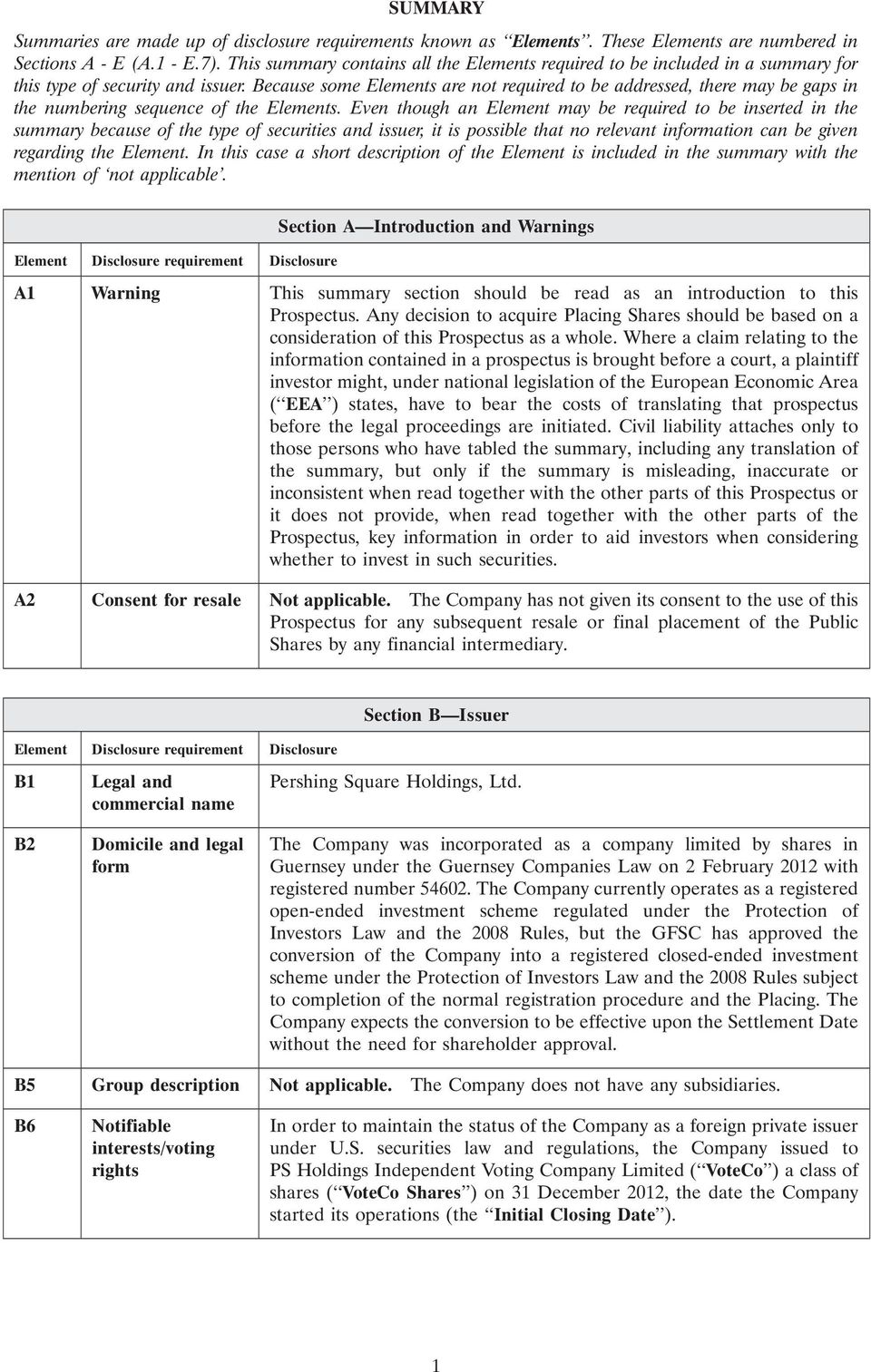
3 SUMMARY Summaries are made up of disclosure requirements known as Elements. These Elements are numbered in Sections A - E (A.1 - E.7). This summary contains all the Elements required to be included in a summary for this type of security and issuer. Because some Elements are not required to be addressed, there may be gaps in the numbering sequence of the Elements. Even though an Element may be required to be inserted in the summary because of the type of securities and issuer, it is possible that no relevant information can be given regarding the Element. In this case a short description of the Element is included in the summary with the mention of not applicable. Section A Introduction and Warnings Element Disclosure requirement Disclosure A1 Warning This summary section should be read as an introduction to this Prospectus. Any decision to acquire Placing Shares should be based on a consideration of this Prospectus as a whole. Where a claim relating to the information contained in a prospectus is brought before a court, a plaintiff investor might, under national legislation of the European Economic Area ( EEA ) states, have to bear the costs of translating that prospectus before the legal proceedings are initiated. Civil liability attaches only to those persons who have tabled the summary, including any translation of the summary, but only if the summary is misleading, inaccurate or inconsistent when read together with the other parts of this Prospectus or it does not provide, when read together with the other parts of the Prospectus, key information in order to aid investors when considering whether to invest in such securities. A2 Consent for resale Not applicable. The Company has not given its consent to the use of this Prospectus for any subsequent resale or final placement of the Public Shares by any financial intermediary. Element Disclosure requirement Disclosure Section B Issuer B1 Legal and Pershing Square Holdings, Ltd. commercial name B2 Domicile and legal The Company was incorporated as a company limited by shares in form Guernsey under the Guernsey Companies Law on 2 February 2012 with registered number The Company currently operates as a registered open-ended investment scheme regulated under the Protection of Investors Law and the 2008 Rules, but the GFSC has approved the conversion of the Company into a registered closed-ended investment scheme under the Protection of Investors Law and the 2008 Rules subject to completion of the normal registration procedure and the Placing. The Company expects the conversion to be effective upon the Settlement Date without the need for shareholder approval. B5 Group description Not applicable. The Company does not have any subsidiaries. B6 Notifiable In order to maintain the status of the Company as a foreign private issuer interests/voting under U.S. securities law and regulations, the Company issued to rights PS Holdings Independent Voting Company Limited ( VoteCo ) a class of shares ( VoteCo Shares ) on 31 December 2012, the date the Company started its operations (the Initial Closing Date ). 1
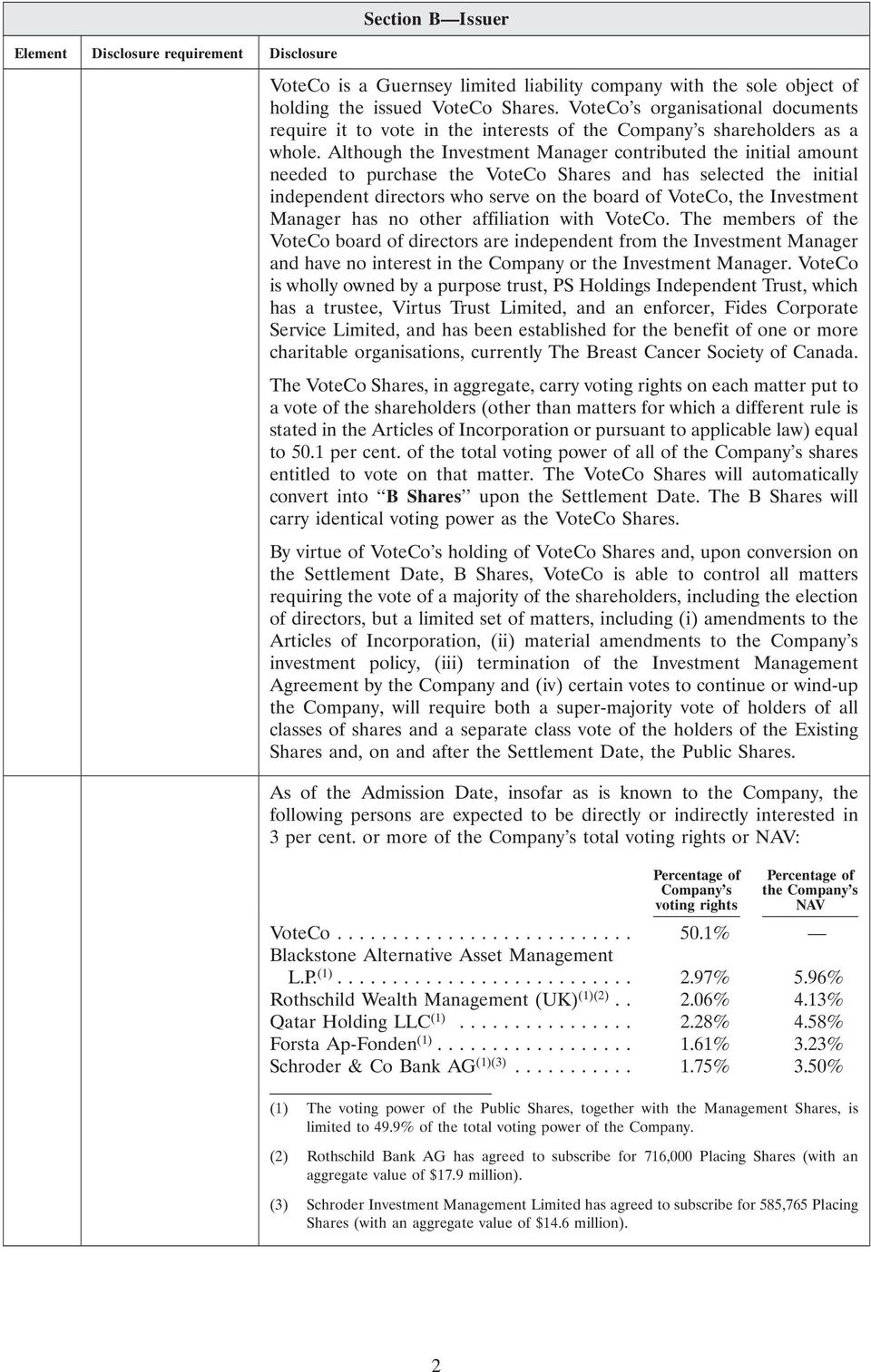
4 Section B Issuer Element Disclosure requirement Disclosure VoteCo is a Guernsey limited liability company with the sole object of holding the issued VoteCo Shares. VoteCo s organisational documents require it to vote in the interests of the Company s shareholders as a whole. Although the Investment Manager contributed the initial amount needed to purchase the VoteCo Shares and has selected the initial independent directors who serve on the board of VoteCo, the Investment Manager has no other affiliation with VoteCo. The members of the VoteCo board of directors are independent from the Investment Manager and have no interest in the Company or the Investment Manager. VoteCo is wholly owned by a purpose trust, PS Holdings Independent Trust, which has a trustee, Virtus Trust Limited, and an enforcer, Fides Corporate Service Limited, and has been established for the benefit of one or more charitable organisations, currently The Breast Cancer Society of Canada. The VoteCo Shares, in aggregate, carry voting rights on each matter put to a vote of the shareholders (other than matters for which a different rule is stated in the Articles of Incorporation or pursuant to applicable law) equal to 50.1 per cent. of the total voting power of all of the Company s shares entitled to vote on that matter. The VoteCo Shares will automatically convert into B Shares upon the Settlement Date. The B Shares will carry identical voting power as the VoteCo Shares. By virtue of VoteCo s holding of VoteCo Shares and, upon conversion on the Settlement Date, B Shares, VoteCo is able to control all matters requiring the vote of a majority of the shareholders, including the election of directors, but a limited set of matters, including (i) amendments to the Articles of Incorporation, (ii) material amendments to the Company s investment policy, (iii) termination of the Investment Management Agreement by the Company and (iv) certain votes to continue or wind-up the Company, will require both a super-majority vote of holders of all classes of shares and a separate class vote of the holders of the Existing Shares and, on and after the Settlement Date, the Public Shares. As of the Admission Date, insofar as is known to the Company, the following persons are expected to be directly or indirectly interested in 3 per cent. or more of the Company s total voting rights or NAV: Percentage of Percentage of Company s the Company s voting rights NAV VoteCo % Blackstone Alternative Asset Management L.P. (1) % 5.96% Rothschild Wealth Management (UK) (1)(2) % 4.13% Qatar Holding LLC (1) % 4.58% Forsta Ap-Fonden (1) % 3.23% Schroder & Co Bank AG (1)(3) % 3.50% (1) The voting power of the Public Shares, together with the Management Shares, is limited to 49.9% of the total voting power of the Company. (2) Rothschild Bank AG has agreed to subscribe for 716,000 Placing Shares (with an aggregate value of $17.9 million). (3) Schroder Investment Management Limited has agreed to subscribe for 585,765 Placing Shares (with an aggregate value of $14.6 million). 2
5 Section B Issuer Element Disclosure requirement Disclosure The Articles of Incorporation also provide that, subject to certain exceptions, any person will have to notify the Company of the percentage of the Public Shares it holds or is deemed to hold (through such person s direct or indirect holding of financial instruments) if this percentage reaches, exceeds or falls below 3 per cent., 4 per cent., 4.25 per cent., 4.50 per cent., 4.75 per cent. or 5 per cent. The Articles of Incorporation impose restrictions on the ownership of the shares of the Company: In order to minimise the impact of the Foreign Investment in Real Property Tax Act of 1980 ( FIRPTA ) and to comply with its various requirements, the Articles of Incorporation provide that no person may own or be treated as owning, within the meaning of Section 318 of the IRC (as modified by Section 897(c)(6)(C) of the IRC), shares representing more than 4.75 per cent. of the value of the Public Shares (the Ownership Limit ). In order to avoid its assets to be deemed to be plan assets under ERISA, the aggregate number of shares of any class or series held by ERISA Plans must be less than 25 per cent. (or such other percentage as may be specified in applicable regulations) of the aggregate number of outstanding shares of that class or series (the Plan Limit ) and Public Shares may not be acquired by any ERISA Plan (other than, for the avoidance of doubt, by conversion of Existing Shares into Public Shares on the Settlement Date). ERISA Plans include investors using assets of: (A) an employee benefit plan as defined in Section 3(3) of ERISA, that is subject to Title I of ERISA; (B) a plan as defined in Section 4975 of the IRC, including an individual retirement account or other arrangement that is subject to Section 4975 of the IRC; or (C) an entity which is deemed to hold the assets of any of the foregoing types of plans, accounts or arrangements that is subject to Title I of ERISA or Section 4975 of the IRC. The Articles of Incorporation include excess share provisions designed to enforce the Ownership Limit and the Plan Limit. Upon a prohibited transfer, any such shares in excess of the Ownership Limit or the Plan Limit and any Public Shares purported to be acquired by an ERISA Plan become excess shares and the prohibited owner will not acquire or retain any right or beneficial economic interest in such shares. The excess shares will be automatically transferred to a trust whose trustee shall have the right to designate a person who may acquire the excess shares without violating the applicable ownership restrictions and any other applicable investment and transfer restrictions. The trustee shall pay to the prohibited owner the lesser of (a) the value of the excess shares at the time they became excess shares and (b) the price received by the trustee from the sale of the excess shares to the permitted transferee. 3

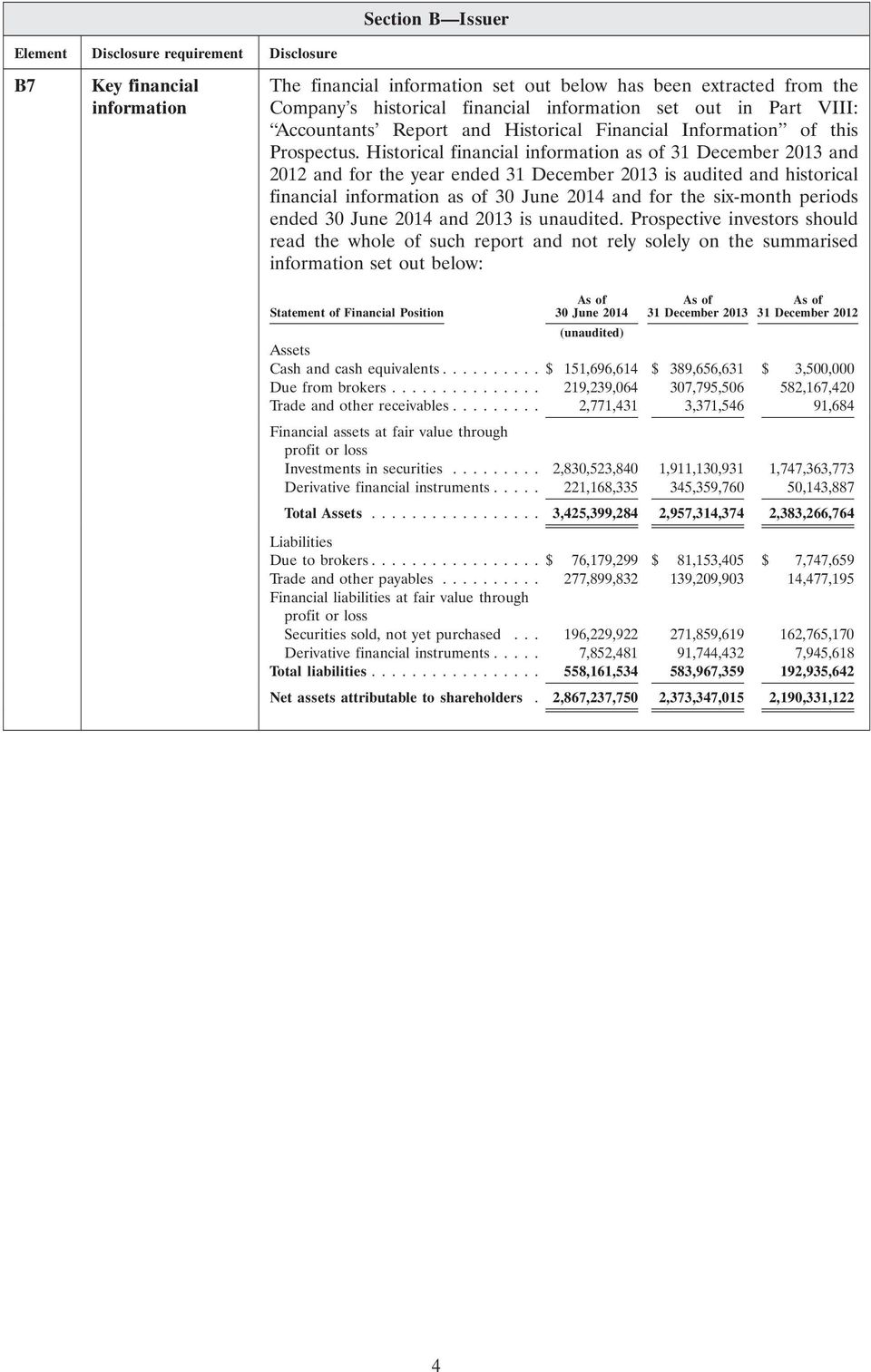
6 Section B Issuer Element Disclosure requirement Disclosure B7 Key financial The financial information set out below has been extracted from the information Company s historical financial information set out in Part VIII: Accountants Report and Historical Financial Information of this Prospectus. Historical financial information as of 31 December 2013 and 2012 and for the year ended 31 December 2013 is audited and historical financial information as of 30 June 2014 and for the six-month periods ended 30 June 2014 and 2013 is unaudited. Prospective investors should read the whole of such report and not rely solely on the summarised information set out below: As of As of As of Statement of Financial Position 30 June December December 2012 (unaudited) Assets Cash and cash equivalents...$ 151,696,614 $ 389,656,631 $ 3,500,000 Due from brokers ,239, ,795, ,167,420 Trade and other receivables... 2,771,431 3,371,546 91,684 Financial assets at fair value through profit or loss Investments in securities... 2,830,523,840 1,911,130,931 1,747,363,773 Derivative financial instruments ,168, ,359,760 50,143,887 Total Assets... 3,425,399,284 2,957,314,374 2,383,266,764 Liabilities Due to brokers...$ 76,179,299 $ 81,153,405 $ 7,747,659 Trade and other payables ,899, ,209,903 14,477,195 Financial liabilities at fair value through profit or loss Securities sold, not yet purchased ,229, ,859, ,765,170 Derivative financial instruments... 7,852,481 91,744,432 7,945,618 Total liabilities ,161, ,967, ,935,642 Net assets attributable to shareholders. 2,867,237,750 2,373,347,015 2,190,331,122 4
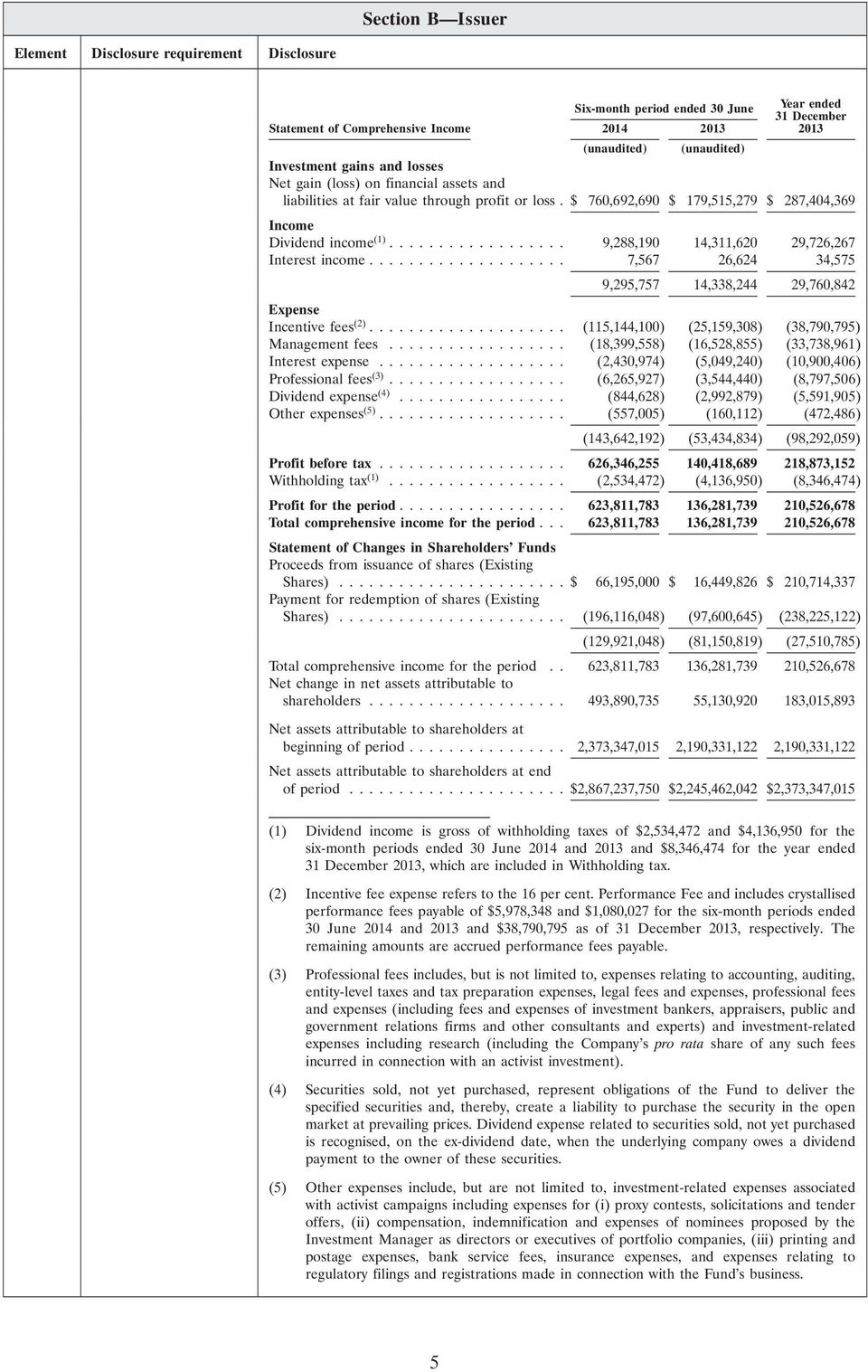
7 Section B Issuer Element Disclosure requirement Disclosure Six-month period ended 30 June Year ended 31 December Statement of Comprehensive Income (unaudited) (unaudited) Investment gains and losses Net gain (loss) on financial assets and liabilities at fair value through profit or loss. $ 760,692,690 $ 179,515,279 $ 287,404,369 Income Dividend income (1)... 9,288,190 14,311,620 29,726,267 Interest income... 7,567 26,624 34,575 9,295,757 14,338,244 29,760,842 Expense Incentive fees (2)... (115,144,100) (25,159,308) (38,790,795) Management fees... (18,399,558) (16,528,855) (33,738,961) Interest expense... (2,430,974) (5,049,240) (10,900,406) Professional fees (3)... (6,265,927) (3,544,440) (8,797,506) Dividend expense (4)... (844,628) (2,992,879) (5,591,905) Other expenses (5)... (557,005) (160,112) (472,486) (143,642,192) (53,434,834) (98,292,059) Profit before tax ,346, ,418, ,873,152 Withholding tax (1)... (2,534,472) (4,136,950) (8,346,474) Profit for the period ,811, ,281, ,526,678 Total comprehensive income for the period ,811, ,281, ,526,678 Statement of Changes in Shareholders Funds Proceeds from issuance of shares (Existing Shares)...$ 66,195,000 $ 16,449,826 $ 210,714,337 Payment for redemption of shares (Existing Shares)... (196,116,048) (97,600,645) (238,225,122) (129,921,048) (81,150,819) (27,510,785) Total comprehensive income for the period.. 623,811, ,281, ,526,678 Net change in net assets attributable to shareholders ,890,735 55,130, ,015,893 Net assets attributable to shareholders at beginning of period... 2,373,347,015 2,190,331,122 2,190,331,122 Net assets attributable to shareholders at end of period...$2,867,237,750 $2,245,462,042 $2,373,347,015 (1) Dividend income is gross of withholding taxes of $2,534,472 and $4,136,950 for the six-month periods ended 30 June 2014 and 2013 and $8,346,474 for the year ended 31 December 2013, which are included in Withholding tax. (2) Incentive fee expense refers to the 16 per cent. Performance Fee and includes crystallised performance fees payable of $5,978,348 and $1,080,027 for the six-month periods ended 30 June 2014 and 2013 and $38,790,795 as of 31 December 2013, respectively. The remaining amounts are accrued performance fees payable. (3) Professional fees includes, but is not limited to, expenses relating to accounting, auditing, entity-level taxes and tax preparation expenses, legal fees and expenses, professional fees and expenses (including fees and expenses of investment bankers, appraisers, public and government relations firms and other consultants and experts) and investment-related expenses including research (including the Company s pro rata share of any such fees incurred in connection with an activist investment). (4) Securities sold, not yet purchased, represent obligations of the Fund to deliver the specified securities and, thereby, create a liability to purchase the security in the open market at prevailing prices. Dividend expense related to securities sold, not yet purchased is recognised, on the ex-dividend date, when the underlying company owes a dividend payment to the owner of these securities. (5) Other expenses include, but are not limited to, investment-related expenses associated with activist campaigns including expenses for (i) proxy contests, solicitations and tender offers, (ii) compensation, indemnification and expenses of nominees proposed by the Investment Manager as directors or executives of portfolio companies, (iii) printing and postage expenses, bank service fees, insurance expenses, and expenses relating to regulatory filings and registrations made in connection with the Fund s business. 5
8 Section B Issuer Element Disclosure requirement Disclosure Save as disclosed below, there has been no significant change in the financial or trading position of the Company since 30 June 2014, being the end of the last financial period for which unaudited interim financial information has been prepared. From 1 July to 31 August, the Company s NAV continued its positive development by increasing by between 5 and 6 per cent. Key portfolio developments that drove NAV appreciation during this two-month period included, among other things, a 21% decline in the shares of Herbalife (a short position), an 11% increase in the shares of CP and an 18% increase in the shares of BKW. In August 2014, BKW announced its entry into a merger agreement to acquire Tim Hortons the Canadian-based donut and coffee chain. The three positions that most declined in value during the two-month period from 1 July to 31 August 2014 were AGN, PAH and Freddie Mac, the share prices of which each declined by low single digit percentages. B8 Key pro forma Not applicable. No pro forma information about the Company has been financial included in this Prospectus. information B9 Profit forecast Not applicable. No profit estimate or forecast for the Company has been made in this Prospectus. B10 Description of the Not applicable. There are no qualifications to the audit report on the nature of any historical financial information for the year ended 31 December 2013 and qualifications in the period from 2 February 2012 to 31 December the audit report on the historical financial information B11 Insufficient Not applicable. The Company is of the opinion that it has sufficient working capital working capital for its present requirements, that is for at least the next 12 months from the date of this Prospectus. B34 Investment Investment Objective and Policy objective and The Company s investment objective is to preserve capital and seek policy maximum, long-term capital appreciation commensurate with reasonable risk. The Investment Manager defines risk as the probability of permanent loss of capital, rather than price volatility. In its value approach to investing, the Investment Manager seeks to identify and invest in long (and occasionally short) investment opportunities that the Investment Manager believes exhibit significant valuation discrepancies between current trading prices and intrinsic business (or net asset) value, often with a catalyst for value recognition. The Investment Manager s focus on deeply undervalued securities is due to its belief that a well-priced purchase is often the most important determinant of the success of an investment. In addition, the Investment Manager believes that the acquisition of a portfolio of investments, when acquired at a large discount to intrinsic value, provides a margin of safety that can mitigate the likelihood of an overall permanent loss of the Company s capital. 6
9 Section B Issuer Element Disclosure requirement Disclosure The Investment Manager believes that investments that meet the Company s objectives are often found in companies undergoing significant changes in strategy, capital structure, corporate governance, management, legal exposure, corporate form, shareholder composition and control, liquidity and financial condition, and in companies that are affected by external changes in the economic and political environment, including changes in the relevant tax code. The Investment Manager believes that investment opportunities that meet the Company s objectives may at times occur in distressed securities, companies in or exiting bankruptcy, spin-offs, rights offerings, liquidations, companies for which litigation is a major asset or liability, misunderstood large capitalisation companies, under-followed small and midcapitalisation companies, and other special situations. While the Investment Manager is comfortable making investments in a wide range of industries and asset classes, it generally prefers investments in simple businesses or assets that generate cash flow streams that can be estimated within a reasonable range over the long term. The Investment Manager is willing to accept a high degree of situational, legal, and/or capital structure complexity in the Company s investments if it believes that the resulting complexity allows for a bargain purchase. The Investment Manager generally seeks to make investments in three broad categories of opportunities: (1) great businesses at fair prices, where a great business is generally understood by the Investment Manager as one which generates relatively predictable, growing, free cash flows, (2) good businesses or assets at significantly cheap prices often with a catalyst to realise value, and (3) mispriced probabilistic investments where the Investment Manager believes that the market price of a security or other investment under- or over-estimates the probability of a favourable outcome of a legal decision, contract or patent award or a change in interest rates, exchange rates or commodity prices, or such other event that is expected to lead to a significant change in the valuation of such security or investment. In certain situations, if the Investment Manager believes the commitment of time, energy and capital is justified in light of the potential for reward, the Investment Manager may seek to be a catalyst to realise value from an investment by taking an active role in effectuating corporate change, either working alone or in conjunction with other investors. These activist techniques may include working with management or other more aggressive steps such as acquiring substantial publicly disclosed stakes in issuers, proposing a restructuring, recapitalisation, sale, or other change in strategic direction, seeking potential acquirers, engaging in proxy contests, making tender offers, changing management and other related activities. The Investment Manager believes that these activist techniques can both accelerate and maximise the realisation of value from an investment. The Investment Manager also seeks short sale investments that offer absolute return opportunities. In addition, the Investment Manager may short individual securities to hedge or reduce the Company s long exposures. 7
10 Section B Issuer Element Disclosure requirement Disclosure In order to mitigate market-related downside risk, the Company may acquire put options, short market indices, baskets of securities and/or purchase credit-default swaps, but the Investment Manager is not committed to maintaining market hedges at any time. In seeking to achieve the Company s objective, the Investment Manager may use any investment strategy, long or short, in the global marketplace that it believes will enhance overall performance. There are no restrictions on the securities or other financial instruments that may be used by the Company. The Company is authorised and is expected to invest in long and short positions in equity or debt securities of U.S. and non-u.s. issuers (including securities convertible into equity or debt securities); distressed securities, rights, options and warrants; bonds, notes and equity and debt indices; swaps (including equity, foreign exchange, interest rate, commodity and credit-default swaps), swaptions, and other derivatives; instruments such as futures contracts, foreign currency, forward contracts on stock indices and structured equity or fixed-income products (including without limitation, asset-backed securities, mortgage-backed securities, mezzanine loans, commercial loans, mortgages and bank debt); exchangetraded funds; and any other financial instruments that the Investment Manager believes will achieve the Company s investment objective. The Company s investments may include both publicly traded and privately placed securities of public issuers, as well as publicly traded securities of private issuers. The Company also may invest in securities sold pursuant to initial public offerings. Investments in options on financial indices may be used to establish or increase long or short positions or to hedge the Company s investments. The Investment Manager has no overarching strategy or asset allocation model that specifies what percentage of the portfolio should be invested in each investment category. Rather, cash, cash equivalents, and/or U.S. Treasuries are generally the default investment choices until the Investment Manager identifies new opportunities. The Company s allocation among different investment categories is a function of their potential risk and reward compared with available opportunities in the marketplace. Accordingly, the Company may hold significant cash balances on an ongoing basis. The Company will not make an initial investment in the equity of companies whose securities are not publicly traded (i.e. private equity) but, as described above, may invest in privately placed securities of public issuers and publicly traded securities of private issuers. Notwithstanding the foregoing, it is possible that, in limited circumstances, public companies in which the Company has invested may later be taken private and the Company may make additional investments in the equity or debt of such companies. The Company may make investments in the debt securities of a private company, provided that there is an observable market price for such debt securities. 8
11 Section B Issuer Element Disclosure requirement Disclosure Diversification As part of the Company s investment programme, the Investment Manager intends to concentrate the Company s assets in a relatively limited number of investments because the Investment Manager believes that (i) there are a limited number of attractive investments available in the marketplace at any one time, and (ii) investing in a relatively modest number of attractive investments about which it has detailed knowledge provides a better opportunity to deliver superior risk-adjusted returns when compared with a large diversified portfolio of investments it can know less well. As a result, the Investment Manager intends to invest the substantial majority of the Company s capital in typically 8 to 12 core investments. Leverage The Investment Manager generally does not believe in the use of a material amount of margin leverage because of the potential risk of forced sales at inferior prices in the event of short-term declines in security prices in a margined portfolio. In certain circumstances, the Company may access the bond market and obtain other forms of financing, including, without limitations, margin loans. The Company may also use derivatives, including equity options, in order to obtain security-specific non-recourse leverage in an effort to reduce the capital commitment to a specific investment, while potentially enhancing the returns on the capital invested in that investment. Furthermore, the Company may use derivatives, such as equity and credit derivatives and put options, to achieve a synthetic short position in a company without exposing the Company to some of the typical risks of short selling, which include the possibility of unlimited losses and the risks associated with maintaining a stock borrow. In addition, the Company, from time to time, enters into total return swaps, which are equity derivatives with inherent recourse leverage. The Company generally does not use total return swaps to obtain leverage, but, rather, to manage regulatory, tax, legal or other issues. Investment Restrictions So long as the Company relies on certain exemptions from investment company status under the Investment Company Act, the Company will not purchase more than 3 per cent. of the outstanding voting securities of any SEC-registered investment company. Material Changes to the Investment Policy Any material change to the Company s investment policy will require a 75 per cent. vote (by voting power) of the holders of all voting shares represented at a shareholder meeting, together with a majority vote (by voting power) of the holders of the Public Shares represented at the meeting. 9
12 Section B Issuer Element Disclosure requirement Disclosure B35 Borrowing limits The Board has adopted a policy pursuant to which the borrowing ratio of the Company, defined for this purpose as the ratio of the aggregate principal amount of all borrowed money (including margin loans) to total assets (pursuant to the latest available annual or interim financial statements of the Company) shall in no event exceed 50 per cent. at the time of incurrence of any borrowing or drawdown. The Board may amend the Company s borrowing policy from time to time, although the Board may not increase or decrease the Company s maximum borrowing ratio without the prior consent of the Investment Manager. This borrowing policy does not apply to and does not limit the leverage inherent in the use of derivative instruments. As of the date of this Prospectus, the Company does not have any borrowed money or outstanding financial indebtedness or any outstanding mortgages, charges or security interests over or attaching to any of its assets. B36 Regulatory status The Company currently operates as a registered open-ended investment scheme regulated under the Protection of Investors Law and the 2008 Rules, but the GFSC has approved the conversion of the Company into a registered closed-ended investment scheme under the Protection of Investors Law and the 2008 Rules subject to completion of the normal registration procedure and the Placing. The Company expects the conversion to be effective upon the Settlement Date without the need for shareholder approval. The Company is not regulated by the AFM. B37 Typical investors An investment in the Placing Shares is suitable only for investors who are capable of evaluating the merits and risks of such an investment, who understand the potential risk of capital loss and that there may be limited liquidity in the Public Shares, for whom an investment in the Public Shares constitutes part of a diversified investment portfolio, who fully understand and are willing to assume the risks involved in investing in the Company and who have sufficient resources to be able to bear losses (which may equal the whole amount invested) that may result from such an investment. Accordingly, typical investors in the Company are expected to be experienced investors, institutional investors, high net worth investors, those investors who have taken appropriate professional advice and understand the risks involved in investing in the Company and, if in the EEA, qualified investors within the meaning of Article 2(1)(e) of the Prospectus Directive and, to the extent the Company markets the Placing Shares in any jurisdiction in the EEA in reliance on the national private placement provisions of the AIFM Directive, professional investors within the meaning of Article 4(1)(ag) of the AIFM Directive. Investors may want to consult their stockbroker, fund manager, solicitor, accountant or other independent financial adviser before making an investment in the Company. 10
13 Section B Issuer Element Disclosure requirement Disclosure B38 Investment of As of 30 June 2014, the Company s investment in Allergan, Inc. ( AGN ) 20 per cent. or (through PS Fund 1) represented 36.7 per cent. of the NAV of the more in single Company. It is expected that this percentage will be lower after the underlying asset Placing. According to its annual report dated 25 February 2014, AGN, a or investment Delaware corporation, is a multi-specialty health care company with company approximately 11,400 employees, global marketing and sales capabilities with a presence in more than 100 countries, with a portfolio of pharmaceuticals, biologics, medical devices and over-the-counter consumer products. AGN is listed on the NYSE under the symbol AGN. AGN s principal office is located at 2525 Dupont Drive, Irvine, California, B39 Investment of Not applicable. The Company does not have an investment of 40 per cent. 40 per cent. or or more of its gross assets in any single underlying asset or investment more in single company. underlying asset or investment company B40 Applicant s service Investment Manager providers Management Fee Pursuant to the Investment Management Agreement, the Investment Manager will earn a management fee (the Management Fee ) payable in advance each quarter (on the first business day of such quarter) in an amount equal to per cent. (1.5 per cent. per annum) of the net assets (before any accrued performance fee) attributable to Fee-Paying Shares (also referred to as the Fee-Paying Assets in this Prospectus). Prior to the Settlement Date, the Fee-Paying Shares of the Company comprise the Existing Shares, and immediately following the Settlement Date, will comprise the Public Shares and the B Shares. The Management Shares are not Fee-Paying Shares (see further the paragraph below headed Management Shares ). On the Settlement Date, the Investment Manager will receive a Management Fee in respect of the remainder of the financial quarter in which the Settlement Date falls on the Public Shares then being issued, whether for cash or by conversion, net of any unearned portion of the Management Fee previously paid in respect of that financial quarter on the Existing Shares then converting into Public Shares. The Management Fee payable on the Settlement Date will be based on the initial NAV of the Company attributable to the Public Shares. In consideration for the Management Fee, the Investment Manager renders investment management or certain other services to the Company and bears related overhead and administrative expenses (such as employment expenses, office expenses or certain insurance expenses). Shareholders should note that the Management Fee in respect of any quarter to which it relates may exceed the expenses borne by the Investment Manager in such quarter. 11
14 Section B Issuer Element Disclosure requirement Disclosure Variable Performance Fee The Investment Manager traditionally earns a performance fee, or incentive allocation, of 20 per cent. of the gains attributable to the fee-paying shares or interests of the funds it manages (the 20 per cent. Performance Fee ). In particular, the Investment Manager, or one of its affiliates, acts as the investment manager for Pershing Square, L.P., and Pershing Square II, L.P., two Delaware limited partnerships launched in January 2004 and 2005, respectively (collectively, the Pershing Square Partnerships ), as well as Pershing Square International, Ltd., a Cayman Islands exempted company launched in January 2005 ( Pershing Square International ). The Pershing Square Partnerships and Pershing Square International are together referred to as the Affiliated Funds in this Prospectus. Under the Investment Management Agreement the Investment Manager has entered into with the Company, the Investment Manager has agreed to a significant reduction in the 20 per cent. Performance Fee so as to offer enhanced economics to the Shareholders. From the inception of the Company, the Investment Manager has earned (and will earn until the Settlement Date) a performance fee of 16 per cent. of the gains attributable to the Fee-Paying Shares of the Company (the 16 per cent. Performance Fee ), which itself represents a fixed one-fifth reduction from the 20 per cent. Performance Fee. From the Settlement Date, the performance fee earned by the Investment Manager on the Fee-Paying Shares of the Company may be still further reduced as described below (as so reduced, the Variable Performance Fee ). The Variable Performance Fee that will be earned by the Investment Manager from the Settlement Date will be equal to (i) the 16 per cent. Performance Fee minus (ii) the Additional Reduction. The Additional Reduction is equal to 20 per cent. of the U.S. Dollar value of the aggregate performance fees or incentive allocation the Investment Manager and its Affiliates earn in respect of the same calculation period on the gains of the Other Funds (as defined below). Other Funds include the Affiliated Funds and other current and future funds the Investment Manager or any of its Affiliates manages from time to time, including funds that are co-investment vehicles established for purposes of investing in public equities, but excluding any publicly listed U.S. funds, any private real estate or private equity funds or any funds the inclusion of the performance fees or incentive allocation of which could, in the sole discretion of the Investment Manager, result in adverse legal, tax or regulatory consequences for such other funds, the Company, the Investment Manager and/or any Affiliates of the foregoing. As of the date of this Prospectus, the Other Funds comprise the Affiliated Funds and the PSV Funds. 12
15 Section B Issuer Element Disclosure requirement Disclosure Accordingly, the maximum performance fee on the Public Shares will be 16 per cent. of the gains attributable to the Public Shares, and may, depending upon the dollar value of the performance fees or incentive allocation earned by the Investment Manager and its Affiliates on the gains of the Other Funds, be lower. As of 30 June 2014, the Other Funds had $9.9 billion of Fee-Paying Assets (this amount includes the $459 million of Fee-Paying Assets of the PSV Funds, which are subject to scaled 5, 10 and 15 per cent. performance fees that are not payable before the earlier of the full or partial realisation of the PSV Funds investments and July 2016) and aggregate accrued performance fee and incentive allocation of $451 million (this amount includes the $10 million of accrued performance fees with respect to the PSV Funds described above). The Company believes that the Additional Reduction represents a clear and distinguishing feature from most other publicly listed funds and has the potential to meaningfully improve NAV per share performance and thereby add value to the Company and holders of Public Shares. In effect, as a result of the formulation of the Variable Performance Fee, holders of Public Shares will, in addition to participating in gains on the Company s assets, benefit from both a fixed one-fifth reduction in the performance fees traditionally earned by the Investment Manager and potential additional reductions the amount of which depends on the performance fees and incentive allocations the Investment Manager and its Affiliates earn from the Other Funds. The Variable Performance Fee for any period cannot be less than zero, but any negative amount that would result, but for this restriction, from the Additional Reduction will be carried forward and be available to reduce the Variable Performance Fee for any future period. In the event that any such carried-forward amount is still available after offsetting any performance fee crystallising upon the dissolution of the Company or the termination of the Investment Management Agreement (including as a result of the termination of the Investment Management Agreement by the Board with the required shareholder approval), such amount will be forfeited and neither the Company nor any shareholder will be entitled to any payment in respect thereof. Realised and Unrealised Gains For purposes of the performance fee calculation, gains refer to the net realised and unrealised increase (if any) in the NAV attributable to relevant Fee-Paying Shares (calculated before giving effect to the Variable Performance Fee and the Offset Amount (as defined below) above the high water mark applicable to such shares, that in each case have accrued at the relevant Crystallisation Event (as defined below). Crystallisation Events A crystallisation event is an event upon which the performance fee, if earned, is payable (a Crystallisation Event ). The consummation of the Placing will be a Crystallisation Event for payment of the 16 per cent. Performance Fee on the Existing Shares. Following the Settlement Date, there will be a Crystallisation Event in the Company on 31 December of each year. The termination of the Investment Management Agreement at any time or the dissolution of the Company will also be Crystallisation Events. 13
16 Section B Issuer Element Disclosure requirement Disclosure High Water Marks A high water mark is the highest NAV attributable to a class or series of Fee-Paying Shares (including the Public Shares) at the end of any period (typically, each 31 December and any other Crystallisation Event) for which the performance fee is paid (or would be paid without taking into account the Additional Reduction) to the Investment Manager. The initial high water mark of the Public Shares is equal to the high water mark upon Placing of the series of Existing Shares issued on the Initial Closing Date (the Reference Series ) after giving effect to any performance fee crystallising in respect of the Reference Series as a result of the Placing. The high water marks of the Public Shares set at the end of any period following the Placing will be calculated after the NAV per Public Share is reduced by (i) the Management Fee, (ii) the Variable Performance Fee and (iii) the Offset Amount, in each case accruing at, or before, the relevant Crystallisation Event. Management Shares The Investment Manager may determine to waive, reduce or calculate differently the Management Fee or the Variable Performance Fee with respect to shares issued to certain shareholders, including the Investment Manager itself and certain members, partners, officers, managers, employees or Affiliates of the Investment Manager or certain other shareholders. Such shares are referred to as Management Shares in this Prospectus and will form a separate class of shares. Management Shares can be issued in different series. From 31 December 2012 to the date of this Prospectus, the Company has issued one series of Management Shares comprising 52, shares, on which no performance fee or management fee is payable. The Company does not expect that the Management Shares will be admitted to trading on Euronext Amsterdam or elsewhere. After the Settlement Date, holders of Management Shares will, however, be entitled to convert those shares into Public Shares on a NAV-for-NAV basis. In addition, pursuant to the Investment Management Agreement, the Investment Manager will have the right to exchange Management Shares for any Public Shares it holds from time to time or vice versa. Administration The Company has retained Elysium Fund Management Limited to serve as Administrator and Morgan Stanley Fund Services (Bermuda) Ltd. to serve as Sub-Administrator under the Administration and Sub-Administration Agreement. For the provision of their respective services, the Administrator and Sub-Administrator are entitled to receive annual fees linked to the NAV of the Company. The AIFM Directive Services Provider The Company has appointed Morgan Stanley Fund Services (Bermuda) Ltd. (the AIFMD Services Provider ) to provide certain services that relate to duties of a depositary under the AIFM Directive, in exchange for an annual fee as may be agreed with the Company from time to time. 14
17 Section B Issuer Element Disclosure requirement Disclosure Audit Ernst & Young LLP will provide audit services to the Company. The annual report and accounts will be prepared in compliance with IFRS. For so long as it is required to do so pursuant to its U.S. regulatory obligations, the Company will also issue a reconciliation of its audited annual report and accounts to U.S. Generally Accepted Accounting Principles ( U.S. GAAP ). Since the fees charged by the auditor will depend on the services provided and the time spent by the auditor on the affairs of the Company, there is therefore no maximum amount payable under the auditor s engagement letter. The auditor is subject to appointment or re-appointment at each annual meeting of the shareholders. VoteCo Under the VoteCo Support and Lock-up Agreement, the Company will provide VoteCo with funds from time to time so that VoteCo is able to meet its obligations as they fall due, to pay all of its expenses, including the fees of the directors of VoteCo and the fees of all advisers engaged by the directors of VoteCo and premiums for directors and officers insurance, and, subject to the Guernsey Companies Law, to indemnify the directors of VoteCo in respect of all liability that they may incur in their capacity as directors of VoteCo. The Company will also cover the expenses of the trustee (Virtus Trust Limited) and the enforcer (Fides Corporate Service Limited), from time to time, of PS Holdings Independent Trust. For the year ended 31 December 2013, the aggregate fees and expenses paid by the Company in respect of VoteCo and the owner trust were $122, Excess Share Provision Trusts In order to give effect to the excess share provisions, the Company has established two trusts, PS Holdings Excess Share Trust One ( Excess Share Trust One ) and PS Holdings Excess Share Trust Two ( Excess Share Trust Two ). For each trust, Trident Trust Company (4 th Floor West Wing, Trafalgar Court, Admiral Park, St. Peter Port, Guernsey, GY1 2JA) acts as original trustee and Albany Trustee Company Limited (P.O. Box 232, Newport House, 15 The Grange, St. Peter Port, Guernsey GY1 4LA) acts as enforcer. The Company entered into a deed of support on 21 December 2012 to ensure the proper functioning of the trusts (the Excess Share Trust Deed of Support ). For the year ended 31 December 2013, the aggregate fees and expenses paid by the Company in respect of Excess Share Trust One and Excess Share Trust Two were $54, B41 Regulatory status Investment Manager of investment The Investment Manager is registered with the SEC as an investment manager and adviser under the U.S. Investment Advisers Act of 1940, as amended (the custodian U.S. Advisers Act ), and is currently a member of the National Futures Association (the NFA ) and is registered with the CFTC as a commodity pool operator (a CPO ). 15

18 Section B Issuer Element Disclosure requirement Disclosure Custodians Each of Goldman, Sachs & Co. ( Goldman Sachs ) and UBS Securities LLC ( UBS ) has been appointed as prime broker and custodian to the Company and is regulated by FINRA and registered with the SEC. The Company s assets are currently held and may in the future be held in one or more accounts maintained for the Company by other custodians. B42 Calculation of Net The Company expects that NAV per Public Share will be calculated and Asset Value reported in U.S. Dollars by way of a press release and on the Company s website at: weekly and monthly. In addition, the Company s NAV per Public Share will be calculated as of the last Business Day of each calendar quarter, and will be reported in U.S. Dollars to Shareholders at the time of publication by the Company of its half-yearly and annual financial results and (for so long as the Company publishes interim management statements) at the time of publication by the Company of its interim management statements, in each case through a press release and on the Company s website. Except as required by applicable law or regulation, each of the Company, the Investment Manager, the Administrator and the Sub-Administrator expressly disclaims any obligations to update or revise any NAV calculations or estimates to reflect any change in expectations, new information, subsequent events or otherwise. B43 Cross liability Not applicable. The Company is not an umbrella collective investment undertaking. B44 No financial Not applicable. The Company s historical financial information as of and statements have for the six-month periods ended 30 June 2014 and 2013 is unaudited and been made up historical financial information as of and for the year ended 31 December 2013 and the period ended 31 December 2012 is audited. The Company s historical financial information is set out in Part VIII: Accountants Report and Historical Financial Information of this Prospectus. 16

19 Section B Issuer Element Disclosure requirement Disclosure B45 Portfolio The table below presents, as of 30 June 2014, the fair value of each of the portfolio holdings of the (i) Company and (ii) the Company and the Affiliated Funds aggregated, that either (x) represented 5 per cent. or more of the NAV of the Company at such date or (y) have previously been publicly disclosed in the Investment Manager s regulatory filings. In each case, the fair value of net long and net short positions is presented after accounting for all types of investments (e.g., stock, swaps, options, warrants) held with respect to the underlying investment. The Company and The Company Affiliated Funds Portfolio holdings as of Fair Value Fair Value Fair Value Fair Value 30 June 2014 $ million (1) as % of NAV $ million (1) as % of NAV Cash (including cash due from/to Brokers) , Long positions Allergan, Inc. (4)... 1, , Canadian Pacific Railway Limited , Air Products & Chemicals Inc. (5) , The Howard Hughes Corporation Burger King Worldwide, Inc , Platform Specialty Products Corporation Fannie Mae Freddie Mac Aggregate other long positions (2) Subtotal... 2, , Short positions Herbalife Ltd. (3)... (137.1) (4.8) (632.9) (5.0) Aggregate other short positions (2)... (12.7) (0.4) (59.7) (0.5) Subtotal... (149.8) (5.2) (692.6) (5.5) Total Value... 3, , (1) Fair value of securities. Fair value may not represent the full economic exposure of the Company and the Affiliated Funds with respect to a particular investment due to the use of derivatives which increase or offset the Company s and the Affiliated Funds total economic exposure. (2) Comprises holdings (including equity and derivatives) having an aggregate fair value of less than 5 per cent. of NAV each and that have not been publicly disclosed by the Investment Manager. (3) As of 30 June 2014 (i) the Company held an aggregate short position in Herbalife Ltd. shares of $180.2 million (which was partially offset, for accounting purposes only, by long put options with an aggregate fair value of $43.1 million, which are recognised as an asset on the balance sheet of the Company under IFRS even though they represent short exposure to Herbalife, Ltd.) and (ii) the Company and the Affiliated Funds together held an aggregate short position in Herbalife Ltd. shares of $831.7 million (which was partially offset, for accounting purposes only, by long put options with an aggregate fair value of $198.8 million). (4) The Company s investment in Allergan, Inc. is held through PS Fund 1. (5) The Company s investment in Air Products & Chemicals Inc. is held directly by the Company and the Affiliated Funds and through the PSV Funds. 17

20 Section B Issuer Element Disclosure requirement Disclosure B46 Net Asset Value As of 30 September 2014 (being the latest practicable date prior to the date of this Prospectus), the unaudited NAV per Existing Share (after giving effect to the consolidation of all outstanding series into the Reference Series and stock split) was $25. Element Disclosure requirement Disclosure Section C Securities C1 Type and class of The number of Placing Shares to be issued under the Placing is securities being 109,090,909 at an Issue Price of $25 per Placing Share (assuming no offered and/or exercise of the Option (as described below)). admitted to Application has been made for the Public Shares to be admitted to listing trading, including and trading on Euronext Amsterdam. It is expected that Admission will any security become effective and that unconditional dealings in the Public Shares will identification commence at 9.00 a.m. on 13 October number The trading symbol of the Public Shares is PSH and their ISIN number is GG00BPFJTF46. C2 Currency The currency of the Public Shares is U.S. Dollars. C3 Number of As of 30 September 2014 (being the latest practicable date prior to the securities in issue date of this Prospectus), the Company s issued and fully paid up share capital consisted of 121,753,991 Existing Shares (after giving effect to the consolidation of all outstanding series into the Reference Series and stock split), 100 VoteCo Shares and 3,357,849 Management Shares (after giving effect to the stock split). On and following the consummation of the Settlement Date, the share capital of the Company will be represented by an unlimited number of (a) Public Shares, (b) B Shares, (c) Management Shares, (d) Preferred Shares (if any) and (e) such other shares, classes of shares or series as determined by the Board. C4 Description of the Distributions rights attaching to Although the Board does not expect to declare any dividends the securities (see C7 below), subject to compliance with the solvency test as set out in the Guernsey Companies Law and the prior consent of the Investment Manager, the Board may at any time declare and pay dividends (or interim dividends) as appear to be justified by the position of the Company. No dividend shall be paid in excess of the amounts permitted by the Guernsey Companies Law or approved by the Board and the Investment Manager. All unclaimed dividends may be invested or otherwise used by the Board for the benefit of the Company until claimed and the Company will not be constituted a trustee in respect thereof. No dividend will bear interest against the Company. Any dividend unclaimed after a period of six years from the date of declaration of such dividend will be forfeited and revert to the Company. Before recommending any dividend, the Board is empowered to create reserves (out of profits or otherwise) that will be applicable for any purpose to which such reserves may properly be applied and, pending such application, may either be employed in the business of the Company or be invested. The Board may also carry forward any profits. 18
21 Section C Securities Element Disclosure requirement Disclosure Distribution on Winding-up On a winding-up, the surplus assets remaining after payment of all creditors will be divided among the classes of shares then in issue in the same proportions as capital is attributable to them at the relevant winding-up date as calculated by the Board or the liquidator in its discretion. Within each such class, such assets will be divided pari passu among the shareholders of that class in proportion to the number of shares of that class held at the commencement of the winding-up, subject in any such case to the rights of any shares that may be issued with special rights or privileges. On a winding-up, the liquidator may, with the authority of a special resolution, divide among the shareholders or different classes of shareholders in specie the whole or any part of the assets of the Company and may set such value as he or she deems fair upon any asset or classes of assets and may determine the method of division of such assets between shareholders or different classes of shareholders. The liquidator may, with like authority, vest any part of the assets in trustees upon such trusts for the benefit of shareholders as he or she deems fit but no shareholder will be compelled to accept any assets in respect of which there is any outstanding liability. Where the Company is proposed to be or is in the course of being wound-up and the whole or part of its business or property is proposed to be transferred or sold to another company, the liquidator may, with the sanction of an ordinary resolution, receive in compensation or part compensation for the transfer or sale of assets, shares, policies or other like interests for distribution among the shareholders or may enter into any other arrangements whereby the shareholders may, in lieu of receiving cash, shares, policies, or other like interests in the transferee, participate in the profits of or receive any other benefit from the transferee. Voting Rights The holders of Existing Shares and, upon conversion, Public Shares have the right to receive notice of, attend and vote at general meetings of the Company. On and after the Settlement Date, at any general meeting of the Company: (a) each B Share will carry such voting power so that the aggregate issued number of B Shares carries, on each matter put to a vote of the shareholders (other than matters for which a different rule is stated in the Articles of Incorporation or pursuant to applicable law), voting power equal to 50.1 per cent. of the total voting power of the aggregate number of voting shares in issue entitled to vote on that matter; (b) each Public Share and (if voting) Management Share shall carry such voting power so that the aggregate issued number of Public Shares and (if voting) Management Shares together carries, on each matter put to a vote of the shareholders (other than matters for which a different rule is stated in the Articles of Incorporation or pursuant to applicable law), voting power equal to 49.9 per cent. of the total voting power of the aggregate number of voting shares in issue entitled to vote on that matter; and 19
22 Section C Securities Element Disclosure requirement Disclosure (c) subject at all times to the 49.9 per cent. limit set forth in the preceding paragraph, each Public Share shall carry one vote and (if voting) each Management Share shall carry such voting power so that the total voting power of the Public Shares and Management Shares in issue entitled to vote on that matter shall be apportioned among such Public Shares and Management Shares pro rata in accordance with their respective NAV as determined by the Board for this purpose. With respect to any general meeting (or class meeting) at which holders of Existing Shares and/or Management Shares, or holders of Public Shares and/or (if voting) Management Shares, as applicable, are entitled to vote, the Board shall notify these shareholders in advance of any such meeting of the NAV of these shares, as determined by the Board or a duly authorised agent as of the close of business on the latest valuation date falling prior to the record date for such meeting. The calculation of weighted voting rights attributable to shares in a particular class or series in accordance with their respective NAV as described above will not create separate classes of shares or series or any change in the respective NAV of such shares within the same class or series. Special Voting Rights Amendments to the Articles of Incorporation and material amendments to the Company s investment policy require a 75 per cent. vote (by voting power) of the holders of all voting shares represented at a shareholder meeting, together with a majority vote (by voting power) of the holders of the Existing Shares or, after the consummation of the Placing, the Public Shares, represented at that meeting. In addition, any shareholder resolution to wind-up the Company will require a 75 per cent. vote (by voting power) of the holders of all voting shares represented at a shareholder meeting, together with a 75 per cent. vote (by voting power) of the holders of the Existing Shares or, after the consummation of the Placing, Public Shares, represented at that meeting. Any termination of the Investment Management Agreement by the Company will be subject to the approval of the shareholders requiring a per cent. vote (by voting power) of the holders of the then outstanding voting shares, together with a per cent. vote (by voting power) of the then outstanding Existing Shares or, after the consummation of the Placing, Public Shares. Upon consummation of the Placing, the Existing Shares will automatically convert into voting Public Shares. After such conversion, the continuation of the Company following (i) the termination of the Investment Management Agreement, (ii) the occurrence of a Key Man Event or (iii) any event that would otherwise be deemed to be an assignment of the Investment Management Agreement for purposes of Section 205(a)(2) of the U.S. Advisers Act (other than an assignment to an Affiliate of the Investment Manager with the prior consent of the Company) will require a 75 per cent. vote (by voting power) of the holders of all voting shares represented at a shareholder meeting, together with a majority vote (by voting power) of the holders of the Public Shares represented at that meeting. 20
23 Section C Securities Element Disclosure requirement Disclosure Pre-emption Rights There are no pre-emption rights, rights of first refusal, co-sale or similar rights with respect to any shares of the Company. However, except with the prior approval of the holders of shares of the relevant class or where new shares are first offered to those holders on a pro rata basis or where the Board determines to allot new shares in connection with investments (such as in-kind purchases of a block of securities and/or other financial instruments, pursuant to applicable law), the Board intends to exercise its authority to issue new shares only if the value at which any such shares are issued is not less than the estimated prevailing NAV per share of the relevant class. In determining such value, the Board may rely on authorised agents or third parties, including, without limitation, the Investment Manager. Conversion or Exchange Rights Upon the consummation of the Placing, holders of Management Shares will be entitled to convert those shares into Public Shares (with the same aggregate NAV) monthly as of the last day of each calendar month. In addition, pursuant to the Investment Management Agreement, the Investment Manager will have the right to exchange Management Shares for Public Shares it holds from time to time or vice versa. C5 Restrictions on the Transfers before the Admission Date free transferability For the period prior to the Admission Date, trading (whether conditional of the securities or unconditional) in the Public Shares on Euronext Amsterdam will not be possible, and there will be no established trading market for the Public Shares. During this period, the Public Shares may be transferred only (a) to persons who execute and deliver to the Company, prior to any transfer, a Transferee Letter in which the transferee certifies, among other things, that (A) it is a non-u.s. Person not in the United States and (B) it is not acquiring the Shares with a view to, or for offer or sale in connection with, any distribution thereof (within the meaning of the Securities Act) in the United States or to U.S. Persons. The form of Transferee Letter will be available from the Company. Transfers on Euronext Amsterdam on or after the Admission Date On and after the Admission Date, the Public Shares may be freely transferred on Euronext Amsterdam (subject to certain restrictions imposed on certain Existing Shareholders and restrictions related to ERISA and tax considerations). C6 Admission Application has been made for the Public Shares to be admitted to listing and trading on Euronext Amsterdam. The Company expects that its application for admission of the Public Shares on Euronext Amsterdam will be approved on or prior to the Settlement Date, but will not be effective until the Admission Date. It is expected that Admission will become effective and that unconditional dealings in the Public Shares will commence at 9.00 a.m. on 13 October 2014 (seven calendar days after the Settlement Date). C7 Dividend policy The Company does not currently intend to make regular cash distributions to its shareholders. The Company currently expects that all profits and gains, less losses and expenses, will be reinvested by the Company in accordance with its investment policy. 21
24 Section D Risks Element Disclosure requirement Disclosure D1 Key information The Company started its investment activities on 31 December 2012 on the key risks and therefore has a limited operating history. specific to the The Company is exposed to a concentration of investments. issuer or its Specifically, the Company s investment technique of concentrating a industry substantial majority of its capital typically in 8 to 12 core positions could exacerbate volatility and investment risk. The Investment Manager generally targets activist strategies, which seek to effectuate corporate changes with respect to an investment. This approach may result in significant costs and expenses (including potential litigation or other transactional costs), all of which are borne by the Company, and may not ultimately be successful. Further, the Investment Manager may use litigation in pursuit of activist investment strategies, and the Investment Manager itself or the Company may be the subject of litigation or regulatory investigation, creating exposure to monetary damages or other sanctions, and thus increasing the risk of an investment in the Company. The Company has delegated broad powers to the Investment Manager, and relies exclusively on the Investment Manager to identify suitable investment opportunities, which it may fail to do. When assessing an investment opportunity, for example, the due diligence performed by the Investment Manager may not reveal all relevant facts in connection with that investment. This may in part be due to the limited or incomplete nature of the information available which is especially relevant when the Investment Manager undertakes its analysis on an expedited basis in order to take advantage of what it perceives to be short-lived investment opportunities. Further, the structure of the performance fee, calculated on a basis that includes both unrealised and realised appreciation of the Company s portfolio, may incentivise the Investment Manager to make high-risk investments or create conflicts of interest. As the Investment Manager (whose liability to the Company is limited) is dependent on the services of William A. Ackman, the Company could also experience material adverse effects should Mr. Ackman become unavailable. The Company is subject to a number of risks specific to its investment objective and the types of investments it makes. For example, regulatory restrictions on the beneficial ownership of securities may impair the Company s ability to achieve its investment objective. Further, the Company may participate substantially in the affairs of companies acquired by it, which may result in the Company s inability to purchase or sell the securities of such companies. The Company may also invest in derivative instruments or maintain positions that carry particular risks. In particular, short selling exposes the Company to the risk of theoretically unlimited losses, and regulatory actions may curtail the ability of the Company to effect its short selling strategy. 22
25 Section D Risks Element Disclosure requirement Disclosure Adverse changes affecting the global financial markets and economy as a whole may have a material negative impact on the performance of the Company s investments, as well as the Company s non-u.s. currency investments, which may be affected by fluctuations in currency exchange rates. Further, in light of the financial and derivative instruments in which it invests, the Company is exposed to market and counterparty risk, which may significantly impact the performance of the Company (as prices of such instruments are subject to high volatility). Because its assets are, and may in the future be, held in accounts maintained by counterparties, the Company is also subject to the risk of using parties such as prime brokers, custodians, administrators and other agents. From a regulatory standpoint, changes in laws or regulations, or a failure to comply with these, may adversely affect the Company. The Investment Manager and its Affiliates engage in competing activities and act in multiple capacities, advising both the Company and the Affiliated Funds, creating potential conflicts of interest. Conflicts may also arise during the pursuit of activist investments, where the Investment Manager may acquire fiduciary duties to its various portfolio companies which could potentially conflict with duties owed to the Company. The Company and the Investment Manager have not been represented by separate legal counsel in connection with the structuring of the Company, the Placing or Admission. Further, the arrangements of the Company with the Investment Manager were negotiated in the context of affiliated relationships. For these reasons, arrangements may be less favourable to the Company than if such terms had been negotiated at arm s length. The Company may experience reduced performance while it deploys the Net Issue Proceeds. D3 Key information Investors purchasing Placing Shares may experience immediate and on the key risks substantial dilution as a result of the Placing. Further, the Company specific to the retains the right to issue additional securities that have rights and securities privileges that are more favourable than the rights and privileges of holders of the Public Shares. Other potential risks following Admission include the shares trading at a discount to NAV, and significant Public Share price fluctuation, causing potential investors to lose all or part of their investment. There can also be no assurance that an active and liquid trading market in the Public Shares will develop following Admission or, if such market develops, whether it will be maintained. The ability of potential investors to transfer their Public Shares may be limited by the impact on the liquidity of the Public Shares resulting from restrictions imposed by ERISA and similar regulations, as well as tax considerations. In addition, local laws or regulations may mean that the status of the Company or the Public Shares is uncertain or subject to change, which could adversely affect investors ability to hold the Public Shares. 23
26 Section D Risks Element Disclosure requirement Disclosure Under FATCA, the Company is required to identify beneficial ownership of its shareholders, though this requirement will not extend to shares regularly traded on an established securities market. As the relevant regulations have only been issued in draft form however, the requirements of FATCA with respect to the Company are still unclear. VoteCo controls a majority of the voting power of all of the Company s Shares. While a limited set of matters, including amendments to the Articles of Incorporation, material amendments to the Company s investment policy, termination of the Investment Management Agreement by the Company and certain votes to continue or wind-up the Company, will require both a super-majority vote of holders of all classes of shares and a separate class vote of the holders of the Public Shares, VoteCo will still have the ability to veto any resolutions proposed to be passed in respect of these matters. Element Disclosure requirement Disclosure Section E Offer E1 The total net The Gross Issue Proceeds of the Placing are $2,727,272,725 (assuming no proceeds and an exercise of the Option (as described below)). estimate of the The placing fees and other costs of the Placing and Admission are total expenses of expected to be up to $95.5 million. the issue/offer, including During the Private Phase, (a) the commissions paid to Credit Suisse estimated expenses Securities (Europe) Limited and J.P. Morgan Securities LLC for their charged to the assistance in the private offering and sale of the Existing Shares as private investor by the placement agents and (b) the other formation and offering expenses issuer or the during the Private Phase (those commissions and expenses are collectively offeror referred to as the Private Phase Offering Expenses ) have effectively been borne by the Investment Manager by way of a corresponding reduction in the Management Fee. The aggregate amount of the Private Phase Offering Expenses was $21.1 million as of 30 June Placement commissions for the Private Phase that will only become payable on or after the Settlement Date are estimated to be $7.7 million. The Investment Manager will initially bear the fees and other costs of the Placing and Admission. Under the Investment Management Agreement, if the Placing and Admission have occurred, the Investment Manager will be entitled to receive payments in an aggregate amount equal to the fees and other costs of the Placing and Admission, as well as the Private Phase Offering Expenses and a yield not exceeding 4.25 per cent. per annum. This aggregate amount (the Offset Amount ) will be payable under the Investment Management Agreement over time, on a dollar-for-dollar basis to the extent of any Additional Reduction. As a result, investors will not have the benefit of the Additional Reduction until full payment of the Offset Amount. As the Investment Manager will initially pay the fees and other costs of the Placing and Admission, the Company will receive the full amount of the Gross Issue Proceeds of the Placing. E2a Reasons for the The Company will employ the Net Issue Proceeds to make investments or offer and use of hold assets in accordance with the Company s investment policy, including proceeds to effect an initial rebalancing transaction with the Affiliated Funds, as well as to fund the Company s operating expenses. 24
27 Section E Offer Element Disclosure requirement Disclosure E3 Terms and The Placing is being made by means of an offering of Placing Shares to conditions of the certain qualified investors in the Netherlands and other selected offer jurisdictions in offshore transactions (as defined in and) in reliance on Regulation S. The Placing Shares have not been, and will not be, registered under the Securities Act, or the securities laws of any state of the United States, and are only being offered to non-u.s. persons in reliance on Regulation S. The Company has not been and will not be registered under the Investment Company Act, and investors in the Placing Shares will not be entitled to the benefits of that Act. The Placing Shares are being offered and sold only to non-u.s. Persons in offshore transactions in reliance on Regulation S, provided such persons are also QEPs under CFTC Rule 4.7. The Placing and Admission will qualify as a Qualified Public Offering within the meaning of the Articles of Incorporation (the definition of a Qualified Public Offering set forth in the Articles of Incorporation establishes minimum criteria pursuant to which, if they are met, the Company may automatically convert into a closed-end investment scheme) provided the conditions set forth in the following paragraph are met. As such, the conversion of the Company into a closed-ended investment scheme pursuant to the Protection of Investors Law and the 2008 Rules will not require further shareholder approval. On the basis of the conditions governing a Qualified Public Offering pursuant to the Articles of Incorporation, the Placing will not proceed if: (a) the Gross Issue Proceeds would be less than the required amount for the aggregate NAV of the Company, after giving effect to the Placing, to be equal to at least $4 billion; or (b) if it does not raise new capital from a minimum of 100 beneficial owners (as determined by the Company) at an Issue Price per Placing Share at least equal to the Price Floor (as described below). These conditions have been established with the aim to enhance the liquidity of the Public Shares in the aftermarket. If the Placing does not proceed, subscription monies received will be returned without interest at the risk of the applicant. The size of the Placing is $2,727,272,725. In order to enable settlement of over-allotments, the Company will make available to the Stabilising Manager (acting on behalf of the Managers) Over-allotment Shares at the Issue Price on the Settlement Date in an amount representing up to 10 per cent. of the total number of Placing Shares before any over-allotments for a maximum period of 30 calendar days after the Admission Date (the Share Loan ). Further, the Company has granted to the Stabilising Manager an option (the Option ) pursuant to which the Stabilising Manager may purchase, or procure purchasers for, additional Placing Shares at the Issue Price up to such maximum number of Placing Shares which is identical to the number of Over-allotment Shares drawn by the 25
28 Section E Offer Element Disclosure requirement Disclosure Stabilising Manager under the Share Loan. The Option may be exercised in whole or in part upon notice by the Stabilising Manager at any time during the period commencing on the Admission Date and ending 30 calendar days thereafter. The Managers may settle their repayment obligation under the Share Loan at any time during the period commencing on the Admission Date and ending 30 calendar days thereafter by re-delivering Public Shares purchased by the Stabilising Manager through stabilisation activities to the Company or by exercising the Option and remitting a cash payment to the Company in a per share amount equal to the Issue Price. The Company expects (but is not obliged) to cancel any shares re-delivered by the Managers in satisfaction of the repayment obligation under the Share Loan. The Placing Shares are being offered and sold at the prevailing NAV (after any performance fees crystallising in respect of the Existing Shares as a result of the Placing) on the basis of an estimate of NAV of the Company made by the Investment Manager as of the Business Day prior to the pricing date of the Placing. This estimate constitutes a final and binding NAV determination for purposes of calculating, among other things: (a) any performance fees crystallising in respect of the Existing Shares as a result of the Placing; (b) the Issue Price; (c) the initial high water mark of the Public Shares; and (d) the Management Fees payable on the Settlement Date. The Directors have determined that the Placing Shares under the Placing will be issued at an Issue Price of $25 per Placing Share. The Placing is not being underwritten. The Company has entered into the Cornerstone Investment Agreements pursuant to which, subject to certain conditions and the absence of certain material changes, 30 Cornerstone Investors have agreed to subscribe for 63,031,486 Placing Shares in aggregate at the Issue Price (with an aggregate value of over $1.5 billion). In addition, existing investors in Pershing Square International have been provided with the opportunity to roll over all or part of their respective investment in exchange for Public Shares at the Issue Price effective on the Settlement Date. The Rollover Investors will receive 8,499,360 Public Shares at the Issue Price (with an aggregate value of $212.5 million) on the Settlement Date. E4 Material interests Not applicable. No interest is material to the Placing. E5 Name of person The Placing Shares are being offered pursuant to the Placing by the selling securities Company. E5 Lock-up The Existing Shareholders and the Rollover Investors will be subject to a agreements: the lock-up pursuant to which neither they, nor any of their respective parties involved; affiliates over which they exercise management or voting control, nor any and indication of person acting on their behalf will, for a period of 90 days after the pricing the period of the date, without the prior written consent of the Joint Global Coordinators lock-up (acting on behalf of the Managers), offer, sell, contract to sell, pledge or otherwise dispose of (or publicly announce any such offer, sale or disposal of), directly or indirectly, any Public Shares held or owned 26
29 Section E Offer Element Disclosure requirement Disclosure by them as a result of the conversion of Existing Shares or the rollover of their investment (as applicable). This lock-up does not apply to any Public Shares that Existing Shareholders or Rollover Investors may acquire in the Placing or in the secondary market. In the Placing Agreement, the Company and the Investment Manager have agreed that neither the Company, nor the Investment Manager nor any of their affiliates over which they may exercise management or voting control will, for a period of 180 days after the date of the Placing Agreement, without the prior written consent of the Joint Global Coordinators (acting on behalf of the Managers), issue, allot offer, sell, contract to sell, pledge or otherwise dispose of (or publicly announce any such issuance, offer, sale or disposal of) any Public Shares or any other shares of the Company or securities convertible or exchangeable into or exercisable for shares of the Company or warrants or other rights to purchase shares of the Company or any security or financial product whose value is determined directly or indirectly by reference to the price of the Public Shares or any other shares of the Company, including equity swaps, forward sales and options. The Joint Global Coordinators (acting on behalf of the Managers) may, in their sole discretion and at any time, waive any such restrictions on sales or transfer. The foregoing lock-up however will not apply to the issuance of Management Shares to the Investment Manager or any of its affiliates over which it exercises management or voting control and B Shares to VoteCo from time to time. As of 30 June 2014, Mr. Ackman held Management Shares with an aggregate net asset value of $75.0 million in the Company (the Initial Investment ). Mr. Ackman as well as other members of the management team and officers of the Investment Manager intend to invest an aggregate additional minimum amount of $100.0 million on or around the Placing (subject to the Ownership Limit) (the Additional Investment ). The Additional Investment will take the form of a subscription for Management Shares issued at $25 per share. Mr. Ackman and such other members of the management team and officers have each agreed with the Company (acting by a majority of its independent Directors) to a lock-up of their Initial Investment and Additional Investment in the Company (subject to any depreciation of such investments but including, as the case may be, any appreciation thereof) for a period of ten years from the Settlement Date, less amounts attributable to any sales required to pay taxes on income generated by the Company or that are determined (by a majority of the independent directors of the Company) to be prudent to be in compliance with regulatory constraints, including, without limitation, applicable ownership limits. The ten-year lock-up does not apply to sales following the termination of the Investment Management Agreement, separation of employment of the relevant member of the management team or officer (other than Mr. Ackman) from the Investment Manager or following death or disability of Mr. Ackman or such other member of the management team or officer. Under the terms of the lock-up arrangement, Mr. Ackman and such other members of the management team and officers of the Investment Manager may from time to time transfer their investments subject to the ten-year lock-up to any of their affiliates, provided that the relevant affiliate agrees to be subject to the then-remaining holding period. This arrangement does not provide for further exceptions to the ten-year lock-up. 27
30 Section E Offer Element Disclosure requirement Disclosure E6 Dilution The Issue Price per Placing Share will be equal to the NAV per share of the Reference Series (after giving effect to the performance fee in relation to the Reference Series crystallising as a result of the Placing). E7 Expenses charged The placing fees and other costs of the Placing and Admission are to the investor expected to be up to $95.5 million. The Investment Manager will initially pay the fees and other costs of the Placing and Admission. See further E1 above. 28
31 RISK FACTORS An investment in the Company and the Placing Shares carries a number of risks, including the risk that the entire investment may be lost. In addition to all other information set out in this Prospectus, the following specific factors should be considered when deciding whether to make an investment in the Company and the Placing Shares. The Placing Shares are only suitable for investors (i) who understand the potential risk of capital loss, (ii) for whom an investment in the Placing Shares is part of a diversified investment programme, and (iii) who fully understand and are willing to assume the risks involved in such an investment programme. The Company believes that the risks described below are the material risks relating to the Public Shares at the date of this Prospectus. Additional risks and uncertainties not currently known to the Company, or that the Company deems to be immaterial at the date of this Prospectus, may also have an adverse effect on the performance of the Company and the value of the Public Shares. The order in which the risks are presented below is not intended to provide an indication of the likelihood of their occurrence or of their magnitude or significance. Prospective investors should review this Prospectus carefully and in its entirety and consult with their professional advisers before investing in the Placing Shares. For important information on the limitations inherent to the presentation of performance data, see Important Information Important Note Regarding Performance Data. Defined terms used in the risk factors below have the meanings set out in Part XII: Definitions of this Prospectus. Risks relating to the Company s Investment Strategy Shareholders may lose all, or substantially all, of their investment in the Company Investments are exposed to the risk of the loss of capital. The business of the Company is to invest in securities utilising an investment strategy that may involve substantial risks. The prices of the Company s investments are volatile and market movements are difficult to predict. No guarantee or representation is made that the Company s investment strategy will be successful. In addition, the Company may utilise such investment techniques as short sales, securities lending, investments in non-marketable securities, uncovered option transactions, forward transactions, futures and options on futures transactions, foreign currency transactions and a highly concentrated portfolio, among others, which could under certain circumstances magnify the impact of any adverse market or investment developments. There can be no assurance that the securities purchased or investments made by the Company will increase in value or that the Company will not incur significant losses. A shareholder may lose all or substantially all of its investment in the Company. The Company is exposed to a concentration of investments, which could exacerbate volatility and investment risk In the pursuit of the Company s investment strategy, the Investment Manager may accumulate significant positions in particular investments and intends to invest the substantial majority of the Company s capital in typically 8 to 12 core investments. From time to time, the Company may invest a significant proportion of its capital in one or a limited set of investments. For example, as of 30 June 2014, the Company had invested 36.7 per cent. of its NAV in AGN (through PS Fund 1), 19.0 per cent. of its NAV in Canadian Pacific Railway Limited and 16.2 per cent. of its NAV in Air Products & Chemicals Inc. (directly and through the PSV Funds). The Company s investment technique of concentrating investment positions increases the volatility of investment results over time and may exacerbate the risk that a loss in any such position could have a material adverse impact on the Company s NAV and, in turn, the value of any investment in the Company. For example, AGN contributed 33% to total net gains recorded by the Company over the first six months of The outcome of any proposed transaction between Valeant and AGN is subject to significant uncertainty. Part or all of the gains on the AGN position could reverse if the proposed transaction does not proceed. Although it may at times choose to do so, the Investment Manager is under no obligation to hedge the Company s positions to mitigate such risks. Activist investment strategies may not be successful. They may result in significant costs and expenses The Investment Manager may pursue an activist role and seek to effectuate corporate changes with respect to an investment. The costs in time, resources and capital involved in such activist investments depend on the circumstances, which are only in part within the Investment Manager s control, and may be significant, particularly if litigation against the Company, the Board and/or the Investment Manager ensues. In addition, the expenses associated with an activist investment strategy, including potential litigation, 29
32 expenses related to the recruitment and retention of board members, executives and other individuals providing business assistance to the Investment Manager in connection with an activist campaign (including, for example, consultants and corporate whistle-blowers) or other transactional costs, will be borne by the Company. Such expenses may reduce returns or result in losses. The success of the Company s activist investment strategy may require, among other things: (i) that the Investment Manager properly identify portfolio companies whose equity prices can be improved through corporate and/or strategic action; (ii) that the Company acquire sufficient securities of such portfolio companies at a sufficiently attractive price; (iii) a positive response by the management of portfolio companies to shareholder engagement; (iv) a positive response by other shareholders to shareholder activism and the Investment Manager s proposals; and (v) a positive response by the markets to any actions taken by portfolio companies in response to shareholder activism. None of the foregoing can be assured. (See, for example, the discussion of the disposal of the Company s position in J.C. Penney Inc. in 2013 in Part IX: Operating and Financial Review.) Activist strategies employed in respect of the Company s investments may prove ineffective for a variety of reasons, including: (i) opposition of the management, board and/or shareholders of the subject company, which may result in litigation and may erode, rather than increase, shareholder value; (ii) intervention of one or more governmental agencies; (iii) efforts by the subject company to pursue a defensive strategy, including a merger with, or a friendly tender offer by, a company other than the Company or its Affiliates; (iv) market conditions resulting in material changes in securities prices; (v) the presence of corporate governance mechanisms, such as staggered boards, poison pills and classes of shares with increased voting rights; and (vi) the necessity for compliance with applicable securities laws. In addition, opponents of a proposed corporate governance change may seek to involve regulatory agencies in investigating the transaction or the Company and such regulatory agencies may independently investigate the participants in a transaction, including the Company, as to compliance with securities or other law. This risk may be exacerbated to the extent the Company develops and utilises novel activist strategies. Furthermore, successful execution of an activist strategy may depend on the active cooperation of shareholders and others with an interest in the subject company. Some shareholders may have interests which diverge significantly from those of the Company and some of those parties may be indifferent to the proposed changes. Moreover, securities that the Investment Manager believes are fundamentally underpriced or incorrectly priced may not ultimately be valued in the capital markets at prices and/or within the time frame the Investment Manager anticipates, even if an activist strategy is successfully implemented. In respect of portfolio companies in which the Investment Manager holds a long position, even if the prices for a portfolio company s securities increase, no guarantee can be made that there will be sufficient liquidity in the markets to allow the Company to dispose of all or any of its securities therein or to realise any increase in the price of such securities. The converse applies equally in respect of portfolio companies in which the Investment Manager holds a short position. The Investment Manager may fail to identify suitable investment opportunities The Company s investment strategy depends on the ability of the Investment Manager to successfully identify attractive investment opportunities. Any failure to identify and make appropriate investment opportunities would increase the amount of the Company s assets invested in cash or cash equivalents and, as a result, may reduce its rates of return. The Company will face competition for investments from, for example, public and private investment funds, strategic buyers and/or investment banks. Many of these competitors may be substantially larger and have greater financial resources than are available to the Company. There can be no assurance that the Investment Manager will be able to identify and make investments that are consistent with the Company s investment objectives or generate attractive returns for its shareholders or that the Company will not be significantly affected by competitive pressures for investment opportunities. The due diligence performed by the Investment Manager before investing may not reveal all relevant facts in connection with an investment When assessing an investment opportunity, the Investment Manager has relied and will continue to rely on resources that may provide limited or incomplete information. In particular, the Investment Manager has relied and will continue to rely on publicly available information and data filed with various government regulators. Although the Investment Manager has evaluated and will continue to evaluate information and 30
33 data as it deemed or deems appropriate, and has sought and will continue to seek independent corroboration when reasonably available, the Investment Manager has not and may choose not to evaluate all publicly available information and data with respect to any investment and has often not been and will often not be in a position to confirm the completeness, genuineness or accuracy of the information and data that it did or will evaluate. In addition, when assessing an investment opportunity for the Company, investment analyses and decisions by the Investment Manager may be undertaken on an expedited basis in order to take advantage of what it perceives to be short-lived investment opportunities. In such cases, the available information at the time of an investment decision may be limited, inaccurate and/or incomplete. As a result, there can be no assurance that due diligence investigations carried out by the Investment Manager will reveal or highlight all relevant facts that may be necessary or helpful in evaluating investment opportunities. Any failure to identify relevant facts may result in inappropriate investment decisions, which may have a material adverse effect on the value of any investment in the Company. Market risk may significantly impact the performance of the Company The Company is exposed to market risk. Among other things, this means that the prices of financial and derivative instruments in which the Company may invest can be highly volatile. Price movements of equity, debt and other securities and instruments in which the Company s assets may be invested are influenced by, among other things, interest rates, changing supply and demand relationships, trade, fiscal, monetary and exchange control programs and policies of governments and national and international political and economic events and policies. Moreover, war, political or economic crisis or other events may occur which can be highly disruptive to the markets, regardless of the strategies being employed. In addition, governments from time to time intervene, directly and by regulation, in certain markets, particularly those in currencies, financial instrument futures and options. Such intervention often is intended directly to influence prices and may, together with other factors, cause such markets to move rapidly in the same direction because of, among other things, interest rate fluctuations. The Company also is subject to the risk of the failure of any exchanges on which its positions trade and of their clearinghouses. Sustained cyclical market declines and periods of unusual market volatility make it more difficult to produce positive trading results, and there can be no assurance that the Company s strategies will be successful in such markets. Adverse changes affecting the global financial markets and economy may have a material negative impact on the performance of the Company s investments Global capital markets have experienced extreme volatility and disruption in recent years as evidenced by the failure of major financial institutions, significant write-offs suffered by the financial services sector, the re-pricing of credit risk, the unavailability of credit or the downgrading and the possibility of default by sovereign issuers, forced exit or voluntary withdrawal of countries from a common currency and/or devaluation. Despite actions of government authorities, these events have contributed to a worsening of general economic conditions, high levels of unemployment in Western economies and the introduction of austerity measures by governments. Such worsening of financial market and economic conditions may have a negative effect on valuations of, and the ability of the Company to exit or partially divest from, investment positions. Adverse economic conditions may also decrease the value of collateral securing some of its positions, and require the Company to contribute additional collateral. Depending on market conditions, the Company may incur substantial realised and unrealised losses in future periods, all of which may materially adversely affect its results of operations and the value of any investment in the Company. Unexpected market disruptions may cause major losses The Company may incur major losses in the event of disrupted markets and other extraordinary events in which market behaviour diverges significantly from historically recognised patterns. The risk of loss in such events may be compounded by the fact that in disrupted markets, many positions become illiquid, making it difficult or impossible to close out positions against which markets are moving. Market disruptions caused by unexpected political, military and terrorist events may from time to time cause dramatic losses for the Company, and such events can result in otherwise historically low-risk strategies performing with 31
34 unprecedented volatility and risk. Any such disruptions and events may have a material adverse effect on the value of any investment in the Company. The Investment Manager may use litigation in pursuit of activist investment strategies. The Investment Manager itself and the Company may be the subject of litigation or regulatory investigation In pursuit of activist investment strategies, the Investment Manager may determine to use litigation as a course of action. In addition, the Investment Manager itself and the Company may be a party to lawsuits initiated by third parties, including companies in which the Company invests, other shareholders or governmental bodies. For example, the Investment Manager had to resort to litigation to solicit proxies and is currently engaged in a separate lawsuit in relation to its request to call a special meeting of the shareholders of AGN. AGN also filed a lawsuit in the United States District Court for the Central District of California against, among others, PS Fund 1, the Investment Manager and Mr. Ackman, alleging, among other things, that the defendants made public misstatements or omitted facts in violation of U.S. securities laws relating to proxy solicitations and tender offers, and violated certain insider trading laws and regulations, which the Investment Manager believes is baseless and is principally an attempt to interfere with its request to call a special meeting. See Part I: Information on the Company Portfolio of the Company and the Affiliated Funds for more information. There can however be no assurance that any litigation, once begun, will be resolved in favour of the Investment Manager or Company, as applicable. As a result, the Investment Manager and the Company may be exposed to the risk of monetary damages and other sanctions or remedies or the objective they are seeking to achieve may be defeated by delaying strategies of the target company. In addition, as an activist investor, the Investment Manager is subject from time to time (and especially in the context of a proxy contest), to formal or informal investigations or inquiries by the SEC and other governmental and self-regulatory organisations in connection with its trading and other activities. For example, in connection with the hostile tender offer made by Valeant and the Investment Manager for AGN, the Investment Manager (and Valeant) received requests for information from the SEC in respect of the Investment Manager s trading in AGN common stock, and provided all requested information. Litigation and regulatory investigations may require significant amounts of the Investment Manager s time, and result in significant expenses to the Company. The Company may participate substantially in the affairs of companies acquired by it, which may result in the Company s inability to purchase or sell the securities of such companies The Company may substantially participate in or influence the conduct of affairs or management of issuers of securities acquired by it. Members, partners, officers, managers, employees or Affiliates of the Investment Manager and its Affiliates or designees may serve as directors of, or in a similar capacity with, companies in which the Company invests. In the event that material non-public information is obtained with respect to such companies or the Company becomes subject to trading restrictions pursuant to the internal trading policies of such companies or as a result of applicable law or regulations, the Company may be prohibited for a period of time from purchasing or selling the securities of such companies, and as a result be prevented from increasing its exposure (or maintaining its relative ownership stake, in the case that additional securities are issued by such company) to an investment position which appreciates or divesting from or exiting an investment position which decreases in value. Any such restrictions may have a material adverse effect on the Company and the value of any investment in the Company. Control investments made by the Company may pose various risks The Company may take a controlling stake in certain investments. These investments may involve a number of risks, such as the risk of liability for environmental damage, product defect, failure to supervise management, violation of governmental regulations and other types of liability in which the limited liability characteristic of business operations may be ignored. In addition, in connection with the disposition of these investments, the Company may make representations and warranties about such investments business and financial affairs typical of those made in connection with the sale of any business, or may be responsible for the contents of disclosure documents under applicable securities law. The Company may also be required to indemnify the purchasers of such investments or underwriters to the extent that any such representations and warranties or disclosure documents turn out to be incorrect, inaccurate or misleading. All of these risks or arrangements may create contingent or actual liabilities, and materially affect the Company and any investment in the Company. 32
35 Regulatory restrictions on the beneficial ownership of securities may impair the Company s ability to achieve its investment objective The investment strategies pursued by the Company may be affected by applicable U.S. state and federal laws and regulations governing the beneficial ownership of public securities, which may inhibit the Company s ability to freely acquire and dispose of certain securities. Should the Company be affected by such rules and regulations, it may not be able to transact in ways that would realise value for the Company. In addition, any changes to government regulations could make some or all forms of activist strategies unlawful or impractical. Accordingly, such changes, if any, could have an adverse effect on the ability of the Company to achieve its investment objective. For more information on prospective changes that may affect the investment activities of the Company in the United States, see the paragraph headed Risks Relating to the Company The Company may be affected by the Dodd-Frank Act and future regulatory changes in the United States. The Company may invest in derivative instruments or maintain positions that carry particular risks Options, swaps and other instruments may involve substantial risks The Company may buy or sell (write) both call options and put options, and when writing options, it may do so on a covered or an uncovered basis. A call option is covered when the writer owns securities of the same class and amount as those to which the call option applies. A put option is covered when the writer has an open short position in securities of the relevant class and amount. The Company s option transactions may be part of a hedging strategy (i.e., offsetting the risk involved in another securities position) or a form of leverage, in which the Company has the right to benefit from price movements in a large number of securities with a small commitment of capital. These activities involve risks that can be substantial. When the Company buys an option, a decrease (or insufficient increase) in the price of the underlying security in the case of a call, or an increase (or insufficient decrease) in the price of the underlying security in the case of a put, could result in a total loss of the Company s investment in the option (including commissions). When the Company sells (writes) an option, the risk can be substantially greater than when it buys an option. The seller of a call option, for example, bears the risk of an increase in the market price of the underlying security above the exercise price. The risk in that case is theoretically unlimited unless the option is covered. If it is covered, the Company would forego the opportunity for profit on the underlying security should the market price of the security rise above the exercise price. Swaps and certain options and other custom instruments are subject to the risk of non-performance by the swap counterparty, including risks relating to the creditworthiness of the swap counterparty, market risk, liquidity risk and operations risk, as further discussed below. Credit-default swaps are characterised by volatile pricing, potentially illiquid markets, difficulty in predicting triggering events and various other risks The Company may enter into credit-default swaps. A credit-default swap is a contract between two parties which transfers the risk of loss and/or default related to a particular entity (the reference entity ) if a credit event occurs with respect to the debt of such reference entity. The credit-default swap provides for payments to be made by the protection seller which offset or reduce the losses sustained by the protection buyer as a result of the credit event. Generally, credit events include a variety of typically adverse events that trigger payouts under these financial instruments and include, among other things, failure by the reference entity to pay the principal or interest related to its debt, or bankruptcy of the reference entity. If a credit event occurs, the purchaser of protection would settle the credit-default swap in one of three ways, as specified in the credit-default swap: (i) through a standardised auction process where credit-default swaps are cash settled and the seller of protection delivers to the purchaser of protection an amount equal to the face value of the credit-default swap less the market value of specified debt, (ii) through a physical settlement process where the purchaser of credit protection delivers a debt instrument related to the reference entity to the counterparty and the counterparty pays to the purchaser a specified face value of the credit-default swap, or (iii) through another method agreed upon by the parties. The first way is the most common form of credit-default swap settlement. Credit-default swaps can also be used to obtain short exposure related to the debt of a reference entity. There are many credit-default swap products, such as credit-default swaps on an index of reference entities or customised credit-default swaps that reference specific corporate bonds. 33
36 The Company may purchase credit-default swap protection as a hedge against particular assets or other events. Credit-default swaps can also be utilised to implement the Investment Manager s view that a particular credit, or group of credits, will experience credit deterioration or improvement. The Company may enter into credit-default swap transactions, even if the credit outlook is positive, if it believes that participants in the marketplace have incorrectly valued the components which determine the value of such credit-default swap. The Company may purchase credit default protection even in the case in which it does not own the debt of the reference entity if the Investment Manager believes that the reference entity s credit will deteriorate. The Company may also purchase the credit-default swap protection as a hedge against particular assets or other events. While in the past the Company and the Affiliated Funds have not been sellers of protection, the Company may also sell protection by underwriting default risk to entities that would like to purchase such protection. If the Company sells protection and if the reference entity does not experience a credit event, the Company will have received premium payments for the term of the credit-default swap. However, if the reference entity experiences a credit event, the Company would be obligated to pay to the purchaser of protection the face amount of the credit-default swap, which amount may be significantly greater than any premiums that it had received during the term of the credit-default swap. Swap transactions dependent upon credit events are priced by incorporating many variables, including, among other things, the pricing and volatility of the common stock, potential loss upon default and the shape of the yield curve of securities issued by the U.S. Department of the Treasury ( U.S. Treasuries ). As such, there are many factors upon which market participants may have divergent views, which increases the risk of entering into these credit-default swaps. This may be particularly true in the case of certain types of debt; for example, the credit-default swap market in high yield securities is comparatively new and rapidly evolving compared to the credit-default swap market for more seasoned and liquid investment grade securities. The market for credit derivatives may be relatively illiquid, and there are considerable risks that may make it difficult either to buy or sell the contracts as needed or at reasonable prices. Sellers and buyers of credit derivatives are subject to the inherent price, credit spread and default risks of the debt instruments covered by the derivative instruments, as well as the risk of non-performance by the other party. There are also risks with respect to credit derivatives in determining whether an event will trigger payment under the contract and whether such payment will offset the loss or payment due under another instrument. In the past, buyers and sellers of credit derivatives have found that a triggering event in one contract may not match the triggering event in another contract, exposing the buyer or the seller to further risk. Furthermore, notwithstanding any right to a payout upon the occurrence of a credit event, there is some risk that a counterparty to a credit-default swap may have insufficient capital to fund a payout. Given the increases in volume of credit derivatives trading in the marketplace, settlement of such contracts may also be delayed beyond the time frame originally anticipated by counterparties. Such delays may adversely affect the Company s ability to otherwise productively deploy any capital that is committed with respect to such contracts. The Company is not obligated to hedge its exposure, and if it does, hedging transactions may be ineffective or reduce the Company s overall performance Although the Company is not obligated to, and often times will not, hedge its exposure, it may utilise a variety of financial instruments and derivatives, such as options, interest rate swaps, caps and floors, and forward contracts, for risk management purposes, including in order to (i) protect against possible changes in the market value of the Company s investment portfolio resulting from fluctuations in the securities markets and changes in interest rates; (ii) protect the Company s unrealised gains in the value of the Company s investment portfolio; (iii) facilitate the sale of any such investments; (iv) enhance or preserve returns, spreads or gains on any investment in the Company s portfolio; (v) hedge the interest rate or currency exchange rate on any of the Company s liabilities or assets; (vi) protect against any increase in the price of any securities the Company anticipates purchasing at a later date; or (vii) for any other reason that the Investment Manager deems appropriate. The success of any hedging activities by the Company will depend, in part, upon the Investment Manager s ability to correctly assess the degree of correlation between the performance of the instruments used in the hedging strategy and the performance of the portfolio investments being hedged. Since the characteristics of many securities change as markets change or time passes, the success of the Company s hedging strategy will also be subject to the Investment Manager s ability to continually recalculate, readjust and execute 34
37 hedges in an efficient and timely manner. In addition, while the Company may enter into hedging transactions to seek to reduce risk, such transactions may result in a poorer overall performance for the Company than if it had not engaged in such hedging transactions. Counterparties to derivative transactions may not be subject to credit evaluation, regulatory oversight, financial responsibility requirements or the requirement to segregate customer funds or positions To the extent that the Company and the Investment Manager trade derivatives in over-the-counter markets in the United States or elsewhere, such trading will be subject to certain risks arising from the fact that the participants in such markets are typically not subject to credit evaluation and regulatory oversight to the same extent as are members of exchanges or clearing houses. This exposes the Company to the risk that a counterparty will not settle a transaction in accordance with its terms and conditions because of a credit or liquidity problem with the counterparty. Delays in settlement may also result from disputes over the terms of the contract (whether or not in good faith) since such markets may lack the established rules and procedures for swift settlement of disputes among market participants as in exchange-based markets. These factors may cause the Company to suffer a loss due to adverse market movements while replacement transactions are executed or otherwise. Such counterparty risk is accentuated for contracts with longer maturities where events may intervene to prevent settlement, or where the Company has concentrated its transactions with a single or small group of counterparties. Although the Company will attempt to limit its derivative transactions to those with well-known and well-capitalised firms where it is permitted to trade over-the-counter, the Company is not restricted from dealing with any particular counterparty or from concentrating any or all of its derivative transactions with one counterparty. Moreover, the Investment Manager s internal credit function which evaluates the creditworthiness of the Company s counterparties may prove insufficient. The lack of a complete and foolproof evaluation of the financial capabilities of the Company s counterparties and the absence of a regulated market to facilitate settlement may increase the potential for losses by the Company. Forward trading may expose the Company to the risk of bank failure or non-performance, as well as other risks Forward contracts and options thereon, unlike futures contracts, have not historically been traded on exchanges and have not been standardised; rather, banks and dealers have acted, and continue to act, as principals in these markets, negotiating each transaction on an individual basis. Under the U.S. Dodd-Frank Wall Street Reform and Consumer Protection Act of 2010 (the Dodd-Frank Act ), as set forth above, many over-the-counter derivatives will be required to be traded on regulated trading facilities and cleared through regulated clearing houses. However, certain types of forward contracts, particularly foreign exchange and physical commodity forwards, will continue to be traded over-the-counter. As a result, the Company will continue to be subject to the risks of forward trading. Forward trading (to the extent forward contracts are not traded on regulated facilities) and cash trading are substantially unregulated; there is no limitation on daily price movements and speculative position limits are not applicable. The principals that deal in the forward markets are not required to continue to make markets in the currencies or commodities they trade and these markets can experience periods of illiquidity, sometimes of significant duration. There have been periods during which certain participants in these markets have refused to quote prices for certain currencies or commodities or have quoted prices with an unusually wide spread between the price at which they were prepared to buy and that at which they were prepared to sell. Disruptions can occur in any market traded by the Company due to unusually high trading volume, political intervention or other factors. In connection with its possible trading in non-u.s. currency forward contracts, the Company may contract with a non-u.s. or a U.S. bank to make or take future delivery of a specified lot of a particular currency for the Company s account. Banks and futures commission merchants with which the Company may maintain accounts may require the Company to deposit margin with respect to such trading. Banks are not required to continue to make markets in such contracts. Arrangements to trade forward contracts may be made with only one or a few banks, and liquidity problems therefore might be greater than if such arrangements were made with numerous banks. The imposition of credit controls by governmental authorities might limit such forward trading to less than that which the Investment Manager would otherwise recommend, to the possible detriment of the Company. With respect to its trading of forward contracts with banks, if any, the Company will be subject to the risk of bank failure and the inability of, or refusal by, a bank to perform with respect to such contracts. Any such default would deprive the Company of any profit potential or force the Company to cover its commitments for resale, if any, at the current market price, and could result in a loss to the Company. 35
38 Short selling exposes the Company to the risk of theoretically unlimited losses. In addition, regulatory actions may curtail the ability of the Company to effect its short selling strategy Short selling involves selling securities that are not owned by the short seller and delivering borrowed securities to the purchaser, with an obligation to replace the borrowed securities at a later date. Short selling allows the investor to profit from a decline in market price to the extent such decline exceeds the transaction costs and the costs of borrowing the securities. The extent to which the Company engages in short sales will depend upon the Investment Manager s investment strategy and opportunities. In certain cases, a short sale creates the risk of a theoretically unlimited loss, because the price of the underlying security could theoretically increase without limit. The potential for unlimited losses may be due to general market forces, such as increases in the price of a security sold short or a lack of stock available for short sellers to borrow for delivery. There can be no assurance that the Company will be able to maintain the ability to borrow securities sold short. For example, the broker or other institution that lent the stock in question to the Company may demand the return of the borrowed security. In addition, the Company may be subject to a short squeeze resulting in significant increases in the market price of a stock. A short squeeze occurs, for example, when a company with a large short interest announces a positive development, the stock price rises causing short sellers on margin to cover, which pushes the stock price up further causing more shorts to cover, and so on. A short squeeze may push a stock price above its fair value until the shorts finish covering. As a result, the Company may be required to replace securities previously sold short with purchases on the open market at prices significantly greater than those at which the securities were sold short. As mentioned above, purchasing securities to close out a short position can itself cause the price of the securities to rise further, thereby exacerbating the loss. Until the security is replaced, the Company is required to pay to the lender amounts equal to any dividends or interest that accrue during the period of the loan. In addition, to borrow the security, the Company may be required to pay a premium, which would increase the cost of the security sold. For information on short positions currently held by the Company, see the section headed Portfolio of the Company and the Affiliated Funds of Part I of this Prospectus. Following the economic crisis in 2008, a number of regulators issued emergency orders to temporarily ban short selling of any publicly traded securities, such as securities issued by financial firms or government securities, and required institutional investment managers, including hedge fund managers, to report short positions on publicly traded securities. Several regulators have augmented these emergency measures with permanent rules intended to deter market abuses perceived to be connected with short selling. For example, the SEC has made permanent its temporary close-out requirement for sales of equity securities, as well as the penalties for failure to do so. In 2010, it also adopted Rule 201 under the U.S. Securities Exchange Act of 1934, as amended (the Exchange Act ), which restricts short selling when a stock has experienced a price decline of at least 10 per cent. in one day. Other jurisdictions have also enacted legislation imposing restrictions on short selling activities. On 1 November 2012, a new pan-european short selling regime (in the form of a European Union ( EU ) regulation, which has direct effect in each of the 27 countries of the EU (the EU Short Selling Regulation )) came into force in the EU and requires (by midnight on the applicable dealing day (U.K. time or continental European time, as applicable, depending on the relevant market)) private disclosure to the relevant local regulator of net short positions in any stocks listed on European regulated markets or multilateral trading facilities that exceed 0.2 per cent. of the issued capital of the relevant issuer. Further disclosures will have to be made to the regulator at 0.3 per cent. and 0.4 per cent. (with additional disclosures to the regulator as each subsequent 0.1 per cent. threshold is crossed), with any net short position that is equal to or exceeds 0.5 per cent. of the issued capital of the relevant issuer being made public to the market by the relevant regulator. Additional disclosures will also have to be made when a net short position is decreasing through relevant 0.1 per cent. incremental thresholds. The EU Short Selling Regulation will also have the effect of banning naked short sales on stocks listed on European markets, meaning that short sales of stocks will only be permitted where the seller has borrowed the relevant stock or has entered into an agreement or arrangement to borrow it or has a reasonable expectation that settlement of the stock can be effected when due. To date, short selling measures have typically focused on equities and equity-related financial instruments. As well as covering the short selling of securities, the EU Short Selling Regulation (No. 236/2012) also introduced measures to impose restrictions on the creation of short positions in relation to European sovereign debt (including banning naked short sales of EU sovereign debt and prohibiting any persons, anywhere in the world, from entering into naked credit-default swap transactions in relation to EU sovereign debt). It is impossible to know what, if any, further changes in regulations may occur, but any 36
39 regulations which restrict the ability of the Company to trade in securities, including through short selling strategies, could have a material adverse impact on the Company. The Company may carry leverage in relation to its capital, which has the potential to increase losses The Company expects that, as a general matter, it will operate without relying significantly on leverage. In addition, the Company may not engage in leverage greater than the maximum allowable under applicable law. The Board has adopted a policy pursuant to which the borrowing ratio of the Company, defined for this purpose as the ratio of the aggregate principal amount of all borrowed money (including margin loans) of the Company to the Company s total assets (pursuant to the latest available annual or interim financial statements of the Company) shall in no event exceed 50 per cent. at the time of incurrence of any borrowing or drawdown. The Company may access the bond market and obtain other forms of financing, including, without limitations, margin loans. The Company is not restricted from leveraging its investments. In particular, the Company may seek to magnify its investment returns with options, short sales, swaps, forwards and other derivative instruments. The Company s borrowing policy does not apply and does not limit the leverage inherent in the use of derivative instruments. As a result, the amount of leverage may be substantial in relation to the Company s capital. In addition, because the borrowing limit is determined by reference to the Company s total assets pursuant to its latest available annual or interim financial statements, in the event that the Company s total assets decrease after the relevant date, it is possible that the aggregate principal amount of borrowed money could exceed 50 per cent. of total assets as of the time of incurrence. While leverage presents opportunities for increasing the Company s total return, it has the effect of potentially increasing losses as well. Accordingly, any event which adversely affects the value of an investment by the Company would be exacerbated to the extent the Company is leveraged. The cumulative effect of the use of leverage by the Company in a market that moves adversely to the Company s investments could result in a substantial loss to the Company that would be greater than if the Company was not leveraged. Margin borrowings may subject the Company to additional risks Whenever the Company uses financing extended by broker-dealers to leverage its portfolio, it may be subject to changes in the value that broker-dealers ascribe to a given security or position, the amount of margin required to support such security or position, the borrowing rate to finance such security or position and/or such broker-dealers willingness to continue to provide any such credit to the Company. The Company could be forced to liquidate its portfolio on short notice to meet its financing obligations. The forced liquidation of all or a portion of the Company s portfolio at distressed prices could result in significant losses to the Company. In particular, the Company could be subject to a margin call, pursuant to which the Company would either be required to deposit additional funds or securities with the broker-dealer or suffer mandatory liquidation of the pledged securities to compensate for the decline in value. In the event of a sudden drop in the value of the Company s assets, the Company might not be able to liquidate assets quickly enough to satisfy its margin requirements. The Company may invest through Affiliates and its investments may be subordinated to the claims of such Affiliates creditors The Company may effect certain investments through limited partnerships, limited liability companies, corporations or other vehicles sponsored or managed by the Investment Manager or third parties. A creditor having a claim that relates to a particular investment held by any such vehicle may be able to satisfy such claim against all assets of such vehicle, without regard to the participation rights of the Company and other investors of such vehicle in the assets of such vehicle. Portfolio turnover rates may be high, resulting in greater expenses Portfolio turnover will not be a limiting factor in making investment decisions for the Company and may vary from year to year, as well as within a year. Although not expected, turnover rates may be high, which will likely result in higher brokerage and other transaction expenses than funds with lower portfolio turnover. Higher turnover rates will negatively affect the results of operations of the Company and, in turn, any investment in the Company. 37
40 If the Company lends its portfolio securities, it may experience losses or delays in the event of bankruptcy of the counterparty to the loan The Company may lend its portfolio securities (in which case it will receive all revenues from such securities lending). By doing so, the Company attempts to increase its income through the receipt of interest on the loan, in addition to the underlying dividends and other income from the securities. In the event of the bankruptcy of the borrower of the securities, the Company could experience delays in recovering the loaned securities or the revenues from securities lending. To the extent that the value of the securities the Company lent has increased, the Company could experience a loss if such securities are not recovered. The Company s trading orders may not be timely executed The Company s investment and trading strategies depend on its ability to establish and maintain an overall market position in a combination of financial instruments selected by the Investment Manager. The Company s trading orders may not be executed in a timely and efficient manner due to various circumstances, including, for example, trading volume surges or systems failures attributable to the Company, the Investment Manager, the Company s counterparties, brokers, dealers, agents or other service providers. In such event, the Company might only be able to acquire or dispose of some, but not all, of the components of such position, or if the overall position were to need adjustment, the Company might not be able to make such adjustment. As a result, the Company would not be able to achieve the market position selected by the Investment Manager, which may result in a loss. In addition, the Company relies heavily on electronic execution systems (and may rely on new systems and technology in the future), and such systems may be subject to certain systemic limitations or mistakes, causing the interruption of trading orders made by the Company. The Company s foreign investments may be subject to various risks The Company may invest in securities trading in markets less mature than those of, for example, the United States, Canada or Europe. Investing in these securities involves particular risks, including: political and economic risks, such as expropriation and nationalisation, the potential difficulty of repatriating funds and general social, political and economic instability; potential lack of liquidity and greater price volatility, which may affect, among other things, the ability to exit a position; the imposition of withholding or other taxes on interest, dividends, payments on certain derivative instruments, capital gains, other income or gross sale or disposition proceeds; fluctuations in the rate of exchange between currencies and costs associated with currency conversion; certain government policies that may restrict the Company s investment opportunities; lower quality accounting and financial reporting standards; a less effective regulatory environment; higher transaction costs of investing; absence of an independent judicial system and exposure to economic, political or nationalistic influences, resulting in difficulties in pursuing legal remedies or obtaining and enforcing judgments; and a less favourable environment for pursuing an activist investment strategy. The Company s non-u.s. currency investments may be affected by fluctuations in currency exchange rates The Company may invest in instruments denominated in currencies other than the U.S. Dollar. The Company, however, values its securities and other assets in U.S. Dollars. To the extent that the Company s assets are not hedged, fluctuations in the U.S. Dollar exchange rates will affect the value of such investments and the effects of price changes of such assets in the various local markets and currencies. Currency exchange rates may fluctuate significantly over short periods of time. Currency exchange rates generally are determined by the forces of supply and demand in the foreign exchange markets and the relative merits of investments in different countries, actual or perceived changes in interest rates and other 38
41 complex factors. Currency exchange rates also can be affected unpredictably by intervention by the United States or non-u.s. governments or central banks, by the failure to so intervene or by currency controls or political developments in the United States or other countries. Risks relating to the Investment Manager The Investment Manager has broad authority over the investments of the Company The Board has delegated a wide range of functions to the Investment Manager, including the acquisition, management, disposition or other realisation of any investment, the implementation of the Company s investment policy and other decisions regarding the Company s business and affairs. Shareholders have the rights set out in the Company s Articles of Incorporation, as well as under applicable law. See, further, paragraph 5 headed Memorandum and Articles of Incorporation and paragraph 6 headed Shareholder Rights under Guernsey Law in Part XI of this Prospectus. Although these rights include, among others, the ability of shareholders representing more than 10 per cent. of total voting rights to require the Board to convene a general meeting of the shareholders (and to table the text of any resolution to be moved), and the ability of shareholders representing more than 5 per cent. of total voting rights to require the Board to circulate a proposed resolution even absent a meeting, in practice, the Company s controlling shareholder, VoteCo, will have the ability to control the vote on all matters requiring the vote of a majority of the shareholders, including the election of the members of the Board, and the ability to veto any matter requiring a special resolution. While a limited set of matters, including amendments to the Articles of Incorporation, material amendments to the Company s investment policy, termination of the Investment Management Agreement by the Company and certain votes to continue or wind-up the Company, will require both a super-majority vote of holders of all classes of shares and a separate class vote of the holders of the Public Shares, VoteCo will have the ability to veto any resolutions proposed to be passed in respect of these matters also. (See Risks Relating to the Company PS Holdings Independent Voting Company Limited ( VoteCo ) controls a majority of the voting power of all of the Company s Shares below.) In general, the Company s shareholders (in their capacity as such) should assume that they will not be able to intervene in the Company s investment policy or investment decisions. Any discretion exercised by the Investment Manager will not be subject to the consent of the shareholders. The Investment Manager is dependent on William A. Ackman The Investment Manager is dependent on the services of William A. Ackman for conducting its investment advisory services. If the services of Mr. Ackman were to become unavailable for any reason, it could have a material adverse effect on the Company. In the event of Mr. Ackman s death, permanent disability or withdrawal as managing member of the Investment Manager (these circumstances are referred to as a Key Man Event in this Prospectus) which occurs within seven years after the Admission Date, the Company will be liquidated in an orderly fashion unless shareholders vote to continue the business. Mr. Ackman will devote such amount of his business time and attention to the affairs of the Company as the Investment Manager determines, in good faith, is necessary for the management of the Company. See the section headed Conflicts of Interest in this Prospectus. The liability of the Investment Manager to the Company is limited and the Company and the Investment Manager have not been represented by separate legal counsel Under the Investment Management Agreement, the Investment Manager does not assume any responsibility other than to perform the obligations, duties and responsibilities described in the Investment Management Agreement. As a result, the right of the Company to recover against the Investment Manager may be limited to damages arising out of the performance or non-performance of the responsibilities explicitly mentioned in the Investment Management Agreement. In addition, the Investment Management Agreement contains provisions exonerating the Investment Manager and related persons from liability in connection with the performance of obligations under the Investment Management Agreement or indemnifying the Investment Manager or related persons under certain circumstances, even if the Investment Manager has been negligent or grossly negligent. These protections from liability may result in the Investment Manager tolerating greater risks when making investment-related decisions than would otherwise be the case, including when determining whether to use leverage in connection with investments. See paragraph in Part XI: Additional Information for more information on these provisions of the Investment Management Agreement, including the circumstances in which they may not be enforceable. The Company and the Investment Manager have not been represented by separate legal counsel in connection with the structuring of the Company, its operations, contractual relationships and the Placing 39
42 or Admission, and such terms have not been negotiated at arm s length. See the section headed Conflicts of Interest in this Prospectus. The performance fee may incentivise the Investment Manager to make high-risk investments or create conflicts of interest The performance fee that the Investment Manager may earn on the gains of the Company may create an incentive for the Investment Manager to select and make investments that are riskier or more speculative than would be the case in the absence of such performance fee. Since the performance fee is calculated on a basis that includes unrealised appreciation as well as realised appreciation of the Company s portfolio, it may be greater than if such compensation were based solely on realised appreciation. In addition, since the performance fee may be based in part on unrealised appreciation of securities and other assets for which market quotations or pricing services are not readily available, the Investment Manager may be biased when ascribing value to such assets. Similarly, the application of high water marks, without any possibility of reset or amortisation, may create an incentive for the Investment Manager to engage in risky investments in order to generate high returns and resume earning performance compensation or to terminate the Investment Management Agreement. Riskier investments may result in significant losses to the Company, which in turn may have a material negative impact on any investment in the Company. The Additional Reduction will vary over time for a variety of reasons. The Additional Reduction may decrease as a result of lower performance fees and incentive allocation earned by the Investment Manager on Other Funds. Additionally, the benefit resulting from the Additional Reduction will be reduced if the Fee-Paying Assets of the Company become comparatively large relative to the Other Funds. The Variable Performance Fee is equal to the 16 per cent. Performance Fee minus an Additional Reduction equal to 20 per cent. of the U.S. Dollar value of the performance fees or incentive allocation the Investment Manager and its Affiliates earn on the gains of the Other Funds. The Other Funds currently include the Affiliated Funds (that is, Pershing Square, L.P., Pershing Square II, L.P. and Pershing Square International, which implement substantially similar investment objectives, policies and strategies to those of the Company) and the PSV Funds (co-investment vehicles that primarily invest in or seek exposure to the securities of Air Products & Chemicals, Inc.; the PSV Funds however do not charge performance fees to any third-party investors for the first three years of such funds existence). The Additional Reduction and the resulting benefit on the NAV of the Company will vary over time for a variety of reasons. The Additional Reduction may decrease as a result of lower performance fees and incentive allocation earned by the Investment Manager on Other Funds. A decrease in the aggregate amount of the performance fees or incentive allocation earned by the Investment Manager or its Affiliates from the Other Funds may be due to a range of factors, including poor investment performance, redemptions, the inability of such Other Funds to attract new investors in order to maintain or increase their respective Assets Under Management (whether as a result of poor performance, a decline in the general appeal of alternative investments, the inclination of investors that otherwise would have invested in the Other Funds to choose instead to invest in the Public Shares, any shift by existing investors in the Other Funds of their investment to the Company or for any other reasons). The Affiliated Funds experienced unusually large volumes of redemptions during the financial crisis, which were mostly driven by investors liquidity needs, and may in the future face similar outflows. Additionally, the benefit resulting from the Additional Reduction will be reduced if the Fee-Paying Assets of the Company become comparatively large relative to the Other Funds. This may be due to a number of reasons, including, among other things, if the Placing is larger than initially contemplated, if the Fee-Paying Assets of the Company grow faster than those of the Affiliated Funds (as a result of lower fees or for any other reasons) or if the Company raises additional capital in follow-on offerings or otherwise. Furthermore, Other Funds can be liquidated, and capital can be returned to investors in Other Funds, at any time. There can be no assurance that the Investment Manager or its Affiliates will continue to manage the Other Funds in the future and earn any performance fee or incentive allocation with respect to those funds. The Investment Manager and its Affiliates engage in competing activities and act in multiple capacities, creating potential conflicts of interest. The Investment Manager and its Affiliates engage in competing activities and act in multiple capacities, advising both the Company and the Affiliated Funds, which creates potential conflicts of interest. When 40
43 allocating investment opportunities for example, while allocation is typically made on a pro rata basis, conflicts of interest could arise from the fact that higher performance compensation might be earned by allocating such opportunities to funds other than the Company. Conflicts may also arise during the pursuit of activist investments, where the Investment Manager may acquire fiduciary duties to its various portfolio companies which could potentially conflict with duties owed to the Company. See the section headed Conflicts of Interest in this Prospectus. Employee misconduct at the Investment Manager could harm the Company. There is a risk that employees of the Investment Manager could engage in misconduct that adversely affects its reputation, business and ability to execute successfully its investment strategy and in turn harm the operations and financial condition of the Company. The Investment Manager s business often requires that it deal with confidential matters relating to companies in which it may invest. It is not always possible to detect or deter employee misconduct, and the precautions the Investment Manager takes to detect and prevent this type of activities may not be effective in all cases. If any of the Investment Manager s employees were to engage in misconduct or were to be accused of such misconduct, whether or not substantiated, the Investment Manager s business and reputation could be adversely affected and a loss of investor confidence could result, which would harm the Company. Risks Relating to the Company The Company has limited operating history The Company is a recently formed Guernsey registered investment fund, and started its investment activities on 31 December As such, the Company has a limited operating history. There can be no assurance that the Company will achieve its investment objective, or that the Company will achieve returns similar or comparable to those achieved by the Affiliated Funds in the past. In addition, while the Investment Manager intends to apply the same investment strategies that it has applied in the past, the Company s actual investments may differ from those that the Investment Manager has made previously. Rebalancing transactions may negatively impact the Company s portfolio The Investment Manager and its Affiliates effect rebalancing, or internal cross transactions, from time to time pursuant to policies that are intended to result in the Company, the Affiliated Funds and Other Accounts sharing a similar investment strategy (if any) generally holding investment positions on a pari passu basis, that is, on a proportionate basis relative to their respective NAV. NAV may vary over time as a result of capital appreciation, negative returns, subscriptions or redemptions (where applicable), among other factors. Rebalancing transactions involve the Company purchasing securities or other financial instruments held by one or more Affiliated Funds and/or any such Other Accounts, or selling securities or other financial instruments to one or more Affiliated Funds and/or any such Other Accounts. Rebalancing transactions however will be subject to a number of considerations, including, without limitation, cash balances and liquidity needs (including, where applicable, as a result of subscriptions or redemptions with respect to the Affiliated Funds and/or any such Other Accounts), tax, regulatory, risk and other considerations, which may preclude these transactions from occurring or may limit their scope, effect or the time at which they occur. In particular, the Investment Manager anticipates that given the closedended nature of the Company following the settlement of the Placing and depending on the level of net redemptions in the Affiliated Funds, the Company may hold a greater percentage of active investments with a resulting lower proportion of cash or cash equivalents or passive investments as compared with the Affiliated Funds. The Investment Manager and its Affiliates will take into account these and other considerations as they deem fair and equitable in their discretion. As a result, the portfolio of investments held by the Company may at any time differ significantly from those held by the Affiliated Funds and/or any such Other Accounts. See further the section headed Conflicts of Interest The Investment Manager s and its Affiliates allocation and rebalancing policies may negatively impact the Company s portfolio Rebalancing in this Prospectus. To the extent that any rebalancing or internal cross-transactions reduce the exposure of the Company to high-return assets, or increase its exposure to cash equivalents, or if, in the light of any or a combination of the considerations described above, the Investment Manager and its Affiliates determine not to effect a rebalancing transaction on a pari passu basis, or at all, which, if effected, would increase the exposure of the Company to high-return assets, the performance of the Company and, in turn, the value of the Public Shares could be negatively affected. In addition, as the Investment Manager and its Affiliates may earn 41
44 higher performance compensation on the gains of the Affiliated Funds and Other Accounts sharing a similar investment strategy (if any) than on those of the Company and have a larger investment in the Affiliated Funds and any such Other Accounts than in the Company, there can be no assurance that the Investment Manager and its Affiliates will not be subject to conflicts of interests when effecting, or determining not to effect, rebalancing or internal cross-transactions. The Company may experience reduced performance while it deploys the net proceeds of the Placing or following other significant inflows of investor capital The Company expects the Investment Manager and its Affiliates to rebalance (with possible exceptions) the investments then held by the Affiliated Funds to the Company upon completion of the Placing in a manner intended to result in the Company and the Affiliated Funds generally holding investment positions on a pari passu basis, that is, on a proportionate basis relative to their respective NAV. The exact investment positions that are rebalanced at this or any other time will depend upon the then applicable composition of the portfolios of the Affiliated Funds, as well as cash balances, liquidity and regulatory, tax or operational considerations, among other factors, and may not be known until the time of the applicable rebalancing. There may only be a limited number of suitable investment opportunities at any given time. This may cause the Company, while it deploys cash proceeds (from the Placing or from future inflows of capital) not yet invested by way of rebalancing transactions or otherwise, to hold cash and/or cash equivalents significantly in excess of such positions held by the Affiliated Funds or Other Accounts sharing a similar investment strategy relative to their respective NAVs. A lengthy period during which capital is deployed may reduce the Company s overall performance as compared to the Affiliated Funds and/or Other Accounts. While the Company deploys the net proceeds of the Placing, or upon the acceptance of a significant inflow of investor capital in the future, the Investment Manager and its Affiliates may also allocate investment positions and opportunities to the Company in excess of the Company s pari passu share, which may increase the risk profile of the portfolio of investments held by the Company relative to those held by the Affiliated Funds. Conversely, the Company s investments could be diluted and its returns significantly diminished to the extent of any rebalancing or cross-transaction between the Company and the Affiliated Funds and/or Other Accounts sharing a similar investment strategy (if any) upon a significant inflow of investor capital into the Affiliated Funds and/or any such Other Accounts, which may result in the Company holding substantially more cash and/or cash equivalents. Changes in laws or regulations, or a failure to comply with any laws and regulations, may adversely affect the Company s business, investments and results of operations The Company and the Investment Manager are subject to laws and regulations enacted by supranational, national, regional and local governments and institutions. In particular, the Company is required to comply with licensing and regulatory requirements that are applicable to a Guernsey investment fund, including laws and regulations supervised by the GFSC. Following the Admission Date, the Company may be required to comply with additional laws and regulations resulting from the admission to trading on the Exchange or as a result of other aspects of the offering, including, for example, the rules of the CFTC. The SEC, the CFTC, other regulators, self-regulatory organisations and exchanges are also authorised to take actions in the event of market emergencies. The legal, tax and regulatory environment worldwide for private investment funds (such as the Company) and their managers is evolving, and changes in the regulation of private investment funds, their managers, and their trading and investing activities may have a material adverse effect on the ability of the Company to pursue its investment program and the value of investments held by the Company. There has been an increase in scrutiny of the alternative investment industry by governmental agencies and self-regulatory organisations. New laws and regulations or actions taken by regulators that restrict the ability of the Company to pursue its investment program or employ brokers and other counterparties could have a material adverse effect on the Company and the shareholders investments therein. In addition, the Investment Manager may, in its sole discretion, cause the Company to be subject to certain laws and regulations if it believes that doing so is in the Company s interest, even if such laws and regulations may have a detrimental effect on one or more shareholders. 42
45 For example, the regulation of derivatives transactions and funds that engage in such transactions is a changing area of law and is subject to modification by government and judicial action. Any change in the laws and regulations affecting the Company, or any change in the regulations affecting hedge funds, funds of hedge funds or hedge fund managers generally may have a material adverse effect on the Company s ability to carry on its business, which in turn could have a material adverse effect on the Company s performance and returns to shareholders. Compliance with, and monitoring of, applicable laws and regulations may be difficult, time consuming and costly. Those laws and regulations and their interpretation and application may also change from time to time and those changes could have a material adverse effect on the Company s business, investments and results of operations. In addition, a failure to comply with applicable laws or regulations, as interpreted and applied by its regulators, could have a material adverse effect on the Company s business, investments and results of operations. The Company may be affected by the Dodd-Frank Act and future regulatory changes in the United States With the passage of the Dodd-Frank Act, there has been and will continue to be extensive rulemaking and regulatory change that has affected and may further affect private fund managers (such as the Investment Manager), the funds that they manage (such as the Company) and the financial industry as a whole. In addition, the Dodd-Frank Act covers a broad range of market participants that interact, or may interact, with the Company and its assets, including banks, non-bank financial institutions, rating agencies, insurance companies and broker-dealers. The Dodd-Frank Act addresses, among other things, (i) oversight and regulation of systemic market risk (including the power to liquidate certain institutions); (ii) regulation by the Federal Reserve of non-bank institutions; (iii) prohibitions on insured depositary institutions and their Affiliates from conducting proprietary trading and investing in private equity funds and hedge funds; (iv) new registration, recordkeeping and reporting obligations on private fund investment advisers; and (v) exchange-trading and centralised clearing of over-the-counter (OTC) derivatives. Although a significant number of rules have been adopted pursuant to the Dodd-Frank Act, a number of key rules remain to be adopted or implemented. In addition, many rules have only recently taken effect. Therefore, the full effect of the Dodd-Frank Act and rules, and their impact on market participants, the Company and/or the Investment Manager cannot yet be fully evaluated. It is however likely that the Dodd-Frank Act will, among other things, increase operating costs of the Company and impose restrictions on its business. For example, the Dodd-Frank Act could increase the overall costs of the Company of entering into derivatives transactions. The Dodd-Frank Act imposes mandatory clearing, exchange-trading and margin requirements on many derivatives transactions (including formerly unregulated over-the-counter derivatives) in which the Company engages from time to time. At present, only a limited number of categories of products are subject to these requirements, although the categories will be expanded over time and, ultimately, most types of over-the-counter derivatives may be required to be centrally executed and cleared. In that event, the ability of the Company and the Investment Manager to enter into bilateral over-the-counter derivative transactions may be substantially limited. However, it is anticipated that certain types of derivatives will continue to be permitted to be traded through bilateral transactions in over-the-counter or interdealer markets. The Dodd-Frank Act also creates new categories of regulated market participants, such as swap-dealers, security-based swap dealers, major swap participants and major security-based swap participants, that are subject to significant new capital, registration, recordkeeping, reporting, disclosure, business conduct and other regulatory requirements, including position limits, all of which will give rise to new administrative costs and restrictions on trading. Notably, the Dodd-Frank Act significantly expands the recordkeeping and reporting requirements for market participants entering into the type of derivatives transactions in which the Company may engage from time to time. In January 2012, the CFTC adopted a new framework for real-time public reporting of swap transaction data, including price, volume, collateralisation and underlying asset information, as soon as technologically practicable following execution of the swap. The reporting requirements, effective with respect to certain swaps as of October 2012, apply to swaps conducted both on- and off-regulated facilities, and may in some instances also apply to swaps entered into between non-u.s. Persons. Swap participants are required to maintain records of transaction data for five years after expiration of the swap. While the CFTC has not yet confirmed the minimum size of block trades and large notional swaps, the reporting of such transactions is subject to time delays ranging from 15 minutes to 48 hours. 43
46 It is possible that these expanded reporting obligations will have a chilling effect upon derivatives trading. Exchange or other facility trading and trade reporting requirements, as well as clearing requirements, may reduce the liquidity of derivative transactions generally, leading to higher costs or the reduced availability of derivative instruments, which could adversely affect the trading activities and performance of market participants, such as the Investment Manager and the Company. Even if certain new requirements are not directly applicable to the Company or the Investment Manager, they may still increase the costs of entering into transactions with the parties to whom such requirements are directly applicable. In December 2011, the SEC announced its intention to conduct a broad review in 2012 of the beneficial ownership reporting regime under the Exchange Act. Rule 13d-1 of the Exchange Act currently requires anyone acquiring beneficial ownership of more than 5 per cent. of the equity securities of any class registered under Section 12 of the Exchange Act to disclose that beneficial ownership within ten days after the acquisition by filing a Schedule 13D (with certain exceptions applicable to investors who acquire securities without the purpose or effect of changing or influencing control). Pursuant to its authority under Dodd-Frank, however, the SEC is considering (among other things) whether to (i) shorten this ten-day filing deadline, (ii) expand the definition of beneficial ownership to cover certain kinds of derivative instruments and (iii) alter the manner in which information is reported on Schedule 13D and Schedule 13G. Further, in February of 2013, the NYSE filed a rulemaking petition with the SEC seeking to shorten the reporting deadline for institutional investment managers under Rule 13f-1, from 45 days to two business days after the relevant calendar quarter. Although the SEC has not yet disclosed the progress or result of its review, any of these changes could have a substantial negative effect on the Company. The Company may be affected by the European Market Infrastructure Regulation In September 2010, the European Commission proposed a framework for the regulation of over-the-counter derivatives transactions known as the European Market Infrastructure Regulation (No. 648/2012) ( EMIR ). The final text of EMIR came into force on 16 August Among other things, EMIR requires central counterparty clearing of eligible standardised over-the-counter derivatives transactions, mandatory reporting of contractual details to registered trade repositories (including, for example, the identity of the parties and the notional and underlying value of the contract) and risk mitigation measures to be adopted by counterparties who enter into over-the-counter derivatives contracts that are not centrally cleared (including collateral and capital requirements). The eligibility of a class of over-the-counter derivatives contracts for central clearing will be determined by the European Securities and Markets Authority ( ESMA ), who after being notified by a competent authority that a central clearing counterparty ( CCP ) has been authorised to clear a class of over-the-counter derivatives, will assess whether the clearing obligation should apply to all such derivative contracts, taking into consideration (a) the degree of standardisation of the contractual terms and operational processes for the relevant class of over-the-counter derivatives, (b) the volume and liquidity of the relevant contracts within the relevant class of over-the-counter derivatives and (c) the availability of fair, reliable and generally accepted pricing information. Alternatively, ESMA may itself deem classes of over-the-counter derivatives contracts as eligible for central clearing without being notified by a competent authority in the manner described above. As certain technical standards under EMIR are not yet available, the precise impact of the regulation upon the Company cannot be determined. It is possible, however, that compliance with EMIR will increase the costs of entry into derivatives transactions by the Company, constrain the Company s flexibility in customising derivatives transactions to meet its needs and impose a significant regulatory burden. Any of these could have a substantial negative effect on the Company. The European Directive on Alternative Investment Fund Managers may have a negative effect on marketing and operating flexibility The Alternative Investment Fund Managers Directive (2011/61/EU) (the AIFM Directive ), which came into effect in the EEA on 22 July 2013, seeks to regulate managers of investment funds located in the EEA and the marketing of funds by non-eea managers, such as the Investment Manager, in the EEA. The AIFM Directive has been transposed into the national legislation of most EEA member states. The Investment Manager does not currently intend to become authorised under the AIFM Directive, although the Investment Manager and the Company may be required to comply with certain provisions of the AIFM Directive, in order to permit the marketing of the Public Shares in the EEA in the future, and to report to the competent regulatory authorities in those EEA member states where the Public Shares have been marketed in accordance with the AIFM Directive. 44
47 The AIFM Directive initially allows the continued marketing of non-eea alternative investment funds, such as the Company, by its investment manager or its agent under national private placement regimes of individual EEA member states, to the extent applicable under the national law of any particular EEA member state and subject to any additional conditions imposed by national law. However, there is no requirement for EEA member states to retain such private placement regimes. In relation to the Company and the Investment Manager, any such marketing will be subject to, among other things, (i) the requirement that appropriate cooperation agreements are in place between the supervisory authorities of the relevant EEA member states in which the Public Shares are being marketed, the GFSC and the U.S., (ii) Guernsey and the U.S. not being on the Financial Action Task Force money-laundering blacklist, and (iii) compliance with certain aspects of the AIFM Directive. Accordingly, the ability of the Company and the Investment Manager to market the Public Shares in the EEA in the future will depend on the relevant EEA member state permitting the marketing of non-eea managed funds and compliance with the other requirements of the national private placement regimes of individual EEA member states, all of which may limit the Company s ability to raise additional capital from the issue of new Public Shares in one or more EEA member states. In addition, the marketing of the Public Shares in individual EEA member states under the AIFM Directive is likely to increase the Company s regulatory and compliance costs through the imposition of additional disclosure, reporting and transparency obligations. Neither the GFSC, the SEC nor any other U.S. state or federal regulatory authority has reviewed this Prospectus and none of them is liable for any statements made herein with regard to the Company The Company currently operates as a registered open-ended investment scheme pursuant to the framework introduced by the GFSC s Registered Collective Investment Scheme Guidance, but the GFSC has approved the conversion of the Company into a registered closed-ended investment scheme under the Protection of Investors Law and the 2008 Rules subject to completion of the normal registration procedure and the Placing. The Company expects the conversion to be effective upon the Settlement Date without the need for shareholder approval. The GFSC has not reviewed and will not review this Prospectus, but will instead rely on specific warranties provided by the Administrator and the GFSC accepts no liability for the financial soundness of the Company or the correctness of any statements made or opinions expressed with regard thereto. Neither the SEC, any U.S. state securities commission, the CFTC nor any other U.S. state or federal regulatory authority has approved or disapproved of the Public Shares, nor have they passed upon or endorsed the merit of the Placing or the accuracy or completeness of this Prospectus. Shareholders will not benefit from the protections of the Investment Company Act The Company does not intend to register as an investment company under the Investment Company Act, and, accordingly, shareholders will not benefit from the protection of that Act. The Investment Company Act and the rules thereunder contain detailed parameters for the organisation and operation of investment companies. Among other things, the Investment Company Act and the rules thereunder limit or prohibit transactions with Affiliates, impose limitations on the issuance of debt and equity securities, generally prohibit the issuance of options and impose certain governance requirements. Many of the Company s investment policies and techniques may not be permissible for a registered investment company. Valuation methodologies involve subjective judgments For purposes of IFRS-compliant financial reporting (and in general under the Valuation Policy), the Company s assets and liabilities are valued in accordance with IFRS. Accordingly, the Company is required to follow a specific framework for measuring the fair value of its assets and liabilities and, in its audited financial statements, to provide certain disclosures regarding the use of fair value measurements. The fair value measurement accounting guidance establishes a hierarchal disclosure framework that ranks the observability of market inputs used in measuring financing instruments at fair value. The observability of inputs depends on a number of factors, including the type of financial instrument, the characteristics specific to the financial instrument and the state of the marketplace, including the existence and transparency of transactions between market participants. Financial instruments with readily quoted prices, or for which fair value can be measured from quoted prices in active markets, generally will have a high degree of market price observability and less judgment applied in determining fair value. 45
48 The Company may hold certain securities, such as privately placed equity, debt, warrants or options that will not have readily assessable market values (see Note 6 to the Company s unaudited financial statements set out in Section C and Note 7 to the Company s audited financial statements set out in Section B of Part VIII: Accountants Report and Historical Financial Information of this Prospectus). In such instances, the Investment Manager will determine the fair value of such securities based on various factors. In connection with securities for which no external pricing information is available, the Investment Manager may rely on internal pricing models and/or third party valuation agents. Such valuations may vary from similar valuations performed by other independent third parties for similar types of securities. The valuation of illiquid securities is inherently subjective and subject to increased risk that the information utilised to value the security or to create the price models may be inaccurate or subject to other error. Inaccurate valuations may, among other things, prevent the Company from effectively managing its investment portfolios and risks. The value of the Company s portfolio may also be affected by changes in accounting standards, policies or practices. From time to time, the Company will be required to adopt new or revised accounting standards or guidance. It is possible that future accounting standards the Company is required to adopt could change the valuation of the Company s assets and liabilities. Due to a wide variety of market factors and the nature of certain securities to be held by the Company, there is no guarantee that the value determined by the Investment Manager or the third-party valuation agent will represent the value that will be realised by the Company on the eventual disposition of the investment or that would, in fact, be realised upon an immediate disposition of the investment. Moreover, the valuations to be performed by the Investment Manager or the third-party valuation agent are inherently different from the valuation of the Company s securities that would be performed if the Company were forced to liquidate all or a significant portion of its securities, which liquidation valuation could be materially lower. The Company is subject to risks in using prime brokers, custodians, administrators and other agents The Company s assets are currently held and may in the future be held in one or more accounts maintained for the Company by counterparties (e.g., prime brokers and custodians). See further the paragraph headed Prime Broker and Custodial Services in Part IV of this Prospectus. There is a risk that any of such counterparties could become insolvent. The insolvency of a Company s counterparty is likely to impair the operational capabilities or the assets of the Company. Although the Investment Manager regularly monitors the financial condition of the counterparties it uses, if one or more of the Company s counterparties were to become insolvent or the subject of liquidation proceedings in the United States (either under the Securities Investor Protection Act of 1970, as amended, or the United States Bankruptcy Code), there exists the risk that the recovery of the Company s securities and other assets from such prime broker or broker-dealer will be delayed or be of a value less than the value of the securities or assets originally entrusted to such prime broker or broker-dealer. In addition, although the Company intends to use U.S.-based counterparties, the Company also may use counterparties located in various jurisdictions outside the United States, either directly or indirectly through U.S.-based counterparties that outsource certain services to counterparties operating outside the United States. Such local counterparties are subject to various laws and regulations in various jurisdictions that are designed to protect their customers in the event of their insolvency. However, the practical effect of these laws and their application to the Company s assets is subject to substantial limitations and uncertainties. Because of the large number of entities and jurisdictions involved and the range of possible factual scenarios involving the insolvency of a counterparty, it is impossible to generalise about the effect of their insolvency on the Company and its assets. Shareholders should assume that the insolvency of any counterparty would result in a loss to the Company, which could be material. PS Holdings Independent Voting Company Limited ( VoteCo ) controls a majority of the voting power of all of the Company s Shares In order to maintain the status of the Company as a foreign private issuer under U.S. securities law and regulations, the Company has issued to VoteCo a class of shares ( VoteCo Shares ) that will, in aggregate and at all times, carry voting power on each matter put to a vote of shareholders (other than certain matters for which a different rule is stated in the Articles of Incorporation, as discussed below, or pursuant to applicable law) equal to more than 50 per cent. of the aggregate voting power of all of the shares entitled to vote on that matter. The shares currently held by VoteCo will convert into B Shares upon the 46
49 Settlement Date, which will carry identical voting power as the VoteCo Shares. While VoteCo s articles of incorporation require it to vote in the interests of the Company s shareholders as a whole and VoteCo has a board of directors that the Company believes to be independent from the Company and the Investment Manager, VoteCo will have the ability to control the votes on all matters requiring the vote of a majority of the shareholders, including the election of the members of the Board. In addition, while a limited set of matters, including amendments to the Articles of Incorporation, material amendments to the Company s investment policy, termination of the Investment Management Agreement by the Company and certain votes to continue or wind-up the Company, will require both a super-majority vote of holders of all classes of shares and a separate class vote of the holders of the Public Shares (see paragraph 5.4 headed Memorandum and Articles of Incorporation Special Voting Rights in Part XI of this Prospectus), VoteCo will still have the ability to veto any resolutions proposed to be passed in respect of these matters. As a result, the exercise of VoteCo s veto may prevent the passage of resolutions that may have been approved by the required majority of the holders of the Public Shares and that such holders view as being in the best interests of the Company or of the holders of the Public Shares as a whole. Risks relating to an investment in the Placing Shares An active and liquid trading market in the Public Shares may fail to develop Holders of the Public Shares will have no redemption rights. Their only source of liquidity will be provided by their access to trading in the Public Shares, principally on Euronext Amsterdam. There can be no assurance that an active and liquid trading market in the Public Shares will develop following Admission or, if such market develops, whether it will be maintained. A number of publicly traded shares of closedended funds have in the past suffered from illiquidity, with low levels of trading. Market prices of many publicly traded shares of closed-ended funds have in part for that reason historically exhibited significant discounts to NAV. Market-makers in the Public Shares, if any, will be under no obligation to make a market for the Public Shares, and will have the ability to discontinue any market-making activities undertaken by them at any time. In addition, although the Articles of Incorporation establish minimum criteria for a Qualified Public Offering (see further paragraph 5 headed Memorandum and Articles of Incorporation in Part XI of this Prospectus) in order to support liquidity, the Managers may place a substantial amount of the Placing Shares with a limited number of investors, which could impact the development of an active and liquid market for the Public Shares. The Company cannot predict the effect on the market price of the Public Shares if a liquid and active trading market fails to develop or to be maintained. In the absence of an active trading market, relatively small sales may result in a significant negative impact on the price of the Public Shares, increasing volatility. The Public Shares may trade at a discount to NAV The Public Shares may trade at a significant discount to NAV per Public Share for a variety of reasons, including market conditions, liquidity concerns or the actual or expected performance of the Company. While the Investment Manager and the Board will from time to time consider having the Investment Manager or the Company purchase Public Shares in the open market if the Public Shares appear to be trading materially below NAV for a prolonged period, neither the Company nor the Investment Manager will be under any obligation to do so, and any share repurchases may be restricted by applicable legal, tax and regulatory constraints, including, without limitation, applicable ownership limits. The price of Public Shares may fluctuate significantly and potential investors could lose all or part of their investment The Issue Price of the Public Shares in the Placing will be fixed, but it may not be indicative of the market price of the Public Shares. The market price of Public Shares may fluctuate significantly. Factors that may cause the price of the Public Shares to vary include but are not limited to: the Company s financial performance and prospects or changes in the financial performance and prospects of companies engaged in businesses that are similar to the Company s business; adverse changes in the underlying values and trading volumes of the investments that the Company makes; 47
50 the termination of the Investment Management Agreement and the departure of some or all of the Investment Manager s investment professionals, including Mr. Ackman; changes in laws or regulations, including tax laws, or new interpretations or applications of laws and regulations, that are applicable to the Company s business; sales of Public Shares by the Company s shareholders; general economic trends and other external factors, including those resulting from war, incidents of terrorism or responses to such events; speculation in the press or investment community regarding the Company s business or investments, or factors or events that may directly or indirectly affect its business or investments; and a further issuance of Public Shares (see Part I: Information on the Company Further Issues of Shares for details of the policy that regulates the further issuances of Public Shares). While, as presented in this Prospectus, a number of investment positions have increased in value by the day that the Investment Manager has made public the positions (or thereafter), there can be no assurance that any such gains will materialise in the future or that public announcement of a new position will not be accompanied by a decrease in value impacting negatively the NAV of the Company and the market price of the Public Shares. In addition, if any such gains were to arise in respect of future investments, there can be no assurance that they will not reduce or reverse over time or from time to time. Securities markets in general have experienced extreme volatility that has often been unrelated to the operating performance of particular companies or partnerships. Any broad market fluctuations may adversely affect the trading price of the Public Shares. The ability of potential investors to transfer their Public Shares may be limited by the impact on the liquidity of the Public Shares resulting from restrictions imposed by ERISA and similar regulations, as well as a 4.75 per cent. ownership limit resulting from applicable tax considerations The Company restricts the ownership and holding of its shares for regulatory and tax reasons. In particular, the Company seeks to ensure that its assets will not constitute plan assets under the U.S. Employee Retirement Income Security Act of 1974, as amended from time to time, and the applicable regulations thereunder ( ERISA ), and the regulations promulgated under ERISA by the U.S. Department of Labor (the Plan Asset Regulations ). In the event that the assets of the Company were deemed to be plan assets under ERISA, this would result, among other things, in (i) the application of the prudence and other fiduciary responsibility standards of ERISA to investments made by the Company and (ii) the possibility that certain transactions in which the Company might otherwise seek to engage could constitute prohibited transactions under ERISA and Section 4975 of the U.S. Internal Revenue Code of 1986, as amended (the IRC ), subjecting the Company to potential liability under ERISA and penalty taxes under the IRC. In order to enable the Company to avoid these potential restrictions and liabilities, the Public Shares may not be acquired, either in the Placing or in the secondary market, by (i) investors using assets of (A) an employee benefit plan as defined in Section 3(3) of ERISA that is subject to Title I of ERISA, (B) a plan as defined in Section 4975 of the IRC, including an individual retirement account or other arrangement that is subject to Section 4975 of the IRC, or (C) an entity which is deemed to hold the assets of any of the foregoing types of plans, accounts or arrangements that is subject to Title I of ERISA or Section 4975 of the IRC ( ERISA Plans ) or (ii) a governmental, church, non-u.s. or other employee benefit plan that is subject to any federal, state, local or non-u.s. law that is substantially similar to the provisions of Title I of ERISA or Section 4975 of the IRC, except that the issuance of Public Shares upon conversion of Existing Shares in connection with the Placing and Admission is not subject to this prohibition. Furthermore, the Foreign Investment in Real Property Tax Act of 1980 ( FIRPTA ) imposes materially adverse tax consequences on foreign persons disposing of an interest in U.S. real property holding corporations within the meaning of Section 897(c)(2) of the IRC. In order to minimise the impact of FIRPTA and to comply with its various requirements, no person may own or be treated as owning, within the meaning of Section 318 of the IRC (as modified by Section 897(c)(6)(C) of the IRC), shares representing more than 4.75 per cent. of the value of the Public Shares (such percentage is also referred to as the Ownership Limit in this Prospectus). 48
51 In order to implement the prohibition on the acquisition of Public Shares by ERISA Plans and similar entities and the Ownership Limit, the Articles of Incorporation include excess share provisions that impose significant restrictions on the ownership of shares, and such provisions may prevent a purported transferee or record owner from acquiring or retaining ownership, as applicable, in certain circumstances. See further the paragraph headed Important Information Share Ownership Restrictions. Furthermore, the Company s Articles of Incorporation permit the Board to cause the Company to compulsorily redeem any or all of a shareholder s shares, upon written notice, for any reason or for no reason, including before such shareholder s holdings violate the Ownership Limit and before the excess share provisions apply (see paragraph 5.10 headed Memorandum and Articles of Incorporation Redemptions in Part XI of this Prospectus). In addition, other than the Investment Manager and its Affiliates and their respective employees and Affiliates, no person may acquire Public Shares if, as a result of such acquisition (should it be given effect), any person would own or be treated as owning, within the meaning of Section 318 of the IRC (as modified by Section 897(c)(6)(C) of the IRC) both (i) an interest in the Company and (ii) an interest in a Pershing Square Partnership, PS V, L.P. or any other entity taxed as a partnership for U.S. tax purposes and managed by the Investment Manager or any of its Affiliates. The Articles of Incorporation provide that, generally speaking, where the excess share provisions apply, they apply first to certain Public Shares, before being applied to B Shares, Preferred Shares (if any) or shares owned by the Investment Manager or a person in an affiliated relationship with the Investment Manager. The constructive ownership rules of Section 318 of the IRC (which are referenced in the Ownership Limit and the excess share provisions) are complex, and each person that acquires Public Shares will acknowledge that it has been advised to seek assistance from its advisers to determine how such rules and the excess share provisions may apply to it. The rights of shareholders and the fiduciary duties owed by the Board will be governed by Guernsey law and the Articles of Incorporation The Company is a collective investment scheme that has been incorporated and registered under the Guernsey Companies Law. The rights of its shareholders and the fiduciary duties that its Board owes to the Company and shareholders are governed by Guernsey law and the Articles of Incorporation of the Company. As a result, the rights of its shareholders and the fiduciary duties owed to them and the Company may differ in material respects from the rights and duties that would be applicable if the Company were organised under the laws of a different jurisdiction or if it were not permitted to vary such rights and duties in its Articles of Incorporation. In addition, the Articles of Incorporation include limitations on the Directors liability to the Company and provide for indemnification of the Directors subject to certain circumstances and to the extent permitted by the Guernsey Companies Law. Accordingly, shareholders may have more limited rights than they would have absent such limitations. See further paragraph 4.13 headed Directors and major shareholders interests and paragraph headed Board of Directors Indemnification of Directors in Part XI of this Prospectus. Local laws or regulations may mean that the status of the Company or the Public Shares is uncertain or subject to change, which could adversely affect investors ability to hold the Public Shares For regulatory, tax and other purposes, the Company and the Public Shares may be treated differently in different jurisdictions. For instance, in certain jurisdictions and for certain purposes, the Public Shares may be treated as units in a collective investment scheme. In addition, in certain jurisdictions, the status of the Company and/or the Public Shares may be uncertain or subject to change, or it may differ depending on the availability of certain information or disclosures by the Company. Changes in the status or treatment of the Company or the Public Shares may have unforeseen effects on the ability of investors to hold the Public Shares or the consequences of so doing. NAV estimates of the Company for purposes of calculating applicable fees, the Issue Price and the initial high water mark of the Public Shares in connection with the Placing and Admission (and those related calculations) are final and binding, and will not be restated or revised as a result of any audit Estimates of the prevailing NAV of the Company and the NAV per share of each series of Existing Shares as of the close of business on the Business Day prior to the pricing date of the Placing made by the Investment Manager constitute final and binding NAV determinations, including for purposes of calculating: (1) any performance fees crystallising in respect of the Existing Shares as a result of the 49
52 Placing; (2) the Issue Price; (3) the initial high water mark of the Public Shares; (4) and the Management Fees payable upon the issuance of the Public Shares on the Settlement Date in respect of the remainder of the financial quarter in which the Settlement Date falls. For further details, see paragraph 2 headed Actions to be taken prior to the Settlement Date in accordance with the Placing and Admission in Part XI. The Company believes that these estimates and related calculations were made in good faith, on a reasonable basis and otherwise in accordance with its Valuation Policy and the Investment Manager s valuation procedures. There is however no assurance that these estimates in fact accurately value the NAV of the Company or the NAV per share of any series of shares. In particular, these NAV estimates were not based on audited financial statements and will not be restated or revised as a result of any audit. The Company may be able to issue additional securities that may dilute existing holders of Public Shares or that have rights and privileges that are more favourable than the rights and privileges of holders of the Public Shares Pursuant to the Articles of Incorporation, the Directors have the authority to allot further shares (see paragraph 5.14 headed Memorandum and Articles of Incorporation Further Issues of Shares in Part XI of this Prospectus) and intend to request that such authority be renewed at one or more subsequent annual general meetings of the Company. There are however no provisions of Guernsey law which confer rights of pre-emption in respect of the allotment of shares. As a result, it may not be possible for existing Shareholders to participate in such future issues, which may dilute existing Shareholders interests in the Company. When the lock-up arrangements to which the Existing Shareholders and the Company are subject expire, in the event of waivers being granted in respect of lock-up provisions or if the Investment Manager and its affiliates were to sell their shares in the Company, more Public Shares may become available on the market which could reduce the market price of the Public Shares The Existing Shareholders and the Rollover Investors will be subject to a lock-up pursuant to which neither they, nor any of their respective affiliates over which they exercise management or voting control, nor any person acting on their behalf will, for a period of 90 days after the pricing date, without the prior written consent of the Joint Global Coordinators (acting on behalf of the Managers), offer, sell, contract to sell, pledge or otherwise dispose of (or publicly announce any such offer, sale or disposal of), directly or indirectly, any Public Shares held or owned by them as a result of the conversion of Existing Shares or the rollover (as applicable). This lock-up does not apply to any Public Shares that Existing Shareholders or Rollover Investors may acquire in the Placing or in the secondary market. Similarly, neither the Company, nor the Investment Manager, nor any of their affiliates over which they exercise management or voting control, will, for a period of 180 days after the date of the Placing Agreement, without the prior written consent of the Joint Global Coordinators (acting on behalf of the Managers), issue, allot, offer, sell, contract to sell, pledge or otherwise dispose of (or publicly announce any such issuance, offer, sale or disposal of) any Public Shares or any other shares of the Company or securities convertible or exchangeable into or exercisable for shares of the Company or warrants or other rights to purchase shares of the Company or any security or financial product whose value is determined directly or indirectly by reference to the price of the Public Shares or any other shares of the Company, including equity swaps, forward sales and options. On the expiry of these lock-up restrictions, the Existing Shareholders and the Rollover Investors initially subject to a lock-up will be free to sell their Public Shares and the Company may issue additional Public Shares (subject to applicable law and the Investment Management Agreement). Moreover, the Joint Global Coordinators (acting on behalf of the Managers) may, in their sole discretion and at any time, waive any such restrictions on sales or transfer. In addition, none of the Public Shares acquired by the Cornerstone Investors pursuant to the Cornerstone Investment Agreement are subject to any lock-up arrangements, and the Cornerstone Investors are free to sell the whole or part of their holdings of Public Shares at any time following Admission. Furthermore, Mr. Ackman as well as other members of the management team and officers of the Investment Manager have agreed with the Company to a lock-up of their Initial Investment and Additional Investment in the Company for a period of ten years from the Settlement Date. The ten-year lock-up provides for exceptions for amounts attributable to any sales required to pay taxes on income generated by the Company or that are determined (by a majority of the independent directors of the Company) to be prudent to be in compliance with regulatory constraints, including, without limitation, applicable ownership limits. In addition, the ten-year lock-up does not apply to sales following the termination of the Investment Management Agreement, separation of employment of the relevant member of the management team or officer (other 50
53 than Mr. Ackman) from the Investment Manager or following death or disability of Mr. Ackman or such other member of the management team or officer. A substantial amount of Public Shares being sold, or the perception that sales of this type could occur, could depress the market price of the Public Shares and/or result in greater price volatility. Risks relating to taxation Changes to the tax treatment of derivative instruments may adversely affect the Company and certain tax positions it has taken may be successfully challenged The regulatory and tax environment for derivative instruments is evolving, and changes in the regulation or taxation of derivative instruments may adversely affect the value of derivative instruments held by the Company and its ability to pursue its investment strategies. In addition, the Company may take positions with respect to certain tax issues which depend on legal conclusions not yet resolved by the courts. Should any such positions be successfully challenged by an applicable taxing authority, there could be a material adverse effect on the Company. The Company is exposed to changes in tax laws or regulations, or their interpretation Changes to the tax laws of, or practice in, Guernsey, the United States or any other tax jurisdiction affecting the Company could adversely affect the value of the investments held by the Company and decrease the post-tax returns to shareholders. The Company might be deemed to be a resident, to have a permanent establishment or to be engaged in a trade or business in jurisdictions where the Company does not believe it is subject to tax, with the result that unexpected tax might be imposed on the Company If the Company were treated as resident, or as having a permanent establishment, or as otherwise being engaged in a trade or business, in any country in which it invests or in which its investments are managed, all of its income or gains, or the part of such income or gains that is attributable to, or effectively connected with, such permanent establishment or trade or business, may be subject to tax in that country, which could have a material adverse effect on the Company s performance and returns to shareholders. The Company intends to conduct its affairs in such a manner that will avoid having any material amount of income or gains realised by the Company being treated as effectively connected with the conduct of a U.S. trade or business or otherwise subject to regular U.S. federal income taxation on a net income basis (other than gains, if any, from the disposition of U.S. real property interests). As a result, the Company anticipates that no material portion of the gains realised by the Company (other than gains, if any, from the disposition of U.S. real property interests and other than items of income such as dividends, payments on certain derivative instruments or interest that may be subject to withholding tax) will be subject to U.S. federal income taxation on a net income basis, but the U.S. Internal Revenue Service (the IRS ) may disagree with the Company s views and assert that some or all of the Company s income or gains should be treated as effectively connected with a U.S. trade or business and therefore subject to U.S. tax (or assert that the Company otherwise derives income from a U.S. source that subjects it to U.S. withholding). For example, although the Company believes that its position is correct that it will not have effectively connected income (other than gains, if any, from the disposition of U.S. real property interests), the IRS might assert that the Variable Performance Fee should be treated as an interest in the Investment Manager s operating business (rather than simply a formulary determination of the incentive amount payable by the Company), with the result that some or all of the Company s income and gains would be treated as effectively connected with a U.S. trade and business. The Company may invest in United States real property holding corporations which could cause the Company to be subject to tax under the FIRPTA Under FIRPTA, a non-united States Person s gain from the disposition of an interest in U.S. real property is treated as income effectively connected with a U.S. trade or business. A U.S. real property interest includes stock in a U.S. corporation if such corporation qualifies as a U.S. real property holding corporation ( USRPHC ) for U.S. federal income tax purposes. The Company may invest in USRPHCs, and the sale of its investments in USRPHCs could subject the Company to tax under FIRPTA. The Company intends, where consistent with maximising the overall economic returns to the shareholders from investing in the Company, to avail itself of an exception to FIRPTA with respect to dispositions of publicly traded USRPHCs to the extent reasonably practicable. However, to the extent the Company were not able 51
54 to avail itself (including as result of the Ownership Limit failing to be observed) or does not avail itself of such an exception, the imposition of tax under FIRPTA on the Company s investments that are USRPHCs could have a material adverse effect on the Company s performance and returns to shareholders. See also the paragraph headed Risks relating to an investment in the Placing Shares The ability of potential investors to transfer their Public Shares may be limited by the impact on the liquidity of the Public Shares resulting from restrictions imposed by ERISA and similar regulations, as well as a 4.75 per cent. ownership limit resulting from applicable tax considerations. The Company is required to identify beneficial ownership of its shareholders Under Sections of the IRC ( FATCA ), in order to avoid a U.S. withholding tax of 30 per cent. on certain payments (including payments of gross proceeds) made with respect to certain actual and deemed U.S. investments, non-u.s. investment funds, such as the Company, will generally be required to register with the IRS by 30 June 2014, and agree to identify certain of their direct and indirect U.S. account holders (including debt and equity holders). A non-u.s. investor in the Company will generally be required to provide to the Company information which identifies its direct and indirect U.S. ownership. Any such information provided to the Company will be shared with the IRS. A non-u.s. investor that is a foreign financial institution within the meaning of Section 1471(d)(4) of the IRC will also generally be required to register with the IRS by 30 June 2014, and agree to identify certain of its own direct and indirect U.S. account holders (including debt and equity holders). A non-u.s. investor that fails to provide such information to the Company or register and/or agree to identify such account holder, as applicable, may be subject to the 30 per cent. withholding tax under FATCA with respect to its share of any such payments attributable to actual and deemed U.S. investments of the Company. Such reporting requirements will not apply to the Public Shares to the extent that the Public Shares are considered to be regularly traded on an established securities market, as further discussed below in the risk factor headed The requirements of FATCA are uncertain. Investors will generally be required to provide to the Company any information that the Company, in its sole discretion, reasonably determines (on the advice of the Investment Manager or tax advisers to the Company) is necessary for the Company to reduce or eliminate taxes under FATCA or any similar law in any other jurisdiction. The Company may take any action in relation to an investor s shares or redemption proceeds to ensure that taxes imposed under FATCA (or similar taxes imposed in other jurisdictions) and any associated costs are economically borne by the relevant investor whose status, action or inaction (including failure to provide the necessary information or otherwise comply with FATCA) gave rise to such taxes. By purchasing the shares, an investor agrees to waive the application of any law to the extent that it could prevent the disclosure of such information to the Company (or the Company s disclosure of such information to the applicable taxing authority). Should any taxes be withheld from, or paid over by, the Company (or a direct or indirect subsidiary thereof) under FATCA (or any similar tax under applicable law and regulation of any jurisdiction) with respect to any investor in the Public Shares as a result of his, her or its status, action or inaction, any resulting reduction in the NAV attributable to the Public Shares will not affect the amount of the Variable Performance Fee payable by the Company with respect to the Public Shares. Shareholders should consult their own tax advisers regarding the possible implications of FATCA and any similar law in any other jurisdiction on their investments in the Company. The requirements of FATCA are uncertain On 13 December 2013, the United States and the States of Guernsey entered into an intergovernmental agreement (the U.S.-Guernsey IGA ) in order to implement FATCA. Pursuant to the U.S.-Guernsey IGA, the requirements that the Company must satisfy in order to be in compliance with FATCA will be set forth in regulations issued by Guernsey (the Guernsey Regulations ). Under FATCA and the U.S.-Guernsey IGA, any FATCA reporting obligations of the Company will be satisfied by reporting to Guernsey in accordance with the Guernsey Regulations, and Guernsey will subsequently pass on information to the IRS. The Guernsey Regulations have been issued in draft form but have not yet been finalised, and there can be no guarantee that the final Guernsey Regulations will be consistent with the current draft. As a result, the requirements of FATCA with respect to the Company are unclear. The Company s FATCA reporting requirements will not apply to the Public Shares to the extent that the Public Shares are considered to be regularly traded on an established securities market. Based on U.S. regulations and Guernsey Regulations as currently drafted, the Company expects that the Public Shares 52
55 will be regularly traded on an established securities market and, therefore, the Company expects that the Public Shares will be exempt from the FATCA reporting requirements (although the Company may be required to withhold on payments made on the Public Shares after 2016 to the extent such shares are held in an account at a financial institution that is not itself FATCA-compliant). However, because the determinations of whether the Public Shares will be regularly traded on an established securities market are factual tests, and because the Guernsey Regulations implementing these tests have not yet been finalised, the Company cannot be certain that this will be the case. Because of these uncertainties, there can be no assurance that the Company will be able fully to comply with the requirements of FATCA. Lack of compliance may result in the imposition of U.S. tax, which may reduce the NAV attributable to the Public Shares. In addition, the Company and other non-u.s. financial institutions may be required to withhold on a portion of any payments made on the Public Shares, as the case may be, to certain shareholders that fail to comply with the relevant information reporting requirements (or hold such shares directly or indirectly through certain non-compliant intermediaries). However, such withholding will not apply to payments made before 1 January Shareholders and prospective investors should consult their own tax advisers regarding the possible implications of FATCA on their investments in the Company. 53
56 CONFLICTS OF INTEREST In addition to the conflicts of interest discussed in Part IV: Brokerage and Custody and paragraph 5.16 headed Memorandum and Articles of Association Conflicts of Interest in Part XI of this Prospectus, the following conflicts of interest should be considered by any prospective investor before investing in the Placing Shares. The Investment Manager and its Affiliates engage in competing activities and act in multiple capacities Affiliated Funds and Other Accounts Inherent conflicts of interest arise from the fact that the Investment Manager and its Affiliates provide investment management services both to the Company and the Affiliated Funds. The Affiliated Funds generally implement substantially similar investment objectives, policies and strategies to those of the Company. The Investment Manager, or one of its Affiliates, also provide investment management services to the PSV Funds, which operate collectively as a co-investment vehicle that primarily invests in securities of (or otherwise seeks to be exposed to the value of securities issued by) Air Products & Chemicals Inc. The Company and certain Affiliated Funds have invested a portion of their capital in the PSV Funds, but the PSV Funds will not pay (and the Company and the Affiliated Funds will as a result not indirectly bear the cost of) any performance fees or management fees to the Investment Manager or its Affiliates. In addition, the Investment Manager and its Affiliates may in the future carry on additional investment activities for Other Accounts. The respective investment programmes of the Company and Other Accounts may or may not be substantially similar. Although allocation of investment opportunities and rebalancing transactions are typically made on a pro rata basis, the Investment Manager and its Affiliates may face conflicts of interest when allocating investment opportunities or rebalancing investment positions among the Company, the Affiliated Funds and Other Accounts, in particular as the Investment Manager and its Affiliates may earn a higher performance compensation on the gains of Affiliated Funds and Other Accounts than on those of the Company and/or have a larger investment in Affiliated Funds and Other Accounts than in the Company. See further the paragraph headed Risks Relating to the Company Rebalancing transactions may negatively impact the Company s portfolio in the Risk Factors section of this Prospectus and the paragraphs headed Allocation Policy and Rebalancing below. The portfolio strategies employed by the Investment Manager and its Affiliates for Other Accounts could conflict with the transactions and strategies employed for the Company and may affect the prices and availability of the securities, financial instruments and assets in which the Company invests. Conversely, participation in specific investment opportunities may be appropriate, at times, for both the Company and Other Accounts. The Investment Manager and its Affiliates are not restricted from forming additional investment funds, entering into other investment advisory relationships, exercising investment responsibility, engaging in other business (or non-business) activities or directly or indirectly purchasing, selling, holding or otherwise dealing with any securities for the account of any such other business or for other clients (including, without limitation, for or on behalf of clients that invest or may invest in the Company, Affiliated Funds and Other Accounts). These activities may be in competition with the Company or involve substantial time and resources of the Investment Manager and its Affiliates. Although the impact of such activities may be diminished by their potential to also contribute to the Additional Reduction embedded in the Variable Performance Fee, these activities, including the establishment of other investment funds, which may be more, similarly or less concentrated than the Company, may give rise to additional conflicts of interest. The Investment Manager may, at its sole discretion, offer co-investment opportunities alongside the Company to third parties, including, without limitation, certain shareholders and Other Accounts. Co-investment opportunities may be made available through limited partnerships, limited liability companies or other entities formed to make such investments. The Investment Manager and its Affiliates may earn management fees and/or performance-based compensation (which may or may not be different from the fees and/or compensation charged by the Company) in respect of such co-investments. The Investment Manager and its Affiliates have no obligation to offer any shareholder any such opportunities by virtue of such person being a shareholder of the Company. Although the impact of such activities may be diminished by their potential to also contribute to the Additional Reduction embedded in the Variable Performance Fee, shareholders will otherwise not have the benefit of co-investment opportunities offered to third parties. 54
57 Mr. Ackman oversees the management of his family office, the mandate of which is to invest in real estate or other private investments for the benefit of Mr. Ackman, members of his immediate family and certain employees of the family office. While day-to-day management of the family office has been delegated to its employees, Mr. Ackman retains oversight and ultimate control over the operation of the family office. The Company does not expect that Mr. Ackman s oversight role will affect his ability to fulfil his obligations as managing member of the Investment Manager or otherwise interfere with the operations of the Investment Manager. The Company does not directly invest in real estate properties or private investments of the kind in which the family office invests. There can be no assurance, however, that investments for the family office would not also be appropriate for the Company or would not affect, adversely or otherwise, investments of the Company. Mr. Ackman and the employees of the family office are subject to the Insider Trading Policies and Code of Ethics which are further described below. See Officers and employees of the Investment Manager may have access to non-public information. Portfolio Companies The Investment Manager may pursue an activist role with respect to an investment. In doing so, the Investment Manager may cause the Company, either alone or otherwise, to accumulate a significant position in the securities of a portfolio company, and may secure the appointment of persons selected by the Investment Manager to the portfolio company s management team or board of directors. In doing so, the Investment Manager may acquire fiduciary duties to the portfolio company and to the portfolio company s other shareholders. These fiduciary duties may compel the Investment Manager to take actions that, while in the best interests of the portfolio company and/or its shareholders, may not be in the best interests of the Company s shareholders. Accordingly, the Investment Manager may have a conflict of interest between the fiduciary duties (if any) that it owes to such portfolio company(ies) and its (their) shareholders, on the one hand, and those it owes to the Company s shareholders, on the other hand. The Investment Manager s and its Affiliates allocation and rebalancing policies may negatively impact the Company s portfolio Allocation Policy It is the policy of the Investment Manager and its Affiliates to allocate new investment opportunities fairly and equitably over time among the funds and investment vehicles they manage. This means that a proposed investment opportunity will generally be allocated among those clients, funds and accounts for which participation in the investment opportunity is considered appropriate, taking into account, among other considerations: (a) the risk-reward profile of the proposed investment opportunity in light of the account s objectives (whether such objectives are considered solely in connection with the specific investment opportunity or in the context of such account s overall holdings); (b) the potential for the proposed investment to create an imbalance in the account s portfolio; (c) liquidity requirements of the account or anticipated cash flows (including as a result of subscriptions and redemptions); (d) tax considerations; (e) regulatory restrictions that would or could limit an account s ability to participate in the proposed investment opportunity; and (f) any need to re-size risk in the account s portfolio. The Investment Manager and its Affiliates expect to allocate investment opportunities among the Company, the Affiliated Funds and Other Accounts sharing a similar investment strategy (if any) on a proportionate basis pursuant to policies that are intended to result in the Company and the Affiliated Funds (and any such Other Accounts) generally holding similar securities or other financial instruments relative to their respective NAV. The considerations described above, however, may result in allocations among the Company and one or more Affiliated Funds (and any such Other Accounts) to be made on a different basis. Similarly, as a result of the considerations described above, the Company may increase its exposure to an existing investment position, while one or more Affiliated Funds (or any such Other Accounts) may not participate in such increase, or vice versa. The allocation of investment opportunities may, in particular, take into account cash balances or cash requirements in the Affiliated Funds (or any such Other Accounts) as a result of subscriptions or redemptions in these funds or accounts. For purposes of their allocation policy, the Investment Manager and its Affiliates may determine to treat more than one security and/or financial instrument as one single investment opportunity, if, among other things, the relevant securities or financial instruments are deemed by the Investment Manager and its Affiliates to bear similar characteristics. 55
58 Rebalancing Subject to certain terms and conditions, and to the extent permitted by law, the Investment Manager and its Affiliates have conducted and expect in the future to conduct rebalancing or internal cross transactions between the Company, the Affiliated Funds and Other Accounts sharing a similar investment strategy (if any). When that happens, the Company purchases securities or other financial instruments held by one or more Affiliated Funds and/or any such Other Accounts or sells securities or other financial instruments to one or more Affiliated Funds and/or any such Other Accounts. The Investment Manager and its Affiliates will generally effect these transactions at a predetermined time on the first business day of each month, typically using prices as of the last day of the preceding month, pursuant to a methodology that is intended to result in the Company and the Affiliated Funds (as well as any such Other Accounts sharing a similar investment strategy) generally holding such securities or other financial instruments on a proportionate basis relative to their respective NAVs. The Investment Manager and its Affiliates may, however, abstain from effecting a cross-transaction or only effect a partial cross-transaction if they determine in their sole discretion that a cross-transaction or a portion thereof is not in the best interests of a fund (for example, because a security or financial instrument is held by such fund in the appropriate ratio relative to its NAV, or because a security or financial instrument should be divested, in whole or in part, by the other funds) or as a result of tax, regulatory, risk or other considerations. As a consequence, the portfolio of investments held by the Company may at any time differ significantly from those held by the Affiliated Funds (or such Other Accounts). In particular, the Investment Manager anticipates that given the closed-ended nature of the Company following the settlement of the Placing and depending on the level of net redemptions in the Affiliated Funds, the Company may hold a greater percentage of active investments with a resulting lower proportion of cash or cash equivalents or passive investments as compared with the Affiliated Funds. The Investment Manager and its Affiliates effect cross-transactions based on then current independent market prices and consistent with valuation procedures established by the Investment Manager and its Affiliates, which may vary from time to time. None of the Investment Manager or its Affiliates receives any compensation in connection with cross-transactions. In addition, cross-transactions are generally effected without brokerage commissions being charged. To the extent that cross-transactions may be viewed as principal transactions due to the Investment Manager s and its Affiliates ownership interest in a fund, the Investment Manager and its Affiliates will either not effect such transactions or comply with the requirements of Section 206(3) of the U.S. Advisers Act, including that the Investment Manager and its Affiliates notify the Company (or an independent representative of the Company) in writing of the transaction and obtain the consent of the Company (or an independent representative of the Company), and any other applicable law and regulation. The Company expects the Investment Manager and its Affiliates to rebalance (with possible exceptions) the investments then held by the Affiliated Funds to the Company upon completion of the Placing in a manner intended to result in the Company and the Affiliated Funds generally holding investment positions on a pari passu basis, that is, on a proportionate basis relative to their respective NAV. The exact investment positions that are rebalanced at such time will depend upon the then applicable composition of the portfolios of the Affiliated Funds, as well as cash balances, liquidity and regulatory, tax or operational considerations, among other factors, and may not be known until the time of the applicable rebalancing. Ramp-up Periods At the inception of an investment vehicle, or upon the acceptance of a significant inflow of investor capital by a fund managed by the Investment Manager and its Affiliates (including, in the case of the Company, in connection with the Placing), the Investment Manager and its Affiliates may effect an initial rebalancing or cross-transaction between the investment vehicle and the other funds the Investment Manager and its Affiliates manage from time to time in accordance with the rebalancing policy described above. For example, on 31 December 2012, the date the Company started its operations, an initial rebalancing was effected. The Company s portfolio holdings on 31 December 2012 after that initial rebalancing are described under Portfolio and Investment Activity in Part IX: Operating and Financial Review of this Prospectus. In addition, at the inception of an investment vehicle, or upon the acceptance of a significant inflow of investor capital by a fund managed by the Investment Manager and its Affiliates (including, in the case of the Company, in connection with the Placing), until the subscription proceeds have been substantially invested (the ramp-up period ), the Investment Manager and its Affiliates may, in application of the 56
59 allocation and rebalancing policies described above, and as a result of having regard to cash balances or liquidity and other operational factors of the new investment vehicle, allocate to that vehicle certain securities and financial instruments in excess of the vehicle s pro rata share of such securities and financial instruments. Special Investment Vehicles The Investment Manager and its Affiliates have in the past established, and may in the future establish special investment vehicles, or SPVs, to make investments in one or more securities or financial instruments. This may be the case, for example, where the Investment Manager and its Affiliates propose to acquire a large position in an issuer without causing the funds they manage to become overly exposed to that issuer. Typically, the Company and the Affiliated Funds will have established a position in such issuer prior to the launch of an SPV. In certain situations, the Company or Affiliated Funds may also participate in the SPV. To the extent, however, the Company or an Affiliated Fund is not eligible to participate in such a vehicle while other funds are, the allocation will occur on a non-pro rata basis. The PSV Funds are an example of an SPV in which the Company and certain Affiliated Funds have invested a portion of their capital, but pursuant to the terms of such investment, the PSV Funds will not pay (and the Company and such Affiliated Funds will as a result not indirectly bear the cost of) any performance fees or management fees to the Investment Manager or its Affiliates. In addition, given their specific purposes, such SPV may be allocated more or less than their pro rata share of certain securities and financial instruments or may accumulate securities and financial instruments at a faster or slower pace than the Company and/or the Affiliated Funds. Conversely, upon a determination to wind-up an SPV, such vehicle may divest its securities and financial instruments at a faster or slower rate than the Company and/or the Affiliated Funds, or may do so at a time when the Company and/or the Affiliated Funds are purchasing such securities and financial instruments. For the purposes of calculating the Variable Performance Fee, such special investment vehicles generally will be considered Other Funds (see further the paragraph headed Variable Performance Fee in Part II). In the future, any performance fees or incentive allocation received by the Investment Manager and its Affiliates from third parties in connection with such third parties investments in such SPVs will accordingly reduce the Variable Performance Fee payable to the Investment Manager. Allocation of Expenses If any costs and expenses are incurred for the account of the Company, the Affiliated Funds and Other Accounts, the Investment Manager and its Affiliates will allocate such costs and expenses among the Company, the Affiliated Funds and Other Accounts in proportion to the size of the investment made by each of the Company, the Affiliated Funds and Other Accounts to which such costs and expenses relate, or in such other manner as the Investment Manager and its Affiliates consider fair and equitable. Allocations of expenses made by the Investment Manager and its Affiliates will be final and binding. Brokerage Services and Trading Arrangements The Investment Manager may also face conflicts of interest with respect to brokerage services and trading arrangements. The Investment Manager has authority to allocate transaction costs to obtain research and brokerage services. See further Part IV: Brokerage and Custody of this Prospectus. Officers and employees of the Investment Manager may have access to non-public information The Investment Manager has adopted a code of ethics (the Code of Ethics ) covering directors, officers, members, partners, employees and Affiliates of the Investment Manager ( Access Persons ) that governs personal securities trading and is designed to ensure compliance with applicable statutes and regulatory requirements and to prevent transactions suspected of being in conflict with the best interests of the Company or other clients of the Investment Manager. Among other restrictions, the Code of Ethics generally prohibits personal securities trading of Access Persons that anticipates or competes with the trading activity of the Company or would result from exposure to material non-public information. Access Persons may from time to time come into possession of material non-public or other confidential information about public companies that, if disclosed, might affect an investor s decision to buy, sell or hold a security. Under applicable law and the Investment Manager s internal policies (the Insider Trading 57
60 Policies ), Access Persons would be prohibited from improperly disclosing or using such information for their personal benefit or for the benefit of any person, regardless of whether such person is a client of the Investment Manager. Accordingly, Access Persons are prohibited from communicating such material non-public or other confidential information, and such Access Persons will have no responsibility or liability for failing to disclose such information to shareholders or other clients as a result of following the Code of Ethics and the Insider Trading Policies of the Investment Manager. Subject to the applicable requirements of the Code of Ethics, certain Access Persons may trade in securities for their own accounts. In addition, certain Access Persons may purchase or sell securities or engage in transactions at the same time as the Company and, therefore, may potentially affect prices or available opportunities. Any such trading by Access Persons, however, will be subject to required pre-clearance by the Investment Manager s Chief Compliance Officer and must be in accordance with the Investment Manager s compliance manual. Relationship with Service Providers Certain of the Company s service providers have different divisions with separate multiple relationships with the Company and/or with the Investment Manager and its partners and/or employees (in their individual capacities). Lack of Separate Representation The Company and the Investment Manager have not been represented by separate legal counsel in connection with the structuring of the Company, its operations, contractual relationships and the Placing or Admission, and such terms have not been negotiated at arm s length. Legal counsel to the Company and the Investment Manager do not represent any of the shareholders, which must rely upon their own legal counsel. The arrangements of the Company with the Investment Manager were negotiated in the context of affiliated relationships The Investment Management Agreement, the Investment Manager s investment objectives and policies and the Investment Manager s other arrangements with the Company were negotiated by persons who were, at the time of negotiation, Affiliates of the Company and one another. Because these arrangements were negotiated between related parties, their terms, including terms relating to compensation, contractual or fiduciary duties, conflicts of interest, termination rights and the Company s ability to engage in outside activities, including activities that compete with the Investment Manager, its activities and the activities of the Affiliated Funds, and limitations on liability and indemnification, may be less favourable than otherwise might have resulted if the negotiations had involved unrelated parties. Conflicts Committee The Investment Manager has established a Conflicts Committee that is responsible for (i) identifying potential conflicts of interest that may arise in its business and considering ways to address and mitigate them; (ii) considering new or potential conflicts that have not previously been addressed or that are otherwise not addressed in the Investment Manager s standard policies; and (iii) reviewing at least annually the adequacy of disclosure to investors regarding potential conflicts of interest and the effectiveness of existing policies designed to address potential conflicts. The Conflicts Committee comprises the Investment Manager s portfolio manager Mr. Ackman, chief operating officer, chief legal officer, general counsel/chief compliance officer, chief financial officer and head of investor relations and a member of the Advisory Board. For further information on the Investment Manager and its Advisory Board, see Part II: Information on the Investment Manager of this Prospectus. 58
61 IMPORTANT INFORMATION This Prospectus should be read in its entirety before making any application for Placing Shares. Prospective investors should rely only on the information contained in this Prospectus. No person has been authorised to give any information or make any representations other than as contained in this Prospectus and, if given or made, such information or representations must not be relied on as having been authorised by the Company, the Investment Manager or the Managers or any of their respective Affiliates, officers, directors, employees or agents. Without prejudice to any obligation of the Company to publish a supplementary prospectus pursuant to Article 5:23 of the DFSA, neither the delivery of this Prospectus nor any sale made under this Prospectus shall, under any circumstances, create any implication that there has been no change in the affairs of the Company since the date of this Prospectus or that the information contained herein is correct as of any time subsequent to its date. The Company does not undertake to update this Prospectus unless required pursuant to Article 5:23 of the DFSA. Prospective investors should not treat the contents of this Prospectus as advice relating to legal, taxation, investment or any other matters. Prospective investors should inform themselves as to (a) the legal requirements within their own countries for the purchase, holding, transfer, redemption or other disposal of Placing Shares; (b) any foreign exchange restrictions applicable to the purchase, holding, transfer, redemption or other disposal of Placing Shares which they might encounter; and (c) the income and other tax consequences which may apply in their own countries as a result of the purchase, holding, transfer, redemption or other disposal of Placing Shares. Prospective investors must rely upon their own representatives, including their own legal advisers, financial advisers and accountants, as to legal, tax, investment or any other related matters concerning the Company and an investment therein. All times and dates referred to in this Prospectus are, unless otherwise stated, references to Amsterdam times and dates and are subject to change without further notice. Regulatory Information This Prospectus does not constitute an offer to issue or sell, or the solicitation of an offer to acquire or subscribe for, Placing Shares in any jurisdiction where such an offer or solicitation is unlawful or would impose any unfulfilled registration, qualification, publication or approval requirements on the Company or the Investment Manager. In addition, the distribution of this Prospectus in certain jurisdictions may be restricted by law. Persons into whose possession this Prospectus comes should inform themselves about and observe any such restrictions. Any failure to comply with these restrictions may constitute a violation of the securities laws of any such jurisdiction. Prospective investors should also consider (to the extent relevant to them) the notices to residents of various countries set out in Part VII: Sales Restrictions of this Prospectus. The Company currently operates as a registered open-ended investment scheme incorporated as a company limited by shares in Guernsey and regulated under the Protection of Investors (Bailiwick of Guernsey) Law, 1987, as amended (the Protection of Investors Law ) and the Registered Collective Investment Scheme Rules 2008 (the 2008 Rules ) issued by the Guernsey Financial Services Commission (the GFSC ). The GFSC has approved the conversion of the Company into a registered closed-ended investment scheme under the Protection of Investors Law and the 2008 Rules subject to completion of the normal registration procedure and the Placing. The Company expects the conversion to be effective upon the Settlement Date without the need for shareholder approval. The Investment Manager is registered with the SEC as an investment adviser under the U.S. Investment Advisers Act of 1940, as amended (the U.S. Advisers Act ), and is currently a member of the National Futures Association (the NFA ) and is registered with the CFTC as a commodity pool operator (a CPO ). Further information regarding the Investment Manager is contained in Part 2A of the Investment Manager s Form ADV, which is available at: The Investment Manager qualifies as a non-eu alternative investment fund manager within the meaning of the AIFM Directive (a Non-EU AIFM ). A Non-EU AIFM, such as the Investment Manager, may market and offer securities to institutional investors in the Netherlands of the alternative investment funds that it manages without having a licence pursuant to the DFSA. Such a Non-EU AIFM is subject to certain limited reporting requirements vis-à-vis the AFM and the Dutch Central Bank (De Nederlandsche Bank). In addition, if the Non-EU AIFM markets securities to retail investors in the Netherlands of an alternative investment fund that it manages, it becomes subject to certain additional transparency and disclosure requirements (the Light Touch Regime ). The AFM has expressed the view that a placement of securities combined with a listing on the regulated market operated by Euronext Amsterdam of such securities may 59
62 qualify as marketing such securities to retail investors in the Netherlands. Consequently, the Investment Manager has determined to comply with the Light Touch Regime. The Company is a covered fund for the purposes of the Volcker Rule contained in the Dodd-Frank Act (Section 619: Prohibitions on Proprietary Trading and Certain Relationships with Hedge Funds and Private Equity Funds). Accordingly, entities that may be covered banking entities for the purposes of the Volcker Rule, including, without limitation, non-u.s. banks with a banking presence in the United States, may be restricted from holding the Company s securities and should take specific advice before making an investment in the Company. Application has been made for the Public Shares to be admitted to listing and trading on Euronext Amsterdam. The Company expects that its application for admission of the Public Shares on Euronext Amsterdam will be approved on or prior to the Settlement Date, but will not be effective until the Admission Date. For the period prior to the Admission Date, trading (whether conditional or unconditional) in the Public Shares on Euronext Amsterdam will not be possible, and there will be no established trading market for the Public Shares. It is expected that Admission will become effective and that unconditional dealings in the Public Shares will commence at 9.00 a.m. on 13 October Data Protection The information that a prospective investor in the Company provides in documents in relation to a proposed subscription for Placing Shares or subsequently by whatever means which relates to the prospective investor (if it is an individual) or a third-party individual ( personal data ) will be held and processed by the Company (and any third party service provider in Guernsey to whom it may delegate certain administrative functions in relation to the Company) in compliance with the relevant data protection legislation and regulatory requirements of Guernsey. Each prospective investor acknowledges and consents that such information will be held and processed by the Company (or any third-party, functionary, or agent appointed by the Company) for the following purposes: verifying the identity of the prospective investor to comply with statutory and regulatory requirements in relation to anti-money laundering procedures; carrying out the business of the Company and the administering of interests in the Company; meeting the legal, regulatory, reporting or financial obligations of the Company in Guernsey or elsewhere; and disclosing personal data to other functionaries of, or advisers to, the Company to operate and/or administer the Company. Each prospective investor acknowledges and consents that where appropriate it may be necessary for the Company (or any third-party service provider, functionary, or agent appointed by the Company) to: disclose personal data to third-party service providers, agents or functionaries appointed by the Company or its agents to provide services to prospective investors; and transfer personal data outside of the EEA to countries or territories which do not offer the same level of protection for the rights and freedoms of prospective investors as Guernsey. If the Company (or any third-party service provider, functionary or agent appointed by the Company) discloses personal data to such a third-party, agent or functionary and/or makes such a transfer of personal data it will use reasonable endeavours to ensure that any third-party, agent or functionary to whom the relevant personal data is disclosed or transferred is contractually bound to provide an adequate level of protection in respect of such personal data. Prospective investors are responsible for informing any third-party individual (to whom the personal data relates) of the disclosure and use of such data in accordance with these provisions. Investment Considerations An investment in the Placing Shares is suitable only for investors who are capable of evaluating the merits and risks of such an investment, who understand the potential risk of capital loss and that there may be limited liquidity in the Public Shares, for whom an investment in the Public Shares constitutes part of a diversified investment portfolio, who fully understand and are willing to assume the risks involved in investing in the Company and who have sufficient resources to be able to bear losses (which may equal the 60
63 whole amount invested) that may result from such an investment. Accordingly, typical investors in the Company are expected to be professional or experienced investors, institutional investors, high net worth investors or those investors who have taken appropriate professional advice and understand the risks involved in investing in the Company. Investors may want to consult their stockbroker, fund manager, solicitor, accountant or other independent financial adviser before making an investment in the Company. The Placing Shares are designed to be held over the long term and may not be suitable as short-term investments. There is no guarantee that any appreciation in the value of the Company s investments will occur and investors may not get back the full value of their investment. Any investment objectives of the Company are targets only and should not be treated as assurances or guarantees of performance. There can be no assurance that the Company s investment objective will be achieved. The contents of this Prospectus are not to be construed as advice relating to legal, financial, taxation, accounting or regulatory matters, investment decisions or any other matter. Prospective investors must inform themselves as to: the legal requirements within their own countries for the purchase, holding, transfer, redemption or other disposal of the Placing Shares; any foreign exchange restrictions applicable to the purchase, holding, transfer, redemption or other disposal of the Placing Shares which they might encounter; and the income and other tax consequences which may apply to them as a result of the purchase, holding, transfer, redemption or other disposal of the Placing Shares. Prospective investors must rely upon their own representatives, including their own legal advisers and accountants, as to legal, tax, accounting, regulatory, investment or any other related matters concerning the Company and an investment therein. This Prospectus should be read in its entirety before making any investment in the Placing Shares. All Shareholders are entitled to the benefit of, are bound by, and are deemed to have notice of, the provisions of the Articles of Incorporation, which prospective investors should review. A summary of the Articles of Incorporation is set out in paragraph 5 headed Memorandum and Articles of Incorporation in Part XI of this Prospectus. Share Ownership Restrictions No person may own or be treated as owning, within the meaning of Section 318 of the IRC (as modified by Section 897(c)(6)(C) of the IRC), shares representing more than 4.75 per cent. of the value of the Public Shares (which is referred to as the Ownership Limit in this Prospectus). In addition, the aggregate number of shares of any class or series held by ERISA Plans must be less than 25 per cent. (or such other percentage as may be specified in applicable regulations) of the aggregate number of outstanding shares of that class or series (which is referred to as the Plan Limit in this Prospectus). Any shares held by the Investment Manager and its Affiliates in the Company are disregarded for purposes of calculating the percentage represented by ERISA Plans aggregate number of shares. Public Shares may not be acquired by any Plan (other than, for the avoidance of doubt, by conversion of Existing Shares into Public Shares on the Settlement Date). Upon (a) a transfer or any other event that would, but for the application of this paragraph, result in a person owning or being treated as owning, within the meaning of Section 318 of the IRC (as modified by Section 897(c)(6)(C) of the IRC), shares whose value is in excess of the Ownership Limit or (b) a purchase of shares of any class or series by a person using assets of an ERISA Plan to acquire or hold such shares or any other event that would, but for the application of this paragraph, result in ERISA Plans owning shares of any class or series in excess of the Plan Limit or, on or after the Settlement Date, a purchase of Public Shares by a person using assets of a Plan to acquire or hold such shares (other than, for the avoidance of doubt, by conversion of Existing Shares) (any such shares in excess of the Ownership Limit, any such shares in excess of the Plan Limit and any such Public Shares referred to in clauses (a) and (b), respectively, Excess Shares, and any such person and Plan referred to in clauses (a) and (b), or, as the case may be, the record owner of such Excess Shares that would be deemed to be owned by such person or ERISA Plan, a Prohibited Owner ), the Prohibited Owner will not acquire or retain any right or beneficial economic interest in the Excess Shares, including by reason of any transfer or acquisition (or portion of transfer or acquisition) that purports to result in a Prohibited Owner s ownership of Excess Shares being deemed to be void ab initio with respect to such Prohibited Owner. 61
64 The Excess Shares will be automatically transferred to a person or entity unaffiliated with, and designated by, the Company to serve as trustee of a trust for the exclusive benefit of a charitable beneficiary. The trustee shall have the right to designate a person who may acquire the Excess Shares without violating the applicable ownership restrictions and any other applicable investment and transfer restrictions (a Permitted Transferee ) to acquire any and all of the Excess Shares held by the trust. The Permitted Transferee must pay the trustee valuable consideration (whether in a public or private sale) for the Excess Shares. The trustee shall pay to the Prohibited Owner the lesser of (a) the value of the Excess Shares at the time they became Excess Shares (generally the cost of the Prohibited Owner in purporting to acquire the Excess Shares) and (b) the price received by the trustee from the sale of the Excess Shares to the Permitted Transferee. The beneficiary charity will receive the excess, if any, of (a) the sale proceeds from the transfer to the Permitted Transferee over (b) the amount paid to the Prohibited Owner, in addition to any dividends paid with respect to the Excess Shares. The Articles of Incorporation provide that, generally, where the excess share provisions described above apply, these provisions will apply first to certain Public Shares (other than shares owned by the Investment Manager or a person in an affiliated relationship with the Investment Manager) before being applied to other classes of shares (including, without limitation, B Shares or the Preferred Shares (if any)) or shares owned by the Investment Manager or a person in an affiliated relationship with the Investment Manager. The Board will also have discretion to disapply these provisions with respect to certain classes or series of shares or, within the same class or series of shares, to certain shareholders, but not others, subject to, and to the extent not inconsistent with, applicable law and regulations. In addition, other than the Investment Manager and its Affiliates and their respective employees and Affiliates, no person that acquires shares in the Company as part of the Placing may acquire shares if, as a result of such acquisition (should it be given effect), any person would own or be treated as owning, within the meaning of Section 318 of the IRC (as modified by Section 897(c)(6)(C) of the IRC) both (i) an interest in the Company and (ii) an interest in a Pershing Square Partnership, PS V, L.P., or any other entity taxed as a partnership for U.S. tax purposes and managed by the Investment Manager or any of its Affiliates. See further the paragraph headed Risks relating to an investment in the Public Shares The ability of potential investors to transfer their Public Shares may be limited by the impact on the liquidity of the Public Shares resulting from restrictions imposed by ERISA and similar regulations, as well as a 4.75 per cent. ownership limit resulting from applicable tax considerations in the Risk Factors section of this Prospectus and Part VI: Investment Restrictions, Transfer Restrictions and ERISA, Tax and Other Considerations. Jurisdiction of the English or Guernsey Courts ANY CLAIM, ACTION OR PROCEEDING INSTITUTED BY ANY PUBLIC SHAREHOLDER WITH RESPECT TO THE COMPANY, THE INVESTMENT MANAGER, ANY OF THEIR RESPECTIVE AFFILIATES AND ANY DIRECTOR, PARTNER, EMPLOYEE OR REPRESENTATIVE OF ANY OF THE FOREGOING ARISING OUT OF OR IN CONNECTION WITH THE PLACING, ADMISSION, THIS PROSPECTUS OR ANY OBLIGATIONS ASSOCIATED THEREWITH, THE BUSINESS OF THE COMPANY OR THE MANNER IN WHICH THIS BUSINESS IS CONDUCTED, SHALL BE BROUGHT EXCLUSIVELY IN THE COURTS OF ENGLAND AND WALES OR GUERNSEY. The Company has appointed Law Debenture Corporate Services Limited, Fifth Floor, 100 Wood Street, London EC2V 7EX, U.K., as its authorised agent on which legal process may be served in any aforesaid claim, action or proceeding brought in the courts of England and Wales. The Company agrees that service of process in respect of it upon such agent shall be deemed to be effective service of process upon it in any such claim, action or proceeding. The Company agrees that the failure of such agent to give notice to it of any such service shall not impair or affect the validity of such service or any judgment rendered in any proceeding based on such service. If for any reason such agent shall cease to be available to act as such, the Company will designate a new agent in London. No Incorporation of Website The contents of the Company s website at: do not form part of this Prospectus. Prospective investors should base their decision to invest in the Placing Shares on the contents of this Prospectus alone and should consult their professional advisers prior to making an application to acquire Placing Shares. 62
65 Forward-looking Statements This Prospectus contains forward-looking statements, which reflect the Company s views with respect to, among other things, its operations or the operations of affiliated funds, the performance and liquidity of its shares or the regulatory regime applicable to the Company. Potential investors can identify these forwardlooking statements by the use of words such as believe, expect, potential, continue, may, will, should, seek, approximately, predict, intend, plan, estimate, anticipate or other comparable words. These forward-looking statements are subject to various risks, uncertainties and assumptions. Accordingly, there are or will be important factors that could cause actual outcomes or results to differ materially from those indicated in these statements. These factors include, but are not limited to, those described under Risk Factors. These factors should not be construed as exhaustive and should be read in conjunction with the other cautionary statements that are included in this Prospectus. Should any assumptions underlying the forward-looking statements contained herein prove to be incorrect, the actual outcome or results may differ materially from outcomes or results projected in these statements. None of the Company, the Investment Manager or any of their respective Affiliates undertakes any obligation to update or review any forward-looking statement, whether as a result of new information, future developments or otherwise, except as required by applicable law or regulation. Presentation of Financial Information The Company was incorporated on 2 February 2012 and started its operations on 31 December The Company held its first annual general meeting on 7 April 2014, at which the shareholders received the audited financial statements of the Company as of and for the year ended 31 December The Company s historical financial information as of and for the six-month period ended 30 June 2014 and historical financial information as of and for the year ended 31 December 2013 and as of and for the period ended 31 December 2012 is set out in Part VIII: Accountants Report and Historical Financial Information of this Prospectus. All financial information for the Company is prepared in accordance with IFRS and, unless otherwise indicated, any historical financial statements in this Prospectus have been prepared in accordance with IFRS. In making an investment decision, prospective investors must rely on their own examination of the Company from time to time, the terms of the Placing and the financial information in this Prospectus. Net Asset Value (NAV), Assets Under Management and Fee-Paying Assets This Prospectus presents net asset value (or NAV) of the Company and Other Funds, Assets Under Management and Fee-Paying Assets of the Company and Other Funds. These measures are defined below: Net asset value (or NAV) means, with respect to the Company, the net assets of the Company, calculated as total assets minus total liabilities (including any accrued performance fee and any accrued portion of the Offset Amount), in accordance with IFRS. See Part 1: Information on the Company Net Asset Value for further information. Net asset value (or NAV) means, with respect to any Other Fund, the net assets of such Other Fund, calculated as total assets minus total liabilities (including any accrued performance fee or incentive allocation) in accordance with U.S. GAAP. Assets Under Management with respect to the Company means the NAV of the Company and with respect to the Other Funds means the aggregate NAV of the Other Funds (including the Affiliated Funds and, without double counting, the PSV Funds), except that deferred compensation payable by Pershing Square International to the Investment Manager ($490 million as of 30 June 2014), which is recognised as a liability of Pershing Square International for accounting purposes, is treated as invested capital for purposes of this measure. Fee-Paying Assets means the net asset value (before any accrued performance fee or incentive allocation) attributable to fee-paying shares or interests of the Company or any Other Fund. Prospective investors should note that: the Fee-Paying Assets of the Other Funds include both Fee-Paying Assets of the Affiliated Funds, which are subject to the traditional 20 per cent. performance fee, and the Fee-Paying Assets of the PSV Funds, which are subject to scaled 15, 10 or 5 per cent. performance fees (depending on the level of subscription) which are however not payable (and will not be deemed to be earned by the Investment Manager and its affiliates for purposes of the Additional Reduction calculation) before the earlier of (a) the full or partial realisation of the PS Funds investments and (b) the 63
66 expiration of a three-year period from inception of the funds (July 2013). As of 30 June 2014, the Fee-Paying Assets of the PSV Funds comprised a NAV attributable to third-party investors of $459 million and accrued performance fee allocation of $10 million; Fee-Paying Assets do not include the net asset value attributable to management shares or other interests held by the Investment Manager and its affiliates, which are not fee-paying. As of 30 June 2014, these shares and interests represented 10 per cent. of Assets Under Management across the Other Funds; and Net assets (before any accrued performance fee or incentive allocation) attributable to fee-paying shares or interests with legacy high water marks (totalling $76 million as of 30 June 2014) are not included in the Fee-Paying Assets of the Other Funds. Company, Market, Economic and Industry Data Company and market data, studies and other information used in this Prospectus have been extracted from public reporting materials and official and industry sources and other sources the Company believe to be reliable. The Company has not independently verified these public reporting materials and other sources. However, the Company confirms that the information in this Prospectus that has been sourced from third parties has been accurately reproduced, and so far as the Company is aware and has been able to ascertain from information published by that third party, no facts have been omitted which would render such reproduced information inaccurate or misleading. Important Note Regarding Performance Data Track Record This Prospectus includes unaudited information regarding the track record and performance data of the Investment Manager (the Track Record ). Such information is not necessarily comprehensive and prospective investors should not consider such information to be indicative of the possible future performance of the Company or any investment opportunity to which this Prospectus relates. The past performance of the Investment Manager is not a reliable indicator of, and cannot be relied upon as a guide to, the future performance of the Company or the Investment Manager. Prospective investors should be aware that any investment in the Company involves a high degree of risk, and could result in the loss of all or substantially all of their investment. The Company has only a limited investment history. For a variety of reasons, the comparability of the Track Record information to the Company s future performance is by its nature very limited. Among other factors, results can be positively or negatively affected by market conditions beyond the control of the Company or the Investment Manager. Future market conditions may be different in many respects from those that prevailed in the past or prevail at present, with the result that the performance of the investment portfolio of the Company in the future may be significantly different from the performance of the Company and the Affiliated Funds in the past. No representation is being made by the inclusion of the Track Record presented herein that the Company will achieve performance similar to the Track Record or avoid losses. There can be no assurance that the Company will meet its investment objective generally, or avoid losses. Past performance is no guarantee of future results. Net Returns When net returns are presented in this Prospectus, they include the reinvestment of all dividends, interest, and capital gains; they assume that an investor has been invested in the Company or the applicable Affiliated Fund since inception and participated in any new issues, as such term is defined under Rules 5130 and 5131 of FINRA. Net returns are also presented on a net-of-fees basis and reflect the deduction of, among other things: management fees, brokerage commissions, administrative expenses and accrued performance fee. Unless otherwise specified, information on the Track Record in this Prospectus has been presented on a net returns basis. The inception date for Pershing Square, L.P. is 1 January In 2004, the Investment Manager earned a $1.5 million (3.9 per cent.) annual management fee and performance allocation equal to 20 per cent. above a 6 per cent. hurdle from Pershing Square, L.P., in accordance with the terms of the limited partnership agreement of Pershing Square, L.P. then in effect. That limited partnership agreement was later amended 64
67 to provide for a 1.5 per cent. annual management fee and 20 per cent. performance allocation effective 1 January The net returns for Pershing Square, L.P. set out in this Prospectus reflect the different fee arrangements in 2004, and subsequently. In addition, pursuant to a separate agreement, in 2004 the sole unaffiliated limited partner paid the Investment Manager an additional $840,000 for overhead expenses in connection with services provided unrelated to Pershing Square, L.P., which have not been taken into account in determining Pershing Square, L.P. s net returns. To the extent that such overhead expenses had been included in the management fee, net returns would have been lower. Market Indices Market indices included in this presentation have been selected for purposes of comparing the performance of an investment in the Company with certain broad-based benchmarks. The statistical data regarding the indices have been obtained from Bloomberg and the returns are calculated assuming all dividends are reinvested. The S&P 500 Index is not subject to any of the fees or expenses to which the Company and the Affiliated Funds are subject while the HFRX Global Hedge Fund and HFRX Activist Indices are net of fees and expenses. The Company and the Affiliated Funds are not restricted from investing in those securities which comprise any of these indices, their performance may or may not correlate to any of these indices and the portfolio of the Company and the Affiliated Funds should not be considered a proxy for any of these indices (or vice versa). The volatility of an index may materially differ from the volatility of the portfolio held by the Company and the Affiliated Funds. The S&P 500 is comprised of a representative sample of 500 U.S. large cap companies. The index is an unmanaged, float-weighted index with each stock s weight in the index in proportion to its float, as determined by Standard & Poor s. The S&P 500 index is proprietary to and is calculated, distributed and marketed by S&P Opco, LLC (a subsidiary of S&P Dow Jones Indices LLC), its affiliates and/or its licensors and has been licensed for use. S&P and S&P 500, among other famous marks, are registered trademarks of Standard & Poor s Financial Services LLC S&P Dow Jones Indices LLC, its affiliates and/or its licensors. All rights reserved. The HFRX Global Hedge Fund Index is comprised of all eligible hedge fund strategies; including, without limitation, convertible arbitrage, distressed securities, equity hedge, equity market neutral, event driven, macro, merger arbitrage, and relative value arbitrage. The strategies are asset weighted based on the distribution of assets in the hedge fund industry. The HFRX Activist Index is an event-driven index primarily focused on opportunities in equity and equity related instruments of companies that are currently or prospectively engaged in a corporate transaction, security issuance/repurchase, asset sales, division spin-off or other catalyst oriented situation. Hedge Fund Research, Inc. is the sponsor and the source of the information on HFRX indices provided in this Prospectus. The HFRX Global Hedge Fund Index and the HFRX Activist are being used under license from Hedge Fund Research, Inc., which does not approve of or endorse the disclosure in this Prospectus. Price Movements to Announcement This Prospectus presents data reflecting price movements to the day that the Investment Manager s position is made public or thereafter. These data are provided only with respect to long positions where a public 13D or HSR filing has been made since These data exclude (i) Justice Holdings and Platform Acquisition Holdings, both of which were special purpose acquisition companies (SPACs), which typically trade at or near cash value prior to an acquisition announcement, and (ii) Beam Inc. and Howard Hughes Corporation, both of which are spin-offs from other positions held by the Affiliated Funds. The related average gain presented in this Prospectus is calculated based on the difference between the average cost basis of the Investment Manager s investment position prior to the position being made public (see the paragraph headed Average Cost Basis below) and either (a) the closing stock price on the day of announcement (in the event of a filing during market hours) or (b) the closing stock price on the following trading day (in the event of a filing after market close). Average cost basis is typically lower than the closing market price prior to announcement. These data have limitations, including due to the fact that average cost basis is determined using a methodology that takes into account not only the cost of outright purchases of stock (typically over a period of time) but also a per share cost of the shares underlying certain derivative instruments acquired by 65
68 the Investment Manager to build a long position (the determination of which is based on particular assumptions and exclusions as set out in the paragraph headed Average Cost Basis below). As such, these data are not intended to reflect changes in fair value of the various instruments constituting a position and are not a measure of economic return. In addition, the average price movement through new position announcement is presented in this Prospectus to illustrate average gains in respect of certain investments made by the Investment Manager in a particularly limited period of time. There can however be no assurance that any such gains resulted only or primarily from a filing made by the Investment Manager or the public disclosure of an acquisition of a long position by the Investment Manager s funds. Stock prices are volatile and affected by a variety of factors. In producing any such data, no attempt has been made to separately identify the impact of a particular filing and other relevant factors that may have affected stock price performance. In addition, post-announcement gains have in certain cases reduced or reversed over time or from time to time as a result of a variety of events. For example, the mean and median stock price gains were (a) 24.7 per cent. and 26.5 per cent., respectively, on the date of the announcement (in the event of a filing during market hours) or on the following trading day (in the event of a filing after market close), 19.6 per cent. and 18.7 per cent., respectively, 10 days after announcement and 24.4 per cent. and 27.2 per cent., respectively, 30 days after announcement. There can be no assurance that any such gains will materialise in the future or that, if any such gains were to arise in respect of future investments, they will not reduce or reverse over time or from time to time. Average Cost Basis This Prospectus presents the average cost basis of certain investment positions accumulated by the Investment Manager. The Investment Manager s long investment positions presented in this Prospectus have been built through a combination of purchases of shares of common stock and derivatives linked-to-equity securities. In respect of the positions presented in this Prospectus and the positions that are included in the Price Movements to Announcement calculations above, the Investment Manager has built its long positions through (i) the purchase of equity securities, (ii) the purchase of equity swaps, (iii) the purchase of call options and/or (iv) the sale of put options. The average cost basis for long positions has been calculated based on the following methodology: (a) the cost of outright purchase of shares of common stock is the price paid for the shares on the date of acquisition divided by the number of shares purchased; (b) the cost of an equity swap is the price of the underlying share on the date of acquisition divided by the number of underlying shares; (c) the cost of call options that were in the money at the time of announcement is (i) the option price plus the strike price less any rebates the Company and Other Funds would receive upon exercise divided by (ii) the number of shares underlying the call options; (d) call options that are out of the money at the time of announcement are disregarded for purposes of the calculation (i.e., the cost of the options acquired are not included in the numerator of the calculation and the underlying shares are not included in the denominator of the calculation); (e) the cost of shares acquired pursuant to put options sold by the Company and Other Funds, where the underlying stock was put to the Company and Other Funds prior to the time of announcement, is (i) the strike price of the put options paid when the shares were put to the Company less the premium received by the Company and Other Funds when the put was sold divided by (ii) the number of shares received upon exercise of the put options; and (f) put options written by the Company and Other Funds where the underlying stock was not put to the Company and Other Funds, and the option was out-of-the money at the time of announcement are disregarded for purposes of the calculation (i.e., premium received by the Company and Other Funds from writing the put, and any profit or loss on the position has not been included in the numerator of the calculation and the number of underlying shares are not included in the denominator of the calculation). In relation to Herbalife, the average basis of the short position established by the Investment Manager has been calculated based on (i) the proceeds received from the shares sold short divided by (ii) the number of 66
69 such shares before announcement of the transaction. The Herbalife position currently also comprises put options as described in Part I: Information on the Company Portfolio of the Company and the Affiliated Funds. Gross Returns Attributable to Active Investments In estimating that active investments generated 101 per cent. of the total gross returns of Pershing Square, L.P. (the Affiliated Fund with the longest track record) from 1 January 2004 through 30 June 2014, the Investment Manager applied the following methodology: the Investment Manager defines as active investments all of the companies, both long and short, with respect to which the Investment Manager determined it has taken an active role in seeking to effectuate change. While the Company and the Affiliated Funds investments are concentrated and occasionally take an active role with respect to certain investments, they generally own a larger number of investments, including passive investments and hedging-related positions; the calculation is based on the gross returns of Pershing Square, L.P. These gross returns are net of expenses but gross of management fees and accrued performance allocation. Inclusion of these fees and allocations would produce lower returns than presented in this Prospectus; if an investment was initiated as a passive position and subsequently became active (or vice versa), the return for the entire holding period is included as an active position. If, however, passive and active investments in the same company are not continuous, only the return during the period in which the investment was active is included. Return on investments related to entities that have been spun off or otherwise separated from active positions are included, regardless of the nature of Pershing Square, L.P. s position (i.e., active or passive) in the spun-off or separated entity; and at times, the Investment Manager may have engaged in hedging transactions to seek to reduce risk in the portfolio and risk related to specific investments, including investment specific hedges that do not reference the underlying securities of the entity in which Pershing Square L.P. was invested. The gross returns reflected in the calculation include returns on the investment in the underlying entity and only the hedge positions that relate to the underlying entity (e.g., if Pershing Square, L.P. was long Company A stock and also purchased puts on Company A stock, or also purchased or sold short Company B stock as a hedge to Company A, the gross return reflects the profit/loss on the stock of Company A, the put on Company A and the long or short position in Company B, as applicable). Similarly, in the event the Investment Manager makes an investment in a certain entity only because of its active investment in another entity, the return of both entities are included. The gross returns reflected in the calculation do not reflect the profit/loss of portfolio hedges (i.e., hedge transactions that do not relate to any specific underlying entity) or hedges related to specific counterparties. Stock Price and Market Capitalisation Data This Prospectus presents share price and market capitalisation data, which have been sourced from Bloomberg. These data are presented to illustrate the evolution of the stock price and market capitalisation of the companies in which the Company and the Affiliated Funds are invested. There can however be no assurance that any price movement resulted from any action, proposal, proxy solicitation, offer or other activist strategy of the Investment Manager or its affiliates. Stock prices are volatile and are affected by a range of factors. In producing such data, no attempt has been made to separately identify the impact of any activist strategy undertaken by the Investment Manager and other relevant factors that may have affected stock price and market capitalisation. Prospective investors should not consider such data as indicative of the possible future performance of the underlying portfolio companies in which the Investment Manager has invested and the fair value of the investments of the Company. Past performance is not a reliable indicator of, and cannot be relied upon as a guide to, future performance. Definitions A list of defined terms used in this Prospectus is set out in Part XII: Definitions of this Prospectus. Stabilisation In connection with the Placing, Deutsche Bank AG, acting through its London Branch, as Stabilising Manager, or any of its agents, may (but will be under no obligation to), to the extent permitted by applicable law and for stabilisation purposes, over-allot Placing Shares (the Over-allotment Shares ) or 67
70 effect other transactions with a view to supporting the market price of the Placing Shares at a higher level than that which might otherwise prevail in the open market. The Stabilising Manager is not required to enter into such transactions and such transactions may be effected on any securities market, over-the-counter market, stock exchange or otherwise and may be undertaken at any time during the period commencing on the Admission Date and ending no later than 30 calendar days thereafter. However, there will be no obligation on the Stabilising Manager or any of its agents to effect stabilising transactions and there is no assurance that stabilising transactions will be undertaken. Such stabilisation, if commenced, may be discontinued at any time without prior notice. In no event will measures be taken to stabilise the market price of the Placing Shares above the Issue Price. Except as required by law or regulation, neither the Stabilising Manager nor any of its agents intends to disclose the extent of any over-allotments made and/or stabilisation transactions conducted in relation to the Placing. In order to enable settlement of over-allotments, the Company will make available to the Stabilising Manager (acting on behalf of the Managers) Over-allotment Shares at the Issue Price on the Settlement Date in an amount representing up to 10 per cent. of the total number of Placing Shares before any over-allotments for a maximum period of 30 calendar days after the Admission Date (the Share Loan ). Further, the Company has granted to the Stabilising Manager an option (the Option ) pursuant to which the Stabilising Manager may purchase, or procure purchasers for, additional Placing Shares at the Issue Price up to such maximum number of Placing Shares which is identical to the number of Over-allotment Shares drawn by the Stabilising Manager under the Share Loan. The Option may be exercised in whole or in part upon notice by the Stabilising Manager at any time during the period commencing on the Admission Date and ending 30 calendar days thereafter. The Managers may settle their repayment obligation under the Share Loan at any time during the period commencing on the Admission Date and ending 30 calendar days thereafter by re-delivering Public Shares purchased by the Stabilising Manager through stabilisation activities to the Company or by exercising the Option and remitting a cash payment to the Company in a per share amount equal to the Issue Price. The Company expects (but is not obliged) to cancel any shares re-delivered by the Managers in satisfaction of the repayment obligation under the Share Loan. 68
71 EXPECTED TIMETABLE Opening date of the Placing September 2014 Latest time and date for placing commitments under the Placing... 4p.m. on 30 September 2014 Results of the Placing announced... 1 October 2014 Settlement Date... 6 October 2014 Admission to trading and unconditional dealings commence on Euronext Amsterdam (1) October 2014 (1) The Company expects that its application for admission of the Public Shares on Euronext Amsterdam will be approved on or prior to the Settlement Date, but will not be effective until the Admission Date (seven calendar days after the Settlement Date). For the period prior to the Admission Date, trading (whether conditional or unconditional) in the Public Shares on Euronext Amsterdam will not be possible, and there will be no established trading market for the Public Shares. The dates and times specified are subject to change without further notice. References to times are Amsterdam times unless otherwise stated. 69
72 PLACING STATISTICS Issue Price (1)... $25 per Placing Share Number of Placing Shares being issued (2) ,090,909 Gross Issue Proceeds of the Placing (2)... $2,727,272,725 Net Issue Proceeds of the Placing (3)... $2,631,772,725 Estimated initial NAV per Public Share (4)(5)(6)... $25 Initial high water mark of Public Shares (7)... $25 Total number of Placing Shares being issued pursuant to the Cornerstone Investment Agreements (8)... 63,031,486 Total number of Public Shares being issued to Rollover Investors (9)... 8,499,360 (1) The Issue Price is equal to the Price Floor. For more information, see the paragraph headed The Placing Price Floor in Part V of this Prospectus and paragraph 2 headed Actions to be taken prior to the Settlement Date in connection with the Placing and Admission in Part XI of this Prospectus. (2) Assuming no exercise of the Option. Assuming the Option is exercised in full, the Placing will comprise an issue of 120,000,000 Placing Shares. If any Share Loan made is settled, in whole or in part, by the re-delivery of Public Shares purchased through stabilisation activities to the Company, the Company expects (but is not obliged) to cancel those shares. For more information, see the paragraph headed The Placing in Part V of this Prospectus. (3) The placing fees and other costs of the Placing and Admission are expected to be up to $95.5 million. The Investment Manager will initially bear the fees and other costs of the Placing and Admission. Under the Investment Management Agreement, if the Placing and Admission have occurred, the Investment Manager will be entitled to receive payments in an aggregate amount equal to the fees and other costs of the Placing and Admission, as well as the Private Phase Offering Expenses and a yield not exceeding 4.25 per cent. per annum. This aggregate amount (which is referred to as the Offset Amount in this Prospectus) will be payable under the Investment Management Agreement over time, on a dollar-for-dollar basis to the extent of any Additional Reduction. As a result, investors will not have the benefit of the Additional Reduction until full payment of the Offset Amount. For more information on the Offset Amount, see the paragraph headed Fees and Expenses Initial Expenses Relating to the Placing and Admission in Part III of this Prospectus. As the Investment Manager will initially pay the fees and other costs of the Placing and Admission, the Company will receive the full amount of the Gross Issue Proceeds of the Placing. (4) After giving effect to the Placing and the rollover. (5) On the Settlement Date, a Management Fee will be charged in respect of the remainder of the financial quarter in which the Settlement Date falls on all Public Shares then being issued, whether for cash or by conversion, net of any unearned portion of the Management Fee previously paid in respect of that financial quarter on the Existing Shares then converting into Public Shares. See the paragraph headed Management and Variable Performance Fee Management Fee in Part II of this Prospectus. (6) Based on estimates as of the Business Day prior to the pricing date of the Placing made by the Investment Manager. These estimates constitute a final and binding NAV determination for purposes of calculating, among other things, any performance fees crystallising in respect of the Existing Shares as a result of the Placing, the Issue Price, the initial high water mark of the Public Shares and the Management Fees payable on the Settlement Date. Investors should be aware that the NAV estimates described above were not based on audited financial statements and will not be restated or revised as a result of any audit. For more information, see the paragraph headed Net Asset Value in Part I of this Prospectus, see the paragraph headed The Placing Price Floor in Part V of this Prospectus and paragraph 2 headed Actions to be taken prior to the Settlement Date in connection with the Placing and Admission in Part XI of this Prospectus. (7) For more information, see the paragraph headed Management and Variable Performance Fee High Water Marks in Part II of this Prospectus. (8) The Company has obtained, subject to certain conditions and the absence of certain material changes, commitments from 30 Cornerstone Investors to subscribe for 63,031,486 Placing Shares in aggregate at the Issue Price (with an aggregate value of over $1.5 billion) under the Cornerstone Investment Agreements. (9) Existing investors in Pershing Square International have been provided with the opportunity to roll over all or part of their respective investment in exchange for Public Shares at the Issue Price effective on the Settlement Date. The Rollover Investors will receive 8,499,360 Public Shares at the Issue Price (with an aggregate value of $212.5 million) on the Settlement Date. 70
73 DIRECTORS, INVESTMENT MANAGER AND ADVISERS Directors... Nicholas Botta Richard Battey Margaret Anne Farlow (Anne Farlow) Jonathan Kestenbaum William Scott Registered Office... P.O. Box st Floor Royal Chambers St. Julian s Avenue St. Peter Port Guernsey, GY1 3JX Channel Islands Investment Manager... Sole Financial Adviser... Joint Global Coordinator and Joint Bookrunner. Joint Global Coordinator, Joint Bookrunner, Stabilising Manager and Settlement Bank... Joint Bookrunner... Joint Co-Lead Managers... Placing Agent... Pershing Square Capital Management, L.P. 888 Seventh Avenue 42 nd Floor New York, NY United States Blackstone Advisory Partners L.P. 345 Park Avenue New York, NY UBS Limited 1 Finsbury Avenue London EC2M 2PP United Kingdom Deutsche Bank AG, acting through its London Branch Winchester House 1 Great Winchester Street London EC2N 2DB United Kingdom Credit Suisse Securities (Europe) Limited One Cabot Square London E14 4QJ United Kingdom ABN AMRO Bank N.V. Gustav Mahlerlaan PP Amsterdam The Netherlands Banco BTG Pactual S.A. Cayman Branch Butterfield House, 68 Fort Street Grand Cayman, Cayman Islands CIBC World Markets PLC 150 Cheapside London EC2V 6ET Dexion Capital plc 1 Tudor Street London EC4Y 0AH United Kingdom 71
74 Legal advisers to the Company... Sullivan & Cromwell LLP (as to English law and U.S. law) 1 New Fetter Lane London, EC4A 1AN United Kingdom Legal advisers to the Company... Schulte Roth & Zabel LLP (as to certain U.S. law matters) 919 Third Avenue New York, NY United States Advocates to the Company... Mourant Ozannes (as to Guernsey law) P.O. Box Le Marchant Street St. Peter Port Guernsey, GY1 4HP Channel Islands Legal advisers to the Company... Stibbe (as to Dutch law) Stibbetoren Strawinskylaan 2001 P.O. Box AP Amsterdam The Netherlands Legal advisers to the Managers... Cleary Gottlieb Steen & Hamilton LLP 55 Basinghall Street London, EC2V 5EH United Kingdom Administrator... Elysium Fund Management Limited P.O. Box 650 1st Floor Royal Chambers St. Julian s Avenue St. Peter Port Guernsey, GY1 3JX Channel Islands Sub-Administrator... Morgan Stanley Fund Services (Bermuda) Ltd. c/o Morgan Stanley Fund Services U.S.A LLC 2000 Westchester Avenue Purchase, NY United States Prime Brokers and Custodians... Goldman, Sachs & Co. 200 West Street 3rd Floor New York, NY United States UBS Securities LLC 1285 Avenue of the Americas New York, NY United States Auditors... Ernst & Young LLP P.O. Box 9 Royal Chambers St. Julian s Avenue St. Peter Port Guernsey, GY1 4AF Channel Islands 72
75 Reporting Accountants... Listing Agent... Ernst & Young LLP P.O. Box 9 Royal Chambers St. Julian s Avenue St. Peter Port Guernsey, GY1 4AF Channel Islands ABN AMRO Bank N.V. Corporate Broking HQ7050 Gustav Mahlerlaan PP Amsterdam The Netherlands 73
76 PART I: INFORMATION ON THE COMPANY Introduction The Company was incorporated as a limited liability company in Guernsey on 2 February 2012 and started its operations on 31 December 2012 (the Initial Closing Date ). The Company initially raised $2.2 billion from over 230 investors, including conversions by existing investors in Affiliated Funds and new subscriptions. As of 30 June 2014, the Company had $2.9 billion of NAV invested primarily in equity securities of listed mid- to large-capitalisation North American companies. As of 30 June 2014, the Company had 311 investors comprised of sovereign wealth funds, pension funds, endowments, foundations, fund-of-funds, family offices and high-net-worth individuals. The Company s registered office is located at P.O. Box 650, 1st Floor, Royal Chambers, St. Julian s Avenue, St. Peter Port, Guernsey, GY1 3JX. The Company currently operates as a registered open-ended investment scheme regulated under the Protection of Investors Law and the 2008 Rules, but the GFSC has approved the conversion of the Company into a registered closed-ended investment scheme under the Protection of Investors Law and the 2008 Rules subject to completion of the normal registration procedure and the Placing. The Company expects the conversion to be effective upon the Settlement Date without the need for shareholder approval. Pursuant to the Investment Management Agreement, the Investment Manager is responsible for providing investment advisory services to the Company. Formed in 2003 under the laws of Delaware, the Investment Manager is a registered investment adviser under the U.S. Advisers Act ultimately controlled by William A. Ackman. The Investment Manager currently has 61 employees, all located in New York. The Investment Manager s principal office is located at 888 Seventh Avenue, 42nd Floor, New York, New York The Investment Manager (or one of its Affiliates) also acts as the investment manager for Pershing Square, L.P., and Pershing Square II, L.P., two Delaware limited partnerships launched in January 2004 and 2005, respectively, as well as Pershing Square International, Ltd., a Cayman Islands exempted company launched in January Pershing Square, L.P., Pershing Square II, L.P., and Pershing Square International, Ltd. are referred to as the Affiliated Funds in this Prospectus. The Investment Manager, or one of its Affiliates, also provides investment management services to the PSV Funds and may in the future carry on additional investment activities for additional Other Accounts. The Company is a concentrated, research-intensive, fundamental value investor in the public markets in long and occasionally short positions in equity or debt securities of U.S. and non-u.s. issuers (including securities convertible into equity or debt securities), derivative instruments and other financial instruments. The Company invests in a portfolio of investments, either directly or through one or more subsidiaries or Affiliates, in a manner that generally is (subject to certain exceptions) side-by-side with the Affiliated Funds and Other Accounts (as the case may be). As of 30 June 2014, Assets Under Management across the Company and Other Funds were $14.1 billion. The Investment Manager and its Affiliates have over $1.0 billion invested in the Company and the Affiliated Funds. As of 30 June 2014, Mr. Ackman held Management Shares with an aggregate net asset value of $75.0 million in the Company (the Initial Investment ). As of the same date, affiliates of Mr. Ackman and Advisory Board members held Management Shares and Existing Shares with an aggregate net asset value of $36.3 million in the Company. Mr. Ackman as well as other members of the management team and officers of the Investment Manager intend to invest an aggregate additional minimum amount of $100.0 million on or around the Placing (subject to the Ownership Limit) (the Additional Investment ). The Additional Investment will take the form of a subscription for Management Shares issued at $25 per share. Mr. Ackman and such other members of the management team and officers have each agreed with the Company (acting by a majority of its independent Directors) to a lock-up of their Initial Investment and Additional Investment in the Company (subject to any depreciation of such investments but including, as the case may be, any appreciation thereof) for a period of ten years from the Settlement Date, less amounts attributable to any sales required to pay taxes on income generated by the Company or that are determined (by a majority of the independent directors of the Company) to be prudent to be in compliance with regulatory constraints, including, without limitation, applicable ownership limits. The ten-year lock-up does not apply to sales following the termination of the Investment Management Agreement, separation of employment of the relevant member of the management team or officer (other than Mr. Ackman) from the Investment Manager or following death or disability of 74
77 Mr. Ackman or such other member of the management team or officer. Under the terms of the lock-up arrangement, Mr. Ackman and such other members of the management team and officers of the Investment Manager may from time to time transfer their investments subject to the ten-year lock-up to any of their affiliates, provided that the relevant affiliate agrees to be subject to the then-remaining holding period. This arrangement does not provide for further exceptions to the ten-year lock-up. Application has been made for the Public Shares to be admitted to listing and trading on Euronext Amsterdam. Investment Highlights The Directors believe that investors in the Public Shares will benefit from an activist investment philosophy that has resulted in a track record of long-term return that has significantly surpassed both the S&P 500 and the HFRX Global Hedge Fund Index (see the paragraph headed Important Information Important Note Regarding Performance Data for an important note regarding performance data presented in this Prospectus, including information on the S&P 500 and the HFRX Global Hedge Fund Index) and has the following principal advantages: Disciplined Activist Investment Strategy Successful investment idea generation, monitoring and execution. The Investment Manager has a proven expertise and long history in sourcing attractive investment ideas, finding unconventional sources of value and executing innovative value-creating transactions. Fundamental analysis conducted by the Investment Manager typically aims to identify how a business could be more efficiently operated, structured, managed and financed. The Investment Manager believes that its investment strategy can be successful even in highly competitive market environments in which there are only a limited number of investment opportunities because of the portfolio s concentration and limited turnover. Additionally, the Investment Manager has an extensive and flexible investment opportunity set. Besides the ability to take both long and short positions, the Investment Manager is not constrained by industry or asset classes. The Investment Manager generally seeks to make investments in three broad categories of opportunities: (1) great businesses at fair prices, where a great business is generally understood by the Investment Manager as one which generates relatively predictable and growing free-cash-flows; (2) good businesses or assets at significantly undervalued prices, often with a catalyst to realise value; and (3) mispriced probabilistic investments where the Investment Manager believes that the market price of a security or other investment under- or over-estimates the probability of a favourable outcome of a legal decision, contract or patent award or a change in interest rates, exchange rates or commodity prices, or such other event that is expected to lead to a significant change in the valuation of such investment. Concentrated, research-intensive, fundamental value investment approach, combining strengths of private and public equity investing. The Investment Manager applies a concentrated, research-intensive, fundamental value investing strategy similar to a private equity investor. The substantial majority of the portfolio is typically allocated to 8 to 12 core holdings comprising usually highly liquid, listed mid-to-large capitalisation North American companies, which the Company believes supports valuation transparency. The Investment Manager aims to invest in high quality, generally well financed, free-cash-flow-generative businesses with strong competitive positions. The Investment Manager is comfortable making investments in a wide range of industries and asset classes, but generally prefers investments in simple businesses or assets that generate cash flow streams that can be estimated within a reasonable range over the long term. The Investment Manager is willing to accept a high degree of situational, legal, and/or capital structure complexity in the Company s investments if it believes that the potential for reward justifies it. Investment concentration enables the Investment Manager to conduct extensive research and actively monitor each investment over the course of its ownership. Shareholder value creation through activism. The Investment Manager uses activism as a tool to unlock shareholder value. The Investment Manager estimates that active investments (determined in accordance with its methodology described in the section headed Important Information Important Note Regarding Performance Data ) generated 101 per cent. of the total gross returns of Pershing Square, L.P. from 1 January 2004 through 30 June The Investment Manager seeks to be a catalyst to realise value from an investment by taking an active role in effectuating corporate change, 75
78 either working alone or in conjunction with other investors, where the Investment Manager believes the potential for reward justifies the commitment of time, energy and capital. The Investment Manager s active role may include working with management or taking other more aggressive steps such as acquiring substantial publicly disclosed stakes in issuers, proposing a restructuring, recapitalisation, sale, or other change in strategic direction, seeking potential acquirers, engaging in proxy contests, making tender offers, changing management and other related activities. The Investment Manager believes that these activist tools can both accelerate and maximise the realisation of value from an investment. In addition, as the Investment Manager does not typically take controlling positions in issuers, there is no typical control premium required to execute and effect corporate change. Over more than ten years, the Investment Manager has taken a public active role in 30 investments, mostly long but occasionally short, and has accumulated significant experience in executing activist campaigns and guiding management teams, boards of directors and other shareholders through strategic changes and restructurings. The Investment Manager believes that its successful track record and its reputation as a positive catalyst bring value. Gain potential from investing alongside the Investment Manager. An investment in the Company offers investors the attractive opportunity to gain exposure to public securities alongside an activist manager with a leading franchise before the manager publicly announces its stake in these securities. The Investment Manager seeks to initially accumulate new positions at an undisturbed market price, and has often been able to build an interest in previously undisclosed positions at an average cost that is typically well below the closing market price following the announcement. For example, on the day of public disclosure (or the following day if public disclosure is made after market close), new long positions publicly disclosed through regulatory filings since 2009 have gained 24.7 per cent. on average based on the funds average acquisition cost. (See Important Information Important Note Regarding Performance Data for important information on the methodology applied to calculate this performance data and its limitations). The Company believes that the Investment Manager s returns cannot be easily replicated because the public is generally not able to track the Investment Manager s investments until regulatory filings or other public announcements are made and will generally not be aware of the precise time of exit. Furthermore, due to the substantial liquidity of the stock of the companies that the Investment Manager typically seeks to invest in, positions can often be accumulated or exited with relatively low impact on the share price. Track Record of Strong Returns with Low Correlation to the Broader Equity Market Proven track record. Over more than ten years, the Investment Manager has managed portfolios as a large cap shareholder activist. The investment strategy has generated a 20.8 per cent. annualised net return from 1 January 2004 through 30 June 2014 for Pershing Square, L.P., the Investment Manager s fund with the longest track record, using minimal margin or other leverage. This equates to a per cent. cumulative net return for Pershing Square, L.P. through that period. The Company has generated an annualised net return of 24.3 per cent. since inception on 31 December 2012 through 30 June The Investment Manager launched its investment strategy in January As of 30 June 2014, Assets Under Management across the Company and the Other Funds were $14.1 billion. For further information on the derivation of the Investment Manager s annualised performance see the paragraph headed Track Record of the Investment Manager in Part II of this Prospectus and Important Information Important Note Regarding Performance Data. Strong returns vs S&P 500 and the HFRX Global Hedge Fund Index. The investment strategy has generated cumulative net returns of per cent. for Pershing Square, L.P., i.e., 13.1 per cent. per annum in excess of the S&P 500 since 1 January 2004, and outperformed the S&P 500 in seven of the past ten years and in the first half of From 1 January 2004 through 30 June 2014, the investment strategy has also generated per cent. of excess cumulative net returns over the HFRX Global Hedge Fund Index, which returned cumulative net returns of 12.7 per cent. The investment strategy s 2014 performance through 30 June 2014 has resulted in first half returns for the Company of 26.4 per cent., compared with the S&P 500 s first half net return of 7.1 per cent. and the HFRX Global Hedge Fund Index s first half net return of 1.8 per cent. Low correlation to the broader equity market. The investment strategy has exhibited relatively low market correlation (with a correlation factor of 0.51 to the S&P 500 as compared to the performance of Pershing Square, L.P. since its inception). The investment strategy (as reflected in the performance of Pershing Square, L.P.) had average return of (0.9) per cent. in months the S&P 500 was down and 2.9 per cent. in months the S&P 500 was up for the period from 1 January 2004 through 30 June 2014, 76
79 compared to average returns of (3.8) per cent. in months the S&P 500 was down and 2.9 in months the S&P 500 was up experienced by the S&P 500 over the same period. Highly Experienced Investment Team Investment Manager led by renowned activist investor. Mr. Ackman founded the Investment Manager in 2003 and is principally responsible for the Investment Manager s investment policies and implementation. He has selected an experienced team and developed a robust platform to pursue a disciplined activist investment philosophy. Mr. Ackman and his team engage in a deep due diligence and value driven process. The Investment Manager aims to compose a portfolio of investments in companies with strong business fundamentals to minimise potential downside risks even in down markets. Mr. Ackman has spent 22 years in the hedge fund and asset management industry and is a leading proponent of value creation through shareholder activism. As a respected activist investor, Mr. Ackman has successfully effectuated change at many of the funds portfolio companies and is often cited by the media. Prior to forming the Investment Manager, he co-founded Gotham Partners Management Co., LLC, an investment adviser that managed public and private equity hedge fund portfolios. Mr. Ackman s board memberships include The Howard Hughes Corporation (NYSE: HHC) (of which he is the Chairman) and Canadian Pacific Railway Limited (NYSE: CP). Experienced investment team and robust operations platform. The Investment Manager s investment team consists of 11 members with an average of years of industry experience, including investment banking or private equity. These investment professionals have exceptional academic and professional backgrounds. Each investment team member plays a material role in the construction and management of the portfolio, which has enabled the Investment Manager to hire and retain among the best investment professionals. A chief legal officer and two traders complete the investment team. The investment team is also supported by 49 professionals who focus on all operational aspects of fund management, including finance, legal and compliance, technology and investor relations. Additionally, the Company benefits from an Advisory Board that consists of six members who provide additional expertise in various professional and academic fields. Public positions taken by management team. The Investment Manager is tenured and has a long history of publicising its investment rationale and utilising the media as a medium to enhance transparency and catalyse corporate changes. The Company believes that the Investment Manager s approach of bringing public awareness to its strategies as well as investment themes among existing and prospective holdings will be valuable to investors. Additionally, the Investment Manager s strategy requires most holdings to be publicly disclosed, facilitating regular NAV reporting. Given that the majority of the Company s portfolio typically consists of mid-to-large capitalisation North American public equities, mark-to-market fair valuation of the underlying securities is generally expected to be based on readily available and reliable market data. Favourable Structural Features Superior economics. The Company offers meaningfully enhanced economics through the Variable Performance Fee, which the Company believes is a clear distinguishing feature from most other publicly listed funds. The maximum Variable Performance Fee will be a 16 per cent. Performance Fee, which itself represents a fixed one-fifth reduction from the Investment Manager s traditional 20 per cent. Performance Fee, and may be still further reduced by an Additional Reduction equal to 20 per cent. of the U.S. Dollar amount of performance fees and incentive allocation earned by the Investment Manager and its Affiliates from the Other Funds (which include both current and future private funds subject to limited exceptions see the formulation of the Additional Reduction in the section headed Management and Variable Performance Fee in Part II). As of 30 June 2014, the Other Funds had $9.9 billion of Fee-Paying Assets (this amount includes the $459 million of Fee-Paying Assets of the PSV Funds, which are subject to scaled 5, 10 and 15 per cent. performance fees that are not payable before the earlier of the full or partial realisation of the PSV Funds investments and July 2016) and aggregate accrued performance fee and incentive allocation of $451 million (this amount includes the $10 million of accrued performance fees with respect to the PSV Funds described above). The Company believes the Additional Reduction has the potential to meaningfully improve NAV per share performance and thereby add value to the Company and holders of Public Shares. 77
80 Favourable capital structure for the Investment Manager s strategy. The Company has a favourable capital structure to support the activist strategy of the Investment Manager and may serve as a platform for future growth and investments. The extended duration of the Company s capital base will enhance the Investment Manager s ability to successfully execute upon its investment strategy by: (1) intensifying the focus on activist engagements in the Investment Manager s portfolio; (2) expanding the Investment Manager s future investment universe by allowing it to take meaningful stakes in companies with smaller market capitalisations; (3) enabling the Investment Manager a longer time horizon to effect change in target companies as there is reduced need for the Investment Manager to manage cash for potential redemptions; and (4) facilitating constructive relationships with target companies. The source of permanent capital provided by the Company will enable the Investment Manager to allocate a greater percentage of its assets to active investments and reduce the requirement to hold cash or lower return passive investments to meet potential investor redemptions. Enhanced liquidity of the Public Shares supporting trading dynamics. The Company has been structured so as to enhance daily trading volumes, and offer investors the ability to exit when they wish by selling their shares in the market, rather than by complying with the redemption schedules typical of open-end funds. The Company expects that the trading volumes and prices of the Public Shares will be supported by a number of factors: The Company s large scale: The Company s NAV will be at least $4 billion after giving effect to the Placing. As of 30 June 2014, the Company s NAV was $2.9 billion. In addition, 30 Cornerstone Investors have agreed to subscribe for 63,031,486 Placing Shares in aggregate at the Issue Price (with an aggregate value of over $1.5 billion) and 28 Rollover Investors have elected to receive 8,499,360 Public Shares at the Issue Price (with an aggregate value of $212.5 million) on the Settlement Date. A diverse shareholder base: As of 30 June 2014, the Company s shareholder base included 311 investors comprising sovereign wealth funds, pension funds, endowments, foundations, fund-of-funds, family offices and high-net-worth individuals. The Company s shareholder base is expected to remain dispersed because no single shareholder can own greater than 4.75 per cent. of the Public Shares, which is expected to support liquidity. A seasoned portfolio: The ramp-up period of the Company has resulted in a portfolio with a NAV of $2.9 billion as of 30 June 2014: The existing seasoned portfolio distinguishes the Company from newer publicly listed funds where ramp-up periods for the deployment of cash often contribute to negative initial returns. The transparency of its holdings: The Company expects that the Investment Manager s relatively transparent investment strategy, with most portfolio investments in mid-to-large capitalisation companies, will be well understood by the broader market and research analysts and generate investor interest and an active newsflow. The Investment Manager s strategy has also driven media and market attention and has an active market following. The public awareness associated with the Investment Manager may contribute to increased investor familiarity and liquidity. Alignment of interests with the Investment Manager. Shared ownership among the Investment Manager and its Affiliates, Mr. Ackman, and holders of the Public Shares aligns the economic interests of these parties. The Investment Manager and its Affiliates have over $1.0 billion invested in the Company and the Affiliated Funds. As of 30 June 2014, Mr. Ackman held Management Shares with an aggregate net asset value of $75.0 million in the Company. As of the same date, affiliates of Mr. Ackman and Advisory Board members held Management Shares and Existing Shares with an aggregate net asset value of $36.3 million in the Company. Mr. Ackman and other partners and employees of the Investment Manager intend to invest an aggregate additional amount of approximately $100.0 million on or around the Placing (subject to the Ownership Limit). This investment will take the form of a subscription for Management Shares. Mr. Ackman and such other partners and employees have agreed with the Company (acting by a majority of its independent Directors) to a lock-up of their investments in the Company for a minimum period of ten years from the Settlement Date (subject to certain exceptions). For further information, see the paragraph headed Investment Manager s Investment in Part II: Information on the Investment Manager of this Prospectus. Limited impact of Placing fees and expenses on NAV. Funding of the Placing transaction fees and expenses has been structured to limit the drag on NAV post-placing. The Investment Manager will initially bear the placing fees and other costs of the Placing and Admission. Under the Investment 78
81 Management Agreement, if the Placing and Admission have occurred, the Investment Manager will be entitled to receive payments in an aggregate amount equal to the fees and other costs of the Placing and Admission, as well as the Private Phase Offering Expenses and a yield not exceeding 4.25 per cent. per annum (this aggregate amount is referred to as the Offset Amount in this Prospectus). The Offset Amount will not dilute the NAV per share initially. Thereafter, the Offset Amount will only accrue and become payable to the extent the Variable Performance Fee is less than the 16 per cent. Performance Fee, and will have the same effect as if the 16 per cent. Performance Fee applied until the Offset Amount has been fully paid. For more information on the fees and expenses and the impact of the Offset Amount, see the section entitled Fees and Expenses in Part III. Market Rationale for Activist Hedge Fund Strategies The Company believes that industry fundamentals for the hedge fund industry in general and activist hedge funds in particular remain strong. Recent academic studies suggest that activism can contribute to improved corporate governance and increases shareholder value. An analysis of around 2,000 interventions in America during found not only that the share prices and operating performance of the firms involved improved over the five years after the intervention, but also that the improvement was sustaining and greatest towards the end of the five-year period. The firms activists targeted tended to be underperforming relative to their industry. Stocks of companies targeted by activists from 2009 through 2013 gained 48 percent on average as of the end of last year, and beat the S&P 500 by about 17 percentage points. As academic studies tend to validate activist campaigns through their short and long term gains, corporate management teams and boards have become more open to activist interventions. The Company believes that this increasing acceptance of activist interventions forms a favourable backdrop to execute its investment strategy. Additionally, net asset flows into activist funds have accelerated, outpacing the net asset flows into the broader hedge fund industry. According to the HFR Global Hedge Fund Industry Report for 2013, activist-strategy fund assets have grown from $32 billion in 2008 to $93 billion in 2013, representing a 23.6 per cent. compound annual growth rate. The HFRX Global Hedge Fund Index, by comparison, saw a 13.3 per cent. compound annual growth rate on its net asset flows. The Company believes that these developments highlight the improving investor reception for activist strategies. The Company is engaged in activist investment strategies targeting mid-to-large capitalisation companies typically in North America. Over the past several years, there has been strong market rationale for activist hedge fund strategies, given these funds outperformance and the increased acceptance of activist campaigns. The HFRX Activist Index (see the paragraph headed Important Information Important Note Regarding Performance Data for information on the HFRX Global Hedge Fund Index) shows that activist funds have outperformed the hedge fund industry since 2006, yielding an indexed net return of for January 2007 until the end of April 2014, compared to the 97.3 return for the HFRX Global Hedge Fund Index. Investment Objective and Policy The Company s investment objective is to preserve capital and seek maximum, long-term capital appreciation commensurate with reasonable risk. The Investment Manager defines risk as the probability of permanent loss of capital, rather than price volatility. In its value approach to investing, the Investment Manager seeks to identify and invest in long (and occasionally short) investment opportunities that the Investment Manager believes exhibit significant valuation discrepancies between current trading prices and intrinsic business (or net asset) value, often with a catalyst for value recognition. The Investment Manager s focus on deeply undervalued securities is due to its belief that a well-priced purchase is often the most important determinant of the success of an investment. In addition, the Investment Manager believes that the acquisition of a portfolio of investments, when acquired at a large discount to intrinsic value, provides a margin of safety that can mitigate the likelihood of an overall permanent loss of the Company s capital. The Investment Manager believes long and short investments that meet the Company s objectives are often found in companies undergoing significant changes in strategy, capital structure, corporate governance, management, legal exposure, corporate form, shareholder composition and control, liquidity and financial condition, and in companies that are affected by external changes in the economic and political environment, including changes in the relevant tax code. The Investment Manager believes that investment opportunities that meet the Company s objectives may at times occur in distressed securities, companies in or exiting bankruptcy, spin-offs, rights offerings, 79
82 liquidations, companies for which litigation is a major asset or liability, misunderstood large capitalisation companies, under-followed small and mid-capitalisation companies, and other special situations. While the Investment Manager is comfortable making investments in a wide range of industries and asset classes, it generally prefers investments in simple businesses or assets that generate cash flow streams that can be estimated within a reasonable range over the long term. The Investment Manager is willing to accept a high degree of situational, legal, and/or capital structure complexity in the Company s investments if it believes that the potential for reward justifies it. The Investment Manager generally seeks to make investments in three broad categories of opportunities: (1) great businesses at fair prices, where a great business is generally understood by the Investment Manager as one which generates relatively predictable, growing, free cash flows, (2) good businesses or assets at significantly cheap prices often with a catalyst to realise value, and (3) mispriced probabilistic investments where the Investment Manager believes that the market price of a security or other investment under- or over-estimates the probability of a favourable outcome of a legal decision, contract or patent award or a change in interest rates, exchange rates or commodity prices, or such other event that is expected to lead to a significant change in the valuation of such security or investment. In certain situations, if the Investment Manager believes the commitment of time, energy and capital is justified in light of the potential for reward, the Investment Manager may seek to be a catalyst to realise value from an investment by taking an active role in effectuating corporate change, either working alone or in conjunction with other investors. These activist techniques may include working with management or other more aggressive steps such as acquiring substantial publicly disclosed stakes in issuers, proposing a restructuring, recapitalisation, sale, or other change in strategic direction, seeking potential acquirers, engaging in proxy contests, making tender offers, changing management and other related activities. The Investment Manager believes that these activist techniques can both accelerate and maximise the realisation of value from an investment. The Investment Manager also seeks short sale investments that offer absolute return opportunities. In addition, the Investment Manager may short individual securities to hedge or reduce the Company s long exposures. In order to mitigate market-related downside risk, the Company may acquire put options, short market indices, baskets of securities and/or purchase credit-default swaps, but the Investment Manager is not committed to maintaining market hedges at any time. In seeking to achieve the Company s objective, the Investment Manager may use any investment strategy, long or short, in the global marketplace that it believes will enhance overall performance. There are no restrictions on the securities or other financial instruments that may be used by the Company. The Company is authorised and is expected to invest in long and short positions in equity or debt securities of U.S. and non-u.s. issuers (including securities convertible into equity or debt securities); distressed securities, rights, options and warrants; bonds, notes and equity and debt indices; swaps (including equity, foreign exchange, interest rate, commodity and credit-default swaps), swaptions, and other derivatives; instruments such as futures contracts, foreign currency, forward contracts on stock indices and structured equity or fixed-income products (including without limitation, asset-backed securities, mortgage-backed securities, mezzanine loans, commercial loans, mortgages and bank debt); exchange-traded funds; and any other financial instruments that the Investment Manager believes will achieve the Company s investment objective. The Company s investments may include both publicly traded and privately placed securities of public issuers, as well as publicly traded securities of private issuers. The Company also may invest in securities sold pursuant to initial public offerings. Investments in options on financial indices may be used to establish or increase long or short positions or to hedge the Company s investments. The Investment Manager has no overarching strategy or asset allocation model that specifies what percentage of the portfolio should be invested in each investment category. Rather, cash, cash equivalents, and/or U.S. Treasuries are generally the default investment choices until the Investment Manager identifies new opportunities. The Company s allocation among different investment categories is a function of its potential risk and reward compared with available opportunities in the marketplace. Accordingly, the Company may hold significant cash balances on an ongoing basis. 80
83 The Company will not make an initial investment in the equity of companies whose securities are not publicly traded (i.e. private equity) but, as described above, may invest in privately placed securities of public issuers and publicly traded securities of private issuers. Notwithstanding the foregoing, it is possible that, in limited circumstances, public companies in which the Company has invested may later be taken private and the Company may make additional investments in the equity or debt of such companies. The Company may make investments in the debt securities of a private company, provided that there is an observable market price for such debt securities. Diversification As part of the Company s investment programme, the Investment Manager intends to concentrate the Company s assets in a relatively limited number of investments because the Investment Manager believes that (i) there are a limited number of attractive investments available in the marketplace at any one time, and (ii) investing in a relatively modest number of attractive investments about which it has detailed knowledge provides a better opportunity to deliver superior risk-adjusted returns when compared with a large diversified portfolio of investments it can know less well. As a result, the Investment Manager intends to invest the substantial majority of the Company s capital in typically 8 to 12 core investments. Leverage The Investment Manager generally does not believe in the use of a material amount of margin leverage because of the potential risk of forced sales at inferior prices in the event of short-term declines in security prices in a margined portfolio. In certain circumstances, the Company may access the bond market and obtain other forms of financing, including, without limitations, margin loans. The Company may also use derivatives, including equity options, in order to obtain security-specific non-recourse leverage in an effort to reduce the capital commitment to a specific investment, while potentially enhancing the returns on the capital invested in that investment. The Company may also use derivatives, such as equity and credit derivatives and put options, to achieve a synthetic short position in a company without exposing the Company to some of the typical risks of short selling, which include the possibility of unlimited losses and the risks associated with maintaining a stock borrow. The Company generally does not use total return swaps to obtain leverage, but rather to manage regulatory, tax, legal or other issues. See also the paragraph below headed Investment Techniques Leverage. Investment Restrictions So long as the Company relies on certain exemptions from investment company status under the Investment Company Act, the Company will not purchase more than 3 per cent. of the outstanding voting securities of any SEC-registered investment company. If the Company were to breach this investment restriction, the Company would make a notification through a press release and on its website. Material Changes to the Investment Policy Any material change to the Company s investment policy will require a 75 per cent. vote (by voting power) of the holders of all voting shares represented at a shareholder meeting, together with a majority vote (by voting power) of the holders of the Public Shares represented at the meeting. Investment Techniques General The use of instruments such as options and derivatives generally and investment techniques, such as short selling and non-u.s. currency transactions, involves greater risk than that incurred by many other investment entities and publicly available investment funds. The Company s investment techniques may produce higher than normal portfolio turnover that usually generates additional brokerage commissions and expenses for the Company. Concentration The Company will not attempt to maintain a highly diversified portfolio, and intends to concentrate its investment positions. Except as described above in the paragraph headed Investment Restrictions, the Company is not limited by a pre-determined amount of capital that may be committed to any one investment or to investments in any one industry or country. 81
84 Derivatives The Company may use a variety of financial instruments, such as equity, credit and/or other derivatives, options, interest rate swaps, caps and floors, futures and forward contracts, both for investment purposes and for risk management purposes. The Company may purchase call and put options on specific securities. The Company may also write call and put option contracts, including covered and/or uncovered call and put option contracts. A call option gives the purchaser of the option the right to buy, and obligates the writer to sell, the underlying security or index at the exercise price any time during the option period. Conversely, a put option gives the purchaser of the option the right to sell, and obligates the writer to buy, the underlying security or index at the exercise price at any time during the option period. The Company will pay a premium when it purchases put or call options and will receive a premium when it writes put or call options. To close out a position when writing options, the Company may make a closing purchase transaction, which involves purchasing an option with the same exercise price and expiration date as the option that it has previously written on the security. To close out a position as a purchaser of an option, the Company may make a closing sale transaction, which involves liquidating the Company position by selling the option previously purchased. The Company will realise a profit or loss from a closing purchase or sale transaction depending on the difference between the amount paid to purchase an option and the amount received from the sale thereof. There is no assurance that a liquid secondary market on an options exchange will exist for any particular option, or at any particular time, and for some options, no secondary market on an exchange or elsewhere may exist. If the Company is unable to close out a call option that it has written before the option is exercised, the Company may be required to purchase the optioned securities in order to satisfy its obligation under the option to deliver such securities. If the Company is unable to effect a closing sale transaction with respect to options on securities that it has purchased, it would have to exercise the option in order to realise any profit and would incur transaction costs upon the purchase and sale of the underlying securities. When the Company sells a covered call option (i.e., the Company owns the underlying security), the Company potentially loses the opportunity to profit from appreciation in the market price of the underlying security. When the Company sells a covered put option, it is exposed during the term of the option to a decline in price of the underlying security. A put option sold by the Company is covered when, among other things, cash or liquid securities are placed in a segregated account with its prime broker/ custodian to fulfil the obligation undertaken. Subject to applicable margin requirements, the Company may also write uncovered put and call options. The writer of an uncovered call option may incur substantial losses if the value of the underlying security increases above the exercise price. The writer of an uncovered put option may incur substantial losses if the value of the underlying security decreases below the exercise price. As the writer of uncovered put or call options, the Company is required to maintain margin requirements and is also subject to the resulting leverage risks, discussed below. The Company may take advantage of opportunities with respect to other derivative instruments to the extent such opportunities are both consistent with the investment objective of the Company and legally permissible. Special risks may apply to instruments used by the Company in the future that cannot be determined at this time or until such instruments are developed or used by the Company. Certain swaps, options and other derivative instruments may be subject to various types of risks, including market risk, liquidity risk, the risk of non-performance by the counterparty, including risks relating to the financial soundness and creditworthiness of the counterparty, legal risk and operations risk. Short Selling The Company s investment portfolio may include short positions. Short selling involves selling securities which may or may not be owned and borrowing the same securities for delivery to the purchaser, with an obligation to replace the borrowed securities at a later date. Short selling allows the investor to profit from a decline in the price of a particular security. A short sale creates the risk of a theoretically unlimited loss, in that the price of the underlying security could theoretically increase without limit, thus increasing the cost to the Company of buying those securities to cover the short position. Swap Agreements The Company may enter into swap agreements. Swap agreements can be individually negotiated and structured to include exposure to a variety of different types of investments or market factors. Depending 82
85 on their structure, swap agreements may increase or decrease the Company s exposure to equity securities, long-term or short-term interest rates, non-u.s. currency values, corporate borrowing rates, or other factors. Swap agreements can take many different forms and are known by a variety of names. The Company is not limited to any particular form of swap agreement if consistent with the Company s investment objective. Depending on how they are used, swap agreements may increase or decrease the overall volatility of the Company s portfolio. The most significant factor in the performance of swap agreements is the change in the individual equity values, specific interest rate, currency or other factors that determine the amounts of payments due to and from the Company. If a swap agreement calls for payments by the Company, the Company must be prepared to make such payments when due. In addition, if a counterparty s creditworthiness declines, the value of swap agreements with such counterparty can be expected to decline, potentially resulting in losses by the Company. Currency The Company may invest in securities of non-u.s. issuers and may invest in currencies (including non-u.s. currencies) and currency forward contracts. In addition, the Company may trade in futures contracts (including index futures) and in options on such contracts, as well as in other financial products traded on commodities exchanges. The Company also may maintain short positions in forward currency exchange transactions, which would involve the Company agreeing to exchange an amount of a currency it did not currently own for another currency at a future date in anticipation of a decline in the value of the currency sold relative to the currency the Company contracted to receive in the exchange. The Investment Manager generally expects that currency trading will not constitute a material component of the Company s investment programme. Futures The Company may purchase or sell futures contracts or options thereon. The investment programme does not limit the Investment Manager or the Company in their use of futures. Trading in commodity futures contracts and options is a highly specialised activity that may entail greater than ordinary investment or trading risks. Furthermore, low margin or premiums normally required in such trading may provide a large amount of leverage, and a relatively small change in the price of a security or contract can produce a disproportionately larger profit or loss. Leverage The Company may use leverage for investment purposes but the Investment Manager generally does not expect to use a material amount of margin leverage. The Company may not engage in leverage greater than the maximum allowable under applicable law. The use of leverage has a number of risks, including the risk that the Company may be required to liquidate assets at a disadvantageous time. Leverage exaggerates the financial markets effects on the NAV of the Company and the NAV per Public Share. Hedging Transactions The Investment Manager does not attempt to hedge all market or other risks inherent in the Company s investments. While the Company may enter into hedging transactions to seek to reduce risk, such transactions may result in poorer overall performance for the Company than if it had not engaged in any such hedging transaction. Moreover, it should be noted that the portfolio will always be exposed to certain risks that cannot be hedged. Initial Public Offerings The Company may invest in securities being offered in a secondary or initial public offering ( IPO ), although the Investment Manager does not expect investments in IPOs to constitute a material component of its investment programme. Investing in IPOs is risky, and the price of stocks purchased in IPOs tends to fluctuate more widely than the price of stocks of more established companies. 83
86 Research and Investment Process The Investment Manager adopts a concentrated, research-intensive, fundamental value approach to investing. The research process is based on detailed analyses by the Investment Manager s research and investment professionals (the Investment Team ), with the contemporaneous participation and guidance of Mr. Ackman. The Investment Manager typically has established a limited number of new investment positions per year, from a large number of potential investment opportunities reviewed by the Investment Team. After identifying appropriate subsets within this broad initial review, the Investment Team discusses these potential investments and applies proprietary analyses to further refine and limit its focus. Once a potential investment is deemed sufficiently promising, members of the Investment Team perform additional research involving the analysis of public filings and extensive secondary sources and analyse the historical record of the potential investment, looking for sources of comparable data on both public and private companies. Mr. Ackman works closely with the Investment Team and is the ultimate decision maker for all portfolio positions. Side-by-Side Fund Structure The Company invests the net proceeds from the sale of its shares in a portfolio of investments, either directly or through one or more subsidiaries or Affiliates, in a manner that will generally (subject to certain exceptions) be side-by-side with the Affiliated Funds and/or any Other Accounts (as the case may be). Borrowings The Board has adopted a policy pursuant to which the borrowing ratio of the Company, defined for this purpose as the ratio of the aggregate principal amount of all borrowed money (including margin loans) to total assets (pursuant to the latest available annual or interim financial statements of the Company) shall in no event exceed 50 per cent. at the time of incurrence of any borrowing or drawdown. The Board may amend the Company s borrowing policy from time to time, although the Board may not increase or decrease the maximum borrowing ratio without the prior consent of the Investment Manager. This borrowing policy does not apply to, and does not limit, the leverage inherent in the use of derivative instruments. As of the date of this Prospectus, the Company does not have any borrowed money or outstanding financial indebtedness or any outstanding mortgages, charges or security interests over or attaching to any of its assets. Funding Strategy In addition to using cash to make investments, the Company will incur expenses that will need to be funded. These expenses include the Investment Manager s fees under the Investment Management Agreement and operating expenses such as Directors fees, audit fees and the Administrator and Sub-Administrator fees. The Directors expect that the Company s operating expenses will generally be paid with cash on hand (which from the Settlement Date may include a portion of the proceeds of the Placing) and income generated from the Company s investment portfolio. The operating expenses of the Company for the year ended 31 December 2013, including ongoing expenses (which are more fully described under Part III: Directors, Corporate Governance and Administration Fees and Expenses Ongoing Expenses General Expenses ), the Management Fee and certain initial costs and expenses related to the commencement of the Company s operations (which will not reoccur), but excluding the 16 per cent. Performance Fee, were 2.6 per cent. of the Company s NAV. The Company expects that its operating expenses, including ongoing expenses, will not exceed this rate in the future, although these expenses may change from time to time. For more information see the paragraph headed Conflicts of Interest The Investment Manager s and its Affiliates allocation and rebalancing policies may negatively impact the Company s portfolio Allocation of Expenses and for more information on the Management Fee, the Variable Performance Fee and other operating expenses of the Company, see the paragraph headed Fees and Expenses in Part III of this Prospectus. Portfolio of the Company and the Affiliated Funds The Company was incorporated as a limited liability company in Guernsey on 2 February 2012 and started its operations on 31 December The Company raised initially $2.2 billion from over 230 investors, 84
87 including conversions by existing investors in the Affiliated Funds and new subscriptions. As of 30 June 2014, the NAV of the Company was $2.9 billion. As described above, the Company invests in a manner that is generally (subject to certain exceptions) side-by-side with the Affiliated Funds and/or any Other Accounts (as the case may be). The Company accordingly believes that an understanding of the aggregate assets managed by the Investment Manager is critical to evaluate the ability of the Investment Manager to conduct its investment strategy. As of 30 June 2014, Assets Under Management across the Company and Other Funds were $14.1 billion. The table below presents, as of 30 June 2014, the fair value of each of the portfolio holdings of the (i) Company and (ii) the Company and the Affiliated Funds aggregated, that either (x) represented 5 per cent. or more of the NAV of the Company at such date or (y) have previously been publicly disclosed in the Investment Manager s regulatory filings. In each case, the fair value of net long and net short positions is presented after accounting for all types of investments (e.g., stock, swaps, options, warrants) held with respect to the underlying investment. Portfolio holdings as of 30 June 2014 The Company and The Company Affiliated Funds Fair Value Fair Value as Fair Value Fair Value as $ million (1) % of NAV $ million (1) % of NAV Cash (including cash due from/to Brokers) , Long positions Allergan, Inc. (4)... 1, , Canadian Pacific Railway Limited , Air Products & Chemicals Inc. (5) , The Howard Hughes Corporation Burger King Worldwide, Inc , Platform Specialty Products Corporation Fannie Mae Freddie Mac Aggregate other long positions (2) Subtotal... 2, , Short positions Herbalife Ltd. (3)... (137.1) (4.8) (632.9) (5.0) Aggregate other short positions (2)... (12.7) (0.4) (59.7) (0.5) Subtotal... (149.8) (5.2) (692.6) (5.5) Total Value... 3, , (1) Fair value of securities. Fair value may not represent the full economic exposure of the Company and the Affiliated Funds with respect to a particular investment due to the use of derivatives which increase or offset the Company s and the Affiliated Funds total economic exposure. (2) Comprises holdings having an aggregate fair value of less than 5 per cent. of NAV each (including equity and derivatives) and that have not been publicly disclosed by the Investment Manager. (3) As of 30 June 2014 (i) the Company held an aggregate short position in Herbalife Ltd. shares of $180.2 million (which was partially offset, for accounting purposes only, by long put options with an aggregate fair value of $43.1 million, which are recognised as an asset on the balance sheet of the Company under IFRS even though they represent short exposure to Herbalife, Ltd.) and (ii) the Company and the Affiliated Funds together held an aggregate short position in Herbalife Ltd. shares of $831.7 million (which was partially offset, for accounting purposes only, by long put options with an aggregate fair value of $198.8 million). (4) The Company s investment in Allergan, Inc. is held through PS Fund 1. (5) The Company s investment in Air Products & Chemicals Inc. is held directly by the Company and the Affiliated Funds and through the PSV Funds. 85
88 The graphs below present the exposure of the Company by market capitalisation and by region as of 30 June 2014 (1)(2) : Exposure by Market Cap Exposure by Region Large >5bn Mid 1-5bn Long Short North America Long Short Small <1bn Other -20% 0% 20% 40% 60% % Exposure 80% 100% 120% -20% 0% 20% 40% 60% % Exposure 80% 100% 120% 9SEP (1) Exposure for an equity security, equity derivative, and private investment is the market value of the security. (2) Where applicable the portfolio is broken down into groups, defined as follows: Market Cap categories have the following ranges: Large: Greater than 5 billion, Mid: 1 billion to 5 billion, Small: Less than 1 billion and Other. The market cap category of non-publicly disclosed positions is not updated until the position becomes publicly disclosed. Region categories show North America and Other for any other region. The Company achieved an annualised net return of 24.3 per cent. from inception on 31 December 2012 through 30 June 2014 (that is, on a net-of-fees basis, reflecting the deduction of, among other things, management fees, brokerage commissions, administrative expenses and accrued performance fee). For further information on the derivation of the Investment Manager s annualised performance see the paragraph headed Track Record of the Investment Manager in Part II of this Prospectus and Important Information Important Note Regarding Performance Data. Discussion of individual portfolio holdings The paragraphs below present a brief discussion of the significant portfolio holdings of the Company as of 30 June Company data have been extracted from company reports and other public filings and have not been independently verified. Share price and market capitalisation data have been sourced from Bloomberg and are presented in this Prospectus to illustrate the evolution of the stock price and market capitalisation of the companies in which the Company and the Affiliated Funds are invested. There can however be no assurance that any price movement resulted from any action, proposal, proxy solicitation, offer or other activist strategy of the Investment Manager or its affiliates. Stock prices are volatile and are affected by a variety of factors. See Important Information Important Note Regarding Performance Data for further information. Allergan, Inc. According to its annual report dated 25 February 2014, Allergan, Inc., a Delaware corporation, or AGN, is a multi-specialty health care company with approximately 11,400 employees, a presence in more than 100 countries and a portfolio of pharmaceuticals, biologics, medical devices and over-the-counter consumer products. AGN is listed on the NYSE under the symbol AGN. AGN s principal office is located at 2525 Dupont Drive, Irvine, California, On 21 April 2014, the Investment Manager announced that PS Fund 1, LLC, a Delaware limited liability company ( PS Fund 1 ), had acquired a 9.7 per cent. stake in AGN for aggregate consideration of $3.2 billion. PS Fund 1, LLC is jointly owned by the Company, the Affiliated Funds and Valeant Pharmaceuticals International, Inc. ( Valeant ) and is managed by the Investment Manager. On 22 April 2014, Valeant announced that it had submitted a merger proposal to the Board of Directors of AGN under which each AGN share would be exchanged for $48.30 in cash (increased to $72 on 30 May 2014 as described below) and 0.83 shares of Valeant common stock. According to its annual report dated 28 February 2014, Valeant is a multinational specialty pharmaceutical company that develops, manufactures and markets a broad range of pharmaceutical products. Valeant is listed on the NYSE under the symbol VRX. Among other things, the Investment Manager believes that Valeant has durable products and cash flow, low product concentration, exposure to high growth categories 86
89 and geographies and new products, a focus on lower-risk, higher-productivity R&D and a culture of cost control and productivity. The Investment Manager also believes that Valeant has historically executed acquisitions with shareholder-focused capital allocation, and that the proposed acquisition of AGN would be such an acquisition. The Company and the Affiliated Funds have committed to receiving only Valeant stock as consideration upon completion of the proposed acquisition. The key terms of the agreements between the Investment Manager, the Company, the Affiliated Funds and Valeant in respect of PS Fund 1 are as follows: Valeant has contributed $75.9 million to PS Fund 1, and the Company and the Affiliated Funds have contributed the remainder, in order to acquire equity interests in AGN; Valeant will not, while Valeant, the Investment Manager and/or PS Fund 1 may be deemed a group for U.S. securities law reporting purposes, acquire beneficial ownership of AGN equity, except in a business combination transaction with AGN or as a result of transactions by the Investment Manager, PS Fund 1 or any of their respective Affiliates; PS Fund 1 will dissolve following the earliest to occur of several events, including the consummation of a business combination transaction with AGN or at such time that Valeant informs the Investment Manager or AGN that it is no longer interested in pursuing a business combination transaction with AGN; Income, gain and loss on $75.9 million in value of AGN shares purchased by PS Fund 1 will be allocated to Valeant and the remaining net profit realised by PS Fund 1 will be allocated to the Company and Affiliated Funds, except that Valeant will have a right to 15 per cent. of the net profits otherwise allocable to the Company and Affiliated Funds if, before dissolution and at a time when a Valeant business combination proposal for AGN is outstanding, a proposal for a third-party business combination with AGN is outstanding or made; Valeant will consult with the Investment Manager before making any material decisions relating to a business combination with AGN; The Investment Manager will direct the management of PS Fund 1 (including the manner and timing of purchases and sales of AGN equity) and will generally decide how PS Fund 1 votes any securities it owns, except that until certain termination events have occurred, PS Fund 1 will vote all of its AGN shares in favour of a proposal by Valeant to acquire AGN and other proposals supported by Valeant and against proposals reasonably likely to impair the ability of Valeant to consummate a business combination with AGN, and, subject to limited exceptions, will not sell or otherwise reduce its economic ownership in AGN equity; At the election of Valeant, immediately prior to consummation of a Valeant business combination with AGN, the Investment Manager will cause the Company and Affiliated Funds to purchase, for $400 million, shares of Valeant common stock at a per share price reflecting a 15 per cent. discount to the then current market price; If Valeant and AGN consummate a business combination transaction that permits stockholders of AGN to elect to receive Valeant common stock, the Investment Manager will cause PS Fund 1 to elect to receive Valeant common stock for all AGN shares over which it controls that election; and If Valeant and AGN consummate a business combination transaction, the Investment Manager will cause the Company and Affiliated Funds to hold, on the date of consummation, Valeant common shares with a then current value of at least $1.5 billion and, for a period of at least one year after that consummation, it will not sell Valeant common shares unless after giving effect to the sale it continues to own at least $1.5 billion in value of Valeant common shares (and during that one year period it will not hedge its investment in that minimum number of shares). On 30 May 2014, the Investment Manager agreed with Valeant to the Company and the Affiliated Funds receiving 100 per cent. equity consideration in a merger if a transaction is consummated based on Valeant s 30 May proposal to AGN. The Company and the Affiliated Funds will receive shares of Valeant for each of their AGN shares, which ratio was based on the closing stock price of AGN and Valeant on 29 May 2014, and no cash in the event the transaction closes. The Investment Manager s agreement for an all-stock election increases the amount of cash available to other shareholders by $1.8 billion or $6.65 per share. At the time of the agreement, the implied value of the share swap agreement meant that the 87
90 Investment Manager would give up $600 million of value to other AGN shareholders because of the higher implied value of Valeant s proposal for other shares not held by the Company and the Affiliated Funds. After AGN s board rejected the revised offer Valeant and the Investment Manager took a number of actions designed to help move the transaction forward including: 2 June 2014: the Investment Manager filed preliminary proxy materials with the SEC for a special meeting of AGN shareholders where shareholders would be asked to, among other things, remove a majority of the Company s current directors. 6 June 2014: the Investment Manager sent AGN a request for clarification of its poison pill in order to confirm that its proxy solicitation would not trigger the pill. After receiving an inconclusive response from AGN, the Investment Manager filed a lawsuit before the Delaware Court of Chancery on 13 June 2014 requesting further clarification. 18 June 2014: Valeant commenced its hostile tender offer, issuing an exchange offer for the common stock of AGN. 25 June 2014: Paulson & Co. made public its stake of more than 6 million AGN shares, 2 per cent. of the outstanding shares worth $1 billion. Paulson & Co. expressed their support for the Valeant tender. 27 June 2014: The lawsuit was settled, paving the way for the Investment Manager to begin actively soliciting proxies to call the special meeting. 22 August 2014: The Investment Manager announced that it had submitted the required documentation to cause AGN to call a special meeting of AGN shareholders. On the same day, the Investment Manager and Valeant also filed litigation in Delaware seeking declaratory relief to require AGN to schedule the meeting. On 1 August 2014, AGN filed a lawsuit in the United States District Court for the Central District of California against, among others, Valeant, PS Fund 1, the Investment Manager and Mr. Ackman, alleging, among other things, that the defendants made public misstatements or omitted facts in violation of U.S. securities laws relating to proxy solicitations and tender offers, and violated certain insider trading laws and regulations. Relief sought by AGN includes, among other things, orders requiring the defendants to correct any misstatements or omissions, and an order depriving the Investment Manager of certain rights incident to its AGN securities or to rescind the purchase of those securities. The Company is not party to the lawsuit. The Investment Manager believes that the complaint is baseless and is principally an attempt to interfere with the request to call a special meeting of AGN shareholders. The defendants responded to the lawsuit on 19 August 2014 by denying generally the allegations, and asserting affirmative defences and counterclaims. On 21 August 2014, the United States District Court denied AGN s motion for expedited proceedings and an expedited trial. On 26 August 2014 AGN filed a separate motion seeking expedited discovery in support of a proposed future motion for a preliminary injunction, which remains pending. On 2 September 2014, AGN filed an answer to defendants counterclaims, generally denying allegations. The proceedings are on-going. The Investment Manager (and Valeant) received requests for information from the SEC in respect of the Investment Manager s trading in AGN common stock, and provided all requested information. The outcome of any proposed transaction between Valeant and AGN is subject to significant uncertainty. The AGN position was accumulated at an average cost of $ per share. AGN shares closed at $ on 24 February 2014 the trading day before the Investment Manager started acquiring the position. On 30 June 2014, AGN closed at $ per share. Canadian Pacific Railway Limited According to its annual report dated 5 March 2014, Canadian Pacific Railway Limited ( CP ) is a railway company providing rail and freight transportation services serving the principal business centres of Canada, from Montreal, Quebec, to Vancouver, British Columbia, and the U.S. Midwest and Northeast regions. CP s common shares are listed on both the Toronto Stock Exchange and the NYSE under the symbol CP. By 28 October 2011, the Investment Manager had built an overall 12.2 per cent. equity position in CP. In the Investment Manager s view, CP had been underperforming its closest competitor, Canadian National Railway Company, and the other North American railroads in many key operating measures for a number of years, but had the potential to significantly increase its operating efficiency. 88
91 The Investment Manager first engaged with CP s Chairman, CEO and board of directors. Once it appeared that the board was committed to the status quo, the Investment Manager proposed to CP s shareholders the nomination of seven new directors, including William Ackman and Paul Hilal from the Investment Manager. In May 2012, all seven of the Investment Manager s director nominees were elected to the CP board, each with the support of at least 85 per cent. of CP s shareholders. The six CP directors who received the fewest votes, including CP s current Chairman, resigned from the board, and the new board proceeded to launch a search for a new CEO. The board unanimously chose to elect Hunter Harrison as CEO, who previously had transformed Illinois Central and Canadian National Railway Company into leading railways companies, and who the Investment Manager had identified prior to investing as an appropriate candidate to drive the necessary operational transformation of the company. The Company s and the Affiliated Funds position in CP was reduced in the fourth quarter of 2013 and again in the second quarter of 2014 for reasons related to portfolio management including managing portfolio concentration and to make cash available for new investments including AGN. The CP position was accumulated at an average cost of CAD ($55.48) per share. CP shares closed at CAD ($44.92) on 22 September 2011, the trading day before the Investment Manager started acquiring the position. On 30 June 2014, CP closed at CAD ($181.14) per share. Air Products and Chemicals, Inc. According to its annual report dated 26 November 2013, Air Products and Chemicals, Inc., a Delaware corporation originally founded in 1940 ( APD ), serves energy, electronics, chemicals, metals, and manufacturing customers with a portfolio of products, services, and solutions that include atmospheric gases, process and specialty gases, performance materials, equipment, and services. According to its annual report dated 26 November 2013, APD is the world s largest supplier of hydrogen and helium and has built leading positions in growth markets such as refinery hydrogen, semiconductor materials, natural gas liquefaction, and advanced coatings and adhesives. APD is listed on the NYSE under the symbol APD. In the Investment Manager s view, APD is a simple, predictable and free-cash-flow-generative business operating in an attractive industry. APD s earnings before interest, or EBIT, margin however materially trailed the EBIT margin of its closest competitor, Praxair, Inc. The Investment Manager believed that a change in senior management could be a catalyst for improved productivity and more strategic capital allocation. On 31 July 2013, the Investment Manager announced that the Company, the Affiliated Funds and the PSV Funds had acquired a 9.8 per cent. stake in APD. Shortly thereafter, the Investment Manager engaged with APD s management and board regarding APD s strategy and future plans and on 24 September 2013 reached an agreement with APD whereby the incumbent Chairman and CEO would retire by 30 June Three existing directors were replaced by three new directors, two of which were appointed by the Investment Manager. They are the Investment Manager s Advisory Board member Matt Paull (former CFO of McDonald s) and Seifi Ghasemi (former Chairman and CEO of both Rockwood Holdings and GKN Sinter Metals, Inc.). Both served on the CEO search committee and on 18 June 2014, after an exhaustive search process, Mr. Ghasemi was appointed Chairman and CEO of APD. Mr. McGlade retired, as planned, on 30 June 2014 and Mr. Ghasemi assumed his new position on 1 July The APD position was accumulated at an average cost of $98.91 per share. APD shares closed at $94.86 on 21 May 2013, the trading day before the Investment Manager started acquiring the position. On 30 June 2014, APD closed at $ per share. The Howard Hughes Corporation According to its annual report dated 27 February 2014, The Howard Hughes Corporation ( HHC ) owns, manages and develops commercial, residential and mixed-use real estate throughout the United States with a portfolio comprising master planned communities, operating properties, strategic developments and other assets spanning 16 states from New York to Hawaii. HHC is listed on the NYSE under the symbol HHC. The Affiliated Funds received their interests in HHC in November 2010 when General Growth Properties, Inc. ( GGP ), a real estate investment trust that owns, develops, and operates regional shopping malls across the United States, emerged from bankruptcy and spun-off HHC to existing GGP shareholders. 89
92 During the global financial crisis in 2008, GGP faced significant liquidity concerns that materially impacted its equity value. GGP s market capitalisation fell from a high of $20.2 billion on 23 March 2007 to a low of $113.9 million on 13 November The Investment Manager began acquiring shares of GGP at $0.35 per share and acquired the full position at an average cost of $0.83 per share. When the Affiliated Funds had acquired their full position, GGP represented 2.3 per cent. of the Affiliated Funds capital and the Affiliated Funds had acquired an economic stake of 25 per cent. in GGP. Shortly thereafter, the Investment Manager advised GGP to seek bankruptcy protection, committed to provide debtor-in-possession financing if needed, represented the interests of equity holders throughout the bankruptcy process, developed and helped to execute the idea of the HHC spin-off, helped raise new equity capital and increased its equity commitment as GGP emerged from bankruptcy. The Affiliated Funds continued to hold shares of GGP until the position was entirely liquidated in February As part of the HHC spin-off, the Affiliated Funds received seven-year warrants, with the right to purchase HHC stock at any time prior to November On 10 November 2010, the first day that its shares traded publicly, HHC had a market capitalisation of $1.4 billion. The combined economic stake in HHC of the Company and the Affiliated Funds, including stock, warrants, and cash-settled total return swaps, represented 27.5 per cent. of shares outstanding at that time. The Investment Manager appointed three directors to HHC board, including Mr. Ackman who joined as HHC s Chairman and the Investment Manager s Advisory Board member Allen Model. Since 2010, management has designed and launched development or monetisation plans for certain key assets, including South Street Seaport in New York City, the Woodlands in Houston and the Ward Village in Honolulu. Shares of HHC closed at $36.90 on 10 November 2010, the first day of trading. On 30 June 2014, HHC closed at $ per share. As of 30 June 2014, HHC had a market capitalisation of $6.3 billion and the component pieces of the original GGP, including HHC, plus dividends totalled $42.57 per share. Burger King Worldwide, Inc. According to its annual report dated 21 February 2014, Burger King Worldwide, Inc. ( BKW ) was the world s second-largest fast food hamburger restaurant chain as measured by the total number of restaurants at 31 December 2013, with over 13,600 restaurants in 97 countries. BKW s common shares are listed on the NYSE under the symbol BKW. On 17 February 2011, the Investment Manager co-sponsored the initial public offering of a $1.45 billion London Stock Exchange-listed special purpose acquisition company ( SPAC ), with the goal of investing in a business that fit the Investment Manager s traditional investment criteria. The Investment Manager sought a target business that it viewed as available at a fair price and managed by owner-oriented management. On 3 April 2012, the SPAC announced that it would merge with Burger King, at the time privately owned by 3G Capital, to form BKW. Post-merger, the Affiliated Funds owned 11 per cent. of BKW shares. BKW shares were listed on the NYSE on 20 June The Investment Manager believes Burger King has significant global awareness as a nearly 60-year-old brand. Since 3G Capital (which controls 70 per cent. of BKW shares) originally acquired Burger King in October 2010, the Investment Manager believes that Burger King has been successfully executing a growth strategy focused on refranchising its company-owned stores, driving international unit growth, and turning around its U.S. operations. The SPAC s shares closed at 8.70 ($13.96) on 2 April 2012, the day before the public announcement of the acquisition of Burger King. Shares of BKW closed at $15.01 on 20 June 2012, their first day of trading. On 30 June 2014, BKW closed at $27.22 per share. Platform Specialty Products Corporation On 17 May 2013, the Investment Manager invested in a second London Stock Exchange-listed SPAC, Platform Acquisition Holdings, Ltd ( PAH ), which raised $905 million in an initial public offering. At that time, the Company and the Affiliated Funds owned a 28.2 per cent. economic interest in PAH (including shares and warrants). The goal of the SPAC was to buy an operating business that would serve as an platform for future growth and additional acquisitions. In October 2013, PAH acquired MacDermid, a global producer of high technology specialty chemical products and provider of technical services for 90
93 $1.80 billion (including the assumption of $756 million of indebtedness). The Investment Manager believes that MacDermid is a strong, high margin, low capital intensity business with a stable customer base due to high switching costs. PAH s name was changed to Platform Specialty Products Corporation and listed on the NYSE under the symbol PAH in January At the time of the listing, the Investment Manager s Investment Team member Ryan Israel joined PAH s board of directors. On 21 April 2014, PAH announced its second acquisition, the purchase of Chemtura AgroSolutions from the publicly-traded company Chemtura Corporation for $1 billion. The Investment Manager believes that Chemtura AgroSolutions has an attractive growth profile due to its focus on agricultural productivity. In August 2014, PAH announced the acquisition of Agriphar, an agricultural speciality chemicals company, for a purchase price of $400 million. Shares of PAH began trading publicly on the London Stock Exchange on 22 May 2013 at $10 per share with related warrants. Each warrant entitled the holder to one third of an ordinary share, exercisable in multiples of three warrants at $11.50 per ordinary share. Shares of PAH began trading publicly on the NYSE on 23 January 2014 at $15.00 per share and closed at $28.03 per share on 30 June Fannie Mae and Freddie Mac The Federal National Mortgage Association ( Fannie Mae ) and the Federal Home Loan Mortgage Corporation ( Freddie Mac ) are each U.S. government-sponsored enterprises, serving an essential role in the functioning of the U.S. housing market with the public mission of supporting liquidity and stability in the secondary mortgage market, where existing mortgage-related assets are purchased and sold. Fannie Mae s charter does not permit it to originate loans or lend money directly to consumers in the primary mortgage market. In 2008, the credit crisis put Fannie Mae and Freddie Mac under increasing financial pressure as loan losses increased and the value of fixed income assets, and ultimately their share prices dropped significantly. On 7 September 2008 the companies were placed under the conservatorship of Federal Housing Finance Agency and, in return for significant credit support, the U.S. government obtained preferred shares and common stock warrants for 79.9 per cent. of each entity. The recovery of the U.S. housing market, the wind down of troubled mortgages, the on-going sale of mortgage assets, increased guarantee fees and the reversal of excess reserves have enabled Fannie Mae and Freddie Mac to return to profitability. The companies began repaying their debt to the U.S. government in late 2011 and by the end of 2013 had repaid all of the principal and most of the accrued interest due. Despite this progress towards repayment, in August 2012 the U.S. government began sweeping the totality of the cash flow being generated, which, in the view of the Investment Manager, effectively seized the property of the other preferred and common shareholders. This net worth sweep is being contested in U.S. courts. The Affiliated Funds announced in November 2013 that they had acquired a 9.98 per cent. position in Fannie Mae and a 9.77 per cent. position in Freddie Mac. On 14 and 15 August 2014, the Investment Manager and other common shareholders of Fannie Mae and Freddie Mac filed lawsuits in the United States Court of Federal Claims and in the United States District Court for the District of Columbia against the United States government. The complaint alleges that the United States government s net worth sweep of the cashflow generated by Freddie Mac and Fannie Mae exceeds the authority of the Federal Housing Finance Agency and violates the rights of the holders of the common stock of Fannie Mae and Freddie Mac. Relief sought includes a declaratory judgment that the net worth sweep is illegal, an injunction ending the sweep and the unwinding of the sweep or other equitable relief. The Fannie Mae and Freddie Mac positions were accumulated at average costs of $2.29 and $2.14 per share respectively and closed at $1.49 and $1.41 per share respectively on 4 October 2013, the trading day before Investment Manager started acquiring the positions. On 30 June 2014, Fannie Mae closed at $3.91 per share and Freddie Mac closed at $3.86 per share. Herbalife Ltd. According to its annual report dated 18 February 2014, Herbalife Ltd. ( Herbalife ) sells weight management, healthy meals and snacks, sports and fitness, energy and targeted nutritional products as well as personal care products through a network of independent distributors in the United States and internationally. Herbalife is listed on the NYSE under the symbol HLF. 91
94 The Investment Manager believes that Herbalife is a pyramid scheme that promotes overpriced products to distributors whose purchases are incidental to their desire to participate in the business opportunity of recruiting more distributors. The Investment Manager considers Herbalife s business model to require the continual recruitment of new participants, whose losses fund the profits of a tiny fraction of participants at the top of the pyramid. The Investment Manager began to short Herbalife common shares in May On 20 December 2012, the Investment Manager announced its position in a public presentation of its investment thesis. In 2013, Herbalife shares appreciated significantly, causing the Company to incur a material mark-to-market loss on its Herbalife position in In the third and fourth quarters of 2013, the Investment Manager restructured the Company s position by covering a substantial portion of the short equity position and replacing it with put options. The put options are due to expire next year; however, the Investment Manager may choose to extend their terms. Although volatile, generally speaking in 2014, Herbalife shares have declined due to a variety of negative developments for the company, including investigations into Herbalife s activities opened by the U.S. Federal Trade Commission, the U.S. Attorney in New York State, the Illinois Attorney General and the FBI. The Herbalife short position was established at an average basis of $47.09 per share (as of the Investment Manager s public presentation on 20 December 2012). Herbalife shares closed at $70.32 on 30 April 2012, the trading day before the Investment Manager began to short the Herbalife shares. On 30 June 2014, Herbalife closed at $64.54 per share. For information on the track record of the Investment Manager, see the section entitled Track Record of the Investment Manager in Part II of this Prospectus. Selected Financial Information The financial information set out below has been extracted from the Company s historical financial information set out in Part VIII: Accountants Report and Historical Financial Information of this Prospectus. Historical financial information as of 31 December 2013 and 2012 and for the year ended 31 December 2013 is audited and historical financial information as of 30 June 2014 and for the six-month periods ended 30 June 2014 and 2013 is unaudited. Prospective investors should read the whole of such report and not rely solely on the selected information set out below: Statement of Financial Position As of As of As of 30 June December December 2012 (unaudited) Assets Cash and cash equivalents... $ 151,696,614 $ 389,656,631 $ 3,500,000 Due from brokers ,239, ,795, ,167,420 Trade and other receivables... 2,771,431 3,371,546 91,684 Financial assets at fair value through profit or loss Investments in securities... 2,830,523,840 1,911,130,931 1,747,363,773 Derivative financial instruments ,168, ,359,760 50,143,887 Total Assets... 3,425,399,284 2,957,314,374 2,383,266,764 Liabilities Due to brokers... 76,179,299 81,153,405 7,747,659 Trade and other payables ,899, ,209,903 14,477,195 Financial liabilities at fair value through profit or loss Securities sold, not yet purchased ,229, ,859, ,765,170 Derivative financial instruments... 7,852,481 91,744,432 7,945,618 Total liabilities ,161, ,967, ,935,642 Net assets attributable to shareholders... 2,867,237,750 2,373,347,015 2,190,331,122 92
95 Statement of Comprehensive Income Six-month period ended 30 June Year ended December 2013 (unaudited) (unaudited) Investment gains and losses Net gain/(loss) on financial assets and liabilities at fair value through profit or loss... $ 760,692,690 $ 179,515,279 $ 287,404,369 Income Dividend income (1)... 9,288,190 14,311,620 29,726,267 Interest income... 7,567 26,624 34,575 9,295,757 14,338,244 29,760,842 Expense Incentive fees (2)... (115,144,100) (25,159,308) (38,790,795) Management fees... (18,399,558) (16,528,855) (33,738,961) Interest expense... (2,430,974) (5,049,240) (10,900,406) Professional fees (3)... (6,265,927) (3,544,440) (8,797,506) Dividend expense (4)... (844,628) (2,992,879) (5,591,905) Other expenses (5)... (557,005) (160,112) (472,486) (143,642,192) (53,434,834) (98,292,059) Profit before tax ,346, ,418, ,873,152 Withholding tax (1)... (2,534,472) (4,136,950) (8,346,474) Profit for the period ,811, ,281, ,526,678 Total comprehensive income for the period ,811, ,281, ,526,678 Statement of Changes in Shareholders Funds Proceeds from issuance of shares (Existing Shares). $ 66,195,000 $ 16,449,826 $ 210,714,337 Payment for redemption of shares (Existing Shares). (196,116,048) (97,600,645) (238,225,122) (129,921,048) (81,150,819) (27,510,785) Total comprehensive income for the period ,811, ,281, ,526,678 Net change in net assets attributable to shareholders 493,890,735 55,130, ,015,893 Net assets attributable to shareholders at beginning of period... 2,373,347,015 2,190,331,122 2,190,331,122 Net assets attributable to shareholders at end of period... $2,867,237,750 $2,245,462,042 $2,373,347,015 (1) Dividend income is gross of withholding taxes of $2,534,472 and $4,136,950 for the six-month periods ended 30 June 2014 and 2013 and $8,346,474 for the year ended 31 December 2013, which are included in Withholding tax. (2) Incentive fee expense refers to the 16 per cent. Performance Fee and includes crystallised performance fees payable of $5,978,348 and $1,080,027 for the six-month periods ended 30 June 2014 and 2013 and $38,790,795 as of 31 December 2013, respectively. The remaining amounts are accrued performance fees payable. (3) Professional fees includes, but is not limited to, expenses relating to accounting, auditing, entity-level taxes and tax preparation expenses, legal fees and expenses, professional fees and expenses (including fees and expenses of investment bankers, appraisers, public and government relations firms and other consultants and experts) and investment-related expenses including research (including the Company s pro rata share of any such fees incurred in connection with an activist investment). (4) Securities sold, not yet purchased, represent obligations of the Company to deliver the specified securities and, thereby, create a liability to purchase the security in the open market at prevailing prices. Dividend expense related to securities sold, not yet purchased is recognised, on the ex-dividend date, when the underlying company owes a dividend payment to the owner of these securities. (5) Other expenses include, but are not limited to, investment-related expenses associated with activist campaigns including expenses for (i) proxy contests, solicitations and tender offers, (ii) compensation, indemnification and expenses of nominees proposed by the Investment Manager as directors or executives of portfolio companies, (iii) printing and postage expenses, bank service fees, insurance expenses, and expenses relating to regulatory filings and registrations made in connection with the Fund s business. 93
96 Financial reports The Company s audited annual report and accounts are prepared in U.S. Dollars in accordance with IFRS to 31 December of each year, and it is expected that copies of the annual report will be made available to Shareholders through a press release and on the Company s website by 30 April each year, or earlier if possible. Shareholders will also be provided with an unaudited half-yearly report each year in respect of the six-month period ending on 30 June in each year, expected to be made available through a press release and on the Company s website by 31 August in each year, or earlier if possible. The Company will also issue interim management statements within the meaning of Section 5:25e of the DFSA (unless and until this requirement is abolished, as is currently being considered) during the period commencing 10 weeks after the beginning and six weeks before the end of the first six-month period and the second six-month period of each financial year. As an alternative to issuing the interim management statements, the Company may choose (but is not obliged) to issue unaudited quarterly financial reports. The Company is not required to issue preliminary profit statements. For so long as it is required to do so pursuant to its U.S. regulatory obligations, the Company will also issue a reconciliation of its audited annual report and accounts to U.S. GAAP. The Company s audited annual report and accounts and unaudited half-yearly reports will be made available on its website. The audited annual accounts and half-yearly reports will also be available at the registered office of the Administrator. Printed copies of the Company s audited annual report and accounts and unaudited half-yearly reports will also be provided to investors, upon request. The Company s financial statements, which are the responsibility of its Board, consist of (i) a statement of financial position, (ii) a statement of comprehensive income, (iii) a statement of changes in shareholders funds and (iv) a statement of cash flows, related notes and any additional information that the Board deems appropriate or that is required by applicable law. The preparation of financial statements in conformity with IFRS requires that management and accordingly the Investment Manager make estimates and assumptions that affect the application of policies and reported amounts of assets and liabilities, income and expenses. Such estimates and associated assumptions are generally based on historical experience and various other factors that are believed to be reasonable under the circumstances, and form the basis of making the judgements about attributing values of assets and liabilities that are not readily apparent from other sources. Actual results may vary from such accounting estimates in amounts that may have a material impact on the financial statements of the Company. See Risk Factors Risks Relating to the Company Valuation methodologies involve subjective judgments. For information on weekly and monthly publication of NAV, see the paragraph below headed Net Asset Value. Meetings All general meetings of the Company shall be held in Guernsey or such other place as may be determined by the Board from time to time. The Company will hold an annual general meeting each year (and no more than 15 months after the date of the previous annual general meeting). Copies of the Company s most recent accounts, directors report, the auditor s report and any other documents required by applicable law and regulation shall be made available at each such annual general meeting. Other meetings of the Company shall be called extraordinary general meetings. The Company held its first annual general meeting on 7 April 2014, at which the shareholders received the audited financial statements of the Company as of and for the year ended 31 December Net Asset Value The NAV of the Company is the value of its portfolio securities, cash and other assets less its liabilities (including any accrued performance fees and any accrued portion of the Offset Amount), as determined in accordance with the Valuation Policy (discussed below) and implementing procedures of the Investment Manager. Upon the Placing, the initial NAV per Public Share (that is, the NAV of the Company attributable to the Public Shares divided by the number of Public Shares in issue) will be equal to the Issue Price. The Issue Price will be equal to the NAV per share of the Reference Series, after giving effect to any performance fee 94
97 crystallising in respect of the Reference Series as a result of the Placing. For further information on the calculation of the initial NAV per Public Share, see paragraph 2 headed Actions to be taken prior to the Settlement Date in connection with the Placing and Admission in Part XI. After completion of the Placing, the Company expects that NAV per Public Share will be calculated and reported in U.S. Dollars by way of a press release and on the Company s website at: weekly and monthly. The Management Fee is generally paid by the Company quarterly at the beginning of the quarter to which it relates and amortises over time. The Variable Performance Fee is generally paid annually on 31 December in respect of the period then ended, but accrues throughout the period. Accordingly, when the Company publishes the NAV per Public Share as of any date, it will reflect the amortised portion of the Management Fee and the accrued Variable Performance Fee as of such date. The amount of Variable Performance Fee so accrued will reflect the discount of 20 per cent. of the U.S. Dollar value of the aggregate performance fees or incentive allocation the Investment Manager and its Affiliates accrued in respect of the same period on the gains of the Other Funds, as discussed below under Management and Variable Performance Fee Variable Performance Fee. Except as required by applicable law or regulation, each of the Company, the Investment Manager, the Administrator and the Sub-Administrator expressly disclaims any obligations to update or revise any NAV calculations or estimates to reflect any change in expectations, new information, subsequent events or otherwise. The Company may at any time temporarily suspend the determination of NAV in a variety of circumstances, including, among other things, during any period when: any exchange or over-the-counter market on which the investments held by the Company are quoted, listed or dealt in is closed, other than for ordinary holidays and weekends, dealings in any such exchange or market are restricted or suspended or the means of communication normally employed in determining the value of the Company s assets and liabilities have been disrupted or have broken down; or for any other reason the value of the Company s assets and liabilities cannot, in the opinion of the Directors, be promptly and accurately ascertained. Any suspension by the Company of the determination and reporting of NAV shall be communicated by way of a press release and on the Company s website. Valuation Policy For purposes of calculating the Management Fee and the Variable Performance Fee, the Company s assets and liabilities are valued in accordance with the Valuation Policy and implementing procedures of the Investment Manager. The Valuation Policy and the Investment Manager s implementing procedures are designed to be consistent with the way in which assets and liabilities are valued under U.S. GAAP, subject to limited Investment Manager discretion discussed below. The Investment Manager has determined that the valuation of the Company s assets and liabilities under the Valuation Policy and the Investment Manager s implementing procedures is also consistent with the way in which assets and liabilities are valued under IFRS (subject again to limited Investment Manager discretion discussed below). In accordance with the Valuation Policy, for the purpose of calculating NAV, securities listed on a securities exchange are valued at the official closing price reported by the exchange on which the securities are primarily traded on the date of determination. In the event that the date of determination is not a day on which the relevant exchange is open for business, such securities will be valued at the official closing price reported by the exchange on the most recent Business Day prior to the date of determination. Exchangetraded options are valued at the average of the most recent bid and ask prices. All other assets and liabilities of the Company are valued at their fair value at the time of valuation as determined in good faith by the Investment Manager in its discretion. In making this determination, the Investment Manager may take into account the valuations provided by a third party pricing service or independent brokers. Securities not denominated in U.S. Dollars will be translated into U.S. Dollars at prevailing exchange rates as determined by the Investment Manager. In limited circumstances, the Valuation Committee of the Investment Manager may elect (but is not obligated) to determine the fair value of an investment in a manner that is different to the fair value that 95
98 would be determined under U.S. GAAP or under IFRS. For example, if on a given day the Company were to execute a block sale of shares after the close of the market, the Valuation Committee might choose to reflect the actual consideration received for the sale of shares in the NAV of the Company for such day. Under IFRS and U.S. GAAP, however, the shares would be valued at the official closing price on such day. As a result, the NAV of the Company pursuant to the Valuation Policy and the equivalent value of the assets and liabilities under U.S. GAAP or IFRS would differ on such day. On the following day, the discrepancy would be eliminated as the consideration received in the trade would be accounted for in the valuation of assets under IFRS and U.S. GAAP. The Investment Manager believes that any such discrepancies will rarely occur, and would result in a NAV that more accurately and timely reflects the actual value of the Company s assets and liabilities. For information on the calculation of the Management Fee, Variable Performance Fee and the high water marks, each linked to the NAV of the Company, see the paragraphs headed Management and Variable Performance Fee Management Fee, Management and Variable Performance Fee Variable Performance Fee and Management and Variable Performance Fee High Water Marks in Part II of this Prospectus. Distribution Policy The Company does not currently intend to make regular cash distributions to its shareholders. The Company currently expects that all profits and gains, less losses and expenses, will be reinvested by the Company in accordance with its investment policy. Consistent with its distribution policy, the Company has not distributed any dividends since its incorporation. Cash Uses and Cash Management Activities Cash and U.S. treasury funds are the default investment. Until the Company is fully invested and pending re-investment of the liquidation proceeds of prior investments, cash received by the Company will be held in cash and U.S. treasury funds. The Board oversees the cash management policy in consultation with the Investment Manager. This policy is implemented by the Investment Manager. See also the paragraph headed Funding Strategy above on the use of cash for payment of operating expenses. Share Capital and Rights Share Capital As of 30 September 2014 (being the latest practicable date prior to the date of this Prospectus), the Company s issued and fully paid up share capital consisted of 121,753,991 Existing Shares (after giving effect to the consolidation of all outstanding series into the Reference Series and stock split), 100 VoteCo Shares and 3,357,849 redeemable Management Shares (after giving effect to the stock split). For a discussion of the rights attributable to VoteCo shares, please see VoteCo below. For a discussion of rights attributable to Management Shares, please see the paragraph headed Management Shares in Part II of this Prospectus. Upon the Placing, Existing Shares will convert into Public Shares, VoteCo Shares will convert into B Shares and redeemable Management Shares will convert into non-redeemable Management Shares. As a result, on and following the Settlement Date, the share capital of the Company will be represented by an unlimited number of (a) Public Shares, (b) B Shares, (c) Management Shares, (d) Preferred Shares (if any) and (e) in the future, such other shares, classes of shares or series as determined by the Board. All B Shares will be held at all times by VoteCo. Except as otherwise expressly provided in the Articles of Incorporation and the Guernsey Companies Law, the Public Shares, the B Shares, the Management Shares and, if applicable and to the extent provided by the terms of issue, any other shares, classes of shares or series will be taken together as a single class for purposes of voting at general meetings of the Company. See further paragraph 3 headed Share capital and paragraph 5 headed Memorandum and Articles of Incorporation in Part XI of this Prospectus. VoteCo In order to maintain the status of the Company as a foreign private issuer under U.S. securities law and regulations upon completion of the Placing and Admission, the Company issued to VoteCo the VoteCo 96
99 Shares for $100,000 on the Initial Closing Date. The VoteCo Shares will automatically convert into B Shares upon the Settlement Date. The B Shares will carry identical voting power as the VoteCo Shares The B Shares will, in aggregate, at all times carry voting rights on each matter put to a vote of the shareholders (other than matters for which a different rule is stated in the Articles of Incorporation or pursuant to applicable law) equal to 50.1 per cent. of the total voting power of all of the Company s shares entitled to vote on that matter. The B Shares will carry the same economic rights as those carried by Existing Shares purchased on the Initial Closing Date with a subscription price of $100,000. As a result of the B Shares, VoteCo will be able to control all matters requiring the vote of a majority of the shareholders, including the election of directors, but a limited set of matters, including (i) amendments to the Articles of Incorporation, (ii) material amendments to the Company s investment policy, (iii) termination of the Investment Management Agreement by the Company and (iv) certain votes to continue or wind-up the Company, will require both a super-majority vote of holders of all classes of shares and a separate class vote of the holders of the Public Shares. See further paragraph 5 headed Memorandum and Articles of Incorporation Special Voting Rights in Part XI of this Prospectus. VoteCo is a limited liability company organised in (and a tax resident solely in) Guernsey with the sole object of holding the issued VoteCo Shares and the B Shares into which they will convert. VoteCo s organisational documents require it to vote in the interests of the Company s shareholders as a whole. Although the Investment Manager contributed the initial amount needed to purchase the VoteCo Shares and has selected the initial independent directors who serve on the board of VoteCo, the Investment Manager has no other affiliation with VoteCo. The members of the VoteCo board of directors are independent from the Investment Manager and have no interest in the Company or the Investment Manager. VoteCo is wholly owned by a purpose trust, PS Holdings Independent Trust, which has a trustee, Virtus Trust Limited, and an enforcer, Fides Corporate Service Limited, and has been established for the benefit of one or more charitable organisations, currently The Breast Cancer Society of Canada. The board of directors of VoteCo has been selected to provide both financial markets expertise and a strong understanding of fiduciary responsibility. The directors of VoteCo are Trevor Ash, Alun Davies and Quentin Spicer, and the board of directors of VoteCo may appoint additional or successor directors from time to time. However, pursuant to the lock-up agreement described below, if the number of directors on the board of VoteCo declines to less than three directors for more than two months, the Company will have the contractual right to find another purpose trust to acquire all (but not less than all) of the share capital of VoteCo at a discount of at least 50 per cent. to their then NAV, and, upon the exercise of this right, PS Holdings Independent Trust will be forced to sell all its shares in VoteCo to such other purpose trust. VoteCo, as the holder of the B Shares following the Settlement Date, will have the right to receive notice of, and to attend and vote at, general meetings of the Company. Following receipt of notice of each general meeting of the Company, the board of directors of VoteCo will meet to decide how to vote on each resolution to be proposed at such general meeting. The directors of VoteCo may take advice from an investment bank and/or a law firm of international reputation in order to determine the best interests of the shareholders as a whole in respect of each resolution to be proposed at a general meeting. The directors of VoteCo will be under no obligation to follow any advice so obtained. At general meetings of the Company, VoteCo will participate in votes along with the shareholders by poll. The Company has entered into a support and lock-up agreement with VoteCo, further details of which are set out in paragraph 7 headed Material Contracts in Part XI of this Prospectus. Directors of VoteCo Trevor Ash, aged 68, Guernsey resident, currently holds directorship positions at a number of investment companies and funds. Mr. Ash recently retired as a Non-Executive Director of N M Rothschild & Sons (CI) Limited, the banking operations of the Rothschild Group in the Channel Islands. Mr. Ash spent 27 years with the Rothschild Group, retiring in 1999 as Managing Director of Rothschild Asset Management (CI) Limited and Non-Executive Director of Rothschild Asset Management Limited, London. Mr. Ash also acted as Founding Director of the Valletta Fund Management Limited. Mr. Ash is a Fellow of the Chartered Institute for Securities & Investment in England and Wales. Alun Davies, aged 51, Cayman Islands resident, currently acts as a Director of GLG Partners Cayman Island domiciled funds and a number of funds managed by other investment managers. Mr. Davies is also the co-founder of Global Funds Management Ltd, a company management business established in
100 that supplies independent directorship services to the alternative investment and financial industry. Previously, Mr. Davies has gained experience in the areas of accountancy, tax, liquidation and client service work and applies this broad skill set to his work as a fund director. His experience includes eight years with KPMG in London and 18 years in the Cayman Islands, including as Manager of the Liquidations Department of PricewaterhouseCoopers; as Managing Director of the fiduciary services company owned by the law firm Boxall s (now merged and part of the law firm Ogier); as Head of Client Services at Bank Austria Cayman Islands Limited. Quentin Spicer, aged 69, Guernsey resident, currently holds directorship positions at a number of companies, including Alderney Housing Association Limited, Guernsey Housing Association LBG, F&C Real Estate Investments Limited and Summit Germany Limited. Previously, Mr. Spicer worked at Wedlake Letts & Birds Solicitors, where he qualified as a solicitor in 1968 and served as Head of Property from 1989 to In 1996, Mr. Spicer transferred to head the Guernsey office (which is now known as Spicer & Partners Guernsey LLP), where he retired as a Consultant in Mr. Spicer is a solicitor and is a Member of the Institute of Directors. Further Issues of Shares Under the Articles of Incorporation, the Directors have the power to issue further Public Shares or other classes of shares on a non pre-emptive basis. Except (i) with the prior approval of the holders of shares of the relevant class, (ii) where new shares are first offered to those holders on a pro rata basis, (iii) where the Board determines to allot new shares in connection with investments, such as in-kind purchases of a block of securities and/or other financial instruments, or (iv) in connection with over-allotment options, pursuant to applicable law, the Board intends to exercise such authority only if the value at which any such shares are issued is not less than the estimated prevailing NAV per share of the relevant class. In determining such value, the Board may rely on authorised agents or third parties, including, without limitation, the Investment Manager. There are no provisions of Guernsey law which confer rights of pre-emption, rights of first refusal, co-sale or similar rights in respect of the allotment of shares. Investors should note that, if, any time after Admission, the Company conducts a follow-on offering of Public Shares at a premium over the then-prevailing NAV of the Public Shares, the aggregate premium will be allocated to the Public Shares, the B Shares and the Management Shares pro rata in accordance with the NAV of the existing Public Shares and the respective NAV of the B Shares and Management Shares. Share Purchases and Repurchases If the Public Shares appear to be trading materially below NAV for a prolonged period, the Investment Manager and the Board will from time to time consider having the Investment Manager or the Company purchase or repurchase Public Shares in the open market, subject to and in accordance with applicable legal, tax and regulatory constraints, including, without limitation, applicable ownership limits. The Company has already obtained shareholder authority to acquire up to per cent. of the Public Shares in issue in the open market until the later of the next shareholder meeting in 2015 and 7 October 2015 and intends to renew such shareholder authority on an annual basis. If the Board decides that the Company should repurchase Public Shares, purchases will only be made through the market for cash at prices below the estimated prevailing NAV per Public Share and where the Board believes such purchases will result in an increase in the NAV per Public Share. Such purchases will only be made in accordance with the Articles and Guernsey Companies Law. Shareholder authority currently provides that the maximum price to be paid per Public Share must not be more than the higher of (i) 105 per cent. of the average market value of the Public Shares over the five business days immediately prior to the day the purchase is made and (ii) the higher of the price of the last independent trade and the highest independent bid for the Public Shares at the time of the purchase for any number of the Public Shares on the trading venues where the purchase is carried out. Prospective Shareholders should note that purchases by the Investment Manager or the exercise by the Board of the Company s power to repurchase Public Shares pursuant to shareholder repurchase authority is entirely discretionary and they should place no expectation or reliance on the Investment Manager proceeding to purchase Public Shares or the Board exercising such discretion on any one or more occasions. Moreover, prospective Shareholders should not expect as a result of the Investment Manager proceeding to purchase Public Shares or the Board exercising such discretion, to be able to realise all or 98
101 part of their holding of Public Shares, by whatever means available to them, at a value reflecting their underlying NAV. Treasury Shares Pursuant to the Articles of Incorporation, Shares repurchased by the Company may be held as treasury shares or cancelled, in each case, as determined by the Board and dealt with by the Board to the fullest extent permitted by the Guernsey Companies Law. Shareholders and prospective Shareholders should note that the purchase or repurchase of Shares by the Company is entirely discretionary and no expectation or reliance should be placed on the Directors exercising such discretion on any one or more occasions. Taxation Information concerning the tax status of the Company and the taxation of Shareholders is set out in Part X: Taxation of this Prospectus. The statements contained in that Part are for information purposes only and are not intended to be exhaustive. If any potential investor is in any doubt about the taxation consequences of acquiring, holding or disposing of Public Shares, they should seek advice from their own independent professional adviser. See also Risk Factors Risks relating to taxation. Life of the Company The Company has been established with an indefinite life, subject to a special resolution being passed by Shareholders for its winding-up in accordance with the Guernsey Companies Law. The Public Shares are not redeemable at the option of the Shareholders. The principal medium for Shareholders to realise their holdings will be through disposals in the market. Key Man Protection Under the Articles of Incorporation, a Key Man Event is deemed to occur upon the death, permanent disability or withdrawal as managing member of the Investment Manager of Mr. Ackman. If a Key Man Event occurs within seven years after the Admission Date, the Company will be liquidated in an orderly fashion unless shareholders vote to continue the business (requiring a 75 per cent. vote (by voting power) of the holders of all voting shares represented at a shareholder meeting, together with a majority vote (by voting power) of the holders of the Public Shares represented at that meeting). See further the paragraph 5.4 headed Memorandum and Articles of Incorporation Special Voting Rights in Part XI of this Prospectus. The Investment Manager maintains a contingency plan, which may change from time to time, to facilitate an orderly transition in the management of the Company s affairs upon the occurrence of a Key Man Event. In addition, the Advisory Board will continue to provide general strategic advice at the Investment Manager s request upon the occurrence of such a Key Man Event. Cornerstone Investors The Company has obtained commitments from 30 Cornerstone Investors to subscribe for 63,031,486 Placing Shares in aggregate at the Issue Price (with an aggregate value of over $1.5 billion), subject to certain conditions and the absence of certain material changes. The information provided below with respect to certain of the Cornerstone Investors has been provided by each relevant Cornerstone Investor: Rothschild Bank AG: Rothschild Bank AG is a company incorporated under the laws of Switzerland. Rothschild Bank AG has agreed to subscribe for 716,000 Placing Shares (with an aggregate value of $17.9 million). Rothschild Wealth Management (UK) Limited: Rothschild Wealth Management (UK) Limited is a company incorporated under the laws of England and Wales. Rothschild Wealth Management (UK) Limited has agreed subscribe for 10,240,000 Placing Shares (with an aggregate value of $256.0 million). 99
102 Qatar Holding LLC: Qatar Holding LLC is a limited liability company incorporated in the Qatar Financial Centre. Qatar Holding LLC has agreed to subscribe, directly or through affiliated entities, for 5,631,486 Placing Shares (with an aggregate value of $140.8 million). Forsta Ap-Fonden: Forsta Ap-Fonden is a national pension fund controlled by the Kingdom of Sweden. has agreed subscribe for 8,000,000 Placing Shares (with an aggregate value of $200.0 million). The Cornerstone Investors not described above will, upon their subscription of the Placing Shares, each represent less than 3% of the Company s total voting rights and share capital upon completion of the Placing and the issuance of the Placing Shares. Each of the Cornerstone Investors has entered into a Cornerstone Investment Agreement with the Company to subscribe for Placing Shares at the Issue Price. The Cornerstone Investment Agreements are subject to certain conditions and the absence of certain material changes. For further details on the Cornerstone Investment Agreements, see paragraph 7.11 headed Material Contracts Cornerstone Investment Agreements in Part XI of this Prospectus. Rollover Investors Existing investors in Pershing Square International have been provided with the opportunity to roll over all or part of their respective investment in exchange for Public Shares at the Issue Price. The Rollover Investors will receive 8,499,360 Public Shares at the Issue Price (with an aggregate value of $212.5 million) on the Settlement Date. 100
103 PART II: INFORMATION ON THE INVESTMENT MANAGER General Information The Investment Manager of the Company is Pershing Square Capital Management, L.P., a limited partnership formed in 2003 under the laws of Delaware. The Investment Manager s principal office is located at 888 Seventh Avenue, 42nd Floor, New York, New York 10019, and its telephone number is +1 (212) The Investment Manager is registered under the U.S. Advisers Act with the SEC, which is located at 100 F Street, NE, Washington, DC and can be contacted at the telephone number +1 (202) The Investment Manager is ultimately controlled by William A. Ackman. Mr. Ackman, aged 48, is principally responsible for the Investment Manager s investment policies and implementation. Prior to forming the Investment Manager in 2003, Mr. Ackman co-founded and co-managed Gotham Partners Management Co., LLC, an investment adviser that managed public and private equity hedge fund portfolios, from 1992 to Prior to forming Gotham Partners, Mr. Ackman was a principal with Ackman Brothers & Singer, Inc., now known as the Ackman Ziff Real Estate Group, where he arranged and structured equity and debt financing for real estate investors and developers. Mr. Ackman also serves on the boards of directors of two public companies, The Howard Hughes Corporation (NYSE: HHC) where he serves as Chairman, and Canadian Pacific Railway Limited (TSX: CP) (NYSE: CP). In addition, Mr. Ackman serves on the boards of Dean s Advisors of the Harvard Business School and the Pershing Square Foundation, a charitable foundation that he founded in Mr. Ackman received an MBA from the Harvard Business School and a Bachelor of Arts from Harvard College where he graduated magna cum laude. The Investment Manager, or one of its Affiliates, also acts as the investment manager for the Affiliated Funds and the PSV Funds and may act as investment manager for additional Other Accounts in the future. See the section headed Conflicts of Interest in this Prospectus. All investment decisions for the Company are made by Mr. Ackman, in consultation with other professionals of the Investment Manager. The Investment Manager has been appointed pursuant to the Investment Management Agreement, further details of which are set out in paragraph 7 headed Material Contracts in Part XI of this Prospectus. Investment Team Ben Hakim Ben Hakim, aged 38, is a senior member of the Investment Team. Prior to joining the Investment Manager in 2012, Mr. Hakim was a Senior Managing Director at The Blackstone Group, where he worked in the advisory group from 1999 to Mr. Hakim graduated from Cornell University with honours in Paul Hilal Paul Hilal, aged 48, is a senior member of the Investment Team. Prior to joining the Investment Manager in 2006, Mr. Hilal served as Founder and Managing Member of Caliber Capital from 2002 to 2005 and as Portfolio Manager of Hilal Capital from 1998 to Mr. Hilal also serves on the board of directors of Canadian Pacific Railway Limited (TSX: CP) (NYSE: CP). Mr. Hilal graduated from Harvard College in 1988 and from Columbia University s Business and Law Schools in Ryan Israel Ryan Israel, aged 29, is an analyst and member of the Investment Team. Prior to joining the Investment Manager in 2009, Mr. Israel worked at Goldman Sachs from 2007 to 2009 and graduated from The Wharton School summa cum laude in Mr. Israel also serves on the board of directors of Platform Specialty Products Corporation (NYSE: PAH). Roy Katzovicz Roy Katzovicz, aged 40, is a member of the Investment Team and the Chief Legal Officer of the Investment Manager. Prior to joining the Investment Manager in 2006, Mr. Katzovicz practiced as a corporate attorney with Wachtell, Lipton, Rosen & Katz from 1999 to He also served as Judicial 101
104 Clerk to the Delaware Court of Chancery from 1998 to Mr. Katzovicz graduated from The University of Pennsylvania cum laude in 1994 and from The University of Pennsylvania Law School magna cum laude in Anthony Massaro Anthony Massaro, aged 26, is an analyst and member of the Investment Team. Prior to joining the Investment Manager in 2013, Mr. Massaro worked at Apollo Global Management as a Private Equity Associate from 2011 to 2013 and at Goldman Sachs as an Analyst from 2009 to Mr. Massaro graduated from The Wharton School summa cum laude, beta gamma sigma, in Ali Namvar Ali Namvar, aged 44, is a senior member of the Investment Team. Prior to joining the Investment Manager in 2006, Mr. Namvar worked at The Blackstone Group from 2004 to 2006 and at Goldman Sachs from 2003 to Mr. Namvar graduated from Columbia University magna cum laude in 1991 and received an M.B.A. from The Wharton School in Jordan Rubin Jordan Rubin, aged 30, is an analyst and member of the Investment Team. Prior to joining the Investment Manager in 2009, Mr. Rubin worked at Goldman Sachs from 2007 to 2009 and graduated from The Wharton School summa cum laude in Brian Welch Brian Welch, aged 27, is an analyst and member of the Investment Team. Prior to joining the Investment Manager in 2011, Mr. Welch previously worked at The Blackstone Group from 2008 to 2011 and graduated from The Wharton School summa cum laude in Charles Korn Charles Korn, aged 26, is a member of the Investment Team. Prior to joining the Investment Manager in 2014, Mr. Korn previously worked at KKR & Co. L.P. from 2012 to 2014 and at Goldman, Sachs & Co. from 2010 to Mr. Korn holds an Honors Business Administration degree (Ivey Scholar) having graduated from The Richard Ivey School of Business at The University of Western Ontario in William Doyle William Doyle, aged 52, is a senior advisor to the Investment Manager and a member of the Investment Team. Mr. Doyle founded the venture capital firm WFD Ventures in 2003 and is Chairman of Novocure Ltd. a private cancer therapy company. Previously, Mr. Doyle was a member of Johnson & Johnson s consumer pharmaceuticals and medical device group operating committee with responsibility for M&A and R&D, and was a management consultant with McKinsey & Company. Mr. Doyle graduated from the Massachusetts Institute of Technology in 1984 and from Harvard Business School in Mr. Doyle serves on the dean s advisory board of Harvard Business School and MIT s visiting committee for undergraduate education. Trading Professionals of the Investment Manager Ramy Saad Ramy Saad, aged 41, is the Head Trader of the Investment Manager. Prior to joining the Investment Manager in 2007, Mr. Saad was Managing Director Head of Single Stocks at SunTrust Bank from 2005 to 2007 as well as Head of Single Stocks at Commerzbank in Mr. Saad graduated from Stanford University in Rob Unger Rob Unger, aged 41, is a trader of the Investment Manager. Prior to joining the Investment Manager in 2009, Mr. Unger was Head of Single Stock Equity Derivative Trading at SunTrust Bank from 2007 to He also served as Portfolio Manager at Black River Asset Management from 2004 to 2006 as well as 102
105 Assistant Vice President of Equity Derivatives at Wachovia Bank, N.A. from 2001 to Mr. Unger graduated from McGill University in Track Record of the Investment Manager The Track Record is presented primarily by reference to Pershing Square, L.P., the Investment Manager s fund with the longest track record, having started its operations on 1 January 2004, and includes comparative analysis with the S&P 500 and HFRX Global Hedge Fund Index. These market indices have been selected in order to illustrate the historical performance of the concentrated investment strategy pursued by the funds managed by the Investment Manager with broad-based equity benchmarks. See Important Information Important Note Regarding Performance Data. From its inception until 30 June 2014, Pershing Square, L.P., had a cumulative net return of per cent., outperforming both the S&P 500 (cumulative net returns of per cent.) and the HFRX Global Hedge Fund Index (cumulative net returns of 12.7 per cent.) over the same period. In addition, since inception, the net performance of Pershing Square, L.P. has outperformed the HFRX Global Hedge Fund Index for ten consecutive years and the S&P 500 in seven out of ten years. For further information on the derivation of the Investment Manager s annualised performance see Important Information Important Note Regarding Performance Data. There are significant differences between the investments of the Company and the Affiliated Funds and the securities included in the reference indexes (see note 4 to the table below). Accordingly, although useful for purposes of the general observations noted above, the performance of the Company and the Affiliated Funds and the reference indexes are not directly comparable. In addition, although the Company and the Affiliated Funds share a similar investment strategy, the performance of the Company has not been identical to the performance of the Affiliated Funds even since the Initial Closing Date and may differ further over time. See Risk Factors Risks Relating to the Company Rebalancing transactions may negatively impact the Company s portfolio and the section headed Conflicts of Interest The Investment Manager s and its Affiliates allocation and rebalancing policies may negatively impact the Company s portfolio Rebalancing in this Prospectus. The table below presents the net returns since inception of Pershing Square, L.P., the other Affiliated Funds and the Company against the S&P 500 and the HFRX Global Hedge Fund Index on an annual basis, for the first six months of 2014, and on an annualised and cumulative basis. Net Returns HFRX HFRX HFRX Global Pershing Global Pershing Global Pershing Hedge Pershing Square Hedge Square Hedge Square, Fund Square II, International, Fund Holdings, Fund L.P. (1)(2) S&P 500 (4) Index (4) L.P. (1)(3) Ltd. (1)(3) S&P 500 (4) Index (4) Ltd. (1)(3) S&P 500 (4) Index (4) % 10.9% 2.7% % 4.9% 2.7% 37.2% 36.2% 4.9% 2.7% % 15.8% 9.3% 24.6% 22.5% 15.8% 9.3% % 5.5% 4.2% 29.2% 22.3% 5.5% 4.2% (13.0)% (37.0)% (23.3)% (11.2)% (11.9)% (37.0)% (23.3)% % 26.5% 13.4% 44.2% 41.2% 26.5% 13.4% % 15.1% 5.2% 26.2% 21.7% 15.1% 5.2% (1.1)% 2.1% (8.9)% (1.4)% (2.0)% 2.1% (8.9)% % 16.0% 3.5% 12.8% 12.4% 16.0% 3.5% % 32.4% 6.7% 8.6% 9.3% 32.4% 6.7% 9.6% 32.4% 6.7% First half 2014 (5) % 7.1% 1.8% 24.6% 25.3% 7.1% 1.8% 26.4% 7.1% 1.8% Annualised (6) % 7.7% 1.1% 19.4% 17.6% 7.4% 1.0% 24.3% 26.2% 5.7% Cumulative % (4) 118.8% 12.7% 437.1% (5) 365.9% (5) 97.3% 9.7% 38.5% (6) 41.8% 8.6% Source: Pershing Square Capital Management, L.P., Bloomberg, Hedge Fund Research. (1) Net returns include the reinvestment of all dividends, interest, and capital gains; they assume that an investor has been invested in the Company or the applicable Affiliated Funds since inception and participated in any new issues, as such term is defined under Rules 5130 and 5131 of FINRA. Performance results are presented on a net-of-fees basis and reflect the deduction of, among other things: management fees, brokerage commissions, administrative expenses and accrued performance fee. See Important Information Important Note Regarding Performance Data. (2) The inception date for Pershing Square, L.P. is 1 January In 2004, the Investment Manager earned a $1.5 million (3.9 per cent.) annual management fee and performance allocation equal to 20 per cent. above a 6 per cent. hurdle from Pershing Square, L.P., in accordance with the terms of the limited partnership agreement of Pershing Square, L.P. then in effect. That limited partnership agreement was later amended to provide for a 1.5 per cent. annual management fee and 20 per cent. performance allocation effective 1 January The net returns for Pershing Square, L.P. set out in this Prospectus reflect the different fee arrangements in 2004, and subsequently. In addition, pursuant to a separate agreement, in 2004 the sole unaffiliated limited partner paid the Investment Manager an additional $840,000 for overhead expenses in connection with services provided unrelated to Pershing Square, L.P., which have not been taken into account in determining Pershing Square, L.P. s net returns. To the extent that such overhead expenses had been included in the management fee, net returns would have been lower. (3) The inception date for Pershing Square II, L.P. and Pershing Square International, Ltd. is 1 January The inception date for the Company is 31 December (4) The statistical data regarding the indices have been obtained from Bloomberg. The returns are calculated assuming all dividends are reinvested. The indices are not subject to any of the fees or expenses to which each Pershing Square fund is subject. Each Pershing Square fund is not restricted from investing in 103
106 those securities which comprise any of these indices, its performance may or may not correlate to any of these indices and it should not be considered a proxy for any of these indices. The volatility of an index may materially differ from the volatility of a portfolio of a fund managed by the Investment Manager. (5) First half performance data for 2014 is estimated and unaudited and is based on the performance from 1 January 2014 to 30 June (6) Annualised figures represent the annual rate that would achieve the cumulative rate over the entire time period presented in each column. The table below illustrates Pershing Square, L.P. s performance since inception in up and down markets (defined as a month in which closing price of the S&P 500 on the last business day of such month was higher and lower, respectively, than the closing price of the S&P 500 on the last business day of the immediately preceding month), showing net returns against the S&P 500: Pershing Square, L.P. (1) S&P 500 Average Monthly Return % 0.7% Average Return in Up Months % 2.9% Average Return in Down Months... (0.9)% (3.8)% Source: Pershing Square Capital Management, L.P. (1) Analysis is based on returns from the inception of Pershing Square, L.P. on 1 January 2004 until 30 June Returns presented are on a net-of-fees basis and reflect the deduction of, among other things: management fees, brokerage commissions, administrative expenses, and accrued performance fee/allocation, if any. Net performance includes the reinvestment of all dividends, interest and capital gains; it assumes an investor that has been in Pershing Square, L.P. since inception and participated in any new issues, as such term is defined under Rules 5130 and 5131 of FINRA. The S&P 500 is shown for comparison purposes only. Note, however, that the concentrated nature of the Company s investments exposes the Company to volatility risk (see Risk Factors The Company is exposed to a concentration of investments, which could exacerbate volatility and investment risk ). Additional Statistical Data on the Track Record The table below presents certain additional historical statistical data on the track record of the Investment Manager, since inception of Pershing Square, L.P., the other Affiliated Funds and the Company. This information is not necessarily comprehensive and prospective investors should not consider such information to be indicative of the possible future performance of the Company or any investment opportunity to which this Prospectus relates. The past performance of the Investment Manager is not a reliable indicator of, and cannot be relied upon as a guide to, the future performance of the Company or the Investment Manager. Pershing Square Pershing Square Pershing Square International, Pershing Square II, Holdings L.P. (10)(11) Ltd. (10)(12) L.P. (10)(12) Ltd. (10)(12) January January January January June 2014 (14) June 2014 (14) June 2014 (14) June 2014 (14) Annualised Return (1) % 17.6% 19.4% 24.3% Alpha to S&P 500 (2)(13) % 13.0% 14.7% 13.9% Beta to S&P 500 (3)(13) Correlation to S&P 500 (4)(13) R Squared to S&P 500 (5)(13) % 31.6% 30.0% 9.5% Annualised Volatility (6) % 13.9% 14.7% 11.4% Annualised Downside Volatility (7) % 12.1% 12.0% 6.6% Sortino Ratio (8) Sharpe Ratio (9) Source: Pershing Square Capital Management, L.P., Bloomberg. (1) Annualised return is a hypothetical rate of return that, if achieved annually, would have produced the same cumulative return if performance had been constant over the entire period under consideration. It is calculated by taking the geometric mean of the fund s annual returns with respect to the period under consideration. (2) Alpha is a technical risk ratio that measures the difference between a fund s actual returns and its expected performance, given its level of risk as measured by beta. A positive alpha figure indicates the fund has performed better than its beta would predict. In contrast, a negative alpha indicates the fund s underperformance, given the expectations established by the fund s beta. The alpha was calculated by taking the annualised excess fund return over the risk-free rate and subtracting the beta-weighted S&P 500 return over the risk-free rate. 104
107 (3) Beta is a measure of volatility between a fund s returns and a specified benchmark index s returns over a period of time. A beta greater than one indicates higher volatility in comparison with the benchmark returns, while a beta of less than one indicates lower volatility in comparison with the benchmark returns. A beta of one indicates that a fund s returns move in-line with those of the benchmark. The beta was calculated by finding the covariance between each fund s monthly return and the monthly returns of the S&P 500 index and dividing this covariance by the variance in monthly returns of the S&P 500 index. (4) Correlation is a statistical measure of how two securities move in relation to each other. Correlation coefficient values range from 1 to +1. Perfect positive correlation (a correlation coefficient of +1) implies that as one security moves, either up or down, the other security will move in lockstep, in the same direction. Alternatively, perfect negative correlation (a correlation coefficient of 1) means that if one security moves in either direction, the other security will move in the opposite direction. If the correlation coefficient is 0, the movements of the securities are said to have no correlation; they are completely random relative to one another. The correlation was calculated between each fund s monthly returns and the S&P 500 index. (5) R squared is a statistical measure that represents the percentage of a fund s movements that can be explained by movements in a benchmark index. R squared values range from 0 to 100. An R squared of 100 means that all movements of the fund are completely explained by movements in the index, while an R squared of 0 means that movements in the index have no explanatory power relative to movements of the fund. The R squared was calculated by exponentiating each respective correlation figure to the power of 2. (6) Annualised volatility is a measure of risk that compares the variation between a fund s returns and its mean return on an annual basis. A higher annualised volatility means a fund s returns are fluctuating more widely with respect to the mean. The annualised volatility was calculated by annualising the standard deviation of the monthly returns. (7) Annualised downside volatility is a measure of downside risk that focuses on returns that fall below a minimum threshold or minimum acceptable return. Annualised downside volatility calculates the volatility of a fund s returns taking into consideration only those returns that fall below this minimum threshold or minimum acceptable return, and then annualises that volatility. The annualised downside volatility was calculated by calculating the deviation of the monthly returns that fall below 0%. (8) Sortino ratio is a return statistic that modifies the Sharpe ratio by measuring the risk-adjusted performance of a fund s returns, with risk equal to the downside volatility. By using downside volatility as a measure of risk, the Sortino ratio extracts the risk associated with negative returns only. The Sortino ratio is calculated by dividing the annualised excess fund return over the risk-free rate by the annualised downside volatility. The higher the Sortino ratio, the better the-risk adjusted (as measured by downside volatility) returns. (9) Sharpe ratio is a return statistic that measures the risk-adjusted performance of a fund s returns, with risk equal to the volatility of the fund. The Sharpe ratio is calculated by subtracting the risk-free rate of return from the returns for the fund, and then dividing by the volatility of the returns for the fund. The higher the Sharpe ratio, the better the-risk adjusted (as measured by volatility) returns. The Sharpe ratio was calculated by subtracting the risk-free rate from the annualised geometric return and dividing this difference by the annualised arithmetic standard deviation. (10) Net returns include the reinvestment of all dividends, interest, and capital gains; they assume that an investor has been invested in the Company or the applicable Affiliated Fund since inception and participated in any new issues, as such term is defined under Rules 5130 and 5131 of FINRA. Performance results are presented on a net-of-fees basis and reflect the deduction of, among other things: management fees, brokerage commissions, administrative expenses and accrued performance fee. See Important Information Important Note Regarding Performance Data. (11) The inception date for Pershing Square, L.P. is 1 January In 2004, the Investment Manager earned a $1.5 million (3.9 per cent.) annual management fee and performance allocation equal to 20 per cent. above a 6 per cent. hurdle from Pershing Square, L.P., in accordance with the terms of the limited partnership agreement of Pershing Square, L.P. then in effect. That limited partnership agreement was later amended to provide for a 1.5 per cent. annual management fee and 20 per cent. performance allocation effective 1 January The net returns for Pershing Square, L.P. set out in this Prospectus reflect the different fee arrangements in 2004, and subsequently. In addition, pursuant to a separate agreement, in 2004 the sole unaffiliated limited partner paid the Investment Manager an additional $840,000 for overhead expenses in connection with services provided unrelated to Pershing Square, L.P., which have not been taken into account in determining Pershing Square, L.P. s net returns. To the extent that such overhead expenses had been included in the management fee, net returns would have been lower. (12) The inception date for Pershing Square II, L.P. and Pershing Square International, Ltd. is 1 January The inception date for the Company is 31 December (13) The statistical data regarding the S&P 500 has been obtained from Bloomberg. The returns are calculated assuming all dividends are reinvested. The indices are not subject to any of the fees or expenses to which each Pershing Square fund is subject. Each Pershing Square fund is not restricted from investing in those securities which comprise any of these indices, its performance may or may not correlate to any of these indices and it should not be considered a proxy for any of these indices. The volatility of an index may materially differ from the volatility of a portfolio of a fund managed by the Investment Manager. (14) First half performance data for 2014 is estimated and unaudited and is based on the performance from 1 January 2014 to 30 June Investment Manager s Investment The Investment Manager and its Affiliates collectively intend to maintain at any time a direct or indirect investment of $50.0 million in the Company and the Affiliated Funds, and may change the allocation of such investment among the Company and/or the Affiliated Funds from time to time (subject to any 105
108 applicable ownership limits). See the section headed Conflicts of Interest in this Prospectus for details on conflicts of interest that may arise from an allocation that is not pro rata across the Company and the Affiliated Funds. Pursuant to the Investment Management Agreement, the Investment Manager will have the right to exchange Management Shares for any Public Shares it holds from time to time or vice versa. The Investment Manager and its Affiliates have over $1.0 billion invested in the Company and the Affiliated Funds. As of 30 June 2014, Mr. Ackman held Management Shares with an aggregate net asset value of $75.0 million in the Company (the Initial Investment ). As of the same date, affiliates of Mr. Ackman and Advisory Board members held Management Shares and Existing Shares with an aggregate net asset value of $36.3 million in the Company. Mr. Ackman as well as other members of the management team and officers of the Investment Manager intend to invest an aggregate additional minimum amount of $100.0 million on or around the Placing (subject to the Ownership Limit) (the Additional Investment ). The Additional Investment will take the form of a subscription for Management Shares issued at $25 per share. Mr. Ackman and such other members of the management team and officers have each agreed with the Company (acting by a majority of its independent Directors) to a lock-up of their Initial Investment and Additional Investment in the Company (subject to any depreciation of such investments but including, as the case may be, any appreciation thereof) for a period of ten years from the Settlement Date, less amounts attributable to any sales required to pay taxes on income generated by the Company or that are determined (by a majority of the independent directors of the Company) to be prudent to be in compliance with regulatory constraints, including, without limitation, applicable ownership limits. The ten-year lock-up does not apply to sales following the termination of the Investment Management Agreement, separation of employment of the relevant member of the management team or officer (other than Mr. Ackman) from the Investment Manager or following death or disability of Mr. Ackman or such other member of the management team or officer. Under the terms of the lock-up arrangement, Mr. Ackman and such other members of the management team and officers of the Investment Manager may from time to time transfer their investments subject to the ten-year lock-up to any of their affiliates, provided that the relevant affiliate agrees to be subject to the then-remaining holding period. This arrangement does not provide for further exceptions to the ten-year lock-up. The Advisory Board The Investment Manager has established an advisory board (the Advisory Board ) to be available to provide general strategic advice to the Investment Manager at the Investment Manager s request. The Investment Manager may, but is not obligated to, consult with the Advisory Board from time to time. Neither the Advisory Board nor its members will make investment decisions for the Company. The members of the Advisory Board have been selected for their business and/or other professional experience. The Advisory Board is compensated solely by the Investment Manager and currently consists of six members. The size and composition of the Advisory Board may change from time to time in the sole discretion of the Investment Manager. Each member of the Advisory Board has an ownership interest in the Investment Manager and an investment in one or more of the Affiliated Funds. Members of the Advisory Board do not have any fiduciary obligations to the Company or the shareholders. Each member of the Advisory Board, to the extent permissible under applicable law, will be indemnified by the Company for his or her activities related to membership on the Advisory Board other than those activities which are performed or omitted through his or her own dishonesty, bad faith or wilful misconduct. The Advisory Board is currently composed of the following members: Stephen Fraidin is a senior partner at the law firm of Kirkland & Ellis LLP and a Visiting Lecturer at Yale Law School. He serves as outside legal counsel to the Company and the Affiliated Funds. Edward Meyer is the former Chairman and Chief Executive Officer of Grey Global Group, Inc., a leading global advertising agency. He is also a Director of Harman International and ROIC (REIT). He was previously a Director of The May Department Stores Company, Ethan Allen, Inc., National CineMedia, and The Jim Pattison Group (Canada). Allen Model is Managing Director of Overseas Strategic Consulting, Ltd. and also a Director of Howard Hughes Corp., Anchor Health Properties and Net Boss Technologies. Martin Peretz was Editor-in-Chief of the New Republic magazine from 1974 to 2012 and a Co-Founder and Director of TheStreet.com. Mr. Peretz is a Director of a group of mutual funds managed by the Dreyfus- Mellon Bank Group. Michael Porter is the Bishop William Lawrence University Professor at Harvard Business School and also a Director of Parametric Technology Corporation, Merrimack Pharmaceuticals and Scotts Miracle-Gro. Matthew Paull is a Director of Air Products & Chemicals Inc. and Kapstone Paper. He is also a former Corporate Senior Executive Vice President and CFO for McDonald s Corporation. 106
109 Management and Variable Performance Fee Management Fee Pursuant to the Investment Management Agreement, the Investment Manager will earn a management fee (defined as the Management Fee in this Prospectus) payable in advance each quarter (on the first business day of such quarter) in an amount equal to per cent. (1.5 per cent. per annum) of the net assets (before any accrued performance fee) attributable to the Fee Paying Shares (also referred to as the Fee Paying Assets in this Prospectus). Prior to the Settlement Date, the Fee-Paying Shares of the Company comprise the Existing Shares and the VoteCo Shares, and immediately following the Settlement Date, will comprise the Public Shares and the B Shares. The redeemable Management Shares that will be outstanding prior to the Settlement Date are not, and the non-redeemable Management Shares into which they will convert on the Settlement Date will not be, Fee-Paying Shares (see further the paragraph headed Management Shares below). On the Settlement Date, the Investment Manager will receive a Management Fee in respect of the remainder of the financial quarter in which the Settlement Date falls on the Public Shares then being issued, whether for cash or by conversion, net of any unearned portion of the Management Fee previously paid in respect of that financial quarter on the Existing Shares then converting into Public Shares. The Management Fee payable on the Settlement Date will be based on the initial NAV of the Company attributable to the Public Shares. The initial NAV of the Company attributable to the Public Shares will be determined as described in the paragraph headed Net Asset Value in Part I of this Prospectus. In consideration for the Management Fee, the Investment Manager renders investment management or certain other services to the Company and bears related overhead and administrative expenses (such as employment expenses, office expenses or certain insurance expenses). Shareholders should note that the Management Fee in respect of any quarter to which it relates may exceed the expenses borne by the Investment Manager in such quarter. Variable Performance Fee The Investment Manager traditionally earns a performance fee, or incentive allocation, of 20 per cent. of the gains attributable to the fee-paying shares or interests of the Affiliated Funds (defined as the 20 per cent. Performance Fee in this Prospectus). Under the Investment Management Agreement the Investment Manager entered into with the Company, the Investment Manager has agreed to a significant reduction in the 20 per cent. Performance Fee so as to offer enhanced economics to the Shareholders. From the inception of the Company, the Investment Manager has earned (and will earn until the Settlement Date) a performance fee of 16 per cent. of the gains attributable to the Fee-Paying Shares of the Company (defined as the 16 per cent. Performance Fee in this Prospectus), which itself represents a fixed one-fifth reduction from the 20 per cent. Performance Fee. From the Settlement Date, the performance fee earned by the Investment Manager on the Fee-Paying Shares of the Company may be still further reduced as described below (as so reduced, the Variable Performance Fee in this Prospectus). The Variable Performance fee that will be earned by the Investment Manager from the Settlement Date will be equal to (i) the 16 per cent. Performance Fee minus (ii) the Additional Reduction. The Additional Reduction is equal to 20 per cent. of the U.S. Dollar value of the aggregate performance fees or incentive allocation the Investment Manager and its Affiliates earn in respect of the same calculation period on the gains of the Other Funds (as further described below). In this Prospectus, Other Funds include the Affiliated Funds and other current and future funds the Investment Manager or any of its Affiliates manages from time to time, including funds that are co-investment vehicles established for purposes of investing in public equities, but excluding any publicly listed U.S. funds, any private real estate or private equity funds or any funds the inclusion of the performance fees or incentive allocation of which could, in the sole discretion of the Investment Manager, result in adverse legal, tax or regulatory consequences for such other funds, the Company, the Investment Manager and/or any Affiliates of the foregoing. As of the date of this Prospectus, the Other Funds comprise the Affiliated Funds and the PSV Funds. 107
110 Accordingly, the maximum performance fee on the Public Shares will be 16 per cent. of the gains attributable to the Public Shares, and may, depending upon the dollar value of the performance fees or incentive allocation earned by the Investment Manager and its Affiliates on the gains of the Other Funds, be lower. As of 30 June 2014, the Other Funds had $9.9 billion of Fee-Paying Assets (this amount includes the $459 million of Fee-Paying Assets of the PSV Funds, which are subject to scaled 5, 10 and 15 per cent. performance fees that are not payable before the earlier of the full or partial realisation of the PSV Funds investments and July 2016) and aggregate accrued performance fee and incentive allocation of $451 million (this amount includes the $10 million of accrued performance fees with respect to the PSV Funds described above). The Company believes that the Additional Reduction represents a clear and distinguishing feature from most other publicly listed funds and has the potential to meaningfully improve NAV per share performance and thereby add value to the Company and holders of Public Shares. In effect, as a result of the formulation of the Variable Performance Fee, holders of Public Shares will, in addition to participating in gains on the Company s assets, benefit from both a fixed one-fifth reduction in the performance fees traditionally earned by the Investment Manager and potential additional reductions the amount of which depends on the performance fees and incentive allocations the Investment Manager and its Affiliates earn from the Other Funds. The Variable Performance Fee for any period cannot be less than zero, but any negative amount that would result, but for this restriction, from the Additional Reduction will be carried forward and be available to reduce the Variable Performance Fee for any future period. In the event that any such carriedforward amount is still available after offsetting any performance fee crystallising upon the dissolution of the Company or the termination of the Investment Management Agreement (including as a result of the termination of the Investment Management Agreement by the Board with the required shareholder approval), such amount will be forfeited and neither the Company nor any shareholder will be entitled to any payment in respect thereof. The Additional Reduction will depend on the U.S. Dollar value of the aggregate performance fee and incentive allocation the Investment Manager and its Affiliates earn with respect to the Other Funds, and therefore will depend on the relative Fee-Paying Assets and performance of the Company and the Other Funds. The table below illustrates the variation in the hypothetical Variable Performance Fee (excluding the impact of the Offset Amount and, for purposes of this analysis, the PSV Funds) based on the Company s Fee-Paying Assets as a percentage of the aggregate Fee-Paying Assets of the Company and the Other Funds (assuming that the gains of the Company and the Other Funds on their respective Fee Paying Assets are equal in percentage terms). This information is presented only for the limited purpose of providing a sample illustration. The actual performance of the Company and the Other Funds may and are expected to differ, and accordingly, the actual Variable Performance Fee will likely vary from the hypothetical Variable Performance Fees set forth in the table below. Fee-Paying Assets of the Company as a percentage of the aggregate Fee-Paying Assets of the Company and the Other Funds (excluding the PSV Funds) Hypothetical Variable Performance Fee (1)(2) 100% 16% 50% 12% 36% 9% 33.3% 8% 25% 4% 20% 0% (1) The table above illustrates the hypothetical Variable Performance Fee payable once the Offset Amount has been fully paid. (2) The table above assumes that each of the Company and the Other Funds earns the same rate of return on net assets, net of management fee and expenses, but before performance fee or incentive allocation. In the event the fee reduction exceeds the 16 per cent. Performance Fee, any excess portion is carried forward and applied to reduce future performance fees. As of 30 June 2014, the Fee-Paying Assets of the Company represented 23.5 per cent. of the aggregate Fee-Paying Assets of the Company and the Other Funds (excluding the PSV Funds). This percentage is expected to increase as a result of the Placing. The Fee-Paying Assets of the Other Funds, all of which are currently open-ended (other than the PSV Funds), will vary, among other things, as a result of subscriptions and redemptions. The Other Funds (other than the PSV Funds) have currently issued various classes of shares with different redemption 108
111 schedules. Generally, investors have the ability to convert from one redemption schedule to another. As of 30 June 2014, approximately 63% of the Fee-Paying Shares of the Other Funds (excluding the PSV Funds) was subject to a 1/8 redemption schedule, allowing up to 1/8 of the initial investment to be available for redemption each quarter. Net subscriptions in the Other Funds (excluding inter-fund movements across the Other Funds and the Company) were $(563.4) million during the first six months of 2014 and $(1,064.9) million, $(451.7) million, $1,983.8 million, $1,229.4 million and $(791.6) million in 2013, 2012, 2011, 2010 and The table below illustrates the hypothetical Additional Reduction (excluding the effect of the Offset Amount, which will offset the benefit of any Additional Reduction for a time) assuming that the NAV attributable to fee-paying shares or interests of the Other Funds (excluding the PSV Funds) equals $9.0 billion as of 30 June 2014, through sensitivity analyses to alternative assumptions. The table further assumes that each of the Other Funds earn the same rate of return, net of management fee and expenses, but before performance fee or incentive allocation, as Pershing Square L.P. Actual performance of each of the Other Funds has differed in the past and is expected to differ in the future, and accordingly, the actual Additional Reduction will likely vary from the hypothetical calculation set forth in this table. In the example below (subject to the assumptions described herein), the Company s Shareholders could have hypothetically benefitted from an Additional Reduction in performance fees of $94 million. Other Funds fee-paying net assets, net of accrued incentive fees (as of 30/6/14) Additional Reduction illustration (1)(2) $9.0bn Annualised net returns of Pershing Square, L.P. since inception 20.8% $120.0 $100.0 Annualised net return of Other Funds: 20.8% $10.0bn $9.0bn $8.0bn Implied net returns before performance fee 26.0% NAV appreciation on fee-paying net assets of Other Funds $2.3bn Other Funds performance fees $468mm Additional Reduction sensitivity ($mm) $80.0 $60.0 $40.0 $20.0 Reduction percentage 20.0% Additional Reduction $94mm $0.0 0% 10% 20% 30% Annualised net return of Other Funds Other Funds net assets ($bn) $8.0 $9.0 $ SEP Note: Other Funds fee-paying net assets, net of accrued incentive fees (as of 30/6/14) excludes PS V Funds. (1) Net returns include the reinvestment of all dividends, interest, and capital gains; they assume that an investor has been invested in the Company or either Pershing Square, L.P., Pershing Square II, L.P., or Pershing Square International, Ltd since inception and participated in any new issues, as such term is defined under Rules 5130 and 5131 of FINRA. Performance results are presented on a net-of-fees basis and reflect the deduction of, among other things: management fees, brokerage commissions, administrative expenses and accrued performance fee. See Important Information Important Note Regarding Performance Data as set out in this Prospectus. (2) The Investment Manager will initially bear the fees and other costs of the Placing and Admission. Under the Investment Management Agreement, if the Placing and Admission have occurred, the Investment Manager will be entitled to receive payments in an aggregate amount equal to the fees and other costs of the Placing and Admission, as well as the Private Phase Offering Expenses and a yield not exceeding 4.25 per cent. per annum. This aggregate amount (which is referred to as the Offset Amount in this Prospectus) will be payable under the Investment Management Agreement over time, on a dollar-for-dollar basis to the extent of any Additional Reduction. As a result, investors will not have the benefit of the Additional Reduction until full payment of the Offset Amount. The table further assumes that each of the Other Funds earn the same rate of return, net of management fee and expenses, but before performance fee or incentive allocation, as Pershing Square L.P. Actual performance of each of the Other Funds has differed in the past and is expected to differ in the future, and accordingly, the actual Additional Reduction will likely vary from the hypothetical calculation set forth in this table. (3) Actual net returns of the Company and the Other Funds may be outside the range shown on the horizontal axis of the graph above, and may be negative. The graph below illustrates the difference between historical cumulative net returns of Pershing Square, L.P., which reflect the traditional 20 per cent. Performance Fee, and adjusted hypothetical cumulative net returns reflecting constant 0 per cent., 9 per cent. and 16 per cent. performance fees and the reinvestment of any resulting incremental return across the strategy. This information is presented only 109
112 for the limited purpose of providing a sample illustration. Past performance is no indicator of future performance. Furthermore, the Additional Reduction will vary over time and the actual performance of the Company and the Other Funds may and are expected to differ. As a result, actual incremental returns resulting from the Additional Reduction will vary significantly from the hypothetical calculation set forth in this table. (1) Assuming equal net returns before performance fee. 14SEP (2) The hypothetical cumulative net returns presented in this graph are calculated based on an assumed initial investment of $100 and the application of the historical monthly net returns of Pershing Square, L.P., as adjusted to reflect the lower performance fees used in each hypothetical scenario. Net returns include the reinvestment of all dividends, interest, and capital gains; they assume that an investor has been invested in Pershing Square, L.P., since inception and participated in any new issues, as such term is defined under Rules 5130 and 5131 of FINRA. Performance results are presented on a net-of-fees basis and reflect the deduction of, among other things, management fees, brokerage commissions, administrative expenses and historical or assumed performance fee. This information is presented only for the limited purpose of providing a sample illustration. Past performance is no indicator of future performance. Furthermore, the Additional Reduction will vary over time and the actual performance of the Company and the Other Funds may and are expected to differ. As a result, actual incremental returns resulting from the Additional Reduction will vary significantly from the hypothetical calculation set forth in this table. Realised and Unrealised Gains For purposes of the calculation of the Variable Performance Fee, gains refer to the net realised and unrealised increase (if any) in the NAV attributable to the Fee-Paying Shares, calculated before giving effect to the Variable Performance Fee and the Offset Amount, that in each case have accrued at the relevant Crystallisation Event (as defined below). In addition, if any taxes are withheld from, or paid over by, the Company (or a direct or indirect subsidiary thereof) under FATCA (or any similar tax under applicable law and regulation of any jurisdiction) with respect to any investor as a result of his, her or its status, action or inaction, any resulting reduction in the NAV attributable to the Public Shares will not affect the amount of the performance fee payable by the Company with respect to the Public Shares. Crystallisation Events A crystallisation event is an event upon which the performance fee, if earned, is payable (a Crystallisation Event ). The consummation of the Placing will be a Crystallisation Event for payment of the 16 per cent. Performance Fee on the Existing Shares. Following the Settlement Date, there will be a Crystallisation Event in the Company on 31 December of each year. The termination of the Investment Management Agreement at any time or the dissolution of the Company will also be Crystallisation Events. High Water Marks A high water mark is the highest NAV attributable to Fee-Paying Shares (including the Public Shares) at the end of any period (typically, each year-end and any other Crystallisation Event) for which the 110
113 performance fee is paid (or would be paid without taking into account the Additional Reduction) to the Investment Manager, determined as further discussed below. The initial high water mark of the Public Shares is equal to the high water mark upon Placing of the Reference Series, after giving effect to any performance fee crystallising in respect of the Reference Series as a result of the Placing. This amount is equal to the NAV per Reference Share estimated by the Investment Manager on the Business Day prior to the pricing date of the Placing (provided that such amount exceeds the then existing high water mark of the Reference Series). For further details, see paragraph 2 headed Actions to be taken prior to the Settlement Date in connection with the Placing and Admission in Part XI. The high water marks of the Public Shares set at the end of any period following the Placing will be calculated after the NAV per Public Share is reduced by (i) the Management Fee, (ii) the Variable Performance Fee and (iii) the Offset Amount, in each case accruing at, or before, the relevant Crystallisation Event. Management Shares The Investment Manager may determine to waive, reduce or calculate differently the Management Fee or the Variable Performance Fee with respect to shares issued to certain shareholders, including the Investment Manager itself and certain members, partners, officers, managers, employees or Affiliates of the Investment Manager or certain other shareholders. Such shares are referred to as Management Shares in this Prospectus and will form a separate class of shares. Management Shares can be issued in different series. From 31 December 2012 to 30 September 2014 (being the latest practicable date prior to the date of this Prospectus), the Company has issued one series of Management Shares comprising 3,357,849 (after giving effect to the stock split), on which no performance fee or management fee is payable. The Company does not expect that the Management Shares will be admitted to trading on Euronext Amsterdam or elsewhere. After the Placing, holders of Management Shares will however be entitled to convert those shares into Public Shares on a NAV-for-NAV basis. In addition, pursuant to the Investment Management Agreement, the Investment Manager will have the right to exchange Management Shares for any Public Shares it holds from time to time or vice versa. 111
114 PART III: DIRECTORS, CORPORATE GOVERNANCE AND ADMINISTRATION Directors The Directors are responsible for managing the business affairs of the Company in accordance with the Articles of Incorporation. The Board meets at least quarterly to review and assess the investment policy and performance of the Company and generally to supervise the conduct of its affairs. The Directors may delegate certain functions to other parties such as the Investment Manager, the Administrator, the Sub-Administrator and the AIFMD Services Provider. In particular, the Directors have delegated responsibility for managing the assets comprised in the Company s portfolio to the Investment Manager who is not required to, and generally will not, submit individual investment decisions for the approval of the Board. As of the date of this Prospectus, the Board comprises four Directors determined by the Board to be independent within the meaning of the AIC Code, Messrs. Richard Battey and William Scott, Lord Jonathan Kestenbaum and Ms. Anne Farlow, and one representative of the Investment Manager, Mr. Nicholas Botta. Messrs. Richard Battey, William Scott and Nicholas Botta were appointed to the Board on 29 March Lord Kestenbaum was appointed to the Board on 29 July 2014 and Ms. Farlow was appointed to the Board on 28 August Ms. Farlow has been appointed Chairperson of the Board effective upon the Settlement Date. The business address of the Directors is P.O. Box 650, 1st Floor, Royal Chambers, St. Julian s Avenue, St. Peter Port, Guernsey, GY1 3JX. Each of the Board members is currently, in his capacity as such, non-executive. Brief biographies of the Directors are listed below: Directors Nicholas Botta Nicholas Botta, aged 41, a U.S. resident, acts as a Director of the Company. Mr. Botta is also the Investment Manager s Chief Financial Officer and worked as Controller and then as Chief Financial Officer of Gotham Partners from 2000 to From 1997 to 2000, Mr. Botta was a senior auditor at Deloitte & Touche in its securities group. He was also a senior accountant from 1995 to 1997 for Richard A. Eisner & Co., LLP. Mr. Botta received his Bachelor of Accounting from Bernard Baruch College in Mr. Botta is a Certified Public Accountant. Richard Battey Richard Battey, aged 62, a Guernsey resident, acts as an independent Director of the Company and also serves as a non-executive director of a number of investment companies and funds. From 2005 to 2006, Mr. Battey was Chief Financial Officer of CanArgo Energy Corporation. Mr. Battey also worked for the Schroder Group from 1977 to 2005, first in London with J. Henry Schroder Wagg & Co. Limited and Schroder Investment Management, then in Guernsey as Finance Director and Chief Operating Officer of Schroders (C.I.) Limited, and retired as a director of his last Schroder Group Guernsey company in Mr. Battey received his Bachelor of Economics from Trent Polytechnic Nottingham in Mr. Battey is a Chartered Accountant having qualified with Baker Sutton & Co. in Anne Farlow Anne Farlow, aged 49, a Hong Kong resident, acts as an independent Director of the Company and is an experienced private equity investment professional. From , she was a director of Providence Equity Partners in London, and was one of the partners responsible for investing $2.8 billion in telecom and media companies in Europe. From , she was a director of Electra Partners, and was based in London from and Hong Kong from Prior to working in private equity, Ms. Farlow worked as a banker for Morgan Stanley in New York, and as a management consultant for Bain and Company in London, Sydney and Jakarta. Since 2005, she has been an active investor in and non-executive director of various unlisted companies. Ms. Farlow has been a director of 17 companies in the past 22 years. Ms. Farlow graduated from Cambridge University with a MA in Engineering in 1986 and a MEng in Chemical Engineering in She obtained a MBA from Harvard Business School in
115 Jonathan Kestenbaum Jonathan Kestenbaum, aged 54, a U.K. resident, acts as an independent Director of the Company. Lord Kestenbaum is currently the Chief Operating Officer of RIT Capital Partners plc and a member of its Executive Committee. He is also a Director of the company s operating business, J Rothschild Capital Management. Lord Kestenbaum is a Director of The Capital Holdings Funds plc and a Director of Windmill Hill Asset Management. He is a former Chief Executive of the National Endowment for Science, Technology and the Arts (NESTA) and previously Chief of Staff to Sir Ronald Cohen, the Chairman of Apax Partners. Lord Kestenbaum graduated from the London School of Economics before pursuing post graduate work at Cambridge University. He earned an MBA with distinction from the Cass Business School, and is also a graduate of the Strategic Agility Programme at The Harvard Business School. He completed the Cabinet Office Top Management Programme and is an Adjunct Professor at the Imperial College Business School. Jonathan Kestenbaum was created a life peer in November 2010 and became Lord Kestenbaum of Foxcote in the County of Somerset. He was introduced in the House of Lords on 26 January 2011 and speaks in the Lords on Economic Affairs and Innovation. In December 2013, Lord Kestenbaum was appointed as Chancellor of Plymouth University. William Scott William Scott, aged 54, a Guernsey resident, acts as an independent Director of the Company. Mr. Scott also currently serves as independent non-executive director of a number of investment companies and funds. From 2003 to 2004, Mr. Scott worked as Senior Vice President with FRM Investment Management Limited. Previously, Mr. Scott was a director at Rea Brothers (which became part of the Close Brothers group in 1999) ( ) and Assistant Investment Manager with the London Residuary Body Superannuation Scheme ( ). Mr. Scott graduated from the University of Edinburgh in 1982 and is a Chartered Accountant having qualified with Arthur Young (now E&Y) in Mr. Scott also holds the Securities Institute Diploma and is a Chartered Fellow of the Chartered Institute for Securities & Investment. He is also a Chartered Wealth Manager. Election of Directors The shareholders may, in a general meeting by ordinary resolution, appoint any eligible person to be a Director, either to fill a casual vacancy or as an additional Director. No person other than a Director retiring at a general meeting will be eligible for election to the office of Director unless recommended by the Board or unless, not less than 90 days and not more than 120 days prior to the first anniversary of the annual general meeting for the preceding year, there shall have been filed at the registered office of the Company notice signed by shareholders duly qualified under the Articles of Incorporation and applicable law to requisition a shareholder meeting and attend and vote at the meeting for which such notice is given of their intention to propose such person for election. Such shareholder notice shall be accompanied by the signed agreement of the person proposed to be elected. The Board has the power at any time to appoint any person eligible in accordance with the Guernsey Companies Law to be a Director, either to fill a casual vacancy or as an addition to the existing Directors. Any Director appointed in accordance with the Articles of Incorporation will hold office only until the next following annual general meeting, and will then be eligible for re-election. A share qualification for a Director may be fixed by the Company in general meeting. No such qualification is required as of the date of this Prospectus. Corporate Governance and Board Practices Corporate Governance As an entity authorised and regulated by the GFSC, the Company is required to comply with, and does comply with, the applicable sections of the GFSC s Finance Sector Code of Corporate Governance (the Guernsey Code ). In addition, although the Company is not obligated to comply with the AIC Code, the Board supports high standards of corporate governance and the development of corporate governance policies and procedures in compliance with the requirements of the AIC Code. As a result, with effect from Admission, the Company intends to comply with the principles of good governance contained in the AIC Code (which provides a framework of best practice for listed investment companies). The Guernsey Code provides that 113
116 companies which report in accordance with the AIC Code are deemed to meet the requirements of the Guernsey Code. The Board The Board will meet at least four times in each calendar year and all Directors are to be given full and timely access to the information necessary to assist them in the performance of their duties. As a general rule, an agenda and board papers will be circulated to the Directors in advance of Board meetings to allow them an adequate opportunity for review and preparation for Board meetings. The Administrator will be responsible for ensuring Board procedures are in place and all Directors have access to its advice and services. Where they judge it appropriate, all Directors shall have access to independent professional advice at the expense of the Company. The Directors have overall responsibility for overseeing the performance of the Investment Manager and the Company s activities. The Company has entered into the Investment Management Agreement with the Investment Manager, pursuant to which the Investment Manager is responsible for the risk and portfolio management of the Company s assets, and has full discretionary authority to enter into transactions for and on behalf of the Company. For further information on the Investment Management Agreement, see paragraph 7 headed Material Contracts in Part XI of this Prospectus. In the performance of its duties, the Board is committed to maintaining a good understanding of the views of Shareholders and considerable importance will be given to communicating with Shareholders. Regular contact will be kept with institutional investors and presentations will be given by the Directors on the release of the Company s annual and interim results. Board Committees The Company has established an audit committee (the Audit Committee ) with formally delegated duties and responsibilities, and written terms of reference, which have been approved by the Board. The terms of reference for the Audit Committee are summarised below. Audit Committee The Company s Audit Committee, among other things, considers the appointment, independence and remuneration of the auditor and reviews the annual accounts, interim reports and interim management statements. Where non-audit services are to be provided by the auditor, full consideration of the financial and other implications on the independence of the auditor arising from any such engagement will be considered before proceeding. The principal duties of the Audit Committee are to consider the appointment of external auditors, to discuss and agree with the external auditors the nature and scope of the audit, to keep under review the scope, results and cost effectiveness of the audit and the independence and objectivity of the auditor, to review the external auditors letter of engagement and management letter and to analyse the key procedures adopted by the Company s service providers. Effective upon Admission, the members of the Audit Committee will be Messrs. Richard Battey and William Scott and the Audit Committee will be chaired by Richard Battey. Other committees The Company has not established a separate remuneration or nomination committee as the Company has no executive officers. In addition, the Board considers that due to its composition and the structure of the Company, establishing a separate management engagement committee is unnecessary. The Board is satisfied that any relevant matters can be properly considered by the Board as a whole. Insider trading policy Pursuant to the rules contained in the DFSA intended to prevent market abuse, prior to the completion of the Placing, the Company intends to adopt an internal code on inside information in respect of the holding of and carrying out of transactions by the Directors, and by any person who has (co)-managerial responsibilities in respect of the Company or supervises the policy and the general affairs of the Company, in the Public Shares or in financial instruments the value of which is based on the value of the Public Shares. 114
117 Obligations of Shareholders to Disclose Holdings Pursuant to the DFSA, any person who, directly or indirectly, acquires or disposes of (i) an interest in the capital or voting rights of the Company or (ii) financial instruments that represent a short position with respect to the shares or capital of the Company must immediately give written notice to the AFM by means of a standard form or electronically, if, as a result of such acquisition or disposal, the percentage of capital interest or voting rights held by such person in the Company falls on or crosses (whether by exceeding or falling below) the following thresholds: 3 per cent., 5 per cent., 10 per cent., 15 per cent., 20 per cent., 25 per cent., 30 per cent., 40 per cent., 50 per cent., 60 per cent., 75 per cent. and 95 per cent. of the voting rights or capital interests in the issued capital of the Company. A notification requirement also applies if a person s capital interest, voting right or short positions meets or passes the abovementioned thresholds as a result of a change in the Company s total share capital or voting rights. Such notification has to be made no later than the fourth trading day after the AFM has published the Company s notification as described below. This concerns situations in which the percentage has reached, exceeded or fallen below the threshold in a passive manner. The Company is required to notify the AFM immediately of the changes to its total share capital or voting rights if its share capital or voting rights changes by 1 per cent. or more since the Company s previous notification. The AFM will publish such notification in a public register. Each person who holds an interest in the Company s share capital or voting rights of 3 per cent. or more at the time of Admission must immediately notify the AFM. In addition, once in every calendar year, every holder of 5 per cent. or more of the Company s share capital or voting rights whose interest has, in the period after their most recent notification to the AFM, changed as a result of certain acts (including but not limited to the exchange of shares for depository receipts and the exercise of a right to acquire shares) must notify the AFM. For the purpose of calculating the percentage of capital interest or voting rights, the following interests must be taken into account: (i) shares (or depositary receipts for shares) directly held (or acquired or disposed of) by any person, (ii) shares(or depositary receipts for shares) held (or acquired or disposed of) by such person s controlled undertaking or by a third-party for such person s account or by a third-party with whom such person has concluded an oral or written voting agreement or who is granted a proxy to exercise voting rights, (iii) voting rights acquired pursuant to an agreement providing for a temporary transfer of voting rights in consideration for a payment, and (iv) shares (or depositary receipts for shares) which such person, or any subsidiary or third-party referred to above, may acquire pursuant to any option or other right to acquire shares and/or the attached voting rights held by such person (or acquired or disposed of, including, but not limited to, on the basis of convertible bonds). Special rules apply to the attribution of shares (or depositary receipts for shares) which are part of the property of a partnership or other community of property and cash-settled instruments. A holder of a pledge or a right of usufruct in respect of shares (or depositary receipts for shares) can also be subject to the reporting obligations, if such person has, or can acquire, the right to vote on the shares or, in case of depositary receipts, the underlying shares. If a pledgee or usufructarian acquires such (conditional) voting rights, this may trigger the reporting obligations for the holder of the shares (or depositary receipts for the shares). Special rules apply for the purpose of calculating the percentage of a short position. Each person holding a net short position amounting to 0.2 per cent. or more of the issued share capital of a Dutch listed company must report it to the AFM. Each subsequent increase of this position by 0.1 per cent. above 0.2 per cent. will also have to be reported. Each net short position equal to 0.5 per cent. of the issued share capital of a Dutch-listed company and any subsequent increase of that position by 0.1 per cent. will be made public via the AFM short selling register. To calculate whether a natural person or legal person has a net short position, their short positions and long positions must be set off. A short transaction in a share can only be contracted if a reasonable case can be made that the shares sold can actually be delivered, which requires confirmation of a third party that the shares have been located. There is also an obligation to notify the AFM of gross short positions. The notification thresholds are the same as apply in respect of the notification of actual or potential capital interests in the capital and/or voting rights, as described above. The AFM keeps a public register of all notifications made pursuant to the DFSA and publishes any notification received. Furthermore, the Articles of Incorporation provide that, subject to certain exceptions, any person will have to notify the Company of the percentage of the Public Shares it holds or is deemed to hold (through such 115
118 person s direct or indirect holding of financial instruments) if this percentage reaches, exceeds or falls below 3 per cent., 4 per cent., 4.25 per cent., 4.50 per cent., 4.75 per cent. or 5 per cent. Administration of the Company The Company has retained Elysium Fund Management Limited to serve as Administrator and Morgan Stanley Fund Services (Bermuda) Ltd. to serve as Sub-Administrator under the Administration and Sub-Administration Agreement, further details of which are set out in paragraph 7 headed Material Contracts in Part XI of this Prospectus. Details of the fees and expenses payable to the Administrator and Sub-Administrator pursuant to the Administration and Sub-Administration Agreement are set out in the section headed Fees and Expenses below. Administrator The Administrator is a service provider to the Company. The Administrator is not responsible for the preparation of this Prospectus or the activities of the Company. As a result, the Administrator accepts no responsibility for any information contained in this Prospectus. The Administrator is not a fiduciary to or trustee of the Company, the Investment Manager or any investors in the Company. In carrying out its duties under the Administration and Sub-Administration Agreement, the Administrator shall comply with the constitutive documents of the Company, this Prospectus and all applicable law. The Administrator shall not be liable in contract, in tort or otherwise to any person (including, but not limited to, any person holding an interest in the Company) other than the Company and the Sub-Administrator in connection with the Company and the provision of administration services. The Administrator is licensed by the GFSC under the Protection of Investors Law to provide administrative services to investment funds and collective investment schemes. The address of the Administrator is 1st Floor, Royal Chambers, St. Julian s Avenue, St. Peter Port, Guernsey, GY1 3JX. Sub-Administrator The Sub-Administrator is a service provider to the Administrator and the Company. The Sub-Administrator is not responsible for the preparation of this Prospectus or the activities of the Company. As a result, the Sub-Administrator accepts no responsibility for any information contained in this Prospectus. The Sub-Administrator is not responsible for the activities of the Administrator, is not an auditor and does not provide tax or auditing advice, nor is it a fiduciary to or a trustee of the Administrator, the Company, the Investment Manager or any investors in the Company. The Sub-Administrator is not responsible for monitoring the Company s portfolio to determine whether the Company is in compliance with the investment guidelines and restrictions set forth in this Prospectus. The Sub-Administrator shall not be liable in contract, in tort or otherwise to any person (including, but not limited to, any person holding an interest in the Company) other than the Administrator and the Company in connection with the Company and the provision of administration services. The Sub-Administrator is an indirect subsidiary of Morgan Stanley. The Sub-Administrator conducts its fund administration business independently from the other financial services provided by Morgan Stanley and its Affiliates. Investors should note that it is not possible for the Administrator or the Sub-Administrator to provide any investment advice to investors. AIFM Directive Services Provider The Company has appointed Morgan Stanley Fund Services (Bermuda) Ltd. (the AIFMD Services Provider ) to provide certain services that relate to duties of a depositary under the AIFM Directive pursuant to a services agreement dated 17 June 2014 (the Services Agreement ) in exchange for an annual fee as may be agreed with the Company from time to time. Services to be provided by the AIFMD Services Provider pursuant to the Services Agreement include: (i) cash monitoring functions, (ii) asset verification and record keeping functions, and (iii) oversight functions (together the AIFMD Services ), further details of which are set out in paragraph 7 headed Material Contracts in Part XI of this Prospectus. 116
119 The AIFMD Services Provider is a service provider to the Company and is not responsible for the information contained in, or preparation of, this Prospectus or the activities of the Company or the Investment Manager and therefore accepts no responsibility for any information contained in this Prospectus. The Services Agreement does not constitute a delegation of any responsibilities of the Investment Manager under the AIFM Directive, the AIFM Directive Delegated Regulation, national implementing legislation or regulation, and the AIFMD Service Provider s duties are limited as agreed in the Services Agreement. The AIFMD Services Provider shall not be liable to the Company or the Investment Manager as a result of the failure by the Company or the Investment Manager (or their agents) to supply the AIFMD Services Provider, in an accurate and/or timely fashion, with information it requires to perform the AIFMD Services. In performing the AIFMD Services, the AIFMD Services Provider may rely, in part, on services being provided by the Administrator in its capacity as the administrator to the Company. The AIFMD Services Provider may delegate certain of its obligations under the Services Agreement to third parties, including its affiliates, Morgan Stanley Fund Services USA LLC and Morgan Stanley Fund Services (Ireland) Limited. The AIFMD Services Provider is not required to be licensed or supervised by the Bermuda Monetary Authority under the Bermuda Investment Funds Act of 2006 for the purposes of the AIFMD Services. The AIFMD Services Provider is an indirect subsidiary of Morgan Stanley. The AIFMD Services Provider conducts its business independently from the other financial services provided by Morgan Stanley and its affiliates. Prime Brokers and Custodians The Company has appointed Goldman, Sachs & Co. as prime broker and custodian for its prime brokerage transactions pursuant to an agreement for prime brokerage clearing services, dated as of 2 April 2012 and has appointed UBS Securities LLC as prime broker and custodian pursuant to a prime brokerage services agreement, dated as of 1 August The Company s assets are currently held and may in the future be held in one or more accounts maintained for the Company by other custodians. For further information, see Part IV: Brokerage and Custody of this Prospectus. Fees and Expenses Initial Expenses Relating to the Placing and Admission The placing fees and other costs of the Placing and Admission are expected to be up to $95.5 million. During the Private Phase, (a) the commissions paid to Credit Suisse Securities (Europe) Limited and J.P. Morgan Securities LLC for their assistance in the private offering and sale of the Existing Shares as private placement agents (see further paragraph 7.6 headed Material Contracts Engagement Letters in relation to the private offering and sale of the Existing Shares in Part XI of this Prospectus) and (b) the other formation and offering expenses during the Private Phase (those commissions and expenses are collectively referred to as the Private Phase Offering Expenses ) have effectively been borne by the Investment Manager by way of a corresponding reduction in the Management Fee. The aggregate amount of such Private Phase Offering Expenses was $21.1 million as of 30 June Placement commissions for the Private Phase that will only become payable on or after the Settlement Date are estimated to be $7.7 million. The Investment Manager will initially bear the fees and other costs of the Placing and Admission. Under the Investment Management Agreement, if the Placing and Admission have occurred, the Investment Manager will be entitled to receive payments in an aggregate amount equal to the fees and other costs of the Placing and Admission, as well as the Private Phase Offering Expenses and a yield not exceeding 4.25 per cent. per annum. This aggregate amount (which is referred to as the Offset Amount in this Prospectus) will be payable under the Investment Management Agreement over time, on a dollar-for-dollar basis to the extent of any Additional Reduction. As a result, investors will not have the benefit of the Additional Reduction until full payment of the Offset Amount. 117
120 Ongoing Expenses Management Fee The Investment Manager is entitled to receive the Management Fee, payable in cash, on the terms summarised in the paragraph headed Management and Variable Performance Fee in Part II of this Prospectus. Variable Performance Fee The Investment Manager will be entitled to receive the Variable Performance Fee, payable in cash, on the terms summarised in the paragraph headed Management and Variable Performance Fee in Part II of this Prospectus. General Expenses The Company will also incur the following ongoing expenses: (i) Directors of the Company: The services of each of Messrs. Richard Battey and William Scott are provided under the terms of letters of appointment, each dated 17 February The services of each of Lord Kestenbaum and Ms. Farlow are provided under the terms of letters of appointment, each dated 28 August Each independent Director is paid an annual fee of 50,000, which is reviewed annually by the Board. The fee may be waived at the discretion of each Director. The Investment Manager has agreed that all its current and future appointees to the Board will waive their entitlement to receive fees for their services as Directors and as participants on any committee of the Board. (ii) Administration: For the provision of their respective services, the Administrator and Sub-Administrator are entitled to receive annual fees linked to the NAV of the Company. Further information on the Administration and Sub-Administration Agreement is set out in paragraph 7 headed Material Contracts in Part XI of this Prospectus. (iii) AIFMD Services Provider: For the provision of the services under the Services Agreement, the AIFMD Services Provider is entitled to receive an annual fee as may be agreed with the Company from time to time. Further information on the Services Agreement is set out in paragraph 7 headed Material Contracts in Part XI of this Prospectus. (iv) Audit: Ernst & Young LLP will provide audit services to the Company. The annual report and accounts will be prepared in compliance with IFRS. For so long as it is required to do so pursuant to its U.S. regulatory obligations, the Company will also issue a reconciliation of its audited annual report and accounts to U.S. GAAP. Since the fees charged by the auditor will depend on the services provided and the time spent by the auditor on the affairs of the Company, there is therefore no maximum amount payable under the auditor s engagement letter. The auditor is subject to appointment or re-appointment at each annual meeting of the shareholders. (v) VoteCo: Under the VoteCo Support and Lock-up Agreement, the Company will provide VoteCo with funds from time to time so that VoteCo is able to meet its obligations as they fall due, to pay all of its expenses, including the fees of the directors of VoteCo and the fees of all advisers engaged by the directors of VoteCo and premiums for directors and officers insurance, and, subject to the Guernsey Companies Law, to indemnify the directors of VoteCo in respect of all liability that they may incur in their capacity as directors of VoteCo. The Company will also cover the expenses of the trustee and the enforcer from time to time of PS Holdings Independent Trust. For the year ended 31 December 2013, the aggregate fees and expenses paid by the Company in respect of VoteCo and the owner trust were $122, Further information on the VoteCo Support and Lock-up Agreement is set out in paragraph 7 headed Material Contracts in Part XI of this Prospectus. (vi) Excess Share Provision Trusts: In order to give effect to the Excess Shares provisions described in this Prospectus, the Company has established two trusts, PS Holdings Excess Share Trust One ( Excess Share Trust One ) and PS Holdings Excess Share Trust Two ( Excess Share Trust Two ). For each trust, Trident Trust Company (4 th Floor West Wing, Trafalgar Court, Admiral Park, St. Peter Port, Guernsey, GY1 2JA) acts as original trustee and Albany Trustee Company Limited (P.O. Box 232, Newport House, 15 The Grange, St. Peter Port, Guernsey GY1 4LA) acts as enforcer. The Company entered into a deed of support on 21 December 2012 to ensure the proper functioning of the trusts (the Excess Share Trust Deed of Support ). For the year ended 31 December 2013, the aggregate fees and expenses paid by the Company in respect of Excess Share Trust One and Excess Share Trust 118
121 Two were $54, Further information on the Excess Share Trust Deed of Support is set out in paragraph 7 headed Material Contracts in Part XI of this Prospectus. (vii) Other expenses: The Company will bear all expenses in connection with its business, including, without limitation, accounting, auditing, entity-level taxes and tax preparation expenses, legal fees and expenses (including expenses relating to regulatory filings made in connection with the Company s business, indemnification expenses and expenses relating to regulatory or similar investigations, inquiries and sweeps ), professional fees and expenses (including fees and expenses of investment bankers, appraisers, public and government relations firms and other consultants and experts), investment-related expenses (including research and expenses (including travel and lodging expenses) associated with activist campaigns (both long and short) such as expenses related to event hosting and production, public presentations, public relations, public affairs and government relations, forensic and other analyses and investigations, proxy contests, solicitations and tender offers and compensation, indemnification and other expenses of any nominees proposed by the Investment Manager as directors or executives of portfolio companies), printing and postage expenses, brokerage fees and commissions, expenses relating to short sales (including dividend and stock borrowing expenses), clearing and settlement charges, custodial fees, bank service fees, margin and other interest expense and transaction fees, blue sky and corporate filing fees and expenses, insurance expenses and payments for custody of the Company s assets and for the performance of administrative services, and other Company expenses as approved by the Board. Examples of expenses not explicitly listed above that may be approved by the Board include payments or contributions to lobbying or not-for-profit organisations, which payments or contributions are expected to benefit a specific investment, the investment programme or the operations or business of the Company. The Company will reimburse the Investment Manager for the fees, costs and expenses that the Investment Manager incurs on its behalf. The operating expenses of the Company for the year ended 31 December 2013, including ongoing expenses which are more fully described above, the Management Fee and certain initial costs and expenses related to the commencement of the Company s operations (which will not reoccur), but excluding the 16 per cent. Performance Fee, were 2.6 per cent. of the Company s NAV. The Company expects that its operating expenses, including ongoing expenses, the Management Fee and the expenses associated with the Admission of the Public Shares on Euronext Amsterdam will not exceed that rate, although the actual amount of operating expenses may change from time to time. For more information see the paragraph headed Conflicts of Interest The Investment Manager s and its Affiliates allocation and rebalancing policies may negatively impact the Company s portfolio Allocation of Expenses and for more information on the Management Fee, the Variable Performance Fee and other operating expenses of the Company, see the paragraph headed Fees and Expenses in Part III of this Prospectus. 119
122 PART IV: BROKERAGE AND CUSTODY Selection of Broker-Dealers and Financial Service Providers Pursuant to the Investment Management Agreement, the Investment Manager is responsible for decisions to buy and sell securities for the Company, the placement of trades for such securities, and the negotiation of the commissions or spreads to be paid on such transactions. It is the Investment Manager s policy to place trades for the Company with broker-dealers on the basis of seeking best execution and other relevant considerations, including, but not limited to: confidentiality; price quotes; the size of the transaction and ability to find liquidity; the broker-dealer s promptness of execution; the nature of the market for the financial instrument; the timing of the transaction; the difficulty of execution; the broker-dealer s expertise in the specific financial instrument or sector in which the Company seeks to trade; the extent to which the broker-dealer makes a market in the financial instrument involved or has access to such markets; the broker-dealer s skill in positioning the financial instruments involved; the broker-dealer s financial stability; the broker-dealer s reputation for diligence, fairness and integrity; the quality of service rendered by the broker-dealer in other transactions for the Investment Manager; the quality and usefulness of brokerage and research services and investment ideas presented by the broker-dealer or third parties; the broker-dealer s willingness to correct errors; the broker-dealer s ability to accommodate any special execution or order handling requirements that may surround the particular transaction; and other factors deemed appropriate by the Investment Manager. The Investment Manager may, but need not, solicit competitive bids and does not have an obligation to execute trades solely based on the lowest available commission cost or spread. In addition, the Company may, from time to time, enter into block trades with broker-dealers acting as underwriters which may require a prospectus or enter into block trades with broker-dealers executed in reliance of an exemption from the prospectus delivery requirement set forth in Rule 144 under the Securities Act. The factors that the Investment Manager considers in selecting a broker-dealer for block sale transactions are consistent with the above enumerated considerations with a particular focus on the ability of the selected broker-dealer to execute the full size of the block trade or to render the diligence, speed and other services to the Company that are associated with these block trades. Given the nature of these block trades, including additional services and the ability to locate demand for the block, the Company may pay, from time to time, commissions that are in excess of ordinary course, small order, brokerage commissions. These block trade commissions will either be paid by the Company directly or indirectly through a discount to the then current market price of the securities being sold. In each case, the Company will only pay fees or commissions that are deemed by the Investment Manager to reflect the value of the services received by the Company in these block trades. Payment of Fees and Commission Section 28(e) of the Exchange Act permits an investment adviser, under certain circumstances, to cause an account to pay a broker or dealer that directly or indirectly supplies eligible brokerage and research services a commission for effecting a transaction in excess of the lowest available commission cost. The Investment Manager may cause the Company to pay a broker or dealer which provides eligible brokerage and research services that benefit the Investment Manager or its other clients, a commission for effecting a securities transaction in excess of the lowest available commission cost; provided that: (i) the Investment Manager determines in good faith that the amount is reasonable in relation to the services in terms of the particular transaction or in terms of the Investment Manager s overall responsibilities with respect to the accounts as to which it exercises investment discretion; (ii) such payment is made in compliance with the provisions of Section 28(e) of the Exchange Act, other applicable state and federal laws and the Articles of Incorporation; and (iii) in the opinion of the Investment Manager, the total commissions paid by the Company will be reasonable in relation to the benefits to the Company over the long term. The Management Fee and the Variable Performance Fee payable by the Company under the Investment Management Agreement are not reduced as a result of the receipt by the Investment Manager of research services. The Investment Manager places portfolio transactions for other advisory clients and accounts. The brokerage and research services provided are not used solely for the clients and accounts which generated the brokerage commissions but are used to service all of the Investment Manager s clients and accounts. 120
123 Brokerage Services Generally, research services provided by brokers may include information on the economy, industries, sectors, individual companies, statistical information, accounting and tax interpretations, political developments, legal developments affecting portfolio securities, technical market activity, pricing and appraisal services, credit analysis, risk measurement analysis, performance analysis, and analysis of corporate responsibility issues. Research services may be received in the form of written reports, telephone contacts, and meetings with security analysts. In addition, such research services may be provided in the form of access to various computer-generated data, and computer software. In some cases, research services are generated by third parties. In such circumstances, research prepared by a third-party other than the broker that executed the transaction must be provided by a broker-dealer that is involved in effecting the trade for an account managed by the Investment Manager. For purposes of the Section 28(e) safe harbour, a broker-dealer is involved in effecting a trade where (i) it executes, clears or settles the trade, or (ii) performs at least one of the following four functions: (a) assumes financial responsibility for all customer trades until the clearing broker-dealer has received payment (or securities), i.e., is at risk for the customer s failure to pay; (b) makes and/or maintains records relating to customer trades required by the SEC and self-regulatory organisations; (c) monitors and responds to customer comments concerning the trading process; or (d) generally monitors trades and settlements. For purposes of the Section 28(e) safe harbour, a broker-dealer provides research where it either: (a) is legally obligated to pay for the research; or (b) does the following: (1) pays the research preparer directly; (2) reviews the description of the product or service for red flags that indicate the service is not within the safe harbour and agrees with the Investment Manager to use commissions only to pay for those items that reasonably fall within the safe harbour; and (3) implements procedures to ensure that research payments are documented and paid for promptly. Where a broker-dealer performs only one function, it must take steps to see that the other functions have been reasonably allocated to another broker-dealer in the arrangement in accordance with SEC or self-regulatory organisation rules. If less than 100 per cent. of a product or service is used for assistance in the Investment Manager s decision-making process, the Investment Manager will consider the product as a mixed-use product. With mixed-use products, the Investment Manager will make a good faith allocation between the research and non-research benefits and will use commissions to pay for only that portion of the product used by the Investment Manager to formulate investment decisions and will use its own funds to pay for the portion of the product that is used for non-research purposes. With respect to mixed-use products, in making good faith allocations of costs between research and non-research benefits, a conflict of interest may exist by reason of the Investment Manager s allocation of the costs of such benefits and services between those that primarily benefit the Investment Manager and those that primarily benefit its clients. The Investment Manager may share research with its Affiliates. The Investment Manager may, but is not obligated to, bunch orders for the purchase or sale of the same securities for the Company and other client accounts of the Investment Manager and its Affiliates where the Investment Manager deems this to be appropriate, in the best interests of client accounts and consistent with applicable regulatory requirements. When a bunched order is filled in its entirety, each participating client account, including the Company, participates at the average price for the bunched order on the same business day, and transaction costs are shared pro rata based on each client s participation in the bunched order. When a bunched order is only partially filled, the securities purchased are allocated on a pro rata basis to each client or account participating in the bunched order based upon the initial amount requested for the client or account, subject to certain exceptions, and each participating client or account participates at the average share price for the bunched order on the same day. Multiple Broker-Dealers and Potential Conflicts of Interest The Investment Manager selects financial services providers in connection with the Company s business (e.g., broker-dealers). Some of these service providers are global firms with affiliated investment banking, corporate finance, asset management or other financial advisory divisions. At any time, the asset management divisions of such service providers may have investments in the funds managed by the Investment Manager and its Affiliates. Similarly, the Investment Manager may trade through a brokerdealer that has referred investors to the Company and/or provided the Investment Manager and its Affiliates with access to third-party software and other services. The Investment Manager may also cause the Company to utilise the services of providers that do business with the Investment Manager or its partners and/or employees (in its or their individual capacities). On a quarterly basis, the Investment 121
124 Manager and its Affiliates conduct a review of the Company s brokerage usage in order to ensure that the criteria for best execution are being met. In addition, the Investment Manager s Conflicts Committee reviews periodically conflicts of interest related to the engagement of service providers (see further the section headed Conflicts of Interest in this Prospectus). The Investment Manager selects service providers based on their perceived quality of services and not based on other relationships that it (or its partners or employees) may have with such providers. Trading Arrangements Broker-dealers sometimes suggest a level of business they would like to receive in return for their various products and services. Actual brokerage business received by any broker-dealer may be less than or exceed the suggested level, because total brokerage is allocated on the basis of all of the above described considerations. The Investment Manager does not make binding commitments as to the level of brokerage commissions it will allocate to a broker-dealer, nor does it commit to make any payments if any informal targets are not met. The Investment Manager may open average price accounts with brokers. In an average price account, purchase and sale orders placed during a trading day on behalf of the Company, the Affiliated Funds, Other Accounts or Affiliates of the Investment Manager are bunched, and securities bought and sold pursuant to such orders are allocated among such accounts on an average price basis or in any other manner deemed fair and equitable to the Investment Manager in its sole discretion. The Investment Manager may execute over-the-counter trades on an agency basis rather than on a principal basis. In these situations, the broker used by the Company may acquire or dispose of a security through a market-maker (a practice known as interpositioning ). The transaction may thus be subject to both a commission and a markup or markdown. The Investment Manager believes that the use of a broker in such instances is consistent with its objective to obtain best execution for the Company. The use of a broker can provide confidentiality in connection with a transaction. In addition, a broker may, in certain cases, have greater expertise or greater capability in connection with both accessing the market and executing a transaction. The Investment Manager may cause the Company to engage in step-out transactions, in which the Company pays commissions in respect of a transaction to one broker, but the transaction is executed by a different broker. The Investment Manager will only cause the Company to engage in step-out transactions to the extent that doing so is consistent with its duty to seek best execution and does not result in increased commission payments by the Company. The Investment Manager has made a small passive investment in IEX Group, Inc., a start-up alternative trading system company whose business objective is to create an execution alternative that may reduce the execution costs of large investors (including the Company and the Affiliated Funds). The Investment Manager believes that the creation of such alternative is in the best interests of the Company. The Company and the Affiliated Funds have executed, and may continue to execute, trades through the startup s execution platform. The Investment Manager does not intend to personally benefit from such investment. If the disposition of the Investment Manager s interests in the start-up is profitable, the Investment Manager will reduce the aggregate management fees that the Company and the Affiliated Funds pay by an amount equal to any profit realised by the Investment Manager in respect of such disposition, as adjusted, in the Investment Manager s sole discretion, for any fees, costs, taxes, or expenses incurred by the Investment Manager in relation to such investment. Such reduction will be applied between the Company and the Affiliated Funds at such time and in such manner that are deemed by the Investment Manager to be fair and equitable. If there are losses in connection with the disposition of the Investment Manager s interests in the start-up, the Investment Manager will bear 100 per cent. of such losses. This investment does not require material time or resources of the Investment Manager and will not subject the Investment Manager to broker/dealer registration. Trade Errors Errors may occur with respect to trades executed on behalf of the Company. Trade errors can result from a variety of situations, including, for example, when the wrong security is purchased or sold, when a security is purchased instead of being sold (or vice versa), when the correct security is purchased or sold but for the wrong account, and when the wrong quantity is purchased or sold (e.g., 1,000 shares instead of 10,000 shares are traded). Trade errors may result in losses or gains. The Investment Manager will endeavour to detect trade errors prior to settlement and correct and/or mitigate them in an expeditious manner. To the 122
125 extent an error is caused by a third-party, such as a broker, the Investment Manager will seek to recover any losses associated with the error from such third-party. The Investment Manager will determine whether any trade error has resulted from dishonesty, bad faith or wilful misconduct on its part, and, unless it finds that to be the case, any such losses from trade errors will be borne by the Company. Shareholders should be aware that, in making such determinations, the Investment Manager will have a conflict of interest. Given the volume, diversity and complexity of transactions executed by the Investment Manager on behalf of the Company, investors should assume that trading errors (and similar errors) will occur. Historically, the Affiliated Funds have incurred a limited number of trade errors and any losses have been immaterial. Prime Broker and Custodial Services Goldman, Sachs & Co. The Company has appointed Goldman, Sachs & Co. ( Goldman Sachs ) as prime broker and custodian for its prime brokerage transactions pursuant to an agreement for prime brokerage clearing services, dated as of 2 April 2012, as amended from time to time (the Goldman Sachs Prime Broker Agreement ). Goldman Sachs is located at 200 West Street, 3rd Floor, New York, NY Goldman Sachs, formed as a limited partnership under the laws of the state of New York, is regulated by FINRA and registered with the SEC. FINRA is located at 1735 K Street, Washington, D.C and can be contacted at the telephone number The SEC is located at 100 F Street, NE, Washington, DC and can be contacted at the telephone number Goldman Sachs provides prime brokerage, custodial and clearing services, including the establishment of a designated broker-dealer credit account (with the Company s various executing brokers) and the delivery or receipt of the Company s securities to, or from, designated executing brokers against payment in full, the settlement and clearance of transactions by designated executing brokers on the Company s behalf, the custody of cash, securities, commodities and other property of the Company in relevant accounts at Goldman Sachs (the GS Collateral ), and the general attendance to all matters in connection with the custody, sale, purchase and transfer of and other dealings with respect to the GS Collateral. Goldman Sachs also provides safekeeping functions in respect of the Company s financial instruments entrusted to it in accordance with Article 21(8)(a) of the AIFM Directive and reporting in accordance with Article 91 of Commission Delegated Regulation (EU) No. 231/2013 of 19 December 2012 supplementing the AIFM Directive (the AIFMD Delegated Regulation ). In exchange for these services, Goldman Sachs receives such financing or security borrowing fees as may be agreed with, or notified to, the Company from time to time at commercial rates. The Company maintains at Goldman Sachs a cash account and a margin account in the Company s name on its books. The Company will deposit and maintain such margin in the margin account as Goldman Sachs may in its sole discretion require. As security for the payment of the Company s obligations to Goldman Sachs, the Company will grant Goldman Sachs a continuing security interest in all of the Company s GS Collateral held by, or for the benefit of, Goldman Sachs, which GS Collateral Goldman Sachs will have the right to use, apply or transfer without prior notice to the Company, within the limits of applicable SEC laws and regulations. The Company authorises Goldman Sachs to lend either to itself or to others GS Collateral equal to an amount up to 140 per cent. of the Company s debit balance to Goldman Sachs. Any such GS Collateral, up to 140 per cent. of the Company s debit balance to Goldman Sachs, may be pledged, repledged, hypothecated or rehypothecated either separately or in common with other such property for any amounts due to Goldman Sachs thereon or for a greater sum, and Goldman Sachs will have no obligation to retain an equivalent amount of similar property in its possession and control, until such time as the Company s debit balance is satisfied. In addition, the Company may not be able to vote any securities that constitute the rehypothecated securities. With respect to the GS Collateral that constitutes excess margin securities (that is, those securities in excess of the 140 per cent. of the debit balance), Goldman Sachs will have no rehypothecation rights. If the Company does not have a debit balance, the GS Collateral will constitute fully paid securities of the Company, and as such, would be held in the cash account. In this case, Goldman Sachs will have no rehypothecation rights and the inability to vote securities is alleviated. The Company generally does not expect to use any significant amount of margin financing. In the past, all securities purchased by the Affiliated Funds pursuant to prime brokerage services agreement(s) with Goldman Sachs have been fully paid for by the Affiliated Funds. To the extent of any short positions, the Company expects to deposit cash or cash-equivalent collateral to satisfy debit balances. 123
126 The Goldman Sachs Prime Broker Agreement provides for a number of events of default (including, without limitation, non-performance, breach of representations or insolvency), the occurrence of any of which would allow Goldman Sachs to take certain actions, including selling (without prior notice) the Company s property held by, or for the benefit of, Goldman Sachs, buying any property that may have been sold short, cancelling any outstanding transactions and/or purchasing or selling any other securities or instruments. In the event of any such default, the Company shall be liable to Goldman Sachs for all losses, costs and expenses caused by such event of default, together with interest earned thereon from the date of such event of default, until payment in full is received by Goldman Sachs. The Company has agreed to indemnify Goldman Sachs, subject to certain exceptions, from any direct loss or reasonable expense (including reasonable outside counsel fees and expenses) incurred by Goldman Sachs in connection with the Goldman Sachs Prime Broker Agreement or pursuant to authorised instructions received from the Company or its agents. The Goldman Sachs Prime Broker Agreement is terminable by the Company at any time, and by Goldman Sachs upon 30 days prior written notice to the Company, or sooner in the case of a default by the Company. UBS Securities LLC The Company has appointed UBS Securities LLC ( UBS ) as an additional prime broker and custodian pursuant to a prime brokerage services agreement, dated as of 1 August 2014, as amended from time to time (the UBS Prime Broker Agreement ). UBS is located at 1285 Avenue of the Americas, New York, NY UBS, formed as a limited liability company under the laws of the state of Delaware, is regulated by FINRA and registered with the SEC. FINRA is located at 1735 K Street, Washington, D.C and can be contacted at the telephone number The SEC is located at 100 F Street, NE, Washington, DC and can be contacted at the telephone number UBS provides prime brokerage, custodial and clearing services, including, among other things, the establishment of a designated broker-dealer credit account (with the Company s various executing brokers), the delivery or receipt of the Company s securities to, or from, designated executing brokers against payment in full, the settlement and clearance of transactions by designated executing brokers on the Company s behalf, the custody of cash, securities, commodities and other property of the Company (the UBS Collateral ), and the general attendance to all matters in connection with the custody, sale, purchase and transfer of and other dealings with respect to the UBS Collateral. UBS also provides safekeeping functions in respect of the Company s financial instruments entrusted to it in accordance with Article 21(8)(a) of the AIFM Directive and reporting in accordance with Article 91 of the AIFMD Delegated Regulation. In exchange for these services, UBS receives such financing or security borrowing fees as may be agreed with, or notified to, the Company from time to time at commercial rates. The Company has agreed to assign and pledge all UBS Collateral to UBS as security for the Company s obligations to UBS. The Company has the ability, and in the ordinary course of business intends, to move fully-paid securities into a separate cash account at UBS from which UBS cannot rehypothecate these securities. Other securities may, from time to time and without notice to the Company, be carried in any general UBS account to be held and re-registered in the name of UBS (or in any other name) and may be pledged, repledged, hypothecated, rehypothecated, sold, lent or otherwise transferred or used, separately or together with other amounts of UBS Collateral, for a sum limited to (in accordance with SEC laws and regulations) 140 per cent. of any amount owed by the Company to UBS and for a period of time equal to, longer or shorter than the obligations or contracts with respect to which such UBS Collateral was pledged. The Company has the right to request the return of such securities upon three days prior notice (or such longer notice as is appropriate for the specific securities being recalled), in which case UBS will use commercially reasonable efforts to obtain such securities; provided, however, that UBS will not be liable to the extent that it was not able to recall such securities after using commercially reasonable efforts or to the extent that reasonable notice was not given under the circumstances. In addition, upon the satisfaction by Company of the Company s obligations to UBS (and the resulting satisfaction of any debit balance), UBS will use commercially reasonable efforts to obtain such securities; provided, however, that UBS will not be liable to the extent that it was not able to recall such securities after using commercially reasonable efforts or to the extent that reasonable notice was not given under the circumstances. The Company may not be able to vote any securities that have been rehypothecated by UBS. With respect to the UBS Collateral that constitute excess margin securities (that is, those securities in excess of the 140 per cent. of the debit balance), UBS will have no rehypothecation rights. 124
127 Under the UBS Prime Broker Agreement, the Company agrees to maintain such margin as required by applicable law and such greater amounts as UBS, in its sole discretion, may require. The Company generally does not expect to use any significant amount of margin financing. In the past, all securities purchased by the Affiliated Funds pursuant to prime brokerage services agreement(s) with UBS have been fully paid for by the Affiliated Funds. To the extent of any short positions, the Company expects to deposit cash or cash-equivalent collateral to satisfy debit balances. The Company has agreed to indemnify UBS, subject to certain exceptions, from any direct loss or reasonable expense (including reasonable outside counsel fees and expenses) incurred by UBS in connection with the UBS Prime Broker Agreement or pursuant to authorised instructions received from the Company or its agents. The Company will reimburse UBS for any reasonable outside counsel or other reasonable expenses (including the cost of any investigation or preparation) incurred by UBS in connection with any claim, action, proceeding or investigation arising out of or in connection with the UBS Prime Broker Agreement. In addition, the Company agrees that it is responsible and liable to UBS for all costs, losses, and fees arising out of the settlement of the Company s orders with a designated broker (including, without limitation, the insolvency of any such party or the failure of any such party to fulfil its settlement obligations to UBS). The UBS Prime Broker Agreement provides for various events of default (including, without limitation, payment default, repudiation or the occurrence of certain defaults under third-party contracts), the occurrence of any of which would allow UBS, among other things, to terminate, liquidate and accelerate the UBS Prime Broker Agreement or take certain other actions, including exercising its security rights, cancelling outstanding orders for the purchase or sale or borrowing or lending of any securities or other property, terminating any obligation to accept additional transactions or selling the UBS Collateral. The UBS Prime Broker Agreement is terminable by the Company at any time, and by UBS upon 30 days prior written notice to the Company. General The allocation of assets between the prime brokers and custodians is determined by the Investment Manager in light of the nature and type of transaction. The Investment Manager may change the prime brokerage and custody arrangements described above by agreement with the relevant prime broker and custodian and/or retain additional or different prime brokers and/or custodians in its sole discretion. 125
128 PART V: PLACING ARRANGEMENTS The Placing The Placing is being made by means of an offering of Placing Shares to certain qualified investors in the Netherlands and other selected jurisdictions in offshore transactions (as defined in and) in reliance on Regulation S. The Placing Shares have not been, and will not be, registered under the Securities Act, or the securities laws of any state of the United States, and are only being offered to non-u.s. persons as defined in and in reliance on Regulation S. The Company has not been, and will not be registered under the Investment Company Act, and investors in the Placing Shares will not be entitled to the benefits of that Act. The Placing Shares are being offered and sold only to non-u.s. Persons in offshore transactions in reliance on Regulation S, provided such persons are also QEPs under CFTC Rule 4.7. The Placing comprises an issue of 109,090,909 Placing Shares at an Issue price of $25 per Placing Share (assuming no exercise of the Option). The Issue Price is equal to the Price Floor (see Price Floor ). In order to enable settlement of over-allotments, the Company will make available to the Stabilising Manager (acting on behalf of the Managers) Over-allotment Shares at the Issue Price on the Settlement Date in an amount representing up to 10 per cent. of the total number of Placing Shares before any over-allotments for a maximum period of 30 calendar days after the Admission Date (the Share Loan ). Further, the Company has granted to the Stabilising Manager an option (the Option ) pursuant to which the Stabilising Manager may purchase, or procure purchasers for, additional Placing Shares at the Issue Price up to such maximum number of Placing Shares which is identical to the number of Over-allotment Shares drawn by the Stabilising Manager under the Share Loan. The Option may be exercised in whole or in part upon notice by the Stabilising Manager at any time during the period commencing on the Admission Date and ending 30 calendar days thereafter. The Managers may settle their repayment obligation under the Share Loan at any time during the period commencing on the Admission Date and ending 30 calendar days thereafter by re-delivering Public Shares purchased by the Stabilising Manager through stabilisation activities to the Company or by exercising the Option and remitting a cash payment to the Company in a per share amount equal to the Issue Price. The Company expects (but is not obliged) to cancel any shares re-delivered by the Managers in satisfaction of the repayment obligation under the Share Loan. See further the paragraph headed Important Information Stabilisation of this Prospectus. The Placing and Admission will qualify as a Qualified Public Offering within the meaning of the Articles of Incorporation (the definition of a Qualified Public Offering set forth in the Articles of Incorporation establishes minimum criteria pursuant to which, if they are met, the Company may automatically convert into a closed-end investment scheme), provided the conditions set forth in the following paragraph are met. As such, the conversion of the Company into a closed-ended investment scheme pursuant to the Protection of Investors Law and the 2008 Rules will not require further shareholder approval. On the basis of the conditions governing a Qualified Public Offering pursuant to the Articles of Incorporation, the Placing will not proceed if: (i) the Gross Issue Proceeds would be less than the required amount for the aggregate NAV of the Company, after giving effect to the Placing, to be equal to at least $4 billion; or (ii) the Placing does not raise new capital from a minimum of one hundred beneficial owners (as determined by the Company) at an Issue Price per Placing Share at least equal to the Price Floor (as described below). These conditions have been established with the aim to enhance the liquidity of the Public Shares in the aftermarket. If the Placing does not proceed, subscription monies received will be returned without interest at the risk of the applicant. The actual number of Placing Shares will be announced through a press release and on the Company s website shortly following the deadline for receipt of applications under the Placing. The Directors have determined that the Placing Shares under the Placing will be issued at an Issue Price of $25 per Placing Share, which is equal to the Price Floor. The Placing is not being underwritten. Price Floor In order to protect Existing Shareholders against any dilution that could otherwise arise from the Placing, the Issue Price will not be less than the NAV of the series of Existing Shares issued on the Initial Closing 126
129 Date (defined as the Reference Series in this Prospectus). The Price Floor is equal to the NAV per share of the Reference Series after giving effect to any performance fee crystallising in respect of the Reference Series as a result of the Placing. The Price Floor is established based on estimates of NAV of the Company made by the Investment Manager on the Business Day prior to the pricing date of the Placing and such estimates constitute final and binding NAV determinations for purposes of calculating, among other things, any performance fees crystallising in respect of the Existing Shares as a result of the Placing, the Issue Price, the initial high water mark of the Public Shares and the Management Fees payable on the Settlement Date. For further information on the actions taken prior to the Placing, including the determination of the NAV estimate for each series of Existing Shares, see paragraph 2 headed Actions to be taken prior to the Settlement Date in connection with the Placing and Admission in Part XI of this Prospectus. As of 30 September 2014 (being the latest practicable date prior to the date of this Prospectus), the unaudited NAV per Existing Share (after giving effect to the consolidation of all outstanding series into the Reference Series and stock split) was $25. The Placing Agreement On 1 October 2014, the Company, the Investment Manager and the Joint Global Coordinators (as representatives of the Managers) entered into a placing agreement (the Placing Agreement ) providing for, inter alia, the arrangements in connection with the Placing. A summary of the terms of the Placing Agreement is set out in paragraph 7 headed Material Contracts in Part XI of this Prospectus. Cornerstone Investment Agreements Pursuant to the Cornerstone Investment Agreements, subject to certain conditions and the absence of certain material changes, each Cornerstone Investor has committed to the purchase of Placing Shares at the Issue Price. The Cornerstone Investors will purchase the Placing Shares pursuant to, and as part of, the Placing in the same manner as any other investors who have been allocated Placing Shares. The Company has obtained commitments from 30 Cornerstone Investors to subscribe for 63,031,486 Placing Shares in aggregate (with an aggregate value of over $1.5 billion). For further details on the Cornerstone Investment Agreements, see paragraph 7.11 headed Material Contracts Cornerstone Investment Agreements in Part XI. Rollover Existing investors in Pershing Square International have been provided with the opportunity to roll over all or part of their respective investment in exchange for Public Shares at the Issue Price. The Rollover Investors will receive 8,499,360 Public Shares at the Issue Price (with an aggregate value of $212.5 million) on the Settlement Date. Use of proceeds of the Placing The Company will employ the Net Issue Proceeds to make investments or hold assets in accordance with the Company s investment policy, including to effect an initial rebalancing transaction with the Affiliated Funds, as well as to fund the Company s operating expenses. See further Part I: Information on the Company and the paragraphs headed Rebalancing and Ramp-up Periods in the section entitled Conflicts of Interest of this Prospectus. Investment Institutions Pursuant to Article 2:65 of the DFSA, it is prohibited to, in the Netherlands, directly or indirectly, solicit or obtain monies or other assets for shares in an investment institution or to offer shares in an investment institution, such as the Company, if the manager (or, if the investment institution does not have a manager, the investment institution itself) does not have a license, unless an exception, exemption or individual dispensation applies. Pursuant to Article 1:13b of the DFSA, managers of foreign investment institutions like the Company are exempted from the DFSA, with the exception of certain ongoing requirements if the manager is actually subject to supervision in the country where it has its seat and the level of supervision of that country is considered adequate by the Dutch Minister of Finance pursuant to Article 2:66 of the DFSA. To be eligible for the exemption, the following conditions have to be met: the offering of participation rights has to be made exclusively to Qualified Investors pursuant to the DFSA, the country 127
130 where the manager (non-eea AIFM) has its seat is not listed as a Non-Cooperative Country or Territory by the Financial Action Task Force and the AFM and the competent authority of the country where the manager has its seat have entered into a cooperation and exchange of information agreement. In addition the manager has to notify the AFM that it intends to market shares in the investment institution in the Netherlands and has to submit a confirmation that the competent authority of the country where the manager has its seat have entered into a cooperation and exchange of information agreement. With regard to the adequate supervision the Dutch Minister of Finance relies upon the supervision exercised in the country where the manager has its seat. By Ministerial Decree of 13 November 2006, as amended, in respect of the designation of states as referred to in Article 2:66 of the DFSA, the United States of America was designated by the Minister of Finance to have adequate supervision, as far as the supervision relates to managers that are subject to the supervision of and registered with the SEC. The Investment Manager has notified the AFM that it intends to market the Public Shares in the Netherlands and will consequently be exempted from the DFSA, including the licensing obligation. Irrespective of this exemption, the Manager will remain subject to certain ongoing requirements, inter alia, following from the AIFM Directive as implemented in the DFSA and the rules and regulations further promulgated thereunder relating to reporting requirements to the Dutch Central Bank and the AFM, prospectus requirements and disclosure to investors, publication of financial statements, disclosure in case of major holdings or control acquired by the Company in (non)-listed companies and requirements relating to asset stripping. Allocation The final decision regarding the allocation (or non-allocation) of the Placing Shares and the number of Placing Shares comprised in such allocations and their respective proportions will, in each case, be taken by the Company in its final discretion, based on a proposal by and following consultation with the Joint Global Coordinators (acting on behalf of the Managers). The Company reserves the right to decline in whole or in part any application for Placing Shares pursuant to the Placing. Accordingly, applicants for Placing Shares may, in certain circumstances, not be allotted the number of Placing Shares for which they have applied. The Company will notify investors of the number of Placing Shares in respect of which their application has been successful and the results of the Placing will be announced by the Company on or around 1 October 2014 through a press release and on the Company s website. Subscription monies received in respect of unsuccessful applications (or partially unsuccessful applications) will be returned to applicants without interest and at their own risk to the bank account from which the money was received. General Pursuant to anti-money laundering laws and regulations with which the Company must comply in Guernsey, the Company (and its agents) or the Investment Manager may require evidence in connection with any application for Placing Shares, including further identification of the applicant(s), before any Placing Shares are issued. In the event that there are any significant changes, material mistakes or inaccuracies relating to the matters described in this Prospectus or where any significant new matters have arisen after the publication of this Prospectus and prior to Admission, the Company will publish a supplementary prospectus if these matters, mistakes or changes are capable of affecting the assessment of the Shares. The supplementary prospectus will give details of the significant change(s) or the significant new matter(s). Should the Placing be aborted or fail to complete for any reason (including as a result of the Gross Issue Proceeds being less than the required amount in order for the aggregate NAV of the Company to be equal to at least $4 billion post-placing, or raising capital from less than 100 beneficial owners), monies received will be returned to applicants without interest and at their own risk. The Managers and any of their Affiliates may have engaged in transactions with, and provided various investment banking, financial advisory and other services for, the Company and the Investment Manager, for which they would have received customary fees. The Managers and any of their Affiliates may provide 128
131 such services to the Company and the Investment Manager and any of their respective Affiliates in the future. In connection with the Placing, the Managers and any of their Affiliates acting as an investor for its or their own account(s), may subscribe for the Placing Shares and, in that capacity, may retain, purchase, sell, offer to sell or otherwise deal for its or their own account(s) in such securities of the Company, any other securities of the Company or other related investments in connecting with the Placing or otherwise. Accordingly, references in this Prospectus to the Placing Shares being issued, offered, subscribed or otherwise dealt with, should be read as including any issue or offer to, or subscription or dealing by, the Managers and any of their Affiliates acting as an investor for its or their own account(s). The Managers do not intend to disclose the extent of any such investment or transactions otherwise than in accordance with any legal or regulatory obligation to do so. In addition, the Managers may enter into financing arrangements with investors, such as share swap arrangements or lending arrangements in connection with which the Managers may from time to time acquire, hold or dispose of shareholdings in the Company. Clearing and settlement Payment for the Placing Shares should be made in accordance with settlement instructions to be provided to placees by (or on behalf of) the Company or the Joint Global Coordinators. To the extent that any application for Placing Shares is rejected in whole or in part (whether by scaling back or otherwise), monies received will be returned without interest at the risk of the applicant. The Placing Shares will be entered into the collective deposit (verzameldepot) and giro deposit (girodepot) on the basis of the Dutch Securities Giro Transfer Act (Wet giraal effectenverkeer). Application has been made for the Placing Shares to be accepted for transfer and delivery through the book-entry facilities of Nederlands Centraal Instituut voor Giraal Effectenverkeer B.V., trading as Euroclear Nederland ( Euroclear Nederland ). Euroclear Nederland is located at Herengracht , 1017 BS Amsterdam, The Netherlands. Delivery of the Placing Shares is expected to take place on the Settlement Date through Euroclear Nederland (which will use Euroclear Bank as its settlement entity as set out below) against payment for the Public Shares in immediately available funds. Holdings through Euroclear Nederland Euroclear Nederland is the common settlement system used in respect of shares traded on Euronext Amsterdam. Euroclear Nederland facilitates the clearance and settlement of securities transactions through electronic book-entry transfer between its accountholders without the need to use share certificates or written instruments of transfer. Indirect access to Euroclear Nederland is available to other institutions which clear through or maintain a custodial relationship with an accountholder of Euroclear Nederland. Euroclear Nederland is subject to supervision by the AFM and the Netherlands Central Bank (De Nederlandsche Bank N.V.). As the Public Shares will trade in U.S. dollar on Euronext Amsterdam, prospective investors should note that Euroclear Nederland will be using Euroclear Bank as its settlement entity. Purchasing Public Shares in the Placing or through the facilities of Euronext Amsterdam will therefore require a brokerage account that allows settlement through Euroclear Bank. The Company s Articles of Incorporation permit the holding of the Placing Shares under any transfer, settlement and clearing system approved by the Directors (which includes Euroclear Nederland). Where Placing Shares are held through the book-entry system operated by Euroclear Nederland, Euroclear Nederland will be the registered holder of those Placing Shares. Accordingly, investors will not, under Guernsey law, have direct rights against the Company under the Articles of Incorporation. Dealings Application has been made for the Public Shares to be admitted to listing and trading on Euronext Amsterdam. The Company expects that its application for admission of the Public Shares on Euronext Amsterdam will be approved on or prior to the Settlement Date, but will not be effective until the Admission Date. For the period prior to the Admission Date, trading (whether conditional or unconditional) in the Public Shares on Euronext Amsterdam will not be possible, and there will be no established trading market for the Public 129
132 Shares. It is expected that Admission will become effective and that unconditional dealings in the Public Shares will commence at 9.00 a.m. on 13 October The trading symbol of the Public Shares is PSH and their ISIN number is GG00BPFJTF46. The Company does not guarantee that at any particular time market maker(s) will be willing to make a market in the Public Shares or any class of the Public Shares, nor does it guarantee the price at which a market will be made in the Public Shares. Accordingly, the dealing price of the Public Shares may not necessarily reflect changes in the NAV per Public Share. Furthermore, the level of the liquidity in the Public Shares can vary significantly and the typical liquidity of securities of closed-ended funds listed and traded on Euronext Amsterdam is still relatively unknown. Restrictions on Sales and Transfers Until the Admission Date, the Public Shares may be transferred only to persons who execute and deliver to the Company a Transferee Letter and in compliance with the other transfer restrictions set forth in Part VI: Investment Restrictions, Transfer Restrictions and ERISA, Tax and Other Considerations of this Prospectus. The form of Transferee Letter may be obtained from the Company. On and after the Admission Date, the Public Shares may be freely transferred on Euronext Amsterdam or otherwise, subject to the transfer restrictions set forth in the aforementioned section. See also Part VII: Sales Restrictions of this Prospectus. 130
133 PART VI: INVESTMENT RESTRICTIONS, TRANSFER RESTRICTIONS AND ERISA, TAX AND OTHER CONSIDERATIONS The Company has elected to impose the investment and transfer restrictions described below on the Placing and the future transfers and trading of Public Shares so that it will not be required to register the offer and sale of the Public Shares under the Securities Act, or be required to register as an investment company under the Investment Company Act, and to address certain ERISA, tax and other considerations. Investment and transfer restrictions may adversely affect the ability of investors to trade their Public Shares. Investment Restrictions General The Placing Shares will be offered and sold only to non-u.s. Persons that meet certain eligibility criteria in offshore transactions within the meaning of, and in accordance with, Regulation S, provided such persons are also QEPs under CFTC Rule 4.7. Non-U.S. Investors Each prospective subscriber of Placing Shares in the Placing will be required to deliver to the Company and the Joint Global Coordinators a duly executed investor letter in the form set out in Annex A to this Prospectus (an Investor Letter ). In the Investor Letter, each prospective investor will be required to acknowledge, represent and agree, among other things, that: (a) (i) It and the person, if any, for whose account it is acquiring the Placing Shares are not U.S. Persons, (ii) it is subscribing for the Placing Shares in an offshore transaction meeting the requirements of Regulation S and (iii) if it or the person, if any, for whose account it is acquiring the Placing Shares is a partnership or a corporation that is not a U.S. Person solely by virtue of the exclusion in Rule 902(k)(1)(viii)(B) or if it is not a U.S. Person solely by virtue of Rule 902(k)(2)(i), it or such person was formed prior to 1 April (b) The Placing Shares have not been and will not be registered under the Securities Act or with any securities regulatory authority of any state of the United States, and may not be offered or sold in the United States or to U.S. Persons absent registration or an exemption from registration under the Securities Act. (c) The Company has not registered and will not register under the Investment Company Act, and, as such, the Investor acknowledges that it will not be afforded the protections provided to investors in registered investment companies under the Investment Company Act. (d) It, and the person (if any) for whose account it is acquiring the Placing Shares are Qualified Eligible Persons under U.S. Commodity Futures Trading Commission ( CFTC ) Rule 4.7. (e) It is not an entity, an operator thereof or an adviser thereto that is required to be registered with the CFTC unless it is also a member in good standing of the U.S. National Futures Association. (f) It has such knowledge and experience in financial and business matters as to be capable of evaluating the merits and risks of an investment in Placing Shares and has evaluated the merits and risks of investing in Placing Shares. (g) It and the person, if any, for whose account it is acquiring Placing Shares, are not subscribing for the Placing Shares with a view to, or for offer or sale in connection with, any distribution thereof (within the meaning of the Securities Act) in the United States or to U.S. Persons. (h) Until the Admission Date, which will be delayed after the Settlement Date for seven calendar days, the Public Shares it is acquiring may be transferred only to persons who sign and deliver to the Company, prior to any transfer, a duly executed transferee letter (the Transferee Letter ) in which the transferee certifies, among other things, that (A) it is a non-u.s. Person not in the United States and (B) it is not acquiring the Shares with a view to, or for offer or sale in connection with, any distribution thereof (within the meaning of the Securities Act) in the United States or to U.S. Persons. The form of Transferee Letter may be obtained from the Company. (i) The aggregate number of shares of any class or series held by ERISA Plans must be less than 25 per cent. (or such other percentage as may be specified in applicable regulations) of the aggregate number 131
134 of outstanding shares of that class or series (such percentage is also referred to as the Plan Limit). No portion of the assets used to acquire, and no portion of the assets used to hold, an interest in the Public Shares or beneficial interest therein (other than, for the avoidance of doubt, by conversion of Existing Shares) shall constitute the assets of a Plan. (j) FIRPTA imposes materially adverse tax consequences on foreign persons disposing of an interest in U.S. real property holding corporations within the meaning of Section 897(c)(2) of the IRC. In order to minimise the impact of FIRPTA and to comply with its various requirements, no person may own or be treated as owning, within the meaning of Section 318 of the IRC (as modified by Section 897(c)(6)(C) of the IRC), shares representing more than 4.75 per cent. of the value of the Public Shares of the Company (such percentage is also referred to as the Ownership Limit). To that end, the Articles of Incorporation include excess share provisions that impose significant restrictions on the transfer of ownership of shares that are inconsistent with the Ownership Limit, and such provisions may prevent a purported transferee or record owner from acquiring or retaining ownership, as applicable, in certain circumstances. In addition, other than the Investment Manager and its Affiliates and their respective employees and Affiliates, no person that acquires shares in the Company as part of the Placing may acquire shares if, as a result of such acquisition (should it be given effect), any person would own or be treated as owning, within the meaning of Section 318 of the IRC (as modified by Section 897(c)(6)(C) of the IRC), (i) an interest in the Company and (ii) an interest in a Pershing Square Partnership, PS V, L.P. or any other entity taxed as a partnership for U.S. tax purposes and managed by the Investment Manager or any of its Affiliates. The Articles of Incorporation provide that, generally, where shares are required to be excessed, the excess share provisions will apply first to certain Public Shares (other than shares owned by the Investment Manager or a person in an affiliated relationship with the Investment Manager) before being applied to other classes of shares (including, without limitation, B Shares or the Preferred Shares (if any)) or shares owned by the Investment Manager or a person in an affiliated relationship with the Investment Manager. The constructive ownership rules of Section 318 of the IRC (which are referenced in the Ownership Limit and the excess share provisions) are complex, and each person that acquires shares in the Placing acknowledges that it has been advised to seek assistance from its advisers to determine how such rules and the excess share provisions may apply to it. (k) The Company has put in place restrictions to ensure that the Plan ownership restrictions and the Ownership Limit are respected and that the Company is not required and will not be required to be registered under the Investment Company Act. (l) It has carefully read and understands this Prospectus and has not distributed, forwarded, transferred or otherwise transmitted this Prospectus or any other presentation or offering materials concerning the Public Shares to any persons within the United States or to any U.S. Persons, nor will it do any of the foregoing. (m) It is entitled to subscribe for the Placing Shares under the laws of all relevant jurisdictions which apply to it, it has fully observed such laws and obtained all governmental and other consents which may be required thereunder and complied with all necessary formalities, it has paid any issue, transfer or other taxes due in connection with such subscription in any jurisdiction and it has not taken any action or omitted to take any action which will or may result in any of the Managers or the Company or any of their respective directors, officers, agents, employees or advisers acting in breach of the legal and regulatory requirements of any jurisdiction in connection with the Placing. (n) If the Placing is being made to it or it is subscribing for shares in the EEA in reliance on Regulation S, (i) it is a qualified investor within the meaning of Article 2(1)(e) of the Prospectus Directive, (ii) it is a professional investor within the meaning of Article 4(1)(ag) of the AIFM Directive if it is domiciled or has a registered office in Finland, the Netherlands, Sweden or the United Kingdom, and (iii) if also in the United Kingdom, it (a) has professional experience in matters relating to investments falling within Article 19(5) of the Financial Services And Markets Act 2000 (Financial Promotions) Order 2005 (the Financial Promotion Order ) or (b) is a high net worth entity falling within Article 49(2)(a) to (d) of the Financial Promotion Order. (o) If it is in a Relevant Member State and acquires any Placing Shares in the Placing as a financial intermediary, as that term is used in Article 3(2) of the Prospectus Directive, (i) the Placing Shares acquired by it in the Placing have not been acquired on behalf of, nor have they been acquired with a view to their offer or resale to, persons in any Relevant Member State other than qualified investors, as that term is defined in the Prospectus Directive or (ii) where Placing Shares have been acquired by 132
135 it on behalf of persons in any Relevant Member State other than qualified investors, the offer of those Placing Shares to it is not treated under the Prospectus Directive as having been made to such persons. (p) The Company and the Managers will rely upon the truth and accuracy of the foregoing acknowledgments, representations and agreements and if any of the acknowledgments, representations and agreements made by the investor are no longer accurate or have not been complied with, the investor will immediately notify the Company and, if it is acquiring any Placing Shares as a fiduciary or agent for one or more accounts, it represents that it has sole investment discretion with respect to each such account and that it has full power to make such foregoing acknowledgments, representations and agreements on behalf of each such account. Transfer Restrictions Transfers before the Admission Date For the period prior to the Admission Date, trading (whether conditional or unconditional) in the Public Shares on Euronext Amsterdam will not be possible, and there will be no established trading market for the Public Shares. During this period, the Public Shares may be transferred only (a) to persons who execute and deliver to the Company, prior to any transfer, a Transferee Letter in which the transferee certifies, among other things, that (A) it is a non-u.s. Person not in the United States and (B) it is not acquiring the Shares with a view to, or for offer or sale in connection with, any distribution thereof (within the meaning of the Securities Act) in the United States or to U.S. Persons. The form of Transferee Letter will be available from the Company. Transfers on Euronext Amsterdam on or after the Admission Date On and after the Admission Date, the Public Shares may be freely transferred on Euronext Amsterdam, subject to the restrictions set out in this Part VI and additional restrictions to which holders of Existing Shares have agreed to be subject. ERISA Considerations General Subject to exceptions not applicable to the Company, ERISA and the Plan Asset Regulations generally provide that when a Plan (as described below) acquires an equity interest in an entity, the Plan s assets include both the equity interest and an undivided interest in each of the underlying assets of the entity unless it is established either (i) that less than 25 per cent. of the total value of each class of equity interest in the entity is held by benefit plan investors as defined in Section 3(42) of ERISA (the 25 per cent. Test ) or (ii) that the entity is an operating company, as defined in the Plan Asset Regulations. Plans include any entity (a) that is an employee benefit plan subject to ERISA, (b) that is a plan, individual retirement account or other arrangement that is subject to Section 4975 of the IRC or (c) whose underlying assets are considered to include plan assets of any such plan, account or arrangement. The Plan Asset Regulations define an equity interest as any interest in an entity, other than an instrument that is treated as indebtedness under applicable local law and which has no substantial equity features. For purposes of the 25 per cent. Test, the assets of an entity will not be treated as plan assets if, immediately after the most recent acquisition of any equity interest in the entity, less than 25 per cent. of the total value of each class of equity interest in the entity is held by Plans, excluding equity interests held by persons (other than benefit plan investors) with discretionary authority or control over the assets of the entity or who provide investment advice for a fee (direct or indirect) with respect to such assets, and any Affiliates thereof. The Plan Asset Regulations define an operating company as an entity that is primarily engaged, directly or through a majority-owned subsidiary or subsidiaries, in the production or sale of a product or service other than the investment of capital. In the event that the assets of the Company were deemed to be Plan assets under ERISA, this would result, among other things, in (i) the application of the prudence and other fiduciary responsibility standards of ERISA to investments made by the Company and (ii) the possibility that certain transactions in which the Company might otherwise seek to engage could constitute prohibited transactions under ERISA and the IRC, subjecting the Company to potential liability under ERISA and penalty taxes under 133
136 the IRC. In addition, governmental plans, certain church plans and non-united States plans, while not subject to the fiduciary responsibility provisions of ERISA or the provisions of Section 4975 of the IRC, may nevertheless be subject to local, state, federal, non-u.s. or other laws that are substantially similar to the foregoing provisions of ERISA or the IRC. Restrictions on Investments by Plans During the Private Phase, the Investment Manager has monitored the investments in the Company to ensure that the aggregate number of shares of any class or series held by Plans is less than 25 per cent. (or such other percentage as may be specified in applicable regulations) of the aggregate number of outstanding shares of that class or series (which is also referred to as the Plan Limit in this Prospectus). Any shares held by the Investment Manager and its Affiliates in the Company has been disregarded for purposes of calculating the percentage represented by Plans aggregate number of shares in accordance with the preceding sentence. After Admission, in order to enable the Company to avoid the potential restrictions and liabilities that would arise if the assets of the Company were deemed to be plan assets under ERISA, the Articles of Incorporation provide that no portion of the assets used to acquire, and no portion of the assets used to hold, an interest in the Public Shares or beneficial interest therein (other than, for the avoidance of doubt, by conversion of Existing Shares) shall constitute the assets of a Plan. Ownership Limit FIRPTA imposes materially adverse tax consequences on foreign persons disposing of an interest in U.S. real property holding corporations within the meaning of USRPHC. However, in general, there is an exception for a shareholder that owns five per cent. or less of the publicly traded stock of a USRPHC. The Company intends, where consistent with maximising the overall economic returns to the shareholders from investing in the Company, to avail itself of this exception, to the extent reasonably practical, in order to minimise such adverse U.S. tax consequences. For purposes of determining whether the Company owns five per cent. or less of the publicly traded stock of a USRPHC, stock owned by each shareholder is attributed to the Company unless the shareholder owns (within the meaning of the U.S. tax laws) five per cent. or less of the value of the shares of the Company. For this reason, the Articles of Incorporation provide that no person may own or be treated as owning, within the meaning of Section 318 of the IRC (as modified by Section 897(c)(6)(C) of the IRC), shares in excess of the Ownership Limit, i.e., after the Settlement Date, 4.75 per cent. of the value of the Public Shares of the Company. Excess Share Provisions The Articles of Incorporation provide that upon: (i) a transfer or any other event that would, but for the application of the excess share provisions, result in a person owning or being treated as owning, within the meaning of Section 318 of the IRC (as modified by Section 897(c)(6)(C) of the IRC), shares in excess of the Ownership Limit; or (ii) a purchase of shares of any class or series by a person using assets of a Plan to acquire or hold such shares or any other event that would, but for the application of the excess share provisions, result in Plans owning shares of any class or series in excess of the Plan Limit or, on or after the Settlement Date, a purchase of Public Shares by a person using assets of a Plan to acquire or hold such shares (other than, for the avoidance of doubt, by conversion of Existing Shares) (any such shares in excess of the Ownership Limit, any such shares in excess of the Plan Limit and any such Public Shares referred to in clause (ii), respectively, Excess Shares, and any such person and Plan referred to in clauses (i) and (ii), or, as the case may be, the record owner of such Excess Shares that would be deemed to be owned by such person or Plan, a Prohibited Owner ), the Prohibited Owner will not acquire or retain any right or beneficial economic interest in the Excess Shares, including by reason of any transfer or acquisition (or portion of transfer or acquisition) that purports to result in a Prohibited Owner s ownership of Excess Shares being deemed to be void ab initio with respect to such Prohibited Owner. The Excess Shares will be automatically transferred to a person or entity unaffiliated with and designated by the Company to serve as trustee of trusts for the exclusive benefit of charitable beneficiaries. The trustee shall have the right to designate a person who may acquire the Excess Shares without violating the 134
137 applicable ownership restrictions and applicable investment and transfer restrictions (a Permitted Transferee ) to acquire any and all of the Excess Shares held by the trust. The Permitted Transferee must pay the trustee valuable consideration (whether in a public or private sale) for the Excess Shares. The trustee shall pay to the Prohibited Owner the lesser of (a) the value of the Excess Shares at the time they became Excess Shares (generally the cost of the Prohibited Owner in purporting to acquire the Excess Shares) and (b) the price received by the trustee from the sale of the Excess Shares to the Permitted Transferee. The beneficiary charity will receive the excess, if any, of (a) the sale proceeds from the transfer to the Permitted Transferee over (b) the amount paid to the Prohibited Owner, in addition to any dividends paid with respect to the Excess Shares. In addition, the Articles of Incorporation provide that, generally, where the excess share provision described above applies, this provision will apply first to certain Public Shares (other than shares owned by the Investment Manager or a person in an affiliated relationship with the Investment Manager) before being applied to other classes of shares (including, without limitation, B Shares or the Preferred Shares (if any)) or shares owned by the Investment Manager or a person in an affiliated relationship with the Investment Manager. In order to give effect to the Excess Shares provisions described above, the Company has established two trusts, Excess Share Trust One and Excess Share Trust Two. For each trust, Trident Trust Company (4 th Floor West Wing, Trafalgar Court, Admiral Park, St Peter Port, Guernsey, GY1 2JA) acts as original trustee and Albany Trustee Company Limited (P.O. Box 232, Newport House, 15 The Grange, St Peter Port, Guernsey GY1 4LA) acts as enforcer. Each trust has been established with the same charity as initial charitable beneficiary. In addition, the Company entered into a deed of support on 21 December 2012 to ensure the proper functioning of the trusts (the Excess Share Trust Deed of Support ). For more details on the Excess Share Trust Deed of Support, see paragraph 7 headed Material Contracts in Part XI of this Prospectus. Notifications The Articles of Incorporation provide that subject to certain exceptions any person will have to notify the Company of the percentage of the Public Shares it holds or is deemed to hold (through such person s direct or indirect holding of financial instruments) if this percentage reaches, exceeds or falls below 3 per cent., 4 per cent., 4.25 per cent., 4.50 per cent., 4.75 per cent. or 5 per cent. See also the section headed Corporate Governance and Board Practices Obligations of Shareholders to Disclose Holdings in Part III of this Prospectus for a description of notification requirements pursuant to the DFSA. Inquiries If any shares in the Company are owned directly or beneficially by a person believed by the Board of Directors to be a Prohibited U.S. Person, the Board of Directors may give notice to such person requiring it to either (i) provide the Board of Directors within 30 days of receipt of such notice with sufficient satisfactory documentary evidence to satisfy the Board of Directors that such person is not a Prohibited U.S. Person or (ii) otherwise sell or transfer its shares to a person qualified to own the same within 30 days and within such 30 days to provide the Board of Directors with satisfactory evidence of such sale or transfer. Where condition (i) or (ii) is not satisfied within 30 days after the serving of the notice, the person will be deemed, upon the expiration of such 30 days, to have forfeited its shares. 135
138 PART VII: SALES RESTRICTIONS This Prospectus does not constitute, and may not be used for the purposes of, an offer or an invitation to apply for any Placing Shares (i) by any person in any jurisdiction in which such offer or invitation is not authorised, or (ii) by any person in any jurisdiction in which the person making such offer or invitation is not qualified to do so, or (iii) to any person to whom it is unlawful to make such offer or invitation. The distribution of this Prospectus and the offering of Placing Shares in certain jurisdictions may be restricted. Accordingly, persons into whose possession this Prospectus comes are required to inform themselves about and observe any restrictions as to the offer or sale of Placing Shares and the distribution of this Prospectus under the laws and regulations of any jurisdiction in connection with any applications for Placing Shares, including obtaining any requisite governmental or other consent and observing any other formality prescribed in such jurisdiction. No action has been taken or will be taken in any jurisdiction by the Company that would permit a public offering of Placing Shares in any jurisdiction where action for that purpose is required, nor has any such action been taken with respect to the possession or distribution of this Prospectus in any other jurisdiction where action for that purpose is required. The Placing Shares have not been and will not be registered under the applicable securities laws of the U.S., Australia, Canada, Japan, New Zealand or South Africa. The Placing Shares may not be offered or sold within the U.S. or to U.S. Persons. Subject to certain exceptions, the Placing Shares may not be offered or sold within Australia, Canada, Japan, New Zealand or South Africa or into any other jurisdiction where to do so would constitute a violation of applicable laws or regulations of such other jurisdiction or to any national, resident or citizen thereof. United States The Placing Shares have not been and will not be registered under the Securities Act. The Managers have agreed that they will offer and sell Placing Shares under the Placing Agreement to non-u.s. Persons in offshore transactions only in accordance with Rule 903 of Regulation S provided such persons are QEPs under CFTC Rule 4.7. The Company has not been and does not intend to become registered as an investment company under the Investment Company Act and related rules. EEA In relation to each member state of the EEA which has implemented the Prospectus Directive (each, a Relevant Member State ), no Placing Shares have been offered or will be offered pursuant to the Placing to the public in that Relevant Member State prior to the publication of a prospectus in relation to the Placing Shares which has been approved by the competent authority in that Relevant Member State, or, where appropriate, approved in another Relevant Member State and notified to the competent authority in that Relevant Member State, all in accordance with the Prospectus Directive, except that offers of Placing Shares to the public may be made at any time under the following exemptions under the Prospectus Directive, if they are implemented in that Relevant Member State: (a) to any legal entity which is a qualified investor as defined in the Prospectus Directive; (b) to fewer than 100, or, if the Relevant Member State has implemented the relevant provision of the 2010 PD Amending Directive, 150 natural or legal persons (other than qualified investors as defined in the Prospectus Directive) in such Relevant Member State, subject to obtaining the prior consent of the Joint Global Coordinators; or (c) in any other circumstances falling within Article 3(2) of the Prospectus Directive, provided that no such offer of Placing Shares shall result in a requirement for the publication of a prospectus pursuant to Article 3 of the Prospectus Directive or any measure implementing the Prospectus Directive in a Relevant Member State. For the purposes of this provision, the expression an offer to the public in relation to any offer of Placing Shares in any Relevant Member State means a communication in any form and by any means presenting sufficient information on the terms of the offer and any Placing Shares to be offered so as to enable an investor to decide to purchase or subscribe for the Placing Shares, as the same may be varied in that Relevant Member State by any measure implementing the Prospectus Directive in that Relevant Member State and the expression Prospectus Directive means Directive 2003/71/EC (and the amendments thereto, including Directive 2010/73/EU (the 2010 PD Amending Directive )) to the extent implemented 136
139 in the Relevant Member State and includes any relevant implementing measure in each Relevant Member State. The distribution of this Prospectus in other jurisdictions may be restricted by law and therefore persons into whose possession this Prospectus comes should inform themselves about and observe any such restrictions. United Kingdom This Prospectus may only be communicated or caused to be communicated to persons in the United Kingdom in circumstances where section 21(1) of the Financial Services and Markets Act 2000 (as amended) (the FSMA ) does not apply to the Company. In the United Kingdom, this Prospectus is only being distributed to and is directed only at: (i) investment professionals falling within Article 19(5) of the Financial Services and Markets Act 2000 (Financial Promotion) Order 2005 (as amended) (the Financial Promotion Order ); or (ii) high net worth entities and other persons to whom it may lawfully be communicated falling within Article 49(2)(a) to (d) of the Financial Promotion Order (all such persons together being referred to as Relevant Persons ). In the United Kingdom, this Prospectus and any of its contents are directed only at Relevant Persons and must not be acted on or relied on by persons who are not Relevant Persons. In the United Kingdom, any investment or investment activity to which this Prospectus relates is available only to Relevant Persons and will be engaged in only with Relevant Persons. Each of the Managers has severally represented and agreed that (a) it has only communicated or caused to be communicated and will only communicate or cause to be communicated an invitation or inducement to engage in investment activity (within the meaning of section 21 of the FSMA) received by it in connection with the issue or sale of any Placing Shares in circumstances in which section 21(1) of the FSMA does not apply to the Company and (b) it has complied and will comply with all applicable provisions of the FSMA with respect to anything done by it in relation to any Placing Shares in, from or otherwise involving the United Kingdom. Note Regarding Marketing in the EEA The AIFM Directive, which came into effect in the EEA on 22 July 2013, imposes additional regulatory requirements where shares of a non-eea managed fund, such as the Company, are marketed in the EEA in accordance with the AIFM Directive. Accordingly, the Placing Shares may only be marketed (as that term is used in the AIFM Directive) to professional investors within the meaning of Article 4(1)(ag) of the AIFM Directive in the following EEA member states in reliance on Article 42 of the AIFM Directive, as implemented in the national laws of those EEA member states: Finland, the Netherlands, Sweden or the United Kingdom, or otherwise in circumstances where the Placing Shares can be lawfully marketed in an EEA member state in circumstances in which the AIFM Directive does not apply, provided that any such offer or sale of Placing Shares is made under an exemption under the Prospectus Directive as described above. Australia This document is not a prospectus or other disclosure document under the Australian Corporations Act 2001 (Cth) ( Corporations Act ) and it has not been lodged with the Australian Securities and Investment Commission. This document does not contain all the information that an investor or professional adviser would expect to find in a prospectus or other disclosure document prepared in accordance with the Corporations Act. The Placing Shares will not be offered or sold in Australia except to the extent described below. The Placing Shares will only be offered and issued to persons in Australia to whom an offer of securities or financial products may be made without disclosure under Part 6D.2 or 7.9 of the Corporations Act. The Placing Shares will only be issued in Australia on the basis that recipients are not retail clients for the purposes of sections 761G and 761GA of the Corporations Act and are a sophisticated investor or professional investor for the purposes of sections 708(8), 708(10) and 708(11) of the Corporations Act. The Placing Shares issued to persons in Australia must not be offered for sale in Australia for 12 months from allotment except in circumstances where disclosure to investors under the Corporations Act would 137
140 not be required or where a compliant disclosure document is produced. Prospective investors in Australia should confer with their professional advisers if in any doubt about their position. The Investment Manager provides certain financial services in Australia in reliance on ASIC Class Order CO 03/1100. The Investment Manager is exempt from the requirement to hold an Australian Financial Services Licence under the Corporations Act in respect of the services to be provided in Australia by it in relation to the offer and the issue of The Placing Shares. The Investment Manager is regulated by the Securities and Exchange Commission under the laws and regulations of the United States of America, which differ from the laws and regulations in Australian. Brazil The Placing Shares may not be offered or sold to the public in Brazil. Accordingly, the Placing Shares have not been nor will be registered with the Brazilian Securities Commission CVM nor have they been submitted to the foregoing agency for approval. Documents relating to the Placing Shares, as well as the information contained therein, may not be supplied to the public in Brazil, as the offering of Placing Shares is not a public offering of securities in Brazil, nor used in connection with any offer for subscription or sale of securities to the public in Brazil. China This document does not constitute a public offering of securities, whether by way of sale or subscription, in the PRC. This document or any other advertisement, invitation or document relating to the securities shall not be distributed in the PRC or used in connection with any offer for subscription or sale of the securities in the PRC, except to the extent consistent with applicable laws and regulations of the PRC. The offer or sale of the securities has not been and will not be filed with any securities or other regulatory authorities of the PRC and the securities may not be offered or sold within the PRC except to the extent consistent with applicable laws and regulations of the PRC. For the purpose of this document, the PRC does not include the Hong Kong Special Administrative Region, the Macau Special Administrative Region and Taiwan. Guernsey In Guernsey, this document is only being distributed to, and is only directed at, regulated entities. This document is not to be offered to members of the public in Guernsey other than by entities appropriately licensed under the Protection of Investors (Bailiwick of Guernsey) Law, 1987, as amended. Hong Kong This document neither constitutes a prospectus (as defined in section 2(1) of the Companies (Winding Up and Miscellaneous Provisions) Ordinance (Cap. 32 of the Laws of Hong Kong)) (the Companies (Winding Up and Miscellaneous Provisions) Ordinance ), nor is it an advertisement, invitation or document containing an advertisement or invitation falling within the meaning of section 103 of the Securities and Futures Ordinance (Cap. 571 of the Laws of Hong Kong) (the Securities and Futures Ordinance ). This document is for distribution in Hong Kong only to professional investors as defined in the Securities and Futures Ordinance and any rules made thereunder. The Joint Bookrunners have undertaken and agreed not to sell or offer in Hong Kong, by means of any document, the Placing Shares other than (i) in circumstances which do not constitute an offer to the public within the meaning of the Companies (Winding Up and Miscellaneous Provisions) Ordinance or which do not constitute an invitation to the public within the meaning of the Securities and Futures Ordinance, or (ii) to professional investors as defined in the Securities and Futures Ordinance and any rules made thereunder, or (iii) in other circumstances which do not result in the document being a prospectus as defined in the Companies (Winding Up and Miscellaneous Provisions) Ordinance, and no advertisement, invitation or document relating to the Placing Shares may be issued or may be in the possession of any person for the purpose of issue (in each case whether in Hong Kong or elsewhere), which is directed at, or the contents of which are likely to be accessed or read by, the public in Hong Kong (except if permitted to do so under the securities laws of Hong Kong) other than with respect to Placing Shares which are or are intended to be disposed of only to persons outside Hong Kong or only to professional investors in Hong Kong as defined in the Securities and Futures Ordinance and any rules made thereunder. 138
141 Japan No registration pursuant to article 4, paragraph 1 of the Financial Instruments and Exchange Law of Japan (the FIEL ) has been made or will be made with respect to the solicitation of the application for the acquisition of the Shares on the ground that (i) where the prospective investor is a qualified institutional investor as defined in article 2, paragraph 3, item 1 of the FIEL ( QII ), the solicitation constitutes a solicitation for QIIs as set forth in Article 23-13, paragraph 1 of the FIEL, and (ii) where the prospective investor is not a QII, the solicitation constitutes a solicitation for a small number of investors as set forth in Article 23-13, paragraph 4 of the FIEL. If the private placement is made to prospective investors who are QIIs, the acquirer of the Shares is required to execute and deliver a contract in which it covenants not to transfer its Interests to persons other than QIIs. 139
142 PART VIII: ACCOUNTANTS REPORT AND HISTORICAL FINANCIAL INFORMATION Section A: Accountants Report on the Historical Financial Information of the Company for the year ended 31 December 2013 and the period from 2 February 2012 to 31 December
143 The Board of Directors 1 October 2014 Pershing Square Holdings, Ltd. P.O. Box st Floor Royal Chambers St Julian s Avenue St Peter Port Guernsey GY1 3JX Dear Sirs Pershing Square Holdings, Ltd. We report on the financial information set out in Part VIII of the prospectus which comprises the Statement of Financial Position, Statement of Comprehensive Income, Statement of Changes in Net Assets Attributable to Shareholders and the Statement of Cash Flows for the periods ended 31 December 2012 and This financial information has been prepared for inclusion in the prospectus to be dated 2 October 2014 of the Company on the basis of the accounting policies set out in note 2. This report is required by item 20.1 of Annex I of Commission Regulation (EC) 809/2004 and is given for the purpose of complying with that item and for no other purpose. To the fullest extent permitted by law we do not assume any responsibility and will not accept any liability to any other person for any loss suffered by any such other person as a result of, arising out of, or in connection with this report or our statement, required by and given solely for the purposes of complying with item 23.1 of Annex I to Commission Regulation (EC) 809/2004, consenting to its inclusion in the prospectus. Responsibilities The Directors of the Company are responsible for preparing the financial information in accordance with International Financial Reporting Standards. It is our responsibility to form an opinion on the financial information and to report our opinion to you. Basis of opinion We conducted our work in accordance with Standards for Investment Reporting issued by the Auditing Practices Board in the United Kingdom. Our work included an assessment of evidence relevant to the amounts and disclosures in the financial information. It also included an assessment of significant estimates and judgments made by those responsible for the preparation of the financial information and whether the accounting policies are appropriate to the entity s circumstances, consistently applied and adequately disclosed. We planned and performed our work so as to obtain all the information and explanations which we considered necessary in order to provide us with sufficient evidence to give reasonable assurance that the financial information is free from material misstatement whether caused by fraud or other irregularity or error. Our work has not been carried out in accordance with auditing or other standards and practices generally accepted in other jurisdictions and accordingly should not be relied upon as if it had been carried out in accordance with those standards and practices. Opinion In our opinion, the financial information gives, for the purposes of the prospectus to be dated 2 October 2014, a true and fair view of the state of affairs of Pershing Square Holdings, Ltd as of the dates stated and of its profits, cash flows and changes in net assets attributable to shareholders for the periods then ended in accordance with International Financial Reporting Standards. Yours faithfully Ernst & Young LLP 141
144 Section B: Historical Financial Information of the Company for the year ended 31 December 2013 and the period from 2 February 2012 to 31 December
145 Statement of Financial Position (Stated in United States Dollars) 31 December 2013 Notes Assets Cash and cash equivalents $ 389,656,631 $ 3,500,000 Due from brokers ,795, ,167,420 Trade and other receivables ,371,546 91,684 Financial assets at fair value through profit or loss Investments in securities ,911,130,931 1,747,363,773 Derivative financial instruments ,359,760 50,143,887 Total assets... $2,957,314,374 $2,383,266,764 Liabilities Due to brokers... $ 81,153,405 $ 7,747,659 Trade and other payables ,209,903 14,477,195 Financial liabilities at fair value through profit or loss Securities sold, not yet purchased ,859, ,765,170 Derivative financial instruments ,744,432 7,945,618 Total liabilities ,967, ,935,642 Net assets attributable to shareholders $2,373,347,015 $2,190,331,122 The accompanying notes form an integral part of these financial statements. 143
146 Statement of Comprehensive Income (Stated in United States Dollars) Year Ended 31 December (2 February to Notes (12 months) 31 December)* Investment gains and losses Net gain (loss) on financial assets and liabilities at fair value through profit or loss... 6 $287,404,369 $(42,259) Reimbursement of unrealized loss on derivative contracts , ,404,369 Income Dividend income... 29,726,267 Interest income ,575 29,760,842 Expense Incentive fees (38,790,795) Management fees (33,738,961) Interest expense (10,900,406) Professional fees... (8,797,506) (49,425) Reimbursement of professional fees ,425 Dividend expense... (5,591,905) Other expenses... (472,486) (98,292,059) Profit before tax ,873,152 Withholding tax... (8,346,474) Profit for the year/period ,526,678 Other comprehensive income... Changes in net assets attributable to shareholders... $210,526,678 All the items in the above statement derive from continuing operations. * The Fund was incorporated on 2 February 2012; however the Fund did not commence operations until 31 December 2012 and changes in net assets attributable to shareholders of the Fund are presented for one day. The accompanying notes form an integral part of these financial statements. 144
147 Statement of Changes in Net Assets Attributable to Shareholders (Stated in United States Dollars) Year Ended 31 December 2013 Net assets attributable Notes to shareholders Total comprehensive income for the period... $ Issuance of shares ,190,331,122 As of 31 December ,190,331,122 Total comprehensive income for the year ,526,678 Issuance of shares ,714,337 Redemption of shares (238,225,122) As of 31 December $2,373,347,015 The accompanying notes form an integral part of these financial statements. 145
148 Statement of Cash Flows (Stated in United States Dollars) Year Ended 31 December (2 February to Notes (12 months) 31 December)* Cash flows from operating activities Changes in net assets attributable to shareholders... $ 210,526,678 $ Adjustments to reconcile changes in net assets attributable to shareholders to net cash flows: (Increase) in financial assets at fair value through profit or loss (163,767,159) (213,033,399) (Increase) in derivative financial instruments... (211,417,059) (15,103,659) Decrease/(increase) in due from brokers ,371,914 (582,167,420) (Increase) in dividends receivable... (2,880,537) (Increase) in receivable from PS V International Ltd (310,783) (Increase) in interest receivable... (1,434) (Increase) in other assets/receivable from Investment Manager. 16 (87,108) (91,684) Increase in financial liabilities at fair value through profit or loss ,094, ,765,170 Increase in due to brokers... 73,405,746 7,747,659 (Decrease)/increase in payable for securities purchased... (10,927,770) 10,927,770 Increase in incentive fees payable... 37,749,239 Increase in interest payable ,393 (Decrease)/increase in accrued expenses and other liabilities... (2,045,790) 3,549,425 Net cash from/(used in) operating activities ,267,779 (625,406,138) Cash flows from financing activities Proceeds from issue of shares ,714, ,906,138 Payment on redemption of shares... (148,825,485) Net cash from financing activities... 71,888, ,906,138 Net change in cash and cash equivalents ,156,631 3,500,000 Cash and cash equivalents at beginning of year/period... 3,500,000 Cash and cash equivalents at end of year/period $ 389,656,631 $ 3,500,000 Supplemental disclosure of cash flow information and non-cash operating & financing activities Cash paid during the year/period for interest... $ 10,343,013 Cash received during the year/period for interest... $ 33,141 Cash paid during the year/period for dividend... $ 5,591,905 Cash received during the year/period for dividend... $ 25,698,145 Cash deducted during the year/period for withholding tax... $ 7,198,889 Securities received in-kind for capital subscriptions in the Fund.. $1,561,424,984 * The Fund was incorporated on 2 February 2012; however the Fund did not commence operations until 31 December 2012 and the cash flows of the Fund are presented for one day. The accompanying notes form an integral part of these financial statements. 146
149 Notes to Financial Statements 31 December Corporate Information Pershing Square Holdings, Ltd. (the Fund ) was incorporated with limited liability under the laws of the Bailiwick of Guernsey on 2 February It became a registered open-ended investment scheme, under the Protection of Investors (Bailiwick of Guernsey) Law, 1987 and the Registered Collective Investment Scheme Rules 2008 (issued by the Guernsey Financial Services Commission), on 27 June 2012, and commenced operations on 31 December The financial statements for 31 December 2012 reflect the one-day operation of the Fund and are not comparable to the financial statements for the year ended 31 December The Fund s registered office is at 1 st Floor, Royal Chambers, St Julian s Avenue, St Peter Port, Guernsey, Channel Islands. The Fund s investment objective is to preserve capital and to seek maximum, long-term capital appreciation commensurate with reasonable risk. The Fund seeks to achieve its investment objective through long and short positions in equity or debt securities of public U.S. and non-u.s. issuers (including securities convertible into equity or debt securities), derivative instruments and any other financial instruments that the Investment Manager believes will achieve the Fund s investment objective. The Fund has appointed Pershing Square Capital Management, L.P. (the Investment Manager or PSCM ), a Delaware Limited Partnership, as its investment advisor pursuant to an agreement between the Fund and the Investment Manager. The Investment Manager has responsibility, subject to the overall supervision of the Board of Directors, for the investment of the Fund s assets in accordance with the strategy set forth in the Offering Memorandum (the Offering Memorandum ). The Fund delegates administrative functions relating to the management of the Fund to PSCM. William A. Ackman is the managing member of PS Management GP, LLC, the general partner of PSCM. The Fund s Directors comprise Nicholas Botta, a member of the Investment Manager, and William Scott and Richard Battey, who are independent non-executive Directors. Pursuant to prime broker agreements, Goldman Sachs & Co. and UBS Securities LLC (the Prime Brokers ) serve as the custodians and primary clearing brokers for the Fund. Pursuant to an administration and sub-administration agreement dated 2 April 2012, Elysium Fund Management Limited (the Administrator ) and Morgan Stanley Fund Services (Bermuda) Ltd. (the Sub-Administrator ) have been appointed as administrator and sub-administrator, respectively, to the Fund. The Administrator provides certain administrative and accounting services including the maintenance of the Fund s accounting and statutory records. The Administrator delegates certain of these services to the Sub-Administrator. The Administrator and Sub-Administrator receive customary fees, plus out of pocket expenses, based on the nature and extent of services provided. 2. Summary of Significant Accounting Policies Basis of Preparation The historical financial information of the Fund has been prepared, for inclusion in this Prospectus of Pershing Square Holdings, Ltd., in accordance with International Financial Reporting Standards ( IFRS ) as issued by the International Accounting Standards Board ( IASB ) and in compliance with item 20.1 of Annex 1 to the Commission Regulation (EC) No. 809/2004. The financial statements have been prepared on a historical-cost basis, except for financial assets and financial liabilities held at fair value through profit or loss that have been measured at fair value. The Fund presents its statement of financial position with assets and liabilities listed in order of liquidity. An analysis regarding recovery or settlement within 12 months after the reporting date (current) and more than 12 months after the reporting date (non-current) is presented in Note 13. For the year ended 31 December 2012, the Fund prepared its financial statements in accordance with United States generally accepted accounting principles ( US GAAP ). These financial statements for the year ended 31 December 2013 are the first financial statements the Fund has prepared in accordance with IFRS. Refer to Note 2.1 for information on how the Fund adopted IFRS. 147
150 Notes to Financial Statements (Continued) 31 December Summary of Significant Accounting Policies (Continued) The Fund s investment activities, together with factors likely to affect its future development, performance and position, are set out in Note 1 and Note 13 to the financial statements. After making reasonable inquiries and assessing all data relating to the Fund s liquidity, particularly its holding of cash and Level 1 investments, the Investment Manager and the Directors believe that the Fund is well placed to manage its business risks, has adequate resources to continue in operational existence for the foreseeable future and do not consider there to be any threat to the going concern status of the Fund. For these reasons, they have adopted the going concern basis in preparing the financial statements. Financial Instruments (i) Classification The Fund classifies its financial assets and financial liabilities at initial recognition, in accordance with IAS 39 Financial Instruments: Recognition and Measurement. Financial instruments are designated at fair value through profit or loss upon initial recognition. These financial assets and financial liabilities are designated upon initial recognition on the basis that they are part of a group of financial assets and financial liabilities which are managed and have their performance evaluated on a fair value basis, in accordance with risk management and investment strategies of the Fund, as set out in the Fund s Offering Memorandum. (ii) Recognition The Fund recognizes financial assets held as fair value through profit or loss on trade date. From this date, any gains and losses arising from the changes in fair value of the assets are recognized in the statement of comprehensive income. Purchases or sales of financial assets that require delivery of assets within the time frame generally established by regulation or convention in the market place (regular way trades) are recognized on the trade date, i.e., the date that the Fund commits to purchase or sell the asset. (iii) Initial Measurement Financial assets and financial liabilities at fair value through profit or loss are recorded in the statement of financial position at fair value. All transaction costs for such instruments are recognized directly in the statement of comprehensive income. (iv) Subsequent Measurement After initial measurement, the Fund measures financial instruments which are classified at fair value through profit or loss, at fair value. Subsequent changes in the fair value of those financial instruments are recorded in net gain or loss on financial assets and liabilities at fair value through profit or loss in the statement of comprehensive income. Interest and dividends earned or paid on these instruments are recorded separately in interest income or expense and dividend income or expense. (v) Derecognition A financial asset (or, where applicable, a part of a financial asset or a part of a group of similar financial assets) is derecognized when the rights to receive cash flows from the asset have expired, or the Fund has transferred its rights to receive cash flows from the asset, or has assumed an obligation to pay the received cash flows in full without material delay to a third party under a pass-through arrangement, and either: (a) the Fund has transferred substantially all of the risks and rewards of the asset, or (b) the Fund has neither transferred nor retained substantially all of the risks and rewards of the asset, but has transferred control of the asset 148
151 Notes to Financial Statements (Continued) 31 December Summary of Significant Accounting Policies (Continued) When the Fund has transferred its right to receive cash flows from an asset (or has entered into a pass-through arrangement), and has neither transferred nor retained substantially all of the risks and rewards of the asset nor transferred control of the asset, the asset is recognized to the extent of the Fund s continuing involvement in the asset. In that case, the Fund also recognizes an associated liability. The transferred asset and the associated liability are measured on a basis that reflects the rights and obligations that the Fund has retained. The Fund derecognizes a financial liability when the obligation under the liability is discharged, cancelled or expired. Fair Value Measurement The Fund measures its investments in financial instruments, such as equities, options and other derivatives, at fair value at each reporting date. Fair value is the price that would be received to sell an asset or paid to transfer a liability in an orderly transaction between market participants at the measurement date. In general, the Fund values investments at their official closing price quoted on the primary exchange on the date of determination. If no sales occurred on that date, investments are valued at the official closing price on the most recent business day prior to the date of determination. Exchange-traded options are valued at the average of the most recent bid and ask prices. For all other financial instruments not traded in an active market, fair value is determined by using valuation techniques deemed to be appropriate in the circumstances by the Board of Directors in consultation with the Investment Manager. In both the year/period ended 2013 and 2012, investments where no such market prices were available were valued at fair value based upon counterparty and independent third-party prices. The Fund s investments in affiliated entities are valued at fair value and represent the Fund s proportionate interest in the net asset value of the affiliated entities at the reporting date. Having considered whether there are any circumstances requiring the need for adjustments to the net asset value of the affiliated entities in arriving at fair value, the Board of Directors in consultation with the Investment Manager concluded that no such adjustments were necessary and that net asset value approximated fair value. All unrealized gains and losses are reflected in the statement of comprehensive income. Offsetting of Financial Instruments Financial assets and financial liabilities are reported net by counterparty on the statement of financial position, provided the legal right and the intention of offset exist. The Fund does not offset financial assets and financial liabilities with the collateral pledged to or received from counterparties on the statement of financial position. Functional and Presentation Currency The Fund s functional currency is the United States Dollar ( USD ), which is the currency of the primary economic environment in which it operates. The Fund s performance is evaluated and its liquidity is managed in USD. Therefore, the USD is considered as the currency that most faithfully represents the economic effects of the underlying transactions, events and conditions. The Fund s presentation currency is also the USD. Foreign Currency Translations Assets and liabilities denominated in foreign currencies are translated at the prevailing rates of exchange at the reporting date. Transactions in foreign currencies are translated at the prevailing rates of exchange at the time of the transaction. The Fund does not isolate that portion of gains and losses on investments that is due to changes in foreign exchange rates from the portion due to changes in market prices of the investments. Such fluctuations are included in net gain/(loss) on financial assets and liabilities at fair value through profit or loss in the statement of comprehensive income. 149
152 Notes to Financial Statements (Continued) 31 December Summary of Significant Accounting Policies (Continued) Amounts Due To and Due From Brokers Due from brokers includes cash balances held at the Fund s clearing brokers, cash collateral pledged to counterparties related to derivative contracts and amounts receivable for securities transactions that have not settled at the reporting date. Cash that is related to securities sold, not yet purchased, is restricted until the securities are purchased. Due to brokers consists of cash received from brokers to collateralize the Fund s derivative contracts and amounts payable for securities transactions that have not settled at the reporting date. Cash and Cash Equivalents The Fund considers all highly liquid financial instruments with a maturity of three months or less at the time of purchase to be cash equivalents. Cash and cash equivalents in the statement of financial position comprise cash at banks and money market funds which are subject to an insignificant risk of change in value. Investment Income/Expense Dividend income is recognized on the date on which the investments are quoted ex-dividend and presented gross of withholding taxes, which are disclosed separately in the statement of comprehensive income. Dividend expense relating to securities sold not yet purchased is recognized when the shareholders right to receive the payment is established. Net Gain or Loss on Financial Assets and Liabilities at Fair Value Through Profit or Loss The Fund records its security transactions and the related revenue and expenses on a trade date basis. Unrealized gains and losses comprise changes in the fair value of financial instruments for the period and from reversal of prior periods unrealized gains and losses for financial instruments which were realized in the reporting period. Realized gains and losses on disposals of financial instruments classified at fair value through profit or loss are calculated using the highest cost relief method. These gains or losses represent the differences between an instrument s initial carrying amount and disposal amount, or cash payments on, or receipts received, from derivative contracts. Professional Fees Professional fees include, but is not limited to, expenses relating to accounting, auditing, entity-level taxes and tax preparation expenses, legal fees and expenses, professional fees and expenses (including fees and expenses of investment bankers, appraisers, public and government relations firms and other consultants and experts) and investment-related expenses including research. Other Expenses Other expenses include, but are not limited to, investment-related expenses associated with activist campaigns including expenses for (i) proxy contests, solicitations and tender offers, (ii) compensation, indemnification and expenses of nominees proposed by the Investment Manager as directors or executives of portfolio companies, (iii) printing and postage expenses, bank service fees, insurance expenses, and expenses relating to regulatory filings and registrations made in connection with the Fund s business. Withholding Taxes The Fund is not subject to any income or capital gains taxes in Guernsey. The only taxes payable by the Fund on its income are withholding taxes applicable to certain investment income. As a result, no income tax liability or expense has been recorded in the accompanying financial statements. 150
153 Notes to Financial Statements (Continued) 31 December Summary of Significant Accounting Policies (Continued) Net assets attributable to shareholders Private Shares, Management Shares and VoteCo Shares are redeemable at the shareholders option and are classified as financial liabilities. The liabilities arising from the redeemable shares are carried at the redemption amount being the net asset value calculated in accordance with IFRS. 2.1 First Time Adoption These financial statements, for the year ended 31 December 2013, are the first financial statements the Fund has prepared in accordance with IFRS. The Fund prepared its financial statements for the period ended 31 December 2012 in accordance with US GAAP. Accordingly, the Fund has prepared financial statements which comply with IFRS applicable for periods ending on or after 31 December 2013, together with the comparative period data as of and for the period ended 31 December 2012, as described in the summary of significant accounting policies. In preparing these financial statements, the Fund s opening statement of financial position is nil as it was only incorporated on 2 February There were no measurement differences between US GAAP and IFRS and therefore no reconciliations for the financial statements are required. The transition from US GAAP to IFRS resulted in classifying the Company s share capital as liabilities in accordance with IAS Significant accounting judgments, estimates and assumptions The preparation of the Fund s financial statements requires management to make judgments, estimates and assumptions that affect the reported amounts recognized in the financial statements and disclosure of contingent liabilities. Uncertainty about these assumptions and estimates could result in outcomes that could require a material adjustment to the carrying amount of the asset or liability affected in future periods. Judgments In the process of applying the Fund s accounting policies, management has made the following judgments, which have a significant effect on the amounts recognized in the financial statements: Assessment as an investment entity IFRS 10 requires management to assess whether the Fund is an investment entity based on the below criteria. If the Fund is an investment entity, the Fund s subsidiaries (if any) would be recorded on the Fund s financial statements as a financial asset at fair value through profit or loss. If the Fund is not an investment entity, IFRS 10 requires the Fund to consolidate the subsidiary s financial statements with the Fund s financial statements. The criteria for the assessment are: An entity that obtains funds from one or more investors for the purpose of providing those investors with investment services; An entity that commits to its investors that its business purpose is to invest funds solely for returns from capital appreciation, investment income or both; and An entity that measures and evaluates the performance of substantially all of its investments on a fair value basis. The Fund satisfies all of the above requirements as an investment entity. The Fund does not have any subsidiaries. As such, this standard did not have an impact on the financial statements and no consolidation is required. The Board has also concluded that the Fund meets the additional characteristics of an investment entity in that: it has more than one investment; it has more than one investor, and its investors are not related parties. 151
154 Notes to Financial Statements (Continued) 31 December Significant accounting judgments, estimates and assumptions (Continued) Part of the assessment in relation to meeting the business purpose aspects of the IFRS 10 criteria requires consideration of exit strategies. The Fund has an exit strategy for all investments. Furthermore, the Directors have determined that the Fund s investment plans support its business purpose as an investment entity. The Board has concluded that the Fund meets the definition of an investment entity based on the above criteria. These conclusions will be reassessed on an annual basis in order to determine if there was a change in any of the above criteria or characteristics. Assessment of fund investment as structured entity As of 31 December 2013, the Fund held an investment in PS V International, Ltd. ( PS V ), an affiliated investment fund managed by the Investment Manager. The investment objective of PS V is to create significant capital appreciation by investing in the stock of Air Products and Chemicals, Inc. All unrealized PS V gains and losses are reflected in the statement of comprehensive income for the year ended 31 December See Note 7 for the discussion on the fair value measurement. The Fund did not have an investment in affiliated entities as of 31 December At 31 December 2013, the Fund had a capital balance of $70,368,897 in PS V representing ownership of 12.34% of PS V which is included in investments in securities on the statement of financial position and classified as Level 2 in the fair value hierarchy in Note 7. This represents the Fund s maximum exposure to loss in PS V. The Fund is not charged a management fee or incentive fees in relation to its investment in PS V. At 31 December 2013, PS V distributed capital of $310,783 to the Fund. This distribution of capital relates to dividend income received in November 2013 from PS V s investment in Air Products and Chemicals, Inc. common shares. IFRS 12 defines a structured entity as an entity that has been designed so that voting or other similar rights of the investors are not the dominant factor in deciding who controls the entity. The Fund has assessed whether the affiliated entity, PS V, in which the Fund invests should be classified as a structured entity. The Fund has determined that the voting and other similar rights of the investors in PS V, including the rights to remove the investment manager or redeem holdings, are not the dominant factors of control. The dominant factor of control of PS V is the contractual agreement with the investment manager. The Fund has therefore concluded that PS V is a structured entity. Estimates and assumptions The key assumptions concerning the future and other key sources of estimation uncertainty at the reporting date that have a significant risk of causing a material adjustment to the carrying amounts of assets and liabilities within the next financial year are discussed below. The Fund based its assumptions and estimates on parameters available when the financial statements were prepared. Existing circumstances and assumptions about future developments may change due to market changes or circumstances arising beyond the control of the Fund. Such changes are reflected in the assumptions when they occur. Fair value of financial instruments When the fair value of financial assets and financial liabilities recorded in the statement of financial position cannot be derived from active markets, their fair value is determined by the Investment Manager using prices obtained from counterparties or independent third-party valuation agents. The independent third-party valuation agents utilize a proprietary model to determine fair value. The valuation agents modeling may consider, but is not limited to, the following inputs: amount and timing of cash flows, current and projected financial performance, volatility of the underlying securities stock prices, dividend yields and/or interest rates. Changes in assumptions about these factors could affect the reported fair value of financial instruments in the statement of financial position and the level where the instruments are disclosed in the fair value hierarchy. The models are calibrated regularly and tested for validity using prices 152
155 Notes to Financial Statements (Continued) 31 December Significant accounting judgments, estimates and assumptions (Continued) from observable current market transactions in the same instrument (without modification or repackaging) or based on available observable market data. 4. Standards issued but not yet effective The following relevant standards, which have been issued by the IASB, have an effective date after the date of these financial statements: International Accounting Standards (IAS/IFRS) Description Effective date IFRS 7 Financial Instruments: Disclosures deferral of mandatory effective date of 1 January 2015 IFRS 9 and amendments to transition disclosures. IFRS 8 Operating Segments amendments relating to the aggregation and 1 January 2014 reconciliation of segments. IFRS 9 Financial Instruments 1 January 2018 IFRS 15 Revenue from Contracts with Customers 1 January 2017 IAS 24 Related Party Disclosures management entities. 1 July 2014 IAS 32 Financial Instruments: Presentation amendments relating to the offsetting 1 January 2014 of assets and liabilities. IAS 36 Recoverable Amount Disclosures for Non-Financial Assets 1 January 2014 IAS 39 Novation of Derivatives 1 January 2014 IFRIC 21 Levies 1 January 2014 Annual Improvement Cycle July 2014 Annual Improvement Cycle July 2014 The Directors have chosen not to early adopt the above standards and amendments, and they do not anticipate that these standards and amendments, with the exception of IFRS 9, would have a material impact on the Fund s financial statements in the period of initial application. A full assessment of the impact of IFRS 9 has not yet been performed. The Directors have chosen to early adopt Investment entities (amendments to IFRS 10, IFRS 12 and IAS 27). These amendments provide an exception to the consolidation requirement for entities that meet the definition of an investment entity under IFRS 10 Consolidated Financial Statements. The exception to consolidation requires such entities to recognize all investments at fair value through profit or loss. The Fund meets the definition of an investment entity (see Note 3), and therefore, all investments are recognized at fair value through profit or loss. 5. Segment information In accordance with IFRS 8: Operating Segments, it is mandatory for the Fund to present and disclose segmental information based on the internal reports that are regularly reviewed by the Board in order to assess each segment s performance. Management information for the Fund as a whole is provided internally to the Directors for decisionmaking purposes. The Directors decisions are based on a single integrated investment strategy and the Fund s performance is evaluated on an overall basis. The Fund has a portfolio of long and short investments that the Board and Investment Manager believe exhibit significant valuation discrepancies between current trading prices and intrinsic business value, often with a catalyst for value recognition. Therefore, the Directors are of the opinion that the Fund is engaged in a single economic segment of business for all decision-making purposes. The financial results of this segment are equivalent to the results of the Fund as a whole. 153
156 Notes to Financial Statements (Continued) 31 December Financial assets and financial liabilities at fair value through profit and loss Financial assets at fair value through profit or loss Financial assets at fair value through profit or loss Investment in equity securities... $1,911,130,931 $1,747,363,773 Derivative financial instruments ,359,760 50,143,887 Financial assets at fair value through profit or loss... $2,256,490,691 $1,797,507,660 Financial liabilities at fair value through profit or loss Financial liabilities at fair value through profit or loss Securities sold, not yet purchased... $271,859,619 $162,765,170 Derivative financial instruments... 91,744,432 7,945,618 Financial liabilities at fair value through profit or loss... $363,604,051 $170,710,788 Net changes in fair value of financial assets and financial liabilities through profit or loss Total gains/ Total gains/ Realized Unrealized (losses) Realized Unrealized (losses) Financial assets Designated at fair value through profit or loss... $ 55,413,225 $419,166,161 $ 474,579,386 $ $ $ Financial liabilities Designated at fair value through profit or loss... (145,053,646) (77,919,192) (222,972,838) Derivative financial instruments... 10,006,708 25,791,113 35,797,821 (42,259) (42,259) Net changes in fair value... $(79,633,713) $367,038,082 $ 287,404,369 $ $(42,259) $(42,259) 7. Fair value of assets and liabilities Fair value hierarchy IFRS 13 requires disclosures relating to fair value measurements using a three-level fair value hierarchy. The level within which the fair value measurement is categorized is determined on the basis of the lowest level input that is significant to the fair value measurement. Assessing the significance of a particular input requires judgment and considers factors specific to the asset or liability. Financial instruments are recognized at fair value and categorized in the following table based on: Level 1 Inputs are unadjusted quoted prices in active markets at the measurement date. The assets and liabilities in this category will generally include equities listed in active markets, treasuries (on the run) and listed options. Level 2 Inputs (other than quoted prices included in Level 1) are obtained directly or indirectly from observable market data at the measurement date. The assets and liabilities in this category will generally include fixed income securities, OTC options, total return swaps, credit default swaps, investment grade index tranche swaps, foreign currency forward contracts and certain other derivatives. Level 3 Inputs reflect the Fund s best estimate of what market participants would use in pricing the assets and liabilities at the measurement date. The assets and liabilities in this category will generally include private investments and certain other derivatives. 154
157 Notes to Financial Statements (Continued) 31 December Fair value of assets and liabilities (Continued) Recurring fair value measurement of assets and liabilities Financial Assets: Level 1 Level 2 Level 3 Total Level 1 Level 2 Level 3 Total $000 $000 $000 $000 $000 $000 $000 $000 Listed equity securities... 1,840,762 1,840,762 1,747,364 1,747,364 Currency options... 2,215 (1) 2,215 7,748 (1) 7,748 Equity options... 89, ,876 (1) 260,096 Interest rate options (1) (1) 95 Interest rate swaptions (1) 997 Warrants... 40,724 33,519 (3) 74,243 30,376 10,928 (3) 41,304 Investments in affiliated entity.. 70,369 (4) 70,369 Total return swaps... 8,249 (2) 8,249 Foreign currency forward contracts (1) 515 Total... 1,970, ,266 33,519 2,256,491 1,777,740 8,840 10,928 1,797,508 Financial Liabilities: Listed equity securities , , , ,765 Equity options... 90,079 (1) 90,079 Interest rate swaptions (1) 692 Total return swaps (2) 42 Credit default swaps... 1,665 (1) 1, (1) 668 Investment grade index tranche swaps... 6,543 (1) 6,543 Net assets attributable to shareholders... 2,373,347 (5) 2,373,347 2,190,331 (5) 2,190,331 Total ,860 91,744 2,373,347 2,736, ,765 7,945 2,190,331 2,361,041 (1) Level 2 securities include OTC currency call/put options, equity options, interest rate options, interest rate swaptions, foreign currency forward contracts, credit default swap contracts and investment grade index tranche swap contracts that are fair valued by the Investment Manager using prices received from an independent third-party valuation agent. The fair valuations of these securities may consider, but are not limited to, the following inputs by the independent third-party valuation agent: current market and contractual prices from market makers or dealers, market standard pricing models that consider the time value of money, volatilities of the underlying financial instruments and/or current foreign exchange forward and spot rates. The independent third-party valuation agent uses widely recognized valuation models for determining fair values of OTC derivatives. The most frequently applied valuation techniques include forward pricing, option models and swap models, using present value calculations. The significant inputs into their valuation models are market observable and are included within Level 2. (2) Level 2 securities include total return swap contracts that are fair valued by the Investment Manager using counterparty prices. The fair valuations of these securities by the counterparty may consider, but are not limited to, the following inputs: market price of the underlying security, notional, expiration date, fixed and floating rates, payment schedules and/or dividends declared. (3) Level 3 investments include warrants that are fair valued by the Investment Manager using prices obtained from an independent third-party valuation agent. The independent third-party valuation agent utilizes a proprietary model to determine fair value. The valuation agent s modeling may consider, but is not limited to, the following inputs: amount and timing of cash flows, current and projected financial performance, volatility of the underlying securities stock price, dividend yields and/or interest rates. The valuation committee of the Investment Manager considers the appropriateness of the valuation methods and inputs, and may request that alternative valuation methods be applied to support the valuation arising from the method discussed. Any material changes in valuation methods are discussed and agreed with the Board of Directors. (4) This relates to the Fund s investment in PS V which includes 99.23% of Level 1 securities and 0.77% of other assets and liabilities that are outside the scope of IFRS 13. PS V invests solely in Air Products & Chemicals, Ltd. See fair value measurement discussion in Note 2 for the Fund s valuation policy of investment in affiliated entities. (5) Net assets attributable to shareholders are classified as Level 3 and are valued based on their net asset value. In assessing the appropriateness of net asset value as a basis for fair value, consideration is given to the need for adjustments to that net asset value based on a variety of factors including liquidity and the timeliness and availability of accurate financial information. No such adjustments were deemed necessary. The movements for the year are disclosed in the statement of changes in net assets attributable to shareholders. The Fund s cash and cash equivalents and short-term receivables and payables are recorded at carrying value which approximates fair value. 155
158 Notes to Financial Statements (Continued) 31 December Fair value of assets and liabilities (Continued) Some of the Fund s investments in Level 1 securities represent a significant proportion of the market capitalization of the underlying company. The tables in Note 13 give an indication of the liquidity of investments by reference to daily trading volumes. If such investments were sold in their entirety, it may not be possible to sell them at the quoted market price which IFRS requires to be used to determine their fair value. Many factors affect the price that could be realized for large investments. The Investment Manager believes that it is difficult to accurately estimate the potential discount or premium to the quoted market prices that the Fund would receive or realize if the large investments were sold. Transfers Between Levels Transfers between levels during the year are determined at the date of transaction. Level 3 Reconciliation The following table summarizes the change in the carrying amounts associated with Level 3 investments for the year ended 31 December The Fund s warrants in Platform Specialty Products Corporation were exercised resulting in their derecognition from Level 3 investments. The resulting shares acquired from the exercise of these warrants have been recognized in Level 1 investments as of the exercise date. Warrants Total Balance at incorporation... $ $ Purchases... 10,927,770 10,927,770 Total gains and losses in profit or loss... Balance at 31 December ,927,770 10,927,770 Purchases... 3,187,091 3,187,091 Derecognition for exercise of warrants... (186,306) (186,306) Total gains and losses in profit or loss... 19,590,764 19,590,764 Balance at 31 December $33,519,319 $33,519,319 Total gains and losses for the period included in profit or loss for assets held at 31 December $ $ Total gains and losses for the period included in profit or loss for assets held at 31 December $19,590,764 $19,590,764 All gains and losses from Level 3 securities during the period/year are recognized in the net gain (loss) on financial assets and liabilities at fair value through profit or loss in the statement of comprehensive income. Quantitative Information of Significant Unobservable Inputs Level 3 The table below summarizes quantitative information about the unobservable inputs used in the fair value measurement and the valuation processes used by the Fund within Level 3 securities: Year/Period Unobservable Financial Asset Ended Fair Value Valuation Techniques Inputs Inputs Warrants 2013 $33,519,319 Black-Scholes and Monte- Volatility 22.2% - 32% Carlo pricing model Warrants 2012 $10,927,770 Black-Scholes option Volatility 27.00% pricing model 156
159 Notes to Financial Statements (Continued) 31 December Fair value of assets and liabilities (Continued) Sensitivity Analysis to Significant Changes in Unobservable Inputs with Level 3 Hierarchy The significant unobservable inputs used in the fair value measurement categorized within Level 3 of the fair value hierarchy together with a quantitative sensitivity analysis as of 31 December 2013 are shown as follows: Financial Asset Unobservable Inputs Sensitivity Used* Effect on Fair Value Warrants Volatility +2 $ 397,046 Warrants Volatility 2 (169,630) * The sensitivity analysis refers to the volatility percentage added and deducted from the input and the effect this has on the fair value. 8. Derivative Contracts In the normal course of business, the Fund enters into derivative contracts for investment purposes. Typically, derivative contracts serve as components of the Fund s investment strategies and are utilized primarily to structure the portfolio to economically match the investment objectives of the Fund. These instruments are subject to various risks, similar to non-derivative instruments, including market, credit and liquidity risk (see Note 13). The Fund manages these risks on an aggregate basis along with the risks associated with its investing activities as part of its overall risk management policy. The Fund s derivative trading activities are primarily the purchase and sale of OTC and listed options, credit default swaps and investment grade index tranche swap contracts along with total return swap contracts and foreign currency forward contracts. All derivatives are reported at fair value (as described in Note 2) in the statement of financial position. Changes in fair value are reflected in the statement of comprehensive income. Total Return Swaps Total return swap contracts represent agreements between two parties to make payments based upon the performance of a certain underlying asset. The Fund is obligated to pay or entitled to receive as the case may be, the net difference in the value determined at the onset of the swap versus the value determined at the termination or reset date of the swap. The amounts required for the future satisfaction of the swaps may be greater or less than the amounts recorded on the statement of financial position. The ultimate gain or loss depends upon the prices that the underlying financial instruments of the swaps are valued at the settlement date. Credit Default Swaps A credit default swap contract represents an agreement that one party, the protection buyer, pays a fixed fee, the premium, in return for a payment by the other party, the protection seller, contingent upon a specified credit event relating to an underlying reference asset. While there is no credit event, the protection buyer pays the protection seller a quarterly premium. If a specified credit event occurs, there is an exchange of cash flows and/or securities designed so that the net payment to the protection buyer reflects the loss incurred by holders of the referenced obligation in the event of its default. The International Swaps and Derivatives Association ( ISDA ) establishes the nature of the credit event and such events include bankruptcy and failure to meet payment obligations when due. Options Options are contractual agreements that convey the right, but not the obligation, for the purchaser either to buy or sell a specific amount of a financial instrument at a fixed price, either at a fixed future date or at any time within a specified period. The Fund purchases and sells put and call options through regulated exchanges and OTC markets. Options purchased by the Fund provide the Fund with the opportunity to purchase (call options) or sell (put 157
160 Notes to Financial Statements (Continued) 31 December Derivative Contracts (Continued) options) the underlying asset at an agreed-upon value either on or before the expiration of the option. The Fund is exposed to credit risk on purchased options only to the extent of their carrying amount, which is their fair value. Options written by the Fund provide the purchaser the opportunity to purchase from or sell to the Fund the underlying asset at an agreed-upon value either on or before the expiration of the option. In writing an option, the Fund bears the market risk of an unfavorable change in the financial instrument underlying the written option. The exercise of an option written by the Fund could result in the Fund buying or selling a financial instrument at a price higher or lower than the current market value, respectively. The maximum payout for written put options is limited to the number of contracts written and the related strike prices, and the maximum payout for written call options (which could be unlimited) is contingent upon the market price of the underlying security at the date of a payout event. Currency Forwards Foreign currency forward contracts are used primarily to hedge the Fund s exposure to changes in foreign currency exchange rates on its foreign portfolio holdings. A foreign currency forward contract is a commitment to purchase or sell a foreign currency on a future date at a negotiated forward exchange rate. The following table shows the fair values of derivative financial instruments recorded as assets or liabilities as of 31 December 2013 and 31 December 2012, together with their notional amounts (or shares, when applicable). The notional amount, which is recorded on a gross basis, is the amount of a derivative s underlying asset, reference rate or index, and is the basis upon which changes in the value of derivatives are measured. The notional amounts indicate the dollar volume of contracts outstanding at the reporting dates and are indicative of neither the market risk nor the credit risk Fair Value Notional/Shares Fair Value Notional/Shares Derivatives primarily held for trading purposes Assets Currency options... $ 2,215,090 $1,693,979,000 $ 7,747,658 $4,404,237,903 Equity options ,096,518 20,834,341 # Interest rate options... 41,677 $ 164,731,124 95,196 $ 327,208,796 Interest rate swaptions ,925 $3,099,706,103 Warrants... 74,243,039 7,597,222 # 41,304,108 5,941,959 # Total return swaps... 8,248, ,379 # Total Assets... $344,844,863 $50,143,887 Liabilities Equity options... $ 90,079,064 6,484,279 # $ Interest rate swaptions ,958 $3,099,706,103 Total return swaps... 42,259 5,164,851 # Credit default swaps ,104 $ 40,043, ,165 $ 40,043,000 Total Liabilities... $ 91,043,168 $ 1,402,382 Derivatives primarily held for risk management purposes Assets Foreign currency forward contracts... $ 514,897 $ 335,933,349 $ $ 286,273,817 Liabilities Credit default swaps... $ 701,264 $ 45,238,000 $ Investment grade index tranche swaps. 6,543,236 $3,547,520,264 Total Liabilities... $ 701,264 $ 6,543,236 represents notional value (in USD) # represents number of underlying equity shares 158
161 Notes to Financial Statements (Continued) 31 December Derivative Contracts (Continued) Offsetting of derivative assets and liabilities The amendments to IFRS 7 require an entity to disclose information about offsetting rights and related arrangements. The disclosures provide users with information to evaluate the effect of netting arrangements on an entity s financial position. The new disclosures are required for all recognized financial instruments that are offset in accordance with IAS 32 Financial Instruments: Presentation. The disclosures also apply to recognized financial instruments that are subject to an enforceable master netting arrangement or similar agreement, irrespective of whether they are offset in accordance with IAS 32. The table below displays the amounts by which the fair values of derivative assets and derivative liabilities could be reduced on the statement of financial position as a result of counterparty netting. Collateral pledged represents the amounts by which derivative assets and liabilities could have been further reduced for financial presentation purposes if the Fund did not include collateral amounts in receivable from brokers on the statement of financial position. Net Assets Offset and Permitted Liabilities (1) Under ISDA After the (2) Gross Netting Effect of Cash Collateral Net Amounts Agreements Netting (Received)/Pledged Amount Derivative Assets... $181,381,914 $(89,428,003) $91,953,911 $(85,805,579) $6,148,332 Total... $181,381,914 $(89,428,003) $91,953,911 $(85,805,579) $6,148,332 Derivative Liabilities... $(91,744,432) $ 89,428,003 $(2,316,429) $ 2,215,743 $ 100,686 Total... $(91,744,432) $ 89,428,003 $(2,316,429) $ 2,215,743 $ 100,686 (1) The gross amounts include derivative assets and liabilities which the Fund has entered into with an ISDA counterparty and are collateralized. (2) The Fund has also received excess collateral from counterparties of approximately $13 million which is not reflected in the table above. Excess collateral posted of approximately $18 million is not presented in the table above. 9. Trade and other receivables/payables The following is a breakdown of the Fund s trade and other receivables/payables as stated on the statement of financial position Trade and other receivables Dividend receivable... $2,880,537 $ Receivable from Investment Manager (see Note 16)... 91,684 Receivable from PS V International, Ltd. (see Note 3) ,783 Interest and other receivables ,226 $3,371,546 $91, Trade and other payables Capital redemptions payable... $ 89,399,636 $ Incentive fees payable... 37,749,239 Payable for securities purchased... 10,927,770 Subscriptions received in advance... 10,000,000 Interest payable ,393 Other payables... 1,503,635 3,549,425 $139,209,903 $14,477,
162 Notes to Financial Statements (Continued) 31 December Cash and cash equivalents Cash at banks... $ 191,353 $3,500,000 Money market funds ,465,278 $389,656,631 $3,500,000 As of 31 December 2012, cash and cash equivalents consisted of cash held in a bank account, which related to shareholder subscriptions that were later returned to shareholders that did not satisfy the Fund s anti-money laundering procedures. The Fund included the amount returned in trade and other payables on the statement of financial position as of 31 December Share capital Authorized and issued capital During the Private Phase, the Fund may issue an unlimited number of Private Shares, Management Shares, VoteCo Shares (discussed below) and other shares or classes of shares determined by the Board of Directors. Each new series of Private Shares issued during the year is issued at a price of $1,000 per share. The Private Shares, Management Shares and VoteCo Shares carry voting rights and participate in the profits and losses of the Fund. Each series of shares will earn their ownership percentage of the Fund s profits and losses beginning from the subscription date of their shares. The Private Shares will be issued as either restricted shares or non-restricted shares, each having the same rights and privileges, except that the non-restricted shares participate in the gains and losses arising from the Fund s trading of securities that are classified as new issues as defined by Rule 5130 and Rule 5131 of the Financial Industry Regulatory Authority as any public offering of equity securities ( New Issues ). As of 31 December 2013, the Fund did not have any securities transactions in New Issues. During the Private Phase, shares are issued, redeemed and converted in accordance with the terms of the Offering Memorandum. Different series of shares are issued in order to equitably reflect the differing incentive fees attributable to each series, due to the differing issue dates throughout the fiscal year. At the end of the Fund s fiscal year, each series of Private Shares will be redesignated and converted to the initial offering series for their respective share class after an accrual or payment to the Investment Manager is made for any applicable incentive fee. Such redesignation or conversion will occur with respect to a series of Private Shares unless, at the end of such fiscal year, no incentive fee has been calculated with respect to such series for the fiscal year. During the Private Phase, Management Shares held by the Investment Manager and its affiliates will generally be subject to the same redemption schedule as the Private Shares, except that the Investment Manager and/or its affiliates may redeem all or a portion of their interests in the Fund as of the last day of any quarter to satisfy their tax obligations with respect to their respective interests in the Fund. PS Holdings Independent Voting Company Limited ( VoteCo ) was established as a limited liability company with the sole objective to hold issued shares (the VoteCo Shares ) that require it to vote in the interest of the Fund s shareholders as a whole. The VoteCo Shares will at all times carry 50.1% of the aggregate voting power in the Fund. On 31 December 2012, the Investment Manager contributed an initial amount of $100,000 to purchase the VoteCo Shares. The Investment Manager has no affiliation with VoteCo. VoteCo is wholly owned by a trust established for the benefit of one or more charitable organizations. VoteCo Shares carry the same economic rights as those carried by Private Shares. The Investment Manager may determine to waive, reduce or calculate differently the management fee and/or the applicable incentive fee with respect to shares issued to certain shareholders, including the Investment Manager itself and certain members, partners, officers, managers, employees or affiliates of the Investment Manager or certain other shareholders. Such shares are referred to as Management Shares and form a separate class of shares. Management Shares can be issued in different series. 160
163 Notes to Financial Statements (Continued) 31 December Share capital (Continued) If the Fund completes a qualified public offering, the Private Shares will convert to public shares that are no longer redeemable at the shareholder s option, but which are publicly traded on a non-u.s. internationally recognized stock exchange (the Public Shares ). If the Fund completes a qualified public offering, Management Shares will be entitled to convert into Public Shares as of the last day of each calendar month, and VoteCo Shares will automatically convert into non-redeemable Class B voting shares. The net asset values per share by series and shares outstanding as of 31 December 2013 and 31 December 2012, are as follows: Shares NAV per Shares NAV per Outstanding Share Outstanding Share 31 December 31 December 31 December 31 December Class/Series Issuance Date Class Private Shares Series Non-Restricted December ,676, $1, ,881, $1, Class Private Shares Series Non-Restricted 1A... 1 July , $1, $ Class Private Shares Series Non-Restricted February , $1, $ Class Private Shares Series Non-Restricted March $1, $ Class Private Shares Series Non-Restricted April , $1, $ Class Private Shares Series Non-Restricted May , $1, $ Class Private Shares Series Non-Restricted June $1, $ Class Private Shares Series Non-Restricted July , $1, $ Class Private Shares Series Non-Restricted October , $1, $ Class Private Shares Series Non-Restricted November , $1, $ Class Private Shares Series Restricted December , $1, , $1, Class Private Shares Series Restricted 1A... 1 June , $1, $ Class Private Shares Series Restricted 1B... 1 July , $1, $ Class Private Shares Series Restricted 1C... 1 September $1, $ Class Private Shares Series Restricted May $1, $ Class Private Shares Series Restricted June , $1, $ Class Private Shares Series Restricted July , $1, $ Class Private Shares Series Restricted October , $1, $ Class Management Shares. 31 December , $1, , $1, Class VoteCo Shares December $1, $1,
164 Notes to Financial Statements (Continued) 31 December Share capital (Continued) The Private Shares, Management Shares and VoteCo Shares transactions for the year ended 31 December 2013 and 31 December 2012, were as follows: Private Management VoteCo Shares Shares Shares Shares issued... 2,137, , Shares outstanding at 31 December ,137, , Shares issued , Shares redeemed... (225,417.22) Adjustment due to transfers between series* Shares outstanding at 31 December ,122, , * This adjustment accounts for transfers between series when such series have different NAV per share (i.e., a series roll-up). Capital Management The Fund s objectives for managing capital are: To ensure that it will be able to continue as a going concern; To maximize its total return primarily through the capital appreciation of its investments, and To minimize the risk of an overall permanent loss of capital Refer to the corporate information section (Note 1) along with the Fund s Offering Memorandum for the Fund s investment objectives. 12. Interest income and expense The following is a breakout of the Fund s interest income and expense as stated on the statement of comprehensive income. Interest income (2 February to (12 months) 31 December)* Cash and cash equivalents... $ 1,406 $ Due from brokers on collateral posted... 33,169 $34,575 $ Interest expense (2 February to (12 months) 31 December)* Short market rebate fees... $10,888,321 $ Due to brokers on collateral received... 12,085 $10,900,406 $ * The Fund was incorporated on 2 February 2012; however the Fund did not commence operations until 31 December 2012 and interest income and expense of the Fund are presented for one day. 162
165 Notes to Financial Statements (Continued) 31 December Financial risk and management objectives and policies Risk Mitigation The Investment Manager does not believe in formulaic approaches to risk management. Instead risk management is integrated into the portfolio management process. The primary risk management tool is extensive research completed by the Investment Manager prior to an initial investment. The Investment Manager defines investment risk as the probability of a permanent loss of capital rather than price volatility. The factors considered by the Investment Manager in assessing long investment opportunities, among other factors, include: The volatility/predictability of the business Its correlation with macroeconomic factors The company s financial leverage The defensibility of the company s market position Its discount to intrinsic value The Investment Manager believes that the acquisition of a portfolio of investments, when acquired at a large discount to intrinsic value, provides a margin of safety that can mitigate the likelihood of an overall permanent loss of the Fund s capital. The primary risks in the Fund s portfolio are company specific risks which are managed through investment selection and due diligence. The Investment Manager does not have a formulaic approach in evaluating correlations between investments, but is mindful of sector and industry exposures and other fundamental correlations between the businesses in which the Fund invest. Market Risk Market risk is the risk that the fair value or future cash flows of financial instruments will fluctuate due to changes in market variables such as interest rates, foreign exchange rates and equity prices. Securities sold, not yet purchased, represent obligations of the Fund to deliver the specified securities and, thereby, create a liability to purchase the security in the open market at prevailing prices. Accordingly, these transactions result in off-balance sheet risk as the Fund s satisfaction of the obligations may exceed the amount recognized in the statement of financial position. The Fund s derivative trading activities are discussed in Note 8 in detail. Interest Rate Risk Interest rate risk arises from the possibility that changes in interest rates will affect future cash flows or the fair values of financial instruments. Generally, most financial assets decline in value when interest rates rise, and increase in value when interest rates decline. The Fund does not generally hedge its interest rate exposure as the Investment Manager does not generally believe that hedging interest rate risk is a prudent use of capital. The Fund s investment in cash and cash equivalents has limited exposure to interest rate risk because their duration is less than 90 days. As of 31 December 2013 and 31 December 2012 cash and cash equivalents equaled $389,656,631 and $3,500,000, respectively. Currency Risk The Fund invests in financial instruments and enters into transactions that are denominated in currencies other than USD. Consequently, the Fund is exposed to risks that the exchange rate of the USD relative to other foreign currencies may change in a manner that has an adverse effect on the fair value of future cash flows of that portion of the Fund s financial assets or liabilities denominated in currencies other than USD. 163
166 Notes to Financial Statements (Continued) 31 December Financial risk and management objectives and policies (Continued) The primary purpose of the Fund s foreign currency economic hedging activities is to protect against the foreign currency exposure associated with investments denominated in foreign currencies. The Fund primarily utilizes forward exchange contracts and currency options to hedge foreign currency denominated investments. Increases or decreases in the fair value of the Fund s foreign currency denominated investments are partially offset by gains and losses on the economic hedging instruments. The following tables indicates the currencies to which the Fund had significant direct exposure at 31 December 2013 and 31 December 2012 on its financial assets and liabilities. The analysis calculates the effect of a reasonably possible movement of the currency rate against USD on net assets attributable to shareholders and on profit or loss with all other variables held constant. Net Foreign Effect on net assets attributable Currency Change in to shareholders and on Currency (2013) Exposure currency rate profit/(loss) for the year CAD... $222,889,898 +7% $15,602,293 EUR... 52,233,859 +7% 3,656,370 GBP... 1,589,482 +9% 143,053 Total... $276,713,239 $19,401,716 Net Foreign Effect on net assets attributable Currency Change in to shareholders and on Currency (2012) Exposure currency rate profit/(loss) for the period CAD... $183,286,761 +5% $9,164,338 EUR... (6,543,236) +11% (719,756) Total... $176,743,525 $8,444,582 An equivalent decrease in each of the aforementioned currencies against USD would have resulted in an equivalent but opposite impact. Equity Price Risk Equity price risk is the risk of unfavorable changes in the fair values of equities or equity-linked derivatives as the result of changes in the levels of individual shares. The equity price risk exposure arises from the Fund s investments in equity securities, from equity securities sold short and from equity-linked derivatives. Given the nature of the Fund s investments, movements in various equity indices are not necessarily representative of movements in the Fund s investments. The following tables indicates management s best estimate of the effect on the Fund s net assets due to a possible change in equity prices with all other variables held constant. % Change in Net Assets Change in Equity Price %... +7% +6% 7%... 6% 6% The following table analyzes the Fund s concentration of equity price risk in the Fund s equity portfolio by geographical distribution (based on counterparties place of primary listing or, if not listed, place of domicile) North America... 98% 100% Europe... 2% Total % 100% 164
167 Notes to Financial Statements (Continued) 31 December Financial risk and management objectives and policies (Continued) The following table analyses the Fund s concentration of equity price risk in the Fund s equity portfolio by industry sectors: Consumer Products... 23% 27% Transportation... 21% 24% Industrials/Chemicals... 19% Food & Beverage... 12% 14% Real Estate Development and Operating... 7% 4% Restaurant... 7% 6% Financial Services... 6% 2% REIT... 4% 14% Technology... 1% Retail... 8% Shipping... 1% Total % 100% Liquidity Risk The Fund s policy and the investment manager s approach to managing liquidity are to ensure, as best as possible, that it will always have sufficient liquidity to meet its liabilities when due, under both normal and stressful market conditions. The Fund invests primarily in liquid, large capitalization securities which, under normal market conditions, are readily convertible to cash. Less liquidity is tolerated in situations where the risk/reward trade-off is sufficiently attractive to justify the degree of illiquidity. Exposure to liquidity risk arises because of the possibility that the Fund (during the Private Phase) could be required to pay its liabilities or redeem its shares earlier than expected. During the Private Phase, holders of Private Shares can redeem one-eighth of their capital on the last day of each calendar quarter starting from the first full calendar quarter after the issuance of such Private Shares. If a shareholder elects not to redeem one-eighth of its Private Shares in any quarter, then such one-eighth (or the remaining portion in the event of a redemption of less than one-eighth in such quarter) may be redeemed two years after such quarter. During the Private Phase, holders of Management Shares, except William A. Ackman who intends to maintain his investment for ten years, have the same redemption rights as the Private Shares except that the Investment Manager and/or its affiliates may redeem all or a portion of their interests in the Fund as of the last day of any quarter in order to satisfy any tax obligations related to their respective interests in the Fund. Additionally, shares redeemed from the Fund may be made as of the end of any calendar quarter subject to the lock-up period, upon 65 days prior written notice and subject to a gate provision, as defined in the Offering Memorandum. 165
168 Notes to Financial Statements (Continued) 31 December Financial risk and management objectives and policies (Continued) The following tables summarize the maturity profile of the Fund s redeemable shares, financial assets and liabilities, cash and cash equivalents (including due to/from broker) and trade receivables and payables based on undiscounted cash flows: Less than As of 31 December month 1 to 3 Months 3 to 6 Months 6 to 12 Months Over 1 Year Total Assets Cash and cash equivalents... $ 389,656,631 $ $ $ $ $ 389,656,631 Due from brokers ,795, ,795,506 Trade and other receivables... 3,371,546 3,371,546 Financial assets at fair value through profit or loss Investments in securities* ,899, ,768, ,524, ,377, ,561,280 1,911,130,931 Derivative financial instruments*.. 251,598,768 18,418,340 6,867,899 13,033,230 55,441, ,359,760 Total assets... $1,386,321,750 $517,187,271 $344,392,115 $436,410,435 $ 273,002,803 $2,957,314,374 Liabilities Due to brokers... $ 81,153,405 $ $ $ $ $ 81,153,405 Trade and other payables ,209, ,209,903 Financial liabilities at fair value through profit or loss Securities sold, not yet purchased*. 223,355,525 48,504, ,859,619 Derivative financial instruments*.. 91,596, ,344 91,744,432 Total liabilities excluding net assets attributable to shareholders ,314,921 48,652, ,967,359 Net assets attributable to shareholders 320,033, ,102, ,204,217 1,093,007,061 2,373,347,015 Total liabilities... $ 535,314,921 $368,686,067 $320,102,108 $640,204,217 $1,093,007,061 $2,957,314,374 Less than As of 31 December month 1 to 3 Months 3 to 6 Months 6 to 12 Months Over 1 Year Total Assets Cash and cash equivalents... $ 3,500,000 $ $ $ $ $ 3,500,000 Trade and other receivables... 91,684 91,684 Due from brokers ,167, ,167,420 Financial assets at fair value through profit or loss Investments in securities* ,375, ,908, ,500, ,196, ,383,057 1,747,363,773 Derivative financial instruments*.. 11,166,061 4,546,824 6,873,106 13,746,213 13,811,683 50,143,887 Total assets... $1,105,300,245 $376,455,018 $450,373,658 $240,943,103 $ 210,194,740 $2,383,266,764 Liabilities Due to brokers... $ 7,747,659 $ $ $ $ $ 7,747,659 Trade and other payables... 14,477,195 14,477,195 Financial liabilities at fair value through profit or loss Securities sold, not yet purchased*. 120,214,667 42,550, ,765,170 Derivative financial instruments*.. 7,908,996 11,017 12,248 13,357 7,945,618 Total liabilities excluding net assets attributable to shareholders ,348,517 42,561,520 12,248 13, ,935,642 Net assets attributable to shareholders 267,511, ,511, ,022,364 1,120,286,394 2,190,331,122 Total liabilities... $ 150,348,517 $310,072,702 $267,523,430 $535,022,364 $1,120,299,751 $2,383,266,764 * The Investment Manager assesses the liquidity of the financial assets and liabilities primarily by calculating the number of business days the Fund would require to liquidate its holdings assuming it could sell 20% of the average daily trading volume on each trading day using the 90 day trailing average. In assessing the liquidation of investments where the Investment Manager has board representation, the Investment Manager assumes that sales are limited to company determined open window periods. Financial Assets Analysis of equity and derivative positions at fair value through profit or loss is based on the expected date on which these assets can be realized in the normal course of business. Financial Liabilities The groupings are based on the remaining period from the end of the reporting period to the expected payment date. 166
169 Notes to Financial Statements (Continued) 31 December Financial risk and management objectives and policies (Continued) Credit Risk Credit risk is the risk that a counterparty to a financial instrument will fail to discharge an obligation or commitment that is as entered into with the Fund, resulting in a financial loss to the Fund. It arises principally from derivative financial assets, cash and cash equivalents, and balances due from brokers. In order to mitigate credit risk, the Fund seeks to trade only with reputable counterparties that the Investment Manager believes to be creditworthy. The Investment Manager negotiates ISDAs to include bilateral collateral agreements and, in certain cases, tri-party agreements where collateral is held by a third-party custodian. Thereafter the Investment Manager monitors exposure, perform reconciliations, and posts/receives cash or U.S. Treasury collateral to/from each of the Fund s counterparties on a daily basis. The Fund invests substantially all cash collateral in U.S. Treasuries or short-term U.S. Treasury money market funds to protect against counterparty failure. In addition, from time to time, the Fund purchases CDS on the Fund s counterparties as a form of credit protection. After taking into effect the offsetting permitted under IAS 32, the Fund views its credit exposure to be $24,123,589 and $7,747,658 at 31 December 2013 and 31 December 2012, respectively, representing the fair value of derivative contracts in net asset position net of derivative contracts in net liability position and net of any collateral received by or given to counterparties. The Fund has purchased credit default swap contracts to hedge against a portion of the Fund s credit exposure to certain derivative counterparties. At 31 December 2013 and 31 December 2012, the Fund had purchased credit default swap contracts on these counterparties with a total notional value of $45,238,000 and $0, respectively. The following table analyzes the Fund s cash and financial assets portfolio by rating agency category AAA... 13% AA... A... 87%100% Total %100% 14. Commitments and contingencies There are no commitments or contingencies as of the reporting date and 31 December 2012 other than as disclosed in Note Investment management and incentive fees The Investment Manager receives a quarterly management fee payable in advance in an amount equal to 0.375% (1.5% per annum) of the net asset value attributable to all fee-paying shares in issue as of the last business day of the previous calendar quarter (excluding any such shares redeemed on that day) and all fee-paying shares subscribed as of the first business day of such calendar quarter. During the first four years of the Private Phase, the Investment Manager receives an annual incentive fee in an amount equal to 16% of the net profits attributable to the fee-paying shares of the Fund, subject to a loss carryforward. Thereafter, the incentive fees will increase to 20% of the net profits attributable to the fee-paying shares of the Fund, subject to a loss carryforward, until a Qualified Public Offering is completed. The Investment Manager, in its sole discretion, may elect to waive or reduce the management fee and incentive fee with respect to certain shareholders, including the Investment Manager and certain members, partners, officers, managers, employees or affiliates of the Investment Manager. These shareholders will form a separate class of shares (the Management Shares ) in the Fund. Shareholders in the Management Shares are not charged a management fee or an incentive fee. For the year ended 31 December 2013, the Investment Manager earned $33,738,961 of management fees and $38,790,795 of incentive fees. For the period ended 31 December 2012, the Investment Manager earned no management fees or incentive fees. 167
170 Notes to Financial Statements (Continued) 31 December Related party disclosures The Investment Manager may seek to effect rebalancing transactions from time to time pursuant to policies that are intended to result in the Fund and the affiliated entities managed by the Investment Manager generally holding investment positions on a proportionate basis relating to their respective net asset value. Rebalancing transactions involve either the Fund purchasing securities or other financial instruments held by one or more affiliated entity, or selling securities or other financial instruments to one or more affiliated entity. These transactions will be subject to a number of considerations including, but not limited to, cash balances and liquidity needs, tax, regulatory, risk and other considerations, which may preclude these transactions from occurring, or limit their scope at the time of the transactions. As of 31 December 2012, trade and other payables included a payable to Pershing Square L.P. and Pershing Square II L.P. of $10,898,288 and $29,482, respectively. This was in relation to an initial rebalancing transaction for the warrants of The Howard Hughes Corporation between Pershing Square, L.P., Pershing Square II, L.P. and Pershing Square International, Ltd., affiliated entities managed by PSCM, and the Fund (collectively, the PS Entities ). This rebalancing transaction is intended to result in a proportionate ownership of these warrants, among the PS Entities and the Fund, based on the relative net asset values of the PS Entities and the Fund. In the normal course of business, the Fund and its affiliates make concentrated investments in portfolio companies where the aggregate beneficial holdings of the Fund and its affiliates may be in excess of 10% of one or more portfolio companies classes of outstanding securities. At such ownership levels, a variety of securities laws may, under certain circumstances, restrict or otherwise limit the timing, manner and volume of disposition of such securities. In addition, with respect to such securities, the Fund and its affiliates may have disclosures or other public reporting obligations with respect to acquisitions and/or dispositions of such securities. As of 31 December 2013, the Fund and its affiliates have beneficial ownership in excess of 10% of the outstanding common equity securities of Beam Inc., Burger King Worldwide, Inc., Platform Specialty Products Corporation and The Howard Hughes Corporation. William A. Ackman is a director of Canadian Pacific Railway Ltd. and the Chairman of the Board of The Howard Hughes Corporation. Paul Hilal, a member of the Investment Manager, is also a director of Canadian Pacific Railway Ltd. Ryan Israel, a member of the Investment Manager is a board member of Platform Specialty Products Corporation. As of 31 December 2012, the Fund and its affiliates have beneficial ownership in excess of 10% of the outstanding common equity securities of Beam Inc., Burger King Worldwide Inc., Canadian Pacific Railway Ltd., J.C. Penney Company, Inc. and The Howard Hughes Corporation. William A. Ackman is a director of Canadian Pacific Railway Ltd. and J.C. Penney Company, Inc. and the Chairman of the Board of The Howard Hughes Corporation. Paul Hilal, a member of the Investment Manager, is also a director of Canadian Pacific Railway Ltd. The relationship between the Fund and the Investment Manager and the fees earned are disclosed in Note 15. In addition, the Investment Manager and related parties to the Investment Manager hold Management Shares, the rights of which are disclosed in Note 11. For the one day period of operations ended 31 December 2012, the Fund incurred professional fees and commission expense on derivative contracts. The Investment Manager elected to reimburse the Fund for these expenses to ensure that there were no losses allocated to the Fund s shareholders for the period ended 31 December The reimbursement of $91,684 is included in trade and other receivables on the statement of financial position and was paid to the Fund in January For the year ended 31 December 2013, the Directors fees in relation to their services for the Fund were $93,579 of which $24,242 were payable as of 31 December Events after the reporting period On 25 February 2014, PSCM entered into a letter agreement (the Letter Agreement ) with Valeant Pharmaceuticals International, Inc. ( Valeant ) to become members in a jointly owned entity, PS Fund 1, LLC ( PSF1 ). The investment objective of PSF1 is to create significant capital appreciation by 168
171 Notes to Financial Statements (Continued) 31 December Events after the reporting period (Continued) investing in stock of Allergan, Inc. ( Allergan ) in connection with a potential business combination transaction with Allergan ( Company Transaction ). Valeant will contribute $75.9 million to PSF1 and the PS Entities, will become members of PSF1. The members of PSF1 will have economic ownership of Allergan stock via their interest in PSF1. At 30 June 2014, the Fund had a capital balance of $1,052,763,961 in PSF1 representing an ownership of 21.54%. If a Company Transaction is consummated, PSF1 will be required to hold, for up to a year from the date of the transaction, at least $1.5 billion of market value of the new company s common stock. The $1.5 billion of market value will be determined based upon the average of the volume weighted average prices of the new company on each of the five trading days prior to the date of the Fund s sale of shares. As of 30 June 2014, Valeant has proposed an exchange offer for the common stock of Allergan. Under the terms of the offer, Allergan stockholders would receive $72.00 in cash and 0.83 of Valeant common shares for each Allergan share owned. If an exchange offer is agreed upon and all governmental, regulatory and stockholder approvals have been received, in accordance with the terms of the Letter Agreement and at Valeant s election, the PS Entities would directly contribute an aggregate capital of $400,000,000 to the funding of this transaction. In exchange for this contingent funding, the PS Entities will receive their respective shares of Valeant common shares at a 15 percent discount using the market price on the date of exercise. Effective 29 July 2014 and 28 August 2014, Jonathan Kestenbaum and Margaret Anne Farlow, respectively, were appointed as Directors of the Fund. In August 2014, the Investment Manager decided that when the Fund completes a qualified public offering, any employees of the Investment Manager that purchase Management Shares as part of the qualified public offering, will be required to maintain their investments in the Fund for a minimum period of ten years, less amounts (i) attributable to any sales required to pay taxes on income generated by the Fund, (ii) required to be sold due to regulatory constraints, including, without limitation, sales required due to ownership limits, or (iii) attributable to sales following separation of employment from the Investment Manager. The Investment Manager has evaluated the need for disclosures and/or adjustments resulting from subsequent events during the period between the end of the reporting period and the date of authorization of the financial statements. This evaluation together with the Directors review thereof did not result in any additional subsequent events that necessitated disclosures and/or adjustments. 169
172 Section C: Unaudited Interim Financial Information of the Company for the six-month period ended 30 June
173 Interim Statement of Financial Position (Stated in United States Dollars) Notes 30 June December 2013 Assets Cash and cash equivalents... $ 151,696,614 $ 389,656,631 Due from brokers ,239, ,795,506 Trade and other receivables... 2,771,431 3,371,546 Financial assets at fair value through profit or loss Investment in Securities ,830,523,840 1,911,130,931 Derivative financial instruments ,168, ,359,760 Total assets... $3,425,399,284 $2,957,314,374 Liabilities Due to brokers... $ 76,179,299 $ 81,153,405 Trade and other payables ,899, ,209,903 Financial liabilities at fair value through profit or loss Securities sold, not yet purchased ,229, ,859,619 Derivative financial instruments ,852,481 91,744,432 Total liabilities ,161, ,967,359 Net assets attributable to shareholders... 8 $2,867,237,750 $2,373,347,015 The accompanying notes form an integral part of these condensed interim financial statements. 171
174 Interim Statement of Comprehensive Income (Stated in United States Dollars) For the six months ended 30 June Notes Investment gains and losses Net gain on financial assets and liabilities at fair value through profit or loss... 5 $ 760,692,690 $179,515, ,692, ,515,279 Income Dividend income... 9,288,190 14,311,620 Interest income... 7,567 26,624 9,295,757 14,338,244 Expense Incentive fees (115,144,100) (25,159,308) Management fees (18,399,558) (16,528,855) Interest expense... (2,430,974) (5,049,240) Professional fees... (6,265,927) (3,544,440) Dividend expense... (844,628) (2,992,879) Other expenses... (557,005) (160,112) (143,642,192) (53,434,834) Profit before tax ,346, ,418,689 Withholding tax... (2,534,472) (4,136,950) Profit for the period ,811, ,281,739 Other comprehensive income... Changes in net assets attributable to shareholders... $ 623,811,783 $136,281,739 All the items in the above statement derive from continuing operations. The accompanying notes form an integral part of these condensed interim financial statements. 172
175 Interim Statement of Changes in Net Assets Attributable to Shareholders (Stated in United States Dollars) For the six months ended 30 June Net assets attributable Notes to shareholders As of 31 December $2,373,347,015 Total comprehensive income for the period ,811,783 Issuance of shares ,195,000 Redemption of shares... 8 (196,116,048) As of 30 June $2,867,237,750 As of 31 December $2,190,331,122 Total comprehensive income for the period ,281,739 Issuance of shares ,449,826 Redemption of shares... 8 (97,600,645) As of 30 June $2,245,462,042 The accompanying notes form an integral part of these condensed interim financial statements. 173
176 Interim Statement of Cash Flows (Stated in United States Dollars) For the six months ended 30 June Notes $ 623,811,783 $ 136,281,739 Changes in net assets attributable to shareholders Adjustments to reconcile changes in net assets attributable to shareholders to net cash flows: (Increase) in financial assets at fair value through profit or loss... (919,392,909) (73,449,598) Decrease/(increase) in derivative financial instruments... 40,299,474 (114,948,577) Decrease in due from brokers... 88,556, ,630,551 Decrease/(increase) in dividends receivable ,513 (1,316,848) (Increase) in receivable from PS V International, Ltd.... (25,983) (Increase) in interest receivable... (2,945) (2,268) Decrease in receivable from Investment Manager... 91,684 Decrease/(increase) in other assets... 93,530 (88,126) (Decrease)/increase in financial liabilities at fair value through profit or loss... (75,629,697) 62,850,463 (Decrease)/increase in due to brokers... (4,974,106) 2,130,340 (Decrease) in payable for securities purchased... (10,927,770) Increase in payable to PS Fund 1, LLC ,734,502 Increase in incentive fees payable... 75,702,807 24,752,523 (Decrease)/increase in interest payable... (157,374) 917,842 Increase/(decrease) in accrued expenses and other liabilities.. 1,231,377 (1,984,840) Net cash (used in)/from operating activities... (154,217,586) 230,937,115 Cash flows from financing activities Proceeds from issue of shares... 96,295,000 46,327,826 Payment on redemption of shares... (180,037,431) (38,756,681) Net cash (used in)/from financing activities... (83,742,431) 7,571,145 Net change in cash and cash equivalents... (237,960,017) 238,508,260 Cash and cash equivalents at beginning of period ,656,631 3,500,000 Cash and cash equivalents at end of period... $ 151,696,614 $ 242,008,260 Supplemental disclosure of cash flow information Cash paid during the period for interest... $ 2,070,525 $ 4,131,398 Cash received during the period for interest... $ 6,733 $ 24,355 Cash paid during the period for dividend... $ 844,628 $ 2,992,879 Cash received during the period for dividend... $ 11,999,464 $ 12,994,772 Cash deducted during the period for withholding tax... $ 3,227,275 $ 3,682,168 The accompanying notes form an integral part of these condensed interim financial statements. 174
177 Notes to the Condensed Interim Financial Statements 30 June Corporate Information Pershing Square Holdings, Ltd. (the Fund ) was incorporated with limited liability under the laws of the Bailiwick of Guernsey on 2 February It became a registered open-ended investment scheme, under the Protection of Investors (Bailiwick of Guernsey) Law, 1987 and the Registered Collective Investment Scheme Rules 2008 (issued by the Guernsey Financial Services Commission), on 27 June 2012, and commenced operations on 31 December The Fund s registered office is at 1 st Floor, Royal Chambers, St Julian s Avenue, St Peter Port, Guernsey, Channel Islands. The Fund s investment objective is to preserve capital and to seek maximum, long-term capital appreciation commensurate with reasonable risk. The Fund seeks to achieve its investment objective through long and short positions in equity or debt securities of public U.S. and non-u.s. issuers (including securities convertible into equity or debt securities), derivative instruments and any other financial instruments that the Investment Manager believes will achieve the Fund s investment objective. The Fund has appointed Pershing Square Capital Management, L.P. (the Investment Manager or PSCM ), a Delaware Limited Partnership, as its investment advisor pursuant to an agreement between the Fund and the Investment Manager. The Investment Manager has responsibility, subject to the overall supervision of the Board of Directors, for the investment of the Fund s assets in accordance with the strategy set forth in the Offering Memorandum (the Offering Memorandum ). The Fund delegates administrative functions relating to the management of the Fund to PSCM. William A. Ackman is the managing member of PS Management GP, LLC, the general partner of PSCM. The Fund s Directors at 30 June 2014 comprise Nicholas Botta, a member of the Investment Manager and William Scott and Richard Battey, who are independent non-executive Directors. Pursuant to prime broker agreements, Goldman Sachs & Co. and UBS Securities LLC (the Prime Brokers ) serve as the custodians and primary clearing brokers for the Fund. Pursuant to an administration and sub-administration agreement dated 2 April 2012, Elysium Fund Management Limited (the Administrator ) and Morgan Stanley Fund Services (Bermuda) Ltd. (the Sub-Administrator ) have been appointed as administrator and sub-administrator, respectively, to the Fund. The Administrator provides certain administrative and accounting services including the maintenance of the Fund s accounting and statutory records. The Administrator delegates certain of these services to the Sub-Administrator. The Administrator and Sub-Administrator receive customary fees, plus out of pocket expenses, based on the nature and extent of services provided. 2. Summary of Significant Accounting Policies Basis of Preparation The unaudited condensed interim financial statements of the Fund for the six months ended 30 June 2014 have been prepared in accordance with International Financial Reporting Standards ( IFRS ) as issued by the International Accounting Standards Board ( IASB ) and IAS 34 Interim Financial Reporting. The unaudited condensed interim financial statements do not include all the information and disclosures required in the annual financial statements, and should be read in conjunction with the Fund s annual financial statements for the year ended 31 December The Fund s investment activities, together with factors likely to affect its future development, performance and position, are set out in Note 1 and Note 13 to the annual financial statements. After making reasonable inquiries, and assessing all data relating to the Fund s liquidity, particularly its holding of cash and Level 1 investments, the Investment Manager and the Directors believe that the Fund is well placed to manage its business risks. Along with this, the Investment Manager and the Directors have a reasonable expectation that the Fund has adequate resources to continue in operational existence for the foreseeable future and do not consider there to be any threat to the going concern status of the Fund. For these reasons, they have adopted the going concern basis in preparing the unaudited condensed interim financial statements. 175
178 2. Summary of Significant Accounting Policies (Continued) Functional and Presentation Currency The Fund s functional currency is the United States Dollar ( USD ), which is the currency of the primary economic environment in which it operates. The Fund s performance is evaluated and its liquidity is managed in USD. Therefore, the USD is considered as the currency that most faithfully represents the economic effects of the underlying transactions, events and conditions. The Fund s presentation currency is also the USD. 3. Significant accounting judgments, estimates and assumptions Assessment of fund investment as structured entity As of 30 June 2014, the Fund held investments in PS V International, Ltd. ( PS V ) and PS Fund 1, LLC ( PSF1 ), discussed below. PS V and PSF1 are affiliated investment funds managed by the Investment Manager. The investment objective of PS V is to create significant capital appreciation by investing in stock of Air Products and Chemicals, Inc. On 25 February 2014, the PSCM entered into a letter agreement (the Letter Agreement ) with Valeant Pharmaceuticals International, Inc. ( Valeant ) to become members in a jointly owned entity, PSF1. The investment objective of PSF1 is to create significant capital appreciation by investing in stock of Allergan, Inc. ( Allergan ) in connection with a potential business combination transaction with Allergan ( Company Transaction ). Valeant has contributed $75.9 million in value of Allergan common stock to PSF1 and three affiliated funds of PSCM, along with the Fund (collectively, the PS Entities ), became members in PSF1 and own an economic ownership, through its investment in PSF1, stock and derivatives of Allergan. See Note 13 for trading restrictions of the Fund s investment in PSF1. All unrealized gains and losses from investments in PS V and PSF1 are reflected in the statement of comprehensive income for the period ended 30 June See Note 6 for the discussion on the fair value measurement and Note 12 for related party transactions regarding the Fund s investments in PS V and PSF1. IFRS 12 defines a structured entity as an entity that has been designed so that voting or other similar rights of the investors are not the dominant factor in deciding who controls the entity. The Fund has assessed whether the affiliated entities, PS V and PSF1, in which the Fund invest should be classified as structured entities. The Fund has determined that the voting and other similar rights of the investors in PS V and PSF1, including the rights to remove the investment manager or redeem holdings, are not the dominant factors of control. The dominant factor of control of PS V and PSF1 are the contractual agreements with the investment manager. The Fund therefore has concluded that PS V and PSF1 are structured entities. 4. New standards, interpretations and amendments adopted by the Fund The accounting policies adopted in the preparation of the unaudited condensed interim financial statements are consistent with those followed in the preparation of the Fund s annual financial statements for the year ended 31 December 2013, except for the adoption of new standards and interpretations effective as of 1 January The Fund has reviewed IAS 32 Financial Instruments: Presentation amendments relating to the offsetting of assets and liabilities and determined that it does not impact the annual or the unaudited condensed interim financial statements. Several other new standards and amendments apply for the first time in However, they do not impact the financial statements of the Fund. As required by IAS 34, the nature and the effect of these changes are disclosed below. Offsetting Financial Assets and Financial Liabilities Amendments to IAS 32 These amendments clarify the meaning of currently has a legally enforceable right to set-off and the criteria for non-simultaneous settlement mechanisms of clearing houses to qualify for offsetting. These amendments have no impact to the Fund. 176
179 4. New standards, interpretations and amendments adopted by the Fund (Continued) Novation of Derivatives and Continuation of Hedge Accounting Amendments to IAS 39 These amendments provide relief from discontinuing hedge accounting when novation of a derivative designated as a hedging instrument meets certain criteria. These amendments do not apply to the Fund and have no impact on the financial statements. Recoverable Amount Disclosures for Non-Financial Assets Amendments to IAS 36 These amendments remove the unintended consequences of IFRS 13 Fair Value Measurement on the disclosures required under IAS 36 Impairment of Assets. In addition, these amendments require disclosure of the recoverable amounts for the assets or cash-generating units ( CGUs ) for which an impairment loss has been recognized or reversed during the period. These amendments do not apply to the Fund and have no impact to the financial statements. Financial Instruments IFRS 9 This will have a material impact on the Fund s financial statements in the period of initial application. A full assessment of the impact of IFRS 9 has not yet been performed. IFRIC 21 Levies IFRIC 21 is effective for annual periods beginning on or after 1 January 2014 and is applied retrospectively. It is applicable to all levies imposed by governments under legislation, other than outflows that are within the scope of other standards (e.g., IAS 12 Income Taxes) and fines or other penalties for breaches of legislation. IFRIC 21 does not apply to the Fund and has no impact on the financial statements. 5. Financial assets and financial liabilities at fair value through profit and loss Financial assets at fair value through profit or loss 30 June December 2013 Financial assets at fair value through profit or loss Investment in equity securities... $2,830,523,840 $1,911,130,931 Derivative financial instruments ,168, ,359,760 Financial assets at fair value through profit or loss... $3,051,692,175 $2,256,490,691 Financial liabilities at fair value through profit or loss 30 June December 2013 Financial liabilities at fair value through profit or loss Securities sold, not yet purchased... $196,229,922 $271,859,619 Derivative financial instruments... 7,852,481 91,744,432 Financial liabilities at fair value through profit or loss... $204,082,403 $363,604,051 Net changes in fair value of financial assets and financial liabilities through profit or loss 6 months ended 30 June months ended 30 June 2013 Total Total Realized Unrealized gains/(losses) Realized Unrealized gains/(losses) Financial assets Designated at fair value through profit or loss... $140,947,468 $557,422,789 $698,370,257 $42,986,044 $156,162,717 $199,148,761 Financial liabilities Designated at fair value through profit or loss... (21,831,689) 48,214,228 26,382,539 (118,143) (60,437,546) (60,555,689) Derivative financial instruments. 17,757,662 18,182,232 35,939,894 14,969 40,907,238 40,922,207 Net changes in fair value... $136,873,441 $623,819,249 $760,692,690 $42,882,870 $136,632,409 $179,515,
180 6. Fair value of assets and liabilities Fair value hierarchy IFRS 13 requires disclosures relating to fair value measurements using a three-level fair value hierarchy. The level within which the fair value measurement is categorized is determined on the basis of the lowest level input that is significant to the fair value measurement. Assessing the significance of a particular input requires judgment and considers factors specific to the asset or liability. Financial instruments are recognized at fair value and categorized in the following table based on: Level 1 Inputs are unadjusted quoted prices in active markets at the measurement date. The assets and liabilities in this category will generally include equities listed in active markets, treasuries (on the run) and listed options. Level 2 Inputs (other than quoted prices included in Level 1) are obtained directly or indirectly from observable market data at the measurement date. The assets and liabilities in this category will generally include fixed income securities, OTC options, total return swaps, credit default swaps, investment grade index tranche swaps, foreign currency forward contracts and certain other derivatives. Level 3 Inputs reflect the Fund s best estimate of what market participants would use in pricing the assets and liabilities at the measurement date. The assets and liabilities in this category will generally include private investments and certain other derivatives. Recurring fair value measurement of assets and liabilities 30 June December 2013 Level 1 Level 2 Level 3 Total Level 1 Level 2 Level 3 Total $000 $000 $000 $000 $000 $000 $000 $000 Financial Assets: Listed equity securities... $1,696,874 $ $ $1,696,874 $1,840,762 $ $ $1,840,762 Currency options (1) 574 2,215 (1) 2,215 Equity options... 5, ,189 (1) 115,543 89, ,876 (1) 260,096 Interest rate options. 42 (1) 42 Warrants... 42,774 45,418 (3) 88,192 40,724 33,519 (3) 74,243 Investments in affiliated entities.. 1,133,650 (4) 1,133,650 70,369 (4) 70,369 Total return swaps.. 16,858 (2) 16,858 8,249 (2) 8,249 Foreign currency forward contracts (1) 515 Total... $1,745,002 $1,261,271 $ 45,418 $3,051,691 $1,970,706 $252,266 $ 33,519 $2,256,491 Financial Liabilities: Listed equity securities... $ 196,230 $ $ $ 196,230 $ 271,860 $ $ $ 271,860 Equity options (1) ,079 (1) 90,079 Credit default swaps. 1,289 (1) 1,289 1,665 (1) 1,665 Foreign currency forward contracts.. 6,239 (1) 6,239 Net assets attnbutable to shareholders... 2,867,238 (5) 2,867,238 2,373,347 (5) 2,373,347 Total... $ 196,235 $ 7,848 $2,867,238 $3,071,321 $ 271,860 $ 91,744 $2,373,347 $2,736,951 (1) Level 2 securities include OTC currency call/put options, equity options, interest rate options, foreign currency forward contracts and credit default swap contracts that are fair valued by the Investment Manager using prices received from an independent third-party valuation agent. The fair valuations of these securities may consider, but are not limited to, the following inputs by the independent third-party valuation agent: current market and contractual prices from market makers or dealers, market standard pricing models that consider the time value of money, volatilities of the underlying financial instruments and/or current foreign exchange forward and spot rates. The independent third-party valuation agent uses widely recognized valuation models for determining fair values of OTC derivatives. The most frequently applied valuation techniques include forward pricing, option models and swap models, using present value calculations. The significant inputs into their valuation models are market observable and are included within Level 2. (2) Level 2 securities include total return swap contracts that are fair valued by the Investment Manager using counterparty prices. The fair valuations of these securities by the counterparty may consider, but are not limited to, the following inputs: market price of the underlying security, notional, expiration date, fixed and floating rates, payment schedules and/or dividends declared. 178
181 6. Fair value of assets and liabilities (Continued) (3) Level 3 investments include warrants that are fair valued by the Investment Manager using prices obtained from an independent third-party valuation agent. The independent third-party valuation agent utilizes a proprietary model to determine fair value. The valuation agent s modeling may consider, but is not limited to, the following inputs: amount and timing of cash flows, current and projected financial performance, volatility of the underlying securities stock price, dividend yields and/or interest rates. The valuation committee of the Investment Manager considers the appropriateness of the valuation methods and inputs, and may request that alternative valuation methods be applied to support the valuation arising from the method discussed. Any material changes in valuation methods are discussed and agreed with the Board of Directors. (4) This relates to the Fund s investments in PS V and PSF1 as discussed in Note 3. The Fund s investment in PS V includes 99.25% of Level 1 securities and 0.75% of other assets and liabilities that are outside the scope of IFRS 13 as of 30 June The Fund s investment in PSF1 includes 99.98% of Level 1 securities and 0.02% of other assets and liabilities that are outside the scope of IFRS 13 as of 30 June As of 31 December 2013, the investment in PS V includes 99.23% of Level 1 securities and 0.77% of other assets and liabilities that are outside the scope of IFRS 13. See fair value measurement discussion in Note 2 of the annual financial statements for the Fund s valuation policy of investment in affiliated entities. (5) Net assets attributable to shareholders are classified as Level 3 and are valued based on their net asset value. In assessing the appropriateness of net asset value as a basis for fair value, consideration is given to the need for adjustments to that net asset value based on a variety of factors including liquidity and the timeliness and availability of accurate financial information. No such adjustments were deemed necessary. The movements for the year are disclosed in the statement of changes in net assets attributable to shareholders. The Fund s cash and cash equivalents and short-term receivables and payables are recorded at carrying value which approximates fair value. Some of the Fund s investments in Level 1 securities represent a significant proportion of the market capitalization of the underlying company. The tables in Note 9 give an indication of the liquidity of investments by reference to daily trading volumes. If such investments were sold in their entirety, it may not be possible to sell them at the quoted market price which IFRS requires to be used to determine their fair value. Many factors affect the price that could be realized for large investments. The Investment Manager believes that it is difficult to accurately estimate the potential discount or premium to the quoted market prices that the Fund would receive or realize if the large investments were sold. Transfers Between Levels Transfers between levels during the period are determined at the date of transaction. Level 3 Reconciliation The following table summarizes the change in the carrying amounts associated with Level 3 investments for the six months ended 30 June 2014 and 30 June For the period ended 30 June 2014, the Fund s warrants in Platform Specialty Products Corporation were exercised resulting in their derecognition from Level 3 investments. The resulting shares acquired from the exercise of the warrants have been recognized in Level 1 investments as of the exercise date. Warrants Total Balance at 1 January $ 33,519,319 $ 33,519,319 Purchases , ,950 Derecognition for exercise of warrants... (11,184,084) (11,184,084) Total gains and losses in profit or loss... 22,800,288 22,800,288 Balance at 30 June $ 45,418,473 $ 45,418,473 Balance at 1 January $ 10,927,770 $ 10,927,770 Purchases... 48,117 48,117 Total gains and losses in profit or loss... 15,000,954 15,000,954 Balance at 30 June $ 25,976,841 $ 25,976,841 Total gains and losses for the period included in profit or loss for assets held at 30 June $ 14,993,993 $ 14,993,993 Total gains and losses for the period included in profit or loss for assets held at 30 June $ 15,000,954 $ 15,000,
182 6. Fair value of assets and liabilities (Continued) All gains and losses from Level 3 securities during the periods are recognized in the net gain (loss) on financial assets and liabilities at fair value through profit or loss in the interim statement of comprehensive income. Quantitative Information of Significant Unobservable Inputs Level 3 The table below summarizes quantitative information about the unobservable inputs used in the fair value measurement and the valuation processes used by the Fund within Level 3 securities: Unobservable Financial Asset Period Ended Fair Value Valuation Techniques Inputs Inputs Warrants 30 June 2014 $45,418,473 Black-Scholes pricing model Volatility 35.00% Warrants 31 December 2013 $33,519,319 Black-Scholes and Monte- Volatility 22.20% % Carlo pricing model Sensitivity Analysis to Significant Changes in Unobservable Inputs with Level 3 Hierarchy The significant unobservable inputs used in the fair value measurement categorized within Level 3 of the fair value hierarchy together with a quantitative sensitivity analysis as of 30 June 2014 and 31 December 2013 are shown as follows: Financial Asset 30 June 2014 Unobservable Inputs Sensitivity Used* Effect on Fair Value Warrants Volatility +2 $ 98,798 Warrants Volatility 2 (82,448) Financial Asset 31 December 2013 Unobservable Inputs Sensitivity Used* Effect on Fair Value Warrants Volatility +2 $ 397,046 Warrants Volatility 2 (169,630) * The sensitivity analysis refers to a volatility percentage added and deducted from the input and the effect this has on the fair value. 7. Derivative Contracts Offsetting of derivative assets and liabilities The table below displays the amounts by which the fair values of derivative assets and derivative liabilities could be reduced on the statement of financial position as of 30 June 2014 as a result of counterparty netting. Collateral pledged represents the amounts by which derivative assets and liabilities could have been further reduced for financial presentation purposes if the Fund did not include collateral amounts in receivable from brokers on the statement of financial position. The Fund purchases credit default swap contracts to hedge against a portion of the Fund s credit exposure to certain derivative counterparties. At 30 June 2014, the Fund had purchased credit default swap contracts on these counterparties with a total notional value of $45,238,000. Offset Permitted Net Assets and (2) Under ISDA Liabilities After Cash Collateral (1) Netting the Effect of (Received)/ Gross Amounts Agreements Netting Pledged Net Amount Derivative Assets... $127,622,371 $(666,117) $126,956,254 $(83,940,543) $43,015,711 Total... $127,622,371 $(666,117) $126,956,254 $(83,940,543) $43,015,711 Derivative Liabilities... $ (1,711,359) $ 666,117 $ (1,045,242) $ 5,230,000 $ 4,184,758 Total... $ (1,711,359) $ 666,117 $ (1,045,242) $ 5,230,000 $ 4,184,758 (1) The gross amounts include derivative assets and liabilities which the Fund has entered into with an ISDA counterparty and are collateralized. (2) The Fund has also received excess collateral from counterparties of approximately $2.5 million which is not reflected in the table above. 180
183 8. Share capital The net asset values per share by series and shares outstanding are as follows: Shares Shares Outstanding NAV per Share Outstanding NAV per Share Class/Series 30 June June December December 2013 Class Private Shares Series Non-Restricted 1.. 1,706, $1, ,676, $1, Class Private Shares Series Non-Restricted 1A. $ 1, $1, Class Private Shares Series Non-Restricted 2.. 1, $1, , $1, Class Private Shares Series Non-Restricted 3.. 9, $1, $1, Class Private Shares Series Non-Restricted 4.. 2, $1, , $1, Class Private Shares Series Non-Restricted 4B $1, $ Class Private Shares Series Non-Restricted $1, , $1, Class Private Shares Series Non-Restricted , $1, $1, Class Private Shares Series Non-Restricted 7.. $ 130, $1, Class Private Shares Series Non-Restricted 10.. $ 5, $1, Class Private Shares Series Non-Restricted 11.. $ 3, $1, Class Private Shares Series Restricted , $1, , $1, Class Private Shares Series Restricted 1A... $ 1, $1, Class Private Shares Series Restricted 1B... $ 21, $1, Class Private Shares Series Restricted 1C... $ $1, Class Private Shares Series Restricted , $1, $ Class Private Shares Series Restricted $1, $ Class Private Shares Series Restricted , $1, $1, Class Private Shares Series Restricted , $1, , $1, Class Private Shares Series Restricted 7... $ 40, $1, Class Private Shares Series Restricted $ 2, $1, Class Management Shares... 52, $1, , $1, Class VoteCo Shares $1, $1, The Private Shares, Management Shares and VoteCo Shares transactions by number of shares for the six months ended 30 June were as follows: Private Management VoteCo Shares Shares Shares Shares outstanding at 31 December ,122, , Shares issued... 65, Shares redeemed... (150,345.77) Adjustment due to transfers between series^... (11,138.73) Shares outstanding at 30 June ,026, , Shares outstanding at 31 December ,137, , Shares issued... 16, Shares redeemed... (91,930.51) Shares outstanding at 30 June ,062, , ^ This adjustment accounts for transfers between series when such series have different NAV per share (i.e., a series roll-up). 181
184 9. Financial risk and management objectives and policies The following tables summarize the maturity profile of the Fund s redeemable shares, financial assets and liabilities, cash and cash equivalents (including due to/from broker) and trade and other receivables and payables based on undiscounted cash flows: Less than Over As of 30 June month 1 to 3 Months 3 to 6 Months 6 to 12 Months 1 Year Total Assets Cash and cash equivalents... $151,696,614 $ $ $ $ $ 151,696,614 Due from brokers ,239, ,239,064 Trade and other receivables.. 2,771,431 2,771,431 Financial assets at fair value through profit or loss Investments in securities*.. 255,086, ,964, ,697,003 1,449,195, ,579,382 2,830,523,840 Derivative financial instruments*... 84,376,153 43,414,934 9,821,528 19,407,778 64,147, ,168,335 Total assets... $713,170,074 $500,379,841 $207,518,531 $1,468,603,514 $ 535,727,324 $3,425,399,284 Liabilities Due to brokers... $ 76,179,299 $ $ $ $ $ 76,179,299 Trade and other payables ,899, ,899,832 Financial liabilities at fair value through profit or loss Securities sold, not yet purchased*... 79,863, ,366, ,229,922 Derivative financial instruments*... 7,642, ,848 7,852,481 Total liabilities excluding net assets attributable to shareholders ,584, ,576, ,161,534 Net assets attributable to shareholders ,973, ,973, ,609,091 1,343,681,471 2,867,237,750 Total liabilities... $441,584,924 $529,550,204 $412,973,594 $ 697,609,091 $1,343,681,471 $3,425,399,284 Less than Over As of 31 December month 1 to 3 Months 3 to 6 Months 6 to 12 Months 1 Year Total Assets Cash and cash equivalents.. $ 389,656,631 $ $ $ $ $ 389,656,631 Due from brokers ,795, ,795,506 Trade and other receivables. 3,371,546 3,371,546 Financial assets at fair value through profit or loss Investments in securities* 433,899, ,768, ,524, ,377, ,561,280 1,911,130,931 Derivative financial instruments* ,598,768 18,418,340 6,867,899 13,033,230 55,441, ,359,760 Total assets... $1,386,321,750 $517,187,271 $344,392,115 $436,410,435 $ 273,002,803 $2,957,314,374 Liabilities Due to brokers... $ 81,153,405 $ $ $ $ $ 81,153,405 Trade and other payables.. 139,209, ,209,903 Financial liabilities at fair value through profit or loss Securities sold, not yet purchased* ,355,525 48,504, ,859,619 Derivative financial instruments*... 91,596, ,344 91,744,432 Total liabilities excluding net assets attributable to shareholders ,314,921 48,652, ,967,359 Net assets attributable to shareholders ,033, ,102, ,204,217 1,093,007,061 2,373,347,015 Total liabilities... $ 535,314,921 $368,686,067 $320,102,108 $640,204,217 $1,093,007,061 $2,957,314,374 * The Investment Manager assesses the liquidity of the financial assets and liabilities primarily by calculating the number of business days the Fund would require to liquidate its holdings assuming it could sell 20% of the average daily trading volume on each trading day using the 90 day trailing average. In assessing the liquidation of investments where the Investment Manager has board representation, the Investment Manager assumes that sales are limited to company determined open window periods. 182
185 10. Commitments and contingencies There are no commitments or contingencies as of the reporting date other than as disclosed in Note Investment management and incentive fees The Investment Manager receives a quarterly management fee payable in advance in an amount equal to 0.375% (1.5% per annum) of the net asset value attributable to all fee-paying shares in issue as of the last business day of the previous calendar quarter (excluding any such shares redeemed on that day) and all fee-paying shares subscribed as of the first business day of such calendar quarter. During the first four years of the Private Phase, the Investment Manager receives an annual incentive fee in an amount equal to 16% of the net profits attributable to the fee-paying shares of the Fund, subject to a loss carryforward. Thereafter, the incentive fees will increase to 20% of the net profits attributable to the fee-paying shares of the Fund, subject to a loss carryforward, until a Qualified Public Offering is completed. The Investment Manager, in its sole discretion, may elect to waive or reduce the management fee and incentive fee with respect to certain shareholders, including the Investment Manager and certain members, partners, officers, managers, employees or affiliates of the Investment Manager. These shareholders will form a separate class of shares (the Management Shares ) in the Fund. Shareholders in the Management Shares are not charged a management fee or an incentive fee. For the six months ended 30 June 2014, the Investment Manager earned $18,399,558 of management fees and had an incentive fee accrual included in trade and other payables of $115,144,100 of which $5,978,348 was earned. For the six months ended 30 June 2013, the Investment Manager earned $16,528,855 of management fees and had an incentive fee accrual of $25,159,308 of which $1,080,027 of incentive fees was earned. 12. Related party disclosures As of 30 June 2014 and 31 December 2013, the Fund had an investment in PS V as discussed in Note 3. At 30 June 2014 and 31 December 2013, the Fund had a capital balance of $80,886,034 and $70,368,897, respectively, in PS V representing an ownership in PS V of 12.42% and 12.34%, respectively, which are included in investments in securities in the statement of financial position and classified as Level 2 in the fair value hierarchy in Note 6. At 30 June 2014 and 31 December 2013, PS V distributed capital of $336,766 and $310,783, respectively, to the Fund. These distributions of capital relate to dividend income from PS V s investment in Air Products and Chemicals, Inc. common shares. As of 30 June 2014, the Fund had an investment in PSF1 as discussed in Note 3. At 30 June 2014 the Fund had a capital balance of $1,052,763,961 in PSF1 representing an ownership of 21.54% which is included in investments in securities in the statement of financial position and classified as Level 2 in the fair value hierarchy in Note 6. The Investment Manager has determined that the investments in PS V and PSF1 are fair valued in accordance with IFRS and the Fund s accounting policy as discussed in Note 2 of the annual financial statements. No fair value adjustments need to be made for trading restrictions as discussed in Note 6 and Note 13. The Fund is not charged a management fee nor incentive fee in relation to its investments in PS V and PSF1. The relationship between the Fund and the Investment Manager and the fees earned are disclosed in Note 11. In addition, the Investment Manager and related parties to the Investment Manager hold Management Shares, the rights of which are disclosed in Note 11 of the annual financial statements. The Investment Manager may seek to effect rebalancing transactions from time to time pursuant to policies that are intended to result in the Fund and the affiliated entities managed by the Investment Manager generally holding investment positions on a proportionate basis relating to their respective net asset value. Rebalancing transactions involve either the Fund purchasing securities or other financial instruments held by one or more affiliated entities or selling securities or other financial instruments to one or more affiliated entity. These transactions will be subject to a number of considerations including, 183
186 12. Related party disclosures (Continued) but not limited to, cash balances and liquidity needs, tax, regulatory, risk and other considerations, which may preclude these transactions from occurring or limit their scope at the time of the transactions. As of 30 June 2014, trade and other payables included a payable to PSF1 of $15,734,502. This was in relation to a rebalancing transaction for the common stock exposure of Allergan (through the Fund s investment in PSF1) between Pershing Square, L.P. and Pershing Square International, Ltd., affiliated entities managed by PSCM, and the Fund (collectively, the PS Rebalancing Entities ). This rebalancing transaction is intended to result in a proportionate ownership of the investment in PSF1, among the PS Rebalancing Entities, based on the relative net asset values of the PS Rebalancing Entities. In the normal course of business, the Fund and its affiliates make concentrated investments in portfolio companies where the aggregate beneficial holdings of the Fund and its affiliates may be in excess of 10% of one or more portfolio companies classes of outstanding securities. At such ownership levels, a variety of securities laws may, under certain circumstances, restrict or otherwise limit the timing, manner and volume of disposition of such securities. In addition, with respect to such securities, the Fund and its affiliates may have disclosures or other public reporting obligations with respect to acquisitions and/or dispositions of such securities. As of 30 June 2014, the Fund and its affiliates have beneficial ownership in excess of 10% of the outstanding common equity securities of Burger King Worldwide, Inc., Platform Specialty Products Corporation and The Howard Hughes Corporation. William A. Ackman is a director of Canadian Pacific Railway Ltd. and the Chairman of the Board of The Howard Hughes Corporation. Paul Hilal, a member of the Investment Manager, is also a director of Canadian Pacific Railway Ltd. Ryan Israel, a member of the Investment Manager is a board member of Platform Specialty Products Corporation. As of 31 December 2013, the Fund and its affiliates have beneficial ownership in excess of 10% of the outstanding common equity securities of Beam Inc., Burger King Worldwide, Inc., Platform Specialty Products Corporation and The Howard Hughes Corporation. William A. Ackman is a director of Canadian Pacific Railway Ltd. and the Chairman of the Board of The Howard Hughes Corporation. Paul Hilal, a member of the Investment Manager, is also a director of Canadian Pacific Railway Ltd. Ryan Israel, a member of the Investment Manager is a board member of Platform Specialty Products Corporation. For the six months ended June 2014, the unaffiliated Directors fees in relation to their services for the Fund were $48,638 of which $24,923 were payable as of 30 June For the six months ended June 2013, the unaffiliated Directors fees in relation to their services for the Fund were $45,756 of which $24,923 were payable as of 30 June PS Fund 1, LLC Based on the Letter Agreement, if no Company Transaction has occurred, PSF1 is restricted from selling or reducing its investment in Allergan unless the earliest of the following occurs: Valeant informs PSCM or Allergan that they are not interested in consummating the Company Transaction. 12 months from the execution date of the Letter Agreement (24 February 2015) without a definitive agreement regarding a Company Transaction. 45 calendar days after a business combination agreement is entered with Allergan and another third party with terms equal to or more favorable to shareholders of Allergan and Valeant has not made a counteroffer 5 business days prior to the expiration date of an exchange offer with Allergan and another third party with terms equal to or more favorable to shareholders of Allergan and Valeant has not made a counteroffer If a Company Transaction is consummated, PSF1 will be required to hold, for up to a year from the date of the transaction, at least $1.5 billion of market value of the new company s common stock. The $1.5 billion of market value will be determined based upon the average of the volume weighted average prices of the new company on each of the five trading days prior to the date of the Fund s sale of shares. 184
187 13. PS Fund 1, LLC (Continued) As of 30 June 2014, Valeant has proposed an exchange offer for the common stock of Allergan. Under the terms of the offer, Allergan stockholders would receive $72.00 in cash and 0.83 of Valeant common shares for each Allergan share owned. If an exchange offer is agreed upon and all governmental, regulatory and stockholder approvals have been received, in accordance with the terms of the Letter Agreement and at Valeant s election, the PS Entities would directly contribute an aggregate capital of $400,000,000 to the funding of this transaction. In exchange for this contingent funding, the PS Entities will receive their respective shares of Valeant common shares at a 15 percent discount using the market price on the date of exercise. 14. Events after the reporting period Effective 29 July 2014 and 28 August 2014, Jonathan Kestenbaum and Margaret Anne Farlow, respectively, were appointed as Directors of the Fund. In August 2014, the Investment Manager decided that when the Fund completes a qualified public offering, any employees of the Investment Manager that purchase Management Shares as part of the qualified public offering, will be required to maintain their investments in the Fund for a minimum period of ten years, less amounts (i) attributable to any sales required to pay taxes on income generated by the Fund, (ii) required to be sold due to regulatory constraints, including, without limitation, sales required due to ownership limits, or (iii) attributable to sales following separation of employment from the Investment Manager. The Investment Manager has evaluated the need for disclosures and/or adjustments resulting from subsequent events during the period between the end of the reporting period and the date of authorization of the unaudited condensed interim financial statements. This evaluation together with the Directors review thereof did not result in any additional subsequent events that necessitated disclosures and/or adjustments. 185
188 PART IX: OPERATING AND FINANCIAL REVIEW The following discussion of the Company s results of operations should be read in conjunction with the rest of this Prospectus, including the historical financial information and the related notes thereto set out in Part VIII: Accountants Report and Historical Financial Information. The financial information in this section has been derived from the historical financial information of the Company for the year ended 31 December 2013 and the period ended 31 December 2012 (which is audited) and from the historical financial information of the Company for the six-month period ended 30 June 2014 (which is unaudited). This section contains forward-looking statements that are subject to known and unknown risks and uncertainties. Actual results could differ materially from those expressed or implied by such forward-looking statements as a result of various factors, including those discussed below and elsewhere in this Prospectus, particularly under the headings Important Information Forward-looking Statements and Risk Factors. Defined terms used in the operating and financial review below have the meanings set out in Part XII: Definitions of this Prospectus. Overview The Company was incorporated as a limited liability company in Guernsey on 2 February 2012 and started its operations on 31 December The Company initially raised $2.2 billion from over 230 investors in cash and securities from conversions of existing investors in Affiliated Funds and in cash from new subscriptions. As of 30 June 2014, the NAV of the Company was $2.9 billion. The Company invests in a portfolio of investments, either directly or through one or more subsidiaries or Affiliates, in a manner that generally is (subject to certain exceptions) side-by-side with the Affiliated Funds and Other Accounts sharing a similar investment strategy (if any). As of 30 June 2014, Assets Under Management across the Company and the Other Funds were $14.1 billion. The Company is a concentrated, research-intensive, fundamental value investor in the public markets in long and occasionally short positions in equity or debt securities of U.S. and non-u.s. issuers (including securities convertible into equity or debt securities), derivative instruments and other financial instruments. Future Investment Performance Dependence on the Investment Manager The Company relies on the skills and capabilities of the Investment Manager in selecting, evaluating, due diligencing, structuring, negotiating, executing, monitoring and exiting investments and in managing uninvested capital of the Company in accordance with its investment policy. As a result, the Company s ability to grow its NAV and any returns its investments may generate depend entirely on the ability of the Investment Manager to identify suitable investment opportunities and to implement effectively its investment strategy. Execution of Investment Strategies The success of the Investment Manager s investment strategy is dependent on a number of factors, including many that are out of the control of the Investment Manager, such as general economic and political conditions, interest rate movements, foreign currency exchange movements and volatility in the financial markets. Both the failure of the Investment Manager s investment strategy and the failure of the Investment Manager to implement such strategy appropriately may reduce the NAV of the Company and adversely impact the value of the Public Shares. Impact of volatility In the pursuit of the Company s investment strategy, the Investment Manager intends to invest the substantial majority of the Company s capital in typically 8 to 12 core investments (and consequently, may accumulate significant positions in such core investments). The Company s investments have in the past experienced, and are expected to continue in the future to experience, significant volatility. The Company s investment technique of concentrating investment positions increases the impact of volatility of the Company s investment results and may exacerbate the risk that a loss in any such position could have a material adverse impact on the Company s NAV and, in turn, the value of any investment in the Company. 186
189 Recent Performance of the Company From 1 July to 31 August, the Company s NAV continued its positive development by increasing by between 5 and 6 per cent. Key portfolio developments that drove NAV appreciation during this two-month period included, among other things, a 21% decline in the shares of Herbalife (a short position), an 11% increase in the shares of CP and an 18% increase in the shares of BKW. In August 2014, BKW announced its entry into a merger agreement to acquire Tim Hortons the Canadian-based donut and coffee chain. The three positions that most declined in value during the two-month period from 1 July to 31 August 2014 were AGN, PAH and Freddie Mac, the share prices of which each declined by low single digit percentages. Financial Reporting The Company s audited annual report and accounts are prepared in U.S. Dollars in accordance with IFRS to 31 December of each year. The Company expects that its annual report will be made available to Shareholders by 30 April each year, or earlier if possible or if required by relevant regulations to which the Company is subject at the relevant time. Shareholders will also be provided with an unaudited half-yearly report each year in respect of the six-month period ending on 30 June in each year, expected to be made available by 31 August in each year, or earlier if possible. The Company will issue interim management statements within the meaning of the Disclosure and Transparency Rules (unless and until this requirement is abolished, as is currently being considered) during the period commencing 10 weeks after the beginning and six weeks before the end of the first six-month period and the second six-month period of each financial year. For so long as it is required to do so pursuant to its U.S. regulatory obligations, the Company will also issue a reconciliation of its audited annual report and accounts to U.S. GAAP. The Company s financial statements, which are the responsibility of its Board, consist of (i) a statement of financial position, (ii) a statement of comprehensive income, (iii) a statement of changes in shareholders funds and (iv) a statement of cash flows, related notes and any additional information that the Board deems appropriate or that is required by applicable law. For more information on reporting, see the paragraph headed Selected Financial Information in Part I of this Prospectus. Significant Accounting Policies The significant accounting policies of the Company are set out in the Company s financial statements in Part VIII: Accountants Report and Historical Financial Information of this Prospectus. Valuation of Investments The valuation of securities and assets held by the Company is discussed in the notes to the Company s financial statements, which are set out in Part VIII: Accountants Report and Financial Information. See also Risk Factors Risks Relating to the Company Valuation methodologies involve subjective judgments. Portfolio and Investment Activity The tables below present, as of 30 June 2014, 31 December 2013 and 31 December 2012, the fair value of the each of the portfolio holdings of the Company, that either (x) represented 5 per cent. or more of the NAV of the Company at such applicable date or (y) had previously been publicly disclosed in the Investment Manager s regulatory filings. In each case, the fair value of net long and net short positions is 187
190 presented after accounting for all types of investments (e.g., stock, swaps, options, warrants) held with respect to the underlying investment: Portfolio holdings as of 30 June 2014 The Company Fair Value Fair Value as % to $ million (1) NAV Cash (including cash due from/to Brokers) Long positions Allergan, Inc.... 1, Canadian Pacific Railway Limited Air Products & Chemicals Inc The Howard Hughes Corporation Burger King Worldwide, Inc Platform Specialty Products Corporation Fannie Mae Freddie Mac Aggregate other long positions (2) Subtotal... 2, Short positions Herbalife Ltd (3).... (137.1) (4.8) Aggregate other short positions (2)... (12.7) (0.4) Subtotal... (149.8) (5.2) Total net value... $3, % (1) Fair value of securities. Fair value may not represent the full economic exposure of the Company with respect to a particular investment due to the use of derivatives which increase or offset the Company s total economic exposure. (2) Comprises holdings (including equity and derivatives) having an aggregate fair value of less than 5 per cent. of NAV each and that have not been publicly disclosed by the Investment Manager. (3) As of 30 June 2014 (i) the Company held an aggregate short position in Herbalife Ltd. shares of $180.2 million (which was partially offset, for accounting purposes only, by long put options with an aggregate fair value of $43.1 million, which are recognised as an asset on the balance sheet of the Company under IFRS even though they represent short exposure to Herbalife, Ltd.) and (ii) the Company and the Affiliated Funds together held an aggregate short position in Herbalife Ltd. shares of $831.7 million (which was partially offset, for accounting purposes only, by long put options with an aggregate fair value of $198.8 million). 188
191 Portfolio holdings as of 31 December 2013 The Company Fair Value Fair Value as % to $ million (1) NAV Cash (including cash due from/to Brokers)... $ % Long positions Canadian Pacific Railway Limited Air Products & Chemicals Inc Beam, Inc The Howard Hughes Corporation Burger King Worldwide, Inc General Growth Properties, Inc Platform Specialty Products Corporation Fannie Mae Procter & Gamble Co. (2) Freddie Mac Aggregate other long positions (3) Subtotal... 2, Short positions Herbalife Ltd. (4)... (194.0) (8.2) Aggregate other short positions (3)... (34.3) (1.4) Subtotal... (228.2) (9.6) Total net value... $2, % (1) Fair value of securities. Fair value may not represent the full economic exposure of the Company with respect to a particular investment due to the use of derivatives which increase or offset the Company s total economic exposure. (2) As of 31 December 2013, the Company held an aggregate long position in Procter & Gamble Co. of $160.1 million, offset by an aggregate short position of $89.2 million. (3) Comprises holdings (including equity and derivatives) having an aggregate fair value of less than 5 per cent. of NAV each and that have not been publicly disclosed by the Investment Manager. (4) As of 30 June 2014 (i) the Company held an aggregate short position in Herbalife Ltd. shares of $180.2 million (which was partially offset, for accounting purposes only, by long put options with an aggregate fair value of $43.1 million, which are recognised as an asset on the balance sheet of the Company under IFRS even though they represent short exposure to Herbalife, Ltd.) and (ii) the Company and the Affiliated Funds together held an aggregate short position in Herbalife Ltd. shares of $831.7 million (which was partially offset, for accounting purposes only, by long put options with an aggregate fair value of $198.8 million). 189
192 Portfolio holdings as of 31 December 2012 The Company Fair Value Fair Value as % to $ million (1) NAV Cash (including Due from/to Brokers)... $ % Long positions Canadian Pacific Railway Limited Procter & Gamble Co General Growth Properties, Inc Beam, Inc J.C. Penney Company, Inc Burger King Worldwide, Inc The Howard Hughes Corporation Matson, Inc Aggregate other long positions (2) Subtotal... 1, Short positions Herbalife Ltd... (162.8) (7.4) Aggregate other short positions (2)... (7.9) (0.4) Subtotal... (170.7) (7.8) Total net value... $2, (1) Fair value of securities. Fair value may not represent the full economic exposure of the Company with respect to a particular investment due to the use of derivatives which increase or offset the Company s total economic exposure. (2) Comprises holdings (including equity and derivatives) having an aggregate fair value of less than 5 per cent. of NAV each and that have not been publicly disclosed by the Investment Manager. For a discussion of the history of Company s investments in the portfolio holdings disclosed above, see the section entitled Portfolio of the Company and the Affiliated Funds in Part I of this Prospectus. Measure of Financial Performance The Company expects that the primary measures of financial performance will be (i) net gain or loss on financial assets and liabilities at fair value through profit and loss, or net changes in fair value, (ii) profit and (iii) the resulting changes in the Company s NAV during an accounting period: Under IFRS, net changes in fair value is primarily equal to the sum of realised and unrealised gains and losses on financial assets (comprising long equity positions and other assets) and liabilities (comprising short equity position and other liabilities) designated at fair value through profit and loss and the net change in fair value of derivative financial instruments (comprising derivatives referencing equity or debt instruments or indices, as well as currency and interest rate derivative instruments). Unrealised gains and losses comprise changes in fair value of financial instruments for the period and the reversal of prior period s unrealised gains or losses for financial instruments that are realised in the period. Realised gains and losses represent the difference between an instrument s initial carrying amount and the disposal amount, or cash payments or receipts on derivative contracts. The Company does not isolate the portion of gains and losses on investments that is due to changes in foreign exchange rates from the portion due to changes in market prices of the investments. Because valuing investments requires the application of valuation principles to the specific facts and circumstances of the investments, the Board of Directors will rely on the services of the Investment Manager, who will make calculations as to investment values. Profit is calculated taking into account net gains or losses on financial assets and liabilities at fair value through profit or loss, plus dividend and interest income, minus total expenses and withholding tax. Total expenses consists primarily of the applicable performance fees, the Management Fee, interest expense and professional expenses, including accounting, auditing, entity-level taxes and tax preparation expenses, legal fees and expenses, fees and expenses of investment bankers, appraisers, public and government relations firms and other consultants and experts as well as investment related expenses, including research, attributable to the operations of the Company, the Directors fees, the 190
193 fees and expenses of the Administrator and Sub-Administrator, the operating costs of VoteCo and the Excess Share Trusts. Total expenses also includes dividend expenses related to short positions (in the amount of the dividend payable to the owner of the securities). All Private Phase Offering Expenses incurred before the Settlement Date have been and will be borne initially by the Investment Manager and will be rolled into the Offset Amount. For further information on fees and expenses, see the section entitled Fees and Expenses in Part III of this Prospectus. The Company is not subject to any income or capital gain taxes in Guernsey. The only taxes payable by the Company on its income are withholding taxes applicable to certain investment income. As a result, no income tax liability or expenses has been recorded in the financial statements set out in Part VIII: Accountants Report and Historical Financial Information of this Prospectus. The preparation of financial statements in conformity with IFRS requires management of the Company and, accordingly, the Investment Manager to make estimates and assumptions that affect (a) the reported amounts of assets and liabilities and disclosure of contingent assets and liabilities at the date of the financial statements and (b) the reported amounts of increases and decreases in net assets from operations during the reporting period. Actual results could differ from those estimates. Results from Operations of the Company As the activity of the Company consists of investing in financial instruments, it may not provide particularly useful insight to compare over time individual items, as they may vary significantly from period to period for very different reasons, including macro-economic conditions, investment strategies deployed, foreign currency transactions for hedging purposes and total Assets Under Management. The financial information presented in the following table in respect of the six-month periods ended 30 June 2014 and 2013 and the financial year ended 31 December 2013 has been extracted from the historical financial information set out in Part VIII: Accountants Report and Historical Financial Information of this Prospectus. As the Company started its operations on 31 December 2012, no 191
194 information relating to its results of operations for the period from 2 February 2012 to 31 December 2012 has been presented below. Six-month Six-month period ended period ended Year ended 30 June June December (unaudited) (unaudited) 2013 Investment gains and losses Net gain/(loss) on financial assets and liabilities at fair value through profit or loss (1)... $ 760,692,690 $ 179,515,279 $ 287,404,369 Income Dividend income (2)... 9,288,190 14,311,620 29,726,267 Interest income... 7,567 26,624 34,575 9,295,757 14,338,244 29,760,842 Expense Incentive fees (3)... (115,144,100) (25,159,308) (38,790,795) Management fees... (18,399,558) (16,528,855) (33,738,961) Interest expense... (2,430,974) (5,049,240) (10,900,406) Professional fees (4)... (6,265,927) (3,544,440) (8,797,506) Dividend expense (5)... (844,628) (2,992,879) (5,591,905) Other expenses (6)... (557,005) (160,112) (472,486) (143,642,192) (53,434,834) (98,292,059) Profit before tax ,346, ,418, ,873,152 Withholding tax (2)... (2,534,472) (4,136,950) (8,346,474) Profit for the year/period ,811, ,281, ,526,678 Other comprehensive income... Total comprehensive income for year/period... $ 623,811,783 $ 136,281,739 $ 210,526,678 Statement of Changes in Shareholders Funds Proceeds from issuance of shares (Existing Shares).. $ 66,195,000 $ 16,449,826 $ 210,714,337 Payment for redemption of shares (Existing Shares). (196,116,048) (97,600,645) (238,225,122) Total comprehensive income for the period ,811, ,281, ,526,678 Net inflows/(outflows) from issuance/redemption of Existing Shares... (129,921,048) (81,150,819) (27,510,785) Net change in net assets attributable to shareholders 493,890,735 55,130, ,015,893 Net assets attributable to shareholders at beginning of period... 2,373,347,015 2,190,331,122 2,190,331,122 Net assets attributable to shareholders at end of period... 2,867,237,750 2,245,462,042 2,373,347,015 (1) See Note 5 to the unaudited financial statements included in Section C of Part VIII and Note 6 to the audited financial statements of the Company included in Section B of Part VIII for more information of the amounts making up net gain on financial assets and liabilities at fair value through profit or loss for the relevant periods. (2) The amounts of dividends are gross of withholding taxes of $2,534,472 and $4,136,950 for the six-month periods ended 30 June 2014 and 2013 and $8,346,474 for the year ended 31 December 2013, which are included in Withholding tax. (3) Incentive fee expense refers to the 16 per cent. Performance Fee and includes crystallised performance fees payable of $5,978,348 and $1,080,027 for the six-month periods ended 30 June 2014 and 2013 and $38,790,795 as of 31 December 2013, respectively. The remaining balances are accrued performance fees payable. (4) Professional fees includes, but is not limited to, expenses relating to accounting, auditing, entity-level taxes and tax preparation expenses, legal fees and expenses, professional fees and expenses (including fees and expenses of investment bankers, appraisers, public and government relations firms and other consultants and experts) and investment-related expenses including research (including the Company s pro rata share of any such fees incurred in connection with an activist investment). (5) Relates to dividends to the owners of securities sold, not yet purchased. (6) Other expenses include, but are not limited to, investment-related expenses associated with activist campaigns including expenses for (i) proxy contests, solicitations and tender offers, (ii) compensation, indemnification and expenses of nominees proposed by the Investment Manager as directors or executives of portfolio companies, (iii) printing and postage expenses, bank service fees, insurance expenses, and expenses relating to regulatory filings and registrations made in connection with the Fund s business. 192
195 Six-month period ended 30 June 2014 v. six-month period ended 30 June 2013 Net gain on financial assets and liabilities at fair value through profit or loss The Company s net gain on financial assets and liabilities at fair value through profit or loss for the six month period ended 30 June 2014 was $760.7 million (consisting of realised gains of $136.9 million and unrealised gains of $623.8 million), comprising: gains on long positions and other financial assets of $698.4 million (consisting of realised gains of $140.9 million and unrealised gains of $557.4 million); gains on short positions and other financial liabilities of $26.4 million (consisting of realised losses of $21.8 million and unrealised gains of $48.2 million); and net changes in fair value of derivative financial instruments of $35.9 million (consisting of realised gains of $17.8 million and unrealised gains of $18.1 million). Net gains on financial assets and liabilities were mainly driven by appreciation in the fair value of investment positions held by the Company during the period. The three largest positive contributors to the Company s performance for the six month period ended 30 June 2014 (including equity and derivatives) were AGN (positive contribution of 33 per cent. to total net gains), PAH (positive contribution of 13 per cent. to total net gains) and CP (positive contribution of 12 per cent. to total net gains), while the three largest negative contributors (including equity and derivatives) were PG (negative contribution of 1 per cent. to total net gains), an investment comprising less than 1% of the Company s NAV at 30 June 2014 that the Company is not required to disclose (negative contribution of 1 per cent. to total net gains) and options held by the Company referencing Hong Kong and U.S. dollars (negative contribution of 0.3 per cent. to total net gains). Gains on AGN in part reflected the significant increase in its share price following an unsolicited bid from Valeant Pharmaceuticals International, Inc. for AGN at a substantial premium to its share price at the time of the offer. The AGN position was accumulated at an average cost of $ per share, while on 30 June 2014, AGN closed at $ per share. The outcome of any proposed transaction between Valeant and AGN is subject to significant uncertainty. Part or all of the gains on the AGN position could reverse if the proposed transaction does not proceed. PAH announced its second acquisition, Chemtura Corp. s agrochemicals business in April. PAH shares appreciated 100 per cent. during the six months ended 30 June Losses during the six months ended 30 June 2014 were negligible relative to the gains. PG was the only material loss. The Company sold its position in Proctor & Gamble during the period in order to redeploy the capital into new positions including AGN. Proctor & Gamble shares declined by 1 per cent. from 1 January 2014 to 25 June 2014, the day of the final sales. The Company s net gain on financial assets and liabilities at fair value through profit or loss for the six month period ended 30 June 2013 was $179.5 million (consisting of realised gains of $42.8 million and unrealised gains of $136.6 million), comprising: gains on long positions and other financial assets of $199.1 million (consisting of realised gains of $43.0 million and unrealised gains of $156.1 million); losses on short positions and other financial liabilities of $60.6 million (consisting of realised losses of $0.1 million and unrealised losses of $60.4 million); and net changes in fair value of derivative financial instruments of $40.9 million (consisting of realised gains of $0.01 million and unrealised gains of $40.9 million). Net gains on financial assets and liabilities were mainly driven by appreciation in the fair value of investment positions held by the Company during the period. The three largest positive contributors to the Company s performance for the six month period ended 30 June 2013 (including equity and derivatives) were CP (positive contribution of 51 per cent. to total net gains), HHC (positive contribution of 45 per cent. to total net gains) and P&G (positive contribution of 27 per cent. to total net gains), while the three largest negative contributors (including equity and derivatives) were Herbalife (negative contribution of 34 per cent. to total net gains), JCP (negative contribution of 16 per cent. to total net gains) and, to a much lesser extent, options held by the Company referencing Hong Kong and U.S. dollars (negative contribution of 4 per cent. to total net gains). 193
196 Losses on Herbalife (on which the Company held a short position with a fair value of $225.6 million as of 30 June 2013, and which is recognised as a financial liability in the financial statements of the Company) resulted from the fact that Herbalife appreciated by 39 per cent. (including dividends) during the first six months of Losses on J.C. Penney resulted from a 13 per cent. decline in JCP s share price during the first six months of In April, CEO Ron Johnson stepped down and was replaced on an interim basis by Mike Ullman, the former CEO. The Company exited its position in J.C. Penney on 27 August 2013, as described below. Income The Company s income of $9.3 million for the six month period ended 30 June 2014 and $14.3 million for the six month period ended 30 June 2013 predominantly comprised dividend income earned by the Company on its equity securities (including securities loaned by the Company to a third party). Total expenses The Company s total expenses were $143.6 million for the six month period ended 30 June These expenses included principally the 16 per cent. Performance Fee (accrued in respect of each series of Existing Shares based on their respective high water mark) ($115.1 million), the Management Fee ($18.4 million), and other expenses directly related to the investment activity of the Company, such as certain professional fees. The Company s total expenses were $53.4 million for the six month period ended 30 June These expenses included principally the 16 per cent. Performance Fee (accrued in respect of each series of Existing Shares based on their respective high water mark) ($25.2 million), the Management Fee ($16.5 million), and other expenses directly related to the investment activity of the Company, such as certain professional fees. For further information on fees and expenses, see the section entitled Fees and Expenses in Part III of this Prospectus. Withholding tax The Company s withholding tax expense was $2.5 million for the six month period ended 30 June 2014 and $4.1 million for the six month period ended 30 June 2013, comprising tax payable on the dividend income earned by the Company on its equity securities. Total comprehensive income As a result of the above factors, the total comprehensive income was $623.8 million for the six month period ended 30 June 2014, and $136.3 million for the six month period ended 30 June Change in NAV during period The Company s NAV increased by $493.9 million (or 20.8 per cent.) from $2,373.3 million as of 31 December 2013 to $2,867.2 million as of 30 June This increase reflects (i) the receipt of proceeds from issuance of Existing Shares ($66.2 million), (ii) the payment of redemption proceeds of Existing Shares ($196.1 million) and (iii) the total comprehensive income discussed above ($623.8 million). The Company s NAV increased by $55.1 million (or 2.5 per cent.) from $2,190.3 million as of 31 December 2012 to $2,245.5 million as of 30 June This increase reflects (i) the receipt of proceeds from issuance of Existing Shares ($16.4 million), (ii) the payment of redemption proceeds of Existing Shares ($97.6 million) and (iii) the total comprehensive income discussed above ($136.3 million). Consistent with its distribution policy, the Company did not distribute any dividends in the six month period ended 30 June 2014 or the six month period ended 30 June
197 Year ended 31 December 2013 Net gain on financial assets and liabilities at fair value through profit or loss The Company s net gain on financial assets and liabilities at fair value through profit or loss for 2013 was $287.4 million (consisting of realised losses of $79.6 million and unrealised gains of $367.0 million), comprising: gains on long positions and other financial assets of $474.6 million (consisting of realised gains of $55.4 million and unrealised gains of $419.2 million); losses on short positions and other financial liabilities of $223.0 million (consisting of realised losses of $145.1 million and unrealised losses of $78.0 million); and net changes in fair value of derivative financial instruments of $35.8 million (consisting of realised gains of $10.0 million and unrealised gains of $25.8 million). Net gains on financial assets and liabilities were mainly driven by appreciation in the fair value of investment positions held by the Company during the financial year. The three largest positive contributors to the Company s performance for 2013 (including equity and derivatives) were CP (positive contribution of 78 per cent. to total net gains), HHC (positive contribution of 34 per cent. to total net gains) and P&G (positive contribution of 23 per cent. to total net gains), while the three largest negative contributors (including equity and derivatives) were Herbalife (negative contribution of 83 per cent. to total net gains), JCP (negative contribution of 28 per cent. to total net gains) and, to a much lesser extent, options held by the Company referencing Hong Kong and U.S. dollars (negative contribution of 4 per cent. to total net gains). Losses on Herbalife (on which the Company holds a short position with a fair value of $194 million as of 31 December 2013, including stock and derivatives) resulted from the fact that Herbalife stock appreciated by 143 per cent. (including dividends) over The Company restructured its position on Herbalife in 2013 resulting in a realised loss of $145.1 million. Unrealised loss on Herbalife was $80.6 million (which was the principal contributor to the unrealised losses of $78.0 million on financial liabilities at fair value through profit and loss, excluding derivatives, for 2013). The Company disposed of its investment position in JCP on 27 August 2013 by way of a block trade following disagreement with the JCP board. In November 2011, JCP hired Ron Johnson as CEO in an effort to transform the company and return it to growth, but Mr. Johnson s business plan, which included new branding, marketing, and a new pricing and promotional strategies, was unsuccessful. In April 2013, Mike Ullman, the previous CEO of JCP, was brought back on an interim basis, but the JCP board failed to pursue a CEO succession and broader turnaround plan. Mr. Ackman determined to resign from the JCP board on 8 August The Company incurred a loss of $79.9 million on the disposal of the JCP position (which negatively impacted the realised gain of $55.4 million on financial assets at fair value through profit and loss for 2013). Income The Company s income of $29.8 million for the financial year ended 31 December 2013 predominantly comprised dividend income earned by the Company on its equity securities (including securities loaned by the Company to a third party). Total expenses The Company s total expenses were $98.3 million for the financial year ended 31 December These expenses included principally the 16 per cent. Performance Fee (accrued in respect of each series of Existing Shares based on their respective high water mark) ($38.8 million), the Management Fee ($33.7 million), and other expenses directly related to the investment activity of the Company, such as certain professional fees. Of the $33.7 million of Management Fees, a portion was used to meet Private Phase Offering Expenses for the period, with only the remainder paid to the Investment Manager. For further information on fees and expenses, see the section entitled Fees and Expenses in Part III of this Prospectus. 195
198 Withholding tax The Company s withholding tax expense was $8.3 million for the financial year ended 31 December 2013 comprising tax payable on the dividend income earned by the Company on its equity securities. Total comprehensive income As a result of the above factors, the total comprehensive income was $210.5 million for the financial year ended 31 December Change in NAV during period The Company s NAV increased by $183.0 million (or 8.4 per cent.) from $2,190.3 million as of 31 December 2012 to $2,373.3 million as of 31 December This increase reflects (i) the receipt of proceeds from issuance of Existing Shares ($210.7 million), (ii) the payment of redemption proceeds of Existing Shares ($238.2 million) and (iii) the total comprehensive income discussed above ($210.5 million). Consistent with its distribution policy, the Company did not distribute any dividends in Liquidity and Capital Resources The Company s source of liquidity consist of (i) net proceeds received from the disposal of investments to third parties or the Affiliated Funds in the course of rebalancing transactions, (ii) net cash proceeds raised from the issuance of Existing Shares, (iii) net cash proceeds expected to be raised in connection with the Placing, (iv) dividends and other distributions on equity securities and payments of interest and principal on fixed income securities the Company holds from time to time and (v) interest income due from brokers, as the case may be. The Company uses its cash primarily to fund its investments in accordance with its investment policy, to pay its operating expenses and to fund collateral and margin requirements for investments in which it engages. Cash, cash equivalents and/or U.S. Treasuries are generally the default investment choices until the Investment Manager identifies new opportunities. As of 30 June 2014, cash and cash equivalents consisted of money market funds that invest solely in U.S. Treasury securities and cash in bank accounts. Temporary investments in cash and cash equivalents generate returns that are generally lower than returns generated by active investments. Other than amounts that are used to pay operating expenses, returns generated by investments made by the Company are reinvested in accordance with its investment policy, which the Company believes will assist it in growing its investment base. The Company does not expect to pay dividends or other distributions to its shareholders. As of 30 June 2014, the Company had $151.7 million of cash and cash equivalents. Cash and cash equivalents decreased by $238.0 million from $389.7 million as of 31 December The decrease was primarily due to the net negative cash impact of $83.7 million as a result of capital redemptions (cash outflow of $180.0 million) exceeding capital subscription in the period (cash inflow of $96.3 million). In addition, the net cash used in operating activities was $154.2 million, which was impacted by the aggregate cash outflow of $939 million from the aggregate effect of the purchases and sales of financial assets, liabilities and derivative contracts. During 2013, cash and cash equivalents increased by $386.2 million from $3.5 million as of 31 December 2012 to $389.7 million as of 31 December Cash provided by operating activities was $314.3 million due primarily to cash generated from (a) a decrease in due from brokers (contributing $274.4 million in cash), consisting of (i) cash balances held at the Company s clearing brokers, (ii) collateral pledged to counterparties related to derivative contracts and (iii) amounts receivable for securities transactions that have not yet settled, and (b) an increase in due to brokers (contributing $73.4 million in cash), consisting of cash received from brokers to collateralise the Company s derivative contracts. The decrease in cash due from brokers was primarily because the Company s operations commenced on 31 December 2012 and the Company did not have the opportunity to put the cash into money market funds until the first week of
199 Contingencies and Contractual Obligations of the Company Investment Management Agreement and Fees The only management and performance fees are the Management Fee and the applicable performance fee payable by the Company under the Investment Management Agreement. For information on these fees, see the paragraph headed Management and Variable Performance Fee in Part II of this Prospectus. See also the paragraph headed Related Party Transactions below. Indemnification The Company has agreed to indemnify the Managers under the Placing and the private placing agents engaged in the Private Phase in respect of the private offering and sale of the Existing Shares. See further paragraphs 7.1 and 7.6 in Part XI of this Prospectus. In addition, in the normal course of business, the Company enters into contracts with service providers and other parties, such as its prime brokers or the Administrator and Sub-Administrator, that contain a variety of indemnification obligations. The maximum exposure of the Company under these contracts cannot be quantified. Financial Instruments with Off-balance Sheet Risk or Concentration of Credit Risk In the normal course of business, the Company invests in various financial instruments and enters into various investment activities with off-balance sheet risk. These financial instruments include, among other things, securities sold, but not yet purchased, OTC and listed options, credit default swaps, investment grade index tranche swap contracts, total return swap contracts and foreign currency forwards. Generally, these financial instruments represent future commitments to purchase or sell other financial instruments at specific terms at specified future dates. Securities sold, not yet purchased, represent obligations of the Company to deliver the specified securities and, thereby, create a liability to purchase the security in the open market at prevailing prices. Accordingly, these transactions result in off-balance sheet risk as the Company s satisfaction of the obligations may exceed the amount recognised in the statement of assets and liabilities. In the normal course of business, the Company enters into derivative contracts for investment purposes. Typically, derivative contracts serve as components of the Company s investment strategies and are utilised primarily to structure the portfolio to economically match the investment objectives of the Company. Each of these financial instruments contains varying degrees of off-balance sheet risk whereby changes in the value of the underlying referenced in the derivatives contracts, such as the market values of securities or index values, may exceed the amounts recognised in the statement of assets and liabilities. The Company clears all of its security transactions through major U.S.-registered broker dealers pursuant to broker agreements, primarily through its prime brokers Goldman Sachs and UBS. See Part IV: Brokerage and Custody. At 31 December 2013, substantially all investments, derivative contracts and amounts due from or to brokers are positions with and amounts due from or to eight brokers. The Company had substantially all of its counterparty concentration with these brokers and their Affiliates. See also Risk Factors Risks Relating to the Company The Company is subject to risks in using prime brokers, custodians, administrators and other agents. Valeant Business Combination At the election of Valeant, immediately prior to consummation of a Valeant business combination with AGN, the Investment Manager will cause the Company and Affiliated Funds to purchase, for $400 million, shares of Valeant common stock at a per share price reflecting a 15 per cent. discount to the then current market price. The Company does not consider the contractual agreement for the purchase of Valeant shares to be a contingent liability of the Company under IFRS because the Company s obligation is dependent upon both the success of the Valeant business combination with AGN and Valeant s election. The outcome of any proposed transaction between Valeant and AGN is subject to significant uncertainty and there can be no assurance that Valeant will make an election requiring the Company and Affiliated Funds to purchase such shares. Financial Risk and Management Objectives and Policies For information on the financial risk to which the Company is exposed and the Company s management objective and policies, see Note 13 to the audited financial statements of the Company as of and for the 197
200 year ended 31 December 2013 included in Section B of Part VIII: Accountants Report and Historical Financial Information. Legal Proceedings There are no governmental, legal or arbitration proceedings, including any such proceedings which are pending or threatened of which the Company is aware, by or against the Company during the 12 months preceding the publication of this Prospectus which may have, or have had in the recent past, significant effects on the Company s financial position or profitability. Prospective investors should note that the Investment Manager and PS Fund 1 are currently involved in litigation proceedings relating to AGN. See Part I: Information on the Company Portfolio of the Company and the Affiliated Funds. Related Party Transactions Other Funds As of 30 June 2014 and 31 December 2013, the Company had a capital balance of $80.9 and $70.4 million, respectively, in PS V International, Ltd., one of the PSV Funds, representing an ownership of per cent. and per cent., respectively. The PSV Funds will not pay (and the Company will as a result not indirectly bear the cost of) any performance fees or management fees to the Investment Manager or its Affiliates in relation to such investment. Rebalancing Transactions among the Company, the Affiliated Funds and Other Accounts The Investment Manager may seek to effect rebalancing transactions from time to time pursuant to policies that are intended to result in the Company, the Affiliated Funds and Other Accounts sharing a similar investment strategy (if any) generally holding investment positions on a proportionate basis relating to their respective net asset value. Rebalancing transactions involve either the Company purchasing securities or other financial instruments held by one or more affiliated entities or selling securities or other financial instruments to one or more affiliated entities. These transactions will be subject to a number of considerations including, but not limited to, cash balances and liquidity needs, tax, regulatory, risk and other considerations, which may preclude these transactions from occurring or limit their scope at the time of the transactions. For further information in relation the Company s related party transactions, see Note 12 to the Company s unaudited financial statements set out in Section C and Note 16 to the audited financial statements set out in Section B of Part VIII of this Prospectus. 198
201 PART X: TAXATION Prospective investors should consult their own professional advisers regarding the tax laws and regulations which may be applicable to them, or if they are in any doubt about their tax position. The summaries below do not describe any tax consequences arising under the tax laws and regulations of any jurisdiction other than Guernsey and The Netherlands Guernsey Taxation The information below, which relates to Guernsey, summarises the advice received by the Board and is applicable to the Company and (except in so far as express reference is made to the treatment of other persons) to persons who are resident or ordinarily resident in Guernsey for taxation purposes and who hold Public Shares as an investment. It is based on current Guernsey revenue law and published practice, respectively, which law or practice is, in principle, subject to any subsequent changes therein (potentially with retrospective effect). Certain holders of Placing Shares, such as dealers in securities, collective investment schemes, insurance companies and persons acquiring their Placing Shares in connection with their employment may be taxed differently and are not considered. The Company The Company has been granted tax exempt status by the Director of Income Tax in Guernsey pursuant to the Income Tax (Exempt Bodies) (Guernsey) Ordinance, The Company will need to reapply annually for exempt status, an application that currently incurs a fee of 600 per annum. It is expected that the Company will continue to apply for exempt status. Because the Company has exempt status, the Company is not considered resident in Guernsey for Guernsey income tax purposes and will be exempt from tax in Guernsey on both bank deposit interest and any income that does not have its source in Guernsey. It is not anticipated that any income other than bank deposit interest will arise in Guernsey and therefore the Company is not expected to incur any additional liability to Guernsey tax. In response to the review carried out by the European Union Code of Conduct Group ( EUCCG ), the States of Guernsey has abolished exempt status for the majority of companies and introduced a zero rate of tax for companies carrying on all but a few specified types of regulated business. The States of Guernsey has also agreed that, as collective investment schemes were not one of the regimes in Guernsey that were classified by the EUCCG as being harmful, such schemes such as the Company would continue to be able to apply for exempt status for Guernsey tax purposes. A review of Guernsey s corporate regime was announced by the States of Guernsey in October 2009, again in response to further comments from the EUCCG. A consultation document was issued on 21 June The EUCCG reviewed Guernsey following similar reviews of other crown dependencies in 2011, and then reported that Guernsey s deemed distribution regime was not compliant with the EU Code of Conduct. The States of Guernsey responded by agreeing to abolish deemed distributions to subsequently allow Guernsey to become EU Code of Conduct compliant and for the States of Guernsey review of its company tax regime to be concluded. The EUCCG confirmed in September 2012 that Guernsey s tax regime would then conform to the EU Code of Conduct and this was ratified by the EU Economic and Financial Affairs Council (ECOFIN) in December The States of Guernsey abolished deemed distributions with effect from 1 January Again, collective investment schemes have not been affected and can continue to apply for exempt tax status. The Policy Council of the States of Guernsey has stated that it may consider further revenue raising measures in the future, including the possible introduction of a goods and services tax, depending on the state of Guernsey s public finances at the time. Shareholders Non-Guernsey resident shareholders will not be subject to any income tax in Guernsey in respect of or in connection with the acquisition, holding or disposal of any shares owned by them. Such shareholders will receive dividends without deduction of Guernsey income tax. Any shareholders who are resident in Guernsey will be subject to Guernsey income tax on any dividends paid to such persons but will not suffer any deduction of tax by the Company from any such dividends payable where the Company is granted tax exempt status. The Company is however required to provide 199
202 details of distributions made to shareholders resident in Guernsey to the Director of Income Tax in Guernsey. At present Guernsey does not levy taxes upon capital gains, capital transfer, wealth, inheritance, gifts, sales or turnover, nor are there any duties save for an ad valorem fee for the grant of probate or letters of administration. No stamp duty is chargeable in Guernsey on the issue, transfer, switching or redemption of Public Shares in the Company. EU Savings Tax Directive Investors who are individuals resident in a member state of the European Union or certain other jurisdictions should be aware of the provisions of Council Directive 2003/48/EC (the EU Savings Tax Directive ) regarding taxation of savings income in the form of interest payments pursuant to which income realised upon the sale, refund or redemption of shares in certain undertakings for collective investment, as well as any income in the form of dividends or other distributions made by such undertakings for collective investment, may (depending upon the location, classification and investment portfolio of the undertaking) become subject to the reporting regime or withholding tax regime imposed by the EU Savings Tax Directive, if such payment is made or secured by a paying agent established either in a member state of the European Union or in certain other jurisdictions which have agreed to introduce an equivalent reporting or withholding tax regime in respect of such payments. The withholding tax regime applies only in Luxembourg, Austria and certain jurisdictions outside the European Union, and only for a transitional period (which will terminate at the end of the first full fiscal year following agreement by certain non-eu countries to exchange of information procedures relating to interest and other similar income). Under such a withholding system, the beneficial owner of such payments must be allowed to elect that certain provision of information procedures should be applied instead of withholding. The rate of withholding is 35 per cent. Luxembourg has announced that, from 1 January 2015, it will no longer make use of the transitional arrangements and will exchange information automatically under the EU Savings Tax Directive. Guernsey has introduced measures that are equivalent to the EU Savings Tax Directive. The Company will not, under the existing regime, be regarded as an undertaking for collective investment established in Guernsey that is equivalent to a UCITS authorised in accordance with EC Directive 85/611/EEC of the Council (as recast by EC Directive 2009/65/EC (recast)) for the purposes of the application in Guernsey of the bilateral agreements on the taxation of savings income entered into by Guernsey with EU Member States. Consequently, in accordance with current States of Guernsey guidance on the application of the bilateral agreements, where the Company s paying agent (as defined for these purposes) is located in Guernsey, the paying agent would not be required to exchange information regarding distributions made by the Company and/or the proceeds of the sale, refund, or redemption of shares in the Company. On 24 March 2014, the Council of the European Union adopted Directive 2014/48/EU amending the EU Savings Tax Directive. Directive 2014/48/EU entered into force on 15 April 2014, but the changes will become effective only when implemented in domestic legislation. EU Member States have until 1 January 2016 to adopt national legislation necessary to comply with Directive 2014/48/EU and that legislation must apply from 1 January The changes will broaden the scope of the EU Savings Tax Directive. Among other things, they will expand the circumstances in which payments that indirectly benefit an individual in an EU Member State must be reported. This approach will apply to payments made to, or secured for, persons, entities or legal arrangements (including trusts) where certain conditions are satisfied, and may in some cases apply where the person, entity or arrangement is established or effectively managed outside of the EU. Investors who are in any doubt as to their position should consult their own tax advisers. Netherlands Taxation General The information set out below is a summary of certain material Dutch tax consequences of the acquisition, ownership and transfer of the Placing Shares for persons that are resident or deemed to be resident of The Netherlands for purposes of Dutch taxation. This summary does not purport to be a comprehensive description of all the Dutch tax considerations that may be relevant to a particular holder of Placing Shares. Such holders may be subject to special tax treatment under any applicable law and this summary is not intended to be applicable in respect of all categories of holders of Placing Shares. 200
203 This summary is based on the tax laws of The Netherlands as in effect on the date of this Prospectus, as well as regulations, rulings and decisions of The Netherlands or of its taxing and other authorities available in printed form on or before such date and now in effect, and as applied and interpreted by Netherlands courts, without prejudice to any amendments introduced at a later date and implemented with or without retroactive effect. All of the foregoing is subject to change, which change could apply retroactively and could affect the continued validity of this summary. All references in this summary to The Netherlands and Netherlands law or Dutch law are to the European part of the Kingdom of The Netherlands and its law, respectively, only. Because it is a general summary, prospective holders of Placing Shares should consult their own tax advisors as to the Dutch or other tax consequences of the acquisition, ownership and transfer of the Placing Shares including, in particular, the application to their particular situations of the tax considerations discussed below, as well as the application of foreign or other tax laws. For Dutch tax purposes, a holder of Placing Shares may include an individual who or an entity that does not have the legal title to the Placing Shares, but to whom nevertheless the Placing Shares are attributed based either on such individual or entity holding a beneficial interest in the Placing Shares or based on specific statutory provisions. This summary does not describe any tax consequences arising under the laws of any state, locality or taxing jurisdiction other than The Netherlands. In addition, this summary does not describe any tax consequences for persons not resident or deemed resident of The Netherlands for purposes of Dutch taxation. The Company believes that it is not a resident nor that it is deemed to be a resident of The Netherlands nor that it has a presence in The Netherlands for Dutch tax purposes, and the following summary assumes that the Company will not be treated as a resident or deemed resident of The Netherlands nor have a presence in The Netherlands for Dutch tax purposes. Excluded holders of Placing Shares The description of taxation set out in this section of this Prospectus is not intended for any holder of Placing Shares, who or which: is an individual and for whom the income or capital gains derived from Placing Shares are attributable to employment activities, the income from which is taxable in the Netherlands; holds a Substantial Interest (as defined below) or is deemed to hold a Substantial Interest in the Company; is an entity that is a resident or deemed to be a resident of the Netherlands and that is, in whole or part, not subject to or is exempt, from Dutch corporate income tax; is an entity for which the income and/or capital gains derived in respect of the Placing Shares are exempt under the participation exemption (deelnemingsvrijstelling) or the participation credit (deelnemingsverrekening) as set out in the Dutch Corporate Income Tax Act 1969 (Wet op de vennootschapsbelasting 1969); or is an exempt investment institution (vrijgestelde beleggingsinstelling) or a fiscal investment institution (fiscale beleggingsinstelling), as meant in Articles 6a and 28 of the Dutch Corporate Income Tax Act Generally a holder of Placing Shares will have a substantial interest in the Company if he holds, alone or in case a shareholder is an individual together with his partner (statutorily defined term in Dutch tax law), whether directly or indirectly, the ownership of, or certain other rights over, shares representing 5 per cent. or more of the total issued and outstanding capital (or the issued and outstanding capital of any class of shares), or rights to acquire shares, whether or not already issued, that represent at any time 5 per cent. or more of the total issued and outstanding capital (or the issued and outstanding capital of any class of shares), or the ownership of certain profit participating certificates that relate to 5 per cent. or more of the annual profit or to 5 per cent. or more of our liquidation proceeds ( Substantial Interest ). A holder of Placing Shares will also have a Substantial Interest in the Company, if one of certain relatives of that holder or of his partner has a Substantial Interest in the Company. 201
204 If a holder of Placing Shares does not have a Substantial Interest, a deemed Substantial Interest will be present if (part of) a Substantial Interest has been disposed of, or is deemed to have been disposed of, without recognising taxable gain. Withholding tax Payments of the Company with regard to the Placing Shares will be free from withholding or deduction for any taxes of whatsoever nature imposed, levied, withheld or assessed by The Netherlands or any political subdivision or taxing authority thereof or therein. Tax on Income and Capital Gains Residents of The Netherlands Individuals An individual who is resident or deemed to be resident in The Netherlands, or who opts to be taxed as a resident of The Netherlands for purposes of Dutch taxation (a Dutch Resident Individual ) (the possibility for an individual to be taxed as a resident of The Netherlands for purposes of Dutch taxation will be abolished as of 1 January 2015) and who holds Placing Shares, is subject to Netherlands income tax on income and/or capital gains derived from Placing Shares at the progressive rate (up to 52 per cent. rate for 2014) if: (i) the holder derives profits from an enterprise or deemed enterprise, whether as an entrepreneur (ondernemer) or pursuant to a co-entitlement to the net worth of such enterprise (other than as an entrepreneur or a shareholder), to which enterprise the Placing Shares are attributable; or (ii) the holder derives income or capital gains from Placing Shares that are taxable as benefits from miscellaneous activities (resultaat uit overige werkzaamheden, as defined in the Netherlands Income Tax Act 2001, Wet inkomstenbelasting 2001), which include the performance of activities with respect to the Placing Shares that exceed regular, active portfolio management (normaal, actief vermogensbeheer). If conditions (i) and (ii) mentioned above do not apply, any holder of Placing Shares who is a Dutch Resident Individual will be subject to Netherlands income tax on a deemed return regardless of the actual income and/or capital gains derived from Placing Shares. This deemed return has been fixed at a rate of 4 per cent of the individual s yield basis (rendementsgrondslag) insofar as this exceeds a certain threshold (heffingvrij vermogen). The individual s yield basis is determined as the fair market value of certain qualifying assets (including, as the case may be, the Placing Shares) held by the Dutch Resident Individual less the fair market value of certain qualifying liabilities, both determined on 1 January of the relevant year. The deemed return of 4 per cent will be taxed at a rate of 30 per cent. (rate for 2014). Entities An entity that is resident or deemed to be resident in The Netherlands (a Dutch Resident Entity ) will generally be subject to Netherlands corporate income tax with respect to income and capital gains derived from Placing Shares. The Netherlands corporate income tax rate is 20 per cent. for the first A200,000 of the taxable amount, and 25 per cent. for the excess of the taxable amount over A200,000 (rates applicable for 2014). Gift or Inheritance Tax Gift and inheritance taxes (schenk- en erfbelasting) may arise in The Netherlands with respect to a transfer of the Placing Shares by way of a gift by, or, on the death of, a holder of Placing Shares who is resident or deemed to be resident in the Netherlands at the time of the gift or his/her death. For purposes of Dutch gift and inheritance tax, an individual who is of Dutch nationality will be deemed to be a resident of The Netherlands if he has been a resident in The Netherlands at any time during the ten years preceding the date of the gift or his death. For purposes of Dutch gift tax, an individual will, irrespective of his nationality, be deemed to be resident of The Netherlands if he has been a resident in The Netherlands at any time during the 12 months preceding the date of the gift. Applicable tax treaties may override deemed residency. 202
205 Value Added Tax No Netherlands value added tax will be payable by a holder of Placing Shares in consideration for the offer of the Placing Shares (other than value added taxes on fees payable in respect of services not exempt from Netherlands value added tax). Other Taxes or Duties No Netherlands registration tax, custom duty, stamp duty or any other similar tax or duty, other than court fees, will be payable in The Netherlands by a holder of Placing Shares in respect of or in connection with the acquisition, ownership or transfer of the Placing Shares. 203
206 PART XI: ADDITIONAL INFORMATION 1. Incorporation and administration 1.1 The Company was incorporated as a company limited by shares in Guernsey under the Guernsey Companies Law on 2 February 2012 with registered number The Company currently operates as a registered open-ended investment scheme regulated under the Protection of Investors Law and the 2008 Rules, but the GFSC has approved the conversion of the Company into a registered closed-ended investment scheme under the Protection of Investors Law and the 2008 Rules subject to completion of the normal registration procedure and the Placing. The Company expects the conversion to be effective upon the Settlement Date without the need for shareholder approval. The Company is not regulated by the AFM. 1.2 The registered office and principal place of business of the Company is P.O. Box 650, 1 st Floor, Royal Chambers, St. Julian s Avenue, St. Peter Port, Guernsey, GY1 3JX, and its telephone number is +44 (0) The statutory records of the Company are kept at this address. The Company operates under the Guernsey Companies Law and ordinances and regulations made thereunder and has no employees. The Company s accounting period ends on 31 December of each year. 1.3 Ernst & Young LLP has been the auditor of the Company since its incorporation. Ernst & Young LLP is registered to carry out audit work by the Institute of Chartered Accountants in England and Wales. The Company will prepare its financial statements in accordance with IFRS and Ernst & Young LLP will audit the financial statements in accordance with International Standards on Auditing (UK and Ireland). To the extent necessary to do so for U.S. Regulatory purposes, the Company will also present reconciliations to generally accepted accounting standards in the United States and Ernst & Young LLP will report thereon in accordance with U.S. Auditing standards. 1.4 The annual report and accounts are prepared according to IFRS. 1.5 Changes in the issued share capital of the Company since incorporation are summarised in paragraph 3 headed Share capital below. 1.6 Public Shares in the Company are not redeemable at the option of the Shareholders. 1.7 The Public Shares will be denominated in U.S. Dollars. 2. Actions to be taken prior to the Settlement Date in connection with the Placing and Admission 2.1 As of 30 September 2014 (being the latest practicable date prior to the date of this Prospectus), the unaudited NAV per share of the Reference Series was $25. On the Business Day prior to the pricing date of the Placing, the Investment Manager estimated the NAV of the Company, and this estimate constitutes a final and binding NAV determination for purposes of calculating, among other things, any performance fees crystallising in respect of the Existing Shares as a result of the Placing, the Issue Price, the initial high water mark of the Public Shares and the Management Fees payable on the Settlement Date. See further the paragraph headed Net Asset Value in Part I of this Prospectus, the paragraph headed Management and Variable Performance Fee in Part II of this Prospectus and the paragraph headed The Placing Price Floor in Part V of this Prospectus. 2.2 Prior to the date of this Prospectus, the following actions have been taken in connection with the Placing and Admission: Prior to the pricing of the Placing, the Company effected a division of the Reference Series so that the Existing Shares of the Reference Series have an appropriate NAV per share for the Placing and Admission (as determined in the Company s sole discretion) On the Business Day prior to the pricing date of the Placing, the Investment Manager estimated the then-prevailing NAV of the Company and the NAV per share of each series of Existing Shares as of the close of business on such Business Day, and these estimates constitute final and binding NAV determinations, including for purposes of calculating: (1) any performance fees crystallising in respect of the Existing Shares as a result of the Placing; 204
207 (2) the Issue Price, which is equal to the NAV per share of the Reference Series (after giving effect to the performance fees crystallising in respect thereof as a result of the Placing); (3) the initial high water mark of the Public Shares, which will be set to equal the high water mark upon Placing of the Reference Series (after giving effect to any such performance fees); (4) the Management Fees payable upon the issuance of the Public Shares on the Settlement Date in respect of the remainder of the financial quarter in which the Settlement Date falls. Investors should be aware that the NAV estimates described above were not based on audited financial statements and will not be restated or revised as a result of any audit. 2.3 The Company expects that the following actions will be taken on the Settlement Date: (i) any performance fees payable with respect to Existing Shares will be paid; (ii) Existing Shares of a series other than the Reference Series will convert into Existing Shares of the Reference Series on a NAV-to-NAV basis (after giving effect to payment of any such performance fees but before giving effect to the Placing); (iii) Existing Shares of the Reference Series will convert into Public Shares on a one-for-one basis; (iv) additional Public Shares will be sold for cash to purchasers in the Placing; and (v) a pro-rated Management Fee for all Public Shares then being issued (net of any unearned portion of the Management Fee already paid on the Existing Shares) will be paid. 3. Share capital 3.1 Under the Articles of Incorporation, the Board has the authority to issue and allot an unlimited number of Shares, such authority to expire on 7 April 2019 unless (a) renewed, varied or revoked in accordance with the Guernsey Companies Law and the Articles of Incorporation prior to such date or (b) the restrictions in the Guernsey Companies Law are amended or removed, in which case such authority shall exist to the extent and for as long as is legally permissible without any further authority from the Shareholders or the holder of any class or series of Share, unless revoked by the Shareholders by ordinary resolution. 3.2 As of the date of this Prospectus, the share capital of the Company consists of an unlimited number of Existing Shares, VoteCo Shares and Management Shares. Notwithstanding this, a maximum of 120,000,000 Placing Shares may be issued pursuant to the Placing (assuming the Option is exercised in full). Application has been made for the Public Shares to be admitted to listing and trading on Euronext Amsterdam. The Company expects that its application for admission of the Public Shares on Euronext Amsterdam will be approved on or prior to the Settlement Date, but will not be effective until the Admission Date. For the period prior to the Admission Date, trading (whether conditional or unconditional) in the Public Shares on Euronext Amsterdam will not be possible, and there will be no established trading market for the Public Shares. It is expected that Admission will become effective and that unconditional dealings in the Public Shares will commence at 9.00 a.m. on 13 October As of the date of incorporation, the Company s issued and fully paid up share capital consisted of one Existing Share with no par value. As of 30 September 2014 (being the latest practicable date prior to the date of this Prospectus), the Company s issued and fully paid up share capital consisted of 121,753,991 Existing Shares (after giving effect to the consolidation of all outstanding series into the Reference Series and stock split), 100 VoteCo Shares and 3,357,849 Management Shares (after giving effect to the stock split). 205
208 3.4 Further details of transactions in the Company s issued share capital are set out below: Existing Management VoteCo Shares Shares Shares Shares outstanding at 31 December ,137, , Shares issued , Shares redeemed... (225,417.22) Net effect of transfers Shares outstanding at 31 December ,122, , Shares issued... 65, Shares redeemed... (150,345.77) Net effect of transfers... (11,138.73) Shares outstanding as of 30 June ,026, , For further information on the rights attaching to the Company s Shares, please refer to paragraph 5 headed Memorandum and Articles of Incorporation below. 3.6 By virtue of VoteCo s holding of VoteCo Shares and, upon conversion on the Settlement Date, B Shares, as described in the section headed Share Capital and Rights VoteCo in Part I of this Prospectus, VoteCo will be able to control all matters requiring the vote of a majority of the shareholders, including the election of directors, but a limited set of matters, including (i) amendments to the Articles of Incorporation, (ii) material amendments to the Company s investment policy, (iii) termination of the Investment Management Agreement by the Company and (iv) certain votes to continue or wind-up the Company, will require both a super-majority vote of holders of all classes of shares and a separate class vote of the holders of the Existing Shares and, after the Settlement Date, the Public Shares. See further paragraph 5.4 headed Memorandum and Articles of Incorporation Special Voting Rights below. 3.7 The Placing Shares will be created in accordance with the Articles of Incorporation and the Guernsey Companies Law and will be free from any liens. The Directors have absolute authority to allot and issue Shares under the Articles of Incorporation which expires on 7 April 2019 unless (a) renewed, varied or revoked in accordance with the Guernsey Companies Law and the Articles of Incorporation prior to such date or (b) the restrictions in the Guernsey Companies Law are amended or removed, in which case such authority shall exist to the extent and for as long as is legally permissible without any further authority from the Shareholders or the holder of any class or series of Share, unless revoked by the Shareholders by ordinary resolution. There are no provisions of Guernsey law which confer rights of pre-emption in respect of the allotment and issue of shares in a Guernsey company. 3.8 Subject to the rights of holders of Management Shares to convert their shares into Public Shares as set out in the section headed Management Shares in Part II of this Prospectus, no share or loan capital of the Company is under option or has been agreed, conditionally or unconditionally, to be put under option. 4. Directors and major shareholders interests 4.1 As of the date of this Prospectus, the Directors hold Shares of the Company as set out below: Director Number of Shares Nicholas Botta... Nil Richard Battey... Nil 250 shares of Class Private Shares Series Anne Farlow... Non-Restricted 9 Jonathan Kestenbaum... Nil William Scott... Nil 4.2 Mr. Battey intends to subscribe for 4,000 Public Shares and Lord Kestenbaum intends to subscribe for 10,000 Public Shares on the Settlement Date. 4.3 Save as described in paragraph 3.6 above, as of 30 September 2014 (being the latest practicable date prior to the date of this Prospectus), to the extent known to the Company, it is not directly or 206
209 indirectly owned or controlled by any person and there are no arrangements known to the Company which may subsequently result in a change of control of the Company. 4.4 As of the Admission Date, insofar as is known to the Company, the following persons are expected to be directly or indirectly interested in 3 per cent. or more of the Company s total voting rights or NAV: Percentage of Company s Percentage of the Company s voting rights NAV VoteCo % Blackstone Alternative Asset Management L.P. (1) % 5.96% Rothschild Wealth Management (UK) (1)(2) 2.06% 4.13% Qatar Holding LLC (1) % 4.58% Forsta Ap-Fonden (1) % 3.23% Schroder & Co Bank AG (1)(3) % 3.50% (1) The voting power of the Public Shares, together with the Management Shares, is limited to 49.9% of the total voting power of the Company. (2) Rothschild Bank AG has agreed to subscribe for 716,000 Placing Shares (with an aggregate value of $17.9 million). (3) Schroder Investment Management Limited has agreed to subscribe for 585,765 Placing Shares (with an aggregate value of $14.6 million). Furthermore, the Articles of Incorporation provide that no person may own or be treated as owning, within the meaning of Section 318 of the IRC (as modified by Section 897(c)(6)(C) of the IRC), shares representing more than 4.75 per cent. of the value of the Public Shares (which is referred to as the Ownership Limit in this Prospectus). The Articles of Incorporation also provide that, subject to certain exceptions, any person will have to notify the Company of the percentage of the Public Shares it holds or is deemed to hold (through such person s direct or indirect holding of financial instruments) if this percentage reaches, exceeds or falls below 3 per cent., 4 per cent., 4.25 per cent., 4.50 per cent., 4.75 per cent. or 5 per cent. Voting rights of major Shareholders of the same class of shares are no different from the voting rights of the other Shareholders of that class. 4.5 Nicholas Botta, a member of the Board, also serves as the Investment Manager s Chief Financial Officer. For further information on certain conflicts of interest facing the Investment Manager and its Affiliates, see the section headed Conflicts of Interest in this Prospectus. William Scott, a member of the board, also serves as a director of one of the Cornerstone Investors that will subscribe for Placing Shares pursuant to the Cornerstone Investment Agreements, which may give rise to potential conflicts of interest between his duties to the Company and his other duties arising as a result of such directorship. In addition, a number of the Directors currently serve, and may in the future serve, as directors of other companies engaged in the making of investments, some of which companies have investment strategies similar to or overlapping with that of the Company. Other than as set out above, there are no potential conflicts of interest between the duties of the directors owed to the Company and their private interests and other duties. 4.6 Except in respect of Nicholas Botta (see further the section headed Conflicts of Interest The arrangements of the Company with the Investment Manager were negotiated in the context of affiliated relationships in this Prospectus) and William Scott, none of the Directors has, or has had, an interest, direct or indirect, in any transaction which is or was unusual in its nature or conditions or significant to the business of the Company or which has been effected by the Company since its incorporation. The Board has determined that each such Director other than Nicholas Botta is independent within the meaning of the AIC Code (and references to the independence of such Directors within this Prospectus should be construed accordingly). 4.7 There are no outstanding loans from the Company to any of the Directors or any outstanding guarantees provided by the Company in respect of any obligation of any of the Directors. 207
210 4.8 The aggregate remuneration and benefits in kind of the Directors for the year ended 31 December 2013 was $93, The services of each of Messrs. Richard Battey and William Scott are provided under the terms of letters of appointment, each dated 17 February The services of each of Lord Kestenbaum and Ms. Farlow are provided under the terms of letters of appointment, each dated 28 August Each independent Director is paid an annual fee of 50,000, which is reviewed annually by the Board. The fee may be waived at the discretion of each Director. There are no service contracts in existence between the Company and any of its Directors, nor are any such contracts proposed. There are no arrangements between the Company and the Directors providing for benefits upon termination of employment. No amount has been set aside or accrued by the Company to provide pension, retirement or other similar benefits. 4.9 No members of the Administrator, Sub-Administrator or the Investment Manager have any service contracts with the Company No loan has been granted to, nor any guarantee provided for the benefit of, any Director by the Company In addition to their directorships of the Company, the Directors hold or have held the directorships of the entities and are or were members with unlimited liability of the partnerships listed in the table below over or within the past five years: Name Current directorships/partnerships Past directorships/partnerships Nicholas Botta Pershing Square International Limited PSV International, Limited Richard Battey AcenciA Debt Strategies Limited Origo Resource Partners Limited Juridica Investments Limited Henderson Global Property Companies Limited Princess Private Equity Holding Limited Falcon Investment Property SICAV PLC Better Capital PCC Limited Laurium Limited Prospect Japan Fund Limited Northwood Capital European Fund Limited NB Global Floating Rate Income Fund Limited Northwood Capital Enhanced European Fund JCML 2007 Limited Limited Macau Sniper Fund Limited Climate Change Capital Wind Energy Fund Laurium Management Limited Limited Laurium General Partner Limited Renshaw Bay Limited Anne Farlow Premiere Performances HK Ltd Sage Publications Ltd Profound Mind Ltd Jonathan Kestenbaum J Rothschild Capital Management Limited Five Arrows Limited Atlantic and General Investment Trust Limited RIT Capital Partners Associates Limited RIT Capital Partners Securities Limited RIT Capital Partners Trading Limited RITCP GP Limited St James s Venture Capital Fund Limited Spencer House Limited EDRRIT Limited Windmill Hill Asset Management The Covenant and Conversation Trust London Maccabi Recreational Trust The Blavatnik School of Government Foundation Graywood Limited 208
211 Name Current directorships/partnerships Past directorships/partnerships William Scott Aberdeen Global Infrastructure GP Limited Akarui Investments Limited Aberdeen Global Infrastructure GP II Limited Akarui Credit Opportunities Fund Limited Aberdeen Infrastructure Finance GP Limited Alternativefocus Allegro Private Equity Absolute Alpha Fund PCC Limited Programme Limited AcenciA Debt Strategies Limited FCA Catalyst Fund SPC AHL Strategies PCC Limited FCA Catalyst Master Fund SPC BMS Specialist Debt Fund Limited FCA Trading SPC Cinven Capital Management (V) General Financial Risk Management Matrio Fund Partner Limited Limited Cinven Capital Management (G3) Limited FRM Access II Fund SPC Cinven Capital Management (G4) Limited FRM Equity Opportunity Fund SPC Cinven Limited FRM Equity Opportunity Master Fund SPC Financial Risk Management Diversified Fund FRM Credit Strategies Fund PCC Limited Limited FRM Credit Strategies Master Fund PCC Financial Ventures Limited Limited FRM Customised Diversified Fund Limited FRM Global Diversified Fund FRM Diversified II Fund SPC FRM Global Equity Fund SPC FRM Diversified II Master Fund Limited FRM Global Equity Master Fund SPC FRM Diversified III Fund PCC Limited FRM Phoenix Fund Limited FRM Diversified III Master Fund Limited FRM Strategic Fund PCC Limited FRM Equity Alpha Limited FRM Strategic Master Fund Limited FRM Sigma Fund Limited FRM Tail Hedge Limited Hanseatic Asset Management LBG FRM Thames Fund General Partner 1 Limited Invista European Real Estate Trust SICAF Henderson Global Property Companies Limited KCSB Properties Limited Ocean Capital 3 (Opportunities Fund) Limited Land Race Limited PIG Fund Guildford SPV Limited MAN AHL Diversified PCC Limited PIG Fund Horsham SPV Limited Property Income & Growth Fund Limited PIG Fund Poole SPV Limited Sandbourne Fund PIG Fund Winchester SPV Limited Savile ANG1 Limited Principia TR-S 40 Ltd Savile APG1 Limited PSource Structured Debt Fund Limited Savile APG3 Limited PSource Structured Debt SPV1 Limited Savile AD2 Limited PSource Structured Debt SPV II Inc Savile Durham 1 Limited Saltus European Debt Strategies Limited Savile Exeter 1 Limited Savile ML1 Limited Savile AD4 Limited Secured Real Estate Finance Limited Savile AD7 Limited SPL Multi Strategy ICC Limited Savile AD8 Limited Threadneedle Asset Backed Income Limited SPL Guernsey ICC Limited Uranium Limited TBH Guernsey Limited The Flight and Partners Recovery Fund Limited UCAP Investment Management Limited UCAP Investment Management Fund PCC Limited WyeTree RMBS Opportunities Fund Limited 30 St. Mary Axe Management Limited Partnership Incorporated 4.12 William Scott is a representative (but not a director) of a general partner on the Management Committee of 30 St Mary Axe Limited Partnership Incorporated which is the indirect and ultimate owner of 30 St Mary Axe, an office building in the City of London. The terms of appointment of the Management Committee are limited to operational matters in respect of the building and oversight of partnership distributions and are such that they exclude inter alia authority to exercise the powers of the general partner concerned in respect of refinancing senior debt or the disposal of partnership interests. The senior lending syndicate banks appointed Joint Fixed Charge Receivers over the building on 24 April 2014 and obtained the appointment of receivers over the limited partnership interests in an intermediate holding limited partnership on 5 June At the date of this Prospectus: none of the Directors has any convictions in relation to fraudulent offences for at least the previous five years; other than as set out in paragraph 4.12 above, none of the Directors was a director of a company, a member of an administrative, management or supervisory body or a senior manager of a company or a member with unlimited liability of a partnership within the 209
212 previous five years which has entered into any bankruptcy, receivership or liquidation proceedings; none of the Directors has been subject to any official public incrimination and/or sanctions by statutory or regulatory authorities (including designated professional bodies) or has been disqualified by a court from acting as a member of the administrative, management or supervisory bodies of an issuer or from acting in the management or conduct of the affairs of any issuer for at least the previous five years; and none of the Directors are aware of any contract or arrangement subsisting in which they are materially interested and which is significant to the business of the Company which is not otherwise disclosed in this Prospectus Pursuant to the Articles of Incorporation, each Director and each of certain other officers of the Company shall be indemnified and held harmless out of the assets and funds of the Company against all actions, proceedings, costs, charges, expenses, losses, damages or liabilities arising out of or in connection with the conduct of the Company s business or affairs or the execution or discharge of their respective duties, powers, authorities or discretions, including, without prejudice to the generality of the foregoing, any costs, expenses, losses or liabilities incurred by any such Director or officer in defending (whether successfully or otherwise) or settling (with the written consent of the Company) any proceedings concerning the Company or its affairs in any court, whether in Guernsey or elsewhere. The Company shall advance expenses reasonably incurred by such Director or officer in defending or settling any such actions and proceedings (threatened or actual), including legal and other professional fees and disbursements, promptly upon request for such advance, which shall include an undertaking by or on behalf of such Director or officer to repay such amount if it shall be determined by a final, non-appealable judgment that such Director or officer is not entitled to be indemnified by the Company. Unless ordered by a court, any determination of any circumstance that would prevent the Company from indemnifying any such Director or officer shall be made by: (i) a majority vote of the Directors who are not parties to or interested in any actions or proceedings (threatened or actual) for which indemnity is sought; or (ii) by a committee of such Directors; or (iii) if there are no such Directors, or if such Directors so direct, by independent legal counsel in a written opinion; or (iv) shareholders by way of a majority resolution. No such Director or officer shall be liable: (i) for the acts, receipts, neglects, defaults or omissions of any other Director or officer or agent of the Company; (ii) for any loss on account of defect of title to any property of the Company; (iii) on account of the insufficiency of any security in or upon which any money of the Company will be invested; (iv) for any loss incurred through any bank, broker or other similar person; or (v) for any loss, damage or misfortune whatsoever which may happen in or arise from the execution or discharge of the duties, powers authorities, or discretions of his office or in relation thereto, unless, in each case, the same happens through his own dishonesty, bad faith, wilful misconduct and subject, in each case, to applicable law. Notwithstanding any of the foregoing to the contrary, the foregoing provisions will not be construed so as to provide for the exculpation or indemnification of the Directors or officers for any liability to the extent (but only to the extent) that such indemnification or exculpation would be in violation of applicable law, but will be construed so as to effectuate the foregoing provisions to the fullest extent permitted by applicable law. Under the Guernsey Companies Law, a Director or officer of the Company may generally not be indemnified or exculpated for his or her own negligence, default, breach of duty or breach of trust The Company maintains directors and officers liability insurance on behalf of the Directors at the expense of the Company to the extent that the Company is able to obtain such insurance. 5. Memorandum and Articles of Incorporation The rights and obligations of the Company s Shareholders are defined by the Memorandum and Articles of Incorporation. The following is a summary of certain provisions of the Memorandum and Articles of Incorporation. Reference is hereby made to the full text of the Memorandum and Articles of Incorporation, which will be available for inspection as set out in paragraph 14 headed Documents available for inspection below. Prospective investors should review the Memorandum and Articles of Incorporation carefully before making a decision to invest in the Public Shares. 210
213 5.1 Introduction For the purposes of the Articles of Incorporation and this paragraph 5, the term Qualified Public Offering means one or a series of related transactions that includes all of the following: (a) the automatic conversion and redesignation (and where relevant, sub-division and/or consolidation and/or a combination of both or otherwise as appropriate) of Existing Shares, VoteCo Shares and convertible redeemable management shares into the corresponding Public Shares, B Shares and Management Shares in accordance with the Articles of Incorporation and on such other terms determined by the Board, without any further authority required by the Shareholders or the holders of any class or series of Share, (b) the admission of the Public Shares to trading on an internationally recognised stock exchange or market outside the United States as may be determined by the Board which is an official or recognised stock exchange or market in the jurisdiction in which it is situated, including the London Stock Exchange s Specialist Fund Market, Euronext Amsterdam, the Toronto Stock Exchange or the Hong Kong Stock Exchange (for the purposes of the Articles of Incorporation and this paragraph 5, a Stock Exchange ) and (c) a primary offering made by the Company, with the prior consent of the Investment Manager, to non-u.s. Persons in selected jurisdictions in offshore transactions in reliance on Regulation S, of Public Shares that will be admitted to trading on a Stock Exchange, if, after giving effect to such primary offering, the NAV of the Company is at least $4,000,000,000 and such primary offering results in the issuance of Public Shares to at least 100 beneficial owners at an Issue Price at least equal to the Price Floor. The Company expects that the Placing and Admission will qualify as a Qualified Public Offering deemed to have occurred upon the Settlement Date within the meaning of the Articles of Incorporation The Memorandum of Incorporation of the Company does not limit the objects of the Company The Articles of Incorporation provide that upon the consummation of a Qualified Public Offering, the Existing Shares will, without any further shareholder consent but subject to any applicable regulatory approvals, automatically convert into Public Shares no longer redeemable at the shareholders option, but publicly tradable on Euronext Amsterdam. 5.2 Share Capital At incorporation, the share capital of the Company consisted of one share with no par value The Company may issue an unlimited number of shares and the share capital of the Company may be represented at any time by any shares, classes of shares or series in the Company (and any fraction of a share), as determined by the Board in accordance with the Articles of Incorporation and applicable law Prior to the consummation of the Qualified Public Offering, the share capital of the Company will be represented by an unlimited number of (a) Existing Shares, (b) VoteCo Shares, (c) Management Shares and (d) such other shares, classes of shares or series as determined by the Board, and except as otherwise expressly provided in the Articles of Incorporation and the Guernsey Companies Law, the Existing Shares, the Management Shares, the VoteCo Shares and, if applicable and to the extent provided by the terms of issue, any other shares, classes of shares or series will be taken together as a single class for purposes of voting at general meetings of the Company On and following the consummation of the Qualified Public Offering, the share capital of the Company will be represented by an unlimited number of (a) Public Shares, (b) B Shares, (c) Management Shares, (d) Preferred Shares (if any) and (e) such other shares, classes of shares or series as determined by the Board, and except as otherwise expressly provided in the Articles of Incorporation and the Guernsey Companies Law, the Public Shares, the B Shares, the Management Shares and, if applicable and to the extent provided by the terms of issue, any other shares, classes of shares or series will be taken together as a single class for purposes of voting at general meetings of the Company. Except as otherwise expressly provided in the Articles of Incorporation and subject to the Guernsey Companies Law, any Preferred Shares will be non-voting. 211
214 5.3 Voting Rights The holders of Existing Shares and, upon conversion, Public Shares have the right to receive notice of, attend and vote at general meetings of the Company On and after the Settlement Date, at any general meeting of the Company: (a) each B Share will carry such voting power so that the aggregate issued number of B Shares carries, on each matter put to a vote of the shareholders (other than matters for which a different rule is stated in the Articles of Incorporation or pursuant to applicable law), voting power equal to 50.1 per cent. of the total voting power of the aggregate number of voting shares in issue entitled to vote on that matter; (b) each Public Share and (if voting) Management Share shall carry such voting power so that the aggregate issued number of Public Shares and (if voting) Management Shares together carries, on each matter put to a vote of the shareholders (other than matters for which a different rule is stated in the Articles of Incorporation or pursuant to applicable law), voting power equal to 49.9 per cent. of the total voting power of the aggregate number of voting shares in issue entitled to vote on that matter; and (c) subject at all times to the 49.9 per cent. limit set forth in the preceding paragraph, each Public Share shall carry one vote and (if voting) each Management Share shall carry such voting power so that the total voting power of the Public Shares and Management Shares in issue entitled to vote on that matter shall be apportioned among such Public Shares and Management Shares pro rata in accordance with their respective NAV as determined by the Board for this purpose With respect to any general meeting (or class meeting) at which holders of Existing Shares and/or Management Shares, or holders of Public Shares and/or (if voting) Management Shares, as applicable, are entitled to vote, the Board shall notify these shareholders in advance of any such meeting of the NAV of these shares, as determined by the Board or a duly authorised agent as of the close of business on the latest valuation date falling prior to the record date for such meeting The calculation of weighted voting rights attributable to shares in a particular class or series in accordance with their respective NAV as described above will not create separate classes of shares or series or any change in the respective NAV of such shares within the same class or series. 5.4 Special Voting Rights Amendments to the Articles of Incorporation and material amendments to the Company s investment policy require a 75 per cent. vote (by voting power) of the holders of all voting shares represented at a shareholder meeting, together with a majority vote (by voting power) of the holders of the Existing Shares or, after a Qualified Public Offering, the Public Shares, represented at that meeting. In addition, any shareholder resolution to wind-up the Company will require a 75 per cent. vote (by voting power) of the holders of all voting shares represented at a shareholder meeting, together with a 75 per cent. vote (by voting power) of the holders of the Existing Shares or, after a Qualified Public Offering, Public Shares, represented at that meeting Any termination of the Investment Management Agreement by the Company will be subject to the approval of the shareholders requiring a per cent. vote (by voting power) of the holders of the then outstanding voting shares, together with a per cent. vote (by voting power) of the then outstanding Existing Shares or, after the Qualified Public Offering, the Public Shares. See further paragraph 7.2 headed Material Contracts Investment Management Agreement below Upon the consummation of the Qualified Public Offering, the Existing Shares will automatically convert into voting Public Shares. After such conversion, the continuation of the Company following (i) the termination of the Investment Management Agreement, (ii) the occurrence of a Key Man Event (see further the paragraph headed Key Man Protection in Part I of this Prospectus) or (iii) any event that would otherwise be deemed to be an assignment of the Investment Management Agreement for purposes of 212
215 Section 205(a)(2) of the U.S. Advisers Act (other than an assignment to an Affiliate of the Investment Manager with the prior consent of the Company) will require a 75 per cent. vote (by voting power) of the holders of all voting shares represented at a shareholder meeting, together with a majority vote (by voting power) of the holders of the Public Shares represented at that meeting. 5.5 Quorum The quorum for purposes of voting at general meetings of the Company shall be two or more shareholders, one of which shall be VoteCo, present in person or by proxy, as applicable. 5.6 General Meetings According to the Articles of Incorporation, the first general meeting of the Company shall be held within 18 months of the date of incorporation of the Company, and thereafter general meetings shall be held once at least in each subsequent calendar year in accordance with the Guernsey Companies Law so that not more than 15 months may elapse between one annual general meeting and the next. At each such annual general meeting shall be laid copies of the Company s most recent accounts, directors report, the auditor s report and any other documents required by applicable law and regulation. Other meetings of the Company shall be called extraordinary general meetings The Company held its first annual general meeting on 7 April 2014, at which the shareholders received the audited financial statements of the Company as of and for the year ended 31 December For information on the notice of general meetings, see paragraph 5.18 headed Notices below. For information on the election of directors, see the paragraph headed Directors Election of Directors in Part III of this Prospectus. 5.7 Pre-emption Rights There are no pre-emption rights, rights of first refusal, co-sale or similar rights with respect to any shares of the Company. 5.8 Conversion or Exchange Rights Upon the consummation of the Qualified Public Offering, holders of Management Shares will be entitled to convert those shares into Public Shares (with the same aggregate NAV) monthly as of the last day of each calendar month In addition, pursuant to the Investment Management Agreement, the Investment Manager will have the right to exchange Management Shares for Public Shares it holds from time to time or vice versa. See further the paragraph headed Management Shares in Part II of this Prospectus. 5.9 Distributions Although the Board does not expect to declare any dividends (see the paragraph headed Distribution Policy in Part I of this Prospectus), subject to compliance with the solvency test as set out in the Guernsey Companies Law and the prior consent of the Investment Manager, the Board may at any time declare and pay dividends (or interim dividends) as appear to be justified by the position of the Company. No dividend shall be paid in excess of the amounts permitted by the Guernsey Companies Law or approved by the Board and the Investment Manager All unclaimed dividends may be invested or otherwise used by the Board for the benefit of the Company until claimed and the Company will not be constituted a trustee in respect thereof. No dividend will bear interest against the Company. Any dividend unclaimed after a period of six years from the date of declaration of such dividend will be forfeited and revert to the Company Before recommending any dividend, the Board is empowered to create reserves (out of profits or otherwise) that will be applicable for any purpose to which such reserves may properly be applied and, pending such application, may either be employed in the business of the Company or be invested. The Board may also carry forward any profits. 213
216 5.10 Redemptions The Articles of Incorporation permit the Board to cause the Company to compulsorily redeem any or all of a shareholder s shares, upon written notice, for any reason or for no reason Specifically, the Company currently intends, subject to otherwise applicable legal, regulatory, tax or other restrictions, but will have no obligation to, compulsorily redeem all or a portion of a shareholder s shares at any time (i) to ensure that no person will own or be treated as owning within the meaning of Section 318 of the IRC (as modified by Section 897(c)(6)(C) of the IRC) shares in excess of the Ownership Limit and that all Plans will, following any redemption and/or sale of any share (and taking into account all shares being issued or redeemed), own less than the Plan Limit in each class or series of shares or otherwise to avoid the assets of the Company being treated as plan assets under ERISA, or (ii) if the shareholder s continued interest in the Company would cause the Company to become subject to the Investment Company Act or give rise to an obligation of the Company to register any class of its securities under the Exchange Act. In other words, a shareholder s shares may be subject to compulsory redemption before such shareholder s holdings violate the Ownership Limit or the Plan Limit and before the excess share provisions apply if the Board determines in its sole discretion that such compulsory redemption is reasonably necessary to avoid application of the excess share provisions The Company may also redeem all or a portion of a shareholder s shares if, among other considerations, any litigation or other legal proceeding is commenced or threatened against the Company, the Board, the Investment Manager or any of the shareholders arising out of, or relating to, such shareholder s interest in the Company, if any shares are transferred by or to a shareholder other than in accordance with the provisions of the Articles of Incorporation or if the Board determines a redemption of all or some of a shareholder s shares is in the best interests of the Company Stock Dividend and Stock Split The Board is entitled to distribute any stock dividend and to subdivide or merge (including to effect any split-up, stock split, reverse stock split or other similar recapitalisation) all or any of the Company s shares at any time, without any further authority or vote from the shareholders or the holders of any class or series of share Distribution on Winding-up On a winding-up, the surplus assets remaining after payment of all creditors will be divided among the classes of shares then in issue in the same proportions as capital is attributable to them at the relevant winding-up date as calculated by the Board or the liquidator in its discretion. Within each such class, such assets will be divided pari passu among the shareholders of that class in proportion to the number of shares of that class held at the commencement of the winding-up, subject in any such case to the rights of any shares that may be issued with special rights or privileges On a winding-up, the liquidator may, with the authority of a special resolution, divide among the shareholders or different classes of shareholders in specie the whole or any part of the assets of the Company and may set such value as he or she deems fair upon any asset or classes of assets and may determine the method of division of such assets between shareholders or different classes of shareholders. The liquidator may, with like authority, vest any part of the assets in trustees upon such trusts for the benefit of shareholders as he or she deems fit but no shareholder will be compelled to accept any assets in respect of which there is any outstanding liability Where the Company is proposed to be or is in the course of being wound-up and the whole or part of its business or property is proposed to be transferred or sold to another company, the liquidator may, with the sanction of an ordinary resolution, receive in compensation or part compensation for the transfer or sale of assets, shares, policies or other like interests for distribution among the shareholders or may enter into any other arrangements whereby the shareholders may, in lieu of receiving cash, shares, policies, or other like interests in the transferee, participate in the profits of or receive any other benefit from the transferee. 214
217 5.13 Transfers of Shares Upon the consummation of the Qualified Public Offering, the Board may implement such arrangements as it deems fit in order for any class of shares to be admitted to settlement by means of the facilities and procedures operated by any clearing facilities, subject to any applicable restrictions. If the Board implements any such arrangements, no provision of the Articles of Incorporation will apply or have effect to the extent that it is in any respect inconsistent with the holding of shares, the transfer of title and any other applicable requirements of such clearing agencies See Part VI: Investment Restrictions, Transfer Restrictions and ERISA, Tax and Other Considerations of this Prospectus for further information on transfer restrictions Further Issues of Shares Upon the consummation of the Qualified Public Offering, within the authority conferred by the Articles of Incorporation, the Board may allot additional Public Shares, B Shares, Management Shares and shares of any other classes at such times and in such number as it may determine. Except (i) with the prior approval of the holders of shares of the relevant class, (ii) where new shares are first offered to those holders on a pro rata basis, (iii) where the Board determines to allot new shares in connection with investments, such as in-kind purchases of a block of securities and/or other financial instruments, or (iv) in connection with over-allotment options, pursuant to applicable law, the Board intends to exercise such authority only if the value at which any such shares are issued is not less than the estimated prevailing NAV per share of the relevant class. In determining such value, the Board may rely on authorised agents or third parties, including, without limitation, the Investment Manager. There are no provisions of Guernsey law which confer rights of pre-emption, rights of first refusal, co-sale or similar rights in respect of the allotment of shares Investors should note that, if, any time after the consummation of the Qualified Public Offering, the Company conducts a follow-on offering of Public Shares at a premium over the then-prevailing NAV of the Public Shares, the aggregate premium will be allocated to the Public Shares, the B Shares and the Management Shares pro rata in accordance with the NAV of the existing Public Shares and the respective NAV of the B Shares and Management Shares Borrowing Power According to the Articles of Incorporation, the Board shall be entitled to exercise all the powers of the Company to borrow money and to mortgage, hypothecate, pledge or charge all or part of its undertaking, property and uncalled capital and to issue debentures and other securities, whether outright or as collateral security, for any liability or obligation of the Company or of any third-party. See also the section headed Investment Techniques Borrowings in Part I of this Prospectus Conflicts of Interest A Director must, as soon as practicable after becoming aware of the fact that he or she is interested in a transaction or proposed transaction with the Company, disclose such interest to the Board, except if: (a) the transaction or proposed transaction is between the Director and the Company; and (b) the transaction or proposed transaction is or is to be entered into in the ordinary course of the Company s business and on usual terms and conditions Except as provided in the Articles of Incorporation, a Director must not vote in respect of any contract or arrangement or any other proposal whatsoever in which he has any material interest otherwise than by virtue of his or her interest in securities of, or otherwise through, the Company. A Director may be counted in the quorum at a meeting in relation to any resolution on which he or she is prohibited from voting. 215
218 A Director shall be entitled to vote (and be counted in the quorum) in respect of any resolution concerning any of the following matters: (a) the giving of any guarantee, security or indemnity to him or her in respect of money lent or obligations incurred by him or her at the request of, or for the benefit of, the Company or any of its subsidiaries; (b) the giving of any guarantee, security or indemnity to a third-party in respect of a debt or obligation of the Company or any of its subsidiaries for which the Director has assumed responsibility in whole or in part under a guarantee or indemnity or by the giving of security; (c) any proposal concerning an offer of securities of or by the Company or any of its subsidiaries for subscription or purchase in which offer the Director is or is to be interested as a participant in the underwriting or sub-underwriting thereof; and (d) any proposal concerning any other company in which the Director is interested, directly or indirectly and whether as an officer, shareholder or otherwise; provided that the Director is not the holder of or beneficially interested in one per cent. or more of the issued shares of such company (or of any third company through which his or her interest is derived) or of the voting rights available to members of the relevant company The Board is entitled, with the sanction of an ordinary resolution, to suspend or relax the provisions of the Articles of Incorporation to any extent or ratify any transaction not duly authorised by reason of a contravention of any of these Articles Subject to due disclosure as described above, no Director or proposed director will be disqualified by his or her office from contracting with the Company as vendor, purchaser or otherwise, nor shall any such contract or any contract or arrangement entered into by or on behalf of the Company in which any Director is in any way interested render the Director liable to account to the Company for any profit realised by any such contract or arrangement by reason of such Director holding that office or of the fiduciary relationship thereby established. In addition, a Director may act by himself or herself or his or her firm in a professional capacity for the Company Any Director may be or become a director, managing director, manager or other officer or member of any company in which the Company may be interested and (unless otherwise agreed) no such Director shall be accountable for any remuneration or other benefits received by him or her as a director, managing director, manager or other officer or member of any such other company Register and Index of Shareholders The Company will maintain a register and index of shareholders. Investors should be aware that under the Guernsey Companies Law, any shareholder of the Company (without charge) and any other person (on payment of such fee as the Company may determine) is entitled to inspect the register and index of the Company Notices A notice or other communication may be given by the Company to any shareholder either personally, electronically or by sending it by prepaid post addressed to such shareholder at his, her or its registered address or, if such shareholder desires that notices shall be sent to some other address or person, to the address or person designated for such purpose. Any notice or other document, if served by post (including registered post, recorded delivery service or ordinary letter post), shall be deemed to have been served on the third Business Day after the day on which the same was posted from Guernsey to an address in the United Kingdom, the Channel Islands or the Isle of Man and, in any other case, on the seventh Business Day following that on which the same was posted. Any notice or other document, if transmitted by electronic communication, facsimile transmission or other similar means which produce or enable the production of a document containing the text of the communication, shall be regarded as served when it is received. 216
219 A notice may be given by the Company to the joint shareholders of a share by giving the notice to the joint shareholder first named in respect of the share in the register of members Notice for any general meeting must be sent not less than ten Business Days before the meeting, provided that, with the consent of all shareholders entitled to receive notice of such meetings, a meeting may be convened by shorter notice The notice must specify, among other things, the time, date and place of the general meeting and any special business to be transacted. The accidental omission to give notice of any meeting to, or the non-receipt of such notice by, any shareholder will not invalidate any resolution or any proposed resolution otherwise duly approved at any meeting. 6. Shareholder rights under Guernsey law The following is a summary of the rights of holders of ordinary shares under the Guernsey Companies Law and other applicable law in Guernsey. Prospective investors are advised that this is not a complete statement of the rights of holders of shares under applicable law in Guernsey or under the Memorandum and Articles of Incorporation of the Company. 6.1 Board of Directors Composition and Elections Under the Guernsey Companies Law, the board of directors must be composed of at least one director. Directors are appointed by way of ordinary resolution of the shareholders passed by simple majority. Limitation on Personal Liability of Directors A director may not be exempted from or indemnified directly or indirectly by his company in respect of any liability incurred for negligence, default, breach of duty or breach of trust. A company can, however, obtain directors and officers insurance cover. Directors are jointly and severally liable for any violations of the law or for exceeding powers granted by the articles of incorporation of a Guernsey company. Indemnification of Directors A director may not be exempted from or indemnified directly or indirectly by his company in respect of any liability incurred for negligence, default, breach of duty or breach of trust. Any director who has acted honestly and reasonably and who, having regard to the circumstances of each case, ought fairly be excused, may be relieved of liability by the court. Removal of Directors Directors may be removed at any time by a general meeting of shareholders by a simple majority of votes cast. A person will cease to be a director if he/she is subject to disqualification under Section 137 of the Guernsey Companies Law as being unfit to be concerned in the management of a company based on factors including, for example, such person s probity, competence, experience and soundness of judgment, qualifications and previous conduct. Filling Vacancies on the Board of Directors Directors may only be appointed by way of ordinary resolution of the shareholders passed by simple majority, unless a company s articles of incorporation allow otherwise. The Company s Articles of Incorporation provide that the Directors may appoint Directors to the Board to fill a vacancy or as an additional Director to hold office until the next annual general meeting of the Company. 6.2 Amendment of Memorandum and Articles of Incorporation A company is generally restricted in the alterations it may make to its memorandum of incorporation, and may alter its name or its objects only by way of special resolution of the shareholders passed by a majority of not less than 75 per cent. of those entitled to vote. 217
220 6.2.2 Amendments to the Articles of Incorporation must be made by way of special resolution of the shareholders passed by a majority of not less than 75 per cent. of those entitled to vote (provided that such change does not conflict with any provisions of the Guernsey Companies Law), or as provided in the articles. Article 3 of the Company s Articles of Incorporation provide for amendment only with the sanction of both (i) a special resolution of the holders of all classes of voting shares entitled to vote on each resolution and represented at a meeting of shareholders and (ii) an ordinary resolution of holders of the Existing Shares or Public Shares, as applicable. 6.3 Meetings of Shareholders At least one general meeting of the shareholders must be held each year, and no more than 15 months may elapse between meetings. A company may waive the requirement to hold an annual general meeting by means of a waiver resolution passed by a majority of not less than 90 per cent. of the voting rights. Pursuant to Article 31.1 of its Articles of Incorporation, the Company has resolved to waive the requirement to hold its first annual general meeting in Shareholders representing more than 10 per cent. of the voting rights may require the board of directors to convene a general meeting. Such request must state the general nature of the business to be dealt with at the meeting, and may contain the text of a resolution to be moved. The meeting must be called within 21 days of the request and must be held within 28 days following the notice convening the meeting Under the Guernsey Companies Law, (a) ordinary resolutions are required to be passed by a simple majority of shareholders present at a general meeting and entitled to vote, (b) special resolutions are required to be passed by a majority of not less than 75 per cent. of shareholders entitled to vote, (c) waiver resolutions are required to be passed by a majority of not less than 90 per cent. of shareholders entitled to vote and (d) unanimous resolutions are required to be agreed by every shareholder entitled to vote. 6.4 Shareholder Approval of Business Combinations, Dissolution and Liquidation Any type of business combination that would require an amendment to the Articles of Incorporation must be done by way of special resolution. This would include any dissolution or liquidation of the Company As noted above, a special resolution of the shareholders requires a majority of not less than 75 per cent. of those entitled to vote and represented at a meeting of shareholders. Upon the consummation of the Qualified Public Offering, holders of the Public Shares, the B Shares and any voting Management Shares will have the right to vote together on any special resolution in respect of the dissolution or liquidation of the Company, with the B Shares held by VoteCo carrying an aggregate 50.1 per cent. of total voting power. Pursuant to Article 34.9 of the Articles of Incorporation, following the consummation of the Qualified Public Offering, the continuation of the Company following (i) the termination of the Investment Management Agreement, (ii) the occurrence of a Key Man Event (see further the paragraph headed Key Man Protection in Part I of this Prospectus ) or (iii) any event that would otherwise be deemed to be an assignment of the Investment Management Agreement for purposes of Section 205(a)(2) of the U.S. Advisers Act (other than an assignment to an Affiliate of the Investment Manager with the prior consent of the Company) will require a 75 per cent. vote (by voting power) of the holders of all voting shares represented at a shareholder meeting, together with a majority vote (by voting power) of the holders of the Public Shares represented at that meeting Under the Guernsey Companies Law, any amalgamation of two or more bodies corporate must be approved by way of special resolutions of the shareholders of each company, passed by a majority of not less than 75 per cent. of the shareholders of each company entitled to vote. In relation to an overseas company, a special resolution means a resolution of the overseas company or other action on the part of the overseas company or its shareholders that has been certified in writing by the GFSC as equivalent to a special resolution of a Guernsey company. 218
221 6.4.4 Transactions such as a sale, lease or exchange of substantial company assets require only the approval of the board of directors, with no express requirement for shareholder approval. 6.5 Shareholder Action Without a Meeting A resolution may be proposed as a written resolution, not requiring a general meeting. The written resolution must be circulated in accordance with the Guernsey Companies Law and must state the form of resolution it embodies (ordinary, special, waiver or unanimous). Shareholders representing not less than five per cent. of the total voting rights of a company may require the directors to circulate a written resolution. 6.6 Distributions and Dividends; Repurchases and Redemptions Subject to the directors satisfaction that the Company meets a statutory solvency test, dividends need not be paid out of any particular account or source and, specifically, need not be paid from distributable profits or reserves. The same test applies for other distributions such as redemptions, share buybacks, capital reductions, bonus issues and distributions on winding-up. The solvency test requires the directors certification that the Company is able to meet its debts and liabilities as they fall due and has assets greater than its liabilities. If there are no reasonable grounds for certifying that the solvency test is met, or if the correct procedure is not followed, the directors may be personally liable to reimburse the relevant dividend or distribution if it cannot be recovered from shareholders Although the Company currently does not expect to declare any dividends, pursuant to Article 53.1 of the Company s Articles of Incorporation, the Board may, with the prior approval of the Investment Manager, declare such dividends as appear justified by the position of the Company If authorised by its memorandum or articles of incorporation a company may issue redeemable shares or acquire its own shares (including redeemable shares). A company may not redeem a share unless it is fully paid, nor if as a result the company would have no shareholders. A company may acquire its own shares pursuant to a market purchase or a contract authorised by a company s shareholders, and must obtain the consent of the shareholders whose shares are being acquired. Shares need not be redeemed or acquired from a particular account or source. 6.7 Transactions with Officers or Directors The Guernsey Companies Law includes a statutory regime for disclosure of directors interests. Where a director s interest is not disclosed to the board at the time of a transaction, the transaction may be avoided within three months of the date of the company becoming aware of the interest, unless it is ratified by shareholders or the company received fair value for the transaction. Legal protections are available to third parties who transact with the company in good faith, for valuable consideration and without knowledge of the director s failure to disclose his interests The Articles of Incorporation of the Company permit a Director to be counted in the quorum at a meeting in relation to which he is prohibited from voting on account of having an interest in a transaction to be considered. The Articles of Incorporation also permit a Director who may be interested in a specified type of transaction to vote in any resolution concerning such transaction. 6.8 Interested Shareholders The Guernsey Companies Law does not contain restrictions on the transactions that a shareholder may conclude with the Company. 219
222 7. Material Contracts The following are all of the contracts, not being contracts entered into in the ordinary course of business, that have been entered into by the Company since its incorporation that are, or may be, material or that contain any provision under which the Company has any obligation or entitlement which is material to it as of the date of this Prospectus: 7.1 Placing Agreement On 1 October 2014, the Company, the Investment Manager and the Managers entered into the Placing Agreement providing for, among other things, the arrangements in connection with the Placing In the Placing Agreement, the Managers have received certain representations and warranties, including in relation to the business and affairs of the Company, the Investment Manager, the Public Shares and the contents of this Prospectus, and indemnification against certain potential liabilities in connection with the Placing and this Prospectus The Managers are offering the Placing Shares, subject to prior sale, when, as and if delivered to and accepted by them, subject to certain conditions, including but not limited to the accuracy of the representations and warranties under the Placing Agreement, the validity of the Placing Shares, the application for Admission having been approved on or prior to the Settlement Date, together with certain other conditions contained in the Placing Agreement, such as receipt by the Managers of certain officers certificates and legal opinions In the Placing Agreement, the Company and the Investment Manager have agreed that neither the Company, nor the Investment Manager nor any of their affiliates over which they may exercise management or voting control will, for a period of 180 days after the date of the Placing Agreement, without the prior written consent of the Joint Global Coordinators (acting on behalf of the Managers), issue, allot, offer, sell, contract to sell, pledge or otherwise dispose of (or publicly announce any such issuance, offer, sale or disposal of) any Public Shares or any other shares of the Company or securities convertible or exchangeable into or exercisable for shares of the Company or warrants or other rights to purchase shares of the Company or any security or financial product whose value is determined directly or indirectly by reference to the price of the Public Shares or any other shares of the Company, including equity swaps, forward sales and options. The Joint Global Coordinators (acting on behalf of the Managers) may, in their sole discretion and at any time, waive any such restrictions on sales or transfer. The foregoing lock-up however will not apply to the issuance of Management Shares to the Investment Manager or any of its affiliates over which it exercises management or voting control and B Shares to VoteCo from time to time The Joint Global Coordinators may terminate the Placing Agreement prior to the Settlement Date in customary instances, the material occurrences are (i) the occurrence of any material adverse change, or any development involving a prospective material adverse change, in or affecting the Company or, in so far as it would reasonably be expected to affect the Company, the Investment Manager and the Other Funds; (ii) certain breaches of warranties or undertakings given or made by the Company or the Investment Manager under the Placing Agreement; (iii) customary conditions to closing, including delivery of legal opinions, not being satisfied or waived; (iv) materially adverse changes in national or international monetary, financial, political, taxation or economic conditions or currency exchange rates or foreign exchange controls; (v) materially adverse changes in law or regulation in Guernsey, member states of the EEA and/or the United States; (vi) the occurrence of a Key Man Event; (vii) a suspension or limitation of trading, or the establishment of minimum prices, on the Euronext Amsterdam or on certain other exchanges; (viii) an event arising which would require the publication of a supplementary prospectus; (ix) the occurrence of a general moratorium on commercial banking activities in relevant jurisdictions; and (x) an outbreak or escalation of hostilities or act of terrorism If any such condition is not satisfied or waived by the time and/or date specified therein, or the Placing Agreement is terminated prior to the Settlement Date, then the Placing will lapse. 220
223 7.1.7 In addition, the Company has agreed to reimburse the Managers for certain of their expenses. 7.2 Investment Management Agreement The Investment Manager serves as investment manager of the Company pursuant to an amended and restated Investment Management Agreement, dated 1 October 2014, which provides that the Investment Manager shall act as investment manager to the Company, and, as such, shall manage the investments of the Company and the risks related thereto. The Investment Management Agreement is governed by New York law. The Investment Manager has broad discretion over the use of the Company s assets. The Investment Manager may take a number of actions in connection with investment in securities without the consent of the Company, including acquiring long or short positions with respect to any securities, holding securities for any length of time and transferring, pledging or lending securities on any terms. The Investment Manager also has the authority to select the Company s brokers, attorneys, accountants, placement agents and underwriters, and may unilaterally negotiate brokerage fees. The Investment Manager may assist in the valuation of the Company s investment portfolio, subject to Board oversight, and effect cross transactions and allocate expenses among the Company, Affiliate Funds and Other Accounts sharing the same investment strategy, with the prior consent of the Company. The Investment Manager has not delegated any management function for the purposes of the AIFM Directive Management Fee and Variable Performance Fee In exchange for its management of the assets of the Company, the Investment Manager is entitled to the Management Fee and applicable performance fee (which, following the consummation of the Placing, will be the Variable Performance Fee). See the paragraph headed Management and Variable Performance Fee in Part II for more details on the Management Fee and the Variable Performance Fee Additional Payments The Investment Manager initially has borne and will bear the fees and other costs of the Placing and Admission as well as all Private Phase Offering Expenses incurred before the Settlement Date. See Fees and Expenses in Part III for more details on fees and expenses. Under the Investment Management Agreement, if the Placing and Admission have occurred, the Investment Manager will be entitled to receive payments in an aggregate amount equal to the fees and other costs of the Placing and Admission, as well as the Private Phase Offering Expenses and a yield not exceeding 4.25 per cent. per annum. This aggregate amount will be payable under the Investment Management Agreement over time, on a dollar-for-dollar basis to the extent of any Additional Reduction Consent Rights of the Investment Manager Under the terms of the Investment Management Agreement, recognising that the size of the assets of the Company under management of the Investment Manager is a key component of the investment management strategy of the Company, the Company agrees that it shall not declare or pay any cash or in-kind distributions to the Shareholders, including, without limitation, by way of (interim) dividend or share repurchases, without the prior written consent of the Investment Manager, and no distributions to the Shareholders shall be paid in excess of the amounts permitted under applicable law or approved by the Board and the Investment Manager Investments All investments of the Company and other activities undertaken by the Investment Manager on behalf of the Company shall at all times conform to, and be in accordance with, the requirements imposed by: (i) any provisions of applicable law; (ii) the Company documents; and (iii) any policies adopted by the Board; 221
224 provided, however, that with respect to (ii) and (iii) above the Investment Manager shall not be bound by any update of or modification or amendment to the Company Documents or policies of the Board adopted after the date hereof to the extent such update, modification or amendment affects the activities of the Investment Manager hereunder, unless and until the Investment Manager has approved such update, modification or amendment (which approval should not be unreasonably withheld or delayed) Termination The Investment Management Agreement automatically renews annually, except that it may be terminated (a) as of 31 December of any year upon four months prior written notice by either party, subject, in the case of termination by the Company, to approval by a per cent. vote (by voting power) of the holders of the then outstanding voting shares of the Company, together with a per cent. vote (by voting power) of the holders of the then outstanding Public Shares; and (b) for cause, in case of dissolution or liquidation of either party or if a receiver or provisional liquidator or administrator or similar officer is appointed over any of the assets of such party or if either party commits a material breach of its obligations under the Investment Management Agreement and such breach remains uncured for more than 30 calendar days after the notice thereof delivered to the party in breach by the other party in accordance with the Investment Management Agreement. The termination of the Investment Management Agreement at any time will be a Crystallisation Event, which will result in the Variable Performance Fee being payable. See the paragraph headed Management and Variable Performance Fee Variable Performance Fee in Part II for more details on the Variable Performance Fee Indemnification and Exculpation Pursuant to the Investment Management Agreement, the Investment Manager and its principals, employees, Affiliates and advisers (who, for purposes of this indemnity, will be deemed third-party beneficiaries) will be indemnified and held harmless out of the assets and funds of the Company against all actions, proceedings, costs, charges, expenses, losses, damages or liabilities incurred or sustained by itself or such third-party beneficiaries arising from or in connection with, or concerning, the conduct of the Company s business or affairs or in the execution or discharge of the duties, powers, authorities or discretions by the Investment Manager and such third-party beneficiaries, including, without prejudice to the generality of the foregoing, any costs, expenses, losses or liabilities incurred by the Investment Manager and the third-party beneficiaries in defending (whether successfully or otherwise) any proceedings concerning the Company or its affairs in any court whether in Guernsey or elsewhere. The Investment Manager and any third-party beneficiary will not be liable: (i) for the acts, receipts, neglects, defaults or omissions of any other indemnified party (provided that, in the case of the Investment Manager, the foregoing clause (i) shall apply only with respect to the acts, receipts, neglects, defaults or omissions of persons not affiliated with the Investment Manager) or (ii) for any loss on account of defect of title to any property of the Company or (iii) on account of the insufficiency of any security in or upon which any money of the Company shall be invested or (iv) for any loss incurred through any bank, broker or other similar person or (v) for any loss occasioned by any negligence, default, breach of duty, breach of trust, error of judgment or oversight on his, her or its part or (vi) for any loss, damage or misfortune whatsoever which may happen in or arise from the execution or discharge of the duties, powers authorities, or discretions of the Investment Manager or any such third-party beneficiary or in relation thereto, unless the same shall happen through his own dishonesty, bad faith or wilful misconduct. Generally, legal fees and expenses and related costs will be advanced by the Company. Notwithstanding anything to the contrary, the foregoing provisions will not be construed so as to provide for the exculpation or indemnification of the Investment Manager and third-party beneficiaries for any liability (including liability under U.S. federal securities laws which, under certain circumstances, impose liability even on persons that act in good faith), to the extent (but only to the extent) that such exculpation or indemnification would be in violation of applicable law, but will be construed so as to effectuate the foregoing provisions to the 222
225 fullest extent permitted by law. This means that to the extent this limitation applies, the indemnification and exculpation provisions of the Investment Management Agreement may not be enforceable and as such the Investment Manager and third-party beneficiary may not be indemnified or may be exposed to liability vis-à-vis the Company Management Shares Pursuant to the Investment Management Agreement, all shares issued by the Company (other than Management Shares) shall be Fee-Paying Shares subject to full Management Fee and applicable performance fee; provided that the Investment Manager may determine to waive, reduce or calculate differently the Management Fee and/or the performance fee with respect to Management Shares issued to certain Shareholders, including the Investment Manager itself and certain members, partners, officers, managers, employees or Affiliates of the Investment Manager or certain other Shareholders. Management Shares shall be issued as a separate class and, as the case may be, in different series. Accordingly, the Management Fee expense will not be allocated to and will not reduce the NAV of such Management Shares. Upon the consummation of the Placing, holders of Management Shares shall be entitled to convert those shares into Public Shares (with the same aggregate NAV) monthly as of the last day of each calendar month. The Investment Manager shall have the right to exchange Management Shares for any Public Shares it holds from time to time, or vice versa, based on a NAV-for-NAV exchange ratio by delivering a notice to that effect to the Company at any time. 7.3 Administration and Sub-Administration Agreement The Company has retained Elysium Fund Management Limited to serve as Administrator and Morgan Stanley Fund Services (Bermuda) Ltd. to serve as Sub-Administrator under an Administration and Sub-Administration Agreement The Company, the Administrator and the Sub-Administrator have entered into the Administration and Sub-Administration Agreement, dated 2 April Pursuant to the Administration and Sub-Administration Agreement, the Administrator will provide the Company with certain administration services, including, among other things, the maintenance of the Company s accounting and statutory records, and the Administrator will delegate certain of these services to the Sub-Administrator. The Sub-Administrator may further delegate certain of its obligations to third parties. Computation of the NAV of the Company will be one of the services delegated to the Sub-Administrator. The Company will pay a commercial fee to each of the Administrator and the Sub-Administrator, and reimburse each of them for its out-of-pocket expenses. The Company has agreed to indemnify each of the Administrator and the Sub-Administrator for any claims, liabilities, costs or expenses asserted against it in connection with the Administration and Sub-Administration Agreement, except to the extent of its gross negligence, wilful misconduct or fraud. The Administration and Sub-Administration Agreement may be terminated by a party on not less than 90 days prior written notice, although it may be terminated on shorter notice in certain circumstances Neither the Administrator nor the Sub-Administrator will be liable for any error or inaccuracy of any report, computation or other information or document produced in accordance with the Administration and Sub-Administration Agreement, unless such error or inaccuracy is due directly to its gross negligence, wilful misconduct or fraud The Sub-Administrator, in computing the NAV of the Company, will utilise pricing obtained directly or derived from third-party sources and pricing provided by the Investment Manager. The Investment Manager however may direct the Sub-Administrator to utilise valuations it has provided for purposes of computing the NAV of the Company. In certain instances, the Investment Manager will also provide to the Sub-Administrator valuations that cannot be obtained directly or derived from third-party sources (typically because of the nature of the security being priced) The prices of assets and liabilities used by the Sub-Administrator in computing the NAV of the Company may vary from prices that the Sub-Administrator uses in providing comparable 223
226 services to other clients and from prices that Affiliates of the Sub-Administrator use in connection with their customer or proprietary business. The Sub-Administrator accepts no responsibility for the accuracy of any information supplied to it by or on behalf of the Company or any of its authorised representatives (including, without limitation, the Investment Manager) and is under no obligation to verify this information. 7.4 AIFM Directive Services Provider The Company has appointed Morgan Stanley Fund Services (Bermuda) Ltd. (the AIFMD Services Provider ) to provide certain services that relate to duties of a depositary under the AIFM Directive pursuant to the Services Agreement, in exchange for an annual fee as may be agreed with the Company from time to time. The AIFMD Services to be provided by the AIFMD Services Provider pursuant to the Services Agreement include: (i) cash monitoring functions, (ii) asset verification and record keeping functions, and (iii) oversight functions, each as more fully described in, and upon the terms of, the Services Agreement as limited to the specific portions of the Company s constitutive documents referenced in the Services Agreement, and outlined in summary below. For the avoidance of doubt, the AIFMD Services Provider does not provide a valuation function, is not the external valuer, and the AIFMD Services do not include such external valuation function (for the purposes of Article 19 of AIFM Directive) Cash Monitoring Functions The AIFMD Services Provider has been appointed to monitor cash flows of the Company including receipt of payments made by or on behalf of investors upon subscription of Shares in the Company and to confirm that cash of the Company has been booked in cash accounts opened in the name of the Company (or the Investment Manager or the AIFMD Services Provider on behalf of the Company as the case may be) at a central bank, an EU credit institution (or another entity of the same nature authorised in a third country) Asset Verification and Record Keeping Functions The AIFMD Services Provider has been appointed to verify the Company s ownership with respect to assets that are not required to be held in custody (pursuant to the AIFM Directive) and to maintain a record of such assets in the name of the Company. The AIFMD Services Provider has been authorised to rely upon specified sources of verification with respect to the relevant asset class for such purpose Oversight Functions The AIFMD Services Provider has been appointed to monitor specific provisions of the Company s constitutive documents identified in the Services Agreement relating to each of the following: (a) confirm that sale, issue, repurchase, redemption and cancellation and valuation of Shares of the Company are carried out, in accordance with Guernsey law applicable to the Company and the constitutive documents of the Company; and (b) confirm that income of the Company is distributed in accordance with Guernsey law applicable to the Company and the constitutive documents of the Company; (c) confirm that the instructions of the Investment Manager are properly carried out by the Company (unless they conflict with the constitutive documents of the Company or Guernsey law applicable to the Company); and (d) confirm that consideration in respect of transactions involving the assets of the Company is remitted to the Company within the usual time limits The AIFMD Services Provider has been authorised to rely on the confirmation of Guernsey legal counsel appointed by the Company for the purposes of certain oversight functions set forth in (a) (d) above as they relate to Guernsey law. To the extent that the AIFMD Services Provider detects certain irregularities in the course of providing the AIFMD Services, an escalation procedure has been established, which may, if required, involve reporting unresolved irregularities to the appropriate regulatory authorities of the Investment Manager and/or the Company. 224
227 7.4.6 The Company has agreed to indemnify the AIFMD Services Provider for any claim, liability, cost or expense asserted against the AIFMD Services Provider in connection with the conduct of the business of the Company under the Services Agreement, except to the extent of the AIFMD Services Provider s gross negligence, wilful misconduct or fraud. The Services Agreement may be terminated by either party on not less than ninety (90) days prior written notice, although it may be terminated on shorter notice in certain circumstances as described in the Services Agreement. 7.5 Goldman Sachs Prime Broker Agreement and UBS Prime Broker Agreement The Company has appointed Goldman Sachs as prime broker and custodian for its prime brokerage transactions pursuant to an agreement for prime brokerage clearing services, dated as of 2 April 2012 and has appointed UBS as prime broker and custodian pursuant to a prime brokerage services agreement, dated as of 1 August For further information, see Part IV: Brokerage and Custody of this Prospectus. 7.6 Engagement Letters in relation to the private offering and sale of the Existing Shares Pursuant to engagement letters dated 7 September 2012 and 9 July 2012, the Company appointed Credit Suisse Securities (Europe) Limited and J.P. Morgan Securities LLC (together, the Private Placement Agents ) respectively, to assist in the private offering and sale of the Existing Shares. Each Private Placement Agent earns quarterly commissions based on the NAV of the placed shares for a period of time determined under the applicable engagement letter. For the purposes of fee calculation following the Settlement Date, the NAV of the converted shares will be fixed at the time of the consummation of the Placing. The Company has agreed to indemnify the Private Placement Agents and hold each other harmless on customary terms During the Private Phase, the Investment Manager will effectively bear the costs of commissions payable to the Private Placement Agents by way of a corresponding reduction in the Management Fee. Following the Settlement Date, an amount equal to these commissions will be rolled into the Offset Amount (see further the paragraph headed Fees and Expenses Initial Expenses Relating to the Placing and Admission in Part III). 7.7 VoteCo Support and Lock-Up Agreement Under a certain support and lock-up agreement, the Company will, in return for the services provided by VoteCo, provide VoteCo with funds from time to time so that VoteCo is able to meet its obligations as they fall due, to pay all its expenses, including the fees of the directors of VoteCo and the fees of all advisers engaged by the directors of VoteCo and premiums for directors and officers insurance, and, subject to the Guernsey Companies Law, to indemnify the directors of VoteCo in respect of all liability that they may incur in their capacity as directors of VoteCo. The Company will also cover the expenses of the trustees and the enforcer from time to time of PS Holdings Independent Trust In addition, VoteCo and the trustees acting on behalf of PS Holdings Independent Trust have agreed to a lock-up pursuant to which VoteCo may not dispose of, or otherwise transfer, any VoteCo Shares or B Shares, as applicable, or any interest therein and the trustees may not dispose of, or otherwise transfer, any shares in VoteCo, or any interest therein, at any time without, in each case, the prior written consent of the Company VoteCo and the trustees acting on behalf of PS Holdings Independent Trust have also agreed to a number of limitations regarding the conduct of the respective affairs of VoteCo and the trust. Among other things: (a) VoteCo and the trustees shall not amend the organisational documents of VoteCo and the trust without the prior consent of the Company; (b) VoteCo shall maintain a board of directors consisting at least of three members, a majority of which will not, for tax purposes, be resident in the United Kingdom and will not be resident in or citizen of the United States, and appoint any additional members as soon as practicable but in any event within two months of the resignation or removal of any director if as a result of such removal or resignation, the board of directors of VoteCo were to be composed of less than three members; and (c) VoteCo shall not requisition the Board to convene a shareholder meeting or circulate a written resolution to the shareholders on its own initiative unless it is acting jointly with holders of Public Shares, representing in the aggregate at least 10 per cent. of the aggregate number of issued Public Shares. 225
228 7.8 Excess Share Trust Deed of Support Under a deed of support dated 21 December 2012, among the Company, Trident Trust Company ( Trustee of Excess Share Trust One and Excess Share Trust Two) and Albany Trustee Company Limited ( Enforcer of Excess Share Trust One and Excess Share Trust Two), the Company agrees to pay, as they fall due, any reasonable and necessary fees and expenses incurred by the Trustee and Enforcer acting as such, as well as indemnify both in respect of all liability incurred in their capacity as trustee and enforcer The Company, the Enforcer and the Trustee further agree that all shares of the Company which are designated as Shares-in-Trust shall in the first instance be allocated to Excess Share Trust One, provided that if the number of such shares would cause the trustee of that trust to become a Prohibited Owner, an appropriate proportion of such shares shall instead be transferred to the Excess Share Trust Two. 7.9 Other Lock-Up Agreements The Existing Shareholders and the Rollover Investors will be subject to a lock-up pursuant to which neither they, nor any of their respective affiliates over which they exercise management or voting control, nor any person acting on their behalf will, for a period of 90 days after the pricing date, without the prior written consent of the Joint Global Coordinators (acting on behalf of the Managers), offer, sell, contract to sell, pledge or otherwise dispose of (or publicly announce any such offer, sale or disposal of), directly or indirectly, any Public Shares held or owned by them as a result of the conversion of Existing Shares or the rollover, as applicable. This lock-up does not apply to any Public Shares that Existing Shareholders and Rollover Investors may acquire in the Placing or in the secondary market. The Joint Global Coordinators (acting on behalf of the Managers) may, in their sole discretion and at any time, waive any such restrictions on sales or transfer Mr. Ackman and other partners and employees have agreed with the Company (acting by a majority of its independent Directors) to a lock-up of their investments in the Company for a minimum period of ten years from the Settlement Date, less amounts attributable to any sales required to pay taxes on income generated by the Company or that are determined to be prudent to be in compliance with regulatory constraints, including, without limitation, applicable ownership limits, and, in the case of such other partners and employees, except for sales following separation of employment from the Investment Manager. Under the terms of the lock-up arrangement, Mr. Ackman and such other partners and employees may from time to time transfer their additional investments to any of their affiliates, provided that the relevant affiliate agrees to be subject to the then remaining holding period. For further information, see the paragraph headed Investment Manager s Investment in Part II: Information on the Investment Manager of this Prospectus Limited Liability Company Agreement of PS Fund 1, LLC For the key terms of the agreements between the Investment Manager, the Company, the Affiliated Funds and Valeant in respect of PS Fund 1, see the section headed Portfolio of the Company and the Affiliated Funds in Part I Cornerstone Investment Agreements Pursuant to the Cornerstone Investment Agreements, subject to the conditions that the Placing Agreement has become unconditional and has not been terminated, each Cornerstone Investor has committed to the purchase of Placing Shares at the Issue Price. The Cornerstone Investor will purchase the Placing Shares pursuant to, and as part of, the Placing in the same manner as any other investors who have been allocated Placing Shares. The Company has obtained commitments from 30 Cornerstone Investors to subscribe for 63,031,486 Placing Shares in aggregate (with an aggregate value of over $1.5 billion). A Cornerstone Investor may revoke its commitment under a Cornerstone Investment Agreement if an amendment to the preliminary prospectus includes any significant new factor, change or correction of a material mistake or inaccuracy that could reasonably be expected to be adverse to the Cornerstone Investor in any material respect. Notwithstanding the foregoing, certain new factors, changes or corrections, such as the inclusion of the Placing 226
229 Price (determined as set forth herein), shall not be deemed to be adverse to the Cornerstone Investor None of the Placing Shares acquired by the Cornerstone Investors pursuant to the Cornerstone Investment Agreements are subject to any lock-up arrangements, and the Cornerstone Investors are free to sell the whole or part of their holdings of Placing Shares at any time following Admission The Cornerstone Investment Agreements will terminate if the conditions precedent are not satisfied or waived before 31 October Each of the Cornerstone Investment Agreements is governed by English law. 8. Litigation There are no governmental, legal or arbitration proceedings, including any such proceedings which are pending or threatened of which the Company is aware, by or against the Company during the 12 months preceding the publication of this Prospectus which may have, or have had in the recent past, significant effects on the Company s financial position or profitability. Prospective investors should note that the Investment Manager and PS Fund 1 are currently involved in litigation proceedings relating to AGN. See Part I: Information on the Company Portfolio of the Company and the Affiliated Funds. 9. Related Party Transactions Save as disclosed in (i) the paragraph headed Related Party Transactions in Part IX of this Prospectus, (ii) Note 12 to the Company s unaudited financial statements set out in Section C and Note 16 to the audited financial statements set out in Section B of Part VIII of this Prospectus, and (iii) paragraph 7 headed Material Contracts above, the Company has not entered into any related party transaction since its incorporation. 10. General 10.1 The Investment Manager may be a promoter of the Company. Save as disclosed in the paragraph headed Fees and Expenses Ongoing Expenses in Part III of this Prospectus, no amount or benefit has been paid, or given, to the promoter or any of its subsidiaries since the incorporation of the Company and none is intended to be paid, or given The Investment Manager s principal office is located at 888 Seventh Avenue, 42 nd Floor, New York, New York 10019, and its telephone number is +1 (212) The Company does not own any premises and does not lease any premises Working capital The Company is of the opinion that it has sufficient working capital for its present requirements, that is for at least the next 12 months from the date of this Prospectus No significant change Save as disclosed below, there has been no significant change in the financial or trading position of the Company since 30 June 2014, being the end of the last financial period for which unaudited interim financial information has been prepared. From 1 July to 31 August, the Company s NAV continued its positive development by increasing by between 5 and 6 per cent. Key portfolio developments that drove NAV appreciation during this two-month period included, among other things, a 21% decline in the shares of Herbalife (a short position), an 11% increase in the shares of CP and an 18% increase in the shares of BKW. In August 2014, BKW announced its entry into a merger agreement to acquire Tim Hortons the Canadianbased donut and coffee chain. The three positions that most declined in value during the two-month period from 1 July to 31 August 2014 were AGN, PAH and Freddie Mac, the share prices of which each declined by low single digit percentages. 227
230 11. Capitalisation and indebtedness The following table shows the Company s gross indebtedness as of 31 July 2014: As of 31 July 2014 ($) Total current debt Guaranteed... NIL Secured... NIL Unguaranteed/unsecured (4)... 1,554,530,551 Total non-current debt (excluding current position of non-current debt) Guaranteed... NIL Secured... NIL Unguaranteed/unsecured (4)... 1,373,682,966 The following table shows the capitalisation of the Company as of 31 July 2014: As of 31 July 2014 ($) Shareholders equity Share capital... NIL Legal reserve... NIL Other reserves... NIL Total... NIL The following table sets out the net indebtedness (1) of the Company as of 31 July 2014: As of 31 July 2014 ($) Net indebtedness Cash... 2,313,783 Cash equivalent (2)... 27,560,094 Trading securities (3)... 1,780,756,682 Liquidity... 1,810,630,559 Current financial receivables Current bank debt... NIL Current portion of non-current debt... NIL Other current financial debt (4)... 1,554,530,551 Current financial debt (4)... 1,554,530,551 Net current surplus ,100,008 Non-current financial indebtedness... NIL Non-current bank loans... NIL Bonds issued... NIL Other non-current debts (4)... 1,373,682,966 Non-current financial indebtedness (4)... 1,373,682,966 Net financial deficit... (1,117,582,958) (1) The Company had no indirect or contingent indebtedness as of 31 July (2) Cash equivalent comprises money market funds that invest solely in U.S. Treasury securities. (3) Trading securities comprise of Level 1 financial assets. (4) The total unguaranteed debt comprises of the net assets of the Company as of 31 July 2014 that is required to be classified as financial liabilities in accordance with IFRS as they are redeemable at the shareholders option. As of 30 September 2014 (being the latest practicable date prior to the date of this Prospectus), the Company had no current debt or non-current debt. 228
231 12. Additional disclosures required by the AIFM Directive The following paragraph sets forth certain additional disclosures as required by the AIFM Directive of in connection with marketing the shares of the Company within the EEA. For purposes of the AIFM Directive, the Investment Manager has been identified as the Alternative Investment Fund Manager or AIFM of the Company The circumstances in which the Company may use leverage, the types and sources of leverage permitted and the associated risks, any restrictions on the use of leverage and any collateral and asset reuse arrangements, and the maximum level of leverage which the Investment Manager is entitled to employ on behalf of the Company The leverage limitation provisions of the AIFM Directive do not apply to the Company because the Company is a non-eu AIF and the Investment Manager is a non-eu AIFM for purposes of the AIFM Directive. The Company has the authority to borrow, trade on margin, utilise derivatives and otherwise obtain leverage from brokers, banks and others on a secured or unsecured basis. The Company may utilise leverage to the extent deemed appropriate by the Investment Manager, and the amount of leverage utilised by the Company may be significant. However, the Investment Manager generally does not expect to use a material amount of margin leverage. The Company may not engage in leverage greater than the maximum allowable under applicable law. The overall leverage of the Company will depend on the investment strategies employed by the Company and specific market opportunities. See further the section headed Investment Objective and Policy in Part I: Information on the Company of this Prospectus. The Company has adopted a policy pursuant to which the borrowing ratio of the Company, defined for this purpose as the ratio of the aggregate principal amount of all borrowings of the Company to the Company s total assets (pursuant to the latest available annual or interim financial statements of the Company) shall in no event exceed 50 per cent. at the time of incurrence of any borrowing or drawdown, which maximum borrowing ratio may not be increased or decreased without the prior consent of the Investment Manager. See further the section of this Prospectus entitled Risk Factors Risks relating to the Company s Investment Strategy The Company may carry leverage in relation to its capital, which has the potential to increase losses. In addition, the Company may borrow for cash management purposes. To facilitate such borrowings, the Company may enter into a credit facility with a service provider to the Company or a third party credit institution. The Company or the Investment Manager will make information in respect of the total amount of leverage employed by the Company available to all shareholders in such manner as the Investment Manager may determine in its discretion or as required by applicable law Legal implications of the contractual relationships entered into for the purposes of investment The leverage limitation provisions of the AIFM Directive do not apply to the Company because the Company is a non-eu AIF and the Investment Manager is a non-eu AIFM for purposes of the AIFM Directive. The Investor Letter set out in Annex A of this Prospectus is governed under English law and, as such, a final and conclusive judgment, capable of execution, obtained in a superior court of England and Wales (being the Supreme Court and the Senior Courts of England and Wales excluding the Crown Court, having jurisdiction over a defendant for a fixed sum (other than for taxes or similar charges)) in respect of such document and after a hearing of the merits in that court, would be recognised and enforced by the Royal Court of Guernsey without re-examination of the merits of that case, but subject to compliance with procedural and other requirements of the Judgments (Reciprocal Enforcement) (Guernsey) Law 1957, as amended, unless any such judgment (a) is obtained by fraud; (b) is in conflict with Guernsey public policy; (c) has already been satisfied wholly; or (d) could not be enforced by execution in the jurisdiction of origin. The rights of its shareholders and the fiduciary duties that its Board owes to the Company and shareholders are governed by Guernsey law and the Articles of Incorporation of the Company. As a result, the rights of its shareholders and the fiduciary duties owed to them and the Company may differ in material respects from the rights and duties that would be applicable if the Company were 229
232 organised under the laws of a different jurisdiction or if it were not permitted to vary such rights and duties in its Articles of Incorporation. In addition, the Articles of Incorporation include limitations on the Directors liability to the Company and provide for indemnification of the Directors subject to certain circumstances and to the extent permitted by the Guernsey Companies Law. Accordingly, shareholders may have more limited rights than they would have absent such limitations. See further paragraph 6 entitled Shareholder rights under Guernsey law above and the section entitled Important Information Jurisdiction of the English or Guernsey Courts of this Prospectus Investors rights in relation to the Company s service providers The Company has retained and may retain additional service providers at any time and from time to time. As the Company has no employees and the members of the Board of Directors have all been appointed on a non-executive basis, the Company is reliant on the performance of third-party service providers, including the Investment Manager, the Administrator, the Sub-Administrator, the AIFMD Services Provider, the prime brokers and the auditor (the Service Providers ). Each shareholder s relationship in respect of its shares is with the Company only. Accordingly, no shareholder will have any contractual claim against any Service Provider for any reason related to its services to the Company Description of how and when the following information will be disclosed to investors: The percentage of the Company s assets which are subject to special arrangements arising from their illiquid nature None of the Company s assets are subject to special arrangements arising from an illiquid nature. In the event the Company s arrangements change in a material manner, the Company or the Investment Manager will inform all shareholders Any new arrangements for managing the liquidity of the Company The Investment Manager will notify shareholders of any material changes to liquidity management procedures applicable to the Company. The Company or the Investment Manager will make this information available to all shareholders in such manner as the Investment Manager may determine in its discretion or as required by applicable law. As noted in risk factor headed Risks relating to an investment in the Placing Shares An active and liquid trading market in the Public Shares may fail to develop, the holders of the Public Shares will have no redemption rights. Their only source of liquidity will be provided by their ability to trade their Public Shares on Euronext Amsterdam The current risk profile of the Company and the risk management systems employed by the Investment Manager to manage those risks The Company has no specified risk limitations in connection with its investment programme. The Investment Manager does not believe in formulaic approaches to risk management. Instead, risk management is integrated into the portfolio management process. The Investment Manager s primary risk management tool is the extensive research completed prior to an initial investment. The Investment Manager defines investment risk as the probability of a permanent loss of capital rather than price volatility. The factors considered include: (i) volatility/predictability of the businesses; (ii) correlation with macroeconomic factors; (iii) financial leverage; (iv) defensible market positions; and (v) discount to intrinsic value. The Investment Manager believes that the acquisition of a portfolio of investments, when acquired at a large discount to intrinsic value, provides a margin of safety that can mitigate the likelihood of an overall permanent loss of capital. The primary risks in the Company s portfolio are company specific which are managed through investment selection and due diligence. 230
233 The Investment Manager does not have a formulaic approach in evaluating correlations between investments, but is mindful of sector and industry exposures and other fundamental correlations between the businesses in which the Company invests. As mentioned above, in order to mitigate market related downside risk, the Company may acquire put options, short market indices, baskets of securities and/or purchase credit-default swaps, but is not committed to maintaining market hedges at any time. The Investment Manager intends to invest the substantial majority of the Company s capital in typically 8 to 12 core investments. Any investment made by the Company (and the sale or other disposition of such investment) requires the approval of Mr. Ackman. The Company or the Investment Manager will make relevant risk information available to all shareholders in such manner as the Investment Manager may determine in its discretion or as required by applicable law. See further Part I: Information on the Company of this Prospectus. 13. Consents 13.1 Ernst & Young LLP has given and not withdrawn its written consent to the inclusion of its report on the historical financial information of the Company for the year ended 31 December 2013 and for the period from 2 February to 31 December 2012 in Section A of Part VIII of this Prospectus in the form and context in which it is included The Investment Manager has given and not withdrawn its written consent to the issue of this Prospectus with references to its name in the form and context in which such references appear. The Investment Manager accepts responsibility for the information contained in this Prospectus. The Investment Manager declares that, having taken all reasonable care to ensure that such is the case, the information contained in the Prospectus is, to the best of its knowledge, in accordance with the facts and contains no omission likely to affect its import The Company accepts responsibility for the information contained in this Prospectus. The Company declares that, having taken all reasonable care to ensure that such is the case, the information contained in the Prospectus is, to the best of its knowledge, in accordance with the facts and contains no omission likely to affect its import Each of Blackstone and the Managers has given and not withdrawn its written consent to the issue of this Prospectus with references to its name in the form and context in which such references appear. 14. Documents available for inspection Copies of the following documents will be available for inspection at the registered office of the Company and the offices of Sullivan & Cromwell LLP, 1 New Fetter Lane, London EC4A 1AN during normal business hours on any weekday (Saturdays and Public Holidays excepted) until the Admission Date: (i) the Memorandum and Articles of Incorporation; (ii) the report of Ernst & Young LLP set out in Section A of Part VIII: Accountants Report and Historical Financial Information ; and (iii) a copy of this Prospectus. 231
234 PART XII: DEFINITIONS 16 per cent. Performance Fee means the performance fee equal to 16 per cent. of the net appreciation, if any, in the NAV of the share above the high water mark applicable to that share, as measured at the time of a Crystallisation Event 2008 Rules means the Registered Collective Investment Scheme Rules 2008 issued by the GFSC 2010 PD Amending Directive means Directive 2010/73/EU of the European Parliament and of the Council of 24 November 2010 Access Persons Additional Investment Additional Reduction Administration and Sub-Administration Agreement Administrator Admission Admission Date Advisory Board Affiliate Affiliated Funds AFM AIC AIC Code AIC Guide AIF AIFM AIFMD Services Provider means the persons covered by the Code of Ethics has the meaning set out in the paragraph headed Introduction in Part I: Information on the Company of this Prospectus means an amount equal to 20 per cent. of the U.S. Dollar value of the aggregate performance fees or incentive allocation the Investment Manager and its Affiliates earn in respect of the same calculation period on the gains of the Other Funds means the administration and sub-administration agreement between the Company, the Administrator and the Sub-Administrator dated 2 April 2012, as amended from time to time, a summary of which is set out in paragraph 7 headed Material Contracts in Part XI of this Prospectus means Elysium Fund Management Limited and/or such other person or persons from time to time appointed by the Company for the purposes of the 2008 Rules means the admission to trading on Euronext Amsterdam of the Public Shares on the Admission Date means the date on which Admission will become effective and that unconditional dealings in the Public Shares will commence, which is expected to be on 13 October 2014 means the advisory board of Investment Manager from time to time means as to any person or entity (collectively, Person ), any other Person that directly or indirectly controls, is under common control with, or is controlled by, such Person. As used in this definition, control (including its correlative meanings, controlled by and under common control with ) means possession, directly or indirectly, of discretion regarding acquisition, disposition, vote or other indicia of ownership, control or management of investments (whether through ownership of securities or partnership or other ownership interests, by contract or otherwise) means the Pershing Square Partnerships and Pershing Square International means the Netherlands Authority for the Financial Markets (Stichting Autoriteit Financële Markten) means the Association of Investment Companies means the AIC s Code of Corporate Governance means the AIC s Corporate Governance Guide for investment companies means an alternative investment fund for the purposes of the AIFM Directive means an alternative investment fund manager for the purposes of the AIFM Directive means Morgan Stanley Fund Services (Bermuda) Ltd. 232
235 AIFM Delegated Regulation AIFM Directive Articles of Incorporation ASC Assets Under Management B Shares Blackstone Board Business Day CCP CFTC Code of Ethics Collateral Company Cornerstone Investor Cornerstone Investment Agreement CPO Crystallisation Event DFSA Directors or Board Dodd-Frank Act EEA EMIR ERISA ESMA EU means Commission Delegated Regulation (EU) No. 231/2013 of 19 December 2012 supplementing the AIFM Directive means Directive 2011/61/EU of the European Parliament and of the Council of 8 June 2011 on Alternative Investment Fund Managers means the articles of incorporation of the Company (as amended from time to time in accordance with their terms) means the FASB Accounting Standards Codification has the meaning set out in the paragraph headed Important Information Net Asset Value (NAV), Assets Under Management and Fee-Paying Assets of this Prospectus means the non-redeemable B shares of no par value in the capital of the Company carrying the voting and other rights set out in the Articles of Incorporation means Blackstone Advisory Partners L.P., sole financial adviser to the Company in connection with the Placing and Admission means the board of Directors of the Company from time to time, unless the context otherwise requires means any weekday on which banks in New York and Amsterdam are open for normal banking business (or as may otherwise be specified by the Directors from time to time) means a clearing counterparty means the U.S. Commodity Futures Trading Commission means the code of ethics adopted by the Investment Manager means cash, securities, commodities and other property of the Company means Pershing Square Holdings, Ltd., a company limited by shares incorporated in Guernsey under the Guernsey Companies Law on 2 February 2012 with registered number means those investors who have agreed to acquire Placing Shares pursuant to the Cornerstone Investment Agreement means the subscription agreement between the Company and each Cornerstone Investor means a commodity pool operator means a date upon which the performance fee, if earned, is payable means the Dutch Financial Supervision Act (Wet op het financieel toezicht) means the directors of the Company from time to time, unless the context otherwise requires means the U.S. Dodd-Frank Wall Street Reform and Consumer Protection Act of 2010 means the European Economic Area means Regulation (EU) No. 648/2012 of the European Parliament and of the Council of 4 July 2012 on OTC derivatives, central counterparties and trade repositories (the European Markets Infrastructure Regulation) means the U.S. Employee Retirement Income Security Act of 1974, as amended from time to time, and the applicable regulations thereunder means the European Securities and Markets Authority means the European Union 233
236 EU Code of Conduct EU Savings Tax Directive EU Short Selling Regulation EUCCG Euroclear Bank Euroclear Nederland Euronext Amsterdam Excess Shares Excess Share Trust Deed of Support Excess Share Trust One Excess Share Trust Two Exchange Act Existing Shares Existing Shareholder FASB FATCA Fee-Paying Assets Fee-Paying Shares Financial Promotion Order FINRA means the EU code of conduct for business taxation set out in the conclusions of the Council of Economics and Finance Ministers (ECOFIN) of 1 December 1997 means EU Council Directive 2003/48/EC of 3 June 2003 on the taxation of savings income in the form of interest payments, as amended from time to time means Regulation (EU) No. 236/2012 of the European Parliament and of the Council of 14 March 2012 on short selling and certain aspects of credit default swaps means the EU Code of Conduct Group means Euroclear Bank SA/NV means Nederlands Centraal Instituut voor Giraal Effectenverkeer B.V., trading as Euroclear Nederland means Euronext in Amsterdam, the regulated market operated by Euronext Amsterdam N.V. means Shares in excess of the Ownership Limit means the deed of support among the Company, Excess Share Trust One and Excess Share Trust Two, a summary of which is set out in paragraph 7 headed Material Contracts in Part XI of this Prospectus means PS Holdings Excess Share Trust One means PS Holdings Excess Share Trust Two means the U.S. Securities Exchange Act of 1934, as amended means the convertible redeemable ordinary shares of no par value in the capital of the Company carrying the voting and other rights set out in the Articles of Incorporation, which automatically convert into Public Shares on the Settlement Date on the terms described in the Articles of Incorporation means the holder of one or more Existing Shares means the U.S. Financial Accounting Standards Board means Sections of the IRC has the meaning set out in the paragraph headed Important Information Net Asset Value (NAV), Assets Under Management and Fee-Paying Assets of this Prospectus means, prior to the Settlement Date, the Existing Shares and the VoteCo Shares, and immediately following the Settlement Date, the Public Shares and the B Shares means the Financial Services And Markets Act 2000 (Financial Promotions) Order 2005 means the U.S. Financial Industry Regulatory Authority FIRPTA means the Foreign Investment in Real Property Tax Act of 1980 Form ADV FSL GFSC Goldman Sachs Goldman Sachs Prime Broker Agreement means a uniform form used by investment advisers to register with both the SEC and state securities authorities means the Financial Services (Jersey) Law 1998, as amended means the Guernsey Financial Services Commission means Goldman, Sachs & Co., prime broker and custodian to the Company means the agreement for prime brokerage clearing services between the Company and Goldman Sachs dated 2 April 2012, as amended from time to time, a summary of which is set out in paragraph 7 headed Material Contracts in Part XI of this Prospectus 234
237 Gross Issue Proceeds Guernsey Guernsey Code Guernsey Companies Law IASB IFRS Initial Closing Date means 31 December 2012 Initial Investment Insider Trading Policies Investment Company Act Investment Management Agreement Investment Manager Investment Team IRC ISIN Issue Price Investor Letter Joint Co- Lead Managers Joint Global Coordinators Joint Bookrunners Key Man Event London Stock Exchange or LSE Management Fee Management Shares Managers Market Abuse Directive Memorandum of Incorporation means the aggregate value of the Placing Shares issued under the Placing at the Issue Price means the Bailiwick of Guernsey, its territories and dependencies means the GFSC s Finance Sector Code of Corporate Governance means the Companies (Guernsey) Law, 2008, as amended means the International Accounting Standards Board means the International Financial Reporting Standards as issued by the IASB has the meaning set out in the paragraph headed Introduction in Part I: Information on the Company of this Prospectus means the Investment Manager s internal policies on insider trading means the U.S. Investment Company Act of 1940, as amended means the investment management agreement between the Company and the Investment Manager dated 16 October 2012, a summary of which is set out in paragraph 7 headed Material Contracts in Part XI of this Prospectus means Pershing Square Capital Management, L.P. means the Investment Manager s research and investment professionals means the U.S. Internal Revenue Code of 1986, as amended means International Securities Identification Number means $25 per Placing Share means a duly executed investor letter, which each investor who acquires Placing Shares in the Placing will be required to deliver to the Company and the Joint Global Coordinators, further information of which is set out in Annex A of this Prospectus means ABN AMRO Bank N.V., Banco BTG Pactual S.A.-Cayman Branch and CIBC World Markets PLC means UBS Limited and Deutsche Bank, acting through its London Branch means UBS Limited, Deutsche Bank AG, acting through its London Branch and Credit Suisse Securities (Europe) Limited means the death or permanent disability of William A. Ackman or withdrawal by him as managing member of the Investment Manager means the London Stock Exchange plc means the management fee earned by the Investment Manager pursuant to the Investment Management Agreement and payable in advance each quarter (on the first business day of such quarter) in an amount equal to per cent. (1.5 per cent. per annum) of the Fee-Paying Assets of the Company means convertible non-redeemable management shares of no par value in the capital of the Company carrying the voting and other rights set out in the Articles of Incorporation and convertible into Public Shares on the terms described in the Articles of Incorporation means the Joint Global Coordinators, Joint Bookrunners, Joint Co-Lead Managers and the Placing Agent means Directive 2003/6/EC of the European Parliament and of the Council on insider dealing and market manipulation (market abuse) means the memorandum of incorporation of the Company 235
238 NAV per Public Share NAV per share NAV per share of the Reference Series Net Asset Value or NAV Net Issue Proceeds New Shareholder NFA Offset Amount Option Other Accounts Other Funds Over-allotment Shares Ownership Limit Permitted Transferee Pershing Square Partnerships means the NAV attributable to the Public Shares divided by the number of Public Shares in issue means, in respect of a class of Shares, the aggregate NAV attributable to such class of Shares divided by the number of such class of Shares in issue means the NAV attributable to the Existing Shares in the Reference Series divided by the number of Existing Shares in issue in that series means the value of the Company s portfolio securities, cash and other assets less its liabilities (including any accrued performance fees and Offset Amount), as determined in accordance with the Valuation Policy and implementing procedures of the Investment Manager means the Gross Issue Proceeds less the placing fees and other costs of the Placing and Admission means the holder of one or more Placing Shares means the U.S. National Futures Association means an aggregate amount equal to the fees and other costs of the Placing and Admission, as well as the Private Phase Offering Expenses and a yield not exceeding 4.25 per cent. per annum that the Investment Manager will be entitled to receive under the Investment Management Agreement if the Placing and Admission have occurred. This aggregate amount will be payable under the Investment Management Agreement over time, on a dollar-for-dollar basis to the extent of any Additional Reduction means the option granted to the Stabilising Manager pursuant to which the Stabilising Manager may purchase, or procure purchasers for, additional Placing Shares at the Issue Price up to a maximum of such number of Placing Shares which is identical to the number of Over-allotment Shares drawn by the Stabilising Manager under the Share Loan means, other than the Affiliated Funds, the investment funds, client accounts and proprietary accounts for which the Investment Manager or its Affiliates carry on, or may in the future carry on, additional investment activities, which as of the date of this Prospectus comprises only the PSV Funds means the Affiliated Funds and other funds the Investment Manager or any of its Affiliates manages from time to time, including funds that are co-investment vehicles established for purposes of investing in public equities, but excluding any publicly listed U.S. funds, any private real estate or private equity funds or any funds the inclusion of the performance fees or incentive allocation of which could, in the sole discretion of the Investment Manager, result in adverse legal, tax or regulatory consequences for such other funds, the Company, the Investment Manager and/or any Affiliates of the foregoing. As of the date of this Prospectus, the Other Funds include only the Affiliated Funds and the PSV Funds means the Placing Shares over-allotted by the Stabilising Manager means 4.75 per cent. of the value of the Public Shares, as may be adjusted from time to time in accordance with the Articles of Incorporation means any person designated by the trustee of a trust for the exclusive benefit of a charitable beneficiary, who may acquire the Excess Shares without violating the applicable ownership restrictions and any other applicable investment and transfer restrictions means Pershing Square, L.P., and Pershing Square II, L.P., two Delaware limited partnerships launched in January 2004 and 2005, respectively 236
239 Pershing Square International Placing Placing Agent Placing Agreement Placing Shares Plan Asset Regulations Plan Limit Preferred Shares Price Floor Private Phase Private Phase Offering Expenses Prohibited U.S. Person Prospectus Prospectus Directive means Pershing Square International, Ltd., a Cayman Islands exempted company launched in January 2005 means the placing of Placing Shares at the Issue Price as described in this Prospectus means Dexion Capital plc means the conditional agreement between the Company, the Investment Manager and the Joint Global Coordinators, a summary of which is set out in paragraph 7 headed Material Contracts in Part XI of this Prospectus means the new Public Shares issued under the Placing and carrying the voting and other rights set out in the Articles of Incorporation means the regulations promulgated by the U.S. Department of Labor at 29 CFR , as modified by Section 3(42) of ERISA means 25 per cent. (or such other percentage as may be specified in applicable ERISA regulations) of the aggregate number of outstanding shares of any class (as defined for purposes of ERISA) means the redeemable preferred shares of no par value in the capital of the Company carrying the limited voting and other rights set out in the Articles of Incorporation (if any are issued) means the NAV per share of the Reference Series after giving effect to any performance fee crystallising in respect of the Reference Series as a result of the Placing means the period during which the Company operates as a registered open-ended investment scheme regulated under the Protection of Investors Law and the 2008 Rules means the costs of commissions paid to Credit Suisse Securities (Europe) Limited and J.P. Morgan Securities LLC during the Private Phase for their assistance in the private offering and sale of the Existing Shares as private placement agents plus the other formation and offering expenses during the Private Phase means a person that the Board has any reason to believe is a Plan or a U.S. Person or otherwise in circumstances where the holding of shares by such U.S. Person would: (a) give rise to an obligation on the Company to register as an investment company under the Investment Company Act; (b) preclude the Company from relying on the exception to the definition of investment company contained in Section 3(c)(7) of the Investment Company Act; (c) give rise to an obligation on the Company to register any class of its securities under the Exchange Act; (d) result in the Company not being considered a Foreign Private Issuer as that term is defined by Rule 3b-4(c) promulgated under the Exchange Act; (e) give rise to an obligation on the Investment Manager to register as a commodity pool operator or commodity trading advisor under the U.S. Commodity Exchange Act of 1974 if the Investment Manager is not so registered; or (f) cause assets of the Company to be treated as the assets of any Plan for purposes of ERISA and the regulations thereunder means this document, prepared by the Company in accordance with the Prospectus Directive means Directive 2003/71/EC of the European Parliament and of the Council of 4 November 2003, as amended Protection of Investors Law means the Protection of Investors (Bailiwick of Guernsey) Law, 1987, as amended 237
240 PSV Funds Public Shares QEP Reference Series Regulation S Regulations Reporting Accountants means PS V, L.P., PS V International, Ltd., PS V Mini-Master, L.P. and certain other affiliated entities in relation to which the Investment Managers or one of its Affiliates also provides investment management services which operate collectively as a co-investment vehicle that primarily invests in securities of (or otherwise seeks to be exposed to the value of securities issued by) Air Products & Chemicals Inc. means the non-redeemable ordinary shares in the capital of the Company carrying the voting and other rights set out in the Articles of Incorporation in respect of which the Company is seeking Admission means a Qualified Eligible Person under U.S. Commodity Futures Trading Commission Rule 4.7 means the series of Existing Shares issued on 31 December 2012 (being the Initial Closing Date) means Regulation S promulgated under the Securities Act means the Uncertificated Securities (Guernsey) Regulations 2009 (as amended) means Ernst & Young LLP Risk Factors means the risk factors pertaining to the Company set out on pages 29 to 53 of this Prospectus Rollover Investor SEC Securities Act Services Agreement Settlement Date Shareholder Shares Share Loan Sole Financial Adviser Stabilising Manager Sub-Administrator Transferee Letter UBS UBS Prime Broker Agreement UCITS U.K. or United Kingdom means an investor in Pershing Square International that has elected to roll over its investment in exchange for Public Shares means the U.S. Securities and Exchange Commission means the U.S. Securities Act of 1933, as amended means the services agreement between the Company and the AIFMD Services Provider dated 17 June 2014, as amended from time to time, a summary of which is set out in paragraph 7 headed Material Contracts in Part XI of this Prospectus means the settlement date of the Placing of the Placing Shares, which is expected to be on 6 October 2014 means the holder of one or more Shares means the Existing Shares, the Placing Shares, the Public Shares, the Management Shares, the B Shares and/or the Preferred Shares (if any) as the context requires has the meaning set out in the paragraph headed Important Information Stabilisation of this Prospectus means Blackstone Advisory Partners L.P. means Deutsche Bank AG, acting through its London Branch means Morgan Stanley Fund Services (Bermuda) Ltd. means a duly executed transferee letter (in a form acceptable to the Company) in which the transferee certifies, among other things, that it is a non-u.s. Person not in the United States and it is not acquiring the Placing Shares with a view to, or for offer or sale in connection with, any distribution thereof (within the meaning of the Securities Act) in the United States or to U.S. persons means UBS Securities LLC, prime broker and custodian to the Company means the prime brokerage services agreement between the Company and UBS dated 1 August 2014, as amended from time to time, a summary of which is set out in paragraph 7 headed Material Contracts in Part XI of this Prospectus means undertakings for collective investments in transferable securities means the United Kingdom of Great Britain and Northern Ireland 238
241 U.S. Advisers Act U.S. Commodity Exchange Act U.S. Dollars or $ U.S. GAAP U.S. Person United States Person U.S. Treasuries U.S. or United States USRPHC Valuation Policy Variable Performance Fee VoteCo VoteCo Shares VoteCo Support and Lock-Up Agreement means the U.S. Investment Advisers Act of 1940, as amended means the U.S. Commodity Exchange Act, as amended means the lawful currency of the United States means U.S. Generally Accepted Accounting Principles means a U.S. Person as defined under Regulation S under the Securities Act means a United States person as such term is defined in Section 7701(a)(30) of the IRC means securities issued by the U.S. Department of the Treasury means the United States of America, its territories and possessions, any state of the United States of America and the District of Columbia means a U.S. corporation that qualifies as a U.S. real property holding corporation for U.S. federal income tax purposes means the Investment Manager s valuation policies, as they may be amended from time to time means the performance fee equal to (i) an amount equal to the 16 per cent. Performance Fee minus (ii) the Additional Reduction means PS Holdings Independent Voting Company Limited means the convertible redeemable shares of no par value in the capital of the Company carrying the voting and other rights set out in the Articles of Incorporation, which automatically convert into B Shares on the Settlement Date on the terms described in the Articles of Incorporation means the support and lock-up agreement between the Company and VoteCo, a summary of which is set out in paragraph 7 headed Material Contracts in Part XI of this Prospectus 239
242 ANNEX A: INVESTOR LETTER To: Pershing Square Holdings, Ltd. UBS Limited Deutsche Bank AG, acting through its London Branch Credit Suisse Securities (Europe) Limited ABN AMRO Bank N.V. Banco BTG Pactual S.A.-Cayman Branch CIBC World Markets PLC Dexion Capital plc Ladies and Gentlemen, This letter (this Investor Letter ) relates to the acquisition of non-redeemable shares (the Placing Shares ) of Pershing Square Holdings, Ltd. (the Company ). This letter is delivered on behalf of the person(s) acquiring beneficial ownership of the Placing Shares, by the investor named below (the Investor ) and/or the accounts listed on the attachment hereto. Unless otherwise stated, or the context otherwise requires, capitalised terms in this letter shall have the same meaning as is given to them in the final prospectus relating to the placing of the Placing Shares (the Prospectus ). The Investor agrees, acknowledges, represents and warrants, on its own behalf or on behalf of each account for which it is acting, that: (a) (i) It and the person, if any, for whose account it is acquiring the Placing Shares are not U.S. Persons, (ii) it is subscribing for the Placing Shares in an offshore transaction meeting the requirements of Regulation S and (iii) if it or the person, if any, for whose account it is acquiring the Placing Shares is a partnership or a corporation that is not a U.S. Person solely by virtue of the exclusion in Rule 902(k)(1)(viii)(B) or if it is not a U.S. Person solely by virtue of Rule 902(k)(2)(i), it or such person was formed prior to 1 April (b) The Placing Shares have not been and will not be registered under the Securities Act or with any securities regulatory authority of any state of the United States, and may not be offered or sold in the United States or to U.S. Persons absent registration or an exemption from registration under the Securities Act. (c) The Company has not registered and will not register under the Investment Company Act, and, as such, the Investor acknowledges that it will not be afforded the protections provided to investors in registered investment companies under the Investment Company Act. (d) It, and the person (if any) for whose account it is acquiring the Placing Shares are Qualified Eligible Persons under U.S. Commodity Futures Trading Commission ( CFTC ) Rule 4.7. (e) It is not an entity, an operator thereof or an adviser thereto that is required to be registered with the CFTC unless it is also a member in good standing of the U.S. National Futures Associations. (f) It has such knowledge and experience in financial and business matters as to be capable of evaluating the merits and risks of an investment in Placing Shares and has evaluated the merits and risks of investing in Placing Shares. (g) It and the person, if any, for whose account it is acquiring Placing Shares, are not subscribing for the Placing Shares with a view to, or for offer or sale in connection with, any distribution thereof (within the meaning of the Securities Act) in the United States or to U.S. Persons. (h) Until the Admission Date, which will be delayed after the Settlement Date for seven calendar days, the Public Shares it is acquiring may be transferred only to persons who sign and deliver to the Company, prior to any transfer, a duly executed transferee letter (the Transferee Letter ) in which the transferee certifies, among other things, that (A) it is a non-u.s. Person not in the United States and (B) it is not acquiring the Shares with a view to, or for offer or sale in connection with, any distribution thereof (within the meaning of the Securities Act) in the United States or to U.S. Persons. The form of Transferee Letter may be obtained from the Company. (i) The aggregate number of shares of any class or series held by ERISA Plans must be less than 25 per cent. (or such other percentage as may be specified in applicable regulations) of the aggregate number of outstanding shares of that class or series (such percentage is also referred to as the Plan Limit). No portion of the assets used to acquire, and no portion of the assets used to hold, an interest in the 240
243 Public Shares or beneficial interest therein (other than, for the avoidance of doubt, by conversion of Existing Shares) shall constitute the assets of a Plan. (j) FIRPTA imposes materially adverse tax consequences on foreign persons disposing of an interest in U.S. real property holding corporations within the meaning of Section 897(c)(2) of the IRC. In order to minimise the impact of FIRPTA and to comply with its various requirements, no person may own or be treated as owning, within the meaning of Section 318 of the IRC (as modified by Section 897(c)(6)(C) of the IRC), shares representing more than 4.75 per cent. of the value of the Public Shares of the Company (such percentage is also referred to as the Ownership Limit). To that end, the Articles of Incorporation include excess share provisions that impose significant restrictions on the transfer of ownership of shares that are inconsistent with the Ownership Limit, and such provisions may prevent a purported transferee or record owner from acquiring or retaining ownership, as applicable, in certain circumstances. In addition, other than the Investment Manager and its Affiliates and their respective employees and Affiliates, no person that acquires shares in the Company as part of the Placing may acquire shares if, as a result of such acquisition (should it be given effect), any person would own or be treated as owning, within the meaning of Section 318 of the IRC (as modified by Section 897(c)(6)(C) of the IRC), (i) an interest in the Company and (ii) an interest in a Pershing Square Partnership, PS V, L.P. or any other entity taxed as a partnership for U.S. tax purposes and managed by the Investment Manager or any of its Affiliates. The Articles of Incorporation provide that, generally, where shares are required to be excessed, the excess share provisions will apply first to certain Public Shares, before being applied to B Shares, Preferred Shares or shares owned by the Investment Manager or a person in an affiliated relationship with the Investment Manager. The constructive ownership rules of Section 318 of the IRC (which are referenced in the Ownership Limit and the excess share provisions) are complex, and each person that acquires shares in the Placing acknowledges that it has been advised to seek assistance from its advisers to determine how such rules and the excess share provisions may apply to it. (k) The Company has put in place restrictions to ensure that the Plan ownership restrictions and the Ownership Limit are respected and that the Company is not required and will not be required to be registered under the Investment Company Act. (l) It has carefully read and understands the Prospectus and has not distributed, forwarded, transferred or otherwise transmitted the Prospectus or any other presentation or offering materials concerning the Public Shares to any persons within the United States or to any U.S. Persons, nor will it do any of the foregoing. (m) It is entitled to subscribe for the Placing Shares under the laws of all relevant jurisdictions which apply to it, it has fully observed such laws and obtained all governmental and other consents which may be required thereunder and complied with all necessary formalities, it has paid any issue, transfer or other taxes due in connection with such subscription in any jurisdiction and it has not taken any action or omitted to take any action which will or may result in any of the Joint Bookrunner or the Company or any of their respective directors, officers, agents, employees or advisers acting in breach of the legal and regulatory requirements of any jurisdiction in connection with the Placing. (n) If the Placing is being made to it or it is subscribing for the Placing Shares in the EEA in reliance on Regulation S, (i) it is a qualified investor within the meaning of Article 2(1)(e) of the Prospectus Directive (2003/71/EC, as amended), (ii) it is a professional investor within the meaning of Article 4(1)(ag) of the AIFM Directive (2011/61/EU) if it domiciled or has a registered office in Finland, the Netherlands, Sweden or the United Kingdom, and (iii) if also in the United Kingdom, it (a) has professional experience in matters relating to investments falling within Article 19(5) of the Financial Services And Markets Act 2000 (Financial Promotions) Order 2005 (the Financial Promotion Order ) or (b) is a high net worth entity falling within Article 49(2)(a) to (d) of the Financial Promotion Order. (o) If it is in a Relevant Member State and acquires any Placing Shares in the Placing as a financial intermediary, as that term is used in Article 3(2) of the Prospectus Directive, (i) the Placing Shares acquired by it in the Placing have not been acquired on behalf of, nor have they been acquired with a view to their offer or resale to, persons in any Relevant Member State other than qualified investors, as that term is defined in the Prospectus Directive or (ii) where Placing Shares have been acquired by it on behalf of persons in any Relevant Member State other than qualified investors, the offer of those Placing Shares to it is not treated under the Prospectus Directive as having been made to such persons. 241
244 (p) The Company and the Managers will rely upon the truth and accuracy of the foregoing acknowledgments, representations and agreements and if any of the acknowledgments, representations and agreements made by the investor are no longer accurate or have not been complied with, the investor will immediately notify the Company and, if it is acquiring any Placing Shares as a fiduciary or agent for one or more accounts, it represents that it has sole investment discretion with respect to each such account and that it has full power to make such foregoing acknowledgments, representations and agreements on behalf of each such account. This Investor Letter shall be governed by and construed in accordance with English law. Where there are joint applicants, each must sign this Investor Letter. Applications from a corporation must be signed by an authorised officer or be completed otherwise in accordance with such corporation s constitution (evidence of such authority may be required). Very truly yours, NAME OF INVESTOR: By: Name: Title: Address: Date: 242
245 Merrill Corporation Ltd, London 14ZCN16001
Intertrust N.V. announces the indicative price range, offer size, start of offer period and publication of prospectus of its planned IPO
 This press release and the information contained herein are not for distribution in or into the United States of America (including its territories and possessions, any state of the United States of America
F. van Lanschot Bankiers N.V. (incorporated in the Netherlands with its statutory seat in 's-hertogenbosch)
 20 December 2012 FIFTH SUPPLEMENT TO THE BASE PROSPECTUS IN RESPECT OF THE EURO 5,000,000,000 DEBT ISSUANCE PROGRAMME F. van Lanschot Bankiers N.V. (incorporated in the Netherlands with its statutory seat
Your rights will expire on October 30, 2015 unless extended.
 DIVIDEND AND INCOME FUND 11 Hanover Square New York, NY 10005 September 28, 2015 Re: Rights Offering. Prompt action is requested. Dear Fellow Shareholder: Your rights will expire on October 30, 2015 unless
THIS PROSPECTUS AND ANY ACCOMPANYING DOCUMENTS ARE IMPORTANT AND REQUIRE YOUR IMMEDIATE ATTENTION. 1 3) 2007 1995 2000 ( FSMA
 THIS PROSPECTUS AND ANY ACCOMPANYING DOCUMENTS ARE IMPORTANT AND REQUIRE YOUR IMMEDIATE ATTENTION. If you are in any doubt as to what action you should take, you are recommended to consult immediately,
STANDARD LIFE INVESTMENTS PROPERTY INCOME TRUST LIMITED
 This document is issued by Standard Life Investments Property Income Trust Limited (the "Company") and is made available by Standard Life Investments (Corporate Funds) Limited (the AIFM ) solely in order
DESCRIPTION OF THE PLAN
 DESCRIPTION OF THE PLAN PURPOSE 1. What is the purpose of the Plan? The purpose of the Plan is to provide eligible record owners of common stock of the Company with a simple and convenient means of investing
CHAPTER 16 INVESTMENT ENTITIES
 CHAPTER 16 INVESTMENT ENTITIES Introduction 16.1 This Chapter sets out the requirements for the listing of the securities of investment entities, which include investment companies, unit trusts, closed-end
The Scottish Investment Trust PLC
 The Scottish Investment Trust PLC INVESTOR DISCLOSURE DOCUMENT This document is issued by SIT Savings Limited (the Manager ) as alternative investment fund manager for The Scottish Investment Trust PLC
TACTEX F1 PRIVATE EQUITY FUND LP SUMMARY OF PRINCIPAL TERMS
 TACTEX F1 PRIVATE EQUITY FUND LP SUMMARY OF PRINCIPAL TERMS Certain terms and attributes of Tactex F1 Private Equity Fund LP (the Partnership ) are highlighted below. This summary is qualified in its entirety
BetaShares Geared U.S. Equity Fund - Currency Hedged (hedge fund) ASX code: GGUS
 BetaShares Geared U.S. Equity Fund - Currency Hedged (hedge fund) ASX code: GGUS ARSN 602 666 615 Annual Financial Report for the period 10 November 2014 to 30 June 2015 BetaShares Geared U.S. Equity Fund
db x-trackers S&P 500 UCITS ETF (DR) Supplement to the Prospectus
 db x-trackers S&P 500 UCITS ETF (DR) Supplement to the Prospectus This Supplement contains information in relation to db x-trackers S&P 500 UCITS ETF (DR) (the Fund ), a sub-fund of Concept Fund Solutions
AIFMD means Directive 2011/61/EU of the European Parliament and of the Council of 8 June 2011 on Alternative Investment Fund Managers, as amended.
 Glossary Accounting Period means the annual accounting period for the Company ending on 31 December in each calendar year. The first annual accounting period will end on 31 December 2015. Acts means the
Series of Shares B, B-6, E, F, F-6, O B, E, F, O O A, B
 No securities regulatory authority has expressed an opinion about these securities and it is an offence to claim otherwise. The Funds and their securities offered under this Annual Information Form are
Tetragon Financial Group Limited ( TFG )
 Tetragon Financial Group Limited ( TFG ) 12 August 2014 THE INFORMATION CONTAINED HEREIN DOES NOT CONSTITUTE AN OFFER TO SELL OR A SOLICITATION OF AN OFFER TO PURCHASE ANY SECURITY OF TFG. THIS INFORMATION
SSgA Qualified Trust. SSgA LDI Leveraged UK Real Rate Swap 2030 Fund SUPPLEMENT NO. 22 DATED: 30 APRIL 2015 MANAGER
 The Directors of the Manager of the Trust whose names appear under the section Trust and Management Information - The Manager in the Prospectus are the persons responsible for the information contained
Chapter 10 EQUITY SECURITIES RESTRICTIONS ON PURCHASE AND SUBSCRIPTION
 Chapter 10 EQUITY SECURITIES RESTRICTIONS ON PURCHASE AND SUBSCRIPTION Restrictions on Preferential Treatment of Purchase and Subscription Applications 10.01 Normally no more than ten per cent. of any
[SIGNATURE PAGE FOLLOWS]
![[SIGNATURE PAGE FOLLOWS]](/thumbs/31/15235077.jpg "[SIGNATURE PAGE FOLLOWS]") [ ] TERM SHEET FOR SUBORDINATED VARIABLE PAYMENT DEBT (DEMAND DIVIDEND) THIS TERM SHEET outlines the principal terms of a proposed financing for [ ] (hereafter, the Company ), a [ ] corporation by [ ]
[ ] TERM SHEET FOR SUBORDINATED VARIABLE PAYMENT DEBT (DEMAND DIVIDEND) THIS TERM SHEET outlines the principal terms of a proposed financing for [ ] (hereafter, the Company ), a [ ] corporation by [ ]
Chapter 21 INVESTMENT VEHICLES INVESTMENT COMPANIES. General
 Chapter 21 INVESTMENT VEHICLES CHAPTER 21 INVESTMENT COMPANIES General 21.01 The Exchange Listing Rules apply as much to issues of equity securities or debt securities by investment companies as they do
Baronsmead VCT 2 plc. Prospectus
 Baronsmead VCT 2 plc (to be renamed Baronsmead Venture Trust plc) Prospectus Issue of up to 85 million New Shares in connection with the recommended proposals for the merger with Baronsmead VCT plc and
ALTRIA GROUP, INC. CHAIRMAN OF THE BOARD NEW YORK, NEW YORK 10017. March 20, 2007. Dear Altria Shareholder:
 ALTRIA GROUP, INC. LOUIS C. CAMILLERI 120 PARK AVENUE CHAIRMAN OF THE BOARD NEW YORK, NEW YORK 10017 Dear Altria Shareholder: March 20, 2007 As you know, on January 31, 2007, the Board of Directors of
Code of Ethics Effective June 1, 2015
 Code of Ethics Effective June 1, 2015 APPLICABLE RULES AND REGULATIONS Rule 17j-1 of the Investment Company Act of 1940, as amended Rule 204A-1 of the Investment Advisers Act of 1940, as amended I. POLICY
3I INFRASTRUCTURE LIMITED (THE COMPANY ) PLACING AND OPEN OFFER OF 108,132,277 NEW ORDINARY SHARES AT 106 PENCE PER NEW ORDINARY SHARE
 NOT FOR RELEASE, DISTRIBUTION OR PUBLICATION IN WHOLE OR IN PART, DIRECTLY OR INDIRECTLY IN OR INTO THE UNITED STATES, CANADA, JAPAN, THE REPUBLIC OF SOUTH AFRICA OR AUSTRALIA 3I INFRASTRUCTURE LIMITED
SUPPLEMENT Davy Strategic Global Equity Fund
 Davy Funds p.l.c. An open-ended umbrella investment company with variable capital and segregated liability between sub-funds incorporated with limited liability in Ireland under the Companies Acts 1963
INDEX. Page. Directory 3. Important Notice 4. Background 6. The Waratah Structure 8. Summary of Terms 8. The Issuer 9. Commercial Paper Notes 9
 A$5,000,000,000 Asset Backed Commercial Paper Programme Servicing Agent & Sponsor Dealers Commonwealth Bank of Australia Macquarie Bank Limited Westpac Banking Corporation August 2009 INDEX Page Directory
STATE OF THE NETHERLANDS EXPORT CREDIT GUARANTEE RECOURSE AGREEMENT REFINANCING
 STATE OF THE NETHERLANDS EXPORT CREDIT GUARANTEE RECOURSE AGREEMENT REFINANCING THIS AGREEMENT is dated [DATE] and is made BETWEEN: (1) THE STATE OF THE NETHERLANDS, REPRESENTED BY ATRADIUS DUTCH STATE
SPDR S&P 500 Low Volatility UCITS ETF
 SSGA SPDR ETFs Europe I Plc 2 November 2015 SPDR S&P 500 Low Volatility UCITS ETF Supplement No. 32 (A sub-fund of SSGA SPDR ETFs Europe I plc (the Company ) an open-ended investment company constituted
Daily Income Fund Retail Class Shares ( Retail Shares )
 Daily Income Fund Retail Class Shares ( Retail Shares ) Money Market Portfolio Ticker Symbol: DRTXX U.S. Treasury Portfolio No Ticker Symbol U.S. Government Portfolio Ticker Symbol: DREXX Municipal Portfolio
UNITED STATES SECURITIES AND EXCHANGE COMMISSION Washington, D.C. 20549 FORM 10-Q
 UNITED STATES SECURITIES AND EXCHANGE COMMISSION Washington, D.C. 20549 FORM 10-Q È QUARTERLY REPORT PURSUANT TO SECTION 13 OR 15(d) OF THE SECURITIES EXCHANGE ACT OF 1934 For the quarterly period ended
CALIFORNIA CAPITAL INVESTORS, LLC (a Delaware Limited Liability Company) SUBSCRIPTION AGREEMENT
 CALIFORNIA CAPITAL INVESTORS, LLC (a Delaware Limited Liability Company) SUBSCRIPTION AGREEMENT To: John R. Nelson, Managing Member California Capital Investors, LLC 700 East Redlands Boulevard, #105 Redlands,
The Options Clearing Corporation
 PROSPECTUS M The Options Clearing Corporation PUT AND CALL OPTIONS This prospectus pertains to put and call security options ( Options ) issued by The Options Clearing Corporation ( OCC ). Certain types
ICE GLOBAL CREDIT (DCAM) FUND LIMITED
 ICE GLOBAL CREDIT (DCAM) FUND LIMITED (incorporated with limited liability in Ireland with registration number 544525) USD 2,000,000,000 Asset Backed Pass Through Notes due 30 July 2045 On 3 September
KAZAKHSTAN LAW ON JOINT STOCK COMPANIES
 KAZAKHSTAN LAW ON JOINT STOCK COMPANIES Important Disclaimer This does not constitute an official translation and the translator and the EBRD cannot be held responsible for any inaccuracy or omission in
Daily Income Fund Retail Class Shares ( Retail Shares )
 Daily Income Fund Retail Class Shares ( Retail Shares ) Money Market Portfolio Ticker Symbol: DRTXX U.S. Treasury Portfolio No Ticker Symbol U.S. Government Portfolio Ticker Symbol: DREXX Municipal Portfolio
HSBC Specialist Funds Limited. Short Duration Fixed Income Fund Supplement 2 November 2015
 HSBC Specialist Funds Limited Short Duration Fixed Income Fund Supplement 2 November 2015 HSBC Specialist Funds Limited Short Duration Fixed Income Fund Supplement 2 November 2015 This document (the Short
db x-trackers FTSE 100 Equal Weight UCITS ETF (DR) Supplement to the Prospectus
 db x-trackers FTSE 100 Equal Weight UCITS ETF (DR) Supplement to the Prospectus This Supplement contains information in relation to db x-trackers FTSE 100 Equal Weight UCITS ETF (DR) (the Fund ), a sub-fund
LONDON STOCK EXCHANGE HIGH GROWTH SEGMENT RULEBOOK 27 March 2013
 LONDON STOCK EXCHANGE HIGH GROWTH SEGMENT RULEBOOK 27 March 2013 Contents INTRODUCTION... 2 SECTION A ADMISSION... 3 A1: Eligibility for admission... 3 A2: Procedure for admission... 4 SECTION B CONTINUING
JPMORGAN CHASE & CO FORM FWP. (Free Writing Prospectus - Filing under Securities Act Rules 163/433) Filed 07/16/14
 JPMORGAN CHASE & CO FORM FWP (Free Writing Prospectus - Filing under Securities Act Rules 163/433) Filed 07/16/14 Address 270 PARK AVE 38TH FL NEW YORK, NY 10017 Telephone 2122706000 CIK 0000019617 Symbol
HSBC Mutual Funds. Simplified Prospectus June 8, 2015
 HSBC Mutual Funds Simplified Prospectus June 8, 2015 Offering Investor Series, Advisor Series, Premium Series, Manager Series and Institutional Series units of the following Funds: HSBC Global Corporate
Lead Manager and Bookrunner HSBC
 Pricing Supplement dated May 11, 2011 HSBC Bank Brasil S.A. Banco Múltiplo (a sociedade por ações incorporated in the Federative Republic of Brazil) U.S.$3,000,000,000 Global Medium-Term Note Programme
M&G HIGH INCOME INVESTMENT TRUST P.L.C
 This document is issued by M&G Securities Limited as the alternative investment fund manager (AIFM) of M&G High Income Investment Trust PLC (the "Company") solely in order to make certain information available
BEST BUY CO., INC. 2004 OMNIBUS STOCK AND INCENTIVE PLAN
 BEST BUY CO., INC. 2004 OMNIBUS STOCK AND INCENTIVE PLAN Table of Contents Section 1. Purpose... 1 Section 2. Definitions... 1 Section 3. Administration... 3 (a) Power and Authority of the Committee...
ALMONTY INDUSTRIES INC. INSIDER TRADING POLICY
 1. Introduction and Purpose ALMONTY INDUSTRIES INC. INSIDER TRADING POLICY Almonty Industries Inc. (the Corporation ) is a Canadian company, it is a reporting issuer in Canada and its securities are listed
Act on Undertakings for Collective Investment in Transferable Securities (UCITS), Investment Funds and Professional Investment funds
 This is an English translation. The original Icelandic text, as published in the Law Gazette (Stjórnartíðindi), is the authoritative text. Should there be discrepancy between this translation and the authoritative
ING (US) ISSUANCE LLC REGISTRATION DOCUMENT
 Dated 15 May 2009 ING (US) ISSUANCE LLC REGISTRATION DOCUMENT Table of Contents Page INTRODUCTION... 1 DOCUMENTS INCORPORATED BY REFERENCE... 3 RISK FACTORS... 4 DESCRIPTION OF ING (US) ISSUANCE LLC....
Merrion Investment Trust (the Trust ) Merrion Technology Fund Series II SUPPLEMENT TO PROSPECTUS
 Merrion Investment Trust (the Trust ) An umbrella unit trust authorised pursuant to the Unit Trusts Act 1990 Merrion Technology Fund Series II (the Sub-Fund ) SUPPLEMENT TO PROSPECTUS 30 September 2015
ALLOCATION STRATEGIES A, C, & I SHARES PROSPECTUS August 1, 2015
 ALLOCATION STRATEGIES A, C, & I SHARES PROSPECTUS August 1, 2015 Investment Adviser: RidgeWorth Investments A Shares C Shares I Shares Aggressive Growth Allocation Strategy SLAAX CLVLX CVMGX Conservative
Prospectus Socially Responsible Funds
 Prospectus Socially Responsible Funds Calvert Social Investment Fund (CSIF) Balanced Portfolio Equity Portfolio Enhanced Equity Portfolio Bond Portfolio Money Market Portfolio Calvert Social Index Fund
JACKSON NATIONAL LIFE INSURANCE COMPANY JACKSON NATIONAL LIFE INSURANCE COMPANY OF NEW YORK. 1 Corporate Way Lansing, Michigan 48951
 JACKSON NATIONAL LIFE INSURANCE COMPANY JACKSON NATIONAL LIFE INSURANCE COMPANY OF NEW YORK February 19, 2015 Dear Contract Owner: 1 Corporate Way Lansing, Michigan 48951 Enclosed is a notice of a Special
Terms and Conditions
 Terms and Conditions 1. TABLE OF CONTENTS 1. TABLE OF CONTENTS 2. SERVICES OFFERED TO THE CUSTOMER 3. EXECUTION-ONLY ARRANGEMENTS 4. YOUR INVESTMENT OBJECTIVES 5. RESTRICTIONS ON TYPES OF INVESTMENT 6.
BMO Mutual Funds 2015
 BMO Mutual Funds 2015 SEMI-ANNUAL FINANCIAL STATEMENTS BMO Select Trust Conservative Portfolio NOTICE OF NO AUDITOR REVIEW OF THE SEMI-ANNUAL FINANCIAL STATEMENTS BMO Investments Inc., the Manager of the
Annex XV, 1.4. Annex III, 6.1, 6.2. Annex I, 1.1, 1.2 Annex III, 1.1, 1.2. Annex I, 5.1.1 Annex 1, 5.1.2 Annex III, 5.1.2 Annex III, 5.3.
 THIS DOCUMENT IS IMPORTANT AND REQUIRES YOUR IMMEDIATE ATTENTION. If you are in any doubt as to the action you should take or the contents of this document, you are recommended to seek your own independent
PART I GENERAL. Chapter 1. General provisions. Section 1. General scope of application of the Act
 1(49) Unofficial translation Amendments up to 258/2013 included 746/2012 Issued in Helsinki on 14 December 2012 Securities Markets Act Pursuant to the decision of Parliament, the following is enacted:
LEGG MASON GLOBAL FUNDS PLC Riverside Two Sir John Rogerson s Quay, Grand Canal Dock, Dublin 2, Ireland
 LEGG MASON GLOBAL FUNDS PLC Riverside Two Sir John Rogerson s Quay, Grand Canal Dock, Dublin 2, Ireland 5 March 2015 THIS DOCUMENT IS IMPORTANT AND REQUIRES YOUR IMMEDIATE ATTENTION. IF YOU ARE IN ANY
Certain technical and administrative guidelines with regard to the public-to-private and financing transaction between
 Certain technical and administrative guidelines with regard to the public-to-private and financing transaction between Amsterdam Molecular Therapeutics (AMT) Holding N.V. in liquidation ISIN Code NL0000886968
BANK OF MONTREAL SHAREHOLDER DIVIDEND REINVESTMENT AND SHARE PURCHASE PLAN
 BANK OF MONTREAL SHAREHOLDER DIVIDEND REINVESTMENT AND SHARE PURCHASE PLAN This Offering Circular covers common shares of Bank of Montreal (the Bank ) which may be purchased on the open market through
FORM ADV PART 2A BROCHURE
 November 4, 2015 FORM ADV PART 2A BROCHURE Thornburg Investment Management, Inc. 2300 North Ridgetop Road, Santa Fe, NM 87506 www.thornburg.com 1-800-533-9337 This brochure provides information about the
DECISION NO (94/R) OF 2005 CONCERNING THE LISTING OF DEBT SECURITIES
 DECISION NO (94/R) OF 2005 CONCERNING THE LISTING OF DEBT SECURITIES The Chairman of the Board of Directors of the Stocks and Commodities Authority has, After pursuing the provisions of Federal Law No.
Issuer: SIGNUM FINANCE III PLC MAJOR
 28 July 2015 Issuer: SIGNUM FINANCE III PLC MAJOR Multi-Jurisdiction Repackaging Note Programme arranged by Goldman Sachs International PROSPECTUS Series: 2015-08 NOK 310,000,000 Fixed Rate Notes due 2037
16 LC 37 2118ER A BILL TO BE ENTITLED AN ACT BE IT ENACTED BY THE GENERAL ASSEMBLY OF GEORGIA:
 Senate Bill 347 By: Senator Bethel of the 54th A BILL TO BE ENTITLED AN ACT 1 2 3 4 5 6 To amend Title 33 of the Official Code of Georgia Annotated, relating to insurance, so as to provide for extensive
ING Bank N.V. Certificates Programme
 FOURTH SUPPLEMENT DATED 9 MAY 2014 UNDER THE CERTIFICATES PROGRAMME ING Bank N.V. (Incorporated in The Netherlands with its statutory seat in Amsterdam) Certificates Programme This Supplement (the Supplement
PROSPECTUS. Aflac Incorporated Worldwide Headquarters 1932 Wynnton Road Columbus, Georgia 31999 1.800.227.4756-706.596.3589
 PROSPECTUS Aflac Incorporated Worldwide Headquarters 1932 Wynnton Road Columbus, Georgia 31999 1.800.227.4756-706.596.3589 AFL Stock Plan A Direct Stock Purchase and Dividend Reinvestment Plan We are offering
Section N: Cambridge University Endowment Fund: Reports and financial statements to 30 June 2013. Cambridge University Endowment Fund
 Section N: Cambridge University Endowment Fund: Reports and financial statements to 30 June 2013 Cambridge University Endowment Fund Reports and financial statements 30 June 2013 IMPORTANT NOTICE The Cambridge
CONTRIBUTION AGREEMENT of INCROWD ALABAMA FUND I, LLC
 CONTRIBUTION AGREEMENT of INCROWD ALABAMA FUND I, LLC INSTRUCTIONS TO INVESTORS EACH PROSPECTIVE INVESTOR IN INCROWD ALABAMA FUND I, LLC (THE COMPANY ) SHOULD EXAMINE THE SUITABILITY OF THIS TYPE OF INVESTMENT
ARCH CAPITAL ADVISORS
 ARCH CAPITAL ADVISORS TERM SHEET Mezzanine Debt This term sheet does not constitute an offer and is solely for discussion purposes. This term sheet shall not be construed as creating any obligations on
BLACKSTONE ALTERNATIVE INVESTMENT FUNDS PLC. (the Company ) An umbrella fund with segregated liability between sub-funds, and its sub-fund
 BLACKSTONE ALTERNATIVE INVESTMENT FUNDS PLC (the Company ) An umbrella fund with segregated liability between sub-funds, and its sub-fund (the Fund ) SUPPLEMENT FOR UNITED KINGDOM INVESTORS This Supplement
HSBC Mutual Funds. Simplified Prospectus June 15, 2016
 HSBC Mutual Funds Simplified Prospectus June 15, 2016 Offering Investor Series, Advisor Series, Premium Series, Manager Series and Institutional Series units of the following Funds: Cash and Money Market
Sixth Amended and Restated Certificate of Incorporation of Visa Inc.
 Sixth Amended and Restated Certificate of Incorporation of Visa Inc. Visa Inc., a corporation organized and existing under the laws of the State of Delaware (the Corporation ), hereby certifies that: 1.
RBC Money Market Funds Prospectus
 RBC Money Market Funds Prospectus November 25, 2015 Prime Money Market Fund RBC Institutional Class 1: RBC Institutional Class 2: RBC Select Class: RBC Reserve Class: RBC Investor Class: TPNXX TKIXX TKSXX
Sale of Series A Preferred Stock Company XYZ
 Sale of Series A Preferred Stock Company XYZ SUMMARY OF TERMS (17/03/2010) THIS TERM SHEET SUMMARIZES THE PRINCIPAL TERMS OF A PROPOSED PRIVATE PLACEMENT OF EQUITY SECURITIES IN XYZ (THE "COMPANY"). EXCEPTING
SUPPLEMENT Davy Cautious Growth Fund
 Davy Funds p.l.c. An open-ended umbrella investment company with variable capital and segregated liability between sub-funds incorporated with limited liability in Ireland under the Companies Acts 1963
ST IVES PLC ST IVES LONG TERM INCENTIVE PLAN 2010. Approved by shareholders of the Company on. Adopted by the board of the Company on
 DISPLAY VERSION ST IVES PLC ST IVES LONG TERM INCENTIVE PLAN 2010 Approved by shareholders of the Company on Adopted by the board of the Company on The Plan is a discretionary benefit offered by St Ives
RoodMicrotec N.V. (the Company) Warrant plan relating to the granting of warrants. (the Plan)
 RoodMicrotec N.V. (the Company) Warrant plan relating to the granting of warrants (the Plan) certified by. 1. Introduction On 25 September 2013, the management board of the Company (the Management Board)
SHARE TRADING POLICY. This securities trading policy (Trading Policy) is a policy of Strategic Elements Limited and of all its subsidiaries (Company).
 Strategic Elements Ltd ABN 47 122 437 503 Suite 6/27 Railway Road Subiaco WA 6008 Australia Phone: +61 8 9278 2788 Fax: +61 8 9288 4400 [email protected] u SHARE TRADING POLICY 1. INTRODUCTION
GUIDE TO LISTING OF PIK NOTES ON THE CISE: PRIVATE EQUITY TRANSACTIONS IN THE CHANNEL ISLANDS
 GUIDE TO LISTING OF PIK NOTES ON THE CISE: PRIVATE EQUITY TRANSACTIONS IN THE CHANNEL ISLANDS CONTENTS PREFACE 1 1. PIK Notes 2 2. CISE Listing 2 3. Appleby Securities (Channel Islands) Limited 2 APPENDIX
INTERNATIONAL COLLECTIVE INVESTMENT SCHEMES LAW
 REPUBLIC OF CYPRUS INTERNATIONAL COLLECTIVE INVESTMENT SCHEMES LAW (No 47(I) of 1999) English translation prepared by The Central Bank of Cyprus ARRANGEMENT OF SECTIONS PART I PRELIMINARY AND GENERAL Section
Chase Issuance Trust. Chase Bank USA, National Association
 Prospectus dated August 8, 2011 Chase Issuance Trust Issuing Entity Chase Bank USA, National Association Sponsor, Depositor, Originator, Administrator and Servicer The issuing entity You should consider
RIT Capital Partners plc Shareholder Disclosure Document January 2015
 RIT Capital Partners plc Shareholder Disclosure Document January 2015 This document is intended to provide shareholders with specific information required by the FCA and ESMA in accordance with the Alternative
SUMMARY TERMS AND CONDITIONS
 THIS DOCUMENT IS FOR INFORMATION PURPOSES ONLY. THIS IS NOT AN OFFERING MEMORANDUM OR PROSPECTUS AND SHOULD NOT BE TREATED AS OFFERING MATERIAL OF ANY SORT AND IS FOR INFORMATION PURPOSES ONLY. NOT FOR
IRISH TAKEOVER PANEL CONSULTATION PAPER DISCLOSURE OF DEALINGS AND INTERESTS IN DERIVATIVES AND OPTIONS PROPOSALS TO AMEND THE TAKEOVER RULES
 IRISH TAKEOVER PANEL CONSULTATION PAPER DISCLOSURE OF DEALINGS AND INTERESTS IN DERIVATIVES AND OPTIONS PROPOSALS TO AMEND THE TAKEOVER RULES 30 July 2008 Contents Page A. Introduction 4 B. Amendments
Understanding mutual fund share classes, fees and certain risk considerations
 Disclosure Understanding mutual fund share classes, fees and certain risk considerations Highlights Mutual funds may offer different share classes most commonly in retail brokerage accounts, Class A, B
SPDR Wells Fargo Preferred Stock ETF
 SPDR Wells Fargo Preferred Stock ETF Summary Prospectus-October 31, 2015 PSK (NYSE Ticker) Before you invest in the SPDR Wells Fargo Preferred Stock ETF (the Fund ), you may want to review the Fund's prospectus
Participation Agreement ETF Model Solutions Collective Investment Trust
 Participation Agreement ETF Model Solutions Collective Investment Trust This Participation Agreement (the Agreement ), is made as of the day of, 2014, by Alta Trust Company, a trust company chartered under
Legg Mason Western Asset Asian Opportunities Fund
 PRODUCT KEY FACTS Legg Mason Global Funds Plc Legg Mason Western Asset Asian Opportunities Fund Issuer: Legg Mason Asset Management Hong Kong Limited January 2015 This statement provides you with key information
Part 2A of Form ADV: Firm Brochure
 Direct Clients Part 2A of Form ADV: Firm Brochure Wellesley Investment Advisors, Inc. 20 William Street Wellesley, MA 02481 781-416-4000 www.wellesleyinvestment.com March 31, 2015 This brochure provides
HUME EUROPEAN OPPORTUNITIES FUND. SUPPLEMENT TO THE PROSPECTUS FOR EUROPEAN WEALTH INVESTMENT FUND plc
 HUME EUROPEAN OPPORTUNITIES FUND SUPPLEMENT TO THE PROSPECTUS FOR EUROPEAN WEALTH INVESTMENT FUND plc This document supplements the current prospectus for European Wealth Investment Fund plc (the Company)
Global Value Fund Limited A.B.N. 90 168 653 521. Appendix 4E - Preliminary Financial Report for the year ended 30 June 2015
 A.B.N. 90 168 653 521 Appendix 4E - Preliminary Financial Report for the year ended 30 June 2015 Appendix 4E - Preliminary Financial Report For the year ended 30 June 2015 Preliminary Report This preliminary
DIVISION 3 STRUCTURED WARRANT
 DIVISION 3 Contents STRUCTURED WARRANT C O N T E N T S Page Chapter 1 1-1 GENERAL Chapter 2 2-1 FRONT COVER Chapter 3 3-1 INSIDE COVER/FIRST PAGE Chapter 4 4-1 TIME TABLE/DEFINITIONS/TABLE OF CONTENTS/CORPORATE
CLIENT RELATIONSHIP DISCLOSURE STATEMENT
 A. INTRODUCTION CLIENT RELATIONSHIP DISCLOSURE STATEMENT Securities legislation in Canada requires Deans Knight Capital Management Ltd. ( Deans Knight or the firm ) to provide you with certain information
Disclosure Brochure. April 24, 2015. Fiduciary Wealth Partners, LLC. Registered Investment Adviser
 Disclosure Brochure April 24, 2015 Fiduciary Wealth Partners, LLC Registered Investment Adviser 225 Franklin Street, 26 th Floor Boston, Massachusetts 02110 (617) 217-2700 www.fwp.partners This brochure
Share Trading Policy. Australian Careers Network Limited ACN 168 592 434. Doc ID 165479751/v2
 Share Trading Policy Australian Careers Network Limited ACN 168 592 434 Ref 304685 Level 14, Australia Square, 264-278 George Street, Sydney Telephone +61 2 9334 8555 NSW 2000 Australia GPO Box 5408, Sydney
Vanguard High Growth Index Fund
 Product Disclosure Statement 28 August 2013 Vanguard High Growth Index Fund This Product Disclosure Statement (PDS) is issued by Vanguard Investments Australia Ltd ABN 72 072 881 086 AFSL 227 263 (Vanguard,
Individual Savings Account Supplementary Terms
 Individual Savings Account Supplementary Terms Individual Savings Account Supplementary Terms and Conditions for Stocktrade Retail Clients forming part of the Agreement between Stocktrade (a division of
Part 2A of Form ADV: Firm Brochure
 Part 2A of Form ADV: Firm Brochure Item 1 Cover Page ADVISORY PROGRAM BROCHURE For CROWN CAPITAL MANAGEMENT LLC 15851 Dallas Parkway, Suite 600 Addison, TX 75001 (972) 272-2000 www.crowncm.com This brochure
Schroders Schroder Global Blend Fund
 Schroders Schroder Global Blend Fund Product Disclosure Statement Issued 27 October 2014 Contact details Schroder Investment Management Australia Limited (ABN 22 000 443 274) (AFSL No: 226 473) Registered
INVESTMENT ADVISORY AGREEMENT
 INVESTMENT ADVISORY AGREEMENT This Investment Advisory Agreement is entered into by and between CONFLUENCE INVESTMENT MANAGEMENT LLC, a Delaware limited liability company ( Adviser ), and the undersigned
STATEMENT OF POLICY REGARDING CORPORATE SECURITIES DEFINITIONS
 STATEMENT OF POLICY REGARDING CORPORATE SECURITIES DEFINITIONS Adopted April 27, 1997; Amended September 28, 1999 & March 31, 2008 I. INTRODUCTION This Statement of Policy Regarding Definitions applies
Chapter 6A SPONSORS AND COMPLIANCE ADVISERS
 Chapter 6A SPONSORS AND COMPLIANCE ADVISERS Definitions and interpretation 6A.01 In this Chapter: (1) Compliance Adviser means any corporation or authorised financial institution licensed or registered
China Resources (Holdings) Proposes to Acquire the Non-Beer Businesses of China Resources Enterprise
 For Immediate Press Release China Resources (Holdings) Proposes to Acquire the Non-Beer Businesses of China Resources Enterprise CRH proposes group restructuring of its consumer and retail businesses CRE