
MERCED COLLEGE DIAGNOSTIC MEDICAL SONOGRAPHY STUDENT HANDBOOK
|
|
|
- Justina Knight
- 10 years ago
- Views:
Transcription
1 MERCED COLLEGE DIAGNOSTIC MEDICAL SONOGRAPHY STUDENT HANDBOOK Revised November 2013 i

2 Table of Contents I. Introduction 2 A. Welcome B. Purpose of Handbook C. Merced College Philosophy D. Programmatic Philosophy E. Objectives II. Accreditation.6 A. Merced College B. Diagnostic Medical Sonography Program III. Attendance.6 A. Enrollment B. Attendance C. Excessive Absences or Tardiness D. Holidays E. Vacation F. Professional Development G. Sick Leave H. Funeral Leave I. Jury Duty J. Make up Time K. Completion of Clinical Hours IV. Scholarship Criteria & Information 9 A. Grade Computation B. Scholarship and Promotion C. Class Drops D. Incomplete Grades ( "I" ) E. Unsatisfactory Progress Probation F. Suspension G. Academic Dishonesty H. Conduct I. Nonacademic Counseling J. Re-Admission K. Pinning Ceremony & Receipt of Certificate of Achievement L. Job Placement M. ARDMS Sanctions N. National Examination V. Student Rights and Grievances (Administrative Procedure 5530)..19 A. District Student Rights and Grievances Procedure B. General Statement Regarding Clinical Setting VI. Records..20 A. Student Records B. Patient Records ii

3 VII. Financial Expenditures...20 A. Fees B. Additional Expenses - estimates C. Licensing D. Books E. Drop/Withdrawal Refunds VIII. General Policies. 22 A. Changes in Personal Data B. CPR Requirement C. Employment D. Health E. Immunizations F. TB Screening & General Updates G. Infectious Disease Control Policy H. Library References I. Right of Privacy J. Sexual Harassment Policy K. Transportation L. Use of Drugs M. Visitors N. Positioning Disclaimer O. Background Clearance P. Drug Screening Q. Graffiti IX. Insurance, Accidents and Incidents.28 A. Student Clinical Injury B. Incidents X. Clinical Assignments...28 XI. Student Dress and Grooming for Clinical Education..29 A. Uniforms B. Grooming C. Jewelry D. Body Art E. Miscellaneous XII. Student Orientation to Clinical Facilities..32 XIII. Clinical Experience.32 A. Duties of a Student Sonographer B. Clinical Placement C. Scheduling D. Clinical Hours E. Clinical Exams F. Student Evaluation of Clinical Experience G. Breaks and Lunch H. Personal Phone Calls I. Early Release J. New Facility Orientation iii
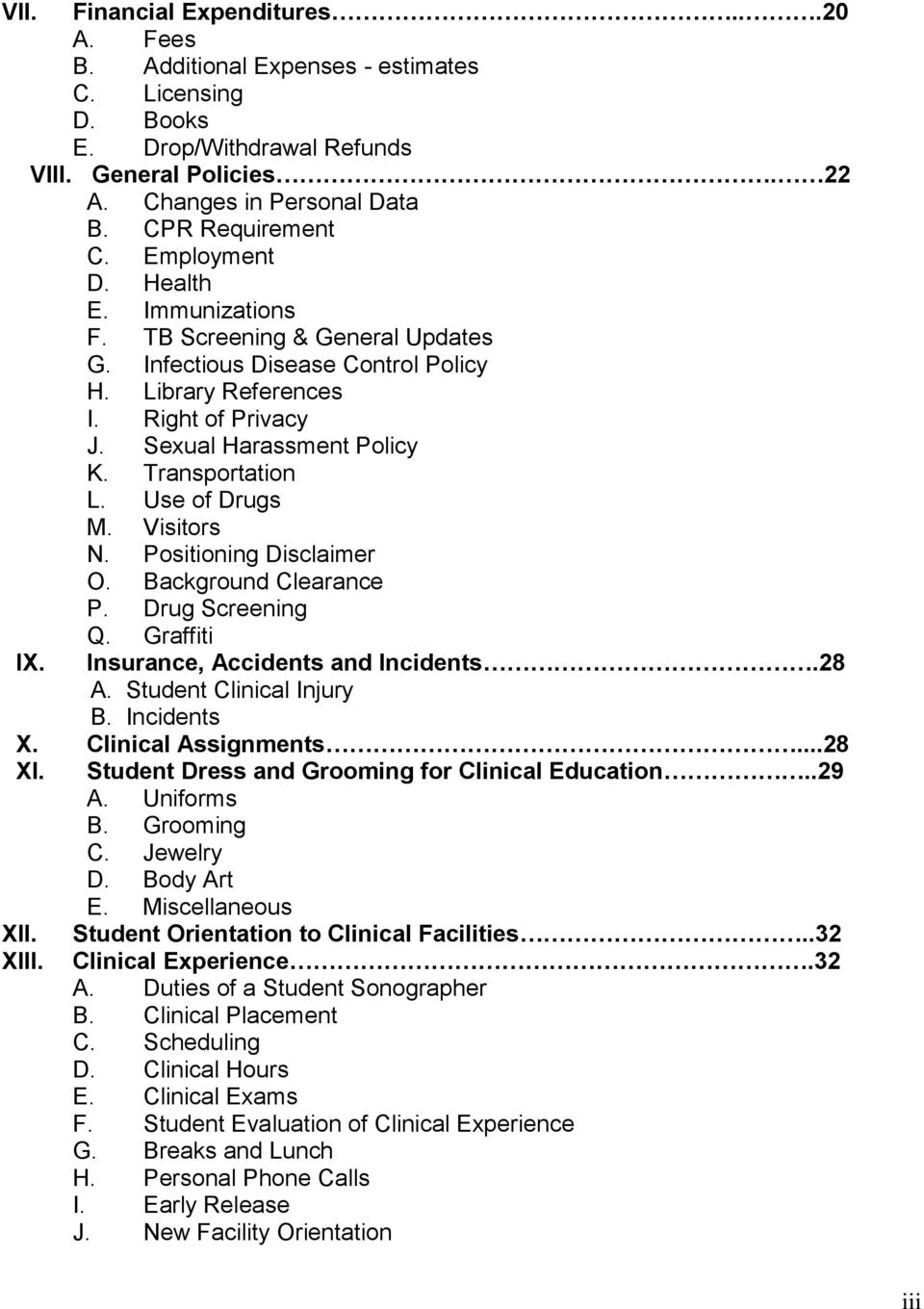
4 XIV. XV. XVI. K. Removal of Cervical Collars L. Cutting Away of Patient Clothing M. Student Availability During Site Visits N. Handwashing O. Personal Protective Equipment P. Miscellaneous Clinical Radiation Protection Rules 35 Pregnancy Policy and Procedures..36 Student Supervision 37 A. Direct B. Indirect XVII. Personnel Descriptions..38 XVIII. Professionalism, Job Description 39 A. Description of Profession B. Scope of Practice-Overview C. SDMS Scope of Practice for the Diagnostic Ultrasound Professional D. SDMS Code of Ethics E. Diagnostic Ultrasound Clinical Practice Standards F. Registry Eligible G. Professional Job Description: Example H. Student Memberships in Professional Organizations XIX. Patient Safety and Risk Management 52 A. Age Appropriate Care B. Process of Reporting Complications (includes Incident Report) C. Infectious Diseases D. Communicable Diseases E. Transducer Cleaning F. Universal Precautions G. Emergency Procedures XXI. Equipment Safety and Maintenance 58 XXII. Technical Protocols.59 A. General Policy: Ensuring Medical Necessity B. AIUM Policy Guidelines C. AIUM Documentation of Ultrasound Examinations D. AIUM Guidelines for Abdomen & Retroperitoneum E. Abdominal and Superficial Exams Liver (AIUM and MC) Gallbladder and Biliary Tree (AIUM and MC) Pancreas (AIUM and MC) Bowel and Peritoneal Fluid (AIUM) Aorta, IVC (AIUM and MC) Urinary Tract: Kidneys, Urinary Bladder, Adrenal Glands (AIUM and MC) Spleen (AIUM and MC) Appendix (MC) Abdominal Wall (AIUM and MC) iv
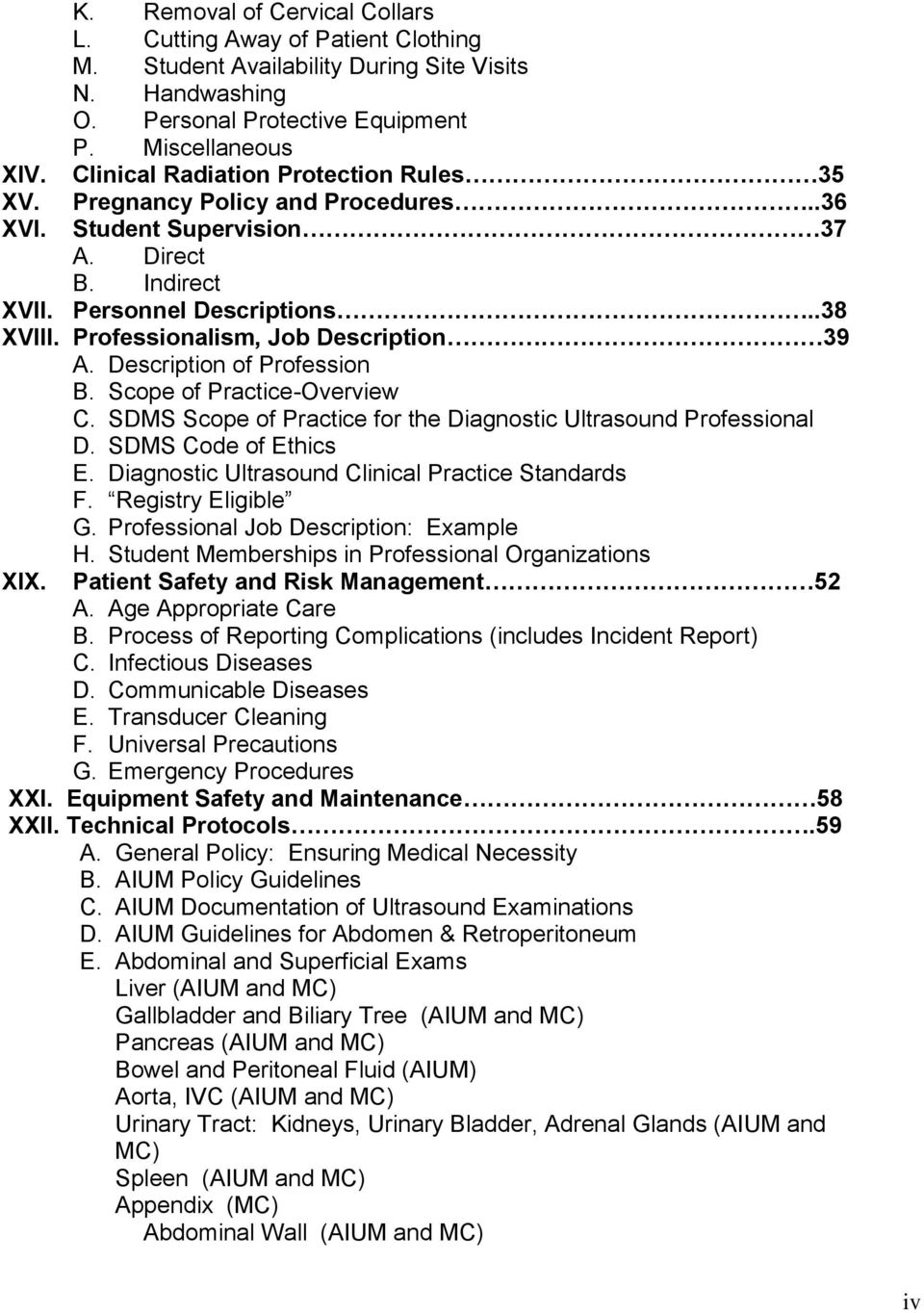
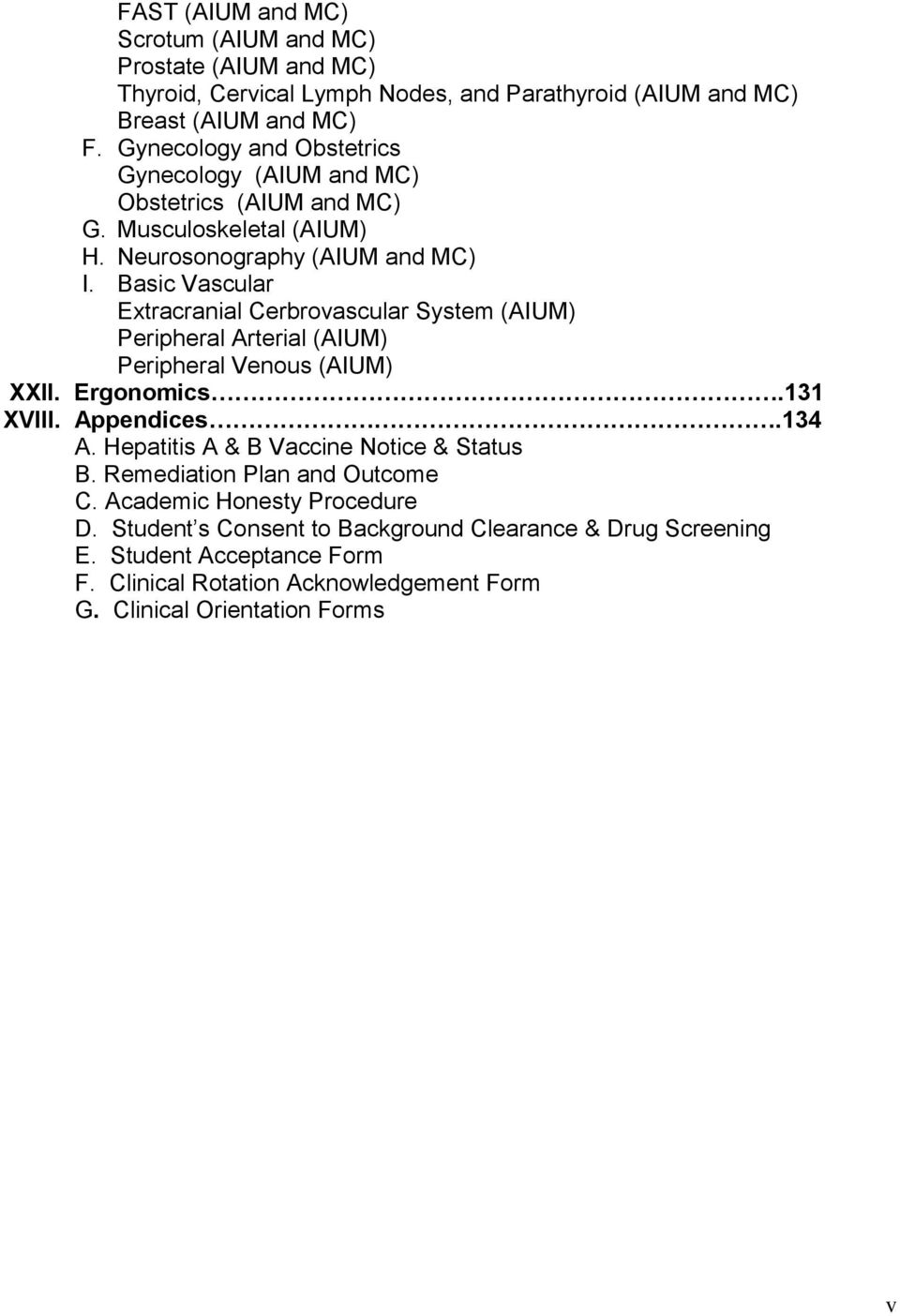
5 FAST (AIUM and MC) Scrotum (AIUM and MC) Prostate (AIUM and MC) Thyroid, Cervical Lymph Nodes, and Parathyroid (AIUM and MC) Breast (AIUM and MC) F. Gynecology and Obstetrics Gynecology (AIUM and MC) Obstetrics (AIUM and MC) G. Musculoskeletal (AIUM) H. Neurosonography (AIUM and MC) I. Basic Vascular Extracranial Cerbrovascular System (AIUM) Peripheral Arterial (AIUM) Peripheral Venous (AIUM) XXII. Ergonomics.131 XVIII. Appendices.134 A. Hepatitis A & B Vaccine Notice & Status B. Remediation Plan and Outcome C. Academic Honesty Procedure D. Student s Consent to Background Clearance & Drug Screening E. Student Acceptance Form F. Clinical Rotation Acknowledgement Form G. Clinical Orientation Forms v
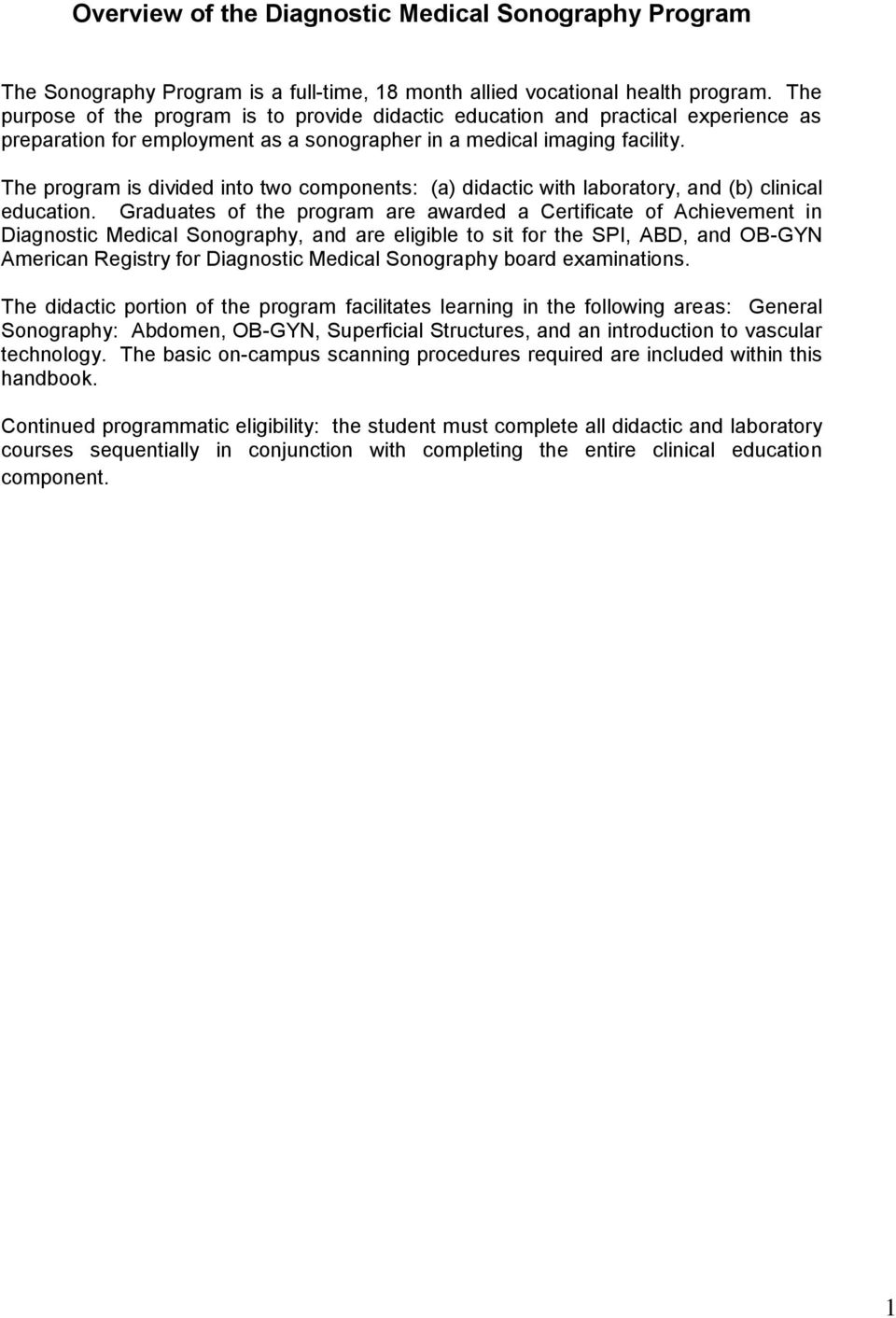
6 Overview of the Diagnostic Medical Sonography Program The Sonography Program is a full-time, 18 month allied vocational health program. The purpose of the program is to provide didactic education and practical experience as preparation for employment as a sonographer in a medical imaging facility. The program is divided into two components: (a) didactic with laboratory, and (b) clinical education. Graduates of the program are awarded a Certificate of Achievement in Diagnostic Medical Sonography, and are eligible to sit for the SPI, ABD, and OB-GYN American Registry for Diagnostic Medical Sonography board examinations. The didactic portion of the program facilitates learning in the following areas: General Sonography: Abdomen, OB-GYN, Superficial Structures, and an introduction to vascular technology. The basic on-campus scanning procedures required are included within this handbook. Continued programmatic eligibility: the student must complete all didactic and laboratory courses sequentially in conjunction with completing the entire clinical education component. 1
7 I. Introduction A. Welcome Welcome to the Diagnostic Medical Sonography Program! It is my pleasure, as the Director, to congratulate you on your acceptance to the program, and to wish you success in your newly chosen health career. As a student in the Diagnostic Medical Sonography Program, you represent Merced College and the Diagnostic Medical Sonography program. The highest ethical and professional standards of conduct will be expected of you at all times. My responsibility is to direct and facilitate your educational experience with a final outcome: the privilege to write RDMS (Registered Diagnostic Medical Sonographer) after your name. You are responsible for learning the material (reading; studying; practicing in open lab; attending class, lab and clinic); time management, professional behavior, and enjoying every aspect of personal development in this exciting career. The program requires 18 consecutive months as a full-time student to complete. The Sonography Program is rigorous and fast-paced. The curriculum consists of lecture, collaboration, laboratory, library research, homework, individual and group projects, diagnostic-quality sonographic image creation, portfolio creation, and practical clinical experience. Professorially directed laboratory sections are held on campus in the Sonography Scanning Suite by means of hands-on live scanning, and simulation scanning. Clinical practicum consists of four (4) rotations at our affiliated hospitals and clinics under the guidance and direction of credentialed sonographers, hospital/clinical managers, and board certified Radiologists/Sonologists. The clinical component requires 100% clinical attendance. Success in the clinical arena requires excellent patient care and communication skills, your ability to function as a team member, sonographic performance, and professional interaction with our clinical personnel. Your total commitment to the program is a major component to your successful completion of the program and becoming an erudite sonographer. The secret to success in the clinical arena: remember the clinical experience is a full-time interview. B. Purpose of Handbook This handbook is designed to serve as an informational guide to assist in the orientation of new students and to clarify policies and procedures governing your actions and practices while a student in the program. This handbook is designed to be utilized as a supplement to the Merced College Catalog and the Clinical Competency Handbook. It is expected that the students will be familiar with the following information. Students are expected to comply with the policies and procedures contained within this handbook throughout their educational experience. Whenever possible, data from the Society of Diagnostic Medical Sonography (SDMS), the American Institute of Ultrasound in Medicine (AIUM), the American Registry for Diagnostic Medical Sonography (ARDMS), and the American Registry of Radiologic Technologists (ARRT) has been included. Document inclusion consists of data approved for reprinting or includes reference documentation. The DMS student is encouraged to read this document carefully, and to place in an accessible location. This document will serve as your primary programmatic reference 2

8 tool throughout your educational experience. Please contact the program director for clarification or additional information. C. Merced College Philosophy A democratic society functions best when its members are educated and active participants. To encourage this participation, Merced College provides education opportunity for all who qualify and can benefit. This education involves having a respect for, and awareness of, all cultures, as well as the dignity and worth of all individuals. Merced College is dedicated to the pursuit of excellence. The leadership and educational services provided by the College reflect and enhance the cultural, economic, and social life of the community and respond to its changing needs and interests. Recognizing that learning is a life-long process, the College provides preparation for a complex and changing society while maintaining high academic standards. The College also fosters individual learning and critical thinking to enhance awareness of the inter-relationship and inter-dependence of all persons. Mission Statement Students are our focus and we are known by their success. Vision Statement Students are our focus at Merced College. We set high standards to encourage students to reach their highest potential in a supportive environment. Diversity is a strength of our institution. Merced College is a leader in instruction and cultural activities. We value and respect all members of our community. We are known by the success of our students. Core Values and Beliefs Students, both current and potential, are the focus of Merced College Merced College establishes high standards and provides a challenging education to encourage students to reach their highest potential. Merced College respects and values all members of its community. Merced College serves the community by responding to the cultural, educational, technological, and economic development challenges. Fostering and maintaining diversity is a strength of the institution. Merced College provides a nurturing and joyful environment. D. Sonography Program Philosophy We believe that all people have the right to safe and competent medical care. We further believe that students have a right and a responsibility to learn and faculty have an obligation to ensure a curriculum that prepares students to practice in the professional discipline. To ensure this outcome, we provide an educational training program dedicated to the pursuit of excellence. Mission The mission of the Sonography Program is to provide relevant education in the cognitive, psychomotor, and affective learning domains to prepare competent, and responsible entry-level general, or cardiac, sonographers, with a commitment to life-long learning. Goals In support of this Mission, the Diagnostic Medical Sonography Program: will uphold standards for satisfactory educational preparation for entry-level work experience will provide a curriculum which o supports and assesses the knowledge and skills required to intelligently 3

9 perform entry-level tasks to practice the profession; will encourage students to develop o effective communication skills o critical thinking and problem solving skills o commitment to life-long professional learning will advocate and expect ethical and compassionate treatment of patients. SLOs (Student Learning Outcomes) Upon completion of the Diagnostic Medical Sonography Program, students will be able to: 1. Describe the acoustic parameters of sound waves 2. Relate accurate medical terminology 3. Prioritize patient transfer, immobilization techniques, and safety precautions 4. Recommend methods to assure patient privacy 5. Recognize patient clinical history, which may impact the sonographic exam 6. Design individualized patient assessment plans 7. Calculate geometric mesasurements of anatomic structures 8. Evaluate sonographic images for optimal acoustic resolution 9. Select the appropriate sonographic instrumentation, while maintaining ALARA 10. Correlate clinical indications and laboratory values 11. Create diagnostic sonographic exams using recognized scanning parameters 12. Evaluate anatomic structures on sonographic images 13. Assess sonographic images for specific pathologies 14. Describe sonographic pathologies and sequelae relative to specific diseases 15. Differentiate normal and abnormal sonographic appearances 16. Select correct ergonomic devices and techniques 17. Compile effective data acquisition for submission to the interpreting physician 18. Describe the importance for sonographic quality assurance programs 19. Compare and contrast emerging sonographic techniques 20. Analyze academic strengths and weaknesses to determine corrective measures required to successfully pass a pre-registry written examination 21. Evaluate prospective employment opportunities 22. Formulate a personal vocational plan 4
10 E. Objectives The Diagnostic Medical Sonography Program faculty believe that the philosophy of the program can be fulfilled through providing a curriculum that encompasses all the areas required to prepare students to practice in the professional discipline. Since sonography is a practice discipline, the objectives will reflect what areas a graduate sonographer will be competent. The objectives reflect those areas included in the curriculum content as stated in the Standards and Guidelines for Diagnostic Medical Sonography from the Commission on Accreditation of Allied Health Education Programs (CAAHEP) in conjunction with the Joint Review Committee on Education in Diagnostic Medical Sonography (JRCDMS). At the completion of the Program, the student will be prepared to practice in the professional discipline because, at a minimum, they are competent in the following areas: 1. Oral and written communication 2. Provide basic patient care and comfort 3. Demonstrate knowledge and understanding of human gross anatomy and sectional anatomy 4. Demonstrate knowledge and understanding of physiology, pathology, and pathophysiology 5. Demonstrate knowledge and understanding of acoustic physics, Doppler ultrasound principles, and ultrasound instrumentation 6. Demonstrate knowledge and understanding of the interaction between ultrasound and tissue and the probability of biological effects in clinical examinations including: a. Biologic effects b. Pertinent in-vitro and in-vivo studies c. Exposure display indices d. Generally accepted maximum safe exposure levels e. ALARA principle 7. Employ professional judgment and discretion 8. Understand the fundamental elements for implementing a quality assurance and Improvement program, and the policies, procedures for the general function of the ultrasound laboratory, including a. Administrative procedures b. Quality control procedures c. Elements of quality assurance program d. Records maintenance e. Personnel and fiscal management f. Trends in health care systems 9. Recognize the importance of continuing education 10. Recognize the importance of, and employ, ergonomically correct scanning Techniques 11. Demonstrate the ability to perform sonographic examinations of the abdomen, superficial structures, non-cardiac chest, and the gravid and nongravid pelvis according to protocol guidelines established by national professional organizations and the protocol of the employing institution utilizing real-time equipment with both transabdominal and endocavitary transducers, and Doppler display modes. 5

11 II. Accreditation A. Merced College Merced College is approved by the Chancellor of the California Community Colleges and Accrediting Commission for Community and Junior Colleges, Western Association of Schools and Colleges (ACCJC-WASCO). It meets all standards of the California State Department of Education and is listed in the Education Directory, Higher Education, published by the United States Office of Education. The University of California and other colleges and universities of high rank give full credit for appropriate courses completed at Merced College. B. Diagnostic Medical Sonography Program The Diagnostic Medical Sonography Program, which leads to eligibility to write the SPI, AB, and OB-GYN sonography examinations by the American Registry for Diagnostic Medical Sonography (ARDMS). The General Sonography Track is accredited by the Joint Review Committee on Education in Diagnostic Medical Sonography (*JRC-DMS) in conjunction with the Commission on Accreditation of Allied Health Education Programs (**CAAHEP.) *JRC-DMS: Joint Review Committee on Education in Diagnostic Medical Sonography, 6021 University Boulevard, Suite 500, Ellicott City, MD 21043; **CAAHEP: Commission on Accreditation of Allied Health Education Programs, 1361 Park Street, Clearwater, FL 33756; III. Attendance A. Enrollment Students must be enrolled in all SONO classes by the first day of the semester/session to attend class or a clinic assignment. In particular, a student may not start a clinic assignment without being officially enrolled in that specific course as the student would not be covered by malpractice insurance. Any missed clinical time due to non-enrollment will have to be made up according to the make-up policy. B. Attendance Regular attendance and consistent study are the two factors which contribute most to success in college. Due to the rigor and accelerated aspect of the Diagnostic Medical Sonography Program, DMS students are expected to attend all course lectures, laboratories, and clinical hours. The only excused absence is for illness of the student or death in the immediate family. A student may be dropped from the program for more than three days of un-excused absences. After 3 days of consecutive absences from class and/or clinic, either a doctor s excuse or proof of death of an immediate family member will be required to be submitted to the instructor(s) of record. If a student is dropped from lecture class, they will be dropped from the corresponding clinical practice and vice versa, and from the DMS program. Absence in no way relieves the student's responsibility for material or hours missed in class and/or clinic. Arrangements must be made with the instructor of 6
12 record for any lecture/lab classes missed and/or the Clinical Preceptor for any clinical education missed for "make-up" time. The student must notify their instructor of an absence before the scheduled class time by calling their instructor directly, or call the Allied Health Office ( ) and ask the AH secretary to convey the students absence to the appropriate instructor(s). The student must notify the College AND the Clinical Preceptor and/or Department Manager of an absence one-half hour before the scheduled clinical assignment. Take note of whom you speak with and the time, in the event that the message is not properly conveyed. Following the absence, the student will submit an to the DMS program director addressing the date(s) of the absence, reason for the absence, and a statement addressing the mechanism by which the clinical hours will be made up. All missed hours must be completed during that particular rotation; students cannot accrue more than 40 hours of combined didactic and clinical experience in one week. This document will become part of your personal file. Bear in mind that the program director keeps track of your programmatic hours. Prolonged illness or injury requiring absence from the clinic warrants a doctor's release to return to the clinic. The student is required to complete all clinical hours assigned to that particular clinical education course. This is necessary because a student's presence is critical for successful performance and application of knowledge, and a requirement for board examination. After the first week of any lecture/lab course, students who arrive late or leave class early will be regarded as tardy. Students who are late or leave clinic early will deduct the time missed from the day's hourly total. Habitual tardiness will not be tolerated and can be cause for dismissal. Failure to attend a laboratory practical examination will result in an automatic zero for that examination. Students are permitted one redo practical examination per term. Both scores will be averaged for the final grade. Students are advised to schedule medical, dental, and other appointments outside clinical and/or classroom hours to avoid a penalty. Students with children are advised to have contingency arrangements made for child-care in case of illness or other unforeseen circumstances. Students with children are not allowed to bring their sick children to class. For clarification: Students may not bring children to class. C. Excessive Absences or Tardiness Excessive absences in school or clinic will not be tolerated. Students are required to be punctual for both didactic and clinical training. A student will be issued a Remediation Plan if either the clinical personnel or faculty feel that actions should be taken to address this issue 1. Students who are late reporting to their clinical site will be warned once verbally. The second time they are tardy to the clinical site the student must call and leave a message with the program secretary. The third time the student is put on probation, and this may lead to program dismissal. Some clinical sites have a zero tolerance for tardiness and absenteeism. 2. Students are expected to be in the classroom before the start of class. Students who are more than ten minutes late for class may be asked to leave. Homework assignments will be considered late after the start of a particular class session and will not be recognized. 3. Quizzes or exams are not lengthened for students who are tardy. 7

13 D. Holidays All students, including interns, will follow the approved Merced College Calendar concerning legal holidays, flex days, and spring break for classroom and clinical education. As such, students are not required to attend clinic on legal holidays, breaks or flex days recognized by the College. However, all required clinical hours must be completed. E. Vacation As an internship is not part of this course of study, students will not be provided with clinical vacation days. Vacations should be scheduled only during times when classes, including clinical, are not in session. F. Professional Development With prior College approval by the Program Director or Clinical Coordinator, students may be granted time off from their clinical assignment to attend professionally related seminars or workshops. Attendance shall be officially documented and submitted to the program director upon return to class. These professional development hours will be applied to any missed clinical hours. All assigned clinical hours must be completed prior to the end of the semester. G. Sick Leave As this program does not have an internship, students do not accrue clinical sick days. All hours used for sick leave must be made up according to the policy on making up time. H. Funeral Leave Students will be granted excused funeral leave when appropriate. Requests should be submitted to the Program Director and Coordinator by phone or and followed up with an absence form. Excused leave will be provided for spouse, parent, child, grandparent, and siblings. As a general rule, two days are allowed. All clinical hours must be made up prior to the end of that term. I. Jury Duty Jury duty is a civic obligation, and it is an individual s responsibility to serve when summoned. However, students called to serve should work with officials to defer service until graduation, whenever possible. Absence from class or clinic due to jury duty requires written verification from the court. Students should report summons to the program director as soon as possible. Program faculty will inform the student of the academic material that needs to be covered and completed. All lab practicals must be successfully completed prior to the end of the semester. Clinical time missed must be coordinated with the Program Director and the Clinical Proctor, and made up prior to the end of the semester. J. Makeup Time Makeup time may be completed before or following a leave, with all time being made up during the current semester. Special consideration for clinical hours may be required for situations such as jury duty. If all of the clinical hours have not been made up by the end of the semester, an Incomplete Grade will be assigned (refer to the section on Incomplete Grades). Makeup hours will be accrued during non-scheduled times through PRIOR arrangement with the affiliate's Clinical Preceptor and the College's Clinical Coordinator to insure adequate supervision during makeup time. 8
14 When making up time, no student may work more than a combined forty hour work week, to include clinic and class hours. K. Completion of Clinical Hours To ensure that all clinical responsibilities are completed in a timely manner, once the Clinical Preceptor is confident that the student has or will fulfill all their clinical hours the Clinical Preceptor must sign-off in the appropriate place in the students Clinical Competency Handbook. Students are not to leave the clinical affiliation early. If this happens, those hours will not be included in that day s tally, and the hours must be made up prior to the end of that term. One thousand, seven hundred, ten (1710) clinical hours are required to complete the DMS program at Merced College as per our CAAHEP/JRC- DMS programmatic accreditation. IV. Scholarship Criteria & Information A. Grade Computation A minimum of a "C" grade must be maintained in each Sonography course. The percentage value of the alphabetical grading in all Sonography courses are as follows: A % Excellent B 84-92% Good C 75-83% Satisfactory D* 68-74% Failing F* 6-67% Failing *Transcripts will report grades of D and F. Continuation in the DMS program will cease when either of these grades are earned. Each instructor will advise the student how she or he evaluates or weighs the graded components of her/his particular courses. This will be addressed in the course syllabus. Laboratory Practical Examination Each course with a laboratory component will include two or more lab practical Examinations. Laboratory Practical examinations must earn 80% or higher to pass. Students who fail one practical will be eligible to repeat that one scanning examination at the end of the term. As scanning skills are an essential function for Sonography student, students who fail two practical examinations will fail the course. Note: Clinical competency assessments are not laboratory practical examinations 9
15

16 Clinical Competencies Initial and Final clinical competencies are earned at the clinical affiliation. Students will earn initial competencies by passing a 10-point assessment with ten points. Students are eligible for assessment after scanning at least three examinations at the clinical affiliation. Generally, an initial competency is carried forward to the following clinical rotation; however, the clinical preceptor has the right/obligation to determine the student s competency at his/her affiliation and may require a second initial competency. Final competencies are earned during the fourth clinical rotation. Final competencies are earned only with a passed initial competency. Final competencies are detailed. Students will pass a final competency when they earn 80% on the assessment. Initial and Final competencies are limited. Students may attempt an initial competency at one location no more than three times. On the third (failed) attempt the clinical preceptor will submit the assessment tool to the DMS Program Director who will meet with the student to determine an intervention. Students who fail a final exam are eligible to repeat a second time. Should the second attempt result in a failure, the clinical preceptor will notify the Program Director. The PD will schedule additional on-campus scanning time. All final competency scores will be averaged and included into the term grade. STUDENTS WHO ARE DROPPED or WITHDRAW DUE TO UNSAFE CLINICAL PRACTICE WILL NOT BE READMITTED. Clinical Case Study Presentations Students, during the completion of the DMS program, will be responsible for writing clinical case studies. Specifics will be addressed in the course syllabus. In some cases, presentation to the clinical staff will be required, some presentations will be given in the DMS course on campus to the student s peers and professor, and in some events both of these scenarios will take place. Students are to schedule clinical presentations with their clinical preceptor at least two weeks in advance of the presentation. The on campus schedule will be coordinated by the instructor of record. Grading rubrics will be provided for both presentations. Students who miss either presentation will earn a score of zero. These presentations are not eligible for make-up. B. Scholarship and Promotion To remain enrolled and advance in the Sonography Program the student must maintain a grade of "C" or higher in all ultrasound courses and maintain an overall G.P.A. of "C" (2.35). It is the student s responsibility to be aware of his or her academic progress throughout each semester. Each instructor has weekly scheduled office hours for the sole purpose of meeting with a student privately to discuss any issues or concerns that the 11

17 student might have. It is the student s responsibility to come in and set up an appointment to meet with the instructor. C. Class Drops Classes dropped in a regular semester within the first 3 weeks will not be shown on the student's permanent record. For classes dropped beginning with the 4th week and prior to the end of the 14th week of a regular semester, a "W" grade will be recorded on the student's permanent record. Classes dropped after the 14th week of a regular semester will receive a letter grade (not a "W"). In courses other than semester-length, consult the instructor or Guidance Center regarding class drop date deadlines. As the sequencing of the course material will be eliminated, students who drop a course are not eligible to continue in the program. D. Incomplete Grades ("I") An incomplete grade may be granted for an unforeseeable emergency or justifiable reason at the end of a term, and only when the student has maintained a satisfactory performance prior to the request for the "I. Conditions for removal of the "I" and a grade to be assigned after one semester in the event the conditions for removal are not completed by the student will be submitted to the Program Director for final approval, following a joint faculty/student petition. The "I" must be satisfactorily completed prior to the conclusion of the next semester/session for continued enrollment in the DMS Program. If the conditions are completed within the one semester allowed, a final grade will be assigned when the work is evaluated. An "I" may not be assigned as a withdrawal grade. E. Unsatisfactory Progress - Probation A conference will be held for failure(s) to transfer classroom knowledge to clinical training; failure(s) to adhere to clinical, college or program policy; or failure(s) to follow generally accepted rules of personal cleanliness, professional ethics and conduct, academic failure, and for failure to demonstrate knowledge, skill and judgment at the expected level. The issuing instructor will confer with the student and discuss the reasons for, and means of, correcting the cause for the conference. A remediation plan will be drawn up for discussing and documenting the cause of the DMS Departmental Probation, the terms of the probation and the length of time identified for improvement and reevaluation. The student will receive a copy and the original will be placed in her/his personal file. The situation will be discussed between the instructor, student and with the DMS Program Director, 12

18 as necessary. The final decision for student dismissal will be made by the DMS Program Director after consultation with the area Dean. F. Suspension A situation may arise that may require immediate and effective discipline, when an extremely serious infraction of rules has occurred. When this situation develops, the student will be suspended from the clinical setting pending a full investigation of the situation. An example of actions that may lead to immediate suspension and possible dismissal may include the following: 1. Under the influence of drugs or alcohol while on duty 2. Physical abuse to a patient, visitor or other personnel 3. Petty theft 4. Sexual misconduct 5. Unsafe clinical practice 6. Breach of confidentiality (HIPAA) Students dismissed for any of the above acts will not be eligible to reapply to the program. 13

19 F. Academic Dishonesty If the instructor has reason to believe a student has committed an act of lying, cheating or plagiarism which can be documented, the student will be counseled and an Allied Health Advisement form will be completed and permanently placed in the student's personal file. If the incident involves cheating on an exam or paper, no credit will be given, neither may the assignment be repeated. For more information, please refer to Merced College Academic Honesty Procedure located at the Guidance Division, Student Activities Office. A repeat act of academic dishonesty may be cause for immediate dismissal from the program. Students dismissed for academic dishonesty will not be eligible to reapply to the program. G. Conduct Students should conduct themselves in a professional and ethical manner at all times. No profanity in patient care areas or in the classroom is tolerated. Insubordination or dishonesty are grounds for immediate dismissal from the program. H. Nonacademic Counseling For nonacademic problems, the student will be referred to the appropriate services on or off campus for assistance. I. Re-Admission Any student who withdraws or who is dropped from the Ultrasound Program due to academic weakness will NOT be allowed re-admission into the Ultrasound Program. K. Pinning Ceremony & Receipt of Certificate of Achievement A Certificate of Achievement will be awarded at the traditional Diagnostic Medical Sonography Certification and Pinning Ceremony to all students who have successfully completed the entire program. Students are encourage and expected to attend the pinning ceremony. The program director is responsible for the content of the ceremony; however, the planning of the Certification and Pinning Ceremony is the responsibility of each individual class. This includes determining the number of guests each student may invite. Students may submit specific requests regarding speakers, music, food, etc. A faculty member will be appointed to assist with the preparations. Participation in the annual commencement ceremonies is restricted to students who have completed all requirements and obligations for programmatic completion. M. Job Placement Upon graduation, please inform the DMS Program Director of your job status. This information is critical to accurately reflect program statistics. A guarantee of job placement is not applicable, but we are happy to refer graduates and potential employers to each other. Please assist future graduates by informing the DMS staff of openings within your department once you've entered the work force. 17

20 N. ARDMS Sanctions Go to the following link if you have a prior criminal history. ARDMS Pre-Application: Criminal ARDMS rules indicate that ARDMS may take action against an applicant, candidate, or Registrant in the case of conviction, plea of guilty or plea of nolo contendere to any crime. If you are presently charged with, or been convicted or found guilty of or plead nolo contendere to any crime (felony and/or misdemeanor), other than a speeding or parking violation, you may have questions concerning this rule and may wish to obtain clarification as to how it pertains to your circumstances. ARDMS conducts a "pre-application review", for a $125 non-refundable fee, for individuals who wish to determine the impact of a previous criminal matter on their eligibility to apply for ARDMS certification. The pre-application review process is recommended for individuals who have not yet applied for examination and are contemplating employment in the field of sonography and/or enrollment in a sonography program. Individuals who have already completed a program and are ready to apply to the ARDMS for examination should simply respond to the questions on the ARDMS examination application relating to criminal matters and provide the requested documentation regarding such matter(s). For purposes of the ARDMS application process crimes may include, but are not limited to, rape, sexual abuse; violence or threat of violence; driving while intoxicated (e.g. alcohol and drug related driving offenses); the unlawful sale, use or distribution of controlled substances; and use or distribution of fraudulent medical records, prescription blanks or health insurance claims. Please note that the pre-application review procedure is available only for criminal matters, not other issues of eligibility. O. National Examination Eligibility to write the national examination (ARDMS) requires completion of all program requirements. Each application is assessed individually by the ARDMS. Students will be eligible to write the ARDMS SPI exam following successful completion of both Physics courses. Although each student is encouraged to apply for the SPI registry examination during week one of the final fall semester and to sit for the exam ASAP thereafter, this is not a mandatory portion of the DMS program. The ARDMS examinations incur costs, which are the responsibility of the student. The SPI exam must be passed along with at least one organ specific ARDMS examination to hold the title of Registered Diagnostic Medical Sonographer. Completion of the SPI exam will allow you to focus specifically on the abdomen and OB-GYN content at the completion of the program. Many hospitals/clinics will not hire sonographers unless they possess full ARDMS credentials. ARDMS credentials do not equate as a state license to practice Sonography. 18
21 Graduates who wish to work in the states of New Mexico or Oregon must have ARDMS to obtain those states licensure. Montana is currently seeking licensure requirements. Go to to review the requirements to sit for the board exams. 1. Advanced Item Type Questions Go to: s Effective December 2012 some examinations feature new types of questions called Advanced Item Types (AIT). These questions assess a candidate in formats similar to actual scanning practice, and provide a better measure of practical skills. By reviewing the additional links at the above website, you will be better prepared to take the ARDMS SPI examination during your final semester on campus. 2. Prerequisites for ARDMS examinations: A. SPI Successful completion of sonographic physics course requirements with grade of C or better Currently enrolled in a course of DMS study Transcripts reflecting the course and grade Photocopy of a non-expired government issued photo ID with signature; the names must match identically B. ABD; OB-GYN: Apply under prerequisite #2 Graduate of a program accredited by CAAHEP Copy of diploma from the program or an official transcript with the date of conferred degree Original letter signed by the program director indicating date of successful completion CV is not required if application is submitted and received in the ARDMS office within one year of programmatic completion Photocopy of non-expired government issued photo ID with signature names must match identically 3. New ARDMS Testing Center Update: At the test center, you must present two current, valid signature IDs, one of which must be a non-expired government-issued photo ID with your signature; see the accepted list of IDs here. The name on this application must EXACTLY MATCH the name on both current, valid signature IDs. Jane R. Doe and Jane Rachel Doe DO NOT EXACTLY MATCH. Failure to present two acceptable IDs will prevent your admission to the test center. If this happens, you will be marked absent and you will forfeit the entire examination fee and seat. If the names do not EXACTLY MATCH, update your ARDMS name of record. 19
22 A candidate is NOT ALLOWED to leave the testing center to obtain their ID s, and the candidate is NOT ALLOWED to have someone bring them their ID s while they wait at the testing center. V. Student Rights and Grievances (Administrative Procedure 5530) A. District Student Rights and Grievances Procedure When a student feels subjected to unfair action or denied rights as stipulated in published College regulations, policies, or procedures, redress can be sought according to the grievance procedure. This procedure is referenced in the college catalog, under the College Policies, Regulations and Procedure section. Copies of Merced College s current Student Rights and Grievances Procedure can be found in the classroom (AHC-148) or can be pick-up in the Administration Building - Student Personnel Services Office. B. General Statement Regarding Clinical Setting Actions which are taken against students in the clinical setting may result in a request from affiliate representatives that a student be removed from the affiliate in accordance with our affiliation agreement with that particular facility. In such a case, the sonography program faculty (Program Director and/or Clinical Coordinator) request prior notification. There may be cases of other disciplinary actions or situations that do not involve student removal, as such the procedure for appeal is as follows: 1. Student presents the action being appealed to the Clinical Coordinator within ten (10) working days of action or situation. 2. The Clinical Coordinator reviews the appeal and contacts the Clinical Instructor of the student s assigned clinical facility for further information, clarification, and/or resolution of the incident. The Clinical Coordinator then provides the student and Program Director a written answer within ten (10) working days of the receipt of the appeal. 3. The student may request that the Clinical Coordinator refer the appeal to the Program Director. The Program Director reviews the appeal and may contact the Clinical Preceptor and/or Department Manager to discuss the manner further. The Program Director then provides the student a written answer within ten (10) working days of the receipt of the appeal. 4. If the student wishes to appeal the Program Director s decision, he or she may request a meeting with the Area Dean of Instruction for the Allied Health Division. The Area Dean of Instruction will provide the student with a written answer within ten (10) working days of the receipt of the appeal. The Area Dean of Instruction s decision is final. 20
23 VI. Records A. Student Records A master file will be started when the student applies for admission and will contain the application, standardized test scores, transcripts and other data required for evaluation for admission. At the completion of the program all official information (copy of transcripts, records of clinical performance, radiation exposure record and record of program completion, etc.) will remain on file. Permanent transcripts will be maintained by the Office of Admissions. All other information will be destroyed. If a student withdraws prior to graduation, a summary statement of the student's progress and reason for withdrawal will be placed on file. Students may inspect their master file anytime under the direct supervision of a faculty member. All student records are confidential and information from them will only be given to authorized persons. Data such as grades, Registry and State Board Examination scores, health records and performance evaluations may not be revealed without a student's written consent. Only personnel authorized by the Program Director will have access to student records and this will be used only for student evaluation and progress within the program. B. Patient Records Patient records may be used only for providing patient care. They may not be removed from the department. Information acquired from patient records is confidential. For classroom purposes, discarded or copied radiographs, sonograms, CT scans, etc.; any reports must have all patient identification removed. VII. Financial Expenditures Legal residents of the State of California are required to pay nominal fees. In addition, students may expect other miscellaneous fees and expenses during the length of the program. (Non-Resident tuition fee: $173 per unit, plus enrollment fee) A. Fees - (estimates only) Enrollment Fee (entire program) Contact Admissions and Records for details. Fees subject to change as per the State Legislature Student Body Fee Health Fee (entire program) Parking (optional; regular semester $20 x 3; summer $10 x 2)
24 B. Additional Expenses - (estimates only) Program Pin (optional) Books (entire program) CPR Certification Physical & Immunizations Uniforms (entire program) Background Clearance (criminal/financial/social security trace) Drug Screening C. Licensing ARDMS SPI (Physics) $ ARDMS OB-GYN $ ARDMS Abdomen $ D. Books Fees are subject to change at any time Total $ The DMS program recognizes that ultrasound textbooks are expensive, as such; the program does its best to minimize this cost. Books are selected, not just for the course in which they are required, but for other programmatic courses and for study during the first years of the student s ultrasound career. The campus bookstore carries all the required textbooks. Students are expected to purchase these books prior to the start of classes and to read all assignments. E. Drop/Withdrawal Refunds Students withdrawing from courses within the first two weeks of class meetings may apply for a full refund of all fees except International Student Insurance, Audit, Credit by Exam, ID Card, or other fees not listed on the typical registration form for classes in the credit mode. Most of the textbooks purchased in the first semester will be utilized throughout the duration of the program. The remaining textbooks will be used as often as possible, but will serve you well when preparing for your board examinations. Students may not be permitted to attend classes and/or clinic until all registration fees are paid in full. Nonresident students are required by state law to pay nonresident tuition. Consult the Merced College catalog for current fees. VIII. General Policies A. Changes in Personal Data Notify the Allied Health Secretaries, Program Director and the Admission & Records Office if there is a change of your name, address, telephone number, family doctor, or change of person(s) to notify in case of an emergency. Use the 22
25 appropriate form, for reporting these changes. The form can be found in the form rack located in the classroom. B. CPR Requirement Students must be CPR certified through the American Heart Association: BLS for Health Care Providers or its equivalent (must include a hands-on component). It is the student s responsibility to maintain current certification. NO on-line CPR courses only or American Red Cross courses are acceptable. Online CPR courses with a lab are acceptable. Do not anticipate, nor request that your clinical affiliation will pay or sponsor your CPR course. Notify the ALH Secretary with a copy of recertification documentation. C. Employment Due to the concentrated and intensified nature of the Diagnostic Medical Sonography Program, full-time employment is not recommended. If a student must accept employment while enrolled in the program, this implies that the student will NOT: 1. Function under the job description of a Sonographer, or Ultrasound Technologist 2. Use the abbreviation RDMS after their name of any purpose; neither refer to himself/herself as an ultrasound technologist unless they were employed as an ultrasound technologist prior to admission to the DMS program. 3. Accept employment hours which conflict with class/clinical time; 4. Attempt to get any clinical competency sign-offs during hours of employment at a hospital or clinic 5. Use his/her College I.D. badge during hours of employment The student will avoid practices in which they are substituted for regular staff to perform any sonographic examination procedures. Students will not take the responsibility or place of qualified staff. The key point is that regardless of what the job position is called, a person that is not working in the capacity as a sonographer or student sonographer may not perform a sonographic examination. On the other hand, an individual can be employed in a hospital/imaging center in positions other than ultrasound technologist/sonographer, i.e.: patient transporter and as such will bring in the patient and may set them up for the exam. The Program does not have any jurisdiction over what a student does outside of the program as long as they are not working outside the scope of what s legal. Students during off hours are not covered under the school s insurances. D. Health A student should be in satisfactory physical and mental condition to ensure the safe and effective care of patients. If a student's physical condition or mental condition is less than satisfactory, the Program Director, Clinical Coordinator, or person of authority at the clinical affiliate has the right and responsibility to remove the student from the patient care area. Before returning to the clinical area, the student may be requested to submit a doctor's written release before a student is allowed back into the clinical area. If the student is subsequently dismissal due to academic weakness or unprofessional behavior, the student will not be allowed read-admittance. 23
26 E. Immunizations As a student in an allied health program you have an increased risk of contracting Hepatitis A and/or B, which can lead to a very serious illness. Prior to entering the clinical aspect of your training you will be required to specify in writing your Hepatitis A/B vaccine status. It should be noted that a clinical facility has the right to refuse a student clinical assignment if the student has not been immunized even if the student signs a waiver of liability. A Hepatitis B vaccination which can decrease your chances of contracting Hepatitis B is available through the Merced County Health Department for a fee for the three shot series. Once the three shot series has been completed, to ensure that antibodies are being produced, a follow-up Hepatitis B surface antigen test is recommended. Check your county s Health Department for their vaccination schedule. Routine immunizations (MMR, Tdap, Polio, Varicella) must be up to date for your protection as well as the protection of patients. After 10 years, a titer is required to ensure continued immunity. Tdap is a booster to DTap Vaccine in people years. Tdap can be normally given as early as 2 years after you received the Td vaccine. Tdap is not the same as DTap. Current flu shot documentation is due by November 10 th of each year or else the student must wear a facemask in clinic until documentation is provided or until the student graduates, whichever comes first. The CDC recommends the flu shot to pregnant women because the flu is more likely to cause severe illness in pregnant women than in women who are not pregnant. Additionally, it helps protect the unborn from serious illness and complication of the flu too. It is advised to get the flu shot as soon as possible so one can be protected early on in the flu season and not take the chance of catching it. Contact the Allied Health Secretary to update your immunization file. F. TB Screening & General Updates Annual TB paper screening is a mandatory condition of enrollment in the program. An annual negative PPD screening is also required, unless contraindicated. If you cannot have a skin-test or if a previous PPD has been reactive/positive or if you have been vaccinated with BCG*, an initial negative chest x-ray taken within the last six months must be completed prior to the beginning of the program. If and when you convert to a reactive/positive reaction on a PPD test, you will be required to supply an initial negative chest x-ray report. If your annual paper TB screening is questionable, you will be required to submit a negative chest x-ray report. *BCG (Bacille Calmette-Guerin) is a vaccination given to persons in countries with a high incidence of TB. It is about 50% effective, may or may not produce skin-test reactivity, and can leave a scar ALL IMMUNIZATIONS & CPR UPDATES MUST BE COMPLETED BEFORE A STUDENT CAN BEGIN A NEW CLINICAL ASSIGNMENT. Update all health and certification records with the Allied Health Secretary. 24
27 G. Infectious Disease Control Policy Persons involved in reporting and/or evaluating an individual with an infectious disease (e.g., hepatitis, measles, acquired immune deficiency syndrome (AIDS), aids related complex (ARC), rubella, tuberculosis, etc.) are required to respect the individual s right to privacy and must maintain appropriately strict confidentiality regarding the person's identity and the nature of his or her illness. The determination of whether or not under what conditions an individual who has been diagnosed with an infectious disease will be permitted to participate in campus activities will be made on a case-by-case basis by the Infectious Disease Control Team. For further information consult Board Policy All students must wear protective devices, gloves, gowns, masks, etc., when performing examinations on patients with infectious disease. Blood and body secretions such as semen, saliva, urine, tears, stool, emesis, sputnum, wound drainage, bile, and pleural or peritoneal fluid may contain the HIV or hepatitis virus. All should be considered infectious. Any tissue, biopsy, or patient specimen should also be handled with care, including wearing gloves. While exposure to a communicable disease in the clinic setting may need immediate attention, TB exposure can be base lined in the Student Health Services Office at the college. H. Library References Students are encouraged to utilize the books, professional journals and pamphlets in the Learning Resource Center (LRC) as well as the Sonography Program's Library (AHC-157). Check the Library s internet site for medical imaging books and magazines available in the Merced College LRC. 1. Merced College LRC - Students are encouraged to approach the library staff for aid in locating information and materials. Interlibrary loan service is available through the Reference Librarian. 2. Sonography Program's Library - Books, magazines, audiovisual materials, radiographs and other items, in AHC-157, maybe checked-out for varying lengths of time (see instructor for times). Log all check out requests on your personal student check out card and have an instructor initial and date all checkout and returns. All material checked out during a particular semester must be returned by the last day of lecture class for that particular semester. I. Right of Privacy Be aware of your responsibility as well as the legal implications in respecting the rights of others, especially the right of privacy. Do not discuss any patient, any member of the health team, or any disease or symptoms in a place where you might be overheard and possibly infringe on someone's right to privacy. You never know whose relative or neighbor is standing next to you, or around the corner. 25
28 J. Sexual Harassment Policy It is the policy of Merced Community College District to provide a neutral educational environment for all students free from unwelcome sexual overtures and advances. District employees and clinical affiliate employees are expected to adhere to a standard of conduct that is respectful and courteous to all students. The use of authority to emphasize the sexuality or sexual identity of a student in a manner which prevents or impairs that student's full enjoyment of educational benefits, climate, or opportunity is in strict violation of our affiliate agreement, as well as College policy. Any student who believes that she or he has been sexually harassed within the clinical setting should initiate a complaint with either the Program Director or Clinical Coordinator. If the complaint concerns a district employee, board policy will prevail. A copy of the District Sexual Harassment Policy can be found in the District Policy Handbook K. Transportation Students are responsible for transportation to and from school and the clinical facilities. Students may park only in designated areas, both at the College and clinical sites. Refer to the Campus Parking Regulations, outlined in the College catalog and Clinical Parking Policies. All students are responsible for fulfilling clinical assignment transportation challenges. The clinical affiliation is NOT responsible for student transportation costs. Students are encouraged to be proactive in making transportation accommodations. L. Use of Drugs Students must abide by the following policies and guidelines. 1. Any drugs used should be with physician guidance. Prescription drug use must not alter the student s ability to perform safely in the field. 2. Drugs may not be taken from the clinical areas. 3. Proof of misuse of drugs are grounds for immediate dismissal from the program. 4. A clinical facility may request a random drug screening test. Positive drug screening test results can lead to dismissal from the facility and the program. 26
29 M. Visitors The student will not entertain visitors (personal and/or classmates not assigned to facility) in the Diagnostic Imaging Department/Sonography Department anytime without specific permission from the respective personnel. Students are not allowed to bring guests into the classroom/laboratory without specific permission from the instructor of record. It is against school policy to bring children to class or leave them unattended on school grounds while the student is in class. When scanning visitors/volunteers during open skills labs the following policies must be followed: No one under the age of 18 No pregnant volunteers No volunteers with known disease processes No suggestion or hint of a questionable disease process will be addressed; this is out of your scope of practice No endocavitary applications No breast, scrotal, or penile sonographic scans will be generated on a human; simulations may be completed with phantoms or with simulation equipment M. Positioning Disclaimer In the course of learning about sonographic scanning and positioning (classes/labs/demonstrations and/or practice) students will be touched by faculty and fellow students and scanned with an external sonographic transducer by faculty or fellow students in areas that are routinely used as scanning landmarks and windows. N. Background Clearance A background clearance will be required upon acceptance into the program. This includes a criminal offense, criminal history, sex offender check and social security trace. A background clearance means that your background report is free from negative information. Negative information (charges & disposition & sentencing, including probation) can remain on your report for up to seven years. mybackgroundcheck.com P.O. Box Redding, CA Any clinical facility may require a current background clearance. It will be the students responsibility to pay for any additional screening required by the clinical facility for student placement. O. Drug Screening A drug screening will be required upon acceptance into the program. Failure to pass this screening may cancel admission to the program. Any clinical facility may require a current drug screen. This is the financial responsibility of the student. 27
30 P. Graffiti Absolutely no written notes, reminders, answers, questions, doodlings, etc., are permitted on desks, tables, counters/etc. even if you plan on erasing them! Ask for a scratch sheet of paper if you need something to write on. If you see any writings where you are seated, please inform the instructor of record immediately so you will not be held accountable for the graffiti. IX. Accidents and Incidents A. Student Clinical Injury Student insurance coverage is provided for all students for accidents that occur on campus or at college related activities including clinical education. All injuries sustained by students in the clinical areas or on campus must be reported as per the VIPJPA Injury Reporting Flow Chart. Failure to report accidents and complete the required college documents within 10 days from the time of the injury may result in rejection of a claim by the student insurance. In this event, the student will be responsible for claim payment. Basically the role of the Clinical Preceptor (or whomever is supervising the student) is to call the Company Nurse (CN) at and report the injury before the student seeks treatment. CN will evaluate the student s injury and give further instruction on how to proceed. When the Clinical Preceptor or supervising technologists calls, make sure to identify the student as a Sonography student from Merced College. Make sure the student is present to speak with the CN over the phone to provide their personal information. If it is an emergency, the student should seek treatment first and call CN after treatment. If possible, the student should report their injury to the Program Director immediately. If the student is unable to report their injury to the Program Director, the Clinical Preceptor or supervising technologist should report the injury to the Program Director. The Clinical Preceptor s or supervising technologist s responsibility ends at this point. B. Incidents Incident reports will be completed and placed in the student's file when a safety violation or injury occurs in the clinical area. This will be done even if the health agency does not require that an official report be submitted. The student and Clinical Preceptor must sign the report. A copy of the incident report should be forwarded to the Program Director. Should you observe any injury to a patient caused by someone else and are asked to sign an accident report, sign it as a witness. **Important: If you were not in any way responsible for the injury sign the report if asked, but designate yourself as a WITNESS. 28
31 X. Clinical Assignments A. Students successfully progressing in the program will be assigned four clinical rotations. B. Students, based on the application process, will accept assigned clinical rotations without complaint C. Students will complete at least one Hospital rotation D. Students will complete at least one Imaging Center rotation E. Students will complete at least 1710 hours of non-paid clinical experience F. Stipends are not provided by the clinical affiliations as the clinical hours are required for programmatic completion and eligibility to sit for the ARDMS board exams (as per CAAHEP accreditation) G. Students will complete all site entry requirements of the assigned clinical affiliation as per program and clinical site requirements prior to entrance at that location H. The clinical affiliate has the right to refuse or terminate the student s rotation XI. Student Dress and Grooming for Clinical Education Student dress and grooming will reflect the policies of the clinical affiliate, the technical requirements of the task, the positive image of the Sonography Program and the Profession as a whole. A. Procedure 1. Students are responsible and accountable to observe the dress and grooming standards of their assigned hospital. 2. Students are to adjust their dress appropriately prior to an assigned clinical experience; i.e., surgery, isolation, etc. 3. Inappropriate dress and/or grooming will be discussed with the student by the Clinical Preceptor and/or College Supervisor. A verbal warning will be given for the first dress or grooming infraction. Subsequent occurrences will result in exclusion from clinical education for the remainder of the day. 4. Students who are absent from an assigned clinical experience because of inappropriate dress and/or grooming are to make up this time prior to the end of the semester. 5. Failure to follow the dress code will result in loss of clinical points. B. Policy The following dress and personal grooming standards will be expected of all students in the Sonography Program. Students shall appear professional in attire at all times. Clinical students are expected to serve as role models for the school and the profession. 1. Uniforms/Scrubs a. Must be clean, pressed and conservative in design. They should be free of odor and strong fragrances. Each clinical affiliation will identify their color preferences. Scrubs, unless otherwise identified by the clinical affiliation, will be solid, matching colors. Scrubs will not have stripes, prints or floral designs, unless approved in writing 29
32 o by the clinical affiliate. Ask for clarification during your DMS Program orientation to the department. b. Business attire, if an option at your facility, includes the following: o Full length white lab coat without embroidery o Women: Respectable length (about of just above the knee) dress/skirt o Women: Sleeved top, no spaghetti straps; opaque (can t see through); no T shirts o Women: Dress slacks; ankle length; no jeans, or denim; no shorts, stirrup pants, no fleece, nor spandex o Women s hose: Transparent skin-tone colors, no prints, no fishnets o Men: Dress shirt with tie, T shirts, if worn, will be under the dress shirt o Men: Dress pants (no jeans, no denim, no westernstyled, no fleece, no shorts) Shoes: Appropriate dress shoes; quiet soles, heels 2-inches or less c. Scrubs used in the Operating Room (OR) are only to be worn while working an OR cases in the surgical suite and are not to be removed from the facility unless authorization is received from the supervisor. If you must step out of the OR suite, you must either change from your OR scrubs or wear an approved surgical gown over the OR scrubs. Removal of any hospital property from the premises is considered theft. c. Hospital scrubs/lab coats are not to be removed from the clinical setting without prior approval from the supervising technologist. d. Clothing with stenciled names of another clinical facility shall not be worn during clinical assignments. e. Shoes must be clean and/or polished. Shoes generally should be white leather. Shoes should be comfortable and appropriate for use in a clinical facility. Shoes must be closed-toed, closedheeled. Shoes should not have excessive heels, i.e., dress shoes/stilettos, or boots. Heels should be 2-inches or less. Sandals are not to be worn. Shoes that make noise are not acceptable. g. A name badge must be worn and must state the student's first name and last initial. The badge must identify the wearer as a student in the Diagnostic Medical Sonography Program. The student is responsible for purchasing the standard college I.D. badge. The student will wear the clinical affiliate s required identification. h. Dosimetry badges, IF required, must be worn at all time while in the clinical area. If a lead apron is being used, the dosimetry badge must be worn at collar level outside the lead apron. Most Sonography departments do not require dosimetry badges. Dosimetry badges will not be a component of the Sonography Program. 2. Grooming Students must maintain high personal hygiene standards. Strong fragrances and/or odors (body or smoke) cannot be tolerated. Students are to refrain from using cologne, perfume, aftershave, and fragranced body wash at all times in the clinical arena. Some of the DMS affiliates have employees who are highly allergic to these 30
33 fragrances. Most ill patients cannot tolerate heavy smells or fragrances. Hair must be clean, neatly groomed and controlled. Hair, moustaches, beards, and sideburns must comply with the regulations of the clinical affiliate and be neatly trimmed. Clean shaven is the accepted practice. If hair is longer than shoulder length, it must be clasped back at the nape of the neck or worn on top of the head at all times during clinical training. As a condition of continued enrollment in the Diagnostic Medical Sonography Program, fingernails must be kept moderately short and clean. Artificial nail enhancements are not to be worn. Anything applied to natural nails other than clear polish is considered to be an enhancement. This includes, but is not limited to: artificial nails, tips, wraps, appliqués, acrylics, gels and any additional items applied to the nail surface. Chipped nails should be filed. Makeup should be conservative. No chewing gum in the ultrasound department or imaging areas. o Gum chewing will be limited to recognized eating areas. Smoking is not permitted in class and is only permitted in designated areas on the Merced College campus. Smoking is prohibited in all medical facilities; use the designated outside areas at the clinical facility and follow the distance requirements from any opening into the building. o Compliance with all smoking rules is expected. Some clinical facilities prohibit smoking 100% of the time while at work. o Failure to comply in clinical sites may result in being dismissed from the site. o Students also need to be mindful of the odors associated with smoking, and the impact this may have on patients. Some patients will refuse to permit students to scan them when the student smells of tobacco products. 3. Jewelry Rings may be worn but students may be required to remove them in the specialty areas or certain procedures. Rings with stones are a risk to patients, and may tear the required scanning glove. "Dangling" or hoop earrings are not being permitted in the clinical setting. Earrings are limited to a single post/small stud per ear. Earrings shall not be larger than a dime in diameter. To prevent patient injury, it is advised that jewelry not be worn on the external surface of the uniform. 4. Body Art Visible forms of body piercing, including but not limited to nose studs or screws, chin or cheek labret, barbells, ear grommets and tongue door knocker, etc., are not permitted in any size. In general, modifications that alter the original integrity of your body would be open for review (i.e., loops as a results of grommet holes, neck stretching, etc.). If you have a tattoo, it must be covered while on duty. 5. Miscellaneous Merced College and Clinical Affiliates are not responsible for loss of valuables. Points will be deducted from your clinical evaluation grade for not meeting the dress code and grooming guidelines. 31
34 XII. Student Orientation to Clinical Facility A. Policy Students must be oriented to all new clinical affiliates. It is the responsibility of the Clinical Preceptor to provide this orientation either personally or by arrangement with other staff members. Orientation forms, for each rotation, are located in the clinical forms handbook. Your signature on this form indicates you have reviewed and understood each statement. Should you have questions, be sure to ask the Clinical Preceptor, Department Manager of the Personnel Department for clarification prior to signing these forms. This form must be completed and returned to the program director or clinical coordinator for their signature within 14 calendar days from the beginning of a new semester/session. The signed form should then be placed in your Clinical Competency Handbook binder for the remainder of the rotation. At the end of the rotation, this form should be filed in the student s personal folder in the classroom. XIII. Clinical Experience A. Duties of a Student Sonographer While the student is assigned to clinical training she/he will be expected to participate not only in sonographic imaging exams and procedures but also in image filing, image processing, stocking of room supplies, cleaning the ultrasound systems, patient transport and other office procedures and other sonographer work tasks, as long as their clinical education is not being compromised. B. Clinical Placement The Clinical Coordinator is responsible for arranging the diagnostic clinical education rotations. Student placement is subject to clinical approval. Vacations are to be scheduled only during times when classes, to include clinic are not in session. C. Scheduling Clinical Scheduling - Monthly clinical scheduling will be completed by either the Clinical Preceptor and/or Department Manager/Chief Technologist of respective assigned hospital. Individual copies of each student's schedule are to be posted in the clinic facility for review and signature by the College's Clinical Supervisors to document valid and appropriate clinical schedules. It is the student's responsibility to submit to the College past signed copies of their clinical schedules. Submitted past schedules are to be filed alphabetically in the Clinic Schedule Notebook located in the classroom. The student's schedule file must be up-to-date and complete by the given dates. It is the student s responsibility to check updated posted schedules to see if there are any errors/omissions/changes/etc. that need to be brought to the C.P. s 32
35 immediate attention. Do not wait until the last moment to notify the C.P. of an error or change. If your C.P. has not heard from you within five (5) scheduled working days, then the posted schedule will take precedence and you will be held responsible for adhering to it. Generally speaking, routine assignment hours are considered to be from hours. Anything other than that is considered as nontraditional, (i.e., offhour ). Students may be scheduled during weekend hours. Complete weekend assignments should reflect no more than TWO weekends per month to ensure assignments are educationally valid and not abusive of students. It is acceptable for a clinical site to schedule a student for weekly Saturday or Sunday rotations. Students are not required to attend clinic on legal holidays recognized by the College. Students will not be required to work graveyard shifts or on-call. Clinic scheduling will not include double-back shifts either by design or trading of clinical days. There should be a minimum of twelve (12) hours between scheduled shifts. Supervision remains constant no matter what hour or day scheduled. Direct supervision is required prior to documentation of student competency, with transition into indirect supervision following competency documentation of competency. This is true for all areas using sonography: operating room, delivery room, mobile examinations, and the emergency department. Class - Unless otherwise notified, students will attend class at the College as per the catalog schedule. When available, students are encouraged to practice in faculty observed open scanning sessions. D. Clinical Hours Clinical hours are required for each semester beginning with the second semester. These are cumulative hours and if a student does not complete these hours during the allotted time she or he may be put on probation with the possibility of dismissal from the Program. Individual consideration will be given to the student with a valid excuse after consultation with the Clinical Coordinator and Program Director. Students must complete no fewer than 1710 clinical hours. On campus laboratory hours are not counted as clinical hours. Clinical hours must be completed in a legally operated place of business with emphasis on patient care, i.e.: hospital, clinic, imaging center. Students are required to keep a monthly record of laboratory/clinical hours they have accrued. This monthly record is validated by the Clinical Preceptor and College staff. E. Clinical Exams Students are required to keep records of sonographic examinations they have observed, assisted, and/ or performed. All repeat examinations are to be completed under direct supervision and are to be logged as such in the Daily Clinical Exam form. These records are to be compiled daily, utilizing the Daily Record of Examinations Form, verified by the Clinical Preceptor or their designee and submitted to the instructor of record. 33
36 F. Student Evaluation of Clinical Experience At the end of each clinical course the student may be required to complete an evaluation of their respective clinical facility. This is an opportunity for the student to provide an evaluation of her/his clinical experience. Through candid evaluations, the faculty can identify the strengths and weaknesses of a particular clinical affiliate and utilize this information for continued program review. Another area where this information is useful is in matching student's clinical weaknesses with affiliates that rate high in providing clinical experiences that address a student's weaknesses. G. Breaks & Lunch Periods Generally, there will be morning, lunch and afternoon breaks. Observe the departmental policy regarding breaks, and do not take excess advantage of the coffee room/lounge. Lunch breaks are 30 minutes regardless of the Staff/Departmental policy and should be included in the total hours recorded per day. H. Personal Phone Calls No personal phone calls should be received while in the clinical area except emergencies. Departmental telephones may not be used for personal calls. Leave cell phones in your locker and only check them during break or lunch. If there is an extenuating circumstance, advise you C.I. or supervising technologist at the beginning of your shift. While on campus, cellular phones and pagers are to be turned off during class. I. Early Release No early releases are granted. Students must attend all classes, including clinical education classes until the completion of their final semester to be eligible for graduation. All hours will be counted. J. Orientation to a New Facility Students are not required to make-up time for mandatory orientation to a new facility for a current or upcoming rotation. K. Removal of Cervical Collars In trauma situations, have the E.D. staff remove the cervical collar once patient s x-rays have been cleared. L. Cutting Away of Patient Clothing and/or Jewelry In trauma situations, request permission from supervising staff before cutting away pieces of clothing or jewelry. M. Student Availability During Site Visitations When a Clinical Supervisor, or other program official is scheduled to make a site visitation, please make sure you are available to be observed. This is especially true when it comes to OR or extended mobile cases. Don t assume just because one Clinical Supervisor (CS) has seen you recently, (even if it was yesterday), you don t have to be available. Work with your Clinical Preceptor (CP) so that when a CS is scheduled to visit, you re there. This may mean coordinating with your CP to come in earlier or later or switch days so you are present when the CS makes his/her site visitation. This is 34
37 especially true if you haven t been visited for a mid-term evaluation. If you have not been evaluated due to an absence on your part, it will be particularly important that you make arrangements to ensure you are available for the next CS visitation. Keep in mind that a one-to-one student-technologist ratio must be maintained at all times. N. Handwashing Students are required to wash or sanitized hands prior to donning gloves and to rewash hands after removing gloves. Students are also required to wear gloves with every patient. O. Personal Protective Equipment-PPE (gloves, face masks, booties, gowns, hair covers, nets, etc.) All PPEs should be removed and disposed of properly once an exam is completed and before the student moves out of the patient s room to prevent the spread of infection. P. Miscellaneous When not busy, there will be no loitering. Use idle time for studying and pathology case review. Now is the time to ask questions about specific examinations or procedures you're unsure or curious about. It is the student s responsibility to seek out sonographic learning experiences. Students should have equitable and open communication with their clinical instructor/coordinator/preceptor. Students who appear to lack interest in the clinical learning environment may be asked to leave by the sonographer, or may fail to be included in more desirable forms of learning. Seek first to understand by sharing your clinical needs with your preceptor. Be prepared to answer to your program director: What did you learn at clinic, yesterday? XIV. Clinical Radiation Protection Rules Although the Sonography Department generally is exempt from radiation tracking, as students working in a medical imaging department you may be required to participate in procedures that use both ionizing and non-ionizing energies. As such the procedure is as follows: Procedure The following safety rules have been established for the protection of the patient, other personnel and you from ionizing radiation during your hospital observation and clinical education. These rules are a combination of state and federal regulations and/or laws and additional guidelines condensed from man's 110+ years experience with ionizing radiation. These rules are mandatory and any exception must be reported to the Department Manager and Program Director as soon as possible. Policy 1. Regarding dosimetry badges: 35
38 a. A dosimetry badge, properly placed, must be worn at ALL times during both the observation and clinical education phases. b. When protective aprons are used, the dosimetry badge must be placed above the apron, at collar level. c. Dosimetry badges must be turned into the Allied Health Secretary by the 10 th of each quarter. 2. When an X-ray exposure is about to be made, you MUST: a. Leave the room, or b. Get behind the lead shield, or c. Be otherwise suitably protected for surgery, portable and fluoroscopic work. 3. Specifically, you must not hold or support a patient during exposure, nor hold or support a cassette during exposure. 4. You may not observe the patient during exposure from an adjacent room or hall unless through a lead-glass protective window. You must NOT "peak" around a door nor though a crack between door and wall. 5. When sitting to rest in the hall do not sit in direct line with the tube or radiographic table even if it is not being used. 6. During an exposure or procedure do not place yourself in direct line with the central ray, even though you are wearing a lead apron. 7. Under no circumstances will you permit yourself or any other human being to serve as "patients" for test exposures or experimentation. 8. If, during fluoroscopic procedures, you remain in the radiographic room the following will prevail: a. A lead apron must be worn at all times/or you must remain behind an adequate lead protective screen and not in visible line with either tube or patient. b. The dosimetry badge must be worn above lead apron at collar level. 9. Do not make exposures on patients. XV. Pregnancy Policy and Procedures Policy Regarding Declared Pregnant Students It is your responsibility to notify the program director of the pregnancy. The student must receive written permission from her physician to continue in the program o Should the student be completing a clinical rotation, the data must be shared with the clinical affiliation as well. Pregnant students need to be aware that there is a high probability that completion of the program will be delayed/extended/terminated as required courses are offered sequentially and only once in the 18-month program Pregnant students will not be scanned nor volunteer to be scanned during their clinical experience. Any rotations in a radiographic application will not be scheduled during the term of pregnancy The pregnant student needs to be aware that the biggest risk to the unborn occurs during the first trimester. As all clinical affiliation rotations occur within a Diagnostic Imaging Department (Radiology), students need to be tested for pregnancy as soon 36
39 as she feels there is a reason to do so. This will allow for appropriate adjustments to be made, if possible. Pregnancies will NOT be scanned on the Merced College campus. Pregnant students, who learn of their pregnancy in the DMS laboratory, will cease that scanning session immediately and notify the Program Director. Students who are scanning a volunteer in the open skills lab who find an incidental pregnancy will cease that scanning session. The student will notify her clinical preceptor of a declared pregnancy. The clinical affiliation will enact their policy for pregnant students. The program director and/or clinical coordinator will communicate with the clinical affiliate. XVI. Student Supervision A. Policy on Supervision of Sonography Students 1. Students must have adequate and proper supervision during all clinical assignments, which would include direct supervision until a student is signed off for competency on the respective sonographic exam &/or procedure. Direct Supervision - The following conditions constitute direct supervision: a. A qualified sonographer reviews the request for the sonographic examination (a) to determine the capability of the student to perform the examination with reasonable success; or (b) to determine if the condition of the patient contraindicates performance of the examination by the student. b. If either of the above determinations is questionable or negative, a qualified sonographer should be present in the ultrasound room. c. The qualified sonographer reviews and approves the sonographic images prior to the dismissal of the patient. Medical judgment may supersede this provision. 2. Once a student has demonstrated competency in a particular sonographic exam, or procedure, the student may be indirectly supervised by a qualified sonographer. Indirect Supervision is defined as supervision provided by a qualified sonographer immediately available to assist students regardless of the level of student achievement. Immediately available is interpreted as the presence of a qualified sonographer adjacent to the room or location where an ultrasound examination or procedure is being performed. 3. The student will be under direct supervision when making a repeat sonographic examination during 100% of clinical training. 4. The student will be under direct supervision when working in the Operating Room, Emergency Room (ED), and labor and delivery during 100% of clinical training unless (1) the student has been signed-off on that particular examination or procedure AND (2) prior approval has been granted by the Department s Imaging Manager. 37
40 XVII. Personnel Descriptions A. Faculty 1. Medical Advisor - Stephen K. Hansen, M.D. The Medical Advisor is a board certified physician who is responsible for the general supervision of staff who work in an imaging department. Our Medical Advisor, Dr. Hansen, is a Radiologist who is certified by the American Board of Radiology. He who works with the Program Director in developing the goals and objectives of the Program and in implementing the standards of achievement. DMS Programs may have one or more medical advisors. 2. Program Director/Instructor/Clinical Supervisor Cheryl Zelinsky Under general direction is responsible for the total coordination of the program with direct responsibility to the Division Chairperson working closely with the Medical Advisor and the Advisory Board. Directs formal classroom instruction and demonstration and is responsible for coordination of class schedules. 3. Clinical Coordinator/Clinical Supervisor TBD Under the direct supervision of the Radiography Program Director is responsible for formal classroom instruction and demonstration, and is responsible for coordination of student clinical assignment. The CC/CS is employed by Merced College in a full or part-time capacity. The CC/CS maintains a schedule of regular visits to the clinical education centers to observe, evaluate and assure clinical education effectiveness, and record student clinical performance. 4. Instructor: TBD Direct formal classroom instruction and demonstration. 5. Adjunct/Part-time Faculty -TBD Direct formal classroom instruction and demonstration; observes, evaluates, and records student performance in the clinical areas. C. Clinical Personnel 1. Radiologist/Sonologist: Unique to each facility Radiologist and/or Sonologist is a board certified Physician responsible for the interpretation of the sonographic examination. The Radiologists/Sonologist is at the upper level of the chain of command. For all intensive purposes, the R/S is your boss. 2. Imaging/Department Manager/Chief Technologist: Personnel employed by a hospital to oversee the entire operation of a Diagnostic Medical Imaging (Radiology) Department. 3. Medical Imaging Director The Imaging Director/Manager may be a Radiographer, Sonographer, or another credentialed member of the Allied Health Field. This position is responsible for the daily operations of the Imaging Department. Your clinical preceptor will report to the supervisory staff who reports to the Imaging Director. 38
41 4. Clinical Preceptor (C.P.) Registered Diagnostic Medical Sonographer appointed in each clinical affiliate department who is directly responsible for the students assigned to their department; makes assignments of students so the student may benefit from as many new experiences as possible; completes evaluation reports on each sonography student and communicates directly to the Program Director regarding problems or suggestions. 5. Staff Technologist/Sonographer Ultrasound Technologist or Sonographer employed by the clinical affiliate department. The makeup of the sonography staff is generally composed of sonographers with variable years of experience, areas of expertise, registry status, and areas of interest. The sonography staff will act as a cohesive unit to perform ultrasound procedures of exceptional quality and will promote ethical and culturally competent care of their patient. 6. Imaging Department Staff The make-up of the imaging department includes: Radiographers, CT Technologists, MRI Technologists, NMT Technologists, Registered Nurses, clerical, and transportation staff. No matter the position, all members are treated equally and with respect. 7. Students Persons actively enrolled in the Diagnostic Medical Sonography program who are eligible to participate in the clinical sonographic experience. Duration begins at the onset of term two and concludes after the 5 th semester hours, competencies, and other program requirements have been successfully completed. XVIII. Professionalism, Professional Job Description A. Description of the Profession The Diagnostic Medical Sonographer/Vascular Technologist utilizes high frequency sound waves and other diagnostic techniques for medical diagnosis. The professional level of this health care service requires highly skilled and competent individuals who function as integral members of the health care team. The Diagnostic Medical Sonographer/Vascular Technologist must be able to produce and evaluate ultrasound images and related data that are used by physicians to render a medical diagnosis. They must acquire and maintain specialized technical skills and medical knowledge to render quality patient care. Sonographers are highly trained individuals. B. Sonographic Scope of Practice: Overview The Diagnostic/Vascular Technologist is a highly skilled individual qualified by academic and clinical experience to provide diagnostic patient services using ultrasound and related diagnostic techniques. The Diagnostic Medical Sonographer/Vascular Technologist is responsible for producing the best diagnostic information possible with the available resources. They acquire and evaluate data, while exercising discretion and judgment in performance of the clinical examination. The Diagnostic Medical Sonographer/Vascular Technologist is able to:
42 Obtain, review, and integrate pertinent Patient history, physical examination, and supporting clinical data to facilitate optimum diagnostic results. Perform diagnostic procedures by Producing, accessing, and evaluating ultrasound images and related data that are used by physicians to render a medical diagnosis. Provide interpreting physicians with an Oral or written summary of technical findings. Provide patient and public education and Promote principles of good health. C. SDMS Scope of Practice for the Diagnostic Ultrasound Professional Preamble: The purpose of this document is to define the Scope of Practice for Diagnostic Ultrasound Professionals and to specify their roles as members of the health care team, acting in the best interest of the patient. This scope of practice is a "living" document that will evolve as the technology expands. Definition of the Profession: The Diagnostic Ultrasound Profession is a multi-specialty field comprised of Diagnostic Medical Sonography (with subspecialties in abdominal, neurologic, obstetrical/gynecologic and ophthalmic ultrasound), Diagnostic Cardiac Sonography (with subspecialties in adult and pediatric echocardiography), Vascular Technology, and other emerging fields. These diverse specialties are distinguished by their use of diagnostic medical ultrasound as a primary technology in their daily work. Certification 1 is considered the standard of practice in ultrasound. Individuals who are not yet certified should reference the Scope as a professional model and strive to become certified. Scope of Practice of the Profession: The Diagnostic Ultrasound Professional is an individual qualified by professional credentialing 2 and academic and clinical experience to provide diagnostic patient care services using ultrasound and related diagnostic procedures. The scope of practice of the Diagnostic Ultrasound Professional includes those procedures, acts and processes permitted by law, for which the individual has received education and clinical experience, and in which he/she has demonstrated competency. Diagnostic Ultrasound Professionals: Perform patient assessments Acquire and analyze data obtained using ultrasound and related diagnostic technologies Provide a summary of findings to the physician to aid in patient diagnosis and management Use independent judgment and systematic problem solving methods to produce high quality diagnostic information and optimize patient care.
43 Copyright Society of Diagnostic Medical Sonography Dallas, Texas USA All Rights Reserved Worldwide Organizations that endorse the Scope of Practices and Practice Standards may use them for their own internal use, including copying or distributing the text, provided that the text is reproduced in its entirety with no changes, and includes proper attribution and the copyright notice displayed above. D. Code of Ethics for the Profession of Diagnostic Medical Sonography Approved by SDMS Board of Directors, December 6, 2006 PREAMBLE The goal of this code of ethics is to promote excellence in patient care by fostering responsibility and accountability among diagnostic medical sonographers. In so doing, the integrity of the profession of diagnostic medical sonography will be maintained. OBJECTIVES 1. To create and encourage an environment where professional and ethical issues are discussed and addressed. 2. To help the individual diagnostic medical sonographer identify ethical issues. 3. To provide guidelines for individual diagnostic medical sonographers regarding ethical behavior. PRINCIPLES Principle I: In order to promote patient well-being, the diagnostic medical sonographer shall: A. Provide information to the patient about the purpose of the sonography procedure and respond to the patient's questions and concerns. B. Respect the patient's autonomy and the right to refuse the procedure. C. Recognize the patient's individuality and provide care in a non-judgmental and nondiscriminatory manner. D. Promote the privacy, dignity and comfort of the patient by thoroughly explaining the examination, patient positioning and implementing proper draping techniques. E. Maintain confidentiality of acquired patient information, and follow national patient privacy regulations as required by the "Health Insurance Portability and Accountability Act of 1996 (HIPAA)." F. Promote patient safety during the provision of sonography procedures and while the patient is in the care of the diagnostic medical sonographer. Principle II: To promote the highest level of competent practice, diagnostic medical sonographers shall: A. Obtain appropriate diagnostic medical sonography education and clinical skills to ensure competence. B. Achieve and maintain specialty specific sonography credentials. Sonography credentials must be awarded by a national sonography credentialing body that is accredited by a national organization which accredits credentialing bodies, i.e., the National Commission for Certifying Agencies (NCCA); or the International Organization for Standardization (ISO); C. Uphold professional standards by adhering to defined technical protocols and diagnostic criteria established by peer review.
44 D. Acknowledge personal and legal limits, practice within the defined scope of practice, and assume responsibility for his/her actions. E. Maintain continued competence through lifelong learning, which includes continuing education, acquisition of specialty specific credentials and recredentialing. F. Perform medically indicated ultrasound studies, ordered by a licensed physician or their designated health care provider. G. Protect patients and/or study subjects by adhering to oversight and approval of investigational procedures, including documented informed consent. H. Refrain from the use of any substances that may alter judgment or skill and thereby compromise patient care. I. Be accountable and participate in regular assessment and review of equipment, procedures, protocols, and results. This can be accomplished through facility accreditation. Principle III: To promote professional integrity and public trust, the diagnostic medical sonographer shall: A. Be truthful and promote appropriate communications with patients and colleagues. B. Respect the rights of patients, colleagues and yourself. C. Avoid conflicts of interest and situations that exploit others or misrepresent information. D. Accurately represent his/her experience, education and credentialing. E. Promote equitable access to care. F. Collaborate with professional colleagues to create an environment that promotes communication and respect. G. Communicate and collaborate with others to promote ethical practice. H. Engage in ethical billing practices. I. Engage only in legal arrangements in the medical industry. J. Report deviations from the Code of Ethics to institutional leadership for internal sanctions, local intervention and/or criminal prosecution. The Code of Ethics can serve as a valuable tool to develop local policies and procedures. E. Diagnostic Ultrasound Clinical Practice Standards Standards are designed to reflect behavior and performance levels expected in clinical practice for the Diagnostic Ultrasound Professional. These Clinical Practice Standards set forth the standards (principles) that are common to all of the specialties within the larger category of the diagnostic ultrasound profession. Individual specialties or subspecialties may adopt standards that extend or refine these general Standards and that better reflect the day to day practice of these specialties. Certification is considered the standard of practice in ultrasound. Individuals not yet certified may reference these Clinical Practice Standards to optimize patient care. Section 1 Patient Information Assessment and Evaluation Patient Education & Communication, Procedure Plan STANDARD - Patient Information Assessment & Evaluation: 1.1 Information regarding the patient's past and present health status is essential in providing appropriate diagnostic ultrasound information. Therefore, pertinent data regarding the patient's medical history, including familial history as it relates to the diagnostic ultrasound procedure, should be collected whenever possible and evaluated to determine its relevance to the ultrasound examination.
45 The Diagnostic Ultrasound Professional: Verifies patient identification and that the requested procedure correlates with the patient's clinical history and presentation. In the event that the requested procedure does not correlate, either the interpreting physician or the referring physician will be notified Uses interviewing techniques to gather relevant information from the patient or patient's representative and the patient's medical records regarding the patient's health status and medical history Assesses the patient's ability to tolerate procedures Evaluates any contra-indications to the procedure, such as medications, insufficient patient preparation or the patient's inability or unwillingness to tolerate the procedure. STANDARD - Patient Education and Communication: 1.2 Effective communication and education are necessary to establish a positive relationship with the patient and/or the patient's representative, and to elicit patient cooperation and understanding of expectations. The Diagnostic Ultrasound Professional: Communicates with the patient in a manner appropriate to the patient's ability to understand. Presents explanations and instructions in a manner which can be easily understood by the patient and other health care providers Explains the examination procedure to the patient and responds to patient questions and concerns Refers specific diagnostic, treatment or prognosis questions to the patient's physician. STANDARD - Analysis and Determination of Procedure Plan for Conducting the Diagnostic Examination 1.3 The most appropriate procedure plan 1 seeks to optimize patient safety and comfort, diagnostic ultrasound quality and efficient use of resources, while achieving the diagnostic objective of the examination. The Diagnostic Ultrasound Professional: Analyzes the previously gathered information and develops a procedure plan for the diagnostic procedure. Each procedure plan is based on age appropriate and gender appropriate considerations and actions Uses independent professional judgment to adapt the procedure plan to optimize examination results. Performs the ultrasound or vascular technology procedure under general 2 or direct 3 supervision, as defined by the procedure Consults appropriate medical personnel, when necessary, in order to optimize examination results Confers with the interpreting physician, when appropriate, to determine if contrast media administration will enhance image quality and provide additional diagnostic information Uses appropriate technique for intravenous line insertion and contrast media administration when the use of contrast is required Determines the need for accessory equipment. 4 43
46 1.3.7 Determines the need for additional personnel to assist in the examination Acquires prior written approval from the medical director for contrast media injection. 5 STANDARD - Implementation of the Procedure Plan 1.4 Quality patient care is provided through the safe and accurate implementation of a deliberate procedure plan. The Diagnostic Ultrasound Professional: Implements a procedure plan that falls within established protocols Elicits the cooperation of the patient in order to carry out the procedure plan Modifies the procedure plan according to the patient's disease process or condition Uses accessory equipment, when appropriate Modifies the procedure plan, as required, according to the physical circumstances under which the procedure must be performed (i.e., operating room, ultrasound laboratory, patient's bedside, emergency room.) Assesses and monitors the patient's physical and mental status during the examination Modifies the procedure plan according to changes in the patient's clinical status during the procedure Administers first aid, or provides life support in emergency situations, as required by employer policy Performs basic patient care tasks, as needed Requests the assistance of additional personnel, when warranted Recognizes sonographic characteristics of normal and abnormal tissues, structures and blood flow; adjusts scanning technique to optimize image quality and spectral waveform characteristics Analyzes sonographic findings throughout the course of the examination so that a comprehensive exam is completed and sufficient data is provided to the physician to direct patient management and render a final diagnosis Performs measurements and calculations according to laboratory protocol Strives to minimize patient exposure to acoustic energy without compromising examination quality or completeness. STANDARD - Evaluation of the Diagnostic Examination Results 1.5 Careful evaluation of examination results 7 in the context of the procedure plan is important in order to determine whether the procedure plan goals have been met. The Diagnostic Ultrasound Professional: Establishes that the examination, as performed, complies with applicable protocols and guidelines Identifies any exceptions to the expected outcome Documents any exceptions 10 clearly, concisely and completely. When necessary, develops a revised procedure plan in order to achieve the intended outcome. 44
47 1.5.4 Initiates additional scanning techniques or administers contrast agents as indicated by the examination and according to established laboratory policy and procedures under state law Notifies an appropriate health provider when immediate medical attention is necessary, based on procedural findings and patient conditions Evaluates the patient's physical and mental status prior to discharge from the Diagnostic Ultrasound Professional Upon assessment of the examination findings, recognizes the need for an urgent rather than routine report and takes appropriate action Provides a written or oral summary of preliminary findings to the physician. STANDARD - Documentation 1.6 Clear and precise documentation is necessary for continuity of care, accuracy of care and quality assurance. The Diagnostic Ultrasound Professional: Documents diagnostic and patient data in the appropriate record, according to the policy and procedure of the facility Ensures that the documentation is timely, accurate, concise and complete Documents any exceptions from the established protocols and procedures Records diagnostic images and data for use by the interpreting physician in rendering a diagnosis and for archival purposes Provides an oral or written summary of preliminary findings to the interpreting physician. Section 2 Quality Assurance Performance Standards STANDARD - Implementation of Quality Assurance 2.1 Implementation of a quality assurance action plan is imperative for quality diagnostic procedures and patient care. The Diagnostic Ultrasound Professional: Obtains assistance appropriate personnel to implement the quality assurance action plan Implements the quality assurance action plan. STANDARD - Assessment of Equipment, Procedures and the Work Environment 2.2 The planning and provision of safe and effective medical service relies on the collection of pertinent information about equipment, procedures and the work environment. The Diagnostic Ultrasound Professional: Strives to maintain a safe workplace environment Performs equipment quality assurance procedures, as required, to determine that equipment operates at an acceptable performance level Seeks to ensure that each work site in which the Diagnostic Ultrasound Professional conducts patient examinations has in place a policy 45
48 manual that addresses environmental safety, equipment maintenance standards and equipment operation standards and that this policy manual is reviewed and revised on a regular basis. Knows, understands and implements the policies set forth in the work site policy manual. STANDARD - Analysis and Determination of a Quality Assurance Plan 2.3 The Diagnostic Ultrasound Professional uses quality assurance and continuous quality improvement methods to assess and evaluate all aspects of ultrasound practice. The Diagnostic Ultrasound Professional: Strives to become knowledgeable about the theory and practice of quality assurance and continuous quality improvement methods and procedures as they are applied in the clinical environment. Works with all concerned parties to implement such methods and procedures with the objective of continuously improving the quality of ultrasound diagnostic services Compares quality assurance results to established and acceptable values Works with all concerned parties to formulate and implement an action plan. STANDARD - Outcomes Measurement 2.4 Outcomes assessment 11 is an integral part of the ongoing quality assurance plan to enhance diagnostic services. The Diagnostic Ultrasound Professional: Based on outcomes assessment, determines whether the performance, of equipment and materials is in accordance with established guidelines and protocols Based on outcomes assessment, determines whether the diagnostic information provided as a result of the ultrasound examination correlates with other diagnostic testing or procedures performed on the same patient Based on outcomes assessment, determines that each test achieves the same outcome when performed by different Diagnostic Ultrasound Professionals Develops and implements an action plan when outcome measurement results are not within currently accepted tolerances Is knowledgeable of, or works with the medical director to develop, written diagnostic ultrasound procedure protocols that meet or exceed established guidelines. 12 STANDARD - Documentation 2.5 Documentation provides evidence of quality assurance activities designed to enhance the safety of patients, the public, and health care providers, during diagnostic ultrasound procedures. The Diagnostic Ultrasound Professional: Maintains documentation regarding quality assurance activities, procedures, and results, in accordance with the established laboratory policies and protocols. 46
49 2.5.2 Provides timely, concise, accurate and complete documentation of quality assurance activities Adheres to the established quality assurance performance standards. Section 3 Professional Performance Standards STANDARD - Quality of Care 3.1 All patients expect and deserve excellent care during the ultrasound examination. The Diagnostic Ultrasound Professional: Works in partnership with other health care professionals to provide the best medical care possible for all patients Obtains and maintains appropriate professional credentials Adheres to the standards, 14 policies, 15 and procedures 16 adopted by the profession and regulated by law Provides the best possible diagnostic exam for each patient by applying professional judgment and discretion Anticipates and responds to the needs of the patient Participates in quality assurance programs Stays current with required continuing medical education (CME) in order to stay abreast of changes in the field of diagnostic ultrasound and to maintain professional credentials. STANDARD - Self-Assessment 3.2 Self-assessment is an essential component in professional growth and development. Self-assessment involves evaluation of personal performance, knowledge and skills. The Diagnostic Ultrasound Professional: Recognizes personal strengths and uses them to benefit patients, coworkers, and the profession Performs diagnostic procedures only after receiving appropriate education and supervised clinical experience Recognizes and takes advantage of educational opportunities, including improvement in technical and problem-solving skills and personal growth. STANDARD - Education 3.3 Advancements in medical science and technology occur very rapidly, requiring an on-going commitment to professional education. The Diagnostic Ultrasound Professional: Maintains professional credentials that are specifically related to the currently practiced discipline(s) Participates in continuing education activities through professional societies and organizations, to enhance knowledge, skills and performance. STANDARD - Collaboration 3.4 Quality patient care is provided when all members of the health care team communicate and collaborate efficiently. 47
50 The Diagnostic Ultrasound Professional: Promotes a positive and collaborative atmosphere with all members of the health care team Effectively communicates with all members of the health care team regarding the welfare of the patient Shares knowledge and expertise with colleagues, patients, students, and all members of the health care team. STANDARD - Ethics 3.5 All decisions made and actions taken on behalf of the patient adhere to the Code of Ethics 17 upon which the accepted professional standards are based. The Diagnostic Ultrasound Professional: Adheres to the accepted professional ethical standards as defined by the Code of Ethics Is accountable for professional judgments and decisions, as outlined in the professional standard of ethics Provides patient care with bias toward none and equal respect for all Respects and promotes patients rights Provides patient care with respect for patient dignity and needs Acts as a patient advocate supporting patient rights Adheres to the established professional performance standards of practice. Copyright Society of Diagnostic Medical Sonography Dallas, Texas USA All Rights Reserved Worldwide Organizations which endorse the Scope of Practices and Practice Standards may use them for their own internal use, including copying or distributing the text, provided that the text is reproduced in its entirety with no changes, and includes proper attribution and the copyright notice displayed above. E. The Myth of "Registry-Eligible" The short list of things many folks believe in, but are not real: Santa Claus Easter Bunny A free lunch ARDMS "registry-eligible" classification Thousands, perhaps tens of thousands, of ultrasound providers are working in hospitals and other imaging facilities throughout the country by invoking the ARDMS credentialing category, "registry-eligible". Recruitment ads for sonographers, vascular sonographers, and cardiac sonographers routinely call for employment candidates who have ARDMS certification or who are "registry-eligible". Some sonographers have created long-term careers without ever having acquired ARDMS certification because they fulfill the job description qualification of "registryeligible". Problem is, that like the Easter Bunny, "registry-eligible" simply does not exist. 48
51 In an interview with the ARDMS Executive Director, Dale Cyr, the issue of "registry-eligible" came up for discussion. Mr. Cyr stated, "ARDMS does not recognize the term "registry-eligible". We have three recognized levels within our examination process: 1. Applicant: an individual sends in an application for internal review in hopes he/she will be allowed to sit for our examination(s). 2. Candidate: an applicant has met all required prerequisites and is allowed to sit for ARDMS examination(s). A candidate will receive official notification in the mail and has 90 days to take the approved examination(s). 3. Registrant: a candidate has successfully completed a Physics (or Principles) and Instrumentation examination with a correlating specialty examination to earn a RDMS, RDCS, or RVT credential. It is also important to note that first-time candidates have 5 years to successfully complete both examinations (physics and correlating specialty), from the time they are officially notified that they are a candidate. Failure to achieve the first credential prior to the end of the 5 year timeframe will require reapplying as a first-time candidate and retaking any previous examination to achieve an ARDMS credential (RDMS, RDCS, RVT, ROUB)." Patients served by sonographers throughout the country deserve the highest quality provider accountability tool available. The "gold standard" within the ultrasound community is ARDMS certification. "Registry-eligible" is a myth and the patients we serve deserve more than myth. For information, visit the ARDMS website at: F. Model Job Description: Diagnostic Medical Sonographer The following is a recommended MODEL job description for the position of Diagnostic Medical Sonographer. This model job description is basic and may be used as is or modified as necessary to meet other specific requirements of employment. For additional related information, see the Scope of Practice for the Diagnostic Ultrasound Professional ( and the Diagnostic Ultrasound Clinical Practice Standards ( JOB TITLE Diagnostic Medical Sonographer JOB DESCRIPTION A Diagnostic Medical Sonographer is a Diagnostic Ultrasound Professional that is qualified by professional credentialing and academic and clinical experience to provide diagnostic patient care services using ultrasound and related diagnostic procedures. The scope of practice of the Diagnostic Medical Sonographer includes those procedures, acts and processes permitted by law, for which the individual has received education and clinical experience, has demonstrated competency, and has completed the appropriate ARDMS certification(s) which is the standard of practice in ultrasound. ORGANIZATIONAL REPORTING RELATIONSHIP Administrative Supervisor: Chief Sonographer * Medical Supervisor: Attending or Supervising Physician * 49
52 * As defined by institution. JOB SUMMARY The Diagnostic Medical Sonographer is responsible for the independent operation of sonographic equipment, and for performing and communicating results of diagnostic examinations using sonography. The Diagnostic Medical Sonographer is responsible for daily operations of the sonographic laboratory, patient schedule, equipment maintenance, the report of equipment failures, and quality assessment (QA). The sonographer maintains a high standard of medical ethics at all times and is self-motivated to increase level of understanding and knowledge of the field, disease, and new procedures as they evolve. ESSENTIAL FUNCTIONS Performs clinical assessment and diagnostic sonography examinations. Uses cognitive sonographic skills to identify, record, and adapt procedures as appropriate to anatomical, pathological, diagnostic information and images. Uses independent judgment during the sonographic exam to accurately differentiate between normal and pathologic findings. Analyses sonograms, synthesizes sonographic information and medical history, and communicates findings to the appropriate physician. Coordinates work schedule with Departmental Director and/or scheduling desk to assure workload coverage. Assumes responsibility for the safety, mental and physical comfort of patients while they are in the sonographer's care. Assists with the daily operations of the sonographic laboratory. Maintains a daily log of patients seen / completes exam billing forms. Maintains ultrasound equipment and work area, and maintains adequate supplies. Participates in the maintenance of laboratory accreditation. Establishes and maintains ethical working relationships and good rapport with all interrelating hospitals, referral or commercial agencies. Performs other work-related duties as assigned. EXAMPLES OF DUTIES & RESPONSIBILITIES Performs all requested sonographic examinations as ordered by the attending physician. Prepares preliminary reports and contacts referring physicians when required, according to established procedures. Coordinates with other staff to assure appropriate patient care is provided. Addresses problems of patient care as they arise and makes decisions to appropriately resolve the problems. Organizes daily work schedule and performs related clerical duties as required. Assumes responsibility for the safety and well-being of all patients in the sonographic area/department. Reports equipment failures to the appropriate supervisor or staff member. Provides in-service education team on requirements of sonographic procedures as requested by other members of the health care team. Performs other related duties as assigned. QUALIFICATIONS Education Graduate of a formal Diagnostic Medical Sonography Program or Cardiovascular Technology Program that is accredited by the Commission on Accreditation of Allied Health Education Programs (CAAHEP) is required. Bachelor of Science degree in Diagnostic Medical Sonography is desirable. 50
53 Required Licenses/Certifications Active certification by American Registry of Diagnostic Medical Sonographers (ARDMS) in the specialty(ies) as appropriate. Current compliance with Continuing Medical Education (CME) requirements for specialty(ies) as appropriate. Experience As defined by institution. Demonstration of Skills and Abilities Ability to effectively operate sonographic equipment. Ability to evaluate sonograms in order to acquire appropriate diagnostic information. Ability to integrate diagnostic sonograms, laboratory results, patient history and medical records, and adapt sonographic examination as necessary. Ability to use independent judgment to acquire the optimum diagnostic sonographic information in each examination performed. Ability to evaluate, synthesize, and communicate diagnostic information to the attending physician. Ability to communicate effectively with the patient and the health care team, recognizing the special nature of sonographic examinations and patient s needs. Ability to establish and maintain effective working relationships with the public and health care team. Ability to follow established departmental procedures. Ability to work efficiently and cope with emergency situations. PHYSICAL REQUIREMENTS The employee must be physically capable of carrying out all assigned duties: Emotional and physical health sufficient to meet the demands of the position. Strength sufficient to: lift some patients, move heavy equipment on wheels (up to approximately 500 lbs), and to move patients in wheelchairs and stretchers. Ability to maintain prolonged arm positions necessary for scanning. RISK OF EXPOSURE TO BLOOD BORNE PATHOGENS Category I Tasks involve exposure to blood, body fluids, or tissues. SALARY/BENEFITS As defined by institution. (Note: Salary should be competitive for geographic location, practice setting, and practice specialty. Refer to the latest edition of the SDMS Annual Income Report for specific information.) Date Reviewed: DEPARTMENT AND HUMAN RESOURCES APPROVAL: Department Approval Human Resources Approval 51
54 G. MEMBERSHIP IN PROFESSIONAL ORGANIZATIONS Society of Diagnostic Medical Sonography 2745 Dallas Pkwy, Ste. 350 Plano, TX Society membership (SDMS) is strongly encouraged. Attendance at local meetings, when sponsored by sonographic organizations, is strongly encouraged. Faculty may require attendance if the subject matter is part of a course being taught. Students with faculty permission may also attend other meetings in the field of ultrasound. DMS Students are encouraged to hold student membership in the national ultrasound society. Membership is not required as there is an annual membership fee. Student (STU) applications may be downloaded and printed. Due to additional written documentation that must be provided by the Program Director, online applications are not available. Please go to: Students who are interested: Complete the above application, attach the membership fee and submit with a letter of interest to your program director. Other professional membership options: AIUM: American Institute of Ultrasound in Medicine ASRT: American Society for Radiologic Technology CSRT: California Society for Radiologic Technologists SVT: Society for Vascular Technology ASE: American Society for Echocardiography Other local, state and national societies. XIX. Patient Safety and Risk Management A. Age Appropriate Care: JCAHO Standards for AGE APPROPRIATE CARE Age Appropriate Care Through the Life Span The Joint Commission on the Accreditation of Healthcare Organizations (JCAHO) requires that any healthcare providers who have patient contact be competent in age appropriate characteristics and needs. JCAHO requires that all individuals with patient contact receive education and training related to the characteristics and needs of the age groups with which they come into contact. Although the following information may include age groups with for which you do not provide care, it is important to understand an overview of the needs across the life span. 52
55 AGE GROUPS: A DEFINITION Although it is not always clear when one age group ends and another begins, the following is a generalized definition of the age groups. Infant Toddler Preschool School Age Adolescent Young Adult Middle Age Adult Old Adult Birth to one year One to three years Three to five years Five to twelve years Twelve to eighteen years Eighteen to forty-four years Forty five to sixty five years Over sixty five Although all characteristics of an age group do not apply to all individuals, they are meant to be guidelines that should be considered when providing care to patients of differing ages. DEVELOPMENTAL NEEDS The developmental psychologist Erik Erikson probably most notably writes about developmental needs across the life span. He has identified eight stages with corresponding tasks that must be met and resolved in order for individuals to progress through the life span in a fulfilling manner. Health care providers must consider the developmental challenges facing their patients and adjust their care accordingly. ERIKSON S STAGES Age Group Task Lack of Resolution Infant Development of trust Mistrust; failure to thrive Toddler Autonomy Self-control & will power Shame and doubt Low frustration tolerance Preschool Initiative; confidence Has purpose and direction Guilt Fear of punishment School age Industry; self-confidence Competency Inferiority Fears about meeting Adolescent Identify formation Devotion and fidelity Sense of self Intimacy Affiliation and love expectations Role confusion Poor self-concept Young Adult Isolation Avoidance of relationships Middle age Concern about others Stagnation; self-absorption Old age Ego integrity; wisdom Views life with satisfaction Lack of concern about others Despair Life is meaningless COGNITIVE DEVELOPMENT THROUGH THE LIFE SPAN Developmental psychologist Jean Piaget is considered to be the primary source on how humans develop cognitively from birth through age twelve. He developed his theories after hundreds of hours of direct observation of children of all ages. Piaget defined three major stages of cognitive development: pre- 53
56 operations, concrete operations and formal operations. He theorizes that cognitive development is nearly complete by age fifteen when the child is capable of abstract thought. AGE STAGE FEATURES Up to 2 years Sensorimotor thought Physical manipulation of objects 2 to 7 years Peroperational symbolic Language development functioning 7 to 11 years Concrete operations Logical reasoning Can solve concrete problems 11 to 15 years Formal operations Fully developed Complex, logical abstract thought Manipulation of abstract concepts SAFETY THROUGH THE LIFE SPAN Safety is a basic human need that is of paramount importance to healthcare providers for all age groups of patients. During all phases of childhood and the later years safety needs are the greatest. Some childhood characteristics that make safety a primary concern are lack of impulse control, lack of good judgment, intense curiosity, and the need to develop autonomy. Older adults may suffer from cognitive impairment, sensory loss and the degenerative changes of aging. These make safety a primary concern for healthcare providers caring for an aging population. PHARMACOLOGY THROUGH THE LIFE SPAN Pharmacology dosage and route considerations vary according to the characteristics of virtually all age groups. For pre-adolescent children dosage is determined according to the weight of the child in kilograms. By the time a child reaches adolescence most adult dosages are usually acceptable. As with all medications, the nurse should be knowledgeable about any medication he/she is administering and should question or clarify any medication orders that are unclear or seem inappropriate. For children, the oral route of administration is preferred. Liquid forms should be used when appropriate. Pharmacological implications for very young children involve close monitoring of the effects of medication. In these age groups absorption and metabolic rates may be unpredictable. The aging adult population has special pharmacological considerations based on distinguishing characteristics of this group. Diminished blood flow, decreased peristalsis, and slowing of the basal metabolic rate lead to changes in physical functioning. As with young children, older adults may require close monitoring based on the unpredictability of absorption. A general rule with the elderly is to start low and go slow. If a swallowing disorder is a concern, medications may need to be crushed or given in liquid form. Always consult a pharmacist to see if either is a possibility since some medications may be time release, enteric-coated, sublingual, effervescent, or foul tasting. NUTRITION AND HYDRATION THROUGH THE LIFE SPAN Nutritional needs and considerations vary somewhat across the life span. Caloric requirements are greatest during infancy, adolescence, pregnancy and lactation. 54
57 Infants require iron supplements and fat from whole milk. They should be introduced to solids beginning with cereal at four to six months of age. New foods should be introduced slowly so that intolerances can be determined. Toddlers like finger foods and should be introduced to utensils and cups instead of bottle-feeding and caregiver feeding. Preschoolers will begin to develop food preferences and the manual dexterity to use utensils. School age children prefer fast food and dining with friends. Adolescents, despite their increased nutritional needs, demonstrate irregular eating patterns and a preference for fast food and snacks. It is also during adolescence that eating disorders such as anorexia, bulimia and trendy diets may emerge. In the absence of pregnancy and lactation, the nutritional needs of the young and middle adult remain fairly constant. For the aging adult, fewer calories are required as appetite and digestive processes decrease. Other factors affecting nutritional status to be considered are dentition, financial resources, physical limitations and the ability to get to and from the store. Meals on Wheels may be a resource for the homebound elderly. AGE RELATED IMPLICATIONS FOR THE HEALTH CARE PROVIDER There are many other aspects of health care delivery that must be considered based on age characteristics. These include patient and family education, discharge planning, motivational techniques, ability to participate in care, communication techniques, and the impact of illness or hospitalization on the patient. The families of infants and the cognitively impaired must be the focus of teaching. Toddlers and school age children, however, must be given explanations according to their developmental stages. Very often dolls and puppets may be effective props for teaching these age groups. Discharge planning may also be affected by the age of the patient. Age appropriate community resources must be considered. Reporting mechanisms and agencies for age related abuse also vary. A patient s level of involvement in care is also affected by age. While a minor may have an opinion regarding healthcare, decision-making is usually placed on the parent or legal guardian. At the other end of the life span, the older adult may be physically or cognitively impaired and unable to participate in certain decisions or aspects of his/her care. The meaning of illness and hospitalization varies widely across the life span. For an infant, it means separation from the primary caregiver. For a school age child it means missing school. For an adolescent it means separation from the peer group. For the young adult illness may mean loss of a job. For the older adult, illness may bring up issues of physical decline or mortality. REFERENCE: B. Process of Reporting Complications The policy for reporting complications is to report any occurrences to the ultrasound supervisor as soon as the incident occurs. This includes complications or incidents involving complaints or injuries to the patient and also complaints or injuries of the employee. An incident report will be filled out the same day and given to the ultrasound supervisor. If the ultrasound supervisor is not available, the incident should be reported to the office manager and/or medical director. All employees should be made aware of the location of incident forms. 55
58 C. Infectious Diseases The policy for preventing the spread of infectious disease and hand washing policies follow the guidelines developed by the U.S. Department of Labor Occupational Safety and Health Administration (OSHA). See attached. Reference: D. Communicable Diseases Students may need to be restricted from clinical work settings during the incubation period of a communicable disease and/or during a known period of communicability. 1. Students with a suspected diagnosis of the following diseases must report the infection to the program director. Confirmation and treatment if desired or recommendation will be required: Chicken pox (required) scabies/lice Hepatitis-acute tuberculosis Measles (rubella) 2. During a known period of communicability, students may not work in the clinical setting unless authorized to do so. 3. Students assigned to clinical settings may require restrictions if diagnosed or suspected of having the following communicable diseases: Conjunctivitis herpes zoter (shingles) Hepatitis herpes simplex (cold sores) Influenza skin infections Herpes Whitlow (finger) 4. Non-immune students who have been accepted into the program should notify the program director following exposure to any of the following communicable diseases: Chicken pox rubella Mumps herpes zoter Hepatitis (acute) measles 5. Any time missed due to illness or any nature is considered absence and will be handled according to attendance policies established by the program. E. Transducer Cleaning The policy for cleaning and preparing endocavitary ultrasound transducers between patients follows the recommended guidelines produced by the AIUM Ultrasound Practice Committee as found in the AIUM Reporter 11:7, The following specific recommendations were made for the use of endocavitary ultrasound transducers: 1. Cleaning After removal of the probe cover, use running water to remove any residual gel or debris from the probe. Use a damp gauze pad other soft clot and a small amount of nonabrasive liquid soap to thoroughly cleanse the transducer. Consider the use of a small brush especially for the crevices and areas of angulation depending on the design of your particular transducer. Rinse the transducer thoroughly with running water, and then dry the transducer with a soft cloth or paper towel. 2. Disinfection a. If a sterile processing department is available, take the transducer to sterile processing for further disinfection. Upon completion of the sterile processing, return transducer to carrying case until the next usage. 56
59 b. Cleaning with a detergent/water solution as described above is clearly the cornerstone of disinfection. However, additional use of liquid chemical germicides may help to ensure further statistical reduction in microbial load. Because of the variance of the cleaning process and the potential disruption of the barrier sheath, addition disinfection with chemical agents may be desirable. Examples of such chemical agents include but are not limited to % glutaraldehyde products (a variety of available proprietary products including "Cidex", "Metricide," or "Procide." Common household bleach (5.25% sodium hypochlorite) diluted to yield 500 parts per million chlorine (10cc in one liter of tap water) Iodophor disinfectant/detergents (hard surface disinfectants diluted for use per manufacturer's instruction [e.g., "Westcodyne"]). Antiseptic-type iodophors (e.g., "Betadine") are not acceptable for use as disinfectants. Practioners should consult the labels of proprietary products for specific instructions. They should also consult instrument manufacturers regarding compatibility of those agents with probes. Note that such agents are potentially toxic and many require adequate precautions such as proper ventilation, personal protective devices (gloves, face/eye protection, etc.) and thorough rinsing before reuse of the probe. 3. Probe Covers The transducer should be covered with a barrier, usually a latex condom. These should be non-lubricated and non-medicated. Practioners should be aware that condoms have a six-fold enhanced AQL (acceptable quality level) when compared to standard examination gloves. They have an AQL equal to that of surgical gloves. Occasionally, patients may be latex-sensitive, and alternative barriers (vinyl) should then be used. 4. Aseptic Technique Obviously, for the protection of the patient and the sonographer, all endocavitary examinations should be performed with the operator properly gloved throughout the procedure. Gloves should be used to remove the condom or other barrier from the transducer and to wash the transducer as outlined above. As the barrier (condom) is removed, care should be taken not to contaminate the probe with secretions from the patient. At the completion of the procedure, hand should be washed with soap and water. Note" Obvious disruption in condom integrity does NOT require modification of this protocol. These guidelines take into account possible probe contamination due to a disruption in the barrier sheath. F. Universal Precautions The policy regarding universal precautions follows the guidelines developed by the U.S. Department of Labor Occupational Safety and Health Administration (OSHA). See attached. Reference: Blood Borne Pathogens Bloodborne pathogens are infectious microorganisms in human blood that can cause disease in humans. These pathogens include, but are not limited to, hepatitis B (HBV), hepatitis C (HCV) and human immunodeficiency virus (HIV). Needlesticks and other sharps-related injuries may expose workers to bloodborne pathogens. Workers in many occupations, including first aid team members, housekeeping personnel in some industries, nurses and other healthcare personnel may be at risk of exposure to bloodborne pathogens. 57
60 How to control exposure to bloodborne pathogens? In order to reduce or eliminate the hazards of occupational exposure to bloodborne pathogens, an employer must implement an exposure control plan for the worksite with details on employee protection measures. The plan must also describe how an employer will use a combination of engineering and work practice controls, ensure the use of personal protective clothing and equipment, provide training, medical surveillance, hepatitis B vaccinations, and signs and labels, among other provisions. Engineering controls are the primary means of eliminating or minimizing employee exposure and include the use of safer medical devices, such as needleless devices, shielded needle devices, and plastic capillary tubes. How can OSHA Help? OSHA has developed this webpage to provide workers and employers useful, up-to-date information on bloodborne pathogens. For other valuable worker protection information, such as Workers' Rights, Employer Responsibilities and other services OSHA offers, read OSHA's Workers page. If you are stuck by a needle or other sharp or get blood or other potentially infectious materials in your eyes, nose, mouth, or on broken skin, immediately flood the exposed area with water and clean any wound with soap and water or a skin disinfectant if available. Report this immediately to your employer and seek immediate medical attention. G. Emergency Procedures For hospital employees, refer to hospital wide emergency preparedness plan. For outpatient services employ the following standard provided by the U.S Department of Health and Human Services- Center of Disease Control. Visit the website for up-to-date emergency preparedness information at Examples of readily available information: Preparedness for Specific Types of Emergencies Bioterrorism Emergencies Anthrax, smallpox...more Chemical Emergencies Mass Casualties Natural Disasters Radiation Emergencies Preparedness for Healthcare Facilities Adapting Standards of Care under Extreme Conditions: Guidance for Professionals During Disasters, Pandemics, and Other Extreme Emergencies Bioterrorism Readiness Plan: A Template for Healthcare Facilities Hospital Preparedness for Mass Causalities OSHA Best Practices for Hospital-Based First Receivers of Victims 58
61 XX. Equipment Safety And Maintenance Safety Checks Safety checks for electrical and transducer cord integrity should be performed daily. Any potential electrical faults should be reported immediately and the equipment should be taken out of commission until it is repaired and inspected by an authorized service representative. Calibration Calibration of the ultrasound machine will be performed by the service representative on an annual basis as part of the preventative maintenance process. If the machine is not functioning properly, an interim calibration may be necessary. The calibration should include phantom images to meet the AIUM and/or ACR accreditation criteria for quality assurance. Maintenance Procedures Maintenance contracts will remain current between the vendors and administration. Preventative maintenance will be performed on each machine on an annual basis with interim service calls as needed to ensure the proper functioning of all equipment. XXI. Technical Protocols A. DMS Program On-Campus: Scanning Protocol Data from the AIUM is provided for clinical reference o Refer to the web links in the following pages for clarification o Entire documents are not included in this protocol; numbering will appear to be incorrect in some areas You will complete the assigned images from this document while on campus All scans on campus begin with long/trans and short/long survey scans You will create scanning protocol for some exams based on AIUM and affiliate guidelines You will follow data similar to the AIUM guidelines at each clinical facility Each facility will utilize a variation of these protocol B. CAMPUS SCANNING POLICIES Right hand o contaminated, hold gel bottle, transducer; scanning hand Left hand o clean, manipulate instrumentation, keyboard, moniter/screen, printer, nonpatient/gel covered areas; stays free of gel and transducer Begin by typing information (prior to touching transducer) Place thermographic paper into printer prior to touching gel bottle Hold transducer properly & manipulate correctly Use proper scanning ergonomics Find the proper scanning depth (ie: liver/kidney interface) and do not change this depth o This applies ONLY to the campus laboratory Use RES/expand/enlarge when appropriate o DO NOT eliminate necessary surrounding tissue on any image o DO NOT RES/EXPAND all images Use appropriate transducer (footprint, frequency, shape) for anatomy in question o Switch transducers throughout exam as needed for anatomy & anomalies Adjust technical factors throughout the examination to improve image quality 59
62 o On campus: Perfection is the goal o At clinic: Diagnostic quality is the outcome Adjust focal zone locations for proper image resolution and detail o These will vary throughout the exam Maintain 90 degree relationship with anatomical interface and the sound beam Sonography is organ specific. Align scan plane to longitudinal axis or short axis especially with required measurements o Long and short axes are not necessarily sagittal and transverse Label based on primary scan plane (long/sag, transverse, coronal, tangential, axial) o MSK: Long Axis and Short Axis o Breast: Long, Trans, Radial, Antiradial; quadrant may be used Label organ; body side; scanning plane; patient position (supine is usually implied) Measure (ON CAMPUS) length in sagittal/ long axis plane; width and depth (AP) in short axis/transverse plane o AIUM guidelines may state differently o There is a purpose for this policy on campus Doppler implies Pulsed Wave (PW) unless otherwise identified When color Doppler is required: take the image with color Doppler and print. o The image will show the color in shades of white on the thermographic print When printing (thermographic paper): o Take/print required images in the order requested I will review the date and time of the image Use a single system o Do NOT separate images (keep in a single strand) o Additional images will result in points being deducted from your score unless a position change is required; i.e.: erect for pancreas, or water-filled stomach for pancreas Should additional images be essential, document rationale o Do not eliminate required images from the required submitted list. This will place your images out of order and lower your score. If you can t get the image required: take what you can and move on. Something is better than nothing. Use proper breathing &/or bladder preparation techniques and modify as required o When preparing to be an abdominal patient in the US lab, avoid fatty foods, and other foods that contract the GB. Students should NEVER come to class NPO. Align the table, scanning system, scanning chair, and patient to YOUR body habitus Use adequate amount of scanning gel o Too little will diminish image quality o Too much is wasteful, inappropriate, unprofessional, and really makes a mess o Additional gel, if needed, may be added throughout the exam Use adequate amount of scanning pressure (transducer compression) o Most abdominal exams require about 40 pounds of pressure o When possible use less force (generating a hematoma on the patient is NOT the goal) o When additional pressure is essential consider standing When exam is complete: Wipe gel off patient and clean equipment; return system, table, and chair to routine position Use YOUR towels to clean YOUR skin; use the school s towels to clean the machine; use your patient s towels to clean your patient Never rest the transducer on the patient s skin. Return the probe to the holder when not in use after removing gel/wiping clean Use proper medical/sonography terminology and language while in the lab Maintain a professional attitude and demeanor at all times Complete required worksheets using proper medical terms and avoid personal conclusions or negative observations 60
63 Wear uniforms in the laboratory as required No food or drink in the lab o Exception: For courses that require a filled urinary bladder, or filled stomach technique, you may bring a bottle of water (with re-sealable cap) o No gum, candy, or other products designed for oral consumption Rotate as required during lab courses: All students will assume both sonographer and patient roles in lab. During after-class scanning: document your time on your scanning hours form, and in the lab sign-in log book; a faculty member must be present During open lab you may scan anyone who is over the age of 18, does not have a known pathologic condition, and is not and does not suspect being pregnant; o patients will sign a release prior to your scanning session o neither a diagnosis nor finding will be shared with a patient o should you determine, on a pelvic exam, that your patient may be or is pregnant: STOP Data from the AIUM (American Institute of Ultrasound in Medicine) Complete Policy for Practice Guidelines: ( Practice Guidelines may be downloaded for free on the website by members and nonmembers. Individuals may make as many photocopies as needed of the guidelines. C. AIUM Practice Guideline for Documentation of an Ultrasound Examination Introduction Adequate documentation by all members of the diagnostic ultrasound health care team is essential for high-quality patient care. There should be a permanent record of the ultrasound examination and its interpretation. Images of all relevant areas, both normal and abnormal, should be recorded in a retrievable format. Retention of the ultrasound images and report should be consistent both with clinical needs and with relevant legal and local health care facility requirements. The reader is urged to refer also to the individual guidelines for each ultrasound examination since they may contain additional documentation requirements. Documentation Included for the Ultrasound Examination Official documentation for the ultrasound images should include but is not limited to the following: Patient s name and other identifying information. Facility identifying information. Date of ultrasound examination. Image orientation when appropriate. If a worksheet is utilized and retained, documentation should include: Patient s name and other identifying information. Date of ultrasound examination. Relevant clinical information and/or ICD 9 code. Specific ultrasound examination requested. Name of patient s health care provider and contact information as appropriate. 61
64 Final Report Provided by the Interpreting Physician A final report of the ultrasound findings is included in the patient s medical record. The official final report should include but is not limited to the following: Patient s name and other identifying information. Name of patient s health care provider. Location of ultrasound facility and contact information. Relevant clinical information, including indication for the examination and/or ICD 9 code. Date of ultrasound examination. Specific ultrasound examination performed. If endocavitary techniques are used, the method should be specified. The report should include comment on the components of the examination as outlined in the relevant practice guideline(s). Appropriate anatomic and sonographic terminology should be used; variations from normal size should be accompanied by measurements when appropriate (eg, organomegaly, masses); and limitations of the examination should be noted. Pertinent, commonly utilized anatomic measurements should be listed (eg, fetal biometry). Comparison with prior relevant imaging studies if available; recommendations, including appropriate follow-up studies; an impression or conclusion; and a specific diagnosis or differential diagnosis should all be included. The final report should be generated, signed, and dated by the interpreting physician in accordance with state and federal requirements. (Electronic signature, transmission, and storage of the report is acceptable if patient privacy is ensured and legal requirements are met.) Verified final reports must be available within 24 hours of completion of the exam or, for nonemergency cases, by the next business day; exceptions to this time frame must be clarified. Reports should be completed and transmitted to the patient s health care provider in a timely fashion and in accordance with state and federal requirements. Nonroutine Results Reporting Preliminary Report Policy In an outpatient setting, sonographers are not permitted to give preliminary results to the referring physicians. The only exception would be if it were an emergent case in which the patient's condition will greatly suffer from even a slight delay. Examples include testicular or ovarian torsion, aortic dissection, and cardiac tamponade. In such cases, if a Radiologist is not immediately available, a preliminary verbal impression can be made to the referring physician followed by a written note documenting the conversation and confirming the information as "preliminary" with the formal Radiologist report to follow. In "inpatient" or hospital settings where the referring physician may shadow the sonographer and ask for a verbal impression, it is acceptable to give a verbal preliminary report with an absolute declaration that this is merely a "preliminary sonographer impression" and that the Radiologist will read the films shortly and follow with the official results. Every effort should be made to not offer preliminary findings and wait for the Radiologist's report. 62
65 The Radiologists can give preliminary reports verbally, by phone, by fax, or through the standard dictation procedure. The standard policy is a one-hour turn around on emergency cases, and hour turn around of reports from dictation to mailing for nonemergent cases. Reconciliation between differences of preliminary and final reports will be reported immediately to the referring physician and a record will be kept in a permanent Q.A. file. In certain instances, the results of the ultrasound study may need to be directly conveyed to the patient s referring health care provider prior to the final report. Documentation of this communication in the final report, including date, time, and to whom the findings were reported, is necessary. Any variation from the preliminary report should be communicated with the patient s physician and highlighted in the final report. If results of the ultrasound exam are considered by the interpreting physician to be important and unexpected, or require urgent intervention to ensure appropriate patient care, communication should occur directly between the interpreting physician and the patient s health care provider. Communication by phone or in person is preferred to allow verification of receipt and discussion and should occur in a timely manner in accordance with the patient s clinical state and the ultrasound findings, typically immediately following the exam. The final report should include all of the elements noted in section III, as well as the date, time, and method that the report was conveyed to the patient s health care provider. Specifications for Individual Examinations Spectral, color, and power Doppler imaging may be useful to differentiate vascular from nonvascular structures in any location. Measurements should be considered for any abnormal area. D. AIUM Practice Guideline for the Performance of an Ultrasound Examination of the Abdomen and/or Retroperitoneum Indications/Contraindications Indications for an ultrasound examination of the abdomen and/or retroperitoneum include but are not limited to: A. Abdominal, flank, and/or back pain. B. Signs or symptoms that may be referred from the abdominal and/or retroperitoneal regions such as jaundice or hematuria. C. Palpable abnormalities such as an abdominal mass or organomegaly. D. Abnormal laboratory values or abnormal findings on other imaging examinations suggestive of abdominal and/or retroperitoneal pathology. E. Follow-up of known or suspected abnormalities in the abdomen and/or retroperitoneum. F. Search for metastatic disease or an occult primary neoplasm. G. Evaluation of suspected congenital abnormalities. H. Abdominal trauma. I. Pretransplantation and posttransplantation evaluation. J. Planning for and guiding an invasive procedure. K. Searching for presence of free or loculated peritoneal and/or retroperitoneal fluid. 63
66 L. Suspicion of hypertrophic pyloric stenosis or intussusceptions. M. Evaluation of a urinary tract infection. An abdominal and/or retroperitoneal ultrasound examination should be performed when there is a valid medical reason. There are no absolute contraindications. Written Request for the Examination The written or electronic request for an ultrasound examination should provide sufficient information to allow for the appropriate performance and interpretation of the examination. The request for the examination must be originated by a physician or another appropriately licensed health care provider or under the physician s or provider s direction. The accompanying clinical information should be provided by a physician or another appropriate health care provider familiar with the patient s clinical situation and should be consistent with relevant legal and local health care facility requirements. Documentation Adequate documentation is essential for high-quality patient care. There should be a permanent record of the ultrasound examination and its interpretation. Images of all appropriate areas, both normal and abnormal, should be recorded. Variations from normal size should be accompanied by measurements. Images should be labeled with the patient identification, facility identification, examination date, and side (right or left) of the anatomic site imaged. An official interpretation (final report) of the ultrasound findings should be included in the patient s medical record. Retention of the ultrasound examination should be consistent both with clinical needs and with relevant legal and local health care facility requirements. Reporting should be in accordance with the AIUM Practice Guideline for Documentation of an Ultrasound Examination. Equipment Specifications Abdomen and/or retroperitoneum sonographic studies should be conducted with real-time scanners, preferably using sector or linear transducers. The equipment should be adjusted to operate at the highest clinically appropriate frequency, realizing that there is a trade-off between resolution and beam penetration. For most preadolescent pediatric patients, mean frequencies of 5 MHz or greater are preferred, and in neonates and small infants a higherfrequency transducer is often necessary. For adults, mean frequencies between 2 and 5 MHz are most commonly used. When Doppler studies are performed, the Doppler frequency may differ from the imaging frequency. Image quality should be optimized while keeping total ultrasound exposure as low as reasonably achievable. Quality Control and Improvement, Safety, Infection Control, and Patient Education Policies and procedures related to quality control, patient education, infection control, and safety should be developed and implemented in accordance with the AIUM Standards and Guidelines for the Accreditation of Ultrasound Practices. Equipment performance monitoring should be in accordance with the AIUM Standards and Guidelines for the Accreditation of Ultrasound Practices. 64
67 ALARA Principle The potential benefits and risks of each examination should be considered. The ALARA (as low as reasonably achievable) principle should be observed when adjusting controls that affect the acoustic output and by considering transducer dwell times. Further details on ALARA may be found in the AIUM publication Medical Ultrasound Safety, Second Edition. Liver (AIUM) The examination of the liver should include long-axis and transverse views. The liver parenchyma should be evaluated for focal and/or diffuse abnormalities. If possible, the echogenicity of the liver should be compared with that of the right kidney. In addition, the following should be imaged: a. The major hepatic and perihepatic vessels, including the inferior vena cava (IVC), the hepatic veins, the main portal vein, and, if possible, the right and left branches of the portal vein. b. The hepatic lobes (right, left, and caudate) and, if possible, the right hemidiaphragm and the adjacent pleural space. c. For vascular examinations of the native or transplanted liver, Doppler evaluation should be used to document blood flow characteristics and blood flow direction. The structures that may be examined include the main and intrahepatic arteries, the hepatic veins, the main and intrahepatic portal veins, the intrahepatic portion of the IVC, collateral venous pathways, and transjugular intrahepatic portosystemic shunt stents. 65
68 Merced College: LIVER Patient in supine position, unless otherwise indicated Use an Anterior-Posterior scan alignment, unless otherwise indicated SAGITTAL-LONGITUDINAL 1. Left lobe 2. Lateral to aorta; show lig venosum and caudate lobe 3. Level of aorta 4. level of IVC 5. Right/lateral to IVC 6. Right main lobar fissure (include GB) 7. Right lobe (no kidney) 8. Right lobe with renal interface 9. Right lobe with renal interface using a coronal (through the ribs) approach 10. Right with dome of the liver (may require steep cephalic transducer angle) TRANSVERSE 1. Dome of liver (with steep cephalic transducer angle) 2. Left lobe with lig teres/lig venosum/caudate lobe 3. Left portal vein demonstrate lateral and medial branches a. Left lateral PV with Doppler (when required) b. Left medial PV with Doppler 4. Right portal vein with anterior and posterior branches a. R anterior PV with Doppler b. R posterior PV with Doppler 5. Main portal vein a. Main portal vein with Doppler 6. Hepatic veins joining the IVC a. Left hepatic vein with Doppler b. Middle hepatic vein with Doppler c. Right hepatic vein with Doppler 7. Right lobe of liver 8. Right lobe of liver using a coronal (through the ribs) approach 9. Right lobe with body of GB 10. Right lobe with body of GB using a coronal approach 11. Right lobe to include middle pole of right kidney 12. Right lobe to include middle pole of kidney using coronal approach 13. Right lobe of liver with inferior renal pole 66
69 Gallbladder and Biliary Tract (AIUM) A routine gallbladder examination should be conducted on an adequately distended gallbladder whenever possible. In most cases, fasting before elective examination will permit adequate distension of a normally functioning gallbladder. In infants and children, fasting may not be necessary in all cases. The gallbladder evaluation should include long-axis and transverse views obtained in the supine position. Other positions such as left lateral decubitus, erect, and prone may be helpful to evaluate the gallbladder and its surrounding areas completely. Measurements may aid in determining gallbladder wall thickening. If the patient presents with pain, tenderness to transducer compression should be assessed. The intrahepatic ducts can be evaluated by obtaining views of the liver demonstrating the right and left branches of the portal vein. Doppler imaging may be used to differentiate hepatic arteries and portal veins from bile ducts. The intrahepatic and extrahepatic bile ducts should be evaluated for dilatation, wall thickening, intraluminal findings, and other abnormalities. The bile duct in the porta hepatis should be measured and documented. When visualized, the distal common bile duct in the pancreatic head should be evaluated. 67
70 Merced College: Gallbladder Patient in supine position, unless otherwise indicated Use an Anterior-Posterior scan alignment, unless otherwise indicated SAGITTAL/LONGITUDINAL 1. Medial wall (long axis) 2. Midline of GB (longest axis); middle portion with neck, body and fundus. a. Include MLF and PV 3. Measurement of middle portion/long axis of GB 4. Measure the anterior GB wall 5. Lateral wall (long axis) 6. Coronal scan in long axis demonstrating the longest longitudinal image TRANSVERSE 1. Neck of GB 2. Body (short axis) use proper transducer angle (dependent upon the anatomy) 3. Body with measurements 4. Fundus 5. Coronal image of GB body and measure DECUBITUS 1. Long axis include MLF, PV, Middle portion of GB 2. Demonstrate the CBD with PV; show duct length and include GB (long axis) 3. Measure CBD in above position (inner to inner) 4. Coronal plane demonstrate the long axis of the GB 5. Coronal plane measure the CBD PRONE 1. Demonstrate long axis/middle portion ERECT 1. Long axis of GB 68
71 Pancreas (AIUM) Whenever possible, all portions of the pancreas head, uncinate process, body, and tail should be identified. Orally administered water or a contrast agent may afford better visualization of the pancreas. The following should be assessed in the examination of the pancreas: a. Parenchymal abnormalities. b. The distal common bile duct in the region of the pancreatic head. c. The pancreatic duct for dilatation and any other abnormalities, with dilatation confirmed by measurement. d. The peripancreatic region for adenopathy and/or fluid. Merced College: Pancreas Patient in supine position, unless otherwise indicated Use an Anterior-Posterior scan alignment, unless otherwise indicated Transverse (long axis) Entire length of pancreas with head, body, tail and pancreatic duct (use fluid-filled stomach as window if necessary) Pancreatic head with GDA, CBD, and uncinate process Pancreatic neck and body with pancreatic duct Pancreatic body with splenic vein (more caudal) and portal confluence Doppler of splenic vein Pancreatic body with splenic artery (more cephalic) Doppler of splenic artery Pancreatic tail Longitudinal (short axis) Pancreatic head with GDA and CBD Pancreatic body measure depth Transverse/ Erect Length of gland (use water if not done previously) 69
72 Bowel (AIUM) The bowel may be evaluated for wall thickening, dilatation, muscular hypertrophy, masses, vascularity, and other abnormalities. Sonography of the pylorus and surrounding structures may be indicated in evaluation of the vomiting infant. Graded compression sonography aids in the visualization of the appendix and other bowel loops. Measurements may aid in determining bowel wall thickening. Peritoneal Fluid (AIUM) Evaluation for free or loculated peritoneal fluid should include documentation of the extent and location of any fluid identified. For evaluating peritoneal spaces for bleeding after traumatic injury, particularly blunt trauma, the examination known as focused abdominal sonography for trauma (FAST, also known as focused assessment with sonography for trauma) may be performed.27 The objective of the abdominal portion of the FAST examination is to screen the abdomen for free fluid. Longitudinal and transverse plane images should be obtained in the right upper quadrant through the area of the liver with attention to fluid collections peripheral to the liver and in the subhepatic space. Longitudinal and transverse plane images should be obtained in the left upper quadrant through the area of the spleen with attention to fluid collections peripheral to the spleen. Longitudinal and transverse images should be obtained at the periphery of the left and right abdomen in the areas of the left and right paracolic gutters for evidence of free fluid. Longitudinal and transverse midline images of the pelvis are obtained to evaluate for free pelvic fluid. Analysis through a fluid-filled bladder (which if necessary can be filled through a Foley catheter, when possible) may help in evaluation of the pelvis. 70
73 Aorta (AIUM) Representative images of the aorta should be obtained. When evaluation of the aorta is specifically requested, see the AIUM Practice Guideline for the Performance of Diagnostic and Screening Ultrasound of the Abdominal Aorta. Indications/Contraindications Indications for ultrasound of the abdominal aorta include but are not limited to: A. Diagnostic Evaluation for an Abdominal Aortic Aneurysm 1. Palpable or pulsatile abdominal mass. 2. Unexplained lower back pain, flank pain, or abdominal pain. 3. Follow-up of a previously demonstrated abdominal aortic aneurysm. 4. Follow-up of patients with an abdominal aortic and/or iliac endoluminal stent graft. B. Screening Evaluation for an Abdominal Aortic Aneurysm 1. Men 65 years or older. 2. Women 65 years or older with cardiovascular risk factors. 3. Patients 50 years or older with a family history of aortic and/or peripheral vascular aneurismal disease. 4. Patients with a personal history of peripheral vascular aneurysmal disease. Groups with additional risk include patients with a history of smoking, hypertension, and certain connective tissue diseases (eg, Marfan syndrome). There are no absolute contraindications to ultrasound of the aorta. If aortic rupture or dissection is clinically suspected, ultrasound is usually not the examination of choice. Specifications of the Examination Diagnostic Examination The examination includes the following, when feasible: 1. Abdominal aorta: a. Longitudinal images (along the long axis of the vessel): i. Proximal ii. Mid iii. Distal. b. Transverse images (perpendicular to the long axis of the vessel): i. Proximal (near diaphragm) ii. Mid iii. Distal. c. Measurements: i. Measurements of the proximal, mid, and distal aorta should be obtained. 1. Measurements are taken at the greatest diameter of the aorta from outer edge to outer edge. ii. If an aneurysm is present, the maximal size and location of the aneurysm should be documented and recorded. The relationship of the dilated segment to the renal arteries and to the aortic bifurcation should be determined if possible. 71
74 ii. A measurement of the length of the aneurysm is not necessary. 2. Common iliac arteries: a. Longitudinal images of the proximal right and left common iliac arteries (along the long axis of the vessel). b. Transverse images (perpendicular to the long axis of the vessel) of the proximal common iliac arteries just below the bifurcation. c. Measurement of the widest visualized portion of each common iliac artery from outer edge to outer edge. Color Doppler and/or spectral Doppler imaging with waveform analysis of the aorta and iliac arteries may provide additional information. After endoluminal graft placement, color (or power) Doppler imaging and spectral Doppler imaging are required to document the presence or absence of endoleaks. Interobserver measurements of an aortic aneurysm can vary by as much as 5 mm. This variation makes visual comparison with previous studies particularly important to determine whether a significant change in size has occurred Screening Examination for an Abdominal Aortic Aneurysm 1. Abdominal aorta: a. Longitudinal images (along the long axis of the vessel): i. Proximal; ii. Mid; iii. Distal. b. Transverse images (perpendicular to the long axis of the vessel): i. Proximal (near diaphragm); ii. Mid; iii. Distal. Interpretation of the screening examination should include at least 3 categories: 1. Positive Infrarenal abdominal aortic aneurysm greater than or equal to 3 cm in diameter or greater than or equal to 1.5 times the diameter of the more proximal aorta.4 The latter definition is particularly important in women. 2. Negative No infrarenal abdominal aortic aneurysm. 3. Indeterminate Aneurysmal status not defined because of nonvisualization or only partial visualization of the infrarenal abdominal aorta. The report should also state whether the suprarenal aorta was seen and, if seen, should reflect whether it is normal. Documentation Adequate documentation is essential for high-quality patient care. There should be a permanent record of the ultrasound examination and its interpretation. Images of all appropriate areas, both normal and abnormal, should be recorded. Variations from normal size should be accompanied by measurements. Images should be labeled with the patient identification, facility identification, examination date, and the side (right or left) of the anatomic site imaged. An official interpretation (final report) of the 72
75 ultrasound findings should be included in the patient s medical record. Retention of the ultrasound examination should be consistent both with clinical needs and with relevant legal and local health care facility requirements. Inferior Vena Cava (AIUM) Representative images of the IVC should be obtained. Patency and abnormalities may be evaluated with Doppler imaging. Vena cava filters, interruption devices, and catheters may need to be localized with respect to the hepatic and/or renal veins Merced College: Aorta & IVC Patient in supine position, unless otherwise indicated Use an Anterior-Posterior scan alignment, unless otherwise indicated Use color Doppler as required AORTA Sagittal/Longitudinal Proximal AO with diaphragm and celiac axis Doppler of proximal AO above celiac axis Doppler of celiac axis Aorta with celiac axis and SMA Doppler of AO between these vessels Doppler SMA Aorta with SMA and IMA branches Doppler of mid/distal aorta Distal aorta with iliac branching Longitudinal right Iliac artery Doppler R iliac Longitudinal left iliac artery Doppler L iliac Transverse Proximal aorta above celiac trunk at celiac trunk below celiac trunk Measure at SMA at renal arteries Doppler right renal artery Doppler left renal artery Color of renal arteries Aortic measurement inferior to renal arteries Distal Aorta Distal with measurements Distal with bifurcation Distal below bifurcation to demonstrate R and L iliacs (one image) IVC Longitudinal Distal IVC (show diaphragm and liver tissue) Mid IVC Proximal show bifurcation R iliac vein L iliac vein Transverse Distal Middle Proximal Proximal with bifurcation (one image) 73
76 Kidneys (AIUM) An examination of native or transplanted kidneys should include long-axis and transverse views of the kidneys. The cortices and renal pelvises should be assessed. A maximum measurement of renal length should be recorded for both kidneys. Decubitus, prone, or upright positioning may provide better images of the native kidneys. When possible, renal echogenicity should be compared to the adjacent liver or spleen. The kidneys and perirenal regions should be assessed for abnormalities. For a vascular examination of native or transplanted kidneys, Doppler imaging can be used: a. To assess renal arterial and venous patency. b. To evaluate suspected renal artery stenosis. For this application, angle-adjusted measurements of the peak systolic velocity should be made proximally, centrally, and distally in the extrarenal portion of the main renal arteries when possible. The peak systolic velocity of the adjacent aorta should also be documented for calculating the renal to aortic peak systolic velocity ratio. Spectral Doppler evaluation of the intrarenal arteries may be of value as indirect evidence of proximal stenosis in the main renal artery. c. For vascular examinations of transplanted kidneys, Doppler evaluation should be used to document vascular patency and blood flow characteristics. The structures that may be examined include the main renal artery and vein, arterial and venous anastomoses, the iliac artery and vein, and the intrarenal arteries Urinary Bladder and Adjacent Structures (AIUM) When performing a complete ultrasound evaluation of the urinary tract, transverse and longitudinal images of the distended urinary bladder and its wall should be included, if possible. Bladder lumen or wall abnormalities should be noted. Dilatation or other distal ureteral abnormalities should be documented. Transverse and longitudinal scans may be used to demonstrate any postvoid residual, which may be quantitated and reported. Adrenal Glands (AIUM) When possible, usually in the neonate or young infant, long-axis and transverse images of the adrenal glands may be obtained. Normal adrenal glands are less commonly shown by ultrasound imaging in adults. 74
77 Merced College: Right & Left Kidneys Patient in supine position, unless otherwise indicated Use an Anterior-Posterior scan alignment, unless otherwise indicated All longitudinal images must show kidney horizontally while maintaining AP relationship Longitudinal: Medial Middle Middle: measure length Lateral Transverse Superior or upper pole Middle Middle measure width and depth (AP) Middle show hilum, renal artery Middle Doppler Inferior or lower pole Doppler arcuate artery Decubitus Left Lateral Decub (Right Kidney) Right Lateral Decub (Left Kidney) Coronal approach demonstrate Middle portion of kidney (long axis) Coronal approach demonstrate renal hilum in short axis Prone (place bolster or pillow under belly to arch back) Long axis of kidney middle pole Short axis of kidney middle pole Preparation: Filled urinary bladder Merced College: Urinary Bladder Long axis Midline Midline with length and depth measurements Right Lateral right Midline Left Lateral left Transverse axis Lower portion Middle portion Middle with width measurement Middle with ureteral jets (color Doppler) Superior portion Post void Midline Long axis with measurements Middle with measurement 75
78 Spleen (AIUM) Obtain representative views of the spleen in long-axis & transverse projections. Splenic length measurement may be helpful in assessing enlargement. Echogenicity of the left kidney should be compared to splenic echogenicity when possible. An attempt should be made to demonstrate the left hemidiaphragm and the adjacent pleural space. Merced College: Spleen Patient in supine position, unless otherwise indicated Use an Anterior-Posterior scan alignment, unless otherwise indicated Longitudinal/coronal Superior border and splenic hilum Inferior border with splenic hilum Measure Longest axis Transverse/coronal Middle portion with splenic hilum Doppler of splenic artery Doppler of splenic vein Measure widest axis and include depth 76
79 Merced College: Appendix Patient in supine position, unless otherwise indicated Use an Anterior-Posterior scan alignment, unless otherwise indicated Thoroughly survey the pelvic region beginning at the hepatic flexure and trace the bowel to the cecum. Survey the entire pelvis in all females looking for ovarian or uterine pathology. Review the RUQ renal and biliary systems. Check for free fluid. Longitudinal Long Medial axis of the appendix Long Middle axis of the appendix Measure length Long Lateral axis of the appendix Color Doppler as indicated Transverse Superior portion of the appendix with and without compression Middle portion of the appendix with and without compression Lower portion of the appendix with and without compression Measure the width and depth from outer to outer walls with and without compression Color Doppler as indicated 77
80 Abdominal Wall (AIUM) The examination should include images of the abdominal wall in the location of symptoms or signs. The relationship of any identified mass with the peritoneum should be demonstrated. Any defect in the peritoneum and abdominal wall musculature should be documented. The presence or absence of bowel, fluid, or other tissue contained within any abdominal wall defect should be noted. Images obtained in upright position and/or with use of the Valsalva maneuver may be helpful. Doppler examination may be useful to define the relationship of blood vessels with a detected mass. Merced College: Abdominal Wall Patient in supine position, unless otherwise indicated Use an Anterior-Posterior scan alignment, unless otherwise indicated When possible use panoramic imaging or dual image and match tissues. Use Color and PW Doppler as indicated Use Val Salva Maneuver as indicated Look for peristalsis, protrusions, fluid collections Demonstrate and label: Linea Alba Skin Subcutaneous fat Rectus abdominus muscle Rectus sheath External oblique muscle Internal oblique muscle Transabdominus muscle Peritoneum Transverse Plane Begin at the xiphoid and scan and image in 1-2 cm increments to the pubic symphysis. Longitudinal Plane Beginning at midline scan at 1-2 cm increments including the distal xiphoid process to the pubic symphysis. Align scan to the midsagittal plane unless specific mass is seen or indicated Demonstrate the above tissues in both right and left regions. 78
81 AIUM Practice Guideline for the Performance of the Focused Assessment With Sonography for Trauma (FAST) Examination Introduction The clinical aspects of this guideline (Indications/ Contraindications, Specifications for Individual Examinations, and Equipment Specifications) as well as Responsibilities of the Physician were developed collaboratively by the American Institute of Ultrasound in Medicine (AIUM) and the American College of Emergency Physicians (ACEP). Recommendations for physician qualifications, procedure documentation, and quality control vary among these organizations and are addressed by each separately. This guideline has been developed to provide assistance to practitioners performing focused assessment with sonography for trauma (FAST) ultrasound examinations. The FAST ultrasound examination is a proven and useful procedure for the evaluation of peritoneal spaces for bleeding after traumatic injury, particularly blunt trauma but including penetrating injury. Prior to its development, more invasive, including surgical, procedures were required to evaluate these patients. Over the last 3 decades, particularly with its wide advocation during the early 1990s, the FAST examination has evolved into one that now includes assessments of the peritoneal cavity for evidence of hemorrhage as well as analysis of the pericardium and pleural spaces for hemorrhage, particularly in cases of chest trauma. While it is not possible to detect every abnormality using the FAST examination for the analysis of the traumatized patient, adherence to the following guideline will maximize the probability of detecting free fluid and allowing rapid analysis for intraperitoneal hemorrhage and other abnormal fluids, such as urine and bile. In its extended form, the FAST examination allows analysis for possible hemopericardium, hemothorax, pneumothorax, solidorgan damage, and retroperitoneal injury. The ready portability of ultrasound equipment allows the FAST examination to be used at the patient s bedside or in the rapid triaging of multiple individuals in mass casualty situations, including assessments in the field. Indications/Contraindications Indications for the FAST examination of the torso include but are not limited to traumatic injury. FAST examinations should be performed when there is a valid medical reason. There are no absolute contraindications. There are limitations to FAST assessments, including limitations in their ability to detect free fluid in some injured children, patients with mesenteric injury, and patients with isolated penetrating injury to the peritoneum. Limitations to the diagnosis of free traumatic fluid in the peritoneum may be due to fluid present in patients for physiologic reasons, including ovarian cyst rupture, as well as pathologic reasons, such as patients with ascites. One must be wary of free fluid typically found intraperitoneally in patients with ventriculoperitoneal shunts and in those who undergo peritoneal dialysis. Free fluid may be also be due to recent peritoneal lavage. Limitations to pericardial assessment for hemopericardium include pericardial cysts and preexisting pericardial fluid. Limitations to pleural assessment for hemothorax include preexisting pleural fluid from preexisting pleural disease as well as extension into the pleural space of fluid from the pericardium or peritoneum. 79
82 Qualifications of the Physician See the training guidelines of the physician provider s respective specialty society, eg, the ACEP or the AIUM. Training, as defined by the AIUM or the ACEP, is accepted as qualifying a physician for performance and/or interpretation of the FAST examination. Credentialing should be based on published standards of the physician s specialty society, such as the ACEP or the AIUM. Responsibilities of the Physician Trauma ultrasound, or the FAST examination, provides information that is the basis for immediate decisions about further evaluation, clinical management, and therapeutic interventions. Rapid provision and interpretation of such examinations are critical to proper patient care. The clinical care of patients in life-threatening situations should always take precedence over these guidelines. Physicians/sonologists of a variety of medical specialties may perform the FAST examination. If appropriately trained, physician extenders, emergency medical personnel, and sonographers can obtain the ultrasound images. Image interpretation should be performed by a supervising physician. Training of physicians in the diagnostic interpretation of FAST examinations should be in accordance with specialtyspecific guidelines. Physicians who supervise nonphysician sonographers should render a diagnostic interpretation in a time frame consistent with the management of acute trauma, as outlined above. Specifications for Individual Examinations The objective of the abdominal portion of the examination is to analyze the torso for free fluid. This requires examination of the abdomen s 4 quadrants and pelvis. This is achieved by obtaining images of both upper quadrants as well as the pelvis. The ability to denote free fluid in the pelvis is aided by the presence of a fluid-filled bladder. As with all ultrasound examinations, orthogonal images (transverse, longitudinal, and coronal planes) help elucidate areas of concern seen in any single plane. Subtle changes in transducer angle and position can help improve analysis of a given area. Images may be obtained through anterior, coronal, or other approaches to denote free fluid in the evaluated areas. As with most imaging and ultrasound examinations, techniques evolve over time and with increased clinical and imaging experience. The current primary FAST examination includes transverse and longitudinal images obtained through the heart to denote intrapericardial fluid. The images may be obtained by placing the transducer in the upper abdomen and pointing superiorly or placing the transducer directly above the heart in various echocardiographic planes, particularly a parasternal longitudinal plane. Pleural effusion can be analyzed by a midline transverse plane image in the upper abdomen, concentrating on the area posterior and therefore superior to the echogenic diaphragms. This may be the same image as that used to evaluate the (inferior) pericardium for fluid. More specifically, primary ultrasound windows for the FAST examination include the following: The Right Upper Quadrant View (Also Known as the Perihepatic, Morison Pouch, or Right Flank View) This uses the liver as an ultrasound window to interrogate the liver as well as the hepatorenal space (Morison pouch) for free fluid. Slight superior angulation of the transducer allows imaging of the right pleural space for free fluid. Inferior angulation allows visualization of the inferior pole of the right kidney as well as the right paracolic gutter for free fluid assessment. 80
83 The Left Upper Quadrant View (Also Known as the Perisplenic or Left Flank View) This uses the spleen as a window to interrogate the spleen and the perisplenic space above the spleen, below the diaphragm, and above the left kidney. Angulation superiorly allows visualization of the left pleural space. Inferior angulation allows visualization of fluid above the left kidney or in the left paracolic gutter. The Pelvic View (Also Known as the Retrovesical, Retrouterine, or Pouch of Douglas View) This allows assessment of the most dependent space in the peritoneum for free fluid. Analysis through a fluid-filled bladder (which can be filled, if necessary, by fluid placed through a Foley catheter when possible) may help analysis for pelvic fluid. When free fluid is present, it is noted most often superior and posterior to the bladder and uterus. The Pericardial View (Also Known as the Subcostal or Subxiphoid View) This uses the left lobe of the liver as a window for the analysis of the heart, particularly its right side. Both sagittal and transverse 4-chamber planes may be used. The potential space of the pericardium is analyzed for the presence of any free fluid in an anterior or posterior location. Slight angulation posteriorly or inferiorly in this view allows visualization of the inferior vena cava and hepatic veins, including their normal respiratory variability. Additional views may include the following: The Right and Left Pericolic Gutter Views Longitudinal and transverse views through peritoneal windows inferior to the level of theipsilateral kidney and next to the ipsilateral iliac crest may reveal free fluid surrounding bowel. These windows may be of limited use because of the absence of an ultrasound window, such as a fluid-filled bladder or a solid organ. Airfilled bowel may also limit these views. They rely on there being sufficient free fluid present to be imaged. The Pleural Space Views Each pleural space may be investigated via angulation and superior movement of the transducer along the ipsilateral flank. Abnormal fluid collections in the pleural space are visualized as anechoic collections above the echogenic diaphragm. The Anterior Pleural Space View The anterior visceral and parietal pleura may be analyzed through this view for free fluid. The pleura normally appose each other and slide on each other easily. Absence of this sliding and the potential separation of the pleura by a pneumothorax may be imaged typically in the second or third intercostal space with a higher-frequency near-field transducer, although lower-frequency transducers may also be used. 81
84 The Parasternal View The parasternal window allows visualization of the heart in sagittal or transverse planes. This view is used in cases in which a patient s subcostal view is suboptimal. The Apical View The apical view may allow visualization of pericardial fluid in the difficult patient by placing the transducer at the nipple line at the left fifth intercostal space and aiming it toward the spine or the right shoulder. Other considerations for the FAST examination include the following points: Trendelenburg or sitting positions may increase the sensitivity of the ultrasound examination for visualizing abnormal fluid. A FAST ultrasound examination may be repeated during the patient s stay for reassessment of the patient s condition either routinely or because of sudden clinical decompensation. As a caveat, one must remember that a trauma ultrasound examination provides a picture of a patient s condition at one point in time. It never eliminates the possibility of injuries or fluid collections that are below the detectable threshold of a well-performed ultrasound examination. Further information may be obtained by referring to the ACEP Ultrasound Imaging Criteria Trauma. Documentation Focused sonograms, as all sonograms, require documentation. Whenever feasible, images should be created and stored as part of the medical record, and a full description of the findings is required. The analysis of findings on FAST examinations is limited to those areas assessed and imaged. In particular, a FAST analysis may not allow the diagnostic evaluation of all abnormalities in the chest, abdomen, or pelvis. Merced College: FAST Procedure will follow the guidelines set forth in the SONOSIM simulation package. 82
85 Scrotum (AIUM) Indications Indications for scrotal ultrasound include but are not limited to: 1. Evaluation of scrotal pain, including but not limited to testicular trauma, ischemia/torsion, and infectious or inflammatory scrotal disease. 2. Evaluation of palpable inguinal, scrotal, or scrotal masses. 3. Evaluation of scrotal asymmetry, swelling, or enlargement. 4. Evaluation of potential scrotal hernias. 5. Detection/evaluation of varicoceles. 6. Evaluation of male infertility. 7. Follow-up of prior indeterminate scrotal ultrasound findings. 8. Localization of undescended testes 9. Detection of occult primary tumors in patients with metastatic germ cell tumors. 10. Follow-up of patients with prior primary testicular neoplasms, leukemia, or lymphoma. 11. Evaluation of abnormalities noted on other imaging studies (including but not limited to computed tomography, magnetic resonance imaging, and positron emission tomography). 12. Evaluation of intersex conditions. Specifications of the Examination The testes should be evaluated in at least 2 planes: longitudinal and transverse. Transverse images should be obtained in the superior, mid, and inferior portions of the testes. Longitudinal views should be obtained centrally as well as medially and laterally. Each testis should be evaluated in its entirety, as should the epididymis (head, body, and tail) when technically feasible. The size and echogenicity of each testis and epididymis should be compared to the contralateral side. Comparison of the testes, including gray scale and color Doppler imaging, is best accomplished with a side-by-side transverse image. Scrotal skin thickness should be evaluated. If a palpable abnormality is the indication for the sonogram, this area should be directly imaged. Relevant extratesticular structures should be evaluated. Additional techniques such as the Valsalva maneuver or upright positioning can be used as needed. Any abnormality should be documented. Doppler sonography (spectral and color/power Doppler imaging) should be used as necessary in all examinations of the scrotum, particularly in the setting of acute scrotal pain. If used, color and/or power Doppler Sonography should include at least 1 side-by-side image comparing both testes and 2 images with identical Doppler settings to evaluate symmetry of flow. Low-flow detection settings should be used to document testicular blood flow, and the transducer frequency should be optimized for maximum Doppler sensitivity while maintaining adequate penetration. If flow cannot be demonstrated on color Doppler imaging, power Doppler imaging, if available, should be used to increase flow sensitivity. 83
86 Documentation Adequate documentation is essential for high-quality patient care. There should be a permanent record of the ultrasound examination and its interpretation. Images of all appropriate areas, both normal and abnormal, should be recorded. Variations from normal size should be accompanied by measurements. Images should be labeled with the patient identification, facility identification, examination date, and side (right or left) of the anatomic site imaged. An official interpretation (final report) of the ultrasound findings should be included in the patient s medical record. Retention of the ultrasound examination should be consistent both with clinical needs and with relevant legal and local health care facility requirements. Reporting should be in accordance with the AIUM Practice Guideline for Documentation of an Ultrasound Examination. Merced College: Scrotum Long & short axes of the right and left testes will be examined independently Longitudinal/ Long axis Lateral testicle Medial testicle Middle testicle Epididymal head in proximity with the superior testis Epididymal body and tail demonstrated throughout the testis Spermatic cord (from inguinal canal to scrotum use Doppler and Val Salva technique) Short axis: Begin at the superior border Spermatic cord (from inguinal canal to scrotum- Use Val Salva Technique) Epididymal head Superior portion of testis Middle portion of testis Inferior portion of testis Single image with both testicles 84
87 Prostate (AIUM) Indications Indications for prostate ultrasound include but are not limited to: 1. Guidance for biopsy in the presence of an abnormal digital rectal examination or elevated PSA.4 2. Assessment of gland and prostate volume before medical, surgical, or radiation therapy.5,6 3. Symptoms of prostatitis with a suspected abscess.7 4. Assessment of congenital anomalies. 5. Infertility. 6. Hematospermia. Specifications of the Examination The following guidelines describe the examination of the prostate and surrounding structures: Prostate The transrectal approach to ultrasound of the prostate is the method of choice, as image quality is superior to transabdominal or transperineal examinations. However, in patients for whom the transrectal approach is not possible, a transperineal ultrasound examination may be used to direct a biopsy procedure. A transabdominal approach can be useful to obtain an estimate of prostate size in some settings. The prostate should be imaged in its entirety in at least 2 orthogonal planes, sagittal and axial or longitudinal and coronal, from the apex to the base of the gland. An estimated volume is The volume of the prostate may be correlated with the PSA level. The gland should be evaluated for a focal mass, echogenicity, symmetry, and continuity of margins. Color and power Doppler sonography may be helpful in detecting areas of increased vascularity that can be used to select potential sites for biopsy. The periprostatic fat and neurovascular bundle should be evaluated for symmetry and echogenicity. The course of the prostatic urethra should be documented, when possible, and asymmetry between left and right periurethral tissues as well as their impact on the base of the bladder should be noted. Seminal Vesicles, Vasa Deferentia, and Perirectal Space The seminal vesicles should be evaluated for size, shape, position, symmetry, and echogenicity from their insertion into the prostate via the ejaculatory ducts to their cranial and lateral extents. Particular attention should be given to the normal tapering of the seminal vesicle as it joins the prostate. In patients being evaluated for infertility, the vasa deferentia must be evaluated. The presence and size of seminal vesicle, ejaculatory, müllerian, or utricle cysts or evidence of seminal vesicle or ejaculatory duct obstruction should be noted. Inclusion of the anterior perirectal space, in particular the region that abuts the prostate and perirectal tissues, is important. Documentation Adequate documentation is essential for high-quality patient care. There should be a permanent record of the ultrasound examination and its interpretation. Images of all appropriate areas, both normal and abnormal, should be recorded. Variations from normal size should be accompanied by measurements. Images should be labeled with the patient identification, facility identification, examination date, and side (right or left) of the anatomic site imaged. An official interpretation (final report) of the ultrasound findings should be included in the patient s medical record. 85
88 Retention of the ultrasound examination should be consistent both with clinical needs and with relevant legal and local health care facility requirements. Reporting should be in accordance with the AIUM Practice Guideline for Documentation of an Ultrasound Examination. Merced College: Prostate On campus protocol will be provided as needed. Thyroid (AIUM) Indications Indications for a thyroid and parathyroid ultrasound examination include but are not limited to: 1. Evaluation of the location and characteristics of palpable neck masses, including an enlarged thyroid; 2. Evaluation of abnormalities detected by other imaging examinations, eg, a thyroid nodule detected on computed tomography, positron emission tomography computed tomography, or magnetic resonance imaging, or seen on another ultrasound examination of the neck (eg, carotid ultrasound); 3. Evaluation of laboratory abnormalities; 4. Evaluation of the presence, size, and location of the thyroid gland; 5. Evaluation of patients at high risk for occult thyroid malignancy; 6. Follow-up imaging of previously detected thyroid nodules, when indicated; 7. Evaluation for regional nodal metastases in patients with proven or suspected thyroid carcinoma before thyroidectomy; 8. Evaluation for recurrent disease or regional nodal metastases after total or partial thyroidectomy for thyroid carcinoma; 9. Evaluation of the thyroid gland for suspicious nodules before neck surgery for nonthyroid disease; 10. Evaluation of the thyroid gland for suspicious nodules before radioiodine ablation of the gland; 11. Identification and localization of parathyroid abnormalities in patients with known or suspected hyperparathyroidism 12. Assessment of the number and size of enlarged parathyroid glands in patients who have undergone previous parathyroid surgery or ablative therapy with recurrent symptoms of hyperparathyroidism; 13. Localization of thyroid/parathyroid abnormalities or adjacent cervical lymph nodes for biopsy, ablation, or other interventional procedures; and 14. Localization of autologous parathyroid gland implants. Specifications of the Examinations The Thyroid Examination The examination should be performed with the neck in hyperextension. The right and left lobes of the thyroid gland should be imaged in the longitudinal and transverse planes. Recorded images 86
89 of the thyroid should include transverse images of the superior, mid, and inferior portions of the right and left thyroid lobes; longitudinal images of the medial, mid, and lateral portions of both lobes; and at least a transverse image of the isthmus. The size of each thyroid lobe should be recorded in 3 dimensions, anteroposterior, transverse, and longitudinal. The thickness (anteroposterior measurement) of the isthmus on the transverse view should be recorded. A color or power Doppler examination can be used to supplement the grayscale evaluation of either diffuse or focal abnormalities of the thyroid. It is often necessary to extend imaging to include the soft tissue above the isthmus (eg, to evaluate a possible pyramidal lobe of the thyroid), congenital abnormalities such as a thyroglossal duct cyst, or if any superior palpable abnormality is noted. The examination should also include a brief evaluation of the lateral neck compartments. Thyroid abnormalities should be imaged in a way that allows for reporting and documentation of the following: 1. The location, size, number, and character of significant abnormalities, including measurements of nodules and focal abnormalities in 3 dimensions; 2. The localized or diffuse nature of any thyroid abnormality, including assessment of overall gland vascularity 3. The sonographic features of any thyroid abnormality with respect to echogenicity, composition (degree of cystic change), margins (smooth or irregular), presence and type of calcification (if present), and other relevant sonographic patterns7 19; and 4. The presence and size of any abnormal lymph node in the lateral compartment of the neck (see section B below). In patients who have undergone complete or partial thyroidectomy, the thyroid bed should be imaged in transverse and longitudinal planes. Any masses or cysts in the region of the bed should be measured and reported. Additionally, the lateral neck should be evaluated as described in section B. Whenever possible, comparison should be made with other appropriate imaging studies. Sonographic guidance may be used for aspiration or biopsy of thyroid abnormalities or other masses of the neck or for other interventional procedures. The Cervical Lymph Node Evaluation A high-resolution ultrasound examination of the neck is used for the staging of patients with thyroid cancer and other head and neck cancers and in the surveillance of patients after treatment of such cancers In these patients, the size and location of abnormal lymph nodes should be documented. Suspicious features such as calcification, cystic areas, absence of a central hilum, round shape, and abnormal blood flow should be documented. The location of an abnormal lymph node should be described according to the image-based nodal classification system developed by Som et al,30 which corresponds to the clinical nodal classification system developed by the American Joint Committee on Cancer and the American Academy of Otolaryngology Head and Neck Surgery, or in a fashion that allows the referring clinician to convert the location of abnormal nodes to that system. The Parathyroid Examination An examination for suspected parathyroid enlargement should include images in the region of the anticipated parathyroid gland location. One of the important uses of parathyroid ultrasound is to try to localize parathyroid adenomas in patients with primary hyperparathyroidism to help with surgical planning. The examination should be performed with the neck hyperextended and should include longitudinal and transverse images from the carotid arteries to the midline bilaterally and 87
90 extending from the carotid artery bifurcation superiorly to the thoracic inlet inferiorly. As parathyroid glands may be hidden below the clavicles in the lower neck and upper mediastinum, it may also be helpful to have the patient swallow during the examination with constant real-time observation. Color and/or power or spectral Doppler ultrasound may be helpful. The upper mediastinum may be imaged with an appropriate probe by angling under the sternum from the sternal notch. Rarely, parathyroid adenomas may also be intrathyroidal. Although the normal parathyroid glands are usually not visualized with available sonographic technology, enlarged parathyroid glands may be visualized. When visualized, their location, size, and number should be documented, and measurements should be made in 3 dimensions. The relationship of any visualized parathyroid gland(s) to the thyroid gland should be documented, if applicable. Whenever possible, comparison should be made with other appropriate imaging studies. Sonographic guidance may be used for aspiration or biopsy of parathyroid abnormalities or other masses of the neck or for other interventional procedures. Documentation Adequate documentation is essential for high-quality patient care. There should be a permanent record of the ultrasound examination and its interpretation. Images of all appropriate areas, both normal and abnormal, should be recorded. Variations from normal size should be accompanied by measurements. Images should be labeled with the patient identification, facility identification, examination date, and side (right or left) of the anatomic site imaged. An official interpretation (final report) of the ultrasound findings should be included in the patient s medical record. Retention of the ultrasound examination should be consistent both with clinical needs and with relevant legal and local health care facility requirements. Reporting should be in accordance with the AIUM Practice Guideline for Documentation of an Ultrasound Examination. 88
91 Merced College: Thyroid Patient in supine position, unless otherwise indicated Use an Anterior-Posterior scan alignment, unless otherwise indicated Survey: Place pillow under patient s shoulders (you may have to fold the pillow to get enough neck extension). Place a rolled towel or sponge under the neck for support. Have the patient turn his/her head to the left slightly and begin the survey on the right in transverse beginning at the inferior pole. Scan through (and beyond) the entire right lobe inferiorly to superiorly and return back to the inferior border. Complete longitudinal survey from the trachea to the carotid/jugular regions and return to trachea. Use Color Doppler. Complete the same protocol on the left side. Remember, this is a SURVEY and you will NOT print any images. Set depth based upon the deepest AP dimension of either lobe. Use RES when one side is smaller. Take in the following order: 1. Long trachea Right 2. Long medial Right 3. Long middle Right 4. Long middle Right with LENGTH measurement 5. Long middle Right with Color Doppler 6. Long lateral Right 7. Long carotid Right 8. Trans inferior pole Right 9. Trans middle pole Right 10. Trans middle pole Right with AP and Width measurements 11. Trans middle pole Right with Color Doppler 12. Trans superior pole Right 13. Long RES Isthmus Midline 14. Long medial Left 15. Long middle Left 16. Long middle Left LENGTH measurement 17. Long middle Left with Color Doppler 18. Long lateral Left 19. Long carotid/jugular Left 20. Trans inferior Left 21. Trans middle Left 22. Trans middle Left Measurements 23. Trans middle Left with Color Doppler 24. Trans superior Left 25. Trans isthmus RES (midline) 26. Trans dual image Right and Left middle poles 89
92 Breast (AIUM) Indications Appropriate indications for breast sonography include: 1. Identification and characterization of palpable abnormalities and further evaluation of clinical and imaging findings. 2. Guidance for interventional procedures. 3. Evaluation of problems associated with breast implants. 4. Treatment planning for therapy. Breast sonography is the initial imaging technique for evaluating palpable masses in women younger than 30 years and in lactating and pregnant women. Although the efficacy of sonography as a screening study for occult masses is an area for research, at this time Sonography is not considered a primary screening modality in other populations. Specifications of the Examination A. Lesion Characterization and Technical Factors 1. The breast sonogram should be correlated with mammographic and other appropriate breast imaging studies as well as with a physical examination directed to the area in question. If sonography has been performed previously, the current examination should be compared with prior sonograms, as appropriate. A lesion or any area of the breast being studied should be viewed in 2 perpendicular projections; 1 view is insufficient. 2. At least 1 set of images of a lesion should be obtained without calipers. The maximal dimensions of a mass should be recorded in at least 2 dimensions. 3. The images should be labeled as to the right or left breast, the lesion s location, and the orientation of the transducer with respect to the breast (eg, transverse or longitudinal and radial or antiradial). The location of the lesion should be recorded; the quadrant should be specified, or the location can be indicated by using clock notation and distance from the nipple or shown on a diagram of the breast. Several sonographic features may be helpful in characterizing breast masses. These features should be noted: size, shape, echogenicity, margin features, orientation, and attenuation (eg, shadowing or enhancement). Features may also be described using the American College of Radiology Breast Imaging Reporting and Data System (BI-RADS) lexicon. 4. Mass characterization with sonography is highly dependent on technical factors. Proper depth, gain, and focal zone settings should be optimized to obtain high-quality images. The patient should be positioned to minimize the thickness of the portion of the breast being evaluated. For evaluation of superficial lesions, a standoff device or use of a thick layer of gel may be helpful. B. Guidance of Interventional Procedures 1. Interventional procedures that can be performed with sonographic guidance include but are not limited to cyst aspirations, presurgical needle hook wire localization, therapeutic procedures, and fine-needle, core, or vacuum-assisted biopsy. 2. A full sonographic examination of the area of interest should be completed before the procedure. 3. There is no single correct method for accomplishing interventional procedures with sonographic guidance. Both a freehand technique and the use of a transducer with a 90
93 needle guide are suitable for breast interventions. The type of equipment on hand and the experience of the physician performing the procedure will determine the technique. 4. High-frequency transducers with a center frequency of 7.0 MHz or higher used for imaging the breast are suitable for guiding interventional procedures. With these transducers, continuous visualization of the device path is possible. Depending on the transducer configuration, the geometry of the acoustic beam, and the route of device entry, either a small portion of the device may be visible as an echogenic focus, or, if the device entry is aligned with the acoustic beam and nearly perpendicular to it, the entire device may be visible. 5. Sonographic guidance can be used to aid in infiltration of anesthetics around the mass. Documentation Images of all important findings, including in the case of interventional procedures the relationship of the device to the lesion, should be recorded on a retrievable and reviewable image storage format. A. Official documentation for the ultrasound images should include but is not limited to the following: 1. Patient s name and other identifying information. 2. Facility s identifying information. 3. Date of sonographic examination. 4. Image orientation when appropriate. B. The physician s report of the sonographic findings should be placed in the patient s medical record. C. Retention of the breast sonograms should be consistent with the policies for retention of mammograms in compliance with federal and state regulations, local health care facility procedures, and clinical needs. D. Reporting should be in accordance with the AIUM Practice Guideline for Documentation of an Ultrasound Examination. 91
94 Merced College: Breast (Simulation) Quadrant Survey: Entire breast using a standard abdominal transducer approach (notch to patient s head and to patient s right). Patient is placed in a supine position with slight contralateral obliquity. Survey each quadrant long and trans beginning with the RUOQ. Move to the RUIQ, RLIQ, and RLOQ (clockwise approach). Survey of the left breast follows the clockwise approach, too beginning with the LUIQ, LUOQ, LLOQ and LLIQ. Images RUOQ Longitudinal at 12:00 ML +0 move about 1 cm to the right and take RUOQ +1 continue until the entire RUOQ has been imaged at 1 cm Scan axilla and label AX RUOQ Transverse at lower portion (about 9:00) RUOQ +0 increments. Move transducer at 1 cm increments throughout the entire quadrant +1, +2, Etc. Scan axilla and label AX Complete the above for each quadrant in Long and Trans sections as listed above. Do the same for the left breast. Clock Method Survey: Entire breast using standard patient positioning as in Quadrant Survey, but transducer notch directed towards nipple on all images. Begin with the transducer in an upside-down approach, longitudinal at 12:00. Keeping the notch directed toward the nipple rotate the transducer in a clockwise fashion around the breast stopping on the hour. Images Longitudinal /Radial at 12:00, 1:00, etc. to 11:00. You will create 12 images per breast. If masses are found using the clock method additional transverse / Anti-radial images are taken by rotating the transducer 90 degree from the radial image. This will place the long and short axis along the ductal planes of the breast. Make certain you have the breast labeled Right or Left. Complete the above for the Left breast Variations will be disseminated as required. 92
95 E. OB-GYN Applications Pelvis (AIUM) Indications Indications for pelvic sonography include but are not limited to the following: 1. Pelvic pain; 2. Dysmenorrhea (painful menses); 3. Amenorrhea; 4. Menorrhagia (excessive menstrual bleeding); 5. Metrorrhagia (irregular uterine bleeding); 6. Menometrorrhagia (excessive irregular bleeding); 7. Follow-up of a previously detected abnormality; 8. Evaluation, monitoring, and/or treatment of infertility patients; 9. Delayed menses, precocious puberty, or vaginal bleeding in a prepubertal child; 10. Postmenopausal bleeding; 11. Abnormal or technically limited pelvic examination; 12. Signs or symptoms of pelvic infection; 13. Further characterization of a pelvic abnormality noted on another imaging study; 14. Evaluation of congenital anomalies; 15. Excessive bleeding, pain, or signs of infection after pelvic surgery, delivery, or abortion; 16. Localization of a intrauterine contraceptive device; 17. Screening for malignancy in patients at increased risk; 18. Urinary incontinence or pelvic organ prolapse; and 19. Guidance for interventional or surgical procedures. Specifications of the Examination This section details the examination to be performed for each organ and anatomic region in the female pelvis. All relevant structures should be identified by a transabdominal and/or transvaginal approach. In some cases, both will be needed. A transrectal or transperineal approach may be useful in patients who are not candidates for introduction of a vaginal probe and in assessing the patient with pelvic organ prolapse. A. General Pelvic Preparation For a complete transabdominal pelvic sonogram, the patient s bladder should, in general, be distended adequately to displace the small bowel from the field of view. Occasionally, overdistention of the bladder may compromise the evaluation. When this occurs, imaging may be repeated after the patient partially empties the bladder. For a transvaginal sonogram, the urinary bladder is preferably empty. The patient, the sonographer, or the physician may introduce the vaginal transducer, preferably under real-time monitoring. Consideration of having a chaperone present should be in accordance with local policies. B. Uterus The vagina and uterus provide anatomic landmarks that can be used as reference points for the other pelvic structures, whether normal or abnormal. 93
96 In examining the uterus, the following should be evaluated: (1) the uterine size, shape, and orientation; (2) the endometrium; (3) the myometrium; and (4) the cervix. The vagina may be imaged as a landmark for the cervix and lower uterine segment. Overall uterine length is evaluated in the long axis from the fundus to the cervix (to the external os, if it can be identified). The depth of the uterus (anteroposterior dimension) is measured in the same long-axis view from its anterior to posterior walls, perpendicular to the length. The maximum width is measured in the transaxial or coronal view. If volume measurements of the uterine corpus are performed, the cervical component should be excluded from the uterine length measurement. Abnormalities of the uterus should be documented. The myometrium and cervix should be evaluated for contour changes, echogenicity, masses, and cysts. Masses that may require follow-up or intervention should be measured in at least 2 dimensions, acknowledging that it is not usually necessary to measure all fibroids. The endometrium should be analyzed for thickness, focal abnormalities, and the presence of fluid or masses in the endometrial cavity. The endometrium should be measured on a midline sagittal image, including anterior and posterior portions of the basal endometrium and excluding the adjacent hypoechoic myometrium and any endometrial fluid. Assessment of the endometrium should allow for variations expected with phases of the menstrual cycle and with hormonal supplementation. If the endometrium is difficult to image in its entirety or poorly defined, this should be reported. Sonohysterography may be a useful adjunct for evaluating the patient with abnormal or dysfunctional uterine bleeding or to further clarify an abnormally thickened endometrium.7 If the patient has an intrauterine contraceptive device, its location should be documented. (See the AIUM Practice Guideline for the Performance of Sonohysterography.) When available, the addition of a reconstructed coronal view of the uterus from a 3- dimensional volume may be useful. C. Adnexa Including Ovaries and Fallopian Tubes When evaluating the adnexa, an attempt should be made to identify the ovaries first since they can serve as a major point of reference for assessing the presence of adnexal pathology. Ovarian size may be determined by measuring the ovary in 3 dimensions (width, length, and depth), on views obtained in2 orthogonal planes. Any ovarian abnormalities should be documented.9 12 The ovaries may not be identifiable in some females. This occurs most frequently prior to puberty, after menopause, or in the presence of a large leiomyomatous uterus. The normal fallopian tubes are not commonly identified. The adnexal region should be surveyed for abnormalities, particularly masses and dilated tubular structures. If an adnexal abnormality is noted, its relationship to the ovaries and uterus should be assessed. The size and sonographic characteristics of adnexal masses should be documented. Spectral, color, and/or power Doppler ultrasound may be useful for evaluating the vascular characteristics of pelvic lesions. D. Cul-de-sac The cul-de-sac and bowel posterior to the uterus may not be clearly defined. This area should be evaluated for the presence of free fluid or a mass. If a mass is detected, its size, position, shape, sonographic characteristics, and relationship to the ovaries and uterus should be documented. Differentiation of normal loops of bowel from a mass may be difficult if only a transabdominal examination is performed. A transvaginal examination may be helpful to distinguish a suspected mass from fluid and feces within the normal rectosigmoid colon. 94
97 Documentation Adequate documentation is essential for high-quality patient care. There should be a permanent record of the ultrasound examination and its interpretation. Images of all appropriate areas, both normal and abnormal, should be recorded. Variations from normal size should be accompanied by measurements. Images should be labeled with the patient identification, facility identification, examination date, and side (right or left) of the anatomic site imaged. An official interpretation (final report) of the ultrasound findings should be included in the patient s medical record. Retention of the ultrasound examination should be consistent both with clinical needs and with relevant legal and local health care facility requirements. Reporting should be in accordance with the AIUM Practice Guideline for Documentation of an Ultrasound Examination. Merced College: Pelvic Protocol Follow the same scanning guidelines as abdominal. Gynecologic exams will utilize a filled urinary bladder technique. Male pelvic protocols are not provided in this section. When scanning female gynecologic anatomy it is important to follow the contour of the anatomy. It may be necessary to utilize a steep caudal transducer angle to properly visualize the vaginal canal and walls and a steep cephalic transducer angle to demonstrate the uterus and endometrial stripe. Adequate scanning pressure is required even though you are pressing on a filled urinary bladder. An over-filled bladder will compromise the exam. Merced College: Gynecologic Exam: Uterus Longitudinal Vagina Cervix with measurement Uterus midline with length measured Right uterine section Right adenxal region Midline with endometrial measurement Left uterine section Left adnexal region Transverse Cervix Lower uterine segment/isthmus Uterine body Body with AP and width measurements Fundus Superior to uterine fundus 95
98 Merced College: Gynecologic Exam: Ovaries Start with contralateral ovary; no Hx: begin with right ovary Complete the following images for each ovary Longitudinal Longest portion Longest long axis with measurement Lateral to ovary (iliac vessel) Transverse Inferior segment Middle/largest segment Middle/largest segment with measurements Superior portion Doppler RI or PI as indicate 96
99 OBSTETRIC (AIUM) Classification of Fetal Sonographic Examinations A. First-Trimester Examination A standard obstetric sonogram in the first trimester includes evaluation of the presence, size, location, and number of gestational sac(s). The gestational sac is examined for the presence of a yolk sac and embryo/fetus. When an embryo/fetus is detected, it should be measured and cardiac activity recorded by a 2-dimensional video clip or M-mode imaging. Use of spectral Doppler imaging is discouraged. The uterus, cervix, adnexa, and cul-desac region should be examined. B. Standard Second- or Third-Trimester Examination A standard obstetric sonogram in the second or third trimester includes an evaluation of fetal presentation, amniotic fluid volume, cardiac activity, placental position, fetal biometry, and fetal number, plus an anatomic survey. The maternal cervix and adnexa should be examined as clinically appropriate when technically feasible. C. Limited Examination A limited examination is performed when a specific question requires investigation. For example, in most routine nonemergency cases, a limited examination could be performed to confirm fetal heart activity in a bleeding patient or to verify fetal presentation in a laboring patient. In most cases, limited sonographic examinations are appropriate only when a prior complete examination is on record. D. Specialized Examinations A detailed anatomic examination is performed when an anomaly is suspected on the basis of the history, biochemical abnormalities, or the results of either the limited or standard scan. Other specialized examinations might include fetal Doppler ultrasound, a biophysical profile, a fetal echocardiogram, and additional biometric measurements. Specifications of the Examination First-Trimester Ultrasound Examination Indications: Indications for first-trimesterb sonography include but are not limited to: a. Confirmation of the presence of an intrauterine pregnancy3 5; b. Evaluation of a suspected ectopic pregnancy6,7; c. Defining the cause of vaginal bleeding; d. Evaluation of pelvic pain; e. Estimation of gestational (menstrual)c age; f. Diagnosis or evaluation of multiple gestations; g. Confirmation of cardiac activity; h. Imaging as an adjunct to chorionic villus sampling, embryo transfer, and localization and removal of an intrauterine device; i. Assessing for certain fetal anomalies, such as anencephaly, in high-risk patients; j. Evaluation of maternal pelvic masses and/or uterine abnormalities; k. Measuring the nuchal translucency (NT) when part of a screening program for fetal aneuploidy; and l. Evaluation of a suspected hydatidiform mole.
100 Comment: A limited examination may be performed to evaluate interval growth, estimate amniotic fluid volume, evaluate the cervix, and assess the presence of cardiac activity. Imaging Parameters Comment: Scanning in the first trimester may be performed either transabdominally or transvaginally. If a transabdominal examination is not definitive, a transvaginal scan or transperineal scan should be performed whenever possible. The uterus (including the cervix) and adnexa should be evaluated for the presence of a gestational sac. If a gestational sac is seen, its location should be documented. The gestational sac should be evaluated for the presence or absence of a yolk sac or embryo, and the crown-rump length should be recorded when possible. Comment: A definitive diagnosis of intrauterine pregnancy can be made when an intrauterine gestational sac containing a yolk sac or embryo/fetus with cardiac activity is visualized. A small, eccentric intrauterine fluid collection with an echogenic rim can be seen before the yolk sac and embryo are detectable in a very early intrauterine pregnancy. In the absence of sonographic signs of ectopic pregnancy, the fluid collection is highly likely to represent an intrauterine gestational sac. In this circumstance, the intradecidual sign may be helpful.10 Follow-up sonography and/or serial determination of maternal serum human chorionic gonadotropin levels are/is appropriate in pregnancies of undetermined location to avoid inappropriate intervention in a potentially viable early pregnancy. The crown-rump length is a more accurate indicator of gestational (menstrual) age than is the mean gestational sac diameter. However, the mean gestational sac diameter may be recorded when an embryo is not identified. Caution should be used in making the presumptive diagnosis of a gestational sac in the absence of a definite embryo or yolk sac. Without these findings, an intrauterine fluid collection could represent a pseudo gestational sac associated with an ectopic pregnancy. The presence or absence of cardiac activity should be documented with a 2-dimensional video clip or M-mode imaging. Comment: With transvaginal scans, while cardiac motion is usually observed when the embryo is 2 mm or greater in length, if an embryo less than 7 mm in length is seen without cardiac activity, a subsequent scan in 1 week is recommended to ensure that the pregnancy is nonviable. Fetal number should be documented. Comment: Amnionicity and chorionicity should be documented for all multiple gestations when possible. Embryonic/fetal anatomy appropriate for the first trimester should be assessed. The nuchal region should be imaged, and abnormalities such as cystic hygroma should be documented. Comment: For those patients desiring to assess their individual risk of fetal aneuploidy, a very specific measurement of the NT during a specific age interval is necessary (as determined by the laboratory used). See the guidelines for this measurement below.
101 NT measurements should be used (in conjunction with serum biochemistry) to determine the risk of having a fetus with aneuploidy or other anatomic abnormalities such as heart defects. In this setting, it is important that the practitioner measure the NT according to established guidelines for measurement. A quality assessment program is recommended to ensure that false-positive and false-negative results are kept to a minimum. Guidelines for NT Measurement: i. The margins of the NT edges must be clear enough for proper placement of the calipers. ii. The fetus must be in the midsagittal plane. iii. The image must be magnified so that it is filled by the fetal head, neck, and upper thorax. iv. The fetal neck must be in a neutral position, not flexed and not hyperextended. v. The amnion must be seen as separate from the NT line. vi. The + calipers on the ultrasound must be used to perform the NT measurement. vii. Electronic calipers must be placed on the inner borders of the nuchal line space with none of the horizontal crossbar itself protruding into the space. viii. The calipers must be placed perpendicular to the long axis of the fetus. viiii. The measurement must be obtained at the widest space of the NT. The uterus including the cervix, adnexal structures, and cul-de-sac should be evaluated. Abnormalities should be imaged and documented. Comment: The presence, location, appearance, and size of adnexal masses should be documented. The presence and number of leiomyomata should be documented. The measurements of the largest or any potentially clinically significant leiomyomata should be documented. The cul-de-sac should be evaluated for the presence or absence of fluid. Uterine anomalies should be documented. B. Second- and Third-Trimester Ultrasound Examination Indications: for second- and third-trimester sonography include but are not limited to: a. Screening for fetal anomalies b. Evaluation of fetal anatomy; c. Estimation of gestational (menstrual) age; d. Evaluation of fetal growth; e. Evaluation of vaginal bleeding; f. Evaluation of abdominal or pelvic pain; g. Evaluation of cervical insufficiency; h. Determination of fetal presentation; i. Evaluation of suspected multiple gestation; j. Adjunct to amniocentesis or other procedure; k. Evaluation of a significant discrepancy between uterine size and clinical dates; l. Evaluation of a pelvic mass; m. Evaluation of a suspected hydatidiform mole; n. Adjunct to cervical cerclage placement; o. Suspected ectopic pregnancy; p. Suspected fetal death; q. Suspected uterine abnormalities; r. Evaluation of fetal well-being; s. Suspected amniotic fluid abnormalities; t. Suspected placental abruption;
102 u. Adjunct to external cephalic version; v. Evaluation of premature rupture of membranes and/or premature labor; w. Evaluation of abnormal biochemical markers; x. Follow-up evaluation of a fetal anomaly; y. Follow-up evaluation of placental location for suspected placenta previa; z. History of previous congenital anomaly; aa. Evaluation of the fetal condition in late registrants for prenatal care; and bb. Assessment for findings that may increase the risk for aneuploidy. Comment: In certain clinical circumstances, a more detailed examination of fetal anatomy may be indicated. Imaging Parameters for a Standard Fetal Examination Fetal cardiac activity, fetal number, and presentation should be documented. Comment: An abnormal heart rate and/or rhythm should be documented. Multiple gestations require the documentation of additional information: chorionicity, amnionicity, comparison of fetal sizes, estimation of amniotic fluid volume (increased, decreased, or normal) in each gestational sac, and fetal genitalia (when visualized). A qualitative or semiquantitative estimate of amniotic fluid volume should be documented. Comment: Although it is acceptable for experienced examiners to qualitatively estimate amniotic fluid volume, semiquantitative methods have also been described for this purpose (eg, amniotic fluid index, single deepest pocket, and 2-diameter pocket). The placental location, appearance, and relationship to the internal cervical os should be documented. The umbilical cord should be imaged and the number of vessels in the cord documented. The placental cord insertion site25 should be documented when technically possible. Comment: It is recognized that the apparent placental position early in pregnancy may not correlate well with its location at the time of delivery. Transabdominal, transperineal, or transvaginal views may be helpful in visualizing the internal cervical os and its relationship to the placenta. Transvaginal or transperineal ultrasound may be considered if the cervix appears shortened or cannot be adequately visualized during the transabdominal sonogram. A velamentous (also called membranous) placental cord insertion that crosses the internal os of the cervix is vasa previa, a condition that has a high risk of fetal mortality if not diagnosed before labor. Gestational (menstrual) age assessment. First-trimester crown-rump measurement is the most accurate means for sonographic dating of pregnancy. Beyond this period, a variety of sonographic parameters such as biparietal diameter, abdominal circumference, and femoral diaphysis length can be used to estimate gestational (menstrual) age. The variability of gestational (menstrual) age estimation, however, increases with advancing pregnancy. Significant discrepancies between gestational (menstrual) age and fetal measurements may suggest the possibility of a fetal growth abnormality, intrauterine growth restriction, or macrosomia. Comment: The pregnancy should not be redated after an accurate earlier scan has been performed and is available for comparison. i. The biparietal diameter is measured at the level of the thalami and cavum septi pellucidi or columns of the fornix. The cerebellar hemispheres should not be visible
103 in this scanning plane. The measurement is taken from the outer edge of the proximal skull to the inner edge of the distal skull. Comment: The head shape may be flattened (dolichocephaly) or rounded (brachycephaly) as a normal variant. Under these circumstances, certain variants of normal fetal head development may make measurement of the head circumference more reliable than biparietal diameter for estimating gestational (menstrual) age. ii. The head circumference is measured at the same level as the biparietal diameter, around the outer perimeter of the calvarium. This measurement is not affected by head shape. iii. The femoral diaphysis length can be reliably used after 14 weeks gestational (menstrual) age. The long axis of the femoral shaft is most accurately measured with the beam of insonation being perpendicular to the shaft, excluding the distal femoral epiphysis. iv. The abdominal circumference or average abdominal diameter should be determined at the skin line on a true transverse view at the level of the junction of the umbilical vein, portal sinus, and fetal stomach when visible. Comment: The abdominal circumference or average abdominal diameter measurement is used with other biometric parameters to estimate fetal weight and may allow detection of intrauterine growth restriction or macrosomia. Fetal weight estimation. Fetal weight can be estimated by obtaining measurements such as the biparietal diameter, head circumference, abdominal circumference or average abdominal diameter, and femoral diaphysis length. Results from various prediction models can be compared to fetal weight percentiles from published nomograms. Comment: If previous studies have been performed, appropriateness of growth should also be documented. Scans for growth evaluation can typically be performed at least 2 to 4 weeks apart. A shorter scan interval may result in confusion as to whether measurement changes are truly due to growth as opposed to variations in the technique itself. Currently, even the best fetal weight prediction methods can yield errors as high as ±15%. This variability can be influenced by factors such as the nature of the patient population, the number and types of anatomic parameters being measured, technical factors that affect the resolution of ultrasound images, and the weight range being studied. Maternal anatomy. Evaluation of the uterus, adnexal structures, and cervix should be performed when appropriate. If the cervix cannot be visualized, a transperineal or transvaginal scan may be considered when evaluation of the cervix is needed. Comment: This will allow recognition of incidental findings of potential clinical significance. The presence, location, and size of adnexal masses and the presence of at least the largest and potentially clinically significant leiomyomata should be documented. It is not always possible to image the normal maternal ovaries during the second and third trimesters.
104 Fetal anatomic survey. Fetal anatomy, as described in this document, may be adequately assessed by ultrasound after approximately 18 weeks gestational (menstrual) age. It may be possible to document normal structures before this time, although some structures can be difficult to visualize due to fetal size, position, movement, abdominal scars, and increased maternal abdominal wall thickness. A second- or third-trimester scan may pose technical limitations for an anatomic evaluation due to imaging artifacts from acoustic shadowing. When this occurs, the report of the sonographic examination should document the nature of this technical limitation. A follow-up examination may be helpful. The following areas of assessment represent the minimal elements of a standard examination of fetal anatomy. A more detailed fetal anatomic examination may be necessary if an abnormality or suspected abnormality is found on the standard examination. i. head o Lateral cerebral ventricles; o Choroid plexus; o Midline falx; o Cavum septi pellucidi; o Cerebellum; o Cistern magna; and o Upper lip. Comment: A measurement of the nuchal fold may be helpful during a specific age interval to assess the risk of aneuploidy. Chest: o Heart41 43: o Four-chamber view; o Left ventricular outflow tract; and o Right ventricular outflow tract. Abdomen: o Stomach (presence, size, and situs); o Kidneys; o Urinary bladder; o Umbilical cord insertion site into the fetal abdomen; and o Umbilical cord vessel number. Spine: o Cervical, thoracic, lumbar, and sacral spine. Extremities: o Legs and arms. Sex: In multiple gestations and when medically indicated. Documentation Adequate documentation is essential for high-quality patient care. There should be a permanent record of the ultrasound examination and its interpretation. Images of all appropriate areas, both normal and abnormal, should be recorded. Variations from normal size should be accompanied by measurements. Images should be labeled with the patient identification, facility identification, examination date, and side (right or left) of the anatomic site imaged. An official interpretation (final report) of the ultrasound findings should be included in the patient s medical record. Retention of the ultrasound examination should be consistent both with clinical needs and with relevant legal and local health care facility requirements. Reporting should be in accordance with the AIUM Practice Guideline for Documentation of an Ultrasound Examination.
105 Merced College: Obstetrics (Simulation) Students will apply creative thinking and logic to generate scanning protocol for: First Trimester Second-Third Trimester Anatomical Survey Multigestational Biophysical Profile Others
106 AIUM Practice Guideline for the Performance of a Musculoskeletal Ultrasound Examination Indications Indications for MSK ultrasound include but are not limited to: A. Pain or dysfunction. B. Soft tissue or bone injury. C. Tendon or ligament pathology. D. Arthritis, synovitis, or crystal deposition disease. E. Intra-articular bodies. F. Joint effusion. G. Nerve entrapment, injury, neuropathy, masses, or subluxation. H. Evaluation of soft tissue masses, swelling, or fluid collections. I. Detection of foreign bodies in the superficial soft tissues. J. Planning and guiding an invasive procedure. K. Congenital or developmental anomalies. L. Postoperative or postprocedural evaluation. An MSK ultrasound examination should be performed when there is a valid medical reason. There are no absolute contraindications. Specifications for Individual Examinations Depending on the clinical request and the patient s presentation, the ultrasound examination can involve a complete assessment of a joint or anatomic region, or it can be focused on a specific structure of interest. If a focused study is performed, it is essential to have a full understanding of the relevant abnormalities, including those that may correspond to the patient s symptoms. General ultrasound scanning principles apply. Transverse and longitudinal views should always be obtained with the transducer parallel (that is, ultrasound beam perpendicular) to the axis of the region of interest to minimize artifacts. Abnormalities should be measured in orthogonal planes. Patient positioning for specific examinations may vary depending on the indication, clinical condition, and patient s age. A. Specifications for a Shoulder Examination Patients should be examined in the sitting position when possible, preferably on a rotating seat. Examination of the shoulder should be tailored to the patient s clinical circumstances and range of motion. Color and power Doppler imaging may be useful in detecting hyperemia within the joint or surrounding structures. The long head of the biceps tendon should be examined with the forearm in supination and resting on the thigh or with the arm in slight external rotation. The tendon is examined in a transverse plane (short axis), where it emerges from under the acromion, to the musculotendinous junction distally. Longitudinal views (long axis) should also be obtained. These views should be used to detect fluid or intra-articular loose bodies within the bicipital tendon sheath and to determine whether the tendon is properly positioned within the bicipital groove, subluxated, dislocated, or torn. The rotator cuff should be examined for signs of a tear, tendinosis, and/or calcification. Both long- and short-axis views of each tendon should be obtained. To examine the subscapularis tendon, the elbow remains at the side while the arm is placed in external rotation. The subscapularis is imaged from the musculotendinous junction to the insertion
107 on the lesser tuberosity of the humerus. Dynamic evaluation as the patient moves from internal to external rotation may be helpful. To examine the supraspinatus tendon, the arm can be extended posteriorly, and the palmar aspect of the hand can be placed against the superior aspect of the iliac wing with the elbow flexed and directed toward the midline (instruct the patient to place the hand in the back pocket). Other positioning techniques also may be helpful. To scan the supraspinatus and infraspinatus tendons along their long axis, it is important to orient the transducer approximately 45 between the sagittal and coronal planes to obtain a longitudinal view. The transducer then should be moved anteriorly and posteriorly to completely visualize the tendons. Short-axis views of the tendons should be obtained by rotating the probe 90 to the long axis. The tendons are visualized by sweeping medially to the acromion and laterally to their insertions on the greater tuberosity of the humerus. The more posterior aspect of the infraspinatus and teres minor tendons should be examined by placing the transducer at the level of the glenohumeral joint below the scapular spine while the forearm rests on the thigh with the hand supinated. Internal and external rotation of the arm is helpful in identifying the infraspinatus muscle and its tendon and in detecting small joint effusions. To visualize the teres minor tendon, the medial edge of the probe should be angled slightly inferiorly. Throughout the examination of the rotator cuff, the cuff should be compressed with the transducer to detect nonretracted tears. In evaluating rotator cuff tears, comparison with the contralateral side may be useful. Dynamic evaluation of the rotator cuff also is useful: for example, to evaluate the rotator cuff for impingement or to assess the cuff tear extent. In patients with a rotator cuff tear, the supraspinatus, infraspinatus, and teres minor muscles should be examined for atrophy, which may alter surgical management. During the rotator cuff examination, the subacromial-subdeltoid bursa should be examined for the presence of bursal thickening or fluid. It is also important to evaluate the glenohumeral joint with the probe placed in the transverse plane from a posterior approach to evaluate for effusions, intra-articular loose bodies, synovitis, or bony abnormalities. If symptoms warrant, the suprascapular notch and spinoglenoid notch also may be evaluated. The acromioclavicular joint should be evaluated with the probe placed at the apex of the shoulder, bridging the acromion and distal clavicle examined in a decubitus position, and older children are examined seated. The shoulder is scanned from a posterior approach to evaluate the relationship between the humeral head and glenoid, as well as the shape of the posterior glenoid. Both static and dynamic images are obtained. The shoulder is scanned through the full range of internal to external rotation. Posterior subluxation is assessed visually and by measuring the ı angle, which is the angle between the posterior margin of the scapula and the line drawn tangentially to the humeral head and posterior edge of the glenoid. The normal value of the ı angle is 30 or less. The clavicle and proximal humerus are also evaluated for fracture. B. Specifications for an Elbow Examination The patient is seated with the arm extended and the hand in supination, resting on a table, and the examiner sitting in front of the patient. The elbow may also be examined with the patient supine and the examiner on the same side as the elbow of interest. The examination is divided into 4 quadrants: anterior, medial, lateral, and posterior. The examination may involve a complete assessment of 1 or more of the 4 quadrants or may be focused on a specific structure depending on the clinical presentation. Color and power Doppler imaging may be useful in detecting hyperemia within the joint or surrounding structures.
108 1. Anterior The anterior joint space and other recesses of the elbow are assessed for effusion, synovial proliferation, and loose bodies. Longitudinal and transverse scanning of the anterior humeroradial and humeroulnar joints and coronoid and radial fossae is performed to assess the articular cartilage and cortical bone. The annular recess of the neck of the radius is scanned dynamically with the patient alternatively supinating and pronating the forearm. The same dynamic assessment can be made for the biceps tendon and its attachment to the radial bicipital tuberosity. Evaluation of the brachialis muscle, the adjacent radial and brachial vessels, and the median and radial nerves can also be performed as clinically warranted. 2. Lateral The patient extends the arm and places both palms together, or if the patient is supine, the forearm is placed across the abdomen. This position allows assessment of the lateral epicondyle and the attachments of the common extensor tendon as well as the more proximal attachments of the extensor carpi radialis longus and brachioradialis. The hand is then pronated with the transducer on the posterolateral aspect of the elbow to scan the radial collateral ligament. 3. Medial The hand is placed in supination, or if the patient is supine, the upper limb is placed in abduction and external rotation to expose the medial side of the elbow. The medial epicondyle, common flexor tendon, and ulnar collateral ligament are scanned in both planes. The ulnar nerve is visualized in the cubital tunnel between the olecranon process and medial epicondyle. Static examination of the ulnar nerve may be facilitated by placing the elbow in an extended position. Dynamic subluxation of the ulnar nerve is assessed by imaging with flexion and extension of the elbow. Dynamic examination with valgus stress is performed to assess the integrity of the ulnar collateral ligament. During stress testing, the elbow must be slightly flexed to disengage the olecranon from the olecranon fossa. 4. Posterior The palm is placed down on the table, or if the patient is supine, the forearm is placed across the abdomen, with the elbow flexed to 90. The posterior joint space, triceps tendon, olecranon process, and olecranon bursa are assessed. C. Specifications for a Wrist and Hand Examination The patient sits with hands resting on a table placed anteriorly or on a pillow placed on the patient s thighs. Alternatively, the examination can be performed with the patient supine. The volar examination requires the wrists to be placed flat or in mild dorsiflexion with the palm up and during both ulnar and radial deviation to delineate all the necessary anatomy. The dorsal scan requires the wrist to be placed palm down with mild volar flexion. The examination may involve a complete assessment of 1 or more of the 3 anatomic regions described below or may be focused on a specific structure depending on the clinical presentation. Color and power Doppler imaging may be useful in detecting hyperemia within the joint or surrounding structures. 1. Volar Transverse and longitudinal images should be obtained from the volar wrist crease to the thenar muscles. The transducer will require angulation to compensate for the normal contour of the wrist. The flexor retinaculum, flexor digitorum profundus and superficialis tendons, and adjacent flexor pollicis longus tendon should be identified within the carpal tunnel. Dynamic imaging with flexion and extension of the fingers will demonstrate normal motion of these tendons. The median nerve lies superficial to these tendons and deep to
109 the flexor retinaculum, and it moves with the tendons but with less amplitude on dynamic imaging. The distal end of the median nerve is tapered and divides into multiple divisions for the hand. The palmaris longus tendon lies superficial to the retinaculum. On the radial side of the wrist, the flexor carpi radialis longus tendon lies within its own canal. It is important to evaluate the region of the flexor carpi radialis and the radial artery for occult ganglion cysts, which typically originate from the radiocarpal joint capsule. On the ulnar side, branches of the ulnar nerve and artery lie within the Guyon canal. The flexor carpi ulnaris tendon and pisiform bone border the ulnar aspect of the Guyon canal. All of the tendons can be followed to their sites of insertion if clinically indicated. 2. Ulnar Placing the transducer transversely on the ulnar styloid and moving distally will allow visualization of the triangular fibrocartilage complex (TFCC) in its long axis. The transducer is then moved 90 to view the short axis of the TFCC. The ulnomeniscal homologue may be seen just deep to the extensor carpi ulnaris tendon. This tendon should be viewed in supination and pronation to assess for subluxation. 3. Dorsal Structures are very superficial on the dorsal surface, and a high-frequency transducer is required with or without the use of a standoff pad. The extensor retinaculum divides the dorsal aspect of the wrist into 6 compartments, which accommodate 9 tendons. These tendons are examined in their short axes initially and then in their long axes in static and dynamic modes, the latter being performed with flexion and extension of the fingers. The tendons can be followed to their sites of insertion when clinically indicated. Moving the transducer transversely distal to the Lister tubercle identifies the dorsal aspect of the scapholunate ligament, a site of symptomatic ligament tears and ganglion cysts. The remaining intercarpal ligaments are not routinely assessed. In patients with suspected inflammatory arthritis, the dorsal radiocarpal, midcarpal, metacarpophalangeal, and, if symptomatic, proximal interphalangeal joints are evaluated from the volar and dorsal aspects in both the longitudinal and transverse planes for effusion, synovial hypertrophy, and bony erosions. Other joints of the wrist and hand are similarly evaluated as clinically indicated. D. Specifications for a Hip Examination Depending on the patient s habitus, a lower-frequency transducer may be required to scan the hip. However, the operator should use the highest possible frequency that provides adequate penetration. The patient is placed supine to examine the anterior hip and turned as necessary to visualize the posterior, medial, and/or lateral hip. The examination may involve a complete assessment of 1 or more of the 4 anatomic regions of the hip described below or may be focused on a specific structure depending on the clinical presentation. Color and power Doppler imaging may be useful in detecting hyperemia within the joint or surrounding structures. 1. Anterior A sagittal oblique plane parallel to the long axis of the femoral neck is used for evaluating the femoral head, neck, joint effusion, and synovitis. The sagittal plane is used for the labrum, iliopsoas tendon and bursa, femoral vessels, and sartorius and rectus femoris muscles. The above structures are then scanned in the transverse plane, perpendicular to the original scan plane. When a snapping hip is suspected, dynamic scanning is performed over the region of interest using the same movement that the patient describes as precipitating the complaint. The snapping hip is usually related to the iliopsoas tendon as it passes anteriorly over the superior pubic bone or laterally where the iliotibial tract crosses the greater trochanter.
110 2. Lateral In the lateral decubitus position, with the symptomatic side up, transverse and longitudinal scans of the greater trochanter, greater trochanteric bursa, gluteus medius, gluteus maximus, gluteus minimus, and tensor fascia lata should be performed. An iliotibial tract that snaps over the greater trochanter can be assessed in this position using dynamic flexion-extension. 3. Medial The hip is placed in external rotation with 45 knee flexion (frog leg position). The distal iliopsoas tendon, due to its oblique course, may be better seen in this position. The adductor muscles are imaged in their long axis with the probe in a sagittal oblique orientation, with short-axis images obtained perpendicular to this plane. In addition, the pubic bone and symphysis and the distal rectus abdominis insertion should be evaluated. 4. Posterior The patient is prone with the legs extended. Transverse and longitudinal views of the glutei, hamstrings, and sciatic nerve are obtained. The glutei are imaged obliquely from origin to greater trochanter (gluteus medius and minimus) and linea aspera (gluteus maximus). The sciatic nerve is scanned in its short axis from its exit at the greater sciatic foramen, deep to the gluteus maximus. It can be followed distally, midway between the ischial tuberosity and greater trochanter, lying superficial to the quadratus femoris muscle. For information on the neonatal hip, see the AIUM Practice Guideline for the Performance of an Ultrasound Examination for Detection and Assessment of Developmental Dysplasia of the Hip. E. Specifications for a Prosthetic Hip Examination The hip is assessed for joint effusions and extra-articular fluid collections, often as part of an ultrasound-guided procedure for fluid aspiration in the clinical scenario of possible prosthetic joint infection. The regions of the greater trochanter and iliopsoas are evaluated for fluid collections or tendon abnormalities such as tendinosis or tears of the iliopsoas, gluteus medius, and gluteus minimus tendons. F. Specifications for a Knee Examination An ultrasound examination of the knee is divided into 4 quadrants. The examination may involve a complete assessment of 1 or more of the 4 quadrants of the knee described below or may be focused on a specific structure depending on the clinical presentation. Color and power Doppler imaging may be useful in detecting hyperemia within the joint or surrounding structures 1. Anterior The patient is supine with the knee flexed to 30. Longitudinal and transverse scans of the quadriceps and patellar tendons, patellar retinacula, and suprapatellar recess are obtained. The distal femoral trochlear cartilage can be assessed with the probe placed in the suprapatellar space in the transverse plane and with the knee in maximal flexion. Longitudinal views of the cartilage over the medial and lateral femoral condyles are added as indicated. The prepatellar, superficial, and deep infra-patellar bursae are also evaluated. 2. Medial The patient remains supine with slight flexion of the knee and hip and with slight external rotation of the hip. Alternatively, the patient may be placed in the lateral decubitus position. The medial joint space is examined. The medial collateral ligament, pes anserine tendons and bursa, and medial patellar retinaculum are scanned in both planes.
111 The anterior horn and body of the medial meniscus may be identified in this position, particularly with valgus stress. If meniscal pathology is suspected either clinically or by ultrasound, further imaging with magnetic resonance imaging (MRI) or computed tomographic arthrography if there are contraindications to MRI is advised. 3. Lateral The patient remains supine with the ipsilateral leg internally rotated or in a lateral decubitus position. A pillow may be placed between the knees for comfort. From posterior to anterior, the popliteus tendon, biceps femoris tendon, fibular collateral ligament, and iliotibial band are scanned. The lateral patellar retinaculum can also be assessed in this position (as well as in the anterior position). The joint line is scanned for lateral meniscal pathology, with varus stress applied as needed. 4. Posterior The patient lies prone with the leg extended. The popliteal fossa, semimembranosus, medial, and lateral gastrocnemius muscles, tendons, and bursae are assessed. To confirm the diagnosis of a popliteal cyst, the comma-shaped extension toward the posterior joint has to be visualized sonographically in the posterior transverse scan between the medial head of the gastrocnemius and semimembranosus tendon. In addition, the posterior horns of both menisci can be evaluated. The posterior cruciate ligament may be identifiable in a sagittal oblique plane in this position. G. Specifications for an Ankle and Foot Examination An ultrasound examination of the ankle is divided into 4 quadrants (anterior, medial, lateral, and posterior). The examination may involve a complete assessment of 1 of the 4 quadrants described below or may be focused on a specific structure depending on the clinical presentation. Examination of the foot is most often focused on a particular structure to answer the clinical question (for example, plantar fasciitis, Morton neuroma, or a ganglion cyst). Color and power Doppler imaging may be useful in detecting hyperemia within the joint or surrounding structures. 1. Anterior The patient lies supine with the knee flexed and the plantar aspect of the foot flat on the table. The anterior tendons are assessed in long- and short-axis planes from their musculotendinous junctions to their distal insertions. From medial to lateral, this tendon group includes the tibialis anterior, extensor hallucis longus, extensor digitorum longus, and peroneus tertius tendons (the latter being congenitally absent in some patients). The anterior joint recess is scanned for effusion, loose bodies, and synovial thickening. The anterior joint capsule is attached to the anterior tibial margin and the neck of the talus, and the hyaline cartilage of the talus appears as a thin hypoechoic line. The anterior inferior tibiofibular ligament of the syndesmotic complex is assessed by moving the transducer proximally over the distal tibia and fibula, superior and medial to the lateral malleolus, and scanning in an oblique plane. 2. Medial The patient is placed in a lateral decubitus position with the medial ankle facing upward. The posterior tibial, flexor digitorum longus, and flexor hallucis longus tendons (located in this order from anterior to posterior) are initially scanned in the short-axis plane proximal to the medial malleolus to identify each tendon. They are then assessed in long- and short-axis planes from their proximal musculotendinous junctions in the supramalleolar region to their distal insertions. To avoid anisotropy, the angulation of the transducer must be adjusted continuously for the ultrasound beam to remain perpendicular to the tendons as they curve under the medial malleolus. The same holds true when assessing the lateral aspect of the ankle, as described below. The tibial nerve can be scanned by identifying it between the flexor digitorum tendon anteriorly and the flexor hallucis longus
112 tendon posteriorly, at the level of the malleolus. The nerve can then be followed proximally and distally. The flexor hallucis longus may also be scanned in the posterior position, medial to the Achilles tendon. The deltoid ligament is scanned longitudinally from its attachment to the medial malleolus to the navicular, talus, and calcaneus. 3. Lateral The patient is placed in a lateral decubitus position with the lateral ankle facing upward. The peroneus brevis and longus tendons are identified proximal to the lateral malleolus in their short-axis planes, and they can then be assessed in long- and short-axis planes from their proximal (supramalleolar) musculotendinous junctions to their distal insertions. The peroneus longus can be followed in this manner to the cuboid groove where it turns to course medially along the plantar aspect of the foot to insert on the base of the first metatarsal and medial cuneiform. This latter aspect of the tendon can be scanned in the prone position as clinically indicated. The peroneus brevis tendon is followed to its insertion on the base of the fifth metatarsal. The peroneus brevis and longus tendons are assessed for subluxation using real-time images with dorsiflexion and eversion. Circumduction of the ankle can also be a helpful maneuver. The lateral ligament complex is examined by placing the transducer on the tip of the lateral malleolus in the following orientations: anterior and posterior horizontal oblique for the anterior and posterior talofibular ligaments and posterior vertical oblique for the calcaneofibular ligament. 4. Posterior The patient is prone with feet extending over the end of the table. The Achilles tendon is scanned in long- and short-axis planes from the musculotendinous junctions (medial and lateral heads of the gastrocnemius and soleus muscles) to the site of insertion on the posterior surface of the calcaneus. Dynamic scanning with plantar and dorsiflexion may aid in the evaluation of tears. The plantaris tendon lies along the medial aspect of the Achilles tendon and inserts on the posteromedial calcaneus. It should be noted that this tendon may be absent as a normal variant but is often intact in the setting of a fullthickness Achilles tendon tear. The retrocalcaneal bursa, between the Achilles and superior calcaneus, is also assessed. Assessment for a superficial retro Achilles bursa is facilitated by floating the transducer on ultrasound gel and evaluating for fluid within the subcutaneous tissues. The plantar fascia is scanned in both long- and short-axis planes from its proximal origin on the medial calcaneal tubercle distally where it divides and merges into the soft tissues. 5. Digital In patients with suspected inflammatory arthritis, the metatarsophalangeal joints and, if symptomatic, proximal interphalangeal joints are evaluated from the plantar and dorsal aspects in both the longitudinal and transverse planes for effusion, synovial hypertrophy, synovial hyperemia, and bony erosions. Other joints of the foot are similarly evaluated as clinically indicated. 6. Interdigital The patient is supine with the foot dorsiflexed 90 to the ankle. Either a dorsal or plantar approach can be used. The latter will be described here. The transducer is placed longitudinally on the plantar aspect of the first interdigital space, and the examiner applies digital pressure on the dorsal surface. The transducer is moved laterally with its center at the level of the metatarsal heads. The process is repeated for the remaining interspaces and then repeated in the transverse plane. When a Morton neuroma is clinically suspected, pressure can be applied to reproduce the patient s symptoms. The intermetatarsal bursa lies on the dorsal aspect of the interdigital nerve, and care must be taken to correctly identify a neuroma and differentiate it from the bursa.
113 H. Specifications for a Peripheral Nerve Examination Nerves have a fascicular pattern with hypoechoic longitudinal neuronal fascicles interspersed with hyperechoic interfascicular epineurium. In addition, they have a hyperechoic superficial epineurium. As a nerve bifurcates, each fascicle enters one of the subdivisions without splitting. Nerves course adjacent to vessels and are readily distinguished from the surrounding tendons with a dynamic examination, during which the nerve demonstrates relatively little movement compared to the adjacent tendons. Nerves may become more hypoechoic as they pass through fibro-osseous tunnels, as the fascicles become more compact. Examination in the short-axis plane is usually preferred to assess the course of the nerve because it may be difficult to separate the nerve itself from the surrounding tendons and muscles on a longitudinal scan. Assessment at the level of fibro-osseous tunnels may require a dynamic examination. A statically dislocated nerve is readily identifiable on ultrasound imaging, but an intermittently subluxating nerve requires a dynamic examination. Perhaps the most commonly subluxating nerve is the ulnar nerve within the cubital tunnel (see Specifications for an Elbow Examination). Entrapment neuropathies also typically occur within fibro-osseous tunnels, (eg, cubital and Guyon tunnels for the ulnar nerve, carpal tunnel for the median nerve, fibular neck for the common peroneal nerve, and tarsal tunnel for the tibial nerve). Adjacent pathology of tendons, soft tissues, and bone can be readily evaluated to determine the potential underlying cause of the nerve dysfunction. In addition, congenital abnormalities, (eg, accessory muscles or vessels) can be assessed. I. Specifications for a Soft Tissue Mass Examination The mass should be scanned in both long- and short-axis planes. Ultrasound imaging is an excellent method for differentiating solid from cystic masses. The mass should be measured in 3 orthogonal dimensions, and its relationship with surrounding structures, particularly joints, neurovascular bundles, and tendons, should be determined. Compressibility of the lesion should be evaluated. A color or power Doppler evaluation may help delineate intralesional and extralesional vessels and vascularity of a mass. J. Specifications for Interventional MSK Ultrasound Ultrasound imaging is an ideal modality for image guidance of interventional procedures within the MSK system. The usual standards for interventional procedures apply (ie, review prior imaging, appropriate consent, local anesthetic, and sterile conditions). The use of a sterile drape that surrounds the prepared site, a sterile ultrasound probe cover, and sterile gloves will lower the risk of contamination and infection. Ultrasound provides direct visualization of the needle, monitors the needle pathway, and shows the position of the needle within the target area. Direct visualization of the needle allows the practitioner to avoid significant intralesional and extralesional vessels, adjacent nerves, and other structures at risk. Before any procedure, an ultrasound examination to characterize the target area and its relationship to surrounding structures is performed. Color or power Doppler imaging is useful to delineate any vessels within the target zone. Ideally, the shortest pathway to the region of interest should be selected, with consideration given to regional neurovascular structures. The transducer is aligned in the same longitudinal plane as the needle. The needle can be attached directly to the transducer or held freehand. Either way, the needle is visualized throughout the procedure. Slight to-and-fro movement or injection of a small amount of sterile saline or air may be beneficial in visualizing the needle. In cases of biopsy, focal areas of vascularity indicate viable tissue for pathologic examination.
114 K. Specifications for an Ultrasound Examination for Detecting Foreign Bodies Most foreign bodies are associated with an acoustic shadow or comet tail artifact. Foreign bodies also commonly have a surrounding soft tissue reaction. Once a foreign body is detected, ultrasound can be used to demonstrate its relationship to adjacent structures. In addition to a high-frequency linear array transducer, detection of foreign bodies in superficial subcutaneous tissues may require a standoff pad. Color and power Doppler imaging may be useful in detecting the tissue reaction that often surrounds a soft foreign body. When available, 3-dimensional imaging may be useful for localization. VII. Documentation Adequate documentation is essential for high-quality patient care. There should be a permanent record of the ultrasound examination and its interpretation. Images of all appropriate areas, both normal and abnormal, should be recorded. Variations from normal size should be accompanied by measurements. Images should be labeled with the patient identification, facility identification, examination date, and side (right or left) of the anatomic site imaged. An official interpretation (final report) of the ultrasound findings should be included in the patient s medical record. Retention of the ultrasound examination should be consistent both with clinical needs and with relevant legal and local health care facility requirements. Reporting should be in accordance with the AIUM Practice Guideline for Documentation of an Ultrasound Examination.
115 NEONATAL SPINE (AIUM) Indications/Contraindications A. Indications The indications for sonography of the neonatal spinal canal and its contents include but are not limited to: 1. Lumbosacral stigmata known to be associated with spinal dysraphism, including but not limited to: a. Midline or paramedian masses; b. Skin discolorations; c. Skin tags; d. Hair tufts; e. Hemangiomas; f. Pinpoint midline dimples; and g. Paramedian deep dimples; 2. The spectrum of caudal regression syndrome, including patients with sacral agenesis and patients with anal atresia or stenosis; 3. Evaluation of suspected defects such as cord tethering, diastematomyelia, hydromyelia, and syringomyelia; 4. Detection of sequelae of injury, such as: a. Hematoma after spinal tap or birth injury; b. Sequelae of prior instrumentation, infection, or hemorrhage; and c. Posttraumatic leakage of cerebrospinal fluid (CSF); 5. Visualization of fluid with characteristics of blood products within the spinal canal in patients with intracranial hemorrhage; 6. Guidance for lumbar puncture9; and 7. Postoperative assessment for cord retethering. Infants with simple, low-lying sacrococcygeal dimples typically have normal spinal contents; for them, the examination has a low diagnostic yield. On the other hand, atypical dimples, such as those larger than 5 mm, located greater than 2.5 cm above the anus, or seen in combination with other lesions, are at higher risk of occult spinal dysraphism.3 A sacral dimple or congenital sinus that is leaking CSF will need further assessment with magnetic resonance imaging, and sonography is therefore not a mandatory first examination in this circumstance. B. Contraindications 1. Preoperative examination in patients with open spinal dysraphism; and 2. Examination of the contents of a closed neural tube defect if the skin overlying the defect is thin or no longer intact. V. Specifications of the Examination The examination should be performed with the infant lying in the prone position, although the study can also be done with the patient lying on his or her side when necessary. A small bolster, such as a rolled blanket, may be placed under the lower abdomen/pelvis to help position the patient. The knees may be flexed to the abdomen to allow adequate spacing of the spinous processes and visualization of the spinal canal contents. An infant who has recently been fed will generally lie quietly during the examination. If feeding is not possible, a pacifier dipped in glucose solution will often be helpful in keeping an infant still for an optimal examination. It is important to note that infants, particularly if not full
116 term, have difficulty maintaining normal body temperature. Therefore, the examination should be performed in a warm room, and the coupling agent should be warmed. The cord should be assessed in the longitudinal and transverse planes, with right and left labeled on transverse images. The examination may be limited to the lumbosacral region in specific cases, such as in patients being evaluated for a sacrococcygeal dimple or in those patients being scanned to look for the presence of hematoma after an unsuccessful or traumatic spinal tap. The entire spinal canal, from the craniocervical junction to the coccyx, may be included in appropriately selected cases. The normal cord morphologic characteristics and the level of termination of the conus should be assessed and documented. To do this, the vertebral body levels need to be accurately identified and numbered. Once the vertebral bodies are clearly numbered, the level of termination of the conus can be determined. In normal patients, the conus should lie at or above the L2 to L3 disk space In fetuses and extremely preterm neonates, the normal conus medullaris may be caudal to the superior endplate of L3.14 In a preterm neonate with a conus that terminates at the L3 midvertebral body, a follow-up sonogram after age correction of 40 weeks gestation but before age correction of 6 months is warranted.8 The level of termination of the conus and its configuration should be documented, as well as any deviations from normal. The vertebral level can be determined in a number of ways. These include: 1. After assessment of the normal lumbosacral curvature to locate the last lumbar vertebra or L5, the vertebral level of the conus is determined by counting the cephalad. This method tends to be more reproducible than the other methods described below, which rely on counting the number of rib-bearing vertebrae or the number of ossified sacral and coccygeal segments and can lead to less reliable results. 2. The first coccygeal segment has variable ossification at birth but, if ossified, can be distinguished by its more rounded shape compared with the square or rectangular shape of the sacral bodies. Counting cephalad from S1 again can help determine the vertebral level of the conus. 3. The last rib-bearing vertebra can be presumed to be T12, and the sequential lumbar level can be thus determined. 4. When the level of the conus cannot be definitively assessed as normal or abnormal, correlation with previous plain radiographs, if available, is helpful. A radiopaque marker can be placed on the skin at the level of the conus under sonographic guidance, followed by and correlated with a spine radiograph. The level of termination of the cord is important in assessment of tethering. The cord position within the spinal canal and motion of cord and nerve roots are also helpful parameters in assessment for cord tethering. The normal position of the cord within the spinal canal, and deviation from normal, such as apposition to the dorsal aspect of the spinal canal as seen in tethering, should be documented. Cine evaluation can be helpful both in depicting anatomy and in showing movement of the distal cord and nerve roots in conjunction with cardiac-related pulsations of the spinal CSF. M-mode imaging can also be very helpful in documenting motion of the cord and nerve roots. The normal nerve roots pulsate freely with cardiac and respiratory motion, layer dependently with variable patient positioning, and are not adherent to each other. Cine evaluation can also document changes that occur with head flexion and extension. A standoff pad or a thick layer of coupling gel may be used, if needed, to follow a tract from the skin surface. The integrity of the cord should be documented. Areas of abnormal fluid accumulation, such as hydromyelia or syringomyelia, anterior, lateral, or posterior meningoceles or
117 pseudomeningoceles, or arachnoid cysts, should be documented and their level identified. Transverse images are essential to identify and document diastematomyelia, with off-center scanning to avoid the potential pitfall of a reverberation artifact creating a lateral duplication or ghost image The subarachnoid space should be evaluated for a normal anechoic appearance, interrupted by normal hyperechoic linear nerve roots and dentate ligaments. The subarachnoid space, dura, and epidural space should be evaluated, and abnormalities such as hematoma, lipoma, and other masses should be documented. In addition to the termination of the conus, the termination of the thecal sac, typically located at S2, should be documented. The normal filum measures less than 2 mm in thickness. If the filum is abnormally hyperechoic or appears thickened, it should be measured and documented. The nerve roots of the cauda equina should be delineated within the thecal sac. In cases of failed lumbar puncture, additional imaging with the child supported in a seated position, bending forward, may be useful to allow gravity to distend the lower thecal sac with CSF. Meningoceles or pseudomeningoceles in some patients. Anterior meningoceles or presacral masses should also be scanned from an anterior position. The vertebral bodies and posterior elements should be evaluated for deformities. Dysraphic defects with open posterior elements should be documented on transverse views. VI. Documentation Adequate documentation is essential for high-quality patient care. There should be a permanent record of the ultrasound examination and its interpretation. Images of all appropriate areas, both normal and abnormal, should be recorded. Variations from normal size should be accompanied by measurements. Images should be labeled with the patient identification, facility identification, examination date, and side (right or left) of the anatomic site imaged. An official interpretation (final report) of the ultrasound findings should be included in the patient s medical record. Retention of the ultrasound examination should be consistent both with clinical needs and with relevant legal and local health care facility requirements. Reporting should be in accordance with the AIUM Practice Guideline for Documentation of an Ultrasound Examination. VII. Equipment Specifications Sonography of the infant spine should be performed with real-time scanners using highfrequency linear array transducers, typically 7 to 10 MHz or higher in neonates.19 When possible, panoramic views of the entire spinal canal are very helpful in providing an overview of the anatomy and termination of the cord and thecal sac. Images of the craniocervical junction may need to be obtained with a small vector or tightly curved array transducer.
118 Neurosonography (AIUM) Indications/Contraindications Indications for neurosonography in preterm and term neonates and infants include but are not limited to the following: 1. To screen for hemorrhage or parenchymal abnormalities in preterm infants; 2. To evaluate for hemorrhage; 3. To evaluate for hydrocephalus; 4. To evaluate for the presence of vascular abnormalities; 5. To evaluate for possible or suspected hypoxic ischemic encephalopathy; 6. To evaluate for the presence of congenital malformations; 7. To evaluate patients with signs and/or symptoms of central nervous system disorders, eg, seizures and facial malformations; 8. For follow-up or surveillance of previously documented abnormalities, including prenatal abnormalities; 9. For screening before surgical procedures. There are no contraindications to neurosonography. Specifications of the Examination Standard Imaging Examination of the Neonate and Infant The coronal view, by convention, should have the patient s right side on the left side of the image. The right or left side of the patient should be clearly annotated on the images. Representative coronal views angling from anterior to posterior are performed through the anterior fontanelle and should include, sequentially: 1. The frontal lobe and frontal horns of the lateral ventricles; 2. The septum pellucidum, corpus callosum, and portions of the frontal, parietal, and temporal lobes; 3. The caudothalamic groove and basal ganglia; 4. The bodies of the lateral ventricles; and 5. The posterior portions of the temporal lobes, occipital lobes, fourth ventricle, cerebellum, and cisterna magna.
119 The transducer may be tilted from side to side to image as much of the superficial peripheral surfaces of the cerebral hemispheres as possible. The frequency of the transducer should be selected to ensure that the superficial and deep structures are well depicted. This may necessitate using more than 1 frequency setting, a linear transducer, or a standoff pad to aid in imaging of the superior sagittal sinus and superficial central cerebral structures. The sagittal view, by convention, should place the anterior aspect of the brain on the left side of the image. The right side, midline, or left side should be clearly annotated. Sequential representative sagittal views are obtained with appropriate degrees of left and right transducer angulation. On each side, these views should include the caudothalamic groove, the lateral ventricle with demonstration of the occipital horn and its choroid plexus, the periventricular white matter, the sylvian fissure, and the middle cerebral artery branches (angiographic sylvian triangle equivalent). A midline sagittal view should include the corpus callosum, the cavum septum pellucidum and cavum vergae extension (if present), the third ventricle, the area of the aqueduct of Sylvius, the fourth ventricle, the vermis of the cerebellum, and the cisterna magna. Additional views, if necessary, may be taken through the posterior or mastoid fontanelles, the foramen magnum, any open suture, or thin areas of the temporoparietal bone. The transtemporal approach may also be used to visualize the circle of Willis and its major branches. Cine loop software, when available, can be useful in demonstrating real-time information. When clinically indicated, spectral, color, and/or power Doppler imaging may be useful for evaluating vascular structures through any fontanelle or via the transcranial technique. Documentation Adequate documentation is essential for high-quality patient care. There should be a permanent record of the ultrasound examination and its interpretation. Images of all appropriate areas, both normal and abnormal, should be recorded. Variations from normal size should be accompanied by measurements. Images should be labeled with the patient identification, facility identification, examination date, and side (right or left) of the anatomic site imaged. An official interpretation (final report) of the ultrasound findings should be included in the patient s medical record. Retention of the ultrasound examination should be consistent both with clinical needs and with relevant legal and local health care facility requirements.
120 Merced College: Neonatal Head (Simulation) Use warm gel and keep the baby warm Use VERY gentle scanning pressure do not push! Coronal scan plane survey Sagittal scan plane survey Coronal at Anterior Fontanelle Frontal lobes and orbital roof Anterior horns Third ventricle and mid lateral ventricles Trigone/Atria of the lateral ventricles Occipital region/lobe Additional images may be required for specific pathology Sagittal at Anterior Fontanelle Right Midline Right Parasagittal Caudothalamic Groove Right Tangential Parasagittal with Sylvian Fissure Left Midline Left Parasagittal Caudothalamic Groove Left Tangential Parasagittal with Sylvian Fissure Additional images may be required for specific pathology
121 AIUM Practice Guideline for the Performance of an Ultrasound Examination of the Extracranial Cerebrovascular System 2011 by the American Institute of Ultrasound in Medicine (refer to this website for the complete document) Extracranial Cerebrovascular Ultrasound Indications Indications for an ultrasound examination of the extracranial carotid and vertebral arteries include but are not limited to: Evaluation of patients with hemispheric neurologic symptoms, including stroke, transient ischemic attack, and amaurosis fugax Evaluation of patients with a cervical bruit; Evaluation of pulsatile neck masses; Preoperative evaluation of patients scheduled for major cardiovascular surgical procedures; Evaluation of nonhemispheric or unexplained neurologic symptoms; Follow-up of patients with proven carotid disease; Evaluation of postoperative patients after cerebrovascular revascularization, including carotid endarterectomy, stenting, or carotid-to-subclavian bypass; Intraoperative monitoring of vascular surgery; Evaluation of suspected subclavian steal syndrome; Evaluation for suspected carotid artery dissection, arteriovenous fistula, or pseudoaneurysm; and Patients with carotid reconstruction after extracorporeal membrane oxygenation bypass. Specifications of the Examination A. Technique Extracranial cerebrovascular ultrasound evaluation consists of assessment of the accessible portions of the common and internal carotid arteries and basic assessment of the external carotid and vertebral arteries. All arteries should be scanned using appropriate gray scale and Doppler techniques and proper patient positioning. Gray scale imaging of the common carotid artery, its bifurcation, and both the internal and external carotid arteries should be performed in longitudinal and transverse planes. The internal carotid and common carotid arteries should be imaged as completely as possible with caudad angulation of the transducer in the supraclavicular area and cephalad angulation at the level of the mandible. Color Doppler imaging should be used to detect areas of narrowing and abnormal flow to select areas for Doppler spectral analysis. Color Doppler imaging should also be used to clarify the cause of image/pulsed Doppler mismatches and to detect narrow flow channels seen in high-grade (near-occlusive) stenoses.8 Power Doppler evaluation may be helpful to search for a narrow channel of residual flow in suspected occlusion or near occlusion.
122 Spectral Doppler imaging with angle-corrected blood-flow velocity measurements should be obtained at representative sites in the vessels. Additionally, scanning in areas of stenosis or suspected stenosis must be adequate to determine the maximal peak systolic velocity associated with the stenosis and to document disturbances in the waveform distal to the stenosis. Consistent angle correction is essential for determining blood flow velocity. All angle-corrected spectral Doppler waveforms must be obtained from longitudinal images. Angle correction should be applied in a consistent manner for all measurements (typically either parallel to the vessel wall or in line with the color lumen but not both). The angle between the direction of flowing blood and the applied Doppler ultrasound signal (angle [theta], the Doppler angle) should not exceed 60. The reliability of velocity measurements decreases significantly at angles greater than 60, and the use of velocity measurements obtained at angles greater than 60 is discouraged. Deviations from the protocol may be unavoidable (eg, with a very tortuous vessel) but should be minimized. Gain should be appropriate for the vessel scanned (undergaining or overgaining may affect velocity measurements). B. Recording 1. Gray Scale Images At a minimum, for each normal side evaluated, gray scale images must be obtained at each of the following levels: a. Long axis, common carotid artery; b. Long axis, at the carotid artery bifurcation; c. Long axis, internal carotid artery; and d. Short axis, proximal internal carotid artery. If abnormalities are found, additional images must be recorded: a. If atherosclerotic plaques are present, their extent, location, and characteristics should be documented with gray scale imaging in both the longitudinal and transverse planes. b. Other vascular or significant perivascular abnormalities should be documented. 2. Color Doppler Images Color images may be recorded using appropriate color technique to show filling of the normal lumen and/or flow disturbances associated with stenoses. In cases of occlusion, a color and/or power Doppler image of the abnormal vessel should be obtained to confirm that it is occluded. 3. Spectral Doppler Images For each normal side evaluated, spectral Doppler waveforms and maximal peak systolic velocities must be recorded at each of the following levels: a. Proximal common carotid artery; b. Mid or distal common carotid artery (generally 2 3 cm below the bifurcation); c. Proximal internal carotid artery; d. Distal internal carotid artery; e. Proximal external carotid artery; and f. Vertebral artery (in neck or near origin). If significant stenosis is found or suspected, additional images must be recorded and the location of the stenosis determined:
123 a. At the site of maximum velocity due to the stenosis; and b. Distal to the site of maximal velocity to document the presence or absence of disturbed flow. Diastolic velocities and velocity ratios may also be calculated as warranted depending on the laboratory interpretation criteria. The peak systolic velocity and flow direction in each of the vertebral arteries should be recorded. Stents require additional images. Indwelling stents should be sampled within, proximal, and distal to each stent, and the site of highest velocity should be determined and recorded. Interpretation The interpretation of cerebrovascular ultrasound images requires careful attention to protocol and interpretation criteria. 1. Each laboratory must have interpretation criteria that are used by all members of the technical and physician staff. 2. Diagnostic criteria must be derived from the literature from internal validation based on correlation with other imaging modalities or from surgical and/or pathologic correlation. 3. The report must indicate internal carotid artery stenosis categories that are clinically useful and nationally accepted. Stenosis of greater than 50% should be graded as a range (eg, 50% 69% or 70% to near occlusion) or a numeric grade (eg, 60% ± 10%) to provide adequate information for clinical decision making. Numerous factors affect interpretation criteria (eg, contralateral severe disease or occlusion and ipsilateral near occlusion). 4. The report must indicate the vertebral artery flow direction and should indicate an abnormal waveform shape. 5. The report may indicate plaque characterization depending on the laboratory interpretation criteria. 6. The report should indicate other significant nonvascular abnormalities. 7. The criteria for common and external carotid artery stenosis differ from internal carotid artery criteria. 8. Stents require different criteria than native vessels. When available, modalities, parameters, and tests other than duplex ultrasound imaging may add valuable information to the cerebrovascular Doppler ultrasound examination. Documentation Adequate documentation is essential for high-quality patient care. There should be a permanent record of the ultrasound examination and its interpretation. Images of all appropriate areas, both normal and abnormal, should be recorded. Variations from normal size should be accompanied by measurements. Images should be labeled with
124 the patient identification, facility identification, examination date, and side (right or left) of the anatomic site imaged. An official interpretation (final report) of the ultrasound findings should be included in the patient s medical record. Retention of the ultrasound examination should be consistent both with clinical needs and with relevant legal and local health care facility requirements. Practice Guideline for the Performance of Peripheral Arterial Ultrasound Examinations 2010 by the American Institute of Ultrasound in Medicine Indications The indications for peripheral arterial ultrasound examination include but are not limited to: 1. The detection of hemodynamically significant stenoses or occlusions in specified segment(s) of the peripheral arteries in symptomatic patients with suspected arterial occlusive disease. These patients could present with recognized clinical indicators, including claudication, rest pain, ischemic tissue loss, and suspected arterial embolizations. 2. The monitoring of sites of previous surgical interventions, including sites of previous bypass surgery with either synthetic or autologous vein grafts. 3. The monitoring of sites of various percutaneous interventions, including angioplasty, thrombolysis/ thrombectomy, atherectomy, and stent placements. 4. The evaluation of suspected vascular and perivascular abnormalities, including such entities as masses, aneurysms, pseudoaneurysms, and arteriovenous fistulas. 5. Mapping of arteries before surgical interventions. 6. Clarifying or confirming the presence of significant arterial abnormalities identified by other imaging modalities. Additional uses of Doppler ultrasound can include preoperative mapping for dialysis access and postoperative follow-up Specifications of the Examination The initial examination for determining the presence of arterial occlusive disease remains the determination of blood pressures in the extremities being studied. Blood pressure measurement at different levels should be reported as a ratio (eg, ankle/brachial index) where appropriate. The sonographic examination consists of gray scale imaging and the evaluation of the spectral Doppler waveforms in the corresponding arterial segments. Color Doppler ultrasound should be used to improve detection of arterial lesions and guide placement of the sample volume for spectral Doppler assessment. Appropriate Techniques and Diagnostic Criteria Specific sonographic techniques must be tailored to the different arterial segments studied and to the specific pathology being evaluated. Established imaging, Doppler, and pressure criteria may be used to identify arterial stenoses and occlusions, identify graft
125 abnormalities, detect abnormal arteriovenous communications, and evaluate suspected soft tissue abnormalities in proximity to an artery. Arterial Occlusive Disease For arterial occlusive disease, the following general considerations apply. The full length of the arterial segment(s) of interest should be evaluated with color Doppler ultrasound. Suspected abnormalities should also be imaged with gray scale ultrasound. Representative spectral Doppler waveforms with velocity measurements should be obtained and documented along the length of the arterial segment(s) and at any area of color or gray scale abnormality. A spectral Doppler waveform with velocity measurements in the arterial segment 2 to 4 cm proximal to (upstream of) any stenosis should be documented. The location and the length of any diseased or nonvisualized segment(s) should also be documented. Every attempt should be made to acquire spectral Doppler waveforms with velocity measurements with the angle between the direction of moving blood and the direction of the ultrasound beam kept at less than or equal to 60. Velocity estimates made with larger angles are less reliable. An evaluation of the following arterial segments should generally be performed as indicated below. However, a focused or limited examination may be appropriate in certain clinical situations. At a minimum, an angle-corrected spectral Doppler waveform with velocity measurements should be obtained from the following sites: 1.Lower extremity: a.common femoral artery; b.proximal superficial femoral artery; c.mid superficial femoral artery; d.distal superficial femoral artery; e. Popliteal artery. If clinically appropriate, imaging of the iliac, deep femoral, tibioperoneal, and dorsalis pedis arteries can be performed. 2. Upper extremity: a. Subclavian artery; b. Axillary artery; c. Brachial artery. If clinically appropriate, imaging of the innominate, radial, and ulnar arteries and/or the palmar arch can be performed. Evaluation of Surgical and Percutaneous Interventions 1.Bypass grafts: An attempt should be made to sample the full length of any bypass graft whenever possible with color Doppler ultrasound. Suspected abnormalities should also be imaged with gray scale ultrasound. Spectral Doppler waveforms and velocity measurements should be documented in the native artery proximal to the graft anastomosis, at the proximal anastomosis, at representative sites along the graft, at the distal anastomosis, and in the native artery distal to the anastomosis. Angle-corrected spectral Doppler waveforms and velocity measurements should also be obtained in regions of suspected flow abnormalities noted on gray scale or color Doppler imaging. 2.Sites having undergone percutaneous interventions: An attempt should be made to sample the site of selective arterial interventions as well as the segment immediately proximal (upstream) and distal (downstream) to the site of intervention. Spectral Doppler waveforms and velocity measurements should be documented.
126 Other 1. Suspected soft tissue abnormalities in proximity to arteries: The entire area of a suspected soft tissue abnormality should be imaged. If appropriate, spectral and color Doppler examinations may be performed to determine the presence and nature of blood flow in the region of the suspected abnormality. 2. Pseudoaneurysms: The size of the pseudoaneurysm, the residual lumen, and the length and width of the communicating channel should be documented. Spectral Doppler waveforms should be obtained in the communicating channel to demonstrate to-andfro flow. In cases of therapeutic intervention, color and/or spectral Doppler ultrasound may be used as a guide to therapy and as a means of documenting therapeutic success. 3.Abnormal communication between artery and vein: Color and spectral color Doppler ultrasound may be used to document the location of abnormal vascular communications. Angle-corrected spectral Doppler waveforms should be documented from within vessels proximal to, in the area of, and distal to abnormal communications. Color Doppler ultrasound is particularly useful for identifying the level of such communications and resultant transmitted soft tissue vibrations secondary to the flow disturbances produced by abnormal vascular communications. Documentation Adequate documentation is essential for high-quality patient care. There should be a permanent record of the ultrasound examination and its interpretation. Images of all appropriate areas, both normal and abnormal, should be recorded. Variations from normal size should be accompanied by measurements. Images should be labeled with the patient identification, facility identification, examination date, and side (right or left) of the anatomic site imaged. An official interpretation (final report) of the ultrasound findings should be included in the patient s medical record. Retention of the ultrasound examination should be consistent both with clinical needs and with relevant legal and local health care facility requirements. Reporting should be in accordance with the AIUM Practice Guideline for Documentation of an Ultrasound Examination. Practice Guideline for the Performance of Peripheral Venous Ultrasound Examinations 2010 by the American Institute of Ultrasound in Medicine Guideline developed in collaboration with the American College of Radiology and the Society of Radiologists in Ultrasound. Indications The indications for peripheral venous ultrasound examinations include but are not limited to: 1. Evaluation of possible venous thromboembolic disease or venous obstruction in symptomatic or high-risk asymptomatic individuals. 2. Assessment of venous insufficiency, reflux, and varicosities. 3. Assessment of dialysis access.
127 4. Venous mapping before surgical 5. Evaluation of veins before venous access. 6. Follow-up for patients with known venous thrombosis near the anticipated end of anticoagulation to determine if residual venous thrombosis is present. Specifications of the Examination The requesting health care provider should be encouraged to provide the pretest probability of acute deep venous thrombosis and/or the results of a D-dimer assay if known. Note: The words proximal and distal refer to the relative distance from the attached end of the limb, per Gray s Anatomy. For example, the proximal femoral vein is closer to the hip, and the distal femoral vein is closer to the knee. The longitudinal or long axis is parallel to or along the length of the vein. The transverse or short axis is perpendicular to the long axis of the vein. Venous Thromboembolic Disease: Lower Extremity 1. Technique a. Compression ultrasound: The fullest visualized extent of the common femoral, femoral (formerly known as the superficial femoral), and popliteal veins must be imaged using an optimal gray scale compression technique. The popliteal vein is examined distally to the tibioperoneal trunk. The proximal deep femoral and proximal great saphenous veins should also be examined. Venous compression is applied in the transverse plane with adequate pressure on the skin to completely obliterate the normal vein lumen. Focal symptoms will generally require evaluation of those areas. b. At a minimum (even if the examination is otherwise unilateral), right and left common femoral or right and left external iliac venous spectral Doppler waveforms should be recorded to evaluate for asymmetry or loss of respiratory phasicity. A popliteal venous spectral Doppler waveform of the symptomatic leg should also be obtained. All spectral Doppler waveforms should be obtained from the long axis. c. Color or spectral Doppler evaluation can be used to support the presence or absence of an abnormality. 2. Recording a. For normal examinations, at a minimum: i. Gray scale images should be recorded without and with compression at each of the following levels: a. Common femoral vein; b. Junction of the common femoral vein with the great saphenous vein; c. Proximal deep femoral vein; d. Proximal femoral vein; e. Distal femoral vein; f. Popliteal vein. ii. Spectral Doppler waveforms from the long axis should be recorded at each of the following levels: a. Right common femoral or external iliac vein; b. Left common femoral or external iliac vein; c. Popliteal vein on symptomatic side or on both sides if there are bilateral symptoms. b. Abnormal findings generally require additional images to document the complete extent of the abnormalities:
128 i. Symptomatic areas such as the calf generally require additional evaluation and additional images if the cause of the symptoms is not readily elucidated by the standard examination. ii. The extent and location of sites where the veins fail to compress completely should be clearly recorded and generally require additional images. Long-axis views without compression may be helpful to characterize the abnormal vein. c. The patient presentation, clinical indication, or clinical management pathways may require protocol adjustments such as more detailed evaluation of the superficial venous system, evaluation of the deep calf veins, or a bilateral study. d. Other vascular and nonvascular abnormalities, if found, should be recorded but may require additional imaging for diagnosis or further characterization. Anatomic variations such as duplications should be noted. Venous Insufficiency 1. Technique a. When evaluating for venous insufficiency, the location and duration of reversed blood flow should be determined during the performance of accepted maneuvers. b. Duplex interrogation should be performed at as many levels as necessary to ensure a complete examination based on the clinical indications. Generally, veins in the superficial and deep systems should be evaluated. c. Augmentation with squeezing of the calf musculature should generally be used. The Valsalva maneuver may be used at the groin. d. The patient should be situated in the erect position for the detection or exclusion of reflux. The reverse Trendelenburg position can be used if erect scanning is not possible. The examined leg should be in a non weight-bearing position. The patient should not be studied for reflux in the supine position. e. All spectral Doppler waveforms should be obtained from the long axis. 2. Recording a. Recordings should document the extent and location of reflux. Varicosities and abnormal perforating veins should generally also be documented. b. Recording the size of dilated vessels may be helpful for clinical management. c. Anatomic variations such as hypoplastic or aplastic segments, significant accessory veins, or duplications should be noted. d. The patient presentation, clinical indication, or clinical management pathways may require protocol adjustments such as more detailed evaluation of the deep venous system or a bilateral study. e. Other vascular and nonvascular abnormalities, if found, should be recorded but may require additional imaging for diagnosis or further characterization. Venous Thromboembolic Disease: Upper Extremity 1. Technique a. Upper extremity duplex evaluation consists of gray scale and Doppler assessment of all the accessible portions of the subclavian, innominate, internal jugular, and axillary veins, as well as compression gray scale ultrasound of the brachial, basilic, and cephalic veins in the upper arm to the elbow. All accessible veins should be scanned using optimal gray scale and Doppler techniques as well as appropriate positioning. Venous compression is applied to accessible veins in the transverse plane with adequate pressure on the skin to
129 completely obliterate the normal vein lumen. b. Symptomatic areas, such as the forearm, may require additional evaluation if the cause of the symptoms is not already elucidated by the standard examination. 2. Recording a. For each normal examination, at a minimum: i. Gray scale images should be recorded without and with compression at each of the following levels: a. Internal jugular vein; b. Peripheral subclavian vein; c. Axillary vein; d. Brachial vein in the arm; e. Cephalic vein in the arm; f. Basilic vein in the arm; g. Focal symptomatic areas, if present. ii. Color images are recorded at each of the following levels using the appropriate color technique to show filling of the normal venous lumen: a. Internal jugular vein; b. Subclavian vein; c. Axillary vein; d. If seen, the innominate vein should be recorded with color Doppler imaging. iii. At a minimum (even if the examination is otherwise unilateral), the right and left subclavian venous spectral Doppler waveforms should be recorded to evaluate for asymmetry or loss of cardiovascular pulsatility and respiratory phasicity. All spectral Doppler should be obtained from the long axis: a. Right subclavian vein; b. Left subclavian vein (from the same location in the vein and in same patient position as the right one). b. Abnormal examinations generally require additional images. The extent and location of sites where the veins fail to compress or fill with color completely should be clearly recorded and generally require additional images. Long-axis views without compression may be helpful to characterize the abnormal vein. c. The patient presentation, clinical indication, or clinical management pathways may require protocol adjustments such as imaging the forearm veins or performing a bilateral study. d. Other vascular and nonvascular abnormalities, if found, should be recorded but may require additional imaging for diagnosis or further characterization. Vein Mapping Mapping of superficial leg or arm veins is performed to determine the patency, size, condition (such as calcification or thickening), and course of superficial veins to be used for vein grafts. The location of the vein may be marked on the skin overlying the veins. Tourniquets or other methods to accentuate the veins may be used based on the clinical indication (for instance, mapping before hemodialysis grafts or fistulas).
130 XXII. Ergonomics The following data is from: Industry Standards for the Prevention of Work-Related Musculoskeletal Disorders in Sonography Work-related musculoskeletal disorders (WRMSDs) affect a large number of sonographers and sonologists, particularly those with heavy workloads and those who have been in the profession for a long time. Good ergonomic design must be an integral part of equipment design, and significantly influence purchasing decisions. The employer, manufacturer, user, and educational programs have the responsibility to prevent health and safety problems that cause WRMSDs. EQUIPMENT CONTROL MEASURES A. ULTRASOUND SYSTEM State-of-the-art equipment allows for optimal visualization which increases diagnostic accuracy and reduces sonographer/sinologist fatigue. These industry standards are specific to floor-standing models. Therefore, some recommendations may not apply to non-floor-standing models. Fully adjustable equipment that suits the anthropometrics of the 5th to 95th percentile of the population and is specific to the demographic area of the users. Easily accessible controls for achieving two-wheel, four-wheel, and braked positions Central locking is preferable. Recording devices positioned to minimize the user s reach to external devices; external devices should not interfere with adjustability of the system. Footrest on the equipment designed to encourage neutral position of the ankle. Transducer holder incorporates ease of access (unobstructed); should not be detrimental to the distance required to access controls; low force, minimal effort required for single-handed use. Cables should not interfere with access to equipment or system interaction. Port Connector permits ease of use, single-handed use, minimizing the user s reach, force, and necessity of a pinch grip; does not interfere with access to equipment or system interaction. System design such that transporting the equipment does not exceed 50 pounds of force for pushing or pulling by a single user on usual flooring surfaces. Otherwise, it is required that additional personnel are available to assist in moving the equipment. Height-adjustable handles suitable for transporting the equipment. B. CONTROL PANEL Height-adjustable, separate from the monitor with appropriate degree of tilt to allow for standing or seated user to achieve neutral posture of wrist and forearm. Independent movement of control panel allows users to work while maintaining their elbow at their side. Optimized control layout to allow use by both right and left-handed users. Size, shape, and spacing of controls designed according to occupational ergonomic guidelines. Font size and control layout are visually discernable, according to occupational ergonomic guidelines. The range of illumination permits clear identification of control functions at applicable user positions. Entire system designed to be used in seated position without obstruction of legs/knees.
131 C. MONITORS Incorporate features to minimize eye strain, such as: a. Reduced flicker b. Appropriate brightness and contrast levels c. Resolution d. Visual contrast Height-adjustable, separate from the control panel with appropriate degree of tilt to enable standing or seated users to achieve neutral posture of their necks. Single-handed movement of the monitor allows users to work while maintaining their neck in a forward, neutral position at a range of inches. System must support the ability to use an external monitor. D. TRANSDUCERS Lightweight and balanced to minimize torque on the wrist, facilitate a palmar grip without an expanded stretch of the hand, and encourage a neutral wrist position. Sized to support appropriate anthropometric data for the majority of users, encourage a palmar grip, and slip resistant. Cables and cable management systems must be suitable in length to permit unrestricted use; and be of suitable length for intended applications. E. TABLE Industry standards #1-5 are considered essential when new or replacement tables are being purchased. Height-adjustable, capable of being adjusted low enough to allow patients to get on and off easily unassisted, and to allow user to scan in a sitting or standing position while maintaining arm abduction of less than 30 degrees.3 Maneuverable, full wheel mobility, and wheel locks that are easily operated. Open access from all sides to allow the users to place their knees and feet underneath, if needed. Table support structure and/or table mechanisms should not extend beyond the table top such that it prevents the user from minimizing reach and arm abduction. For endovaginal scanning, suitable patient access and support such as adjustable footboard and stirrups. For cardiac imaging, an easily operated, drop away or cut out section to allow unhindered access to the apical region while allowing the user s wrist to remain supported and in a neutral position. Ideally, electronic controls that are accessible and easy to use. The following options may assist in reducing scan time by improved patient positioning depending on the procedure: a. Trendelenberg and reverse Trendelenberg b. Fowler back (upright table back) c. Arm extension d. Central locks e. Patient restraints F. CHAIR Height-adjustable with sufficient range to suit the majority of the users. Range of height adjustability optimizes positioning of less than 30 degrees abduction of the scanning arm and allows the forearm of the non-scanning arm to be approximately parallel to the floor. Adjustable lumbar support, adjustable seat for thigh support, and an adjustable footrest. Seat design must encourage an upright posture. Swivels to allow the user to rotate from the patient to the ultrasound system while maintaining an aligned posture. Casters suitable to the type of flooring.
132 G. ACCESSORIES Gel bottles should have large openings to reduce the strength needed to squeeze the bottle and of suitable diameter to avoid extended grip position. Support devices available to all users for arm support in abduction. When required, the patient chair (and/or table converted to sitting position) used for seated procedures (eg, shoulder ultrasound) should be fully adjustable, easy to rotate, lockable and armless, or with removable arms to achieve unobstructed access for proper ergonomics. A transducer cable support device to allow users to reduce their grip by reducing the amount of torque on the wrist/forearm. Properly fitting, textured exam gloves to reduce the force required to grip the transducer. II. ADMINISTRATIVE CONTROL MEASURES A. EMPLOYER 1. Provide annual education to all users on the risk and prevention of musculoskeletal disorders. 2. Perform risk assessments in consultation with the users on a regular basis to identify musculoskeletal disorders and formulate and implement controls for the prevention and/or reduction of these disorders. 3. Provide a system to report and document acute or chronic musculoskeletal disorders per applicable regulations. 4. Conduct risk assessments prior to the purchase of equipment. 5. Maintain all equipment in good working order. B. WORKLOAD AND SCHEDULING 1. Solicit user input on establishing protocols on examination scheduling. 2. Provide adequate rest breaks between examinations particularly for procedures comprised of similar postural and muscular force attributes. 3. Encourage task rotation in the workplace as much as possible. 4. Establish maximum transducer time per hour. (Research to determine maximum safe transducer time is encouraged.) 5. Minimize portable/bedside examinations. C. EXAMINATION AREA 1. Dedicated examination area provides adequate space for the maneuverability of equipment around the exam table and allows easy access from all sides. 2. Examination room doorway allows easy access for all wheelchairs, beds, and ultrasound equipment. 3. Suitable flooring to allow easy movement of equipment. 4. Adequate ventilation and temperature control to ensure the comfort of user and patient while enabling the equipment to operate at a functional temperature. 5. Adjustable room lighting with easily accessible dimmer controls; shaded windows to eliminate light. 6. Accessories that improve posture and reduce muscular force should be available and easily accessible to the user. 7. All imaging supplies stored in the examination area and easily accessible.
133 III. PROFESSIONAL CONTROL MEASURES A. BEST PRACTICES It is recommended that sonographers, sonologists, and students follow current best practices to reduce the risk of developing musculoskeletal disorders. These best practices include: Minimize sustained bending, twisting, reaching, lifting, pressure, and awkward postures; alternate sitting and standing and vary scanning techniques and transducer grips. Adjust all equipment to suit user s size and have accessories on hand before beginning to scan. Use measures to reduce arm abduction and forward and backward reach to include: instructing the patient to move as close to the user as possible; adjust the table and chair; and use arm supports. Relax muscles periodically throughout the day: Stretch hand, wrist, shoulder muscles, and spine Take mini breaks during the procedure Take meal breaks separate from work-related tasks Re-focus eyes onto distant objects Vary procedures, tasks, and skills as much as reasonably possible Use correct body mechanics when moving patients, wheelchairs, beds, stretchers, and ultrasound equipment. Correct body mechanic guidelines are available from employers or regulatory bodies. Report and document any persistent pain to employer and seek competent medical advice. Maintain a good level of physical fitness in order to perform the demanding work tasks required. Collaborate with employers on staffing solutions that allow sufficient time away from work. B. EDUCATION AND TRAINING Participate in education and training to reduce the risk of developing musculoskeletal disorders: a. Attend employer sponsored in-services b. Attend seminars, lectures, workshops, or conferences offered by professional organizations or manufacturers c. Access journals, textbooks, online resources, etc. d. Attend a formal sonography program that includes WRMSD prevention in the curriculum
134 ERGONOMIC GLOSSARY Anthropometrics: measured data of body dimensions for various populations. Demographic area: the characteristics of human populations and population segments, especially when used to identify consumer markets. Equipment: the ultrasound system without accessories. Mini breaks: breaks lasting a minute or two taken throughout the examination study to relax muscles that are put into spasm while scanning. These muscles include, but are not limited, to the neck, shoulder, wrist, and fingers. Pressure: force applied uniformly over a surface, measured as force per unit of area. The application of continuous force by one body on another that it is touching; compression. Sonographer: a professional who uses an ultrasound system to create images of structures inside the human body that are used by physicians to make a medical diagnosis. Sonologist: a physician who makes a medical diagnosis using ultrasound and who may also perform ultrasound procedures. Suitable Flooring: tile, linoleum or other hard surface (not carpeting). System: all the components of an ultrasound unit with accessories such as a printing device or VCR, or the entire workstation. Unit: a component of an ultrasound system. User: a professional who uses ultrasound to make diagnostic images in a medical setting.
135 XXIII. Appendices A. Hepatitis B & A Vaccine Notice & Status B. Remediation Plan and Outcome C. Academic Honesty Procedure D. Student s Consent to Background Clearance and Drug Screening E. Student Acceptance Form F. Clinical Rotation Acknowledgement Form G. Clinical Orientation Forms
136 Appendix A: Merced College Allied Health Division Hepatitis Notice Hepatitis is a term meaning "inflammation of the liver". There are four forms of the disease: Hepatitis A, Hepatitis B, Hepatitis C, and Hepatitis D. They are all caused by viruses, but are very different. Hepatitis A, also known as infectious hepatitis, is the most common form of hepatitis. Hepatitis A virus is found in the human feces and is usually spread by eating something contaminated. Hepatitis C (HCV) accounts for a substantial portion of acute and chronic liver disease in the U.S. The primary modes of transmission of HCV are parenteral (blood transfusion, IV drug abuse, needlestick). Although not transmitted as efficiently as Hepatitis B, HCV can be transmitted sexually and perinatally. Hepatitis D infection only exists in the presence of HBV with the route of transmission similar to HBV. Fortunately, Hepatitis D is uncommon in the U.S. HEPATITIS B: (HBV) is a virus formerly known as serum hepatitis. HBV is a major cause of acute and chronic hepatitis, cirrhosis, and primary hepatocellular carcinoma. The virus can be found in an infected person's body fluids, including blood, semen, vaginal secretions, saliva, and urine. HBV is more dangerous than other viruses because the virus can survive for more than seven days in dried blood or on exposed surfaces, thus increases the chances for infection. Some HBV infections can be asymptomatic; however, symptoms of HBV may also include jaundice, anorexia, nausea, arthritis, rash, and fever. A screening test for Hepatitis B surface antibody to determine whether you are presently immune to Hepatitis B is available. That test is performed on drawn blood. Should it be determined that you are not immune to Hepatitis B, a vaccine is available which could decrease your chances of contracting Hepatitis B. Realize that as a student and future employee in a health occupation, you have an increased risk of contracting this serious illness. There are risks involved in performing the test to determine if you are immune to Hepatitis B. Those risks include, but are not necessarily limited to bleeding, injury from the needle to various structures surrounding the vein from which the blood is drawn, including injury to nerves, blood vessels, and surrounding tissue which could result in paralysis, paresthesia, or numbness and tingling, or formation of a blood clot which could dislodge and enter your blood stream causing severe injury or death. There are also risks attendant in receiving the vaccine against Hepatitis B, including but not necessarily limited to an adverse reaction to the vaccine which could cause anything from mild discomfort to severe injury or death caused by an anaphylactic or allergic reaction to the vaccine. In addition to all of the above, there are also unknown, rare, unpredictable and unanticipated complications which can possibly occur. A high percentage of healthy people who receive two doses of vaccine and a booster achieve high levels of surface antibody (anti-hb's) and protection against Hepatitis B. Persons with immune-system abnormalities, such as dialysis patients, have less response to the vaccine, but over half of those receiving it do develop antibodies. Full immunization requires three doses of vaccine over a six month period, although some persons may not develop immunity even after three doses. There is no evidence that the vaccine has ever caused Hepatitis B. However, persons who have been infected with HBV prior to receiving the vaccine may go on to develop clinical Hepatitis in spite of immunization.
137 The usual vaccine procedure consists of 3 doses. The first does is at the time you wish to start. The second dose is one month later. The third dose is six months after the first dose. The cost of these injections ranges from $120 to $180 for the three dose series. One month after the last dose has been completed, a follow-up HB surface antigen test to determine whether you have developed immunity is highly recommended. The vaccine is prepared from recombinant yeast cultures, free of associated human blood or blood products, thus cannot be infected with HIV or other bloodborne pathogens. It should be noted that a clinical facility has the right to refuse a student clinical tasks if the student has not been immunized - even if the student signs a waiver of liability. INFORMATION ABOUT HEPATITIS B VACCINE The Disease: Hepatitis B is a viral infection caused by the hepatitis B virus (HBV), which causes death in 1-2% of patients. Most people with hepatitis B recover completely, but approximately 5-10% become chronic carriers of the virus. Most of these people have no symptoms, but can continue to transmit the disease to others. Some may develop chronic active hepatitis and cirrhosis. HBV also appears to be causative factor in the development of liver cancer. The Vaccine: Hepatitis B vaccine is produced from the plasma of chronic HBV carriers. The vaccine consists of highly purified, formalin-inactivated hepatitis B antigen (viral coating material). It has been extensively tested for safety in chimpanzees and for safety and efficiency in large-scale clinical trials with human subjects. A high percentage of healthy people who receive two doses of vaccine and a booster achieve high levels of surface antibody (anti-hbs) and protection against Hepatitis B. Persons with immunesystem abnormalities, such as dialysis patients, have less response to the vaccine/but over half of those receiving it do develop antibodies. Full immunization requires three doses of vaccine over a six-month period, although some persons may not develop immunity even after three doses. There is no evidence that the vaccine has ever caused hepatitis B. However, persons who have been infected with HBV prior to receiving the vaccine may go on to develop clinical hepatitis in spite of immunization. The duration of immunity is unknown at this time. Possible Vaccine Side Effects: The incidence of side effects is very low. No serious side effects have been reported with the vaccine. A few persons experience tenderness and redness at the site of injection. Low-grade fever may occur. Rush, nausea, joint pain and mild fatigue have also been reported. The possibility exists that more serious side effects may be identified with more extensive use.
138
139 Instructions: Merced College Allied Health Division Hepatitis B Vaccine Status A copy of your immunization record is to be included in your clinical notebook for examination by clinical personnel during your orientation process to each new clinical facility and the second copy is to be provided to the program director for filing in your personal file. I have received the Allied Health Department's communication concerning Hepatitis B. I understand that vaccination is indicated for me because of the possibility that I may be exposed to Hepatitis B in the course and scope of my clinical training and future employment. I have also been advised as to the potentially dangerous risks and consequences of my failure to be tested and receive the vaccination at this time. I have also been advised that a clinical facility has the right to refuse my student clinical assignment if I have not been immunized - even if I sign a waiver of liability. My signature below constitutes my acknowledgment: A. That the testing procedure and vaccination set forth has been adequately explained to me and that I have received all of the information I desire concerning such procedure and vaccination; and B. That I have read, understand and agreed to the testing and/or vaccination procedure indicated below. Check One: [ ] I plan to be tested to determine Hepatitis B immunity. If test results indicate immunity, I will provide verification, otherwise I plan to seek immunization through my private doctor or by a health care facility and I will provide a copy of my verification when I have completed the three inoculations. Date submitted: [ ] I do NOT want to be tested for Hepatitis B immunity, but I do plan to seek immunization through my private doctor or by a health care facility and I will provide a copy of my verification when I have completed the three inoculations. Date submitted: [ ] I am already immunized and will provide verification. Date submitted: [ ] I have decided not to pursue immunization for Hepatitis B even though I understand I am at some risk of contracting this disease. Therefore, with my signature below I am releasing and hold harmless Merced College and all clinical facilities of any responsibility for my exposure to or contracting of Hepatitis B. Sign and Date, have Witness Sign and Date: Student Signature Date Witness Signature Date
140 Instructions: Merced College Allied Health Division Hepatitis A Vaccine Status A copy of your immunization record is to be included in your clinical notebook for examination by clinical personnel during your orientation process to each new clinical facility and the second copy is to be provided to the program director for filing in your personal file. I have received the Allied Health Department's communication concerning Hepatitis A. I understand that vaccination is indicated for me because of the possibility that I may be exposed to Hepatitis A in the course and scope of my clinical training and future employment. I have also been advised as to the potentially dangerous risks and consequences of my failure to be tested and receive the vaccination at this time. I have also been advised that a clinical facility has the right to refuse my student clinical assignment if I have not been immunized - even if I sign a waiver of liability. My signature below constitutes my acknowledgment: A. That the testing procedure and vaccination set forth has been adequately explained to me and that I have received all of the information I desire concerning such procedure and vaccination; and B. That I have read, understand and agreed to the testing and/or vaccination procedure indicated below. Check One: [ ] I plan to be tested to determine Hepatitis A immunity. If test results indicate immunity, I will provide verification, otherwise I plan to seek immunization through my private doctor or by a health care facility and I will provide a copy of my verification when I have completed the two inoculations. Date submitted: [ ] I do NOT want to be tested for Hepatitis A immunity, but I do plan to seek immunization through my private doctor or by a health care facility and I will provide a copy of my verification when I have completed the two inoculations. Date submitted: [ ] I am already immunized and will provide verification. Date submitted: [ ] I have decided not to pursue immunization for Hepatitis A even though I understand I am at some risk of contracting this disease. Therefore, with my signature below I am releasing and hold harmless Merced College and all clinical facilities of any responsibility for my exposure to or contracting of Hepatitis A. Sign and Date, have Witness Sign and Date: Student Signature Date Witness Signature Date
141 MERCED COLLEGE LIABILITY RELEASE-ASSUMPTION OF RISKS FORM I have read the attached statement about hepatitis B and the hepatitis B vaccine. I have had an opportunity to ask questions and understand the benefits and risks of hepatitis B vaccination as well as the risks of not receiving the vaccination. I do not wish to receive the vaccination series at this time and voluntarily assume the risks inherent in not receiving the vaccine series and hereby further release Merced College, its officers, employees and agents from any and all liability, loss or damage that I may suffer or incur from whatever source in the event of any actual or potential exposure or infection due to my decision not to receive the vaccination. STUDENT HEPATITIS B VACCINE DECLINATION I understand that due to my occupational exposure to blood or other potentially infectious materials. I may be at risk of acquiring hepatitis B virus (HBV) infection. I have been advised of the importance of being vaccinated with hepatitis B vaccine from a licensed health care provider. However, I decline hepatitis B vaccination at this time. I understand that by declining this vaccine, I continue to be at risk of acquiring hepatitis B, a serious disease. If in the future I want to be vaccinated with hepatitis B vaccine, I understand that I will need to receive the vaccination series from a license health care provider. Printed Name of Student Signature of Student Date Signature of Witness Date
142 APPENDIX B: Merced College Sonography Program Remediation Plan and Outcome Student: Semester/Year: UNSATISFACTORY OBJECTIVE(S) : Unsatisfactory evaluation for SONO As of today, your progress report grade averages out to the following: Total Points Possible = xx Percentage Grade = xx % Total Points Received = xx Grade = xx PLAN: [ ] Counseling - instructor [ ] Suspension for days [ ] Counseling - outside referral [ ] Dismissal [ ] Letter of concern [ ] Clinical reassignment [ ] Probation [ ] Increase clinic performance evaluation to every two weeks for a total of weeks. [ ] Increase didactic performance evaluations as noted: As listed in the course outline, the lowest percentage grade a student may receive and still pass the course is 75%. Your % performance is below this figure and is a cause for concern. This evaluation is being conducted at this time in order to alert you to a potential problem in remaining in the DMS Program. As stated in your student handbook, a student must pass each DMS course with a C grade or better in order to remain enrolled in the DMS Program. In order to ensure your continued enrollment, your test scores or clinic performance must dramatically improve. SUGGESTED RESOURCES and ACTIVITIES: 1. Re-evaluate your schedule (home/work/school/recreation) and see where you can modify your schedule in order to spend more time studying. 2. Involve yourself in a DMS student group session with your classmates. 3. Speak up more when you have a question otherwise it s assumed we can move onto the next topic. 4. Seek a special tutorial assistance through the Tutorial Center. ( ) 5. If there is a possibility that you may have an undiagnosed learning disability, contact the Disabled Student Services Office for information about getting tested. ( ) 6. Spend some time in the Computer Lab and/or classroom and review available computerized software. FOLLOW-UP CONFERENCE TO BE HELD: STUDENT COMMENTS:
143 Instructor's Signature Date Student's Signature Date REMEDIATION OUTCOME: Follow-up Conference Notation: Has overcome deficiencies and now meets objectives and or requirements, no further action required. Has not overcome deficiencies and does not meet objectives and or requirements, see below for follow-up remediation action. [ ] Continuation of remediation plan recommended FOLLOW-UP CONFERENCE TO BE HELD: [ ] Dismissal Additional Comments: REMEDIATION FOLLOW-UP ACTION Student Comments: Instructor s Signature Date Student s Signature Date ******************************************************************************************************************** * FINAL REMEDIATION ACTION [ ] Has overcome deficiencies and now meets objectives and or requirements, no further action required. [ ] Did not overcome deficiencies and does not meet objectives and or requirements and is therefore being dismissed from the program. Instructor s Signature Date Student s Signature Date
144 APPENDIX C: Academic Honesty Procedure Academic dishonesty is a violation of the Student Code of Conduct and is handled by the Vice- President of Student Personnel. Merced College has the responsibility to ensure that grades assigned are indicative of the knowledge and skill level of each student. Acts of academic dishonesty make it impossible to fulfill this responsibility, and they weaken our society. Faculty, students, administrators, and classified staff share responsibility for ensuring academic honesty in our college community and will make a concerted effort to fulfill the following responsibilities. Faculty Responsibilities Faculty have a responsibility to encourage academic honesty in their classrooms. In the absence of academic honesty, it is impossible to assign accurate grades and to ensure that honest students are not at a competitive disadvantage. Faculty members are encouraged to do the following: 1. Explain the meaning of academic honesty to their students. 2. Include information about academic honesty in their course syllabi. 3. Conduct their classes in a way that discourages cheating, plagiarism and other dishonest conduct. 4. Confront students suspected of academic dishonesty and take appropriate disciplinary action in a timely manner (see "Procedures for Dealing with Violations of Academic Honesty" which follow.) Student Responsibilities Students share the responsibility for maintaining academic honesty. Students are expected to do the following: 1. Refrain from acts of academic dishonesty. 2. Refuse to aid or abet any form of academic dishonesty. Administrative Responsibilities 1. Disseminate the academic honesty policy and the philosophical principles upon which it is based to faculty, students, and staff. 2. Provide facilities, class enrollments, and/or support personnel which make it practical for faculty and students to make cheating, plagiarism and other dishonest conduct nearly impossible. 3. Support faculty and students in their efforts to maintain academic honesty. Classified Staff Responsibilities 1. Support faculty, students, and administration in their efforts to make cheating, plagiarism and other dishonest conduct nearly impossible. 2. Notify instructors and/or appropriate administrators about observed incidents of academic dishonesty. Examples of Violations of Academic Honesty Academic dishonesty includes cheating, plagiarism, collusion, misuse of college computers and software, and other dishonest conduct as outlined below. It is not limited to the following examples: Cheating 1. Obtaining information from another student during an examination. 2. Communicating information to another student during and examination. 3. Knowingly allowing another student to copy one's work. 4. Offering another person's work as one's own. 5. Taking an examination for another student or having someone take an examination for oneself. 6. Sharing answers for a take-home examination unless specifically authorized by the instructor.
145 7. Using unauthorized materials (such as notes or "cheat sheets") or unauthorized equipment (such as dictionaries or calculators) during and examination. 8. Altering a graded examination or assignment and returning it for additional credit. 9. Having another person or a company do the research and/or writing of an assigned paper or report. 10. Misreporting or altering the data in laboratory or research projects. Plagiarism 1. Purposefully presenting as one's own the ideas, words, or creative product of another. 2. Carelessly or through lack of knowledge presenting as one's own the ideas, words, or creative product of another. 3. Purposely failing to credit the source for direct quotations, paraphrases, ideas, and facts which are common knowledge. 4. Failing to credit the source for direct quotations, paraphrases, ideas, and facts which are common knowledge through carelessness or lack of knowledge. 5. Changing only slightly the wording of another. 6. Using another person's catchy word of phrase. 7. Paraphrasing without using proper citations. 8. Copying word-for-word. 9. Cut and paste from the internet. Collusion 1. Knowingly or intentionally helping another student perform an act of academic dishonesty. Misuse of College Computers and Software 1. Unauthorized use of computer accounts. 2. Unauthorized copying of programs or data belonging to others. 3. Making, acquiring, or using unauthorized software on college equipment. 4. Using college computers to play computer games when other users need the resources. 5. Attempting to crash the system. 6. Removing licensed software from offices, classrooms, labs, and the library. 7. Using the computers or telecommunications systems in a way that interferes with the use of those systems by others. 8. Using the computers or telecommunications systems for personal or for-profit ventures. Other Dishonest Conduct 1. Stealing or attempting to steal an examination or answer key. 2. Stealing or attempting to change official academic records. 3. Forging or altering grade change cards. 4. Intentionally impairing the performance of other students laboratory samples or reagents, by altering musical or athletic equipment, or by creating a distraction meant to impair performance. 5. Forging or altering attendance records. 6. Supplying the college with false information. Action by the Instructor 1. An instructor who has evidence that an act of academic dishonesty has occurred shall notify the student of such evidence by speaking with the student or notifying the student in writing. 2. AFTER notifying the student and giving him or her the chance to respond, the instructor may take one or more of the following disciplinary actions:
146 A. Issue and oral reprimand (for example, in cases where there is reasonable doubt that the student knew that the action violated the standards of academic honesty). No report form is necessary. B. Give the student an "F" grade, zero points, or a reduced number of points on all or part of a particular paper, project, or examination. A written memo of this action (Use "Academic Dishonesty Report" Form) is to be sent to the Vice- President of Student Personnel and a copy to the Vice- President of Instruction. C. Assign an "F" to the student for the course in cases where the dishonesty is more serious, premeditated, or a repeat offense. A written memo (Use "Academic Dishonesty Report" Form) must be completed by the instructor and sent to the Vice-President of Student Personnel and a copy to the Vice President of Instruction.* *NOTE: A grade of "F" assigned to a student for academic dishonesty will not be final if the student chooses to drop the course before the 14th week of the semester. In that case, the student would receive a "W" grade on his transcript. Action by the Administration 1. Upon receipt of the first Academic Dishonesty Report Form concerning a student the Vice-President of Student Personnel shall send a letter of reprimand to the student which will inform the student that - Academic dishonesty is grounds for academic disciplinary probation for the remainder of his or her career at Merced College. - Another incident of academic dishonesty reported by any instructor shall result in a hearing by the Student Discipline Committee and may result in a one-year suspension from the college. - The student may make an appointment with the Vice-President of Student Personnel to discuss the incident and its ramifications. 2. Upon receipt of a second Academic Dishonesty Report Form concerning a student, the Vice-President of Student Personnel shall immediately refer the student to the Student Discipline Committee. If the Committee finds the charges to be valid, the Committee will suspend the student for one calendar year (two full semesters and one summer session). 3. For more serious incidents of academic dishonesty, the Vice-President of Student Personnel will meet with the student and immediately take appropriate disciplinary action or refer the student to the Student Discipline Committee. Offenses warranting suspension on the first offense include, but are not limited to, the following: - Taking an examination for another student or having someone take an examination for oneself. - Altering a graded examination or assignment and returning it for additional credit. - Having another student or a company do the research and/or writing of an assigned paper or report. - Stealing or attempting to steal an examination or answer key. - Stealing or attempting to change official academic records. - Forging or altering grades. 4. If, after a student returns from a suspension for Academic Dishonesty, the Vice- President of Student Personnel receives yet another Academic Dishonesty Report Form, the Vice-President of Student Personnel shall recommend to the Merced College Superintendent/President that the student be expelled from the District. NOTE: Disciplinary actions which are taken by the Vice-President of Student Personnel or the Student Discipline Committee and which are based on alleged cheating may be appealed as specified in the Student Grievance Policy. (This Academic Honesty Policy has been adapted from the Academic Honesty Policy of Golden West College with permission.)
147 APPENDIX D: Student s Consent to Background Clearance and Drug Screening Background Clearance: A background clearance will be required upon acceptance into the program and possibly once each year thereafter. This will include criminal offense, criminal history, sex offender check and social security trace The results for the SSN trace come from more than 300 public sectors. They are from things like electric/water company accounts, deed records, change of address forms and so forth. It is quite common for these traces to return no results. This is not a SSN VERIFICATION, only a trace of where your SSN may have been used. These traces are generally used for the purpose of gathering additional information about your previous residences and possible alternate names. If you would like to have this search cleared for aesthetic purposes, you may obtain an official Social Security Administration document from your local SS office and fax it to American DataBank ( ) and have them mark your search as clear. For the purposes of your background check, this is not something that reflects poorly on you. Drug Screening: It is the policy of our clinical facilities to require drug screening of Diagnostic Medical Sonography student assignees for the purpose of detecting drug abuse, and that one of the requirements for consideration of placement within our clinical facilities is satisfactorily passing of a drug screening test. The student will be responsible for any costs incurred in obtaining drug screening clearance(s) for student placement(s). Students may be required to repeat the drug screening clearance with each new clinical assignment (3-4 assignments throughout the program). A clinical facility may request a random drug screening. Failure to comply with a random drug screening request are grounds for clinical and program dismissal. The student will not be held responsible for any random drug screening fees. A positive drug screening test may lead to dismissal from the clinical facility and the program. Therefore, for the purpose of being considered for student placement at the clinical facilities, I hereby agree to provide drug screening clearance documentation from an approved provider. I understand that I will be responsible for any costs incurred in obtaining drug screening clearance(s) for student placement. I understand that failure to pass the initial drug screening or any subsequent drug screening (including a random drug screening) may cancel admission or enrollment to the program. Student Signature (Date signed) Witness Signature (Date signed)
148 APPENDIX E: Student Acceptance Statement of Diagnostic Medical Sonography Program Student Policies and Procedures Having read all of Merced College s Diagnostic Medical Sonography Program Student Policies and Procedures Handbook with care, I both understand and accept the responsibilities of my role as a Sonography student at Merced College. I understand that my clinical responsibilities are specifically detailed in the Clinical Competency Evaluation Handbook. The content of this handbook may be subject to change throughout the program. You will be provided a hard copy of any revised provisions. It is your responsibility to keep these new provisions in your handbook at all times. Student s Signature Date Witness Date
149 APPENDIX F: Diagnostic Medical Sonography Clinical Rotation Acknowledgement My signature below is given as evidence that I am fully aware the Diagnostic Medical Sonography Program will, upon completion of the required, sequential curriculum including successful passage of laboratory practical examinations, provide me with four assigned clinical affiliation rotations. I further understand: 1. The specific rotation location is not guaranteed. 2. Only clinical sites having been recruited by Merced College, and that hold signed affiliation agreements, will be used for Sonography Rotations. 3. Refusal of any rotation will relieve Merced College from any further placement responsibilities. 4. There is no guarantee of a stipend, or employment at any assigned rotation. 5. I am responsible to purchase and wear the appropriate uniforms at my clinical site. 6. Clinical rotations are completed in all but the first term in the DMS program. 7. All clinical hours shall be completed. Any missed hours shall be made up at the assigned rotation prior to the end of that term. 8. Clinical hours, times, and days may vary at each location. I am responsible to attend all scheduled days and times. Arrival time may begin at 6:00 am, departure may be 9:00 pm, and weekend rotations may be required. 9. I shall maintain strict confidentiality of all medical records, and follow all HIPAA policies. 10. Should I incur a physical disability, including pregnancy, a clinical rotation may be placed on hold until I submit a physician s release for return to work to the Program Director and/or the Manager/Director of the clinical affiliation. It is my responsibility to inform the DMS Program Director of any possible disability, either current or acquired, that would prohibit successful completion of the clinical aspect of the program. 11. I understand that I am responsible for additional background and/or drug screening checks may be required for any clinical affiliation. 12. I understand that I am responsible for my transportation to and from all assigned clinical experiences. The DMS program will make a concerted effort to keep affiliations within a 100 mile radius of the Merced College campus. 13. I will maintain a current CPR card throughout the DMS program. 14. I will keep required vaccinations and other medical screenings current throughout the DMS program. 15. I will abide by all programmatic and clinical affiliation policies. 16. I will follow HIPAA compliance policies 17. I will follow programmatic dress code policy. 18. I understand that successful completion of the entire sequential clinical experience, and all sequential Sonography courses are required to earn a Certificate of Achievement in Sonography. Student Signature Date
150 APPENDIX G: Clinical Orientation 1. Clinical Competency: a. [ ] Review of prior completed clinical competencies (refer to Clinical Competency Handbook) b. [ ] Discussion of student's perceived strengths & weaknesses Please list: c. [ ] Discussion of specific clinical training goals for student by facility Please list: 2. Review of Student Information Updates: (refer to Clinical Competency Evaluation Handbook) a. [ ] Flu / MMR / Tdap / Varicella vaccination date b. [ ] Malpractice Coverage - Covered by Merced College Policy c. [ ] CPR card expiration date d. [ ] TB expiration date e. [ ] Hepatitis A/B vaccination status f. [ ] Background Check clearance results g. [ ] Drug Screening clearance results 3. Code of Ethics - Confidentiality Standards: a. [ ] Review program standards as listed in the Clinical Competency Evaluation Handbook b. [ ] Review any specific clinical standards, as necessary 4. Supervision Reminder: a. [ ] Direct Supervision - a qualified sonographer shall be present during the performance of the procedure b. [ ] Indirect Supervision - a qualified sonographer is immediately available to assist the student in the adjacent room or location where an ultrasound examination/procedure is being performed c. [ ] Required Supervision for Repeats - always performed under direct supervision 5. Absences or Tardiness in the Clinical Area: a. [ ] Who, when, and where to notify b. [ ] Absenteeism make-up
151 6. Location of Student Assignment: a. [ ] Where posted, specific objectives, etc. 7. Communications during Clinical Assignment: a. [ ] Contact in case of emergency b. [ ] Making outside phone calls (land-line & cell) c. [ ] Contacting and working with other students 8. Health and Safety Procedures: a. [ ] Fire regulations b. [ ] Codes (resuscitation team) c. [ ] Security guard services d. [ ] Reporting accidents and incidents (including exposure to bloodborne pathogen needlesticks or pathology) e. [ ] Emergency Disaster Response Plan f. [ ] Hand washing, gloving, and PPE Policies g. [ ] Standards Precautions & Transmission-Based Precautions 9. Dress Code: a. [ ] Discussion of dress code according to facility's guidelines, in particular scrub colors; appropriate OR scrub usage; hair; nails; body art, etc. Please review and apply Merced College Sonography Dress Code, when appropriate. 10. Office Protocol: a. [ ] How to answer phone b. [ ] Filing/PACS c. [ ] Emergency phone numbers 11. Information About Hospital: a. [ ] History b. [ ] Bed capacity c. [ ] Administrative personnel d. [ ] Conference room facilities 12. Meal & Rest Breaks: a. [ ] Times and duration of meals and coffee breaks (maximum 30 min. lunch & must take break & lunch, no early release) Student MUST complete all required programmatic clinical hours as per our Accreditation Requirements b. [ ] Provisions for students carrying lunches
152 13. Locker and Washroom Facilities: a. [ ] To include proper location for books, outer clothing, purses and valuables storage. b. [ ] Both male and female 14. Learning Resource Materials: a. [ ] Library: rules and privileges (Facility - if applicable/department) 15. Parking and Building Entrance Regulations: a. [ ] Includes both day time and evening rules b. [ ] Entrance to building requirements, if applicable. 16. Orientation to Department: a. [ ] Review of routine views for procedures b. [ ] Patient transportation procedures to and from department c. Operation of equipment: (1) [ ] Sonographic equipment (2) [ ] Workstations (3) [ ] PACS d. Operation of special equipment: (1) [ ] Monitors, I.V.'s, Oxygen, etc. e. Location of equipment and supplies: (1) [ ] Scanning gel (2) [ ] Contrast media documentation, if applicable (3) [ ] Immobilization aides (4) [ ] Thermographic paper, if applicable (5) [ ] Biopsy, aspiration, localization supplies (6) [ ] Emergency cart/supplies (7) [ ] Linens (8) [ ] Other accessory items: needles, syringes, tourniquets, I.V. tubing, emesis basins, bandaging materials, etc. 17. Orientation to Other Departments: a. [ ] Emergency Department - ED b. [ ] Operating Room - OR
153 c. [ ] CCU/ICU/NICU/Peds d. [ ] Lab e. [ ] Central Supply 18. Introduction to Key Personnel: a. [ ] Radiologist(s) b. [ ] Department Manager/Supervising Technologist c. [ ] Staff Technologists & Sonographers d. [ ] Key Ancillary Staff 19. Statement of Responsibility: a. [ ] Review student s statement of responsibility document located in the Clinical Competency Handbook 20. Schedule: a. [ ] Who generates weekly schedule? b. [ ] When does the work week start? (Sunday-Saturday or Saturday-Sunday, etc.) c. [ ] Will weekend hours be included in schedule? If so, when? My signature below indicates that I have reviewed and understand each statement above. Should I have questions regarding any of the above, I will be sure to ask the Clinical Preceptor, Department Manager or the Personnel Department for clarification prior to signing. Student s Signature Date Clinical Preceptor s Signature Program Director/Clinical Coordinator/Clinical Supervisor Date Date
154
155
156
FORT HAYS STATE UNIVERSITY DEPARTMENT OF ALLIED HEALTH DIAGNOSTIC MEDICAL SONOGRAPHY PROGRAM DIAGNOSTIC MEDICAL SONOGRAPHY
 FORT HAYS STATE UNIVERSITY DEPARTMENT OF ALLIED HEALTH DIAGNOSTIC MEDICAL SONOGRAPHY PROGRAM The Fort Hays State University Department of Allied Health is pleased you have expressed interest in the Diagnostic
ASSOCIATE OF APPLIED SCIENCE IN DIAGNOSTIC MEDICAL SONOGRAPHY (DMS AAS) 130 quarter credit units / 2,160 clock hours / 84 weeks (20-32 hours per
 ASSOCIATE OF APPLIED SCIENCE IN DIAGNOSTIC MEDICAL SONOGRAPHY (DMS AAS) 130 quarter credit units / 2,160 clock hours / 84 weeks (20-32 hours per week) Educational Objective: The Associate of Applied Science
Diagnostic Medical Sonography
 Diagnostic Medical Sonography 130 Diagnostic Medical Sonography Location: Trenholm Campus - Bldg. H Program Information Diagnostic Medical Sonography (DMS) is a diagnostic procedure that uses high frequency
MT. SAN JACINTO COLLEGE. Nursing and Allied Health Unit www.msjc.edu/alliedhealth
 MT. SAN JACINTO COLLEGE Menifee Valley Campus 28237 La Piedra Road Menifee, CA 92584 (951) 639-5577 Nursing and Allied Health Unit www.msjc.edu/alliedhealth Associate of Science Degree Diagnostic Medical
RESPIRATORY THERAPIST PROGRAM WALLACE COMMUNITY COLLEGE STUDENT HANDBOOK. Class of 2013. Linda Moore, BS, RRT Program Director H-110, 334-556-2457
 RESPIRATORY THERAPIST PROGRAM WALLACE COMMUNITY COLLEGE STUDENT HANDBOOK Class of 2013 Linda Moore, BS, RRT Program Director H-110, 334-556-2457 Judith Harrell, BS, RRT Clinical Coordinator H-110, 334-556-2291
Blackhawk Technical College Diagnostic Medical Sonography/Vascular Technology Program Fast Facts & Frequently Asked Questions
 Blackhawk Technical College Diagnostic Medical Sonography/Vascular Technology Program Fast Facts & Frequently Asked Questions Diagnostic Medical Sonography (DMS), commonly called ultrasound, is a diagnostic
Jones County Junior College Diagnostic Medical Sonography Program
 Jones County Junior College Diagnostic Medical Sonography Program INTRODUCTION Diagnostic Medical Sonography, also referred to as Ultrasound, offers a challenging career with excellent opportunities for
Montgomery County Community College. Medical Assisting Information Packet
 1 Montgomery County Community College Medical Assisting Information Packet This Information Packet provides the prospective applicant with information about the Medical Assisting Program. Additional information
Master of Arts in Psychology
 Master of Arts in Psychology Introduction This handbook describes the major milestones, program regulations and requirements that students will encounter as they complete the Master s program in Psychology
RADIOLOGIC TECHNOLOGY Uvalde Campus
 Purpose RADIOLOGIC TECHNOLOGY Uvalde Campus The purpose of the Radiologic Technology program is to provide a quality education in Radiologic Technology and to prepare graduates to perform competently and
Information Packet DACC DIAGNOSTIC MEDICAL SONOGRAPHY PROGRAM
 Information Packet DACC DIAGNOSTIC MEDICAL SONOGRAPHY PROGRAM INTRODUCTION: Thank you for your interest in the Diagnostic Medical Sonography (DMS) Program at Doña Ana Community College-New Mexico State
ROCKLAND COMMUNITY COLLEGE NURSING REGISTRATION, PROGRESSION, GRADING AND TESTING POLICIES FOR CORE NURSING PROCESS COURSES
 ROCKLAND COMMUNITY COLLEGE NURSING REGISTRATION, PROGRESSION, GRADING AND TESTING POLICIES FOR CORE NURSING PROCESS COURSES All students enrolled in courses at Rockland Community College are required to
Tidewater Community College Diagnostic Medical Sonography Information Packet
 VIRGINIA BEACH CAMPUS Tidewater Community College Diagnostic Medical Sonography Information Packet Dear Applicant: Thank you for your interest in the Diagnostic Medical Sonography Program. This information
DUNWOODY COLLEGE OF TECHNOLOGY RADIOLOGIC TECHNOLOGY
 DUNWOODY COLLEGE OF TECHNOLOGY RADIOLOGIC TECHNOLOGY Associate in Applied Science Degree Application and Information Packet 2015-2016 Radiologic Technology Thank you for your interest in the Dunwoody Radiologic
A t h e n s I n s t i t u t e o f U l t r a s o u n d 8 6 4 S u n s e t D r i v e A t h e n s G A 3 0 6 0 6
 Student Catalog 2013 A t h e n s I n s t i t u t e o f U l t r a s o u n d 8 6 4 S u n s e t D r i v e A t h e n s G A 3 0 6 0 6 Table of Contents GENERAL INFORMATION 2 Mission 2 Vision 2 Facilities 2
School of Diagnostic Medical Sonography
 Semester 1 Orientation - 101 This class is an introduction to sonography which includes a basic anatomy review, introduction to sonographic scanning techniques and physical principles. This curriculum
The Radiography Program consists of course work and clinical education in radiographic imaging sciences.
 We appreciate your interest in our School of Radiologic Technology and would like this opportunity to introduce you to our Radiography Program. Please read all the information provided carefully to answer
School of Diagnostic Medical Sonography Course Catalog
 School of Diagnostic Medical Sonography Course Catalog 2 School of Diagnostic Medical Sonography Course Schedule Our program provides a broad base of education and performance- based clinical experience
Graduate Programs Manual Shawnee State University
 Graduate Programs Manual Shawnee State University INTRODUCTION The following is a guide to graduate programs at Shawnee State University (SSU). SSU retains the right to change its course offerings, academic
SOUTHERN ILLINOIS UNIVERSITY RADIOLOGIC SCIENCES PROGRAM DIAGNOSTIC MEDICAL SONOGRAPHY SPECIALIZATION
 SOUTHERN ILLINOIS UNIVERSITY RADIOLOGIC SCIENCES PROGRAM DIAGNOSTIC MEDICAL SONOGRAPHY SPECIALIZATION ULTRASOUND DEPARTMENTAL PROCEDURE AND PROTOCOL FORM I,, have read and understand the Ultrasound Department
UAA DENTAL HYGIENE PROGRAM PRE MAJOR ADVISING SYLLABUS
 Sandra Pence, RDH Assistant Professor and Program Director UAA Dental Hygiene Program Office: AHS 154 (907) 786 6925 [email protected] Please print this syllabus and bring to your appointment with the
B e l l i n. S c h o o l R a d i o l o g i c T e c h n o l o g y. Bellin Health School of Radiologic Technology. Bellin Health
 B e l l i n Bellin Health School of Radiologic Technology S c h o o l o f R a d i o l o g i c T e c h n o l o g y The radiologic technologist is an essential The radiologic technologist is an essential
Diagnostic Medical Sonography
 Diagnostic Medical Sonography Program Purpose: The purpose of the diagnostic medical sonography program is to prepare competent entry-level general sonographers in the cognitive (knowledge), psychomotor
PLEASE MAIL APPLICATION AND ORIGINAL TRANSCRIPTS TO: Lamar Institute of Technology
 Lamar Institute of Technology Allied Health Department Dear Applicant: Thank you for considering LIT s Diagnostic Medical Sonography Program for your education and career. Attached please find all necessary
Merritt College Radiologic Science Program updated 11-19-13
 Merritt College Radiologic Science Program updated 11-19-13 General Information: The purpose of the Merritt College Radiologic Science Program is to prepare qualified practitioners for competency in the
Oregon Coast Community College. Medical Assistant Program Handbook
 Oregon Coast Community College Medical Assistant Program Handbook 2014-2015 Table of Contents I. Medical Assistant Training Program Objectives/Outcomes Policy 2 II. Program Description and Prerequisites
Graduate Academic Policies and Procedures
 Graduate Academic Policies and Procedures Graduate Programs Sarah Lawrence offers 11 distinctive master s degree programs in the arts, humanities, and sciences: The Art of Teaching (Master of Science in
Retention in the Athletic Training Major
 Retention in the Athletic Training Major To continue in the athletic training major, students must meet program academic, conduct, and technical standards, described in this section of the athletic training
CASPER COLLEGE CERTIFICATE IN COMPUTED TOMOGRAPHY PROGRAM ADMISSION GUIDE 2015/2016
 CASPER COLLEGE CERTIFICATE IN COMPUTED TOMOGRAPHY PROGRAM ADMISSION GUIDE 2015/2016 **American Registry of Radiologic Technologists Structured Education Requirements Effective January 1, 2016 in order
Sonography. 1. Introduction. 2. Documentation of Compliance. 3. Didactic Competency Requirements. 4. Clinical Competency Requirements
 PRIMARY CERTIFICATION Sonography 1. Introduction Candidates for certification and registration are required to meet the Professional Education Requirements specified in the ARRT Rules and Regulations.
Medical Assisting 201D Syllabus
 Medical Assisting 201D Syllabus PROGRAM DIRECTOR: Jon Murphy INSTRUCTORS: Jon Murphy 1 Medical Assisting 201D Program Director: Jon Murphy Office: D 114 (See Door for Posted Office Hours)....Phone: (510)
her Admissions Information Diploma 122 2,425 Hours: program. sonography too specializes in general sonography field. good health of the
 1 Diagnostic Medical Sonograp her Award: Quarter Credits: Hours: Weeks: Diploma 122 2,425 80 total instructional weeks Educational Objective The Diagnostic Medical Sonographer program is designed to provide
Master of Science in Occupational Therapy
 Master of Science in Occupational Therapy Applicant Handbook (entering 202-20) Occupational Therapy: Living Life to Its Fullest Philadelphia University 420 Henry Avenue Philadelphia, PA 944-5497 25.95.29
How To Get Into A Radiology Technology Program
 Radiologic Technology Program Application Process Deadline June 1 st Applicants must complete a Radiologic Technology Program Application. The form should be completed with care as this application represents
DIAGNOSTIC MEDICAL SONOGRAPHY *ACCREDITED DIPLOMA PROGRAM
 2014-2015 DIAGNOSTIC MEDICAL SONOGRAPHY *ACCREDITED DIPLOMA PROGRAM A GREAT CAREER AWAITS YOU Are you fascinated by the inner workings of the human body? Consider becoming a sonographer. The Canadian National
I. Master s Degree Requirements: A. Completion of appropriate course work as defined by the student s area (Behavioral Neuroscience, Clinical, or
 I. Master s Degree Requirements: A. Completion of appropriate course work as defined by the student s area (Behavioral Neuroscience, Clinical, or Cognitive). Students are to fill out the area course check-list
Diagnostic Medical Sonography Program Guide, Curriculum & Observation Log 2014
 Diagnostic Medical Sonography Program Guide, Curriculum & Observation Log 2014 The Diagnostic Medical Sonography (DMS) Program at the University of Southern Indiana provides a curriculum which includes
FORT HAYS STATE UNIVERSITY DEPARTMENT OF ALLIED HEALTH RADIOLOGIC TECHNOLOGY PROGRAM
 FORT HAYS STATE UNIVERSITY DEPARTMENT OF ALLIED HEALTH RADIOLOGIC TECHNOLOGY PROGRAM The Associate of Science Degree in Radiologic Technology (RT) requires thirty-three hours of pre-radiology coursework
SUFFOLK COUNTY COMMUNITY COLLEGE SCHOOL OF NURSING
 SUFFOLK COUNTY COMMUNITY COLLEGE SCHOOL OF NURSING Student Policy Manual 1/13/15, 3/23/15, 4/17/15 P a g e 1 Suffolk County Community School of Nursing Student Policy Manual The School of Nursing Student
Blinn College Dual Credit Student Handbook
 Blinn College Dual Credit Student Handbook 2015-2016 1 Blinn College Dual Credit Program Table of Contents Table of Contents Welcome... 3 Introduction...3 Student Records... 4 FERPA 4 Annual Notification
DIAGNOSTIC MEDICAL SONOGRAPHY
 DIAGNOSTIC MEDICAL SONOGRAPHY Ms. April Sutherland, Program Director 256.352.8318 [email protected] Associate in Applied Science Degree (6 semesters) Career Cluster: Health Science At a
Academic Policies and Procedures
 Academic Policies and Procedures Academic policies can be changed at any time by the University of North Texas Health Science Center School of Public Health (UNTHSC-SPH). Students should review the Student
School of Diagnostic Medical Sonography Course Catalog
 School of Diagnostic Medical Sonography Course Catalog 2 School of Diagnostic Medical Sonography Course Schedule Our program provides a broad base of education and performance- based clinical experience
How To Get A Degree In Radiologic Technology
 CENTRAL ARIZONA COLLEGE RADIOLOGIC TECHNOLOGY PROGRAM ASSOCIATE IN APPLIED SCIENCE DEGREE INFORMATION AND ADMISSIONS PACKET Superstition Mountain Campus Radiologic Technology Radiologic Technology is a
DUAL ENROLLMENT STUDENT GUIDE
 DUAL ENROLLMENT STUDENT GUIDE Contents KCAD General Information... 3 About... 3 Mission... 3 As a college within Ferris State University, Kendall College of Art and Design (KCAD) prepares students for
450 Radiographic & Imaging Sciences; Diagnostic Medical Sonography. Department Offices. Faculty & Offices. Advisers/Counselor Liaison.
 450 Radiographic & Imaging Sciences; Diagnostic Medical Sonography Radiographic & Imaging Sciences; Diagnostic Medical Sonography The 21-month Radiographic and Imaging Program is a continuous program designed
Site Visitor Report Template for Doctoral Programs
 Site Visitor Report Template for Doctoral Programs Instructions: This form should be used by a Site Visit Team to compile and submit their findings of their scheduled Site Visit (please note that answers
BIOL 1004 SYLLABUS. COURSE OUTCOMES: The student will demonstrate knowledge of the parts and functions of a cell.
 BIOL 1004 SYLLABUS COURSE NAME: Basic Anatomy / Physiology CREDIT HOURS: 3 INSTRUCTOR: OFFICE HOURS: OFFICE NUMBER: OFFICE PHONE: EMAIL: EMERGENCY CONTACT: PREREQUISITES: None COREQUISITES: None COURSE
ADDITIONAL CERTIFICATE INFORMATION AND PROGRAM POLICIES
 ADDITIONAL CERTIFICATE INFORMATION AND PROGRAM POLICIES Program The San Diego Clinical Laboratory Scientist (CLS) Training Certificate program offered through UC San Diego Extension encompasses didactic
Dear Applicant: Sincerely, Grant Wilson Surgical Technology Program Director Calhoun Community College
 Dear Applicant: Thank you for your interest in the surgical technology program. Please complete your application and return it to the Allied Health Department on the third floor of the Health Sciences
PHLEBOTOMY TRAINING PROGRAM STUDENT HANDBOOK
 PHLEBOTOMY TRAINING PROGRAM STUDENT HANDBOOK PHLEBOTOMY TRAINING PROGRAM STUDENT HANDBOOK TABLE OF CONTENTS ITEM PAGE A. Welcome Letter 2 B. Program Objectives 3 C. Certification 3 D. Compliance Statement
Student Fieldwork Manual Department of Occupational Therapy San Jose State University
 Student Fieldwork Manual Department of Occupational Therapy San Jose State University Introduction to Fieldwork Entry level education for occupational therapists requires the successful completion of both
Student Policy Handbook
 Master of Arts in Educational Leadership and Administration (Focus on Community College & University Administration) Student Policy Handbook Department of Educational Leadership and Administration New
RADIOLOGIC TECHNOLOGY PROGRAM ASSOCIATE of SCIENCE DEGREE
 Mt. San Antonio College Technology and Health Division 1100 N. Grand Ave Walnut, CA 91789 TEL: 909-594-5611, EX. 4750 FAX: 909-468-3938 RADIOLOGIC TECHNOLOGY PROGRAM ASSOCIATE of SCIENCE DEGREE The course
it s all Choices about S H R P School of Health Related Professions Vascular Technology
 D E P A R T M E N T O F M E D I C A L I M A G I N G S E R V I C E S it s all Choices about S H R P School of Health Related Professions Vascular Technology Choices Students who choose UMDNJ s School of
Grades Grade Key: I:
 Academic Standards and Policies For the Predoctoral Program in Dentistry at NYU College of Dentistry Guidelines for Academic Progress, Promotion and Graduation The educational goal of New York University
GRADUATE DEGREE REGULATIONS
 Graduate Regulations-Spring 2014 1 GRADUATE DEGREE REGULATIONS DEPARTMENT OF PSYCHOLOGY UNIVERSITY OF FLORIDA GRADUATE DEGREE REGULATIONS 1 I. GENERAL INFORMATION 2 A. Graduate Advisor/Supervisory Committee.
ASSOCIATE DEGREE NURSING
 ASSOCIATE DEGREE NURSING (Wallace Campus) The two-year Associate Degree Nursing (ADN) program is designed to provide knowledge in general education courses and nursing. On successful completion of the
Vascular Ultrasound Program: Overview
 Description of the Profession Vascular Ultrasound Program: Overview The vascular sonographer plays a vital role in the diagnosis and treatment of patients with disorders of the arteries and veins including
Radiologic Technology. Advanced Education. Program Mission
 Radiologic Technology Radiologic Technology is the art and science of applying ionizing radiation to create images of the human body. People educated in this profession are called radiographers, radiologic
Adapted with permission from the University of Texas at Austin School of Social Work Standards for Social Work Education. Revised 10/12/2013.
 STANDARDS FOR SOCIAL WORK EDUCATION Adapted with permission from the University of Texas at Austin School of Social Work Standards for Social Work Education. Revised 10/12/2013. Criteria for Evaluating
MEDICAL SONOGRAPHY PROGRAM
 MEDICAL SONOGRAPHY PROGRAM ADMISSIONS INFORMATION APPLICATION PERIOD: Fall 2017 CLASS Deadline: October 1, 2016 Caldwell Community College & Technical Institute 2855 Hickory Boulevard Hudson, North Carolina
Policy and Procedure Manual 2015-2016
 2015-2016 The provisions in this manual are based on Hartnell College policies and services and are subject to change. Material cited does not constitute an irrevocable contract between any applicant or
BRAZOSPORT COLLEGE Division of Health Professions Licensed Vocational Nursing Syllabus VNSG 1234 Pediatrics (Web Version) Spring 2011
 BRAZOSPORT COLLEGE Division of Health Professions Licensed Vocational Nursing Syllabus VNSG 1234 Pediatrics (Web Version) Spring 2011 Instructor Information Instructor: Patricia Dusek, RN, BSN Office:
PORTERVILLE COLLEGE HEALTH CAREERS DIVISION LVN TO RN 30-UNIT OPTION CERTIFICATE
 PORTERVILLE COLLEGE HEALTH CAREERS DIVISION LVN TO RN 30-UNIT OPTION CERTIFICATE MISSION The mission of the Porterville College LVN to RN 30-Unit Option Certificate is to prepare entry-level registered
EXAMINATION INFORMATION FOR PROSPECTIVE TEXAS CPA APPLICANTS
 EXAMINATION INFORMATION FOR PROSPECTIVE TEXAS CPA APPLICANTS This brochure contains current information relative to applying for the Uniform CPA Examination under the jurisdiction of the Texas State Board
College of the Redwoods Health Occupations (707) 476-4214
 College of the Redwoods Health Occupations (707) 476-4214 Revised November 2003 7351 Tompkins Hill Road (707) 476-4419 (Fax) Eureka, CA 95501-9300 www.redwoods.edu.main/dept/ho/index.htm Licensed Vocational
School of. Diagnostic Ultrasound
 School of Diagnostic Ultrasound History The Yale- New Haven Hospital School of Diagnostic Ultrasound was founded in 1975. The program was initiated by the hospital in response to an emerging need to train
Radiographic & Imaging Sciences; Diagnostic Medical Sonography
 486 Radiographic & Imaging Sciences; Diagnostic Medical Sonography Radiographic & Imaging Sciences; Diagnostic Medical Sonography The 21-month Radiographic and Imaging Program is a continuous program designed
Sonography Student Handbook. Diagnostic Medical Sonography Vascular Technology Cardiac Sonography
 Sonography Student Handbook Diagnostic Medical Sonography Vascular Technology Cardiac Sonography 1 TABLE OF CONTENTS 1. Professionalism, Student Behavior Attendance---------------------------------------------
The American Society of Diagnostic and Interventional Nephrology
 The American Society of Diagnostic and Interventional Nephrology Application for Registered Nurse (IVN-RN), Licensed Vocational Nurse (IVN-LVN), Licensed Practice Nurse (IVN-LPN) and Radiologic Technologist
UA Scholars. University of Alaska Scholars Program. Program Information Booklet
 UA Scholars University of Alaska Scholars Program Program Information Booklet Important Dates and Deadlines High Schools: October 1- Deadline to complete the online designation process Scholars: May 1-
SURGICAL TECHNOLOGY - CODE A45740
 SURGICAL TECHNOLOGY - CODE A45740 The Surgical Technology curriculum prepares individuals to assist in the care of the surgical patient in the operating room and to function as a member of the surgical
NEW JERSEY RADIOLOGIC TECHNOLOGY BOARD OF EXAMINERS (BOARD) ACCREDITATION STANDARDS FOR SCHOOLS OF DENTAL RADIOLOGIC TECHNOLOGY
 NEW JERSEY RADIOLOGIC TECHNOLOGY BOARD OF EXAMINERS (BOARD) ACCREDITATION STANDARDS FOR SCHOOLS OF DENTAL RADIOLOGIC TECHNOLOGY This document contains the Board s accreditation standards for schools of
SCOTT COMMUNITY COLLEGE RADIOLOGIC TECHNOLOGY PROGRAM DESCRIPTION
 SCOTT COMMUNITY COLLEGE RADIOLOGIC TECHNOLOGY PROGRAM DESCRIPTION In the mid-1970's, SCC established a program to educate students in the field of radiologic technology. The Radiologic Technology Program
it s all about Choices School of Health Related Professions Diagnostic Imaging Technologies
 D E P A R T M E N T O F D I A G N O S T I C I M A G I N G T E C H N O L O G Y it s all Choices about S H R P School of Health Related Professions Diagnostic Imaging Technologies D I A G N O S T I C M E
Medical Assisting and Office Management Program (to be renamed Medical Assisting Program)
 Community College of Philadelphia Proposal for a Revision to the Medical Assisting and Office Management Program (to be renamed Medical Assisting Program) Writer: Deborah D. Rossi Facilitator: Pete Watkins
Lackawanna College Sonography Program Application and Information Packet
 Lackawanna College Sonography Program Application and Information Packet The ultrasound profession is subdivided into nine specialties. The specialties offered at Lackawanna College are General Diagnostic
Radiation Therapy 1-year Certificate Program Florida Community College at Jacksonville North Campus
 Radiation Therapy 1-year Certificate Program Florida Community College at Jacksonville North Campus General Professional Information: Radiation therapy is a fast growing allied health specialty. The radiation
DOCTORAL DEGREES ADMISSION REQUIREMENTS
 DOCTORAL DEGREES Ball State University offers programs leading to the doctor of philosophy degree (PhD), the doctor of education degree (EdD), the doctor of arts degree (DA), and the doctor of audiology
The Undergraduate Study and Examinations Regulations and the KFUPM Rules for Their Implementations
 بسم الرحمن الرحيم Kingdom of Saudi Arabia Ministry of Higher Education King Fahd University of Petroleum & Minerals The Undergraduate Study and Examinations Regulations and the KFUPM Rules for Their Implementations
NURSING AIDE INFORMATION PACKET
 1 NURSING AIDE INFORMATION PACKET Program Director: Dr. Antionique Jones, RN., DNAP. Program Contact Information Phone: 804-874-0814 Email: [email protected] Website: RoyalCareerEducation.com
ELA Master s Programs
 ELA Master s Programs General Student Policies Revised Summer 2015 Revised Summer 2015 Page 1 ELA Master s Programs Student Policies The Department utilizes a cohort model in which students in each admitted
Course registration Students may register for courses of study and drop or add courses only with the approval of the MLS director.
 Master of Liberal Studies (MLS) graduate students must meet the following minimums, deadlines and course or grade requirements to graduate in good standing from the university. These policies are based
Medical Assisting Program 2015 Application Packet
 Medical Assisting Program 2015 Application Packet The goal of the medical assisting program is to prepare competent, entry-level medical assistants in the cognitive (knowledge), psychomotor (skills), and
General Admission Requirements for Caldwell Community College and Technical Institute Radiography Program
 General Admission Requirements for Caldwell Community College and Technical Institute Radiography Program The deadline for completion of all requirements is January 15, 2016, to be considered for the fall
Purpose of Practicum/Internship. The purpose of the College s criminal justice practicum is to provide community and
 Purpose of Practicum/Internship The purpose of the College s criminal justice practicum is to provide community and professional based learning opportunities for criminal justice students through exposure
The Federal Work Study FWS Program
 The Federal Work Study FWS Program INTRODUCTION The Federal Work Study (FWS) program is a federally funded part-time employment program used to assist students in meeting their financial obligations to
RADIOLOGIC TECHNOLOGY PROGRAM ASSOCIATE IN APPLIED SCIENCE DEGREE INFORMATION AND ADMISSIONS PACKET
 CENTRAL ARIZONA COLLEGE RADIOLOGIC TECHNOLOGY PROGRAM ASSOCIATE IN APPLIED SCIENCE DEGREE INFORMATION AND ADMISSIONS PACKET Superstition Mountain Campus Revised 9/26//2013 Radiologic Technology Radiologic
Department of Teacher Education
 Department of Teacher Education Graduate Program Handbook This handbook provides information about graduate programs leading to a Masters of Arts in Education, Master of Arts in Special Education, and
Sonography Program Application
 Sonography Program Application Fall 2015 Palm Beach State College 3160 PGA Blvd. Palm Beach Gardens, FL 33410 DEADLINE: July 9, 2015 Sonography Program Office (561) 207-5010 SELECTION: July 23, 2015 Limited
AFFIRMATION OF COMMUNITY RESPONSIBILITY
 AFFIRMATION OF COMMUNITY RESPONSIBILITY Illinois College is committed to the development and welfare of every member of our community: students, faculty, staff, and administration. To achieve the working