
INVOLUNTARY OUTPATIENT COMMITMENT SUMMARY OF STATE STATUTES
|
|
|
- Mervyn French
- 10 years ago
- Views:
Transcription
1 1101 Fifteenth Street NW Suite 1212 Washington DC INVOLUNTARY OUTPATIENT COMMITMENT SUMMARY OF STATE STATUTES
2 INVOLUNTARY OUTPATIENT COMMITMENT STATUTES State Outpatient Commitment Comparison ALABAMA Court may order IOC if it finds, by clear and convincing evidence that (i) person is mentally ill; (ii) as a result of the mental illness, the person will, if not treated, continue to suffer mental distress and will continue to experience deterioration of the ability to function independently; and (iii) person is unable to make a rational and informed decision as to whether or not treatment for mental illness would be desirable. Inpatient requires real and present threat of substantial harm to self or others (e) and (f) (e) The designated mental health facility has a duty to report any material noncompliance with the outpatient treatment order. (f) If, after a hearing, the probate court finds, based upon clear and convincing evidence, that the conditions of outpatient treatment have not been met, and that the respondent meets inpatient criteria, the probate court may enter an order for commitment to inpatient treatment Order for outpatient treatment; order limited to 150 days; designated mental health facility must consent to treat the respondent on an outpatient basis. Chart includes states with involuntary outpatient commitment statutes. Chart does not include states that have only Conditional Release statutes (e.g. New Hampshire, Tennessee), which require a person to meet inpatient commitment standards and be detained on an inpatient basis before a court can considering outpatient commitment. Involuntary Outpatient Commitment (IOC) may be referred to by different terms (e.g., Vermont refers to IOC as an Order for Non- Hospitalization ). This chart is no substitute for legal research.

3 State Outpatient Commitment Comparison ARIZONA (A)(1) If the court finds by clear and convincing evidence that the proposed patient, as a result of mental disorder, is a danger to himself, is a danger to others, is persistently or acutely disabled or is gravely disabled and in need of treatment, and is either unwilling or unable to accept voluntary treatment, the court may order the patient to undergo treatment in a program of outpatient treatment (C)(1) To order IOC, all of the following must apply: (a) The patient does not require continuous inpatient hospitalization; (b) The patient will be more appropriately treated in an outpatient treatment program or in a combined inpatient and outpatient treatment program; (c) The patient will follow a prescribed outpatient treatment plan; and (d) The patient will not likely become dangerous or suffer more serious physical harm or serious illness or further deterioration if the patient follows a prescribed outpatient treatment plan. Under criteria listed in (A), court may order IOC, inpatient commitment, or a combination of the two. None stated (C)(2) Court may not order IOC unless presented with and approves a written treatment plan (B) An IOC treatment plan must include: (1) Patient's requirements, if any, for supervision, medication and assistance in obtaining basic needs such as employment, food, clothing or shelter; (2) The address of the residence where the patient is to live and the name of the person in charge of the residence, if any; and (4) The conditions for continued outpatient treatment, which may require periodic reporting, continuation of medication and submission to testing, and may restrict travel, consumption of spirituous liquor and drugs, associations with others, and incurrence of debts and obligations, or such other reasonable conditions as the medical director may specify (D) IOC order limited to one year (E)(2) Court may not order IOC unless service provider agrees to provide services. BAZELON CENTER FOR MENTAL HEALTH LAW - APRIL

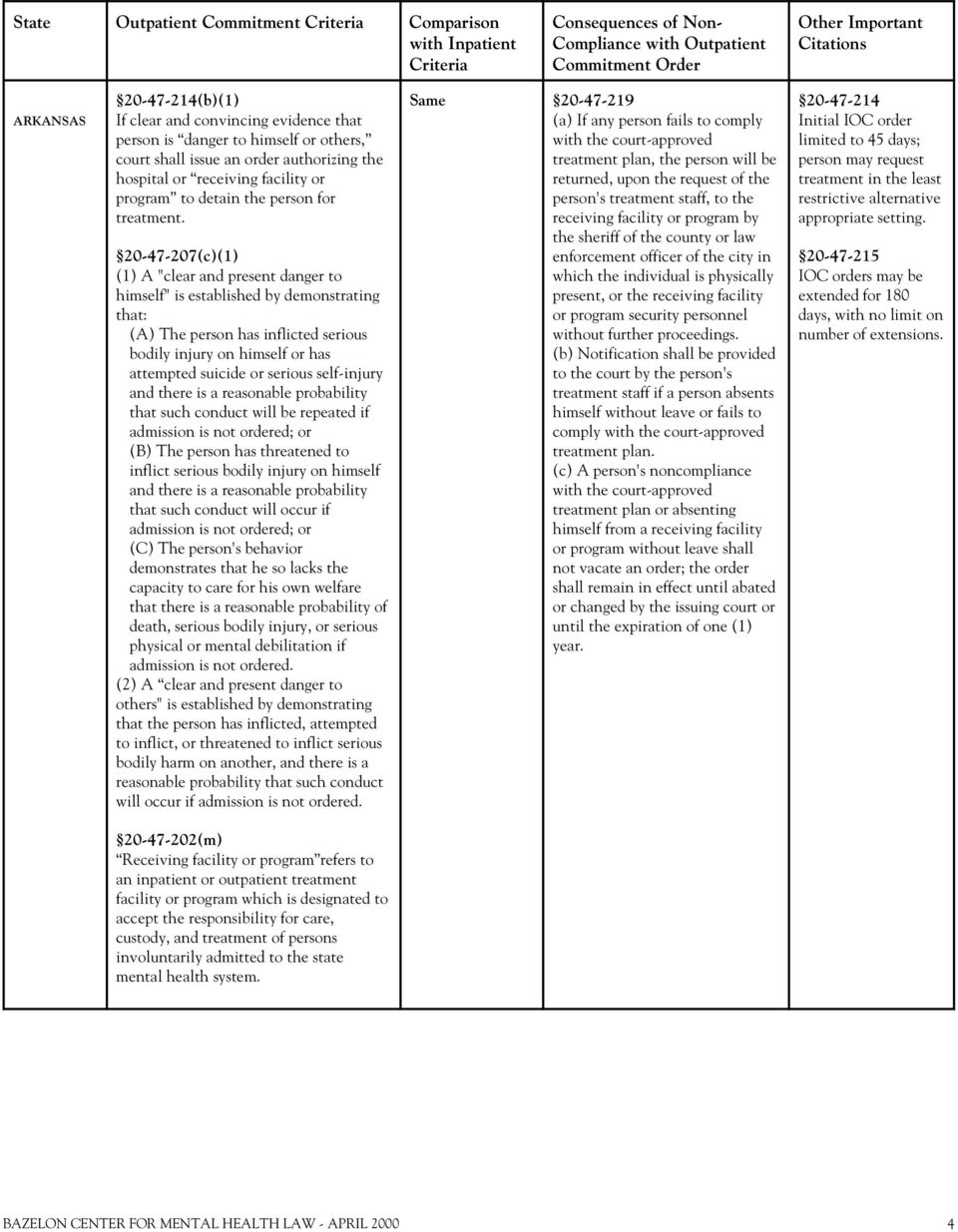
4 State Outpatient Commitment Comparison ARKANSAS (b)(1) If clear and convincing evidence that person is danger to himself or others, court shall issue an order authorizing the hospital or receiving facility or program to detain the person for treatment (c)(1) (1) A "clear and present danger to himself" is established by demonstrating that: (A) The person has inflicted serious bodily injury on himself or has attempted suicide or serious self-injury and there is a reasonable probability that such conduct will be repeated if admission is not ordered; or (B) The person has threatened to inflict serious bodily injury on himself and there is a reasonable probability that such conduct will occur if admission is not ordered; or (C) The person's behavior demonstrates that he so lacks the capacity to care for his own welfare that there is a reasonable probability of death, serious bodily injury, or serious physical or mental debilitation if admission is not ordered. (2) A clear and present danger to others" is established by demonstrating that the person has inflicted, attempted to inflict, or threatened to inflict serious bodily harm on another, and there is a reasonable probability that such conduct will occur if admission is not ordered. Same (a) If any person fails to comply with the court-approved treatment plan, the person will be returned, upon the request of the person's treatment staff, to the receiving facility or program by the sheriff of the county or law enforcement officer of the city in which the individual is physically present, or the receiving facility or program security personnel without further proceedings. (b) Notification shall be provided to the court by the person's treatment staff if a person absents himself without leave or fails to comply with the court-approved treatment plan. (c) A person's noncompliance with the court-approved treatment plan or absenting himself from a receiving facility or program without leave shall not vacate an order; the order shall remain in effect until abated or changed by the issuing court or until the expiration of one (1) year Initial IOC order limited to 45 days; person may request treatment in the least restrictive alternative appropriate setting IOC orders may be extended for 180 days, with no limit on number of extensions (m) Receiving facility or program refers to an inpatient or outpatient treatment facility or program which is designated to accept the responsibility for care, custody, and treatment of persons involuntarily admitted to the state mental health system. BAZELON CENTER FOR MENTAL HEALTH LAW - APRIL
5 State Outpatient Commitment Comparison COLORADO (1) If a person detained for 72 hours under the provisions of section (emergency custody and evaluation) or a respondent under court order for evaluation pursuant to section has received an evaluation, he may be certified (i.e., committed without a prior hearing) under the following conditions: (a) The professional staff of the agency or facility providing72-hour treatment and evaluation has analyzed the person's condition and has found the person is mentally ill and, as a result of mental illness, a danger to others or to himself or gravely disabled; and (b) The person has been advised of the availability of, but has not accepted, voluntary treatment; but, if reasonable grounds exist to believe that the person will not remain in a voluntary treatment program, his acceptance of voluntary treatment shall not preclude certification (4.5) "Facility" means a public hospital or a licensed private hospital, clinic, community mental health center or clinic, institution, sanitarium, or residential child care facility that provides treatment for mentally ill persons. Same None stated (6) Unlike other jurisdictions, IOC may be initiated without a prior hearing. Person with mental illness may request a hearing after certification (1) Initial IOC certification limited to 3 months IOC certification may be extended for up to 3 months (without a hearing, unless person subject ot certification requests one) After 5 consecutive months of certification, person may be subjected to petitions for longterm care of up to 6 months at a time. When the first petition is filed, a hearing is available upon request; hearings are required for subsequent extensions. BAZELON CENTER FOR MENTAL HEALTH LAW - APRIL

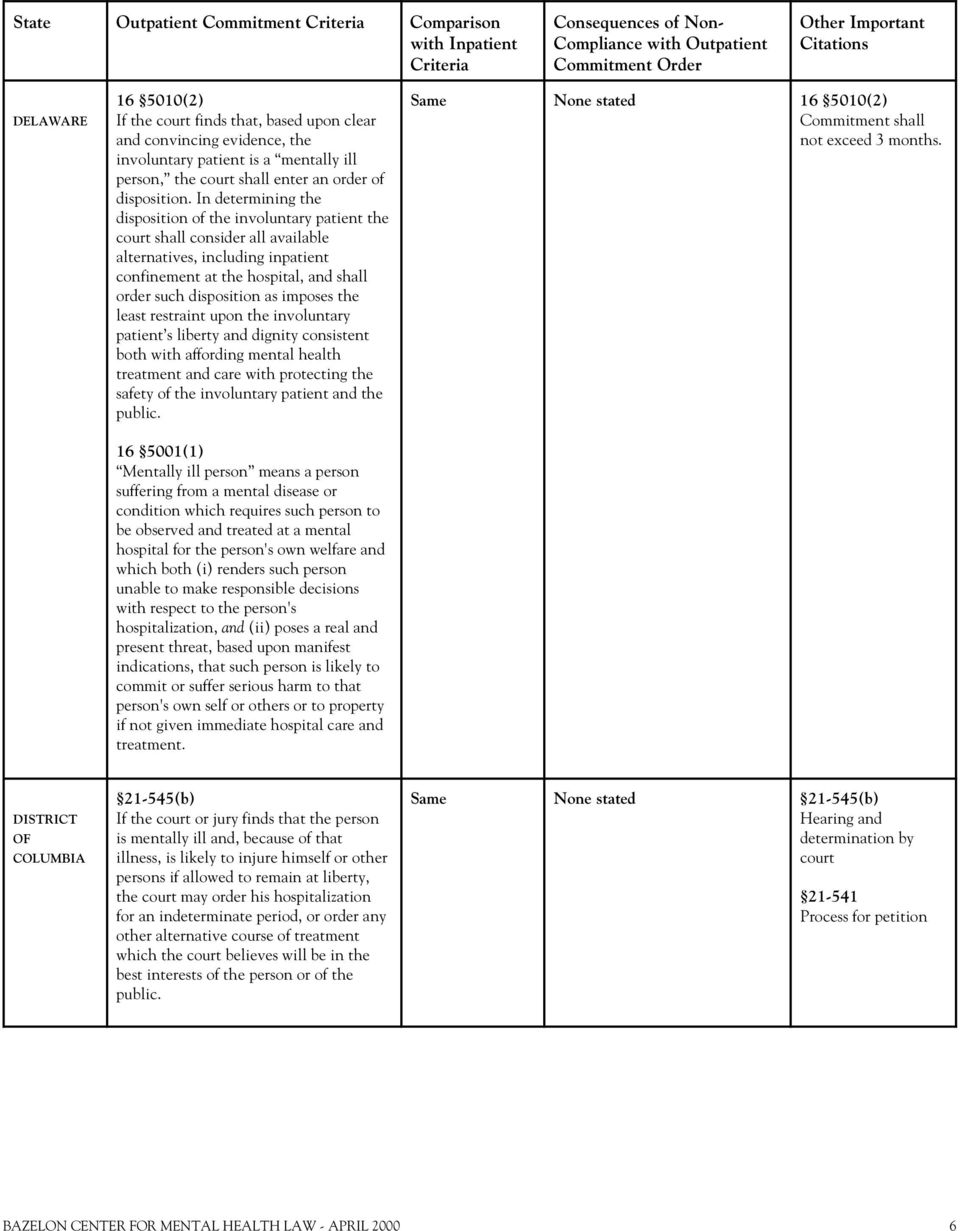
6 State Outpatient Commitment Comparison DELAWARE (2) If the court finds that, based upon clear and convincing evidence, the involuntary patient is a mentally ill person, the court shall enter an order of disposition. In determining the disposition of the involuntary patient the court shall consider all available alternatives, including inpatient confinement at the hospital, and shall order such disposition as imposes the least restraint upon the involuntary patient s liberty and dignity consistent both with affording mental health treatment and care with protecting the safety of the involuntary patient and the public. Same None stated (2) Commitment shall not exceed 3 months (1) Mentally ill person means a person suffering from a mental disease or condition which requires such person to be observed and treated at a mental hospital for the person's own welfare and which both (i) renders such person unable to make responsible decisions with respect to the person's hospitalization, and (ii) poses a real and present threat, based upon manifest indications, that such person is likely to commit or suffer serious harm to that person's own self or others or to property if not given immediate hospital care and treatment. DISTRICT OF COLUMBIA (b) If the court or jury finds that the person is mentally ill and, because of that illness, is likely to injure himself or other persons if allowed to remain at liberty, the court may order his hospitalization for an indeterminate period, or order any other alternative course of treatment which the court believes will be in the best interests of the person or of the public. Same None stated (b) Hearing and determination by court Process for petition BAZELON CENTER FOR MENTAL HEALTH LAW - APRIL
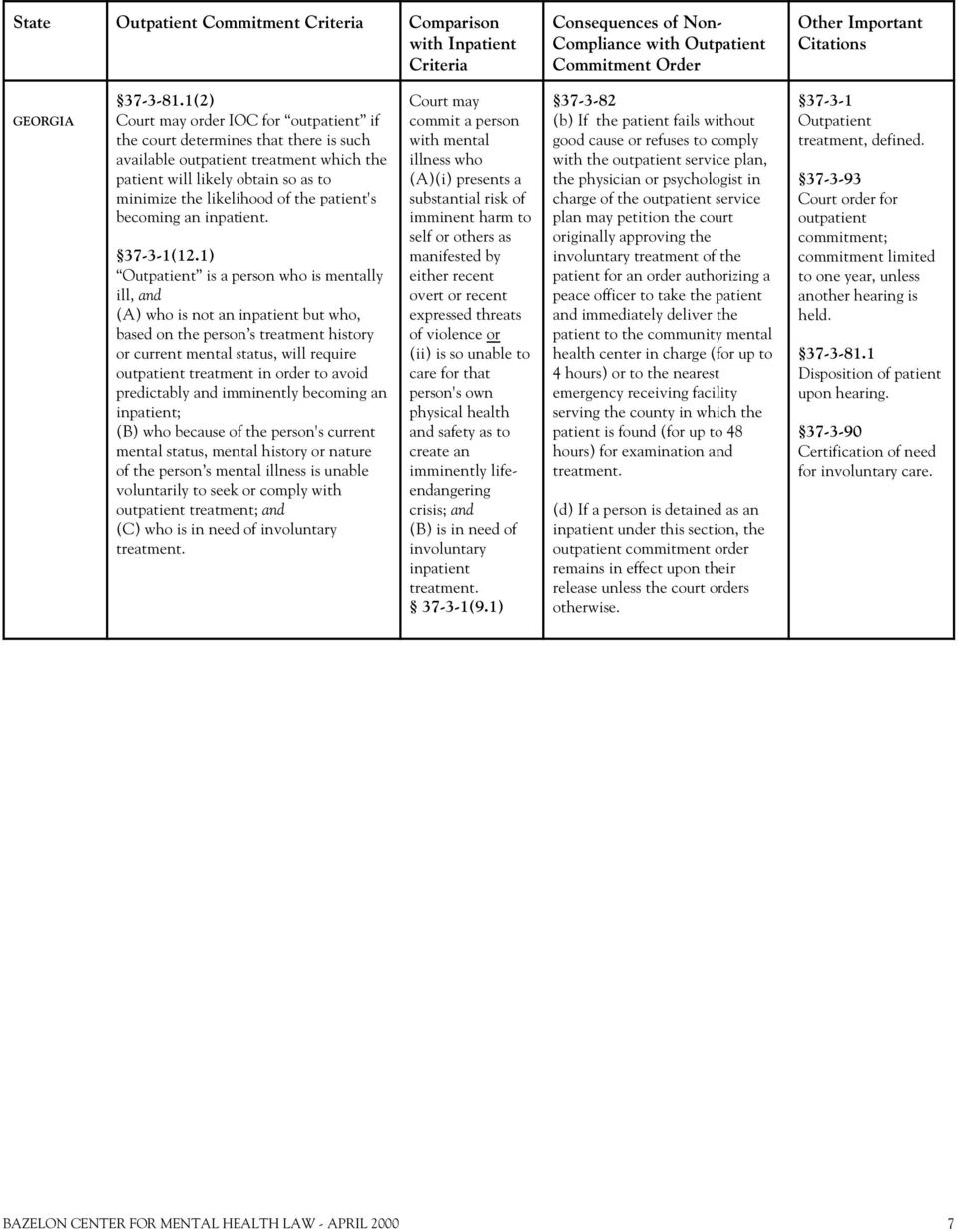
7 State Outpatient Commitment Comparison GEORGIA (2) Court may order IOC for outpatient if the court determines that there is such available outpatient treatment which the patient will likely obtain so as to minimize the likelihood of the patient's becoming an inpatient (12.1) Outpatient is a person who is mentally ill, and (A) who is not an inpatient but who, based on the person s treatment history or current mental status, will require outpatient treatment in order to avoid predictably and imminently becoming an inpatient; (B) who because of the person's current mental status, mental history or nature of the person s mental illness is unable voluntarily to seek or comply with outpatient treatment; and (C) who is in need of involuntary treatment. Court may commit a person with mental illness who (A)(i) presents a substantial risk of imminent harm to self or others as manifested by either recent overt or recent expressed threats of violence or (ii) is so unable to care for that person's own physical health and safety as to create an imminently lifeendangering crisis; and (B) is in need of involuntary inpatient treatment (9.1) (b) If the patient fails without good cause or refuses to comply with the outpatient service plan, the physician or psychologist in charge of the outpatient service plan may petition the court originally approving the involuntary treatment of the patient for an order authorizing a peace officer to take the patient and immediately deliver the patient to the community mental health center in charge (for up to 4 hours) or to the nearest emergency receiving facility serving the county in which the patient is found (for up to 48 hours) for examination and treatment. (d) If a person is detained as an inpatient under this section, the outpatient commitment order remains in effect upon their release unless the court orders otherwise Outpatient treatment, defined Court order for outpatient commitment; commitment limited to one year, unless another hearing is held Disposition of patient upon hearing Certification of need for involuntary care. BAZELON CENTER FOR MENTAL HEALTH LAW - APRIL
8 State Outpatient Commitment Comparison HAWAII A person may be ordered to obtain involuntary outpatient treatment if the family court finds that: (1) The person is suffering from a severe mental disorder or from substance abuse; (2) the person is capable of surviving safely in the community with available supervision from family, friends, or others; (3) the person, at some time in the past: (A) has received inpatient hospital treatment for a severe mental disorder or substance abuse, or (B) has been imminently dangerous to self or others, or is gravely disabled, as a result of a severe mental disorder or substance abuse; (4) the person, based on the person s treatment history and current behavior, is now in need of treatment in order to prevent a relapse or deterioration which would predictably result in the person becoming imminently dangerous to self or others; (5) the person s current mental status or the nature of the person's disorder limits or negates the person's ability to make an informed decision to voluntarily seek or comply with recommended treatment; and (6) there is a reasonable prospect that the outpatient treatment ordered will be beneficial to the person. Inpatient commitment requires that the person be imminently dangerous to self or others, gravely disabled, or obviously ill and needs care or treatment, or both, for which there is no available less restrictive alternative to hospitalization (c) The outpatient treatment psychiatrist or psychiatrist s designee shall make all reasonable efforts to solicit the subject s compliance with the prescribed treatment. If the subject fails or refuses to comply after all efforts to solicit compliance, the outpatient treatment psychiatrist shall so notify the court and may submit a petition for the involuntary hospitalization of the subject, provided that the refusal of treatment shall not constitute evidence toward any of the criteria for involuntary hospitalization (b) No subject of an IOC order shall be physically forced to take medication or forcibly detained for treatment IOC hearing (b) IOC order limited to 180 days; beneficial mental and physical effects of recommended medication(s) must outweigh the detrimental mental and physical effects. BAZELON CENTER FOR MENTAL HEALTH LAW - APRIL
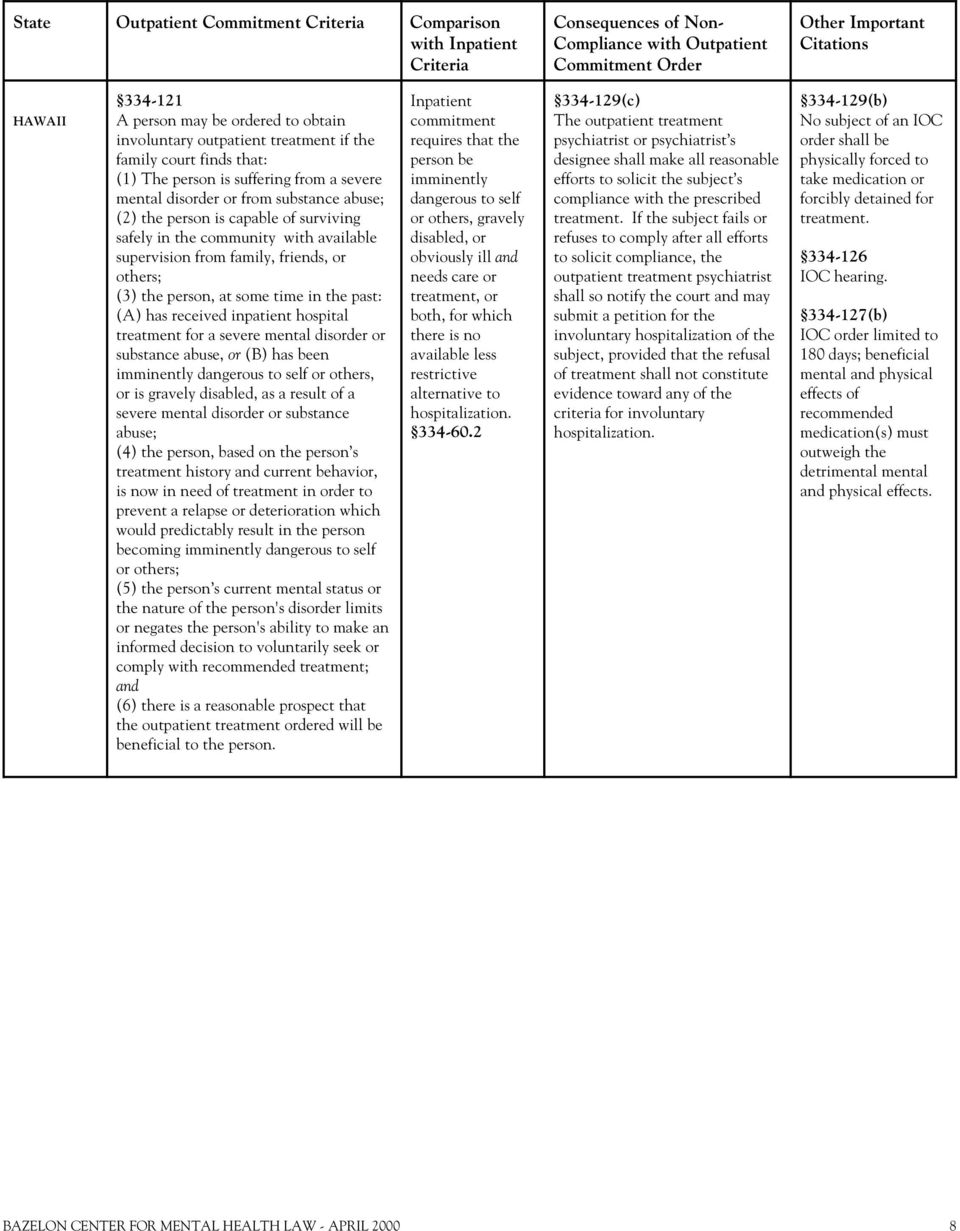
9 State Outpatient Commitment Comparison IDAHO A Person may be committed to outpatient treatment if (1) Person is diagnosed as having a mental illness; and (2) the person without the requested treatment: (a) is likely to cause harm to himself or to suffer substantial mental or emotional deterioration, or become gravely disabled, or (b) is likely to cause harm to others; (3) lacks capacity to make an informed decision concerning his need for treatment; (4) has previously been hospitalized for treatment of mental illness and has by history substantially failed to comply on one or more occasions with the prescribed course of treatment outside the hospital; (5) a treatment plan has been prepared which includes specific conditions with which the patient is expected to comply, together with a detailed plan for reviewing the patient s medical status and for monitoring his or her compliance with the required conditions of treatment; (6) there is a reasonable prospect that the patient s disorder will respond to treatment in the proposed treatment plan without having to be involuntarily committed to an inpatient facility if the patient complies with the treatment requirements specified in the court s order; and (7) the physician or treatment facility which is to be responsible for the patient s treatment under that commitment order has agreed to accept the patient Inpatient commitment requires that a person be mentally ill and either likely to injure himself or others or gravely disabled (k) C (1) If a patient fails to comply and the staff of the treatment facility believes that there is a significant risk of deterioration in the patients condition, they shall notify law enforcement. (2) The IOC order constitutes a continuing authorization for law enforcement to transport the person to the designated outpatient treatment facility or the physician s office for the purpose of making reasonable efforts to obtain the person s compliance with the requirements of the IOC order. (3) If a patient fails to comply and the staff of the treatment facility believes that there is significant risk of deterioration, they shall notify the original petitioner for IOC and the prosecuting attorney of the county where the patient is found and shall recommend an appropriate disposition. (a) Upon finding that hospitalization is necessary to prevent the patient from harming himself or others or to prevent substantial deterioration the court may temporarily commit the patient to an inpatient facility pending a hearing on a petition or application for commitment to an inpatient facility; (b) Upon finding that the patient does not meet the criteria for inpatient commitment and continues to meet criteria for IOC and the outpatient treatment appears warranted, the court shall renew or modify the order to IOC Procedures for initiating commitment A IOC order not to exceed one year. BAZELON CENTER FOR MENTAL HEALTH LAW - APRIL

10 State Outpatient Commitment Comparison ILLINOIS 405 5/3-811 If any person is found subject to involuntary admission, the court shall consider alternative mental health facilities which are appropriate for and available to the respondent, including but not limited to hospitalization /1-119 Person subject to involuntary admission means: (1) A person with mental illness and who because of his or her illness is reasonably expected to inflict serious physical harm upon himself or herself or another in the near future; or (2) A person with mental illness and who because of his or her illness is unable to provide for his basic physical needs so as to guard himself or herself from serious harm. Same A comprehensive physical and mental examination and social investigation shall be used to determine whether some program other than hospitalization will meet the person s needs, with preference given to care or treatment in the community 405 5/ /3-812(a) and (b) (a) The court shall have continuing authority to modify an order for alternative treatment if the recipient fails to comply with the order. Prior to modifying such an order, the court shall receive a report from the program s facility director specifying why the alternative treatment is unsuitable. The recipient shall be notified and given an opportunity to respond when modification of the order for alternative treatment is considered. (b) The court may revoke an order for alternative treatment, order a peace officer to take the person into custody, and order a person hospitalized /3-811 Alternative mental health facilities described. Hospitalization may only be ordered if state proves that it is the least restrictive alternative. Matter of Luttrell, 633 N.E. 2d 74 (Ill. 1994). INDIANA Court may order outpatient treatment if a person is (1) mentally ill and either dangerous or gravely disabled; (2) likely to benefit from an outpatient therapy program that is designed to decrease the individual s dangerousness or disability; (3) not likely to be either dangerous or gravely disabled if they comply with the therapy program; and (4) recommended for an outpatient therapy program by the individual s examining physician. Inpatient commitment requires that a person be mentally ill and either dangerous or gravely disabled (a)(1) (a) Staff shall immediately notify the court of failure to comply with IOC. (b) The individual may be transferred from the outpatient therapy program to one of the following: (1) Inpatient unit; (2) Supervised group living program; or (3) A sub-acute stabilization facility. (d) The individual may not be imprisoned or confined in jail unless the individual has been placed under arrest Order of commitment limited to 90 days. BAZELON CENTER FOR MENTAL HEALTH LAW - APRIL
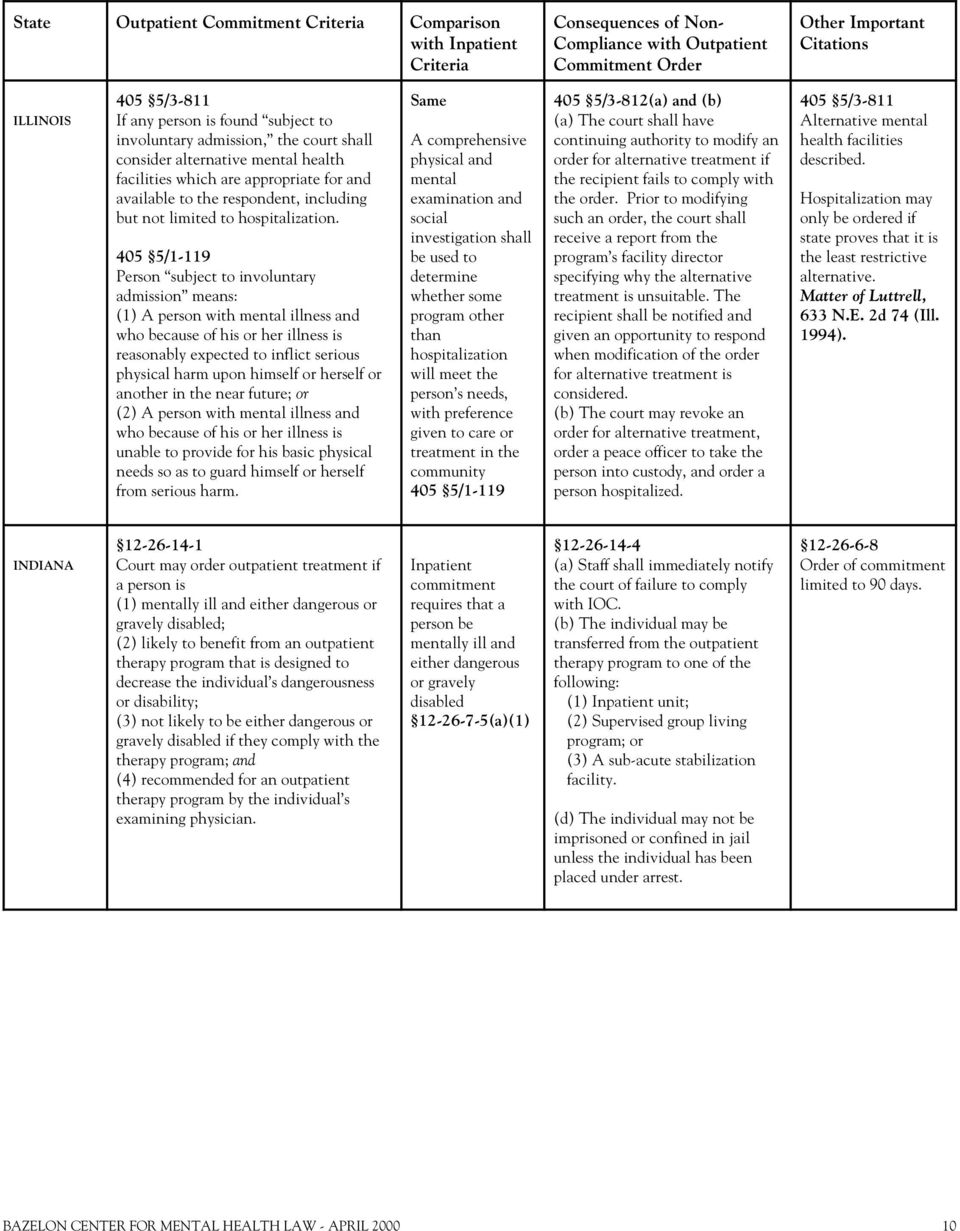
11 State Outpatient Commitment Comparison IOWA If a patient has been found by clear and convincing evidence to have a serious mental impairment they can be ordered committed into outpatient care 229.1(15) Serious mental impairment, is defined as lacking (due to mental illness) sufficient judgment to make responsible decisions with respect to the person s hospitalization or treatment, and who because of that illness meets any of the following criteria: (a) is likely to physically injure the person s self or others if allowed to remain at liberty without treatment; (b) is likely to inflict serious emotional injury on members of the person s family or others who lack reasonable opportunity to avoid contact with the person with mental illness if the person with mental illness is allowed to remain at liberty without treatment; or (c) is unable to satisfy the person s needs for nourishment, clothing, essential medical care, or shelter so that it is likely that the person will suffer physical injury, physical debilitation, or death. Same If, after placement and admission of a respondent in or under the care of a hospital or other suitable facility, the respondent departs from the hospital or facility or fails to appear for treatment as ordered without prior proper authorization from the chief medical officer, upon receipt of notification of the respondent s departure or failure to appear, a peace officer shall, without further order of the court, exercise all due diligence to take the respondent into protective custody and return the respondent to the hospital or facility Order for immediate custody Hearing procedure. BAZELON CENTER FOR MENTAL HEALTH LAW - APRIL
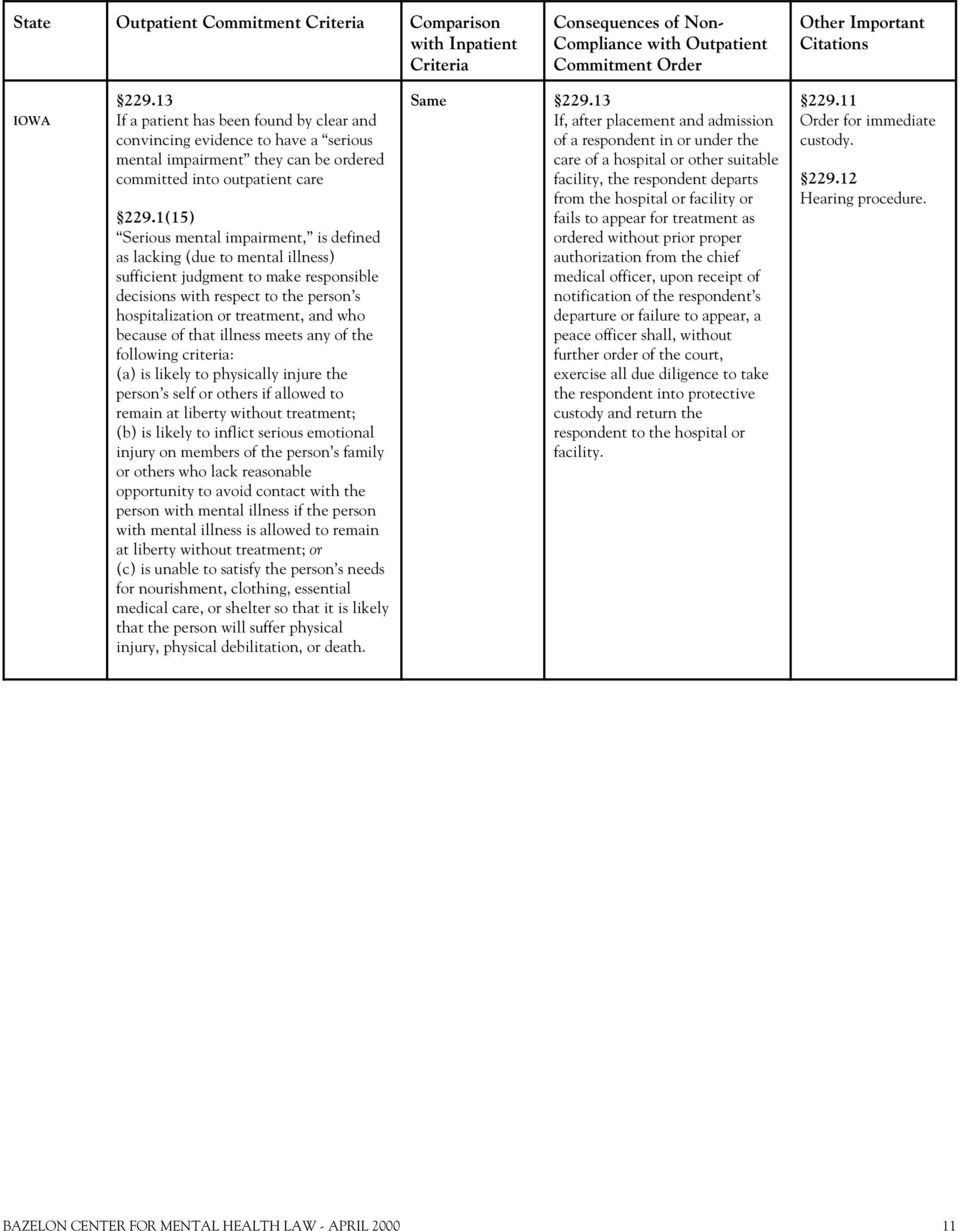
12 State Outpatient Commitment Comparison KANSAS (a) IOC is dispositional alternative to inpatient commitment where the patient is likely to comply with an order and patient will not likely be a danger in the community or be likely to cause harm to self or others. (b) No order for outpatient treatment shall be entered unless the head of the outpatient treatment facility has consented to treat the patient on an outpatient basis under the terms and conditions set forth by the court, except that no order for outpatient treatment shall be refused by a participating mental health center (f)(1) Inpatient commitment requires that a person be mentally ill and lack capacity to make an informed decision concerning treatment, be likely to cause harm to self or others, and whose diagnosis is not solely one of the following mental disorders: alcohol or substance / chemical abuse; antisocial personality disorder, mental retardation; organic personality syndrome; or an organic mental disorder (e) The treatment facility shall immediately report to the court any noncompliance by the patient with the outpatient treatment order. The court may enter an ex-parte emergency (i.e., not more than two days) custody order providing for the immediate detention of the patient in a designated inpatient treatment facility except that the court shall not order the detention of the patient at a state psychiatric hospital, unless a written statement from a qualified mental health professional authorizing such detention at a psychiatric hospital has been filed with the court. (g) If after a hearing, the court finds by clear and convincing evidence that the patient violated any condition of the outpatient treatment order, the court may enter an order for inpatient treatment (except that the court shall not order the detention of the patient at a state psychiatric hospital, unless a written statement from a qualified mental health professional authorizing such detention at a psychiatric hospital has been filed with the court) or the court may modify the terms and conditions of the IOC order (a) Initial commitment limited to 3 months (f) Court may renew commitment for up to 6 months. BAZELON CENTER FOR MENTAL HEALTH LAW - APRIL

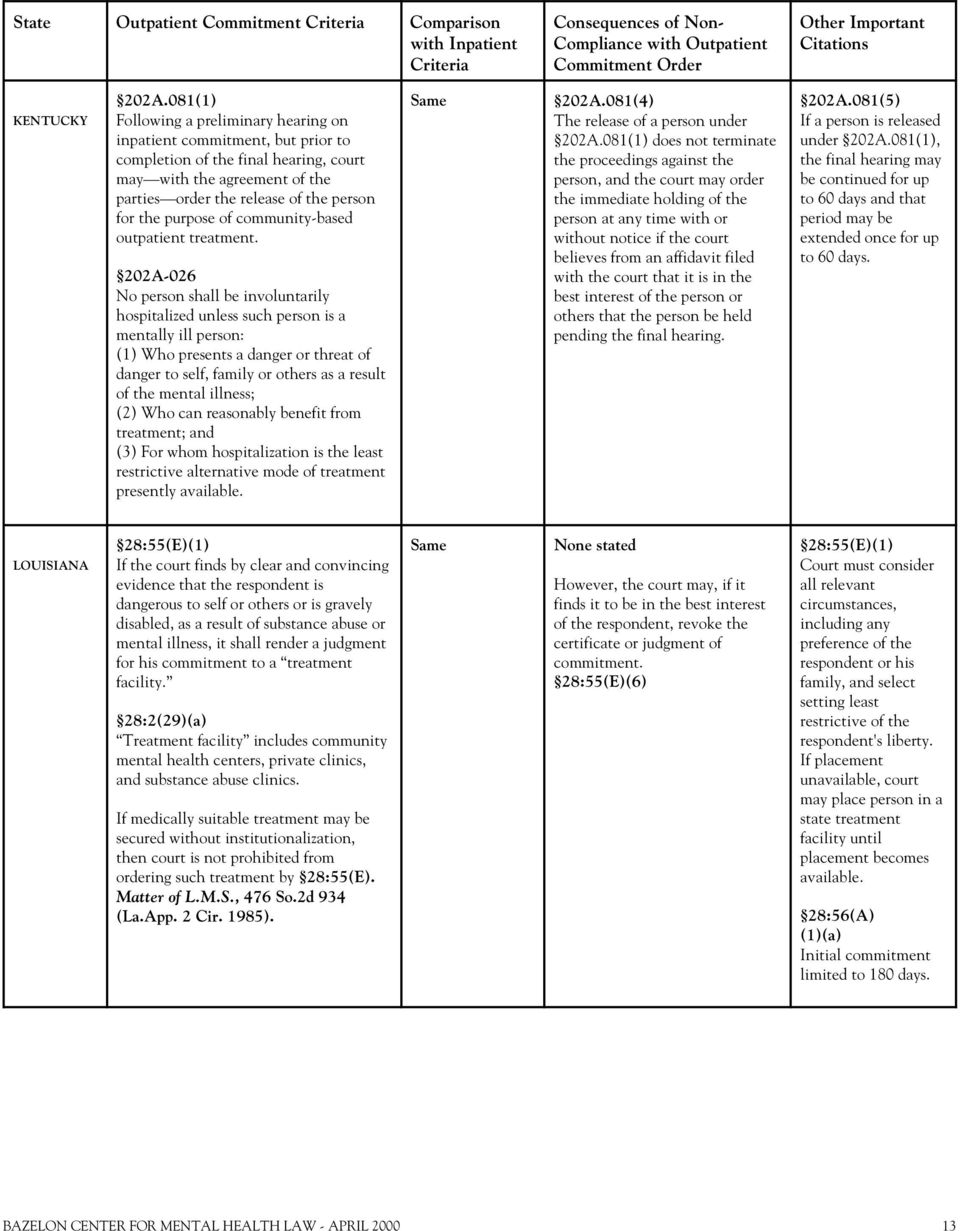
13 State Outpatient Commitment Comparison KENTUCKY 202A.081(1) Following a preliminary hearing on inpatient commitment, but prior to completion of the final hearing, court may with the agreement of the parties order the release of the person for the purpose of community-based outpatient treatment. 202A-026 No person shall be involuntarily hospitalized unless such person is a mentally ill person: (1) Who presents a danger or threat of danger to self, family or others as a result of the mental illness; (2) Who can reasonably benefit from treatment; and (3) For whom hospitalization is the least restrictive alternative mode of treatment presently available. Same 202A.081(4) The release of a person under 202A.081(1) does not terminate the proceedings against the person, and the court may order the immediate holding of the person at any time with or without notice if the court believes from an affidavit filed with the court that it is in the best interest of the person or others that the person be held pending the final hearing. 202A.081(5) If a person is released under 202A.081(1), the final hearing may be continued for up to 60 days and that period may be extended once for up to 60 days. LOUISIANA 28:55(E)(1) If the court finds by clear and convincing evidence that the respondent is dangerous to self or others or is gravely disabled, as a result of substance abuse or mental illness, it shall render a judgment for his commitment to a treatment facility. 28:2(29)(a) Treatment facility includes community mental health centers, private clinics, and substance abuse clinics. If medically suitable treatment may be secured without institutionalization, then court is not prohibited from ordering such treatment by 28:55(E). Matter of L.M.S., 476 So.2d 934 (La.App. 2 Cir. 1985). Same None stated However, the court may, if it finds it to be in the best interest of the respondent, revoke the certificate or judgment of commitment. 28:55(E)(6) 28:55(E)(1) Court must consider all relevant circumstances, including any preference of the respondent or his family, and select setting least restrictive of the respondent's liberty. If placement unavailable, court may place person in a state treatment facility until placement becomes available. 28:56(A) (1)(a) Initial commitment limited to 180 days. BAZELON CENTER FOR MENTAL HEALTH LAW - APRIL
14 State Outpatient Commitment Comparison MICHIGAN (2)(c) and (d) Court may order IOC or a combination of IOC and hospitalization for a "person requiring treatment." (1) A person requiring treatment is defined as a (a) Person has a mental illness, and who as a result of that mental illness can reasonably be expected within the near future to intentionally or unintentionally seriously physically injure himself or herself or another individual, and who has engaged in an act or acts or made significant threats that are substantially supportive of the expectation; (b) Person who has mental illness, and who as a result of that mental illness is unable to attend to those of his or her basic physical needs such as food, clothing, or shelter that must be attended to in order for the individual to avoid serious harm in the near future, and who has demonstrated that inability by failing to attend to those basic physical needs; or (c) Person who has mental illness, whose judgment is so impaired that he or she is unable to understand his or her need for treatment and whose continued behavior as the result of this mental illness can reasonably be expected, on the basis of competent clinical opinion, to result in significant physical harm to himself or herself or others. Same If an individual is found to be a person requiring treatment, the court may order the individual hospitalized (2)(a) and (b) (2) If it comes to the attention of the court that an individual subject to an order of alternative treatment or combined hospitalization and alternative treatment is not complying with the order...the court may do either of the following without a hearing: (a) Consider other alternatives to hospitalization and modify the order to direct the individual to undergo another program of alternative treatment for the duration of the order; or (b) Modify the order to direct the individual to undergo hospitalization or combined hospitalization and alternative treatment (for up to 60 days on an initial order, 90 days on a second or continuing order). The order may include a provision directing a peace officer to forcibly return a person to the hospital if they refuse to comply with the psychiatrist s request to return to the hospital (1) The supervising agency or mental health professional has a duty to report a person s noncompliance with an IOC order a(2) If court determines alternative treatment is adequate to meet the individual's needs and prevent harm to self or others within the near future and an agency or mental health professional is available to supervise the program, the court must issue an order for alternative treatment or combined hospitalization and alternative treatment Petition for involuntary treatment. BAZELON CENTER FOR MENTAL HEALTH LAW - APRIL
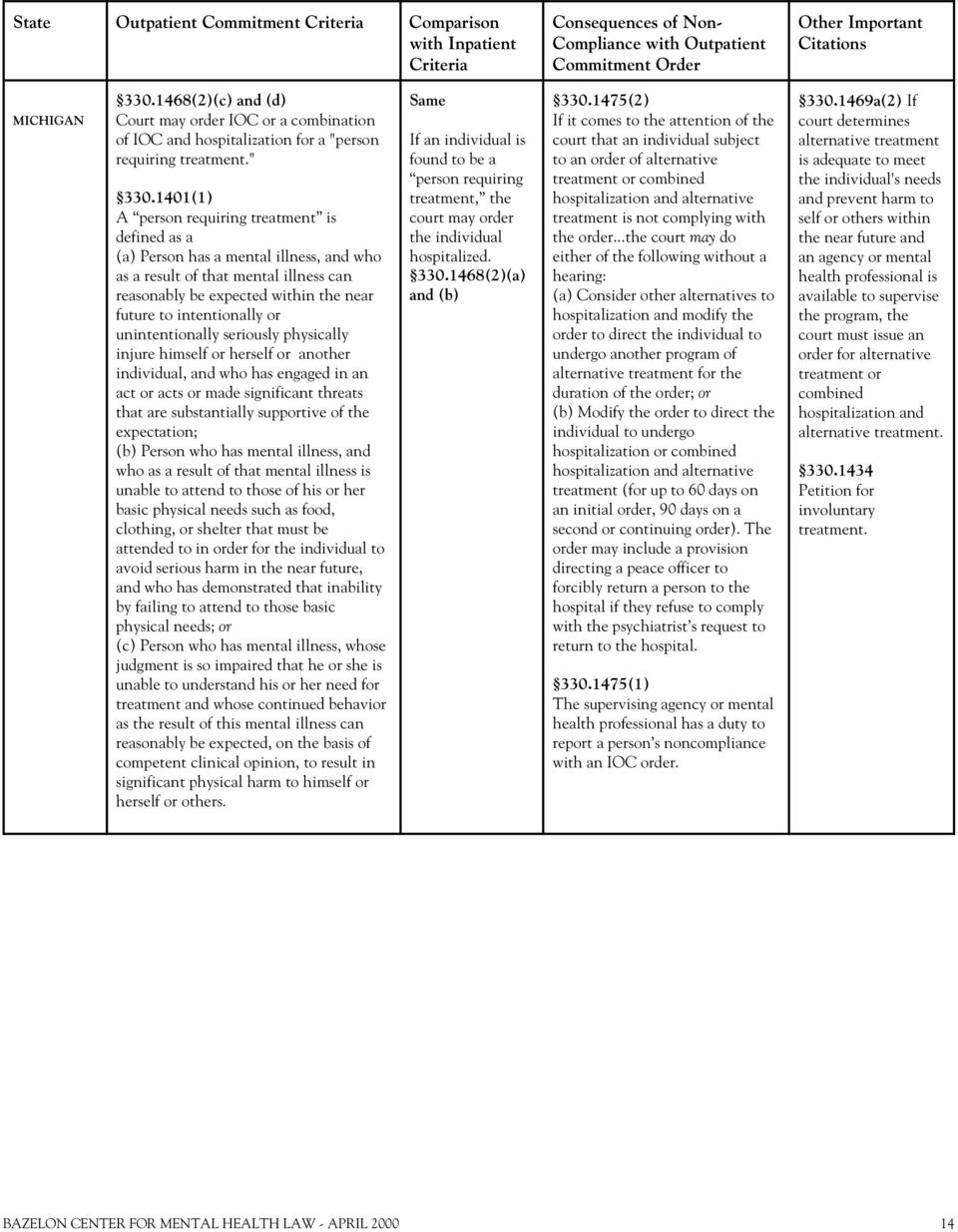
15 State Outpatient Commitment Comparison MINNESOTA 253B.065(5)(b) Court must order early intervention treatment (i.e., IOC) if the following requirements are proven by clear and convincing evidence: (1) person is mentally ill; (2) person refuses to accept appropriate mental health treatment; and (3) their mental illness is manifested by instances of grossly disturbed behavior or faulty perceptions and either (i) the grossly disturbed behavior or faulty perceptions significantly interfere with proposed patient s ability to care for self and the proposed patient, when competent, would have chosen substantially similar treatment under the same circumstances; or (ii) due to mental illness the proposed patient received courtordered inpatient treatment at least twice in the previous 3 years; the patient is exhibiting symptoms or behavior substantially similar to those that precipitated one or more of the court-ordered treatments; and the patient is reasonably expected to physically or mentally deteriorate to the point of meeting the criteria for inpatient commitment unless treated. Inpatient commitment requires that person be mentally ill, mentally retarded, or chemically dependent, and there must be no suitable alternative to commitment. The least restrictive treatment mandate explicitly requires court to consider outpatient commitment as an alternative to hospitalization (e.g., communitybased nonresidential treatment) 253B B.097(1)(4) Consequences may include commitment to another setting for treatment. The IOC order must include the consequences of the person s failure to comply. 253B.065(b) The early intervention treatment ordered by the court must be less intrusive than longterm inpatient commitment and must be the least restrictive treatment program available that can meet the patient's treatment needs. 253B.066 IOC order may include short-term hospitalization (not to exceed 10 days). 253B.09 Standard of proof; initial commitment limited to 6 months. 253B.02(13)(a) The definition of mentally ill includes a requirement that the person pose a substantial likelihood of physical harm to self or others as demonstrated by: (1) a failure to obtain necessary food, clothing, shelter or medical care as a result of the impairment, or (2) a recent attempt or threat to physically harm self or others. BAZELON CENTER FOR MENTAL HEALTH LAW - APRIL
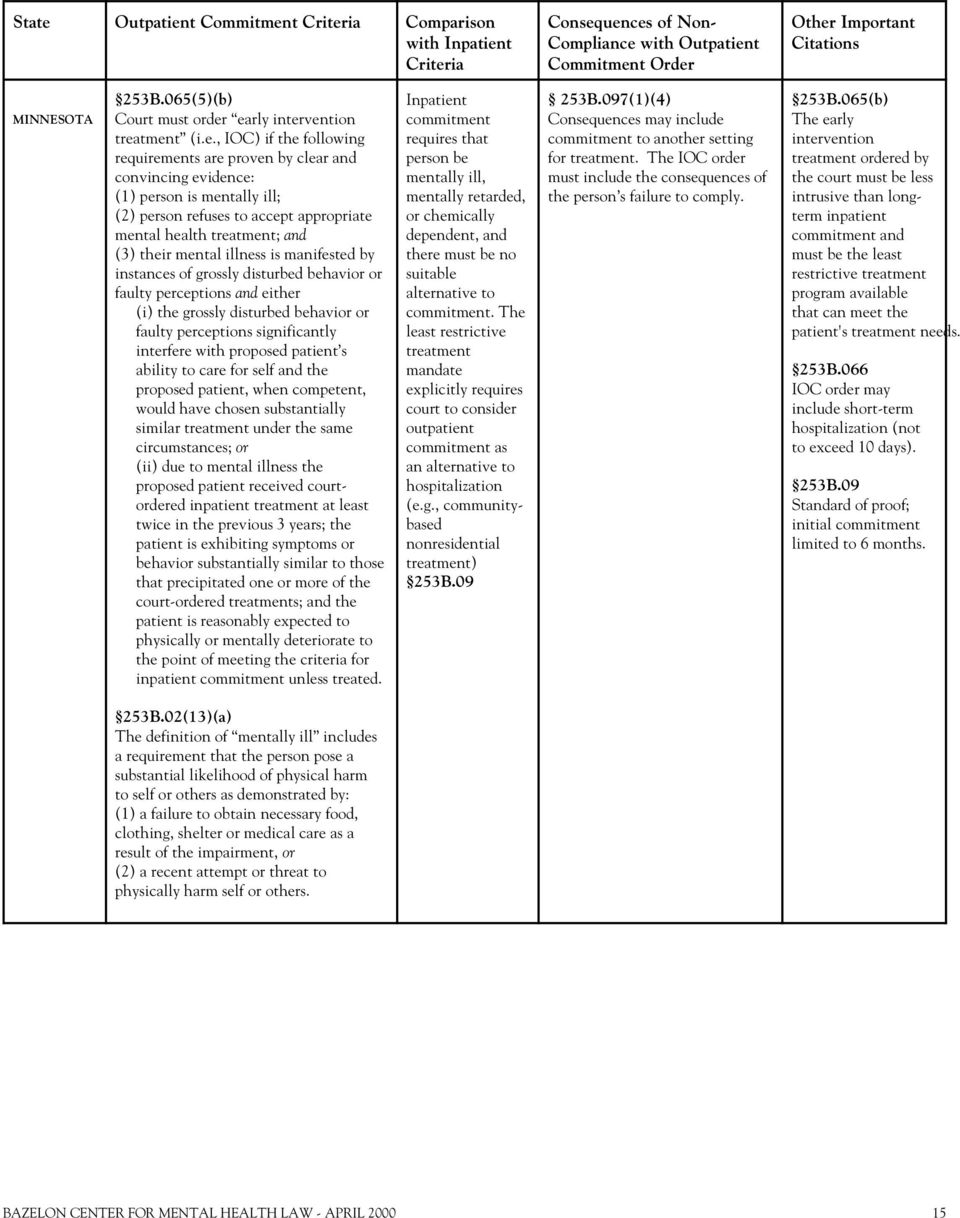
16 State Outpatient Commitment Comparison MISSISSIPPI (4) If a person is found to be mentally ill and there is no suitable alternative to judicial commitment, the court shall commit the patient for treatment in the least restrictive treatment facility which can meet the patient's treatment needs. Alternatives to commitment to inpatient care may include, but shall not be limited to: voluntary or court-ordered outpatient commitment for treatment with specific reference to a treatment regimen, day treatment in a hospital, night treatment in a hospital, placement in the custody of a friend or relative or the provision of home health services If an examining physician or psychologist find the the following, they must recommend IOC: (i) the respondent is mentally ill; (ii) the respondent is capable of surviving safely in the community with available supervision from family, friends or others; (iii) based on the respondent s treatment history and other applicable medical or psychiatric indicia, the respondent is in need of treatment in order to prevent further disability or deterioration which would result in significant deterioration in the ability to carry out activities of daily living; and (iv) his or her current mental status or the nature of his or her illness limits or negates his or her ability to make an informed decision to seek voluntarily or comply with recommended treatment Inpatient commitment requires that a person be dangerous to self or society and unable to live safely in freedom. Bethany v. Stubbs, 393 So. 2d 1351 (Miss. 1981). IOC is considered a less restrictive alternative to inpatient commitment (4) (2) If the respondent fails or clearly refuses to comply with outpatient treatment, the director of the treatment facility, his designee or an interested person shall make all reasonable efforts to solicit the respondent s compliance. These efforts shall be documented and, if the respondent fails or clearly refuses to comply with outpatient treatment after such efforts are made, such efforts shall be documented with the court by affidavit. Upon the filing of the affidavit, the sheriff of the proper county is authorized to take the respondent into his custody. (3) The respondent may be returned to the treatment facility as soon thereafter as facilities are available. Respondent may request a hearing within 10 days of their return to the facility Examination; attorney may be present (4) Initial commitment limited to 3 months. BAZELON CENTER FOR MENTAL HEALTH LAW - APRIL
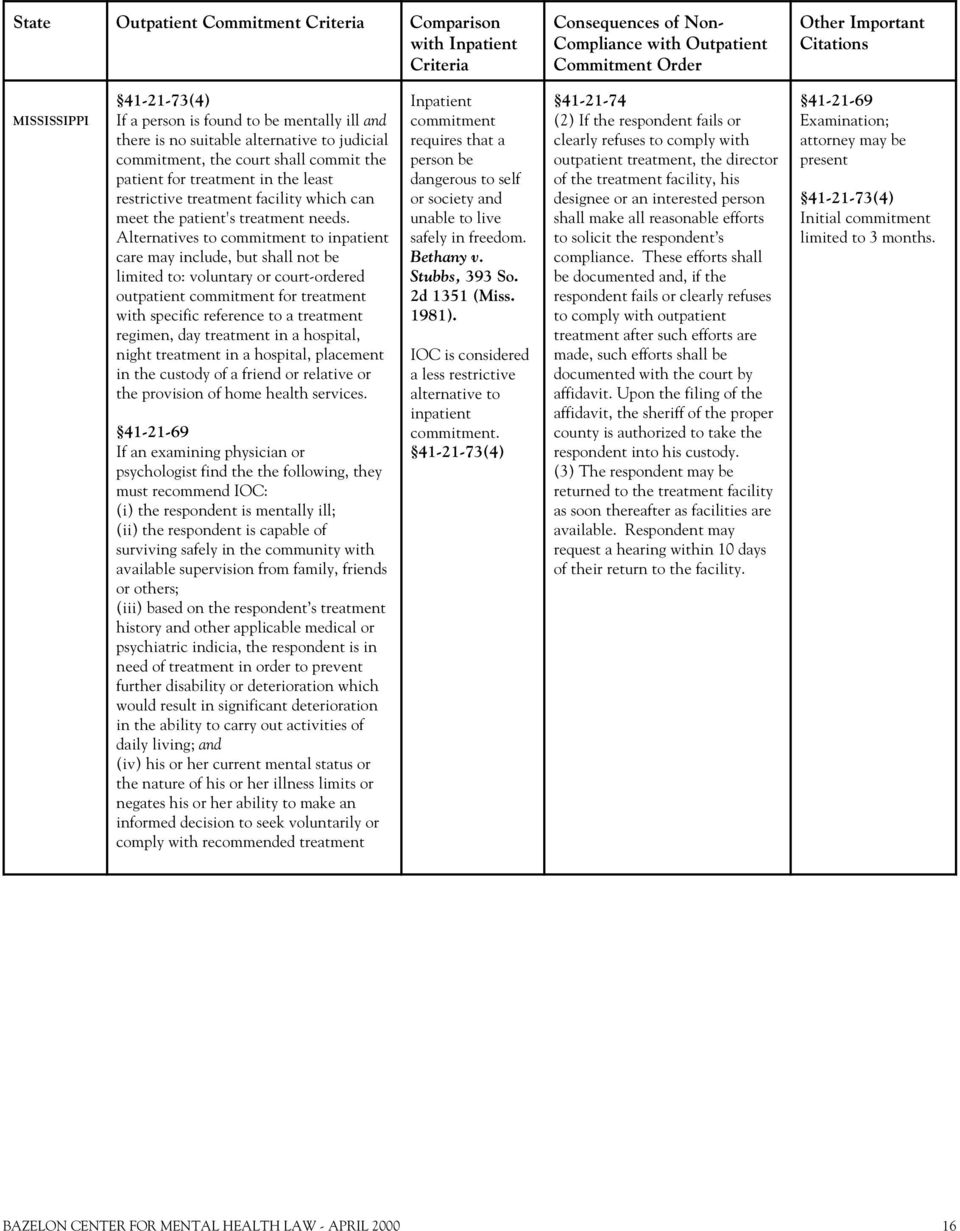
17 State Outpatient Commitment Comparison MISSOURI (2) IOC requires that a person (1) be mentally ill and, as a result, present a likelihood of serious harm to himself or others; and (2) be in need of treatment on an outpatient basis; and that the facility or mental health coordinator demonstrate that (4) attempts were made to provide necessary care, treatment and services but the person either lacks the capacity or refuses to voluntarily consent to care, treatment and services; and (5) the person has appropriate support from family, friends, case managers or others during the period of IOC and that there is available treatment in the community (2) Inpatient commitment requires that a person (1) be mentally ill and, as a result, present a likelihood of serious harm to himself or others; and (2) be in need of treatment on an inpatient basis and that the facility or mental health coordinator demonstrate that (4) attempts were made to provide necessary care, treatment and services but the person either lacks the capacity or refuses to voluntarily consent to care, treatment and services. None stated (2) Can commit as outpatient for 180 days initially, but only 21days as inpatient Must be detained for evaluation (up to 96 hours) Hearing procedures. BAZELON CENTER FOR MENTAL HEALTH LAW - APRIL
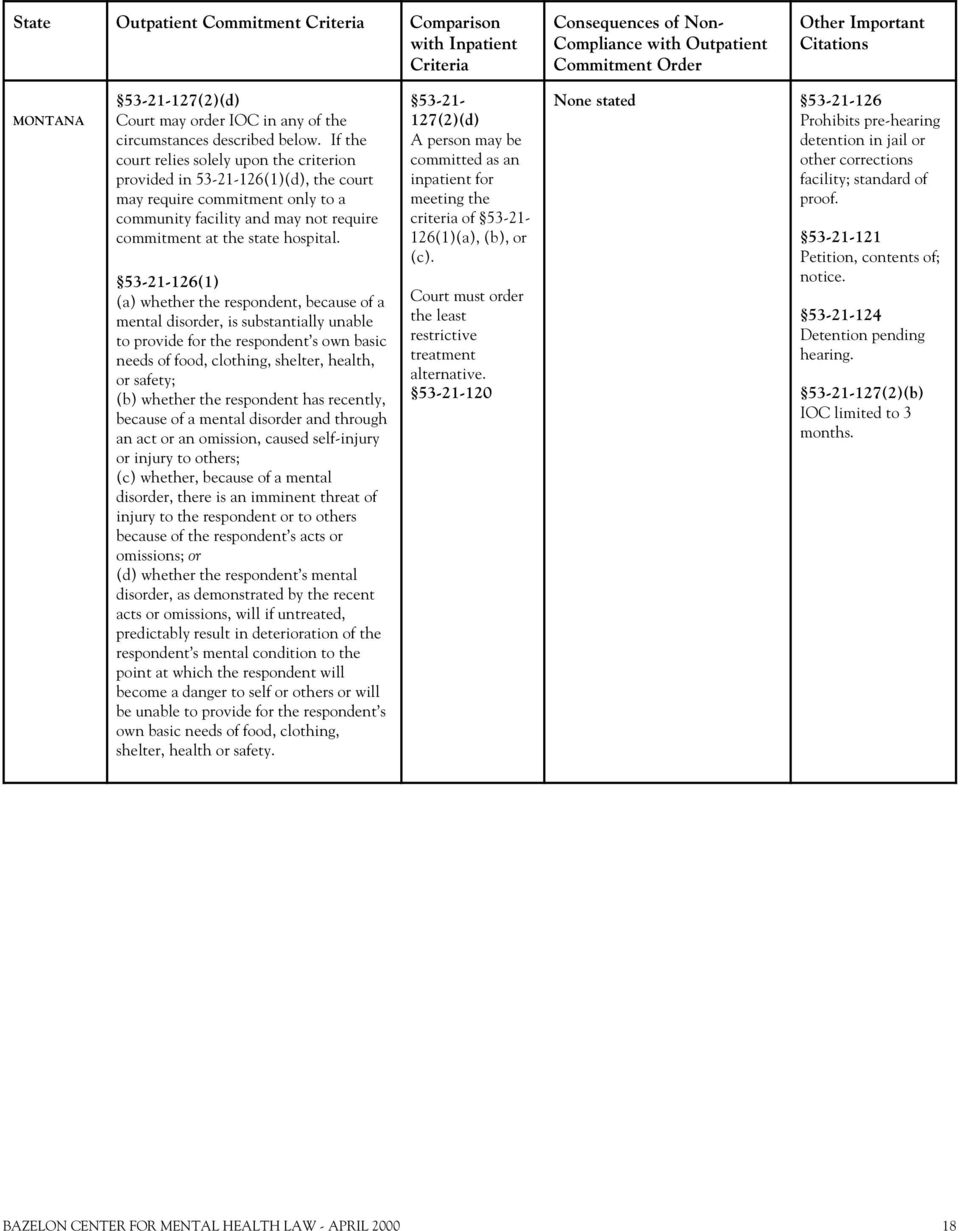
18 State Outpatient Commitment Comparison MONTANA (2)(d) Court may order IOC in any of the circumstances described below. If the court relies solely upon the criterion provided in (1)(d), the court may require commitment only to a community facility and may not require commitment at the state hospital (1) (a) whether the respondent, because of a mental disorder, is substantially unable to provide for the respondent s own basic needs of food, clothing, shelter, health, or safety; (b) whether the respondent has recently, because of a mental disorder and through an act or an omission, caused self-injury or injury to others; (c) whether, because of a mental disorder, there is an imminent threat of injury to the respondent or to others because of the respondent s acts or omissions; or (d) whether the respondent s mental disorder, as demonstrated by the recent acts or omissions, will if untreated, predictably result in deterioration of the respondent s mental condition to the point at which the respondent will become a danger to self or others or will be unable to provide for the respondent s own basic needs of food, clothing, shelter, health or safety (2)(d) A person may be committed as an inpatient for meeting the criteria of (1)(a), (b), or (c). Court must order the least restrictive treatment alternative None stated Prohibits pre-hearing detention in jail or other corrections facility; standard of proof Petition, contents of; notice Detention pending hearing (2)(b) IOC limited to 3 months. BAZELON CENTER FOR MENTAL HEALTH LAW - APRIL
19 State Outpatient Commitment Comparison NEBRASKA Court may order IOC for mentally ill dangerous person Mentally ill dangerous person is defined as any mentally ill person, alcoholic person, or drug-abusing person who presents: (1) A substantial risk of serious harm to another person or persons w/in the near future as manifested by evidence of recent violent acts or threats of violence or by placing others in reasonable fear of such harm; or (2) A substantial risk of serious harm to himself or herself w/in the near future as manifested by evidence of recent attempts at, or threats of, suicide or serious bodily harm or evidence of inability to provide for his or her basic human needs, including food, clothing, shelter, essential medical care, or personal safety Same The disposition ordered by the mental health board shall represent the alternative which imposes the least restraint upon the liberty of the subject. Inpatient hospitalization or custody shall be considered a treatment alternative of last resort (1) Provider has a duty to report the subject s noncompliance or the treatment plan s ineffectiveness; (2)(c) If it is found that (i) the subject is not following the treatment plan, (ii) the subject is not following the conditions set by the mental health board, (iii) the treatment plan is not effective, or (iv) there has been a significant change in the subject s mental illness and intervention is required to protect the subject or others, provider may file a motion for reconsideration of the IOC order. If they believe that the person poses a danger if not restrained prior to the hearing, may apply for a warrant to seize and hold subject Order, standard of proof Outpatient treatment defined If less restrictive treatment alternatives are available and would suffice to prevent the harm described by , the board may either dismiss the petition or suspend further proceedings for a period not to exceed 90 days in order to determine the results of voluntary treatment alternatives. BAZELON CENTER FOR MENTAL HEALTH LAW - APRIL

20 State Outpatient Commitment Comparison NEW YORK Mental Hygiene 9.60(c) (1) Patient is 18 years of age or older; (2) patient is suffering from a mental illness; (3) patient is unlikely to survive safely in the community without supervision, based on a clinical determination; (4) the patient has a history of lack of compliance with treatment for mental illness that has: (i) at least twice in the last thirty-six months been a significant factor in necessitating hospitalization in a hospital, or receipt of services in a forensic or other mental health unit of a correctional facility or a local correctional facility, not including any period during which the person was hospitalized or incarcerated immediately preceding the filing of the petition or; (ii) resulted in one or more acts of serious violent behavior toward self or others or threats of, or attempts at, serious physical harm to self or others within the last 48 months, not including any period in which the person was hospitalized or incarcerated immediately preceding the filing of the petition; (5) the patient is, as a result of his or her mental illness, unlikely to voluntarily participate in the recommended treatment pursuant to the treatment plan; (6) in view of the patient's treatment history and current behavior, the patient is in need of assisted outpatient treatment in order to prevent a relapse or deterioration which would be likely to result in serious harm to the patient or others; and (7) it is likely that the patient will benefit from assisted outpatient treatment. Inpatient commitment requires that a person be: Mentally ill and In need of involuntary care and treatment Mental Hygiene 9.27 and Pose, by clear and convincing evidence, a substantial threat of physical harm to himself or to others Goetz v Crosson, 967 F.2d 29 (NY 1992). Mental Hygiene 9.60(n) Where the patient has failed or has refused to comply with the treatment ordered by the court, efforts were made to solicit compliance, and such patient may be in need of involuntary admission to a hospital, they may be removed to an appropriate hospital for an examination to determine if such person has a mental illness for which hospitalization is necessary. Furthermore, if such assisted outpatient refuses to take medications as required by the court order, or he or she refuses to take or fails a blood test, urinalysis, or alcohol or drug test as required by the court order, such physician may consider such refusal or failure when determining whether the assisted outpatient is in need of an examination to determine whether he or she has a mental illness for which hospitalization is necessary. Police officers, ambulances, or mobile crisis outreach teams may take into custody or transport any such person to the hospital operating the outpatient treatment program or to any hospital authorized by the director of community services to receive such persons. Person may be detained for up to 72 hours for evaluation. Mental Hygiene 9.60 is also cited as: 1999 Sess. Law News of NY Ch. 408 (S A) and Kendra s Law Mental Hygiene 9.60(a)(1) Assisted outpatient treatment defined. Mental Hygiene 9.60(c)(8) Advance directives must be taken into account. Mental Hygiene 9.60(j)(2) Initial IOC limited to 6 months. Mental Hygiene 9.60(k) Court may extend IOC for up to an additional year. BAZELON CENTER FOR MENTAL HEALTH LAW - APRIL

21 State Outpatient Commitment Comparison NORTH CAROLINA 122C-263(d)(1) (a) person is mentally ill; (b) person is capable of surviving safely in the community with available supervision from family, friends, or others; (c) based on psychiatric history, the person is in need of treatment in order to prevent further disability or deterioration that would predictably result in dangerousness (as defined by 122C- 3(11)); and (d) the person's current mental status or the nature of the person's illness limits or negates the person's ability to make an informed decision to seek voluntarily or comply with recommended treatment. Inpatient commitment requires that respondent is mentally ill and is dangerous to self or others (as defined in 122C-3(11)(a) and (b)) 122C-263(d)(2) 122C-265 (a) If a respondent fails to appear for examination by the proposed outpatient treatment physician or center at the designated time, the physician or center shall notify the clerk of the superior court who shall issue an order to a law enforcement officer or other authorized person to take the respondent into custody and take him immediately to the outpatient treatment physician or center for evaluation. 122C-273(a) (1) If a person fails or refuses to comply, provider must make all reasonable efforts to solicit compliance and must document such efforts; (2) If a person fails but is not clearly refusing to comply, provider may request an order to take the person into custody for an examination and to have the person picked up by a law enforcement officer; (3) In no case shall a person be physically forced to take medication or be forcibly detained for treatment unless they pose an immediate danger to self or others. 122C-267 Court hearing and standard of proof (clear and convincing). 122C-265 Examination and treatment pending hearing. 122C-3(11) Dangerousness defined. 122C-271(a)(1) Initial IOC order limited to 90 days. 122C-274(c) Court may order an examination and/or change or reissue the IOC order. BAZELON CENTER FOR MENTAL HEALTH LAW - APRIL
22 State Outpatient Commitment Comparison NORTH DAKOTA (1) Court may order treatment other than hospitalization for person requiring treatment (11) Person requiring treatment means a person who is: Mentally ill or chemically dependant, and there is a reasonable expectation that if the person is not treated there exists a serious risk of harm to that person, others, or property. Serious risk of harm means a substantial likelihood of: (a) Suicide, as manifested by suicidal threats, attempts, or significant depression relevant to suicidal potential; (b) Killing or inflicting serious bodily harm on another person or inflicting significant property damage, as manifested by acts or threats; (c) Substantial deterioration in physical health, or substantial injury, disease, or death, based upon recent poor selfcontrol or judgment in providing one s shelter, nutrition, or personal care; or (d) Substantial deterioration in mental health which would predictably result in dangerousness to that person, others, or property, based upon acts, threats, or patterns in the person s treatment history, current condition and other relevant factors (1) Court must also find that treatment program other than hospitalization is adequate to meet the respondent s treatment needs and is sufficient to prevent harm or injuries to self or others. Same (2) and (3) (2) (2) The department, a representative of the treatment program involved in the alternative treatment order, the petitioner s retained attorney, or the state s attorney may apply to modify the alternative treatment order. Based on evidence presented at a hearing and other available information, the court may modify the IOC order in the following ways: (a) continue the alternative treatment order; (b) consider other alternatives to hospitalization, modify the court s original order, and direct the individual to undergo another program of alternative treatment for the remainder on the ninetyday period; or (c) enter a new order directing that the individual be hospitalized until ready for discharge. If the individual refuses to comply with this hospitalization order, the court may direct a peace officer to take the individual into protective custody and transport the respondent to a treatment facility (3) If a peace officer, physician, psychiatrist, clinical psychologist, or any mental health professional reasonably believes that the respondent is not complying with an order for alternative treatment and cannot wait for court intervention, the designated professional may cause the respondent to be taken into custody and detained at a treatment facility. In re JAD, 492 N.W.2d 82 (N.D. 1992). Respondent has the right to be served in the least restrictive conditions (1) Initial IOC order limited to 90 days. BAZELON CENTER FOR MENTAL HEALTH LAW - APRIL
23 State Outpatient Commitment Comparison OHIO (C) If, upon completion of the hearing, the court finds by clear and convincing evidence that the respondent is a mentally ill person subject to hospitalization by court order, the court may order the respondent to receive psychiatric or psychological care and treatment for a period not to exceed ninety (90) days (B) Mentally ill person subject to hospitalization by court order means a mentally ill person who, because of the person's illness: (1) Represents a substantial risk of physical harm to self as manifested by evidence of threats of, or attempts at, suicide or serious self-inflicted bodily harm; (2) Represents a substantial risk of physical harm to others as manifested by evidence of recent homicidal or other violent behavior, evidence of recent threats that place another in reasonable fear of violent behavior and serious physical harm, or other evidence of present dangerousness; (3) Represents a substantial and immediate risk of serious physical impairment or injury to self as manifested by evidence that the person is unable to provide for and is not providing for the person's basic physical needs because of the person's mental illness and that appropriate provision for those needs cannot be made immediately available in the community; or (4) Would benefit from treatment in a hospital for his mental illness and is in need of such treatment as manifested by evidence of behavior that creates a grave and imminent risk to substantial rights of others or himself. Same (C) None stated (D) IOC order conditioned upon consent by the hospital, facility, agency, or person to accept the respondent (F) If at any time during 90 days treatment facility determines needs could be met in less restrictive manner, person shall be immediately released and referred to the court for dismissal or placement is a less restrictive setting (E) Court shall consider the preferences of the respondent and shall order the implementation of the least restrictive alternative available and consistent with treatment goals. BAZELON CENTER FOR MENTAL HEALTH LAW - APRIL
24 State Outpatient Commitment Comparison OKLAHOMA 43A 5-415(E) Court may order a treatment program other than hospitalization for a mentally ill person requiring treatment if it is appropriate to meet the individual s treatment needs and is sufficient to prevent injury to the individual or others. 43A 1-103(14) Mentally ill person requiring treatment means either: (a) a person who has a demonstrable mental illness or is a drug- or alcoholdependent person and who as a result of that mental illness or dependency can be expected within the near future to intentionally or unintentionally seriously and physically injure himself or another person and who has engaged in one or more recent overt acts or made significant recent threats that substantially support that expectation, or (b) a person who has a demonstrable mental illness or is a drug- or alcoholdependent person and who as a result of that mental illness or dependency is unable to attend to those of his basic physical needs such as food, clothing or shelter that must be attended to in order for him to avoid serious harm in the near future and who has demonstrated such inability by failing to attend to those basic physical needs in the recent past, or (c) a person who appears to require inpatient treatment (1)(a) for a previously diagnosed history of schizophrenia, bipolar disorder, or major depression with suicidal intent, or (b) due to the appearance of symptoms of schizophrenia, bipolar disorder, or major depression with suicidal intent, and(2) for whom such treatment is reasonably believed to prevent progressively more debilitating mental impairment. Same Court must first thoroughly consider available treatment alternatives to hospitalization. 43A 5-415(E) and A 5-416(B) If the individual ordered to undergo a program of alternative treatment to hospitalization is not complying with the order or the treatment program is not sufficient to prevent harm or injury to self or others, the court may order one or more of the following: (1) consider other alternatives to hospitalization, modify or rescind the original order or direct the individual to undergo another program of alternative treatment for the remainder of the ninetyday period, or for a period not to exceed twelve (12) months; and/or (2) enter an order of admission pursuant to the provisions of the mental health law, directing that the person be hospitalized and, if the individual refuses to comply with this order or hospitalization, the court may direct a peace officer to take the individual into protective custody and transport such person to a public or private facility designated by the court. 43A Requirement to consider alternatives to hospitalization, time limit of 90 days for initial IOC order. 43A Evaluations for commitment (includes form). BAZELON CENTER FOR MENTAL HEALTH LAW - APRIL
25 State Outpatient Commitment Comparison OREGON (1)(b)(C)(ii) Court may order IOC for a mentally ill person (1)(d) Mentally ill person means a person who because of a mental disorder, is one or more of the following: (A) dangerous to self or others; (B) unable to provide for basic personal needs and is not receiving such care as is necessary for health or safety; or (C) A person who: (i) Is chronically mentally ill (as defined in ); (ii) Within the previous three years, has twice been placed in a hospital or approved inpatient facility; (iii) Is exhibiting symptoms or behavior substantially similar to those that preceded and led to one or more of the hospitalizations or inpatient placements referred to in subsubparagraph (ii) of this subparagraph; and (iv) Unless treated, will continue, to a reasonable medical probability, to physically or mentally deteriorate so that the person will become a person described under either or both subparagraph (A) or (B) of this paragraph. Same (1) (b)(c) (1) If the person responsible under this subsection determines that the mentally ill person is failing to adhere to the terms and conditions of the placement, the responsible person shall notify the court having jurisdiction; (2) On its own motion, the court with jurisdiction of a mentally ill person on such placement may cause the person to be brought before it for a hearing to determine whether the person is or is not adhering to the terms and conditions of the placement; (3) The court shall either continue the placement on the same or modified conditions or shall return the person for involuntary care and treatment on an inpatient basis subject to discharge at the end of the commitment period (1) Court may only order IOC if treatment available (2) Period of outpatient commitment not to exceed 180 days (1)(b)(A) The court shall order the release of the individual and dismiss the IOC case if: (i) The mentally ill person is willing and able to participate in treatment on a voluntary basis; and (ii) The court finds that the person will probably do so. BAZELON CENTER FOR MENTAL HEALTH LAW - APRIL
26 State Outpatient Commitment Comparison PENNSYL- VANIA Court may order outpatient treatment for person who is severely mentally disabled and in need of treatment upon a determination of clear and present danger, including serious bodily harm to others, inability to care for self, creating a danger of death or serious harm to self, attempted suicide, or self-mutilation (a) A person is severely mentally disabled when, as a result of mental illness, his capacity to exercise self-control, judgment and discretion in the conduct of his affairs and social relations or to care for his own personal needs is so lessened that he poses a clear and present danger of harm to others or to himself. Same Inpatient treatment shall be deemed appropriate only after full consideration has been given to less restrictive alternatives. Investigation of treatment alternatives shall include consideration of the person s relationship to community and family, employment possibilities, all community resources, and guardianship services (f) (a)(2) Where a petition is filed for a person already subject to involuntary treatment, it shall be sufficient to represent, and upon hearing to reestablish, that the conduct originally required in fact occurred, and that his condition continues to evidence a clear and present danger to himself or others. In such event, it shall not be necessary to show the reoccurrence of dangerous conduct, either harmful or debilitating, within the past 30 days (c) Person subject to IOC may not be transferred to more restrictive setting without a hearing (b) Clear and present danger, defined (g) Initial commitment not to exceed 90 days, unless charged with certain violent crimes (a) Commitment may be extended for up to 180 days. If initial commitment was for danger to self, inpatient commitment may only be extended only if first released to less restrictive alternative. Consideration of available resources may be factor in commitment decision. In re Victor, 665 A.2d 8 (Pa. 1995). RHODE ISLAND (j) Court may order IOC if it finds, by clear and convincing evidence, the following: (1) person is in need of care and treatment in a facility; (2) if left unsupervised, the person's presence in the community would, by reason of mental disability create a likelihood of serious harm; and (3) all alternatives to certification have been investigated and deemed unsuitable (1) Alternatives to admission or certification specifically includes courtordered outpatient treatment. Same (j) None stated Court mandated to consider IOC as alternative to inpatient treatment. Rhode Island Dept. of Mental Health, Retardation & Hosps. v. R.B., 549 A.2d 1028 (R.I. 1998) (j) IOC order valid for 6 months. BAZELON CENTER FOR MENTAL HEALTH LAW - APRIL
27 State Outpatient Commitment Comparison SOUTH CAROLINA Court may order outpatient treatment if there is clear and convincing evidence that the person is mentally ill, needs treatment, and because of their condition: (1) the person lacks sufficient insight or capacity to make responsible decisions with respect to their treatment; or (2) there is a likelihood of serious harm to self or others. Same If the person fails to adhere to the prescribed outpatient treatment program, the court may order a supplemental hearing and further order in-patient treatment in a designated or licensed facility. Person committed on an outpatient basis cannot be committed on an inpatient basis for noncompliance without a determination that they meet the inpatient standard. Op. Atty. Gen., No , at 300 ( ). BAZELON CENTER FOR MENTAL HEALTH LAW - APRIL
28 State Outpatient Commitment Comparison SOUTH DAKOTA 27A Upon completion of a hearing, the board of mental illness may order the involuntary commitment if a majority of the board finds by clear and convincing evidence, supported by written findings of fact and conclusions of law, that: (1) The person meets the criteria in 27A-1-2; (2) The person needs and is likely to benefit from the treatment which is proposed; and (3) The commitment is to the least restrictive treatment alternative. 27A-1-2 A person is subject to involuntary commitment if: (1) The person has a severe mental illness; (2) Due to the severe mental illness, the person is a danger to self or others; and (3) The individual needs and is likely to benefit from treatment. 27A-10-9 The board of mental illness conducting the involuntary commitment hearing shall order testimony by a qualified mental health professional independent of the petitioner who shall assess the availability and appropriateness of treatment alternatives including treatment programs other than inpatient treatment and specifically including whether such programs are available at the mental health center serving the area in which the person was apprehended or resides. Such testimony shall include what alternatives are or should be made available, what alternatives were investigated, and why any investigated alternatives are not deemed appropriate. If the board determines that alternatives to inpatient treatment are appropriate, commitment for inpatient treatment to the center or other inpatient psychiatric facility may not be ordered and commitment shall be to the least restrictive treatment alternative. Same None stated 27A Initial IOC order limited to 90 days. 27A If a treatment plan has not been implemented within ten days of commitment, the person shall be released immediately unless he agrees to continue with treatment on a voluntary basis. Automatic, periodic reviews of commitment are required. 27A-14-2 A patient involuntarily committed shall be discharged when, in the opinion of the program director, the patient no longer meets the commitment criteria. 27A (as amended by 2000 S. Dakota Laws H.B. 1036) Right to have and participate in the development of an individualized treatment plan. 27A-10-8 Hearing procedures. BAZELON CENTER FOR MENTAL HEALTH LAW - APRIL
29 State Outpatient Commitment Comparison TEXAS Health and Safety (b) Court may order temporary (up to 90 days) IOC if: (1) appropriate mental health services are available to the patient; and (2) there is clear and convincing evidence that (A) the patient is mentally ill; (B) the nature of the mental illness is severe and persistent; (C) as a result of the mental illness, the patient will, if not treated continue to: (i) suffer severe and abnormal mental, emotional, or physical distress; and (ii) experience deterioration of the ability to function independently to the extent that the proposed patient will be unable to live safely in the community without court-ordered outpatient mental health services; and (D) the patient has an inability to participate in outpatient treatment services effectively and voluntarily as demonstrated by: (i) any of the proposed patient's actions occurring within the two-year period which immediately precedes the hearing; or (ii) specific characteristics of the proposed patient's clinical condition that make impossible a rational and informed decision whether to submit to voluntary outpatient treatment. Court may order inpatient commitment if there is clear and convincing evidence that the person is mentally ill and, as a result, is likely to cause serious harm to self or others, or is suffering severe and abnormal distress/inability to function. Health and Safety (a) None stated However, the court may modify an IOC order based on a request by a provider, any other interested person, or on its own. Modification may include inpatient commitment, but in no case may the modification extend the order beyond the time period originally imposed. Health and Safety Health and Safety Order of care or commitment. Health and Safety Certification of mental illness. Health and Safety (d) and (e) Clear and convincing defined. Health and Safety Court may order extended (12 months) IOC if the individual meets the above criteria and (E) the proposed patient's condition is expected to continue for more than 90 days; and (F) the proposed patient has received court-ordered inpatient mental health services under this subtitle or under Section 5, Article 46.02, Code of Criminal Procedure, for at least 60 consecutive days during the preceding 12 months. BAZELON CENTER FOR MENTAL HEALTH LAW - APRIL
30 State Outpatient Commitment Comparison UTAH 62A (10) Same The court shall order commitment of an individual who is 18 years of age or older 62A-12- to a local mental health authority if, 234(10) upon completion of the hearing and consideration of the record, the court finds by clear and convincing evidence that: (a) the proposed patient has a mental illness; (b) because of the proposed patient's mental illness he poses an immediate danger of physical injury to others or himself, which may include the inability to provide the basic necessities of life such as food, clothing, and shelter, if allowed to remain at liberty; (c) the patient lacks the ability to engage in a rational decision-making process regarding the acceptance of mental treatment as demonstrated by evidence of inability to weigh the possible costs and benefits of treatment; (d) there is no appropriate lessrestrictive alternative to a court order of commitment; and (e) the local mental health authority can provide the individual with treatment that is adequate and appropriate to his conditions and needs. None stated 16A (11) (a) Initial order limited to 6 months; subsequent extension can be for indeterminate period if court finds that conditions will last for indeterminate period. (c) Order for indeterminate period must be reviewed every 6 months. BAZELON CENTER FOR MENTAL HEALTH LAW - APRIL
31 State Outpatient Commitment Comparison VERMONT (b)(3) If the court finds that the person is in need of treatment (at the time of admission or application) or a patient in need of further treatment (at the time of the hearing), the court may order the person to undergo a program of treatment other than hospitalization ( order of nonhospitalization ) (17) Person in need of treatment is a person suffering from mental illness, and as a result of that mental illness, his capacity to exercise self-control, judgment or discretion in the conduct of his affairs and social relations is so lessened that he poses a danger of harm to himself or others. Same (1) and (2) (b) If at any time during the specified period it comes to the attention of the court that the patient is not complying with the order, or that the alternative treatment has not been adequate to meet the patient s treatment needs, the court may, after proper hearing: (1) Consider other alternatives, modify its original order and direct the patient to undergo another program of alternative treatment for the remainder of the 90-day period; or (2) Enter a new order directing that the patient be hospitalized for the remainder of the 90-day period (a) Initial order is for 90 days Subsequent orders for non-hospitalization may be issued for up to 1 year (16) Patient in need of further treatment is a person in need of treatment (see above), or a patient who is receiving adequate treatment, and who, if such treatment is discontinued, presents a substantial probability that in the near future his condition will deteriorate and he will become a person in need of treatment (c) Court must first determine if an appropriate alternative program is available (d)(1) and (2) If at any time during the period of continued nonhospitalization ordered, it comes to the attention of the court, that the person is not complying with the order, or that the alternative treatment has not been adequate to meet the patient s treatment needs, the court may, after proper hearing: (1) Consider other treatments not involving hospitalization, modify its original order, and direct the patient to undergo another program of alternative treatment for an indeterminate period, up to the expiration date of the original order; or (2) Order that the patient be hospitalized, up to the expiration date of the original order. BAZELON CENTER FOR MENTAL HEALTH LAW - APRIL
32 State Outpatient Commitment Comparison VIRGINIA Court may order IOC if it finds the following: the person presents an imminent danger to himself or others as a result of mental illness or has been proven to be so seriously mentally ill as to be substantially unable to care for himself; less restrictive alternatives to institutional confinement and treatment have been investigated and are deemed suitable; the patient has the degree of competency necessary to understand the stipulations of his treatment; the patient expresses an interest in living in the community and agrees to abide by his treatment plan; the patient is deemed to have the capacity to comply with the treatment plan; the ordered treatment can be delivered on an outpatient basis; and the ordered treatment can be monitored by the community services board or designated providers. Inpatient requires that alternatives to involuntary confinement and treatment have been investigated and deemed unsuitable and that there is no less restrictive alternative to institutional confinement and treatment Upon failure of the patient to adhere to the terms of outpatient treatment, the judge may revoke the IOC order, and upon notice to the patient and after a commitment hearing, order involuntary commitment for treatment in a hospital IOC order not to exceed 180 days. BAZELON CENTER FOR MENTAL HEALTH LAW - APRIL
33 State Outpatient Commitment Comparison WASH- INGTON If the court finds that a person, as the result of a mental disorder, presents a likelihood of serious harm, or is gravely disabled, but that treatment in a less restrictive setting than detention is in the best interest of such person or others, the court shall order an appropriate less restrictive course of treatment for not to exceed 90 days. If the court finds by a preponderance of the evidence that a person, as the result of mental disorder, presents a likelihood of serious harm, or is gravely disabled, and, after considering less restrictive alternatives to involuntary detention and treatment, finds that no such alternatives are in the best interests of such person or others, the court shall order that such person be detained for involuntary treatment not to exceed 14 days None stated for IOC (3): Procedures for revocation of conditional release (a) The person may be temporarily detained for evaluation; (b) The hospital or facility designated to provide outpatient treatment has a duty to report noncompliance; (c) A person detained under this subsection shall be held until such time, not exceeding 5 days, as a hearing can be scheduled to determine whether or not the person should be returned to the hospital or facility from which he or she had been conditionally released; (e) The court may order the conditionally released person to either continue to be conditionally released on the same or modified conditions or be returned for involuntary treatment on an inpatient basis subject to release at the end of the period for which he or she was committed for involuntary treatment IOC order may be extended for no more than 90 days. When a person alleges in good faith that they will voluntarily participate in treatment, the burden is on the state to show that the person has not in good faith volunteered. In re Kirby, 829 P.2d 1139 (Wash. 1992). BAZELON CENTER FOR MENTAL HEALTH LAW - APRIL
34 State Outpatient Commitment Comparison WEST VIRGINIA Court may order commitment to a mental health facility, which is defined to include outpatient facilities, if the following is found: (j) (1) person is mentally ill, retarded or addicted and because of illness, retardation or addiction is likely to cause serious harm to himself or herself or to others if allowed to remain at liberty; (2) there is no less restrictive alternative than commitment appropriate for the individual. The burden of proof of the lack of a less restrictive alternative than commitment shall be on the person or persons seeking the commitment of the individual. Same Where an individual refuses to comply with a court order to take advantage of mental health facility outpatient services, this refusal may in itself be evidence that no less restrictive treatment than hospitalization is appropriate to that individual; an appropriate response to this refusal could be to hold another hearing, make requisite findings of subsection (j) and effect a commitment to a more restrictive setting. Op. Atty. Gen. May 29, (j)(3) Standard of proof (clear, cogent and convincing) (k)(1) Court may issue order for an indeterminate period of time or for a temporary observatory period not exceeding 6 months. Orders for indeterminate periods will automatically expire after 2 years unless extended (o) Court may order person to custody of a responsible person, rather than mental health facility. BAZELON CENTER FOR MENTAL HEALTH LAW - APRIL
35 State Outpatient Commitment Comparison WYOMING (j) If, after a hearing, the court or the jury finds by clear and convincing evidence that the proposed patient is mentally ill the court shall consider the least restrictive and most therapeutic alternatives. (ii) If the court finds that the proposed patient does not require continuous inpatient hospitalization, would be more appropriately treated in an outpatient treatment program or a combination of outpatient and inpatient treatment or will be able to appropriately control his illness by following a prescribed treatment plan, the court shall consider such treatment options. If the court finds that the proposed patient does not require continuous hospitalization and the funding is available, it shall consider conditional outpatient treatment for a period of time deemed appropriate and may designate an outpatient care provider, including mental health centers (a)(ix) Mental illness and mentally ill mean a physical, emotional, mental or behavioral disorder which causes a person to be dangerous to himself or others (as defined in (a)(ii)) and which requires treatment. Inpatient commitment requires clear and convincing evidence that the proposed patient is mentally ill and hospitalization is the least restrictive alternative (j)(i) (j)(ii) Court may order involuntary hospitalization (j)(ii) Court may suspend commitment proceedings pending voluntary treatment as approved by the examiner and by the facility or individual who will provide the treatment (j)(ii) Conditional outpatient treatment may require periodic reporting, continuation of medication and submission to testing and restriction of travel, consumption of alcoholic beverages or drugs, associations with other persons or other reasonable conditions as the court may specify. BAZELON CENTER FOR MENTAL HEALTH LAW - APRIL
36 Sample State Definitions of Important Involuntary Outpatient Commitment Terms Kansas (f) (1) Mentally ill person subject to involuntary commitment for care and treatment means a mentally ill person... who also lacks capacity to make an informed decision concerning treatment, is likely to cause harm to self or others, and whose diagnosis is not solely one of the following mental disorders: Alcohol or chemical substance abuse; antisocial personality disorder; mental retardation; organic personality syndrome; or an organic mental disorder. (2) Lacks capacity to make an informed decision concerning treatment means that the person, by reason of the person's mental disorder, is unable, despite conscientious efforts at explanation, to understand basically the nature and effects of hospitalization or treatment or is unable to engage in a rational decision-making process regarding hospitalization or treatment, as evidenced by an inability to weigh the possible risks and benefits. (3) Likely to cause harm to self or others means that the person, by reason of the person's mental disorder: (a) Is likely, in the reasonably foreseeable future, to cause substantial physical injury or physical abuse to self or others or substantial damage to another's property, as evidenced by behavior threatening, attempting or causing such injury, abuse or damage; except that if the harm threatened, attempted or caused is only harm to the property of another, the harm must be of such a value and extent that the state's interest in protecting the property from such harm outweighs the person's interest in personal liberty; or (b) is substantially unable, except for reason of indigency, to provide for any of the person's basic needs, such as food, clothing, shelter, health or safety, causing a substantial deterioration of the person's ability to function on the person's own. No person who is being treated by prayer in the practice of the religion of any church which teaches reliance on spiritual means alone through prayer for healing shall be determined to be a mentally ill person subject to involuntary commitment for care and treatment under this act unless substantial evidence is produced upon which the district court finds that the proposed patient is likely in the reasonably foreseeable future to cause substantial physical injury or physical abuse to self or others or substantial damage to another's property, as evidenced by behavior threatening, attempting or causing such injury, abuse or damage; except that if the harm threatened, attempted or caused is only harm to the property of another, the harm must be of such a value and extent that the state's interest in protecting the property from such harm outweighs the person's interest in personal liberty. Minnesota - 263b.02 Subd. 13(a) mentally ill person - any person who has an organic disorder of the brain or a substantial psychiatric disorder of thought, mood, perception, orientation, or memory which grossly impairs judgment, behavior, capacity to recognize reality, or to reason or understand, which is manifested by instances of grossly disturbed behavior or faulty perceptions and poses a substantial likelihood of physical harm to self or others as demonstrated by: I ) a failure to obtain necessary food, clothing, shelter, or medical care as a result of the impairment or 2) a recent attempt or threat to physically harm self or others Rhode Island (1) (7)(I) Likelihood of serious harm is defined as: 1) A substantial risk of physical harm to the person himself or herself as manifested by behavior evidencing serious threats of, or attempts at, suicide 2) A substantial risk of physical harm to other persons as manifested by behavior or threats evidencing homicidal or other violent behavior, or 3) A substantial risk of physical harm to the mentally disabled person as manifested by behavior which has created a grave, clear, and present risk to his or her physical health and safety BAZELON CENTER FOR MENTAL HEALTH LAW - APRIL
37 Vermont (17)(A) danger of harm to others may be shown by establishing that: (i) he has inflicted or attempted to inflict bodily harm on another; or (ii)by his threats or actions he has placed others in reasonable fear or physical harm to themselves; or (ii by his actions or inactions he has presented a danger to persons in his care. danger of harm to himself may be shown by establishing that: (i) he has threatened or attempted suicide or serious bodily harm; or (ii be has behaved in such a manner as to indicate that he is unable, without supervision and the assistance of others, to satisfy his need for nourishment, personal or medical care, shelter, or self-protection and safety, so that it is probable that death, substantial physical bodily injury, serious mental deterioration or serious physical debilitation or disease will ensue unless adequate treatment is afforded. Washington likelihood of serious harm (a) A substantial risk that physical harm will be inflicted by an individual upon his or her own person, as evidenced by threats or attempts to commit suicide or inflict physical harm on one s self, (b) a substantial risk that physical harm will be inflicted by an individual upon another, as evidenced by behavior which has caused such harm or which places another person or persons in reasonable fear of sustaining such harm (c) or a substantial risk that physical harm will be inflicted by an individual upon the property of other, as evidenced by behavior which has caused substantial loss or damage to the property of others. Gravely disabled - a condition in which a person, as a result of a mental disorder; (c) is in danger of serious physical harm resulting from a failure to provide for his or her essential human needs of health or safety; or (d) manifests severe deterioration in routine functioning evidenced by repeated and escalating loss of cognitive or volitional control over his or her actions and is not receiving such care as is essential for his or her health or safety West Virginia likely to cause serious harm - is a person who has (1) a substantial tendency to physically harm himself which is manifested by threats of or attempts at suicide or serious bodily harm or other conduct, either active or passive, which demonstrates that he is dangerous to himself; or (2) a substantial tendency to physically harm other person which is manifested by homicidal or other violent behavior which places others in reasonable fear of serious physical harm; or (3) a complete inability to care for himself by reason of mental retardation; or (4) become incapacitated as defined in section sixteen of this article. BAZELON CENTER FOR MENTAL HEALTH LAW - APRIL
STATE STANDARDS FOR ASSISTED TREATMENT
 STATE STANDARDS FOR ASSISTED TREATMENT Civil Commitment Criteria for Inpatient or Outpatient Psychiatric Treatment June 2011 200 NORTH GLEBE ROAD, SUITE 730 ARLINGTON, VIRGINIA 22203 (703) 294-6001 TreatmentAdvocacyCenter.org
STATE STANDARDS FOR ASSISTED TREATMENT
 STATE STANDARDS FOR ASSISTED TREATMENT Civil Commitment Criteria for Inpatient or Outpatient Psychiatric Treatment October 2014 200 NORTH GLEBE ROAD, SUITE 801 ARLINGTON, VIRGINIA 22203 (703) 294-6001
STATE STANDARDS FOR ASSISTED TREATMENT
 STATE STANDARDS FOR ASSISTED TREATMENT Civil Commitment Criteria for Inpatient or Outpatient Psychiatric Treatment October 2014 200 NORTH GLEBE ROAD, SUITE 801 ARLINGTON, VIRGINIA 22203 (703) 294-6001
Involuntary Admissions & Treatment Facts and Procedures
 Involuntary Admissions & Treatment Facts and Procedures Marcia Horan Assistant State s Attorney, Cook County Seniors and Persons with Disabilities Division WHEN IS INVOLUNTARY ADMISSION APPROPRIATE? The
Understanding the Civil Involuntary Commitment Process
 Understanding the Civil Involuntary Commitment Process About the Author By D. Renée Hildebrant http://www.okbar.org/obj/articles_05/021205.htm Oklahoma Bar Journal D. Renée Hildebrant is the trial court
Civil Commitment and Voluntary Treatment
 RIGHTS & REALITY II Civil Commitment and Voluntary Treatment Dianne Greenley, Attorney Wisconsin Coalition for Advocacy Focus on short term treatment Treatment and protection from harm Consequences to
Emergency Hospitalization for Evaluation Assisted Psychiatric Treatment Standards by State
 Emergency Hospitalization for Evaluation Assisted Psychiatric Treatment Standards by State This chart captures the most essential information about the criteria for emergency hospitalization in a treatment
Title II. Section 1. Purpose The Santee Sioux Nation Tribal Council in order to prevent Alcohol and Drug Abuse declares:
 Title II Health and Welfare Chapter 1 ALCOHOL AND DRUG ABUSE TREATMENT ACT Section 1. Purpose The Santee Sioux Nation Tribal Council in order to prevent Alcohol and Drug Abuse declares: A. Alcoholism and
SENATE BILL No. 795. Introduced by Senator Blakeslee. February 18, 2011. An act to amend Section 1370 of the Penal Code, relating to competency.
 SENATE BILL No. Introduced by Senator Blakeslee February, 0 An act to amend Section 0 of the Penal Code, relating to competency. legislative counsel s digest SB, as introduced, Blakeslee. Competency: involuntary
THE BAKER ACT: MENTAL HEALTH
 CHAPTER 32 THE BAKER ACT: MENTAL HEALTH by George F. Indest III, JD, MPA, LL.M SCOPE This chapter discusses FLorida's Baker Act, the Law which allows the involuntary commitment of individuals who poses
State Standards Charts for Assisted Treatment Civil Commitment Criteria and Initiation Procedures by State
 State Standards Charts for Assisted Treatment Civil Commitment Criteria and Initiation Procedures by State Table of Contents Introduction... 2 Assisted Psychiatric Treatment: Inpatient and Outpatient Standards
STATE OF NEW JERSEY DEPARTMENT OF HUMAN SERVICES DIVISION OF MENTAL HEALTH AND ADDICTION SERVICES. (Pursuant to N.J.S.A. 30:4-27.
 STATE OF NEW JERSEY DEPARTMENT OF HUMAN SERVICES DIVISION OF MENTAL HEALTH AND ADDICTION SERVICES SCREENING DOCUMENT FOR ADULTS (Pursuant to N.J.S.A. 30:4-27.1 et seq) to Instructions New Jersey Court
CHAPTER THREE SUBSTANCE ABUSE
 CHAPTER THREE SUBSTANCE ABUSE A. GENERALLY FOLLOW ADULT RULES...2 B. PERSONS SUBJECT TO COMMITMENT...2 C. THE COMMITMENT PROCESS...3 1. APPLICATION...3 2. STATEMENT OF PHYSICIAN OR AFFIDAVIT...3 3. ORDERS...4
Court-Ordered Mental Health Evaluation and Treatment in Arizona: Rights and Procedures
 The Arizona State Hospital The Arizona State Hospital is the only long-term inpatient psychiatric facility in Arizona. Before ordering that you receive treatment at the Arizona State Hospital, the court
A-79. Appendix A Overview and Detailed Tables
 Table A-8a. Overview: Laws Expressly Granting Minors the Right to Consent Disclosure of Related Information to Parents* Sexually Transmitted Disease and HIV/AIDS** Treatment Given or Needed Alabama 14
Treatment Advocacy Center
 A Guide to Kendra s Law Third Edition Treatment Advocacy Center 3300 N. Fairfax Dr., Suite 220, Arlington, VA 22201 (703) 294-6001 www.psychlaws.org Prepared by The Treatment Advocacy Center Arlington,
Clinical Considerations for Involuntary Mental Health Treatment of Adults in Oklahoma
 Clinical Considerations for Involuntary Mental Health Treatment of Adults in Oklahoma Brandon Schader, M.D. Medical Director for Crisis Stabilization Oklahoma County Crisis Intervention Center Oklahoma
Physician s Signature
 4. If testing for illegal substances (blood or urinalysis) is recommended: a) Does this respondent/patient have a history of substance abuse that is clinically related to his/her mental illness? If yes,
NEW YORK SECURE AMMUNITION AND FIREARMS ENFORCEMENT ACT (NY SAFE ACT)
 NEW YORK SECURE AMMUNITION AND FIREARMS ENFORCEMENT ACT (NY SAFE ACT) NYS Office of Mental Health NYS Office for People With Developmental Disabilities Guidance Document On January 15, 2013 Governor Cuomo
Initiating Court-Ordered Assisted Treatment Inpatient, Outpatient and Emergency Hospitalization Standards by State
 Initiating Court-Ordered Assisted Treatment Inpatient, Outpatient and Emergency Hospitalization Standards by State This chart captures the most essential information about who may initiate proceedings
Mental Health Needs of Juvenile Offenders. Mental Health Needs of Juvenile Offenders. Juvenile Justice Guide Book for Legislators
 Mental Health Needs of Juvenile Offenders Mental Health Needs of Juvenile Offenders Juvenile Justice Guide Book for Legislators Mental Health Needs of Juvenile Offenders Introduction Children with mental
Definitions of Child Abuse and Neglect
 State Statutes Current Through July 2009 Definitions of Child Abuse and Neglect Electronic copies of this publication may be downloaded at Child abuse and neglect are defined by Federal and State laws.
Rights for Individuals in Mental Health Facilities
 HANDBOOK Rights for Individuals in Mental Health Facilities Admitted Under the Lanterman-Petris-Short Act C A L I F O R N I A D E P A R T M E N T O F Mental Health How to Reach Your Patients Rights Advocate
A BILL FOR AN ACT ENTITLED: "AN ACT REVISING LAWS RELATING TO GUARDIANSHIP; REVISING
 HB0.0 HOUSE BILL NO. INTRODUCED BY J. ESSMANN, M. FUNK A BILL FOR AN ACT ENTITLED: "AN ACT REVISING LAWS RELATING TO GUARDIANSHIP; REVISING LAWS RELATING TO THE COMMITMENT OF INCAPACITATED PERSONS; PROVIDING
PLEASE NOTE. For more information concerning the history of this Act, please see the Table of Public Acts.
 PLEASE NOTE This document, prepared by the Legislative Counsel Office, is an office consolidation of this Act, current to December 6, 2013. It is intended for information and reference purposes only. This
CHAPTER 13 RULES FOR INVOLUNTARY COMMITMENT OR TREATMENT OF CHRONIC SUBSTANCE ABUSERS
 July 2009 CHRONIC SUBSTANCE ABUSERS Ch 13, p.i CHAPTER 13 RULES FOR INVOLUNTARY COMMITMENT OR TREATMENT OF CHRONIC SUBSTANCE ABUSERS Rule 13.1 Rule 13.2 Rule 13.3 Rule 13.4 Rule 13.5 Rule 13.6 Rule 13.7
CLINICAL PRIVILEGE WHITE PAPER Psychology
 Psychology CLINICAL PRIVILEGE WHITE PAPER Psychology Background Psychology is a broad field that includes the scientific study of mental processes and behavior. It is similar to the medical field of psychiatry.
ARTICLE 36: KANE COUNTY DRUG REHABILITATION COURT RULES AND PROCEDURES
 ARTICLE 36: KANE COUNTY DRUG REHABILITATION COURT RULES AND PROCEDURES (a) Mission: The Illinois General Assembly has recognized that there is a critical need for a criminal justice program that will reduce
YOUR RIGHTS REGARDING ADMISSION TO AND DISCHARGE FROM A HOSPITAL UNDER MASSACHUSETTS MENTAL HEALTH LAW
 YOUR RIGHTS REGARDING ADMISSION TO AND DISCHARGE FROM A HOSPITAL UNDER MASSACHUSETTS MENTAL HEALTH LAW Prepared by the Mental Health Legal Advisors Committee December 2011 Massachusetts General Laws Chapter
Adult Protective Services
 Chapter 7.E Guardianship/conservatorship and Mental Health Board A. Guardianship/Conservatorship 1. A guardian or conservator is a person or entity appointed by a court of competent jurisdiction to have
Introduced by Representative Gardner AN ACT
 State of Arizona House of Representatives Forty-third Legislature Second Regular Session REFERENCE TITLE: psychiatric security review board Introduced by Representative Gardner AN ACT Amending sections
MANDATED REPORTING OF CHILD NEGLECT OR PHYSICAL OR SEXUAL ABUSE
 POLICY #414 MANDATED REPORTING OF CHILD NEGLECT OR PHYSICAL OR SEXUAL ABUSE I. PURPOSE The purpose of this policy is to make clear the statutory requirements of school personnel to report suspected child
MEDICAL POLICY No. 91608-R1 MENTAL HEALTH RESIDENTIAL TREATMENT: ADULT
 MENTAL HEALTH RESIDENTIAL TREATMENT: ADULT Effective Date: June 4, 2015 Review Dates: 5/14, 5/15 Date Of Origin: May 12, 2014 Status: Current Summary of Changes Clarifications: Pg 4, Description, updated
MANDATED REPORTING OF CHILD NEGLECT OR PHYSICAL OR SEXUAL ABUSE 214. A. Child means a person under age 18.
 I. PURPOSE It is the policy of Lakes International Language Academy (the school ) to maintain this policy on mandated reporting of child neglect or physical or sexual abuse. The purpose of this policy
Florida Laws on Mental Health (Baker Act) and Substance Abuse (Marchman Act) 2013 Southeast Institute on Homelessness and Supportive Housing
 Florida Laws on Mental Health (Baker Act) and Substance Abuse (Marchman Act) 2013 Southeast Institute on Homelessness and Supportive Housing October 1, 2013 Alternatives to the Baker Act Mental Illness
KANE COUNTY DRUG REHABILITATION COURT COURT RULES AND PROCEDURES
 KANE COUNTY DRUG REHABILITATION COURT COURT RULES AND PROCEDURES I. MISSION The Illinois General Assembly has recognized that there is a critical need for a criminal justice program that will reduce the
MANDATED REPORTING OF CHILD NEGLECT OR PHYSICAL OR SEXUAL ABUSE
 MANDATED REPORTING OF CHILD NEGLECT OR PHYSICAL OR SEXUAL ABUSE I. PURPOSE The purpose of this policy is to make clear the statutory requirements of school personnel to report suspected child neglect or
MANDATED REPORTING OF CHILD NEGLECT OR PHYSICAL OR SEXUAL ABUSE
 No. _414 I. PURPOSE MANDATED REPORTING OF CHILD NEGLECT OR PHYSICAL OR SEXUAL ABUSE The purpose of this policy is to make clear the statutory requirements of school personnel to report suspected child
A. An individual who is legally and actually capable of consenting may consent to his or her admission for any purpose and any length of time.
 2850 Dairy Drive Suite 100 Madison, WI 53718-6751 608-224-0606 ext. 314 800-488-2596 ext. 314 608-224-0607 fax [email protected] www.cwag.org/legal AUTHORITY to CONSENT to ADMISSION (PLACEMENT) to NURSING
Department of Defense INSTRUCTION
 Department of Defense INSTRUCTION NUMBER 6490.04 March 4, 2013 USD(P&R) SUBJECT: Mental Health Evaluations of Members of the Military Services References: See Enclosure 1 1. PURPOSE. In accordance with
Patient s Bill of Rights
 Patient s Bill of Rights When you apply for or receive mental health services in the State of Texas, you have many rights. Your most important rights are listed on these six pages. These rights apply to
APPLICATION FOR INVOLUNTARY CUSTODY FOR MENTAL HEALTH EXAMINATION [West Virginia Code: 27-5-2]
![APPLICATION FOR INVOLUNTARY CUSTODY FOR MENTAL HEALTH EXAMINATION [West Virginia Code: 27-5-2]](/thumbs/24/3794117.jpg "APPLICATION FOR INVOLUNTARY CUSTODY FOR MENTAL HEALTH EXAMINATION [West Virginia Code: 27-5-2]") IN THE CIRCUIT COURT OF COUNTY, WEST VIRGINIA For Clerk's Use Only IN RE: INVOLUNTARY HOSPITALIZATION OF, RESPONDENT DATE: CASE NUMBER - MH - If this application is GRANTED, distribute copies of the application
IN THE CIRCUIT COURT OF COUNTY, WEST VIRGINIA For Clerk's Use Only IN RE: INVOLUNTARY HOSPITALIZATION OF, RESPONDENT DATE: CASE NUMBER - MH - If this application is GRANTED, distribute copies of the application
INVOLUNTARY TREATMENT: HOSPITALIZATION AND MEDICATIONS
 INVOLUNTARY TREATMENT: HOSPITALIZATION AND MEDICATIONS John A. Menninger M.D. 1. Why is involuntary hospitalization necessary? Although the number of involuntary hospitalizations relative to total psychiatric
INDEPENDENT SCHOOL DISTRICT #877 POLICY. Buffalo-Hanover-Montrose
 INDEPENDENT SCHOOL DISTRICT #877 POLICY Buffalo-Hanover-Montrose INDEX TITLE Employee/Personnel SERIES NO. 400 Mandated Reporting of Child Neglect or POLICY TITLE Physical or Sexual Abuse CODE NO. 414.
414 MANDATED REPORTING OF CHILD NEGLECT OR PHYSICAL OR SEXUAL ABUSE
 I. PURPOSE 414 MANDATED REPORTING OF CHILD NEGLECT OR PHYSICAL OR SEXUAL ABUSE The purpose of this policy is to make clear the statutory requirements of school personnel to report suspected child neglect
AN ACT. The goals of the alcohol and drug treatment divisions created under this Chapter include the following:
 ENROLLED Regular Session, 1997 HOUSE BILL NO. 2412 BY REPRESENTATIVE JACK SMITH AN ACT To enact Chapter 33 of Title 13 of the Louisiana Revised Statutes of 1950, comprised of R.S. 13:5301 through 5304,
Patient s Bill of Rights For Mental Health Services
 Patient s Bill of Rights For Mental Health Services When you apply for or receive mental health services in the State of Tennessee, you have many rights. Your most important rights are listed on these
Title 15 CRIMINAL PROCEDURE -Chapter 23 ALABAMA CRIME VICTIMS Article 3 Crime Victims' Rights
 Section 15-23-60 Definitions. As used in this article, the following words shall have the following meanings: (1) ACCUSED. A person who has been arrested for committing a criminal offense and who is held
CHAPTER 36 ALCOHOL AND DRUG ABUSE TREATMENT ACT. be cited as the "Alcohol and Drug Abuse
 36-01-01 TITLE This Chapter may Treatment Act." CHAPTER 36 ALCOHOL AND DRUG ABUSE TREATMENT ACT o Amendment B New Adoption Jwdicial Approved 4-0!-)I,D be cited as the "Alcohol and Drug Abuse I-j 01- '60_
Mandatory Reporting of Child Abuse 6/2009 State Mandatory Reporters Language on Privilege Notes Alabama
 Alabama any other person called upon to render aid to any child ALA. CODE 26-14-10 Alaska ALA. CODE 26-14-3(a) paid employees of domestic violence and sexual assault programs, and crisis intervention and
Department shall mean the Department of Elementary and Secondary Education.
 603 CMR 46.00: PREVENTION OF PHYSICAL RESTRAINT AND REQUIREMENTS IF USED Section 46.01: Scope, Purpose and Construction 46.02: Definitions 46.03: Use of Restraint 46.04: Policy and Procedures; Training
Minnesota Patients Bill of Rights Legislative Intent
 Minnesota Patients Bill of Rights Legislative Intent It is the intent of the Legislature and the purpose of this statement to promote the interests and well-being of the patients of health care facilities.
FLORIDA STATE UNIVERSITY POLICE DEPARTMENT Chief David L. Perry
 FLORIDA STATE UNIVERSITY POLICE DEPARTMENT Chief David L. Perry 830 West Jefferson Street 850-644-1234 VICTIMS' RIGHTS BROCHURE YOUR RIGHTS AS A VICTIM OR WITNESS: ------- We realize that for many persons,
State FCRA Rulings. Abide by the Federal Trade Commission s Fair Credit Reporting Act (FCRA), 15 U. S. C. 1661 et seq. and the following state ruling:
 State FCRA Rulings Alabama Alaska and the following state ruling: AS 12.62.160 (b) (8)Release and Use of Criminal Justice Information Subject to the requirements of this section, and except as otherwise
EFE FACT SHEET Mental Health
 EQUIP FOR E Q U A L I T Y EFE FACT SHEET Mental Health INVOLUNTARY ADMISSION TO A MENTAL HEALTH FACILITY IN ILLINOIS Statutory References: 405 ILCS 5/1-119; 5/3-601-5/3-611; 5/3-700 5/3-706; 5/3-800; 5/3-802-814;
64th Legislature AN ACT GENERALLY REVISING LAWS REGARDING SEX OFFENDER REGISTRATION; REQUIRING THE
 64th Legislature HB0088 AN ACT GENERALLY REVISING LAWS REGARDING SEX OFFENDER REGISTRATION; REQUIRING THE OFFENDER TO PROVIDE E-MAIL ADDRESSES AND SOCIAL MEDIA SCREEN NAMES WHEN REGISTERING; REQUIRING
What is Interdiction? A guide to understanding the legal process of interdiction in Louisiana.
 What is Interdiction? A guide to understanding the legal process of interdiction in Louisiana. WHAT IS INTERDICTION? Q. What is an interdiction? A. An interdiction is a legal process where a court is asked
[Provider or Facility Name]
![[Provider or Facility Name]](/thumbs/24/2833314.jpg "[Provider or Facility Name]") [Provider or Facility Name] SECTION: [Facility Name] Residential Treatment Facility (RTF) SUBJECT: Psychiatric Security Review Board (PSRB) In compliance with OAR 309-032-0450 Purpose and Statutory Authority
[Provider or Facility Name] SECTION: [Facility Name] Residential Treatment Facility (RTF) SUBJECT: Psychiatric Security Review Board (PSRB) In compliance with OAR 309-032-0450 Purpose and Statutory Authority
QUALIFIED MENTAL HEALTH PROFESSIONAL ONLINE TRAINING
 QUALIFIED MENTAL HEALTH PROFESSIONAL ONLINE TRAINING DSS Leadership Meeting October 8, 2014 South Dakota Department of Social Services Division of Behavioral Health INTRODUCTION Division of Behavioral
Minnesota Patients Bill of Rights
 Minnesota Patients Bill of Rights Legislative Intent It is the intent of the Legislature and the purpose of this statement to promote the interests and well-being of the patients of health care facilities.
What to do in a Psychiatric Crisis in Carroll County, Indiana
 What to do in a Psychiatric Crisis in Carroll County, Indiana A psychiatric crisis includes but is not limited to: a person who is suicidal or is having suicidal/homicidal thinking and/or behavior, acute
How To Know If You Can Get Help For An Addiction
 2014 FLORIDA SUBSTANCE ABUSE LEVEL OF CARE CLINICAL CRITERIA SUBSTANCE ABUSE LEVEL OF CARE CLINICAL CRITERIA Overview Psychcare strives to provide quality care in the least restrictive environment. An
FELONY DUI SYNOPSIS. 46 states have felony DUI. Charts 1 and 2 detail the felony threshold for each of the 46 states analyzed.
 FELONY DUI SYNOPSIS The information in the following charts was compiled by examining the felony DUI laws in all 50 sates and the District of Columbia. The analysis focuses on the felony DUI threshold,
Alabama Kentucky North Dakota Alaska Kentucky Ohio Arkansas Louisiana Oklahoma
 Alabama Kentucky rth Dakota Alaska Kentucky Ohio Arkansas Louisiana Oklahoma California (Assault) Maine Oregon California (Battery Maryland Pennsylvania Colorado Massachusetts Rhode Island Connecticut
Impacts of Sequestration on the States
 Impacts of Sequestration on the States Alabama Alabama will lose about $230,000 in Justice Assistance Grants that support law STOP Violence Against Women Program: Alabama could lose up to $102,000 in funds
ADULT ABUSE/STALKING ORDERS OF PROTECTION INFORMATION FOR BOTH PARTIES
 ADULT ABUSE/STALKING ORDERS OF PROTECTION INFORMATION FOR BOTH PARTIES Missouri s Domestic Violence Act provides protective relief for victims of domestic violence or stalking. Chapter 455, Missouri Revised
IAC 7/2/08 Parole Board[205] Ch 11, p.1. CHAPTER 11 PAROLE REVOCATION [Prior to 2/22/89, Parole, Board of[615] Ch 7]
![IAC 7/2/08 Parole Board[205] Ch 11, p.1. CHAPTER 11 PAROLE REVOCATION [Prior to 2/22/89, Parole, Board of[615] Ch 7]](/thumbs/30/14732577.jpg "IAC 7/2/08 Parole Board[205] Ch 11, p.1. CHAPTER 11 PAROLE REVOCATION [Prior to 2/22/89, Parole, Board of[615] Ch 7]") IAC 7/2/08 Parole Board[205] Ch 11, p.1 CHAPTER 11 PAROLE REVOCATION [Prior to 2/22/89, Parole, Board of[615] Ch 7] 205 11.1(906) Voluntary termination of parole. Any voluntary termination of parole should
IAC 7/2/08 Parole Board[205] Ch 11, p.1 CHAPTER 11 PAROLE REVOCATION [Prior to 2/22/89, Parole, Board of[615] Ch 7] 205 11.1(906) Voluntary termination of parole. Any voluntary termination of parole should
Understanding the Minnesota Civil Commitment Process
 Understanding the Minnesota Civil Commitment Process TABLE OF CONTENTS Introduction...2 Mental Health Crisis...3 Hospitals and Emergency Departments...4 Steps in the Commitment Process...7 Concerns and
SHORT TITLE: Criminal procedure; creating the Oklahoma Drug Court Act; codification; emergency.
 SHORT TITLE: Criminal procedure; creating the Oklahoma Drug Court Act; codification; emergency. STATE OF OKLAHOMA 2nd Session of the 45th Legislature (1996) SENATE BILL NO. 1153 By: Hobson AS INTRODUCED
Technical Assistance Document 5
 Technical Assistance Document 5 Information Sharing with Family Members of Adult Behavioral Health Recipients Developed by the Arizona Department of Health Services Division of Behavioral Health Services
Involuntary Mental Health Commitments
 3710 LANDMARK DRIVE, SUITE 208, COLUMBIA, SC 29204 (803) 782 0639; FAX (803) 790-1946 TOLL FREE IN SC: 1-866-275-7273 (VOICE) AND 1-866-232-4525 (TTY) E-mail: [email protected] Website: www.pandasc.org
Inpatient Admission and Discharge Planning
 Partners in Recovery POLICY AND STANDARDS Direct Care Clinics (DCC) Policy: Policy Number: PRG 3001 Policy Name: Date of Inception: Previous Approval Date: Current Approval Date: Corporate and Partners
Ignition Interlocks: Every State, For Every Convicted Drunk Driver
 Ignition Interlocks: Every State, For Every Convicted Drunk Driver In 2013, 10,076 people were killed in crashes caused by a drunk driver with a blood alcohol concentration (BAC) of.08 or greater. General
Treating Mental Health Patients with Substance Abuse Disorders. EMTALA and Behavioral Health. Overview. The Crosswinds of EMTALA and State Laws
 Treating Mental Health Patients with Substance Abuse Disorders Daniel Headrick, MD Pacific Coast Recovery Center 31872 Coast Highway Laguna Beach, CA 866 633-6787 1 EMTALA and Behavioral Health The Crosswinds
The Youth Drug Detoxification and Stabilization Act
 YOUTH DRUG DETOXIFICATION 1 The Youth Drug Detoxification and Stabilization Act being Chapter Y-1.1* of The Statutes of Saskatchewan, 2005 (effective April 1, 2006) as amended by The Statutes of Saskatchewan,
court. However, without your testimony the defendant might go unpunished.
 Office of State Attorney Michael J. Satz VICTIM RIGHTS BROCHURE YOUR RIGHTS AS A VICTIM OR WITNESS: CRIMINAL JUSTICE PROCESS The stages of the criminal justice system are as follows: We realize that for
DESCRIPTION OF FORENSIC POPULATION
 SERVICES FOR FORENSIC CLIENTS GENERAL LEGAL RIGHTS CHAPTER 13 DESCRIPTION OF FORENSIC POPULATION The forensic program for the State of Missouri is designed to provide services to all circuit courtordered
IN THE FAMILY COURT OF THE FIRST CIRCUIT STATE OF HAWAI I PETITION FOR ASSISTED COMMUNITY TREATMENT
 Petitioner s Name: Mailing Address: Telephone No.: [ ] Petitioner Pro Se [ ] Attorney for Petitioner IN THE FAMILY COURT OF THE FIRST CIRCUIT STATE OF HAWAI I In the Matter of FC-M No. PETITION FOR ASSISTED
Medical Necessity Criteria
 Medical Necessity Criteria 2015 Updated 03/04/2015 Appendix B Medical Necessity Criteria Purpose: In order to promote consistent utilization management decisions, all utilization and care management staff
OFFICE OF MENTAL HEALTH AND SUBSTANCE ABUSE SERVICES BULLETIN
 OFFICE OF MENTAL HEALTH AND SUBSTANCE ABUSE SERVICES BULLETIN ISSUE DATE April 15, 2015 EFFECTIVE DATE: April 1, 2015 NUMBER: OMHSAS-15-01 SUBJECT: BY: Community Incident Management & Reporting System
FIREARM OWNER IDENTIFICATION (FOID) PROGRAM REPORTING REQUIREMENTS
 FIREARM OWNER IDENTIFICATION (FOID) PROGRAM REPORTING REQUIREMENTS Illinois Department of Human Services October 24, 2013 TODAY, WE WILL BE PROVIDING AN EDUCATIONAL PROGRAM AND DIALOGUE SESSION WITH OUR
CHAPTER 23. BE IT ENACTED by the Senate and General Assembly of the State of New Jersey:
 CHAPTER 23 AN ACT concerning treatment for drug and alcohol dependent persons, amending N.J.S.2C:35-14 and N.J.S.2C:44-6, and supplementing Title 2C of the New Jersey Statutes. BE IT ENACTED by the Senate
ASSERTIVE COMMUNITY TREATMENT TEAMS
 ARTICLE 11. ASSERTIVE COMMUNITY TREATMENT TEAMS Rule 1. Definitions 440 IAC 11-1-1 Applicability Sec. 1. The definitions in this rule apply throughout this article. (Division of Mental Health and Addiction;
Involuntary Commitment and Emergency Services in our Community of Arapahoe and Douglas Counties for Persons Who are Gravely Disabled
 Involuntary Commitment and Emergency Services in our Community of Arapahoe and Douglas Counties for Persons Who are Gravely Disabled The Problem People with a mental illness condition who appear to be
Who May Adopt, Be Adopted, or Place a Child for Adoption?
 State Statutes Series Current Through February 2006 Who May Adopt, Be Adopted, or Place a Child for Adoption? In order for an adoption to take place, a person available to be adopted must be placed in
Mental Health Department LPS TRAINING MANUAL. Santa Clara County Mental Health Department
 Mental Health Department LPS TRAINING MANUAL Santa Clara County Mental Health Department Designed/Written by: Santa Clara County 5150 Authorization Committee Special Thanks to: Lisa Song, LCSW, Los Angeles
Research and Statistics Note
 Office of Policy Office of Research, Evaluation, and Statistics Research and Statistics Note No. 2001-02 October 2001 Follow-up of Former Drug Addict and Alcoholic Beneficiaries * Introduction In 1996,
Title 5: ADMINISTRATIVE PROCEDURES AND SERVICES
 Title 5: ADMINISTRATIVE PROCEDURES AND SERVICES Chapter 337-A: PROTECTION FROM HARASSMENT Table of Contents Part 12. HUMAN RIGHTS... Section 4651. DEFINITIONS... 3 Section 4652. FILING OF COMPLAINT; JURISDICTION...
JUDICIAL ORIENTATION NEW COUNTY JUDGES: MENTAL HEALTH. Topics. Hypothetical Scenarios
 JUDICIAL ORIENTATION NEW COUNTY JUDGES: MENTAL HEALTH February 6, 2015 Professor Brian Shannon Texas Tech University School of Law Topics Serious mental illnesses Emergency Detention Civil Commitment Process
Ohio Legal Rights Service s Durable Power of Attorney for Health Care Form
 Ohio Legal Rights Service s Durable Power of Attorney for Health Care Form This form helps you to direct your care should your doctor decide that you lack capacity to make your own medical decisions It
SAME-SEX ADOPTION LAWS BY STATE
 SAME-SEX ADOPTION LAWS BY STATE The issue of adoption by same-sex couples has moved to the forefront in recent years. Liberty Counsel was instrumental in upholding the constitutionality of Florida s ban