
How To Set Up An Inherited Rti
|
|
|
- Randall Walters
- 5 years ago
- Views:
Transcription
1 Trust Comprehensive Inherited Roth IRA Amendment TRUST NONDEPOSIT INVESTMENTS NOT FDIC-INSURED. Under your Inherited Trust IRA, you may use your Roth IRA funds to purchase mutual funds and other nondeposit investment products. Nondeposit investment products, such as mutual funds, stocks, bonds, etc., are not FDIC-insured; are not deposits or other obligations of this institution and are not guaranteed by this institution; and involve investment risks, including possible loss of principal.
2 Dear Inheriting Roth IRA Accountholder: You have an inherited Roth IRA. Originally, this Roth IRA had been established for a Roth IRA accountholder who has since died. You were designated as his or her beneficiary. Roth IRA laws and various Roth IRA limits tend to change quite often. We, as your Roth IRA custodian, must update or amend the Roth IRA documents (IRS Form 5305-R, as modified, and the Disclosure Statement) previously furnished you. We are furnishing you this Comprehensive Inherited Roth IRA Amendment so that you can be informed of these changes and take advantage of the law changes. The general rule is that the Roth IRA plan agreement must authorize the transaction being made by an Roth IRA accountholder or an inheriting Roth IRA beneficiary. The Roth IRA Disclosure Statement has been revised to set forth the Roth IRA rules applying for the 2013 and the 2014 tax years. Set forth is a summary of some of these revisions: 1. A new 3.8% tax will apply to some Roth IRA distributions. This tax is called the net investment income tax. See pages 28 and 29 for additional discussion of this new tax. 2. Added a provision informing you that Qualified Charitable Distributions were again authorized for 2013, but are not authorized for 2014 as of the time this amendment is being written. It is possible that a new tax law will be enacted authorizing Qualified Charitable Distributions for 2014, but there is no certainty. 3. Added a statement reminding a nonspouse beneficiary that he or she cannot rollover a distribution from an inherited Roth IRA to another inherited Roth IRA or his or her own personal Roth IRA. There will be times when you will want to conduct additional research, and you will want to contact a tax professional for advice. You will find helpful information at the IRS website, We suggest you keep this Comprehensive Inherited Roth IRA Amendment in your personal files for safekeeping. The revised and updated Inherited Rorh Individual Retirement Account (IRA) and Disclosure Statement are both set forth in this Comprehensive Inherited Roth IRA Amendment and they replace any previously furnished forms. Sincerely, Your Roth IRA Trustee #75-RTI(3/14) 2014 Collin W. Fritz & Associates, Ltd.
3 Roth Individual Retirement Trust Account Special Note. This is an Inherited Roth IRA. An Inherited Roth IRA is different from a Roth IRA established for a grantor, in the following ways: (1) annual contributions are no longer permissible; (2) a nonspouse beneficiary does not have the right to roll over a distribution from this Inherited Roth IRA to his or her own Roth IRA or to another Inherited Roth IRA; and (3) special required distribution rules apply to this Inherited Roth IRA. Therefore, it is desirable to have a Roth IRA plan agreement form which clearly states the special rules which apply to an Inherited Roth IRA. The IRS has not written such a special form. Set forth below is the IRS Model Form 5305-R which is written primarily from the viewpoint that the depositor/grantor will make additional contributions. Be aware that those provisions describing the rights of the grantor are no longer applicable, since the grantor has died. The Disclosure Statement has been written to discuss only those rules which apply to you as a beneficiary, and to your beneficiary(ies) after your death. FORM This is Form 5305-R as issued by the Department of Treasury, Internal Revenue Service in March of Do not file with the IRS. This Roth IRA account is established under section 408A of the Internal Revenue Code. NOTICE OF AGREEMENT Since your name appears on the application, you understand that you are establishing a Roth Individual Retirement Trust Account (Roth IRA) (under section 408A of the Internal Revenue Code) to provide for your retirement and for the support of your beneficiaries after your death. The Trustee named on the application has given you the disclosure statement under the Income Tax Regulations under section 408(i) of the Code. You and the trustee make the following agreement with the following terms: ARTICLE I Except in the case of a rollover contribution described in section 408A(e), a recharacterized contribution described in section 408A(d)(6), or an IRA Conversion Contribution, the trustee will accept only cash contributions up to $3,000 per year for tax years 2002 through That contribution limit is increased to $4,000 for tax years 2005 through 2007 and $5,000 for 2008 and thereafter. For individuals who have reached the age of 50 before the close of the tax year, the contribution limit is increased to $3,500 per year for tax years 2002 through 2004, $4,500 for 2005, $5,000 for 2006 and 2007, and $6,000 for 2008 and thereafter. For tax years after 2008, the above limits will be increased to reflect a cost-of-living adjustment, if any. ARTICLE II 1. The annual contribution limit described in Article I is gradually reduced to $0 for higher income levels. For a single grantor, the annual contribution is phased out between adjusted gross income (AGI) of $95,000 and $110,000; for a married grantor filing jointly, between AGI of $150,000 and $160,000; and for a married grantor filing separately, between AGI of $0 and $10,000. In the case of a conversion, the trustee will not accept IRA Conversion Contributions in a tax year if the grantor s AGI for the tax year the funds were distributed from the other IRA exceeds $100,000 or if the grantor is married and files a separate return. Adjusted gross income is defined in section 408A(c)(3) and does not include IRA Conversion Contributions. #75-RTI(3/14) 2014 Collin W. Fritz & Associates, Ltd. Page 3

4 2. In the case of a joint return, the AGI limits in the preceding paragraph apply to the combined AGI of the grantor and his or her spouse. ARTICLE III The grantor s interest in the balance in the trust account is nonforfeitable. ARTICLE IV 1. No part of the trust account funds may be invested in life insurance contracts, nor may the assets of the trust account be commingled with other property except in a common trust fund or common investment fund (within the meaning of section 408(a)(5)). 2. No part of the trust account funds may be invested in collectibles (within the meaning of section 408(m)) except as otherwise permitted by section 408(m)(3), which provides an exception for certain gold, silver, and platinum coins, coins issued under the laws of any state, and certain bullion. ARTICLE V 1. If the grantor dies before his or her entire interest is distributed to him or her and the grantor s surviving spouse is not the designated beneficiary, the remaining interest will be distributed in accordance with (a) below or, if elected or there is no designated beneficiary, in accordance with (b) below: (a) The remaining interest will be distributed, starting by the end of the calendar year following the year of the grantor s death, over the designated beneficiary s remaining life expectancy as determined in the year following the death of the grantor. (b) The remaining interest will be distributed by the end of the calendar year containing the fifth anniversary of the grantor s death. 2. The minimum amount that must be distributed each year under paragraph 1(a) above is the account value at the close of business on December 31 of the preceding year divided by the life expectancy (in the single life table in Regulations section 1.401(a)(9)-9) of the designated beneficiary using the attained age of the beneficiary in the year following the year of the grantor s death and subtracting 1 from the divisor for each subsequent year. 3. If the grantor s surviving spouse is the designated beneficiary, such spouse will then be treated as the grantor. ARTICLE VI 1. The grantor agrees to provide the trustee with all information necessary to prepare any reports required by sections 408(i) and 408A(d)(3)(E), Regulations sections and , or other guidance published by the Internal Revenue Service (IRS). 2. The trustee agrees to submit to the IRS and grantor the reports prescribed by the IRS. ARTICLE VII Notwithstanding any other articles which may be added or incorporated, the provisions of Articles I through IV and this sentence will be controlling. Any additional articles inconsistent with section 408A, the related regulations, and other published guidance will be invalid. ARTICLE VIII This agreement will be amended as necessary to comply with the provisions of the Code, the related regulations, and other published guidance. Other amendments may be made with the consent of the persons whose signatures appear on the application. #75-RTI(3/14) 2014 Collin W. Fritz & Associates, Ltd. Page 4
5 ARTICLE IX Article IX may be used for any additional provisions. If provisions are added, they must comply with applicable requirements of state law and the Internal Revenue Code. Introduction In this Article, the words "you" and "your" mean the person for whose benefit the Inherited Roth IRA has been established. The words, "we," "us," and "our" mean the Trustee of your inherited IRA. In addition to the provisions of Articles I-VIII, you and we agree that your Inherited Roth IRA will be governed by these terms. 1. Your Duties and Rights 1.1 Notice and Address Change. You and your beneficiaries must deliver or mail any required information to our office unless we ask that you send it elsewhere. Any notice or election is effective only upon actual receipt. You or your beneficiaries must notify us of any change in address. 1.2 Tax Consequences. Because Inherited Roth IRAs are so influenced by tax laws, you expressly acknowledge that you should consult with your tax advisor before making almost any Inherited Roth IRA transaction. You are responsible for the tax consequences of any distributions or transfers, as well as any prohibited transactions. You acknowledge that you have not relied upon us for any advice concerning such tax consequences. 1.3 Investments. You may instruct us in writing to invest your Inherited Roth IRA funds into one or more of the savings or time deposit instruments which we are offering at that time. If you do not instruct us, we will invest the assets on your behalf. Again, you acknowledge that you are opening a trust Inherited Roth IRA and that it expressly authorizes that your Inherited Roth IRA funds may be invested in various deposit accounts offered by us (i.e. the Institution serving as the Trustee as defined on the application page). Such accounts must bear a reasonable rate of interest as determined by the terms of the instruments or accounts and the short and long term economic conditions. The terms of any such account(s) are incorporated by reference into this agreement. You, or your authorized investment manager, may also direct us to invest your Inherited Roth IRA funds or some portion in any other assets, including common trust funds and common investment funds (within the meaning of Code section 408(a)(5)), as long as such transaction does not violate either the prohibited transaction rules of Code section 4975 or the collectibles rules of Code section 408(m). All investments shall be held in our name or the name of our nominee or in any other form we consider desirable. If you direct your investments into assets other than our time or savings accounts, then we will not render any investment discretion nor offer any investment advice. When you direct your investments you assume full responsibility and we shall not be liable for any loss you suffer. We shall be able to rely fully on your directions without making any inquiry or investigation. We are granted the discretion to decline your investment direction for any reason. We shall have the right to request that you furnish us with a written attorney's opinion that the proposed transaction will not be a prohibited transaction. FDIC insurance will only apply to the portion of your Inherited Roth IRA funds invested in our time and savings accounts, or those of another FDIC insured institution, and then only to the extent provided under governing rules. Such insurance does not apply to Inherited Roth IRA funds which you self-direct into other types of investments. Securities are not bank deposits or FDIC insured, are not obligations of or guaranteed by the Trustee, and involve risk to principal. #75-RTI(3/14) 2014 Collin W. Fritz & Associates, Ltd. Page 5

6 The FDIC has stated that funds within an Inherited Roth IRA are insured separately from funds within your personal Roth IRA. The reason the funds are held in a different right and capacity. 1.4 Withdrawals/Termination. You may withdraw any amount of money from your Inherited Roth IRA at any time. You must, however, complete our distribution form and furnish us with the reason for your distribution. If you indicate the distribution is because of a disability or death or a substantially equal periodic payment, then you must provide us with the necessary verification in the format we require. With any distribution, including transfers, you will be required to pay from your Inherited Roth IRA funds, if applicable, the interest penalty for the early surrender of a time deposit(s) and/or any fees related to the distribution. 1.5 Special Distribution Rules to Ensure Compliance with Required Distribution Rules by Beneficiaries and Special Provisions for an Inherited Roth IRA(s). You agree to inform any person who is your beneficiary that he or she is your beneficiary and he or she must inform us of your death. We have the right to require that your beneficiary(ies) furnish us with a certified copy of your death certificate or other documentation as we feel appropriate to verify your death. After your death, there are rules which mandate that your Inherited Roth IRA funds be distributed to your beneficiary(ies) on or before certain time deadlines. These deadlines are explained in the Disclosure Statement portion of this Roth IRA booklet. Upon your death, your Inherited Roth IRA will be converted into one or more Inherited Roth IRAs. The number of Inherited Roth IRAs to be created depends upon the number of your primary beneficiaries alive as of the date of your death. There will be an Inherited Roth IRA created for each such beneficiary. The following rules will govern such Inherited Roth IRAs. These rules are in addition to the other rules of this agreement and will govern if there is a conflict. You agree that we have the right to establish an Inherited Roth IRA account for each beneficiary on our data processing system even before a beneficiary instructs us as to how he or she will take withdrawals. We will have the authority to move the funds from your Roth IRA to one or more new Inherited Roth IRA accounts. We will have the right, if necessary, because of data processing or administrative requirements to surrender the savings and time deposits which comprised your account and establish new ones for the Inherited Roth IRAs. We will transfer an Inherited Roth IRA to another Roth IRA trustee or trustee, but only if the requesting beneficiary and the receiving Roth IRA custodian/trustee will furnish us with a special transfer of Inherited Roth IRA administrative form so it is clearly acknowledged that it is an Inherited Roth IRA which is being transferred. Inherited Roth IRAs are not eligible to be rolled over unless the beneficiary is a spouse. Each beneficiary will be required to instruct us in writing as to how he or she will withdraw funds from his or her Inherited Roth IRA so that the required distributions rules will be satisfied. We have forms available which can be used by your beneficiary to instruct us which option he or she elects and to establish a distribution schedule. If the five-year option applies to the beneficiary, and he or she has failed to withdraw his or her Inherited Roth IRA funds by October 31 of the year containing the fifth anniversary of your death, then we shall have the right to issue a check to such beneficiary during the period of November 1 to December 31 #75-RTI(3/14) 2014 Collin W. Fritz & Associates, Ltd. Page 6

7 on a day of our choice. We shall have the authority but not the duty to distribute any required distribution to your beneficiary(ies). Any beneficiary shall be solely responsible to make sure that the required distributions take place on a timely basis. 1.6 Naming Beneficiaries and Method of Payment. You may name one or more beneficiaries to receive your Inherited Roth IRA assets after your death. We require that you use our beneficiary form to designate your beneficiary or beneficiaries and that you sign this form and file it with us during your lifetime. You are deemed to have furnished us with your beneficiary designation if you furnished such a form to an entity with respect to which we are considered to be a successor custodian and we have such designation in our files. You may change your beneficiaries at any time, and the consent of a beneficiary is not required unless you reside in a state with community or marital property laws. When you sign a new beneficiary form, you revoke all prior beneficiary designations. If you do not name a beneficiary, or if none of the named beneficiaries are alive on the date of your death, your Inherited Roth IRA assets will be paid to your estate. As the beneficial owner of the Inherited Roth IRA assets, you can instruct how and when these assets will be paid to the beneficiaries. If you don't instruct, your beneficiaries will have the right to choose how and when the assets will be paid. Any method of payment must satisfy the provisions of Article IV and other governing law. Should any beneficiary pre-decease you, his or her share of the Roth IRA is distributed pursuant to the selection you made on the account application in the Designation of Beneficiary section. The first choice, the pro rata method, terminates the interest of the deceased beneficiary and distributes those funds pro rata according to the remaining beneficiary s share percentage(s). The second choice (a per stirpes method) transfers the deceased beneficiary s share equally to the next generation of his or her living issue. Living issue is defined first as children, then grandchildren, then great-grandchildren (natural and/or adopted). If there are no living issue, then the funds go to the first beneficiary s spouse. Should there be no spouse, the funds will be split pro rata among the other primary beneficiary(ies). In order that your funds be distributed according to your wishes, we strongly recommend you complete a new beneficiary designation as soon as possible when a beneficiary dies before you. After your death, each primary beneficiary who acquires an interest in your Inherited Roth IRA shall have the right to designate his or her own beneficiary(ies) with respect to his or her share. The procedures for designating a beneficiary(ies) which apply to you as the accountholder shall also apply to your beneficiary. When a beneficiary signs a new or revised beneficiary designation form, your beneficiary revokes all of his or her prior beneficiary designations. If the beneficiary does not designate his other beneficiary(ies), or if a designated beneficiary is not alive when the beneficiary dies, then the remaining Inherited Roth IRA assets will be paid to such beneficiary's estate. Any method of payment must satisfy the provisions of Article V and other governing law. 1.7 Special Distribution Rules to Ensure Compliance with Required Minimum Distribution Rules by Beneficiaries and Special Provisions for an Inherited Roth IRA(s). You agree to inform any person who is your beneficiary that he or she is your beneficiary, and he or she must inform us of your death. We have the right to require that your beneficiary(ies) furnish us with a certified copy of your death certificate or other documentation, as we feel appropriate, to verify your death. #75-RTI(3/14) 2014 Collin W. Fritz & Associates, Ltd. Page 7

8 An inheriting beneficiary is subject to these terms of your Inherited Roth IRA. Your beneficiary is required to complete such forms and furnish such information as we deem appropriate in order to handle a distribution request, including a transfer distribution. After your death, there are rules which mandate that your Inherited Roth IRA funds be distributed to your beneficiary(ies) on or before certain time deadlines. The time deadlines which will apply will depend upon various factors. These deadlines are explained in the Disclosure Statement portion of this Inherited Roth IRA booklet. Upon your death, your Inherited Roth IRA will be converted into one or more Inherited Roth IRAs. The number of Inherited Roth IRAs to be created depends upon the number of your primary beneficiaries alive as of the date of your death. There will be an Inherited Roth IRA created for each such beneficiary. The following rules will govern such Inherited Roth IRAs. These rules are in addition to the other rules of this agreement and will govern if there is a conflict. You agree that we have the right to establish an Inherited Roth IRA account for each beneficiary on our data processing system, even before a beneficiary instructs us how he or she will take withdrawals. We will have the authority to move the funds from your Inherited Roth IRA to one or more new Inherited Roth IRA accounts. We will have the right, if necessary, because of data processing or administrative requirements, to surrender the savings and time deposits which comprised your account and establish new ones for the Inherited Roth IRAs. We will transfer an Inherited Roth IRA to another Inherited Roth IRA custodian or trustee, but only if the requesting beneficiary and the receiving Inherited Roth IRA custodian/trustee will furnish us with a special transfer of Inherited Roth IRA administrative form so it is clearly acknowledged that it is an Inherited Roth IRA which is being transferred. Inherited Roth IRAs are not eligible to be rolled over unless the beneficiary is a spouse who is the sole beneficiary. Each beneficiary will be required to instruct us in writing as to how he or she will withdraw funds from his or her Inherited Roth IRA so that the required minimum distributions rules will be satisfied. We have forms available which can be used by your beneficiary to instruct us which option he or she elects, and to establish a distribution schedule. Alternatively, the beneficiary may elect to use the alternative certification method. The beneficiary must furnish us a written notice of his or her intent to use the alternative certification method. We will furnish the beneficiary a form which can be used to make this election, upon his or her request. We shall have the authority but not the duty to distribute any required minimum distribution to your beneficiary(ies). Any beneficiary shall be solely responsible to make sure that the required minimum distributions take place on a timely basis. If your beneficiary fails to furnish us with his or her instruction as to how he or she will comply with the required distribution rules which apply to the situation, if applicable, then you hereby authorize us to mail a check to the beneficiary or to set-up a non-roth IRA savings account for such beneficiary and to deposit such funds into such account. We shall have the authority to make such a distribution by November 15 of the applicable year, but not the duty. Any beneficiary shall be solely responsible to make sure that required distributions take place on a timely basis so the 50% excise tax of Code section #75-RTI(3/14) 2014 Collin W. Fritz & Associates, Ltd. Page 8

9 4974(a) will not apply. A nonspouse beneficiary must remember that he or she has no rollover rights with respect to a distribution from an Inherited Roth IRA. 1.8 Assignment Rights. You, your beneficiaries, or anyone else may not borrow from your Inherited Roth IRA, or pledge any portion of it as security or otherwise assign or create a lien on any part of your Inherited Roth IRA account. 1.9 Indemnification. You hereby agree to release us from any and all liability with respect to your Inherited Roth IRA except if such liability arises from our intentional misconduct or gross negligence Sale of Trustee-Successor Trustee. If another institution should purchase this, the trustee institution, or any of our Roth IRA deposits, or we elect to change our corporate structure via a merger, consolidation or name change, then you hereby consent that the purchasing entity or the resulting corporate entity will be the successor trustee of your Roth IRA funds with all duties and rights listed in section General Rule No FDIC Insurance Coverage. Normally FDIC insurance does NOT apply to assets held within a trust Inherited Roth IRA because FDIC insurance applies only to certain deposit accounts. Your Inherited Roth IRA has primarily been invested or will be invested in investments other than such deposit accounts and therefore will NOT be insured by the FDIC. Stated another way, under your trust Inherited Roth IRA, your Inherited Roth IRA funds may be used to purchase mutual funds and other nondeposit investment products. The nondeposit investment products are not FDIC insured; are not deposits or other obligations of this institution and are not guaranteed by this institution; and involve investment risks, including loss or principal. In some instances a portion of your Inherited Roth IRA funds will be invested in deposits at another institution which is an insured institution. In such case, such deposits would be insured pursuant to the rules as established by the FDIC. The FDIC has stated that funds within an Inherited Roth IRA are insured separately from funds within your personal Roth IRA. The reason the funds are held in a different right and capacity. A summary follows. Such Inherited Roth IRA deposits are insured on a per institution basis and are insured separately from other deposit accounts, pursuant to the Federal Deposit Insurance Act, up to $250,000. Any IRA, Roth IRA, most eligible deferred compensation plans described in section 457 of the Internal Code, a Keogh plan as described in Code section 401(d) and any individual account plan as defined in section 3(34) of ERISA shall be aggregated and insured in an amount not to exceed $250,000. This aggregation requirement applies to a Keogh plan or an individual account plan only when you have the right to direct the investment of your account. Amounts in excess of $250,000 are not insured. The FDIC has stated that funds within an Inherited Roth IRA are insured separately from funds within your personal Roth IRA. The reason the funds are held in a different right and capacity Special Agreement Regarding Prohibited Transactions. You acknowledge that the prohibited transaction rules set forth in Code section 4975 are complex and can result in harsh tax consequences. Generally, if you or your beneficiary engages in a prohibited transaction in connection with your Roth IRA account at any time during the year, the account stops being an Roth IRA as of the first day of that year. Therefore, you expressly, agree that you will consult with your attorney or tax advisor prior to any proposed transaction which might be a prohibited transaction. You shall furnish us with an attorney s written opinion that a prohibited transaction will not occur on #75-RTI(3/14) 2014 Collin W. Fritz & Associates, Ltd. Page 9
10 account of the proposed transaction. You agree to hold us harmless for any prohibited transaction which occurs unless we would be principally at fault. Generally, a prohibited transaction is any improper use of your Roth IRA account or annuity by you, your beneficiary, or any disqualified person. Disqualified persons include your fiduciary and members of your family (spouse, ancestor, lineal descendant, and any spouse of a lineal descendant). The following are examples of prohibited IRA transactions. Borrowing money from it. Selling property to it. Receiving unreasonable compensation for managing it. Using it as security for a loan. Buying property for personal use (present or future) with IRA funds. Fiduciary. For these purposes, a fiduciary includes anyone who does any of the following. Exercises any discretionary authority or discretionary control in managing your Roth IRA or exercises any authority or control in managing or disposing of its assets. Provides investment advice to your Roth IRA for a fee, or has any authority or responsibility to do so. Has any discretionary authority or discretionary responsibility in administering your Roth IRA Decedent s Plan Agreement. In addition, this Inherited Roth IRA form incorporates by reference the terms of the Roth IRA plan agreement in effect as of the time the Roth IRA accountholder died. You agree, if necessary, to furnish us a copy of such Roth IRA plan agreement Express Duty to Notify Us When You Become an Expatriate. You acknowledge that you have the express duty to notify us (your IRA custodian/trustee) of your expatriation date when you become an expatriate or covered expatriate. In general, an expatriate is either a United States citizen who has relinquished his or her citizenship or is a long term resident who ceases residence in the United States. You agree to complete such administrative forms as we believe necessary. In our sole discretion, we will have the right to deduct and pay from your Roth IRA assets any amount which reasonably might be owed to the United States Treasury regarding your expatriation. Refer to section 5.13G for a summary Power of Attorney. You may designate in writing one or more individuals to act as your power of attorney with respect to your Inherited Roth IRA. He or she will have the full authority to make contributions, take distributions and take other actions with respect to your Inherited Roth IRA on your behalf. There is one exception. He or she will not have the authority to name himself or herself as a beneficiary unless the power of attorney expressly grants this authority. You agree that this power of attorney continues in full force and effect even if you become incapacitated or unable to conduct your own affairs. You agree to assume all liability and responsibility for the acts of your power of attorney or for his or her failure to act. We shall have no liability for any loss of any kind incurred as a result of actions taken by your power of attorney. We shall have no duty or obligation to question any direction or instruction given by your power of attorney, including taking a distribution closing your Inherited Roth IRA. This written power of attorney shall be furnished to us while you are alive. We must find it acceptable. We may rely on your power of attorney #75-RTI(3/14) 2014 Collin W. Fritz & Associates, Ltd. Page 10
11 designation until we have been notified in writing that you have either revoked or changed such power of attorney. If we have a valid tax or business reason, we may decline to follow a direction or instruction as given by your power of attorney. The power of attorney designation is revoked by your death. The power of attorney no longer has any power to act with respect to your Inherited Roth IRA once you die. You agree to inform your power of attorney that he or she has the duty to inform us in writing of your death, if he or she has knowledge of your death. We are not liable for the acts of your power of attorney after your death unless we have received written notification of your death Required Information to Open this Inherited Roth IRA. When opening an Inherited Roth IRA or any other banking account, you are required to provide your name, address of residence, date of birth, and your social security number or other tax identification number. We may ask for additional information to allow us to verify your identity. These requirements are designed to allow a financial institution to participate in the public policy goal of allowing the government to effectively fight the funding of terrorism and money laundering activities Effective Date. The effective date of this Inherited Roth IRA plan agreement is the date that the Inherited Roth IRA custodian signs or accepts the Inherited Roth IRA application of the beneficiary Counterparts. The Inherited Roth IRA application may be signed in any number of copies, each one shall be deemed to be an original even though the other copies are not available. 2. Our Duties and Rights. 2.1 Reports. Each year we will provide you or your beneficiary with one or more reports showing the activity in your Inherited Roth IRA for the preceding year as required by IRS regulations. We may furnish these reports by either providing a print version or an electronic version of the forms. 2.2 Reporting Errors. You or your beneficiary must carefully review each report for any errors. You are to notify us immediately if there are any errors. If you do not tell us of any errors within 90 days after the date we mailed the report, we are relieved of any responsibility for the error. 2.3 Corrections of Errors. We shall have the right to correct any error we make with respect to your Inherited Roth IRA unless IRS rules and procedures would not permit us to do so. Such errors include both reporting errors and non-reporting errors. 2.4 Agents. We may use agents to assist us in fulfilling our duties under this agreement. 2.5 Contribution Limitations. Since this is an Inherited Roth IRA, the only permissible contribution is a transfer contribution. No other contributions are permitted unless otherwise authorized by law. 2.6 Fees. You agree to pay us the fees specified in our current schedule of fees, if any, for establishing and maintaining your Inherited Roth IRA. We may replace or change our fee schedule at any time, upon giving you 30 days written notice. You hereby authorize us to deduct these fees from your Inherited Roth IRA assets. However, in the case of an administrative fee, we will allow you to pay such fee with nonroth IRA funds, but we have no duty to inform you of this option other than herein. If your Inherited Roth IRA is escheated to a state we will have the discretion to charge a $50 fee. In addition, we will have the discretion to charge a $50 #75-RTI(3/14) 2014 Collin W. Fritz & Associates, Ltd. Page 11

12 fee if we use the IRS missing person programs or similar programs to find you or your beneficiary or to try to find you or a beneficiary. If state law does not permit such fee or fees, then these fees shall not apply. You expressly authorize us to use the IRS program if we have not had contact with you for a period of 12 months. 2.7 Termination and Resignation as Trustee. We may resign or terminate our position as trustee of your Inherited Roth IRA at any time by giving you written notice. You may then instruct us in writing to distribute your Inherited Roth IRA assets to you or transfer them to another Roth IRA trustee if done within 30 days of our written notice. If you fail to so instruct us in writing within 30 days of our written notice, the Roth IRA assets will be paid to you by mailing a check to you or by depositing such funds into a non-ira checking account or savings account which you maintain with us. In addition, if you do not maintain such a non-ira checking or savings account, then you hereby grant us the authority to establish a non-ira savings account to receive this transfer. 2.8 Amendments. We may amend this agreement at any time in order to meet the requirements of the tax laws or regulations. We will send you a copy of any such amendment. You also agree that we may amend any provision of Article IX and it will become effective 30 days after it is mailed to you or your beneficiary. 2.9 Good Faith Payments. We are not liable for any payments we make in good faith. We can rely fully on any information or direction you give us or on any document which we believe sufficient to determine a person's identity. We can rely on the latest beneficiary form in our possession. We may presume that a beneficiary is fully competent until we are told otherwise. If a beneficiary is a minor or is incompetent, we may make payments to the beneficiary's legal representative, or to the person with whom the beneficiary resides or to the beneficiary directly Withholding Payments and Resolution of Disputes. We shall have the right to withhold payments from your Inherited Roth IRA assets if there is any dispute or uncertainty with respect to these assets. For example, disputes could arise in a divorce situation, or different individuals could claim that they were entitled to be paid as your beneficiaries. This right of ours to withhold payment is expressly authorized until the dispute or uncertainty is settled to our satisfaction by all of the parties. At any time, we shall have the right (but not the duty) to request a judicial determination from a Court of law as to ownership of the assets. The Court's determination shall be binding upon us, you and all persons claiming an interest in the assets. You expressly authorize and agree that we have the right to be paid (i.e. deduct) from your Roth IRA assets any fees and expenses including but not limited to legal and accounting fees, whether internal or external, associated with resolving any dispute. 2.10A Legal Claims Against Your Inherited Roth IRA. We will attempt to notify you if we are served with any type of legal process which affects or might affect your Inherited Roth IRA. The provisions of section 2.10 will apply to this situation except rather than request a judicial determination as to the ownership of the assets there would be a request to determine the validity of the legal process against your Inherited Roth IRA assets. Your Inherited Roth IRA will be responsible for all fees and expenses associated with responding to the legal process claim Notices. We may give a notice or report to you or your beneficiary by mailing it to you or your beneficiary at the address last furnished to us. The notice or report is considered given when it is mailed by either an agent or us. #75-RTI(3/14) 2014 Collin W. Fritz & Associates, Ltd. Page 12
13 2.12 Transfers, Rollovers, Conversions and Recharacterizations. We may request certification acceptable to us before we will accept any transfer, rollover, conversion or recharacterization contribution. We reserve total discretion whether or not we will transfer your Inherited Roth IRA assets to another custodian or trustee. You also expressly state that you have the sole responsibility for complying with all IRS eligibility rules for conversions, recharacterizations and rollovers, including the rule that you are allowed only one rollover per Roth IRA per 12 months. Also, since the IRS has not expressly ruled whether an individual has until the following Monday or business day when the 60th day ends on a Saturday, Sunday, or holiday, you accept full responsibility if you make such a rollover contribution Authority to Deduct Taxes. In our sole discretion, you authorize us to deduct and pay from your Inherited Roth IRA assets the amount necessary to pay any and all taxes which relate to this Inherited Roth IRA for which it may be liable Investments. We will invest the assets comprising this Inherited Roth IRA unless the application page indicates otherwise. We have the following powers, rights and duties regarding the investment of your Inherited Roth IRA assets. a. You expressly authorize us to invest your Inherited Roth IRA funds into one or more deposit accounts as being offered by our financial institution or any related affiliate. See the application page for our name. Such deposit accounts must bear a reasonable rate of interest as determined by the terms of the deposit instruments and the short and long term economic conditions. The terms of any such accounts are incorporated by reference into the agreement. b. To hold any property in our name or that of our nominee or in any other form we consider desirable. c. To invest in bonds, notes, debentures, mortgages, trust interests, investment stock, mutual funds, general and limited partnership interest, deposits of the trustee which bear a reasonable interest rate or in such other property, real or personal, within the United States, as the trustee may deem advisable, or as directed by you. d. To invest in common trust funds and common investment funds (within the meaning of Code section 408(a)(5)). e. To hold in cash such portion of the Inherited Roth IRA assets as shall be reasonable under the circumstances. f. To exercise any powers and rights of any individual owner with respect to any property of the Inherited Roth IRA including, but not limited to, conducting business or litigation, participating in a voting trust, merger, borrowing funds and to do all other acts in its judgment necessary or desirable for the investment of your Roth IRA assets even though the specific power to do such acts is not listed. g. To allow you (the Inherited Roth IRA beneficiary) pursuant to written policy to direct the investment of your Inherited Roth IRA assets. For purposes of this section, the term you includes any Investment Manager which you have named. When we permit you to direct the investment, we shall not be liable for any loss you suffer. 3. General Provisions. 3.1 Entire Agreement/Reproductions. This agreement is made up of two documents: (1) the application form and (2) the IRS model Form 5305-R plan agreement along with Article IX. You and we have received or retained a copy #75-RTI(3/14) 2014 Collin W. Fritz & Associates, Ltd. Page 13

14 of these documents. You also acknowledge the fact that we have given you a Roth IRA Disclosure Statement. A copy of these documents shall be admissible in evidence in any judicial or administrative proceeding as if they were originals. This agreement contains the entire agreement of the parties. It may not be changed orally; you and we must agree to any changes according to the procedure set forth in section Controlling Law. The laws of the state in which our principal office is located will govern this agreement for purposes of the relationship between us (i.e. the Roth IRA trustee and the Roth IRA accountholder or the inheriting beneficiary). However, if controlling law must be determined for another reason, then the laws of the state of the beneficiary s domicile shall govern this agreement. 3.3 Waiver of a Breach and Severability. Your waiver or our waiver of a breach of any provision of this agreement by the other party shall not operate or be construed as a waiver of any subsequent breach. If any provision of this agreement is held to be illegal or nonenforceable, the remaining provisions shall be construed as if that provision had not been included. 3.4 Privacy Policies. We will furnish you our privacy policies as required by applicable banking laws. We hereby incorporate into this Agreement the terms of our Privacy Policies. 3.5 Special Plan Agreement Changes Authorizing Tax-Free Charitable Distributions. To the extent necessary, the previous provisions are modified to authorize the special Roth IRA tax benefits for years 2012 and 2013 relating to tax-free charitable distributions. These changes are discussed in the Disclosure Statement. Unless there is another tax law enacted extending this special rule to 2012 and subsequent years, it will not apply for Special Plan Agreement Change Authorizing Roth IRA Funds to be Transferred Tax-Free to Health Savings Accounts. On or after January 1, 2007, a person who is eligible to make an HSA contribution, who has taxable funds within a Roth IRA may make a special election once during their lifetime to transfer a certain amount from their Roth IRA to their HSA. This type of special transfer is called a qualified HSA funding distribution. Such an election, once made, is irrevocable. The amount transferred in such a direct trustee-totrustee transfer will be excluded from your income. 3.7 Special Plan Agreement Changes Authorizing a New Type of Inherited Roth IRA as Set Forth in the Pension Protection Act of To the extent necessary the previous provisions are modified to authorize the special Roth IRA tax benefits relating to the new type of Inherited Roth IRA arising from direct rollovers of a designated Roth account of nonspouse beneficiaries. 3.8 Special Plan Agreement Changes for Special Conversion/Rollover Contributions Arising from Certain Amounts Received in an Airline Carrier Bankruptcy. To the extent necessary, the previous provisions are modified to authorize the special rollover or conversion contributions arising from the Airline Carrier Bankruptcy rules as set forth in the Worker, Retiree, and Employer Recovery Act of Special Amendment to Article V. 4.1 The Internal Revenue Service (IRS) in IRS Notice states that the model Roth IRA forms may be amended to provide a designated spouse beneficiary with options to comply with the required distribution rules which apply to a Roth IRA which are different than those set forth in Article V. Therefore, Paragraph 3 of Article V is amended to read as follows: #75-RTI(3/14) 2014 Collin W. Fritz & Associates, Ltd. Page 14
15 3. If the grantor s spouse is the sole beneficiary on the grantor s date of death, such spouse will then be treated as the grantor unless he or she expressly elects in writing on or before September 30 of the year following the year of the grantor s death to elect to be distributed the entire remaining interest either by December 31 of the year containing the fifth anniversary of the grantor s death or have it be distributed over his or her life expectancy starting no later than December 31 of the year the grantor would have attained age 70 1 /2. In addition, if a federal court construes the Internal Revenue Code of 1986, as amended, as providing the spouse beneficiary with more rights than set forth in regulation 1.408A or regulation 1.401(a)(9)-9 then the spouse beneficiary shall have such additional rights. Disclosure Statement Introduction This Inherited Roth IRA Disclosure Statement is an explanation of the rules which govern the Inherited Roth IRA, because that is the type of IRA which you have inherited. You have not established an Inherited traditional IRA, SIMPLE-IRA or a Coverdell Education Savings Account. This summary or explanation of the Inherited Roth IRA is intended to be a nontechnical explanation. However, as with any plan or program created by the Internal Revenue Code, these rules are complicated. Note that this is a summary, and you may well wish to conduct additional research. You are advised to always seek professional tax advice. Revocation Procedure You are entitled to revoke or cancel your Inherited Roth IRA for any reason within seven (7) calendar days of the day you established it. You revoke your Inherited Roth IRA by mailing or delivering a written notice to the Custodian's representative as shown on the application page. If you mail your notice, it is deemed mailed on the postmark date if you deposited it, properly addressed, in the United States mail with first class postage. Your timely revocation within the first seven days will mean your original contribution will be returned to you without any adjustment. Statutory Requirements of an Inherited Roth IRA 1. Cash Contributions. A beneficiary is not permitted to make any additional contributions to this Inherited Roth IRA. 2. Custodian/Trustee Requirements. The custodian or trustee of your Inherited Roth IRA must be a bank, trust company, savings and loan association, a federally insured credit union, or other person approved by the Secretary of the Treasury. 3. No Life Insurance. Funds in your Inherited Roth IRA cannot be invested in life insurance to any extent. 4. Nonforfeitable. Your Inherited Roth IRA funds are nonforfeitable. 5. Segregated Funds. Your Inherited Roth IRA funds must be kept separate from other property, although these assets may be combined with other property in a common Inherited IRA trust fund. 6. Distributions which must be taken by you as an inheriting beneficiary. The following discussion is presented in question and answer format. When a Roth IRA grantor dies, who inherits these funds? The benefici- #75-RTI(3/14) 2014 Collin W. Fritz & Associates, Ltd. Page 15

16 ary of the Roth IRA, as named by the accountholder on the Roth IRA plan application document or most recent Roth IRA beneficiary document, inherits the Roth IRA funds. If no beneficiaries are named, applicable state law rules, usually naming the estate of the Roth IRA accountholder as the beneficiary. Can the now-deceased grantor dictate how the money is to be distributed after his or her death? Yes! If the distribution instructions are in writing and call for an amount to be distributed, (not less than the amount required by the federal tax laws), the deceased accountholder has the right to dictate the manner of distributions. Most accountholders allow the beneficiary to decide when he or she will take the required distributions. Do the federal income tax laws mandate that I, as a Roth IRA beneficiary, must be distributed funds from the decedent s Roth IRA? Yes. If certain minimum amounts are not distributed to you, then you will owe a 50% excise tax. This tax amount is calculated as follows: 50% times the amount required to be withdrawn but which was not withdrawn. This is determined annually. As a beneficiary, may I transfer my Inherited Roth IRA funds to a different Roth IRA custodian/trustee? Yes. If certain information is furnished and acknowledged by both Roth IRA custodians, then you should be able to transfer the Roth IRA you have inherited to a different Roth IRA custodian. Am I eligible to roll over Inherited Roth IRA funds to another Roth IRA? No. Inherited Roth IRAs are not eligible to be rolled over unless you are a spouse beneficiary. Am I eligible to roll over or convert Inherited traditional IRA funds to a Roth IRA? No. Inherited traditional IRA funds are not eligible to be converted into a Roth IRA. What are the beneficiary options upon the death of the Roth IRA grantor? If the Roth IRA grantor has not specified the distribution method, the life distribution rule will generally be used by a nonspouse (living) beneficiary to calculate the required distribution for each year commencing with the year after the Roth IRA grantor dies. The nonspouse beneficiary could also elect to use the 5-year rule; in such case the Roth IRA must be closed by December 31 of the fifth year following the death of the Roth IRA grantor. A nonspouse beneficiary may withdraw more than the required amount. He or she, however, may never rollover a distribution from an Inherited Roth IRA. The 5-year rule by law applies to a nonspouse (non-living) beneficiary, such as an estate, church or college. Therefore, the Inherited Roth IRA must be totally paid out to such beneficiary by December 31 of the fifth year following the death of the Roth IRA grantor. What date is used to determine a beneficiary(ies ) RMD? In order to be an inheriting Roth IRA beneficiary for RMD purposes, you must have been a designated beneficiary as of the time of the accountholder s death, and also as of September 30 of the year after the year the accountholder died. What if more than one beneficiary is named? The Roth IRA will generally be divided into separate inherited beneficiary accounts, with each account under the control of the individual beneficiary. Each beneficiary can generally make their own choice of payout options unless the decedent mandated the form and timing of payment. What must I do to begin distributions? Bring a certified copy of the deceased s death certificate to the financial institution. They will give you the forms to complete to choose your election and payment schedule. Are there revised RMD Rules which apply to me as the inheriting beneficiary(ies)? Yes. After the death of the depositor, the beneficiaries will be #75-RTI(3/14) 2014 Collin W. Fritz & Associates, Ltd. Page 16

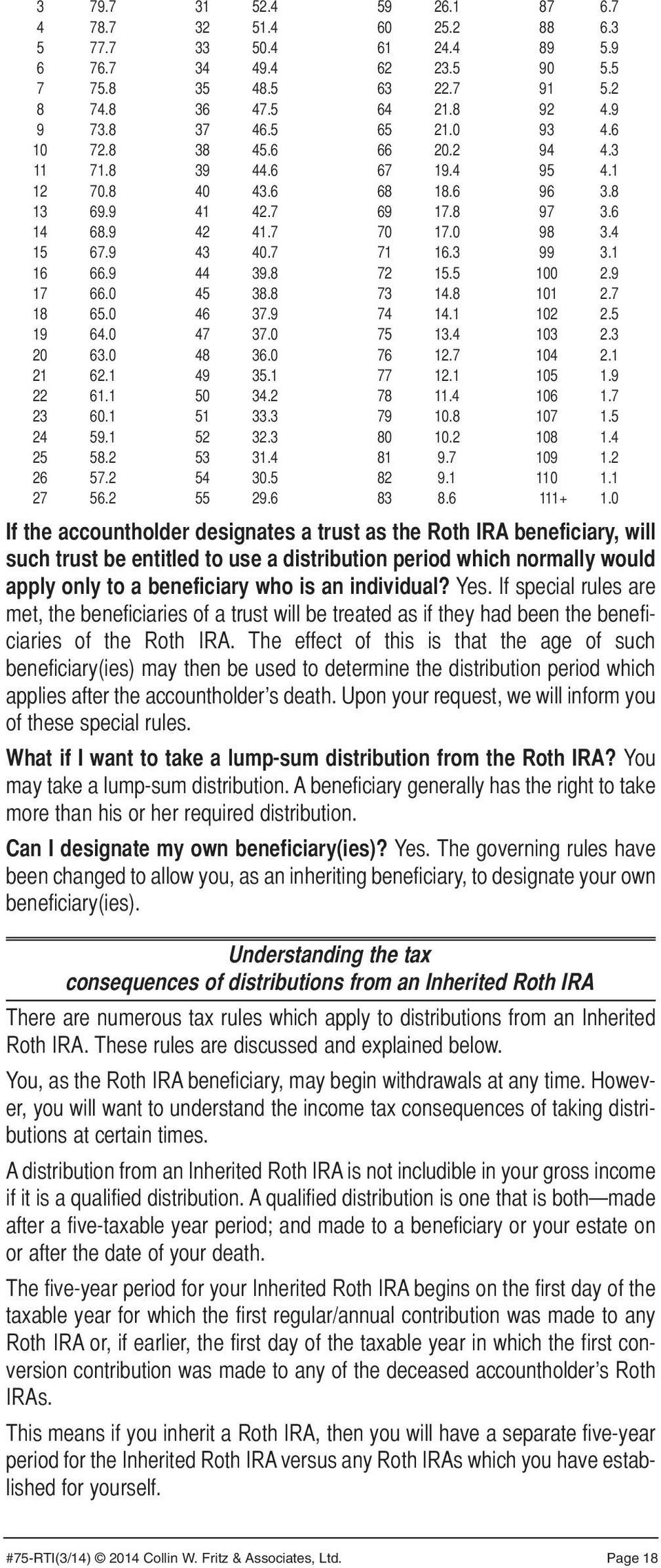
17 required to withdraw required minimum distributions according to the following rules. If your spouse is your sole beneficiary, then he or she may elect to treat your Roth IRA as his or her own. Or, he or she may postpone distributions until when you would have attained age 70 1 /2. If your spouse is not your sole beneficiary, then the interest of each beneficiary, including your spouse, in your Roth IRA must be totally paid to that beneficiary, on or before December 31 of the calendar year containing the fifth anniversary of your death, unless the beneficiary commences, on or before the December 31 of the calendar year following the year of death, the payment of his or her interest over a period not greater than his or her life expectancy. Note that if your beneficiary does not timely commence the scheduled payment over his or her life expectancy, he or she must have the funds paid out under the five-year rule (i.e. by December 31 of the year containing the fifth anniversary of your death). If the distribution method elected by a beneficiary is the life-distribution method, then the minimum annual payment for each beneficiary for each year will be determined by dividing the entire interest as of the close of business on December 31 of the preceding year by the life expectancy of the beneficiary using the attained age of the beneficiary as of the beneficiary s birthday in the year distributions are required to commence and subtracting 1 for each subsequent year. Roth IRA RMD Formula. The RMD Formula used to calculate the required distribution for a Roth IRA beneficiary is the same as applies to a traditional IRA beneficiary. The Formula: XX of Preceding Year = RMD for Current Year Period from Single Life Table (As Adjusted) Does the RMD Waiver Rule for 2009 also apply to a beneficiary? Yes. An inheriting beneficiary will not be required to take a distribution for If a Roth IRA accountholder died prior to 2009, the general rule is that the inheriting IRA beneficiary will be required to take a distribution using the life distribution rule unless the five-year rule applied. If the life distribution rules applies, there is no RMD due with respect to The deadline for the next RMD would be December 31, If the five-year applies because the beneficiary had elected it, the five-year rule is now applied without considering For example, if a Roth IRA accountholder had died in 2006, so the beneficiary would have been required to close the Inherited Roth IRA by December 31, 2011, he or she will now have until December 31, 2012 to close the Inherited Roth IRA. An inheriting Roth IRA beneficiary may certainly take a distribution during 2009 even though it is not a required distribution. Unless a further waiver would be enacted, required distributions will be required for 2010 and subsequent years. What life-expectancy table is used to determine the life-expectancy factor which applies to an inheriting Roth IRA beneficiary? The Single Life Table applies. Age of Distribu- Age of Distribu- Age of Distribu- Age of Distribu- IRA tion IRA tion IRA tion IRA tion Benefi- Period Benefi- Period Benefi- Period Benefi- Period ciary (in yrs) ciary (in yrs) ciary (in yrs) ciary (in yrs) #75-RTI(3/14) 2014 Collin W. Fritz & Associates, Ltd. Page 17
18 If the accountholder designates a trust as the Roth IRA beneficiary, will such trust be entitled to use a distribution period which normally would apply only to a beneficiary who is an individual? Yes. If special rules are met, the beneficiaries of a trust will be treated as if they had been the beneficiaries of the Roth IRA. The effect of this is that the age of such beneficiary(ies) may then be used to determine the distribution period which applies after the accountholder s death. Upon your request, we will inform you of these special rules. What if I want to take a lump-sum distribution from the Roth IRA? You may take a lump-sum distribution. A beneficiary generally has the right to take more than his or her required distribution. Can I designate my own beneficiary(ies)? Yes. The governing rules have been changed to allow you, as an inheriting beneficiary, to designate your own beneficiary(ies). Understanding the tax consequences of distributions from an Inherited Roth IRA There are numerous tax rules which apply to distributions from an Inherited Roth IRA. These rules are discussed and explained below. You, as the Roth IRA beneficiary, may begin withdrawals at any time. However, you will want to understand the income tax consequences of taking distributions at certain times. A distribution from an Inherited Roth IRA is not includible in your gross income if it is a qualified distribution. A qualified distribution is one that is both made after a five-taxable year period; and made to a beneficiary or your estate on or after the date of your death. The five-year period for your Inherited Roth IRA begins on the first day of the taxable year for which the first regular/annual contribution was made to any Roth IRA or, if earlier, the first day of the taxable year in which the first conversion contribution was made to any of the deceased accountholder s Roth IRAs. This means if you inherit a Roth IRA, then you will have a separate five-year period for the Inherited Roth IRA versus any Roth IRAs which you have established for yourself. #75-RTI(3/14) 2014 Collin W. Fritz & Associates, Ltd. Page 18
19 If you are a spouse beneficiary who elects or who is deemed to have elected your deceased spouse s Roth IRA as your own, then you will determine just one five-year calculation. Your five-year period will end on the earlier of the five-year period which applied for the decedent or the five-year period which applies to your own Roth IRAs. A distribution from a Roth IRA is not includible in your gross income even if it is not a qualified distribution to the extent that the distribution, when added to the amount of all previous distributions (whether or not they were qualified distributions from the accountholder s Roth IRA) exceeds the contributions to all of his or her Roth IRAs. A distribution from a Roth IRA is not includible in your gross income, even if it is not a qualified distribution, if it involves the withdrawal of an excess contribution in accordance with section 408(d)(4). The return of the contribution is not required to be included in income, but the related income must be included in income for the year in which the excess contribution was made. A distribution from a Roth IRA can be comprised of one or more of the following: regular contributions, conversion contributions or earnings. The law mandates the following order for distributions: (1) from regular/annual contributions; (2) from conversion contributions on a first-in-first-out basis and (3) from earnings. The order is determined as of the end of the taxable year, and each category must be exhausted before the next is used. With respect to a conversion contribution, it is treated as being made first from the portion, if any, that was includible in gross income as a result of the conversion. To aid in administering this ordering, the IRS has created the following rules. a. All distributions from all of an individual s Inherited Roth IRAs with respect to a specific beneficiary made during a taxable year are aggregated. There are two exceptions. First, a distribution which is rolled over to another Roth IRA is disregarded. Second, a distribution of an excess contribution along with the net income is disregarded. b. All regular/annual contributions made for the same taxable year to all of the individual s Roth IRAs are aggregated and added to the undistributed total of regular/annual contributions for prior years. Note that there are two exceptions. First, a rollover contribution from another Roth IRA is disregarded. Second, the making of an excess contribution is disregarded if it is corrected in accordance with the rules. c. All conversion contributions received during the same tax year by all of the individual s Roth IRAs are aggregated. Thus, if there are two conversion contributions in 1998 and three in 1999, then the two 1998 conversion contributions will be aggregated, as will the 1999 conversion contributions. However, there is a special rule. The conversion contributions received in 1999 must be segregated into two types. Type one is comprised of those Roth conversion contributions withdrawn in 1998 but recontributed in 1999 and with respect to which the 4-year spread method was selected. Type two is comprised of all other Roth conversions contributed in There are three special rules. First, a rollover contribution from another Roth IRA is disregarded. #75-RTI(3/14) 2014 Collin W. Fritz & Associates, Ltd. Page 19
20 Second, the making of an excess contribution is disregarded if it is corrected in accordance with the rules. There is also a special rule arising from the recharacterization rules. If an individual recharacterizes a regular or a conversion contribution made to a Roth IRA by transferring it to a traditional IRA, then the original contribution to the Roth IRA and the recharacterizing transfer are disregarded in determining the amount of both contributions and distributions for the Roth IRA. If the accountholder died before the five-year requirement has been satisfied, then a portion of any distribution may be required to be included in income. If there are multiple beneficiaries, there must be a method to allocate the different types of contributions to the beneficiaries. The method to be used is a pro rata method. Assume the following: a Roth IRA accountholder dies in 2002; the Roth IRA contains regular/annual contributions of $4,000; a conversion contribution of $20,000 and earnings of $2,000; beneficiary #1 is to receive 50%, beneficiary #2 is to receive 30% and beneficiary #3 is to receive 20%; and beneficiary #3 is distributed $3,000. The share for beneficiary #3 is $5,200 allocated as follows: $800 ($4,000 x 20%) of regular contributions; $4,000 ($20,000 x 20%) of conversion contributions; and $400 ($2,000 x 20%) of earnings. Of the $3,000 withdrawn, $800 is allocated to regular contributions and the remainder of $2,200 is allocated to conversion contributions. RMDs for Beneficiaries of an Inherited Roth IRA Arising from a Direct Rollover from a designated Roth Account with in a 401(k) Plan or Other Eligible Employer Retirement Plan (ERP) On or after January 1, 2007, if you are a nonspouse beneficiary of a deceased plan participant, then you will be able to directly roll over your designated Roth account inherited funds into a new type of Inherited Roth IRA, if the plan is amended to authorize such a direct rollover. Prior to 2007, a nonspouse beneficiary of a pension plan participant was unable to roll over such inherited funds. He or she was required to take distributions from the pension plan as the plan stipulated. You will be required to take required distributions from this new type of Inherited Roth IRA. The IRS has adopted the approach that the Inherited Roth IRA established to receive the direct rollover must apply the same required distribution rules as set forth in the ERP. That is, if the ERP mandated that the 5- year rule applies, then the 5-year rule must be applied by the Roth IRA, unless a special election has been made to use the life-distribution rule. If the ERP mandated the life-distribution rule, then the life-distribution rule must be applied by the Roth IRA. Special rule and election. If the 5-year rule applies, the nonspouse beneficiary may elect to use the life-distribution rule rather than the 5-year rule. There are two requirements. First, the funds must be directly rolled over before the end of the year following the year of death. Secondly, the life-distribution rule must be determined using the same nonspouse beneficiary. Note that the amount ineligible to be directly rolled over includes the required distribution amount for any prior year and current year to the extent not distributed. Will the 10% excise tax ever be assessed? No. All payments from an Inheriting Roth IRA Beneficiary escape the 10% tax. Do the withholding rules apply to distributions from a Roth IRA? No. The law was retroactively changed as of December 21, 2000, so that a Roth IRA custodian/trustee is not required to withhold federal income tax from a Roth IRA distribution. President Clinton signed into law on December 21, 2000, the #75-RTI(3/14) 2014 Collin W. Fritz & Associates, Ltd. Page 20

21 Consolidated Appropriations Act (Public Law ) which retroactively adopted this technical correction effective as of January 1, Is it permissible for me as an inheriting Roth IRA beneficiary to correct an excess contribution as made by the Roth IRA accountholder? Yes. You will need to comply with the time limits which the IRS has established. You should refer to Publication 590. Is it permissible for me as an inheriting Roth IRA beneficiary to recharacterize a contribution as made by the Roth IRA accountholder? Yes. You will need to comply with the rules as established by the IRS. You should refer to Publication 590. What happens to my Inherited Roth IRA once I die? If you have named a beneficiary or beneficiaries, your beneficiary(ies) will have the right to continue to take the same required minimum distributions which you would have been required to take. That is, the distribution period over your life expectancy will continue to apply to your beneficiaries. Generally, they have the right to withdraw more than the required minimum amount. Special Taxes that Apply Even Though No Distribution. A. Six Percent Excise Tax on Excess Contributions. You must pay a 6% excise tax each year on excess amounts that remain in your Inherited Roth IRA. The tax cannot be more than 6% of the value of your Roth IRA as of the end of the tax year. In general, an excess contribution is an impermissible contribution. It could have either been made by the original Roth IRA accountholder or you. If the excess contribution is made for the current tax year, you will not have to pay the 6% excise tax if you withdraw or eliminate the excess amount by the date, including extensions, your tax return is due for the current year. If the excess contribution is attributable to a prior year, you will not have to pay the 6% excise tax if you withdraw or eliminate the excess by December 31 of the current year. The carryback concept does not apply in this situation. B. Fifty Percent Excise Tax on Excess Accumulations Within an Inherited Roth IRA. There is a 50% excise tax on any excess accumulations which occur within your Inherited Roth IRA. An excess accumulation is the difference between the amount actually distributed to your, and the amount required to be distributed. Form 5329 Reporting Requirements When an Excise Tax Applies. If you or your beneficiary(ies) owe the 6% excise tax on an excess contribution or the 50% excise tax for failing to satisfy the minimum distribution requirements, you or your beneficiary(ies) must file IRS Form If you only owe the 10% additional tax for premature distributions, and the payer properly shows the correct code on the Form 1099-R, you may not have to file Form See the instructions for Form 5329 for more information. You may be required to file Form 5329 even though your income level would not otherwise require the filing of an income tax return (i.e. Form 1040 or 1040A). If you engaged in a prohibited transaction and you were under age 59 1 /2 as of the first day of the year, then you must report the entire Roth IRA s value as of such day as being distributed. Reporting Requirements For a Roth IRA. The IRS generally requires you to file the Form 8606 for a given tax year if any of the following apply: (1) you receive a distribution from your Inherited Roth IRA; (2) you recharacterize amounts that were converted to a Roth IRA; or (3) you have a recharacterization involving a Roth IRA contribution. You should review the IRS instruc- #75-RTI(3/14) 2014 Collin W. Fritz & Associates, Ltd. Page 21
22 tions for the Form 8606 each year to see if the IRS has changed the filing requirements for the Form A New Tax to Consider Before Withdrawing IRA Funds. Effective as of January 1, 2013, a new 3.8% tax went into effect. The IRS has chosen to call this tax, the Net Investment Income Tax. This tax may apply only if you are withdrawing income from your Roth IRA and such income must be included in your income and is taxable to you and results in your having to pay the 3.8% tax as explained in the remainder of this section. This new 3.8% tax applies to certain individuals having net investment income and certain estates and trusts having net investment income. To determine the tax owing, a person will multiply 3.8% time the lesser of: (1) his or her net investment income (NII) or a person's modified adjusted gross income as reduced by a threshold amount as set forth in the following table: Filing Status Threshold Amount Married filing jointly $250,000 Married filing separately $125,000 Single $200,000 Head of household (with qualifying person) $200,000 Qualifying widow(er) with dependent child $250,000 This tax will be owed only if an individual has net investment income and his or her modified adjusted gross income exceeds the applicable threshold amount. The new tax means an individual before taking a Roth IRA distribution will want to determine if he or she will have to pay the 3.8% tax on account of such distribution. For most people and situations, a person will not owe the 3.8% tax on account of his or her IRA or pension distribution, but in some situations the tax would be owed. There will be times, however, when a person s Roth IRA distribution will mean the individual will have to pay the 3.8% tax on account of the Roth IRA distribution. There will also be times when a person will take a Roth IRA distribution and he or she will be required to pay the 3.8% tax, but the amount owed does not increase because of such Roth IRA distribution. What types of income are defined to be non-investment income? Distributions from IRAs, pension plans, 401(k) plans, tax sheltered annuities, etc. are not investment income. Social security benefits are not investment income. Wages and income or profits from a nonpassive business including self-employment income are not investment income. Unemployment compensation and workers compensation are not net investment income. What types of income are net investment income and so they might be subject to the 3.8% tax? Investment income includes interest, dividends, gains from the sale of stocks, bonds, mutual funds, capital gain distributions from mutual funds, certain sales related to real estate, rental and royalty income, non-qualified annuities, income from businesses involved in trading of financial instruments or commodities, business income arising from certain passive activities, and the sale of an interest in a partnership and S corporations by an individual who #75-RTI(3/14) 2014 Collin W. Fritz & Associates, Ltd. Page 22
23 had a passive interest. Such investment income is reduced by certain expenses properly allocable to the income. And any income or gain excluded from gross income for regular income tax purposes is also excluded from a person net investment income (e.g. $250,000 exclusion for sale of primary residence). This new 3.8% tax is different from the new 9/10ths of 1 percent Additional Medicare tax which also went into effect on January 1, If you have net investment income for a tax year, then you should review the IRS instructions for Form 8960, Net Investment Income Tax Individuals, Estates and Trusts to determine if you are required to complete and file this form. Special Rule for Hurricane Katrina, Rita, and/or Wilma Distributions and Midwestern Storms. Unless a person elects otherwise, a person who receives a qualified Hurricane Katrina, Rita, or Wilma distribution or Midwestern storms will include 1/3 of the distribution in income for the year of the distribution, plus 1/3 of the distribution in each of the following two years. The standard tax rule is that the amount distributed must be included in income for the year of receipt. By spreading the distribution over 3 years, an individual will generally lessen the amount of income tax owing than if the entire amount is included in income in just one year. The IRS has adopted the procedure that a qualifying individual must inform the IRA custodian in writing on an IRA distribution form whether or not his or her distribution is to be considered a Qualified Storm Distribution. Special Rules Applying To IRAs For Relief Related to Hurricanes, Storms, Floods and Tornados. There are special rules applying to withdrawals and repayments from an IRA for taxpayers who suffered an economic loss as a result of certain federally declared disasters such as hurricanes, storms, floods and tornados. This is a complex tax topic. A person needs to determine if there is a public event which qualifies for the special rules and if he or she qualifies for the special tax rules. You should visit the IRS web site at and review the guidance for tax relief in disaster situations. You should consult with your tax advisor. Most of the special tax relief laws applying to persons impacted by the 2005 Hurricanes - Katrina, Rita And Wilma will now apply to certain persons located in the Midwest impacted by storms, tornados and for floods occurring in The concept of the law is - many times an individual and the community, after suffering losses from a disaster, will benefit if he or she can access his or her IRA and/or other retirement funds within employer plans and not be subject to the same tax provisions applying to the non-disaster situation. There are special rules for "qualified storm damage distributions". An individual is still required to include the qualified storm damage distribution in income, but there are special rules allowing him or her to pay fewer taxes than he or she normally would. Here is a short summary. A qualified storm damage distribution is any distribution received by an individual during a set period of time from a traditional IRA, Roth IRA, SIMPLE IRA or SEP IRA or other eligible retirement account/plan as long as the following conditions are met. 1. The distribution was made on or after the disaster date. 2. The individual's main home was located in a qualified storm damage disaster area as listed later on the date shown for the applicable storm area. 3.The individual sustained an economic loss because of such storms. Examples of an economic loss include, but are not limited to (a) loss, damage to, or destruction of real or personal property from fire, flooding, looting, van- #75-RTI(3/14) 2014 Collin W. Fritz & Associates, Ltd. Page 23
24 dalism, theft, wind or other causes; (b) loss related to displacement from their home; or (c) loss of livelihood due to temporary or permanent layoffs. If an individual meets all of these conditions, he or she then has the right to designate a distribution as a qualified storm damage distribution. Note that the law does not require an individual to have suffered economic loss of a certain minimum amount. Actually, there is no minimum dollar limit. This means many individuals who were located in the storm damage area are able to take advantage of these new rules (tax planning opportunities) regardless of whether he or she incurred much damage or loss. The individual only needs to have incurred some loss. What are the four (4) special IRA distribution rules applying to qualified storm damage distributions? Special Rule #l. The 10% additional tax of Code section 72(t) does not apply to any qualified storm damage distribution made on or before December 31,2006 or December 31, 2009, as applicable. Special Rule #2. There is a special income averaging mechanism. Unless a person elects otherwise and elects to include the entire amount in income for the year of the distribution, a person who receives a qualified storm damage distribution will include 1/3 of the distribution in income for the year of the distribution and then 1/3 of the distribution for each of the following two years. By spreading the distribution over 3 years, an individual will generally lessen the amount of income tax owing than if the entire amount is included in income in just one year. Special Rule #3. Rather than being required to rollover a distribution within 60 days of receiving it, an individual who has received a qualified storm distribution from an IRA or other eligible retirement plan is given 3 years in which to complete the rollover. This special type of rollover is called a repayment. Most qualified storm damage distributions are eligible for repayment to an IRA or other eligible retirement plan. It appears, however, that the IRS has adopted the approach that the standard rollover rules apply. For example, a required distribution is never eligible to be rolled over and thus could not be repaid even if a person designates it as a qualified storm damage distribution. Another example, a person is ineligible to rollover a periodic payment if the payout period is 10 years or more and thus one cannot repay a qualified storm damage periodic distribution. Since the IRS does not expressly discuss the situation, it is unclear if the once per year rollover rule also applies to qualified storm damage distributions from IRAs. The conservative approach is to assume it does apply. An individual has 3 years from the day after the day he or she received the qualified storm damage distribution to repay all or part of it to an IRA or other plan to which it could be rolled over. Multiple repayments are permitted. The total amount repaid must equal or be less than the amount of the qualified storm damage distributions. Amounts repaid are treated as a qualified rollover and are not included in income. The way a person reports a repayment(s) on his or her tax return depends on whether the person reported the distributions under the 3-year method or the current year method. Qualified storm damage distributions, when aggregated, must equal $100,000 or less. Distributions in excess of $100,000 (in the aggregate) will not be a qualified a qualified storm damage distribution and will be subject to the additional 10% tax, if applicable, and will not receive the other favorable tax treatments. General Discussion Of How The Special IRS Relief Rules and Procedures Impact IRAs. The federal tax laws give the IRS broad authority to grant #75-RTI(3/14) 2014 Collin W. Fritz & Associates, Ltd. Page 24
25 relief when the President declares a disaster and FEMA designates an area or areas for assistance. This authority is set forth in Code section 7508A and regulation The primary relief given by the IRS is to extend the time a taxpayer has to file various tax returns and pay the tax owing. However, there are many deadlines by which a taxpayer, such as an IRA account holder, must complete a tax transaction. However, it is possible, if there has been a disaster, that the IRS could extend a tax deadline. Regulation section l(c)(iii) provides for the postponement by the IRS of rules for making certain IRA contributions, taking certain distributions, recharacterizing IRA contributions or making rollovers. For example, if Jane Doe withdrew $8,000 from her IRA on June 1, 2008, but she did not complete her rollover within the 60 days, the general rule is that she could not make the rollover contribution. However, if because of a disaster occurring in early June, the IRS had set a new deadline as August 29, 2008, then Jane Doe could complete her rollover by August 29, An individual must consult with his or her tax advisor and the IRS for the special tax rules applying if there has been a disaster. Discussion of the Special Rules Applying to Tax-Free Charitable IRA Distributions/Contributions. Qualified Charitable Distributions are special distributions first authorized in 2005 for tax years , then extended for , then extended for and now again extended for Unless there is another tax extension, these rules will not apply for 2014 and subsequent years. A special rule applies allowing a QCD occurring in January of 2013 to be treated as made on December 31, The general tax rule is that a qualified charitable distribution will count towards your required minimum distribution. A qualified charitable distribution (QCD) is a nontaxable distribution made directly by the trustee of your IRA (other than a SEP or SIMPLE-IRA) to an organization eligible to receive tax-deductible contributions. You must have been at least age 70 1 /2 when the distribution was made. Also, you must have the same type of acknowledgement of your contribution that you would need to claim a deduction for a charitable contribution. See Records To Keep in IRS Publication 526. Charitable Contributions. Your total QCDs of the year cannot be more than $100,000. If you file a joint return, your spouse can also have a QCD of up to $100,000. However, the amount of the QCD is limited to the amount of the distribution that would otherwise be included in income. If your IRA includes nondeductible contributions, the distribution is first considered to be paid out of otherwise taxable income. What requirements must I meet in order to take advantage of this charitable contribution law? (a) You must be age 70 1 /2 or older; (b) You must have a traditional or Roth IRA; (c) You must be allowed to itemize deductions on your Form 1040 income tax return; (d) Your contribution to a qualifying charity must also have been able to qualify as an itemized deduction, but for this special charitable contribution rule under Code section 170 (disregard the percentage limits). Caution: You receive the tax-free charitable contribution treatment only if the entire amount would have qualified as a charitable deduction. Thus, if the contribution amount is reduced because of a benefit received by you in exchange, or because the custodian does not obtain sufficient substantiation, the exclusion is not available with respect to any part of the IRA distribution; (e) The distribution, but for this rule, must otherwise have been required to be included in your gross income. The withdrawal of basis (i.e. nondeductible contributions or nontaxable distributions) from a traditional IRA and/or Roth IRA is not includible in income, and consequently, such withdrawal does not qualify as a tax-free charitable contribution; and (f) Payment, #75-RTI(3/14) 2014 Collin W. Fritz & Associates, Ltd. Page 25
26 no matter in what form (electronic transfer, check, etc.), must be made directly from the IRA to the qualifying charitable organization. The instrument used for payment must not be negotiable by the beneficiary. The IRS has stated, however, that the accountholder may hand deliver the payment to the charity. IRS Reporting Tasks for QCDs. There is no special reporting for QCDs by the IRA custodian. Many times IRA accountholders and their tax advisors think the IRA custodian should be preparing the Form 1099-R to show the distribution as being tax-free. This is not the IRS procedure. A QCD is to be reported as a death distribution since you are a beneficiary. You will be required to complete lines 15a and 15b of your federal income tax return. The general rule is that most IRA distributions are fully taxable so line 15a is left blank and the taxable amount is inserted on line 15b. An exception applies to QCDs. If the total distribution is a QCD, enter 0 on line 15b and write QCD next to line 15b. If only part of the distribution is a QCD, enter the part that is not the QCD on line 15b. Enter QCD next to line 15b. Discussion of the Special Rules Applying to Tax-Free Transfers to Health Savings Accounts. On or after January 1, 2007, a person who is eligible to make an HSA contribution and who has funds within a traditional IRA or Roth IRA may make a special election once during their lifetime to transfer a certain amount from such IRA to their HSA. This type of special transfer is called a qualified HSA funding distribution. Such an election, once made, is irrevocable. The amount transferred in such a direct trustee-to-trustee transfer will be excluded from the person s income. This one-time transfer rule would allow a person to change funds which would be taxable (money distributed from an IRA) to funds which will escape taxation if they are withdrawn from the HSA and used to pay qualified medical expenses. The right allowing a person to transfer funds from an IRA to an HSA tax-free applies even when the person has inherited an IRA. When a beneficiary transfers funds from his or her inherited IRA to an HSA, such a transfer will count to satisfy his or her IRA required distribution from the inherited IRA. The amount contributed to an HSA, when transferred from an IRA, does count against the HSA contribution limit for such year. The maximum amount which can be transferred tax-free is determined at the time of the transfer and not later in the year. A person who is covered under a HDHP in March of 2012 may transfer from an IRA to an HSA in March the family amount even though later in 2012 he switches to a single HDHP. The amount to be excluded is limited. It shall not exceed the annual contribution limit for single or family coverage, as applicable, as based on the HDHP coverage as of the time of the special transfer, or, in some cases, the amount of an earlier qualified HSA funding distribution. Thus, the maximum amount eligible for this special transfer for 2012 will be $3,100 for single coverage and $6,250 for family coverage plus any applicable catch-up amount. Any traditional IRA and/or Roth IRA funds may be transferred to an HSA, including non-taxable basis. However, if a person chooses to transfer his or her basis from either a traditional IRA and/or Roth IRA, the individual will not be able to carry over this basis to his or her HSA. The IRS has adopted the position that the general HSA distribution rule will be applied even if a person has transferred IRA basis into his or her HSA. The general rule is that a person is allowed only one tax-free transfer during his or her lifetime. One means one. Therefore, if a person has two or more IRAs and wants to use amounts in multiple IRAs to make the tax-free transfer, if eligible, the individual must first make an IRA to IRA or Roth IRA to Roth #75-RTI(3/14) 2014 Collin W. Fritz & Associates, Ltd. Page 26
27 IRA transfer of the amounts to be distributed into a single IRA, and then make the one tax-free transfer. A person who has both a traditional IRA and a Roth IRA will only be able to do the transfer from one or the other IRA. A person will be able to transfer SEP-IRA or SIMPLE-IRA funds to his or her HSA only if the SEP or SIMPLE is not an on-going plan. That is, the transfer is permissible as long as the employer has not made an employer contribution for the plan year ending with or within the SEP-IRA or SIMPLE-IRA owner s tax year. There are special testing period taxes if you make this special type of transfer and then end your coverage under an HDHP before a one-year time period has expired. The testing period starts with the month in which the qualified HSA funding contribution is contributed to the HSA and ends on the last day of the 12th month following such month. If, at any time during the testing period, you are no longer an eligible individual, then you will be penalized as follows. You will have to add to your income all contributions which had been excluded from income. This is required for the first month you become ineligible. The tax you owe will depend on what marginal tax rate applies. You will also owe an additional 10% tax. Caution Once the IRA funds are contributed to the HSA, there is no authority or provision in the law to recontribute the funds to the IRA. However, if the recontribution took place within the standard 60-day rollover period, it would be permissible. Discussion of the Special Rules Applying to Distributions to Expatriates. The Heroes Earnings Assistance and Relief Tax Act of 2008 changed the tax laws regarding expatriation. President Bush signed this bill into law on June 17, The expatriation changes apply to any individual whose expatriation date is on or after June 17, An expatriate is any United States citizen who relinquishes his or her citizenship and any long term resident of the United States who ceases to a lawful permanent resident. An individual s expatriation date is the date he or she relinquishes citizenship or ceases being a permanent resident. A covered expatriate, in general, is an expatriate who meets the requirements of subparagraphs (A), (B), or (C) of Internal Revenue Code section 877(a)(2). However, there are exceptions where such a person is not treated as a covered expatriate. An individual will need to consult with his or her attorney or tax advisor. There are special tax rules applying to IRA accounts and other tax preferred accounts. Any IRA of a covered expatriate is deemed totally distributed on the day before his or her expatriation date. The 10% early distribution tax does not apply. There are to be appropriate adjustments made with respect to subsequent distributions from the account to reflect the deemed distribution. Special withholding rules apply. Summary of Contractual Terms 1. You must refer to your savings or time deposit agreement(s) for the terms which govern the investment of your Roth IRA deposits, including an early withdrawal penalty or fee for taking a distribution prior to maturity, if applicable. 2. You have the right to designate a beneficiary or beneficiaries to inherit your Roth IRA account. Refer to Section 1.6 of Article IX so that you can understand the rules and procedures. 3. You do not have any ability to assign your rights in this Inherited Roth IRA. #75-RTI(3/14) 2014 Collin W. Fritz & Associates, Ltd. Page 27
28 4. We may charge fees as set forth in section 2.5 of Article IX. 5. We may amend the terms of this Inherited Roth IRA from time to time to comply with law changes. If we amend it for any other reason, such amendment becomes effective 30 days after we have sent our notice of amendment to you. 6. You are to refer to Article IX for the following topics: withdrawals, withholding rules, reporting errors, changes in the Roth IRA custodian or trustee, good faith payments, termination and resignation of the Roth IRA custodian or trustee, withholding payments and resolution of disputes, transfer and rollovers and payment of taxes. Miscellaneous. 1. Approved as to Form. Your Roth IRA has been approved as to form for use as a Roth IRA by the IRS. This approval as to form does not represent a determination of the merits of such Roth IRA or its investments. 2. Further Roth IRA Information. You may obtain further information about Roth IRAs from any district office of the IRS. IRS Publication 590 discusses all types of IRAs, including Roth IRAs, very thoroughly. 3. Financial Disclosure Information. You are to refer to the application page. 4. Administrative Fees or Costs. We have the right to charge service fees as indicated in Article IX. 5. General Rule No FDIC Insurance Coverage. Normally FDIC insurance does NOT apply to assets held within a trust Inherited Roth IRA because FDIC insurance applies only to certain deposit accounts. Your Inherited Roth IRA has primarily been invested or will be invested in investments other than such deposit accounts and therefore will NOT be insured by the FDIC. Stated another way, under your trust Inherited Roth IRA, your Inherited Roth IRA funds may be used to purchase mutual funds and other nondeposit investment products. The nondeposit investment products are not FDIC insured; are not deposits or other obligations of this institution and are not guaranteed by this institution; and involve investment risks, including loss or principal. In some instances a portion of your Inherited Roth IRA funds will be invested in deposits at another institution which is an insured institution. In such case, such deposits would be insured pursuant to the rules as established by the FDIC. The FDIC has stated that funds within an Inherited Roth IRA are insured separately from funds with your personal Roth IRA. The reason the funds are held in a different right and capacity. A summary follows. Such Inherited Roth IRA deposits are insured on a per institution basis and are insured separately from other deposit accounts, pursuant to the Federal Deposit Insurance Act, up to $250,000. Any IRA, Roth IRA, most eligible deferred compensation plans described in section 457 of the Internal Code, a Keogh plan as described in Code section 401(d) and any individual account plan as defined in section 3(34) of ERISA shall be aggregated and insured in an amount not to exceed $250,000. This aggregation requirement applies to a Keogh plan or an individual account plan only when you have the right to direct the investment of your account. Amounts in excess of $250,000 are not insured. The FDIC has stated that funds within an Inherited Roth IRA are insured separately from funds within your personal Roth IRA. The reason the funds are held in a different right and capacity. #75-RTI (3/14) 2014 Collin W. Fritz & Associates, Ltd. Page 28
5305-RA (07/09) Roth Individual Retirement Custodial Account [under Section 408(A) of the Internal Revenue Code]
![5305-RA (07/09) Roth Individual Retirement Custodial Account [under Section 408(A) of the Internal Revenue Code]](/thumbs/26/8644633.jpg "5305-RA (07/09) Roth Individual Retirement Custodial Account [under Section 408(A) of the Internal Revenue Code]") 5305-RA (07/09) Roth Individual Retirement Custodial Account [under Section 408(A) of the Internal Revenue Code] The Depositor whose name appears on the form establishing this IRA (the Form ) is establishing
5305-RA (07/09) Roth Individual Retirement Custodial Account [under Section 408(A) of the Internal Revenue Code] The Depositor whose name appears on the form establishing this IRA (the Form ) is establishing
Street Address. City, State, ZIP
 ROTH IRA TRUST APPLICATION PACKET (FORM ) Please Print or Type CUID (Credit union will complete.) - - IRA Owner s Social Security Number IRA Owner s Name (First, Initial, Last) Street Address IRA Owner
CUSTODIAL AGREEMENT ROTH IRA
 Page 1 of 9 IMPORTANT INFORMATION ABOUT PROCEDURES FOR OPENING A NEW ACCOUNT To help the government fight the funding of terrorism and money laundering activities, federal law requires all financial institutions
THIRD AVENUE FUNDS INDIVIDUAL RETIREMENT ACCOUNT (IRA) TRADITIONAL IRA SEP IRA ROTH IRA
 THIRD AVENUE FUNDS INDIVIDUAL RETIREMENT ACCOUNT (IRA) TRADITIONAL IRA SEP IRA ROTH IRA TABLE OF CONTENTS COMBINED DISCLOSURE STATEMENT 3 TRADITIONAL INDIVIDUAL RETIREMENT ACCOUNT DISCLOSURE 4 ROTH INDIVIDUAL
ARTICLE I ARTICLE II ARTICLE III ARTICLE IV ARTICLE V ARTICLE VI
 Roth Individual Retirement Custodial Account (Under section 408A of the Internal Revenue Code) Form 5305-RA (Rev. March 2002) Department of the Treasury, Internal Revenue Service. Do not file with the
ARTICLE I ARTICLE II ARTICLE III ARTICLE IV
 SIMPLE Individual Retirement Custodial Account (Under section 408(p) of the Internal Revenue Code) Form 5305-SA (Rev. March 2002) Department of the Treasury, Internal Revenue Service. Do not file with
Putnam SIMPLE IRA Plan and Disclosure Statement
 Putnam SIMPLE IRA Plan and Disclosure Statement Putnam SIMPLE Individual Retirement Trust Account Plan...1 Putnam SIMPLE IRA Disclosure Statement...16 Form 5305-S (Rev. March 2002) Department of the Treasury
New Alternatives Fund, Inc. INDIVIDUAL RETIREMENT ACCOUNT (IRA) TRADITIONAL IRA SEP IRA ROTH IRA
 New Alternatives Fund, Inc. INDIVIDUAL RETIREMENT ACCOUNT (IRA) TRADITIONAL IRA SEP IRA ROTH IRA TABLE OF CONTENTS COMBINED DISCLOSURE STATEMENT 3 TRADITIONAL INDIVIDUAL RETIREMENT ACCOUNT DISCLOSURE 4
Individual Retirement Account (IRA) Traditional IRA SEP IRA. Roth IRA
 Individual Retirement Account (IRA) Traditional IRA SEP IRA Roth IRA TABLE OF CONTENTS COMBINED DISCLOSURE STATEMENT 3 TRADITIONAL INDIVIDUAL RETIREMENT ACCOUNT DISCLOSURE 4 ROTH INDIVIDUAL RETIREMENT
Combined Traditional/Roth IRA Kit. First Trust Retirement, Custodian. For Investments in
 Combined Traditional/Roth IRA Kit First Trust Retirement, Custodian For Investments in Table of Contents IRA PROTOTYPE PLAN AGREEMENT AND DISCLOSURE STATEMENT These are the rules you agree to abide by
PRIVACY POLICIES, DISCLOSURES, INSTRUCTIONS & AGREEMENTS FOR: INDIVIDUAL RETIREMENT ACCOUNT (IRA) TRADITIONAL IRA SEP IRA ROTH IRA
 Fairholme Funds Inc. PRIVACY POLICIES, DISCLOSURES, INSTRUCTIONS & AGREEMENTS FOR: INDIVIDUAL RETIREMENT ACCOUNT (IRA) TRADITIONAL IRA SEP IRA ROTH IRA FAIRHOLME FUNDS, INC. INDIVIDUAL RETIREMENT ACCOUNT
Effective January 1, 2015. All About Union Bank Simple Individual Retirement Custodial Account Agreement
 Effective January 1, 2015 All About Union Bank Simple Individual Retirement Custodial Account Agreement Table of Contents Form 5305-SA under section 408P of the Internal Revenue Code. INTRODUCTION...1
Individual Retirement Account (IRA) Information Kit
 PNC Funds Individual Retirement Account (IRA) Information Kit Traditional IRA SEP IRA Roth IRA TABLE OF CONTENTS TRADITIONAL AND ROTH INDIVIDUAL RETIREMENT ACCOUNT COMBINED DISCLOSURE STATEMENT... 1 TRADITIONAL
DOMINI SOCIAL INVESTMENTS INDIVIDUAL RETIREMENT ACCOUNT (IRA) TRADITIONAL IRA SEP IRA ROTH IRA
 DOMINI SOCIAL INVESTMENTS INDIVIDUAL RETIREMENT ACCOUNT (IRA) TRADITIONAL IRA SEP IRA ROTH IRA TABLE OF CONTENTS TRADITIONAL and ROTH INDIVIDUAL RETIREMENT ACCOUNT (IRA) 4 COMBINED DISCLOSURE STATEMENT
Matthews Asia Funds Individual Retirement Account (IRA) New Account Application
 Matthews Asia Funds Individual Retirement Account (IRA) New Account Application Traditional IRA SEP IRA Roth IRA Table of Contents Combined Disclosure Statement 1 Traditional Individual Retirement Account
SIMPLE IRA Disclosure Statement & Custodial Account Agreement
 SIMPLE IRA Disclosure Statement & Custodial Account Agreement References to the "Custodian" mean BNY Mellon Investment Servicing Trust Company. Table of Contents Page in Document PART I SIMPLE INDIVIDUAL
... HSA ... Health Savings Account. Custodial Booklet. (includes self-direction)
 HSA Health Savings Account Custodial Booklet (includes selfdirection) HEALTH SAVINGS CUSTODIAL ACCOUNT (Under section 223(a) of the Internal Revenue Code) Form 5305C (December 2011) Department of the Treasury
DOMINI SOCIAL INVESTMENTS INDIVIDUAL RETIREMENT ACCOUNT (IRA) TRADITIONAL IRA SEP IRA ROTH IRA
 DOMINI SOCIAL INVESTMENTS INDIVIDUAL RETIREMENT ACCOUNT (IRA) TRADITIONAL IRA SEP IRA ROTH IRA TABLE OF CONTENTS TRADITIONAL and ROTH INDIVIDUAL RETIREMENT ACCOUNT (IRA) 4 COMBINED DISCLOSURE STATEMENT
USAA SIMPLE/SEP-IRA. Disclosure Statements and Custodial Agreements 49629-1215
 USAA SIMPLE/SEP-IRA Disclosure Statements and Custodial Agreements 49629-1215 Table of Contents A. SIMPLE IRA Custodial Agreement 2 B. SIMPLE IRA Disclosure Statement 3 C. SEP-IRA Custodial Agreement 7
S I M P L E. Savings incentive match plan for employees. Participant application kit
 S I M P L E Savings incentive match plan for employees Participant application kit SIMPLE IRA PARTICIPANT INSTRUCTIONS Follow these instructions if you are an employee whose employer has an existing SIMPLE
Code means the Internal Revenue Code of 1986, as amended.
 The American Funds Roth IRA Trust Agreement Pending IRS approval. Section 1 Definitions As used in this trust agreement ( Agreement ) and the related Application, the following terms shall have the meaning
THIRD AVENUE FUNDS SIMPLE IRA
 THIRD AVENUE FUNDS SIMPLE IRA TABLE OF CONTENTS SIMPLE INDIVIDUAL RETIREMENT ACCOUNT (IRA) DISCLOSURE STATEMENT... 3 SIMPLE INDIVIDUAL RETIREMENT CUSTODIAL ACCOUNT AGREEMENT... 8 SIMPLE IRA APPLICATION
TRADITIONAL/SEP IRA ROTH IRA CUSTODIAL AGREEMENT DISCLOSURE STATEMENT EMC-IR-001-0300
 TRADITIONAL/SEP IRA ROTH IRA CUSTODIAL AGREEMENT DISCLOSURE STATEMENT EMC-IR-001-0300 Traditional Individual Retirement Custodial Account (Under section 408(a) of the Internal Revenue Code) Form 5305-A
Application Instructions
 Application Instructions 1. Print and fill out entire (PHSA) Application. 2. Write a $20.00 check payable to New York Community Bank for your PHSA set up fee. 3. Mail application and check to: NYCB Plaza
SCHNEIDER FUNDS INDIVIDUAL RETIREMENT ACCOUNT (IRA) TRADITIONAL IRA SEP IRA ROTH IRA
 SCHNEIDER FUNDS INDIVIDUAL RETIREMENT ACCOUNT (IRA) TRADITIONAL IRA SEP IRA ROTH IRA BNY MELLON INVESTMENT SERVICING TRUST COMPANY Supplement to the Traditional and Roth Individual Retirement Account (IRA)
Voya Funds Individual Retirement Account (IRA)
 Voya Funds Individual Retirement Account (IRA) Traditional IRA SRP IRA Roth IRA For financial professional use only. Not for inspection by, distribution or quotation to, the general public. INVESTMENT
How To Know The Tax Laws For A Roth Ira
 Page 1 of 8 This Disclosure Statement is provided in accordance with the tax laws applicable to your Roth individual retirement account (Roth IRA). It provides only a summary of the rules that apply to
IRAs & Roth IRAs. Beneficiary or Inherited IRAs. Questions & Answers
 IRAs & Roth IRAs Beneficiary or Inherited IRAs Questions & Answers Purpose The purpose of this brochure is to provide a person who is a beneficiary of a traditional IRA (including SEPs and SIMPLEs) or
Roth IRA account opening kit
 Each depositor insured to at least $250,000 Roth IRA account opening kit Here at Allstate Bank, we offer FDIC-insured IRA accounts that ll help you prepare for a financially secure retirement. Enclosed
Davenport Core Fund ROTH IRA Including: Disclosure Statement Custodial Agreement Financial Disclosure Application Transfer Form
 Davenport Core Fund ROTH IRA Including: Disclosure Statement Custodial Agreement Financial Disclosure Application Transfer Form Table of Contents HOW TO ESTABLISH YOUR IRA PLAN. 1 ROTH IRA CUSTODIAL AGREEMENT.
Traditional IRAs. Understanding Required Distributions at 70 1 / 2. Questions & Answers
 Traditional IRAs Understanding Required Distributions at 70 1 / 2 Questions & Answers Why are there federal tax rules mandating required minimum distributions from a traditional IRA? The primary purpose
BNY MELLON INVESTMENT SERVICING TRUST COMPANY. Supplement to the SIMPLE Individual Retirement Account (SIMPLE IRA) Disclosure Statement
 BNY MELLON INVESTMENT SERVICING TRUST COMPANY Supplement to the SIMPLE Individual Retirement Account (SIMPLE IRA) Disclosure Statement IMPORTANT CHANGES TO THE RULES GOVERNING INDIRECT (60-DAY) ROLLOVERS
ROTH IRA AMENDMENT DISCLOSURE STATEMENT
 ROTH IRA AMENDMENT AMENDMENT TO YOUR ROTH IRA This Disclosure Statement and Roth Individual Retirement Trust Account Agreement updates your Roth individual retirement account (Roth IRA) documents that
TRADITIONAL/SEP IRA ROTH IRA CUSTODIAL AGREEMENT DISCLOSURE STATEMENT 3-2009 HIM-IR-001-0200
 TRADITIONAL/SEP IRA ROTH IRA CUSTODIAL AGREEMENT DISCLOSURE STATEMENT 3-2009 HIM-IR-001-0200 Traditional Individual Retirement Custodial Account (Under section 408(a) of the Internal Revenue Code) Form
Supplement to the Traditional and Roth Individual Retirement Account (IRA) Disclosure Statement
 BNY MELLON INVESTMENT SERVICING TRUST COMPANY Supplement to the Traditional and Roth Individual Retirement Account (IRA) Disclosure Statement Important Changes to the Rules Governing Indirect (60-day)
Traditional IRA SEP IRA Roth IRA. Disclosure Statement & Custodial Account Agreement
 Traditional IRA SEP IRA Roth IRA Disclosure Statement & Custodial Account Agreement Table of Contents Page in Document PART I COMBINED DISCLOSURE STATEMENT AND CUSTODIAL ACCOUNT AGREEMENT... 1 TRADITIONAL
ROTH IRA TRUST APPLICATION PACKET (FORM 2400R-T)
 ROTH IRA TRUST APPLICATION PACKET (FORM 2400R-T) Please Print or Type CUID (Credit Union will complete) - - IRA Owner s Social Security Number IRA Owner s Birth Date (mm/dd/yyyy) - (required for processing)
ROTH INDIVIDUAL RETIREMENT CUSTODIAL ACCOUNT AGREEMENT
 ROTH INDIVIDUAL RETIREMENT CUSTODIAL ACCOUNT AGREEMENT Form 5305 RA under section 408A of the Internal Revenue Code. FORM (Rev. March 2002) The depositor named on the application is establishing a Roth
PRIMECAP Odyssey Funds
 PRIMECAP Odyssey Funds Individual Retirement Account & Coverdell Education Savings Account Disclosure Statement & Custodial Account Agreement Table of Contents General Information...1 Disclosure Statement
INDIVIDUAL HEALTH SAVINGS ACCOUNT APPLICATION
 INDIVIDUAL HEALTH SAVINGS ACCOUNT APPLICATION ACCOUNT HOLDER S INFORMATION Last Name First Name Middle Initial Street Address City State Zip Code Social Security No. Date of Birth Daytime Phone Health
BNY MELLON INVESTMENT SERVICING TRUST COMPANY. Supplement to the Traditional and Roth Individual Retirement Account (IRA) Disclosure Statement
 BNY MELLON INVESTMENT SERVICING TRUST COMPANY Supplement to the Traditional and Roth Individual Retirement Account (IRA) Disclosure Statement IMPORTANT CHANGES TO THE RULES GOVERNING INDIRECT (60-DAY)
Table of Contents. 1. GENERAL... 1 1.1 Disclosure Statement and Master Terms of Individual Retirement Accounts... 1 1.2 Definitions...
 i Table of Contents 1. GENERAL... 1 1.1 Disclosure Statement and Master Terms of Individual Retirement Accounts... 1 1.2 Definitions... 1 2. IRA ESTABLISHMENT AND ELIGIBILITY... 3 2.1 Establishing an IRA...
Baird Funds, Inc. Individual Retirement Account Disclosure Statement & Custodial Account Agreement
 Baird Funds, Inc. Individual Retirement Account Disclosure Statement & Custodial Account Agreement Baird Funds, Inc. Individual Retirement Account Disclosure Statement GENERAL INFORMATION Please read the
Voya Funds Individual Retirement Account (IRA)
 Voya Funds Individual Retirement Account (IRA) SIMPLE IRA For financial professional use only. Not for inspection by, distribution or quotation to, the general public. INVESTMENT MANAGEMENT voyainvestments.com
CREDIT UNION TRADITIONAL IRA CUSTODIAL AGREEMENT (rev. 1/2010)
 CREDIT UNION TRADITIONAL IRA CUSTODIAL AGREEMENT (rev. 1/2010) Form 5305-A under Section 408(a) of the Internal Revenue Code FORM (rev. March 2002). The depositor named on the application is establishing
Voya Funds Individual Retirement Account (IRA)
 Voya Funds Individual Retirement Account (IRA) Traditional IRA SEP IRA Roth IRA For financial professional use only. Not for inspection by, distribution or quotation to, the general public. INVESTMENT
BNY MELLON INVESTMENT SERVICING TRUST COMPANY
 BNY MELLON INVESTMENT SERVICING TRUST COMPANY Supplement to the Traditional and Roth Individual Retirement Account (IRA) Disclosure Statement IMPORTANT CHANGES TO THE RULES GOVERNING INDIRECT (60-DAY)
Custodial Account Agreement For Individual Retirement Accounts & Coverdell Education Savings Accounts
 Custodial Account Agreement For Individual Retirement Accounts & Coverdell Education Savings Accounts For additional information please call toll-free (866) 236-0050 or visit us on the web at www.osterweis.com.
ROTH IRA APPLICATION TO PARTICIPATE
 ROTH IRA APPLICATION TO PARTICIPATE Please review all information below and complete the fields below including, the notarized Spousal Consent section, as applicable. If you have any questions regarding
MUTUAL FUND IRAs TRADITIONAL AND SEP IRA
 MUTUAL FUND IRAs TRADITIONAL AND SEP IRA CUSTODIAL ACCOUNT AGREEMENT AND DISCLOSURE STATEMENT Table of Contents Traditional and SEP IRA General Information Fee Schedule... 3 Contact Information... 3 Contribution
Traditional IRA Custodial Agreement (Under section 408(a) of the Internal Revenue Code)
 Traditional IRA Custodial Agreement (Under section 408(a) of the Internal Revenue Code) Form 5303-A (Rev. March 2002) Department of the Treasury, Internal Revenue Service. Do not file with the Internal
Roth IRA. Plan Agreement & Disclosure Statement
 Roth IRA Plan Agreement & Disclosure Statement ROTH Individual Retirement Custodial Account - Plan Agreement Form 5305-RA under section 408A of the Internal Revenue Code. The depositor named on the application
AMG Funds TRADITIONAL IRA ROTH IRA
 AMG Funds INDIVIDUAL RETIREMENT ACCOUNT (IRA) TRADITIONAL IRA SEP IRA ROTH IRA BNY MELLON INVESTMENT SERVICING TRUST COMPANY Supplement to the Traditional and Roth Individual Retirement Account (IRA) Disclosure
Health Savings Account Application and Custodial Agreement
 Health Savings Account Application and Custodial Agreement PERSONAL INFORMATION Name Physical Address SSN DOB (mm/dd/yyyy) City, State, Zip Marital Status Single Married Mailing Address (if different)
Sincerely, S. Sutherlin Manager Certificate, IRA and Trust Branch. Federally insured by NCUA. 2015 Navy Federal NFCU 602A (10-15) epn
 Dear Member: Enclosed are the documents necessary to open a Roth Individual Retirement Arrangement (IRA) at Navy Federal. By completing and returning the forms, you can establish a Roth IRA Savings Account,
BNY MELLON INVESTMENT SERVICING TRUST COMPANY. Supplement to the Traditional and Roth Individual Retirement Account (IRA) Disclosure Statement
 BNY MELLON INVESTMENT SERVICING TRUST COMPANY Supplement to the Traditional and Roth Individual Retirement Account (IRA) Disclosure Statement IMPORTANT CHANGES TO THE RULES GOVERNING INDIRECT (60-DAY)