
Physical Therapist Assistant Program. Clinical Education Manual
|
|
|
- Clifton Thomas
- 10 years ago
- Views:
Transcription
1 Physical Therapist Assistant Program Clinical Education Manual

2

3 Physical Therapist Assistant Program Flathead Valley Community College 777 Grandview Drive Kalispell, MT Program Contact Information Janice Heil, PT, MAPT PTA Program Director, Instructor Telephone Office: BC 123B Julie Robertson, PT, MSPT Academic Coordinator of Clinical Education, Instructor Telephone Office: BC 123A

4

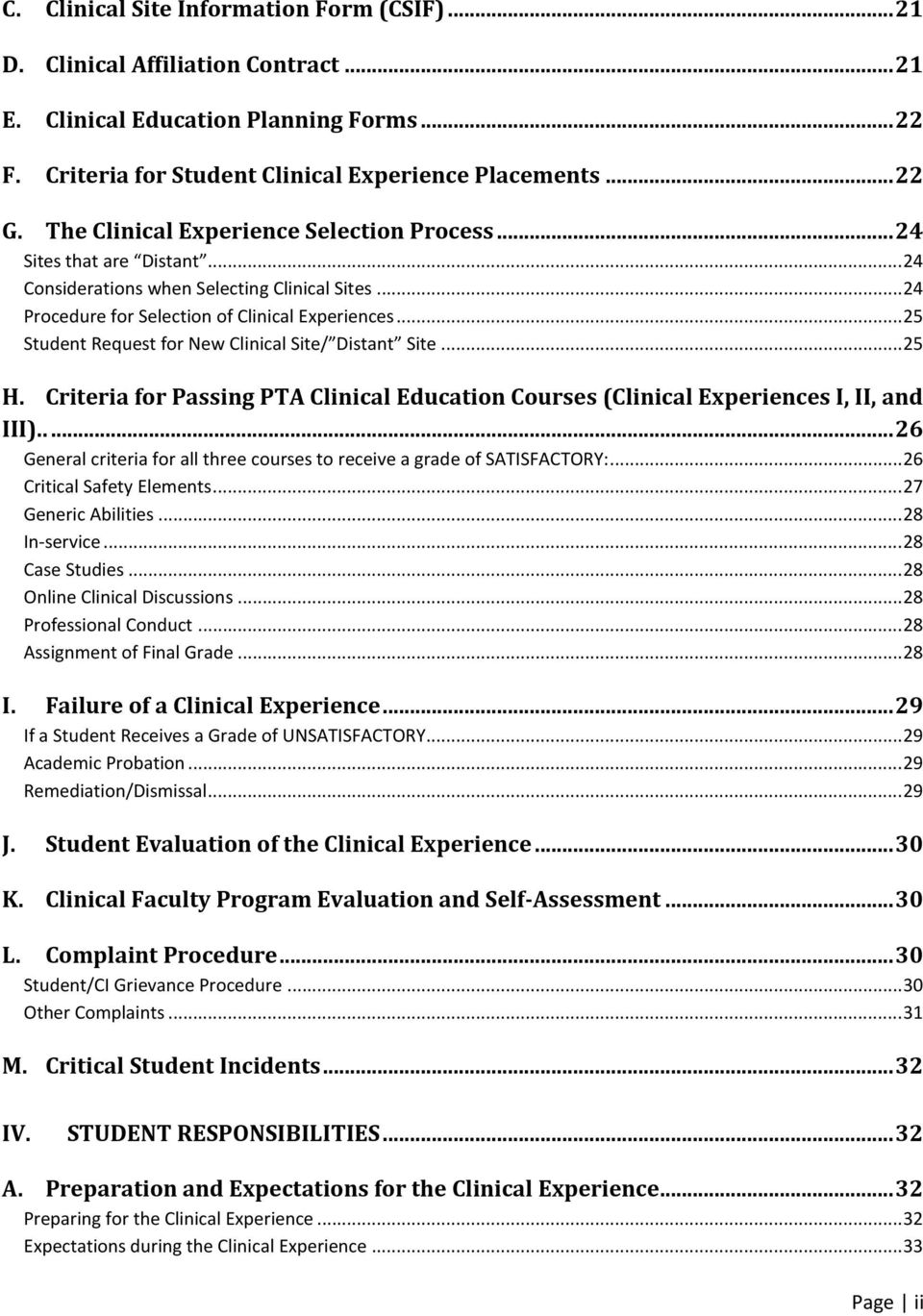
5 Table of Contents MEMORANDUM... 1 I. PHYSICAL THERAPIST ASSISTANT PROGRAM OVERVIEW... 3 A. Program Description:... 3 B. Definition and Utilization of the Physical Therapist Assistant... 3 C. Program Mission and Philosophy... 3 D. Non Discrimination Statement... 4 E. Accreditation Statement... 4 F. Program Goals... 5 G. Physical Therapist Assistant Curriculum... 5 H. PTA Course Descriptions... 6 II. OVERVIEW OF CLINICAL EDUCATION PROGRAM... 9 A. Purpose of Clinical Education... 9 B. Clinical Experiences... 9 C. Criteria for Selection of Clinical Sites D. Roles and Responsibilities of Clinical Instructional Personnel ACADEMIC COORDINATOR OF CLINICAL EDUCATION (ACCE) CENTER COORDINATOR OF CLINICAL EDUCATION (CCCE) CLINICAL INSTRUCTOR (CI) III. PROGRAM POLICIES AND PROCEDURES A. General Clinical Information B. Clinical Site Selection Page i

6 C. Clinical Site Information Form (CSIF) D. Clinical Affiliation Contract E. Clinical Education Planning Forms F. Criteria for Student Clinical Experience Placements G. The Clinical Experience Selection Process Sites that are Distant Considerations when Selecting Clinical Sites Procedure for Selection of Clinical Experiences Student Request for New Clinical Site/ Distant Site H. Criteria for Passing PTA Clinical Education Courses (Clinical Experiences I, II, and III) General criteria for all three courses to receive a grade of SATISFACTORY: Critical Safety Elements Generic Abilities In-service Case Studies Online Clinical Discussions Professional Conduct Assignment of Final Grade I. Failure of a Clinical Experience If a Student Receives a Grade of UNSATISFACTORY Academic Probation Remediation/Dismissal J. Student Evaluation of the Clinical Experience K. Clinical Faculty Program Evaluation and Self-Assessment L. Complaint Procedure Student/CI Grievance Procedure Other Complaints M. Critical Student Incidents IV. STUDENT RESPONSIBILITIES A. Preparation and Expectations for the Clinical Experience Preparing for the Clinical Experience Expectations during the Clinical Experience Page ii
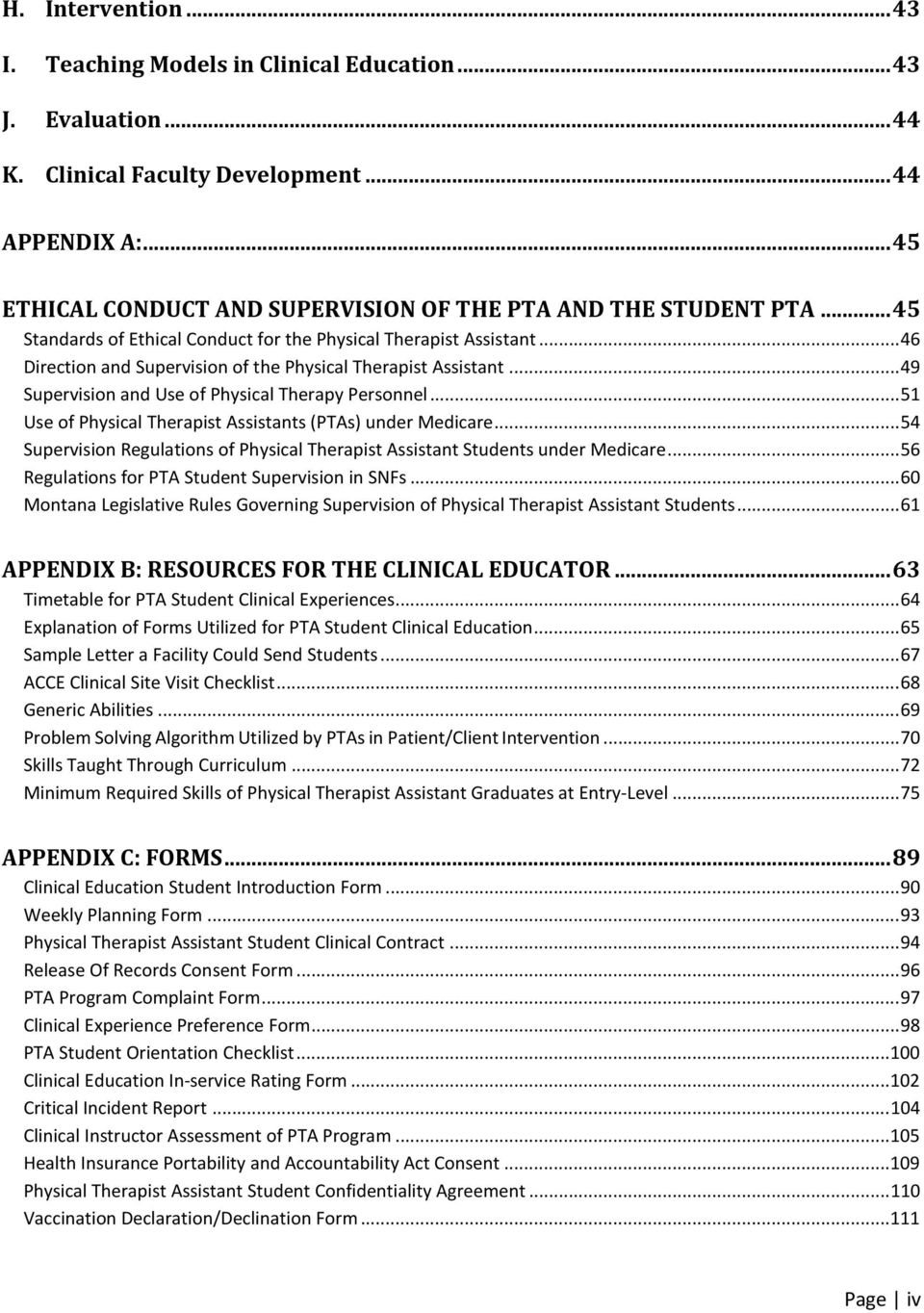
7 B. Attendance Policy Absence Due to Illness or Injury Emergencies Meetings Holidays and Other Non-Class Days Montana Chapter APTA Fall or Spring Conference Inclement Weather C. Student Professional Behaviors Clinical Conduct Patient Care Confidentiality Student Identification Dress Standards for Patient Care Areas Internet/ Use V. HEALTH AND SAFETY A. Student Health and Safety Requirements Physical Exam and Health Record Immunizations CPR and Universal Precautions Training Liability Insurance B. Student Drug Screening and Background Check Drug Screening Criminal Background Check VI. CLINICAL EDUCATOR RESOURCES PREPARATION FOR THE CLINICAL EXPERIENCE A. Preparing for the Clinical Experience B. Student Orientation C. During the Clinical Experience D. Feedback E. Facilitating Learning F. Questioning Skills G. Remediation Page iii

8 H. Intervention I. Teaching Models in Clinical Education J. Evaluation K. Clinical Faculty Development APPENDIX A: ETHICAL CONDUCT AND SUPERVISION OF THE PTA AND THE STUDENT PTA Standards of Ethical Conduct for the Physical Therapist Assistant Direction and Supervision of the Physical Therapist Assistant Supervision and Use of Physical Therapy Personnel Use of Physical Therapist Assistants (PTAs) under Medicare Supervision Regulations of Physical Therapist Assistant Students under Medicare Regulations for PTA Student Supervision in SNFs Montana Legislative Rules Governing Supervision of Physical Therapist Assistant Students APPENDIX B: RESOURCES FOR THE CLINICAL EDUCATOR Timetable for PTA Student Clinical Experiences Explanation of Forms Utilized for PTA Student Clinical Education Sample Letter a Facility Could Send Students ACCE Clinical Site Visit Checklist Generic Abilities Problem Solving Algorithm Utilized by PTAs in Patient/Client Intervention Skills Taught Through Curriculum Minimum Required Skills of Physical Therapist Assistant Graduates at Entry-Level APPENDIX C: FORMS Clinical Education Student Introduction Form Weekly Planning Form Physical Therapist Assistant Student Clinical Contract Release Of Records Consent Form PTA Program Complaint Form Clinical Experience Preference Form PTA Student Orientation Checklist Clinical Education In-service Rating Form Critical Incident Report Clinical Instructor Assessment of PTA Program Health Insurance Portability and Accountability Act Consent Physical Therapist Assistant Student Confidentiality Agreement Vaccination Declaration/Declination Form Page iv
9 Page v

10

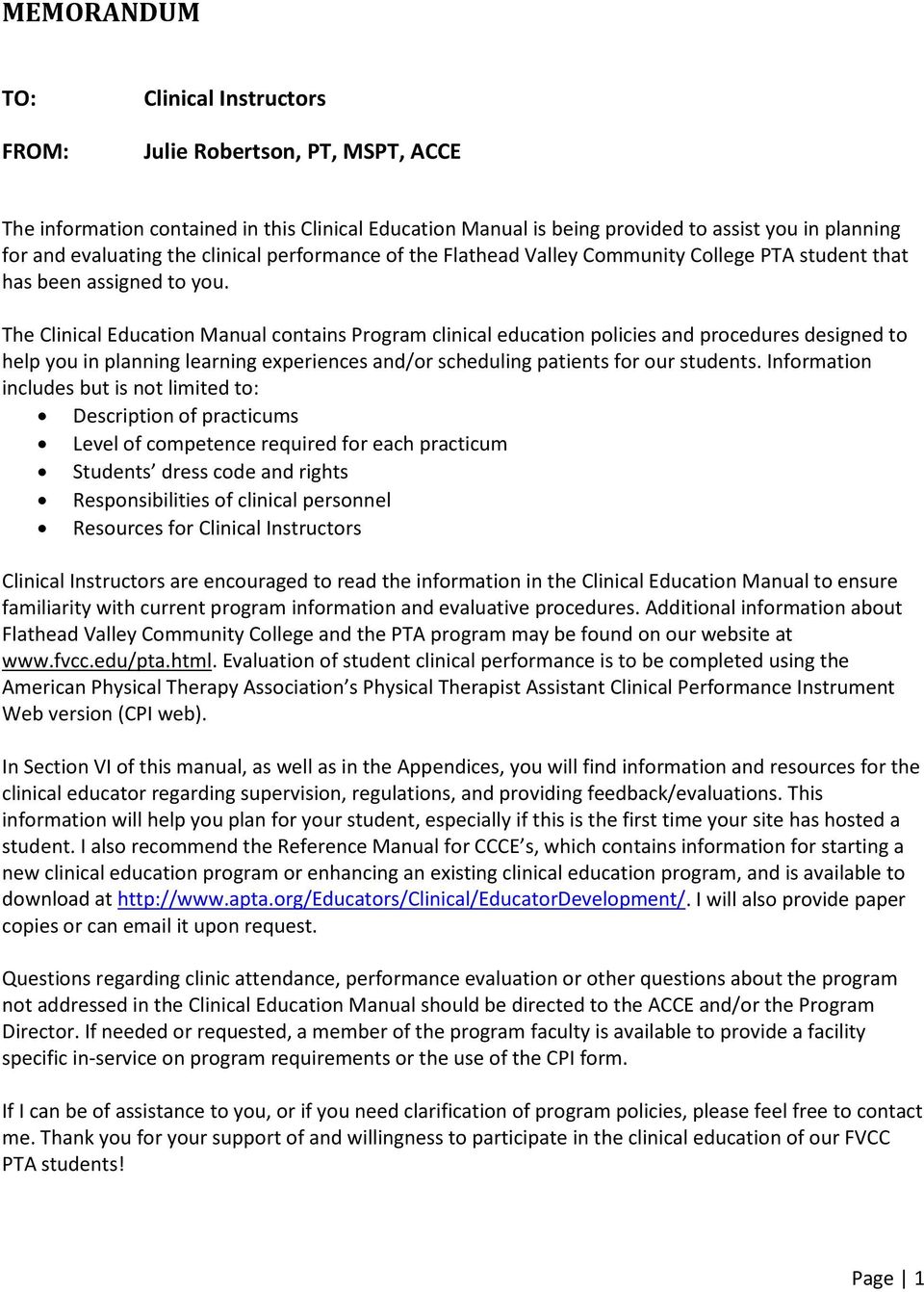
11 MEMORANDUM TO: FROM: Clinical Instructors Julie Robertson, PT, MSPT, ACCE The information contained in this Clinical Education Manual is being provided to assist you in planning for and evaluating the clinical performance of the Flathead Valley Community College PTA student that has been assigned to you. The Clinical Education Manual contains Program clinical education policies and procedures designed to help you in planning learning experiences and/or scheduling patients for our students. Information includes but is not limited to: Description of practicums Level of competence required for each practicum Students dress code and rights Responsibilities of clinical personnel Resources for Clinical Instructors Clinical Instructors are encouraged to read the information in the Clinical Education Manual to ensure familiarity with current program information and evaluative procedures. Additional information about Flathead Valley Community College and the PTA program may be found on our website at Evaluation of student clinical performance is to be completed using the American Physical Therapy Association s Physical Therapist Assistant Clinical Performance Instrument Web version (CPI web). In Section VI of this manual, as well as in the Appendices, you will find information and resources for the clinical educator regarding supervision, regulations, and providing feedback/evaluations. This information will help you plan for your student, especially if this is the first time your site has hosted a student. I also recommend the Reference Manual for CCCE s, which contains information for starting a new clinical education program or enhancing an existing clinical education program, and is available to download at I will also provide paper copies or can it upon request. Questions regarding clinic attendance, performance evaluation or other questions about the program not addressed in the Clinical Education Manual should be directed to the ACCE and/or the Program Director. If needed or requested, a member of the program faculty is available to provide a facility specific in-service on program requirements or the use of the CPI form. If I can be of assistance to you, or if you need clarification of program policies, please feel free to contact me. Thank you for your support of and willingness to participate in the clinical education of our FVCC PTA students! Page 1
12 Page 2
13 I. PHYSICAL THERAPIST ASSISTANT PROGRAM OVERVIEW A. Program Description: The Physical Therapist Assistant program curriculum is organized into a "1+1" format. In this format the students complete general education requirements consisting of eight prerequisite courses prior to admission to the program. After admission to the program the student must complete three semesters of didactic and clinical study specific to the physical therapist assistant. Successful completion of the program leads to the Associate of Applied Science (AAS) Degree. B. Definition and Utilization of the Physical Therapist Assistant According to the American Physical Therapy Association (APTA), physical therapy is a health profession whose primary purpose is the promotion of optimal human health and function. This purpose is accomplished through the application of scientific principles to the process of examination, evaluation, diagnosis, prognosis, and intervention to prevent or remediate impairments, functional limitations, and disabilities as related to movement and health. Physical therapy encompasses areas of specialized competence and includes the development of new principles and applications to effectively meet existing and emerging health needs. Other professional activities that serve the purpose of physical therapy are research, education, consultation and administration. The Physical Therapist Assistant (PTA) is a technically educated health care provider who assists the physical therapist in provision of physical therapy. The PTA is a graduate of a physical therapist assistant associate degree program accredited by the Commission on Accreditation in Physical Therapy Education (CAPTE). The Physical Therapist Assistant (PTA) provides physical therapy services under the direction and supervision of a physical therapist. PTA s help people of all ages who have medical problems, or other health related conditions that limit their ability to move and perform functional activities in their daily lives. PTA s work in a variety of settings including hospitals, privates practices, outpatient clinics, home health, nursing homes, schools, sports facilities, and more. PTA s must complete a two year associate s degree and are licensed, certified, or registered in most states. Care provided by a PTA may include teaching patients/clients exercises for mobility, strength and coordination, training for activities such as walking with crutches, canes or walkers, massage, and the use of physical agents and electrotherapy such as ultrasound and electrical stimulation. C. Program Mission and Philosophy Our Mission Flathead Valley Community College s (FVCC) Physical Therapist Assistant program s mission is to graduate qualified entry level PTA s who function under the direction and supervision of a Page 3
14 licensed Physical Therapist (PT). Graduates will ensure excellence in patient care by demonstrating competence, critical thinking and compassion. Faculty and graduates will be committed to promoting the health and wellness of local and surrounding communities by demonstrating safe and ethical practice, social responsibility and a personal commitment to professional growth and lifelong learning. Our Philosophy The PTA program at FVCC believes that optimum learning of skills needed for a physical therapist assistant is comprised of a dynamic, comprehensive curriculum, dedicated faculty, committed students, supportive health care community and a responsive learning environment. This relationship will create a foundation to meet FVCC s mission to promote excellence in lifelong learning, focused on student success and community need. D. Non Discrimination Statement Accommodations for persons with disabilities can be provided upon request by calling (406) Any qualified student with a disability who believes that an auxiliary aid is necessary for participation in any course activity or degree program is strongly urged to indicate a need for services to the Advocate for Students with Disabilities a minimum of six weeks prior to the beginning of the academic semester. This will provide sufficient time to assess student need and obtain any necessary auxiliary aid. For more information, please call (406) (voice or TTY). FVCC does not discriminate on the basis of race, color, national origin, sex, age or handicap in admission or access to, or treatment or employment in its educational programs or activities. Inquiries concerning Title VI, Title IX and Section 504 may be referred to: Vice President of Instruction and Student Services, Blake Hall, Room 136, 777 Grandview Drive, Kalispell, MT 59901, (406) ; or the Montana Human Rights Commission, 1236 Sixth Avenue, P.O. Box 1728, Helena, MT 59624, (406) / E. Accreditation Statement Effective August 2, 2012, Flathead Valley Community College s PTA Program has been granted Candidate for Accreditation status by the Commission on Accreditation in Physical Therapy Education of the American Physical Therapy Association (1111 North Fairfax Street, Alexandria, VA, 22314; phone: ; [email protected]). Candidacy is not an accreditation status nor does it assure eventual accreditation. Candidate for Accreditation is a pre-accreditation status of affiliation with the Commission on Accreditation in Physical Therapy Education that indicates the program is progressing toward accreditation. Page 4

15 F. Program Goals Upon completion of the Physical Therapist Assistant program graduates will: 1. Follow a plan of care established by a physical therapist and carry out physical therapy interventions in a safe, ethical and competent manner at entry level; 2. Demonstrate effective written, oral and nonverbal communication skills with patients, families/caregivers, healthcare providers, peers, third party payers and the public; 3. Recognize the need for continued personal and professional growth to ensure competence in current practices of physical therapy and a commitment to lifelong learning; 4. Demonstrate behavioral expectations as established by the APTA in the Value Based Behavior for the Physical Therapist Assistant (January 2011); 5. Participate as an effective member of the health care team and educate the healthcare community on the respective roles of the PT and PTA; and, 6. Show a personal commitment of health and wellness and dedication to service to the profession of physical therapy and the community. G. Physical Therapist Assistant Curriculum PTA Prerequisite Courses: Course Title Credit Hours Fall Semester AHMS 144 Medical Terminology 3 WRIT 101W College Writing I 3 AHMS 100 Math Applications for Allied Health Professionals 3 BIOH 201NL Human Anatomy & Physiology I* 4 Spring Semester SP 120C Interpersonal Communications 3 or SP110 Public Speaking or IDS 135 Thinkering: Problem Solve AHPT 105 Introduction to Physical Therapist Assisting 3 PSYX 100A Introduction to Psychology 4 BIOH 211NL Human Anatomy & Physiology II* 4 Total Prerequisite Hours 27 *These courses must have been completed within the past 5 years Page 5

16 PTA Program Courses: Course Title Credit Hours Fall Semester AHPT 101 Physical Therapist Assisting I 5 AHPT 205 Anatomy & Kinesiology for the PTA 6 AHPT 206 Pathophysiology for the PTA 3 AHPT 218 Therapeutic Exercise for the PTA 2 AHPT 210 Clinical Experience I (4 week) 3 Spring Semester AHPT 201 Physical Therapist Assisting II 5 AHPT 213 Neurorehabilitation for the PTA 6 AHPT 215 Introduction to Orthopedics 4 AHPT 220 Clinical Experience II (4 week) 3 Summer Semester AHPT 225 Seminar and Project in PTA 3 AHPT 230 Clinical Experience III (8 week) 5 Total PTA Program Hours 45 PROGRAM TOTAL 72 H. PTA Course Descriptions Instructional content for PTA coursework is listed below. Clinical education consists of three clinical practicums for a total of 640 hours of clinical experiences in a variety of settings. Each practicum is designed to build on the skills achieved in the classroom and/or previous practicums. By the end of the final practicum students are expected to demonstrate entry level competency as a physical therapist assistant. AHPT 105 Introduction to Physical Therapist Assisting (3) This course is designed to give the student an overview of the Physical Therapy profession by providing a historical perspective, as well as an understanding of its philosophy in relation to the professional organization; an overview of the roles of the Physical Therapy staff members in the clinical settings as well as members of the health care team in various delivery systems; development of interpersonal communication skills relating to the profession; and an understanding of the commitment of the graduate to continued personal and professional development. This course provides an overview of ethical and legal issues relating to the role of the PTA in health care delivery. It includes such topics as financing of physical therapy; regulations governing PTAs; code of ethics; the purpose of documentation and types of medical records; and scope of PT and PTA practice. Two projects will be completed that demonstrate the student s knowledge of American Medical Association style of referencing. AHPT 101 Physical Therapist Assisting I (5) This is the first of two sequential skills and procedures courses in the PTA program. The following topics are covered: basic principles and procedures of physical therapy; basic care skills and application techniques; use of assistive devices; architectural and Page 6

17 environment barriers; wound care and debridement techniques; definition and measurement of vital signs and application to emergency situations; incorporation of medical terminology and abbreviations; basic principles of tissue inflammation and edema management; introduction to pain theories, conditions, and assessment; physiological principles, indications/contraindications, and application of physical agents discussed in lecture; and the PTA s role in discharge planning and the importance of communication with the PT. AHPT 205 Anatomy & Kinesiology for the PTA (6) This course is designed to provide the student with an understanding of the human musculoskeletal system relative to the biomechanical elements of normal and abnormal human motion as well as osteology and arthrology in relation to muscle action and joint mechanics. The study and skills of goniometry, manual muscle testing, and palpation will also be covered. AHPT 206 Pathophysiology for the PTA (3) This course introduces the student to the pathophysiology; etiology; clinical signs and symptoms; and management of selected pathological and injury-related disorders treated in physical therapy. Pathologies discussed include: diabetes mellitus, immune system disorders, neoplasms, disorders related to pregnancy, and vestibular pathologies. The course includes student presentations on disorders pertinent to physical therapy as well as discussions on specific case studies applying the Physical Therapy Code of Ethics and how it relates to treatment of certain diseases. AHPT 218 Therapeutic Exercise for the PTA (2) This course introduces the physical therapist assistant student to topics such as exercise physiology, exercise prescription tailored to the individual, general therapeutic exercises, aquatic therapy, relaxation techniques, group therapy, and setting up a home exercise program. Current health practices and theory will be addressed in relation to nutrition/wellness within special populations emphasizing preventative practice. Students will become familiar with contraindications for exercise training in persons with various system or musculoskeletal disabilities and will understand how to progress an individual through a therapeutic exercise program established by a physical therapist. AHPT 210 Clinical Experience I (3) The purpose of this clinical affiliation is to provide the student with an opportunity to apply skills and techniques learned in AHPT 101, 105, 205, 206 and 218 under the appropriate supervision of the clinical instructor. This course will include a four-week clinical rotation at an approved site. AHPT 201 Physical Therapist Assisting II (5) This is the second in the series of procedures and application courses. The following topics are covered: theoretical principles and application of cardiopulmonary rehab, industrial rehab, ergonomics, gait analysis and training; prosthetic and orthotic application and treatment; breathing exercises and strategies, postural drainage, percussion, and vibration; biofeedback, topical applications, electrotherapy, ultrasound; procedure and application of cervical and lumbar traction; theory and application of massage/manual therapy. Students will accurately document the treatment and Page 7
18 patient s response within various related case studies as well as present research to the class about a selected therapeutic modality using peer-reviewed journals. AHPT 213 Neurorehabilitation for the PTA (6) This course is an introduction to neuroanatomy and neurophysiology in relationship to neurological pathologies of the brain and spinal cord commonly treated by physical therapy. Through this course the student is also introduced to neurological development: normal vs. abnormal - birth through adult; disease processes and outcomes; and neurophysiological routines used for treatment. Students will become familiar with general guidelines for completing a sensory assessment utilizing testing protocol. Principles and treatment of specific neurological disabilities are also presented. AHPT 215 Introduction to Orthopedics (4) This course introduces students to pediatric and adult musculoskeletal pathologies and management of orthopedic and surgical problems commonly seen in physical therapy. Course content will include: basic biomechanics and mechanisms of orthopedic injuries and disease; survey of surgical repair with emphasis on rehabilitation; evaluation techniques and treatments used by physical therapists; use of manual muscle testing for orthopedic pathologies; theoretical application of therapeutic exercise programs and equipment commonly used for treatment of various orthopedic conditions and surgical procedures; orthopedic pediatric treatment routines; and athletic taping. AHPT 220 Clinical Experience II (3) This is the second of three full-time clinical experiences. The students will continue to build on their clinical experiences from AHPT 210 and previous coursework. This will consist of a four-week clinical rotation at an approved site. AHPT 225 Seminar and Project in PTA (3) This concentrated course is designed to integrate skills and techniques from previous clinical experiences and from the course work presented throughout the PTA program. It focuses on presentation of comprehensive treatment plans utilizing all treatment skills and techniques learned during the previous semesters. The students will be expected to prepare and maintain a case study that will follow the patient through the continuum of care. Students will be required to relate sociological, physical, and psychological aspects of illness and injury to their projects. Preparation for the state s licensure exam is covered in this course, including the Practice Exam and Assessment Tool (PEAT). Students will also develop a professional portfolio for employment. AHPT 230 Clinical Experience III (5) This is the third of three full-time clinical experiences during which the student develops proficiency in physical therapy procedures, understanding of clinical responsibilities and supervisory relationships with a minimum competence necessary to graduate as an entry level physical therapist assistant and become an active participant of the health care team. This course will include an eight-week clinical rotation at an approved site. Page 8

19 II. OVERVIEW OF CLINICAL EDUCATION PROGRAM A. Purpose of Clinical Education Clinical education experiences are crucial to the preparation of competent Physical Therapist Assistants. There exists, in effect, a partnership between the clinical site and the educational program for the purpose of educating the PTA student. The clinical center and staff should provide an active, stimulating environment and administrative support of the clinical education appropriate for the learning needs of the students. The students experiences at the clinical site lead to the further development of knowledge, skills, and attitudes identified in the Evaluative Criteria for Accreditation of Education Programs for the Preparation of Physical Therapist Assistants and FVCC PTA program mission and goals. B. Clinical Experiences During the technical phase of their educational preparation, FVCC PTA students participate in three full-time (160, 160 and 320 hours) clinical education affiliations for a total of 640 hours of hands-on learning experiences. The clinical affiliations are appropriately sequenced throughout the curriculum and are designed to build on academic course content. Clinical education experiences provide opportunities for students to practice skills, to synthesize knowledge, and to apply theories gained in the classroom. Students are expected to know basic procedures taught each term and to build on skills learned during the previous term, as applicable. Each PTA student must have a C+ or greater in each technical course prior to progression into the following clinical rotation. By the end of the final practicum, students should have attained the competencies needed to function as entry-level Physical Therapist Assistants. The course learning outcomes for each of the three Clinical Experiences are outlined as follows: AHPT 210 Clinical Experience I (4 weeks full time) 1. Perform responsibilities as a PTA student by following the established plan of care including treating patients and reporting status to the supervising PT with frequent guidance form the clinical instructor. 2. Demonstrate behavior that indicates acknowledgement, respect and incorporation of the cultural, religious, and individual differences of patients/clients, caregivers, and family members when providing physical therapy interventions. 3. Model professional behaviors (dress, communication, interpersonal skills, and recognition of individual and cultural differences 4. Demonstrate personal lifestyle, wellness, injury prevention and health promoting behavior efforts as a model for the patient/client. 5. Describe ways that the physical therapy profession contributes to society. 6. Identify areas to serve in the physical therapy profession and community. 7. Consistently demonstrate the ability to perform PTA skills and behaviors legally, ethically and safely with occasional guidance for unusual situations. 8. With a variety of assigned patients safely and accurately administer physical therapy tests and measures, data collection and interventions that have been introduced and tested to Page 9

20 competency. A list of patient care skills appropriate for Clinical I will be provided to the student and clinical instructors. 9. Provide test and measure results and report progress in function in order for the PT to revise patient short term goals and long term goals for simple, uncomplicated patients. A list of patient care skills appropriate for Clinical I will be provided to the student and clinical instructors. 10. Demonstrates sound clinical decisions within the plan of care to assess and maximize patient safety and comfort while performing selected interventions. 11. Develop skill in treatment preparation and implementation for the following procedures/modalities as assigned: Goniometry, manual muscle testing, soft tissue palpation, vital signs, body mechanics, anthropometric measurements, PROM, AAROM, AROM measurement, ambulation with assistive devices, transfers and bed mobility/positioning, standard isolation precautions, wound management, sterile technique and sterile field, mechanical compression, hydrotherapy, hot packs, cold packs, paraffin, ice massage, contrast bath, whirlpool, cryocuff, SWD, fluidotherapy and SOAP note documentation. 12. Assist in the preparation of physical therapy treatment areas, equipment and patients (instructing, positioning and draping). 13. Demonstrate development of skills in verbal, nonverbal and written communication with patients, families, peers and supervisors to achieve patient outcomes that are based on the plan of care and that are accurate, timely, and concise using proper format with frequent guidance from the clinical instructor. 14. Consistently demonstrate the ability to perform PTA skills and behaviors legally, ethically and safely with occasional guidance for unusual situations. 15. Prepare physical therapy treatment areas, equipment and patients (through education, instruction, positioning, draping and assurance of patient/client informed consent to physical therapy interventions for uncomplicated patients. 16. Develop and present educational material for the purpose of patient, family, caregiver and health care team with frequent guidance from the clinical instructor. 17. Differentiates and explains the roles and responsibilities of the PT, PTA, and other members of the interdisciplinary team and accepts their contributions. 18. Discuss the roles of various team members in the assigned clinical setting and the significance of these roles to the provision of optimum care for the patient/client. 19. Participate in routine administrative procedures of the clinic/facility including billing and patient scheduling with direct guidance from the clinical instructor. 20. Provides patient/client centered interventions. 21. Recognize when to recognize when an intervention should not be provided due to a change in medical status and when an intervention by the physical therapist is necessary with frequent guidance from the clinical instructor. 22. Identify areas to serve in the physical therapy profession and community 24. Demonstrate a minimum of Intermediate performance on performance indicators 1 14 on the PTA Clinical Performance Instrument. Scenarios to be addressed via D2L during Clinical Experience: 1. Instructional Objective Select the most effective method of communication for a given situation. Page 10
21 2. Instructional Objective - Identify caring behaviors by healthcare workers and model caring behaviors in interactions with clients. 3. Instructional Objective - Modify intervention strategies in response to individual differences in response to pain. 4. Instructional Objective - Demonstrate professional behaviors in the clinic and when representing the physical therapy profession 5. Instructional Objective- Identify ethical or legal concerns and initiates action to address the concerns. 6. Instructional Objective Describe which of the activities in the PT s plan of care are within the scope of work of the PTA. 7. Instructional Objective Seek clarification of plan of care and selected interventions from the clinical instructor and/or supervising PT. AHPT 220 Clinical Experience II (4 weeks full time) 1. Demonstrate refinement in communication skills with patients, families, peers and supervisors through the utilization of effective teaching skills, responding appropriately to patients, feelings, demonstrating respect for the patients, dignity, adapting appropriate verbal communication levels and giving effective commands to obtain desired responses and to achieve patient outcomes based on the plan of care in an accurate, timely and concise manner using the proper format with occasional guidance from the clinical instructor. 2. Demonstrate refinement of skills, techniques, treatment preparation, assessment and reassessment and follow through acquired in previous PTA coursework including preparation and implementation for procedures/modalities appropriate for the clinical setting and the client and within the scope of work of a student PTA 3. Perform responsibilities as a PTA student by following the established plan of care including treating patients and reporting status to the supervising PT with occasional guidance from the clinical instructor. 4. Communicate with sensitivity to differences in race/ethnicity, religion, gender, age, national origin, sexual orientation and disability or health status. 5. Demonstrate consideration of patient/client privacy and confidentiality into all activities. 6. Instruct other members of the healthcare team about the roles, responsibilities and appropriate utilization of the PTA in the PT/PTA team using available resources (e.g. state licensure/practice rules and regulations, APTA resources, etc.). 7. Demonstrate the ability to perform PTA skills and behaviors legally, ethically and safely with guidance for unusual situations. 8. Perform interventions consistent with the rationale, indications, precautions, and contraindications for the interventions with occasional cuing from the clinical instructor. 9. Provide test and measure results and report progress in function in order for the PT to revise patient short term goals and long term goals for patients appropriate for Clinical II. A list of patient care skills appropriate for Clinical II will be provided to the student and clinical instructors. 10. Prepare physical therapy treatment areas, equipment and patients (through education, instruction, positioning, draping and assurance of patient/client informed consent to Physical therapy interventions) for uncomplicated patients/clients and family members. 11. Based on an established plan of care, assist the physical therapist with safely implementing and modifying comprehensive patient intervention for uncomplicated patients utilizing Page 11
22 interventions including physical agents and/or traction. The student may require a high degree of supervision. 12. With a variety of assigned patients safely and accurately administer physical therapy tests and measures, data collection and interventions that have been taught in the program for simple to complex patients. A list of patient care skills appropriate for Clinic II will be provided to the student and the clinical instructors. 13. Recognize when an intervention should not be provided due to a change in medical status and when an intervention by the physical therapist is necessary with occasional guidance from the clinical instructor. 14. Develop and present/instruct educational material for the purpose of patient, family, caregiver as directed by the supervising PT with occasional guidance from the Clinical Instructor. 15. Participate in routine administrative procedures of the clinic/facility including billing and patient scheduling with minimal guidance from the clinical instructor 16. Discuss departmental policies, procedures and functions of the department in which the student is affiliated. 17. Discuss mechanisms of quality assurance used in clinics to promote performance improvement 18. Places the patient/client s needs above the physical therapist assistant s self -interest. 19. Discuss the role of the PTA in the clinical education of physical therapist assistant students. 20. Demonstrate a minimum of Advanced Intermediate performance on performance indicators 1 14 of the PTA Clinical Performance Instrument. 21. Demonstrate the ability to provide timely and relevant documentation and communication regarding all aspects of the patient treatment and patient s response to the treatment with minimal guidance. Scenarios to be addressed via D2L during Clinical Experience: 1. Instructional Objective - Instruct a patient/client in a home exercise program. 2. Instructional Objective - Explain the rationale for selected patient/client interventions as related to the goals in the plan of care. 3. Instructional Objective - Demonstrate protection of patient/client privacy. 4. Instructional Objective - Demonstrate appropriate safe and ethical behavior when carrying out clinical responsibilities. 5. Instructional Objective - Plan for patient/client interactions with individuals from a variety of cultural and ethnic backgrounds. 6. Instructional Objective - Participate in activities that promote physical therapy in the clinical setting. AHPT 230 Clinical Experience III (8 weeks full time) 1. Demonstrate behaviors that indicate the recognition of and respect for differences in and among individuals, including patients/clients, family members, and colleagues consistent with the behavior norms for an entry level PTA. 2. Demonstrate entry-level communication skills with patients, families, peers and supervisors through the utilization of effective teaching skills, responding appropriately to patients, feelings, demonstrating respect for the patients, dignity, adapting appropriate verbal communication levels and giving effective commands to obtain desired responses and to Page 12
23 achieve patient outcomes based on the plan of care in an accurate, timely and concise manner using the proper format. 3. Reliably and without concurrent guidance by the CI, perform responsibilities as a PTA student by following the established plan of care including treating patients and reporting status to the supervising PT with occasional guidance from the clinical instructor. 4. Exhibit behaviors consistent with clinical facility and applicable policies and procedures. 5. With a variety of assigned patients safely and accurately administer physical therapy tests and measures, data collection and interventions that have been introduced and tested to competency. A list of patient care skills appropriate for Clinical III will be provided to the student and clinical instructors. 6. Provide test and measure results and report progress in function in order for the PT to revise patient short term goals and long term goals for patients appropriate for Clinical III. A list of patient care skills appropriate for Clinical III will be provided to the student and clinical instructors. 7. Based on established plan of care, assist the physical therapist with data collection and safely implementing and modifying comprehensive patient intervention for simple or complex patients utilizing interventions including physical agents and modalities. 8. Demonstrate entry-level skills, techniques, treatment preparation, assessment and reassessment, and follow through acquired in previous PTA coursework including preparation and implementation for procedures, physical agents/modalities appropriate for the clinical setting and the client and within the scope of work of a student PTA. 9. Understand the rationale for the supervising PT s discharge plan and be able to educate and assist the patient, family and various team members regarding the discharge plan for simple to complex patients/clients. 10. Recognize, without concurrent guidance by the CI, when an intervention should not be provided due to a change in medical status and when an intervention by the physical therapist is necessary. 11. Apply the clinical reasoning process to clinical decision-making consistently and efficiently with simple to complex patients under the supervision of the physical therapist. 12. Educate colleagues and other health care professionals about the role, responsibilities, academic preparation and scope of work of the PTA. 13. Demonstrate behaviors that support career development and the physical therapy profession through: interaction with various team members to provide optimum care for patient/client, accessing learning opportunities outside the classroom, and providing educational presentations to patients/clients, the public and health care students and providers. 14. Demonstrate skill in time-management consistent with an entry level physical therapist assistant by completing assigned tasks in a timely manner and delegating tasks as appropriate. 15. Demonstrates truthfulness, fairness and reliability with patient/clients and other health providers. 16. Demonstrate the professional behaviors (i.e. dress, communication, interpersonal skills, recognition of individual and cultural differences, application of legal standards and standards of ethical conduct) consistent with an entry-level physical therapist assistant. 17. Discuss the benefits of APTA membership and participation in APTA events with the clinical instructor. 18. Discuss pathways for developing skills as a clinical educator and other career pursuits with clinical instructor. Page 13
24 19. Demonstrate Entry Level on all criteria at final according to the CPI; 20. Develop and present/instruct educational material for the purpose of patient, family, caregiver as directed by the supervising PT; within the scope of practice of a student PTA. 21. Participate in routine administrative procedures of the clinic, including billing and patient scheduling with minimal to no guidance from the clinical instructor; 22. Present in-service to peers, practitioners, and supervisors during clinical experience and solicit feedback from the audience 23. Demonstrate entry level communication skills to provide timely and relevant documentation and communication regarding all aspects of the patient treatment and patient s response to the treatment. Scenarios to be addressed via D2L during Clinical Experience: 1. Instructional Objective - Explain the rationale for selected patient/client interventions as related to the goals in the plan of care that you performed this week. 2. Instructional Objective Demonstrate accountability for actions and decisions by admitting mistakes and taking corrective steps. 3. Instructional Objective Give examples of your ability to seek assistance when a directed intervention is beyond the education, skill, or scope of work of the PTA. 4. Instructional Objectives Seek out experiences and activities within clinical assignments which expose or are associated with people from a variety of cultural and ethnic backgrounds. 5. Instructional Objectives -Recognize role and participate appropriately in communicating patient status and progress within the health care team. 6. Instructional Objectives - Identify individual learning needs to enhance role in the profession. C. Criteria for Selection of Clinical Sites The American Physical Therapy Association s (APTA s) Guidelines and Self-Assessments for Clinical Education was utilized in developing the FVCC Physical Therapist Assistant program criteria for selection of clinical sites. It is divided into three sections with both guidelines and self-assessments for (1) Clinical Sites, (2) Clinical Instructors, and (3) Center Coordinators of Clinical Education. We recommend that all sites, especially new clinical education sites, read the guidelines and complete the self-assessments in order to develop and enhance themselves as clinical educators for PTA students. The Guidelines and Self-Assessments for Clinical Education can be found on the APTA website at: You may also obtain a paper copy upon request from the ACCE. The following criteria are evaluated in the selection of clinical sites and instructors: 1. Be licensed or accredited as applicable. 2. Operate within legal and ethical standards. 3. Represent current practice and encourage and support staff development. 4. Assign a CCCE to be responsible for coordinating clinical instruction of students (if a multi- therapist setting). Page 14
25 5. Promote staff participation in clinical education activities. 6. Provide the student with learning experiences appropriate for their level of education. 7. Attempt to fulfill student objectives for each level of clinical experience. 8. Give feedback to FVCC PTA program regarding curriculum and academic preparation of students. 9. Provide an orientation for students. 10. Have clearly defined roles for physical therapy personnel. 11. Have policy and procedure manuals that include policies regarding patients rights and safety procedures. 12. Have non-discrimination policies and procedures relative to facility personnel, patient rights and in the selection or assignments of students during their learning experiences. 13. Have a variety of learning experiences available/applicable to the facility. 14. If the facility is a single-provider facility, a back-up plan is in place in case the physical therapist is ill or must be away from the clinic. 15. Have an adequate patient population, staff, equipment, space, and other resources. 16. Expose students to non-patient care activities, (e.g. quality improvement, productivity monitoring, observing surgery, observing other health care professionals, supervising support personnel) as appropriate. 17. Supply information regarding support services, i.e. emergency medical care, cafeteria, parking, available housing, etc., if applicable. D. Roles and Responsibilities of Clinical Instructional Personnel ACADEMIC COORDINATOR OF CLINICAL EDUCATION (ACCE): The ACCE is a full-time FVCC employee in the Physical Therapist Assistant Program charged with administering the clinical education component of the program and coordinating with the clinical affiliates. Responsibilities include: 1. Assigning all eligible students to clinical education placements, confirming the assignment (in writing) with each clinical supervisor and notifying each student of his/her placements. 2. Assuring that all written contracts and letters of agreement between the College and the facility are signed and reviewed annually; forwarding all appropriate forms/information on a timely basis. 3. Making regular contact, by phone or in person, with each clinical facility in which students are placed; conducting on-site visits whenever possible during clinical experiences. Emergency on-site visits by the ACCE can be requested at any time at the discretion of the clinical facility. 4. Interacting with student weekly via D2L Clinical Bulletin Board. 5. Contacting the student and CI at least twice during the clinical experience. This will be done by the ACCE or another PTA program faculty member. When problems or concerns arise, the clinical instructor and/or the student may contact the ACCE. However, the student has the responsibility to discuss problems and concerns with his/her CI and/or CCCE before calling the ACCE. 6. Orienting the clinical faculty to FVCC s PTA program and related coursework, faculty rights and privileges, student evaluations, and other information. Page 15
26 7. Informing clinical sites of program changes. 8. Ensuring that only qualified students are placed in affiliations. 9. Assigning students to clinical sites and maintains a current file of information on each PTA student. 10. Maintaining clinical education records. 11. Evaluating the overall effectiveness of the clinical education component of the curriculum. 12. Reporting the status of the clinical education component of the curriculum to the Program Director. 13. Developing and conducting basic Clinical Instructor workshops and implementing clinical faculty development activities based on the results of the clinical education evaluations. 14. Identifying and investigating new sites for clinical education and/or responding to requests for affiliation contracts. 15. Ensuring that each CI has a copy of the PTA program Complaint Form. 16. Orienting students to the purpose of clinical education and regularly scheduled meetings to discuss clinical education. 17. Providing the students with forms needed to plan for clinical placements and reviewing their content with each student. 18. Being available at scheduled times to meet with students concerning any of the clinical placements (Scheduled office hours will be posted prior to the start of each semester). 19. Assigning a final grade to AHPT 210, AHPT 220, and AHPT Attending PTA academic faculty meetings and PTA Advisory Committee meetings. CENTER COORDINATOR OF CLINICAL EDUCATION (CCCE): As the clinical affiliate s appointed representative, the CCCE coordinates the clinical education activities, including assignment of students to clinical instructor(s). Responsibilities include: 1. Serving as the liaison between the college, ACCE and the clinical site. 2. Assuring the completeness of the contract with the College. 3. Assigning the student to a qualified CI (see CI requirements below). 4. Developing the student s schedule with CI input. 5. Serving as a resource person and mediator for student/clinical staff conflict resolution. 6. Insuring that students are not used in lieu of regular employees and that they do not work without proper supervision of appropriate personnel. 7. Providing feedback to the ACCE regarding the effectiveness of the clinical education program. 8. Keeping the ACCE updated on developments in the field, new protocols in physical therapy delivery, and any other pertinent information about the clinical site via the program. 9. Providing the ACCE with current and accurate information about the clinical site. CCCE s are encouraged to read the APTA s Reference Manual for Center Coordinators of Clinical Education, a guide to assist in the development and enhancement of clinical education. It contains useful resources such as sample letters to students, a sample orientation checklist, and things to include in a clinical education site s Student Handbook. The Reference Manual for Center Coordinators of Clinical Education can be found on the APTA website at: Page 16
27 A paper copy is available upon request from the ACCE. CLINICAL INSTRUCTOR (CI): Clinical instructors are recognized by the College as Clinical Affiliate Faculty and have all the responsibilities, rights and privileges accorded to this position. All clinical faculty will be oriented to the FVCC Physical Therapist Assistant (PTA) Program. This orientation may include, but is not limited to: APTA s Clinical Education Guidelines and Self Assessments and an overview of the Program Mission, Goals, Clinical Education Policies and Procedures, and Faculty rights and privileges. Packets containing information related to the PTA program will be mailed or ed to CCCE s and/or Clinical Instructors (CI). Packets may also be hand delivered during routine clinical facility site checks. Requirements: Clinical affiliate faculty must meet the requirements for professional, experiential and/or scholarly preparation established by the appropriate accrediting/approving body for the course or program in which they are teaching. Criteria for clinical instructors in the FVCC Physical Therapy Assistant Program require the CI to: 1. Be a graduate of an accredited PT or PTA program. 2. Be licensed, or otherwise regulated, in the state in which they practice. 3. Have a minimum of one year (2 years or more preferred) of clinical practice experience in the area in which they are teaching. 4. Practice with legal and ethical standards. 5. Be familiar with the FVCC PTA program curriculum and objectives for each practicum level. 6. Be able to provide formative and summative evaluations of student performance. 7. Have good oral and written communication skills. 8. Form a supportive, professional relationship with the students. 9. Be a role model for self-development and continuing education, ethical and effective practice, and professional behaviors. Compensation of clinical affiliate faculty: As this is a voluntary, non-contracted position, affiliate faculty members receive no compensation in the form of salary or benefits from the College. Responsibilities of clinical affiliate faculty: As program affiliate faculty, clinical instructors have the responsibility to: 1. Orient the student to the clinical facility, including equipment, relevant policies and procedures. 2. Instruct the student in documentation procedures used at the facility. 3. Review and co-sign any patient notes written by the student. 4. Supervise treatment activities provided by the student at all times. Page 17
28 5. Assume responsibility of coordinating the in-house learning activities of the student and incorporate individual student goals into these activities when feasible for the rotation. 6. Assume responsibility for treatment procedures or techniques needed by the student that have not been presented and practiced in the academic environment. The curriculum overview indicates the course in which skills are taught. 7. Maintain written records and performance evaluations on the student and provide copies of these records to the ACCE as described in the evaluation section of this manual. 8. Maintain confidentiality regarding FVCC Physical Therapist Assistant students. 9. Provide feedback to the ACCE regarding the effectiveness of the clinical education program. 10. Serve as a positive role model for students. 11. Assist in evaluation of the clinical education program. 12. Follow policies and procedures of the institution in which they are employed in the event that an exposure to blood or body fluids occurs while providing clinical supervision to FVCC PTA students. Rights of clinical affiliate faculty: As program affiliate faculty, clinical instructors have the right to: 1. Be kept informed of any substantive program changes. 2. Request a conference as appropriate with the ACCE and/or program director. 3. Voice concern(s) related to didactic educational units and/or clinical practicums to the ACCE. Any concern not resolved at that level shall continue to be referred up the administrative chain until resolution occurs. 4. Attend clinical faculty development activities sponsored or cosponsored by FVCC. 5. Have access to appropriate FVCC PTA program s online faculty services such as the Clinical Education Manual, etc. Privileges of clinical affiliate faculty: Privileges include: 1. Official recognition as FVCC Clinical Affiliate Faculty. 2. Attend all PTA program College events such as lectures and workshops as appropriate. 3. Attend and/or participate in all PTA program events. Clinical Affiliate Faculty Professional Development: The FVCC PTA program is dedicated to providing Clinical Education Faculty with the tools and resources they need. As part of this, we provide professional development opportunities for Clinical Instructors. Initially, our program performs this through one-on-one interaction with the Clinical Education Faculty in order to educate them on the Clinical Education Manual, PTA CPI, and packet of information and student assessment tools that our program will use. The ACCE gathers information from the CIs during this time to determine future areas of need for CI education. The ACCE discusses expectations of FVCC PTA students and clinical instructors during internships as needed. Page 18
29 During clinical site visits and/or calls, the ACCE assesses the features of that clinical site and interviews the CI s/ccce. This provides an opportunity to address any areas of concern or questions by the Clinical Faculty or ACCE and review clinical education policies and needs regarding Clinical Facility educational and developmental activities. The ACCE will provide instruction in how to access the online version of the Physical Therapist Assistant Clinical Performance Instrument (CPI) for CI use in evaluating the clinical performance of each assigned student. The ACCE or Program Director will schedule an in-service or Basic Clinical Instructor Workshop tailored to CI/facility specific needs at a mutually agreeable time, if/as requested. The program will have ongoing development activities for Clinical Faculty that provide the following: 1. Clinical education faculty development activities are designed to improve the effectiveness of the clinical education faculty. 2. Clinical education faculty development activities are based on needs of the clinical education faculty identified in the evaluation of the clinical education faculty. 3. Clinical education faculty development activities are designed to promote the effectiveness of the clinical education faculty. 4. Clinical education faculty development activities are designed to meet the needs of the program. The FVCC PTA program faculty plan to offer training sessions and/or in-services that both meet the relevant professional development needs of the clinical faculty and provide continuing education benefits toward maintaining licensure. Clinical Affiliate Faculty Evaluation: Formal evaluation of our Clinical Education Faculty is performed annually as part of our annual program assessment to ensure the program is meeting the needs of its clinical affiliates. Our program, over time, formally assesses that professional development needs were met to maintain high quality clinical education experiences for our students. The clinical faculty evaluation procedure includes reviewing the following: Clinical Instructor Self-Evaluation that each CI completes; Timeliness in returning paperwork requested by FVCC; Accuracy and conciseness with which student evaluation methods are completed; Communication with the ACCE, student, and the program; Student evaluation of the clinical experience; and ACCE site visit to the clinical affiliation facility. III. PROGRAM POLICIES AND PROCEDURES A. General Clinical Information During the first semester in the PTA program, the student will begin with introductory tasks and fundamental treatment activities under close supervision of the faculty. Complexity of Page 19
30 treatment activities increases and amount of supervision decreases as the student progresses through the first semester. The student will progress to three full-time clinical experiences in community physical therapy clinics by the third semester in the program. The student will be placed in three different types of clinics, serving a wide variety of patient populations. During each full-time clinical experience, the expectation of student performance and degree of supervision will progress from week to week, beginning with primarily observation and assisting to managing a moderate caseload of patients by the last week of the clinical experience, under the supervision of a physical therapist and/or physical therapist assistant. The expectation of student performance and degree of supervision progresses with each fulltime clinical experience until the student is demonstrating entry-level skills, knowledge, and professional behaviors upon completion of the third full-time clinical experience. The ACCE will provide each clinical site with a current copy (via paper copy or website/ ) of the comprehensive Clinical Education Manual. The PTA program will notify clinical sites in writing when substantial changes are made regarding clinical education design, policy, and/or procedures. The ACCE will attempt to make an on-site visit to all active sites when students from FVCC are completing full-time clinical experiences at the site, although some restrictions may limit the ability to visit sites, especially those further than 90 miles from FVCC. B. Clinical Site Selection Clinical education sites for full-time clinical experiences are selected based on the experiences the site can provide a student PTA, willingness of the site to work with students, the site s past experiences in clinical education, availability of a PT for on-site supervision, qualifications of the Center Coordinator of Clinical Education (CCCE) and Clinical Instructor (CI), and location. The minimum qualifications for a CI are at least one year of clinical practice and willingness to work with a student. Some degree of clinical instructor training is preferred. It is also preferred by the program that the clinical instructor possess high levels of motivation, strong interpersonal skills, a solid knowledge base about physical therapy, and the ability to help students learn to apply knowledge to the treatment of patients. The ACCE will provide opportunities for clinical instructor training. The ACCE also annually sends a certificate of appreciation to clinical instructors who have worked with students. The ACCE interviews the CCCE of the facility to determine if the facility could be a possible clinical education site for the program. The ACCE reviews the Clinical Site Information Form (CSIF). If possible, the ACCE visits the facility before sending a student. If this is not done, the ACCE makes every effort to visit the facility when the student is there. Due to financial and time constraints, it usually is not possible for the ACCE to visit clinical sites that are more than a day s Page 20
31 drive or require airfare to get there. The ACCE will consult other ACCE s to learn more about unfamiliar clinical facilities in other states. C. Clinical Site Information Form (CSIF) The faculty of the Physical Therapist Assistant program attempt to keep current information on the clinical sites utilized by the Physical Therapist Assistant program. The information is utilized to inform students of clinical requirements and also provide general clinic information. A Clinical Site Information Form (CSIF) will be requested from each new clinic site utilized by the PTA program. An updated CSIF will be requested as needed by the Academic Coordinator of Clinical Education (ACCE). All CSIFs should be current and completed within the past 5 years. The current CSIF will be kept in the ACCE s clinical file located in PTA faculty office. Students can request access to these files. Students are asked to review the CSIFs when requesting sites on the clinical preferences sheet. Students are asked to review the information of the assigned clinics prior to beginning the clinical experience. Although the ACCE attempts to keep the forms up-to-date, the student is ultimately responsible for checking on the accuracy of the information prior to affiliating with the facility. D. Clinical Affiliation Contract All clinical education sites must follow the Clinical Affiliation Contract. It is acceptable to sign the facility s contract or both the FVCC contract and the facility s contract as long as the legal counsels for the college and the facility agree. Contracts are managed by the ACCE and/or the Program Director. Signed original contracts are kept on file with the ACCE in each clinical site s files and a copy is given to the Director of Facilities. All clinical affiliation contracts will be valid for three years unless a specific clinical facility requires otherwise based on their facility s policy. The ACCE will review all written agreements prior to students participating in clinical assignments to ensure the written agreements are unexpired and have appropriate signatures. The content of the contract will be reviewed annually to ensure it accurately reflects the needs of the college and the facility at that time. The ACCE will contact the person responsible for contract oversight for the facility to determine that the contract continues to meet the needs of the program and the clinical facility. If the contract is not valid or requires modification, the clinical site is placed on hold and students are not placed there until a valid one is on file. This will also be part of the annual review process of the Clinical Education portion of the curriculum. The ACCE sees that contracts are renewed when the contract expiration date is reached. The ACCE is responsible for seeing that all contracts with facilities where students will be going during the school year are up to date. Content of the contract is reviewed and/or Page 21
32 revised when questions or situations arise or when program, student, or facility needs change. E. Clinical Education Planning Forms Clinical Education Planning Forms are filled out by the CCCE at each clinical site the spring prior to the upcoming calendar year to indicate availability to take students for each of the Clinical Experiences during that year. The ACCE will mail or a Clinical Education Planning Form to the clinical site during the spring prior to the upcoming year. The CCCE returns the Clinical Education Planning Form to the ACCE as soon as possible, indicating how many students they will be able to take for each Clinical Experience during that year. The ACCE will mail back a confirmation form when the completed Clinical Education Planning Form is received. The ACCE will then contact the CCCE 4-6 weeks prior to each Clinical Experience that they have indicated they will take students to confirm the dates and will mail a student packet with forms/evaluations needed for the Clinical Experience. F. Criteria for Student Clinical Experience Placements Students must successfully complete all technical PTA program courses listed for Semester III prior to Clinical Experience I, as well as complete technical PTA courses in Semester IV prior to Clinical Experience II and III. During each lab course, students will be expected to pass those elements considered Critical Safety Elements as outlined below in Section H: Criteria for Passing Physical Therapist Assistant Clinic Courses. Students will not be allowed to progress to their clinical experience if they have not passed all of the Critical Safety Elements during lab exams and/or skills checks. The clinical internship sites are selected via a lottery system as outlined below in Section G: The Clinical Experience Selection Process. Clinical Experience Requirements: During the FVCC PTA program, students will complete fulltime internships at three different clinical sites (Clinical Experience I, II and III) Clinical Experience I will be in an inpatient or outpatient setting which would include: A long-term/extended care facility; Sub-acute skilled nursing facility; Rural hospital with acute or long term care; General acute care hospital; Rehabilitation facility; Hospital based outpatient facility; Home health care; and/or Outpatient setting with limited specialized patient population. Clinical Experience II will be in an inpatient or outpatient setting such as: Page 22
33 A long-term/extended care facility; Sub-acute skilled nursing facility; Rural hospital with acute or long term care; General acute care hospital; Rehabilitation facility; Home health care; Sports medicine facility; Outpatient facility; Pediatric clinic or school setting; and/or Combination setting. Clinical Experience III will be in an inpatient or outpatient setting including: A long-term/extended care facility; Sub-acute skilled nursing facility; Rural hospital with acute or long term care; General acute care hospital; Rehabilitation facility; Home health care; Sports medicine facility; Outpatient facility; Pediatric clinic or school setting; and/or Combination setting. Included in these clinical experiences, the student must have opportunity to focus primarily on the treatment of three (3) types of patient populations: 1. The patient in the acute phase of healing 2. The patient with orthopedic diagnoses 3. The patient with neurologic diagnoses In addition, of the three clinical experiences, each student must have at least one outpatient experience AND one inpatient experience, dependent upon clinical site availability. It is strongly recommended that clinical sites be different from past or present employment sites. This will increase the student's awareness of a variety of health care philosophies. If a specific site requests a particular student, whether that student has been previously employed by that site or not, the ACCE will consider requests based on the needs of the student. The Academic Coordinator of Clinical Education has priority to assign students to certain sites for "special" needs or accommodations for disabilities. Page 23
34 G. The Clinical Experience Selection Process Sites that are Distant Although FVCC has contracts with most physical therapy facilities in the Flathead Valley area and in communities that are within a 90-mile radius from Kalispell (commuting distance), there may not be enough of these facilities available during each full-time clinical experience period to accommodate all students. This may be due to the size of the class, competition for sites with other PT and PTA programs, and/or due to unexpected staffing changes that occur at the facilities. For example, a site may agree to take a student, but need to cancel later because a therapist leaves and the facility may be understaffed during the time the student was to be there. Therefore, all students entering the PTA program should expect to attend a full-time clinical experience in at least one clinic located too far away to commute on a daily basis. An effort will be made to assign students who are parents of young children to clinical sites within a 90-mile radius, although this is not guaranteed, and will depend upon clinical site availability and the overall needs of the cohort to ensure a variety of clinical experiences available to all students. All students should PLAN AHEAD and make arrangements to allow out-of-town clinical experiences to be possible. Suggestions include: Putting money aside for expenses when the student cannot work during the clinical experience time period; Making advanced arrangements for child care; Exploring physical therapy clinics in areas where family and/or friends live; Obtaining a loan or some other type of financial aid to cover expenses. Considerations when Selecting Clinical Sites 1. Each fall semester, students complete a Clinical Experience Preference Information Form (See Appendix C) which is submitted to the ACCE prior to determining clinical selections. This form will be used to place students in a variety of clinical settings while taking individual interests and experiences into consideration. The Clinical Internship Preference Information Form also requires the student to document any potential conflict of interest in affiliating at any specific site. 2. As the student progresses through the PTA program, it is necessary to be aware of his/her previous experiences in order to assign the student to a facility that will offer a challenge and variety of new experiences. This information is determined in several ways: Meeting with student; Observing the student during his/her practicum; Reading the evaluation of the student by the clinical instructors and academic faculty; and Completion of the Clinical Practicum Student Introduction Form. (See Appendix C) 3. The ACCE will consider a CCCE s recommendation for a student to attend a similar clinical affiliation (similar to the one just attended) for reinforcement of skills. Page 24
35 4. September 30th is the deadline for all clinical site selections for the upcoming fall semester. Sites must be chosen by the student and finalized by the ACCE by this date. If the student has not chosen a site or the site has not finalized its contract with the ACCE, the ACCE will assign an alternative site to the student if available. 5. The Physical Therapist Assistant Program does not guarantee an alternative facility placement. If no facility placement is available, or the student refuses to attend the alternative site, the student may not be able to graduate from the Physical Therapist Assistant Program or graduation may be delayed. 6. Special clinical experience arrangements and reasonable accommodations can be made for students with a documented disability who are working with the FVCC Disabilities Counselor. Procedure for Selection of Clinical Experiences 1. Students will be provided with a list of clinical sites available for each of the three fulltime clinical experiences (Clinical Experience I, II, and III). Students will plan their 1st, 2nd, and 3 rd, etc. choices for each clinical experience on the Clinical Experience Preference Form (Appendix C). Information about the sites can be found in the Clinical Site File located in the PTA program lab. Students should use these resources to help with these decision-making processes. All forms will be turned in to the ACCE by a specified date and time. 2. The ACCE will assign students to sites based on order of preference, taking into consideration previous clinical experiences. 2. In the event there are sites that more than one student has indicated as their first choice, a lottery drawing may be held at the discretion of the ACCE to determine which student will be assigned to that site. The students who did not get their first choice will be assigned to their second or third choice. If these choices have already been assigned to another student, the ACCE will work with the student to find an alternative site. 3. After the site assignments have been made, students will be allowed to negotiate with each other to trade sites at the approval of the ACCE. 4. A date will be set after which no changes can be made unless at the discretion of the ACCE. 5. The ACCE has the discretion to revise clinical assignments to assure the student meets the educational objectives or if reasonable accommodations need to be made. NOTE: Students can express preference for a certain or specific clinical site however their experiential needs for academic learning and proficiency supersede simple preference. Sites are reviewed by ACCE to determine what clinical site(s) can best provide the learning experience each student needs. Affiliation assignments are reviewed with students prior to final confirmation with facility CCCEs. THE ACCE MAKES THE FINAL DECISION REGARDING STUDENT PLACEMENT. Student Request for New Clinical Site/ Distant Site The student is best served when the ACCE can periodically visit the clinical facility to become acquainted with the staff and equipment in the department. Preferably, the ACCE should make an on-site visit to help the student and CI resolve a difficult situation or conflict if the need occurs. Therefore, distant sites will be considered on a case-bycase basis. Page 25
36 A student may request a clinical experience in a community located too far away for it to be practical for the ACCE to make on-site visits. These communities are called "distant" sites and are defined as taking more than 4 hours to drive to, located more than 350 miles from Kalispell, and/or costs to fly there on short notice are more than $ The student choosing a "distant" clinical site must be a student in which the ACCE has confidence that there will be a minimal chance of difficult problems occurring. Therefore, the ACCE MUST APPROVE the student's site selection. For permission to attend a "distant" clinical facility, the ACCE will consider the following: 1. Student's most recent GPA and course grades; 2. Satisfactory completion of all courses listed on the PTA program planner prior to the clinical experience; 3. Student s attendance habits and professional behaviors as demonstrated throughout the school year; 4. Student s status in the program (program academic probation, etc.); 5. Site's ability to meet the clinical experience criteria; and 6. Site s agreement to a contract. Cost of food, housing, travel to and from clinical sites as well as during the clinical experience are the responsibility of the student. This includes travel to homes for home health visits, travel to various schools, and travel between satellite clinics. H. Criteria for Passing PTA Clinical Education Courses (Clinical Experiences I, II, and III) General criteria for all three courses to receive a grade of SATISFACTORY: AHPT 210 Clinical Education I (4 weeks, 160 hours): Program focus for this affiliation is on student performance of delivering modalities covered in AHPT 101, transfer training, routine therapeutic exercise and taking measurements as prepared by prior classroom instruction. Program focus for this affiliation is on student performance of items 1-14 on the PTA CPI. The minimum acceptable level for Clinical Experience I is Entry Level for criteria AHPT 220 Clinical Education II (4 weeks, 160 hours): Program focus for this affiliation is on student performance of items 1-14 of the PTA CPI. For Clinical Experience II, the minimum acceptable level is Advanced Intermediate for criteria AHPT 230 Clinical Education III (8 weeks, 320 hours): Program focus for this affiliation is on student performance of items 1-14 of the PTA CPI. For Clinical experience III, the student must be at Entry Level for criteria NOTE: By the end of the final affiliation, students should have been evaluated by a CI on every item contained in the CPI. Students are responsible for writing learning objectives to ensure that each item has an opportunity for evaluation during one or more of his/her clinical education affiliations. Further, the student must ensure that any item marked not observed during the first two clinical experiences is covered by the end of the final affiliation. Page 26
37 Additional student learning activities may be required until all items on the CPI are observed and acceptable competency is achieved or demonstrated. Refer to Appendix A & B of the APTA s A Normative Model of Physical Therapist Assistant Education, Version 2007, which defines entry-level data collection skills and technical skills respectively. It must be emphasized that entry level, as defined by the Normative Model, should not be compared to an experienced PTA. Clinical Instructors (CI) are requested to provide further information in the comment section which supports the given score, to offer ongoing feedback to the student, and are instructed that the evaluation of student performance should be based on repeated performance, not isolated incidents. Critical Safety Elements: Demonstrating mastery of specific Critical Safety Elements (CSE) during clinical rotations is necessary in order to pass each clinical affiliation. Competency with Critical Safety Elements indicates that a student carries out intervention, per the Plan of Care, in a manner that minimizes risks to the patient, self, and others. To assist in the mastery of these skills, Critical Safety Elements are carefully monitored by program faculty during specific lab exams, prior to clinical rotations. The Critical Safety Elements also serve as the core elements of safety criterion marked with (*) in the rubrics used to assess student performance in these lab exams. If a student misses any of the identified critical safety elements, they automatically fail the skill check and must repeat it. Instructors provide any additional specific Critical Safety Elements that may apply to a particular skill being covered in a course/unit. Examples of essential program Critical Safety Elements, include, but are not limited to: 1. Ability to follow and appropriately carry out the plan of care established by the PT. 2. Safe implementation of the PLAN OF CARE based upon patient diagnosis, status and response to intervention without placing the patient in jeopardy of harm or injury. 3. Demonstration of knowledge regarding contraindications and precautions for specific patient diagnosis relative to the physical therapy interventions within the plan of care (i.e., following hip precautions when transferring a patient after total hip replacement; choosing an appropriate assistive device for the weight bearing status and abilities of the patient for gait). 4. Ability to correctly identify physiological measures (BP, HR, blood glucose levels, etc.) outside of parameters that allow for safe therapeutic exercise/intervention and provide proper response and notification of the PT/MD/Nurse. 5. Ensures safety of self and others by washing hands correctly, following universal precautions, able to competently set up a sterile field, and don/doff PPE without contaminating materials, patient or self to prevent spread of infection. 6. Uses acceptable techniques for safe handling of patients with proper body mechanics, guarding, and level of assistance; and employs standard safety precautions such as: Page 27
38 always locking a wheelchair prior to transferring a patient, appropriate use of gait belt with transfers and gait training, washing hands prior to and after each patient contact, recognizing environmental hazards to safe ambulation, transfers, or other therapeutic intervention. 7. Establishes and maintains safe working environment (i.e., monitoring of lines and tubes and other medical equipment, checks physical therapy equipment and assistive devices for maintenance and/or disrepair, eliminates work place hazards). 8. Requests assistance when necessary (i.e., from clinical instructor, utilizes and monitors support personnel). 9. Ability to recognize patient responses during therapeutic intervention that may indicate a life threatening condition (shortness of breath, chest pain, sudden dizziness, sudden dysarthria, etc.) and provide proper response and notification of the PT/MD/Nurse. 10. Correct interpretation of weight bearing status and ability to choose appropriate assistive device for weight bearing status and individual patient s abilities. 11. Utilizes appropriate gait pattern and assistive device relative to patients weight bearing status and assistive device. 12. Demonstrates knowledge of facility safety policies and procedures. Generic Abilities: Students must demonstrate the required Generic Abilities/Professional Behaviors levels (see Appendix B). Failure to meet the criteria below could result in PTA program Academic Probation, a no credit grade, and/or delay of full-time clinical experiences. Generic Abilities/Professional behaviors are assessed through self-assessment and through observation of students by faculty. A Self-Assessment form will be given to the student and it must be signed by the CI. Passing levels are indicated on the course syllabi. Clinical Experience I = all Generic Abilities at beginning level. Clinical Experience II = all Generic Abilities at developing level. Clinical Experience III = all Generic Abilities at least developing level. In-service: Students must receive an average score of at least 59 out of 75 for the Clinical Education In-service Rating Form Case Studies: Two case studies are prepared during Clinicals II and III according to the guidelines given on each course syllabus. Students will present their individual case studies upon return to FVCC during AHPT 225. Online Clinical Discussions: Students must post two discussion entries per week on Desire 2 Learn (D2L) during each of the clinical experiences. The ACCE will post discussion topics during the clinical affiliation and students must keep up with weekly entries including a final reflection. Professional Conduct: Students must consistently behave professionally as outlined in Section IV below. Assignment of Final Grade: The ACCE is responsible for assigning the final grade for the clinical experience. The final grade earned for each clinical experience is based on the CPI provided by Page 28
39 the CI, completion of an in-service, and written assignments assigned by the ACCE including but not limited to case studies, SOAP notes, journaling and question/discussions through D2L. The ACCE may also take the following into consideration when assigning the grade: Clinical setting; Experience with patients in that setting and skills required for the setting; Progression of performance from mid-experience to final evaluations. I. Failure of a Clinical Experience Upon receiving the final evaluation from the CI, the ACCE calculates the average percentage score to determine whether it meets the minimum required score. If it does not, and the ACCE was not aware of any problems or concerns which would cause the student to be unsuccessful in this clinical experience, the ACCE will contact the clinical instructor for clarification on the scoring. If needed, the ACCE will meet with the CI, Program Director and student to develop a plan of action which may include repeating the clinical experience. If a Student Receives a Grade of UNSATISFACTORY 1. The ACCE and/or Program Director meet with the student to discuss the grade and reason for the grade. 2. Recommendations are made for remediation of the problems. 3. The student is reminded of FVCC policies regarding the student s rights of appeal (See FVCC Catalog p. 89). 4. A Plan of Action is developed by the ACCE and/or Program Director and the student. The student is placed on PTA program Academic Probation. Academic Probation There are situations when the student may earn a Satisfactory grade for a PT Clinic course, but still be placed on PTA program Academic Probation. The situations are: When one criterion in the CPI does not meet the minimum score but all other passing criteria are met. If the student is on PTA program Academic Probation for this reason, the student moves on to the next Clinical Experience course the following semester with a remediation plan (Plan of Action). The remediation plan will be designed and agreed upon by the student and the clinic instructors and will describe a plan for the deficient criteria to be improved. During the following semester, the deficient criteria must meet the minimum score for the current Clinical Experience. If the objectives in the Plan of Action are met and the student passes the clinical course, the student will no longer be on PTA program Academic Probation. The student cannot be on PTA program Academic Probation when starting final full-time clinical experiences. Remediation/Dismissal If any Clinical Experience is failed, the course must be retaken and completion of the clinical portion of the PTA curriculum will be delayed. Page 29
40 If a Clinical Experience is failed twice, the student is dismissed from the program. J. Student Evaluation of the Clinical Experience The PTA Student Evaluation of Clinical Experience and Clinical Instruction is to be completed by the student during the clinical experience. The assessment provides feedback to the Clinical Instructors (CIs) and the Center Coordinators of Clinical Education (CCCEs). The assessment also provides information to the Academic Coordinator of Clinical Education (ACCE) on the quality of the instruction and experiences at the site. Aggregate results of the assessment will be used in the clinical faculty development activities. Students will complete Sections 1 and 2 of the form. During the clinical experiences, a midterm and final assessment are required in Section 2, Assessment of the Clinical Instructor. The CI must sign the general information and signature sheet of the evaluation. The form will be returned at the end of the clinical experience to the ACCE. Section 1 may be made available to students upon request. Section 2 will be kept confidential and be placed in the clinic s file in the ACCE s office. K. Clinical Faculty Program Evaluation and Self-Assessment The APTA Clinical Instructor Self-Assessment provides the CI an opportunity to reflect upon his or her performance and to provide information about areas in which the ACCE may be of help to clinical affiliate faculty by suggesting materials or continuing education activities. Individual evaluations will be kept strictly confidential but aggregate data may be used by the ACCE to strengthen the clinical education program and to plan professional development activities for clinical instructors. The Clinical Instructor Evaluation of the Clinical Experience (Appendix B) provides the CI an opportunity to reflect upon the clinical practicum experience and identify areas where improvements could be made in the PTA program curriculum. L. Complaint Procedure Student/CI Grievance Procedure It is recognized that conflicts may arise during clinical education experiences. Should a conflict arise between the student and the clinical instructor, the issue should be resolved as indicated below: 1. The following procedure is to be followed by students when resolving student/ci conflicts that may arise during practicums: The student should first approach the Clinical Instructor (CI) to attempt resolution of the grievance. Page 30
41 If a student is not satisfied with the initial resolution of the grievance, the student should make an appointment to discuss the grievance with the facility s Center Coordinator of Clinical Education (CCCE) as soon as possible. If the grievance is not satisfactorily resolved at this level, the student should contact the Academic Coordinator of Clinical Education (ACCE) by telephone and follow up with a written request for review. The written request must be submitted within five (5) days of the telephone contact. If the ACCE and student cannot resolve the problem, a request for review of a decision at higher levels (Program Director, Division Chair, and Dean of Instruction) must be submitted in writing within ten (10) days from the date the original decision was rendered. 2. The following procedure is to be followed by Clinical Instructors when resolving student/ci conflicts that may arise during education experiences: Approach the student to attempt resolution of the grievance. If not satisfied with the initial resolution of the grievance, discuss the issue with the CCCE. The CCCE should then discuss the situation with both the student and CI - separately and together. If resolution of the grievance cannot be achieved at that level, the CI and/or the CCCE is to contact the ACCE as soon as possible. The student will be removed from the facility and reassigned to another facility to complete his/her clinical practicum. 3. ACCE Role during Clinical Problems/Concerns Contact the student and the CI by telephone and/or periodically during the clinical experience. Strongly encourage the CI to meet weekly with the student, use the Record of Weekly Discussion forms provided to identify and document problems or concerns that arose during the week, and set a plan for resolving those problems the following week. When problems or concerns are brought to the attention of the ACCE, the ACCE may make a site visit to meet with the CI and student. The ACCE provides assistance with identifying the problem and developing a plan of action. The ACCE may attend the mid-term and/or the final evaluation meeting between the CI and the student for clarification and to enhance understanding of the situations. Other Complaints If a member of the general public, a patient, or another employee of the clinic at which the student is competing his or her Clinical Experience would like to contact the PTA program about a complaint regarding the student or the program, the person originating the complaint may contact the ACCE or Program Director directly, and may fill out a PTA Program Complaint Form (Appendix C.) If complaints cannot be reconciled in an efficient, timely manner which meets approval of all parties, the complaint will be directed to the Health Science Division Chair, and then upward to Page 31
42 the Vice President of Instruction and Student Services. Formal complaints will be kept on file with the Program Director for 5 years. M. Critical Student Incidents A Critical Student Incident Report (Appendix C) will be completed whenever a student is involved in an adverse occurrence which causes or has the potential of causing serious harm to another (client, staff, visitor, other student, etc.). Examples of serious/critical adverse occurrences include, but are not limited to, the following: 1. Serious safety errors endangering or having the potential to endanger a client 2. Negligent acts resulting in endangerment to another 3. Violations of agency and/or school policies and procedures which endanger another 4. Evidence of being under the influence of drugs/alcohol 5. Falsification of information The critical incident shall be immediately reported to all appropriate parties including the Program Director of the PTA program. The student may be reprimanded. The Program Director shall confer to discuss the nature of the incident and its severity. It is the student s responsibility to make an appointment with the instructor and with the PTA Program Director within one week from the date of the incident. The student may not continue to participate in classroom lab or clinical setting until he/she has been cleared by the instructor, the PTA Program Director, the ACCE and clinical instructor when appropriate. Should the student be allowed to continue in the clinical lab rotation, the Critical Incident Form will be attached to the student s Clinical Performance Instrument (CPI). The incident and a written remediation plan will be outlined in the CPI and the student s clinical performance will be closely monitored throughout the remainder of the semester. A signed (student and PTA Program Director) letter documenting the incident, the remediation plan, and the consequences of further violations in clinical performance will be given to the student and a copy placed in the student s file. IV. STUDENT RESPONSIBILITIES A. Preparation and Expectations for the Clinical Experience Preparing for the Clinical Experience Clinical Education Meetings: Students are expected to attend all meetings (individual and group) with the ACCE. Students are notified concerning the dates and times of clinical education meetings at the beginning of each semester. Schedules are also posted on the ACCE s office door and PTA bulletin board. Attendance is mandatory and will be documented. Participation in each of Clinical Internships I, II, and III are dependent in part on attendance in these sessions and fulfilling required assignments given during these sessions. Page 32
43 Clinical Site Information Form (CSIF): Students should review the CSIF of a particular clinical facility once placement has been assigned. Information to be reviewed includes the CCCE, dress code, hours of operation, and any requirements unique to that facility. Files are maintained in the ACCE s office and in the student laboratory area where the student may access them. Contact with Clinical Site: Two to four weeks prior to the clinical starting date, a student must contact the CCCE of the facility to confirm the clinical experience assignment dates as well as to confirm the student s arrival. The student must also send the CCCE (via mail or ) the Clinical Education Student Introduction Form. *Occasionally a facility will cancel an affiliation prior to its start because of unforeseen circumstances. In the event of a last minute cancellation, every effort will be made to secure a comparable clinical replacement, depending on the availability of existing clinical sites. Change in Health Status: Students are required to notify the ACCE of any condition (i.e. pregnancy, musculoskeletal disorder, neurological disorder, etc.) that may affect their clinical performance as soon as the condition arises. Students will be responsible for notifying their CCCE/CI of any such condition prior to beginning each clinical experience. In some instances, it may be necessary for the ACCE to notify the clinical site of a student condition prior to scheduling the student at the site. The ACCE will obtain permission from the student before releasing any personal health information to the clinical site. Clinical Expenses: Students are expected to incur all expenses associated with clinical education (in addition to tuition) including, but not limited to: transportation, possible housing, meals, liability insurance, clothing/uniform, lab coat if necessary, name tag, and CPR certification. Code of Ethics: Students must review and adhere to the APTA Guidelines for Professional Conduct and Code of Ethics for Physical Therapist Assistants. Immunizations: Students are expected to have all required immunizations and CPR certification current and up-to-date as described below in Section V: Health and Safety. Expectations during the Clinical Experience Online Journaling via D2L: The student is expected to participate in regular online journaling via D2L. The ACCE will communicate with students and pose weekly questions to the student. Journaling and online interaction with the ACCE and fellow students will contribute to the student s grade for the Clinical Experience. The student is expected to actively and cooperatively assist the ACCE in determining his/her specific clinical education objectives. Student In-service: Students are required to present three in-services over the course of their three full-time clinical experiences. The student should take the initiative to discuss this requirement with their Clinical Instructor. If a clinical site requests that a student present an inservice, the student must do so even if they have already fulfilled their required in-service at another clinical site. CI s will rate the student using the Clinical Education In-service Rating Form and it should be returned to the ACCE along with all other completed clinical forms. The overall rating of the presentation/in-service will be used by the ACCE to determine the student s overall grade. Page 33
44 Clinical Performance Instrument (CPI): The student will use the CPI web version for a mid-term and final self-evaluation. The CPI is used for all three of the off-campus clinical experiences. The CI will also complete the mid-term and final performance evaluation. The ACCE will contact the CI and student prior to or during the first week of the affiliation with login information for the CPI. The student s self-evaluation and the clinical instructor s evaluation of the student should be compared and discussed. Drug and Alcohol Policy: Students must adhere to the Drug and Alcohol Policies applicable to Flathead Valley Community College (FVCC Academic Catalog, page 34) * at all times, whether on campus or at clinical education sites. * In the event that it is suspected that a PTA student is under the influence of drugs and/or alcohol on a clinical or PTA sponsored event, they will not be permitted to participate in that experience. The PTA Program Director and ACCE will be notified by the involved clinical or academic faculty. Safe transportation from the event and to the student s place of residence is the responsibility of the student to include any costs associated with said transportation. In addition, the involved clinical or academic faculty has full discretion regarding the safety and adequacy of said transportation arrangements. Completion of Required Forms and Evaluations: All required clinical forms must be completed by the student and returned to the ACCE by a specified date WITHIN ONE WEEK AFTER THE COMPLETION OF THE CLINICAL EXPERIENCE. Failure to return forms by that date may result in the student receiving a grade of Unsatisfactory for the Clinical Experience. NOTE: Students must make and keep a copy of any forms sent to the ACCE via mail B. Attendance Policy Full-time status for each clinical experience will be determined by the site and communicated to the ACCE and the student prior to the student s arrival. In order to pass the Clinical Experience I, II and III courses, there will be no unexcused absences. Excused absences will be made up at the discretion of the CI and the ACCE. ALL time missed from the regularly-scheduled clinical experiences will be made up at the discretion of the CI and the ACCE at a time mutually agreed upon between the student and clinical instructor. If a student must be absent for any reason, the student must call BOTH the PTA program ACCE and the Clinical Instructor before the student is scheduled to arrive at the clinical site for that day. Failure to do so will be considered an unexcused absence and will result in the student not passing the clinical experience. If the number of days missed interfere with the student s ability to learn and meet the objectives of the clinical experience and interfere with the clinical instructor s ability to assess the student s performance, the CI and ACCE may decide to discontinue the clinical experience. The student must resolve the cause of the frequent absenteeism before resuming any further clinical experiences. The clinical experience that was discontinued will be considered failed and must be repeated. Page 34
45 If a student is working extra days at the clinical site for any reason, the student must notify the ACCE in advance. Absence Due to Illness or Injury: If the student was absent due to an injury or has restrictions, the student must have a physician s letter stating the restriction(s). If the student was absent due to an infectious disease, the student must submit proof of recovery if requested. Students contracting an infectious disease during the time they are participating in a full-time clinical experience must report that fact to both the college and to the clinical facility. Students should follow the clinical facility s policies and procedures when exposed to an infectious disease at the facility during the clinical experience. Emergencies: In the event of a personal or family emergency during clinical assignment, please contact the ACCE or Program Director. Messages may be left on the voice mail and/or via if the ACCE is not available. In the event of an emergency outside of these hours, the student should leave a message with the Clinical Instructor as well as the ACCE and/or Program Director on their respective voice mails and . Meetings: Students are expected to attend meetings, clinics, and other activities at the facility as directed by the clinical instructor responsible for the student. Holidays and Other Non-Class Days: The student should conform to holiday schedules of the clinical facility/ci as determined by the CCCE who may choose to have FVCC PTA students follow the work schedule of their assigned CI, including weekends and/or holidays. Montana Chapter APTA Fall or Spring Conference: A student may be excused from the clinical site to attend the Montana Chapter APTA Fall or Spring Conference only if the student attends ALL days of the conference, and if the ACCE approves attendance at the conference. Inclement Weather: If area closures are in effect due to inclement weather, students should check in with the Clinical Instructor as travel to the clinical site may constitute a hazard or risk to the student s health and safety. Patient care in physical therapy will still take place in inclement weather. Students not reporting to clinical sites because of bad weather are still required to call the clinical facility, ACCE/Program Director and Clinical Instructor one hour prior to the start of the clinical shift. Questions regarding this policy should be directed to the ACCE and/or Program Director. C. Student Professional Behaviors The student will demonstrate a professional manner at all times, remembering that he/she represents Flathead Valley Community College and the FVCC PTA program. Clinical Conduct: As a person seeking professional status, students must behave in a professional manner. That means abiding by a number of strict rules of conduct: 1. Refrain from profanity in the clinical setting, regardless of the presence of patients. 2. Refrain from chewing gum in the clinical setting; an occasional breath mint is acceptable. Page 35
46 3. Expect to remain in the clinic during its operational hours until the CI gives permission to leave. If an emergency arises, the student must see his/her CI; do not just leave. 4. Cell phone and computers are not to be used at clinical sites unless permission is given ahead of time. 5. Students must not date or over-socialize with co-workers or patients during the clinical experience. This is unprofessional behavior and is not acceptable. 6. Above all, students must remember that they are both a worker and a guest. Use reason in that light to guide your behavior. Let nothing compromise this most critical phase of your education; it is a test not only of your recently learned skills, but also of your character. Patient Care: All patient care activities are to be performed in a safe legal and ethical manner following facility policies and criteria specified in the Clinical Performance Instrument. If the student feels a procedure is unsafe, contraindicated, not in the patient s best interest, or that the student is not prepared to perform it safely, the student should not perform the procedure but report to the Clinical Instructor immediately. Students are to follow treatment plans as written by the physical therapist and supervised by the Clinical Instructor. Any patient contact with the student should be supervised by the CI, although this supervision may progress from direct to indirect. Confidentiality: Students are expected to maintain strict confidentiality with respect to all affiliate agency affairs, records, and patient information. Content regarding HIPPA confidentiality requirements is presented during AHPT 105: Introduction to Physical Therapy and during orientation to clinical affiliations. Students must not discuss any patient in public, including hospital elevators, cafeteria, and hallways. When patients are referred to in the classroom setting, the student will not identify the patient by name or other identifiable factors. Any failure to protect confidentiality by a student regarding patient information may be considered grounds for dismissal from the program. Student Identification: The student must introduce themselves to patients as a FVCC PTA student and give each patient the risk-free right to refusal to participate in their clinical education. Students must be clearly identified and must present themselves as FVCC Physical Therapist Assistant students at all times. A FVCC nametag is required to be worn at all times in the clinical setting. Clinical facilities may require other forms of identification such as photo ID. The CCCE and/or the CI will inform the student of facility requirements during the clinic orientation. Dress Standards for Patient Care Areas: A professional appearance is required as part of the clinical experience. Professional dress is an important goal for each student as first impressions are critical in the health care field. If a question regarding appropriate dress arises, the PTA Program Director will make the final determination. Students who fail to comply with the dress code may be asked to leave the clinical site to change their clothes. Time away from the clinical site will be required to be made up. Students who persist in violating the dress code may fail the clinical education course or be dismissed from the PTA program. The student must meet the dress code of the PTA program and must meet the following requirements of the facility: Page 36
47 1. Wear comfortable, quiet shoes that meet the facility s requirements. Sandals and flip flops are not appropriate in any setting. 2. The trunk must be covered at all times. No half shirts or shirts that just meet the waist of the slacks. 3. Students will wear a lab coat if requested by clinic site. 4. Slacks, which allow freedom of movement, should be worn in the clinic. Tight fitting slacks, stretch pants, and skirts are not permitted. Low-waisted pants must be worn with a long shirt, tucked in to avoid showing any skin when moving/bending. 5. All students will wear the name tag provided by the Physical Therapist Assistant program identifying them as a student at all times. 6. Ties may be worn only if they are required by the facility. 7. Hair must not be in the face or hanging where it might be bothersome to the patient. 8. Good hygiene is a must. Nails must be kept short and neat. 9. The wearing of perfume and cologne is strictly prohibited. 10. A watch, preferably waterproof, with second hand or digital readout is required. Visible body piercing is limited to earrings. Students will comply with their assigned facility s policy regarding the number of earrings per ear allowable. All other body jewelry must be covered. Tongue jewelry is prohibited. All body art must be covered. NOTE: Some facilities may have more specific requirements. If so, students are expected to adhere to these requirements. Variations may include casual/washable clothing for pediatrics or scrubs for wound care or situations where clothing may become soiled and need to be changed during the day. The student may follow facility dress code, but must always have FVCC Physical Therapist Assistant student identification clearly visible. Internet/ Use: The use of information technology is consistent with the philosophy and purpose of the college. Students who access the Internet with facility or college resources (specifically D2L and/or FVCC ) during clinical affiliations are required to conduct themselves in an ethical and legal manner and to comply with all federal and state laws. Clinical facilities also have policies and procedures regarding privacy and security of patient information to which students are expected to adhere. STUDENTS ARE NOT TO ACCESS THE INTERNET OR PERSONAL USING THE FACILITY S COMPUTER WITHOUT THE EXPRESS PERMISSION OF THEIR CLINICAL INSTRUCTOR! V. HEALTH AND SAFETY A. Student Health and Safety Requirements Physical therapist assistant students have direct contact with patients and other health care workers in affiliated health care agencies, they are expected to have and maintain a satisfactory level of health, which includes freedom from substance or chemical dependency and communicable diseases. PTA program faculty and the student work together to ensure the student has the following non-academic requirements prior to starting the clinical education portion of the program: Page 37
48 Physical Exam and Health Record The student submits proof of all immunizations in the application packet for the FVCC PTA program and are kept in the student s file in the PTA Program Director s office. The ACCE directly submits the student s health record to the clinical site if the facility requests a copy. The ACCE must receive written permission (data release form) to send a copy of a health record to the clinical site. Immunizations BEFORE a student is accepted into the PTA program, it is his or her responsibility to provide documentation of continued compliance with the following: Tdap: Proof of immunization Hepatitis B Vaccination: Series of three injections with antibody titer results (anti-hbs) prior to acceptance in the PTA program is required. It is acceptable for a student to be in the process of receiving the series provided that he or she is current with the injection schedule. Final approval or waiver must be granted, prior to the student entering clinical experiences. MMR: Official record of two doses of measles, mumps, rubella (MMR) immunization, or titer. Varicella: Proof of chicken pox immunity by statement of actual disease, or official record of vaccination dates, or lab titer. Tuberculosis: Proof of current freedom from tuberculosis (2-step TB skin test or Quantiferon test) is required prior to beginning the PTA program and every semester prior to clinical experiences. Students with positive skin test must provide written clearance from their health care provider to participate in patient care. In addition, many clinical facilities require students to receive a seasonal flu shot or sign the facility s declination form for clinical experiences that occur during flu season (Clinical I and Clinical II). If a declination form is signed, a mask must be worn in patient care areas for the duration of the clinical experience. It is up to the individual student to familiarize himself or herself with the policies and requirements for each clinical facility to which he or she is assigned. Information can be found on the Clinical Site Information Form (CSIF) for each clinical site. The CSIF is located in the Clinical Site notebook in the PTA program classroom. Individual clinical facilities may have additional requirements for students prior to beginning the affiliation, including updated background and drug tests. Students should become familiar with this information on the Clinical Site Information Form (CSIF) for the facility. Failure to submit the required immunization documentation prior to clinical each semester will result in corrective action. Students whose documentation is incomplete will not be allowed to participate in any clinical experience until the documentation is up to date and are subject to the provisions of the clinical absence policy. CPR and Universal Precautions Training Each student must have evidence of current completion of an approved CPR course. Either the American Heart Association Healthcare Provider course or the American Red Cross Professional Page 38
49 Rescuer courses are acceptable. The student is responsible for maintaining CPR certification during the entire duration of enrollment in the PTA program. The student is required to attend a Safety/Infection Control training (which also includes content about HIPAA.) Further information is taught in the Introduction to Physical Therapist Assisting (AHPT 105) course and AHPT 101 course. Liability Insurance The student is covered by liability insurance of $1,000,000/$5,000,000 and workers compensation/employers liability insurance from the school. This fee is attached to the PT Clinic courses for fall, spring and summer semester. B. Student Drug Screening and Background Check Drug Screening Flathead Valley Community College is committed to maintaining a work and learning environment free of drug and alcohol abuse and strives to create an environment that promotes healthy and responsible living and respect for community and campus standards and regulations. Drug Testing will be completed prior to admission into the PTA program and may be administered while enrolled in the program. Clinical facilities attended during full-time clinical experiences may require drug testing. If a student refuses such testing, they may be unable to complete the full-time clinical experience at that facility. The Physical Therapist Assistant program does not guarantee an alternative facility placement. If no alternative facility placement is available, students may not be able to graduate from the program. Criminal Background Check Criminal background checks, required by state and federal law, are initiated by the student prior to admission to the program and as needed thereafter. The Program Director will provide each student who has been conditionally accepted into the program with information about when and how the background check will be administered by a college-contracted agency. Results are returned to the Program Director and ACCE and kept on file by the Program Director and ACCE. Students should bring copies of the background check results to the student s clinical sites. Students are responsible for costs of federal criminal background checks and state background checks. VI. CLINICAL EDUCATOR RESOURCES PREPARATION FOR THE CLINICAL EXPERIENCE A. Preparing for the Clinical Experience Please refer to the Timetable for PTA Student Clinical Experiences in Appendix B. The timetable explains what will occur before and during the Clinical Experience. Page 39
50 The following activities will help the Clinical Instructor prepare for the start of a clinical affiliation: 1. Read the letter/clinical Education Introduction Form sent by the student to the CCCE of your site. This will provide some background on the student physical therapist assistant (SPTA) and their learning objectives. Information on the SPTA s learning styles is given. The student should also contact the CCCE via telephone after sending the letter. 2. Review the following: a) School Curriculum b) Goals and Objectives for the Clinical Affiliation c) Clinical Performance Instrument (CPI) 3. Outline the learning experiences available at your site and your goals for the student s affiliation. 5. Set up a skeleton schedule for the student with patients that the student may follow and other activities. 6. Arrange your schedule to allow daily discussion time (~1/2 hour) and time for a weekly planning session (~1/2 hour) 7. Arrange a place for the student to sit and read preliminary orientation materials. 8. Review the affiliation with the CCCE and call the ACCE if there are any questions. 9. If you are a first-time CI or CCCE you may find completing APTA s Self-Assessments for the CCCE and CI helpful. Contact the ACCE if you would like assistance or wish to discuss your needs in clinical education development. B. Student Orientation It is important during the orientation for the Clinical Instructor to give the student the context of the clinical education experience. The student, like any new employee, needs to know the policies and procedures of the department, the names of staff he/she will be working with and the location of work areas, offices of instructors, supervisors, restrooms etc. The CI can encourage the student to feel at ease in the clinic environment and to be comfortable to ask questions. The following are items that may be included in the first few days to help the student: Tour the department and introduce the PT staff, support staff and administration. Familiarize the student with work areas, types of equipment, lunch areas, restrooms, telephone, library, study areas, etc. Provide an orientation schedule that includes: procedures in the department, documentation and facility abbreviations, organization of patient charts, daily schedule, facility policies and procedures for emergencies, patient confidentiality (HIPAA), and infection control. Ensure the student understands the expectations of free time (coffee breaks, lunch). Provide handouts of important information for easy reference e.g. abbreviations list. Discuss with student their objectives and the objectives you feel are important to this Page 40
51 clinical site. Negotiate shared objectives for the affiliation and for the first week. Reassure the student that the emphasis of the clinical affiliation is on learning, and that you will be helping that process by helping the student to assess their strengths and weaknesses. Feedback and evaluations are part of the learning process. Establish whom the student may go to for help or problems. Establish a back-up (a PT/PTA with one or more years of experience) for when you have days off. Establish a schedule for feedback and weekly planning sessions. *A Student Orientation Checklist (Appendix C) will be brought by the student to the facility on the first day of his/her Clinical Experience. It should be filled out by the student and CI/CCCE. C. During the Clinical Experience The student is expected to take responsibility for his/her learning and to use adult learning behaviors. The CI can encourage those adult-learning behaviors by doing the following: Self-assess your own skills on a regular basis Provide the student time and opportunity to reflect on patient treatment Identify learning style of the student and your own learning style Encourage student to keep a list of questions for discussions Don t expect the student to know and do everything you do Facilitate learning with appropriate questions and coaching D. Feedback Provide on-going feedback on the student s performance. Feedback is most useful when it is Immediate or timely Specific Positive with Ideas for Change Given in private Supportive versus judgmental Constructive Focused on the behavior not the student s personality Based on first-hand information not hearsay E. Facilitating Learning Use a variety of available patients for effective learning experiences. Ask appropriate questions to help the student self-assess his/her knowledge level and understanding. Be available for the student. Encourage the student to keep a list of questions for discussion. Provide opportunities for independence as the student is ready. Gradually decrease your supervision. F. Questioning Skills Questions are an important key to learning. During a clinical internship it is important for the Page 41
52 student to ask questions of the Clinical Instructor when there is an ambiguity or they desire further information. It is even more crucial for the Clinical Instructor to ask questions that will help assess the student s knowledge and the student s ability to apply that knowledge and use it for problem solving. Questions can build the student s confidence and help students develop the skills of thinking on their feet and expressing themselves well verbally. There are three basic types of question: 1. Knowledge - Does the student know the basic academic information? 2. Application - Is the student able to transfer or utilize the information in the clinical site? 3. Problem Solving - Is the student able to utilize their knowledge to generate a creative solution for a patient s treatment plan? Build the student s confidence by starting with knowledge questions that you are sure the student will be able to answer. Open-ended and thoughtful questions such as What do you think are the reasons for that? help to stimulate discussion and provide you with some insight into the student s understanding. The CI can then provide prompting to draw out further information during the discussion or ask for clarification if required. These types of questions are more fruitful than a yes-no, or one-word answer recall questions. Application questions allow the student to demonstrate their knowledge. An example of an application question would be what exercises would you use to implement this physical therapy plan? Identify correct answers and help the student work through incorrect answers. The student s initial answer may also be enlarged with further possibilities and refinements. Problem-solving questions require the highest level of thinking in the student. Critical thinking is required to identify the issue and parameters of the problem; creative thinking is required to generate possible interventions and then critical thinking to evaluate the best response. Case scenarios or a question that is based on a challenge that the student has encountered during the day are examples of problem solving questions. Students need time to tackle the scenario and come back later to discuss options. Clinical Educators are encouraged to ask questions of the students. Sometimes the Clinical Educator may ask a question that they are not sure of the answer. This is a great opportunity to be honest and share the responsibility with the student for finding the answer. References: Handbook of Teaching for Physical Therapists by K.F. Shepard and G.M. Jensen Active Teaching Skills by M.E. Drench. G. Remediation Most performance problems can be corrected with early feedback. However, persistent performance problems require remediation. Start the remediation process as early as possible. In such cases the following from Coaching through Effective Feedback by Paul J. Jerome may be helpful. 1. Describe the current behaviors that you want to reinforce (praise) and those that you want to redirect to improve a situation. Be specific with behaviors but not judgmental. 2. Identify the specific situation(s) where you observed these behaviors. 3. Describe the impacts and consequences of the current behavior. Be objective and Page 42
53 supportive and ask the student to evaluate his/her performance. 4. Identify alternative behaviors and actions for you, the student and others to improve the behavior. Be encouraging and offer ideas. Provide opportunities for the student to try again and succeed. Be encouraging but honest. If your feel the student is at risk for failing the affiliation, the student and/or patients are at risk, or need support, call the ACCE. Call as early as possible. The ACCE can decide if further intervention is required. H. Intervention Request intervention by the ACCE should the student continue to have difficulty. The ACCE in discussion with the CI/CCCE and student can decide to implement a learning contract or discontinue the affiliation. Some of the problems that may require intervention include but are not limited to the following: Inappropriate judgment Failure to establish satisfactory relationships with patients and staff Failure to treat assigned patients Behavior that jeopardizes patient safety Failure to know the rationale for patient treatment, precautions and contraindications Unwillingness to follow directions. Inability to accept constructive criticism Failure to manage time well Repetitive errors I. Teaching Models in Clinical Education 1 CI: 1 student This refers to the assignment of one student to one clinical instructor. This has been the traditional clinical teaching model used for physical therapy in the United States. While it has not been proven to be the most effective teaching model, it continues to be used with the most frequency. This traditional model has been increasingly challenged and replaced with alternative clinical teaching models. 2 CIs: 1 student (split rotations) This refers to two part time PTs/PTAs equaling one full time employee sharing the responsibilities of the CI. In this situation the teaching model is still 1:1. 1 CI: 2 students a.) 2:1 Individualistic model: The CI instructs the students on a one to one basis. The students work individually; consultation and collaboration with student peers are not encouraged by the CI. b.) 2:1 Collaborative model: The students can have their individual patients, but they are encouraged to consult and collaborate with each other. In the collaborative model, the CI acts more as a resource person and mentor for students. The students are encouraged to help each other with problem solving, second opinion etc. The CI may arrange individual and joint sessions with students as needed. Page 43
54 References and recommended reading regarding the design of clinical education: APTA Clinical Education: An Anthology Vol. 2, Ladyshewsky, Healey: The 2:1 Teaching Model in Clinical Education: A Manual for Clinical Educators, Department of Rehabilitation Medicine, Division of Physical Therapy, University of Toronto, J. Evaluation Evaluation should be a constructive process focused on student learning and pointing out the student s strengths and weakness. The student should be encouraged to assess their own performance and identify areas for praise and for improvement. This is the basis of lifelong learning. Weekly: Meet with the student and use the Weekly Planning Form (See Appendix C). Provide written feedback on how the student has met the week s objectives and constructive suggestions for improvement or continued challenges. Mid-term and Final Evaluation using the CPI: This evaluation should be consistent with the feedback given on the weekly planning form. Generic Abilities: The student will share their self-assessment of their professional or generic abilities and their goals for development. (See the Generic Abilities in Appendix B.) The CI can comment on the SPTA s ability to self-assess on the CPI. K. Clinical Faculty Development The Clinical Educator is encouraged to develop their clinical skills and knowledge and their clinical teaching skills. The CI/CCCE can access the following through FVCC to assist in their clinical teaching development or establishing a clinical education program in their facility. APTA Guidelines and Self-Assessments for Clinical Education 1999 Version APTA Clinical Instructor Education and Credentialing Program Handbook of Teaching for Physical Therapists by K.F. Shepard, G.M. Jensen Clinical Faculty have access to the library resources at FVCC Library. Clinical Faculty are eligible to receive a library card from the library. Page 44
55 Appendix A: Ethical Conduct and Supervision of the PTA and the Student PTA Page 45
56 Standards of Ethical Conduct for the Physical Therapist Assistant HOD S [Amended HOD S ; HOD ; Initial HOD ] [Standard] Preamble The Standards of Ethical Conduct for the Physical Therapist Assistant (Standards of Ethical Conduct) delineate the ethical obligations of all physical therapist assistants as determined by the House of Delegates of the American Physical Therapy Association (APTA). The Standards of Ethical Conduct provide a foundation for conduct to which all physical therapist assistants shall adhere. Fundamental to the Standards of Ethical Conduct is the special obligation of physical therapist assistants to enable patients/clients to achieve greater independence, health and wellness, and enhanced quality of life. No document that delineates ethical standards can address every situation. Physical therapist assistants are encouraged to seek additional advice or consultation in instances where the guidance of the Standards of Ethical Conduct may not be definitive. Standards Standard #1: Physical therapist assistants shall respect the inherent dignity, and rights, of all individuals. 1A. Physical therapist assistants shall act in a respectful manner toward each person regardless of age, gender, race, nationality, religion, ethnicity, social or economic status, sexual orientation, health condition or disability. 1B. Physical therapist assistants shall recognize their personal biases and shall not discriminate against others in the provision of physical therapy services. Standard #2: Physical therapist assistants shall be trustworthy and compassionate in addressing the rights and needs of patients/clients. 2A. Physical therapist assistants shall act in the best interests of patients/clients over the interests of the physical therapist assistant. 2B. Physical therapist assistants shall provide physical therapy interventions with compassionate and caring behaviors that incorporate the individual and cultural differences of patients/clients. 2C. Physical therapist assistants shall provide patients/clients with information regarding the interventions they provide. 2D. Physical therapist assistants shall protect confidential patient/client information and, in collaboration with the physical therapist, may disclose confidential information to appropriate authorities only when allowed or as required by law. Standard #3: Physical therapist assistants shall make sound decisions in collaboration with the physical therapist and within the boundaries established by laws and regulations. 3A. Physical therapist assistants shall make objective decisions in the patient s/client s best interest in all practice settings. 3B. Physical therapist assistants shall be guided by information about best practice regarding physical therapy interventions. 3C. Physical therapist assistants shall make decisions based upon their level of competence and consistent with patient/client values. 3D. Physical therapist assistants shall not engage in conflicts of interest that interfere with making sound decisions. Page 46
57 3E. Physical therapist assistants shall provide physical therapy services under the direction and supervision of a physical therapist and shall communicate with the physical therapist when patient/client status requires modifications to the established plan of care. Standard #4: Physical therapist assistants shall demonstrate integrity in their relationships with patients/clients, families, colleagues, students, other health care providers, employers, payers, and the public. 4A. Physical therapist assistants shall provide truthful, accurate, and relevant information and shall not make misleading representations. 4B. Physical therapist assistants shall not exploit persons over whom they have supervisory, evaluative or other authority (e.g., patients/clients, students, supervisees, research participants, or employees). 4C. Physical therapist assistants shall discourage misconduct by health care professionals and report illegal or unethical acts to the relevant authority, when appropriate. 4D. Physical therapist assistants shall report suspected cases of abuse involving children or vulnerable adults to the supervising physical therapist and the appropriate authority subject to law. 4E. Physical therapist assistants shall not engage in any sexual relationship with any of their patients/clients, supervisees, or students. 4F. Physical therapist assistants shall not harass anyone verbally, physically, emotionally, or sexually. Standard #5: Physical therapist assistants shall fulfill their legal and ethical obligations. 5A. Physical therapist assistants shall comply with applicable local, state, and federal laws and regulations. 5B. Physical therapist assistants shall support the supervisory role of the physical therapist to ensure quality care and promote patient/client safety. 5C. Physical therapist assistants involved in research shall abide by accepted standards governing protection of research participants. 5D. Physical therapist assistants shall encourage colleagues with physical, psychological, or substancerelated impairments that may adversely impact their professional responsibilities to seek assistance or counsel. 5E. Physical therapist assistants who have knowledge that a colleague is unable to perform their professional responsibilities with reasonable skill and safety shall report this information to the appropriate authority. Standard #6: Physical therapist assistants shall enhance their competence through the lifelong acquisition and refinement of knowledge, skills, and abilities. 6A. Physical therapist assistants shall achieve and maintain clinical competence. 6B. Physical therapist assistants shall engage in lifelong learning consistent with changes in their roles and responsibilities and advances in the practice of physical therapy. 6C. Physical therapist assistants shall support practice environments that support career development and lifelong learning. Standard #7: Physical therapist assistants shall support organizational behaviors and business practices that benefit patients/clients and society. 7A. Physical therapist assistants shall promote work environments that support ethical and accountable decision-making. 7B. Physical therapist assistants shall not accept gifts or other considerations that influence or give an appearance of influencing their decisions. 7C. Physical therapist assistants shall fully disclose any financial interest they have in products or services that they recommend to patients/clients. Page 47
58 7D. Physical therapist assistants shall ensure that documentation for their interventions accurately reflects the nature and extent of the services provided. 7E. Physical therapist assistants shall refrain from employment arrangements, or other arrangements, that prevent physical therapist assistants from fulfilling ethical obligations to patients/clients Standard #8: Physical therapist assistants shall participate in efforts to meet the health needs of people locally, nationally, or globally. 8A. Physical therapist assistants shall support organizations that meet the health needs of people who are economically disadvantaged, uninsured, and underinsured. 8B. Physical therapist assistants shall advocate for people with impairments, activity limitations, participation restrictions, and disabilities in order to promote their participation in community and society. 8C. Physical therapist assistants shall be responsible stewards of health care resources by collaborating with physical therapists in order to avoid overutilization or underutilization of physical therapy services. 8D. Physical therapist assistants shall educate members of the public about the benefits of physical therapy. Page 48
59 Direction and Supervision of the Physical Therapist Assistant (APTA GUIDELINES) HOD P [Amended HOD ; HOD ; HOD ; HOD ; HOD ; HOD ; Initial HOD /HOD /HOD ] [Position] Physical therapists have a responsibility to deliver services in ways that protect the public safety and maximize the availability of their services. They do this through direct delivery of services in conjunction with responsible utilization of physical therapist assistants who assist with selected components of intervention. The physical therapist assistant is the only individual permitted to assist a physical therapist in selected interventions under the direction and supervision of a physical therapist. Direction and supervision are essential in the provision of quality physical therapy services. The degree of direction and supervision necessary for assuring quality physical therapy services is dependent upon many factors, including the education, experiences, and responsibilities of the parties involved, as well as the organizational structure in which the physical therapy services are provided. Regardless of the setting in which the physical therapy service is provided, the following responsibilities must be borne solely by the physical therapist: 1. Interpretation of referrals when available. 2. Initial examination, evaluation, diagnosis, and prognosis. 3. Development or modification of a plan of care which is based on the initial examination or reexamination and which includes the physical therapy goals and outcomes. 4. Determination of when the expertise and decision-making capability of the physical therapist requires the physical therapist to personally render physical therapy interventions and when it may be appropriate to utilize the physical therapist assistant. A physical therapist shall determine the most appropriate utilization of the physical therapist assistant that provides for the delivery of service that is safe, effective, and efficient. 5. Reexamination of the patient/client in light of their goals, and revision of the plan of care When indicated. 6. Establishment of the discharge plan and documentation of discharge summary/status. 7. Oversight of all documentation for services rendered to each patient/client. The physical therapist remains responsible for the physical therapy services provided when the physical therapist s plan of care involves the physical therapist assistant to assist with selected interventions. Regardless of the setting in which the service is provided, the determination to utilize physical therapist assistants for selected interventions requires the education, expertise, and professional judgment of a physical therapist as described by the Standards of Practice, Guide to Professional Conduct, and Code of Ethics. In determining the appropriate extent of assistance from the physical therapist assistant (PTA), the physical therapist considers: The PTA s education, training, experience, and skill level. Patient/client criticality, acuity, stability, and complexity. The predictability of the consequences. The setting in which the care is being delivered. Federal and state statutes. Liability and risk management concerns. The mission of physical therapy services for the setting. The needed frequency of reexamination. Physical Therapist Assistant Definition Page 49
60 The physical therapist assistant is a technically educated health care provider who assists the physical therapist in the provision of physical therapy. The physical therapist assistant is a graduate of a physical therapist assistant associate degree program accredited by the Commission on Accreditation in Physical Therapy Education (CAPTE). Utilization The physical therapist is directly responsible for the actions of the physical therapist assistant related to patient/client management. The physical therapist assistant may perform selected physical therapy interventions under the direction and at least general supervision of the physical therapist. In general supervision, the physical therapist is not required to be on-site for direction and supervision, but must be available at least by telecommunications. The ability of the physical therapist assistant to perform the selected interventions as directed shall be assessed on an ongoing basis by the supervising physical therapist. The physical therapist assistant makes modifications to selected interventions either to progress the patient/client as directed by the physical therapist or to ensure patient/client safety and comfort. The physical therapist assistant must work under the direction and at least general supervision of the physical therapist. In all practice settings, the performance of selected interventions by the physical therapist assistant must be consistent with safe and legal physical therapist practice, and shall be predicated on the following factors: complexity and acuity of the patient s/client s needs; proximity and accessibility to the physical therapist; supervision available in the event of emergencies or critical events; and type of setting in which the service is provided. When supervising the physical therapist assistant in any off-site setting, the following requirements must be observed: 1. A physical therapist must be accessible by telecommunications to the physical therapist assistant at all times while the physical therapist assistant is treating patients/clients. 2. There must be regularly scheduled and documented conferences with the physical therapist assistant regarding patients/clients, the frequency of which is determined by the needs of the patient/client and the needs of the physical therapist assistant. 3. In those situations in which a physical therapist assistant is involved in the care of a patient/client, a supervisory visit by the physical therapist will be made: a. Upon the physical therapist assistant's request for a reexamination, when a change in the plan of care is needed, prior to any planned discharge, and in response to a change in the patient s/client s medical status. b. At least once a month, or at a higher frequency when established by the physical therapist, in accordance with the needs of the patient/client. c. A supervisory visit should include: i. An on-site reexamination of the patient/client. ii. On-site review of the plan of care with appropriate revision or termination. iii. Evaluation of need and recommendation for utilization of outside resources. Relationship to Vision 2020: Professionalism; (Practice Department, ext. 3176) [Document updated: 12/14/2009] Explanation of Reference Numbers: BOD P stands for Board of Directors/month/year/page/vote in the Board of Directors Minutes; the "P" indicates that it is a position (see below). For example, BOD P means that this position can be found in the November 1997 Board of Directors minutes on Page 6 and that it was Vote 18. P: Position S: Standard G: Guideline Y: Policy R: Procedure Page 50
61 Supervision and Use of Physical Therapy Personnel A brief guide to documents and resources By Rhea Cohn, PT, MA January 2006 In many practice settings, physical therapists (PTs) work with other personnel, such as physical therapist assistants (PTAs), occupational therapists, and physical therapy aides. Numerous laws, regulations, and guidelines specify the appropriate use and supervision of personnel during provision of physical therapy services, but all questions in this realm begin and end with the fact that the PT ultimately is responsible for any care provided by him or her or assistive personnel. Delegation to another provider does not relieve PTs of their legal responsibilities. Let's look at supervision requirements, the issues associated with correct use of personnel, and the resources PTs need to ensure that all regulations and guidelines are followed, standard of care is maintained, outcomes of care are optimal, compliance requirements are met, and fiscal goals are achieved. State Practice Acts First and foremost, PTs must be familiar with their state practice act requirements regarding use of personnel and supervision. A directory of state practice acts is available at (Click on "Advocacy," then "State Government Affairs.") State practice acts typically define "physical therapist," "physical therapist assistant," and "aide," as well as types or levels of supervision. Educational requirements for each provider may be noted, as well. Practice acts describe practice boundaries for each level of personnel and supervision requirements imposed by the licensure law. Some practice acts employ specific language to describe a restriction in practice or regulation regarding supervision of personnel. Other practice acts offer guidance by omission-specifics are not noted and the PT must turn to other pertinent and relevant documents for guidance. Every PT must be familiar with the regulations for the state in which he or she practices. Remember, state practice acts are written specifically to protect the public, as the consumer of health care services. It is necessary, therefore, to understand the implications of regulatory language. Regulations drafted by state licensing boards may clarify or supplement practice act contents, and those boards can answer questions about how to interpret practice acts. Licensing board contact information is available on the Web site of the Federation of State Boards of Physical Therapy at (Click on "Licensing Authorities.") APTA Policies and Positions APTA has a number of policies and positions related to the use of personnel in provision of physical therapy services. (At click on "Information for Clinicians.") To summarize some of the most important ones: Direction and Supervision of the Physical Therapist Assistant (HOD P ) notes that the PTA is the only individual permitted to assist a PT in selected interventions, under the PT's direction and supervision. The degree of direction and supervision is partly dependent upon the Page 51
62 education and experience of the PTA, the amount of potential risk to the patient, federal and state regulations, and the setting in which the care is being rendered. The PT must make a professional judgment to determine if delegation to a PTA is appropriate. Direction and Supervision of the Physical Therapist Assistant notes that the PTA must work under the direction and at least general supervision of the PT. If the PTA is off site, APTA policy requires that a PT be accessible by telecommunication, that there be regularly scheduled and documented conferences between the PTA and PT, and that the PT make a supervisory visit with the patient. Supporting documents, such as the Standards of Practice for Physical Therapy (HOD S ), the Guide to Professional Conduct, and the Code of Ethics (HOD S ) also are available on APTA's Web site. The APTA House of Delegates delineates three Levels of Supervision (HOD P ): General: The PT is not required to be onsite for direction and supervision, but must be available by telecommunication. Direct: The PT is physically present and immediately available for direction and supervision. The PT has direct contact with the patient/client during each visit. Telecommunication does not meet the requirement of direct supervision. Direct personal: The PT or, where allowable by law, the PTA is physically present and immediately available to continuously direct and supervise tasks that are related to patient/client management. Telecommunication does not meet the requirement of direct personal supervision. Procedural Interventions Exclusively Performed by Physical Therapists (HOD P ) notes that certain interventions should not be delegated to assistive personnel because they require continuous examination and evaluation throughout the procedure. These interventions include spinal and peripheral joint mobilization/manipulation and selective sharp debridement. APTA's position on the use of aides as supportive personnel is very clear. Provision of Physical Therapy Interventions and Related Tasks (HOD P ) states that physical therapy aides perform designated tasks related to the operation of the physical therapy service. Tasks do not require the clinical decision-making skills of the PT or the clinical problem-solving skills of the PTA. Aides require direct personal supervision by the PT, or, where allowable by law, the PTA. APTA's position on Student Physical Therapist Provision of Services (HOD P ) notes that PT students, in accordance with state laws, must be under the direction and direct supervision of the PT who is responsible for management of the patient or client. PTA students, in accordance with state laws, must be under the direction and direct supervision of the PT or PTA responsible for care of the patient. Medicare Regulations Medicare has specific requirements for supervision of PTAs. The Medicare Benefit Policy Manual (Chapter 15; available at defines three kinds of supervision: Personal supervision (in the room). Direct supervision (in the office suite). General supervision (physician or non-physician practitioner available but not necessarily on the premises). Page 52
63 APTA's Web site provides clear descriptions of Medicare's supervision requirements in different practice settings, as well. (Click on "Advocacy," then "Federal Regulatory Affairs," then "Medicare," then "Aides, Assistants and Students.") Under Medicare, PTs-and PTAs when working under the supervision of a qualified PT-are considered "qualified professionals." General supervision is required for all PTAs in all settings except private practice, which requires direct supervision unless the state practice act is more stringent; in that case, local or state requirements must be followed. Under the Medicare program, PTAs are prohibited from supervising other personnel, and their services cannot be billed incident to a physician or nurse practitioner's service because they do not meet the qualifications of a PT. If a PT treating patients covered by Medicare is working "incident to" a physician, the physician must provide direct supervision of the PT providing the service. Medicare regulations prohibit provision and billing of skilled rehabilitative services by a physical therapy aide. The designation "skilled rehabilitative services" is intentional: Medicare will pay only for services that are skilled, and will deny unskilled care as not reasonable and necessary. Medicare does not deem services provided by a PT student working independently as billable. Practice Management Tips 1. Managers should make certain staff are familiar with practice act language and any changes to state regulations. The practice act should be posted and included in the clinic's policy and procedures manual. 2. Students should familiarize themselves with practice acts of the states within which they will intern. Managers should review with students the regulations during orientation to the clinic. 3. Clinics should consider staffing patterns when scheduling appointments, ensuring that appropriate personnel always are available, as required by regulation. 4. Clinics should be certain to adhere to Medicare-specific supervision regulations when scheduling and treating patients. 5. All clinic staff must be aware that state practice act language regarding supervision of personnel supersedes all other policies or rules. Understanding of practice act language is of the utmost importance. Medicare requirements must be followed for patients who are Medicare beneficiaries unless state practice act language is more stringent. APTA's policies and positions related to supervision of support personnel also provide guidance to clinicians. Page 53
64 Use of Physical Therapist Assistants (PTAs) under Medicare Please note that physical therapists are licensed providers in all states and physical therapist assistants are licensed providers in the majority of states. As licensed providers, the state practice act governs supervision requirements. Some state practice acts mandate more stringent supervision standards than Medicare laws and regulations. In those cases, the physical therapist and physical therapist assistants must comply with their state practice act. For example, in a skilled nursing facility in New Jersey, a physical therapist must be on the premises when services are furnished by a physical therapist assistant despite the fact that Medicare requires general supervision. New Jersey's state practice act requires direct supervision rather than general supervision, and therefore, the physical therapist and physical therapist assistant would have to comply with this requirement. Certified Rehabilitation Agency (CRA) CRAs are required to have qualified personnel provide initial direction and periodic observation of the actual performance of the function and/or activity. If the person providing services does not meet the assistant-level practitioner qualifications in , then the physical therapist must be on the premises. Comprehensive Outpatient Rehabilitation Facility (CORF) The services must be furnished by qualified personnel. If the personnel do not meet the qualifications in , then the qualified staff must be on the premises and must instruct these personnel in appropriate patient care service, techniques, and retain responsibility for their activities. A qualified professional representing each service made available at the facility must be either on the premises of the facility or must be available through direct telecommunications for consultation and assistance during the facility=s operating hours. Home Health Agencies (HHA) Physical therapy services must be performed safely and/or effectively only by or under the general supervision of a skilled therapist. General supervision has been traditionally described in HCFA manuals as requiring the initial direction and periodic inspection of the actual activity. However, the supervisor need not always be physically present or on the premises when the assistant is performing services. Inpatient Hospital Services Physical therapy services must be those services that can be safely and effectively performed only by or under the supervision of a qualified physical therapist. Because the regulations do not specifically delineate the type of direction required, the provider must defer to his or her physical therapy state practice act. Page 54
65 Outpatient Hospital Services Physical therapy services must be those services that can be safely and effectively performed only by or under the supervision of a qualified physical therapist. Because the regulations do not specifically delineate the type of direction required, the provider must defer to his or her physical therapy state practice act. Private Practice Physical therapy services must be provided by or under the direct supervision of the physical therapist in private practice. CMS has generally defined direct supervision to mean that the supervising private practice therapist must be present in the office suite at the time the service is performed. Physician's Office Services must be provided under the direct supervision of a physical therapist who is enrolled as a provider under Medicare. A physician cannot bill for the services provided by a PTA. The services must be billed under the provider number of the supervising physical therapist. CMS has generally defined direct supervision to mean that the physical therapist must be in the office suite when an individual procedure is performed by supportive personnel. Skilled Nursing Facility (SNF) Skilled rehabilitation services must be provided directly or under the general supervision of skilled rehabilitation personnel. General Supervision is further defined in the manual as requiring the initial direction and periodic inspection of the actual activity. However, the supervisor need not always be physically present or on the premises when the assistant is performing services. Last Updated: 3/6/2011 Contact: [email protected] Page 55
66 Supervision Regulations of Physical Therapist Assistant Students under Medicare Last updated: 12/12/2011 PT Student PTA Student Practice Setting Part A Part B Part A Part B Physical Therapist in Private Practice N/A X 1 N/A X 1 Certified Rehabilitation Agency N/A X 1 N/A X 1 Comprehensive Outpatient Rehabilitation Facility N/A X 1 N/A X 1 Skilled Nursing Facility Y 1 X 1 Y 2 X 1 Hospital Y 3 X 1 Y 3 X 1 Home Health Agency Inpatient Rehabilitation Facility NAR X 1 NAR X 1 4 Y Key Y: Reimbursable X: Not Reimbursable N/A: Not Applicable NAR: Not Addressed in Regulation. Please defer to state law. N/A 4 Y N/A Contact: [email protected] Y1: Reimbursable: Therapy students are not required to be in line-of-sight of the professional supervising therapist/assistant (Federal Register, August 8, 2011). Within individual facilities, supervising therapists/assistants must make the determination as to whether or not a student is ready to treat patients without line-of-sight supervision. Additionally all state and professional practice guidelines for student supervision must be followed. Time may be coded on the MDS when the therapist provides skilled services and direction to a student who is participating in the provision of therapy. All time that the student spends with patients should be documented. Medicare Part B The following criteria must be met in order for services provided by a student to be billed by the long-term care facility: The qualified professional is present and in the room for the entire session. The student participates in the delivery of services when the qualified practitioner is directing the service, making the skilled judgment, and is responsible for the assessment and treatment. Page 56
67 The practitioner is not engaged in treating another patient or doing other tasks at the same time. The qualified professional is the person responsible for the services and, as such, signs all documentation. (A student may, of course, also sign but it is not necessary because the Part B payment is for the clinician s service, not for the student s services.) (RAI Version 3.0 Manual, October 2011). Individual Therapy: When a therapy student is involved with the treatment of a resident, the minutes may be coded as individual therapy when only one resident is being treated by the therapy student and supervising therapist/assistant (Medicare A and Medicare B). The supervising therapist/assistant shall not be engaged in any other activity or treatment when the resident is receiving therapy under Medicare B. However, for those residents whose stay is covered under Medicare A, the supervising therapist/assistant shall not be treating or supervising other individuals and he/she is able to immediately intervene/assist the student as needed. Example: A speech therapy graduate student treats Mr. A for 30 minutes. Mr. A. s therapy is covered under the Medicare Part A benefit. The supervising speech-language pathologist is not treating any patients at this time but is not in the room with the student or Mr. A. Mr. A. s therapy may be coded as 30 minutes of individual therapy on the MDS. Concurrent Therapy: When a therapy student is involved with the treatment, and one of the following occurs, the minutes may be coded as concurrent therapy: The therapy student is treating one resident and the supervising therapist/assistant is treating another resident, and both residents are in line of sight of the therapist/assistant or student providing their therapy; or The therapy student is treating 2 residents, regardless of payer source, both of whom are in line-of-sight of the therapy student, and the therapist is not treating any residents and not supervising other individuals; or The therapy student is not treating any residents and the supervising therapist/assistant is treating 2 residents at the same time, regardless of payer source, both of whom are in line- ofsight. Medicare Part B: The treatment of two or more residents who may or may not be performing the same or similar activity, regardless of payer source, at the same time is documented as group treatment. Example: An Occupational Therapist provides therapy to Mr. K. for 60 minutes. An occupational therapy graduate student, who is supervised by the occupational therapist, is treating Mr. R. at the same time for the same 60 minutes but Mr. K. and Mr. R. are not doing the same or similar activities. Both Mr. K. and Mr. R s stays are covered under the Medicare Part A benefit. Based on the information above, the therapist would code each individual s MDS for this day of treatment as follows: Mr. K. received concurrent therapy for 60 minutes. Mr. R. received concurrent therapy for 60 minutes. Page 57
68 Group Therapy: When a therapy student is involved with group therapy treatment, and one of the following occurs, the minutes may be coded as group therapy: The therapy student is providing the group treatment and the supervising therapist/assistant is not treating any residents and is not supervising other individuals (students or residents); or The supervising therapist/assistant is providing the group treatment and the therapy student is not providing treatment to any resident. In this case, the student is simply assisting the supervising therapist. Medicare Part B: The treatment of 2 or more individuals simultaneously, regardless of payer source, who may or may not be performing the same activity. When a therapy student is involved with group therapy treatment, and one of the following occurs, the minutes may be coded as group therapy: The therapy student is providing group treatment and the supervising therapist/assistant is not engaged in any other activity or treatment; or The supervising therapist/assistant is providing group treatment and the therapy student is not providing treatment to any resident. Documentation: APTA recommends that the physical therapist co-sign the note of the physical therapist student and state the level of supervision that the PT determined was appropriate for the student and how/if the therapist was involved in the patient s care. Y2: Reimbursable: The minutes of student services count on the Minimum Data Set. Medicare no longer requires that the PT/PTA provide line-of-sight supervision of physical therapist assistant (PTA) student services. Rather, the supervising PT/PTA now has the authority to determine the appropriate level of supervision for the student, as appropriate within their state scope of practice. See Y1. Documentation: APTA recommends that the physical therapist and assistant should co-sign the note of physical therapist assistant student and state the level of appropriate supervision used. Also, the documentation should reflect the requirements as indicated for individual therapy, concurrent therapy, and group therapy in Y1. Y3: This is not specifically addressed in the regulations, therefore, please defer to state law and standards of professional practice. Additionally, the Part A hospital diagnosis related group (DRG) payment system is similar to that of a skilled nursing facility (SNF) and Medicare has indicated very limited and restrictive requirements for student services in the SNF setting. Documentation: Please refer to documentation guidance provided under Y1 Y4: This is not specifically addressed in the regulations, therefore, please defer to state law and standards of professional practice. Additionally, the inpatient rehabilitation facility payment system is similar to that of a skilled nursing facility (SNF) and Medicare has indicated very limited and restrictive requirements for student services in the SNF setting. X 1: B. Therapy Students Page 58
69 1. General Only the services of the therapist can be billed and paid under Medicare Part B. The services performed by a student are not reimbursed even if provided under "line of sight" supervision of the therapist; however, the presence of the student "in the room" does not make the service unbillable. EXAMPLES: Therapists may bill and be paid for the provision of services in the following scenarios: The qualified practitioner is present and in the room for the entire session. The student participates in the delivery of services when the qualified practitioner is directing the service, making the skilled judgment, and is responsible for the assessment and treatment. The qualified practitioner is present in the room guiding the student in service delivery when the therapy student and the therapy assistant student are participating in the provision of services, and the practitioner is not engaged in treating another patient or doing other tasks at the same time. The qualified practitioner is responsible for the services and as such, signs all documentation. (A student may, of course, also sign but it is not necessary since the Part B payment is for the clinician s service, not for the student s services). 2. Therapy Assistants as Clinical Instructors Physical therapist assistants and occupational therapy assistants are not precluded from serving as clinical instructors for therapy students, while providing services within their scope of work and performed under the direction and supervision of a licensed physical or occupational therapist to a Medicare beneficiary. Documentation: APTA recommends that the physical therapist or physical therapist assistant complete documentation. Page 59
70 Regulations for PTA Student Supervision in SNFs Revised SNF Student Supervision Requirement under Medicare: New Resources Now Available from APTA On October 1, 2011, the new Medicare student supervision requirement, created by the Skilled Nursing Facility Prospective Payment System (SNF PPS) final rule for Fiscal Year (FY) 2012, will take effect. Within this rule, the Centers for Medicare and Medicaid Services (CMS) discontinued the policy announced in the FY 2000 final rule's preamble requiring line-of-sight supervision of therapy students in a SNF. The supervising therapist within a SNF will now determine the appropriate level of supervision of each therapy student, consistent with state and local laws and practice standards, starting October 1. However, CMS stated that the student is still viewed as an extension of the therapist, which means the policies regarding individual, concurrent, and group therapy as articulated in the RAI manual are still applicable. To help you with the transition to this new policy, the APTA has updated its student supervision resources on the APTA website as well as provided a full summary of the final rule on the website. In addition, the APTA, AOTA, and ASHA submitted student supervision guidelines to CMS, which can be found on the CMS website. Page 60
71 Montana Legislative Rules Governing Supervision of Physical Therapist Assistant Students Montana Code Annotated Definitions. Unless the context requires otherwise, in this chapter, the following definitions apply: (1) "Board" means the board of physical therapy examiners provided for in (2) "Department" means the department of labor and industry provided for in Title 2, chapter 15, part 17. (3) "Hearing" means the adjudicative proceeding concerning the issuance, denial, suspension, or revocation of a license, after which the appropriate action toward an applicant or licensee is to be determined by the board. (4) "Physical therapist" or "physiotherapist" means a person who practices physical therapy. (5) "Physical therapist assistant" or "assistant" means a person who: (a) is a graduate of an accredited physical therapist assistant curriculum approved by the board; (b) assists a physical therapist in the practice of physical therapy but who may not make evaluations or design treatment plans; and (c) is supervised by a licensed physical therapist as described in (6) "Physical therapist assistant student" means a person who is enrolled in an accredited physical therapist assistant curriculum and who as part of the clinical and educational training is practicing under the supervision of a licensed physical therapist as described in (7) "Physical therapy" means the evaluation, treatment, and instruction of human beings to detect, assess, prevent, correct, alleviate, and limit physical disability, bodily malfunction and pain, injury, and any bodily or mental conditions by the use of therapeutic exercise, prescribed topical medications, and rehabilitative procedures for the purpose of preventing, correcting, or alleviating a physical or mental disability. (8) "Physical therapy aide" or "aide" means a person who aids in the practice of physical therapy, whose activities require on-the-job training, and who is supervised by a licensed physical therapist or a licensed physical therapist assistant as described in (9) "Physical therapy practitioner", "physical therapy specialist", "physiotherapy practitioner", or "manual therapists" are equivalent terms, and any derivation of the phrases or any letters implying the phrases are equivalent terms. Any reference to any one of the terms in this chapter includes the others but does not include certified corrective therapists or massage therapists. (10) "Physical therapy student" or "physical therapy intern" means an individual who is enrolled in an accredited physical therapy curriculum, who, as part of the individual's professional, educational, and clinical training, is practicing in a physical therapy setting, and who is supervised by a licensed physical therapist as described in Page 61
72 (11) "Topical medications" means medications applied locally to the skin and includes only medications listed in (2) for which a prescription is required under state or federal law. History: En. Sec. 1, Ch. 39, L. 1961; amd. Sec. 241, Ch. 350, L. 1974; R.C.M. 1947, (part); amd. Secs. 3, 5, Ch. 491, L. 1979; amd. Sec. 3, Ch. 274, L. 1981; amd. Sec. 1, Ch. 237, L. 1991; amd. Sec. 1, Ch. 253, L. 1995; amd. Sec. 120, Ch. 483, L Supervision of physical therapist assistant, physical therapy aide, physical therapy student, or physical therapist assistant student. (1) A physical therapist assistant shall practice under the supervision of a licensed physical therapist who is responsible for and participates in a patient's care. This supervision requires the licensed physical therapist to make an onsite visit to the client at least once for every six visits made by the assistant or once every 2 weeks, whichever occurs first. (2) A licensed physical therapist may not concurrently supervise more than two full-time assistants or the equivalent. This supervision does not require the presence of the assistant. (3) A physical therapy aide shall practice under the onsite supervision of a licensed physical therapist or a licensed assistant. A licensed assistant may not concurrently supervise more than one full-time aide or the equivalent. A licensed physical therapist may not concurrently supervise more than four aides or the equivalent or two assistants and two aides or the equivalent. (4) A physical therapy student or physical therapist assistant student shall practice with the onsite supervision of a licensed physical therapist. History: En. Sec. 6, Ch. 491, L. 1979; amd. Sec. 2, Ch. 253, L Page 62
73 Appendix B: Resources for the Clinical Educator Page 63
74 Timetable for PTA Student Clinical Experiences Time Frame Action Who is Responsible Prior to affiliation: 6 months 1 year ACCE and CCCE will communicate on available clinical slots at your facility for the following academic year. ACCE and CCCE Prior to affiliation: 4-6 weeks Prior to affiliation: 2-4 weeks Clinical site first day Weekly Midterm ACCE informs the CCCE the PTA student s name and demographics and sends a student packet containing evaluation forms and other information as needed/requested. Student contacts CCCE or CI with any questions regarding location, schedule. Clinical site sends a letter to student with information pertinent to their facility and clinical affiliation. Depending on the clinical site, policies regarding student orientation information provided may vary but at a minimum, the following should occur: CI and student complete checklist for clinical, review syllabus outcomes, and course requirements. Student completes the weekly goal sheet and CI reviews, recommends, or makes modifications of goals and signs off on weekly goals. CI and student complete clinical assessment tool for the affiliation (CPI). ACCE CCCE Student CCCE and/or CI and Student Student and CI Student and CI Midterm ACCE calls or visits CI and student. ACCE Final CI and student complete clinical assessment tool for the Student and CI affiliation (CPI). Final Clinical Experience and Clinical Instruction Evaluation Student After affiliation: Student submits completed portfolio (self and CI clinical Student no greater than 1 week assessment, site evaluation, weekly goal sheets) to ACCE. Within 1 week after portfolio is received from student ACCE presents final grade to student. ACCE Page 64
75 Explanation of Forms Utilized for PTA Student Clinical Education Form Description and Who is Responsible Time Frame Memorandum of Agreement/Facility Contract This is a legal agreement between the clinic/facility and FVCC, signed by the owner/representative of the clinic/facility and the College President. The ACCE is Generally valid for a period of 3 years. Must be kept current while the Letter of Intent Clinical Site Information Form (CSIF) APTA Guidelines and Assessments for Clinical Education Clinical Performance Instrument (CPI)- web version responsible for initiating and renewing the contract. This is a statement by the clinic/facility supervisor, often the CCCE, indicating when the facility intends to take students for the following academic year. The ACCE is responsible for contacting the CCCE/supervisor to fill out the Letter of Intent. The CCCE/supervisor must contact the ACCE if there are any changes. The CCCE fills out the CSIF to provide information to the ACCE and the PTA students regarding facility, the CI s at the facility, the types of educational experiences available, demographic of patients, etc. The CSIF is now web-based and can be filled out on the APTA website. Available to download from the APTA website, these voluntary guidelines provide academic and clinical educators with direction and guidance in the development and enhancement of clinical education sites and PT and PTA CI s and CCCE s. The packet includes APTA Guidelines and Self-Assessments for Clinical Education Sites, CI s, and CCCE s. The CI fills out the CPI web online to evaluate the student during the clinical experience. It is outcomesbased and uses a visual analog scale. The PTA student also fills out the CPI as a self-assessment tool. facility is taking students. Filled out every academic year 6-12 months prior to the Clinical Experiences. Initially filled out prior to the academic year. Should be updated at least every 5 years. It is recommended that the Guidelines be reviewed and the Self- Assessments filled out prior to becoming a clinical site for the first time, and periodically afterward. The CPI is filled out at midterm and at the end of each Clinical Experience. Clinical Education Preference Form Clinical Education Student Introduction Form PTA students fill out this form to indicate their preferences for clinical sites. PTA students are responsible for filling out this form and sending it to each clinical site that they will be attending. The ACCE will hold a mandatory Clinical Education Meeting for students each fall semester and the clinical selection process will be discussed. 2-4 weeks prior to the start date of the Clinical Experience. Page 65
76 Clinical Facility Letter to Student Student Clinical Orientation Checklist Weekly Planning Form Clinical Education In-service Rating Form PTA Student Evaluation: Clinical Experience and Clinical Instruction Form (APTA Form) Clinical Instructor Assessment of the PTA Program CCCE or supervisor for the clinic/facility may send out a letter to the student that provides information to the student such as driving directions, schedule, what to bring the first day, etc. (See sample letter in Clinical Education Manual.) The student fills out this checklist to ensure that he/she receives important information about the facility. The person providing the orientation (CI or CCCE) signs the form to verify all items have been discussed. The student and CI fill out this form together each week to assess the previous week and plan goals for the next week. The purpose of the form is to facilitate communication and provide the opportunity for the CI and student The CI uses this form to rate the student s in-service presentation to the clinic staff at some point during the Clinical Experience. The student fills out this form (available to print from the APTA website) to evaluate his/her Clinical Experience and CI. The CI section (Section 2) is filled out both at midterm and at the end of the clinical. The CI fills out this form at the end of the clinical experience to provide feedback to the PTA Academic Faculty regarding how well they feel the student was prepared for the clinical experience, as well as how they felt about the partnership between their clinic and the FVCC PTA program. 2-3 weeks prior to the start date of the Clinical Experience. Student submits the form to the ACCE within 1 week after the end of each Clinical Experience. Filled out each week of the clinical experience on the last day of the week. The student submits the forms to the ACCE within 1 week after the end of each Clinical Experience. Student submits the form to the ACCE within 1 week after the end of each Clinical Experience. Student completes this form and reviews it with the CI on the last day of the Clinical Experience. The form stays with the CI and CCCE. Student submits the form to the ACCE within 1 week after the end of each Clinical Experience. Page 66
77 Date: Physical Therapist Assistant Program Sample Letter a Facility Could Send Students (Adapted from the APTA Reference manual for CCCE s, 2002) Re: Clinical experience at Facility Name Dear : This letter is to provide you with some information prior to you experience from to. Our facility has been offering a clinical education program since We have 10 physical therapists and two physical therapist assistants employed at this clinical facility. Three of our PT s have received APTA Clinical Instructor Credentialing. The physical therapist(s) that you will work with primarily will be: The hours you will be expected to work will be: Monday Tuesday Wednesday Thursday Friday Saturday Sunday I have enclosed information about our location parking dress code, etc. You will need to wear a name tag identifying you as a PTA Student. You may want to bring your notes regarding treatment of patients with spine, knee, shoulder and ankle conditions. You may have patients with conditions in other areas but these are the most common injury sites that we generally manage. I would encourage you to bring lunch. Kitchen facilities are available. There is a cafeteria available to buy food. If you have any questions or concerns, please call me at or me at. We look forward to meeting you and working with you. Sincerely, Name, CCCE Page 67
78 Physical Therapist Assistant Program ACCE Clinical Site Visit Checklist 1. Tour of facility if ACCE is not already familiar 2. Meet clinical director and CCCE if possible a. Discuss the workings/set-up/offerings of the clinic b. Discuss their history of providing clinical education c. Receive general impression of the student s interaction/conduct with clinical staff and patients d. Ask about anything else the facility needs/would like from the College to improve the affiliation e. Discuss compliance with state regulations regarding student supervision 3. Meet with CI a. Discuss lay-out of the clinical i. Experiences the student is receiving ii. How often the student and CI formally meet to review patients and student performance iii. Level of supervision and independence b. Discuss student performance i. General impression of the student s performance thus far ii. Evaluation methods used throughout the clinical, not just midterm and final iii. Any questions/concerns about the student s performance iv. Any questions about meeting with student, assessment methods, use of PTA CPI 4. Meet with student a. General impression of the clinical experience i. Experiences/opportunities provided ii. Case load/types of patients Level of supervision and independence b. Communication with CI i. Is it adequate/enough productive feedback? ii. Do you need help with this? iii. How often do the student and CI meet? c. Self-assessment of performance thus far i. Strengths ii. Weaknesses iii. Need any specific help/guidance? iv. Any major concerns about the experience? 5. Provide any additional information or forms/materials for student and CI as needed. Page 68
79 Generic Abilities Generic abilities are attributes, characteristics or behaviors that are not explicitly part of the profession's core of knowledge and technical skills but are nevertheless required for success in the profession. Ten generic abilities were identified through a study conducted at UW-Madison in They are: 1. Commitment to Learning The ability to self-assess, self-correct, and self-direct; to identify needs and sources of learning; and to continually seek new knowledge and understanding. 2. Interpersonal Skills The ability to interact effectively with patients, families, colleagues, other health care professionals, and the community and to deal effectively with cultural and ethnic diversity issues. 3. Communication Skills The ability to communicate effectively (i.e., speaking, body language, reading, writing, listening) for varied audiences and purposes. 4. Effective Use of Time and Resources The ability to obtain the maximum benefit from a minimum investment of time and resources 5. Use of Constructive Feedback The ability to identify sources of and seek out and to effectively use and provide feedback for improving personal interaction. 6. Problem-Solving The ability to recognize and define problems, analyze data, develop and implement solutions, and evaluate outcomes. 7. Professionalism The ability to exhibit appropriate professional conduct and to represent the profession effectively. 8. Responsibility The ability to fulfill commitments and to be accountable for actions and outcomes. 9. Critical Thinking The ability to question logically; to identify, generate, and evaluate elements of logical argument; to recognize and differentiate facts, illusions, assumptions, and hidden assumptions; and to distinguish the relevant from the irrelevant. 10. Stress Management The ability to identify sources of stress and to develop effective coping behaviors. *Developed by the Physical Therapy Program, University of Wisconsin-Madison, May, W. et al. Journal of Physical Therapy Education. 9:1, Spring 1995 Page 69
80 Problem Solving Algorithm Utilized by PTAs in Patient/Client Intervention This algorithm, developed by APTA s Departments of Education, Accreditation, and Practice, is intended to reflect current policies and positions on the problem solving processes utilized by physical therapist assistants in the provision of selected interventions. The controlling assumptions are essential to understanding and applying this algorithm. (This document can be found in A Normative Model of Physical Therapist Assistant Education: Version 2007.) Controlling Assumptions Diagnosis Evaluation Prognosis Examination Intervention Outcomes The physical therapist integrates the five elements of patient/client management examination, evaluation, diagnosis, prognosis, and intervention in a manner designed to optimize outcomes. Responsibility for completion of the examination, evaluation, diagnosis, and prognosis is borne solely by the physical therapist. The physical therapist s plan of care may involve the physical therapist assistant to assist with selected interventions. This algorithm represents the decision making of the physical therapist assistant within the intervention element. The physical therapist will direct and supervise the physical therapist assistant consistent with APTA House of Delegates positions, including Direction and Supervision of the Physical Therapist Assistant (HOD P ); APTA core documents, including Standards of Ethical Conduct for the PTA; and federal and state legal practice standards; and institutional regulations. All selected interventions are directed and supervised by the physical therapist. Additionally, the physical therapist remains responsible for the physical therapy services provided when the physical therapist s plan of care involves the physical therapist assistant to assist with selected interventions. Selected intervention(s) includes the procedural intervention, associated data collection, and communication, including written documentation associated with the safe, effective, and efficient completion of the task. The algorithm may represent the thought processes involved in a patient/client interaction or episode of care. Entry into the algorithm will depend on the point at which the physical therapist assistant is directed by the physical therapist to provide selected interventions. Communication between the physical therapist and physical therapist assistant regarding patient/client care is ongoing. The algorithm does not intend to imply a limitation or restriction on communication between the physical therapist and physical therapist assistant. Page 70
81 Problem Solving Algorithm Utilized by PTAs in Patient/Client Intervention * See Controlling Assumptions* Read physical therapy examination/ evaluation and plan of care (POC) and review with the physical therapist Are there questions or items to be clarified about the selected interventions? Initiate selected Intervention(s) as directed by the PT No Yes Yes Communicate with PT for clarification Collect data on patient/client current condition (eg, chart review, vitals, pain, and observation) Compare results to previously collected data & safety parameters established by the PT Does the data comparison indicate that the safety parameters established by the PT about the pt/ct s condition have been met? Communicate with PT and follow as directed No/ Uncertain Is pt/ct safe & comfortable with selected intervention(s)? Yes Collect relevant data Compare results to previously collected data Communicate results of pt/ct intervention(s) and data collection, including required documentation No/ Uncertain Stop/interrupt intervention(s) Continue selected intervention(s) Does the data comparison indicate that there is progress toward the expectations established by the PT about the pt/ct s response to the interventions? Does the data comparison indicate that the expectations established by the PT about the pt/ct s response to the interventions have been met? Yes No/Uncertain Can modifications be made to the selected intervention(s) to ensure pt/ct safety/comfort? No/ Uncertain Yes Make permissible modifications to intervention(s) Yes Interrupt/stop intervention(s) Can modifications be made to the selected intervention(s) to improve pt/ct response? No Yes/ Uncertain Communicate with PT and follow as directed Communicate with PT and follow as directed No/ Uncertain Communicate with PT and follow as directed Page 71
82 Skills Taught Through Curriculum The following skills are taught within the FVCC PTA Program. Competence with skills with an asterisk (*) is assessed via skill check and/or practical exam. Clinical instructors who teach skills not covered in the program are responsible to assess the student s competence with the skill prior to patient treatment. Fall Semester: AHPT 101 PHYSICAL THERAPIST ASSISTING I hand-washing/universal precautions* sterile dressing change sit-stand* pivot transfer bed to chair* bed positioning* moving patients in bed* Hoyer lift vital signs* tilt table sliding board transfer* fit assistive device* gait training on level surfaces* gait training on stairs* hydrotherapy contrast bath* interviewing* body mechanics* paraffin* cryotherapy* moist heat* bandaging for edema Anthropometric measurements* Intermittant Compression Wheelchair Measurements Inspection of Physical Environment Fall Semester: AHPT 205 ANATOMY AND KINESIOLOGY Hip, knee, ankle and foot palpation* Shoulder, elbow, wrist and hand palpation* lumbar spine palpation* measuring TMJ ROM neck and trunk MMT UE goniometry* UE manual muscle testing* LE goniometry* LE manual muscle testing* Page 72
83 neck and trunk goniometry AROM/PROM/AAROM* Joint end feel* Continuous Passive Motion Machine Application * Muscle stretching active or passive* Fall Semester: AHPT 218 THERAPEUTIC EXERCISE Introduction to balance/coordination exercises Designing and teaching home exercise programs Introduction to isotonic/isometric/concentric/eccentric exercises Progressive resistive exercises Open/closed chain exercises Breathing exercises Aquatic therapy Swiss ball exercises Relaxation exercises Cardiovascular endurance exercise Spring Semester: AHPT 215 INTRO TO ORTHOPEDICS data collection normal gait* data collection - abnormal gait* CPM application* post -surgical exercise programs/protocols residual limb wrapping* spinal exercise protocols Taping* Special tests (theory only) Joint mobilization Grade I and II* Manual Resistive Exercise* Mechanical Resistive Exercise* Exercise Progression Program/protocol* Spring Semester: AHPT 213 NEURO REHABILITATION FOR THE PTA functional movement data collection PNF diagonals* facilitation techniques* inhibition techniques* motor learning techniques wheelchair mobility balance assessments* balance exercises coma stimulation transfers for rehab diagnoses gait training for rehab diagnoses sensation and DTR testing* FIM Scale Functional Assessments* Page 73
84 Spring Semester: AHPT 201 PHYSICAL THERAPIST ASSISTING II infrared lamp (theory only) ultrasound direct contact* phonophoresis* ultrasound immersion* teaching postural education data collection normal gait data collection abnormal gait cervical traction* lumbar traction* dynamic splints biofeedback cervical massage* upper back massage* lower back massage* full back massage* upper extremity massage* lower extremity massage* body mechanics for work tasks job simulation postural drainage* chest percussion* coughing interferential current* electrode placement* biphasic (TENS)* D/C & iontophoresis* microcurrent* Russian* high volt e-stim* NMES/FES* *students must pass a skill check or practical exam to demonstrate competence Page 74
85 Minimum Required Skills of Physical Therapist Assistant Graduates at Entry- Level BOD G [Guideline] Background In August 2007, 30 member consultants convened in Alexandria, VA for a consensus conference. The primary purpose of the conference was to achieve agreement on the minimum required skills for every graduate from a physical therapist assistant program to be able to perform on patients/clients that include, but are not limited to, the skill set required by the National Physical Therapy Examination (NPTE) for physical therapist assistants (PTAs). Assumptions that framed the boundaries for the discussion during this conference included: (1) A minimum set of required skills will be identified that every graduate from a physical therapist assistant program can competently perform in the clinical environment. (2) Development of the minimum required skills will include, but not be limited to, the content blueprint for the physical therapist assistant licensure examination; put differently, no skills on the physical therapist assistant licensure blueprint will be excluded from the minimum required skills. (3) To achieve consensus on the minimum required skills, 90% or more of the member consultants must be in agreement. (4) The minimum required skill of the physical therapist assistant will not exceed that described for the physical therapist. (5) Those aspects of patient/client management that are not part of the scope of work of the physical therapist assistant are not addressed in this conference, i.e. examination, evaluation, diagnosis, prognosis, development of plan of care, re-examination, development of discharge plan. Minimum skills were defined as foundational skills that are indispensable for a new graduate physical therapist assistant to perform on patients/clients in a competent and coordinated manner under the direction and supervision of the physical therapist. Skills considered essential for any physical therapist assistant graduate include those addressing all systems (ie, musculoskeletal, neurological, cardiovascular pulmonary, integumentary) and the continuum of patient/client care throughout the lifespan. Definitions for terms used in this document are based on the Guide to Physical Therapist Practice. An asterisk (*) denotes a skill identified on the Physical Therapist Assistant (NPTE) Test Content Outline. Given that agreement on this document was achieved by a small group of member consultants, the conference document was then disseminated to a wider audience comprised of stakeholder groups that would be invested in and affected by this document. The consensus-based draft document of Minimum Required Skills of Physical Therapist Assistant Graduates at Entry-Level was placed on APTA s website and stakeholder groups, including APTA Board of Directors, all physical therapist assistant academic program directors, PTA Academic Coordinators/Directors of Clinical Education, and PTA faculties, physical therapists and PTAs serving on CAPTE panels, component leaders, the PTA Caucus, Advisory Panel of PTAs, and a sampling of clinical educators were invited to vote. A modified Delphi was used on whether or not to include/exclude specific essential skills that every PTA graduate should be competent in performing on patients/clients under the direction and supervision of the physical therapist. A total of 494 responses were received and the results were tabulated and analyzed. Those skills that the 494 respondents voted to include with an aggregate score of 80% or higher were incorporated into the final draft document. Page 75
86 The final vote was provided in a report to the APTA Board of Directors in November 2008 for their review, deliberation, and action. The Board of Directors adopted the document Minimum Required Skills of Physical Therapist Assistant Graduates at Entry- Level as a core document to be made available to stakeholders, including PTA academic programs and their faculties, clinical education sites, students, employers and CAPTE. The final document that follows defines Minimum Required Skills of Physical Therapist Assistant Graduates at Entry-Level. Page 76
87 PTA Skill Category Plan of Care Review ƒ Review of physical therapy documents ƒ Review of medical record ƒ Identification of pertinent information ƒ Identification of indications, contraindications, precautions, safety considerations, and expected outcomes ƒ Access to related literature ƒ Match patient goals to selected interventions ƒ Identification of role in patient care ƒ Identification of items to be communicated to the physical therapist Description of Minimum Skills for PTA 1. Read all physical therapy documentation, including initial examination and plan of care. A. Note indications, contraindications, precautions and safety considerations for the patient. B. Note goals and expected outcomes. C. Seek clarification from physical therapist, as needed. 2. Review information in the medical record at each visit, including: A. Monitor medical record for changes in medical status and/or medical procedures. B. Collect data on patient s current condition, compare results to previously collected data and safety parameters established by the physical therapist, and determine if the safety parameters have been met. C. Seek clarification from appropriate health professions staff for unfamiliar or ambiguous information. 3. Identify when the directed interventions are either beyond the scope of work or personal scope of work of the PTA. 4. Communicate to the physical therapist when there are significant changes in the patient s medical status, physician referral, or when the criticality and complexity of the patient is beyond the knowledge, skills, and abilities of the PTA. 5. Explain the rationale for selected interventions to achieve patient goals as identified in the plan of care. Provision of Procedural Interventions Compliance with policies, procedures, ethical standards, etc. Risk management strategies Protection of patient privacy, rights, and dignity Competent provision of interventions, including: Therapeutic exercise Functional training Manual therapy techniques Application and 1. Provide interventions compliant with federal and state licensing requirements, APTA standards documents (eg, Guide for Conduct for the PTA, Code of Ethics), and facility policies and procedures. 2. Assure safety of patient and self throughout patient care. A. Identify the need for and take action when safety of patient or self may be at risk or has been compromised. B. Utilize risk management strategies (eg, universal precautions, body mechanics). 3. Assure patient privacy, rights, and dignity. A. Follow HIPAA requirements and observe Patient Bill of Rights. B. Position/drape to protect patient modesty. 4. Provide competent provision of physical therapy interventions, Page 77
88 PTA Skill Category adjustment of devices and equipment* Airway clearance techniques Integumentary repair and protection techniques Electrotherapeutic modalities* Physical agents and mechanical modalities* Assessment of patient response Clinical problem solving Ability to modify techniques Description of Minimum Skills for PTA including: Therapeutic exercise A. Aerobic Capacity/Endurance Conditioning or Reconditioning 1. Increase workload over time 2. Movement efficiency and energy conservation training 3. Walking/wheelchair propulsion programs B. Balance, coordination, and agility training 1. Developmental activities training 2. Neuromuscular education or reeducation 3. Postural awareness training 4. Standardized, programmatic, complementary exercise approaches (protocols) 5. Task-Specific Performance Training (eg, transfer training, mobility exercises, functional reaching) C. Body mechanics and postural stabilization 1. Body mechanics training 2. Postural stabilization activities 3. Postural awareness training D. Flexibility exercises 1. Range of motion 2. Stretching (eg, Passive, Active, Mechanical) E. Gait and locomotion training 1. Developmental activities training 2. Gait training (with and without devices) 3. Standardized, programmatic, complementary exercise approaches 4. Wheelchair propulsion and safety F. Neuromotor development training 1. Developmental activities training 2. Movement pattern training 3. Neuromuscular education or reeducation G. Relaxation 1. Breathing strategies (with respect to delivery of an intervention) 2. Relaxation techniques (with respect to delivery of an intervention) H. Strength, power, and endurance training for head, neck, limb, trunk, and ventilatory muscles 1. Active assistive, active, and resistive exercises, including concentric, dynamic/isotonic, eccentric, isometric, diaphragmatic breathing, and low-level plyometrics (eg, kicking a ball, throwing a ball) Functional training in self-care and home management A. Activities of daily living (ADL) training 1. Bed mobility and transfer training 2. Activity specific performance training B. Device and equipment use and training 1. Assistive and adaptive device or equipment training during ADL C. Injury Prevention or reduction Page 78
89 PTA Skill Category Description of Minimum Skills for PTA 1. Injury prevention education during self-care and home management 2. Injury prevention or reduction with use of devices and equipment 3. Safety awareness training during self-care and home management Manual therapy techniques A. Therapeutic Massage B. Soft Tissue mobilization C. Passive range of motion Application and adjustment of devices and equipment A. Adaptive devices 1. Hospital Beds 2. Raised Toilet Seats B. Assistive devices 1. Canes 2. Crutches 3. Long-handled reachers 4. Walkers 5. Wheelchairs C. Orthotic and prosthetic devices 1. Braces D. Protective devices 1. Braces E. Supportive devices, such as: 1. Compression garments 2. Elastic wraps 3. Soft neck collars 4. Slings 5. Supplemental oxygen Breathing strategies/oxygenation 1. Identify patient in respiratory distress 2. Reposition patient to improve respiratory function 3. Instruct patient in a variety of breathing techniques (pursed lip breathing, paced breathing, etc.) 4. Administration of prescribed oxygen during interventions. Integumentary protection 1. Recognize interruptions in integumentary integrity 2. Repositioning 3. Patient education 4. Edema management Electrotherapeutic modalities, such as: 1. Electrotherapeutic delivery of medications 2. Electrical muscle stimulation 3. Electrical stimulation for tissue repair 4. Functional electrical stimulation 5. High-voltage pulsed current Page 79
90 PTA Skill Category Description of Minimum Skills for PTA 6. Neuromuscular electrical stimulation 7. Transcutaneous electrical nerve stimulation Physical agents 1. Cryotherapy (eg, cold pack, ice massage, vapocoolant spray, hydrotherapy) 2. Ultrasound 3. Thermotherapy (eg, dry heat, hot packs, paraffin baths, hydrotherapy) Mechanical modalities 1. Compression therapies 2. Mechanical motion devices 3. Traction devices 5. Determine patient s response to the intervention: A. Interview patient and accurately interpret verbal and nonverbal responses B. Identify secondary effects or complications caused by the intervention C. Determine outcome of intervention (positive or negative), including data collection and functional measures 6. Use clinical problem solving skills in patient care. A. Determine if patient is safe and comfortable with the intervention, and, if not, determine appropriate modifications B. Compare results of intervention to previously collected data and determine if there is progress toward the expectations established by the PT or if the expectations have been met C. Determine if modifications to the interventions are needed to improve patient response 7. Modify interventions to improve patient response. A. Determine modifications that can be made to the intervention within the plan of care B. Communicate with physical therapist when modifications are outside scope of work or personal scope of work of PTA C. Select and implement modification D. Determine patient outcomes from the modification Patient Instruction Application of principles of learning Use of variety of teaching strategies Methods to enhance compliance 1. Apply principles of learning using a variety of teaching strategies during patient instruction. 2. Provide clear instructions (eg, verbal, visual). 3. Apply methods to enhance compliance (eg, handouts, reporting forms). Page 80
91 PTA Skill Category Clarity in instructions Assessment of patient response Patient Progression Competent patient progression Communication of pertinent information Relationship of psychosocial factors to progress Clinical problem solving Description of Minimum Skills for PTA 4. Determine patient response/understanding of instruction. 1. Implement competent patient progression. A. Identify the need to progress via data collection. B. Determine what progression can be made within the plan of care. C. Identify possible progressions that will continue to advance patient response. D. Select and implement the progression of the intervention. E. Determine outcomes of the intervention. 2. Communicate pertinent information. A. Identify changes in patient response due to intervention. B. Describe adjustments to intervention within plan of care. C. Describe response to change in intervention. 3. Recognize when other variables (psychological, social, cultural, etc.) appear to be affecting the patient s progression with the intervention. 4. Determine if patient is progressing toward goals in plan of care. If no, determine if modifications made to the intervention are required to improve patient response. Data Collection Competent data collection Interview skills Accurate and timely Clinical problem solving Ability to modify techniques Documentation and communication 1. Provide accurate, reproducible, safe, valid, and timely collection and documentation of data to measure the patient s medical status and/or progress within the intervention as indicated in the following categories: Anthropometric characteristics 1. Measure body dimensions (eg, height, weight, girth, limb length). Arousal, attention, and cognition 1. Determine level of orientation to situation, time, place, and person. 2. Determine patient s ability to process commands. 3. Determine level of arousal (lethargic, alert, agitated). 4. Test patient s recall ability (eg, short term and long term memory). Assistive and adaptive devices 1. Measure for assistive or adaptive devices and equipment. 2. Determine components, alignments and fit of device and equipment. 3. Determine patient s safety while using the device. 4. Monitor patient s response to the use of the Page 81
92 PTA Skill Category Description of Minimum Skills for PTA device. 5. Check patient or caregiver s ability to care for device and equipment (maintenance, adjustment, cleaning). Body mechanics 1. Determine patient s ability to use proper body mechanics during functional activity. Environmental barriers, self-care, and home management 1. Identify potential safety barriers. 2. Identify potential environmental barriers. 3. Identify potential physical barriers. 4. Determine ability to perform bed mobility and transfers safely in the context of self-care home management. Gait, locomotion, and balance 1. Determine patient s safety while engaged in gait, locomotion, balance, and mobility. 2. Measure patient s progress with gait, locomotion, balance, and mobility, including use of standard tests. 3. Describes gait deviations and their effect on gait and locomotion. Integumentary integrity 1. Identify activities, positioning, and postures that may produce or relieve trauma to the skin. 2. Identify devices and equipment that may produce or relieve trauma to the skin. 3. Observe and describe skin characteristics (eg, blistering, continuity of skin color, dermatitis, hair growth, mobility, nail growth, sensation, temperature, texture, and turgor). 4. Observe and describe changes in skin integrity, such as presence of wound, blister, incision, hematoma, etc. 5. Test for skin sensation and describe absent or altered sensation. Muscle function 1. Perform manual muscle testing. 2. Observe the presence or absence of muscle mass. 3. Describe changes in muscle tone. Neuromotor function 1. Identify the presence or absence of developmental reflexes, associated reactions, or abnormal tone. 2. Identify performance of gross and fine motor skills. Page 82
93 PTA Skill Category Description of Minimum Skills for PTA Orthotic and prosthetic devices and equipment 1. Check components, ensure alignment and fit of orthotic devices, braces, and/or splints. 2. Determine effectiveness of components (Is it working or not?), alignment, and fit of orthotic devices, braces, and splints during functional activities. 3. Determine patient/caregiver s ability to don/doff orthotic, device, brace, and/or splint. 4. Determine patient/caregiver s ability to care for orthotic device, brace, or splint (eg, maintenance, adjustments, and cleaning). Pain 1. Define location and intensity of pain. Posture 1. Determine postural alignment and position (static and dynamic, symmetry, deviation from midline). Range of motion 1. Perform tests of joint active and passive movement, muscle length, soft tissue extensibility, tone and flexibility (goniometry, tape measure). 2. Describe functional range of motion. Sensory response 1. Perform tests of superficial sensation (coarse touch, light touch, cold, heat, pain, pressure, and/or vibration). 2. Check peripheral nerve integrity (sensation, strength). Vital Signs 1. Monitor and determine cardiovascular function. (eg, peripheral pulses, blood pressure, heart rate) 2. Monitor and determine physiological responses to position change (eg, orthostatic hypotension, skin color, blood pressure, and heart rate). 3. Monitor and determine respiratory status (eg, pulse oximetry, rate, and rhythm, pattern). 2. Provide timely communication to the physical therapist regarding findings of data collection techniques. 3. Recognize when intervention should not be provided or should be modified due to change in patient status. Documentation Select relevant information 1. Document in writing/electronically patient care using language that is accurate, complete, legible, timely, and consistent with Page 83
94 PTA Skill Category Accuracy Ability to adapt Description of Minimum Skills for PTA institutional, legal, and billing requirements. 2. Use appropriate grammar, syntax, and punctuation in communication. 3. Use appropriate terminology and institutionally approved abbreviations. 4. Use an organized and logical framework to document care. 5. Identify and communicate with the physical therapist when further documentation is required. Safety, CPR, and Emergency Procedures Safety Initiate emergency response system CPR 1. Ensure safety of self and others in the provision of care in all situations. 2. Initiate and/or participate in emergency life support procedures (simulated or actual). 3. Initiate and/or participate in emergency response system (simulated or actual). 4. Maintain competency in CPR. 5. Prepare and maintain a safe working environment for performing interventions (e.g. clear walkways, equipment checks, etc.). Healthcare Literature 1. Reads and understands the healthcare literature. Page 84
95 PTA Skill Category Education a. Colleagues b. Aides, volunteers, peers, coworkers c. Students d. Community Resource Management Human Fiscal Systems Description of Minimum Skills for PTA 1. Instruct other members of the health care team, using established techniques, programs, and instructional materials, commensurate with the learning characteristics of the audience. 2. Educate colleagues and other health care professionals about the role, responsibilities, and academic preparation and scope of work of the PTA. 1. Follow legal and ethical requirements for direction and supervision of other support personnel. 2. Select appropriate non-patient care activities to be directed to support personnel. 3. Identify and eliminate obstacles to completing patient related duties. 4. Demonstrate efficient time management. 5. Provide accurate and timely information for billing and reimbursement purposes. 6. Adhere to legal/ethical requirements, including billing. 7. Maintain and use physical therapy equipment effectively. Behavioral Expectations: a. Accountability b. Altruism c. Compassion and Caring d. Cultural Competence e. Duty f. Integrity g. Social Responsibility Accountability 1. Adhere to federal and state legal practice standards and institutional regulations related to patient care and fiscal management. 2. Act in a manner consistent with the Standards of Ethical Conduct for the Physical Therapist Assistant and Guide for Conduct of the Physical Therapist Assistant. 3. Change behavior in response to understanding the consequences (positive and negative) of the physical therapist assistant s actions. Altruism 1. Place the patient s/client s needs above the physical therapist assistant s self-interests. Compassion and caring 1. Exhibit compassion, caring, and empathy in providing services to patients; promote active involvement of the patient in his or her care. Cultural competence 1. Identify, respect, and act with consideration for the patient s Page 85
96 PTA Skill Category Description of Minimum Skills for PTA differences, values, preferences, and expressed needs in all physical therapy activities. Duty 1. Describe and respect the physical therapists and other team members expertise, background, knowledge, and values. 2. Demonstrate reliability in meeting normal job responsibilities (eg, attendance, punctuality, following direction). 3. Preserve the safety, security, privacy, and confidentiality of individuals. 4. Recognize and report when signs of abuse/neglect are present. 5. Actively promote physical therapy. Integrity 1. Demonstrate integrity in all interactions. 2. Maintain professional relationships with all persons. Communication Social Responsibility 1. Analyze work performance and behaviors and seek assistance for improvement as needed. Interpersonal Communication 1. Develop rapport with patients/clients and others to promote confidence. 2. Actively listen and display sensitivity to the needs of others. 3. Ask questions in a manner that elicits needed responses. 4. Modify communication to meet the needs of the audience, demonstrating respect for the knowledge and experience of others. 5. Demonstrate congruence between verbal and non-verbal messages. 6. Recognize when communication with the physical therapist is indicated. 7. Initiate and complete verbal and written communication with the physical therapist in a timely manner. 8. Ensure ongoing communication with the physical therapist for optimal patient care. 9. Recognize role and participate appropriately in communicating patient status and progress within the health care team. Conflict Management/Negotiation Page 86
97 PTA Skill Category Description of Minimum Skills for PTA 1. Recognize potential for conflict. 2. Implement strategies to prevent and/or resolve conflict. 3. Seek resources to resolve conflict when necessary. Promotion of Health, Wellness, and Prevention 1. Demonstrate health promoting behaviors. 2. Recognize opportunities to educate the public or patients about issues of health, wellness, and prevention (eg, benefits of exercise, prevention of falls, etc.) and communicate opportunity to the physical therapist. 3. Educate the public or patients about issues of health, wellness, and prevention (eg, benefits of exercise, prevention of falls, etc.). 4. Recognize patient indicators of willingness to change health behaviors and communicate to the physical therapist. Career Development 1. Engage in self-assessment. 2. Identify individual learning needs to enhance role in the profession. 3. Identify and obtain resources to increase knowledge and skill. 4. Engage in learning activities (eg, clinical experience, mentoring, skill development). 5. Incorporate new knowledge and skill into clinical performance. Relationship to Vision 2020: (Academic/Clinical Education Affairs Department, ext 3203 [Document updated: 12/14/2009] Explanation of Reference Numbers: BOD P stands for Board of Directors/month/year/page/vote in the Board of Directors Minutes; the "P" indicates that it is a position (see below). For example, BOD P means that this position can be found in the November 1997 Board of Directors minutes on Page 6 and that it was Vote 18. P: Position S: Standard G: Guideline Y: Policy R: Procedure Page 87
98 Page 88
99 Appendix C: Forms Page 89
100 Physical Therapist Assistant Program Clinical Education Student Introduction Form Name: Date: Current Address City: State: Zip Code: Home phone: Cell phone: School: Clinical Site: Clinical Experience Dates: Emergency Contact (Name and Phone): What do you feel are your professional strengths? What would you like to achieve by the end of this clinical experience? Briefly list all previous education and relevant work/healthcare experiences other than any physical therapist assistant clinicals you have had. Include the name of the facility/institution, your position there and the length of each experience. List all prior physical therapist assistant clinical experiences you will have had prior to this clinical. Include the name of the facility/institution, the setting and the length of each experience. Page 90
101 Referring to the Clinical Performance Instrument, which areas of physical therapist assistant practice do you feel comfortable performing independently or with minimal supervision under the direction of a licensed physical therapist? Referring to the Clinical Performance Instrument, in which areas of physical therapist assistant practice would you like more exposure during this clinical experience? Please list any special activities in which you would be interested, if available? (i.e. observing another discipline, observing a surgery/special clinic) Are there any special activities you have already experienced during previous clinical experiences? Do you have any special skills that might benefit you or your clinical site during your clinical experience? (i.e. computer skills, knowledge of a foreign language, a previous degree) I learn best initially by: (Rank items 1-5, 1=Best) Reading about something Discussion Observation Doing something myself Doing something with my CI Page 91
102 How often do you expect to meet with your clinical instructor? Daily Weekly Scheduled Impromptu As needed What are your expectations of your clinical instructor in regards to feedback? PLEASE SEND, FAX, OR THIS INFORMATION TO THE FACILITY AT LEAST TWO WEEKS PRIOR TO YOUR ARRIVAL. Page 92
103 Physical Therapist Assistant Program Weekly Planning Form Dates: Week Number: Student s Review of the Week When completing this form consider the five (5) performance dimensions: quality of care, supervision/guidance required, consistency of performance, complexity of tasks/environment, and efficiency of performance. CI s Review of the Week When completing this form consider the five (5) performance dimensions: quality of care, supervision/guidance required, consistency of performance, complexity of tasks/environment, and efficiency of performance. Goals for the Upcoming Week of Student s Signature CI Signature Page 93
104 Physical Therapist Assistant Student Clinical Contract This clinical contract has been developed to provide protection for the clinical institutor, patient, COT and student. This contract must be signed and dated by the student before entering the clinical portion of the PTA Program. You must retain clinical acceptance at the clinical site to continue in the Physical Therapist Assistant Program. Prior to entering into the clinical affiliation, a Clinical Education Meeting will be held at Flathead Valley Community College. This orientation is mandatory and will not be rescheduled. This may be followed by orientations at the specific clinical site. Students will need to fulfill the requirements of each specific clinical site. The following are violations that, if seen in the clinic, will result in a failing grade and IMMEDIATE DISMISSAL from the Physical Therapist Assistant Program. Alcohol or drug use at or prior to coming to the clinical setting Inappropriate contact with patient Abuse or inconsiderate treatment of a patient, emotional or physical Theft or dishonesty Unauthorized handling, possession or use of narcotics or drugs Fighting or unauthorized possession of a weapon Refusal of a clinical instructor (CI) to accept the student based on student s inappropriate behavior (any of the items listed above) Students may be dismissed from the Physical Therapist Assistant Program at the discretion of the ACCE if the following situations arise: Walking out of the clinic without notifying the clinical instructor and ACCE A clinical grade that does not meet standards for the PTA Program Failure to complete clinical objectives assigned Refusal to accept reasonable clinical assignments Direct disobedience Jeopardizing the health and safety of persons or property Students may be placed on probation leading to dismissal from the PTA Program if the following violations occur: Frequent conflict with other students, therapists, or other medical personnel Unwillingness to learn Lack of motivation Negative response to criticism Page 94
105 Appearance inappropriate in the clinic with no visible attempt to improve Frequently absent or tardy for clinical affiliation Improper clinical conduct Violation of patient confidentiality Willful destruction or misuse of property Failure to comply with Clinical Attendance Policy Discourtesy to the public Falsification of patient or student records Sleeping while in the clinical setting Accepting tips Failure to make up clinical time prior to the end of the clinical affiliation Violation of institutional rules, policies or regulations not included in the above Failure to report incidents involving the safety and health of patients, visitors, employees, fellow students or self Utilizing cellular phone and/or FVCC computers (including PTA faculty computers) inappropriately I,, have read the PTA Student Clinical (Print name) Manual and PTA Student Clinical Contract. I will comply with the rules and guidelines set in these documents. I will represent the Flathead Valley Community College Physical Therapist Assistant Program to my best ability. Physical Therapist Assistant Student Signature Date Page 95
106 Physical Therapist Assistant Program REVIEW OF RECORDS CONSENT FORM I (Print Name) give permission to the Health Science Division and Physical Therapist Assistant Department of Flathead Valley Community College to allow access of my records for accreditation purposes. Student s Signature Printed Student s Name ID# Date RELEASE OF RECORDS CONSENT FORM I (Print Name) give permission to the Health Science Division and Physical Therapist Assistant Department of Flathead Valley Community College to release personal information such as immunization record, criminal history, drug test results to the clinical facility where I will participate in clinical rotations. Student s Signature Printed Student s Name ID# Date Page 96
107 PTA Program Complaint Form Date: Name of Person Filing Complaint Complaint received: via phone in person (location) via other Complaint Origin: Clinical Site Public FVCC employee employer other Contact Info: Description of Complaint: Resolution: Follow-up: Received by: Date Page 97
108 Physical Therapist Assistant Program Clinical Experience Preference Form The following are my clinical affiliation selections for the upcoming academic year in order of preference. I understand that I must have at least one inpatient AND one outpatient clinical experience (dependent upon site availability). Clinical Experience I Order of Preference 1 Setting (SNF, OP, IP Acute, Rehab, HH, Peds) Name of Facility Location (city, state) Clinical Experience II Order of Preference 1 Setting (SNF, OP, IP Acute, Rehab, HH, Peds) Name of Facility Location (city, state) Page 98
109 Clinical Experience III Order of Preference 1 Setting (SNF, OP, IP Acute, Rehab, HH, Peds) Name of Facility Location (city, state) Student s Name (Print) Student s Signature Date ACCE s Name ACCE s Signature Date Received Page 99
110 Physical Therapist Assistant Program PTA Student Orientation Checklist Student Name: CI/CCCE Name: Facility Name: Date of Orientation: The items listed below are topics that we recommend the CCCE and/or CI discuss with the student to increase communication and a successful clinical experience. The PTA Student is responsible for filling out this checklist and returning it to the ACCE with all other Clinical Education paperwork at the end of this Clinical Experience. Tour of building and physical therapy clinic(s); introduction to staff Emergency procedures of the clinical facility/hospital Student space; where students place their personal items Review facility s student handbook Patient privacy/hippa procedures Review paperwork student is required to bring Review of student Clinical Education Manual (student forms and other information) and Clinical Education Student Introduction Form (sent by student prior to Clinical Experience) Discussion of teaching/learning/supervision styles and how learning situations will be handled; student s strengths and weaknesses; knowledge base in the area of practice of the clinic (orthopedics, geriatrics, pediatrics, etc.) Discussion of learning objectives and previous clinical experiences Student objectives Facility objectives Concerns Documentation procedures: written/dictation/electronic system Page 100
111 Billing procedures Regularly scheduled meetings (staff, team, chart review, etc.) In-service/journal review/literature review presentation Scheduling Mechanism and procedure for treating physical therapy patients Schedule for student clinical instructor meetings Weekly, daily, etc. Any time that the instructors will be out of the clinic Any forms utilized by the clinical site to give feedback Student s Signature: CI/CCCI s Signature: Date: Date: Page 101
112 Physical Therapist Assistant Program Clinical Education In-service Rating Form Student s Name: CI s Name: Date: Facility: Scoring Key Final Score: / 75 5 = Excellent 2 = Needs Improvement 4 = Good 1 = Unsatisfactory 3 = Satisfactory 0 = Not Completed Oral Criteria Points Criteria Speech: Clear and audible, avoids uhs and ums Introduction: Introduces topics clearly and effectively with comprehensive information included Non-verbal communication: Relaxed open posture, tone and volume of voice, appropriate eye contact with audience Organization: Smooth transition between areas or topics within presentation Appearance of AV: High quality graphics, creative development, not too much information on slides, appropriate sized font, and easy to follow Presentation design: Presentation was dynamic, interactive and creative (able to engage audience to be active listeners, facilitate audience participation, etc.) Response to Audience: Responds to questions appropriately (Does the student know how to respond if they do not know the correct answer to the question?) Interest: Demonstrates interest and enthusiasm in the topic being presented COMMENTS ON ORAL CRITERIA: Page 102
113 Written Criteria Points Criteria Introduction: Introduces topics clearly and effectively with comprehensive information included Grammar: Demonstrates superior grammar and a sense of personal style; effortlessly readable paper Appearance of handouts: Clean, no wrinkles, not too much information on slides, font large enough and easy to follow Organization: Well organized and formatted in a logical sequence, flows from topic to topic from beginning to end Topic clarity: Specific details enhance and/or clarity the topic; details are vivid, clear, and understandable; concepts were explained clearly Completeness: Contained all topics, details, and/or areas of discussion requested Content of clinical theory: Interventions and conclusions are varied, appropriate for the topic, and substantiated by theory, research, and/or current practice Comments on Written Criteria: Additional Comments: Page 103
114 PTA Program Critical Incident Report Directions: Record each entry clearly and concisely without reflecting any biases. Student s Name: Evaluator/Observer: Date (Time) Antecedents Behaviors Consequences Student Initials: Evaluator Initials: Student Initials: Evaluator Initials: Student Initials: Evaluator Initials: Student Signature: Evaluator s Signature: Adapted from the APTA Credentialed Clinical Instructor Program Instructor Manual Page 104
115 Physical Therapist Assistant Program Clinical Instructor Assessment of PTA Program In an effort the keep the Physical Therapist Assistant Program curriculum current, the PTA faculty asks that you take a few minutes to answer the following questions. We appreciate your help, and we encourage you to make any comments that would benefit the program and its students. Clinic/Facility Name: Date: Name of Person Filling Out Survey: A. CLINIC AND CLINICAL INSTRUCTOR INFORMATION 1. How would you classify this facility? a. Acute care b. Outpatient c. Home health d. Rehab facility e. Long term care f. Pediatrics/home/school-based g. Other 2. How many years have you been a Clinical Instructor? 3. Are you an APTA credentialed clinical instructor? a. Yes b. No Page 105
116 B. ASSESSMENT OF THE FVCC PHYSICAL THERAPIST ASSISTANT PROGRAM Please rate the following items based on your experience with this FVCC PTA student during this clinical experience. Please write N/A next to the item if it does not apply to your facility. Amount of Clinical Experience Variety of Clinical Experience Knowledge Base Unsatisfactory Needs Improvement Satisfactory Above Average Outstanding Critical Thinking & Problem Solving Verbal 5 Communication Documentation Professional Behaviors Safe Clinical Practice Ethical & Legal Practice Scientific Inquiry/ Evidence-Based Practice Provision of Psychosocial Support Data Collection Skills (MMT, Goniometry, etc.) Physical Agents Therapeutic Exercise/ Procedures Motor Control/ Developmental Page 106
117 Functional Activity Training Assistive/Adaptive Equipment Gait Training/ Observation External Dressings/ Support Infection Control/ Wound Care C. ADDITIONAL QUESTIONS 1. Is there anything the PTA students should be taught in the classroom that is currently not being taught? Any equipment/modalities/procedures that students have not been exposed to that would reflect current practice? 2. Is there anything the PTA students are being taught in the classroom that should not be taught? 3. Regarding the level of communication and interaction with the ACCE: a. I prefer more communication/interaction with the ACCE. b. I prefer less communication/interaction with the ACCE. c. The level of communication/interaction with the ACCE was satisfactory. 4. I would like additional information or training on the following topics: (Circle all that apply) a. Techniques to help my effectiveness as a clinical instructor b. More information about the curriculum of the FVCC PTA program c. Supervisory regulations of PTA students d. Supervision of PTA s and the PT/PTA relationship e. Other: Page 107
118 5. Is there any additional information or support the ACCE and/or Program Director can provide you or your facility? 6. Any additional comments: Thank you for your time. We appreciate your continued interest in our students and our program. Page 108
119 PHYSICAL THERAPIST ASSISTANT PROGRAM Health Insurance Portability and Accountability Act Consent The students of Flathead Valley Community College PTA Program will be instructed on the 1996 HIPPA legislation during orientation to the PTA Program. After having this instruction, each student will sign a statement of compliance to this law. A copy of the signed statement will be provided to all facilities that these students will be assigned to for clinical experiences. Students will also participate in any HIPPA presentation of the individual facilities in order for compliance to be validated if necessary. Failure to sign the statement will cause the student to be ineligible to attend clinical experiences and result in dismissal from the PTA Program. I, have received education about HIPAA (1996). I understand and will comply with its regulations for patient confidentiality as outlined by the law. Page 109
120 PHYSICAL THERAPIST ASSISTANT PROGRAM Physical Therapist Assistant Student Confidentiality Agreement I understand that I may have access to confidential patient information, treatment protocols and confidential information about the business and financial interests of the clinical facilities where I care for patients. I understand that Confidential Information is protected in every form, such as written and/or electronic records and correspondence, oral communications, department specific program materials, computer programs and applications. I agree to comply with all existing and future policies and procedures of the clinical agencies to protect the confidentiality of Confidential Information. I agree not to share confidential information through electronic means such as texting, Facebook.com, or Twitter.com. I agree not to use, copy, make notes regarding, remove, release, or disclose Confidential Information with another individual. I agree not to share or release any authentication code or device, password, key card, or identification badge to any other person, and I agree not to use or release anyone else s authentication code or device, password, key card, or identification badge. I agree not to allow any other person, except those authorized by the clinical agency, to have access to the clinical agency information systems under my authentication code or device, password, key card, or identification badge. I agree to notify the appropriate administrator immediately if I become aware that another person has access to my authentication code or device, password, key card, or identification badge, or otherwise has unauthorized access to the clinical agency s information system or records. I agree that my obligations under this Agreement continue after my role as a student ends. Print Name: Signature: Date: Page 110
121 Physical Therapist Assistant Program Vaccination Declaration/Declination Form STUDENT: I have been advised that the Hepatitis B vaccination is required for the clinical assignments in the Physical Therapist Assistant Program. I understand that due to the possible occupational training exposure to blood or other potential infectious materials, I may be at risk of acquiring Hepatitis B virus (HBV) infection. Please check one of the following: I have completed the Hepatitis B vaccination series (must submit documentation) I am currently in the process of Hepatitis B vaccination and have received vaccination(s) at this time. (Must submit documentation) I decline to be vaccinated at this time. I am aware that I can waive the Hepatitis B vaccination requirement only by signing this Vaccination Declination form. In that case, I continue to be at risk of acquiring Hepatitis B, a serious disease. In the future, should I decide to be vaccinated with Hepatitis B, I will provide documentation of this to the program director. Student Signature Date Page 111
PEARL RIVER COMMUNITY COLLEGE PHYSICAL THERAPIST ASSISTANT PROGRAM CLINICAL EDUCATION INSTRUCTOR S MANUAL
 PEARL RIVER COMMUNITY COLLEGE PHYSICAL THERAPIST ASSISTANT PROGRAM CLINICAL EDUCATION INSTRUCTOR S MANUAL ALLIED HEALTH CENTER 5448 US HWY 49 SOUTH HATTIESBURG, MS 39401 (601) 554-5488 (601) 554-5487 1
PHYSICAL THERAPIST ASSISTANT PROGRAM ADMISSION INFORMATION
 PHYSICAL THERAPIST ASSISTANT PROGRAM ADMISSION INFORMATION 2016 2018 Cohort NOTES Updated August 2015 PTA Program Admission Information Booklet Page 2 TABLE OF CONTENTS Abbreviations... 3 Introduction...
First Year. PT7040- Clinical Skills and Examination II
 First Year Summer PT7010 Anatomical Dissection for Physical Therapists This is a dissection-based, radiographic anatomical study of the spine, lower extremity, and upper extremity as related to physical
Doctor of Physical Therapy Degree Curriculum:
 Doctor of Physical Therapy Degree Curriculum: SUMMER SEMESTER 1 st YEAR (BOTH SESSIONS) DPT 744 Gross Human Anatomy I 2 credits DPT 744L Gross Human Anatomy I Lab 1 credit DPT 745 Gross Human Anatomy II
Upon successful completion of the program, graduates may obtain employment as Physical Therapist Assistants (CIP # 51.0806; O-NET # 31-2021.
 ASSOCIATE OF APPLIED SCIENCE IN PHYSICAL THERAPIST ASSISTANT (PTA AAS) 1750 clock hours/ 80 weeks (Total time to complete the program may vary based on school holidays and breaks) 63 weeks Theory/Lab (14-24
University at Buffalo School of Public Health and Health Professions Department of Rehabilitation Science
 University at Buffalo School of Public Health and Health Professions Department of Rehabilitation Science Course Number: PT 712 Course Title: Clinical Residency (Culminating Experience) Credit Hours: 12
Physical Therapist Assistant Program* Clinical Education Handbook
 Physical Therapist Assistant Program* Clinical Education Handbook *The Physical Therapist Assistant Program at Kaplan College Dallas Campus is accredited by the Commission on Accreditation in Physical
Dear Prospective Student:
 Dear Prospective Student: Thank you for your interest in the Physical Therapist Assistant Program at Darton State College. Please note the PTA program has a selective admissions process, therefore due
PHYSICAL THERAPIST ASSISTANT
 PHYSICAL THERAPIST ASSISTANT Associate in Applied Science Degree PROGRAM INFORMATION Physical therapy means the assessment, evaluation, treatment and prevention of physical disability, movement dysfunction,
Clock Hours I Module I 01-16 224. Term # Module Title Week # II Module II 17-32 368. III Module III 33-48 176. IV Module IV 49-64 304
 ASSOCIATE OF APPLIED SCIENCE IN OCCUPATIONAL THERAPY ASSISTANT (OTA AAS)) 1742 clock hours/ 80 weeks (Total time to complete the program may vary based on school holidays and breaks) 63 weeks Theory/Lab
Physical Therapy Assistant
 Physical Therapy Assistant INDIVIDUAL PROGRAM INFORMATION 2015 2016 866.Macomb1 (866.622.6621) www.macomb.edu Physical Therapist Assistant PROGRAM OPTIONS CREDENTIAL TITLE CREDIT HOURS REQUIRED NOTES Associate
JSCC PTA Program 2016 JACKSON STATE COMMUNITY COLLEGE PHYSICAL THERAPIST ASSISTANT PROGRAM
 JACKSON STATE COMMUNITY COLLEGE Introduction Physical therapy is a health profession whose primary purpose is the promotion of optimal health and function. This purpose is accomplished through the application
PHYSICAL THERAPIST ASSISTANT APPLICATION PACKET
 PHYSICAL THERAPIST ASSISTANT APPLICATION PACKET Physical Therapist Assistants (PTA s) are health professionals who help individuals recover from injury, illness, or dysfunction and who also assist clients
Program Primary Goals Program Supporting Goals Program Minimum Clinical Skills List
 Physical Therapist Assistant Program Curriculum Plan Program Description: The Physical Therapist Assistant Program is an intensive 5 semester program designed to provide the student with the technical
ATHLETIC TRAINING. Attend athletic training orientation and training events. Attend one information/advising session held once each semester.
 ATHLETIC TRAINING The Athletic Training major is designed for those students interested in pursuing a career in athletic training. Students who complete the Athletic Training major will be eligible to
Bay State College Physical Therapist Assistant Program Clinical Education Handbook
 Bay State College Physical Therapist Assistant Program Clinical Education Handbook Table of Contents Bay State College PTA Program Clinical Education Handbook Clinical Education Handbook Introduction...
Resident will learn independently in addition to scheduled didactics. Learning is centered on the 7 core competencies as follows:
 Educational Goals & Objectives Physical and Occupational Therapies are an important part of patient care. The Physical Therapy rotation, under the supervision of the Director of Rehabilitation, is a one
Occupational Therapy Entry-Level Degree Program M.S. Curriculum Guide
 Occupational Therapy Entry-Level Degree Program M.S. Curriculum Guide OCCUPATIONAL THERAPY ENTRY- LEVEL PROGRAM CURRICULUM (Residential) Enrollment in any course will not be permitted until prerequisites
College of Health Sciences. Physical Therapy
 * 603 PHARMACOLOGY I. (1) Fundamental concepts of pharmacology and their impact on the physical therapy management of patients. This course focuses on the integration of basic science, research, and clinical
Doctor of Physical Therapy Program Course Descriptions
 Doctor of Physical Therapy Program Course Descriptions PHT 600 Anatomy Lec. 3/Lab 6/Credit 6 In this course, the student will learn the basic techniques of dissection and the components of the musculoskeletal
Second Year Fall. Spring
 Occupational Therapy Program Curriculum (3+3 Students = OTFY courses; first year only.) Please note, course descriptions are updated periodically. First Year Fall Credits GMOT 6110/OTFY 4110 Functional
National Standards. Council for Standards in Human Service Education. http://www.cshse.org 2013 (2010, 1980, 2005, 2009)
 Council for Standards in Human Service Education National Standards ASSOCIATE DEGREE IN HUMAN SERVICES http://www.cshse.org 2013 (2010, 1980, 2005, 2009) I. GENERAL PROGRAM CHARACTERISTICS A. Institutional
University of Evansville Doctor of Physical Therapy Program
 Year 1 Summer University of Evansville Doctor of Physical Therapy Program PT 441 Clinical & Professional Issues I: Introduction First in series of clinical and professional issues courses. Provides introduction
Lake Washington Institute of Technology FALL 2016 Physical Therapist Assistant AAS Supporting Information for the Application Process
 Lake Washington Institute of Technology FALL 2016 Physical Therapist Assistant AAS Supporting Information for the Application Process INTRODUCTION Admission criteria for the Physical Therapist Assistant
OCCUPATIONAL THERAPY ASSISTANT PROGRAM ADMISSION INFORMATION. EFFECTIVE 2016 2018 Cohort
 OCCUPATIONAL THERAPY ASSISTANT PROGRAM ADMISSION INFORMATION EFFECTIVE 2016 2018 Cohort TABLE OF CONTENTS Abbreviations... 2 Introduction... 3 Contact Information... 3 Occupational Therapy Assistant Program...
College of Health Sciences. Physical Therapy
 603 PHARMACOLOGY I. (1) Fundamental concepts of pharmacology and their impact on the physical therapy management of patients. This course focuses on the integration of basic science, research, and clinical
Master of Science in Occupational Therapy
 Master of Science in Occupational Therapy Applicant Handbook (entering 202-20) Occupational Therapy: Living Life to Its Fullest Philadelphia University 420 Henry Avenue Philadelphia, PA 944-5497 25.95.29
Naugatuck Valley Community College Physical Therapist Assistant Program
 Naugatuck Valley Community College Physical Therapist Assistant PHYSICAL THERAPIST ASSISTANT PROGRAM Naugatuck Valley Community College offers the Associate Degree education necessary to become a Physical
MS in Occupational Therapy Applicant Handbook. Occupational Therapy: Living Life To Its Fullest
 Sage Graduate School Office of Admission 65 First Street Troy, NY 12180 518/ 244-2217 http://www.sage.edu/academics/health_sciences/programs/occupational_therapy/ MS in Occupational Therapy Applicant Handbook
Stephen F. Austin State University
 Stephen F. Austin State University Department of Human Services School Counselor Education Program Information Packet Revised January 2016 1 THE DEPARTMENT OF HUMAN SERVICES Stephen F. Austin State University,
2015 2016 PTA INFORMATION PACKET
 2015 2016 PTA INFORMATION PACKET ASSOCIATE OF APPLIED SCIENCE DEGREE PROGRAM PHYSICAL THERAPIST ASSISTANT The Physical Therapist Assistant (PTA) program is a two-year program of study that prepares students
National Standards. Council for Standards in Human Service Education. http://www.cshse.org 2013 (2010, 1980, 2005, 2009)
 Council for Standards in Human Service Education National Standards BACCALAUREATE DEGREE IN HUMAN SERVICES http://www.cshse.org 2013 (2010, 1980, 2005, 2009) I. GENERAL PROGRAM CHARACTERISTICS A. Institutional
Widener Center for Social Work Education
 Widener Center for Social Work Education MSW FIELD EDUCATION INFORMATION The Council for Social Work Education has identified the field experience as the signature pedagogy in social work education. The
MOT Curriculum Sequence and Descriptions Beginning Summer 2016
 MOT Curriculum Sequence and Descriptions Beginning Summer 2016 Year 1: Summer Credit Hours OT 5002: Theoretical Perspectives of Occupation 2 OT 5005: Neuroscience Perspectives in Occupational Therapy 4
Chapter 4. Organization and Resources
 Chapter 4. Organization and Resources Introduction This chapter provides information on the infrastructure of a physical therapist education program, necessary both to place the curriculum in context and
a l l e g a n y c o l l e g e o f m a r y l a n d Physical assistant P r o g r a m academic year
 a l l e g a n y c o l l e g e o f m a r y l a n d Physical TheraPisT assistant P r o g r a m academic year 2010-2011 about The Profession Physical Therapy is a profession with a long history, an exciting
PTHA 2535. Rehabilitation ********** PHYSICAL THERAPIST ASSISTANT PROGRAM HEALTH OCCUPATIONS DIVISION LEVELLAND CAMPUS SOUTH PLAINS COLLEGE.
 COURSE SYLLABUS PTHA 2535 Rehabilitation ********** PHYSICAL THERAPIST ASSISTANT PROGRAM HEALTH OCCUPATIONS DIVISION LEVELLAND CAMPUS SOUTH PLAINS COLLEGE Fall 2012 1 COURSE SYLLABUS COURSE TITLE: REHABILITATION
DEPARTMENT OF PHYSICAL THERAPY Modifications to the 2015-2017 Graduate Catalog. Page 139
 DEPARTMENT OF PHYSICAL THERAPY Modifications to the 2015-2017 Graduate Catalog Program of Study Semester 6 Semester 6 Spring PHTH 6530 Psychosocial Behavioral Issues II 2 PHTH 6540 Prosthetics & Orthotics
UNIVERSITY OF EVANSVILLE Physical Therapy Programs
 UNIVERSITY OF EVANSVILLE Physical Therapy Programs COURSE NUMER, TITLE: PT 663 Clinical IV PLACEMENT: Third year, spring semester 2014 COURSE DESCRIPTION: Full-time clinical experience completes achievement
Letter of Intent. AAS Degree in Occupational Therapy Assistant
 Letter of Intent AAS Degree in Occupational Therapy Assistant Office of the Provost and Department of Nursing Table of Contents 1. Purposes and goals 2. Need for the Curriculum 3. Students 4. Curriculum
Graduate Student HANDBOOK. Rehabilitation Counseling Program
 Graduate Student HANDBOOK Rehabilitation Counseling Program 2014-2015 Dear Rehabilitation Counseling Students, On behalf of the Rehabilitation Counseling faculty, staff, and second year students, I would
Practicum and Internship Manual
 "One of America s Great Metropolitan Research Universities" DEPARTMENT OF COUNSELING, EDUCATIONAL PSYCHOLOGY AND RESEARCH The College of Education The University of Memphis Memphis, TN 38152 (901) 678-2841
Course Number: PTH 515 Course Title: Clinical Internship I. Number of Credits: 7 credits
 CARROLL UNIVERSITY COLLEGE OF NATURAL AND HEALTH SCIENCES AND BUSINESS DEPARTMENT OF HEALTH AND HUMAN MOVEMENT SCIENCES ENTRY-LEVEL PHYSICAL THERAPY PROGRAM Syllabus Course Number: PTH 515 Course Title:
OCCUPATIONAL THERAPY ASSISTANT CURRICULUM DESIGN
 OCCUPATIONAL THERAPY ASSISTANT CURRICULUM DESIGN The design of the content, scope, and course sequencing for the Occupational Therapy Assistant ( OTA ) curriculum combines the mission of the OTA program,
Chapter 1. A Normative Model of Physical Therapist Professional Education: Version 2004
 Chapter 1. A Normative Model of Physical Therapist Professional Education: Version 2004 The Normative Model A Normative Model of Physical Therapist Professional Education: Version 2004 consists of a consensus-based
American Psychological Association D esignation Criteria for Education and
 American Psychological Association D esignation Criteria for Education and Training Programs in Preparation for Prescriptive Authority Approved by APA Council of Representatives, 2009 Criterion P: Program
Standard 2: The program shall have an explicit philosophical statement and clearly defined knowledge base.
 Council for Standards in Human Service Education National Standards MASTER S DEGREE IN HUMAN SERVICES http://www.cshse.org 2013 (2010, 2009) I. GENERALPROGRAM CHARACTERISTICS A. Institutional Requirements
Central Arizona College 8470 N. Overfield Road Coolidge, AZ 85128 Phone: (520) 494-5444
 8470 N. Overfield Road Coolidge, AZ 85128 Phone: (520) 494-5444 Program Description for the Catalog: Effective Term: Fall 2011 Semester Hours: 65 Prerequisites: None Corequisites: None Recommended Proficiencies:
PHARMACY TECHNOLOGY PROGRAM Offered on the Macon Campus Admission Packet Criteria
 PHARMACY TECHNOLOGY PROGRAM Offered on the Macon Campus Admission Packet Criteria CENTRAL GEORGIA TECHNICAL COLLEGE Warner Robins Campus 80 Cohen Walker Drive, Warner Robins, GA 31088 (478)988-6850 Macon
GREAT FALLS COLLEGE MSU RESPIRATORY THERAPIST PROGRAM
 GREAT FALLS COLLEGE MSU RESPIRATORY THERAPIST PROGRAM Student Information and Application Packet (Applications are subject to change from year to year) Fall 2015 Updated February 13, 2015 for Fall 2015
PTA 1 FOUNDATIONS OF PHYSICAL THERAPY SYLLABUS AND COURSE INFORMATION PACKET SPRING 2016
 Page 1 PTA 1 FOUNDATIONS OF PHYSICAL THERAPY SYLLABUS AND COURSE INFORMATION PACKET SPRING 2016 3 credits Prof. Christina McVey 5 contact hours Office: S129 Phone: 718-368-5727 e-mail: [email protected]
Stephen F. Austin State University Department of Human Services. Clinical Mental Health Counselor Education Program
 Stephen F. Austin State University Department of Human Services Clinical Mental Health Counselor Education Program Information Packet Revised January 2016 THE DEPARTMENT OF HUMAN SERVICES Stephen F. Austin
Southern Illinois University At Carbondale
 Southern Illinois University At Carbondale School of Social Work Graduate Program Handbook of Field Instruction Dr. Mizan Miah, Director Judith McFadden Graduate Field Practicum Coordinator School of Social
Respiratory Care Associate in Science Degree
 2011-12 See your Career Program Advisor to help you get in the right classes. Respiratory Care Associate in Science Degree Set Yourself Up for a Great Career Respiratory therapists are an integral member
MASTER OF SCIENCE IN ATHLETIC TRAINING (MSAT) Course Descriptions
 MASTER OF SCIENCE IN ATHLETIC TRAINING (MSAT) Course Descriptions ATR 4999/ATR 5000 GROSS ANATOMY (5 cr) COURSE DESRIPTION: This course is designed to familiarize the student with the clinically relevant
McLennan Community College Physical Therapist Assistant Program. FACTS SHEET Mission
 McLennan Community College Physical Therapist Assistant Program FACTS SHEET Mission Planning, managing, and providing therapeutic services, diagnostic services, health informatics, support services, and
Basic Standards for Fellowship Training in Primary Care Osteopathic Sports Medicine
 Basic Standards for Fellowship Training in Primary Care Osteopathic Sports Medicine American Osteopathic Association American Osteopathic Academy of Sports Medicine American College of Osteopathic Family
PTS505 Physical Therapy Private Practice Management 1 credit Course focuses on establishing a private physical therapy practice, including initial
 PTS505 Physical Therapy Private Practice Management Course focuses on establishing a private physical therapy practice, including initial development through marketing and management. Prerequisite: For
From the 2011 Accreditation Council for Occupational Therapy Education (ACOTE ) Standards and Interpretive Guide:
 From the 2011 Accreditation Council for Occupational Therapy Education (ACOTE ) Standards and Interpretive Guide: FOUNDATIONAL CONTENT REQUIREMENTS: Program content must be based on a broad foundation
Physical Therapist Assistant Program Norwalk Community College 188 Richards Avenue Norwalk, CT 06854
 Physical Therapist Assistant Program Norwalk Community College 188 Richards Avenue Norwalk, CT 06854 If you are eligible for, or have taken BIO 211 (Anatomy and Physiology I), your advisors are*: Jennifer
NATIONAL CATHOLIC SCHOOL OF SOCIAL SERVICE Baccalaureate Study in Social Work Goals and Assessment of Student Learning Outcomes
 NATIONAL CATHOLIC SCHOOL OF SOCIAL SERVICE Baccalaureate Study in Social Work Goals and Assessment of Student Learning Outcomes In keeping with the social teachings and values of the Roman Catholic Church,
Program Overview. Updated 06/13
 Program Overview The Department offers two entry-level programs to prepare students to become physical therapists: they are both Doctoral Programs in Physical Therapy (DPT) one is located in Newark and
RC 12-06 PROCEDURAL INTERVENTIONS EXCLUSIVELY PERFORMED BY PHYSICAL THERAPISTS
 Board Member Assigned to Motion: Staff Author of Paper: Stephen McDavitt, PT, MS, FAAOMPT Fax: 207/396-5199; E-mail: [email protected] Janet Crosier, PT, MS, Associate Director, Education and Professional
HANDBOOK FOR GRADUATE NURSING STUDENTS Supplement to the Ferris State University Code of Student Community Standards
 FERRIS STATE UNIVERSITY COLLEGE OF HEALTH PROFESSIONS SCHOOL OF NURSING HANDBOOK FOR GRADUATE NURSING STUDENTS Supplement to the Ferris State University Code of Student Community Standards JULY 2012 TABLE
AMERICAN DANCE THERAPY ASSOCIATION STANDARDS FOR DANCE/MOVEMENT THERAPY MASTER'S PROGRAMS
 AMERICAN DANCE THERAPY ASSOCIATION STANDARDS FOR DANCE/MOVEMENT THERAPY MASTER'S PROGRAMS A. PREAMBLE The activities of the dance/movement therapist directly affect the public. Therefore, the profession
PHYSICAL THERAPIST ASSISTANT PROGRAM SABER COLLEGE 3990 WEST FLAGER STREET SUITE 103 MIAMI, FL 33134
 PHYSICAL THERAPIST ASSISTANT PROGRAM SABER COLLEGE 3990 WEST FLAGER STREET SUITE 103 MIAMI, FL 33134 SABER College is licensed by the Commission for Independent Education (CIE) and is accredited by the
2.0. Department of Physical Therapy Youngstown State University DPT COURSE DESCRIPTIONS
 Department of Physical Therapy Youngstown State University DPT COURSE DESCRIPTIONS YEAR ONE Summer 5868/L Gross Anatomy I and Lab Regional study of the anatomical structure of humans, focusing on the musculoskeletal,
How To Become A Physical Therapist Assistant
 Welcome to the Physical Therapist Assistant Program. You have begun the exploration of a profession dedicated to restoring individuals following injury or disease to full participation in their daily activities.
School of Health Sciences. Doctor of Physical Therapy Student Handbook
 School of Health Sciences Doctor of Physical Therapy Student Handbook Faculty Approved 1/13/2014 Approved by Graduate Council 2/24/2014 Approved by General Council 2/5/2014 Approved by VPAA 2/25/2014 The
Occupational Therapy Assistant
 Occupational Therapy Assistant INDIVIDUAL PROGRAM INFORMATION 2015 2016 866.Macomb1 (866.622.6621) www.macomb.edu Occupational Therapy Assistant CREDENTIAL Associate of Applied Science TITLE Occupational
Assessing Clinical Proficiencies
 Assessing Clinical Proficiencies Overview: The National Athletic Trainers Association Education Council has identified a knowledge and skill base, which it believes is necessary for a person to possess
KHP 100-KHP 135 SERVICE COURSES.
 KINESIOLOGY 100-135 SERVICE COURSES. (1) Instruction in a variety of motor skills activities. Courses are designed for students at a beginner level. Up to six hours credit may be earned in service courses;