
The Chairman. March Sirs:
|
|
|
- Hector Byrd
- 10 years ago
- Views:
Transcription
1
2 The Chairman U.S. Merit Systems Protection Board 1120 Vermont Avenue, NW Washington, DC March 1990 Sirs: In accordance with 5 U.S.C. 1206, I am pleased to submit the Eleventh Annual Report of the U.S. Merit Systems Protection Board. This report reviews the significant activities of the Board during the past fiscal year and includes a special section on the Whistleblower Protection Act of 1989 and Board activities implementing the Act. During the fiscal year, administrative judges in the Board's regional offices issued decisions on almost 7,000 appeals and in nearly 900 addendum cases (attorney fees, compliance proceedings, and remands). The Board issued decisions on over 1,100 petitions for review of the initial decisions of administrative judges and in 140 addendum case proceedings. In this same period, 94 percent of final Board decisions reviewed by the Court of Appeals for the Federal Circuit were unchanged. Among other significant accomplishments of the Board during the fiscal year were the publication of completely revised regulations in plain English, continued progress in pursuing alternative dispute resolution, and the publication of four major reports based on merit systems studies and Office of Personnel Management oversight reviews. Respectfully, Daniel R. Levinson The President The President of the Senate The Speaker of the House of Representatives

3 TABLE OF CONTENTS Page Board Mission and Organization... 6 Mission... 6 Board Members... 8 Board Organization Regional Board Officials Highlights of Fiscal Year 1989 Activities The Whistleblower Protection Act of 1989 and the MSPB Response Legislative History Changes Made by the Whistleblower Protection Act of The MSPB Response Impact on Cases in FY Adjudication: Appellate Jurisdiction Initial Appeals Addendum Cases Petitions for Review Special Panel Significant Activities Adjudication: Original jurisdiction Litigation Reviews of OPM Significant Actions and Merit Systems Studies Outreach Activities Administration, Finance, and Human Resources Administration Financial Statement Human Resources Appendix A - Significant Board Decisions Appellate Jurisdiction Cases Appendix B - Significant Board Decisions Original Jurisdiction Cases Appendix C - Significant Litigation Appendix D - Special Studies... 76

4 Board Mission and Organization Mission The U.S. Merit Systems Protection Board is an independent, quasi-judicial agency in the Executive branch that serves as the guardian of Federal merit systems. The Board's mission is to ensure that Federal employees are protected against abuses by agency management, that Executive branch agencies make employment decisions in accordance with the merit system principles, and that Federal merit systems are kept free of prohibited personnel practices. The Board has a statutory mandate to adjudicate appeals from personnel actions for the nation's largest employer. It has worldwide jurisdiction, wherever Federal civil servants are found. Additionally, under the Hatch Political Activities Act, it exercises jurisdiction over state and local government employees in federally-funded positions. The Board accomplishes its mission by: Hearing and deciding employee appeals from agency personnel actions (appellate jurisdiction); Hearing and deciding cases brought by the Special Counsel involving alleged abuses of the merit systems, and other cases arising under the Board's original jurisdiction; Conducting studies of the civil service and other merit systems in the Executive branch to determine whether they are free of prohibited personnel practices; and Providing oversight of the significant actions and regulations of the Office of Personnel Management (OPM) to determine whether they are in accord with the merit system principles.
5 The Board was established by Reorganization Plan No. 2 of 1978 and codified by the Civil Service Reform Act of 1978 (CSRA), Pub.L. No The CSRA, which became effective January 11, 1979, replaced the Civil Service Commission with three new independent agencies: the Office of Personnel Management, which manages the Federal work force; the Federal Labor Relations Authority, which oversees Federal labormanagement relations; and the Board. The Merit Systems Protection Board (I to r) Member Samuel Bogley Vice Chairman Maria Johnson, and Chairman Daniel Levinson. The Board assumed the employee appeals function of the Civil Service Commission and was given the new responsibilities to perform merit systems studies and to review the significant actions of OPM. The CSRA also created the Office of Special Counsel, which investigates allegations of prohibited personnel practices, prosecutes violators of civil service rules and regulations, and enforces the Hatch Act. Though established as an office of the Board, the Special Counsel has functioned independently as a prosecutor of cases before the Board. In July 1989, under the Whistleblower Protection Act (Pub.L. No ), the Office of Special Counsel became an independent Executive branch agency. The bipartisan Board consists of a Chairman, a Vice Chairman and a Member, with no more than two of its three members being from the same political party. Board members are appointed by the President, confirmed by the Senate, and serve overlapping, non-renewable 7- year terms.

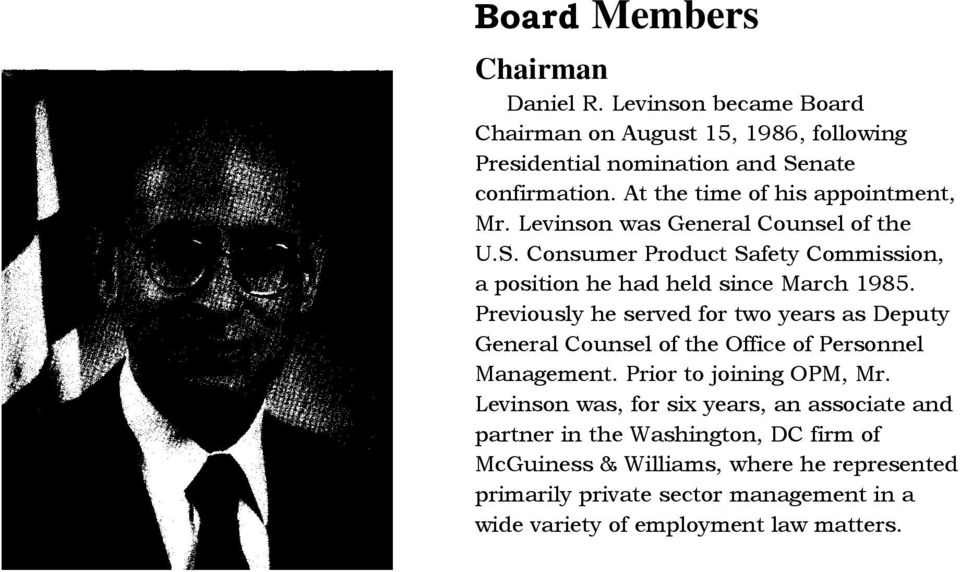
6 Board Members Chairman Daniel R. Levinson became Board Chairman on August 15, 1986, following Presidential nomination and Senate confirmation. At the time of his appointment, Mr. Levinson was General Counsel of the U.S. Consumer Product Safety Commission, a position he had held since March Previously he served for two years as Deputy General Counsel of the Office of Personnel Management. Prior to joining OPM, Mr. Levinson was, for six years, an associate and partner in the Washington, DC firm of McGuiness & Williams, where he represented primarily private sector management in a wide variety of employment law matters.
7 Vice Chairman Maria L. Johnson was nominated to the Board by President Reagan on March 18, She was confirmed by the Senate on May 6, 1983, and was designated Vice Chairman on September 19, From March 1, 1986 to August 15, 1986, Ms. Johnson served as the Board's Acting Chairman. At the time of her appointment, Ms. Johnson was a commercial loan officer with the Security National Bank in Anchorage, Alaska. From 1978 to 1981, she served as an associate with the law firm of Lambert, Griffin & McGovern in Washington, DC. Member Samuel W. Bogley was nominated by President Reagan to be a Member of the Board on September 7, He was administered the oath of office as a recess appointee on November 23, Mr. Bogley served as Lieutenant Governor of the State of Maryland from 1979 through He began his public service career in 1962 with the Maryland National Capital Park and Planning Commission and became a member of the Prince George's County Council in 1970.

8 Board Organization The Chairman, Vice Chairman, and Member adjudicate the cases brought to the Board. Each heads his/her individual office. The Chairman, by statute, is the chief executive and administrative officer of the Board.

9 Executive Director Lucretia Myers The Executive Director manages the operations and programs of the Board's headquarters and regional offices, under authority delegated by the Chairman. This delegation includes the authority to make final decisions in the areas of personnel management, fiscal management, document security, procurement and contracts, and general administrative support services. The Executive Director reports directly to the Chairman. The Deputy Executive Director assists the Executive Director in the management of the operations and programs of the Board's headquarters and regional offices. All headquarters offices, except the Office of the Inspector General, report to the Deputy Executive Director. The Office of Regional Operations manages the appellate functions of the MSPB regional offices and reviews the quality of initial decisions issued by administrative judges in the regional offices. The MSPB Regional Offices are located in 11 major metropolitan areas throughout the United States: Atlanta, Boston, Chicago, Dallas, Denver, New York, Philadelphia, St. Louis, San Francisco, Seattle and Washington, DC. These offices receive and process the initial appeals filed with the Board. Administrative judges in the regional offices have the primary function of issuing fair, timely, and well-reasoned decisions on all appeals.

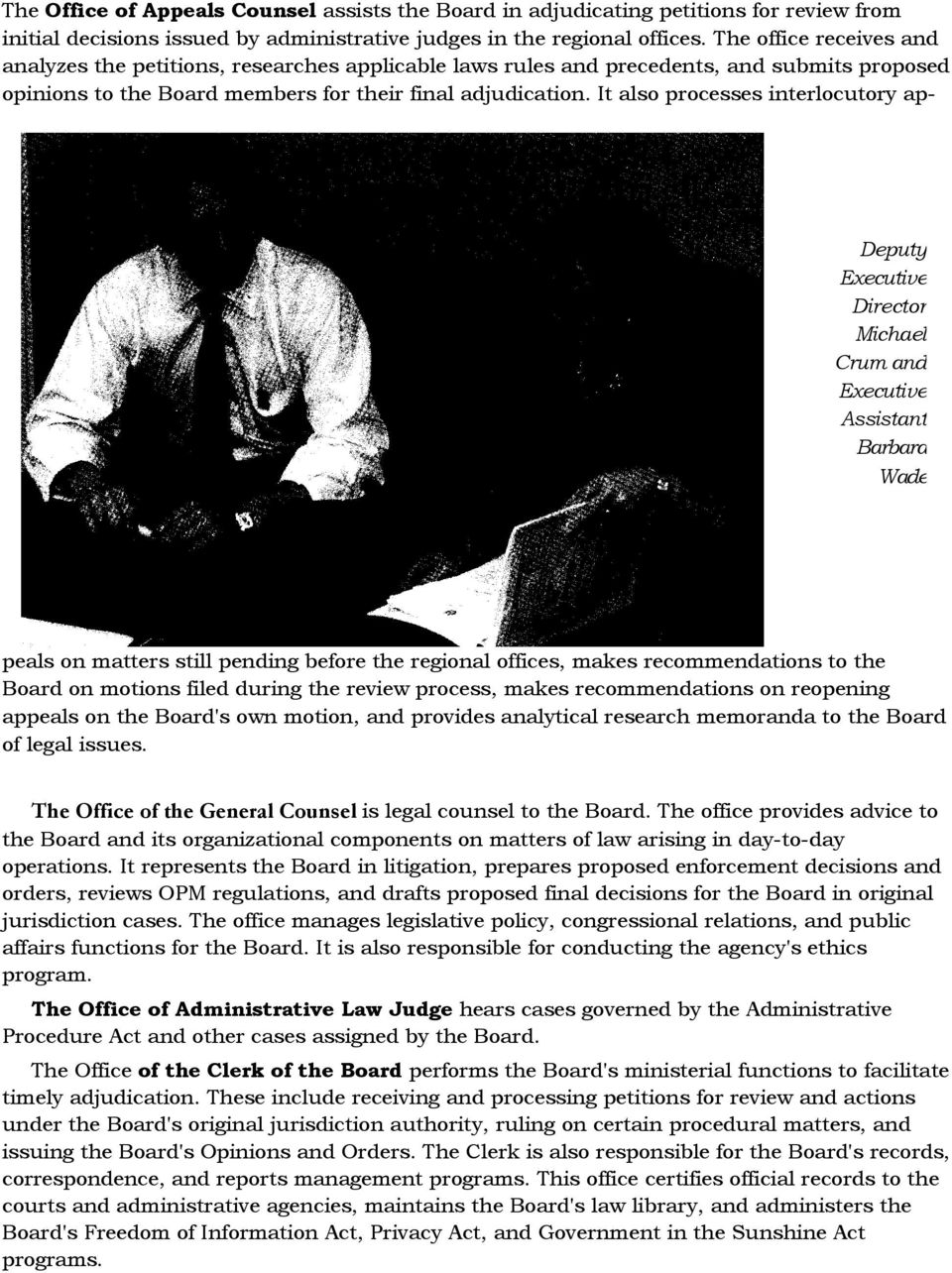
10 Deputy Executive Director Michael Crum and Executive Assistant Barbara Wade The Office of Appeals Counsel assists the Board in adjudicating petitions for review from initial decisions issued by administrative judges in the regional offices. The office receives and analyzes the petitions, researches applicable laws rules and precedents, and submits proposed opinions to the Board members for their final adjudication. It also processes interlocutory appeals on matters still pending before the regional offices, makes recommendations to the Board on motions filed during the review process, makes recommendations on reopening appeals on the Board's own motion, and provides analytical research memoranda to the Board of legal issues. The Office of the General Counsel is legal counsel to the Board. The office provides advice to the Board and its organizational components on matters of law arising in day-to-day operations. It represents the Board in litigation, prepares proposed enforcement decisions and orders, reviews OPM regulations, and drafts proposed final decisions for the Board in original jurisdiction cases. The office manages legislative policy, congressional relations, and public affairs functions for the Board. It is also responsible for conducting the agency's ethics program. The Office of Administrative Law Judge hears cases governed by the Administrative Procedure Act and other cases assigned by the Board. The Office of the Clerk of the Board performs the Board's ministerial functions to facilitate timely adjudication. These include receiving and processing petitions for review and actions under the Board's original jurisdiction authority, ruling on certain procedural matters, and issuing the Board's Opinions and Orders. The Clerk is also responsible for the Board's records, correspondence, and reports management programs. This office certifies official records to the courts and administrative agencies, maintains the Board's law library, and administers the Board's Freedom of Information Act, Privacy Act, and Government in the Sunshine Act programs.
11 The Office of Policy and Evaluation carries out the Board's statutory responsibility to conduct special studies of the civil service and other merit systems, including an annual oversight review of the Office of Personnel Management. Reports of these studies are submitted to the President and the Congress, as required by law. The Office of Management Analysis develops and coordinates internal management programs and projects. The office also producesthe Board's annual report to the President and the Congress, the annual report on the Board's decisions in appellate and original jurisdiction cases, and public information publications. The Office of Administration manages the Board's administrative operations. It is made up of four divisions: The Financial and Administrative Management Division administers the budget, accounting, procurement, property management, physical security, and general services functions of the Board. The Personnel Division manages personnel programs and assists managers, employees, and applicants for employment. It administers staffing, classification, employee relations, performance management, payroll, personnel security, and training functions. The Equal Employment Division implements the Board's equal employment opportunity programs, including developing annual EEO action plans and procedures for processing discrimination complaints. It furnishes advice and assistance on affirmative action initiatives to the Board's offices. The Information Resources Management Division develops, implements, and maintains the Board's automated information systems in order to help the Board manage its caseload efficiently and carry out it administrative responsibilities. The Office of the Inspector General is the Board's internal auditor. The independent Inspector General plans and directs audits, investigations, and internal control evaluations in compliance with the requirements of the Office of Management and Budget and the U.S. General Accounting Office. The Inspector General evaluates the programs and operations of the Board in order to promote economy and efficiency, to prevent and detect fraud and abuse, and to advise the Chairman and Executive Director of any problems and deficiencies detected. The Inspector General reports directly to the Executive Director.
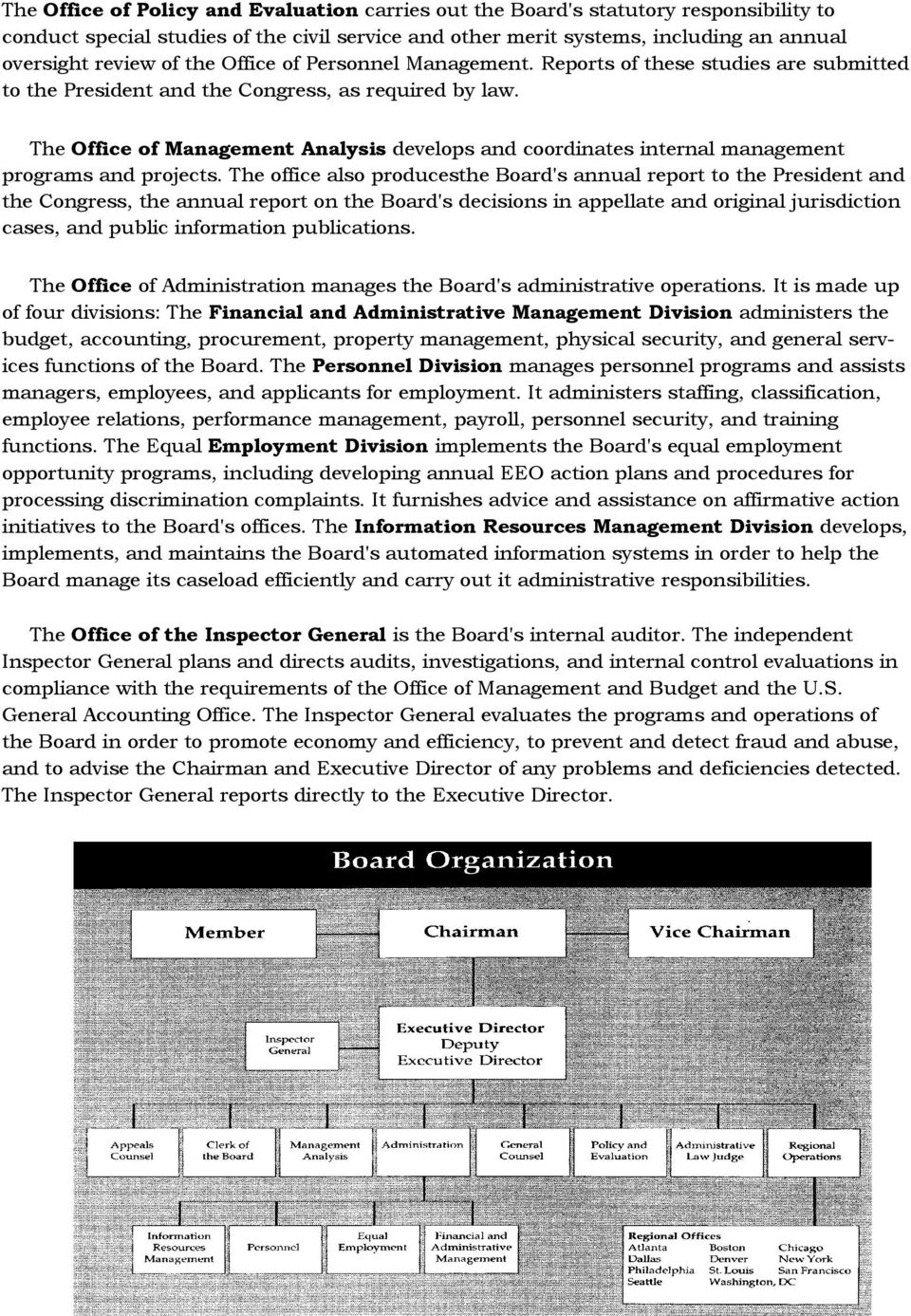
12 Mark Kelleher R.J. Payne William Carroll Martin W. Director of Atlanta Boston Baumgaertner Re g ional Operations Chicago Paula A. Latshaw Gail E. Skaggs Sean P. Walsh Lonnie Crawford Dallas Denver New York Philadelphia Earl A. Witten Denis Marachi Carl Berkenwald P.J. Winzer St. Louis San Francisco Seattle Washington, DC

13 Atlanta Regional Office Alabama, Florida, Georgia, Mississippi, North Carolina, and Sout Carolina Boston Regional Office Connecticut, Maine, Massachusetts, New Hampshire, Rhode Island, and Vermont Chicago Regional Office Illinois, Indiana, Michigan, Minnesota Ohio, and Wisconsin Dallas Regional Office Arkansas, Louisiana, Oklahoma, and Texas Denver Regional Office Arizona, Colorado, Kansas, Montana, Nebraska, Nevada, New Mexico, North Dakota, South Dakota, Utah, and Wyoming New York Regional Office New York, Puerto Rico, Virgin Islands, and the following counties in New Jersey: Bergen, Essex, Hudson, Hunterd on, Morris, Passaic, Somerset, Sussex, Union, and Warren Philadelphia Regional Office Delaware, Pennsylvania, Virginia (except cities and counties served by Washington Regional Office - see below), West Virginia, and the following counties in New Jersey: Atlantic, Burlington, Camden, Cape May, Cumberland, Gloucester, Mercer, Middlesex, Monmouth, Ocean, and Salem St. Louis Regional Office Iowa, Kentucky, Missouri, and Tennessee San Francisco Regional Office California Seattle Regional Office Alaska, Hawaii, Idaho, Oregon, Washington, and Pacific overseas areas Washington Regional Office Washington, DC, Maryland, all overseas areas not otherwise covered, and the following cities and counties in Virginia: Alexandria, Arlington, Fairfax City, Fairfax County, Falls Church, Loudoun, and Prince William

14 In Fiscal Year 1989, the Board's regional offices maintained an already impressive record of case processing timeliness. Decisions on initial appeals were issued within the Board's established 120-day time standard in 99.7 percent of all cases. The Board's administrative judges issued 6,953 decisions on initial appeals, an increase of over 500 decisions from the previous fiscal year. Voluntary settlements among the parties to an appeal were achieved in 49 percent of the initial appeals that were not dismissed. Receptionist Monteil Browning and Technical Assistant Cora Gibson At headquarters, the Board issued decisions on 1,281 petitions for review (including addendum case decisions), a decrease of just over 100 decisions from the previous fiscal year. The Board also decided 23 cases (including addendum cases) arising under its original jurisdiction, 8 more than in the previous fiscal year. These cases included actions brought by the Special Counsel against employees alleged to have violated the Hatch Act, Special Counsel stay requests, and proposed disciplinary actions against administrative law judges. In Fiscal Year 1989, the Board continued to maximize use of its resources to accomplish its stated "Improvement Objectives." These are: To ensure the quality of decisions and the adjudicatory process; To enhance the merit systems studies and OPM oversight functions; To improve the effectiveness of outreach activities; and To continue to improve management efficiency and effectiveness.
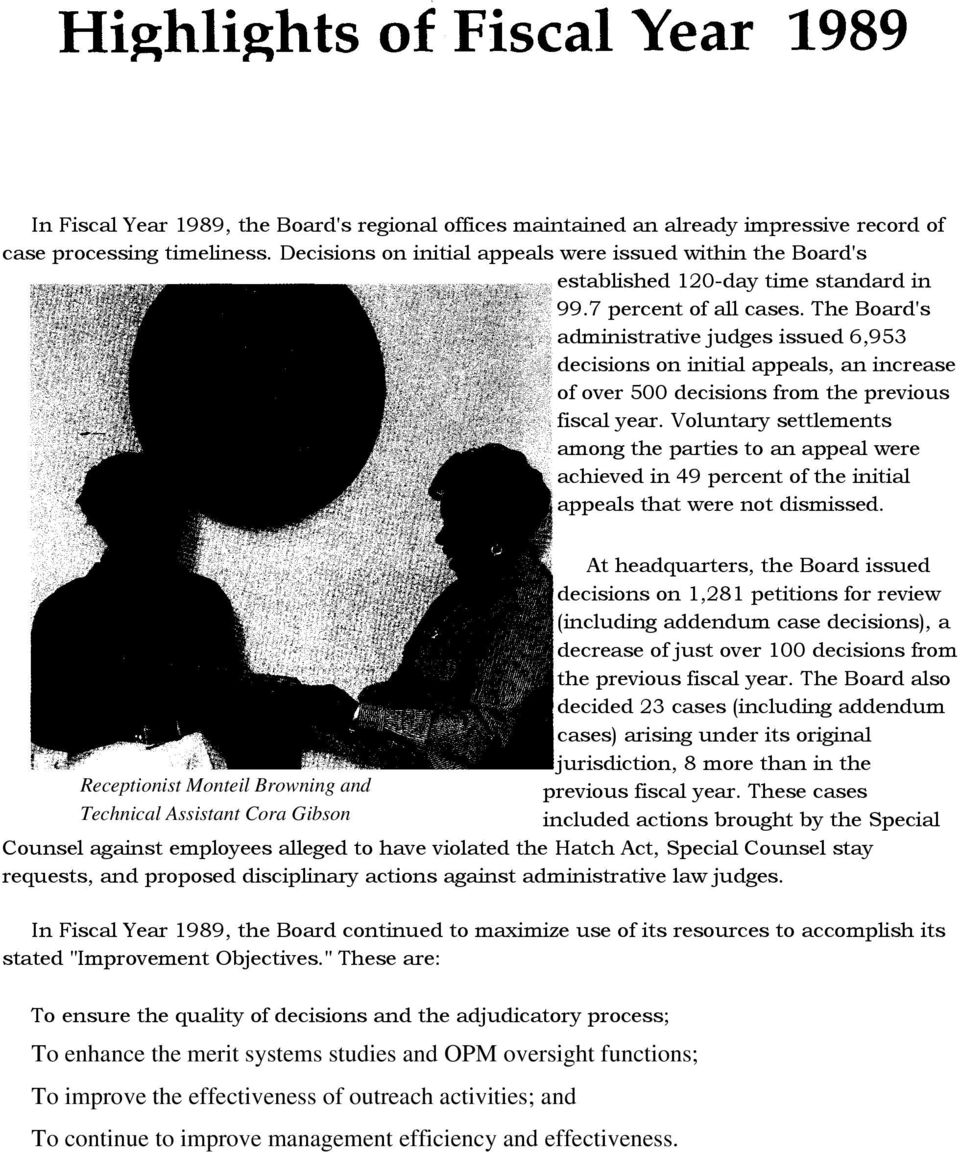
15 In the area of adjudication, the Board has continued its programs to ensure well-reasoned decisions both in the regional offices and at headquarters. Under the strengthened quality review program, all administrative judges in the regional offices have been reviewed with respect to the quality of their initial decisions. Uniform jurisprudence has been promoted among the regions, and there has been further training for administrative judges. The Board continues to encourage use of alternative means of dispute resolution to achieve settlement between the parties. The Board's administrative judges have attended the National Judicial College and other training programs to improve their skills in this area. The rate of settlement increased dramatically during the fiscal years 1984 through 1988 and rose slightly (from 48 to 49 percent) during the last fiscal year. The greater use of settlement procedures has resulted in significant cost savings, Administrative Judges James Freet, Suanne Strauss, and Joseph Hartman without impinging on the rights of the parties. The Board estimates direct cost savings from the settlement program of over $3 million for the fiscal years At headquarters, the Board has continued its concentration on issuing precedential decisions in cases involving "major issues," so that these decisions may be used in the adjudication of other cases involving similar issues. In addition, fewer short form Orders summarily affirming initial decisions have been issued, with a corresponding increase in Board Opinions. During the fiscal year, the Board issued four reports based on its merit systems studies and OPM oversight reviews. They included a retrospective review of the significant activities of OPM since enactment of the Civil Service Reform Act of 1978 and the Board's first study of a non- Title 5 merit system, that of the Tennessee Valley Authority. In addition to these reports, the Board completed work on four other reports to be published early in FY The Board has emphasized outreach activities in order to promote a greater understanding of the Board's practices and procedures, and of important issues in Federal personnel law, among the constituencies that deal with the Board. This emphasis is reflected in the number of appearances made by Board members, senior headquarters staff, and regional office directors and administrative judges at meetings, conferences, and training programs. In FY 1989, the Board completed the "plain English" revision of its regulations and published them, as interim regulations for comment, in the Federal Register. It also launched a new series of public information publications with the issuance of "An Introduction to the MSPB." Publications dealing with the Board's appeals procedures and the special provisions applying to whistleblower appeals were to be issued early in FY 1990.

16 Attorney Robert Kelley and Administrative Judges Barry Booker and Sandra Squire In the management area, a number of significant activities contributed to the Board's ability to perform its adjudicatory and studies functions more efficiently and effectively. With the development of a 5-Year Information Resources Management Strategic Plan, the Board has a detailed guide to follow to ensure the most effective use of computer technology. The Board continued its migration to an IBM AT-compatible computer environment and completed the functional requirements and design phase for its new Case Management System. The Board also acquired desktop publishing capability, which permits more timely and cost-effective design and layout of publications in-house. Without question, the most significant outside event affecting the Board during the fiscal year was the enactment of the Whistleblower Protection Act of This Act made the most extensive changes in the Board's jurisdiction and procedures since its establishment by the CSRA. While most attention was focused on the new individual right of action that permits whistleblowers to appeal directly to the Board if the Special Counsel does not act on their complaints, the Act also made numerous changes that affect non-whistleblower cases. The Whistleblower Protection Act became effective July 9, Under the savings provisions of the Act, it does not apply to cases pending as of that date. As a result, the Board had little case activity resulting from the Act's new provisions by the end of the fiscal year. The Board devoted considerable time, and resources, however, to analysis of the Act's provisions, development of implementing regulations, training of staff, and dissemination of information to the public about the Act.
17 The following section of this report provides information on the Whistleblower Protection Act and the Board's activities during FY 1989 in response to its enactment. Confidential Assistant Robyne Gordon and Administrative Assistant Danny Smith of the Office of the Chairman
18 The Whistleblower Protection Act of 1989 and the MSPB Response Legislative History Legislation to provide whistleblower protection is based on the premise that legitimate whistleblowers contribute to the integrity and efficiency of Government by exposing fraud, waste, and abuse. The CSRA was intended to provide such protection and thereby encourage whistleblowing. By the mid-1980's, however, various members of Congress had concluded that the Act had failed to achieve this purpose and that new legislation was needed. In the Congressional debate over whistleblower protection, the Board's studies of this issue have been cited frequently. In a 1980 survey of Federal employees, the Board found that 20 percent of the respondents who perceived problems in their agencies did not report them for fear of retaliation. When the Board conducted a follow-up survey in 1983, that figure had increased to 37 percent. These survey results, and the fact that so few whistleblower complaints to the Special Counsel resulted in corrective action being sought from the Board, have been cited to support the need for new legislation. The first version of the Whistleblower Protection Act was introduced in the 99th Congress and was passed by the House of Representatives in September There was no action by the Senate, however, before the Congress adjourned. In the 100th Congress, the bill was reintroduced and was reported by the full House Post Office and Civil Service Committee in August On the Senate side, a modified version of the bill was passed in August During the weeks that followed, negotiations between the House and Senate sponsors, and between the sponsors and the administration, resulted in an amended bill that was passed by both the House and Senate in early October. Because of objections raised by the Department of Justice to certain provisions of the bill, however, President Reagan did not sign it into law. Early in the 101st Congress, the Whistleblower Protection Act was reintroduced in the form that it had passed both houses the previous October. The Bush administration encouraged the Justice Department to work with the congressional sponsors to develop a bill that would satisfy the Department's objections. As a result, a compromise version, supported by the administration, was passed by the Senate on March 16, 1989 and by the House on March 21, President Bush signed the bill, as Public Law No , on April 10, Its provisions became effective ninety days later, on July 9, Throughout the period of congressional consideration of new whistleblower protection legislation, the Board monitored the bills and commented on the potential impact on the Board's operations. The Board offered testimony and technical assistance, when requested.

19 Changes Made By The Whistleblower Protection Act Of 1989 Despite the title of the bill, the Whistleblower Protection Act of 1989 does a great deal more than simply strengthen the statutory protections for whistleblowers. As the bill moved through the Congress, it acquired various provisions that affect cases the Board adjudicates under both its appellate and original jurisdiction. As a result, certain provisions of the Act apply only to appeals filed with the Board by whistleblowers. Other provisions apply to Board appeals generally, and still others apply to the Board's procedures in original jurisdiction cases brought by the Special Counsel. Other provisions affect judicial review of Board decisions and the Board's authority to defend its decisions in court. The Act also makes the Office of Special Counsel, established by the CSRA as an office of the Board, a separate independent agency in the Executive branch. Taken together, these provisions constitute the most extensive changes in the Board's jurisdiction and procedures since enactment of the CSRA in Changes Affecting Whistleblower Appeals The Act expands Board jurisdiction by providing a new individual right of action for whistleblowers. Under the CSRA and subsequent OPM regulations, the type of action being appealed and the eligibility of the individual (employee, former employee, or applicant for employment) to appeal the particular action determines whether the Board has jurisdiction over the appeal. An action is appealable to the Board if the appeal is authorized by any law, rule, or regulation. Under the individual right of action provision of the Whistleblower Protection Act, however, it is the allegation that an action was based on the individual's whistleblowing that determines the appeal right to the Board. Since the individual right of action applies with respect to any personnel action that may be the subject of a prohibited personnel practice complaint to the Special Counsel, and to any individual who is covered under the prohibited personnel practices statute [See 5 U.S.C. 2302(a)], the new law permits appeals to the Board of actions that were not previously appealable, and appeals from individuals that did not previously have appeal rights, if the individual alleges that the action was based on whistleblowing and the other requirements of the individual right of action provision are satisfied. Under this right, a Federal employee, former employee, or applicant for employment may appeal a personnel action allegedly based on whistleblowing to the Board if he or she first files a complaint with the Special Counsel, and the Special Counsel does not seek corrective action from the Board on his or her behalf. Previously, an individual subject to a personnel action allegedly based on whistleblowing, that was not otherwise appealable to the Board, had no recourse if the Special Counsel did not act on his or her complaint.
20 The requirement that the individual seek the Special Counsel's assistance first applies only with respect to personnel actions that are not appealable to the Board under any other law, rule, or regulation. If the action is appealable to the Board, the individual may appeal directly to the Board, regardless of whether whistleblowing is an issue in the case. The Act's provisions applying to these individual right of action cases permit a whistleblower to seek corrective action from the Board within 60 days after being provided notice by the Special Counsel that the investigation of the whistleblower's complaint is being terminated. The whistleblower may also appeal to the Board if 120 days have passed since filing the complaint with the Special Counsel and the Special Counsel has not notified the individual that the office will seek corrective action. The Act includes a number of procedural protections for whistleblowers. After an individual exercises the right to appeal to the Board, the Special Counsel may not seek corrective action without the individual's consent. A whistleblower appealing to the Board under the individual right of action provision may ask the Board to stay the personnel action. The Board's normal time limits for completion of discovery may be waived to ensure that the whistleblower has sufficient time to obtain needed information. In adjudicating an individual right of action appeal, the Board may not consider a decision by the Special Counsel to terminate an investigation of the whistleblower's complaint. The Board must order corrective action if the individual demonstrates that his or her whistleblowing was "a contributing factor" in the personnel action, unless the agency demonstrates by clear and convincing evidence that it would have taken the action in the absence of the individual's whistleblowing. The Whistleblower Protection Act also makes the individual right of action provisions applicable to adverse action appeals to the Board. Since adverse actions are directly appealable to the Board, of course, there is no requirement that the appellant seek corrective action from the Special Counsel first. The Act also amends the statutory definition of the prohibited personnel practice described in 5 U.S.C. 2302(b)(8) taking or failing to take an action based on whistleblowingto include threatening to take or not take an action. The words "because of" are substituted for "as a reprisal for" before the word "whistleblowing" so that the motivation of the official taking the action need not be established. As a limitation on covered disclosures, the word "gross" is added before "mismanagement" so that the remedies provided do not become available to individuals who make disclosures of trivial matters. Changes Affecting Appeals Generally Of the Whistleblower Protection Act provisions applying to all appeals, the one granting interim relief to prevailing appellants is expected to have the greatest impact. Under this provision, when an appellant is the prevailing party in an appeal to the Board, he or she will be granted the relief provided in the initial decision of the Board's administrative judge pending the outcome of any petition for review filed with the Board. Exceptions are provided if the administrative judge determines that interim relief is not appropriate, or if the decision requires the appellant to return to the place of employment and the agency determines that such a return would be unduly disruptive. If the agency makes such a determination, it must restore the appellant to current pay and benefits status. However, the Act states that the interim relief provision is not to be construed as requiring payment of back pay or attorney fees until the Board's decision is final.

21 The Act provides for payment of reasonable attorney fees and other reasonable costs incurred if an appellant is the prevailing party and the Board's decision is based on a finding of any prohibited personnel practice. The Act limits the right of the Special Counsel to intervene in Board appeals by providing that, in any proceeding before the Board involving an action under the new individual right of action for whistleblowers or an appeal under 5 U.S.C. 7701, the Special Counsel may intervene only with the consent of the appellant. The Act also establishes that an individual's right to appeal to the Board is not affected by the individual's decision to retire when faced with a proposed action. Changes Affecting Original Jurisdiction Cases The Whistleblower Protection Act broadened two provisions in the prohibited personnel practices statute, thereby increasing the potential for the Special Counsel to bring corrective and disciplinary action complaints to the Board. The amendment to the provision prohibiting taking a personnel action based on whistleblowing [5 U.S.C. 2302(b)(8)] has been discussed above. The provision prohibiting taking a personnel action based on an individual's exercise of an appeal right [5 U.S.C. 2302(b)(9)] has been similarly amended to include threatening to take or not take an action and to substitute the words "because of" for "as a reprisal for." In addition, the provision has been extended to also cover actions taken because of the exercise of any complaint or grievance right, testifying for or assisting any individual in the exercise of a protected right, cooperating with or disclosing information to an inspector general or the Special Counsel, and refusing to obey an order that would require the individual to violate a law. The procedures for the Special Counsel to obtain a stay of a personnel action from the Board are amended by the Act. The 3-stage procedure established by the CSRA is replaced by a 2-stage procedure. Any member of the Board may grant a Special Counsel stay request for 45 days. If the request is not denied within three calendar days, it is automatically granted by operation of law. The full Board may extend the stay for any period it considers appropriate, after first allowing the agency to comment on any proposed extension. The Act also provides that when the Special Counsel seeks corrective action from the Board on behalf of a whistleblower, the Board must order corrective action if the Special Counsel establishes that the whistleblowing was "a contributing factor" in the personnel action, unless the agency demonstrates by clear and convincing evidence that it would have taken the action in the absence of the individual's whistleblowing. This provision parallels the burden and degree of proof provision in the individual right of action section of the Act. Changes Affecting Both Appellate and Original Jurisdiction Cases The Whistleblower Protection Act made a number of changes with respect to the Board's subpoena authority. Previously, only the Board members and the Board's Administrative Law Judge had the authority to issue subpoenas and to order the taking of depositions and responses to interrogatories. The Act permits the Board to delegate this authority to any employee of the Board. The Act also provides for service of subpoenas on individuals in foreign countries and for enforcement of such subpoenas by the U.S. District Court for the District of Columbia. Since the Special Counsel does not have authority to seek enforcement of its subpoenas, the Act provides for the Special Counsel to ask the Board to seek enforcement of Special Counsel subpoenas by a U.S. district court.
22 The Act explicitly grants to the Board the authority to issue protective orders during the pendency of any proceeding before the Board or during a Special Counsel investigation. The Board may issue any order that may be necessary to protect a witness or other individual from harassment and may do so on its own motion, or at the request of the Special Counsel or any other person, whether or not a party to the case. Another new provision of the Act directs the Board to prescribe regulations under which any employee who is aggrieved by the failure of any other employee to comply with an order of the Board may petition the Board for enforcement of the order. The Board's existing regulations provided for petitions for enforcement only from parties. Changes Affecting Judicial Review and Board Litigating Authority With respect to Board decisions in Special Counsel corrective action cases, the Whistleblower Protection Act provides that any employee, former employee, or applicant for employment who is adversely affected by the Board's order may seek judicial review in the U.S. Court of Appeals for the Federal Circuit. The Act also provides that an employee subject to a final Board order in a Special Counsel disciplinary action case (other than Hatch Act cases involving state or local employees in federally-funded positions) may seek judicial review in the Federal Circuit. Under the individual right of action section of the Act, a whistleblower may seek judicial review of the Board's decision in the Federal Circuit, as is the case with Board decisions in all other appeals (other than "mixed cases" involving an issue of prohibited discrimination). Taken together, these provisions should ensure greater consistency in judicial review of Board decisions. Finally, the Act overturns a 1987 order issued by the Federal Circuit that eliminated the Board as respondent in appeals from its decisions in cases that it had dismissed for lack of jurisdiction or for other procedural reasons. The Act provides that the Board shall be the named respondent in judicial review of its decisions on appeals, unless the employee seeks review on the merits of the underlying personnel action or on a request for attorney fees. In these latter instances, the agency will continue to be the named respondent and will be defended by the Department of Justice. The MSPB Response As soon as the Whistleblower Protection Act was signed into law by President Bush, the MSPB Chairman formed a task force to make recommendations to the Board with respect to implementation of the Act. The task force was composed of both headquarters and regional office representatives. The principal challenge to the task force was to recommend procedures for the handling of the new individual right of action cases. The task force considered various proposals for processing the new cases and presented the Board with options. Based on the strong suggestion in the legislative history that the Congress expected these cases to be processed, insofar as possible, like other Board appeals, the Board opted to apply existing appellate procedures, supplemented by the special provisions established by the Act, to these cases. Thus, individual right of action cases filed by whistleblowers will be adjudicated initially by administrative judges in the regional offices and then, upon petition for review, will be considered by the full Board in Washington. The Board also determined that administrative judges in the regional offices should rule on stay requests in these cases.
23 With this decision made, the Board's Office of the General Counsel drafted a new part of the Board's regulations Part 1209 to implement the provisions of the Act applying to whistleblower appeals. It was determined that, from a structural standpoint, Part 1209 would deal only with the special provisions applying to whistleblower appeals. Other provisions in Part 1201 of the Board's regulations ("Practices and Procedures") that should apply to these cases, as well as to other Board appeals, would be incorporated by reference to that part. Such Part 1201 provisions include those relating to hearings, representation, subpoenas, evidence, ex parte communications, interlocutory appeals, interim relief, petitions for review, and petitions for enforcement of Board decisions. The Board determined that the Part 1209 regulations should govern not only the individual right of action cases, but also "otherwise appealable actions" where the appellant alleges that the action was based on his or her whistleblowing activities. The Part 1209 regulations address the time limits for filing both individual right of action appeals and otherwise appealable action appeals, the burden and degree of proof to be applied in whistleblower appeals, the waiver of the time limits for discovery, and the procedures for acting on stay requests. While the task force and the Office of the General Counsel focused on the provisions of the Whistleblower Protection Act applying to whistleblower appeals, the Board's Office of Management Analysis analyzed all of the other provisions of the Act and wrote new and revised regulations to implement those provisions. This involved extensive revision to Part 1201, which contains the Board's practices and procedures for all appellate and original jurisdiction cases. Part 1201 was revised to incorporate implementing regulations for the Whistleblower Protection Act provisions relating to interim relief, attorney fees, subpoenas, protective orders, petitions for enforcement from aggrieved employees other than parties, Special Counsel intervention in appeals and petitions for review, Special Counsel stay requests, the burden and degree of proof for the Special Counsel in whistleblower cases, and judicial review of Special Counsel cases. In addition, a number of citation changes were made in other parts of the Board's regulations to reflect changes in section numbers of 5 U.S.C. Chapter 12 made by the Act. Both the revised Part 1201 and the new Part 1209 were approved by the Board in June 1989 and were published as interim regulations in the Federal Register of July 6, The effective date was July 9, 1989, the effective date of the Act. The comment period for the interim regulations closed on September 5, At the end of the fiscal year, the Board was evaluating comments received from Federal departments and agencies, private attorneys, and individuals. Final regulations were expected to be published in Fiscal Year With the issuance of implementing regulations completed in July, the Board turned its attention to training its staff and conducting educational programs for agency representatives, employee representatives, and attorneys. At the National Administrative Judges Conference in August, a full-day program was presented to familiarize the Board's administrative judges with the Whistleblower Protection Act and the Board's implementing regulations. In addition to hearing speakers from headquarters and congressional staff, the administrative judges worked on sample case problems designed to bring out various provisions of the Act. By the time of the conference, standard provisions for both acknowledgment orders and final orders in whistleblower cases had been developed by regional office personnel, and these were distributed for comment. Regional personnel also developed a new appeal form to be used in whistleblower cases.
24 Under the Act's provision permitting the Board to delegate subpoena and discovery authority to any employee, the Board delegated this authority to each of the regional directors. The regional directors, in turn, delegated the authority to many of the administrative judges. To assist the administrative judges in the exercise of the newly delegated authority, the staff of the Board's Administrative Law Judge prepared an extensive and detailed digest of laws, rules, regulations, and precedents relating to discovery. Each administrative judge was given a copy of this digest. At headquarters, personnel in the legal offices and the offices responsible for public information were also made familiar with the provisions of the Act. A new standard letter was prepared for use in responding to questions about the Board's jurisdiction under the Act. A new information publication, "Questions and Answers About Whistleblower Appeals," was prepared and was expected to be published early in FY In August 1989, Board attorneys presented a symposium on thewhistleblower Protection Act at Board headquarters. Approximately 175 individuals, including agency representatives, employee representatives, and private attorneys, attended. From June through September, representatives from Board headquarters made presentations on the Act at nine seminars and conferences in various parts of the country. These sessions were attended by approximately 850 individuals. The Board's 11 regional offices conducted almost 30 outreach programs on the Act from May through September These programs were attended by well over 2,000 individuals, including agency representatives, employee union representatives, and members of the private bar. The programs prior to July 1989 focused on significant provisions of the Whistleblower Protection Act. Those from July through the end of the fiscal year included discussions of the Board's implementing regulations, and copies of the regulations were distributed to all attendees. The Board established an Implementation Committee, chaired by the Deputy Director of the Office of Appeals Counsel, to oversee the Board's implementation of the Whistleblower Protection Act. Theprincipal charges to the committee were the manual collection of data from the Board's regional offices regarding case activity under the Act and the development of recommendations for modifying the automated case tracking system to provide information on whistleblower cases. The committee also met with representatives of the Office of Special Counsel to coordinate implementation activities. Impact On Cases In FY 1989 As of the end of FY 1989, seven appeals had been filed with Board regional offices under the individual right of action, all of which were pending at the close of the fiscal year. No determination had been made as to whether the appeals met all of the requirements for filing under the individual right of action. By the end of FY 1989, the Board's regional offices had received four requests for stays of personnel actions, all of which were denied. The stay requests were denied because the personnel actions were initiated prior to the effective date of the Whistleblower Protection Act or because the parties did not establish a substantial likelihood that they would prevail on the merits of the case.
25 Between the effective date of the Act and the end of the fiscal year, no new corrective or disciplinary actions on behalf of whistleblowers were filed with the Board by the Special Counsel. Information provided by the Special Counsel, however, indicated that seven complaints filed by whistleblowers in August and September were under investigation. No Special Counsel stay requests were granted under the revised procedures. Since actions initiated prior to the effective date of the Act were not affected by its provisions, no case activity was expected by the end of the fiscal year with respect to such provisions of the Act as interim relief for prevailing appellants and the award of attorney fees to prevailing appellants when the decision is based on a finding of a prohibited personnel practice. As cases begin to be affected by these provisions, information will be available from the Board's automated case tracking system.
26 Adjudication: Appellate Jurisdiction
27 Initial Appeals Under the CSRA, most Federal employees are entitled to appeal certain personnel actions taken by Federal agencies to the Board. Certain other actions are appealable under OPM regulations. Appealable actions include adverse actions for misconduct (removals, suspensions of more than 14 days, reductions in grade or pay, and furloughs of 30 days or less), performance-based removals or reductions in grade, denials of within-grade increases, certain reduction-in-force actions, denials of restoration-to-duty or reemployment rights, and OPM determinations in employment suitability and retirement matters. Appeals must be filed in writing, within 20 days of the effective date of the action, with the regional office having geographic jurisdiction. (Where the notice of action does not set an effective date, the appeal must be filed within 25 days of the date of the notice.) Under the Whistleblower Protection Act, a broader range of personnel actions may result in an appeal to the Board if the appellant alleges that the action was taken because of his or her whistleblowing, and if the appellant has first filed a complaint with the Special Counsel and the Special Counsel has not sought corrective action from the Board. Under these circumstances, the appellant may appeal directly to the Board within 60 days after being provided notice from the Special Counsel that corrective action will not be sought. A direct appeal to the Board is also authorized if 120 days have passed since the filing of the complaint with the Special Counsel, and the Special Counsel has not advised the individual that the office will seek corrective action on his or her behalf. The appeal must be filed in writing with the Board regional office having geographic jurisdiction. After an appeal has been received, the regional office issues an order acknowledging receipt of the appeal and raising any questions of timeliness or jurisdiction. The appeal is then assigned to an administrative judge for processing. The agency is required to provide its evidentiary file to the appellant and the administrative judge. The appellant and the agency then have the opportunity to present additiona information for the administrative judge's consideration. Once jurisdiction and timeliness have been established, the appellant has a right to a hearing on the merits. If a hearing is held, each party has the opportunity to call and cross-examine witnesses, present evidence and make arguments to the administrative judge. Hearings are open to the public and fully recorded by a court reporter, with copies of the record available to the parties. The Board's established policy calls for the administrative judge to issue an initial decision within 120 days from the date the appeal wasfiled. In Fiscal Year 1989, 99.7 percent of all initial appeals were decided within 120 days. The regional offices averaged 76 days to issue decisions. In Fiscal Year 1989, the Board's regional offices issued a total of 7,842 decisions, of which 6,953 were decisions on initial appeals and 889 were addendum case decisions, i.e., attorney fees, remands, and compliance (or enforcement). There were 2,048 settlements of initial appeals, or 49 percent of those initial appeals not dismissed for lack of jurisdiction or timeliness and closed during the fiscal year. The settlement rate was only slightly lower for addendum cases, 46 percent (309 settled out of 889).
28 The following table shows the processing times of the initial appeals decided in the regional offices during Fiscal Year Case Processing Times In Regional Offices Decision Times (Days) Number of Cases Percent of Cases Percent Total , , , ,953
29 Initial Appeal by Type of Action Total number of initial appeals: 6,953 Percentages do not equal 100% due to rounding Forty-nine percent of the initial appeals were adverse action cases. The remaining appeals included retirement-related decisions, terminations of probationary employees, performance actions, reductions-in-force, and other appealable actions. The above chart shows the breakdown of initial appeals by the type of action appealed. Hearings were held in 18 percent of all initial appeals. Fifty-five percent of appellants were represented by an attorney, union representative, or other person; the remaining 45 percent represented themselves. Of the 2,170 initial appeals that were adjudicated, 1,745 or 80 percent affirmed the agency action. Decisions on the remaining appeals that were adjudicated included reversals, which overturned the agency action, and mitigations, which reduced or modified the penalty imposed by the agency.
30 The chart below shows the break down by disposition of all initial appeals. Initial Appeals by Disposition Total number of initial appeals: 6,953 Percentages do not equal 100% due to rounding The table to the right shows the disposition of appeals by the Federal executive department or agency taking the action appealed.
31 Initial Appeals: Disposition by Agency Agency Number Percent Number Percent Number Percent Percent Percent Decided Dismissed Not Settled Adjudicated Affirmed Reversed Mitigated/ Dismissed Other OPM 1,742 24% 1,317 10% 1,186 84% 15% 1% Postal Service: 1,542 44% % % 18% 14% Navy % % % 18% 8% Army % % % 19% 7% VA % % 72 78% 17% 6% Air Force % % 88 75% 16% 9% TVA % % % 5% 0 Treasury % 97 70% 29 79% 17% 3% Justice % 81 68% 26 77% 12% 12% Defense % 83 64% 30 70% 27% 3% Agriculture % 73 81% 14 79% 7% 14% Transportation % 61 53% 29 86% 7% 7% Interior 91 46% 49 82% 9 89% 11% 0 HMS 88 35% 57 61% 22 68% 27% 5% GSA 62 47% 33 61% 13 62% 39% 0 Labor 42 52% 20 55% 9 78% 11% 11% Commerce 35 43% 20 55% 9 67% 22% 11% HUD 35 40% 21 48% 11 91% 9% 0 Smithsonian 19 42% 11 46% 6 100% 0 0 FDIC 15 33% 10 60% 4 50% 25% 25% SBA 11 73% % 0 0 EEOC 9 44% 5 80% 1 100% 0 0 GPO 9 22% 7 57% 3 100% 0 0 State 8 38% 5 100% Energy 7 43% 4 50% % 0 USIA 5 40% 3 67% 1 100% 0 0 Education 5 40% 3 33% 2 50% 0 50% NASA 5 60% 2 50% 1 100% 0 0 All Other 48 64% 19 47% 10 90% 10% 0 Agencies Total 6,953 39% 4,218 49% 2,170 80% 16% 4% Note 1: The selected agencies shown include all Executive agencies with at least 5 cases. Executive agencies, for purposes of this table, include the U.S. Postal Service and other government entities where the Board has jurisdiction. Note 2: Because of the small number of cases involved, some percentages must be interpreted with caution. Note 3: The large number of initial appeals for the Office of Personnel Management reflect the special jurisdiction this agency has in retirement and suiaabliity issues.
32 Addendum Cases In addition to the decisions on initial appeals issued in Fiscal Year 1989, the regional offices issued decisions in 889 addendum cases. These included requests for attorney fees, enforcement cases alleging that there has not been full compliance with a Board decision, and cases remanded to the regional offices. The following table shows the number of addendum cases by type. Addendum Cases Category of Appeal No. of Cases Attorney Fees 342 Compliance (Enforcement) 396 Remands 151 Total 889 Petitions For Review The Board may grant a petition for review when it is established that the initial decision of the administrative judge was based on an erroneous interpretation of statute or regulation, or that new and material evidence is available that, despite due diligence, was not available when the record was closed. Petitions for review are filed with the Office of the Clerk in Board headquarters by either party, or, under certain circumstances, by the Office of Personnel Management or the Office of Special Counsel as an intervenor. The Board also has the discretion to reopen and reconsider an initial decision on its own motion. The Board's decision on a petition for review constitutes final administrative action. Further appeal may then be available in the United States Court of Appeals for the Federal Circuit or, in cases involving allegations of certain types of discrimination, with a U.S. District Court or the Equal Employment Opportunity Commission (EEOC). The Director of the Office of Personnel Management may intervene or petition the full Board for reconsideration of a final decision and may also seek judicial review of Board decisions that have a substantial impact on a civil service law, rule, regulation, or policy. The Board completed action on 1,281 petitions for review in Fiscal Year 1989, of which 1,141 were filed to review initial decisions and the remaining 140 were addendum cases (attorney fees, enforcement and remands). The Board's decisions on 950 of the 1,141 petitions for review of an initial decision (83 percent) left the initial decision unchanged. During Fiscal Year 1989, 94 percent of final Board decisions reviewed by the United States Court of Appeals for the Federal Circuit were unchanged.
33 Steps in Processing Initial Appeals and Petitions for Review Filing of Appeal by Appellant MSPB Regional Office Appeal received Appeal acknowledged Appeal entered in Case Tracking System Case file requested from agency Appeal assigned to administrative judge (If appropriate, show cause order issued re: jurisdiction or timeliness) Within 20 days of effective date of agency personnel action 1-3 days from receipt of appeal Agency response and case file received Discovery begins Prehearing conference scheduled Notice of hearing issued (If show cause order issued, response received) Prehearing motions filed and rulings issued Attempts to achieve settlement (various methods) Discovery completed Prehearing conference held (more than one may be held to facilitate settlement) Witnesses identified If no hearing, close of record set Hearing held Record closed Initial Decision issued Filing of Petition for Review (PFR) by Appellant or Agency Board Headquarters PFR received PFR acknowledged PFR entered in Case Tracking System Case file requested from Regional Office (If appropriate, show cause order issued re: jurisdiction, timeliness, or deficiency of PFR) Response to PFR filed Or Cross-PFR filed Case file received (If show 'cause order issued, response filed) If Cross-PFR received If Extension of Time request received and granted Final Decision issued Filing of appeal with U.S. Court of Appeals for the Federal Circuit(or in discrimination cases, with the appropriate U.S. District Court or EEOC) days from receipt of appeal days from receipt of appeal days from receipt of appeal Within 120 days from receipt of appeal Within 35 days of date of Initial Decision 1-3 days from receipt of PFR Within 25 days of date of service of PFR Additional 25 days from crate of service of Cross-PFR Additional time specified in Order granting EOT (Board time standard for issuance of Final Decisions is 110 days) Within 30 days of the party's receipt of Board Final Decision
34 The chart on the previous page demonstrates the various steps in the processing of both initial appeals and petitions for review. Special Panel The Special Panel was established by the Civil Service Reform Act of 1978 as a separate entity to resolve disputes between the Merit Systems Protection Board and the Equal Employment Opportunity Commission in "mixed cases." These are cases that involve both a matter appealable to the Board and an issue of discrimination. The Special Panel consists of one Board Member designated by the MSPB Chairman, one EEOC Commissioner designated by the EEOC Chairman, and a third individual appointed by the President to serve as Chairman of the Special Panel. President Reagan appointed Barbara Mahone as Chairman of the Special Panel on October 18, During Fiscal Year 1989, there were no decisions issued by the Special Panel. William DuRoss III, Director of the Office of Appeals Counsel, and Member Bogley
35 Significant Activities In addition to revising and republishing its entire regulations (see "Outreach Activities"), the Board revised and updated the standard orders and acknowledgments used by each of the regional offices. These revisions promote a uniform jurisprudence by ensuring adherence to current case law and to Board policies and procedures. At the same time, they further the Board's "plain English" initiative. The Board continued to ensure the quality of initial decisions by administrative judges in the regional offices through the quality review program established in Fiscal Year By the end of August 1989, all of the Board's administrative judges had been reviewed for the quality of their initial decisions. A new cycle of quality reviews will begin in FY In Fiscal Year 1989, the Board held its second National Administrative Judges Conference. This year's forum provided training in several aspects of case adjudication and decision making. Several outside speakers and speakers from various headquarters offices of the Board updated the administrative judges on current law and techniques. The Board's administrative judges have also attended the National Judicial College and the Legal Education Institute and have received training in alternative dispute resolution techniques. The Board's administrative judges have shown an impressive array of dispute resolution techniques, each with its own special characteristics and applications. The administrative judges facilitate exchanges between the parties, suggesting possible solutions and helping the parties reach a voluntary agreement. They make use of the prehearing conference stage of the appeals process to gain an ongoing involvement with the parties, thus facilitating settlement. Since these processes are voluntary, the parties surrender no rights if an agreement is not reached, and the case can proceed to adjudication. These techniques have resulted in increasingly higher settlement rates over the past several years. Five-Year Trend in Settlement Rates Percent of initial appeals not dismissed
36 The Board continues to emphasize settlement procedures because, properly utilized, they ensure that the rights of the parties are protected and also provide the single most costeffective means of dispute resolution. Cost savings are achieved principally in salaries, travel expenses, and court reporting fees. The Board estimates that settlements in fiscal years 1987 through 1989 have resulted in cost savings of approximately $3,200,000. The Board in FY 1989 completed several guidebooks and manuals designed to provide the administrative judges with increased guidance and assistance in adjudicating appeals. The Appeals Procedures Manual was totally revised and updated. In addition, several new guidebooks were written and distributed. These new materials included a hearings procedures guidebook, or "bench-book", to assist the administrative judges in conducting fair and impartial hearings in an expedient manner. A prehearing and settlement guidebook, authored by several adminis trative judges, was issued to provide guidance on assisting parties to resolve their disputes between themselves where possible. At headquarters, the Board has continued to ensure the quality of decisions through its issuance of detailed Opinions and Orders. These precedential decisions can be relied on by the administrative judges in subsequent appeals, and also serve to inform and guide Federal agencies, their employees, and the representatives of both, in taking and challenging appealable actions. The Board also concentrates on the resolution of cases involving "major issues," those that occur with some frequency in employee appeals. Their resolution in one or two appeals, therefore, allows for resolution in many other cases. (See Appendix A for summaries of significant Board decisions issued on appeals during Fiscal Year 1989.)
37 Adjudication: Original Jurisdiction Cases that arise under the Board's original jurisdiction include Corrective and disciplinary actions brought by the Special Counsel against agencies or Federal employees who are alleged to have committed prohibited personnel practices, or to have violated certain civil service laws, rules or regulations; Requests for stays of personnel actions alleged by the Special Counsel to result from prohibited personnel practices; Disciplinary actions brought by the Special Counsel alleging violation of the Hatch Act; Certain proposed disciplinary actions brought by agencies against administrative law judges; Requests for review of regulations issued by the Office of Personnel Management, or of implementation of OPM regulations by an agency; and Informal hearings in cases involving proposed performance-based removals from the Senior Executive Service. Original jurisdiction complaints are filed in writing with the Office of the Clerk at Board headquarters. Employees against whom Hatch Act, other disciplinary action, or administrative law judge disciplinary action complaints are filed have 35 days to respond and are entitled to a hearing. These cases are assigned to the Board's Administrative Law Judge, who issues a recommended decision to the Board for final action. Special Counsel stay requests and requests for regulation review are decided by the Board. (An initial stay request may be granted by a single Board member.) In SES performance removal cases, the Administrative Law Judge holds an informal hearing, but there is no action by the Board. Appeals from Board decisions in Special Counsel cases (other than Hatch Act cases involving state or local employees in federally-funded positions) and other original jurisdiction cases are filed with the United States Court of Appeals for the Federal Circuit. In Hatch Act cases involving state or local employees in federally-funded positions, the employee may appeal the Board's decision to the appropriate U.S. district court. Two other types of cases, although technically within the Board's appellate jurisdiction, are processed originally at Board headquarters (rather than in a regional office). These are petitions to review an arbitrator's award and appeals from the Board's own employees. Decisions in arbitration cases are issued by the Board. In the case of appeals from MSPB employees, the Administrative Law Judge hears the case and issues the initial decision. Unless a petition for review is filed and the Board considers the case, the decision of the Administrative Law Judge becomes the final decision.
38 Legislative Counsel Susan Williams Addendum cases (attorney fees, compliance, and remands) arising out of Board decisions in original jurisdiction cases are also included in the Board's original jurisdiction caseload. During Fiscal Year 1989, the Board issued decisions in 23 original jurisdiction cases. Of these, three were actions filed by the Special Counsel alleging Hatch Act violations, two were Special Counsel stay requests, and sixteen were proposed actions against administrative law judges. (With respect to the administrative law judge cases, the Board issued a decision in a consolidation of 10 cases, a decision in a consolidation of 2 cases, and individual decisions in the other 4 cases.) Two original jurisdiction addendum cases were decided in Fiscal Year The Board issued no decisions in Special Counsel corrective or disciplinary action cases involving prohibited personnel practices during the fiscal year. There were no requests for review of regulations. The Administrative Law Judge held two informal hearings in SES removal cases. The Board also decided 14 cases involving review of arbitrators' awards and dismissed for lack of jurisdiction an appeal of an agency grievance decision. The table on the next page shows the breakdown of original jurisdiction cases (other than addendum cases) by type of action and provides information on the disposition of these cases. (Decisions in SES cases are not included since these are not issued by the Board.) There was a marked increase in the number and range of cases recommended for settlement by the Board's Administrative Law Judge. Included were Special Counsel disciplinary actions, Hatch Act cases, and agency disciplinary actions against administrative law judges. The Administrative Law Judge issued a recommended decision in July 1989 in Special Counsel v. Raymond F. Gallagher, et al. That proceeding the most extensive Hatch Act matter in the Board's 10- year history involved a number of senior officials of the Niagara Frontier Transportation Authority. These state officials were found to have coerced, directly or indirectly, other agency employees to contribute to political causes. Their removal was recommended. At the close of the fiscal year, the case was pending before the Board. In a proceeding involving the removal of a senior DeputyGeneralCounselMaryJennings
39 executive of the United States Customs Service and subsequent placement in another civil service position for performance shortcomings, the Administrative Law Judge found there was evidence of reprisal for whistleblowing. Because of the nature of the proceeding, however, the Board lacked any enforcement authority, and the Administrative Law Judge urged Customs to undertake corrective action. In another SES matter, the Equal Employment Opportunity Commission reversed its action in removing a member of its SES corps after she had filed for relief, also alleging retaliation for protected disclosures. Number and Disposition Of Original Jurisdiction Cases FY 1989 Type of Case No. of Cases Disposition Special Counsel 0 Disciplinary Actions (other than Hatch Act) Hatch Act Violations 3 Violation found in 3 cases. Removal ordered in 2 cases. Debarment ordered in 1. Special Counsel 0 Corrective Actions Special Counsel 2 Stays granted. Stay Requests Actions against Administrative Law Judges Review of Regulations 0 Total Removal authorized in 2 cases. Suspension authorized in consolidation of 2 cases. Settlement in consolidation of 10 cases. 2 cases dismissed for lack of jurisdiction. As the fiscal year drew to a close, three administrative law judges filed an unprecedented action against their employing agency the Social Security Administration alleging that the agency has constructively penalized them by interfering with their judicial independence through a series of administrative actions, essentially relating to reduction in staffing and paring the territorial coverage of their office. The judges suggest these actions are ploys to require them to issue more decisions. Predicated upon a Board policy decision that all appeals involving classified information having national security implications would be handled by the Administrative Law Judge, all staff members of the office underwent background investigations with a view toward obtaining suitable clearances for handling these sensitive matters. (See Appendix B for summaries of significant Board decisions issued in original jurisdiction cases during Fiscal Year 1989.)
40 Administrative Law Judge Edward Reidy and Secretary Betty Cannon
41 Litigation During Fiscal Year 1989, the Board monitored over 600 cases involving appeals from decisions issued by the Board under its appellate jurisdiction. These cases are filed in the United States Court of Appeals for the Federal Circuit. The agency is the named respondent and is defended by the Department of Justice. Board activities in connection with monitored litigation include responding to inquiries, assisting in the preparation of briefs, preparing a case summary and chronology, preparing a legal evaluation, and analyzing the published court decision. Under the Whistleblower Protection Act, the Board is granted litigation authority to defend its appellate decisions except where the merits of the underlying personnel decision or a request for attorney fees is at issue. While this provision had little impact on the Board's litigation activities in FY 1989, the active litigation caseload will increase in the future as actions commenced after the effective date of the Whistleblower Protection Act reach the judicial review stage. The most complex litigation in which the Board is named as the respondent arises from civil actions appealing decisions issued under the Board's original jurisdiction authority. Cases where the Board is the respondent usually involve complex issues such as the extent of the Special Counsel's jurisdiction and Hatch Act violations. Other active litigation includes discrimination cases filed in the various Federal district courts, when the Board is a defendant; cases in which the Board intervenes, such as OPM petitions for review in the Federal Circuit; and administrative litigation arising out of appeals to MSPB filed by Board employees. The Board was the respondent or intervenor in 32 such cases in FY (See Appendix C for summaries of the significant litigation activities of the Board during Fiscal Year 1989.)
42 Reviews Of OPM Significant Actions. And Merit Systems Studies The Civil Service Reform Act assigned the Board, in addition to its adjudicatory functions, the important responsibilities of reviewing the significant actions of the Office of Personnel Management and conducting studies of the civil service and other merit systems. The Act included a requirement that the Board report annually to the President and the Congress on OPM significant actions. Aside from that requirement, the Board's legislative mandate with respect to its OPM oversight and studies functions is broad in scope and gives the Board a great deal of discretion in deciding what to review and how to review it. Typically, the Board solicits potential study topics from a wide variety of sources in the development of its research agenda. The Board's studies, usually governmentwide in scope, are conducted through a variety of research methods, including mail and telephone surveys, on-site systems reviews, written interrogatories, formal discussions with subject matter experts, computer-based data analysis, and reviews of secondary source material. The Board's reports on the results of its studies are addressed to the President and the Congress, but are also reviewed by a large secondary audience of Federal agency officials, employee and public interest groups, labor unions, academicians, and other individuals and organizations with an interest in public personnel administration. During Fiscal Year 1989, the Board released four major reports or important civil service issues and completed work on four others to be released early in Fiscal Year The reports released in FY 1989 were: U.S. Office of Personnel Management and the Merit System: A retrospective Assessment - A review of the results achieved by OPM in the 10 years since enactment of the CSRA; First-Line Supervisory Selection in the Federal Government - A study of the methods for selection of first-line supervisors and the effectiveness of those methods; The Tennessee Valley Authority and the Merit Principles - The Board's first study of a non-title 5 merit system; and Who Is Leaving the Federal Government?: An Analysis of Employee Turnover - An analysis of the subject, derived from data in the OPM Central Personnel Data File. (See Appendix D for summaries of these reports.)
43 The reports to be issued early in FY 1990 were: The Senior Executive Service: Views of Former Federal Executives - A survey of former SES members to determine why they left and their suggestions for improvements to the SES; Delegation and Decentralization: Personnel Management Simplification Efforts in the Federal Government -A study of OPM and agency initiatives to free managers from overly prescriptive personnel rules; OPM's Classification and Qualification Systems: A Renewed Emphasis, A Changing Perspective - An analysis of OPM's program of publishing standards for determining job classifications and individual qualifications; and Federal Personnel Management Since Civil Service Reform: A Survey of Federal Personnel Officials - A survey of Federal personnel specialists to learn their views on whether the expectations of the Federal personnel management system envisioned by CSRA have been realized. Other research underway during Fiscal Year 1989 included: a survey of departing Federal employees to determine why they are leaving Government; a study of the merit system for employees of the Department of Veterans Affairs who are excepted under Title 38; a study of the effects of the rank-in-person concept in the SES; an assessment of the skill level of the current work force in selected occupations; and the annual review of the significant actions of OPM. The Board's studies and reports provide important insights and information on the civil service for public policy decision makers at all levels. The increasing impact of the Board's studies is apparent from the citing of findings from the studies in national forums such as the National Commission on the Public Service (Volcker Commission). The Board's findings have also been cited in testimony at congressional hearings by leaders in Government and academia. Increased attention to the Board's studies in the media is further evidence that the Board has become a major resource in the area of Federal personnel management. Recommendations in the Board's reports often produce concrete results in affected agencies. For example, during Fiscal Year 1989, agencies conducted training of employees and supervisors in issues related to sexual harassment as a direct result of the Board's 1988 report, "Sexual Harassment in the Federal Government." The Office of Personnel Management has initiated several actions in recent years in response to Board recommendations, and the Board's FY 1989 study of the Tennessee Valley Authority produced positive reactions in that agency. Senior Technical Assistant Joyce Campbell and Technical Assistant Gwen Hargrove
44 During Fiscal Year 1989, the Board not only responded to thousands of requests for copies of its reports, but also responded to contacts from other researchers, agency officials, public interest groups, and members of the academic community. Board staff are increasingly invited to speak at conferences sponsored by organizations with an interest in Federal personnel issues. Evangeline Swift, Director of the Office of Policy and Evaluation In addition to pursuing its research agenda, the Board has assigned a high priority to studying the relative quality of the Federal work force. This topic is essential in the debate over whether the Federal Government is failing to attract the best and the brightest employees. In Fiscal Year 1989, the Board and OPM co-sponsored a conference on work force quality assessment. The conference brought together distinguished leaders in the field to begin the difficult task of measuring the quality of Federal employees. The proceedings of the conference were published as "A Report on the Conference on Workforce Quality Assessment." Following the conference, the Board and OPM entered into a formal agreement to jointly sponsor the Advisory Committee on Federal Workforce Quality Assessment to carry on the work started at the conference.
45 Outreach Activities The Board continued in Fiscal Year 1989 to enhance its reputation as a fair and impartial adjudicator through its outreach programs to major constituencies. The Board members and headquarters staff addressed groups, participated in seminars and conferences, and conducted training programs in order to further an understanding of the Board's policies and procedures and of important issues in Federal personnel law. The regional directors and administrative judges delivered more than 100 speeches at meetings and conferences attended by thousands of participants. A delegation from the Board participated in the Annual Judicial Conference of the U.S. Court of Appeals for the Federal Circuit. Board attorneys also spoke at various meetings of the Federal Bar Association, National League of Postmasters, National Association of Postmasters of the United States, National Federation of Federal Employees, OPM, NASA, and various Defense Department units. Topics included MSPB practices and procedures, recent significant decisions of the Board and the courts, Federal employee rights and benefits, disability retirement issues, discrimination cases involving drug and alcohol abuse, AIDS, and recent developments in Chapter 43 (performance appraisal) law. Management Analyst Bentley Roberts and Paul Mahoney, Director of the Office of Management Analysis
46 The Board completed the rewrite of its regulations in "plain English," a project that was extended in spring 1989 to incorporate substantive changes to implement the Whistleblower Protection Act of The "plain English" revisions make the Board's regulations more understandable to appellants, particularly those who represent themselves, and to practitioners before the Board. Secretary Sylvia Moore, Office of the Clerk The Board conducted a survey to determine whether it was satisfying the requirement under 5 U.S.C. 552 (a)(2)(a) to make its final orders and opinions available to the public. In the survey questionnaire, the Board asked a series of questions to determine the accessibility of its decisions, including the frequency of use by the responding parties, the preferred source, and whether the current method of citing past cases was sufficient. The survey was published in the Federal Register and was also sent directly to persons known to practice before the Board. Almost 84 percent said that the current method of citation was sufficient. The Board also launched a new series of public information publications with the issuance of "An Introduction to the MSPB" in September This publication provides a general overview of the Board's appellate, original jurisdiction, and studies functions, and is intended for the general reader with an interest in the Board's activities. Work was completed during the fiscal year on two publications intended primarily for Federal employees, "Questions & Answers About Appeals" and "Questions & Answers About Whistleblower Appeals." Both were to be published early in FY 1990 in both English and Spanish language editions. Also planned for early FY 1990 publication was a reprint of the special section from the Board's FY 1988 Annual Report, "A Ten Year Retrospective of the Merit Systems Protection Board." The retrospective publication concentrates on the development of the Board's case law in the first decade after enactment of the CSRA. In August 1989, the Board sponsored a symposium on the Whistleblower Protection Act, focused on recent revisions to the Board's regulations to implement the Act. This was the latest in a series of symposia, open to the public, on topical legal issues. In conjunction with the SES Candidate Development Program, the Clerk of the Board provided quarterly seminars on "Handling Employee Appeals." In one seminar, the class made a field trip to an MSPB hearing and then held a follow-up discussion.
47 The Board's studies staff also responded to numerous requests to serve as speakers and participants in professional conferences and other public forums. Formal presentations were made at the annual meeting of the International Personnel Management Association's Assessment Council, the Personnel Training Council, the Mid-Atlantic Personnel Assessment Consortium, the annual conference of the Classification and Compensation Society, the annual conference of the American Society for Public Administration, and various conferences sponsored by Federal agencies. Members of the studies staff also served as guest speakers and lecturers on public personnel policy and issues at Syracuse University, the University of Southern California, James Madison University, and the Legal Education Institute. The Board's Deputy Executive Director served on the Executive Committee of the Small Agency Council. The Inspector General represented the Board on the Coordinating Conference of the President's Council on Integrity and Efficiency, the Association of Directors of Federal Investigation, the Association of Federal Investigators, and the Institute of Internal Auditors. The Inspector General was also a featured speaker at the conference for new assistant inspectors general for investigation who were selected under the Inspector General Act Amendments of In April 1989, the Chairman and Vice Chairman represented the United States at the Sixteenth International Symposium on Public Personnel Administration in Rome, Italy. The major discussion topics were human resource planning and centralization vs. decentralization. The symposium provided an opportunity for representatives from 13 countries, the Council of the European Communities, the United Nations Development Programme, and the International Labor Organization to exchange information and views about their public personnel management practices. The Board issued its annual report of case decisions during FY 1988 to provide detailed information on appeals decisions issued by the Board and its administrative judges, including information on initial appeals, petitions for review, and addendum cases (attorney fees, enforcement, and remands). In addition to total numbers, various breakdowns were provided by type of appeal, agency, disposition, and case processing time. Fiscal Year 1988 appeals decisions were placed in the context of decisions issued during the four previous fiscal years (FY ) in order to develop a 5-year trend analysis. The Fiscal Year 1988 report also reviewed Board decisions in cases arising under its original jurisdiction, cases that the Board had reopened on its own motion, cases in which OPM had requested reconsideration, and discrimination cases that were appealed to the Equal Employment Opportunity Commission. A continuing activity of particular interest is the Board's international visitors program. Conducted at Board headquarters by the Chairman and senior staff, this program is responsive to requests from foreign visitors who wish to visit the Board in order to learn about merit system principles and the Board's practices and procedures. During Fiscal Year 1989, the Board made presentations to over 70 visitors, including governors, agency heads, inspectors general and attorneys from Australia, China, India, Indonesia, Japan, Kenya, the Philippines, and Uganda.
48 Administration, Finance, And Human Resources Administration During Fiscal Year 1989, the Board continued to enhance management efficiency and effectiveness through its focus on management improvement objectives. To support the strategic planning process, regional and headquarters office directors developed 141 action plans for accomplishing improved operations under one of the four major improvement objectives. These plans were tracked throughout the fiscal year and resulted in significant systems and program improvements. The Management Conference in November 1988 focused on "Better Service through Quality Management." The Board contracted with the Federal Quality Institute to train all managers in Total Quality Management concepts and systems. Secretary Alicia Pickett and Darrell Netherton, Director of the Office of Administration
49 A major achievement was the publication of the first comprehensive 5-Year Information Resources Management Plan for the Board. This plan details the projects, personnel resources, and procurements necessary over the next five years to support the Board's mission and improvement objectives. The Board initiated a major upgrade to the headquarters minicomputer and application systems to establish the hardware and software base necessary to support office automation needs. This procurement is expected to reduce the yearly maintenance costs for the Board's headquarters b) more than a third, to support more applications, and to improve response time to users. Robert Taylor, Clerk of the Board During the fiscal year, the Board also continued the migration to an IBM-AT compatible PC environment. To assist users, the Board published an "End User Computing Management Guide" that established the policy and procedures to be followed by end users to acquire, use, and maintain personal computers. It also established standards for PC hardware and software, published the "Word Processing Handbook," and formed the Microcomputer Support Group to better support the training, technical assistance, and PC application development needs of Board users. The Board also completed the requirements analysis and system design for the new Case Management System (formerly the Case Tracking System). The Board completed its six computer security plans and submitted them to the National Institute of Standards and Technology by January 8, 1989, as required by the Computer Security Act of The Board, therefore, was one of only 59 percent of all Federal agencies to comply with this requirement. The Board also published the Information Technology Security Manual for its employees and conducted a computer security training program throughout the Board.
50 The Board acquired desktop publishing (DTP) capability and was thus able to perform design and layout of all publications in-house during the fiscal year. The Board's FY 1988 Annual Report, its FY 1988 report on case decisions, all of the reports of merit system studies and OPM oversight, and various information publications were produced with DTP software, and camera-ready copy was then provided to the Government Printing Office for printing. This capability has enabled the Board to reduce costs associated with its publications and to produce them in a more timely fashion, and to exercise greater control over the appearance of the publications. The Board conducted Administrative Program and Management Reviews, in accordance with the requirements of OMB Circular No. A123, of five of its offices during FY 1989: the Financial and Administrative Management Division, Equal Employment Opportunity Division, Personnel Division, and the Denver and New York regional offices. These reviews cover both administrative management of the office reviewed plus program management if the office has delegated responsibility for a program. The reports of these reviews have proven extremely beneficial in improving the quality of administrative and program functions. A 5-year cycle has been established to review all headquarters and regional offices. The MSPB Library was automated to provide for resource sharing among libraries, immediate access to an extensive bibliographic data base, and on-line cataloguing and interlibrary loans with more than half of the libraries in the Washington, DC area. Subscription to this service eliminated the need for nearly all manual cataloguing and provided access to the entire catalogue of the Library of Congress and most major libraries in the country. A comprehensive information security program for the Board was established, the Records Management Program was revised and updated, and the Assignment and Correspondence Tracking System (ACTS) was refined to improve monitoring of case-related correspondence. The Board and the U.S. Court of Appeals for the Federal Circuit signed a Memorandum of Understanding that allows the court limited access to the Board's case tracking system. This access allows the court to verify that a matter before it is not also pending with the Board. A comprehensive space plan was developed for headquarters that allows the Board to use its available space in the most efficient manner. Space renovations, using systems furnishings, are projected to save the Board several thousand dollars. The Board issued a Travel Manual and Travel Guide to assist all employees who travel on Board business, and held seminars to assist Board employees in such matters as procurement integrity and credit card purchases.
51 Inspector General Paul Riegert The Office of Inspector General reviewed and reported on the physical security conditions of all headquarters and regional offices and conducted audits of all 12 imprest funds maintained by the Board. The office also substantially completed evaluations of the Board's implementation of the Computer Security Act of 1987, the administrative and program management reviews of headquarters and regional operations, and the administrative judge quality review program. In a reorganization of headquarters offices, the Board established the new position of Deputy Executive Director to assist the Executive Director in carrying out the Board's program and management responsibilities. All headquarters offices, except the Office of the Inspector General, now report to the Deputy Executive Director. The former Office of Legislative Counsel was abolished and its functions were distributed among other Board offices. In a realignment affecting regional operations, the Office of Regional Operations was established to provide direction to the regional offices.
52 Financial Statement The obligations of the Merit Systems Protection Board for Fiscal Year 1989 (October 1, 1988, through September 30, 1989) are shown below: 1989 Actual Obligations Direct obligations: (Thousands of dollars) Personnel compensation Full-time permanent 11,201 Other than full-time permanent 957 Other personnel compensation 292 Subtotal 12,450 Personnel benefits 1,670 Travel and transportation of persons 474 Transportation of things 116 Rental payment to GSA 1,673 Rental payments to others 55 Communications, utilities, and 558 miscellaneous charges Printing and reproduction 166 Other services 1,325 Supplies and materials 254 Equipment 1,670 Subtotal 20,411 Reimbursable obligations 1,466 Total obligations 21,877 Purchasing Agent Veronica Kelley, Budget and Procurement Chief Douglas Wade, and Thomas Lanphear, Deputy Director of the Office of Appeals Counsel
53 Human Resources The full time equivalent employment for the Board in FY 1989 was 301. The representation of women and minorities in the Board's work force continues to be impressive. Women and minorities are not clustered in lower grades, and the Board's representation of these groups in professional occupations is high. The table to the right shows the percentages of female and minority attorneys, as well as the percentage representation of these groups in the Board's work force as a whole. Targeted recruitment has been conducted to increase the representation of minorities and women in the Board's work force. Recruiters visited law schools at universities in the Washington, DC area, including American University, Howard University, Catholic University, and George Mason University, and participated in a job consortium at George Washington University. Representatives also attended conventions held by such organizations as the National Black Law Students Association and the Hispanic Bar Association. Board representatives made recruiting trips to the University of Florida and Stetson University Law Schools in conjunction with their attendance at the Federal Dispute Resolution Conference sponsored by EEOC in Tampa, Florida. A recruiting trip to St. Mary's University Law School was conducted in conjunction with attendance at a conference on the recruitment of Hispanics. Board representatives also participated in the Texas in Washington Recruitment Program by interviewing applicants from the five major law schools in Texas. In New York City, on-campus recruiting was conducted at Hofstra, Fordham, St. John's, and New York law schools. MSPB Employment By Race, National Origin, And Sex Attorneys No. in Attorney Workforce Data as of September 30,1989 Percent of Attorney Workforce Male Female Total Minority * Majority Total M SPB (Entire Agency) Male Femal e Total Minority * Majority Total * Excluding White/Female
54 During the fiscal year, Board personnel developed a close working relationship with the Hispanic Association of Colleges and Universities. This effort was undertaken to improve the Board's ability to locate and recruit Hispanic law school graduates as well as undergraduates in other disciplines. The Board is currently assisting the association in developing a seminar targeted at increasing the representation of Hispanics in the Federal work force. As a result of these recruiting activities, the number of women and minority applicants for Board attorney positions has increased, and the Board has increased its representation of minorities and women. A major achievement in human resources management during the fiscal year was the implementation of the Board's new Performance Management Plan (PMP). Training for implementation of the PMP was presented to all supervisors in November 1988, and new position descriptions and elements and standards were completed for all employees in January New performance rating cycles were implemented, with all General Schedule and Prevailing Rate employees first rated for the period February 1-May 2, The new performance awards program was implemented shortly after the submission of the ratings. The Performance Appraisal Advisory Committee, established to evaluate the GS rating plan and awards program, reviewed and reported on the short performance cycle. A second report was to follow after the second GS rating cycle ended December 31, Since the performance cycles for Senior Executive Service and Performance Management and Recognition System employees coincide with the fiscal year, their first ratings under the new plan were to be submitted in October The Board implemented OPM personnel security Chairman Levinson and Evangeline Swift requirements as set forth in the Federal Personnel Manual. Using the new OPM criteria, position sensitivity was assigned to all positions at the Board. Investigations and periodic reinvestigations have been initiated as necessary to bring the Board's Personnel Security Program into compliance with the latest requirements. The goal of the program is to ensure that the employment and continued employment of each Board employee is consistent with the interests of national security and computer security. At the annual Honor Awards Ceremony in November 1988, the Chairman presented the first Theodore Roosevelt Award to Evangeline W. Swift, Director, Office of Policy and Evaluation. The Chairman established this award late in FY 1988 to honor the Board employee who has demonstrated distinguished performance or leadership in support of the Board's mission to protec Federal merit systems through its adjudicatory and studies functions. At this ceremony, 21 Board employees were honored with the newly established Chairman's Awards for Excellence.
55 In terms of both the number of awards per 100 employees and the average dollar amount of awards, the Board exceeded governmentwide figures for Special Act or Service awards, performance awards for both GS and GM employees, and Quality Step Increases in FY 1988, the latest year for which governmentwide figures are available. The Board's figures for Special Act or Service awards and for Quality Step Increases were substantially higher than the governmentwide averages. R.J. Payne, Regional Director of the Board's Atlanta Regional Office, was selected by President Bush to receive the Presidential Rank Award of Meritorious Executive. Mr. Payne was recognized for his innovations in adjudication techniques and for his superior management of two of the largest MSPB regional offices. Prior to his assignment to Atlanta, he was Regional Director of the Chicago Regional Office. Atlanta Regional Director R.J. Payne, OPM Director Constance Newman, and Chairman Levinson
56 Appendix A Significant Board Decisions Appellate Jurisdiction Cases Significant appellate jurisdiction cases decided by the Board during Fiscal Year 1989 included the following: Adverse Actions Warnock v. Department of Justice, DC (October 19, 1988) The Board found that to prove a falsification charge, an agency is not required to establish that it relied on the misrepresentation. Proof of intentional falsification with intent to defraud the Government is sufficient because it casts doubt on the appellant's trustworthiness and warrants disciplinary action. Adverse Actions -Prohibited Personnel Practices Wright v. Federal Aviation Administration, BN (April 13, 1989) The Board set forth an analytical framework for determining whether agencies violate 5 U.S.C. 2301(b)(7). Itthe agency failed to provide him with at least the minimum training reasonably calculated to give him the skills and knowledge required to do the job, that additional or different training would have given him those skills, and that such training could have been provided in a cost-effective manner considering the agency's mission and its need to apportion its limited resources among its numerous programs and objectives. Attorney Fees Vann v. Department of the Navy, PH043285A0564 (October 14, 1988) The Board held that the criteria of Allen v. U.S. Postal Service, without modification, apply to cases settled prior to a decision on the merits, and that an appellant must prove his entitlement to fees on the basis of the record at the time the appeal was dismissed, as supplemented during the fees proceeding.
57 Crumbaker v. Department of Labor, SE075280A0084 (March 6, 1989) Citing the Supreme Court's decision in Delaware Valley, the Board held that the lodestar figure in a case may not be enhanced based on the risk that the attorney would not be compensated in a particular case. The Board further held that the figure could be enhanced if the attorney could establish that, without an adjustment for risk, the prevailing party would have faced substantial difficulties finding counsel in the local or other relevant market. The Board also found that the relevant market is where the appellant lives and the case arose, rather than where the attorney practices. Only if there are "compelling reasons" why no one in that jurisdiction was available and it was necessary to get particular counsel from a different area will the location where counsel practices be considered the relevant market. The Board further found that the appellant need not show that other attorneys refused his case at a lower rate in order to qualify for a multiplier. The Board held that Delaware Valley requires only the minimum enhancement necessary to attract competent counsel and that the enhancement is applied only to the fees charged after the appellant and counsel enter into the contingency contract. Board Procedures Greene v. Department of Health and Human Services, PH (August 24, 1989) The Board found that it lacks the authority to grant a motion for summary judgment. It further held that where an appellant files a motion for summary judgment, the appellant should be informed that the motion will be considered a request for adjudication of all issues on the record. Further, in order to avoid piecemeal adjudication, where the motion is conditional or does not address the entire case, the appellant should be required to choose between having the entire case decided on the basis of the record or having a hearing on all issues. Collateral Estoppel Combs v. U.S. Postal Service, SF (July 13, 1989) The Board found that a state unemployment compensation decision was not entitled to collateral estoppel effect because the determination in that case was that the appellant did not commit misconduct under the California code, which defines insubordination in a different way than does the Board. Further, unemployment compensation decisions are not binding on the Board. Discrimination - Age Decker v. Department of Health and Human Services, DE (March 14, 1989) The Board found that the appellants' allegations of age discrimination must be analyzed as disparate treatment claims rather than claims based on disparate impact because the contention was that the agency's actions were personal to them and not that they derived from policies affecting all class members. The Board found that in order to establish a prima facie case of age discrimination, the appellants must show (1) coverage under the Age Discrimination in Employment Act, (2) an unfavorable employment action, and (3) that their age was the determinative factor in the agency's challenged action. All credible evidence, in sum, must support the inference of discrimination with substantial or reasonable probability, not just a possibility.
58 Discrimination - Handicap (Causation) Seibert v. Department of Treasury, PH (June 21, 1989) The Board found that to prove causation, an appellant is only required to show that he was so impaired at the time of the misconduct that he lacked control over his actions. Jurisdiction Lewis v. U.S. Postal Service, PH (December 15, 1988) The Board found that the test for determining whether a resignation is involuntary on the basis of a lack of mental capacity is whether, at the time of the resignation, the employee is capable of making a rational decision to resign. Benifield v. U.S. Postal Service, CH (February 28, 1989) The Postal Employee Appeal Rights Act of 1987 provides a right of appeal to Postal Service employes engaged in "personnel work in other than a purely nonconfidential clerical capacity." Since Title 5 does not apply to the Postal Service absent a specific provision in the Postal Reorganization Act, the Board found, applying National Labor Relations Board definitions to terms, that only those employees who assist and act in a confidential capacity to persons who formulate, determine, and effectuate management policies in the field of laborrelations are entitled to appeal rights before the Board. The Board held that mere access to personnel information is insufficient as a basis for finding confidential status. Wik v. Small Business Administration, AT (June 16, 1989) The Board found that it has jurisdiction over appeals from on-call employees to the same extent that it has jurisdiction over appeals from seasonal employees. Performance-Based Actions Aborador v. Department of Air Force, SF (October 19, 1988) The agency placed the appellant on a performance improvement plan (PIP). One month later, and for the remainder of the PIP, the appellant was assigned a new supervisor. The appellant received no assistance from his first supervisor, although he did receive assistance from the second. The Board found that the appellant had been denied a reasonable opportunity to improve because his error rate during the early weeks of the PIP, while he was still under his first supervisor, exceeded the percentage requirement for the entire PIP. DeSousa v. AID and OPM, DC (October 26, 1988) The Board found that the harmful error test is applicable in the context of Chapter 43 actions. Although it recognized that in certain circumstances a harmful error analysis might be inappli cable, the Board found that such was not the case here, since the agency's failure was procedural in nature and did not establish that the agency failed to comply with the substantive requirements of Chapter 43.
59 Mabrouk v. Department of the Army, BN (March 23, 1989) The Board found that unacceptable performance in only one critical element is sufficient to warrant removal, and the administrative judge correctly found that the appellant performed unacceptably in the first critical element at issue. Bronfman v. General Services Administration, SL (April 3, 1989) The Board found that the appellant's performance standards were invalid. Although the standards were specific in setting forth how the appellant was expected to do the job, they did not set forth a level of performance the appellant was required to meet in order to maintain acceptable performance and, therefore, did not permit accurate evaluation of performance on the basis of objective criteria. The Board further found that the fact that a standard could be written more objectively does not, alone, make the standard invalid. Restoration to Duty Brumley v. Department of Transportation, SE (February 14, 1989) The appellant received OWCP payments from 1984 until 1985, at which time he elected to retire on disability. He later requested priority consideration for restoration to duty, and the agency denied the request. The Board found that the appellant's eligibility for restoration was not terminated by his decision to accept a disability retirement in lieu of the OWCP benefits to which he had been found entitled. Retirement-related Issues Hollander v. Office of Personnel Management, DC (December 19, 1988) The appellant argued that under the Spouse Equity Act, she was entitled to a survivor annuity because her former husband was "eligible to retire" on a disability annuity. The Board found that, because "eligible" means "fit to be chosen," the term should not be limited to mean one who is eligible to retire on the basis of age and years of service, and the appellant should be afforded an opportunity to show that the decedent met the requirements for a disability retirement. Spaulding v. Office of Personnel Management, SF (March 2, 1989) The Board found that under 5 C.F.R (e), an election of an alternative form of annuity must be made in writing and be received by OPM on or before the date of final adjudication, and it cannot be revoked after the date on which OPM authorizes payment of the lump sum. The Board further found that it was not unreasonable for OPM to require that the revocation be made in writing. Thus, OPM's construction of the regulation was entitled to deference. Hundley v. Office of Personnel Management, PH (March 28, 1989) The Board found that a former spouse such as the appellant has standing to challenge the validity of a second marriage where the second spouse is receiving a survivor annuity.
60 Hyde v. Office of Personnel Management, SF (April 5, 1989) The Board found that it was without authority to address the issue of the validity of the marriage in this appeal because OPM had not issued a reconsideration decision on that matter, and because it cannot adjudicate the validity of, or declare void, a civil marriage. The validity must be determined by the appropriate local judicial body. Clark v. Office of Personnel Management, NY (May 22, 1989) The appellant and her former husband were married for 24 years. Three years after their divorce, they began living with each other in a state that did not recognize common law marriages. They remarried when the husband was found to be terminally ill, and he died the next day. The Board found that the appellant was not entitled to an annuity as a former spouse because she remarried prior to the age of 55. However, noting that the appellant was the decedent's current spouse at the time of his death, the Board found that she might be eligible for benefits as such under 5 C.F.R It further noted that she might, if she is not eligible for annuity as a surviving spouse, qualify for a lump sum payment as his widow. McCarthy v. Office of Personnel Management, SF (July 24, 1989) The issue in this case was the creditability of the appellant's service with the Massachusetts National Guard for purposes of his Federal retirement. The Board noted that under certain circumstances, military service is creditable under 5 U.S.C. 8332(c), so that the issue becomes whether National Guard service constitutes military service. Under 5 U.S.C. 8331(13), military service does not include service in the National Guard except when ordered to active duty in the service of the United States. The Board held that it will not base its determination of creditability solely on the position of the State Adjutant General because National Guard service may have both Federal and state components. Although state units are subject to Federal control, members of the units remain employed by the state rather than the Federal Government. State National Guard members may be considered to perform a Federal function which is creditable as military service when they are "called" to active duty by the President, pursuant to 10 U.S.C or other similar provisions. The Board found that the appellant's service was exclusively for the state under 32 U.S.C. 505 and, therefore, was not creditable for purposes of his Federal retirement. Security Clearance Cases Weissberger v. USIA, DC (December 29, 1988) The Board found that it had authority to determine whether the appellant had been afforded minimal due process in the revocation procedure. The Board concluded that reviewing the action for that purpose would not involve the Board in the kinds of security-related decisions the Supreme Court in Egan stated that the Board should not make. Woroneski v. Department of Navy, PH (December 29, 1988) The Board found that it could not review the merits of a disparate treatment allegation because to do so would intrude upon the agency's authority with respect to security clearances and would involve the Board in the kinds of determinations that the Supreme Court in Egan said it should not be reviewing.
61 Van Duzer v. Department of the Navy, PH (August 4, 1989) The Board concluded that, in the absence of an agency regulation requiring consideration for reassignment of an employee who had his security clearance denied or revoked, it had no authority to review either the feasibility of reassignment to a nonsensitive position or the extent of the agency's efforts to do so. Riddick v. Department of the Navy, PH (August 4, 1989) The Board held that it was precluded from reviewing the appellant's arguments concerning the constitutionality of the agency's revocation of his security clearance. Settlements Fredendall v. Veterans Administration, PH043286C0492(October 13, 1988) The Board found that, in compliance actions arising from settlement agreements, the party asserting a breach of a settlement agreement has the burden of proving his assertion. Beaudin v. Department of the Army, DA035187C9024(November 1, 1988) The Board found that the evidence of record was insufficient to establish that the parties agreed on the meaning of the first term of the settlement agreement or that the agency had complied with its terms. The Board, therefore, found that, under the circumstances, the appellant made a nonfrivolous allegation of agency noncompliance and further found that, even if the agency was complying with the actual written terms of the agreement, there may have been a mutual mistake of a material fact as to what the agency promised to do through its representative and, therefore, grounds for invalidation of the agreement and reinstatement of the appellant's appeal would exist. The Board determined that the administrative judge should have convened a hearing since the questions are of such a nature that credibility determinations are essential. Shaw v. Department of Navy, PH075287A0364 (January 30, 1989) The Board found that it lacks authority to settle cases over which it lacks jurisdiction and to award attorney fees in settled cases where it is not clear that the Board has jurisdiction over the underlying appeal. McClain v. U.S. Postal Service, PH075287CO267 (March 3, 1989) One of the terms of the settlement agreement in this appeal was that the appellant would resign. The appellant, however, did not resign. The Board found that, with respect to the remedy for a breach of contract, the party who did not breach the agreement has the option of going forward with the original claim. Because the agency wanted the appellant's compliance with the agreement, and because the settlement agreement evidences the appellant's voluntary decision to resign, the Board found that the agreement constituted his resignation. Smith v. U.S. Postal Service, NY (June 8, 1989) The Board found that the appellant did not knowingly breach the settlement agreement, but that he was confused about the agreement because of his mental condition. Therefore, the Board reversed the removal action that the agency imposed when it believed that the appellant had breached the settlement agreement.
62 Sitas v. Veterans Administration, NY315H (July 7, 1989) The Board found that where one or both of the parties make it clear that they do not want the agreement to be made part of the record, the administrative judge need not decide the jurisdiction issue and the case may be dismissed pursuant to the settlement. Miller v. Department of Health and Human Services, AT075286C0460 (August 7, 1989) The Board found that, although the agency did breach the settlement agreement, there was no additional relief that it could grant to the appellant since the appellant had not asked that the settlement agreement be set aside because of noncompliance and that his merits appeal be reinstated. Timeliness Malone v. Department of the Air Force, SF (September 6, 1989) Applying the Federal Circuit's decision in Shiflett to a case where it is not apparent that an appealable action was taken, the Board found that there may be good cause for an untimely filing if, at the time of the employee's resignation or retirement, the agency knew or should have known of facts indicating that the action was involuntary.
63 Appendix B Significant Board Decisions Original Jurisdiction Cases Significant original jurisdiction cases decided by the Board during Fiscal Year 1989 included the following: Disciplinary Actions Proposed Against Administrative Law Judges Social Security Administration v. Boham, HQ , HQ (October 26, 1988) The Recommended Decision of the Board's Chief Administrative Law Judge was adopted in this proposal for disciplinary action against an administrative law judge. The agency sought to suspend the respondent for periods of 30 and 45 days for his refusal, on two occasions, to schedule and hear cases. The respondent argued that he could not travel because he had no alternative arrangements for the care of his 14-yearold daughter. Relying on the Supreme Court's plurality decision in Moore v. City of East Cleveland, Ohio, 431 U.S. 494 (1977), the respondent argued that his travel orders unconstitutionally intruded on his family obligations. He also sought to introduce evidence thathe had not presented to the agency of his need to remain at home. The Board held that while an agency could not interfere with an administrative law judge's judicial functions, it may impose reasonable work requirements unrelated to the judicial functions. The Board distinguished Moore as being based on a highly unusual fact situation, and rejected the evidence the respondent attempted to introduce because the agency was not privy to it when it made its decision to seek the suspensions. Social Security Administration v. Burris, HQ (November 4, 1988) The Board sustained four of five charges against the respondent, whom the agency sought to remove for insubordination and disrespectful behavior, misuse of the grievance system, and misuse of the franked mail system. The unsustained charge, related to insubordination, was held by the Board to interfere with the respondent's judicial independence. The other charges related to insubordination and disrespectful conduct were sustained. The respondent's filing of about 100 grievances over a 26-month period was held to be abuse of that system because the grievances contained such excesses that they clearly were intended to harass, rather than to seek redress. His use of franked envelopes to make these and other filings was held to be an abuse of that system as well, since it is generally left to the agency's discretion to determine what is and is not official use of franked mail. Permission to remove the respondent was granted.
64 Hatch Act Cases Special Counsel v. Hendricks, HQ (November 4, 1988) The Board adopted the Recommended Decision of its Chief Administrative Law Judge which found that the respondent's removal from his position as a state employee was warranted. While a state employee, the respondent was a candidate for office in a partisan political campaign. No exceptions were filed, and the Recommended Decision was found to be in accordance with law. Special Counsel v. Tracy, HQ (November 9, 1988) In a Recommended Decision, the Board's Chief Administrative Law Judge found that the respondent had willfully violated the Hatch Act by running for the state assembly while she was employed by a federallyfunded program. He found that her removal was warranted. However, because the respondent had already resigned, the Chief Administrative Law Judge found that the only sanction to be imposed against her was an 18-month ban on her reemployment by the state. No exceptions were filed, and the Recommended Decision was adopted as modified to reflect the legal basis for the 18-month ban. Special Counsel v. Hamler, HQ (June 28, 1989) The Board adopted the Recommended Decision of the Chief Administrative Law Judge in this case, ordering the employing agency to remove the respondent for violation of the Hatch Act. The respondent had a position in local government that was funded by the Federal government. After becoming a candidate in a partisan election, he was advised that he would have to withdraw his candidacy or resign from his position. He did neither. He filed no response to the Special Counsel's subsequently filed complaint, nor did he respond to the Chief Administrative Law Judge's orders in connection with the adjudication of the case. He also declined to file any exceptions to the Recommended Decision.
65 Significant Litigation Significant litigation involving the Board during Fiscal Year 1989 included the following: Hatch Act Cases Biller and Sombrotto v. MSPB, No (2d Cir. December 15, 1988) Appendix C As presidents of the American Postal Workers Union (APWU) and the National Association of Letter Carriers (NALC), the petitioners had been on leave without pay (LWOP) from their Postal Service jobs for a number of years. In repeated statements published during 1983 and 1984 in their respective unions' newsletters, they urged their membership to vote for Walter Mondale instead of Ronald Reagan in the 1984 presidential election. The Special Counsel prosecuted them for violation of the Hatch Act, and the Board found that they had violated the Act. The court reversed. After finding that, despite their longtime LWOP status, the petitioners were Federal employees and subject to the Hatch Act, the court ruled that the Act did not apply to the conduct in question. The court held that the legislative history of the Act indicated that Congress intended, where there was a conflict between the Act and the First Amendment, that the Act be construed in favor of free expression. It found that Supreme Court cases called for a balancing test between the Government's interest in efficiency and integrity and the individual's right of free speech and association. It concluded that the resolution of the case lay in a distinction between partisan political activity and the expression of opinions. The court held that the Hatch Act was intended to proscribe partisan political activity that threatened Government efficiency and integrity. The court held that its violation required a nexus between the employee and the effort to promote the political party or its candidate. Because the petitioners were not working with the Mondale campaign, but pursuing "the same political goals independently," the court held that such a nexus did not exist. On a related charge that the petitioners violated the Hatch Act by encouraging membership contributions to their unions' political action funds, the court held that there was no violation. Since the petitioners did not solicit the funds in concert with partisan political activity, did not personally collect or administer the funds, and did not have supervisory authority over the people from whom the funds were solicited, they had not engaged in the conduct the Act was intended to prevent. State of Connecticut, Department of Human Resources, and Wayne Camillieri v. MSPB, H (JAC) and H (JAC) (D.Conn. July 24, 1989) Mr. Camillieri and the state agency for which he worked challenged the Board's decision that he had violated the Hatch Act by running in a partisan political municipal election and that the violation warranted removal. They also challenged a related Board decision, issued because the state agency refused to remove Mr. Camillieri, ordering the U.S. Department of Health and Human Services to withhold an amount equal to twice Mr. Camillieri's salary from Federal funds provided to the state agency. The court granted the Board's motion for summary judgement. The state has appealed to the United States Court of Appeals for the Second Circuit.
66 State of Connecticut, Department of Human Resources and Jack I. Winkleman v. MSPB, H88-65(JAC) and H88-335(JAC) (D.Conn. July 24, 1989) Mr. Winkleman and the state agency for which he worked challenged the Board's decision that he had violated the Hatch Act by running in a partisan political election for probate judge and that the violation warranted removal. They also challenged a related Board decision, issued because the state agency refused to remove Mr. Winkleman, ordering the U.S. Department of Health and Human Services to withhold an amount equal to twice Mr. Winkleman's salary from Federal funds provided to the state agency. This case was consolidated with Camillieri. The court granted the Board's motion for summary judgement. The state has appealed to the United States Court of Appeals for the Second Circuit. State of Minnesota, Department of Jobs and Training, v. MSPB, No (8th Cir. May 17, 1989)(en banc) The Minnesota district court held that the Board properly found that a state employee, whose agency received Federal funds and who ran for political office while on leave without pay, had violated the Hatch Act. The court rejected, however, the Board's contention that the employee's violation was willful and warranted removal. The Board appealed the second holding to the 8th circuit. Oral argument was held April 13, 1988, and the lower court's decision was reversed on October 4, A petition for rehearing was granted, and an additional oral argument was held December 8, The Board's decision that removal was warranted was affirmed. Intervention in OPM Initiated Litigation Horner v. Lynch and MSPB, Federal Circuit No , petition for review granted March 30, 1989 In this pending case, the court considers a petition by the Director of the Office of Personnel Management challenging the Board's decision in Lynch v. Department of Education, 39 M.S.P.R. 319 (1988), holding that the Director was not entitled to reconsideration of a prior ruling in the case finding handicap discrimination in violation of the Rehabilitation Act. The Director argues that the Board erred in ruling that the Rehabilitation Act and other laws prohibiting discrimination are not "civil service laws" for the purposes of 5 U.S.C. 7703(d). The Board and respondent Lynch contend that the Director's interpretation of the statute is inconsistent with the statutory context and the legislative history and that it would permit the Director to obtain Federal Circuit review of rulings on issues of discrimination law, undermining the employee's right to de novo consideration of his discrimination claims by the district court. Other Significant Litigation Joseph Orange v. MSPB, No (DLJ) (N.D.Ca. July 26, 1989) In this mixed case appeal, the court granted the Board's motion to dismiss on the grounds that the Board was improperly named as a party. Homer v. Benedetto, 847 F.2d 814 (Petition for rehearing en banc denied) (Fed. Cir. 1988) The court affirmed the Board's ruling that a 1966 repeal of a provision excluding retroactive application of a statute permitting deferred annuitants to elect annuities with survivor benefits allowed retirees who became eligible for deferred retirement after 1966 to elect survivor annuities. At the court's request, the Board filed a brief in opposition to a petition for rehearing en banc on August 16, The petition was denied on September 19, 1988.
67 Appendix D Special Studies The following summaries of special study reports released by the Board during Fiscal Year 1989 highlight the findings and recommendations in those studies. The reports summarized include the Board's annual oversight review of the significant actions of the Office of Personnel Management and three studies of other merit systems issues. U.S. Office of Personnel Management: A Retrospective Assessment. This report assessed some of the major activities of the Office of Personnel Management during its first decade. In commemoration of the 10th anniversary of the Civil Service Reform Act, this report provided a synthesis of the findings and conclusions from published Board reports on OPM significant actions dating back to calendar year It also outlined the high expectations set for OPM by the CSRA and discussed the degree to which the OPM activities and programs covered by the report met those expectations. The Board found that, during its first decade, OPM struggled with its assigned role in a rapidly changing Federal work environment. Consequently, during much of that time OPM was unable to meet some of the CSRA expectations in the following areas: Decentralizing personnel management authority; Overseeing the civil service; and Providing program guidance and leadership. The Board found that one reason OPM did not accomplish all of the goals set for it by the CSRA was a significant cutback in funding and staff resources during its first 10 years. The report concluded with recommendations for OPM action and direction in the coming decade. Among other things, the report recommended that OPM clearly establish itself as a leader of the civil service system by building upon the framework laid in the "Civil Service 2000" report prepared by the Hudson Institute.
68 Merit Systems Studies First-Line Supervisory Selection in the Federal Government This study of the systems used by Federal officials to select individuals for their first supervisory job found that Federal agencies use few different or innovative systems tailored specifically to the selection of first-line supervisors. For the most part, agencies select individuals for such positions using a process identical to the one used to fill all other types of jobs. To determine if agency needs are being met by their current supervisory selection systems, the Board conducted on-site reviews of one representative agency that uses the typical approach and four agencies that use different strategies. The Board concluded that it is highly unlikely that any one strategy will be totally effective in meeting all needs because of the diversity of work performed, organizational environments, and agency missions. Additionally, the study revealed that the selection strategy typically used by most agencies may not be adequate for meeting selection needs in all situations. The report recommended that agencies take a much closer look at their own supervisory selection strategies to determine if they are adequate for meeting their needs. Those agencies that are experiencing organizational problems that may be related to the quality of their supervisors were especially encouraged to consider alternative selection methods. Who Is Leaving the Federal Government? An Analysis of Employee Turnover This report gathered and analyzed governmentwide employee turnover data from the OPM Central Personnel Data File. The study covered Federal employee departures during FY 1987, the most recent year for which data were available, and included all full-time permanent white collar employees. The overall turnover rate was 9 percent. Over half (58 percent) of the departing employees resigned voluntarily, and 25 percent retired. The highest turnover rates were for employees with less than 1 year of experience (25 percent) and those with over 30 years experience. Contrary to conventional wisdom, computer specialists and engineers had some of the lowest turnover rates. This finding suggested that difficulties experienced in these occupations may be more in the area of recruiting than retention. In order to look behind the numbers for qualitative data, the Board planned a second report, based on a survey of exiting employees, to address the critical question of why Federal employees leave.
69 The Tennessee Valley Authority and the Merit Principles This was the Board's first study of a Federal merit system outside the civil service (Title 5). The report described the personnel systems and practices of the Tennessee Valley Authority.TVA), compared them to the systems and practices of the civil service, and assessed them against the nine statutory merit principles. The Board found that TVA has far greater flexibility than the civil service in setting pay and that the agency negotiates over a much wider range of issues, including pay, job classification, and health insurance. Unions play a far more prominent role in TVA, where union membership is encouraged and rewarded with preference in hiring a feature the report criticized as contrary to the merit principle requiring "fair and open" competition. The report concluded that the TVA merit system appeared to serve the needs of that agency well. The Board recommended that the Congress and OPM consider the positive experiences of TVA as they explore ways to improve the civil service system for the future.
Impacts of Sequestration on the States
 Impacts of Sequestration on the States Alabama Alabama will lose about $230,000 in Justice Assistance Grants that support law STOP Violence Against Women Program: Alabama could lose up to $102,000 in funds
Tax Research: Understanding Sources of Tax Law (Why my IRC beats your Rev Proc!)
 Tax Research: Understanding Sources of Tax Law (Why my IRC beats your Rev Proc!) Understanding the Federal Courts There are three levels of Federal courts that hear tax cases. At the bottom of the hierarchy,
United States Department of Justice Executive Office for United States Trustees. Public Report:
 United States Department of Justice Executive Office for United States Trustees Public Report: Debtor Audits by the United States Trustee Program Fiscal Year 2014 (As required by Section 603(a)(2)(D) of
Public School Teacher Experience Distribution. Public School Teacher Experience Distribution
 Public School Teacher Experience Distribution Lower Quartile Median Upper Quartile Mode Alabama Percent of Teachers FY Public School Teacher Experience Distribution Lower Quartile Median Upper Quartile
SECTION 109 HOST STATE LOAN-TO-DEPOSIT RATIOS. The Board of Governors of the Federal Reserve System (Board), the Federal Deposit
 SECTION 109 HOST STATE LOAN-TO-DEPOSIT RATIOS The Board of Governors of the Federal Reserve System (Board), the Federal Deposit Insurance Corporation (FDIC), and the Office of the Comptroller of the Currency
Supreme Court Strikes Down DOMA, Clears Way for Same-Sex Marriage in California
 Brought to you by Alamo Insurance Group Supreme Court Strikes Down DOMA, Clears Way for Same-Sex On June 26, 2013, the U.S. Supreme Court announced decisions in two significant cases regarding laws affecting
NON-RESIDENT INDEPENDENT, PUBLIC, AND COMPANY ADJUSTER LICENSING CHECKLIST
 NON-RESIDENT INDEPENDENT, PUBLIC, AND COMPANY ADJUSTER LICENSING CHECKLIST ** Utilize this list to determine whether or not a non-resident applicant may waive the Oklahoma examination or become licensed
SECTION 109 HOST STATE LOAN-TO-DEPOSIT RATIOS. or branches outside of its home state primarily for the purpose of deposit production.
 SECTION 109 HOST STATE LOAN-TO-DEPOSIT RATIOS The Board of Governors of the Federal Reserve System, the Federal Deposit Insurance Corporation, and the Office of the Comptroller of the Currency (the agencies)
SECTION 1. SHORT TITLE.
 --S.20-- S.20 One Hundred First Congress of the United States of America AT THE FIRST SESSION Begun and held at the City of Washington on Tuesday, the third day of January, one thousand nine hundred and
,2 2 2009 MAY. oß.vi.. Daniel R. Levinson ~ ~ .~~.vi...
 (?.,,,-l'''4,,"vicø -r..'..ll'..410 DEPARTMENT OF HEALTH &. HUMAN SERVICES Office of Inspector General Washington, D.C. 20201 MAY,2 2 2009 TO: James Scanlon Acting Assistant Secretary for Planning Planing
Three-Year Moving Averages by States % Home Internet Access
 Three-Year Moving Averages by States % Home Internet Access Alabama Alaska Arizona Arkansas California Colorado Connecticut Delaware Florida Georgia Hawaii Idaho Illinois Indiana Iowa Kansas Kentucky Louisiana
Chex Systems, Inc. does not currently charge a fee to place, lift or remove a freeze; however, we reserve the right to apply the following fees:
 Chex Systems, Inc. does not currently charge a fee to place, lift or remove a freeze; however, we reserve the right to apply the following fees: Security Freeze Table AA, AP and AE Military addresses*
Commission Membership
 Multistate Tax Commission Update Joe Huddleston Executive Director 2008 Federation of Tax Administrators Annual Meeting Philadelphia, Pennsylvania Commission hip As of July 1, 2007 Compact Sovereignty
Marriage Equality Relationships in the States
 Marriage Equality Relationships in the States January 7, 2015 The legal recognition of same-sex relationships has been a divisive issue across the United States, particularly during the past two decades.
********************
 THE SURETY & FIDELITY ASSOCIATION OF AMERICA 1101 Connecticut Avenue, N.W., Suite 800 Washington, D. C. 20036 Phone: (202) 463-0600 Fax: (202) 463-0606 Web page: www.surety.org APPLICATION Application
IN THE UNITED STATES DISTRICT COURT FOR THE DISTRICT OF COLUMBIA ) ) ) ) ) ) ) ) ) ) ) ) ) ) CONSENT JUDGMENT
 IN THE UNITED STATES DISTRICT COURT FOR THE DISTRICT OF COLUMBIA UNITED STATES OF AMERICA, et al., v. Plaintiffs, HSBC NORTH AMERICA HOLDINGS INC., et al., Defendants. ) ) ) ) ) ) ) ) ) ) ) ) ) ) Civil
Licensure Resources by State
 Licensure Resources by State Alabama Alabama State Board of Social Work Examiners http://socialwork.alabama.gov/ Alaska Alaska Board of Social Work Examiners http://commerce.state.ak.us/dnn/cbpl/professionallicensing/socialworkexaminers.as
22 States do not provide access to Chapter 9 Bankruptcy
 22 States do not provide access to Chapter 9 Bankruptcy -Georgia explicitly denies access to municipal bankruptcy. (GA Code 36 80-5) States with No Statutes: Alaska Delaware Hawaii Indiana Kansas Maine
BUSINESS DEVELOPMENT OUTCOMES
 BUSINESS DEVELOPMENT OUTCOMES Small Business Ownership Description Total number of employer firms and self-employment in the state per 100 people in the labor force, 2003. Explanation Business ownership
TABLE OF CONTENTS 1.00 ORGANIZATION AND AUTHORITY 1.01 TAX DIVISION AUTHORITY... 1-1 1.02 CRIMINAL ENFORCEMENT SECTIONS ORGANIZATION CHART...
 TABLE OF CONTENTS 1.00 ORGANIZATION AND AUTHORITY 1.01 TAX DIVISION AUTHORITY... 1-1 1.02 CRIMINAL ENFORCEMENT SECTIONS ORGANIZATION CHART... 1-3 1.03 CRIMINAL ENFORCEMENT SECTIONS -- DELEGATION OF AUTHORITY...
FACT SHEET. Language Assistance to Persons with Limited English Proficiency (LEP).
 FACT SHEET Office of Civil Rights Washington, D.C. 20201 (202) 619-0403 Language Assistance to Persons with Limited English Proficiency (LEP). To ensure that persons with limited English skills can effectively
Notification and Federal Employee Antidiscrimination and Retaliation Act Report. Fiscal Years 2004-2006. United States Nuclear Regulatory Commission
 Notification and Federal Employee Antidiscrimination and Retaliation Act Report Fiscal Years 2004-2006 United States Nuclear Regulatory Commission March 2007 -2- TABLE OF CONTENTS I. Executive Summary...
State Tax Information
 State Tax Information The information contained in this document is not intended or written as specific legal or tax advice and may not be relied on for purposes of avoiding any state tax penalties. Neither
Exhibit 57A. Approved Attorney Fees and Title Expenses
 Exhibit 57A Approved Attorney Fees and Title Expenses Written pre-approval from Freddie Mac is required before incurring any expense in excess of any of the below amounts. See Sections 71.19 and 71.24
State-Specific Annuity Suitability Requirements
 Alabama Alaska Arizona Arkansas California Colorado Connecticut Delaware District of Columbia Effective 10/16/11: Producers holding a life line of authority on or before 10/16/11 who sell or wish to sell
VOLUNTEER INCOME TAX ASSISTANCE (VITA) A Reminder and Update About Potential CRA and Business Opportunities
 Federal Deposit Insurance Corporation 550 17th Street NW, Washington, D.C. 20429-9990 Financial Institution Letter FIL-5-2007 January 16, 2007 VOLUNTEER INCOME TAX ASSISTANCE (VITA) A Reminder and Update
Summary of Laws Regarding International Adoptions Finalized Abroad 50 States and 6 U.S. Territories
 Summary of Laws Regarding International Adoptions Finalized Abroad 50 States and 6 U.S. Territories (7/01) Effect of Foreign Adoption Decree Twenty-five States and one territory (Commonwealth of the Northern
2009-10 STATE AND LOCAL GOVERNMENT TAX AND REVENUE RANKINGS. By Jacek Cianciara
 2009-10 STATE AND LOCAL GOVERNMENT TAX AND REVENUE RANKINGS By Jacek Cianciara Wisconsin Department of Revenue Division of Research and Policy December 12, 2012 TABLE OF CONTENTS Key Findings 3 Introduction
Workers Compensation State Guidelines & Availability
 ALABAMA Alabama State Specific Release Form Control\Release Forms_pdf\Alabama 1-2 Weeks ALASKA ARIZONA Arizona State Specific Release Form Control\Release Forms_pdf\Arizona 7-8 Weeks by mail By Mail ARKANSAS
PUBLIC HOUSING AUTHORITY COMPENSATION
 PUBLIC HOUSING AUTHORITY COMPENSATION Background After concerns were raised about the level of compensation being paid to some public housing authority (PHA) leaders, in August 2011 HUD reached out to
US Department of Health and Human Services Exclusion Program. Thomas Sowinski Special Agent in Charge/ Reviewing Official
 US Department of Health and Human Services Exclusion Program Thomas Sowinski Special Agent in Charge/ Reviewing Official Overview Authority to exclude individuals and entities from Federal Health Care
A PUBLICATION OF THE NATIONAL COUNCIL FOR ADOPTION. HEALTH INSURANCE FOR ADOPTED CHILDREN by Mark McDermott, J.D. with Elisa Rosman, Ph.D.
 Adoption Advocate NICOLE FICERE CALLAHAN, EDITOR CHUCK JOHNSON, EDITOR NO. 19 DECEMBER 2009 A PUBLICATION OF THE NATIONAL COUNCIL FOR ADOPTION HEALTH INSURANCE FOR ADOPTED CHILDREN by Mark McDermott, J.D.
MAINE (Augusta) Maryland (Annapolis) MICHIGAN (Lansing) MINNESOTA (St. Paul) MISSISSIPPI (Jackson) MISSOURI (Jefferson City) MONTANA (Helena)
 HAWAII () IDAHO () Illinois () MAINE () Maryland () MASSACHUSETTS () NEBRASKA () NEVADA (Carson ) NEW HAMPSHIRE () OHIO () OKLAHOMA ( ) OREGON () TEXAS () UTAH ( ) VERMONT () ALABAMA () COLORADO () INDIANA
What to Know About State CPA Reciprocity Rules. John Gillett, PhD, CPA Chair, Department of Accounting Bradley University, Peoria, IL
 What to Know About State CPA Reciprocity Rules Paul Swanson, MBA, CPA Instructor of Accounting John Gillett, PhD, CPA Chair, Department of Accounting Kevin Berry, PhD, Assistant Professor of Accounting
Expanding Your Business Through Franchising What Steps You Need to Take to Successfully Franchise Your Business. By Robert J.
 Expanding Your Business Through Franchising What Steps You Need to Take to Successfully Franchise Your Business By Robert J. Steinberger What is a Franchise? California Corporation Code Section 31005.
Multijurisdictional Practice of Law for In-House Counsel
 Multijurisdictional Practice of Law for In-House Counsel Presentation for Association of Corporate Counsel - Charlotte March 2010 Robinson, Bradshaw & Hinson, P.A. Robert E. Harrington and Peter C. Buck
State Tax Information
 State Tax Information The information contained in this document is not intended or written as specific legal or tax advice and may not be relied on for purposes of avoiding any state tax penalties. Neither
LLC Domestications. Date: March 23, 2015. [LLC Domestication] [March 23, 2015]
![LLC Domestications. Date: March 23, 2015. [LLC Domestication] [March 23, 2015]](/thumbs/27/9699692.jpg "LLC Domestications. Date: March 23, 2015. [LLC Domestication] [March 23, 2015]") Topic: Question by: : LLC Domestications Earl B. Weaver, Jr. Illinois Date: March 23, 2015 Manitoba Corporations Canada Alabama Alaska Arizona Alabama has removed the term domestication from our Code for
Topic: Question by: : LLC Domestications Earl B. Weaver, Jr. Illinois Date: March 23, 2015 Manitoba Corporations Canada Alabama Alaska Arizona Alabama has removed the term domestication from our Code for
14-Sep-15 State and Local Tax Deduction by State, Tax Year 2013
 14-Sep-15 State and Local Tax Deduction by State, Tax Year 2013 (millions) deduction in state dollars) claimed (dollars) taxes paid [1] state AGI United States 44.2 100.0 30.2 507.7 100.0 11,483 100.0
State Specific Annuity Suitability Requirements updated 10/10/11
 Alabama Alaska Ai Arizona Arkansas California This jurisdiction has pending annuity training legislation/regulation Initial 8 Hour Annuity Training Requirement: Prior to selling annuities in California,
$7.5 appropriation $6.5 2011 2012 2013 2014 2015 2016. Preschool Development Grants
 School Readiness: High-Quality Early Learning Head Start $10.5 $9.5 $10.1 +$1.5 +17.7% $8.5 $7.5 +$2.1 +27.0% $6.5 for fiscal year 2010 Included in the budget is $1.078 billion to ensure that every Head
MARYLAND COMMISSION TO STUDY THE REGULATION OF PAYROLL SERVICES David F. Roose, Chairman. January 15, 2014
 MARYLAND COMMISSION TO STUDY THE REGULATION OF PAYROLL SERVICES David F. Roose, Chairman Senator Thomas M. Middleton Senate Finance Committee 3 East Miller Senate Building Annapolis, Maryland 21401 Delegate
National Association of Black Accountants, Inc. National Policies and Procedures Manual
 Introduction The purpose of the (NPPM) is to provide additional guidance on implementing the Bylaws of the Association. This manual provides a comprehensive set of policies, procedures and guidelines that
Real Progress in Food Code Adoption
 Real Progress in Food Code Adoption The Association of Food and Drug Officials (AFDO), under contract to the Food and Drug Administration, is gathering data on the progress of FDA Food Code adoptions by
http://agnis/sites/amsissuances/shared%20documents/282.7.htm
 Page 1 of 5 Directive Status List of Attachments Abatement of Air and Water Pollution at Federal Facilities I PURPOSE This Instruction sets forth policy and responsibilities in the Agricultural Marketing
Web Supplement. Table of Contents
 Table of Contents Tax Filers Moving In and Out of New York City 2 Shares of New York City Total 2 New York City Tax Filers Moving To and From the 3 New York Metropolitan Statistical Area Source and Destination
Exploring the Impact of the RAC Program on Hospitals Nationwide
 Exploring the Impact of the RAC Program on Hospitals Nationwide Overview of AHA RACTrac Survey Results, 4 th Quarter 2010 For complete report go to: http://www.aha.org/aha/issues/rac/ractrac.html Agenda
June 24, 2010 THE MERIT SYSTEMS PROTECTION BOARD ROCKET DOCKET. By: Attorney Josh Bowers. Navigating the Administrative Process of the MSPB 1
 June 24, 2010 THE MERIT SYSTEMS PROTECTION BOARD ROCKET DOCKET By: Attorney Josh Bowers Navigating the Administrative Process of the MSPB 1 The U.S. Merit Systems Protection Board (MSPB) is an independent
A-79. Appendix A Overview and Detailed Tables
 Table A-8a. Overview: Laws Expressly Granting Minors the Right to Consent Disclosure of Related Information to Parents* Sexually Transmitted Disease and HIV/AIDS** Treatment Given or Needed Alabama 14
STATE-SPECIFIC ANNUITY SUITABILITY REQUIREMENTS
 Alabama Alaska Arizona Arkansas California This jurisdiction has pending annuity training legislation/regulation Annuity Training Requirement Currently Effective Initial 8-Hour Annuity Training Requirement:
NAIC ANNUITY TRAINING Regulations By State
 Select a state below to display the current regulation and requirements, or continue to scroll down. Light grey text signifies states that have not adopted an annuity training program. Alabama Illinois
False Claims Laws: What Every Public Contract Manager Needs to Know By Aaron P. Silberman 1
 False Claims Laws: What Every Public Contract Manager Needs to Know By Aaron P. Silberman 1 When Do False Claims Laws Apply? The federal False Claims Act (FCA) applies to any requests for payment from
Net-Temps Job Distribution Network
 Net-Temps Job Distribution Network The Net-Temps Job Distribution Network is a group of 25,000 employment-related websites with a local, regional, national, industry and niche focus. Net-Temps customers'
Code Adoption Process by State Revised: December 2012
 State Statewide for all buildings 1 State Level Adoption Statewide for state owned/funded buildings 2 Adoption at local level 3 Local Adoption Locals can make more restrictive Is there a Legislative State
State Government Indigent Defense Expenditures, FY 2008 2012 Updated
 U.S. Department of Justice Office of Justice Programs Bureau of Justice Statistics Revised April 21, 2015 Special Report JULY 2014 NCJ 246684 State Government Indigent Defense, FY 2008 2012 Updated Erinn
Prompt Payment Laws by State & Sample Appeal Letter
 Prompt Payment Laws by State & Sample Appeal Letter State Payment Timeframe Penalty(ies) Contact Alabama 30 working for electronic claims; 45 paper DOI fine Alabama Department of Insurance, Life and Health
American C.E. Requirements
 American C.E. Requirements Alaska Board of Nursing Two of the following: 30 contact hours 30 hours of professional nursing activities 320 hours of nursing employment Arizona State Board of Nursing Arkansas
Model Regulation Service January 2006 DISCLOSURE FOR SMALL FACE AMOUNT LIFE INSURANCE POLICIES MODEL ACT
 Table of Contents Section 1. Section 2. Section 3. Section 4. Section 5. Section 6. Section 1. Model Regulation Service January 2006 Purpose Definition Exemptions Disclosure Requirements Insurer Duties
NASDTEC INTERSTATE EDUCATOR CERTIFICATION/LICENSURE AGREEMENT [2005-2010]
![NASDTEC INTERSTATE EDUCATOR CERTIFICATION/LICENSURE AGREEMENT [2005-2010]](/thumbs/33/16371791.jpg "NASDTEC INTERSTATE EDUCATOR CERTIFICATION/LICENSURE AGREEMENT [2005-2010]") 1 NASDTEC INTERSTATE EDUCATOR CERTIFICATION/LICENSURE AGREEMENT [2005-2010] SECTION I. PURPOSE The purpose of this Agreement is to establish a process under which a person prepared or certified in one
1 NASDTEC INTERSTATE EDUCATOR CERTIFICATION/LICENSURE AGREEMENT [2005-2010] SECTION I. PURPOSE The purpose of this Agreement is to establish a process under which a person prepared or certified in one
FELONY DUI SYNOPSIS. 46 states have felony DUI. Charts 1 and 2 detail the felony threshold for each of the 46 states analyzed.
 FELONY DUI SYNOPSIS The information in the following charts was compiled by examining the felony DUI laws in all 50 sates and the District of Columbia. The analysis focuses on the felony DUI threshold,
A GUIDE TO VOTING LEAVE LAWS BY STATE
 State Alabama Public and private s Time necessary to vote, not exceeding one hour, unless employee has two hours before work or after work available to vote. Alaska All s Not specified, but must allow
NOTICE OF PROTECTION PROVIDED BY [STATE] LIFE AND HEALTH INSURANCE GUARANTY ASSOCIATION
![NOTICE OF PROTECTION PROVIDED BY [STATE] LIFE AND HEALTH INSURANCE GUARANTY ASSOCIATION](/thumbs/25/5402451.jpg "NOTICE OF PROTECTION PROVIDED BY [STATE] LIFE AND HEALTH INSURANCE GUARANTY ASSOCIATION") NOTICE OF PROTECTION PROVIDED BY This notice provides a brief summary of the [STATE] Life and Health Insurance Guaranty Association (the Association) and the protection it provides for policyholders. This
NOTICE OF PROTECTION PROVIDED BY This notice provides a brief summary of the [STATE] Life and Health Insurance Guaranty Association (the Association) and the protection it provides for policyholders. This
1 copyright 2012 workers compensation research institute
 Fees For Worker's Source Of Payments To Worker's Worker's Fee Worker's Fee Formula Alabama Statutory formula: 15% N/A Alaska As stated, 25% of first $1,000 and 10% of 10% of recovery or actual fees, Paid
Schedule B DS1 & DS3 Service
 Schedule B DS1 & DS3 Service SCHEDULE B Private Line Data Services DS1 & DS3 Service... 2 DS-1 Local Access Channel... 2 DS-1 Local Access Channel, New Jersey... 2 DS-1 Local Access Channel, Out-of-State...
Non-Profit Entity Conversion. Question by: Julia Dale. Date: February 6, 2012. [Non-Profit Entity Conversion] [2012 February 07]
![Non-Profit Entity Conversion. Question by: Julia Dale. Date: February 6, 2012. [Non-Profit Entity Conversion] [2012 February 07]](/thumbs/33/15891920.jpg "Non-Profit Entity Conversion. Question by: Julia Dale. Date: February 6, 2012. [Non-Profit Entity Conversion] [2012 February 07]") Topic: n-profit Entity Conversion Question by: Julia Dale : Michigan Date: February 6, 2012 Manitoba Corporations Canada Alabama Alaska Arizona Arkansas California See below under additional comments Colorado
Topic: n-profit Entity Conversion Question by: Julia Dale : Michigan Date: February 6, 2012 Manitoba Corporations Canada Alabama Alaska Arizona Arkansas California See below under additional comments Colorado
Englishinusa.com Positions in MSN under different search terms.
 Englishinusa.com Positions in MSN under different search terms. Search Term Position 1 Accent Reduction Programs in USA 1 2 American English for Business Students 1 3 American English for Graduate Students
Information About Filing a Case in the United States Tax Court. Attached are the forms to use in filing your case in the United States Tax Court.
 Information About Filing a Case in the United States Tax Court Attached are the forms to use in filing your case in the United States Tax Court. It is very important that you take time to carefully read
State Pest Control/Pesticide Application Laws & Regulations. As Compiled by NPMA, as of December 2011
 State Pest Control/Pesticide Application Laws & As Compiled by NPMA, as of December 2011 Alabama http://alabamaadministrativecode.state.al.us/docs/agr/mcword10agr9.pdf Alabama Pest Control Alaska http://dec.alaska.gov/commish/regulations/pdfs/18%20aac%2090.pdf
High Risk Health Pools and Plans by State
 High Risk Health Pools and Plans by State State Program Contact Alabama Alabama Health 1-866-833-3375 Insurance Plan 1-334-263-8311 http://www.alseib.org/healthinsurance/ahip/ Alaska Alaska Comprehensive
STATE MOTORCYCLE LEMON LAW SUMMARIES
 STATE MOTORCYCLE LEMON LAW SUMMARIES The Federal Lemon Law covers motorcycles and each state also has its own unique Lemon Law. In the chart below, Covered means whether or not a motorcycle is normally
Who May Adopt, Be Adopted, or Place a Child for Adoption?
 State Statutes Series Current Through February 2006 Who May Adopt, Be Adopted, or Place a Child for Adoption? In order for an adoption to take place, a person available to be adopted must be placed in
Question by: Karon Beyer. Date: March 28, 2012. [LLC Question] [2012-03-29]
![Question by: Karon Beyer. Date: March 28, 2012. [LLC Question] [2012-03-29]](/thumbs/39/18786001.jpg "Question by: Karon Beyer. Date: March 28, 2012. [LLC Question] [2012-03-29]") Topic: LLC Question Question by: Karon Beyer : Florida Date: March 28, 2012 Manitoba Corporations Canada Alabama Alaska Arizona Arkansas California Colorado Arizona uses "manager" or "member," but not
Topic: LLC Question Question by: Karon Beyer : Florida Date: March 28, 2012 Manitoba Corporations Canada Alabama Alaska Arizona Arkansas California Colorado Arizona uses "manager" or "member," but not
LLC Member/Manager Disclosure Question by: Cathy Beaudoin. Jurisdiction. Date: 01 March 2011. LLC Member/Manager Disclosure 2011 March 01
 Topic: LLC Member/Manager Disclosure Question by: Cathy Beaudoin : Maine Date: 01 March 2011 Manitoba Corporations Canada Alabama Alaska Arizona Arkansas California Our statement of information (aka annual
REPORT SPECIAL. States Act to Help People Laid Off from Small Firms: More Needs to Be Done. Highlights as of April 14, 2009
 REPORT April 2009 States Act to Help People Laid Off from Small Firms: More Needs to Be Done In the past two months, several states have taken action to make sure state residents who lose their jobs in
LEGISLATIVE EDUCATION STUDY COMMITTEE BILL ANALYSIS. Bill Number: SJM 8 52nd Legislature, 1st Session, 2015
 LEGISLATIVE EDUCATION STUDY COMMITTEE BILL ANALYSIS Bill Number: SJM 8 52nd Legislature, 1st Session, 2015 Tracking Number:.198013.1 Short Title: Chance to Refinance Student Debt Sponsor(s): Senator Jacob
CHART 4: Eligibility to Take the Bar Examination: Foreign Law School Graduates
 Are graduates of foreign law schools eligible for admission? If graduates of foreign law schools are eligible to take the bar examination under your rules, are any of the following required? Additional
The Obama Administration and Community Health Centers
 The Obama Administration and Community Health Centers Community health centers are a critical source of health care for millions of Americans particularly those in underserved communities. Thanks primarily
Community College Systems Across the 50 States
 Community College Systems Across the 50 States Background Information for the Nevada Legislative Committee to Conduct an Interim Study Concerning Community Colleges January 28, 2014 National Center for
STATISTICAL BRIEF #273
 STATISTICAL BRIEF #273 December 29 Employer-Sponsored Health Insurance for Employees of State and Local Governments, by Census Division, 28 Beth Levin Crimmel, M.S. Introduction Employees of state and
Low-Profit Limited Liability Company (L3C) Date: July 29, 2013. [Low-Profit Limited Liability Company (L3C)] [July 29, 2013]
![Low-Profit Limited Liability Company (L3C) Date: July 29, 2013. [Low-Profit Limited Liability Company (L3C)] [July 29, 2013]](/thumbs/27/11522934.jpg "Low-Profit Limited Liability Company (L3C) Date: July 29, 2013. [Low-Profit Limited Liability Company (L3C)] [July 29, 2013]") Topic: Question by: : Low-Profit Limited Liability Company (L3C) Kevin Rayburn, Esq., MBA Tennessee Date: July 29, 2013 Manitoba Corporations Canada Alabama Alaska Arizona Arkansas California Colorado
Topic: Question by: : Low-Profit Limited Liability Company (L3C) Kevin Rayburn, Esq., MBA Tennessee Date: July 29, 2013 Manitoba Corporations Canada Alabama Alaska Arizona Arkansas California Colorado
State Estate Taxes BECAUSE YOU ASKED ADVANCED MARKETS
 ADVANCED MARKETS State Estate Taxes In 2001, President George W. Bush signed the Economic Growth and Tax Reconciliation Act (EGTRRA) into law. This legislation began a phaseout of the federal estate tax,
EMBARGOED UNTIL 6:00 AM ET WEDNESDAY, NOVEMBER 30, 2011
 A State-by-State Look at the President s Payroll Tax Cuts for Middle-Class Families An Analysis by the U.S. Department of the Treasury s Office of Tax Policy The President signed into law a 2 percentage
University of Massachusetts School of Law: Career Services Office State-By-State Online Job Search Resources
 University of Massachusetts School of Law: Career Services Office State-By-State Online Job Search Resources Alabama http://www.alabar.org - Alabama Bar Association http://www.judicial.state.al.us - Alabama
(In effect as of January 1, 2004*) TABLE 5a. MEDICAL BENEFITS PROVIDED BY WORKERS' COMPENSATION STATUTES FECA LHWCA
 (In effect as of January 1, 2004*) TABLE 5a. MEDICAL BENEFITS PROVIDED BY WORKERS' COMPENSATION STATUTES Full Medical Benefits** Alabama Indiana Nebraska South Carolina Alaska Iowa Nevada South Dakota
Unemployment Insurance and Social Security Retirement Offsets
 Unemployment Insurance and Social Security Retirement Offsets By National Employment Law Project December 2003 Introduction The policy of denying or reducing unemployment insurance benefits to Social Security
Revenues and Expenditures for Public Elementary and Secondary Education: School Year 2012 13 (Fiscal Year 2013)
 Revenues and Expenditures for Public Elementary and Secondary Education: School Year 2012 13 (Fiscal Year 2013) First Look NCES 2015-301 U.S. DEPARTMENT OF EDUCATION Revenues and Expenditures for Public
When the workers compensation system in New York was reformed in 2007, the system worked poorly for both employers and employees.
 New York's workers' comp: High benefits, higher costs New York s workers' comp benefits have risen to enter the mainstream but they cannot explain why employers costs remain so high By Paul Jahn Executive
Use of "Mail Box" service. Date: April 6, 2015. [Use of Mail Box Service] [April 6, 2015]
![Use of Mail Box service. Date: April 6, 2015. [Use of Mail Box Service] [April 6, 2015]](/thumbs/26/8624083.jpg "Use of Mail Box service. Date: April 6, 2015. [Use of Mail Box Service] [April 6, 2015]") Topic: Question by: : Use of "Mail Box" service Kathy M. Sachs Kansas Date: April 6, 2015 Manitoba Corporations Canada Alabama Alaska Arizona Arkansas California Colorado Connecticut Delaware District
Topic: Question by: : Use of "Mail Box" service Kathy M. Sachs Kansas Date: April 6, 2015 Manitoba Corporations Canada Alabama Alaska Arizona Arkansas California Colorado Connecticut Delaware District
Real Progress in Food Code Adoption
 Real Progress in Food Code Adoption August 27, 2013 The Association of Food and Drug Officials (AFDO), under contract to the Food and Drug Administration, is gathering data on the progress of FDA Food
LPSC Renewable Energy Pilot y RFPs issued by Utility Companies by Order of Commission, November 2010
 Renewable Energy LPSC Renewable Energy Pilot y RFPs issued by Utility Companies by Order of Commission, November 2010 y Searching for various forms of renewable energy and their actual cost in Louisiana
SUMMARY: Pursuant to section 552a(e)(12) of the Privacy Act of 1974, as amended, and the
 This document is scheduled to be published in the Federal Register on 10/01/2015 and available online at http://federalregister.gov/a/2015-24648, and on FDsys.gov DEPARTMENT OF THE TREASURY Internal Revenue
CRS Report for Congress
 Order Code RL32928 CRS Report for Congress Received through the CRS Web Breastfeeding and Jury Duty: State Laws, Court Rules, and Related Issues May 17, 2005 Douglas Reid Weimer Legislative Attorney American
Mortgage Loan E-Sign Disclosure
 Mortgage Loan E-Sign Disclosure The following disclosure is required by the federal Electronic Signatures in Global and National Commerce Act (E-SIGN Act). Please read this E-SIGN Disclosure carefully
Child Only Health Insurance
 United States Senate Committee on Health, Education, Labor and Pensions Michael B. Enzi, Ranking Member RANKING MEMBER REPORT: Health Care Reform Law s Impact on Child-Only y Health Insurance Policies