
Types of student loans.
|
|
|
- Jesse Kelley
- 10 years ago
- Views:
Transcription
1 Types of student loans. Events like losing a job, getting sick and having financial trouble can create many challenges. In such situations, before you borrow, make sure you know the basic types of student loans. That way, you will maximize the amount of federal aid you receive and minimize what you have to repay later. Stafford Loans are the most common federal education loans students receive. They can be either subsidized or unsubsidized. Perkins Loans are low-interest federal loans, administered by the school, for students who demonstrate exceptional financial need. PLUS Loans can cover expenses not met by other federal financial aid. These can be taken out by dependent students parents or by graduate students. Consolidation loans combine one or more preexisting loans into one new loan with a fixed interest rate and (generally) a longer term. Institutional loans are nonfederal aid that schools loan their students. Private loans and state loans are not federal aid. However, they can help students ineligible for federal aid or those who do not receive enough aid to cover the cost of attendance. Subsidized Stafford Loans. Students who demonstrate financial need and are: U.S. citizens or eligible noncitizens. Enrolled at least half-time in an eligible degree or certificate program. Undergraduate independent and dependent students can borrow a maximum of $23,000. This includes: Up to $3,500 in their first year. Up to $4,500 in their second year. Up to $5,500 in their third year and beyond. Graduate students can borrow up to $8,500 per year for a maximum of $65,500 (this total includes any undergraduate Subsidized Stafford Loans as well). As of July 1, 2012, graduate students can no longer receive federal Subsidized Stafford Loans. They are still eligible for federal Unsubsidized Stafford Loans.

2 Repayment begins six months after the borrower initially graduates, withdraws or drops below half-time enrollment. Under certain conditions, the borrower can request a deferment a repayment postponement during which the federal government will pay your accruing interest on your behalf. Borrowers also may be able to postpone repayment of their loan payments with forbearance. However, interest still accrues and will capitalize if you do not pay it during forbearance. Typically, you have up to 10 years to complete repayment; however, borrowers can also choose from various repayment plans. There are no penalties for prepayment or finishing repayment ahead of schedule. Interest payment. Interest is paid by the federal government while you are: In school. In a grace period. However, subsidized student loans for which the first disbursement is made on or after July 1, 2012, and before July 1, 2014, are NOT eligible for the interest subsidy during the grace period. This means that you will be responsible for the interest that accrues during this time. You do not have to make payments during the grace period (unless you choose to) but the interest will be added (capitalized) to the principal amount of your loan when the grace period ends. In an approved deferment period. For undergraduates: Loans disbursed before July 1, 2008, and loans disbursed on or after July 1, 2012, have an interest rate of 6.8%. Loans disbursed on or after July 1, 2008, and before July 1, 2009, have an interest rate of 6%. Loans disbursed on or after July 1, 2009, and before July 1, 2010, have an interest rate of 5.6%. Loans disbursed on or after July 1, 2010, and before July 1, 2011, have an interest rate of 4.5%. Loans disbursed on or after July 1, 2011, and before July 1, 2012, have an interest rate of 3.4%. Graduate students Subsidized Stafford Loans have a fixed interest rate of 6.8%. As of July 1, 2012, graduate students can no longer receive federal Subsidized Stafford Loans. If you have loans disbursed prior to July 1, 2006, contact your loan holder for interest rate information. Many loans made before this time have a variable interest rate that changes annually.

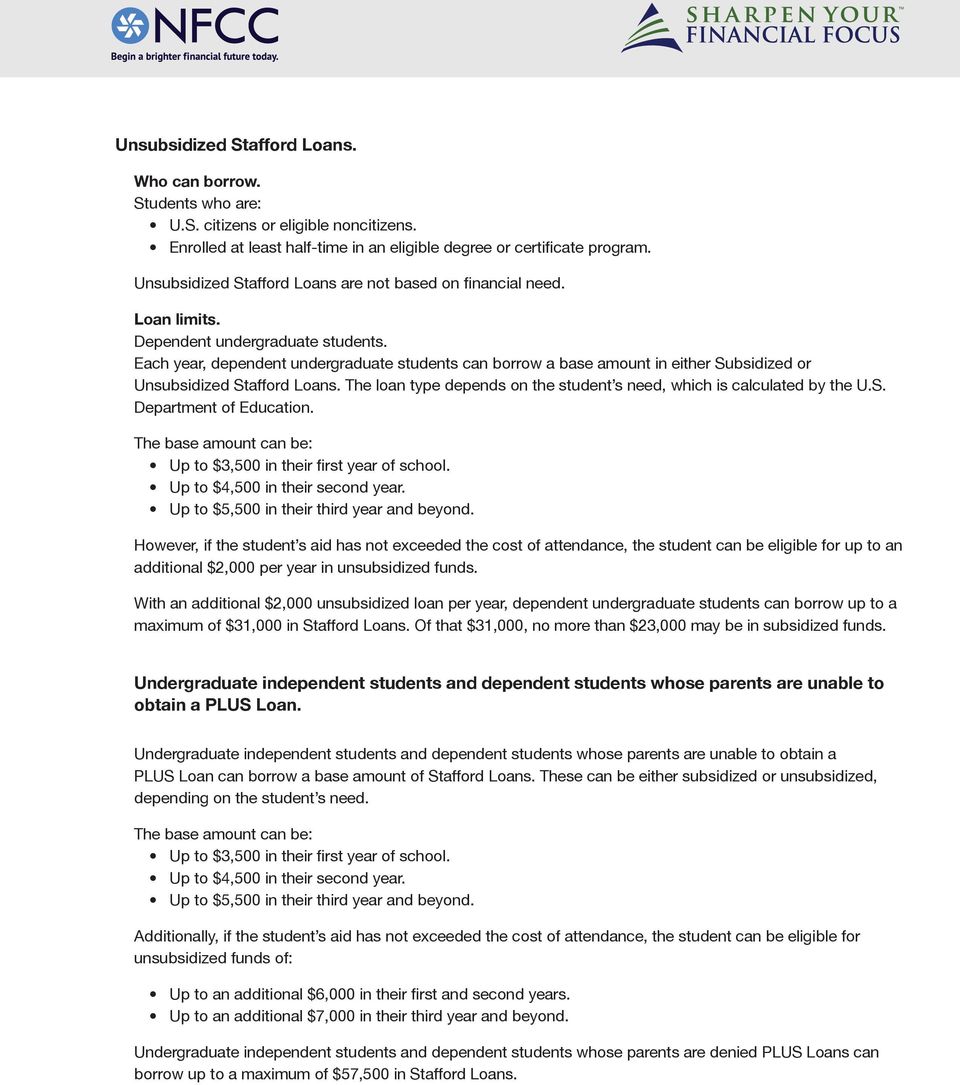
3 Unsubsidized Stafford Loans. Students who are: U.S. citizens or eligible noncitizens. Enrolled at least half-time in an eligible degree or certificate program. Unsubsidized Stafford Loans are not based on financial need. Dependent undergraduate students. Each year, dependent undergraduate students can borrow a base amount in either Subsidized or Unsubsidized Stafford Loans. The loan type depends on the student s need, which is calculated by the U.S. Department of Education. The base amount can be: Up to $3,500 in their first year of school. Up to $4,500 in their second year. Up to $5,500 in their third year and beyond. However, if the student s aid has not exceeded the cost of attendance, the student can be eligible for up to an additional $2,000 per year in unsubsidized funds. With an additional $2,000 unsubsidized loan per year, dependent undergraduate students can borrow up to a maximum of $31,000 in Stafford Loans. Of that $31,000, no more than $23,000 may be in subsidized funds. Undergraduate independent students and dependent students whose parents are unable to obtain a PLUS Loan. Undergraduate independent students and dependent students whose parents are unable to obtain a PLUS Loan can borrow a base amount of Stafford Loans. These can be either subsidized or unsubsidized, depending on the student s need. The base amount can be: Up to $3,500 in their first year of school. Up to $4,500 in their second year. Up to $5,500 in their third year and beyond. Additionally, if the student s aid has not exceeded the cost of attendance, the student can be eligible for unsubsidized funds of: Up to an additional $6,000 in their first and second years. Up to an additional $7,000 in their third year and beyond. Undergraduate independent students and dependent students whose parents are denied PLUS Loans can borrow up to a maximum of $57,500 in Stafford Loans.
4 Graduate students. Graduate students can borrow a base amount of Stafford Loans that are either subsidized or unsubsidized loans, depending on the student s need. The base amount can be up to $8,500. As of July 1, 2012, the $8,500 can only be unsubsidized, as graduate students will no longer be eligible to receive subsidized loans. Additionally, if a student s aid has not exceeded the cost of attendance, the student can be eligible for up to an additional $12,000 in unsubsidized funds, with an annual limit of $20,500. Graduate students can borrow up to a maximum of $138,500 in Stafford Loans of which no more than $65,500 can be subsidized (which includes all undergraduate Stafford Loans). There are different aggregate borrowing limits for health profession students. Repayment begins six months after the borrower graduates, withdraws or drops below half-time enrollment. Typically, the borrower has up to 10 years to complete repayment; however, borrowers can choose from various repayment plans. There are no penalties for prepayment or finishing repayment ahead of schedule. Under certain conditions, repayment of a borrower s loans can be postponed with a deferment or forbearance. Interest will continue to accrue during periods of deferment or forbearance. Fixed at 6.8% for undergraduate and graduate loans. Interest accrues upon disbursement of loan funds and can be paid monthly or quarterly during the inschool period. The borrower can choose to allow interest to accrue while in school, but interest will be capitalized, which means it is added to the principal (the base amount borrowed). Perkins Loans. Undergraduate and graduate students who demonstrate exceptional financial need and are: U.S. citizens or eligible noncitizens. Enrolled at least half-time in an eligible degree or certificate program. Undergraduates can borrow up to $5,500 a year, for a maximum of $27,500. Graduate students can borrow up to $8,000 per year, for a maximum of $60,000. Repayment begins nine months after a borrower graduates, withdraws or falls below half-time enrollment. The borrower has up to 10 years to complete repayment. Borrowers receive limited options for repayment schedules, but they do have additional postponement options like Perkins-specific deferments and forbearance. Borrowers should contact their school or servicer to apply for a postponement. Your servicer is usually different from your other federal loans. It could be your school or a company chosen by your school.

5 Interest. The interest rate is fixed at 5%. Interest is paid by the federal government while the borrower is: In school. In a grace period. In an approved deferment period. Parent PLUS loans. Natural or adoptive parents or stepparents (in some cases) and legal guardians of eligible dependent undergraduate students who are: U.S. citizens or eligible noncitizens. Enrolled at least half-time in an eligible degree or certificate program. Borrowers must have credit in good standing. A co-signer may be required. Parent PLUS Loans are not based on financial need. Parents can borrow up to the total cost of attendance at the student s school (as determined by the school), minus all other aid received. These loans have no annual or total borrowing limit. Typically, borrowers have up to 10 years to complete repayment; however, borrowers can choose from various repayment plans. There are no penalties for prepayment or finishing repayment ahead of schedule. Under certain conditions, borrowers can postpone repayment by requesting a deferment or forbearance. Interest will continue to accrue during periods of deferment or forbearance. For loans disbursed before July 1, 2008: Repayment begins on the loan s principal and interest as soon as it is fully disbursed. For loans disbursed on or after July 1, 2008, the borrower can choose to start repayment: No later than 60 days after the loan is fully disbursed. Upon request, six months after the student for whom the loan was borrowed graduates, withdraws or drops below half-time enrollment. Some parent PLUS loans taken prior to July 1, 1993, may also be eligible for in-school deferment. All new PLUS Loans have a fixed interest rate of 7.9%. PLUS Loans originated under the Federal Family Education Loan Program (FFELP) had a fixed interest rate of 8.5%. As of July 1, 2010, there are no new FFELP loans.

6 Grad PLUS loans. Credit-worthy graduate or professional students who are U.S. citizens or eligible noncitizens and enrolled at least half-time in an eligible degree or certificate program. A co-signer may be required. Borrowers can borrow up to the total cost of their education, minus all other aid received. These loans have no annual or total borrowing limit. For loans disbursed before July 1, 2008: No payments are required while the borrower is in school at least half-time. If the borrower graduates, withdraws or drops below half-time enrollment, there is no grace period before repayment begins. For loans disbursed on or after July 1, 2008: Repayment starts six months after the student drops below half-time enrollment. There are no penalties for prepayment or for finishing repayment ahead of schedule. Under certain conditions, borrowers can postpone repayment by requesting a deferment or forbearance. Interest will continue to accrue during periods of deferment or forbearance. New PLUS loans have a fixed interest rate of 7.9%. FFELP PLUS loans made on or after July 1, 2006, and before July 1, 2010, have a fixed interest rate of 8.5%.

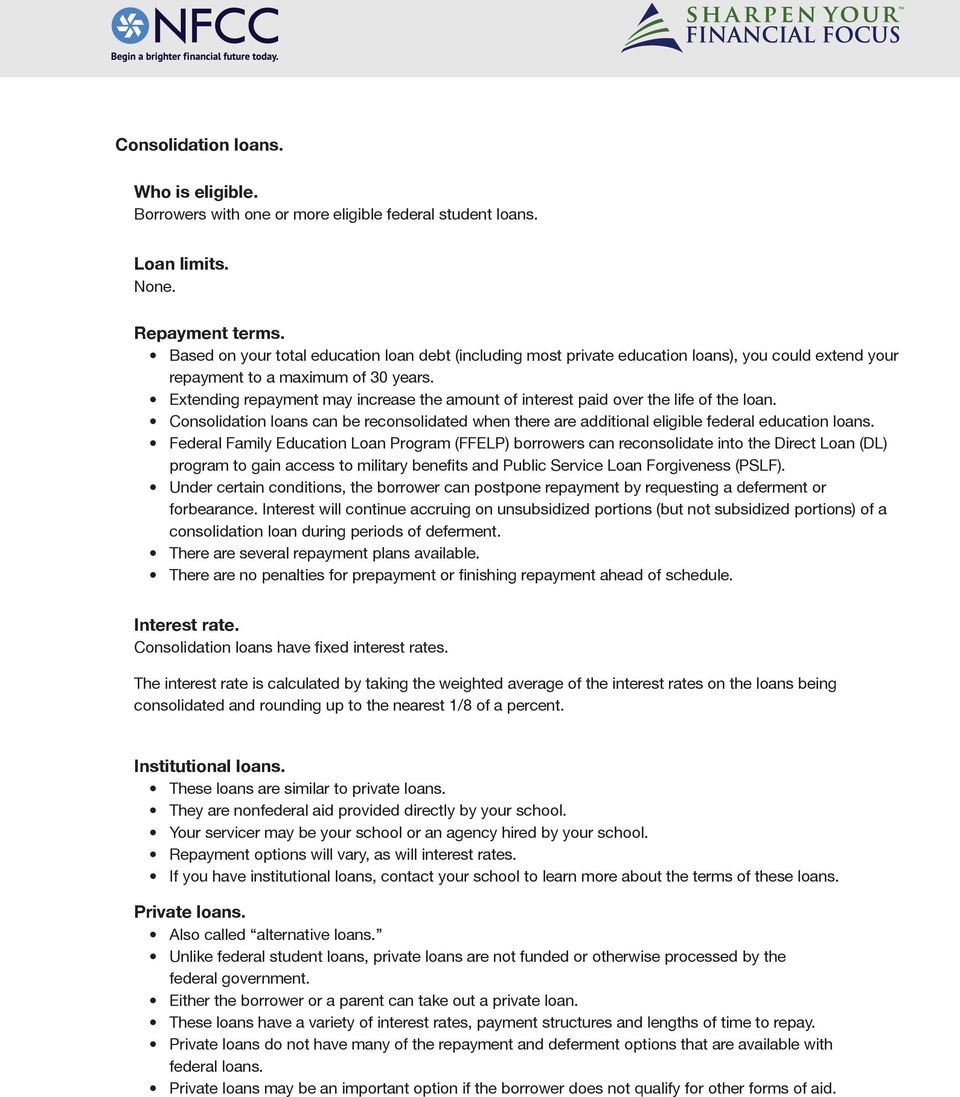
7 Consolidation loans. Who is eligible. Borrowers with one or more eligible federal student loans. None. Based on your total education loan debt (including most private education loans), you could extend your repayment to a maximum of 30 years. Extending repayment may increase the amount of interest paid over the life of the loan. Consolidation loans can be reconsolidated when there are additional eligible federal education loans. Federal Family Education Loan Program (FFELP) borrowers can reconsolidate into the Direct Loan (DL) program to gain access to military benefits and Public Service Loan Forgiveness (PSLF). Under certain conditions, the borrower can postpone repayment by requesting a deferment or forbearance. Interest will continue accruing on unsubsidized portions (but not subsidized portions) of a consolidation loan during periods of deferment. There are several repayment plans available. There are no penalties for prepayment or finishing repayment ahead of schedule. Consolidation loans have fixed interest rates. The interest rate is calculated by taking the weighted average of the interest rates on the loans being consolidated and rounding up to the nearest 1/8 of a percent. Institutional loans. These loans are similar to private loans. They are nonfederal aid provided directly by your school. Your servicer may be your school or an agency hired by your school. Repayment options will vary, as will interest rates. If you have institutional loans, contact your school to learn more about the terms of these loans. Private loans. Also called alternative loans. Unlike federal student loans, private loans are not funded or otherwise processed by the federal government. Either the borrower or a parent can take out a private loan. These loans have a variety of interest rates, payment structures and lengths of time to repay. Private loans do not have many of the repayment and deferment options that are available with federal loans. Private loans may be an important option if the borrower does not qualify for other forms of aid.
8 . State loans. State loans are provided through state-funded programs and are not affiliated with federal loan programs. These loans interest rates may vary depending on the state you are in. State loans have different benefits and requirements from federal loans, but they may offer more benefits than private loans. Contact your state s office of education to learn more.

Loan Counseling Presentation
 Loan Counseling Presentation Financing Options Federal Stafford Loans In Student s name Subsidized Unsubsidized Federal Parent Loans for Undergraduate Students (PLUS) In Parent s name Maximum Annual Loan
Minnesota Office of Higher Education TUDENT OANS & CONSUMER PROTECTION
 4 Minnesota Office of Higher Education TUDENT OANS & CONSUMER PROTECTION Student Loans and Consumer Protection in Higher Education: These are important words to know as you are going through the process
Goal Financial Loan Comparison Chart Page 1 of 5
 Loan Comparison Chart Page 1 of 5 Focus Eligibility Annual Loan Limits* Subsidized Parent *You are enrolled at least half-time in an eligible program *You are a US citizen or eligible non-citizen 1 *You
LOAN REFLECTION. Directions: Complete the handout below individually and share your answers with your small group.
 LOAN REFLECTION Directions: Complete the handout below individually and share your answers with your small group. Have you ever heard the word loan before? In what context? What comes to mind when you
fyi Federal loans: The smart way to borrow
 Federal loans: The smart way to borrow If you don t receive enough free money to pay for college and you aren t able to cover your costs with savings or other resources, consider federal student loans.
2015-2016 Application for Financial Aid New York Medical College School of Basic Medical Sciences
 2015-2016 Application for Financial Aid New York Medical College School of Basic Medical Sciences New York Medical College, Office of Student Financial Planning, Room 125 C 40 Sunshine Cottage Road, Administration
2009 Texas Guaranteed Student Loan Corporation. TG Industry Series
 2009 Texas Guaranteed Student Loan Corporation Managing Student Loan Repayment Understanding your options Learning objectives Take inventory your federal student loans Explore repayment plans available
Widener University School of Law. Exit Interview Counseling Presentation Managing your student loan repayment
 Widener University School of Law Exit Interview Counseling Presentation Managing your student loan repayment Types Of Education Debt Three Types Federal Loans Stafford Subsidized/Unsubsidized Federal Direct
Types of Title IV Loans - Loan Modification Options
 Loans 101: Understanding the Basics Objectives 1 2 3 4 The role of loans in financial aid Overview of the Title IV Loan Program Repayment options Counseling resources The Role of Student Loans in Financial
Student loan terms to know
 Definition of words related to federal student loans and the Nelnet payment process. Accrue The act of interest accumulating on the borrower s principle balance. Aggregate Loan Limit The maximum total
STUDENT LOAN EXIT COUNSELING AND REPAYMENT. Sam Krow-Lucal, Student Loan Coordinator, Stanford Financial Aid Office
 STUDENT LOAN EXIT COUNSELING AND REPAYMENT Sam Krow-Lucal, Student Loan Coordinator, Stanford Financial Aid Office Presentation Overview Loan Repayment Terminology Federal Loan Repayment Plans Federal
Ascentra Credit Union Private Student Loan Program Option 1
 Private Education Loan Application Disclosure Form Page 1 of 9 Ascentra Credit Union Private Student Loan Program Option 1 Ascentra Credit Union c/o Iowa Student Loan Ashford II Building 6775 Vista Drive
Student Loans Terms To Know
 Student Loans Terms To Know Borrower The borrower in most cases is the student. The loan is made in the borrower s name and he/she is responsible for paying back the loan(s) including principal plus any
Federal Direct Stafford Loan Request Form for 2015-16
 Federal Direct Stafford Loan Request Form for 2015-16 Name: G#: Address: City: State: ZIP: Phone: Email: Stafford Loan Requirements and Acknowledgements We strongly recommend that you borrow loans conservatively
STUDENT LOAN FORGIVENESS AND REPAYMENT: WHAT YOU NEED TO KNOW
 STUDENT LOAN FORGIVENESS AND REPAYMENT: WHAT YOU NEED TO KNOW From here to repayment IUPUI updates your enrollment status. Your grace period begins. Your student loan servicer sends you details about
Private Loan Guide. Apply for free, federal and state financial aid programs:
 Private Loan Guide Private loan basics Private student loans are non-federal loans. You should only borrow private loans to fund your education as a last resort. Do all of the following before you consider
Direct Loan Basics. Susan Young Director, Financial Aid Bob Jones University
 Direct Loan Basics Susan Young Director, Financial Aid Bob Jones University Agenda Types Eligibility Rates, Fees and Loan Limits Counseling Repayment Types of Direct Loans Subsidized, Unsubsidized, PLUS
Federal Student Aid Public Service Loan Forgiveness Program
 Federal Student Aid Public Service Loan Forgiveness Program Questions and Answers (Q&As) for Federal Student Loan Borrowers The following questions and answers (Q&As) provide federal student loan borrowers
How To Get A Loan From A College
 STUDENT LOANS: AFTER YOU BORROW Student Loan Basics Nearly Everyone CAN Borrow, however: Loans have to be repaid! Borrow only what you need!! Interest What you are charged for using someone else s money
2015 United Student Aid Funds, Inc. All rights reserved. 1
 Federal Direct Loan Repayment Relief Presented by USA Funds University Agenda Overview. Repayment. Deferment. Forbearance. Discharge and Forgiveness. Federal Consolidation Loans. Federal Direct Loans Repayment
Jack Edwards Director, Financial Aid Stanford Graduate School of Business
 Jack Edwards Director, Financial Aid Stanford Graduate School of Business Disclaimer This session is specific to how Stanford, GSB students borrowing trends when comparing Private vs. Graduate Plus Loans.
Direct Loans 2015-2016
 Direct Loans 2015-2016 All students who complete a valid FAFSA are offered Direct Loans as part of their Financial Aid package. The purpose of this document is to explain how Direct loans work and answer
BEFORE YOU DECIDE. Here are things to consider when deciding whether consolidation is right for you:
 BEFORE YOU DECIDE Here are things to consider when deciding whether consolidation is right for you: THE INTEREST RATES OF EACH LOAN THAT YOU WANT TO CONSOLIDATE The interest rate for a Direct Consolidation
NAVIGATING LOAN REPAYMENT
 NAVIGATING LOAN REPAYMENT Navigating Loan Repayment Agenda Federal Loan Exit Counseling Basics of Student Loan Repayment Federal Repayment Plans Other Repayment Considerations Helpful Links Question and
EXIT COUNSELING GUIDE FOR BORROWERS OF DIRECT LOANS AND FEDERAL FAMILY EDUCATION PROGRAM LOANS
 EXIT COUNSELING GUIDE FOR BORROWERS OF DIRECT LOANS AND FEDERAL FAMILY EDUCATION PROGRAM LOANS U.S. Department of Education Arne Duncan Secretary Federal Student Aid James W. Runcie Chief Operating Officer
Public Service Loan Forgiveness Program Questions and Answers (Q&As) for Borrowers
 Public Service Loan Forgiveness Program Questions and Answers (Q&As) for Borrowers Prepared by Federal Student Aid U.S. Department of Education March 14, 2012 The following Questions & Answers (Q&As) for
Loan Consolidation: What You Need to Know to Make an Informed Decision. Name Title Sallie Mae. April 2006
 Loan Consolidation: What You Need to Know to Make an Informed Decision Name Title Sallie Mae April 2006 Welcome To The Seminar!!! Consolidation often seems complicated, especially now You probably have
Glossary Financial Aid & Student Loan Terms
 Glossary Financial Aid & Student Loan Terms A Academic year A period of time schools use to measure a quantity of study. For example, a school s academic year may consist of a fall and spring semester,
Veridian Private Student Loan - Option 1
 Private Education Loan Application Disclosure Form Page 1 of 6 Veridian Private Student Loan - Option 1 Veridian Credit Union c/o Aspire Servicing Center 6775 Vista Drive West Des Moines, IA 50266-9305
Your Student Loan. Consolidating Your Student Loan Debt
 Your Student Loan Consolidating Your Student Loan Debt If you re currently paying back student loans, you ve probably received multiple phone calls, letters, and e-mails about consolidating those loans
Alliant Credit Union Private Student Loan Option 1
 Private Education Loan Application Disclosure Form Page 1 of 9 Alliant Credit Union Private Student Loan Option 1 Alliant Credit Union c/o Aspire Servicing Center 6775 Vista Drive West Des Moines, IA 50266-9305
Student Loan Repayment. Saint Louis University School of Medicine
 Student Loan Repayment Saint Louis University School of Medicine Overview O Locating Your Loans O Organize your loans O Postponing Repayment O Loan Repayment Terms O Loan Repayment Plans O Federal Loan
TAKE CHARGE OF LOAN REPAYMENT!
 1 TAKE CHARGE OF LOAN REPAYMENT! Strategies for Managing Your Debt Successfully Fall 2013 Jeffrey Hanson Education Services Boston University School of Law Your Action Plan 5 Steps 2 1. Take stock of your
Student Aid Program Summary
 Student Aid Program Summary Most federal student aid is need-based, taking into account an expected family contribution (EFC). Need-based financial aid comes in three basic types: 1. Grants and scholarships,
2015/2016 THINGS YOU NEED TO KNOW ODP Graduate. The following information should help you as you review your 2015/2016 Financial Aid Offer
 2015/2016 THINGS YOU NEED TO KNOW ODP Graduate Financial Aid Online Degree Programs 2130 Fulton Street San Francisco, CA 94117 Tel: 415.422.4531 Fax: 415.422.4534 [email protected] The following information
FDLP and FFELP Fact Sheet Provided by the National Council of Higher Education Loan Programs (NCHELP) Program Regulations Committee
 STAFFORD AND PLUS LOANS Interest Rate 1. [34 CFR 685.202; HEA 428(d)] [34 CFR 682.202; HEA 428(d); 438(g)] The interest rate is fixed at 6.8% for Stafford loans first disbursed on or after July 1, 2006,
The formula to determine eligibility for a subsidized Stafford loan is as follows:
 FFELP Loan Amount Eligibility Scenarios Below are various loan eligibility scenarios. In every case you will see that the aid offered never exceeds the cost of attendance. Remember that for both the Stafford
William D. Ford Federal Direct Loan Program Direct Subsidized Loan and Direct Unsubsidized Loan Borrower s Rights and Responsibilities Statement
 Important Notice: This Borrower s Rights and Responsibilities Statement provides additional information about the terms and conditions of the loans you receive under the accompanying Master Promissory
Managing Your Student Loans 101. Basic Understanding of the Repayment Process
 Managing Your Student Loans 101 Basic Understanding of the Repayment Process Katherine Coates Office of Federal Student Aid Kansas City, MO Adam Essex Office of Federal Student Aid Washington D.C. Kevin
EXIT COUNSELING GUIDE FOR BORROWERS OF DIRECT LOANS AND FEDERAL FAMILY EDUCATION PROGRAM LOANS
 EXIT COUNSELING GUIDE FOR BORROWERS OF DIRECT LOANS AND FEDERAL FAMILY EDUCATION PROGRAM LOANS U.S. Department of Education Arne Duncan Secretary Federal Student Aid James W. Runcie Chief Operating Officer
ENTRANCE COUNSELING GUIDE
 ENTRANCE COUNSELING GUIDE For Direct Loan Borrowers Contents Direct Loan Types 1 Borrow Wisely 2 Borrow Direct Subsidized Loans and Direct Unsubsidized Loans First 2 You Must Repay Your Loans 3 Use of
Federal Supplemental Education Opportunity Grant Work Study Federal Work Study (may not be available at all school locations) Loans
 Financial Aid Information Schools recognize that in many instances individuals and their families are not able to meet the entire cost of education. Therefore, the Financial Aid Office will assist students
Financial Aid Information
 Financial Aid Information Schools recognize that in many instances individuals and their families are not able to meet the entire cost of education. Therefore, the Financial Aid Office will assist students
tudent oans Federal Stafford, PLUS and Grad Plus For Loan Period July 1, 2008-June 30, 2009
 Your guide to tudent oans Federal Stafford, PLUS and Grad Plus For Loan Period July 1, 2008-June 30, 2009 Lender Code: 833506 orrower enefits * 0% Origination Fee for Stafford Loans Allegiance Credit Union
Application and Solicitation Disclosure
 Student Loan Application Send to Printer Representative's Information Brand : Representative ID: We respect your privacy and security. Application and Solicitation Disclosure ABOUT SSL CERTIFICATES View
2014 Exit Counseling / Student Loan Repayment Information. May 7, 2014 University of Maryland, Baltimore County
 2014 Exit Counseling / Student Loan Repayment Information May 7, 2014 University of Maryland, Baltimore County First. If you are graduating: Congratulations! Know your loans Know the type(s) of loan (Stafford
FINANCIAL ASSISTANCE INFORMATION
 FINANCIAL ASSISTANCE INFORMATION CODE OF CONDUCT An institutional financial aid professional is expected to always maintain exemplary standards of professional conduct in all aspects of carrying out his
William D. Ford Federal Direct Loan Program Direct Subsidized Loan and Direct Unsubsidized Loan Borrower s Rights and Responsibilities Statement
 Important Notice: This Borrower s Rights and Responsibilities Statement provides additional information about the terms and conditions of the loans you receive under the accompanying Master Promissory
Financial Aid Information
 Financial Aid Information Schools recognize that in many instances individuals and their families are not able to meet the entire cost of education. Therefore, the Financial Aid Office will assist students
The End of Grace. How to Navigate Your Student Loans After You Graduate
 The End of Grace How to Navigate Your Student Loans After You Graduate Where to find your loans National Student Loan Data System Complete your Financial Aid Review Complete your Exit Counseling www.nslds.ed.gov
WiseBorrower Education Series
 FEDERAL STUDENT LOANS: Repayment 101 How do I determine my loan repayment strategy? What repayment plans are available? What repayment tools will help me navigate tough financial times? What is the best
STUDENT LOAN REPAYMENT
 STUDENT LOAN REPAYMENT Chase College of Law Financial Aid Presentation April 14 th, 2011 TOPICS TO BE COVERED General Repayment Information Loan consolidation Repayment Plans Public service loan forgiveness
William D. Ford Federal Direct Loan Program Direct Subsidized Loan and Direct Unsubsidized Loan Borrower s Rights and Responsibilities Statement
 Important Notice: This Borrower s Rights and Responsibilities Statement provides additional information about the terms and conditions of the loans you receive under the accompanying Master Promissory
Repaying Your Student Loan. Florida Coastal School of Law
 Repaying Your Student Loan Florida Coastal School of Law Workshop Objectives At the end of the workshop you will understand: What options are available during repayment What education-related tax incentives
IMPORTANT NOTICE FOR ALL DEAL LOANS APPROVED
 IMPORTANT NOTICE FOR ALL DEAL LOANS APPROVED Bank of North Dakota (BND) is required to disclose and collect specific documents from each borrower prior to disbursing the DEAL loan funds to the school.