
Accounts. Scottish Charity Number: SC013683
|
|
|
- Eustace Boyd
- 10 years ago
- Views:
Transcription
1 Accounts Scottish Charity Number: SC013683
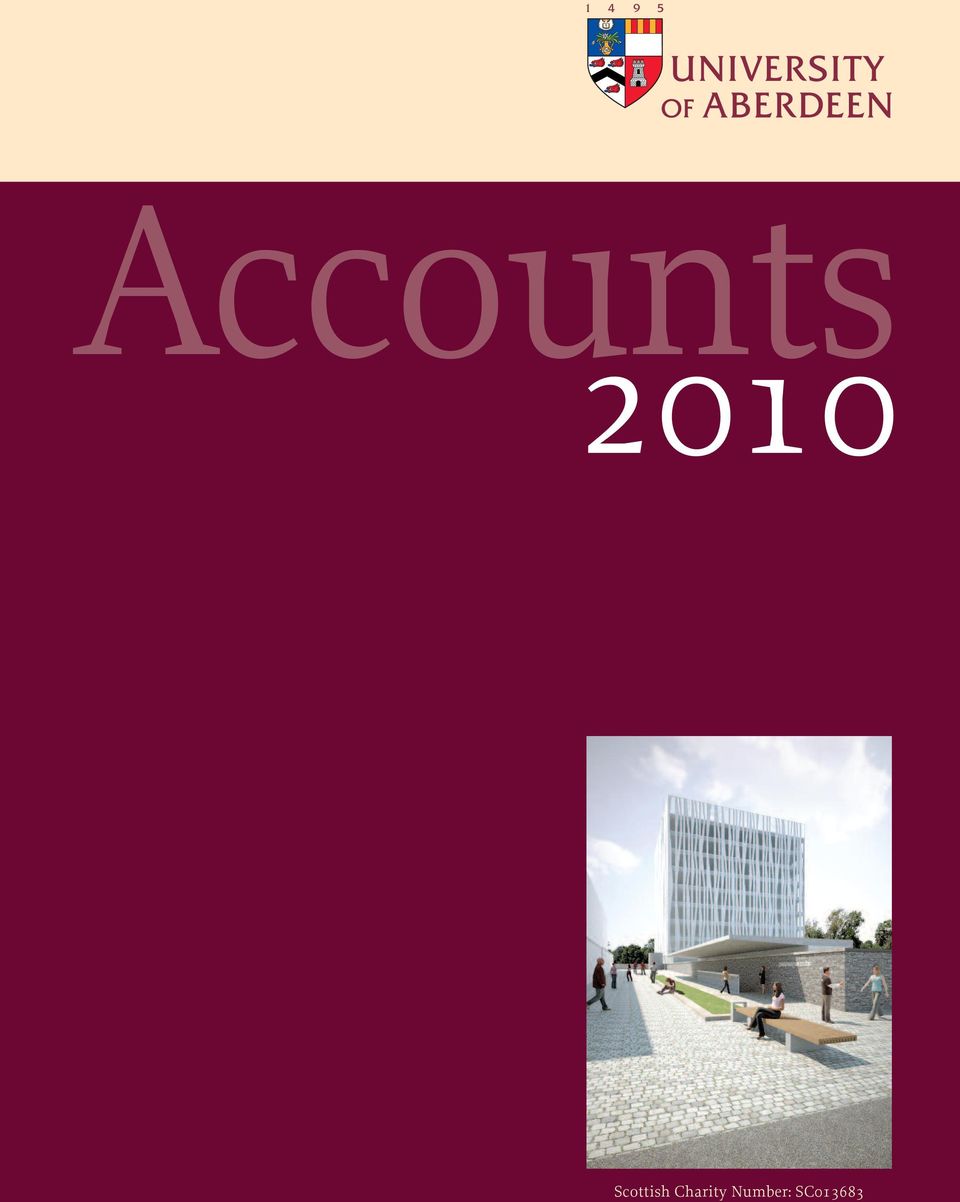
2 Photograph of King s: Ian Cowe, Estates

3 CONTENTS Page Financial Highlights 2-3 Principal s Report 4 Operating and Financial Review 5-9 Statement of Corporate Governance and Internal Control Statement of Primary Responsibilities of the Court 12 Membership of Court and Key Committees 13 Attendance at University Court and Committee Meetings 14 Independent Auditors Report Consolidated Income and Expenditure Account 17 Statement of Consolidated Total Recognised Gains and Losses 18 Balance Sheets Consolidated Cash Flow Statement 21 Statement of Principal Accounting Policies and Estimation Techniques Notes to the Accounts Appendix to the Financial Statements 1 (University of Aberdeen Development Trust Summary) - Unaudited 54 Appendix to the Financial Statements 2 (5 Year Summary) - Unaudited 55 Appendix to the Financial Statements 3 (5 Year Key Performance Indicators) - Unaudited 56 1

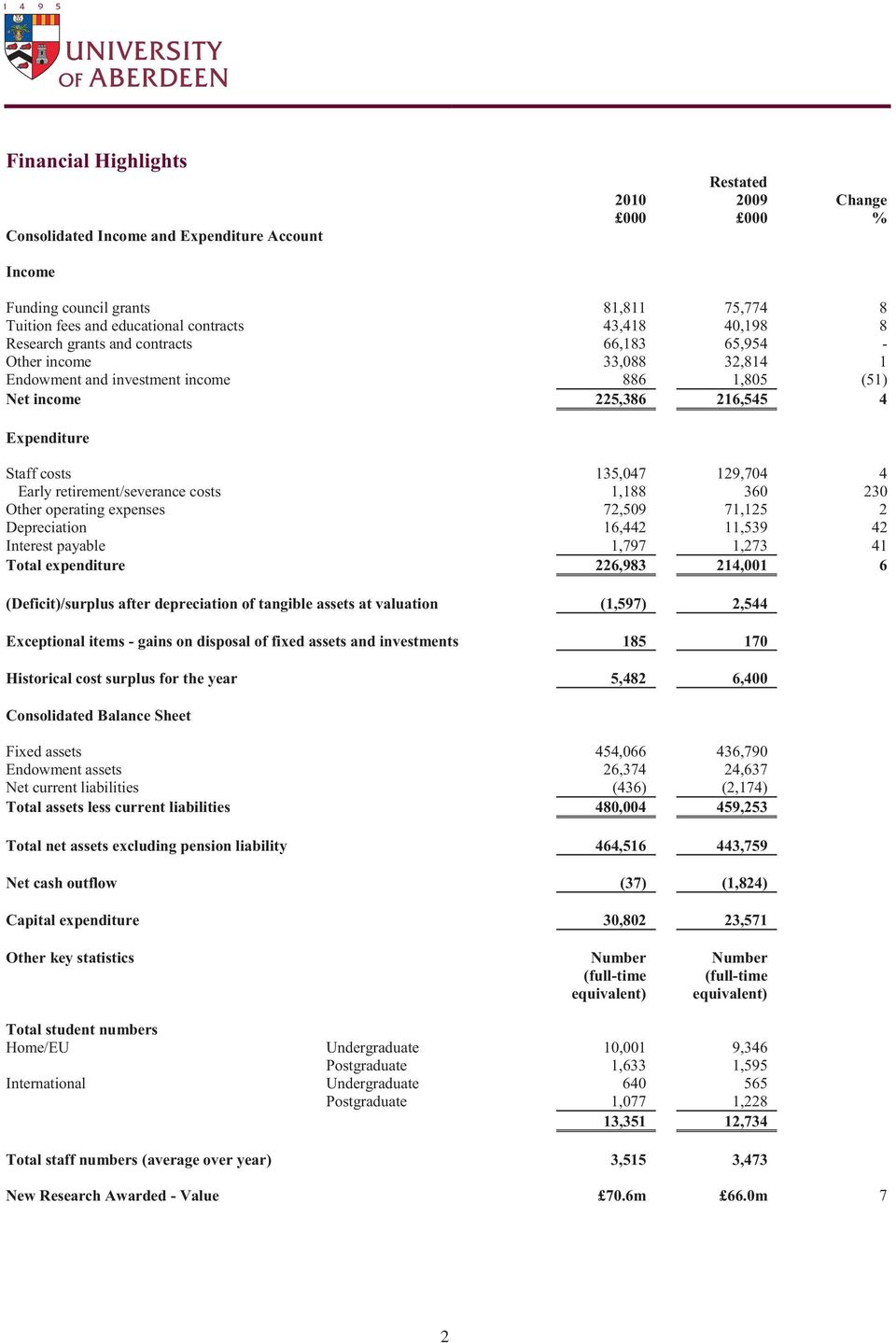
4 Financial Highlights Consolidated Income and Expenditure Account Restated Change % Income Funding council grants 81,811 75,774 8 Tuition fees and educational contracts 43,418 40,198 8 Research grants and contracts 66,183 65,954 - Other income 33,088 32,814 1 Endowment and investment income 886 1,805 (51) Net income 225, ,545 4 Expenditure Staff costs 135, ,704 4 Early retirement/severance costs 1, Other operating expenses 72,509 71,125 2 Depreciation 16,442 11, Interest payable 1,797 1, Total expenditure 226, ,001 6 (Deficit)/surplus after depreciation of tangible assets at valuation (1,597) 2,544 Exceptional items -gains on disposal of fixed assets and investments Historical cost surplus for the year 5,482 6,400 Consolidated Balance Sheet Fixed assets 454, ,790 Endowment assets 26,374 24,637 Net current liabilities (436) (2,174) Total assets less current liabilities 480, ,253 Total net assets excluding pension liability 464, ,759 Net cash outflow (37) (1,824) Capital expenditure 30,802 23,571 Other key statistics Number (full-time equivalent) Number (full-time equivalent) Total student numbers Home/EU Undergraduate 10,001 9,346 Postgraduate 1,633 1,595 International Undergraduate Postgraduate 1,077 1,228 13,351 12,734 Total staff numbers (average over year) 3,515 3,473 New Research Awarded - Value 70.6m 66.0m 7 2
5 Financial Highlights -continued Income 2009/ % Funding council grants 81, Tuition fees and 43, educational contracts Research grants and 66, contracts Other operating income 33, Endowment and investment income Net income 225, Expenditure 2009/ % Staff costs 136, Other operating 72, expenses Depreciation 16,442 7 Interest payable 1,797 1 Total expenditure 226,

6 Principal s Report It is with considerable pride that I submit my first report as Principal on the University s financial statements. Over the past few months the University has undertaken a significant internal and external discussion on what its strategic objectives for the next four years will be. By the time of publication of these accounts we expect to be finalising a new Strategic Plan and a fresh vision for the future of the University. What is already clear, however, as I write this is just how proud of the University our staff and stakeholders are and how even more determined they are to create a future for Aberdeen in which it surpasses the many achievements of its past. One of the paradoxes of the conversation we have been having about the ambition of the University is that it has been taking place against a backdrop of continuing uncertainty over the UK s public finances and, specifically, uncertainty about the extent to which cuts in public funding will impact on universities. Obviously this will present a major challenge in the next few years to come. The message that is supported by these accounts and our financial performance this year, however, is that Aberdeen is a university that should face those challenges with confidence. We have again posted results that show us generating cash despite not having achieved the growth in income in some areas that we would have preferred. In these circumstances, the achievement of a result that is only slightly under our budgeted target is a positive outcome. This is critical to our ten year capital plan which is dependent on the University generating sufficient cash to fund the investment. Taken together with our financial performance over recent years, the statements illustrate that the University has a sound financial base. However, we expect the funding environment to be difficult and have already undertaken a significant amount of preparatory work in anticipation of that. While we must ensure that we operate as efficiently as we possibly can what will be equally important is that we diversify our income streams to bring in non-public money whether it is through greater numbers of overseas full fee paying students, increasing research and commercialisation income or increasing our fundraising from charitable and philanthropic sources. It is crucial that we do this if we are to have the resources we need to improve the University s competitive position. We can currently claim to be among the Top 150 universities in the world but if we are to progress in the direction we all want to then it will need investment. The generation of surpluses over recent years has allowed the University to remain relatively lowly geared and to make significant capital investment in creating world class new facilities for our students and staff. In this past year we have spent 30.8m on our capital programme and in recent years it has seen the University benefit from new facilities like the Suttie Centre for Teaching and Learning in Healthcare, the Aberdeen Sports Village and in the years ahead many more projects, including the University s new library. We have implemented a major reform of our Curriculum in which we have led the way for UK universities. A great number of other initiatives are being taken forward to help us create the very best student experience we can and to make sure we are competing with the very best on offer around the world. A common theme in some of those important new capital projects has been the involvement of key partners in the community such as the NHS in the Suttie Centre and the City Council in the Aberdeen Sports Village. In the years ahead the University will need to focus on strengthening the many partnerships it has across its local, national and international sphere of operations particularly in the context of shrinking public funds and a common need to work more closely with other organisations. Here again, I believe Aberdeen can face the future with optimism given the strength we can already draw from such partnerships. Finally, given the overall financial climate then it is at exactly this time that we must provide for our local and regional community the intellectual leadership that will help our economy and society emerge stronger and better equipped to face the future. I am in no doubt that the strength of this University whether it is in the quality of our teaching, the quality and innovation of our research, or the attributes of the graduates we educate, these all give our region and the country beyond a vital competitive edge. It will be for others to determine the financial priorities for public funds but I believe the case for funding high quality universities like Aberdeen has been proven many times over. And while we will continue to do what we can to make that argument where it matters most, we must also focus on where we can shape our own destiny. There is a sound evidence base within these financial statements to allow me to conclude this report by saying I think we are well placed to do that. Professor Ian Diamond FBA FRSE AcSS Principal and Vice-Chancellor 4

7 Operating and Financial Review Scope of the Financial Statements The Financial Statements for the year ended 31 July 2010, which have been approved by the Court, represent the consolidated results of the University and its subsidiaries, together the Group. Operating Review Our financial reporting will highlight commitment to supporting the achievement of our ambitions through investing in the quality of our staff, our capital programme to create world-class campuses, the contribution made by our increasing success in securing competitively won research funding, and the return on our investment in cultivating philanthropic support. The University is ranked inside the top 200 in the world for both the QS and Times Higher Education rankings. In relations to the 2010 ratings, the University jumped 12 places from last year to position 117 produced by QS, and for the first year of the new Times Higher Education rankings using new methodology was placed 149 th. Financial Highlights The University s results for the year ended 31 July 2010 are summarised on pages 2 and 3 and key performance indicators are on page 56. The University achieved a historical cost surplus of 5.5m. Excluding exceptional gains on investment disposals ( 0.2m) this represents a 2.4% return on income, which is moving towards our financial strategy of a 3% return. The significant movements were as follows: the University s recurrent grant for teaching and research increased by 5.4m (7.9%) compared to the previous year due to the significant increase in research grant as a result of the RAE outcome; income from tuition fees and support grants increased by 3.2m (8.0%), with overseas fees decreasing by 0.3m (1.5%); income from research grants and contracts increased by 0.2m (0.3%); final instalment from the sale of a spinout company realised an historical cost gain of 0.2m; staff costs, excluding severance costs ( 1.2m), increased by 5.3m (4.1%) compared to the previous year; and operating costs increased by 1.4m (2.0%) compared to the previous year. Capital Investment During the year capital expenditure on buildings, plant and equipment totalled 30.8m. Significant items of note were the refurbishment of Hillhead Halls ( 2.6m), the ongoing new Library ( 12.6m), and the completion of the Dentistry Unit ( 3.7m). Grants totalling 22.3m were received to fund capital expenditure on buildings and equipment. The 20.8m Suttie Centre for Teaching and Learning in Healthcare, on the Foresterhill campus, opened for medical students and clinical staff in September 2009, and will deliver strong strategic benefits for the University and our partner in this development, NHS Grampian. This impressive and functional building secured a BREAAM rating of excellent for environment design and engineering, and incorporates features made possible by the success of the fundraising campaign. The 4.5m Oceanlab 2 was completed early summer 2009, and will build on the achievements of Oceanlab to provide specialised facilities for studies and simulations of the effects of climate change on the marine environment, secure facilities for valuable specimens of rare marine creatures, and a base for researchers who lead the world in the use of unmanned deep sea landers. Early design and user involvement has also begun on the new building for the Rowett Institute of Nutrition and Health, which is due to open on the Foresterhill campus in Planning was submitted in September

8 Operating and Financial Review -continued Capital Investment -continued The new library of the University of Aberdeen reached a special milestone on Wednesday October 6 th when construction reached the top of the building and a special topping out ceremony was held to mark the occasion. The event, a traditional ceremony for the construction industry, was held on the roof of the new conservation studio adjacent to the main building. Due to open for the University and wider community in September 2011, the 58m building will bring an enhanced learning environment and cultural facility, fitting for the 21st century, matching the University s academic aspirations. The library will be equipped with 13 kilometres of book shelves, 1,200 work stations, modern IT systems, exhibition rooms, educational facilities and an area dedicated to the University s distinguished collections of rare historic manuscripts, books, and archives. Property Valuation In accordance with the provisions of Accounting Standard SSAP 19 Accounting for Investment Properties, investment properties are revalued on an annual basis and this has resulted in an unrealised gain of 0.6m on their current market value. Cash Flow The Consolidated Cash Flow Statement shows net cash inflow from Operating Activities of 8.8m. The movement in cash after taking account of capital expenditure, financial investment and financing was adecrease of 37,000 on the previous year. Investment Performance The University has discretionary fund management agreements with Fund Managers and performance is routinely monitored against an agreed benchmark. During the year the market value of endowment investments rose by 7.1% from 24.6m to 26.4m, compared with the previous year s fall of 20.4%, reflecting the volatility in the markets. The upturn in the stock market has increased the University endowments, showing an unrealised increase of 1.5m for the three months to 31 October Long-Term Borrowing In the University entered into a loan facility of up to 40m with Barclays Bank plc to fund the 10 year capital programme. During April 2007 the University utilised 4.6m of the 40m facility and entered into a 25 year fixed rate unsecured loan which will be repaid as follows: one quarter in 2021, one quarter in 2026 with the remainder in Due to a combination of additional funding success in fundraising and slippage of some capital projects it was not necessary to drawdown from the remaining facility of 35.4m during Financial Strategy The University s financial strategy is designed to maintain financial flexibility at all times. The main aims being: to achieve a historical cost surplus of 3% of total income to generate sufficient cash reserves to fund investment; evaluate strategic opportunities and identify and quantify future resource needs to enable the University to respond to funding initiatives, opportunities and general fundraising which may impact on long-term financing; prioritise, manage and monitor our financial base, taking account of the financial climate and the constraints it may place on our financial stability; and promote income generation and diversity of income sources. These aims are considered in the development and implementation of the treasury policy, its normal planning, budgeting and mediumterm forecasting cycle, and in the planning and execution of its capital building programme. 6

9 Operating and Financial Review -continued Treasury Management The financing and liquidity of the University and its exposure to financial risk are managed through the central treasury function of the Finance Section. The financial strategy, discussed above, sets out the minimum liquidity levels in order to ensure that sufficient financial flexibility is retained. Each year, as part of its normal planning processes, rolling five year financial forecasts and ten year cash flow plans are prepared. Due to the current climate of potential cuts to public expenditure additional scenario planning has taken place to help manage different levels of funding going forward. This process incorporates a review of capital expenditure and cash generation. The treasury policy limits and monitors the level of funds that are placed in fixed rate deposits. Policies, incorporating clearly defined controls and reporting requirements, are in place to monitor credit and market risk, as well as to maintain the operating financial flexibility of the University. Risk and Uncertainties Sound risk management is an essential discipline for running the University efficiently and pursuing our strategy successfully. The University has a risk management process, monitored by the Risk Management Committee which reports to the Operating Board to ensure a consistent and coherent approach. This is detailed in the Corporate Governance Statement on page 10. In this section, we describe some of the principal risks that the Court believes could materially affect the University, its reputation, revenues, liquidity and capital resources. The nature of risk is such that other risks may arise, or risks not currently considered material may become so in future. The University Court recognises the following key institutional risks as particularly deserving attention. The delivery of our strategy is crucially reliant on maintaining our income from all sources at least at the same rate as our UK and International competition. To mitigate this risk, there are university-wide activities to grow income from students, funders and customers. The University s staff salaries are arrived at through a national pay bargaining procedure. The last pay agreement which ran for three years has resulted in pay awards in the final year well above our growth in income. Given the rising costs of the University s defined benefits pensions schemes and higher inflation, the University is taking mitigating actions to influence negotiations regarding future pay and pensions costs, and maintaining effective relations with local trade unions. The University has a large portfolio of buildings and facilities which are crucial to the delivery of the strategic plan. It is a major challenge to invest sufficient funds in the development and maintenance of these assets to deliver facilities that are attractive to students and funders. Our 10 year capital plan continues investment in the infrastructure whilst retaining flexibility to cope with any changes in the funding environment. In addition, capital building developments are prioritising facilities, such as the main Library, which will improve the student experience and further mitigate this risk. There are a number of other risks around the areas of staff recruitment and retention, financial sustainability and major change projects, which though very major risks, are currently assessed as not being likely, due to longstanding and effective risk mitigation measures. The global financial crisis and its impact on the world and UK economy is likely to have a considerable impact on the University with cuts in public funding arising from 2011 onwards. The University is undertaking new initiatives to diversify and grow income whilst containing costs and carrying out process efficiencies to streamline activity. In addition, the University has launched a voluntary severance/early retirement scheme which to mid October has resulted in 115 FTE taking the opportunity giving a recurrent saving of 4.3m. A national group is now negotiating with trade unions on the future funding and benefits of USS, and the University is currently reviewing the long term financial sustainability of its own in-house support staff pension scheme. Colleges and administration are currently working on detailed scenario plans which will be further informed by the adoption of the new strategic plan, and the actions required to deliver the plan. 7 7
10 Operating and Financial Review -continued Creditor Payment Policy & Practice The University s general conditions of purchase are made available to suppliers as an inherent part of purchase contracts at the outset of a transaction and are adhered to. There is a consistent policy that invoices will be paid in accordance with the general conditions of purchase and there are no alterations to payment terms without prior agreement. Unless special terms apply, payment is made within 30 days of receipt of a valid invoice or after acceptance of the goods or services, whichever is the later. The University complies with the requirements of the CBI Prompt Payment Code. At 31 July 2010 the University s trade creditors represented 28 days ( days). Equality and Diversity Policy The University of Aberdeen is committed to a comprehensive policy on Equality and Diversity for all its staff and students. This policy aims to prevent discriminatory practices and seeks to create a culture where staff and students can reach their full potential. It is the University s policy to select and treat staff and students on the basis of their merits only and irrespective of colour, race, nationality, national origins, disability, sexual orientation, religion or belief, family circumstances, political beliefs, gender, gender reassignment, trade union membership, age or any other unfair distinction The University is committed to providing a learning, working and social environment in which the rights and dignity of all its members are respected, and which is free from discrimination, prejudice, intimidation and all forms of harassment and bullying. This Equality and Diversity Policy will be monitored and reviewed by the University regularly and promoted throughout the University. Corporate and Social Responsibility The University of Aberdeen iscommitted to the twin principles of sustainability and social responsibility in all that we do. We are engaged in scholarships and research into sustainable development and social responsibility and through operational initiatives such as our Carbon Management Plan, our cultural and public engagement commitments, our commitment to sustainability in construction projects, and our efforts to embed these issues at the heart of institutional strategy. We are working to ensure that all staff and students understand the collective nature of our responsibility to act in accordance with these principles. Achievements to date include: Fairtrade (2006), BREEAM excellence (New Library and Suttie Centre), Healthy Working Lives (2009), Universities that Count (Silver Award) and able campaign which is led by the Environmental Team. Student Satisfaction The University uses external benchmarks to monitor its performance in key areas, including performance in University League Tables, and the annual National Student Survey of final year undergraduates, carried out by Ipsos-Mori on behalf of the UK higher education funding bodies. A Working Group was established in November 2009 to review our league table performance. This Group reported to University management in May 2010, and made 20 recommendations. Progress with the implementation of these recommendations is reported to the University Management Group. One of the recommended actions was the compiling of an annual report of University performance across the main national and international tables which is being implemented from November In the four years that the University has taken part in the National Student Survey we have performed strongly in relation to the overall satisfaction of our students, with the percentage of students indicating that they are satisfied with the quality of their course ranging between 89% and 91%. These scores have placed us consistently in the top 20 institutions. The survey results are reported to the University Committee on Teaching & Learning and to Senate, and each College is asked to respond to the survey results in relation to the College-owned subject areas. This allows us to monitor and review action being taken to improve student satisfaction across all areas of the Survey, including those areas where we perform less well, such as in response to questions on assessment and feedback. 8

11 Operating and Financial Review -continued Constitution, Governance and Regulation The University of Aberdeen was formed by Royal Charter on 10 February 1495 and is one of the four Scottish Ancients. The Courts of the Ancient Universities derive their status and powers from Acts of Parliament, Ordinances approved by the Privy Council and Resolutions of the Court. The Court is the executive governing body of the University and is responsible for mission and strategic direction, administrative arrangements, financial health, well-being of staff and students and, in association with the Senate, for establishing and maintaining high standards of academic conduct and probity. The University s corporate arrangements are described on pages 10 to 11 and members of the University Court during the financial year are listed on page 13. The University is an exempt charity by virtue of the Charities and Trustee Investment (Scotland) Act 2005, and is registered with the Office of the Scottish Charity Regulator under number SC The University is regulated principally by the Scottish Funding Council under a Financial Memorandum. The University complies with conditions of the grant set out in the funding arrangements. The University s principal advisors are listed on page 53. Future Developments In common with other organisations we face some challenges in the year s ahead, most notably in terms of government funding, potential public sector funding cuts, utility use, controlling pay awards, pension costs and an uncertain financial and investment situation. Our strong performance this year, coupled with the enthusiasm, motivation and ambition of our staff gives us the best base with which to address the challenges ahead. Through continued strong financial performance, coupled with our Investors in People programme, we will continue to attract and retain academic and support staff at the forefront of their fields who will want to develop their careers within the University of Aberdeen community. The curriculum changes brought about as a result of the University s curriculum reform initiative came into effect for students entering programme year 1 in September These students choose 30 credits of Enhanced Study at Level 1, normally one course per halfsession. The aim is to offer improved breadth and flexibility with more options including new cross-disciplinary Sixth Century Courses. These have proved very popular with almost 1400 students registered to take a Sixth Century Course. This number exceeds expectation and initial feedback from staff and students has been positive. Another new option available as Enhanced Study is Sustained Study which allows students to take a suite of four courses in the same subject, one in each half-session at Levels 1 and 2. There are 13 options: Arabic, Biblical Language, Business, the Classical Tradition, Computing, Conservation and Environment, Fit for Life, French, Gaelic, German, Latin, Mandarin Chinese and Spanish. These courses have again proved popular with almost 400 students registered on a Sustained Study option. Students are also being given the opportunity to develop the Aberdeen Graduate Attributes. Through WebCT students have the opportunity to reflect upon their achievement of these attributes, and are signposted to opportunities to develop their Attributes, through academic courses and through enhanced co-curricular activities, including more opportunities for work placement and study abroad. Conclusion Overall, the University remains in a position of financial and academic strength. This has been achieved through the efforts of all the University s staff including academic, research, administrative and technical and by tight budgetary control in an environment where there is significant cost pressures or limited increases in relation to government funding. I would like to acknowledge the work of the Finance Director and her staff in managing the finances during the year and in the preparation of the Financial Statements. Sir Moir Lockhead Senior Governor of the University Court 9

12 Statement of Corporate Governance and Internal Control The University of Aberdeen is committed to achieving the highest possible standards of corporate governance relevant to the higher education sector. This summary describes the manner in which the University has applied the principles set out in the UK Combined Code on Corporate Governance 2008 (Revised May 2010) and the CUC Guide for Members of Higher Education Governing Bodies in the UK. Its purpose is to help the reader of the financial statements understand how the principles have been applied, and to set out the basis for the Court s opinion that the University has fully complied with the Code throughout the year ended 31 July The University Court of the University of Aberdeen is a body corporate with perpetual succession and a common seal. The University s powers and framework of governance are set out in the Universities (Scotland) Acts and by the Ordinances, made under these Acts. The Universities (Scotland) Acts define the powers of the University Court, the Senate and the General Council, each of which has clear functions and responsibilities within the governance and management of the University s business. The University Court is charged with the administration and management of the revenue and property of the University, and has the power to review any decision of the Senate on appeal. It is responsible for the University s system of internal control and for reviewing it s effectiveness. The University Court has a majority of lay members including Assessors, elected by the General Council, by Aberdeen City and Aberdeenshire Councils, by the Chancellor and by the Rector, as well as co-opted members. Assessors are also elected by the Senate and there is provision for at least one student member. The Rector is elected by the student body and is the ordinary president of the Court. The Court appoints a Senior Governor, who performs the role of Chairman and who represents the University at meetings of Chairmen of Governing Bodies and internally to act as the leading Governor in matters of governance and management. In accordance with the provisions of the Universities (Scotland) Acts and the Ordinances made by the Court, the total composition of the Court is 28. The Court is of the view that there is an ongoing process for identifying, evaluating and managing the University's significant risks up to the date of approval of the annual reports and accounts. This process has been formalised to accord with the internal control guidance for directors in the Combined Code. It is designed to manage rather than eliminate the risk of failure to achieve business objectives and can only provide reasonable and not absolute assurance against material misstatement or financial loss. This process is regularly reviewed by the governing body and accords with the internal control guidance as applicable to the higher education sector. A Risk Management Committee, which is a sub-committee of the Operating Board, oversees the development and implementation of the University's risk management strategies, policies and procedures. The Court approves a Register of Strategic Risks and a Risk Template for the management of major University projects. The Court has four meetings each year, but much of its detailed work is addressed in the first instance by Committees, in particular, the Operating Board, the Audit, the Risk Management, the Staffing & Development, the Governance, and the Remuneration Committees. All these Committees are formally constituted with terms of reference. Where these Committees have delegated authority from the Court to take decisions on certain matters, major decisions are formally reported to the Court. Similarly, when the Court delegates power to the Principal with at least one other senior member of the Court to take decisions between meetings, such decisions are formally reported to the Court. The University maintains a Register of Interests of members of the Court and of members of senior management, which may be consulted by application to the Secretary. In addition, individuals are asked to declare interests in relation to Court and Committee business on an ad hoc basis. The Court has adopted a Statement of Primary Responsibilities and routinely undertakes a wide-ranging review of its effectiveness against the background of the CUC guidance, mentioned above. The Principal, who is a member of the Court ex officio has responsibility for implementing the decisions of the Court, for initiating discussion and consultation on the University's future development and for ensuring that appropriate proposals are presented to the governing body, and, as the Designated Officer of the University under the terms of the Financial Memorandum between the University and the Scottish Funding Council, for ensuring that the Court takes cognisance of the terms of the Financial Memorandum in all its decision making. 10
13 Statement of Corporate Governance and Internal Control -continued The Secretary is the principal officer of the Court and is responsible for ensuring that the Court acts within its powers and follows proper procedures. He provides independent advice to Court members about their individual and collective responsibilities and how they should be discharged. The Senate, which consists of ex officio and elected academic staff and students, is responsible for the regulation and superintendence of teaching and student discipline and for promoting research. In respect of its strategic and development responsibilities, the Court receives recommendations and advice from the Operating Board, a committee of the Court. This Committee s composition includes four lay members, appointed by the Court from amongst its members. The Operating Board inter alia recommends to the Court the University s annual revenue and capital budgets and monitors performance in relation to the approved budgets. The Governance Committee considers nominations for co-opted vacancies in the Court membership and vacancies in the membership of Court sub-committees. The Remuneration Committee determines the remuneration of the most senior staff, including the Principal. The Audit Committee, which has a predominantly lay membership, is chaired by a lay member of the Court and meets five times a year, with the University s internal and external auditors in attendance at all meetings. The Committee considers detailed reports from the internal and external auditors, together with recommendations for the improvement of the University s systems of internal control, and management s responses and implementation plans. The Audit Committee s role is one of high level review of the arrangements for internal control and value for money. It has authority to investigate any matters within its terms of reference. It also receives and considers reports from the Scottish Funding Council as they affect the University s business and monitors adherence to the regulatory requirements. Whilst senior executives attend meetings of the Audit Committee, as necessary, they are not members of the Committee. Each meeting commences with a presentation from management on a key business development. The Risk Management Committee is a sub-committee of the Operating Board and contains lay representation. It seeks to ensure that the University has in place appropriate internal controls, including the identification of key business risks, evaluation of their financial and non-financial implications, and the establishment of policies and procedures for managing these risks. It receives reports from and provides reports to the Audit Committee. The Convener of the Audit Committee is an ex officio member. During 2009/10 the University reviewed its Risk Management arrangements to ensure these were in line with best practice. The University fully endorses the provisions of the Scottish Funding Council s Financial Memorandum. The University retains an external firm of accountants as Internal Auditors, and the University Court receives at least annually a report on internal audit activity, including an independent assessment of the adequacy and effectiveness of the University s system of internal control, including internal financial control. The University Court considers that the University has adequate resources to continue in operational existence for the foreseeable future. Conclusion Overall, the Court is of the view that it has in place a robust set of governance arrangements and procedures to fulfil its responsibilities. Sir Moir Lockhead Senior Governor of the University Court 7 December

14 Statement of Primary Responsibilities of the Court Under the statutes contained in the Universities (Scotland) Acts the University Court is responsible for the administration and management of the University s affairs, including ensuring an effective system of internal control, and is required to present audited financial statements for each financial year. The Court is responsible for keeping proper accounting records which disclose with reasonable accuracy at any time the financial position of the University and enable it to ensure that the financial statements are prepared in accordance with the statutes, the Statement of Recommended Practice on Accounting in Higher Education Institutions and other relevant accounting standards. In addition, within the terms and conditions of a Financial Memorandum agreed between the Scottish Funding Council and the Court of the University of Aberdeen, the Court, through its Designated Officer, is required to prepare financial statements for each financial year which give a true and fair view of the University s state of affairs and of the surplus or deficit and cash flows for that year. When preparing the financial statements the Court has ensured that: suitable accounting policies are selected and applied consistently; judgements and estimates are made that are reasonable and prudent; applicable accounting standards have been followed, subject to any material departures disclosed and explained in the financial statements; and financial statements are prepared on the going concern basis unless it is inappropriate to presume that the University will continue in operation for the foreseeable future. The Court is satisfied that it has adequate resources to continue in operation for the foreseeable future. For this reason the going concern basis continues to be adopted in the preparation of the financial statements (page 22). The Court has taken reasonable steps to: ensure that funds from the Scottish Funding Council are used only for the purposes for which they have been given and in accordance with the Financial Memorandum with the Funding Council and any other conditions which the Funding Council may from time to time prescribe; ensure that there are appropriate financial and management controls in place to safeguard public funds and funds from other sources; safeguard the assets of the University and prevent and detect fraud; and secure the economical, efficient and effective management of the University s resources and expenditure. The key elements of the University s system of internal financial control, which is designed to discharge the responsibilities set out above, include the following: clear definitions of the responsibilities of, and the authority delegated to, heads of academic and administrative departments; a comprehensive medium and short-term planning process, supplemented by detailed annual income, expenditure, capital and cash flow budgets; regular reviews of key performance indicators and business risks and monthly reviews of financial results, involving variance reporting and updates of forecast outturns; clearly defined and formalised requirements for approval and control of expenditure, with investment decisions involving capital or revenue expenditure being subject to formal detailed appraisal and review according to approval levels set by the Court; comprehensive Financial Regulations, detailing financial controls and procedures, approved by the Audit Committee, the Operating Board and the Court; and an outsourced professional Internal Audit team whose annual programme is approved by the Audit Committee and endorsed by the Court and whose head provides the Court with a report on internal audit activity within the University and an opinion on the adequacy and effectiveness of the University s system of internal control, including internal financial control. Any system of internal financial control can, however, only provide reasonable, and not absolute, assurance against material misstatement or financial loss. 12

15 Membership of Court and Key Committees UNIVERSITY COURT MEMBERSHIP: OPERATING BOARD MEMBERSHIP: Rector Mr S Cannon (Convener from to ) Mr S Robertson Ms J Craw Principal Mr B Pack Professor Sir Duncan Rice (to ) Mr A Arthur Professor I Diamond (from ) Dr P Edwards Chancellor s Assessor Professor C Secombes (to ) Dr A Mair (to ) Professor Sir Duncan Rice (to ) Rector s Assessor Professor I Diamond (from ) Mr G Hunter Sir Moir Lockhead (to ) Vice-Principals Professor S Logan Professor S Logan Mr R Parker (from to ) Professor D Houlihan Professor N Webster (from ) Assessor: Aberdeenshire Council Councillor WHowatson (from ) REMUNERATION COMMITTEE MEMBERSHIP: Assessor: Aberdeen City Council Councillor J Stewart Sir Moir Lockhead (Convener from ) Assessors: General Council Lady Catto Lady Catto Sir Don Cruickshank (from ) Ms J Craw Mr B Pack (from ) Mr B Lockhart Dr A Mair (to ) Mr R Ruddiman Assessors: Senatus GOVERNANCE COMMITTEE MEMBERSHIP: Mr A Arthur Dr P Edwards Sir Don Cruickshank (Convener) Professor C Fynsk Sir Moir Lockhead Professor G Robinson Professor Sir Duncan Rice (to ) Professor C Secombes (to ) Professor I Diamond (from ) Professor N Vargesson (from ) Professor C Fynsk (from ) Professor N Webster Mr B Pack (from ) President, Students Association Professor C Secombes (to ) Mr R Parker Co-opted Members RISK MANAGEMENT COMMITTEE MEMBERSHIP: Mr A D J Amoore Dr A Baxter (from ) Mr S Cannon (Convener from ) Sir Don Cruickshank Professor N Haites Mrs S Grant Professor C Gane (from ) Miss A Harper Professor B MacGregor (to ) Sir Moir Lockhead (Vice-Chairman from ) Mr R Ruddiman Mr B Pack Ex officio Mr A D J Amoore, as Convener of the Audit Committee AUDIT COMMITTEE MEMBERSHIP Mr A D J Amoore (Convener) Mr R Bickerton Mr B Lockhart Mr A Mathieson (to ) Mr G Ross Mr K Murray (from ) Professor L Ritchie 13

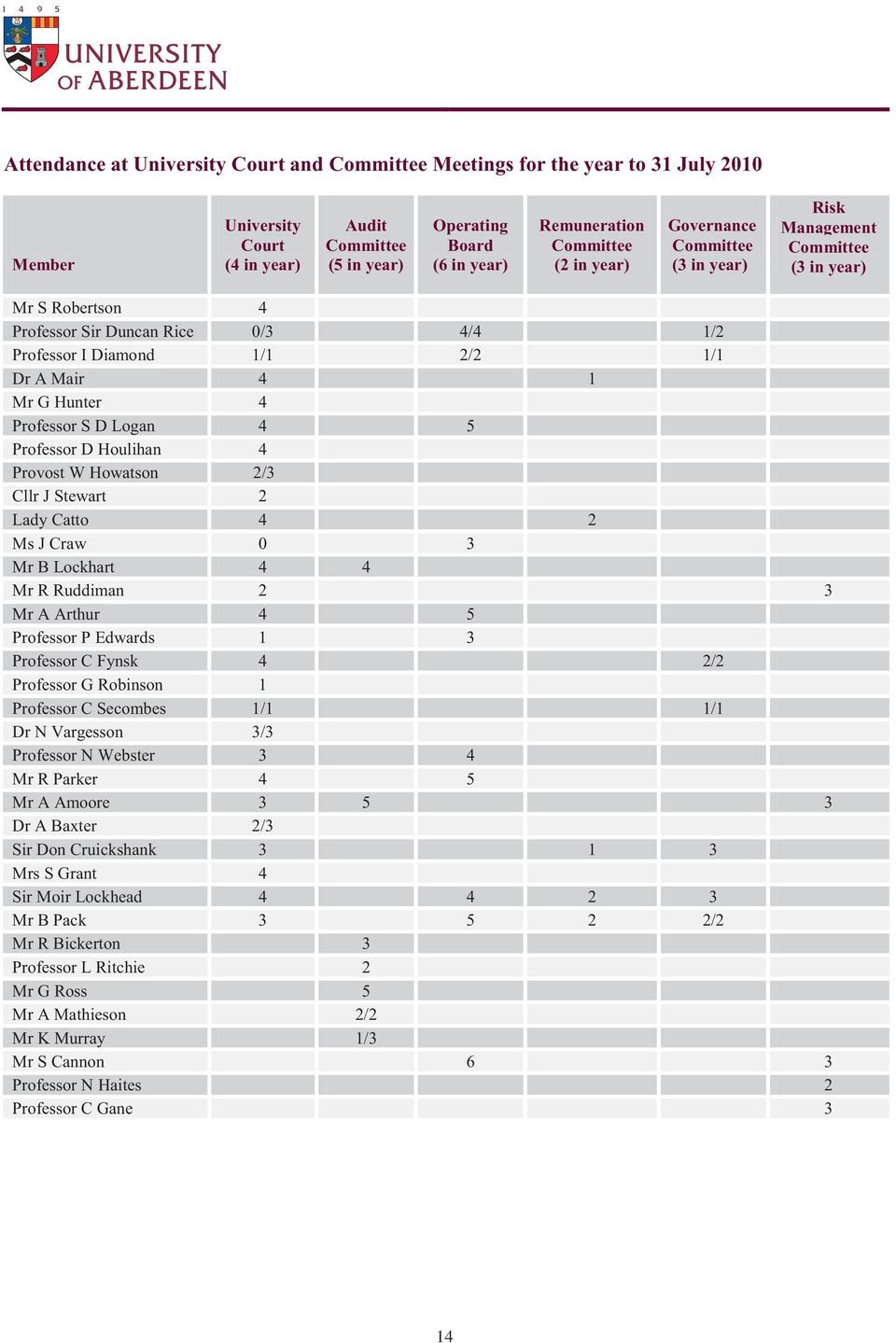
16 Attendance at University Court and Committee Meetings for the year to 31 July 2010 Member University Court (4 in year) Audit Committee (5 in year) Operating Board (6 in year) Remuneration Committee (2 in year) Governance Committee (3 in year) Risk Management Committee (3 in year) Mr S Robertson 4 Professor Sir Duncan Rice 0/3 4/4 1/2 Professor I Diamond 1/1 2/2 1/1 Dr A Mair 4 1 Mr G Hunter 4 Professor S D Logan 4 5 Professor D Houlihan 4 Provost W Howatson 2/3 Cllr J Stewart 2 Lady Catto 4 2 Ms J Craw 0 3 Mr B Lockhart 4 4 Mr R Ruddiman 2 3 Mr A Arthur 4 5 Professor P Edwards 1 3 Professor C Fynsk 4 2/2 Professor G Robinson 1 Professor C Secombes 1/1 1/1 Dr N Vargesson 3/3 Professor N Webster 3 4 Mr R Parker 4 5 Mr A Amoore Dr A Baxter 2/3 Sir Don Cruickshank Mrs S Grant 4 Sir Moir Lockhead Mr B Pack /2 Mr R Bickerton 3 Professor L Ritchie 2 Mr G Ross 5 Mr A Mathieson 2/2 Mr K Murray 1/3 Mr S Cannon 6 3 Professor N Haites 2 Professor C Gane 3 14
17 Independent auditors report to the Court of the University of Aberdeen We have audited the group and University financial statements of the University of Aberdeen for the year ended 31 July 2010 set out on pages 17 to 53. The financial reporting framework that has been applied in their preparation is applicable law and UK Accounting Standards (UK Generally Accepted Accounting Practice). These financial statements have been prepared in accordance with the accounting policies set out therein. This report is made solely to the University Court of the University of Aberdeen, as a body, in accordance with the Universities (Scotland) Acts Our audit work has been undertaken so that we might state to the University Court those matters we are required to state to it in an auditors report and for no other purpose. To the fullest extent permitted by law, we do not accept or assume responsibility to anyone other than the University Court for our audit work, for this report, or for the opinions we have formed. Respective Responsibilities of the University Court and Auditors The responsibilities of the University Court for preparing the Operating and Financial Review and the financial statements in accordance with the Accounts Direction issued by the Scottish Funding Council, the Statement of Recommended Practice: Accounting for Further and Higher Education, applicable law and UK Accounting Standards (UK Generally Accepted Accounting Practice) are set out in the Statement of Primary Responsibilities of the Court on page 12. Our responsibility is to audit the financial statements in accordance with relevant legal and regulatory requirements and International Standards on Auditing (UK and Ireland). We report to you our opinion as to whether the financial statements give a true and fair view and are properly prepared in accordance with the Statement of Recommended Practice: Accounting for Further and Higher Education. We also report to you whether, in all material respects, income from funding bodies, grants and income for specific purposes and from other restricted funds administered by the University have been properly applied only for the purposes for which they were received and whether, in all material respects, income has been applied in accordance with the Further and Higher Education (Scotland) Acts 1992 and 2005 and, where appropriate, with the Financial Memorandum with the Scottish Funding Council. We also report to you whether in our opinion the Operating and Financial Review is not consistent with the financial statements. In addition, we report to you if, in our opinion, the University has not kept proper accounting records or if we have not received all the information and explanations we require for our audit. We read the other information contained within the Operating and Financial Review and the Statement of Corporate Governance and Internal Control and consider the implications for our report if we become aware of any apparent misstatements within them or material inconsistencies with the financial statements. Basis of Opinion We conducted our audit in accordance with International Standards on Auditing (UK and Ireland) issued by the Auditing Practices Board. An audit includes examination, on a test basis, of evidence relevant to the amounts and disclosures in the financial statements. It also includes an assessment of the significant estimates and judgments made by the University Court in the preparation of the financial statements and of whether the accounting policies are appropriate to the Group and University s circumstances, consistently applied and adequately disclosed. We planned and performed our audit so as to obtain all the information and explanations which we considered necessary in order to provide us with sufficient evidence to give reasonable assurance that the financial statements are free from material misstatement, whether caused by fraud or other irregularity or error. In forming our opinion, we also evaluated the overall adequacy of the presentation of information in the financial statements. 15

18 Independent auditors report to the Court of the University of Aberdeen continued Opinion In our opinion: the financial statements give a true and fair view, in accordance with UK Generally Accepted Accounting Practice, of the state of the group s and University s affairs as at 31 July 2010 and of the group s surplus of expenditure over income for the year then ended; the financial statements have been properly prepared in accordance with the Statement of Recommended Practice: Accounting for Further and Higher Education; in all material respects, income from the Scottish Funding Council, grants and income for specific purposes and from other restricted funds administered by the University during the year ended 31 July 2010 have been applied for the purposes for which they were received; and in all material respects, income during the year ended 31 July 2010 has been applied in accordance with the Universities (Scotland) Acts and the Further and Higher Education (Scotland) Acts 1992 and 2005 and, where appropriate, with the Financial Memorandum with the Scottish Funding Council. S Reid for and on behalf of KPMG LLP, Statutory Auditor Chartered Accountants 37 Albyn Place Aberdeen AB10 1JB 10 December

19 Consolidated Income and Expenditure Account Restated Note Income Funding body grants 1 81,811 75,774 Tuition fees and educational contracts 2 43,418 40,198 Research grants and contracts 3 66,183 65,954 Other income 4 34,793 32,992 Endowment and investment income ,805 Total Income 227, ,723 Less: Share of income from joint venture 16 (1,705) (178) Net income 225, ,545 Expenditure Staff costs 6 135, ,704 Early retirement/severance costs 6 1, Other operating expenses 7 72,509 71,125 Depreciation 8 16,442 11,539 Interest and other finance costs 9 1,797 1,273 Total expenditure , ,001 (Deficit)/surplus after depreciation of tangible assets at valuation (1,597) 2,544 Share of operational surplus in joint venture (Deficit)/surplus before disposal of fixed asset investments (1,422) 2,609 Surplus on disposal of fixed asset investments (Deficit)/surplus on continuing operations after depreciation of assets at valuation and disposal of fixed asset investments 12 (1,237) 2,779 Transferred from accumulated income in endowment funds (Deficit)/surplus for year retained within general reserves 26 (440) 3,562 Statement of Group Historical Cost Surpluses and Deficits (Deficit)/surplus on continuing operations 12 (1,237) 2,779 Difference between historical cost depreciation and the actual charge for the year calculated on the re-valued amount 26 6,719 3,621 Historical cost surplus for the year 5,482 6,400 The consolidated income and expenditure of the University and its subsidiaries relate wholly to continuing operations. 17

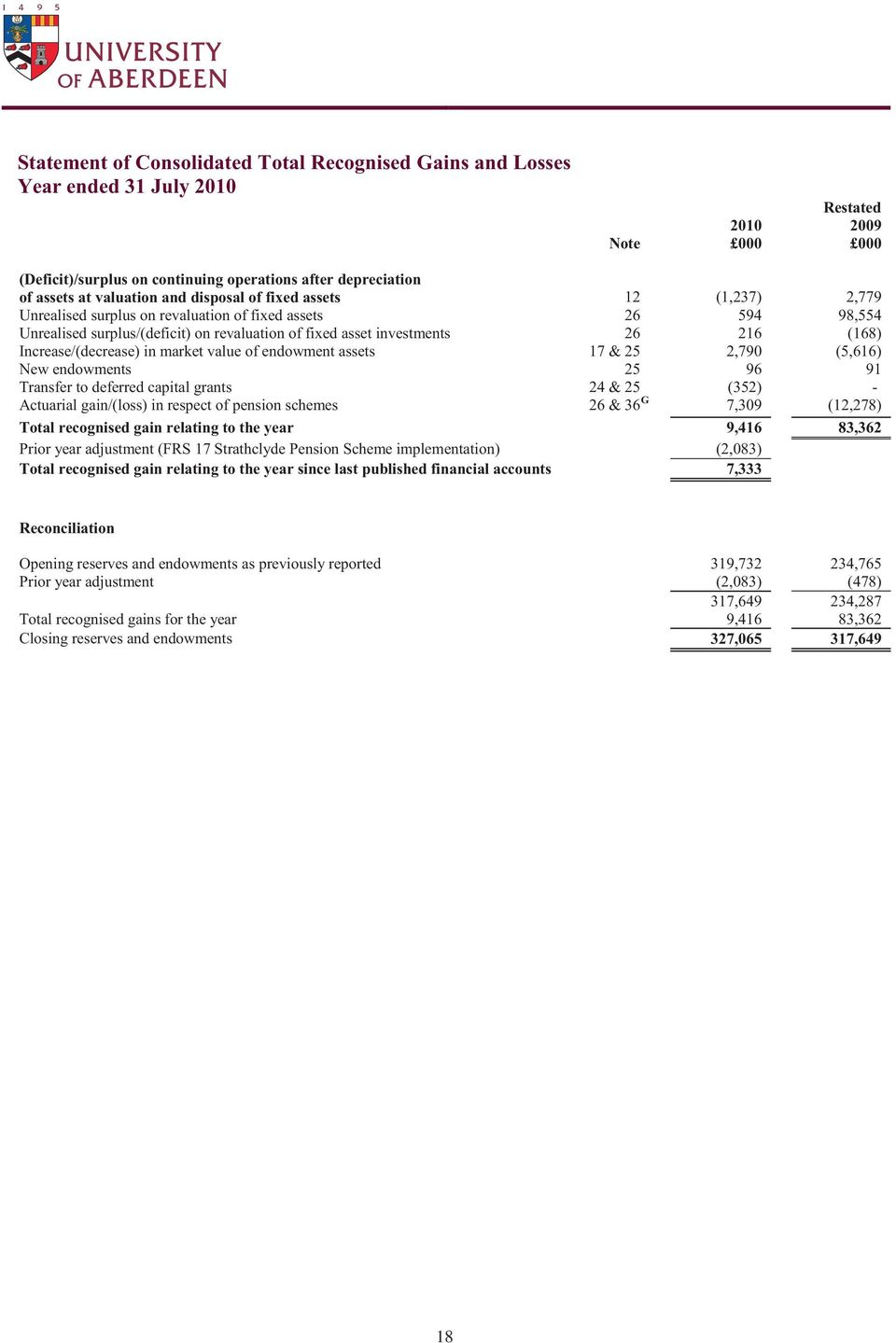
20 Statement of Consolidated Total Recognised Gains and Losses Restated Note (Deficit)/surplus on continuing operations after depreciation of assets at valuation and disposal of fixed assets 12 (1,237) 2,779 Unrealised surplus on revaluation of fixed assets ,554 Unrealised surplus/(deficit) on revaluation of fixed asset investments (168) Increase/(decrease) in market value of endowment assets 17 & 25 2,790 (5,616) New endowments Transfer to deferred capital grants 24 & 25 (352) - Actuarial gain/(loss) in respect of pension schemes 26 & 36 G 7,309 (12,278) Total recognised gain relating to the year 9,416 83,362 Prior year adjustment (FRS 17 Strathclyde Pension Scheme implementation) (2,083) Total recognised gain relating to the year since last published financial accounts 7,333 Reconciliation Opening reserves and endowments as previously reported 319, ,765 Prior year adjustment (2,083) (478) 317, ,287 Total recognised gains for the year 9,416 83,362 Closing reserves and endowments 327, ,649 18
21 Balance Sheets as at 31 July 2010 Restated Restated Consolidated University Consolidated University Note Fixed assets Tangible assets , , , ,922 Benefit arising from acquisition of Rowett Research Institution 14 (16,346) - (18,411) - Investments 15 2,871 12,837 2,684 12,676 Investment in joint venture: Share of gross assets 16 11,267-10,866 - Share of gross liabilities 16 (618) - (392) - 454, , , ,598 Endowment assets 17 26,374 26,374 24,637 24,637 Current assets Stocks Debtors 19 23,789 23,878 27,258 26,956 Investments 20 17,573 12,383 17,948 12,088 Cash at bank and in hand 32 4,492 2,078 3,892 2,026 46,320 38,803 49,598 41,568 Less: Creditors: amounts falling due within one year 21 46,756 46,756 51,772 51,289 Net current liabilities (436) (7,953) (2,174) (9,721) Total assets less current liabilities 480, , , ,514 Less: Creditors: amounts falling due after more than one year 22 11,018 11,018 10,894 10,894 Less: Provision for liabilities and charges 23 4,470 4,470 4,600 4,600 Total net assets excluding pension liability 464, , , ,020 Net pension liability 36 G (27,051) (27,051) (33,018) (33,018) Total net assets including pension liability 437, , , ,002 19
22 Balance Sheets as at 31 July 2010 (continued) Restated Restated Consolidated University Consolidated University Note Deferred capital grants , ,400 93,092 93,092 Endowments Permanent 25 26,374 26,374 24,637 24,637 Reserves Income and expenditure account excluding pension reserve 93,293 89,806 85,672 83,639 Pension reserve 36 G (27,051) (27,051) (33,018) (33,018) Income and expenditure account including pension reserve 26 66,242 62,755 52,654 50,621 Revaluation reserve , , , , , , , ,273 Total funds 437, , , ,002 The Accounts set out on pages 17 to 53 were approved by the University Court on 7 December 2010 and signed on its behalf by: Professor Ian Diamond FBA FRSE AcSS Principal and Vice-Chancellor Sir Moir Lockhead Senior Governor of the University Court Irene Bews Finance Director 20
23 Consolidated Cash Flow Statement Restated Note Net cash inflow from operating activities 27 8,768 9,831 Returns on investments and servicing of finance Capital expenditure and financial investment 29 (9,344) (15,684) Management of liquid resources ,219 Financing (132) Decrease in cash in the year 32 (37) (1,824) Reconciliation of net cash flow to movement in net funds Decrease in cash in the year 32 (37) (1,824) Sale of short term deposits 32 (375) (3,219) New loan 32 (100) - Reclassification of loan 32 (200) - Amortisation of finance leases Movement in net funds in year (536) (4,911) Net funds at 1 August ,890 18,801 Net funds at 31 July ,354 13,890 21
24 Statement of Principal Accounting Policies and Estimation Techniques Basis of preparation The financial statements have been prepared in accordance with the Statement of Recommended Practice (SORP): Accounting for Further and Higher Education (2007) and in accordance with applicable Accounting Standards. The financial statements are prepared in accordance with the historical cost conventions modified by the revaluation of certain fixed assets. The University has net current liabilities of 8.0m (Group: 0.4m). This is mainly due to decreases in current investments and cash, increases in research and other grants received on account, deferred income and accruals. The University Court are satisfied that this position will not impact the University's ability to meet its liabilities and obligations as they fall due over the next 12 months. The University has undrawn bank facilities of 35.4m available and has prepared cashflow forecasts which indicate that sufficient funds are consequently available. Up until the University accounted for its participation in the Strathclyde Pension Fund on a defined contribution basis under FRS 17. The University has changed its accounting policy during and is now accounting for the Strathclyde Pension Fund on a defined benefit basis. The change in accounting policy has been accounted for as a prior year adjustment and the comparative figures have been restated accordingly. The prior year adjustment decreased the 2009 surplus on continuing activities by 0.1m and decreased reserves by 2.1 million. Details of the effect of adopting FRS 17 defined benefit accounting for the Strathclyde Pension Fund are given in notes 6, 9, 10, 26 and 36. Basis of consolidation The consolidated financial statements include the University and all but one of its subsidiaries for the year to 31 July One subsidiary is not consolidated on the basis of it being immaterial to the group in accordance with FRS 2. The results of subsidiaries acquired or disposed of during the period are included in the consolidated income and expenditure account from the date of acquisition or up to the date of disposal. Intra-group sales and profits are eliminated fully on consolidation. A list of subsidiary undertakings is included in note 37. The consolidated financial statements do not include those of the University of Aberdeen Students Association as it is a separate organisation in which the University has no financial interest and no control or significant influence over policy decisions. The University of Aberdeen Development Trust is a charity registered in Scotland (SC002938) with the purpose of encouraging the development of teaching and research within the University of Aberdeen. The Trust is not consolidated within the financial statements as the Board of Trustees are independent and not controlled by the University of Aberdeen. Income recognition Funding council block grants are accounted for in the period to which they relate. Fee income is stated gross and credited to the income and expenditure account over the period in which the students are studying. Where the amount of tuition fee is reduced, income receivable is shown net of the discount. Bursaries and scholarships are accounted for gross as expenditure and included within operating income. Recurrent income from grants, contracts and other services rendered are accounted for on an accruals basis and are included as income and expenditure to the extent of the completion of the grant or service concerned. Any payments received in advance of such performance are recognised on the balance sheet as liabilities. Non-recurrent grants received in respect of the acquisition or construction of fixed assets are treated as deferred capital grants. The grants are credited to deferred capital grants and an annual transfer made to the income and expenditure account over the useful economic life of the asset at the same rate as the depreciation charge on the asset for which the grant was awarded. Income from the sale of goods or services is credited to the income and expenditure account when the goods or services are supplied to the external customers against the order received or the terms of the contract have been satisfied. Endowments and investment income is credited to the income and expenditure account on a receivable basis. Income from restricted endowments not expended in accordance with the terms of the endowment is transferred from the income and expenditure account to restricted endowments. Any realised gains or losses from dealing in the related assets are retained within the endowment in the balance sheet. Increase in value arising on the revaluation of fixed asset investments are recorded as a credit to the revaluation reserve. A diminution in value of fixed assets is charged to the income and expenditure account as a debit to the extent that it is not covered by a previous revaluation surplus. 22
25 Statement of Principal Accounting Policies and Estimation Techniques -continued Income recognition - continued Increases/decreases in value arising on the revaluation or disposal of endowment assets i.e. the appreciation/depreciation of endowment assets is added to or subtracted from the funds concerned and accounted for through the balance sheet by debiting or crediting the endowment asset and crediting or debiting the endowment fund and reported in the statement of total recognised gains and losses. Land and Buildings Land and buildings are stated at cost or valuation. The basis of valuation is depreciated replacement cost as set out in the Royal Institute of Chartered Surveyors Statement of Asset Valuation Practice and Guidance Notes. Certain properties are held for rental to staff and students on an arm s length basis. As these properties are held for investment rather than for operational purposes they have not been depreciated, but have been treated as investment properties under SAAP 19 and are valued annually on an open market basis. The University performs impairment reviews of long-lived assets whenever events or changes in circumstances indicate that the carrying amount may not be recoverable. In addition, the University carries out annual impairment reviews in respect of goodwill. An impairment loss is recognised when the recoverable amount of an asset, which is the higher of the asset s net realisable value and its value in use, is less than its carrying amount. Costs incurred in relation to a tangible fixed asset after its initial purchase or production are capitalised to the extent that they increase the expected future benefits to the University from the existing tangible fixed asset beyond its previously assessed standard of performance. The cost of any such enhancement is added to the gross carrying amount of the tangible fixed asset concerned. Equipment Equipment, including computers and software, and furniture costing less than 20,000 per individual item or group of related items, is written off in the year of purchase. All other items are capitalised. Assets acquired under finance leases are included in fixed assets and the capital element of the leasing commitments is shown as a liability. Depreciation Freehold land is not depreciated. Freehold buildings are depreciated over the expected useful economic life to the University of between 30 and 50 years on the amount at which the tangible fixed asset is included in the balance sheet. Where material, a depreciable asset s anticipated useful life is reviewed annually and the accumulated and future depreciation adjusted in accordance with FRS 15. Depreciation on tangible fixed assets in the course of construction is only provided when the assets are first brought into operational use. Where capitalised equipment is acquired with the aid of specific grants it is depreciated over the life of the specific research grants. In accordance with SSAP 19 no depreciation is provided for on investment properties. The accounting policy adopted is necessary for the accounts to give a true and fair view. The methodology applied in arriving at depreciation of buildings is a continuation of the approach adopted in the depreciated replacement cost (DRC) valuation. In essence, a series of DRC valuations are undertaken. The successive year s valuation is deducted from previous year s to arrive at the intervening period depreciation figure. Whilst this is a sophisticated forecasting model it demonstrates a true and fair reflection on the physical depreciation of the building. Depreciation is provided on the value of equipment within tangible fixed assets shown in the balance sheet in order to write off the cost or valuation over estimated useful lives on a straight line basis, between 2 10 years. Acquisition with the aid of specific grants Where buildings are acquired with the aid of specific grants, they are capitalised and depreciated. The related grants are credited to a deferred capital grant, and are released to the income and expenditure account over the expected useful economic life of the related asset on a basis consistent with the deprecation policy. Repairs and maintenance Expenditure to ensure that a tangible fixed asset maintains its previously recognised standard of performance is recognised in the income and expenditure account in the period it is incurred. The University has a planned maintenance programme, which is reviewed on an annual basis. 23
26 Statement of Principal Accounting Policies and Estimation Techniques continued Heritage Assets It is not considered practical to obtain valuations for the collections of artefacts defined as heritage assets, owing to the diverse nature of the assets and the lack of comparable market values. The University does not therefore recognise these assets on its Balance Sheet. Works of art and other valuable artefacts (heritage assets) valued at over 20,000 are capitalised and recognised at the cost or value of the acquisition, where such a cost or valuation is reasonably obtainable. Any assets used for academic purposes cannot be classed as heritable assets. Heritage assets are not depreciable since their long economic life and high residual value mean that any depreciation would not be material. The University has Special Collections manuscripts and the most recent valuation was 53m. However, as these are occasionally used for academic purposes, and because they will be available for general use in the new library, the University does not consider that the Special Collections meet the definition of Heritage assets. The University has also reviewed all material assets and has assessed that no other assets meet the definition of Heritage assets. Investments Listed investments held as fixed assets or endowment assets are shown at market value. Investments in subsidiary undertakings are shown at cost and investments in joint ventures are shown in the consolidated balance sheet as the attributable share of net assets. The University's share of any surplus or deficit in respect of Joint Ventures is recognised in the income and expenditure account. Income and gains or losses on sales of investments during the year are allocated to the invested funds in proportion to the opening balances on the funds. Current assets investments represent short term deposits not available on demand. Stocks Stocks, including work in progress, are valued at the lower of cost and net realisable value. Where necessary, provision is made for obsolete, slow-moving and defective stocks. Taxation The University is considered to pass the tests set out in Paragraph 1 Schedule 6 Finance Act 2010 and therefore it meets the definition of a charitable company for UK corporation tax purposes. Accordingly, the University is potentially exempt from taxation in respect of income or capital gains received within categories covered by Chapter 3 Part 11 Corporation Tax Act 2010 or Section 256 of the Taxation of Chargeable Gains Act 1992, to the extent that such income or gains are applied exclusively to charitable purposes. Subsidiary companies are liable to corporation tax. The University receives no similar exemption in respect of Value Added Tax. Irrecoverable VAT on inputs is included in the costs of such inputs. Any irrecoverable VAT allocated to tangible fixed assets is included in their cost. Deferred taxation Deferred tax is recognised in respect of all timing differences that have originated but not reversed at the balance sheet date where transactions or events that result in an obligation to pay more or a right to pay less, tax in the future have occurred at the balance sheet date, with the following exceptions: provision is made for gains on disposal of fixed assets that have been rolled over into replacement assets only where, at the balance sheet date, there is a commitment to dispose of the replacement assets; and on the basis of all available evidence deferred tax assets are recognised only to the extent that the Directors consider that it is more likely than not that there will be suitable taxable profits from which the future reversal of the underlying timing differences can be deducted. Deferred tax is measured on a non-discounted basis at the rates that are expected to apply in the periods in which timing differences reverse, based on tax rates and laws enacted or substantively enacted at the balance sheet date. 24
27 Statement of Principal Accounting Policies and Estimation Techniques -continued Deferred income Grants received to fund expenditure on fixed assets are treated as deferred income and are credited to the income and expenditure account over the estimated useful lives of the assets to which they relate. Leases Where leasing agreements of finance assets give rights approximating to ownership, the assets are treated as if they had been purchased outright. The amount capitalised is the present value of the minimum lease payments payable during the lease term. The corresponding lease commitments are shown as obligations to the lessor. Lease payments are split between capital and interest elements using the annuity method. Depreciation on the relevant assets and interest are charged to the income and expenditure account. Owned property leased under operating leases is capitalised in accordance with the accounting policy on fixed asset investment properties. Operating lease income is accounted for on a straight-line basis with any rental increases recognised during the period to which they relate. Cash flows and liquid resources Cash flows comprise increases or decreases in cash. Cash includes cash in hand, cash at bank, and deposits repayable on demand. Deposits are repayable on demand if they are in practice available within 24 hours without penalty. No investments, however liquid, are included as cash. Liquid resources comprise assets held as a readily disposable store of value. They include term deposits, government securities and loan stock held as part of the University s treasury management activities. They exclude any such assets held as endowment asset investments. Pension schemes The principal schemes for the University s staff are Universities Superannuation Scheme ( USS ) and the University of Aberdeen Superannuation & Life Assurance Scheme ( UASLAS ). The University also contributes to the Strathclyde Pension Fund ( SPF ). All three are defined benefit schemes which are externally funded and contracted out of the State Earnings Related Pension Scheme. Each fund is valued every three years by professionally qualified independent actuaries. A small number of staff remain in other pension schemes. Pension costs for UASLAS and SPF are assessed on the latest actuarial valuation of the Schemes and are accounted for on the basis of FRS 17. For SPF this treatment is possible as each institution s share of the underlying assets and liabilities can now be identified. UASLAS assets are included at market value and the schemes liabilities are measured on an actuarial basis using the projected unit method. These liabilities are discounted at the current rate of return on AA rated corporate bonds. The post-retirement benefit surplus or deficit is included on the University s balance sheet. Surpluses are only included to the extent that they are recoverable through reduced contributions in the future or through refunds from the schemes. The current service cost and any past service costs are included in the income and expenditure account within operating expenses and the expected return on the schemes assets, net of the impact of unwinding of the discount on scheme liabilities, is included within other finance income. Actuarial gains and losses, including differences between the expected and actual return on scheme assets, are recognised in the statement of total recognised gains and losses. USS is a multiemployer scheme, for which contributions are charged directly to the income and expenditure account as if the scheme were a defined contribution scheme. The assets and liabilities of the USS cannot be identified on a reasonable and consistent basis and so, in accordance with FRS 17, is accounted for as if it were a defined contribution scheme. Foreign currency Transactions denominated in foreign currencies are recorded at the rate of exchange ruling at the dates of the transactions. Monetary assets and liabilities denominated in foreign currencies are translated into sterling at year end rates. Estimation techniques The preparation of financial statements requires management to make estimates and assumptions that affect the reported amounts of assets and liabilities and disclosure of contingent assets and liabilities at the date of the financial statements and the reported amounts of income and expenditure during the reporting period. Actual results could differ from those estimates. Estimates are used principally when accounting for provision for doubtful debts and provisions for liabilities and charges. 25
28 Statement of Principal Accounting Policies and Estimation Techniques -continued Accounting for charitable donations Unrestricted donations Charitable donations are recognised as income in the accounts when the charitable donation has been received or if, before receipt, there is sufficient evidence to provide the necessary certainty that the donation will be received and the value of the incoming resources can be measured with sufficient reliability. Endowment funds Where charitable donations are to be retained for the benefit of the University as specified by the donors, these are accounted for as an endowment. There are three main types: Unrestricted permanent endowments the donor has specified that the fund is to be permanently invested to generate an income stream for the general benefit of the University. Restricted permanent endowments the donor has specified that the fund is to be permanently invested to generate an income stream to be applied to a particular objective. Restricted expendable endowments the donor has specified a particular objective other than the purchase or construction of tangible fixed assets, and the University can convert the donated sum into income. Donation to fund fixed assets Donations received to be applied to the cost of a tangible fixed asset are shown on the balance sheet as a deferred capital grant. The deferred capital grant is released to the income and expenditure account over the same estimated useful life that is used to determine the depreciation charge associated with the tangible fixed asset. Accounting for business combinations The University merged with Rowett Research Institute on 1 July The merger was accounted for by the acquisition method of accounting in order to comply with the requirements of FRS 6, Acquisitions and Mergers. Fair values are attributed to the net separable assets and liabilities. The benefit arising as a consequence of no consideration having been paid by the University for the net value of the assets acquired is included in the consolidated balance sheet as a deduction from tangible and intangible assets. The fair value of the benefit arising in relation to non-momentary assets is released to the income and expenditure account over the periods in which the nonmonetary assets are recovered, whether through depreciation or disposals. The release is aligned with the corresponding depreciation charge relating to the assets. The fair value of the benefit arising in relation to monetary assets acquired for nil consideration is released to the income and expenditure account over the period which is expected to benefit. Management have identified the period as the best estimate of the period in which the benefit of the monetary assets will be received. Provisions, contingent liabilities and contingent assets Provisions are recognised in the financial statements when the University has a present obligation (legal or constructive) as a result of a past event, it is probable that a transfer of economic benefits will be required to settle the obligation and a reliable estimate can be made of the amount of the obligations. The amount recognised as a provision is discounted to present value where the time value of money is material. The discount rate used reflects current market assessments of the time value of money and reflects any risks specific to the liability. Contingent liabilities are disclosed by way of a note, when the definition of a provision is not met and includes three scenarios: possible rather than a present obligation; a possible rather than a probable outflow of economic benefits; an inability to reliably measure the possible economic outflow. Contingent assets are disclosed by way of a note, where there is a possible, rather than present, asset arising from a past event. 26
29 Notes to the Accounts Funding Council Grants SFC HE recurrent teaching grant 51,258 49,852 Funding for doctors and dentists pay 808 1,176 Knowledge transfer grant 2,494 2,579 Funding for museums and galleries Strategic research development grant 2,661 2,325 Research excellence and postgraduate grant 22,008 18,038 North Forum Released from deferred capital grants 1, Other SFC grants ,811 75, Tuition Fees and Educational Contracts UK and EU fees 24,210 21,190 Non-EU fees 17,337 17,600 Non-credit bearing course fees 1, Educational contracts Other contracts ,418 40, Research Grants and Contracts Research councils 16,317 14,777 UK based charities 9,534 10,625 UK central government/local, health and hospital authorities 24,502 24,472 UK industry, commerce and public corporations 5,809 7,481 EU government bodies 3,399 3,330 EU other Other overseas 5,458 4,482 Other sources ,183 65,954 Included above are deferred capital grants released in the year 2,936 2,393 27
30 Notes to the Accounts - continued Other Income Residences, catering and conferences 14,948 14,649 Income from consultancies 7,043 7,438 Income from health and hospital authorities 3,146 2,892 Income from intellectual property rights Other income Conferences Dividends Donations Library Printing Property rentals 1, Sports centre Sundry departmental 1,134 1,030 Other 1, Released from deferred capital grants Income from joint venture 1, Benefit on acquisition of Rowett Research Institute - release to income 2,065 2,065 34,793 32, Endowment and Investment Income Income from permanent endowments (note 25) Income from short-term investments ,805 28
31 Notes to the Accounts -continued Restated Staff Costs Salaries 104, ,952 Social security costs 8,556 8,350 Pension costs 21,767 19,402 Early retirement /severance costs 1, , ,064 Remuneration, excluding employer s pension contributions of the principal and vice chancellor: Professor Sir Duncan Rice August 2009 to March Professor Ian Diamond April 2010 to July Included within the figures are amounts in respect of benefit in kind for Professor Sir Duncan Rice 17,000 ( ,000). The University s contribution to USS are paid at the same rate for other staff and amounted to: Professor Sir Duncan Rice August 2009 to March Professor Ian Diamond April 2010 to July In addition Professor Sir Duncan Rice also received a one off severance payment of 215,000, which was approved by the remuneration committee. Remuneration of Higher Paid Staff, excluding employer's pension contributions: Number Number 70,000-79, ,000-89, ,000-99, , , , , , , , , , , , , , , , , , , , , Average staff numbers by activity Academic departments 1,412 1,324 Academic services Administration and central services Premises Residences, catering and conferences Research grants and contracts Other ,515 3,473 29
32 Notes to the Accounts -continued Restated Staff Costs -continued Staff costs by activity Academic departments 66,188 62,113 Academic services 8,406 8,028 Administration and central services 12,250 11,813 Premises 5,150 4,927 Residences, catering and conferences 4,495 4,337 Research grants and contracts 31,784 32,674 Other 6,383 5,869 FRS 17 current service cost adjustment (note 36 G ) 391 (57) 135, ,704 Severance costs 1, , , Other operating expenses by activity Academic departments 16,963 15,665 Academic services 4,617 4,013 Administration and central services 7,617 7,389 Premises 6,895 7,477 Residences, catering and conferences 7,922 8,240 Research grants and contracts 23,790 22,856 Other 4,705 5,485 72,509 71,125 Consolidated Other operating expenses include: External auditors remuneration in respect of audit services External auditors remuneration in respect of non-audit services Internal auditors remuneration in respect of audit services Internal auditors remuneration in respect of non-audit services University Other operating expenses include: External auditors remuneration in respect of audit services External auditors remuneration in respect of non-audit services Internal auditors remuneration in respect of audit services Internal auditors remuneration in respect of non-audit services Payments to external auditors for non-audit services include 10,000 paid to the previous external auditors. 8. Depreciation by activity Academic departments 1,709 1,332 Academic services 1,198 1,143 Administration and central services Premises 7,429 3,950 Residences, catering and conferences 2,011 1,791 Research grants and contracts 2,946 2,393 Other ,442 11,539 30
33 Notes to the Accounts -continued Restated Interest and other finance costs Loan interest (note 28) Finance leases (note 28) Interest on pension scheme liabilities (note 36 G ) ,797 1, Analysis of total expenditure by activity Academic departments 84,860 79,110 Academic services 14,221 13,184 Administration and central services 20,020 19,377 Premises 19,723 16,605 Residences, catering and conferences 15,025 14,980 Research grants and contracts 58,520 57,923 Other 13,035 12,519 FRS 17 current service cost adjustment (note 36 G ) 391 (57) Early retirement /severance costs 1, , , Disposal of fixed asset investments Surplus on disposal of fixed asset investments During the year the University received the third and final instalment from the sale of its equity holdings in a spinout company. 12. Surplus on continuing operations for the year The (deficit)/surplus on continuing operations for the year is made up as follows: University (deficit)/surplus for the year (2,691) 703 Subsidiary undertakings surplus for the year 1,454 2,076 (1,237) 2,
34 Notes to the Accounts -continued Freehold Assets in Fixtures, Land and Course of Investment Fittings and Buildings Construction Properties Equipment Total Tangible assets Consolidated Cost or Valuation At 1 August ,976 16,917 36,369 30, ,824 Additions 7,631 17, ,692 30,802 Reclassification 12,088 (12,088) Valuation of investment properties Disposals (1,657) (1,657) Impairment - - (105) - (105) At 31 July ,695 22,294 36,872 34, ,458 Depreciation At 1 August ,781 19,781 Charge for the year 11, ,352 16,442 Eliminated in respect of disposals (1,657) (1,657) At 31 July , ,476 34,566 Net Book Value At 31 July ,605 22,294 36,872 11, ,892 At 31 July ,976 16,917 36,369 10, ,043 32
35 Notes to the Accounts -continued Freehold Assets in Fixtures, Land and Course of Investment Fittings and Buildings Construction Properties Equipment Total Tangible assets - continued University Cost or Valuation At 1 August ,996 16,917 30,032 30, ,079 Additions 7,631 17, ,692 30,802 Reclassification 12,088 (12,088) Valuation of investment properties Disposals (1,657) (1,657) Impairment - - (105) - (105) At 31 July ,715 22,294 30,535 34, ,713 Depreciation At 1 August ,157 19,157 Charge for the year 10, ,352 15,691 Eliminated in respect of disposals (1,657) (1,657) At 31 July , ,852 33,191 Net Book Value At 31 July ,376 22,294 30,535 11, ,522 At 31 July ,996 16,917 30,032 10, ,922 The latest valuation was carried out on 31 July 2009 and was performed by Mr A Donaldson, BLE, MRICS, Director of Estates, University of Aberdeen. The basis of valuation is depreciated replacement cost as set out in the Royal Institute of Chartered Surveyor s Statement of Asset Valuation Practice and Guidance Notes. The 31 July 2009 valuation was externally reviewed by J & E Shepherd, Chartered Surveyors. The University owns Academic, Academic Related and Recreational Buildings which are located in Old Aberdeen, at Foresterhill, part of Marischal College and various Hall of Residence complexes. Part of the Hillhead Halls of Residence complex is held under a finance lease. The land and buildings net book value at 31 July 2010 includes 30,535,000 in respect of investment properties (2009: 30,032,000). In accordance with the provisions of Accounting Standard SSAP 19 Accounting for Investment Properties, investment properties are revalued on an annual basis. This was carried out on 31 July 2010 and was performed by Mr A Donaldson, BLE, MRICS, Director of Estates, University of Aberdeen. J & E Shepherd, Chartered Surveyors externally reviewed the 31 July 2010 valuation. Should any Land and Buildings financed by exchequer funds be sold, the University may be liable, under the terms of the Financial Memorandum with the Funding Council, to surrender the proceeds. 33
36 Notes to the Accounts -continued Benefits arising from the acquisition of Rowett Research Institution At 1 August (18,411) (20,476) Release of negative goodwill to income 2,065 2,065 At 31 July (16,346) (18,411) The negative goodwill arising during the year relates to the acquisition of the Rowett Research Institute and, in respect of the non-monetary assets, represents the estimated remaining useful life of the non-monetary assets acquired. The release is, therefore, aligned with the corresponding depreciation charge relating to the assets. In respect of the monetary assets acquired, the amortisation is aligned with period over which the benefit is expected to be received, which management have identified as being the period The Adjusted fair trade table is shown below. Fair Value Table Fair value NBV Fair value adjustments on acquisition Fixed assets - land and buildings 13,132-13,132 Fixed assets -equipment 1,385 (1,385) - Investments Stocks Debtors 2,298-2,298 Investments 5,118-5,118 Cash 1,516-1,516 Current liabilities (2,027) - (2,027) 22,033 (1,385) 20,648 Fair Value Adjustment - Equipment The value was reduced to zero as the items of equipment did not meet the University accounting policy for capitalisation of equipment. 34
37 Notes to the Accounts continued Consolidated University Consolidated University Investments At 1 August 2,684 12,676 2,939 7,186 Additions 1,353 1, ,083 Disposals (1,382) (1,371) (468) (425) Appreciation/(depreciation) on disposal/revaluation (168) (168) Net book value at 31 July 2,871 12,837 2,684 12,676 The Group has participating interests at cost in entities which exceed 20% of voting rights. However significant influence is not exerted over the operating and financial policies. The investees are free to implement policies that are inconsistent with investor s strategy, there is no policy for pressing for high dividends and there is no board control over the entities. The substance of the relationship between the investor and investee is that of a fixed assets investment with a view to a trade sale in the medium term. Therefore, these investments are disclosed as fixed asset investments and are not equity accounted. 16. Investment in joint venture Income and expenditure account Income 1, Surplus before tax Balance sheet Fixed assets 13,308 13,519 Current assets 1, ,562 14,036 Less: Restricted funding from Sports Scotland (3,295) (3,170) Share of gross assets 11,267 10,866 Less: Creditors -amounts due with one year (618) (392) Share of net assets 10,649 10,474 Note: The University holds a 50% share of Aberdeen Sports Village Limited, a company limited by guarantee and registered as a charity. This is a joint venture company owned equally by the University and Aberdeen City Council. The arrangement is treated as a joint venture and is accounted for using the gross equity method, such that 50% of the company's gross assets and liabilities are incorporated into the consolidated balance sheet of the University and 50% of its net income is reported in the University's consolidated income and expenditure account. 35
38 Notes to the Accounts -continued Consolidated University Consolidated University Endowment Assets Balance at 1 August ,637 24,637 30,945 30,945 Endowments invested/(withdrawn) (note 29) (416) (416) Increase/(decrease) in market value of investments (note 25) 2,790 2,790 (5,616) (5,616) Decrease in cash balances held for endowment funds (note 32) (637) (637) (890) (890) Balance at 31 July ,374 26,374 24,637 24,637 Represented by Securities 24,067 24,067 21,693 21,693 Cash at bank held for endowment funds 2,307 2,307 2,944 2,944 Total endowments assets 26,374 26,374 24,637 24, Stock Stocks of finished goods Debtors Trade debtors 7,236 7,236 8,423 8,326 Prepayments and accrued income 16,553 16,536 18,835 18,601 Amounts due from subsidiary companies ,789 23,878 27,258 26, Investments Deposits maturing: In one year or less 17,573 12,383 17,948 12, Creditors: amounts falling due within one year Research grants received on account 21,665 21,665 19,870 19,870 Other grants received on account 6,291 6,291 9,278 9,278 Trade creditors 3,108 3,075 5,353 5,325 Amounts due to subsidiary companies Social security and other taxation payable 5,632 5,632 5,646 5,549 Accruals and deferred income 10,060 10,050 11,625 11,238 46,756 46,756 51,772 51,289 36
39 Notes to the Accounts -continued Consolidated University Consolidated University Creditors: amounts falling due after more than one year Unsecured loans (note 22 a) 4,900 4,900 4,600 4,600 Finance lease obligations (note 22 b) 6,118 6,118 6,294 6,294 11,018 11,018 10,894 10,894 a. Loans are repayable: In five years or more 4,900 4,900 4,600 4,600 4,900 4,900 4,600 4,600 b. Finance lease net obligations committed: In five years or more 6,118 6,118 6,294 6,294 6,118 6,118 6,294 6,294 a) The University has a 4,600, year 5.415% fixed interest unsecured loan with the Barclays Bank plc. The University also has interest free loans totalling 300,000 from Salix Finance Ltd which are partially repayable in five years or more. The dates and quantum of repayments are wholly dependent upon the timing of expenditure and savings related to various energy efficiency and renewable energy projects funded by these loans, which require matched funding from the University. b) The University has entered into a leasing arrangement with British Linen Leasing Ltd, in respect of two halls of residence over a period of 25 years. 6,118,000 is payable in more than five years under this agreement. 23. Provisions for Liabilities and Charges Consolidated and University Enhanced Waste Pensions Disposal Total At 1 August , ,600 Actuarial liability adjustment (130) - (130) At 31 July , ,470 The University has an obligation in respect of former employees who had retired and for whom an enhanced pension has been provided. This liability is assessed by independent actuarial valuation (see note 36) and continues throughout the retirement period. The University has an obligation under Scottish Environment Protection Agency regulations to provide for the removal of High Activity Sealed Sources held within the Institute of Medical Sciences Building. It is expected that these sources will be removed within the next years. 37
40 Notes to the Accounts -continued 24. DeferredCapital Grants Consolidated and University Funding Council Other Total At 1 August 2009 Land and buildings 66,390 22,121 88,511 Equipment 1,105 3,476 4,581 Total 67,495 25,597 93,092 Cash received Land and buildings 14,295 5,223 19,518 Equipment 885 1,555 2,440 Total 15,180 6,778 21,958 Transferred from endowment funds Land and buildings Equipment Total Release to loans Land and buildings Released to income and expenditure Land and buildings ,660 Equipment 319 2,823 3,142 Total 1,315 3,487 4,802 At 31 July 2010 Land and buildings 79,689 26, ,369 Equipment 1,671 2,360 4,031 Total 81,360 29, ,400 38
41 Notes to the Accounts -continued Consolidated and University Unrestricted Restricted Total Total Permanent Permanent Permanent Permanent Endowments Balance at 1 August 2009 Capital 8,673 10,835 19,508 25,615 Accumulated income - 5,129 5,129 5,330 8,673 15,964 24,637 30,945 New endowments Investment income Expenditure (240) (1,200) (1,440) (1,707) - (797) (797) (783) Increase/(decrease) in market value of investments 962 1,828 2,790 (5,616) Transfer to deferred capital grants - (352) (352) - At 31 July ,635 16,739 26,374 24,637 Represented by: Capital 9,635 12,309 21,944 19,508 Accumulated income - 4,430 4,430 5,129 9,635 16,739 26,374 24,637 39
42 Notes to the Accounts -continued Restated Restated Consolidated University Consolidated University Reserves Income and expenditure reserve At 1 August 54,737 52,704 58,226 58,269 Prior year adjustment (2,083) (2,083) (477) (477) 52,654 50,621 57,749 57,792 (Deficit)/surplus retained for year (440) (1,894) 3,562 1,486 Transfer from revaluation reserve 6,719 6,719 3,621 3,621 Actuarial gain/(loss) on pension scheme 7,309 7,309 (12,278) (12,278) At 31 July 66,242 62,755 52,654 50,621 Pension reserve At 1 August (30,935) (30,935) (19,910) (19,910) Prior year adjustment (2,083) (2,083) (477) (477) (33,018) (33,018) (20,387) (20,387) Actuarial gain/(loss) on pension scheme (note 36 G ) 7,309 7,309 (12,278) (12,276) Deficit retained within reserves (1,342) (1,342) (353) (353) At 31 July (27,051) (27,051) (33,018) (33,018) Revaluation reserve At 1 August Investment properties 27,541 25,567 30,383 30,383 Other properties 213, , , ,246 Fixed asset investments (204) (204) (36) (36) 240, , , ,593 Revaluation in the year Investment properties (2,842) (4,816) Other properties ,396 97,664 Fixed asset investments (168) (168) ,386 92,680 Transfer from revaluation reserve to general reserve in respect of: Depreciation on revalued assets (6,719) (6,719) (3,621) (3,621) At 31 July Investment properties 28,135 26,161 27,541 25,567 Other properties 206, , , ,289 Fixed asset investments 12 (19) (204) (204) 234, , , ,652 40
43 Notes to the Accounts -continued Restated Reconciliation of surplus after depreciation of tangible fixed assets at valuation to net cash inflow from operating activities (Deficit)/surplus after depreciation of tangible fixed assets at valuation and before tax (1,597) 2,544 Depreciation (notes 8 & 13) 16,442 11,539 Impairment (note 13) Negative goodwill release (note 14) (2,065) (2,065) Deferred capital grants released to income (note 24) (4,802) (4,122) Endowment and investment income (note 5) (886) (1,805) Interest payable (note 9) 1,797 1,273 Deferred capital grant transferred from deferred income (note 24) - 1,715 Deferred capital grant transferred to loans (note 24) (200) - (Decrease)/increase in stock 34 (8) (Decrease)/increase in debtors 3,469 (1,121) (Increase)/decrease in creditors (3,790) 1,095 Increase in provisions (130) (30) Pension costs less contributions payable 391 (57) Net cash inflow from operating activities 8,768 9, Returns on Investments and Servicing of Finance Income from endowments (note 5) Other interest received (note 5) Interest paid (note 9) (846) (863) Net cash inflow from returns on investments and servicing of finance Capital Expenditure and Financial Investment Payments to acquire of tangible assets (32,028) (35,978) Payments to acquire investments (1,353) (6,083) Receipts from sale of tangible assets Receipts from sale of investments 1, Endowment funds (invested)/withdrawn 416 (198) New endowments received Deferred capital grants received 21,958 25,846 Net cash outflow from capital expenditure and financial investments (9,344) (15,684) 41
44 Notes to the Accounts -continued Management of Liquid Resources Withdrawals from short term deposits 375 3, Financing New Loan Reclassification of loan Amortisation of finance leases (176) (132) Net cash inflow/(outflow) from financing 124 (132) 32. Analysis of Changes in Net Funds At At 1 August Cash Other 31 July 2009 Flows Changes Cash at bank and in hand 3, ,492 Endowment asset investments (note 17) 2,944 (637) - 2,307 6,836 (37) - 6,799 Current asset investments (note 30) 17,948 (375) - 17,573 Debts due after one year (note 22a) (4,600) (100) (200) (4,900) Finance lease (note 22b) (6,294) (6,118) Total 13,890 (512) (24) 13,354 42
45 Notes to the Accounts -continued Capital commitments Provision has not been made for the following capital commitments at 31 July 2010: Commitments contracted for 41,975 60,481 Authorised but not contracted for 18,200 4,604 60,175 65, Amounts disbursed as agent Childcare Main Part-Time Funds Funds Funds Total Total Balance brought forward 1 August Repaid as claw back - - (7) (7) - Allocation received in year Interest earned Expenditure (74) (589) (7) (670) (724) Virement (40) 55 (15) - - Balance brought forward 1 August Repayable as claw back (3) Retained by University for students Disclosure of related party transactions Due to the nature of the University s operations and the composition of the University Court being drawn from local public and private sector organisations, it is inevitable that transactions will take place with organisations in which a member of University Court may have an interest. All transactions involving organisations in which a member of the University Court may have an interest are conducted at arm s length and in accordance with the University s financial regulations and normal procurement procedures
46 Notes to the Accounts -continued 36. Pension schemes A. The University of Aberdeen Superannuation and Life Assurance Scheme (UASLAS) The University of Aberdeen Superannuation & Life Assurance Scheme is a funded defined benefit scheme which is open to new members and open to future accruals. A full actuarial valuation was carried out at 31 July 2007 and updated to 31 July 2009 by a qualified independent actuary. The power to appoint Trustees is vested in the University Court. Trustee appointments cease if the Trustee ceases to be a member of the Scheme or resigns from the University. The Trustee body includes an independent chairman, two membership representative Trustees elected by the active and pensioner members of the scheme, two officers of the University and a member of the University Court. The arrangements for appointing membership representatives comply with the Membership Nominated Trustee requirements of the Pensions Act Trustees are invited to attend Trustee meetings at which a minimum of two must be present for valid decisions to be taken. Decisions require the majority support of those Trustees present. Trustee meetings are normally held every three months, but can be called more frequently where necessary. During the year the Trustees met five times. The sensitivities regarding the principal assumptions used to measure the scheme liabilities are set out below: Assumption Change in assumption Impact on scheme liabilities Discount rate Increase/decrease by 0.5% Decrease/increase by 7 million Rate of pension increases Increase/decrease by 0.5% Increase/decrease by 5 million Rate of salary growth Increase/decrease by 0.5% Increase/decrease by 2 million Rate of mortality More prudent assumption Increase by 3 million Mortality (Life expectancy last actuarial valuation, increased by a further year) The mortality table used is the 00 series tables with a +1 year age rating to allow for poorer than average current life expectancy and the medium cohort improvement factors. The expected lifetime of a participant who is age 65 and the expected lifetime (from age 65) of a participant who will be age 65 in 15 years are shown in years below based on the above mortality tables. Males (females) currently aged 65 Males (females) currently aged 65 in 15 years 21.0 (23.3) years 21.9 (24.1) years 44
47 Notes to the Accounts -continued 36. Pension schemes -continued A. The University of Aberdeen Superannuation and Life Assurance Scheme (UASLAS) - continued The material assumptions used by the actuary for FRS 17 at 31 July was 1 : Discount rate 5.40% 6.00% Price inflation (RPI) 3.10% 3.50% Rate of salary increase % 4.50% Pension increases for in-payment benefits 3.30% 3.50% Pension increases for deferred benefits 2.60% 3.50% The assets in the scheme and the expected rate of return were: 2010 % 2009 % Equities Government Bonds Corporate Bonds Secured Pensions Cash The University has contributed to the scheme at the following rate: The University contribution rate of 17.1% pa of Pensionable Salaries is made up of 15.8% pa to fund future benefits for employed member and 1.3% pa which aims to remove the funding shortfall over a nine year period from the valuation date of 31 July The University also contributes 7.05% in respect of members participating in the PensionPlus salary sacrifice arrangements. Other members of the scheme contribute at this rate themselves. 1 2 Rates are expressed on an annual basis where applicable. Salaries are assumed to increase at 2% pa for the first three years and 4.1% pa thereafter. 45
48 Notes to the Accounts -continued 36. Pension schemes -continued B. Strathclyde Pension Fund The Strathclyde Pension Fund (SPF) provides benefits based on a final pensionable salary for employees of local government and some other institutions. It is now possible to identify each institution s share of the underlying assets and liabilities of the scheme and hence contributions to the scheme are accounted for as if they were a defined benefit scheme. The last triennial valuation undertaken was at 31 March The employer s contribution rate payable on members pensionable salaries was 16.8% until 31 March 2009 and 17.3% from April The accounting standard FRS 17 is designed to produce a net pension asset or liability calculated according to a prescribed method of valuation. In particular, the discount rate applied to pension scheme liabilities differs from that used in normal actuarial valuations to determine, inter alia, the scheme s required funding rate, and generally produce a higher value for scheme liabilities. The pension costs are determined with the advice of an independent qualified actuary on the basis of triennial valuation using the projected unit method. The material assumptions used by the actuary for FRS 17 at 31 July were: % % Rate of increase in salaries Rate of increase of pensions Discount rate applied to scheme liabilities Expected return on assets The current mortality assumptions are based on the PMA92/PFA92 year of birth tables, with improvements from 2007 in line with the medium cohort and a 1% p.a. underpin. Based on these assumptions, the average future life expectancies at the age of 65 are: Males Females Current pensioners 20.6 years 23.9 years Future pensioners 22.6 years 25.0 years The assets in the scheme and the expected rate of return were: Long-term Fund Long-term Fund return Value return Value % % % % Equities 7.2 4, ,124 Bonds Property Cash Total market value of assets 6,432 5,427 46
49 Notes to the Accounts -continued 36. Pension schemes -continued C. Scottish Teachers Superannuation Scheme (STSS) The STSS is an unfunded defined benefit scheme. Contributions on a pay-as-you-go basis are credited to the Exchequer under arrangements governed by the Superannuation Act A notional assets value is ascribed to the scheme for the purposes of determining contribution rates. Under the definitions set out in FRS 17, the STSS is a multi-employer pension scheme. The University of Aberdeen is unable to identify its share of the underlining assets and liabilities of the scheme. Accordingly, the University has taken advantage of the exemption in FRS 17 and has accounted for it contribution as if it were a defined contribution scheme. The scheme is subject to a report by the Government Actuary every five years. The report on the financial position as at 31 March 2009 is not yet available. The following information is available on the scheme: Latest actuarial review 31 March 2005 Actuarial method SCAPE* Gross rate of return 6.5 per cent per annum Rate of return in excess of salary increases 2.0 per cent per annum Rate of return in excess of price increases 3.5 per cent per annum Notional value of assets 18,474 million Value of liabilities 19,310 million Notional deficit 836 million *Superannuation Contributions Adjusted for Past Experiences The rates of contributions to the Scottish Teachers Superannuation Scheme were set at 6.4% for employees and 14.9% for the employer from 1 April The total pension cost for the University was 251,531 (2009: 243,509). This includes 19,568 (2009: 20,147) of outstanding contributions at the balance sheet date. D. National Health Service Superannuation Scheme (NHSSS) NHSSS is a multi-employer defined benefit pension scheme. Historically the scheme has operated on the basis that it is responsible only for the cost of the basic benefits payable to members and their dependants, with the cost of pension increases being met by the Exchequer. However, from 1 April 2004, the cost of pension increases has been met by an increase in the employers contribution rate. An actuarial investigation of the scheme was carried out by the Government Actuary s Department covering the five year period from 1 April 2009 to 31 March As a result of this investigation the employers contribution rate has been reduced to 13.5% from its previous temporary rate of 14% with effect from 1 April The total pension cost for the University was 39,539 (2009: 27,092). This includes 3,582 (2009: 4,994) of outstanding contributions at the balance sheet date. 47
50 Notes to the Accounts - continued 36. Pension schemes - continued E. Additional Pension Payments Following the merger with Northern College in 2001 the University is responsible for the payment of enhanced pensions to a number of former employees of the College, most of whom have been granted premature retirement. An actuarial valuation of the liability was carried out as at 1 December 2001, the date of the merger between the University and Northern College. This valuation revealed a liability of 4,596,000, which was incorporated into the accounts of the University at merger. The main assumptions made by the actuary were: Valuation rate of interest 4.50 Future price inflation 2.25 In accordance with the provision of FRS 17 the actuary also undertook a valuation of the liability as at 31 July 2010: (see Note 23) Liability on this basis was 4,410 4,540 The main assumptions made by the actuary were: % % Discount rate Pension increases F. The Universities Superannuation Scheme (USS) The University participates in the Universities Superannuation Scheme (USS), a defined benefit scheme which is externally funded and contracted out of the State Second Pension (S2P). The assets of the scheme are held in a separate fund administered by the trustee, Universities Superannuation Scheme Limited. The appointment of directors to the board of the trustee is determined by the company s Article of Association. Four of the directors are appointed by Universities UK; three are appointed by the University and College Union, of whom at least one must be a USS pensioner member; one is appointed by the Higher Education Funding Councils; and a minimum of two and a maximum of four are co-opted directors appointed by the board. Under the scheme trust deed and rules; the employer contribution rate is determined by the trustee, acting on actuarial advice. Because of the mutual nature of the scheme, the scheme s assets are not hypothecated to individual institutions and a scheme-wide contribution rate is set. The institution is therefore exposed to actuarial risks associated with other institutions employees and is unable to identify its share of the underlying assets and liabilities of the scheme on a consistent and reasonable basis and therefore, as required by FRS 17 Retirement benefits, accounts for the scheme as if it were a defined contribution scheme. As a result, the amount charged to the income and expenditure account represents the contributions payable to the scheme in respect of the accounting period. The latest actuarial valuation of the scheme was at 31 March This was the first valuation for USS under the new scheme-specific funding regime introduced by the Pensions Act 2004, which requires schemes to adopt a statutory funding objective, which is to have sufficient and appropriate assets to cover their technical provisions. The actuary also carries out a review of the funding level each year between triennial valuations and details of his estimate of the funding level at 31 March 2010 are also included in this note. The triennial valuation was carried out using the projected unit method. The assumptions which have the most significant effect on the result of the valuation are those relating to the rate of return on investments (i.e. the valuation rate of interest), the rates of increase in salary and pensions and the assumed rates of mortality. The financial assumptions were derived from market yields prevailing at the valuation date. An inflation risk premium adjustment was also included by deducting 0.3% from the market-implied inflation on account of the historically high level of inflation implied by government bonds (particularly when compared to the Bank of England s target of 2% for CPI which corresponds broadly to 2.75% for RPI per annum). 48
51 Notes to the Accounts -continued 36. Pension schemes -continued F. The Universities Superannuation Scheme (USS) To calculate the technical provisions, it was assumed that the valuation rate of interest would be 6.4% per annum (which includes an additional assumed investment return over gilts of 2% per annum), salary increases would be 4.3% per annum (plus an additional allowance for increases in salaries due to age and promotion reflecting historic Scheme experience, with a further cautionary reserve on top for past service liabilities) and pensions would increase by 3.3% per annum. Standard morality tables were used as follows: Male members mortality Female members mortality PA92 MC YoB tables rated down 1 year PA92 MC YoB tables no age rating Use of these mortality tables reasonably reflects the actual USS experience but also provides an element of conservatism to allow for further improvements in mortality rates. The assumed life expectations on retirement at age 65 are: Males (females) currently aged 65 Males (females) currently aged (24.8) years 24.0 (25.9) years At the valuation date, the value of the assets of the scheme was 28,842.6 million and the value of the scheme s technical provision was 28,135.3 million indicating a surplus of million. The assets therefore were sufficient to cover 103% of the benefit which had accrued to members after allowing for expected future increases in earnings. The actuary also valued the scheme on a number of other bases as at the valuation date. On the scheme s historic gilts basis, using a valuation rate of interest in respect of past service liabilities of 4.4% per annum (the expected return on gilts) the funding level was approximately 71% Under the Pension Protection Fund regulations introduced by the Pension Act 2004, the scheme was 107% funded on a buy-out basis (ie assuming the Scheme had discounted on the valuation date) the assets would have been approximately 79% of the amount necessary to secure all the USS benefits with an insurance company; and using the FRS 17 formula as if USS was a single employer scheme, using a AA bond discount rate of 6.5% per annum based on spot yields, the actuary estimated that the funding level at 31 March 2008 was 104%. The technical provisions relate essentially to the past service liabilities and funding levels, but it is also necessary to assess the ongoing cost of newly accruing benefits. The cost of future accrual was calculated using the same assumptions as those used to calculate the technical provisions except that the valuation rate of interest assumed asset out performance over gilts of 1.7% per annum (compared to 2% per annum for the technical provisions) giving a discount rate of 6.1% per annum; also the allowance for promotional salary increases was not as high. There is currently uncertainty in the sector regarding pay growth. Analysis has shown very variable levels of growth over and above general pay increases in recent years, and the salary growth assumption built into the cost of future accrual is based on more stable, historic, salary experience. However, when calculating the past service liabilities of the scheme, a cautionary reserve has been included, in addition, on account of the variability mentioned above. The University contribution rate required for future service benefits alone at the date of the valuation was 16% of pensionable salaries and the trustee company, on the advice of the actuary, agreed to increase the University contribution rate to 16% of pensionable salaries from 1 October Since 31 March 2008 global investment markets have continued to fall and at 31 March 2010 the actuary has estimated that the funding level under the new scheme specific funding regime has fallen from 103% to 91% (a deficit of 3,065 million). This estimate is based on the funding level at 31 March 2008, adjusted to reflect the fund s actual investment performance over the two years and changes in market conditions (market conditions affect both the valuation rate of interest and also the inflation assumption in turn impacts on the salary and pension increase assumptions). On the FRS17 basis, using a AA bond discount rate of 5.6% per annum based on spot yields, the actuary estimated that the funding level at 31 March 2010 was 80%. An estimate of the funding level measured on a buy-out basis at that date was approximately 57%. 49
52 Notes to the Accounts -continued Year ended 31 July Pension schemes -continued F. The Universities Superannuation Scheme (USS) Surpluses or deficits which arise at future valuations may impact on the University s future contribution commitment. A deficit may require additional funding in the form of higher contribution requirements, where a surplus could, perhaps, be used to similarly reduce contribution requirements. The sensitivities regarding the principal assumptions used to measure the scheme liabilities are set out below: Assumption Change in assumption Impact on scheme liabilities Valuation rate of interest Increase/decrease by 0.5% Decrease/increase by 2.2 billion Rate of pension increases Increase/decrease by 0.5% Increase/decrease by 1.5 billion Rate of salary growth Increase/decrease by 0.5% Increase/decrease by 0.7 billion Rate of mortality More prudent assumption Increase/decrease by 1.6 billion (move to long cohort future improvements from the medium cohort adopted at the valuation) USS is a last man standing scheme so that in the event of the insolvency of any of the participating employers in USS, the amount of any pension funding shortfall (which cannot otherwise be recovered) in respect of that employer will be spread across the remaining participant employers and reflected in the next actuarial valuation of the scheme. The trustee believes that over the long-term equity investment and investment in selected alternative asset classes will provide superior returns to other investment classes. The management structure and targets set are designed to give the fund a major exposure to equities through portfolios that are diversified both geographically and by sector. The trustee recognises that it would be possible to select investments producing income flows broadly similar to the estimated liability cash flows. However, in order to meet the long-term funding objective within a level of contributions that it considers the employers would be willing to make, the trustee needs to take on a degree of investment risk relative to the liabilities. This taking of investment risk seeks to target a greater return than the matching assets would provide whilst maintaining a prudent approach to meeting the fund s liabilities. Before deciding what degree of investment risk to take relative to the liabilities, the trustee receives advice from its internal investment team, its investment consultant and the scheme actuary, and considers the views of the employers. The strong positive cash flow of the scheme means that it is not necessary to realise investments to meet liabilities. The trustee believes that this, together with the ongoing flow of new entrants into the scheme and the strength of covenant of the employers enables it to take a long-term view of its investments. Short-term volatility of returns can be tolerated and need not feed through directly to the contribution rate although the trustee is mindful of the desirability of keeping the funding level on the scheme s technical provisions close to or above 100% thereby minimizing the risk of the introduction of deficit contributions. The actuary has confirmed that the scheme s cash flow is likely to remain positive for the next ten years or more. The next formal triennial actuarial valuation is due as at 31 March The contribution rate will be reviewed as part of each valuation and may be reviewed more frequently. At 31 March 2010 USS had over 135,000 active members and the University had 2,038 active members participating in the scheme. The total pension cost for the University was 18,310,593 (2009: 16,081,276). This includes 1,549,587 (2009: 1,368,397) of outstanding contributions at the balance sheet date. The contribution rate payable by the University was 16% of pensionable salaries. The total pension costs for the University and its subsidiaries was: Contributions to USS 18,310 16,081 Contributions to UASLAS 3,577 3,289 Contributions to Local Government Contributions to Scottish Teachers Contributions to Other Pension Schemes ,378 19,867 50
53 Notes to the Accounts -continued 36. Pension schemes -continued G. FRS 17 combined disclosures The following amounts were measured in accordance with the requirements of FRS 17 in respect of UASLAS and SPF and have been recognised in these financial statements. Analysis of amount debited(credited) to staff costs: Employer contributions (3,774) (3,603) Employer service cost 4,165 3, (156) Past service cost - 99 Credited to staff costs 391 (57) Analysis of amount that is debited/(credited) to other interest/(finance income): Expected return on pension scheme assets (5,392) (5,947) Interest on pension liabilities 6,343 6,357 Debited to other interest Analysis of amount recognised in statement of total recognised gains and losses (STRGL): Actual return less expected return on scheme assets 9,656 (10,751) Experience (losses)/gains on liabilities (1,022) 273 Changes in assumptions (2,800) (1,800) Past service gain 1,475 - Total gain/(loss) recognised via STRGL during year 7,309 (12,278) Analysis of amount shown in the balance sheet: Actuarial value of scheme liabilities (115,935) (107,510) Fair value of assets 88,884 74,492 Defined benefit liability at end of year (27,051) (33,018) Reconciliation to the balance sheet: Defined benefit liability at end of previous year (33,018) (20,387) Net benefit expense for year: (4,165) (3,447) Employer service cost - (99) Past service cost (951) (410) Net return on assets (5,116) (3,956) Net benefit Employer contributions 3,774 3,603 Gain/(loss) recognised via the STRGL 7,309 (12,278) Defined benefit liability at end of year (27,051) (33,018) Change in actuarial value of scheme liabilities: Scheme liabilities at prior year end 107,510 99,716 Employer service cost 4,165 3,447 Interest cost 6,343 6,357 Scheme participants contributions Actuarial gain 3,822 1,527 Benefits paid from scheme assets (4,530) (3,752) Scheme past service costs (gain)/loss (1,475) 99 Scheme liabilities at current year end 115, ,510 51
54 Notes to the Accounts -continued 36. Pension schemes -continued G. FRS 17 combined disclosures - continued Change in scheme assets: Fair value on assets at prior year end 74,492 79,329 Expected return on assets 5,392 5,947 Actuarial (losses)/gain on assets 9,656 (10,751) Employers contributions 3,774 3,603 Scheme participants contributions Benefits paid from scheme assets (4,530) (3,752) Fair value on assets at current year end 88,884 74,492 Five-year history of assets, liabilities and experience gains and (losses): Asset experience: Assets gain/(loss) during period 9,656 (10,751) (8,860) 790 2,180 Assets gain/(loss) expressed as percentage of scheme assets 10.9% (14.39%) (12.0%) 1.0% 3.0% Liability experience: Liability (loss)/gain during period (1,022) 273 1,760 (1,120) 1,050 Liability (loss)/gain expressed as percentage of scheme liabilities (0.9%) 0.3% 1.9% (1.3%) 1.2% Liability assumptions: Liability (loss)/gain over period (2,800) (1,800) (420) (2,950) (500) Liability (loss)/gain expressed as percentage of scheme liabilities (2.4%) (1.7%) (0.4%) (3.3%) (0.6%) Surplus/(deficit) in the scheme: Actuarial value of scheme liabilities (115,935) (107,510) (93,500) (88,160) (88,000) Fair value of assets 88,884 74,492 73,590 77,880 72,400 Deficit in the scheme (27,051) (33,018) (19,910) (10,280) (15,600) In July 2010, the government announced that it intended for future increases in public sector and occupational pension schemes to be linked to changes in the Consumer Prices Index (CPI) rather than, as previously, the Retail Price Index (RPI). The University has considered the Strathclyde Pension Fund scheme rules and associated members literature, as well as the UASLAS scheme rules for deferred members, and has concluded that as a result, a revised actuarial assumption about the level of inflation indexation should be made, with the resulting gain of million recognised through the Statement of Total Recognised Gains and Losses ( STRGL ) as a past service gain. At the date of these financial statements, the Urgent Issues Task Force (UITF) issued a draft abstract on 13 October 2010 and is in the process of consulting widely on the accounting treatment for this change and is expected to issue an Abstract towards the end of Should the Abstract call for a different accounting treatment it may be necessary to reflect any change in the financial statements for the following year. 52
55 Notes to the Accounts -continued 37. Principal Subsidiary Undertakings The subsidiary companies (all of which are registered in Scotland), wholly owned by the University, are as follows: Company Principal Activity Rowett Research Institute Limited Not trading Aberdeen University Research & Innovation Services Limited Not trading King's College Conference Centre Limited Dormant Aberdeen University Press Limited Dormant Passback Limited Not trading Skyglade Limited Not trading Abergene Limited Dormant Rowett Research Services Limited* Not trading * Rowett Research Services Limited is not consolidated on the basis of it being immaterial to the group in accordance with FRS Principal Advisors Auditors -External Auditors Internal Bankers Solicitors Taxation Advisors KPMG LLP 37 Albyn Place Aberdeen AB10 1JB MAZARS LLP Donaldson House 97 Haymarket Terrace Edinburgh EH12 5HD Bank of Scotland 39 Albyn Place Aberdeen AB10 1YN McGrigors Johnstone House Rose Street Aberdeen AB10 1UD KPMG LLP 37 Albyn Place Aberdeen AB10 1JB CKR VAT Consultancy Limited Bellsquarry Livingston West Lothian EH54 9HW 53
56 Appendix to the Financial Statements 1 - Unaudited University of Aberdeen Development Trust The University of Aberdeen Development Trust ( the Trust ) is a separately operated charitable trust, with independent trustees, which raises funds principally for the benefit of the University. The following financial information is an abstract from the Trust s results for the year ended 31 July The results of the Trust are not consolidated in the University's Financial Statements. Financial Activity Unrestricted Restricted Total Total Funds Funds Funds Funds Incoming resources from generated funds Voluntary income 826 5,172 5,998 9,347 Investment income Total incoming resources 828 5,587 6,415 9,976 Resources expended Cost of generating voluntary income Investment management costs Governance costs Grants to University of Aberdeen 177 7,474 7,651 6,084 Total resources expended 798 7,865 8,663 7,058 Net incoming resources before other recognised gains & losses 30 (2,278) (2,248) 2,918 Loss on investment assets - 1,098 1,098 (2,122) Net movement in funds 30 (1,180) (1,150) 796 Total funds at 1 August ,147 17,302 16,506 Total funds at 31 July ,967 16,152 17,302 Balance Sheet Tangible assets 7 20 Investments 10,057 8,885 10,064 8,905 Net current assets 6,088 8,397 Net Assets 16,152 17,302 Represented by: Funds Restricted 15,968 17,147 Unrestricted Total funds 16,152 17,302 54
57 Appendix to the Financial Statements 2 (5 Year Summary) - Unaudited Income and Expenditure Account Income Funding council grants 81,811 75,774 72,382 68,627 63,560 Tuition fees and educational contracts 43,418 40,198 34,743 31,440 26,829 Research grants and contracts 66,183 65,954 49,665 46,582 43,324 Other income 33,088 32,814 26,373 23,657 20,986 Endowment and investment income 886 1,805 3,018 2,257 2,284 Total income 225, , , , ,983 Expenditure Staff costs 135, , , ,060 97,154 Exceptional restructuring staff costs 1, Other operating expenses 72,509 71,125 60,730 56,807 52,798 Depreciation 16,442 11,539 9,601 8,894 8,674 Interest payable 1,797 1, ,168 Total expenditure 226, , , , ,186 (Deficit)/surplus on continuing operations after depreciation of tangible fixed assets at valuation (1,597) 2,544 1, (3,203) Net gains on sale of tangible assets , ,973 Share of operating surplus in joint venture (Deficit)surplus on continuing operations after exceptional items (1,237) 2,779 8, ,770 Difference between historical cost depreciation and the actual charge for the year calculated on the revalued amount 6,719 3,621 4,047 4,105 4,154 Realisation of property revaluation gain of previous years - - 2, Historical cost surplus for the year 5,482 6,400 14,320 4,320 8,924 Balance Sheet Fixed assets 454, , , , ,801 Endowment assets 26,374 24,637 30,945 35,749 32,127 Net current (liabilities)/assets (436) (2,174) 6,487 (2,749) (10,160) Creditors: due after one year (11,018) (10,894) (12,741) (15,055) (10,907) Provisions (4,470) (4,600) (4,630) (4,590) (4,580) Pension liability (27,051) (33,018) (19,990) (10,281) (15,600) Total net assets 437, , , , ,681 Deferred capital grants 110,400 93,092 69,653 55,912 41,657 Endowments 26,374 24,637 30,945 35,749 32,600 Revaluation reserve 234, , , , ,868 General reserve 66,242 52,654 58,226 54,179 44,556 Total funds 437, , , , ,681 55
58 Appendix to the Financial Statements 3 (5 Year Key Performance Indicators) - Unaudited % % % % % Sources of Income % of Total Income Funding council grants Tuition fees and educational contracts Research grants and contracts Other income Endowment and investment income Analysis of Expenditure % of Total Expenditure Staff costs Exceptional restructuring staff costs Other operating expenses Depreciation Interest payable Surplus including exceptional items as a % of total income Surplus excluding exceptional items as a % of total income Indictors of Financial Strength Ratio of available funds to total revenue expenditure (days) The number of days expenditure that could be sustained from available funds Ratio of long term liabilities to total available funds (%) Measures the extent to which the University is funded by long term debt Indicators of Liquidity and Solvency Ratio of liquid assets to current liabilities Extent to which current liabilities could be met from cash and liquid investments Debtor days Days of income (excluding funding council grants) represented by debtors 56
59
60 UNIPRINT, UNIVERSITY OF ABERDEEN Printed using paper and board from Forest Stewardship Council sustainable sources. University of Aberdeen, King s College, Aberdeeen AB24 3FX, Aberdeen Scotland
SHROPSHIRE CHAMBER LIMITED
 Registered number: 1016036 SHROPSHIRE CHAMBER LIMITED DIRECTORS' REPORT AND FINANCIAL STATEMENTS COMPANY INFORMATION Directors I Davies P Guy N Howarth S D MacVicker D Peden H J Wakefield D Williams K
Directors Annual Report & Financial Statements
 Limited by Guarantee Directors Annual Report & Financial Statements for the year ended 31 st July 2013 Registered Company Number 02287517 Contents Company Information 1 Directors' Report 2 to 4 Statement
David MacBrayne HR (UK) Limited Directors report and financial statements Registered number SC282760 31 March 2010
 David MacBrayne HR (UK) Limited Directors report and financial statements Registered number SC282760 Contents Directors report 1 Statement of Directors responsibilities 3 Independent auditors report 4
THE REGISTER OF ELECTRICAL CONTRACTORS OF IRELAND LIMITED. Company Limited by Guarantee FINANCIAL STATEMENTS
 THE REGISTER OF ELECTRICAL CONTRACTORS OF IRELAND Company Limited by Guarantee FINANCIAL STATEMENTS 31st DECEMBER 2011 COMPANY BY GUARANTEE FINANCIAL STATEMENTS CONTENTS PAGE Officers and professional
Rathlin Ferries Limited. Directors report and financial statements Registered number SC306518 31 March 2010
 Rathlin Ferries Limited Directors report and financial statements Registered number SC306518 Contents Directors report 1 Statement of Directors responsibilities 3 Independent auditors report 4 Profit and
THE NATURAL HISTORY MUSEUM TRADING COMPANY LIMITED
 THE NATURAL HISTORY MUSEUM TRADING COMPANY LIMITED Company No. 2909192 FINANCIAL STATEMENTS FOR THE YEAR ENDED 31ST MARCH 2011 Company Information Directors Mr Oliver Stocken (Chairman) Mr Daniel Alexander
PROFESSIONAL CRICKETERS ASSOCIATION STATEMENT TO MEMBERS YEAR ENDED 31 OCTOBER 2011
 STATEMENT TO MEMBERS YEAR ENDED 31 OCTOBER 2011 EXECUTIVE COMMITTEE RESPONSIBILITY FOR THE FINANCIAL STATEMENTS Trade Union rules require the Executive Committee to prepare Financial Statements for each
Registered No. xxxx. * Electrical Contracting Limited is a small company as defined by Section 350 of the Companies Act 2014.
 (SMALL COMPANY*) DIRECTORS REPORT & FINANCIAL STATEMENTS YEAR ENDED 31 DECEMBER 2014 Registered No. xxxx * Electrical Contracting Limited is a small company as defined by Section 350 of the Companies Act
Charities Accounting Standard Accounting Template Explanatory Notes
 Charities Accounting Standard Accounting Template Explanatory Notes Introduction Purpose of Accounting Template The Accounting Template is designed to help smaller charities prepare and present financial
Annual Report and Accounts 2013
 Annual Report and Accounts 2013 Registered Company No 4495641 (Registered in England and Wales). Reference and administrative details Status The organisation is a company limited by share capital, incorporated
CHARITIES SORP (FRS 102)
 CHARITIES SORP (FRS 102) Accounting and Reporting by Charities: Statement of Recommended Practice applicable to charities preparing their accounts in accordance with the Financial Reporting Standard applicable
CROSSWORD CYBERSECURITY PLC
 Registered number: 08927013 CROSSWORD CYBERSECURITY PLC AUDITED CONSOLIDATED FINANCIAL STATEMENTS FOR THE PERIOD ENDED 31 DECEMBER 2014 COMPANY INFORMATION DIRECTORS T Ilube J Bottomley Professor D Secher
Registration Number 366326. The Edith Wilkins Street Children Foundation (India) Ltd. Directors' Report and Financial Statements
 Registration Number 366326 The Edith Wilkins Street Children Foundation (India) Ltd Directors' Report and Financial Statements for the year ended 31 December 2009 Contents Page Directors and other information
CHARITIES SORP (FRSSE)
 CHARITIES SORP (FRSSE) Accounting and Reporting by Charities: Statement of Recommended Practice applicable to charities preparing their accounts in accordance with the Financial Reporting Standard for
SO Europe Eurasia Foundation. Reports and Financial Statements for the year ended 31 December 2013
 SO Europe Eurasia Foundation Reports and Financial Statements for the year ended 31 December 2013 REPORTS AND FINANCIAL STATEMENTS FOR THE YEAR ENDED 31 DECEMBER 2013 CONTENTS PAGE DIRECTORS AND OTHER
GOLDSMITHS University of London COUNCIL. FINANCE AND RESOURCES COMMITTEE 18 March 2014
 GOLDSMITHS University of London CNCL/96 14-101 G TREASURY MANAGEMENT OPERATIONS 1 Background COUNCIL FINANCE AND RESOURCES COMMITTEE 18 March 2014 Goldsmiths Treasury Management Policy was last extensively
The Barrow Cadbury Fund (A company limited by guarantee)
 The Barrow Cadbury Fund (A company limited by guarantee) Directors' Report and Accounts For the year ended 31 March 2011 Company Registration Number (England and Wales) 503137 Contents Reports Directors
Directors Report 2013
 Directors Report 2013 Iris Insurance Brokers Limited Directors Report for the Year Ended 30 September 2013 Directors Report 2013 Contents Who we are 1 Key developments 1 Operational highlights 1 Financial
Large Company Limited. Report and Accounts. 31 December 2009
 Registered number 123456 Large Company Limited Report and Accounts 31 December 2009 Report and accounts Contents Page Company information 1 Directors' report 2 Statement of directors' responsibilities
Snowsport England Limited
 Registration number: 01517634 Snowsport England Limited (A company limited by guarantee) Annual Report and Financial Statements for the Year Ended 31 December Stephen W Jones FCA Chartered Accountant &
Statement of recommended practice: accounting for further and higher education
 Statement of recommended practice: accounting for further and higher education Universities UK MANAGEMENT GUIDANCE RECOMMENDED PRACTICE Contents Page Foreword 2 Preface 3 Introduction 5 Definition of terms
Thames Water Utilities Cayman Finance Limited. Annual report and voluntary financial statements for the year ended 31 March 2009
 Thames Water Utilities Cayman Finance Limited Annual report and voluntary financial statements for the year ended 31 March Registered no: MC-187772 (Cayman Islands) Thames Water Utilities Cayman Finance
English Ski Council Limited. Report and Accounts. 31 December 2010
 Registered number 1517634 English Ski Council Limited Report and Accounts 31 December 2010 Registered number: 1517634 Directors' Report The directors present their annual report of the company together
The Cayzer Trust Company Limited
 Directors Report and Financial Statements Year ended 31 March 2012 Registered in England & Wales No. 4987694 Directors Michael G Wyatt MBE (Chairman) The Hon Charles Cayzer The Hon Mrs Gilmour Ian A Leeson
Argyll, Bute and Dunbartonshires Criminal Justice Social Work Partnership Joint Committee
 INFRASTRUCTURE, GOVERNMENT & HEALTHCARE Argyll, Bute and Dunbartonshires Criminal Justice Social Work Partnership Joint Committee Annual audit report to the members of the Joint Committee and the Controller
Annual Accounts for the period
 Annual Accounts for the period Period start date To Period end date Charity Name Charity No (if any) Section A Statement of financial activities Descriptions by natural category Note Unrestricted funds
THE BRITISH WRESTLING ASSOCIATION LIMITED REPORT OF THE DIRECTORS AND FINANCIAL STATEMENTS FOR THE PERIOD 1 JANUARY 2010 TO 31 MARCH 2011
 REGISTERED NUMBER: 04190868 (England and Wales) A Company Limited by Guarantee THE BRITISH WRESTLING ASSOCIATION LIMITED REPORT OF THE DIRECTORS AND FINANCIAL STATEMENTS FOR THE PERIOD 1 JANUARY 2010 TO
Charity reporting and accounting: the essentials
 Charity reporting and accounting: the essentials January 2013 Contents 1. The accounting framework at a glance 2 2. Introduction 4 3. Preparing the trustees annual report and the accounts 7 4. Specific
GlaxoSmithKline Capital plc
 (Registered number: 2258699) Annual Report for the year ended 31 December 2013 Registered office address: 980 Great West Road Brentford Middlesex TW8 9GS Annual Report for the year ended 31 December 2013
4. Statement of financial activities
 4. Statement of financial activities Introduction 4.1. All charities preparing their accounts on an accruals basis to give a true and fair view of their financial activities and financial position must
FINANCIAL STATEMENTS
 CREDIT UNION REGISTRATION NUMBER 213400 MANCHESTER CREDIT UNION LIMITED FINANCIAL STATEMENTS FOR THE YEAR ENDED 30 SEPTEMBER 2010 HALLIDAYS ACCOUNTANTS LLP Chartered Accountants & Statutory Auditor Riverside
Local Authority (Scotland) Accounts Advisory Committee [LASAAC] The Scottish Local Government Pension Scheme: Using the Financial Statements
![Local Authority (Scotland) Accounts Advisory Committee [LASAAC] The Scottish Local Government Pension Scheme: Using the Financial Statements](/thumbs/33/15980043.jpg "Local Authority (Scotland) Accounts Advisory Committee [LASAAC] The Scottish Local Government Pension Scheme: Using the Financial Statements") Local Authority (Scotland) Accounts Advisory Committee [LASAAC] The Scottish Local Government Pension Scheme: Using the Financial Statements August 2012 SCOTTISH LOCAL GOVERNMENT PENSION SCHEME (LGPS)
Local Authority (Scotland) Accounts Advisory Committee [LASAAC] The Scottish Local Government Pension Scheme: Using the Financial Statements August 2012 SCOTTISH LOCAL GOVERNMENT PENSION SCHEME (LGPS)
Williams Grand Prix Holdings PLC
 Registration number: 07475805 Williams Grand Prix Holdings PLC Condensed Consolidated Financial Statements for the 6 month period ended Consolidated Profit and Loss Account for the 6 Months Ended Note
Sable International Finance Limited
 Company registration no. CD-207737 Sable International Finance Limited Registered Office: Card Corporate Services Limited Zephyr House, 122 Mary Street PO Box 709 Grand Cayman KY1-1107 Cayman Islands Contents
PRACTICE NOTE 22 THE AUDITORS CONSIDERATION OF FRS 17 RETIREMENT BENEFITS DEFINED BENEFIT SCHEMES
 PRACTICE NOTE 22 THE AUDITORS CONSIDERATION OF FRS 17 RETIREMENT BENEFITS DEFINED BENEFIT SCHEMES Contents Introduction Background The audit approach Ethical issues Planning considerations Communication
Accruals Accounts Completion Notes
 Accruals Accounts Completion Notes Section 1 Introduction These guidance notes reflect the requirements for accounting periods ending on or after 1 April 2009. Please refer to our reporting thresholds
The Scottish Investment Trust PLC
 The Scottish Investment Trust PLC INVESTOR DISCLOSURE DOCUMENT This document is issued by SIT Savings Limited (the Manager ) as alternative investment fund manager for The Scottish Investment Trust PLC
Regulatory Standards of Governance and Financial Management
 Regulatory Standards of Governance and Financial Management 5. Regulatory Standards of Governance and Financial Management Introduction 5.1. This section sets out our Regulatory Standards of Governance
Audit Committee. Directors Report. Gary Hughes Chairman, Audit Committee. Gary Hughes Chairman, Audit Committee
 Audit Committee Dear Shareholder, We are satisfied that the business has maintained robust risk management and internal controls, supported by strong overall governance processes, and that management have
Abbey plc ( Abbey or the Company ) Interim Statement for the six months ended 31 October 2007
 Abbey plc ( Abbey or the Company ) Interim Statement for the six months ended 31 October 2007 The Board of Abbey plc reports a profit before taxation of 18.20m which compares with a profit of 22.57m for
ELECTRICAL CONTRACTING LIMITED (AUDIT EXEMPT COMPANY*) DIRECTORS REPORT & FINANCIAL STATEMENTS YEAR ENDED 31 DECEMBER 2014. Registered No.
 (AUDIT EXEMPT COMPANY*) DIRECTORS REPORT & FINANCIAL STATEMENTS YEAR ENDED 31 DECEMBER 2014 Registered No. xxxx * Electrical Contracting Limited is a small company as defined by the Companies Act 2014
External members (10) Elected Staff members (4: 3 academic, 1 professional support) Director Chair of the Student Representative Council
 COUNCIL CONSTITUTION External members (10) Elected Staff members (4: 3 academic, 1 professional support) Director Chair of the Student Representative Council Secretary: In attendance: Secretary & Director
Group Strategic Report, Report of the Directors and. Consolidated Financial Statements for the Year Ended 30 June 2014. for.
 REGISTERED NUMBER: 04228169 (England and Wales) Group Strategic Report, Report of the Directors and Consolidated Financial Statements for DHAIS Plc Contents of the Consolidated Financial Statements Page
Preliminary Results for the year ended 31 march 2010
 Preliminary Results for the year ended 31 march 2010 Portsmouth Water Limited, a supplier of water to Hampshire and West Sussex, announced its results for the year to 31 March 2010. Highlights During the
Corporate Governance Report
 Corporate Governance Report Chairman s introduction From 1 January 2015 until 31 December 2015, the company applied the 2014 edition of the UK Corporate Governance Code (the Code ). 1. BOARD COMPOSITION
Charities and Institutions of a Public Character
 Code of Governance for Charities and Institutions of a Public Character Issued by: THE CHARITY COUNCIL 19 January 2011 CONTENT INTRODUCTION WHY A CODE OF GOVERNANCE? 05 PREAMBLE 05 TIERED GUIDELINES 06
REVENUES & BENEFITS SHARED SERVICE STATEMENT OF ACCOUNTS 2012/13 LANCASTER CITY COUNCIL PRESTON CITY COUNCIL
 REVENUES & BENEFITS SHARED SERVICE STATEMENT OF ACCOUNTS 2012/13 LANCASTER CITY COUNCIL PRESTON CITY COUNCIL CONTENTS Page Explanatory Foreword 2 Statement of Responsibilities 5 Statement of Accounting
CONSOLIDATED REPORT & FINANCIAL STATEMENTS
 CONSOLIDATED REPORT & FINANCIAL STATEMENTS FOR THE YEAR ENDED 31 JANUARY 2015 Company Registration No. SC 125327-1 - CONTENTS 3 Officers and Advisers 4 Strategic Report 5 Directors' Report 6 Statement
Information Paper 16. Long-term Financial Plan (A Model Format for Financial Information)
 Information Paper 16 Long-term Financial (A Model Format for Financial Information) February 2008 LGA Long-term Financial (A Model Format for Financial Information) Information Paper Introduction The LGA
Section N: Cambridge University Endowment Fund: Reports and financial statements to 30 June 2013. Cambridge University Endowment Fund
 Section N: Cambridge University Endowment Fund: Reports and financial statements to 30 June 2013 Cambridge University Endowment Fund Reports and financial statements 30 June 2013 IMPORTANT NOTICE The Cambridge
PNBN ENTERPRISES LTD T/A LAST IRELAND DIRECTORS' REPORT AND UNAUDITED FINANCIAL STATEMENTS
 Draft Financial Statements at 09 NOVEMBER 2011 at 12:50:49 Company Registration No. 484831 (Eire) DIRECTORS' REPORT AND UNAUDITED FINANCIAL STATEMENTS FOR THE PERIOD FROM INCORPORATION 25 MAY 2010 TO 31
Glossary of Terms 55. Independent Auditors Report 58
 E A S T A Y R S H I R E CO U N C I L Statement of Accounts 2007 2008 Contents Page No Explanatory Foreword by the Executive Head of Finance and Asset Management 1 Statement of Accounting Policies 6 Statement
COMPANY REGISTRATION NUMBER 04039488 NEW WEST END COMPANY LTD COMPANY LIMITED BY GUARANTEE FINANCIAL STATEMENTS 31 MARCH 2015
 COMPANY REGISTRATION NUMBER 04039488 NEW WEST END COMPANY LTD FINANCIAL STATEMENTS 31 MARCH 2015 SADLER TALBOT LIMITED Chartered Certified Accountants & Statutory Auditor 251 Brompton Road London SW3 2EP
Accounting and Reporting Policy FRS 102. Staff Education Note 1 Cash flow statements
 Staff Education Note 1: Cash flow Statements Accounting and Reporting Policy FRS 102 Staff Education Note 1 Cash flow statements Disclaimer This Education Note has been prepared by FRC staff for the convenience
Statement of recommended practice: accounting for further and higher education
 Statement of recommended practice: accounting for further and higher education Universities UK MANAGEMENT GUIDANCE RECOMMENDED PRACTICE Contents Page Introductory statements 4 Foreword 4 Preface 5 Statement
Accounting and Reporting Policy FRS 102. Staff Education Note 14 Credit unions - Illustrative financial statements
 Accounting and Reporting Policy FRS 102 Staff Education Note 14 Credit unions - Illustrative financial statements Disclaimer This Education Note has been prepared by FRC staff for the convenience of users
THE ROMANIAN CHALLENGE APPEAL TRUSTEES' REPORT AND UNAUDITED ACCOUNTS FOR THE YEAR ENDED 30 JUNE 2014
 Charity Registration No. 1011397 THE ROMANIAN CHALLENGE APPEAL TRUSTEES' REPORT AND UNAUDITED ACCOUNTS LEGAL AND ADMINISTRATIVE INFORMATION Trustees Mr Nigel. J Squibb Ms Sally. E Solomon Rev. Fr. Wilton
Corporate Governance Statement
 Corporate Governance Statement August 2015 Ethane Pipeline Income Fund comprises two registered investment schemes, Ethane Pipeline Income Trust and Ethane Pipeline Income Financing Trust (together the
1. Trustees annual report
 1. Trustees annual report Accounting and reporting by charities Overview and the purpose of the trustees annual report 1.1. The primary purpose of the trustees annual report (the report) is to ensure that
WEST LOTHIAN COLLEGE
 WEST LOTHIAN COLLEGE ANNUAL REPORT TO THE BOARD OF GOVERNORS AND THE AUDITOR GENERAL FOR SCOTLAND ON THE EXTERNAL AUDIT FOR THE YEAR ENDED 31 JULY 2006 DECEMBER 2006 Wylie & Bisset Date of commencement
Interim Report 2002/3
 Interim Report 2002/3 Highlights Financial results Turnover increased by 42% to 111.7m (2001: 78.6m) Profit before tax, goodwill and exceptional item increased by 2% to 15.3m (2001: 15.1m) Earnings per
Rolls Royce s Corporate Governance ADOPTED BY RESOLUTION OF THE BOARD OF ROLLS ROYCE HOLDINGS PLC ON 16 JANUARY 2015
 Rolls Royce s Corporate Governance ADOPTED BY RESOLUTION OF THE BOARD OF ROLLS ROYCE HOLDINGS PLC ON 16 JANUARY 2015 Contents INTRODUCTION 2 THE BOARD 3 ROLE OF THE BOARD 5 TERMS OF REFERENCE OF THE NOMINATIONS
J O Hambro Capital Management Umbrella Fund plc. Annual Report & Financial Statements for the year ended 31 December 2013
 J O Hambro Capital Management Umbrella Fund plc Annual Report & Financial Statements for the year ended 31 December 2013 Contents General information 1 Directors report 2 Corporate Governance statement
Notion VTec Berhad (Company No. 637546-D) Board Charter
 1. Introduction In achieving the objectives of transparency, accountability and effective performance for Notion VTec Berhad ( Notion or the Company ) and its subsidiaries ( the Group ), the enhancement
TREASURY AND INVESTMENT MANAGEMENT POLICY
 TREASURY AND INVESTMENT MANAGEMENT POLICY 1.0 INTRODUCTION 1.1 This document sets out the policy for the University and its subsidiary companies concerning raising capital finance and investment of surplus
Accounting and reporting by charities EXPOSURE DRAFT
 10. Balance sheet Introduction 10.1. All charities preparing accruals accounts must prepare a balance sheet at the end of each reporting period which gives a true and fair view of their financial position.
FORWARD HOUSING SW (A charitable company limited by guarantee) Registered No: 03821702 Charity No: 1078391 TRUSTEES REPORT AND FINANCIAL STATEMENTS
 Registered No: 03821702 Charity No: 1078391 TRUSTEES REPORT AND FINANCIAL STATEMENTS FOR THE YEAR ENDED 31 MARCH 2013 CONTENTS Page Introduction 1 Report of the Directors and Trustees 2-16 Report of the
Supplement D to Circular 03/08 Guidance to the Preparation of the Notes to the Financial Statements Contents
 Supplement D to Circular 03/08 Guidance to the Preparation of the Notes to the Financial Statements Contents paragraph General Accounting Policies and Components of the Financial Statements 1 Notes to
Contents. Audit report on the Company financial statements 120. Directors statement of responsibility 69
 Contents Directors statement of responsibility 69 Audit report on internal controls 70 Critical accounting estimates 71 Audit report on the consolidated financial statements 73 Consolidated financial statements
Format of Final Accounts for Voluntary Secondary Schools
 Format of Final Accounts for Voluntary Secondary Schools Auditor s Report EXAMPLE St. Mary s College, Dublin VOLUNTARY SECONDARY SCHOOL BOARD OF MANAGEMENT REPORT AND FINANCIAL STATEMENTS FOR THE PERIOD
Greene King Retailing Parent Limited
 Greene King Retailing Parent Limited Annual Report and Financial Statements 28 April 2013 Registered number: 5265454 Directors report The directors present their report and accounts for the 52 week period
BURFORD CAPITAL PLC ANNUAL REPORT AND FINANCIAL STATEMENTS. For the period 9 June 2014 to 31 December 2014
 Company Registration No. 09077893 (England and Wales) BURFORD CAPITAL PLC ANNUAL REPORT AND FINANCIAL STATEMENTS For the period 9 June 2014 to 31 December 2014 Page Company Information 1 Strategic Report
Statement of Recommended Practice (SORP) Accounting by registered social housing providers
 Statement of Recommended Practice (SORP) Accounting by registered social housing providers Contents Page 1. Introduction and Scope 5 2. Concepts and pervasive principles 7 3. Financial statement presentation
College Accounts Direction 2015 to 2016
 College Accounts Direction 2015 to 2016 This college accounts direction sets out the financial reporting framework for sixth-form colleges and other further education colleges. January 2016 Of interest
Progen Pharmaceuticals Limited ABN 82 010 975 612
 Progen Pharmaceuticals Limited ABN 82 010 975 612 Corporate Governance - 2015 Progen Pharmaceuticals Limited (the Company or Progen ) is a dual listed Australian company. Our primary listing is on the
Big Yellow Group PLC Interim 2003
 Big Yellow Group PLC Interim 2003 CONTENTS ifc Financial Highlights 01 Trading Summary 02 Chairman s Statement 04 Consolidated Profit and Loss Account 05 Consolidated Balance Sheet 06 Reconciliation of
What s changed? Introduction HELPSHEET 2
 What s changed? Help-sheet 2: What are the major changes between SORP 2005 and the Charities SORP (FRS 102) for charities preparing their accounts in accordance with the Financial Reporting Standard (FRS
Corporate Governance Statement 21 October 2015
 Minotaur Exploration Limited (the Group) and its Board adheres to superior standards of corporate governance. The Board reviews the governance framework and practices to ensure they meet the interests
corporategovernance twothousandfourteen
 corporategovernance twothousandfourteen 2014 1 Corporate governance This Corporate Governance Statement for IOOF Holdings Limited (IOOF) sets out as required by the ASX Listing Rules details of IOOF s
Writing your charity s investment policy A guide
 Writing your charity s investment policy A guide www.cfg.org.uk www.charityinvestorsgroup.org.uk Contents Introduction What is this guide for?... 1 Who is this guide for?... 1 Why have a written investment
FRAMEWORK FOR THE PREPARATION OF ACCOUNTS. Best Practice Guidance
 FRAMEWORK FOR THE PREPARATION OF ACCOUNTS Best Practice Guidance Revised Edition April 2010 PUBLISHED IN APRIL 2010 THE INSTITUTE OF CHARTERED ACCOUNTANTS OF SCOTLAND This document is published by the
ELECTRICAL CONTRACTING LIMITED (AUDIT EXEMPT COMPANY*) DIRECTORS REPORT & FINANCIAL STATEMENTS YEAR ENDED 31 DECEMBER 2013. Registered No.
 (AUDIT EXEMPT COMPANY*) DIRECTORS REPORT & FINANCIAL STATEMENTS YEAR ENDED 31 DECEMBER 2013 Registered No. xxxx * Electrical Contracting Limited is a small company as defined by the Companies (Amendment)
PARENTLINE FINANCIAL ACCOUNTS YEAR ENDED 31 ST DECEMBER 2011
 PARENTLINE FINANCIAL ACCOUNTS YEAR ENDED 31 ST DECEMBER 2011 CONTENTS PAGE Directors and Other Information 3 Report of the Directors 4 Report of the Auditors 5 Accounting Policies 6 Profit and Loss 7 Balance
Appendix C Accountant in Bankruptcy. Annual report on the 2013/14 audit
 Appendix C Accountant in Bankruptcy Annual report on the 2013/14 audit Prepared for Accountant in Bankruptcy and the Auditor General for Scotland 6 August 2014 Audit Scotland is a statutory body set up
NEPAL ACCOUNTING STANDARDS ON CASH FLOW STATEMENTS
 NAS 03 NEPAL ACCOUNTING STANDARDS ON CASH FLOW STATEMENTS CONTENTS Paragraphs OBJECTIVE SCOPE 1-3 BENEFITS OF CASH FLOWS INFORMATION 4-5 DEFINITIONS 6-9 Cash and cash equivalents 7-9 PRESENTATION OF A
(1.1) (7.3) $250m 6.05% US$ Guaranteed notes 2014 (164.5) Bank and other loans. (0.9) (1.2) Interest accrual
 17 Financial assets Available for sale financial assets include 111.1m (2013: 83.0m) UK government bonds. This investment forms part of the deficit-funding plan agreed with the trustee of one of the principal
Registered No 992726 PRUDENTIAL PENSIONS LIMITED. Annual Report and Financial Statements for the year ended 31 December 2010
 Registered No 992726 PRUDENTIAL PENSIONS LIMITED Annual Report and Financial Statements for the year ended 31 December 2010 Incorporated and registered in England and Wales. Registered No. 992726. Registered
Transition to FRS 102 and Charities SORP 2015. For academy trusts incorporated before 1 January 2015
 Transition to FRS 102 and Charities SORP 2015 For academy trusts incorporated before 1 January 2015 May 2016 Contents Introduction 3 Transition issues 4 The main changes in SORP 2015 5 2 Introduction In