
How To Write An Infelt Server Board S1200Kp (I2) (I3) (Ii2) And I3 (I4) (Io2)
|
|
|
- Jerome Montgomery
- 5 years ago
- Views:
Transcription
1 Intel Server Board S1200KP Technical Product Specification April, 2012 Enterprise Platforms and Services Division Marketing
2 Revision History Error! No text of specified style in document. TPS Revision History Date Revision Number Modifications July Initial release. April Added info for DBS1200KPR and BBS1200KPR. Disclaimers Information in this document is provided in connection with Intel products. No license, express or implied, by estoppel or otherwise, to any intellectual property rights is granted by this document. Except as provided in Intel s Terms and Conditions of Sale for such products, Intel assumes no liability whatsoever, and Intel disclaims any express or implied warranty, relating to sale and/or use of Intel products including liability or warranties relating to fitness for a particular purpose, merchantability, or infringement of any patent, copyright or other intellectual property right. Intel products are not intended for use in medical, life-saving, or life sustaining applications. Intel may make changes to specifications and product descriptions at any time, without notice. Designers must not rely on the absence or characteristics of any features or instructions marked reserved or undefined. Intel reserves these for future definition and shall have no responsibility whatsoever for conflicts or incompatibilities arising from future changes to them. This document contains information on products in the design phase of development. Do not finalize a design with this information. Revised information will be published when the product is available. Verify with your local sales office that you have the latest datasheet before finalizing a design. The server boards/chassis referenced in this document may contain design defects or errors known as errata which may cause the product to deviate from published specifications. Current characterized errata are available on request. Intel, Pentium, Itanium, and Xeon are trademarks or registered trademarks of Intel Corporation. *Other brands and names may be claimed as the property of others. Copyright Intel Corporation All rights reserved. ii Intel Confidential
3 Intel Server Board S1200KP TPS Table of Contents Table of Contents 1. Introduction Intended Audience What This Document Contains Typographical Conventions Product Description Overview Feature Summary Board Layout Block Diagram Online Support Processor PCI Express* x16 Graphics System Memory Memory Configurations Intel C206 Chipset Graphics Subsystem Integrated Graphics USB SATA Interfaces Real-Time Clock Subsystem Legacy I/O Controller LAN Subsystem Intel 82574L Gigabit Ethernet Controller Intel 82579LM Gigabit Ethernet Controller LAN Subsystem Software RJ-45 LAN Connector with Integrated LEDs Hardware Management Subsystem Hardware Monitoring Fan Monitoring Chassis Intrusion and Detection Thermal Monitoring Power Management ACPI Hardware Support Technical Reference Memory Resources Addressable Memory Memory Map Connectors and Headers Back Panel Connectors Component-side Connectors and Headers Jumper Block Mechanical Considerations Intel Confidential iii
4 Table of Contents Intel Server Board S1200KP TPS Form Factor Electrical Considerations Power Supply Considerations Fan Header Current Capability Add-in Board Considerations Thermal Considerations Reliability Environmental Overview of BIOS Features Introduction BIOS Flash Memory Organization System Management BIOS (SMBIOS) Legacy USB Support BIOS Updates Language Support Custom Splash Screen BIOS Recovery Recovery with USB Thumb Drive or CD-ROM Boot Options Optical Drive Boot Network Boot Booting Without Attached Devices Changing the Default Boot Device During POST Adjusting Boot Speed Peripheral Selection and Configuration BIOS Boot Optimizations BIOS Security Features Error Messages and Beep Codes Speaker BIOS Beep Codes Front-panel Power LED Blink Codes BIOS Error Messages Port 80h POST Codes iv
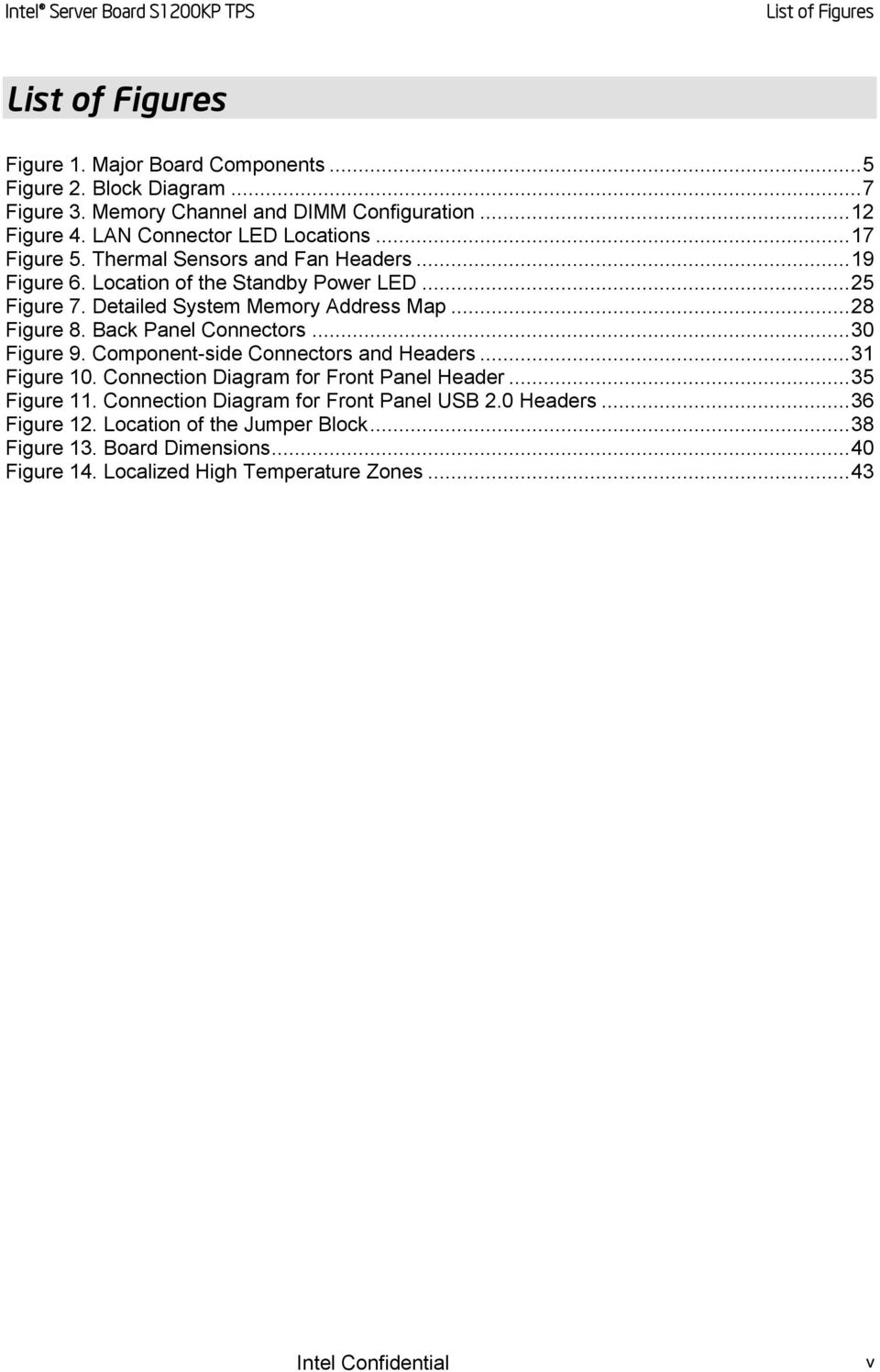
5 Intel Server Board S1200KP TPS List of Figures List of Figures Figure 1. Major Board Components... 5 Figure 2. Block Diagram... 7 Figure 3. Memory Channel and DIMM Configuration Figure 4. LAN Connector LED Locations Figure 5. Thermal Sensors and Fan Headers Figure 6. Location of the Standby Power LED Figure 7. Detailed System Memory Address Map Figure 8. Back Panel Connectors Figure 9. Component-side Connectors and Headers Figure 10. Connection Diagram for Front Panel Header Figure 11. Connection Diagram for Front Panel USB 2.0 Headers Figure 12. Location of the Jumper Block Figure 13. Board Dimensions Figure 14. Localized High Temperature Zones Intel Confidential v
6 List of Tables Intel Server Board S1200KP TPS List of Tables Table 1. Feature Summary... 3 Table 2. Components Shown in Figure Table 3. Reference URLs for Online Suppot... 7 Table 4. Information on Supported Processors... 8 Table 5. Information on PCI Express* Technology... 9 Table 6. Supported Memory Configurations Table 7. Information on System Memory Table 8. Information on Resouces Used by the Chipset Table 9. DVI Port Status Conditions Table 10. Information on USB Connectors Table 11. Information on SATA Connector Locations Table 12. Information on LAN Software and Drivers Table 13. Information on Obtaining LAN Software and Drivers Table 14. LAN Connector LED States Table 15. Information on the Function of the Fan Headers Table 16. Information on the Chassis Intrusion Headers Table 17. Effects of Pressing the Power Switch Table 18. Power States and Targeted System Power Table 19. Wake-up Devices and Events Table 20. Information on Power Connector Locations Table 21. Information of the Fan Headers Locations Table 22. System Memory Map Table 23. Component-side Connectors and Headers Shown in Figure Table 24. Front Panel USB 2.0 Headers Table 25. SATA Connectors Table 26. Chassis Intrusion Header Table 27. Processor and System (4-Pin) Fan Headers Table 28. Processor Core Power Connector Table 29. Main Power Connector Table 30. Front Panel Header Table 31. States for a One-Color Power LED Table 32. States for a Two-Color Power LED Table 33. Alternate Front Panel Power/Sleep LED Header Table 34. LPC Debug Header Table 35. BIOS Setup Configuration Jumper Settings Table 36. Recommended Power Supply Current Values Table 37. Fan Header Current Capability Table 38. Thermal Considerations for Components Table 39. Tcontrol Values for Components Table 40. Environmental Specifications Table 41. BIOS Setup Program Menu Bar Table 42. BIOS Setup Program Function Keys Table 43. Information on Integrator Toolkit and Software Tools Table 44. Acceptable Drives/Media Types for BIOS Recovery Table 45. Boot Device Menu Options Table 46. Supervisor and User Password Functions vi

7 Intel Server Board S1200KP TPS List of Tables Table 47. Information about Onboard Speaker Table 48. BIOS Beep Codes Table 49. Front-panel Power LED Blink Codes Table 50. BIOS Error Messages Table 51. Port 80h POST Code Ranges Table 52. Port 80h POST Codes Table 53. Typical Port 80h POST Sequence Intel Confidential vii

8 List of Tables Intel Server Board S1200KP TPS <This page is intentionally left blank.> viii
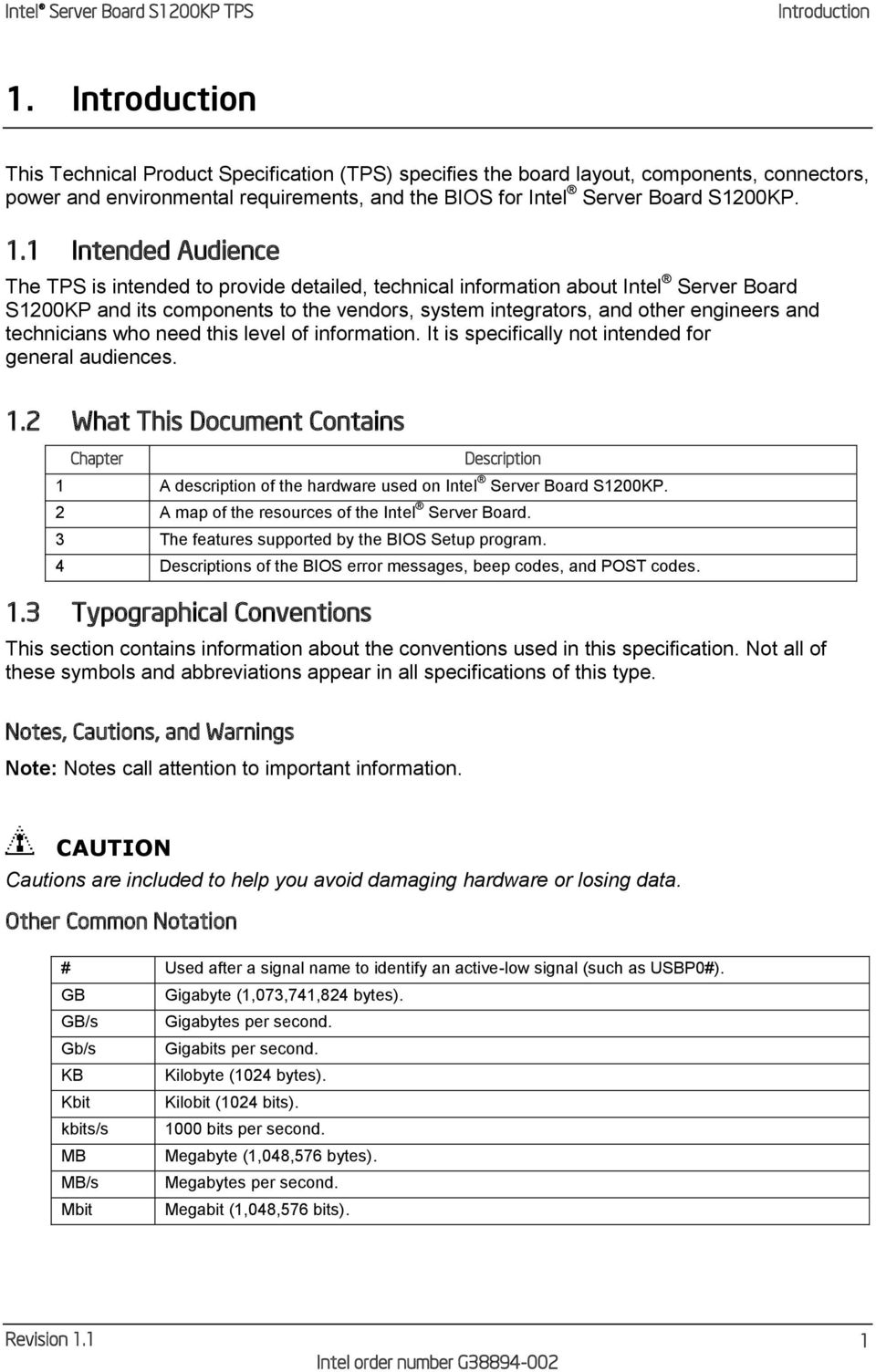
9 Intel Server Board S1200KP TPS Introduction 1. Introduction This Technical Product Specification (TPS) specifies the board layout, components, connectors, power and environmental requirements, and the BIOS for Intel Server Board S1200KP. 1.1 Intended Audience The TPS is intended to provide detailed, technical information about Intel Server Board S1200KP and its components to the vendors, system integrators, and other engineers and technicians who need this level of information. It is specifically not intended for general audiences. 1.2 What This Document Contains Chapter Description 1 A description of the hardware used on Intel Server Board S1200KP. 2 A map of the resources of the Intel Server Board. 3 The features supported by the BIOS Setup program. 4 Descriptions of the BIOS error messages, beep codes, and POST codes. 1.3 Typographical Conventions This section contains information about the conventions used in this specification. Not all of these symbols and abbreviations appear in all specifications of this type. Notes, Cautions, and Warnings Note: Notes call attention to important information. CAUTION Cautions are included to help you avoid damaging hardware or losing data. Other Common Notation # Used after a signal name to identify an active-low signal (such as USBP0#). GB Gigabyte (1,073,741,824 bytes). GB/s Gigabytes per second. Gb/s Gigabits per second. KB Kilobyte (1024 bytes). Kbit Kilobit (1024 bits). kbits/s 1000 bits per second. MB Megabyte (1,048,576 bytes). MB/s Megabytes per second. Mbit Megabit (1,048,576 bits). 1
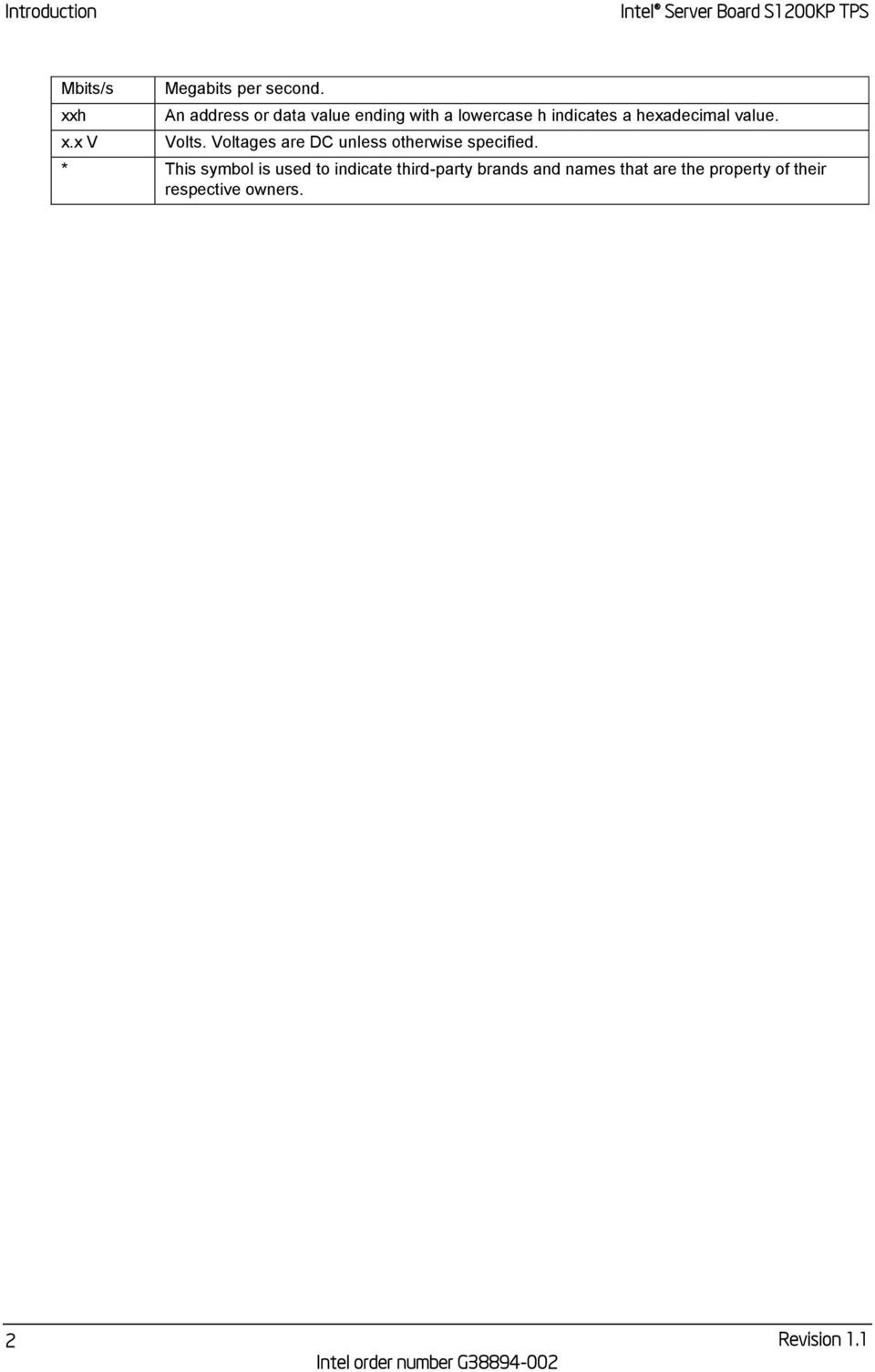
10 Introduction Intel Server Board S1200KP TPS Mbits/s xxh x.x V Megabits per second. An address or data value ending with a lowercase h indicates a hexadecimal value. Volts. Voltages are DC unless otherwise specified. * This symbol is used to indicate third-party brands and names that are the property of their respective owners. 2
11 Intel Server Board S1200KP TPS Product Description 2. Product Description 2.1 Overview Feature Summary Table 1 summarizes the major features of the board. Table 1. Feature Summary Feature Form Factor Processor Memory Chipset Graphics Peripheral Interfaces Expansion Capabilities Description Mini-ITX (6.7 inches by 6.7 inches [ millimeters by millimeters]) Intel Xeon E Processors, the 2 nd Generation Intel Core i3 Processors, Intel Xeon E V2 Processors or the 3 rd Generation Intel Core i3 Processors with up to 95W TDP in an LGA1155 socket 1, 2 o o o One PCI Express* 2.0 x16 (with Intel Xeon E Processors or the 2 nd Generation Intel Core i3 Processors) or PCI Express* 3.0 x 16 (with Intel Xeon E V2 Processors or the 3 rd Generation Intel Core i3 Processors) graphics interface Integrated memory controller with dual channel DDR3 memory support Integrated graphics processing (processors with Intel Graphics Technology) Two 240-pin DDR3 DRAM Dual Inline Memory Module (DIMM) sockets Support for DDR3 1066/1333 MHz (with Intel Xeon E Processors or the 2 nd Generation Intel Core i3 Processors) or DDR3 1333/1600 MHz (with Intel Xeon E V2 Processors or the 3 rd Generation Intel Core i3 Processors) DIMMs Support for 1Gb, 2Gb, and 4Gb memory technology Support for up to 16 GB of system memory with two DIMMs using 4 Gb memory technology Support for ECC and non-ecc memory 3 Intel C206 Platform Controller Hub (PCH) Chipset Integrated graphics support for processors with Intel Graphics Technology: o DVI-I Discrete graphics support for PCI Express* 2.0 x16 (with Intel Xeon E Processors or the 2 nd Generation Intel Core i3 Processors) or PCI Express* 3.0 x 16 (with Intel Xeon E V2 Processors or the 3 rd Generation Intel Core i3 Processors) add-in graphics card Eight USB 2.0 ports: o o Four ports are implemented with stacked back panel connectors (black) Four front panel ports implemented through three internal headers Two SATA 6.0Gb/s interfaces through Intel C206 Chipset with Intel Rapid Storage Technology RAID support (blue) Two SATA 3.0Gb/s interfaces through Intel C206 Chipset with Intel Rapid Storage Technology RAID support (black) One PCI Express* 2.0 x16 (with Intel Xeon E Processors or the 2 nd Generation Intel Core i3 Processors) or PCI Express* 3.0 x 16 (with Intel Xeon E V2 Processors or the 3 rd Generation Intel Core i3 Processors) add-in card connector 3

12 Product Description Intel Server Board S1200KP TPS BIOS Feature Instantly Available PC Technology Description Intel BIOS resident in the Serial Peripheral Interface (SPI) Flash device Support for Advanced Configuration and Power Interface (ACPI), Plug and Play, and System Management BIOS (SMBIOS) Support for PCI Express* Revision 2.0 (with Intel Xeon E Processors or the 2 nd Generation Intel Core i3 Processors) or PCI Express* Revision 3.0 (with Intel Xeon E V2 Processors or the 3 rd Generation Intel Core i3 Processors) Suspend to RAM support Wake on PCI Express*, LAN, front panel, and USB ports LAN Support Gigabit (10/100/1000Mbits/s) LAN subsystem using the Intel and Gigabit Ethernet Controller Legacy I/O Control Hardware Monitor Subsystem Notes: Nuvoton* W83677HG-i I/O controller for hardware management support Hardware monitoring through the Nuvoton I/O controller Voltage sense to detect out of range power supply voltages Thermal sense to detect out of range thermal values Two fan headers Two fan sense inputs used to monitor fan activity Fan speed control 1. Pairing a mini-itx chassis and more than 65W TDP processor with the supplied standard Intel thermal solution may not meet Intel s thermal requirement standard. Please verify that your thermal solution and chassis will meet the necessary thermal requirements. Failing to do so may cause the processor to throttle, significantly decreasing system performance. 2. The product codes of DBS1200KP and BBS1200KP can only support Intel Xeon E Processors or the 2 nd Generation Intel Core i3 Processors. The product codes of DBS1200KPR and BBS1200KPR can support Intel Xeon E Processors, the 2 nd Generation Intel Core i3 Processors, Intel Xeon E V2 Processors or the 3 rd Generation Intel Core i3 Processors. 3. ECC DIMMS are recommended to use for server system. 4
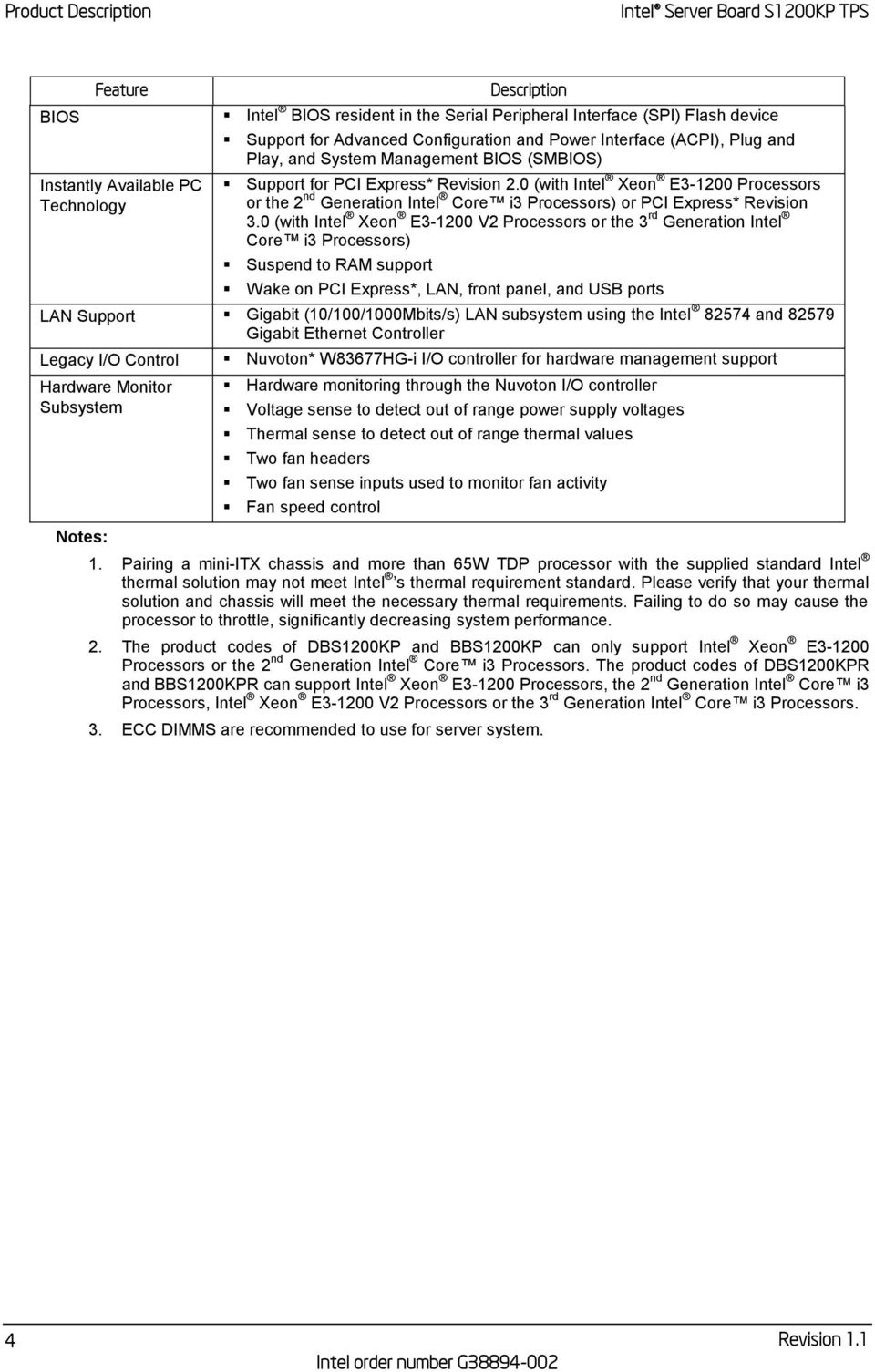
13 Intel Server Board S1200KP TPS Product Description Board Layout Following figure shows the location of the major components on Intel Server Board S1200KP: Figure 1. Major Board Components 5

14 Product Description Intel Server Board S1200KP TPS Table 2 lists the components identified in Figure 1. Table 2. Components Shown in Figure 1 Item/callout Description A Back panel connectors B Processor core power connector (2 x 2) C Front panel USB 2.0 header D BIOS Setup configuration jumper block E SATA connectors F Intel C206 Chipset G Front panel USB 2.0 header H Main power connector (2 x 12) I Front panel header J DIMM 1 (Channel A DIMM 1) K DIMM 2 (Channel B DIMM 1) L Alternate front panel power LED header M Piezoelectric speaker N Standby power LED O Processor fan header P LGA1155 processor socket Q PCI Express* x16 bus add-in card connector R Low Pin Count (LPC) Debug header S Chassis intrusion header T System fan header U Battery 6
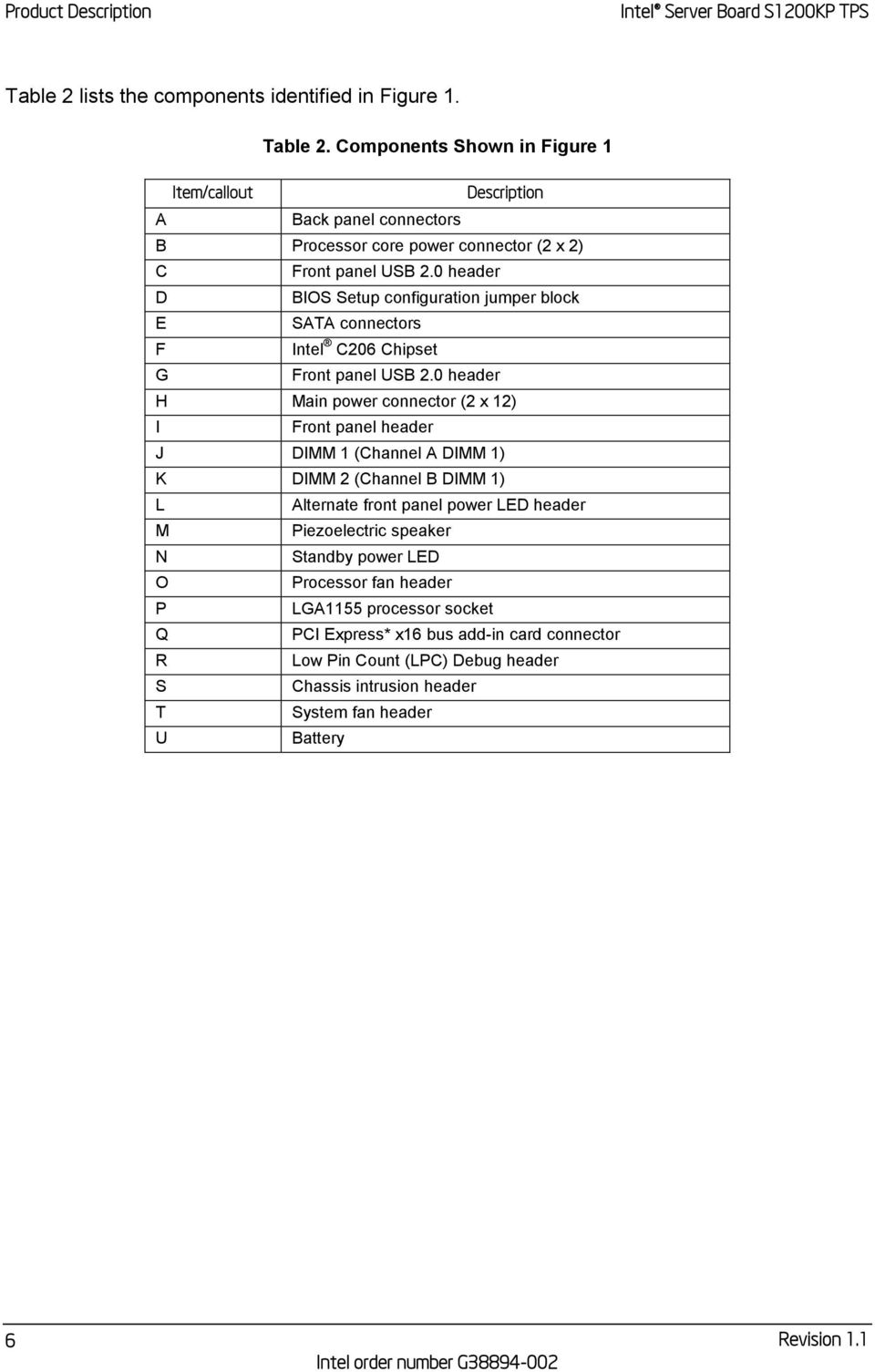
15 Intel Server Board S1200KP TPS Product Description Block Diagram Figure 2 is a block diagram of the major functional areas of the board. Figure 2. Block Diagram 2.2 Online Support Table 3. Reference URLs for Online Suppot To find information about Intel Server Board S1200KP Supported processors and tested memory BIOS and driver updates Visit this World Wide Web site:

16 Product Description Intel Server Board S1200KP TPS 2.3 Processor The board is designed to support the Intel Xeon E Processors, the 2 nd Generation Intel Core i3 Processors, Intel Xeon E V2 Processors or the 3 rd Generation Intel Core i3 Processors in an LGA1155 socket. Other processors may be supported in the future. This board is designed to support processors with a maximum wattage of 95 W Thermal Design Power (TDP). The processors listed above are only supported when falling within the wattage requirements of Intel Server Board S1200KP. See the Intel web site listed below for the most up-to-date list of supported processors. Table 4. Information on Supported Processors Supported processors For information about Refer to: CAUTION Use only the processors listed on the web site above. Use of unsupported processors can damage the board, the processor, and the power supply. Notes: 1. The product codes of DBS1200KP and BBS1200KP can only support Intel Xeon E Processors or the 2 nd Generation Intel Core i3 Processors. The product codes of DBS1200KPR and BBS1200KPR can support Intel Xeon E Processors, the 2 nd Generation Intel Core i3 Processors, Intel Xeon E V2 Processors or the 3 rd Generation Intel Core i3 Processors. 2. This board has specific requirements for providing power to the processor. Refer to Section on page 40 for information on power supply requirements for this board. 3. Pairing a mini-itx chassis and more than 65W TDP processor with the supplied standard Intel thermal solution may not meet Intel s thermal requirement standard. Please verify that your thermal solution and chassis will meet the necessary thermal requirements. Failing to do so may cause the processor to throttle, significantly decreasing system performance PCI Express* x16 Graphics The Intel Xeon E Processors or the 2 nd Generation Intel Core i3 Processors in an LGA1155 socket support discrete add in graphics cards through the PCI Express* 2.0 x16 graphics connector. And the Intel Xeon E V2 Processors or the 3 rd Generation Intel Core i3 Processors in an LGA1155 socket support discrete add in graphics cards through the PCI Express* 3.0 x16 graphics connector: Supports PCI Express* GEN3 frequency of 8 GHz resulting in 8.0 Gb/s each direction (1 GB/s) per lane. The maximum theoretical bandwidth on the interface is 16 GB/s in each direction, simultaneously, for an aggregate of 32 GB/s when operating in x16 GEN3 mode. 8
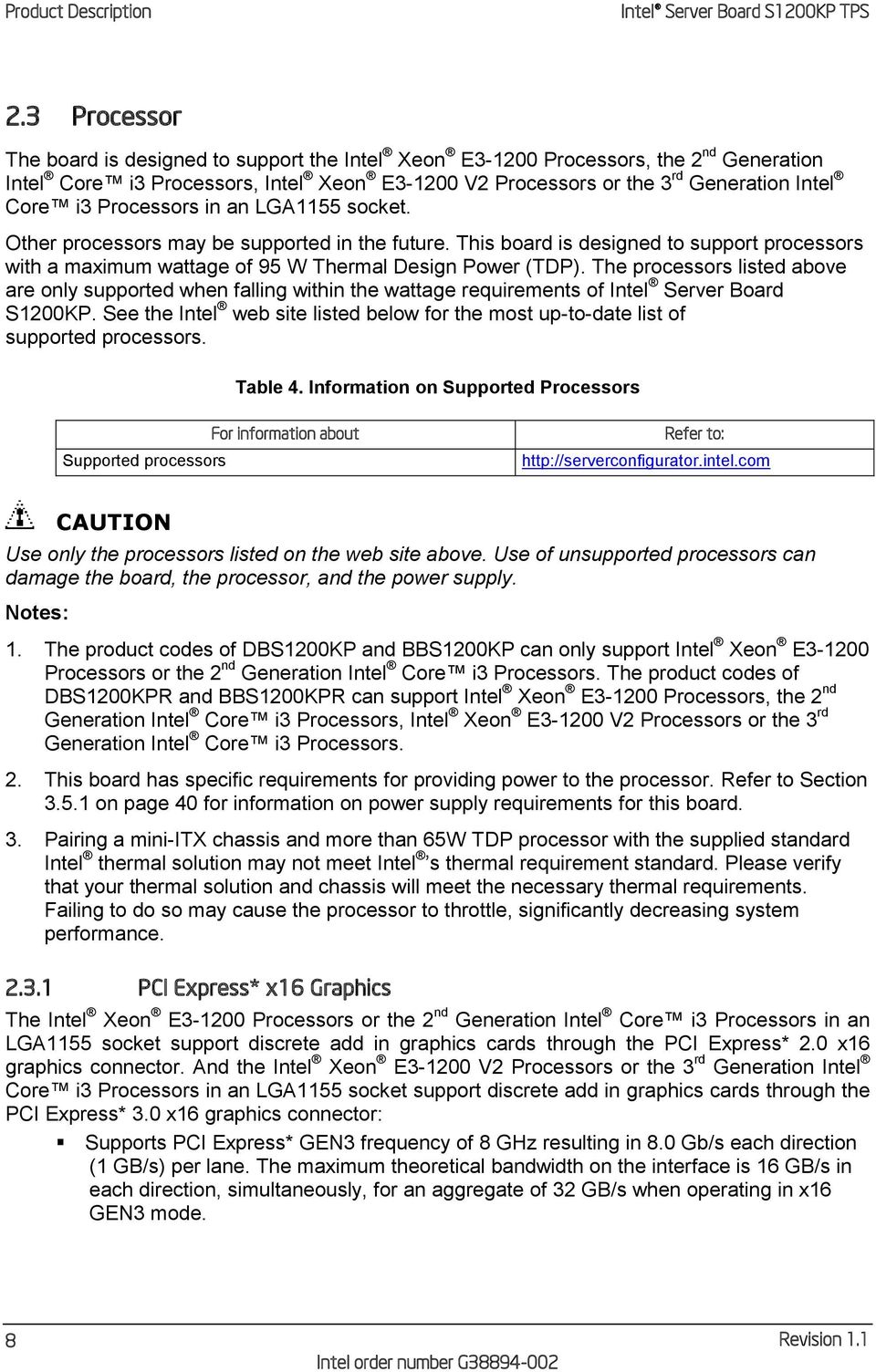
17 Intel Server Board S1200KP TPS Product Description Supports PCI Express* GEN2 frequency of 5 GHz resulting in 5.0 Gb/s each direction (500 MB/s) per lane. The maximum theoretical bandwidth on the interface is 8 GB/s in each direction, simultaneously, for an aggregate of 16 GB/s when operating in x16 GEN2 mode. Supports PCI Express* GEN1 frequency of 2.5 GHz resulting in 2.5 Gb/s each direction (250 MB/s) per lane. The maximum theoretical bandwidth on the interface is 4 GB/s in each direction, simultaneously, for an aggregate of 8 GB/s when operating in x16 GEN1 mode. Table 5. Information on PCI Express* Technology PCI Express* technology For information about Refer to 9

18 Product Description Intel Server Board S1200KP TPS 2.4 System Memory The board has two DIMM sockets and supports the following memory features: 1.5 V DDR3 DRAM DIMMs with gold plated contacts. Two independent memory channels with interleaved mode support Unbuffered, single-sided or double-sided DIMMs with the following restriction: Double-sided DIMMs with x16 organization are not supported. 16 GB maximum total system memory (with 4 Gb memory technology). Refer to Section on page 27 for information on the total amount of addressable memory. Minimum recommended total system memory: 512 MB ECC and Non-ECC DIMMs Serial Presence Detect Support for DDR3 1066/1333 MHz (with Intel Xeon E Processors or the 2 nd Generation Intel Core i3 Processors) or DDR3 1333/1600 MHz (with Intel Xeon E V2 Processors or the 3 rd Generation Intel Core i3 Processors) DIMMs Notes: 1. To be fully compliant with all applicable DDR DRAM memory specifications, the board should be populated with DIMMs that support the Serial Presence Detect (SPD) data structure. This allows the BIOS to read the SPD data and program the chipset to accurately configure memory settings for optimum performance. If non-spd memory is installed, the BIOS will attempt to correctly configure the memory settings, but performance and reliability may be impacted or the DIMMs may not function under the determined frequency. 2. ECC DIMMS are recommended to use for server system. Table 6 lists the supported DIMM configurations. Table 6. Supported Memory Configurations DIMM Configuration DRAM Density DRAM Organization Number of DRAM Devices Capacity (Note) Front-side/Back-side Non-ECC/ECC 512 MB SS 1 Gbit 1 Gb x16/empty 4/NA 1024 MB SS 1 Gbit 1 Gb x8/empty 8/ MB DS 1 Gbit 1 Gb x8/1 Gb x8 16/ MB SS 2 Gbit 2 Gb x8/empty 8/ MB DS 2 Gbit 2 Gb x8/2 Gb x8 16/ MB DS 4 Gbit 4 Gb x8/4gb x8 16/18 Note: DS refers to double-sided memory modules (containing two rows of DRAM) and SS refers to single-sided memory modules (containing one row of DRAM). Table 7. Information on System Memory Tested Memory For information about Refer to: 10

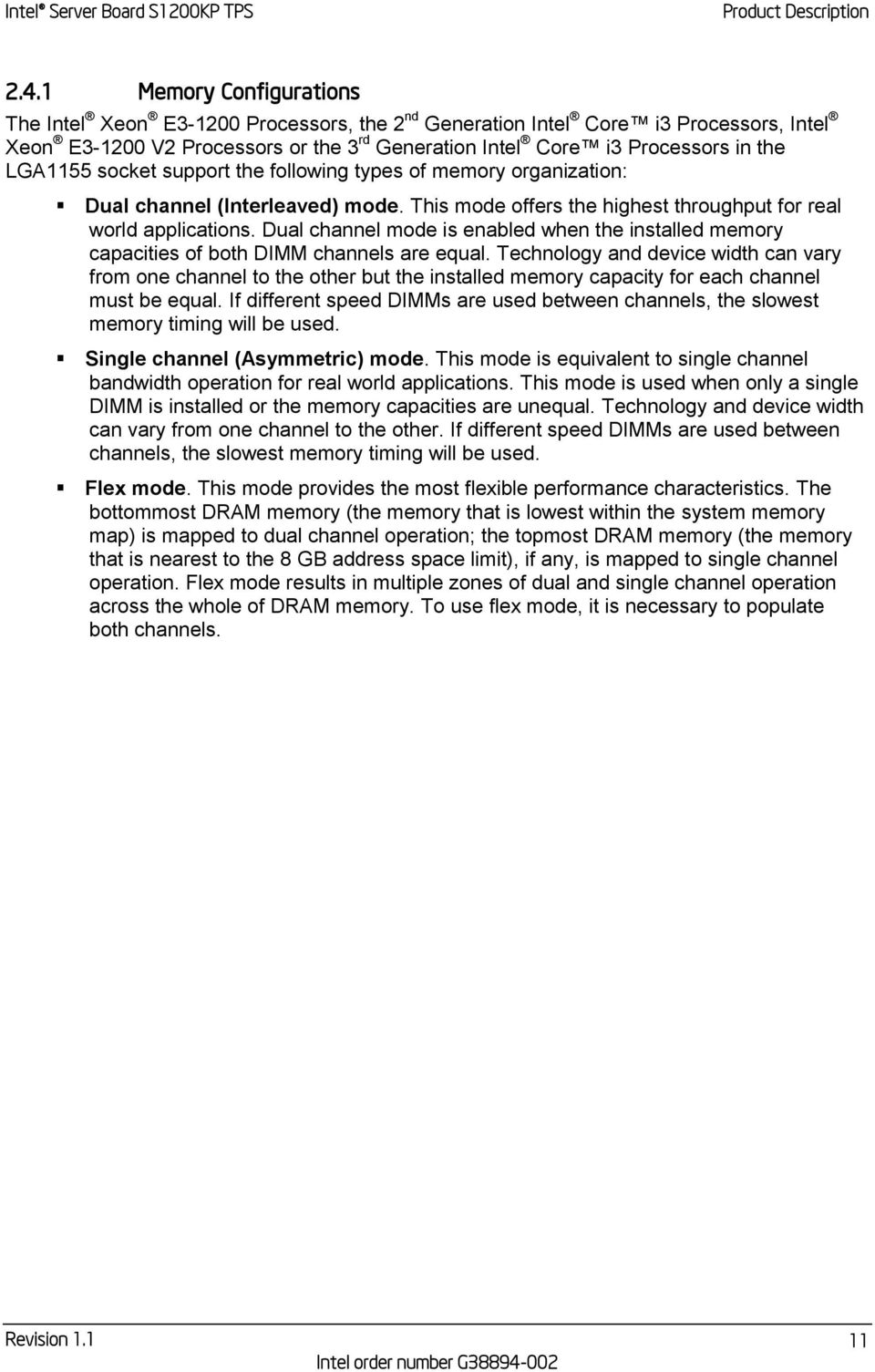
19 Intel Server Board S1200KP TPS Product Description Memory Configurations The Intel Xeon E Processors, the 2 nd Generation Intel Core i3 Processors, Intel Xeon E V2 Processors or the 3 rd Generation Intel Core i3 Processors in the LGA1155 socket support the following types of memory organization: Dual channel (Interleaved) mode. This mode offers the highest throughput for real world applications. Dual channel mode is enabled when the installed memory capacities of both DIMM channels are equal. Technology and device width can vary from one channel to the other but the installed memory capacity for each channel must be equal. If different speed DIMMs are used between channels, the slowest memory timing will be used. Single channel (Asymmetric) mode. This mode is equivalent to single channel bandwidth operation for real world applications. This mode is used when only a single DIMM is installed or the memory capacities are unequal. Technology and device width can vary from one channel to the other. If different speed DIMMs are used between channels, the slowest memory timing will be used. Flex mode. This mode provides the most flexible performance characteristics. The bottommost DRAM memory (the memory that is lowest within the system memory map) is mapped to dual channel operation; the topmost DRAM memory (the memory that is nearest to the 8 GB address space limit), if any, is mapped to single channel operation. Flex mode results in multiple zones of dual and single channel operation across the whole of DRAM memory. To use flex mode, it is necessary to populate both channels. 11
20 Product Description Intel Server Board S1200KP TPS Figure 3 illustrates the memory channel and DIMM configuration. Figure 3. Memory Channel and DIMM Configuration Note: The Intel Xeon E Processors, the 2 nd Generation Intel Core i3 Processors, Intel Xeon E V2 Processors or the 3 rd Generation Intel Core i3 Processors require memory to be populated in the DIMM_A1 (Channel A, DIMM 1) socket. 12

21 Intel Server Board S1200KP TPS Product Description 2.5 Intel C206 Chipset Intel C206 Chipset with Direct Media Interface (DMI) interconnect provides interfaces to the processor and the USB, SATA, LPC, LAN and PCI Express* interfaces. The Intel C206 Chipset is a centralized controller for the board s I/O paths. Table 8. Information on Resouces Used by the Chipset For information about Resources used by the chipset Chapter 2 Refer to 2.6 Graphics Subsystem The board supports graphics through either Intel Graphics Technology or a PCI Express* 2.0 x16 (with Intel Xeon E Processors or the 2 nd Generation Intel Core i3 Processors) or PCI Express* 3.0 x 16 (with Intel Xeon E V2 Processors or the 3 rd Generation Intel Core i3 Processors) add-in graphics card Integrated Graphics The board supports integrated graphics through the Intel Flexible Display Interface (Intel FDI) for processors with Intel Graphics Technology Digital Visual Interface (DVI-I) The DVI-I port supports both digital and analog DVI displays. The maximum supported resolution is 1900 x 1200 (WUXGA). The DVI port is compliant with the DVI 1.0 specification. DVI analog output can also be converted to VGA using a DVI-VGA converter. Depending on the type of add-in card installed in the PCI Express* x16 connector, the DVI port will behave as described in Table 9. Notes: PCI Express* x16 Connector Status Table 9. DVI Port Status Conditions DVI Digital (DVI-D) Port Status No add-in card installed Enabled Enabled Non-video PCI Express* x1 add-in card installed Enabled Enabled PCI Express* x16 add-in card installed Enabled Enabled 1. DVI analog output can also be converted to VGA with a DVI-VGA converter. 2. May require BIOS setup menu changes USB The board supports up to eight USB 2.0 ports. DVI Analog (DVI-A) Port Status (Note 1) (Note 2) 13
22 Product Description Intel Server Board S1200KP TPS The Intel C206 Chipset provides the USB controller for the 2.0 ports. The port arrangement is as follows: Four USB 2.0 ports are implemented with stacked back panel connectors (black) Four USB 2.0 front panel ports implemented through three internal headers All eight USB ports are high-speed, full-speed, and low-speed capable. Note: Computer systems that have an unshielded cable attached to a USB port may not meet FCC Class B requirements, even if no device is attached to the cable. Use a shielded cable that meets the requirements for full-speed devices. Table 10. Information on USB Connectors For information about Refer to The location of the USB connectors on the back panel Figure 8, page 30 The location of the front panel USB headers Figure 9, page SATA Interfaces The board provides five SATA connectors through the PCH, which support one device per connector: Two internal SATA 6.0 Gb/s connectors (blue) Two internal SATA 3.0 Gb/s connectors (black) The PCH provides independent SATA ports with a theoretical maximum transfer rate of 6 Gb/s for two ports and 3 Gb/s for the other two ports. A point-to-point interface is used for host to device connections. The underlying SATA functionality is transparent to the operating system. The SATA controller can operate in both legacy and native modes. In legacy mode, standard IDE I/O and IRQ resources are assigned (IRQ 14 and 15). In Native mode, standard PCI Conventional bus resource steering is used. Native mode is the preferred mode for configurations using the Windows 7* operating systems. Note: Many SATA drives use new low-voltage power connectors and require adapters or power supplies equipped with low-voltage power connectors. For more information, see: Table 11. Information on SATA Connector Locations For information about Refer to The location of the SATA connectors Figure 9, page SATA RAID The board supports Intel Rapid Storage Technology which provides the following RAID (Redundant Array of Independent Drives) levels through the Intel C206 Chipset: RAID 0 - data striping RAID 1 - data mirroring 14
23 Intel Server Board S1200KP TPS Product Description RAID 0+1 (or RAID 10) - data striping and mirroring RAID 5 - distributed parity 2.8 Real-Time Clock Subsystem A coin-cell battery (CR2032) powers the real-time clock and CMOS memory. When the computer is not plugged into a wall socket, the battery has an estimated life of three years. When the computer is plugged in, the standby current from the power supply extends the life of the battery. The clock is accurate to 13 minutes/year at 25 ºC with 3.3 VSB applied through the power supply 5V STBY rail. Note: If the battery and AC power fail, date and time values will be reset and the user will be notified during the POST. When the voltage drops below a certain level, the BIOS Setup program settings stored in CMOS RAM (for example, the date and time) might not be accurate. Replace the battery with an equivalent one. Figure 1 on page 5 shows the location of the battery. 2.9 Legacy I/O Controller The I/O controller provides the following features: Serial IRQ interface compatible with serialized IRQ support for PCI systems Intelligent power management, including a programmable wake-up event interface PCI power management support The BIOS Setup program provides configuration options for the I/O controller. 15
24 Product Description Intel Server Board S1200KP TPS 2.10 LAN Subsystem The LAN subsystem consists of the following: Intel 82574L and 82579LM Gigabit Ethernet Controllers (10/100/1000 Mbits/s) Intel C206 Chipset RJ-45 LAN connector with integrated status LEDs Additional features of the LAN subsystem include: CSMA/CD protocol engine LAN connect interface between the PCH and the LAN controller PCI Conventional bus power management o ACPI technology support o LAN wake capabilities LAN subsystem software Table 12. Information on LAN Software and Drivers LAN software and drivers For information about Refer to Intel 82574L Gigabit Ethernet Controller The Intel 82574L Gigabit Ethernet Controller supports the following features: 10/100/1000 BASE-T IEEE compliant Dual interconnect between the Integrated LAN Controller and the Physical Layer (PHY): o PCI Express*-based interface for active state operation (S0) state o SMBUS* for host and management traffic (Sx low power state) Compliant to IEEE 802.3x flow control support 802.1p and 802.1q TCP, IP, and UDP checksum offload (for IPv4 and IPv6) Full device driver compatibility Intel 82579LM Gigabit Ethernet Controller The Intel 82579LM Gigabit Ethernet Controller supports the following features: 10/100/1000 BASE-T IEEE compliant Energy Efficient Ethernet (EEE) IEEE802.3az support [Low Power Idle (LPI) mode] Dual interconnect between the Integrated LAN Controller and the Physical Layer (PHY): o PCI Express*-based interface for active state operation (S0) state o SMBUS* for host and management traffic (Sx low power state) Compliant to IEEE 802.3x flow control support 16
25 Intel Server Board S1200KP TPS Product Description 802.1p and 802.1q TCP, IP, and UDP checksum offload (for IPv4 and IPv6) Full device driver compatibility LAN Subsystem Software LAN software and drivers are available from Intel s World Wide Web site. Table 13. Information on Obtaining LAN Software and Drivers For information about Obtaining LAN software and drivers Refer to RJ-45 LAN Connector with Integrated LEDs Two LEDs are built into the RJ-45 LAN connector (shown in Figure 4). Item A B C D Description Link LED (Green) Data Rate LED (Green/Yellow) Link LED (Green) Data Rate LED (Green/Yellow) Figure 4. LAN Connector LED Locations Table 14 describes the LED states when the board is powered up and the LAN subsystem is operating. 17
26 Product Description Intel Server Board S1200KP TPS Table 14. LAN Connector LED States LED LED Color LED State Condition Off LAN link is not established. Link Green On LAN link is established. Blinking LAN activity is occurring. Off 10 Mbits/s data rate is selected. Data Rate Green/Yellow Green 100 Mbits/s data rate is selected. Yellow 1000 Mbits/s data rate is selected Hardware Management Subsystem The hardware management features enable the board to be compatible with the Wired for Management (WfM) specification. The board has several hardware management features, including the following: Thermal and voltage monitoring Chassis intrusion detection Hardware Monitoring The hardware monitoring and fan control subsystem is based on the Nuvoton W83677HG-i device, which supports the following: Processor and system ambient temperature monitoring Chassis fan speed monitoring Power monitoring of +12 V, +5 V, V_SM, +3.3 V, and +VCCP SMBus* interface Fan Monitoring Fan monitoring can be implemented using third-party software. Table 15. Information on the Function of the Fan Headers For information about Refer to The functions of the fan headers Section , page Chassis Intrusion and Detection The board supports a chassis security feature that detects if the chassis cover is removed. The security feature uses a mechanical switch on the chassis that attaches to the chassis intrusion header. When the chassis cover is removed, the mechanical switch is in the closed position. Table 16. Information on the Chassis Intrusion Headers For information about Refer to The location of the chassis intrusion header Figure 9, page 31 18
27 Intel Server Board S1200KP TPS Product Description Thermal Monitoring Figure 5 shows the locations of the thermal sensors and fan headers. Item Description A Thermal diode, located on the Intel C206 PCH B Remote thermal diode 1 C Processor fan header D Thermal diode, located on the processor die E Remote thermal diode 2 F System fan header Figure 5. Thermal Sensors and Fan Headers 19
28 Product Description Intel Server Board S1200KP TPS 2.12 Power Management Power management is implemented at several levels, including: Software support through Advanced Configuration and Power Interface (ACPI) Hardware support: o Power connector o Fan headers o LAN wake capabilities o Instantly Available PC technology o Wake from USB o PCI Express* WAKE# signal support ACPI ACPI gives the operating system direct control over the power management and Plug and Play functions of a computer. The use of ACPI with this board requires an operating system that provides full ACPI support. ACPI features include: Plug and Play (including bus and device enumeration) Power management control of individual devices, add-in boards (some add-in boards may require an ACPI-aware driver), video displays, and hard disk drives Methods for achieving less than 15-watt system operation in the power-on/standby sleeping state A Soft-off feature that enables the operating system to power-off the computer Support for multiple wake-up events (see Table 19 on page 21) Support for a front panel power and sleep mode switch Table 17 lists the system states based on how long the power switch is pressed, depending on how ACPI is configured with an ACPI-aware operating system. Table 17. Effects of Pressing the Power Switch System Status Power Switch Press Time State of the System Off (ACPI G2/G5 Soft off) On (ACPI G0 working state) On (ACPI G0 working state) Sleep (ACPI G1 sleeping state) Sleep (ACPI G1 sleeping state) Less than four seconds Less than four seconds More than six seconds Less than four seconds More than six seconds System States and Power States Power-on (ACPI G0 working state) Soft-off/Standby (ACPI G1 sleeping state) Fail safe power-off (ACPI G2/G5 Soft off) Wake-up (ACPI G0 working state) Power-off (ACPI G2/G5 Soft off) Under ACPI, the operating system directs all system and device power state transitions. The operating system puts devices in and out of low-power states based on user preferences and knowledge of how devices are being used by applications. Devices that are not being used can 20
29 Intel Server Board S1200KP TPS Product Description be turned off. The operating system uses information from applications and user settings to put the system as a whole into a low-power state. Table 18 lists the power states supported by the board along with the associated system power targets. See the ACPI specification for a complete description of the various system and power states. Table 18. Power States and Targeted System Power Global States Sleeping States Processor States G0 working state G1 sleeping state G1 sleeping state G2/S5 G3 mechanical off AC power is disconnected from the computer. Device States S0 working C0 working D0 working state. S3 Suspend to RAM. Context saved to RAM. S4 Suspend to disk. Context saved to disk. S5 Soft off. Context not saved. Cold boot is required. No power to the system. No power No power No power No power D3 no power except for wake-up logic. D3 no power except for wake-up logic. D3 no power except for wake-up logic. D3 no power for wake-up logic, except when provided by battery or external source. Targeted System Power (Note 1) Full power > 30 W Power < 5 W Power < 5 W Power < 5 W (Note 2) (Note 2) (Note 2) No power to the system. Service can be performed safely. Notes: 1. Total system power is dependent on the system configuration, including add-in boards and peripherals powered by the system chassis power supply. 2. Dependent on the standby power consumption of wake-up devices used in the system Wake-up Devices and Events Table 19 lists the devices or specific events that can wake the computer from specific states. Table 19. Wake-up Devices and Events These devices/events can wake up the computer Power switch S3, S4, S5 RTC alarm S3, S4, S5 LAN S3, S4, S5 USB WAKE# S3, S4, S5 Notes: 1. S4 implies operating system support only. 2. Wake from S4 and S5 is recommended by Microsoft. S3 (Note 1) (Note 1) (Note 1) (Note 1) from this state 21
30 Product Description Intel Server Board S1200KP TPS Note: The use of these wake-up events from an ACPI state requires an operating system that provides full ACPI support. In addition, software, drivers, and peripherals must fully support ACPI wake events Hardware Support CAUTION Ensure that the power supply provides adequate +5 V standby current if LAN wake capabilities and Instantly Available PC technology features are used. Failure to do so can damage the power supply. The total amount of standby current required depends on the wake devices supported and manufacturing options. The board provides several power management hardware features, including: Power connector Fan headers LAN wake capabilities Instantly Available PC technology Wake from USB WAKE# signal wake-up support +5 V Standby Power Indicator LED LAN wake capabilities and Instantly Available PC technology require power from the +5 V standby line. Note: The use of Wake from USB from an ACPI state requires an operating system that provides full ACPI support Power Connector ATX12V-compliant power supplies can turn off the system power through system control. When an ACPI-enabled system receives the correct command, the power supply removes all nonstandby voltages. When resuming from an AC power failure, the computer returns to the power state it was in before power was interrupted (on or off). The computer s response can be set using the Last Power State feature in the BIOS Setup program s Boot menu. Table 20. Information on Power Connector Locations For information about Refer to The location of the main power connector Figure 9, page 31 The signal names of the main power connector Table 29, page Fan Headers The function/operation of the fan headers is as follows: The fans are on when the board is in the S0 state The fans are off when the board is off or in the S3, S4, or S5 state 22
31 Intel Server Board S1200KP TPS Product Description Each fan header is wired to a fan tachometer input of the hardware monitoring and fan control ASIC All fan headers support closed-loop fan control that can adjust the fan speed or switch the fan on or off as needed All fan headers have a +12 V DC connection 4-pin fan headers are controlled by Pulse Width Modulation Table 21. Information of the Fan Headers Locations For information about Refer to The location of the fan headers Figure 9, page 31 The location of the fan headers and sensors for thermal monitoring Figure 5, page LAN Wake Capabilities CAUTION For LAN wake capabilities, the +5 V standby line for the power supply must be capable of providing adequate +5 V standby current. Failure to provide adequate standby current when implementing LAN wake capabilities can damage the power supply. LAN wake capabilities enable remote wake-up of the computer through a network. The LAN subsystem PCI bus network adapter monitors network traffic at the Media Independent Interface. Upon detecting a Magic Packet* frame, the LAN subsystem asserts a wake-up signal that powers up the computer. Depending on the LAN implementation, the board supports LAN wake capabilities with ACPI in the following ways: The PCI Express* WAKE# signal The onboard LAN subsystem Instantly Available PC Technology CAUTION For Instantly Available PC technology, the +5 V standby line for the power supply must be capable of providing adequate +5 V standby current. Failure to provide adequate standby current when implementing Instantly Available PC technology can damage the power supply. Instantly Available PC technology enables the board to enter the ACPI S3 (Suspend-to-RAM) sleep-state. While in the S3 sleep-state, the computer will appear to be off (the power supply is off, and the front panel LED is amber if dual colored, or off if single colored.) When signaled by a wake-up device or event, the system quickly returns to its last known wake state. Table 19 on page 21 lists the devices and events that can wake the computer from the S3 state. The use of Instantly Available PC technology requires operating system support and PCI Express* add-in cards and drivers Wake from USB USB bus activity wakes the computer from an ACPI S3 state. 23
32 Product Description Intel Server Board S1200KP TPS Note: Wake from USB requires the use of a USB peripheral that supports Wake from USB WAKE# Signal Wake-up Support When the WAKE# signal on the PCI Express* bus is asserted, the computer wakes from an ACPI S3, S4, or S5 state Wake from S5 When the RTC Date and Time is set in the BIOS, the computer will automatically wake from an ACPI S5 state V Standby Power Indicator LED The +5 V standby power indicator LED shows that power is still present even when the computer appears to be off. Figure 6 shows the location of the standby power LED. CAUTION If AC power has been switched off and the standby power indicator is still lit, disconnect the power cord before installing or removing any devices connected to the board. Failure to do so could damage the board and any attached devices. 24
33 Intel Server Board S1200KP TPS Product Description Figure 6. Location of the Standby Power LED 25
34
35 Intel Server Board S1200KP TPS Technical Reference 3. Technical Reference 3.1 Memory Resources Addressable Memory The board utilizes 16 GB of addressable system memory. Typically the address space that is allocated for PCI Conventional bus add-in cards, PCI Express* configuration space, BIOS (SPI Flash device), and chipset overhead resides above the top of DRAM (total system memory). On a system that has 16 GB of system memory installed, it is not possible to use all of the installed memory due to system address space being allocated for other system critical functions. These functions include the following: BIOS/SPI Flash device (16 Mbit) Local APIC (19 MB) Direct Media Interface (40 MB) Front side bus interrupts (17 MB) PCI Express* configuration space (256 MB) PCH base address registers PCI Express* ports (up to 256 MB) Memory-mapped I/O that is dynamically allocated for PCI Express* add-in cards (256 MB) The board provides the capability to reclaim the physical memory overlapped by the memory mapped I/O logical address space. The board remaps physical memory from the top of usable DRAM boundary to the 4 GB boundary to an equivalent sized logical address range located just above the 4 GB boundary. Figure 7 shows a schematic of the system memory map. All installed system memory can be used when there is no overlap of system addresses. 27
36 Technical Reference Intel Server Board S1200KP TPS Figure 7. Detailed System Memory Address Map 28
37 Intel Server Board S1200KP TPS Technical Reference Memory Map Table 22 lists the system memory map. Table 22. System Memory Map Address Range (decimal) Address Range (hex) Size Description 1024 K K K MB Extended memory 960 K K F FFFFF 64 KB Runtime BIOS 896 K K E EFFFF 64 KB Reserved 800 K K C DFFFF 96 KB Potential available high DOS memory (open to the PCI Conventional bus). Dependent on video adapter used. 640 K K A C7FFF 160 KB Video memory and BIOS 639 K K 9FC00-9FFFF 1 KB Extended BIOS data (movable by memory manager software) 512 K K FBFF 127 KB Extended conventional memory 0 K K FFFF 512 KB Conventional memory 3.2 Connectors and Headers CAUTION Only the following connectors and headers have over-current protection: back panel and front panel USB. The other internal connectors and headers are not over-current protected and should connect only to devices inside the computer s chassis, such as fans and internal peripherals. Do not use these connectors or headers to power devices external to the computer s chassis. A fault in the load presented by the external devices could cause damage to the computer, the power cable, and the external devices themselves. Furthermore, improper connection of USB header single wire connectors may eventually overload the over-current protection and cause damage to the board. This section describes the board s connectors. The connectors can be divided into these groups: Back panel I/O connectors Component-side I/O connectors and headers (see page 30) Back Panel Connectors Figure 8 shows the location of the back panel connectors for the board. 29
38 Technical Reference Intel Server Board S1200KP TPS Item A B C D E Description LAN port (82574L) USB 2.0 ports LAN port (82579LM) USB 2.0 ports DVI-I connector Figure 8. Back Panel Connectors Component-side Connectors and Headers Figure 9 shows the locations of the component-side connectors and headers. 30
39 Intel Server Board S1200KP TPS Technical Reference Figure 9. Component-side Connectors and Headers 31
40 Technical Reference Intel Server Board S1200KP TPS Table 23 lists the component-side connectors and headers identified in Figure 9. Table 23. Component-side Connectors and Headers Shown in Figure 9 Item/callout Description A Processor core power connector (2 x 2) B Front panel USB header C SATA connectors D Front panel USB header E Main power connector (2 X 12) F Front panel header G Alternate front panel power LED header H Processor fan header I PCI Express* x16 bus add-in card connector J LPC Debug header K Chassis intrusion header L System fan header Signal Tables for the Connectors and Headers Table 24. Front Panel USB 2.0 Headers Pin Signal Name Pin Signal Name 1 +5 V DC 2 +5 V DC 3 D- 4 D- 5 D+ 6 D+ 7 Ground 8 Ground 9 KEY (no pin) 10 No Connect Table 25. SATA Connectors Pin 1 Ground 2 TXP 3 TXN 4 Ground 5 RXN 6 RXP 7 Ground Signal Name 32
41 Intel Server Board S1200KP TPS Technical Reference Table 26. Chassis Intrusion Header Pin 1 Intruder# 2 Ground Signal Name Table 27. Processor and System (4-Pin) Fan Headers Pin Signal Name 1 Ground (Note) V 3 FAN_TACH 4 FAN_CONTROL 5 Jack detect 2 Note: These fan headers use Pulse Width Modulation control for fan speed Add-in Card Connector The board has one PCI Express* 2.0 x16 (with Intel Xeon E Processors or the 2 nd Generation Intel Core i3 Processors) or PCI Express* 3.0 x 16 (with Intel Xeon E V2 Processors or the 3 rd Generation Intel Core i3 Processors) connector supporting simultaneous transfer speeds up to 16 GB/s of peak bandwidth per direction and up to 32 GB/s concurrent bandwidth Power Supply Connectors The board has the following power supply connectors: Main power a 2 x 12 connector. The board supports the use of ATX12V power supplies with either 2 x 10 or 2 x 12 main power cables. When using a power supply with a 2 x 10 main power cable, attach that cable on the leftmost pins of the main power connector, leaving pins 11, 12, 23, and 24 unconnected. Processor core power a 2 x 2 connector. This connector provides power directly to the processor voltage regulator and must always be used. Failure to do so will prevent the board from booting. Table 28. Processor Core Power Connector Pin Signal Name Pin Signal Name 1 Ground 2 Ground V V Table 29. Main Power Connector Pin Signal Name Pin Signal Name V V V V 33
42 Technical Reference Intel Server Board S1200KP TPS Pin Signal Name Pin Signal Name 3 Ground 15 Ground 4 +5 V 16 PS-ON# (power supply remote on/off) 5 Ground 17 Ground 6 +5 V 18 Ground 7 Ground 19 Ground 8 PWRGD (Power Good) 20 No connect 9 +5 V (Standby) V V V V (Note) V (Note) 12 2 x 12 connector detect (Note) 24 Ground (Note) Note: When using a 2 x 10 power supply cable, this pin will be unconnected. For information about Refer to Power supply considerations Section on page Front Panel Header This section describes the functions of the front panel header. Table 30 lists the signal names of the front panel header. Figure 10 is a connection diagram for the front panel header. Table 30. Front Panel Header Pin Signal Name Description Pin Signal Name Description 1 HDD_POWER_LE D Pull-up resistor (750 Ω) to +5V 3 HDD_LED# [Out] Hard disk activity LED 2 POWER_LED_MAI N [Out] Front panel LED (main color) 4 POWER_LED_ALT [Out] Front panel LED (alt color) 5 GROUND Ground 6 POWER_SWITCH# [In] Power switch 7 RESET_SWITCH# [In] Reset switch 8 GROUND Ground 9 +5V_DC Power 10 Key No pin 34
43 Intel Server Board S1200KP TPS Technical Reference Figure 10. Connection Diagram for Front Panel Header Hard Drive Activity LED Header Pins 1 and 3 can be connected to an LED to provide a visual indicator that data is being read from or written to a hard drive. Proper LED function requires a SATA hard drive or optical drive connected to an onboard SATA connector Reset Switch Header Pins 5 and 7 can be connected to a momentary single pole, single throw (SPST) type switch that is normally open. When the switch is closed, the board resets and runs the POST Power/Sleep LED Header Pins 2 and 4 can be connected to a one- or two-color LED. Table 31 shows the possible states for a one-color LED. Table 32 shows the possible states for a two-color LED. Table 31. States for a One-Color Power LED Off LED State Steady Green Description Power off/sleeping Running Table 32. States for a Two-Color Power LED LED State Off Steady Green Steady Yellow Power off Running Sleeping Description 35
44 Technical Reference Intel Server Board S1200KP TPS Note: The colors listed in Table 31 and Table 32 are suggested colors only. Actual LED colors are chassis-specific Power Switch Header Pins 6 and 8 can be connected to a front panel momentary-contact power switch. The switch must pull the SW_ON# pin to ground for at least 50 ms to signal the power supply to switch on or off. (The time requirement is due to internal debounce circuitry on the board.) At least two seconds must pass before the power supply will recognize another on/off signal Alternate Front Panel Power/Sleep LED Header Pins 1 and 3 of this header duplicate the signals on pins 2 and 4 of the front panel header. Table 33. Alternate Front Panel Power/Sleep LED Header Pin Signal Name Description 1 POWER_LED_MAIN [Out] Front panel LED (main color) 2 Key (no pin) 3 POWER_LED_ALT [Out] Front panel LED (alt color) Front Panel USB 2.0 Headers Figure 11 is a connection diagram for the front panel USB 2.0 headers. Note: The +5 V DC power on the USB headers is fused. Use only a front panel USB connector that conforms to the USB 2.0 specification for high-speed USB devices. Figure 11. Connection Diagram for Front Panel USB 2.0 Headers Low Pin Count (LPC) Debug header During the POST, the BIOS generates diagnostic progress codes (POST codes) to I/O port 80h. If the POST fails, execution stops and the last POST code generated is left at port 80h. This code is useful for determining the point where an error occurred. 36
45 Intel Server Board S1200KP TPS Technical Reference Displaying the POST codes requires a POST card that can interface with the Low Pin Count (LPC) Debug header. The POST card can decode the port and display the contents on a medium such as a seven-segment display. Table 34. LPC Debug Header Pin Signal Name Pin Signal Name 1 CK_33M_DEBUG 2 GND 3 PLTRST# 4 LFRAME# 5 LAD0 6 LAD1 7 LAD2 8 LAD3 9 GND 10 GND V V 13 Not Connected V 37
46 Technical Reference Intel Server Board S1200KP TPS 3.3 Jumper Block CAUTION Do not move the jumper with the power on. Always turn off the power and unplug the power cord from the computer before changing a jumper setting. Otherwise, the board could be damaged. Figure 12 shows the location of the jumper block. The 3-pin jumper block determines the BIOS Setup program s mode. Table 35 describes the jumper settings for the three modes: normal, configure, and recovery. When the jumper is set to configure mode and the computer is powered-up, the BIOS compares the processor version and the microcode version in the BIOS and reports if the two match. Figure 12. Location of the Jumper Block 38
47 Intel Server Board S1200KP TPS Technical Reference Table 35. BIOS Setup Configuration Jumper Settings Function/Mode Jumper Setting Configuration Normal 1-2 The BIOS uses current configuration information and passwords for booting. Configure 2-3 After the POST runs, Setup runs automatically. The maintenance menu is displayed. Note that this Configure mode is the only way to clear the BIOS/CMOS settings. Press F9 (restore defaults) while in Configure mode to restore the BIOS/CMOS settings to their default values. Recovery None The BIOS attempts to recover the BIOS configuration. A recovery CD or flash drive is required. 3.4 Mechanical Considerations Form Factor The board is designed to fit into a Mini-ITX form-factor chassis. Figure 13 illustrates the mechanical form factor for the board. Dimensions are given in inches [millimeters]. The outer dimensions are 6.7 inches by 6.7 inches [ millimeters by millimeters]. Location of the I/O connectors and mounting holes are in compliance with the ATX specification. 39
48 Technical Reference Intel Server Board S1200KP TPS Figure 13. Board Dimensions 3.5 Electrical Considerations Power Supply Considerations CAUTION The +5 V standby line from the power supply must be capable of providing adequate +5 V standby current. Failure to do so can damage the power supply. The total amount of standby current required depends on the wake devices supported and manufacturing options. Additional power required will depend on configurations chosen by the integrator. The power supply must comply with the indicated parameters of the ATX form factor specification. The potential relation between 3.3 V DC and +5 V DC power rails The current capability of the +5 VSB line 40
49 Intel Server Board S1200KP TPS Technical Reference All timing parameters All voltage tolerances For example, for a system consisting of a supported 95 W processor (see Section 2.3 on page 8 for a list of supported processors), 1 GB DDR3 RAM, one high end video card, one hard disk drive, one optical drive, and all board peripherals enabled, the minimum recommended power supply is 350 W. Table 36 lists the recommended power supply current values. Table 36. Recommended Power Supply Current Values Output Voltage 3.3 V 5 V 12 V1 12 V2-12 V 5 VSB Current 17 A 18 A 12 A 18 A 0.8 A 2 A Fan Header Current Capability CAUTION The processor fan must be connected to the processor fan header, not to a chassis fan header. Connecting the processor fan to a chassis fan header may result in onboard component damage that will halt fan operation. Table 37 lists the current capability of the fan headers. Table 37. Fan Header Current Capability Processor fan System fan Fan Header 2.0 A 1.5 A Maximum Available Current Add-in Board Considerations The board is designed to provide 2 A (average) of current for each add-in board from the +5 V rail. The total +5 V current draw for add-in boards for a fully loaded board (one expansion slot filled) must not exceed the system s power supply +5 V maximum current or 14 A in total. 3.6 Thermal Considerations CAUTION A chassis with a maximum internal ambient temperature of 38º C at the processor fan inlet is a requirement. Use a processor heat sink that provides omni-directional airflow to maintain required airflow across the processor voltage regulator area. CAUTION Failure to ensure appropriate airflow may result in reduced performance of both the processor and/or voltage regulator or, in some instances, damage to the board. For a list of chassis that have been tested with Intel server boards please refer to the product support web page. 41
50 Technical Reference Intel Server Board S1200KP TPS All responsibility for determining the adequacy of any thermal or system design remains solely with the reader. Intel makes no warranties or representations that merely following the instructions presented in this document will result in a system with adequate thermal performance. CAUTION Ensure that the ambient temperature does not exceed the board s maximum operating temperature. Failure to do so could cause components to exceed their maximum case temperature and malfunction. For information about the maximum operating temperature, see the environmental specifications in Section 3.8. CAUTION Ensure that proper airflow is maintained in the processor voltage regulator circuit. Failure to do so may result in damage to the voltage regulator circuit. The processor voltage regulator area (shown in Figure 14) can reach a temperature of up to 120 C in an open chassis. Figure 14 shows the locations of the localized high temperature zones. 42
51 Intel Server Board S1200KP TPS Technical Reference Item A B C Description Intel C206 Chipset Processor voltage regulator area Processor Figure 14. Localized High Temperature Zones Table 38 provides maximum case temperatures for the components that are sensitive to thermal changes. The operating temperature, current load, or operating frequency could affect case temperatures. Maximum case temperatures are important when considering proper airflow to cool the board. Table 38. Thermal Considerations for Components Processor Component Intel C206 Express Chipset Maximum Case Temperature For processor case temperature, see processor datasheets and processor specification updates 104 o C To ensure functionality and reliability, the component is specified for proper operation when Case Temperature is maintained at or below the maximum temperature listed in Table 39. This is a requirement for sustained power dissipation equal to Thermal Design Power (TDP is specified as the maximum sustainable power to be dissipated by the components). When the component is dissipating less than TDP, the case temperature should be below the Maximum Case Temperature. The surface temperature at the geometric center of the component corresponds to Case Temperature. It is important to note that the temperature measurement in the system BIOS is a value reported by embedded thermal sensors in the components and does not directly correspond to the Maximum Case Temperature. The upper operating limit when monitoring this thermal sensor is Tcontrol. Table 39. Tcontrol Values for Components Processor Component Intel C206 Express Chipset Tcontrol For processor case temperature, see processor datasheets and processor specification updates 104 o C 43
52 Technical Reference Intel Server Board S1200KP TPS 3.7 Reliability The Mean Time Between Failures (MTBF) prediction is calculated using component and subassembly random failure rates. The calculation is based on the Telcordia SR-332, Method I Case 1 50% electrical stress, 55 ºC ambient. The MTBF prediction is used to estimate repair rates and spare parts requirements. The MTBF data is calculated from predicted data at 55 ºC. The MTBF for the board is 255,227 hours. 3.8 Environmental Table 40 lists the environmental specifications for the board. Table 40. Environmental Specifications Parameter Temperature Non-Operating Operating Shock Unpackaged Packaged Vibration Unpackaged Packaged Specification -20 C to +70 C 0 C to +55 C 50 g trapezoidal waveform Velocity change of 170 inches/s² Half sine 2 millisecond Product Weight (pounds) Free Fall (inches) Velocity Change (inches/s²) < Hz to 20 Hz: 0.01 g² Hz sloping up to 0.02 g² Hz 20 Hz to 500 Hz: 0.02 g² Hz (flat) 5 Hz to 40 Hz: g² Hz (flat) 40 Hz to 500 Hz: g² Hz sloping down to g² Hz 44
53 Intel Server Board S1200KP TPS Overview of BIOS Features 4. Overview of BIOS Features 4.1 Introduction The board uses an Intel BIOS that is stored in the Serial Peripheral Interface Flash Memory (SPI Flash) and can be updated using a disk-based program. The SPI Flash contains the BIOS Setup program, POST, the PCI auto-configuration utility, LAN EEPROM information, and Plug and Play support. The BIOS displays a message during POST identifying the type of BIOS and a revision code. When the BIOS Setup configuration jumper is set to configure mode and the computer is powered-up, the BIOS compares the CPU version and the microcode version in the BIOS and reports if the two match. The BIOS Setup program can be used to view and change the BIOS settings for the computer. The BIOS Setup program is accessed by pressing the <F2> key after the Power-On Self-Test (POST) memory test begins and before the operating system boot begins. The menu bar is shown below. Maintenance Main Configuration Performance Security Power Boot Exit Note: The maintenance menu is displayed only when the board is in configure mode. Section 3.3 on page 38 shows how to put the board in configure mode. Table 41 lists the BIOS Setup program menu features. Table 41. BIOS Setup Program Menu Bar Maintenance Main Configuratio n Clears passwords and displays processor information Displays processor and memory configuration Configures advanced features available through the chipset Performance Security Power Boot Exit Configures Processor overrides Sets passwords and security features Configures power management features and power supply controls Selects boot options Saves or discards changes to Setup program options Table 42 lists the function keys available for menu screens. Table 42. BIOS Setup Program Function Keys < > or < > < > or < > <Tab> <Enter> BIOS Setup Program Function Key Description Selects a different menu screen (Moves the cursor left or right) Selects an item (Moves the cursor up or down) Selects a field (Not implemented) Executes command or selects the submenu 45
54 Overview of BIOS Features Intel Server Board S1200KP TPS <F9> <F10> <Esc> BIOS Setup Program Function Key Description Load the default configuration values for the current menu Save the current values and exits the BIOS Setup program Exits the menu 4.2 BIOS Flash Memory Organization The Serial Peripheral Interface Flash Memory (SPI Flash) includes a 32 Mbit (4096 KB) flash memory device. 4.3 System Management BIOS (SMBIOS) SMBIOS is a Desktop Management Interface (DMI) compliant method for managing computers in a managed network. The main component of SMBIOS is the Management Information Format (MIF) database, which contains information about the computing system and its components. Using SMBIOS, a system administrator can obtain the system types, capabilities, operational status, and installation dates for system components. The MIF database defines the data and provides the method for accessing this information. The BIOS enables applications such as third-party management software to use SMBIOS. The BIOS stores and reports the following SMBIOS information: BIOS data, such as the BIOS revision level Fixed-system data, such as peripherals, serial numbers, and asset tags Resource data, such as memory size, cache size, and processor speed Dynamic data, such as event detection and error logging Non-Plug and Play operating systems require an additional interface for obtaining the SMBIOS information. The BIOS supports an SMBIOS table interface for such operating systems. Using this support, an SMBIOS service-level application running on a non-plug and Play operating system can obtain the SMBIOS information. Additional board information can be found in the BIOS under the Additional Information header under the Main BIOS page. 4.4 Legacy USB Support Legacy USB support enables USB devices to be used even when the operating system s USB drivers are not yet available. Legacy USB support is used to access the BIOS Setup program, and to install an operating system that supports USB. By default, Legacy USB support is set to Enabled. Legacy USB support operates as follows: 1. When you apply power to the computer, legacy support is disabled. 2. POST begins. 3. Legacy USB support is enabled by the BIOS allowing you to use a USB keyboard to enter and configure the BIOS Setup program and the maintenance menu. 4. POST completes. 46
55 Intel Server Board S1200KP TPS Overview of BIOS Features 5. The operating system loads. While the operating system is loading, USB keyboards and mice are recognized and may be used to configure the operating system. (Keyboards and mice are not recognized during this period if Legacy USB support was set to Disabled in the BIOS Setup program.) 6. After the operating system loads the USB drivers, all legacy and non-legacy USB devices are recognized by the operating system, and Legacy USB support from the BIOS is no longer used. 7. Additional USB legacy feature options can be access by using Intel Integrator Toolkit. To install an operating system that supports USB, verify that Legacy USB support in the BIOS Setup program is set to Enabled and follow the operating system s installation instructions. 4.5 BIOS Updates The BIOS can be updated using either of the following utilities, which are available on the Intel World Wide Web site: Intel Flash Memory Update Utility, which requires booting from DOS. Using this utility, the BIOS can be updated from a file on a hard disk, a USB drive (a flash drive or a USB hard drive), or a CD-ROM. Intel F7 switch during POST allows a user to select where the BIOS.bio file is located and perform the update from that location/device. Similar to performing a BIOS Recovery without removing the BIOS configuration jumper. Both utilities verify that the updated BIOS matches the target system to prevent accidentally installing an incompatible BIOS. Note: Review the instructions distributed with the upgrade utility before attempting a BIOS update Language Support The BIOS Setup program and help messages are supported in US English. Check the Intel web site for support Custom Splash Screen During POST, an Intel splash screen is displayed by default. This splash screen can be augmented with a custom splash screen. The Intel Integrator s Toolkit that is available from Intel can be used to create a custom splash screen. Note: If you add a custom splash screen, it will share space with the Intel branded logo. Table 43. Information on Integrator Toolkit and Software Tools Intel Integrator Toolkit For information about Additional Intel software tools Refer to
56 Overview of BIOS Features Intel Server Board S1200KP TPS 4.6 BIOS Recovery It is unlikely that anything will interrupt a BIOS update; however, if an interruption occurs, the BIOS could be damaged. Table 44 lists the drives and media types that can and cannot be used for BIOS recovery. The BIOS recovery media does not need to be made bootable. Table 44. Acceptable Drives/Media Types for BIOS Recovery Media Type CD-ROM drive connected to the SATA interface USB removable drive (a USB Flash Drive, for example) USB diskette drive (with a 1.44 MB diskette) USB hard disk drive Yes Yes No No Can be used for BIOS recovery? Recovery with USB Thumb Drive or CD-ROM 1. Download and save the Recovery BIOS file to a temporary directory. 2. Copy the recovery file (*.BIO) to a USB thumb drive or a CD. 3. Plug the thumb drive into a USB port of the target computer, or place the CD in the CD- ROM drive of the target computer. 4. Shut down the computer and unplug the AC power adapter. 5. Open the chassis and remove the BIOS Configuration Jumper. Please refer to section 2.3 for details including the location of this jumper. 6. Power the computer on. 7. Wait 2-5 minutes for the update to complete. 8. The computer will either turn off when the recovery process is completed or it will prompt you to turn it off. 9. Remove the thumb drive or the CD. 10. Replace the BIOS Configuration Jumper. 11. Close the chassis. 12. Restart the computer. 4.7 Boot Options In the BIOS Setup program, the user can choose to boot from a hard drive, optical drive, removable drive, or the network. The default setting is for the optical drive to be the first boot device, the hard drive second, removable drive third, and the network fourth. 48
57 Intel Server Board S1200KP TPS Overview of BIOS Features Optical Drive Boot Booting from the optical drive is supported in compliance to the El Torito bootable CD-ROM format specification. Under the Boot menu in the BIOS Setup program, the optical drive is listed as a boot device. Boot devices are defined in priority order. Accordingly, if there is not a bootable CD in the optical drive, the system will attempt to boot from the next defined drive Network Boot The network can be selected as a boot device. This selection allows booting from the onboard LAN or a network add-in card with a remote boot ROM installed. Pressing the <F12> key during POST automatically forces booting from the LAN. To use this key during POST, the User Access Level in the BIOS Setup program's Security menu must be set to Full Booting Without Attached Devices For use in embedded applications, the BIOS has been designed so that after passing the POST, the operating system loader is invoked even if the following devices are not present: Video adapter Keyboard Mouse Changing the Default Boot Device During POST Pressing the <F10> key during POST causes a boot device menu to be displayed. This menu displays the list of available boot devices. Table 45 lists the boot device menu options. Table 45. Boot Device Menu Options Boot Device Menu Function Keys < > or < > <Enter> <Esc> Selects a default boot device Description Exits the menu, and boots from the selected device Exits the menu and boots according to the boot priority defined through BIOS setup 4.8 Adjusting Boot Speed These factors affect system boot speed: Selecting and configuring peripherals properly Optimized BIOS boot parameters Enabling the new Hyperboot feature Peripheral Selection and Configuration The following techniques help improve system boot speed: Choose a hard drive with parameters such as power-up to data ready in less than eight seconds that minimizes hard drive startup delays. 49
58 Overview of BIOS Features Intel Server Board S1200KP TPS Select a CD-ROM drive with a fast initialization rate. This rate can influence POST execution time. Eliminate unnecessary add-in adapter features, such as logo displays, screen repaints, or mode changes in POST. These features may add time to the boot process. Try different monitors. Some monitors initialize and communicate with the BIOS more quickly, which enables the system to boot more quickly BIOS Boot Optimizations Use of the following BIOS Setup program settings reduces the POST execution time. In the Boot Menu, set the hard disk drive as the first boot device. As a result, the POST does not first seek a diskette drive, which saves about one second from the POST execution time. In the Peripheral Configuration submenu, disable the LAN device if it will not be used. This can reduce up to four seconds of option ROM boot time. Note: It is possible to optimize the boot process to the point where the system boots so quickly that the Intel logo screen (or a custom logo splash screen) will not be seen. Monitors and hard disk drives with minimum initialization times can also contribute to a boot time that might be so fast that necessary logo screens and POST messages cannot be seen. This boot time may be so fast that some drives might be not be initialized at all. If this condition should occur, it is possible to introduce a programmable delay ranging from zero to 30 seconds by 5 second increments (using the Hard Disk Pre-Delay feature of the Advanced Menu in the Drive Configuration Submenu of the BIOS Setup program). 4.9 BIOS Security Features The BIOS includes security features that restrict access to the BIOS Setup program and who can boot the computer. A supervisor password and a user password can be set for the BIOS Setup program and for booting the computer, with the following restrictions: The supervisor password gives unrestricted access to view and change all the Setup options in the BIOS Setup program. This is the supervisor mode. The user password gives restricted access to view and change Setup options in the BIOS Setup program. This is the user mode. If only the supervisor password is set, pressing the <Enter> key at the password prompt of the BIOS Setup program allows the user restricted access to Setup. If both the supervisor and user passwords are set, users can enter either the supervisor password or the user password to access Setup. Users have access to Setup respective to which password is entered. Setting the user password restricts who can boot the computer. The password prompt will be displayed before the computer is booted. If only the supervisor password is set, the computer boots without asking for a password. If both passwords are set, the user can enter either password to boot the computer. For enhanced security, use different passwords for the supervisor and user passwords. Valid password characters are A-Z, a-z, and 0-9. Passwords may be up to 16 characters in length. 50
59 Intel Server Board S1200KP TPS Overview of BIOS Features Table 46 shows the effects of setting the supervisor password and user password. This table is for reference only and is not displayed on the screen. Table 46. Supervisor and User Password Functions Password Set Supervisor Mode User Mode Setup Options Password to Enter Setup Neither Supervisor only Can change all options (Note) Can change all options Can change all options (Note) Can change a limited number of options User only N/A Can change all options Supervisor and user set Note: Can change all options Can change a limited number of options None None None Supervisor Password Supervisor None Enter Password Clear User Password Supervisor Password Enter Password If no password is set, any user can change all Setup options. User Supervisor or user Password During Boot User Supervisor or user 51
60 Error Messages and Beep Codes Intel Server Board S1200KP TPS 5. Error Messages and Beep Codes 5.1 Speaker The board-mounted speaker provides audible error code (beep code) information during POST. Table 47. Information about Onboard Speaker For information about Refer to The location of the onboard speaker Figure 1, page BIOS Beep Codes Whenever a recoverable error occurs during POST, the BIOS causes the board s speaker to beep an error message describing the problem (see Table 48). Table 48. BIOS Beep Codes F2 Setup/F10 Boot Menu Prompt Type Pattern Frequency BIOS update in progress None Video error Memory error Thermal trip warning One 0.5 second beep when BIOS is ready to accept keyboard input On-off (1.0 second each) two times, then 2.5-second pause (off), entire pattern repeats (beeps and pause) once and the BIOS will continue to boot. On-off (1.0 second each) three times, then 2.5-second pause (off), entire pattern repeats (beeps and pause) until the system is powered off. Alternate high and low beeps (1.0 second each) for eight beeps, followed by system shut down. 932 Hz 932 Hz When no VGA option ROM is found. 932 Hz High beep 2000 Hz Low beep 1500 Hz 52
61 Intel Server Board S1200KP TPS Error Messages and Beep Codes 5.3 Front-panel Power LED Blink Codes Whenever a recoverable error occurs during POST, the BIOS causes the board s front panel power LED to blink an error message describing the problem (see Table 49). F2 Setup/F10 Boot Menu Prompt Table 49. Front-panel Power LED Blink Codes Type Pattern Note None BIOS update in progress Off when the update begins, then on for 0.5 seconds, then off for 0.5 seconds. The pattern repeats until the BIOS update is complete. Video error Memory error Thermal trip warning 5.4 BIOS Error Messages On-off (1.0 second each) two times, then 2.5-second pause (off), entire pattern repeats (blink and pause) until the system is powered off. On-off (1.0 second each) three times, then 2.5-second pause (off), entire pattern repeats (blinks and pause) until the system is powered off. Each beep will be accompanied by the following blink pattern:.25 seconds on,.25 seconds off,.25 seconds on,.25 seconds off. This will result in a total of 16 blinks. Table 50 lists the error messages and provides a brief description of each. Table 50. BIOS Error Messages When no VGA option ROM is found. Error Message CMOS Battery Low CMOS Checksum Bad Memory Size Decreased No Boot Device Available Explanation The battery may be losing power. Replace the battery soon. The CMOS checksum is incorrect. CMOS memory may have been corrupted. Run Setup to reset values. Memory size has decreased since the last boot. If no memory was removed, then memory may be bad. System did not find a device to boot. 5.5 Port 80h POST Codes During the POST, the BIOS generates diagnostic progress codes (POST codes) to I/O port 80h. If the POST fails, execution stops and the last POST code generated is left at port 80h. This code is useful for determining the point where an error occurred. Displaying the POST codes requires a POST card that can interface with the Low Pin Count (LPC) Debug header. The POST card can decode the port and display the contents on a 53
62 Error Messages and Beep Codes Intel Server Board S1200KP TPS medium such as a seven-segment display. Refer to the location of the LPC Debug header in Figure 1. The following tables provide information about the POST codes generated by the BIOS: Table 51 lists the Port 80h POST code ranges Table 52 lists the Port 80h POST codes themselves Table 53 lists the Port 80h POST sequence Note: In the tables listed above, all POST codes and range values are listed in hexadecimal. Range 0x00 0x05 Entering SX states S0 to S5. 0x10, 0x20, 0x30, 0x40, 0x50 0x08 0x0F 0x11 0x1F 0x21 0x29 0x2A 0x2F 0x31 0x35 0x36 0x3F 0x41 0x4F 0x50 0x5F 0x60 0x6F 0x70 0x7F 0x80 0x8F 0x90 0x9F 0xA0 0xAF 0xB0 0xBF 0xC0 0xCF 0xD0 0xDF Table 51. Port 80h POST Code Ranges Subsystem Resuming from SX states. 0x10 0x20 S2, 0x30 S3, and so on. Security (SEC) phase PEI phase pre MRC execution MRC memory detection PEI phase post MRC execution Recovery Platform DXE driver CPU Initialization (PEI, DXE, SMM) I/O Buses: PCI, USB, ATA and so on. 0x5F is an unrecoverable error. Start with PCI. BDS Output devices: All output consoles. For future use Input devices: Keyboard/Mouse. For future use Boot Devices: Includes fixed media and removable media. Not that critical since consoles should be up at this point. For future use For future use Table 52. Port 80h POST Codes Port 80 Code 0x00,0x01,0x02,0x03,0x04,0x05 0x10,0x20,0x30,0x40,0x50 0x08 0x09 0x0A Progress Code Enumeration ACPI S States Entering S0, S2, S3, S4, or S5 state Resuming from S2, S3, S4, S5 Security Phase (SEC) Starting BIOS execution after CPU BIST SPI prefetching and caching Load BSP microcode 54
63 Intel Server Board S1200KP TPS Error Messages and Beep Codes 0x0B 0x0C 0x0D 0x0E 0x0F 0x11 0x12 0x13 0x14 0x15 0x16 0x17 0x18 0x19 0x1A 0x1B 0x1C 0x21 0x23 0x24 0x27 0x28 0x29 0x2A 0x2B 0x31 0x33 0x34 0x41 0x42 0x43 Port 80 Code Progress Code Enumeration Load APs microcodes Platform program baseaddresses Wake Up All APs Initialize NEM Pass entry point of the PEI core PEI before MRC PEI Platform driver Set bootmode, GPIO init Early chipset register programming including graphics init Basic PCH init, discrete device init (1394, SATA) LAN init Exit early platform init driver PEI SMBUS* SMBUSriver init Entry to SMBUS* execute read/write Exit SMBUS* execute read/write PEI CK505 Clock Programming Entry to CK505 programming Exit CK505 programming PEI Over-Clock Programming Entry to entry to PEI over-clock programming Exit PEI over-clock programming Memory MRC entry point Reading SPD from memory DIMMs Detecting presence of memory DIMMs Configuring memory Testing memory Exit MRC driver PEI after MRC Start to Program MTRR Settings Done Programming MTRR Settings PEIMs/Recovery Crisis Recovery has initiated Loading recovery capsule Start recovery capsule/valid capsule is found CPU Initialization CPU PEI Phase Begin CPU PEI Init XMM instruction enabling End CPU PEI Init CPU PEI SMM Phase 55
64 Error Messages and Beep Codes Intel Server Board S1200KP TPS 0x44 0x45 0x46 0x47 0x48 0x49 0x4A 0x4B 0x4C 0x4D 0x4E 0x4F 0x50 0x51 0x52 0x58 0x59 0x5A 0x5B 0x60 0x61 0x62 0x63 0x64 0x65 0x66 0x67 0x68 0x69 0x6A 0x6B 0x6C 0x6D 0x6E 0x6F Port 80 Code Progress Code Enumeration Begin CPU SMM Init smm relocate bases Smm relocate bases for APs End CPU SMM Init CPU DXE Phase CPU DXE Phase begin Refresh memory space attributes according to MTRRs Load the microcode if needed Initialize strings to HII database Initialize MP support CPU DXE Phase End CPU DXE SMM Phase CPU DXE SMM Phase begin Relocate SM bases for all APs CPU DXE SMM Phase end I/O BUSES Enumerating PCI buses Allocating resources to PCI bus Hot Plug PCI controller initialization USB Resetting USB bus Reserved for USB ATA/ATAPI/SATA Resetting PATA/SATA bus and all devices Reserved for ATA BDS BDS driver entry point initialize BDS service routine entry point (can be called multiple times) BDS Step2 BDS Step3 BDS Step4 BDS Step5 BDS Step6 BDS Step7 BDS Step8 BDS Step9 BDS Step10 BDS Step11 BDS Step12 BDS Step13 BDS Step14 BDS return to DXE core (should not get here) Keyboard (PS/2 or USB) 56
65 Intel Server Board S1200KP TPS Error Messages and Beep Codes 0x90 0x91 0x92 0x93 0x94 0x95 0x98 0x99 0x9A 0x9B 0xB0 0xB1 0xB2 0xB3 0xB8 0xB9 0xBA 0xBB 0xE4 0xE7 0xE8 0xE9 0xEB 0xF8 0xF9 Port 80 Code Resetting keyboard Disabling the keyboard Progress Code Enumeration Detecting the presence of the keyboard Enabling the keyboard Clearing keyboard input buffer Instructing keyboard controller to run Self Test (PS/2 only) Resetting mouse Detecting mouse Detecting presence of mouse Enabling mouse Resetting fixed media Disabling fixed media Mouse (PS/2 or USB) Fixed Media Detecting presence of a fixed media (IDE hard drive detection and so on.) Enabling/configuring a fixed media Resetting removable media Disabling removable media Removable Media Detecting presence of a removable media (IDE, CDROM detection and so on.) Enabling/configuring a removable media Entered DXE phase Waiting for user input Checking password Entering BIOS setup Calling Legacy Option ROMs DXE Core BDS Runtime Phase/EFI OS Boot EFI boot service ExitBootServices ( ) has been called EFI runtime service SetVirtualAddressMap ( ) has been called Table 53. Typical Port 80h POST Sequence POST Code 21 Initializing a chipset component 22 Reading SPD from memory DIMMs 23 Detecting presence of memory DIMMs 25 Configuring memory Description 57
66 Error Messages and Beep Codes Intel Server Board S1200KP TPS POST Code Description 28 Testing memory 34 Loading recovery capsule E4 Entered DXE phase 12 Starting application processor initialization 13 SMM initialization 50 Enumerating PCI busses 51 Allocating resourced to PCI bus 92 Detecting the presence of the keyboard 90 Resetting keyboard 94 Clearing keyboard input buffer 95 Keyboard Self Test EB Calling Video BIOS 58 Resetting USB bus 5A Resetting PATA/SATA bus and all devices 92 Detecting the presence of the keyboard 90 Resetting keyboard 94 Clearing keyboard input buffer 5A Resetting PATA/SATA bus and all devices 28 Testing memory 90 Resetting keyboard 94 Clearing keyboard input buffer E7 Waiting for user input 01 INT Ready to boot 58
Intel Desktop Board DG45FC
 Intel Desktop Board DG45FC Specification Update July 2010 Order Number: E46340-007US The Intel Desktop Board DG45FC may contain design defects or errors known as errata, which may cause the product to
Intel Desktop Board DQ45CB
 Intel Desktop Board DQ45CB Specification Update July 2010 Order Number: E53961-007US The Intel Desktop Board DQ45CB may contain design defects or errors known as errata, which may cause the product to
Intel Desktop Board DX79TO
 Intel Desktop Board DX79TO Technical Product Specification November 2013 Order Number: G44010-005 The Intel Desktop Board DX79TO may contain design defects or errors known as errata that may cause the
Intel Desktop Board DP965LT
 Intel Desktop Board DP965LT Technical Product Specification September 2006 Order Number: D56017-002US The Intel Desktop Board DP965LT may contain design defects or errors known as errata that may cause
Intel Desktop Board DZ77SL-50K
 Intel Desktop Board DZ77SL-50K Technical Product Specification October 2012 Part Number: G58188-002 The Intel Desktop Board DZ77SL-50K may contain design defects or errors known as errata that may cause
Intel Desktop Board DP55WB
 Intel Desktop Board DP55WB Technical Product Specification September 2009 Order Number: E70716-001US The Intel Desktop Board DP55WB may contain design defects or errors known as errata that may cause the
Intel Desktop Board DH67CF
 Intel Desktop Board DH67CF Technical Product Specification October 2012 Order Number: G15488-003 The Intel Desktop Board DH67CF may contain design defects or errors known as errata that may cause the product
How To Write A Technical Product Spec For An Ipc 847Ske (Dcd847Skell) Motherboard (Dcr847)
 Intel Next Unit of Computing Board DCP847SKE Technical Product Specification January 2013 Order Number: G81548-002 The Intel Next Unit of Computing Board DCP847SKE may contain design defects or errors
Intel Desktop Board DH77KC
 Intel Desktop Board DH77KC Technical Product Specification July 2013 Part Number: G54938-004 The Intel Desktop Board DH77KC may contain design defects or errors known as errata that may cause the product
Intel Desktop Board D410PT
 Intel Desktop Board D410PT Technical Product Specification October 2011 Order Number: E81941-002 The Intel Desktop Board D410PT may contain design defects or errors known as errata that may cause the product
Intel Desktop Board D925XECV2 Specification Update
 Intel Desktop Board D925XECV2 Specification Update Release Date: July 2006 Order Number: C94210-005US The Intel Desktop Board D925XECV2 may contain design defects or errors known as errata, which may cause
Intel Desktop Board DG31PR
 Intel Desktop Board DG31PR Technical Product Specification July 2007 Order Number: E14051-001US The Intel Desktop Board DG31PR may contain design defects or errors known as errata that may cause the product
Executive Series. Intel Desktop Board DB75EN Executive Series MicroATX Form Factor
 Intel Desktop Board DB75EN MicroATX Form Factor product brief Built for Business: Intel Desktop Board DB75EN maximizes employee productivity, PC performance, and data security with Intel Small Business
Intel Desktop Board DQ77CP
 Intel Desktop Board DQ77CP Technical Product Specification July 2013 Part Number: G68566-004 The Intel Desktop Board DQ77CP may contain design defects or errors known as errata that may cause the product
Intel Desktop Board DG43NB
 Intel Desktop Board DG43NB Technical Product Specification July 2008 Order Number: E41953-001US The Intel Desktop Board DG43NB may contain design defects or errors known as errata that may cause the product
Intel Desktop Board DZ87KLT-75K
 Intel Desktop Board DZ87KLT-75K Technical Product Specification May 2013 Order Number: G89979-001 The Intel Desktop Board DZ87KLT-75K may contain design defects or errors known as errata that may cause
Intel Desktop Board DP67BA Product Guide. Order Number: G14707-001
 Intel Desktop Board DP67BA Product Guide Order Number: G14707-001 Revision History Revision Revision History Date -001 First release of the Intel Desktop Board DP67BA Product Guide October 2010 Disclaimer
Intel Desktop Boards D925XECV2/D925XEBC2 Technical Product Specification
 Intel Desktop Boards D925XECV2/D925XEBC2 Technical Product Specification October 2004 Order Number: C90152-001 The Intel Desktop Boards D925XECV2/D925XEBC2 may contain design defects or errors known as
Intel Desktop Board D945GCPE
 Intel Desktop Board D945GCPE Technical Product Specification July 2007 Order Number: D98324-001US The Intel Desktop Board D945GCPE may contain design defects or errors known as errata that may cause the
Intel Compute Stick STK1AW32SC STK1A32SC
 Intel Compute Stick STK1AW32SC STK1A32SC Technical Product Specification February 2016 Order Number: H91231-004 Revision History Revision Revision History Date 001 First release November 2015 002 Changed
Intel Desktop Board DP55WB
 Intel Desktop Board DP55WB Specification Update July 2010 Order Number: E80453-004US The Intel Desktop Board DP55WB may contain design defects or errors known as errata, which may cause the product to
Technical Information Jumpers, Connectors and Memory JXM7031 (7031-xxx) MicroATX Motherboard Dual Jasper Forest Processors
 Technical Information Jumpers, Connectors and Memory JXM7031 (7031-xxx) MicroATX Motherboard Dual Jasper Forest Processors Dimension Diagram * = Pin 1 = Card Slots are on.800 centers Notes: All dimensions
Intel architecture. Platform Basics. White Paper Todd Langley Systems Engineer/ Architect Intel Corporation. September 2010
 White Paper Todd Langley Systems Engineer/ Architect Intel Corporation Intel architecture Platform Basics September 2010 324377 Executive Summary Creating an Intel architecture design encompasses some
Intel Desktop Board DG43NB
 Intel Desktop Board DG43NB Specification Update August 2010 Order Number: E49122-009US The Intel Desktop Board DG43NB may contain design defects or errors known as errata, which may cause the product to
Chapter 5 Cubix XP4 Blade Server
 Chapter 5 Cubix XP4 Blade Server Introduction Cubix designed the XP4 Blade Server to fit inside a BladeStation enclosure. The Blade Server features one or two Intel Pentium 4 Xeon processors, the Intel
Intel Desktop Board DH55TC
 Intel Desktop Board DH55TC Technical Product Specification January 2010 Order Number: E81940-001US The Intel Desktop Board DH55TC may contain design defects or errors known as errata that may cause the
BIOS Update Release Notes
 BIOS Update Release Notes PRODUCTS: DH61BE, DH61CR, DH61DL, DH61WW, DH61SA, DH61ZE (Standard BIOS) BIOS Version 0120 - BEH6110H.86A.0120.2013.1112.1412 Date: November 12, 2013 ME Firmware: Ignition SKU
Intel Desktop Board DG965RY
 Intel Desktop Board DG965RY Technical Product Specification August 2006 Order Number: D56011-001US The Intel Desktop Board DG965RY may contain design defects or errors known as errata that may cause the
Intel Desktop Board DG31PR Product Guide. Order Number: D99182-001
 Intel Desktop Board DG31PR Product Guide Order Number: D99182-001 Revision History Revision Revision History Date -001 First release of the Intel Desktop Board DG31PR Product Guide June 2007 If an FCC
EVGA Z97 Classified Specs and Initial Installation (Part 1)
 User Guide EVGA Z97 Classified Specs and Initial Installation (Part 1) - 1 - Table of Contents Before you Begin 3 Parts Not in the kit.4 Intentions of the kit 4 Motherboard Specifications 5 Unpacking and
Intel Desktop Board DP67BG Product Guide. Order Number: G13846-001
 Intel Desktop Board DP67BG Product Guide Order Number: G13846-001 Revision History Revision Revision History Date -001 First release of the Intel Desktop Board DP67BG Product Guide November 2010 Disclaimer
Intel X58 Express Chipset
 Product Brief Intel X58 Express Chipset Highest performing desktop platform for extreme gamers and demanding enthusiasts Desktop PC platforms based on the Intel X58 Express Chipset and Intel Core i7 processor
Intel 965 Express Chipset Family Memory Technology and Configuration Guide
 Intel 965 Express Chipset Family Memory Technology and Configuration Guide White Paper - For the Intel 82Q965, 82Q963, 82G965 Graphics and Memory Controller Hub (GMCH) and Intel 82P965 Memory Controller
Intel Desktop Board DH61WW Product Guide. Order Number: G23562-003
 Intel Desktop Board DH61WW Product Guide Order Number: G23562-003 Revision History Revision Revision History Date -001 First release of the Intel Desktop Board DH61WW Product Guide February 2011-002 Second
Intel N440BX Server System Event Log (SEL) Error Messages
 Intel N440BX Server System Event Log (SEL) Error Messages Revision 1.00 5/11/98 Copyright 1998 Intel Corporation DISCLAIMERS Information in this document is provided in connection with Intel products.
Intel Desktop Board D945GCZ
 Intel Desktop Board D945GCZ Specification Update December 2007 Order Number D23991-007US The Intel Desktop Board D945GCZ may contain design defects or errors known as errata, which may cause the product
C440GX+ System Event Log (SEL) Messages
 C440GX+ System Event Log (SEL) Messages Revision 0.40 4/15/99 Revision Information Revision Date Change 0.40 4/15/99 Changed BIOS Events 0C EF E7 20, 0C EF E7 21 to 0C EF E7 40, 0C EF E7 41 Disclaimers
Intel Desktop Board DH67BL Product Guide. Order Number: G13836-001
 Intel Desktop Board DH67BL Product Guide Order Number: G13836-001 Revision History Revision Revision History Date -001 First release of the Intel Desktop Board DH67BL Product Guide October 2010 Disclaimer
Intel Desktop Board D945GNT
 Intel Desktop Board D945GNT Specification Update Release Date: November 2007 Order Number: D23992-007US The Intel Desktop Board D945GNT may contain design defects or errors known as errata, which may cause
Intel Desktop Board DQ67EP Product Guide. Order Number: G15491-001
 Intel Desktop Board DQ67EP Product Guide Order Number: G15491-001 Revision History Revision Revision History Date -001 First release of the Intel Desktop Board DQ67EP Product Guide December 2010 Disclaimer
Intel Server Board S875WP1-E
 Intel Server Board S875WP1-E Technical Product Specification Intel order number C40538-003 November 2003 Enterprise Platforms and Services Marketing Revision History S875WP1-E TPS Date Revision Number
Monthly Specification Update
 Monthly Specification Update Intel Server Board S1400FP Family August, 2013 Enterprise Platforms and Services Marketing Enterprise Platforms and Services Marketing Monthly Specification Update Revision
Intel X38 Express Chipset Memory Technology and Configuration Guide
 Intel X38 Express Chipset Memory Technology and Configuration Guide White Paper January 2008 Document Number: 318469-002 INFORMATION IN THIS DOCUMENT IS PROVIDED IN CONNECTION WITH INTEL PRODUCTS. NO LICENSE,
Intel Desktop Board DQ67OW Product Guide. Order Number: G15481-001
 Intel Desktop Board DQ67OW Product Guide Order Number: G15481-001 Revision History Revision Revision History Date -001 First release of the Intel Desktop Board DQ67OW Product Guide December 2010 Disclaimer
85MIV2 / 85MIV2-L -- Components Locations
 Chapter Specification 85MIV2 / 85MIV2-L -- Components Locations RJ45 LAN Connector for 85MIV2-L only PS/2 Peripheral Mouse (on top) Power PS/2 K/B(underside) RJ45 (on top) +2V Power USB0 (middle) USB(underside)
Intel Desktop Board D101GGC Technical Product Specification
 Intel Desktop Board D101GGC Technical Product Specification November 2005 Order Number: D36105-002US The Intel Desktop Board D101GGC may contain design defects or errors known as errata that may cause
IPMIP-GS Series Motherboard layout reference
 IPMIP-GS Series Motherboard layout reference Contents Specifications summary Motherboard layout Rear panel s Internal s This manual is meant as a general reference guide. Refer to the product itself for
nanoetxexpress Specification Revision 1.0 Figure 1 nanoetxexpress board nanoetxexpress 26.02.2009 Specification Rev 1.
 nanoetxexpress Specification Revision 1.0 Figure 1 nanoetxexpress board Specification Rev 1.0 Page 1 of 12 Contents Figure 1 nanoetxexpress board...1 1. Introduction...3 2. Module Configuration...4 3.
Intel Desktop Boards DQ67SW, DQ67EP, DQ67OW
 Intel Desktop Boards DQ67SW, DQ67EP, DQ67OW Intel vpro Technology Setup and Configuration Guide September 2011 Part Number: G45734-001 Revision History Revision Revision History Date -001 First release
EVGA X99 Classified Specs and Initial Installation (Part 1)
 User Guide EVGA X99 Classified Specs and Initial Installation (Part 1) - 1 - Table of Contents Before you Begin 3 Parts Not in the kit.4 Intentions of the kit 4 Motherboard Specifications 5 Unpacking and
Intel Desktop Board DG965RY
 Intel Desktop Board DG965RY Specification Update May 2008 Order Number D65907-005US The Intel Desktop Board DG965RY contain design defects or errors known as errata, which may cause the product to deviate
Intel Desktop Board DP35DP Product Guide. Order Number: D87462-003
 Intel Desktop Board DP35DP Product Guide Order Number: D87462-003 Revision History Revision Revision History Date -001 First release of the Intel Desktop Board DP35DP Product Guide April 2007-002 Second
AP480-S Motherboard layout reference Contents
 AP80-S Motherboard layout reference Contents Specifications summary Motherboard layout Rear panel connectors Function selectors Internal connectors JUL 2008 Specifications summary CPU Chipset Front Side
BIOS Update Release Notes
 BIOS Update Release Notes PRODUCTS: DH55TC, DH55HC, DH55PJ (Standard BIOS) BIOS Version 0040 - TCIBX10H.86A.0040.2010.1018.1100 October 18, 2010 Integrated Graphics Option ROM Revision on HC/TC: 2017 PC
Cisco MCS 7825-H3 Unified Communications Manager Appliance
 Cisco MCS 7825-H3 Unified Communications Manager Appliance Cisco Unified Communications is a comprehensive IP communications system of voice, video, data, and mobility products and applications. It enables
Monthly Specification Update
 Intel Server Board S1200BTLR Intel Server Board S1200BTSR Intel Server Board S1200BTLRM Intel Server System R1304BTLSFANR Intel Server System R1304BTSSFANR Intel Server System R1304BTLSHBNR Intel Server
Intel Q35/Q33, G35/G33/G31, P35/P31 Express Chipset Memory Technology and Configuration Guide
 Intel Q35/Q33, G35/G33/G31, P35/P31 Express Chipset Memory Technology and Configuration Guide White Paper August 2007 Document Number: 316971-002 INFORMATION IN THIS DOCUMENT IS PROVIDED IN CONNECTION
Intel Desktop Board DP43BF
 Intel Desktop Board DP43BF Specification Update September 2010 Order Number: E92423-004US The Intel Desktop Board DP43BF may contain design defects or errors known as errata, which may cause the product
Servers, Clients. Displaying max. 60 cameras at the same time Recording max. 80 cameras Server-side VCA Desktop or rackmount form factor
 Servers, Clients Displaying max. 60 cameras at the same time Recording max. 80 cameras Desktop or rackmount form factor IVR-40/40-DSKT Intellio standard server PC 60 60 Recording 60 cameras Video gateway
Intel Desktop Board DQ965GF
 Intel Desktop Board DQ965GF Technical Product Specification September 2006 Order Number: D56021-001US The Intel Desktop Board DQ965GF may contain design defects or errors known as errata that may cause
BIOS Update Release Notes
 PRODUCTS: D975XBX (Standard BIOS) BIOS Update Release Notes BIOS Version 1351 August 21, 2006 BX97510J.86A.1351.2006.0821.1744 Fixed issue where operating system CD installation caused blue screen. Resolved
Mother Board Component
 Mother Board Component Explain Introduction Mother Board Component 1.Clock Generator 2. CPU socket 3. Memory Socket Memory error checking 4. ROM Bios 5. CMOS Ram 6. Battery 7. Chipset 8. Expansion Slot
Intel Management Engine BIOS Extension (Intel MEBX) User s Guide
 Intel Management Engine BIOS Extension (Intel MEBX) User s Guide User s Guide For systems based on Intel B75 Chipset August 2012 Revision 1.0 INFORMATION IN THIS DOCUMENT IS PROVIDED IN CONNECTION WITH
Intel Desktop Board DQ965GF
 Intel Desktop Board DQ965GF Specification Update October 2008 Order Number: D65914-005US The Intel Desktop Board DQ965GF may contain design defects or errors known as errata, which may cause the product
Intel Desktop Board DH55TC Product Guide. Order Number: E78882-001
 Intel Desktop Board DH55TC Product Guide Order Number: E78882-001 Revision History Revision Revision History Date -001 First release of the Intel Desktop Board DH55TC Product Guide October 2009 If an FCC
H97M-E/CSM. Chipset. Memory. Graphic. Expansion Slots. Storage
 H97M-E/CSM Intel Socket 1150 for the 5 th /New 4 th /4 th Generation Core i7/core i5/core i3/pentium /Celeron Processors Supports Intel 22 nm CPU Supports Intel Turbo Boost Technology 2.0 * The Intel Turbo
Intel Desktop Board D101GGC Specification Update
 Intel Desktop Board D101GGC Specification Update Release Date: November 2006 Order Number: D38925-003US The Intel Desktop Board D101GGC may contain design defects or errors known as errata, which may cause
Intel RAID Controller Troubleshooting Guide
 Intel RAID Controller Troubleshooting Guide A Guide for Technically Qualified Assemblers of Intel Identified Subassemblies/Products Intel order number C18781-001 September 2, 2002 Revision History Troubleshooting
Matrox 4Sight GP. Industrial imaging computer with desktop-level performance and expansion. The right fit for machine vision or medical imaging
 Matrox 4Sight GP Industrial imaging computer with desktop-level performance and expansion Benefits Tackle demanding imaging workloads with confidence using a 3rd generation Intel Core processor Encode
Secu6 Technology Co., Ltd. Industrial Mini-ITX Intel QM77 Ivy Bridge Mobile Motherboard Support 3 rd Generation Core i7 / i5 / i3 Mobile Processor
 ITX-QM77 Industrial Mini-ITX Intel QM77 Ivy Bridge Mobile Motherboard Support 3 rd Generation Core i7 / i5 / i3 Mobile Processor Datasheet 2012.09.19» Intel Ivy Bridge (IVB) 3rd Generation Core i3 / i5
BIOS Update Release Notes
 PRODUCTS: DX58SO (Standard BIOS) BIOS Update Release Notes BIOS Version 3435 February 11, 2009 SOX5810J.86A.3435.2009.0210.2311 Intel(R) RAID for SATA - ICH10: Raid Option ROM 8.7.0.1007 Added nvidia*
Cisco MCS 7816-I3 Unified Communications Manager Appliance
 Cisco MCS 7816-I3 Unified Communications Manager Appliance Cisco Unified Communications is a comprehensive IP communications system of voice, video, data, and mobility products and applications. It enables
Z97-PRO GAMER Especificaciones
 Z97-PRO GAMER Especificaciones CPU Intel Socket 1150 for the 5 th /New 4 th /4 th Generation Core i7/core i5/core i3/pentium /Celeron Processors Supports Intel 22 nm CPU Supports Intel Turbo Boost Technology
Intel 865G, Intel 865P, Intel 865PE Chipset Memory Configuration Guide
 G, P, PE Chipset Memory Configuration Guide White Paper May 2003 Document Number: 253036-001 INFOMATION IN THIS DOCUMENT IS POVIDED IN CONNECTION WITH INTEL PODUCTS. NO LICENSE, EXPESS O IMPLIED, BY ESTOPPEL
Intel Desktop Board D815EEA2/D815EPEA2 Technical Product Specification
 Intel Desktop Board D815EEA2/D815EPEA2 Technical Product Specification May 2001 Order Number A46399-002 The Intel Desktop Boards D815EEA2 and D815EPEA2 may contain design defects or errors known as errata
Configuring RAID for Optimal Performance
 Configuring RAID for Optimal Performance Intel RAID Controller SRCSASJV Intel RAID Controller SRCSASRB Intel RAID Controller SRCSASBB8I Intel RAID Controller SRCSASLS4I Intel RAID Controller SRCSATAWB
Intel 810E2 Chipset Platform for Use with Universal Socket 370
 Intel 810E2 Chipset Platform for Use with Universal Socket 370 Design Guide Update April 2002 Notice: The Intel 810E Chipset family may contain design defects or errors known as errata which may cause
The Bus (PCI and PCI-Express)
 4 Jan, 2008 The Bus (PCI and PCI-Express) The CPU, memory, disks, and all the other devices in a computer have to be able to communicate and exchange data. The technology that connects them is called the
Intel RAID Controllers
 Intel RAID Controllers Best Practices White Paper April, 2008 Enterprise Platforms and Services Division - Marketing Revision History Date Revision Number April, 2008 1.0 Initial release. Modifications
TS500-E5. Configuration Guide
 TS500-E5 Configuration Guide E4631 Second Edition V2 March 2009 Copyright 2009 ASUSTeK COMPUTER INC. All Rights Reserved. No part of this manual, including the products and software described in it, may
DD670, DD860, and DD890 Hardware Overview
 DD670, DD860, and DD890 Hardware Overview Data Domain, Inc. 2421 Mission College Boulevard, Santa Clara, CA 95054 866-WE-DDUPE; 408-980-4800 775-0186-0001 Revision A July 14, 2010 Copyright 2010 EMC Corporation.
Acer AT110 F2 Specifications
 Product overview The AT110 F2 delivers true server-class features and expandability along with best price-performance technology to assure the success of your small-sized business. This single-socket tower
Getting Started. Chapter 1
 Chapter 1 Getting Started Thank you for choosing the 7728 v2.x Series Micro-ATX mainboard. The 7728 v2.x Series mainboards are based on Intel H61 chipsets for optimal system efficiency. Designed to fit
Introduction to PCI Express Positioning Information
 Introduction to PCI Express Positioning Information Main PCI Express is the latest development in PCI to support adapters and devices. The technology is aimed at multiple market segments, meaning that
760 Veterans Circle, Warminster, PA 18974 215-956-1200. Technical Proposal. Submitted by: ACT/Technico 760 Veterans Circle Warminster, PA 18974.
 760 Veterans Circle, Warminster, PA 18974 215-956-1200 Technical Proposal Submitted by: ACT/Technico 760 Veterans Circle Warminster, PA 18974 for Conduction Cooled NAS Revision 4/3/07 CC/RAIDStor: Conduction
A+ Guide to Managing and Maintaining Your PC, 7e. Chapter 1 Introducing Hardware
 A+ Guide to Managing and Maintaining Your PC, 7e Chapter 1 Introducing Hardware Objectives Learn that a computer requires both hardware and software to work Learn about the many different hardware components
RAID and Storage Options Available on Intel Server Boards and Systems
 and Storage Options Available on Intel Server Boards and Systems Revision 1.0 March, 009 Revision History and Storage Options Available on Intel Server Boards and Systems Revision History Date Revision
BIOS Update Release Notes
 PRODUCTS: DN2820FYKH (Standard BIOS) BIOS Update Release Notes BIOS Version 0037 - FYBYT10H.86A.0037.2014.0710.1336 Date: July 10, 2014 TXE Firmware: 1.0.4.1089 Framework BIOS Reference Code: Based on
System Configuration and Order-information Guide ECONEL 100 S2. March 2009
 System Configuration and Orderinformation Guide ECONEL 100 S2 March 2009 Front View DVDROM Drive 5 inch Bay Floppy Disk Drive Back View Mouse Keyboard Serial Port Display 10/100/1000BASET Connector Inside
Intel Server S3200SHL
 Server WHQL Testing Services Enterprise Platforms and Services Division Intel Server S3200SHL Server Test Submission (STS) Report For the Microsoft Windows Logo Program (WLP) Rev 1.0 October 16, 2006 This
Getting Started. Chapter 1
 Chapter 1 Getting Started Thank you for choosing the 7667 v2.2 Series (MS-7667) Micro-ATX mainboard. The series mainboards are based on Intel P67 chipsets for optimal system efficiency. Designed to fit
Fujitsu PRIMERGY BX920 S2 Dual-Socket Server
 Datasheet Fujitsu PRIMERGY BX920 S2 Dual-Socket Server Blade Datasheet for Red Hat certification Universal Dual-Sockel Server Blade with high computing and I/O performance in a small form factor The PRIMERGY
H ARDWARE C ONSIDERATIONS
 H ARDWARE C ONSIDERATIONS for Sidewinder 5 firewall software Dell Precision 530 This document provides information on specific system hardware required for running Sidewinder firewall software on a Dell
Web Site: www.parallax.com Forums: forums.parallax.com Sales: [email protected] Technical: [email protected]
 Web Site: www.parallax.com Forums: forums.parallax.com Sales: [email protected] Technical: [email protected] Office: (916) 624-8333 Fax: (916) 624-8003 Sales: (888) 512-1024 Tech Support: (888) 997-8267
BIOS Update Release Notes
 BIOS Update Release Notes PRODUCTS: DG31PR, DG31PRBR (Standard BIOS) BIOS Version 0070 About This Release: February 8, 2010 Integrated Graphics Option ROM Revision: PXE LAN Option ROM Revision: Improved
Intel Desktop Board D945GNT/D945GTP Product Guide. Order Number: D10471-003
 Intel Desktop Board D945GNT/D945GTP Product Guide Order Number: D10471-003 Revision History Revision Revision History Date -001 First release of the Intel Desktop Board D945GNT/D945GTP Product Guide March
Recovery BIOS Update Instructions for Intel Desktop Boards
 Recovery BIOS Update Instructions for Intel Desktop Boards All BIOS update files for Intel Desktop Boards are available on Intel's Download Center at http://downloadcenter.intel.com/. Important Notes:
Wake on LAN Hardware Implementation Utilizing the Intel EP80579 Integrated Processor Product Line
 Wake on LAN Hardware Implementation Utilizing the Intel EP80579 Integrated Processor Product Line Application Note September 2008 Order Number: 320300-002US Legal Lines and Disclaimers INFORMATION IN THIS
Tipos de Máquinas. 1. Overview - 7946 x3550 M2. Features X550M2
 Tipos de Máquinas X550M2 1. Overview - 7946 x3550 M2 IBM System x3550 M2 Machine Type 7946 is a follow on to the IBM System x3550 M/T 7978. The x3550 M2 is a self-contained, high performance, rack-optimized,
Intel Server Board S5000PALR Intel Server System SR1500ALR
 Server WHQL Testing Services Enterprise Platforms and Services Division Intel Server Board S5000PALR Intel Server System SR1500ALR Intel Server System SR2500ALBRPR Server Test Submission (STS) Report For