
Company Profile About AIXTRON
|
|
|
- Allen Brian Barber
- 10 years ago
- Views:
Transcription
1 Annual Report 2014
2 Company Profile About AIXTRON AIXTRON SE (FSE: AIXA, ISIN DE000A0WMPJ6; NASDAQ: AIXG, ISIN: US ) is a leading provider of deposition equipment to the semiconductor industry. The Company was founded in 1983 and is headquartered in Herzogenrath (near Aachen), Germany, with subsidiaries and sales offices in Asia, United States and in Europe. AIXTRON s technology solutions are used by a diverse range of customers worldwide to build advanced components for electronic and opto-electronic applications based on compound, silicon, or organic semiconductor materials. Such components are used in a broad range of innovative applications, technologies and industries. These include LED applications, display technologies, data storage, data transmission, energy management and conversion, communication, signalling and lighting as well as a range of other leading-edge technologies. AIXTRON SE s securities are listed on the Prime Standard market segment of the Frankfurt Stock Exchange and NASDAQs Global Select Market SM in form of ADRs. The securities are included in many important indices, such as the TecDAX or the NASDAQ Composite Index. In addition, it is included in sustainability indices, such as the Dow Jones Sustainability Index and the Natur- Aktien-Index. Additional information is available on AIXTRON s website at Annual Report AIXTRON SE 2015
3 At a Glance Key Financials in EUR million Full Year Full Year Full Year YoY Revenues Gross profit Gross margin 21% -4% n/a 25 EBITDA Operating result (EBIT) EBIT margin -30% -52% -58% 22 Net result Net result margin -32% -55% n/a 23 Net result per share - basic (EUR) Net result per share - diluted (EUR) Free cash flow* Equipment Order Intake Equipment Order Backlog (end of period) * Operating CF + Investing CF + Changes in Cash Deposits Annual Report AIXTRON SE 2015

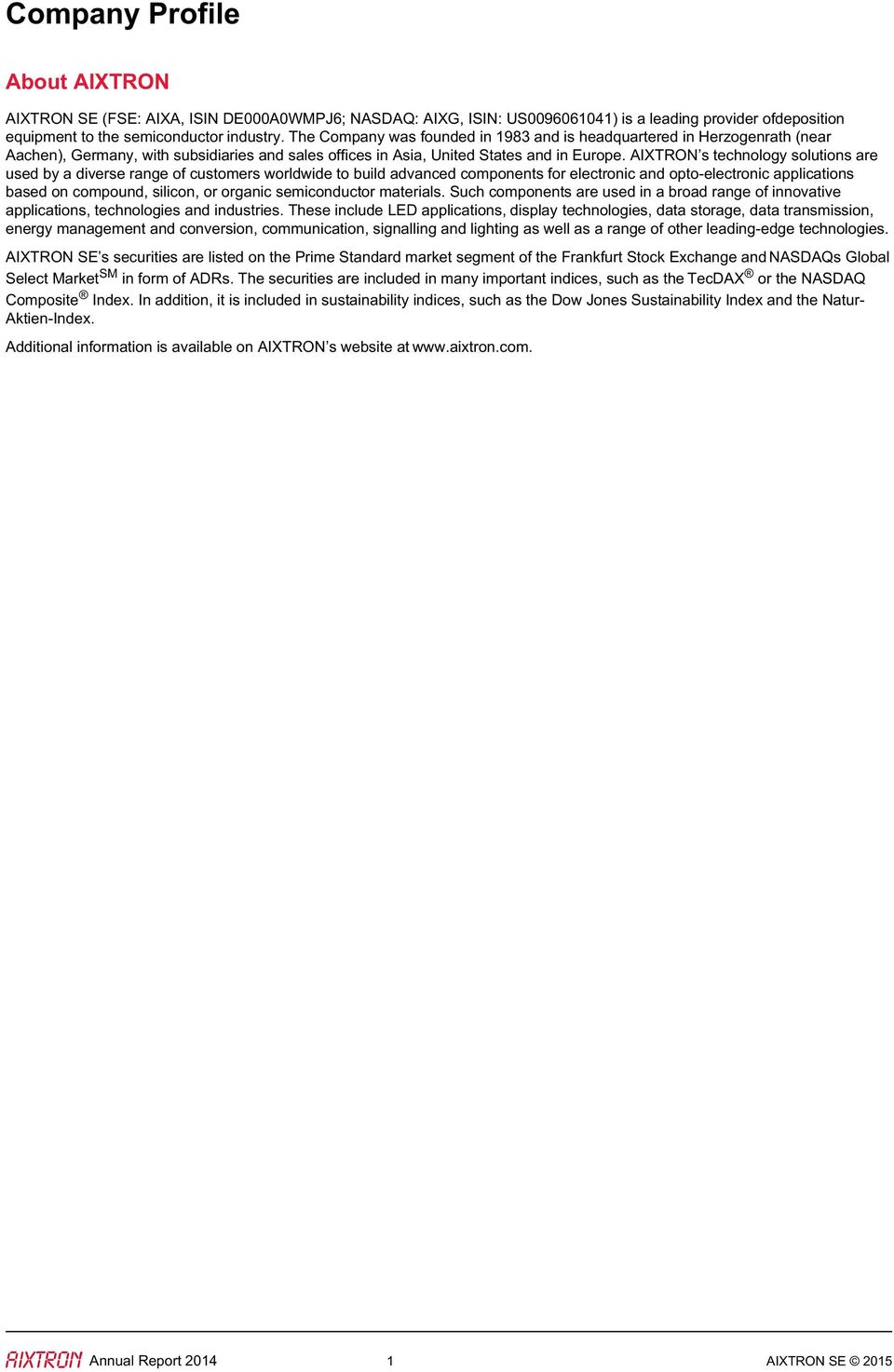
4 REVENUES (IFRS) in EUR million 1000 OPERATING RESULT (EBIT) in EUR million NET RESULT in EUR million NET RESULT PER SHARE in EUR Annual Report AIXTRON SE 2015
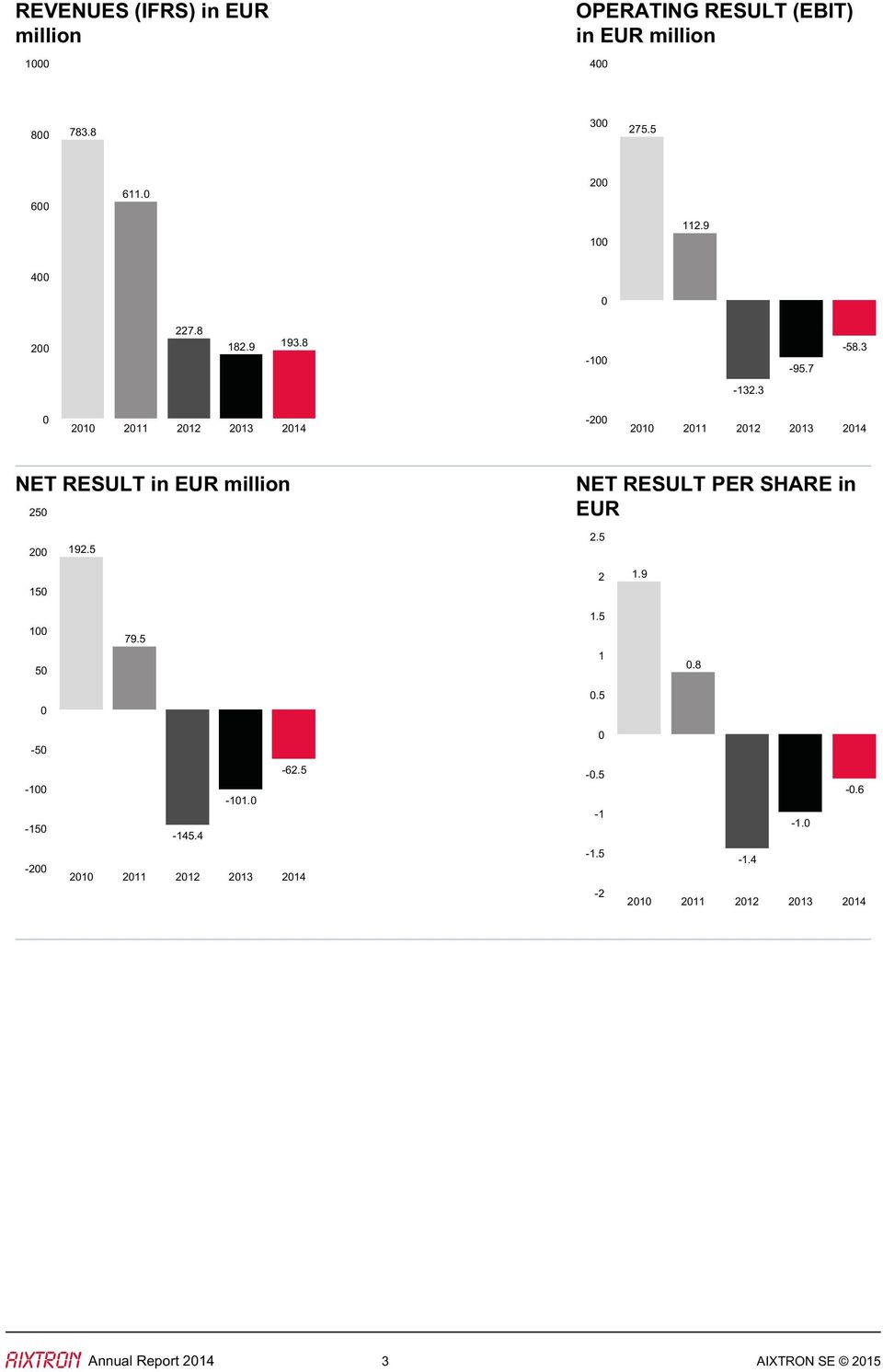
5 NUMBER OF EMPLOYEES Annual Report AIXTRON SE 2015
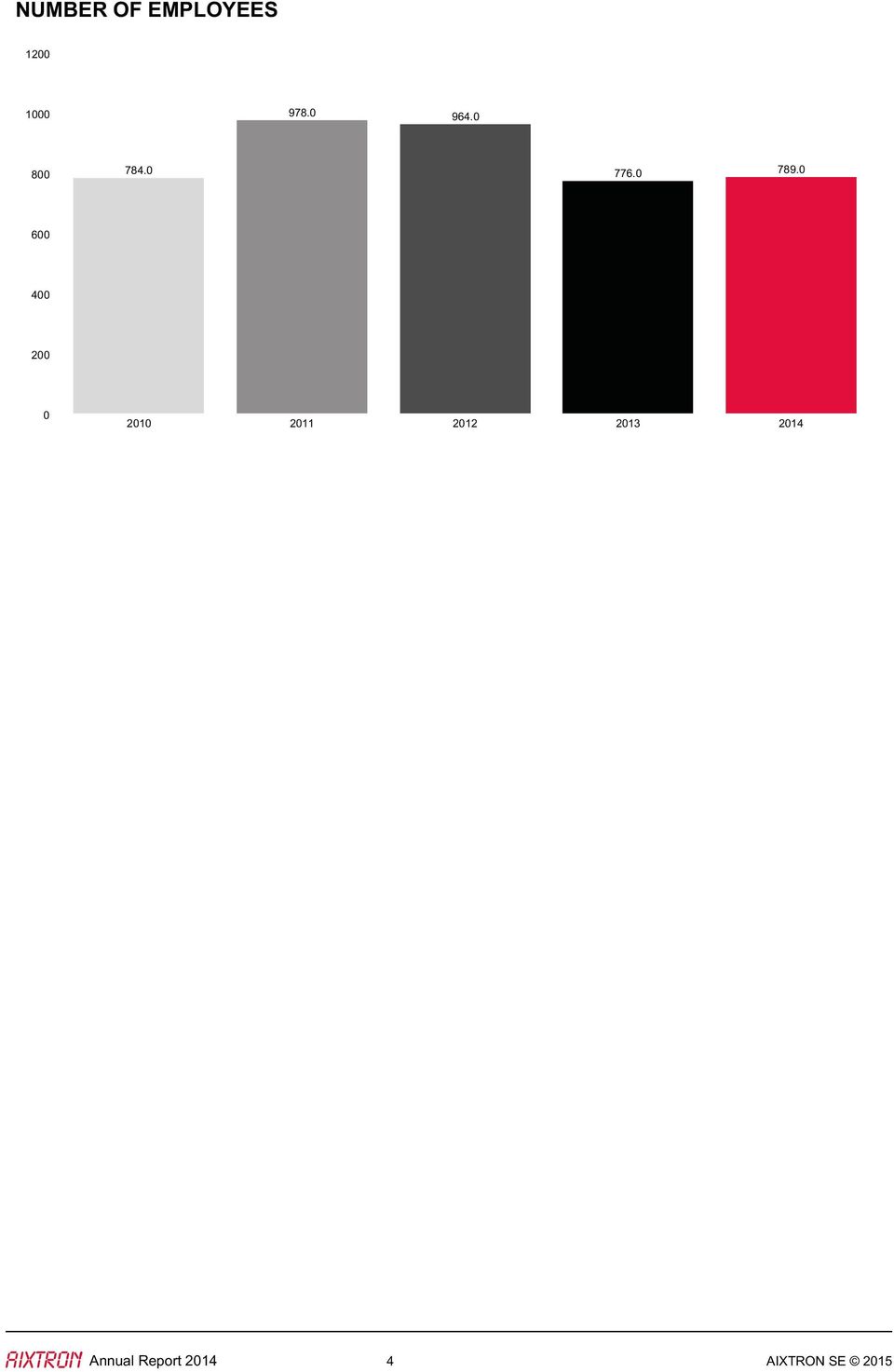
6 REVENUES BY REGION IN % 13 % 83 % Asia (83%) Europe (13%) USA (4%) REVENUES BY APPLICATION IN % 0 % 1 % 3 % 6 % 7 % 11 % 3 % 68 % LED (68%) Silicon Applications (11%) Power Electronics (7%) Telecom/Datacom (6%) Consumer Electronics (3%) Solar (1%) Organic Applications (0%) Others (1%) Carbon Applications (3%) Annual Report AIXTRON SE 2015

7 REVENUES BY EQUIPMENT AND SERVICE IN % 77 % Equipment (77%) Spare Parts & Service (23%) Annual Report AIXTRON SE 2015

8 Letter to the Shareholders Dear shareholders, 2014 was, as anticipated, a difficult year for AIXTRON. But it was also a year for setting critical strategic directions. As announced at the last Annual General Meeting, we launched the new MOCVD AIX R6 system onto the market last fall and made significant progress in the further development of our future oriented technologies. We also moved forward with our efficiency and productivity measures under the 5-Point-Program and further enhanced close partnerships with our customers and suppliers. Our target for 2015 is to grow in all technology areas and improve our earnings situation step by step. We expect a sequential increase of the results in both halves of 2015 compared with the previous six-month periods and in the second half of the year, we anticipate a positive EBITDA (earnings before interest, taxes, depreciation and amortization) results are in line with our stated expectations. We were able to increase revenues six percent to EUR million and continued to reduce losses. However, we are not satisfied with the earnings situation of the Group. This was mainly due to the low topline level reflecting the challenges that specifically the MOCVD industry faces. Therefore, we as Management strongly believe that it is important continuing to invest in R&D, thereby reducing our dependency on one product while creating new business opportunities. Our future oriented technologies already started to perform well, despite the fact that market introduction of these new products still requires preparatory efforts. Due to our focus on active cash management, we continue to be in a solid financial situation. AIXTRON reached important milestones in 2014 With the launch of our new MOCVD AIX R6 system we received the largest single order in the history of our company. In conversations with numerous customers since then we sense an increased interest in this new generation of systems, distinguished mainly by their high levels of efficiency and low operating costs. As part of our 5-Point-Program we have improved customer relationships significantly by establishing Key Customer Satisfaction Teams and increasing the personal involvement of the Executive Board. We are moving forward step by step and making good progress in key projects such as the integrated supply chain management or the design-to-cost program. The first positive impact on the Group result is expected over the course of The financial solidity of the company was and is top priority for our actions. Our focus on sustainable cash management provides us with continued ample liquidity, so that we can develop our future oriented technologies and thereby, your company for sound success in a targeted fashion. AIXTRON is moving forward with restructuring We are continuously enhancing our technology and product portfolio by leveraging the innovative strengths of our employees at AIXTRON and dedicating ourselves to our core competence, the deposition of complex semiconductor materials. With the introduction of the new AIX R6 last November, we demonstrated that our products continue to offer a special added value for our customers and that we regularly established new technological standards. At the same time, customer and market requirements are constantly changing. A living organism like AIXTRON must respond to these developments, it has to be flexible and able to change itself. We are responding to the increasing importance of process and application-oriented solutions by restructuring the Group. This will result in shifts and adjustments in the organization that will also impact employee profiles. Diversification is the key to a sustainable income base Although we have recently further diversified our technology portfolio, MOCVD technology for the production of LEDs, lasers and power electronics is still at core of our business. In this area the anticipated, steady shift away from traditional lighting to LED lighting is taking place. Nevertheless, a clear prediction about the size and timing of large orders for new LED production systems in 2015 is still not easy to make. In power electronics we notice increased acceptance for energy-efficient components based on the gallium-nitride-on-silicon and silicon carbide technology. That is also the primary intention of our cooperation with the Fraunhofer Institute for Integrated Systems and Device Technology (IISB). On the whole, we therefore anticipate increased demand for our systems. In the previous fiscal year we were able to meet two central targets in organic electronics. We put into operation our R&D cluster for demonstrating OLED production processes and also began constructing our Gen8 demonstration system. This will become operational by mid-2015 and will serve to demonstrate to our customers the cost-effective and efficient production of organic thin films on large areas for the industrial production of OLED displays and lighting applications. We expect the first notable orders in mid In the silicon semiconductor industry our ALD technology is one of the keys to efficient memory chip production. Here, after a drop in 2014, we expect significant growth in the current fiscal year. Based on positive customer feedback, we consider the future technology III-V on silicon that makes new processors even more powerful to be a key area and are therefore working hard on its further development. Annual Report AIXTRON SE 2015
9 In the future, graphene and nanomaterials such as carbon nanotubes and carbon nanowires will be used in many applications such as displays, energy stores and semiconductors. Here, we have a very strong position in academic research all over the world. Increasing demand from industrial research for our PECVD systems series as well as close collaboration with our customers testify to the fact that we are on the right track. Allow me in closing to summarize briefly what we have achieved and what remains to be done: We have launched a new generation of systems onto the market, further enhanced our technology portfolio, and made progress in the company's productivity, thus strengthening our income base. These are important steps forward, but there remains much to be done! The return to profitability is at the top our agenda. At the same time, we are working incessantly on the execution of our innovation roadmap to ensure new technology solutions with significant added value for our customers are brought to market and enjoy commercial success. A continued and consistent implementation of the second stage of our 5-Point-Program which I presented to you at the last Annual General Meeting is an essential prerequisite for making that happen. Dear shareholders, My sincere thanks go again this year to the employees of our company who work with incredible dedication to ensure the success of AIXTRON and who in the past few months have put in a decisive effort. The changes that arise for our company as a result of the increasing importance of process and application-oriented solutions that have necessitated the restructuring have demanded the utmost from each and every member of our team. Dr. Schulte and I are very aware of that and not just because the two of us have been running the Company since May of I would also like to extend our special thank-you from both of us to the Supervisory Board for their active support, quick decisions, and constant, valuable dialogue. Special thanks, of course, go to you, our shareholders, who have supported the transformation process at AIXTRON over the past two years. We are convinced that we are pursuing the right strategy to return your company to sustained profitability. Our main objective is therefore to be profitable on an EBITDA basis in the second half of Yours sincerely, Martin Goetzeler Annual Report AIXTRON SE 2015
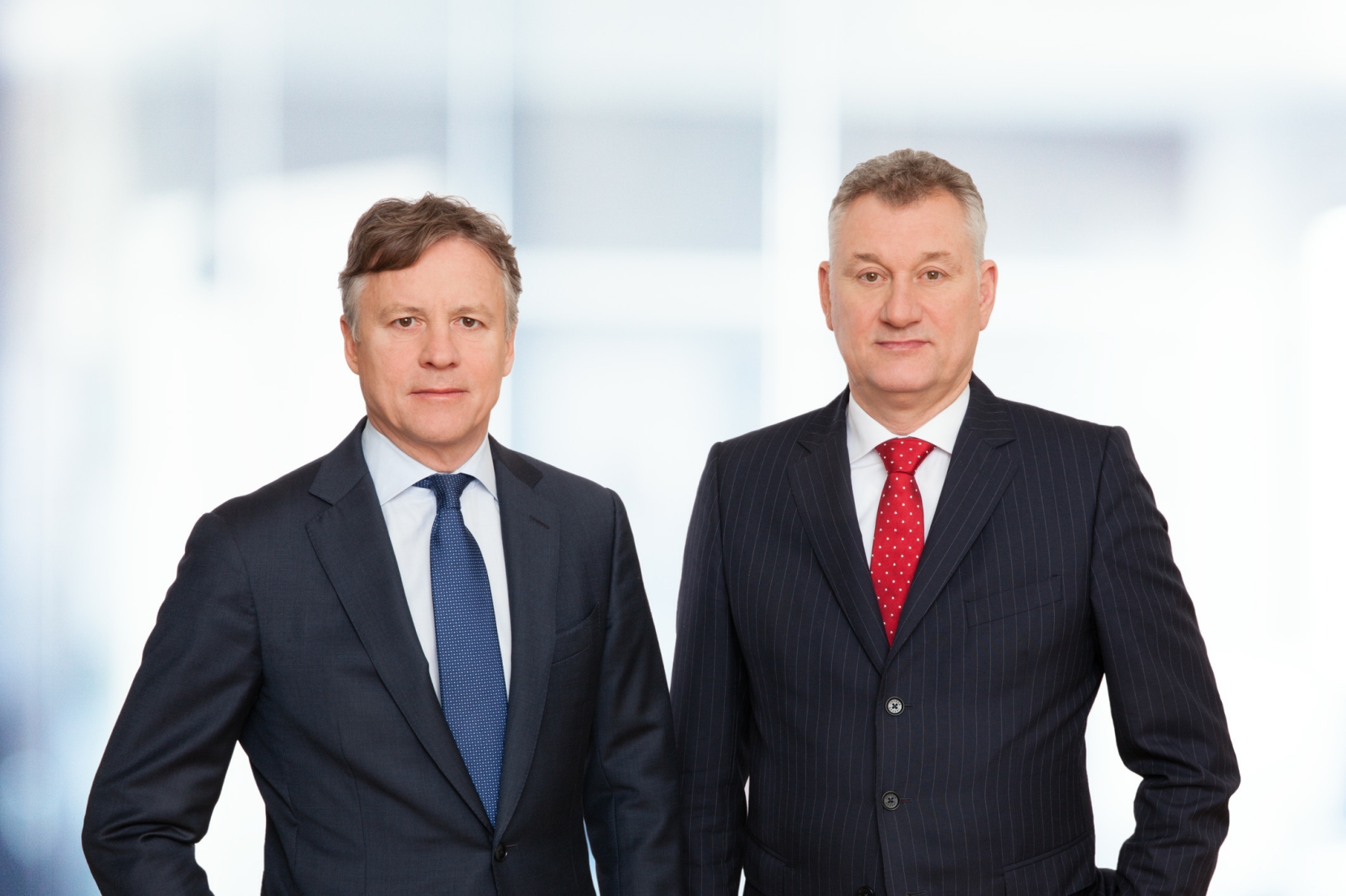
10 The Executive Board Martin Goetzeler Chief Executive Officer Dr. Bernd Schulte Chief Operating Officer Annual Report AIXTRON SE 2015

11 Supervisory Board Report The Supervisory Board fully satisfied its responsibilities and duties as stipulated by law, in the Articles of Association and by-laws. All members of the Supervisory Board and its committees took part in all meetings. We continuously monitored the Executive Board management activities, and actions were monitored on a regular basis; it was ensured that the Company was managed in a legal, orderly, proper and cost-effective manner. During the reporting year, the Supervisory Board did not make use of the option of inspecting the books and documentation of the Company (Article 111 (2) AktG // German Stock Corporation Act). This was not necessary due to the regular intensive and satisfactory reporting by the Executive Board, the audit by and the discussions with the Auditor (German Public Auditors) and the described supplementary monitoring measures. Composition of the Supervisory Board and Executive Board The Executive Board fully satisfied its verbal and written reporting duty to the Supervisory Board. It involved us and our specialist committees in all material business transactions and highly significant decisions for the Company. We had in-depth discussions in the meetings (both in plenum discussions as well as in the committees) with the Executive Board about the information presented to us. Cooperation with the Board of Directors was characterised in all respects by responsible and targeted activities. Outside of the meetings we regularly consulted within the Supervisory Board, and the Executive Board informed us of important events in the AIXTRON Group in a timely fashion. Between meetings I met regularly with the Chief Executive Officer, Martin Goetzeler. In addition to talking about the current business situation, we also talked about issues related to strategic alignment, the risk situation, risk management and compliance. Between meetings, the Chairman of the Audit Committee, Prof. Dr. Blättchen, and the Chairman of the Technology Committee, Prof. Dr. Denk, maintained active dialogue with the respective Executive Board members responsible. All Supervisory Board members also received detailed quarterly reports on the status of the Company. Through a protected intranet web portal, the Supervisory Board had access to other documents and information, such as internal control reports, meeting minutes, company presentations, research analyst reports, analyst consensus reports, press releases and AIXTRON's financial reports. As in every year, we also consulted with the Executive Board on the risk situation, risk management and compliance in the Company and carefully checked the corresponding developments and measures. The Executive Board presented all transactions subject to approval to the Supervisory Board in a timely fashion. After thorough consultation and review, we gave our consent where appropriate. Annual Report AIXTRON SE 2015
12 Focus of plenum discussions In 2014, the Supervisory Board convened in one extraordinary meeting on January 24 and four ordinary meetings on February 24, May 13, September 17 and December 10, all of which were attended by all six members of the Supervisory Committee. In the four ordinary meetings, we regularly conducted in-depth discussions on the development of the business of the AIXTRON Group, particularly in light of the ongoing market weakness and the price/competition pressure. During these meetings we were able to form a sufficient picture of the current business situation using the current financial figures and the updated forecast reports and development plans (orders, revenues, market shares). Deviations from the budget plan during the course of business were explained in detail and justified. In the ordinary Supervisory Board meetings in February, May, September and December, we were informed of the progress of various projects, relevant product developments (example: new MOCVD system AIX R6; market launch in November), important customer orders (for example: San an, a major contract from China, obtained and published in September), key developments in the region (for example: closure of the Swedish site, AIXTRON AB), changes in the personnel and internal organisational structure as well as the progress and measures of the Five Point program (example: iscm Supply Chain Management project which focuses on shortening supply times). In view of the current situation for margins and earnings, we discussed in detail various proposals to further reduce costs in each of these meetings. To this end, the Executive Board supplied us with detailed cost breakdowns. We used them as a basis to discuss specific measures, particularly to further reduce manufacturing costs significantly (material, production and installation) and sales and administrative costs, and to define targets. For example, under the scope of a newly created "Design-to-Cost" project, we initiated the review of all production costs spanning functions and products and particularly the reduction of the purchase costs of materials and components. Our aim is to improve the overall cost structure and help to turn a profit through stronger management of the various departments to meet financial targets (KPIs) under the Five Point program. As a result of AIXTRON's strategic alignment with its strong focus on innovation, we agreed with the Executive Board that, for R&D, it only makes sense to limit maximum costs without any other significant cost reductions. Moreover, special priority was given to those R&D projects which focused on developing new fields of the future with existing technologies. The respective innovation processes were discussed for this purpose. In addition, the following topics were addressed in the individual meetings: Supervisory Board meetings in 2014 The extraordinary meeting on 24 January 2014 primarily dealt with the result of the comprehensive strategic analysis and the newly formulated corporate strategy with a focus on defined technology fields. We also made changes to the responsibilities of the CEO and CFO. The meeting on February 24, 2014 concentrated on the Annual and Consolidated Financial Statements for fiscal year 2013 and the respective discussions and resolutions on the agenda. We reported on this information in detail in our report for fiscal year In addition we looked at the agenda of the 2014 Annual General Meeting and the resolutions it proposed. Finally, we unanimously approved the increase in the current stock option tranche (2013) from 800,000 to 950,000 stock options, particularly so that key employees are adequately included. At the meeting on May 13, 2014, we authorised the Executive Board to buy back treasury shares to use for performance-based remuneration of the Executive Board. At the meeting on September 17, 2014, we issued approvals to pursue various strategic projects. We also resolved to exempt the Chief Executive Officer, Martin Goetzeler, from the ban on multiple representation pursuant to Section 181 2nd Alternative of the German Civil Code (Bürgerliches Gesetzbuch - BGB) so that he can also assume the role of CEO at subsidiaries of AIXTRON SE. We also reallocated the responsibilities of the Executive Board after the departure of the CFO at the time, Wolfgang Breme, in a modified business distribution plan now that the responsibility for finances in the Executive Board lies with the Chief Executive Officer, Martin Goetzeler. Finally, we agreed to another increase in the stock options to be issued under the stock option program 2012 as "Tranche 2014" and "Tranche 2014_I" to 1.2 million units so that stock options can be offered to a broader group of employees. On December 10, 2014, the Supervisory Board of AIXTRON SE convened for its last ordinary meeting of the year. Here we agreed to the 2015 budget presented by the Executive Board after a detailed discussion, with the provision that the planned expenditures must be monitored regularly along with the progress of the business. Among other elements, the 2015 budget includes detailed sales revenues, income, financial and investment planning data, as well as the planned personnel development at AIXTRON. In addition, it included the new internal organizational structure which envisages responsibilities on the basis of technology fields that were presented to us in the previous meetings by the Executive Board. Finally, in the last meeting of the year, we conducted a self-evaluation of our activities using an extensive questionnaire distributed to the members of the Supervisory Board in advance of the meeting, which found that the Supervisory Board and its committees are working efficiently. Annual Report AIXTRON SE 2015
13 Committees The Supervisory Board currently has four committees: an Audit Committee, a Technology Committee, a Nomination Committee and a Capital Market Committee. The Audit Committee addresses, in particular, the monitoring of the accounting process, compliance, the effectiveness of the internal control system, the risk management system, the internal audit system and the implementation of the rules in accordance with Section 404 Sarbanes-Oxley Act (SOA 404). The Chairman of the Audit Committee, Prof. Dr. Blättchen, is an independent Supervisory Board member whose area of expertise is reporting and audits (as required by law: Section 107 (4); Section 100 (5) AktG // German Stock Corporation Act) and who has particular knowledge and experience in the application of internal control processes. In the reporting year as well, the Audit Committee was responsible for the audit of the financial statements and monitored, in particular, the required independence of the auditor and any additional services performed by the auditor. Finally, it issued the mandate to the auditor, identified the focal points of the audit and handled the fee arrangements. The Committee Chair reported regularly on the work of the Audit Committee to the Supervisory Board. The Audit Committee convened four times in 2014, and the meetings were all attended by all three Committee members. In addition to the financial and earnings situation, the Audit Committee looked at the following issues, among others: Restructuring of the "Finances" division following the resignation of the Mr. Wolfgang Breme from the Company's Executive Board and the revision of all corporate representation regulations The engagement of the auditing firm Deloitte & Touche GmbH to audit the Individual Financial Statements of AIXTRON SE in accordance with the German Commercial Code (HGB) and the Consolidated Financial Statements of the AIXTRON Group in accordance with IFRS, the US Annual Report in the 20-F form, the risk screening system within the meaning of Section 91 (2) AktG and the internal controls for the financial reporting within the meaning of SOA 404 and prepare a Management Letter and findings in accordance with Section DCGK (German Code of Corporate Governance at AIXTRON SE. Review of the Statement of Independence and the "Management Letter" written by the Auditor (main conclusions from 2013 audits of the Individual Financial Statements and the Consolidated Financial Statements of the AIXTRON Group and of the internal control system). Revision of the compliance plan, in part, to comply with the Dodd-Frank Act, the new SEC requirements for what are known as conflict minerals (e.g., tantalum, tungsten, tin, gold) and regular reporting (SEC Form SD); adjustments to the compliance manual; obtaining compliance statements from executives on a quarterly basis. Regular discussion of the quarterly report and the semi-annual report in telephone conferences. Audit focal points for Deloitte & Touche GmbH for the audit of the 2014 AIXTRON Individual Financial Statements and Consolidated Financial Statements. Risk management report (ordinary risk management of the Executive Board pursuant to Section 91 (2) AktG and effectiveness of the risk management system) Company audit USA, tax audit Germany SOX testing Regular review of the 20-F by the SEC Implementation of COSO 2013 (updated rules for SOA inspections) to reduce the number of inspections conducted Issue of cyber security Development of the inventory/stock levels The Technology Committee deals, in particular, with questions of AIXTRON's market positioning in technology, patents, product planning and technology development, potential technology acquisitions and other topics relating to diversification. The Committee Chair, Prof. Denk, regularly reports to the Supervisory Board on the activities of the Technology Committee in the plenum meetings. In fiscal year 2014, the Technology Committee convened in four meetings which were all attended by all three committee members. The focus of the Technology Committee's work, in addition to the status reports from the individual technology areas, was further developments of products and their critical assessment. The Nomination Committee, consisting of three members, makes nomination proposals to the Supervisory Board if one of the Supervisory Board positions needs to be replaced, taking into account its own objectives on its future composition as well as following the requirements of the DCGK regarding appropriate diversity and an appropriate number of independent Supervisory Board members. The Nomination Committee did not convene in fiscal year Due to the evaluation of various strategic projects, the Supervisory Board formed a Capital Market Committee consisting of two members as of April 12, The committee with its two members convened on April 27, 2014 and August 22, 2014 in Frankfurt. Annual Report AIXTRON SE 2015

14 Corporate Governance and Declaration of Conformity The Supervisory Board regularly checks on the development of the Corporate Governance Standards and, together with the Executive Board, writes a joint Corporate Governance report. We will continue to support the Executive Board in its efforts to remain in full compliance with the German Corporate Governance Code recommendations. In the latest Declaration of Conformity in accordance with Section 161 AktG (German Stock Corporation Act) dated February 2015, with the exception of the deviations stated, the Executive and Supervisory Board certified full compliance with the recommendations of the German Corporate Governance Code. No conflicts of interest were reported by the members of the Supervisory or Executive Board. Changes to the Executive Board As of May 31, 2014 Mr. Wolfgang Breme resigned from the Company's Executive Board that he had been a member of since We thank Mr. Breme for his long-standing commitment which helped shape the development of AIXTRON for many years. Following Mr. Breme's departure, the Chief Executive Officer (CEO), Mr. Martin Goetzeler, also assumed the role of CFO. Audit and Annual Financial Statements Following the resolution passed at the Company's Annual General Meeting on May 14, 2014, the Supervisory Board awarded the mandate to audit the Financial Statements of AIXTRON SE and the Consolidated Financial Statements of the AIXTRON Group for fiscal year 2014 to Deloitte & Touche GmbH Wirtschaftsprüfungsgesellschaft, Düsseldorf. The auditors also reviewed the Company's Annual Report in Form 20-F and the internal control system in accordance with the Sarbanes-Oxley Act of 2002, as well as measures implemented by the Executive Board to detect, at an early stage, business risks that could potentially jeopardize the performance and existence of the Company. It was also agreed that the auditors would, if necessary, inform the Supervisory Board or make a note in the audit report of any facts found during their examination which conflict with the Declaration of Conformity under Section 161 AktG (German Stock Corporation Act) issued by the Executive Board and the Supervisory Board. As in previous years, the auditors did not make any note of such a finding for fiscal year The Financial Statements of AIXTRON SE as of December 31, 2014 and the Management Report were prepared in accordance with the requirements of the German Commercial Code (HGB), while the Consolidated Financial Statements as of December 31, 2014 and the Group Management Report were prepared in accordance with Section 315a HGB on the basis of the International Financial Reporting Standards (IFRS). The Financial Statements of AIXTRON SE and the Consolidated Financial Statements of the AIXTRON Group were each given an unqualified audit opinion. The auditors found that the Management Reports of both AIXTRON SE and the AIXTRON Group present a true and fair view of the current position and prospects of AIXTRON SE and the AIXTRON Group. The Annual Financial Statement documents (Annual Financial Statements of AIXTRON SE and the Consolidated Financial Statements of the AIXTRON Group as of December 31, 2014, including the Management Report of the Company and the Group) and the audit reports by the auditors were submitted to the Audit Committee and the full Supervisory Board for examination in a timely manner. We examined these documents in detail. The Annual Financial Statements of AIXTRON SE and the Consolidated Financial Statements of the AIXTRON Group, as well as the respective Management Reports, were discussed in detail with the Company's auditors at the Audit Committee and Supervisory Board Meeting on February 23, 2015, with due consideration given to the auditor's reports. The auditor, who participated in both the meeting of the Audit Committee as well as the subsequent meeting of the Supervisory Board meeting, reported on the key audit results, which also covered the internal control and risk management system as they relate to the accounting process, and was available to answer any additional questions raised by the Audit Committee or Supervisory Board. The Supervisory Board also discussed the 2014 Annual Report Form 20-F as required by the U.S. Securities and Exchange Commission (SEC). Following our own examination, we had no objections to the single-entity or consolidated financial statements submitted. The respective Management Reports matched our own assessment of the Company and the Group's situation. We fully concurred with the auditor's results and opinion and consequently, in a resolution passed on February 23, 2015, we approved both the Annual Financial Statements of AIXTRON SE and the Consolidated Financial Statements of the AIXTRON Group prepared by the Executive Board for fiscal year The Annual Financial Statements of AIXTRON SE are therefore formally adopted. Form 20- F for fiscal year 2014 was approved for filing with the SEC. Annual Report AIXTRON SE 2015
15 Note of thanks from the Supervisory Board We would like to thank the Executive Board and all employees around the world. With their personal dedication and loyalty, they have helped initiate various restructuring and cost reduction measures that will benefit our company. We would also like to thank the employee representatives for their constructive work with various boards and councils within the Company. We would also like to express our appreciation to our shareholders for their support and their ongoing confidence in AIXTRON SE. Herzogenrath, February 2015 AIXTRON SE Kim Schindelhauer Chairman of the Supervisory Board Annual Report AIXTRON SE 2015
16 Corporate Governance Report 1. Declaration on Corporate Governance 1.1 Declaration of Conformity In accordance with Section 161 AktG (German Stock Corporation Act), the Executive Board and the Supervisory Board of AIXTRON SE declare: AIXTRON SE meets all recommendations of the Government Commission on the German Corporate Governance Code (Regierungskommission "Deutscher Corporate Governance Kodex") published by the Federal Ministry of Justice (Bundesministerium der Justiz) in the official portion of the German Federal Gazette (Bundesanzeiger), in the version dated June 24, 2014, with the exception of the following deviations declared for precautionary reasons: Consideration of the relationship between the remuneration of the Executive Board and the remuneration of senior management and staff overall at the present time and over the course of its historical development (Section (2) Clause 3 DCGK // German Corporate Governance Code) The German Corporate Governance Code (DCGK) recommends in Section (2) Clause 3 that the Supervisory Board should take into account the relationship between the remuneration of the Executive Board and senior management and staff overall at the present time and over the course of its historical development when determining the total remuneration of individual members of the Executive Board, with the Supervisory Board specifying how the senior management and the relevant staff are to be differentiated for the comparison. The Supervisory Board did not explicitly specify at the time of the conclusion of the current contracts with the Executive Board how the senior management and the relevant overall staff are to be differentiated from the Executive Board. The relationship between the remuneration of the Executive Board and the remuneration of senior management and the relevant overall staff, however, is used as a basis to assess the appropriateness of the remuneration of the Executive Board pursuant to Section (2) Clause 2 German Corporate Governance Code (DCGK). Upper limits for remuneration of the Executive Board (Section (2) Clause 6 DCGK // German Corporate Governance Code) The German Corporate Governance Code (DCGK) in Section (2) Clause 6 recommends that the remuneration of the Executive Board members in total and with respect to their performance-based salary components should have upper limits in terms of amounts. The total remuneration of Executive Board members at AIXTRON SE includes both a fixed salary and various performance-based salary components. The performance-based remuneration is limited to a maximum of EUR 6.5m with respect to the performance-based bonus for the entire Executive Board. Half of the performance-based remuneration is awarded in the form of Company stock options. The amount of the respective stock option is subject to the aforementioned upper limit at the time of its awarding. In this respect, the recommendation has been complied with. The shares are only transferred to the entitled recipient three years after being awarded. Within this time frame, the members of the Executive Board benefit unlimitedly from the potential rise in the price of the shares, which may be viewed as a deviation from the wording of the recommendation. A further limit on the performance-based remuneration with respect to the time of the transfer of the shares does not seem to be in the interests of the parties, since the essential incentive of share-based remuneration to work toward increasing corporate value would be counteracted and the Executive Board members would be placed at a disadvantage above such an upper limit in the event of a further increase in the stock price. An upper limit in terms of amounts for the total remuneration is thus not explicitly included in the current contracts for the Executive Board members. AIXTRON SE has fully complied with the recommendations of the German Corporate Governance Code (DCGK), in the version of May 13, 2013 since the issuing of the last Declaration of Conformity in February 2014 and the recommendations of the German Corporate Governance Code (DCGK), in the version of June 24, 2014 since being announced in the official portion of the Federal Gazette, with the exception of the deviations mentioned above. Herzogenrath, February 2015 AIXTRON SE For the Executive Board of AIXTRON SE Martin Goetzeler Chairman & Chief Executive Officer For the Supervisory Board of AIXTRON SE Kim Schindelhauer Chairman of the Supervisory Board Annual Report AIXTRON SE 2015
17 1.2 Information regarding Corporate Governance Practices AIXTRON SE has had a Code of Ethics since 2006 for Executive Board members and certain managers in Finance. The aim of this Code is to promote upright and ethical conduct, including the ethical handling of conflicts of interest, the complete, fair, precise, timely and transparent disclosure of quarterly and annual reports, compliance with prevailing laws, rules and regulations and the immediate internal reporting of breaches of the Code where necessary and to ensure accountability for compliance with the Code. The complete text of the Code can be found on the AIXTRON website in the Investor/Corporate Governance area. In addition, AIXTRON has issued a Compliance Code of Conduct applicable to the Company's Executive and Supervisory Boards, as well as all employees throughout the world, which holds them accountable for conscientious conduct in conformity with the law. Amongst the topics addressed, this Code covers the following issues: responsibility and respect towards society and the environment, compliance with the legal conditions, legal and ethical conduct by each individual employee, loyalty to the Company, fair and respectful treatment of fellow employees, rejection of any form of discrimination, dealing responsibly with corporate risks, acting in an environmentally responsible manner, security in all operating areas, working in a professional manner, reliability and fairness in all business relationships, compliance with guidelines on giving/accepting unfair advantages, dealing with insider information and the treatment of Company property. In addition, due to particular requirements set by NASDAQ, AIXTRON SE has a separate NASDAQ Code of Conduct. The full texts of the Compliance Code of Conduct and the NASDAQ Code of Conduct can also be downloaded from the AIXTRON website. In 2010, AIXTRON issued a Compliance Manual which applies to all members of the Company's senior management and is the basis for the principles of the Compliance Code of Conduct. The Compliance Manual provides detailed explanations on the subject of compliance organization at AIXTRON and on the resulting conduct requirements applicable to the Executive Board, the Supervisory Board and the employees. Regular training is held for employees to reinforce these requirements. This manual is regularly updated to reflect amended statutory requirements and was therefore also amended in fiscal year Each quarter, the senior managers declare in writing that in their area of responsibility the compliance requirements of AIXTRON SE were observed. If the Compliance Manual has been updated, they also declare that they will take note of the updated version and follow and communicate its contents within their area of responsibility. Furthermore, AIXTRON has established a Vendor Code of Conduct, which defines ethical, moral and legal standards in connection with the purchase and use of what are known as conflict minerals (gold, tantalum, tungsten, tin) within the AIXTRON supply chain. The key content of this code includes information on U.S. rules regarding the use of conflict minerals, the process of due diligence on the supply chain, the expectations for supply chain partners and suppliers and the consequences in the event of non-compliance. The complete text of the Vendor Code of Conduct can be accessed on the AIXTRON website in the Investor/Corporate Governance area. 1.3 Executive Board and Supervisory Board Operating Procedures; Composition and Mode of Operation of Committees As a European company (Societas Europaea), AIXTRON SE is subject not only to the German Stock Corporation Act, but also to the superordinate European SE regulations (SE-Regelungen) and the German SE Implementation Act (SE-Ausführungsgesetz). The Company has a dual management and supervisory structure consisting of an Executive Board and a Supervisory Board. The Executive Board is responsible for managing the Company and informs the Supervisory Board regularly, comprehensively and without delay about all relevant issues involving strategy, planning, business development, the Company's risk situation, risk management and compliance. The Supervisory Board is responsible for the appointment of the Executive Board members and oversees and advises the Executive Board with regard to its management duties. For certain transactions and measures specified in the Articles of Association of AIXTRON SE or the Executive Board's by-laws, the Executive Board must obtain the prior approval of the Supervisory Board. The Executive Board is required to report to the Supervisory Board on the conclusion, amendment or termination of material agreements that do not require approval under the Articles of Association or the Executive Board's by-laws. The Executive Board is also required to notify the Supervisory Board of all material events, even those that do not require the approval of the Supervisory Board. As in previous years, the Executive Board and the Supervisory Board worked closely together throughout 2014 for the benefit of the Company. The common goal is the return to profitability. Annual Report AIXTRON SE 2015

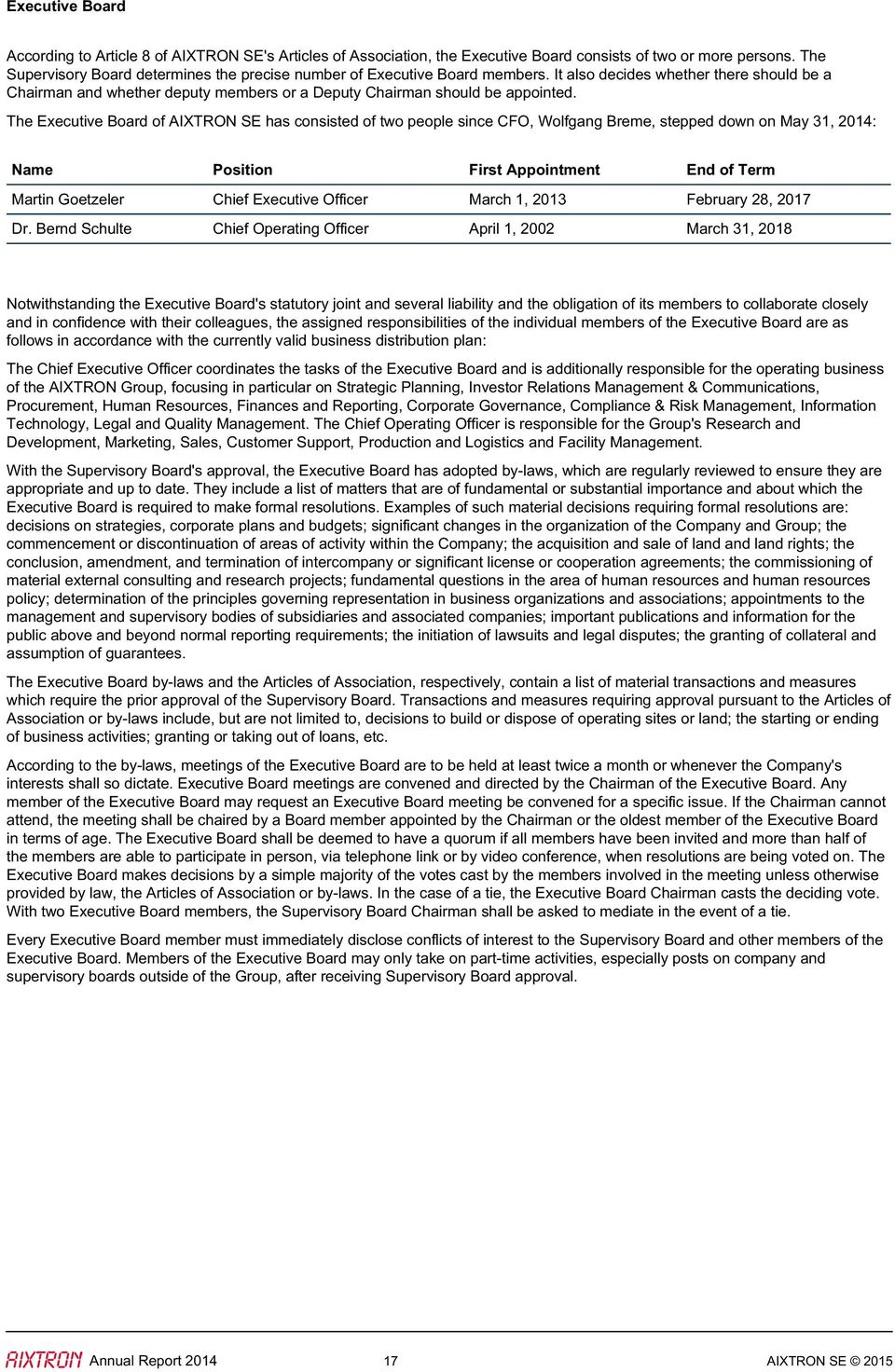
18 Executive Board According to Article 8 of AIXTRON SE's Articles of Association, the Executive Board consists of two or more persons. The Supervisory Board determines the precise number of Executive Board members. It also decides whether there should be a Chairman and whether deputy members or a Deputy Chairman should be appointed. The Executive Board of AIXTRON SE has consisted of two people since CFO, Wolfgang Breme, stepped down on May 31, 2014: Name Position First Appointment End of Term Martin Goetzeler Chief Executive Officer March 1, 2013 February 28, 2017 Dr. Bernd Schulte Chief Operating Officer April 1, 2002 March 31, 2018 Notwithstanding the Executive Board's statutory joint and several liability and the obligation of its members to collaborate closely and in confidence with their colleagues, the assigned responsibilities of the individual members of the Executive Board are as follows in accordance with the currently valid business distribution plan: The Chief Executive Officer coordinates the tasks of the Executive Board and is additionally responsible for the operating business of the AIXTRON Group, focusing in particular on Strategic Planning, Investor Relations Management & Communications, Procurement, Human Resources, Finances and Reporting, Corporate Governance, Compliance & Risk Management, Information Technology, Legal and Quality Management. The Chief Operating Officer is responsible for the Group's Research and Development, Marketing, Sales, Customer Support, Production and Logistics and Facility Management. With the Supervisory Board's approval, the Executive Board has adopted by-laws, which are regularly reviewed to ensure they are appropriate and up to date. They include a list of matters that are of fundamental or substantial importance and about which the Executive Board is required to make formal resolutions. Examples of such material decisions requiring formal resolutions are: decisions on strategies, corporate plans and budgets; significant changes in the organization of the Company and Group; the commencement or discontinuation of areas of activity within the Company; the acquisition and sale of land and land rights; the conclusion, amendment, and termination of intercompany or significant license or cooperation agreements; the commissioning of material external consulting and research projects; fundamental questions in the area of human resources and human resources policy; determination of the principles governing representation in business organizations and associations; appointments to the management and supervisory bodies of subsidiaries and associated companies; important publications and information for the public above and beyond normal reporting requirements; the initiation of lawsuits and legal disputes; the granting of collateral and assumption of guarantees. The Executive Board by-laws and the Articles of Association, respectively, contain a list of material transactions and measures which require the prior approval of the Supervisory Board. Transactions and measures requiring approval pursuant to the Articles of Association or by-laws include, but are not limited to, decisions to build or dispose of operating sites or land; the starting or ending of business activities; granting or taking out of loans, etc. According to the by-laws, meetings of the Executive Board are to be held at least twice a month or whenever the Company's interests shall so dictate. Executive Board meetings are convened and directed by the Chairman of the Executive Board. Any member of the Executive Board may request an Executive Board meeting be convened for a specific issue. If the Chairman cannot attend, the meeting shall be chaired by a Board member appointed by the Chairman or the oldest member of the Executive Board in terms of age. The Executive Board shall be deemed to have a quorum if all members have been invited and more than half of the members are able to participate in person, via telephone link or by video conference, when resolutions are being voted on. The Executive Board makes decisions by a simple majority of the votes cast by the members involved in the meeting unless otherwise provided by law, the Articles of Association or by-laws. In the case of a tie, the Executive Board Chairman casts the deciding vote. With two Executive Board members, the Supervisory Board Chairman shall be asked to mediate in the event of a tie. Every Executive Board member must immediately disclose conflicts of interest to the Supervisory Board and other members of the Executive Board. Members of the Executive Board may only take on part-time activities, especially posts on company and supervisory boards outside of the Group, after receiving Supervisory Board approval. Annual Report AIXTRON SE 2015
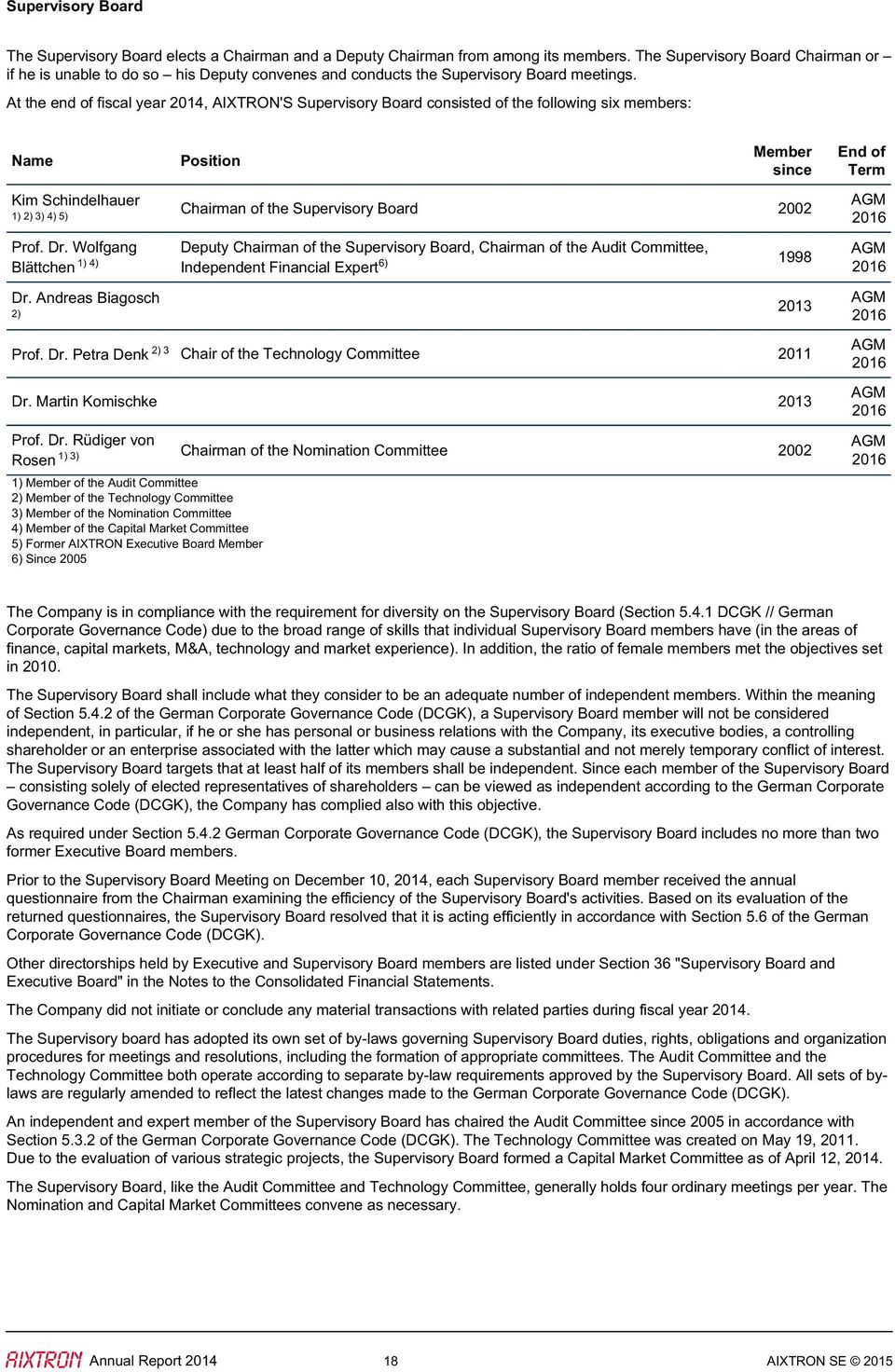
19 Supervisory Board The Supervisory Board elects a Chairman and a Deputy Chairman from among its members. The Supervisory Board Chairman or if he is unable to do so his Deputy convenes and conducts the Supervisory Board meetings. At the end of fiscal year 2014, AIXTRON'S Supervisory Board consisted of the following six members: Name Position Member since Kim Schindelhauer 1) 2) 3) 4) 5) Chairman of the Supervisory Board 2002 Prof. Dr. Wolfgang Deputy 1) 4) Blättchen Chairman of the Supervisory Board, Chairman of the Audit Committee, Independent Financial Expert 6) 1998 Dr. Andreas Biagosch 2) 2013 Prof. Dr. Petra Denk 2) 3 Chair of the Technology Committee 2011 Dr. Martin Komischke 2013 Prof. Dr. Rüdiger von Rosen 1) 3) Chairman of the Nomination Committee ) Member of the Audit Committee 2) Member of the Technology Committee 3) Member of the Nomination Committee 4) Member of the Capital Market Committee 5) Former AIXTRON Executive Board Member 6) Since 2005 End of Term AGM 2016 AGM 2016 AGM 2016 AGM 2016 AGM 2016 AGM 2016 The Company is in compliance with the requirement for diversity on the Supervisory Board (Section DCGK // German Corporate Governance Code) due to the broad range of skills that individual Supervisory Board members have (in the areas of finance, capital markets, M&A, technology and market experience). In addition, the ratio of female members met the objectives set in The Supervisory Board shall include what they consider to be an adequate number of independent members. Within the meaning of Section of the German Corporate Governance Code (DCGK), a Supervisory Board member will not be considered independent, in particular, if he or she has personal or business relations with the Company, its executive bodies, a controlling shareholder or an enterprise associated with the latter which may cause a substantial and not merely temporary conflict of interest. The Supervisory Board targets that at least half of its members shall be independent. Since each member of the Supervisory Board consisting solely of elected representatives of shareholders can be viewed as independent according to the German Corporate Governance Code (DCGK), the Company has complied also with this objective. As required under Section German Corporate Governance Code (DCGK), the Supervisory Board includes no more than two former Executive Board members. Prior to the Supervisory Board Meeting on December 10, 2014, each Supervisory Board member received the annual questionnaire from the Chairman examining the efficiency of the Supervisory Board's activities. Based on its evaluation of the returned questionnaires, the Supervisory Board resolved that it is acting efficiently in accordance with Section 5.6 of the German Corporate Governance Code (DCGK). Other directorships held by Executive and Supervisory Board members are listed under Section 36 "Supervisory Board and Executive Board" in the Notes to the Consolidated Financial Statements. The Company did not initiate or conclude any material transactions with related parties during fiscal year The Supervisory board has adopted its own set of by-laws governing Supervisory Board duties, rights, obligations and organization procedures for meetings and resolutions, including the formation of appropriate committees. The Audit Committee and the Technology Committee both operate according to separate by-law requirements approved by the Supervisory Board. All sets of bylaws are regularly amended to reflect the latest changes made to the German Corporate Governance Code (DCGK). An independent and expert member of the Supervisory Board has chaired the Audit Committee since 2005 in accordance with Section of the German Corporate Governance Code (DCGK). The Technology Committee was created on May 19, Due to the evaluation of various strategic projects, the Supervisory Board formed a Capital Market Committee as of April 12, The Supervisory Board, like the Audit Committee and Technology Committee, generally holds four ordinary meetings per year. The Nomination and Capital Market Committees convene as necessary. Annual Report AIXTRON SE 2015
20 As requested by the Chairman of the Supervisory Board, the Executive Board participates in all Supervisory Board meetings (usually four times a year), gives written and oral reports on the various points on the agenda and proposed resolutions, and answers questions posed by individual Supervisory Board members. Between meetings, detailed quarterly reports on the status of the Company from the Executive Board are made available to all Supervisory Board members. Furthermore, in numerous telephone calls and face-to-face meetings, the Supervisory Board Chairman, the Chairman of the Audit Committee and the Chair of the Technology Committee are informed by the Executive Board about relevant material developments and forthcoming decisions on material issues. Resolutions of the Supervisory Board and its committees are generally passed during formally convened meetings. In exceptional cases, Supervisory Board members may, if justified, participate in a board or committee meeting remotely via telephone or video conference. The Supervisory Board and its committees are deemed to have a quorum if two-thirds, but at least three of its members, are able to participate in person for the adoption of a resolution (outside of formal meetings, if no objections are raised by any member, it is possible by casting votes in writing, by fax, telephone, or a combination of these communication media). Resolutions are adopted if a majority of the votes are cast in favor. In the case of a tie, the Chairman of the meeting casts the deciding vote. Every member of the Supervisory Board must disclose conflicts of interest to the Supervisory Board, especially those conflicts arising from a consulting contract or board position for a customer, supplier, creditor or other business partner. If a material, not just temporary, conflict of interest involving a Supervisory Board member cannot be resolved to the satisfaction of the Supervisory Board, it will result in that member being required to resign. Operating Procedures and Composition of Committees No committees have been set up by AIXTRON SE's Executive Board. The Supervisory Board of AIXTRON SE currently has four committees: the Audit Committee, the Technology Committee, the Nomination Committee and the Capital Market Committee. The Supervisory Board is authorized to form other Committees with its members. The Audit Committee is composed of one chairman and two other members. The Chairman of the Audit Committee, Prof. Dr. Blättchen, is an independent member whose area of expertise is reporting and audits (as required by law: Section 107 (4); Section 100 (5) AktG // German Stock Corporation Act) and who has particular knowledge and experience in the application of internal control processes. The Audit Committee addresses, in particular, the monitoring of the accounting process, compliance, the effectiveness of the internal control system, the risk management system, the internal audit system and the implementation of the rules in accordance with Section 404 Sarbanes-Oxley Act (SOA 404). In addition, the Audit Committee is responsible for the audit of the financial statements and ensures in particular the required independence of the auditor and any additional services performed by the auditor. Finally, it issues the mandate to the auditor, identifies the focal points of the audit and handles the fee arrangements. The Committee Chair reports regularly on the work of the Audit Committee to the Supervisory Board. The Technology Committee is composed of one chair and two other members. It deals, in particular, with questions of AIXTRON's market positioning in technology, patents, product planning and technology development, potential technology acquisitions and other topics relating to diversification. The Committee Chair, Prof. Denk, regularly reports to the Supervisory Board on the activities of the Technology Committee. The Nomination Committee also consists of a chair and two other members. The Committee, chaired by Prof. Dr. von Rosen, makes nomination proposals to the Supervisory Board if one of the Supervisory Board positions needs to be replaced Due to the evaluation of various strategic projects, the Supervisory Board formed a Capital Market Committee consisting of two members as of April 12, The details on the interaction and cooperation of the Executive Board, the Supervisory Board and its committees during fiscal year 2014 can also be found in the Supervisory Board Report, which is part of this Company's Annual Report and can be downloaded from the AIXTRON corporate website. Annual Report AIXTRON SE 2015

21 2. Corporate Governance Report 2.1. Report on Corporate Governance from the Executive and Supervisory Boards AIXTRON is committed to observing the principles of transparent and responsible conduct of its business aimed at creating value on a sustainable basis by employing appropriate corporate governance. We, the Executive and Supervisory Boards of AIXTRON SE, seek to further strengthen the trust placed in us by our shareholders, financial markets, customers, business partners, employees and the general public through appropriate management and supervision. We are convinced that good corporate governance is an essential element for our Company's success. Both this Corporate Governance Report, prepared in accordance with Section 3.10 German Corporate Governance Code (DCGK), and the joint Declaration of Conformity, issued by the Executive Board and the Supervisory Board pursuant to Article 2015 AktG (German Stock Corporation Act) in February 2015 are published in the Annual Report and on the AIXTRON corporate website in German and English. AIXTRON also retains previous Declarations of Conformity on its website for a period of at least five years. Isolated deviations AIXTRON has complied with all the recommendations of the German Corporate Governance Code (DCGK) in the past and, with the exception of the deviations declared for precautionary reasons in the Declaration of Conformity, also fully complied with the German Corporate Governance Code (DCGK) in fiscal year Our internal monitoring and control systems, which have been regularly tested and are continuously kept up to date, comply with Section 404 of the Sarbanes-Oxley Act and provide us with support in meeting our compliance responsibilities. The Government Commission on the German Corporate Governance Code (DCGK) did not make any important changes or additions to the DCGK in Clarification was only provided for the explanations in the sample tables for Executive Board remuneration in the appendices of the DCGK. The sample tables are not included in the current remuneration report of the AIXTRON Group. The German Corporate Governance Code (DCGK) in the currently applicable version of June 24, 2014 was published by the Federal Ministry of Justice and for Consumer Protection on September 30, Diversity As stipulated by the German Corporate Governance Code (DCGK), AIXTRON has set clear targets with regard to appropriate diversity in the management of the Company (Sections and DCGK // German Corporate Governance Code). Against the backdrop of demographic change and the associated effect of a lack of sufficiently qualified staff in Germany, AIXTRON has consistently striven for further increases in the percentage of women and the international composition of its employees and management. Nevertheless, the Company's primary commitment is to ensure that the employees possess the required professional and social competencies. Composition of the Supervisory Board As early as 2010, the Supervisory Board listed a set of required qualities for future appointments of Supervisory Board members. They were amended most recently in The detailed requirements are as follows: With respect to nominations of Supervisory Board members, the Nomination Committee shall ensure that the Supervisory Board at all times consists of members who, individually and collectively as a team, have the knowledge, skills and experience required to perform their tasks properly. In addition, the members should be independent. The Nomination Committee will strive to enhance the efficiency and transparency of the selection process. As a general rule, the Supervisory Board members are nominated for election for the longest possible period in compliance with the Company's Articles of Association. AIXTRON currently exports more than 85% of its products overseas, of which more than 90% to Asia. Experience in the electronics and lighting appliances markets that are specific to AIXTRON's areas of interest is of the greatest benefit to the Company. As a general rule, new members of the Supervisory Board should not be older than 70 when they retire from the Supervisory Board. When elected, they should be available to the Company for at least two election periods. The aim should be that the individual Supervisory Board members will have training, qualifications, expertise and international experience that are as diverse as possible so that collectively they will have the necessary knowledge, skills and experience required to perform their tasks properly. They should have company and product oriented relevant experience with an understanding of the business model, the specifics of the industry and the processes in the various departments of business management and administration, including more specifically accounting, audit of the annual financial statements, corporate development, capital market, technology, special machine production, markets, sales, lighting market, etc. Annual Report AIXTRON SE 2015
22 It is believed to be in the best interest of the Company to employ the full potential of well-trained and motivated people from different nationalities and both genders. To strengthen the Company's position in global competition, the Supervisory Board aims to achieve an approximate ratio of 20% ratio of women in the Supervisory Board. The Supervisory Board shall include what it considers to be an adequate number of independent members. A Supervisory Board member will not be considered independent, in particular, if he or she has personal or business relations with the Company, its executive bodies, a controlling shareholder or an enterprise associated with the latter that may cause a substantial and not merely temporary conflict of interest. At least half of the Supervisory Board members should be independent. The Supervisory Board shall not have more than two former members of the Executive Board amongst its members at any one time. The Supervisory Board members shall not hold any function as a board member in or act as a consultant for any material competitor of the Company. The Supervisory Board must have at least one independent member with expertise in accounting, internal control processes and the auditing of annual financial statements. This Supervisory Board member will be required to also be a member of the Audit Committee. Given the increased demands on the professionalization of Supervisory Board members and with a view to ensuring that their services will be delivered as efficiently as possible, as in previous years, new Supervisory Board members should not hold more than five board memberships in other listed companies or other companies with similar demands. For reasons of convenience and efficiency, the aim is to give preference, but not exclusivity, to candidates who are based in Germany or in other parts of Europe. Additional information regarding the composition of the Supervisory Board can also be found in the section of Chapter 1.3 of this Annual Report entitled "Supervisory Board". The Executive Board and Supervisory Board of AIXTRON SE are convinced that the Supervisory Board fully complies with its own and the German Corporate Governance Code (DCGK)'s requirements of appropriate diversity and an appropriate number of independent Supervisory Board members. For the purposes of continuing education, as part of further professionalization of the Supervisory Board, its members have taken part in advanced training in connection both with their functions as Supervisory Board members and their other professional activities. Principles of Management Compensation The Supervisory Board is responsible for establishing the structure of the Executive Board remuneration system and for the total remuneration for the individual Executive Board members. The appropriateness of the remuneration components, and the likelihood that they do not encourage Management to take unreasonable risks, are regularly reviewed by the Supervisory Board. Executive Board remuneration currently consists of three components: fixed remuneration (including benefits in kind and payments into an individual private pension insurance), a variable bonus, and may include stock-based remuneration. The limited variable bonus scheme for the collective Executive Board (profit-sharing) is based on consolidated net income for the year. The variable will be paid half through a monetary element and half in shares. This new compensation structure was approved by AIXTRON s shareholders at the Annual General Meeting held on May 23, Remuneration of the Supervisory Board is regulated by AIXTRON s Articles of Association. The members of the Supervisory Board receive an annual, fixed remuneration as well as a limited variable remuneration. Furthermore, they receive an attendance fee for attending the committee meetings. The Supervisory Board members receive no loans from the Company. The Company has a D&O insurance contract in place, covering the activities of members of the Executive Board and members of the Supervisory Board. The deductible for members of the Executive Board and members of the Supervisory Board is equal to a minimum of 10% of the respective, potential loss incurred. The deductible cannot exceed a factor of 1.5 of the respective annual fixed remuneration. Information on the Executive Board remuneration according to Section German Corporate Governance Code Further detailed information on the compensation structure and remuneration of the individual Executive Board members according to Section of the German Corporate Governance Code and on the compensation of the Supervisory Board members as well as a detailed list of outstanding Executive Board stock options can be found in the remuneration report as part of the Group Management Report. Annual Report AIXTRON SE 2015
23 Shareholders and Annual General Meeting In fiscal year 2014, the Annual General Meeting was held in Aachen on May 14, The invitation to the Annual General Meeting was announced in a timely manner in the German Federal Gazette (Bundesanzeiger) in accordance with the legal requirements, and included the agenda, the proposed resolutions from the Executive and Supervisory Boards as well as the conditions for participation at the Annual General Meeting and the exercising of voting rights. Holders of the Company's ADS (American Depositary Shares) received special proxy voting forms within the required time frame. All reports and documentation required by law were available on AIXTRON's website, from the date the Annual General Meeting was convened. In compliance with Section of the German Corporate Governance Code (DCGK), certain parts of the Annual General Meeting (opening of the meeting, speech of the Chairman of the Supervisory Board and presentation of the Executive Board) were also broadcast live via webcast. Directly following the Annual General Meeting, the Company published attendance figures and the voting results in a press release, as well as on its website. Five out of six agenda points required approval. All of the resolutions were approved with the support of at least 75 % of the voters entitled to vote, with around 44 % of AIXTRON share capital being represented at the Annual General Meeting. Under agenda item 5, the shareholders granted the Company a new authorization to purchase and use treasury shares, which also includes the possibility of excluding the subscription right (if the previous authorization is cancelled), after the authorization for subscription right exclusion according to Article 186, paragraph 3, Sentence 4 AktG, adopted in the Annual General Meeting on May 23, 2013 was completely utilized as a result of the partial utilization of authorized capital under the subscription right exclusion in October Under agenda item 6, the Annual General Meeting passed a resolution to repeal the authorized capital 2011 which had been partially utilized in October 2013, and to create new authorized capital 2014 with the possibility of subscription right exclusion. Shares Held by Executive and Supervisory Board Members The Company's share capital amounted to EUR 112,694,555 at the end of As of December 31, 2014, members of AIXTRON SE's Supervisory Board held, directly and indirectly, a total of 0.5% or 601,429 ordinary shares. As of December 31, 2014, the AIXTRON Executive Board did not directly or indirectly hold any shares issued by the Company. The options held by Executive Board members under stock option plans and the share- and performance-based components of remuneration granted by the Company are set out and explained in the Remuneration Report in the Notes to the Annual Financial Statements. Information regarding the purchase and sale of AIXTRON SE shares by persons performing managerial responsibilities according to Article 15a WpHG (German Securities Trading Act) is published on the AIXTRON website under the category of "Corporate Governance/Directors Dealings" immediately after the notification is received. In fiscal year 2014 a transaction of this kind was published where a total of 35,000 AIXTRON stock options were exercised and the resulting shares sold. Transparency In the interest of maximum transparency, shareholders, shareholder associations, potential investors, financial analysts and the media are regularly and promptly informed of the AIXTRON Group's business developments. The internet is the primary communication channel used for this purpose. Reporting on the business situation and financial results of AIXTRON SE and the AIXTRON Group are made available in German and/or English, in the form of: A webcast of the Annual General Meeting (opening, speech by the Chairman of the Supervisory Board and presentation of the Executive Board were broadcast live) The interactive, electronic Annual Report with the Consolidated Financial Statements, the Group Management Report and the Supervisory Board Report The AIXTRON SE Annual Financial Statements and the related Management Report The annual report on Form 20-F for the United States Securities and Exchange Commission ("SEC") Interim financial reports (Quarterly) 6-K forms for the SEC Transcripts or audio files of quarterly conference calls for the press and analysts The SD form required by the SEC with the respective report on dealing with conflict minerals Company presentations Ad-hoc, corporate news and IR-news releases Marketing releases Important recurring dates, such as the date of the Annual General Meeting or the publication dates of financial reports, are detailed in the Company's financial calendar. This and the above-mentioned reports, speaker notes, presentations, webcasts and press releases are available on the Company's website for a limited period of time. Annual Report AIXTRON SE 2015
24 Accounting and audit of the annual financial statements The Group's interim financial reports as of March 31, June 30, and September 30, 2014 and the Consolidated Financial Statements for the period ending on December 31, 2014 were prepared in accordance with IFRS (International Financial Reporting Standards). The separately reported parent-company Annual Financial Statements 2014 for AIXTRON SE were prepared in accordance with the German Commercial Code (HGB) and the requirements of the German Stock Corporation Act (AktG). The Consolidated Annual Financial Statements and the parent company's Annual Financial Statements were audited by the appointed external auditor and approved by the Supervisory Board. The auditor agreed that the Chairman of the Supervisory Board and the Chairman of the Audit Committee would be informed without delay about any reasons for exclusion or exemption and any inaccuracies in the Declaration of Conformity arising in the course of the audit. No such material events were recorded in the current year. Stock Option Plans AIXTRON has a total of five stock option plans, under which options are or have been issued for the acquisition of AIXTRON shares or ADS (American Depositary Shares) to members of the Executive Board, managers and Company employees. Tranche 2014 from the 2012 Stock Option Plan was increased by Tranche 2014_l from 800,000 to a total of 1,200,000 stock options during the reporting year. Tranche 2014 replaces the Tranche In accordance with the amended Article 193 (2) No. 4 AktG (German Stock Corporation Act) of the Act on the Appropriateness of Management Board Remuneration (VorstAG), the options under the 2012 Stock Option Plan can only be exercised, at the earliest point in time, after a waiting period of four years and include an absolute performance target. In addition, stock options issued to members of the Executive Board contain a relative exercise threshold with the TecDAX as a comparison parameter. The maximum term of the stock options is ten years. As of December 31, 2014, options to acquire 3,521,639 AIXTRON shares or ADS were outstanding from the Tranches 2014 and 2014_I of the 2012 Stock Option Plan and the 2007, 2008, 2009, 2010, 2011 and 2012 Tranches of the 2007 Stock Option Plan and the previous stock option plans (AIXTRON 1999 and 2002 Plans and the Genus Stock Option Plan 2000). A more detailed description of the individual stock option plans and a summary of all the stock option transactions can be found in Note 23, "Share-based payment", of the Notes to the Consolidated Financial Statements. Annual Report AIXTRON SE 2015
25 The Aixtron Share Share Price and Volume Graph for AIXTRON SE from 01/01/2014 to 12/31/2014 Share AIXTRON Peer group Indices TecDAX NASDAQ Composite AIXTRON Share Price Performance AIXTRON s share price was volatile throughout The continuous growth in LED lighting applications and higher utilization rates across the supply chain fuelled market expectations on a broad-based order recovery. While selected LED manufacturers began actively expanding capacities, most of their peers remained hesitant. It fell short of the market anticipation. At the beginning of 2014, increasing LED lighting demand and signals of improving profitability margins among LED manufacturers prompted expectations of stronger demand levels. Despite Management s full-year 2014 guidance with projected 2014 revenues to be in line with those in 2013, the share price climbed to a 2014 high of EUR (USD 12.73) on March 10. The correction started in April 2014 as order activities remained flat. During the Q1/2014 results in April 2014 and the Q2/2014 results in July 2014, Management reiterated the full-year 2014 revenues outlook. While LED manufacturers capacity utilization rates continued running high into the mid of 2014, their reluctance in meaningful spending persisted. The capital market acknowledged the slower than expected speed of recovery and AIXTRON share price declined from its 2014 high. At the end of September 2014, AIXTRON received a large from San an Optoelectronics Co., Ltd for 50 the latest generation showerhead MOCVD tools. This landmark order triggered a sharp appreciation of AIXTRON share price. Sentiment improved substantially based on the revitalization of an imminent recovery prospect. Nevertheless, LED manufacturers reported temporary lower utilization rates due to seasonal effects and previously pull-forward demand for Lighting LEDs. This interim adjustment in demand combined with limited visibility about subsequent sizable orders persisted, which put pressure on AIXTRON share leading to a 2014 low of EUR 8.90 (USD 10.90) on December 16. AIXTRON shares ended the year 2014 at EUR 9.37 (-10.9% year-on-year) in Germany and USD (-22.8% year-on-year) in the US (versus 2013 closing prices of EUR and USD 14.52), resulting in a market capitalization of close to EUR 1.06 billion. In comparison, the TecDAX Index increased by 17.5% from 1,166.8 points to 1,371.4 over the year and the NASDAQ Composite Index increased by 13.4% from 4,176.6 points to 4,736.1 points at the end of Annual Report AIXTRON SE 2015
26 Investor Relations AIXTRON shares are listed in the Prime Standard segment of the Frankfurt Stock Exchange and in form of American Depositary Shares on the NASDAQ Global Select MarketSM. In line with the US listing requirements, AIXTRON complies with strict American transparency guidelines. The AIXTRON shares are included in many important indices, such as the TecDAX or the NASDAQ Composite Index. In addition, it is included in sustainability indices, such as the Dow Jones Sustainability Index and the Natur Aktien Index. Due to cost reduction and environmental benefits reasons, the Company does not routinely print and circulate the AIXTRON annual report. Instead, AIXTRON offers an online report which is available directly via the Company s website, providing additional features and functionalities for shareholders. AIXTRON regularly published press releases and key financial figures informing shareholders and the capital markets on the current status, environment and perceived outlook for AIXTRON s business. In addition, AIXTRON regularly participates in numerous major investor conferences and road shows in the world s most important financial centers. Through these conferences, it hosts discussions on current financial results, strategies, products, as well as industry and market trends with institutional and private investors, journalists and financial analysts. At year-end 2014, a total of 37 analysts (2013: 35), of whom 31 are based in Europe and 6 in the United States, commented on the Company on a regular basis as part of their official coverage of the stock. During fiscal year 2014, AIXTRON logged around 87 man-days reporting to the financial markets through Company visits, individual meetings, investor conferences and road shows worldwide, conducting close to 237 personal discussions and teleconferences with leading players in the financial markets. The Investor Relations department constantly maintained an active dialogue with many individual and institutional shareholders and stakeholders. AIXTRON is fully dedicated to providing accurate, timely and relevant information on both its own direct business and general market developments to shareholders and the capital markets. In addition, AIXTRON commits to the compliance to the principles of good Corporate Governance. In 2014, AIXTRON s investor relations work was once again recognized by the annual survey of Thomson Reuters Extel and the German Investor Relations Association DIRK. According to fund managers and buy-side and sell-side analysts worldwide, AIXTRON was again ranked number one among all TecDAX companies (2013: rank 1), receiving the award at the 2014 German IR Prize Ceremony in Frankfurt which took place in June. AIXTRON s Executive and Supervisory Boards were very pleased at being able to welcome, more than 250 shareholders to AIXTRON s Annual General Meeting which took place on May 14, 2014 in Aachen/Germany. The Company s Management provided them with a comprehensive report on the status and prospects of the Company. Shareholder Structure As of December 31, 2014, approximately 20% of AIXTRON s shares were held by private individuals, most of which are situated in Germany. Around 80% of the outstanding AIXTRON shares are held by institutional investors. The majority of institutional investors (around 31%) are in Germany, followed by the UK (29%). The remaining investors are located in the U.S. (13%) and the rest of Europe and the rest of the world. According to the latest announcement on voting rights, AIXTRON s largest, non-institutional shareholder continued to be Camma B.V. (Renesse, Netherlands) in 2014, holding 6.8% of AIXTRON stock. Around 93% of the shares were free float, according to the definition of the Deutsche Börse. As of December 31, 2014, AIXTRON s shares ranked number 11 of 30 in market capitalization (December 2013: 8) and number 11 of 30 in 2014 transaction turnover (2013: number 6) in the Deutsche Börse TecDAX Technology Index Ranking. At the year-end, the following investors had equity shareholdings in AIXTRON SE exceeding the 3% reporting threshold (according to public filings or voting rights announcements, pursuant to Section 26 (1) of the German Securities Trading Act/WpHG): // Allianz Global Investors Europe GmbH, Frankfurt am Main, Germany, 8.3% // Generation Investment Management LLP, London, UK, 5.2% // Baillie Gifford & Co, Edinburgh, UK, 4.6% // Vanguard International Growth Fund, Wayne, USA, 3.0% Annual Report AIXTRON SE 2015
27 Group Management Report Group Management Report as of December 31, 2014 This Management Report relates to the Consolidated Financial Statements of AIXTRON SE including the following subsidiaries (collectively referred to as AIXTRON, the AIXTRON Group, the Group or the Company ): AIXTRON, Inc., Sunnyvale, California (USA); AIXTRON Ltd., Cambridge (United Kingdom); AIXTRON AB, Lund (Sweden); AIXTRON Korea Co. Ltd., Seoul (South Korea); AIXTRON China Ltd., Shanghai (PR of China); AIXTRON KK, Tokyo (Japan); and AIXTRON Taiwan Co. Ltd., Hsinchu (Taiwan). The Consolidated Financial Statements of the Company have been prepared in accordance with International Financial Reporting Standards ( IFRS ) as adopted by the EU. All financial information contained in this Management Report, including comparable prior year numbers, is reported in accordance with IFRS. Further information about the adherence to reporting standards is contained in section Significant Accounting Policies of the notes to the Consolidated Financial Statements. Due to rounding, numbers presented throughout this report may not add up precisely to the totals indicated and percentages may not precisely reflect the absolute figures for the same reason. Forward-Looking Statements This document may contain forward-looking statements regarding the business, results of operations, financial condition and earnings outlook of AIXTRON within the meaning of the safe harbor provisions of the US Private Securities Litigation Reform Act of These statements may be identified by words such as may, will, expect, anticipate, contemplate, intend, plan, believe, continue and estimate and variations of such words or similar expressions. These forward-looking statements are based on our current views and assumptions and are subject to risks and uncertainties. You should not place undue reliance on these forward-looking statements. Actual results and trends may differ materially from those reflected in our forward-looking statements. This could result from a variety of factors, such as actual customer orders received by AIXTRON, the level of demand for deposition technology in the market, the timing of final acceptance of products by customers, the condition of financial markets and access to financing for AIXTRON, general conditions in the market for deposition plants and macroeconomic conditions, cancellations, rescheduling or delays in product shipments, production capacity constraints, extended sales and qualification cycles, difficulties in the production process, the general development in the semi-conductor industry, increased competition, fluctuations in exchange rates, availability of public funding, fluctuations and/or changes in interest rates, delays in developing and marketing new products, a deterioration of the general economic situation and any other factors discussed in any reports or other announcements filed by AIXTRON with the U.S. Securities and Exchange Commission. Any forward-looking statements contained in this document are based on current expectations and projections of the Executive Board and on information currently available to it and are made as at the date hereof. AIXTRON undertakes no obligation to revise or update any forward-looking statements as a result of new information, future events or otherwise, unless expressly required to do so by law. Annual Report AIXTRON SE 2015
28 1. Fundamental Information about the Group 1.1. Organizational Structure The table below shows a list of the AIXTRON subsidiaries as of December 31, 2014: Name Jurisdiction of Incorporation Ownership Interest in % AIXTRON Ltd. England & Wales 100 AIXTRON AB Sweden 100 AIXTRON Korea Co. Ltd. South Korea 100 AIXTRON KK Japan 100 AIXTRON China Ltd. China 100 AIXTRON Taiwan Co. Ltd. Taiwan 100 AIXTRON, Inc. USA 100 Genus Trust* USA n.a. * The shares in the Genus Trust are attributed to AIXTRON as the beneficial owner, as control exists due to the trust relationship with AIXTRON SE 1.2. Management and Control As of December 31, 2014, AIXTRON s Executive Board ( Management ) consisted of the following two individuals: Name Position First Appointment End of Term Martin Goetzeler Chairman, President and Chief Executive Officer March 1, 2013 February 28, 2017 Dr. Bernd Schulte Executive Vice President and Chief Operating Officer April 1, 2002 March 31, 2018 Wolfgang Breme, the former Executive Vice President and Chief Financial Officer, resigned from office as of May 31, As of December 31, 2014, AIXTRON s Supervisory Board consisted of the following six individuals: Name Position Member since Kim Schindelhauer 1)2)3)4)5) Chairman of the Supervisory Board 2002 Prof. Dr. Wolfgang Blättchen 1)4) Deputy Chairman of the Supervisory Board, Chairman of the Audit Committee, Independent Financial Expert 6) 1998 End of Term Dr. Andreas AGM Biagosch 2) AGM 2016 AGM 2016 Prof. Dr. Petra Denk 2)3) Chair of the Technology Committee 2011 Dr. Martin Komischke 2013 Prof. Dr. Rüdiger von Rosen 1)3) Chairman of the Nomination Committee ) Member of the Audit Committee 2) Member of the Technology Committee 3) Member of the Nomination Committee 4) Member of the Capital Market Committee 5) Former AIXTRON Executive Board Member 6) Since 2005 AGM 2016 AGM 2016 AGM 2016 Annual Report AIXTRON SE 2015
29 1.3. Locations The Company has its registered office in Herzogenrath, Germany, and had a total of 12 facilities worldwide owned or rented as of December 31, 2014: Facility location Use Approx. size (m²) Lease expiry Herzogenrath, Germany (owned) Manufacturing, Service, Engineering Herzogenrath, Germany (owned) Headquarters, R&D, Manufacturing, Engineering Aachen, Germany (leased) R&D /28/2016 Cambridge, UK (leased) Manufacturing, Engineering, R&D /13/2019 Cambridge, UK (leased) Sales, Service, Engineering /27/2020 Sunnyvale, CA, USA (leased) Manufacturing, Sales, Service, Engineering, R&D /31/2017 Seoul, South Korea (leased) Sales, Service /31/2015 Shanghai, China (leased) Sales, Service /31/2016 Suzhou, China (leased) Sales, Service /21/2016 Hsinchu, Taiwan (leased) Sales, Service /31/2017 Tainan, Taiwan (leased) Service /27/2016 Tokyo, Japan (leased) Sales, Service /30/ Business Model AIXTRON is a leading provider of deposition equipment to the semiconductor industry. The Company s technology solutions are used by a diverse range of customers worldwide to build advanced components for electronic and optoelectronic applications based on compound, silicon, or organic semiconductor materials. Such components are used in displays, signaling, lighting, fiber optic communication systems, wireless and mobile telephony applications, optical and electronic storage devices, computing, as well as a range of other leading-edge applications. AIXTRON s business activities include developing, producing and installing equipment for the deposition of semiconductor materials, process engineering, consulting and training, including ongoing customer support and after-sales service. AIXTRON supplies its customers with both production-scale material deposition systems and small scale systems for Research & Development ( R&D ) or small scale production. Demand for AIXTRON s products is driven by increased processing speed, improved efficiency, and reduced cost of ownership requirements for current and emerging microelectronic and optoelectronic components. The ability of AIXTRON s products to precisely deposit thin material films and the ability to control critical surface dimensions in these components, enables manufacturers to improve performance, yield and quality in the fabrication process of advanced microelectronic and optoelectronic devices. Environmental protection and the responsible use of resources are an essential part of AIXTRON s business strategy. The Company s engineers work on improving AIXTRON s systems continuously, both in terms of resource conservation and environmental-friendly design and function. With the implementation of an energy management system implemented on Company level according to DIN EN ISO 50001:2011 contributes to the efficient use of energy and the careful use of resources. Please refer to chapter Risk Report for potential factors that could adversely affect the Company s business activities, model and strategy going forward Technology and Products AIXTRON s product range includes customer-specific systems capable of depositing material films on a diverse range of different substrate sizes and materials. The deposition process technologies include Metal-Organic Chemical Vapor Deposition ("MOCVD") for the deposition of compound materials as for the production of LEDs, Power Electronics or processors as well as thin film deposition of organic materials. These include Polymer Vapor Phase Deposition ( PVPD ), Organic Vapor Phase Deposition ( OVPD ) especially for large area deposition for Organic Light Emitting Diodes ("OLED") applications. Plasma Enhanced Chemical Vapor Phase Deposition ("PECVD") is being employed for the deposition of complex Carbon Nanostructures (Carbon Nanotubes, Nanowires or Graphene). For silicon semiconductor applications, AIXTRON systems are capable of depositing material films on wafers of up to 300mm in diameter, by employing technologies such as: Chemical Vapor Deposition ( CVD ) and Atomic Layer Deposition ( ALD ). Annual Report AIXTRON SE 2015
30 The following table summarizes the products and technologies AIXTRON offers to its customers for use in specific applications and devices: Material Compound Semiconductors Organic Semiconductors Silicon Semiconductors Systems Technology MOCVD OVPD CVD CVD PVPD ALD PECVD Products Planetary Reactor OVPD R&D and Production Systems MOCVD Lynx-iXP CVD Close Coupled Showerhead PRODOS PVPD R&D and Production Systems QXP-8300 ALD Nano CVD Reactors: BM Series CRIUS R MOCVD Potential Applications/Devices LEDs OLEDs for displays CVD WSi Gate stacks for DRAM and 3D NAND Optoelectronics (photo diodes, lasers, modulators for telecom/datacom) Laser devices for consumer electronics (CDs, DVDs) High-Frequency devices (such as Hetero Bipolar Transistors and High Electron Mobility Transistors) for wireless datacom Silicon Carbide (SiC) based High Power Devices Gallium Nitride (GaN) based Power Devices Solar cells Carbon Nanostructures for electronic, display & heat sink applications Graphene structures for electronic applications OLEDs for solid state lighting Organic transparent thin film solar cells Electronic semiconductor structures, e.g. for flexible displays Functional polymer layers Dielectric or passivating polymer layers Metal and High k Oxide films for capacitor/gate Stacks in DRAMs, NAND and Logic Devices High Mobility Channel for Logic Devices AIXTRON also offers a comprehensive range of peripheral equipment and services. Additionally, the Company offers its customers training, consulting and support services as well as after-sales service. AIXTRON is constantly working on the improvement of existing technologies and products. In the course of the last three years, AIXTRON has introduced several new system generations and technologies, such as the QXP-8300 silicon semiconductor technology, the AIX R6 Close Coupled Showerhead reactor technology and the PRODOS line of PVPD systems in the organic semiconductor material space Research and Development In addition to the R&D center at its headquarters in Herzogenrath, AIXTRON also operates R&D laboratories in Aachen (Germany), in Cambridge (United Kingdom) and in Sunnyvale (United States). These in-house research laboratories are equipped with the latest version of AIXTRON systems and are used to research and develop new equipment, materials and processes for the production of semiconductor structures. AIXTRON's R&D activities in 2014 included development programs for new products as well as continual improvement programs for AIXTRON s existing products. Additionally, Design-to-Cost-Programs have been initiated in order to reduce material costs on a continuous basis e.g. by improving the design of externally procured components. AIXTRON is also working on customer-specific development projects and often does research within the framework of publicly funded projects. The Company s R&D capability remains of important strategic significance, as it provides for a competitive, state-of-the-art technology portfolio and supports the future business development. Therefore, AIXTRON is committed to investing specifically in research and development projects to not only further pursue the Company s leading technology position in MOCVD equipment but also to penetrate growth markets in the fields of Power Electronics, Organic Semiconductors and next generation Memory and Logic applications. Key aspects of the Company's R&D activities in fiscal year 2014 comprised the launch of the new MOCVD Showerhead tool generation AIX R6, further progress made in the OLED area and the start of a project to integrate compound based materials in future logic structures (Three-Five-On-Silicon TFOS). These expenditures are monitored very closely. The Company's R&D program comprised a team of on average 285 dedicated and highly skilled R&D employees in 2014 (2013: 297; 2012: 337). For more information regarding R&D expenses from 2012 through 2014, refer to Development of Results in this report. Annual Report AIXTRON SE 2015
31 The following provides specific examples of AIXTRON's research and development activities in fiscal year 2014: In the first months of 2014, AIXTRON commissioned a new R&D cluster that demonstrates the core processes used to produce organic semiconductors. This enables the efficient demonstration of the various processes for the deposition of organic thin-films for OLEDs and flexible electronics under industrial production conditions. The R&D cluster offers an integrated demonstration environment of the various processes at device level which provides evidence of the specific advantages offered by AIXTRON s core technologies OVPD and PVPD. In November 2014, AIXTRON introduced the newly developed AIX R6 Close Coupled Showerhead reactor technology. This new tool allows customers to significantly reduce their cost of ownership compared to incumbent AIXTRON tools. Additionally, AIXTRON was involved with a number of different publicly funded R&D projects, an example of which is the completion of the publicly funded NeuLand project. This project aims to reduce power losses for example in feeding electricity into the grid or switch-mode power supplies for PC and TV sets, solar inverters or motor drives, using innovative, integrated semiconductor devices based on Silicon Carbide (SiC) and Gallium Nitride on Silicon (GaN-on-Si). Moreover, AIXTRON has teamed up with research institution Fraunhofer IISB (Institute for Integrated Systems and Device Technology) in Erlangen, Germany, to develop 150mm Silicon Carbide (SiC) epitaxy processes using the new AIXTRON 8x150 mm G5WW Vapor Phase Epitaxy system. A variety of SiC devices are already commercially available and the implementation of the 150mm SiC technology is targeted to facilitate a widespread adoption of SiC in Power Electronics Patents AIXTRON aims to secure its technology by patenting and protecting inventions, provided it is strategically expedient and possible for the Company to do so. As of December 31, 2014, the Company had 196 patent families available (December 31, 2013: 198 patent families), of which 102 were patent protected and patents were pending for the remaining 94. For 30 patent families, patent protection was applied for within fiscal year Patent protection for inventions is usually applied for in those sales markets relevant for AIXTRON, specifically in Europe, China, Japan, South Korea, Taiwan and the United States. Patents are maintained and renewed annually and will expire between 2015 and AIXTRON also has exclusive and non-exclusive licenses to patents owned by others covering certain AIXTRON s products, as well as SAP Software licenses. AIXTRON is the licensee of certain patents owned by Centre National de la Recherche Scientifique and Universal Display Corporation which are important to the Company s operations in the fields of complex material deposition. AIXTRON sells certain reactor technologies under the terms of those licenses, which apply to the principles of delivering precursor material into a vacuum vapor deposition chamber Manufacturing and Procurement The AIXTRON Manufacturing operation is principally involved in the final assembly stage of production, including equipment configuration and tuning as well as the final inspection. The Company purchases all of the components and most of the assemblies required to manufacture the equipment from third-party suppliers and contractors. AIXTRON s contractors and suppliers are carefully selected and qualified to be able to source, supply and/or partially assemble and test individual equipment parts and subassemblies. For strategic reasons, there are typically several suppliers for each AIXTRON equipment component/assembly. However, AIXTRON single sources some key components for its systems and is therefore dependent on contracts with the specific supplier of such components. AIXTRON s own staff manages the whole manufacturing process and in conjunction with external contractors executes the final manufacturing steps. Within its 5-Point-Program, the Company started a Supply-Chain-Project, which, among other things, targets to further reduce risks in the procurement and storage of material by improving delivery lead times to enable faster deliveries to customers. AIXTRON has a DIN EN ISO 9001 certified process oriented management system. The certification was confirmed in November 2014 following a successful certification audit. In 2014, the energy management system of the Company was certified according to DIN EN ISO 50001:2011. The Company complies with all national and international standards and procedures for the equipment industry that are applicable to AIXTRON products. The CE label qualification confirms the conformity of AIXTRON products with the applicable European directives and standards. Moreover, the UL standard for admission of AIXTRON products to the US market and the recommended requirements of the SEMI organization are also complied with. When developing new AIXTRON equipment and upgrades, among other things, the international Restriction of Hazardous Substances Directive, RoHS is strictly adhered to, as are the internal compliance requirements to meet these specific national and international rules and standards. The certifications from several independent institutions, such as TÜV and ETL also confirm compliance of AIXTRON's products with national and international requirements and specifications. AIXTRON commits itself and its suppliers to ethical and moral standards for the purchase and usage of conflict minerals (gold, tantalum, tin and tungsten). AIXTRON is continuously striving for transparency regarding the origin of these minerals to comply with the rules and regulations of the U.S. Dodd-Frank Act for Conflict Minerals (Section 1502). Therefore, a process has been established assuring that, together with its suppliers the supply chain of the minerals can be disclosed. The result of the vendor related due-diligence is filed annually with the Securities and Exchange Commission on AIXTRON's form SD. Annual Report AIXTRON SE 2015
32 1.9. Sales and Service The AIXTRON Group markets and sells its products worldwide, principally through its own direct sales organization, but also through appointed dealers and sales representatives. AIXTRON s own Sales and Service Organization provides a full range of customer services, from the initial support of the customized development of an AIXTRON system, through to the final installation and the ongoing customer training as well as the operational support of its systems (after-sales service). As part of its 5-Point-Program, Management established a team of Key Customer Satisfaction Managers to support the competitiveness of AIXTRON customers. Target of this measure is to enhance the customer relationships Employees AIXTRON s success very much depends on the achievements and motivation of the Company s staff. The employees are recruited on the basis of professional and personal qualifications and experience. Apart from the direct advertising of job opportunities to attract new employees, AIXTRON regularly participates in job fairs and other career events, has local press coverage, and enjoys close collaborative relationships with universities worldwide, including locally: the RWTH Aachen University and the University of Cambridge. As a global Company with an international corporate culture, AIXTRON places great value on diversity and sees it also as a competitive advantage. The overall aim is to create a productive work environment, to prevent social discrimination of any kind, and to cultivate equal opportunities. Management and leadership quality of an organization also have great impact on the success of a company. Therefore, AIXTRON also promotes these qualities within its 5-Point-Program. As part of this, a worldwide employee survey was carried out for the first time in fiscal year This survey resulted in concrete suggestions for improvement, which the Management team will specifically target. In 2014, the total number of employees increased by 2%, from 776 employees at the end of 2013 (2012: 964) to 789 at December 31, This was mainly attributable to the increase of 11% in Research and Development (regionally located in Europe) related to increased project related tasks in the area of Organic Semiconductors. While Manufacturing and Service positions saw the biggest reduction, it still comprises the largest group of permanent employees. Employees by Function Dec-31 % Dec-31 % Dec-31 % abs. % Sales Research & Development Manufacturing & Service Administration Total As of December 31, 2014, the majority of AIXTRON s worldwide permanent employees were based in Europe, the region that saw an increase in headcount in fiscal year 2014 due to the above mentioned headcount increase in R&D mainly in Europe. Employees by Region Dec-31 % Dec-31 % Dec-31 % abs. % Asia Europe USA Total Customers and Geographic Regions Among other things, AIXTRON's semiconductor device customers are engaged in the manufacturing of LEDs, wireless device, Power Electronics, optoelectronics, memory and logic components. Some of these customers are vertically integrated device manufacturers who serve the entire value chain down to the end consumer. Others are independent component suppliers who deliver chips and components produced on AIXTRON equipment to the next link in the value chain, namely, the electronic device manufacturers. The Company's customers also include research centers and universities. Most of the world s leading electronic device manufacturers produce in Asia and consequently, the majority of AIXTRON sales continue to be delivered into this region. See also Development of Revenues for a breakdown of revenues by technology and region. Annual Report AIXTRON SE 2015
33 1.12. Competitive Positioning AIXTRON s main competitor in MOCVD applications remains Veeco Instruments Inc. (USA) ( Veeco ) with part of its LED & Solar business segment. AIXTRON also competes with a number of Asian manufacturers including Taiyo Nippon Sanso (Japan). As a consequence of the rising LED end-market expectations and prospects for MOCVD equipment demand, there is evidence that equipment companies from adjacent industries continue to attempt to qualify their own MOCVD tools with customers. For example, Jusung Engineering Co. Ltd. (South Korea), Nuflare Technology Inc. (Japan) and Valence Process Equipment (USA) are known to have been active in the development of in-house equipment solutions for the production of LEDs. Some local Chinese companies are also working on the development and production of MOCVD equipment, supported by respective government initiatives. Based on the latest published market share research by Gartner Dataquest (Forecast: Semiconductor Manufacturing Equipment, Worldwide, April 2014), it was estimated that the share of the worldwide MOCVD equipment market (estimated 2013 total market value: USD 325 million) held by AIXTRON in 2013 was around 41%. In the same report, the Company s strongest competitor in terms of sales, Veeco Instruments Inc., had an estimated market share of approximately 55%. AIXTRON continues to target retaining a market leading position in the global MOCVD market. In the more recent forecast Semiconductor Manufacturing Equipment, Worldwide, 4Q14 Update (December 2014) Gartner Dataquest anticipated that the total value of the 2014 MOCVD equipment market would increase to approximately USD 376 million with Veeco and AIXTRON continuing to be the main players in this market. For emerging Organic Semiconductor applications, AIXTRON competes with established manufacturers such as Ulvac, Inc. (Japan), Tokki Corporation (Japan), SNU Precision (South Korea), Sunic System (South Korea) and a number of other smaller companies. While these competitors use established vacuum thermal evaporation ( VTE ) technology or polymer technology to produce organic light emitting diodes (OLEDs), AIXTRON offers OLED manufacturers its own highly innovative organic vapor phase deposition (OVPD ) and PVPDTM (polymer vapor phase deposition) large area deposition technologies. In AIXTRON s opinion, due to a perceived superior process technology and the potential for reducing OLED manufacturing costs, these technologies have the potential to compete successfully with VTE and polymer technologies, especially in the field of large area displays. AIXTRON is well positioned as a potential deposition system supplier for next generation OLEDs and large area deposition applications that are anticipated to be used mainly in large displays as well as future potential lighting, solar cell, and other electronic OLED applications. As AIXTRON s system technology and customer applications are still in the market entry phase, Organic Semiconductor market share information is therefore not meaningful at this point in time. For CVD-, MOCVD- and ALD-technologies for Silicon applications, AIXTRON competes with a variety of other equipment companies, including Applied Materials, Inc. (USA), Tokyo Electron Ltd. (Japan), ASM International N.V. (Netherlands), IPS Technology (South Korea), Jusung Engineering Co. Ltd. (South Korea), and Hitachi Kokusai Electric Co. Inc. (Japan). Applied Materials, Inc. (USA) and Tokyo Electron Ltd. (Japan) have signed an agreement to merge, but completion of the merger is delayed due to outstanding regulatory approvals. With the Company s currently available silicon semiconductor manufacturing technologies and thin film processes, AIXTRON is potentially well positioned to offer advanced films for 25nm node and below for Memory and Logic Integrated Circuits (ICs). AIXTRON technologies enable extremely high precision in depositing very thin material layers and facilitate the consistent coating of complex three-dimensional microelectronic device structures. Moreover, they offer the semiconductor industry new material deposition possibilities for the next generation semiconductor devices, and, in AIXTRON s opinion, present high development potential for the future. The specific market niche to be addressed by AIXTRON s system technologies for the production of specialized applications such as gate stacks and capacitors was estimated by Gartner Dataquest in its latest forecast of December 2014 to be valued at USD 788 million for For memory device production systems of the 25nm node and below, AIXTRON has generated revenues during As AIXTRON addresses a market niche, market share of the total market is still not considered meaningful at this point in time Financial and Other Performance Indicators The Executive Board has implemented dedicated control systems and procedures to manage, monitor, analyze, and document Company risks and opportunities, including a key performance indicator system addressing relevant business areas, with a primary focus on the Market, Finance and Technology Development control areas. In the Market control area, using third party reports and direct customer dialog, AIXTRON pursues a market-led product development strategy through the careful examination of market trends and customer requirements. The objective of this strategy is to ensure the timely market availability of new and appropriately competitive product generations in line with customer requirements. In the Finance control area, the Executive Board uses a range of internal and external financial and non-financial performance indicators with particular focus on: order intake, revenues, margin contributions (prime margin), operating result and free cash flow. Product related financial performance indicators are subsumed in individual business plans. The objective of these controls is to ensure that profitable revenue growth is matched with cost and asset efficiency to achieve sustainable value generation. In the Technology Development control area, the Executive Board again uses a range of performance indicators to evaluate the progress of key research and development projects. The Management regularly reviews compliance with project plans, pre-defined targets and quality gates, such as timelines, quality, cost and margin targets. Following the release of new products for example, the Management monitors closely the development of revenues and margin profiles. The objective of this review process is to ensure that ongoing technological developments retain not only the necessary level of technological standards but also commercial competitiveness throughout the life of the product. Annual Report AIXTRON SE 2015
34 1.14. Government Regulation Due to the nature of AIXTRON s products, the shipment of some products to customers in certain countries requires the Company to obtain an export license from statutory authorities in Germany, the UK and the US, including, for example, the Bundesamt für Wirtschaft und Ausfuhrkontrolle, BAFA in Germany, the Department for Business, Innovation and Skills in the UK as well as the Department of State and the Department of Commerce in the US. Research and development activities, as well as the manufacturing and demonstration of the Company s products involve the use of potentially harmful chemical and hazardous materials and radioactive compounds and as a result, AIXTRON is subject to stringent environmental and safety regulations in connection with its business operations (such as industrial safety regulations, the ordinance on hazardous substances, labor protection laws or the workplaces ordinance). The Company is also subject to the rules and regulations promulgated by the SEC, including those defined under the Sarbanes- Oxley Act of 2002 and the Dodd Frank-Act of In addition, AIXTRON is subject to other regulations, for example the provisions of the US Foreign Corrupt Practices Act and the UK Bribery Act relating to the maintenance of books and records and anti-bribery controls. 2. Report on Economic Position 2.1. Global Economy As a producer of capital goods the AIXTRON Group is affected by the global economic development as far as it has an effect on its own supply chain and cost of sales as well as on its customers' sales projections and therefore also on their investment behavior. Global economic development throughout the year 2014 remained subdued and regionally unbalanced. Among other things, the recovery in the euro area was not as strong as previously expected and many emerging countries, including China, are facing a generally lowered growth potential. The sharply decreasing oil price at the end of the year 2014 is putting additional pressure on many oil-exporting countries including those in emerging markets. Moreover, there are increasing risks to the global economy from geopolitical tensions in Europe and the Middle East. In particular, the economic sanctions against Russia are already affecting growth rates both in Europe and globally. On the other hand, the US economy is showing strong, robust growth that has led the Federal Reserve to continue the cautious tightening of its monetary policy and phase out of its bond-buying program. In total, the International Monetary Fund (IMF), in the January update of its World Economic Outlook, saw global growth remaining at the previous year's level of 3.3%. However, this global economic environment had no specific effects on AIXTRON's business development in fiscal year In the first half year of fiscal year 2014, the US dollar exchange rate was moving in a range between 1.35 USD/EUR and 1.40 USD/EUR. In the third quarter of fiscal year 2014, the US dollar gained significant strength against the background of negative spillovers from the geopolitical conflict in Ukraine, the European growth perspectives and the expansionary monetary policy of the European Central Bank aiming to cut increasingly deflationary tendencies in the European Union. On the other hand, the US economy performed well, the Federal Reserve has phased out its bond buying program at the end of fiscal year 2014 and it is expected that it will start raising interest rates again in the first half of fiscal year 2015, all of which was positive for the US dollar in the second half of fiscal year Thus, at the end of fiscal year 2014, the US dollar exchange rate improved significantly by 12% from USD/EUR at the end of 2013 to USD/EUR. The average exchange rate used by AIXTRON to translate income and expenses denominated in US dollars in the fiscal year 2014 was USD/EUR (Q1/2014: 1.37 USD/EUR; Q2/2014: 1.37 USD/EUR; Q3/2014: 1.34 USD/EUR; Q4/2014: USD/EUR) which was virtually the same level as in the previous year (2013: USD/EUR). Thus, there were no significant exchange rate effects on AIXTRON's revenues and earnings development in fiscal year AIXTRON Management continues to monitor carefully the developments of the global economy and the financial markets, and regularly examines what can potentially be done to mitigate negative exogenous effects on AIXTRON s business The Semiconductor Equipment Market In 2014, the electronics equipment industry in total grew by 2.3% (according to Gartner Dataquest, Forecast: Semiconductor Manufacturing Equipment, Worldwide, 4Q14 Update, December 2014) which was below the recorded world real GDP growth of 3.3% (according to the IMF World Economic Outlook January 2015 update). In comparison, the subset, semiconductor capital spending, showed an increase of about 13% in A further subset, specific spending on Wafer Fab equipment (WFE), which includes spending on deposition tools supplied by AIXTRON, grew by 16% year on year (according to Gartner Dataquest, December 2014). The worldwide MOCVD equipment market as subset of the WFE market is expected to increase by 16% to approximately USD 376 million in 2014, from an estimated total market value of USD 325 million in 2013 (Gartner Dataquest, Forecast: Semiconductor Manufacturing Equipment, Worldwide, 4Q14 Update, December 2014). The sale of MOCVD systems for the manufacturing of LEDs continued to be the largest revenue driver for AIXTRON in 2014, representing 68% (2013: 39%; 2012: 48%), of its total equipment revenues. Annual Report AIXTRON SE 2015
35 2.3. The LED Market The market for Gallium nitride based, LED devices which can be produced with AIXTRON s compound semiconductor equipment, was expected to have grown by 32% measured in units in 2014 according to a report from IHS (an independent semiconductor market research institute), published in November However, according to industry sources, LED prices have dropped by 20-30% throughout the year and are expected to decline at the same rate in Concurrently, the market for Gallium nitride based, high brightness LED devices was predicted to grow in 2015 by only 7% to USD 18.2 billion from USD 17 billion in 2014 (IHS). The continuous reduction of LED prices, governmental policy changes and efforts from the supply chain, have all contributed positively to increasing the momentum for LED lighting adoption across commercial, industrial and consumer segments. According to the market research institute IHS (November 2014), the market for LEDs for general lighting is expected to grow from 820 million shipped units in 2014 to 3.5 billion shipped units in The penetration of LED-lamps relative to total lamps is expected to rise from 5% in 2014 to 27% in 2020, supported by the increasing availability of attractively priced, quality LED lighting products Results of Operations Development of Revenues In fiscal year 2014, AIXTRON recorded total revenues of EUR million, an increase of EUR 10.9 million, or 6%, compared to EUR million in 2013 (2012: EUR million) mainly due to increased demand from LED chip makers. At the end of September 2014, AIXTRON received a large multiple tool order from Chinese manufacturer San an Optoelectronics Co., Ltd. for 50 new generation AIX R6 MOCVD Showerhead tools. The order is being processed and will have an impact on order intake and revenues in fiscal year 2015 and beyond. The 2014 equipment revenues increased by 8% to EUR million (2013: EUR million; 2012: EUR million), with demand for MOCVD Equipment for LED manufacturing remaining the largest contributor to AIXTRON's equipment revenues, representing 68%. Total equipment sales generated 77% of total revenues in 2014 (2013: 75%; 2012: 78%). 23% of total revenues in 2014 were generated by sales of spare parts and service, which is 2 percentage points lower than in 2013 (2013: 25%; 2012: 22%) and mainly due to the higher equipment revenue figure. In absolute terms, sales of spare parts and service were at EUR 45.3 million largely stable in 2014 compared to The sales volume of manufacturing equipment increased slightly 2013: EUR 44.9 million; 2012: EUR 50.9 million). Revenues by Equipment, Spares & Service m EUR % m EUR % m EUR % m EUR % Equipment revenues Other revenues (service, spare parts, etc.) Total In 2014, the major part of total revenues, 83%, continued to be generated by sales to customers in Asia, which was 5 percentage points higher than in the previous year (2013: 78%; 2012: 78%). 13% of revenues in 2014 were generated in Europe (2013: 13%; 2012: 9%) and the remaining 4% in the Americas (2013: 9%; 2012: 13%). Revenues by Region m EUR % m EUR % m EUR % m EUR % Asia Europe Americas Total Annual Report AIXTRON SE 2015
36 Development of Results Cost Structure Full Year Full Year Full Year m EUR % Rev. m EUR % Rev. m EUR % Rev. m EUR % Cost of sales Gross profit n.m. Operating costs Selling expenses General and administration expenses Research and development costs Net other operating income and expenses Cost of Sales In 2014, cost of sales decreased year on year by 20% or EUR 38 million from EUR million to EUR million (2012: EUR million) cost of sales also included inventory write-downs and ramp-up costs for new products cost of sales included 35.2 million of unusual items consisting mainly of inventory write-downs unusual items in cost of sales were significantly higher than the above mentioned effects. Consequently, 2014 cost of sales relative to revenues decreased to 79% (2013: 104%; 2012: 100%). Gross Profit, Gross Margin Against the background of the aforementioned previous year's unusual items, the Company s gross profit in 2014 increased yearon-year to EUR 41.5 million (2013: EUR -7.4 million; 2012: EUR 0.4 million), resulting in a gross margin of 21% after -4% in 2013 (2012: 0%). Operating Costs Operating costs in 2014 were below the targeted EUR 100 million at EUR 99.8 million despite of significantly higher R&D spending and further restructuring costs. This development was influenced by the following factors: Due to a lower rate of volume related costs, selling expenses in 2014 decreased in absolute terms by 45% from EUR 29.0 million to EUR 16 million (2012: EUR 34.8 million). Selling expenses relative to revenues were down to 8% (2013: 16%; 2012: 15%). Driven by projects, general and administration expenses in fiscal year 2014 slightly increased by 6% in absolute terms and were stable in relative terms at EUR 19.3 million or 10% of revenues (2013: EUR 18.2 million or 10% of revenues; 2012: EUR 19.6 million or 9% of revenues). Key R&D Information R&D expenses (in EUR million) % R&D expenses, % of sales R&D employees (period average) % R&D employees, % of total headcount (period average) Research and development costs were up 17% from EUR 57.2 million in 2013 (2012: EUR 72.9 million) to EUR 66.7 million in 2014, reflecting the Company's commitment to innovation as well as pre-launch development costs related to the AIX R6 new generation MOCVD tool and progress made in the OLED area. Such expenditures are being made very specifically in the Company s targeted future markets such as OLED, Power Electronics or Logic and are monitored very closely. Personnel Costs m EUR m EUR m EUR m EUR % Cost of Sales Selling, General and Administrative expenses Research and Development costs Total Due to the 2013 global staff reductions becoming effective mostly not before the second half of the year 2013, the average number of Group employees declined again from 847 in 2013 to 785 in 2014 (2012: 983), resulting in 2% lower personnel costs of EUR 66.5 million compared to EUR 67.5 million in 2013 (2012: EUR 81.1 million). In line with the announcement in December 2014 to further reduce staff by cutting approximately 60 jobs, personnel costs across all functions include restructuring charges amounting to EUR 5.8 million in fiscal year 2014 (2013: EUR 5.2 million; 2012: EUR 5.1 million). At the end of the period on December 31, 2014, in absolute terms, the number of employees increased from 776 as of December 31, 2013 to 789 as of December 31, 2014 (December 31, 2012: 964). Annual Report AIXTRON SE 2015
37 Net other operating income and expenses for the fiscal year 2014 resulted in an income of EUR 2.2 million (2013: EUR 16.0 million income, including insurance compensation; 2012: EUR -5.5 million expense). In 2014, the Company recorded a net currency expense of EUR -0.3 million (2013: EUR 0.5 million net income; 2012: EUR -6.9 million net expense) resulting from currency and translation differences. The EUR 1.8 million of R&D grants received in 2014 (2013: EUR 2.5 million; 2012: EUR 2.7 million), were recorded as "other operating income". Total operating costs in 2014 came in at EUR 99.8 million and were up compared to the prior year from EUR 88.4 million (2012: EUR million), primarily due to the above mentioned effects recorded in 2013 which did not reoccur on the same level in Operating costs relative to revenues were 52% in 2014, 4 percentage points more than the 48% in 2013 (2012: 58%). Operating Result The absolute operating result improved in a year-on-year comparison by EUR 37.4 million and came in at EUR million in 2014 (2013: EUR million; 2012: EUR million) resulting in an EBIT margin of -30% (2013: -52%; 2012: -58%). Despite higher R&D costs in fiscal year 2014, this positive development is attributable to the above mentioned higher unusual items included in the previous year s figures. Result Before Taxes Result before taxes improved year-on-year by EUR 38.1 million from EUR million in 2013 (2012: EUR million) to EUR million in 2014, with a net finance income of EUR 1.2 million (2013: EUR 0.5 million income; 2012: EUR 2.3 million income). Interest & Taxes m EUR m EUR m EUR m EUR % Net Interest Income/Expense Interest Income Interest Expenses Tax Expenses In 2014, AIXTRON recorded a country specific tax expense of EUR -5.4 million (2013: tax expense of EUR -5.8 million; 2012: tax expense of EUR million). Unrecognized deferred tax assets related to tax losses at December 31, 2014 totaled EUR million (2013: EUR 88.7 million; 2012: EUR 90.9 million). Profit/Loss Attributable to the Equity holders of AIXTRON SE (after taxes) The 2014 after-tax result attributable to the equity holders of AIXTRON SE was EUR million or -32% of revenues, and EUR million (-55% of revenues) in 2013 (2012: EUR million or -64% of revenues). Net Result AIXTRON SE Use of Results AIXTRON SE, the parent company of the AIXTRON Group, recorded a net accumulated loss in accordance with German generally accepted accounting principles, (German GAAP) based on the German Commercial Code, HGB, of EUR million for 2014 (2013: loss of EUR -1.1 million; 2012: loss of EUR million). As they did with the 2013 loss, AIXTRON s Executive and Supervisory Boards will propose to the annual general meeting that the 2014 loss should be carried forward and consequently no dividend payment should be made for 2014 (2013: no dividend; 2012: no dividend) Development of Orders Equipment Orders (in EUR million) m EUR % Equipment order intake Equipment order backlog (end of period) As a matter of internal policy, the 2014 US dollar denominated order intake and backlog were recorded at the 2014 budget exchange rate of 1.35 USD/EUR (2013: 1.30 USD/EUR; 2012: 1.40 USD/EUR). Mainly driven by higher demand from LED chip makers, equipment order intake in 2014 was up 15% year-on-year by EUR 20.2 million and came in at a total of EUR million (2013: EUR million; 2012: EUR million). The order intake in 2014 was not influenced by the aforementioned 50-tool order, which is in line with AIXTRONs strict order intake policy. Due to the agreed and ongoing qualification process, order intake is booked only when in line with customer confirmed shipment dates and upon availability of the shipping documents. Recording of the 50-tool order will commence in Q1/2015. The total equipment order backlog of EUR 65.2 million at December 31, 2014 was 9% higher than the EUR 59.6 million at the same point in time in 2013 (December 31, 2012: EUR 79,4 million) and 12% higher than the 2014 opening backlog of EUR 58.1 million. The 2014 year-end order backlog was revalued at the 2015 budget rate of 1.25 USD/EUR as per January 1, 2015, leading to an opening equipment order backlog of EUR 69.0 million for Annual Report AIXTRON SE 2015
38 As a matter of strict internal policy, AIXTRON follows clear internal requirements before recording and reporting received orders as order intake and order backlog. These requirements comprise of all of the following minimum criteria: 1. The receipt of a firm written purchase order, 2. the receipt of the agreed deposit, 3. accessibility to the required shipping documentation, 4. a customer confirmed agreement on a system specific delivery date. In addition and reflecting current market conditions, the Company s Management reserves the right to assess whether the actual realization of each system order is sufficiently likely to occur in a timely manner according to Management s opinion. When Management concludes, that there is sufficient likelihood of realizing revenue on any specific system or that there is an unacceptable degree of risk of not realizing revenue on any specific system, Management will include or exclude the order, or a portion of the order, into or from the recorded order intake and order backlog figures, regardless of compliance with requirements of the points 1-4 above Financial Position Corporate Financial Management AIXTRON has a central financial management system to control its global liquidity, interest and currency management. Due to the volatile nature of the semiconductor business, a sufficient level of cash is essential to expeditiously finance potential business needs. The Company s need for cash is generally provided for through operating cash flows. In order to secure future financing and support the indispensable R&D activities, the Company has access to a strong equity capital base. Furthermore, approved by the Annual General Meeting, and subject to Supervisory Board approval, the Company has the authority to issue equity instruments to be able to raise additional liquidity on the capital market if required. AIXTRON conducts a large part of its business in foreign currencies, i.e. in currencies other than the Euro. The most prevalent foreign currency relevant to AIXTRON is the US Dollar. Unfavorable exchange rate movements, especially the US Dollar/Euro exchange rate, will adversely affect the Company s results of operation. In order to manage foreign exchange risks, the Company routinely monitors if and to what extent currency hedging instruments should be used. In 2014, no currency hedging instruments were used Funding The Company s stated share capital as of December 31, 2014 amounted to EUR 112,694,555 (December 31, 2013: EUR 112,613,445; December 31, 2012: EUR 101,975,023) divided into 112,694,555 registered shares with a proportional interest in the share capital of EUR 1.00 per no-par value registered share. All registered shares are fully paid in. AIXTRON has an American Depositary Share ( ADS ) program. The Company s ADSs, each representing one ordinary share, trade on the NASDAQ Global Select Market. The Company has a number of stock option programs in place that grant the members of the Executive Board and employees the right to purchase AIXTRON shares or ADS under certain conditions. In fiscal year 2014, 81,110 stock options (2013: 415,289 options; 2012: 185,496 options) were exercised, resulting in delivery of in total 81,110 ordinary shares. In fiscal year 2014, 1,150,400 new stock options were granted under the 2012 stock option plan (2013: 0; 2012: 31,000). AIXTRON ordinary shares Dec 31, 14 Exercised Expired/Forfeited Allocation Dec 31, 13 Stock options 3,291,896 81, ,095 1,150,400 2,659,701 Underlying shares 3,521,639 81, ,086 1,150,400 3,283,435 AIXTRON ADS Dec 31, 14 Exercised Expired/Forfeited Allocation Dec 31, 13 Stock options 0 0 5, ,590 Underlying shares 0 0 5, ,590 A more detailed description of the different stock option plans and a summary of all the stock option transactions can be found in Note 23 to the Company s Consolidated Financial Statements Share-based payments. The Company recorded no bank borrowings as of December 31, 2014, 2013 and Where necessary, AIXTRON SE provides loans and financial security facilities to its subsidiaries to enable the business to continue to operate efficiently. The Company has granted no security interests in its own land and buildings. The equity ratio was 78% as of December 31, 2014, compared to 83% as of December 31, 2013 (December 31, 2012: 84%). This development was principally attributable to the fiscal year's net loss. In 2014, the return on equity (ROE) based on the negative 2014 Group s net result in proportion to the average total shareholders equity at the start and end of the year was -15% (2013: -22%; 2012: -26%). In order to finance future developments, the Company regularly explores and assesses on an ongoing basis, potential funding opportunities available in the market. Annual Report AIXTRON SE 2015
39 Investments The AIXTRON Group s total capital expenditures in fiscal year 2014 amounted to EUR 13.4 million (2013: EUR 10.1 million; 2012: EUR 16.5 million). In 2014, EUR 12.6 million (2013: EUR 9.6 million; 2012: EUR 15.8 million) were related to property, plant and equipment (including testing and laboratory equipment such as the OLED R&D Cluster). The remaining EUR 0.8 million in 2014 (2013: EUR 0.5 million; 2012: EUR 0.7 million) were related to intangible assets including software licenses. In 2015, investments will again be made mainly for laboratory and test equipment. The increase of EUR 9.9 million in bank deposits with a maturity of at least three months in 2014 was recorded as cash outflow from investing activities. In 2013 bank deposits with a maturity of at least three months increased by EUR 30.4 million which was recorded as cash outflow from investing activities. All 2014, 2013 and 2012 expenditures were funded out of operating cash flow and available cash resources Liquidity Cash and cash equivalents including cash deposits with a maturity of at least three months, most of which is held in Euros (also see Investments ), decreased by 12% or EUR 38.2 million to EUR million (EUR million + EUR million financial assets) as of December 31, 2014 (December 31, 2013: EUR million, equaling EUR million + EUR million; December 31, 2012: EUR million, equaling EUR 99.7 million + EUR million). Specific items that lowered the 2014 year-end liquidity came predominantly from the 2014 net loss (EUR million), the abovementioned capital expenditures and the inventory build-up. These cash outflows were only partially offset by increased received advance payments from customers. There are currently no restrictions on the Company s use of cash resources Assets Property, Plant and Equipment Due to depreciation, the value of property, plant and equipment was slightly down from EUR 79.9 million as of December 31, 2013 (December 31, 2012: EUR 97.6 million) to EUR 77.3 million as of December 31, Goodwill The value of goodwill at EUR 64.8 million remained broadly stable compared to EUR 64.1 million as per December 31, 2013 (December 31, 2012: EUR 64.3 million). The minimal differences were solely due to exchange rate fluctuations. There were no other additions or impairments in the three years from 2012 through Other Intangible Assets The value of other intangible assets decreased from EUR 3.1 million as per December 31, 2013 (December 31, 2012: EUR 4.2m) to EUR 2.5 million as per December 31, As in 2013 and 2012, differences arose mainly from amortization, being higher than the investments made Inventories Inventories, including raw materials, work in progress and finished goods, were up by 23% from EUR 66.2 million as of December 31, 2013 (December 31, 2012: EUR million) to EUR 81.7 million as of December 31, 2014, reflecting the requirements for new MOCVD tools, including work in progress for received orders as well as spares to increase service levels Trade Receivables Trade receivables remained largely stable in line with the still subdued business volume (December 31, 2013: EUR 27.7 million; December 31, 2012: EUR 37.3 million) at EUR 26.3 million as of December 31, Annual Report AIXTRON SE 2015
40 Liabilities Trade payables as of December 31, 2014 increased by 22% year-on-year to EUR 16.4 million compared to EUR 13.5 million as of December 2013 (December 31, 2012: EUR 9.7 million), related to the inventory build-up. Other current provisions decreased from EUR 32.1m as of December 31, 2013 to EUR 28.1 million as of December 31, 2014 (December 31, 2012: EUR 28.2m). This development is mainly due to the usage and lower provision requirements resulting from process improvements within the 5-Point- Program and despite of restructuring related provisions having been built in Q4/2014. Advance payments from customers as of December 31, 2014 were up by EUR 20.8 million to EUR 67.0 million compared to EUR 46.2 million as of December 31, 2013 (December 31, 2012: EUR 46.0m) and were influenced by the advanced payments received from the above mentioned 50-tool order Management Assessment of Company Situation Throughout fiscal year 2014, AIXTRON executed its strategy to consistently invest into future business fields including deposition technologies for Power Electronics, OLED, Memory, Logic and Carbon Nanomaterials including Graphene. The Company has seen market interest and demand from customers in all of these fields. Demand for LED chips is growing due to an increasing penetration of LED technology in the lighting market and strong demand of LEDs for displays, leading to high utilization rates of LED producers. Market demand for LED production equipment has also grown. AIXTRON has launched the AIX R6, its new generation MOCVD showerhead tool. The tool specifically addresses lower cost of ownership requirements from customers who are facing very competitive industry dynamics. At the end of September 2014, AIXTRON received a large order from Chinese manufacturer San an Optoelectronics Co., Ltd. for 50 AIX R6 tools. The order is being processed and will have an impact on order intake and revenues in 2015 and beyond. In addition to this order, AIXTRON is currently positioning the new tool with further customers in the market. Management expects that the performance of the new AIX R6 tool, including higher throughput and lower cost of ownership, will allow for a higher price level. Efficiency and productivity enhancements in serial production will enable a consistent reduction of cost of sales, improving the lower gross margin levels during the production ramp up phase. The new AIX R6 tool is currently being qualified for mass production at a number of different customers. Management expects that timing of the qualification process could vary depending on individual specification criteria and the experience levels customers have with AIXTRON s showerhead technology. After a slow first half of 2014, demand for AIXTRONs QXP-tools for DRAM memory production has recovered in the second half of the year, marking the beginning of an expected positive trend. Additionally, good progress has been made in the area of OLED deposition technologies. The OLED R&D Cluster has been commissioned, successfully running customer demos to demonstrate AIXTRONs deposition capabilities in this space. Currently, the Gen8 Demonstrator is being installed in order to prove the scalability of the organic deposition technology on very large substrates. It is expected to be commissioned in the first half of In parallel, AIXTRON is executing on its 5-Point-Program specifically addressing the further reduction of material costs as well as further improvements in Supply Chain, Service and Production processes preparing the ground to return to sustainable profitability. To support this strategy, AIXTRON has announced a further 8% reduction of staff or approximately 60 jobs, reflecting the shift of regional and technological requirements. At the same time, Management will execute on its productivity programs in all areas of the Company to further optimize the cost structure whilst sustaining the targeted investments into the defined future business fields. The business development was in line with Management s expectations. However, the Company s Management continues to consider this development as not satisfactory. Due to the progress made in AIXTRONs strategic initiatives and the steps forward the Company has made in its operating programs and in the development of its products, Management remains confident that the Company is on track to return to its path of success. The Company has a strong balance sheet and a strong liquidity without any bank borrowings. 3. Report on Post-Balance Sheet Date Events There were no business events with a potentially significant effect on AIXTRON s results of operation, financial position, and net assets after the close of fiscal year Remuneration Report The remuneration report summarizes the principles of the remuneration system for the members of the Executive Board and Supervisory Board of AIXTRON SE explains the structure and amount of the remuneration paid. The remuneration of each member of the Executive Board and Supervisory Board for the fiscal year 2014 is presented on an individual basis. The remuneration report is based on the recommendations of the German Corporate Governance Code and includes the disclosures required by the German Commercial Code (Handelsgesetzbuch - HGB) and the International Financial Reporting Standards (IFRS). The remuneration report is part of the Group Management Report. Annual Report AIXTRON SE 2015
41 4.1. Principles of Management Compensation Executive Board The Supervisory Board as a whole is responsible for establishing the structure of the remuneration system and for the total remuneration for individual members of the Executive Board. It regularly discusses and reviews remuneration for appropriateness to ensure that Management is not taking unreasonable risks. The remuneration level of the Executive Board members of AIXTRON SE is aligned not only with the commercial and financial situation and future prospects of the Company and the level and structure of Executive Board remuneration at comparable companies but also with the compensation structure in place in other areas of the Company. In addition, the responsibilities, experience and contribution of each individual Executive Board member, and the desire to retain them, are taken into account when calculating the remuneration. The current remuneration system was approved by AIXTRON s shareholders at the Annual General Meeting held on May 23, Executive Board remuneration currently consists of three components: fixed remuneration (including benefits in kind and payments into a private pension insurance), a variable bonus, and may include stock-based remuneration Fixed remuneration The Executive Board employment contracts stipulate an annual income for the fixed remuneration component. The fixed remuneration component is non-performance-related and is paid out on a monthly basis (13 times a year) as a salary. Additional payments in kind are made, chiefly consisting of company car usage and payments for private pension insurance Variable bonus The limited variable bonus scheme for the collective Executive Board (profit-sharing) is based on consolidated net income for the year and is paid from an accrued internal bonus pool, defined as up to 10% of the modified consolidated net income for the year, but not to exceed EUR 6.5 million in total. The modified consolidated net income for the year is obtained from the Company s Consolidated Financial Statements (IFRS) certified by the auditor, less a consolidated loss carry forward figure and those amounts that are to be allocated to retained earnings in the Annual Financial Statements of AIXTRON by law or in accordance with the Articles of Association. The consolidated loss carry forward is obtained from consolidated net losses from previous years, less consolidated net income from subsequent fiscal years. The variable bonus paid out of the above mentioned accrued internal bonus pool will be paid half through a monetary element and half in shares. That part of the variable bonus payable in shares will be converted into whole numbers of shares of the Company and will be deferred until the third bank working day following the ordinary General Meeting in the third fiscal year after having been granted to the Board members. The number of the shares to be granted for the part of the variable bonus payable in shares will be determined in accordance with the closing price of the share of the Company on the third bank working day following the ordinary General Meeting, which is presented with the annual financial statements of the Company and the consolidated financial statements for the fiscal year for which the bonus is granted. The shares will be delivered from treasury shares. Thus, during the multi-year waiting period, the Executive Board members will take part in both positive and negative developments of the Company's share price so that the variable compensation structure is clearly oriented toward a sustainable business development Stock-based remuneration In addition, as a variable component acting as a long-term incentive with an element of risk, the members of the Executive Board may receive a share-based payment in the form of options that are granted under AIXTRON s stock option plans. The stock option plans, including the exercise thresholds, are adopted at each General Meeting. The number of options granted to the Executive Board is stipulated by the Supervisory Board. Further details on the outstanding stock options of the Executive Board as well as comments on the respective stock option plans are set out further in this report Commitments in connection with the termination of Executive Board membership If the tenure of any Executive Board member ends prematurely as result of a revocation of the appointment, such member of the Executive Board will receive a severance payment in an amount equal to the fixed and variable compensation expected to be owed by the Company for the remaining term of the employment contract, however, not exceeding an amount equal to twice the annual compensation (severance cap). Any payments beyond this severance payment shall be excluded. If the tenure of any Executive Board member ends prematurely because the employment contract is terminated by mutual agreement, the total amount of any payments agreed to be paid by the Company to the Executive Board member as part of such an agreement may not exceed the amount of the severance payment which the Executive Board member would receive in the event of a revocation of the appointment with due regard to the severance cap. If the tenure of any Executive Board member ends prematurely because the employment contract is terminated after a change of control, such member of the Executive Board will receive a severance payment in an amount equal to the fixed and variable compensation expected to be owed by the Company for the remaining term of the employment contract, however, not exceeding the severance cap, i.e. an amount equal to twice the annual compensation. Any payments beyond this severance payment shall be excluded. A change of control situation exists if a third party or a group of third parties who contractually combine their shares in order to act subsequently as a third party, directly or indirectly holds more than 50% of the Company s registered share capital. Annual Report AIXTRON SE 2015
42 Other The current Executive Board members have no individual Company pension benefits, which would result in pension provisions being required to be made by AIXTRON, and receive no loans from the Company Supervisory Board Remuneration of the Supervisory Board is regulated in Article 17 of AIXTRON s Articles of Association. Accordingly, the annual fixed compensation for individual members of the Supervisory Board is EUR 25,000. The Chairman s compensation is three times this amount and the Deputy Chairman s one and a half times the amount received by a regular member of the Supervisory Board. The members of the Supervisory Board also receive, in aggregate, a limited variable compensation of 1% of the Company s net income, less an amount corresponding to 4% of the paid-in contributions to the share capital. The Chairman of the Supervisory Board receives 6/17, the Deputy Chairman 3/17, and each other member of the Supervisory Board 2/17 of the variable remuneration. The variable compensation is limited to fourfold the annual fixed compensation of each Supervisory Board member. In addition, committee members receive an attendance fee of EUR 2,000 for attending a committee meeting, with the Chairman of the committee receiving triple this amount. The total annual attendance fee per Supervisory Board member is limited to one-and-ahalf times that individual s fixed remuneration. The Supervisory Board members receive no loans from the Company D&O insurance The Company has a D&O insurance contract in place, covering the activities of members of the Executive Board and members of the Supervisory Board. Pursuant to the amended 93, Section 2 AktG following the Act on the Appropriateness of Executive Board remuneration (VorstAG), as well as to the amended recommendation in chapter 3.8. German Corporate Governance Code, the deductible for members of the Executive Board and member of the Supervisory Board is equal to a minimum of 10% of the respective, potential loss incurred. The deductible cannot exceed a factor of 1.5 of the respective annual fixed remuneration Individual remuneration structure Executive Board remuneration The total Executive Board remuneration in fiscal year 2014 amounted to EUR 2.014,775 million (2013: EUR million; 2012: EUR million). The success-independent remuneration of the Executive Board in 2014 was at EUR million (2013: EUR ; 2012: EUR million). Mr Goetzeler received a contractually guaranteed bonus of EUR 500,000 which will be paid half in cash and half in shares. That part of the bonus payable in shares will be converted into whole numbers of shares of the Company and will be deferred until the third bank working day following the ordinary General Meeting in the third fiscal year after having been granted to the Board members. No further variable bonus was paid for the fiscal year During the past fiscal year, the Members of the Executive Board were allocated 50,000 (100,000 in total) options each (2013: 0; 2012: 0). The appointment of the former Chief Financial Officer, Mr Wolfgang Breme, was terminated by mutual agreement effective as of May 31, Following the termination of Mr Breme's appointment, Mr Breme exercised 13,000 stock options. Stock options that had not been exercised were cancelled without compensation Information according to Nr German Corporate Governance Code (DCGK) Value of benefits granted displayed according to DCGK The following table according to DCGK shows the value of benefits granted to the individual members of the Executive Board in fiscal year 2014 as well as the minimum and maximum values that can be achieved. For the one-year variable compensation, in line with the requirement of the DCGK, the target value (i.e. the value in the event of 100% goal achievement) granted for the year under review is stated. The multi-year variable compensation granted in the year under review is broken down into different plans are stated. Annual Report AIXTRON SE 2015
43 Benefits granted Martin Goetzeler Wolfgang Breme Dr. Bernd Schulte Paul Hyland Chief Executive Officer Chief Financial Officer Chief Operating Officer Chief Executive Officer Member of the Executive Board Member of the Executive Board from Member of the Executive Board since March 1, 2013 March 1, 2005 until May 31, 2014 since March 7, (min) 2014 (max) (min) 2014 (max) (min) 2014 (max) from March 7, 2002 until February 28, (min) Fixed compensation 506, , , , , , , , , , , ,000 65,728 0 Compensation from early termination of mandate ,000 0 Fringe benefits 11,063 13,104 13,104 13,104 10,745 4,477 4,477 4,477 12,527 12,527 12,527 12,527 2,335 0 Total 517, , , , , , , , , , , , ,063 0 One-year variable compensation 250, , ,000 1,444, , ,805, Multi-year variable compensation 250, , ,883, , , , Deferral from one-year variable compensation 250, , ,694, , Stock option program 2012 (blackout period: 4 years) Stock option program 2007 (blackout period: 2 years) Stock option program 2002 (blackout period: 2 years) 0 189, , , , Total 500, , ,000 3,327, ,805, , ,994, Service cost Total 1,017,730 1,302, ,104 3,940, , , ,144 1,951, , , ,527 2, , Allocation displayed according to DCGK As the benefits granted to the members of the Executive Board in a fiscal year does not always result in a corresponding payment in the respective fiscal year, the following table shows severally - in line the relevant recommendation of the DCGK - the value of the actual allocation (amount disbursed) in the fiscal year According to the recommendations of the DCGK, for the fixed compensation and the one-year variable compensation the allocation (amount disbursed) for the respective fiscal year is entered. For subscription rights and other share-based payments, the time of allocation and the allocation amount is deemed to be the relevant time and value under German tax law. Benefits granted Martin Goetzeler Wolfgang Breme Dr. Bernd Schulte Paul Hyland Chief Executive Officer Chief Financial Officer Chief Operating Officer Member of the Executive Board Member of the Executive Board from Member of the Executive Board since March 1, 2013 March 1, 2005 until May 31, 2014 since March 7, 2002 Chief Executive Officer left: February 28, Fixed compensation 506, , , , , ,000 65,728 0 Compensation from early termination of mandate ,000 0 Fringe benefits 11,063 13,104 10,745 4,477 12,527 12,527 2,335 0 Total 517, , , , , , ,063 0 One-year variable compensation 250, , Multi-year variable compensation ,600 74, , ,777 0 Deferral from one-year variable compensation Stock option program 2012 (blackout period: 4 years) Stock option program 2007 (blackout period: 2 years) Stock option program 2002 (blackout period: 2 years) ,600 74, , , ,372 0 Other Total 250, , ,600 74, , ,777 0 Service cost Total 767, , , , , ,167 1,684,840 0 As of December 31, 2014, the AIXTRON Executive Board held a total of 396,160 options for the purchase of 398,140 shares of the Company (December 31, 2013: 505,116; December 31, 2012: 923,516 shares). The number of shares underlying the options is set out below. The actual profits from exercising the stock options may differ significantly from the figures shown in the table. Annual Report AIXTRON SE 2015
44 Executive Board Member Allocation date Outstanding Exercisable Option value on allocation Exercise price (Shares) (Shares) (EUR) (EUR) Maturity Total Outstanding Shares Martin Goetzeler Oct , ,000 13,14 Oct ,000 Dr. Bernd Schulte Oct , ,000 13,14 Oct 2024 Nov ,000 26, ,240 26,60 Nov 2020 Nov ,000 39, ,240 24,60 Nov 2019 Nov ,000 52,000 92,040 4,17 Nov 2018 Dec ,000 52, ,680 10,09 Dec 2017 Nov ,000 55,000 84,150 3,83 Nov 2016 May , ,625 7,48 May 2017 May , ,500 26,93 May 2016 May , ,981 67,39 May ,140 Total 398, , ,140 Under IFRS 2, the "Option value at grant date" is also used as the basis for recognizing options issued after November 7, 2002 under expenses on the Income Statement. For stock options issued prior to November 7, 2002, the fair value was determined using the Black-Scholes model. The stock option expenses for each individual member of the Executive Board are as follows: in EUR thousands Martin Goetzeler Paul Hyland Wolfgang Breme Dr. Bernd Schulte In 2014, options to acquire 158,976 AIXTRON shares expired, mainly due to the termination of Wolfgang Breme (2013: 207,000; 2012: 0). The expenses for the unvested expired options have been reversed in accordance with IFRS 2. In fiscal year 2014, current Executive Board members exercised 48,000 options (2013: 211,500; 2012: 39,000). Date of exercise Weighted average share price at date of exercise Number of shares 2014 Dr. Bernd Schulte November 21, ,000 Wolfgang Breme August 28, , Paul Hyland November 21, ,000 Paul Hyland November 18, ,500 Wolfgang Breme May 31, , Wolfgang Breme November 30, ,000 The current Executive Board members have no individual company pension benefits which would result in pension provisions being required to be made by the company. Instead, the Executive Board annual pension allowance is paid by AIXTRON and included in the fixed remuneration, and is transferred by the Executive Board members into independent insurance contracts with a benevolent fund or similar plan. The allowance amounts to EUR 40,000 for other members of the Executive Board in the years 2014, 2013 and in 2012, payments of EUR 40,000 per year were made to Paul Hyland (in 2013: two months pro rata until termination of appointment) and Wolfgang Breme (in 2014: five months pro rata until termination of appointment) and Dr Bernd Schulte respectively. In the year 2014 and 2013, payments of EUR 80,000 per annum (in 2013: 10 months pro rata since start of appointment) were made to Mr Goetzeler. Annual Report AIXTRON SE 2015
45 Supervisory Board Remuneration In fiscal year 2014, the remuneration of the Supervisory Board totaled EUR 292,500 (2013: EUR 290,042; 2012: EUR 302,500). For the years 2012 to 2014, Supervisory Board remuneration may be broken down as follows: Supervisory Board Member Year Fixed Variable Attendance Fee Total (EUR) (EUR) (EUR) (EUR) Kim Schindelhauer 1/2/3/4/ , ,000 91,000 (Chairman of the Supervisory Board) , ,000 95, , ,000 93,000 Prof. Dr. Wolfgang Blättchen 1/ , ,000 61,500 (Deputy Chairman of the Supervisory Board since Feb 27, 2013) (Chairman of the Audit Committee) , ,000 59, , ,000 49,000 Dr. Andreas Biagosch , ,000 33,000 (since May 23, 2013) , ,000 17, Prof. Dr. Petra Denk 2/ , ,000 49,000 (since May 19, 2011) (Chair of the Technology Committee) , ,000 53, , ,000 51,000 Dr. Martin Komischke , ,000 (since May 23, 2013) , , Prof. Dr. Rüdiger von Rosen 1/ , ,000 33,000 (Chairman of the Nomination Committee) , ,000 45, , ,000 31,000 Karl-Hermann Kuklies (until January 30, 2013) , , , ,000 Dr. Holger Jürgensen (until January 30, 2013) (Deputy Chairman of the Supervisory Board until January 30, 2013) , , , ,000 53,500 Total , , , , , , , , ,500 1) Member of the Audit Committee 2) Member of the Technology Committee 3) Member of the Nomination Committee 4) Member of the Capital Markets Committee 5) Former AIXTRON Executive Board Member 6) Honorary Chairman of the Supervisory Board As in previous years, there were no payments made to any Supervisory Board member for advisory services in fiscal year Opportunities and Risk Report 5.1. Opportunities The development of next generation material deposition technology remains AIXTRON s core competency. It is an area where the Company has developed a global leadership position. AIXTRON Management intends to keep this focus and positioning while at the same time expanding this core know-how into both existing and emerging markets. AIXTRON remains committed to investing in R&D to not only maintain the Company s leading technology position in MOCVD equipment for LEDs but also to enable greater penetration into markets such as for Power Electronics, Organic Semiconductors, next generation Memory and Logic applications. Annual Report AIXTRON SE 2015
46 A key milestone in the field of MOCVD technology was the release of AIXTRON's new generation equipment AIX R6 in November AIXTRON is working actively with a number of customers to qualify the tool for mass production and to support customers in their growth plans based on this technology. Another important field for AIXTRON is Power Electronics based on compound semiconductor materials such as Gallium Nitride (GaN) and Silicon Carbide (SiC). Electronic devices based on these material combinations are especially suitable for high voltage applications and are extremely energy efficient. Such device applications can be found in electric vehicles, transformers, converters or feed-in of renewable energy into the grid. AIXTRON expects higher equipment demand as the penetration of above mentioned devices is gaining momentum. AIXTRON will also continue to implement its strategy to address the large area organic semiconductor application markets with the Company s deposition technology for organic materials, OVPD and PVPD. The exclusively licensed OVPD technology allows a highly efficient deposition of organic material, especially on large area substrates, and offers a number of advantages over other technologies in terms of material consumption and yield. Demonstration and qualification efforts are closely linked to the expansion plans of potential customers in this field. The Company also aims to make further inroads into the research and development community with its PECVD technology, aimed at manufacturing Carbon Nanostructures including Carbon Nanotubes, Carbon Nanowires and Graphene. The potential applications for advanced Carbon Nanostructures include, among other things, display technologies, semiconductor technologies or composite materials. The significant number of AIXTRON R&D tools installed and the close collaboration with customers allow the Company to align its roadmaps with the market requirements of this emerging technology. AIXTRON s Silicon team has developed the high throughput QXP-8300 ALD deposition tool aimed specifically at providing efficient and innovative solutions for memory applications. AIXTRON's QXP tool is production qualified at a major Korean chip manufacturer and is in the process of production qualification at two other memory chip manufacturers. In the mid- to long-term, AIXTRON therefore sees further growth potential with this technology. In addition, based on R&D projects and customer feedback, AIXTRON sees tangible opportunities to further support the miniaturization of logic device structures with the use of compound semiconductor materials. AIXTRON expects that the following market trends and opportunities in the relevant end-user markets could have a positive effect on future business: Short Term Further increasing adoption of LEDs for exterior, public infrastructure and commercial lighting. Increasing adoption of LEDs for consumer and residential general lighting applications. Market positioning of the new AIX R6 MOCVD tool for LED manufacturing Increased usage of GaN based devices for energy efficient Power Electronics. Increased emergence of high volume Silicon Carbide (SiC) production applications and emerging hybrid and electrical automotive and photovoltaic transistor applications. Development of next generation NAND and DRAM memory devices. Mid- to Long-Term Increasing use of LEDs for industrial lighting. Progress in the development of technologies for large area OLED displays as well as organic material large area deposition and OLED lighting. Further progress in the development of GaN-on-Silicon LEDs. Increased emergence and further development of plastic electronics / flexible organic TFT backplanes. Increased development activity for specialized compound solar cell applications. Increasing requirements for High-k and interconnect components, implying a new approach to production technologies. Progress in the convergence of compound semiconductor material applications for further miniaturization, e. g. substituting materials in the silicon semiconductor industry. Development of applications using Carbon Nanostructures (Carbon Nanotubes, Carbon Nanowires, Graphene). Development of alternative LED applications such as Visual Light Communication technology Risk Management A large number of systems and procedures for monitoring, analyzing, and documenting business risks and opportunities are deployed at several levels of the organization. Risk and measure reporting is the core component of AIXTRON s strategic risk and opportunity management. Risk managers, responsible for implementing risk reporting, have been appointed in different areas of the Company and at all subsidiaries. In addition to the aforementioned, as an international technology company, AIXTRON is engaged in business operations worldwide and is, consequently, exposed to a variety of risks. The Company may also benefit from the opportunities related to the risks it is exposed to. To exploit these opportunities and to minimize risks, AIXTRON established a Company-wide risk management system that is continuously being adapted to the evolving business environment and business processes. Annual Report AIXTRON SE 2015
47 To minimize risks and to capitalize on opportunities, AIXTRON pursues a forward looking product strategy, by observing current and identifying anticipated future market trends and customer requirements and continuously striving to develop and maintain unique selling propositions related to its technology. This product strategy incorporates measures for honing the Company s profile in its target market, for building new partnerships and alliances, as well as for training third parties engaged to market, sell, and deploy AIXTRON products. In fiscal year 2014, the Company continued to monitor market trends and the activities of its competitors and evaluated market analyses and forecasts produced by leading market research companies. Project management and quality assurance systems are routinely deployed in all areas of product development where risk awareness and evaluation play a crucial role. Therefore, AIXTRON uses systems for project management and quality control in this area. These measures are accompanied by a training and development program for managers and specialist employees, and by procedures to maintain and expand the necessary infrastructure when required. AIXTRON deploys accounting, control, and forecasting software for the global monitoring and management of core enterprise information. Regular reporting processes ensure that information on business and market trends is regularly updated. In addition to annual budget planning, real-time forecasts are used to continuously review and update the Company s plans. As part of the Company s financial control procedures, variances between actual and budget figures are continuously identified and analyzed and serve as basis for corrective measures as necessary. Furthermore, the Executive Board analyzes the Company s net assets, financial position, and results of operations on a continuous basis. The frequent exchange of knowledge and experiences at all hierarchy levels worldwide ensures the constant and efficient flow of information as well as rapid decision-making. The Executive Board informs and includes, where required, the Supervisory Board in all key decisions at least once every quarter, and normally at shorter intervals. The Audit Committee of the Supervisory Board meets regularly with the Executive Board to discuss, analyze, and monitor financial issues arising in the course of the Company s business activities. Internal guidelines governing risk management, insider trading, and the disclosure of share price sensitive information ensure compliance with all applicable laws and the implementation of the corporate governance recommendations specified in the German Corporate Governance Code. The Company s Supervisory Board is informed about the status, plausibility, and further development of the risk management system by the Executive Board on an ongoing basis. In addition, it is the Company s auditor s duty, to inform the Supervisory Board about their audit of the risk management early warning system Internal Control over Financial Reporting AIXTRON s Management is responsible for establishing and maintaining adequate internal control over financial reporting (as defined in the Securities Exchange Act of the US Code of Federal Regulations, Title 17, Chapter II, 240, 13a-15(f) or 15d-15(f)) to provide reasonable assurance regarding the reliability of its financial reporting and the preparation of financial statements for external purposes. Internal control over financial reporting includes those policies and procedures that: (i) pertain to the maintenance of records that, in reasonable detail, accurately and fairly reflect the transactions and dispositions of the assets of AIXTRON; (ii) provide reasonable assurance that all transactions are recorded as necessary to permit the preparation of AIXTRON s Consolidated Financial Statements and the proper authorization of receipts and expenditures of AIXTRON are being made in accordance with authorization of AIXTRON s Management and directors; and (iii) provide reasonable assurance regarding prevention or timely detection of unauthorized acquisition, use or disposition of AIXTRON s assets that could have a material effect on AIXTRON s Consolidated Group Financial Statements. Management assessed AIXTRON s internal control over financial reporting as of December 31, 2014, the end of its fiscal year. Management based its assessment on criteria established in the 2013 Internal Control Integrated Framework issued by the Committee of Sponsoring Organizations of the Treadway Commission (COSO). Management s assessment included evaluation of such elements as the design and operating effectiveness of key financial reporting controls, process documentation, accounting policies and AIXTRON s overall control environment. This assessment is supported by testing and monitoring. If a test should reveal a problem, proper feedback will be given and appropriate action will be taken to resolve the issue. This internal control over the financial reporting system, designed to be dynamic, is being continually adapted to reflect the progressive development of the Company. Based on the Company s assessment, Management has concluded that AIXTRON s internal control over financial reporting was effective as of December 31, 2014 to provide reasonable assurance regarding the reliability of financial reporting and the preparation of financial statements for external reporting purposes. AIXTRON s Management reviewed the results of Management s assessment jointly with the Audit Committee of AIXTRON s Supervisory Board. Deloitte & Touche GmbH Wirtschaftsprüfungsgesellschaft, an independent registered public accounting firm, has audited the Consolidated Financial Statements included in this annual report and has issued an attestation report on the effectiveness of AIXTRON s internal control over financial reporting pursuant to Section 404 of the U.S. Sarbanes Oxley Act of Single Risk Factors Currency Exchange Risks and Other Financial Risks AIXTRON conducts a large part of its business in foreign currencies, i.e., in currencies other than the Euro. The most prevalent foreign currency relevant to AIXTRON is the US Dollar. Unfavorable exchange rate movements, especially the US Dollar/Euro exchange rate, will adversely affect the Company s results of operation. In order to manage foreign exchange risks, the Company routinely monitors if and to what extent currency hedging instruments should be used. In 2014, no currency hedging instruments were used. Nevertheless, Management actively manages the currency risk of balance sheet items by pursuing an active balancing of assets and liabilities held in foreign currencies, specifically in US Dollars. AIXTRON conducts business with a large number of customers worldwide and is therefore exposed to the risk of bad debt losses. This potential risk is significantly reduced by down payments, letters of credit or bank guarantees. Further information on this subject is contained in section 17. Trade receivables and other current assets of the Notes to the Consolidated Financial Statements for Annual Report AIXTRON SE 2015
48 AIXTRON assesses the financial strength of its banking partners regularly and will take appropriate measures should it detect any significant deterioration or risk. The Company s need for cash is generally provided for, through operating cash flows and, to a smaller extent, through grants. The Company currently commands adequate cash and cash equivalents to meet business needs and carries no debt. However, should AIXTRON not be able to generate sufficient sales revenues, due to a prevailing weak market demand, then this may significantly harm operating results and cash flows in the future. If AIXTRON cannot quickly and appropriately realign its business structure in line with adverse conditions, the need for additional external funding may arise. If it is not possible to acquire sufficient funding, AIXTRON could be forced to delay or reduce operations Company-Specific Risks, Market and Competition Risks The semiconductor industries can be highly volatile and unpredictable, which may adversely affect AIXTRON s operating results and result in significant volatility in the market price of its ordinary shares and ADS. A persistence of the current market environment with subdued market demand for LED manufacturing equipment would lead to the order intake situation not improving. This could have a significantly adverse impact on the Company s net assets, financial position, and results of operations. The semiconductor manufacturing equipment industry can be affected by the cyclical nature of the semiconductor industry. Although semiconductors are used in many different products, the markets for those products are interrelated to various degrees. The industry has historically experienced sudden changes in supply and demand for semiconductors. The timing, length and severity of these industry cycles are difficult to predict. During periods of declining demand for semiconductor manufacturing equipment, AIXTRON needs to be able to quickly and effectively align its cost structure with prevailing market conditions, to manage its inventory levels to reduce the possibility of future inventory write-downs resulting from obsolescence, and to motivate and retain key employees. Because a certain proportion of AIXTRON s costs are fixed in the near term, the Company s ability to reduce expenses quickly in response to revenue shortfalls is limited. During periods of rapid growth, AIXTRON s business must be able to acquire and/or develop sufficient manufacturing capacity and inventory to meet customer demand, and to attract, hire, assimilate and retain a sufficient number of qualified people. AIXTRON s business operates in a highly competitive industry characterized by increasingly rapid technological changes, and if the Company does not develop new products in a timely manner, in response to changing market conditions or customer requirements, it may not be able to compete successfully in this market. AIXTRON s competitive advantage and future success depend on its ability to successfully develop new products and technologies as well as new markets for its products and services. They also depend on the introduction of new products to the marketplace in a timely manner as well as the qualification of new products with its customers and the commencement and adjustment of production to meet customer demands. AIXTRON often faces lengthy sales and qualification cycles for its products and customer contracts regularly include demanding technical or other commercial hurdles which have to be met. Therefore in many cases the Company must invest time and funds with no assurance that these efforts or expenditures will result in revenues. Revenues from AIXTRON s systems primarily depend upon the decision of a prospective customer to invest in or upgrade its manufacturing capabilities, which typically involves a significant capital commitment by the customer. AIXTRON often experiences delays in obtaining system orders while customers evaluate and receive internal commercial or technical approvals for the purchase of these systems. The Company s customers may experience difficulties in acquiring manufacturing facilities or maintaining a sufficient flow of raw materials and components or accessing cash to achieve their increased manufacturing output. Should this occur, customers could request to delay AIXTRON system shipments. These delays may include the time necessary to plan, design or complete a new or expanded semiconductor fabrication facility. Due to these factors, the Company expends substantial funds as well as marketing and management efforts to sell its semiconductor production systems. These expenditures and efforts may not result in revenues. The Company s customers often accelerate or delay expenditures, or they cancel or reschedule their orders. As a result, AIXTRON must be able to react quickly to these changes in supply and demand. Failure to quickly align the Company s cost structure and manufacturing capabilities with industry fluctuations could lead to significant losses or a failure to capitalize on increased demand opportunities. In either event, the results of operations may be adversely affected, which could result in significant volatility in the market price of the Company s ordinary shares and ADS. To partly protect AIXTRON from negative effects of the cyclicality of the semiconductor markets, AIXTRON outsources a large part of its production to third party suppliers. To minimize risks in this area, the company generally dual sources the supply of procured key items. AIXTRON invests heavily into R&D and AIXTRON s future success depends highly on its ability to translate the knowledge gained from R&D into commercial success. Should this fail, then this could have a significantly adverse impact on the Company s net assets, financial position, and results of operations. Because in the past there has been substantial industry litigation regarding patents and other intellectual property rights infringements, AIXTRON cannot exclude the possibility of itself infringing upon intellectual property rights of third parties or of itself being held liable for allegedly infringing upon third party intellectual property rights. The costs associated with such litigation could be substantial. Among other things, AIXTRON therefore pursues a continuous assessment of its intellectual property. Information on risks, can also be found in section Risk Factors in AIXTRON s F Report, which has been filed with the U.S. Securities and Exchange Commission on February 24, Overall Statement to the Risk Situation Neither within fiscal year 2014 nor at the time of writing has the Executive Board identified any risks that could jeopardize the Company s continued existence. Annual Report AIXTRON SE 2015
49 6. Report on Expected Developments 6.1. Future Market Environment and Opportunities In their World Economic Outlook January 2015 update report, the IMF forecasts global growth to increase to 3.5% in 2015 (2014: 3,3%). Global growth will receive a boost from lower oil prices being more than offset by other factors such as investment weakness. At this point in time, AIXTRON does not expect any significant influence on its business development from the global economic environment. However, the possibility of further setbacks to the global economy cannot be ruled out. Gartner Dataquest estimated (Forecast: Semiconductor Manufacturing Equipment, Worldwide, 4Q14 Update, December 2014) that semiconductor capital spending in 2014 grew by 12.9% to USD 65 billion. In the same report, Gartner forecasts a stable semiconductor capital spending at circa USD 66 billion (+0.8%) in 2015 and then declining again to USD 65 billion in 2016 (Forecast: Semiconductor Manufacturing Equipment, Worldwide, 4Q14 Update). In Wafer Fab equipment, the segment where AIXTRON competes, Gartner expects a 6.8% annual increase in the size of the market from USD 31.6bn in 2014 to USD 33.7bn in 2015 and a decline to 32.8bn in According to some financial and market analysts, the value of MOCVD equipment was expected to have reached a range of USD 250 million to USD 450 million by the end of It is expected to be within the range of USD 290 million and USD 610 million in The market will need to increase manufacturing capacity driven by increasing demand for LEDs. According to one market analyst s opinion, the total silicon power transistor market is expected to grow from USD 8.9 billion to 10.2 billion between 2013 and 2018 (Gartner, April 2014). According to a study from IHS, the market for SiC and GaN Power Electronics devices, which can be produced using AIXTRON equipment, is estimated to generate a volume of USD 663 million by Estimates of an accessible market size for the respective production equipment are based on internal assessments and are therefore not meaningful at this point in time. AIXTRON Management believes that the markets AIXTRON addresses with its organic large area, OVPD, PVPD and PECVD technologies bear substantial growth potential in the mid- to long-term. This growth potential in the market for organic deposition systems from the necessity of the device manufacturers to invest into technologies that enable them to achieve improved features and aggressive cost reduction targets. In the highly competitive market space of TVs or large area Displays, efficient manufacturing technologies such as those provided by AIXTRON are required to be able to compete. The market volume for OLED devices including OLED TVs are expected by DisplaySearch in its OLED Shipment and Forecast Report to grow from c. USD 10 billion in 2014 to c. USD 20 billion in However, as with all emerging technologies, there is an element of risk associated with the timing of AIXTRON s technology being adopted by the market. Estimates of an accessible OLED or Carbon Nanostructure equipment market size are based on internal assessments and are therefore not disclosed. The specific market niche to be addressed by AIXTRON s ALD technology for the production of specialized applications such as gate stacks and capacitors is estimated to be valued at USD 449 million by the end of 2014 (2015e: USD 514 million; 2016e: USD 515 million) (Gartner Dataquest Forecast: Semiconductor Manufacturing Equipment, Worldwide, 4Q14 Update, December 2014). AIXTRON's QXP tool is production qualified by a major Korean memory chip manufacturer and is in production qualification at two other memory chip manufacturers. AIXTRON therefore sees further growth potential with this technology Expected Results of Operations and Financial Position For ALD equipment to produce memory chips, Management expects an increase of demand in Management also sees near term equipment growth potential from an increasing penetration of GaN- and SiC-based power devices. Global demand for LEDs continues to grow driven by the increasing adoption of LEDs into the general lighting market. Despite this encouraging development, most AIXTRON LED customers currently remain reluctant to invest significantly into additional manufacturing capacity for LEDs. However, Management continues to expect an improving demand for MOCVD-production capacity as total demand for LEDs continues to increase. Nevertheless, the exact timing and extent of such a pickup of equipment demand remains difficult to predict. MOCVD production equipment for LEDs will remain the largest and volatile driver of AIXTRON's revenues in Consequently, Management is unable to make any precise forecast for the Company's revenues and earnings in the current fiscal year Nevertheless, as a result of the accelerated cost reductions and restructuring of the Company, earnings will see another year-onyear improvement in The guidance for the 2014 revenue and earnings development, which was published in the Annual Report 2013, was achieved. Based on the current assessment on AIXTRONs order situation, including current risks and opportunities as well as on the internal budget rate of USD/EUR 1.25, Management expects AIXTRON to achieve revenues in fiscal year 2015 between EUR 220 and 250 million with a corresponding increase to order intake. The overall financial performance in fiscal year 2015 will be impacted by the successful positioning of the new AIX R6 tool and its production ramp up, as well as by the execution of crucial R&D projects. Nevertheless, Management expects to achieve a sequential improvement of results in both halves of 2015 (compared with the previous six month periods). Management also expects to reach EBITDA break-even within the second half of fiscal year 2015 with EBIT, net result and free cash flow continuing to improve significantly but remaining negative for the full year R&D investments will have a significant impact on the actual amount of operating expenses. AIXTRON considers the consistent execution on its product roadmap for its future technologies, such as OLED, Power Electronics, Logic, etc., in terms of timing, quality and cost a core objective. In fiscal year 2015, Management will continue its activities to increase efficiency with a particular emphasis on costs, margin contributions and the allocation of funds. The Company will focus on the successful positioning of the new AIX R6 MOCVD equipment and the targeted investments in AIXTRON's relevant future technologies. Annual Report AIXTRON SE 2015
50 In the short-term, a stronger than currently expected market upturn depends largely on the progress of the penetration of LED applications in the general lighting market, which could lead to higher demand for LED production equipment. An improvement of the macroeconomic environment could further support this development. As in previous years, Management expects that the Company does not require any external bank debt financing in Furthermore, the Company will retain its strong equity base also in the foreseeable future Overall Statement on the Future Development Due to our proven ability to develop and market best-in-class enabling deposition equipment for a variety of markets, we continue to believe in the positive short- mid- and long-term outlook for AIXTRON and its targeted markets. As at December 31, 2014, AIXTRON had no binding agreements for participation financing, company acquisition or transfers of parts of the Company. 7. Information concerning section 315 (4) of the German Commercial Code ( HGB ) on takeovers The Company s stated share capital as of December 31, 2014 amounted to EUR 112,694,555 (December 31, 2013: EUR 112,613,445; December 31, 2012: EUR 101,975,023) divided into 112,694,555 registered shares with a proportional interest in the share capital of EUR 1.00 per no-par value registered share. Each no-par value share represents the proportionate share in AIXTRON s stated share capital and carries one vote at the Company s annual shareholders meeting. All registered shares are fully paid in. The Company has issued a share certificate representing multiples of shares (global share); shareholders do not have the right to the issue of a share certificate representing their share(s). There are no voting or transfer restrictions on AIXTRON s registered shares that are related to the Company s Articles of Association. There are no classes of securities endowed with special control rights, nor are there any provisions for control of voting rights, if employees participate in the share capital without directly exercising their voting rights. Additional funding needs could be covered by the following additional capital as authorized by the annual shareholders meeting: Funding Sources 2014 Approved Expiry (EUR or number of shares) 31-Dec since Date 31-Dec 31-Dec Issued shares 112,694, ,613, ,975,023 81,110 Authorized Capital Capital increase for cash or contribution in kind with or without existing shareholders' preemptive rights Authorized Capital Capital increase for cash or contribution in kind with existing shareholders' preemptive rights Authorized Capital Capital increase for cash or contribution in kind with or without existing shareholders' preemptive rights Conditional Capital I Authorization to potentially issue convertible notes or warrants in future Conditional Capital II Stock Options Program 2012 Conditional Capital II Stock Options Program 2007 Conditional Capital 4 - Stock Options Program 2002 Conditional Capital 2 - Stock Options Program ,883,905 05/14/ /13/ ,883,905 10,422,817 05/16/ /15/ ,422,817 10,422,817 0 cancelled 05/19/ /18/ ,248,813 40,471,946 (30,248,813) 40,715,810 05/16/ /15/ ,715,810 40,715, ,208,726 05/16/ /15/2017 4,208,726 4,208, ,890,613 05/22/ /31/2018 2,927,226 3,136,628-36, ,713 05/22/ /31/ , ,097-44,497 1,926,005 05/26/ /31/2017 1,926,005 1,926,005 0 In accordance with section 71 (1) no. 8 German Corporations Act, AktG, the Company is authorized until May 13, 2019, with the approval of the Supervisory Board, to purchase its own shares representing an amount of up to EUR 11,262,429 of the share capital. This authorization may not be used by the Company for the purpose of trading in own shares. The authorization may be exercised in full, or in part, once, or on several occasions by the Company. The shares may be purchased (1) on the stock market or (2) by way of a public offer to all shareholders made by the Company or (3) by way of a public invitation to submit offers for sale. Any amendment to the Articles of Association related to capital measures requires a 75% majority of the share capital represented at the Annual General Meeting (Article 59 SE Regulation, SE-VO; 179 German Corporations Act, AktG). Other amendments to the Articles of Association require a majority of two thirds of the votes cast or, if at least one half of the share capital is represented, a simple majority of the votes cast. As of December 31, 2014, about 21% of AIXTRON shares were held by private individuals, with around 79% held by institutional investors. The largest AIXTRON non-institutional shareholder was Camma B.V., Renesse (Netherlands) with 6.8% holdings in AIXTRON stock. Circa 93.2% of the shares were considered as free float according to Deutsche Börse s definition. The Supervisory Board appoints and removes from office the members of the Executive Board, who may serve for a maximum term of six years before being reappointed. Annual Report AIXTRON SE 2015
51 If a change of control situation exists, the individual members of the Executive Board are entitled to terminate their service relationship with AIXTRON with a notice period of three months to the end of the month and to resign from their post on the termination date. Upon termination of the services as a result of a change of control, such member of the Executive Board will receive a severance pay in an amount equal to the fixed and variable compensation expected to be owed by the Company for the remaining term of the service contract, however, not exceeding an amount equal to twice the annual compensation. A change of control situation exists if a third party or a group of third parties who contractually combine their shares in order to act subsequently as a third party, directly or indirectly hold more than 50% of the Company s authorized capital. Apart from the above mentioned, there are no further changes of control provisions. 8. Responsibility Statement Responsibility Statement required by section 37y no. 1 of the Wertpapierhandelsgesetz (WpHG German Securities Trading Act) in conjunction with sections 297(2) sentence 4 and 315(1) sentence 6 of the Handelsgesetzbuch (HGB German Commercial Code) for the Consolidated Financial Statements: To the best of our knowledge, and in accordance with the applicable reporting principles, the Consolidated Financial Statements give a true and fair view of the assets, liabilities, financial position and profit or loss of the Group, and the Group Management Report includes a fair review of the development and performance of the business and the position of the Group, together with a description of the material opportunities and risks associated with the expected development of the Group. Herzogenrath, February 23, 2015 AIXTRON SE, Herzogenrath Executive Board Martin Goetzeler Chief Executive Officer Dr. Bernd Schulte Chief Operating Officer Annual Report AIXTRON SE 2015
52 2014 Compact (In EUR thousands except basic result per share and number of shares) 193,797 Revenues 41,515 Gross profit -58,309 Operating result (EBIT) -62,511 Net income Basic net result per share 66,739 Research and Development costs 153,425 Equipment order intake 65,244 Equipment order backlog 415,702 Shareholders' equity 533,547 Balance sheet total 112,694,555 Number of shares Annual Report AIXTRON SE 2015
53 Consolidated Income Statement Notes in EUR thousands Revenues 3 193, , ,832 Cost of sales 152, , ,402 Gross profit 41,515-7, Selling expenses 15,971 28,956 34,830 General administration expenses 19,341 18,223 19,551 Research and development costs 4 66,739 57,153 72,862 Other operating income 5 3,901 27,610 3,121 Other operating expenses 6 1,674 11,631 8,575 Operating result -58,309-95, ,267 Finance Income 1, ,353 Finance Expense Net Finance Income 8 1, ,324 Result before taxes -57,141-95, ,943 Taxes on income/loss 9 5,370 5,801 15,493 Loss for the year -62, , ,436 Thereof attributable to the owners of Aixtron SE -62, , ,436 Basic earnings or loss per share (EUR) Diluted earnings or loss per share (EUR) See accompanying notes to consolidated financial statements. Annual Report AIXTRON SE 2015
54 Consolidated Statement of other Comprehensive Income in EUR thousands Note Loss for the year -62, , ,436 Gains/losses from derivative financial instruments before taxes 20 9,226 Deferred taxes on derivative financial instruments 14-2,788 Currency translation adjustment 20 11,815-6,130 1,512 Other comprehensive income/loss 11,815-6,130 7,950 Total comprehensive loss for the year -50, , ,486 Thereof attributable to the owners of Aixtron SE -50, , ,486 See accompanying notes to consolidated financial statements. Annual Report AIXTRON SE 2015
55 Consolidated Statement of Financial Position in EUR thousands Note 12/31/ /31/2013 Assets Property, plant and equipment 11 77,299 79,866 Goodwill 12 64,813 64,115 Other intangible assets 12 2,458 3,058 Other non-current assets Deferred tax assets 14 4,120 4,613 Tax receivables Total non-current assets 149, ,736 Inventories 16 81,694 66,183 Trade receivables less allowance keur 945 (2012: keur 1,821) 17 26,324 27,654 Current tax receivables ,388 Other current assets 17 7,723 4,925 Other financial assets , ,853 Cash and cash equivalents , ,454 Total current assets 384, ,457 Total assets 533, ,193 Liabilities and shareholders' equity Fully paid capital Number of shares: 111,591,036 (2013: 111,534,520) 111, ,535 Additional paid-in capital 371, ,842 Accumulated losses -70,802-8,291 Accumulated comprehensive income and expense recognised in equity 3,132-8,683 Total shareholders' equity , ,403 Other non-current payables Other non-current provisions 24 1,206 1,977 Deferred tax liabilities Total non-current liabilities 1,302 2,369 Trade payables 25 16,397 13,517 Advance payments from customers 66,928 46,188 Other current provisions 24 28,057 32,080 Other current liabilities 25 3,192 2,948 Current tax payables 10 1, Total current liabilities 116,543 95,421 Total liabilities 117,845 97,790 Total liabilities and shareholders' equity 533, ,193 See accompanying notes to consolidated financial statements. Annual Report AIXTRON SE 2015
56 Consolidated Statement of Cash Flow in EUR thousands Note Cash inflow / outflow from operating activities Loss for the year -62, , ,436 Reconciliation between loss and cash inflow/outflow from operating activities Expense from share-based payments ,439 Depreciation, amortization and impairment expense 17,000 27,812 16,641 Net result from disposal of property, plant and equipment Deferred income taxes ,855 Change in Inventories -13,466 57,938 59,571 Trade receivables 2,738 8,500 41,435 Other assets 3,263 4,209 14,943 Trade payables 1,890 4,841-10,871 Provisions and other liabilities -3,223 2,050-28,743 Deferred revenues Non-current liabilities , Advance payments from customers 19, ,131 Cash inflow /outflow from operating activities -33,780 8,218-45,237 Cash inflow/outflow from investing activities Cost related to acquisitions Capital expenditures in property, plant and equipment -12,622-9,603-15,768 Capital expenditures in intangible assets Proceeds from disposal of fixed assets Bank deposits with a maturity of more than 90 days 18-9,933-30,383 11,934 Cash inflow/outflow from investing activities -23,194-39,662-4,441 See accompanying notes to consolidated financial statements. Annual Report AIXTRON SE 2015
57 in EUR thousands Note Cash inflow/outflow from financing activities Dividend paid to shareholders ,155 Proceeds from issue of equity shares , Cash inflow/outflow from financing activities ,553-24,272 Effect of changes in exchange rates on cash and cash equivalents 5,907-2, Net change in cash and cash equivalents -50,874 67,720-73,158 Cash and cash equivalents at the beginning of the period 167,454 99, ,892 Cash and cash equivalents at the end of the period , ,454 99,734 Interest paid Interest received 242 1,172 2,091 Income taxes paid -5,878-1,860-7,440 Income taxes received 10, ,199 See accompanying notes to consolidated financial statements. Annual Report AIXTRON SE 2015
58 Consolidated Statement of Changes in Equity in EUR thousands Note Subscribed capital under IFRS Additional paid-incapital Currency translation Derivative financial instruments Retained Earnings/ Accumulated deficit Shareholders' equity attributable to the owners of AIXTRON SE Balance at January 1, , ,816-4,065-6, , ,340 Dividends to shareholders (Eur 0.25 per share) ,155-25,155 Share based payments 0 3, ,438 Issue of shares Net loss for the year , ,436 Other comprehensive income Total comprehensive loss for the year 0 0 1,512 6, , ,512 6, , ,486 Balance December 31, 2012 and January 1, , ,952-2, , ,020 Share based payments Issue of shares 10,639 90, ,559 Net loss for the year , ,016 Other comprehensive income Total comprehensive loss for the year 0 0-6, , , , ,146 Balance December 31, 2013 and January 1, , ,842-8, , ,403 Share based payments Purchase of treasury shares Issue of shares Net loss for the year ,511-62,511 Other comprehensive income Total comprehensive loss for the year , , , ,511-50,696 Balance December 31, 2014 See accompanying notes to consolidated financial statements. 111, ,781 3, , ,702 Annual Report AIXTRON SE 2015
59 Notes 1. GENERAL PRINCIPLES AIXTRON SE is incorporated as a European Company (Societas Europaea) under the laws of the Federal Republic of Germany. The Company is domiciled at Dornkaulstraße 2, Herzogenrath, Germany. AIXTRON SE is registered in the commercial register of the District Court ( Amtsgericht ) of Aachen under HRB The consolidated financial statements of AIXTRON SE and its subsidiaries ( AIXTRON or Company ) have been prepared in accordance with, and fully comply with International Financial Reporting Standards (IFRS), and the interpretations as published by the International Accounting Standards Board (IASB); and also International Financial Reporting Standards (IFRS) as adopted for use in the European Union; and also the requirements of Section 315a of HGB (German Commercial Law). AIXTRON is a leading provider of deposition equipment to the semiconductor industry. The Company's technology solutions are used by a diverse range of customers worldwide to build advanced components for electronic and opto-electronic applications based on compound, silicon, or organic semiconductor materials. Such components are used in fibre optic communication systems, wireless and mobile telephony applications, optical and electronic storage devices, computing, signalling and lighting, displays, as well as a range of other leading-edge technologies. These consolidated financial statements have been prepared by the Executive Board and have been submitted to the Supervisory Board at its meeting held on February 23, 2015 for approval and publication. 2. SIGNIFICANT ACCOUNTING POLICIES A COMPANIES INCLUDED IN CONSOLIDATION Companies included in consolidation are the parent company, AIXTRON SE, and 8 companies, in which AIXTRON SE has a 100% direct shareholding or control. The balance sheet date of all consolidated companies is December 31. A list of all consolidated companies is shown in note 31. B BASIS OF ACCOUNTING The consolidated financial statements are presented in Euro (EUR). The amounts are rounded to the nearest thousand Euro (keur). Some items in the consolidated statement of financial position and consolidated income statement have been combined under one heading to improve the clarity of presentation. Such items are disclosed and commented on individually in the notes. The financial statements have been prepared on the historical cost basis, except for the revaluation of certain financial instruments. The preparation of financial statements in conformity with IFRS requires management to make estimates and assumptions that affect the reported amounts of assets and liabilities and disclosures of contingent assets and liabilities at the balance sheet date and the reported amounts of income and expenses during the reported period. Actual results may differ from these estimates. The estimates and underlying assumptions are reviewed on an ongoing basis. Revisions to accounting estimates are recognised in the period in which the estimate is revised if this revision affects only that period, or in the period of the revision and future periods if the revision affects both current and future periods. Judgments which have a significant effect on the Company s financial statements are described in Note 37. The accounting policies set out below have been applied consistently to all periods presented in these consolidated financial statements. The accounting policies have been applied consistently by each consolidated company. C BASES OF CONSOLIDATION ( I ) SUBSIDIARIES Entities over which AIXTRON SE has control are treated as subsidiaries (see note 31). Control exists when the Company is exposed, or has the rights, to variable returns from its involvement with the subsidiary and has the ability to affect those returns through its power over the subsidiary. The financial statements of subsidiaries are included in the consolidated financial statements from the date that control commences until the date that control ceases. Annual Report AIXTRON SE 2015
60 ( II ) TRANSACTIONS ELIMINATED ON CONSOLIDATION All intercompany income and expenses, transactions and balances have been eliminated in the consolidation. D FOREIGN CURRENCY The consolidated financial statements have been prepared in Euro (EUR). In the translation of financial statements of subsidiaries outside the Euro-Zone the local currencies are also the functional currencies of those companies. Assets and liabilities of those companies are translated to EUR at the exchange rate as of the balance sheet date. Revenues and expenses are translated to EUR at average exchange rates for the year or at average exchange rates for the period between their inclusion in the consolidated financial statements and the balance sheet date. Net equity is translated at historical rates. The differences arising on translation are disclosed in the Consolidated Statement of Changes in Equity. Exchange gains and losses resulting from fluctuations in exchange rates in the case of foreign currency transactions are recognised in the income statement in Other operating income or Other operating expenses. Annual Report AIXTRON SE 2015
61 E PROPERTY, PLANT AND EQUIPMENT ( I ) ACQUISITION OR MANUFACTURING COST Items of property, plant and equipment are stated at cost, plus ancillary charges such as installation and delivery costs, less accumulated depreciation (see below) and impairment losses (see accounting policy (j)). Costs of internally generated assets include not only costs of material and personnel, but also a share of directly attributable overhead costs, such as employee benefits, delivery costs, installation, and professional fees. Where parts of an item of property, plant and equipment have different useful lives, they are depreciated as separate items of property, plant and equipment. ( II ) SUBSEQUENT COSTS The Company recognises in the carrying amount of an item of property, plant and equipment the cost of replacing components or enhancement of such an item when that cost is incurred if it is probable that the future economic benefits embodied in the item will flow to the Company and the cost of the item can be measured reliably. All other costs such as repairs and maintenance are expensed as incurred. ( III ) GOVERNMENT GRANTS Government grants related to the acquisition or manufacture of owned assets are deducted from original cost at the date of capitalisation. ( IV ) DEPRECIATION Depreciation is charged on a straight-line basis over the estimated useful lives of each part of an item of property, plant and equipment. Useful lives, depreciation method and residual values of property, plant and equipment are reviewed at the year-end date or more frequently if circumstances arise which are indicative of a change. The estimated useful lives are as follows: Buildings Machinery and equipment Other plant, factory and office equipment years 3-14 years 2-14 years F INTANGIBLE ASSETS ( I ) GOODWILL Business combinations are accounted for by applying the purchase method. In respect of business combinations that have occurred since January 1, 2004, goodwill represents the difference between the fair value of the consideration for the business combination and the fair value of the net identifiable assets acquired. Goodwill is stated at cost less any accumulated impairment loss. Goodwill is allocated to cash-generating units and is tested annually for impairment (see accounting policy (j)). ( II ) RESEARCH AND DEVELOPMENT Expenditure on research activities, undertaken with the prospect of gaining new technical knowledge and understanding using scientific methods, is recognised as an expense as incurred. Expenditure on development comprises costs incurred with the purpose of using scientific knowledge technically and commercially. As not all criteria of IAS 38 are met AIXTRON did not capitalise such costs. ( III ) OTHER INTANGIBLE ASSETS Other intangible assets that are acquired by the Company are stated at cost less accumulated amortisation (see below) and impairment losses (see accounting policy (j)). Intangible assets acquired through business combinations are stated at their fair value at the date of purchase. Expenditure on internally generated goodwill, trademarks and patents is expensed as incurred. ( IV ) SUBSEQUENT EXPENDITURE Subsequent expenditure on capitalised intangible assets is capitalised only when it increases the future economic benefits embodied in the specific asset to which it relates. All other expenditure is expensed as incurred. ( V ) AMORTISATION Amortisation is charged on a straight-line basis over the estimated useful lives of intangible assets, except for goodwill. Goodwill has a useful life which is indefinite and is tested annually in respect of its recoverable amount. Other intangible assets are amortised from the date they are available for use. Useful lives and residual values of intangible assets are reviewed at the year-end date or more frequently if circumstances arise which are indicative of a change. The estimated useful lives are as follows: Annual Report AIXTRON SE 2015
62 Software Patents and similar rights Customer base and product and technology know how 2-5 years 5-18 years 6-7 years Annual Report AIXTRON SE 2015
63 G FINANCIAL INSTRUMENTS ( I ) FINANCIAL ASSETS Financial assets are classified into the following specific categories: financial assets at fair value through profit or loss (FVTPL), held to maturity investments, and loans and receivables. The classification depends on the nature and purpose of the financial assets and is determined at the time of initial recognition. Investments are recognised at the contract date, and are initially measured at fair value, plus transaction costs, except for those financial assets classified as at fair value through profit or loss, which are initially measured at fair value. ( II ) FINANCIAL ASSETS AT FVTPL Financial assets are classified as at FVTPL where the asset is either held for trading or it is designated as at FVTPL. Financial assets at FVTPL are stated at fair value, with any resultant gain or loss recognised in profit or loss. The fair value is the price that would be received to sell an asset or paid to transfer a liability in an orderly transaction between market participants at the measurement date. ( III ) HELD TO MATURITY INVESTMENTS Investments with fixed or determinable payments and fixed maturity dates that the Company intends to and has the ability to hold to maturity are classified as held to maturity investments. Held to maturity investments are recorded at amortised cost using the effective interest rate method less any impairment, with revenue recognised on an effective yield basis. ( IV ) TRADE RECEIVABLES Trade receivables and other receivables that have fixed or determinable payments that are not quoted on an active market are classified as loans and receivables. Loans and receivables are measured at amortised cost using the effective interest rate method, less any impairment. ( V ) IMPAIRMENT OF FINANCIAL ASSETS Financial assets are assessed for indicators of impairment at each balance sheet date. Financial assets are impaired where there is objective evidence that, as a result of one or more events that occurred after the initial recognition of the financial asset, the estimated future cash flows of the investment have been impacted. The carrying amount of the financial asset is reduced by the impairment loss directly for all financial assets with the exception of trade receivables, where the carrying amount is reduced through the use of an allowance account. When a trade receivable is considered uncollectible, it is written off against the allowance account. Subsequent recoveries of amounts previously written off are credited against the allowance account. Changes in the carrying amount of the allowance account are recognised in profit or loss. If, in a subsequent period, the amount of the impairment loss decreases and the decrease can be related objectively to an event occurring after the impairment was recognised, the previously recognised impairment loss is reversed through profit or loss to the extent that the carrying amount of the investment at the date the impairment is reversed does not exceed what the amortised cost would have been had the impairment not been recognised. ( VI ) CASH AND CASH EQUIVALENTS Cash and cash equivalents comprise cash on hand and deposits with banks with a maturity of less than three months at inception. ( VII ) EQUITY INSTRUMENTS Equity instruments, including share capital, issued by the company are recorded at the proceeds received, net of direct issue costs. ( VIII ) FINANCIAL LIABILITIES Financial liabilities are classified as either financial liabilities at FVTPL or other financial liabilities. ( IX ) FINANCIAL LIABILITIES AT FVTPL Financial liabilities are classified as at FVTPL where the liability is either held for trading or it is designated as at FVTPL. Financial liabilities at FVTPL are stated at fair value, with any resultant gain or loss recognised in profit or loss. The fair value is the price that would be received to sell an asset or paid to transfer a liability in an orderly transaction between market participants at the measurement date. Annual Report AIXTRON SE 2015
64 ( X ) OTHER FINANCIAL LIABILITIES Other financial liabilities, including borrowings, are initially measured at fair value, net of transaction costs. Other financial liabilities are subsequently measured at amortised cost using the effective interest rate method, with interest expense recognised on an effective yield basis. ( XI ) DERIVATIVE FINANCIAL INSTRUMENTS AND HEDGE ACCOUNTING The Company s activities expose it to the financial risks of changes in foreign exchange currency rates (see note 26). The Company uses foreign exchange forward contracts to hedge these exposures. The Company does not use derivative financial instruments for speculative purposes. The use of financial derivatives is governed by policies approved by the Executive Board, which provide written principles on the use of financial derivatives. Changes in the fair value of derivative financial instruments that are designated as effective hedges of future cash flows are recognised directly in equity and the ineffective portion is recognised immediately in the income statement. Changes in fair value of derivative financial instruments that do not qualify for hedge accounting are recognised in the income statement as they arise. Hedge accounting is discontinued when the derivative financial instrument expires or is sold, terminated, or exercised, or no longer qualifies for hedge accounting. At that time, any cumulative gain or loss on the derivative financial instrument recognised in equity is retained in equity until the forecasted transaction occurs. If a hedged transaction is no longer expected to occur, the net cumulative gain or loss recognised in equity is transferred to net profit or loss for the period. H INVENTORIES Inventories are stated at the lower of cost and net realisable value. Net realisable value is the estimated selling price in the ordinary course of business, less the estimated cost of completion and selling expenses. Cost is determined using weighted average cost. The cost includes expenditures incurred in acquiring the inventories and bringing them to their existing location and condition. In the case of work in progress and finished goods, cost includes direct material and production cost, as well as an appropriate share of overheads based on normal operating capacity. Allowance for slow moving, excess and obsolete, and otherwise unsaleable inventory is recorded based primarily on either the Company s estimated forecast of product demand and production requirement or historical usage. When the estimated future demand is less than the inventory, the Company writes down such inventories. I OPERATING RESULT Operating result is stated before finance income, finance expense and tax. J IMPAIRMENT OF PROPERTY, PLANT AND EQUIPMENT AND INTANGIBLE ASSETS Goodwill purchased as part of a business acquisition is tested annually for impairment, irrespective of whether there is any indication of impairment. For impairment test purposes, the goodwill is allocated to cash-generating units. Impairment losses are recognised to the extent that the carrying amount exceeds the higher of fair value less cost to sell or value in use of the cash-generating unit. Property, plant and equipment as well as other intangible assets are tested for impairment, where there is any indication that the asset may be impaired. The company assesses at the end of each period whether there is an indication that an asset may be impaired. Impairment losses on such assets are recognised, to the extent that the carrying amount exceeds either the fair value that would be obtainable from a sale in an arm s length transaction, or the value in use. In assessing value in use, the estimated future cash flows are discounted to their present value using a pre-tax discount rate that reflects current market assessments and the risks associated with the asset. Impairment losses are reversed if there has been a change in the estimates used to determine the recoverable amount. Reversals are made only to the extent that the carrying amount of the asset does not exceed the carrying amount that would have been determined if no impairment loss had been recognised. An impairment loss in respect of goodwill is not reversed. Annual Report AIXTRON SE 2015
65 K EARNINGS PER SHARE Basic earnings per share are computed by dividing net income (loss) by the weighted average number of issued common shares (see note 21) for the year. Diluted earnings per share reflect the potential dilution that could occur if options issued under the Company s stock option plans were exercised and convertible bonds were converted, unless such conversion had an anti-dilutive effect. L EMPLOYEE BENEFITS ( I ) DEFINED CONTRIBUTION PLANS Obligations for contributions to defined contribution pension plans are recognised as an expense in the income statement as incurred. ( II ) DEFINED BENEFIT PLANS The obligation from defined benefit plans is calculated by estimating the amount of future benefit that employees have earned in return for their service in prior periods; that benefit is discounted to determine its present value. The calculation is performed by a qualified actuary using the projected unit credit method. ( III ) SHARE-BASED PAYMENT TRANSACTIONS The stock option programs allows members of the Executive Board, management and employees of the Company to acquire shares/ads (see note 23) of the Company. These stock option programs are accounted for by AIXTRON according to IFRS 2. The fair value of options granted after November 7, 2002 is recognised as personnel expense with a corresponding increase in additional paid-in capital. The fair value is calculated at grant date and spread over the period during which the employees become unconditionally entitled to the options. The fair value of the options granted is measured using a mathematical model, taking into account the terms and conditions upon which the options were granted. In the calculation of the personnel expense options forfeited are taken into account. Annual Report AIXTRON SE 2015
66 M PROVISIONS A provision is recognised when the Company has a present legal or constructive obligation as a result of a past event, and it is probable that an outflow of economic benefits will be required to settle this obligation. If the effect is material, provisions are determined by discounting the expected future cash flows at a pre-tax interest rate that reflects current market assessments of the time value of money and, where appropriate, the risks associated with the liability. ( I ) WARRANTIES The Company normally offers one, occasionally two, year warranties on all of its products. Warranty expenses generally include cost of labor, material and related overhead necessary to repair a product free of charge during the warranty period, and are recorded as a selling expense. The specific terms and conditions of those warranties may vary depending on the equipment sold, the terms of the contract and the locations from which they are sold. The Company establishes the costs that may be incurred under its warranty obligations and records a liability in the amount of such costs at the time revenue is recognised. Factors that affect the Company s warranty liability include the historical and anticipated rates of warranty claims and cost per claim. The Company accrues material and labor cost for systems shipped based upon historical experience. The Company periodically assesses the adequacy of its recorded warranty provisions and adjusts the amounts as necessary. ( II ) ONEROUS CONTRACTS A provision for onerous contracts is recognised when the expected economic benefits to be derived by the Company from a contract are lower than the unavoidable cost of meeting its obligations under the contract. The amount recognised as a provision is determined as the excess of the unavoidable costs of meeting the obligations under the contract over the economic benefits expected to be received. Before making that provision any impairment loss that has occurred on assets dedicated to that contract are recognised. The provision is discounted to present value if the adjustment is material. Annual Report AIXTRON SE 2015
67 N REVENUE Revenue is generated from the sale and installation of equipment, spare parts and maintenance services and is recognised when the Company satisfies a performance obligation by transferring goods or services to the customer and it is probable that the ecomonic benefits associated with the transaction will flow to the entity. The sale of equipment involves a customer acceptance test at AIXTRON s production facility. After successful completion of this test, the equipment is dismantled and packaged for shipment. Upon arrival at the customer site the equipment is reassembled and installed, which is a service generally performed by AIXTRON engineers. AIXTRON gives no general rights of return, discounts, credits or other sales incentives within its terms of sale. However, occasionally some customers of AIXTRON have specifically negotiated terms and conditions of business. Revenues from the sale of products that have been demonstrated to meet product specification requirements are recognised upon shipment to the customer, if a full customer acceptance test has been successfully completed at the AIXTRON production facility and the significant risks and rewards of ownership has passed to the customer. Revenue relating to the installation of the equipment at the customer s site is recognised when the installation is completed and the final customer acceptance has been confirmed. The portion of the contract revenue related to equipment deferred until completion of the installation services is determined based on either the fair value of the installation services or, if the company determines that there may be a risk that the economic benefits of installation services may not flow to the Company, the portion of the contract amount that is due and payable upon completion of the installation. Fair value of the installation services is determined based on the price that would be received in an orderly transaction in the principal market for such equipment at the measurement date under current market conditions. Revenue related to products where meeting the product specification requirements has not yet been demonstrated, or where specific rights of return have been negotiated, is recognised only upon final customer acceptance. Revenue on the sale of spare parts is recognised when title and risk passes to the customer, generally upon shipment. Revenue from maintenance services is recognised as the services are provided. The consideration from contracts which include combinations of different performance obligations such as equipment, spares and services is allocated to each performance obligation in an amount that depicts the amount of consideration to which the company expects to be entitled in exchange for transferring the goods or services to the customer. The company uses a combination of methods such as an estimated cost plus margin approach, and allocating discounts proportionately to each performance obligation when determining the consideration for each performance obligation. Annual Report AIXTRON SE 2015
68 O EXPENSES ( I ) COST OF SALES Cost of sales includes such direct costs as materials, labor and related production overheads. ( II ) RESEARCH AND DEVELOPMENT Research and development costs are expensed as incurred. Project funding received from governments (e.g. state funding) and the European Union is recorded in other operating income, if the Research and Development costs are incurred and provided that the conditions for the funding have been met. ( III ) OPERATING LEASE PAYMENTS Payments made under operating leases are recognised as expense on a straight-line basis over the term of the lease. P OTHER OPERATING INCOME Q TAX Government grants Government grants awarded for project funding are recorded in Other operating income if the Research and Development costs are incurred and provided that the conditions for the funding have been met. The tax expense represents the sum of the current and deferred tax. Deferred tax assets and liabilities are recorded for all temporary differences between tax and commercial balance sheets and for losses brought forward for tax purposes as well as for tax credits of the companies included in consolidation. The deferred taxes are calculated, based on tax rates applicable at the balance sheet date or known to be applicable in the future. Effects of changes in tax rates on the deferred tax assets and liabilities are recognised upon substantively enacted amendments to the law. A deferred tax asset is recognised only to the extent that it is probable that future taxable profits can be set off against tax credits and tax losses carried forward. Deferred tax assets are reduced to the extent that it is no longer probable that the related tax benefit can be realised. The recoverability of deferred tax assets is reviewed at least annually. R SEGMENT REPORTING An operating segment is a component of the Company that is engaged in business activities and whose operating results are reviewed regularly by the Chief Operating Decision Maker, which the Company considers to be its Executive Board, to make decisions about resources to be allocated to the segment and assess its performance and for which discrete financial information is available. Aixtron has only one reportable segment. Accounting standards applied in segment reporting are in accordance with the general accounting policies as explained in this section. Annual Report AIXTRON SE 2015
69 S CASH FLOW STATEMENT The cash flow statement is prepared in accordance with IAS 7. Cash flows from operating activities are prepared using the indirect method. Cash inflows and cash outflows from taxes and interest are included in cash flows from operating activities. T RECENTLY ISSUED ACCOUNTING STANDARDS In the current year, the following new and revised standards have been adopted. Their adoption has not had any significant impact on the amounts reported in these financial statements. Amendments to IFRS 10, IFRS 12 and IAS 28 Investment Entities Amendments to IAS 36 Recoverable amount Disclosures for Non Financial Assets Amendments to IAS 39 Novation of Derivatives and Continuation of Hedge Accounting IFRIC 21- Levies Amendments to IAS 32 Offsetting financial assets and financial liabilities The changes relate to consolidation of companies by investment entities. The amendments improve disclosures related to the recoverable amount of an asset measured at fair value less costs of disposal. The standard relates to derivatives subject to novation. The Group has no such derivatives. This interpretation relates to Government levies and has had no effect on the Group The amendment clarifies the requirement for offsetting financial assets and liabilities. At the date of authorisation of these financial statements, the following Standards and Interpretations which have not been applied in these financial statements were in issue but not yet effective IFRS 9 IFRS 15 IFRS 11 (amendments) IAS 16 and IAS 41 (amendments) IAS 19 (amendments) IAS 27 (amendments) IFRS 10 and IAS 28 (amendments) Annual Improvement to IFRSs: ; ; Financial Instruments Revenue from Contracts with Customers Accounting for Interests in Joint Operations Agriculture: Bearer Plants Defined Benefit Plans: Employee Contributions Equity method in Separate Financial Statements Sale or Contribution of Assets between an Investor and its Associate or Joint Venture Amendments to various IFRSs The company does not expect that the adoption of these standards will have a material impact on the financial statements of the Group in future periods. 3. SEGMENT REPORTING AND REVENUES IFRS 8 requires operating segments to be identified on the basis of internal reports about components of the Group that are regularly reviewed by the Executive Board, as chief operating decision maker, in order to allocate resources to the segments and to assess their performance. The Executive Board regularly reviews financial information to allocate resources and assess performance only on a consolidated group basis since the various activities of the group are largely integrated from an operational perspective. In accordance with IFRS, AIXTRON has only one reportable segment. The company s reportable segment is based around the category of goods and services provided to the semiconductor industry. Revenues are recognised as disclosed in Note 2 (n). The company values the revenue deferred for installation services, using a market based approach, based on observed transactions for all such contracts involving two elements where revenue has been recognised during the financial year. This is level 2 within the fair value hierarchy described in IFRS 13. The fair value of the installation services is taken as the most frequently observed (modal value) percentage of the contract price payable upon completion of the installation service. For contracts where revenue is recognised in two elements, the same method is also used to determine the fair value of products delivered, which is taken to be the most frequently observed (modal value) percentage of the contract value payable upon delivery of the equipment to the customer. This is also level 2 in the fair value hierarchy. Annual Report AIXTRON SE 2015
70 Segment revenues and results in EUR thousands Note Equipment revenues 148, , ,865 Spares and service revenue 45,254 44,819 50,967 Revenue from external customers 193, , ,832 Inventories recognized as an expense , , ,083 Obsolescence and valuation allowance expense for inventories 16 3,016 17,885 40,947 Personnel expense 7 66,409 67,548 81,076 Depreciation 11 15,591 16,314 11,165 Impairment 6 / ,888 2,756 Amortization 12 1,409 1,609 2,720 Other expenses 33,366 74, ,496 Foreign exchange losses 5 1, ,977 Other operating income 5-3,901-27,610-3,121 Segment profit /loss -58,309-95, ,267 Finance income 8 1, ,353 Finance expense Profit/loss before tax -57,141-95, ,943 The accounting policies of the reportable segment are identical to the Group s accounting policies as described in note 2. Segment profit represents the profit earned by the segment without the allocation of investment revenue, finance costs and income tax expense. This is the measure reported to the Executive Board for the purpose of resource allocation and assessment of performance. Annual Report AIXTRON SE 2015
71 Segment assets and liabilities in EUR thousands 12/31/ /31/2013 Semi-conductor equipment segment assets segment assets 260, ,708 Unallocated assets 272, ,485 Total Group assets 533, ,193 in EUR thousands 12/31/ /31/2013 Semi-conductor equipment segment liabilities segment liabilities 115,842 96,802 Unallocated liabilities 2, Total Group liabilities 117,845 97,790 For the purpose of monitoring segment performance and allocating resources all assets other than tax assets, cash and other financial assets are treated as allocated to the reportable segment. All liabilities are allocated to the reportable segment apart from tax liabilities and post-employment benefit liabilities. Additions to Property, Plant and Equipment, to Goodwill and to Intangible assets, and the depreciation and amortization expenses are given in notes 11 and 12. Other non-current assets decreased by keur 525 during 2014 (increased by keur 230 in 2013). Information concerning other material items of income and expense for personnel expenses and R&D expenses can be found in notes 7 and 4. GEOGRAPHICAL INFORMATION The Group s revenue from continuing operations from external customers and information about its non-current assets by geographical location are detailed below. Revenues from external customers are attributed to individual countries based on the country in which it is expected that the products will be used. in EUR thousands Asia 160, , ,490 Europe 25,189 24,213 21,352 Americas 8,368 16,865 28,990 Total 193, , ,832 Sales from external customers attributed to Germany, Aixtron s country of domicile, and to other countries which are of material significance are as follows: in EUR thousands Germany 6,621 7,210 10,105 USA 8,162 14,805 28,868 Korea 18,641 30,578 29,759 China 106,568 56,788 71,611 Taiwan 20,580 43,177 47,147 Revenues from all foreign countries outside of Germany were keur 187,176, keur 175,653 and keur 217,727 for the years ended December 31, 2014, 2013 and 2012 respectively. Sales to four customers in 2014 exceeded 10% of Group revenue, representing 12.2%, 10.9%, 10.4% and 10.1% respectively. In 2013 sales to one customer amounted to 14.4% of Group revenues. In 2012 sales to one customer accounted for 11% of Group revenues. Annual Report AIXTRON SE 2015
72 in EUR thousands 12/31/ /31/2013 Asia 2,591 5,181 Europe excluding Germany 12,619 13,052 Germany 127, ,977 Americas 2,205 1,736 Total Group non current assets 144, ,946 Non-current assets exclude deferred tax assets, financial instruments, post-employment benefit assets and rights arising under insurance contracts. 4. RESEARCH AND DEVELOPMENT Research and development costs, before deducting project funding received, were keur 66,739, keur 57,153 and keur 72,862 for the years ended December 31, 2014, 2013 and 2012 respectively. After deducting project funding received and not repayable, net expenses for research and development were keur 64,944, keur 54,627 and keur 70,201 for the years ended December 31, 2014, 2013 and 2012 respectively. Annual Report AIXTRON SE 2015
73 5. OTHER OPERATING INCOME in EUR thousands Research and development funding 1,795 2,526 2,661 Income from resolved contract obligations Income from the reversal of provisions and the write-off of debts Gain from the disposal of fixed assets Insurance recoveries 52 22, Foreign exchange gains Other 1,071 1, ,901 27,610 3,121 In June 2013 inventory belonging to Aixtron with an original cost of keur 22,284 was destroyed by a fire in a third party warehouse in the United Kingdom. The inventory valuation had been written down by a provision of keur 17,127 to a net amount of keur 5,157. Insurance proceeds related to the incident amounting to keur 22,479 are included within Insurance recoveries in Other operating income. The destroyed inventory, net of the provision, is expensed in cost of sales. The total amount of exchange gains and losses (see also note 6) recognised in profit or loss was a loss of keur -297, (2013 gain keur 540; 2012 loss keur -6,841). in EUR thousands Foreign exchange gains Foreign exchange losses (see note 6) -1, ,977 Net foreign exchange gains (losses) ,841 Gains (losses) arising on financial instruments at FVTPL 0 0-6,774 Other foreign exchange gains (losses) Net foreign exchange gains (losses) ,841 Annual Report AIXTRON SE 2015
74 6. OTHER OPERATING EXPENSES in EUR thousands Foreign exchange losses 1, ,977 Impairment of building 0 9,888 0 Losses from the disposal of fixed assets Additions to allowances for receivables or write-off of receivables ,449 Other 42 1, ,674 11,631 8, PERSONNEL EXPENSE in EUR thousands Payroll 57,403 58,783 67,179 Social insurance contributions 6,560 6,444 8,732 Expense for defined contribution plans 1,667 1,340 1,712 Share based payments ,453 66,409 67,548 81,076 Personnel expenses include restructuring costs related to reductions in personnel in a number of the Group s activities. During 2015 we expect to implement these plans with the effect on future earnings and cash flow following their completion. Costs are included in expenses as set out in the table below. in EUR thousands Cost of sales Selling expenses General administration expenses 577 1, Research and development costs 4, ,319 5,816 5,231 5,054 Annual Report AIXTRON SE 2015
75 8. NET FINANCE INCOME in EUR thousands Interest income from financial assets On financial assets measured at amortised cost 1, ,274 Other financial assets , ,353 Interest expense from financial liabilities On financial liabilities not at fair value through profit or loss Net finance income 1, ,324 Interest income relates to interest on cash and cash equivalents and held to maturity investments. 9. INCOME TAX EXPENSE/BENEFIT The following table shows income tax expenses and income recognised in the consolidated income statement: in EUR thousands Current tax expense (+)/current tax income (-) for current year 4,093 5,697-4,508 for prior years Total current tax expense/income 4,812 5,158-4,712 Deferred tax expense (+)/deferred tax income (-) from temporary differences ,868 -Income/expense from changes in local tax rate from reversals and write-downs ,607 Total deferred tax expense/income ,205 Taxes on income/loss 5,370 5,801 15,493 Annual Report AIXTRON SE 2015
76 Income/loss before income taxes and income tax expense relate to the following regions: in EUR thousands Income/loss before income taxes Germany -61, , ,617 Outside Germany 4,427 9,069-28,326 Total -57,141-95, ,943 Income tax expense Germany 1, ,143 Outside Germany 4,121 5,448-5,650 Total 5,370 5,801 15,493 The Company s effective tax rate is different from the German statutory tax rate of 30.55% (2013: 30.54%; 2012: 30.54%) which is based on the German corporate income tax rate, including solidarity surcharge, and trade tax. The following table shows the reconciliation from the expected to the reported tax expense: in EUR thousands Net result before taxes -57,141-95, ,943 Income tax expense/benefit (German tax rate) -17,451-29,079-39,685 Effect from differences to foreign tax rates -2,291-1,768 1,250 Non-deductible expenses 1, ,343 Non-consideration of tax claims from loss carryforwards 27,277 36,089 55,062 Reversal of Allowance / write-off against deferred tax assets ,607 Effect from changes in local tax rate Effect of the use of loss carryforwards -1,390-1,752-1,482 Effect of permanent differences Other -2,168 1,332 1,516 Taxes on income/loss 5,370 5,801 15,493 Effective tax rate -9.4% -6.1% -11.9% Annual Report AIXTRON SE 2015
77 10. CURRENT TAX RECEIVABLE AND PAYABLE As of December 31, 2014 the current tax receivable and payable, arising because the amount of tax paid in the current or in prior periods was either too high or too low, are keur 543 (2013: keur 5,388) and keur 1,969 (2013: keur 688) respectively. 11. PROPERTY, PLANT AND EQUIPMENT Annual Report AIXTRON SE 2015
78 in EUR thousands Cost Land and buildings Technical equipment and machinery Other plant, factory and office equipment Assets under construction Balance at January 1, ,839 70,937 20,359 5, ,510 Acquisitions 282 5, ,608 9,606 Disposals 1, ,719 Transfers 0 3, ,921 0 Effect of movements in exchange rates Total ,097 Balance at December 31, ,539 78,715 19,755 4, ,300 Balance at January 1, ,539 78,715 19,755 4, ,300 Acquisitions 428 2, ,681 12,647 Disposals , ,752 Transfers 119 3, , Effect of movements in exchange rates 311 2, ,187 Balance at December 31, ,368 86,757 18,628 9, ,357 Depreciation and impairment losses Balance at January 1, ,786 37,845 12, ,958 Depreciation charge for the year 2,383 11,602 2, ,314 Impairment 6,264 3, ,888 Disposals 1, ,920 Effect of movements in exchange rates Balance at December 31, ,903 51,647 13, ,434 Balance at January 1, ,903 51,647 13, ,434 Depreciation charge for the year 1,940 11,762 1, ,591 Disposals , ,562 Effect of movements in exchange rates 204 2, ,595 Balance at December 31, ,031 65,160 13, ,058 Carrying amounts At January 1, ,053 33,092 8,032 5,375 97,552 At December 31, ,636 27,068 5,871 4,291 79,866 At January 1, ,636 27,068 5,871 4,291 79,866 At December 31, ,337 21,597 4,761 9,604 77,299 Annual Report AIXTRON SE 2015
79 DEPRECIATION Depreciation expense amounted to keur 15,591 for 2014 and was keur 16,314 and keur 11,164 for 2013 and 2012 respectively. During each financial year, asset useful lives are reviewed in accordance with IAS 16. The effect of the changes in assets useful lives has been to increase the depreciation expense in 2014 by keur 561 (2013 keur 2,160, 2012 keur nil) compared with the depreciation which would have occurred had the asset useful lives remained unchanged. The changes relate to test equipment which is no longer used. IMPAIRMENTS In 2014 there were no impairments of Fixed Assets. In 2013 impairment charges of keur 9,888 were made in respect of a building and specific equipment contained in that building in Herzogenrath, Germany. The impairment losses are recorded in Other operating expenses in the Income Statement, within Aixtron s one operating segment, and are also shown in the table above. The company decided to relocate its main activities from its Kaiserstrasse facility in Herzogenrath to a purpose built building nearby. Consequently, the recoverable amount of the Kaiserstrasse facility was re-assessed as its fair value less costs of disposal, which is keur 5,500. The valuation was carried out by a professionally qualified valuer (CIS Immobiliengutachter HypZert fuer finanzwirtschaftliche Zwecke) and is level 2 in the hierarchy of valuations in IFRS 13. The valuation was based on observable inputs from comparable property transactions. The valuation given of the building was keur 5,670 and an allowance for the costs of disposal of keur 170 has been made against this. The building is expected to be put on the market for sale in the near future. In 2012 impairment charges of keur 2,756 were made in respect of specific test equipment for discontinued products. They are reported within the line item research and development costs in the Income Statement. ASSETS UNDER CONSTRUCTION Assets under construction relates mainly to self-built systems for development laboratories in 2014 and Annual Report AIXTRON SE 2015
80 12. INTANGIBLE ASSETS in EUR thousands Goodwill Other intangible assets Total Cost Balance at January 1, ,829 37, ,797 Acquisitions Disposals Effect of movements in exchange rates ,206 Balance at December 31, ,504 36, ,337 Balance at January 1, ,504 36, ,337 Acquisitions Disposals 0 1,990 1,990 Transfers Effect of movements in exchange rates 982 2,620 3,602 Balance at December 31, ,486 38, ,733 Amortisation and impairment losses Balance at January 1, ,483 33,750 51,233 Amortisation charge for the year 0 1,609 1,609 Disposals Effect of movements in exchange rates Balance at December 31, ,389 33,775 51,164 Balance at January 1, ,389 33,775 51,164 Amortisation charge for the year 0 1,409 1,409 Disposals 0 1,990 1,990 Effect of movements in exchange rates 284 2,595 2,879 Balance at December 31, ,673 35,789 53,462 Carrying amounts At January 1, ,346 4,218 68,564 At December 31, ,115 3,058 67,173 At January 1, ,115 3,058 67,173 At December 31, ,813 2,458 67,271 AMORTISATION AND IMPAIRMENT EXPENSES FOR OTHER INTANGIBLE ASSETS Amortisation and impairment expenses for other intangible assets are recognised in the income statement as follows: Annual Report AIXTRON SE 2015
81 in EUR thousands Amortisation Amortisation Amortisation Cost of sales Selling expenses General administration expenses 1,261 1,461 1,915 Research and development costs ,409 1,609 2,720 In 2014, 2013 and 2012, no impairment losses were incurred and no reversals of impairment losses were made. The amortisation expected to be charged on other intangible assets in the future years is as follows: in EUR thousands After The actual amortisation can differ from the expected amortization. IMPAIRMENT OF GOODWILL At the end of 2014 the Group assessed the recoverable amount of goodwill and determined that no impairment loss had to be recognized (2013: keur 0; 2012 keur 0). The carrying value of goodwill was keur 64,813 (2013 keur 64,115; 2012 keur 64,346). As at the end of 2014 the cash generating unit, to which the goodwill has been allocated, is the Aixtron Group operational segment. The recoverable amount of the cash-generating unit is determined through a fair value less cost to sell calculation. Fair value is the price that would be received to sell an asset or paid to transfer a liability in an orderly transaction between market participants at the measurement date. As Aixtron has only one cash generating unit (CGU), market capitalisation of Aixtron, adjusted for a control premium, has been used to determine the fair value less cost to sell of the cash generating unit. This is level 2 in the hierarchy of fair value measures set out in IFRS 13. As at December 31, 2014 the market capitalisation of Aixtron was Euro 1,045.6 million, based on a share price of Euro 9.37 and issued shares (excluding Treasury Shares) of 111,591,036. In an orderly selling process costs are incurred. Aixtron has used 1.5% to account for the costs to sell. A control premium of 20% has been applied to adjust the market capitalization to the fair value. Market capitalisation was also adjusted for net debt and tax assets prior to comparing it to the carrying amount of the CGU. The analysis shows that the fair value less costs to sell of the CGU Aixtron exceeds its carrying amount and that Goodwill is not impaired. Annual Report AIXTRON SE 2015
82 Euro millions Impairment Test Impairment Test Sensitivity Analysis Market capitalisation as of December 31 1, , Costs to sell in percentage 1.50% 1.50% 1.50% Costs to sell Market capitalisation less cost to sell 1, , Control premium in percentage 20.00% 20.00% 0.00% Control premium Market capitalisation and control premium less cost to sell 1, , Net debt Tax assets Fair value less costs to sell of CGU , Carrying amount of the CGU Surplus of fair value less cost to sell over carrying amount Surplus of fair value less cost to sell over carrying amount as a percentage 566% 614% 0% The fair value less costs to sell, which is the recoverable amount, exceeds the carrying amount of the CGU by 566% ( %). A sensitivity analysis of the impairment test, in which the control premium is reduced to zero, shows that the carrying amount of the CGU would equal the recoverable amount should the market capitalisation of AIXTRON fall by 60% ( %) to Euro million (2013 Euro million). 13. OTHER NON-CURRENT ASSETS Other non-current assets totalling keur 382 (2013: keur 907) include mainly rent deposits for buildings. 14. DEFERRED TAX ASSETS AND LIABILITIES RECOGNISED DEFERRED TAX ASSETS AND LIABILITIES Deferred tax assets are recognised at the level of individual consolidated companies in which a loss was realised in the current or preceding financial year, only to the extent that realisation in future periods is probable. The nature of the evidence used in assessing the probability of realisation includes forecasts, budgets and the recent profitability of the relevant entity. The carrying amount of deferred tax assets for entities which have made a loss in either the current or preceding year was keur 2,281 (2013: keur nil). Deferred taxes for tax losses in the amount of keur 129,544 (2013: keur 88,664) and on deductible temporary differences in the amount of keur 12,164 (2013: keur 27,021) were not recognised. Tax losses in the amount of keur 110,550 can be used indefinitely (2013: keur 71,811), keur nil expire by 2019 (2013: keur 10,309, by 2018) and keur 18,994 expire after 2019 (2013: keur 6,544 after 2018). Annual Report AIXTRON SE 2015
83 The following table shows the development of temporary differences during the financial year: in EUR thousands Assets Liabilities Net Property, plant and equipment Trade receivables Inventories Employee benefits Currency translation Provisions and other liabilities Intangible assets Other Tax losses 2,281 3, ,281 3,328 Deferred tax assets (+) liabilities (-) 4,120 4, ,086 4,313 in EUR thousands Property, plant and equipment Balance at January 1, 2014 Recognised in income statement Directly recognised in Other Comprehensive Income Balance at December 31, Trade receivables Inventories Employee benefits Currency translation Provisions and other liabilities Intangible assets Other Tax losses 3,328-1, ,281 4, ,086 in EUR thousands Balance at January 1, 2013 Recognised in income statement Directly recognised in Other Comprehensive Income Balance at December 31, 2013 Property, plant and equipment Trade receivables Inventories 1, Employee benefits Currency translation Provisions and other liabilities Intangible assets Other Tax losses 4, ,328 5, ,313 Annual Report AIXTRON SE 2015
84 15. LONG TERM RECEIVABLE FROM CURRENT TAX Long term receivables from current tax consist of a receivable from corporate tax which will be refunded over a period of up to five years. The amount included in long term receivables is for the amount receivable after more than one year from the balance sheet date. Annual Report AIXTRON SE 2015
85 16. INVENTORIES in EUR thousands Raw materials and supplies 32,019 23,307 Work in process 42,269 38,606 Inventories at customers' locations 7,406 4,270 81,694 66,183 in EUR thousands Note Inventories recognised as an expense during the period 3 134, ,900 Reversals of write-downs recognised during the year 3-17, , ,773 Write-down of inventories during the year 3 3,016 35,012 Inventories measured at net realisable value 5,665 17,959 Carrying amount of inventories pledged as security for liabilities 0 0 On June 28th, 2013 a fire at a warehouse in the United Kingdom destroyed inventory with an original cost of keur 22,284. At that date, the inventory valuation had been written down by a provision of keur 17,127 to keur5,157. The provision was reversed because the inventory was expensed at that time. Inventories recognised as an expense during the period includes the inventory destroyed in the fire in 2013 (2014 nil). Annual Report AIXTRON SE 2015
86 17. TRADE RECEIVABLES AND OTHER CURRENT ASSETS Current Assets in EUR thousands Trade receivables 27,269 29,475 Allowances for doubtful accounts ,821 Trade receivables - net 26,324 27,654 Prepaid expenses 1, Reimbursement of research and development costs 1,485 1,196 Advance payments to suppliers 2, VAT recoverable 1,865 2,187 Other assets 1, Total other current assets 7,723 4,925 34,047 32,579 Additions to allowances against trade receivables are included in other operating expenses, releases of allowances are included in other operating income. Allowances against receivables developed as follows: in EUR thousands Allowance at January 1 1,821 1,819 Translation adjustments Impairment losses recognised 2 89 Used Impairment losses reversed Allowance at December ,821 Annual Report AIXTRON SE 2015
87 Ageing of past due but not impaired receivables in EUR thousands days past due 1,891 1,437 More than 90 days past due 2,084 2,023 Due to the worldwide spread of risks, there is a diversification of the credit risk for trade receivables. Generally, the Company demands no securities for financial assets. In accordance with usual business practice for capital equipment however, the Company mitigates its exposure to credit risk by requiring payment by irrevocable letters of credit and substantial payments in advance from most customers as conditions of contracts for sale of major items of equipment. At the balance sheet date four customers each accounted for more than 10% of the company s net trade receivables, representing respectively 30.4%, 16.2%,11.5% and 10.5% of trade receivables. In 2013 one customer accounted for 16% of the company s net trade receivables, no other single customer accounted for more than 10% of trade receivables. In determining concentrations of credit risk the company defines counterparties as having similar characteristics if they are connected entities. Included in the Company s trade receivable balance are debtors with a carrying amount of keur 3,975 (2013: keur 3,460) which are past due at the reporting date for which the Company has not provided. As there has not been a significant change in credit quality, and although the company has no collateral, the amounts are still considered recoverable. In determining the financial assets which may be individually impaired the Company has taken into account the likelihood of recoverability based on the past due nature of certain receivables, and our assessment of the ability of all counter-parties to perform their obligations. 18. OTHER FINANCIAL ASSETS Other financial assets of keur 151,494 (2013: keur 138,853) are fixed deposits with banks with a maturity of more than three months at inception of the contracts. An analysis of the maturities at December 31, 2014 and 2013 is as follows: In EUR thousands Maturity up to 180 days 111,494 38,853 Maturity 181 days to 365 days 40, , , ,853 Annual Report AIXTRON SE 2015
88 19. CASH AND CASH EQUIVALENTS in EUR thousands Cash-in-hand 3 5 Bank balances 116, ,449 Cash and Cash equivalents 116, ,454 Cash and cash equivalents comprise short-term bank deposits with an original maturity of 3 months or less. The carrying amount and fair value are the same. Bank balances included keur 0 given as security (2013: keur 0) at December 31, SHAREHOLDERS EQUITY FULLY PAID CAPITAL January 1 112,613, ,975,023 Shares issued during the year 81,110 10,638,422 Issued and fully paid capital at December 31, including Treasury Shares 112,694, ,613,445 Treasury shares -1,103,519-1,078,925 Issued and fully paid share capital at December 31 under IFRS 111,591, ,534,520 The share capital of the company consists of no-par value shares and was fully paid-up during 2014 and Each share represents a portion of the share capital in the amount of EUR AUTHORISED SHARE CAPITAL Authorised share capital, including issued capital, amounted to EUR 219,214,144 (2013: 203,422,077). ADDITIONAL PAID-IN CAPITAL Additional paid-in capital mainly includes the premium on increases of subscribed capital as well as cumulative expense for sharebased payments. In 2014 all shares issued were the result of stock options being exercised. In 2013 the company issued 10,638,422 shares. Of these, 10,223,133 were issued to qualified investors under an accelerated book-building process in October 2013, the remainder were issued as a result of the exercise of stock options during the year. The Company regards its shareholders equity as capital for the purpose of managing capital. Changes in Shareholders equity are shown in the Consolidated Statement of Changes in Equity. The Company considers its capital resources to be adequate. Annual Report AIXTRON SE 2015
89 INCOME AND EXPENSES RECOGNISED IN OTHER COMPREHENSIVE INCOME in EUR thousands Currency translation Derivative financial instruments Total Balance at December 31, ,065-6,438-10,503 Change in currency translation 1,512 1,512 Change in unrealised gains/losses before taxes 9,226 9,226 Deferred taxes -2,788-2,788 Balance at December 31, , ,553 Change in currency translation -6,130-6,130 Balance at December 31, , ,683 Change in currency translation 11,815 11,815 Balance at December 31, , ,132 The foreign currency translation adjustment comprises all foreign exchange differences arising from the translation of the financial statements of foreign subsidiaries whose functional currency is not the Euro. The item derivative financial instruments comprises the gain or loss on foreign currency hedge contracts deferred in other comprehensive income. 21. EARNINGS/LOSS PER SHARE BASIC EARNINGS/LOSS PER SHARE The calculation of the basic earnings/loss per share is based on the weighted-average number of common shares outstanding during the reporting period. Annual Report AIXTRON SE 2015
90 DILUTED EARNINGS/LOSS PER SHARE The calculation of the diluted earnings/loss per share is based on the weighted-average number of outstanding common shares and of common shares with a possible dilutive effect resulting from share options being exercised under the share option plan. Earnings/loss per share Net loss attributable to the shareholders of AIXTRON SE in keur Weighted average number of common shares and ADS for the purpose of Earnings/Loss Per Share -62, , , ,107, ,016, ,805,804 Basic earnings/loss per share (EUR) Earnings/loss per share (diluted) Net loss attributable to the shareholders of AIXTRON SE in keur Weighted average number of common shares and ADS for the purpose of Earnings/Loss Per Share -62, , , ,107, ,016, ,805,804 Dilutive effect of share options Weighted average number of common shares and ADS for the purpose of Earnings/Loss Per Share (diluted) 112,107, ,016, ,805,804 Diluted earnings/loss per share (EUR) The following securities issued were not included in the computation of the diluted earnings per share, as their effect would be antidilutive: Number of shares Share options 3,521,639 3,289,025 3,366,396 Annual Report AIXTRON SE 2015
91 22. EMPLOYEE BENEFITS DEFINED CONTRIBUTION PLAN The Company grants retirement benefits to qualified employees through various defined contribution pension plans. The expenses incurred for defined contribution plans mainly arise from two pension plans in subsidiaries. The contributions made do not exceed 10% of qualified employees base salaries. In 2014 the expense recognised for defined contribution plans amounted to keur 1,667 (2013: keur 1,340, 2012: keur 1,712). In addition to the Company s retirement benefit plans, the company is required to make contributions to state retirement benefit schemes in most of the countries in which it operates. The company is required to contribute a specified percentage of payroll costs to the retirement schemes in order to fund the benefits. The only obligation of the group is to make the required contributions. DEFINED BENEFIT PLAN The Company s obligation in respect of defined benefit pension commitments to two former members of the Executive Board of AIXTRON SE were contracted out to an insurance company during The company does not expect to have any further obligation under these schemes. Annual Report AIXTRON SE 2015
92 23. SHARE-BASED PAYMENT The Company has different fixed option plans which reserve shares of common stock and AIXTRON American Depository Shares (ADS) for issuance to members of the Executive Board, management and employees of the Company. Each AIXTRON ADS represents the beneficial ownership in one AIXTRON common share. The following is a description of these plans: AIXTRON stock option plan 1999 In May 1999, options were authorized to purchase 3,000,000 shares of common stock (after giving effect to capital increases, stock splits, and the EURO conversion). The stock options can be exercised when 15 years have elapsed since their issue. Under the terms of the 1999 plan, options were granted at prices equal to the average closing price over the last 20 trading days on the Frankfurt Stock Exchange before the grant date. Under this plan 750,081 options for the purchase of 979,824 common shares were outstanding as of December 31, AIXTRON STOCK OPTION PLAN 2002 In May 2002, options were authorized to purchase 3,511,495 shares of common stock. The options are exercisable in equal instalments of 25% per year after the second anniversary of the date of grant, subject to certain conditions. Options expire ten years from date of grant. Under the terms of the 2002 plan, options are granted at prices equal to the average closing price over the last 20 trading days on the Frankfurt Stock Exchange before the grant date, plus 20%. No grants were issued with a strike price less than fair market value. A total of 116,950 options to purchase the same number of common stock were outstanding under this plan as of December 31, AIXTRON STOCK OPTION PLAN 2007 In May 2007, options were authorized to purchase 3,919,374 shares of common stock. 50% of the granted options may be executed after a waiting period of not less than two years, further 25% after three years and the remaining 25% after at least four years. The options expire 10 years after they have been granted. Under the terms of the 2007 plan, options were granted at prices equal to the average closing price over the last 20 trading days on the Frankfurt Stock Exchange before the grant date, plus 20%. A total of 1,282,465 options to purchase the same number of common stock were outstanding under this plan as of December 31, AIXTRON STOCK OPTION PLAN 2012 In May 2012, options were authorized to purchase shares of common stock. The granted options may be exercised after a waiting period of not less than four years. The options expire 10 years after they have been granted. Under the terms of the 2012 plan, options are granted at prices equal to the average closing price over the last 20 trading days on the Frankfurt Stock Exchange before the grant date, plus 30%. A total of 1,142,400 options to purchase the same number of common stock were outstanding under this plan as of December 31, Annual Report AIXTRON SE 2015
93 GENUS STOCK OPTION PLAN 2000 With the acquisition of Genus, Inc. the company adopted the Genus Incentive Stock Option Plan Under this plan at the date of acquisition options were authorized to purchase the equivalent of 2,013,487 AIXTRON ADS. Options granted before October 3, 2003 vest over a three-year-period and expire five years from the date of grant. Options granted after October 3, 2003 vest over a four-year-period and expire ten years from the date of grant. No options to purchase AIXTRON ADS remain outstanding under this plan as of December 31, Upon exercise of options new shares are issued from the trust (see note 20). SUMMARY OF STOCK OPTION TRANSACTIONS AIXTRON share options Number of shares Average exercise price (EUR) Number of shares Average exercise price (EUR) Balance at January 1 3,283, ,274, Granted during the year 1,150, Exercised during the year 81, , Forfeited during the year 831, , Outstanding at December 31 Exercisable at December 31 3,521, ,283, ,564, ,014, Annual Report AIXTRON SE 2015
94 GENUS SHARE OPTIONS Genus share options Number of shares Average exercise price (USD) Number of shares Average exercise price (USD) Balance at January 1 5, , Expired during the year 5, , Outstanding at December 31 Exercisable at December , , Annual Report AIXTRON SE 2015
95 AIXTRON STOCK OPTIONS AS OF DECEMBER 31, 2014 Exercise price per share (EUR) Underlying shares represented by outstanding options Shares represented by exercisable options Average option life (in years) , , , , , , , , , , , , , , ,000 4, ,000 12, , ,085, ,521,639 1,564,214 ASSUMPTIONS USED TO CALCULATE FAIR VALUES AND SHARE-BASED PAYMENT EXPENSES The fair value of services received in return for stock options granted is measured by reference to the fair value of the stock options granted. The fair value of the stock options is determined on the basis of a mathematical model. In accordance with IFRS 2 the measurement includes only options which were granted after November 7, In 2014, the personnel expenses from share-based payments, all of which were equity settled share based payments, were keur 779 (2013: keur 981; 2012: keur 3,453). As of December 31, 2014 an amount of keur 4,104 relating to stock options granted prior to that date had not yet been recognised as a personnel expense. This amount will be charged over the periods to The expected allocation of the expense is as follows: 2015: keur 1,153, 2016: keur 1,093, 2017: keur 1,088 and 2018 keur 770. Annual Report AIXTRON SE 2015
96 AIXTRON SHARE OPTIONS GRANTED in 2014 (October) in 2014 (June) in 2012 Fair value on grant date Price per share Exercise price Expected volatility 50.53% 50.92% 55.96% Option life 10.0 years 10.0 years 10.0 years Expected dividend payments Risk-free interest rate 1.03% 1.46% 1.47% The expected volatility is based on historical volatility. 24. PROVISIONS Development and breakdown of provisions in EUR thousands Exchange rate differences Usage Reversal Addition Current Non-current Personnel expenses 8, , ,314 5,705 5,705 0 Warranties 6, , ,417 12,589 10,846 1,743 Onerous contracts 4, , ,760 5,402 5,402 0 Commissions 2, , ,253 1,253 0 Other 8, , ,406 9,108 8, Total 29, ,672 1,224 21,710 34,057 32,080 1,977 in EUR thousands Exchange rate differences Usage Reversal Addition Current Non-current Personnel expenses 5, , ,135 9,666 9,666 0 Warranties 12, ,477 3,921 4,320 7,683 6, Onerous contracts 5, , ,380 3,352 3,352 0 Commissions 1, , Other 9, ,355 1,275 9,233 7,880 7, Total 34, ,317 5,944 24,889 29,263 28,057 1,206 Annual Report AIXTRON SE 2015
97 PERSONNEL EXPENSES These include mainly provisions for holiday pay, payroll and severance costs, which are financial liabilities. PROVISIONS FOR ONEROUS CONTRACTS These include provisions associated with contracts where the unavoidable costs of meeting the contract obligations exceed the economic benefits expected to be received. These mainly relate to supply contracts for materials which are excess to the forecast future requirements. COMMISSIONS Commissions are payable to sales agents and are recorded as financial liabilities. WARRANTIES Warranty provisions are the estimated unavoidable costs of providing parts and service to customers during the normal warranty periods. OTHER PROVISIONS Other provisions consist mainly of the estimated cost of services received. For provisions existing at both December 31, 2014 and December 31, 2013, the economic outflows resulting from the obligations that are provided for are expected to be settled within one year of the respective balance sheet date for current provisions and within two years of the respective balance sheet date, but more than one year, for non-current provisions. 25. TRADE PAYABLES AND OTHER CURRENT LIABILITIES The liabilities consist of the following: in EUR thousands Trade payables 16,397 13,517 Liabilities from grants 2,015 1,507 Payroll taxes and social security contributions 769 1,111 VAT and similar taxes Other liabilities Other current liabilities 3,192 2,948 19,589 16,465 The carrying amount of trade payables and other current liabilities approximates their fair value. Trade payables, grant liabilities, taxes and other liabilities fall due for payment within 90 days of receipt of the relevant goods or services. 26. FINANCIAL INSTRUMENTS Details of the significant accounting policies and methods, the basis of measurement that are used in preparing the financial statements and the other accounting policies that are relevant to an understanding of the financial statement are disclosed in note 2 to the financial statements. FINANCIAL RISK MANAGEMENT OBJECTIVES The group seeks to minimise the effects of any risk that may occur from any financial transaction. Key aspects are the exposures to liquidity risk, credit risk, interest rate risk and currency risk arising in the normal course of the Company s business. Annual Report AIXTRON SE 2015
98 The AIXTRON Group s central management coordinates access to domestic and international financial institutions and monitors and manages the financial risks relating to the operations of the Group through internal risk reports which analyse exposure to risk by likelihood and magnitude. These risks cover all aspects of the business, including financial risks; and the risk management system is in accordance with the corporate governance recommendations specified in the German Corporate Governance Code. Where the Company uses derivative financial instruments it does so to hedge exposure to fluctuations in foreign exchange rates. Liquidity risks Liquidity risk is the risk that the Group is unable to meet its existing or future obligations due to insufficient availability of cash or cash equivalents. Managing liquidity risk is one of the central tasks of AIXTRON SE. In order to be able to ensure the Group s solvency and flexibility at all times cash and cash equivalents are projected on the basis of regular financial and liquidity planning. As at December 31, 2014 the group had no borrowings (2013 nil). Financial liabilities, all due within one year, of keur 19,589 (2013 keur 16,465) consisting of trade payables and other liabilities and are shown in Note 25, together with an analysis of their maturity. As at December 31, 2014 the group had keur 116,580 cash and cash equivalents (2013 keur 167,454) and a further keur 151,494 of fixed deposits with banks (2013 keur 138,853). Annual Report AIXTRON SE 2015
99 CREDIT RISKS Financial assets generally exposed to a credit risk are trade receivables (see note 17) and cash and cash equivalents. The Group s cash and cash equivalents are kept with banks that have a good credit standing. Central management of the Group assesses the counter-party risk of each financial institution dealt with and sets limits to the Group s exposure to those institutions. These credit limits are reviewed from time to time so as to minimise the default risk as far as possible and to ensure that concentrations of risk are managed. The maximum exposure of the Group to credit risk is the total amount of receivables, financial assets and cash balances as described in notes 17, 18 and 19. For receivables measured at fair value, the maximum amount of the exposure to credit risk is the amount of receivables measured at fair value as disclosed in note 26. There are no credit derivatives or similar instruments which mitigate the maximum exposure to credit risk and there has been no change during the period or cumulatively in the fair value of such receivables that is attributable to changes in the credit risk. MARKET RISKS The Company s activities expose it to the financial risks of changes in foreign currency exchange rates and interest rate risks. Interest rate risks are not material as the company only receives a minor amount of interest income. The Company does not use derivative financial instruments to manage its exposure to interest rate risk. Cash deposits are made with the company s bankers at the market rates prevailing at inception of the deposit for the period and currency concerned. There has been no change to the Company s exposure to market risk or the manner in which it manages and measures the risk. FOREIGN CURRENCY RISK The Company may enter into a variety of derivative financial instruments to manage its exposure to foreign currency risk, including forward exchange contracts to hedge the exchange rate risk arising on the export of equipment, the Company did not use derivative financial instruments during either 2014 or The main exchange rates giving rise to the risk are those between the US Dollar, Pound Sterling and Euro. The carrying amounts of the Group s foreign currency denominated monetary assets and monetary liabilities at the reporting date are as follows: in EUR thousands Liabilities Assets US Dollars -62,064-44, ,852 83,781 GB Pounds -3,158-1,612 13,218 15,227 Exposures are reviewed on a regular basis and are managed by the Company through sensitivity analysis. FOREIGN CURRENCY SENSITIVITY ANALYSIS The Company is mainly exposed to US Dollar exchange rate risks through its worldwide activities. The following table details the company s sensitivity to a 10% change in the value of the Euro against the Dollar. A positive number indicates an increase in profit and other equity, a negative number indicates a reduction in profit and other equity. Increase in value of Euro by 10% USD Currency Effect keur Profit or loss -3, Other comprehensive income -2,429-2,924 Decrease in value of Euro by 10% USD Currency Effect keur Profit or loss 3, Other comprehensive income 2,429 2,924 Annual Report AIXTRON SE 2015
100 The sensitivity analysis represents the foreign exchange risk at the year-end date only. It is calculated by revaluing the Group's financial assets and liabilities, existing at 31 December, denominated in US-Dollars by 10%. It does not represent the effect of a 10% change in exchange rates sustained over the whole of the financial year, only the effect of a different rate occurring on the last day of the year. FORWARD FOREIGN EXCHANGE CONTRACTS The company had no forward foreign exchange contracts with banks at December 31, 2014 or December 31, FOREIGN CURRENCY CASH FLOW HEDGES As of 31st December 2014, the aggregate amount of unrealised gains on forward foreign exchange contracts deferred in the hedging reserve relating to the exposure on anticipated future transactions is keur nil (2013: keur nil). There were no unrealised losses or gains included in income and expenses recognised in equity as of December 31, 2013 (2012 keur nil). The losses actually realised in 2014 were keur nil (2013: losses keur nil). FOREIGN CURRENCY OPTION CONTRACTS The company had no option contracts as at December 31, 2014 or December 31, FAIR VALUES Cash and cash equivalents, Loans and receivables and Held to maturity investments are stated at amortised cost. At FVTPL are classed as at fair value through profit or loss and are designated as such upon initial recognition. At FVTPL includes accrued receivables arising as the difference between the fair value of revenue (note 3) and the invoiced amounts. The fair value is level 2 in the fair value hierarchy. The fair values and the carrying amounts of the financial instruments shown in the balance sheet are shown in the following table. Financial assets are classified into categories. FINANCIAL ASSETS 2014 in EUR thousands Cash and cash equivalents Other financial assets Other non-current assets Cash and cash equivalents at amortised cost Loans and receivables at amortised cost Held to-maturity investments at amortised cost At FVTPL at fair value Total Carrying amount and fair value 116, , , , Trade receivables 0 23, ,950 26,324 Total 116,580 23, ,494 2, ,780 At amortized cost 116,580 23, , ,830 At fair value 2,950 2,950 Annual Report AIXTRON SE 2015
101 FINANCIAL LIABILITIES 2014 in EUR thousands Cash and cash equivalents at amortised cost Loans and receivables at amortised cost Other payables at amortised cost At FVTPL at fair value Hedging Derivatives at fair value Total Carrying amount and fair value Trade payables , ,397 Advance payments from customers (not in scope of IFRS 7) , ,928 Total , ,325 At amortized cost ,325 83,325 At fair value Annual Report AIXTRON SE 2015
102 FINANCIAL ASSETS 2013 in EUR thousands Cash and cash equivalents Other financial assets Other noncurrent assets Trade receivables Cash and cash equivalents at amortised cost Loans and receivables at amortised cost Held to-maturity investments at amortised cost At FVTPL at fair value Hedging Derivatives at fair value Total Carrying amount and fair value 167, , , , , ,654 Total 167,454 28, , ,868 At amortized cost 167,454 28, , ,480 At fair value Annual Report AIXTRON SE 2015
103 FINANCIAL LIABILITIES 2013 in EUR thousands Cash and cash equivalents at amortised cost Loans and receivables at amortised cost Other payables at amortised cost At FVTPL at fair value Hedging Derivatives at fair value Total Carrying amount and fair value Trade payables , ,517 Advance payments from customers (not in scope of IFRS 7) , ,188 Total , ,705 At amortized cost ,705 59,705 At fair value TRADE RECEIVABLES/PAYABLES For trade receivables/payables due within less than one year, measured at amortised cost, the fair value is taken to be the carrying amount. All other receivables/payables, measured at amortised cost, are discounted to determine the fair value. 27. OPERATING LEASES LEASES AS LESSEE Non-cancellable operating lease rentals are payable as follows: in EUR thousands Not later than one year 3,957 Later than one year and not later than five years 4,646 Later than five years 222 8,825 Annual Report AIXTRON SE 2015
104 The Company leases certain office and plant facilities, office furniture and motor vehicles under various operating leases. Under most of the lease commitments for office and plant facilities the Company has options to renew the leasing contracts. The leases typically run for a period between one and fifteen years. None of the leases include contingent rentals. The expenses for leasing contracts were keur 4,150, keur 3,957 and keur 4,393 for 2014, 2013 and 2012 respectively. 28. CAPITAL COMMITMENTS As of December 31, 2014, the Company had entered into purchase commitments with suppliers in the amount of keur 38,998 (2013: keur 30,270) for purchases within the next 12 months. Commitments for capital expenditures for fixed assets are keur 1,977 (2013: keur 831) as of December 31, CONTINGENCIES The Company is involved in various legal proceedings or can be exposed to a threat of legal proceedings in the normal course of business. The Executive Board regularly analyses these matters, considering any possibilities of avoiding legal proceedings or of covering potential damages under insurance contracts and has recognised, where required, appropriate provisions. It is not expected that such matters will have a material effect on the Company s net assets, results of operations and financial position. 30. IDENTITY OF RELATED PARTIES Related parties of the Company are members of the Executive Board and members of the Supervisory Board. EXECUTIVE BOARD AND SUPERVISORY BOARD REMUNERATION The disclosures for key management personnel compensation required according to IAS 24 contains the remuneration of the Executive Board and the Supervisory Board. Remuneration of the members of the Executive Board: in EUR thousands Short-term employee benefits 1,387 1,555 1,124 Termination benefits Share based payments ,015 2,585 1,124 Share based payments refer to the fair value of share options at grant date and also includes that portion of bonus agreements which is settled in shares. Remuneration of the members of the Supervisory Board: in EUR thousands Fixed remuneration (incl. attendance fee) Individual amounts and further details regarding the remuneration of the members of the Executive Board and Supervisory Board are disclosed in the Remuneration Report which is an integral part of the Group Management Report. 31. CONSOLIDATED ENTITIES AIXTRON S.E. controls the following subsidiaries: Annual Report AIXTRON SE 2015
105 Country Share of capital in % AIXTRON Inc USA AIXTRON Ltd. England & Wales AIXTRON Korea Co. Ltd. South Korea AIXTRON Taiwan Co. Ltd. Taiwan AIXTRON AB Sweden AIXTRON KK Japan AIXTRON China Ltd P. R. China Nanoinstruments Ltd England & Wales n.a. 100 Genus trust * USA n.a. n.a. * The shares held in the Genus trust are attributed, as beneficial owner, to AIXTRON, as control exists through the trust relationship with Aixtron SE ** Nanoinstruments Ltd was dissolved on October 14, Until that date it was included in the consolidated financial statements. Because the company had been dormant for a number of years with no material assets its dissolution had no effect on the financial statements. All companies in the Group are engaged in the supply of equipment to the semiconductor industry. Design and manufacture of equipment takes place at the entities in Germany, UK and USA. Service and distribution takes place at all locations. 32. EVENTS AFTER THE REPORTING PERIOD There are no events which have occurred after the balance sheet date, of which the directors have knowledge, which would result in a different assessment of the Company s net assets, results of operation and financial position. 33. AUDITORS FEES Fees expensed in the income statement for the services of the group auditor Deloitte & Touche are as follows: in EUR thousands for audit for other confirmation services for tax advisory services for other services ,083 Included in the total amount of fees are fees for the group auditor Deloitte & Touche GmbH, Wirtschaftsprüfungsgesellschaft, Duesseldorf, in the amount of keur 416 for audit (2013: keur 444), keur 34 for other confirmation services (2013: keur 32), keur 76 for tax services (2013: keur 34) and keur 53 for other services (2013: keur nil). Annual Report AIXTRON SE 2015
106 34. EMPLOYEES Compared to last year, the average number of employees during the current year was as follows: EMPLOYEES BY FUNCTIONS Sales Research and Development Manufacturing and Service Administration Employees ( 314 HGB) Executive board members Apprentices STATEMENT OF COMPLIANCE WITH THE GERMAN CORPORATE GOVERNANCE CODE In 2014, Executive and Supervisory Boards have made the declaration of compliance in accordance with Section 161 of AktG and this is permanently available on the Company s web site at SUPERVISORY BOARD AND EXECUTIVE BOARD Composition of the Supervisory Board as of December 31, 2014 Dipl.-Kfm. Kim Schindelhauer Aachen / businessman /Chairman of the Supervisory Board since 2002 Prof. Dr. Wolfgang Blättchen Leonberg / Managing Director of Blättchen Advisory Group GmbH / member of the Supervisory Board since 1998 / Deputy Chairman of the Supervisory Board since February 27, 2013 Membership of Supervisory Boards and controlling bodies: Prof. Dr. Rüdiger von Rosen Pfisterer Holding AG, Winterbach - Chairman of the Supervisory Board APCOA Parking AG, Leinfelden-Echterdingen member of the Supervisory Board (until December 15, 2014) FAS AG, Stuttgart - member of the Supervisory Board Frankfurt/Main / businessman / member of the Supervisory Board since 2002 Membership of Supervisory Boards and controlling bodies: PriceWaterhouseCoopers AG, Frankfurt/Main -member of the Supervisory Board (until February 2014) ICF Bank AG, Frankfurt/Main Deputy Chairman of the Supervisory Board Paladin Asset Management Investment AG, Hannover Chairman of the Supervisory Board AKO Capital AG, Thalwil/Switzerland member of the Board (since April 2014) Annual Report AIXTRON SE 2015
107 Prof. Dr. Petra Denk Unterschleißheim / Professor of Energy Economics / member of the Supervisory Board since 2011 Dr. Andreas Biagosch Munich / Managing Director Impacting I GmbH & Co KG / member of the Supervisory Board since May 2013 Membership of Supervisory Boards and controlling bodies Dr. Ing. Martin Komischke Lürssen Maritime Beteiligungen, Bremen, Advisory Board member Ashok Leyland Limited, Chennai/Indien - non-executive director Wacker Chemie AG, Munich member of the Supervisory Board (since February 4, 2015) Morgarten/Switzerland / Group Chief Executive Officer, Hoerbiger Holding AG, Zug/Switzerland / member of the Supervisory Board since May 2013 Membership of Supervisory Boards and controlling bodies Adcuram Group AG, Munich - member of the Supervisory Boarvd (since July 2014) The composition of the Company s Executive Board is: Martin Goetzeler, Aachen, businessman, Chairman, President and Chief Executive Officer since March 1, 2013 Dr. Bernd Schulte, Aachen, physicist, Executive Vice President and Chief Operating Officer since 2002 Dipl.-Kfm.Wolfgang Breme, Aachen, business graduate, Executive Vice President and Chief Financial Officer until May 31, CRITICAL ACCOUNTING JUDGMENTS AND KEY SOURCES OF ESTIMATION AND UNCERTAINTY The preparation of AIXTRON s Consolidated Financial Statements requires the Company to make certain estimates, judgments and assumptions that the Company believes are reasonable based upon the information available. These estimates and assumptions affect the reported amounts and related disclosures and are made in order to fairly present the Company s financial position and results of operations. The following accounting policies are significantly impacted by these estimates and judgments that AIXTRON believes are the most critical to aid in fully understanding and evaluating its reported financial results: REVENUE RECOGNITION Revenue is generally recognised in two stages for the supply of equipment to customers, partly on delivery and partly on final installation and acceptance (see note 2 (n)). The Company believes, based on past experience, that this method of recognising revenue fairly states the revenues of the Company. The judgements made by management include an assessment of the point at which substantially all of the risks and rewards of ownership have passed to the customer. VALUATION OF INVENTORIES Inventories are stated at the lower of cost and net realisable value. This requires the Company to make judgments concerning obsolescence of materials. This evaluation requires estimates, including both forecasted product demand and pricing environment, both of which may be susceptible to significant change. The carrying amount of inventories is disclosed in note 16. As disclosed in notes 3 and 16, during the years 2014, 2013 and 2012 the Company incurred expenses of keur 3,016, keur 35,012 and keur 40,947 respectively arising mainly from changes to past assumptions concerning net realisable value of inventories and excess and obsolete inventories. In future periods, write-downs of inventory may be necessary due to (1) reduced demand in the markets in which the Company operates, (2) technological obsolescence due to rapid developments of new products and technological improvements, or (3) changes in economic or other events and conditions that impact the market price for the Company s products. These factors could result in adjustment to the valuation of inventory in future periods, and significantly impact the Company s future operating results. Annual Report AIXTRON SE 2015
108 INCOME TAXES At each balance sheet date, the Company assesses whether the realisation of future tax benefits is sufficiently probable to recognise deferred tax assets. This assessment requires the exercise of judgement on the part of management with respect to future taxable income. The recorded amount of total deferred tax assets could be reduced if estimates of projected future taxable income are lowered, or if changes in current tax regulations are enacted that impose restrictions on the timing or extent of the Company s ability to utilize future tax benefits. The carrying amount of deferred tax assets is disclosed in note 14. PROVISIONS Provisions are liabilities of uncertain timing or amount. At each balance sheet date, the Company assesses the valuation of the liabilities which have been recorded as provisions and adjusts them if necessary. Because of the uncertain nature of the timing or amounts of provisions, judgement has to be exercised by the Company with respect to their valuation. Actual liabilities may differ from the estimated amounts. Details of provisions are shown in Note 24. Annual Report AIXTRON SE 2015
109 Independent Auditors Report We have audited the consolidated financial statements prepared by AIXTRON SE, Herzogenrath comprising the consolidated statement of financial position, the consolidated income statement and consolidated statement of other comprehensive income, the consolidated statement of cash flow, the consolidated statement of changes in equity and the notes to the consolidated financial statements and the group management report for the financial year from January 1 to December 31, The preparation of the consolidated financial statements and the group management report in accordance with IFRS, as adopted by the European Union (EU), and the additional requirements of German commercial law pursuant to 315a, paragraph 1, HGB ("German Commercial Code") are the responsibility of the parent Company s management. Our responsibility is to express an opinion on the consolidated financial statements and on the group management report based on our audit. We conducted our audit of the consolidated financial statements in accordance with 317 HGB and German generally accepted standards for the audit of financial statements promulgated by the Institut der Wirtschaftsprüfer. Those standards require that we plan and perform the audit such that misstatements materially affecting the presentation of the net assets, financial position and results of operations in the consolidated financial statements in accordance with the applicable financial reporting framework and in the group management report are detected with reasonable assurance. Knowledge of the business activities and the economic and legal environment of the group and expectations as to possible misstatements are taken into account in the determination of audit procedures. The effectiveness of the accounting-related internal control system and the evidence supporting the disclosures in the consolidated financial statements and the group management report are examined primarily on a test basis within the framework of the audit. The audit includes assessing the annual financial statements of those entities included in consolidation principles used and significant estimates made by management, as well as evaluating the overall presentation of the consolidated financial statements and the group management report. We believe that our audit provides a reasonable basis for our opinion. Our audit has not led to any reservations. In our opinion, based on the findings of our audit, the consolidated financial statements of AIXTRON SE, Herzogenrath, comply with IFRS, as adopted by the EU and the additional requirements of German commercial law pursuant to 315a, paragraph 1, HGB and give a true and fair view of the net assets, financial position and results of operations of the group in accordance with these requirements. The group management report is consistent with the consolidated financial statements and as a whole provides a suitable view of the group s position and suitably presents the opportunities and risks of future development. Düsseldorf, February 23, 2015 Deloitte & Touche GmbH Wirtschaftsprüfungsgesellschaft signed Dr. Reichmann Wirtschaftsprüfer signed Mißmahl Wirtschaftsprüfer Annual Report AIXTRON SE 2015
110 Glossary A B C D E F G H I L M N O P R S T V W A ALD Atomic Layer Deposition (ALD) is a method for producing ultra-thin films for semiconductor devices and new, emerging nonsemiconductor applications. ALD is a technology that is capable of meeting the production requirements of next-generation geometries (45 nanometer and below). The ALD process is used to pulse and purge two reactants to deposit films. In the purge process carrier gases like argon or nitrogen are employed. AVD Atomic Vapor Deposition (AVD ); a liquid delivery and evaporation technology. Liquid precursors or precursor solutions are sprayed directly into the flash vaporizer via injectors. Up to four injectors one for each precursor source can be used. B Backlighting The assemblies used to illuminate the liquid-crystal displays (LCDS) of electronic equipment are known as "backlighting" assemblies. LEDS are used for backlighting because their advantages long operating lifetime, robustness and small dimensions are all of particular benefit. Displays for small mobile equipment such as mobile phones or navigation DEVICES are typical examples of applications. C Capacitor A capacitor is a circuit element formed by placing an insulating layer between two conducting layers; its function is to store an electrical charge. It is a very important component of memory chips. Capital market The capital market is part of the financial market and is the entirety of all institutions and transactions whose purpose is to combine supply and demand for long-term (financial) capital. Carbon nanotubes Carbon nanotubes (CNT) are microscopically small tube-shaped structures of carbon (molecular nanotubes). Depending on the structural detail, the electrical conductivity within the tubes is either metallic or semiconducting. There are also carbon nanotubes with superconducting properties at low temperatures. Transistors and simple circuits have already been produced using semiconducting carbon nanotubes. Carrier gas In the process for the production of compound semiconductor layers or silicon devices, the raw materials are converted into gases and transported into the reactor with the help of a carrier gas. Carrier gases most commonly used are hydrogen, argon and nitrogen. Chip The finished device structure which constitutes a very small element of the semiconductor wafer. Clean room In a clean room area of a semiconductor fab, all wafer processing is completed. Dust and particles which might fall on the wafers during processing and result in the circuits not functioning correctly are kept out of the clean room by filtering the air and managing the air flow. Personnel are required to wear specially designed clean room overalls and booties over their street clothes and shoes, and must wear gloves and face masks (humans tend to shed skin and hair). Not even normal paper is allowed in clean rooms only clean room low particulate paper may be taken in. Close coupled showerhead With this technology, the reagent gases are introduced vertically into the reactor through a water-cooled showerhead surface covering the entire area of deposition. During deposition, the showerhead is extremely close to the substrates and is constructed to enable precursors to be kept separate right up to the point where they are injected into the reactor chamber. The gases are injected through a multiplicity of small tube orifices into the chamber in order to create a very uniform distribution of reagent gases. Annual Report AIXTRON SE 2015
111 CMOS Complementary Metal Oxide Semiconductor (CMOS) is a major class of integrated circuits. CMOS technology is used in CHIPS such as microprocessors, microcontrollers, static RAM, and other digital logic circuits. CMOS technology is also used for a wide variety of analog circuits such as image sensors, data converters, and highly integrated transceivers for many types of communication devices. Compliance Compliance (including regulatory compliance) stands for the observance of laws and company policies, but also of voluntary codes. The totality of the principles, processes and measures of a company to comply with certain rules and thus to avoid breaking the rules in a company is called Compliance Management System and is a part of the Corporate Governance system. Compound semiconductors These multi-element semiconductors are complex crystal growth structures containing a variety of material elements. The structures are defined by the periodic table groups from which they come. For example: IV/IV (germanium/silicon), III/V (gallium/nitrogen), II/VI (magnesium/ oxygen). Compound semiconductors have several advantages compared to single element semiconductors. Many have properties that allow them to emit or absorb light very efficiently (for illumination or production of electrical energy). Many can be processed into devices that have better power capabilities, operation frequency or efficiency than similar devices made from silicon only. Corporate Governance Corporate Governance refers to the system by which companies are directed and controlled. Effective Corporate Governance guarantees that an enterprise is managed in a responsible, professional and transparent manner with the purpose of safeguarding its long-term success. It is intended to reflect and serve the purposes of the organization itself, its owners and all other stakeholders. Corporate Governance is very complex and includes both mandatory and voluntary measures: observance of legal provisions and policies (compliance), conformance with recognized standards and recommendations as well as the development of the company s own guidelines and adherence to them. CVD Chemical Vapor Deposition (CVD) is the deposition of thin films (usually dielectrics/insulators) on silicon wafers placed in a reactor chamber or furnace. The target deposition material is delivered to the surface of the wafer in the form of a mixture of gases which then react at the surface of the wafers. CVD can be done at medium to high temperature in a furnace, or in a CVD reactor in which the wafers are heated but the walls of the reactor are not. Plasma enhanced CVD avoids the need for high temperature by exciting the reactant gases into a plasma. D Deposit/Growth Semiconductor devices comprise of several crystalline layers. Deposition is the correct term for the creation of these layers on a wafer. Deposition Deposition describes the process by which material carrying gases are introduced into the reactor chamber where the required crystal growth or deposition process occurs on the wafers. Depending on the kind of coating process, different electronic and optoelectronic devices can be manufactured, e.g. LEDs, lasers, solar cells or transistors. Devices These are the completed products which are manufactured with the compound or silicon semiconductor chips at their core. For example, LEDs and lasers, transistors, memory and logic chips, as well as solar cells. Diode A two-terminal electronic device which permits significant current flow in only one direction. Diodes typically function as a rectifier, i.e. converting alternating current into direct current. Display A display is an electronic device for displaying images and text. Displays can be found in many industrial and consumer electronic products, e.g. in digital cameras, cell phones or navigational equipment, as well as in flat screen televisions. DRAM Dynamic Random Access Memory (DRAM) is a volatile type of semiconductor memory chip, on which data is lost after an interruption of the electric power supply. E Electronic paper Electronic paper (also e-paper, E-Paper or epaper) aims to imitate printed paper. Displays of so-called E-Book Readers (EBR) reflect light in the same way as common paper devices do. Static digital information such as texts or pictures can be displayed semi-permanently and does not require any additional energy whilst being viewed. The image can be changed at any time and requires only a small energy input to be changed. Some methods allow the production of electronic paper Annual Report AIXTRON SE 2015
112 displays which are nearly as flexible and thin as common paper devices. Epitaxy The deposition of thin single crystalline layers on a suited substrate in the form of crystal growth. F FeRAM FeRAM (Ferroelectric Random Access Memory) is a nonvolatile computer memory chip. It is similar in construction to DRAM, which is currently the most commonly used main memory in computers. FeRAM is based on a ferroelectric layer whose memory state is still retained even after switching off the power supply. At the same time it allows operating speeds that come close to those of DRAMS. Flash Memory See NAND flash memory. G Gas Foil Rotation Gas Foil Rotation (GFR) means that the wafer carriers in AIXTRON MOCVD equipment turn friction-free on gas cushions. This movement is powered by a directed gas flow. General lighting General lighting is the uniform, even illumination of a space. The term solid state lighting is also used in this context: Today this is what all semiconductor-based lighting components are called. They include LEDs and OLEDs, among others. German Commercial Code The German Commercial Code (HGB) contains the core of the commercial law of Germany. German Securities Trading Act The German Securities Trading Act (WpHG) regulates securities trading in Germany and serves in particular the control of the service industry, that deals with securities and financial futures, but also the protection of the investor. German Stock Operation Act The German Stock Corporation Act (AktG) regulates the setting up, incorporation, accounting, liquidation, and stockholders meetings of stock corporations and partnerships limited by shares. Glovebox The hermetically sealed reactor cabinet with arm-length gloves in which the operator can slide his hands in order to carry out internal work from outside the cabinet. These cabinets protect the reactor from contamination with oxygen or humidity and ensure the purity of the epitaxial process. H HBT The Heterojunction Bipolar Transistor (HBT) is an improvement of the bipolar junction transistor, using differing SEMICONDUCTOR materials for the emitter and base regions and creating a heterojunction, that can handle signals of very high frequencies up to 600 GHz and more. This type of device is common in modern ultrafast circuits as well as applications requiring a high power efficiency, such as power amplifiers in cellular phones. HEMT High Electron Mobility Transistor (HEMT) is a field-effect transistor incorporating a junction between two materials with different band gaps. A commonly used material combination is GaAs with AlGaAs. HEMTs have attracted attention due to their high-power performance capabilities, especially for high frequency applications. HVPE Hydride Vapor Phase Epitaxy (HVPE) is a technique employed to produce semiconductors e.g. III-V compound semiconductor materials from metallic sources of group III elements and hydrogen compounds of group V elements of the semiconductor crystal. Also see VPE. I ISO 9001 Annual Report AIXTRON SE 2015
113 ISO 9001 ISO 9001 is part of a series of standards that document the principles for quality management measures within a company. This standard describes the entire quality management system as a model and is the basis for a comprehensive quality management system. L LCD A Liquid Crystal Display (LCD) fulfills the same function as a monochrome or color television tube, namely as a display. LCD displays are very thin and energy-saving. LED A light-emitting diode (LED) is an electronic semiconductor device. LEDs can emit very bright light and are highly energyefficient. The most commonly used LEDs generally have an area of 0.1 mm 2 (ca. 20 ma) whereas the most powerful LEDs can have an area of 1 mm 2 (ca. 350 ma) or more. This places LEDs among the world s smallest light sources and their low power consumption and heat emission qualities make LEDs potentially far more economical and safer than traditional lighting. Logic chip The critical chip which does the necessary computational calculations in an electronic component. For example, the main chip in a computer is a microprocessor, for mathematical computations, amongst other things. M Memory chip A chip which retains the information that logic chips will then process. For example, in a computer, the memory chips will store the word processing program while it is being used, and the letters of the word processing documents which are being worked on. DRAM is the type of memory used most in computers, and is by far the most important type of memory from a total worldwide revenue standpoint. MOCVD Metal-Organic Chemical Vapor Deposition (MOCVD) is a compound semiconductor production method where the raw material "metal-organic compounds" are transformed into gases and then, bound to a carrier gas, are subsequently fed into the reactor. This transformation also occurs under reduced pressure, down to approximately one-tenth of normal atmospheric pressure. The advantage is that the gases being introduced are of high purity and can be finely dosed. MOCVD allows the processing of quite large surface areas and therefore is the first choice for the production of compound semiconductors. AIXTRON is one of the global market leaders in this technology. N NAND flash memory A non-volatile computer memory manufactured in NAND (Not/AND) technology. Flash memories are characterized by the fact that they can be electrically erased and reprogrammed. This technology is mainly used for memory cards. The data of a flash memory device is retained even after interruptions in the power supply. Nanometer One nanometer (nm) is equal to one billionth of a meter and is approximately 70,000 times thinner than a human hair. Nanotechnology The term "nanotechnology" refers to the research being conducted in cluster- and surface physics, semiconductor physics, specific areas of chemistry such as surface chemistry, and to a more limited extent, in areas of mechanical engineering and food technology ("nano food"). The collective term is derived from the magnitude common to all of the research areas, namely, structures with sizes ranging from a single atom to 100 nanometers (nm). Nanomaterials play an increasingly important role in the miniaturization of circuit elements. Typical nanotech material structures are the so-called "quantum dots". Modern processors also have structures smaller than 100nm, which could therefore also be called "nanotech" as well. NASDAQ NASDAQ ( National Association of Securities Dealers Automated Quotations ) is a stock exchange founded in 1971 as a fully electronic platform. Securities trading on NASDAQ is regulated by the United States Securities and Exchange Commission (SEC). Non-volatile memory A non-volatile memory device is a semiconductor memory device which will not lose its data even after its power source is switched off. This is in contrast to volatile memory (e.g. DRAMs), which loses its data when the power supply to the chip is interrupted. Annual Report AIXTRON SE 2015
114 OLED O Organic Light Emitting Diode: An OLED is a solid state device that typically consists of a series of organic thin films sandwiched between two thin film conductive electrodes. The choice of organic materials and the layer structure determine the device s performance features: emitted color, operating lifetime and power efficiency. OVPD Organic Vapor Phase Deposition (OVPD ) is a technology for the thin film deposition of small molecular organic materials. It utilizes the advantages of gas phase deposition, where the materials are transported to the SUBSTRATE by an inert carrier gas. P PCRAM This abbreviation stands for Phase Change RAM and refers to a type of non-volatile memory in electronics. The active principle of this memory is based on the differences in electrical resistivity exhibited by the material depending on whether it is in the amorphous phase (high resistivity/reset state) or the crystalline phase (low resistivity/set state). The material used is a chalcogenide alloy (chalcogenide compound) similar to the material used for data storage in a CD-RW or DVD-RAM also on the basis of phase change. PECVD Plasma-Enhanced Chemical Vapor Deposition or also Plasma Assisted Chemical Vapor Deposition (PECVD) is the term for a special type of Chemical Vapor Deposition (CVD) process used to deposit thin films by chemical reaction, as with the CVD technique. In addition, the process is supported by a plasma. The plasma can burn directly in contact to the substrate to be layered (direct plasma method) or in a separate chamber (remote plasma method). Periodic system All elements are ordered within the periodic table according to their atomic number and chemical properties into main- and subgroups. MOCVD technology uses elements like gallium arsenide (GaAs), indium phosphide (InP), gallium nitride (GaN) and related alloys. They are also called "III-V semiconductors" because they are elements of group III and V of the Periodic Table and can interact to form crystalline compounds. Planetary Reactor The Planetary Reactor is based on the principle of a horizontal laminar flow reactor. The laminar flow principle guarantees extremely precise heterojunctions and unequaled control of deposition rates at the atomic monolayer level. The combination of this principle with AIXTRON s unique multiple substrate carrier rotation methodology, known as Gas Foil Rotation (GFR), ensures excellent deposition uniformity, regarding layer thickness, composition and doping. In addition, the special reactor inlet, which allows the separation of reactive gases, ensures a uniform outward radial flow and optimum distribution adjustment. Planetary rotation A specific arrangement of the wafers within an MOCVD reactor for the production process, whereby a number of small discs holding the wafers orbit like planets in space around the central gas injector (Gas Foil Rotation ). The large plate, where those small discs lie on, also turns. This method facilitates a uniform, even deposition of compound semiconductor layers on the wafer. AIXTRON employs this process as part of its MOCVD technology (Planetary Reactor ). Prime standard As a sub-segment of the Regulated Market with additional requirements for admission, organized under private law and regulated by legislation, the Prime Standard is the segment of the Frankfurt Stock Exchange with the highest transparency standards, surpassing those of the General Standard. Admission to Prime Standard is a prerequisite for shares to be included in the DAX, MDAX, TecDAX and SDAX indices. PVPD Polymer Vapor Phase Deposition (PVPD ) is a technological process that is used e.g. in the production of electronic paper. R RFID chips Radio-frequency identification (RFID) is the use of an object (typically referred to as an RFID tag) applied to or incorporated into a product, animal, or person for the purpose of identification and tracking using radio waves. This contact-free technology makes the capture and storage of data considerably easier. Annual Report AIXTRON SE 2015
115 S Sarbanes-Oxley Act The Sarbanes-Oxley Act of 2002 (also SOX) is a United States federal law designed to improve the reporting reliability of companies that make use of the public capital market of the United States. Semiconductor A material such as silicon whose conductivity lies between that of a conductor and an insulator. Its conductivity can be modulated by adding impurities (such as boron or phosphorus in silicon). Silicon An element of the periodic table with the symbol Si. Silicon is a semiconductor used to fabricate most transistors and integrated circuits. Substrate A substrate is the base material on which semiconductor layers are deposited, see also wafer. Susceptor This circular plate serves as the pocket holder for the substrate or the substrate carrier. Normally it consists of graphite so that excellent temperature uniformity can be achieved. T TecDAX The TecDAX is a German stock market technology index. Along with those in the DAX, the MDAX and the SDAX, the companies in the TecDAX are listed in the prime standard. TFT A thin-film transistor (TFT) is a special field-effect transistor that allows the production of electronic circuits with large areas, e.g. on glass screens, backlit by LEDS. It is increasingly used in laptops, computer monitors and televisions. Transistors These devices are divided into two types: the fieldeffect transistor is based on the effect that, by means of a voltage applied through an insulated terminal (gate), a current can be controlled between two terminals (source and drain). In the case of a bipolar transistor, the current is controlled between the two terminals by means of a small current at the base. This current controls the current flow between the two other terminals, referred to as emitter and collector. V VPE This is an older, established process for the production of compound semiconductors. In contrast to MOCVD, this gas phase process exclusively uses inorganic substances as starting materials. The method allows for clean deposits of very thick and pure layers. However, not all materials can be produced by this method. This method (also referred to as HVPE Hydride VPE) has gained much attention as a way to produce high quality gallium nitride substrates or templates. W Wafer The technical term for the substrate material (e.g. silicon), typically a thin disc of semiconductor material, on which the layers are deposited in the reactor. The diameter of wafers is typically 2 inch, 100, 150, 200 or 300 mm. Annual Report AIXTRON SE 2015
116 Financial Calendar April 28, 2015 May 20, 2015 July 29, 2015 October, 2015 Q1/2015 Results Annual general meeting Q2/2015 Results Q3/2015 Results Annual Report AIXTRON SE 2015
117 Imprint Publisher: AIXTRON SE, Herzogenrath, Germany Conception and content: AIXTRON SE, Herzogenrath, Germany Conception, Design and Programing: EQS Group AG, Munich, Germany Annual Report AIXTRON SE 2015
118 Contact AIXTRON SE Guido Pickert Director Investor Relations & Corporate Communications Dornkaulstr Herzogenrath Germany Phone: +49 (2407) Fax: +40 (2407) [email protected] Internet: In the U.S., please contact Andrea Su Phone: +1 (408) , ext [email protected] Annual Report AIXTRON SE 2015
30Yearsof. PioneeringTechnologies
 ANNUALREPORT2013 30Yearsof PioneeringTechnologies Company Profile About AIXTRON AIXTRON SE (FSE: AIXA, ISIN DE000A0WMPJ6; NASDAQ: AIXG, ISIN: US0096061041) is a leading provider of deposition equipment
ANNuAL report 2012 fit for the future
 ANNUAL REPORT 2012 fit for the future Introduction Company Profile COMPANY PROFILE FIT FOR THE FUTURE AIXTRON is a leading manufacturer of DEPOSITION equipment for the SEMICONDUCTOR industry. Our systems
German Corporate Governance Code
 (as amended on May 26, 2010) Government Commission German Corporate Governance Code 1. Foreword 1 This German Corporate Governance Code (the "Code") presents essential statutory regulations for the management
CORPORATE GOVERNANCE PRINCIPLES ZEAL NETWORK SE. (as adopted by the Supervisory Board and Executive Board on 19 November 2014)
 CORPORATE GOVERNANCE PRINCIPLES OF ZEAL NETWORK SE (as adopted by the Supervisory Board and Executive Board on 19 November 2014) FOREWORD ZEAL Network SE ("Company") transferred its registered office from
ARTICLES OF ASSOCIATION
 ARTICLES OF ASSOCIATION OF STRÖER MEDIA SE I. GENERAL CONDITIONS ARTICLE 1 COMPANY, REGISTERED OFFICE AND TERM (1) The Company has the name Ströer Media SE. (2) The Company s registered office is in Cologne.
Bylaws of the Supervisory Board of K+S Aktiengesellschaft. Version of 21 November 2012 The German Version is binding.
 Bylaws of the Supervisory Board of K+S Aktiengesellschaft Version of 21 November 2012 The German Version is binding. Page 2 1 Position and Responsibility The Supervisory Board performs its functions in
German Corporate Governance Code. (as amended on June 24, 2014 with decisions from the plenary meeting of June 24, 2014)
 (as amended on June 24, 2014 with decisions from the plenary meeting of June 24, 2014) 1 Foreword 1 The German Corporate Governance Code (the "Code") presents essential statutory regulations for the management
AIXTRON SE. Analyst Earnings Conference Call. Q3 2015 Annual Results October 2015. Prepared Remarks. Martin Goetzeler, President & CEO
 AIXTRON SE Analyst Earnings Conference Call Q3 2015 Annual Results October 2015 Prepared Remarks Martin Goetzeler, President & CEO Dr. Bernd Schulte, COO The spoken word applies 1 Slide 1 &2 Operator &
BMW Group. Corporate Governance Code. Principles of Corporate Governance.
 BMW Group Corporate Governance Code. Principles of Corporate Governance. - 2 - Contents Page Introduction 3 1. Shareholders and Annual General Meeting of BMW AG 5 1.1 Shareholders of BMW AG 5 1.2 The Annual
Corporate Governance Charter
 BHF Kleinwort Benson Group SA Public limited liability company Avenue Louise 326 1050 Brussels RLE n 0866.015.010 Corporate Governance Charter Last amended as of 24 March 2015 Contents 1 Board of Directors...
Corporate Governance Report and Declaration Pursuant to Section 289a of the German Commercial Code (HGB)
 Corporate Governance Report and Declaration Pursuant to Section 289a of the German Commercial Code (HGB) Good and responsible corporate governance geared towards sustainable, long-term value creation is
Articles of Association. SQS Software Quality Systems AG
 Status: 10 November 2015 Articles of Association of SQS Software Quality Systems AG III. General Provisions 1 Name, Registered Office, Fiscal Year 1. The name of the company is SQS Software Quality Systems
Articles of Association of. GESCO Aktiengesellschaft, headquartered in Wuppertal
 Articles of Association of GESCO Aktiengesellschaft, headquartered in Wuppertal 1 I. General Provisions (1) The name of the company is Section 1 Company Headquarters Term GESCO Aktiengesellschaft. (2)
INTERNAL REGULATIONS OF THE BOARD OF DIRECTORS. Updated by decisions of the Board of Directors dated 16 January 2015
 CERENIS THERAPEUTICS HOLDING Limited liability company with share capital of 679,078.10 Headquarters: 265, rue de la Découverte, 31670 Labège 481 637 718 RCS TOULOUSE INTERNAL REGULATIONS OF THE BOARD
AIXTRON Investor Presentation. Fiscal Year 2014 Results (February 24, 2015)
 AIXTRON Investor Presentation Fiscal Year 2014 Results (February 24, 2015) DISCLAIMER Forward-Looking Statements 2 This document may contain forward-looking statements regarding the business, results of
A R T I C L E S O F A S S O C I A T I O N X I N G AG XING AG
 A R T I C L E S O F A S S O C I A T I O N OF X I N G AG 1. Name and place of incorporation of the Company 1.1. The name of the Company is: XING AG 1.2. The place of incorporation of the Company is Hamburg.
INTEGRATED SILICON SOLUTION, INC. CORPORATE GOVERNANCE PRINCIPLES. Effective January 9, 2015
 INTEGRATED SILICON SOLUTION, INC. CORPORATE GOVERNANCE PRINCIPLES Effective January 9, 2015 These principles have been adopted by the Board of Directors (the "Board") of Integrated Silicon Solution, Inc.
Bylaws. for the Managing Board of Siemens Aktiengesellschaft. valid from October 1, 2015
 s This edition of our Bylaws for the Managing Board, prepared for the convenience of English-speaking readers, is a translation of the German original. In the event of any conflict the German version shall
RULES OF PROCEDURE FOR THE BOARD OF DIRECTORS, THE EXECUTIVE CHAIRMAN AND THE GENERAL MANAGER IN DOLPHIN GROUP ASA
 RULES OF PROCEDURE FOR THE BOARD OF DIRECTORS, THE EXECUTIVE CHAIRMAN AND THE GENERAL MANAGER IN DOLPHIN GROUP ASA ADOPTED BY THE BOARD OF DIRECTORS ON 27 APRIL 2015 1. THE BOARD OF DIRECTORS The Board
Articles of Association of MTU Aero Engines AG. Last revised: June 2015
 Articles of Association of MTU Aero Engines AG Last revised: June 2015 First Part: General Section 1 Company name, registered office, financial year (1) The Company operates under the name of: MTU Aero
ARTICLES OF INCORPORATION. Miba Aktiengesellschaft. I. General provisions. Section 1 Name and seat of the company
 ARTICLES OF INCORPORATION of Miba Aktiengesellschaft I. General provisions Section 1 Name and seat of the company (1) The name of the company is Miba Aktiengesellschaft (2) The company is based in Laakirchen,
DVB Bank SE Invitation to the Annual General Meeting on 25 June 2015
 Frankfurt/Main, Germany German Securities Code (WKN): 804 550 ISIN: DE0008045501 Invitation to the Annual General Meeting on 25 June 2015 We hereby invite our shareholders to attend the Annual General
Rolls Royce s Corporate Governance ADOPTED BY RESOLUTION OF THE BOARD OF ROLLS ROYCE HOLDINGS PLC ON 16 JANUARY 2015
 Rolls Royce s Corporate Governance ADOPTED BY RESOLUTION OF THE BOARD OF ROLLS ROYCE HOLDINGS PLC ON 16 JANUARY 2015 Contents INTRODUCTION 2 THE BOARD 3 ROLE OF THE BOARD 5 TERMS OF REFERENCE OF THE NOMINATIONS
CATAMARAN CORPORATION CORPORATE GOVERNANCE GUIDELINES
 CATAMARAN CORPORATION CORPORATE GOVERNANCE GUIDELINES Approved by the Board on December 12, 2012, as amended on March 6, 2013 and September 3, 2014 The following Corporate Governance Guidelines have been
German Corporate Governance Code. (as amended on May 5, 2015 with decisions from the plenary meeting of May 5, 2015)
 (as amended on May 5, 2015 with decisions from the plenary meeting of May 5, 2015) 1 Foreword 1 The German Corporate Governance Code (the "Code") presents essential statutory regulations for the management
DRAFT TEMPLATE FOR DISCUSSION CORPORATE GOVERNANCE COMPLIANCE STATEMENT
 DRAFT TEMPLATE FOR DISCUSSION CORPORATE GOVERNANCE COMPLIANCE STATEMENT This template is designed for those companies wishing to report on their compliance with the Code of Corporate Governance of the
CORPORATE GOVERNANCE REPORT
 INFINEON TECHNOLOGIES ANNUAL REPORT 2014 Corporate governance Corporate Governance Report 167 CORPORATE GOVERNANCE REPORT Corporate governance practices Corporate Governance standards for effective and
ARTICLES OF INCORPORATION ARTICLES OF INCORPORATION
 ARTICLES OF INCORPORATION ARTICLES OF INCORPORATION Version May 21, 2014 2 I. General Provisions Section 1 Corporate Name, Registered Office and Domicile, and Period of Incorporation 1. The name of the
adidas AG Herzogenaurach ISIN: DE000A1EWWW0 Annual General Meeting which takes place on Thursday, May 10, 2012, 10:30 hrs AGENDA
 adidas AG Herzogenaurach ISIN: DE000A1EWWW0 We are herewith inviting our shareholders to the Annual General Meeting which takes place on Thursday, May 10, 2012, 10:30 hrs in the Stadthalle Fuerth, Rosenstrasse
AUDIT COMMITTEE TERMS OF REFERENCE
 AUDIT COMMITTEE TERMS OF REFERENCE 1. Purpose The Audit Committee will assist the Board of Directors (the "Board") in fulfilling its oversight responsibilities. The Audit Committee will review the financial
Corporate Governance Report for Sectra AB (publ) for the 2015/2016 fiscal year
 1 (10) Corporate Governance Report for Sectra AB (publ) for the 2015/2016 fiscal year Sectra is a public Swedish limited-liability company, listed on the Nasdaq Stockholm Exchange since 1999. Management
Corporate Governance. 48 OLYMPUS Annual Report 2015
 Corporate Governance Basic Stance toward Corporate Governance The Olympus Group strives to realize better health and happiness for people by being an integral member of society, sharing common values,
How To Run A Company
 Recommendations on Corporate Governance Committee on Corporate Governance August 2011 1 Contents Preface... 3 1. The Committee s work... 3 2. Target group... 3 3. Soft law and its implications... 3 4.
Annual General Meeting of Fresenius SE on May 12, 2010. Speech of Dr. Ulf M. Schneider, Chairman of the Management Board
 Annual General Meeting of Fresenius SE on May 12, 2010 Speech of Dr. Ulf M. Schneider, Chairman of the Management Board The spoken word has precedence. Chart: Welcome Good morning, ladies and gentlemen.
Corporate governance. 1. Implementation and reporting on corporate governance. 2. IDEX s business. 3. Equity and dividends
 Corporate governance Update resolved by the board of directors of IDEX ASA on 16 April 2015. This statement outlines the position of IDEX ASA ( IDEX or the Company ) in relation to the recommendations
中 國 通 信 服 務 股 份 有 限 公 司
 中 國 通 信 服 務 股 份 有 限 公 司 CHINA COMMUNICATIONS SERVICES CORPORATION LIMITED (A joint stock limited company incorporated in the People s Republic of China with limited liability) (Stock Code: 552) AUDIT COMMITTEE
Convenience Translation the German version is the only legally binding version. Articles of Association. Linde Aktiengesellschaft.
 Convenience Translation the German version is the only legally binding version Articles of Association Linde Aktiengesellschaft Munich 9 March 2015 Page 1 of 12 I. General Rules 1. Company Name, Principal
Corporate Governance Report
 Corporate Governance Report Chairman s introduction From 1 January 2015 until 31 December 2015, the company applied the 2014 edition of the UK Corporate Governance Code (the Code ). 1. BOARD COMPOSITION
Corporate Governance Code for Shareholding Companies Listed on the Amman Stock Exchange
 Corporate Governance Code for Shareholding Companies Listed on the Amman Stock Exchange CONTENTS Topic Page Preamble 3 Chapter One: Definitions 5 Chapter Two: The Board of Directors of the Shareholding
Memorandum and Articles of Association
 Aareal Bank AG Wiesbaden Memorandum and Articles of Association In accordance with the resolutions passed by the General Meeting on 20 May 2015 (version lodged with the Commercial Register of the Wiesbaden
Statement on corporate governance
 1 The statement on corporate governance is also available online at www.krones.com. KRONES recognises its responsibilities For KRONES, the German Corporate Governance Code is an integral part of governance.
Terms of Reference of the Audit Committee of the Board of Directors. (revised with effect from 1 January 2016)
 上 海 大 生 農 業 金 融 股 份 有 限 公 司 SHANGHAI DASHENG AGRICULTURE FINANCE TECHNOLOGY CO., LTD.* (a joint stock company incorporated in the People s Republic of China with limited liability) (Stock code: 1103) Terms
2013 Corporate Governance Principles Compliance Report
 2013 Corporate Governance Principles Compliance Report Yapı Kredi 2013 1 Corporate Governance Principles Compliance Report 1. Declaration of Compliance with Corporate Governance Principles Yapı Kredi strives
Articles and Memorandum of Association - English convenience translation -
 Articles and Memorandum of Association - English convenience translation - as of April 08, 2015 This is the convenience translation of the German original version of the Articles and Memorandum of Association
Corporate Governance Guidelines
 Corporate Governance Guidelines 1. Introduction Entra ASA ( Entra ), and together with its subsidiaries, ( the group ) will be subject to the reporting requirements on corporate governance set out in 3
TERMS OF REFERENCE OF THE AUDIT COMMITTEE OF THE BOARD OF DIRECTORS
 CHINA COMMUNICATIONS CONSTRUCTION COMPANY LIMITED (A joint stock limited company incorporated in the People s Republic of China with limited liability) (Stock Code: 1800) TERMS OF REFERENCE OF THE AUDIT
Corporate Governance. www.sinopec.com. Corporate Governance Fact Sheet
 Corporate Governance Corporate Governance Fact Sheet Board of Directors Responsibilities and Liability Composition Meetings of the Board of Directors Board Committees Supervisory Committee Role and Responsibilities
Corporate Governance Report
 The Company is committed to maintaining a high standard of corporate governance to enhance shareholders interests and promote sustainable development. The Company emphasises a quality board of directors
Notion VTec Berhad (Company No. 637546-D) Board Charter
 1. Introduction In achieving the objectives of transparency, accountability and effective performance for Notion VTec Berhad ( Notion or the Company ) and its subsidiaries ( the Group ), the enhancement
Board Charter. May 2014
 May 2014 Document History and Version Control Document History Document Title: Board Charter Document Type: Charter Owner: Board [Company Secretary] Description of content: Corporate Governance practices
Algeta includes a Corporate Governance review in its annual report and has implemented a set of ethical guidelines.
 Corporate governance principles and review As a Norwegian public limited liability company, Algeta is subject to the regulation of the Public Limited Liability Companies Act of 1997, as amended (the Act
LONDON STOCK EXCHANGE HIGH GROWTH SEGMENT RULEBOOK 27 March 2013
 LONDON STOCK EXCHANGE HIGH GROWTH SEGMENT RULEBOOK 27 March 2013 Contents INTRODUCTION... 2 SECTION A ADMISSION... 3 A1: Eligibility for admission... 3 A2: Procedure for admission... 4 SECTION B CONTINUING
Appendix 14 CORPORATE GOVERNANCE CODE AND CORPORATE GOVERNANCE REPORT
 Appendix 14 CORPORATE GOVERNANCE CODE AND CORPORATE GOVERNANCE REPORT The Code This Code sets out the principles of good corporate governance, and two levels of recommendations: code provisions; and recommended
Danisco A/S. Corporate Governance Policy
 Danisco A/S Corporate Governance Policy Introduction and conclusion Below is a detailed review of Danisco s compliance with the Committee on Corporate Governance s recommendations for corporate governance
[Translation] East Japan Railway Company. Corporate Governance Guidelines. Section 1 General Provisions
![[Translation] East Japan Railway Company. Corporate Governance Guidelines. Section 1 General Provisions](/thumbs/31/14936247.jpg "[Translation] East Japan Railway Company. Corporate Governance Guidelines. Section 1 General Provisions") [Translation] East Japan Railway Company Corporate Governance Guidelines Section 1 General Provisions Established on November 25, 2015 Article 1 Objectives 1.1 The Company sets forth in these Guidelines,
[Translation] East Japan Railway Company Corporate Governance Guidelines Section 1 General Provisions Established on November 25, 2015 Article 1 Objectives 1.1 The Company sets forth in these Guidelines,
BEST CORPORATE PRACTICES IMPLEMENTATION REPORT ISSUER'S COMPANY NAME PRINCIPAL REGISTERED AGENT CARLOS ARTURO LONDOÑO GUTIÉRREZ
 BEST CORPORATE PRACTICES IMPLEMENTATION REPORT ISSUER'S COMPANY NAME PRINCIPAL REGISTERED AGENT CARLOS ARTURO LONDOÑO GUTIÉRREZ REGISTERED AGENT DESIGNATED TO SUBMIT THE IMPLEMENTATION REPORT ANDREA STIEFKEN
SMFG Corporate Governance Guideline
 [Translation] SMFG Corporate Governance Guideline Chapter 1 General provisions Article 1 Purpose The purpose of this SMFG Corporate Governance Guideline (this Guideline ) is for Sumitomo Mitsui Financial
REGULATIONS REGARDING THE HUMAN RESOURCES AND REMUNERATION COMMITTEE OF THE BOARD OF DIRECTORS OF PJSC SIBUR HOLDING (Revision No.
 Approved by the Board of Directors of PJSC SIBUR Holding Minutes No. 180 of March 23, 2015 REGULATIONS REGARDING THE HUMAN RESOURCES AND REMUNERATION COMMITTEE OF THE BOARD OF DIRECTORS OF PJSC SIBUR HOLDING
Ordina does not have a one-tier board. In view of the above, a limited number of the Code s best practices do not apply.
 CORPORATE GOVERNANCE STATEMENT This is a statement regarding corporate governance as meant in article 2a of the decree on additional requirements for annual reports (Vaststellingsbesluit nadere voorschriften
OMRON Corporate Governance Policies
 This document has been translated from the Japanese original for reference purposes only. Where there are any discrepancies between the Japanese original and the translated document, the original Japanese
- 1 - CATHAY PACIFIC AIRWAYS LIMITED. Corporate Governance Code. (Amended and restated with effect from 3rd March 2014)
 - 1 - CATHAY PACIFIC AIRWAYS LIMITED (Amended and restated with effect from 3rd March 2014) This Code sets out the corporate governance practices followed by the Company. The Board and its responsibilities
German Corporate Governance Code
 1 German Corporate Governance Code SAF-HOLLAND S.A. is a Luxembourg société anonyme (S.A.) which is listed solely on a stock exchange in Germany. Therefore, we are not required to adhere to the Luxembourg
STATUTES THE MAGYAR NEMZETI BANK CONSOLIDATED WITH CHANGES
 Non-official translation STATUTES OF THE MAGYAR NEMZETI BANK CONSOLIDATED WITH CHANGES Chapter 1 COMPANY DATA 1.1 Name of the company: Magyar Nemzeti Bank (hereinafter referred to as MNB ) In accordance
INTREPID POTASH, INC. CORPORATE GOVERNANCE GUIDELINES
 INTREPID POTASH, INC. CORPORATE GOVERNANCE GUIDELINES The Board of Directors (the Board ) of Intrepid Potash, Inc. (the Corporation ) has adopted these Corporate Governance Guidelines as a framework to
SANTANDER CONSUMER USA HOLDINGS INC. CORPORATE GOVERNANCE GUIDELINES
 SANTANDER CONSUMER USA HOLDINGS INC. CORPORATE GOVERNANCE GUIDELINES Good governance, ethical conduct, accountability and transparency are essential to the success of a public company. The Board of Directors
CORPORATE GOVERNANCE GUIDELINES. (Adopted as of June 2, 2014)
 CORPORATE GOVERNANCE GUIDELINES (Adopted as of June 2, 2014) The following corporate governance guidelines have been approved and adopted by the Board of Directors (the Board ) of Arista Networks, Inc.
SBERBANK OF RUSSIA. Regulations on Sberbank Supervisory Board Committees
 SBERBANK OF RUSSIA APPROVED by Sberbank s Supervisory Board Minutes No 51, dated November 14, 2014 Regulations on Sberbank Supervisory Board Committees Moscow, 2014 Table of contents 1. General... 3 2.
The Kroger Co. Board of Directors. Guidelines on Issues of Corporate Governance. (Rev. 5/11/15)
 The Kroger Co. Board of Directors Guidelines on Issues of Corporate Governance (Rev. 5/11/15) THE KROGER CO. BOARD OF DIRECTORS GUIDELINES ON ISSUES OF CORPORATE GOVERNANCE The Kroger Co. Board of Directors
PDC Energy, Inc. Corporate Governance Guidelines
 PDC Energy, Inc. Corporate Governance Guidelines As Amended June 4, 2015 The Board of Directors (the "Board") of PDC Energy, Inc. ( PDC or the Company ) has adopted these guidelines to promote the effective
Guidelines for Corporate Governance
 The following Guidelines for Corporate Governance have been adopted by the Board of Directors ( Board ) of MAXIMUS, Inc. (the Company ) to serve as a guide for the exercise of the Board s responsibilities.
Notice of Establishment of Basic Policy for Corporate Governance
 URL:http://www.ty-top.com/ For Immediate Release Notice of Establishment of Basic Policy for Corporate Governance At its Board meeting held on November 26, 2015, the company established a Basic Policy
Bayerische Motoren Werke Aktiengesellschaft, Munich. Notice of Annual General Meeting.*
 , Munich. Notice of Annual General Meeting.* We hereby give notice to shareholders of Bayerische Motoren Werke Aktiengesellschaft, Munich, that the 96 th Annual General Meeting of the Company will take
QIAGEN N.V. Corporate Governance
 118 QIAGEN N.V. Corporate Governance Corporate Governance 119 Corporate Governance Decl ar ation of Com pliance of Q IAGEN N.V. regarding the Ger m an Corpor ate Governance Code In QIAGEN s 2001 Annual
Corporate Governance Guidelines. Huron Consulting Group Inc. DM5-LGL-#2531-v6
 Corporate Governance Guidelines of Huron Consulting Group Inc. Amended as of February 11, 2015 DM5-LGL-#2531-v6 CORPORATE GOVERNANCE GUIDELINES OF HURON CONSULTING GROUP INC. The following Corporate Governance
CORPORATE GOVERNANCE GUIDELINES (as amended and restated on January 20, 2014)
 CORPORATE GOVERNANCE GUIDELINES (as amended and restated on January 20, 2014) The Board of Directors (the Board or individually Director ) of Symantec Corporation (the Company ) represents the interests
BOARD OF DIRECTORS MANDATE
 BOARD OF DIRECTORS MANDATE Board approved: May 7, 2014 This mandate provides the terms of reference for the Boards of Directors (each a Board ) of each of Economical Mutual Insurance Company ( Economical
Shareholders rights pursuant to Sections 122 (2), 126 (1), 127, 131 (1) of the German Stock Corporation Act (AktG)
 Annual General Meeting Münchener Rückversicherungs-Gesellschaft Aktiengesellschaft in München at 10 a.m. on Wednesday, 27 April 2016, ICM International Congress Center Munich, Am Messesee 6, 81829 München,
Principles of Good Corporate Governance for Indirect or Direct Holdings of the Federation. Part A. Public Corporate Governance Code of the Federation
 Principles of Good Corporate Governance for Indirect or Direct Holdings of the Federation Part A. Public Corporate Governance Code of the Federation Part B. Guidance Notes on Good Corporate Governance
Corning Incorporated Corporate Governance Guidelines
 Corning Incorporated Corporate Governance Guidelines The Board of Directors of Corning Incorporated, acting on the recommendation of its Nominating and Corporate Governance Committee, has adopted these