
731 Series Electrical Mini Ventilator (EMV+) Uni-Vent
|
|
|
- Randall Bailey
- 10 years ago
- Views:
Transcription
1 Operation Manual 731 Series Electrical Mini Ventilator (EMV+) Uni-Vent Impact P/N 906-EMVP-02 Revision 6.0 Impact Instrumentation, Inc. 27 Fairfield Place West Caldwell, New Jersey 07006

2 0470 2

3 EMV+ MAIN FEATURES: FIGURE 1 3

4 TABLE OF CONTENTS LIST OF FIGURES... 6 CONVENTIONS, TERMINOLOGY AND ABBREVIATIONS... 7 INTENDED USE... 8 ACCESSORIES LIST... 9 LIMITED COPYRIGHT RELEASE WARNINGS AND CAUTIONS REGARDING USE EMV+ AND PULSE OXIMETER SYMBOLS AND ICONS UNPACKING, ASSEMBLY AND CONNECTIONS SET-UP EXTERNAL GAS SOURCES VENTILATOR CIRCUIT CONNECTIONS VENTILATOR CIRCUIT PATIENT CONNECTIONS VENTILATOR CIRCUIT RESISTANCE AND COMPLIANCE OPERATING POWER SELECTION & STOPPING SELF CHECK TRANSDUCER CALIBRATION OPERATION OVERVIEW INTRODUCTION DESCRIPTION OF CONTROLS AND DISPLAY CONTROLS VISUAL INDICATORS LCD ALARM INDICATORS ALARM TURN OFF & CANCELLATION POP UP MESSAGES OPERATION MODES OF OPERATION ADJUNCTS TO MODES OF OPERATION SPONTANEOUS/ ASSISTED BREATH TRIGGER OPERATIONAL TEST PROCEDURE TO BEGIN VENTILATION TO CHANGE SETTINGS BACK UP VENTILATOR PULSE OXIMETER HUMIDIFICATION HAZARDOUS ENVIRONMENT FILTERS BACTERIAL/ VIRAL FILTER USE CHEMICAL/ BIOLOGICAL FILTER USE CHECK VALVE ON BREATHING CIRCUIT WHEN IN HAZARDOUS ENVIRONMENT HARSH ENVIRONMENT OPERATION

5 AIRBORNE PARTICULATES EXTREME TEMPERATURE ENVIRONMENTS ALTITUDE RAIN AND SNOW ALARM FUNCTIONS ALARM PRIORITIES VENTILATOR ALARM CATEGORIES PULSE OXIMETER ALARMS ROUTINE CARE: CALIBRATION, CLEANING AND PREVENTATIVE MAINTENANCE CALIBRATION CHECKS GENERAL CLEANING PREVENTATIVE MAINTENANCE REMOVABLE FOAM FILTER REPLACEMENT FRESH GAS/ EMERGENCY AIR INTAKE DISK FILTER REPLACEMENT POST CONTAMINATED ENVIRONMENT CLEANING BATTERY CAPACITY, CARE AND RECHARGING BATTERY CAPACITY BATTERY CARE AND CHARGING IN CASE OF DIFFICULTY OPERATOR CORRECTABLE PROBLEMS OPERATING PROBLEMS REQUIRING SERVICE STORAGE INFORMATION LIMITED WARRANTY APPENDIX 1: ALARMS APPENDIX 2: PNEUMATIC DIAGRAM APPENDIX 3: PULSE OXIMETER PRINCIPLES AND SPECIFICATION APPENDIX 4: INTERNAL BATTERY CHANGE/ INSERTION APPENDIX 5: INTERNAL FILTER CHANGE/ INSERTION APPENDIX 6: USE OF LOW FLOW OXYGEN APPENDIX 7: RECHARGING GUIDELINES APPENDIX 8: POP UP MESSAGE LIST

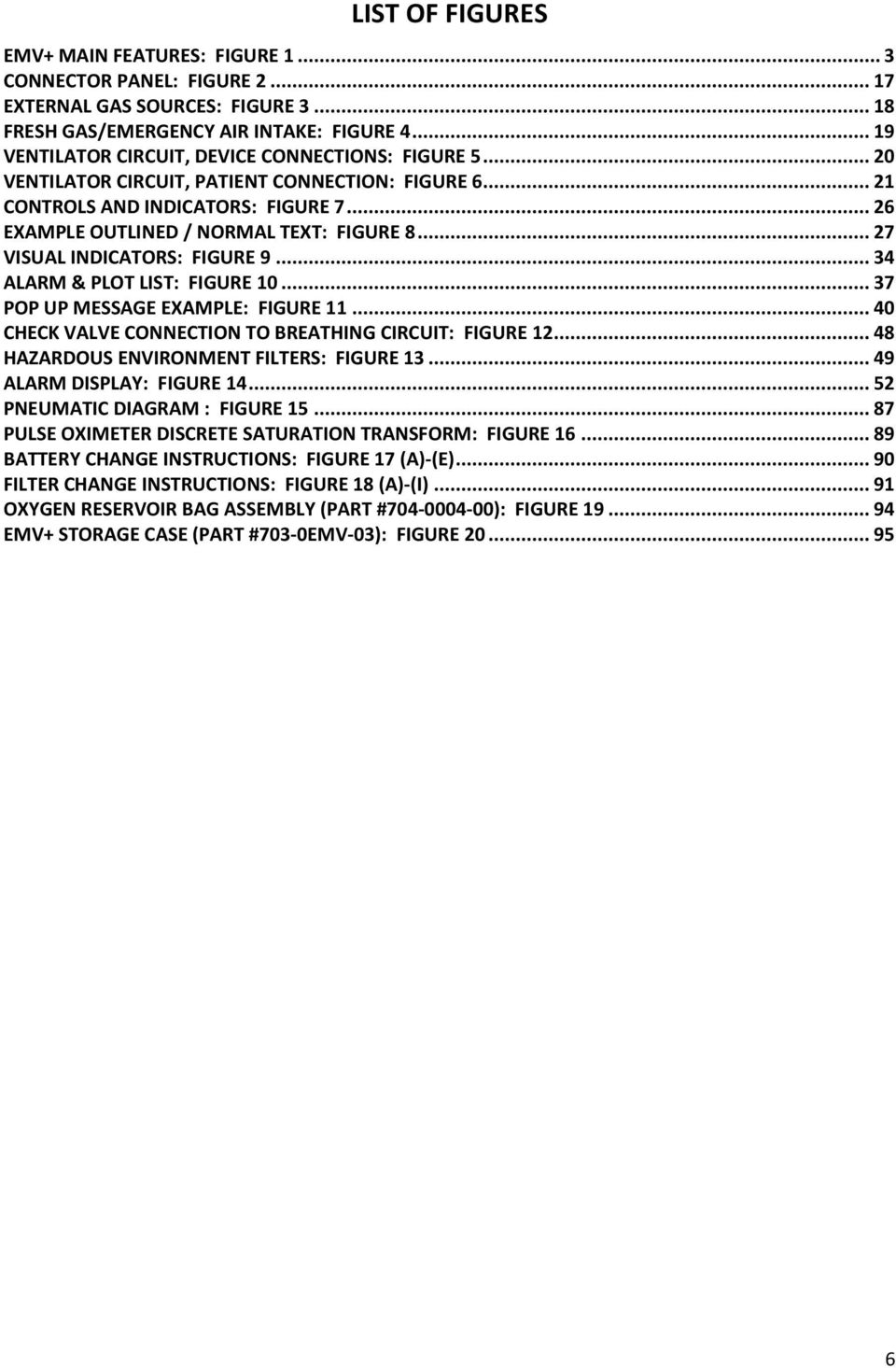
6 LIST OF FIGURES EMV+ MAIN FEATURES: FIGURE CONNECTOR PANEL: FIGURE EXTERNAL GAS SOURCES: FIGURE FRESH GAS/EMERGENCY AIR INTAKE: FIGURE VENTILATOR CIRCUIT, DEVICE CONNECTIONS: FIGURE VENTILATOR CIRCUIT, PATIENT CONNECTION: FIGURE CONTROLS AND INDICATORS: FIGURE EXAMPLE OUTLINED / NORMAL TEXT: FIGURE VISUAL INDICATORS: FIGURE ALARM & PLOT LIST: FIGURE POP UP MESSAGE EXAMPLE: FIGURE CHECK VALVE CONNECTION TO BREATHING CIRCUIT: FIGURE HAZARDOUS ENVIRONMENT FILTERS: FIGURE ALARM DISPLAY: FIGURE PNEUMATIC DIAGRAM : FIGURE PULSE OXIMETER DISCRETE SATURATION TRANSFORM: FIGURE BATTERY CHANGE INSTRUCTIONS: FIGURE 17 (A)-(E) FILTER CHANGE INSTRUCTIONS: FIGURE 18 (A)-(I) OXYGEN RESERVOIR BAG ASSEMBLY (PART # ): FIGURE EMV+ STORAGE CASE (PART #703-0EMV-03): FIGURE
7 CONVENTIONS, TERMINOLOGY AND ABBREVIATIONS CONVENTIONS WARNING! A WARNING statement identifies conditions or information that could have an adverse effect upon the patient or operator which if not avoided, could result in death or serious injury. CAUTION! A CAUTION statement provides important information about a potentially hazardous situation which if not avoided may result in minor or moderate injury to the patient, operator or damage to the equipment or other property. NOTE: A NOTE provides additional information intended to avoid inconvenience during operation. ABBREVIATIONS A/C- Assist/Control ACLS- Advanced Cardiac Life Support ALS- Advanced Life Support ATLS- Advanced Trauma Life Support ACV- Assist-Control Ventilation ATPD - Atmospheric Temperature and Pressure, Dry BPM - Breaths per Minute B/V - Bacterial/Viral Filter cm H 2 O - Centimeters of Water CPR - Cardiopulmonary Resuscitation DISS - Diameter Index Safety System FIO 2 - Fraction of Inspired Oxygen HME - Heat and Moisture Exchanger HME/BV - Heat and Moisture Exchanger/Bacterial Viral filter combined Hz Hertz (as in frequency, cycles per second) ID - Internal Diameter L - Liters LED - Light Emitting Diode LPM - Liters per Minute ml - Milliliters mm - Millimeter NPPV Noninvasive Positive Pressure Ventilation O 2 - Oxygen P aw - Airway Pressure PEEP - Positive End Expiratory Pressure PIP - Peak Inspiratory Pressure psig - Pounds per Square Inch Gage USP - United States Pharmacopeia VAC - Volts AC VDC - Volts DC V T - Tidal Volume WOB Work of Breathing 7

8 INTENDED USE The Model 731EMV+ (EMV+) is indicated for use in the management of infant through adult patients weighing 5 kg with acute or chronic respiratory failure or during resuscitation by providing continuous positive-pressure ventilation. It is appropriate for use in hospitals, outside the hospital, during transport and in austere environments where it may be exposed to rain, dust, rough handling and extremes in temperature and humidity. With an appropriate third-party filter in place, it may be operated in environments where chemical and/or biological toxins are present (see External Filter Use). It is not intended to operate in explosive environments. The EMV+ is intended for use by skilled care providers with knowledge of mechanical ventilation, emergency medical services (EMS) personnel with a basic knowledge of mechanical ventilation and by first responders under the direction of skilled medical care providers. The EMV+ ventilator is a small, extremely durable, full-featured portable mechanical ventilator designed to operate in hospitals or austere and under-resourced environments. It can be used in prehospital (ALS, ATLS, ACLS), field hospital and hospital settings. Easy-to-use, durable, lightweight and portable, the EMV+ is built with the same standard of quality, reliability and performance that all Impact products are known for. FEATURES Portable critical care ventilator that can be used in the hospital, aeromedical and ground transport, mass casualty situations and extreme environments Multiple modes of ventilation for use with acute or chronic respiratory failure in both intubated and nonintubated patients. Intuitive operator interface minimizes operator training and protects existing settings from inadvertent contact and manipulation. Lightweight (9.7 lbs, 4.4 kg) provides for easy transport Rechargeable battery provides over 10 hours of operation (at factory default settings with pulse oximeter operating). Operating temperature range from -25 to 49 C (Impact Instrumentation validated testing) and from 10 to 40 C (SGS listed). Altitude compensation from to 25,000 feet Self-contained system that operates with or without external O 2. Gas manifold design allows operation with both high and low-pressure O 2 sources.. All O2 is delivered to the patient circuit, none vented or wasted to operate the device. Sealed gas path with chemical/biological filter connected to assure safe breathing gas supply. Sealed case and control panel protects components from weather and fluids. 8

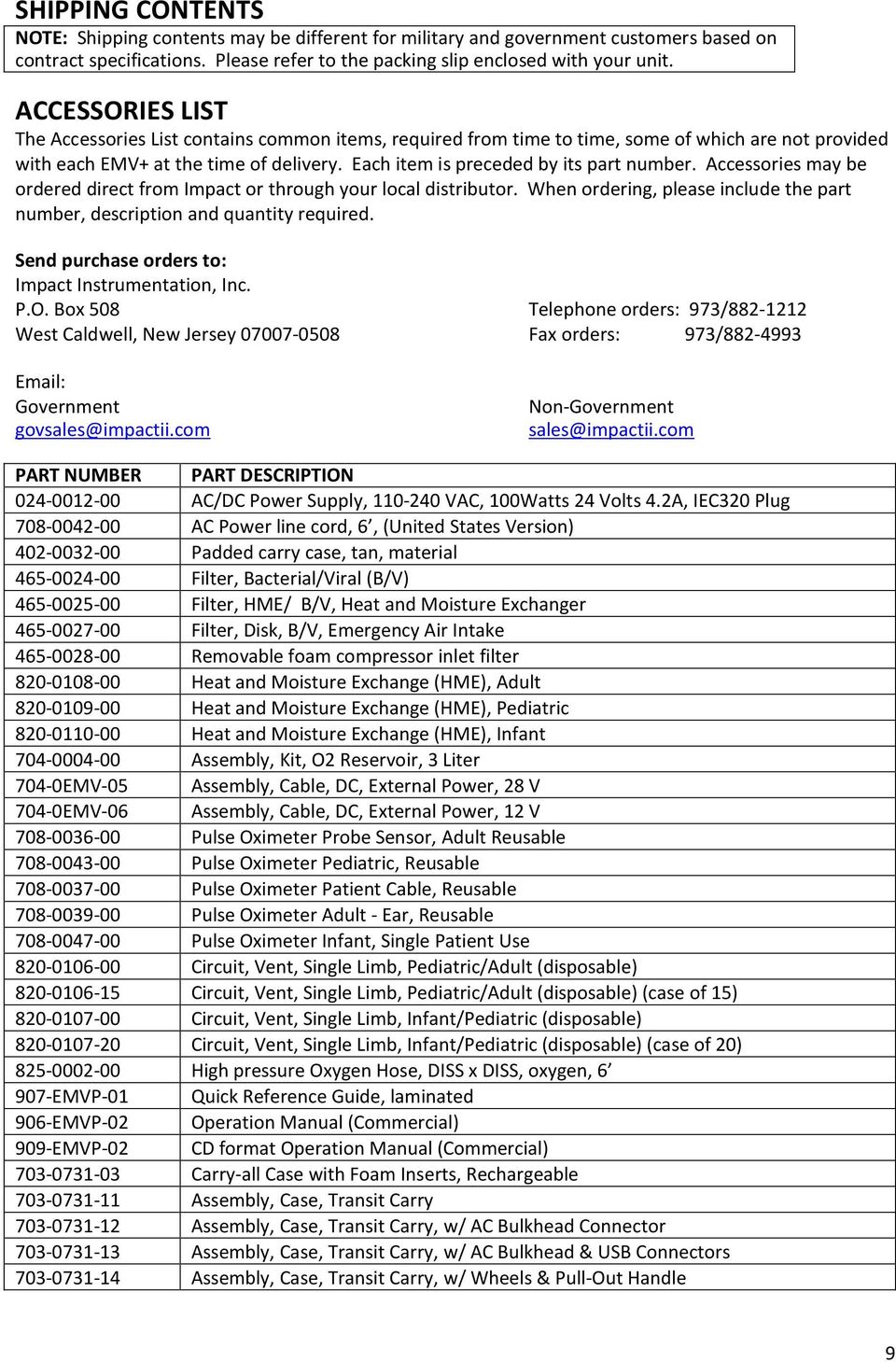
9 SHIPPING CONTENTS NOTE: Shipping contents may be different for military and government customers based on contract specifications. Please refer to the packing slip enclosed with your unit. ACCESSORIES LIST The Accessories List contains common items, required from time to time, some of which are not provided with each EMV+ at the time of delivery. Each item is preceded by its part number. Accessories may be ordered direct from Impact or through your local distributor. When ordering, please include the part number, description and quantity required. Send purchase orders to: Impact Instrumentation, Inc. P.O. Box 508 Telephone orders: 973/ West Caldwell, New Jersey Fax orders: 973/ Government Non-Government PART NUMBER PART DESCRIPTION AC/DC Power Supply, VAC, 100Watts 24 Volts 4.2A, IEC320 Plug AC Power line cord, 6, (United States Version) Padded carry case, tan, material Filter, Bacterial/Viral (B/V) Filter, HME/ B/V, Heat and Moisture Exchanger Filter, Disk, B/V, Emergency Air Intake Removable foam compressor inlet filter Heat and Moisture Exchange (HME), Adult Heat and Moisture Exchange (HME), Pediatric Heat and Moisture Exchange (HME), Infant Assembly, Kit, O2 Reservoir, 3 Liter 704-0EMV-05 Assembly, Cable, DC, External Power, 28 V 704-0EMV-06 Assembly, Cable, DC, External Power, 12 V Pulse Oximeter Probe Sensor, Adult Reusable Pulse Oximeter Pediatric, Reusable Pulse Oximeter Patient Cable, Reusable Pulse Oximeter Adult - Ear, Reusable Pulse Oximeter Infant, Single Patient Use Circuit, Vent, Single Limb, Pediatric/Adult (disposable) Circuit, Vent, Single Limb, Pediatric/Adult (disposable)(case of 15) Circuit, Vent, Single Limb, Infant/Pediatric (disposable) Circuit, Vent, Single Limb, Infant/Pediatric (disposable)(case of 20) High pressure Oxygen Hose, DISS x DISS, oxygen, EMVP-01 Quick Reference Guide, laminated 906-EMVP-02 Operation Manual (Commercial) 909-EMVP-02 CD format Operation Manual (Commercial) Carry-all Case with Foam Inserts, Rechargeable Assembly, Case, Transit Carry Assembly, Case, Transit Carry, w/ AC Bulkhead Connector Assembly, Case, Transit Carry, w/ AC Bulkhead & USB Connectors Assembly, Case, Transit Carry, w/ Wheels & Pull-Out Handle 9
10 PART NUMBER PART DESCRIPTION Assembly, Case, Transit Carry, w/ Wheels & Pull-Out Handle, AC Bulkhead Connector Assembly, Case, Transit Carry, w/ Wheels & Pull-Out Handle, AC Bulkhead & USB Connectors Assembly, Battery Pack, Lithium-Ion, 6.6 Ah 704-0EMV-XX Extension Cord 8 US Hospital Grade Female Plug to *** XX Cordset, 6, IEC C5 Plug to *** Check Valve Kit Mask, CPAP, #6, Large Adult Mask, CPAP, #5, Adult Mask, CPAP, #4, Child Mask, CPAP, #3, Small Child Mask, CPAP, #2, Infant Mask, CPAP, #1, Small Infant Harness, Mask, Universal *** Country Specific (Contact factory for complete part # for each country) 10

11 LIMITED COPYRIGHT RELEASE Permission is hereby granted to any military/governmental agency to reproduce all materials furnished herein for use in a military/governmental service training program and/or other technical training program. MASIMO PULSE OXIMETER This device uses Masimo SET technology to provide continuous pulse oximeter and heart rate monitoring and is covered under one or more of the following U.S.A. patents: 5,758,644, 5,823,950, 6,011,986, 6,157,850, 6,263,222, 6,501,975 and other applicable patents listed at QNET BV Hommerterweg AM Amstenrade The Netherlands Manufactured by: IMPACT Instrumentation Inc. 27 Fairfield Place, West Caldwell, NJ 07006, U.S.A P.O Box 508, West Caldwell, NJ , U.S.A 11

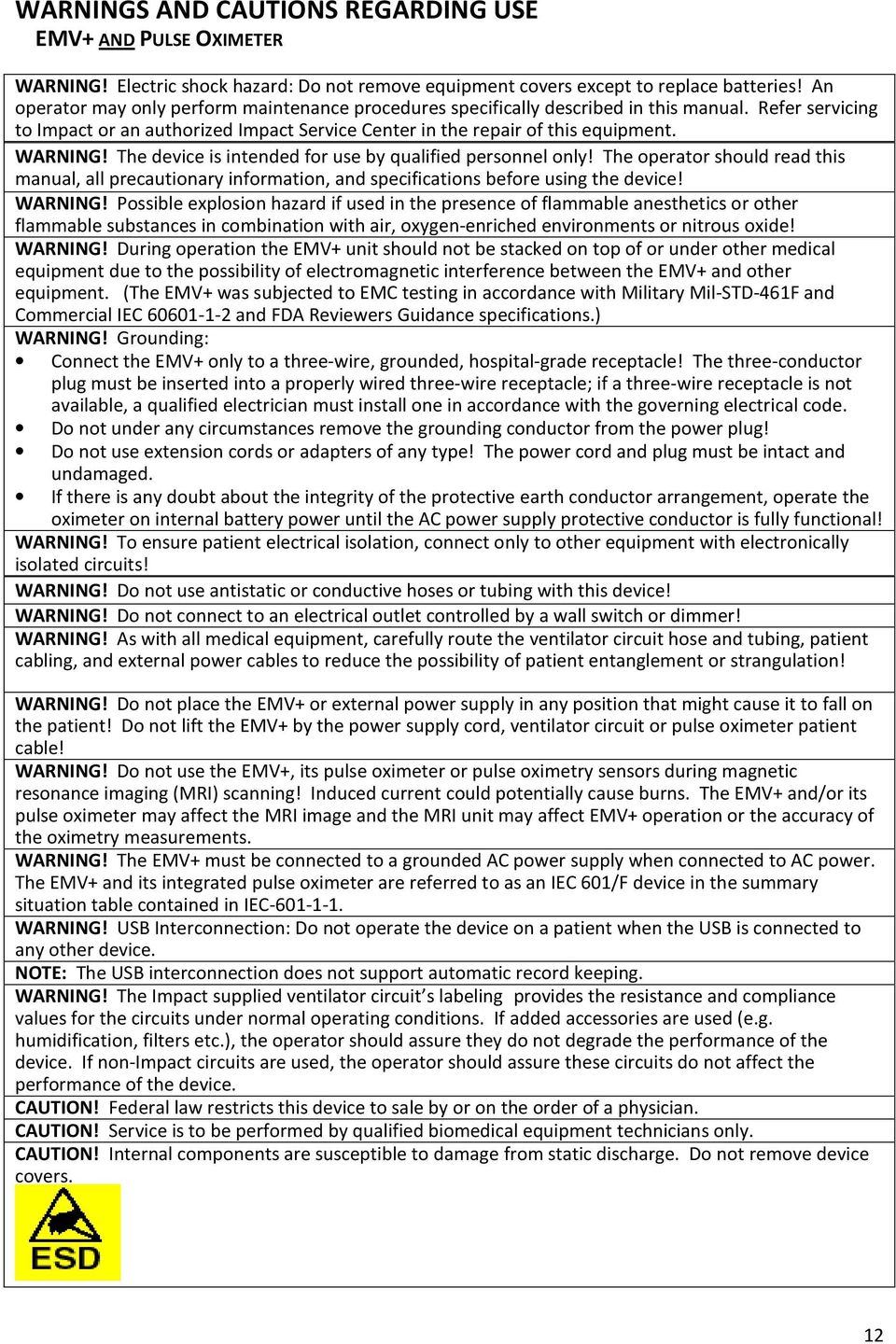
12 WARNINGS AND CAUTIONS REGARDING USE EMV+ AND PULSE OXIMETER WARNING! Electric shock hazard: Do not remove equipment covers except to replace batteries! An operator may only perform maintenance procedures specifically described in this manual. Refer servicing to Impact or an authorized Impact Service Center in the repair of this equipment. WARNING! The device is intended for use by qualified personnel only! The operator should read this manual, all precautionary information, and specifications before using the device! WARNING! Possible explosion hazard if used in the presence of flammable anesthetics or other flammable substances in combination with air, oxygen-enriched environments or nitrous oxide! WARNING! During operation the EMV+ unit should not be stacked on top of or under other medical equipment due to the possibility of electromagnetic interference between the EMV+ and other equipment. (The EMV+ was subjected to EMC testing in accordance with Military Mil-STD-461F and Commercial IEC and FDA Reviewers Guidance specifications.) WARNING! Grounding: Connect the EMV+ only to a three-wire, grounded, hospital-grade receptacle! The three-conductor plug must be inserted into a properly wired three-wire receptacle; if a three-wire receptacle is not available, a qualified electrician must install one in accordance with the governing electrical code. Do not under any circumstances remove the grounding conductor from the power plug! Do not use extension cords or adapters of any type! The power cord and plug must be intact and undamaged. If there is any doubt about the integrity of the protective earth conductor arrangement, operate the oximeter on internal battery power until the AC power supply protective conductor is fully functional! WARNING! To ensure patient electrical isolation, connect only to other equipment with electronically isolated circuits! WARNING! Do not use antistatic or conductive hoses or tubing with this device! WARNING! Do not connect to an electrical outlet controlled by a wall switch or dimmer! WARNING! As with all medical equipment, carefully route the ventilator circuit hose and tubing, patient cabling, and external power cables to reduce the possibility of patient entanglement or strangulation! WARNING! Do not place the EMV+ or external power supply in any position that might cause it to fall on the patient! Do not lift the EMV+ by the power supply cord, ventilator circuit or pulse oximeter patient cable! WARNING! Do not use the EMV+, its pulse oximeter or pulse oximetry sensors during magnetic resonance imaging (MRI) scanning! Induced current could potentially cause burns. The EMV+ and/or its pulse oximeter may affect the MRI image and the MRI unit may affect EMV+ operation or the accuracy of the oximetry measurements. WARNING! The EMV+ must be connected to a grounded AC power supply when connected to AC power. The EMV+ and its integrated pulse oximeter are referred to as an IEC 601/F device in the summary situation table contained in IEC WARNING! USB Interconnection: Do not operate the device on a patient when the USB is connected to any other device. NOTE: The USB interconnection does not support automatic record keeping. WARNING! The Impact supplied ventilator circuit s labeling provides the resistance and compliance values for the circuits under normal operating conditions. If added accessories are used (e.g. humidification, filters etc.), the operator should assure they do not degrade the performance of the device. If non-impact circuits are used, the operator should assure these circuits do not affect the performance of the device. CAUTION! Federal law restricts this device to sale by or on the order of a physician. CAUTION! Service is to be performed by qualified biomedical equipment technicians only. CAUTION! Internal components are susceptible to damage from static discharge. Do not remove device covers. 12
13 NOTE: This Operation Manual is not meant to supersede any controlling standard operating procedure regarding the safe use of assisted ventilation. NOTE: Follow all governing regulations regarding the disposal of any part of this medical device. NOTE: Follow all governing regulations regarding the handling of materials contaminated by body fluids. NOTE: Follow all governing regulations regarding shipment of the Li batteries. PULSE OXIMETER SPECIFIC WARNINGS AND CAUTIONS WARNING! A pulse oximeter should not be used as an apnea monitor. WARNING! A pulse oximeter should be considered an early warning device. As a trend towards patient deoxygenation is indicated, blood samples should be analyzed by a laboratory co-oximeter to completely understand the patient s condition. WARNING! MEASUREMENTS If the accuracy of any measurement does not seem reasonable, first check the patient s vital signs by alternate means and then check the pulse oximeter for proper functioning. Inaccurate measurements may be caused by: Incorrect sensor application or use Significant levels of dysfunctional hemoglobin (e.g., carboxyhemoglobin or methemoglobin) Intravascular dyes such as indocyanine green or methylene blue Exposure to excessive illumination, such as surgical lamps (especially ones with a xenon light source), bilirubin lamps, fluorescent lights, infrared heating lamps, or direct sunlight (exposure to excessive illumination can be corrected by covering the sensor with a dark or opaque material) Excessive patient movement Venous pulsations Placement of a sensor on an extremity with a blood pressure cuff, arterial catheter, or intravascular line The pulse oximeter can be used during defibrillation, but the readings may be inaccurate for a short time. WARNING! Interfering Substances: Carboxyhemoglobin may erroneously increase readings. The level of increase is approximately equal to the amount of carboxyhemoglobin present. Dyes, or any substance containing dyes, that change usual arterial pigmentation may cause erroneous readings. WARNING! ALARMS Check alarm limits each time the pulse oximeter is used to ensure that they are appropriate for the patient being monitored. WARNING! Loss of pulse signal can occur in any of the following situations: The sensor is too tight There is excessive illumination from light sources such as a surgical lamp, a bilirubin lamp, or sunlight A blood pressure cuff is inflated on the same extremity as the one with a SpO 2 sensor attached The patient has hypotension, severe vasoconstriction, severe anemia, or hypothermia There is arterial occlusion proximal to the sensor The patient is in cardiac arrest or is in shock WARNING! Sensors: Before use, carefully read the LNCS sensor directions for use. Use only Masimo oximetry sensors for SpO 2 measurements. Other oxygen transducers (sensors) may cause improper performance. Tissue damage can be caused by incorrect application or use of an LNCS sensor, for example by wrapping the sensor too tightly. Inspect the sensor site as directed in the sensor Directions for Use to ensure skin integrity and correct positioning and adhesion of the sensor. Do not damage LNCS sensors. Do not use an LNCS sensor with exposed optical components. Do not immerse the sensor in water, solvents, or cleaning solutions (the sensors and connectors are not waterproof). Do not sterilize by irradiation, steam or ethylene oxide. See the cleaning instructions in the directions for reusable Masimo LNCS sensors. Do not use damaged patient cables. Do not immerse the patient cables in water, solvents or cleaning solutions (the patient cables are not waterproof). Do not sterilize by irradiation, steam or ethylene oxide. See the cleaning instructions in the directions for reusable Masimo patient cables. 13

14 CAUTION! Possession or purchase of this device does not convey any expressed or implied license to use the device with unauthorized sensors or cables which would, alone, or in combination with this device fall within the scope of one or more of the patents relating to this device. Impact cannot assure the proper functioning of this device if it is used with unauthorized sensors or cables. 14

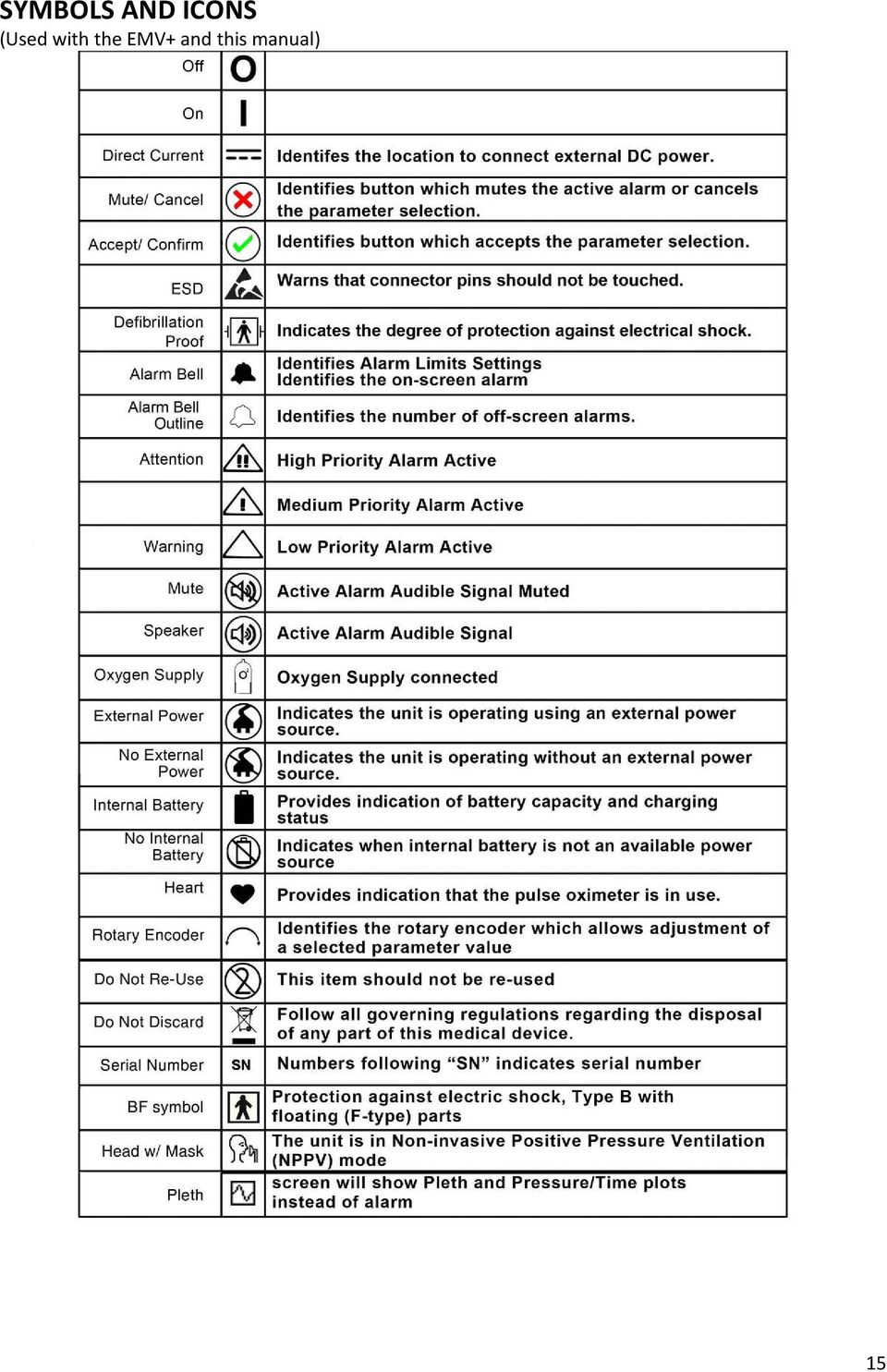
15 SYMBOLS AND ICONS (Used with the EMV+ and this manual) 15
16 UNPACKING, ASSEMBLY AND CONNECTIONS UNPACKING Compare shipping case contents against Shipping Contents list. Examine the device and accessories for any obvious signs of shipping damage. If there is no apparent sign of mechanical damage, read instructions contained within this manual before attempting operation. ASSEMBLY The EMV+ only requires that the operator attach the breathing circuit to begin ventilation using either internal or external power. Both the ventilator and breathing circuit are supplied clean and are ready for use on a patient. The EMV+ batteries may not be installed within the unit (depending upon the contractual requirements or the storage environment as described in the Battery Care and Recharging section). Battery installation may be required prior to operation. (See Appendix 4 for Battery Installation.) CONNECTIONS OXYGEN INPUT connects the unit to the output of an appropriate O 2 regulator attached to a medicalgrade (USP) O 2 cylinder. The OXYGEN IN fitting has a male oxygen Diameter Index Safety System (D.I.S.S.) thread. It is located on the Connector Panel at the top of the unit (see Figure 2). A green (white for some installations), 6 foot long high-pressure oxygen hose with compatible fittings that provides for connection between the unit and the O 2 source is required. (Also see Harsh Environment Operation section). NOTE: If external O 2 is connected the gas pressure must be at least 41-psig (± 2 psig) when SELF-CHECK is performed. GAS OUTPUT - connects to the ventilator circuit 22 mm ID corrugated hose. The connector is a 22 mm male conical connection. It is located on the Connector Panel at the top of the unit (see Figure 2). FRESH GAS/EMERGENCY AIR INTAKE allows ambient air into the EMV+ s internal compressor. The port also functions as the internal anti-asphyxia valve which allows the patient to breathe ambient air in the event of a ventilator failure. The intake contains a particulate filter and permits the operator to connect either a bacterial/viral or a chemical/biological filter depending on ambient conditions (see Figure 2). TRANSDUCER (Patient Airway Pressure) connects to the ventilator circuit 3/16" ID transducer tubing. The barb-type connector is colored a green/blue to distinguish it from the other connectors (see Figure 2). NOTE: The 3/16" ID ventilator circuit transducer tubing is a green/blue (darker) color. It is located on the Connector Panel at the top of the unit. EXHALATION VALVE connects to the ventilator circuit 1/4" ID exhalation valve tubing. The barb-type connector is clear anodized aluminum to distinguish it from the other connectors (see Figure 2). NOTE: The 1/4" ID ventilator circuit exhalation valve tubing is clear. It is located on the Connector Panel at the top of the unit. EXTERNAL POWER INPUT The External Power Input connector is located on the top of the unit. It accepts DC voltages between 11 and 32 volts (negative ground). The input mates with the output connector plug of the AC/DC Power Supply, 12 and 28 VDC Power Cables (both are available as accessories) or the external battery (see Figure 2). 16
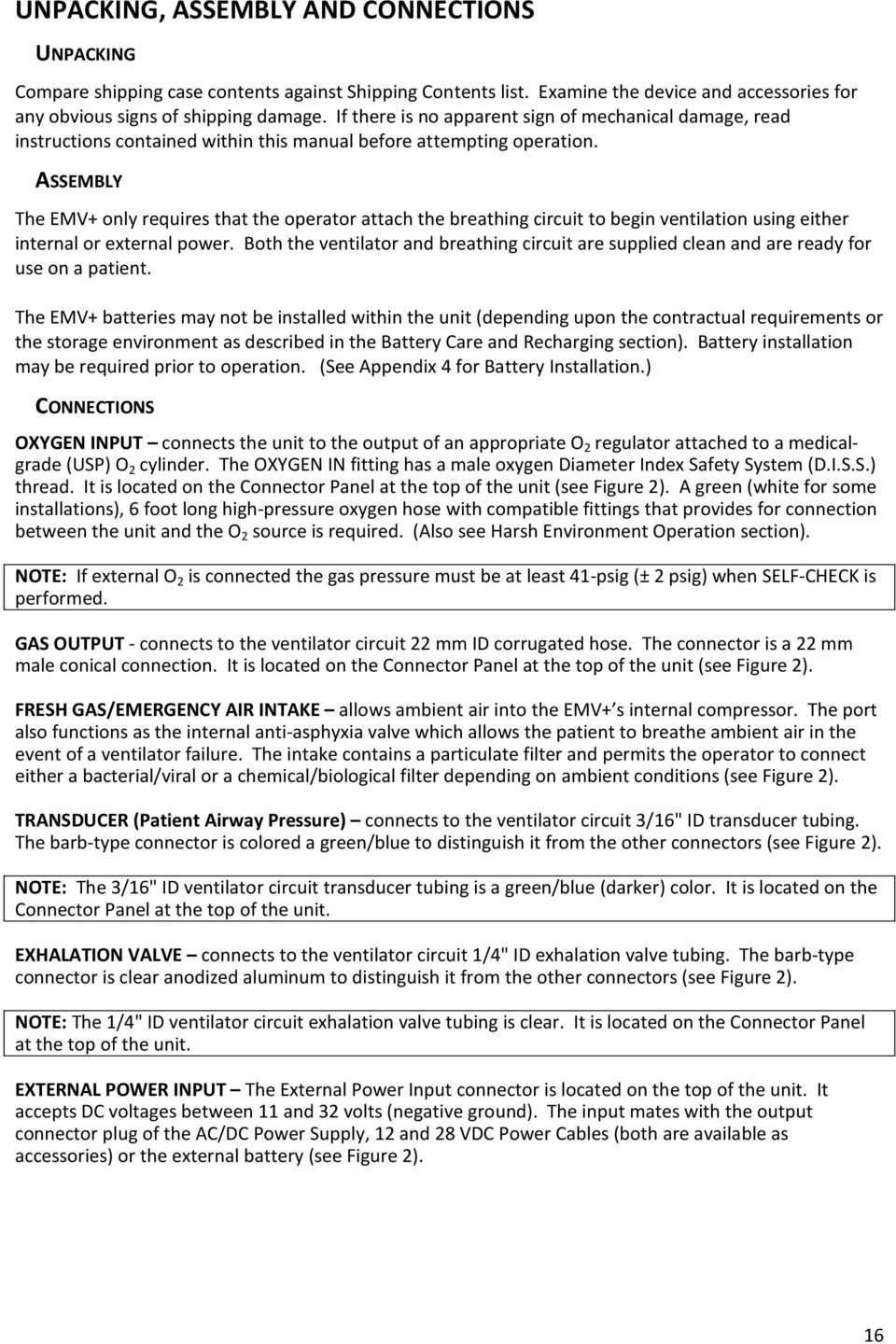
17 HIGH PRESSURE OXYGEN INPUT GAS OUTPUT EXTERNAL POWER INPUT TRANSDUCER (PATIENT AIRWAY PRESSURE) USB CONNECTOR PULSE OXIMETER CONNECTOR EXHALATION VALVE FRESH GAS/EMERGENCY AIR INTAKE CONNECTOR PANEL: FIGURE 2 SET-UP The EMV+ can be configured to suit most applications. Additional hoses, fittings and adapters may be required for particular uses. 1. For use with external O 2 : connect a green (white for some installations) high-pressure O 2 hose to the OXYGEN IN fitting and a 55 psig external source. NOTE: Use only with medical-grade (USP) oxygen. When using with an oxygen cylinder, the cylinder must be secured. 2. Connect the disposable ventilator circuit to the GAS OUTPUT, TRANSDUCER, and EXHALATION VALVE connectors on EMV+ Connector Panel. Follow the directions included with the disposable ventilator circuit. 3. In a high-dust or biological environment, a bacterial/viral filter should be attached to the Fresh Gas/Emergency Air Intake to prevent entrainment of particulate or biological matter. (See section on Hazardous Environment Filters.) 4. In toxic biological or chemical environments the user can attach a chemical/biological filter to the Fresh Gas/Emergency Air Intake. The threaded interface accommodates chemical/biological filters with an Rd 40 x 1/7 interface (see BS EN Respiratory protective devices threads for face pieces). (See section on Hazardous Environment Filters.) 5. For use with AC power: connect the AC/DC Power Supply (supplied) to the External Power Input (see Figure 2). NOTE: The EMV+ can operate from internal battery or from external AC or DC power sources. See section entitled Operating Power Selection & Stopping for details. WARNING! Always assure that there is an alternate means of providing ventilation. A bag-valve resuscitator and an appropriate mask for the patient being ventilated should be immediately available. WARNING! This unit s USB connection (unlabelled) does not provide any signal output or input to the Operator. It is for the use of Impact Instrumentation trained personnel only. The Operator should not connect anything to the USB connection. 17
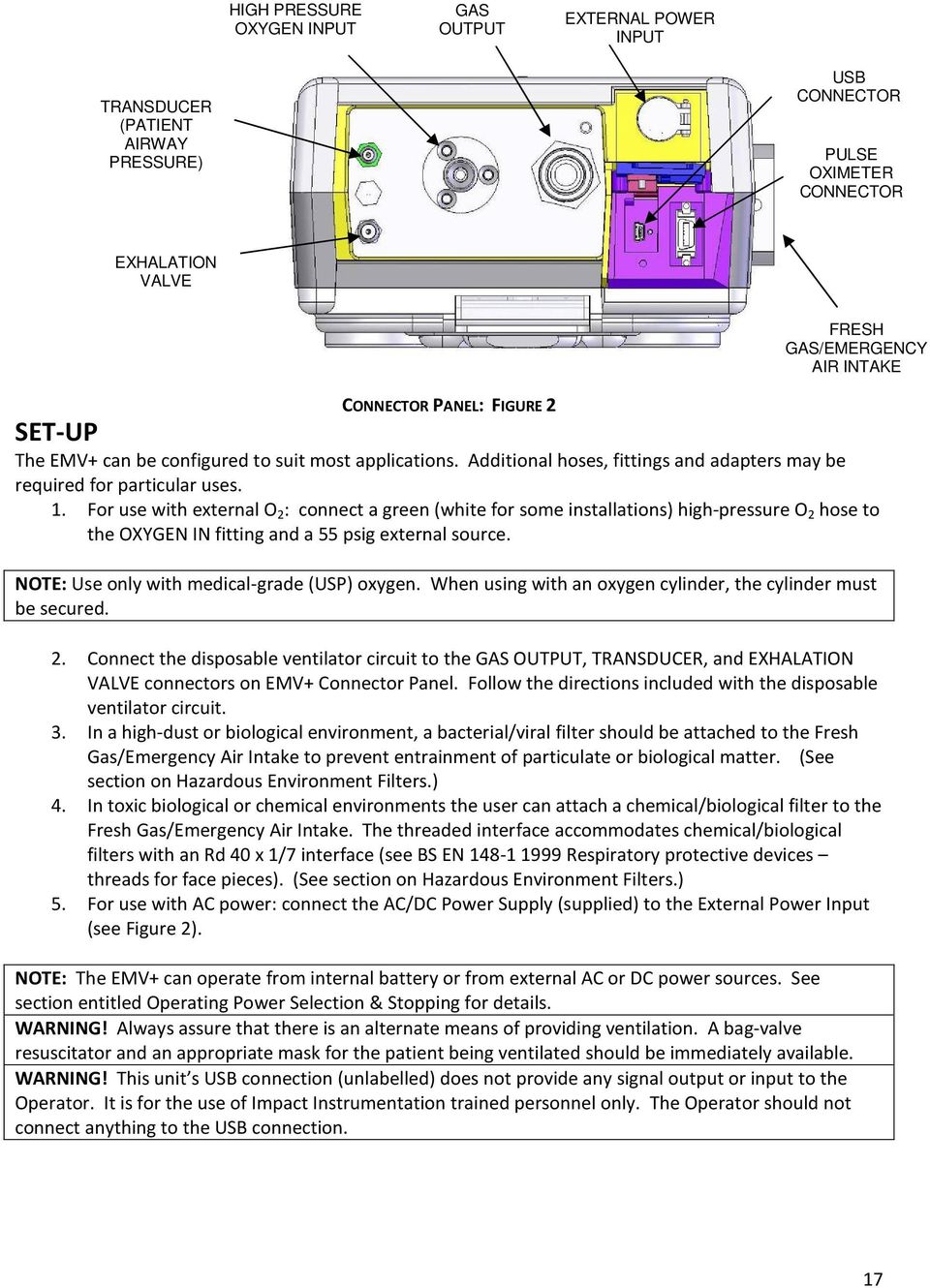
18 EXTERNAL GAS SOURCES The EMV+ can operate using high-pressure O 2 from either bottled O 2 or piped O 2 sources, as illustrated in Figure 3. EXTERNAL GAS SOURCES: FIGURE 3 18
19 The duration of any given gas cylinder depends on the size & pressure of the cylinder, and the rate at which gas is being used to support the patient. The formula to calculate the operating duration of any cylinder (based on the Ideal Gas Law) is given below. An example is worked out for a typical large cylinder. It is recommended that the gas cylinder pressure not be allowed to fall below 300 psi. V start = 9540 liter at 1 atm/ 70 o F (21 o C) : from label on cylinder P start = 2640 psig : from label on cylinder P present in cylinder = 300 psig : from pressure gauge on cylinder V present in cylinder = volume remaining in cylinder = (P present / P start ) V start = 1084 liter at 1 atm/ 70 o F (21 o C) V delivered = = 8456 liter at 1 atm/ 70 o F (21 o C) For a typical ventilator setting (20 BPM, Vt = 500 ml, FIO 2 =100%, I time = 1 sec, I:E = 1:2.0), the gas consumption is 10 liter/min. NOTE: Whenever external high-pressure O 2 is used, the EMV+ automatically determines the O 2 usage and displays it in the FIO 2 parameter window. (See O 2 Use under FIO 2 in Description of Controls and Display. Total duration of the gas cylinder in above example = V delivered / (10 liter/min) = 8456/10 min = ~14 hours FRESH GAS/EMERGENCY AIR INTAKE: FIGURE 4 WARNING! Never block the FRESH GAS/EMERGENCY AIR INTAKE. A free flow of air is required during compressor operation or in the event of a device failure to allow spontaneous breathing. The FRESH GAS/EMERGENCY AIR INTAKE also acts as an anti-asphyxia port in the event of a ventilator failure. 19

20 VENTILATOR CIRCUIT CONNECTIONS The EMV+ is designed to operate using a standard disposable ventilator circuit. The circuit is attached to the ventilator as shown in Figure 5. VENTILATOR CIRCUIT, DEVICE CONNECTIONS: FIGURE 5 CAUTION! Always dispose of the circuit after single patient use following the institutional guidelines for biologically contaminated material. Reusing the circuit can result in cross contamination between patients. 20

21 VENTILATOR CIRCUIT, PATIENT CONNECTIONS The EMV+ uses two different single limb vent circuits to support patients from 5 kg through adult: Infant/ Pediatric (Part # ) and Pediatric/Adult (Part # ). These are illustrated in Figure 6. VENTILATOR CIRCUIT, PATIENT CONNECTION: FIGURE 6 21
22 VENTILATOR CIRCUITS, RESISTANCE AND COMPLIANCE The resistance and compliance of the Impact ventilator circuits are listed in the table below: Patient Patient Weight (kg) Breathing Circuit Adult 40 Ped/ Adult Pediatric Ped/ Adult Pediatric Infant/ Ped Infant 5-12 Infant/ Ped Impact Part Number # # # # Inspiratory Resistance (cm H 2 O) Expiratory Resistance (cm H 2 O) Resistance measured at Flow (l/min) Compliance (ml/cm H 2 O) Dead Space (ml) WARNING! If circuits with different resistance/ compliance are used or additional adjuncts are placed in line with the circuit, the Operator must make sure that the appropriate circuit resistance/ compliance factors for the new circuit is used as well as dead space volume of the added adjunct(s) is / are factored into the equation for effective tidal volume delivery to the patient. OPERATING POWER SELECTION & STOPPING The POWER switch is the master power switch. Use this switch to initiate or end operation. The EMV+ is designed to operate using any one of three power sources: 1. Internal 14.8V lithium ion (Li Ion) rechargeable battery with 6.6 Ah capacity (fully charged, the battery provides 10 hours of operation at factory default settings with pulse oximeter operating at 25 C). 2. External AC/DC Power Supply ( VAC 50/60 & 400 Hz-- Impact Instrumentation validated testing, and VAC 50/60 SGS listed) with IEC 320 style AC input connector (supplied). The AC/DC Power Supply provides a DC output of 24V at 4.2A. 3. External DC power from a standard vehicle DC outlet using the 12 or 28 VDC Power Cables. The input connector of the EMV+ is designed to accept DC voltages between 12.5 to 28.0 VDC +/- 10% volts, negative ground. CAUTION! When using the standard vehicle DC outlet, the vehicle should not be jump started during operation of the ventilator. WARNING! Never start the ventilator with the patient connected. Always start the ventilator, select the patient settings, assure operation, and then connect the patient. Always manually ventilate the patient when they are not connected to the ventilator. The EMV+ is designed to use external power when available rather than its internal battery pack. When an acceptable external power source is present, the internal battery pack is automatically charged while the unit operates. When an external power failure occurs, the EMV+ automatically switches to its internal battery pack for operating power and activates the EXTERNAL POWER FAILURE alarm; there is no interruption in operation and/or loss of any alarms. When external power returns, operating power automatically switches from internal power to the external source. SELF-CHECK At start up the EMV+ automatically performs a self check that includes a check for pre-existing alarm conditions. Following start up, the presence of alarm conditions is checked continuously. The ventilator circuit must be open to ambient atmosphere (not connected to the patient) during start up. Ventilator operation begins immediately following the self check. 22
23 WARNING! Until the operator has determined that the ventilator is functioning properly and that the ventilator parameters are set correctly for the patient, the patient should not be connected to the ventilator. TRANSDUCER CALIBRATION (AUTO CAL) The ventilator circuit connects to a pressure transducer in the ventilator. Periodically, the transducer recalibrates itself using the ambient air pressure as a reference. This process maintains a consistent transducer baseline over a wide temperature and altitude range to assure display, monitoring, and triggering accuracy. The AUTO CAL affects 3 transducer systems: Compressor Flow, O 2 Flow and Airway Pressure. Its purpose is to compensate for small temperature related drifts in the transducer offset (zeroing). The AUTO CAL is performed during SELF-CHECK, and then every 5 minutes thereafter. However, if a temperature change exceeding +/- 1.5 C is sensed, the AUTO CAL time interval is reduced automatically to assure a stable pressure measurement baseline. 23
24 OPERATION OVERVIEW INTRODUCTION The EMV+ is a volume and pressure targeted, time or flow cycled ventilator designed to use either oxygen (O 2 ) from a 55 psig source or fresh air using its internal compressor to deliver a positive pressure breath. The user interface allows the operator to initiate operation of the EMV+ to begin operation at default setting values. When high-pressure O 2 is connected the internal blender allows the FIO 2 to be set from 21 to 100%. Backpressure from the patient connection does not affect the delivered accuracy of the volume, flow, pressure or FIO 2. When the FIO 2 is set to 21%, operators may connect a low flow O 2 source at the Fresh Gas/Emergency Air Intake using the reservoir (see Appendix 6: Use of Low Flow Oxygen). A suite of alarms alert the operator when conditions exceed parameter limits or when operation is affected by an external or internal fault or failure. When an alarm occurs the operator is alerted by audible and visual indicators while context sensitive help messages are displayed in the LCD s Alarm Message Center. Operating power is from an external AC/DC power converter connected to live AC mains, external DC power, or from the internal rechargeable lithium ion battery. Fresh air is filtered using a particulate filter or, when the operating environment requires, a bacterial/viral filter or a chemical/biological filter may be attached. When the unit is first powered up, certain patient circuit alarms are preemptively muted for 120 sec, to allow the operator time to attach the patient circuit, pulse oximeter and properly adjust the ventilator without nuisance alarms. For a list of these preemptively muted alarms, see the Alarms Turn Off & Cancellation section. The time remaining for the mute period is displayed on a countdown clock shown beneath the speaker icon. PULSE OXIMETER At start-up, the pulse oximeter is in standby (pulse oximeter on and ready to monitor). In standby, the parameter windows for SpO2 and Heart Rate read stby and operational alarms are suppressed. As soon as valid patient signal is detected 10 seconds, the pulse oximeter comes out of standby - the parameters are displayed, and all alarms are active. The pulse oximeter can be turned on via the Pulse Oximeter submenu in the main menu by changing stby to on. Similarly, if the probe is removed from the patient and is no longer needed, the pulse oximeter can be placed back in standby via the Pulse Oximeter menu submenu. See Appendix 3: Pulse Oximeter Principles and Specifications. The pulse oximeter and its accessory probes and cables are intended for continuous noninvasive monitoring of functional O 2 saturation of arterial hemoglobin (SpO 2 ) and pulse rate (measured by the SpO 2 sensor) for adult, pediatric and infant patients using the appropriate sensor for the patient. The pulse oximeter is operational in all ventilator modes when its cable and sensor are properly attached to the SpO 2 connector (see Figure 5). To operate the pulse oximeter, connect the probe to the patient cable and the patient cable to the SpO 2 connector on the EMV+. The monitoring function will continuously display the patient s pulse rate and SpO 2 value. See the Pulse Oximeter Alarms in the Ventilator Alarm Categories section for more information on pulse oximeter alarms. NOTE: The pulse oximeter can only be placed in standby when the probe is disconnected from the patient. A valid signal will automatically bring the pulse oximeter out of standby. The pulse oximeter reading can be affected by the following conditions: 1. The sensor is too tight. 2. There is excessive illumination from light sources such as a surgical lamp, a bilirubin lamp, or sunlight. 24
25 3. A blood pressure cuff is inflated on the same extremity as the one with a SpO2 sensor attached. 4. The patient has hypotension, severe vasoconstriction, severe anemia, or hypothermia. 5. There is an arterial occlusion proximal to the sensor. 6. The patient is in cardiac arrest or is in shock. 25
26 CONTROLS AND INDICATORS: FIGURE 7 26
27 DESCRIPTION OF CONTROLS AND DISPLAY The EMV+ contains various controls and indicators that are placed to facilitate ease of use and visibility in all operating environments. A liquid crystal display (LCD) provides continuous display of control settings, operating conditions, power, and alarm status information. The location of each control and indicator is shown in Figure 7 (their respective location callouts are listed below in parenthesis). Most EMV+ functions are controlled by pressing the PARAMETER button associated with the parameter you wish to change. Pressing the PARAMETER button highlights the primary parameter. Additional presses highlight secondary parameters moving in a clockwise direction. When the parameter you wish to change is highlighted, turn the ROTARY ENCODER clockwise or counter clockwise to adjust the parameter to the desired value and confirm the new value by pressing the CONFIRM/SELECT button. Once this is done the highlight goes away and the unit begins operation using the new parameter. The operator may cancel any operation and return to the primary operating screen by pressing the MUTE/CANCEL button. A parameter stays highlighted for 5 seconds; after this time the unit automatically cancels the operation and returns to the default screen. Additional functionality associated with a parameter is viewed in Context Menus which are accessed by pressing and holding (P&H) the parameter button for ~1 second. Parameter and their associated Context Menus are described below. To assist the operator in recognizing parameters that can be changed and those that are dependent on the patient the EMV+ uses Outlined text to demonstrate patient dependent values, see Figure 8. Parameters in Outlined text cannot be adjusted. For example, during volume targeted ventilation the PIP value is displayed as outlined text because it is dependent on the patient s resistance and compliance. In pressure targeted ventilation the tidal volume is outlined text. EXAMPLE OUTLINED / NORMAL TEXT: FIGURE 8 27
28 CONTROLS The Control Panel incorporates all controls and the LCD display. Each control is described in the following text (see Figure 7). Context Menu controls are shown in tables associated with their parameter button. HR (1) Pressing the HR button highlights the High Heart Rate alarm limit and enables its value to be changed. Pressing the HR button a second time will highlight the current value of the Low Heart Rate Alarm Limit and enable its value to be changed. The HR parameters are functional only when the pulse oximeter is connected. Both limits are adjustable in 1 b/min increments. The default value at start up for the high alarm limit is 120 b/min; the low alarm limit is 40 b/min. To access the HR context menu press and hold (P&H) the HR parameter button. The HR context menu provides control of the pulse oximeter settings. Masimo Context Menu Menu Item Range Description Averaging Sensitivity Fast SAT APOD 2-4, 4-6, 8, 10, 12, 14, 16(t=sec) Norm, Max Off, On Off, On Adjusts the SpO2 and HR averaging durations Default: Norm, adjusts the pleth signal sensitivity. Max is designed to interpret and display data for even the weakest of signals. This more is recommended during procedures and when clinician and patient contact is continuous. Default: off, Fast Sat enables rapid tracking of arterial O 2 saturation changes by minimizing the averaging. This mode is clinically applicable during procedures when detecting rapid changes in SpO 2 is paramount such induction, intubation and sleep studies. Default: Off. When On, this mode improves detection of the probe off patient condition, but reduces ability to acquire a reading on patients with low perfusion. Signal Strength 0 to 20 Current signal strength value, not adjustable. A value of zero indicates that no measurement is available. This value helps clinicians place sensors on optimal sites. Signal IQ Bar graph Bar graph displays the relative reliability of the pulse ox signal SpO2 (2) Pressing the SpO 2 button highlights the Low SpO 2 Alarm Limit and enables its value to be changed. The SpO 2 display is active only when the pulse oximeter is connected. When no SpO 2 sensor is connected or if the probe is off the patient during start up or the operator places the pulse oximeter in standby, stby is displayed in the parameter window. The default low SpO2 value at start up is 94%. SpO2 uses the same Context Menu as HR. FIO 2 (3) Pressing the FIO 2 button highlights the current value and enables it to be changed. There are no adjustable secondary parameters. The default value at start up is 21% whether O2 is present or not. If an FIO 2 value greater than 21% is saved and used for Power Up settings, the unit will start up with that saved FIO 2 value if high-pressure O 2 is present. If high-pressure O 2 is not present, the unit will start up with FIO 2 = 21% and O2 SUPPLY PRESSURE LOW alarm will not be activated. The secondary display in the parameter 28
29 window is O 2 Use 1. This is the flow (liters/min) of high pressure O 2 used by the unit to support the patient at the current settings. O 2 Reservoir mode is indicated on the display with a plus + sign next to the FIO 2 value. (The O 2 Use value does not include O 2 use in the O 2 Reservoir.) PIP (PEAK INSPIRATORY PRESSURE) (4) In volume targeted modes, the primary field shows the delivered PIP as outline text. In pressure target modes, the PIP target is displayed and adjustable. The PIP High Limit, PIP Low Limit, and PEEP are also available as secondary parameters. PIP Context Menu Menu Item Range Description Pressure Support 0 to 60 PS value is the pressure over the PEEP setting Pressure Support: This is the amount of pressure applied for spontaneous pressure supported breaths which are available in SIMV and CPAP. For more information, see Additional Modes of Operation. NOTE: PIP values greater than 60 cm H 2 O require the user to perform a separate confirmation. V T (TIDAL VOLUME) (5) - In volume targeted modes, the primary field shows the set tidal volume. In pressure target modes, the delivered tidal volume is shown as outlined text and is based on the patient pulmonary mechanics. The V T High and Low Limits are also available as secondary parameters. NOTE: In the CPAP-NPPV, the V T delivered and V min may be overestimates of the true volume going to the patient when leaks are present. The O2 Use values will accurately display the O2 use though the amount used will be more than if no leak was present. WARNING! In the CPAP-NPPV, if the V T is lower than anticipated based on the patient s weight, this is an indication that the patient is not able to spontaneously ventilate to meet their respiratory demand. BPM (BREATHING RATE) (6) pressing the BPM button highlights the current value and enables it to be changed. Secondary parameters include high breath rate, low breath rate and I:E ratio which can be adjusted by pressing the PARAMETER button the appropriate number of times. When the EMV+ is operating in CPAP the patient s actual breathing rate is displayed as the BPM primary parameter in outlined text. BPM Context Menu Menu Item Range Description Control Parameter I:E, TI Allows operator to select independent variable Rise Time 1 to 10 Determines the speed of the rise flow, low values fast rise, high values slow rise Cycle Off % 10 to 70% (default 25%) Allows operator to adjust Cycle Off %. Control Parameter: the operator can select which parameter is dependent or independent. Selecting I:E results in the ventilator maintaining the I:E Ratio while the inspiratory time (T I ) varies when the breathing rate is changed. Selecting T I maintains a constant inspiratory time while the I:E ratio varies when the rate is changed. 1 O2 Use = ((FIO )/0.79) * Minute Volume where FIO 2 is represented as a fraction and minute volume is the actual minute volume (controlled and spontaneous/assisted breaths). 29
30 Rise Time: the EMV+ allows the operator to adjust the time it takes to reach the full inspiratory flow and peak inspiratory pressure during pressure targeted breathing and when pressure support is being used. The range is 1 to 10 where 1 is the shortest rise time and 10 is the longest rise time. When the unit is turned on, either the default Rise Time (3) or a User Setting Rise Time will be used. Using the Pressure-Time waveform as reference will assist the operator in setting the Rise Time. The Rise Time settings should be reassessed and adjusted after the patient is placed on the ventilator and initially stabilized. To minimize patient s work of breathing and potential for pressure overshoots, operators must take the following into consideration when setting the Rise Time: Patient s respiratory pattern Patient s comfort Patient s flow demand Resistance (Mechanical/ Physiological) Compliance characteristics The Rise Time for a passive lung is driven primarily by airway resistance, and is fairly independent of compliance. Resistance Rise Time Adult patient with high Resistance may benefit from a Rise Time setting of 3 to 4 for optimal breath delivery. Rise Times of 8-10 are optimized for infants and are flow limited. (The infant circuit is not intended for flows > 60 LPM.) Cycle Off %: the EMV+ allows the operator to adjust the Cycle Off %. The primary purpose of this parameter is to set a fraction of maximum flow at which inspiration ends and exhalation begins. A key application for Cycle Off % is to adjust for leaks present in and around the patient circuit or the patient themselves. NOTE: The longest duration of a spontaneous pressure supported breath is limited to 5 seconds. At the end of this time, the ventilator ends flow and opens the exhalation valve. (All other breaths are time cycled.) Cycle Off % is principally made available as a parameter for NPPV mode, where a much higher setting is required to cycle the breath properly in the presence of a leak. If a higher value is not used and there is a leak, the tendency will be for the system to time cycle at 5 sec instead of flow cycle. This is due to the fact that the leak flow might be higher than 25% of the peak flow, so the cycle threshold is never crossed. If there is no leak, increasing the Cycle Off % will cause breaths to cycle sooner, thus delivering less volume. If it is set too high, the breath will end early relative to patient effort and may lead to the triggering of a second breath. NOTE: Clinicians must carefully assess the patient s response to the Cycle Off % application and must carefully adjust the flow cycle setting to optimize patient ventilatory support and comfort. 30
31 MODE (7) Pressing the MODE button will highlight the current ventilation mode. Pressing the parameter buttonagain will allow for the selection of volume or pressure targeting which are shown as either (V) for volume or (P) for pressure. Selecting volume assures a constant volume is delivered to the patient in the inspiratory time using a constant flow. Pressure targeted ventilation provides a constant airway pressure for the duration of the inspiratory time using a decelerating flow pattern. See Additional Modes of Operation for description of how to enter the NPPV (Noninvasive Positive Pressure) adjunct in the Mode parameter window. To access the Mode Context menu P&H the Mode parameter button. This will permit the Apnea Back Up settings to be defined. Mode Context Menu Menu Item Range Description BPM 1 to 60 PIP Target 10 to 80 Allows operator to select BPM for Apnea Back Up. Allows operator to select the PIP Target for Apnea Back Up. I:E, TI 1:1 to 1:99, 0.3 to 3 Allows operator to select either I:E or TI for Apnea Back Up. When going into Apnea Backup from CPAP (both NPPV and PPV), the unit will automatically return to Pressure with the following back up settings: PIP Target BPM I:E OR T I :2.5 OR 1.42 All other parameters will remain as they were previously set. When leaving CPAP, the new operating mode will be Pressure Targeted and will use Apnea Backup settings as the new settings. CAUTION! These Apnea Backup settings are appropriate for an adult. The Operator should adjust for pediatric and infant patients. CONFIRM/SELECT (8) press the CONFIRM/SELECT button to confirm a new control setting or to select from a menu or setting option. The CONFIRM/SELECT button switch is labeled with a green check mark. POWER OFF/ON (9) turn the POWER OFF/ON switch to apply or remove operating power to the EMV+. MANUAL BREATH (10) pressing the manual breath button delivers one control breath based on the V T or PIP settings. If the Manual Breath is pressed during inspiration or before baseline is reached in the expiratory period, a manual breath will not be triggered. If there is incomplete exhalation, it will not be possible to trigger a manual breath. This is to prevent accidental breath stacking. When operating in CPAP, a breath is delivered using the PIP value from the Apnea Backup settings ROTARY ENCODER (11) turn the ROTARY ENCODER to change a value or highlight a particular menu option. MUTE/CANCEL (12) press the MUTE/CANCEL pushbutton to mute most Medium Priority alarms, to cancel/acknowledge Low Priority alarms or to cancel an action that is no longer desired (for example: a parameter value change). Pressing the MUTE/CANCEL button can also be used to cancel any current operation and return to the normal operating screen. The MUTE/CANCEL button switch is labeled with a red X. MENU (13) pressing the MENU button provides access to user menus and special functions. Use the rotary encoder to scroll to the desired menu option and press the CONFIRM/SELECT button to access the menu control. Pressing CONFIRM/SELECT then accesses the parameter variable which is changed by 31
32 turning the rotary encoder to the desired value. To accept the new parameter value press the CONFIRM/SELECT (the highlight moves from the parameter variable back to the parameter label). For parameters with multiple options pressing CONFIRM/SELECT opens a submenu where the various parameters are selected using the rotary encoder and changed using the process described above. At any point the operator can cancel an operation, return to the previous MENU level or exit the MENU control by pressing the MUTE/CANCEL button. 1. Alarm Configuration: allows the operator to disable the audible and visible alarm alerts associated with specific alarms in order to prevent nuisance alarms. While the menu shows all of the alarms that can be disabled, the design does not allow for an alarm to be disabled until it has been detected. This approach assures that the operator has been advised of the alarm and has decided that it does not affect safe and effective management of the patient. It is important to recognize that Low Priority alarms are Advisory and the patient and device are performing as configured, but there is information that could affect management of the patient. For more information, see the section Alarm Turn Off and Cancellation. 2. Power Up Settings: allows the operator to select startup settings different from the factory default. The menu allows the operator to select the current ventilator settings for use at startup. There are 3 options: default, user 1 and user 2. User 1 and user 2 allow the operator to establish different start up settings based on the intended patient population. Impact Instrumentation Inc. is constantly focused on providing clinically safe, effective and timely support to patients requiring ventilator support as well as ease of use to their care providers. The initial focus and area for application of the EMV+ platform is Acute Patient Care in many varied and austere environments. This patient area of need has historically been the Adult range of patients. Impact has used this historical data and experience as its rationale for the EMV+ to start-up in the Adult patient Assist-Control Volume mode and associated parameters which have been deemed as clinically safe and acceptable starting points and limits by international experts and standards committees. Impact also strives to provide User friendly options to our customers and allow them to setup certain USER Start-up selected modes after their acquisition of the equipment as they know best what their patient base and needs for mechanical ventilatory support are within their respective region or facilities. Realizing that varied levels of need and experience exist, as well as knowing that each patient is different and clinician assessment is required prior to application to the patient, certain mode and parameter configurations are not available as User setup options in an effort to maximize patient safety. To configure start up settings other than the default, press the MENU button, select POWER UP SETTINGS; select SAVE SETTINGS and select either user 1 or user 2 and press CONFIRM/SELECT. To start with the new setting, select POWER UP WITH and select which user setting you would like to use at start up and press CONFIRM/SELECT. Assure the proper start up setting by turning the ventilator off then on again. The unit will begin operation with the new settings. Limits for stored parameters shown in the table below. Default startup modes are limited to AC and SIMV; CPAP cannot be stored as a startup default. Parameter Limitations Vt Setting 1000 ml Vt High Limit 10ml resolution, only recalled if the target is pressure or in SIMV(V) Vt Low Limit 10ml resolution, only recalled if the target is pressure or in SIMV(V) Constant I time vs. constant I:E No limit Target (P or V) No limit BPM 6 to 60 BPM High Limit No limit BPM Low Limit >6 bpm 32
33 I time PIP Target PIP High limit PIP Low Limit PEEP No limit 35 cmh2o 35 cmh2o No limit No limit CAUTION! The Operator should set the PIP Low Limit to be at least PEEP + 5. This is to reduce the likelihood of not detecting a kinked hose. If the PIP Low Limit is set > PEEP and <PIP, the PIP Low Limit can also serve as a PEEP compensated disconnect threshold. 3. Pulse Oximeter: allows the operator to turn the pulse oximeter on or place it in standby. 4. Trigger Level: allows the operator to adjust the assisted breath trigger from -6 to -0.5 cm H 2 O to optimize the patient/ventilator interaction; the default value is -2 cm H 2 O below baseline. The setting is not retained when the device is powered off. CAUTION! The Operator should take care in setting the trigger level so as to minimize work of breathing and prevent auto-triggering. This is critical when ventilating infants and during NPPV operation. 5. O2 Reservoir: allows the operator to tell the device that the 3-Liter O2 Reservoir Assembly is in use. Using the reservoir can cause a FRESH GAS INTAKE FAULT alarm to occur. Turning this function on disables this alarm and prevents nuisance alarms. The device is still able to detect and alarm if the Fresh Gas/Compressor Intake is blocked and the compressor is not able to deliver its contribution to the breath. Operation in extremely high vibration environments can also trigger this alarm. Using this mode in these situations can reduce nuisance alarms. The setting is not retained when the device is powered off. 6. Unit Info: lists the serial number for the unit and Smart Pneumatic Module (SPM), software version, hours of use and last calibration date. a. Date: the current date (day/month/year), based on the time and date where the calibration was performed. b. Cal Date: displays the date of the last calibration. c. Hours of Op: displays the hours of operation since the last calibration. d. EMV+ Soft Rev: displays the EMV+ software revision that is in use with the device. e. EMV+ SN: displays the serial number of the EMV+. f. SPM Soft Rev: displays the SPM software revision that is in use with the device. g. SPM SN: displays the serial number of the SPM. 7. Contrast: allows the operator to adjust the contrast of the LCD to optimize visibility in the current lighting environment. The default is 213; increasing the value increases the contrast while decreasing the value decreases the contrast. During cold weather operation ~ 0 C the contrast can fade. The operator can improve visibility by increasing the contrast. During operation at temperature extremes the device may start with a contrast setting that renders the display not visible. In these situations the operator can directly access the contrast control by pressing and holding the menu and then adjusting the contrast with the Rotary Encoder. 33
34 VISUAL INDICATORS: FIGURE 9 34
35 VISUAL INDICATORS LCD parameter windows present information relating to settings, menus/instructions, alarm information, pressure measurement data, pulse oximeter data, and heart rate data (see Figure 9). When a parameter, secondary parameter or alarm limit is associated with an active alarm the parameter flashes to help the operator better understand the nature of the alarm condition. HR (A) displays the HR and Low/High HR alarm limits. A heart icon is also displayed in this window when the pulse oximeter is in use. The icon flashes in sequence with the patient s heart rate. Immediately to the left of the HR and SpO 2 parameter windows is the pulse oximeter pleth display. When no alarms are present, the pleth is displayed. When alarms occur, the pleth is removed to allow room for alarm name and mitigation instructions. When a Low priority alarm is muted, the pleth is returned to the screen. For all priority alarms, the LED indication lights remain active even if the alarm information is not shown on the screen. SpO2 (B) displays the SpO 2 and Low/High SpO 2 alarm limits. FIO 2 (C) displays the set fraction of inspired O 2. The window also displays the O 2 Use value. PIP (D) displays the peak airway pressure, PEEP and Low/High PIP alarm limits. During volume targeted ventilation the PIP is displayed as outlined text to remind the operator that it is dependent on the set volume and patient s respiratory mechanics. V T (E) displays the set tidal volume during volume targeted ventilation. During pressure targeted ventilation it displays the delivered tidal volume. This is indicated by the outlined text and by displaying (Del) next to Vt. In pressure targeted ventilation the High and Low tidal volume alarm limits are displayed. BPM (F) displays the set breath rate. In addition the High and Low breath rate alarm limits and either the I:E ratio or inspiratory time (depending on the operator configuration) are displayed in this window. During operation in CPAP the BPM primary parameter is the patient s actual breathing rate in outlined text. MODE (G) displays the operating mode and the breath target (V) for volume or (P) for pressure. The upper right corner of this window also displays if the unit is in the NPPV adjunct (Noninvasive Positive Pressure) or the default PPV adjunct (Positive Pressure Ventilation). STATUS INDICATOR LED ARRAY (H) The STATUS INDICATOR LED ARRAY contains green, yellow and red LED s. During normal operation the STATUS INDICATOR LED ARRAY is enabled. PULSE/ TIME PLOT (I) displays the Pulse Oximeter reading versus time plot if no medium/high alarms are displayed. PRESSURE/ TIME PLOT (J) displays the PIP pressure versus time plot if no medium/ high alarms are displayed. The numbers indicate the PIP readings, and are not displayed when the PIP is above/ below the PIP limits. This pressure information is to assist both in diagnostic evaluation and in setting the rise time. NOTE: When no alarms are present, the pulse/ time and pressure/ time plots are displayed. When alarms occur, the plots are removed to allow room for alarm name and mitigation instructions (see Figure 10). When a Low priority alarm is muted, the plots are returned to the screen. For all priority alarms, the LED indication lights remain active even if the alarm information is not shown on the screen CURRENT MODE (K) displays the current Mode plus any adjuncts that are in effect (for example, CPAP + NPPV, AC(Volume) etc.) The pressure value for the pressure support (PS) is indicated by the number in parenthesis after PS (for example, PS (40)). 35
36 EXTERNAL POWER Icon/Indicator (L, 1 st position) indicates the presence of external power. When no external power is sensed, the icon/indicator presents with a diagonal line. If an EXTERNAL POWER LOW or EXTERNAL POWER FAIL/DISCONNECT alarm occurs, the icon flashes off/on. BATTERY Icon/Indicator (M, 2 nd position) indicates (1) the presence of a functional battery, (2) when the battery is charging and (3) the current battery capacity. The BATTERY icon appears in outline form and is filled with horizontal lines indicating its current capacity. When the battery is charging, these horizontal lines cyclically scroll vertically, one row at a time, from the bottom row to the top. The scroll rate of the rows is faster when the battery is charging faster and it slows down when slower trickle charging. The charge level is indicated numerically under the battery icon. When the battery is fully charged, the icon is completely filled and scrolling stops. Each line represents approximately 5% of battery capacity. During internal battery operation, a horizontal line is removed with each 5% decrement of battery capacity. The BATTERY icon will flash off/on when a BATTERY POWER LOW alarm occurs. The icon will flash off/on and present with a diagonal line when no battery is connected. OXYGEN SUPPLY Icon/Indicator (N, 3 rd position) indicates the presence of external high-pressure O 2 (55 psig source). The icon only appears when high-pressure external O 2 is detected by the pressure transducer. The icon flashes off/on when the OXYGEN LOW/FAIL alarm occurs. SPEAKER (MUTE OR UNMUTE) Icon/Indicator (O, 4 th position) indicates whether the alarm sound has been muted or is active. The muted speak is present during the start up 2 minute mute, with the remaining muted time indicated under this icon. HEAD WITH MASK Icon/ Indicator (O, 4 th position) indicates if the NPPV adjunct is in effect for ventilatory support of spontaneously breathing patients. This icon replaces the unmuted speaker icon and/or the muted speaker icon for Low priority alarms. (This icon does not appear if a Medium priority alarm has been muted.) ALARM TRIANGLE Icon/Indicator (P, 5 th position) indicates if there is an active alarm. The priority of the alarm is indicated by the interior of the triangle. (See Symbols and Icons table.) AIRWAY PRESSURE/MEASURED VALUES (Q) - provides a continuous display of airway pressure. Its absolute range is from -10 to 100 cm H 2 O ATPD with a horizontal resolution of 1 cm H 2 O/pixel. The scale below the indicator is graduated in 10 cm H 2 O increments with numerical markers appearing at 0, 50 and 100 cm H 2 O. Above the bar graph measured values for delivered minute volume, mean airway pressure (MAP) and actual breathing rate (set plus spontaneous) are displayed. 36
37 LCD ALARM INDICATORS The EMV+ uses a comprehensive suite of alarms to alert the operator and guide their actions to resolve the alarm condition and assure patient safety. At the onset of an alarm, the screen displays the alarm name and then a series of context-sensitive help messages (see Figure 10). These messages serve to guide the operator by presenting suggestions as to the cause and resolution of a particular alarm. When multiple alarms occur they are prioritized and displayed based on the risk to the patient. Refer to Appendix 1: Alarms for a complete description of each alarm and how the EMV+ controls alarm conditions. ALARM & PLOT LIST: FIGURE 10 Figure 10 is an illustration of what is seen if there are several alarms. The Alarm message refers to the alarm bell that is dark. The Operator can cycle through the various alarms by turning the encoder dial. If there are less than 5 alarms, this alarm list will also include a plot icon, where the alarm screen will be replaced by the Pleth and Pressure/ Time plots. If the alarms are Low Priority, then muting these Low Priority alarms will cause the Pleth and Pressure/Time plots to appear permanently on the screen. If the alarms are Medium Priority, the unit will cycle through each Medium Priority Alarm for a 20 second period. The encoder dial can be used to select a particular Medium Priority Alarm and/or Plot for 20 seconds, after which the above cycling rotation will resume. New Alarms will overwrite the screen at any time. The color of the LCD Alarms indicates their status: GREEN The LED array illuminates green to indicate operating power and that all ventilator and patient parameters are operating as intended. YELLOW The LED array illuminates yellow to indicate a Low Priority alarm has been detected or that a persistent alarm condition is active. The EMV+ will continue to operate within its safety limits while the yellow LED provides a constant reminder that although it was acknowledged, the condition remains. An example of a persistent alarm is when the compressor inlet filter needs to be changed but the ventilator is still able to deliver the correct tidal volume. When this fault is detected, a Low Priority yellow LED alarm is triggered alerting the user to the event. When the user acknowledges the alarm by pressing the 37
38 Mute/Cancel pushbutton the yellow LED displays indicating that the unit is operational but, there is a fault or failure that persists As long as the fault or failure exists and the unit is operating the yellow LED will display except during Medium and High Priority Alarms. RED The LED array illuminates red to indicate High and Medium Priority alarm conditions. The Alarm LED flashes when the alarm occurs. When the MUTE/CANCEL button is pushed the LED illuminates continuously during the 30 seconds that the audible alarm is muted during Medium Priority alarms. Pressing the MUTE/CANCEL button during High Priority alarms has no effect. ALARM TURN OFF & CANCELLATION The Operator may decide, based on their professional judgment and the clinical conditions, either to turn off or cancel certain alarms that, in the given situation, are nuisance alarms and are not assisting in the safe management of the patient. Before any such alarms can be turned off or cancelled, the Operator will receive a Pop Up message asking them to confirm their understanding that the alarm will no longer be available in that session. Alarm Preemptive Mute upon Power up When the unit is first powered up, certain patient circuit alarms are preemptively muted for 120 sec, to allow the operator time to get the patient circuit properly adjusted without nuisance alarms. There is a countdown timer located under the muted alarm symbol, showing how much time of the 120 sec is remaining. The list of alarms that have this preemptive mute are: Alarm Number Alarm Name 2062 Exhalation Fault 2070 Airway Pressure High 2071 Low Airway Pressure 2072 High Tidal Volume 2073 Low Tidal Volume 2074 High Breath Rate 2075 Low Breath Rate/Apnea 2076 Apnea 2090 PEEP Leak 2095 Insufficient Flow 2100 Patient Disconnect 2170 Spontaneous Breath PIP High 2171 Spontaneous Breath PIP Low 2172 Spontaneous Breath Vt High 2173 Spontaneous Breath Vt Low 2300 Pulse Ox Module Failed 2301 Internal Communication Failed 2314 SpO2 Sensor Off Patient 2401 SpO2 Low 2410 Heart Rate High 2411 Heart Rate Low (Pulse Rate Low) 3300 SpO2 Shutdown (MS 11 Failure - Monitor Not In Use) 3301 SpO2 Shutdown (Communication Failure EMV+-Pulse Ox - Monitor Not In Use) 3310 No SpO2 Sensor Connected (No Sensor Connected) 3311 Defective Sensor 3312 SpO2 Pulse Search 38
39 Alarm Number Alarm Name 3313 SpO2 Signal Interference 3315 Too Much Ambient Light 3316 Invalid SpO2 Sensor (Unrecognized Sensor) 3317 Low SpO2 Perfusion (Low Perfusion) 3318 Low SpO2 Perfusion (poor SpO2 signal) Alarm Turn Off at Extreme Range Limits If the Operator sets the below alarm limits to their extreme range, the indicated alarms will be turned off after Pop Up message confirmation. These alarms are: 1) High Breath Rate (Alarm # 2074) 2) PIP Low (Alarms # 2071, 2171) a. This changes automatically to off in NPPV. 3) V T High ( Alarms # 2072, 2172) a. This changes automatically to off in NPPV. 4) V T Low (Alarms # 2073, 2173) a. This changes automatically to off in NPPV. 5) Low SpO2 (Alarm # 2401) 6) High Heart Rate (Alarm # 2410) 7) Low Heart Rate (Alarm # 2411) If an alarm has been turned off and is then modified, but not accepted, then the alarm parameter will be set to the values indicated in the table below. This is done to assure patient safety in the event of an inadvertent value change. These values can be changed by the operator following the parameter change procedures described above. High Breath PIP Low Vt High Vt Low Low SpO2 High Heart Low Heart Rate Rate Rate 99 BPM 3 cm H 2 O 2000 ml 0 ml 86% 240 BPM 30 BPM Alarm Cancellation in Alarm Configuration Menu. There are clinical situations where an alarm occurs, and in the Operator s clinical judgment this alarm should be cancelled for the remainder of the unit s operating session. The following constraints apply to this Alarm cancellation: 1) Only alarms that have occurred in the current operating session can be cancelled. 2) Alarms which have not occurred since turn on will be indicated with a. 3) Cancelled Alarms will not be saved in the User Settings for the next session. 4) All cancelled alarms will reappear (if appropriate) when the unit is next turned on. (As an example, the Self Check Fault, calibration due Alarm # 3120, will reappear in the next operating session.) The following alarms may be cancelled in the Alarm Configuration Menu: 1) Self Check Fault, calibration due (Alarm # 3120) 2) RTC Battery Fault (Battery Low) (Alarm # 3110) 3) Incomplete Exhalation (Alarm # 3091) 4) PEEP Leak (Alarm # 2090) 5) Fresh Gas Intake Fault (Alarm # 3031) 6) Patient Inspiratory Demand not Met (Alarm # 3092) POP UP MESSAGES To prevent setting of unwanted or inadvertent parameter values that are outside of the typical clinical range of settings the EMV+ presents Pop Up messages that ask the operator if they are sure they would 39
40 like to set the parameter beyond the typical range. When a message occurs the operator is asked to press the SELECT/CONFIRM button before they can adjust a parameter beyond the typical range. Pop Up messages are also used to alert the operator that certain settings are not permitted. In addition, Pop Up messages can call for the user to SELECT/CONFIRM that they are entering configurations where certain alarms are being suppressed, turned off and/or cancelled. A complete list of these Pop Up Messages is given in Appendix 8. An example of a Pop Up Message is illustrated in Figure 11 where the operator is trying to set the I:E ratio to a value that exceeds the allowable range of the inspiratory time. POP UP MESSAGE EXAMPLE: FIGURE 11 OPERATION The EMV+ has been designed to ease the learning transition commonly associated with new equipment. Turning the POWER switch to 1 starts an internal SELF CHECK and begins operation with the default settings. The operator has the option of delivering volume targeted or pressure targeted breaths. An internal blender enables the EMV+ to deliver O 2 concentrations from 21 to 100% using its internal compressor and/or a standard medical-grade O 2 source. Additionally, low-pressure O 2 can be entrained through the Fresh Gas/Compressor Intake using the reservoir accessory except when a chemical/biological filter is connected. When using the reservoir the FIO 2 should be set to 21% and enable the O 2 Reservoir mode from the User Menu (enabling this avoids nuisance alarms from the compressor inlet sensors). The operator should titrate the flow of O 2 to the reservoir to maintain an adequate SpO 2 value. O 2 Reservoir mode is indicated on the display with a plus + sign next to the FIO 2 value. MODES OF OPERATION The EMV+ offers a range of modes using both pressure and volume targeting that can be selected to optimally manage the patient. Assist/Control (AC): patient receives either controlled or assisted breaths. When the patient triggers an assisted breath they receive a breath based on either the volume or pressure target. Synchronized Intermittent Mandatory Ventilation (SIMV): patient receives controlled breaths based on the set breathing rate. Spontaneous breaths can be either unsupported or supported using Pressure Support. Continuous Positive Airway Pressure (CPAP): patient receives constant positive airway pressure while breathing spontaneously. Spontaneous breaths can be either demand flow or supported using Pressure Support. The minimum baseline pressure (PEEP) during CPAP is 0 cm H 2 O provided the Pressure Support 40
41 is 3 cm H 2 O. The minimum baseline pressure (PEEP) in CPAP-NPPV is 3 cm H 2 O regardless of the Pressure Support setting. NOTE: In the SIMV(P), SIMV(V) and CPAP modes, the sum (PEEP + PS) must be 3 cm H 2 O NOTE: In transitioning from AC to either CPAP or SIMV, if the starting PEEP value is 3 cm H 2 O or less, the PEEP shall be set to 3.0 cm H 2 O during the transition. (This is to assure that there is never a situation when both the PS and PEEP are zero, which would violate (PEEP + PS) 3 cm H 2 O.) ADDITIONAL ADJUNCTS OF OPERATION In addition to Modes of Operation, the EMV+ also provides various adjuncts that can be used to manage the patient. Two adjuncts are Pressure Support (PS) and Noninvasive Positive Pressure (NPPV). The table below shows which adjuncts can be used with which modes. It is possible to use more than one adjunct, if the mode permits. Mode Breath Target Pressure Support (PS) Noninvasive Positive Pressure Ventilation (NPPV) AC V & P No No SIMV V & P Yes No CPAP N/A Yes Yes Pressure Support (PS): can be used to assist spontaneous breaths in both SIMV and CPAP modes. To set pressure support, Press & Hold the PIP parameter button (while the mode is set to either SIMV or CPAP), press the Confirm/Select button to highlight the PS value then turn the Rotary Encoder to the desired value. Once the desired value is selected, press the Confirm/Select button to enable the value and then the Mute/Cancel button to return to the main screen. The Current Mode display will denote the value of this pressure support by the number in parenthesis after PS (value). Noninvasive Positive Pressure (NPPV): provides flow during the expiratory phase to maintain the baseline pressure (CPAP) in spontaneously breathing patients with a leaking airway or facemask. The amount of leak compensation depends on the leak flow rate during the expiratory period and ranges from 0 to 15 liters/min and is automatically adjusted by the ventilator in order to maintain the CPAP target. CAUTION! The operator should take care in setting the trigger level so as to minimize work of breathing and prevent auto-triggering. This is critical when ventilating infants and during NPPV operation. CAUTION! The transition into NPPV automatically sets the rise time to 3 which may be too fast for infants and small children. Before using with an infant or small child, the operator should increase rise time and monitor the pressure/time trace to assure that it is set appropriately for the patient. To avoid nuisance alarms in patients with active leaks, operation using NPPV suppresses certain alarms. The alarms which are suppressed are: 1) Incomplete Exhalation (Alarm # 3091) 2) Insufficient Flow (Alarm # 2095) To start NPPV: 1) Press mode button to highlight mode. 2) Select CPAP and press Accept. 3) Press mode button until the PPV field is selected. 4) Adjust to NPPV. 5) Pop Up message will appear and ask for confirmation. 6) Press Accept. 41
42 When the NPPV adjunct is in operation, the head with mask icon will appear in the location used by the speaker/mute icons. Low and Medium priority alarms will cause this head with mask icon to disappear. It will reappear when Low priority alarms are muted. When Medium priority alarms are muted, the muted speaker icon will appear. When transitioning to NPPV mode, the following parameters/ alarm limits will automatically be adjusted to the following default values: Alarm/ Parameter CPAP into NPPV Default Value High BPM Alarm 40 Low BPM Alarm 4 Low Airway Pressure Alarm Off PEEP 5 cm H 2 O V T High Limit Off V T Low Limit Off Rise Time 3 Pressure Support 2 cm H 2 O When transitioning from the NPPV mode to another mode, some of the parameters/ alarm limits will reset to the default values (below). This is done to assure appropriate patient monitoring in an active ventilating mode: Alarm/ Parameter NPPV into CPAP Default Value NPPV into P Default Value High BPM Alarm Low BPM Alarm 8 8 Low Airway Pressure Alarm (PIP Target = -3) (PIP Target = -3) PEEP No change No change Vt High Limit Vt Low Limit Rise Time No change No change Pressure Support No change If ACP, Pressure Support = 0 WARNING! Never use the Noninvasive Positive Pressure (NPPV) adjunct on a patient that is NOT spontaneously breathing and/or may stop spontaneously breathing. The NPPV adjunct is designed for ventilatory support, NOT ventilation. SPONTANEOUS/ASSISTED BREATH TRIGGER The spontaneous/assisted breath trigger is preset to -2.0 cm H 2 O and can be adjusted from -6.0 to cm H 2 O below the baseline (PEEP) pressure. In order to initiate a spontaneous or assisted breath, the patient must generate -2.0 cm H 2 O. When the pressure drop is detected an assisted breath is delivered. The trigger value can be adjusted in the User Menu. OPERATIONAL TEST PROCEDURE Before attaching the patient to the ventilator, the user should perform an Operational Test to ensure that the breathing circuit is properly attached and that the primary patient safety alarms (PATIENT DISCONNECT, HIGH AIRWAY PRESSURE) are functioning properly. The test should be performed following connection of the breathing circuit. 42
43 Procedure: 1. With the breathing circuit connected, turn the POWER switch to ON, allow the ventilator to complete SELF-CHECK and begin operation with its default values. 2. The PATIENT DISCONNECT alarm should be active. (The sound will be muted during the 2 minute initial mute.) 3. Press the MANUAL BREATH pushbutton; gas should flow out of the patient connection each time the button is pressed. NOTE: The minimum period between manual breaths is limited by the tidal volume and the time required to complete a full exhalation based on the I: E ratio.) 4. Occlude the patient port with a clean hand or gloved hand. During inspiratory phase the HIGH AIRWAY PRESSURE LIMIT alarm should activate after 2 breaths that reach the PIP High Limit. 5. If the HIGH AIRWAY PRESSURE LIMIT alarm fails to activate, assure that all of the tubing connections are secure and the exhalation valve is closing during inhalation and that the High Airway Pressure Limit is set to 35 cm H 2 O or less. 6. After a breath or two release the patient port while allowing the ventilator to operate. The DISCONNECT alarm should activate. 7. If either the HIGH AIRWAY PRESSURE or DISCONNECT alarms fail to trigger, manually ventilate the patient, replace the ventilator and send the unit for service. 8. If operating using the internal battery, verify that the BATTERY icon indicates sufficient available battery capacity remains to support the anticipated duration of operation. If not, begin ventilation and find an alternate source of power. NOTE: The trigger automatically adjusts when the PEEP is changed. TO BEGIN VENTILATING 1. Attach the disposable patient circuit to the ventilator. If you wish to use a Heat and Moisture Exchanger (HME), attach it to the patient connector of the ventilator circuit. 2. Attach the AC/DC CONVERTER to an appropriate AC power source if available. 3. Turn the Power switch on to initiate the self check and start the ventilator. When self check is complete, operation will begin at default values Parameter Mode BPM Vt PEEP FIO 2 I:E High PIP Limit Default Value AC(V) ml 5 cm H 2 O 21% 3 1: cm H 2 O WARNING! Default settings are intended to provide basic support and prevent unintended injury. Particular care should be taken to adjust the ventilator appropriately before ventilating infants and children. The ventilator should always be adjusted before placing the patient on the ventilator. 4. Allow at least one breath to occur; during this time the PATIENT DISCONNECT alarm will activate as the ventilator does not detect the minimum required airway pressure. 5. Attach the ventilator circuit patient connector 4 to the patient's endotracheal tube, tracheostomy tube or other airway that supports positive pressure ventilation 5. Delivery of the first breath will automatically cancel the PATIENT DISCONNECT alarm. 2 (V): indicates volume targeted ventilation 3 If external O2 is attached, the default FIO 2 will be 100%. 43
44 WARNING! During noninvasive ventilation, NEVER LEAVE THE PATIENT UNATTENDED! WARNING! Avoid high airway pressure as this increases the risk of aspiration. WARNING! Deadspace increases with mask ventilation; always follow the mask manufacturer s directions. WARNING! During pressure targeted ventilation always set the high tidal volume just above the patient s maximum tidal volume. In the event of disconnect or decannulation the alarm will activate indicating more volume is required to reach the set pressure target. 6. Once connected to the ventilator, carefully assess the following: a. Attach the pulse oximeter probe and begin monitoring HR and SpO 2 (See instructions provided with the pulse oximeter probe) 6. b. Set the high and low HR alarms appropriately for the patient. c. Set the low SpO 2 limit appropriately for the patient. d. Assess the patient s breath sounds for bilateral ventilation. e. If this is not possible watch the rise and fall of the chest wall to determine if there is adequate movement on both sides of the chest. f. Check AIRWAY PRESSURE indicator to determine the peak airway pressure. Set the AIRWAY PRESSURE LIMIT/ALARM 5 to 10 cm H 2 O above the peak pressure. This will prevent excess airway pressure. WARNING! Always set the Low Airway Pressure Limit at least 5 cm H2O above PEEP. Ideally, the value should be 5 cm H2O < PIP. 7. Start a record of the date, time, ventilator settings, power source and patient status. 8. Check the patient and ventilator on a regular basis to assure adequate ventilation and device performance. Listen for, and respond to, all alarms. 9. During transport, reassess the patient and ventilator at least every hour or whenever the patient is moved. When operating on battery power always monitor the battery charge. TO CHANGE SETTINGS Each parameter button of the EMV+ is associated with a parameter window; each parameter window has a primary parameter and as many as 3 secondary parameters that can be adjusted by the operator based on the mode of operation and breath target. To adjust the primary parameter the operator pushes the parameter button one time; to adjust a secondary parameter the operator pushes the parameter button a second or third time. Each time the parameter button is pushed a different parameter is highlighted in the parameter window. To change a primary or secondary parameter the following sequence is used: 1. Press the parameter button one or more times to select either the primary parameter or secondary parameters. 2. With the appropriate parameter highlighted, turn the rotary encoder clockwise or counterclockwise to raise or lower the value. 3. Press the Confirm/Select Pushbutton switch to complete the value change. 4. At anytime the operator can exit from any operation by pressing the Mute/Cancel button X mm OD/15 mm ID standard conical interface for use with respirator devices. 5 Other airways can include: laryngeal mask airway, esophageal obturator airway and combination esophageal-tracheal tubes though their use should be under the direction of the attending physician. See AARC Clinical Practice Guideline, Management of Airway Emergencies Respiratory Care 1995;40(7): Section If the accuracy of any measurement does not seem reasonable, first check the patient s vital signs by alternate means and then check the pulse oximeter for proper functioning. 44
45 EXAMPLES Example 1 - To change the ventilation rate from 12 to 16: Step 1: Press the BPM button once. Step 2: Turn the Rotary Encoder clockwise to 16. Step 3: Press the Confirm/Enter button. Example 2 - To change from volume targeted breaths to pressure targeted breaths: Step 1: Press the Mode parameter button twice Step 2: Turn the Rotary Encoder clockwise to switch from (V) volume to (P) pressure. Step 3: Press the Confirm/Enter button. BACK UP VENTILATOR The EMV+ contains a built-in back up ventilator mode that is designed to provide a limited degree of operation should certain types of failures occur to the primary operating system. Depending upon the pre-existing conditions at the time of failure, the backup ventilator will begin operation in one of two ways: 1. If no pre-existing alarm condition(s) exists: backup operation will continue using the current settings. 2. If a pre-existing alarm condition(s) exists: backup operation will revert to the startup default settings (Mode AC (P), volume target, BPM 12, PIP 20 cm H2O, FIO 2 21%, PEEP 5 cm H2O, I:E 1:2, PIP High Limit 35 cm H2O). PULSE OXIMETER The pulse oximeter and its accessory probes and cables are intended for continuous noninvasive monitoring of functional O 2 saturation of arterial hemoglobin (SpO 2 ) and pulse rate (measured by the SpO 2 sensor) for infant through adult patients. The pulse oximeter becomes operational in all ventilator modes when its cable and sensor are properly attached to the SpO 2 connector. To operate the pulse oximeter, connect the sensor probe to the patient cable and the patient cable to the SpO 2 connector on the top of the ventilator. The monitoring function initiates automatically when a valid patient signal is detected for > 10 seconds and the unit will continuously display the patient s heart rate and SpO 2 value. The operator can set low and high alarm limits. If an alarm occurs, the operator can use this mitigation instructions to assess the condition of the patient and as an aid in determining what intervention is required. HUMIDIFICATION Heat and Moisture Exchangers (HME s) can be used with the EMV+. While HME s may not be suitable for all applications, they facilitate portability in a way that conventional humidifiers cannot. The EMV+ can be used with an optional HME or an optional HME/bacterial viral filter (HMEF). The HME provides heat and moisture to the inspired gas by recycling the heat and moisture contained in the patient s exhaled gas. Use of an HMEF may help reduce the risk of cross contamination of biologic pathogens that might be transmitted in the patient s exhaled gas. HMEs or HMEFs attaches between the disposable ventilator circuit and patient's endotracheal tube. Be sure to follow all instructions provided by the manufacturer. The table below gives guidance on appropriate tidal volume ranges using various HMEs with both the Adult and Infant circuits. 45
46 Patient Weight (kg) V T Range (ml) HMEF Dead Space Circuit Dead space (ml) Total Dead space (ml) Adult ml 17 (adult) Pediatric 12 to to ml 17 (adult) Pediatric 12 to to ml 4 (infant) Infant 5 to ml 4 (infant) Impact does not offer a heated humidifier option for the EMV+. Users are cautioned to carefully consider the ramifications of such use and the effect it may have upon device performance and the patient s comfort. Such humidifiers have been shown to increase the work of breathing in portable ventilators 7. Any humidification device should be connected and operated only in accordance with directions provided by its respective manufacturer. Humidifiers are not recommended for transport. Observe all safety and cautionary statements. WARNING! Use of the HME or HME/Bacterial Viral filter (HMEF) may not be indicated in patients with small tidal volumes as the dead space may be greater that 25% of the set TIDAL VOLUME. Always select an HME/HMEF that is appropriate for the patient. For very small tidal volumes (50 to 75 ml) it may be advisable to not use an HME. WARNING! Use of the HME or HME/Bacterial Viral filter (HMEF) will cause a slight increase in the inspiratory effort to trigger an Assisted Breath (Approximately 1 cm H 2 O) Minimum V T (ml) 7 Kacmarek et al (Respiratory Care 1990;35:405) 46
47 HAZARDOUS ENVIRONMENT FILTERS The EMV+ can be used in environments where chemical and/or biological toxins are present. To do this safely, all gas delivered to the patient comes from either a pressurized medical-grade O 2 source and/or filtered ambient air entrained through the FRESH GAS/EMERGENCY AIR INTAKE. Operators can chose between a bacterial/viral filter and a chemical/biological filter based on the direction of the Medical Control Officer. To prevent the patient from breathing contaminated ambient air in the event of a ventilator failure, the EMV+ contains an internal anti-asphyxia valve that allows the patient to inspire gas through the external filter. While this design assures that no contaminated gas reaches the patient, it requires that the operator ensure that nothing blocks the input of the external filter. WARNING! The Medical Control Officer and/or Incident Commander should determine which if any external filtration is used based on the potential hazard. WARNING! The operator must assure that nothing blocks the inlet of the external filter; failure to do so could prevent the patient from breathing and cause a ventilator failure (see Figure 4). BACTERIAL/VIRAL FILTER USE Bacterial/viral filters (B/V) can be used in environments where the patient is at risk to cross contamination or airborne pathogens (see Figure 13). When used in accordance with the manufacturer s instructions these filters can help prevent inhalation of infectious matter. In dusty environments the B/V filters can also be used to prevent entrainment of particulate matter that could affect the ventilators pneumatic components. To use a bacterial/viral filter, insert the filter s male 22 mm conical fitting into the Fresh Gas/Emergency Air Intake. CAUTION! If filters have been exposed to biological matter dispose of them following the Universal Precaution procedures for your facility. CHEMICAL/BIOLOGICAL FILTER USE The EMV+ is designed to allow attachment of chemical/biological filter/canister (type C2A1 8 ) for use in contaminated environments. The Fresh Gas/Emergency Air Intake fitting allows for attachment of standard Rd 40 x 1/7 threads. A complete description of this standard can be found in BS EN 148-1:1999 Respiratory protective devices Threads for face pieces. 8 A 3M C2A1 canister (3M St. Paul, MN) was used in our validation testing to represent the class of filters generically known as C2A1 under the NSN number These tests confirmed the performance of the ventilator when operating with these devices as a class. Use of the 3M canister does not constitute endorsement or recommendation of the 3M device. Use and selection of the appropriate filter should always be under the direction of the Incident Commander. 47
48 CHECK VALVE ON BREATHING CIRCUIT WHEN IN HAZARDOUS ENVIRONMENT When operating in a Hazardous Situation when Bacterial/ Viral or Chemical/ Biological filters are in use, the operator should also make sure that a Check Valve (PN# ) is used to prevent hazardous gas from entering the patient s breathing circuit. The exhalation valve on the breathing circuit is not adequate to protect the Patient if they are rapidly inhaling/ exhaling as the valve may not fully close in time to prevent hazardous gas entrainment. Also, if the PEEP is set low, the patient can inhale faster than the flow is being delivered, and this could also cause hazardous gas entrainment. Consequently, a Check Valve is required to protect the Patient. WARNING! Unit is shipped with both the pediatric/ adult and infant/pediatric single limb circuits. A check valve ( ) is required with these breathing circuits when operating in a Hazardous Environment. The correct mating of the check valve with the breathing circuit is shown in Figure 12. Operators who anticipate use in these environments should also stock the Check Valve. CHECK VALVE CONNECTION TO BREATHING CIRCUIT: FIGURE 12 48
49 FRESH GAS/EMERGENCY AIR INLET BACTERIAL/ VIRAL FILTER CHEMICAL/ BIOLOGICAL FILTER HAZARDOUS ENVIRONMENT FILTERS: FIGURE 13 49
50 HARSH ENVIRONMENT OPERATION The EMV+ is designed to operate in harsh prehospital environments and during air and ground transport. In order to safely manage the patient the operator must understand the operating characteristics of the ventilator and diligently monitor the patient and device in these environments. The EMV+ continuously monitors environmental conditions (temperature and ambient pressure) and when extreme environments are detected the operator is alerted by a low priority alarm which defines the operating condition and prompts the actions of the operator. Low priority alarms are advisory and the operator should remember that the device is operating as designed. AIRBORNE PARTICULATES Under normal operating conditions the internal 2-stage filtration system protects the gas flow path from particulates entrained through the Fresh Gas/Emergency Air Inlet. However, when operating in areas where fine dust or dirt is airborne due to wind or vehicle movement the operator should use a disposable bacterial/viral filter (sometimes called HEPA filter) to preserve the internal filter. Use of these filters will prevent the operator from having to change the internal filters. For extended operation in these environments the operator should change the filter as it becomes dirty (visually inspect the filter for dust/dirt build up). The primary affect of entrained particles is on the operation of the flow pneumotach used to control the gas delivered to the patient. Dirt on the pneumotach screens affects the calibration. Cleaning the screens requires a biomedical technician to disassemble the device and ultrasonically clean the screens. The best way to prevent taking the unit out of service is to use a filter in dusty environments. In addition to using the filter the operator can also keep the unit in the soft case which will protect the EMV+ case and the LCD from becoming scratched or damaged. It is also easier to clean the padded case following use in a dusty/dirty environment than the device. EXTREME TEMPERATURE ENVIRONMENTS Traditional transport ventilators typically operate from 0 to 40 C (32 to 104 F). The EMV+ has been validated by Impact Instrumentation to be capable of operating over a range of -25 to 49 C (-13 to 120 F) and above when required during emergency situations. (The SGS listed operation range is 10 to 40 / 50 to 104F.) The primary limit to operating at low or high temperatures is the performance of commercially available Li Ion batteries which limit the charging temperature range to 0 to 45 C (32 to 113 F). However, the batteries have been validated by Impact Instrumentation of being capable of discharging from -25 to 49 C (-13 to 120 F). In addition, the device has been validated by Impact Instrumentation to be capable of operating over the entire range using external power. When the internal battery temperature drops below 0 or goes above 45 C a low priority alarm activates alerting the operator that the battery is no longer charging. This prevents damage to the Li battery from charging at high temperatures, which would void the battery warranty. The battery is still able to discharge and power the unit. Operators can improve temperature performance by making sure that the unit is in the padded case when operating at low temperatures. The padded case insulates the unit and allows it to retain the heat generated by the compressor, circuit boards and AC/DC Power Supply. When operating at high temperatures the operator should remove the EMV+ from its padded case which will allow the unit to pass heat into the surrounding environment. ALTITUDE The EMV+ is designed to operate from -2,000 to 25,000 feet (-610 to 7620 meters). An absolute barometric pressure sensor monitors ambient pressure and this information is used to continuously correct the output of the device to maintain the ventilation parameters. When the altitude is >25,000 feet the unit activates a low priority alarm. When this occurs the operator should monitor the peak inspiratory pressure (PIP) and adjust the tidal volume to maintain the PIP and monitor breath sounds and chest excursion to assure adequate ventilation is maintained. The tidal volume increases as altitude increases so the operator should look to prevent over pressurization of the lung when the altitude increases beyond 25,000 feet. If changes are made above 25,000 the operator should revert to the initial settings once operation resumes in the compensated range (the LED will turn from yellow to green). 50
51 WARNING! The EMV+ is not intended for hyperbaric operation. Use in a hyperbaric chamber can result in harm to the patient and/or damage to the device. RAIN AND SNOW Like any electronic device the operator should attempt to prevent exposure to rain or snow. The EMV+ is capable of operating in these conditions but the operator should keep the device in the padded case and use the rain flap which is provided with the padded case. The padded case and rain flap prevent rain and snow from puddling on any of the device s surfaces. In cases of driving rain, where water could possibly enter the unit s compressor, the bacterial-viral filter can be used to protect the compressor. 51
52 ALARM DISPLAY: FIGURE 14 52
53 ALARM FUNCTIONS At the onset of an alarm, a multi-line message screen appears in the upper left-hand corner of the LCD (see Figure 14). This screen area is called the ALARM MESSAGE CENTER (AMC). The AMC displays the alarm name with a series of messages to help the user resolve the alarm. The number of active alarms is indicated at the bottom of the AMC as a series of ALARM BELL icons with each bell indicating an active alarm. Alarms are prioritized based on the risk to the patient. The alarm with the greatest risk to the patient is always presented first. All messages are context-based and suggest what is causing the condition and/or how it can be resolved. Alarm Messages are presented using the following format: Alarm Message Center (AMC) (a): contains the information and instructions for all active alarms. Alarm Name/Description (b): describes the nature and/or cause of the fault or failure. The Alarm Name/Description appears at the top of the AMC. When more than one alarm occurs at the same time, the Model EMV+ prioritizes them based on patient safety. Mitigation/Resolution Instructions (c): instructions for the operator as to how the alarm state may be resolved. If Not Resolved Instruction area (d): instructions for the operator on what to do if they cannot resolve the alarm state. The instruction is always shown in the following format**message **. Alarm Number Icon (e): for each active alarm an alarm bell appears. When multiple alarms are active the number of bells corresponds to the number of alarms. The alarm in the AMC is demonstrated as the solid bell. To view each active alarm, turn the rotary encoder to scroll through all active alarms. If there are less than 5 alarms, the plot icon will also appear. See Figure 10 (Alarm & Plot list) for details on the appearance of these alarms and plot icon. Service Code (f): each alarm has a 4 digit number associated with it which helps the operator communicate with technical assistance or biomedical technician support. See Appendix 1 for a complete description of each service code/alarm 1###: high priority alarms 2###: medium priority alarms 3###: low priority alarms Attention Warning Icon (g): identifies the severity of the alarm: low, medium or high priority. See Symbols & Icons table for appearance of the warning triangle for each of these three alarms. ALARM PRIORITIES Alarm priorities define the operational state of the device regarding its ability to provide mechanical ventilation. The alarm priority determines what effect pressing the Mute/Cancel button will have. There are three priorities: High Priority: mechanical ventilation under operator control is no longer possible. This alarm category requires immediate intervention by the operator. This includes system failure alarms where the CPU has failed and a backup has taken over to sound the audible and visual alarms. It also includes when the device is turned on and there is no internal or external power source. Pressing the Mute/Cancel button has no affect on the high priority alarm. The alarm can only be silenced by turning off the ventilator. 53
54 Medium Priority: mechanical ventilation is active or is possible (maybe for a finite period of time) but, there is a failure/fault with the patient, ventilator circuit, a pneumatic subsystem or pulse oximeter. This alarm category requires immediate intervention by the operator. Pressing the Mute/Cancel button mutes medium priority alarms for 30 seconds. If after 30 seconds the alarm-causing condition still exists, the audible alarm will recur until it is muted again for another 30 second period or resolves. Low Priority (Advisory): safe mechanical ventilation is active but, there is a fault that the operator must be aware of to assure safe management of the patient and/or ventilator. Low priority alarms present with both an audible and yellow LED alarm signal alerting the user to the condition. Pressing the Mute/Cancel button cancels the audible signal. If the alarm is not resolved the yellow LED remains illuminated to remind the operator of the fault or failure. Some Low Priority alarms may be canceled to avoid nuisance alarms, see Alarm Cancelation section above. VENTILATOR ALARM CATEGORIES Alarms are presented and grouped as categories rather than individual alarms because any given fault/failure may have a different effect on patient safety based on what operating resources are available (55 psig O 2, external power, etc), environmental conditions and the severity of the fault/failure. In each case the EMV+ analyzes the fault/failure and attempts to continue ventilating the patient while guiding the operator to make an appropriate intervention to resolve the condition. NOTE: Appendix 1 identifies all alarms based on their service code and describes the activation characteristics and background information. CPU Failure: alarm is associated with an unrecoverable failure of the central processor unit (CPU) that controls the user interface and SpO 2 monitoring. When this High Priority alarm occurs the user interface goes blank and the audible and red LED indicators are activated. The backup ventilation system automatically continues to provide ventilation based on the last good settings. Pressing the Mute/Cancel button has no affect on the alarm; the alarm can only be silenced by turning the ventilator off. Compressor Fault/Failure: alarms are associated with faults or failures with the internal compressor which is used to deliver electrically powered breaths. High Priority alarms occur when the compressor is no longer able to deliver breaths based on the ventilator parameters and there is no 55 psig O 2 supply to operate the O 2 valve as a backup. When a compressor failure occurs with 55 psig O 2 available the EMV+ automatically begins ventilation using the O 2 valve and sounds a Medium Priority alarm. To clear the alarm the user is required to manually set the FIO 2 to 100%. Once the FIO 2 is set to 100%, the Medium Priority alarm changes to a Low Priority alarm, with a yellow alarm LED and persistent message. Low Priority alarms associated with the compressor system involve restrictions through the pneumotach screen or internal gas path that are detected by an internal sensor. Although outside the normal operating conditions the unit is still able to deliver breaths within the ventilator parameters. NOTE: Failures of the compressor will prevent the entrainment of low flow O 2 through the Fresh Gas/Emergency Air Intake. O2 Valve Fault/Failure: alarms are associated with faults or failures of the O 2 valve which is used to control pneumatically/o 2 powered breaths. High Priority alarms occur when there is a failure of the O 2 valve and the internal compressor is not available for backup due to a secondary failure. When the O 2 Valve fails and the FIO 2 is >21%, the EMV+ automatically begins ventilation using the compressor and sounds a Medium Priority alarm. To clear the alarm the user is required to manually set the FIO 2 to 21%. Once the FIO 2 is set to 21%, the Medium Priority alarm changes to a Low Priority alarm, with a yellow alarm LED and persistent message. Low Priority alarms associated with the O 2 Valve system involve restrictions through the pneumotach or internal gas path that are detected by internal sensors and that 54
55 are outside normal operating conditions but still allow the unit to deliver breaths consistent with the ventilator parameters. O2 Supply Pressure Low Fault/Failure: alarms are associated with faults or failures of the 55 psig O 2 supply and/or the unit s ability to detect the presence of high-pressure O 2. High Priority alarms occur when the O 2 supply pressure drops below 35 psig and the internal compressor is not available for backup due to a secondary failure. When the O 2 supply pressure drops below 35 psig and the FIO 2 is >21%, the EMV+ automatically begins ventilation using the compressor and sounds a Medium Priority alarm. To clear the alarm the O 2 supply pressure must be >45 psig or the operator must manually set the FIO 2 to 21%. Once the FIO 2 is set to 21% the Medium Priority alarm is canceled. NOTE: The user should recognize that setting the FIO 2 to 21% is acknowledging that the patient is being ventilated without supplemental O 2. There are no Low Priority alarms associated with this fault/failure. O2 Supply Pressure High Fault/Failure: alarm is associated with faults or failures of the 55 psig O 2 supply and/or the unit s ability to detect the presence of high-pressure O 2. High Priority alarm occurs when the O 2 supply pressure is 80 psig. When the O 2 supply pressure is >80 psig the EMV+ automatically shuts down to prevent harm to the patient and/or damage to the EMV+. When the pressure is 75 and 80 psig a low priority alarm sounds warning the operator of the potential shutdown should pressure increase beyond the current level. Fresh Gas Intake Fault/Failure: alarms are associated with obstructions of the Fresh Gas/Emergency Air Intake. These obstructions can be the result of mechanical blockage of the intake (such as a plastic bag) or by using an inappropriate filter, when the internal or external filters become dirty or clogged or when the low pressure O 2 reservoir is used. The pressure drop across the intake is continuously monitored. A High Priority alarm (code 1030) occurs when the obstruction prevents the compressor from delivering a breath that meets the ventilator settings and there is no 55 psig O 2 supply to operate the O 2 valve as a backup. A Medium Priority alarm (code 2030) occurs when the obstruction prevents the compressor from delivering a breath that meets the ventilator settings and there is a 55 psig O 2 supply available to operate the O 2 valve as a backup. Changing FIO 2 to 100% will downgrade this alarm to a Low Priority (code 3030). A Low Priority alarm (code 3031) will occur when the intake is restricted, but the compressor can still deliver a breath that meets the ventilator settings. Power Fault/Failure: alarms are associated with power management and the supply of power from external sources and the internal rechargeable battery. High Priority alarms alert the operator to power failures where there is no backup power alternative or failures of the internal power management system. Pressing the Mute/Cancel pushbutton has no affect on the alarm; the alarm can only be silenced by turning the ventilator off. Low Priority alarms are associated with faults or failures that occur where a backup power source is available either by using the internal battery or through use of the external power source. Pressing the Mute/Cancel button cancels the audible alarm while a persistent message remains. NOTE: The EMV+ has the ability to automatically disconnect itself from external power sources that are providing power outside of the safe power range. When the unit detects that the external power supply is within range the unit automatically reconnects to the external source to power operation and recharging of the internal battery. Low Battery Power: alarms are associated with power remaining in the internal battery and its ability to continue ventilator operation. High Priority alarms signal that the battery no longer has the power to continue ventilator operation and there is no external source detected. Pressing the Mute/Cancel button has no affect on the alarm; the alarm can only be silenced by turning the ventilator off. Medium Priority alarm alerts the operator that the unit has approximately 5 minutes of operating time remaining. Pressing the Mute/Cancel button mutes the audible alarm for 30 seconds. The Low Priority alarm occurs during 55
56 internal battery operation when the unit determines that there is approximately 30 minutes of operating time remaining. Pressing the Mute/Cancel button cancels the audible alarm but the persistent message and yellow LED remain. Missing Battery: alarm is associated with operating the unit without an internal battery or operation when the ventilator is not able to detect the internal battery. The Low Priority alarm alerts the operator that the device is operating on external power and that the unit does not have the ability to automatically switch to internal battery power in the event of an external power failure. Pressing the Mute/Cancel button cancels the audible alarm but the persistent message and yellow LED remain. SPM Change: alarm occurs when the CPU does not recognize the smart pneumatic module (SPM). The failure is most often associated with a mix up during servicing where the complete unit was not properly calibrated after a new SPM was installed. Pressing the Mute/Cancel button has no affect on the alarm; the alarm can only be silenced by turning the ventilator off and sending it for service. Calibration Fault/Failure: alarm is associated with internal sensors that monitor and control breath delivery. High Priority alarms occur when there is a failure in one or more of the sensors that prevent the EMV+ from safely delivering breaths. Medium Priority faults occur when the sensors are not able to establish an airway pressure baseline. While the unit attempts to recalibrate the sensor the audible and visible alarms sound. Pressing the Mute/Cancel button mutes the audible alarm for 30 seconds. Exhalation System Fault/Failure: alarms are associated with the control of the exhalation valve and airway pressure. High Priority alarms occur when the airway pressure exceeds the Pressure Limit value or 40 cm H 2 O for more than 5 seconds, or when the airway pressure is >75 cm H 2 O for more than 1.5 seconds. Medium Priority alarms occur when the end expiratory pressure does not reach the baseline pressure before the start of the next breath. Resolution of this fault is typically associated with problems causing restrictions to the exhalation valve. Pressing the Mute/Cancel button mutes the audible alarm for 30 seconds. Airway Pressure High: alarm is triggered when the airway pressure exceeds the High Airway Pressure Limit value for two consecutive breaths. Patient related causes for this Medium Priority alarm are patient coughing, ventilator dissynchrony or excess secretions in the airway. Other causes include kinks in the ventilator circuit tubing or a High Airway Pressure value that is too low given the airway pressure. The default value at start up is 35 cm H 2 O and instructions for changing the value are found above. Pressing the Mute/Cancel button mutes the audible alarm for 30 seconds. PEEP Not Met/ Leak: alarm is triggered when the ventilator detects a drift of more than 2 cm H 2 0 in the end expiratory pressure. This Medium Priority alarm is most often associated with a loose or disconnected circuit hose or tube. The alarm can also be triggered when leaks are present during noninvasive mask ventilation or when uncuffed endotracheal or tracheostomy tubes are used. The operator should also check to make sure the exhalation valve is firmly attached to the circuit and that the cap is securely attached to the body of the assembly. Pressing the Mute/Cancel button mutes the audible alarm for 30 seconds. Disconnect: alarm is triggered when the peak airway pressure fails to go 5 cm H 2 O above the baseline pressure before the end of the inspiratory phase. This Medium Priority alarm is associated with disconnects between the patient port of the circuit and the patient airway. It can also be caused by a loose or disconnected circuit hose or tube. Pressing the Mute/Cancel button mutes the audible alarm for 30 seconds. The operator can suppress the Low Priority persistent message for the current operational session using the procedures described in the Alarm Cancelation section. RTC Battery Fault/Failure: alarm is associated with the voltage of the real-time clock (RTC) battery that powers the memory that stores calibration and service information. The operator should immediately 56
57 take the ventilator out of service. A Low Priority Alarm is sounded when RTC battery voltage drops below the replacement threshold. Pressing the Mute/Cancel button cancels the audible alarm and yellow LED remains illuminated with the persistent message. The operator can suppress the Low Priority persistent message for the current operational session using the procedures described in the Alarm Cancelation section. Calibration Due: this Low Priority alarm is triggered when the time since its last calibration has passed its next due date. Pressing the Mute/Cancel button cancels the audible alarm and yellow LED remains illuminated with the persistent message. The operator can suppress the Low Priority persistent message for the current operational session using the procedures described in the Alarm Cancelation section. Ambient Pressure Fault: alarm is triggered when the ventilator senses that it is operating outside of its designed ambient pressure range (-2000 to 25,000 feet altitude). This Low Priority alarm alerts the operator that there may be some affect on the delivered volume and to monitor the airway pressure and breath sounds to assure adequate ventilation of the patient. Pressing the Mute/Cancel button cancels the audible alarm and yellow LED remains illuminated with the persistent message. Ambient Temperature Fault: alarm is triggered when the ventilator senses that it is operating outside of its designed ambient temperature range (-25 to 50 C). This Low Priority alarm alerts the operator that there may be some affect on the delivered volume and to monitor the airway pressure and breath sounds to assure adequate ventilation of the patient. Pressing the Mute/Cancel button cancels the audible alarm and the yellow LED remains illuminated with the persistent message. (See Extreme Operating Conditions for additional details) PULSE OXIMETER ALARMS Low SpO 2 : alarm is triggered when the SpO 2 value drops below the Low SpO 2 alarm limit. The Medium Priority alarm alerts the operator to a decrease in the patient s oxygenation status. Resolution of the alarm may involve increasing the FIO 2 or suctioning the patient. Pressing the Mute/Cancel button mutes the audible alarm for 30 seconds. The default low alarm limit at start up is 94%. High Heart Rate: alarm is triggered when the heart rate (HR) monitored by the pulse oximeter is above the High HR alarm limit. The Medium Priority alarm alerts the operator to tachycardia. Pressing the Mute/Cancel button mutes the audible alarm for 30 seconds. The default high alarm limit at start up is 120 beats/minute. Low Heart Rate: alarm is triggered when the heart rate (HR) monitored by the pulse oximeter is below the Low HR alarm limit. The Medium Priority alarm alerts the operator to bradycardia. Pressing the Mute/Cancel button mutes the audible alarm for 30 seconds. The default high alarm limit at start up is 40 beats/minute. SpO 2 Shutdown: alarm is associated with a failure of the pulse oximeter. This Medium Priority alarm alerts the user to a failure of the pulse oximeter that is nonrecoverable or that communication between the CPU and pulse oximeter has failed. Pressing the Mute/Cancel button mutes the audible alarm for 30 seconds. In order to suspend the alarm the operator is required to use the Menu controls to place SpO 2 monitoring in standby stby. Doing this cancels the Medium Priority alarm but the yellow LED and persistent message remain. No SpO 2 Sensor Connected: alarm is triggered during SpO 2 monitoring when the pulse oximeter does not detect the presence of a functioning SpO 2 sensor. This alarm will not occur when the pulse oximeter is in standby, stby. The Low Priority alarm most often occurs when the SpO 2 sensor cable becomes disconnected from the ventilator. To clear the alarm, reattach the sensor cable to the ventilator. The alarm can also be suspended, by pressing the Mute/Cancel pushbutton, pressing the Menu pushbutton, select Pulse Oximeter, and setting the field to stby. 57
58 NOTE: If the EMV+ is started without a pulse oximeter sensor cable attached, pulse oximeter monitoring does not start and the alarms are not enabled. At any time after start up, attaching the sensor to the ventilator and patient automatically starts monitoring and all alarms are enabled. Defective SpO 2 Sensor: alarm is triggered when the pulse oximeter detects a bad sensor. The Low Priority alarm prompts the operator to check and/or replace the sensor as needed. Pressing the Mute/Cancel button cancels the alarm. To clear the alarm, check/replace the sensor or suspendf SpO 2 monitoring by placing it in standby, stby. Low SpO 2 Perfusion: alarm is triggered when the pulse waveform is marginal. The Low Priority alarm alerts the operator to check the sensor site and reposition as needed. Pressing the Mute/Cancel button cancels the alarm. To clear the alarm, check/replace the sensor or suspend SpO 2 monitoring by placing it in standby, stby. Poor SpO 2 Signal: alarm is triggered when the pulse waveform is marginal. The Low Priority alarm alerts the operator to check the sensor site and reposition as needed. Pressing the Mute/Cancel button cancels the alarm. To clear the alarm, check/replace the sensor or turn off SpO 2 monitoring by placing it in standby. SpO 2 Pulse Search: alarm is triggered whenever the pulse oximeter is not able to detect a pulse waveform. The Low Priority alarm alerts the operator to check the position of the sensor, patient movement and/or the perfusion at the sensor site. Pressing the Mute/Cancel button cancels the alarm. To clear the alarm, reposition the sensor to a better site or suspend SpO 2 monitoring by placing in standby, stby. SpO 2 Interference Detected: alarm is triggered when the sensor and/or cable are exposed to significant electromagnetic interference. This Low Priority alarm can be caused by powerful radio or radar equipment. Pressing the Mute/Cancel button cancels the alarm. To clear the alarm, remove the patient from the area or shield the patient/sensor or suspend SpO 2 monitoring by placing it in standby, stby. SpO 2 Sensor Off Patient: alarm is triggered when the pulse oximeter detects that it is no longer connected to the patient. The Medium Priority alarm alerts the operator to check the position of the sensor, patient movement and/or the perfusion at the sensor site. Pressing the Mute/Cancel pushbutton mutes the alarm for 30 seconds. To clear the alarm, reposition the sensor to a better site or turn off SpO 2 monitoring by placing in standby, stby. SpO 2 Light Contamination: alarm is triggered when the SpO 2 signal is corrupted by an external light signal. The Low Priority alarm alerts the operator that too much external light (sunlight, surgical light, etc) is affecting the sensor. Pressing the Mute/Cancel pushbutton cancels the alarm. To clear the alarm, shield the sensor from direct light using a cloth or paper towel. Unrecognized SpO 2 Sensor: alarm is triggered when the pulse oximeter detects connection of an inappropriate sensor to the ventilator. The Low Priority alarm alerts the operator that the attached probe is not designed to work with the pulse oximeter in the ventilator. Pressing the Mute/Cancel button cancels the alarm. To clear the alarm, use an appropriate sensor or suspend SpO 2 monitoring by placing it in standby, stby. 58
59 ROUTINE CARE: CALIBRATION, CLEANING AND PREVENTATIVE MAINTENANCE CALIBRATION CHECKS This device should be incorporated into a regular preventative maintenance program to insure compliance with operating specifications. Calibration checks should be done every 12 months or 1500 service hours, unless significant usage warrants a shorter period between preventative maintenance inspections. The device performs a calibration check as part of the startup routine when the device is powered on. Following 6-months of continuous storage/non-use, or longer, this device should be examined, operationally tested, and its batteries recharged before patient-use is attempted. A complete calibration check should be made by a competent biomedical equipment technician at 12 month/ 1500 service hour intervals. Calibration checks should be performed as required and the results recorded. A secure record of these Calibration checks should be maintained for devices not returned to Impact for calibration/maintenance. Calibration checks should also be performed whenever the operator suspects that the EMV+ is not functioning properly or following mass deployment before the device is returned to storage. If the unit being tested fails the calibration check it should be returned to an authorized Impact Service Center or Impact for calibration. Contact an authorized Impact Service Center or Impact prior to returning this instrument for scheduled maintenance, calibration or service (Telephone , [email protected]). A Returned- Goods-Authorization number (RGA #) will be issued. The RGA # must appear on both the packing slip and address label. This will facilitate better tracking of the returned item and result in improved scheduling and handling. GENERAL CLEANING Keep the EMV+ and its accessories clean at all times. Never allow grease and/or oil to enter the system or coat its components. Exposed parts should be dried following usage in wet environments. Users are encouraged to clean this device and its accessories at regular intervals and maintain up-to-date records of maintenance and inspections. Internal pneumatic components are sealed, thus routine maintenance is not required. Pressure hose connections should be wiped with a damp, soapy cloth and thoroughly dried with a lint-free cloth. The EMV+ s housing should also be cleaned as necessary with a damp, soapy cloth and thoroughly dried with a lint-free cloth. Do not clean with abrasives or chlorinated hydrocarbon cleansers. High Pressure Hoses: Examine hoses for cracking, discoloration and disfigurement. Wipe the exterior wall with a damp, soapy cloth. Dry with a lint-free cloth. Examine end connection fittings for damaged threads and sharp edges. Replace if defective, DO NOT attempt to repair. WARNING! Never use oil or grease of any kind with O 2 or compressed gas equipment. PREVENTATIVE MAINTENANCE Routine maintenance should be performed on this instrument at regular intervals and prior to its being placed into service. Routine maintenance should consist of the following: 1. Storage make sure the ventilator is stored in a clean and dry environment. 2. Operational checks with the ventilator not connected to a patient, power cycle the ventilator after every 1000 hours of use and using a ventilator circuit and test lung, operate the ventilator at default settings, then change various settings and confirm proper operation, test disconnect, airway pressure, and SpO 2 alarms. 3. Tubing and hose checks replace crimped, cracked or worn tubing and hose as required. 4. Mechanical components are subject to wear and fatigue over time. Components will deteriorate more quickly when used continuously. To insure compliance with operating specifications, it is the user's responsibility to insure that periodic preventative maintenance is performed. It is 59
60 recommended that the In-Field Calibration Check be performed by Impact or a certified Impact service facility. 5. Impact Instrumentation recommends that on a daily basis the operator examine the breathing circuit for damage or wear including but not limited to cracking, discoloration or disfigurement. If there is any sign of physical degradation or the unit is indicating breathing circuit problems, the Operator should replace with a new breathing circuit. REMOVABLE FOAM FILTER REPLACEMENT Removable Foam Filter: The Removable Foam Filter is located on the right side of the ventilator. It should be inspected and replaced if needed every 1,000 hours of operation or more frequently if used in dusty environments. Remove the filter using a pair of tweezers or similar tool. Examine the filter for dirt, lint, or general wear. Replace if necessary (Part # ). DO NOT attempt to clean this filter. CAUTION! Do not operate the compressor without a filter in place. FRESH GAS/EMERGENCY AIR INTAKE DISK FILTER REPLACEMENT Fresh Gas/Emergency Air Intake Disk Filter: The Fresh Gas/Emergency Air Intake Disk Filter (Part # ) is located behind the Removable Foam Filter. This filter provides a second level of filtration to the ambient air that is delivered to the patient. This filter must be checked periodically and replaced when necessary. The EMV+ triggers an alarm when the combination of Removable Foam Filter and Fresh Gas/Emergency Air Intake Disk Filter become dirty. This alarm signifies that the EMV+ is still able to deliver the correct tidal volume but one or more of its filters need replacement. The Fresh Gas/Emergency Air Intake Disk Filter can be visually inspected after the Removable Foam Filter is removed. If the filter appears discolored it must be replaced. See Appendix 5: Internal Filter Change/Insertion. CAUTION! There are no user serviceable parts except the filter components described above. CAUTION! When used in dusty/dirty environments the foam and disk filters should be checked, and replaced as needed. This will prevent particle build up on the transducer screen and the need to take the unit out of service for maintenance by a biomedical technician. CAUTION! If filters have been exposed to biological matter dispose of them following Universal Precaution procedures for your facility. NOTE: Do not attempt to clean this filter and do not operate internal compressor without filter in place. POST-CONTAMINATED ENVIRONMENT CLEANING If the ventilator is operated in an environment where it may have been exposed to contamination from a hazardous materials accident, mass epidemic or weapon of mass destruction, Impact recommends that the guidelines below be followed. 1. Always follow the decontamination procedures specified by the local Incident Command Safety Officer. 2. Equipment should be cleaned and decontaminated as soon as possible after use. Personnel should always wear the appropriate Personal Protective Equipment while decontaminating equipment. 3. The ventilator s outer case should be cleaned with a damp soapy cloth and thoroughly dried with a lint-free cloth. Make sure that all exposed surfaces are cleaned and dried. 4. For general decontamination/cleaning situations, a 10% bleach solution applied with a damp cloth is an effective decontaminant that can be used. Since the potential amount of contaminants that our ventilators might be exposed to is so large, it is difficult to provide an appropriate cleaning method for each type of exposure. An effective cleaning agent for one type of exposure may not be effective with another and cleaning and sterilizing practices may vary between institutions. Impact Instrumentation, Inc. suggests that each facility have in place a 60
61 procedure for the cleaning and disinfection of its medical equipment and that these procedures be consulted for further guidance. 5. Care must be taken to prevent liquids from entering the ventilator. Never submerge the ventilator and avoid using excessive amounts of water that might enter the unit. 6. Never use abrasives or chlorinated hydrocarbon based cleansers when cleaning the ventilator, they will damage the plastic and interface lens. 61
62 BATTERY CAPACITY, CARE AND RECHARGING BATTERY CAPACITY While the unit is operating on battery power, users can best determine the relative amount of charge in the internal battery by looking at the BATTERY Icon/Indicator. The BATTERY icon appears in outline form and is filled with horizontal rows of lines indicating its current capacity. Each line represents approximately 5% of battery capacity. BATTERY CARE AND CHARGING The EMV+ uses a rechargeable lithium-ion battery which offers a wide temperature operating range, does not exhibit "memory" characteristics (reduced capacity) or vent hydrogen gas. The life of this battery depends, to a great extent, upon the care it receives. Avoid exposing it to direct sunlight or heat sources and never store the battery at temperatures above 76 C (170 F) for more than 2 hours. Following these simple guidelines will prevent premature charge depletion and reduction of battery life. If the unit was supplied without the battery installed or battery replacement is required see Appendix 4: Internal Battery Change/Insertion. CAUTION! Only use the Power Supply provided with the unit. Use of any other power supply could cause damage or create a fire and/or destroy the battery and unit. CAUTION! If you witness a battery or the battery compartment starting to balloon, swell up, smoke or feel excessively hot, turn off the unit, disconnect external power and observe it in a safe place for approximately 15 minutes and send the unit for service. Never puncture or disassemble the battery packs or cells. CAUTION! Never attempt to completely discharge the battery by shorting or some other method and never ship the battery in a completely discharged state. 1. Battery charging is controlled by ventilator in the temperature range of 0 C to 45 C (32F to 113 F) to provide the best life time for the battery 2. The battery has a discharge (operational) temperature range of -25 to 49 C (-13 F to 120 F) (as validated by Impact Instrumentation). 3. DO NOT store the ventilator with the batteries discharged. Always store with the battery fully charged. 4. For long-term storage, the optimum storage temperature range is -15 C to 21 C (5 F to 71 F). Lithium-ion batteries exhibit excellent charge retention characteristics. Prolonged periods of disuse will not substantially reduce operating capability. If long-term storage/non-use is common, recharge the unit every six months; this will insure that battery charge is maintained at 80% capacity or better. The EMV+ battery rapidly recharges to 90% of its capacity in approximately 2 hours. It will take approximately another 2 hours of trickle-charging to top off the battery to 100% of its capacity. Continuous charging is permissible with the supplied 12 VDC Power Cable or AC/DC Power Supply. Operating power will always default to the external power source to preserve the internal battery charge. This assures that power is available for transport use or emergency back-up. If the EXTERNAL POWER LOW/ FAIL alarm occurs, the EMV+ will automatically revert to its internal batteries for operating power. The BATTERY Icon/Indicator indicates (1) the presence of a functional battery, (2) when the battery is charging and (3) what its current capacity is. The BATTERY icon appears in outline form and is filled with horizontal rows of lines indicating its current capacity. When the battery is charging, these horizontal rows of lines cyclically scroll vertically, one row at a time, from the bottom row to the top. When the battery is fully charged, the icon is completely filled with lines and scrolling stops. Each line represents approximately 5% of battery capacity. During internal battery operation a horizontal line disappears as battery capacity is reduced by a 5% increment. The BATTERY icon will flash off/on when a BATTERY POWER LOW alarm occurs. The icon will flash off/on and present with a diagonal line when no battery is connected. 62
63 IN CASE OF DIFFICULTY TROUBLE SHOOTING Authorization to service this instrument by other than factory-trained and certified personnel will not be given, nor does Impact Instrumentation, Inc. assume any responsibility and/or liability resulting from such unauthorized servicing. OPERATOR CORRECTABLE PROBLEMS Common problems may be quickly rectified by operator following this instructions provided in the alarm mitigation instructions. Should this device fail to operate properly, verify the integrity of all hose, tubing and fitting connections. Check all control panel settings and follow the alarm mitigations instructions provided in the AMC. Verify that the Fresh Gas/Emergency Air Intake Filter and Removable Foam Filter are not clogged or dirty. Check for operating power with internal batteries and external power source(s). OPERATING PROBLEMS REQUIRING SERVICE If the tests described above do not resolve an operating problem, service is required. Should servicing be necessary, contact the closest authorized Impact Service Center or the Impact Customer Service Department When calling or ing for support, be sure to have the service code number associated with the fault or failure. A Returned-Goods-Authorization number (RGA #) will be issued if the problem cannot be resolved. The RGA number must appear on both the packing slip and address label. This will facilitate better tracking of returned items, and result in improved scheduling and handling. Please have the Model and Serial Number ready and any other pertinent data you wish to include in the service request. The EMV+ Serial Number Label is affixed to the back cover. This information is also contained in the User Menu, Unit Info. STORAGE INFORMATION For optimal prolonged storage periods, the EMV+ should be stored indoors. The environment should be clean and out of direct sunlight. Storage in non-controlled environments is permissible if batteries are removed. Short-term storage temperatures should range between -15 C to 40 C (5 F and 104 F), relative humidity should be low. For long-term storage, the optimum storage temperature range is -15 C to 21 C (5 F to 71 F). Battery life is diminished at temperatures above 35 C (95 F). It is recommended that batteries be discharged to 50% capacity if long term storage above 35 C (95 F) is expected. DO NOT store batteries in a discharged condition. CAUTION! DO NOT store batteries in a discharged condition. When batteries are in extended storage, it is recommended that they receive a refresh charge at recommended intervals when not continuously connected to an external power source: STORAGE AMBIENT RECHARGE INTERVAL Below 68 F (20 C) 12-months 68 F to 86 F (20 C to 30 C) 6-months 86 F to 104 F (30 C to 40 C) 3-months Following periods of extended storage in non-controlled environments, allow the EMV+ sufficient time to stabilize to a temperature within its specified operating range (see section entitled BATTERY CARE AND RECHARGING). Following 6-months of continuous storage/non-use, or longer, this device should be examined, operationally tested, and its batteries recharged before patient-use is attempted. Servicing may be required. Servicing should be performed by qualified personnel only. 63
64 SPECIFICATIONS Parameter Operating Modes Breath Target Flow Rate Breath Rate Tidal Volume Inspiratory Time FIO 2 Operating Range AC, SIMV, CPAP with and without Pressure Support and with and without Noninvasive Positive Pressure Ventilation (NPPV) Volume and pressure 0 to cm H 2 O (3922 Pa) 1 to 60 BPM 50 to 1500 ml ATPD +/- 10% of setting 0.3 to 3.0 seconds 21 to 100% +/- 3% of full scale +/- 10% of setting PEEP 0 to 25 cm H 2 O (0 to 2451 Pa) (The minimum PEEP in CPAP-NPPV mode is 3 cm H 2 O) Peak Inspiratory Pressure (PIP) Oxygen Input Pressure 10 to 80 cm H 2 O (980 to 7845 Pa) (values >60 cm H 2 O require secondary user confirmation) +/- 5 cm H 2 O +/- 10% of setting 55 psig (-25%; + 20%) ( Pa) Airway Pressure High 20 to 100 cm H 2 O values (1961 to 9806 Pa) Limit Airway Pressure Low Limit Off, 3 to 35 cm H 2 O (294 to 3432 Pa) Breath Trigger PIP Bar Graph LED Status/Alarm Indicator Alarm Volume Noise Level Operating Voltages -6.0 to cm H 2 O (-588 to -49 Pa) below baseline/peep -10 to 100 cm H 2 O (-980 to 9806 Pa) Red, yellow and green 82 ~60 dba when (operating at default settings using the compressor only) 100 to 240 VAC (50/60 & 400 Hz) or 12.5 to 28.0 VDC, validated by Impact Instrumentation 100 to 240 VAC (50/60 Hz) or 12.5 to 28.0 VDC, SGS listed Operating Time Internal Battery External AC External DC Temperature Ranges Operating 10 hours at default settings Continuously Continuously -25 to 49 C (-13 to 120 F) battery discharge and AC power operation based on Impact Instrumentation validation 10 to 40 C (50 to 104 F) with battery charging, battery discharge and AC power operation (SGS listed) Battery Charging 0 to 45 C (32 to 113 F) Long Term Storage Control Accuracy/Precision -15 to 21 C (5 to 71 F) Optimal storage conditions ± 10% of setting for all measured values & controls not other specified 64
65 Parameter Size Weight Operating Range 8.0" Wide X 12.5" High X 4.5" Deep(20.3 cm Wide X 31.8 cm High X 11.4 cm Deep) 9.7 lbs (4.4 kg) Warranty Limited, 1-year (see LIMITED WARRANTY statement) This unit meets the Classification requirements of IEC (2 nd edition, 1988) as indicated in the following table: IEC Clause Category Classification 5.1 a) External Electrical Power Source 5.1 b) Internally Powered Equipment Type of Protection against Electric Shock Class 1: Protection against electric shock does not rely on Basic Insulation only, but includes an additional safety precaution in that means are provided for the connection of the equipment to the protective earth conductor in the fixed wiring of the installation in such a way that accessible metal parts cannot become live in the event of a failure of the basic insulation. 5.2 Degree of protection against electric shock BF: Type B with floating (F-type) parts 5.3 Degree of Protection against harmful ingress of water 5.4 Method of Sterilization or Disinfection 5.5 Degree of Safety of Application in the presence of a Flammable Anesthetic Mixture with Air or with Oxygen or Nitrous Oxide IPX4: Splash-proof equipment (equipment protected against splashing water when enclosed in padded case/ rain flap with bacterial-viral filter protecting compressor.) Pressure hose connections should be wiped with a damp, soapy cloth and thoroughly dried with a lint-free cloth. The unit s housing should also be cleaned as necessary with a damp, soapy cloth and thoroughly dried with a lint-free cloth. Do not clean with abrasives or chlorinated hydrocarbon cleansers. Equipment not suitable for use in presence of Flammable Anesthetic Mixture with Air or with Oxygen or Nitrous Oxide 5.6 Mode of Operation Continuous Operation 65
66 The unit was tested for the effect of pressure at the patient connection port (e.g airway pressure) on the V T and Oxygen concentration. The tests consisted of a core matrix of volume or pressure targets for a set of resistances and compliances, based on the ASTM F1100 guidance. These test cases were then performed at different PEEP targets, FIO 2 settings, and with different patient circuit accessories and Fresh Gas Intake accessories. The possible settings and accessories are listed below: Setting/ Accessories PEEP Settings 0, 5, 25 FIO 2 Settings 21, 30, 50, 90, 100 Patient Circuit Accessories No Accessory HME HME + BV HMEBV Intake Filter Accessories No Accessory C2A1 BV Filter O2 Reservoir Value The following accuracies/ precision were observed for adult settings: Parameter V T, Tidal Volume Pressure Target Accuracy PEEP Accuracy FIO 2 Accuracy Accuracy/ Precision ±10% of setting ± 5 cm H 2 O for setting < 30, else ± 10 cmh2o ± 1.5 cm H 2 O ±10% of setting ± 3% of full scale ± 10% of setting 66
67 LIMITED WARRANTY Impact Instrumentation, Inc. warrants the device to be free from all defects in material and workmanship for a period of one (1) year from the date of delivery to the original purchaser. During the warranty period, Impact will repair or replace the device or any part which upon examination is shown to be defective. At its sole discretion, Impact may choose to supply a new or equivalent replacement product or refund the amount of the purchase price (on the date sold by Impact ). To qualify for such repair, replacement, or refund, the defective device must be returned to the Impact Service Center within thirty (30) days from the date that the defect is discovered. This warranty does not apply if the device has been repaired or modified without the authorization of Impact or if the damage was caused by incorrect (off-label) use, negligence or an accident Batteries, which by their nature are consumable and subjected to environmental extremes, will be warranted only for a period of ninety (90) days. Accessories, also consumable in usage, such as connecting hose and breathing circuits, are not warranted. DISCLAIMER OF IMPLIED & OTHER WARRANTIES: THE PRECEDING WARRANTY IS THE EXCLUSIVE WARRANTY AND IMPACT INSTRUMENTATION, INC. MAKES NO OTHER WARRANTY OR REPRESENTATION OF ANY KIND WHATSOEVER, EXPRESS OR IMPLIED, WITH RESPECT TO MERCHANTABILITY, FITNESS FOR A PARTICULAR PURPOSE OR ANY OTHER MATTER. THE REMEDIES STATED IN THIS DOCUMENT WILL BE THE EXCLUSIVE REMEDIES AVAILABLE TO THE CUSTOMER FOR ANY DEFECTS OR FOR DAMAGES RESULTING FROM ANY CAUSE WHATSOEVER AND WITHOUT LIMITATION. IMPACT INSTRUMENTATION, INC. WILL NOT IN ANY EVENT BE LIABLE TO THE CUSTOMER FOR CONSEQUENTIAL OR INCIDENTAL DAMAGES OF ANY KIND, WHETHER FOR DEFECTIVE OR NONCONFORMING PRODUCTS, BREACH OR REPUDIATION OF ANY TERM OR CONDITION OF THIS DOCUMENT, NEGLIGENCE, OR ANY OTHER REASON. 67
68 APPENDIX 1: ALARMS Service Alarm Name Code Alarm description and mitigation information Compressor Failure (Compressor Control Fault - No Backup) Alarm occurs when the compressor fails to operate or fails to provide the flow required to deliver a breath and high-pressure O 2 (HP O 2 ) is not available to provide ventilation. Mitigation/Info: Manually Ventilate Patient, Connect HP O 2, Restart Ventilator With HP O 2 **Replace/Service Ventilator** 1002 Compressor Failure (Compressor Signal Chain Fault - No Backup) Alarm occurs when communication between the compressor controller and Smart Pneumatic Module (SPM) is lost and high-pressure O 2 (HP O 2 ) is not available to provide ventilation. Mitigation/Info: Manually Ventilate Patient, Connect HP O 2, Restart Ventilator With HP O 2 **Replace/Service Ventilator** 1003 Self Check Failure Alarm occurs when the flow from the first breath is ±20% of the expected flow for the tidal volume at start up. This unusually low RPM is a symptom of a dirty flow screen which cannot be serviced by the operator. Mitigation/Info: Manually Ventilate Patient **Replace/Service Ventilator** 1010 O2 Valve Failure (O2 Valve Failed Open) Alarm occurs when the O 2 valve fails in the open position which results in continuous inspiratory flow. When this occurs the unit automatically opens the exhalation valve to prevent pressure from accumulating in the circuit and ventilation stops. Mitigation/Info: Manually Ventilate Patient **Replace/Service Ventilator** 1011 O2 Valve Failure (O2 Valve Control Fault No Back Up) Alarm occurs when the signal to the O 2 valve is not delivering the required flow rate and the compressor is not available to provide ventilation. Mitigation/Info: Manually Ventilate Patient **Replace/Service Ventilator** 1012 O2 Valve Failure (O2 Valve Signal Chain Fault No Backup) Alarm occurs when the communication between the O 2 valve and the SPM fails and the compressor is not available to provide ventilation. Mitigation/Info: Manually Ventilate Patient **Replace/Service Ventilator** 1020 O2 Supply Pressure Low Alarm occurs when the O 2 supply pressure is 35 psig and the compressor is not available to support ventilation. If the O 2 source can be restored the unit should be cycled off then on to reset. By design the unit will not reestablish O 2 operation unless the supply pressure is 40 psig. If the supply pressure is between 40 and 80 psig the operator should check all hose connections for leaks. Occasionally, this alarm can be caused by a regulator that provides a static pressure within range but is not able to provide the flow necessary to meet the patient flow demand. Mitigation/Info: Manually Ventilate Patient, Connect 55 psig O2 then Restart, Check O2 Supply 68
69 for Leaks, Replace Regulator **Replace/Service Ventilator ** 1030 Fresh Gas Intake Failure (Compressor Intake Blocked - No Backup) Alarm occurs when the Fresh Gas/Emergency Air Inlet is blocked so that the compressor is not able to deliver flow sufficient for the current settings and HP O 2 is not available to support ventilation. The operator should clear the blockage and restart the ventilator. (A false alarm can be triggered in very high vibration environments.) Mitigation/Info: Manually Ventilate Patient, Clear Blocked Intake, Connect 55 psig O2, Restart Ventilator **Replace/Service Ventilator ** 1041 O2 Supply Pressure High Alarm occurs when the O 2 supply pressure is >80 psig. Pressures above 80 psig could result in a catastrophic failure, harm to the patient and/or damage to the unit. While the patient is manually ventilated the operator or assistant should seek to reduce the O 2 supply pressure. Sometimes this requires changing the regulator which is not functioning as required. If the pressure cannot be reduced and a low flow device like a flow meter is available the operator can provide supplemental O 2 via the optional low flow O 2 reservoir. To clear the alarm the unit should be turned off and then restarted with supply pressure in the appropriate range (40 to 75 psig) or without HP O 2 connected. Mitigation/Info: Manually Ventilate Patient, Decrease O2 Supply to 55 psig, Replace Regulator, Connect Low Flow O2, ** Restart Ventilator without O2 Supply** 1051 Run-Time Calibration Failure Alarm occurs when there is a failure of the calibration system. When this occurs the patient should be manually ventilated, the unit removed from use and sent for service. (A false alarm can be triggered in very high vibration environments.) Mitigation/Info: Manually Ventilate Patient ** Replace/Service Ventilator ** 1052 Airway Pressure Sensing Failure Alarm occurs when communication between the airway pressure sensor and SPM is lost. When this happens the operator should manually ventilate the patient, replace the ventilator and send the unit for service. Mitigation/Info: Manually Ventilate Patient ** Replace/Service Ventilator ** 1060 Exhalation System Failure (Exhalation Valve Failure) Alarm occurs when the exhalation control valve fails to operate. When this happens the unit stops ventilating and attempts to discharge the pressure in the breathing circuit to atmosphere. This failure may be caused by a significant blockage of the exhalation valve or an occlusion/kink in the exhalation valve tube. If possible, the operator should replace the breathing circuit and restart the ventilator. If this does not resolve the problem then the operator should manually ventilate the patient, replace the ventilator and send the unit for service. Mitigation/Info: Manually Ventilate Patient, Replace Circuit and Restart ** Replace/Service Ventilator ** 1061 Exhalation System Failure (Excessive Airway Pressure) Alarm occurs when the airway pressure (Paw) is above 40 cm H 2 O or the PIP High limit (when PIP High limit is <35 cm H 2 O) for >5 seconds or when the Paw is above 75 cm H 2 O for >1.5 seconds. When this happens the unit stops ventilating and attempts to discharge the pressure 69
70 in the breathing circuit to atmosphere. This failure may be caused by a significant blockage of the exhalation valve or an occlusion/kink in the exhalation valve tube. If possible, the operator should replace the breathing circuit and restart the ventilator. If this does not resolve the problem then the operator should manually ventilate the patient, replace the ventilator and send the unit for service. Mitigation/Info: Manually Ventilate Patient, Replace Circuit and Restart ** Replace/Service Ventilator ** Volt Self Check Failure Alarm occurs when the 5 volt power bus fails to provide the required voltage. If this failure occurs, the operator should manually ventilate the patient, replace the ventilator and send the unit for service. Mitigation/Info: Manually Ventilate Patient, Ventilator Not Functioning ** Replace/Service Ventilator ** 1173 Internal Communication Failure (Host Device Communication Failure) Alarm occurs when communication fails between one of the subcomponents and the host processor. If this failure occurs, the operator should manually ventilate the patient, replace the ventilator and send the unit for service. Mitigation/Info: Manually Ventilate Patient, Backup Ventilator Enabled ** Replace/Service Ventilator ** 1174 Off Set Self Check Failure Alarm occurs when the device is not able to calibrate the one or more transducers and is no longer able to operate safely. If this failure occurs, the operator should manually ventilate the patient, replace the ventilator and send the unit for service. Mitigation/Info: Manually Ventilate Patient, Ventilator Not Functioning ** Replace/Service Ventilator ** 1175 Internal Communication Failure Alarm occurs when there is a failure of the internal communication bus and the host is not able to communicate with the subassemblies. If this failure occurs, the operator should manually ventilate the patient, replace the ventilator and send the unit for service. Mitigation/Info: Manually Ventilate Patient, Ventilator Not Functioning ** Replace/Service Ventilator ** 1176 Off Set Self Check Failure Alarm occurs when the calibration file fails its integrity check. If this failure occurs, the operator should manually ventilate the patient, replace the ventilator and send the unit for service. Mitigation/Info: Manually Ventilate Patient, Ventilator Not Functioning ** Replace/Service Ventilator ** 1420 Complete Power Failure Alarm occurs when power is lost from both the internal battery and an external source during operation. When this occurs, the LCD blanks (no power for operation); the audible alarm pulses rapidly, and the visual alarm flashes rapidly. This alarm will last approximately two minutes. Mitigation/Info: No LCD Display 1430 Empty Battery Alarm occurs when the internal battery power drops below the amount required to provide ventilation and external power is not connected. When this occurs there is enough power to operate the user interface and provide information to the operator. The patient should be manually ventilated while an external source of power is sought. To cancel the alarm and begin 70
71 operation with external power the unit must be turned off and then back on. Mitigation/Info: Manually Ventilate Patient, Connect to External Power, Restart Ventilator **Replace/Service Ventilator** 1471 Internal Communication Failure Alarm occurs when the device is no longer able to communicate with the User Interface Module (UIM) and the interface controls. When this occurs ventilation continues at the current settings or the backup mode settings and the high priority alarm sounds. The patient should be manually ventilated and the ventilator sent for service. Mitigation/Info: Manually Ventilate Patient, Backup Ventilator Enabled ** Replace/Service Ventilator** 1472 Internal Communication Failure Alarm occurs when the device is no longer able to communicate with the Smart Pneumatic Module (SPM). When this occurs ventilation continues at the current settings or the backup mode settings and the high priority alarm sounds. The patient should be manually ventilated and the ventilator sent for service. Mitigation/Info: Manually Ventilate Patient, Backup Ventilator Enabled ** Replace/Service Ventilator** 1473 Internal Communication Failure Alarm occurs when no valid data is sent from the SPM within 1 second. When this occurs ventilation continues at the current settings or the backup mode settings and the high priority alarm sounds. The patient should be manually ventilated and the ventilator sent for service. Mitigation/Info: Manually Ventilate Patient, Backup Ventilator Enabled ** Replace/Service Ventilator** 1474 Internal Communication Failure Alarm occurs when cyclic redundancy checking between the EMV+ and SPM fails. When this occurs ventilation continues at the current setting or the backup mode settings and the high priority alarm sounds. The patient should be manually ventilated and the ventilator sent for service. Mitigation/Info: Manually Ventilate Patient, Backup Ventilator Enabled ** Replace/Service Ventilator** 1475 LCD Control Failure Alarm occurs when the device has lost communication with the contrast control and in most instances the content of the LCD is not visible. When this occurs ventilation continues at the current settings or the backup mode setting and the high priority alarm sounds. The patient should be manually ventilated and the ventilator sent for service. Mitigation/Info: Manually Ventilate Patient, Backup Ventilator Enabled ** Replace/Service Ventilator** 1480 SPM Compatibility Failure Alarm occurs when the EMV+ and SPM software loads are not compatible. This alarm is typically associated with an SPM change where the technician failed to update the EMV+ and SPM to the current software revision. Ventilation is provided using the backup mode settings. The unit should be removed from use and sent for service. Mitigation/Info: Manually Ventilate Patient, Software Compatibility Failure ** Replace/Service Ventilator ** 1485 Power-On Self-Check Failure Alarm occurs when the Smart Pneumatic Module (SPM) software fails and is shut down. Powering the unit off allows the software to reset and may allow operation to continue. Mitigation/Info: Manually Ventilate Patient, Abnormal Reset Detected, Restart Ventilator 71
72 ** Replace/Service Ventilator ** 2001 Compressor Fault Alarm occurs when the communication between the compressor and the SPM fails and HP O 2 is available to provide ventilation. The alarm will continue to sound as a medium priority alarm until the operator acknowledges that ventilation is being provided using HP O 2 by setting the FIO 2 to 100%. At this time the priority changes to low priority. While operating in this state the operator should assure an adequate supply of HP O 2. Failure to maintain the HP O 2 supply will result in a high priority alarm. Mitigation: Operation Switched to O2 valve, Set FIO 2 to 100% **Replace/Service Ventilator** 2002 Compressor Fault Alarm occurs when communication between the compressor controller and Smart Pneumatic Module (SPM) is lost and HP O 2 is available to provide ventilation. The alarm will continue to sound as a medium priority alarm until the operator acknowledges that ventilation is being provided using HP O 2 by setting the FIO 2 to 100%. At this time the alarm priority changes to low. While operating in this state the operator should assure an adequate supply of HP O 2. Failure to maintain the HP O 2 supply will result in a high priority alarm. Mitigation: Operation Switched to O 2 valve, Set FIO 2 to 100% **Replace/Service Ventilator** 2011 O2 Valve Fault Alarm occurs when the signal to the O 2 valve is outside of the calibration range for the required flow rate and the compressor is available to provide ventilation. The medium priority alarm will continue until the operator acknowledges that ventilation is being provided using the compressor by setting the FIO 2 to 21%. At this time the alarm priority changes to low priority. While operating in this state the operator should monitor the SpO 2 to assure that adequate oxygenation is maintained. If low flow O 2 is available it can be entrained through the Fresh Gas/Emergency Air Intake port using the optional O 2 reservoir. Maintain an acceptable SpO 2 by adjusting the O 2 supply up or down to increase or decrease the amount of O 2 delivered to the patient. Mitigation: Operation Switched to Compressor, Set FIO 2 To 21%, Connect Low Flow O2, Monitor SpO2 **Replace/Service Ventilator** 2012 O2 Valve Fault Alarm occurs when the communication between the O 2 valve and the SPM fails and the compressor is available to provide ventilation. The alarm will continue to sound as a medium priority alarm until the operator acknowledges that ventilation is being provided using the compressor by setting the FIO 2 to 21%. At this time the alarm priority changes to low. While operating in this state the operator should monitor the SpO 2 to assure that adequate oxygenation is maintained. If low flow O 2 is available it can be entrained through the Fresh Gas/Emergency Air Intake port using the optional O 2 reservoir. Maintain an acceptable SpO 2 by adjusting the O 2 supply up or down to increase or decrease the amount of O 2 delivered to the patient. Mitigation/Info: Operation Switched to Compressor, Set FIO 2 To 21%, Connect Low Flow O 2, Monitor SpO2 **Replace/Service Ventilator** 2020 O2 Supply Pressure Low Alarm occurs when the O 2 supply pressure is <35 psig and the compressor is able to support 72
73 ventilation. When this occurs the unit begins ventilation using the compressor. The alarm will continue to sound as a medium priority alarm until the user acknowledges that ventilation is being provided using the compressor by setting the FIO 2 to 21%. The alarm will cancel completely when the user sets to 21%. NOTE: The device is designed to work with or without external O 2. If HP O 2 is connected the unit will not continue O 2 operation unless the supply pressure is 40 psig. This is done to prevent continuous cycling between alarms during the inspiratory phase and no alarm during the expiratory phases. If low flow O 2 is available it can be entrained through the Fresh Gas/Emergency Air Intake port using the optional O 2 reservoir. Maintain an acceptable SpO 2 by adjusting the O 2 supply up or down to increase or decrease the amount of O 2 delivered to the patient. Mitigation/Info: Operation Switched to Compressor, Check O2 Supply Pressure, Check/Replace Regulator, Set FIO 2 to 21%. Connect Low Flow O2, Monitor SpO2 **Replace/Service Ventilator ** 2030 Fresh Gas Intake Fault Alarm occurs when the Fresh Gas/Emergency Air Inlet is blocked so that the compressor is not able to deliver a breath within ±10% of the current settings and HP O 2 is available to support ventilation. When this occurs the ventilator immediately switches to HP O 2 powered ventilation. To clear the alarm first set the FIO 2 to 100% to acknowledge that the patient is being ventilated at 100%, clear the blockage and then set the FIO 2 back to the original value. Once the blockage has been cleared operation with the compressor will restart. If the blockage cannot be cleared, the alarm will resound, continue ventilation with FIO 2 set to 100% and assure an adequate supply of HP O 2. A high vibration environment can trigger this alarm. If necessary, the operator can activate the O 2 Reservoir Mode while continuing to operate normally. This will suppress the alarm. Mitigation/Info: Operation Switched to O2 Valve, Clear Blocked Intake, Set FIO2 to 100%, Monitor SpO2 **Replace/Service Ventilator ** 2053 Suspicious Triggers Alarm occurs when airway pressure sensor fails to calibrate during the expiratory phase of a breath. When this occurs the unit attempts to reestablish a baseline by momentarily setting PEEP to 0 cm H 2 0 and suspending triggered breaths. This interruption lasts no longer than 2 breath cycles. The operator should also check for leaks in the hose and tubes; patient airway and exhalation valve. If recalibration is successful the alarm will automatically cancel. If it cannot, the patient should be manually ventilated; the unit should be replaced and sent for service. Mitigation/Info: Attempting Self Calibration, Momentarily Disabling Triggers and PEEP, Check Circuit For Leaks/Disconnects, Check Tube Placement/Cuff **Replace/Service Ventilator** 2062 Exhalation Fault Alarm occurs when the airway pressure (Paw) measured at the end of expiration is >5 cm H20 above the baseline pressure (PEEP pressure). This is typically caused by a restriction of the exhalation valve or an occlusion/kink in one or more of the breathing circuit tubes or hose. If the breathing circuit tubes appear to be intact the circuit should be replaced to eliminate the possibility of a bad exhalation valve. If the condition does not resolve the operator should 73
74 manually ventilate the patient, replace the ventilator and send it for service. Mitigation/Info: Check Circuit for Kinked Hose/Tube, Check for Blocked Exhalation Valve, Replace Circuit, Replace/Service Ventilator ** Manually Ventilate Patient** 2070 Airway Pressure High Alarm occurs when the Paw meets or is greater than the high airway pressure limit for 2 consecutive breaths. When this occurs flow decelerates to maintain Paw at the high airway pressure limit for the duration of the breath (inspiratory time). The operator should check for kinks or blockage of the breathing circuit, exhalation valve or patient airway. In some instances the cause can be an accumulation of secretions in the airway which will require suctioning to clear. The operator should also assess if the patient is fighting the ventilator (dissynchrony) or if the high airway pressure limit is set too low. Mitigation/Info: Pressure Exceeds Limit Setting, Check Circuit for Kinked Hose/Tube, Check for Airway Obstruction, Suction Airway if Necessary, PIP High Limit Set Too Low? ** Manually Ventilate Patient** 2071 Low Airway Pressure Alarm occurs when the Paw is less than the low airway pressure limit for 2 consecutive breaths. The operator should check for leaks/disconnects in the breathing circuit, patient airway or a failure of the exhalation valve. The operator should also assess if the patient is breathing with the ventilator or if the low airway pressure limit is set too high. If a replacement is available the operator should replace the breathing circuit. If these mitigations do not resolve the alarm condition then, the ventilator should be replaced and sent for service. Mitigation/Info: Check Patient Connection, Check Circuit For Loose Hose/Tube, Check Exhalation Valve, Check Tube Placement/Cuff, Is Low Limit Set Correctly? ** Manually Ventilate Patient** 2072 High Tidal Volume Alarm occurs when operating with a pressure target and the delivered tidal volume exceeds the operator defined limit for 2 consecutive breaths. This can be caused by a leak in the patient connection or breathing circuit. When the ventilator is not able to reach the pressure target flow increases to compensate which leads to a high delivered tidal volume. It is critical to set this alarm with infant and pediatric patients given the high resistance airways used with these patients can provide a false airway pressure even when the patient has extubated or decannulated. The operator should check for leaks/disconnects in the breathing circuit, patient airway or a failure of the exhalation valve. The operator should also assess if the patient is anxious and breathing deeply or if the high tidal volume limit is set too low. If a replacement is available the operator should replace the breathing circuit. Mitigation/Info: Check Patient Connection, Check Circuit For Loose Hose/Tube, Check Exhalation Valve, Check Tube Placement/Cuff, Is High Limit Set Correctly? ** Monitor Patient** 2073 Low Tidal Volume Alarm occurs when operating with a pressure target and the delivered tidal volume does not reach the operator defined limit for 2 consecutive breaths. When this occurs flow decelerates to maintain the Paw at airway pressure limit for the duration of the breath (inspiratory time). If the PIP setting is set properly the breath should be greater than the low limit (provided it is set properly as well). The operator should check for kinks or blockage of the breathing circuit or patient airway. In some instances the cause can be an accumulation of secretions in the airway which will require suctioning to clear. The operator should also assess if the patient is fighting the ventilator (dissynchrony) or if the high airway pressure limit is set too low. 74
75 Mitigation/Info: Check Circuit For Kinked Hose/Tube, Check For Airway Obstruction, Suction Airway If Necessary, Is Low Limit set correctly? ** Manually Ventilate Patient** 2074 High Breath Rate Alarm occurs when the actual breathing rate (set rate plus spontaneous patient rate) exceeds the high alarm limit. This can be caused by the patient breathing too fast due to anxiety or pending respiratory failure. It can also be caused by autotriggering due to a leak or the when the spontaneous/assisted breath trigger is set too close to the baseline pressure (PEEP). The operator should check for leaks/disconnects in the breathing circuit, patient airway or a failure of the exhalation valve. The operator should also assess if the patient is anxious and breathing deeply or if the high tidal volume limit is set too low. If a replacement is available the operator should replace the breathing circuit. Mitigation/Info: Check For Loose Hose/Tube, Is Trigger Level Too Sensitive, Is High Alarm Limit Set Correctly? ** Consult Physician** 2075 Low Breath Rate/Apnea Alarm occurs when the actual breathing rate (set rate plus spontaneous patient rate) is less than the low alarm limit. This can be caused by the patient not breathing or breathing at a rate less than the limit. If the spontaneous/assisted breath trigger is not sensitive enough the patient may not be able to trigger breaths. The operator should also determine if the low rate is set too high for the patient. Mitigation/Info: Is Patient Breathing Spontaneously?, Is Trigger Level Sensitive Enough?, Is Low Alarm Limit Set Correctly?, Increase Ventilation Support ** Manually Ventilate Patient** 2076 Apnea Alarm occurs when the spontaneous breathing rate is less than the low alarm limit. This alarm only occurs in CPAP and CPAP-NPPV. This can be caused by the patient not breathing or breathing at a rate less than the limit. The apnea backup ventilation starts automatically. The operator should set the mode to AC or SIMV. The Rate and Tidal Volume/Pressure targets should also be set. Mitigation/Info: Apnea Backup Ventilation Started. Set Mode to AC or SIMV, Set Rate and Tidal Volume/Pressure Target ** Manually Ventilate Patient** 2090 PEEP not met/ Circuit Leak Alarm occurs when Paw drops below the PEEP setting by 2 cm H 2 0 during the expiratory phase of the breath. This can be caused by a leak in the breathing circuit, exhalation valve or patient airway. The operator should check the breathing circuit and exhalation valve to assure that all connections are tight. When the circuit appears damaged or is suspect it should be replaced. The operator should also check if there is a leak around the cuff of the patient s airway. If these mitigations do not resolve the alarm condition then, the ventilator should be replaced and sent for service. Mitigation/Info: Check Patient Connection, Check Circuit For Loose Hose/Tube, Check Exhalation Valve, Check Tube Placement/Cuff ** Replace Circuit** 2095 Insufficient Flow Alarm occurs when the pressure target is not reached during the inspiratory period during pressure targeted ventilation. Typically this can occur when the Rise Time is set too low for the patient and their respiratory mechanics. Decrease the Rise Time and check the circuit and 75
76 exhalation valve for leaks or disconnects. If the flow cannot be adjusted appropriately then the patient should be ventilated using volume targeted ventilation. Mitigation/Info: Pressure Target Not Met, Decrease Rise Time, Press/Hold BPM Button ** Ventilate With Volume Target** 2100 Patient Disconnect Alarm occurs when the Paw fails to exceed the PEEP setting by ~7 cm H 2 O. When this occurs the operator should quickly check the patient connection, breathing circuit connections and the exhalation valve. At times this alarm can be caused by the patient breathing with the ventilator during inspiration which prevents the Paw from passing the minimum pressure. While resolving the alarm condition the operator should be sure to manually ventilate the patient. Mitigation/Info: Check Patient Connection, Check Circuit for Loose Hose/Tube, Check Exhalation Valve, Patient Breathing With Ventilator?, Replace Circuit **Manually Ventilate Patient** 2170 Spontaneous Breath PIP High Alarm occurs when the Paw exceeds the High PIP Limit Setting during 2 consecutive spontaneous breaths. When this occurs, the operator should quickly check for kinked hoses/ tubes and check for airway obstruction. Patient should be suctioned if necessary. The operator should also check if the High PIP limit is set correctly. While resolving the alarm condition the operator should be sure to manually ventilate the patient. Mitigation/Info: Pressure Exceeds Limit Setting, Check Circuit for Kinked Hose/Tube, Check for Airway Obstruction, Suction Airway if Necessary, PIP High Limit set too Low? **Manually Ventilate Patient** 2171 Spontaneous Breath PIP Low Alarm occurs when the Paw exceeds the Low PIP Limit Setting during 2 consecutive spontaneous breaths. When this occurs, the operator should quickly check circuit for loose hoses/ tubes and also check the exhalation valve and the tube placement/ cuff. The operator should also check if the Low PIP Limit is set correctly. While resolving the alarm condition the operator should be sure to manually ventilate the patient. Mitigation/Info: Check Circuit for Loose Hose/Tube, Check Exhalation Valve, Check Tube Placement/ Cuff, is Low Limit set correctly? **Manually Ventilate Patient** 2172 Spontaneous Breath V T High Alarm occurs when high V T Limit is exceeded during 2 consecutive spontaneous breaths. When this occurs, the operator should check: the patient connection, airway placement, breathing circuit for loose hoses/ tubes and also check the exhalation valve. The operator should also check if the High V T Limit is set correctly. While resolving the alarm condition the operator should be sure to manually ventilate the patient. Mitigation/Info: Check Circuit for Loose Hose/Tube, Check Exhalation Valve, Check Tube Placement/ Cuff, is High Limit set correctly? **Manually Ventilate Patient** 2173 Spontaneous Breath V T Low Alarm occurs when the Low V T Limit Setting is not achieved during 2 consecutive spontaneous breaths. When this occurs, the operator should quickly check for kinked hoses/ tubes and check for airway obstruction. The patient should be suctioned if necessary. The operator should also check if the Low V T limit is set correctly. While resolving the alarm condition the operator should be sure to manually ventilate the patient. Mitigation/Info: Check Circuit for Kinked Hose/Tube, Check for Airway Obstruction, Suction 76
77 Airway if Necessary, is Low Limit set correctly? **Manually Ventilate Patient** 2300 Pulse Ox Module Failed Alarm occurs when the pulse oximeter module fails while in use. There is no operator intervention. When the alarm is active will display in the HR and SpO2 windows. Pressing the Mute/Cancel button silences the audible alarm for 30 seconds. To resolve the alarm, remove the probe from the unit and put the pulse oximeter in standby stby. Mitigation/Info: Internal Failure, SpO2/HR Not Available, Turn Off Pulse Ox **Replace/Service Ventilator** 2301 Internal Communication Failed Alarm occurs when the communication between the pulse oximeter module and unit fails. When this occurs the operator is required to turn off the pulse oximeter monitor to end the alarm condition. When this is done stby appears in the data windows for SpO 2 and HR as those parameters are no longer available. When appropriate the operator should replace the ventilator and send it for service. Mitigation/Info: Pulse Ox Module Failure, SpO2/HR Not Available, Turn Off Pulse Ox **Replace/Service Ventilator** 2314 SpO2 Sensor Off Patient Alarm occurs when an operating sensor loses the patient signal. The most common cause is when the sensor disconnects from the patient or is misaligned with the sensor site. This alarm can also be caused by poor perfusion at the sensor site which doesn t allow for a reading. In these cases try another site. Replace the sensor if another sensor is available. If the alarm condition cannot be resolved the operator should put the pulse oximetry monitor in standby stby. Mitigation/Info: Check Pulse Ox Sensor Site, Check Patient for Peripheral Pulse, Change Placement, Check Sensor Operation, Replace Sensor **Turn Off Pulse Ox Monitoring.** 2401 SpO2 Low Alarm occurs whenever the SpO 2 value drops below the Low SpO 2 Limit. The default value for the limit is 94%. Corrective actions are increasing oxygenation by increasing the FIO 2 or PEEP settings. PEEP should only be changed based on consultation with the attending physician. When using low-flow O 2 the operator should increase the flow of O 2 into the optional low flow O 2 reservoir. Mitigation/Info: SpO 2 Below Limit, Increase FIO 2, Check O 2 Supply, Increase PEEP Per Physician **Consult Physician** 2410 Heart Rate High Alarm occurs when the heart rate is greater than the High Heart Rate Limit. The default value for the limit is 120 beats/minute. The operator should consult with the attending physician on how best to reduce the heart rate to an acceptable level. Mitigation/Info: Heart Rate Above Limit **Consult Physician** 2411 Heart Rate Low (Pulse Rate Low) Alarm occurs when the heart rate is less than the Low Heart Rate Limit. The default value for the limit is 40 beats/minute. The operator should consult with the attending physician on how best to increase the heart rate to an acceptable level. Mitigation/Info: Heart Rate Below Limit **Consult Physician** 2421 Input Protection Circuit Failed 77
78 Alarm occurs when there is a failure of the input protection circuit and the unit is able to operate. The alarm will continue until the unit is turned off. The operator can mute the alarm for 30 seconds by pushing the MUTE/CANCEL button. The operator should replace the unit and send it for service. Mitigation/Info: Input protection circuit failure, Power System Needs Repair, Internal Battery Operation **Replace/Service Ventilator** 2423 Power Circuit Hardware Fault Alarm occurs when the internal power circuit has failed and external power is connected but cannot be used. The fault cannot be repaired by the operator. Pressing the Mute/Cancel button silences the audible alarm for 30 seconds. Mitigation/Info: Power System Needs Repair, Internal Battery Operation ** Replace/Service Ventilator** 2430 Low Battery Alarm occurs when the unit detects that there is 5 minutes of battery operation remaining and external power is not connected. The operator should immediately seek a source of external power and/or plan to provide manual ventilation. Attaching external power will immediately clear the alarm though a low priority alarm will be maintained until the internal battery has recharged so that the unit can provide 30 minutes of operating time (~5 to 10 minutes). Mitigation/Info: Less Than 5 Minutes Operation, Connect External Power, Assure Ability to Manually Ventilate ** Replace/Service Ventilator** 2450 Battery Fault No External Power Connected Alarm occurs when the battery temperature reaches 70 C (158 F) which is 5 C from its maximum operating temperature using the internal battery and external power is not connected. When the battery temperature reaches 75 C (167 F) the battery will shut down to prevent failure and the unit will sound a high priority alarm and shutdown. If possible the operator should provide a source of external power which would allow operation to continue at the current and higher temperatures. In addition, the unit should be removed from the soft case which acts as insulation. Shading the patient and ventilator from direct sunlight may also help reduce the battery temperature. Mitigation/Info: Battery Within 5 C of High Limit, Remove Padded Case, Assure External Power Available, Assure Ability to Manually Ventilate, Shade Patient and Ventilator **Move To Cooler Location** 2455 Battery Fault No External Power Connected Alarm occurs when the EMV+ is not able to communicate with the internal battery. When this occurs the device does not know the current charge in the battery and operation could stop at anytime. To continue operation and the operator should connect external power and assure the ability to manually ventilate the patient. When external power is connected the alarm priority decreases to Low Priority. Mitigation/Info: Battery Communication Failure!, Connect External Power, Assure Ability to Manually Ventilate Patient **Replace/Service Ventilator** 3001 Compressor Fault Alarm occurs when the compressor fails to operate or fails to provide the flow required to deliver a breath within ±10% of the current settings, HP O 2 is available to provide ventilation 78
79 and the operator has set the FIO 2 to 100%. While operating in this state the operator should assure an adequate supply of HP O 2. Failure to maintain the HP O 2 supply will result in a high priority alarm. Mitigation: Assure 55 psig O2, O2 Operation Only! **Replace/Service Ventilator** 3002 Compressor Fault Alarm occurs when communication between the compressor controller and SPM is lost, HP O 2 is available to provide ventilation and the operator has set the FIO 2 to 100%. While operating in this state the operator should assure an adequate supply of HP O 2. Failure to maintain the HP O 2 supply will result in a high priority alarm. Mitigation: Assure 55 psig O2 Supply, O2 Operation Only! **Replace/Service Ventilator** 3011 O2 Valve Fault Alarm occurs when the signal to the O 2 valve is outside of the calibration range for the required flow rate, the compressor is available to provide ventilation and the operator has acknowledged that ventilation is being provided using the compressor by setting the FIO 2 to 21%. While operating in this state the operator should monitor the SpO 2 to assure that adequate oxygenation is maintained. If low flow O 2 is available it can be entrained through the Fresh Gas/Emergency Air Inlet port using the optional O 2 reservoir. Maintain an acceptable SpO 2 by adjusting the O 2 supply up or down to increase or decrease the amount of O 2 delivered to the patient. Mitigation: Compressor Operation Only!, Keep FIO 2 at 21%, Connect Low Flow O2, Monitor SpO2 **Replace/Service Ventilator** 3012 O2 Valve Fault Alarm occurs when communication between the O 2 valve is lost, the compressor is available to provide ventilation and the operator has set the FIO 2 to 21%. While operating in this state the operator should monitor the SpO 2 to assure that adequate oxygenation is maintained. If low flow O 2 is available it can be entrained through the Fresh Gas/Emergency Air Inlet port using the optional O 2 reservoir. Maintain an acceptable SpO 2 by adjusting the O 2 supply up or down to increase or decrease the amount of O 2 delivered to the patient. Mitigation/Info: Operation Switched to Compressor!, Keep FIO 2 at 21%, Connect Low Flow O2, Monitor SpO2 **Replace/Service Ventilator** 3030 Fresh Gas Intake Fault Alarm occurs when the Fresh Gas/Emergency Air Inlet is blocked so that the compressor is not able to deliver breaths within ±10% of the current settings, HP O 2 is available to support ventilation and the operator has set the FIO 2 to 100%. To clear the alarm, clear the blockage and set the FIO 2 back to the original value. If the blockage is cleared operation with the compressor will restart. If the blockage is not cleared, the alarm will resound, set the FIO 2 to 100%, continue ventilation and assure an adequate supply of HP O 2. (It is possible for this alarm to be a false alarm that is triggered in a very high vibration environment.) Mitigation/Info: O2 Valve Operation, Clear Blocked Intake & Retry Compressor, Keep FIO 2 at 100%, Monitor SpO2 **Replace/Service Ventilator ** 3031 Fresh Gas Intake Fault Alarm occurs when the Fresh Gas/Emergency Air Inlet is blocked but is still capable of delivering breaths within ±10% of the current settings. This could be caused by an external 79
80 blockage or a dirty external or internal filter (refer to instructions for changing the internal filter). If the blockage is cleared the alarm will automatically cancel. Mitigation/Info: Clear Restricted Intake, Patient Breathing with Ventilator? **Replace/Service Ventilator ** 3032 Fresh Gas Intake Fault Alarm occurs when communication between the Fresh Gas/Emergency Air Inlet pressure sensor has been lost. Normal operation can continue but, if the condition is not cleared by powering off and restarting the unit should be sent for service. When used during this alarm condition the operator should be sure to keep the Fresh Gas/Emergency Air Inlet clear and assure that external filters are checked regularly. Mitigation/Info: Intake Pressure Sensor Failure, Unable to Detect Filter Obstruction **Replace/Service Ventilator ** 3041 O2 Supply Pressure High Alarm occurs when the O 2 supply pressure is 75 psig and < 80 psig. The alarm automatically cancels when the supply pressure drops below 66 psig. Pressures above 80 psig could result in a catastrophic failure, harm to the patient and/or damage to the unit. The operator should seek to reduce the O 2 supply pressure, sometimes this requires replacing the regulator which is not functioning as required. If the pressure cannot be reduced and a low flow device like a flow meter is available the operator can provide supplemental O 2 via the optional low flow O 2 reservoir. If not, the operator should monitor the HP O 2 supply pressure and assure that the pressure does not rise further. Mitigation/Info: Decrease O 2 Supply Pressure, Replace Regulator, Connect Low Flow O 2, Monitor SpO 2 ** Monitor O2 Supply Pressure** 3091 Incomplete Exhalation Alarm occurs when the exhaled flow from the patient continues throughout the expiratory period causing the expiratory control valve to cycle throughout the period to maintain the baseline pressure. When this occurs the operator should increase the expiratory period by decreasing the inspiratory time, decreasing the breathing rate or both. The physician should also be consulted as this alarm is an indication that autopeep is occurring. Mitigation/Info: Incomplete Exhalation, Increase Expiratory Time, Decrease Inspiratory Time, Decrease Respiratory Rate ** Consult Physician** 3092 Patient Inspiratory Demand Not Met Alarm occurs when the end Inspiratory Paw is < -1.0 cm H 2 O for 3 consecutive breaths. (3 breaths are required to eliminate nuisance alarms when the patient takes a single deep breath.) This can occur due to changes in the patient s status, where the patient will attempt to inspire more gas than what is currently being delivered. When this occurs, the operator should note if the patient is breathing or fighting with the vent. The operator should increase the flow rate (by decreasing the inspiratory time) and/or reduce the rise time. The physician should be consulted. Mitigation/Info: Patient Breathing/ Fighting with Vent?, Increase Flow Rate or Reduce Rise Time, Adjust Alarm Settings if Required, Consult Physician **Manually Ventilate Patient** 3110 RTC Battery Fault Alarm occurs when the real-time clock (RTC) battery is < ~2.5 volts. The alarm condition is checked at start up and if this alarm occurs the unit is safe to operate but the operator should look to take the unit out of service when appropriate and send it for service. Changing the 80
81 battery requires opening the unit and should only be done by a trained service technician. The RTC battery provides power for the storage of critical information used by the ventilator during startup. Mitigation/Info: RTC Battery Low, Schedule Service Immediately **Replace/Service Ventilator** 3120 Self Check Fault Alarm occurs at start up when the preselected number of days has elapsed from the last calibration. When appropriate the unit should be sent for service. The low priority message serves as a reminder. Calibration is due every 365 days or 1500 hours of service. Operators should schedule the unit for service as soon as possible. Mitigation/Info: Calibration Due, Schedule Service Immediately **Replace/Service Ventilator** 3130 Ambient Pressure Fault (Excessive Altitude Sensor Failure) Alarm occurs when the ambient pressure transducer fails. When this occurs, the unit is no longer able to automatically compensate for changes in altitude especially in situations where the ambient pressure could change rapidly as during air transport. When used in these conditions the operator should monitor the airway pressure and reduce the tidal volume to maintain the airway pressure as altitude is increased. During descent, the tidal volume should be increased to maintain Paw if it was adjusted while at altitude. Operators should also monitor chest rise and breath sounds to assure adequate ventilation. Mitigation/Info: Barometric Pressure Sensor, Altitude Compensation Disabled, Maintain Airway Pressure, Check Patient Chest Rise, Avoid Use At Varying Altitude **Replace/Service Ventilator** 3131 Ambient Pressure Fault (Excessive Altitude) Alarm occurs when the ambient pressure transducer detects an altitude >25,000 feet (7620 meters). Beyond this altitude compensation remains fixed at the 25,000 ft compensation level. The operator should monitor the Paw and reduce the tidal volume as altitude increases. During descent the tidal volume should be increased to its original value once the unit has returned to the compensated altitude. Where possible cabin pressure should be maintained in the compensated range. Mitigation/Info: Excessive Altitude Detected, Beyond Altitude Compensation Limit, Maintain Airway Pressure, Check Patient Chest Rise, Monitor Ventilator/Patient **Reduce Altitude** 3132 Ambient Pressure Fault Alarm occurs when the ambient pressure transducer detects an altitude <-2,000 feet below sea level (610 meters, 15.8 psig or 1089 mb). This state can be caused by use in subterranean rescue operation or mistaken use in a hyperbaric chamber. Beyond this pressure level compensation remains fixed at the -2,000 ft level. NOTE: the EMV+ is not intended for use in hyperbaric chambers or at hyperbaric pressures. Mitigation/Info: High Barometric Pressure Detected, Beyond Compensation Limit, Maintain Airway Pressure, Check Patient Chest Rise, Monitor Ventilator/Patient **Reduce Ambient Pressure** 3140 Operational Temperature Fault (Excessive Temperature High) Alarm occurs when the ambient temperature exceeds the normal operating range (>131 F, 55 C) for the ventilator. The unit allows operation at these temperatures but alerts the 81
82 operator to the condition. Operating above the specified range can affect the longevity of the internal battery and the duration of operating time. When operating at high temperatures the operator should remove the softcase which insulates and increases the ventilator s internal temperature. Mitigation/Info: High Temperature Detected, Remove Padded Case, **Monitor Ventilator** 3141 Operational Temperature Fault (Excessive Temperature Low) Alarm occurs when the ambient temperature falls below the normal operating range (<14 F, - 10 C) for the ventilator. The unit allows operation at these temperatures but alerts the operator to the condition. Operating below the specified range can affect the longevity of the internal battery and the duration of operating time. At extreme cold temperatures operating time can be significantly reduced. When operating at low temperatures the operator should use the softcase which insulates and increases the ventilator s internal temperature. Mitigation/Info: Low Temperature Detected, Use Padded Case **Monitor Ventilator** 3143 Self Check Fault Alarm occurs when the failure of the internal temperature sensors. When this occurs the unit is not longer able to detect if it is operating outside of the allowable temperature range. If operating inside of the standard temperature range -25 C to 49 C (-13 F to 120 F) there is no effect on operation. If operating outside this range the operator should monitor the unit continuously. When appropriate the operator should replace the ventilator and send it for service. Mitigation/Info: Temperature Sensor Fault, Temperature Changes Do Not Affect Autocal Cycle, Schedule Service Immediately **Replace/Service Ventilator** 3300 SpO2 Shutdown (MS 11 Failure - Monitor Not In Use) Alarm occurs when the pulse oximeter module fails and the operator has turned off pulse oximeter monitoring acknowledging the condition. When this is done stby appears in the data windows for SpO 2 and HR as those parameters are no longer available. When appropriate the operator should replace the ventilator and send it for service. Mitigation/Info: Internal Failure, SpO2/HR Not Available **Replace/Service Ventilator** 3301 SpO2 Shutdown (Communication Failure EMV-Pulse Ox - Monitor Not In Use) Alarm occurs when the communication between the pulse oximeter module and unit fails and the operator has turned off pulse oximeter monitoring acknowledging the condition. When this is done stby appears in the data windows for SpO 2 and HR as those parameters are no longer available. When appropriate the operator should replace the ventilator and send it for service. Mitigation/Info: Pulse Oximeter Module Failure, SpO2/HR Not Available **Replace/Service Ventilator** 3310 No SpO2 Sensor Connected (No Sensor Connected) Alarm occurs when the pulse oximeter detects that no SpO 2 sensor is connected after a period of successful operation. NOTE: during start up the unit automatically detects if a sensor is connected. If it is, the unit begins operation with the pulse oximeter active. If no sensor is detected the unit turns off this function. 82
83 If the sensor is properly connected this failure can also be the result of a broken or defective sensor. If the alarm condition cannot be resolved the operator should remove the sensor and turn off pulse oximetry monitoring in the user menu by placing it in standby. Mitigation/Info: Check Pulse Ox Sensor, Check Sensor/Ventilator Connection, Reinsert Sensor, Cable/Sensor Damaged?, Replace Sensor **Turn Off Pulse Ox Monitoring** 3311 Defective Sensor Alarm occurs when the pulse oximeter cannot identify the connected sensor or the sensor has failed. Causes for this alarm include broken sensor cable, inoperative LEDs and/or faulty detector. If the alarm condition cannot be resolved the operator should suspend pulse oximetry monitoring by placing it in standby stby. Mitigation/Info: Check Pulse Ox Sensor, Check Sensor/ Ventilator Connection, Reinsert Sensor, Cable/Sensor Damaged?, Replace Sensor **Turn Off Pulse Ox Monitoring** 3312 SpO2 Pulse Search Alarm occurs when the pulse oximeter is searching for a pulse. If values are not displayed within 30 seconds disconnect and reconnect sensor and reapply to patient. If pulse search continues, remove sensor and replace on a better perfused site. Replace the sensor if another sensor is available. If the alarm condition cannot be resolved the operator should suspend pulse oximetry monitoring by placing it in standby stby. Mitigation/Info: Please Wait, Check Sensor Placement, Change Placement, Minimize Patient Movement, Check Sensor Operation/Replace **Turn Off Pulse Ox Monitoring** 3313 SpO2 Signal Interference Alarm occurs when an outside signal or energy source prevent accurate reading by the device. When this occurs the patient should be moved from the location or pulse oximeter turned off. Mitigation/Info: External Signal Interfering With Measurement, Remove Patient From Location **Turn Off Pulse Ox Monitoring** 3315 Too Much Ambient Light Alarm occurs when there is too much ambient light on the SpO 2 sensor or there is inadequate tissue covering the sensor detector. Most often this alarm condition can be resolved by shielding the sensor from ambient light. Mitigation/Info: Shield Sensor From Light, Change Sensor Placement, Check Sensor Operation, Replace Sensor **Turn Off Pulse Ox Monitoring** 3316 Invalid SpO2 Sensor (Unrecognized Sensor) Alarm occurs does when the pulse oximeter does not recognize the connected sensor. The alarm can also occur when there is a broken sensor cable, inoperative LEDs, a fault is detected and/or the sensor has failed. To resolve the alarm condition the sensor should be replaced. If the alarm condition cannot be resolved the operator should turn off pulse oximetry monitoring by placing it in standby stby. Mitigation/Info: Invalid Pulse Ox Sensor, Replace Sensor **Turn Off Pulse Ox Monitoring** 3317 Low SpO2 Perfusion (Low Perfusion) Alarm occurs whenever the amplitude of the arterial pulsation is weak. Low perfusion typically occurs in patients with poor circulation or when the sensor is applied to the same limb as the noninvasive blood pressure (NIBP) cuff. To resolve the alarm condition, move the sensor to a better perfused site or to another limb if the interference is from the NIBP cuff. 83
84 Mitigation/Info: Arterial Pulsation Weak, Check Sensor Placement,, Check Sensor Operation **Turn Off Pulse Ox Monitoring** 3318 Low SpO2 Perfusion (poor SpO2 signal) Alarm occurs when the pulse oximeter determines the quality of the input signal is low due to excessive motion or artifact. To resolve the alarm minimize patient movement and make sure the sensor is properly applied. Mitigation/Info: Signal Artifact, Minimize Patient Movement, Check Sensor Placement, Check Sensor Operation **Turn Off Pulse Ox Monitoring** 3421 External Power Fail/Disconnect Alarm occurs when the external power (either AC or DC) drops below minimum level (~11 VDC as supplied by either the AC/DC Power Supply or a direct DC source) or power is intentionally disconnected. Since the unit is designed to operate with either external power or using its internal battery this is a low priority alarm that clears when the operator presses the MUTE/CANCEL button. Pressing the MUTE/CANCEL button is the operator s acknowledgement that the unit is operating on internal battery. If this alarm occurs and the operator believes that the unit is still connected to external power the operator should investigate the external power source. Mitigation/Info: Internal Battery Operation, Check Power Connection/Supply, Monitor Battery Status **Replace/Service Ventilator** 3422 Missing Battery Alarm occurs when the internal battery has been removed or communication between the battery and CPU has failed. When external power is applied the unit is capable of operation however, loss of external power will result in loss of ventilation and a high priority alarm. Operating in this state should only be done when no other alternatives are available. Mitigation/Info: No Battery Detected, DO NOT Remove External Power!, Maintain External Power **Replace/Service Ventilator** 3423 Battery Charge Circuit Failed Alarm occurs when the Battery Charge Circuit failed. Under this condition, the battery cannot be charged. When external power is applied the unit is capable of operation however, loss of external power will result in loss of ventilation and a high priority alarm. Operating in this state should only be done when no other alternatives are available. Mitigation/Info: Power System Needs Repair, Battery cannot Charge, Maintain External Power! **Replace/Service Ventilator** 3430 Low Battery (Low Battery Warning) Alarm occurs when the unit detects that there are 30 minutes of battery operation remaining and no external power is connected. The operator should seek a source of external power and/or plan to provide manual ventilation. Attaching external power will immediately clear the 3430 alarm. Alarm 3431 will occur in its place (see below). Mitigation/Info: Less Than 30 Minutes Operation, Connect External Power, Assure Ability to Manually Ventilate ** Replace/Service Ventilator** 3431 Low Battery This alarm occurs when external power is connected to a unit that has an internal battery that has drained to a Low Battery Status. The unit is warning the operator that in the event of an external battery failure the unit has 30 minutes of backup. This alarm will resolve when the 84
85 internal battery charge has approximately >30 minutes of operation. The operator must maintain constant monitoring of the device and the patient during this period. Mitigation/Info: Less Than 30 Minutes Internal Backup, Operating With External Power, Continue Charging With External Power, Assure Ability To Manually Ventilate **Replace/Service Ventilator** 3441 External Power Failed (External Voltage High) Alarm occurs when the supplied DC power is >33 VDC. When this occurs the unit automatically switches to operation using the internal battery. If the supplied voltage drops to <30 VDC the unit automatically returns to operation using external power. If the external power source is known to be good then the AC/DC Power Supply may be faulty and need replacement. Mitigation/Info: External Voltage Too High, Internal Battery Operation, Check/Replace Power Supply **Remove DC Connection** 3442 External Power Failed (Insufficient Current) Alarm occurs when the external power supply has insufficient current. When this occurs the unit automatically switches to operation using the internal battery. If the external power source is known to be good then the AC/DC Power Supply may be faulty and need replacement. Mitigation/Info: Internal Battery Operation, Check/Replace Power Supply, Change Power Source **Remove DC Connection** 3444 External Power Failed Alarm occurs when the voltage polarity is reversed when the unit is attached to an external DC source. When this occurs the unit automatically switches to operation using the internal battery. This condition is most likely caused by a faulty DC source. The operator should seek an alternate power source. Mitigation/Info: DC Voltage Reversed, Internal Battery Operation, Disconnect Power Source **Replace Power Source** 3450 Battery Fault (Battery Nearly Too Hot for Discharge - w/external Power Connected) Alarm occurs when the battery temperature reaches 70 C (158 F) which is 5 C from its maximum operating temperature and external power is connected. When the battery temperature reaches 75 C (167 F) the battery will shut down to prevent failure. When this occurs the unit will continue operation using external power only. The unit should be removed from the soft case which acts as insulation. Shading the patient and ventilator from direct sunlight may also help reduce the battery temperature. Mitigation/Info: Battery Within 5 C of High Limit, Remove Padded Case, Continue External Power Operation, Shade Patient and Ventilator **Move To Cooler Location** 3451 Battery Fault (Battery Too Hot for Discharge w/external Power Connected) Alarm occurs when the battery temperature reaches 75 C (167 F) and external power is connected. Discharging the battery beyond this temperature could destroy the battery and damage the unit. During the alarm condition the unit will continue operation using external power. The unit should be removed from the soft case which acts as insulation. Shading the patient and ventilator from direct sunlight may also help reduce the battery temperature. Mitigation/Info: Battery Too Hot to Discharge, Do NOT Remove External Power!, Remove Padded Case, Assure Ability to Manually Ventilate Patient, Shade Patient and Ventilator **Move To Cooler Location** 3452 Battery Fault (Battery Too Hot for Charging) 85
86 Alarm occurs when the battery temperature is > 45 C (122 F). Charging the battery above this temperature could destroy the battery and damage the unit. During the alarm condition the unit continues to operate using external power and if external power is lost the unit will operate using internal battery power. The unit should be removed from the softcase which acts as insulation. Shading the patient and ventilator from direct sunlight may also help reduce the battery temperature. Mitigation/Info: Battery Does Not Charge when Too Hot, Assure External Power Available, Remove Padded Case, Shade Patient and Ventilator **Move To Cooler Location** 3453 Battery Fault (Battery Too Cold For Charging) Alarm occurs when the battery temperature is 0 C (32 F). Charging the battery below this temperature could destroy the battery and damage the unit. During the alarm condition the unit continues to operate using external power and if external power is lost the unit will operate using internal battery power. The soft case should be used because it provides insulation. Mitigation/Info: Battery Too Cold To Charge, Assure External Power Available, Use Padded Case **Move to Warmer Location** 3455 Battery Fault With External Power Connected (Battery Communication Failure) Alarm occurs when the EMV+ is not able to communicate with the internal battery and external power is connected. To continue operation and the unit should remain connected external power. Mitigation/Info: Battery Communication Failure!, DO NOT Remove External Power!, Assure Ability to Manually Ventilate Patient **Replace Battery Soon** 3470 Internal Communication (Comm) Failure Fault PIM Comm Alarm occurs when the EMV+ is not longer able to communicate with the Power Interface Module (PIM). When this occurs the operator should monitor operation continuously, seek to replace the ventilator as soon as possible and assure the ability to manually ventilate the patient. Mitigation/Info: Power Management Failure, Assure Ability To Manually Ventilate Patient, Monitor Power Source **Replace/Service Ventilator** 3480 SPM Compatibility Fault Alarm occurs when the EMV+ software detects that it has not been calibrated with the SPM that is inside the unit. This fault occurs when the biomedical technician fails to recalibrate the unit following an SPM change or service. When this occurs the unit should be removed from use when appropriate and sent for service. Mitigation/Info: Hardware Compatibility Failure, Update Calibration Records ** Replace/Service Ventilator ** 86
87 APPENDIX 2: PNEUMATIC DIAGRAM PNEUMATIC DIAGRAM: FIGURE 15 87
88 APPENDIX 3: PULSE OXIMETER PRINCIPLES AND SPECIFICATION The Masimo SET MS board pulse oximeter is based on three principles: 1. Oxyhemoglobin and deoxyhemoglobin differ in their absorption of red and infrared light (spectrophotometer). 2. The volume of arterial blood in tissue and the light absorbed by the blood changes during the pulse (plethysmography). 3. Arterio-venous shunting is highly variable and that fluctuating absorbance by venous blood is a major component of noise during the pulse. The Masimo SET MS board pulse oximeter as well as traditional pulse oximetry determines SpO2 by passing red and infrared light into a capillary bed and measuring changes in light absorption during the pulsatile cycle. Red and infrared light-emitting diodes (LEDs) in oximetry sensors serve as the light sources, a photodiode serves as the photodetector. Traditional pulse oximetry assumes that all pulsations in the light absorbance signal are caused by oscillations in the arterial blood volume. This assumes that the blood flow in the region of the sensor passes entirely through the capillary bed rather than through any arterio-venous shunts. The traditional pulse oximeter calculates the ratio of pulsatile absorbance (AC) to the mean absorbance (DC) at each of two wavelengths, 660 nm and 905 nm: S(660) = AC(660)/DC(660) S(905) = AC(905)/DC(905) The oximeter then calculates the ratio of these two arterial pulse-added absorbance signals: R = S(660)/S(905) This value of R is used to find the saturation SpO 2 in a look-up table built into the oximeter s software. The values in the look-up table are based upon human blood studies against a laboratory co-oximeter on healthy adult volunteers in induced hypoxia studies. The Masimo SET MS board pulse oximeter assumes that arterio-venous shunting is highly variable and that fluctuating absorbance by venous blood is the major component of noise during the pulse. The MS board decomposes S(660) and S(905) into an arterial signal plus a noise component and calculates the ratio of the arterial signals without the noise: S(660) = S1 + N1 S(905) = S2 + N2 R = S1/S2 Again, R is the ratio of two arterial pulse-added absorbance signals and its value is used to find the saturation SpO 2 in an empirically derived equation into the oximeter s software. The values in the empirically derived equation are based upon human blood studies against a laboratory co-oximeter on healthy adult volunteers in induced hypoxia studies. The above equations are combined and a noise reference (N ) is determined: N = S(660) - S(905) x R If there is no noise N = 0: then S(660) = S(905) x R which is the same relationship for the traditional pulse oximeter. The equation for the noise reference is based on the value of R, the value being seeked to determine the SpO 2. The MS board software sweeps through possible values of R that correspond to SpO 2 values between 1% and 100% and generates an N value for each of these R-values. The S(660) and S(905) signals are processed with each possible N noise reference through an adaptive correlation canceler (ACC) which yields an output power for each possible value of R (i.e., each possible SpO 2 from 1% to 100%). The result is a Discrete Saturation Transform (DST ) plot of relative output power versus possible SpO 2 value as shown in the following figure where R corresponds to SpO 2 = 97%: 88
89 Relative Correlation Canceler Energy Output Discrete Saturation Transform DST TM %SpO 2 PULSE OXIMETER DISCRETE SATURATION TRANSFORM: FIGURE 16 The DST plot has two peaks: the peak corresponding to the higher saturation is selected as the SpO 2 value. This entire sequence is repeated once every two seconds on the most recent four seconds of raw data. The MS board SpO 2 therefore corresponds to a running average of arterial hemoglobin saturation that is updated every two seconds. Pulse Oximeter Specifications Range Saturation (% SpO 2 ) 1% - 100% Pulse Rate (bpm) Perfusion 0.02% - 20% Accuracy Saturation (% SpO 2 )- During No Motion Conditions Adults, Pediatrics 70% - 100% ± 2 digits 0% - 69% unspecified Neonates 70% - 100% ± 3 digits 0% - 69% unspecified Saturation (% SpO 2 ) - During Motion Conditions Adults, Pediatrics 70% - 100% ± 3 digits 0% - 69% unspecified Neonates 70% - 100% ± 3 digits 0% - 69% unspecified Pulse Rate (bpm)- During No Motion Conditions Adults, Pediatric, Neonates 25 to 240 ± 3 digits Pulse Rate (bpm)- During Motion Conditions Adults, Pediatric, Neonates 25 to 240 ± 5 digits Resolution Saturation (% SpO 2 ) 1% Pulse Rate (bpm) 1 Low Perfusion Performance > 0.02% Pulse Amplitude Saturation (% SpO 2 ) ± 2 digits and % Transmission > 5% Pulse Rate ± 3 digits Interfering Substances Carboxyhemoglobin may erroneously increase readings. The level of increase is approximately equal to the amount of carboxyhemoglobin present. Dyes, or any substance containing dyes, that change usual arterial pigmentation may cause erroneous readings. 89
90 APPENDIX 4: INTERNAL BATTERY CHANGE/INSERTION BATTERY CHANGE INSTRUCTIONS: FIGURE 17 (A)-(E) Tools needed: Phillips Head Screwdriver WARNING! Before attempting to replace the battery pack make sure that external power is disconnected and the EMV+ Power Switch is set to OFF. Procedure: Remove the four (4) 6-32 x 5/16 Phillips Pan Head screws located at the bottom of the EMV+. This will release the Battery Pack Compartment Cover and expose the Battery Pack and its integral mounting bracket. Remove the four (4) 6-32 x 2 ¼ Phillips Pan Head screws that hold the Battery Pack and its integral mounting bracket to the EMV+ Lower Case. The EMV+ Battery Pack is wired to a mating plug-and-socket connector that remains electrically-attached to the EMV. This mating connector includes a locking latch. While holding the Battery Pack in one hand, pinch the connector plug locking latch while pulling outward. This will release the plug from its mating socket and free the entire Battery Pack. Replace the old Battery Pack with one that is new. Align the plug then insert into its mating socket. The plug and socket are keyed to protect against misconnection. Momentarily turn the EMV+ Power Switch to its ON position to confirm operating power. A Disconnect Alarm will sound. Turn the EMV+ Power Switch to its OFF position. Secure the Battery Pack with its integral mounting bracket to the EMV+ Lower Case using the four (4) 6-32 x 2 ¼ Phillips Pan Head screws. WARNING! Make sure that none of the Battery Pack wires get pinched between the bracket and case enclosure. Align the Battery Pack Compartment Cover and secure it with the four (4) 6-32 x 5/16 Phillips Pan Head screws. Momentarily turn the EMV+ Power Switch to its ON position to confirm operating power. A Disconnect Alarm will sound. Verify the charge status of the new Battery Pack. Turn the EMV+ Power Switch to its OFF position. If required, place the EMV+ on charge. 90
91 APPENDIX 5: INTERNAL FILTER CHANGE/INSERTION FILTER CHANGE INSTRUCTIONS: FIGURE 18 (A)-(I) Tools needed: Hemostat or tweezers Phillips Head Screwdriver Warning: Before attempting to replace filters make sure that external power is disconnected and the EMV+ Power Switch is set to OFF. Procedures: Foam Filter: The Foam Filter is located inside the Compressor Inlet Fitting. Carefully remove the Foam Filter using a hemostat or tweezers. Do Not reuse or attempt to clean the old filter. Replace the Foam Filter with a new filter. Lightly tap the new filter into place. The top of the filter should reside approximately ¾ to 7/8 below the height of the 22 mm female connector that is part of the Compressor Inlet Fitting. Disk Filter: Remove the four (4) 8-32 x 3 Phillips Flat Head screws that secure the Compressor Inlet Fitting Assembly to the SPM Chassis. Lift the two (2) segments of the Compressor Inlet Fitting Assembly away from the EMV+. If the two segments come apart, do not lose the gasket that seats between the parts. Gasket Alignment Pins 91
92 The Disk Filter is now exposed. Do Not remove the filter at this time. Examine the surface of the Disk Filter. Do Not replace the Disk Filter if it isn t discolored. If the Disk Filter is discolored, replacement is necessary. Remove the Disk Filter using the hemostat or tweezers and replace it with a new, clean filter. Make sure that the filter sits flat on the shoulder in its recessed area. Shoulder Set the lower segment of the Compressor Inlet Fitting Assembly into the EMV+ making sure that its alignment pin mates. Alignment Hole Set the upper segment of the Compressor Inlet Fitting Assembly into the lower segment making sure that its alignment pin mates. Secure the Compressor Inlet Fitting Assembly to the SPM Chassis by equally tightening each of the four (4) 8-32 x 3 Phillips Flat Head screws. Momentarily turn the EMV+ Power Switch to its ON position to confirm operating power. A DISCONNECT alarm will sound. Turn the EMV+ Power Switch to its OFF position. 92
93 APPENDIX 6: USE OF LOW FLOW OXYGEN Introduction The EMV+ can use O 2 from low flow sources, O 2 flow meters and O 2 concentrators, to provide supplemental O 2 to patients. To do this, O 2 is entrained through the Fresh Gas/Emergency Air Intake when the EMV+ s internal compressor cycles to deliver a breath. In order to assure efficient O 2 delivery, Impact recommends that the operator use the Oxygen Reservoir Bag Assembly (Part # ). The assembly performs a number of functions: 1) it acts a reservoir collecting O 2 during the expiratory phase of ventilation, 2) provides interface to the ventilator and the attachment of the low-flow O 2 supply hose, and 3) provides an inlet for air in the event the low-flow O 2 supply fails or the tidal volume is greater than the supplied O 2. Procedure 1. Press the Menu button and use the encoder to select O2 Reservoir On. This tells the EMV+ that the reservoir is attached and prevents the FRESH GAS INTAKE RESTRICTED alarm. 2. Attach the O 2 supply hose to the nipple on the reservoir assembly (see figure 18 ). 3. Attach the O 2 Reservoir Bag Assembly to the Fresh Gas/Emergency Air Intake as shown. NOTE: The assembly will function when the reservoir bag is hanging down or lying horizontally provided the bag does not fall in such a way that occludes the neck of the bag. NOTE: The ventilator will sound a Low Priority FRESH GAS INTAKE RESTRICTED Alarm if the menu has not been changed (see #1 above). Operating with the alarm active does not affect the ability of the ventilator to deliver breaths at the current settings. It is to alert the user that a restriction has been detected at the inlet. 4. Adjust the O 2 flow to achieve an acceptable O 2 saturation. NOTE: Always allow 5 to 10 minutes between adjustments to assure the patient oxygenation has stabilized. This is very important when decreasing the O 2 supply where it may take several minutes for a patient to stabilize at the new O 2 flow. NOTE: Never use O 2 flows greater than the patient s consumption. Flows greater than this may cause the baseline pressure to drift, wastes O 2 and may cause an INCOMPLETE EXHALATION alarm. Operating Notes NOTE: When the reservoir is removed be sure that the 22 mm adapter is removed with the assembly. 1. Due to the slight difference between the densities of air and O 2 the tidal volume will decrease slightly as O 2 is entrained. The worst case is a <10% decrease in tidal volume when the entrained O 2 results in an FIO 2 of 100%. The tables below show both effect on tidal volume and the resultant FIO2 for various O 2 supply rates: AC 12, V T 700, PEEP 5, I:E 1:2.5 O2 Flow l/min FIO Vt(set) Vt(actual) % Chg
94 AC 12, V T 500, PEEP 5, I:E 1:2.5 O2 Flow l/min FIO Vt(set) Vt(actual) % Chg AC 18, V T 300, PEEP 5, I:E 1:2.5 O2 Flow l/min FIO Vt(set) Vt(actual) % Chg OXYGEN RESERVOIR BAG ASSEMBLY (PART # ): FIGURE 19 94
95 APPENDIX 7: RECHARGING GUIDELINES: 1. Do not store the ventilator at 100% battery charge in a high temperature environment (~40 C/104 F and above) for long periods. Doing this may affect the useable life of the battery. 2. When charging in the storage case, be advised that the battery may stop charging if ambient temperature is above 40 C/104 F even though the unit is still connected to external power. Under these conditions, battery temperature can get as high as 10 C/50 F above ambient. Charging will automatically start when the ambient temperature drops. EMV+ STORAGE CASE (PART #703-0EMV-03): Figure 20 95
96 APPENDIX 8: POP UP MESSAGES (ALPHABETICAL LIST) Pop Up Message Alarm Disable BPM Limit Conflict BPM Limit Conflict BPM Setting Conflict BPM Setting Conflict CPAP + NPPV Heart Rate Limit Conflict Heart Rate Limit Conflict High Pressure Target Setting High Vt Limit Setting High Vt Setting I Time Range Exception I Time Range Exception I:E Range Exception I:E Range Exception Low Breath Rate Setting PEEP Backup Setting Conflict PEEP Setting Conflict PEEP Setting Conflict PEEP Setting Conflict PEEP + PS Setting Conflict PIP Limit Backup Setting Conflict PIP Limit Conflict PIP Limit Conflict PIP Limit Conflict PIP Limit Conflict PIP Setting Conflict PIP Setting Conflict PS Conflict Requested Compressor Flow Too High Requested Compressor Flow Too Low Requested O2 Flow Too High Requested O2 Flow Too Low Total Requested Flow Too High Total Requested Flow Too Low Explanation Confirmation required press accept key to disable alarm Cannot adjust high limit lower than low limit Cannot adjust low limit higher than high limit I Time cannot exceed 3 seconds I:E > 1:99 not allowed Some Alarms Disabled! Configure Alarms for Patient! Cannot adjust high limit lower than low limit Cannot adjust low limit higher than high limit Confirmation required -- press accept key to exceed 60 cmh2o Confirmation required -- press accept key for values above 1500ml Confirmation required -- press accept key to allow Vt > 1000ml I Time cannot exceed 3 seconds I Time must be greater than 0.3 seconds I:E > 1:99 not allowed Inverse I:E not allowed Confirmation required--press accept key for values below 6 BPM Cannot adjust PEEP target to within 5 of backup PIP target Cannot adjust PEEP target to within 5 of PIP High Limits Cannot adjust PEEP target to within 5 of PIP target PEEP + PS cannot be greater than PIP High Limit PEEP + PS must be 3 cm H2O, Adjust Setting to Assure Patient Safety Cannot adjust high limit lower than backup PIP target Cannot adjust high limit lower than low limit Cannot adjust high limit lower than PIP target Cannot adjust high limit lower than PS + PEEP Cannot adjust low limit higher than high limit Cannot adjust PIP target higher than PIP High Limit Cannot adjust PIP target to less than 5 more than PEEP Cannot adjust PS higher than PIP High Limit - PEEP Cannot exceed 100 LPM total flow reduce FIO 2, increase BPM, reduce I Time, or increase Vt Cannot exceed 100 LPM total flow increase FIO 2, increase BPM, reduce I Time, or increase Vt Cannot exceed 100 LPM total flow Cannot flow less than 2 LPM total flow 96
97 Pop Up Message Vt Limit Backup Setting Conflict Vt Limit Backup Setting Conflict Vt Limit Conflict Vt Limit Conflict Vt Limit Conflict Vt Limit Conflict Vt Limit Conflict Vt Limit Conflict Explanation Cannot adjust high limit lower than Backup Vt Setting Cannot adjust low limit higher than Backup Vt Setting Cannot adjust high limit lower than low limit Cannot adjust high limit lower than Vt Setting Cannot adjust low limit higher than high limit Cannot adjust low limit higher than Vt Setting Cannot adjust Vt Set above Vt High Limit Cannot adjust Vt Set below Vt Low Alarm 97
98 Index abbreviations...7 accessories list...9 adjuncts of operation modes airborne particulates alarm cancellation nuisance extreme range turned off power on mute... 24, 38 alarms detailed descriptions message center priorities ventilator alarm categories altitude assembly battery capacity care & charging changing do not short external AC/DC specifications Li Ion specifications recharging ship in charged state storage vehicle DC specifications breath trigger spontaneous & assisted breathing circuit replacement calibration checks care routine check valve connection to circuit cleaning general post-contaminated environment connections exhalation valve external power input fresh gas gas output oxygen input transducer (patient airway pressure) controls alarm configuration BPM (Breathing Rate) confirm / select contrast adjust cycle off % description FIO heart rate I/E or T I independent manual breath menu mode mute/ cancel O2 reservoir power on/off pulse oximeter rise time rotary encoder SpO2 (Pulse Ox) trigger level unit information User 1/ User 2 settings conventions...7 copyright release display description normal & outlined text filters bacterial & viral changing instructions chemical & biological foam filter replacement fresh gas/ emergency air replacement 60 hazardous environment gas cylinder duration gas sources harsh environments airbone particulates altitude extreme temperature operation rain & snow hazards accessories resistance/ compliance
99 assure alternate ventilation battery overheating battery stored discharged blockage fresh gas intake breathing circuit reuse check valve connection conductive hoses connecting to patient before checking. 23 deadspace electrical grounding electrical isolation electrical outlet electrical shock ESD damage open device covers explosion falling on patient filter blockage filter choice filter check in dusty environment filter operation without high airway pressure- aspiration HME dead space HME inspiratory effort increase hyperbaric harm incorrect power supply jump start vehicle power supply low airway pressure setting low Vt in CPAP-NPPV MRI interference no oil or grease in O2 equipment NPPV with non-spontaneous breathing patient entanglement pulse oximeter -- use of unapproved pulse oximeter accuracy affected pulse oximeter carboxyhemoglobin pulse oximeter --damaged pulse oximeter loss of signal pulse oximeter used as apnea monitor 13 service by unqualified technicians stacking (EMC) starting with patient connected tidal volume setting unattended patient ungrounded AC supply USB interconnection use by untrained personnel ventilation infants & children humidification IEC classification intended use...8 modes assist control (AC) continuous positive airway pressure (CPAP) synchronized intermitten mandatory ventilation (SIMV) NPPV default transition values operation... 24, 40 assist / control (AC) continuous positive airway pressure (CPAP) modes of synchronized intermittent mandatory ventilation (SIMV) operation adjuncts noninvasive positive pressure ventilation (NPPV) pressure support (PS) operation test procedure oxygen reservoir assembly use of low flow pneumatic diagram pop up message list power selection preventative maintenance problems in case of operator correctable requiring service pulse oximeter conditions which affect readings description patents principles specifications rain and snow saved parameters self check transducer calibration (auto cal)
100 set up settings to change start up defaults storage symbols and icons temperature operation in extreme terminology...7 tidal volume Ranges various HMEFs unpacking USB do not connect ventilation to begin ventilator back up ventilator circuit connections patient connections resistance and compliance visual indicators airway pressure alarm triangle alarms & plot list battery BPM external power FIO head with mask HR (heart rate) LCD Alarm Indicators mode oxygen supply PIP pressure/ time plot pulse/ time plot speaker SpO2 (Pulse Ox) status- LED Array Vt (Tidal Volume) warnings warranty
Impact Uni-Vent 754 Portable Ventilator
 Impact Uni-Vent 754 Portable Ventilator Description - Indications- Contraindications- Side Effects- Special Considerations- The Uni-Vent 754 Portable Ventilator is a portable electronically controlled,
Daker DK 1, 2, 3 kva. Manuel d installation Installation manual. Part. LE05334AC-07/13-01 GF
 Daker DK 1, 2, 3 kva Manuel d installation Installation manual Part. LE05334AC-07/13-01 GF Daker DK 1, 2, 3 kva Index 1 Introduction 24 2 Conditions of use 24 3 LCD Panel 25 4 Installation 28 5 UPS communicator
Critical Care Therapy and Respiratory Care Section
 Critical Care Therapy and Respiratory Care Section Category: Clinical Section: Clinical Monitoring Title: Overnight Pulse Oximetry Policy #: 08 Revised: 03/00 1.0 DESCRIPTION 1.1 Definition 1.1.1 A pulse
Table of contents. Exercise 1 Passive exhalation port 13. Exercise 2 Active exhalation valve 15
 Trilogy workshop Table of contents Trilogy Workshop Introduction 4 Trilogy100 circuit options 5 Trilogy200 circuit options 6 Breath types 6 Pressure modes 7 Volume modes 7 Waveforms 7 Sensitivity 7 User
PORTABLE, SELF-CONTAINED VENTILATION SYSTEM
 OPERATION MANUAL PORTABLE, SELF-CONTAINED VENTILATION SYSTEM (VENTILATOR, COMPRESSOR, AIR/OXYGEN MIXER) UNI-VENT Eagle 700 SERIES MODEL 754 Impact Instrumentation, Inc. 27 Fairfield Place West Caldwell,
Impact Uni-Vent 750 Portable Ventilator
 Impact Uni-Vent 750 Portable Ventilator Description - Indications- Contraindications- Side Effects- Special Considerations- The Uni-Vent 750 Portable Ventilator is a portable electronically controlled,
RI-215A Operator s Manual. Part Number: 71-0045RK Revision 0 Released: 10/3/05
 RI-215A Operator s Manual Part Number: 71-0045RK Revision 0 Released: 10/3/05 Warranty RKI Instruments, Inc., warrants gas alarm equipment sold by us to be free from defects in materials and workmanship,
Advantium 2 Plus Alarm
 ADI 9510-B Advantium 2 Plus Alarm INSTALLATION AND OPERATING INSTRUCTIONS Carefully Read These Instructions Before Operating Carefully Read These Controls Corporation of America 1501 Harpers Road Virginia
Portable Air Conditioner. OWNER S MANUAL Read these instructions before use. Model: MF08CESWW. Voltage rating: 115V~60Hz Power rating : 800W
 MODE ALARM Portable Air Conditioner OWNER S MANUAL Read these instructions before use 8 Model: MF08CESWW Voltage rating: 115V~60Hz Power rating : 800W Customer Support : 1-800-474-2147 For product inquiries
Boaray 700 Anesthesia Machine
 Boaray 700 Anesthesia Machine Features CE certification. 15 inch colored LCD, touch screen setting, big font display, free changeable angles of views. Various ventilation modes - VCV, PCV, SIMV+VCV, SIMV+PCV.
FLIGHT MEDICAL INNOVATIONS LTD. FLIGHT 60 Ventilator. Operator's Manual
 FLIGHT MEDICAL INNOVATIONS LTD. FLIGHT 60 Ventilator Operator's Manual V60-00001-18 Rev.D April 2011 Legal Notice Legal Notice Disclaimer FLIGHT MEDICAL INNOVATIONS LTD. (FLIGHT MEDICAL) provides this
SDX Submersible Depth Transmitter User Manual
 SDX Submersible Depth Transmitter User Manual January 2011 USER INFORMATION Stevens makes no warranty as to the information furnished in these instructions and the reader assumes all risk in the use thereof.
Installation and Operation Back-UPS 1250, 1300, 1500
 Installation and Operation Back-UPS 1250, 1300, 1500 Inventory bu001a Safety and General Information This unit is intended for indoor use only. Do not operate this unit in direct sunlight, in contact with
Ventilators/Transport*
 Ventilators/Transport* pneuton A (Pneumatic Transport Ventilator) pneuton (pronounced new ton ); a small, lightweight transport ventilator designed for use on patients from pediatric to adult in size.
Manual for Fire Suppression & Methane Detection System
 Manual for Fire Suppression & Methane Detection System Fogmaker North America Post address: 150 Gordon Dr Exton, PA 19341 Delivery address: 150 Gordon Dr Exton, PA 19341 Tel: 610-265-3610 Fax: 610-265-8327
Refrigerant Charging Unit ICOGD. 020AH1000 Operating Manual. FR.8.2.4-09 İ-COLD 12.03.2014 Rev. 00
 E Refrigerant Charging Unit ICOGD 020AH1000 Operating Manual FR.8.2.4-09 İ-COLD 12.03.2014 Rev. 00 Contents Technical Specifications... 20 Safety... 21 A/C System... 22 Components... 23 Control Panel...
For every breath he takes. Trilogy200 ventilator s added sensitivity lets you breathe easier knowing your patients are where they belong home.
 For every breath he takes Trilogy200 ventilator s added sensitivity lets you breathe easier knowing your patients are where they belong home. Sensitive to your patients needs Trilogy200, a portable life-support
Match. GE Digital Energy. Uninterruptible Power Supply 500-1500 VA. Technology for the Digital World. Match UPS. GE Digital Energy.
 Match Uninterruptible Power Supply 500-1500 VA Manufactured by: General Electric Company Telephone +41 (0)91 / 850 51 51 CH 6595 Riazzino (Locarno) Fax +41 (0)91 / 850 51 44 Switzerland Website www.gedigitalenergy.com
BLOOD COLLECTION MIXER
 USER S MANUAL BLOOD COLLECTION MIXER Model CM735 No. CAT.CM73522Ce Centron Technologies Corporation 319-25 Sadang-4-dong, Dongjak-ku Seoul, Korea 156-823 Tel. +82-2.522.7807 Fax +82-2.522.7806 Table of
Portable Air Conditioner. OWNER S MANUAL Read these instructions before use. Model: MM14CCS. Voltage rating: 115V~60Hz Power rating : 1400W
 Portable Air Conditioner OWNER S MANUAL Read these instructions before use Model: MM14CCS Customer Support : 1-800-474-2147 Voltage rating: 115V~60Hz Power rating : 1400W For product inquiries or support
How To Use A Power Supply Unit (Upu)
 BRAVER UPS (Uninterruptible Power System) User s Manual Safety CAUTION! This UPS utilizes voltages that may be hazardous. Do not attempt to disassemble the unit. The unit contains no user replaceable parts.
Critical Care Therapy and Respiratory Care Section
 Category: Section: Title: Critical Care Therapy and Respiratory Care Section Policy #: 03 Revised: 5/02 1.0 DESCRIPTION Clinical Ventilator Management Invasive and Noninvasive Positive Pressure Ventilation
SBC90. Abrasive Blast Cabinet Assembly & Operating Instructions
 SBC90 Abrasive Blast Cabinet Assembly & Operating Instructions READ ALL INSTRUCTIONS AND WARNINGS BEFORE USING THIS PRODUCT. SAVE THESE INSTRUCTIONS FOR FUTURE REFERENCE. This manual provides important
Instructions to User
 Instructions to User PC-68A Wrist Oximeter is a precision measuring device, please read the manual very carefully before using this device. Failure to follow these instructions may cause measuring abnormality
Portable Air Conditioner. OWNER S MANUAL Read these instructions before use. Model: MN12CES / MN10CESWW
 Portable Air Conditioner OWNER S MANUAL Read these instructions before use 8 Model: MN12CES / MN10CESWW Voltage rating: 120V~60Hz Power rating : 1100W (MN12CES) Power rating : 900W (MN10CESWW) Customer
Online UPS. PowerWalker VFI 1000R/1U
 Online UPS PowerWalker VFI 1000R/1U Manual Uninterruptible Power Supply System Table of Contents 1. Important Safety Warning... 1 1-1. Transportation... 1 1-2. Preparation... 1 1-3. Installation... 1 1-4.
Understanding Anesthetic Delivery Systems Dean Knoll, CVT, VTS (Anes.) Anesthesia Technician Supervisor University of Wisconsin Madison, WI May 2003
 Understanding Anesthetic Delivery Systems Dean Knoll, CVT, VTS (Anes.) Anesthesia Technician Supervisor University of Wisconsin Madison, WI May 2003 Knowing the functions of the anesthetic delivery system
RIGOL. Quick Guide. DS1000CA Series Oscilloscope. Aug. 2011. RIGOL Technologies, Inc.
 Quick Guide DS1000CA Series Oscilloscope Aug. 2011 Technologies, Inc. Guaranty and Declaration Copyright 2011 Technologies, Inc. All Rights Reserved. Trademark Information is a registered trademark of
The Breather Box. High Performance Grade-D Breathing Air Filtration system. BB50-cO
 The Breather Box High Performance Grade-D Breathing Air Filtration system Specifications Filter change Indicators Incoming Air Plug 1/2 Industrial Interchange 2 Automatic Drains with Discharge tubes 3
Back-UPS Pro 1300/1500 Installation and Operation
 Back-UPS Pro 1300/1500 Installation and Operation Inventory Safety Do not install the Back-UPS in direct sunlight, in excessive heat, humidity, or in contact with fluids. Connect the battery bu059a bu058a
User s Manual AURORA 1.2K/2.2K
 User s Manual AURORA 1.2K/2.2K Uninterruptible Power System Safety CAUTION This UPS utilizes voltages that may be hazardous. Do not attempt to disassemble the unit. The unit contains no user serviceable
FMA 3100/3100ST/3300/3300ST Series Thermal Mass Flow Sensors and Meters
 FMA 3100/3100ST/3300/3300ST Series Thermal Mass Flow Sensors and Meters M-4270/0707, pg. 2 of 29 READ THIS MANUAL COMPLETELY BEFORE ATTEMPTING TO CONNECT OR OPERATE YOUR FLOW SENSOR. FAILURE TO DO SO MAY
Installation and Operation Manual Back-UPS BX800CI-AS/BX1100CI-AS
 + Installation and Operation Manual Back-UPS BX800CI-AS/BX1100CI-AS Inventory Safety and General Information bu001c This unit is intended for indoor use only. Do not operate this unit in direct sunlight,
Porter Instrument Division
 AA173200i Parker Hannifin Corporation Porter Instrument Division 245 Township Line Road Hatfield, PA 19440 USA Tel: 215-723-4000 Ref. 10545100 Rev. F CE Notice The symbol on this product indicates compliance
Puritan Bennett. Achieva Ventilators. with Flow Acceleration and Apnea Back Up. Clinician s Manual
 Puritan Bennett Achieva Ventilators with Flow Acceleration and Apnea Back Up Clinician s Manual Copyright 2003 Nellcor Puritan Bennett Inc., Pleasanton CA, U.S.A. All rights reserved. Puritan Bennett is
FLIGHT MEDICAL INNOVATIONS LTD. FLIGHT 50 Ventilator. Service Manual. DOC-0004 Rev B. Sep 2012
 FLIGHT MEDICAL INNOVATIONS LTD. FLIGHT 50 Ventilator Service Manual DOC-0004 Rev B Sep 2012 Legal Notice Legal Notice Disclaimer FLIGHT MEDICAL INNOVATIONS Ltd. (FLIGHT MEDICAL) provides this Service Manual
USER S MANUAL. MaxPower 400-600 UPS. Uninterruptible Power System 28-2MAXPO0018
 USER S MANUAL MaxPower 400-600 UPS Uninterruptible Power System 28-2MAXPO0018 IMPORTANT SAFETY INSTRUCTIONS SAVE THESE INSTRUCTIONS This manual contains important instructions for models MaxPower 400 and
Portable Air Conditioner
 Portable Air Conditioner Owner's Manual Model:3 in 1 12,000 Btu/h Series 3 Please read this owner s manual carefully before operation and retain it for future reference. CONTENTS 1. SUMMARY...1 2. PORTABLE
MECHINICAL VENTILATION S. Kache, MD
 MECHINICAL VENTILATION S. Kache, MD Spontaneous respiration vs. Mechanical ventilation Natural spontaneous ventilation occurs when the respiratory muscles, diaphragm and intercostal muscles pull on the
How To Use A Cdm250 Digital Multimeter
 User Manual CDM250 Digital Multimeter 070-6736-03 Copyright Tektronix, Inc. 1987. All rights reserved. Tektronix products are covered by U.S. and foreign patents, issued and pending. Information in this
Congratulations! Thank you!
 TM-47 ORDERCODE D1370 Congratulations! You have bought a great, innovative product from DAP Audio. The DAP Audio Microphone range brings excitement to any venue. Whether you want simple plug-&-play action
DIGITAL ALARM II FOR HOSPITALS AND LABORATORIES INSTALLATION AND OPERATING INSTRUCTIONS 52 635.0
 Form No. 74-00-4001 S168-195-001 Revision E DIGITAL ALARM II FOR HOSPITALS AND LABORATORIES INSTALLATION AND OPERATING INSTRUCTIONS 52 635.0 INTRODUCTION Allied Healthcare Products, Inc. s Digital Alarm
USER INSTRUCTIONS FOR GET PORTABLE 12k BTU AIR CONDITIONER MODEL No. GPACU12HR
 USER INSTRUCTIONS FOR GET PORTABLE 12k BTU AIR CONDITIONER MODEL No. GPACU12HR CONTENTS Introduction Safety Notes Identification of parts Installation instructions Operation instructions Maintenance Troubleshooting
NEWTECH PRO 1-2-3 KVA ONLINE UNINTERRUPTIBLE POWER SUPPLY USER MANUAL
 NEWTECH PRO 1-2-3 KVA ONLINE UNINTERRUPTIBLE POWER SUPPLY USER MANUAL [email protected] / www.tuncmatik.com Table of Contents 1. Important Safety Warning 2 1-1. Transportation 2 1-2. Preparation 2 1-3.
SALTER AIRE Plus COMPRESSOR Model 8350 / 8352 / 8353. Instruction Manual. Page 1 of 9
 SALTER AIRE Plus COMPRESSOR Model 8350 / 8352 / 8353 Instruction Manual Page 1 of 9 TABLE OF CONTENTS Introduction...3 Important Safeguards..3 System Components...5 Setup and Operation...5 Setup...5 Operation....6
USER MANUAL Stand Alone Power Supply PSQ 2909 / PSQ 3909 / PSQ 4909 PSQ 2920 / PSQ 3920 / PSQ 4920
 USER MANUAL Stand Alone Power Supply PSQ 2909 / PSQ 3909 / PSQ 4909 PSQ 2920 / PSQ 3920 / PSQ 4920 [This page intentionally left blank] Warning for Your Protection 1. Read these instructions. 2. Keep these
Operation Manual. Smart-UPS C. Uninterruptible Power Supply. Tower 1000/1500 VA. 120/230 Vac. su0813a
 Operation Manual Smart-UPS C Uninterruptible Power Supply Tower 1000/1500 VA 120/230 Vac su0813a Product Description The APC by Schneider Electric Smart-UPS is a high performance uninterruptible power
Portable Air Conditioner. OWNER S MANUAL Read these instructions before use. Model: MM14CHCSCS
 Portable Air Conditioner OWNER S MANUAL Read these instructions before use Model: MM14CHCSCS Voltage rating: 120V~60Hz Power rating : 1400W(Cooling) Power rating : 1350W(Heating) Customer Support : 1-800-474-21477
For over 40 years, the leader in. nitrous oxide. equipment technology.
 Conscious Sedation Delivery Systems For over 40 years, the leader in nitrous oxide equipment technology. Made in U.S.A. Over 40 years ago Fraser Sweatman pioneered the technology used for safe delivery
INTRODUCING RESMED S. Home NIV Solutions. S9 VPAP ST-A with ivaps S9 VPAP ST. Why choose average when you can choose intelligent?
 INTRODUCING RESMED S Home NIV Solutions S9 VPAP ST-A with ivaps S9 VPAP ST Why choose average when you can choose intelligent? Now you can provide intelligent air through ResMed s intelligent Volume-Assured
Multi Tube Rotator. Model No. 4632Q 4632-1CE 4632-1CECN 057-213-00 11/05/11
 Multi Tube Rotator Model No. 4632Q 4632-1CE 4632-1CECN 057-213-00 11/05/11 Table of Contents Safety Information...3 Alert Signals...3 Description...4 Specifications...5 Power Requirements...5 Shaker Motion...5
HP UPS R1500 Generation 3
 HP UPS R1500 Generation 3 Installation Instructions Part Number 650952-001 NOTE: The rating label on the device provides the class (A or B) of the equipment. Class B devices have a Federal Communications
Oxygenation and Oxygen Therapy Michael Billow, D.O.
 Oxygenation and Oxygen Therapy Michael Billow, D.O. The delivery of oxygen to all body tissues is the essence of critical care. Patients in respiratory distress/failure come easily to mind as the ones
MEDICAL SYSTEMS. Monnal T60. Touch and Breathe. www.airliquidemedicalsystems.com
 MEDICAL SYSTEMS Monnal T60 Touch and Breathe www.airliquidemedicalsystems.com Close to the emergency Monnal T60 has been designed for mobile medical intervention in all intensive care environments, both
FT-100 Fire Training Fog Machine User Manual English
 FT-100 Fire Training Fog Machine User Manual English 2015 Antari Lighting and Effects Ltd. User Manual - English Safety Information Please read the following safety information carefully before operating
BC-5000 OPERATIONS MANUAL BATTERY CAPACITY TESTER COFKO LLC.
 BC-5000 BATTERY CAPACITY TESTER OPERATIONS MANUAL COFKO LLC. COPYRIGHT 2010 1 UNPACKING As you unpack your new BC-5000 battery capacity tester, inspect the tester for signs of shipping damage. If shipping
INSTALLATION INSTRUCTIONS BOOST CONTROLLER. Pro Control Input (Optional) Tach. Signal. Speed. Gray. Signal. Green Blue. Orange.
 2650-1706-00 INSTALLATION INSTRUCTIONS BOOST CONTROLLER WARNING! The installation of the Auto Meter Boost Controller is recommended only for experienced technicians. This product may damage your engine
GenStore Archive Cabinet
 GenStore Archive Cabinet Setup and Maintenance Manual Version A April 2014 Two GenStore Archives shown mounted on optional table stand. 2 Contents Getting Started... 4 Using this Manual...4 Safety Precautions...4
Digital Controllers ACTUATOR COMPATABILITY
 Product Specification 36502B DESCRIPTION APECS DPG-21XX-00X Digital Controllers The DPG-21XX-00X digital controller is used primarily to govern diesel or gas fueled engines of generator sets. This microprocessor-based,
Table of Contents. The Basics of Electricity 2. Using a Digital Multimeter 4. Testing Voltage 8. Testing Current 10. Testing Resistance 12
 Table of Contents The Basics of Electricity 2 Using a Digital Multimeter 4 IDEAL Digital Multimeters An Introduction The Basics of Digital Multimeters is designed to give you a fundamental knowledge of
Trilogy accessory guide
 Trilogy accessory guide 2 Trilogy accessory guide Light, versatile, and easy to use, Trilogy portable life-support ventilators are designed for use in the home and alternative care sites and provide noninvasive
RGC-IR Remote Gas Calibrator for IR400
 Remote Gas Calibrator for IR400 The information and technical data disclosed in this document may be used and disseminated only for the purposes and to the extent specifically authorized in writing by
Operator s Instruction Manual
 Operator s Instruction Manual Part Number: 4117102-005 Rev: Fabius GS Software Version 1.3n Date: 12 September 2003 2003 Draeger Medical, Inc. Fabius GS Warning: For a full understanding of the performance
Powerware 5110 UPS User s manual
 Powerware 5110 UPS 2005 Eaton Corporation All Rights Reserved The contents of this manual are the copyright of the publisher and may not be reproduced (even extracts) unless permission granted. Every care
CFMRI Physiological Monitoring System. Operator s Manual
 CFMRI Physiological Monitoring System Operator s Manual This manual provides a quick guidance to using the physiological monitoring system during an MRI session. It is not intended as a substitute for
Gas Custody Transfer Calibration
 Gas Custody Transfer Calibration Using multi variable temperature / pressure calibrators for flowmeter calibration 2013 Introduction Gas custody transfer flow computers require special calibration to perform
OPL BASIC. Dosing System for Professional Laundry machines. Contents
 OPL BASIC Dosing System for Professional Laundry machines Contents 1 Getting Started. Page 2 2 Installation. Page 4 3 Set Up & Operation. Page 8 4 Maintenance & Accessories. Page 10 5 Troubleshooting Page
TMS TANK MANAGEMENT SYSTEM
 TMS TANK MANAGEMENT SYSTEM Page 1 of 9 Operating Instructions GENERAL The Tank Management System is a bespoke design to control, monitor and accommodate efficient storage and dispensing of TMS. FUNCTIONS
Element D Services Plumbing
 Medical Vacuum and Gas PART 1 - GENERAL 1.01 OVERVIEW A. This section addresses medical vacuum, waste anesthetic gas disposal, compressed air, oxygen, nitrous oxide, nitrogen and carbon dioxide systems.
MCR1900 Media Converter 19-Slot Chassis
 MCR1900 Media Converter 19-Slot Chassis Installation Guide Part #5500304-11 Copyright Statement This document must not be reproduced in any way whatsoever, either printed or electronically, without the
Single Day Alarm Clock with. Bluetooth and USB Play-through
 Single Day Alarm Clock with Bluetooth and USB Play-through MODEL : BSC 200 READ THIS INSTRUCTION MANUAL BEFORE OPERATING THE APPLIANCE. SAVE THIS MANUAL FOR FUTURE REFERENCE. TABLE OF CONTENTS IMPORTANT
Operating Manual. Newport Medical Instruments, Inc. NEWPORT HT50 VENTILATOR. OPRHT50NA Rev. B September 2008. Exclusively Distributed by:
 Newport Medical Instruments, Inc. NEWPORT HT50 VENTILATOR Operating Manual OPRHT50NA Rev. B September 2008 Exclusively Distributed by: Newport Medical Instruments, Inc. 1620 Sunflower Ave Costa Mesa, CA
ATS Overhead Table Shelf System INSTRUCTION MANUAL
 ATS Overhead Table Shelf System INSTRUCTION MANUAL ATS Overhead Table Shelf System Instruction Manual Warranty Newport Corporation warrants this product to be free of defects in material and workmanship
The table below lists the symbols used on the Clamp and/or in this manual. Important Information. See manual.
 i800 AC Current Clamp Instruction Sheet Introduction The i800 AC Current Clamp, the Clamp, has been designed for use with multimeters, recorders, power analyzers, safety testers, etc., for accurate non-intrusive
Owner s Manual. Not suitable for mobile applications. Important Safety Instructions 2. Quick Installation 3. Basic Operation 4. Storage & Service 7
 Register online today for a chance to win a FREE Tripp Lite product! www.tripplite.com/warranty Owner s Manual Internet Office & BC Personal UPS Systems Not suitable for mobile applications. Important
Table Of Contents 6 6 6 7 7 8 8 9-11 12 12-13 14 15 16 17 18 19 20-21 22 22 23 24 24 24
 USER S GUIDE Table Of Contents Package Contents Accessories: Sold Separately Product Specifications Intended Use Compatibility ResMed Device Warning Battery Pack Run Times Power Backup Usage Getting Started
LEAD CRYSTAL. User Manual. Valve-regulated lead-crystal batteries Energy storage Cells
 Engineering Production Sales LEAD CRYSTAL Valve-regulated lead-crystal batteries Energy storage Cells User Manual www.axcom-battery-technology.de [email protected] Chapter 1: 1. Introduction
Model 1756 Test Lead Kit
 Keithley Instruments 28775 Aurora Road Cleveland, Ohio 44139 1-888-KEITHLEY http://www.keithley.com Model 1756 Test Lead Kit Gerneral Purpose Test Lead Information Description These test leads allow you
Taurus Super-S3 LCM. Dual-Bay RAID Storage Enclosure for two 3.5-inch Serial ATA Hard Drives. User Manual March 31, 2014 v1.2 www.akitio.
 Dual-Bay RAID Storage Enclosure for two 3.5-inch Serial ATA Hard Drives User Manual March 31, 2014 v1.2 www.akitio.com EN Table of Contents Table of Contents 1 Introduction... 1 1.1 Technical Specifications...
UT202A Operating Manual. Contents
 Title Contents Page Overview Unpacking Inspection Safety Information Rules for Safe Operation International Electrical Symbols The Meter Structure Functional Buttons and auto power off Display Symbols
BERKELEY NUCLEONICS USER MANUAL BNC MODEL 960. This manual covers installation and operation procedures for BNC AM members:
 BERKELEY NUCLEONICS USER MANUAL BNC MODEL 960 This manual covers installation and operation procedures for BNC AM members: Berkeley Nucelonics - 2955 Kerner Blvd. San Rafael, CA 94901 - (415)453-9955 -
User Manual 1K/2K/3K Online UPS
 User Manual 1K/2K/3K Online UPS Uninterruptible Power Supply System Table of Contents 1. Important Safety Warning... 1 1-1. Transportation... 1 1-2. Preparation... 1 1-3. Installation... 1 1-4. Operation...
User's Guide. True RMS Industrial Multimeter
 User's Guide 97650 True RMS Industrial Multimeter Ω C ã F ã 10A V µ 10A V ã ã ma A Introduction This meter measures AC/DC Voltage, AC/DC Current, Resistance, Capacitance, Frequency (electrical & electronic),
VENTILATION SERVO-s EASY AND RELIABLE PATIENT CARE
 VENTILATION SERVO-s EASY AND RELIABLE PATIENT CARE Critical Care SERVO-s 3 SERVO-s SIMPLY MAKES SENSE MAQUET THE GOLD STANDARD Leading the way: MAQUET is a premier international provider of medical products
Ceiling Mount Air Handler Manual
 www.surna.com 303.993.5271 Ceiling Mount Air Handler Manual Models: CMAH12, CMAH18, CMAH24, CMAH30, CMAH36, CMAH48, CMAH60 Revised: September 2014 Table of Contents Warranty Information 4 Limited Warranty
OPERATION MANUAL PORTABLE, SELF-CONTAINED VENTILATION SYSTEM (VENTILATOR, COMPRESSOR, AIR/OXYGEN MIXER)
 OPERATION MANUAL PORTABLE, SELF-CONTAINED VENTILATION SYSTEM (VENTILATOR, COMPRESSOR, AIR/OXYGEN MIXER) UNI-VENT Eagle 700 SERIES MODEL 754 Impact Instrumentation, Inc. 27 Fairfield Place West Caldwell,
XP Series Balances Operation Manual
 XP Series Balances Operation Manual North and South America: 6542 Fig Street Arvada, Colorado 84 1-8-321-1135 Tel: 33-431-7255 Fax: 33-423-4831 U.K. and Ireland: Denver House, Sovereign Way Trafalgar Business
Experiment HE-6: Breath by Breath Measurement of Respiratory Exchange Ratio (RER)
 Experiment HE-6: Breath by Breath Measurement of Respiratory Exchange Ratio (RER) Background The two sources of energy available for human metabolism are carbohydrates (CHO) and fats. These molecules are
Waters Corporation. Waters 2690/5 USER & TROUBLESHOOTING GUIDE
 Waters Corporation Waters 2690/5 USER & TROUBLESHOOTING GUIDE Contents 2690/5 Theory Setup procedures. Troubleshooting the 2690/5 User maintenance of the 2690/5 Spare Parts 2 2690/5 Theory 2690/5 Solvent
BiPAP autosv Advanced System One USER MANUAL
 BiPAP autosv Advanced System One USER MANUAL 2010 Koninklijke Philips Electronics N.V. All rights reserved. Table of Contents Intended Use... 2 Warnings... 2 Cautions... 2 Contraindications... 3 Patient
Ground Resistance Clamp On Tester
 USER MANUAL Ground Resistance Clamp On Tester MODEL 382357 Introduction Congratulations on your purchase of Extech s 382357 Ground Resistance Tester. This Clamp on device allows the user to measure ground
How To Use A U.S. Cell Phone At Home
 U.S. Cellular Home Phone 1 Contents Getting to Know Your Device...5 Appearance... 5 LED Indicators... 6 Device Installation...7 Before You Begin... 7 Installing the Battery... 7 Installing the Power Adapter...
PAR Tablet 10 Quick Start Guide
 ParTech, Inc. 8383 Seneca Turnpike New Hartford, NY 13413 p.800.458.6898 www.partech.com PAR Tablet 10 Quick Start Guide PN 770505503 This material has been created in order to accommodate a wide range
600-GD & 600-GDL 600 SERIES GAS DETECTOR
 600-GD & 600-GDL 600 SERIES GAS DETECTOR INSTALLATION AND OPERATING INSTRUCTIONS This page has been deliberately left blank. Page 1 Table of Contents 1 WARRANTY...3 2 IMPORTANT...3 3 CAUTIONS WHEN USING
Current Monitoring Kit QUICK START GUIDE
 Current Monitoring Kit QUICK START GUIDE Pico Technology EL040 Current Monitoring Kit Quick Start Guide CONTENTS 1 Introduction... 1 2 Kit contents... 3 3 Installation... 3 3.1 Connecting the system together...
OASIS-PLUS 120V READ ALL INSTRUCTIONS BEFORE OPERATING READ ALL INSTRUCTIONS BEFORE OPERATING OZONE IS A POWERFUL OXIDIZER AND MUST BE USED WITH CARE
 OASIS-PLUS 120V INFORMATION & OPERATING INSTRUCTIONS READ ALL INSTRUCTIONS BEFORE OPERATING READ ALL INSTRUCTIONS BEFORE OPERATING OZONE IS A POWERFUL OXIDIZER AND MUST BE USED WITH CARE 56041852 WARNING:
CONTOIL DFM 8EDM. Table of contents. Mounting and operating instructions
 Mounting and operating instructions CONTOIL DFM 8EDM Table of contents Safety instructions 2 - Designed use - Installation, commissioning and operation - Operational safety - Return of the instruments
CAUTION. CAUTION indicates a potentially hazardous situation which, if not avoided, can result in equipment damage and minor or moderate injury.
 Product Description The APC by Schneider Electric Smart-UPS is a high performance uninterruptible power supply (UPS). The UPS provides protection for electronic equipment from utility power blackouts,
TEMPERATURE SENSORS AND PROBES FOR BIO-MEDICAL APPLICATIONS
 TEMPERATURE SENSORS AND PROBES FOR BIO-MEDICAL APPLICATIONS www.meas-spec.com Introduction Measurement Specialties is the market leader in critical temperature measurement and is a leading provider of
Streaming Potential System (SPT1000, SPD1000)
 Streaming Potential System (SPT1000, SPD1000) User's Manual Sentrol Systems, Inc. 3949 Cotswold Dr. SW, Lilburn, GA 30047-2371 Tel: 770-564-1541, Fax: 770-564-8605 www.sentrolsystems.com Since the streaming