
How To Fix A Court In Downstate Marion
|
|
|
- Harold Powell
- 5 years ago
- Views:
Transcription
1 Judicial Hellholes 2006
2 What I call the magic jurisdiction, [is] where the judiciary is elected with verdict money. The trial lawyers have established relationships with the judges that are elected; they re State Court judges; they re popul[ists]. They ve got large populations of voters who are in on the deal, they re getting their [piece] in many cases. And so, it s a political force in their jurisdiction, and it s almost impossible to get a fair trial if you re a defendant in some of these places. The plaintiff lawyer walks in there and writes the number on the blackboard, and the first juror meets the last one coming out the door with that amount of money.... These cases are not won in the courtroom. They re won on the back roads long before the case goes to trial. Any lawyer fresh out of law school can walk in there and win the case, so it doesn t matter what the evidence or law is. 1 Richard Dickie Scruggs, Mississippi trial lawyer, whose firm will collect $1.4 billion in legal fees from the tobacco settlements and has now shifted his focus to lawsuits against HMOs and asbestos claims. You may not like it... but we ll find a judge. And then we ll find a jury that will find restaurants liable for their customers overeating. 2 John Banzhaf, George Washington University Law School professor and personal injury lawyer As long as I am allowed to redistribute wealth from out-of-state companies to in-state plaintiffs, I shall continue to do so. 3 Hon. Richard Neely, who served as a West Virginia Supreme Court of Appeals Justice, including several terms as Chief Justice, for over 22 years until 1995, is now in private practice at a firm primarily handling personal injury cases. There s some merit to the accusations of bias in Madison County. I don t know if it s a judicial hellhole, but just figure it out. When people come from hither and thither to file these cases, there s gotta be an inducement, doesn t there? They re not coming to see beautiful Madison County. 4 Hon. Judge John DeLaurenti, who heard cases in Madison County for 27 years until West Virginia was a field of dreams for plaintiffs lawyers. We built it and they came. 5 West Virginia Judge Arthur Recht
![They ve got large populations of voters who are in on the deal, they re getting their [piece] in many cases.](/docs-images/41/696501/images/page_2.jpg "And so, it s a political force in their jurisdiction, and it s almost impossible to get a fair trial if you re a defendant in some of these places.")
3 Table of Contents PREFACE...ii ABOUT THE AMERICAN TORT REFORM FOUNDATION...ii EXECUTIVE SUMMARY...iii THE MAKING OF A JUDICIAL HELLHOLE... 1 WE ARE WINNING, BUT CHALLENGES REMAIN ON THE HORIZON... 3 Success in Judicial Hellholes... 3 Trial Lawyers Take the Gloves Off... 6 RISING FLAMES IN JUDICIAL HELLHOLES... 7 Lawsuits without Injury under State Consumer Protection Acts... 7 A Big Nuisance JUDICIAL HELLHOLES 1. West Virginia South Florida Rio Grande Valley and Gulf Coast, Texas Cook County, Illinois (Purgatory) Madison County, Illinois, on the Road to Recovery St. Clair County, Illinois WATCH LIST Miller County, Arkansas Los Angeles and San Francisco, California Philadelphia, Pennsylvania Orleans Parish, Louisiana Delaware Other Areas to Watch DISHONORABLE MENTIONS Providence, Rhode Island Birth of a Hellhole? Massachusetts Supreme Court Lawsuits without Injury Louisiana Supreme Court Duplicative Hedonic Damages New Jersey New Jersey & Lawsuits, Perfect Together Nebraska Supreme Court Public Parks and Pools at Risk California Legislature Let s Use Punitive Damages to Fund the State Budget.. 32 POINTS OF LIGHT Illinois Supreme Court Again Limits Regulation through Litigation California Courts Uphold Voter Intent to Rein in Shakedown Lawsuits Florida Legislature Brings Fairness to Courts States Are Fairly and Effectively Addressing Asbestos and Silica Claims Oregon Trial Court Holds the Line on Companionship Damages for Loss of Pets ADDRESSING PROBLEMS IN HELLHOLES CONCLUSION ENDNOTES Copyright 2006 by American Tort Reform Foundation i

4 Preface This report documents litigation abuses in jurisdictions identified by the American Tort Reform Foundation (ATRF) as Judicial Hellholes. The purpose of this report is (1) to identify areas of the country where the scales of justice are out of balance; and (2) to provide solutions for restoring balance, accuracy and predictability to the American civil justice system. Most state and federal judges do a diligent and fair job for modest pay. Their good reputations and collective goal of providing balanced justice in America are undermined by the very few jurists who do not dispense justice in a fair and impartial way. Judicial Hellholes are places where judges systematically apply laws and court procedures in an unfair and unbalanced manner, generally against defendants, in civil lawsuits. The jurisdictions discussed in this report are not the only Judicial Hellholes in the United States; they are merely the worst offenders. These cities, counties or judicial districts are frequently identified by members of the American Tort Reform Association (ATRA) and other individuals familiar with litigation. The report considers only civil cases; it does not reflect on the criminal justice system. Though entire states may occasionally be cited as Hellholes, it is usually only specific counties or courts in the state that deserve this title. In many states, including some that have received national attention, the majority of the courts are fair, and the negative publicity is a result of a few bad apples. Because judges generally set the rules in personal injury lawsuits and judicial rulings are so determinative in the outcome of individual cases, it may only take one or two judges who stray from the law in a given jurisdiction to give it a reputation as a Judicial Hellhole. Although ATRF annually surveys ATRA members and others with firsthand experience in Judicial Hellholes as part of the research process, the report has become so widely known that ATRF continually receives and gathers information on the subject from a variety of additional sources. To the extent possible, ATRF has tried to be specific in explaining why defendants are unable to receive fair trials within these jurisdictions. Because ATRA members may face lawsuits in these jurisdictions, some members are justifiably concerned about reprisals if their names and cases were identified in this report a sad commentary about the Hellholes in and of themselves. Defense lawyers are loathe to get on the bad side of the local trial bar and ABOUT THE AMERICAN TORT REFORM FOUNDATION The American Tort Reform Foundation (ATRF) is a District of Columbia nonprofit corporation, founded in The primary purpose of the Foundation is to educate the general public about: how the American civil justice system operates; the role of tort law in the civil justice system; and the impact of tort law on the private, public and business sectors of society. almost always ask to remain anonymous in newspaper stories. 6 ATRF interviewed individuals familiar with litigation in the Judicial Hellholes and verified their observations through independent research of press accounts, studies, court dockets and judicial branch statistics, and other publicly available information. Citations for these sources can be found in the more than 450 endnotes following this report. The focus of this report is squarely on the conduct of judges who do not apply the law evenhandedly to all litigants and do not conduct trials in a fair and balanced manner. ATRF s Judicial Hellhole project is not an effort to obtain a special advantage for defendants or to criticize the service of those who sit on juries. ATRF welcomes information from readers with additional facts about the Judicial Hellholes in this report, as well as on questionable judicial practices occurring in other jurisdictions. Information can be sent to: Judicial Hellholes American Tort Reform Foundation 1101 Connecticut Avenue, N.W., Suite 400 Washington, D.C [email protected] To download a copy of this report in pdf format, visit Judicial Hellholes is a registered trademark of ATRA being used under license by ATRF. ii
5 Executive Summary Judicial Hellholes are places where judges systematically apply laws and court procedures in an unfair and unbalanced manner, generally against defendants in civil lawsuits. In this fifth annual report, ATRF found several interesting trends. Overall, the type of extraordinary and blatant unfairness that sparked the Judicial Hellholes project and characterized the report over the past few years has decreased across-the-board. This improvement is a shared result of shining the spotlight on litigation abuse with this report and the wise corrections by both the judicial and legislative branches of state governments. It may also indicate that litigation formerly concentrated in a single jurisdiction has dispersed across wider areas. This year s report includes several points of light shining out of Judicial Hellholes that show judges are stopping litigation abuse. For example, Madison County, historically the preeminent Hellhole, has significantly improved in fairness due to the efforts of some in the Illinois judiciary over the past two years. The danger of regression, however, persists and is very real. The new leadership of the American Association for Justice (AAJ), formerly known as the Association of American Trial Lawyers of America (ATLA), has pledged to undertake a massive political and public relations campaign. We believe that this effort could counter reasonable efforts to increase the fairness and predictability of the civil justice system. New expansions of liability are on the rise, most notably with respect to so-called consumer protection lawsuits and public nuisance actions. For example, some courts have made extremely poor decisions, such as in Louisiana where the state s high court permitted a separate award for hedonic damages, and in Rhode Island where a trial court vastly expanded public nuisance law. Some legislatures have also made mistakes, such as the California legislature s effort to fund parts of the state budget through punitive damage awards. In addition, the Class Action Fairness Act (CAFA) reduces business for Judicial Hellholes in actions against out-of-state defendants by allowing such defendants to move their cases to federal courts. CAFA is of less use, however, when class actions are brought against businesses that are incorporated or have their principal place of business in the state. (See Dishonorable Mention for New Jersey on page 31). Cases are only assured of being transferred when more than two-thirds of the plaintiffs are from out-of-state. The bottom line is that CAFA sends an important signal to corporate CEOs regarding where they locate: Be careful about locating in or near a Judicial Hellhole! You may be subject to more class actions with judges favoring plaintiffs West Virginia South Florida Rio Grande Valley and Gulf Coast, Texas Cook County, Illinois Madison County, Illinois St. Clair County, Illinois iii

6 2006 Judicial Hellholes The 2006 report focuses on six Judicial Hellholes: WEST VIRGINIA West Virginia courts have served as the home field for plaintiffs attorneys determined to bring corporations to their knees. 7 The state has a history of alliances and close personal connections among personal injury lawyers, the state s attorney general, and local judges. Personal injury lawyers prefer West Virginia courts because they can pickand-choose where they file claims. Also, a state legal rule allows a claimant to collect cash simply by showing that he was exposed to a potentially dangerous substance, even if he has no sign of injury. The state is a popular venue for asbestos cases and, this year, its high court invalidated a law enacted by the legislature to stem blatant forum shopping. West Virginia has recently been plagued by allegations of fraudulent lawsuits, including a phantom doctor who apparently did not exist but signed medical documentation supporting lawsuits. Fake identities have been used at medical screenings, and a local physician is reportedly under investigation for making as many as 150 asbestosrelated diagnoses a day. SOUTH FLORIDA South Florida has a reputation for high awards, improper evidentiary rulings, class actions, asbestos cases, and medical malpractice payouts. This year, the state s highest court threw out a $145 billion award against the tobacco industry, which included the largest punitive damage award in American history. It is an area where a lawyer once considered the King of Torts is accused of overcharging his clients and misappropriating $13.5 million in settlements to support his waterfront mansion, opulent lifestyle, and production of B movies. Appellate courts have reversed area trial courts for inappropriately certifying class actions, allowing people who are not injured to sue, and permitting junk science. RIO GRANDE VALLEY AND GULF COAST, TEXAS Rio Grande Valley and Gulf Coast, Texas, have each earned reputations as a plaintiff paradise. It is an area where extremely weak evidence can net multimillion dollar awards; jurors have relationships with the litigants in their cases; car accident lawsuits are decided without jurors knowing all the facts, including that the plaintiff was not wearing a seatbelt; and huge awards in asbestos cases are overturned due to junk science COOK COUNTY, ILLINOIS Cook County, Illinois, is known for its general hostility toward corporate defendants. It hosts a disproportionate share of the state s lawsuits, has experienced a surge in asbestos claims, and is popular for class actions. Courts there often allow burdensome discovery, put expediency over the rights of defendants, make evidentiary rulings that favor plaintiffs over defendants, and welcome claims with little or no connection to the county. While the area s once robust manufacturing sector has been dealt a severe blow, the litigation industry is booming in Chicago. MADISON COUNTY, ILLINOIS Extraordinary changes in Madison County, Illinois, that began in 2005 and gained momentum in 2006, have led ATRF to move the jurisdiction up from the worst-ofthe-worst to purgatory. Lawsuit filings, including class action and asbestos cases have declined dramatically. Local judges have taken action to stop the type of blatant forum and judge shopping that for many years characterized Metro East. Such a reputation does not fade fast, and civil defendants still shiver at the prospect of facing a lawsuit in Madison County. ST CLAIR COUNTY, ILLINOIS St. Clair County, Illinois, continues to host a disproportionate number of large lawsuits, about double the number of suits seen by trial courts in Illinois counties with similar populations. Class action fillings surged more than tenfold between 2002 and 2004 and filings continued to increase in While class action filings have substantially dropped in neighboring Madison County, St. Clair seems more resistant to change. Many claims are brought on behalf of people who do not live in the county or involve events that occurred outside of Illinois altogether. With high-profile issues such as class action abuse, pharmaceutical liability and asbestos lawsuits, extraordinary awards often dominate headlines. But being cited as a Judicial Hellhole is nothing to celebrate. Litigation abuse ultimately hurts the people living in these jurisdictions the most by limiting economic growth and access to health care, among other things. iv
7 Watch List In addition to these Hellholes, the report calls attention to several other areas that we have been watching due to suspicious or negative developments in the litigation environment Miller County, Arkansas Los Angeles County, California San Francisco, California Philadelphia, Pennsylvania Orleans Parish, Louisiana Delaware 6 fairly to both sides or tilt the scales of justice to favor their voting constituents over businesses? Will judges meet the challenge of a full docket by fairly addressing such claims or take shortcuts that violate due process? Stay tuned... Delaware courts are generally known to be fair, but the actions of judges in Madison County, Illinois, to cut down on forum shopping has led personal injury lawyers to file asbestos cases in Delaware. Delaware courts have been fair to both sides and ATRF is hopeful that this following-ofthe-letter and spirit of the law will prevail despite a growing wave of new cases. Dishonorable Mentions Dishonorable mentions recognize particularly abusive practices or unsound court decisions. This year s dishonorable mentions include: 1 2 Miller County, Arkansas, a newcomer to this report, hosts more personal injury cases per capita than any other county in the state, and the number of filings continues to increase. Although many of the businesses in downtown Texarkana have closed, law offices are among the most vibrant of businesses. The small, rural county sees more than its fair share of major class action lawsuits and has hosted several highprofile multimillion dollar settlements. Los Angeles County, California, formerly known as The Bank for its large verdicts, has also seen an improvement in the fairness of the litigation climate over the years, though problems persist Providence, Rhode Island Massachusetts Supreme Court Louisiana Supreme Court New Jersey Nebraska Supreme Court California San Francisco, California, was also named for the first time by survey respondents and lawyers familiar with the area. Philadelphia, Pennsylvania, has long been known for high awards and its abysmal medical liability climate. Shortcuts used by Philadelphia courts strip asbestos defendants of their due process rights by having juries reach monetary awards before even finding that a defendant is responsible for the injury at issue. Orleans Parish, Louisiana, was known for many years as a Judicial Hellhole. But after the Katrina disaster, the civil justice system came to a standstill. Now, long stalled lawsuits are moving forward and judges are inundated with hurricane-related claims. Will elected judges apply the law A Providence, Rhode Island, trial court vastly expanded plaintiffs ability to bring public nuisance lawsuits against businesses regardless of their responsibility. The Massachusetts Supreme Court interpreted state law to permit individuals who have not even seen or heard an allegedly deceptive advertisement to bring a lawsuit attacking the advertisement as deceptive. Also, it allowed plaintiffs with highly individualized claims to sue as a class. The Louisiana Supreme Court permitted separate awards for hedonic damages, which purportedly provide compensation for lost enjoyment of life but are duplicative of compensation already provided for pain and suffering. v
8 4 5 6 New Jersey courts in the past year have rendered a string of rulings that expand liability in asbestos, consumer fraud, and public nuisance cases. New Jersey courts have allowed class certification of nationwide class actions and rendered overtly anti-defendant evidentiary rulings in personal injury trials. Soon, Atlantic City may become known more for payouts in courtrooms than casinos. A Nebraska Supreme Court decision overturned 25 years of case law that resulted in the government shutting down public playgrounds and pools. The California legislature sought to extend a law that encouraged courts and juries to award disproportionate punitive damages by earmarking a significant portion of those awards for state use. It also provided lawyers with a contingency fee based on the full amount of the award. While the bill extending the law was passed by the California Senate and Assembly, it was vetoed by the state s governor. We hope that it will not be resurrected. Solutions Finally, this report briefly highlights several reforms that can restore balance to Judicial Hellholes, including stopping litigation tourism, enforcing consequences for bringing frivolous lawsuits, stemming abusive use of consumer protection laws, providing safeguards to ensure that awards for pain and suffering serve a compensatory purpose, strengthening rules to promote sound science, addressing medical liability issues to protect access to health care, and prioritizing the claims of those who are actually sick in asbestos and silica cases. Experience shows that one of the most effective ways to improve litigation environments in Hellholes is to bring the abuses to light so everyone can see them. By issuing its Judicial Hellholes report, ATRF hopes that the public and the media can persuade the courts in Hellholes to adhere to and provide Equal Justice Under Law for all. Points of Light A hallmark of the Judicial Hellholes report is its points of light section. These examples highlight judges and legislators who have intervened to stem abusive practices. In addition to the significant improvements in Madison County, reasons for cautious optimism can be found in several other Judicial Hellholes and watch list areas. This year s points of light include: The Illinois Supreme Court firmly rejected consumer class action abuse. A California Appellate Court required that all members of a class show that they sustained some injury to be part of the action. This issue is on appeal to the California Supreme Court; ATRA will be closely following that case. Florida s legislature enacted reforms that address unfair joint and several liability, venue, class action and appeal bond rules. Various state legislatures and courts are fairly and effectively Addressing Asbestos and Silica Claims. An Oregon Trial Court held the line and rejected a request for loss of companionship damages in a case involving injury to a pet. Such damages would have been new and unprecedented and could negatively impact access to affordable veterinary care. vi

9 The Making of a Judicial Hellhole: THE DEVIL IS IN THE DETAILS Question: What makes a jurisdiction a Judicial Hellhole? Answer: the Judges. Equal Justice Under Law. It is the motto etched on the façade of the Supreme Court of the United States and the reason why few institutions in America are more hallowed than the judiciary. When Americans learn about their civil justice system, they are taught that justice is blind. Litigation is fair, predictable, and won or lost on the facts. Only legitimate cases go forward. Plaintiffs have the burden of proof. The rights of the parties are not compromised. And like referees and umpires in sports, judges are unbiased arbiters who enforce rules, but never determine the outcome of a case. While most judges honor their commitment to be unbiased arbiters in the pursuit of truth and justice, a few judges in Judicial Hellholes do not. A few judges may simply favor local plaintiffs lawyers and those lawyers clients over defendant corporations. Some, in remarkable moments of candor, have admitted their biases. 9 More often, judges may, with the best of intentions, make rulings for the sake of expediency or efficiency that have the effect of depriving a party of its right to a proper defense. What Judicial Hellholes have in common is that they systematically fail to adhere to core judicial tenets or principles of the law. They have strayed from the mission of being places where legitimate victims can seek compensation from those whose wrongful acts caused their injuries. Weaknesses in evidence are routinely overcome by pre-trial and procedural rulings. Product identification and causation become irrelevant because [they know] the jury will return a verdict in favor of the plaintiff. 10 Judges approve novel legal theories so that plaintiffs do not even have to be injured to receive damages. Class actions are certified regardless of the commonality of claims. Defendants are named, not because they may be culpable, but because they have deep pockets or will be forced to settle at the threat of being subject to the jurisdiction. Local defendants may also be named simply to keep cases out of federal courts. Extraordinary verdicts are upheld, even when they are unsupported by the evidence and may be in violation of constitutional standards. And judges allow cases to proceed even if the plaintiff, defendant, witnesses and events in question have no connection to the Hellhole jurisdiction. Not surprisingly, personal injury lawyers have a different name for these courts. They call them magic jurisdictions. 11 Personal injury lawyers are drawn to these jurisdictions like magnets and look for any excuse to file lawsuits there. Rulings in these Judicial Hellholes often have national implications because they involve parties from across the country, can result in excessive awards that bankrupt businesses and destroy jobs, and can leave a local judge to regulate an entire industry. Judges in Judicial Hellholes hold considerable influence over the cases that appear before them. Here are some tricks-of-the-trade: PRE-TRIAL RULINGS Forum Shopping. Judicial Hellholes are known for being plaintiff friendly, so many personal injury lawyers file cases there even if little or no connection to the jurisdiction exists. Judges in these jurisdictions often do not stop this forum shopping. Novel Legal Theories. Judges allow suits not supported by existing law to go forward. Instead of dismissing these suits, Hellhole judges adopt new and retroactive legal theories, which often have inappropriate national ramifications. 1

10 Discovery Abuse. Judges allow unnecessarily broad, invasive and expensive discovery requests to increase the burden of litigation on defendants. Judges also may apply discovery rules in an unbalanced manner that denies defendants their fundamental right to learn about the plaintiff s case. Consolidation & Joinder. Judges join claims together into mass actions that do not have common facts and circumstances. In one notorious example, in 2002, the West Virginia courts consolidated more than 8,000 claims and 250 defendants in a single trial. In situations where there are so many plaintiffs and defendants, individual parties are deprived of their rights to have their cases fully and fairly heard by a jury. Improper Class Certification. Judges certify classes that do not have sufficiently common facts or law, confuse juries and make the cases difficult to defend. In states where class certification cannot be appealed until after a trial, improper class certification can force a company into a large, unfair settlement. Unfair Case Scheduling. Judges schedule cases in ways that are unfair or overly burdensome. In Madison County, Illinois, for example, judges are known for scheduling numerous cases against a defendant to start on the same day or by giving defendants a week of notice before a trial begins. DECISIONS DURING TRIAL Excessive Damages. Judges facilitate and allow to stand extraordinary punitive or pain and suffering awards that are not supported by the evidence, tainted by passion or prejudice, or influenced by improper evidentiary rulings. Junk Science. Judges do not act as gatekeepers to ensure that the science admitted in a courtroom is credible. Rather, they allow a plaintiffs lawyer to introduce expert testimony that has no credibility in the scientific community, yet purports to link the defendant(s) to alleged injuries. Uneven Application of Evidentiary Rules. Judges allow plaintiffs greater flexibility in the kinds of evidence that can be admitted at trial, while rejecting evidence that might be favorable to a defendant. Biased Jury Instructions. Giving improper or slanted jury instructions is one of the most controversial, yet under reported, abuses of discretion in Judicial Hellholes. UNREASONABLE EXPANSIONS OF LIABILITY Private Lawsuits under Consumer Protection Statutes. The vague wording of state consumer protection laws has led some judges to allow individuals to sue even if they cannot show actual financial loss resulting from reliance on the conduct they claim is deceptive. (See Lawsuits Without Injury Under State Consumer Protection Statutes, p. 7.) Expansive Public Nuisance Claims. Similarly, the vague concept of a public nuisance has led to a concerted effort to broaden public nuisance theory into an amorphous tort in order to pin liability for societal issues on manufacturers of lawful products. Public nuisance theory has always targeted how properties or products are used, not manufactured, which is the province of products liability law. As one court observed, if this effort succeeds, personal injury lawyers would be able to convert almost every products liability action into a [public] nuisance claim. 12 (See A Big Nuisance, p. 9.) Expansion of Damages. There also has been a concerted effort to expand the scope of damages, which may hurt society as a whole, such as hedonic damages in personal injury claims or loss of companionship damages in animal injury cases. JUDICIAL INTEGRITY Trial Lawyer Contributions. Trial lawyer contributions make up a disproportionate amount of donations to locally elected judges. A poll found that 46 percent of judges said donations influenced their judicial decisions. 13 Cozy Relations. There is a revolving door among jurists, personal injury lawyers, and government officials. 2

11 We Are Winning, But Challenges Remain on The Horizon Over the past five years, the Judicial Hellholes report has contributed to restoring balance in state courts by shining a spotlight on abuses of the civil justice system. Each year since initial publication of this report, the number of Judicial Hellholes has fallen. This demonstrates that the civil justice system has been improving, and the first part of this section focuses on those successes. Nevertheless, significant challenges remain. First, as New York Stock Exchange Chief Executive John Thain has recently observed, Class action lawsuits and the cost of litigation pose a tax on all companies in the U.S. 14 He also said that America s litigation climate acts as a deterrent to foreign companies looking to expand in this market. 15 Concurring with Thain and Treasury Secretary Henry Paulson, a November 22, 2006 Washington Post editorial pointed out that, As a share of gross domestic product, U.S. tort costs are twice those in Germany and Japan and three times those of Britain. Second, as this report has continually shown, a single court decision can effectively nullify previous gains. Individual judges ultimately responsible for the litigation climate come and go. Third, the organization now known as the American Association for Justice (AAJ), formerly the Association of Trial Lawyers of America (ATLA), has recently been bolstered by new leadership and electoral results. It is poised to aggressively attack reasonable limits on liability in both the courts and legislatures. Success in Judicial Hellholes When the Judicial Hellhole reports spotlight specific abuse, courts, legislatures and voters have intervened to fix the problems. CALIFORNIA Voter passage of Proposition 64 in 2004 and recent appellatelevel decisions have begun to curb shakedown lawsuits under the state s unfair competition law, which had permitted lawyers to profit by bringing obscure claims on behalf of people who experienced no injury. FLORIDA South Florida has been included as a Judicial Hellhole for the past three years due to its high verdicts, improper class certifications, asbestos litigation rocket docket, and medical malpractice woes. In 2003, the legislature adopted modest limits on noneconomic damages in medical malpractice cases. In 2004, Judge McCarthy, who presides over all the asbestos cases in South Florida, dismissed numerous lawsuits that had no connection with the area. In 2005, the legislature enacted medical criteria reform for asbestos and silica claims so that a person would have to show credible evidence of an asbestos or silica-related injury in order to file a claim. In 2006, the legislature eliminated the rule of joint and several liability that in some cases required defendants to pay for the responsibility of others. The reform helped stem litigation tourism by lawyers from other states looking for favorable courts and protected the right of a civil defendant to appeal. (See Point of Light, p. 35.) 3

12 ILLINOIS Madison County has been the poster child of the Judicial Hellholes program for its systematic bias against out-of-state defendants in civil lawsuits, uneven application of the law, favoritism for local plaintiffs lawyers, creation of previously unknown causes of action and implementation of procedures foreign to due process. Neighboring St. Clair County has also been named as a Judicial Hellhole for some spillover class action abuse and medical malpractice woes. In 2004, citizens, tiring of a reputation as the worst Judicial Hellhole, began to rebel. They rejected a Madison County judge for the Illinois Supreme Court, and now have begun raising questions during jury selection of the legitimacy of out-of-state claims. That same year, Madison County and St. Clair County courts adopted inactive dockets for plaintiffs who allege they have been exposed to asbestos but cannot demonstrate any injury. These rulings give priority to claims of the truly sick. In 2005, President Bush visited Madison County, using the courthouse as a backdrop for announcing his civil justice reform agenda. Soon thereafter, Congress enacted the Class Action Fairness Act, which helped assure that Illinois class actions brought against out-of-state defendants will be heard in federal court. The Illinois legislature enacted medical malpractice reforms in 2005, placing limits on noneconomic damages awarded against doctors and hospitals. In 2004, the local asbestos judge stepped aside after being criticized for abusive techniques against corporate defendants. His replacement has thrown out a number of asbestos cases that should have been filed elsewhere. Recent reports show that class action, asbestos claims, and large lawsuit filings in Madison County have decreased dramatically. Local judges have acted to rein in blatant forum and judge shopping. MISSISSIPPI Mississippi has been transformed from the jackpot justice capital of America 16 to America s number one reformer. The 2002 and 2003 Judicial Hellholes report cited problems in several Mississippi counties, including Copiah, Claiborne, Holmes, Hinds and Jefferson. The report spotlighted numerous problems, including the abuse of the state s venue laws, the permissive joinder rule allowing for mass actions and the naming of the same local drug store in pharmaceutical litigation to stop out-of- state manufacturers from properly removing the cases to federal court. Substantial improvements have occurred: The legislature protected local retailers, such as the local drug store, by providing that a defendant whose liability is based solely on its status as a product seller may be dismissed if there is another defendant from whom the plaintiff may recover. Governor Haley Barbour ushered through a comprehensive reform package that curbed venue and joinder abuse by requiring a substantial connection between the lawsuit and the county in which it is filed and that venue be proper for each plaintiff. 17 It also included limits on noneconomic damages, limits on punitive damage awards against small businesses, the abolition of joint and several liability, innocent seller protections and better jury service rules. 18 The Mississippi Supreme Court strengthened the state s venue, mass action and joinder rules by dismissing claims of out-of-state plaintiffs and requiring the claims of Mississippi residents to be heard in a county with a connection to their claims. 19 Voters elected to the state Supreme Court justices who campaigned against out-of-control litigation. 20 MISSOURI St. Louis was named a Judicial Hellhole in 2002 and 2003 for being home to the state s highest verdicts and a disproportionate share of the state s personal injury and medical malpractice claims. In 2005, the legislature enacted statewide comprehensive reforms to reduce unfair joint and several liability, put reasonable limits on noneconomic damages in medical liability suits and restricted venue laws to stop unreasonable forum shopping, among other things. 21 The reforms have led to a lessening of its Hellhole reputation. 22 PENNSYLVANIA Philadelphia has been spotlighted the last three years for its unpredictable and high verdicts in medical malpractice litigation. Early on, it became a magnet for the state s medical malpractice claims, causing health care costs and insurance premiums around the state to skyrocket. To minimize Philadelphia courts impact on the state s health care costs, the legislature required medical malpractice claims to be filed where the care was received. It also required an independent expert to certify a claim. The number of medical malpractice lawsuits appears to have significantly declined in Philadelphia, though fear remains among area doctors and medical residents. 23 4
13 Reports acknowledge that controversial and complex civil cases have been handled more fairly in 2005, while the number of large damage awards appears to have subsided. 24 SOUTH CAROLINA Hampton County was the No. 3 Judicial Hellhole in 2004 and received a Dishonorable Mention in 2002 and 2003 for its reputation as a destination for litigation tourism a place plaintiffs go only to file lawsuits. Local judges were abusing South Carolina s loose venue laws and allowing plaintiffs lawyers to serve ostensibly as travel agents for these litigation tourists, filing cases in Hampton County that had no relation to the county. As recognized in the 2005 report, last year the South Carolina legislature 25 and Supreme Court 26 strengthened the state s venue rules. TEXAS Most notable among the named Hellholes are Jefferson, Starr, Nueces and Hidalgo Counties, with Jefferson County being known as the Barbary Coast of Class Action Litigation. 27 Jefferson, as well as the other counties, has seen a disproportionate amount of asbestos litigation and outrageous verdicts, as past Judicial Hellholes reports have documented. In 2003, the state s Civil Justice Reform Act reduced abuse in venue, forum nonconveniens and state class actions. It also meaningfully reformed products liability, proportionate liability, appeals bonds and multi-district litigation. That same year, the state legislature enacted medical criteria laws for asbestos cases in order to give priority to the claims of the truly sick. 28 Voters also passed Proposition 12 in 2003, giving the legislature authority to limit excessive non-economic damage awards in medical liability suits. WEST VIRGINIA Named in every Judicial Hellhole report, West Virginia is known for its cozy relations between plaintiffs lawyers, judges and the attorney general. It also was home to one of the largest asbestos mass consolidations, where 8,000 plaintiffs most from out of state were joined in one lawsuit against 250 defendants. 29 The state Supreme Court also has created loose criteria for new causes of action for medical monitoring and fear of cancer. In 2003, the legislature thought it closed the state s loose venue law by forbidding out-of-state residents to file lawsuits in the state unless the injury occurred in West Virginia or they could not sue the defendant in their home state court. That law, however, was overturned by the state supreme court and is now pending before the Supreme Court of the United States. (See page 13.) In 2003, the legislature limited non-economic damages in medical liability cases. 30 Medical malpractice lawsuits and settlements appear to be down. 31 In 2004, West Virginians voted out Justice McGraw, who authored the medical monitoring decision and was widely considered to be part of the lawsuit abuse problem. In 2005, the legislature reformed joint and several liability and curbed third-party bad faith insurance suits. CLASS ACTION FAIRNESS ACT In 2005, Congress enacted the Class Action Fairness Act (CAFA) to end many of the class action abuses in Judicial Hellholes. Prior to CAFA, personal injury lawyers could bring massive class action claims in local courts involving parties and conduct having little or nothing to do with the jurisdiction. They could circumvent the federal courts that were established to provide a neutral forum for deciding lawsuits involving residents of different states simply by including a local defendant, such as a retailer or salesperson who sold the product at issue or by asking for no more than $75,000 per plaintiff (the amount needed for federal court jurisdiction). Naturally, plaintiffs lawyers gravitated to Judicial Hellholes where they expected local courts to allow such claims to move forward, even if they ran afoul of class certification standards and the defendants right to due process. A number of these cases ended with lawyers raking in millions of dollars in fees while their clients, who may not even have known of the lawsuit, got coupons. 32 CAFA has achieved its intended effect of moving national class action lawsuits out of local Judicial Hellholes. Since the law took effect in February 2005, state courts are transferring more class actions to federal courts and more lawyers are opting to file their class action claims in federal court rather than shop them to Judicial Hellholes. 33 As the Chicago Lawyer recently observed, In one fell swoop, [CAFA] has transformed the class action landscape from one dotted with lawsuits filed in small counties in downstate Illinois, Alabama, and Texas ATRA s judicial hellholes, where class action suits were born and corporate defendants died into one in which virtually every class action suit of any size or significance will land in federal court. 34 That may be a slight overstatement, as CAFA continues to allow large class actions to remain in state courts if they are primarily composed of residents of the state in which they are filed but, as the reduction in filings in places such as Madison County demonstrates, CAFA has had a substantial impact in restoring fairness to Judicial Hellholes. 5

14 Trial Lawyers Take The Gloves Off The American Association for Justice (AAJ), formerly the Association of Trial Lawyers of America (ATLA), has a new name, new leadership and a new attitude. Both of its new leaders, CEO Jon Haber and President Mike Eidson, have significant political and public relations savvy. First, the group has dropped the trial lawyer albatross from its name. Then, in the 60th Anniversary edition of its monthly magazine, Trial, the group launched multiple attacks against entire industries, promised to increase challenges to civil justice reform, and suggested that members take the gloves off to fight limits on liability locally and nationally. 35 Our research shows that if our message is about helping lawyers, we lose. On the other hand, if we re about getting justice and holding wrongdoers accountable, we win. 36 Former ATLA President Kenneth M. Suggs The name change, leadership switch, and special magazine edition represent a new effort, unprecedented in scope, to redefine the organization s image and open new markets for trial lawyers by expanding liability. Let no one be confused: Steven Seagal was Out for Justice. But AAJ, like ATLA before it, will always be out for trial lawyers profits. In fact, the organization s name change is a misrepresentation that invites the kind of deceptive advertising lawsuit in which so many of its members specialize. Mr. Haber, an individual with substantial public relations and political expertise, will lead the fight against civil justice reform. 37 The group intends to triple its communications budget and staff, and has hired pollsters and campaign strategists to improve its image. 38 It has established a war room and is committed to using media outreach, paid advertising, Internet outreach and a rapid response system to fight civil justice reform. 39 The organization has already placed paid advertisements in USA Today and established several blogs and websites. 40 Mr. Eidson, a personal injury lawyer who hails from Judicial Hellhole South Florida, says that he would like to draw the nation s attention to the benefits of litigation. 41 He plans to focus his organization s strength in support of political candidates opposed to restrictions on lawsuits, and in responding to criticisms of personal injury lawyers. 42 AAJ is expected to vilify industries in the media to keep them from getting a fair trial as future defendants. It also will fight state tort reform initiatives in legislatures and courts. In fact, AAJ Deputy Director of Communications Bill Straub has called on trial lawyers to launch a full frontal attack on those who he says are deceiving America with arguments for reining in lawsuits. 43 Trial lawyers must stop playing defense and go on offense AAJ Deputy Director of Communications Bill Straub AAJ s affiliated Center for Constitutional Litigation, led by President Bob Peck, will lead state trial lawyer organizations in challenging the constitutionality of state reform measures. 45 As Business Week recognized, ATLA is shedding the gold cuff links as it laces up the boxing gloves. 46 And considering the 2006 election results, there is concern that earlier progress made in restoring some balance to Judicial Hellholes could be rolled back. 6

15 Rising Flames in Judicial Hellholes In recent years, the heat from Judicial Hellholes has caused two types of claims to boil over their traditional boundaries. The first is the use of state consumer protection laws to sue on behalf of people who have not even seen the allegedly deceptive advertisement or relied upon it and who have not experienced any financial loss as a result. 47 This tactic was examined in depth by an ATRF study released earlier this year. The second type is the use of public nuisance theory, which traditionally provided a means for governments to stop quasicriminal conduct that affected the public at large. Now public nuisance theory is being contorted to attack manufacturers of lawful products. In both instances, judges are tempted by personal injury lawyers to establish universal lawsuits that allow anyone to sue over just about anything, even when they cannot meet the basic requirements of tort and product liability law. Many courts have withstood the temptations; others have not. Lawsuits Without Injury Under State Consumer Protection Acts When the average person thinks of consumer protection, he or she is likely to envision a government agency that investigates a complaint and orders a business to stop a practice if it is deceptive. Or the term consumer protection may lead people to think of an individual who brings a small claim seeking restitution after being duped into purchasing a product or service that ultimately had decidedly less value or quality than advertised. Indeed, these were the types of regulation that state legislators had in mind when they adopted consumer protection acts (CPAs). State CPAs were once used by state attorneys general to combat truly deceptive practices, and by consumers in bringing small claims for reimbursement following fraudulent acts. CPAs were meant to protect the little guy but, in recent years, personal injury lawyers have discovered their nearly unlimited potential for exploitation. Since these acts allow lawsuits for any conduct that can be characterized as unfair or deceptive, they provide a tool for plaintiffs lawyers to invent lawsuits and make money. 7
16 The lawsuits they bring are often not small consumer claims, but massive claims seeking millions or billions of dollars with potentially huge contingency fees. CONSUMER PROTECTION TODAY Today, consumer protection lawsuits have become a key moneymaking tool for plaintiffs lawyers and provide a way for special interest groups to regulate entire industries outside of the political process. Some courts have been all too willing to let these suits move forward, even if the people on whose behalf the lawsuit is brought never saw, heard or relied upon the conduct at issue and did not experience a financial loss. 48 As one can imagine, these types of unpredictable and unfettered lawsuits wreak havoc on large and small businesses alike, without providing a real benefit to average consumers. Below is just a sampling of the types of claims that creative plaintiffs lawyers have brought or threatened to bring under state consumer protection laws in recent years: Lawyers claim that the popular nonstick coating, Teflon, could pose a health risk despite a lack of scientific or real-life evidence of any such danger and seek billions of dollars, purportedly on behalf of consumers of pots and pans in twenty states and the District of Columbia. 49 Lawyers have sued cellular phone companies claiming that they should provide users with free headsets because radiation from the phone could cause a brain tumor, despite the companies full compliance with safety standards established by the Federal Communications Commission. 50 Lawyers have sued sunscreen manufacturers claiming that their products, rather than protecting the public, lull consumers into a false sense of security over prolonged sun exposure, increasing cancer risks and other dangers. 51 Lawyers have sued breakfast cereal manufacturers claiming that the use of cartoon characters, such as SpongeBob SquarePants, on cereal boxes forces parents, who are apparently incapable of resisting their children s pleas, to purchase the allegedly unhealthy products. 52 Lawyers have sued the dairy industry and supermarkets for not warning about the effects of lactose intolerance 53 or for representing milk as part of a healthy weight loss program, 54 and have an ongoing lawsuit against McDonalds for making people fat. 55 Lawyers have threatened to sue soda makers for selling their products to schools. 56 Lawyers have threatened to sue potato chip makers on the theory that bags should include labels warning that the fat substitute olestra could cause cramps and diarrhea, even though the Food and Drug Administration (FDA) studied the issue and found such a warning unnecessary. 57 Lawyers have succeeded in certifying a nationwide class action in New Jersey against Merck related to Vioxx. 58 But unlike Vioxx personal injury claims, the lawyers do not claim their clients suffered any harm from using the drug or even that it did not work for their arthritis; just that it was not worth what they paid for it. In fact, the plaintiffs are not even individual consumers, but labor unions and health maintenance organizations that paid for the drug on behalf of their members hardly the average consumer such laws were meant to protect. If the plaintiffs win, then they will be entitled to triple damages, and the lawyers will receive a tremendous payout. What these types of lawsuits generally have in common is that they are generated by lawyers and interest groups for profit or politics, not by consumers who have experienced a loss. These lawsuits add to the cost and/or limit the availability of many products while providing no real benefit to ordinary, reasonable consumers. Private consumer protection claims are now routinely used to make end-runs around the rational requirements of product liability, tort and contract law. TARGET INDUSTRIES Chemical companies Breakfast cereal manufacturers Dairy industry Sunscreen manufacturers Cellular phone companies Soda makers Snack Food Producers Pharmaceutical firms 8
17 HOW DO THEY GET AWAY WITH IT? This type of lawsuit abuse occurs in many states because consumer protection laws do not explicitly require private plaintiffs to show the essential proof typically required in civil lawsuits, including such fundamental elements as actual injury, causation and damages. State consumer protection laws often provide for generous recovery, including attorneys fees, monetary damages in excess of actual harm and triple damages, even if the conduct was unintentional. Some courts have not required private litigants to show that they actually saw or heard the advertisement and relied upon it in suffering a loss. They have allowed massive class actions that can effectively regulate the conduct of entire industries and threaten employers with bankruptcy for conduct the employers did not know was wrong. For example, Alan Kluger, the attorney bringing a suit claiming that Teflon is toxic despite no evidence of harm over forty years has said, I don t have to prove it causes cancer. I only have to prove that DuPont lied in a massive attempt to continue selling their product. 59 The Charleston Gazette called that a goofy standard that isn t worth two cents, much less the billions of dollars Kluger and the other lawyers seek, adding that it is toxic to civil justice and the American economy. 60 PUTTING THE CONSUMER BACK INTO CONSUMER PROTECTION LAWS Courts and legislatures can and should restore the interests of consumers to consumer protection laws. They can start by ensuring that consumers who lose money due to deceptive practices are made whole, and by eliminating the lawyer and interest group-generated lawsuits that are brought for profit and politics. (See Addressing Problems in Judicial Hellholes, p. 38.) California voters overwhelming support for Proposition 64, requiring that plaintiffs suffer an actual loss of money or property, shows public support for reform. (See Point of Light: California Courts Uphold Voter Intent to Rein in Shakedown Lawsuits, p. 34.) A Big Nuisance What to do about global warming? Sue the car makers, of course. Obesity a problem? It must be the fault of restaurants or food producers. Lead poisoning? Force any company that is still around and lawfully made lead paints and pigments more than fifty years ago to pay for it. Underage drinking? Blame the alcoholic beverage industry. Gun crime? Target gun manufacturers. Welcome to the concerted effort to transform mild-mannered public nuisance theory into Super Tort capable of leaping tall buildings and convert[ing] almost every product liability action into a [public] nuisance claim. 61 Personal injury lawyers and some attorneys general have been trying to move public nuisance theory far beyond its traditional boundaries in order to avoid the welldefined strictures of products liability law. The result, as one court explained, is a public nuisance monster that would devour in one gulp the entire law of tort. 62 WHAT IS A PUBLIC NUISANCE? The history of public nuisance law had nothing to do with product manufacturing. Rather, it empowered governments to stop quasicriminal conduct that unreasonably interferes with the public s ability to exercise a public right. The traditional public nuisance involves blocking a public roadway, dumping sewage into a public river or blasting a stereo when people are picnicking in a public park. 63 Statutes and ordinances also have defined certain conduct as a public nuisance, such as planting hedges on one s property that might block the sight of drivers. Despite the generic name of the tort, nuisance, a public nuisance claim has very specific requirements. First, there must be an injury to a right common to the general public, such as a blocked public road or a polluted public river. 64 This is not an ordinary personal injury. Second, the defendant s conduct must unreasonably interfere with the public right. 65 Third, the defendant must control the nuisance, meaning that he or she has the ability to stop or remedy it. 66 Finally, the defendant, not the action of another, must be the true cause of the harm. Given the tendency for mischief, courts have developed over centuries significant restraints on public nuisance claims. Specifically, only governments may bring public nuisance claims to stop the activity that unreasonably interferes with the rights of others or force an individual or business to abate the public nuisance itself. Governments, however, cannot seek monetary damages for the state or for private citizens. On the other hand, an individual can seek compensation for a specific injury and loss he or she has sustained due to the nuisance, but not an injunction or abatement. In short, public nuisance law was not developed to give private citizens the power to stop or abate otherwise legal conduct, to allow government to bring suits for financial gain, to spread the risk of an enterprise, or to punish employers. 67 HOW IS PUBLIC NUISANCE LAW BEING ABUSED? Most attempts to turn public nuisance law into a super tort that pins liability for a societal ill on a product manufacturer involve the redefining core elements or removing traditional restrictions. Personal injury lawyers try to take advantage of the fact that the word nuisance has a generic popular meaning, regardless of its more restricted legal application. As the principal torts text in the 1980s observed, [t]here is perhaps no more impenetrable jungle in the entire law than that which surrounds the word nuisance. It has meant all things to all people. 68 Some personal injury lawyers and state attorneys general have tried to classify any potential harm, inconvenience or annoying activity as a public nuisance. They try to redefine or shed the specific damages requirement for private lawsuits doing so allows for broader recoveries and class actions or drop the elements of control and proximate cause. In Rhode Island, a court even dropped the conduct requirement, stating that as long as the injury 9
18 was unreasonable, the lawsuit could proceed (See Dishonorable Mention, Rhode Island: The Birth of a Hellhole? p. 28), though it is still unclear if there is such a thing as a reasonable injury. Regardless of the particular legal web being spun, the common thread is an effort to get a court to issue an endsjustify-the-means decision. Consider the remarkably candid comment by a New York court in allowing a public nuisance claim against a company that was neither the polluter nor the controller of the polluted area. The judge held that while the suit raised essentially a political question to be decided in the legislative arena, 69 he [n]onetheless would allow the claim because [s]omeone must pay to correct the problem. 70 MANY COURTS REJECT THIS LITIGATION ABUSE Courts outside Judicial Hellholes have largely rejected this distortion of public nuisance law. As one jurist observed, if this effort succeeds, one could convert almost every products liability action into a [public] nuisance claim. 71 All a creative mind would need to do is construct a scenario describing a known or perceived harm of a sort that can somehow be said to relate back to the way a company or an industry makes, markets and/or sells its non-defective, lawful product or service, and a public nuisance claim would be conceived and a lawsuit born. 72 Judge George D. Marlow, New York Supreme Court, Appellate Division, First Department However, in Judicial Hellholes, the interpretation of public nuisance law is great cause for worry, particularly when litigation targets sweeping social ills or unpopular defendants. Such targets have included global warming, obesity, and the makers of lead paint, alcohol and guns, among others. 10
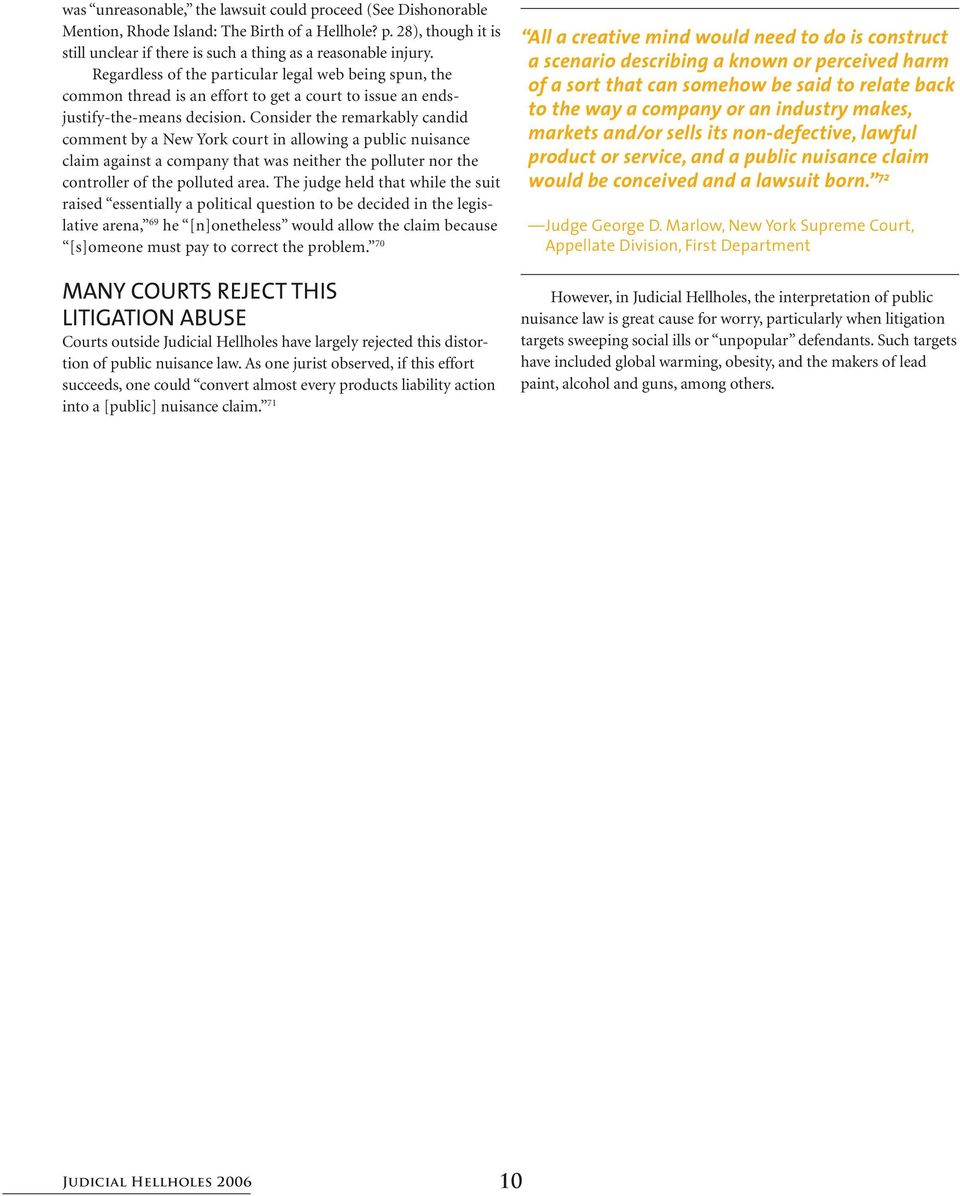
19 Judicial Hellholes 2006 HELLHOLE # 1 West Virginia There was hope that the infamously unfair litigation climate that led ATRF to repeatedly name the entire state of West Virginia as a Judicial Hellhole might improve after the state legislature enacted a law to curb forum shopping abuse by personal injury lawyers. But this year, the state s highest court thwarted that progress and made it likely that the flood of lawsuits with no real connection to West Virginia will rise again. 73 A divided court held the state s venue statute to be unconstitutional under a highly questionable interpretation of the Privileges and Immunities Clause in Article II of the Constitution of the United States. The decision is discussed in detail in this section. West Virginia continues to grow its reputation for lawsuit-happy lawyers, plaintiff-friendly judges, and questionable and potentially fraudulent claims. It is a place where plaintiffs attorneys sometimes seek more in fees than their clients receive in recovery, 74 and where personal injury lawyers sue each other and their own prior clients over litigation expenses. 75 A Field of Dreams for Plaintiffs Lawyers West Virginia courts are considered a favorite for wealthy personal injury lawyers. 76 People sued in West Virginia courts often settle rather than risk unfair treatment. 77 As West Virginia Judge Arthur Recht has recognized, West Virginia was a field of dreams for plaintiffs lawyers. We built it and they came. 78 West Virginia has served as the home field for plaintiffs attorneys determined to bring corporations to their knees.... [T]oo many lawyers use the threat of litigation as leverage to pry cash out of companies. Some firms cases may have been based on fabricated evidence. Some judges seem reluctant to throw out even the most flimsy cases. Lawsuits become settlements. Plaintiffs get their cut. Lawyers get their cut. And West Virginia loses. 79 Personal injury lawyers love West Virginia because there they can pick-and-choose the courts in which they file claims, and because a legal rule allows plaintiffs with no signs of injury to collect cash merely by showing they were exposed to a potentially dangerous substance. 80 In addition, there seems to be no reasonable limit on damages in the Mountain State, and a defendant that is only partly responsible for an injury can be forced to pay 100 percent of a damages award. 81 West Virginia also has a history of alliances and close personal connections between personal injury lawyers, the state s attorney general, Darrell V. McGraw, Jr., and state judges. 82 Recently, for example, the attorney general hired a campaign contributor to bring lawsuits against credit card companies, drug companies and insurers. 83 This is a state, after all, where former West Virginia Supreme Court of Appeals Justice Warren McGraw, the attorney general s brother, filed a lawsuit this year blaming a car accident for his losing a bid for re-election in He claims that back pain from the accident caused him to grimace during a debate, the videotape of which was then used to produce negative campaign ads. 85 A bit far fetched, but this is West Virginia. Personal injury lawyers also find West Virginia to be an extremely attractive forum to file lawsuits, particularly in asbestos cases, because the state s trial courts allow them to group together thousands of individual claims. 86 This both put enormous pressure on defendants to settle, and severely limits the ability of courts and defendants to focus on the merits of individual claims. Many of these claims are also brought by people who do not reside in West Virginia. It is not out of the ordinary for lawyers to file joint cases on behalf of several outof-state plaintiffs against over a hundred separate defendants. 87 A lawsuit filed this year in federal court claims that at least some of these claims are fraudulent. 88 Some have estimated that excessive litigation costs West Virginia s economy as much as $626.3 million annually, a permanent loss of over 16,000 jobs, and about $1,500 per family per year through higher inflation, lost income and decreased spending. 89 The State Journal 11
20 West Virginia long ago became a favorite dumping ground for asbestos suits because of its reputation for jackpot justice. The state s court system responded by consolidating suits into mass litigation, thus denying defendants the ability to contest individual cases. This in turn became an invitation for tort lawyers to generate as many claims as possible Wall Street Journal A Fraudulent Lawsuit Factory? West Virginia is at the center of allegations that personal injury lawyers and their hired-hand doctors have drummed up fraudulent evidence to support asbestos and silica claims. For instance, this year, defense attorneys for CSX Transportation discovered that a doctor who signed medical reports supporting an asbestos claim of a former railroad worker does not exist. CSX found that a supposed office address for Dr. Oscar Frye at 1507 Fifth Avenue in Huntington, West Virginia, has been nothing more than a vacant lot for the past 50 years. The Board of Medicine, state Board of Chiropractic, and Board of Osteopathy had no record of any license issued to a Dr. Frye. The phone number provided on legal papers and purporting to be that of Dr. Frye belonged to someone else. 91 The company also found that the medical report bearing Dr. Frye s signature included language identical to other medical documentation that it had received from other doctors around the country in support of asbestos suits. This led CSX attorneys to conclude that the Pittsburgh-based personal injury firm that filed the case in Marshall County had provided doctors with preprinted materials. They also were led to question how many other fraudulent claims were pending in West Virginia courts. The personal injury firm reacted by withdrawing from its representation of the client with the apparently fraudulent medical records, but reportedly has resisted efforts to verify the authenticity of other asbestos claims it has filed. 92 Steve Cohen, director of West Virginia Citizens Against Lawsuit Abuse, and his trusty dog Lucy tried to help sniff out the elusive Dr. Frye. 93 But failing to pick up any scent, Lucy s diligent search ended when she retreated from the hot sun and found a nice shady spot for a nap on the empty lot. 94 Dr. Frye is not the only doctor involved in the asbestos and silica mess. A real doctor, Ray Harron of Bridgeport, West Virginia, has found himself neck-deep in accusations of supporting highly questionable asbestos and silica claims. Dr. Harron reportedly was paid millions by personal injury lawyers to diagnose potential asbestos victims. He did so with amazing efficiency on some days, at a rate of about one patient per minute. According to the New York Times, Dr. Harron made 75,000 diagnoses since the mid-1990s, commonly reading as many as 150 x-rays per day, at a rate of $125 each. 95 He reviewed asbestos claims for the same law firm involved in the Dr. Frye scandal. Dr. Harron found himself called to testify before the United States Congress. He refused to answer questions on the grounds of self incrimination and is reportedly facing criminal investigation. Dr. Harron also has come under national fire for reportedly double-diagnosing thousands of plaintiffs with both silicosis and asbestosis, even though the medical literature makes clear that the chances of contracting both conditions are remote. 96 But wait, there s more. In another case, evidence shows that a worker who had been previously diagnosed with asbestosis and received a cash settlement impersonated another unimpaired worker so that he too could collect. These screening shenanigans were all sponsored by the same law firm and were signed by of Dr. Harron. 97 CSX s attorneys have responded to the questionable conduct in these and other cases by taking the unprecedented step of filing their own lawsuit alleging fraud against the personal injury firm that has brought such claims. Observers have commented that the suit is remarkable because it may represent a changing tide in West Virginia s long reputation as a Judicial Hellhole. 98 West Virginia Judge Arthur M. Recht, who is overseeing the mysterious Dr. Frye case, deserves acknowledgement for allowing CSX to investigate the suspected fraud, rather than simply dismissing the case a cover tactic that would be expected in the worst Judicial Hellholes. 99 It s high time the claims themselves, and the tactics of the firms who file them, are examined in detail. 100 Charleston Daily Mail Moving Forward In recent years, the West Virginia legislature has stepped in to try to restore some level of fairness to the state s civil justice system. In 2005, the legislature enacted reforms to address unfair joint and several liability that place minimally at-fault defendants at risk of paying the entire judgment. It also curbed third-party, bad-faith insurance suits. The enactment of medical liability reforms in 2001 and 2003 has dramatically helped improve access to medical care. In fact, Dr. Frederic H. Pollack, who serves as the Director of Orthopedic Trauma at Charleston Area Medical Center, has said that his hospital s recruitment of physicians to assist in the trauma center has been remarkable and unprecedented since the reforms and has included four orthopedic surgeons, three plastic surgeon nurses, three general surgeons, a spine specialist, two noninvasive vascular specialists, three maxillofacial surgeons and a neurosurgeon
21 All things are coming together to make West Virginia an attractive place to practice medicine. 102 Evan Jenkins, Executive Director of the State Medical Association and a Democratic State Senator from Cabell County Further, Governor Joe Manchin III has recognized that the reforms enacted under his predecessor, Governor Bob Wise, have worked, cutting medical malpractice lawsuits significantly and reducing the total amount of paid verdicts and settlements by over 50 percent. 103 Insurers have filed to cut their malpractice premiums by as much as 15 percent this year, the overall number of medical liability claims has fallen about 40 percent, and the state is on track to have a banner year in terms of attracting new doctors. 104 But it is too early to sound the all clear on the medical liability front. Many are worried that the state s high court could strike down the reforms. 105 Sliding Backward There is good reason to worry since that is precisely what happened to the 2003 law intended to curb the forum shopping that had led to the filing of thousands of asbestos suits in the state. That reform barred suits in West Virginia courts by those who do not live in West Virginia unless a substantial part of the acts or omissions giving rise to the claim occurred in the state or the plaintiff was unable to sue in another state. 106 In addition, the legislature required that every plaintiff satisfy the new venue requirements so as to prevent out-of-state plaintiffs from riding on the coattails of a plaintiff for whom venue is proper. In Morris v. Crown Equipment Corp., the law was applied to tell a plaintiff from Virginia, whose workplace injury occurred in Virginia on a forklift that was sold and used in Virginia while all witnesses and evidence were presumably in Virginia, too, that he could not sue the Ohio manufacturer in West Virginia simply because the distributor, a codefendant, was incorporated there. 107 Do not pass go; go back to Virginia. But the West Virginia Supreme Court of Appeals invalidated the 2003 law on June 29, 2006, saying that it discriminated against out-of-state residents under the Privileges and Immunities Clause of the United States Constitution. 108 The decision of the West Virginia court conflicts with prior decisions by the United States Supreme Court which allowed states to favor residents over nonresidents in providing access to their courts. 109 Other courts have upheld such rational anti-forum shopping measures, protecting the tax dollars and judicial resources of one state from citizens of other states. 110 Nonetheless, doors to litigation by large numbers of out-ofstate plaintiffs in the West Virginia courts have been reopened. Nonresident plaintiffs will be allowed to bring product liability and other mass litigation suits in West Virginia without any showing of acts or omissions in the state, so long as each plaintiff can allege a colorable claim against one West Virginia defendant. As a result of the West Virginia Supreme Court of Appeals striking down the law, local courts could again become overrun with mass tort cases. As this publication goes to press, an appeal to the United States Supreme Court is pending. 111 These nonresident plaintiffs who may have very legitimate claims are nevertheless expending the time and limited resources of our State court system, to the detriment of resident plaintiffs, when their claims could have been brought elsewhere. Unfortunately, the majority opinion eviscerates [the West Virginia venue law]... against this type of abuse. 112 Justice Maynard, dissenting HELLHOLE # 2 South Florida South Florida, primarily Miami-Dade and Palm Beach counties, consistently makes the list of Judicial Hellholes for its high awards, improper evidentiary rulings, class actions and medical malpractice payouts. The events of the past year show that South Florida s well-earned reputation continues to grow. South Florida is also home to Lewis S. Mike Eidson, the new president of the American Association for Justice, formerly known as the Association of Trial Lawyers of America. Mr. Eidson has vowed to fight efforts by the American Tort Reform Association, the Institute for Legal Reform, and others working to promote rationality and fairness in our civil justice system. 113 A Reputation for High Awards Continues South Florida is known for its high awards. For example, in most jurisdictions, an award to a person who contracted mesothelioma due to asbestos exposure would range between several hundreds of thousands of dollars to a few million dollars. But in South Florida, a mechanic who had alleged 13
22 exposure from working on friction brakes received $31 million, the largest reported asbestos verdict of Also, a Palm Beach County court awarded billionaire financier Ron Perelman $1.58 billion ($850 million in punitive damages on top of a $727 million compensatory award) based on allegations that Morgan Stanley covered up the financial health of Sunbeam, a camping equipment company, when it sold the firm to Perelman. Morgan Stanley has appealed the decision on the grounds that it was not permitted by the trial judge to fully defend itself. 115 Perhaps the most extraordinary award out of South Florida was the $145 billion award against the tobacco industry. This verdict is believed to be the largest punitive damages award in American history. The 2000 verdict came out of a class action suit on behalf of all smokers in the state after a two-year trial in Miami. In 2003, an intermediate appellate court overturned the award in a harshly worded opinion, finding that the trial court conducted a fundamentally unfair proceeding. 116 The appellate court found it was improper to certify the class when each individual smoker would need to show that smoking caused their particular illness and, with respect to fraud claims, that each plaintiff relied on the representations at issue. 117 In addition, the intermediate appellate court ruled that the trial court put the cart before the horse in awarding punitive damages before determining compensatory damages, a procedure that violated the due process standards required by the United States Supreme Court. 118 Finally, the court found that the excessive award flowing from the runaway jury was a result of numerous improper comments, including comparing the sale of cigarettes to slavery and the Holocaust, and asking the jury to disregard the fact that the sale of cigarettes is legal. 119 In July 2006, the Florida Supreme Court agreed with the intermediate appellate court that a $145 billion punitive damages award violated due process and was excessive. 120 In a split decision, a majority of the court let stand factual findings made in the trial court with respect to the defendants conduct and smoking s causal link to certain diseases. 121 This will allow members of the class to proceed with individual actions in which they will need to show that they smoked the defendant s product. But they will not have to prove the product caused their particular disease. If they allege fraud to make their case, they will have to show that they relied on the defendant s statements, but they will not have to prove that the product was defective or that, in general, it causes a wide variety of cancers. As one of the plaintiff s lawyers commented, allowing the class action factual findings to stand makes these cases very attractive to lawyers because they re 90 percent of the way to the finish line. 122 South Florida should brace itself for many more lawsuits by smokers and, indeed, a Palm Beach attorney has predicted that the court is going to be flooded with them. 123 Other South Florida attorneys reportedly predicted an avalanche of future claims, noting that it was estimated that the class action covered 300,000 to 700,000 Florida smokers, each of whom could now opt to bring lawsuits of their own over the next year. 124 When large numbers of asbestos claims were filed in Miami- Dade, Broward and Palm Beach counties, the courts created a rocket docket that encourages settlements. 125 This measure, which establishes rules and time limits for case resolution, has resolved as many as 5,000 cases since its inception, leaving fewer than 20 going to trial. 126 While this expediting practice certainly cuts down on the number of outrageous jury verdicts, it also prods defendants toward settlements with unimpaired plaintiffs. To curb such abuse, some judges, such as Palm Beach Circuit Court Judge Timothy McCarthy, have taken more aggressive action to dismiss claims that should be filed elsewhere. 127 But these efforts to discourage forum shopping have actually been hindered by Florida appellate courts in some cases. 128 For example, the state s Fourth District Court of Appeal overturned two of Judge McCarthy s asbestos venue rulings in 2005, and this will likely lead to similar appeals by plaintiffs in at least 80 other asbestos cases. In other words, that translates into 80 more suits for South Florida and 80 more expedited settlements. Scandalous Miami Miami-Dade also is home to one of the numerous asbestos scandals that demonstrate how mass tort litigation can be abused. More than 4,000 asbestos victims are suing both the Florida Bar Association and Louis Robles, a lawyer purportedly representing them in a proposed class action. Robles, who shut down his legal empire in October 2002 and left his client files laying on the floor of a West Miami-Dade warehouse, 129 was once considered the King of Torts and lived in a Key Biscayne waterfront mansion. His asbestos clients filed a complaint with the Florida Bar alleging that he overcharged them and misappropriated about $800,000 of their funds. 130 The bar took away his license in Recent reports suggest, however, that the bar complaint addressed just the tip of the iceberg. The latest lawsuit now charges that after Robles reached settlements with asbestos manufacturers, he would deposit the payouts in his trust account and then steal them, instead of mailing them to clients, as promised. They claim that he stole $13.5 million in settlements. 131 According to the complaint, Robles orchestrated a bold but fraudulent scheme to steal millions of dollars from over 4,000 asbestos clients... to support his flagrant lifestyle and his production of a series of B movies. 132 The new lawyer for the asbestos claimants went after the Florida Bar because it refused to compensate the asbestos victims out of its security fund program, which compensates individuals wronged by their lawyers. Clients were calling, desperate for money. He wouldn t return their calls. 133 Charles Duross, Chief Prosecutor 14
23 Robles, who routinely traveled by limousine and private jet, pled not guilty in May 2006 to 41 counts of mail fraud. 134 The indictment charges that he stole client money to fund his Florida mansion, apartments in New York and Los Angeles, a condominium in Telluride, Colorado, an investment in a movie production, and to pay his ex-wife s alimony. Prosecutors say that at least 4,500 of his 7,000 clients were victims of theft. Not only have asbestos clients found themselves subject to lawyer misconduct, but the City of Miami was duped when a deal negotiated by its city manager and a plaintiffs lawyer went bad. In 2004, Miami settled for $7 million a lawsuit claiming that the city unconstitutionally imposed a fire-rescue fee. But instead of the money going to reimburse 80,000 potential taxpayers, just seven people divided the settlement, and the lawyers planned to take a $2 million share. How did they get away with it? They claimed that since the judge had never formerly certified the case as a class action, they were free to settle on their own. Much of this came to light earlier this year. The court, feeling duped by the lawyers involved, vacated the settlement in March 2006 and ordered the return of $3.5 million of the settlement. 135 The court then allowed the class action, which is expected to settle quickly on behalf of all taxpayers, to proceed. The Miami Herald has called upon the Bar to investigate the conduct of all of the lawyers involved and punish anyone who has violated legal standards. 136 Reversed: No Class Actions for Those with No Injuries Inappropriate certification of class actions and allowing people that are not injured to file lawsuits are two characteristics of Judicial Hellholes. Both of these elements came together in a Miami-Dade trial court s certification of a class action on behalf of uninjured women who used the hormone replacement therapy, Prempro, a drug that continues to be approved by the FDA. 137 The lawsuit sought medical monitoring on behalf of those that used the drug after a study showed an increased risk of breast cancer and other conditions when used by certain patients. Even the plaintiffs expert conceded that Prempro may only be hazardous when prescribed for prevention of cardiovascular disease, a use not approved by the FDA, while the plaintiffs used the drug for osteoporosis, and the lead plaintiffs physician admitted that he continues to prescribe the drug. 138 In a February 2006 ruling, the appellate court reversed the trial court. It found that treating all of the individual cases together as a class action was inappropriate because plaintiffs used the drug for different purposes and for different lengths of time, and had different risk factors. 139 It also found that the lead plaintiff was not suited to represent the class members because she stopped taking the drug after its potential adverse effects were discovered, did not read the drug s label, did not see the manufacturer s advertisements, and was warned of the risks of the drug by her physician. 140 Finally, it found that a medical monitoring program would do no more than cover the regular examinations that all women are advised to complete regardless of whether they used the drug or not. 141 The court concluded with a warning against junk science: [T]he courtroom is not the place for scientific guesswork even of the inspired sort. Law lags science[;] it does not lead it. 142 Some who criticize the naming of Judicial Hellholes may argue that a reversal of a poor decision shows that the system works. But unfair treatment at the trial court level still costs defendants considerable time and money and may adversely affect a company s stock price and its ability to provide jobs. Steps Forward In past years, Florida has taken steps to address unfairness in its civil justice system. For example, in 2003, the Sunshine State enacted modest reforms to address the stampede of doctors being chased from South Florida by high malpractice premiums that included limits on non-economic damage awards to $500,000 for individual practitioners and $750,000 for medical institutions. 143 The following year, Florida voters passed a constitutional amendment limiting contingency fees for plaintiffs attorneys in medical malpractice actions to 30 percent of the first $250,000 and 10 percent of any additional amount. 144 Last year, the legislature addressed South Florida s reputation as a magnet for asbestos and silica cases brought by out-of-state claimants by providing that only those who have a physical impairment resulting from their exposure may move forward with their suits. 145 The legislation was expected to weed out as many as 4,500 speculative claims while prioritizing the claims of the truly sick. 146 Personal injury lawyers, however, have sought to overturn the new law and the question of its constitutionality is now pending before the Florida Supreme Court. 147 This March 2006, the Florida legislature abolished joint and several liability, 148 a law that encouraged plaintiffs to target deep pocket companies even if they had little responsibility for the injury at issue. In fact, the support of South Florida legislators was crucial to moving the proposal forward in the state Senate. 149 Under the old law, if a person was injured and there were multiple defendants (e.g., a hospital, doctor, nurse and anesthesiologist; or a manufacturer, distributor and retailer), some of those defendants could have been required to pay more than their fair share of the judgment if one or more of the others were unable to pay. Under the new law signed by Governor Jeb Bush, each defendant will be responsible for paying his or her fair share of the judgment, not more, not less. 150 In completely abolishing joint and several liability, Florida joined its neighbors Georgia, Mississippi and Louisiana in hopes of attracting new businesses to its region of the country. 151 Additionally, in April of this year, the Florida legislature enacted laws restricting rampant litigation tourism by out-ofstate lawyers looking for favorable courts and protecting the right of a civil defendant to appeal. 15
24 HELLHOLE # 3 Rio Grande Valley and Gulf Coast, Texas The Rio Grande Valley and Gulf Coast of Texas have earned a reputation as a plaintiff paradise 152 and a lawsuit-happy hunting ground. 153 According to defense lawyers, this jurisdiction has been viewed as one of the toughest jurisdictions for corporate defendants in the country. 154 Although comprehensive tort reform legislation enacted in 2004 significantly improved the litigation environment in much of the Lone Star State, 155 no amount of legislative change has thus far dissuaded a few bad apples, including Jefferson, Brazoria, Cameron, Hidalgo, Nueces and Starr counties, from cultivating abusive litigation. 156 Big Money and Questionable Evidence in a Small Town One does not need to be a personal injury lawyer to evaluate this case. A 71-year-old man died of a heart attack. He had a 28-year history of heart disease, underwent a quadruple bypass, was overweight, a smoker and had high blood pressure. For somewhere between seven and 17 days, he took a pain reliever found to raise the risk of heart attack, but only when used for more than 18 months. Is this a strong case to bring to trial? Most lawyers would walk away; but in Texas s Gulf Coast, they grabbed this fourth Vioxx case, weak as it was, and asked for over $1 billion. After all, just months earlier and only a few miles away, a jury in neighboring Brazoria County brought back a $253 million verdict in the first Vioxx case to go to trial. 157 They may have also remembered a $1 billion verdict for one family in a Fen-Phen lawsuit against Wyeth. As the trial was set to begin in Rio Grande City, a town of about 13,000 near the Mexican border, the Associated Press (AP) reported that [b]usiness suits, Blackberries and laptops seem to have taken over this town. 158 The AP paraphrased legal experts who indicated the case would have little hope of making it to trial anywhere but the Rio Grande Valley. 159 Well, the case not only made it to trial, but it resulted in a $32 million verdict for the plaintiff in April After the trial, it was discovered that one of the jurors who decided the case not only knew the plaintiff but had accepted interest-free loans from her and made several phone calls to her after receiving his juror summons and again just prior to the trial. Anyone who insists there are six degrees of separation has never lived in Rio Grande City. Neighboring Nueces County also found itself in the news when a court awarded $29.5 million to a woman who was seriously injured when she was ejected from her sport utility vehicle as it rolled over. The accident occurred when an 11-year-old spare tire blew out. The plaintiff s lawyer argued that Ford should have warned of the dangers of driving with old tires. The court did not allow the defendants to present evidence to the jury that the plaintiff was not wearing her seatbelt, which could have drastically reduced the extent of her injuries. 161 Another example of unfair evidentiary rulings came out of Jefferson County, where its district court awarded $850,000 to the family of a man who died from lung cancer. The family claimed the lung cancer was due to exposure to asbestos while he was working on Mobil Oil Corporation s premises, but the man was also a pack-a-day smoker for 40 or 50 years. 162 The verdict was reversed when an appellate court found that there was no reliable scientific evidence to support it. In addition, Corpus Christi became ground zero for litigation over Guidant defibrillators. Decisions by a local judge show how court actions can influence litigation. First, the court moved up the trial date from October to February, which compressed discovery and coincided with key business developments, as Guidant was being taken-over by Boston Scientific. Second, it took no action against the plaintiffs lawyers who apparently tried to create media pressure on the company a favorite plaintiffs lawyer tactic by releasing protected company documents minutes before the court closed for the Christmas holiday. The New York Times reported on these documents. 163 The case was ultimately rescheduled a couple of times and awaits action. Texarkana Triangle Another area that is a well-known plaintiffs haven is just north of the Texas Gulf Coast in Marshall, Texas. While the area has received significant attention in the past for tort litigation and class action suits, this year s Judicial Hellholes report has observed a new growth area for entrepreneurial trial lawyers: patent litigation. The New York Times reports that an oft-told joke is that the passage of tort reform was when many local lawyers made the trip from P.I. to I.P. [Personal Injury to Intellectual Property]. 164 As with tort litigation, the area is known to be particularly plaintiff-friendly ; patent plaintiffs win 78 percent of the time in Marshall, compared with 59 percent nationwide. 165 Not surprisingly, plaintiffs from around the country are filing their patent cases in Marshall. In 2002, there were only 32 patent suits filed in Marshall, but that number has reached 234 cases this past year more than Chicago, New York, San Francisco, and Washington. 166 As local P.I. turned I.P. lawyer, Samuel Baxter, has said, You know lawyers: they go where the money is. 167 Areas of Improvement Many people are speaking out about the success of the comprehensive tort reform enacted in For example, Mike Scott, 16
25 co-owner of a Nueces County construction company, noted, We got sued continuously 10 years ago. We were almost sued out of business. We got hit twice a month. Now we see four or five [lawsuits] a year. [Tort reform] has changed the business community around. South Texas doctor Keith Rose, a vocal proponent of tort reform, said that Two years ago I was paying close to $20,000 [for medical malpractice insurance], even though I had never been sued or named in a suit. I got insurance this year for $4, Limits on punitive damages also have checked wholly unreasonable awards that often result from improper evidentiary rulings, such as the $253 million Vioxx jackpot. Between 1999 and 2003, medical insurance premiums for many Texas doctors doubled. 169 Orthopedic surgeons, neurosurgeons, obstetricians and other high risk specialists were leaving the state, and there was a critical shortage of doctors and nurses in places such as Beaumont and the Rio Grande Valley. 170 Proposition 12, which was passed in 2003, continues to allow those injured by a medical mistake to recover their full medical bills, lost earnings, rehabilitation and custodial care expenses; but it does limit non-economic damages, such as those for pain and suffering, to $750,000 per claimant. 171 Within two to three years following enactment of this medical liability reform, not only had insurance rates stabilized, but many doctors actually saw substantial rate reductions some by nearly 50 percent. 172 Doctors are saving about $50 million in annual premiums. 173 Although cautioning that claims are still being filed and multimillion dollar verdicts are still possible, insurers continued to lower rates this year. 174 Physicians are now flocking to Corpus Christi and the Rio Grande Valley, rather than leaving... The statewide gains in pediatric specialists have been remarkable, said Dr. Spencer Berthelsen, Chairman, Board of Directors, Kelsey-Seybold Medical Group, Houston. 175 At least 3,000 more physicians are now practicing in Texas since enactment of the reform. 176 In May 2006, the American Medical Association removed Texas from its list of states experiencing liability crises, marking the first time it has removed any state from the list. In addition, Beaumont plaintiffs lawyers were shocked to have a jury return in just two hours with a defense verdict in a Fen-Phen case. The lawyers in that case had originally asked for $250,000, but then amended their complaint just before trial to ask for $1 million. 177 HELLHOLE # 4 Cook County, Illinois Last year, Cook County made its debut on the Hellholes list at # 2. The county has a long-established reputation as a friendly place for lawsuits 178 and known hostility toward corporate defendants. 179 Cook County hosts a disproportionate share of the state s lawsuits. According to statistics compiled by the Illinois judiciary, 63 percent of the state s major civil litigation is filed in Cook County, even though the county is home to just 42 percent of the state s population. 180 A decade earlier, Cook County s share of state litigation (46.6 percent) was roughly proportionate to its population share, which has grown slightly since. 181 The county also draws large numbers of cases from across the Midwest and beyond. As detailed in the 2005 Hellholes report, 182 Cook County joined the list of Judicial Hellholes due to a substantial surge in asbestos lawsuits, 183 its embrace of class action lawsuits, 184 evidentiary decisions that favored plaintiffs over defendants, and the unwillingness of some judges to dismiss claims with little or no connection to the county. 185 Some of these problems continue today and were accentuated by the flow of litigation to Cook County after Madison and St. Clair counties cracked down on forum shopping and prioritized the asbestos claims of those who are truly sick over those with no sign of injury. Cook County has a reputation for pushing asbestos cases forward and setting many cases for trial each month, which may come at the expense of defendants due process rights. Some Cook County judges also are known for permitting personal injury lawyers to go on fishing expeditions that require defendants, to photocopy, organize and produce thousands of business records spanning decades that have no connection to the allegations of the lawsuit at issue; an expensive and time consuming proposition. Damage to the Economy and Lost Jobs As the volume of civil litigation in Cook County has grown, Illinois economy has suffered. An area s reputation for litigiousness factors into many employers decisions about remaining in or relocating from a particular state or county. For example, Chicago, which is home to about 15 percent of the state s manufacturing industry, has lost 453 plants over the past five years. 186 In 2005 alone, 106 plants left Cook County. 187 The state as a whole also suffers from its unfriendly business environment. 188 In fact, Illinois experienced a loss of 32,000 manufacturing jobs last year. 189 Coming out of recession from 2002 through 2005, the national economy grew at an average annual rate of 2.9 percent, but Illinois economy struggled with growth of only 1.8 percent, or nearly 40 percent less. 190 According to the Bureau of Labor Statistics, Illinois lost 23 percent or 199,500 of its good-paying manufacturing jobs many in Cook County from 2000 through August 2006, 191 while the national loss of manufacturing jobs over the same period was comparably less at 17 percent. 192 While there are several additional factors that contribute to manufacturing job loss, it is a plainly established fact that businesses, both small and large, avoid high litigation jurisdictions like the plague. Though she ultimately failed to defeat incumbent Governor Rod Blagojevich in the 17
26 November 7, 2006 general election, challenger Judy Baar Topinka, the state treasurer, argued during the campaign that outsized damage awards coming from Cook County, as well as Madison and neighboring St. Clair counties, can send the message that the state is hostile to business. Topinka told reporters at one campaign stop that, [w]ith three of the six worst counties for litigation abuse right here in Illinois, it should come as no surprise that companies like Honda are choosing to expand their operations and build new plants in other states. 193 Help Wanted: Area Employers Seek Defense Lawyers Unfortunately, as Illinois manufacturing sector declines, litigation has become a booming business in Cook County, according to the National Law Journal. 194 As Citigroup commercial loan manager Dan Bishop observed, The firms [in Chicago] are growing, they re building up the number of lawyers and their hours are growing. 195 When lawsuits proliferate, plaintiffs lawyers prosper. But while litigation continues to blow into the windy city, defense law firms also are beefing up their presence in Cook County to better serve their corporate clients. 196 Many major law firms are considering opening offices in Chicago. Those that already have offices are considering vast expansions or mergers. For example, Paul Hastings, Janofsky & Walker plans to open a 100-lawyer office this year; Reed Smith is considering merging with a Chicago-area firm; and Morgan Lewis & Bockius is said to be planning on doubling the size of its 40-member Chicago office. 197 With many employers in the services and financial sectors moving to the Midwest to escape high rents on the coasts, it makes sense for law firms to follow. But make no mistake, the growing concentration of lawsuits in Cook County and southern Illinois also serves as a big draw. And considering the caliber of some lawsuits filed there, such as the 2005 class action against Loews Cineplex Theaters alleging movie previews last too long, the Cook County litigation defense business continues to look promising. 198 Solutions Proposed, But Stalled In February 2006, Illinois legislators, frustrated with the poor business and litigation climate in their state, introduced a series of bills to address the problems in Cook County and other areas. Their proposals included requiring plaintiffs to file their lawsuits in the county where most of the allegations behind the lawsuit took place; 199 restricting class action certification to cases in which most of the plaintiffs are from Illinois; ensuring the case is heard in a court with a rational relationship to the lawsuit; 200 making each defendant pay only for its fair share of fault of the total damage award; 201 allowing a defendant to request that juries determine liability and punitive damages in separate phases of a trial, thereby establishing closer judicial review of noneconomic damage awards, such as compensation for pain and suffering; 202 establishing new criteria for the admissibility of expert testimony; 203 and, in asbestos cases, allowing juries to consider sources of asbestos, beyond the defendant s products or workplace, to which the plaintiff was exposed. 204 Few of these proposals, however, were even considered in a committee hearing, let alone put up for a vote in Access to Health Care Begins to Improve, But the Future Is Uncertain Illinois lawmakers have managed to enact one significant reform, however, in the area of medical malpractice. In late 2005, a new Illinois law took effect, limiting pain and suffering awards in such cases to $1 million against hospitals and $500,000 against doctors. 205 The reform was overdue. As Cook County obstetriciangynecologist Basil Chronis recently wrote to the Chicago Tribune, when she started practicing in 1960, her annual malpractice insurance premium was $ Now the yearly cost is $155, In the year since enactment of medical liability reforms, malpractice lawsuits in Cook County dropped 25 percent down from an average of 1,332 filings over the previous five years to 979 in the one-year period since Governor Rod Blagojevich signed the bill and the reforms took effect. 208 While it often takes time for cautious insurers to adjust premiums downward as they wait to see that an initial drop in litigation is not merely a fleeting aberration or that the reform stands up to future court challenges, 209 there is evidence that the premium spikes characterizing the market in recent years (including a 15 percent increase in 2005) have stopped and rates may be beginning to come down. Insurers have good reason to be cautious. 210 In 1996, medical malpractice lawsuit filings in Cook County experienced a similar drop after the legislature enacted a law limiting non-economic damages, but that reform was declared invalid by the Illinois Supreme Court the following year. 211 The award limits were dismantled and the size and frequency of awards continued unabated. It is possible that the state s high court could again strike down the latest medical malpractice reform, which is already being challenged in lower courts, including Cook County. 212 HELLHOLE # 5 (PURGATORY) Madison County, Illinois On the Road to Recovery As a perennial Judicial Hellhole, Madison County, Illinois, earned its reputation as a horrible place to be targeted by a class action or mass tort lawsuit. Madison County became known for plaintifffriendly rulings and thus attracted an extraordinary number of lawsuits, including asbestos claims and class actions. Not coincidentally, the legal climate drove an increase in medical malpractice insurance premiums, which in turn prompted an exodus of doctors from the Metro-East region (east of St. Louis, across the Mississippi River) and a health care access crisis for residents. Over the past two years, however, increased attention to lawsuit abuse by local judges, intervention from the Illinois Supreme Court to stem abusive prac- 18
27 tices, and reasonable restrictions on tort lawsuits enacted by both the state legislature and Congress have brought Madison County to a turning point. Madison County gained its reputation as a judicial hellhole over decades, and it won t be easy to shake it. However, Madison County Chief Judge Ann Callis and her fellow judges seem determined to speed the process. 213 Belleville News-Democrat Blatant Forum Shopping Personal injury lawyers from the far reaches of Illinois and from other states trekked to Madison County in hopes of striking gold. For a long time, local judges allowed them to use Illinois sue anywhere venue law to bring their cases in Madison County. In a given year, Madison County hosted four times as many lawsuits as some of the more populous counties in Illinois. Lawsuit filings seeking over $50,000 rose from 1,246 in 1999 to a peak of 2,102 in 2003 before subsiding to 1,436 in In 2005, 1,315 new lawsuits seeking over $50,000 were filed in Madison County, marking a rollback to the same level of filings as in Asbestos lawsuit filings followed a similar trend. Madison County was by far the busiest place for asbestos lawsuits with many claims filed on behalf of claimants from all over the country, many of whom never even heard of Madison County. 215 Asbestos claims quickly rose from 65 in 1996 to a peak of 953 in 2003, before dropping 50 percent to 477 in Last year, the number of asbestos claims filed in Madison County fell to and have this year dropped even further to This decrease in filings and the related falloff in court-generated revenue have prompted Madison County to freeze government hiring. 219 The decline of lawsuit filings in Madison County has occurred for several reasons. A unanimous decision by the Illinois Supreme Court chastised Madison County for abusing its discretion in not dismissing a class action brought by a Louisiana resident who sought to apply Illinois favorable consumer protection law to conduct throughout the nation. 220 Local judges have also made it more difficult for out-of-state attorneys to bring cases that have no direct relationship to the county. For example, when he took over the asbestos docket from notoriously plaintiff-friendly Judge Nicholas Byron, Judge Daniel Stack cracked down on forum shopping by dismissing the cases of out-of-state plaintiffs. The court also established a differed docket to prioritize the asbestos claims of those who are sick over those who are not. 221 And in July 2006, reform-minded Circuit Court Chief Judge Callis placed Stack, with his commitment to restoring confidence in the judiciary, in charge of the county court s entire civil division. 222 Despite this impressive progress, Madison County may still be the nation s most litigious venue for asbestos claims, and its declining filings merely coincide with similar declines elsewhere. 223 There is still evidence that word of Madison County s new approach has not spread to lawyers in far away places, because they continue to file claims in the county with no relation to the area. 224 In fact, local personal injury attorneys continue to literally search the phone book, trying to find evidence that companies did business in Madison County so they can haul them into court there. 225 But as the Daily Herald observed, shopping should be done for clothes and automobiles, not for legal outcomes. 226 Class Actions As documented in other ATRF reports, class action lawsuits filed in Madison County increased each year, from two in 1998 to a peak of 106 in 2003, before declining slightly to 82 in In 2005, 46 class actions were filed in Madison County. 228 This year, just two class actions have been certified in Madison County. 229 But about 175 more are still pending, 230 and these class actions can be lucrative work for plaintiffs attorneys. 231 Nonetheless, as Crain s Chicago Business recently observed, The flow of class-action lawsuits to Downstate Madison County, once a magnet for plaintiffs lawyers from around the country, has come to a virtual halt in the wake of federal legislation and Illinois court rulings aimed at curbing forum-shopping. 232 Madison County s national prominence as a favored jurisdiction for plaintiff lawyers in classaction cases is probably over as a result of recent federal legislation and three Illinois Supreme Court decisions. 233 Chicago Daily Law Bulletin Several factors have contributed to this change. In 2005, enactment of the federal Class Action Fairness Act, which President George W. Bush promoted in Madison County, moved many cases involving out-of-state plaintiffs and defendants to neutral federal courts. The state s highest court has also slapped trial courts on the wrist for unwarranted certification of class actions. In December 2005, the Illinois Supreme Court overturned a $10.1 billion verdict against Phillip Morris USA that was entered in a 2003 class 19
28 action by Madison County Circuit Judge Nicholas Byron. 234 The court also tossed out a class action against State Farm Mutual Automobile Insurance Co. brought in nearby Williamson County, finding that nationwide claims cannot be pursued under the state s frequently-abused Consumer Fraud Act. 235 As noted earlier, the Illinois Supreme Court overturned another Madison County class action because the plaintiff had no connection to the state. 236 J. Steven Beckett, director of trial advocacy at the University of Illinois at Urbana-Champaign s College of Law, told Crain s that that ruling sent the message to the plaintiffs bar: You better be careful about bringing class actions in Madison County. 237 The bottom line is that Madison County judges are now more likely to require class actions to have a connection to the area and insist that plaintiffs live in Illinois. 238 Kudos to Madison County Judges The Madison County judiciary itself deserves much credit for the decline in class actions. Since starting her new position in May 2006, Circuit Court Chief Judge Ann Callis has instituted rules to make it harder for out-of-state lawyers to file cases in Madison County and for plaintiffs to change judges readily, in hopes of finding a friendly one. 239 Judge Callis announced the change as the first step in the reform process.... There ll be more to come. 240 Not surprisingly, one of the local mega-class action filing firms did not accept the new rule with grace and charged that the court exceeded its authority. 241 We are trying to restore credibility, Judge Callis told Crain s. 242 Meanwhile, Judge Stack also is dismissing class actions when the plaintiffs claim fraud but cannot demonstrate any financial loss. 243 As the Belleville News-Democrat observed, Today, thanks to the national spotlight shining on Madison County and changes in the federal law governing class actions, the one-time class-action capital of the country is now the last place plaintiffs attorneys want to be. 244 The Chicago Daily Record has also expressed its support for the changes: Madison County s diminished status as a magnet for class-action lawsuits is a positive development.... The concept of attorneys shopping for plaintiff-friendly county courts is offensive and stands contrary to the basic notions of fairness and blind justice. If a class-action lawsuit or any other kind of lawsuit possesses enough merit to be filed, it ought to have sufficient merit to withstand scrutiny in any jurisdiction and not only a select few. 245 Still, some prominent local personal injury lawyers are in denial about the changes to the law and procedures, and can be expected to continue filing class actions in Madison and neighboring St. Clair County. 246 It also is important to keep the spotlight on Madison County, particularly considering the recent election of Dave Hylla, a former trial lawyer, 247 to the Madison County bench. It has been reported that he raised $150,000 for his race from the prominent plaintiff s firm of Simmons Cooper. 248 Earlier this year, Madison County Circuit Judge George Moran, Jr. resigned his seat, in part, because he accepted free luxury box tickets to a Cardinals game at Busch Stadium from prominent trial lawyer Stephen Tillery, who has appeared before the judge. 249 We have introduced several measures in the last few months making it more difficult for out-ofstate attorneys to bring cases here that have no direct relationship to our county. In addition, judges in the civil division have taken a strong stand by rejecting cases that don t belong here. We also have instituted a local judicial rule limiting the ability of class action lawyers to object repeatedly to judges, effectively shopping for a preferred judge. 250 Madison County Chief Judge Ann Callis Access to Health Care Lawsuits and high insurance premiums in the Metro-East region also had caused many doctors to flee the area, and those that remained stopped performing high risk procedures. In 2005, Illinois enacted legislation to protect the access to health care. 251 The new law placed a $500,000 limit on noneconomic damages for doctors and a limit of $1 million for hospitals. One year later, doctors are beginning to see relief. For example, ISMIE Mutual Insurance Co., a major medical malpractice insurer in the state, announced that it would cut premiums by 5 percent effective July 1, Consequently, doctors have begun to return. In fact, six months after the reform took effect, a neurosurgeon joined the staff of St. Elizabeth s Hospital in Belleville, ending three years with no such specialist available in the area. 253 As the only neurosurgeon in the area, he expects an extraordinarily heavy workload, so the news is not all rosy. According to the Belleville News-Democrat, while hospitals have had some success in recruiting new doctors, the reputation of the Metro-East continues to make it difficult to attract specialists. 254 Some doctors have tired of years of high premiums and are continuing to leave the area. For example, Dr. Brad Campbell s family had been in the area for 200 years, but after being forced to moonlight in the emergency room and under-fund his retirement to afford malpractice insurance, he tearfully packed up and left for Fayetteville, Arkansas this year. 255 And remember, the Illinois Supreme Court could invalidate the 2005 reform law and send the system into a backward spiral. 20
29 HELLHOLE #6 St. Clair County, Illinois St. Clair County, a Judicial Hellhole since 2004, continues to earn its reputation as a plaintiff-friendly area. Court records indicate that plaintiffs lawyers filed 783 new lawsuits seeking more than $50,000 in damages in the St. Clair Circuit Court in That was a slight increase over the 768 such suits filed the previous year, but less than the number of claims filed in the preceding three years. 256 The number of large lawsuits filed in St. Clair County remains about double the number of suits seen by trial courts in Illinois counties with similar populations, such as McHenry (457), Sangamon (360) and Winnebago (460). 257 Lawsuits are a cash cow for the county. The St. Clair clerk s office took in over $3.6 million in filing fees in 2005, just a little less than the $4 million collected by its infamous neighbor, Madison County, and far more than the $2.5 million cost of operating the court, including all personnel salaries and administrative expenses. 258 Only three substantially larger counties in Illinois took in more filing fees from lawyers than did St. Clair and Madison counties, respectively. 259 Class Warfare Class action fillings in St. Clair County surged from 2 to 24 between 2002 and 2004 (an 1100 percent increase). 260 That number continued to grow in 2005, up to at least 28 filed. 261 Despite enactment of the Class Action Fairness Act and Illinois Supreme Court rulings discouraging class action abuse, St. Clair seems resistant to change. The Record, a local newspaper that reports on the judicial systems in Madison and St. Clair counties, observed that in the first six months of 2006, about 10 class actions were filed in St. Clair County Circuit Court, compared with none in Madison County. 262 The difference may be due to the additional measures taken by Madison County judges to discourage forum and judge shopping in their courts. For example, one class action filed in St. Clair against Allstate this year involved nine Madison County residents and just one St. Clair resident. 263 The class action, which was brought on behalf of all Illinois automobile and homeowner policy holders, claims that the insurer violated the state s consumer fraud law by charging different premiums to customers with similar risks. Not surprisingly, class action filings in St. Clair County frequently are on behalf of people who do not live in the county, or they involve situations that occurred outside of Illinois altogether. Consider two examples. The first is a class action lawsuit filed on June 1, 2006, against State Farm Mutual Insurance Company for allegedly violating Missouri law. 264 (St. Louis is in Missouri; East St. Louis is in St. Clair County, Illinois). The allegations are that State Farm violated Missouri law by making a subrogation claim for medical payments for a person injured in an auto accident in Missouri, a state that does not allow medical payments to be subrogated. To keep the lawsuit from being removed from St. Clair County, the lawyers created a class of Illinois residents only and claimed that the alleged violation of Missouri subrogation law was contrary to Illinois Consumer Fraud Act. 265 The second example is a class action filed in January 2006 on behalf of residents of Kentucky, Tennessee and Alabama, not Illinois. 266 The lawsuit alleges that the prescription drug, Bextra, caused them, or their next of kin, strokes or heart problems. St. Clair County was chosen for the lawsuit based solely on the fact that Monsanto, one of the defendants, operates a plant in St. Clair County. While St. Clair County continues to draw lawyers and large claims from around the country, there appears to be some improvement in two areas. First, St. Clair followed the lead of Madison County in adopting a system in February 2005 that prioritizes the asbestos claims of those who are sick over those who are not, alleviating the clog of asbestos claims there. 267 And second, though St. Clair s reputation as a haven for medical malpractice claims remains in tact, state medical liability reforms enacted in 2005 seem to be working. Malpractice insurance premiums, though still high, have stabilized, and the exodus of doctors from the Metro-East has slowed. 268 Through the first nine months of 2006, plaintiffs filed eighteen medical malpractice lawsuits in St. Clair County Circuit Court, or seven fewer than the total number filed in But the medical malpractice crisis, observes Dr. Carol Kugler of Collinsville, is still very much alive in the Metro-East, and more action is needed to stem shopping for friendly judges
30 Watch List This report calls attention to several other areas that either have been cited in previous Judicial Hellholes reports or are new areas that are being closely monitored due to suspicious or negative developments in the litigation environment. Miller County, Arkansas IS IT MILLER TIME? Miller County, a mostly rural area located in southwest Arkansas with a population of 43,000, is known by some as the Gateway to the Southwestern United States. Others may know it as one of the nation s most plaintiff-friendly jurisdictions. 271 Although many of the downtown buildings in Texarkana have deteriorated as many businesses have closed, law offices there remain most vibrant. 272 Miller County hosts more tort cases relative to its population than any other county in the state. 273 According to statistics compiled by the Arkansas Administrative Office of the Courts, personal injury lawyers are twice as likely to file their lawsuits in Miller County than in other jurisdictions of roughly the same population, such as Baxter and Greene counties. 274 In fact, the number of personal injury claims filed in Miller County has increased 50 percent over the past five years, while the number of such claims has remained stable statewide and fallen in many comparable counties. 275 Miller County also appears to host more than its fair share of major class action lawsuits. Just as Madison County s courthouse saw 19 class actions filed in the week leading up to enactment of the federal Class Action Fairness Act, Miller County witnessed a similar flurry of filings. 276 Centerpoint, a utility company, faces a class action alleging its prices cheated consumers even though the plaintiffs could not demonstrate that it had done any business in Arkansas. 277 But after being removed to federal court, the multimillion dollar case was sent back to Miller County much to the plaintiffs delight. 278 And given reports that the nation s insurance industry is being slammed with a mammoth class action suit in Miller County, the worst may be yet to come. 279 That class action, filed by local law firms in 2005, targets 584 insurance companies on behalf of hundreds of thousands of policyholders alleging that insurance industry software shortchanges policyholders when it calculates claim payments. 280 Miller County also is home to large awards and unfair rulings. For example, a Tennessee trucking company was not notified by its registered agent in Arkansas of a lawsuit stemming from a collision in Florida involving one of its drivers. It was too late in responding to the lawsuit, and a Miller County court entered a default judgment against the company for a whopping $4.8 million. When the trucking company finally learned of the suit and responded, the court refused to vacate the award. The Arkansas Supreme Court had to step in and remind the Miller County court that a default judgment establishes liability, but not damages, and that the plaintiff must show objective evidence to support an award in a hearing beyond his or her own self-serving testimony. 281 Ultimately, the case was sent back to Miller County for a trial on damages, which resulted in an award of just $78, While hearing the case on remand, the trial court allowed the jury to learn that the plaintiff had similarly demanded $3.9 million to settle an earlier accident claim. The plaintiff appealed the ruling, but was shot down again by the state supreme court this year. 283 Not surprisingly, the legal environment in Miller County has led companies to settle rather than risk going to trial. KPMG and Bearingpoint paid $34 million in 2004 to settle a case alleging they over-billed clients because they received discounts on travel expenses, while PriceWaterhouseCoopers shelled out $54.4 million five months earlier to terminate its part in the same suit. 284 As one KPMG representative remarked, the settlements ended what promised to be a long and costly litigation. 285 A large class action filed in 2005 against Google by advertisers alleging click fraud was removed to federal court, 286 but then moved back to Miller County when plaintiffs lawyers went on the offensive. 287 Of course, when this case settled for $90 million this year, $30 million went to the Miller County lawyers while the plaintiffs received zero cash just coupons toward future advertising
31 Los Angeles and San Francisco POOR REPUTATIONS RENEWED ATRF has named Los Angeles County as a Judicial Hellhole in past reports. There is some indication that changes in the Los Angeles Superior Court, referred to as the Bank due to a string of multimillion-dollar awards, have lessened concern. 289 In fact, some have praised the Central Civil West division of the court for its fair handling of complex civil litigation. However, rulings like the Los Angeles Superior Court s certification of a class action on behalf of all people who purchased Listerine whether or not they heard, saw or relied upon representations that the mouthwash was as effective as flossing (a decision that was reversed, see Point of Light: California Courts Uphold Voter Intent to Rein in Shakedown Lawsuits, p.34) give continuing credence to L.A. s longtime reputation as a bad place to be a defendant. That may be why personal injury lawyers chose Los Angeles to file nine coordinated lawsuits against major sunscreen manufacturers this year, claiming that their advertising provided sunbathers with a false sense of security, leading them to put themselves at greater risk of cancer. 290 While it appears that court-centered litigation abuses are not as concentrated in Los Angeles as in past years, strong evidence remains about the unfairness of California s litigation climate. San Francisco Treat: Bad Verdicts This year, several respondents to ATRF s Judicial Hellholes survey named San Francisco for the first time. In fact, this year, a San Francisco jury awarded $10.3 million to a single plaintiff in a mesothelioma case one of the largest verdicts of its kind in California within the past fifteen years. 291 Also in 2006, San Francisco was home to a first-in-the-country $5 million verdict against a refrigeration company in a case that alleged asbestos exposure from equipment. 292 Beyond asbestos litigation, a San Francisco jury awarded $175 million in punitive damages against manufacturers of solvents used by dry cleaners for not properly instructing dry cleaners on how to appropriately dispose of the chemicals. Though he slashed the award to $12.7 million, the judge allowed the verdict to stand, despite the fact that the law requires proof that manufacturers acted maliciously in order to support a punitive award. 293 Influx of Nonresident Cases Recent data collected by the Coalition for Litigation Justice, an insurer group, found that hundreds of nonresident plaintiffs are flocking to California. 294 According to the coalition, over 30 percent of pending asbestos claims sampled in California involve plaintiffs with out-of-state addresses. 295 Some California venues, including San Francisco, have become dumping grounds for cases that can and should be heard elsewhere. 296 The influx of cases into California may be a response to crackdowns on litigation tourism in Illinois, Mississippi and Texas. 297 As one San Francisco personal injury attorney in silica litigation noted, There is a trend of Texas lawyers moving in here. 298 California judges have recognized the growing problem and expressed concern. San Francisco Superior Court Judge Ernest Goldsmith has said the local trial judges often saw situations where the gravity of the case is in another state and there is little contact with our jurisdiction. 299 Likewise, San Francisco Superior Court Judge Tomar Mason has expressed concern that the presence of nonresident cases puts an additional and inappropriate burden on the county s citizens. We understand and are proud of the fact that our bar is educated on these issues and that they [out-of-state plaintiffs] have confidence in our bench, but I query whether our 750,000 residents or citizens are being properly used as jurors in cases which have nothing to do with them. 300 San Francisco Superior Court Judge Ernest Goldsmith Some Fair Treatment, But Problems Persist Some recent defense rulings provide evidence that civil defendants can receive fair treatment in California courts. Examples include a Los Angeles court s defense verdict in a Vioxx trial ending in August of this year and a San Francisco court s ruling that California Attorney General Bill Lockyer could not sue tuna fish producers for failing to include mercury warnings on their cans that would have conflicted with federal law and state regulation. 301 Also, recent actions by California courts to uphold voter intent to rein in shakedown lawsuits through Proposition 64 illustrate a commitment to fair treatment under the law. Furthermore, some San Francisco judges have shown a willingness to dismiss asbestos cases where there is a lack of evidence supporting the claims. 302 In a particularly noteworthy ruling, San Francisco Superior Court Judge Stephen Allen Dombrink granted a defense motion to give a simple and straightforward instruction to the jury on the effect of joint and several liability, i.e., that any finding of a proportionate share of liability for economic damages 303 would result in the defendant being responsible for the full amount of economic damages. The proliferation of asbestos-related bankruptcies means that the issue of joint liability may be an important factor in more cases
32 Philadelphia BACKWARDS, UPSIDE-DOWN CHEESE STEAK WITH EVERYTHING ON IT Philadelphia s poor litigation climate has received recognition in each Judicial Hellholes report since By and large, the problem has been a reputation for high awards and an abysmal medical liability environment. Last year, Philadelphia dropped to the Watch List because of evidence indicating improvement under the spotlight of criticism. Indeed, a state Supreme Court report shows a 55 percent decrease in 2005 filings of medical malpractice cases in Philadelphia compared to the average number of such filings from 2000 through Is this a sign of actual improvement, or are the claims simply being dispersed to other jurisdictions? Ken Kilpatrick, a spokesperson for the Politically Active Physicians Association, suggests that the decline in Philadelphia cases stems from venue reforms and a suburban sprawl of filings in neighboring counties. 306 Consider, for example, that the same report shows that Montgomery County, which had a combined 79 cases filed between 2000 and 2003, saw 102 cases in 2004 and 104 cases in Similarly, Bucks, Chester and Delaware counties saw their medical malpractice filings increase by 19 percent, 6 percent and 13.5 percent, respectively. In fact, the total dollar amount of awards made against doctors in Pennsylvania last year rose 13.5 percent to $448 million. 307 Philadelphia also makes this year s Watch List because of a practice in Philadelphia courts that systemically strips asbestos defendants of their due process rights. The practice, referred to in the tongue-in-cheek section title above as a backwards, upside-down cheese steak with everything on it is actually called reverse, bifurcated consolidated trials. Under this system, asbestos trials are broken down into two phases. In phase one a jury assesses plaintiffs damages. In phase two a jury apportions those damages among the dozens of defendants named. In Philadelphia, multiple plaintiffs and defendants are often combined into one litigation blender. There are several problems with the process. First, defendants cannot present factual defenses for each individual claim, such as showing proof that their product could not have caused the alleged injury. Second, in the liability phase, juries tend to spread damages against all defendants and not pay close attention to actual causation. Third, unlike other jurisdictions that have employed this tactic, 308 Philadelphia uses the same juries for both phases, which is believed to compound jury biases. Courts generally view this litigation technique as drastic 309 but efficient when culpability has been well-established among a handful of companies. The Final Report on the Civil Programs in the Philadelphia Court of Common Pleas issued by the National Center for State Courts in September 2004 noted that reverse bifurcation has been effective in routine cases, e.g., those without unlitigated causation issues. But while the report may have fairly characterized asbestos litigation years ago such as in 1995 when Philadelphia began the practice of reverse bifurcation it no longer does. In the words of Dickie Scruggs, a well-known plaintiffs attorney, asbestos litigation has become an endless search for a solvent bystander. 310 Currently, more than 8,500 defendants 311 are ensnarled in the litigation 312 up from 300 in These new defendants are only peripherally connected to the alleged exposure, making general and specific causation issues central to the litigation. Asbestos litigation has taught us that, in mass tort litigation, these types of shortcuts, which have the practical effect of creating settlement pressures, have the opposite of the intended effect. Instead of unclogging court dockets as intended, explained mass tort expert Francis McGovern of Duke University Law School, Judges who move large numbers of highly elastic mass torts through their litigation process at low transaction costs create the opportunity for new filings.... If you build a superhighway, there will be a traffic jam. 314 In Philadelphia, Judge Bernstein has indicated that perhaps the time has come to end reverse bifurcation: At the time coordination of trials and reverse bifurcation were initiated it was needed to handle an overburdened docket. The transformation of the Philadelphia Courts and elimination of all backlogged civil cases may make coordination of cases and reverse bifurcation unnecessary Orleans Parish, Louisiana KATRINA PUTS HELLHOLE STATUS ON HOLD Orleans Parish received the distinction of being named a Judicial Hellhole in 2002, 2003 and As discussed in preceding reports, the Big Easy gained a reputation for bias against corporate defendants, which manifested itself in multimillion- and billion-dollar awards, massive class actions, prejudicial arguments, and unfair treatment at both the trial and appellate court levels. In August 2005, Hurricane Katrina ravaged the city, 24
33 closed the parish s courts and brought civil litigation to a temporary standstill. Following the disaster, the practice of law in the city was thrown into disarray with lost files, difficult-to-locate clients and witnesses, and thousands of attorneys having either left the area or retired. 316 But not all lawyers took a break in the wake of Katrina. Bruno & Bruno a local law firm run by four brothers who specialize in class-actions, medical malpractice and personal injury claims posted signs on utility poles as early as October 2005 seeking business from homeowners who felt wronged by their insurance companies and others. 317 Within months of the storm, the firm filed dozens of lawsuits targeting the United States Army Corps of Engineers, local authorities that oversaw New Orleans failed levees, an oil company, a nursing home and insurers, among others. 318 The Orleans Parish Civil District Courthouse reopened its downtown courthouse in January The local courts are struggling to keep up with the incoming Katrina-related lawsuits on top of the many civil trials that were delayed due to the storm. 320 The court also faces unique challenges, such as a substantially depleted jury pool. 321 Understandably, New Orleans courts have begun to fast-track hurricane-related litigation to get money to the victims as fast as possible 322 a practice that may be beneficial so long as it does not violate the due process rights of the defendants. In the asbestos context, for example, massive influxes of claims and expedited procedures place extraordinary pressure on defendants to settle, regardless of the merits of the plaintiff s case, because the time constraints make it nearly impossible for the defendants to fully research, prepare for, and defend against each claim. As the one-year anniversary of Hurricane Katrina approached, hundreds of lawyers filed claims in the Orleans courthouse, crowding the clerk s office and pouring out into the hallway. 323 They did so out of caution to ensure that their claims met the state s oneyear statute of limitations for insurance disputes, even though the state had extended the deadline by an additional year. More than 1,100 suits were filed in one week, more than half of them Katrinarelated, which is about the same amount of lawsuits ordinarily filed during a full month. 324 The Bruno & Bruno firm filed a massive class action lawsuit against 161 insurance companies on behalf of more than 4,000 homeowners. 325 As these lawsuits move forward, Orleans Parish judges, who are selected by local residents in partisan elections, will have to make difficult choices. They will be face-to-face with thousands of their constituents who have lost everything. The judges will be in the unenviable position of deciding whether to apply the clear language of contracts or to circumvent contract provisions and permit unjust awards for losses against which individuals did not insure themselves. Due to the inherent conflict of interest in having local judges, who themselves may have experienced hurricane losses, decide disputes between local residents and insurers, many of the claims have been filed or transferred to federal court. 326 As Louisiana State University Law Professor John Baker recognized, The fear of home cooking or having local juries and elected judges decide cases pitting neighbors against companies from other states is a concern held by attorneys across the country and abroad, not just Louisiana.... The federal courts are supposed to be neutral. 327 Federal courts in Louisiana and Mississippi have moved forward with fairness to plaintiffs and defendants, finding that the standard flood exclusion used in virtually all private insurance contracts for decades is valid and does not provide coverage for damage resulting from any type of surface water, but that losses caused by wind and wind-carried rain are covered. 328 A separate, optional federal program has covered losses caused by floods since 1968, though relatively few people in New Orleans purchased the coverage. 329 For that reason, the litigation centers on a highly factual determination as to the amount of damage caused by wind and rain and the amount due to flooding. As cases move forward in Orleans Parish, local judges should follow the lead of the federal courts. Meanwhile, Louisiana plaintiffs lawyers have come up with inventive arguments. For example, they have claimed that the flooding was not an act of God, but a result of a breach in the levies, and that the insurers should cover the entire loss even if only a small portion of the damage was caused by wind covered under the policy. 330 It is too early to say whether Orleans Parish will return to the list of Judicial Hellholes. Much has changed since it was last named in The deluge of hurricane-related cases pending in state court and the backlog of ordinary civil cases will put the fairness of local judges to the test. Delaware THE BRIDGES OF MADISON COUNTY LEAD TO THE FIRST STATE It may come as a surprise to Delaware residents that their state is in danger of losing its solid reputation for being fair to businesses in personal injury cases. 331 Why? Because the same law firms that once flooded Madison County with asbestos litigation have been looking to storm other jurisdictions. Consider the following: The number of new asbestos claims being filed in Delaware particularly those generated by out-of-state law firms on behalf of out-of-state plaintiffs who have appropriately had the courthouse door slammed in their faces elsewhere has virtually exploded in the past two years. According to court records obtained by ATRF, there were only 61 new asbestos cases filed 25
34 in the First State from May 1, 2004 through April 30, From May 1, 2005 through August 25 of 2006, there were 272 such cases filed, the bulk of which have been driven by out-of-state firms. According to one report, While the number of new asbestos lawsuits has dropped precipitously in Madison County, a deluge of filings is keeping clerks in a Delaware court working nights and weekends to keep up. 332 Although Michael J. Angelides, a partner and chief asbestos litigator with the Illinois-based firm Simmons Cooper, admitted in the August 16, 2006 edition of the Delaware Law Weekly to spreading political contributions around the state to those who believe in issues that we believe in, he also expected readers to believe that such contributions are not intended to win advantage for his clients. 333 Other veteran Madison County players have also set up shop in Delaware, including Baron and Budd of Dallas, Texas. 334 The law firm of Peter Angelos has filed suits in Delaware, too. 335 Delaware is attractive to the personal injury bar for several reasons. Personal injury lawyers can file claims in Delaware on behalf of clients in other states because many businesses are incorporated in Delaware. 336 This allows nonresidents to file in Delaware without fear of dismissal or removal. 337 In addition, the mass scheduling of asbestos cases now prevalent in Delaware, sometimes obligating defense counsel to be in several courtrooms at once, constitutes an all but irresistible pressure to settle before trial. Further, the public record makes clear that judges frequently refuse to hear defendants motions for summary judgment until they enter good faith settlement negotiations. It is not only the defendants who believe Delaware is being overwhelmed by imported asbestos litigation. In her August 28, 2006 letter to New Castle County Commissioner David White, Kathleen Hadley, a plaintiffs attorney with the Angelos law offices in Wilmington, explained that out-of-state plaintiffs have contributed to this backlog of cases. Fortunately, this scene has played out before, so Delaware s honorable judges and legislators may wish to follow the same script as their reform-minded counterparts in Illinois, Texas and elsewhere to regain control of their courts and protect their economy. 26
35 Other Areas to Watch Beyond the six jurisdictions named on this year s Watch List, ATRF survey respondents and others say several additional jurisdictions have characteristics consistent with Judicial Hellholes. These jurisdictions include: Jefferson and Choctaw Counties, Alabama. Considered by some to have relatively high civil lawsuit verdicts and [the state has] a failure to enact few or any comprehensive reforms. 338 Also, corporate attorneys, who normally have a large say in where a major business will locate or expand, say the legal climate plays a very big part in making such decisions. These attorneys do not choose Alabama 339 for new business locations. Alameda County, California. This county is a popular jurisdiction for asbestos cases, as local judges often reject improper venue and forum nonconveniens motions. Local judges have refused to adopt an inactive docket that prioritizes asbestos claims alleging actual physical impairment; and they will not compress discovery, leaving defendants to be burdened by plaintiffs fishing expeditions. Eastern Kentucky. Pike County and areas in Eastern Kentucky were cited in the 2005 Judicial Hellholes Watch List for its reputation for egregious awards and medical liability issues. ATRF continues to monitor this litigation environment. Baltimore, Maryland. This jurisdiction is perennially cited by respondents to the Judicial Hellholes survey as a place where plaintiffs lawyers, such as Baltimore Orioles owner Peter Angelos, have home field advantage. Judges are known to cluster cases and deny pre-trial defense motions. Mississippi. Despite the state s adoption of comprehensive tort reform legislation, several areas in Mississippi continue to be regarded as particularly plaintiff-friendly. For example, when Mississippi Attorney General Jim Hood filed a lawsuit against the insurance industry just weeks after Hurricane Katrina last year, he filed it in Hinds County, a former Judicial Hellhole (2003). According to a December 19, 2005, story in Lawyers Weekly USA, Hood explained, We ve got some judges who live down on the coast and who have to be elected. On April 18, 2006, the Associated Press reported that the attorney general had also compared insurance companies to Nazis during a luncheon speech, looking to inflame judges and juries against the industry so as to keep them from receiving a fair trial. Thus far, federal courts in Mississippi have declined to take Attorney General Hood s invitation to invalidate clear language in insurance contracts that excludes claims for damage caused by flooding. But the attorney general is fighting hard to keep the case before a local court in Hinds County. St. Louis, Missouri. Conventional wisdom holds that the circuit court in the city of St. Louis is plaintiff-friendly. It s considered a good place to file a lawsuit. 340 Jefferson and Choctaw Counties, Alabama Alameda County, California Eastern Kentucky Baltimore, Maryland Mississippi St. Louis, Missouri New Mexico Appelate Courts Oklahoma Marion County, Indiana New York City New Mexico Appellate Courts. New Mexico appellate courts earned Dishonorable Mentions in both 2003 and 2004 for egregious rulings and made the Watch List in last year s Judicial Hellholes report. Court observers tell us that the situation has not improved. Oklahoma. After Texas enacted tort reforms, Oklahoma attorney Stratton Taylor sent a letter to Texas lawyers saying, With recent events that have occurred in Texas, you may be looking to file cases in Oklahoma. The state has been on the Watch List ever since for signs of burgeoning Judicial Hellhole activity. Also, despite some encouraging talk, serious tort reforms have yet to be enacted. Marion County, Indiana. While Marion County has an unofficial inactive docket for asbestos litigation, it has been imposing onerous discovery requirements on defendants and sanctioning those who do not comply. New York City. ATRF has received reports that some judges have ruled against defendant motions while admitting that they have not even read the filings. Also, while New York State has tried to guarantee more representative juries, such as by removing professional exemptions, local courts are dismissing jurors for such things as owning any stock in a defendant company. This practice makes it difficult to get a representative jury in Manhattan, the financial capital of the world, in cases where there are multiple defendants. ATRF will continue to monitor developments in these areas to determine whether they should be included in future reports. 27
36 Dishonorable Mentions ATRF metes out Dishonorable Mentions in recognition of a particularly abusive, if somewhat isolated, practice or unsound court decision. This year, events in Rhode Island, Massachusetts, Louisiana, New Jersey, Nebraska, and California have earned this distinction. Providence, Rhode Island BIRTH OF A HELLHOLE? A Providence court gave a huge boost to efforts by some state attorneys general and personal injury lawyers to convert the tort of public nuisance into Super Tort, capable of holding product manufacturers liable for any societal ill that may be caused by their products, regardless of fault. 341 In a lawsuit involving allegations against the former manufacturers of lead paint and pigment, the court stripped the traditional elements from public nuisance law to do an end-run around product liability law and thereby create a defenseless lawsuit. The decision may well have given birth to a new Judicial Hellhole, as future personal injury lawyers may choose to mimic the lead paint case and file comparable public nuisance claims in Providence. In the so-called lead paint lawsuit, personal injury lawyers teamed with the Rhode Island attorney general to hold the companies that sold lead paint and pigment more than a half century ago liable for hazards caused by lead paint today. In the early part of the 20th century, lead-based paint was widely used in residential communities. Starting in the late 1930s, replacements for lead pigment had begun to gain popularity and, in 1955, considering potential health concerns, the industry voluntarily adopted standards to significantly reduce the amount of lead in paint. 342 Congress officially banned lead paint for residential use in Until the 1980s, most litigation over lead poisoning from ill-maintained lead paint was properly aimed at individual landlords and property owners who allowed their properties to fall into disrepair. Litigation against the lead paint and pigment companies themselves began in the mid-1980s, 344 but it failed to meet the basic standards of product liability law. 345 To get around product liability law, the personal injury law firm of Motley Rice in 1999 convinced the state attorney general to partner with them in bringing a government public nuisance action against the paint and pigment companies; the case would be brought on a contingency fee basis. 346 Deputized with the power of the state, Mr. Motley sought the costs of removing lead paint from every building in Rhode Island that contained it, regardless of whether it actually posed harm to anyone in its current condition. 347 While the first trial ended in deadlock with four of six jurors voting against the state s public nuisance claim, the court gave the state a boost in the second trial. It redefined the key elements of public nuisance law and, in so doing, created a defenseless lawsuit. 348 One look at the jury instructions will show how the defendants fate was sealed the moment the instructions were given: First, the court shoe-horned this lawsuit into public nuisance theory when it never belonged there in the first place. Public nuisance law is only to be used when there is an interference with a public right. In contrast, the judge told the jury that it could find that public nuisance injury exists due to the cumulative presence of lead pigment in paints and coatings in [or] on buildings in the state of Rhode Island. 349 In the hundreds of years that public nuisance law has been used, ATRF is not aware of any court that has allowed the aggregation of private rights to equal a public right. Under this theory, almost any product could be deemed a public nuisance. Second, the court did not require the defendants to have engaged in any wrongdoing or unreasonable conduct. 350 It told the jury that it should find unreasonable interference so long as the children ought not to have to bear the injury of lead poisoning. 351 Third, the court did not require the defendants to be the cause-in-fact of any alleged injury. It instructed the jury that it did not have to find that the manufacturers produced any of the lead pigment present in the properties at issue. 352 In fact, the court did not even require any evidence that any defendant actually sold lead paint or pigment in the state
37 Remarkably, even with this stacked deck, the jury initially reported that it was deadlocked in favor of the defendants. Jurors have since stated that when they went back into the jury room and worked through the judge s instructions letter-by-letter, they had little choice but to find against the defendants. 354 As one juror put it, the court didn t give the paint companies much of a window to crawl through. 355 If this precedent stands, enterprising personal injury lawyers and a complicit attorney general could sue a product manufacturer for almost any societal ill. Jurors, hoping to raise money for government programs without having their taxes raised, could find defendants liable for millions or billions of dollars. Rhode Island s current attorney general has already signed on to an eight-state lawsuit against certain companies for their alleged contribution to global warming. Other signs that Providence may become a Judicial Hellhole: One judge holds settlement week in December to pressure insurers to clear their books for the upcoming year. 356 As Duke University Law School professor and mass tort expert Francis McGovern has cautioned, courts that pressure for settlement can create an inviting environment for more cases: If you build a superhighway, there will be a traffic jam. 357 The local trial bar hosts a how-to-sue program for local residents. 358 There is a 12-percent accrual rate of interest on settlement amounts beginning when the action arises, not when filed. As one local defense counsel observed, if the plaintiffs lawyer waits three years to file a lawsuit, the plaintiff will have racked up 36 percent in interest charges before the defendant even has an opportunity to answer the case. 359 The American Medical Association calls the jurisdiction an area in crisis. Rhode Island internists are paying more than three times as much in medical liability premiums in 2005 as they were in Massachusetts Supreme Court LAWSUITS WITHOUT INJURY The Massachusetts Supreme Judicial Court has expansively interpreted the state s consumer protection statute, making the state fertile ground for massive class action lawsuits in which class members may not have even heard or seen the representation at issue and experienced no financial loss resulting from the complained-of conduct. As the state s high court recently stated, in a sharply divided decision: A successful [Massachusetts] action based on deceptive acts or practices does not require proof that a plaintiff relied on the representation, or that the defendant intended to deceive the plaintiff, or even knowledge on the part of the defendant that the representation was false. Although our cases offer no static definition of the term deceptive, we have stated that a practice is deceptive,... if it could reasonably be found to have caused a person to act differently from the way he or she otherwise would have acted. In the same vein, we have stated that conduct is deceptive if it possesses a tendency to deceive. 361 Accordingly, personal injury lawyers have now teamed up with advocacy groups to set their sites on Big Soda and Big Food, claiming that their marketing practices are responsible for a rise in childhood obesity. Of course, they avoid mention of the lack of physical activity, increased television watching or video game playing prevalent today, or a lack of parental responsibility in monitoring children s eating habits. Instead, they argue parents are unable to resist their children s pleadings for breakfast cereals bearing the likeness of characters such as SpongeBob SquarePants. 362 An understated editorial in the Washington Post characterized the threatened lawsuits as an unusual new legal approach. 363 That approach also prompted Advertising Age to ask, is Tony the Tiger on Death Row? 364 Massachusetts is reportedly the probable battleground for these lawsuits due to its reputation for easy class certification of consumer protection lawsuits. 365 Consumer protection lawsuits also claim that fast food makers should label their products with nutritional information, even though federal and state regulations exempt non-packaged food products, such as those served in restaurants, from such requirements. 366 However, the problem with such regulation is that any given menu item in a restaurant may vary somewhat in portion-size and even ingredients from day-to-day, and menus can change regularly. Recently, soft drink companies, attempting to avoid a threatened lawsuit, agreed to stop selling soda to schools, despite the fact that school officials in many areas have already responsibly adopted policies that regulate the sale of soda and snacks to their students. 367 Instead, student choice will be limited to water, juice, low-calorie sports drinks, or diet soda. 368 Such action takes nutritional policy and choices away from legislators, school officials, parents and students. It also allows lawyers and interest groups to dictate what people can eat and drink. The tobacco industry itself remains in the sights of the plaintiffs bar, and it is finding unfriendly courts in Massachusetts. Rather than allege their clients suffered a personal injury from cigarette smoking, plaintiffs lawyers have focused new energy on lawsuits that claim the marketing of cigarettes as light misleads consumers into thinking they are healthier than ordinary cigarettes. 369 These lawsuits are filed despite the fact that light cigarettes contain the same federally mandated warnings as regular cigarettes, light cigarettes cost the same amount as regular cigarettes, and most smokers who claim they were misled by the marketing practice would have either smoked regular cigarettes or continued 29
38 to smoke light cigarettes regardless. Most state courts have rejected similar class actions, but not Massachusetts. Under the court s broad construction of the state s consumer protection law, smokers who bought light cigarettes in the state are poised to collect $25 each. 370 If successful, their lawyers will receive a percentage of the $25 multiplied by the entire number of smokers in the state as per their contingency fee arrangement. It is easy to see who benefits from this system. Louisiana Supreme Court DUPLICATIVE HEDONIC DAMAGES On July 10, 2006, the Louisiana Supreme Court, in a 5 to 2 decision, held that it would permit recovery for the lost enjoyment of life, also known as hedonic damages. 371 While some states permit the jury to consider lost enjoyment of life when determining compensation for pain and suffering or a physical disability, Louisiana has gone further allowing juries to provide a separate, additional award on top of general damages. The problem with allowing a separate award for hedonic damages is that it creates confusion for the jury and there is great potential for overlapping or duplicative awards. It is difficult to make a principled distinction between an award intended to compensate for pain and one that is meant to compensate for lost enjoyment. When a jury is presented with a verdict form with a blank line for both such categories, human nature and sympathy are likely to lead them to place a dollar figure for each category. The result is that a defendant may be forced to pay twice for the same injury, promoting a general inflation of compensatory awards. Such windfall double recoveries undermine the tort system s goal of fairly compensating injured persons and raise litigation-related costs for civil defendants. These costs are then passed on to Louisianans in the form of higher prices for goods and services. The court did not address the admissibility of expert testimony on valuing lost enjoyment of life, a practice that is almost uniformly rejected as too unreliable for admission in court 372 but nonetheless allowed by some Louisiana judges. Such testimony is highly speculative and often based on statistics and other factors that have little to do with the plaintiff s actual life. But a small, intrepid group of experts has created a cottage industry that supports hedonic damages. Without exception, these experts recommend additional multimillion-dollar awards for lost enjoyment of life. 373 In the future, the Louisiana Supreme Court will have an opportunity to reject such expert testimony and allow jurors to decide an appropriate amount based on their own experience and the trial testimony related to the plaintiff s life. New Jersey NEW JERSEY & LAWSUITS, PERFECT TOGETHER To boost tourism in New Jersey, the state government ran advertisements in the 1980s with the slogan New Jersey & You, Perfect Together. But within the past year, New Jersey courts have revived the campaign with a new twist. Their substantive changes in state tort law have now made the Garden State one of the top litigation tourism destinations in the country. The likely hot spot is Atlantic County where courts compete with neighboring Atlantic City casinos in doling out jackpots. Recent intermediate appellate court rulings reflect the willingness of New Jersey courts to embrace new theories of liability as well as welcome out-of-state plaintiffs, and the state s supreme court could broaden the impact of these rulings next year to spread litigation tourism throughout the Garden State. Toxic Torts Travelers One of the hallmarks of a Judicial Hellhole is a local court changing the law in order either to find against an unpopular defendant or help a sympathetic plaintiff. The latter seems to have happened when the New Jersey Supreme Court heard an appeal of an asbestos case in which a family member alleged exposure from residue brought home on work clothes. New York, Georgia, and Texas courts have all upheld traditional tort law in this area, 374 stating that third-party liability is unmanageable, results in unsound public policies, and gives spouses greater rights to sue than employees. (Worker exposure cases are typically handled under the workers compensation system.) Undeterred by such logic, the Supreme Court of New Jersey, extended third-party liability to employers, 375 and New Jersey retain[ed] its reputation as a plaintiff-friendly forum. 376 While injuries to third parties may be heart-wrenching, courts are supposed to uphold the rule of law, which in this instance states that the worker s employer is not responsible; the plaintiff is to sue more appropriate defendants, such as the asbestos or end-product manufacturer. Red Rover, Red Rover, Let Michigan Residents Come Over Already, it has been reported that 90 percent of plaintiffs filing pharmaceutical mass tort cases in New Jersey are non-residents. 377 A recent appellate decision 378 exacerbate[d] the existing problem of forum shopping in New Jersey 379 by holding that the state s product liability law for prescription drugs, which is more plaintifffriendly than Michigan s, will govern the lawsuit even though the plaintiff lived in Michigan; was prescribed, bought and took the medication in question in Michigan; alleged an injury occurred in Michigan; and the drug had been approved for use by the federal Food and Drug Administration. The New Jersey court stated that it does not believe the Michigan legislature s decision to give drug companies a government compliance defense should apply to defendants in New Jersey. 380 Because the drug industry has a major presence in New 30
39 Jersey, 381 this ruling essentially nullifies the Michigan tort reform statute and made the New Jersey judiciary the official drug court for Michigan residents. Give Us Your Poor, Your Tired, Your Muddled Class Actions This year, an Atlantic County judge and the appeals court that affirmed her decision paved the way for national class actions against any business in the state under New Jersey s plaintifffriendly consumer protection laws. 382 This particular suit alleges that Merck violated state law by advertising Vioxx as safe without fully disclosing its risks. 383 This was not a typical consumer protection case brought by an average citizen who felt he was duped by an advertisement. No, the court actually allowed insurance companies and health maintenance organizations who are sophisticated businesses, to take advantage of the state s consumer fraud act. The appellate court also took the remarkable step of applying New Jersey s consumer fraud law to plaintiffs from across the country simply because Merck, like many pharmaceutical companies, is incorporated in New Jersey. The courts paid no heed to the fact that other states consumer laws have very different elements, standards, and recovery than New Jersey. In glossing over these differences, the appeals court suggested that [a]ll consumer fraud laws in the nation are designed to protect consumers to some degree. 384 The decision is yet another that regulates trade practices and liability in other states, undermining those states ability to regulate conduct within their own borders. 385 The same Atlantic County judge also set aside a verdict for the defense in a Vioxx personal injury case based on supposedly new evidence and has otherwise made several blatantly pro-plaintiff rulings in Vioxx cases. 386 For example, the judge has indicated that she will consolidate the cases of eight different plaintiffs from different states with different medical histories in the same trial, which is scheduled to occur in January Public Nuisance Elements? Fuhgetaboutit! Another New Jersey appellate court became one of the few courts in the country to allow public nuisance law to be used against product manufacturers. In a recent case, twenty-six government entities jointly sued the former manufacturers of lead paint and pigment for governmental costs associated with detecting and removing lead paint, providing medical care to lead-poisoned residents, and developing related educational programs. 387 In allowing the case to proceed, the court, without clear explanations, relaxed the elements of control and proximate causation and defined the public nuisance as the very presence of lead paint. Thus, it appears that little if any wrongful conduct will be required at trial. In addition, the appellate court has allowed the government to pursue their own, unique damages even though under traditional public nuisance law, governments may not seek money damages, just an injunction or abatement. Nebraska Supreme Court PUBLIC PARKS AND POOLS AT RISK For a quarter of a century, Nebraska courts interpreted the state s Recreation Liability Act to extend immunity to the state and local governments when they operated parks, pools and other recreational facilities not anymore. The state legislature passed the law in 1965 to encourage individuals and organizations to open recreational facilities to the public at no charge by offering them limited liability protection from accidents that occur on their property. 388 The law fairly provided that the owner would face liability if an injury occurred as a result of a willful or malicious failure to guard or warn against the danger, but not for ordinary accidents. 389 In 1981, the Nebraska Supreme Court reasonably ruled that protection applied to government entities as well as private landlords. 390 On several occasions since its initial ruling, the court explicitly reaffirmed the law s applicability to state and local governments. 391 After all, nothing in the statute makes a distinction between public and private owners of property. Suddenly in 2006, the court s interpretation drastically changed, even though the language of the statute had not. 392 Even if many judges before them had repeatedly made a mistake, a foundational legal principle known as stare decisis (Latin for to stand by that which is decided ) would weigh heavily against abandoning previous decisions. 393 Stare decisis provides predictability, consistency and fairness by assuring that decisions are based on the law and not on the policy preferences of individual judges. In other words, litigants today are to be treated the same under the law as litigants yesterday wherein they had rationally depended on the prior ruling. For many years, that liability protection was no doubt a factor in encouraging cities and counties to invest public funds in constructing parks, pools and recreation centers. If the court had it wrong twentyfive years ago, then the state legislature could have simply amended the law to exclude government entities from its coverage and provide a reasoned phase-in of municipal liability that would apply only to future injuries. But the Nebraska Supreme Court s sharp reversal took effect immediately. It applies to any action brought, even if the injury occurred during the time that government entities were assured by the court that they were not liable. Already, ATRF has learned from a representative of Nebraska municipalities that calls are coming in from city officials across the state, saying they are now considering shutdowns of their parks and pools. 31
40 California Legislature LET S USE PUNITIVE DAMAGES TO FUND THE STATE BUDGET! In August 2006, the California legislature tried to extend a hastilyenacted 2004 law that required 75 percent of any punitive damages award to be directed to state coffers through July 1, When originally enacted as part of an appropriations bill to help the state address a budgetary crisis, the act was characterized as a uniquely extraordinary legislative action that is to form no policy or precedent for the future. 395 Yet, predictably, the incentive for the state to continue taking a portion of a plaintiff s punitive damages award into a Public Benefit Trust Fund beyond the law s expiration date was too difficult for the legislature to resist. What is particularly troublesome is that while the injured person gets 25 percent of the award, his or her attorney draws a contingency fee based on 100 percent. In general theory, laws requiring a successful plaintiff to share his or her punitive damages award with the state may be superficially attractive to state legislators and the business community. Some may view the approach as a way to lower the economic incentive for plaintiffs lawyers to pursue punitive damages, while providing the state with a convenient additional source of revenue to address public needs. But in specific practice, as was the case in California, legislation is invariably crafted to let plaintiffs lawyers take their cut based on the entire recovery. Directing punitive damages to the state raises serious problems, too, including the potential to make punitive damages exposure even worse than it is today. 396 Jurors may be more likely to award punitive damages and in larger amounts if the money is to go toward the public good rather than to a single windfall plaintiff. Jurors also might be influenced by their charitable instinct to fulfill a social good, or their own self-interest in reducing their tax burden or supporting state programs that will help them, their family or their community. The problem of potential juror bias is especially likely to occur when the defendant is an out-of-state corporation. The California law has now expired. An attempt to renew it was vetoed by Governor Arnold Schwarzenegger on the grounds that it was retroactive and no hearings had been held to scrutinize its potential impact over time. Sacramento insiders report that supporters of the initiative are determined to bring it back for another try. But if it is not defeated or vetoed again, the Golden State will immediately risk melting into the notorious ranks of Judicial Hellholes. 32
41 Points of Light There are five ways to douse the flames in Judicial Hellholes and to keep jurisdictions from developing an out-of-balance legal climate: Constructive media attention can encourage change; Trial court judges can engage in self-correction; Appellate courts can overturn improper local decisions and confine future judicial malfeasance; Legislatures can enact statutory cures; and Voters can reject lawsuit-friendly judges or enact ballot referenda to address the problems. In its Points of Light section, this report highlights jurisdictions where judges, legislators, the electorate and the media intervened to stem abusive judicial practices. These jurisdictions set an example for how a courthouse, city, county or state can emerge from the desultory depths of a Hellhole, or keep itself from sinking to those depths in the first place. Illinois Supreme Court Again Curbs Regulation through Litigation The Illinois Supreme Court continues to send a strong message that consumer protection acts should not be used by personal injury lawyers or judges to pursue their own political or public policy agendas. Its decisions are authoritative condemnations of regulation through litigation. 397 Last year, this report recognized as a Point of Light, the Illinois high court s decision in Avery v. State Farm Mutual Automobile Insurance Co., in which it overturned a $1.2 billion judge-issued verdict, including $600 million in punitive damages. 398 Avery was a nationwide class action brought under the state s consumer protection law, alleging that the insurer acted deceptively by specifying use of generic auto replacement parts, rather than the brand name manufacturer parts. The court rejected class certification because the lawsuit included out-of-state plaintiffs and repairs that occurred outside of Illinois. It also questioned how selling a product that is not the highest quality relative to the competition could be illegal since State Farm s disclosures to consumers complied with the state insurance code. Soon after publication of the 2005 Judicial Hellholes report, the Illinois Supreme Court rendered its long-awaited ruling in Price v. Philip Morris, Inc., vacating the largest judgment in Illinois history a $10.1 billion verdict. 399 The judgment resulted from a bench trial in Madison County, Illinois, in which the plaintiffs claimed that Philip Morris s advertising and packaging of light cigarettes was unfair and deceptive. The class certified by the trial court included all consumers (estimated by the court at over one million) who purchased light cigarettes in Illinois during a 30-year period. On March 21, 2003, Judge Nicholas G. Byron rendered a $10.1 billion judgment, including $7.1 billion in compensatory damages, $1.77 billion of which was allocated for payment of attorneys fees, and $3 billion in punitive damages paid to the State of Illinois. 400 The Illinois Supreme Court vacated the award based on the Federal Trade Commission s (FTC) extensive regulation of the advertising and promotion of light cigarettes or low tar or nicotine cigarettes since the 1970s. 401 The court also indicated 33
42 that individual plaintiffs must have been deceived by the allegedly fraudulent representation and suffered actual damages as a result of relying on that misrepresentation. 402 In 2006, the United States Supreme Court denied certiorari in the Price case, suggesting an additional caution against bringing such suits. The Price decision emphasizes the importance of exemptions from consumer protection laws when the conduct in question is already regulated by state or federal agencies. Approximately two thirds of state consumer protection statutes reasonably include an exemption similar to the one contained in the Illinois law. 403 California Courts Uphold Voter Intent to Rein in Shakedown Lawsuits In November 2004, California voters overwhelmingly passed Proposition 64, an initiative that put a stop to what one judge called shakedown lawsuits over obscure regulatory violations under the state s notorious Unfair Competition Law (UCL), particularly when no one had been injured or suffered a financial loss. 404 Many of these lawsuits benefited only the lawyers who brought them, as the statute provided for recovery of attorneys fees. As detailed in previous Judicial Hellholes reports, a lawsuit industry had emerged to victimize small businesses and damage the state s economy. Proposition 64 restored balance. It provided that only those who suffered an injury or experienced a loss of money or property could bring a claim. 405 It also subjected such lawsuits, when brought on behalf of numerous individuals, to ordinary class action safeguards that protect due process. Since that time, California courts have rejected attempts to undermine voter intent, while not affecting the ability of the state attorney general to stop deceptive practices before someone is harmed. First, in July 2006, a unanimous panel of a California appellate court firmly rejected an effort to revive the types of abusive lawsuits that Californians voted to kill with passage of Proposition The decision reversed a November 2005 ruling by a trial court in Los Angeles, a former Judicial Hellhole that remains on this year s Watch List. The trial court had certified a class action, including all people who bought Listerine during a six-month period in Citing advertisements suggesting that use of Listerine is as good as flossing in reducing plaque and gingivitis, lawyers claimed that all people in the state who purchased Listerine should get a refund. The class included everyone and anyone who purchased the product, even if they had not seen the advertisements, purchased Listerine for completely unrelated reasons (e.g., brand loyalty or to freshen breath) or never experienced a related dental problem. As an affront to Proposition 64, the trial court certified the claim and ruled that only the named class representative, not each member of the class, has to claim an actual injury by the alleged misrepresentation. The three-judge appeals panel vacated the trial court s certification of the class, reaffirming that Proposition 64 requires each and every person who brings a lawsuit claiming an unfair business practice to show that he or she has suffered an injury or lost money or property resulting from that practice. Significantly, the court found that Proposition 64 requires each plaintiff to show that he or she actually relied on the representation in question that they saw or heard a false advertisement and bought the product as a result. 407 A trial court that allows such lawsuits by those who did not rely on the claimed misrepresentation, the appellate court found, substitute[s] its judgment for that of the voters. 408 The California Supreme Court recently granted review to another case raising this same issue. Presumably, California voters want the high court to take their side against these types of shakedown lawsuits. 409 Also in July 2006, the California Supreme Court settled a debate between lower courts as to whether Proposition 64 s requirements applied to cases pending at the time the initiative was passed. 410 Its ruling reversed an intermediate appellate court that had refused to apply Proposition 64 s requirements for actual injury and damages to a previously pending claim. The case was originally brought on behalf of no specific person and alleged that the aisles in a department store were too narrow to comfortably fit people with mobility aids. Attorney s fees were also sought. The high court also reasonably permitted plaintiffs with pending cases to amend their complaints to meet Proposition 64 s new requirements by adding a plaintiff who experienced an injury and a loss of money or property as a result of defendant s alleged practices, so long as they did not substantively alter their claims. 411 These decisions ensured that shakedown lawsuits would no longer proliferate, while treating those with pending cases fairly if an individual experienced an actual injury. The decision will do away with pending lawsuits such as one brought by a man who owned neither a Visa nor a MasterCard, but sued both those companies for allegedly failing to disclose foreign currency fees. 412 Florida Legislature Brings Fairness to Courts The Florida legislature in 2006 took three significant steps toward restoring a fair and predictable civil justice system in the state. In April, the legislature stemmed the flow of out-of-state lawyers bringing class action claims to pro-plaintiff Florida courts. 413 According to a study by the Federalist Society for Law and Public Policy Studies, filings of class action lawsuits in Florida courts increased tenfold during the 1990s. 414 In the future, class action lawsuits brought in Florida will be limited to Florida residents 34
43 unless the basis of the claim occurred or emanated from within Florida. The new law will also ensure that if a lawsuit seeks compensatory damages, each class member must show they suffered an actual loss for the litigation to proceed. Governor Jeb Bush also signed legislation in April repealing the unfair doctrine of joint and several liability. 415 He had called for the repeal in his State of the State address earlier in the year. The new law fairly provides that a defendant is responsible only for his or her share of responsibility, not more, not less. Defendants will not be made to pay more than their fair share of awards if other defendants responsible are unable to pay. As state Senator Burt Saunders recognized, There is nothing inherently fair about a defendant who is 10 percent at fault paying 100 percent of the loss, and there is no social policy that should compel defendants to pay more than their fair share of the loss. 416 Finally, Florida lawmakers took action to ensure a civil defendant s right to appeal an extraordinary award. Until enactment of the new law, a defendant was required to post a bond in an amount covering the judgment, costs and interest in order to stay collection of the judgment during an appeal. 417 Such a requirement could bankrupt a company and lead to lost jobs before a defendant even had an opportunity to have the case heard on appeal. For example, in order to protect the defendant s right to appeal an unprecedented $145 billion award against the tobacco industry in then-judicial Hellhole Miami-Dade County in 2000, 418 legislators intervened. 419 Indeed, in a decisive ruling in May 2003, a Florida appellate court scrapped the award based on a laundry list of egregious errors, and the Florida Supreme Court recently affirmed its vacating of the award. 420 The 2006 law protects the rights to appeal of all civil defendants in Florida by providing that the amount of the bond necessary to obtain an automatic stay of execution of a judgment during the course of an appeal may not exceed $50 million. 421 These reforms follow on the heels of Florida s 2005 enactment of the Asbestos and Silica Compensation Act, which established strict medical criteria to determine whether individuals truly suffer from asbestos-related claims, and modest reforms in 2003 to protect the availability of health care. 422 As the Jacksonville Business Journal recognized, a state s legal environment has become an important criterion for larger companies to consider in connection to relocation or expansion. Florida s neighbors, including Georgia, Mississippi and Louisiana had already completely eliminated joint and several liability. 423 Florida Senator Jim King understands that such tort reforms are certainly another arrow in the quiver of economic recruiters. 424 States Fairly and Effectively Address Asbestos and Silica Claims Courts and state legislatures have adopted reforms that are making a difference in the overall asbestos and silica litigation environment. The American Lawyer magazine has declared that Thanks to state tort reform, judicial rulings, and public scrutiny, the asbestos docket has dropped dramatically. 425 Recent studies have shown that up to 90 percent of asbestos claimants today are not sick. 426 These claimants are diagnosed largely through plaintiff-lawyer arranged mass screening programs targeting possibly exposed asbestos-workers that attract potential claimants through the mass media. 427 Those that are truly sick face a depleted pool of assets as asbestos lawsuits have bankrupted at least 78 companies. Plaintiffs lawyers have responded by dragging many small and medium-size companies into the litigation. In many instances, plaintiffs lawyers have filed claims against both asbestos and silica defendants, although leading medical experts agree that it is a medical rarity for someone to have both asbestosrelated and silica-related impairment. 428 In 2005, the manager of the federal silica multi-district litigation, U.S. District Judge Janis Graham Jack of the Southern District of Texas, recommended that all but one of the 10,000 claims on the silica docket should be dismissed on remand because the plaintiffs diagnoses were fraudulently prepared. 429 Since 2004, Florida, Georgia, Kansas, Ohio, South Carolina and Texas have enacted laws requiring plaintiffs to present credible and objective evidence of impairment in order to bring or maintain an asbestos or silica action. 430 Tennessee enacted a silica medical criteria law this year. Early indications are that these laws are working to focus resources on the truly sick by filtering out and preserving the claims of the unimpaired, and by discouraging frivolous litigation. For example, Bryan Blevins of Provost & Umphrey, a national plaintiffs practice based in Beaumont, Texas, told the National Law Journal that since Texas enacted its 2005 medical criteria law, [t]he only cases getting filed now are cancer cases, which are 12 to 15 percent of the cases being filed nationwide. I think we are going to see dramatic, dramatic changes An Ohio lawyer who chairs his firm s national toxic tort defense litigation practice has said that Ohio s medical criteria law dramatically cut the number of new case filings by 90 percent. 432 State courts also deserve credit for helping to re-focus the litigation on the needs of the truly sick. For example, a growing number of state courts now require asbestos claimants to demonstrate impairment in order to proceed to trial. The claims of the unimpaired are put on an inactive docket, where they are exempt from discovery and do not age. Since 2002, inactive asbestos dockets have been adopted by many state courts, including Judicial 35
44 Hellholes Madison and St. Clair counties in Illinois. 433 A RAND Corporation study has called the reemergence of inactive dockets one of the most significant developments in asbestos litigation. 434 In addition, courts in Arizona, Delaware, Maine and Pennsylvania have held that the unimpaired do not have a legal claim. 435 Experts observe that [a]fter thirty years of a downward spiral, recent actions by state courts and legislatures in key jurisdictions that have experienced large numbers of asbestos filings provide hope that a major fuel behind the recent explosion in the litigation mass filings by the non-sick may be waning. 436 According to Jennifer Biggs, who chairs the mass torts subcommittee of the American Academy of Actuaries, A lot of companies that were seeing 40,000 cases in 2002 and 2003 have dropped to the 15,000 level. 437 In a 2006 paper, Frederick Dunbar, a senior vice president of NERA Economic Consulting, concluded that 2004 asbestos claims had dropped from peak levels of the previous three years for each of the eighteen large asbestos defendants. 438 Ten companies saw claims fall by more than half between 2003 and Oregon Trial Court Holds the Line on Companionship Damages for Loss of Pets Oregon Circuit Judge Eve Miller was one of the many trial judges this year who stood up for the rule of law in the face of plaintiff lawyers attempts to change fundamental tenets in tort law. She earned this report s Point of Light distinction by spotlighting the recent and concerted effort to introduce, for the first time in American jurisprudence, significant amounts of non-economic damages, such as pain and suffering and loss of companionship damages, in cases involving injury or death to animals. 440 The case before Judge Miller provided particularly disturbing facts that would pull on anyone s heart strings. The plaintiffs neighbor was charged with running over the plaintiffs family dog several times in front of several family members. 441 The plaintiff s attorney, who has acknowledged that he is looking for cases with which to seek emotional distress damages, sought $1.6 million in economic and noneconomic damages. 442 Judge Miller, who properly held that non-economic damages were not permitted in the case, ultimately awarded the owners $56,000 in economic and punitive damages. 443 In separate proceedings, the defendant was convicted of animal cruelty. As these civil and criminal outcomes show, the current legal system deters animal abuse and allows owners to be made financially whole in animal injury and death cases. If the owners were awarded the $1.6 million, including loss of companionship damages as that their lawyer sought, longstanding precedent in Oregon and other states would have been thrown to the wolves. Both the Counsel of State Governments and the American Legislative Exchange Council have passed resolutions against the introduction of non-economic damages in animal cases. 444 They have recognized that the current system for animal liability protects the special relationship people have with their pets. It balances an owner s right to recover losses with the need to keep animal care accessible and affordable. Studies show that owners only have so much money to spend on their pets care. 445 If non-economic damages were allowed in animal injury and death cases, the resulting cost to pet care providers and product manufacturers would be spread among all pet owners. The cost of veterinary care would likely require pet owners to carry health insurance for their animals just to afford basic services. Many owners might forgo special treatments, such as the replacement of a mature dog s arthritic hip, that allow pets to live longer, healthier lives. Moreover, letting pets go untreated or having them put to sleep because of liability costs would not be in the best interests of animals or their owners. 36
45 Addressing Problems In Hellholes The Judicial Hellholes initiative seeks not only to identify the problems in Hellhole jurisdictions, but also to suggest ways in which to change the litigation environment so that these jurisdictions can shed the Hellhole label and restore fundamental fairness. As this report shows, judges often have it within their power to reach fair decisions applying the law equally to both plaintiffs and defendants, or they can tilt the scales of justice in a manner that places defendants at a distinct disadvantage. The purpose of this report is to shine light on such practices and encourage judges to live up to the guiding principle engraved atop the entrance to the Supreme Court, Equal Justice Under Law. However, when a jurisdiction continually shows a bias against civil defendants, allows blatant forum shopping, consistently construes the law to expand liability, refuses to reduce awards that are not based on the evidence, and permits junk science in the courtroom, legislative intervention may be needed. Below are a few areas in which legislators, as well as judges, can act to restore balance to the civil justice system. STOP LITIGATION TOURISM As the Judicial Hellholes report demonstrates, certain areas in a state may be perceived by plaintiffs attorneys as an advantageous place to have a trial. As a result, plaintiffs attorneys become the travel agents for the litigation tourist industry, filing claims in jurisdictions with little or no connection to their clients claims. Fair venue reform would require plaintiffs lawyers to file cases in the county in which the plaintiffs live or were injured, or where the defendant s principal place of business is located. Forum non conveniens, a related concept, allows a court to refuse to hear a case if it is a more closely connected to another state, rather than in a different area of the same state. 446 Forum non conveniens reform would oust a case brought in one jurisdiction when the plaintiff lives elsewhere, the injury arose elsewhere and the facts of the case and witnesses are located elsewhere. By strengthening the rules governing venue and forum non conveniens, both legislatures and courts can ensure that the cases are heard in a court that has a logical connection to the claim, rather than a court that will produce the highest award for the plaintiff. In addition to state reform, the federal Lawsuit Abuse Reduction Act (LARA), H.R. 420, 109th Cong, 1st Session, would provide a nationwide solution to unjust and unreasonable forum shopping. RESTORE CONSEQUENCES FOR BRINGING FRIVOLOUS LAWSUITS LARA addresses the frivolous lawsuits that often leave small businesses (including mom-and-pop stores), restaurants, schools, dry cleaners and hotels with thousands of dollars in legal costs. The tools to discourage frivolous lawsuits were dulled considerably when Federal Rule of Civil Procedure 11 was modified in These changes gave bottom-feeding members of the personal injury bar license to commit legal extortion. Plaintiffs lawyers found they could bring frivolous claims, knowing that they would not be penalized, because a safe harbor provision now allowed them to simply withdraw their claim within 21 days and thus escape any sanction. Even if sanctioned, Rule 11 no longer requires the offending party to pay the litigation costs of the party burdened by frivolous litigation. Now, with impunity, plaintiffs lawyers can bully defendants into settlements for amounts just under defense costs. 37
46 As officers of the court, personal injury lawyers should be accountable to higher standards of basic fairness, and they should be sanctioned if they abuse the legal system with frivolous claims. Accordingly, LARA would eliminate the safe harbor for those who bring frivolous lawsuits and restore mandatory federal sanctions. LARA passed the House of Representatives by a vote of in October 2005, 447 which marked the second time the House passed the bill, having approved it by a similar margin in the closing days of Congress 2004 session. The bill has yet to make it through the Senate but, with renewed talk of bipartisan cooperation among members of the incoming 110th Congress, perhaps new opportunities will arise. PROVIDE PROTECTION FOR REAL CONSUMERS As many of the examples in this report illustrate, private lawsuits under state consumer protection acts (CPAs) have strayed far from their originally intended purpose of providing a means for ordinary consumers who purchase a product based on the misrepresentation of a shady business to be reimbursed. Instead, such claims are now routinely generated by personal injury lawyers as a means to easy profits, or by interest groups as a means to achieve regulatory goals that they could not otherwise achieve through democratic legislative processes. Such claims are often brought on behalf of individuals who have never seen, heard or relied upon the representation at issue. Judges should apply commonsense interpretations to CPAs that recognize the fundamental requirements of private claims while discouraging forum shopping and extraterritorial application. If courts find that statutory language impedes sound public policy or fails to distinguish between public regulation and private claims, state legislators should intervene. As Ted Frank, a fellow at the American Enterprise Institute, wrote in the Washington Post, Consumer-fraud laws need to be rewritten so that they are helping consumers rather than attorneys. 448 The American Legislative Exchange Council (ALEC) has adopted model legislation, the Model Act on Private Enforcement of Consumer Protection Statutes, to address the problems associated with private actions under state CPAs. The model act restores fair, rational tort law requirements in private lawsuits under CPAs without interfering with the ability of a person who has suffered an actual financial loss to obtain recovery, or with the state s authority to quickly end unfair or deceptive practices. USE PAIN AND SUFFERING AWARDS TO COMPENSATE PLAINTIFFS, NOT PUNITIVELY STRIP DEFENDANTS OF CONSTITUTIONAL PROTECTIONS In recent years, there has been an explosion in the size of pain and suffering awards, and there is concern that they are being sought as a means to evade statutory and constitutional limits on excessive punitive damage awards. 449 Given the lack of standards in determining fair compensation for something as amorphous as pain and suffering, it is imperative that judges properly instruct juries that these awards serve a compensatory purpose and may not be used to punish a defendant or deter future bad conduct. When a jury reaches an extraordinary compensatory damages award, both trial and appellate level judges should closely review the decision to ensure that it was not inflated due to the consideration of inappropriate evidence. This would include evidence based on a defendant s fault as contrasted with plaintiff s harm, and also prejudicial evidence. ALEC has developed a model Full and Fair Noneconomic Damages Act that would preclude the improper use of guilt evidence and enhance meaningful judicial review of pain and suffering awards. Ohio became the first state to adopt such legislation in STRENGTHEN RULES TO PRESERVE SOUND SCIENCE Junk science pushed by pseudo experts has tainted tort litigation for decades. For example, only this year did the Food and Drug Administration lift its fourteen year ban on silicone breast implants. The FDA put the ban in place as a result of allegations contained in class action lawsuits that had no basis in science, yet the lawsuits bankrupted companies and took away an option for breast cancer victims. 451 The more complex the science becomes, the more juries tend to be influenced by their personal likes and dislikes of expert witnesses as opposed to the soundness of the testimony. Ten years ago, the U.S. Supreme Court in Daubert v. Merrell Dow Pharmaceuticals, Inc. told courts that it was their responsibility to act as gatekeepers to ensure that junk science stays out of the courtroom. 452 The Daubert standard provides that, in determining reliability, the court must engage in a preliminary assessment of whether the reasoning or methodology underlying the testimony is scientifically valid and of whether that reasoning or methodology properly can be applied to the facts at issue. 453 There is evidence that following adoption of Daubert, judges more closely scrutinize the reliability of expert testimony and are more likely to hold pretrial hearings regarding admissibility of expert testimony. 454 Nevertheless, at least twenty states have not adopted anything close to the Daubert principles. 455 Even in courts where Daubert governs, some judges are not effectively fulfilling their gatekeeper role. 456 By adopting Daubert, taking their gatekeeper roles seriously and seeking competent, independent scientific experts, judges can better control their courts and properly return to plaintiffs in tort cases the fundamental burden of proving causation. ENSURE ACCESS TO HEALTH CARE WITH REASONABLE MEDICAL LIABILITY REFORMS The inequities and inefficiencies of the medical liability system have negatively affected the cost and quality of health care, as well as access to adequate health care for many Americans. Increasing 38
47 medical liability claims have forced doctors to retire early, stop performing high-risk procedures or move out of states with unfair laws. Consequently, in some areas of the country, certain medical specialists simply are not available. According to the American Medical Association, there are only seven states nationwide that are not experiencing an access-to-health care crisis or at least dealing with some related problems. 457 Things are likely to worsen with the costly practice of defensive medicine becoming ever more pervasive. Commonsense medical liability reforms can help stabilize the system. These include: (1) a reasonable limit on noneconomic damages; (2) a sliding scale for attorneys contingency fees; (3) periodic payment of future costs; and (4) abolition of the collateral source rule, so that juries may consider compensation that a plaintiff receives from sources other than the defendant for his or her injury in determining damages. Medical liability reform can be achieved state-by-state, though congressional action certainly would be the most sweeping and effective vehicle for reform. PRIORITIZE THE CLAIMS OF THOSE WHO ARE TRULY SICK IN ASBESTOS AND SILICA CASES Forum shopping, mass consolidations, expedited trials, multiple punitive damages awards against defendants for the same conduct, and the overall lack of due process afforded to defendants were issues repeatedly raised relative to asbestos litigation by survey respondents in preparation of this report. The heart of the problem is that, according to recent studies, as much as 90 percent of new asbestos-related claims are filed by plaintiffs who have no impairment. 458 To date, Congress has been unable to reach the consensus needed to enact a comprehensive solution. 459 Increasingly, state courts are looking to inactive dockets and similar docket management plans to help preserve resources for the truly sick. Meanwhile, state legislatures are providing medical criteria that protect the ability of those who are injured to receive compensation, while preserving the rights of those who have been exposed but are not sick now to bring lawsuits later should they become sick. Therefore, state judicial and legislative actions can and have helped significantly reduce litigation abuse. 39
48 Conclusion The United States includes more than 3,000 counties and 30,000 incorporated cites. In the vast majority of these jurisdictions, diligent and impartial judges apply the law fairly. The American Tort Reform Foundation s 2006 Judicial Hellholes report shines the harshest spotlight on six of those jurisdictions. In these jurisdictions judges systematically make decisions that unfairly skew personal injury litigation against out-ofstate companies and in favor of local plaintiffs. This year s report also lists six jurisdictions on its Watch List and adds another six Dishonorable Mentions, decisions by courts or legislatures that have unreasonably expanded liability. (Six, six, six. Coincidence? Perhaps.) In issuing its annual Judicial Hellholes report, ATRF works to restore the scales of justice to a balanced, neutral position. In that spirit, the report includes a guide to reasonable measures that, if applied or enacted, might help salvage even-handed justice in some parts of the country. As Florida and other states have shown during this past year, legislatures can fix some problems in Judicial Hellholes. But, the Gulf Coast of Texas has repeatedly resisted reasonable tort reforms passed at the state level, proving that such reforms themselves cannot guarantee improvements at the local level. Judges have significant autonomy when it comes to administering cases before them and can create mischief under any system. Conversely, Madison County, Illinois, demonstrates that individual judges can go a long way in cleaning up a Judicial Hellhole, with or without changes in the law. Judges must simply apply existing laws and procedures in a fair and unbiased manner. Ultimately, it is the responsibility of judges to ensure that all civil litigants, not just the ones they may personally favor, receive Equal Justice Under Law. 40
49 Endnotes Asbestos for Lunch, Panel Discussion at the Prudential Securities Financial Research and Regulatory Conference (May 9, 2002), in Industry Commentary (Prudential Securities, Inc., N.Y., New York), June 11, 2002, at 5 (transcript of comments of Richard Scruggs). MSNBC, Abrams Report, Jan. 23, Richard Neely, The Product Liability Mess: How Business Can be Rescued From the Politics of State Courts 4 (1998). Martin Kasindorf, Robin Hood is Alive in Court, Say Those Seeking Lawsuit Limits, USA Today, Mar. 8, 2004, available at usatoday.com/news/nation/ tortlawsuits_x.htm. AEI-Brookings Joint Center for Regulatory Studies, Judicial Education Program: Critical Issues in Toxic Tort Litigation, Washington, D.C., April 28-29, Paul Hampel, Madison County: Where Asbestos Rules Court Here Is a Magnet for Litigation, St. Louis Post-Dispatch, Sept. 19, 2004, at A1. Editorial, Can We Escape Tort Hell?, The State Journal, June 8, 2006, available at cfm?func=viewstory&storyid= See American Tort Reform Found., Judicial Hellholes 30 (2005). See, e.g., Neely, supra note 3, at 4. Medical Monitoring and Asbestos Litigation A Discussion with Richard Scruggs and Victor Schwartz, 17 Mealey s Litigation Reporter: Asbestos, Mar. 1, 2002 at 1, 6. See Asbestos for Lunch, supra note 1 (transcript of comments of Richard Scruggs). County of Johnson v. U.S. Gypsum Co., 580 F. Supp. 284, 294 (E.D. Tenn. 1984). Editorial, Getting Politics Out of Courts, Business Week, Sept. 27, 2004, at 140. John Thain, Chief Executive Officer, New York Stock Exchange Group, Speech at Investment Company Institute Conference (Sept. 28, 2006) Id. Transcript, Jackpot Justice, 60 Minutes, Nov. 25, See Mark Behrens & Cary Silverman, Now Open for Business: The Transformation of Mississippi s Legal Climate, 24 Mississippi College Law Review 393, 415 (2005). at 410. at 403. at 420. See H.B. 393, 93rd Gen. Assem. (Mo. 2005); see also Jonathon Wilson, Missouri Tort Reforms Bring Flood of Lawsuits, PointofLaw. com, Aug. 29, 2005, available at pointoflaw.com/archives/ php. See Gail Appleson, Companies Like Missouri s Tort Reforms, St. Louis Post-Dispatch, Mar. 28, 2006, at C1. See 2005 Judicial Hellholes Report at 34; see also David M. Studdert, et al., Defensive Medicine Among High-Risk Specialist Physicians in a Volatile Malpractice Environment, Journal of the American Medical Association, June 1, at 35; see also Asher Hawkins Verdict s in on Big Awards: Large Jury Grants Down, Legal Intelligencer, Sept. 21, 2005, at 1 (citing Philadelphia Court of Common Pleas statistics). See H.B. 3008, 116th Sess. (S.C. 2005). See Whaley v. CSX Transportation, Inc., 609 S.E.2d 286 (S.C. 2005). See American Tort Reform Found., Judicial Hellholes 11 (2005). See Mark Behrens & Barry Parsons, Responsible Public Policy Demands an End to the Hemorrhaging Effect of Punitive Damages in Asbestos Cases, 6 Texas Review of Law and Policy 137, 146 (2001). See American Tort Reform Found., Judicial Hellholes 25 (2003). See W. Va. Code (c) See American Tort Reform Found., Judicial Hellholes 20 (2005); see also Lawrence Messina, Insurers Reaffirm Pledge to Manchin, Governor Urged Insurance Companies to Begin Reducing Rates for State Consumers, Charleston Daily Mail, Apr. 15, 2005, at 10A See Class Action Fairness Act, Hearings on S Before the Committee on the Judiciary, 107th Cong. (2002). See Bob Yates, Class Action Fairness Act, More Than a Year Later, Chicago Lawyer, Dec. 2006, at 54. Id. See generally Association of Trial Lawyers of America, The Myth of the Litigation Crisis, vol. 42, issue 7 (July 2006). See Editorial, Lawyers Anonymous, Wall Street Journal, July 19, 2006 (quoting letter from ATLA President Ken Suggs to membership). See Emma Schwartz, ATLA Conjures a New Reality, Legal Times, Feb. 9, 2005, available at jsp?id= and Jeffrey H. Birnbaum, Trial Lawyers Group Names New Chief, Washington Post, Jan. 29, 2005, at A13 (discussing the impressive public relations experience of Mr. Haber). See Editorial, Lawyers Anonymous, Wall Street Journal, July 19, See Carmel Sileo, A New Century for ATLA, Trial, July 2006, at 16. See Carl Jones, Gables Lawyer Eidson Takes Over National Group, Miami Daily Business Review, July 21, 2006, at 2. See Bill Straub, The Gloves are Off, Trial, July 2006, at 24. Id. See Sileo, supra note
50 See Richard S. Dunham, Washington Outlook: Trial Lawyers Will Take Their Case to the People, Business Week Online, Mar. 7, 2005, available at content/05)10/c _mz013.htm. American Tort Reform Found., Private Consumer Protection Lawsuit Abuse (2006), available at consumers/consumer_protection.pdf. See generally Victor E. Schwartz & Cary Silverman, Common-Sense Construction of Consumer Protection Acts, 54 Kansas L. Rev. 1 (2006). See David Pitt, West Virginians Join in Lawsuit Over Teflon, Charleston Gazette, May 23, 2006, at 3D. EPA wants to emphasize that it does not have any indication that the public is being exposed to PFOA through the use of Teflon-coated or other trademarked nonstick cookware, says the Agency on its website.u.s. Envt l Protection Agency, Perfluorooctanoic Acid (PFOA) and Fluorinated Telomers, at See Gina Holland, Cell Suit To Continue Phone Makers Fight Cancer Link, Memphis Commercial Appeal, Nov. 1, 2005, at A4. See Deena Beasley, Sunscreen Makers Sued for Misleading Health Claims, Reuters, Mar. 30, See Caroline E. Mayer, Two Consumer Groups Announce A New Way to Fight Junk-Food Ads, Washington Post, Jan. 19, See Plaintiffs Class Action Complaint, Mills v. Giant of Maryland, Civ. Action No , at 1-4 (D.C. Sup. Ct., filed Oct. 6, 2005). See Complaint, Physicians Comm. for Responsible Med. v. Kraft Foods, Inc., Ch. No (Va. Cir. Ct., City of Alexandria, filed June 28, 2005); Complaint, Physicians Comm. for Responsible Med. v. Int l Dairy Foods Ass n, At Law No (Va. Cir. Ct., City of Alexandria, filed June 28, 2005). See Pelman ex rel. Pelman v. McDonald s Corp., 237 F. Supp.2d 512 (S.D.N.Y. 2003), vacated in part and remanded, 396 F.3d 508 (2d Cir. 2005). See Caroline E. Mayer, Lawyers Ready Suit Over Soda, Washington Post, Dec. 2, 2005, at D4. See Bruce Mohl, Nutrition Group Seeks Warning Labels for Olestra But State Law May Help Frito-Lay if Lawsuit is Filed, Boston Globe, Jan. 5, 2006, at E See Int l Union of Operating Eng rs Local #68 Welfare Fund v. Merck & Co., No. ATL-L , 2005 WL (N.J. Super. Ct. July 29, 2005), aff d, 894 A.2d 1136 (N.J. Super. App. Div. 2006), appeal granted, 902 A.2d 1232 (N.J. 2006) (Docket No. A-59,588). John Heilprin, DuPont Sued Over Teflon, USA Today, July 19, 2005, at com/money/industries/manufacturing/ teflon_x.htm (quoting plaintiffs attorney Alan Kluger of Miami-based Kluger Peretz Kaplan & Berlin P.L.). Int l Union, supra note 58. County of Johnson v. U.S. Gypsum Co., 580 F. Supp. 284, 294 (E.D. Tenn. 1984). Tioga Pub. Sch. Dist. v. U.S. Gypsum Co., 984 F.2d 915, 921 (8th Cir. 1993). Other types of public nuisance actions include interfering with public health and safety. See Friends of the Sakonnet v. Dutra, 738 F. Supp. 623 (D.R.I. 1990).Examples include storing explosives within the city, interfering with reasonable noise levels at night, or interfering with breathable air, such as through emitting noxious odors into the public domain. See Restatement (Second) of Torts, 821B cmt. b (1979). Hydro-Mfg., Inc. v. Kayser-Roth Corp., 640 A.2d 950, 958 (R.I. 1994) (emphasis added) (citations omitted).this notion of a specific type of injury for a specific cause of action is not uncommon in American law.for example, to bring a suit in antitrust law, a plaintiff must prove antitrust injury, which is to say injury of the type the antitrust laws were intended to prevent and that flows from that which makes defendants acts unlawful. Cargill, Inc. v. Monfort of Colo., Inc., 479 U.S. 104, 109 (1986) (quoting Brunswick Corp. v. Pueblo Bowl-O-Mat, Inc., 429 U.S. 477, 489 (1977)). See Restatement (Second) of Torts 821B(1) (1979). As with most elements of public nuisance law, some cases have significantly strayed from these core elements. See, e.g., Wood v. Picillo, 443 A.2d 1244, 1247 (R.I. 1982) (stating that public nuisance [law] is predicated upon unreasonable injury, [not] unreasonable conduct ). See Friends of Sakonnet v. Dutra, 738 F. Supp. 623, (D.R.I. 1990). See Restatement (Second) of Torts, 821B cmt. a (1979); Donald G. Gifford, Public Nuisance as a Mass Products Liability Tort, 71 University of Cincinnati Law Review. 741, (2003) ( Historically, public nuisance most often was not regarded as a tort, but instead as a basis for public officials to pursue criminal prosecutions or seek injunctive relief to abate harmful conduct. Only in limited circumstances was a tort remedy available to an individual, and apparently never to the state or municipality. ). W. Page Keeton et al., Prosser & Keeton On Torts 616 (5th ed. 1984); see also F.H. Newark, The Boundaries of Nuisance, 65 L.Q. REV. 480, 480 (1949) (calling public nuisance a mongrel tort for being intractable to definition and stating that [t]he prime cause of this difficulty is that the boundaries of the tort of nuisance are blurred ). See State v. Schenectady Chems., Inc., 459 N.Y.S.2d 971, 977 (Sup. Ct. 1983) (noting that the harmful nature of the pollution, which occurred in the 1950s and 1960s, was [b]elatedly discovered). Id. (adhering to the expansive definition of nuisance as no more than harm, injury, inconvenience, or annoyance (quoting Copart Indus. v. Consolidated Edison Co., 362 N.E.2d 968, 970 (N.Y. 1977)). County of Johnson v. U.S. Gypsum Co., 580 F. Supp. 284, 294 (E.D. Tenn. 1984). People ex rel. Spitzer v. Sturm, Ruger & Co., 761 N.Y.S.2d 192, 196 (App. Div. 2003). See Morris v. Crown Equipment Corp., 633 S.E.2d 292 (W. Va. 2006). See Justin D. Anderson, Justices at Odds with Attorney s Fee Request, Charleston Daily Mail, Aug. 1, 2006, at 5D (reporting on sexual harassment case in which a jury awarded the plaintiff $12,300, but her attorney sought $43,085 in fees).the trial court awarded $8,617, an amount that was reversed by the West Virginia Supreme Court of Appeals and remanded for further consideration. See Heldreth v. Rahimian, No , 2006 WL (W. Va. Feb. 21, 2006). See Juliet A. Terry, Lawyers in Dr. King Case Still Battling, The State Journal, July 20, 2006, at func=viewstory&storyid= Randy Coleman, Editorial, Lawsuit Abuse State Needs to Change Jackpot Justice Culture, Charleston Daily Mail, Sept. 26, 2005, at 5A. See Bill Bissett, Let s Pursue Further Civil Justice Reform, Charleston Daily Mail, May 27, 2005, at 4A. 42
51 AEI-Brookings Joint Center for Regulatory Studies, Judicial Education Program: Critical Issues In Toxic Tort Litigation, Washington, D.C., April 28-29, Editorial, Can We Escape Tort Hell?, The State Journal, June 8, 2006, available at journal.com/story.cfm?func= viewstory&storyid= See Bower v. Westinghouse Electric Corp., 522 S.E.2d 424 (W. Va. 1999) (allowing cash awards for medical monitoring without limiting use of the award to health care purposes). To its credit, the West Virginia Supreme Court of Appeals limited its potential damage in December of 2004 by essentially ruling that trial lawyers cannot use the class action device as a way to export West Virginia s liberal medical monitoring standard to nonresidents living and injured in states where medical monitoring has not been adopted or is applied in a more restrictive manner. See Chemtall, Inc. v. Madden, 607 S.E.2d 772 (W. Va. 2004). In 2005, the West Virginia took a modest step forward in this area when it enacted S.B. 421, which eliminated joint and several liability for defendants thirty percent or less at fault. In such situations, defendants pay only percentage of fault as determined by the jury. If a claimant has not been paid after six months of the judgment, however, defendants ten percent or more responsible are subject to reallocation of uncollected amount.defendants less than ten percent at fault or whose fault is equal to or less than the claimant s percentage of fault are not subject to reallocation. See previous Judicial Hellholes reports. In fact, newspapers have recently commented that Attorney General McGraw, who has hired private lawyers to sue in the name of the state more than twenty five times in the past three years, has turned his office into a class action factory. See Chris Dickerson, McGraw Has Banked on Outside Counsel in Recent Years, West Virginia Record, Aug. 25, 2006, available at com/news/newview.asp?c=183470; Editorial, Legislators Should End This; Attorney General Should Not be Operating a Tort Law Firm, Charleston Daily Mail, Mar. 17, 2006, at 4A. Virtually all of the private lawyers, who hired without open bidding or legislative oversight, contributed to Attorney General McGraw s campaign. See Editorial, Darrell McGraw s $64,000 Question, West Virginia Record, Sept. 21, 2006, available at com/news/newview.asp?c= See Chris Dickerson, Attorney Says Contribution Didn t Land Him AG Work, West Virginia Record, Sept. 1, 2006, available at wvrecord.com/news/newview.asp?c= Editorial, Frivolous Suits; Former Supreme Court Justice McGraw Joins the Crowd, Register-Herald, May 8, See, e.g., State ex rel. Mobil Corp. v. Gaughan, 563 S.E.2d 419 (W.Va. 2002), where a consolidation was upheld even though it involved thousands of plaintiffs; twenty or more defendants; hundreds of different work sites located in a number of different states; dozens of different occupations and circumstances of exposure; dozens of different products with different formulations, applications, and warnings; several different diseases; numerous different claims at different stages of development; and at least nine different law firms, with differing interests, representing the various plaintiffs. Id. at 331 (Maynard, J., concurring). See, e.g., Chris Dickerson, Attorneys File 16 Joint Asbestos Suits, West Virginia Record, July 5, 2006, available at news/newsview.asp?c= (noting the filing of a lawsuit on behalf of sixteen plaintiffs from Ohio, Kentucky, Pennsylvania, Indiana, Illinois, and West Virginia against 143 defendants in Kanawha County Circuit Court). See Editorial, The Asbestos-Fraud Express, Wall Street Journal, June 2, 2006, at A18 (discussing a lawsuit filed by CSX, one of the nation s largest rail companies and frequent target of asbestos claims, against Pittsburghbased plaintiffs firm Peirce, Raimond & Coulter alleging fraud after the firm filed a lawsuit on behalf of a former CSX employee who had tested negative for asbestosis but was encouraged by a runner hired by the firm to have an employee who tested positive impersonate him at the x-ray screening). See Sean Parnell, West Virginia Sees Some, Not Enough, Tort Reform, The Heartland Institute, Mar. 1, 2006, available at land.org/article.cfm?artid=18573 (citing a 2003 study prepared by The Perryman Group, an economic research and analysis firm). See Editorial, The Asbestos-Fraud Express, Wall Street Journal, June 2, 2006, at A See Editorial, It s Time to Take a Detailed Look, Charleston Daily Mail, July 31, 2006, available at com/news/opinion/ /. See Beth Gorczyca-Ryan, Claimant s Diagnosis Challenged, The State Journal, July 27, 2006, available at story.cfm?func=viewstory&storyid= See Jake Stump, Watchdog Group Uses Search Dog to Find Phantom Doctor in Huntington, Charleston Daily Mail, Aug. 15, See Chris Dickerson, Search Dog Looks for Fake Doctor s Office, West Virginia Record, Aug. 16, 2006, available at See Jonathan D. Glater, Reading X-Rays in Asbestos Suits Enriched Doctor, N.Y. Times, Nov. 29, See In re Silica Prods. Liab. Litig., 398 F. Supp. 2d 563, (S.D. Tex. 2005); Asbestos: Mixed Dust and FELA Issues, Hearing Before the Senate Comm. on the Judiciary, 109th Cong. (Feb. 2, 2005), available at senate.gov/testimony.cfm?id=1362&wit_ id=3963 (statement of Professor Lester Brickman, Cardozo Law School). See Beth Gorczyca-Ryan, Tracking Justice: CSX Alleges Fraud in Cases Involving Asbestosis Claims, The State Journal, June 1, 2006, available at cfm?func=viewstory&storyid= Id. See Chris Dickerson, Law Firm Seeks Protection in CSX Asbestos Case, West Virginia Record, Sept. 8, 2006, available at wvrecord.com/news/newsview.asp?c=184156; Juliet A. Terry, CSX Lawsuits Could Lead to Sanctions, The State Journal, Sept. 7, 2006, available at story.cfm?func=viewstory&storyid= Editorial, It s Time to Take a Detailed Look, Charleston Daily Mail, July 31, 2006, available at com/news/opinion/ /. See Frederick H. Pollack, M.D., Editorial, Greedy Lawyers Reform Has Improved Care, Charleston Daily Mail, May 16, 2006, at 5A. Juliet A. Terry, Medical Liability Market Looking Up, The State Journal, Sept. 28, 2006, available at cfm?func=viewstory& storyid=14558 (quoting Evan Jenkins). 43
52 See Parnell, supra note 89. See Terry, supra note 102. W. Va. Code (c). See Morris v. Crown Equip. Corp., 633 S.E.2d 292 (W. Va. 2006), petition for cert. pending. See Missouri ex rel. Southern Ry. v. Mayfield, 340 U.S. 1, 4 (1950) (quoting Douglas v. New York, N.H. & H. R.R., 279 U.S. 377, 387 (1929) ( [I]f a State chooses to [prefer] residents in access to often overcrowded Courts and to deny such access to all nonresidents, whether its own citizens or those of other States, it is a choice within its own control. ); Canadian N. Ry. v. Eggen, 252 U.S. 553 (1920) (upholding a state statute of limitations that barred suits by nonresidents if the suit was time-barred in the jurisdiction where the tort occurred, but allowed suits under the same facts if brought by a resident). See Owens-Corning v. Carter, 997 S.W.2d 560 (Tex.), cert. denied, 528 U.S (1999) (upholding 1997 reform authorizing the dismissal on grounds of forum non conveniens of nonresidents of Texas, but not residents of Texas, and requiring the dismissal of certain asbestos claims filed by nonresidents of Texas against Privileges and Immunities Clause challenge). See Brief for the Petitioner, Crown Equip. Corp. v. Morris, (U.S. Sup. Ct., Docket No ). Crown Equipment Corp., 633 S.E.2d at 304 (Maynard, J., dissenting). See Patrick Danner, 5 Questions With Mike Eidson: Recasting the Image of Trial Lawyers, Miami Herald, Aug. 7, 2006, at G10. See Florida Asbestos Jury Awards $31M in Friction Brake Case, Mealey s Litig. Rep. Asbestos 1 (Dec. 21, 2005). See Bill Douthat, Bank Argues to Dump $1.58 Billion Award, Palm Beach Post, June 29, 2006, at 1B. Liggett Group Inc. v. Engle, 853 So. 2d 434, 470 (Fla. Ct. App. 2003). at at at See Engle v. Liggett Group, Inc., No. SC , 2006 WL , at *8-11 (Fla. 2006). at *22. Larry Keller, $145 Billion Tobacco Suit Reversed, Palm Beach Post, July 7, 2006, at 1A (quoting plaintiffs attorney Andrew Needle). Id. (quoting Bob Montgomery, the lead attorney in Florida s lawsuit against cigarette manufacturers). Jon Burstein, Court Deals Blow to Group Lawsuits Against Tobacco, Orlando Sentinel, July 7, 2006, at A1. Dan Lynch, Asbestos Suits Get New Life in Florida, Daily Business Review, Oct. 14, 2005, at jsp?id= (discussing Sanders v. Union Carbide Corp., 911 So. 2d 1256 (Fla. Ct. App. 2005); Fox v. Union Carbide Corp., 910 So. 2d 422 (Fla. Ct. App. 2005)). See Jay Weaver, Asbestos Clients Sue Florida Bar for Millions, Miami Herald, Jan. 11, 2006, at B1. See Curt Anderson, Miami Lawyer Charged With Defrauding Asbestos Clients, Assoc. Press, May 23, Id. (quoting complaint). See Scott Hiaasen & Michael Vasquez, Fire-Fee Millionaires Must Return the Money, Miami Herald, Mar. 18, 2006, at A1. Editorial, Florida Bar Should Investigate, Discipline Lawyers, Miami Herald, Mar. 29, 2006, at A24. See Wyeth v. Gottlieb, 930 So. 2d 635 (Fla. App. 3d Dist. 2006). at at 640. at at 641. Id. at 642 (quoting Rosen v. Ciba-Geigy Corp., 78 F.3d 316, 319 (7th Cir. 1996) (alteration in original)) See Fla. Code Ann (2003). See Fla. Const. art. 1, 26 (2004). See H.B (Fla. 2005). See Jane Musgrave, State Legislation Sets New Limits, Palm Beach Post, June 13, 2005, at 1B. See H.B. 145 (Fla. 2006). See Alan Gomez, Lawsuit Reform Close to Approval, Palm Beach Post, Mar. 30, 2006, at 16A (reporting that the support of Senators Larcenia Bullard (D-Miami) and Mandy Dawson (D- Fort Lauderdale/Palm Beach County) allowed the legislation to clear is largest hurdle). See Musgrave, supra note 146. See Tort Reform Advocates Will Monitor Impact, Jacksonville Business Journal, Apr. 10, 2006, at jacksonville/stories/2006/04/10/story8.html. Lynn Brezosky, Plaintiff Paradise Waits for Vioxx Trial, Assoc. Press, Jan. 22, Jaime Powell, Judicial Hellhole Reputation of South Texas Could be Changing, Corpus Christi Caller-Times, May 28, 2006, at A1. Brezosky, supra note 152 (quoting defense lawyer Peter Bicks); Therese Agovino, A Long Road Ahead, Houston Chronicle, Apr. 22, 2006, at 1 ( Starr County has always been a difficult jurisdiction for corporate defendants. The people here are good people; they just tend to favor individuals in cases where there are corporate defendants involved.it s just a fact of life. ) (quoting Merck attorney Richard Josephson). See Pacific Research Institute, U.S. Tort Liability Index (2006). Editorial, Few Bad Apples Keep Texas Court Rank Down, Tyler Morning Telegraph, Apr. 21, See Alex Berenson, Merck s Case Withstands First Week of Punches, N.Y. Times, July 24, 2005, at C6. Kaitlin Bell, Vioxx Trial Turning City of 12,000 Into Media Ground Zero, The Monitor, Jan. 29, Brezosky, supra note 152. The $32 million award will be reduced to $7.7 million in accordance with the state s limit on punitive damages. See Alex Berenson, Jury Award is Big Disappointment for Merck, N.Y. Times, Apr. 21, 2006.
53 See Sean M. Wood, Jury Hands Millions to Woman in Ford Suit, San Antonio Express- News, Jan. 28, 2006, at 1B; Sara Lee Fernandez, $29M Award in Tire Lawsuit, Corpus Christi Caller-Times, Jan. 28, 2006, at B2. See Mobil Oil Corp. v. Bailey, 187 S.W.3d 265 (Tex. Ct. App. 2006). See Barry Meier, Files Show Guidant Foresaw Some Risks, N.Y. Times, Dec. 24, Julie Creswell, So Small a Town, So Many Patent Suits, New York Times, Sept. 24, Id. Id. Id. See Jaime Powell, Judicial Hellhole Reputation of South Texas Could be Changing, Corpus Christi Caller-Times, May 28, 2006, at A1. See The Doctors Co. Cuts Texas Premiums, San Antonio Business Journal, Mar. 27, See Howard Marcus & Bruce Malone, 2003 Reforms Helping Doctors Do Their Work, Austin American Statesman, Apr. 10, See Tex. Civ. Prac. & Rem (setting a limit on noneconomic damages in medical liability cases of $250,000 for physicians, $250,000 for hospitals, and $250,000 for other institutions, and a cumulative $750,000 per claimant). See The Doctors Co. Cuts Texas Premiums, San Antonio Business Journal, Mar. 27, See Mary Ann Azevedo, Two Years After Medical Reform, Rate Cuts Bring Relief to Doctors, Houston Business Journal, Oct. 7, See Medical Protective Lowers Malpractice Rates for Texas Doctors, Houston Business Journal, Feb. 21, 2006 (quoting Timothy Kenesey, president and CEO of Medical Protective Co, in announcing a six percent reduction effective July 2006 following two additional reductions in a twelve month period). Letter to the Editor, Medical Benefits for Texans, Houston Chronicle, June 5, 2006, B6; see also Marcus & Malone, supra note 168 (noting a statewide increase of 93 orthopedic surgeons, 81 obstetricians, and 32 neurosurgeons, in addition to increases in pediatric cancer physicians, pediatric endocrinologists, child neurologists and doctors who specialize in newborns and premature infants) See Editorial, Malpractice Reforms Healing System, San Antonio Express-News, Feb. 26, 2006 (reporting 3,000 new doctors since enactment of reform); Editorial, Malpractice Reforms Work, Longview News-Journal, May 21, 2006 (reporting 4,000 new physicians). See Sarah Moore, Wyeth Wins Fen-Phen Case, Beaumont Enterprise, Mar. 21, See, e.g., Unclogging the Hellholes, Chicago Sun Times, Mar. 15, 2005, at 33; Time to Close the Doors on Court Shopping, Crain s Chicago Business, Mar. 14, 2005, at 16. Advisen: Lawsuits Are Bigger Concern Than Spitzer Probe, A.M. Best Newswire, Aug. 31, See Administrative Office of the Illinois Courts, Annual Report of the Illinois Supreme Court, Statistical Summary (2005), available at SupremeCourt/AnnualReport/2005/ StatsSumm/default.asp (recording 20,859 civil jury and non-jury cases seeking over $50,000 filed in Cook County in 2005 compared with 33,110 of such cases filed statewide). See Illinois Civil Justice League, Litigation Imbalance: The Need for Venue Reform in Illinois 9-10 (2005), available at org/files.cgi/7978_il-venue-study2005.pdf. See Manhattan Institute, Center for Legal Policy, Trial Lawyers Inc.: Illinois 13 (2006), available at IL/il01.html (examining the declining legal climate in Cook County). See John Flynn Rooney, Circuit Court Gets More Asbestos Cases, Chicago Daily Law Bulletin, Jan. 31, 2005 (reporting a near 40 percent increase in asbestos claims filed in Cook County between 2003 and 2004). See Illinois Civil Justice League, Litigation Imbalance: The Need for Venue Reform in Illinois 9-10 (2005), available at atra.org/files.cgi/7978_il-venue-study2005. pdf. See Lorene Yue, IL Loses 32,000 Manufacturing Jobs Despite Adding Plants, Crain s Chicago Business, Feb. 21, 2006, at business.com/cgi-bin/news.pl?id= See Regional Economic Accounts Illinois, Bureau of Economic Analysis, gov/bea/regional/gsp. See State and Area Employment, Hours, and Earnings, U.S. Department of Labor: Bureau of Labor Statistics, servlet/surveyoutputservlet?series_id=sms &data_tool= percent22eag percent22. See National Employment Statistics, U.S. Department of Labor: Bureau of Labor Statistics, servlet/surveyoutputservlet?&series_ id=ceu News Release, Topinka Calls for Commonsense Court Reform to End Venue Shopping in Illinois Courtrooms, Aug. 9, 2006, See Lynne Marek, The Second City is First on Firms Growth List, National Law Journal, Oct. 3, 2006, available at com/jsp/article.jsp?id= See Fisch v. Loews Cineplex Theaters, Inc., 850 N.E.2d 815 (Ill. Ct. App. 2005). See S.B. 2896, 94th Gen. Assem., Reg. Sess. (Ill. 2006); H.B. 4979, 94th Gen. Assem., Reg. Sess. (Ill. 2006). See S.B. 2895, 94th Gen. Assem., Reg. Sess. (Ill. 2006); H.B. 4980, 94th Gen. Assem., Reg. Sess. (Ill. 2006). See S.B. 2893, 94th Gen. Assem., Reg. Sess. (Ill. 2006); H.B. 4981, 94th Gen. Assem., Reg. Sess. (Ill. 2006). See S.B. 2890, 94th Gen. Assem., Reg. Sess. (Ill. 2006); H.B. 4982, 94th Gen. Assem., Reg. Sess. (Ill. 2006). See S.B. 2892, 94th Gen. Assem., Reg. Sess. (Ill. 2006), H.B. 4983, 94th Gen. Assem., Reg. Sess. (Ill. 2006). See S.B. 2894, 94th Gen. Assem., Reg. Sess. (Ill. 2006); H.B. 4984, 94th Gen. Assem., Reg. Sess. (Ill. 2006). See Public Act (Ill. 2005) (codified at 735 Ill. Comp. Stat. 5/ ). See Basil Chronis, MD, Commentary, Malpractice Cases, Chicago Tribune, June 19, 2006, at
54 See Mike Colias, Cook Med Mal Suits Down 25 But Insurance Rates Aren t Following, Crain s Chicago Business, Sept. 18, 2006, at 1. See Marni Pyke, Candidates Divided on Tort Reform, Daily Herald (Arlington Heights, Ill.), June 17, 2006, at 1 (reporting that Illinois Department of Financial and Professional Regulation officials believe it is too early to tell how the state s tort reform will affect medical insurance rates). (referring to Best v. Taylor Machine Works, Inc., 689 N.E.2d 1057 (Ill. 1997)). See Mike Colias, Hospitals Seek Ruling on Med Mal Caps, Crain s Chicago Business, Sept. 25, 2006, at 2; see also Marni Pyke, Candidates Divided on Tort Reform, Daily Herald (Arlington Heights, Ill.), June 17, 2006, at 1 (noting pending legal challenges to medical liability reform); LeBron v. Gottlieb Memorial Hospital (pending in Cook Cty., Ill., Cir. Ct.). Editorial, Climbing Out of the Hellhole, June 11, 2006, at A4. See Administrative Office of the Illinois Courts, Annual Report of the Illinois Supreme Court, Statistical Summary (2005), available at SupremeCourt/AnnualReport/2005/ StatsSumm/default.asp. See Ann Knef, Judges Putting the Breaks on Silicosis and Asbestos Litigation, The Record (Madison/St. Clair Cty, Ill.), Feb. 14, 2006, available at news/newsview.asp?c= See Steve Gonzalez, Asbestos Cases Continue to Drop in Madison County, The Record (Madison/St. Clair Cty, Ill.), July 7, 2006, available at com/news/newsview.asp?c= asbestos lawsuit filings were slightly higher in 1994 and 1995 at 277 and 292, respectively. See Editorial, Keeping Count in the Courts, Belleville News Democrat, Nov. 28, 2006, available at belleville/news/editorial/ htm. See Terry Hillig, Madison County Hiring Freeze is Sought, St. Louis Post-Dispatch, Oct. 28, 2006 at A See Gridley v. State Farm Mut. Ins. Co., 840 N.E.2d 269 (Ill. 2005); see also Ann Knef, Madison County Judge Moran Not Seeking Retirement, The Record (Madison/St. Clair Cty, Ill.), Dec. 19, 2005, available at asp?c= (reporting that Judge Moran, relying on Gridley, transferred a personal injury case to Cook County). See In re All Asbestos Litig. Filed in Madison County (Madison County Cir. Ct., Ill. Jan. 23, 2004) (Order Establishing Asbestos Deferred Registry). See Jayne Matthews, Judge Stack Named New Chief Judge of Civil Suits, Belleville News- Democrat, July 20, 2006, at B1. See Manhattan Institute, Trial Lawyers, Inc.: Illinois 12 (2006) (noting that claims against the Manville Trust, one of the largest and longest running asbestos trusts, declined by 82 percent nationwide over the same period that Madison County experienced at 59 percent drop). See, e.g., Steve Gonzalez, Indiana Plaintiff Brings Asbestos Suit in Madison County, The Record (Madison/St. Clair Cty, Ill.), Oct. 10, 2006, at news/newsview.asp?c=184355; Steve Gonzalez, Minnesotan Files Asbestos Suit in Madison County, The Record (Madison/St. Clair Cty, Ill.), Oct. 10, 2006, at Steve Gonzalez, California Mesothelioma Victim Files Asbestos Suit in Madison County, The Record (Madison/St. Clair Cty, Ill.), Sept. 26, 2006, at com/news/news view.asp?c=184821; Steve Gonzalez, Massachusetts Man Files Asbestos Suit in Madison County, The Record (Madison/ St. Clair Cty, Ill.), Sept. 26, 2006, at asp?c=184816; Steve Gonzalez, New Mexico Worker Files Asbestos Complaint in Madison County, The Record (Madison/St. Clair Cty, Ill.), Sept. 12, 2006, at view.asp?c=184293; Steve Gonzalez, Northeasterner Files Asbestos Suit in Madison County, The Record (Madison/St. Clair Cty, Ill.), Sept. 7, 2006, at madisonrecord.com/news/newsview. asp?c=184096; Steve Gonzalez, Californian Brings Mesothelioma Case to Madison County, The Record (Madison/St. Clair Cty, Ill.), Aug. 28, 2006, at news/newsview.asp?c= See Steve Korris, Tillery Searches Phone Books to Prove Pfizer Connection, The Record, July 10, 2006, at news/newsview.asp?c= Editorial, The Lawsuits of Madison County, Daily Herald (Arlington Heights, Ill.), Sept. 12, 2006, at 12. See Ann Knef, ATRA s Hellhole List Due Soon: Will Madison County Move Off Top Spot?, The Record (Madison/St. Clair Cty, Ill.), Dec. 8, 2005, available at madisonrecord.com/news/news view. asp?c= See Brian Brueggmann, High-Profile Lawsuits Dip in Madison County, Belleville News-Democrat, Jan. 2, 2006; see also Steve Gonzalez, Status Call on Madison County s 2005 Class Action Lawsuits, The Record (Madison/St. Clair Cty, Ill.), Dec. 8, 2005, at view.asp?c= (examining class actions filed in 2005). See Knef, supra note 227. See Shruti Singh, Judicial Hellhole Freezes Over, Crain s Chicago Business, Sept. 9, 2006, at pl?rssfeed=news&id=21997; Steve Gonzalez, Voters Will Decide if New and Improved Courthouse is Real or Not, The Record (Madison/St. Clair Cty, Ill.), Sept. 15, 2006, available at news/newsview.asp?c= See, e.g., Steve Korris, Lakin Firm to Collect $660,000 in Class Fees, The Record (Madison/ St. Clair Cty, Ill.), Oct. 26, 2006, at asp?c= (reporting case in which class members will receive a $30 refund of a fee to deliver mortgage document, the class representative will receive $750, and her lawyers will receive $660,000 in fees). See Singh, supra note 230. Jerry Crimmins, Defense Lauds Clamps on Class Actions, Chicago Daily Law Bulletin, Jan. 24, 2006, at 1. See Price v. Philip Morris, Inc., 848 N.E.2d 1 (Ill. 2005). See Avery v. State Farm Mut. Auto. Ins. Co., 835 N.E.2d 801 (Ill. 2005). See Gridley v. State Farm Mut. Ins. Co., 840 N.E.2d 269 (Ill. 2005). 46
55 See Singh, supra note 230. See, e.g., Steve Gonzalez, Weber Relies on Avery and Gridley in Limiting Reach of Class Action, The Record (Madison/St. Clair Cty, Ill.), May 25, 2006, available at asp?c= Brian Brueggemann, New Chief Targets Judge Shopping, Belleville News-Democrat, May 3, 2006, at B3. Id. See Brian Brueggmann, Law Firm Set to Challenge Court Ban on Automatic Judge Change, Belleville News-Democrat, Sept. 1, 2006; Steve Gonzalez, Judge Shopping Rule Challenged by Tillery Firm, The Record, Aug. 31, 2006, at news/newsview.asp?c= Singh, supra note 230. See, e.g., Steve Korris, Stack Tosses Loan Fee Class Action, The Record (Madison/St. Clair Cty, Ill.), Aug. 24, 2006, at Editorial, Cleaning up the Courts, Belleville News-Democrat, May 5, Editorial, The Lawsuits of Madison County, Daily Herald, Sept. 12, 2006, at 12. See Steve Korris, Class Actions Still Potent, Says Lakin Attorney, The Record (Madison/St. Clair Cty, Ill.), Apr. 6, 2006, available at asp?c= See Adam Jadhav, Madison County Judicial Race Turns Into Grudge Match, St. Louis Post Dispatch, Nov. 5, Id. Paul Hampel, Judges Fear Voters Anger Over Moran, St. Louis Post-Dispatch, Feb. 11, Ann Knef, Callis Stands by Record, The Record (Madison/St. Clair Cty, Ill.), Oct. 18, 2006, available at com/news/newsview.asp?c= See S.B. 475, 94th Gen. Assem., Reg. Sess. (Ill. 2005). See Maria Baran, Malpractice Insurance Rates Drop, Belleville News-Democrat, Apr. 6, See Mike Fitzgerald, Specialist Arrives to Fill Void in this Area, Belleville News-Democrat, Apr. 9, 2006, at A See Mike Fitzgerald, A Year Later: Malpractice Problem Lingers, Belleville News-Democrat, Oct. 1, 2006, at A1. See Jill Moon, Doctor Leaving his Native Alton, Telegraph (Alton, Ill.), June 30, Lawyers filed 832 of such suits in 2003, 909 in 2002, and 797 in See American Tort Reform Found., Judicial Hellholes 26 (2005). See Administrative Office of the Illinois Courts, Annual Report of the Illinois Supreme Court, Statistical Summary (2005), available at SupremeCourt/AnnualReport/2005/ StatsSum/default.asp. Those counties include Cook ($65.2 million), DuPage ($9.4 million), and Will ($5.4 million). See American Tort Reform Found., Judicial Hellholes 26 (2005). See Ann Knef, Lakin Files Class Action Against State Farm in St. Clair County, The Record, June 7, 2006, at com/news/newsview.asp?c= See Steve Gonzalez, Tillery Files Class Action Suit Against Allstate, The Record, June 5, 2006, at news/newsview.asp?c= (discussing Humiston v. Allstate, No. 06 L 322). See Ann Knef, Lakin Files Class Action Against State Farm in St. Clair County, The Record, June 7, 2006, at record. com/news/newsview.asp?c= See Ann Knef, Out-of-state Plaintiffs Take on Bextra in St. Clair County, The Record, Jan. 24, 2006, at com/news/newsview.asp?c= See In re All Asbestos Litig. Filed in St. Clair County (St. Clair County Cir. Ct., Ill., Feb. 25, 2005) (Order Establishing Asbestos Deferred Registry). See Baran, supra note 252. Mike Fitzgerald, A Year Later: Malpractice Problem Lingers, Belleville News-Democrat, Oct. 1, 2006, at mld/belleville/ htm. Id See The Encyclopedia of Arkansas History and Culture, Miller County, aspx?entryid=790. Greg Piper, Website Launched to Publicize Click Fraud Case Against Search Engine, Washington Internet Daily, May 23, See The Encyclopedia of Arkansas History and Culture, Miller County, aspx?entryid=790. See Arkansas Administrative Office of the Courts, Statistical Supplement to Annual Reports, Civil Caseload Summaries ( ), available at state.ar.us/courts/aoc_pubs.html#annual percent20reports. Arkansas Administrative Office of the Courts, Statistical Supplement to Annual Report, Civil Caseload Summary (2005), available at percent xls. See Arkansas Administrative Office of the Courts, Statistical Supplement to Annual Reports, Civil Caseload Summaries ( ), available at state.ar.us/courts/aoc_pubs.html#annual percent20reports. Marketeers Section, Centerpoint Requests New Venue in Case That Alleges Gas Price-fixing in Arkansas, Inside FERCS Gas Market Report, Sept. 9, See Energy Class Action Suit Pending, Class Action America, aspx?lngcaseid=4489&intcategoryid=3. See Lisa McDermott, Class Action Suit Target Insurance Companies, Texarkana Gazette, Feb. 19, 2005, available at texarkanagazette.com/articles2005/02/19/ local_news/news/news18.txt. Id. See Volunteer Transport v. House, 165 S.W.3d 456, (Ark. 2004). See Volunteer Transport v. House, No , 2006 WL (Ark. Jan. 19, 2006). 285 Id. KPMG and Ex-Unit Settle Overbilling Case, N.Y. Times, Apr. 5, 2004, at C6. 47
56 See Google, Inc. Files Documents to Dismiss Click Fraud Suit, Class Action Reporter, Apr. 13, 2005, available at CAR_Public/ mbx. See Google Click Fraud Case Nears Settlement, Potentially Clearing Slate With All Advertisers, Class Action Litigation Report, Mar , available at SAMPLES/cal.nsf/; see also A Click Fraud Case Against Google and Other Search Engines., Washington Internet Daily, July 13, See Jill Zeman, Some Plaintiff s Fight Google Suit, Assoc. Press, July 24, The plaintiffs will receive advertising credits equal to $4.50 for every $1,000 spent on the Google advertising network over four and a half years. See Judge OK s Click Fraud Settlement, Chicago Tribune, July See American Tort Reform Found., Judicial Hellholes 30 (2005). See False Sunscreen Labels Put Public at Risk, California Suit Says, Andrews Class Action Litigation Reporter, June 21, 2006, at 2 (reporting on Goldstein v. Schering-Plough, No (Super. Ct. Cal., Los Angeles, filed Mar. 31, 2006)). See Jury Awards $10 Million in Calif. Shipfitter s Mesothelioma Case, Andrews Toxic Tort Litigation Reporter, Sept. 15, 2006, at 5 (discussing Barnes v. A.W. Chesterston Inc., No (Cal. Super. Ct., San Francisco County, verdict returned Aug. 7, 2006)). See First Asbestos Verdict Claimed Against Refrigeration Company, Andrews Product Liability Reporter, Apr. 13, 2006, at 6 (reporting on Morrison v. Copeland Corp., No (Cal. Super Ct., San Francisco County, verdict returned Mar. 8, 2006)). See Judge Slashes $175M Jury Award Against Dow, Vulcan to $12 Million, Andrews Toxic Tort Litigation Reporter, Sept. 1, 2006, at 2 (discussing Modesto Redevelopment Agency v. Dow Chem. Co., No , 2006 WL (Cal. Super. Ct., San Francisco County, Aug. 1, 2006)). Brief for Coalition for Litigation Justice, Inc. et al. as Amici Curiae Supporting Petitioners, Fisher Scientific Co. v. Superior Court, No. S (Cal. July 3, 2006). See generally Steven D. Wasserman et al., Asbestos Litigation In California: Can It Change for the Better?, Pepperdine Law Review (forthcoming 2007) Victor E. Schwartz et al., Litigation Tourism Hurts California, Mealey s Litig. Rep. Vol. 21, Iss. 20, Nov. 15, See Justin Scheck, Silicosis: Breathing Down on California, The Recorder, June 6, 2005, at BreathingDownonCalifornia.pdf (quoting a San Francisco plaintiff attorney). Judges Roundtable: Where Is California Asbestos Litigation Heading, Columns: Asbestos, at 69 (July 2004). Id. See Judge Rules Mercury Warnings Not Needed on Canned Tuna, San Jose Mercury News, May 12, See, e.g., Automakers Prevail in Striking Charges, Calif. Appeals Court Finds, Andrews Asbestos Litigation Reporter, July 14, 2006, at 6 (reporting on Hatcher v. Ford Motor Co., Mo. A112262, 2006 WL (Cal. Ct. App., 1st Dist., Div. 4, June 28, 2006)); Boilermaker s Family Failed to Peg Metalclad s Products, Calif. Court Says, Andrews Expert and Scientific Litigation Reporter, May 16, 2006, at 14 (reporting on Samson v. Metalclad Insulation Corp., No. A108680, 2006 WL (Cal. Ct. App., 1st Dist., Div. 4, Apr. 12, 2006)). See Horr v. Allied Packing, No. RG , slip op. at *2 (Cal. Sup. Ct. Feb. 13, 2006) (approving the following jury instruction: If you find Dentsply liable for any percentage of fault, Dentsply will be responsible to pay for its proportionate share of non-economic damages you may award.with respect to economic damages, Dentsply will [be] responsible for the full amount of those damages less a proportionate share of any settlements that may have been made by other defendants. ). See generally Richard L. Cupp, Jr., Asbestos Litigation and Bankruptcy: A Case Study for Ad Hoc Public Policy Limitations on Joint and Several Liability, 31 Pepperdine Law Review 203 (2004). See Jeff Blumenthal, Medical Malpractice Filings Decline, Philadelphia Business Journal, May 5, 2006, available at Id See Editorial, Statement Declaring End of Crisis Suspect, Reading Eagle, Jan. 6, 2006, available at archives/2006/01/statement_decla.html. See Andaloro v. Armstrong World Indus., 799 A.2d 71, 88 (Pa. Super. Ct. 2002) (because separate juries were used to resolve the initial phase for each plaintiff, the bifurcated manner in which this case was tried renders prejudice far less likely than it might otherwise have been). See West Virginia ex rel. Crafton v. Burnside, 528 S.E.2d 768, 770 n.1 (W. Va. 2000); Walker Drug Co. v. La Sal Oil Co., 972 P.2d 1238, 1245 (Utah 1998). Medical Monitoring and Asbestos Litigation A Discussion with Richard Scruggs and Victor Schwartz, 17:3 Mealey s Litig. Rep.: Asbestos 5 (Mar. 1, 2002) (quoting Mr. Scruggs). See Deborah R. Hensler, California Asbestos Litigation The Big Picture, Columns Raising The Bar In Asbestos Litig., Aug. 2004, at 5. In re Joint E. & S. Dists. Asbestos Litig., 129 B.R. 710, (E.D.N.Y. & S.D.N.Y. 1991), vacated, 982 F.2d 721 (2d Cir. 1992). See James S. Kakalik et al., Variation In Asbestos Litigation Compensation And Expenses 5 (RAND Inst. for Civil Justice 1984). Francis E. McGovern, The Defensive Use of Federal Class Actions in Mass Torts, 39 Ariz. L. Rev. 595, 606 (1997)); see also Glenn W. Bailey, Litigation Is Destroying American Companies, USA Today (Mag.), Jan. 1, 1994, at 76 ( Judges efforts to resolve cases all too often have resulted in a perverse incentive causing more cases and more backlog. ). Rabold v. Ericsson, Inc., No. 3141, *6 (Pa. Com. Pl., Phil. Cty., Nov. 24, 2004). See Nora Lockwood Tooher, Check on How Two New Orleans Attorneys are Dealing With Aftermath of Hurricane, Lawyers Weekly USA, Mar. 27, See Laura Parker, After Katrina, Courts Flooded by Lawsuits, USA Today, Jan. 15, 2006, available at nation/ katrina-suits_x.htm
57 See Susan Finch, Courts to Fast-Track Storm- Related Suits, New Orleans Times Picayune, Mar. 15, 2006, at 1. See Rebecca Mowbray, Plaintiffs Crowd Civil Courthouse, New Orleans Times Picayune, Aug. 29, 2006, at 1. See Julie Triedman, Katrina Litigation Follows Twisted Path, Legal Times, Oct. 23, 2006, at 14 (reporting that two federal judges in New Orleans are handling 39 individual suits, 8 class actions); see also New Orleans Homeowners Sue 15 Insurers Over Katrina Damage, Andrews Class Action Litigation Reporter, July 19, 2006, at 8 (discussing Berthelot v. BOH Bros. Const. Co., filed in the Eastern District of Louisiana, a class action on behalf of as many as 160,000 plaintiffs against 15 insurers). Adrian Angelette, Katrina Case a Test for Settling Jurisdiction, Baton Rouge Advocate, Jan. 12, 2006, at B1. See Dobson v. Allstate Ins. Co., No , 2006 WL (E.D. La. 2006); see also Turk v. Louisiana Citizens Property Ins. Co., No. Civ.A , 2006 WL (W.D. La. 2006); see also Clade v. Stone Ins. Co., 2006 WL (E.D. La. 2006) (dismissing a negligence claim against insurer s written policy); Leonard v. Nationwide Mut. Ins. Co., 438 F. Supp. 2d 684 (Miss. 2006) (upholding flood exclusion). See National Flood Insurance Program Description, FEMA Information Resource Library, at viewrecord.do?id=1480. See Julie Triedman, Katrina Litigation Follows Twisted Path, Legal Times, Oct. 23, 2006, at 14; Nora Lockkwood Tooher, Deluge of Litigation Expected Over Hurricane Flood Insurance, Lawyers Weekly USA, Oct. 10, 2005; see also Turk v. Louisiana Citizens Property Ins. Co., No. Civ.A , 2006 WL (W.D. La. 2006) (ruling that Louisiana s valued-policy law cannot apply when a covered risk only contributes to a total loss). See U.S. Chamber Inst. for Legal Reform, 2006 U.S. Chamber of Commerce State Liability Systems Ranking Study 15 (2006), available at com/harris/pdf/2006_full_report_final. pdf (ranking Delaware s civil justice system among the most fair of the states) Steve Korris, Delaware Court Seeing Upsurge in Asbestos Filings, The Record (Madison/St. Clair Cty., Ill.), July 1, 2005, at [hereinafter Upsurge]. Elizabeth Bennett, Wave of Asbestos Litigation in Del. May Just Be a Ripple, Delaware Law Weekly, Aug. 16, Mr. Angelides attributes the drop in the number of Madison County asbestos filings to the firm s expansion, which recently opened an office in Delaware. We re just filing them in different places, said Angelides. Brian Brueggemann, Asbestos Lawsuits Continue To Decline, Belleville (Illinois) News-Democrat, June 21, 2005, at See Steve Korris, With Help from Simmonscooper, Delaware Firm Jumps to Other Side, The Record (Madison/St. Clair Cty., Ill.), July 21, 2005, at = See Steve Korris, With Help from Simmonscooper, Delaware Firm Jumps to Other Side, The Record (Madison/St. Clair Cty., Ill.), July 21, 2005, available at = Val Walton, Think Tank Rates State Tort Reform Sinful, Birmingham News, May 11, 2006, at 8. Lewis Fuller, Editorial, Broken Justice, Mobile Register, Apr. 9, 2006, at D1. Bill McClellan, Doctor Turns Tables On Lawyers Who Sued Him, St. Louis Post- Dispatch, Aug. 14, 2005, at E1. See generally Victor E. Schwartz & Phil Goldberg, The Law of Public Nuisance: Maintaining Rational Boundaries on a Rational Tort, 45 Washburn Law Journal 541 (2006). See Andrew Ketterer, Editorial, Public Attorneys and No-win Lead Litigation, The Public Lawyer (2002), at 9. See In re Lead Paint, 2002 WL at *5. See Michael B. Sena, Sorting Out the Complexities of Lead Paint Poisoning Cases, 4 SPG J. Affordable Housing & Community Development L. 169, 177 (1995). The first lawsuit against a group of former lead paint manufacturers was filed in 1987 on behalf of five Massachusetts children. See Mahoney, 9 Stanford Environmental Law Journal 46, 60 (1990) See, e.g., Cofield v. Lead Indus. Ass n, No. Civ. A. MJG , 2000 WL (D. Md. Aug. 17, 2000); see also City of Philadelphia v. Lead Indus. Ass n, 994 F.2d 112, 114, 121 (Pa. 1993); Wright v. Lead Indus. Ass n, Case Nos /CL190487, /CL , slip op. 8 (Cir. Ct. Balt. City July 6, 1995), aff d Case No. 1896, slip op. 13 (Md. Ct. Spec. App. Oct. 21, 1997); Sabater v. Lead Indus. Ass n, 704 N.Y.S.2d 800 (N.Y. Sup. Ct. 2000); Santiago v. Sherwin Williams Co., 3 F.3d 546, 547 (1st Cir. 1993); Hymowitz v. Eli Lilly & Co., 539 N.E.2d 1069, 1073 (N.Y. 1989); Housing Auth. of New Orleans v. Standard Paint & Varnish Co., 613 So. 2d 916 (La. App. 1993). See State v. Lead Indus. Ass n, Inc., No , Retainer Agreement, App. 4 to Pet. for Cert. 1 (R.I. filed Mar. 2, 2004). See Mark Curriden, Tobacco Fees Give Plaintiffs Lawyers New Muscle for Other Litigation, Dallas Morning News, Oct. 31, 1999; Michael Freedman, Turning Lead into Gold, Forbes, May 14, 2001, at 122 (explaining that Mr. Motley targeted the former lead companies as his next big-game hunt, found victims, and demonized the industry because they were a fat target ). See Peter B. Lord, Trailblazing Lead-Paint Trial Ends in Deadlock, Providence J., Oct. 30, Peter B. Lord, Lead-Paint Case Now in Jury s Hands, Providence J., Feb. 14, 2006, at B2 (quoting Judge Michael A. Silverstein) (emphasis added). See Jury Instructions, Rhode Island v. Atlantic Richfield Co., C.A. No , *12 (R.I. Super. Ct. issued Feb. 13, 2006) ( When you consider the unreasonableness of the interference, you may consider a number of factors including the nature of the harm, the numbers of community who may be affected by it, the extent of the harm, the permanence of the injuries and the potential for likely future injuries or harm. ) Id. at *14. Id. Id. See Peter Krouse, Verdict Raises Risk for Paint Companies, Plain Dealer, Apr. 2, 2006 (including interviews with jurors stating that some members of the jury did not want to find for liability, but the jury instructions)
58 A Gentle Limit on Litigation, Providence Journal, Jan. 8, Francis E. McGovern, The Defensive Use of Federal Class Actions in Mass Torts, 39 Arizona Law Review 595, 606 (1997)); see also Glenn W. Bailey, Litigation Is Destroying American Companies, USA Today (Mag.), Jan. 1, 1994, at 76, available at 1994 WLNR ( Judges efforts to resolve cases all too often have resulted in a perverse incentive causing more cases and more backlog. ). See Trial Lawyers Offer Course on the Law, Providence Journal, May 9, Michael B. Isaacs, Rhode Island Needs Tort Reform, Providence Journal, Apr. 4, America s Medical Liability Crisis Backgrounder: Rhode Island, Am. Med. Assn., available at pub/category/print/15061.html. Aspinall v. Philip Morris Cos., 813 N.E.2d 476, 487 (Mass. 2004). See Bruce Mohl, Activists Look to Sue Over Cartoons in Cereal Ads, The Boston Globe, Jan. 19, Carolyn E. Mayer, Two Consumer Groups Announce a New Way to Fight Junk-Food Ads, Washington Post, Jan. 19, Ira Teinowitz & Stephanie Thompson, Tony the Tiger on Death Row?, Advertising Age, Dec. 12, 2005, at 1. See Thomas E. Fennell et al., Product Liability Update: Attacks on the Food Industry Escalate, Metro. Corp. Counsel, vol. 14, no. 4, Apr. 2006, at 16; Coalition of Consumer Groups to Sue Kellogg Co. and Viacom Inc. Over Junk Food Ads, Food & Drink Weekly, vol. 12, no. 4, Jan. 23, 2006, at 1. See Pelman ex rel. Pelman v. McDonald s Corp., 237 F. Supp. 2d 512 (S.D.N.Y. 2003), vacated in part and remanded, 396 F.3d 508 (2d Cir. 2005). See Mary Otto & Lori Aratani, Soda Ban Means Changes at Schools, Washington Post, May 4, 2006, at B3. For a reports on the threatened lawsuit, see Melanie Warner, Lines Drawn for Big Suit Over Sodas, N.Y. Times, Dec. 7, 2005, at C1; Caroline E. Mayer, Lawyers Ready Suit Over Soda, Washington Post., Dec. 2, 2005; Michael Blanding, Hard on Soft Drinks, Boston Globe Magazine, Oct. 20, 2005, at See Aspinall v. Philip Morris Cos., 813 N.E.2d 476, 487 (Mass. 2004). McGee v. ACandS, Inc., 933 So. 2d 770 (La. 2006). See Victor E. Schwartz & Cary Silverman, Hedonic Damages: The Rapidly Bubbling Cauldron, 69 Brooklyn Law Review 1037, 1044 (2004); Reuben E. Slesinger, The Demise of Hedonic Damages Claims in Tort Litigation, 6 J. Legal Economics 17 (1996); Douglas L. Price, Hedonic Damages: To Value a Life or Not to Value a Life?, 95 West Virginia Law Review 1055, 1089 (1993). at See In re New York City Asbestos Litig. (Holdampf v. A.C. & S., Inc.), 840 N.E.2d 115 (N.Y. 2005); CSX Transp., Inc. v. Williams; 608 S.E.2d 208 (Ga. 2005); see also Exxon Mobil Corp. v. Altimore, 2006 WL (Tex. App.-Hous. (14th Dist.) Aug. 1, 2006); Satterfield v. Breeding Insulation Co., No. L (Tenn. Cir. Ct., Blount County Mar. 21, 2006). See Olivo v. Owens-Illinois, 895 A.2d 1143 (N.J. 2006). Lewis Goldstone & Marsha Wolfe, Landowner s Duty for Secondhand Asbestos Injury, 184 New Jersey Law Journal 535 (May 15, 2006). Rowe v. Hoffman-LaRoche, Inc., 892 A.2d 694 (N.J. Sup. Ct. 2006). New Jersey Supreme Court Term Preview, 15 N.J. Lawyer 1771 (Aug. 21, 2006). Rowe v. Hoffman-La Roche, Inc., 892 A.2d at 705. Id. at 706. Int l Union of Operating Engineers Local # 68 Welfare Fund v. Merck & Co., 894 A.2d 1136 (N.J. Sup. Ct. 2006). See Beth Musgrave, Vioxx Class-Action Suit in State Law; Firm Says 150,000 Kentuckians Took Drug, Weren t Told of Risks, Lexington Herald- Leader, Oct. 26, 2004, at B6 (reporting on a class action lawsuit filed on behalf of more than 150,000 Kentucky residents); Complaint, House v. Merck & Co., No (W.D. Okla., filed Sept. 30, 2004), available at Int l Union of Operating Engineers, 894 A.2d at See, e.g., Avery v. State Farm Mut. Auto. Ins. Co., 835 N.E.2d 801 (Ill. 2005). Humeston v. Merck & Co., Docket No. ATL- L (N.J. Super. Ct., Atlantic County, defense verdict set aside Aug. 2006). In re Lead Paint Litig., No. A T3, (N.J. Sup. Ct. Aug. 17, 2005). See Neb. Rev. Stat (2006). See Watson v. City of Omaha, 312 N.W.2d 256 (Neb. 1981). See Bailey v. City of North Platte, 359 N.W.2d 571 (Neb. 1984); Gallagher v. Omaha Public Power Dist., 405 N.W.2d (1987); Thies v. City of Omaha, 408 N.W.2d 306 (1987). See Bronsen v. Dawes County, 722 N.W.2d 17 (Neb. 2006). See Black s Law Dictionary 1443 (8th ed. 2004). See S.B. 832, Sess. (Cal. 2006) (codified at Cal. Civil Code ). See Victor E. Schwartz, Mark A. Behrens & Cary Silverman, New California Law Grants State 75 percent of Punitive Damage Award, Legal Opinion Letter, Vol. 19, No. 20 (Washington Legal Found. Sept. 3, 2004), at LOLSchwartz.pdf. See Victor Schwartz, Mark Behrens & Cary Silverman, I ll Take That: Legal and Public Policy Problems Raised by Statutes that Require Punitive Damages Awards to be Shared with the State, 68 Missouri Law Review 525 (2003). See Victor E. Schwarts & Leah Lorber, State Farm v. Avery: State Court Regulation through Litigation has gone too far, 33 Connecticut Law Review 1215(2001). Avery v. State Farm Mut. Auto. Ins. Co., No , 835 N.E.2d 801 (Ill. 2005). See Price v. Philip Morris, Inc., 848 N.E.2d 1 (Ill. 2005). See Price v. Philip Morris, Inc., No. 00-L-112, 2003 WL (Ill. Cir. Ct., Mar. 21, 2003). See Price v. Philip Morris, Inc., 848 N.E.2d 1 (Ill. 2005). See Victor E. Schwartz & Cary Silverman, Regulated Industries Benefit from Illinois Consumer Protection Ruling, Wash. Legal Found., Legal Backgrounder, Vol. 21, No. 5 (Feb. 9, 2006).
59 See Victor E. Schwartz & Cary Silverman, Commonsense Construction of Consumer Protection Statutes, 54 Kansas Law Review 1 (2006). at 34. at 37. See Pfizer v. Superior Court of Los Angeles County (Galfano), 141 Cal.App.4th 290, 45 Cal.Rptr.3d 840 (Cal. App. 2 Dist., 2006). at 844. at 852. In re Tobacco II Cases, 142 Cal. App.4th 891 (Cal. Ct. App. 2006) review granted (Cal. Sup. Ct. Docket No. S147345). See Californians for Disability Rights v. Mervyn s, LLC, 138 P.3d 207 (Cal. 2006). See Branick v. Downey Savings and Loan Ass n, 138 P.3d 214 (Cal. 2006). See Martin Zimmerman, A State Supreme Court Decision Could Void Many Cases Filed Before Proposition 64 s Passage, L.A. Times, July 25, 2006, at 1. See H.B. 7259, 2006 Leg. (Fla. 2006) (approved by Governor Jeb Bush on June 8, 2006 as Chapter No ). See Transcript, The Center for Legal Policy at the Manhattan Institute Cooperating with the Federalist Society for Law and Public Policy, Panel 2: Regulators Roundtable, Oct. 30, 2002, available at Publications/Transcripts/classactions2.pdf. See H.B. 145, 2006 Leg. (Fla. 2006) (approved by Governor Jeb Bush on April 26, 2006 as Chapter No ) (amending Fla. Stat ). Associated Industries of Florida, Senate Passes the Elimination of Joint & Several Liability, Mar. 30, 2006, available at com/2006articles/ sn htm (quoting- Senator Burt Saunders (R-Naples)). See H.B. 841, 2006 Leg. (Fla. 2006) (to be codified at Fla. Stat. Ann ). See Engle v. RJ Reynolds Tobacco, 2000 WL (Fla. Cir. Ct. Nov. 6, 2000). See Fla. Stat. Ann (bond for punitive damages portion of class action judgment may not exceed $100 million or 10 percent of defendant s net worth, whichever is less) See Liggett Group Inc. v. Engle, 853 So. 2d 434 (Fla. Ct. App. 2003), affirmed in part and quashed in part, No. SC , 2006 WL (Fla. Jul 06, 2006). See H.B. 841, 2006 Leg. (Fla. 2006) (to be codified at Fla. Stat. Ann ). Certified class actions are not subject to the appeal bond limit. See CS/SB 2-D, 2003 Leg. (Fla. 2003) (codified at Fla. Stat ) (provided for emergency room practitioner limits on noneconomic damages of $150,000 per claimant, with an aggregate of $300,000; emergency room facility limits on noneconomic damages of $750,000 per claimant, with an aggregate of $1.5 million and full setoffs for practitioner payments; nonpractitioner limits on noneconomic damages of $750,000 per claimant, with an aggregate for all claimants. Provided for practitioner limits on noneconomic damages of $500,000 per claimant, with an aggregate limit for all claimants of $1 million, but no single practitioner shall be liable for more than $500,000 regardless of the number of claimants). See Kirstin Dorsch, Tort Reform Advocates Will Monitor Impact, Jacksonville Business Journal, Apr. 7, Id. Alison Frankel, Asbestos Removal, The American Lawyer, Jul. 1, 2006, available at jsp? hubtype=inside&id= See Stephen Carroll et al., Asbestos Litigation Costs and Compensation 46 (RAND Inst. for Civil Justice 2004); Jennifer Biggs et al., Overview of Asbestos Issues and Trends 3 (Dec. 2001), available at org/mono.htm. In re Joint E. & S. Dists. Asbestos Litig., 237 F. Supp.2d 297, 309 (E. & S.D.N.Y. 2002). See Mark Behrens & Frank Cruz-Alvarez, State-Based Reforms: Making a Difference in Asbestos and Silica Cases, 16:21 Legal Opinion Letter (Wash. Legal Found., Aug. 4, 2006). See Order No. 29: Addressing Subject-Matter Jurisdiction, Expert Testimony and Sanctions, In re: Silica Products Liability Litig., MDL Docket No. 1553, at 150 (S.D. Tex. June 30, 2005). See Fla. Stat. Ann et. seq.; Ga. Code Ann et seq.; Ohio Rev. Code et seq.; Ohio Rev. Code et seq.; S.B. 15, 79th Leg., Reg. Sess. (Tex. 2005) Peter Geier, States Taking Up Medical Criteria, National Law Journal, May 22, See Behrens & Cruz-Alvarez, supra note 428. Other jurisdictions include New York City and Syracuse, New York; Cleveland, Ohio; Minnesota (coordinated litigation); Portsmouth, Virginia; and Seattle, Washington joining Massachusetts (coordinated litigation), Chicago, and Baltimore City, which adopted similar plans in the late 1980s and early 1990s. See Behrens & Cruz-Alvarez, supra note 428. at 2. Mark A. Behrens & Phil Goldberg, State- Based Medical Criteria For Asbestos Suits Gains Momentum, 15:13 Legal Opinion Letter (Wash. Legal Found., July 1, 2005), reprinted in 27:20 Andrews Asbestos Litigation Reporter 10 (July 29, 2005). See Frankel, supra note 425. See generally Victor E. Schwartz & Emily J. Laird, Non-economic Damages in Pet Litigation: The Serious Need to Preserve a Rational Rule, 33 Pepperdine Law Review 227 (2006). See Sarah Skidmore, Lawsuit Over Dog s Death Could Redefine Legal Value of Pets, Assoc. Press, May 22, See Family Gets $56,400 in Dog s Death, Assoc. Press, May 31, Resolution on Animal Guardianship and Liability Legislation, The Council of State Governments, Sept. 29, 2004, available at NJ_RAGLL.htm. See Richard L. Cupp, Barking Up the Wrong Tree Justice: Awarding Emotional Distress Damages to Pet Owners Whose Animals Are Harmed Is a Dog of an Idea, L.A. Times, June 22, 1998, at B5. See Black s Law Dictionary 680 (8th ed. 2004). See Lawsuit Abuse Reduction Act of 2005, H.R. 420, 109th Cong. (1st Sess. 2005), available at bdquery/z?d109:hr00420:@@@r. Ted Frank, End Open-Ended Litigation, Washington Post, Sept. 7,
60 See Victor E. Schwartz & Leah Lorber, Twisting the Purpose of Pain and Suffering Awards: Turning Compensation Into Punishment, 54 South Carolina Law Review 47 (2002), also printed in 52 Defense Law Journal 737 (2003); Janssen Pharmaceutica, Inc. v. Bailey, 878 So. 2d 31, 62 (Miss. 2004); Paul V. Niemeyer, Awards for Pain and Suffering: The Irrational Center Piece of Our Tort System, 93 University of Virginia Law Review 1401 (2004). See Ohio Rev. Code Ann See Editorial, Implants and Science, Wall Street Journal, Nov. 20, 2006, at A16. See Daubert v. Merrell Dow Pharmaceutical, Inc., 509 U.S. 579 (1993). Id. at 600. See Molly T. Johnson et al., Expert Testimony in Federal Civil Trials: A Preliminary Analysis 1 (Fed. Jud. Ctr. 2000), available at pdf/ $file/exptesti.pdf. 459 For the past three years, Congress has considered various versions of the Fairness in Asbestos Injury Resolution (FAIR) Act. See S. 852, 109th Cong. (2005). That bill would establish a trust fund financed by contributions from insurers and defendant companies, and would pay compensation to claimants who meet certain medical criteria. Lengthy discussions among Democrats and Republicans, insurers and corporate defendants, labor and the trial bar, however, did not yield a compromise bill with the support necessary for Senate approval this year. Other lawmakers have introduced a bill with a more narrow approach that would provide that courts must dismiss asbestos claims of those who do not meet a set of objective medical criteria until such time as they meet the standards provided in the legislation.h.r. 1957, 109th Cong. (2005). Both approaches have merit and would greatly help curb outof-control asbestos litigation, but neither has gained traction in Congress See Defense Research Inst., Frye/Daubert: A State Reference Guide 3-4 (2006). Some of these states, such as California, Florida, and Illinois, continue to apply the less rigorous Frye general acceptance test, which the federal courts abandoned with the adoption of the Daubert standard in People v. Leahy, 882 P.2d 321 (Cal. 1994); Flanagan v. State, 625 So. 2d 827 (Fla. 1993); Donaldson v. Ill. Pub. Serv. Co., 767 N.E.2d 314 (Ill. 2002). Other states apply their own standard to determine the admissibility of expert testimony. See, e.g., In re Robert R., 531 S.E.2d 301, 303 (S.C. 2000). See Victor E. Schwartz & Cary Silverman, The Draining of Daubert and the Recidivism of Junk Science in Federal and State Courts, Hofstra Law Review (forthcoming 2007). See Medical Liability Crisis Map, American Medical Association, org/ama/noindex/category/11871.html. 458 See Behrens & Cruz-Alvarez, supra note
61 Notes 53
62 54
63
64 Connecticut Avenue, NW, Suite 400 Washington, DC (202)
Medical Malpractice VOIR DIRE QUESTIONS
 Medical Malpractice VOIR DIRE QUESTIONS INTRODUCTION: Tell the jurors that this is a very big and a very important case. Do a SHORT summary of the case and the damages we are seeking. This summary should
West Virginia was a field of dreams for plaintiffs lawyers. We built it and they came. 5 West Virginia Judge Arthur Recht
 What I call the magic jurisdiction,... [is] where the judiciary is elected with verdict money. The trial lawyers have established relationships with the judges that are elected; they re State Court judges;
Common Myths About Personal Injury and Wrongful Death Cases 1. By B. Keith Williams
 Common Myths About Personal Injury and Wrongful Death Cases 1 By B. Keith Williams There are several myths about accident cases and the attorneys that handle them. It is important to keep these myths in
False Claims Laws: What Every Public Contract Manager Needs to Know By Aaron P. Silberman 1
 False Claims Laws: What Every Public Contract Manager Needs to Know By Aaron P. Silberman 1 When Do False Claims Laws Apply? The federal False Claims Act (FCA) applies to any requests for payment from
Arizona State Senate Issue Paper June 22, 2010 MEDICAL MALPRACTICE. Statute of Limitations. Note to Reader: INTRODUCTION
 Arizona State Senate Issue Paper June 22, 2010 Note to Reader: The Senate Research Staff provides nonpartisan, objective legislative research, policy analysis and related assistance to the members of the
How Do People Settle Disputes? How a Civil Trial Works in California
 Article brought to you by the Administrative Office of the California Courts and California Council for the Social Studies in partnership for Civic Education How Do People Settle Disputes? How a Civil
CALIFORNIA FALSE CLAIMS ACT GOVERNMENT CODE SECTION 12650-12656
 CALIFORNIA FALSE CLAIMS ACT GOVERNMENT CODE SECTION 12650-12656 12650. (a) This article shall be known and may be cited as the False Claims Act. (b) For purposes of this article: (1) "Claim" includes any
Recent Developments and Emerging Issues in Coverage/Bad Faith Claims
 Recent Developments and Emerging Issues in Coverage/Bad Faith Claims The Impact of the Current Economic/Political Climate On Bad Faith Claims By Charles T. Blair Washington, DC I. Bad faith claims are
Chapter 4 Crimes (Review)
 Chapter 4 Crimes (Review) On a separate sheet of paper, write down the answer to the following Q s; if you do not know the answer, write down the Q. 1. What is a crime? 2. There are elements of a crime.
ASBESTOS LITIGATION UPDATE: Richard O. Faulk Partner, Hollingsworth LLP Washington, DC
 ASBESTOS LITIGATION UPDATE: OR Richard O. Faulk Partner, Hollingsworth LLP Washington, DC Asbestos Litigation: The Neverending Story This case is prompted by the elephantine mass of asbestos cases,...
Your questions answered
 Your questions answered You likely have many questions about the legal process and your individual case. We want you to be fully informed, so we are happy to answer them. If you have questions that are
GLOSSARY OF SELECTED LEGAL TERMS
 GLOSSARY OF SELECTED LEGAL TERMS Sources: US Courts : http://www.uscourts.gov/library/glossary.html New York State Unified Court System: http://www.nycourts.gov/lawlibraries/glossary.shtml Acquittal A
Policy Brief January 2011
 Policy Brief January 2011 Bonds. Appeal Bonds. Protecting the Right to Appeal in the Era of Multimillion Dollar Verdicts Prepared by Chris McIsaac Sponsors of the Arizona Chamber Foundation are leaders
Cooper Hurley Injury Lawyers
 Cooper Hurley Injury Lawyers 2014 Granby Street, Suite 200 Norfolk, VA, 23517 (757) 455-0077 (866) 455-6657 (Toll Free) YOUR RIGHTS WHEN YOU ARE INJURED ON THE RAILROAD Cooper Hurley Injury Lawyers 2014
trial court and Court of Appeals found that the Plaintiff's case was barred by the statute of limitations.
 RESULTS Appellate Court upholds decision that malpractice action barred September 2, 2015 The South Carolina Court of Appeals recently upheld a summary judgment obtained by David Overstreet and Mike McCall
COST AND FEE ALLOCATION IN CIVIL PROCEDURE
 International Academy of Comparative Law 18th World Congress Washington D.C. July 21-31, 2010 Topic II.C.1 COST AND FEE ALLOCATION IN CIVIL PROCEDURE National Reporter - Slovenia: Nina Betetto Supreme
OPENING INSTRUCTIONS
 OPENING INSTRUCTIONS Members of the Jury: Respective Roles of Jurors and Judge You ve been chosen as jurors for this case, and you ve taken an oath to decide the facts fairly. As we begin the trial, I
NOT ACTUAL PROTECTION: ACTUAL INNOCENCE STANDARD FOR CRIMINAL DEFENSE ATTORNEYS IN CALIFORNIA DOES NOT ELIMINATE ACTUAL LAWSUITS AND ACTUAL PAYMENTS
 NOT ACTUAL PROTECTION: ACTUAL INNOCENCE STANDARD FOR CRIMINAL DEFENSE ATTORNEYS IN CALIFORNIA DOES NOT ELIMINATE ACTUAL LAWSUITS AND ACTUAL PAYMENTS By Celeste King, JD and Barrett Breitung, JD* In 1998
The Effect of Product Safety Regulatory Compliance
 PRODUCT LIABILITY Product Liability Litigation The Effect of Product Safety Regulatory Compliance By Kenneth Ross Product liability litigation and product safety regulatory activities in the U.S. and elsewhere
KNOW THE FACTS Medical Review Panels are Constitutional in Kentucky
 KNOW THE FACTS Medical Review Panels are Constitutional in Kentucky SUMMARY Medical review panel legislation very similar to the process supported by the Care First Kentucky Coalition in Senate Bill 119
The Ultimate Guide to Winning Your Personal Injury Case Table of Contents
 Table of Contents Introduction 3 Why Not Settle With the Insurance Companies 4 What to do First 7 Hiring a Personal Injury Lawyer 11 How Much is My Claim Worth? 14 What if I have a Pre-Existing Condition?
Products Liability: Putting a Product on the U.S. Market. Natalia R. Medley Crowell & Moring LLP 14 November 2012
 Products Liability: Putting a Product on the U.S. Market Natalia R. Medley Crowell & Moring LLP 14 November 2012 Overview Regulation of Products» Federal agencies» State laws Product Liability Lawsuits»
Inquiry Concerning A Florida Lawyer
 Inquiry Concerning A Florida Lawyer This pamphlet provides general information relating to the purpose and procedures of the Florida lawyer discipline system. It should be read carefully and completely
QUESTION NO. 3. Amendment to Titles 1 and 3 of the Nevada Revised Statutes. CONDENSATION (ballot question)
 QUESTION NO. 3 Amendment to Titles 1 and 3 of the Nevada Revised Statutes CONDENSATION (ballot question) Shall Title 1 of the Nevada Revised Statutes governing attorneys, and Title 3 of the Nevada Revised
http://www.pbookshop.com
 Why a Personal Injury Practice Is Different I wrote in the first two editions of this book that starting a personal injury practice is not for the fainthearted. Sadly, that fact is even truer today than
WikiLeaks Document Release
 WikiLeaks Document Release February 2, 2009 Congressional Research Service Report RS20519 ASBESTOS COMPENSATION ACT OF 2000 Henry Cohen, American Law Division Updated April 13, 2000 Abstract. This report
HP0868, LD 1187, item 1, 123rd Maine State Legislature An Act To Recoup Health Care Funds through the Maine False Claims Act
 PLEASE NOTE: Legislative Information cannot perform research, provide legal advice, or interpret Maine law. For legal assistance, please contact a qualified attorney. Be it enacted by the People of the
OCT 2003 Wide-Ranging Reforms Texas in Texas Tort Law Class Actions. Section 10.11, H.B. 4
 Senate Research Center 201 E. 14th St. Sam Houston Bldg. Suite 575 Austin, TX 78701 Tel.: 512.463.0087 Fax: 512.463.1271 Dial 711 for Relay Calls OCT 2003 in The Legislature of the State of Texas finds
Free Legal Consumer Guide Series www.southernmarylandlaw.com
 Free Legal Consumer Guide Series Brought To You By Meeting All Your Legal Needs For 50 Years 2 What You Need To Know About Workers Compensation HOW TO USE THIS GUIDE If you read this guide, you will discover
Minnesota False Claims Act
 Minnesota False Claims Act (Minn. Stat. 15C.01 to.16) i 15C.01 DEFINITIONS Subdivision 1. Scope. --For purposes of this chapter, the terms in this section have the meanings given them. Subd. 2. Claim.
Claims & Litigation Overview
 B P O i l D i s a s t e r : R e s t o r a t i o n & R e c o v e r y Claims & Litigation Overview DECEMBER 2013 Hundreds of lawsuits have been filed as a result of the Deepwater Horizon disaster. These
CHAPTER 2. COLORADO COURT SYSTEM Updated by Honorable Julie E. Anderson
 CHAPTER 2 COLORADO COURT SYSTEM Updated by Honorable Julie E. Anderson THE LEGAL SYSTEM IN COLORADO The Colorado Constitution defines the structure and gives the power to the three units that comprise
In life, famed trial lawyer John O'Quinn was seldom far removed from controversy. As it has turned out, even death hasn't changed things much.
 1 of 5 4/15/2015 9:16 AM In life, famed trial lawyer John O'Quinn was seldom far removed from controversy. As it has turned out, even death hasn't changed things much. The latest legal dust-up involving
ASSEMBLY BILL No. 597
 AMENDED IN ASSEMBLY APRIL 14, 2015 california legislature 2015 16 regular session ASSEMBLY BILL No. 597 Introduced by Assembly Member Cooley February 24, 2015 An act to amend Sections 36 and 877 of, and
Amy S. Harris Shareholder
 Shareholder Amy Harris joined Macdonald Devin in 1989 and represents clients in state and federal trial and appellate courts, primarily in insurance defense litigation and insurance coverage. She has served
Asbestos. Show Me The Money MEALEY S LITIGATION REPORT. A commentary article reprinted from the December 3, 2007 issue of Mealey s Litigation Report:
 MEALEY S LITIGATION REPORT Asbestos Show Me The Money By Charles E. Bates, Ph.D. and Charles H. Mullin, Ph.D. Bates White Washington, D.C. A commentary article reprinted from the December 3, 2007 issue
TEXAS TORT REFORMS Appeal Bond Reform: HB 4 (2003). Asbestos/Silica Litigation Reform: SB 15 (2005).
 TEXAS TORT REFORMS Appeal Bond Reform: HB 4 (2003). Limits the amount a defendant can be required to pay to secure the right to appeal to the lesser of 50% of a defendant s net worth or $25 million. Provides
Limiting Product Liability
 Limiting Product Liability and Addressing Mass Tort Litigation Craig Blau Shareholder and Chair, Product Liability Department Anderson Kill & Olick PC INSIDE THE MINDS As a product liability attorney,
The Legal System in the United States
 The Legal System in the United States At the conclusion of this chapter, students will be able to: 1. Understand how the legal system works; 2. Explain why laws are necessary; 3. Discuss how cases proceed
MINNESOTA FALSE CLAIMS ACT
 . MINNESOTA FALSE CLAIMS ACT Sec. 24. [15C.01] DEFINITIONS. Subdivision 1. Scope. For purposes of this chapter, the terms in this section have the meanings given them. Subd. 2. Claim. "Claim" includes
Legal notice about a class action settlement involving payment of medical expenses under Liberty auto policies.
 CIRCUIT COURT OF THE STATE OF ILLINOIS IN THE COUNTY OF ST. CLAIR Legal notice about a class action settlement involving payment of medical expenses under Liberty auto policies. A court authorized this
UNITED STATES DISTRICT COURT FOR THE DISTRICT OF CONNECTICUT
 UNITED STATES DISTRICT COURT FOR THE DISTRICT OF CONNECTICUT If you settled a personal injury or worker s compensation claim with Hartford Accident and Indemnity Company, Hartford Casualty Insurance Company,
SETTLEGOODE v. PORTLAND PUBLIC SCHOOLS, et al CV-00-313-ST JURY INSTRUCTIONS FOLLOWING CLOSE OF EVIDENCE
 SETTLEGOODE v. PORTLAND PUBLIC SCHOOLS, et al CV-00-313-ST JURY INSTRUCTIONS FOLLOWING CLOSE OF EVIDENCE These instructions will be in three parts: first, general rules that define and control your duties
Claims & Litigation Overview
 B P O i l D i s a s t e r : R e s t o r a t i o n & R e c o v e r y Claims & Litigation Overview SEPTEMBER 2014 Thousands of lawsuits have been filed as a result of the Deepwater Horizon disaster. These
PARRY G. CAMERON, Senior Attorney
 Phone: 310.557.2009 Fax: 310.551.0283 Email: [email protected] Parry Cameron has over twenty-three years experience in commercial and business litigation at both the trial and appellate levels. He
Small Claims Court Information provided by Oregon State Bar http://www.osbar.org/public/legalinfo/1061_smallclaims.htm
 Community Alliance of Tenants Tenant Education Information is for general information purposes only, and is not a substitute for the advice of an attorney Small Claims Court Information provided by Oregon
2015 LAWSUIT CLIMATE SURVEY. Ranking the States. A Survey of the Fairness and Reasonableness of State Liability Systems
 0 LAWSUIT CLIMATE SURVEY Ranking the States A Survey of the Fairness and Reasonableness of State Liability Systems SEPTEMBER 0 U.S. Chamber Institute for Legal Reform, September 0. All rights reserved.
What to expect when you are injured in a New York accident!
 What to expect when you are injured in a New York accident! An ebook by Stuart DiMartini 1325 Sixth Avenue, 27 th Floor New York, NY 10019 dimartinilaw.com 2012 Law Offices of Stuart DiMartini P a g e
ASBESTOS LITIGATION YOUR GUIDE TO THE LEGAL PROCESS
 ASBESTOS LITIGATION YOUR GUIDE TO THE LEGAL PROCESS INSIDE > About Simmons Hanly Conroy > Filing an Asbestos Lawsuit > Resources Hard at Work for You > Results That Matter > Legal FAQ > Taking the First
IN THE COURT OF APPEAL OF THE STATE OF CALIFORNIA SECOND APPELLATE DISTRICT DIVISION EIGHT
 Filed 10/11/13 CERTIFIED FOR PUBLICATION IN THE COURT OF APPEAL OF THE STATE OF CALIFORNIA SECOND APPELLATE DISTRICT DIVISION EIGHT ED AGUILAR, Plaintiff and Respondent, v. B238853 (Los Angeles County
THE ADVANTAGES AND DISADVANTAGES OF ARBITRATION AS COMPARED TO LITIGATION. Arthur Mazirow, Esq., CRE
 THE ADVANTAGES AND DISADVANTAGES OF ARBITRATION AS COMPARED TO LITIGATION By Arthur Mazirow, Esq., CRE Real Estate Arbitrator, Mediator, Expert Witness and Consultant Los Angeles, California Website: Mazirow.com
7things. to look for when hiring a personal injury law firm in California. by John N. Demas, Attorney at Law
 7things to look for when hiring a personal injury law firm in California by John N. Demas, Attorney at Law 701 Howe Avenue, Suite A-1 Sacramento, CA 95825 (916) 444-0100 www.injury-attorneys.com Seven
Do You Have a Case? Truck Accident. ebooklet. Andrew Miller. 201 South 3rd Street Logansport, IN 46947 P: (574) 722-6676. www.starrausten.
 Do You Have a Case? Truck Accident ebooklet Andrew Miller 201 South 3rd Street Logansport, IN 46947 P: (574) 722-6676 www.starrausten.com Disclaimer No attempt is made to establish an attorney-client relationship
Representing Whistleblowers Nationwide
 Minnesota False Claims Act Minnesota Stat. 15C.01 to 15C.16) 15C.01 DEFINITIONS Subdivision 1. Scope. --For purposes of this chapter, the terms in this section have the meanings given them. Subd. 2. Claim.
Reptile Theory: A Tail of Two Reptiles. Julia B. Semenak
 Reptile Theory: A Tail of Two Reptiles Julia B. Semenak If phrases like safety rules and community safety sound familiar, you have likely encountered a plaintiff s lawyer using the strategies set forth
Consumer Awareness How to Keep From Getting Ripped Off by Big Insurance
 Consumer Awareness How to Keep From Getting Ripped Off by Big Insurance Provided as an educational service by: Anthony D. Castelli, Esq. Concentration in Auto and Work Related Injuries (513) 621-2345 ATTENTION!!!
INJURY LAW ALERT WINTER 2006/2007 ISSUE WHAT IS MEDICAL MALPRACTICE?
 INJURY LAW ALERT WINTER 2006/2007 ISSUE WHAT IS MEDICAL MALPRACTICE? Medical malpractice is a broad term used to describe a number of different kinds of lawsuits brought against doctors and hospitals.
Professional Practice 544
 February 15, 2016 Professional Practice 544 Tort Law and Insurance Michael J. Hanahan Schiff Hardin LLP 233 S. Wacker, Ste. 6600 Chicago, IL 60606 312-258-5701 [email protected] Schiff Hardin LLP.
****************************************************** The officially released date that appears near the beginning of each opinion is the date the
 ****************************************************** The officially released date that appears near the beginning of each opinion is the date the opinion will be published in the Connecticut Law Journal
PASSIVE SELLER IMMUNITY FROM PRODUCT LIABILITY ACTIONS. House Bill 4 significantly impacted most areas of Texas Tort Law. In the
 PASSIVE SELLER IMMUNITY FROM PRODUCT LIABILITY ACTIONS House Bill 4 significantly impacted most areas of Texas Tort Law. In the traditional products liability arena, tort reform affected three major changes:
Consumer Legal Guide. Your Guide to Hiring a Lawyer
 Consumer Legal Guide Your Guide to Hiring a Lawyer How do you find a lawyer? Finding the right lawyer for you and your case is an important personal decision. Frequently people looking for a lawyer ask
Missouri Small Claims Court Handbook. The Missouri Bar Young Lawyers' Section
 Missouri Small Claims Court Handbook The Missouri Bar Young Lawyers' Section TABLE OF CONTENTS I. INTRODUCTION TO THE SMALL CLAIMS COURT...1 Page II. THINGS TO CONSIDER BEFORE BRINGING A CLAIM...1 A. WHO
NOTICE OF PROPOSED SETTLEMENT OF INDIRECT PURCHASER CLASS ACTION WITH TIN INC. AND UNITED STATES GYPSUM
 NOTICE OF PROPOSED SETTLEMENT OF INDIRECT PURCHASER CLASS ACTION WITH TIN INC. AND UNITED STATES GYPSUM TO: Indirect Purchasers of Wallboard This notice is being provided pursuant to an Order of the United
JUROR S MANUAL (Prepared by the State Bar of Michigan)
 JUROR S MANUAL (Prepared by the State Bar of Michigan) Your Role as a Juror You ve heard the term jury of one s peers. In our country the job of determining the facts and reaching a just decision rests,
What Trustees Should Know About Florida s New Attorneys Fee Statute. By David P. Hathaway and David J. Akins. Introduction
 What Trustees Should Know About Florida s New Attorneys Fee Statute By David P. Hathaway and David J. Akins Introduction More and more lawsuits are filed in Florida alleging that the trustee of a trust
Blowing the Whistle on Nuclear Safety Lapses: Federal Whistleblower Protections Act At A Glance
 Blowing the Whistle on Nuclear Safety Lapses: Federal Whistleblower Protections Act At A Glance by David J. Marshall 1 Katz, Marshall & Banks, LLP www.kmblegal.com Following decades of opposition from
THE AMERICAN LAW INSTITUTE Continuing Legal Education
 9 THE AMERICAN LAW INSTITUTE Continuing Legal Education Third Party Litigation Funding: Pros, Cons, and How It Works November 1, 2012 Telephone Seminar/Audio Webcast Alternative Litigation Funding Conference
JURY INSTRUCTIONS. 2.4 Willful Maintenance of Monopoly Power
 JURY INSTRUCTIONS PRELIMINARY INSTRUCTIONS 1. ANTITRUST CLAIMS 2. Elements of Monopoly Claim 2.1 Definition of Monopoly Power 2.2 Relevant Market 2.3 Existence of Monopoly Power 2.4 Willful Maintenance
The Circuit Court. Judges and Clerks. Jurisdiction
 The Circuit Court The circuit court is the trial court of general jurisdiction in Virginia, and the court has authority to try a full range of both civil and criminal cases. Civil cases involve disputes
UNITED STATES DISTRICT COURT FOR THE WESTERN DISTRICT OF TEXAS AUSTIN DIVISION
 UNITED STATES DISTRICT COURT FOR THE WESTERN DISTRICT OF TEXAS AUSTIN DIVISION PUBLIC CITIZEN, INC., ) GRAY PANTHERS PROJECT FUND, ) LARRY DAVES, LARRY J. DOHERTY, ) MIKE MARTIN, D.J. POWERS, and ) VIRGINIA
MINNESOTA FALSE CLAIMS ACT. Subdivision 1. Scope. --For purposes of this chapter, the terms in this section have the meanings given them.
 As amended by Chapter 16 of the 2013 Minnesota Session Laws. 15C.01 DEFINITIONS MINNESOTA FALSE CLAIMS ACT Subdivision 1. Scope. --For purposes of this chapter, the terms in this section have the meanings
Tax Research: Understanding Sources of Tax Law (Why my IRC beats your Rev Proc!)
 Tax Research: Understanding Sources of Tax Law (Why my IRC beats your Rev Proc!) Understanding the Federal Courts There are three levels of Federal courts that hear tax cases. At the bottom of the hierarchy,
IADC MID-YEAR MEETING MAUI, HAWAII PRESENTATION JULY 8, 2013
 IADC MID-YEAR MEETING MAUI, HAWAII PRESENTATION JULY 8, 2013 JOINT MEETING OF PRODUCTS, INTERNATIONAL, TOXIC AND HAZARDOUS SUBSTANCES, AND CLASS ACTIONS AND MULTI-PARTY LITIGATION COMMITTEES FROM AMOSITE
Proposals to allow more wrongful death lawsuits would increase the legal liability of taxpayers
 Proposals to allow more wrongful death lawsuits would increase the legal liability of taxpayers by Brandon Houskeeper Policy Analyst February 2008 Introduction The doctrine of sovereign immunity, rooted
ASSEMBLY BILL No. 597
 california legislature 2015 16 regular session ASSEMBLY BILL No. 597 Introduced by Assembly Member Cooley February 24, 2015 An act to amend Sections 36 and 877 of, and to add Chapter 6 (commencing with
Appendix I: Select Federal Legislative. Proposals Addressing Compensation for Asbestos-Related Harms or Death
 Appendix I: Select Legislative Appendix I: Select Federal Legislative is and Mesothelioma Benefits Act H.R. 6906, 93rd 1973). With respect to claims for benefits filed before December 31, 1974, would authorize
Chapter 7 Tort Law and Product Liability
 Chapter 7 Tort Law and Product Liability Chapter Outline 1. Introduction 2. The Basis of Tort Law 3. Intentional Torts 4. Negligence 5. Cyber Torts: Defamation Online 6. Strict Liability 7. Product Liability
If You Purchased StarKist Tuna, You May Benefit From A Proposed Class Action Settlement
 United States District Court for the Northern District of California If You Purchased StarKist Tuna, You May Benefit From A Proposed Class Action Settlement A federal court authorized this notice. This
Lowcountry Injury Law
 Lowcountry Injury Law 1917 Lovejoy Street Post Office Drawer 850 Beaufort, South Carolina 29901 Personal Injury Phone (843) 524-9445 Auto Accidents Fax (843) 532-9254 Workers Comp [email protected]
After The Mold Exclusion Water Damage - Covered Mold Damage??
 After The Mold Exclusion Water Damage - Covered Mold Damage?? By: Everette Lee Herndon, Jr. This article deals only with first party property coverages, and does not deal with liability policies. A BRIEF
Cardelli Lanfear P.C.
 Michigan Prepared by Cardelli Lanfear P.C. 322 West Lincoln Royal Oak, MI 48067 Tel: 248.850.2179 Fax: 248.544.1191 1. Introduction History of Tort Reform in Michigan Michigan was one of the first states
US Asbestos Liability
 US Asbestos Liability Romy Comiter, Senior Director, Claims Consulting Team Regulated by the FSA www.axiomcc.com Agenda Current US Asbestos Environment Legislative Efforts in the US Evaluation Considerations