
HARVESTING VALUE SUSTAINING RETURNS
|
|
|
- Jeffrey Ira Porter
- 10 years ago
- Views:
Transcription
1 HARVESTING VALUE SUSTAINING RETURNS ANNUAL REPORT 2015

2 This annual report has been prepared by the Company and its contents have been reviewed by the Company s sponsor ( Sponsor ), Canaccord Genuity Singapore Pte. Ltd., for compliance with the relevant rules of the Singapore Exchange Securities Trading Limited ( SGX-ST ). The Sponsor has not independently verified the contents of this annual report. This annual report has not been examined or approved by the SGX-ST and the SGX-ST assumes no responsibility for the contents of this annual report, including the correctness of any of the statements or opinions made, or reports contained in this annual report. The contact person for the Sponsor is Ms. Goh Mei Xian, Deputy Head of Continuing Sponsorship, Canaccord Genuity Singapore Pte. Ltd. at 77 Robinson Road #21-02 Singapore , telephone (65)

3 CONTENTS 03 VISION & MISSION 04 CORPORATE PROFILE 05 CORPORATE PHILOSOPHY 06 CORPORATE STRUCTURE 07 CORPORATE MILESTONES 08 CHAIRMAN S STATEMENT 10 BOARD OF DIRECTORS 12 KEY MANAGEMENT 14 FINANCIAL HIGHLIGHTS 16 OPERATION REVIEW 24 CORPORATE SOCIAL RESPONSIBILITY 25 CORPORATE INFORMATION 26 CORPORATE GOVERNANCE REPORT 44 FINANCIAL STATEMENTS 98 SHAREHOLDINGS STATISTICS 100 NOTICE OF ANNUAL GENERAL MEETING PROXY FORM

4 The pursuit of excellence and perfection are embedded into everything we do. We build the future through confidence and trust. We build lasting impressions, long-term value and peace of mind. We build excellence and perfection through our people. Our commitment TOGETHER WE BUILD EXCELLENCE. 02

5 VISION MISSION TO BE A PREMIER MULTI- NATIONAL CORPORATION CREATING ICONIC LUXURY PROPERTY DEVELOPMENT IN THE REGION. TO CREATE INNOVATIVE LANDMARK DEVELOPMENTS OF PERENNIAL VALUE TO THE COMMUNITY AND ACHIEVING SUSTAINABLE HIGHER RETURNS TO OUR SHAREHOLDERS. 03

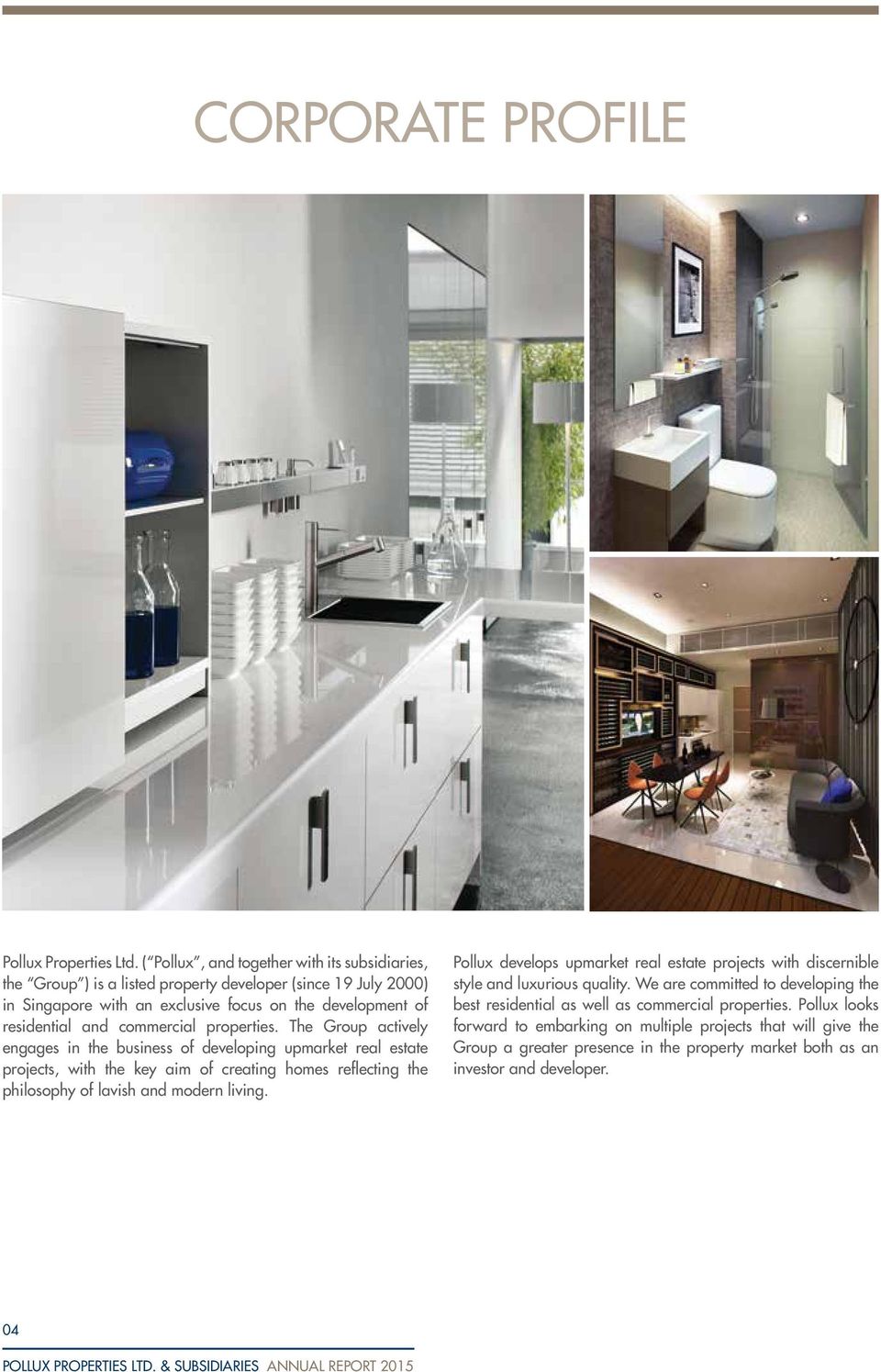
6 CORPORATE PROFILE Pollux Properties Ltd. ( Pollux, and together with its subsidiaries, the Group ) is a listed property developer (since 19 July 2000) in Singapore with an exclusive focus on the development of residential and commercial properties. The Group actively engages in the business of developing upmarket real estate projects, with the key aim of creating homes reflecting the philosophy of lavish and modern living. Pollux develops upmarket real estate projects with discernible style and luxurious quality. We are committed to developing the best residential as well as commercial properties. Pollux looks forward to embarking on multiple projects that will give the Group a greater presence in the property market both as an investor and developer. 04
7 CORPORATE PHILOSOPHY Excellence in crafting great homes and plush communities starts by working with leading interior designers and suppliers of the best home fittings. Relationships built on integrity and trust are important to us because we believe in building homes, not just apartments. Refined luxury to us means tasteful finishings and intricate pairings. Simply put, we are making it a point to fuss over every detail even when you are not. Passion for details sets Pollux apart. We are constantly in the search of the best materials befitting your dream home. We want to make moving in a pleasure and living as leisurely as possible. That s why we call it home, it s the way living is meant to be. Sustainability should be at the start of every venture and not its end. Pollux prefers to work backwards with a clear end in mind. That means sharing our vision of great dwelling places and plush communities with our customers, a robust business for our investors and a responsibility to share our success with the community. 05

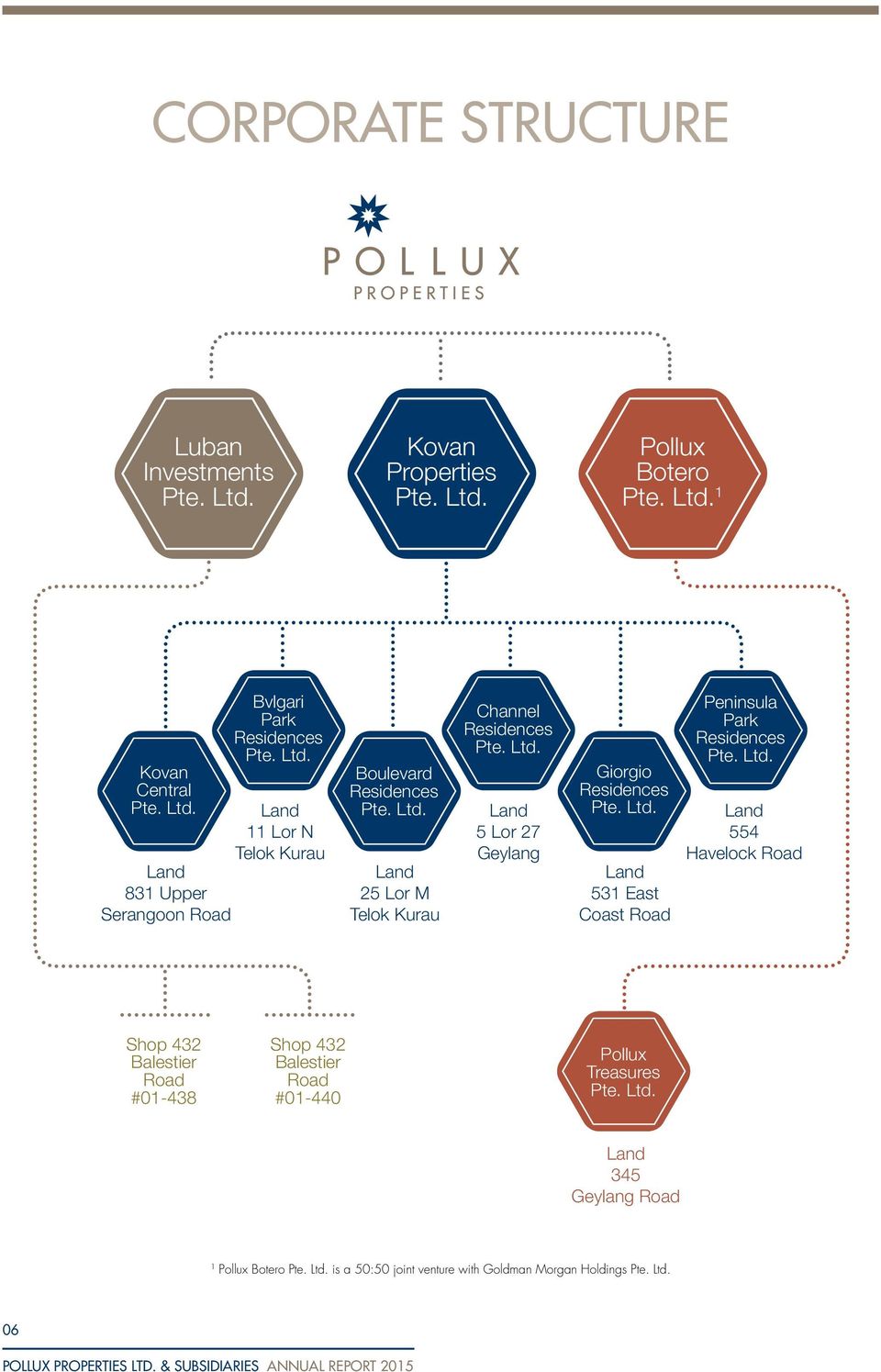
8 CORPORATE STRUCTURE Luban Investments Pte. Ltd. Kovan Properties Pte. Ltd. Pollux Botero Pte. Ltd. 1 Kovan Central Pte. Ltd. Land 831 Upper Serangoon Road Bvlgari Park Residences Pte. Ltd. Land 11 Lor N Telok Kurau Boulevard Residences Pte. Ltd. Land 25 Lor M Telok Kurau Channel Residences Pte. Ltd. Land 5 Lor 27 Geylang Giorgio Residences Pte. Ltd. Land 531 East Coast Road Peninsula Park Residences Pte. Ltd. Land 554 Havelock Road Shop 432 Balestier Road # Shop 432 Balestier Road # Pollux Treasures Pte. Ltd. Land 345 Geylang Road 1 Pollux Botero Pte. Ltd. is a 50:50 joint venture with Goldman Morgan Holdings Pte. Ltd. 06
9 CORPORATE MILESTONES OCT CEO of Pollux awarded 2010 Successful Entrepreneur Award 2011 MAR Acquired land at 831 Upper Serangoon Road JUL CEO of Pollux awarded Excellence Leadership Award of the 10th Asia Pacific International Entrepreneur Award 2011 Acquired land at 11 Lorong N Telok Kurau AUG Acquired land at 25 Lorong M Telok Kurau Acquired land at 554 Havelock Road Launched and sold 100% of Park Residences Kovan located at 831 Upper Serangoon Road SEPT Divested non-core business Cream Studio Pte. Ltd. and Cream Furniture Pte. Ltd. OCT CEO of Pollux awarded 2011 Successful Entrepreneur Award Acquired land at 5 Lorong 27 Geylang Road NOV CEO of Pollux awarded Asia Pacific TOP CEO for year 2011/2012 Pollux awarded Diamond Eye Award for Quality Commitment and Excellence DEC Divested non-core business Builders Shop Pte. Ltd. JAN Acquired land at 531 East Coast Road MAR Acquired land at 345 Geylang Road MAY Joint Venture between Pollux Botero Pte. Ltd. and Goldman Morgan Holdings Pte. Ltd. Divested non-core business Pacific Royal Group Pte. Ltd. JUL Received Singapore 1000 company Public Listed Companies 2012 Award AUG Launched Metro Loft located at 5 Lorong 27 Geylang Road 2013 MAR Launched Pavilion Square located at 345 Geylang Road APR Launched Garden Park Residences located at 25 Lorong M Telok Kurau MAY Launched Mayfair Residences located at 531 East Coast Road NOV Launched Berkeley Residences located at 11 Lorong N Telok Kurau NOV Obtained TOP for Louis Kienne Serviced Residences 2015 JAN Soft launch of Louis Kienne Serviced Residences FEB Obtained Certification of Statutory Completion for Park Residences Kovan MAR Received Singapore 1000 company Public Listed Companies 2015 Award 07

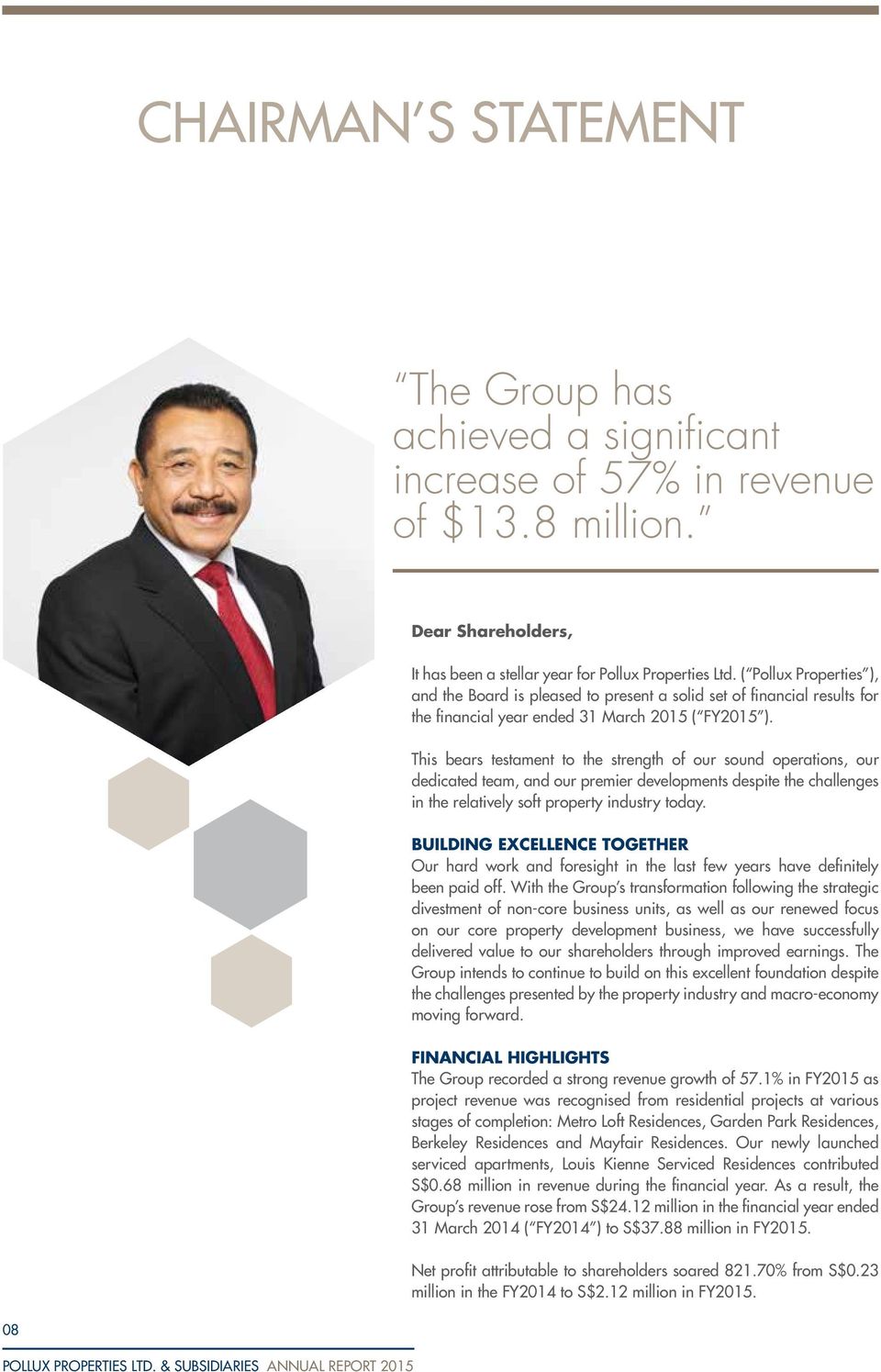
10 CHAIRMAN S STATEMENT The Group has achieved a significant increase of 57% in revenue of $13.8 million. Dear Shareholders, It has been a stellar year for Pollux Properties Ltd. ( Pollux Properties ), and the Board is pleased to present a solid set of financial results for the financial year ended 31 March 2015 ( FY2015 ). This bears testament to the strength of our sound operations, our dedicated team, and our premier developments despite the challenges in the relatively soft property industry today. BUILDING EXCELLENCE TOGETHER Our hard work and foresight in the last few years have definitely been paid off. With the Group s transformation following the strategic divestment of non-core business units, as well as our renewed focus on our core property development business, we have successfully delivered value to our shareholders through improved earnings. The Group intends to continue to build on this excellent foundation despite the challenges presented by the property industry and macro-economy moving forward. FINANCIAL HIGHLIGHTS The Group recorded a strong revenue growth of 57.1% in FY2015 as project revenue was recognised from residential projects at various stages of completion: Metro Loft Residences, Garden Park Residences, Berkeley Residences and Mayfair Residences. Our newly launched serviced apartments, Louis Kienne Serviced Residences contributed S$0.68 million in revenue during the financial year. As a result, the Group s revenue rose from S$24.12 million in the financial year ended 31 March 2014 ( FY2014 ) to S$37.88 million in FY2015. Net profit attributable to shareholders soared % from S$0.23 million in the FY2014 to S$2.12 million in FY
11 Our balance sheet position as at 31 March 2015 is extremely healthy as cash and cash equivalents stands at S$16.85 million, representing a 73.5% improvement over S$9.71 million as at 31 March We closed the fiscal year with marked improvement on all fronts total shareholders equity at S$48.83 million, earnings per share at 0.34 cents, as well as net asset value per share of 7.84 cents. PROJECT UPDATES To date, five of our freehold projects have been substantially sold and we are seeing good progress on actual construction. Barring unforeseen circumstances, these projects are expecting to receive TOP in the financial years ending 31 March 2016 and 31 March In addition, Louis Kienne Serviced Residences which comprises 96 units of one, two and three-bedroom serviced apartments, have commenced operations in December 2014 and is seeing positive growth in occupancy rates. OUTLOOK The Group expects the challenging operating environment for property developers to prevail in the coming year, as we could see the cumulative impact of the various cooling measures introduced by the Singapore Government. The implementation of the Total Debt Servicing Ratio (TDSR) framework in June 2013 has led to a significant decrease in new home sales across the island. In the first quarter of 2015, prices of private properties decreased a further 1%, representing the sixth continuous quarter of price decrease. Despite lower prices, purchase of residential apartments has remained slow, indicating that home buyers are remaining prudent and adopting a wait-and-see approach. Even as Singapore s property market seems set to remain in a down-cycle, the longer-term outlook for the residential market remains positive in land-scarce Singapore and the Group is expected to benefit from the continued initiatives by the Singapore Government to promote population and economic growth. Meanwhile, we intend to explore suitable investment opportunities in Singapore and the South East Asia region moving forward. With the commencement and growth of the operation of Louis Kienne Serviced Residences at 554 Havelock Road, we are also on track to widening our revenue streams. Eventually, this business is expected to provide stable and long-term recurring income. Although the leasing market was buoyant in 2014, leasing demand this year is expected to be affected by corporate belttightening and organisational revamps, which may result in fewer foreign expatriate arrivals. This means that leasers will likely to favour smaller homes, HDB flats and even individual rooms in both private and public developments in As such, we believe that style, attention to detail and quality are distinctive factors that set apart our Louis Kienne Serviced Residences. Since our soft launch in January 2015, occupancy rates have surpassed the average range in some months, and we see this as an encouraging indication of healthy demand. We expect occupancy rates to continue to be on an uptrend as we continue to market the serviced residences business, and eventually have a positive impact on our revenue growth. APPRECIATION During FY2015, Mr Bambang Widaryatmo and myself have joined the Audit Committee and the Remuneration and Nominating Committee as members, while Mr Tan Kay Kiang has resigned as a member of both abovementioned committees but remains as an active member of the Board. We have also appointed Mr Chan Tee Yong as our Deputy Financial Controller, as well as Mr Choy Kong Yan as our General Manager. Both gentlemen bring a wealth of experience from listed companies in Singapore and the region. We look forward to working closely with them in the coming years. Our achievements in this past year would not have been possible without our tremendous team effort of all our staff, their passion and drive. In particular, I would like to extend my appreciation to Dr Nico Purnomo Po, our Chief Executive Officer, who has led the Group to great successes in recent years. His leadership, vision and indomitable spirit have been key to our accomplishments. I would also like to thank the members of the Board for their commitment, support and continued dedication to the business. Moving ahead, I look forward to another exciting year ahead with the Board and management team as we strive together to build on this solid foundation for Pollux Properties. Last but not least, my heartfelt thanks to you, our valued shareholders, for your continued trust and support. We look forward to seeing you at the upcoming Annual General Meeting. Timur Pradopo Non-Executive Chairman 09
12 BOARD OF DIRECTORS front row left to right: DR. NICO PURNOMO PO, MR. TIMUR PRADOPO back row left to right: MR. LOW CHAI CHONG, MR. TAN KAY KIANG, MR. BAMBANG WIDARYATMO and MR. JAMES KHO CHUNG WAH 10

13 MR. TIMUR PRADOPO Mr. Pradopo, 59, was appointed as an Independent Director of the Company on 18 March He was the former Head of Indonesian Police from He has 35 years of experience in the Indonesian Police Department and held several high-ranking positions in the Indonesian Police Department such as the Head of Central Jakarta Police Department (in 2010) as well as the Head of West Java Police Department (from 2008 to 2010). Mr. Pradopo graduated from the Indonesian Police Academy in 1978 and the Indonesian Police Higher Administration Staff School in He was last re-elected as a Director of the Company on 25 July He does not hold any directorship in other listed companies whether in or outside Singapore. DR. NICO PURNOMO PO Mr. Po, 33, is the Chief Executive Officer of the Company. He is responsible for the management and operation of the Group and the implementation of the Group s strategies and policies. Mr. Po holds a Bachelor s degree in Computing from National University of Singapore in The honorary doctorate in business administration was bestowed on him by InterAmerican University in He does not hold any directorship in other listed companies whether in or outside Singapore. MR. TAN KAY KIANG Mr. Tan, 69, was appointed as a Director and Executive Chairman of the Company on 12 August On 31 March 2008, he resigned as the executive Chairman but remains as an executive Director of the Company. He was responsible for the Group s financial and corporate management. On 31 July 2009, Mr. Tan was re-designated as a non-executive Director of the Company. Mr. Tan holds a Bachelor of Science degree from Nanyang University of Singapore. He was last re-elected as a Director of the Company on 25 July He does not hold any directorship in other listed companies whether in or outside Singapore. MR. LOW CHAI CHONG Mr. Low, 52, was appointed as an Independent Director of the Company on 1 September Mr Low is also the Lead Independent Director of the Company. He is an advocate & solicitor of the Supreme Court of Singapore. He joined Rodyk & Davidson LLP in 1986, and has been with the same firm his entire career. He has many years of legal experience, representing MNCs, financial institutions and listed companies in a wide array of commercial and corporate matters regionally, including dispute resolution. Mr. Low graduated from National University of Singapore with a Bachelor of Laws (Honours) degree. He is also the Non- Executive Chairman and Lead Independent Director of Moya Holdings Asia Limited and Non-Executive Chairman of China Gaoxian Fibre Fabric Holdings Ltd. (a company listed on the Main Board of the Singapore Exchange Securities Trading Limited ( SGX-ST ). He was last re-elected as a Director of the Company on 25 July MR. BAMBANG WIDARYATMO Mr. Widaryatmo, 61, was appointed as an Independent Director of the Company on 18 March He is the former Chief of the Police Forces of East Kalimantan from 2011 to He was the Investigation Director of Indonesia Anti-Corruption Committee from 2008 to Mr. Widaryatmo graduated from the Indonesian Police Academy in He was last re-elected as a Director of the Company on 25 July He does not hold any directorship in other listed companies whether in or outside Singapore MR. JAMES KHO CHUNG WAH, CFA Mr. Kho, 39, was appointed as an Independent Director of the Company on 29 May He has over 13 years of investment banking and regulatory experience and has held various senior positions in the investment banking and corporate finance departments of international banks and major local securities houses. He started his career in the equity markets with the Issuer Regulation Department of Singapore Exchange, where he was involved in the review of listing applications and ensuring continuing compliance of listed companies. Currently, he is the co-founder and Managing Director of Willan Capital Pte. Ltd. as well as the Executive Director of Pacific Star (Greater China) Pte. Ltd. Mr. Kho has been awarded the CFA Charter and is a member of the CFA Institute. He has obtained his Bachelor of Business (Second Upper Honours) degree from Nanyang Technological University of Singapore, majoring in financial analysis and minor in applied economics. He is also Independent Director of Serramo Limited (a company listed on the Catalyst of the SGX- ST). He was last re-elected as a Director of the Company on 25 July

14 KEY MANAGEMENT left to right: MR. HENDRY SUGIANTO, MS. BECKY NG BEE KIAN, MR. CHOY KONG YAN, MR. JASON LEE CHONG LEONG, MR. CHAN TEE YONG and MS. SUSIE THNG SOCK CHING 12

15 MR. CHOY KONG YAN Mr. Choy Kong Yan, 49, is the General Manager of the Company. He joined the Company in May He holds a Bachelor of Engineering from Monash University and a Master of Business Administration from University of South Australia. He is a senior member of the Institution of Engineers, Singapore, Chartered Professional Engineer of Institution of Engineers, Australia and Chartered member of Institute of Logistic and Transport. He is also a Registered Professional Engineer in Singapore. He has 24 years of experience in construction and property development industries. MR. CHAN TEE YONG Mr. Chan Tee Yong, 30, is the Deputy Financial Controller of the Company. He joined the Company in August He is responsible for overseeing the finance and accounting functions of the Company and the Group. Prior to joining the Company, he was an assistant Financial Controller of a company listed on SGX-ST. Prior to that, he has served as an auditor in Ernst & Young LLP and Deloitte & Touche (Malaysia). Mr. Chan holds a Bachelor of Business majoring in Accounting and Finance from the University of Technology, Sydney. He is a Certified Public Accountant in Australia and also a Chartered Accountant with the Institute of Singapore Chartered Accountants. MR. HENDRY SUGIANTO Mr. Sugianto, 36, is the Project Manager of the Company. He joined the Company in March He is responsible in project development from inception through completion, managing design and contracts. He provides support to marketing efforts in construction of showflats and in content supply for project brochures and websites. He has over 10 years of experience in the building related industry including serving as a designer in architectural practices and a listed hospitality group. He holds a Masters degree in Architecture. MS. BECKY NG BEE KIAN Ms. Becky Ng, 35, is the Corporate Affairs Manager of the Company. She joined the Company in November Her responsibilities include corporate secretariat support; communicating of important organisational issues to the Board and administer corporate and constitutional issues. She is also in-charge of the sales of properties. Prior to joining the Company, she had 8 years of experience in leasing and property management of serviced apartments, serviced offices and commercial properties in Singapore, Hong Kong and Shanghai. Ms. Ng holds a Diploma in Hotel and Travel Management and a Bachelor of Arts (Honours) majoring in International Business Management from Northumbria University, Newcastle UK. MS. SUSIE THNG SOCK CHING Ms. Susie Thng, 62, is the Accounting and Finance Manager of the Company. She joined the Company in April Prior to joining the Company, Ms. Thng has been involved in the business of property development, construction and building materials for more than 15 years. Ms. Thng s responsibilities include overseeing the Group s accounts and financial administrative matters. She holds a Diploma in Management from the Singapore Institute of Management. MR. JASON LEE CHONG LEONG Mr. Jason Lee, 36, is the Project Manager of the Company. He joined the Company in June He is responsible for the project management of the Company s various development projects from inception stage of design to construction and completion, including controlling of cost, ensuring contractor s quality of works and timely completion. Prior to joining the Company, he has 10 years of experience in managing building conversion projects, including conservation buildings, which underwent major A&A works, and was also involved in facilities management. Mr. Lee graduated from the National University of Singapore in 2004 with a Bachelor of Science (Honours) degree majoring in Building. 13
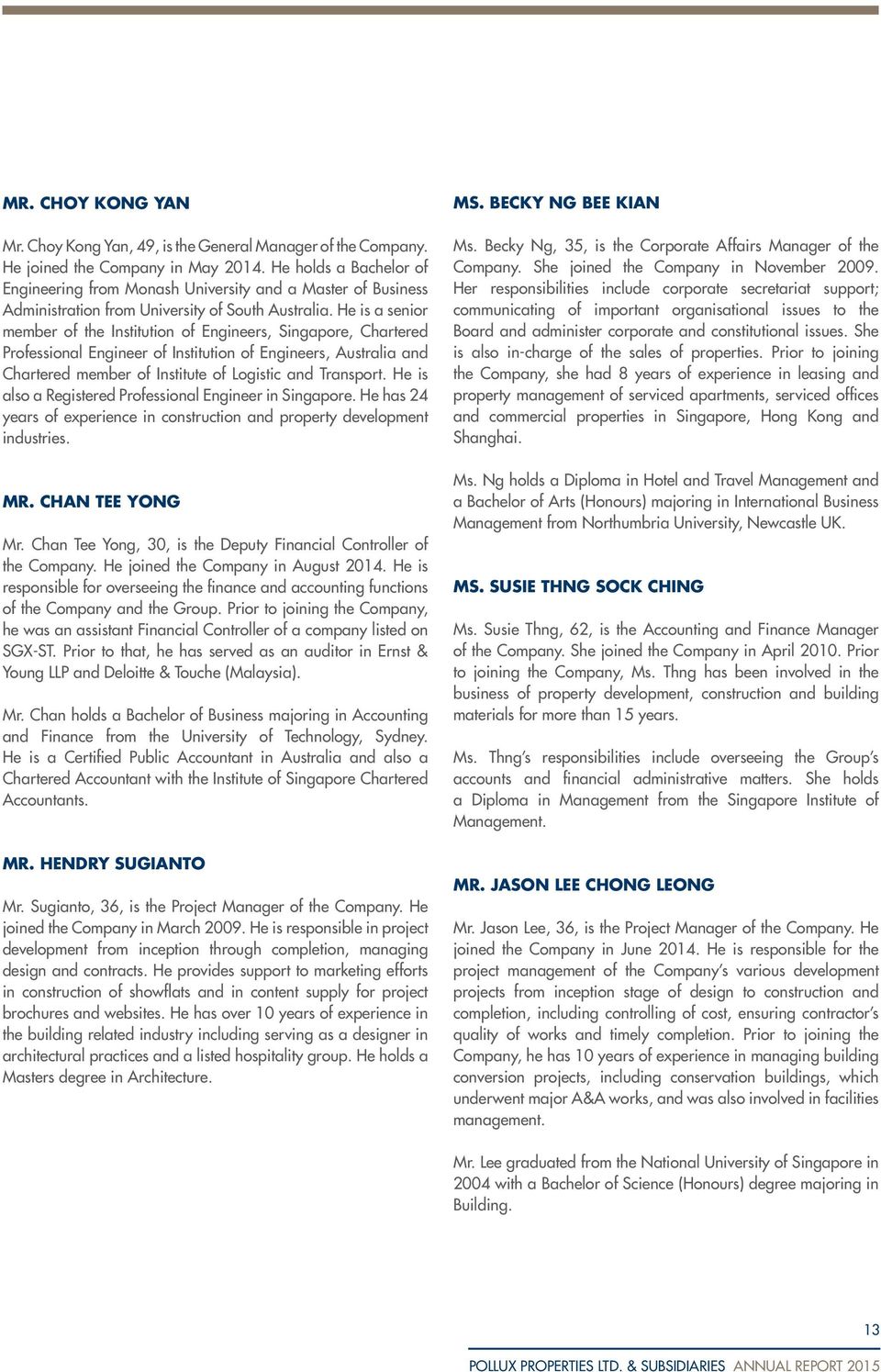
16 FINANCIAL HIGHLIGHTS FY2015 FY2014 % CHANGE Revenue (S$m) EBIDTA (S$m) PATMI (S$m) Earnings per Share (cents) NAV per Share (cents) Return on Equity (%) FY2015 FY2014 % CHANGE Total Equity (S$m) Cash and Cash Equivalents (S$m) Net Debt (S$m) (0.2) Gearing Ratio (%) (1.8) Loans and Borrowings (S$m) Interest Coverage Ratio (times) Note 1: The Interest Coverage Ratio did not include the interest expenses capitalised under development properties 14
17 FINANCIAL HIGHLIGHTS FY2015 FY2014 % CHANGE Revenue (S$m) EBIDTA (S$m) PATMI (S$m) Earnings per Share (cents) NAV per Share (cents) Return on Equity (%) FY2015 FY2014 % CHANGE Total Equity (S$m) Cash and Cash Equivalents (S$m) Net Debt (S$m) (0.2) Gearing Ratio (%) (1.8) Loans and Borrowings (S$m) Interest Coverage Ratio (times) Note 1: The Interest Coverage Ratio did not include the interest expenses capitalised under development properties 14

18 FINANCIAL HIGHLIGHTS FINANCIAL HIGHLIGHTS FOR THE LAST FOUR FINANCIAL YEARS 40 REVENUE EBITDA 3.57 S$ MILLION FY FY FY2014 FY2015 S$ MILLION FY FY FY2014 FY2015 S$ MILLION PATMI RETURN ON EQUITY % PERCENTAGE FY2012 FY2013 FY2014 FY2015 FY2012 FY2013 FY2014 FY2015 EARNINGS PER SHARE NET ASSETS VALUE PER SHARE S$ CENTS S$ CENTS FY2012 FY2013 FY2014 FY FY2012 FY2013 FY2014 FY

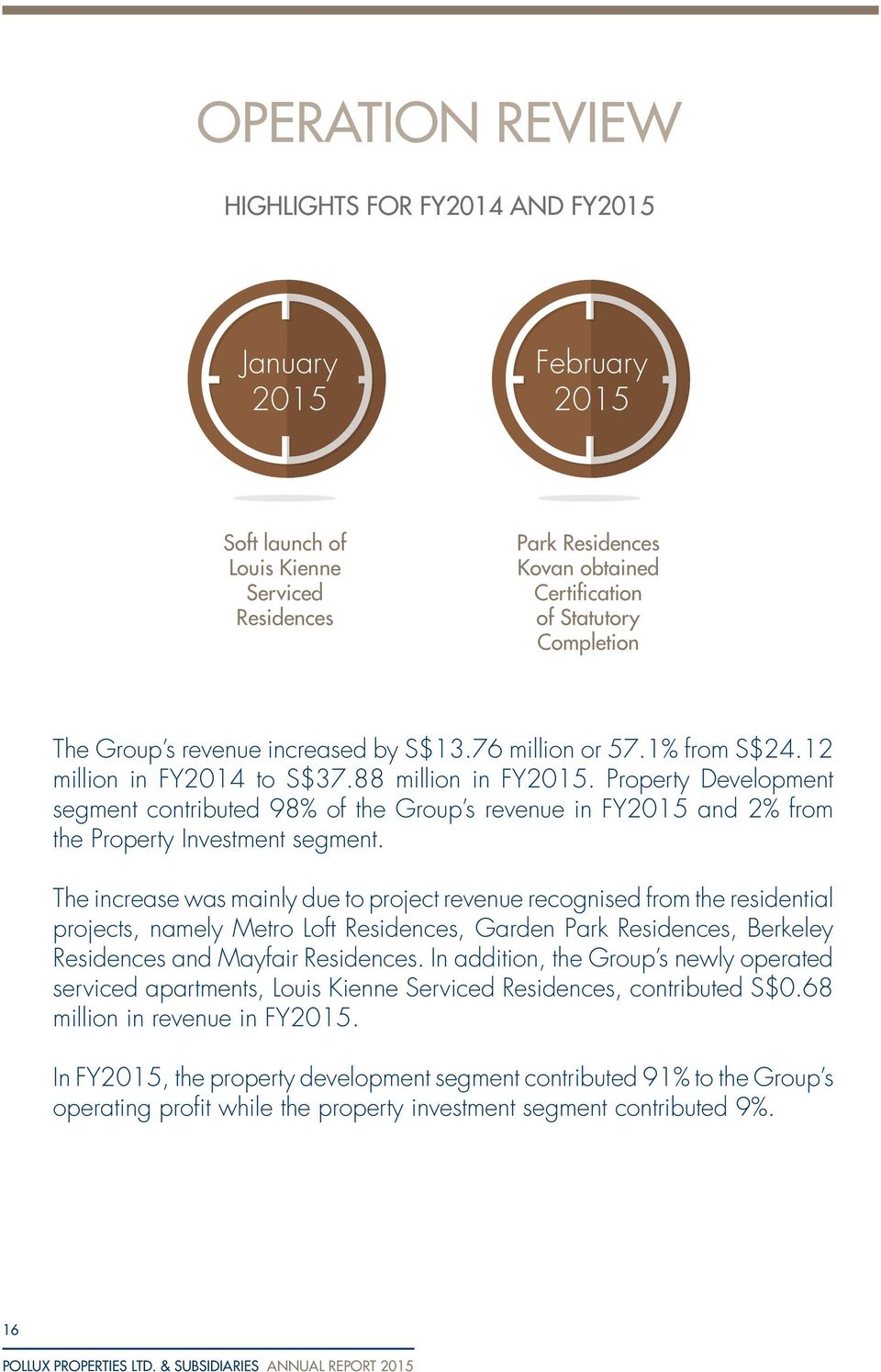
19 OPERATION REVIEW HIGHLIGHTS FOR FY2014 AND FY2015 January 2015 February 2015 Soft launch of Louis Kienne Serviced Residences Park Residences Kovan obtained Certification of Statutory Completion The Group s revenue increased by S$13.76 million or 57.1% from S$24.12 million in FY2014 to S$37.88 million in FY2015. Property Development segment contributed 98% of the Group s revenue in FY2015 and 2% from the Property Investment segment. The increase was mainly due to project revenue recognised from the residential projects, namely Metro Loft Residences, Garden Park Residences, Berkeley Residences and Mayfair Residences. In addition, the Group s newly operated serviced apartments, Louis Kienne Serviced Residences, contributed S$0.68 million in revenue in FY2015. In FY2015, the property development segment contributed 91% to the Group s operating profit while the property investment segment contributed 9%. 16
20 OPERATION REVIEW REVENUE BY BUSINESS SEGMENTS REVENUE IN FY2014/ YEARS REVENUE BY BUSINESS SEGMENTS 2% 40 Property Investment Property Development % S$ MILLION Property Investment Property Development 0 FY2012 FY2013 FY2014 FY2015 OPERATING PROFIT BY BUSINESS SEGMENTS OPERATING PROFIT IN FY2014/ YEARS OPERATING PROFIT BY BUSINESS SEGMENTS 9% Property Investment Property Development % S$ MILLION Property Investment Property Development 0 FY2012 FY2013 FY2014 FY

21 OPERATION REVIEW REVENUE IN FY2014/2015 FOR PROPERTY DEVELOPMENT AND PROPERTY INVESTMENT REVENUE 8% 2% 21% REVENUE S$ 000 PERCENTAGE % 29% Rental 936 2% Metro Loft 7,950 21% 40% Garden Park Residences 15,265 40% Rental Metro Loft Garden Park Residences Berkeley Residences Mayfair Residences Berkeley Residences 10,959 29% Mayfair Residences 2,771 8% TOTAL 37, % OPERATING PROFIT IN FY2014/2015 FOR PROPERTY DEVELOPMENT AND PROPERTY INVESTMENT OPERATING PROFIT 7% 9% REVENUE S$ 000 PERCENTAGE % 25% 15% Rental 333 9% Metro Loft % 44% Garden Park Residences 1,634 44% Rental Metro Loft Garden Park Residences Berkeley Residences Mayfair Residences Berkeley Residences % Mayfair Residences 255 7% TOTAL 3, % 18
22 DEVELOPMENT PROPERTIES OPERATION REVIEW REVENUE IN FY2015 VS FY2014 BY PROJECTS S$ MILLION Park Residences Kovan Metrol Loft Berkeley Residences Garden Park Residences Mayfair Residences OPERATING PROFITS IN FY2015 VS FY2014 BY PROJECTS S$ MILLION Park Residences Kovan Metrol Loft Berkeley Residences Garden Park Residences Mayfair Residences 19
23 DEVELOPMENT PROPERTIES OPERATION REVIEW Park Residences Kovan Park Residences Kovan is our first development project launched in August 2011 and was fully sold within a month. This project is located at Upper Serangoon Road which comprises 41 units featuring four penthouses, two of which comes with its own plunge pool. The project has obtained Certificate of Statutory Completion ( CSC ) in February Metro Loft Metro Loft, launched in August 2012, is an exclusive freehold development situated in one of the most bustling district in the Central Eastern part of Singapore, and was fully sold within two months of its launch. Metro Loft offers 31 units with nine penthouses adorned with spacious and private balconies. Pavilion Square Our first mixed development project, Pavilion Square which was launched in March 2013, comprises 42 residential units and 93 commercial units. The new freehold urban landmark, is probably the Group s best investment when it comes to location. The cleverly mixed residential and commercial development is built around its occupants in mind. Situated in the heart of Geylang s most vibrant location and access to the city major highways and public transportation, Pavilion Square will be the ultimate benchmark for the next residential and commercial developments. The project is fully sold. TOP is expected to be obtained in March PROJECTS LAUNCH TOTAL AREA TENURE TOTAL UNIT SOLD UNIT EST. CONSTRUCTION (SQM) UNIT (AS OF SOLD TOP PROGRESS % 12 JUN 2015) % (As of 12 JUN 2015) Park Residences August February Freehold Kovan (obtained CSC in Feb 2015) Metro Loft August June Freehold Pavilion Square* March March Freehold (Residential) Pavilion Square* March March Freehold (Commercial) Above information are as of 12 June 2015 *50:50 joint venture with Goldman Morgan Holdings Pte. Ltd
24 DEVELOPMENT PROPERTIES OPERATION REVIEW Garden Park Residences Garden Park Residences is 100% sold and is currently 70% completed. A 5 storey freehold private sanctuary comprises 36 units ranging from 1+1 to 5 bedrooms units. The purpose of the build development theme and idea was to create a habitat that inspires its occupants to relax, retreat and be happy. This is ideal living and a unique location to raise a family. This project is expecting TOP by December Mayfair Residences Launched in May 2013, Mayfair Residences is the epitome of luxury lifestyle and living. Each of the 20 exclusive 3-bedroom unit is an oasis of peace, comfort and tranquility. The development is strategically located between the nostalgic Katong and charming East Coast district. Mayfair Residences unites urban convenience which only the finest developer can deliver. It redefines upscale luxury living with exquisite design and build quality, high floor to ceiling glass, amenities such as the ultramodern kitchen with premium fittings and fixtures and the contemporary modern-inspired bathrooms. This project is 80% sold. Its target completion is by June Berkeley Residences Berkeley Residences is 100% sold and 88% completed. The 22 units luxurious freehold development theme is about pairing individualism, taste and experience. And what is quality living without quality fittings and fixtures. Its peaceful and laid back location in Telok Kurau offers diversified living experience for every urban dweller. This project is expecting TOP by December PROJECTS LAUNCH TOTAL AREA TENURE TOTAL UNIT SOLD UNIT EST. CONSTRUCTION (SQM) UNIT (AS OF SOLD TOP PROGRESS % 12 JUN 2015) % (As of 12 JUN 2015) Garden Park April December Freehold Residences Mayfair May June Freehold Residences Berkeley November December Freehold Residences Above information are as of 12 June
25 INVESTMENT PROPERTIES OPERATION REVIEW REVENUE FOR FY2014 VS FY2015 PROPERTY INVESTMENT FY2014 S$ MIL FY2015 S$ MIL The Group s revenue from Property Investment segment increased from S$0.33 million in FY2014 to S$0.93 million in FY2015. Overall, Property Investment segment contributed 2% in revenue and 9% in operating profit. Louis Kienne Serviced Residences at Havelock Road soft launched in January 2015 and both retail shops along Balestier Road are currently tenanted. PROPERTY TENURE UNIT OCCUPANCY AS OF 31 MAY 2015 Louis Kienne Serviced Residences at 554 Havelock Road Leasehold 96 55% 432 Balestier Road # Freehold 1 100% 432 Balestier Road # Freehold 1 100% 22
26 INVESTMENT PROPERTIES OPERATION REVIEW A 4 star serviced residences featuring 96 fully-furnished contemporary 1,2, and 3 bedroom apartments. 23
27 CORPORATE SOCIAL RESPONSIBILITY We are committed to protecting and conserving the environment that our business operates in. ENVIRONMENT Initiatives have been taken to develop buildings which comply with the guidelines set by the local building authorities as well as adopt strategies which are more socially responsible by incorporating more greens, landscaping, better facilities and innovative house design into our projects to improve the quality of the environment The Group has also adopted the International Organisation for Standardisation (ISO) in Quality Management and Environmental Management. COMMUNITIES INVOLVEMENT We strongly encourage our staff to recycle items and to reduce wastage; employees are encouraged to donate unwanted but usable items to charitable organisations and participate in volunteer works and activities. The Group also donated remaining stocks from divested business such as old furnitures, tiles and stones to Fo Guang Shan Temple and St. Peter and Paul Church. The Group had donate to UOB Heartbeat Run/Walk and our employees had joined the Run/Walk this year to raise fund for Singapore s underprivileged children. EMPLOYEE The Group provides opportunities for staff to improve their levels of skills and knowledge to increase workplace productivity and staff statisfaction. Staff attended seminars and training programmes covering areas on Audit, Accounting, Taxation, Project Management and Corporate Governance Compliance. The Group also embark on Occupation Safety and Health Programmes to raise awareness amongst our employees on the importance of adopting an active and healthy lifestyle. Employees actively engage themselves through social and recreational interaction and employee bonding activities. 24
28 CORPORATE INFORMATION DIRECTORS Timur Pradopo Nico Purnomo Po Tay Kay Kiang Low Chai Chong Bambang Widaryatmo James Kho Chung Wah Tan Nan Choon (alternate director to Tan Kay Kiang) SHARE REGISTRAR AND SHARE TRANSFER OFFICE M & C Services Private Limited 112 Robinson Road #05-01 Singapore AUDITORS COMPANY SECRETARY Chew Bee Leng REGISTERED OFFICE Ernst & Young LLP One Raffles Quay North Tower, Level 18 Singapore Partner-in-charge: Eleanor Lee Date of appointment: Since financial year ended 31 March A Orchard Road #08-07 Ngee Ann City Tower A Singapore Tel: Fax: BANKERS SPONSOR Canaccord Genuity Singapore Pte. Ltd. 77 Robinson Road #21-02 Singapore United Overseas Bank Limited Hong Leong Finance Limited Oversea-Chinese Banking Corporation Limited Bank of China Limited Malayan Banking Berhad 25
29 CORPORATE GOVERNANCE REPORT Pollux Properties Ltd. (the Company ) and its subsidiaries (collectively, the Group ) are committed to maintaining a high standard of corporate governance within the Group so as to ensure greater transparency and protection of shareholders interests. The Group supports the spirit of the Code of Corporate Governance 2012 (the Code ), whilst also recognising that it needs to develop and maintain its own corporate governance processes to meet its specific business needs. This report outlines the Group s corporate governance processes and structures that were in place throughout the financial year ended 31 March 2015 ( FY2015 ), with specific reference made to each of the principles of the Code. The Board of Directors (the Board or Directors ) of the Company confirms that, for FY2015, the Group has generally adhered to the principles and guidelines as set out in the Code. Any deviations from the Code are disclosed and explained in this report. BOARD MATTERS The Board s Conduct of Affairs Principle 1: Every company should be headed by an effective Board to lead and control the company. The Board is collectively responsible for the long-term success of the company. The Board works with the Management to achieve this objective and the Management remains accountable to the Board. Role of the Board The primary role of the Board is to protect and enhance long-term value and returns for the shareholders. The Board approves the Group s strategic plans, key business initiatives, major investments and funding decisions, and ensures the business affairs of the Group are effectively managed and conducted by an executive management of the Company (the Management ). The Board has adopted internal guidelines for cheque signatories and operating expenditures to optimise operational efficiency. Additionally, the Board has direct responsibility for decision-making in respect of the following: (a) setting the strategic directions and goals of the Company and ensuring that adequate resources are available to meet these objectives; (b) establishing a framework of prudent and effective controls which enables risks to be assessed and managed, including safeguarding shareholders interests and the Company s assets; (c) overseeing and monitoring the management and affairs of the Company; (d) monitoring the Management s performance towards achieving organisational goals; (e) ensuring accurate and timely reporting to, and communication with shareholders; (f) ensuring the Company s compliance with laws, regulations, policies, directives, guidelines and internal code of conduct; (g) determining the Company s values and standards including ethical standards; and (h) considering sustainability issues of policies and procedures including environmental and social factors in the formulation of the Company s strategies. 26
30 CORPORATE GOVERNANCE REPORT Each individual Director has objectively discharge his duties and responsibilities at all times as fiduciaries in the interests of the Company. Directors who are in any way, directly or indirectly, interested in a transaction or proposed transaction will declare the nature of their interests in accordance with the provisions of the Companies Act, Chapter 50 of Singapore (the Companies Act ). The Company has adopted internal guidelines governing matters that require the Board s approval and clear directions have also been given to the Management that the following matters must be approved by the Board: (a) material acquisition and disposal of assets/investments; (b) corporate/financial restructuring and corporate exercise; (c) material financial/funding arrangements and capital expenditures; and (d) policies and procedures, delegation of authority matrix, code of conduct and business ethic. All relevant information on material events and transactions are circulated to the Directors as and when they arise. To facilitate effective management and without abdicating the Board s responsibility, certain functions of the Board have been delegated to various Board committees ( Board Committees ). The Board is assisted by an Audit Committee ( AC ) as well as a Remuneration and Nominating Committee ( RNC ), each of which functions are clearly defined in their respective terms of reference and operating procedures which are reviewed by the Board on a regular basis. The RNC and AC comprise Non-Executive Directors, all of whom including the Chairman, are independent. Board Meetings and Meetings of Board Committees The Board meets on a half-yearly basis to review the financial performance of the Group and approve the release of the Group s half year and full year financial results. Additional meetings of the Board may be held as and when circumstances require. The Articles of Association of the Company (the Articles ) allow Board meetings to be conducted by way of teleconference or videoconference. The Directors normally set dates of the meetings of the Board well in advance. Each Director s attendance at meetings of the Board and Board Committees held in FY2015 are set out below: Name of Director/ Remuneration and Meeting Board Audit Committee Nominating Committee No. of No. of No. of Meetings* Attendance* Meetings* Attendance* Meetings* Attendance* Nico Purnomo Po 2 2 N.A. N.A. N.A. N.A. Tan Kay Kiang (1) Low Chai Chong Koh Teng Kiat (2) Timur Pradopo (3) Bambang Widaryatmo (4) James Kho Chung Wah (5) * Refers to meetings held and attended while each Director was in office (1) Mr Tan Kay Kiang resigned as a member of the AC and RNC on 13 August (2) Mr Koh Teng Kiat resigned as a Director on 4 April (3) Mr Timur Pradopo was appointed as a member of the AC and RNC on 13 August (4) Mr Bambang Widaryatmo was appointed as a member of the AC and RNC on 13 August (5) Mr James Kho Chung Wah was appointed as a Director on 29 May
31 CORPORATE GOVERNANCE REPORT Training and Development of Directors The Management will organise orientation programmes for new Directors to familiarise them with the Group s operations and business issues as well as the relevant regulations and governance requirements. The Company provides ongoing education to the Directors on Board processes, corporate governance practices and updates on changes to laws and regulations. The Directors are also encouraged to keep themselves abreast of latest developments relevant to the Company or themselves. Where necessary, the Directors will be updated on new legislations and/or regulations and changing commercial risks, from time to time, which are relevant to the Group. New releases issued by the Singapore Exchange Securities Trading Limited ( SGX-ST ) and Accounting and Corporate Regulatory Authority which are relevant to the Directors are circulated to the Board. The Directors are kept informed of upcoming conferences and seminars relevant to their roles as Directors of the Company. Such conferences and seminars as well as other training courses will be arranged and funded by the Company for all Directors. Annually, the external auditors will update the AC and the Board on any new and revised financial reporting standards which are relevant to the Group. Newly appointed Directors will be issued with a formal letter by the Company Secretary explaining their duties and obligations as a Director upon their appointment. Board Composition and Guidance Principle 2: There should be a strong and independent element on the Board, which is able to exercise objective judgement on corporate affairs independently, in particular, from Management and 10% shareholders. No individual or small group of individuals should be allowed to dominate the Board s decision making. The Board presently comprises six (6) Directors, four (4) of whom are Independent Directors. Details of the Directors are as set out below: Position held Board on the Board appointment and Board whether Committees executive, Date of Date of served on non-executive first last Name of Director (if any) or independent appointment re-election Nico Purnomo Po Director and Executive 31 March 2008 Not applicable (1) Chief Executive Officer Tan Kay Kiang Director Non-Executive 12 August July 2012 Low Chai Chong Director, Non-Executive/ 1 September July 2014 Chairman of RNC Independent and member of AC Timur Pradopo Chairman of the Board Non-Executive/ 18 March July 2014 and member of AC Independent and RNC Bambang Widaryatmo Director and Non-Executive/ 18 March July 2014 member of AC and Independent RNC James Kho Chung Wah Director, Chairman of Non-Executive/ 29 May July 2014 AC and member of Independent RNC (1) Under Article 99 of the Company s Articles, the Managing Director of the Company (or any Director holding an equivalent appointment) is not subject to retirement by rotation. 28
32 CORPORATE GOVERNANCE REPORT The profiles and key information of the individual Directors as well as their respective shareholdings in the Company are set out in the Board of Directors and Directors Report sections of this annual report respectively. There is presently a strong and independent element on the Board, with Independent Directors constituting more than half of the Board, which is in line with the Code. The independence of the Directors is reviewed annually by the RNC. The RNC adopts the Code s definition as to what constitutes an Independent Director in its review. In addition, each Independent Director is required to complete a Director s Independence Checklist annually to confirm his independence based on the guidelines as set out in the Code. Taking into consideration the RNC s review, the Board is of the view that Mr Low Chai Chong, Mr Timur Pradopo, Mr Bambang Widaryatmo and Mr James Kho Chung Wah are independent. None of the Independent Directors has served on the Board beyond nine (9) years from the date of his appointment. The size and composition of the Board is reviewed on an annual basis by the RNC to ensure that the Board has the appropriate mix of expertise and experience, and collectively possesses the necessary core competencies for effective functioning and informed decision-making. When a vacancy arises under any circumstances, or where it is considered that the Board would benefit from the services of a new Director with particular skills, the RNC, in consultation with the Board, determines the selection criteria and selects candidates with the appropriate expertise and experience for the position. The RNC then nominates the most suitable candidate for appointment by the Board to the Company. The Board and the RNC have considered and are satisfied that the current size of the Board of six (6) Directors is appropriate taking into consideration the existing nature and scope of the operations of the Group. The Board and the RNC are also satisfied that the current Board as a group has core competencies in accounting and finance, business and management experience, industry knowledge, strategic planning experience and customerbased experience or knowledge. The Non-Executive Directors provide, amongst other things, strategic guidelines to the Company based on their professional knowledge and experience. They constructively challenge and help develop directions on strategy and review the performance of the Management in achieving agreed targets and objectives. To facilitate a more effective check on the Management, the Non-Executive Directors are encouraged to arrange for meetings without the Management being present at times deemed necessary. In general, the Board is able to exercise objective judgment independently from the Management and no individual or small group of individuals dominates the decision-making of the Board. Chairman and Chief Executive Officer Principle 3: There should be a clear division of responsibilities between the leadership of the Board and the executives responsible for managing the company s business. No one individual should represent a considerable concentration of power. There is a clear division of roles and responsibilities between the Chairman, Mr Timur Pradopo, and the Chief Executive Officer ( CEO ), Dr Nico Purnomo Po. The Chairman leads and manages the business of the Board whilst the CEO and his team of management staff translate the Board s decisions into executive action. 29
33 CORPORATE GOVERNANCE REPORT Mr Timur Pradopo, Chairman of the Board, is responsible for: (a) leading the Board to ensure its effectiveness on all aspects of its role; (b) determining the agenda for the meeting and instructing the Company Secretary to disseminate it to all Directors at least seven (7) days before the meeting; (c) promoting a culture of openness and debate within the Board; (d) ensuring the Board members engage the Management in constructive debate on various matters including strategic issues; (e) ensuring that the Directors receive complete, adequate and timely information; (f) ensuring effective communication with shareholders; (g) facilitating the effective contribution of Non-Executive Directors in particular; and (h) continuous pursuance of high standards of corporate governance. The CEO is responsible for implementing the Group s strategies and policies, making strategic and business investment decisions as well as the overall management and performance of the Group. The Board is of the opinion that there is a balance of power and authority within the Board. As recommended by the Code, the Board has appointed an Independent Director, Mr Low Chai Chong, as the Lead Independent Director. Mr Low Chai Chong chairs the RNC and is also a member of the AC. In accordance with the Code, Mr Low Chai Chong is available to shareholders when they have concerns which contact through the normal channels has failed to resolve, or for which such contact is inappropriate. Led by the Lead Independent Director, the Company s Independent Directors will meet, where necessary, without the presence of the other Directors and the Lead Independent Director will provide feedback to the Chairman and CEO after such meetings as appropriate. Board Membership Principle 4: There should be a formal and transparent process for the appointment and reappointment of directors to the Board. The RNC was formed in June 2003 by the merger of the Nominating Committee and the Remuneration Committee of the Company. Currently, the RNC comprises four (4) Non-Executive Directors, all of whom including the Chairman of the RNC are independent. The Chairman of the RNC is not a substantial shareholder of the Company or directly associated with any substantial shareholder of the Company. The members of the RNC are as follows: Mr Low Chai Chong Chairman Mr Tan Kay Kiang (Resigned on 13 August 2014) Mr James Kho Chung Wah Mr Timur Pradopo (Appointed on 13 August 2014) Mr Bambang Widaryatmo (Appointed on 13 August 2014) The key terms of reference of the RNC are as follows: (a) the RNC shall comprise not fewer than three (3) Directors, a majority of whom shall be independent; (b) the Chairman of the RNC shall be an Independent Non-Executive Director; and (c) the Board shall within three (3) months of cessation of a member appoint a new member from the date of cessation so that the number of members does not fall below three (3) if a member, for any reason, ceases to be a member. 30
34 CORPORATE GOVERNANCE REPORT The RNC handles both nominating and remuneration matters of the Company. With regard to nominating matters, the RNC pursuant to its written terms of reference shall: (a) establish procedures for and make recommendations to the Board on all Board appointments and re-appointments; (b) review re-nominations, having regard to the Director s contribution and performance (e.g. attendance, preparedness and participation) including, if applicable, as an Independent Director; (c) decide whether the Director is able to and has been adequately carrying out his duties as a Director where a Director has multiple board representations; (d) review the independence of the Directors on an annual basis; (e) establish procedures for the evaluation of the Board s performance and propose objective performance criteria, which shall be approved by the Board; (f) assess the effectiveness of the Board as a whole and assess the contribution by each individual Director to the effectiveness of the Board; (g) identify gaps in the mix of skills, experience and other qualities required in an effective Board and nominate or recommend suitable candidate(s) to fill these gaps; (h) ensure that all Board appointees undergo an appropriate induction programme; (i) review annually the Board structure, size and composition and make recommendations to the Board with regards to any adjustments that are deemed necessary; and (j) recommend the appropriate training and professional development programmes for the Board. The RNC s role in respect of remuneration matters are separately disclosed under Principle 7 (Procedures for Developing Remuneration Policies). The RNC regulates its own procedures and in particular, the calling and frequency of meetings, the notice to be given of such meetings, the voting and proceedings thereat. The Company also maintains records of the deliberations and proceedings of the meeting of the RNC. For FY2015, the RNC held two (2) meetings. The RNC is charged with determining the independence of the Directors as set out under Guildeline 2.3 of the Code. The RNC conducts an annual review of the Directors independence and is of the view that Mr Low Chai Chong, Mr Timur Pradopo, Mr Bambang Widaryatmo and Mr James Kho Chung Wah are independent. Currently, none of the Directors hold excessive number of board representations. Nonetheless, the Board has set the maximum number of listed company board representations each Director may hold to be eight (8). When a Director has multiple board representations, the RNC also considers whether or not the Director is able to and has adequately carried out his duties as a Director of the Company. The RNC is satisfied that sufficient time and attention has been given by the Directors to the affairs of the Company, notwithstanding that some of the Directors have multiple board representations. The Company has only one alternate Director. Mr Tan Nan Choon, who is the alternate Director to Mr Tan Kay Kiang, is also the nephew of Mr Tan Kay Kiang and he attends all meetings of the Board. 31
35 CORPORATE GOVERNANCE REPORT In the selection process for the appointment of new Directors, the RNC will review the composition of the Board and identify the skill sets which enhance the Board s overall effectiveness. Potential candidates are identified from various sources. In assessing the suitability of a candidate to be appointed to the Board, the RNC will consider if he or she is able to make the appropriate contributions to the Board and the Group. The key factors which the RNC will take into consideration are: (a) qualifications, industry knowledge and functional expertise which are relevant and beneficial to the Group; and (b) extensive experience and business contacts in the industry in which the Group operates. The proposed candidates independence (if necessary) will also be considered before the RNC makes its recommendations to the Board. The new Directors will then be appointed by the Board. The RNC is in charge of nominating the Directors for re-appointment, having regard to their contribution and performance. Under the Company s Articles, at least one-third of the Directors for the time being shall retire from office by rotation at each annual general meeting ( AGM ) of the Company, provided all Directors except the Managing Director (or any Director holding an equivalent appointment) shall retire by rotation at least once every three (3) years. The CEO shall not be subject to retirement by rotation nor be taken into account in determining the number of Directors to retire. The RNC has reviewed and is satisfied that the Directors who are retiring in accordance with the Company s Articles at the forthcoming AGM of the Company are properly qualified for re-appointment by virtue of their skills, experience and contributions. The RNC has recommended to the Board that Mr Tan Kay Kiang and Mr James Kho Chung Wah who are retiring pursuant to Article 104 of the Company s Articles, be nominated for re-election as Directors at the forthcoming AGM of the Company. Please refer to the Board of Directors section of this annual report for more information on the Directors. Each member of the RNC shall abstain from voting on any resolution in respect of the assessment of his performance or re-nomination as a Director. Board Performance Principle 5: There should be a formal annual assessment of the effectiveness of the Board as a whole and its board committees and the contribution by each director to the effectiveness of the Board. The RNC has implemented a formal review process to assess the effectiveness of the Board and the individual Director s performance on an annual basis. All members of the Board are required to complete and send the evaluation forms to an independent coordinator (the Independent Coordinator ) directly and in confidence within four (4) weeks after the end of each financial year. The Independent Coordinator will then collate the results and forward them to all members of the RNC for discussion. The RNC will thereafter report its findings to the Board. For the purpose of its evaluation of the Directors performance, the RNC focuses on whether the Directors, individually or collectively, possess the background, experience, competencies in finance and management skills critical to the Group s business as well as whether each Director, with his special contributions, brings to the Board an independent and objective perspective to enable sound, balanced and well considered decisions to be made. Factors taken into account in the assessment of a Director s performance include his abilities and competencies, his objectivity and the level of participation at Board and Board Committee meetings including his contribution to Board processes as well as the business strategies and performance of the Group. 32
36 CORPORATE GOVERNANCE REPORT Access to Information Principle 6: In order to fulfil their responsibilities, directors should be provided with complete, adequate and timely information prior to board meetings and on an on-going basis so as to enable them to make informed decisions to discharge their duties and responsibilities. The Board, the Board Committees and every Director have separate and independent access to the Management and are entitled to request for additional information as needed to make informed decisions. To ensure that the Board is able to fulfill its responsibilities, the Management provides the Board with a management report containing complete, adequate and timely information prior to Board meetings as well as a report of the Group s ongoing activities. In addition to the business plans submitted to the Board for approval, the Board is provided with management reports, board papers and related materials in respect of the Group s performance, position and prospects as and when requested. The Management will also keep the Board apprised of material variances between the actual results, corresponding period of the last financial year and the budget with appropriate explanation on such variances. In addition, all Directors have separate and independent access to the Company Secretary. The Company Secretary attends all meetings of the Board and Board Committees and prepares minutes of meetings of the Board and of the Board Committees which are circulated for review. The Company Secretary is also responsible for ensuring that Board procedures and all other rules and regulations applicable to the Company are followed and advises the Board of the requirements of the Company s Articles, the Companies Act and the SGX-ST s Listing Manual Section B: Rules of Catalist (the Catalist Rules ). The appointment and removal of the Company Secretary is a matter for the Board to decide as a whole. The Directors may seek independent professional advice as and when necessary in furtherance of their duties. The appointment of such professional advisors is subject to approval by the Board. Any cost of obtaining such professional advice will be borne by the Company. REMUNERATION MATTERS Procedures for Developing Remuneration Policies Principle 7: There should be a formal and transparent procedure for developing policy on executive remuneration and for fixing the remuneration packages of individual directors. No director should be involved in deciding his own remuneration. The members of the RNC are disclosed under Principle 4 (Board Membership). With regards to remuneration matters, the RNC pursuant to its written terms of reference shall: (a) review and recommend to the Board a framework of remuneration for the Directors and key management personnel which covers Directors fees, where applicable, basic salaries, allowances, bonuses and benefits-in-kind; (b) review the remuneration packages of all managerial staff who are related to any of the Directors; (c) review the performance of key management personnel to enable the RNC to determine their annual remuneration, bonus rewards and etc; and (d) recommend to the Board, in consultation with the key management personnel and the CEO, any long-term incentive scheme. 33
37 CORPORATE GOVERNANCE REPORT The RNC is tasked to provide a formal, transparent and objective procedure for fixing the remuneration packages of individual Directors and to ensure that the level of remuneration paid by the Company serves to attract, retain and motivate the employees needed to manage the Company successfully. All aspects of remuneration, including but not limited to Directors fees, salaries, allowances, bonuses and other benefits-in-kind shall be covered by the RNC. The recommendations made by the RNC will be submitted for endorsement by the Board. Each member of the RNC shall abstain from voting on any resolutions in respect of his remuneration package. The RNC has access to professional advice from experts outside the Company on remuneration matters as and when necessary. The RNC will ensure that existing relationships between the Company and its appointed remuneration consultants, if any, will not affect the independence and objectivity of the remuneration consultants. The Company will also disclose the names and firms of the remuneration consultants in the annual remuneration report, and include a statement on whether the remuneration consultants have any such relationships with the Company. In the case of service contracts, the RNC will consider what compensation commitments the Directors or key management personnel s contracts of service, if any, would entail in the event of termination with a view to ensure that such contracts of service, if any, contain fair and reasonable termination clauses which are not overly generous. Level and Mix of Remuneration Principle 8: The level and structure of remuneration should be aligned with the long-term interest and risk policies of the Company, and should be appropriate to attract, retain and motivate (a) the directors to provide good stewardship of the company, and (b) key management personnel to successfully manage the Company. However, companies should avoid paying more than is necessary for this purpose. The Group sets remuneration packages which are competitive and sufficient to attract, retain and motivate Directors and key management personnel with adequate experience and expertise to manage the business and operations of the Group. In setting remuneration packages, the Group takes into account salary and employment conditions within the same industry and in comparable companies. The Group adopts a remuneration policy for the Executive Director, comprising a basic salary component as well as a bonus component, which is performance-based and seeks to align the interests of the Executive Director with those of the shareholders of the Company. Currently, the Company does not have any long-term incentive scheme. The RNC will recommend the implementation of incentive schemes as and when it considers appropriate. All Directors are paid Directors fees, determined by the Board based on the effort, time spent and responsibilities of the Directors. The payment of such fees to the Directors is subject to approval of shareholders at each AGM of the Company. The Independent Directors have not been over-compensated to the extent that their independence is compromised. Non-Executive Directors have no service contracts with the Company. The Executive Director has a service contract with the Company, which can be terminated by either the Company or the Executive Director giving not less than three (3) months notice in writing. The Company does not use contractual provisions to allow the Company to reclaim incentive components of remuneration from the Executive Director and key management personnel in exceptional circumstances of misstatement of financial results, or of misconduct resulting in financial loss to the Company. 34
38 CORPORATE GOVERNANCE REPORT Disclosure on Remuneration Principle 9: Each company should provide clear disclosure of its remuneration policies, level and mix of remuneration, and the procedure for setting remuneration, in the company s annual report. It should provide disclosure in relation to its remuneration policies to enable investors to understand the link between remuneration paid to directors and key management personnel, and performance. A breakdown of the remuneration of the Directors and key management personnel (who are not Directors or CEO) for FY2015 is set out below: Remuneration Band and Based/Fixed Directors Other Name of Director Salary Bonus Fees (1) Benefits (2) Total Above S$250,000 Nico Purnomo Po 78% - 5% 17% 100% Below S$250,000 James Kho Chung Wah % - 100% Tan Kay Kiang % - 100% Low Chai Chong % - 100% Timur Pradopo % - 100% Bambang Widaryatmo % - 100% (1) Directors fees are subject to the approval of the Company s shareholders at the forthcoming AGM of the Company. (2) Other benefits include transport allowance paid during FY2015. Mr Tan Nan Choon, alternate Director to Mr Tan Kay Kiang, was not paid any remuneration for FY2015. Remuneration Band and Base/Fixed Name of key management Other personnel (1) Salary Bonus Benefits Total Below S$250,000 Choy Kong Yan 92% 8% - 100% Hendry Gunawan Sugianto 92% 8% - 100% Becky Ng Bee Kian 92% 8% - 100% Susie Thng Sock Ching 92% 8% - 100% Chan Tee Yong 92% 8% - 100% Jason Lee Chong Leong 92% 8% - 100% (1) The Company has six (6) key management personnel (who are not Directors or CEO) in FY2015. There were no terminations, retirement or post-employment benefits granted to the Directors and key management personnel. 35
39 CORPORATE GOVERNANCE REPORT Save as disclosed above, the Company does not have any employee who is an immediate family member of any Director and whose remuneration exceeds S$50,000 during FY2015. Currently, the Company does not have any share-based compensation scheme or any long-term incentive scheme involving the offer of shares or options in place. The RNC will recommend the implementation of such scheme as and when it considers appropriate. After due consideration, the Board has decided not to disclose the remuneration of the individual Directors in full and the aggregate total remuneration paid to the key management personnel (who are not Directors or CEO) due to the competitive pressures and disadvantages that may result from such disclosure as well as for confidentiality reasons. The Group sets remuneration packages which are competitive and sufficient to attract, retain and motivate Directors and key management personnel with adequate experience and expertise to manage the business and operations of the Group. In setting remuneration packages, the Group takes into account salary and employment conditions within the same industry and in comparable companies. The Group adopts a remuneration policy for the Executive Director, comprising a basic salary component as well as a bonus component, which is performance-based and seeks to align the interests of the Executive Director with those of the shareholders of the Company. ACCOUNTABILITY AND AUDIT Accountability Principle 10: The Board should present a balanced and understandable assessment of the company s performance, position and prospects. The Board endeavors to ensure that the annual audited financial statements as well as half yearly and full year announcements of the Group s financial results present a balanced and understandable assessment of the Group s performance, position and prospects. The Board embraces openness and transparency in the conduct of the Company s affairs, whilst preserving the commercial interests of the Company. Financial and other price sensitive information are disseminated to shareholders through announcements and press releases via SGXNET on a timely basis. The Board takes adequate steps to ensure compliance with the relevant legislative and regulatory requirements and observes obligations of continuing disclosure under the Catalist Rules. During FY2015, the Board has reviewed reports submitted by the Management to ensure compliance with all the Group s policies, operational practices and procedures and relevant legislative and regulatory requirements. In line with the Catalist Rules, the Board has also provided a negative assurance statement to shareholders in respect of the half yearly results announcement. The Management also regularly provides the Board with appropriate detailed management accounts of the Group s performance, position and prospects to enable the Board to make a balanced and informed assessment of the Group s financial position, performance and prospects. Risk Management and Internal Controls Principle 11: The Board is responsible for the governance of risk. The Board should ensure that Management maintains a sound system of risk management and internal controls to safeguard shareholders interests and the company s assets, and should determine the nature and extent of the significant risks which Board is willing to take in achieving its strategic objectives. Risk Management The Group currently does not have a separate Risk Management Committee but the Management regularly reviews the Group s business and operational activities to identify areas of significant business risks as well as appropriate measures to control and mitigate these risks. The Management, together with the internal auditors, reviews significant control policies and procedures of the Group and will highlight all significant matters, if any, to the Directors and the AC. The following have been identified as significant risk factors relevant to the Group s operations: 36
40 CORPORATE GOVERNANCE REPORT 1. Regulatory risks The Group is subject to various laws and regulations in all of the jurisdictions in which it operates, including those relating to property development. Changes or concessions required by regulatory authorities could also involve significant costs and delay or prevent completion of the construction or opening of a project or could result in the loss of an existing license. 2. Interest rate risks The Group s and the Company s exposure to interest rate risk arises primarily from their loans and borrowings. 3. Liquidity of real estate investments Investment in high value properties such as those in which the Group has invested or intend to invest, are relatively illiquid. Such illiquidity may affect the Group s ability to vary its investment portfolio or liquidate part of its assets in response to changes in the economy, changes to the real estate market or other conditions. In 2013, the Company, together with the internal auditors, has formalised the Group s Risk Management Policies and Procedures to facilitate the Board in identifying key operational, strategic, financial, compliance and information technology risks with reference to the Company s business goals, strategies and corporate philosophy. With the formalisation of the Group s Risk Management Policies and Procedures, the internal auditors had assisted the Company in the execution of the risk management processes and discussed with the key management personnel on the same. In the process, the Company s risk tolerance levels have been established and adopted, and the Board has overseen the Management in the design, implementation and monitoring of the risk management and internal control systems. The internal auditors had also evaluated the effectiveness of the internal controls implemented to manage the identified risks based on the results of the risk assessment process executed. Internal Controls The effectiveness of the internal financial control systems and procedures are monitored by the Management. The Board acknowledges that it is responsible for the overall internal control framework, but recognises that no cost effective internal control system will preclude all errors and irregularities, as a system is designed to manage rather than eliminate the risk of failure to achieve business objectives, and can provide only reasonable and not absolute assurance against material misstatement or loss. Apart from the above, the AC also commissions and reviews the findings of internal controls or infringement of any Singapore laws, rules or regulations which has or is likely to have a material impact on the Group s operating results and/or financial position. During FY2015, the AC, on behalf of the Board, has reviewed the effectiveness of the Group s internal controls, including financial, operational and compliance controls, and risk management on an annual basis. The processes used by the AC to review the effectiveness of the system of internal control and risk management include: (a) discussions with the Management on risks management; (b) the internal audit processes; (c) the review of external and internal audit plans; and (d) the review of significant issues raised by the external and internal auditors. Based on the framework of risk management and internal controls established and maintained by the Group, the review performed by the Management and the AC, the work performed by the internal auditors and the review undertaken by the external auditors as part of their statutory audit, the Board, with the concurrence of the AC, is of the opinion that the Group s internal controls, including financial, operational and compliance and information technology controls, and risk management systems, are adequate to meet the needs of the Group in its current business environment as at 31 March
41 CORPORATE GOVERNANCE REPORT The Board has also received written assurance from the CEO and the Deputy Financial Controller that: (a) the financial records have been properly maintained and the financial statements give a true and fair view of the Group s operations and finances; and (b) the Group s risk management and internal control systems are effective. The Group is currently undergoing the process of establishing ISO9001, ISO14001 and OHSAS18001, in order to achieve higher adequacy and effectiveness of the Group s risk management and internal control systems. Audit Committee Principle 12: The Board should establish an Audit Committee ( AC ) with written terms of reference which clearly set out its authority and duties. Currently, the AC comprises three (3) Non-Executive Directors, all of whom including the Chairman of the AC are independent. The Chairman of the AC is not a substantial shareholder of the Company or directly associated with any substantial shareholder of the Company. The members of the AC are as follows: Mr James Kho Chung Wah - Chairman Mr Low Chai Chong Mr Timur Pradopo Mr Bambang Widaryatmo The members of the AC have many years of experience in senior management positions in both financial and industrial sectors. The Board is of the opinion that the members of the AC are appropriately qualified to discharge their responsibilities. The AC has explicit authority to investigate any matter within its terms of reference, full access to and co-operation from the Management as well as full discretion to invite any Director or executive officer of the Group to attend its meetings, and is given reasonable resources to enable it to discharge its functions properly. For FY2015, the AC held two (2) meetings. 38
42 CORPORATE GOVERNANCE REPORT The main objective of the AC is to assist the Board in fulfilling the fiduciary responsibilities of the Company and each of its subsidiaries. The AC, pursuant to its written terms of reference, shall: (a) recommend to the Board the appointment or re-appointment and approving the remuneration and terms of engagement of the external auditors and internal auditors; (b) review the audit plans of the internal and external auditors of the Company, and review the internal auditors evaluation of the adequacy of the Company s system of internal accounting controls and the assistance given by the Management to the internal and external auditors; (c) evaluate the effectiveness of both the internal and external audit efforts through regular meetings; (d) determine that no unwarranted management restrictions are being placed upon the external and internal auditors; (e) review the financial statements with the Management and external auditors (where applicable) for submission to the Board; (f) review the half yearly and full year announcements of the results of the Group before submission to the Board for approval; (g) report to the Board summarising the work performed by the AC in carrying out its functions; (h) review interested person transactions; (i) (j) have explicit authority to investigate any matter within its terms of reference, full access to and co-operation by the Management and full discretion to invite any Director or executive officer of the Group to attend its meetings, and reasonable resources to enable it to discharge its functions properly; review the scope and results of the audit and its cost effectiveness and the independence and objectivity of the external and internal auditors; (k) meet with the external and internal auditors, without the presence of the Management, at least annually; (l) review the independence of the external auditors annually; and (m) review and report to the Board at least annually the adequacy and effectiveness of the Company s internal controls, including financial, operational, compliance and information technology controls (such review can be carried out internally or with the assistance of any competent third parties). In addition to the abovementioned activities undertaken to fulfil its responsibilities, the AC is kept abreast by the Management, external and internal auditors on changes to accounting standards, Catalist Rules and other rules and regulations which could have an impact on the Group s business and financial statements. The AC has met the external auditors and the internal auditors, without the presence of the Management, for FY2015. The Company s external auditors are Ernst & Young LLP. During FY2015, the aggregate amount of fees paid and/ or payable to the external auditors for audit services amounted to approximately S$127,400. During FY2015, there were no non-audit services rendered by the external auditors to the Group. The AC has confirmed the independence and objectivity of the external auditors. As such, the AC has recommended to the Board that Ernst & Young LLP be nominated for re-appointment as external auditors of the Company at the forthcoming AGM of the Company. The Company has complied with Rules 712 and 715 of the Catalist Rules in relation to the appointment of auditing firms for the Group. No former partner or director of the Company s existing auditing firm or audit corporation is a member of the AC. 39
43 CORPORATE GOVERNANCE REPORT Whistle-Blowing Policy The Board undertakes to investigate complaints of suspected fraud in an objective manner and has put in place a whistle-blowing policy and procedures which provide employees with well-defined and accessible channels within the Group including a direct channel to the AC, for reporting suspected fraud, corruption, dishonest practices or other similar matters. The policy aims to encourage the reporting of such matters in good faith, with the confidence that employees making such reports will be treated fairly and, to the extent possible, be protected from reprisal. On an ongoing basis, the whistle-blowing policy is covered during staff training as part of the Group s efforts to promote fraud control awareness. The policy and its effectiveness will be reviewed by the AC periodically, with recommendations regarding updates or amendments, if any, to be made to the Board as required. Internal Audit Principle 13: The Company should establish an effective internal audit function that is adequately resourced and independent of the activities it audits. The AC s responsibilities over the Group s internal controls and risk management systems are complemented by the work of the internal auditors. The size of the operations of the Group does not warrant the Group having an in-house internal audit function. The Company has outsourced its internal audit function to an external professional firm to perform the review and test of controls of the Group s processes in FY2015. The AC approves any hiring, removal, evaluation and remuneration of the external professional firm to which the internal audit function is outsourced. The AC has reviewed and assessed the qualifications and experience of the appointed internal audit firm s team which undertakes the function of its internal audit within the Group. The internal auditors report primarily to the Chairman of the AC. The internal auditors plan their internal audit schedules in consultation with, but independent of, the Management. The internal auditors have unrestricted access to all the Company s documents, records, properties and personnel, including access to the AC. The AC has reviewed the scope and findings of the internal audit performed by the internal auditors during FY2015 and the Management s responses thereto. The AC is satisfied that the internal audit function is staffed by suitably qualified and experienced professionals with the relevant experience. The internal auditors are guided by the Standards for the Professional Practice of Internal Auditing set by The Institute of Internal Auditors. The AC will assess and ensure the adequacy of the internal audit function annually. 40
44 CORPORATE GOVERNANCE REPORT SHAREHOLDER RIGHTS AND RESPONSIBILITIES Shareholder Rights Principle 14: Companies should treat all shareholders fairly and equitably, and should recognize, protect and facilitate the exercise of shareholders rights, and continually review and update such governance arrangements. The Board is mindful of its obligations to provide timely and fair disclosure of material information to the SGX-ST in accordance with Appendix 7A on Corporate Disclosure Policy of the Catalist Rules. The Board embraces openness and transparency in the conduct of the Company s affairs, whilst safeguarding its commercial interests. The Board s policy is that all shareholders should be equally informed on a timely basis of all major developments that impact the Group. Price sensitive information, results and annual reports of the Company are released via SGXNET. A copy of the annual report, together with the notice of AGM, is sent to every shareholder. Such notice is also advertised in a daily newspaper. All shareholders are entitled to attend the Company s general meetings and are provided the opportunity to participate in the general meetings. Shareholders are also briefed by the Company on the rules, including voting procedures that govern general meetings. These general meetings also provide excellent opportunities for the Company to obtain shareholders views on value creation. Shareholders can vote in person or by appointing up to two (2) proxies to attend and vote on their behalf at the meetings through proxy forms sent to the Company s registered office in advance. The Company s Articles does not include regulation permitting the nominee or custodial services to appoint more than two (2) proxies. Communication with Shareholders Principle 15: Companies should actively engage their shareholders and put in place an investor relations policy to promote regular, effective and fair communication with shareholders. The Company is committed to corporate governance and transparency by disclosing to its stakeholders, including its shareholders, as much relevant information as is possible, in a timely, fair and transparent manner as well as to hearing its shareholders views and addressing their concerns. All material information on the performance and development of the Group and of the Company is disclosed in an accurate and comprehensive manner through SGXNET, press release and the Company s website. General meetings have been and are still the principal forum for dialogue with shareholders. They offer opportunities for Board to interact with shareholders, understand their views, gather feedback as well as address concerns. Enquiries by shareholders are dealt with as promptly as practicably possible. Currently, the Company does not have a fixed divided policy. The Board would consider establishing a dividend policy at the appropriate time. In considering the payment of dividend, the Board shall consider factors such as the Company s profits, cash flow, working capitals and capital expenditure requirements, investment plans and other factors that the Board may deem appropriate. Taking into consideration these factors, the Company has not declared any dividends for FY
45 CORPORATE GOVERNANCE REPORT Conduct of Shareholder Meetings Principle 16: Companies should encourage greater shareholder participation at general meetings of shareholders, and allow shareholders the opportunity to communicate their views on various matters affecting the company. The shareholders are encouraged to attend the general meetings to ensure high level of accountability and to stay informed of the Group s strategies and visions. The Company s Articles does not allow shareholders to vote in absentia. The Company is not implementing absentia voting methods such as voting via mail, or fax until security, integrity and other pertinent issues are satisfactorily resolved. Substantially separate issues are tabled in separate resolutions at general meetings. Voting is carried out systemically, and the votes casted and resolutions passed are properly recorded. Currently, the Company has yet to implement poll voting in all its general meetings in view of higher costs involved in polling. Nonetheless, the Company shall adhere to the requirements of the Catalist Rules where all resolutions are to be voted by poll for all general meetings held on or after 1 August All Board members, including the Chairman of the AC and the RNC, and the external auditors are normally available at general meetings of the Company to answer questions from the shareholders. Registered shareholders are invited to attend and participate actively in such meetings. The Company Secretary prepares minutes of general meetings, which incorporates substantial comments or queries from shareholders and responses from the Board and the Management (if any). These minutes will be made available to shareholders upon request. DEALINGS IN THE COMPANY S SECURITIES The Company has issued a guideline on share dealings to all Directors and employees of the Group which sets out the code of conduct on transactions in the Company s shares by these persons, the implications of insider trading and general guidance on the prohibition against such dealings. In line with Rule 1204(19) of the Catalist Rules, the Company issues a notification to all Directors and officers of the Group informing them that they are not allowed to deal in the securities of the Company during the periods commencing one month before the announcement of the Company s half-year or full-year financial results until after the announcement of the relevant results. In addition, the Company prohibits all Directors and officers of the Group from dealing in the Company s shares on short-term consideration or when they are in possession of unpublished pricesensitive information. INTERESTED PERSON TRANSACTIONS The Company has established procedures governing all interested person transactions to ensure that they are properly reviewed and approved. The Group does not have a general mandate from shareholders for interested person transactions pursuant to Rule 920 of the Catalist Rules. The aggregate value of interested person transaction entered during the financial year was as follows: Aggregate value of all interested Aggregate value of all person transactions during the interested person transactions financial year under review conducted under shareholders (excluding transactions less than mandate pursuant to S$100,000 and transactions Rule 920 (excluding Name of conducted under shareholders transactions less than interested person mandate pursuant to Rule 920) S$100,000) S$ S$ Buildersmart Pte. Ltd. (1) 106,920 - (1) Luban Investments Pte. Ltd. ( Luban ), a wholly-owned subsidiary of the Company, has entered into a three (3)-years tenancy agreement with Buildersmart Pte. Ltd. ( Buildersmart ) on 1 April Buildersmart is an associate of Mr Tan Kay Kiang, a Director. Pursuant to the tenancy agreement, rental income of an aggregate amount of S$306,000 over a period of three (3) years shall be payable by Buildersmart to Luban. 42
46 CORPORATE GOVERNANCE REPORT MATERIAL CONTRACTS Save as disclosed below, there were no material contracts (not being contracts entered into in the ordinary course of business) entered into by the Company or its subsidiaries involving the interests of the CEO, any Director or controlling shareholder, either still subsisting at the end of FY2015 or if not then subsisting, entered into since the end of the previous financial year: (a) During FY2015, Pollux Treasures Pte. Ltd., a company wholly-owned by Pollux Botero Pte. Ltd. (a 50:50 joint venture with Goldman Morgan Holdings Pte. Ltd., a company wholly-owned by Nico Purnomo Po (Director and CEO of the Company)), had extended a loan amounting to S$14,000, to the Company and Goldman Morgan Holdings Pte. Ltd.. This loan is unsecured and interest-free, and is repayable on demand. NON-SPONSOR FEES With reference to Rule 1204(21) of the Catalist Rules, there was no non-sponsor fee paid to the Company s sponsor, Canaccord Genuity Singapore Pte. Ltd., for FY
47 FINANCIAL STATEMENTS Pages Directors Report 45 Statement by Directors 48 Independent Auditor s Report 49 Consolidated Income Statement 50 Consolidated Statement of Comprehensive Income 51 Balance Sheets 52 Consolidated Statement of Changes in Equity 53 Consolidated Cash Flow Statement 54 Notes to the Financial Statements 56
48 DIRECTORS REPORT The directors are pleased to present their report to the members together with the audited consolidated financial statements of Pollux Properties Ltd. (the Company ) and its subsidiaries (collectively, the Group ) and the balance sheet and statement of changes in equity of the Company for the financial year ended 31 March Directors The directors of the Company in office at the date of this report are: Nico Purnomo Po Tan Kay Kiang Low Chai Chong Bambang Widaryatmo Timur Pradopo James Kho Chung Wah Tan Nan Choon (Alternate director to Tan Kay Kiang) Arrangements to enable directors to acquire shares or debentures Neither at the end of nor at any time during the financial year was the Company a party to any arrangement whose objects are, or one of whose object is, to enable the directors of the Company to acquire benefits by means of the acquisition of shares or debentures of the Company or any other body corporate. Directors interests in shares or debentures The following directors, who held office at the end of the financial year, had, according to the register of directors shareholdings required to be kept under Section 164 of the Singapore Companies Act, Chapter 50, an interest in shares and share options of the Company and related corporations (other than wholly-owned subsidiaries) as stated below: Names of directors At the beginning of financial year Direct interest At the end of financial year At 21 April 2015 At the beginning of financial year Deemed interest At the end of financial year At 21 April 2015 The Company Pollux Properties Ltd. (Ordinary shares) Nico Purnomo Po 1,268, ,014, ,188, ,789,384 Tan Kay Kiang 1,549,920 1,549,920 1,549,920 74,111,960 74,111,960 74,111,960 Low Chai Chong 200, , ,000 Tan Nan Choon 3,310,000 3,310,000 3,310,000 By virtue of Section 7 of the Companies Act, Chapter 50, Mr Nico Purnomo Po is deemed to have interests in shares of the subsidiaries of the Company. Except as disclosed in this report, no director who held office at the end of the financial year had interests in shares, shares options, warrants or debentures of the Company, or of related corporations, either at the beginning of the financial year, or at the end of the financial year. 45
49 DIRECTORS REPORT Directors contractual benefits Except as disclosed in the financial statements, since the end of the previous financial year, no director of the Company has received or become entitled to receive a benefit by reason of a contract made by the Company or a related corporation with the director, or with a firm of which the director is a member, or with a company in which the director has a substantial financial interest. Share options There were no options granted during the financial year to subscribe for unissued shares of the Company or its subsidiaries. No shares have been issued during the financial year to which this report relates by virtue of the exercise of options to take up unissued shares of the Company or its subsidiaries. There were no unissued shares of the Company under option at the end of financial year. Audit Committee The audit committee ( AC ) carried out its functions in accordance with section 201B(5) of the Singapore Companies Act, Chapter 50, including the following: Reviewed the audit plans of the internal and external auditors of the Group and the Company, and reviewed the internal auditors evaluation of the adequacy of the Company s system of internal accounting controls and the assistance given by the Group and the Company s management to the internal and external auditors; Reviewed the half yearly and annual financial statements and the auditors report on the annual financial statements of the Group and the Company before their submission to the board of directors; Reviewed effectiveness of the Group and the Company s material internal controls, including financial, operational and compliance controls and risk management via reviews carried out by the internal auditor; Met with the external auditor, other committees, and management in separate executive sessions to discuss any matters that these groups believe should be discussed privately with the AC; Reviewed legal and regulatory matters that may have a material impact on the financial statements, related compliance policies and programmes and any reports received from regulators; Reviewed the cost effectiveness and the independence and objectivity of the external auditor; Reviewed the nature and extent of non-audit services provided by the external auditor; Recommended to the board of directors the external auditor to be nominated, approved the compensation of the external auditor, and reviewed the scope and results of the audit; Reported actions and minutes of the AC to the board of directors with such recommendations as the AC considers appropriate; and Reviewed interested person transactions in accordance with the requirements of the Singapore Exchange Securities Trading Limited (SGX-ST) s Listing Manual Section B: Rules of catalist. During the financial year, no non-audit services were provided by the external auditor to the Group. The AC has also conducted a review of interested person transactions. The AC convened two meetings during the financial year and has also met with the internal and external auditors without the presence of the Company s management during the financial year. Further details regarding the AC are disclosed in the Report on Corporate Governance. Auditor Ernst & Young LLP have expressed their willingness to accept reappointment as auditor. 46
50 DIRECTORS REPORT On behalf of the Board of Directors, Nico Purnomo Po Director Tan Kay Kiang Director Singapore 26 June
51 STATEMENT BY DIRECTORS We, Nico Purnomo Po and Tan Kay Kiang, being two of the directors of Pollux Properties Ltd., do hereby state that, in the opinion of the directors, (i) (ii) the accompanying balance sheets, consolidated income statement, consolidated statement of comprehensive income, statements of changes in equity and consolidated cash flow statement together with notes thereto are drawn up so as to give a true and fair view of the state of affairs of the Group and of the Company as at 31 March 2015 and the results of the business, changes in equity and cash flows of the Group and the changes in equity of the Company for the financial year ended on that date, and at the date of this statement, there are reasonable grounds to believe that the Company will be able to pay its debts as and when they fall due. On behalf of the Board of Directors, Nico Purnomo Po Director Tan Kay Kiang Director Singapore 26 June
52 Report on the Financial Statements We have audited the accompanying financial statements of Pollux Properties Ltd. (the Company ) and its subsidiaries (collectively, the Group ), set out on pages 50 to 97, which comprise the balance sheets of the Group and the Company as at 31 March 2015, the statement of changes in equity of the Group and the Company and the consolidated income statement, consolidated statement of comprehensive income and consolidated cash flow statement of the Group for the year then ended, and a summary of significant accounting policies and other explanatory information. Management s responsibility for the financial statements Management is responsible for the preparation of financial statements that give a true and fair view in accordance with the provisions of the Singapore Companies Act, Chapter 50 (the Act ) and Singapore Financial Reporting Standards, and for devising and maintaining a system of internal accounting controls sufficient to provide a reasonable assurance that assets are safeguarded against loss from unauthorised use or disposition; and transactions are properly authorised and that they are recorded as necessary to permit the preparation of true and fair profit and loss accounts and balance sheets and to maintain accountability of assets. Auditor s responsibility Our responsibility is to express an opinion on these financial statements based on our audit. We conducted our audit in accordance with Singapore Standards on Auditing. Those standards require that we comply with ethical requirements and plan and perform the audit to obtain reasonable assurance about whether the financial statements are free from material misstatement. An audit involves performing procedures to obtain audit evidence about the amounts and disclosures in the financial statements. The procedures selected depend on the auditor s judgment, including the assessment of the risks of material misstatement of the financial statements, whether due to fraud or error. In making those risk assessments, the auditor considers internal control relevant to the entity s preparation of financial statements that give a true and fair view in order to design audit procedures that are appropriate in the circumstances, but not for the purpose of expressing an opinion on the effectiveness of the entity s internal control. An audit also includes evaluating the appropriateness of accounting policies used and the reasonableness of accounting estimates made by management, as well as evaluating the overall presentation of the financial statements. We believe that the audit evidence we have obtained is sufficient and appropriate to provide a basis for our audit opinion. Opinion INDEPENDENT AUDITOR S REPORT FOR THE FINANCIAL YEAR ENDED 31 MARCH 2015 INDEPENDENT AUDITOR S REPORT TO THE MEMBERS OF POLLUX PROPERTIES LTD. In our opinion, the consolidated financial statements of the Group and the balance sheet and statement of changes in equity of the Company are properly drawn up in accordance with the provisions of the Act and Singapore Financial Reporting Standards so as to give a true and fair view of the state of affairs of the Group and of the Company as at 31 March 2015 and the results, changes in equity and cash flows of the Group and the changes in equity of the Company for the year ended on that date. Report on other legal and regulatory requirements In our opinion, the accounting and other records required by the Act to be kept by the Company and by those subsidiaries incorporated in Singapore of which we are the auditors have been properly kept in accordance with the provisions of the Act. Ernst & Young LLP Public Accountants and Chartered Accountants Singapore 26 June
53 CONSOLIDATED INCOME STATEMENT FOR THE FINANCIAL YEAR ENDED 31 MARCH 2015 Note $ $ Continuing operations Revenue 4 37,880,582 24,117,112 Cost of sales 5 (34,183,619) (21,432,117) Gross profit 3,696,963 2,684,995 Other item of income Other operating income 432, ,597 Other items of expenses Selling and distribution (658,920) (360,670) General and administrative expenses (4,584,978) (1,961,418) Finance costs 6 (329,860) (134,276) Share of results of joint venture, net of tax 3,646, ,771 Profit before tax from continuing operations 7 2,201, ,999 Income tax expense 8 (83,678) (543,711) Profit from continuing operations, net of tax 2,117, ,288 Discontinued operations Profit from discontinued operations, net of tax 9 69,483 Profit for the financial year 2,117, ,771 Attributable to: Owners of the Company Profit from continuing operations, net of tax 2,117, ,288 Profit from discontinued operations, net of tax 69,483 Profit attributable to owners of the Company 2,117, ,771 Earnings per share from continuing operations attributable to owners of the parent (cents per share) - Basic Diluted Earnings per share (cents per share) - Basic Diluted The accompanying accounting policies and explanatory notes form an integral part of the financial statements. 50
54 CONSOLIDATED STATEMENT OF COMPREHENSIVE INCOME FOR THE FINANCIAL YEAR ENDED 31 MARCH $ $ Profit for the financial year, net of tax 2,117, ,771 Other comprehensive income for the financial year, net of tax Total comprehensive income for the financial year 2,117, ,771 Attributable to: Owners of the Company 2,117, ,771 Total comprehensive income for the financial year 2,117, ,771 Total comprehensive income attributable to: Owners of the Company Total comprehensive income from continuing operations, net of tax 2,117, ,288 Total comprehensive income from discontinued operations, net of tax 69,483 Total comprehensive income for the financial year attributable to owners of the Company 2,117, ,771 The accompanying accounting policies and explanatory notes form an integral part of the financial statements. 51
55 BALANCE SHEETS AS AT 31 MARCH 2015 Group Company Note $ $ $ $ Non-current assets Plant and equipment 11 2,489, ,202 34,650 44,851 Investment properties 12 54,850,562 50,538,855 Investment in subsidiaries Investment in a joint venture 14 3,469, , ,809,223 51,223,364 34,653 44,858 Current assets Land held for development 15 17,956,549 Properties under development 16 53,480,397 43,996,756 Trade receivables 17 5,789,968 3,591,372 Other receivables and deposits 18 2,112,937 3,197,516 2,039,076 3,004,633 Prepaid operating expenses 289, ,256 28, ,761 Due from subsidiaries 19 55,321,321 50,080,446 Due from joint venture , ,487 Due from a related company , ,382 Cash and cash equivalents 22 16,850,944 9,711,110 2,174,158 1,604,492 79,320,437 79,525,046 60,359,404 55,595,819 Total assets 140,129, ,748,410 60,394,057 55,640,677 Equity and liabilities Current liabilities Trade payables 23 3,517,521 5,835,860 Deferred revenue 85,466 Other payables and accruals 24 1,521,408 1,924, , ,035 Provision for taxation 229, Loans and borrowings 25 37,760,811 20,420,616 Loan from joint venture 26 14,490,601 8,000,000 14,490,601 8,000,000 Due to subsidiaries 27 1,020,000 57,605,304 36,181,691 15,117,831 9,949,035 Net current assets 21,715,133 43,343,355 45,241,573 45,646,784 Non-current liabilities Deferred tax liabilities 8 444, ,532 Loans and borrowings 25 33,249,955 47,479,806 33,694,007 47,854,338 Total liabilities 91,299,311 84,036,029 15,117,831 9,949,035 Net assets 48,830,349 46,712,381 45,276,226 45,691,642 Equity attributable to owners of the parent Share capital 28 54,508,876 54,508,876 54,508,876 54,508,876 Revenue reserve (5,678,527) (7,796,495) (9,232,650) (8,817,234) Total equity 48,830,349 46,712,381 45,276,226 45,691,642 Total equity and liabilities 140,129, ,748,410 60,394,057 55,640,677 The accompanying accounting policies and explanatory notes form an integral part of the financial statements. 52
56 STATEMENT OF CHANGES IN EQUITY FOR THE FINANCIAL YEAR ENDED 31 MARCH 2015 Group Attributable to equity holders of the Company Share capital Revenue reserve Total equity $ $ $ At 1 April ,508,876 (8,024,266) 46,484,610 Profit net of tax, representing total comprehensive income for the financial year 227, ,771 At 31 March 2014 and 1 April ,508,876 (7,796,495) 46,712,381 Profit net of tax, representing total comprehensive income for the financial year 2,117,968 2,117,968 At 31 March ,508,876 (5,678,527) 48,830,349 Company At 1 April ,508,876 (7,918,548) 46,590,328 Profit net of tax, representing total comprehensive income for the financial year (898,686) (898,686) At 31 March 2014 and 1 April ,508,876 (8,817,234) 45,691,642 Profit net of tax, representing total comprehensive income for the financial year (415,416) (415,416) At 31 March ,508,876 (9,232,650) 45,276,226 The accompanying accounting policies and explanatory notes form an integral part of the financial statements. 53
57 CONSOLIDATED CASH FLOW STATEMENT FOR THE FINANCIAL YEAR ENDED 31 MARCH 2015 Note 2015 $ 2014 $ Cash flows from operating activities Profit before tax from continuing operations 2,201, ,999 Profit before tax from discontinued operations 69,483 Profit before tax, total 2,201, ,482 Adjustments for: Depreciation of plant and equipment ,861 37,097 Depreciation of investment properties ,072 8,610 Share of results of joint venture (3,646,157) (263,771) Interest expense 6 290, ,815 Loss on disposal of plant and equipment 15,954 Plant and equipment written off 377,340 Gain on sale of quoted investments (90,080) Additional gain on disposal of investment (444,351) Operating cash flows before changes in working capital 316, ,802 Decrease/(increase) in: Trade receivables (2,198,596) (3,585,158) Other receivables, deposits and prepayments 1,309, ,348 (Decrease)/increase in: Properties under development 9,386,939 29,013,219 Investment properties (4,742,287) (18,454,922) Land held for development properties (17,275,334) Trade payables (2,318,339) 4,741,080 Deferred revenue 85,466 Other payables and accruals (403,183) 474,688 Cash flows from /(used in) operations 1,436,005 (4,780,277) Income taxes refund/ (paid) 214,715 (214,715) Interest paid (1,640,786) (2,523,581) Net cash flows from/(used in) operating activities 9,934 (7,518,573) 54
58 CONSOLIDATED CASH FLOW STATEMENT FOR THE FINANCIAL YEAR ENDED 31 MARCH 2015 Note 2015 $ 2014 $ Cash flows from investing activities Purchase of plant and equipment (2,611,842) (7,743) Proceeds from disposal of plant and equipment 7,692 Proceeds from disposal of quoted investment 2,589,431 Increase in amount due from a related company (424,382) Net cash flows (used in)/from investing activities (3,028,532) 2,581,688 Cash flows from financing activities Loan from joint venture 7,000,000 8,000,000 Receipts from joint venture 48,088 3,901,143 Repayment of bank term loans (23,483,996) (11,636,984) Proceeds from bank term loans 26,594,340 9,332,633 Repayment of loan to a director (1,950,000) Net cash from financing activities 10,158,432 7,646,792 Net increase in cash and cash equivalents 7,139,834 2,709,907 Cash and cash equivalents at beginning of financial 9,711,110 7,001,203 year Cash and cash equivalents at end of financial year 22 16,850,944 9,711,110 The accompanying accounting policies and explanatory notes form an integral part of the financial statements. 55
59 NOTES TO THE FINANCIAL STATEMENTS 1. Corporate information 56 Pollux Properties Ltd. (the Company ) is a limited liability company incorporated and domiciled in Singapore and is listed on the Catalist Board of the Singapore Exchange Securities Trading Limited ( SGX-ST ). The registered office and principal place of business of the Company is located at 391A Orchard Road, #08-07, Ngee Ann City Tower A, Singapore The principal activity of the Company is investment holding. The principal activities of the subsidiaries are disclosed in Note 13 to the financial statements. 2. Summary of significant accounting policies 2.1 Basis of preparation The consolidated financial statements of the Group and the balance sheet and statement of changes in equity of the Company have been prepared in accordance with Singapore Financial Reporting Standards ( FRS ). The financial statements have been prepared on the historical cost basis except as disclosed in the accounting policies below. The financial statements are presented in Singapore Dollars (SGD or $). 2.2 Changes in accounting policies The accounting policies adopted are consistent with those of the previous financial year except in the current financial year, the Group has adopted all the new and revised standards which are effective for annual financial periods beginning on or after 1 April The adoption of these standards did not have any effect on the financial performance or position of the Group and the Company. 2.3 Standards issued but not yet effective The Group has not adopted the following standards that have been issued but not yet effective: Description Effective for annual periods beginning on or after Amendments to FRS 19 Defined Benefit Plans: Employee Contributions 1 July 2014 Improvements to FRSs (January 2014) (a) Amendments to FRS 103 Business Combinations 1 July 2014 (b) Amendments to FRS 108 Operating Segments 1 July 2014 (c) Amendments to FRS 16 Property, Plant and Equipment and FRS 38 1 July 2014 Intangible Assets (d) Amendments to FRS 24 Related Party Disclosures 1 July 2014 Improvements to FRSs (February 2014) (a) Amendments to FRS 103 Business Combinations 1 July 2014 (b) Amendments to FRS 113 Fair Value Measurement 1 July 2014 (c) Amendments to FRS 40 Investment Property 1 July 2014 Amendments to FRS 27: Equity Method in Separate Financial Statements 1 January 2016 Amendments to FRS 16 and FRS 38: Clarification of Acceptable Methods 1 January 2016 of Depreciation and Amortisation
60 NOTES TO THE FINANCIAL STATEMENTS 2. Summary of significant accounting policies (cont d) 2.3 Standards issued but not yet effective (cont d) Description Effective for annual periods beginning on or after Improvements to FRSs (November 2014) 1 January 2016 (a) Amendments to FRS 107 Financial Instruments: Disclosures 1 January 2016 (b) Amendments to FRS 19 Employee Benefits 1 January 2016 Amendments to FRS 110 & FRS 28: Sale or Contribution of Assets between an Investor and its Associate or Joint Venture Amendments to FRS 110, FRS 112 and FRS 28: Investment Entities: Applying the Consolidation Exception 1 January January 2016 FRS 115 Revenue from Contracts with Customers 1 January 2018 FRS 109 Financial Instruments 1 January 2018 Except for FRS 115, the directors expect that the adoption of the other standards above will have no material impact on the financial statements in the period of initial application. FRS 115 Revenue from Contracts with Customers FRS 115 was issued in November 2014 and establishes a new five-step model that will apply to revenue arising from contracts with customers. Under FRS 115, revenue is recognised at an amount that reflects the consideration to which an entity expects to be entitled in exchange for transferring goods or services to a customer. The principles in FRS 115 provide a more structured approach to measuring and recognising revenue. The new revenue standard is applicable to all entities and will supersede all current revenue recognition requirements under FRS. Either a full or modified retrospective application is required for annual periods beginning on or after 1 January 2018 with early adoption permitted. The Company is currently assessing the impact of FRS Basis of consolidation and business combinations (A) Basis of consolidation The consolidated financial statements comprise the financial statements of the Company and its subsidiaries as at the end of the reporting period. The financial statements of the subsidiaries used in the preparation of the consolidated financial statements are prepared for the same reporting date as the Company. Consistent accounting policies are applied to like transactions and events in similar circumstances. All intra-group balances, income and expenses and unrealised gains and losses resulting from intra-group transactions and dividends are eliminated in full. Subsidiaries are consolidated from the date of acquisition, being the date on which the Group obtains control, and continue to be consolidated until the date that such control ceases. Losses within a subsidiary are attributed to the non-controlling interest even if that results in a deficit balance. 57
61 NOTES TO THE FINANCIAL STATEMENTS 2.4 Basis of consolidation and business combinations (cont d) (A) Basis of consolidation (cont d) A change in the ownership interest of a subsidiary, without a loss of control, is accounted for as an equity transaction. If the Group loses control over a subsidiary, it: De-recognises the assets (including goodwill) and liabilities of the subsidiary at their carrying amounts at the date when controls is lost; De-recognises the carrying amount of any non-controlling interest; De-recognises the cumulative translation differences recorded in equity; Recognises the fair value of the consideration received; Recognises the fair value of any investment retained; Recognises any surplus or deficit in profit or loss; Re-classifies the Group s share of components previously recognised in other comprehensive income to profit or loss or retained earnings, as appropriate. (B) Business combinations Business combinations are accounted for by applying the acquisition method. Identifiable assets acquired and liabilities assumed in a business combination are measured initially at their fair values at the acquisition date. Acquisition-related costs are recognised as expenses in the periods in which the costs are incurred and the services are received Any contingent consideration to be transferred by the acquirer will be recognised at fair value at the acquisition date. Subsequent changes to the fair value of the contingent consideration which is deemed to be an asset or liability will be recognised in profit or loss. The Group elects for each individual business combination, whether non-controlling interest in the acquiree (if any), that are present ownership interests and entitle their holders to a proportionate share of net assets in the event of liquidation, is recognised on the acquisition date at fair value, or at the non-controlling interest s proportionate share of the acquiree s identifiable net assets. Any excess of the sum of the fair value of the consideration transferred in the business combination, the amount of non-controlling interest in the acquiree (if any), and the fair value of the Group s previously held equity interest in the acquiree (if any), over the net fair value of the acquiree s identifiable assets and liabilities is recorded as goodwill. In instances where the latter amount exceeds the former, the excess is recognised as gain on bargain purchase in profit or loss on the acquisition date. 2.5 Foreign currency The financial statements are presented in Singapore Dollars, which is also the Company s functional currency. Each entity in the Group determines its own functional currency and items included in the financial statements of each entity are measured using that functional currency. 58
62 NOTES TO THE FINANCIAL STATEMENTS 2. Summary of significant accounting policies (cont d) 2.6 Plant and equipment All items of plant and equipment are initially recorded at cost. Subsequent to recognition, plant and equipment are measured at cost less accumulated depreciation and any accumulated impairment losses. Depreciation is computed on a straight-line basis over the estimated useful lives of the assets as follows: Leasehold improvement 3 years Motor vehicles 5 years Office equipment 5 years Computers and software 3 years Furniture and fittings 5 years Linen, glass/silverware and uniforms 4 years The carrying values of plant and equipment are reviewed for impairment when events or changes in circumstances indicate that the carrying value may not be recoverable. The useful life and depreciation method are reviewed at each financial year-end, and adjusted prospectively, if appropriate. An item of plant and equipment is derecognised upon disposal or when no future economic benefits are expected from its use or disposal. Any gain or loss on de-recognition of the asset is included in profit or loss in the year the asset is derecognised. 2.7 Investment properties Investment properties are properties that are owned by the Group to earn rentals or for capital appreciation, or both, rather than for use in the production or supply of goods or services, or for administrative purposes, or in the ordinary course of business. Investment properties comprise completed investment properties and properties that are being constructed or developed for future use as investment properties. Investment properties are initially measured at cost, including transaction costs. The carrying amount includes the cost of replacing part of an existing investment property at the time that cost is incurred if the recognition criteria are met. Subsequent to recognition, investment properties are measured at cost less accumulated depreciation and any accumulated impairment losses. Investment properties are derecognised when either they have been disposed of or when the investment property is permanently withdrawn from use and no future economic benefit is expected from its disposal. Any gains or losses on the retirement or disposal of an investment property are recognised in profit or loss in the year of retirement or disposal. Transfers are made to investment properties only when there is a change in use. The transfer from development property to investment property will be made at carrying value. Depreciation for the building is computed on a straight-line basis over the estimated useful life of 20 and 30 years. 59
63 NOTES TO THE FINANCIAL STATEMENTS 2. Summary of significant accounting policies (cont d) 2.8 Impairment of non-financial assets The Group assesses at each reporting date whether there is an indication that an asset may be impaired. If any indication exists, or when annual impairment testing for an asset is required, the Group makes an estimate of the asset s recoverable amount. An asset s recoverable amount is the higher of an asset s or cash-generating unit s fair value less costs of disposal and its value in use and is determined for an individual asset, unless the asset does not generate cash inflows that are largely independent of those from other assets or groups of assets. Where the carrying amount of an asset or cash-generating unit exceeds its recoverable amount, the asset is considered impaired and is written down to its recoverable amount. Impairment losses of continuing operations are recognised in profit or loss, except for assets that are previously revalued where the revaluation was taken to other comprehensive income. In this case, the impairment is also recognised in other comprehensive income up to the amount of any previous revaluation. A previously recognised impairment loss is reversed only if there has been a change in the estimates used to determine the asset s recoverable amount since the last impairment loss was recognised. If that is the case, the carrying amount of the asset is increased to its recoverable amount. That increase cannot exceed the carrying amount that would have been determined, net of depreciation, had no impairment loss been recognised previously. Such reversal is recognised in profit or loss unless the asset is measured at revalued amount, in which case the reversal is treated as a revaluation increase. 2.9 Subsidiaries A subsidiary is an investee that is controlled by the Group. The Group controls an investee when it is exposed, or has rights, to variable returns from its involvement with the investee and has the ability to affect those returns through its power over the investee. In the Company s separate financial statements, investments in subsidiaries are accounted for at cost less impairment losses Joint arrangements A joint arrangement is a contractual arrangement whereby two or more parties have joint control. Joint control is the contractually agreed sharing of control of an arrangement, which exists only when decisions about the relevant activities require the unanimous consent of the parties sharing control. A joint arrangement is classified either as joint operation or joint venture, based on the rights and obligations of the parties to the arrangement. To the extent the joint arrangement provides the Group with rights to the assets and obligations for the liabilities relating to the arrangement, the arrangement is a joint operation. To the extent the joint arrangement provides the Group with rights to the net assets of the arrangement, the arrangement is a joint venture. The Group recognises its interest in a joint venture as an investment and accounts for the investment using the equity method. The accounting policy for investment in joint venture is set out in Note
64 NOTES TO THE FINANCIAL STATEMENTS 2. Summary of significant accounting policies (cont d) 2.11 Joint ventures The Group account for its investments in joint ventures using the equity method from the date on which it becomes a joint venture. Under the equity method, the investment in joint ventures is carried in the balance sheet at cost plus post-acquisition changes in the Group s share of net assets of the joint ventures. The profit or loss reflects the share of results of the operations of the joint ventures. Distributions received from joint ventures or associates reduce the carrying amount of the investment. Where there has been a change recognised in other comprehensive income by the joint venture, the Group recognises its share of such changes in other comprehensive income. Unrealised gains and losses resulting from transactions between the Group and joint venture are eliminated to the extent of the interest in the associates or joint ventures. When the Group s share of losses in a joint venture equals or exceeds its interest in the joint venture, the Group does not recognise further losses, unless it has incurred obligations or made payments on behalf of the joint venture. After application of the equity method, the Group determines whether it is necessary to recognise an additional impairment loss on the Group s investment in joint ventures. The Group determines at the end of each reporting period whether there is any objective evidence that the investment in the joint venture is impaired. If this is the case, the Group calculates the amount of impairment as the difference between the recoverable amount of the joint venture and its carrying value and recognises the amount in profit or loss. The financial statements of the joint ventures are prepared as the same reporting date as the Company. Where necessary, adjustments are made to bring the accounting policies in line with those of the Group Financial instruments (a) Financial assets Initial recognition and measurement Financial assets are recognised when, and only when, the Group becomes a party to the contractual provisions of the financial instrument. The Group determines the classification of its financial assets at initial recognition. When financial assets are recognised initially, they are measured at fair value, plus, in the case of financial assets not at fair value through profit or loss, directly attributable transaction costs. Subsequent measurement The subsequent measurement of financial assets depends on their classification as follows: Loans and receivables Non-derivative financial assets with fixed or determinable payments that are not quoted in an active market are classified as loans and receivables. Subsequent to initial recognition, loans and receivables are measured at amortised cost using the effective interest method. Gains and losses are recognised in profit or loss when the loans and receivables are derecognised or impaired, and through the amortisation process. De-recognition A financial asset is derecognised where the contractual right to receive cash flows from the asset has expired. On de-recognition of a financial asset in its entirety, the difference between the carrying amount and the sum of the consideration received and any cumulative gain or loss that has been recognised in other comprehensive income is recognised in profit or loss. 61
65 NOTES TO THE FINANCIAL STATEMENTS 2. Summary of significant accounting policies (cont d) 2.12 Financial instruments (cont d) (b) Financial liabilities Initial recognition and measurement Financial liabilities are recognised when, and only when, the Group becomes a party to the contractual provisions of the financial instrument. The Group determines the classification of its financial liabilities at initial recognition. All financial liabilities are recognised initially at fair value plus in the case of financial liabilities not at fair value through profit or loss, directly attributable transaction costs. Subsequent measurement After initial recognition, financial liabilities that are not carried at fair value through profit or loss are subsequently measured at amortised cost using the effective interest method. Gains and losses are recognised in profit or loss when the liabilities are derecognised, and through the amortisation process. De-recognition A financial liability is de-recognised when the obligation under the liability is discharged or cancelled or expires. When an existing financial liability is replaced by another from the same lender on substantially different terms, or the terms of an existing liability are substantially modified, such an exchange or modification is treated as a de-recognition of the original liability and the recognition of a new liability, and the difference in the respective carrying amounts is recognised in profit or loss Impairment of financial assets The Group assesses at each balance sheet date whether there is any objective evidence that a financial asset is impaired. (a) Financial assets carried at amortised cost For financial assets carried at amortised cost, the Group first assesses individually whether objective evidence of impairment exists individually for financial assets that are individually significant or collectively for financial assets that are not individually significant. If the Group determines that no objective evidence of impairment exists for an individually assessed financial asset, whether significant or not, it includes the asset in a group of financial assets with similar credit risk characteristics and collectively assesses them for impairment. Assets that are individually assessed for impairment and for which an impairment loss is, or continues to be recognised are not included in a collective assessment of impairment. If there is objective evidence that an impairment loss on financial assets carried at amortised cost has been incurred, the amount of the loss is measured as the difference between the asset s carrying amount and the present value of estimated future cash flows discounted at the financial asset s original effective interest rate. The carrying amount of the asset is reduced through the use of an allowance account. The impairment loss is recognised in profit or loss. When the asset becomes uncollectible, the carrying amount of impaired financial assets is reduced directly or if an amount was charged to the allowance account, the amounts charged to the allowance account are written off against the carrying value of the financial asset. 62
66 NOTES TO THE FINANCIAL STATEMENTS 2. Summary of significant accounting policies (cont d) 2.13 Impairment of financial assets (cont d) (a) Financial assets carried at amortised cost (cont d) To determine whether there is objective evidence that an impairment loss on financial assets has incurred, the Group considers factors such as the probability of insolvency or significant financial difficulties of the debtor and default or significant delay in payments. If in a subsequent period, the amount of the impairment loss decreases and the decrease can be related objectively to an event occurring after the impairment was recognised, the previously recognised impairment loss is reversed to the extent that the carrying amount of the asset does not exceed its amortised cost at the reversal date. The amount of reversal is recognised in the profit or loss. (b) Financial assets carried at cost If there is objective evidence (such as significant adverse changes in the business environment where the issuer operates, probability of insolvency or significant financial difficulties of the issuer) that an impairment loss on financial assets carried at cost has been incurred, the amount of the loss is measured as the difference between the asset s carrying amount and the present value of estimated future cash flows discounted at the current market rate of return for a similar financial asset. Such impairment losses are not reversed in subsequent periods Cash and cash equivalents Cash and cash equivalents comprise cash at bank and on hand which are subject to an insignificant risk of changes in value. Cash at banks includes amounts collected from the sale of the property under development for which withdrawals are restricted to payments for expenditure incurred on development projects Construction contracts The Group principally operates fixed price contracts. Contract revenue and contract costs are recognised as revenue and expenses respectively by reference to the stage of completion of the contract activity at the end of the reporting period (the percentage of completion method), when the outcome of a construction contract can be estimated reliably. When the outcome of a construction contract cannot be estimated reliably (principally during early stages of a contract), contract revenue is recognised only to the extent of contract costs incurred that are likely to be recoverable and contract costs are recognised as expense in the period in which they are incurred. An expected loss on the construction contract is recognised as an expense immediately when it is probable that total contract costs will exceed total contract revenue. In applying the percentage of completion method, revenue recognised corresponds to the total contract revenue (as defined below) multiplied by the actual completion rate based on the proportion of total contract costs (as defined below) incurred to date and the estimated costs to complete. 63
67 NOTES TO THE FINANCIAL STATEMENTS 2. Summary of significant accounting policies (cont d) 2.16 Development properties Development properties are properties acquired or being constructed for sale in the ordinary course of business, rather than to be held for the Group s own use, rental or capital appreciation. Development properties are stated at the lower of cost plus, where appropriate, a portion of attributable profit, and estimated net realizable value; net of progress billings. The costs of development properties include: - Freehold rights for land; - Amounts paid to contractors for construction; and - Borrowing costs, planning and design costs, cost of site preparation, professional fees for legal services, construction overheads and other related costs. Non-refundable commissions paid to sales or marketing agents on the sale of real estate units are expensed when incurred. The costs of development properties recognised in profit or loss on disposal are determined with reference to the specific costs incurred on the property sold and an allocation of any non-specific costs based on the relative size of the property sold. Allowance for foreseeable losses on development properties is made when it is anticipated that the net realizable value has fallen below cost. Net realisable value of development properties is the estimated selling price in the ordinary course of the business, based on market prices at the end of the reporting period and discounted for the time value of money if material, less the estimated costs of completion and the estimated costs necessary to make the sale. For residential development projects under progressive payment scheme in Singapore, whereby the legal terms in the sale contracts result in continuous transfer of work-in-progress to the purchasers, revenue is recognised based on the percentage of completion method in accordance with the Accompany Note to INT FRS 115. Under the percentage of completion method, profit is brought into profit or loss only in respect of sales procured and to the extent that such profit relates to the progress of construction work. The progress of construction work is measured by the proportion of the construction costs incurred to date to the estimated total construction costs for each project. Progress payments received from purchasers of units for sales are shown as a deduction from the cost of the development properties Provisions Provisions are recognised when the Group has a present obligation (legal or constructive) as a result of a past event, it is probable that an outflow of economic resources will be required to settle the obligation and the amount of the obligation can be estimated reliably. Provisions are reviewed at each balance sheet date and adjusted to reflect the current best estimate. If it is no longer probable that an outflow of economic resources will be required to settle the obligation, the provision is reversed. If the effect of the time value of money is material, provisions are discounted using a current pre-tax rate that reflects, where appropriate, the risks specific to the liability. When discounting is used, the increase in the provision due to the passage of time is recognised as a finance cost. 64
68 NOTES TO THE FINANCIAL STATEMENTS 2. Summary of significant accounting policies (cont d) 2.18 Financial guarantee A financial guarantee contract is a contract that requires the issuer to make specified payments to reimburse the holder for a loss it incurs because a specified debtor fails to make payment when due in accordance with the terms of a debt instrument. Financial guarantees are recognised initially as a liability at fair value, adjusted for transaction costs that are directly attributable to the issuance of the guarantee. Subsequent to initial recognition, financial guarantees are recognised as income in profit or loss over the period of the guarantee. If it is probable that the liability will be higher than the amount initially recognised less amortisation, the liability is recorded at the higher amount with the difference charged to profit or loss Borrowing costs Borrowing costs are capitalised as part of the cost of a qualifying asset if they are directly attributable to the acquisition, construction or production of that asset. Capitalisation of borrowing costs commences when the activities to prepare the asset for its intended use or sale are in progress and the expenditures and borrowing costs are incurred. Borrowing costs are capitalised until the assets are substantially completed for their intended use or sale. All other borrowing costs are expensed in the period they occur. Borrowing costs consist of interest and other costs that an entity incurs in connection with the borrowing of funds Employee benefits Defined contribution plans The Group participates in the national pension schemes as defined by the laws of the countries in which it has operations. In particular, the Singapore companies in the Group make contributions to the Central Provident Fund scheme in Singapore, a defined contribution pension scheme. Contributions to national pension schemes are recognised as an expense in the period in which the related service is performed Leases (a) As lessee Operating lease payments are recognised as an expense in profit or loss on a straight-line basis over the lease term. The aggregate benefit of incentives provided by the lessor is recognised as a reduction of rental expense over the lease term on a straight-line basis. (b) As lessor Leases where the Group retains substantially all the risks and rewards of ownership of the asset are classified as operating leases. Initial direct costs incurred in negotiating an operating lease are added to the carrying amount of the leased asset and recognised over the lease term on the same bases as rental income. The accounting policy for rental income is set out in Note 2.22(b). 65
69 NOTES TO THE FINANCIAL STATEMENTS 2. Summary of significant accounting policies (cont d) 2.22 Revenue Revenue is recognised to the extent that it is probable that the economic benefits will flow to the Group and the revenue can be reliably measured, regardless of when the payment is made. Revenue is measured at the fair value of consideration received or receivable, taking into account contractually defined terms of payment and excluding taxes or duty. (a) Sale of development property units The accounting policy for revenue recognition for sale of partially completed and fully completed development properties is set out in Note (b) Rental income 2.23 Taxes Rental income arising from operating leases on investment properties is accounted for on a straight-line basis over the lease terms. (a) Current income tax Current tax assets and liabilities for the current period and prior periods are measured at the amount expected to be recovered from or paid to the taxation authorities. The tax rates and tax laws used to compute the amount are those that are enacted or substantively enacted by the end of the reporting period, in the country where the Group operates and generates taxable income. Current income taxes are recognised in profit or loss except to the extent that the tax relates to items recognised outside profit or loss, either in other comprehensive income or directly in equity. Management periodically evaluates positions taken in the tax returns with respect to situations in which applicable tax regulations are subjected to interpretation and establishes provisions where appropriate. (b) Deferred tax Deferred income tax is provided using the liability method on temporary differences at the balance sheet date between the tax bases of assets and liabilities and their carrying amounts for financial reporting purposes. Deferred tax liabilities are recognised for all temporary differences, except: - where the deferred tax liability arises from the initial recognition of goodwill or of an asset or liability in a transaction that is not a business combination and, at the time of the transaction, affects neither the accounting profit nor taxable profit or loss; and - in respect of taxable temporary differences associated with investments in subsidiaries, where the timing of the reversal of the temporary differences can be controlled and it is probable that the temporary differences will not reverse in the foreseeable future. Deferred income tax assets are recognised for all deductible temporary differences, carry forward of unused tax credits and unused tax losses, to the extent that it is probable that taxable profit will be available against which the deductible temporary differences, and the carry forward of unused tax credits and unused tax losses can be utilised except: - where the deferred income tax asset relating to the deductible temporary difference arises from the initial recognition of an asset or liability in a transaction that is not a business combination and, at the time of the transaction, affects neither the accounting profit nor taxable profit or loss; and 66
70 NOTES TO THE FINANCIAL STATEMENTS 2. Summary of significant accounting policies (cont d) 2.23 Taxes (cont d) (b) Deferred tax (cont d) - in respect of deductible temporary differences associated with investments in subsidiaries, deferred income tax assets are recognised only to the extent that it is probable that the temporary differences will reverse in the foreseeable future and taxable profit will be available against which the temporary differences can be utilised. The carrying amount of deferred tax assets is reviewed at the end of each reporting period and reduced to the extent that it is no longer probable that sufficient taxable profit will be available to allow all or part of the deferred tax asset to be utilised. Unrecognised deferred tax assets are reassessed at each balance sheet date and are recognised to the extent that it has become probable that future taxable profit will allow the deferred tax asset to be utilised. Deferred tax assets and liabilities are measured at the tax rates that are expected to apply to the year when the asset is realised or the liability is settled, based on tax rates and tax laws that have been enacted or substantively enacted at the end of each reporting period. Deferred tax assets and deferred tax liabilities are offset, if a legally enforceable right exists to set off current tax assets against current income tax liabilities and the deferred income taxes relate to the same taxable entity and the same taxation authority. (c) Goods and services tax ( GST ) Revenues, expenses and assets are recognised net of the amount of sales tax except: - Where the sales tax incurred in a purchase of assets or services is not recoverable from the taxation authority, in which case the sales tax is recognised as part of the cost of acquisition of the asset or as part of the expense item as applicable; and - Receivables and payables that are stated with the amount of sales tax included Share capital and share issue expenses Proceeds from issuance of ordinary shares are recognised as share capital in equity. Incremental costs directly attributable to the issuance of ordinary shares are deducted against share capital Contingencies A contingent liability is: (a) a possible obligation that arises from past events and whose existence will be confirmed only by the occurrence or non-occurrence of one or more uncertain future events not wholly within the control of the Group; or (b) a present obligation that arises from past events but is not recognised because: (i) (ii) It is not probable that an outflow of resources embodying economic benefits will be required to settle the obligation; or The amount of the obligation cannot be measured with sufficient reliability. 67
71 NOTES TO THE FINANCIAL STATEMENTS 2. Summary of significant accounting policies (cont d) 2.25 Contingencies (cont d) A contingent asset is a possible asset that arises from past events and whose existence will be confirmed only by the occurrence or non-occurrence of one or more uncertain future events not wholly within the control of the Group. Contingent liabilities and assets are not recognised on the balance sheet of the Group except for contingent liabilities assumed in a business combination that are present obligations and which the fair values can be reliably determined. 3. Significant accounting judgements and estimates The preparation of the Group s consolidated financial statements requires management to make judgements, estimates and assumptions that affect the reported amounts of revenues, expenses, assets and liabilities, and the disclosure of contingent liabilities at the end of reporting period. Uncertainty about these assumptions and estimates could result in outcomes that require a material adjustment to the carrying amount of the asset or liability affected in the future periods. 3.1 Judgements made in applying accounting policies No judgements were made by management in the process of applying the Group s accounting policies. 3.2 Key sources of estimation uncertainty The key assumptions concerning the future and other key sources of estimation uncertainty at the end of the reporting period are discussed below. The Group based its assumptions and estimates on parameters available when the financial statements were prepared. Existing circumstances and assumptions about future developments, however, may change due to market changes or circumstances arising beyond the control of the Group. Such changes are reflected in the assumptions when they occur. (a) Income taxes Significant judgment is involved in determining the group-wide provision for income taxes. There are certain transactions and computations for which the ultimate tax determination is uncertain during the ordinary course of business. The Group recognises liabilities for expected tax issues based on estimates of whether additional taxes will be due. Where the final tax outcome of these matters is different from the amounts that were initially recognised, such differences will impact the income tax and deferred tax provisions in the year in which such determination is made. The carrying amount of the Group s provision for taxation and deferred tax liabilities at 31 March 2015 was $229,497 (2014: $624) and $444,052 (2014: $374,532) respectively. (b) Revenue recognition on development properties under construction The Group recognises revenue from sale of partially completed development properties based on the percentage of completion method. The stage of completion is measured in accordance with the accounting policy stated in Note Significant estimation is required in determining the percentage of completion, the expected total contract costs and the profitability of the contract. In making these assessments, the Group relies on best estimates of project costs, taking into account total committed development costs, signed sales contracts and certified development costs incurred to date. 68
72 NOTES TO THE FINANCIAL STATEMENTS 3. Significant accounting judgements and estimates (cont d) 3.2 Key sources of estimation uncertainty (cont d) (c) Provision for foreseeable losses on projects In estimating the foreseeable losses, management makes reference to the information such as (i) current quotes from sub-contractors and suppliers, (ii) recent quotes agreed with sub-contractors and suppliers, (iii) estimates on construction and material costs, and (iv) stages of completion of the contracts. The Group estimated the stages of completion of the contract by reference to professional surveys of work performed. (d) Impairment of non-financial assets The Group assess whether there are any indicators of impairment for all non-financial assets at each reporting date. Non-financial assets are tested for impairment when there are indicators that the carrying amounts may not be recoverable. When value in use calculations are undertaken, management must estimate the expected future cash flows from the asset or cash-generating unit and choose a suitable discount rate in order to calculate the present value of those cash flows. 4. Revenue Group $ $ Sale of development properties (recognised on percentage of completion basis) 36,944,411 23,787,440 Rental income 936, ,672 37,880,582 24,117, Cost of sales Group $ $ Cost of sales in relation to development properties 33,580,498 21,432,117 Cost of sales in relation to serviced apartment 603,121 34,183,619 21,432, Finance costs Group $ $ Interest expense - term loans 290, ,815 Bank charges 39,597 2, , ,276 69
73 NOTES TO THE FINANCIAL STATEMENTS 7. Profit before tax The following items have been included in arriving at profit before tax: Continuing operations Group $ $ Audit fees to: - auditors of the Group 127, ,900 Depreciation of plant and equipment 210,861 37,097 Depreciation of investment property 867,072 8,610 Director s fees 188, ,835 Employee benefits expense (Note 31) 1,434, ,806 Rental expenses 564, ,256 Plant and equipment written off 377,340 Loss on disposal of plant and equipment 15,954 Discontinued operations Group $ $ Additional gain on disposal of investment (Note 9) (444,351) Legal fees incurred due to warranty (Note 30) 374, Income tax Group $ $ Current income tax continuing operations - Current income taxation 228, (Over)/under provision in respect of prior years (214,715) 198,287 14, ,911 Deferred tax continuing operations - Origination and reversal of temporary differences 72, ,818 - Over provision in respect of prior years (2,589) (68,018) 69, ,800 Income tax recognised in profit or loss 83, ,711 70
74 NOTES TO THE FINANCIAL STATEMENTS 8. Income tax (cont d) Relationship between tax expense and accounting profit The reconciliation between tax expense and the product of accounting profit multiplied by the applicable corporate tax rate for the financial years ended 31 March 2015 and 31 March 2014 is as follows: Group $ $ Profit before tax from continuing operations 2,201, ,999 Profit before tax from discontinued operations (Note 9) 69,483 Accounting profit before tax 2,201, ,482 Tax at statutory tax rate of 17% (2014: 17%) 374, ,152 Adjustments: Non-deductible expenses 401, ,161 Income not subject to taxation (13,171) (97,974) Effect of partial tax exemption and tax relief (45,925) (1,850) Deferred tax assets not recognised 203, ,794 (Over)/under provision of income tax in respect of prior years (214,716) 198,287 Over provision of deferred tax in respect of prior years (2,589) (68,018) Adjustment for share of results of joint venture (619,847) (44,841) Income tax recognised in profit or loss 83, ,711 Deferred income tax as at 31 March relates to the following: Group Company Balance sheet Profit or loss Balance sheet $ $ $ $ $ $ Attributable profit on development (604,649) (667,225) (62,576) 589,194 property Unutilised tax losses 160, , ,096 (244,394) (444,052) (374,532) Deferred income tax 69, ,800 Unrecognised tax losses As at 31 March 2015, certain subsidiaries in the Group have an aggregate unutilised tax loss of approximately $4,913,311 (2014: $3,715,258) available for offset against future taxable profits, for which no deferred tax assets are recognised on these amounts due to uncertainty of their utilisation. The utilisation of the tax losses is subject to the agreement of the tax authorities and compliance with certain provisions of the tax legislation. 71
75 NOTES TO THE FINANCIAL STATEMENTS 9. Discontinued operations Income statement disclosures The results of the discontinued operations for the financial years ended 31 March 2015 and 31 March 2014 are as follows: Group $ $ Other income 444,351 Other expenses (374,868) Profit from discontinued operations, net of tax 69,483 Earnings per share disclosures Group $ $ Earnings per share from discontinued operations attributable to owners of the parent (cents per share) - Basic Diluted 0.01 The basic and diluted earnings per share are calculated by dividing the profit for the financial year attributable to owners of the Company by the weighted average number of ordinary shares for basic earnings per share computation and weighted average number of ordinary shares for diluted earnings per share computation respectively. These profit and share data are presented in tables in Note Earnings per share Basic earnings per share from continuing operations are calculated by dividing earnings attributable to owners of the parent by the weighted average number of ordinary shares outstanding during the financial year. Diluted earnings per share from continuing operations are calculated by dividing earnings for the financial year attributable to owners of the parent by the weighted average number of ordinary shares outstanding during the financial year plus the weighted average number of ordinary shares that would be issued on the conversion of all the dilutive potential ordinary shares into ordinary shares. There are no potential ordinary shares that are considered dilutive as the average market share price for the financial year is lower than the exercise price of the issued warrants. 72
76 NOTES TO THE FINANCIAL STATEMENTS 10. Earnings per share (cont d) The basic and diluted earnings per share are calculated by dividing the profit for the financial year attributable to owners of the Company by the weighted average number of ordinary shares for basic earnings per share computation and weighted average number of ordinary shares for diluted earnings per share computation respectively, as follows: - Weighted average number of ordinary shares for basic earnings per share computation Weighted average number of ordinary shares for diluted earnings per share computation Group No of shares No of shares 622,615, ,615, ,615, ,615,384 The following table reflect the earnings used in the computation of basic and diluted earnings per share for the financial years ended 31 March 2015 and 31 March 2014: Group $ $ Profit for the financial year attributable to owners of the Company 2,117, ,771 Profit from discontinued operations, net of tax attributable to owners of the Company 69,483 Profit from continuing operations, net of tax, attributable to owners of the Company 2,117, ,288 73
77 NOTES TO THE FINANCIAL STATEMENTS 11. Plant and equipment Group Leasehold improvement Computers Office and equipment software Furniture and fittings Operating equipment Linen, glass/ silverware and uniforms $ $ $ $ $ $ $ Cost At 1 April ,409 21,536 26,413 58, ,717 Additions 1,278 4, , ,094 At 31 March 2014 and 1 26,409 22,814 31, , ,811 April 2014 Additions 1,510 27, ,531 1,821, , ,520 2,611,842 Written off (377,340) (377,340) Disposal (10,600) (23,646) (34,246) At 31 March ,919 39, ,609 1,925, , ,520 2,785,067 Total Accumulated depreciation and impairment At 1 April ,661 10,357 14,998 22,496 58,512 Charge for the financial year 8,803 7,214 9,048 12,032 37,097 At 31 March 2014 and 1 19,464 17,571 24,046 34,528 95,609 April 2014 Charge for the financial year 4,376 5,182 18, ,542 32,654 13, ,861 Disposal (10,600) (10,600) At 31 March ,840 12,153 42, ,070 32,654 13, ,870 Net book value At 31 March 2015 At 31 March ,079 27,831 99,666 1,754, , ,310 2,489,197 6,945 5,243 7, , ,202 A subsidiary, Peninsula Park Residences Pte. Ltd., carried out a review for furniture and fittings that are no longer in use. An amount of S$377,340 (2014: nil), was written off in profit or loss (Note 7) for the financial year ended 31 March
78 NOTES TO THE FINANCIAL STATEMENTS 11. Plant and equipment (cont d) Company Leasehold improvement Office equipment Computers and software Furniture and fittings Total $ $ $ $ $ Cost At 1 April ,409 21,536 26,413 58, ,717 Additions 1,278 4,665 1,800 7,743 At 31 March 2014 and 26,409 22,814 31,078 60, ,460 1 April 2014 Additions 1, ,865 3,330 16,855 Disposal (10,600) (10,600) At 31 March ,919 12,364 42,943 63, ,715 Accumulated depreciation At 1 April ,661 10,357 14,998 22,496 58,512 Charge for the financial year 8,803 7,214 9,048 12,032 37,097 At 31 March 2014 and 19,464 17,571 24,046 34,528 95,609 1 April 2014 Charge for the financial year 4,376 3,591 6,612 12,477 27,056 Disposal (10,600) (10,600) At 31 March ,840 10,562 30,658 47, ,065 Net book value At 31 March ,079 1,802 12,285 16,484 34,650 At 31 March ,945 5,243 7,032 25,631 44,851 75
79 NOTES TO THE FINANCIAL STATEMENTS 12. Investment properties Group Completed investment properties Investment property under refurbishment Total $ $ $ Balance sheet: At 1 April ,145,426 28,556,736 31,702,162 Refurbishment costs capitalised 18,845,303 18,845,303 Depreciation charged (8,610) (8,610) As at 31 March 2014 and 1 April ,136,816 47,402,039 50,538,855 Refurbishment costs capitalised 5,178,779 5,178,779 Transfer to completed investment property 52,580,818 (52,580,818) Depreciation charged (867,072) (867,072) As at 31 March ,850,562 54,850, Income statement: $ $ Rental income from investment properties: - Minimum lease payments 936, ,672 Direct operating expenses (including repairs and maintenance) arising from: - Rental generating properties 642,163 29,506 The investment properties held by the Group as at 31 March 2015 are as follows: Description and Location Existing Use Tenure Unexpired lease term Estimated fair value $ 000 $ shop units, No. 432 Balestier Road Shops Freehold Freehold 4,000 3, serviced apartment units, No. 554 Havelock Road Serviced Apartments Leasehold 20 years 56,000 56,000 76
80 NOTES TO THE FINANCIAL STATEMENTS 12. Investment properties (cont d) Valuation of investment properties Investment properties are stated at cost less depreciation. The desktop valuations at 31 March 2015 were performed by Cushman & Wakefield VHS, an independent valuer with a recognised and relevant professional qualification and with recent experience in the location and category of the properties valued. In relation to No. 432 Balestier Road, the valuation is based on the direct comparison method that consider the sales of similar properties that have been transacted in the open market. In relation to No. 554 Havelock Road, the valuation is based on the direct comparison method and discounted cashflow method Details of valuation techniques and unobservable inputs are disclosed in Note Investments in subsidiaries Company $ $ Shares, at cost 6 8 Disposal of subsidiaries (2) De-registered of subsidiaries (4) Carrying amount of investments 2 6 Name Principal activities Country of incorporation Proportion (%) of ownership interest Held by the Company Luban Investments Pte. Ltd. (2) Investment property Singapore Pollux Capital Partners Pte. Ltd. (1) Investment holding Singapore 100 Pollux International Pte. Ltd. (1) Investment holding Singapore 100 Kovan Properties Pte. Ltd. (2) Investment holding Singapore Pollux Renoir Pte. Ltd. (1) Investment holding Singapore
81 NOTES TO THE FINANCIAL STATEMENTS 13. Investments in subsidiaries (cont d) Name Principal activities Country of incorporation Proportion (%) of ownership interest Held through subsidiaries Kovan Central Pte. Ltd. (2) Property development Singapore Boulevard Residences Pte. Ltd. (2) Property development Singapore Bvlgari Park Residences Pte. Ltd. (2) Property development Singapore Channel Residences Pte. Ltd. (2) Property development Singapore Giorgio Residences Pte. Ltd. (2) Property development Singapore Peninsula Park Residences Pte. Ltd. (2) Investment property Singapore Note: (1) Companies have completed the filing of de-registration as at 31 March (2) Audited by Ernst & Young LLP, Singapore 14. Investment in joint venture The Group has 50% (2014: 50%) interest in the ownership and voting rights in a joint venture, Pollux Botero Pte. Ltd. The joint venture was incorporated in Singapore and holds 100% interest in an entity with a property under development. The Group jointly controls the venture with other partner under the contractual agreement and requires unanimous consent for all major decision over the relevant activities. The Group has recognised its interest in the joint venture using the equity method. Group Company $ $ $ $ Shares, at cost Share of post-acquisition reserves 3,469, ,306 3,469, ,
82 NOTES TO THE FINANCIAL STATEMENTS 14. Investment in joint venture (cont d) Summarised financial statement information in respect of Pollux Botero Pte. Ltd. in the consolidated financial statements is as follows: Summarised balance sheet Group $ $ Property under development 28,680,066 18,674,181 Other debtors and deposits 64,939 40,089 Prepaid operating expenses 119, ,997 Due from shareholders (non-trade) 28,981,202 16,000,000 Cash and cash equivalents 20,456,248 18,720,877 Total assets 78,302,015 53,555,144 Current liabilities 69,720,124 1,474,889 Non-current liabilities 1,642,963 51,689,641 Total liabilities 71,363,087 53,164,530 Net assets 6,938, ,614 Proportion of the Group s ownership 50% 50% Carrying amount of the investment 3,469, ,307 Summarised statement of comprehensive income Group $ $ Revenue 19,672,625 3,278,065 Operating expenses (10,804,149) (2,386,291) Interest expense (810,635) (230,796) Profit before tax 8,057, ,978 Income tax expense (1,509,527) (133,436) Profit after tax 6,548, ,542 Other comprehensive income Total comprehensive income 6,548, ,542 Management fee of $744,000 (2014:$19,200) was charged to Pollux Botero Pte. Ltd. in the current financial year. 79
83 NOTES TO THE FINANCIAL STATEMENTS 15. Land held for development 80 Group $ $ Land, at cost 17,550,223 Interest capitalized 587,865 Regulatory costs 2,333,894 Less: deposits received (2,515,433) 17,956, to 537 East Coast Road was transferred from land held for development to properties under development during the financial year as the property has commenced development (Note 16). 16. Properties under development Group $ $ Land, at cost 58,007,984 40,517,704 Interest capitalised 3,324,123 1,728,877 Development and related cost 26,345,231 12,524,203 Attributable profit 4,412,317 1,048,405 92,089,655 55,819,189 Less: progress payment received (38,609,258) (11,822,433) 53,480,397 43,996,756 Costs incurred in relation to development properties recognised as an expense in cost of sales (Note 5) 33,580,498 21,432,117 The properties under development are mortgaged to banks and financial institution as security of interest bearing bank borrowings (Note 25). List of properties under development Description and location Tenure % owned Approx. site area (square metres) Approx. gross floor area (square metres) 11 Lorong N Telok Kurau Freehold 100 1,126 1, Lorong M Telok Kurau Freehold 100 1,805 2,913 5 Lorong 27 Geylang Freehold , to 537 East Coast Road Freehold 100 1,425 2,224 During the financial year, the Group capitalised interest arising from loans and borrowings of subsidiaries amounting to $1,007,381 (2014: $975,109). The effective rate used for the capitalisation is within the range of 1.93 to 2.31% (2014: 1.83% to 2.12%).
84 NOTES TO THE FINANCIAL STATEMENTS 17. Trade receivables Group $ $ Trade receivables 5,258,412 14,577 Final amount receivable on units sold 531,556 3,576,795 5,789,968 3,591,372 Trade receivables are generally on 7 30 days term. They are non-interest bearing and are recognised at their original invoice amounts which represent their fair values on initial recognition. Trade receivables of the Group are denominated in Singapore Dollars. During the last financial year, the Group had obtained the Temporary Occupation Permit ( TOP ) for one of its development property. As the development property was considered to be completed upon obtaining TOP, the Group had recognised 100% of the revenue in relation to the units sold. Accordingly, final amount receivable on units sold amounting to $3,576,795 were recognised at the end of the last reporting period. During the current financial year, $3,045,239 was received from the unit holders. The remaining amount of $531,556 will be received from the unit holders upon the transfer of the strata title. 18. Other receivables and deposits Group Company $ $ $ $ Deposit receivable 1,763,187 1,728,305 1,714,076 1,717,655 Convertible loan notes 1,280,000 1,280,000 Other receivables 349, , ,000 6,978 2,112,937 3,197,516 2,039,076 3,004,633 The convertible loan notes were redeemed on 1 July Deposit receivable includes lease rental deposit paid by the Company on behalf of a subsidiary that was disposed in the prior years. This amount is expected to be received from the former subsidiary upon the settlement of the legal case (Note 30). Other receivables and deposits of the Group and the Company are denominated in Singapore Dollars. 19. Due from subsidiaries The amounts due from subsidiaries are non-trade in nature, unsecured, interest-free, repayable on demand, to be settled in cash and denominated in Singapore Dollars. 20. Due from joint venture The amount due from joint venture is non-trade in nature, unsecured, interest-free, repayable on demand, to be settled in cash and denominated in Singapore Dollars. 81
85 NOTES TO THE FINANCIAL STATEMENTS 21. Due from a related company The amount due from a related company is non-trade in nature, unsecured, interest-free, repayable on demand, to be settled in cash and denominated in Singapore Dollars. 22. Cash and cash equivalents Group Company $ $ $ $ Cash at banks and in hand 16,850,944 9,711,110 2,174,158 1,604,492 Included in the Group s cash at banks are $14,088,548 (2014: $7,821,471) held under the Project Account Rules (1997 Ed), withdrawals from which are restricted to payments for development expenditure incurred on development properties. Cash and cash equivalents of the Group and the Company are denominated in Singapore Dollars. 23. Trade payables Trade payables are non-interest bearing and are normally settled on 60-day terms. Trade payables of the Group and the Company are denominated in Singapore Dollars. 24. Other payables and accruals Group Company $ $ $ $ Other payables 653, , , ,404 Provision for performance bonus 26, ,418 26, ,418 Accrued directors fees 193, , , ,200 Accrued operating expenses 614, , , ,013 Deposits received from customer 34,350 39,536 1,521,408 1,924, , ,035 Other payables are unsecured, interest-free and repayable on demand. Other payables and accruals of the Group and the Company are denominated in Singapore Dollars. The provision for performance bonus payable is in relation to an executive director pursuant to an employment contract. 82
86 NOTES TO THE FINANCIAL STATEMENTS 25. Loans and borrowings Current: Maturity (Financial Year) 2015 $ Group 2014 $ Company 2015 $ 2014 $ (a) SGD loan at 2.00% p.a. over SOR ,000,000 (b) SGD loan at 2.25% p.a. over SIBOR ,000,000 (c) SGD loan at 2.25% p.a. over SOR ,926,808 19,332,632 (d) SGD loan at 2.72% p.a. below CPR ,335 87,984 (e) SGD loans at 1.75% p.a. over SOR ,127,988 (f) SGD loan at 1.50% p.a. over SIBOR ,634,680 Non- current: 37,760,811 20,420,616 (e) SGD loans at 1.75% p.a. over SOR ,127,988 (d) SGD loan at 2.72% p.a. below CPR ,909,688 1,921,384 (g) SGD loan at 1.85% p.a. over SOR ,795,754 11,795,754 (f) SGD loan at 1.50% p.a. over SIBOR ,634,680 (c) SGD loan at 2.25% p.a. over SOR ,544,513 33,249,955 47,479,806 (a) SGD loan at 2.00% p.a. over SOR This money market loan bears interest at 2.00% p.a. over the bank s cost of funds or 2.00% p.a. over the applicable SWAP Offer Rate ( SOR ). The loan has been fully repaid during the financial year. (b) SGD loans at 2.25% p.a. over SIBOR This money market loan bears interest at 2.25% p.a. over the bank s cost of funds or 2.25% p.a. over the applicable Singapore Interbank Offer Rate ( SIBOR ). The amount of $2,000,000 is fully repayable on 31 October (c) SGD loan at 2.25% p.a. over SOR This term loan bears interest at 2.25% p.a. over the bank s cost of funds or 2.25% p.a. over the applicable SOR. The full loan amount of $21,471,321 is repayable in 36 equal monthly instalments from 31 December 2014 to 31 December (d) SGD loan at 2.72% p.a. below CPR This term loan bears interest at 2.72% p.a. below the bank s commercial property rate ( CPR ). The full loan amount of $1,981,023 is repayable in 301 equal monthly instalments from 1 December 2011 to 1 December (e) SGD loans at 1.75% p.a. over SOR These loans bear interest at 1.75% p.a. over the bank s cost of funds or 1.75% p.a. over the applicable SOR and these loans are fully repayable on 31 March
87 NOTES TO THE FINANCIAL STATEMENTS 25. Loans and borrowings (cont d) (f) SGD loan at 1.50% p.a. over SIBOR This loan bears an interest of 1.50% p.a. over the bank s cost of funds or 1.50% p.a. over the applicable SIBOR Rate and this loan is fully repayable on 31 October (g) SGD loan at 1.85% p.a. over SOR This loan bears an interest of 1.85% p.a. over the bank s cost of funds or 1.85% p.a. over the applicable SOR and this loan is fully repayable on 30 September The above loans are secured by the following: (a) (b) (c) First legal mortgage over the related investment properties or the related properties under development. Corporate guarantee by the Company. Legal assignment over all rights, title, and interests in the related construction contract, insurance policies, performance bond (if any), tenancy agreements, current and future rental income relating to the specified property pledged and sale and purchase agreements in respect of properties under development and investment properties. The loan includes a financial covenant which the loans obtained shall not exceed the range of stipulated percentage 65% to 90% of the market value of the properties. 26. Loan from joint venture The loan from joint venture is unsecured, interest-free, repayable on demand, to be settled in cash and is denominated in Singapore Dollars. 27. Due to subsidiaries The amounts due to subsidiaries are unsecured, interest-free, repaid during the financial year and are denominated in Singapore Dollars. 28. Share capital Group and Company No. of shares $ No. of shares $ Beginning and end of the financial year 622,615,384 54,508, ,615,384 54,508,876 The holders of ordinary shares are entitled to receive dividends as and when declared by the Company. All ordinary shares carry one vote per share without restrictions. The ordinary shares have no par value. 84
88 NOTES TO THE FINANCIAL STATEMENTS 29. Commitments (a) Operating lease commitments as lessee The Group has entered into various operating lease agreements for offices. These leases have an average tenure of between 1 and 2 years. Lease terms do not contain restrictions on the Group s activities concerning dividends, additional debt or further leasing. Minimum lease payments recognised as an expense in the income statement for the financial year ended 31 March 2015 amounted to $564,608 (2014: $742,256). Future minimum rental payables under non-cancellable operating leases as at 31 March are as follows: Group $ $ Not later than 1 year 73, ,733 Later than 1 year but not later than 5 years 73,291 73, ,024 (b) Operating lease commitments as lessor The Group has entered into various operating lease agreements for its leasehold shop units. These noncancellable leases have remaining lease terms of between 1 to 2 years. Future minimum rentals receivable under non-cancellable operating leases as at 31 March are as follows: Group $ $ Not later than 1 year 147, ,322 Later than 1 year but not later than 5 years 102,000 70, , ,322 (c) Capital commitments Capital expenditure contracted for as at the end of the reporting period but not recognised in the financial statements are as follows: Group $ $ Capital commitment in respect of properties under development 20,608,489 33,391,083 Share of joint venture s capital commitments in relation to property under development 6,565,465 7,922,969 27,173,954 41,314,052 85
89 NOTES TO THE FINANCIAL STATEMENTS 30. Contingencies Contingent liability Litigation Pursuant to the sale of Builders Shop Pte Ltd ( BSPL ) to Lorenzo International Limited ( Lorenzo ) in prior years, the Company had agreed to indemnify Lorenzo for any actual and proven damages arising from the construction projects undertaken prior to the disposal of BSPL. In the last financial year, Lorenzo made an indemnity claim for legal costs associated with a construction project that was under litigation with the developer. The Company paid Lorenzo $374,868 for the legal fees incurred and recorded the legal fees as an expense in the previous year income statement. During the current financial year, the Company paid additional legal fees of $325,000 to Lorenzo. These additional legal fees were recorded as other receivables in the balance sheet. The Company has sought a separate legal advice, which opined that the Indemnity does not expressly cover legal and expert fees incurred for litigation. Accordingly, the Company believes that there are reasonable grounds that the legal fees paid to Lorenzo are recoverable, and as such, did not expense the legal fees in the current financial year. The Company did not make any provision for damages on the ongoing litigation relating to BSPL S construction project as the case is still ongoing. The Company believes that the claim-against BSPL cannot be substantiated. Guarantees As at 31 March 2015, guarantees issued to banks by the Company in respect of banking facilities extended to subsidiaries and joint venture amounted to $108,173,571 (2014: $116,631,600) and $37,483,000 (2014: $37,483,000) respectively, of which the amounts utilised by the subsidiaries and joint venture was $71,010,766 (2014: $68,091,054) and $34,278,103 (2014: $25,778,103) respectively. The Company has provided counter guarantees amounting to $9,000,000 (2014: $9,000,000) to a guarantor company who had provided qualifying certificate bonds to the Controller of Housing. 31. Employee benefits Employee benefits expense (including executive directors): Group $ $ Salaries and bonuses 1,286, ,469 CPF contributions 87,423 47,222 Other short-term benefits 59,692 1,115 1,434, ,806 The above includes directors and key management remuneration shown in Note
90 NOTES TO THE FINANCIAL STATEMENTS 32. Related party transactions (a) Sale and purchase of services In addition to the related party information disclosed elsewhere in the financial statements, the following significant transactions between the Group and related parties took place during the financial year at terms agreed between the parties: Group $ $ Rental income from a company related to a director 106,920 72,330 Management fees from a joint venture 744,000 19,200 Utilities back charged to a company related to a director 2,150 Legal fees paid to a firm related to a director 20,000 26,066 (b) Compensation of key management personnel Group $ $ Short-term employee benefits 771, ,390 CPF contributions 46,854 25,601 Other short-term benefits 73,028 30,000 Total compensation paid to key management personnel 891, ,991 Comprised amounts paid to: Directors of the Company 326, ,000 Other key management personnel 565, , , , Segment information For management purposes, the Group is organised into business units based on their products and services. As at 31 March 2015, there are two segments under continuing operations: (a) (b) The Property Development segment is involved in acquisition and development of properties for sale. The Property Investment segment is involved in renting of properties and operating of serviced apartments. Management monitors the operating results of its business units separately for the purpose of making decisions about resource allocation and performance assessment. Segment performance is evaluated based on operating profit or loss which in certain aspects, as explained in the table below, is measured differently from operating profit or loss in the consolidated financial statements. The Group financing (including finance costs and income) and income taxes are managed on a group basis and are not allocated to operating segments. 87
91 NOTES TO THE FINANCIAL STATEMENTS 33. Segment information (cont d) Continuing operations Property investment Property development Others Total $ $ $ $ $ $ $ $ Revenue: External 936, ,672 36,944,411 23,787,440 37,880,582 24,117,112 customers Inter-segment Total revenue 936, ,672 36,944,411 23,787,440 37,880,582 24,117,112 Results: Depreciation 1,050,878 8,610 27,055 37,097 1,077,933 45,707 Interest expense 273,226 24,705 55, ,208 1,410 1, , ,276 Share of results of joint venture 3,646, ,771 3,646, ,771 Income tax expense 83, ,711 83, ,711 Segment profit/ (loss) (2,202,351) (354,967) 5,105,411 1,755,605 (785,092) (1,242,350) 2,117, ,288 Assets Segment assets 57,719,897 50,679,942 77,334,791 74,048,029 5,074,972 6,020, ,129, ,748,410 Liabilities Segment liabilities 24,391,010 23,451,916 51,785,666 51,649,782 15,122,635 8,934,331 91,299,311 84,036,029 88
92 NOTES TO THE FINANCIAL STATEMENTS 33. Segment information (cont d) Discontinued operations Home furnishing Others Total $ $ $ $ $ $ (Note 9) Revenue: External customers Inter-segment Total revenue Results: Segment profit 69,483 69,483 Assets Segment assets Liabilities Segment liabilities Geographical information Revenue and non-current assets information based on the geographical location of customers and assets respectively are as follows: 2015 $ Revenue 2014 $ Non-current assets 2015 $ 2014 $ Singapore 37,880,582 24,117,112 60,809,223 51,223,364 Non-current assets information presented above consist of investment properties, plant and equipment, and investment in a joint venture as presented in the consolidated balance sheet. 89
93 NOTES TO THE FINANCIAL STATEMENTS 34. Financial risk management objectives and policies The Group and the Company are exposed to financial risks arising from its operations and the use of financial instruments. The key financial risks include credit risk, interest rate risk, liquidity risk and foreign currency risk. The Board of Directors reviews and agrees on policies and procedures for the management of these risks, which are executed by the Chief Executive Officer. It is, and has been throughout the current and previous financial year, the Company s policy that no derivative shall be undertaken except for the use as hedging instruments where appropriate and cost-efficient. The Company does not apply hedge accounting. The following sections provide details regarding the Group s and Company s exposure to the above-mentioned financial risks and the objectives, policies and processes for the management of these risks: (a) Credit risk Credit risk is the risk of loss that may arise on outstanding financial instruments should a counterparty default on its obligations. The Group s and the Company s exposure to credit risk arises primarily from trade and other receivables. For other financial assets (including investment securities and cash and cash equivalents) the Group and the Company minimise credit risk by dealing with high credit rating counterparties. The Group s objective is to seek continual revenue growth while minimising losses incurred due to increased credit risk exposure. The Group trades only with recognised and creditworthy third parties. It is the Group s policy that all customers who wish to trade on credit terms are subject to credit verification procedures. In addition, receivable balances are monitored on an ongoing basis with the result that the Group s exposure to bad debts is not significant. Exposure to credit risk At the balance sheet date, the Group s and the Company s maximum exposure to credit risk is represented by: the carrying amounts of each class of financial assets recognised in the balance sheet, and a nominal amount of $145,656,571 (2014: $154,114,600) relating to corporate guarantees provided by the Company for its subsidiaries and joint venture. 90
94 NOTES TO THE FINANCIAL STATEMENTS 34. Financial risk management objectives and policies (cont d) (a) Credit risk (cont d) Credit risk concentration profile The Group determines concentrations of credit risk by monitoring the country and industry sector profile of its trade and other receivables on an on-going basis. The credit risk concentration profile of the Group s trade and other receivables at the balance sheet date is as follows: Group $ % of total $ % of total Trade receivables By Country: Singapore 5,789, ,591, ,789, ,591, By Industry: Property investment 91, ,577 * Property development 5,698, ,576, ,789, ,591, Group $ % of total $ % of total Other receivables By Country: Singapore 2,112, ,197, ,112, ,197, By Industry: Property development 17, ,391 5 Property investment 56, ,492 1 Others 2,039, ,004, ,112, ,197, * Below one percent of total balance Financial assets that are neither past due nor impaired Trade and other receivables that are neither past due nor impaired are creditworthy debtors with good payment record with the Group. Cash and cash equivalents are placed with reputable financial institutions with high credit ratings. 91
95 NOTES TO THE FINANCIAL STATEMENTS 34. Financial risk management objectives and policies (cont d) (b) Interest rate risk Interest rate risk is the risk that the fair value or future cash flows of the Group s financial instruments will fluctuate because of changes in market interest rates. The Group s exposure to interest rate risk arises primarily from interest bearing loans from financial institutions. The Group obtains financing through loans from financial institutions. The Group s policy is to obtain the most favourable market interest rates available. Sensitivity analysis for interest rate risk At the balance sheet date, if interest rates had been 50 (2014: 50) basis points lower/higher with all other variables held constant, the Group s interest during the financial year would have been $269,772 (2014: $456,170) lower/higher arising mainly as a result of lower/higher interest expense on floating rate loan from financial institutions. (c) Liquidity risk Liquidity risk is the risk that the Group or the Company will encounter difficulty in meeting financial obligations due to shortage of funds. The Group s and the Company s exposure to liquidity risk arises primarily from mismatches of the maturities of financial assets and liabilities. The Group s and the Company s objective is to maintain a balance between continuity of funding and flexibility through the use of stand-by credit facilities. The Group and the Company monitor and maintain a level of cash and bank balances deemed adequate by the management to finance the Group s and Company s operations and mitigate the effected of fluctuations in cash flows. 92
96 NOTES TO THE FINANCIAL STATEMENTS 34. Financial risk management objectives and policies (cont d) (c) Liquidity risk (cont d) Analysis of financial instruments by remaining contractual maturities The table below summarises the maturity profile of the Group s and the Company s financial assets and liabilities at the balance sheet date based on contractual undiscounted repayment obligations: Group Financial assets: Cash and cash equivalents Due from joint venture Due from a related company Trade, other receivables and deposits Total undiscounted financial assets 1 year or less 1 to 5 years Over 5 years Total 1 year or less 1 to 5 years Over 5 years $ $ $ $ $ $ $ $ Total 16,850,944 16,850,944 9,711,110 9,711, , , , ,382 7,902,905 7,902,905 6,788,888 6,788,888 25,550,231 25,550,231 17,057,485 17,057,485 Group Financial liabilities: Trade payables 3,517,521 3,517,521 5,835,860 5,835,860 Other payables and accruals Loans and borrowings Loan from joint venture 1,521,408 1,521,408 1,924,591 1,924,591 39,081,345 35,054,869 1,955,744 76,091,958 20,970,603 48,050,934 1,802,485 70,824,022 14,490,601 14,490,601 8,000,000 8,000,000 Total undiscounted financial liabilities 58,610,875 35,054,869 1,955,744 95,621,488 36,731,054 48,050,934 1,802,485 86,584,473 Total net undiscounted financial liabilities (33,060,644) (35,054,869) (1,955,744) (70,071,257) (19,673,569) (48,050,934) (1,802,485) (69,526,988) 93
97 NOTES TO THE FINANCIAL STATEMENTS 34. Financial risk management objectives and policies (cont d) (c) Liquidity risk (cont d) 1 year or less to 5 Total 1 year or 1 to 5 years less years $ $ $ $ $ $ Company Financial assets: Other receivables and deposits 2,039,076 2,039,076 3,004,633 3,004,633 Due from subsidiaries 55,321,321 55,321,321 50,080,446 50,080,446 Due from joint venture 557, ,487 Due from a related company 796, ,382 Cash and cash equivalents 2,174,158 2,174,158 1,604,492 1,604,492 Total undiscounted financial assets 60,330,937 60,330,937 55,247,058 55,247,058 Total Financial liabilities: Other payables and accruals 627, , , ,035 Due to subsidiaries 1,020,000 1,020,000 Loan from joint venture 14,490,601 14,490,601 8,000,000 8,000,000 Total undiscounted financial liabilities 15,117,831 15,117,831 9,949,035 9,949,035 Total net undiscounted financial assets 45,213,106 45,213,106 45,298,023 45,298,023 The table below shows the contractual expiry by maturity of the Group and Company s contingent liabilities and commitments. The maximum amount of the financial guarantee contracts are allocated to the earliest period in which the guarantee could be called. One year or less 2015 $ 000 One to Over five five years years Total One year or less 2014 $ 000 One to Over five five years years Financial guarantees: - Banking facilities 102,941 40,516 2, ,657 16, ,840 2, ,115 Total (d) Foreign currency risk As at 31 March 2015, the Group does not have any significant transactional currency exposures arising from purchases that are denominated in a currency other than the functional currency of the Group. 94
98 NOTES TO THE FINANCIAL STATEMENTS 35. Fair value of assets and liabilities (a) Fair value hierarchy The Group categories fair value measurement using a fair value hierarchy that is dependent on the valuation inputs used as follows: Level 1 - Quoted prices (unadjusted) in active markets for identical assets or liabilities that the Group can access at the measurement date, Level 2 - Inputs other than quoted prices included within Level 1 that are observable for the asset or liability, either directly (i.e., as prices) or indirectly (i.e., derived from prices), and Level 3 - Unobservable inputs for the asset or liability Fair value measurements that use inputs of different hierarchy levels are categorised in its entirety in the same level of the fair value hierarchy as the lowest level input that is significant to the entire measurement. There are no assets measured at fair value at end of the reporting period. (b) Assets not carried at fair value but for which fair value is disclosed The following table shows an analysis of the asset not measured at fair value at end of the reporting period but for which fair value is disclosed. Group 2015 Quoted prices in active markets for identical instruments (Level 1) Significant observable inputs other than quoted prices (Level 2) Significant unobservable inputs (Level 3) Total Non-financial asset: Investment properties (Note 12) $ $ $ $ 60,000,000 60,000,000 Group 2014 Quoted prices in active markets for identical instruments (Level 1) Significant observable inputs other than quoted prices (Level 2) Significant unobservable inputs (Level 3) Total Non-financial asset: Investment properties (Note 12) $ $ $ $ 59,800,000 59,800,000 95
99 NOTES TO THE FINANCIAL STATEMENTS 35. Fair value of assets and liabilities (cont d) (b) Assets not carried at fair value but for which fair value is disclosed (cont d) Level 3 fair value measurements (i) Information about significant unobservable inputs used in Level 3 fair value measurements. Description Fair value Valuation techniques Unobservable inputs Investment properties 2015 $ 2014 $ 60,000,000 59,800,000 The fair value is determined using (a) Direct comparison and / or (b) Discounted cash flow Discount rate adjustments based on management s assumptions Terminal yield adjustments based on management s assumptions (c) Fair value of financial instruments by classes that are not carried at fair value and whose carrying amounts are not reasonable approximation of fair value The fair value of financial liabilities by classes that are not carried at fair value and whose carrying amounts are not reasonable approximation fair value are as follows: Carrying Fair value Carrying Fair value amount amount $ $ $ $ Financial liabilities: Loans and borrowings (non-current) 33,249,955 30,851,977 47,479,806 44,198,827 Determination of fair value The fair value as disclosed in the table above is estimated by discounting expected future cash flows at market incremental lending rate for similar types of lending, borrowing or leasing arrangements at the end of the reporting period. (d) Fair value of financial instruments by classes that are not carried at fair value and whose carrying amounts are reasonable approximation of fair value Current trade receivables, other receivables and deposits, due from joint venture, due from/(to) subsidiaries, due from a related company, cash and cash equivalents, trade payables, other payables and accruals and loan from joint venture The carrying amounts of these financial assets and liabilities are reasonable approximation of fair values, either repayable on demand, due to their short-term nature or that they are floating rate instruments that are re-priced to market interest rates on or near the balance sheet. 96
100 NOTES TO THE FINANCIAL STATEMENTS 36. Capital management The primary objective of the Group s capital management is to ensure that it maintains healthy capital ratios in order to support its business and maximise shareholder value. The Group manages its capital structure and makes adjustments to it, in light of changes in economic conditions. To maintain or adjust the capital structure, the Group may adjust the dividend payment to shareholders, return capital to shareholders or issue new shares. No changes were made in the objectives, policies or processes during the financial years ended 31 March 2015 and 31 March The Group monitors capital using a gearing ratio, which is net debt divided by total capital plus net debt. The Group includes within net debt, trade and other payables, due to related parties, bills payable, bank overdrafts and loans, less cash and cash equivalents. Capital comprises equity attributable to the equity holders of the parent. Group $ $ Trade payables 3,517,521 5,835,860 Other payables and accruals 1,521,408 1,924,591 Loan from joint venture 14,490,601 8,000,000 Loans and borrowings 71,010,766 67,900,422 Total debt 90,540,296 83,660,873 Less: Cash and cash equivalents (16,850,944) (9,711,110) Net debt 73,689,352 73,949,763 Equity attributable to the equity holders of the Parent 48,830,349 46,712,381 Capital and net debt 122,519, ,662,144 Gearing ratio 60% 61% 37. Authorisation of financial statements The financial statements for the financial year ended 31 March 2015 were authorised for issue in accordance with a resolution of the directors on 26 June
101 Number of issued shares - 622,615,384 Issued and paid-up share capital - S$55,241, Number of treasury shares held - Nil Number of shareholders - 1,310 Class of shares - Ordinary shares each with equal voting rights SHAREHOLDINGS HELD IN HANDS OF PUBLIC Based on information available to the Company as at 12 June 2015, 23.26% of the issued ordinary shares of the Company is held by the public and therefore Rule 723 of the Listing Manual Section B: Rules of Catalist of the Singapore Exchange Securities Trading Limited is complied with. ANALYSIS OF SHAREHOLDINGS Range of Shareholdings No. of Shareholders % No. of Shares % , , ,001-10, ,669, ,001-1,000, ,922, ,000,001 and above ,687, , ,615, TOP 20 SHAREHOLDERS SHAREHOLDINGS STATISTICS AS AT 12 JUNE 2015 No. Name of Shareholder No. of Shares % 1 Pollux Holdings Pte Ltd 372,014, Shining Holdings Pte Ltd 63,371, Phillip Securities Pte Ltd 13,424, OCBC Securities Private Ltd 13,285, Tay Swee Leng 9,999, Tan Kay Sing 9,900, UOB Kay Hian Pte Ltd 7,467, DB Nominees (S) Pte Ltd 6,775, Tan Siok Hwee 5,999, Pang Heng Kwee 5,850, Koh Wee Meng 4,880, Yeong Yoon Ying 4,500, Chang Soon Kheong 4,463, Rice Fields Pte Ltd 4,313, Goh Wan Peng 4,043, Maybank Kim Seng Securities Pte Ltd 3,451, Tan Li Yu 3,250, Terry Tan Nan Chuang 2,849, Tan Kay Tho 2,600, Ng Chwee Cheng 2,558, ,994,
102 SHAREHOLDINGS STATISTICS AS AT 12 JUNE 2015 SUBSTANTIAL SHAREHOLDERS (As recorded in the Register of Substantial Shareholders) Direct Interest Deemed Interest Total Interest Substantial Shareholders No. of Shares % No. of Shares % No. of Shares % Pollux Holdings Pte. Ltd. 378,789, Nico Purnomo Po (1) ,789, ,789, Tan Kay Kiang (2) 1,549, ,111, ,661, Tan Kay Sing (3) 10,000, ,112, ,112, Tan Kay Tho (4) 2,600, ,112, ,712, Tan Chin Hoon (5) 630, ,112, ,742, Shining Holdings Pte Ltd (6) 63,371, , ,112, Notes: (1) Nico Purnomo Po is deemed to be interested in the 378,789,384 shares held by Pollux Holdings Pte. Ltd., by virtue of section 7(4) of the Companies Act, Cap.50 (the Act ). (2) Tan Kay Kiang is deemed to be interested in the 63,371,000 shares held by Shining Holdings Pte Ltd, 741,000 shares held by Shining Development Pte Ltd, by virtue of sections 7(4A) and 7(4) of the Act, respectively and 9,999,960 shares held by his spouse, Tay Swee Leng, by virtue of section 164(15)(a) of the Act. (3) Tan Kay Sing is deemed to be interested in the 63,371,000 shares held by Shining Holdings Pte Ltd and 741,000 shares held by Shining Development Pte Ltd, by virtue of sections 7(4A) and 7(4) of the Act, respectively. (4) Tan Kay Tho is deemed to be interested in the 63,371,000 shares held by Shining Holdings Pte Ltd and 741,000 shares held by Shining Development Pte Ltd, by virtue of sections 7(4A) and 7(4) of the Act, respectively. (5) Tan Chin Hoon is deemed to be interested in the 63,371,000 shares held by Shining Holdings Pte Ltd and 741,000 shares held by Shining Development Pte Ltd, by virtue of sections 7(4A) and 7(4) of the Act, respectively. (6) Shining Holdings Pte Ltd is deemed to be interested in the 741,000 shares held by its wholly-owned subsidiary, Shining Development Pte Ltd, by virtue of section 7(4A) of the Act. 99
103 NOTICE OF ANNUAL GENERAL MEETING NOTICE IS HEREBY GIVEN that the Fifteenth Annual General Meeting of Pollux Properties Ltd. (the Company ) will be held at Senator Room Level 1 The St. Regis Singapore 29 Tanglin Road Singapore on Thursday, 23 July 2015 at 2.00 p.m., for the purpose of transacting the following businesses: ORDINARY BUSINESS 1. To receive, consider and adopt the Audited Financial Statements for the financial year ended 31 March 2015 and the Directors Report and the Independent Auditor s Report thereon. Resolution 1 2. To approve Directors fees of S$188, for the financial year ended 31 March (2014: S$125,835.00) Resolution 2 3. To re-elect Mr Tan Kay Kiang, a Director retiring by rotation pursuant to Article 104 of the Company s Articles of Association. (See Explanatory Note) Resolution 3 4. To re-elect Mr James Kho Chung Wah, a Director retiring by rotation pursuant to Article 104 of the Company s Articles of Association. (See Explanatory Note) Resolution 4 5. To re-appoint Messrs Ernst & Young LLP as Auditors of the Company and to authorise the Directors to fix their remuneration. Resolution 5 SPECIAL BUSINESS To consider and, if thought fit, to pass, with or without modifications, the following resolution as Ordinary Resolution: 6. THAT pursuant to Section 161 of the Companies Act, Chapter 50 of Singapore and Rule 806 of the Listing Manual Section B: Rules of Catalist of the Singapore Exchange Securities Trading Limited (the SGX-ST ) (the Catalist Rules ), authority be and is hereby given to the Directors to: (a) (i) issue shares in the capital of the Company (the shares ) whether by way of rights, bonus or otherwise; and/or (ii) make or grant offers, agreements or options (collectively, Instruments ) that might or would require shares to be issued, including but not limited to the creation and issue of (as well as adjustments to) options, warrants, debentures or other instruments convertible into shares, at any time and upon such terms and conditions and for such purposes and to such persons as the Directors may in their absolute discretion deem fit; and (b) issue shares in pursuance of any Instrument made or granted by the Directors while this Resolution was in force, notwithstanding that the authority granted by this Resolution may have ceased to be in force at the time of such issuance of shares. 100
104 NOTICE OF ANNUAL GENERAL MEETING PROVIDED THAT (1) the aggregate number of shares to be issued pursuant to this Resolution (including shares to be issued in pursuance of Instruments made or granted pursuant to this Resolution) does not exceed 100% of the total number of issued shares in the capital of the Company excluding treasury shares, of which the aggregate number of shares and convertible securities issued other than on a pro rata basis to shareholders of the Company shall not exceed 50% of the total number of issued shares in the capital of the Company excluding treasury shares (as calculated in accordance with paragraph (2) below); (2) (subject to such manner of calculation as may be prescribed by the SGX-ST) for the purpose of determining the aggregate number of shares that may be issued under paragraph (1) above, the percentage of issued shares shall be based on the total number of issued shares in the capital of the Company excluding treasury shares at the time this Resolution is passed, after adjusting for: (i) (ii) new shares arising from the conversion or exercise of any convertible securities or share options or vesting of share awards which are outstanding or subsisting at the time this Resolution is passed; and any subsequent bonus issue or consolidation or subdivision of shares; (3) in exercising the authority conferred by this Resolution, the Company shall comply with the provisions of the Catalist Rules for the time being in force (unless such compliance has been waived by the SGX-ST) and the Articles of Association for the time being of the Company; and (4) (unless revoked or varied by the Company in a general meeting) the authority conferred by this Resolution shall continue in force until the conclusion of the next Annual General Meeting of the Company or the date by which the next Annual General Meeting of the Company is required by law to be held, whichever is the earlier. (See Explanatory Note) Resolution 6 7. To transact any other business of an Annual General Meeting. BY ORDER OF THE BOARD Nico Purnomo Po Executive Director Singapore 7 July
105 NOTICE OF ANNUAL GENERAL MEETING Explanatory Notes: Resolutions 3 & 4 Detailed information on these Directors can be found under Board of Directors, Corporate Governance Report and Directors Report in the Company s Annual Report Save as disclosed in those sections, there are no relationships including immediate family relationships between each of the Directors and the other Directors, the Company or its 10% shareholders. Mr James Kho Chung Wah will, upon re-election as a Director of the Company, remain as Chairman of the Audit Committee and a member of the Remuneration and Nominating Committee, and he will be considered independent for the purpose of Rule 704(7) of the Catalist Rules. Resolution 6 Resolution no. 6, if passed, will empower the Directors of the Company to issue shares in the capital of the Company and to make or grant instruments (such as warrants or debentures) convertible into shares, and to issue shares in pursuance of such instruments, up to a number not exceeding in aggregate 100% of the total number of issued shares (excluding treasury shares) in the capital of the Company, of which up to 50% may be issued other than on a pro rata basis to shareholders. For the purpose of determining the aggregate number of shares that may be issued, the percentage of issued shares shall be based on the total number of issued shares (excluding treasury shares) in the capital of the Company at the time that Resolution no. 6 is passed, after adjusting for (a) new shares arising from the conversion or exercise of any convertible securities or share options or vesting of share awards which are outstanding or subsisting at the time that Resolution no. 6 is passed, and (b) any subsequent bonus issue or consolidation or subdivision of shares. Notes: (1) A member of the company entitled to attend and vote at the Annual General Meeting is entitled to appoint not more than two proxies and vote in his stead. Such proxy need not be a member of the Company. Where there is more than one proxy, the proportion (expressed as a percentage of the whole) of his shareholding to be represented by each proxy must be stated. (2) The instrument appointing proxy or proxies must be deposited at the registered office of the Company at 391A Orchard Road #08-07 Ngee Ann City Tower A Singapore not later than 48 hours before the time set for the Annual General Meeting or any adjournment thereof. (3) This notice has been prepared by the Company and its contents have been reviewed by the Company s sponsor, Canaccord Genuity Singapore Pte. Ltd. ( Sponsor ), for compliance with the relevant rules of the Singapore Exchange Securities Trading Limited ( SGX-ST ). The Sponsor has not independently verified the contents of this notice. This notice has not been examined or approved by the SGX-ST and the SGX-ST assumes no responsibility for the contents of this notice, including the correctness of any of the statements or opinions made, or reports contained in this notice. The contact person for the Sponsor is Ms. Goh Mei Xian, Deputy Head of Continuing Sponsorship, Canaccord Genuity Singapore Pte. Ltd., at 77 Robinson Road #21-02, Singapore , telephone (65)
106 NOTICE OF ANNUAL GENERAL MEETING Personal Data Privacy By submitting an instrument appointing a proxy(ies) and/or representative(s) to attend, speak and vote at the Annual General Meeting and/or any adjournment thereof, a member of the Company (i) contents to the collection, use and disclosure of the member s personal data by the Company (or its agents or service providers) for the purpose of the processing, administration and analysis by the Company (or its agents or service providers) of proxies and representatives appointed for the Annual General Meeting (including any adjournment thereof) and the preparation and compilation of the attendance lists, minutes and other documents relating to the Annual General Meeting (including any adjournment thereof), and in order for the Company (or its agents or service providers) to comply with any applicable laws, listing rules, regulations and/or guidelines (collectively, the Purposes ), (ii) warrants that where the member discloses the personal data of the member s proxy(ies) and/or representative(s) to the Company (or its agents or service providers), the member has obtained the prior consent of such proxy(ies) and/or representative(s) for the collection, use and disclosure by the Company (or its agents or service providers) of the personal data of such proxy(ies) and/or representative(s) for the Purposes, (iii) agrees to provide the Company with written evidence of such prior consent upon reasonable request, and (iv) agrees to indemnify the Company in respect of any penalties, liabilities, claims, demands, losses and damages as a results of the member s breach of warranty. 103
107 This page has been intentionally left blank.
108 POLLUX PROPERTIES LTD. (Incorporated in the Republic of Singapore) (Company Registration Number: G) PROXY FORM ANNUAL GENERAL MEETING IMPORTANT: For CPF Investors Only 1. For investors who have used their CPF moneys to buy ordinary shares in the capital of Pollux Properties Ltd., this 2015 Annual Report is forwarded to them at the request of their CPF Approved Nominees and is sent solely FOR INFORMATION ONLY. 2. This Proxy Form is not valid for use by CPF investors and shall be ineffective for all intents and purposes if used or purported to be used by them. 3. CPF investors who wish to vote should contact their CPF Approved Nominees. Personal Data Privacy By submitting an instrument appointing a proxy(ies) and/or representative(s), the member accepts and agrees to the personal data privacy terms set out in the Notice of Annual General Meeting dated 7 July I/We NRIC/Passport No. of being a member/members of POLLUX PROPERTIES LTD. (the Company ) hereby appoint Name Address NRIC/Passport No. Proportion of Shareholdings (%) and/or failing him/her (delete as appropriate) or failing him/her, the Chairman of the Fifteenth Annual General Meeting ( AGM ) of the Company as my/our proxy/proxies to attend and to vote for me/us on my/our behalf and, if necessary, to demand a poll at the AGM of the Company to be held at Senator Room Level 1 The St. Regis Singapore 29 Tanglin Road Singapore , on Thursday, 23 July 2015 at 2.00 p.m., and at any adjournment thereof. (Please indicate with an X in the spaces provided whether you wish your vote(s) to be cast for or against the resolutions as set out in the Notice of the AGM. In the absence of specific directions, the proxy/proxies will vote or abstain as he/they may think fit, as he/they will on any other matter arising at the AGM). Ordinary Resolutions For Against Ordinary Business 1. To receive and adopt the Audited Financial Statements for the financial year ended 31 March 2015 and the Directors Report and the Independent Auditor s Report thereon. 2. To approve Directors fees of S$188, for the financial year ended 31 March To re-elect Mr Tan Kay Kiang, a Director retiring by rotation pursuant to Article 104 of the Company s Articles of Association. 4. To re-elect Mr James Kho Chung Wah, a Director retiring by rotation pursuant to Article 104 of the Company s Articles of Association. 5. To re-appoint Messrs Ernst & Young LLP as Auditors of the Company and to authorise the Directors to fix their remuneration. Special Business 6. To authorise the Directors to issue new shares. Dated this day of 2015 Signature(s) of Shareholder(s)/Common Seal of Corporate Shareholder Total No. of Shares in: CDP Register Register of Members No. of Shares IMPORTANT: PLEASE READ THE NOTES OVERLEAF
109 Notes: 1. Please insert the total number of shares held by you. If you have shares entered against your name in the Depository Register (as defined in Section 130A of the Companies Act, Chapter 50 of Singapore), you should insert that number. If you have shares registered in your name in the Register of Members of the Company, you should insert that number.if you have shares entered against your name in the Depository Register and shares registered in your name in the Register of Members, you should insert the aggregate number. If no number is inserted, this form of proxy will be deemed to relate to all the shares held by you. 2. A member of the Company entitled to attend and vote at the above-mentioned meeting of the Company is entitled to appoint not more than two proxies to attend and vote in his stead. Where a member appoints more than one proxy, he shall specify the proportion of his shareholdings to be represented by each proxy. A proxy need not be a member of the Company. 3. The instrument appointing a proxy or proxies must be deposited at the Company s registered office at 391A Orchard Road #08-07 Ngee Ann City Tower A Singapore , not less than 48 hours before the time set for the meeting. 4. Where a member appoints more than one proxy, he shall specify the proportion of his shareholding to be represented by each proxy. If no such proportion or number is specified the first named proxy may be treated as representing 100% of the shareholding and any second named proxy as an alternate to the first named. 5. The instrument appointing a proxy or proxies must be signed by the appointor or his attorney duly authorised in writing. Where the instrument appointing a proxy or proxies is executed by a corporation, it must be executed under its common seal or under the hand of its officer or attorney duly authorised. 6. Where an instrument appointing a proxy or proxies is signed on behalf of the appointor by an attorney, the power of attorney (or other authority) or a duly certified copy thereof must (failing previous registration with the Company) be lodged with the instrument of proxy, failing which the instrument may be treated as invalid. 7. A corporation which is a member may authorise by resolution of its directors or other governing body such person as it thinks fit to act as its representative at the meeting, in accordance with Section 179 of the Companies Act, Chapter 50 of Singapore. 8. The Company shall be entitled to reject an instrument of proxy which is incomplete, improperly completed, illegible or where the true intentions of the appointor are not ascertainable from the instructions of the appointor specified on the instrument of proxy. In addition, in the case of shares entered in the Depository Register, the Company may reject an instrument of proxy if the member, being the appointor, is not shown to have shares entered against his name in the Depository Register as at 48 hours before the time appointed for holding the meeting, as certified by The Central Depository (Pte) Limited to the Company.
110 This page has been intentionally left blank.
111 This page has been intentionally left blank.
112 This annual report has been prepared by the Company and its contents have been reviewed by the Company s sponsor ( Sponsor ), Canaccord Genuity Singapore Pte. Ltd., for compliance with the relevant rules of the Singapore Exchange Securities Trading Limited ( SGX-ST ). The Sponsor has not independently verified the contents of this annual report. This annual report has not been examined or approved by the SGX-ST and the SGX-ST assumes no responsibility for the contents of this annual report, including the correctness of any of the statements or opinions made, or reports contained in this annual report. The contact person for the Sponsor is Ms. Goh Mei Xian, Deputy Head of Continuing Sponsorship, Canaccord Genuity Singapore Pte. Ltd. at 77 Robinson Road #21-02 Singapore , telephone (65)
113 POLLUX PROPERTIES LTD. 391A Orchard Road #08-07 Ngee Ann City Tower A Singapore Tel : Fax :
Public Disclosure Information
 Annex B Public Disclosure Information For the financial year ended 31 December 2014 Document Date: 9 April 2015 1. Corporate Profile Raffles Health Insurance Pte. Ltd. ( RHI or the Company ) was incorporated
Appendix 14 CORPORATE GOVERNANCE CODE AND CORPORATE GOVERNANCE REPORT
 Appendix 14 CORPORATE GOVERNANCE CODE AND CORPORATE GOVERNANCE REPORT The Code This Code sets out the principles of good corporate governance, and two levels of recommendations: code provisions; and recommended
Notion VTec Berhad (Company No. 637546-D) Board Charter
 1. Introduction In achieving the objectives of transparency, accountability and effective performance for Notion VTec Berhad ( Notion or the Company ) and its subsidiaries ( the Group ), the enhancement
Corporate Governance Statement
 Corporate Governance Statement The Board of Directors of APN Outdoor Group Limited (APO) is responsible for the overall corporate governance of APO, including establishing the corporate governance framework
Board Charter. HCF Life Insurance Company Pty Ltd (ACN 001 831 250) (the Company )
 Board Charter HCF Life Insurance Company Pty Ltd (ACN 001 831 250) (the Company ) Board approval date: 27 October 2015 Contents 1. Introduction and Purpose of this Charter...1 2. Role of the Board...1
CORPORATE GOVERNANCE BOARD MATTERS CCDG Code Principle 1: The Board s Conduct of Affairs
 City Developments Limited ( CDL or the Company ) is committed to maintaining good corporate governance in accordance with the principles and guidelines set out in the Code of Corporate Governance released
Ramsay Health Care Limited ACN 001 288 768 Board Charter. Charter
 Ramsay Health Care Limited ACN 001 288 768 Board Charter Charter Approved by the Board of Ramsay Health Care Limited on 23 October 2012 Ramsay Health Care Limited ABN 57 001 288 768 Board Charter Contents
CORPORATE GOVERNANCE TREASURY WINE ESTATES ANNUAL REPORT FY2014 / 33
 CORPORATE GOVERNANCE This corporate governance statement outlines the corporate governance framework that has been established by Treasury Wine Estates Limited (the Company) and its group of companies
Progen Pharmaceuticals Limited ABN 82 010 975 612
 Progen Pharmaceuticals Limited ABN 82 010 975 612 Corporate Governance - 2015 Progen Pharmaceuticals Limited (the Company or Progen ) is a dual listed Australian company. Our primary listing is on the
Corporate Governance Report
 The Company is committed to maintaining a high standard of corporate governance to enhance shareholders interests and promote sustainable development. The Company emphasises a quality board of directors
CORPORATE GOVERNANCE STATEMENT
 CORPORATE GOVERNANCE STATEMENT EMECO HOLDINGS LIMITED (ACN 112 188 815) For the year ended 30 June 2015 Emeco Holdings Limited (Company or Emeco) has followed each of the principles and recommendations
CANADIAN NATIONAL RAILWAY COMPANY CORPORATE GOVERNANCE MANUAL. Approved by the Board of Directors. on March 2, 2004. and last updated as at
 CANADIAN NATIONAL RAILWAY COMPANY CORPORATE GOVERNANCE MANUAL Approved by the Board of Directors on March 2, 2004 and last updated as at March 10, 2015 DOCSMTL: 118334\63 TABLE OF CONTENTS 1. OVERVIEW...
Corporate governance statement
 Corporate governance statement Compliance with the UK Corporate Governance Code In the period to 30 March 2013, as detailed below and in the risk and risk management report and the remuneration report
1.2 The conduct of the Board is also governed by the Company's Constitution (Constitution).
 1. Purpose of the Charter 1.1 This Board Charter (Charter) sets out the role, composition and responsibilities of the Board of Directors of Atlantic Ltd (Atlantic or Company) within the governance structure
MONDELĒZ INTERNATIONAL, INC. Corporate Governance Guidelines
 MONDELĒZ INTERNATIONAL, INC. Corporate Governance Guidelines A. ROLE AND RESPONSIBILITY OF THE BOARD The Board of Directors (the "Board") primary responsibility is to foster Mondelēz International Inc.
Application of King III Corporate Governance Principles
 APPLICATION of KING III CORPORATE GOVERNANCE PRINCIPLES 2013 Application of Corporate Governance Principles This table is a useful reference to each of the principles and how, in broad terms, they have
Corporate Governance Statement
 Corporate Governance Statement Mesoblast Limited (the Company or Mesoblast) and its Board of Directors (the Board) are committed to implementing and achieving an effective corporate governance framework
Charities and Institutions of a Public Character
 Code of Governance for Charities and Institutions of a Public Character Issued by: THE CHARITY COUNCIL 19 January 2011 CONTENT INTRODUCTION WHY A CODE OF GOVERNANCE? 05 PREAMBLE 05 TIERED GUIDELINES 06
For personal use only
 Australian Securities Exchange Notice 19 February 2016 ILUKA RESOURCES LIMITED (ILU) APPENDIX 4G AND 2015 STATEMENT Please find attached the Appendix 4G and 2015 Corporate Governance Statement in accordance
Appendix 15 CORPORATE GOVERNANCE CODE AND CORPORATE GOVERNANCE REPORT
 Appendix 15 CORPORATE GOVERNANCE CODE AND CORPORATE GOVERNANCE REPORT The Code This Code sets out the principles of good corporate governance, and two levels of recommendations: code provisions; and recommended
Corporate Governance Guide for Investment Companies
 Incorporating the UK Corporate Governance Code and the AIC Code of Corporate Governance February 2015 www.theaic.co.uk Contact details The Association of (AIC) represents closed-ended investment companies
CHARTER OF THE BOARD OF DIRECTORS
 SUN LIFE FINANCIAL INC. CHARTER OF THE BOARD OF DIRECTORS This Charter sets out: 1. The duties and responsibilities of the Board of Directors (the Board ); 2. The position description for Directors; 3.
For personal use only
 Statement of Corporate Governance for the Year Ended 30 June 2015 This Corporate Governance Statement is current as at 1 September 2015 and has been approved by the Board of Equus Mining Limited ( the
Board means the Board of Directors of each of Scentre Group Limited, Scentre Management Limited, RE1 Limited and RE2 Limited.
 Board Charter SCENTRE GROUP LIMITED ABN 66 001 671 496 SCENTRE MANAGEMENT LIMITED ABN 41 001 670 579 AFS Licence No: 230329 as responsible entity of Scentre Group Trust 1 ABN 55 191 750 378 ARSN 090 849
Issue date: 25 June 2015. Board of Directors Charter
 Issue date: 25 June 2015 Board of Directors Charter Board of Directors Charter Introduction This is the charter of the Board of Directors of the company specified in item 1 of the Schedule and each of
Corporate Governance Report
 Corporate Governance Report Corporate Governance Report Corporate Governance Practices The missions of the Corporation are to promote: stability of the banking sector wider home ownership development of
Corporate Governance Statement 21 October 2015
 Minotaur Exploration Limited (the Group) and its Board adheres to superior standards of corporate governance. The Board reviews the governance framework and practices to ensure they meet the interests
WORLEYPARSONS LIMITED (WOR) APPENDIX 4G AND CORPORATE GOVERNANCE STATEMENT
 Level 12, 141 Walker Street North Sydney NSW 2060 Australia Telephone: +61 2 8923 6866 Facsimile: +61 2 8923 6877 worleyparsons.com WorleyParsons Limited ABN 17 096 090 158 26 August 2015 Manager, Market
Application of King III Corporate Governance Principles
 Application of Corporate Governance Principles Application of Corporate Governance Principles This table is a useful reference to each of the principles and how, in broad terms, they have been applied
Corporate Governance. Approach to Governance. Principle 1 Lay solid foundations for management and oversight. ASX Best Practice Recommendations
 Approach to Governance Tap is committed to conducting business in accordance with a high standard of corporate governance. This statement outlines the key principles and practices the Board has adopted
EQT HOLDINGS LIMITED BOARD CHARTER (ACN 004 031 298)
 EQT HOLDINGS LIMITED BOARD CHARTER (ACN 004 031 298) 1 April 2016 PURPOSE 1. This Board Charter sets out the role, responsibilities, structure and operation of the Board of EQT Holdings Limited ( the Company
RGB International Bhd. (603831-K) (Incorporated in Malaysia) BOARD CHARTER
 (Incorporated in Malaysia) BOARD CHARTER No. Contents Page 1. Overview 2 2. Board Structure 2 3. Role and Responsibilities of Board 4 4. Board Processes 6 5. Review of Board Charter 7 Page 1 of 7 1. OVERVIEW
CNQC INTERNATIONAL HOLDINGS LIMITED 青 建 國 際 控 股 有 限 公 司
 Hong Kong Exchanges and Clearing Limited and The Stock Exchange of Hong Kong Limited take no responsibility for the contents of this announcement, make no representation as to its accuracy or completeness
BOARD CHARTER. 1.2 the policies and practices of the Board in respect of its duties, functions and responsibilities.
 The Board of Directors ('the Board') of Impala Platinum Holdings Limited ('the Company') has drawn up this Board Charter ( Charter ) in terms of the recommendations contained in the Code of Corporate Practices
BOARD CHARTER Link Administration Holdings Limited ("Company") ABN 27 120 964 098
 1. Role of the Board BOARD CHARTER Link Administration Holdings Limited ("Company") ABN 27 120 964 098 This Board Charter sets out the principles for the operation of the board of directors of the Company
SAPPI Limited ( the Company ) Board Charter. Final
 SAPPI Limited ( the Company ) Board Charter Final Group Legal 20/7/2012 0 1. PURPOSE OF THE BOARD CHARTER... 2 2. THE BOARD, OTHER ORGANS OF THE COMPANY AND COMPANY OFFICIALS... 2 2.1. The Shareholders...
THE GROUP S CODE OF CORPORATE GOVERNANCE
 THE GROUP S CODE OF CORPORATE GOVERNANCE REVISED SEPTEMBER 2012 CONTENTS INTRODUCTION..... p. 4 A) RULES OF OPERATION OF UNIPOL GRUPPO FINANZIARIO S.p.A. s MANAGEMENT BODIES....... p. 6 A.1 BOARD OF DIRECTORS....
Statement of Corporate Governance Practices 2015
 Statement of Corporate Governance Practices 2015 Introduction The Board of Directors of Coventry Group Ltd(CGL) is responsible for the corporate governance of the Company. The practices outlined in this
Corporate Governance Statement
 Corporate Governance Statement The Board of Directors of Sandon Capital Investments Limited (Sandon or the Company) is responsible for the corporate governance of the Company. The Board guides and monitors
- 1 - CATHAY PACIFIC AIRWAYS LIMITED. Corporate Governance Code. (Amended and restated with effect from 3rd March 2014)
 - 1 - CATHAY PACIFIC AIRWAYS LIMITED (Amended and restated with effect from 3rd March 2014) This Code sets out the corporate governance practices followed by the Company. The Board and its responsibilities
BOARD CHARTER. Its objectives are to: provide strategic guidance for the Company and effective oversight of management;
 BOARD CHARTER Objectives The Board is ultimately responsible for the oversight and review of the management, operations and overall corporate governance of the Company. Its objectives are to: provide strategic
Documents and Policies Pertaining to Corporate Governance
 Documents and Policies Pertaining to Corporate Governance 3.1 Charter of the Board of Directors IMPORTANT NOTE Chapter 1, Dream, Mission, Vision and Values of the CGI Group Inc. Fundamental Texts constitutes
KING III COMPLIANCE REGISTER 2015
 KING COMPLIANCE REGISTER 2015 Partially Not 1.1 The Board should provide effective leadership based on an ethical foundation. Mr Paul Jenkins is currently the executive chairman of MNY. He is a well respected
BOARD CHARTER AEON CREDIT SERVICE (M) BERHAD
 1. INTRODUCTION The Board Charter is a charter of the Board of Directors (Board) of AEON Credit Service (M) Berhad ( AEON Credit or the Company ). The Board is accountable to shareholders and other stakeholders
APPLICATION OF THE KING III REPORT ON CORPORATE GOVERNANCE PRINCIPLES
 APPLICATION OF THE KING III REPORT ON CORPORATE GOVERNANCE PRINCIPLES Ethical Leadership and Corporate Citizenship The board should provide effective leadership based on ethical foundation. that the company
APPLICATION OF KING III CORPORATE GOVERNANCE PRINCIPLES 2014
 WOOLWORTHS HOLDINGS LIMITED CORPORATE GOVERNANCE PRINCIPLES 2014 CORPORATE GOVERNANCE PRINCIPLES 2014 CORPORATE GOVERNANCE PRINCIPLES 2014 This table is a useful reference to each of the King III principles
JC GROUP HOLDINGS LIMITED (incorporated in the Cayman Islands with limited liability) (Stock Code: 8326) (the Company ) Audit Committee
 These terms of reference are prepared in English. In case of any inconsistency between the Chinese version and the English version, the English version shall prevail. JC GROUP HOLDINGS LIMITED (incorporated
PEACE MAP HOLDING LIMITED
 PEACE MAP HOLDING LIMITED (Incorporated in the Cayman Islands with limited liability) (the Company ) (Stock Code: 402) Terms of Reference of AUDIT COMMITTEE (current version adopted by the board of directors
corporategovernance twothousandfourteen
 corporategovernance twothousandfourteen 2014 1 Corporate governance This Corporate Governance Statement for IOOF Holdings Limited (IOOF) sets out as required by the ASX Listing Rules details of IOOF s
Delphi Automotive PLC. Corporate Governance Guidelines
 Delphi Automotive PLC Corporate Governance Guidelines TABLE OF CONTENTS DELPHI VISION AND VALUES... 3 Delphi Vision: Why We Exist and the Essence of Our Business... 3 Delphi Values: How We Conduct Ourselves...
1.1 The Audit Committee (the Committee ) is established by the Board of Directors (the Board ) of G-Resources Group Limited (the Company ).
 TERMS OF REFERENCE AUDIT COMMITTEE (adopted on 21 October 2005 and modified on 11 August 2008, 29 February 2012 and 1 January 2016) 1. ESTABLISHMENT 1.1 The Audit Committee (the Committee ) is established
CORPORATE GOVERNANCE STATEMENT 2013 14
 CORPORATE GOVERNANCE STATEMENT 2013 14 1 CORPORATE GOVERNANCE STATEMENT Corporate Governance Statement Aurizon Holdings Limited and the entities it controls (Aurizon Holdings or Company) believe corporate
Corporate Governance Statement 2015. REA Group Corporate Governance Statement 2015 1
 Corporate Governance Statement 2015 REA Group Corporate Governance Statement 2015 1 2 REA Group Corporate Governance Statement 2015 Corporate Governance Statement 2015 Introduction REA Group is committed
Guidelines for Corporate Governance
 The following Guidelines for Corporate Governance have been adopted by the Board of Directors ( Board ) of MAXIMUS, Inc. (the Company ) to serve as a guide for the exercise of the Board s responsibilities.
CORPORATE GOVERNANCE FRAMEWORK
 CORPORATE GOVERNANCE FRAMEWORK January 2015 TABLE OF CONTENTS 1. INTRODUCTION... 3 2. CORPORATE GOVERNANCE PRINCIPLES... 4 3. GOVERNANCE STRUCTURE... 5 4. THE BOARD S ROLE... 5 5. COMMITTEES OF THE BOARD...
Nexteer Automotive Group Limited
 Nexteer Automotive Group Limited (Incorporated under the laws of the Cayman Islands with limited liability) (Stock Code: 1316) Terms of Reference for the Audit and Compliance Committee of Nexteer Automotive
BRITISH SKY BROADCASTING GROUP PLC MEMORANDUM ON CORPORATE GOVERNANCE
 BRITISH SKY BROADCASTING GROUP PLC MEMORANDUM ON CORPORATE GOVERNANCE INTRODUCTION British Sky Broadcasting Group plc ( the Company ) endorses the statement in the UK Corporate Governance Code ( the Corporate
Isentia Group Limited ACN 167 541 568 Corporate Governance Statement Year ended 30 June 2015
 The of Isentia Group Limited and its subsidiaries (referred to hereafter as the 'company' or Isentia ) was approved by the Board of Directors (the Board ) on 20 August 2015. 1. Principle 1 Lay solid foundations
The NHS Foundation Trust Code of Governance
 The NHS Foundation Trust Code of Governance www.monitor-nhsft.gov.uk The NHS Foundation Trust Code of Governance 1 Contents 1 Introduction 4 1.1 Why is there a code of governance for NHS foundation trusts?
WSP GLOBAL INC. AMENDED AND RESTATED CORPORATE GOVERNANCE GUIDELINES
 WSP GLOBAL INC. AMENDED AND RESTATED CORPORATE GOVERNANCE GUIDELINES MARCH 2015 TABLE OF CONTENTS 3 WSP GLOBAL INC. 3 INTRODUCTION 3 A.BOARD RESPONSIBILITIES 3 B. EXPECTATIONS OF DIRECTORS 4 C. BOARD ORGANIZATION
Audit Committee. Directors Report. Gary Hughes Chairman, Audit Committee. Gary Hughes Chairman, Audit Committee
 Audit Committee Dear Shareholder, We are satisfied that the business has maintained robust risk management and internal controls, supported by strong overall governance processes, and that management have
CORPORATE GOVERNANCE REPORT
 MISSION STATEMENT OF CORPORATE GOVERNANCE We are delighted to have maintained excellence in corporate governance in order to supply value added PCBs to the market and consider the balance of all the stakeholders
A Guide to Corporate Governance for QFC Authorised Firms
 A Guide to Corporate Governance for QFC Authorised Firms January 2012 Disclaimer The goal of the Qatar Financial Centre Regulatory Authority ( Regulatory Authority ) in producing this document is to provide
Rolls Royce s Corporate Governance ADOPTED BY RESOLUTION OF THE BOARD OF ROLLS ROYCE HOLDINGS PLC ON 16 JANUARY 2015
 Rolls Royce s Corporate Governance ADOPTED BY RESOLUTION OF THE BOARD OF ROLLS ROYCE HOLDINGS PLC ON 16 JANUARY 2015 Contents INTRODUCTION 2 THE BOARD 3 ROLE OF THE BOARD 5 TERMS OF REFERENCE OF THE NOMINATIONS
MALAYSIAN CODE ON CORPORATE GOVERNANCE
 MALAYSIAN CODE ON CORPORATE GOVERNANCE 2012 CONTENTS Foreword Corporate Governance in Malaysia Corporate Governance Principles and Recommendations Principle 1: Establish clear roles and responsibilities
Key to Disclosures Corporate Governance Council Principles and Recommendations
 Rules 4.7.3 and 4.10.3 1 Appendix 4G Name of entity Key to Disclosures Corporate Governance Council Principles and Recommendations WHITE ROCK MINERALS LTD ABN/ARBN Financial year ended 64 142 809 970 30/06/2015
Corporate Governance Statement
 ASX and Media Release 2 October 2015 Black Oak Minerals Limited (ASX: BOK) releases its current as referenced in the Annual Report to Shareholders and Appendix 4G which were released to ASX on 29 September
KING III CORPORATE GOVERNANCE COMPLIANCE REGISTER
 KING III CORPORATE GOVERNANCE REGISTER CHAPTER 1: ETHICAL LEADERSHIP AND CORPORATE CITIZENSHIP NON 1.1. The board should provide effective leadership based on an ethical foundation 1.2. The board should
FORTRESS TRANSPORTATION AND INFRASTRUCTURE INVESTORS LLC CORPORATE GOVERNANCE GUIDELINES MAY 11, 2015
 FORTRESS TRANSPORTATION AND INFRASTRUCTURE INVESTORS LLC CORPORATE GOVERNANCE GUIDELINES MAY 11, 2015 The following Corporate Governance Guidelines have been adopted by the Board of Directors (the Board
- - - - - - - - - - - - - - - - - - - - - - - - - - - - - - - - - - - - - - - - - - - - - - - - - - - - - - - - - - - - - - -
 . Board Charter - - - - - - - - - - - - - - - - - - - - - - - - - - - - - - - - - - - - - - - - - - - - - - - - - - - - - - - - - - - - - - - 1. Interpretation 1.1 In this Charter: Act means the Companies
MALAYSIAN CODE ON CORPORATE GOVERNANCE
 MALAYSIAN CODE ON CORPORATE GOVERNANCE 2012 ii Malaysian Code on Corporate Governance 2012 Contents iii CONTENTS Foreword v Corporate Governance in Malaysia ix Corporate Governance Principles and Recommendations
Terms of Reference of the Audit Committee of the Board of Directors. (revised with effect from 1 January 2016)
 上 海 大 生 農 業 金 融 股 份 有 限 公 司 SHANGHAI DASHENG AGRICULTURE FINANCE TECHNOLOGY CO., LTD.* (a joint stock company incorporated in the People s Republic of China with limited liability) (Stock code: 1103) Terms
KAISER ALUMINUM CORPORATION CORPORATE GOVERNANCE GUIDELINES
 Responsibility of the Board KAISER ALUMINUM CORPORATION CORPORATE GOVERNANCE GUIDELINES The primary mission of the Board of Directors of the Company is to advance the interests of the Company s stockholders
Corporate Governance Report
 86 Annual Report 2013 / The Wharf (Holdings) Limited Annual Report 2013 / The Wharf (Holdings) Limited 87 CORPORATE GOVERNANCE STRUCTURE AUDIT COMMITTEE EXTERNAL AUDITORS SHAREHOLDERS BOARD OF DIRECTORS
How To Manage A Board In The Kandijan Germany
 GEMALTO N.V. (THE "COMPANY") 1. Functions of the Board BOARD CHARTER (Amended in March 2015) The Company shall be managed by a one-tier Board, comprising one Executive Board member, i.e. the Chief Executive
Coventry Resources Inc. Corporate Governance Statement (current as at 30 June 2015)
 Coventry Resources Inc. Corporate Governance Statement (current as at 30 June 2015) The Board of Directors are responsible for the overall strategy, governance and performance of Coventry Resources Inc.
Macquarie Group Limited Board Charter
 = Macquarie Group Limited Board Charter 1. ROLE AND RESPONSIBILITIES 1.1 The primary role of the Board of Voting Directors of Macquarie Group Limited ( the Board ) is to promote the long-term health and
CONTENTS. OUR VISION To be a trusted organisation in the provision of products and services to the transport-related industries.
 OUR VISION To be a trusted organisation in the provision of products and services to the transport-related industries. OUR MISSION STATEMENT Customers: Innovation and quality in our undertakings. People:
Principle 1: Lay solid foundations for management and oversight
 Amcor Limited ( Amcor or the Company ) is committed to achieving and demonstrating the highest standards of corporate governance. The Board continues to refine and improve the governance framework and
CORPORATE GOVERNANCE GUIDELINES
 CORPORATE GOVERNANCE GUIDELINES The term "Corporation" refers to Pembina Pipeline Corporation, the term "Pembina" refers collectively to the Corporation and all entities controlled by the Corporation,
THE GAP, INC. CORPORATE GOVERNANCE GUIDELINES (As of February 1, 2015)
 THE GAP, INC. CORPORATE GOVERNANCE GUIDELINES (As of February 1, 2015) The board has developed corporate governance practices to help fulfill its responsibility to the shareholders. These practices are
PROPOSED ACQUISITION OF A PROPRIETARY BILLING AND PAYMENT SYSTEM
 PROPOSED ACQUISITION OF A PROPRIETARY BILLING AND PAYMENT SYSTEM 1. INTRODUCTION The board of directors (the Directors ) of DeClout Limited (the Company, and together with its subsidiaries, the Group )
Corporate Governance Guide for Investment Companies
 The Association of Investment Companies Corporate Governance Guide for Investment Companies Incorporating the UK Corporate Governance Code and the AIC Code of Corporate Governance February 2013 www.theaic.co.uk
Synergy Group Holdings International Limited
 Hong Kong Exchanges and Clearing Limited and The Stock Exchange of Hong Kong Limited take no responsibility for the contents of this announcement, make no representation as to its accuracy or completeness
Corporate Governance in New Zealand Principles and Guidelines
 CONSULATION DRAFT: November 2014 CONSULTATION DRAFT November 2014 Corporate Governance in New Zealand Principles and Guidelines A handbook for directors, executives and advisers Auckland Office Level 5,
CHICO S FAS, INC. CORPORATE GOVERNANCE GUIDELINES. The Board may review and revise these guidelines from time to time as necessary.
 CHICO S FAS, INC. CORPORATE GOVERNANCE GUIDELINES Introduction The Board of Directors (the Board ) of Chico FAS, Inc. (the Company ) has developed corporate governance guidelines to help it fulfill its
Key to Disclosures Corporate Governance Council Principles and Recommendations
 Rules 4.7.3 and 4.10.3 1 Appendix 4G Key to Disclosures Corporate Governance Council Principles and Recommendations Name of entity: Gindalbie Metals Limited ABN / ARBN: Financial year ended: 24 060 857
Infratil Limited - Board Charter. 1. Interpretation. 1.1 In this Charter:
 Infratil Limited - Board Charter 1. Interpretation 1.1 In this Charter: Act means the Companies Act 1993. Board means the Board of Directors of Infratil Limited. Business means the business of Infratil
CORPORATE GOVERNANCE - BOARD CHARTER PART A DEFINING GOVERNANCE ROLES
 CORPORATE GOVERNANCE - BOARD CHARTER PART A DEFINING GOVERNANCE ROLES 1. ROLE OF THE BOARD 1.1 Function The Board of Directors of Exalt Resources Limited have approved the following charter formalising
Network Rail Limited (the Company ) Terms of Reference. for. The Nomination and Corporate Governance Committee of the Board
 Network Rail Limited (the Company ) Terms of Reference for The Nomination and Corporate Governance Committee of the Board Membership 1 The Nomination and Corporate Governance Committee (NCGCom) shall comprise
Audit Committee Terms of Reference
 Superglass Holdings PLC 1 Membership Audit Committee Terms of Reference 1.1 The Board shall appoint the Committee Chairman who shall be an independent nonexecutive director. 1.2 Members of the Committee
Corporate Governance Statement
 Statement This statement outlines the Westfield Group s system of governance during the Financial ear and the extent of the Group s compliance, as at the end of the Financial ear, by reference to the second
Approved by ALLETE Board of Directors on October 25, 2013. ALLETE, Inc. Board of Directors. Corporate Governance Guidelines
 Approved by ALLETE Board of Directors on October 25, 2013 ALLETE, Inc. Board of Directors Corporate Governance Guidelines Approved by ALLETE Board of Directors on October 25, 2013 BOARD ROLES AND RESPONSIBILITIES...
WAL-MART STORES, INC. CORPORATE GOVERNANCE GUIDELINES
 WAL-MART STORES, INC. CORPORATE GOVERNANCE GUIDELINES The following Corporate Governance Guidelines have been adopted by the Board of Directors (the Board ) of Wal-Mart Stores, Inc. (the Company ) to assist
Nomination, Remuneration and Human Resources Committee Charter
 Nomination, Remuneration and Human Resources Committee Class Limited (ACN 116 802 054) As approved by the Board on 6 October 2015 1. Purpose of this The purpose of this is to specify the authority delegated
CHINA PIONEER PHARMA HOLDINGS LIMITED
 Purpose CHINA PIONEER PHARMA HOLDINGS LIMITED (Incorporated in the Cayman Islands with limited liability) (Stock Code: 01345) Terms of Reference for Audit Committee of the board of directors of the Company
AVON PRODUCTS, INC. CORPORATE GOVERNANCE GUIDELINES. As amended by the Board of Directors as of December 9, 2013
 I. Purpose of Guidelines AVON PRODUCTS, INC. CORPORATE GOVERNANCE GUIDELINES As amended by the Board of Directors as of December 9, 2013 These corporate governance guidelines are intended to set a proper
Corporate Governance Guidelines
 Corporate Governance Guidelines A. Introduction The Board of Directors (the Board ) of (the Company ) has adopted these corporate governance guidelines to provide a framework within which the Board may