
Medi-Cal Billing Manual
|
|
|
- Gervais Morgan
- 10 years ago
- Views:
Transcription
1 State of California Health and Human Services Agency Department of Health Care Services Mental Health Services Division Medi-Cal Billing Manual October 2013
2 2013 MHSD Medi-Cal Billing Manual Reviewers ACKNOWLEDGEMENTS We would like to give a very special thanks to the following Department of Health Care Services staff for their expertise and guidance to the content of this manual: Amanda Ridgeway Barbara Johnson Beth Lucas Carla Minor Carmen Romo Carol Sakai Chris Dicely Chuck Anders Daniel Nahoun Deepa Pochiraju Dina Kokkos-Gonzales Don Larson Erika Cristo Gary Renslo Hop Nguyen Jerry Balaban John Griffith John Lessley Karen Eckel Kathie Tyler Kirk Ehnisz Kris Dubble Marcelo Acob Mike Rice Minh Hoang Munny Chitneni Rahki Malpani Robert George Sarah Aguirre Sesha Kuvari Shelly Osuna Thomas Tipton Non-DHCS Contributing Editors Maria Barteaux, San Francisco County Memo Keswick, Behavioral Health Consultant Dan Walters, Kern County Natalie Courson, Alameda County Thank you! Please submit any comments or questions to: [email protected]

3 TABLE OF CONTENTS TABLE OF CONTENTS CHANGES / UPDATES FROM PREVIOUS VERSION (JULY 2008)... 3 INTRODUCTION Introduction About This Billing Manual Program Background Authority Medi-Cal Claims Customer Service Office (MedCCC) GETTING STARTED Introduction Enrolling in ITWS Legal Entity, Provider Numbers and NPIs Provider Enrollment and Medi-Cal Certification Online Provider System X-12 Companion Guide and Appendix CLIENT ELIGIBILITY Introduction Client Eligibility Aid Codes COVERED SERVICES Introduction Covered Services Mode of Service and Service Function Codes OTHER MENTAL HEALTH CLAIMING Introduction Inpatient Psychiatric Facilities (Non-MHP Contracted) IMD Exclusion Outpatient Claiming Other Health Care Coordination of Benefits and Gross Billing Claiming for Dual Eligibles (Medi-Medi) Non-Medicare Reimbursable: Specialty Mental Health Services AB3632 Children s Services Administrative, Utilization Review, and Medi-Cal Admin Activities Annual Year-end Cost Report and Fiscal Audit: Minutes & Units CLAIM PROCESSING OVERVIEW Introduction Claim Processing Overview High-level Mental Health Medi-Cal Claim Overview Figure 6-1: Example of Mental Health Medi-Cal Claim Payments October 2013 MHSD M/C Billing Manual Page 1

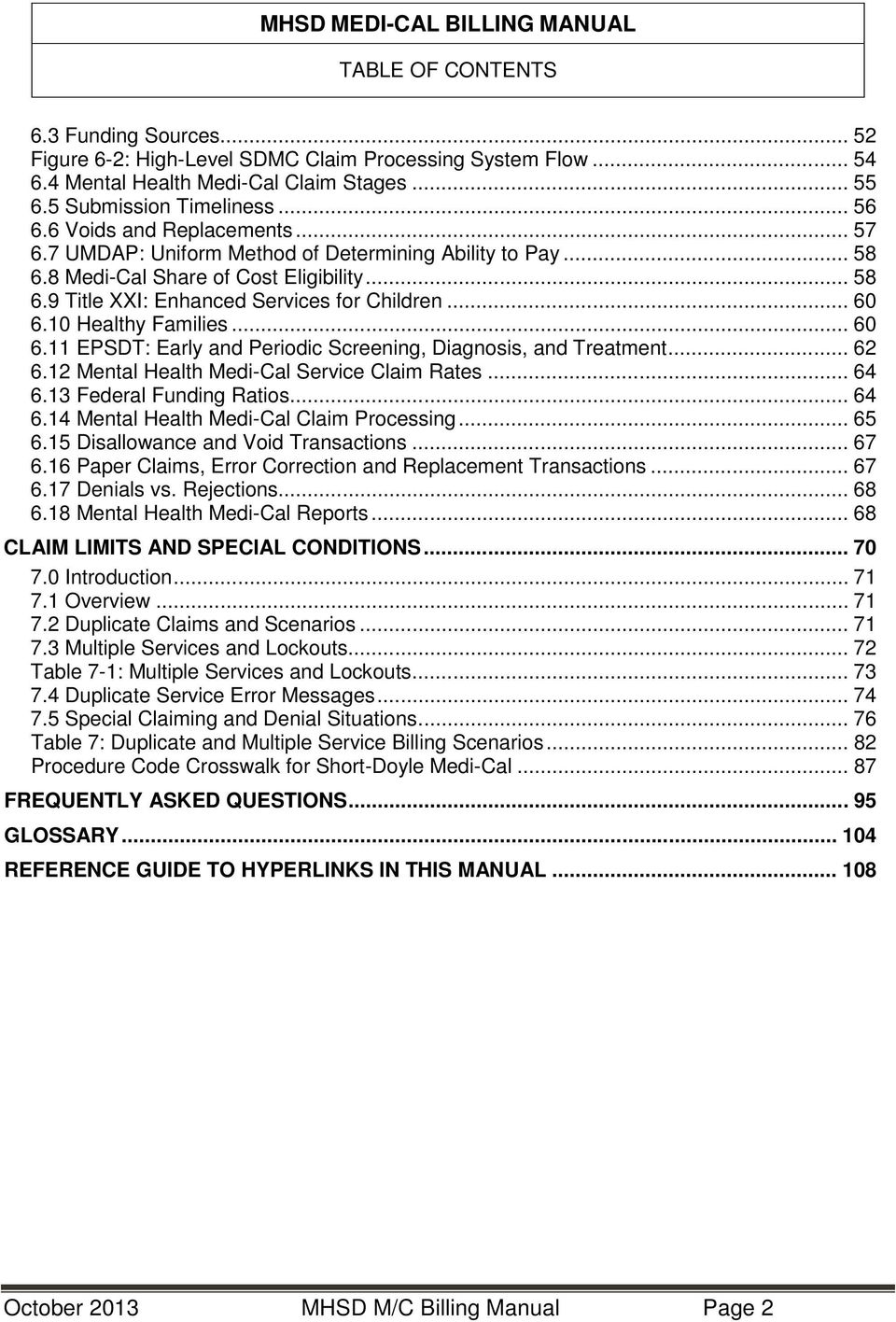
4 TABLE OF CONTENTS 6.3 Funding Sources Figure 6-2: High-Level SDMC Claim Processing System Flow Mental Health Medi-Cal Claim Stages Submission Timeliness Voids and Replacements UMDAP: Uniform Method of Determining Ability to Pay Medi-Cal Share of Cost Eligibility Title XXI: Enhanced Services for Children Healthy Families EPSDT: Early and Periodic Screening, Diagnosis, and Treatment Mental Health Medi-Cal Service Claim Rates Federal Funding Ratios Mental Health Medi-Cal Claim Processing Disallowance and Void Transactions Paper Claims, Error Correction and Replacement Transactions Denials vs. Rejections Mental Health Medi-Cal Reports CLAIM LIMITS AND SPECIAL CONDITIONS Introduction Overview Duplicate Claims and Scenarios Multiple Services and Lockouts Table 7-1: Multiple Services and Lockouts Duplicate Service Error Messages Special Claiming and Denial Situations Table 7: Duplicate and Multiple Service Billing Scenarios Procedure Code Crosswalk for Short-Doyle Medi-Cal FREQUENTLY ASKED QUESTIONS GLOSSARY REFERENCE GUIDE TO HYPERLINKS IN THIS MANUAL October 2013 MHSD M/C Billing Manual Page 2
5 CHANGES / UPDATES TO PREVIOUS VERSION CHANGES / UPDATES FROM PREVIOUS VERSION (JULY 2008) October 2013 MHSD M/C Billing Manual Page 3

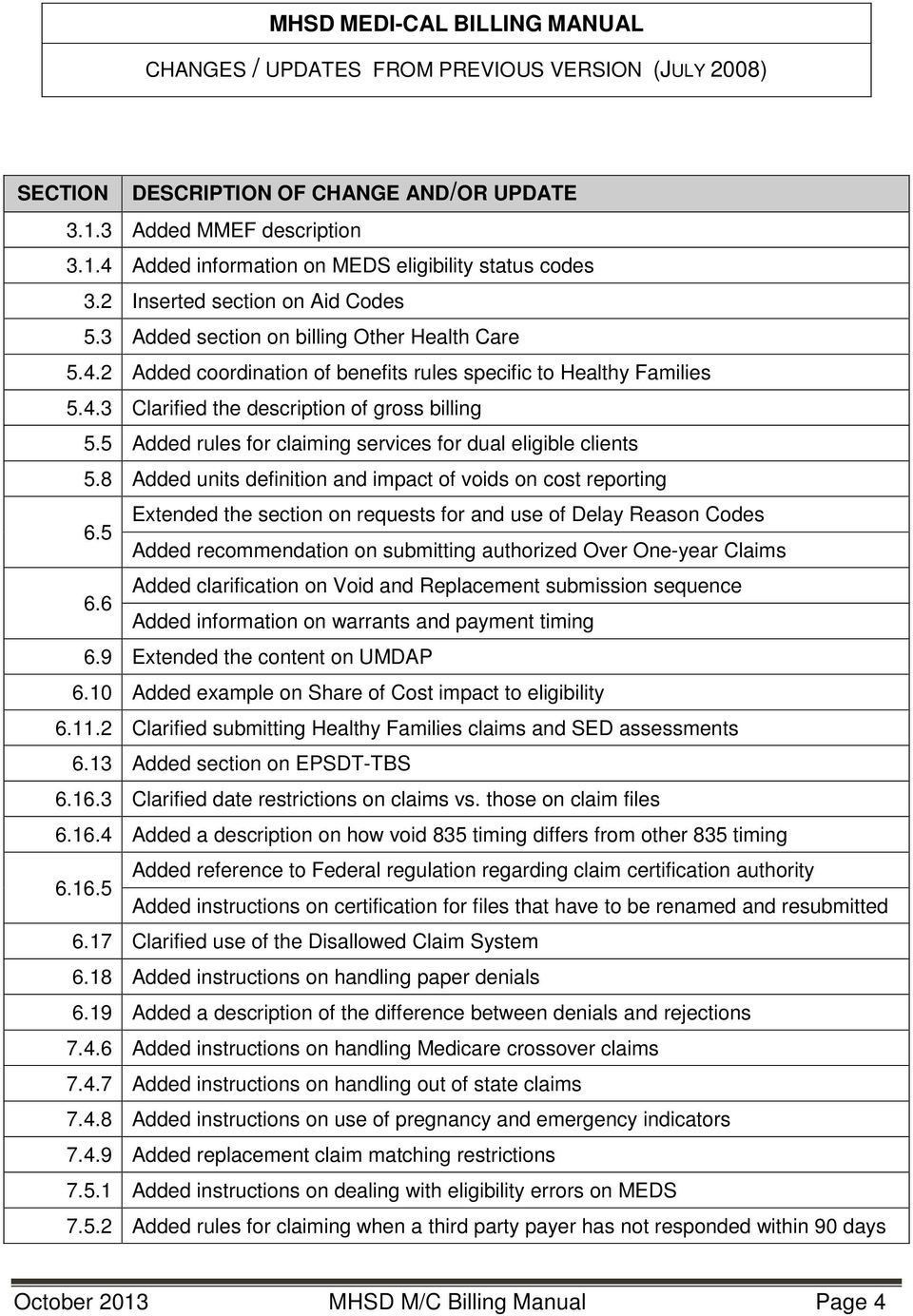
6 CHANGES / UPDATES FROM PREVIOUS VERSION (JULY 2008) SECTION DESCRIPTION OF CHANGE AND/OR UPDATE Added MMEF description Added information on MEDS eligibility status codes 3.2 Inserted section on Aid Codes 5.3 Added section on billing Other Health Care Added coordination of benefits rules specific to Healthy Families Clarified the description of gross billing 5.5 Added rules for claiming services for dual eligible clients 5.8 Added units definition and impact of voids on cost reporting Extended the section on requests for and use of Delay Reason Codes 6.5 Added recommendation on submitting authorized Over One-year Claims Added clarification on Void and Replacement submission sequence 6.6 Added information on warrants and payment timing 6.9 Extended the content on UMDAP 6.10 Added example on Share of Cost impact to eligibility Clarified submitting Healthy Families claims and SED assessments 6.13 Added section on EPSDT-TBS Clarified date restrictions on claims vs. those on claim files Added a description on how void 835 timing differs from other 835 timing Added reference to Federal regulation regarding claim certification authority Added instructions on certification for files that have to be renamed and resubmitted 6.17 Clarified use of the Disallowed Claim System 6.18 Added instructions on handling paper denials 6.19 Added a description of the difference between denials and rejections Added instructions on handling Medicare crossover claims Added instructions on handling out of state claims Added instructions on use of pregnancy and emergency indicators Added replacement claim matching restrictions Added instructions on dealing with eligibility errors on MEDS Added rules for claiming when a third party payer has not responded within 90 days October 2013 MHSD M/C Billing Manual Page 4
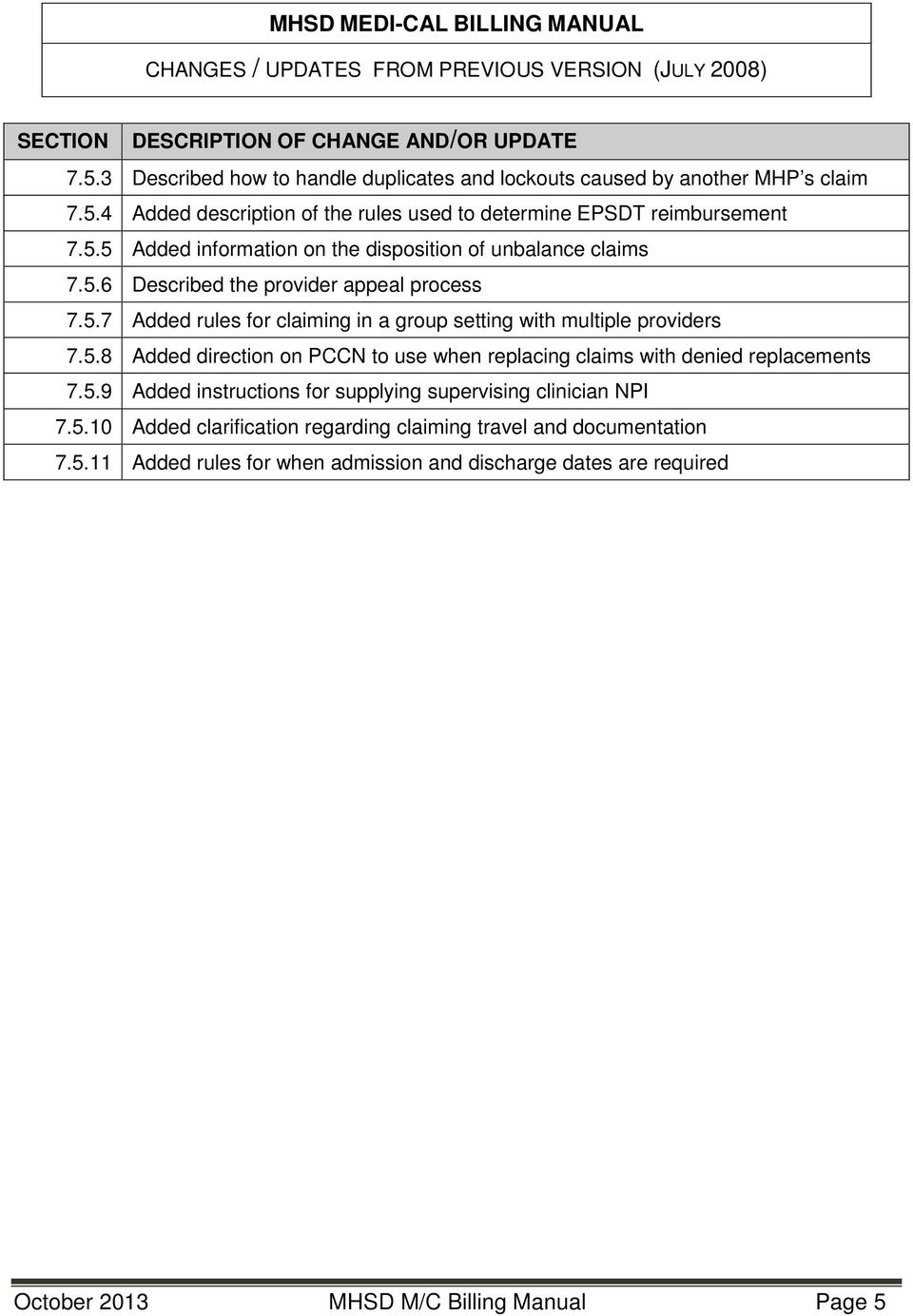
7 CHANGES / UPDATES FROM PREVIOUS VERSION (JULY 2008) SECTION DESCRIPTION OF CHANGE AND/OR UPDATE Described how to handle duplicates and lockouts caused by another MHP s claim Added description of the rules used to determine EPSDT reimbursement Added information on the disposition of unbalance claims Described the provider appeal process Added rules for claiming in a group setting with multiple providers Added direction on PCCN to use when replacing claims with denied replacements Added instructions for supplying supervising clinician NPI Added clarification regarding claiming travel and documentation Added rules for when admission and discharge dates are required October 2013 MHSD M/C Billing Manual Page 5
8 Chapter 1: Introduction INTRODUCTION October 2013 MHSD M/C Billing Manual Page 6
9 Chapter 1: Introduction 1.0 Introduction The Short-Doyle/Medi-Cal (SDMC) claim process system allows California s County Mental Health Plans (MHPs) to obtain reimbursement of funds for medically necessary specialty mental health services provided to Medi-Cal-eligible beneficiaries and also to Healthy Families subscribers diagnosed as Seriously Emotionally Disturbed (SED). 1 The Department of Health Care Services Mental Health Services Division (DHCS MHSD) oversees the SDMC claim processing system. This Billing Manual provides information about the system. This chapter includes: About This Billing Manual Program Background Authority Medi-Cal Claims Customer Service Office (MedCCC) 1.1 About This Billing Manual This Mental Health Medi-Cal Billing Manual is a publication of the DHCS. DHCS administers the Mental Health Medi-Cal program (administered by the Dept of Mental Health until 6/30/12). The scope of this Billing Manual is to provide stakeholders with a reference document that describes the processes and rules relative to SDMC claims for specialty mental health services. Stakeholders include MHPs, Billing Vendors of MHPs, etc Objectives The primary objectives of this Billing Manual are to: Provide explanations, procedures and requirements for claiming Provide claiming system overviews and process descriptions Provide links and/or information related to: o State and Federal laws and regulations o Letters and Information Notices 1 W & I Code, Division 5, Part 2, Chapter 1, October 2013 MHSD M/C Billing Manual Page 7

10 Chapter 1: Introduction o Reference documents such as: SDMC system user guides X-12 Companion Guides X-12 Companion Guide Appendix This Manual is not intended to duplicate the content of the Companion Guides or the Companion Guide Appendix. However, key concepts from those documents have been included to help explain the SDMC claiming process Internet Addresses and Links All internet addresses (URLs) and links in this document were current as of the publication date of this manual but are subject to change without notice. 1.2 Program Background Title XIX of the Social Security Act, enacted in 1965, authorizes Federal grants to States for medical assistance to low-income persons who are age 65 or over, blind, disabled, or members of families with dependent children or qualified pregnant women or children. The program is jointly financed by the Federal and State governments and administered by States. Within broad Federal rules, each State decides eligible groups, types and range of services, and administrative and operating procedures. Each Federally-approved State plan must designate a single State agency responsible for administration of its State Medicaid Program. In the case of California s Medicaid program (known as Medi-Cal), DHCS is the responsible State agency in California. DHCS holds administrative responsibility for Medi-Cal specialty mental health services including but not limited to: 1. Determination of Aid Code 2 2. Maintenance of eligibility information technology systems (e.g. Medi-Cal Eligibility Determination System [MEDS]) 3. Adjudication of SDMC Mental Health claims 4. Processing of claims for Federal Financial Participation (FFP) payments 2 SDMC Aid Codes Master Chart October 2013 MHSD M/C Billing Manual Page 8

11 Chapter 1: Introduction 5. Submission of expenditure claims to CMS to obtain FFP For Medi-Cal specialty mental health services provided to a beneficiary by a certified provider, the cost of these services is paid by a combination of, State, and Federal funds. The Federal Financial Participation (FFP) sharing ratio (the percentage of costs reimbursed by the Federal government) is determined on an annual basis and is known as the Federal Medical Assistance Program (FMAP) percentage. County expenditures represent a combination of State realignment funds; State managed care allocations, State General Fund (SGF) [For services provided through 2010], Mental Health Services Act (MHSA) funds, local county funds and other sources such as grants. Counties submit claims to the State to obtain reimbursement of some or all of their costs based on FMAP and EPSDT eligibility and sharing ratios. 1.3 Authority Authority for the Mental Health Medi-Cal program is governed by the following Federal and State of California statutes and regulations: Social Security Act Federal Social Security Act Title XIX, Grants to States for Medical Assistance Programs, 42 USD v, Subchapter XIX, Chapter 7 (1965), provides the basis for development of each State s Medicaid plan Health Insurance Portability and Accountability Act of 1996 The Code of Federal Regulations (CFR) provides statutory authority for the Health Insurance Portability and Accountability Act of 1996 (HIPAA, Title II) 42 USC 1320d 1320d-8, Public Law , 262 and 264; also 45 CFR, Subchapter C, Parts 160, 162 and Federal Regulations Title 42 of the Code of Federal Regulations (42 CFR) Chapter IV Subchapter C Parts Medical Assistance Programs provides regulatory guidance for the Medicaid Program. October 2013 MHSD M/C Billing Manual Page 9
12 Chapter 1: Introduction Welfare and Institutions Code (W&I Code) The California Welfare and Institutions (W&I) Code provides statutory authority for the Mental Health Medi-Cal program and implements legislation California Code of Regulations (CCR) State regulations applicable to SMHS are found in the California Code of Regulations, CCR Title 9, Division 1, Chapters Those applicable to DHCS that also affect SMHS are found in Title 22, Division 3, Subdivision 1, Chapter Companion Guides for the 837 Professional and Institutional Health Care Claims Health Care Claim Payment/Advice ( 837 Companion Guide and 835 Companion Guide ) Short-Doyle/Medi-Cal (SDMC) Companion Guide Appendix (Rev.10/7/11) ( Companion Guide Appendix) ASC X12/004010X096A1 Health Care Claim: Institutional (837I) Implementation Guide ASC X12/004010X098A1 Health Care Claim: Professional (837P) Implementation Guide ASC X12/004010X091A1 Health Care Claim Payment/Advice (835) Implementation Guide 1.4 Medi-Cal Claims Customer Service Office (MedCCC) MedCCC was created to provide MHPs a single point of contact to assist them with SDMC claim process questions and issues. MedCCC provides MHPs direct access to the state when they have questions regarding claim payment, need technical assistance with claim processing, have a question about policy, need assistance with accurate and timely submission and processing of claims or have other billing and/or claim-related issues. MedCCC also uses a proactive approach of delivering information to MHPs when a potential issue with a claim process or business rule has been identified. MedCCC assists MHPs with streamlining the claim process, resulting in improved processes and understanding of requirements at both the MHP and state levels. October 2013 MHSD M/C Billing Manual Page 10

13 Chapter 1: Introduction What MHPs can expect when contacting MedCCC: An response back within 24 hours, acknowledging receipt of the MHP s issue or concern The most current information on an MHP s Medi-Cal claims Assistance with troubleshooting claim and/or payment issues Helpful answers to policy and procedure questions To ensure the accuracy of the inquiry and responses, MedCCC requests that MHPs inquiries to: [email protected] MHPs may also call or Fax October 2013 MHSD M/C Billing Manual Page 11

14 Chapter 2: Getting Started GETTING STARTED October 2013 MHSD M/C Billing Manual Page 12
15 Chapter 2: Getting Started 2.0 Introduction This chapter provides the requirements that must be met before submitting a claim, including: Enrolling in ITWS Legal Entity, Provider Numbers and NPIs Provider Enrollment and Medi-Cal Certification Online Provider System X-12 Companion Guide and Appendix 2.1 Enrolling in ITWS DHCS Information Technology Web Services (ITWS) are a collection of web applications that allow Mental Health Services Division business partners (e.g. MHPs, Contracted Providers, and authorized Vendors) to access information securely over the Internet. Requests for access to specific areas of ITWS are approved by approvers appointed by each MHP director. 3 For basic information related to ITWS enrollment and uploading claim files, a Virtual Tour is available. For further information, please call ITWS Support at (800) or go to ITWS contact information. 2.2 Legal Entity, Provider Numbers and NPIs All MHPs and providers wishing to bill Med-Cal for providing specialty mental health services must have: 1. a Legal Entity ( LE ) number 2. a State-assigned Provider number 3. an NPI (National Provider Identifier) An LE can be a county, a corporation or an individual that owns one or more facilities providing mental health services. DHCS assigns unique 5-digit LE numbers for cost reporting purposes. To request and update Legal Entity numbers use the Legal Entity File Update (LFU) form. 3 ITWS: Approver Certification Forms October 2013 MHSD M/C Billing Manual Page 13

16 Chapter 2: Getting Started Provider numbers are unique 4-digit numbers used to distinguish one or more of an LE s facilities that provide both Medi-Cal and non-medi-cal mental health services. To request State-assigned provider numbers and to update information regarding provider numbers use the Provider File Update form (PFU). Federal regulations require that individual health care providers and organizations obtain NPIs. DHCS maintains a website providing information about obtaining an NPI. 4 MHPs must identify, by NPI, the rendering provider and the billing and service facility provider locations in 837 health care claim transactions. 2.3 Provider Enrollment and Medi-Cal Certification For a provider to be eligible to bill Medi-Cal for providing specialty mental health services, one of the steps a provider must take is to enroll in the ITWS Online Provider System (OPS See 2.4). Instructions for provider enrollment can be found on ITWS by clicking on the Enroll tab. Another requirement is to have each provider who wishes to submit claims for providing specialty mental health services to beneficiaries of an MHP are Medi-Cal certified by the State. MHPs shall have completed, and submitted to DHCS, one Medi-Cal Certification and Transmittal form (aka Transmittal ) for each provider utilized by the MHP. The Transmittal form can be found on either 1) ITWS or 2) by ing [email protected]. The purpose of the Transmittal is to transmit provider information, necessary to adjudicate claims, to the OPS. Providers are assigned a 4-digit provider number by DHCS. Provider numbers are assigned with a separate number for each provider location and each MHP using that provider. Provider numbers are unique to each MHP with the exception of IMD and Skilled Nursing Facility (SNF) provider numbers. Many counties may use the same provider but each MHP will have its own unique provider number for that provider. Before being listed in the OPS, a provider must also have both an LE name and number listed in the Legal Entity File. To obtain a new Provider Number and add a new provider to the OPS, counties must submit a PFU to [email protected]. 4 DHCS NPI Overview October 2013 MHSD M/C Billing Manual Page 14

17 Chapter 2: Getting Started 2.4 Online Provider System The Online Provider System is system located within ITWS and allows real-time access to information contained in the Provider File. To view information in the OPS, you must first enroll in ITWS (click on the Request Additional Membership link). Additional information about the OPS is included in Information Notice Since data contained on the Transmittal populates the Provider File on the OPS, SDMC Certification for specific combinations of Mode of Service and Service Function codes is required. Additionally, each and every time there is a change of any of the provider s information contained on the Transmittal, an updated Transmittal must be submitted to DHCS. When a provider s billing eligibility is checked during claim adjudication, a provider s Mode of Service and Service Function combinations are crosswalked to Healthcare Common Procedure Coding System (HCPCS) Procedure and Procedure Modifier codes. Please submit Transmittals via: [email protected] or, Fax to X-12 Companion Guide and Appendix X-12 ( publishes both a Companion Guide and a Companion Guide Appendix for each HIPAA-compliant transaction type used by SDMC (e.g 835, 837). The Companion Guide provides the detail on how to format HIPAA compliant claims. The Companion Guide Appendix provides technical details about claim submission procedures, appropriate code usage, error codes, conversion tables, etc. October 2013 MHSD M/C Billing Manual Page 15

18 Chapter 3: Client Eligibility CLIENT ELIGIBILITY October 2013 MHSD M/C Billing Manual Page 16
19 Chapter 3: Client Eligibility 3.0 Introduction This chapter contains information about Medi-Cal eligibility including: Client Eligibility Aid Codes 3.1 Client Eligibility Mental Health clients must be Medi-Cal-eligible in order for the MHP to be reimbursed through the SDMC Claim System. The sections in this chapter describe Medi-Cal Eligibility Determination and Medi-Cal Eligibility Review Medi-Cal Eligibility Determination Procedures for establishing Medi-Cal eligibility criteria are the responsibility of DHCS. The determination of beneficiary eligibility and the collection of beneficiary eligibility data is typically the responsibility of the County Department of Social Services. Detailed information regarding beneficiary eligibility criteria may be obtained through the DHCS website. 5 DHCS Provider Bulletins and Manuals provide information for all Medi-Cal programs, including specialty mental health services. 6 The following information regarding Medi-Cal eligibility is integral to the management of Mental Health Medi-Cal claiming. Medi-Cal eligibility is established on a monthly basis. For this reason, Mental Health Medi-Cal claim processing requires frequent review and management of beneficiary Medi-Cal eligibility data. Verification of beneficiary Medi-Cal eligibility can be reviewed by external auditors after the claimed month of service. For this reason, MHPs must maintain proof of how beneficiary Medi-Cal eligibility was verified. Medi-Cal eligibility may require that a beneficiary s Share of Cost (SOC) be met before Medi-Cal will pay for any services. (Share of Cost is discussed in Medi-Cal Share of Cost (SOC) in Chapter 6.) 5 DHCS MEDS Division Homepage 6 DHCS Provider Bulletins and Manuals October 2013 MHSD M/C Billing Manual Page 17
20 Chapter 3: Client Eligibility Clients who are eligible for Supplemental Security Income (SSI) are Medi-Cal eligible. (Information on SSI may be obtained through the Federal Social Security Administration website. 7 ) Medi-Cal eligibility may be established retroactively through court hearings and/or decisions. Healthy Families 8 (HF) eligibility is based on the State Children s Health Insurance Program (SCHIP) which has been designed for children whose family income is below a State-established level but above the level qualifying for Medi-Cal. California has incorporated HFP members into the Medi-Cal eligibility system through beneficiary Aid Codes. HIPAA 270/271 transactions are available from DHCS to verify beneficiary Medi- Cal eligibility 9. MHPs must verify beneficiary Medi-Cal eligibility prior to submission of claims for reimbursement Eligibility Review Once Medi-Cal eligibility is established, beneficiary eligibility information may be reviewed by authorized MHP staff. With few exceptions, the source of this eligibility verification information will always be from the DHCS Point of Service (POS) system MMEF The Monthly MEDS Extract File (MMEF) contains, among other data, all Aid Codes for which an individual is eligible at the date/time the file is created. The MMEF contains information for the current month and previous 15 months. A new MMEF is available at the end of each month and applies to the following month s eligibility. MMEF data is not used to determine eligibility during adjudication. The adjudication process queries the MEDS database for eligibility data at the time the claim is being adjudicated. 7 US Social Security Admin Website 8 Information Notice 07-01: The Healthy Families Program 9 DHCS: HIPAA 4010/NCPDP 5.1 & Medi-Cal Website: Transaction Services Available October 2013 MHSD M/C Billing Manual Page 18

21 Chapter 3: Client Eligibility MEDS Eligibility Status Codes For a claim to pass the Medi-Cal eligibility edit, the eligibility status code(s) received from MEDS and placed in the claim must be from 001 to 499 (except for Healthy Families: see below). For a particular month and year of service, if the eligibility is valid, then the approved Aid Code will be the highest-paying eligible SDMC Aid Code. For HF claims which start with an eligibility status code of 6xx and include an HF Aid Code, the eligibility start date is also checked. HF claims will be denied if the service dates are before the eligibility establishment date. Note: if a beneficiary is found in MEDS, but none of the Aid Codes for which the beneficiary is eligible are applicable to SDMC, the claim will be denied. 3.2 Aid Codes During the Medi-Cal application and enrollment process, Aid Codes are codes assigned to Medi-Cal-eligible clients to indicate the program(s) under which the client qualifies for services. The DHCS Aid Codes Master Chart (which includes both Mental Health and Drug Medi- Cal) can be found on the MedCCC website under Library. The Aid Codes Master Chart provides useful information for the following: Federal Financial Participation (FFP) Aid Codes Types of benefits Share of Cost Code description Indication of reimbursement through the DHCS Fiscal Intermediary Management Division, Alcohol and Drug Programs (DMC), 11 Mental Health Programs, and/or EPSDT 12 programs. 11 ADP Website 12 County Interim RateTable FY12_13 October 2013 MHSD M/C Billing Manual Page 19
22 Chapter 4: Covered Services COVERED SERVICES October 2013 MHSD M/C Billing Manual Page 20
23 Chapter 4: Covered Services 4.0 Introduction This chapter provides explanations of covered services and limitations related to Mental Health Medi-Cal claiming. It also explains key concepts about the way a claim is processed. It includes: Covered Services Mode of Service and Service Function Codes 4.1 Covered Services The specialty mental health services listed below are Medi-Cal covered services. Claims for reimbursement of specialty mental health services may be submitted to the SDMC Claim System via ITWS. Medi-Cal reimbursement for any other service (such as Administrative, QA/UR, etc) is through interim payment (using the paper or electronic forms MC1982B and/or MC1982C) or the Cost Reporting process Hospital Inpatient: CCR Title 9, Hospital Inpatient services are provided in an acute psychiatric hospital or the distinct acute psychiatric portion of a general hospital that is approved by DHCS to provide psychiatric services. Hospital Inpatient services must be medically necessary for diagnosis or treatment of a mental disorder. IP services are not billed through the SDMC Claim System; IP services are billed through the Fiscal Intermediary, which at the time of this publication, is Xerox Hospital Inpatient Administrative Day Services: CCR Title 9, During a hospital stay, the beneficiary has previously met medical necessity criteria for reimbursement of acute psychiatric inpatient hospital services. There is no appropriate, non-acute treatment facility within a reasonable geographic area and the hospital documents contacts with a minimum of 5 appropriate, non-acute treatment facilities per week subject to the requirements stated in CCR Title 9, Section Psychiatric Health Facility: CCR Title 9, & Title 22, A Psychiatric Health Facility (PHF) is a facility licensed under the provisions of CCR, Title 22. For the purposes of this chapter, PHFs that have been certified by DHCS as October 2013 MHSD M/C Billing Manual Page 21
24 Chapter 4: Covered Services Medi-Cal providers of inpatient hospital services are governed by provisions applicable to hospitals and psychiatric inpatient hospital services, except when specifically indicated in context Psychiatric Health Facility Services: CCR Title 9, & Psychiatric Health Facility Services are therapeutic or rehabilitative services provided in a Facility other than a Psychiatric Health Facility as defined above. These services are provided on an inpatient basis to beneficiaries who need acute care (care that meets criteria outlined in CCR, Title 9) and whose physical health needs can be met in an affiliated general acute care hospital or in outpatient settings Crisis Residential Treatment Services: CCR Title 9, Crisis Residential Treatment Services (CRTS) are therapeutic or rehabilitative services provided in a non-institutional residential setting. CRTS provide structured programs as an alternative to hospitalization for beneficiaries experiencing an acute psychiatric episode or crises that do not have medical complications requiring nursing care. CRTS offer a range of activities and services that support beneficiaries in their effort to restore, maintain, and apply interpersonal and independent living skills and to access community support systems. CRTS are available 24 hours a day, seven days a week. Activities may include (but are not limited to) Assessment, Plan Development, Therapy, Rehabilitation, Collateral, and Crisis Intervention. CRTS are provided in Social Rehabilitation Facilities licensed under the provisions of CCR Title 22, and certified under the provisions of CCR Title Adult Residential Treatment Services: CCR Title 9, Adult Residential Treatment Services are rehabilitative services provided in a noninstitutional residential setting for beneficiaries who would be at risk of hospitalization or other institutional placement if they were not in a residential treatment program. Adult Residential Treatment Services include a range of activities and services that support beneficiaries in their effort to restore, maintain and apply interpersonal and independent living skills and to access community support systems. The service is available 24 hours a day, seven days a week. Service activities may include but are not October 2013 MHSD M/C Billing Manual Page 22
25 Chapter 4: Covered Services limited to Assessment, Plan Development, Therapy, Rehabilitation and Collateral. Adult Residential Treatment Services are provided in Social Rehabilitation Facilities licensed under the provisions of CCR, Title 22, and certified under the provisions of CCR Title Crisis Stabilization: Emergency Room: CCR Title 9, and Crisis Stabilization: Emergency Room is a service lasting less than 24 hours provided to (or on behalf of) a beneficiary for a condition that requires a more timely response than a regularly scheduled visit. Service activities include (but are not limited to) Assessment, Collateral, and Therapy. Crisis Stabilization differs from Crisis Intervention in that stabilization is delivered by providers who meet contact, site, and staffing requirements for Crisis Stabilization described in CCR Title 9, sections and Crisis Stabilization must be provided onsite at a licensed 24-hour health care facility, as part of a hospital-based outpatient program, certified by the state to perform crisis stabilization. The maximum allowance provided in CCR, Title 22 for Crisis Stabilization-Emergency Room shall apply when the service is provided in a 24-hour facility, including a hospital outpatient department Crisis Stabilization: Urgent Care: CCR Title 9, Crisis Stabilization: Urgent Care follows the same guidelines as Crisis Stabilization: Emergency Room above, except that the maximum allowance for this category shall apply when the service is provided at an appropriate site other than an emergency room Day Treatment Intensive: CCR Title 9, Day Treatment Intensive is a structured, multi-disciplinary program of therapy that may be an alternative to hospitalization, avoids placement in a more restrictive setting, or maintains the individual in a community setting where services to a distinct group of individuals is provided. Services are available for at least three hours and less than 24 hours each day the program is open. Service activities may include, but are not limited to, Assessment, Plan Development, Therapy, Rehabilitation, and Collateral. October 2013 MHSD M/C Billing Manual Page 23
26 Chapter 4: Covered Services Day Rehabilitation: CCR Title 9, Day Rehabilitation is a structured program of rehabilitation and therapy to improve, maintain, or restore personal independence and functioning, consistent with requirements for learning and development, which provides services to a distinct group of individuals. Services are available for at least three hours and less than 24 hours each day the program is open. Service activities may include (but are not limited to) Assessment, Plan Development, Therapy, Rehabilitation, and Collateral Case Management/Brokerage: CCR Title 9, Case Management/Brokerage is a service that assists a beneficiary to access needed medical, educational, social, prevocational, vocational, rehabilitative, or other community services. The service activities may include (but are not limited to) communication, coordination, and referral; monitoring service delivery to ensure patient access to service and the service delivery system; monitoring the patient s progress; placement services; and plan development Mental Health Services: CCR Title 9, Mental Health Services are individual or group therapies and interventions that are designed to provide reduction of mental disability and restoration, improvement or maintenance of functioning consistent with the goals of learning, development, independent living, and enhanced self-sufficiency, and that are not provided as a component of Adult Residential Services, CRTS, Crisis Intervention, Crisis Stabilization, Day Rehabilitation, or Day Treatment Intensive services. Mental Health Service activities may include (but are not limited to) Assessment, Plan Development, Therapy, Rehabilitation, and Collateral Mental Health Services: Professional IP Visit Mental Health Services: Professional IP Visit services are the same as Mental Health Services, except they are provided in a Fee-For-Service inpatient setting (IP) by professional staff. October 2013 MHSD M/C Billing Manual Page 24
27 Chapter 4: Covered Services Medication Support: CCR Title 9, Medication Support is a service that can include the prescribing, administering, dispensing and monitoring of psychiatric medications or biologicals that are necessary to alleviate the symptoms of mental illness. Med Support activities may include (but are not limited to) evaluating the need for medication; evaluating clinical effectiveness and side effects; obtaining informed consent; instruction in the use, risks and benefits of and alternatives for medication; and Collateral and Plan Development related to the delivery of the service and/or assessment of the patient Medication Support: Professional IP Visit Medication Support: Professional IP Visit services are the same as Medication Support, except they are provided in a Fee-For-Service IP setting by professional staff Crisis Intervention CCR Title 9, Crisis Intervention services last less than 24 hours and are provided to (or on behalf of) a beneficiary for a condition that requires more timely response than a regularly scheduled visit. Service activities include but are not limited to one or more of the following: Assessment, Collateral, and Therapy. Crisis Intervention is distinguished from Crisis Stabilization by being delivered by providers who do not meet the Crisis Stabilization contact, site, and staffing requirements described in CCR Title 9 Section and Crisis Intervention: Professional IP Visit Crisis Intervention: Professional IP Visit services are the same services as Crisis Intervention except that the services are provided in a Fee-For-Service IP setting by professional staff. 4.2 Mode of Service and Service Function Codes Mental Health Medi-Cal Mode of Service and Service Function (MS/SF) codes are mapped to HCPCS Procedure Codes, Procedure Modifiers, and Revenue codes for the 837 transaction. MHPs vary in the ways their staff code mental health services. Local coding may be in the form of HCPCS or CPT codes, DHCS MS/SF codes, are a unique October 2013 MHSD M/C Billing Manual Page 25
28 Chapter 4: Covered Services set of codes, which is linked to HCPCS, CPT, or MS/SF codes through crosswalk tables. In all cases, MHPs must conform or translate their local codes to those 837 transaction coding requirements found in the Companion Guide. Critical to understanding the Mental Health SDMC claim process is the fact that the 837 health care claim transaction format does not use MS/SF codes. Instead, SDMC claim use different codes to represent similar information. These codes include Procedure, Procedure Modifier, Place of Service, Taxonomy and Revenue codes. Further discussion of this concept is found in Chapter 4 of this Manual. 837 transaction Procedure codes are required by National HIPAA 837 transaction code standards. The Companion Guide can be referenced to more fully understand the related and correct coding of Mental Health Medi-Cal claims. Crosswalks provided herein describe how to convert MS/SF combinations to HIPAAcompliant HCPCS codes that are acceptable on an SDMC 837 transaction. All of these crosswalks have the same basic format: Columns A through D represent key Cost Report and/or CSI coding. Columns F through H represent key coding found in 837 transaction claiming Administration-Related Crosswalk The Administration-related Crosswalk represents the MS/SF information related to MAA by an MHP. MAA activities cannot be claimed through Mental Health Medi-Cal. Chapter 5 of this Manual provides information regarding Medi-Cal reimbursement to Counties relative to administration and utilization review Hour Services Crosswalk The 24-Hour Services Crosswalk represents the MS/SF information related to 24-Hour Service by an MHP. The 24-Hr Services Crosswalk demonstrates how a particular Mode of Service may have services that are both billable to SDMC as well as services not billable to Mental Health SDMC. This Crosswalk also shows how some MS/SF Codes were translated to the prior DHCS SDMC proprietary claim and how the same MS/SF Codes are represented as a Procedure Codes in the SDMC 837 transaction claim format. October 2013 MHSD M/C Billing Manual Page 26
29 Chapter 4: Covered Services The following is an example showing 24-Hour Services billable to Mental Health Medi- Cal and the related Modes of Service. A description by row/column is used to explain table concepts. Detail for Local Hospital Inpatient (Ages 21-64) SDMC 837 transaction claiming: Column B Cost Reporting Mode of Service 05 (24-Hour Services) Column C Service Function codes used by counties 13 in Cost Reporting Column D Types of Units of Service represented on the Cost Report Column F Revenue code that must be supplied in the 837I claim Column G HCPCS code (e.g. H2015) that must be supplied in the 837I claim Column H No Procedure Modifier 2 is required for this service. Column I Type of Cost Units upon which the costs are determined. Cost Units may be units of service or units of time Line 8, Columns F and G indicate that there are no equivalent HIPAA codes in a SDMC 837 transaction for SNF Intensive Services Service Function: Detail Loss The implementation of HCPCS codes in 837 transaction claims will affect the ability to directly relate Cost Reporting MS/SF codes to the SDMC adjudicated claim MS/SF data. This may occur because 837 transaction claims must currently be translated back to the prior SDMC proprietary claim format used by DHCS claim system. This is the role of the Translator. Since the 837 transaction claim does not have the original MS/SF descriptors, specific Service Function detail may be unavailable. Here is an example: County A provides both an Assessment and a Collateral service to the same client in the same day. County A s computer system tracks this through internal codes representing MS 15 (Outpatient) with: Collateral local coding equal to SF 10 Assessment local coding equal to SF 30 When the county creates an 837 transaction for each of these services, the result is that both of these services will be represented by Procedure code H2015. Mode of Service (MS) and Service Function (SF) codes on their own are no longer used for claiming but are still used by the Client and Services Information system (CSI) and 13 Counties may use their own rationale for how or why they utilize Service Function codes for cost reporting but their choices must be within the allowable range and have no impact on the claiming system. For example, a county that has two separate Local Hospital Inpatient facilities might show costs for Facility 1 using Service Function 10 and Facility 2 using Service Function 11. October 2013 MHSD M/C Billing Manual Page 27
30 Chapter 4: Covered Services Cost Reporting process. MS and SF codes allow similar mental health services to be grouped together for reporting purposes Mode of Service Codes The Modes of Service used by Cost Reporting are: 00 Administration Hour Services 10 Less than 24-Hour Day Treatment Program Services 15 Outpatient Services 45 Outreach Services 55 Medi-Cal Administrative Activities Client Support and Care Direct Treatment Modes of Service used by both CSI and Cost Reporting are: Hour Services 10 Less than 24-Hour Day Treatment Program Services 15 Outpatient Services For Mental Health Medi-Cal, Mode of Service (if used) must be mapped to Procedure codes and Revenue codes for the 837 transaction. Medi-Cal reimbursement in any other Mode of Service is through interim payment (MC1982B and MC1982C) or the Cost Reporting process. Modes of Service are grouped as follows: 05, 07, 08, and Hour Services 12 Outpatient Hospital Services 18 Non-Hospital Outpatient 24-HOUR SERVICES These are services that provide a therapeutic environment of care and treatment within a 24-Hour setting. 05 Residential/Psychiatric Health Facility 07 General Hospital IP Services 08 Psychiatric Hospital IP Under Age Psychiatric Hospital IP Over Age 64 NON 24-HOUR SERVICES 14 Medi-Cal Administrative Activities (MAA) are billed and paid through a paper claim (MC1982D) October 2013 MHSD M/C Billing Manual Page 28
31 Chapter 4: Covered Services These services provide short-term or sustained therapeutic intervention for beneficiaries experiencing acute and/or ongoing psychiatric distress. MS SETTING 12 Hospital Outpatient Services 18 Non-Hospital Outpatient Service Function Codes Service Function codes are used in CSI and Cost Report information systems. They identify the specific type of service received under a Mode of Service. Service Function codes include any number from (Exception: Codes 80 and 90 are not used). SF codes are necessary for classifying county-provided services and service cost data at a specific level. Examples for MS 15 (Outpatient Services) are: SF Medication Support SF Crisis Intervention Below is the list of Short-Doyle Mode of Service and Short-Doyle Service Function codes: MODE OF SERVICE 24-HOUR SERVICES 05 Residential/Psychiatric Health Facility (PHF) 07 General Hospital IP 08 Psychiatric Hospital IP: Under Age Psychiatric Hospital IP: Over Age 64 SERVICE FUNCTION 24-HOUR SERVICES Hospital IP 19 Hospital IP: Administrative Day Psychiatric Health Facility (PHF) Adult Crisis Residential Adult Residential October 2013 MHSD M/C Billing Manual Page 29
32 Chapter 4: Covered Services MODE OF SERVICE DAY SERVICES 12 or Hospital Outpatient 18 Non-Hospital Outpatient 01 06, 08, 09 Case Management/Brokerage: Targeted Case Management (TCM) 07 Intensive Care Coordination (ICC) Mental Health Services (MHS) 19 MHS: Professional IP Visit Crisis Stabilization: Emergency Room (ER) Crisis Stabilization: Urgent Care (UC) MHS 39 MHS: Professional IP Visit MHS October 2013 MHSD M/C Billing Manual Page 30
33 Chapter 4: Covered Services MODE OF SERVICE DAY SERVICES 49 MHS: Professional IP Visit MHS 57 Intensive Home-Based Services (IHBS) 58 TBS 59 MHS: Professional IP Visit MODE OF SERVICE DAY SERVICES Medication Support 69 Medication Support: Professional IP Visit Crisis Intervention 79 Crisis Intervention: Professional IP Visit Day Treatment Intensive: 1/2 Day SERVICE FUNCTION DAY SERVICES Day Treatment Intensive: Full Day Day Rehabilitation: 1/2 Day Day Rehabilitation: Full Day October 2013 MHSD M/C Billing Manual Page 31
34 Chapter 5: Other Mental Health Claiming OTHER MENTAL HEALTH CLAIMING October 2013 MHSD M/C Billing Manual Page 32
35 Chapter 5: Other Mental Health Claiming 5.0 Introduction This chapter covers claiming performed outside the SDMC system: Inpatient Psychiatric Facilities (Non-MHP Contracted) IMD Exclusion Outpatient Claiming Other Health Care Coordination of Benefits and Gross Billing Claiming for Dual Eligibles (Medi-Medi) Non-Medicare Reimbursable: Specialty Mental Health Services AB3632 Children s Services Administrative, Utilization Review, and Medi-Cal Administrative Activities Annual Year-end Cost Report and Fiscal Audit: Minutes and Units 5.1 Inpatient Psychiatric Facilities (Non-MHP Contracted) This section is related only to Inpatient Hospitals that do not contract with any MHP, and are not designated Short-Doyle hospitals. Psychiatric IP managed care Medi-Cal claims continue to be processed through DHCS Fiscal Intermediary (FI) Management Division. The process begins when a representative authorized by the MHP approves a mental health IP provider s Treatment Authorization Request (TAR). The FI s claim system matches the claim to the TAR and adjudicates the claim. This system supports the submission, approval and payment of claims for Mental Health Medi-Cal Psychiatric IP Fee-For-Service providers. TARs are governed by DHCS policy and procedures. (See: Inpatient Mental Health Services Program section under the Medi-Cal Inpatient/Outpatient Provider Manual 15 for information on TARs 16 and related billing.) Subsequently, the inpatient provider bills the FI Management Division for Medi-Cal reimbursement. This type of inpatient billing is never billed directly from an MHP through DHCS. 15 Medi-Cal Provider Manual 16 TAR Manual October 2013 MHSD M/C Billing Manual Page 33
36 Chapter 5: Other Mental Health Claiming 5.2 IMD Exclusion Services provided to individuals in Institutions for Mental Diseases or (IMDs), have different claiming rules than other Medi-Cal mental health services. Title 42, CFR, Section defines an IMD as a hospital, nursing facility, or other institution of more than 16 beds that is primarily engaged in providing diagnosis, treatment, or care of persons with mental diseases, including medical attention, nursing care, and related services. A facility s license type is not a defining characteristic of an IMD; several types of facilities may meet the definition of an IMD, including but not limited to, acute psychiatric hospitals, mental health rehabilitation centers, psychiatric health facilities, and skilled nursing facilities with special treatment programs. Title 42, CFR, Section , in relevant part states that FFP is not available in expenditures for services provided to Individuals under age 65 who are patients in an institution for mental diseases unless they are under age 22 and are receiving inpatient psychiatric services under Sec of this subchapter The exclusion of FFP does not apply during that part of the month in which the individual is not a patient in an institution for mental diseases An individual on conditional release or convalescent leave from an institution for mental diseases is not considered to be a patient in that institution. MHPs are responsible for preventing the submission for claims to the State for services provided to individuals subject to the IMD exclusion. Inappropriate claiming of FFP must be prevented in both the SDMC claim system and the fiscal intermediary claim system IMD List by calendar year: Departmental Information Letters and Notices regarding IMDs: October 2013 MHSD M/C Billing Manual Page 34
37 Chapter 5: Other Mental Health Claiming 5.3 Outpatient Claiming Between November 1997 and July 1998 MHPs assumed responsibility for inpatient hospital and outpatient specialty mental health professional services. County representatives provide authorization for mental health outpatient services by external providers and bill DHCS Mental Health Medi-Cal for reimbursement. This billing must conform to all DHCS requirements. 5.4 Other Health Care Because Medi-Cal is always the payer of last resort 17, MHPs must first submit claims to other payers when the beneficiary has third party coverage. This means when a claim is submitted to Medi-Cal for payment, all third party payers must have either paid or denied the claim except as noted under Dual-eligibility Beneficiaries. 5.5 Coordination of Benefits and Gross Billing Coordination of Benefits The SDMC claiming system does not perform coordination of benefits through various payer sources. Each source must be billed separately by the MHP. One example is Medicare/Medi-Cal dual-eligible beneficiaries (referred to as Medi/Medi beneficiaries). For eligible services that are not directly billed to Medicare, the MHP will bill Medicare prior to Medi-Cal. A Medicare intermediary processing the MHP s claim will not coordinate the subsequent billing to Medi-Cal. Instead, claim adjudication by the Medicare intermediary will result in claim payment information returned to the MHP. The MHP may then submit an 837 transaction to the Mental Health SDMC Claim system with the Medicare payment information included. On occasion, MHPs will receive a denial from a third party insurer in paper. The SDMC claim should be coded as if the claim was submitted to the prior payer electronically with the adjudication date as the date of the paper denial. The Adjudication Date must be greater than or equal to the date of service. The paper denial should be retained for audit purposes. 17 SSA.gov: State Plans for Medical Assistance October 2013 MHSD M/C Billing Manual Page 35
38 Chapter 5: Other Mental Health Claiming If payment is received from a prior payer after SDMC has adjudicated the claim, the MHP must submit a replacement claim correcting the transaction Coordination of Benefits for Healthy Families Program Enrollees Coordination of Benefits rules apply to Healthy Families Program (HFP) as well as Medi- Cal. For an HFP beneficiary that has Other Health Coverage (OHC) and Medi-Cal, OHC would be the primary payer, HFP the secondary payer and Medi-Cal the payer of last resort. MHPs must continue to bill OHC before billing Medi-Cal or HFP. If the MHP does not bill to OHC, claims submitted to SDMC will be denied Gross Billing Submitters are required to claim for the total amount billed for services rendered, including any amounts that have already been accepted to clear Share of Cost or paid by prior payers. After FY11-12, there is no requirement to submit claims in any particular sequence. For example, December claims can be submitted before November claims as long as the dates of service are correctly specified on each claim. Note that on claims where lockouts (see chapter 7) apply, the later submission will be the one that is denied. If the claim has been adjudicated by a prior payer, submitters are required to accurately describe: 1. How the claim was adjudicated 2. What amounts were paid 3. Any adjustments that were made MHPs should not submit Coordination of Benefits information that represents implied or inferred denials based upon an OHC s lack of action. The amount SDMC will approve for any service line is the allowable reimbursement for the billed service reduced by any amounts paid by prior payers and any amount accepted by the provider to clear the beneficiary s Share of Cost. Examples of how the claim should be structured are located in the Companion Guide Appendix. Example: A $100 service is provided. The claim is sent to Medicare. Medicare adjudicates the claim and decides to pay $20. Medicare provides adjustment detail October 2013 MHSD M/C Billing Manual Page 36
39 Chapter 5: Other Mental Health Claiming to explain why they did not pay the remaining $80. The claim is submitted to SDMC indicating that the claim amount is $100, that Medicare has already paid $20 and the reason(s) that Medicare did not pay the remaining $80. SDMC now adjudicates the claim and pays the claim as appropriate. There can be more to this calculation for more complex billing scenarios. Additional information and examples of gross billing calculations are available in the Companion Guide Appendix. 5.6 Claiming for Dual Eligibles (Medi-Medi) Some beneficiaries may be eligible for benefits under both Medicare (Federal) and Medi-Cal (CA) plans. These beneficiaries are often referred to as Medi-Medi beneficiaries. California statute 18 requires that all other forms of coverage pay their portion of a claim before Medi-Cal pays its portion. In other words, Medi-Cal is always the payer of last resort. Generally, this means that after other forms of coverage have been billed, claims for reimbursement of Medicare-eligible services performed by Medicare-certified providers in a Medicare-certified facility must be submitted to Medicare before being submitted to Medi-Cal. Medicare Coordination of Benefits (COB) information must be included on the claim when it is submitted to SDMC or the claim will be denied. The following specialty mental health services do not require Medicare COB as specified in Information Notices and 10-11: 1. T1017 Targeted Case Management 2. H2011 Crisis Intervention 3. H2013 Psychiatric Health Facility 4. H0018 Crisis Residential Treatment Services 5. H0019 Adult Residential Treatment Services 6. S9484 Crisis Stabilization 7. H2012 Day Treatment Intensive / Day Rehabilitation 8. H2019 Therapeutic Behavioral Services Administrative Day Services 18 W & I Code, Section October 2013 MHSD M/C Billing Manual Page 37
40 Chapter 5: Other Mental Health Claiming As described in Information Notice 10-23, services under Mental Health Services (MHS) that meet certain conditions do not require Medicare COB. The following are those conditions: P claims for Rehabilitation under MHS P claims for Plan Development under MHS P claims where place of service is School or Mobile Unit P claims for services under MHS or Med Support provided over the telephone P claims for services under MHS or Med Support provided in the community P claims for services under MHS or Med Support where the rendering provider s taxonomy code indicates that they are a Psychologist, Social Worker, Physician, Nurse Practitioner, Physician Assistant, or Nurse Specialist 19 The claim can be approved if any of the above conditions exist. Please refer to The Companion Guide Appendix for explanations of the codes that should be reported in the claim. Claims for services to Medi-Medi beneficiaries performed at facilities or by providers whose certification application has been denied by Medicare may be billed to SDMC as long as the requirements of Information Notice have been met Inpatient Services and Crisis Stabilization If a Medi-Medi beneficiary receives Inpatient Services and Crisis Stabilization services within 72 hours of an Inpatient stay, Medicare requires all of these services to be claimed on one claim (837I). Medicare reimbursement is not itemized. The MHP is paid the same Diagnostic-Related Group (DRG) rate whether or not Crisis Stabilization is provided when occurring within 72 hours of the Inpatient stay. The MHP should claim Medi-Cal for the hospital Inpatient Services on the 837I and Crisis Stabilization on the 837P. All Medicare reimbursement should be applied to the Medi-Cal 837I for hospital Inpatient Services. If a Medi-Medi beneficiary receives Crisis Stabilization services with no Inpatient Services, or no Inpatient Services within 72 hours and the MHP claims portions of what 19 MHS and Med Support services processed prior to April 1, 2011, will not be denied if the taxonomy code is missing from the claim as long as the MHP indicates that the code is unavailable. October 2013 MHSD M/C Billing Manual Page 38
41 Chapter 5: Other Mental Health Claiming DHCS recognizes as Crisis stabilization to Medicare (e.g. physician services), the MHP should claim Medi-Cal for the balance of the claim not paid by Medicare for Crisis Stabilization on the 837P. The MHP must submit the Medicare reimbursement as a Coordination of Benefits (COB) amount so it can be applied to the SDMC payment MHS: Rehabilitation: HCPCS H2015 & H2017 The following should be claimed directly to Medi-Cal without claiming Medicare first: The service activity Rehabilitation (Title 9, CCR ) is under Mental Health Services. When claiming Rehabilitation under Mental Health Services, MHPs will use procedure code H2017. Please note that some Rehabilitation Option services are Medicare reimbursable. The service activity Rehabilitation (Title 9, CCR, ) should not be confused with all services included under the rehabilitation option. See: Info Notice MHPs are reminded that the service activity Rehabilitation (Title 9, CCR, ) under Mental Health Services can already be claimed directly to Medi-Cal per Info Notice using procedure code H2017 for Medi-Medi clients. Rehabilitation is a service activity under Mental Health Services that is not Medicare reimbursable regardless of where it is provided or who provides it. See: Info Notice Services Provided in the Community Specialty mental health services provided in the community are not Medicare reimbursable and should be claimed directly to Medi-Cal. When a service is provided in the community and no other appropriate Place of Service code applies, Place of Service code indicated should be 99 ( Other ). Use modifier HQ with Procedure Codes H2010 and H2015 to specify that the service was provided in the community. Medi-Medi claims with Place of Service code 99 but no modifier will be denied as requiring Coordination of Benefits. Medi-Medi claims for Procedure Codes H2010 or H2015 with the procedure modifier HQ that do not include Place of Service 99 will be denied. October 2013 MHSD M/C Billing Manual Page 39
42 Chapter 5: Other Mental Health Claiming Services Provided by Telephone Specialty mental health services provided over the telephone (e.g. Collateral) are not Medicare reimbursable and should be billed directly to Medi-Cal. When services are delivered by telephone, indicate the appropriate Place of Service code and use the modifier SC with procedure codes H2010 and H2015. This specifies that the service was provided by telephone. For example, if a telephone service is provided in an office, use modifier SC with Place of Service code 11 ( Office ). Leaving a telephone message, scheduling an appointment, or other clerical functions are neither Medicare nor Medi-Cal reimbursable activities. Services provided by telephone differ from telemedicine services. Telemedicine services are Medicare reimbursable when provided from a clinic through interactive voice and visual interface between the provider and the beneficiary and when provided in specific, eligible geographic regions. Services provided via telemedicine should be claimed to Medicare prior to Medi-Cal unless another exception to prior Medicare claiming exists Place of Service Place of Service 03 ( School ) is defined as a facility whose primary purpose is education. Place of service 15 ( Mobile Unit ) is defined as a facility/unit that moves from place-toplace equipped to provide preventive, screening, diagnostic, and/or treatment services MHS: Plan Development Plan Development (CCR Title 9, and CCR Title 9, ) is a service activity under Mental Health Services that is not Medicare reimbursable regardless of where it is provided, or who provides it. When claiming Plan Development, MHPs may use procedure code H0032 to bill Medi- Cal directly for Medi-Medi beneficiaries. October 2013 MHSD M/C Billing Manual Page 40
43 Chapter 5: Other Mental Health Claiming Assessment, Therapy & Collateral Assessment (CCR Title 9, ), Therapy (CCR Title 9, ) and Collateral (CCR Title 9, ), under Mental Health Services (CCR Title 9, ), must be claimed to Medicare prior to Medi-Cal, using Procedure Code H2015, unless an exception to Medicare billing exists. For example, the service is provided over the telephone or in the community, it is provided by a non-medicare reimbursable provider, or in a non-medicare reimbursable place of service.federal and state law requires the Medicaid (Medi-Cal) program to be the payer of last resort. Providers are required to bill payers, including Medicare, for services provided to dual eligible beneficiaries prior to billing Medi-Cal. However, most of the Medi-Cal Specialty Mental Health is authorized by the Rehabilitation Option, which provides significant staffing and service flexibility to assure beneficiary access to appropriate community based services that may be provided in community based settings by multi-disciplinary teams and are therefore not covered by Medicare. Medicare will not reimburse for the provision of specialty mental health services whenever one or more of the following three conditions exist: 1. The service, or service activity, is not covered as a Medicare benefit 2. The location where the service is provided or the method by which it was delivered renders the service ineligible for Medicare reimbursement 3. The provider does not meet Medicare provider qualifications 5.7 Non-Medicare Reimbursable: Specialty Mental Health Services For specialty mental health services provided to dual eligible beneficiaries, the following Healthcare Common Procedure Coding System (HCPCS) codes do not meet Medicare requirements, do not require Medicare Coordination of Benefits (COB) and should be claimed directly to Medi-Cal: Administrative Day Services 2. H0019 Adult Residential Treatment Services 3. H2011 Crisis Intervention 4. H0018 Crisis Residential Treatment Services 5. S9484 Crisis Stabilization 6. H2012 Day Rehabilitation October 2013 MHSD M/C Billing Manual Page 41
44 Chapter 5: Other Mental Health Claiming 7. H2012 Day Treatment Intensive 8. H2012 Psychiatric Health Facility 9. T1017 Targeted Case Management Services 10. H2019 Therapeutic Behavioral Services Non-Medicare Reimbursable: Specialty Mental Health Services Service Activities For services provided to dual eligible beneficiaries (e.g Medi-Medi), the following specialty mental health service activities (as defined in CCR Title 9, ) and HCPCS codes do not meet Medicare requirements and as such do not require Medicare coordination of benefits. The following service activities should be claimed directly to Medi-Cal: 1. H2017 Rehabilitation (CCR Title 9, ) is provided as a service activity under Mental Health Services (CCR Title 9, ) 2. H0032 Plan Development (CCR Title 9, ) is provided as a service activity under Mental Health Services 3. H0034 Medication Training and Support (CCR Title 9, ) is provided as a service activity under Medication Support Services MHPs may use procedure code H0034 to claim the following non-medicare reimbursable service activities directly to Medi-Cal: To obtain informed consent linked to providing Medication Support Service activities Instruct in the use, risks and benefits of, and alternatives for, medication Plan Development-related to Medication Support Services Non-Medicare Reimbursable: Places of Service or Method of Service Delivery Claims for services that are otherwise Medicare reimbursable with place of service code 03, 15, and 99 with modifier HQ, and claims with procedure codes H2010 and H2015 with modifier SC do not meet Medicare requirements and as such do not require Medicare COB and should be claimed directly to Medi-Cal. 1. Place of service code 03 (school) is defined as a facility whose primary purpose is education. October 2013 MHSD M/C Billing Manual Page 42
45 Chapter 5: Other Mental Health Claiming 2. Place of service code 15 (mobile unit) is defined as a facility/unit that moves from place-to-place equipped to provide preventive, screening diagnostic, and/or treatment services. 3. When a service is provided in the community and no other appropriate place of service code applies, the place of service code should be indicated as 99 (other) and the modifier HQ should be used with procedure codes H2010 and H2015 to specify that the service was provided in the community. Claims for dual eligible beneficiaries with procedure codes H2010 or H2015 with place of service code 99, but no modifier, or claims with the procedure modifier HQ that do not include place of service 99 will be denied as requiring coordination of benefits. a. When a service is provided by telephone, the appropriate place of service code should be indicated and the modifier SC should be used with procedure codes H2010 and H2015 to specify that the service was provided by telephone. For example, if a telephone service is provided in an office use modifier SC with place of service code 11 (office). Claimed services provided by telephone must be actual, Medi-Cal reimbursable services. Leaving a telephone message, scheduling an appointment, or other clerical functions are not Medicare or Medi-Cal reimbursable activities. Services provided by telephone differ from those delivered via telemedicine. Telemedicine benefits are Medicare reimbursable when provided from a clinic through interactive voice and visual interface between the provider and the client and when provided in specific, eligible geographic regions. Services provided via telemedicine should be claimed to Medicare prior to Medi-Cal unless another exception to prior Medicare claiming exists Non-Medicare Reimbursable: Rendering Providers Claims with taxonomy codes representing rendering provider types which are not Medicare eligible may be claimed directly to Medi-Cal without seeking a denial from Medicare. Rendering provider types which are not Medicare eligible are those represented by taxonomy codes which do not begin with any of the following three-digit prefixes: October 2013 MHSD M/C Billing Manual Page 43
46 Chapter 5: Other Mental Health Claiming Nurse Practitioner/Physician Assistant* Clinical Nurse Specialist* Physician Physician Psychologist Social Worker *A registered nurse (RN) who is not a nurse practitioner (NP) or a clinical nurse specialist (CNS) is not a Medicare reimbursable provider. MHPs are advised that claims for services rendered by a NP or a CNS must be submitted using the appropriate taxonomy code starting with prefix 363 or 364 respectively and may not be submitted using a RN taxonomy code (those with prefix 163) Non-Medicare Reimbursable: Clinics or Organizational Providers See Information Notice for information on claims processing for services provided by MHPs, clinics, or organizational providers that have applied for but have been denied Medicare program certification. In the event that the information provided in Information Notice is updated, this section of the Billing Manual will be revised to reflect policy changes and a new information notice will be issued. 5.8 AB3632 Children s Services Assembly Bill 3632 (AB3632) Children s Services is relevant to this manual since counties must compile related AB3632 Medi-Cal statistics for use in Cost Reporting through FY10-11 to DHCS. AB3632 information reported may be used to support an MHP s SB90 claims. 5.9 Administrative, Utilization Review, and Medi-Cal Admin Activities Administrative (Admin), Utilization Review (UR), and Medi-Cal Administrative Activities (MAA) claiming are part of overall county Medi-Cal claim functions. However, they are not claimed through the SDMC claim system. Admin and UR costs are not included in rate setting calculations for maximum Mental Health Medi-Cal reimbursement rates. Neither does the 837 transaction claim provide a October 2013 MHSD M/C Billing Manual Page 44
47 Chapter 5: Other Mental Health Claiming vehicle for interim funding of these costs. They are treated as separate costs to process apart from the actual SDMC 837 transaction claim. DHCS provides counties interim funding for Admin and UR costs related to service delivery through paper claim form submission. These paper claim forms are the MC1982B (Admin) and MC1982C (UR). Letters and contain directives on Admin and UR claiming. An MHP can choose whether or not to submit MC1982B and MC1982C forms during a fiscal year in order to receive interim funding. In either case, settlement of actual Admin or UR costs occurs during the fiscal end of year Cost Reporting process. Activities claimed under MAA are those that are necessary for the proper and efficient administration of the Medi-Cal program. These activities are found under Mode of Service 55 and are never part of an SDMC 837 transaction. Invoices for are submitted quarterly through a paper claim submission using the MC1982D (MAA) claim form. Instructions and requirements for MAA planning, development and claiming are found in the DHCS MAA Instruction Manual maintained by the DHCS Cost Reporting and Financial Support Unit Annual Year-end Cost Report and Fiscal Audit: Minutes & Units The annual year-end DHCS Cost Report is required to be completed by all Legal Entities that contract with the MHP to provide community mental health services (both Medi-Cal and non-medi-cal). The Cost Report serves multiple purposes including establishment of the MHP s cost settlement basis and serves as the focus of the subsequent DHCS fiscal audit. The basis for both cost settlement and fiscal audit is established in the Cost Report process by determining the allowable costs and allocating them among direct services (i.e. unit cost by Mode of Service and Service Function code), Administrative, Utilization Review, Research and Evaluation and MAA cost centers. While the cost report requires the use of minutes for specific services, the SDMC claim requires units for many services. Units are 15 minutes long, so one minute equals 1 / 15 of a unit. The Companion Guide Appendix has a table that shows how to convert between minutes and units. October 2013 MHSD M/C Billing Manual Page 45
48 Chapter 5: Other Mental Health Claiming Note: A denied claim has no SDMC monetary value. Denied claims do affect cost reporting, cost settlement, and/or the audit processes because they reduce the potential for the County to earn FFP. Annual training is provided by DHCS on the Cost Report process. In order to access complete instructions for the Cost Report process found in the Cost and Financial Reporting System Instruction Manual, 20 counties must enroll with DHCS Information Technology Web Services (ITWS). An enrollment link and overview of the Cost and Financial Reporting System is available at: For claims that have an indication that there is "Support Data for the Claim," MHPs must retain supporting paperwork for review during audit. Examples of paperwork that might support a claim are: 1. Medi-Cal Letter of Authorization for Provider Late Billing 2. MHP's Good Cause Certification for Over-One-Year Claims 20 October 2013 MHSD M/C Billing Manual Page 46
49 Chapter 6: Claim Processing Overview CLAIM PROCESSING OVERVIEW October 2013 MHSD M/C Billing Manual Page 47
50 Chapter 6: Claim Processing Overview 6.0 Introduction This chapter provides an overview to Mental Health Medi-Cal claim processing and includes: Claim Processing Overview High-level Mental Health Medi-Cal Claim Overview Funding Sources Mental Health Medi-Cal Claim Stages Submission Timeliness Voids and Replacements Uniform Method of Determining Ability to Pay (UMDAP) Medi-Cal Share of Cost Eligibility Title XXI: Enhanced Services for Children Healthy Families Early and Periodic Screening, Diagnosis and Treatment (EPSDT) Mental Health Medi-Cal Service Claim Rates Federal Funding Ratios Mental Health Medi-Cal Claim Processing Disallowance and Void Transactions Paper Claims, Error Correction and Replacement Transactions Denials vs. Rejections Mental Health Medi-Cal Reports 6.1 Claim Processing Overview Mental Health Medi-Cal claiming is a reimbursement system where counties (MHPs) are reimbursed an amount of Federal funding (pending cost settlement and audits) on a claim-in, payment-out basis for certified public expenditures ( CPEs ) incurred by an MHP. Funding is made available through the Federal Medicaid entitlement program 21. In order for counties to obtain reimbursement for a percentage of their costs, allowing counties to continue providing services to Mental Health Medi-Cal beneficiaries, MHPs must meet claim requirements. Based on approved claims, the State Controller s Office USC v, Subchapter XIX, Chapter 7 (1965) Grants to States for Medical Assistance Programs October 2013 MHSD M/C Billing Manual Page 48
51 Chapter 6: Claim Processing Overview will make payments to County Treasurer s Offices for providing approved services. MHPs must certify that claims submitted to DHCS for specialty mental health services meet all the conditions that qualify them as a CPE by submitting a completed, signed MC1982A form along with each claim file uploaded to ITWS. Mental Health Medi-Cal is impacted by/integrated into other Federal/State/County fiscal and IT operations in many ways. The following sections provide an overview of various relationships to claim processing and provide information on claiming requirements. 6.2 High-level Mental Health Medi-Cal Claim Overview The amount claimed by an MHP reflects an interim rate per unit of service based upon either the actual cost incurred by the MHP based on a payment to a contract provider or the estimated cost of a County-operated provider. The MHP incurs the CPE prior to submission of the claim to DHCS for adjudication. (Date of Service prior to FY11-12.) Figure 6-1 provides a visual perspective example of a claim as it relates to a broader funding process. Below is a description of Figure 6.1: 1. Example: Approved Non-EPSDT This type of claim is reimbursed based on the appropriate FMAP. This percentage represents the percentage of a claim for which the Federal government will pay Federal Financial Participation (FFP). An expenditure for the entire amount of the claim by the MHP using state and/or county funds must be incurred before the claim can be submitted. The MHP is then reimbursed FFP for a percentage of this expenditure. The example uses an FMAP of 50% so that an expenditure/claim in the amount of $100 of State and/or county funds would be reimbursed with $50 of FFP. State and/or county funds used to incur the expenditure may include funding from: 1. State Realignment Funds (see description below) 2. Mental Health Services Act (MHSA) funds 3. Local county monies 4. Other sources (grants, etc.) 2. Example: Approved EPSDT An approved claim that is eligible for EPSDT reimbursement is also reimbursed based on the FMAP of 50% so that an approved claim in the amount of $100 would be reimbursed with $50 of FFP and October 2013 MHSD M/C Billing Manual Page 49
52 Chapter 6: Claim Processing Overview a percentage of the balance based on the county-specific EPSDT reimbursement percentage. State and/or county funds used to incur the expenditure may include funding from: 5. State Realignment 6. Allocated in FY2011/12 7. N/A in FY2012/13 8. State Managed Care 9. Allocated through FY10/ AB100, including: a. Managed Care FY2011/12 b. EPSDT Quarterly Distributions FY2011/12 c. State General Fund (SGF) d. Distributed for services through FY10/11 e. Mental Health Services Act (MHSA) f. Local county monies 11. Other eligible sources such as grants, etc Figure 6-1 shows that Mental Health Medi-Cal funding is comprised of both Federal and non-federal funds. Federal funds are reimbursements to the State under the Federal Medicaid program. Non-Federal funds may be any non-federal funds not otherwise limited by matching restrictions. Federal funds may not be used to match other Federal funds. Examples of non-federal funds used by counties include local county funds established by local taxes and other income. Other non-federal funds include: State Realignment Funds, State Managed Care Allocations, SGF monies distributed for EPSDT, and MHSA funds. October 2013 MHSD M/C Billing Manual Page 50
53 Chapter 6: Claim Processing Overview Figure 6-1: Example of Mental Health Medi-Cal Claim Payments Claim Amount $100 The amount claimed by the MHP reflects an interim rate per unit of service based on either the actual cost incurred by the MHP, actual payment to the provider, or the estimated cost of a county operated provider. Non-EPSDT Claim Approved Amount $100 Funding as Determined by Adjudication Through FY09-10 $50 FFP No EPSDT SGF $50 County responsibility amount Through FY10-11 $50 FFP $40 EPSDT SGF Through FY11-12 Through FY10-11: Payment Determination FFP and SGF amounts are determined by DHCS during claim adjudication and the results are sent to DHCS Accounting for payment. The amount of SGF paid out is determined by each MHP's EPSDT Percentage, which includes factors for the MHP EPSDT baseline and growth. Funding Sources Federal funds are drawn by DHCS based on the FFP requested by DHCS accounting and paid by the State Controller s Office on behalf of DHCS EPSDT SGF is paid by the SCO on the same warrant as FFP and come from the department s EPSDT budget allocation County funds come from State Realignment Funds, State Managed Care Allocation, county expenditure budgets, local taxes, and other income such as grants The claim is sent by the MHP to DHCS for adjudication. EPSDT Claim Approved Amount $100 $50 FFP $40 AB100 (MHSA) $10 County FY $50 FFP $50 County Realignment Funds Distribution A. State Realignment Funds are paid monthly to the MHP by the State Controller s Office B. State Managed Care Allocations are paid to the MHP by DHCS as an advance in accordance with Section 5778 of the Welfare and Institutions Code and the contract between DHCS and the MHP C. FFP and EPSDT SGF are paid based on the approved claim amount from claims for actual provider expenses submitted to DHCS by the MHP for reimbursement October 2013 MHSD M/C Billing Manual Page 51
54 Chapter 6: Claim Processing Overview 6.3 Funding Sources State Realignment Funds State Realignment Funds (Sales tax and vehicle license fees) are paid monthly to the county by the State Controller s Office. In FY91-92, California s State budget was realigned, placing the responsibility and a greater share of the risk for social services, physical health, and mental health programs on the counties. Under realignment, the county s share of the cost for the realigned programs was funded by new sales tax revenue sources and vehicle license fees The Local Revenue Fund The Local Revenue Fund contains a Sales Tax Account, Sales Tax Growth Account, Vehicle License Fee Account, Vehicle License Fee Growth Account, and several subaccounts. The revenues deposited into these accounts are distributed by the State Controller s Office to all counties on a monthly basis according to various formulas found in statute FFP FFP is paid based on claims for actual provider expenses submitted to DHCS by the MHP for reimbursement. Claims submitted by the MHP must be represented by CPE incurred by the MHP EPSDT/SGF Effective FY11-12 EPSDT/SGF payments will not be paid out of the SDMC system. Pending Legislation for FY12-13, counties will receive payment with 2011 Realignment. October 2013 Page 52 MHSD M/C Billing Manual
55 Chapter 6: Claim Processing Overview Arrows from counties to the Department** indicate HIPAA 837 transaction claim submissions. Arrows from the Department** to counties indicate HIPAA 835 health care claim payment/advice transactions. Mental Health Medi-Cal claims submitted by MHPs to DHCS include both mental health outpatient and inpatient service-related claims. Background information on specialty mental health Medi-Cal is described on the DHCS website. **Please note that effective July 1, 2012, the DMH portion of the claim process has been transitioned to the Dept of Health Care Services ( Figure 6-2 (next page) represents another high-level view of the SDMC Claim Processing System and illustrates the following: Claim submission by MH Medi-Cal Provider to MHP Claim submission by MHP to DHCS DHCS claim adjudication and processing State Controller s Office (SCO) claim payment to the County Treasurer s Office October 2013 MHSD M/C Billing Manual Page 53
56 Chapter 6: Claim Processing Overview Figure 6-2: High-Level SDMC Claim Processing System Flow A claim in the Short-Doyle Medi-Cal (SDMC) Claim System is a request from a County Mental Health Plan for the reimbursement of costs for specialty mental health services provided to an eligible Medi-Cal beneficiary. DHCS receives SDMC claims from the MHP in an electronic file (837) via secure web portal (ITWS). DHCS validates that the 837 is accompanied by a valid Certification of Public Expenditure (1982A) and forwards the claim for adjudication by the SDMC system. The SDMC system performs various edits, including validating service provider certification and beneficiary eligibility, to determine the reimbursement due to the MHP. Claims processed in the SDMC system are either approved for payment or denied. For denied claims, a Claim Payment Advice (835) file is returned immediately to the MHP. For approved claims, an 835 is returned to the MHP once payment has been made by the State Controller s Office (SCO). October 2013 MHSD M/C Billing Manual Page 54
57 Chapter 6: Claim Processing Overview 6.4 Mental Health Medi-Cal Claim Stages Mental Health Medi-Cal claims are categorized by stages of the claim process. Each stage may be monitored or analyzed for efficiency and improvements. The following chart summarizes the various claim stages: FIGURE 6-3: MENTAL HEALTH MEDI-CAL CLAIM STAGES Creation of County Mental Health =-- Medi-Cal Claim to Submit to DHCS - Service Provision - Service Data Entry - HIPAA 837 Claim Preparation - HIPAA 837 Claim Compliance Review State Processing of County Mental Health Medi-Cal Claims County Claim Correction of Mental Health Medi-Cal Claim Errors - Void Claims - Replacement Claims - HIPAA 837 Transaction Claim to DHCS - DHCS Timestamp - DHCS Claim Adjudication Mental Health Medi-Cal 835 Transaction Return - HIPAA 835 Transaction to County - Medi-Cal integration into County systems Transmit Mental Health Medi-Cal Claim Payments to County - Claim Payment to County Treasurer DHCS and County Analysis of Mental Health Medi-Cal Claiming Trends October 2013 MHSD M/C Billing Manual Page 55
58 Chapter 6: Claim Processing Overview FFP and SGF are paid in a single warrant for all claims submitted beginning July Due to the realignment of funds to Counties, payments of FFP & SGF in a single warrant have ceased for claims with Dates of Service through June 30, To change the destination that your MHP s warrants are sent to, please send your request on official letterhead and signed by the Director of your MHP to: Dept of Health Care Services Accounting Section, MS 1101 PO Box Sacramento, CA Submission Timeliness The timeline for initial submission of a Mental Health Medi-Cal claim is critical. In accordance with AB1297 (effective July 1, 2012) MHPs will have 12 months from the month of service to submit a timely claim. Replacement claims may be submitted up to 15 months from the month of service without a DRC so long as the initial claim was submitted prior to one year from the date of service An MHP may void a claim at any time without a DRC A claim denied by DHCS cannot be voided A DRC submitted with timely initial or replacement claims will not cause a denial Initial submission of a claim after 12 months from service month will result in claim denial. Exceptions to the 12 month deadline may occur in the case of court or State hearing decisions. If approval has been granted by DHCS to submit claims over one year from the date of service MHPs may submit those claims using their normal electronic submittal process. Although not required, it is highly recommended that over one year claims be submitted in a different file from other claims. This will help to ensure that if there are any adjudication, processing, or payment delays due to the age of the claim, those delays will not impact other claims. October 2013 MHSD M/C Billing Manual Page 56
59 Chapter 6: Claim Processing Overview 6.6 Voids and Replacements Denied claims cannot be voided Only approved claims may be voided Denied claims can be replaced If the replacement claim is approved, the replacement claim can be voided if necessary. If an original claim is submitted containing multiple service lines spanning multiple service months, the claim will be denied. In this situation, the MHP needs to break this single claim into multiple claims each claim with service lines belonging to the same service month. These new broken down claims cannot be submitted as replacements to a single original claim because their new structure does not match with the original. So these new claims will have to be submitted as originals. In the sequence of an original claim and its replacements, only the last valid transaction can be voided or replaced. For example, if Claim A is denied and replaced by Claim B which is later replaced by Claim C, neither Claim A nor Claim B can be replaced or voided; only Claim C can be replaced or, if approved, voided. Exception: when there are errors in the void/replacement transaction, the claim is denied with an adjustment reason code of CO129 (prior processing information incorrect) In the example above, if Claim B was denied with a CO129 then Claim C should reference Claim A. The same exception applies if Claim B was a void and was denied with a CO129: Claim C (either a void or replacement) should reference Claim A. For more examples and technical information on this exception can be found in the Companion Guide Appendix. Voided claims cannot be replaced at any time. Voided claims cannot be voided to undo the void. For more information please refer to the Companion Guide Appendix. October 2013 MHSD M/C Billing Manual Page 57
60 Chapter 6: Claim Processing Overview Deadlines: Voids Void claims are transactions submitted to completely reverse a previously submitted and approved claim. There are no time restrictions on voiding approved claims since FFP must be returned to CMS regardless of the age of the claim Deadlines: Replacements Replacement claims are claims that correct previously submitted claims. There are no deadlines for submitting replacement claims for approved claims. However, there is a 24-month window for drawdown of FFP. DHCS allows 22 months for processing approved claims. Claims submitted outside of the 22 months will be processed at Cost Settlement. When a claim for service filed by an MHP is denied due to an error in the claim or due to incomplete information, the MHP may submit one or more replacement claims no later than 15 months after the month of service. If the original claim included a DRC, resubmit the same DRC on the replacement claim. 6.7 UMDAP: Uniform Method of Determining Ability to Pay Uniform Method of Determining Ability to Pay or UMDAP determines the SOC amount collected from a beneficiary that may be applied to the beneficiary s UMDAP liability. If the SOC is not cleared at the time the claim is adjudicated, the beneficiary is deemed ineligible and the claim will be denied. For more information on UMDAP, see Information Notice Medi-Cal Share of Cost Eligibility Beneficiaries may have what is known as Medi-Cal Share of Cost (SOC). Some Medi-Cal beneficiaries must meet a specified SOC for medical expenses before Medi-Cal will pay claims for services provided in that month. A beneficiary s SOC is usually determined by the County Department of Social Services and is based upon the beneficiary s or family s income and living arrangement (See: UMDAP). Members of the family may have the same or different Share of Cost amounts. October 2013 MHSD M/C Billing Manual Page 58
61 Chapter 6: Claim Processing Overview The monthly SOC may change at any time if the individual s or family s income increases or decreases, or the family s living arrangement changes. Mental Health IT systems are required to indicate Medi-Cal SOC payments per guidelines found in the 837 Companion Guide. These guidelines are used to calculate the claim net billed amount, which is the basis for payment determination. If a beneficiary is obligated to pay a portion of the service being billed, the provider should clear the SOC before submitting the claim. Patient Amount Paid on the claim would be the amount that the beneficiary paid or was obligated to pay. The SDMC system will deny any claim submitted where the beneficiary has an outstanding SOC for the month of service at the time of adjudication. Consider this example: Transaction 1 - Service $200, Patient pays $200, Balance $0 Transaction 2 - Service $200, Patient pays $0, Balance $200 If the beneficiary s current unmet SOC is $200, then transaction 1 gets denied. If the provider applies the beneficiary payment from transaction 1 to their SOC (a separate process), the beneficiary becomes eligible and transaction 2 can be payable. If the beneficiary payment is not applied, both transactions will be denied. Providers may clear SOC for any valid Medi-Cal services even if they are not claimable to SDMC. Providers do not need to send in claims for services delivered that are used to clear SOC if the claim has already been paid in full from other sources, Note that clearing SOC immediately updates Medi-Cal s files and more than one provider can clear Share of Cost without interfering with each other, but the SDMC eligibility source is only updated daily. Counties may choose to wait until the day after SOC clearance to submit claims for that beneficiary. DHCS Inpatient/Outpatient Medi-Cal Manual contains SOC information. 22 manual provides additional information about: This DHCS Who determines SOC How to determine if a beneficiary must pay SOC Obligating SOC payment Certifying SOC Eligibility Verification Confirmation (EVC) numbers 22 October 2013 MHSD M/C Billing Manual Page 59
62 Chapter 6: Claim Processing Overview 6.9 Title XXI: Enhanced Services for Children The State Children s Health Insurance Program (SCHIP) 23 was established under Title XXI of the Social Security Act. The purpose of this program is to enable States to initiate and expand child health assistance to uninsured, low-income children. The FFP provides an enhanced match for all services funded under Title XXI. In California, assistance is provided primarily through either or both of two methods: 1. Healthy Families Program (HF). HF provides a basic health benefit package (provided by HF health plans) that includes a mental health benefit for children assessed with serious emotional disturbances (SED) 24. HF is provided by County Departments of Mental Health (see 6.10). 2. Expanding eligibility for children under the State s Medicaid (Medi-Cal) Child Health Plan (known in California as MCHIP). MCHIP provides an enhanced Medicaid match under Title XXI for physical health and mental health service expenditures for optional targeted low-income children. These beneficiaries are defined in Federal law as targeted low-income children who would not qualify for Medicaid. Title XXI MCHIP and HF Aid Codes are enhanced (65%) Federal Funds match as shown in the Aid Codes Master Chart on the MedCCC Library website Healthy Families Established in 1998, Healthy Families provides low-cost insurance for children under the age of nineteen whose families do not have insurance, do not qualify for no-cost Medi- Cal, and whose income is at or below 250% of the Federal poverty level. Eligible children may be U.S. citizens, U.S. non-citizen nationals, or eligible-qualified immigrants. HF insurance covers health, dental, and vision services. Most covered services are provided by health plans under contract with the Managed Risk Medical Insurance Board (MRMIB), the State agency that administers HF W & I Code, Division 5, Part 2, Chapter 1, October 2013 MHSD M/C Billing Manual Page 60
63 Chapter 6: Claim Processing Overview HF provides basic mental health services per CCR, Title However, if a child is thought to be SED, the HF beneficiary is referred to his or her local MHP for an SED assessment. If the MHP determines that the child meets SED criteria, the MHP assumes responsibility for the provision and payment of treatment of the SED condition(s). The exception being the first thirty days of psychiatric inpatient services per benefit year, which remain the responsibility of the HF. When an MHP assumes responsibility for the treatment of an HF beneficiary s SED condition, the MHP claims those services through the SDMC Claim System. SDMC will reimburse the MHP for SED assessment services performed regardless of whether the assessment results in an SED determination or not. HF claims are distinguished by the beneficiary s Aid Code. SDMC Phase 1 allowed for MHPs to indicate that a claim was for HF and specify that the HF Aid Code be used for adjudication. SDMC Phase 2 uses a different methodology, a detailed description of which can be found in Section 2 of the Companion Guide Appendix. The reason for the change is that SDMC determines the Aid Code used during adjudication by evaluating all eligible Aid Codes for the beneficiary and selecting the Aid Code with the highest FFP percentage. Consider the following two examples: 1. If a claim comes in for an SED HF beneficiary, and this beneficiary also has other regular Medi-Cal Aid Code eligibility, the claim would be adjudicated using the enhanced HF Aid Code with 65% FFP. 2. If the beneficiary has both HF and Refugee Medi-Cal, the claim would be adjudicated based on the 100% FFP Refugee rate rather than HF (65% FFP reimbursement) because edits that normally deny claims when a prior payer has not been billed are not applied when the prior payer is HF. For further information on HF, including applicable FFP Rates and Inpatient Provider Numbers, see Information Notice No and the Companion Guide Appendix. 25 CCR, Title 10, Chapter 5.8, October 2013 MHSD M/C Billing Manual Page 61
64 Chapter 6: Claim Processing Overview 6.11 EPSDT: Early and Periodic Screening, Diagnosis, and Treatment EPSDT is Medicaid s benefit for individuals under 21 years of age. EPSDT was included as part of the Omnibus Budget Reconciliation Act of 1989 (OBRA '89) legislation 26 and became a part of the Medicaid Program at that time. In California, the EPSDT benefit includes comprehensive health, mental health, dental, hearing, and vision care services for Medi-Cal eligible children/youth under 21 years of age. EPSDT mental health services were expanded in 1995 by DHCS in accordance with federal regulations and statutes that require States to not only provide and pay for any medically-necessary health treatment services, but also provide and pay for any mental health treatment services needed to correct or ameliorate the mental health condition of a full-scope Medi-Cal-eligible beneficiary under 21 years of age. Part of the impetus for this expansion was a lawsuit, T.L. vs. Belshé, 27 which put forth the position that California had not fully complied with Federal regulations and statutes applicable to EPSDT benefits. In order to fund the expansion of EPSDT specialty mental health services, DHCS estimated the amount of additional SGF dollars and FFP dollars needed after a county baseline was established. This baseline represented the county s responsibility to maintain their mental health services funding levels prior to EPSDT expansion, and was derived from the FY1994/95 Mental Health Medi-Cal Cost Report settlement amounts adjusted for cost of living. As a result of this expansion, funding for EPSDT specialty mental health services was governed by a complex set of rules applicable to each MHP s program funding that historically included baseline funding, expansion funding above the baseline, and a 10% county match for growth in the SGF matching requirement for the cost of EPSDT services above the FY01-02 level. Estimation of statewide EPSDT claiming data requires access to relevant data for EPSDT services claimed through Mental Health Medi-Cal. EPSDT services may be delivered to a beneficiary by the county of origin (the MHP where Medi-Cal eligibility is established) or by another county. 26 Omnibus Budget Reconciliation Act of 1989, P.L T. L. v. Belshe, No. CV-S LKKPAN, (E. D. Cal., 1995) October 2013 MHSD M/C Billing Manual Page 62
65 Chapter 6: Claim Processing Overview EPSDT services are restricted to full-scope Medi-Cal beneficiaries under 21 years of age who meet the medical necessity criteria. Full-scope Medi-Cal eligibility is indicated by the Medi-Cal Aid Code assigned during the Medi-Cal application and eligibility intake and/or renewal processes conducted by County Social Service Departments. These Aid Codes may be found in the Aid Codes Master Chart (located online in the MedCCC Library). For EPSDT services rendered through FY10-11, the MHP s EPSDT SGF settlement is based on information from settled Cost Report data for Mental Health Medi-Cal, Mental Health Medi-Cal and EPSDT approved claims data and paid claims information. Each MHP receives a final EPSDT settlement letter that includes the calculations used to generate the final settlement amount. As indicated above, funding for EPSDT specialty mental health services was historically a combination of SGF (approximately 40%), FFP reimbursements (50%), and county funds (approximately 10%). Reimbursement was, and continues to be, based on approved and certified claims for services. Pursuant to AB100, Mental Health Services Act (MHSA) funds were appropriated in the budget and allocated to MHPs for reimbursement for EPSDT services in place of SGF for FY11-12 only. Effective FY12-13, the non-federal share of reimbursement for EPSDT specialty mental health services will be fully re-aligned to the MHPs and paid with a funding source generated through taxes and/or vehicle license fees EPSDT: Supplemental Specialty Mental Health Services - Therapeutic Behavioral Services (TBS) EPSDT (Early and Periodic Screening, Diagnosis and Treatment) supplemental specialty mental health services are a Medi-Cal benefit for individuals under the age of 21 who have full-scope Medi-Cal eligibility. This benefit allows for periodic screenings to determine health care needs. Based upon the identified health care need, diagnostic and treatment services are provided. EPSDT services include all services covered by Medi-Cal. In addition to the regular Medi-Cal benefits, a beneficiary under the age of 21 may receive additionally medically necessary services. These additional services are known as EPSDT Supplemental Services and include: private duty nursing services from October 2013 MHSD M/C Billing Manual Page 63
66 Chapter 6: Claim Processing Overview a Registered Nurse (RN) or a Licensed Vocational Nurse (LVN), Case Management, Pediatric Day Health Care, and Nutritional and Mental Health Evaluations and Services. In July 1999, following the preliminary injunction in the Emily Q. vs. Belshé lawsuit, Therapeutic Behavioral Services (TBS) was established as an EPSDT supplemental specialty mental health service. MHPs became responsible for providing, or arranging for the provision of TBS. TBS is an intensive, one-to-one service designed to help beneficiaries and their parents/caregivers manage specific behaviors using short-term, measurable goals based on the beneficiaries needs. TBS may be provided to beneficiaries under age 21 (with full-scope Medi-Cal), serious emotional challenges, as determined medically necessary and needed to address the beneficiaries mental health needs. TBS is provided in conjunction with other specialty mental health services but not as stand-alone services. To qualify for TBS, beneficiaries must be also under consideration for placement in a Rate Classification Level (RCL) 12 or higher facility or group home, or at risk of hospitalization in an acute care psychiatric facility Mental Health Medi-Cal Service Claim Rates Until July 1, 2012, local MHPs and contract providers have set their usual and customary charges. Statewide Maximum Allowance (SMA) rates were set and published annually by DMH via DMH Letters and Information Notices. Effective July 1, 2012, DHCS has established County Interim Rates (CIR) of reimbursement for specialty mental health services provided by each MHP s countyowned and operated providers and also their contracted providers. These interim rates are intended to approximate each county legal entity s actual cost of providing each Medi-Cal mode of service and service function that it is certified as eligible to bill to Medi- Cal. These rates will have been entered into the SDMC system. The payments made from these interim rates will be settled to the lower of cost or charges through the cost report Federal Funding Ratios Mental Health Medi-Cal and HF services are paid through Federal, County and State funding. However, Federal and State sharing ratios are subject to change. October 2013 MHSD M/C Billing Manual Page 64
67 Chapter 6: Claim Processing Overview Federal regulations 42CFR through describe State plan requirements and options for cost sharing, specify the standards and conditions under which States may impose cost sharing, set forth minimum amounts and the methods for determining maximum amounts, and prescribe conditions for FFP that relate to cost sharing requirements. 28 Federal reimbursement is determined annually and released as FMAP. 29,30 Subsequently, DHCS notifies MHPs of FMAP changes through correspondence such as Letter No Mental Health Medi-Cal claim payments are settled by county-submitted Cost Reports and subsequent DHCS audits. Historical FMAP data may be found on the United States Assistant Secretary for Planning and Evaluation (ASPE) website Mental Health Medi-Cal Claim Processing To submit a Mental Health Medi-Cal claim, MHPs and their billing service vendors must fulfill certain requirements. These requirements include obtaining ITWS usage authorization/enrollment; certifying providers as eligible to bill Medi-Cal; converting local data sets into DHCS-approved claim data sets; processing 837 and 835 transactions; and completing any related claim certification forms, such as the MC1982A, MC1982B, or MC1982C Mental Health Medi-Cal Claim Submission All Mental Health Medi-Cal claims submitted to ITWS are time stamped at DHCS and are considered for adjudication. This process described below is available to authorized submitters 24 hours a day/ seven days a week Mental Health Medi-Cal 837 Claim Transactions Mental Health Medi-Cal 837 claim transactions are submitted electronically via ITWS, the portal for online DHCS applications, by selecting Short-Doyle/Medi-Cal Claims October 2013 MHSD M/C Billing Manual Page 65
68 Chapter 6: Claim Processing Overview from the Systems menu. To upload a file or files, select Transfer Files (Upload and Download) under Function and follow the prompts. Hard copy submittal is not allowed. There is no restriction on claim submission requiring that all claims submitted in a single claim file to be from the same fiscal year. The only date restriction is at the claim level, where all service lines for a particular claim must be in the same month and year. The structure and contents of 837 transactions are defined in the 837 Companion Guide. Additional requirements are outlined by Departmental Information Notices and Letters. For example, Letter details the requirement that 837 transactions include gross cost of service and related other payer payments and/or adjustments. Figure 6-4 illustrates this process. The Companion Guide and Companion Guide Appendix should be consulted for specific details on processing 837 transactions Mental Health Medi-Cal 835 Payment Advice Counties can download their 835 payment advice records from ITWS by selecting Short-Doyle/Medi-Cal Claims from the Systems menu. The 835 Companion Guide should be consulted for specific details on the contents of the 835 transaction. DHCS will process voids separately from Original or Replacement claims. This applies to voids explicitly submitted by the MHP and the implicit voids generated automatically when the MHP submits a replacement claim. That means that voids will be returned on a separate 835 that will only contain voided claim information. They will be balanced with a Provider Adjustment. The MHP will be invoiced for the amount of the void and the 835 will contain a tracking number that will tie to the invoice. From a timing standpoint, the void 835 associated with a replacement claim will be returned before the 835 for the replacement claim itself MC1982A: Short-Doyle/Medi-Cal Monthly Claim for Reimbursement: Treatment Cost A completed copy of the MC1982A form (Short-Doyle/Medi-Cal Monthly Claim for Reimbursement: Treatment Cost, formerly MH1982A) must accompany each claim file. Information Notice No outlines this requirement. A.pdf of the signed MC1982A form must be included in the zipped claim file before it is uploaded to ITWS. The October 2013 MHSD M/C Billing Manual Page 66
69 Chapter 6: Claim Processing Overview MC1982A is available on ITWS for authorized users. 32 After logging on to ITWS, select Systems, select Short-Doyle/Medi-Cal Claims, select SDMC, and select Claim Forms. Federal regulations define who is allowed to certify that submitted claims represent a CPE. 33 These regulations must be followed when gathering signatures for the MC1982A (a.pdf of which is submitted along with claim files). MC1982As show the file name of the claim file that is being certified. Occasionally, a claim file is rejected and must be resubmitted using a new file name. The original MC1982A can be used when the total dollar amount being claimed in the new file is unchanged from the original. (There is a place on the MC1982A to indicate that the same file was resubmitted under a new name.) However, when the total dollar amount being claimed in the new file is different, a new MC1982A must be signed and submitted with the new claim files. Technical information relating to the resubmission of rejected claim files can be found in the Companion Guide Appendix Disallowance and Void Transactions The ITWS Disallowed Claim System (DCS) remains operational for disallowing only SDMC Phase 1 claims as described in Information Notice The DCS will be available indefinitely for SDMC Phase 1 claims, however SDMC Phase 1 claims disallowed through the DCS after June 30, 2010 will not be eliminated from the audit sample. MHPs must not submit new claims in SDMC Phase 2 for any claims disallowed in the DCS. For SDMC Phase 2 claims, MHPs must use the Void or Replace functionality to reverse or correct claims instead of using the DCS Paper Claims, Error Correction and Replacement Transactions Paper claims, paper claim error correction, and the electronic Edit Error Correction Report process are no longer available for SDMC Phase 1 or SDMC Phase 2 claims for direct services under Mental Health Medi-Cal. SDMC Phase 1 claims that were suspended were eligible to be resubmitted in SDMC Phase 2 as new original claims CFR October 2013 MHSD M/C Billing Manual Page 67
70 Chapter 6: Claim Processing Overview (using DRC 9 when approved by MedCCC). If those claims were denied, they must be corrected using Replacement claims. There are limits on what may be changed on a replacement transaction. The Client Index Number (CIN) must be the same on the Replacement claim as the Original. Further, two of the following fields must be the same for the Replacement to be adjudicated: 1. Procedure Code 2. Date of Service 3. Place of Service 4. Provider ID Only if these conditions are met, will the SDMC Claim Processing System allow the claim to be adjudicated Denials vs. Rejections When any portion of a claim file does not meet the Workgroup for Electronic Data Interchange Strategic National Implementation Process HIPAA Transaction and Code Sets Final Rules ( SNIP edits ) the entire claim file is rejected and the original submittal date is not preserved. The claims contained in that file are not considered denied claims and must be corrected and submitted as new Original claims, not Replaced. This creates a scenario where it is possible that even if all the claims were timely when originally submitted, submitting the claims again at a later date might cause them to be denied as late submissions if the resubmission date is outside the timely Original submittal period. Since it may take a day or longer to apply the necessary corrections, DHCS strongly recommends that MHPs do not wait until the last day of the timely submittal period to submit a claim Mental Health Medi-Cal Reports Mental Health Medi-Cal 835 Payment Advice Currently, as required by HIPAA, DHCS is providing counties with 835 payment advice transactions that indicate approval or denial of claims submitted via 837 health care October 2013 MHSD M/C Billing Manual Page 68
71 Chapter 6: Claim Processing Overview claim transactions. This data is provided so that counties can update their proprietary billing systems Approved Claims Report DHCS provides each MHP with a monthly approved claims reports for each fiscal year since FY02-03 via Excel workbooks on ITWS. 34 This report contains a claim approval summary and detail information including total approved amounts by program for FFP and SGF October 2013 MHSD M/C Billing Manual Page 69
72 Chapter 7: Claim Limits and Special Conditions CLAIM LIMITS AND SPECIAL CONDITIONS October 2013 MHSD M/C Billing Manual Page 70
73 Chapter 7: Claim Limits and Special Conditions 7.0 Introduction This chapter provides an overview to edit, lockouts, and repeat procedures and includes: Overview Duplicate Claims and Scenarios Maximum Service Time and Lockouts Duplicate Service Error Messages Special Claiming and Denial Situations 7.1 Overview Claims that have passed all edits in the SDMC system and are eligible for payment are edited against other incoming claims and the history file of approved claims. Table 75 provides billing scenarios depicting sequences of service claims and the resulting claim approval or denial, depending on the values of the eight duplicate criteria fields, duplicate override code, and admission date. Below are the definitions of Duplicate Claims and Maximum Service Time and Lockouts. 7.2 Duplicate Claims and Scenarios A duplicate claim in SDMC is defined as the second and all subsequent claims that match all of the following criteria: 1. Same Beneficiary (CIN) 2. Same Submitting County 3. Same Facility Location NPI 4. Same Rendering Provider NPI 5. Same Date of Service 6. Same Procedure Code 7. Same Units 8. Same Amount Billed Subsequent claims will be denied for being a duplicate unless the claim has a duplicate service procedure modifier Duplicate Service Procedure Modifier Codes The duplicate service procedure modifier code is used by the MHP to certify that the MHP has verified that the identified service was distinctly different or was actually performed again for valid clinical reasons October 2013 MHSD M/C Billing Manual Page 71
74 Chapter 7: Claim Limits and Special Conditions Allowable duplicate service procedure modifier codes are listed below and in Table-B Duplicate Billing Edit Procedure Modifiers of the Companion Guide Appendix. 59 Distinct Procedural Service 76 Repeat Procedure by Same Person (i.e. Rendering Provider) 77 Repeat Procedure by Different Person (i.e. Rendering Provider) Units The Units field on the 837 corresponds to the units of time for all but 24-Hour Services, in which case it corresponds to Units of Service. See the 837 Companion Guide for more information on the Units field and the Companion Guide Appendix for related calculations/conversion Line Item Charge Amount The Line Item Charge Amount field on the 837 may not match the Line Item Charge Amount field on the 835 because the gross amount on the 837 is adjusted to create the Net Billed Amount in the SDMC system. The Net Billed Amount is reported in the Line Item Charge Amount field on the 835. The Net Billed Amount is the value used as one of the criteria in the SDMC Claim System Duplicate Service evaluation. Refer to the Companion Guide for the calculations used to create the Net Billed Amount. 7.3 Multiple Services and Lockouts Multiple Services are claims for services for the same day and recipient that are approved for reimbursement, up to the maximum accumulation of units of time for each Service Category and subject to the CIR or maximum payment allowed per unit of time for each Service Category. For inpatient claims, the discharge day (the day the patient leaves the hospital) will not be counted since there is no service on that day. Services for the same day for the same recipient may be approved for reimbursement if the claim contains an appropriate repeat procedure code. Lockouts (L) are claims for mutually exclusive activities. Lockouts are also services that should never occur on the same day for the same recipient and will not be approved for reimbursement. Some claims for services may occur on the day of admission (AD) but are lockouts on other days. October 2013 MHSD M/C Billing Manual Page 72
75 Chapter 7: Claim Limits and Special Conditions Table 7-1: Multiple Services and Lockouts October 2013 MHSD M/C Billing Manual Page 73
76 Chapter 7: Claim Limits and Special Conditions 7.4 Duplicate Service Error Messages For 4010, Duplicate Service Error Messages and Codes are listed in Table E Denial Reason Codes of the Companion Guide Appendix. For 5010, please see the Companion Guide Lockouts In cases where services are listed as a lockout ( AD or L ) in the SDMC Table of Multiple- Service Billing Edits, the service on the claim may only be corrected so that the claim no longer meets the lockout condition. Adjustment Reason Code 18 with Health Remark Code M80 indicates the SDMC system has found a duplicate service that cannot be overridden with a duplicate service procedure modifier Duplicate Services Adjustment Reason Code 18 with Health Remark Code M86 indicates the SDMC system found a duplicate service that may be corrected by using a duplicate service procedure modifier code, if appropriate Excessive Units There is no override possible for this error. Correct the appropriate fields in this or other claims as needed. Adjustment Reason Code A1 with Health Remark Code M53 indicates the SDMC system has found a service, when added to previously approved claim(s), exceeds the maximum amount of time allowed Institutional Limitation Targeted Case Management (TCM) services are limited when a beneficiary is receiving inpatient services. TCM must be performed within 30 days of the beneficiaries discharge date. For a claim for TCM services to be approved, a discharge date must be present on the claim Time of Service Limitation Services that should never occur during the same time may be found and disallowed during audit(s). October 2013 MHSD M/C Billing Manual Page 74
77 Chapter 7: Claim Limits and Special Conditions Medi-Medi / Palmetto Regarding Medicare/Medi-Cal claiming, MHPs must coordinate their claiming with Palmetto so that SDMC claims are returned to MHPs (Provider-to-Payer-to-Provider model) instead of forwarded to DHCS (Provider-to-Payer-to-Payer model), as may be done with physical health claims. The SDMC system accepts certified claims only from MHPs Out of State: Outpatient Services Out-of-state specialty mental health services are not billable to SDMC 35 except when it is customary practice for a California beneficiary to receive services in a border community in another state. Title 9, CCR, Border Community means a community located outside the State of California that is not considered to be out of state for the purpose of excluding coverage by the MHPs because of its proximity to California and historical usage of providers in the community by Medi-Cal beneficiaries Out of State: Inpatient Services Out-of-State TARs are handled by the San Francisco Field Office. The correct number to refer providers is Other numbers may get a menu with a very long wait time. It will help the provider to know the following: 1. Medi-Cal pays for emergency psychiatric admissions only at a campus with an emergency psychiatric facility 2. There is no coverage for free-standing facilities 3. In order for the provider to get paid, they must be a Medi-Cal provider 4. Because of #2 above, it may be necessary to contact provider enrollment at 5. Where the provider is not Medi-Cal enrolled, payment will involve a retrospective review. 6. The San Francisco Field Office will give the provider a TAR, and the provider must give progress notes, hospital face record sheet, etc. (SF Field Office rep will provide this information) 7. The address for the SF Field Office is: 185 Berry Street, Ste. 290 San Francisco, CA CCR, Title 9, Section (b) October 2013 MHSD M/C Billing Manual Page 75
78 Chapter 7: Claim Limits and Special Conditions Pregnancy Indicator and Emergency Indicator The Pregnancy Indicator and/or the Emergency Indicator must be supplied if relevant. When the Pregnancy Indicator is required by a restricted aid code, the Pregnancy Indicator is required or the service line will be denied during adjudication. In order to ensure that SDMC will use the appropriate aid code, the Pregnancy Indicator should always be included if the beneficiary is pregnant. Auditors do not consider whether or not SDMC used a pregnancyrestricted aid code for adjudication during the audit. When including the Emergency Indicator, the field should be populated based upon the circumstances surrounding the service Replacement Claim Matching Rules In addition to meeting other business rules (such as timeliness and completeness), SDMC must be able to determine that a replacement is both valid and reasonably similar to the original. The first step in this determination is to ensure that the following fields match the claim being replaced: 1. Billing Provider EIN 2. Subscriber CIN In addition, any two of the following four elements must also be the same as the claim being replaced: 1. Procedure Code 2. Date of Service 3. Place of Service 4. Provider ID Since the CIN cannot be changed using a Replacement claim, CIN corrections must be made by voiding the incorrect claim and submitting a new Original claim. This restricts the correction period for incorrect CINs to the timeliness window for new Original claims, currently twelve months from the month of service. MHPs who feel they have good cause for submitting CIN corrections after that may request use of a DRC. 7.5 Special Claiming and Denial Situations This section covers a number of special situations that may occur, describes the reasons for them and, where appropriate, the actions that should be taken in response. October 2013 MHSD M/C Billing Manual Page 76
79 Chapter 7: Claim Limits and Special Conditions Eligibility Errors When a claim is denied due to lack of eligibility and the MHP has proof of eligibility, the MHP must correct the eligibility issues in MEDS before submitting a Replacement claim. There is no claim eligibility override in SDMC. DHCS cannot approve claims denied for eligibility reasons during audits. The DHCS Medi-Cal Help Desk 36 can assist with questions on the eligibility shown in the MEDS screens or POS eligibility verification system (Internet or POS device). If a claim is denied for lack of Other Health Coverage (OHC) Coordination of Benefits (COB) information but the MHP has proof that the OHC has terminated, the MHP must correct the OHC issue in MEDS to avoid denial of replacement claims for future claims for that beneficiary. As long as MEDS shows the presence of OHC, SDMC requires Payer Amount Paid to show the results of third party billing. Medi-Cal beneficiaries in Foster Care often appear in MEDS as if they have OHC. If the MEDS OHC indicator is A, providers may request the removal of the OHC indicator by contacting the DHCS Third-Party Liability and Recovery Division 37. Otherwise, prior billing information must be included on the 837. MHPs must continue to bill OHC, if it exists, prior to billing Medi-Cal. Without COB information indicated, SDMC claims will be denied Third Party Response If a third party (e.g. Kaiser, et al) has been billed but no response has been received by the MHP within 90 days, then the MHP is allowed to submit the claim without the usual COB information 38. Details on the appropriate codes to use can be found in section 2.3 of the Companion Guide Appendix. Please refer to TPLR Division's website for further information on Third Party Liability / Other Healthcare Duplicate Claims, Lockouts, and Maximum Units If an MHP submits a claim with a service line that contains units over the maximum allowed, the allowable units are not approved: the service line is denied. The MHP may replace the denied claim with a service line that has fewer units W & I Code Section October 2013 MHSD M/C Billing Manual Page 77
80 Chapter 7: Claim Limits and Special Conditions Occasionally a claim will be denied because it is a duplicate claim, locked out, or over the maximum allowable units due to an approved claim from another county. Unfortunately, there is no place on the 835 to indicate which prior claim caused the denial. If the MHP is unable to make this determination themselves, the MHP should contact MedCCC to find out information about the conflicting claim or claims. One reason that this may happen is that the claim causing the problem may have been submitted by a different MHP and one MHP cannot view another MHP s claims. If that is the situation, the MHPs must work together to coordinate claim submission so that claims for beneficiaries receiving services in multiple MHPs have the intended adjudication results. If a claim is denied due to exceeding the units approved by another MHP, the MHPs must reconcile any resulting payment issues EPSDT Reimbursement Prior to July 1, 2011, State General Funds were available to reimburse MHPs for costs covered by the Early and Periodic Screening, Diagnosis, and Treatment (EPSDT) program. In order to receive those funds, a beneficiary must have met all of the following criteria: 1. The claim must be approved 2. The beneficiary must be eligible for a full-service Aid Code a. A full service Aid Code is one that is not restricted to a specific population of beneficiaries, such as refugees or pregnant women b. The Aid Codes Master Chart is posted online in the MedCCC Library 3. Minor consent is not required 4. Beneficiary must be under 21 years of age at the time of the service 5. The beneficiary is not eligible under an HF Aid Code 6. The service is not a hospital Inpatient service The amount of reimbursement is calculated staring with the claim approved amount (usually the lesser of the claimed amount or the State Maximum Allowance). The FMAP is applied to the approved amount and the non-ffp amount is used as the basis for the EPSDT calculation. The non-ffp amount is multiplied by the MHP s EPSDT percentage and the result is the amount of SGF paid to the MHP. Any residual amount after subtracting the FFP and the SGF from the approved amount is the MHP s responsibility. Each of these amounts is returned in the applicable 835 transaction record relating to that claim. EPSDT October 2013 MHSD M/C Billing Manual Page 78
81 Chapter 7: Claim Limits and Special Conditions percentages are recalculated each year. A table of EPSDT percentages can be found on the MedCCC web site Group Settings with Multiple Providers Divide the number of minutes by the number of beneficiaries, and prorate that number by the amount of time spent by each provider at the group session. For example, a 100-minute session for 10 beneficiaries with two counselors present for the entire session: each counselor should bill five minutes for each beneficiary: 100 minutes / 10 beneficiaries / 2 counselors = 5 minutes per beneficiary per counselor The progress note should clearly indicate length of group session with documentation time included (or documentation time clearly recorded separately). Both the number of group participants and the number of staff group facilitators also need to be documented. October 2013 MHSD M/C Billing Manual Page 79
82 Chapter 7: Claim Limits and Special Conditions PCCNs and Void and Replacement Claims The MHP must refer to specific Payer Claim Control Numbers (PCCNs) when submitting replacement claims. Here are some examples: Replacements - Post Adjudication Denied For 1 st Replacement, use Original PCCN 1 st Replacement Status: CO129 (Original status remains unchanged), or Denied Replaced For 2 nd Replacement, use Original PCCN Voids Post Adjudication Denied For 1 st Void, Use Original PCCN 1 st Void status: Void Denied (Denied Claims may not be voided, original status remains unchanged) For 2 nd Void N/A Supervising Clinician NPI The MHP must identify both the rendering and supervising providers by NPI when applicable Travel and Documentation Time Travel and documentation time is to be included in the service time and must not be claimed separately Admission and Discharge Dates The Discharge Day for an inpatient hospital day is not Medi-Cal reimbursable unless the Discharge Date and the Admission Date are the same. The Implementation Guide describes the requirements related to Admission Date and Discharge Date for professional claims: Admission Date Required on all ambulance claims/encounters when the patient was known to be admitted to the hospital. The Admission Date is required on inpatient medical visits claims/encounters. October 2013 MHSD M/C Billing Manual Page 80
83 Chapter 7: Claim Limits and Special Conditions Discharge Date Required for inpatient claims when the patient was discharged from the facility and the discharge date is known. For an 837P claim where the Place of Service is: Inpatient Hospital Inpatient Psychiatric Facility Comprehensive Inpatient Rehabilitation Facility Admission Date is required. If the Admission Date is missing, the 837 transaction will be rejected. Although the Discharge Date is not required for most 837P claims, to ensure that a claim meets regulatory requirements for reimbursement of Targeted Case Management (TCM) in Inpatient facilities, 39 the Discharge Date is required. Since the Discharge Date is not a required field for all claims, TCM claims will be denied, not rejected, when the claim does not contain a Discharge Date. The ASC X12/004010X096A1 Health Care Claim: Institutional (837I) Implementation Guide describes the requirements related to institutional claims: Admission Date This segment is required on all Inpatient claims (See: Note 2, page 164) All 837I files containing claims without the Admission Date will be rejected. 39 CCR, Title 9, Section October 2013 MHSD M/C Billing Manual Page 81
84 Chapter 7: Claim Limits and Special Conditions Table 7: Duplicate and Multiple Service Billing Scenarios 7-1: Duplicate services without repeat or distinct procedure codes Client Provider Date of Service Procedure Code Procedure Modifiers Minutes Billed Amount C A /2/2011 H2015 HE 50 $ Comments C A /2/2011 H2015 HE 50 $ Failed the duplicate edit 7-2: When two distinct services that fall into the same procedure category are performed on the same day, the second service must be designated as distinct by including a distinct service procedure modifier. Likewise, when a specific procedure is performed a second time by the same provider (or a different one) a repeat procedure modifier must be included. Note that there are separate procedure modifiers depending on whether the same provider repeated the service or if it was performed by someone else. Client Provider Date of Service Procedure Code Procedure Modifiers Minutes Billed Amount Comments C A /2/2011 H2015 HE 50 $ C A /2/2011 H2015 HE, $ Distinct procedure modifier C A /2/2011 H2015 HE, $ Repeat procedure by the same person October 2013 MHSD M/C Billing Manual Page 82
85 Chapter 7: Claim Limits and Special Conditions 7-3: Any number of claims for service may be approved for the same recipient on the same day up to the maximum time allowed for that type of service. Note that the first and any claim that causes the limit to be exceeded will be denied, even if it is the first claim received. This is an example with several claims from different providers, with the fifth one exceeding the maximum. Even though the fifth claim was denied, the sixth claim was approved because it does not cause the cumulative number of minutes to exceed the daily maximum. Client Provider Date of Service Procedure Code Procedure Modifiers Minutes Billed Amount Comments C A /3/2011 H2010 HE 30 $ Approved. Cumulative Minutes = 30 C A /3/2011 H2010 HE 120 $ Approved. Cumulative Minutes = 150 C A /3/2011 H2010 HE 30 $ Approved. Cumulative Minutes = 180 C A /3/2011 H2010 HE 40 $ Approved. Cumulative Minutes = 220 C A /3/2011 H2010 HE 30 $ Denied. The cumulative number of minutes exceeded the 240 minute maximum per day for this service C A /3/2011 H2010 HE 10 $45.10 Approved. Cumulative Minutes = : Claims that exceed the Statewide Maximum Allowance (SMA) for the fiscal year in which the service was performed will be adjusted to reflect the SMA. (County Interim Rate [CIR] for services provided effective 7/1/12) Client Provider Date of Service Procedure Code Procedure Modifiers Minutes Billed Amount C A /2/2011 H2015 HE 100 $290 Comments Exceeded the SMA/CIR per minute rate. Approved amount will reflect the SMA/CIR of $2.61 per minute for a total approved amount of $ October 2013 MHSD M/C Billing Manual Page 83
86 Chapter 7: Claim Limits and Special Conditions 7-5: Only one Day Treatment service may be provided to the same beneficiary on the same day. Client Provider Date of Service Procedure Code Procedure Modifiers Units Billed Amount Comments C A /6/2011 H2012 HE TG 1 $ C A /6/2011 H2015 HE TG 1 $ Failed the edit that allows only one Day Treatment service per beneficiary per day 7-6: Only one Hospital Inpatient or Hospital Inpatient Administrative Day service may be provided to the same recipient on the same day Client Provider Date of Service Procedure Code Procedure Modifiers Units Billed Amount C A /6/2011 H2015 HE 1 $ C A /6/2011 H0046 HE TG 1 $ Comments Failed the edit that allows only one Day Treatment service per beneficiary per day October 2013 MHSD M/C Billing Manual Page 84
87 Chapter 7: Claim Limits and Special Conditions 7-7: Outpatient services are allowed on the day of admission (subject to other edits such as the State Maximum Allowance/CIR and maximum time allowed). Inpatient services are not paid for on the date of discharge. Client Provider Service Start Date Procedure Code Procedure Modifiers Revenue Code Units Billed Amount Admission Date Discharge Date Comments C A /11/2011 H2015 HE $8, /10/2011 4/21/2011 Hospital Inpatient 4/10-18 C A /19/2011 H0046 HE TG $ /10/2011 4/21/2011 Hospital Admin Days 4/19-4/20 C A /10/2011 H2015 HE 2 $73.20 Mental Health Service C A /10/2011 H2010 HE 3 $ Medication Support C A /10/2011 H2012 HE TG 1 $ Day Tx Intensive 1/2 Day C A /10/2011 S9484 HE TG 1 $ Crisis Stabilization C A /10/2011 T1017 HE 3 $85.05 Targeted Case Management October 2013 MHSD M/C Billing Manual Page 85
88 Appendices APPENDICES October 2013 MHSD M/C Billing Manual Page 86
89 Procedure Code Crosswalk for Short-Doyle Medi-Cal Procedure Code Crosswalk for Short-Doyle Medi-Cal Cost Reporting SDMC 837 Transaction SDMC Proprietary Claim Service Name Service Type Mode of Service Service Function Cost Units Procedure Code Procedure Modifier 1 Procedure Modifier 2 October 2013 MHSD M/C Billing Manual Page 87 Revenue Code Basis for Measure Unit of Measure Place Of Service Taxonomy Code General Hospital Inpatient (IP) 24-Hr Day H2015 HE None 0100 Cost Day N/A N/A Day Psychiatric Hospital IP: Under 24-Hr Day H2015 HE HA 0100 Cost Day N/A N/A Day Age 21 Psych Hospital IP: Over Age Hr Day H2015 HE HC 0100 Cost Day N/A N/A Day General Hospital IP: Administrative 24-Hr Day H0046 HE None 0101 Cost Day N/A N/A Day Day Psych Hospital IP: Admin Day Under 24-Hr Day H0046 HE HA 0101 Cost Day N/A N/A Day Age 21 Psych Hospital IP: Admin Day Over 24-Hr Day H0046 HE HC 0101 Cost Day N/A N/A Day Age 64 Psychiatric Health Facility (PHF) 24-Hr Day H2013 HE None None Cost Day N/A N/A Day Skilled Nursing Facility (SNF): 24-Hr Day N/A N/A None None None None N/A N/A None None None Intensive Institutions for Mental Diseases (IMD): Basic (No 24-Hr Day N/A N/A None None None None N/A N/A None None None Patch) IMD: Patch 24-Hr Day N/A N/A None None None None N/A N/A None None None S/D Mode of Service Service Function Cost Units
90 Procedure Code Crosswalk for Short-Doyle Medi-Cal Cost Reporting SDMC 837 Transaction SDMC Proprietary Claim Service Name Service Type Mode of Service Service Function Cost Units Procedure Code Procedure Modifier 1 Procedure Modifier 2 Revenue Code Basis for Measure Unit of Measure Place Of Service Taxonomy Code Adult Crisis Residential: 24-Hr Day H0018 HE HC None Cost Day N/A N/A Day Geriatric Adult Crisis Residential: Non- 24-Hr Day H0018 HE HB None Cost Day N/A N/A Day Geriatric Jail Inpatient 24-Hr Day N/A N/A None None None None N/A N/A None None None Residential: Other 24-Hr Day N/A N/A None None None None N/A N/A None None None Adult Residential: Geriatric 24-Hr Day H0019 HE HC None Cost Day N/A N/A Day Adult Residential: Non-Geriatric 24-Hr Day H0019 HE HB None Cost Day N/A N/A Day Semi - Supervised Living 24-Hr Day N/A N/A None None None None N/A N/A None None None Independent Living 24-Hr Day N/A N/A None None None None N/A N/A None None None Mental Health Rehab Centers (MHRC) 24-Hr Day N/A N/A None None None None N/A N/A None None None Crisis Stabilization: Emergency Room Crisis Stabilization: Urgent Care Day Hour S9484 HE TG None Cost Hour 23 Day Hour S9484 HE TG None Cost Hour N00000X, 283Q00000X 282N00000X, 283Q00000X S/D Mode of Service Service Function Cost Units 12 or Hour 12 or Hour Vocational Services Day None N/A N/A None None None None None None None None None Socialization Day None N/A N/A None None None None None None None None None October 2013 MHSD M/C Billing Manual Page 88
91 Procedure Code Crosswalk for Short-Doyle Medi-Cal Cost Reporting SDMC 837 Transaction SDMC Proprietary Claim Service Name SNF: Augmentation Day Treatment Intensive: Half Day Day Treatment Intensive: Full Day Day Rehabilitation: Half Day Day Rehabilitation: Full Day Service Type Mode of Service Service Function Cost Units Procedure Code Procedure Modifier 1 Procedure Modifier 2 Revenue Code Basis for Measure Unit of Measure Place Of Service Taxonomy Code S/D Mode of Service Service Function Day None N/A N/A None None None None None None None None None Day /2 Day H2012 HE TG None Cost Day Day H2012 HE TG None Cost Day /2 Day H2012 HE None None Cost Day Day H2012 HE None None Cost Hour: Half day rate used when Units 3 and Units < 4 Hour: Full day rate used when Units 4 Hour: Half day rate used when Units 3 and Units < 4 Hour: Full day rate used when Units 4 None None None None 282N00000X, 283Q00000X 282N00000X, 283Q00000X 282N00000X, 283Q00000X 282N00000X, 283Q00000X 12 or Cost Units 1/2 Day 12 or Day 12 or /2 Day 12 or Day October 2013 MHSD M/C Billing Manual Page 89
92 Procedure Code Crosswalk for Short-Doyle Medi-Cal Cost Reporting SDMC 837 Transaction SDMC Proprietary Claim Service Name Linkage (TCM) / Brokerage Intensive Care Coordination (ICC) Linkage (TCM) / Brokerage: Professional IP Visit Service Type Mode of Service Outpatient 15 Service Function 01-06, 08 Cost Units Procedure Code Procedure Modifier 1 Mins T1017 HE Procedure Modifier 2 None or SC or GT or HQ Revenue Code Basis for Measure Unit of Measure Place Of Service None Cost Minutes None Outpatient Mins T1017 HK None None Cost Minutes None 24-Hr Mins T1017 HE GT None Cost Minutes 21 or 51 Collateral Outpatient Mins H2015 HE N/A None Cost Minutes None Collateral: Professional IP Visit MHS: Professional IP Visit Mental Health Services (MHS) MHS: Plan Development MHS: Rehabilitation Outpatient Mins H2015 HE N/A None Cost Minutes 21 or 51 Outpatient 15 19, 39, 49, 59 Outpatient Mins H2015 HE Outpatient Mins H0032 HE Outpatient Mins H2017 HE Mins H2015 HE GT None Cost Minutes 21 or 51 None or SC or GT or HQ None or SC or GT or HQ None or SC or GT or HQ None Cost Minutes None None Cost Minutes None None Cost Minutes None Taxonomy Code 282N00000X, 283Q00000X 282N00000X, 283Q00000X 282N00000X, 283Q00000X 282N00000X, 283Q00000X 282N00000X, 283Q00000X 282N00000X, 283Q00000X 282N00000X, 283Q00000X 282N00000X, 283Q00000X 282N00000X, 283Q00000X S/D Mode of Service Service Function Cost Units 12 or Mins 12 or 18 N/A Mins 12 or Mins 12 or Mins 12 or Mins 12 or 18 19, 39, 49, 59 Mins 12 or Mins 12 or Mins 12 or Mins October 2013 MHSD M/C Billing Manual Page 90
93 Procedure Code Crosswalk for Short-Doyle Medi-Cal Cost Reporting SDMC 837 Transaction SDMC Proprietary Claim Service Name Intensive Home- Based Services (IHBS) Therapeutic Behavioral Services (TBS) Medication Support Med Support: Training & Support Med Support: Care Plan Development & Documentation Med Support - Professional IP Visit Service Type Mode of Service Service Function Cost Units Procedure Code Procedure Modifier 1 Procedure Modifier 2 Revenue Code Basis for Measure Unit of Measure Place Of Service Outpatient Mins H2015 HK None None Cost Minutes None Outpatient Mins H2019 HE Outpatient Mins H2010 HE Outpatient Mins H0034 HE Outpatient Mins G8437 HE None or SC or GT or HQ None or SC or GT or HQ None or SC or GT or HQ None or SC or GT or HQ None Cost Minutes None None Cost Minutes None None Cost Minutes None None Cost Minutes None Outpatient Mins H2010 HE GT None Cost Minutes 21 or 51 Crisis Intervention Outpatient Mins H2011 HE Crisis Intervention: Professional IP Visit Administration Support None or SC or GT or HQ None Cost Minutes None Outpatient Mins H2011 HE N/A None Cost Minutes 21 or 51 Administrative Support Taxonomy Code 282N00000X, 283Q00000X 282N00000X, 283Q00000X 282N00000X, 283Q00000X 282N00000X, 283Q00000X 282N00000X, 283Q00000X 282N00000X, 283Q00000X 282N00000X, 283Q00000X 282N00000X, 283Q00000X S/D Mode of Service Service Function Cost Units 12 or 18 N/A Mins 12 or Mins 12 or Mins 12 or Mins 12 or Mins 12 or Mins 12 or Mins 12 or Mins 20 None None N/A N/A N/A N/A N/A N/A N/A N/A N/A N/A N/A October 2013 MHSD M/C Billing Manual Page 91
94 Procedure Code Crosswalk for Short-Doyle Medi-Cal Cost Reporting SDMC 837 Transaction SDMC Proprietary Claim Service Name Research & Evaluation Formal Training Programs Contract Administration Service Type Research & Evaluation Formal Training Contract Administration Mode of Service Service Function Cost Units Procedure Code Procedure Modifier 1 Procedure Modifier 2 October 2013 MHSD M/C Billing Manual Page 92 Revenue Code Basis for Measure Unit of Measure Place Of Service Taxonomy Code S/D Mode of Service Service Function 25 None None N/A N/A N/A N/A N/A N/A N/A N/A N/A N/A N/A 40 None None N/A N/A N/A N/A N/A N/A N/A N/A N/A N/A N/A 41 None None N/A N/A N/A N/A N/A N/A N/A N/A N/A N/A N/A Utilization Review Utilization Review 42 None None N/A N/A N/A N/A N/A N/A N/A N/A N/A N/A N/A Mental Health Promotion Outreach Hour N/A N/A N/A N/A N/A N/A N/A N/A N/A N/A N/A Community Client Services Outreach Hour N/A N/A N/A N/A N/A N/A N/A N/A N/A N/A N/A Medi-Cal Outreach MAA Hour N/A N/A N/A N/A N/A N/A N/A N/A N/A N/A N/A Medi-Cal Eligibility Intake MAA Hour N/A N/A N/A N/A N/A N/A N/A N/A N/A N/A N/A Medi-Cal Contract Administration MAA Hour N/A N/A N/A N/A N/A N/A N/A N/A N/A N/A N/A Crisis Referral MAA Hour N/A N/A N/A N/A N/A N/A N/A N/A N/A N/A N/A MHS Contract Administration MAA Hour N/A N/A N/A N/A N/A N/A N/A N/A N/A N/A N/A Discounted MH Outreach MAA Hour N/A N/A N/A N/A N/A N/A N/A N/A N/A N/A N/A Skilled Professional Medical Personnel (SPMP) Case Management MAA Hour N/A N/A N/A N/A N/A N/A N/A N/A N/A N/A N/A Cost Units
95 Procedure Code Crosswalk for Short-Doyle Medi-Cal Cost Reporting SDMC 837 Transaction SDMC Proprietary Claim Service Name SPMP Program Planning SPMP Medi-Cal Administrative Activities (MAA) Training Non-SPMP Case Management Non-SPMP Program Management Conservatorship: Investigation Conservatorship: Administration Life Support: Board and Care Case Management: Support Client Housing: Support Expenditures Client Housing: Operating Expenditures Client Flexible Support Expenditures Service Type Mode of Service Service Function Cost Units Procedure Code Procedure Modifier 1 Procedure Modifier 2 Revenue Code Basis for Measure Unit of Measure Place Of Service Taxonomy Code S/D Mode of Service Service Function MAA Hour N/A N/A N/A N/A N/A N/A N/A N/A N/A N/A N/A MAA Hour N/A N/A N/A N/A N/A N/A N/A N/A N/A N/A N/A MAA Hour N/A N/A N/A N/A N/A N/A N/A N/A N/A N/A N/A MAA Hour N/A N/A N/A N/A N/A N/A N/A N/A N/A N/A N/A Support Hour N/A N/A N/A N/A N/A N/A N/A N/A N/A N/A N/A Support Hour N/A N/A N/A N/A N/A N/A N/A N/A N/A N/A N/A Support Hour N/A N/A N/A N/A N/A N/A N/A N/A N/A N/A N/A Support Hour N/A N/A N/A N/A N/A N/A N/A N/A N/A N/A N/A Support N/A N/A N/A N/A N/A N/A N/A N/A N/A N/A N/A N/A Support N/A N/A N/A N/A N/A N/A N/A N/A N/A N/A N/A N/A Support N/A N/A N/A N/A N/A N/A N/A N/A N/A N/A N/A N/A Cost Units October 2013 MHSD M/C Billing Manual Page 93
96 Procedure Code Crosswalk for Short-Doyle Medi-Cal Cost Reporting SDMC 837 Transaction SDMC Proprietary Claim Service Name Non Medi-Cal: Capital Assets Other Non Medi- Cal: Client Support Expenditures Service Type Mode of Service Service Function Cost Units Procedure Code Procedur e Modifier 1 Procedure Modifier 2 Revenue Code Basis for Measure Unit of Measure Place Of Service Taxonomy Code S/D Mode of Service Service Function Support N/A N/A N/A N/A N/A N/A N/A N/A N/A N/A N/A N/A Support N/A N/A N/A N/A N/A N/A N/A N/A N/A N/A N/A N/A Cost Units October 2013 MHSD M/C Billing Manual Page 94
97 Frequently Asked Questions FREQUENTLY ASKED QUESTIONS October 2013 MHSD M/C Billing Manual Page 95
98 Frequently Asked Questions What are the Specialty Mental Health Services that are eligible for Federal Financial Participation (FFP)? Rehabilitative Mental Health Services: Mental Health Services Medication Support Day Treatment Intensive Day Rehabilitation Crisis Intervention Crisis Stabilization Adult Residential Treatment Services Crisis Residential Services Psychiatric Health Facility Services Psychiatric Inpatient Hospital Services Targeted Case Management EPSDT Supplemental Specialty Mental Health Services (Incl. TBS) Can staff claim travel and documentation time at whatever service function rate, e.g., Mental Health Service (MHS), Case Management, etc., of the service provided? Yes. Travel and documentation time must be linked to the service provided. Can staff claim Federal Financial Participation (FFP) for Case Management Services provided while a beneficiary is in an IMD? FFP cannot be claimed if the beneficiary is between the ages of Yes, if the beneficiary is 65 or older. Yes, if the beneficiary is under 21 and is a patient in a hospital or another accredited facility. Can staff claim FFP for a parenting group that includes parents whose children have open cases at the clinic? Yes, if the services are directed at the mental health needs of the children, rather than based upon the needs of the parents. In addition, there must be documentation in the child s chart to show the need for this activity. How should time be divided when beneficiaries and their parents are seen together in a group setting? Should the time be claimed as mental health services or collateral? Time should be divided equally among the beneficiaries being represented. The time should be treated as if this were a group setting composed only of the beneficiaries being represented (the parents themselves would not count as group members). Only the time for beneficiaries who are Medi-Cal-eligible may be claimed as a Medi- Cal service. For example, a staff meets with three Medi-Cal-eligible beneficiaries, five parents of these three beneficiaries, and two parents of a Medi-Cal-eligible beneficiary who was not present for a total of ten people in a group setting for 120 minutes. October 2013 MHSD M/C Billing Manual Page 96
99 Frequently Asked Questions Since four beneficiaries were represented, the time is divided by four, and 30 minutes is claimed for each beneficiary. If there was an additional beneficiary who was not Medi-Cal eligible and that beneficiary's parents, the time would be divided by five, and 24 minutes would be claimed for each Medi-Cal eligible beneficiary. Claims for FFP submitted to DHCS would be for Mental Health Services, whether the activity claimed is Collateral or a direct service to the beneficiary or some other allowable service activity. Chart documentation should justify the activities involved; however, each minute need not be assigned to a discrete activity. In the example above, time with the parent of the beneficiary is clearly collateral for that beneficiary, but time with the beneficiaries who are present with their parents would generally serve both Collateral and direct treatment purposes. See below: : Mental Health Services Those individual or group therapies and interventions that are designed to provide reduction of mental disability and restoration, improvement or maintenance of functioning consistent with the goals of learning, development, independent living and enhanced self sufficiency and that are not provided as a component of adult residential services, crisis residential treatment services, crisis intervention, crisis stabilization, day rehabilitation, or day treatment intensive. Service activities may include but are not limited to assessment, plan development, therapy, rehabilitation, and collateral : Collateral A service activity to a significant support person in a beneficiary s life for the purpose of meeting the needs of the beneficiary in terms of achieving the goals of the beneficiary's treatment plan. Collateral may include but is not limited to consultation and training of the significant support person(s) to assist in better utilization of specialty mental health services by the beneficiary, consultation and training of the significant support person(s) to assist in better understanding of mental illness, and family counseling with the significant support person(s). The beneficiary may or may not be present for this service activity. When a treatment group contains both Medi-Cal and non Medi-Cal clients, how is staff to divide the time? For example, if a group of six clients containing three Medi-Cal and three non-medi-cal clients lasts 120 minutes (group time plus documentation), how is the time divided? By three or by six? It depends. If a provider is delivering services to a group composed of both Medi-Cal and non-medi-cal eligible individuals, the provider must determine if the rate for the services is different for the Medi-Cal and the non-medi-cal eligibles. If the rate is the same, the provider would prorate his or her time for all individuals who participated. If services for a group of individuals are reimbursed at different rates, the provider must prorate the Medi-Cal and non-medi-cal individuals separately, e.g. if a provider October 2013 MHSD M/C Billing Manual Page 97
100 Frequently Asked Questions delivers 63 minutes of services to a group consisting of 5 Medi-Cal and 2 non-medi- Cal eligibles who are reimbursed at different rates, they would: Calculate reimbursement by prorating their time (63 minutes divided by 7 = 9 minutes): Multiply 9 minutes by 5 and apply the Medi-Cal rate to 45 minutes; Multiply 9 minutes by 2 and apply the non-medi-cal rate to 18 minutes *See Information Notice Collateral for Group Settings. Can FFP be claimed for assisting beneficiaries to obtain their medication by preparing an authorization request? Yes. FFP can be claimed for completing an authorization request for a prescription as it relates to the provision of medication support services. Only physicians, RNs, LVNs, psychiatric technicians, or pharmacists within their scopes of practice may provide medication support services. Can staff claim FFP for photocopying, faxing, and other clerical type activities as specialty mental health services? No. However, the cost of such activities can be included in determining the cost of delivering specialty mental health services. Can staff claim FFP for payee-related activities? No. FFP cannot be claimed for time spent performing the fiscal responsibilities of a payee. For example, staff cannot claim FFP for time spent writing checks to pay the beneficiary s bills. However, it is possible to claim for payee related services when such activities are necessary to address impairment in an important area of life functioning. For example, staff can claim FFP for time spent providing training on money management skills. Can staff claim FFP for telephone assessments? Yes. Assessments can be completed face-to-face or over the telephone. However, MHPs are strongly encouraged to complete face-to-face assessments when determining medical necessity. How long can staff claim FFP for services provided after a beneficiary has died? FFP cannot be claimed for any services provided once the beneficiary has died. All services claimed to Medi-Cal on behalf of a beneficiary must be provided to meet the mental health needs of that beneficiary. Therefore, claims must be submitted in a timely manner as specified in CCR Title 9. Can staff claim FFP for court-related assessments, e.g., conservatorship investigations? It depends. Yes, if an assessment is completed for clinical, treatment-related purposes, FFP can be claimed if the purpose of that assessment is court-ordered in order to determine medical necessity for Medi-Cal. October 2013 MHSD M/C Billing Manual Page 98
101 Frequently Asked Questions No, if the assessment is completed per request of the court for a purpose other than determining medical necessity for Medi-Cal. For example, FFP cannot be claimed if a court-ordered assessment is narrowly defined for establishment of conservatorship and the MHP limits its assessment to this purpose. Please note that the use of realignment dollars is limited in this area, as well as the use of Medi-Cal dollars. See below: W&I Section 5714 To continue county expenditures for legal proceedings involving mentally disordered persons, the following costs incurred in carrying out Part 1 (commencing with Section 5000 LPS Act) of this division shall not be paid for from funds designated for mental health services. a. The costs involved in bringing a person in for 72-hour treatment and evaluation. b. The costs of court proceedings for court-ordered evaluation, including the service of the court order and the apprehension of the person ordered to evaluation when necessary. c. The costs of court proceedings in cases of appeal from 14-day intensive treatment. d. The cost of legal proceedings in conservatorship other than the costs of conservatorship investigation as defined by regulations of the State Department of Mental Health. e. The court costs in post certification proceedings. f. The cost of providing a public defender or other court-appointed attorneys in proceedings for those unable to pay. What are the 24-Hour claiming limitations listed by service type? 10/20, 10/25 Crisis Stabilization "The maximum number of hours claimable for Crisis Stabilization in a 24-Hour period is 20 hours." CCR Title 9, Chapter 11, (c) 15/60 Medication Support "The maximum amount claimable for Medication Support Services in a 24-Hour period is 4 hours." CCR Title 9, Chapter 11, /70 Crisis Intervention "The maximum amount claimable for Crisis Intervention in a 24-Hour period is 8 hours." CCR Title 9, Chapter 11, (b) Regarding medication support services, can staff claim FFP for med support e.g. in a group setting as long as the following conditions are met: Time is prorated per CCR Title 9, Chapter 11, (a)(2) The medication support services provided meet the definition of medication support services in CCR Title 9, Chapter 11, The service is provided by staff qualified to provide such services. Yes. For example: An RN facilitates a weekly group discussion on medication education, e.g., the side effects of the medication, overcoming resistance to taking medications, etc. This intervention and its goals should be addressed in each client's plan. October 2013 MHSD M/C Billing Manual Page 99
102 Frequently Asked Questions Are there any special lockouts on claiming FFP while a beneficiary is in Rate Classification Level (RCL) facilities (group homes that specialize in serving children with mental illness)? No. There are no special lockouts outside those listed in CCR Title 9 while a beneficiary resides in RCL facilities because the RCL rates do not include treatment services. The duplicate payment issues that exist when a beneficiary is in a 24-hour facility that is receiving reimbursement for treatment services do not exist when the beneficiary is in an RCL facility. Can FFP be claimed for travel time from one provider site to another provider site? From a staff s residence to a provider site? From a staff s home to a beneficiaries home? It depends. To claim FFP, travel time must be from a provider site to an off-site location(s) where Medi-Cal specialty mental health services are delivered. FFP cannot be claimed for travel between provider sites or from a staff member s residence to a provider site. It is possible to claim for travel time between a staff s home and the beneficiaries home as long as the MHP permits such activity and MHP travel guidelines are adhered to. NOTE: A "provider site" is defined as a site with a provider number, this includes affiliated satellite sites and school sites. How long and what types of services can be claimed to Medi-Cal prior to a determination of medical necessity? It depends. In urgent, crisis, or emergency situations, the MHP can/should provide whatever services are needed prior to establishing that all medical necessity criteria are met. If not an urgent, crisis, or emergency situation, the MHP should only claim those assessment services necessary to establish medical necessity. It is understood that MHPs have established day intake periods (or longer, if need is documented) during which time the provider is to establish medical necessity, set up the client plan, and coordinate the arrangement of necessary services. However, the intake period is not exempt from the medical necessity requirements for claiming Medi-Cal. How should staff claim time when services with two different rates are in the course of a single client session, e.g., 30 minutes of Mental Health Services and 30 minutes of Case Management? Should staff claim the whole time to the dominant service provided, or claim 30 minutes to MHS and 30 minutes to Case Mgmt? Can staff write one progress note and break out the claim by each service, or must a separate progress note be written for each service? October 2013 MHSD M/C Billing Manual Page 100
103 Frequently Asked Questions Staff should claim for each service separately or claim the entire time to the lower cost center, e.g., case management. Staff may write two separate progress notes or write one progress note that clearly delineates the time spent providing each service. While it is not required that staff document the actual number of minutes claimed in each progress note, a clear audit trail must still be maintained, including documentation of actual minutes using the forms and/or procedures established by the MHP or provider. Can an MHP charge Medi-Cal beneficiaries a co-payment? Yes. Per CCR Title 9, , Beneficiary Billing, specifies certain situations when an MHP can collect reimbursement from a beneficiary: Other Health Insurance/Other Health Care (OHC) Medi-Cal Share-of-Cost (SOC) Co-payments in accordance with W&IC W&IC allows the MHP to collect a co-payment, generally $1.00 per outpatient visit, as long as no beneficiary is denied services because the copayment is not collected. W&IC also lists specific beneficiaries who may not be charged a co-payment, including beneficiaries who are 18 years of age or younger or who are inpatients in hospitals or psychiatric health facilities. The MHP must ensure that any system established to collect co-payments is in compliance with the limits of W&IC Except for any prescription, refill, visit, service, device, or item for which the program's payment is ten dollars ($10) or less, in which case no copayment shall be required, a recipient of services under this chapter shall be required to make copayments not to exceed the maximum permitted under federal regulations or federal waivers as follows: a. Co-payment of five dollars ($5) shall be made for nonemergency services received in an emergency room. For the purposes of this section, "nonemergency services" means any services not required for the alleviation of severe pain or the immediate diagnosis and treatment of severe medical conditions which, if not immediately diagnosed and treated, would lead to disability or death. b. Co-payment of one dollar ($1) shall be made for each drug prescription or refill. c. Co-payment of one dollar ($1) shall be made for each visit for services under subdivisions (a) and (h) of d. The co-payment amounts set forth in subdivisions (a), (b), and (c) may be collected and retained or waived by the provider. e. The department shall not reduce the reimbursement otherwise due to providers as a result of the co-payment. The copayment amounts shall be in addition to any reimbursement otherwise due the provider for services rendered under this program. f. This section does not apply to emergency services, family planning services, or to any services received by: 1. Any child in Foster Care, as defined in Any person who is an inpatient in a health facility, as defined in 1250 of the Health and Safety Code. 3. Any person 18 years of age or under. October 2013 MHSD M/C Billing Manual Page 101
104 Frequently Asked Questions 4. Any woman receiving perinatal care. g. Subdivision (b) does not apply to any person 65 years of age or over. h. A provider of service shall not deny care or services to an individual solely because of that person's inability to copay under this section. An individual shall, however, remain liable to the provider for any copayment amount owed. When can FFP be claimed for treating undocumented aliens? According to by the beneficiaries aid category, the MHP needs to deliver services to beneficiaries who are undocumented aliens based on what is covered. Undocumented aliens are eligible for aid categories that cover emergency and/or pregnancy services only. The MHP would be responsible only after the eligibility had been determined. (For more information, see the Master Aid Codes Chart available online in the MedCCC Library) Per CCR Title 9, : 'Emergency Psychiatric Condition' means a condition that meets the criteria in when the beneficiary with the condition, due to a mental disorder, is a danger to self or others, or immediately unable to provide for or utilize, food, shelter or clothing, and requires psychiatric inpatient hospital or psychiatric health facility services. What this means is that only emergency psychiatric inpatient hospital services and related psychiatric inpatient hospital professional services are covered for Medi-Cal beneficiaries who are only covered for emergency services. Crisis Intervention and Crisis Stabilization are not emergency services under the Medi-Cal managed mental health care program. Pregnancy-related services, when covered, are broader than emergency services. These services involve treatment of a mental illness that might affect the outcome of the pregnancy. While an "Emergency Psychiatric Condition" for inpatients is defined in regulations, there is no separate definition for outpatients. DHCS intends to revise the regulations to include outpatient crisis stabilization, crisis intervention, and medication support. The other conditions in the regulation (current danger to self or others, or immediately unable to provide for or utilize, food, shelter or clothing) will apply to outpatient as well as inpatient situations for SDMC claiming purposes. If a beneficiary is admitted to an acute care setting for a medical condition, what specialty mental health services are eligible for FFP? There is nothing in the regulations that prohibits claiming FFP for the provision of medically necessary specialty mental health services while a beneficiary is on a medical unit. CCR Title 9, and through only addresses lock-out requirements for specialty mental health services. Since the per diem rates for Medi-Cal inpatient hospital services cover routine hospital services and hospital-based ancillary services, only those mental health services that are not routine hospital services or hospital-based ancillary services may be separately reimbursed by Medi-Cal. Psychotherapy and medication support services by psychiatrists are eligible for FFP and must be delivered if medically necessary. October 2013 MHSD M/C Billing Manual Page 102
105 Frequently Asked Questions Other services should be evaluated to determine whether or not they would be considered routine hospital services or hospital-based ancillary services if provided as a part of a psychiatric inpatient hospital service. MHPs may decide who provides such services and whether or not authorization is required prior to providing the services. Can FFP be claimed for administrative hospital days if FFP was not claimed for the days of acute status? For example, a patient who otherwise meets medical necessity criteria but is ineligible for Medi-Cal because of his/her legal status, e.g., in jail custody. The court later releases him/her, but the patient remains in the hospital pending suitable placement. Yes, as long as medical necessity for acute psychiatric inpatient hospital services had been established at some point during the patient s stay in the hospital and the administrative days meet criteria specified in CCR Title 9, (j)(5). What are the rules around claiming FFP for services provided by students, volunteers, and paid consumers? As long as all Medi-Cal requirements and any supervision and scope of practice requirements are met, MHPs and their providers may claim FFP for Medi-Cal services provided by students, volunteers, and paid consumers. Please be aware, however, that these units of services must be counted when determining unit costs and that only the actual amounts paid to the students, volunteers, and paid consumers may be included in the cost report (e.g., zero dollars for a volunteer). Generally, 1. A "student" is someone who is taking courses in social work, counseling, or related subject matter at the undergraduate or graduate school level. 2. A volunteer is someone who is not employed by the provider. For example, a person accumulating qualifying hours to become licensed, and works without pay is a volunteer. 3. A paid consumer is a beneficiary who is employed by the provider. Typically consumers provide peer support and interact with the provider s clients. October 2013 MHSD M/C Billing Manual Page 103
106 Reference Guide to Hyperlinks in this Manual GLOSSARY October 2013 MHSD M/C Billing Manual Page 104
107 Glossary 835 Health Care Claim Payment/Advice sent to MHP from DHCS- ITWS 837I 837P AB ADP BIC Beneficiary CCR CFR CFRS CIMH CIN CIR CMHDA CMS CPE CSI Client Crosswalk DCS DHCS DHCS-MHSD DHS DMC DMH EPSDT EVC FAQ Institutional Services Claim/HIPAA Transaction submitted to DHCS-ITWS by MHP Professional Services Claim/HIPAA Transaction submitted to DHCS-ITWS by MHP Assembly Bill Alcohol and Drug Programs, a Division within CA Dept of Health Care Services Beneficiary Identification Card A person who is receiving financial benefit from Medi-Cal California Code of Regulations Code of Federal Regulations; County of Financial Responsibility; Cost and Financial Reporting Cost and Financial Reporting System California Institute for Mental Health Client Index Number County Interim Rate California Mental Health Directors Association Centers for Medicare and Medicaid Services, a branch within the US Department of Health and Human Services Certified Public Expenditure Client Services Information System Anyone who is receiving specialty mental health services (even a one-time initial assessment) See Also: Beneficiary Cross-reference table Disallow Claim System CA Department of Health Care Services DHCS- Mental Health Services Division Department of Health Services; Now DHCS Drug Medi-Cal Department of Mental Health, prior to 7/1/2012 (now DHCS- MHSD) Early and Periodic Screening, Diagnosis and Treatment Eligibility Verification Confirmation Frequently Asked Questions October 2013 MHSD M/C Billing Manual Page 105
108 Glossary FFP FFS FMAP HF HIPAA IDEA IEP IP IPC ITWS LE MAA M/C MCHIP MedCCC MEDS MHP MHSD Medi-Cal NICHY NPI NTE Federal Financial Participation Fee-for-Service Federal Medical Assistance Percentages Healthy Families (A part of SCHIP) Health Insurance Portability and Accountability Act Individuals with Disabilities Education Act Individualized Education Plan Inpatient Inpatient Consolidation Information Technology Web Services Legal Entity Medi-Cal Administrative Activities Medi-Cal Medicare Children s Health Insurance Program Medi-Cal Claims Customer Service Office Medi-Cal Eligibility Data System Mental Health Plan Mental Health Services Division California s Medicaid program National Dissemination Center for Children with Disabilities National Provider Identifier Not to Exceed OBRA '89 Omnibus Budget Reconciliation Act of 1989 OP OPS PCCN PHF PIN POS PRV Provider Provider File Outpatient Online Provider System Payer Claim Control Number Psychiatric Health Facility Provider Identification Number a) Place of Service b) Point of Service device used to verify MEDS Eligibility Provider System A supplier of specialty mental health services delivered to M/C beneficiaries of an MHP Located on ITWS, lists all providers of SMHS used by MHPs October 2013 MHSD M/C Billing Manual Page 106
109 Glossary SB SCHIP SDMC Senate Bill State Children s Health Insurance Program Short-Doyle Medi-Cal SDMC Phase 1 Implementation of HIPAA translator into claim system: Jan 04 SDMC Phase 2 HIPAA-compliant claim system: Jan 10 SED SEP SGF SMA SMHS SNF SPMP SSA SSI TAR TBS Title 9 UMDAP UR USC W&I Code Seriously Emotionally Disturbed Special Education Pupils State General Fund Statewide Maximum Allowance Specialty Mental Health Services Skilled Nursing Facility Skilled Professional Medical Personnel Social Security Administration Supplemental Security Income Treatment Authorization Request Therapeutic Behavioral Services The section of California Code of Regulations explaining Community Mental Health Services Uniform Method of Determining Ability to Pay Utilization Review U.S. Government Code Welfare and Institutions Code October 2013 MHSD M/C Billing Manual Page 107
110 Reference Guide to Hyperlinks in this Manual REFERENCE GUIDE TO HYPERLINKS IN THIS MANUAL October 2013 MHSD M/C Billing Manual Page 108
111 Reference Guide to Hyperlinks in this Manual CFR Title 42, Volume 4 CMS EPSDT Information CMS HCPCS Code Set CMS HIPAA Information CMS Medicaid Information DHCS Aid Codes Master Chart Aid Code Master Chart FINAL.pdf DHCS Bulletins & Manuals DHCS Companion Guides DHCS Cost and Financial System Reporting Manual DHCS County of Fiscal Responsibility Files (CFR) Subsystem Excel File DHCS County Multi-Year Mental Health Medi-Cal Excel Pivot Tables DHCS EPSDT Therapeutic Behavioral Services DHCS Inpatient/Outpatient Medi-Cal Manual DHCS MHSD Information Notices & Letters Notices.aspx DHCS Medi-Cal Certification and Transmittal Form (MH2180) DHCS Medi-Cal Eligibility Branch Cal%20Eligibility%20Division.aspx DHCS Medi-Cal Mental Health Policy: Consolidation and Managed Care DHCS Stop Medi-Cal Fraud website DMH Information Notices DMH Letters FMAP Federal Register Volume 71, Number Healthy Families ICD-9 Medical Codes ICD-10 Medical Codes ITWS ITWS Contact Page ITWS Enrollment Guide ITWS Error Correction Report Handbook October 2013 MHSD M/C Billing Manual Page 109
112 Reference Guide to Hyperlinks in this Manual ITWS Mental Health Medi-Cal Claim Submission Schedule ITWS Mental Health Medi-Cal Reference Information ITWS OPS Online Provider System ITWS Provider File Update Form (3829) and Legal Entity Update Form (3840) ITWS Provider System Documentation Manual ITWS Virtual Tour MHSD Information Notices MHSD Letters MedCCC Medi-Cal Inpatient/Outpatient Manual Medi-Cal National Provider Identifier (NPI) Medi-Cal POS System Medi-Cal Publications Medi-Cal Share of Cost Medi-Cal Treatment Authorization Request (TAR) NICHY National Dissemination Center for Children with Disabilities Social Security Administration Supplemental Security Income Website X-12 Companion Guide and Appendix October 2013 MHSD M/C Billing Manual Page 110
MENTAL HEALTH MEDI-CAL BILLING MANUAL
 Mental Health Medi-Cal Billing Manual VERSION 1.0 JULY 17, 2008 Table of Contents TABLE OF CONTENTS 1....INTRODUCTION...1-1 1...Introduction...1-2 1.1...About This Manual...1-2 1.2...Program Background...1-3
Mode & Service Function Information
 Mode & Service Function Information 20 S/D Mode 05 = 24-Hour Services SD/MC Mode 05 = Residential/PHF SD/MC Mode 07 = General Hospital SD/MC Mode 08 = Psych Hospital: Age < 21 SD/MC Mode 09 = Psych Hospital:
This declaration provides for the additional changes to current reimbursement policies.
 Diagnosis Related Groups Part 1: APR-DRG Reimbursement Implementation Senate Bill 853 (Statutes of 2010) added Section 14105.28 to the California Welfare and Institutions Code (W&I Code), which directed
Behavioral Health Provider Training: Substance Abuse Treatment Updates
 Behavioral Health Provider Training: Substance Abuse Treatment Updates Agenda Laboratory Services Behavioral Health Claims Submission Process Targeted Case Management Utilization Management eservices Claims
Kansas Data as of July 2003. Mental Health and Substance Abuse Services in Medicaid and SCHIP in Kansas
 Mental Health and Substance Abuse Services in Medicaid and SCHIP in Kansas As of July 2003, 262,791 people were covered under Kansas's Medicaid and SCHIP programs. There were 233,481 enrolled in the Medicaid
Treatment Facilities Amended Date: October 1, 2015. Table of Contents
 Table of Contents 1.0 Description of the Procedure, Product, or Service... 1 1.1 Definitions... 1 2.0 Eligibility Requirements... 1 2.1 Provisions... 1 2.1.1 General... 1 2.1.2 Specific... 1 2.2 Special
How To Contact Americigroup
 Mental Health Rehabilitative Services and Mental Health Targeted Case Management TXPEC-0870-14 1 Agenda Key contacts Eligibility Mental Health Rehabilitative services (MHR) and Mental Health Targeted (TCM)
History and Funding Sources of California s Public Mental Health System March 2006
 History and Funding Sources of California s Public Mental Health System March 2006 In the 1960s California led the nation in community mental health development and civil rights for persons with mental
Florida Data as of July 2003. Mental Health and Substance Abuse Services in Medicaid and SCHIP in Florida
 Mental Health and Substance Abuse Services in Medicaid and SCHIP in Florida As of July 2003 2,441,266 people were covered under Florida's Medicaid and SCHIP programs. There were 2,113,820 enrolled in the
MEDICAL POLICY No. 91607-R1 MENTAL HEALTH RESIDENTIAL TREATMENT: CHILD AND ADOLESCENT
 Summary of Changes MEDICAL POLICY MENTAL HEALTH RESIDENTIAL TREATMENT: CHILD ADOLESCENT Effective Date: June 4, 2015 Review Dates: 5/14, 5/15 Date Of Origin: May 14, 2014 Status: Current Clarifications:
DRUG MEDI-CAL TITLE 22 TRAINING
 CALIFORNIA CODE OF REGULATIONS TITLE 22 Drug Medi-Cal Beneficiary Record Requirements 1 PRESENTATION OUTLINE PSPP Review Overview Admission/Physical Exam Treatment Plan Questions and Answers (10 mins)
Psychiatric Rehabilitation Clinical Coverage Policy No: 8D-1 Treatment Facilities Revised Date: August 1, 2012. Table of Contents
 Table of Contents 1.0 Description of the Procedure, Product, or Service... 1 2.0 Eligible Recipients... 1 2.1 Provisions... 1 2.2 EPSDT Special Provision: Exception to Policy Limitations for Recipients
Behavioral Health Provider Training: Program Overview & Helpful Information
 Behavioral Health Provider Training: Program Overview & Helpful Information Overview The Passport Behavioral Health Program provides members with access to a full continuum of recovery and resiliency focused
THERAPEUTIC BEHAVIORAL SERVICES (TBS) DOCUMENTATION MANUAL
 California Department of Mental Health THERAPEUTIC BEHAVIORAL SERVICES (TBS) DOCUMENTATION MANUAL By California State Department of Mental Health October 2009 Version 2.0 TABLE OF CONTENTS Chapter Topic
Long Term Care (LTC) Nursing Facility Resource Guide
 Long Term Care (LTC) Nursing Facility Resource Guide January 2015 Table of Contents Section 1: Introduction and Overview Introduction... 4 Purpose and Organization of Long Term Care Nursing Facility Resource
Functions: The UM Program consists of the following components:
 1.0 Introduction Alameda County Behavioral Health Care Services (ACBHCS) includes a Utilization Management (UM) Program and Behavioral Health Managed Care Plan (MCP). They are dedicated to delivering cost
Maryland Data as of July 2003. Mental Health and Substance Abuse Services in Medicaid and SCHIP in Maryland
 Mental Health and Substance Abuse Services in Medicaid and SCHIP in Maryland As of July 2003, 638,662 people were covered under Maryland's Medicaid/SCHIP programs. There were 525,080 enrolled in the Medicaid
MEDICAL POLICY No. 91608-R1 MENTAL HEALTH RESIDENTIAL TREATMENT: ADULT
 MENTAL HEALTH RESIDENTIAL TREATMENT: ADULT Effective Date: June 4, 2015 Review Dates: 5/14, 5/15 Date Of Origin: May 12, 2014 Status: Current Summary of Changes Clarifications: Pg 4, Description, updated
Handbook for Home Health Agencies
 Handbook for Home Health Agencies Chapter R-200 Policy and Procedures For Home Health Agencies Illinois Department of Public Aid CHAPTER R-200 Home Health Agency Services TABLE OF CONTENTS FOREWORD R-200
Medicaid Reimbursed Therapeutic Service Therapeutic Youth Group Homes (TYGH) and Therapeutic Family Foster Care (TFFC)
 Definitions Therapeutic Youth Group Homes Medicaid Reimbursed Therapeutic Services, for the purpose of this Manual Section, are Therapeutic Youth Group Homes (TYGH), Therapeutic Family Care (TFC) and Therapeutic
How To Manage Health Care Needs
 HEALTH MANAGEMENT CUP recognizes the importance of promoting effective health management and preventive care for conditions that are relevant to our populations, thereby improving health care outcomes.
REIMBURSEMENT FOR DRUG MEDI-CAL SERVICES
 38 REIMBURSEMENT FOR DRUG MEDI-CAL SERVICES Effective July 1, 2012, the administration of the Drug Medi-Cal Program (DMC) is transferred from the State Department of Alcohol and Drug Programs (ADP) to
Handbook for Providers of Therapy Services
 Handbook for Providers of Therapy Services Chapter J-200 Policy and Procedures For Therapy Services Illinois Department of Healthcare and Family Services CHAPTER J-200 THERAPY SERVICES TABLE OF CONTENTS
Medi-Cal Retroactive Claim Submissions
 Medi-Cal Retroactive Claim Submissions This training made possible by funding from the CMSP Governing Board Presented by Penni Wright, EDS/Medi-Cal, Provider Training Introduction Some CMSP members may
Mental Health and Substance Abuse Services in Medicaid and SCHIP in Colorado
 Mental Health and Substance Abuse Services in Medicaid and SCHIP in Colorado As of July 2003, 377,123 people were covered under Colorado s Medicaid and SCHIP programs. There were 330,499 enrolled in the
Department of Mental Health and Addiction Services 17a-453a-1 2
 17a-453a-1 2 DEPARTMENT OF MENTAL HEALTH AND ADDICTION SERVICES General Assistance Behavioral Health Program The Regulations of Connecticut State Agencies are amended by adding sections 17a-453a-1 to 17a-453a-19,
Professional Treatment Services in Facility-Based Crisis Program Children and Adolescents
 Professional Treatment Services in Facility-Based Crisis Program Children and Adolescents Medicaid and North Carolina Health Choice (NCHC) Billable Service WORKING DRAFT Revision Date: September 11, 2014
Targeted Case Management Services
 Targeted Case Management Services 2013 Acronyms and Abbreviations AHCA Agency for Health Care Administration MMA Magellan Medicaid Administration CBC Community Based Care CBH Community Behavioral Health
907 KAR 9:005. Level I and II psychiatric residential treatment facility service and coverage policies.
 907 KAR 9:005. Level I and II psychiatric residential treatment facility service and coverage policies. RELATES TO: KRS 205.520, 216B.450, 216B.455, 216B.459 STATUTORY AUTHORITY: KRS 194A.030(2), 194A.050(1),
County of San Bernardino SCOPE OF PRACTICE AND BILLING GUIDE
 SCOPE OF PRACTICE AND BILLING GUIDE July 1, 2014 850 East Foothill Boulevard Rialto, CA 92376 Phone (909) 421-9456 Fax (909) 873-4466 Greetings Welcome to the latest revision of the Department of Behavioral
Clarification of Patient Discharge Status Codes and Hospital Transfer Policies
 The Acute Inpatient Prospective Payment System Fact Sheet (revised November 2007), which provides general information about the Acute Inpatient Prospective Payment System (IPPS) and how IPPS rates are
Florida Medicaid. Mental Health Targeted Case Management Handbook. Agency for Health Care Administration
 Florida Medicaid Mental Health Targeted Case Management Handbook Agency for Health Care Administration JEB BUSH, GOVERNOR ALAN LEVINE, SECRETARY June 7, 2006 Dear Medicaid Provider: Enclosed please find
KERN HEALTH SYSTEMS POLICIES AND PROCEDURES INDEX NUMBER 3.10-P. tj31o:zjti9 Revision No. 1997-08 2000-05 2001-02 2005-11 ~a:y1-(/3 01/01/01 12/20105
 SUBJECT: Alcohol and Substance Abuse Page 1 of5 RESPONSIBLE DEPARTMENT HEAD: Director of Health Services Review Effective 08/1997 05/2000 02/2001 10/2005 02/2009 01/01/01 12/20105 tj31o:zjti9 Revision
Glossary of Terms. Account Number/Client Code. Adjudication ANSI. Assignment of Benefits
 Account Number/Client Code Adjudication ANSI Assignment of Benefits Billing Provider/Pay-to-Provider Billing Service Business Associate Agreement Clean Claim Clearinghouse CLIA Number (Clinical Laboratory
Department of Social Services. South Dakota Medicaid Division of Medical Services (MS)
 Department of Social Services South Dakota Medicaid Division of Medical Services (MS) Overview What is Medicaid? Who We Serve Services Provided Medicaid Budget South Dakota Medicaid: Medicaid is the nation
AHCCCS Billing Manual for IHS/Tribal Providers April, 2004 Behavioral Health Services Chapter: 12 Page: 12-1
 Chapter: 12 Page: 12-1 GENERAL INFORMATION NOTE: Coverage and reimbursement for both Title XIX (Medicaid-AHCCCS) and Title XXI (KidsCare) services are explained in this chapter. The covered services, limitations,
ACUTE TREATMENT SERVICES (ATS) FOR SUBSTANCE USE DISORDERS LEVEL III.7
 ACUTE TREATMENT SERVICES (ATS) FOR SUBSTANCE USE DISORDERS LEVEL III.7 Providers contracted for this level of care or service are expected to comply with all requirements of these service-specific performance
PA PROMISe 837 Institutional/UB 04 Claim Form
 Table of Contents 2 1 Appendix H Bureau of Provider Support (BPS) Field Operations Review Process Contents: A. General Background B. Explanation of Forms and Terms used in the Field Operations Section
NEW YORK STATE MEDICAID PROGRAM MANAGED CARE MANUAL: STOP-LOSS POLICY AND PROCEDURE
 NEW YORK STATE MEDICAID PROGRAM MANAGED CARE MANUAL: STOP-LOSS POLICY AND PROCEDURE Version 2011 1 (01/31/11) Page 1 of 23 TABLE OF CONTENTS Section I Purpose Statement... 3 Section II Stop-loss Policy
SCOPE OF PRACTICE AND BILLING GUIDE
 SCOPE OF PRACTICE AND BILLING GUIDE March 22, 2016 Greetings Welcome to the latest revision of the Department of Behavioral Health s (DBH) Scope of Practice and Billing Guide (Guide). This Guide is intended
Billing Frequently Asked Questions
 Billing Frequently Asked Questions What are the general conditions which must be met in order to bill for a service? All billed services except assessment must be medically necessary for the treatment
PROTOCOLS FOR OCCUPATIONAL THERAPY PROVIDERS
 PROTOCOLS FOR OCCUPATIONAL THERAPY PROVIDERS Type of Services Provided Services provided by Occupational Therapy providers are covered for Santa Barbara Health Initiative (SBHI), San Luis Obispo Health
Note: This article was updated on January 3, 2013, to reflect current Web addresses. All other information remains unchanged.
 News Flash The Centers for Medicare & Medicaid Services (CMS) is listening and wants to hear from you about the services provided by your Medicare Fee-for-Service (FFS) contractor that processes and pays
State: California AMOUNT, DURATION AND SCOPE OF MEDICAL AND REMEDIAL CARE AND SERVICES PROVIDED TO THE CATEGORICALLY NEEDY
 State: California SUPPLEMENT 3 TO ATTACHMENT 3.1-A Page 1 AMOUNT, DURATION AND SCOPE OF MEDICAL AND REMEDIAL CARE AND SERVICES PROVIDED TO THE CATEGORICALLY NEEDY LIMITATION ON SERVICES 13. d. 4 Rehabilitative
North Carolina Medicaid Special Bulletin
 North Carolina Medicaid Special Bulletin An Information Service of the Division of Medical Assistance Please visit our Web site at www.ncdhhs.gov/dma JULY 2006 Attention: All Mental Health/Substance Abuse
RULES OF TENNESSEE DEPARTMENT OF FINANCE AND ADMINISTRATION BUREAU OF TENNCARE
 RULES OF TENNESSEE DEPARTMENT OF FINANCE AND ADMINISTRATION BUREAU OF TENNCARE CHAPTER 1200-13-17 TENNCARE CROSSOVER PAYMENTS FOR MEDICARE TABLE OF CONTENTS 1200-13-17-.01 Definitions 1200-13-17-.04 Medicare
410-127-0020 Definitions... 1. 410-127-0040 Coverage... 5. 410-127-0050 Client Copayments... 6. 410-127-0060 Reimbursement and Limitations...
 Home Health Services Administrative Rulebook Division of Medical Assistance Programs Policy and Planning Section Table of Contents Chapter 410, Division 127 Effective January 1, 2014 410-127-0020 Definitions...
KANSAS MEDICAL ASSISTANCE PROGRAM PROVIDER MANUAL. Non-PIHP Alcohol and Substance Abuse Community Based Services
 KANSAS MEDICAL ASSISTANCE PROGRAM PROVIDER MANUAL Non-PIHP Alcohol and Substance Abuse Community Based Services Introduction Section 7000 7010 8100 8200 8300 8400 Appendix Forms PART II BILLING INSTRUCTIONS
State of California Health and Human Services Agency Department of Health Care Services
 State of California Health and Human Services Agency Department of Health Care Services TOBY DOUGLAS DIRECTOR EDMUND G. BROWN JR. GOVERNOR DATE: All Plan Letter 14-xxx TO: ALL MEDI-CAL MANAGED CARE HEALTH
Florida Medicaid: Mental Health and Substance Abuse Services
 Florida Medicaid: Mental Health and Substance Abuse Services Beth Kidder Assistant Deputy Secretary for Medicaid Operations Agency for Health Care Administration House Children, Families, and Seniors Subcommittee
Services And Supports For People With Dual Diagnosis
 RIGHTS UNDER THE LANTERMAN ACT Services And Supports For People With Dual Diagnosis Chapter 10 This chapter explains: Dual diagnosis Mental health services and supports Regional Center responsibilities
Chapter 7 Acute Care Inpatient/Outpatient Hospital Services
 Chapter 7: Acute Care Inpatient/ Outpatient Hospital Services Executive Summary Description Acute care hospitals are the largest group of enrolled hospital providers. Kansas Medicaid has 144 acute care
A Tale of Two Settings. Institutional And Community-Based Mental Health Services In California Since Realignment In 1991
 A Tale of Two Settings Institutional And Community-Based Mental Health Services In California Since Realignment In 1991 Michael Stortz Disability Rights California 433 Hegenberger Road, Suite 220 Oakland
Medi-Cal Mental Health Services: Frequently Asked Questions
 Medi-Cal Mental Health Services: Frequently Asked Questions Contact information by Health Plan Alameda Alliance for Health (Alameda County) Partnership Health Plan (Del Norte, Humboldt, Lake, Lassen, Marin,
MAPD-SNP Contract Numbers: H5852; H3132
 Policy and Procedure No: 93608 PHP Transition Process Title: Part D Transition Process Department: Pharmacy Services, Managed Care Effective Date: 1/1/2006 Supercedes Policy No: PH 8.0 Reviewed/Revised
on the status of a claim previously submitted to CMS for processing. A code that identifies the category a claim falls within.
 270 Health Care Eligibility Benefit Inquiry 271 Health Care Eligibility Benefit Response 276 Health Care Claims Status Request 277 Health Care Claims Status Response 278 Health Care Services Request for
OUTPATIENT PHYSICAL THERAPY FACILITY APPLICATION FOR BCBSM PARTICIPATION FOR THE TRADITIONAL PROGRAM AND/OR THE MEDICARE SUPPLEMENTAL PROGRAM AND BCN
 OUTPATIENT PHYSICAL THERAPY FACILITY APPLICATION FOR BCBSM PARTICIPATION FOR THE TRADITIONAL PROGRAM AND/OR THE MEDICARE SUPPLEMENTAL PROGRAM AND BCN GENERAL INFORMATION I. BCBSM s (Freestanding) Outpatient
San Diego County Managed Care Behavioral Health Overview. Presented by George Scolari, Chair Healthy San Diego Behavioral Health Work Group
 San Diego County Managed Care Behavioral Health Overview Presented by George Scolari, Chair Healthy San Diego Behavioral Health Work Group 1 Healthy San Diego Overview Healthy San Diego is the collaborative
HANDBOOK FOR ADVANCED PRACTICE NURSES
 HANDBOOK FOR ADVANCED PRACTICE NURSES CHAPTER N 200 Policy and Procedures for Advanced Practice Nurse Services Illinois Department of Public Aid FOREWORD PURPOSE CHAPTER N-200 ADVANCED PRACTICE NURSE SERVICES
CLAIMS AND BILLING INSTRUCTIONAL MANUAL
 CLAIMS AND BILLING INSTRUCTIONAL MANUAL 2007 TABLE OF ONTENTS Paper Claims and Block Grant Submission Requirements... 3 State Requirements for Claims Turnaround Time... 12 Claims Appeal Process... 13 Third
Alcohol and Drug Abuse Community Based Services
 Kansas Medical Assistance Program Vertical Perspective KANSAS MEDICAL ASSISTANCE PROVIDER MANUAL PROGRAM Alcohol and Drug Abuse Community Based Services PART II ALCOHOL & DRUG ABUSE COMMUNITY-BASED SERVICES
NJ FamilyCare Expansion and Provider Enrollment FAQs
 NJ FamilyCare Expansion and Provider Enrollment FAQs Roxanne Kennedy MSW, LCSW Project Officer, Managed Behavioral Health Division of Medical Assistance and Health Service January 17, 2014 1 Expansion
Section 6. Medical Management Program
 Section 6. Medical Management Program Introduction Molina Healthcare maintains a medical management program to ensure patient safety as well as detect and prevent fraud, waste and abuse in its programs.
Section 9. Claims Claim Submission Molina Healthcare PO Box 22815 Long Beach, CA 90801
 Section 9. Claims As a contracted provider, it is important to understand how the claims process works to avoid delays in processing your claims. The following items are covered in this section for your
The Department of Services for Children, Youth and Their Families. Division of Prevention and Behavioral Health Services
 The Department of Services for Children, Youth and Their Families Claim Addresses and Telephone Numbers Division of Prevention and Behavioral Health Services Billing Manual for Treatment Service Providers
OUTPATIENT SERVICES. Components of Service
 OUTPATIENT SERVICES Providers contracted for this level of care or service are expected to comply with all requirements of these service-specific performance specifications. Additionally, providers contracted
Substance Abuse Treatment Certification Rule Chapter 8 Alcohol and Drug Abuse Subchapter 4
 1.0 Authority Substance Abuse Treatment Certification Rule Chapter 8 Alcohol and Drug Abuse Subchapter 4 1.1 This rule is adopted pursuant to 8 V.S.A 4089b and 18 V.S.A 4806. 2.0 Purpose 2.1 This rule
Center for Medicare and Medicaid Innovation
 Center for Medicare and Medicaid Innovation Summary: Establishes within the Centers for Medicare and Medicaid Services (CMS) a Center for Medicare & Medicaid Innovation (CMI). The purpose of the Center
How To Plan For A Person Centered Plan
 Table of Contents 1.0 Description of the Procedure, Product, or Service... 1 1.1 Definitions... 1 2.0 Eligible Beneficiaries... 1 2.1 Provisions... 1 2.1.1 General... 1 2.1.2 Specific... 2 2.2 Special
California Mental Health and Substance Use System Needs Assessment and Service Plan
 California Mental Health and Substance Use System Needs Assessment and Service Plan Volume 2: Service Plan September 30, 2013 Submitted to: The California Department of Health Care Services California
The benefits of electronic claims submission improve practice efficiencies
 The benefits of electronic claims submission improve practice efficiencies Electronic claims submission vs. manual claims submission An electronic claim is a paperless patient claim form generated by computer
MEDICAID SCHOOL-BASED ADMINISTRATIVE CLAIMING GUIDE
 MEDICAID SCHOOL-BASED ADMINISTRATIVE CLAIMING GUIDE May 2003 MEDICAID SCHOOL-BASED ADMINISTRATIVE CLAIMING GUIDE TABLE OF CONTENTS I. INTRODUCTION...1 II. MEDICAID IN THE SCHOOL SETTING...3 III. INTERAGENCY
September 4, 2012. Submitted Electronically
 September 4, 2012 Ms. Marilyn Tavenner Acting Administrator Centers for Medicare & Medicaid Services Department of Health and Human Services Attention: CMS-1589-P P.O. Box 8016 Baltimore, MD 21244-8016
PROTOCOLS FOR PHYSICAL THERAPY PROVIDERS
 PROTOCOLS FOR PHYSICAL THERAPY PROVIDERS A Member may access Physical Therapy services (PT) when treatment is prescribed by a physician to restore or improve a person s ability to undertake activities
ADP/DHCS Local Assistance Funding Matrix (Fiscal Year 2012-13)
 Document 3T ADP/DHCS Local Assistance Funding Matrix (Fiscal Year 2012-13) Information included in this matrix does not relieve counties of any monetary match requirements mandated by State or Federal
Early and Periodic Screening, Diagnosis, and Treatment (EPSDT) Current Approved State Plan Language
 Early and Periodic Screening, Diagnosis, and Treatment (EPSDT) Current Approved State Plan Language Limitations on Attachment 3.1-A Page 9 Type of Service Covered for Medi-Cal eligibles under 21 years
AFFORDABLE CARE ACT UPDATE & EXPANSION OF MENTAL HEALTH SEMINAR
 AFFORDABLE CARE ACT UPDATE & EXPANSION OF MENTAL HEALTH SEMINAR Paul Jaconette Chief Operating Officer CenCal Health Progress of Medi-Cal Expansion How is enrollment going? Approx. # of adults receiving
Response to Serving the Medi Cal SPD Population in Alameda County
 Expanding Health Coverage and Increasing Access to High Quality Care Response to Serving the Medi Cal SPD Population in Alameda County As the State has acknowledged in the 1115 waiver concept paper, the
County of San Bernardino Department of Behavioral Health
 Medi-Cal Site Certification Effective Date Approval Date 08/12/13 08/12/13 Purpose To provide staff 1th standardized steps to complete Medi-Cal site certifications for (DBH) and contract providers (CP)
2013 IHCP Annual Provider Seminar Prior Authorization 101 For Traditional Medicaid and Care Select
 2013 IHCP Annual Provider Seminar Prior Authorization 101 For Traditional Medicaid and Care Select This presentation can be downloaded at: www.advantageplan.com/advcareselect http://www.mdwise.org/providers-workshops.html
Molina Healthcare of Puerto Rico (MHPR) Non-Participating Provider Information
 Molina Healthcare of Puerto Rico (MHPR) Non-Participating Provider Information Please refer to Carta Normativa 15-0326 Re Transicion for details regarding the ASES-established Transition of Care and Reimbursement
114.3 CMR 46.00: RATES FOR CERTAIN SUBSTANCE ABUSE PROGRAMS
 114.3 CMR 46.00: RATES FOR CERTAIN SUBSTANCE ABUSE PROGRAMS Section 46.01: General Provisions 46.02: Definitions 46.03: Filing and Reporting Requirements 46.04: Rate Provisions 46.05: Severability 46.01:
CLAIMS Section 5. Overview. Clean Claim. Prompt Payment. Timely Claims Submission. Claim Submission Format
 Overview The Claims department partners with the Provider Relations, Health Services and Customer Service departments to assist providers with any claims-related questions. The focus of the Claims department
Training Manual: Charting Requirements ODF/DCH/Perinatal Residential
 CALIFORNIA DEPARTMENT OF ALCOHOL AND DRUG PROGRAMS DRUG MEDI-CAL Training Manual: Charting Requirements ODF/DCH/Perinatal Residential Drug Medi-Cal Monitoring Unit Revised March 10, 2005 Introduction...
GUIDE TO Medi-Cal Mental Health Services
 GUIDE TO Medi-Cal Mental Health Services Revised March 2009 If you are having an emergency, please If you are having an emergency, call 9-1-1 or visit please the call nearest 9-1-1 hospital or visit the
Mental Health and Substance Abuse Services Under BadgerCare Plus
 Update January 2008 No. 2008-05 BadgerCare Plus Information for Providers To: Advanced Practice Nurse Prescribers with Psychiatric Specialty, AODA Counselors, Community Support Programs, Comprehensive
Mental Health. HP Provider Relations
 Mental Health Guidelines and Billing Practices HP Provider Relations July 2011 Agenda Session Objectives Outpatient Mental Health Medicaid Rehabilitation Option (MRO) Risk-Based Managed Care (RBMC) Eligibility
HALFWAY HOUSE FACILITY APPLICATION FOR PARTICIPATION IN BCBSM S MENTAL HEALTH AND SUBSTANCE ABUSE MANAGED CARE NETWORK(S) GENERAL INFORMATION
 HALFWAY HOUSE FACILITY APPLICATION FOR PARTICIPATION IN BCBSM S MENTAL HEALTH AND SUBSTANCE ABUSE MANAGED CARE NETWORK(S) GENERAL INFORMATION I. BCBSM s Halfway House Facility Program for the State of
Home Health, Hospice and Long-Term Care. HP Provider Relations/October 2015
 Home Health, Hospice and Long-Term Care HP Provider Relations/October 2015 Agenda Claim inquiry on Web interchange By member number and date of service Understand claim status information, disposition,