
For RN to BSN
|
|
|
- Eleanor Cole
- 10 years ago
- Views:
Transcription
1 Department of Nursing STUDENT HANDBOOK For RN to BSN
2 ACKNOWLEDGMENT I have received a copy of the Department of Nursing Student Handbook for RN to BSN (2009 revision) and will familiarize myself with the information therein. I understand that the Student Handbook constitutes the general policies and procedures for students in the nursing program and having signed this document accept these policies. (Signature) (Date) RN-BSN students, please return this form to the Nursing Informatics instructor. Fax to (479) This signed form will be retained as part of your permanent record. ii
3 TABLE OF CONTENTS Purpose 1 Overview of the Nursing Department 2 Curriculum RN-BSN 3 Faculty 4 Mission Statement of Institution and Nursing s Program Mission and Outcomes 6 Philosophy 7 ANA Code for Nurses 14 Organizational Chart 15 Upper Division Student Requirements 16 Health Requirements 16 CPR Verification 16 Licensure 16 Liability Insurance 17 Photograph 17 Uniform 17 Academic Policies and Procedures for Upper Division Nursing 18 Computer Requirements 18 Attendance Policy 19 Exams and Practicum 19 Substance Abuse 20 Nondiscrimination Policy 21 Sexual Harassment Policy 21 Evaluation and Grading 22 Academic Honesty 23 Graduation 25 Student Progression 25 Student Withdrawal 26 Grievance Policy and Procedure 26 iii
4 TABLE OF CONTENTS (Continued) Communications 28 Student Expectations 28 Accountability 28 Documentation 28 Nails and Artificial Nails policy 28 Scholastic Non-Cognitive Performance Standards 29 Finances 31 Financial Aide 31 Nursing Scholarships and Loans 31 Scholarships 31 Costs 32 Student Nurse s Association 33 University Committee Membership 34 Accidental Sharps Injuries and HIV/HBV 34 Appendices 43 Appendix A: How to study for Nursing Courses 44 Appendix B: Conference Notes 46 Appendix C: Professional Nursing Points RN 47 Appendix D: Guidelines for Part-time Registered Nurse Students 48 Appendix E: Guide for Citing Electronic Media 50 iv

5 PURPOSE Welcome to the Arkansas Tech University (ATU) Department of Nursing. This handbook has been prepared by faculty and students to provide you with the information that you will need in order to function effectively within the nursing program. Because it contains the policies, procedures, and guidelines for the Department, you should read it thoroughly and remain familiar with its contents throughout your career within the nursing program. Any new or revised policies, procedures, or guidelines will be posted, discussed with all students, and incorporated into the next edition of this handbook. This Department of Nursing student handbook has been developed to supplement the information contained in the ATU Student Handbook. If you need information about the University as a whole or about general requirements, you should refer to the ATU Catalog or the ATU Student Handbook. If, after reviewing these resources, you still have questions, feel free to ask one of the faculty or staff members for help. You will find that we are very interested in helping you to meet your goal of becoming a professional nurse
6 OVERVIEW OF THE DEPARTMENT OF NURSING The Department of Nursing offers undergraduate study in nursing to qualified graduates of high schools, diploma and associate degree nursing programs, and practical nursing programs. This program leads to a degree of Bachelor of Science in Nursing and is approved by the Arkansas State Board of Nursing and the Arkansas Department of Higher Education. It is also accredited by the National League for Nursing Accrediting Commission, 3343 Peachtree Road NE, Suite 500, Atlanta, GA 30326, Telephone: (404) Generally, nursing students begin study at the University with two academic years of foundation courses consisting of Nursing Department prerequisites, general education requirements, and electives of the students' choice. These classes provide the basis of knowledge on which nursing theory and skills are built. The Arkansas Tech University Department of Nursing offers this on-line RN-BSN program. This program allows RN s who have met the general education requirements and prerequisites to enroll and complete the requirements for the BSN in one year. The upper division nursing courses for the BSN nursing student comprises the last academic year of study and are designed to prepare students for beginning professional responsibilities in a variety of health-care settings and to provide the necessary foundation for graduate study. 2

7 Gen Ed Requirements 1 ARKANSAS TECH UNIVERSITY Department of Nursing RN-BSN PROGRAM CURRICULUM RN-BSN Spring Program Entry English 6 Spring Mathematics 3 Nursing Informatics (NURN 4002) 2 Science 8 Scope of Prof Practice (NURN 4003) 3 Chemistry (CHEM 1114) 4 Laws, Ethics, and Issues Human Anatomy (BIOL2014) 4 in Prof Practice (NURN 4013) 3 Fine Arts 3 Elective 3 Humanities 3 Social Sciences 12 Summer US History 3 Community Health (NURN 4024) 4 Intro to Sociology (SOC 1003) 3 Research (NUR 4303) 3 General Psychology (PSY 2003) 3 Social Sciences 3 Fall Physical Activity 2 Leadership & Management (NURN 4034) 4 Electives 3-6 Prof Practicum Synthesis (NURN 4045) 5 Elective 3 Required Nursing Major Pre-Requisites Credits 30 Physiology (BIOL3054) 4 Microbiology (BIOL3074) 4 Life Span Developmental Psych 3-6 RSN-BSN Program Fall Entry Health Assessment (NUR 3304) 4 Fall Applied Pathophysiology Nursing Informatics (NURN 4002) 2 (NUR/BIOL 3083) 3 Scope of Prof Practice (NURN 4003) 3 Minimum Gen Ed Credit 61 Laws, Ethics, and Issues in Prof Practice (NURN 4013) 3 Arkansas State Articulation Agreement 2 Elective 3 Intro to Prof Nursing (NUR 2023)* 3 Nutrition (NUR 2303) 3 Spring Nursing Skills (NUR 3103)* 3 Community Health (NURN 4024) 4 Nursing Skills (NUR 3513)* 3 Research (NURN 4303) 3 Theories and Concepts (NUR 3204)* 4 Leadership & Management (NURN 4034) 4 Practicum in Nursing (NUR 3404)* 4 Theories and Concepts (NUR 3606)* 6 Summer Practicum in Nursing (NUR 3805)* 5 Prof Practicum Synthesis (NURN 4045) 5 Pharmacology (NUR 3703)* 3 Elective 3 Credits 34 Credits 30 Min Credit Hrs for Graduation = See General Education requirements in the Arkansas Tech University Catalog. 2 Licensed registered nurses who have met all of the lower division nursing curriculum requirements and graduated from an associate degree or diploma program that was NLN accredited at the time of graduation may receive credit for 33 hours of nursing courses if they meet specific requirements. The specific ATU nursing courses are indicated with an asterisk "*" 3

8 Administration Name and Degrees Rebecca F. Burris, Ph.D., R.N. Doctor of Philosophy in Nursing, University of Arkansas for Medical Science; M.S.N., Northwestern State University B.S.N., Northwestern State University. Faculty Carey Bosold, M.S.N., R.N., A.P.N., C.N.E. M.S.N., University of Central Arkansas B.S.N., Arkansas Tech University Linda A. Buckholtz, M.N.Sc., R.N. M.N.Sc., University of Arkansas for Medical Sciences B.S.N., University of Arkansas Pine Bluff Wanda Christie, R.N., M.N.Sc., O.C.P. * M.N.Sc., University of Arkansas for Medical Sciences B.S.N., Arkansas Tech University Jennifer Coleman, M.S.N., P.N.P., R.N. M.S.N., University of Iowa B.S.N., University of Iowa K. Kay Cox, M.N.Sc., R.N. * M.N.Sc., University of Arkansas for Medical Sciences B.S.N., University of Central Arkansas Shelly Daily, M.N.Sc., A.P.N., C.N.E. M.N.Sc., University of Arkansas for Medical Sciences B.S.N., Arkansas Tech University Melissa Darnell, M.S.N., A.P.N., C.N.E. M.S.N., University of Central Arkansas B.S.N., University of Central Arkansas Celeste Davis, M.S.N., R.N. M.S.N., University of Central Arkansas B.S.N., Arkansas Tech University Julia Henderson Gist, Ph.D., R.N. * Doctor of Philosophy in Nursing, Texas Woman s University M.S., Texas Woman s University B.S.N., Harding University Lisa Harless, M.S.N., R.N., C.N.E. * M.S.N., University of Central Arkansas B.S.N., Arkansas Tech University Title Head, Department of Nursing Professor of Nursing Assistant Professor Assistant Professor Assistant Professor Assistant Professor Assistant Professor Assistant Professor Assistant Professor Learning Resource Coordinator Assistant Professor Visiting Assistant Professor Assistant Professor 4

9 Name and Degrees Jennifer Helms, Ph.D., R.N. Doctor of Philosophy in Nursing, University of Arkansas for Medical Science M.S.N., University of Missouri-Kansas City B.S.N., Harding University Professor Title Cynthia J. Jones, M.N., R.N. * M.N., University of Mississippi B.S.N., University of Mississippi Loyce A. Kennedy, M.S.N., R.N. * M.S.N., University of Central Arkansas B.S.N., University of Arkansas Medical Science Terri McKown, D.N.P., F.N.P.-B.C. D.N.P., University of Tennessee Health Science Center M.S.N., University of Central Arkansas B.S.N., Arkansas Tech University Shelly Randall, M.S.N., R.N. * M.S.N., West Texas A&M University B.S.N., Arkansas Tech University Linda Self, M.S., M.A., R.N., A.P.N., CCRN M.N., Webster University M.S., Texas Women s University B.S.N., University of Maine Cheryl Smith, Ph.D., R.N. * Doctor of Nursing Science, University of Arkansas for Medical Sciences M.S., University of Mississippi B.S.N., University of Alabama Associate Professor Assistant Department Head Assistant Professor Assistant Professor Assistant Professor Assistant Professor Professor * RN-BSN faculty members 5
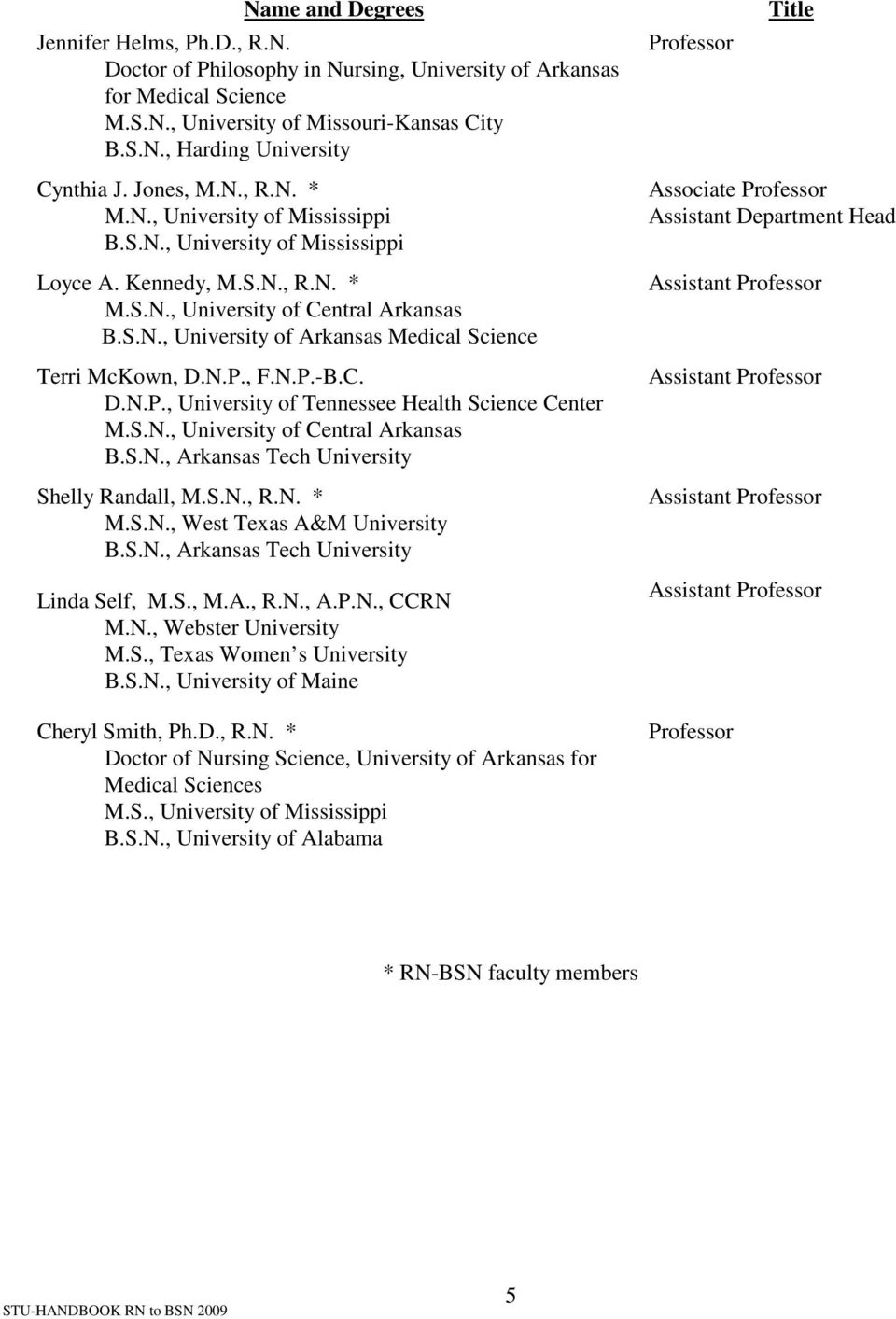
10 Arkansas Tech University Department of Nursing Congruency of the ATU Mission/Program Mission/Program Goals Outcomes ATU MISSION PROGRAM MISSION PROGRAM GOAL/OUTCOMES Arkansas Tech University, a statesupported institution of higher education, is dedicated to nurturing scholastic development, integrity, and professionalism. The University offers a wide range of traditional and innovative programs which provide a solid educational foundation for lifelong learning to a diverse community of learners. 1. Provide an intellectual climate that fosters the development of critical thinking to prepare a graduate who is professional, caring, competent, and self-directed in providing therapeutic nursing intervention and demonstrates an interest in life-long learning. 2. Assist the student to achieve personal and professional goals regardless of cultural, racial, or ethnic background. 1. Graduate is a competent, self-directed, professional nurse who provides theory based, therapeutic nursing care that incorporates caring and critical thought processes. 2. Graduate possesses the basis for life long learning and for the pursuit of higher education. 3. Graduate achieves personal and professional goals. 4. Graduate is capable of leadership in caregiving, communicating, teaching, utilizing research, advocating, collaborating and managing diverse patients in a variety of health care settings. 6
11 PHILOSOPHY OF THE NURSING PROGRAM The University provides opportunities for intellectual growth, skill development, and career preparation. The faculty of the Department of Nursing at Arkansas Tech University seeks through its professional program to implement the mission of the University, a mission committed to prepare students to meet the demands of an increasingly competitive and intellectually challenging future. Individuals are complex beings with bio-psychosocial, emotional, spiritual, cultural, and environmental elements. The Department of Nursing is committed to providing opportunities for students to enhance their critical thinking and communication skills in therapeutic interventions. The graduate will utilize the nursing process to assist individuals, families, groups and communities to meet their bio-psycho-social, emotional, spiritual, cultural, and environmental needs. Nursing is a caring relationship that facilitates health and healing. Encompassing the acquisition and critical application of knowledge from nursing and the social, psychological, biological, and physical sciences, nursing meets the health needs of individuals, families, groups, and communities. As a profession with responsibilities and privileges, nursing is concerned with promotive, restorative, and supportive practices aimed to optimize health in the recipients of care. Nursing is publicly accountable to the society it serves, obligated to improve nursing practice through acquisition, utilization, augmentation, and promotion of knowledge and skills, as well as the systematic study of the effects of these practices on human health. Learning is essentially manifested in a change or reorganization of behavior and is best accomplished through active inquiry and participation in the learning process. Learning is a lifelong, self-initiated process by which knowledge, skills, attitudes, and values are acquired. Learning occurs independently through perception, assimilation, formulation, and synthesis. The teacher functions as a facilitator by establishing a learning climate of mutual respect regarding beliefs, feelings, and opinions, and by providing learning opportunities and guidance with regard to individual differences. Learning experiences are designed to facilitate personal and professional growth within the student's cognitive, affective, and psychomotor domains. The ultimate responsibility for learning rests with the learner. 7
12 Philosophy (continued) Nursing education, an integral part of higher education, fosters the generation and application of scientific knowledge through the nursing process. These learning experiences are organized for an orderly progression through an increasing complexity of nursing situations. During the educational process, the student acquires knowledge of the independent and collaborative functions of the nurse. Baccalaureate nursing education prepares a person for professional nursing practice. The curriculum is designed to prepare the person for professional nursing practice, to be competent, self-directed, and capable of demonstrating leadership in the application of the nursing process in a variety of healthcare settings. The graduate should demonstrate initiative for responsible change, the ability to think critically, and a lifelong quest for knowledge and growth. 8
13 CONCEPTUAL FRAMEWORK The design of the conceptual framework at Arkansas Tech University's Department of Nursing is a construct composed of four major components: PERSON, HEALTH, NURSING, and ENVIRONMENT. Thus, the design of the program is an intersecting circular formation of the four major components. Description of the Components Person Person, a bio-psycho-social, emotional, spiritual, cultural, and environmental being, functions as a unique, integrated "whole". Person is an open system, changing and being changed by the environment. Person's relationships are influenced by stages of development at any given point in time and experience in the life cycle. Through interactions, persons attempt adaptation to maintain a high level of health. Health and illness are human experiences. Persons must adapt in order to survive. Adaptive processes occur on a continuum, from the moment of conception throughout life. Physiological, psychological, social, emotional, spiritual, cultural, and environmental forces shape the process of adaptation. Person's state of health is determined by the ability to adapt. According to the ANA Social Policy Statement, 2003, "The presence of illness does not preclude health, nor does optimal health preclude illness", (p. 3, 1995). The life cycle is an orderly sequence of events beginning at conception and ending with death. Within this sequence, certain common cognitive, psychological, and motor developmental tasks can be identified. The mastery of these tasks is essential to the achievement of self actualization and optimal health. Communication is a process by which persons gather information and share ideas, opinions, values, and feelings with others. Person's ability to communicate produces vital forces which can be utilized for positive benefits to self and society. The person has freedom of choice in making decisions related to personal health. This freedom to choose influences the nurse's ability to assist the client to optimal health. Nurses must respect the person's right to make decisions that might conflict with the nurse's own value system. The nurse acknowledges there are times when a person may not make logical choices that would improve health, however, the right to make such choices must be protected. Health Health is a condition of physical, mental, and social well-being that reflects adaptation to environmental, physical, and psychological factors. Health is not a static condition; it is dynamic in nature and may change over time in response to new situations, new 9

14 challenges, and aging. Health is culturally defined and reflects a person s ability to perform daily activities in culturally expressed ways. Nursing Six essential features of professional nursing practice are identified in ANA Nursing's Social Policy Statement, (2003): provision of a caring relationship that facilitates health and healing; attention to the range of human experiences and responses to health and illness within the physical and social environments; integration of objective data with knowledge gained from an appreciation of the patient or group's subjective experience; application of scientific knowledge to the processes of diagnosis and treatment through the use of judgment and critical thinking; advancement of professional nursing knowledge through scholarly inquiry; and influence on social and public policy to promote social justice, p. 5. The bio-component of the person directs nursing's attention to the physical needs. The emotional and psycho-component requires that the nurse regard the interrelatedness of mind and body. Cultural and social aspects must also be taken into account in the delivery of nursing care. Since the spiritual component gives quality and aesthetic features to life, it too must be considered. The concept of spirit refers to that which gives meaning, purpose, and direction to life--it may be understood in a religious, philosophic, or humanistic sense. The beliefs of the nurse in regard to various aspects of life's spirituality will be motivators in the kinds of care delivered to clients. Therapeutic touch, sensitivity to client's needs, religious affiliations, compassion for suffering persons, and comfort measures are all contained in the realm of spiritual aspects. Nursing behaviors reflect nursing roles and practices utilized to promote health, prevent illness, or assist with activities that contribute to recovery from illness or to achieving a peaceful death. Restorative practices modify the impact of illness or disease. Supportive practices are oriented toward modification of relationships or the environment to support health. Promotive practices mobilize healthy patterns of living, foster personal and family development, and support self-defined goals of persons, families, and communities. Nursing behaviors are acquired and synthesized by the nurse in the delivery of appropriate nursing care. The major roles within the scope of nursing behaviors include manager, communicator, teacher, health care provider, researcher, advocate, and collaborator. Research methodology and utilization of well-designed nursing studies are necessary to provide a scientifically based order and reason to the practice. The activities of nursing encompass the 10
15 traditional roles and the augmented interdependent roles in collaboration with other members of the health care team. The scope of these activities is flexible and responsive to the changing needs of society. The expanded role of the nurse includes independent functions which assure continuity of care of the client, family, group, or community, in a variety of health care settings. Nurses provide care in both basic and advanced nursing practice. Within either basic or advanced practice, the nurse may choose a specialty area. Examples of settings for the practice of basic nursing include homes, schools, hospitals, institutions, community based health centers, and businesses. The professional nurse provides quality nursing care utilizing critical thinking. It is based on scientific principles and focuses on optimal health. The nurse functions as a leader in the provision of nursing care that is planned, goal directed, and specific to the needs of the particular patient, family, group, or community. The nursing process provides the methodology for nursing care. The nursing process consists of five steps: assessment, diagnosis, planning, implementation, and evaluation. During assessment, data collection, and organization leads to the formulation of the nursing diagnosis. Having diagnosed the client's needs and problems, the nurse develops a plan. Within this step of the nursing process, priorities are set. Patient outcomes are determined collaboratively with the patient whenever possible. The outcomes provide the nurse with the necessary direction to plan and implement interventions. The nursing process is unique; the care of the client becomes personalized and meets the client's perceived needs. Finally, evaluation of the client outcomes leads to reassessment and then application of the process in a cyclic manner. The nursing process provides for input, evaluation, and utilization by the client and by all members of the health care team. This process can be utilized in any setting where nursing care is provided to Persons, families, groups, or communities. Environment Environment takes into account the external world of persons. The world encompasses the society in which the Person lives. This includes the culture, set within a particular geographical location. The environment consists of a group of persons who share certain commonalities, such as goals, values, political ideologies, and socio-economic status. The community is an interactional unit of this world consisting of health care consumers, health care providers, and health care settings. The structural unit of the community is the family in various traditional and nontraditional family forms. Because a person s life depends upon the 11
16 environment, one cannot view the person apart from it. Throughout the life cycle, the person changes and adapts to the environment. The person's response to the environment impacts on the possibilities for health which then guide the nurse in making appropriate nursing intervention. 12

17 CONCEPT Communication Critical Thinking Nursing Process Caring Holism Professionalism -Legal/Ethical -Leadership Health - Promotive - Restorative - Supportive Arkansas Tech University Department of Nursing Russellville, Arkansas Curriculum Schema JUNIOR LEVEL 0 JUNIOR LEVEL I JUNIOR LEVEL II SENIOR LEVEL III SENIOR LEVEL IV / RN-BSN Roles Introduction to all roles including: Care Giver Communicator Teacher Collaborator Care Giver Communicator Collaborator Care Giver Communicator Teacher Collaborator Care Giver Communicator Researcher Teacher Advocator Collaborator Care Giver Communicator Researcher Teacher Advocator Collaborator Manager Diversity Life Cycle Settings Growth and development of all ages Adult and Elderly Hospital/Community Young Adult/Children Hospital/Community Adult and Elderly Hospital/Community All Ages Hospital/Community Patient Introduction to the care required by the: Individual Family Community Individual Within the Context of Family Individual Family Individual Family Groups Individual Family Groups Community Research Read Read/Utilize Read/Utilize Analyze/Utilize/Critique Analyze/Utilize/Critique 13

18 The 2001 American Nurses Association Code is as follows: ANA CODE FOR NURSES 1. The nurse, in all professional relationships, practices with compassion and respect for the inherent dignity, worth, and uniqueness of every individual, unrestricted by considerations of social or economic status, personal attributes, or the nature of health problems. 2. The nurse s primary commitment is to the patient, whether an individual, family, group, or community. 3. The nurse promotes, advocates for, and strives to protect the health, safety, and rights of the patient. 4. The nurse is responsible and accountability for individual nursing practice and determines the appropriate delegation of tasks consistent with the nurse s obligation to provide optimum patient care. 5. The nurse owes the same duties to self as to others, including the responsibility to preserve integrity and safety, to maintain competence, and to continue personal and professional growth. 6. The nurse participates in establishing, maintaining, and improving health care environments and conditions of employment conducive to the provision of quality health care and consistent with the values of the profession through individual and collective action. 7. The nurse participates in the advancement of the profession through contributions to practice, education, administration, and knowledge development. 8. The nurse collaborates with other health professionals and the public in promoting community, national, and international efforts to meet health needs. 9. The profession of nursing, as represented by associations and their members, is responsible for articulating nursing values, for maintaining the integrity of the profession and its practice, and for shaping social policy. 14
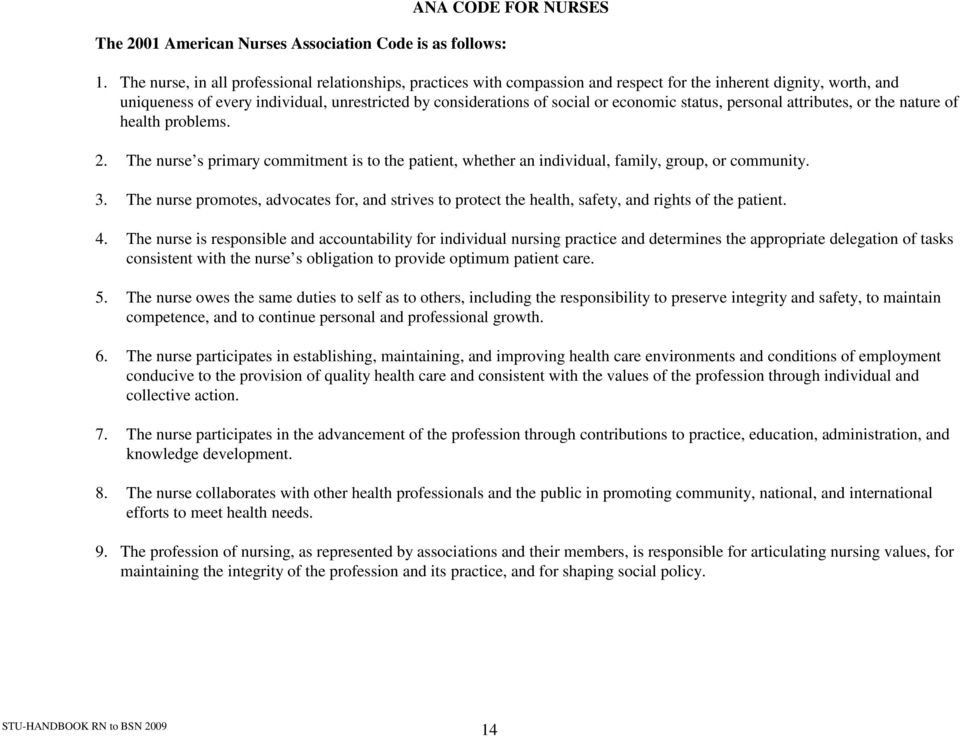
19 Organizational Chart Department of Nursing ADVISORY COMMITTEE DEAN, COLLEGE OF NATURAL AND HEALTH SCIENCES HEAD ASSOCIATE HEAD HEALTH CARE AGENCIES UTILIZED TO SUPPLEMENT THE CURRICULUM FACULTY ORGANIZATION + LEVEL COORDINATORS RN to BSN COORDINATOR GRADUATE STUDIES COORDINATOR LEVEL COMMITTEES RN to BSN COMMITTEE GRADUATE STUDIES COMMITTEE * CURRICULUM COMMITTEE *WELFARE COMMITTEE ADMISSION/PROGRESSION COMMITTEE STUDENTS SNA LEGEND Lines of Responsibility or Authority Lines of Advisement and Recommendation Lines of Coordination * Student Representation on Committee + Position May Vary Each Semester Direct Communication 15
20 UPPER ADMISSION STUDENT REQUIREMENTS: Health Requirements A. Documentation of: 1. Hepatitis B Vaccination. At least the first two of three injections must have been received before the student may practice in the practicum setting. The third HBV vaccine must be received and documented by the end of the 1 st clinical semester. Failure to do so will result in the student s inability to continue clinicals the next semester. 2. Td (Tetanus-diphtheria) at least every 10 years. 3. PPD (TB) negative skin test yearly, or chest x-ray with positive skin test according to Health Department protocols. 4. The Health Department recommends the MMR (Measles, Mumps, Rubella) for female students of childbearing age. Persons born after January 1, 1957 must furnish proof of immunity against measles and rubella to the TECH infirmary prior to enrollment in classes (See ATU catalog). A copy of this record must also be on file in the nursing office. B. Clinical sites that colleges and universities in Arkansas utilize for educational training may require, prior to the student being permitted to use the clinical facility, that he or she provide proof of timely polio immunizations, diphtheria immunizations, tetanus boosters, HBV immunizations, negative TB and Hepatitis B tests. Cardiopulmonary Resuscitation (CPR) Each student must have verification documentation of current American Heart Healthcare Provider CPR verification (adult, child, and infant) on file each year prior to assignment in practicum courses. Verification must be current through the entire fall, spring, and summer semesters. A copy of a verification card is to be submitted to the ATU Department of Nursing as part of the completed Admission/Required Documentation Packet. If you have a current CPR, from the American Heart Association and it is valid from January of one year through December of the next year, you do not have to renew. LICENSURE If you hold a current RN license, a copy must be on file in the nursing department. 16

21 LIABILITY INSURANCE Students are required to have professional liability insurance of $1,000,000. This is at the student s own expense. For improved coverage at the lowest possible cost, Marsh (Seabury & Smith) was chosen to provide blanket coverage for *$10.00 (*This fee is subject to change per student per year.) Please be sure to submit a copy of your receipt for the blanket coverage insurance or, if as a licensed nurse you are covered by your individual professional liability insurance policy, you should provided evidence that you are covered as a nursing student, to the Nursing Department with the completed Admission/Required Documentation Packet. PHOTOGRAPH Each student must submit a recognizable wallet or snap-shot size photograph to be placed in advising folder. UNIFORMS RN to BSN students are required to wear a lab coat, ¾ length or longer, with the ATU college patch on the left sleeve, and have the ATU photo identification name badge. Your badge will be made at ATU Student Accounts at a cost of $5.00. This will be done during the orientation day. The ATU college patch can only be purchased at the ATU Bookstore. 17
22 ACADEMIC POLICIES AND PROCEDURES UPPER DIVISION NURSING Computer Requirements Since the RN to BSN curriculum is on-line, some computer skills are necessary. Some of the skills will be addressed in NURN 4002 Nursing Informatics. Blackboard (Bb) is the learning program utilized by ATU for web classes. Bb can be can be accessed by students via the ATU home page OR Once you have successfully logged onto Bb, you can click the ATU icon on the top of the page. The window that opens has some information on the left hand side of that window that may assist you in using Bb effectively. Also there are specific computer requirements needed for Bb and course work in the ATU RN to BSN program. It is your responsibility to acquire the software required by the Department of Nursing. ATU minimum equipment requirements are listed on the following web site: 18
23 Attendance Policy As professionals, you must be responsible for your own learning experiences. You are responsible to make the most of all educational opportunities. This is a mark of professionalism. You should plan on accessing each of your on-line courses a minimum of three times per week, as well as your ATU account. The Arkansas Tech University catalog provides content concerning class attendance. Exams Exams will be administered on-line and may require a proctor. You are responsible to procure a proctor if needed. Exam dates will be marked on the individual course calendars. Practicum Some courses will require you to schedule times with clinical agencies in your area. These experiences are an integral part of your educational process and should be approached as such. Scheduling these experiences will be your responsibility. Faculty teaching the on-line RN to BSN course work endeavor to ensure that required course work is equitably divided over the semester. However, there may be times that multiple assignments are due. The student is responsible to familiarize themselves with the different due dates in courses in which they are enrolled and prepare accordingly. 19
24 Substance Abuse Arkansas Tech University is committed to the maintenance of a drug-and-alcohol free work place and to a standard of conduct for employees and students that discourages the unlawful possession, use, or distribution of controlled substances and alcohol on its property or as a part of any of its activities. Therefore, the unauthorized or unlawful possession, use, manufacture, or distribution of controlled substances or alcohol by students or employees on property of the University or as a part of any of the University s activities is expressly prohibited. Students violating the University policy on alcohol or other drugs are subject to sanctions up to and including expulsion from the University and referral for prosecution. The University may notify parents or guardians of students under age 21 who are found to be in violation of the drug or alcohol policies as set forth in the Student Code of Conduct. The Department of Nursing recognizes its responsibility to provide a healthy environment within which students may learn and prepare themselves to become members of the nursing profession. The department is committed to protecting the safety, health, and welfare of its faculty, staff, students, and people who come into contact with its faculty, staff, and students during scheduled learning experiences. The Department of Nursing strictly prohibits the illicit use, possession, sale, conveyance, distribution, and manufacture of illegal drugs, intoxicants, or controlled substances in any amount or in any manner and the abuse of non-prescription and prescription drugs. Any student who demonstrates behaviors or actions that cause concern of possible drug or alcohol use will be asked to leave the classroom and/or clinical site. The student will be referred to the office of the Vice President for Student Services. Faculty will follow up with the student and notify the Vice President for Student Services of the referral. 20
25 Nondiscrimination Policy In accordance with Title VI and Title VII of the Civil Rights Act of 1964, Title IX of the Educational amendments of 1972, and Section 504 of the Rehabilitation Act Amendments of 1974, the Department of Nursing of Arkansas Tech University does not discriminate on the basis of race, color, sex, national origin, or physical handicap in any of its policies, practices, or procedures. This includes, but is not limited to, admissions, employment, financial aid, and educational services. Sexual Harassment Policy The policy of Arkansas Tech University is to maintain the University community as a place of work and study for staff, faculty, and students free of harassment, to include sexual and gender harassment and all forms of sexual intimidation and exploitation. All students, staff, and faculty should be aware both that the University is concerned and prepared to take action to prevent and correct such behavior. The determination of what constitutes sexual harassment will vary with the particular circumstances, but it may be described generally as unwanted sexual behavior, such as physical contact and verbal comments or suggestions, which adversely affect the working or learning environment of others. Anyone who is subjected to offensive sexual behavior is encouraged to pursue the matter through the established informal or formal grievance procedures. Generally, the informal procedures afford an opportunity to explore a problem and consider alternative means for its resolution. 21
26 1. Courses and Faculty Evaluation EVALUATION AND GRADING The nursing faculty believes that evaluation of courses and of the teaching process is an integral part of nursing education. Based on this belief, the faculty provides opportunity for evaluation to occur within the program. At the end of each semester, nursing students complete unsigned evaluations of courses and instructors as posted on Blackboard. Faculty members also evaluate the courses in which they teach. The evaluation data are summarized by faculty and, in addition to other variables, are used to make needed course revisions and to improve teaching methods. Students have the option to sign. 2. Student Evaluation All students in the nursing major receive ongoing evaluation of their progress throughout each semester. The evaluations are given in writing, or may be oral. The on-line grade book on your Blackboard Course sites should be checked regularly to determine your personal progress. 3. Grading Students must maintain a minimum grade of C in each nursing course in order to progress in the nursing major. (For further information on this topic, see Progression later in this section.) The grading scale for the upper division nursing courses is standardized as follows: A B C D F.59 and below a. Grades less than 75% will not be rounded. See appropriate syllabi for additional information on grading, course requirements, etc. b. A grade of "I" may be recorded for a student who has not completed all the requirements of a course because of illness or other circumstances beyond the student's control, provided work already completed is of passing quality. For all nursing courses "passing quality" is defined as a grade of 75% or above on previously completed work. Before a grade of "I" may be recorded, the student and instructor must determine course requirements to be completed and the completion date. c. No grades will be given by phone. 22
27 Academic Honesty Students are expected to be honest and truthful in both classroom and practicum experiences. They are expected to adhere to the Code of Ethics and Standards of Care. Students are referred to the Arkansas Tech University Student Handbook for more specific regulations regarding academic honesty. Students are expected to: a. Perform their assigned tasks in the practicum experiences. Students should have the permission of the clinical instructor before using assistance from the staff. b. Present written work that is theirs alone. c. Correctly document any materials from a textbook, pamphlet, journal, etc., that is used for an assignment. d. Only use authorized devices or materials for an examination and not copy from other students' papers. e. Document material correctly. Plagiarism is defined as stealing and presenting as one's own ideas or words of another, or not documenting material correctly. Students papers may be evaluated by turnitin.com. For the first occurrence of academic dishonesty, the student will receive an F. If there is a second occurrence, the student will be dismissed from the program. Students are referred to the ATU catalog and handbook for the policy in detail. If an incident occurs which a faculty member believes may constitute unprofessional conduct, or when such an incident is discovered, the faculty member aware of the conduct/incident, will immediately notify the student and instruct the student to leave the classroom. The faculty member will then complete a conference note in writing, describing the event, within 24 hours of discovery. This information will be shared by the faculty member making the discovery with the level coordinator. A decision will be made if the incident should be taken to the level committee. The investigation into the incident/discovery will begin within three (3) working days. This investigation will include an opportunity to discuss the incident with the student. If the incident is minor, the faculty member, in consultation with the person(s) named above, may require remedial work or instruction for the student. If the incident is major or serial in nature, the course coordinator will notify the Department Head or his/her designee. In consultation with the involved faculty member(s), the Department Head or his/her designee will review the investigative report, the student s class and clinical performance evaluation(s), academic record, potential for successful completion of the major in nursing, and any other pertinent information. The Department Head will discuss the incident with the student. The Head may then make one of the following decisions: 23
28 1. Reprimand the student 2. Require remedial work, physical and/or mental evaluation, or instruction for the student 3. Award a failing grade for the course 4. Require administrative withdrawal from the clinical course 5. Dismiss the student from the Department of Nursing The Department Head will notify the student in writing. The Dean will receive a copy of the student s notification. The student may appeal any adverse decision through the standard appeals process of the University and Department of Nursing (See Appendix D for conference form). 24
29 GRADUATION To be eligible for graduation, the student must complete the following steps: 1. Comply with all Arkansas Tech University requirements for a baccalaureate degree in nursing. 2. Complete the requirements of a minimum of 61 semester hours of lower division courses as specified in the University catalog (refer to p. 3 of the RN-BSN handbook). 3. Complete the requirements of the nursing courses or their equivalent for a total of 64 hours. 4. A graduation fee must be paid in the Registrar s office. Graduation fee is paid at the time degree audit is obtained. Upon payment of this fee, the staff in the Registrar s office will complete a form for purchase of the graduate s cap and gown. Student Progression Once accepted into the upper division nursing courses, students should keep in mind that they must maintain a 'C' or better in every nursing course in order to progress in the program. Students receiving an I or incomplete, for any nursing course, must remove the I before they will be permitted to progress. In order to progress in the nursing program the student must meet the following guidelines**. *Completion of the following courses with a grade of C or better in each: Engl 1013 Engl 1023 Math 1113 Biol 2014 Biol 3054 Biol 3074 Chem 1114 Psy 2003 Psy 3063 Soc 1003 Nur 3803 Psy 3163 or Soc 3173 *Students who attempt these courses twice (2 times) and cannot achieve a grade of C or better in any of these courses will not be considered for the Nursing Program. An attempt is any enrollment in any course and dropping it after the first day of the 10th week of the semester, or after the third week of a summer session, for any reason, and/or failure (grade of D, F, < or F* ) of the course. *Students who make less than a C in any Upper Division nursing course may not progress into courses for which that course(s) is a prerequisite until the course(s) have been repeated and the required minimum grade attained. *If a student obtains a D, F, or FE, in any two (2) Upper Division nursing courses for any reason, the student will be dismissed from the nursing program. 25
30 *Readmission will not be considered for any student dismissed from the nursing program who obtained a D, F, or F in two (2) Upper Division nursing courses. The Department Head will consider exceptions on an individual basis. Student Withdrawal When a student leaves the nursing program for any reason, the withdrawal procedure will be followed: 1. Any faculty member who becomes aware that a student is withdrawing should inform the student s advisor. 2. The advisor will notify the RN to BSN coordinator that the student has withdrawn. 3. The advisor will contact the student and arrange for an exit interview. A summary of the exit interview will be prepared by the advisor and will be placed on file in the Nursing Department Office. In addition, the advisor will complete an additional exit form to be placed on file within the Department that explains the withdrawal. This second form is prepared solely for use in preparing Department reports and will not contain the student s name. 4. The student should be aware of the fact that application for readmission must be submitted by June 30 th for Fall semester and October 1st for the spring of the year the student plans to resume progress in the Nursing Program. 5. The advisor will inform the Department Head who will in turn, send a letter noting the withdrawal to the student. If appropriate, the letter will include options for possible re-entry into the program. 6. The student will officially withdraw at the Registrar's Office. Grievance Policy and Procedure The Department of Nursing grievance policy and procedure is consistent with that of the University. The policy provides the student with a way of appealing grades received or a grievance concerning a University employee or institutional regulation. This procedure is to be used for any conflict resolution. Grievance procedures are of both an informal and formal nature. The student should exhaust the informal means before filing a formal complaint. The student directly affected must make the appeal. In the case of appealing a grade, the appeal must be made during or within five days following the conclusion of the course involved (prior to the beginning of another semester). 26
31 The four steps to be followed when presenting an informal grievance are: 1. The appeal must begin with the student discussing the problem with the instructor or person involved. 2. Evidence of attempted resolution must precede any further action. 3. The issue will be presented to the level coordinator who will attempt to resolve the matter. If resolution is not possible, the level coordinator will choose from the following options according to the nature of the problem a. Place the student issue on the next level meeting agenda. The student will attend the level meeting to present his or her case. A predetermined amount of time will be allotted for both the student s presentation and the presentation of the faculty member involved. After both presentations, time will be allowed for further discussion. After further discussion, both the student and faculty member will exit the meeting. The committee may opt to further discuss the situation before voting, or may move directly to the vote. The student will receive written notification of the committee's decision and recommendations from the committee if appropriate. These proceedings may be tape-recorded. If tape-recorded, the tape will be given to the Department Head directly after the meeting. b. Recommend that the student meet with the Head of the Nursing Department as indicated in Step If the grievance is not resolved after steps 1-3 and/or within a reasonable time, the student will take the issue to the Head of the Nursing Department. If the Department Head should be the person involved, step 3 above should be omitted and the grievance will then progress to the Dean of the College of Natural and Health Sciences. If these informal steps have not resolved the problem, the student may submit a written request to the Department Head, asking that a formal grievance committee consider the grievance. (Refer to the University Student Handbook for the formal grievance procedure.) In case of a grievance resulting from a violation of student regulation, federal law, or the Arkansas Tech Affirmative Action Plan, the Department Head shall take immediate action to resolve the problem. If the grievance involves questions of opinion not covered in stated policies, the Department Head shall counsel with the student to resolve the grievance. The student is referred to the ATU catalog and handbook for the policy in detail. 27
32 STUDENT NON-ACADEMIC GRIEVANCE PROCEDURE Any alleged non-academic grievance (hereinafter referred to as "grievance") which a student may have regarding a University employee, an institutional regulation, and/or the interpretation and application of such regulation, may be considered under this procedure. Grievance procedures are of both an informal and formal nature, and the informal means should be exhausted before filing a formal grievance. A nonacademic grievance may include instances of discrimination which create conditions affecting a student's academic performance or learning environment. INFORMAL GRIEVANCE PROCEDURE The procedure for an informal grievance is as follows: 1. The person should first discuss her/his grievance with the person responsible for the action, interpretation, or application leading to the problem. 2. If the grievance remains unresolved, the complainant may discuss it with the appropriate supervisory official. 3. If the circumstances of the grievance prevent the use of the above listed steps, or if the appropriate official does not resolve the grievance within five (5) college days, the complainant may discuss the grievance with the administrative head of that portion of the institution out of which the problem arose. In all cases, this should be one of the Vice Presidents or the Director of Athletics. 4. If the grievance resulted from a violation of stated student regulations, federal law, or the Arkansas Tech University affirmative action plan, the administrative head shall take immediate steps to enforce the stated regulation, law, or plan, and resolve the grievance. 5. If the grievance involves questions of opinion not covered in stated policies, the administrative head shall counsel with the complainant and departmental official(s) to resolve the grievance if possible. FORMAL GRIEVANCE PROCEDURE When a grievance has not been resolved by informal means, the student may submit a written request to the appropriate administrative head to have the grievance considered by a formal grievance committee. In no case will such a request be granted prior to five (5) college days after an informal grievance has been initiated and the appropriate administrative head notified. 1. A request for a formal grievance hearing should include the written nomination of one member of the Student Services staff and one employee from the administrative area involved. (The second nomination may come from any administrative area by mutual agreement of the student and the administrative head.) 2. The administrative head will select two (2) of the three (3) students on the Student Services Committee to complete the committee, which will be chaired by the administrative head, who will not vote, but only coordinate the hearing. 3. The Vice President for Student Services, or designate, shall serve as secretary and advisor to the committee, but will not vote. In matters concerning civil rights and equal opportunity, the affirmative action officer shall also serve as advisor, but shall have no vote. 4. The grievance committee will hear the grievance with such witnesses and evidence as it deems germane and shall present its recommendations in writing to the administrative head within three (3) college days of the hearing. The administrative head will render a decision within three (3) days. Copies of the findings, recommendation, and decision will be made available to all parties. 5. The decision of the administrative head may be appealed in writing to the President, with a copy to the administrative head, within ten (10) college days of receipt of the decision. 6. The decision of the President shall be final and binding. 27a
33 Communications Maintaining good communication between nursing students and faculty members is very important. This communication is generally very good. Methods of sharing information within the Department include: 1. The primary method of communication in an on-line course is via or discussion boards. Telephone conversations are also a method of communication. Students need to check the discussion boards and their student at a minimum of 3 times a week. Accountability STUDENT EXPECTATIONS Students must maintain the highest standards of integrity, ethical, and legal behavior at all times. (See American Nurses Association Standards of Nursing Practice included in NURN 4003 syllabus.) Serious violation of any of these standards may result in the dismissal of the student from the program. This behavior must be exhibited in all theory and practicum-related situations. The student is responsible to maintain familiarity with the standards described in all nursing syllabi. The following are examples of some practicum related situations: 1. Information regarding clients and families must be kept absolutely confidential. 2. Students are expected to report to the practicum setting on time and be prepared to meet assigned objectives. 3. Students are expected to comply with the Health Insurance Portability and Accountability Act of Documentation When signing any documentation in the clinical setting, the student should sign his/her name followed by ATUNS. Example: Mary Green, ATUNS This also applies to students who are already licensed as LPN or RN. Licensed students may not sign their licensure initials after their name while functioning in the student role in the clinical setting. Nails and Artificial Nails Policy Students are not permitted to wear artificial fingernails or long natural nails. Fingernail polish is not to be worn on clinical days. A good rule to follow is that when the fingers are held up, no nails can be seen past the fingertips. 28
34 SCHOLASTIC NON-COGNITIVE PERFORMANCE STANDARDS* Department of Nursing Student s Responsibilities: Failure to comply with the requirements of any of the following items or other policies in the Department of Nursing Student Handbook and the Catalog may result in a conference with the appropriate Department Head or his/her designee to discuss the difficulty. Should the problems warrant immediate action, the Department Head may recommend the student be placed on disciplinary probation or dismissed from the College. The following is a description of the scholastic, non-cognitive performance responsibilities of a student in the nursing program at Arkansas Tech University. Demeanor The student has a positive, open attitude towards peers, teachers, and others during the course of nursing studies. The student maintains a professional bearing in interpersonal relations. The student functions in a supportive and constructive fashion in-group situations and makes good use of feedback and evaluations. Maturity The student functions as a responsible, ethical, law-abiding adult. Cooperation The student demonstrates his/her ability to work effectively in large and small groups and with other members of the health team, giving and accepting freely in the interchange of information. Inquisitiveness The student acquires an interest in his/her courses and curricular subjects, demonstrating individual pursuit of further knowledge. Responsibility The student has nursing college performance as his/her primary commitment. Student/student and student/faculty academic interchanges are carried out in a reliable and trustworthy manner. Authority A student shows appropriate respect for those placed in authority over him/her both within the University and in society. Personal Appearance The student s personal hygiene and dress reflect the high standards expected of a professional nurse. Communication The student demonstrates an ability to communicate effectively with peers, teachers, patients, and others. Professional Role The student conducts self as a professional role model at all times and in compliance with ANA Standards of Practice and the Arkansas State Board of Nursing Rules and Regulations regarding professional conduct. The student demonstrates the personal, intellectual and motivational qualifications of a professional nurse. Judgment The student shows an ability to think critically regarding options, reflecting his/her ability to make intelligent decisions in his/her personal and academic life. Ethics The student conducts self in compliance with the ANA Code of Ethics. 29
35 Moral Standards The student respects the rights and privacy of other individuals and does not violate the laws of our society. Arkansas Tech University Department of Nursing reserves the right to dismiss a student at any time on grounds the University and Department of Nursing judge to be appropriate. Each student by his/her own admission to the University and Department of Nursing recognizes this right of the University and the Department of Nursing. *Adopted from UAMS, September 23,
36 FINANCES Financial Aid Arkansas Tech University provides financial assistance to eligible students in the form of scholarships, loans, and grants. Nursing students are eligible for the same financial aid as other enrolled students. Nursing Scholarships and Loans 1. Dr. Charles and Joyce Wilkins provide a tuition scholarship to the senior with the highest grade point average. 2. Some hospitals and health agencies have loan programs available to nursing students in exchange for a specific period of employment following graduation. 3. The Yell County Medical Society provides a scholarship. 4. Junior Auxiliary of Russellville provides a scholarship for Upper Division nursing students. 5. Hazelle Thrasher Memorial Scholarship Fund provides scholarships for Upper Division nursing students. 6. The First United Methodist Church of Russellville provides a nursing scholarship. 7. Nell Teeter Balkman Nursing Scholarship provides partial tuition for Upper Division Nursing students. Details concerning aid specific to nursing students are available in the Financial Aid Office in the Doc Bryan Building and the Department of Nursing. Fees and charges are listed in the ATU Catalog and the schedule of courses published prior to each semester. Scholarships Scholarships and financial aid are listed in the ATU catalog. Application for some of the scholarships is available in the Department of Nursing office. Students may go by the Financial Aid office and ask for the scholarship form. This form allows the student to write down all scholarships of interest. This form is returned to the Financial Aid. 31
37 FINANCES (continued) Costs Below are items that you will incur in the Upper Division Nursing courses. This list does not comprise all costs but will aid you to be better financially prepared. *Special Fees: Senior Year Liability Insurance $10.00 ID Badge $5.00 Research Day $ Plus Travel(optional) Travel Expenses to & from Clinical $ Class Pin $ Graduation $25.00 Textbooks $400/800/Semester *These are estimated fees. Prices are subject to change. There are some times when additional purchases may be required of all students. When nearing graduation, for example, students may be asked to purchase pictures of themselves for use in the Department composite photo of each class that is prepared and displayed in the nursing building. 32
38 STUDENT NURSE S ASSOCIATION All nursing students are encouraged to become members of the Department of Nursing Student Nurse s Association (SNA) as a first step toward professionalism. The ATU SNA is the local organization of the State and National Student Nurse s Association. It functions to create a community that serves the student through social, service, and professional activities that are both educational and enjoyable. The SNA elects officers and two nursing faculty advisors to serve for each academic year. The parent organization is the American Nurses Association (ANA). Each fall, members elect junior and senior student representatives to serve on the Nursing Department s Curriculum and Welfare committees and the Self Study Committee. The representatives have full membership privileges as outlined in the Nursing Faculty By-Laws. They collaborate with faculty in making suggestions for the development or revision of policies, curriculum changes, and in general program evaluation. Student representatives also communicate actions of the committees to fellow students. Students do not participate in the selection of students for admission to the Nursing Program or when students confidentiality would be violated on any committee. Arkansas Tech nursing students are encouraged to seek office and to serve on state and national student nurse committees. State SNA officers are elected during the Arkansas Student Nurse s Association convention that is held early in the fall of each year. State and National Student Nurse s Association application membership forms are available in the Nursing Department office, from the SNA officers, and the faculty advisor. Membership dues are established at the national level and are currently *$35.00 per year. Local SNA membership is $5.00 per year. Benefits of National SNA membership include reduced rates for nursing liability insurance, a newsletter to keep students informed about current issues in nursing, scholarly activities, fellowship with other nursing students, and an opportunity to serve the community. Participation in the ATU Student Nurse s Association activities is considered to be a show of professionalism. One benefit of this participation is the opportunity to earn up to two (2.0) professional points to be applied toward any one-course grade above 75. The points will only be used if adding them to the number grade results in an improvement in the letter grade. Spring professional points may be applied to summer courses. Registered nurses have a choice of belonging to SNA or ArNA or both. * Fees are subject to change 33
39 UNIVERSITY COMMITTEE MEMBERSHIP Nursing students are eligible for membership on the various University committees through the Student Government Association (SGA). Members of these committees participate with faculty and administration in the general guidance of the University. Accidental Sharps Injuries and HIV/HBV Exposure Policy It is the policy of the Arkansas Tech University Department of Nursing to provide a follow-up program for students and faculty following HIV/Hepatitis B (HBV) exposure incidents. This includes accidental sharps injuries and exposure to blood and body fluids. Student applies to student or faculty who are exposed. Following an accidental sharps injury or exposure to blood/body fluids, the student should immediately report the situation to the faculty member in charge of clinical assignment. The faculty member assists the student in completing the clinical agency s incident report form and seeks appropriate treatment for the injury, following the clinical agency s guidelines and ATU Nursing Department guidelines. The Nursing Department Head (or Assistant Head) is notified by the faculty member as soon as possible. Forms that must be completed following a sharps injury or blood/body fluid exposure include: 1. The clinical agency s Incident Report form 2. The ATU Nursing Department Clinical Incident Report form 3. The Source Consent form, if source consent is required by the agency 4. Consent for HIV and HBV test completed by the student 5. Assumption of Risk and Waiver form, if the student refuses HIV/HBV testing 34
40 ACCIDENTAL SHARPS INJURIES AND HIV/HBV EXPOSURE POLICY (continued) PRE-TEST COUNSELING GUIDELINES OBJECTIVE: The objective of the pre-test counseling guidelines is to inform the student or faculty member who has been exposed to blood or body fluids of the possible or probable medical, economic, and social consequences of HIV and HBV antibody testing. INFORMATION TO BE COVERED: Review of the antibody test, including meanings of positive and negative results, testing times, and procedures for testing Review of initial written incident report with the student Discuss issues such as: relationship changes, marital difficulties and contact notification insurance issues such as non-payment of testing and the possibility of future requests or reporting of HIV testing potential psychological and emotional reactions to negative and positive results (see Possible Risk of Testing ) information about risk reduction behaviors, general health measures, pregnancy avoidance, and the generalized viral syndrome some people experience at seroconversion 35
41 ACCIDENTAL SHARPS INJURIES AND HIV/HBV EXPOSURE POLICY (continued) POSSIBLE RISKS OF TESINGS: severe psychological reactions, including anxiety, nightmares, sleep disturbances, depression, and suicidal behavior disrupted interpersonal relations, including potential for rage reactions and their extreme manifestations, such as homicidal behavior social ostracism and self-imposed social withdrawal relationship problems (blaming partners, sexual dysfunction, disrupted ability to make plans as a couple) stigmatism and discrimination if a positive antibody status is made known to others outside of confidentiality guarantees employment and insurance problems including future hiring situations preoccupation with bodily symptoms a false sense of security and denial if the test results are negative PAYMENT: Payment for drug therapy, lab tests, and physician visits are the responsibility of the student. Arkansas Tech University pays for testing of the source patient if not an agency patient. FOLLOW-UP APPOINTMENT: A follow-up appointment for notification of test results should be made. If the student does not allow the Department of Nursing designee to be informed first, he/she is STRONGLY encouraged to notify the counselor IMMEDIATELY of the test results. This will allow for appropriate follow-up, as well as provide support for the student. 36
42 ACCIDENTAL SHARPS INJURIES AND HIV/HBV EXPOSURE POLICY (continued) POST-TEST COUNSELING GUIDELINES: The post-test counseling session is to assist the student to cope with immediate psychological reactions, cope with the test results and manage information, and develop a personal health plan. The student is encouraged to have the HIV test repeated at 6 weeks, 3 months, and 6 months after the last possible exposure. Appointments should be consistently met. Information should include: interpretation of test results recommendations for medical follow-up and discussion of infection symptoms discussion of a personal health plan (rest, nutrition, stress-reduction behaviors, possible participation in clinical drug trials) referral for continued psychological and education services, including involvement in a support group recommendations for prevention of transmission recommendations concerning the follow-up of sexual partners and children review of potential discrimination (personal and professional) *** As in the case of any policy guidelines, Arkansas Tech University reserves the right to change them or to make appropriate revisions, additions, amendments, or corrections. Faculty/students will be notified of any changes. 37
43 ACCIDENTAL SHARPS INJURIES AND HIV/HBV EXPOSURE POLICY (continued) ARKANSAS TECH UNIVERSITY Department of Nursing CONSENT FOR HIV AND HEPATITIS B TEST I agree to have a sample of my blood taken for the purpose of testing for the Human Immunodeficiency Virus Antibody (HIV (AIDS Screen) and for Hepatitis B Virus Surface Antibody (Anti-HBs) and surface antigens. I acknowledge that I am financially responsible for the cost of the tests and follow-up treatments, if any, prescribed due to tests results. The reason for this test is that I have been exposed to another s blood or body fluid during my course, work assignment or clinical and the criteria has been met that requires follow-up screening test and prophylactic treatment. One test is for antibodies to the virus that causes AIDS. It does not diagnose AIDS or tell whether a person will get AIDS. Additional tests for HIV will be repeated at 6 weeks, 12 weeks, and 6 months. In the case of a positive result, I will be referred to my private physician and the result reported to the Arkansas State Department of Health, as required by law. A second test is done to indicate if I have Anti-HBd. In the case of a positive result without history of previous vaccination, I will be referred to my private physician. Confidentiality is maintained in regards to record keeping and personnel policies in compliance with federal, state and local laws. Please Initial One: I authorize test results to be given to Arkansas Tech University Department Head of the Department of Nursing or his/her designee, who will notify me of screening results and recommended follow-up medical care and counseling. I prefer to be informed of the tests results directly by the agency performing such test. I authorize the agency performing the tests to release the tests results to the Arkansas Tech University Department of Nursing Head or his/her designee for counseling and for recommendations as to follow-up medical care. Witness Date Signature Date Witness Date 38
44 ACCIDENTAL SHARPS INJURIES AND HIV/HBV EXPOSURE POLICY (continued) ARKANSAS TECH UNIVERSITY Department of Nursing ASSUMPTION OF RISK AND WAIVER FORM RELATING TO REFUSAL TO TAKE HIV AND HEPATITIS B TESTING I understand that due to my occupational or clinical exposure to blood or other potentially infectious materials I may be at risk of acquiring hepatitis B virus (HBV) infection. I have been given the opportunity to have the Hepatitis B Virus Surface Antibody (Anti-HBs) and have been informed that regardless of the results I should be vaccinated with Hepatitis vaccine at my own expense. However, I decline Hepatitis B Virus Surface Antibody (Anti-HBs) and Antigen tests at this time. I understand that by declining the vaccine, I continue to be at risk of acquiring hepatitis B, a serious disease. I also understand that by declining the test and vaccine, that should I contract HBV prior to being vaccinated, I have willfully and voluntarily consented to the following agreement: I understand that by declining this test, I hereby and for myself, my heirs, executors, administrators, successors and assigns release, acquit and forever discharge Arkansas Tech University, Inc., and its successors in interest, assigns, employees, agents, officers, and directors of and from any and all claims, actions, causes of action, demands, rights, damages, costs, loss of service, expenses and compensation whatsoever, which the undersigned may hereafter accrue on account of or in any way growing out of any and all known and unknown, foreseen and unforeseen bodily and personal injuries and property damage and the consequences thereof resulting or to result from exposure to another's blood or body fluid which occurred on or about the day of, 20 as a student of Arkansas Tech University Department of Nursing. I understand and agree that by refusing this test the person whose blood or body fluids I was exposed to will not be tested. I understand that due to my occupational or clinical exposure to blood or other potentially infectious materials, I may be at risk of acquiring the Human Immunodeficiency Virus (HIV). I have been given the opportunity to have testing for the HIV virus at a minimal charge to myself. However, I decline this at this time. I understand that by declining this test, I hereby and for myself, my heirs, executors, administrators, successors and assigns release, acquit and forever discharge Arkansas Tech University, Inc., and its successors in interest, assigns, employees, agents, officers, and directors of and from any and all claims, actions, causes of action, demands, rights, damages, costs, loss of service, expenses and compensation whatsoever, which the undersigned may hereafter accrue on account of or in any way growing out of any and all known and unknown, foreseen and unforeseen bodily and personal injuries and property damage and the consequences thereof resulting or to result from exposure to another's blood or body fluid which occurred on or about the day of, 20, as a student of Arkansas Tech University Department of Nursing. I understand and agree that by refusing this test the person whose blood or body fluids I was exposed to will not be tested. 39
45 ACCIDENTAL SHARPS INJURIES AND HIV/HBV EXPOSURE POLICY (continued) I the undersigned, hereby declare and represent that the injuries sustained may be permanent, progressive and may take several years to manifest itself as AIDS (Acquired Immune Deficiency Syndrome). Recovery therefore is uncertain and indefinite, and in making this Release it is understood and agreed that the undersigned relies wholly upon the undersigned's judgment, belief and knowledge of the nature, extent, effect and duration of said injuries and liability therefore. This release is made without reliance upon any statement or representation of the party or parties hereby released or their representatives or by any physician or surgeon by them employed. The undersigned further declares and represents that no promise, inducement or agreement not herein expressed has been made to the undersigned, and that this Release contains the entire agreement between the parties hereto, and that the terms of this Release are contractual and not a mere recital. Witness Date Signature Date Witness Date 40
46 ACCIDENTAL SHARPS INJURIES AND HIV/HBV EXPOSURE POLICY (continued) ARKANSAS TECH UNIVERSITY Department of Nursing SOURCE CONSENT FORM I,, consent to the collection of bloods as requested by at Arkansas Tech University, for the purpose of testing for the Human Immunodeficiency Virus Antibody (HIV) or (AIDS Test) and for Hepatitis B Virus Surface Antibody (Anti-HBs) and surface antigens. The reason for requesting this test is that an Arkansas Tech University student or employee has been exposed to my blood or bodily fluid and the results of my test will be used in determining the need for further treatment of that person. I furthermore authorize the release to Arkansas Tech University s Department of Nursing Head or his/her designee of any and all medical information obtained during the exam and testing procedure agreed to herein. I understand that the examination and testing procedures mentioned above will be conducted at no charge to me. Confidentiality will be maintained in keeping with federal, state and local laws. Signature Date Witness Date Witness Date 41
47 HISTORY OF THE ARKANSAS TECH UNIVERSITY BACHELOR OF SCIENCE IN NURSING PIN The nursing pin, as we know it today evolved from a badge worn by knights during the Crusades. The Crusades, which swept northern Europe, were to last for almost 2000 years ( ). The deaconess movement, suppressed by the Western churches, became all but extinct. Military nursing orders evolved as a result of the Crusades. The Knights Hospitallers of St. John was one such order. It was organized to staff two hospitals that were located in Jerusalem. The knights, organized as a nursing order, were required, at times, to defend the hospital and its patients. For this reason they wore a suit of armor under their habits. On the habit was the Maltese cross. The same cross was to be used later on a badge designed for the Nightingale School. The badge became the forerunner of the nursing pin, as we know it today. The symbolism of the pin dates back to the sixteenth century, when the privilege of wearing a coat of arms was limited to noblemen who served their kings with distinction. As centuries passed the privilege was extended to schools and to craft guilds, and the symbols of wisdom, strength, courage, and faith appeared on buttons, badges, and shields. The pins of many schools of nursing are fashioned after a cross of some kind. Each nursing program designs its own pin. Graduates and others recognize each other from the pin no matter where they work all over the world. The first class to graduate from the Arkansas Tech University Bachelor of Science in Nursing Program in 1980 chose the shield design with a lamp (with a flame) in the center to symbolize the knowledge needed to direct and administer care to patients of all ages in various stages of wellness, illness, and rehabilitation. The lamp is embedded in a wreath to denote life and caring. Because the class was proud to be the first graduates of the Bachelor of Science in Nursing Program in Russellville, Arkansas, they emblazed Nursing across the top and Baccalaureate at the lower end of the lamp and wreath. They had Arkansas inscribed on the top left side and Tech on the top right side, and University beginning on the lower left side and ending on the lower right side so graduates every where would recognize each other. The pin is one inch in actual size. The die from the first sketch was cast on September 17, A chain is an option. The colors are Arkansas Tech University s colors green and gold. 42
48 APPENDICES 43
49 APPENDIX A Before Class: HOW TO STUDY FOR NURSING COURSES As minimum preparation for class, utilize the following guide for pre-reading the reading assignment before the lecture. 1. Read the unit objectives in the course syllabus. 2. Read the introduction to the unit in the text. 3. Read the title to the chapter(s). These will give you an idea of where the material is starting and where it is leading. 4. Read each major heading in the chapter. 5. Look over any typographical aids, i.e., italic, boldface, etc. Pay particular attention to definitions of terms. 6. Look over any visual aids, i.e., graphs, pictures, diagrams, tables, figures, etc. 7. Read the chapter summary. 8. Estimate how long it will take you to read the entire chapter and make a plan for when and where you will read the chapter. After material is presented in class: 1. Write down any questions that you have or flag any areas that need clarification. 2. Read the chapter if you have not done so. 3. Expand your notes and/or highlight text to further clarify other important material. 4. Complete any learning activities. 5. If applicable, read and respond to posting(s) on discussion board. 44
50 Before examinations: 1. Review notes, text, and assignments. 2. Review the syllabus section pertaining to the topic. Analyze each objective to see that you have met that objective. 3. Finally, study for any deficiencies revealed by analyzing unit objectives 45
51 APPENDIX B ARKANSAS TECH UNIVERSITY Conference Notes Summer Fall Spring Year NOTES: Instructor s Signature Student s Signature Date Instructor s Signature Date (White-File Copy/Yellow-Faculty Copy/Pink-Student Copy) 46
52 APPENDIX C Fall 20 Spring 20 PROFESSIONAL NURSING POINTS REGISTERED NURSE Professional nursing points are percentage points which are added to a student s grade at the end of a course. These points represent extra non-required work and participation. Professional nursing points are determined and utilized in the following manner: Students may earn a maximum of two (2) percentage points each semester. Points will only be added to a passing grade (75% or above). The student will submit the Professional Nursing Points Application to the SNA advisor for verification and signature at the end of the semester. The SNA advisor will forward the application to the appropriate level coordinator. Professional nursing points will be automatically added to the course grade that will most benefit the student. B. REGISTERED NURSE POSSIBLE POINTS POINTS 1. SNA Membership ($33 dues) Encourage 2. ANA Membership ($112 dues) Encourage 3. RN specialty membership (dues unknown) (ex. Gerontology, Intensive Care, etc.). 4. Each professional meeting or workshop attended (Local, State, National). 5. Chair of professional project committee on ANA or Specialty Group. 6. Each professional committee project worked on but could not attend meeting. 7. Each professional committee project worked on and also attend meeting. Encourage 0.3 each meeting 0.2 each project 0.2 each project 0.2 each project 8. Officer of ANA or Specialty Group. 0.2 each semester 9. Bring a new member to ANA or specialty nursing meeting. 0.3 each semester PROGRESSIVELY DOCUMENT WORKSHOPS, ETC., BY SUBMITTING COPIES OF CERTIFICATES WITH DATES, TOPIC, PRESENTER, AND PLACE TO FACULTY TEACHING IN YOUR CURRENT COURSE WORK. PRINTED NAME: STUDENT SIGNATURE: Date: ADVISOR SIGNATURE: 47
53 APPENDIX D GUIDELINES FOR PART-TIME REGISTERED NURSE STUDENTS 1. Part-time RN to BSN students are expected to meet admission criteria for the upper division of nursing. 2. Students must achieve a C or better in all course work to progress through the curriculum. 3. Course work will progress as follows: 1 st Fall Semester 1 st Spring Session 1 st Summer Semester NURN 4002 Nursing Informatics NURN 4003 Scope of Professional Practice NUR 4303 Nursing Research NUR 4013 Law, Ethics, & Issues in Nursing 3 Elective 2 nd Fall Semester 2 nd Spring Session 2 nd Summer Semester NURN 4034 Leadership & Management in Nursing 3 Elective NURN 4024 Community Health Nursing NURN 4045 Practicum Synthesis 48
54 1 st Spring Semester 1 st Summer Session 1 st Fall Semester NURN 4002 Nursing Informatics NURN 4003 Scope of Professional Practice NUR 4303 Nursing Research NURN 4034 Leadership & Management in Nursing 3 Elective 2 nd Spring Semester 2 nd Summer Session 2 nd Fall Semester NURN 4013 Law, Ethics, & Issues in Nursing 3 Elective NURN 4024 Community Health Nursing NURN 4045 Practicum Synthesis 4. NURN 3304 Health Assessment & NUR/BIOL 3803 Applied Pathophysiology should be completed prior to entry into the upper division courses. 49
55 APPENDIX E GUIDE FOR CITING ELECTRONIC MEDIA This information taken from ( INTRODUCTION This guides is based on the information obtained from Electronic References by the APA. It is offered only as a guideline. The student is encouraged to obtain a full copy (CD-ROM or Text) of the APA Manual, 5 th edition to use as a reference in typing a term paper. SOURCES ON THE INTERNET The Internet is a worldwide network of interconnected computers. Although there are a number of methods for navigating and sharing information across the Internet, by far the most popular and familiar is the graphical interface of the World Wide Web. The vast majority of the Internet sources cited in APA journals are those that are accessed via the Web. The variety of materials available on the Web, and the variety of ways in which it is structured and presented, can present challenges for creating and using references. Regardless of format, however, authors using and citing Internet sources should observe the following two guidelines: 1. Direct readers as closely as possible to the information being cited; whenever possible, reference specific documents rather than home or menu pages. 2. Provide addresses that work. Documents available via the Internet include articles from periodicals (e.g., newspaper, newsletter, or journal); they may stand on their own (e.g., research paper, government report, online book or brochure); or they may have a quintessentially Web-based format (e.g., Web page, newsgroup). At a minimum, a reference of an Internet source should provide a document title or description, a date (either the date of publication or update or the date of retrieval), and an address (in Internet terms, a uniform resource locator, or URL). Whenever possible, identify the authors of a document as well. The URL is the most critical element: If it is doesn t work, readers won t be able to find the cited material, and the credibility of your paper or argument will suffer. The most common reason URLs fail is that they are transcribed or typed incorrectly; the second most common reason is that the document they point to has been moved or deleted. The components of a URL are as follows: Protocol Host name Path to document 50 File name of specific document
56 The protocol indicates what method a Web browser (or other types of Internet software) should use to exchange data with the file server on which the desired document resides. The protocol recognized by most browsers are hypertext transfer protocol (ftp); other Internet protocols listed in this paragraph should be followed by a colon and two forward slashes (e.g., The host name identifies the server on which the file resides. On the Web, it is often the address for an organization s home page (e.g., is the address of for APA s home page). Although most host names start with www, not all do (for example, is the home page for APA s electronic journals, and is the entry page to the members-only portion of the APA site). The host name is not always case sensitive; for consistency and ease of reading, always type in lowercase letters. The rest of the address indicates the directory path leading to the desired document. This part of the URL is case sensitive; faithfully reproduce uppercase and lowercase letters and all punctuation. It is important to provide the directory path, and not just the host name, because home pages and menu pages typically consist mainly of links, only one of which may be to the document or information you want the readers to find. If there are hundreds of links (or even just 10 to 20), readers may give up in frustration before they have located the material you are citing. If you are using a word-processing program, the easiest way to transcribe a URL correctly is to copy it directly from the address window in your browser and paste it into your paper (make sure the automatic hyphenation feature of your word processor is turned off). Do not insert a hyphen if you need to break a URL across lines; instead, break the URL after a slash or period. Test the URL s in your references regularly when you first draft a paper, when you submit it for peer review, when you re preparing the final version for publication, and when you re reviewing the proofs. If the document you are citing has moved, update the URL so that it points to the correct location. If the document is no longer available, you may want to substitute another source (e.g., if you originally cited a draft and a formally published version now exists) or drop it from the paper altogether. Electronic References The following is excerpted from the new 5 th edition of the Publication Manual. Some elements of the fifth edition s style guidelines for electronic resources differ from previously published guidelines. Citations in Text of Electronic Material To cite a specific part of a source, indicate the page, chapter, figure, table, or equation at the appropriate point in the text. Always give page numbers for quotations (see section 3.34). Note that the words page and chapter are abbreviated in such text citations: (Cheek & Buss, 1981, p. 332) (Shimamura, 1989, chap. 3) For electronic sources that do not provide page numbers, use the paragraph number, if available, preceded by the paragraph symbol or the abbreviation para. If neither paragraph nor page numbers are visible, cite the heading and the number of the paragraph following it to direct the reader to the location of the material (see section 3.39). (Myers, 2000, 5) (Beutler, 2000, Conclusion section, para. 1) 1. Internet articles based on a print source At present, the majority of the articles retrieved from online publications in psychology and the 51
57 behavioral sciences are exact duplicates of those in their print versions and are unlikely to have additional analyses and data attached. This is likely to change in the future. In the meantime, the same basic primary journal reference (see examples 15) can be used, but if you have viewed the article only in it s electronic form, you should add in brackets after the article title Electronic version as in the following fictitious example: VandenBos, G., Knapp. S,. & Doe, J. (2001). Role of reference elements in the selection of resources by psychology undergraduate [Electronic version]. Journal of Bibliographic Research, 5, If you are referencing an online article that you have reason to believe that has been changed (e.g., the format differs from the print version or page numbers are not indicated) or that includes additional data or commentaries, you will need to add the date you retrieved the document and the URL. VandenBos, G., Knapp. S., & Doe, J. (2001). Role of reference elements in the selection of resources by psychology undergraduates. Journal of Bibliographic Research, 5, Retrieved October 13, 2001, from 2. Article in an Internet-only journal Fredrickson, B. L. (2002, March 7). Cultivating positive emotions to optimize health and well-being. Prevention & Treatment, 3, Article 0001a. Retrieved November 20, 2000, from 3. Article in an Internet-only newsletter Glueckauf, R. L., Whitton, J., Baxter, J., Kain, J., Vogelgesang, S., Hudson, M., et al (1998, July). Videocounseling for families of rural teens with epilepsy Project update. Telehealth News, 2(2). Retrieved from * Use the complete publication date given on the article. * Note that there are no page numbers. * In an Internet periodical, volume and issue numbers often are not relevant. If they are not used, the name of the periodical is still all that can be provided in the reference. * Whenever possible, the URL should link directly to the article. * Break a URL that goes to another line after a slash or before a period. Do not insert (or allow your word processing program to insert) a hyphen at the break. Nonperiodical documents on the Internet 4. Stand-alone document, no author identified, no date GVU s 8 th WWW user survey. (n.d.). Retrieved August 8, 2000, from * If the author of a document is not identified, begin the reference with the title of the document. 52
58 5. Document available on university program or department Web site Chou, L., McClintock, R., Moretti, F., & Nix, D. H. (1993). Technology and education: New wine in new bottles: Choosing pasts and imaging educational futures. Retrieved August 24, 2000, from Columbia University, Institute for Learning Technologies Web site: * If a document is contained within a large and complex Web site (such as that for a university or a government agency), identify the host organization and the relevant program or departure before giving the URL for the document itself. Precede the URL with a colon. Other Electronic Sources Electronic Copy of a journal article, three to five authors, retrieved from database Borman, W. C., Hanson, M. A., Oppler, S. H., Pulakos, E. D., & White, L. A. (1993). Role of early supervisory experience in supervisor performance. Journal of Applied Psychology, 78, Retrieved October 23, 2000, from PsycARTICLES database. * When referencing material obtained by searching an aggregated database, follow the format appropriate to the work retrieved and add a retrieval statement that gives the date of retrieval and the proper name of the database. General Form for Electronic References Note: Some elements of the 5 th edition s style guidelines for electronic resources differ from previously published guidelines. Electronic sources include aggregated databases, online journals, Web sites or Web pages, newsgroups, Web- or -based discussion groups, and Web- or -based newsletters. Online Periodicals: Author, A. A., Author, B. B., & Author, C. C. (2000). Title of article. Title of Periodical, xx, xxxxxx. Retrieved month day, year, from source. Online Document: Author, A. A. (2000). Title of work. Retrieved month day, year, from source. 53
Bachelor of Science Degree In Nursing
 Bachelor of Science Degree In Nursing Option for Registered Nurses 2013/2014 Student Handbook On Blackboard at UT Martin Campus and UT Martin Ripley Center Campus Accredited by the Accreditation Commission
Bradley University Department of Nursing Graduate Student Handbook
 Bradley University Department of Nursing Graduate Student Handbook Welcome Graduate Nursing Students! The Graduate Student Handbook has been developed to provide guidelines to foster your success. Throughout
RN - BSN Student Handbook
 Department of Nursing RN - BSN Student Handbook August 2015 Dear R.N. Student: Your enrollment in the nursing program at Wheeling Jesuit University Department of Nursing affirms your choice to participate
Adapted with permission from the University of Texas at Austin School of Social Work Standards for Social Work Education. Revised 10/12/2013.
 STANDARDS FOR SOCIAL WORK EDUCATION Adapted with permission from the University of Texas at Austin School of Social Work Standards for Social Work Education. Revised 10/12/2013. Criteria for Evaluating
DNP STUDENT HANDBOOK 2013-2014 Academic Year
 Touro University Nevada DNP Policies DNP STUDENT HANDBOOK 2013-2014 Academic Year INTRODUCTION This handbook is a reference intended to provide accurate information to students and others regarding the
HANDBOOK FOR GRADUATE NURSING STUDENTS Supplement to the Ferris State University Code of Student Community Standards
 FERRIS STATE UNIVERSITY COLLEGE OF HEALTH PROFESSIONS SCHOOL OF NURSING HANDBOOK FOR GRADUATE NURSING STUDENTS Supplement to the Ferris State University Code of Student Community Standards JULY 2015 TABLE
Chipola College. The RN to BSN Online Nursing Program Handbook 2013-2014. A Higher Degree Of Success
 Chipola College The RN to BSN Online Nursing Program Handbook 2013-2014 A Higher Degree Of Success January, 2014 Welcome The Health Sciences faculty welcomes you to the online Bachelor of Science in Nursing
CENTRAL GEORGIA TECHNICAL COLLEGE Macon Campus 3300 Macon Tech Drive, Macon, GA 31206 478-757-3403
 DENTAL ASSISTING CENTRAL GEORGIA TECHNICAL COLLEGE Macon Campus 3300 Macon Tech Drive, Macon, GA 31206 478-757-3403 www.centralgatech.edu DENTAL ASSISTING PROGRAM SELECTION Admission to the college and
Council on Social Work Education. Curriculum Policy Statement for Baccalaureate Degree Programs in Social Work Education
 Council on Social Work Education Curriculum Policy Statement for Baccalaureate Degree Programs in Social Work Education B1.0 SCOPE AND INTENT OF THE CURRICULUM POLICY STATEMENT B1.1 This document sets
School of Nursing and Allied Health Dean Dr. Kimberly Sharp
 300 School of and Allied Health Dean Dr. Kimberly Sharp Division of Division Chair Dr. Elizabeth Battalora Professors D. Sharp, K. Sharp Associate Professors Migues, Sonneland Instructor R. Shamblin The
The University of Louisiana at Monroe
 i The University of Louisiana at Monroe Online Doctoral Program in Marriage and Family Therapy: Concentration in Creative Systemic Studies Doctor of Philosophy Degree Program Handbook Policies and Procedures
Department of Nursing
 Department of Nursing The Department of Nursing offers two undergraduate programs of study leading to the associate degree and the baccalaureate degree. Upon completion of the first two years, the student
WWCC NURSING STUDENT HANDBOOK 2015-16 ADDENDUM: SECOND-YEAR STUDENTS DURING 2015-16 ACADEMIC YEAR ONLY (Revised 9.16.15) PROGRAM OF LEARNING
 WWCC NURSING STUDENT HANDBOOK 2015-16 ADDENDUM: SECOND-YEAR STUDENTS DURING 2015-16 ACADEMIC YEAR ONLY (Revised 9.16.15) Second-year nursing students during the 2015-16 academic year will be completing
UNIVERSITY OF NORTH DAKOTA COLLEGE OF NURSING INFORMATION AND APPLICATION TO THE COLLEGE OF NURSING DISTANCE DELIVERY RN TO BSN PROGRAM
 UNIVERSITY OF NORTH DAKOTA COLLEGE OF NURSING INFORMATION AND APPLICATION TO THE COLLEGE OF NURSING DISTANCE DELIVERY RN TO BSN PROGRAM INTRODUCTION The RN/BSN Option is an upper division completion program
HANDBOOK FOR GRADUATE NURSING STUDENTS Supplement to the Ferris State University Code of Student Community Standards
 FERRIS STATE UNIVERSITY COLLEGE OF HEALTH PROFESSIONS SCHOOL OF NURSING HANDBOOK FOR GRADUATE NURSING STUDENTS Supplement to the Ferris State University Code of Student Community Standards JULY 2012 TABLE
NORTHERN MICHIGAN UNIVERSITY SCHOOL OF NURSING
 NORTHERN MICHIGAN UNIVERSITY SCHOOL OF NURSING Information Packet for the Baccalaureate Nursing Program RN to BSN Track www.nmu.edu/nursing/ Revised may 2014 km/tv University & Nursing Program Information
NURSING. Faculty. Bachelor of Science in Nursing. Programs Offered
 NURSING (707) 664-2465 Fax: (707) 664-2653 www.sonoma.edu/nursing DEPARTMENT CHAIR Deborah A. Roberts ADMINISTRATIVE STAFF Ana Munoz Kristi Nellman Faculty *Liz Close Michelle Kelly Deborah Kindy Wendy
NURSING. Faculty. Bachelor of Science in Nursing. Programs Offered
 NURSING (707) 664-2465 Fax: (707) 664-2653 www.sonoma.edu/nursing DEPARTMENT CHAIR Deborah A. Roberts ADMINISTRATIVE STAFF Ana Munoz Eileen O Brien Faculty *Liz Close *Carole Heath Michelle Kelly Deborah
M.A. Counseling Psychology 2015 2016 Program Guidebook
 M.A. Counseling Psychology 2015 2016 Program Guidebook NOTE: 1) This guidebook is subject to change. If it does, students will be notified via email and will be provided with the revised version. 2) Policies
NURSING 1. 2. 3. 4. 5.
 NURSING The faculty of the Department of Nursing believes: that persons are self-determined, bio-psycho-social-spiritual-cultural beings who possess inherent worth and dignity, who are capable of growth,
NURSING. School of NURSING NURSING PROGRAMS 2013-2014 BETHEL COLLEGE 143
 School of NURSING The mission of the Bethel College School of Nursing is to offer high quality associate, baccalaureate, and master s programs in a Christ-centered academic environment that provide graduates
How To Get A Nursing Degree At Troy University
 T ROY UNIVERSITY C OLLEGE OF HEALTH & HUMAN SERVICES S CHOOL OF NURSING RN - BSN/MSN ONLINE EDUCATIONAL MOBILITY TRACK Two Semester or Four Semester Program of Studies Academic Advisors: Troy Dr. Shellye
NURSING 2015-2016 BETHEL COLLEGE 129. Faculty: (Dean of Nursing) Teresa L. Jodway, M.S.N. Associate Degree in Nursing Standard ADN LPN to ADN
 School of NURSING Faculty: Deborah R. Gillum, Ph.D. (Dean of Nursing) Samuel P. Abraham, D.H.A. Richard P. Becker, M.A., M.S. Connie S. Cramer, M.S.N. Sally E. Erdel, M.S. Lisa D. Ericson, M.S. N. April
The faculty of BGSU reaffirms that the following are an accepted part of their responsibilities as teacher-scholars:
 Page 1 of 7 SECTION E: ETHICAL RESPONSIBILITIES Faculty members shall follow professional ethical standards in conducting the affairs of the University. These standards are articulated in the Statement
Bachelor of Science in Nursing (BSN) Program Application
 Bachelor of Science in Nursing (BSN) Program Application Location: Licensure: Accreditation: Columbia College The Columbia College BSN Nursing Program is offered at the main campus in Columbia, Missouri
ASSOCIATE OF SCIENCE IN NURSING PROGRAM
 A LEADING AMERICAN UNIVERSITY WITH INTERNATIONAL REACH ASSOCIATE OF SCIENCE IN NURSING PROGRAM Dear Preceptor, The faculty members of the Associate of Science in Nursing Program of Western Kentucky University
Nursing. OCtech. Orangeburg-Calhoun Technical College. Nursing
 OCtech Orangeburg-Calhoun Technical College Nursing ASSOCIATE IN APPLIED SCIENCE MAJOR IN NURSING 68 SEMESTER HOURS Registered Nurses provide for the physical, mental, and emotional needs of their patients.
Master of Science in Nursing Program. Nurse Educator PRECEPTOR / FACULTY / STUDENT ORIENTATION HANDBOOK. Angelo State University
 Master of Science in Nursing Program Nurse Educator PRECEPTOR / FACULTY / STUDENT ORIENTATION HANDBOOK Angelo State University Revised Fall 2014 1 TABLE OF CONTENTS Master of Science in Nursing Program
NORTHERN MICHIGAN UNIVERSITY SCHOOL OF NURSING
 NORTHERN MICHIGAN UNIVERSITY SCHOOL OF NURSING Information Packet for the Baccalaureate Nursing Program RN to BSN Track www.nmu.edu/nursing/ Revised may 2015 MC/AS University & Nursing Program Information
University of Massachusetts Amherst School of Nursing Vision
 University of Massachusetts Amherst School of Nursing Vision The School of Nursing is a force for innovation, learning and discovery in preparing culturally proficient nurses for leadership in health for
NORTHERN MICHIGAN UNIVERSITY DEPARTMENT OF NURSING
 NORTHERN MICHIGAN UNIVERSITY DEPARTMENT OF NURSING Information Packet for the Baccalaureate Nursing Program Traditional Track www.nmu.edu/nursing/ Revised F06 Getting Information about the University or
Texas A&M University-Commerce Bachelor of Social Work (BSW) Student Handbook
 Texas A&M University-Commerce Bachelor of Social Work (BSW) Student Handbook Department of Social Work P. O. Box 3011 Commerce, TX 75429-3011 (903) 468-8100 www.tamu-commerce.edu/socialwork 1 Texas A&M
PreK 12 Practicum and Internship. School Counseling. Overview
 PreK 12 Practicum and Internship School Counseling Overview Counseling and Development Program Mission Statement The Counseling and Development program is committed to prepare counselors who promote the
CHAPTER SIX STANDARDS FOR NURSING EDUCATION PROGRAMS
 Agency #067.00 CHAPTER SIX STANDARDS FOR NURSING EDUCATION PROGRAMS SECTION I APPROVAL OF PROGRAMS This chapter presents the Standards established by the Arkansas State Board of Nursing for nursing education
Nursing. Faculty. Programs Offered. Bachelor of Science in Nursing. (707) 664-2465 www.sonoma.edu/nursing
 Nursing (707) 664-2465 www.sonoma.edu/nursing Department Chair Liz Close Administrative Staff Ana Munoz Eileen O Brien Faculty Anita Catlin Liz Close Carole Heath Deborah Kindy Jeanette Koshar Deborah
College of the Redwoods
 College of the Redwoods Health Occupations (707) 476-4214 Revised November 2003 7351 Tompkins Hill Road (707) 476-4419 (Fax) Eureka, CA 95501-9300 www.redwoods.edu/departments/ho/index.htm LVN to RN Career
NURSING. Faculty. Bachelor of Science in Nursing. Programs Offered
 NURSING DEPARTMENT OFFICE Nichols Hall 256, (707) 664-2465 Fax: (707) 664-2653 www.sonoma.edu/nursing DEPARTMENT CHAIR Deborah A. Roberts ADMINISTRATIVE STAFF Ana Munoz Kristi Nellman Faculty *Liz Close
RN - BSN/MSN T ROY UNIVERSITY C OLLEGE OF HEALTH & HUMAN SERVICES S CHOOL OF NURSING ONLINE EDUCATIONAL MOBILITY TRACK. For More Information:
 T ROY UNIVERSITY C OLLEGE OF HEALTH & HUMAN SERVICES S CHOOL OF NURSING RN - BSN/MSN ONLINE EDUCATIONAL MOBILITY TRACK Two Semester or Four Semester Program of Studies Academic Advisors: Troy/Montgomery
DEPARTMENT OF NURSING C.W.POST CAMPUS LONG ISLAND UNIVERSITY UNDERGRADUATE STUDENT HANDBOOK
 DEPARTMENT OF NURSING C.W.POST CAMPUS LONG ISLAND UNIVERSITY UNDERGRADUATE STUDENT HANDBOOK C.W. POST CAMPUS DEPARTMENT OF NURSING UNDERGRADUATE STUDENT HANDBOOK TABLE OF CONTENTS MISSION STATEMENT FOR
Master s in Educational Psychology. School Counseling Track
 Master s in Educational Psychology School Counseling Track Student Handbook Summer 2013 Table of Contents Introduction 3 TAMU School Counseling Mission 3 Student Contract 4 School Counseling Track Faculty
Columbia College Nursing Application Packet (revised 8-28-15)
 1 2 Location: Licensure: Accreditation: The Columbia College Nursing Program is offered in two locations the main campus in Columbia, Missouri and the Lake of the Ozarks campus in Osage Beach, Missouri.
Department of Nursing. Registered Nursing. RN-to-BSN Program Track
 Department of Nursing Registered Nursing Diann Williams, MSN, RN, CNE Chairperson Instructors Terica Woods, MSN, RN Carolyn Hood, MSN, RN Shawna Hughey, DNP, MSN, RN UAPB offers two (2) program tracks
COLLEGE OF HEALTH & HUMAN SERVICES
 COLLEGE OF HEALTH AND HUMAN SERVICES 159 COLLEGE OF HEALTH & HUMAN SERVICES Degree Program Dothan Campus Montgomery Campus The College of Health and Human Services provides quality education for professional
Westminster Campus Nursing Program Curriculum Organizing Framework
 Westminster Campus Nursing Program Curriculum Organizing Framework The curriculum organizing framework describes the concepts, beliefs and philosophy upon which the nursing curriculum is organized and
4. Appendices - supplemental information that supports the documentation related to the standards provided in the report.
 Oklahoma Board of Nursing 2915 North Classen Boulevard, Suite 524 Oklahoma City, OK 73106 (405) 962-1800 GUIDELINES FOR SURVEY VISITS OF NURSING EDUCATION PROGRAMS Preparing for the Survey Visit Each nursing
Information for Nursing Students
 Information for Nursing Students This section of the student handbook has been prepared to familiarize students with the philosophy and conceptual framework of the nursing program, and to provide other
RN to BSN/MSN Montgomery - Troy - Phenix City - Dothan
 T ROY UNIVERSITY C OLLEGE OF HEALTH & HUMAN SERVICES S CHOOL OF NURSING RN to BSN/MSN Montgomery - Troy - Phenix City - Dothan ONLINE EDUCATIONAL MOBILITY TRACK Two Semester Or Four Semester Program of
RADIOLOGIC TECHNOLOGY Uvalde Campus
 Purpose RADIOLOGIC TECHNOLOGY Uvalde Campus The purpose of the Radiologic Technology program is to provide a quality education in Radiologic Technology and to prepare graduates to perform competently and
COLLEGE OF HEALTH & HUMAN SERVICES
 COLLEGE OF HEALTH AND HUMAN SERVICES 195 COLLEGE OF HEALTH & HUMAN SERVICES The College of Health and Human Services provides quality education for professional practice in a variety of areas associated
Ph.D. Counselor Education and Supervision 2014 2015 Program Guidebook
 Ph.D. Counselor Education and Supervision 2014 2015 Program Guidebook NOTE: 1) This guidebook is subject to change. If it does, students will be notified via email and will be provided with the revised
PLEASE NOTE UPCOMING APPLICATION PERIOD: Effective March 2015, there will be only one application period per year.
 ALLIED HEALTH DIVISION LVN TO ASSOCIATE DEGREE NURSING PROGRAM INTRODUCTION The study of nursing is the application of knowledge from the arts and sciences. The purpose of the Bakersfield College Associate
SALT LAKE COMMUNITY COLLEGE PHILOSOPHY OF THE NURSING PROGRAM
 SALT LAKE COMMUNITY COLLEGE PHILOSOPHY OF THE NURSING PROGRAM The philosophy of the nursing program is consistent with the mission statement and values of Salt Lake Community College. The mission of the
Pharmacy Technology. Program Information and. Application
 Pharmacy Technology Program Information and Application 1 Thank you for your interest in the Pharmacy Technology Program of Jones County Junior College. The following information will guide you through
SURGICAL TECHNOLOGY - CODE A45740
 SURGICAL TECHNOLOGY - CODE A45740 The Surgical Technology curriculum prepares individuals to assist in the care of the surgical patient in the operating room and to function as a member of the surgical
How To Be A Social Worker
 Department of Social Work Standards of Professional and Ethical Behavior The Department of Social Work at the Metropolitan State University of Denver is mandated by the Council on Social Work Education
academic programs Accreditation Program Description Associate of Science Nursing (ASN) Program ASN Program Admission Requirements Career Pathways
 academic programs Nursing DEPARTMENT Associate of Science in Nursing Degree (ASN) (122 Credits) Bachelor of Science in Nursing Degree (RN/BSN) (184 Credits) Program Description The associate and baccalaureate
School of Health Sciences and Professional Studies. Associate Degree Nursing Program. (Registered Nursing)
 Associate Degree Nursing Program P.O. Box 990 Bainbridge, Georgia 39818-0990 (229) 243-4280 (Voice) (229) 243-6417 (FAX) School of Health Sciences and Professional Studies Associate Degree Nursing Program
College of Costal Georgia RN to BSN Program of Study GENERAL INFORMATION
 College of Costal Georgia RN to BSN Program of Study GENERAL INFORMATION RN to BSN Program applicants must meet the college entrance requirements as described in the current catalog. Applicants must apply
NORTH CAROLINA WESLEYAN COLLEGE POLICY ON GENDER DISCRIMINATION AND SEXUAL HARASSMENT
 NORTH CAROLINA WESLEYAN COLLEGE POLICY ON GENDER DISCRIMINATION AND SEXUAL HARASSMENT It is the policy of North Carolina Wesleyan college that unlawful gender discrimination in any form, including sexual
NORTHERN MICHIGAN UNIVERSITY SCHOOL OF NURSING
 NORTHERN MICHIGAN UNIVERSITY SCHOOL OF NURSING Information Packet for the Baccalaureate Nursing Program Traditional Track www.nmu.edu/nursing/ Updated May 2014 Getting Information about the University
How To Get A Nursing Degree At Northern Michigan University
 NORTHERN MICHIGAN UNIVERSITY DEPARTMENT OF NURSING Information Packet for the Baccalaureate Nursing Program BSN Fast Track www.nmu.edu/nursing/ Revised S09 University & Nursing Program Information For
Navarro College Associate Degree Nursing Program Excerpt from ADN Student Handbook
 Navarro College Associate Degree Nursing Program Excerpt from ADN Student Handbook I. INTRODUCTION The following policies, guidelines, and statements are subject to on-going review and may change due to
WICHITA STATE UNIVERSITY College of Health Professions School of Nursing RN to BSN Program PROCEDURE FOR ADMISSION
 College of Health Professions School of Nursing RN to BSN Program PROCEDURE FOR ADMISSION To be considered for admission, ALL Step 1 Application materials MUST be completed and submitted to the School
BSN STUDENT HANDBOOK Revised March 2009
 BSN STUDENT HANDBOOK Revised March 2009 INTRODUCTION The Bachelor of Science in Nursing Program is designed for registered nurses who desire a baccalaureate degree in nursing. It provides career mobility
MASTER OF SCIENCE IN NURSING
 MASTER OF SCIENCE IN SCHOOL OF Available on the Jackson, Hendersonville, and Germantown Campuses Mission Statement To prepare graduates for advanced professional nursing practice with specific functional
Nursing, Generic Track
 2011-12 See your Career Program Advisor to help you get in the right classes. Nursing, Generic Track Articulated A.S. to B.S. Degree Set Yourself Up for a Great Career There is no career path hotter right
El Camino College ADN Nursing Program
 El Camino College ADN Nursing Program Upward Mobility Program (LVN-RN and Transfer Applicants) FILING PERIOD: The El Camino College Nursing Program accepts applications twice a year beginning the third
Please remember, completion of general college admission requirements does not constitute application to the Nursing Program.
 Subject: Information for the Associate Degree Nursing Program Dear Prospective Student, Thank you for your interest in the Associate Degree Nursing Program at Mitchell Community College. The process for
National Student Nurses Association, Inc. Code of Ethics: Part II Code of Academic and Clinical Conduct and Interpretive Statements
 National Student Nurses Association, Inc. Code of Ethics: Part II Code of Academic and Clinical Conduct and Interpretive Statements Adopted by the NSNA Board of Directors, October 27, 2009 in Phoenix,
ASSOCIATE DEGREE NURSING
 ASSOCIATE DEGREE NURSING (Wallace Campus) The two-year Associate Degree Nursing (ADN) program is designed to provide knowledge in general education courses and nursing. On successful completion of the
PHARMACY TECHNOLOGY PROGRAM Offered on the Macon Campus Admission Packet Criteria
 PHARMACY TECHNOLOGY PROGRAM Offered on the Macon Campus Admission Packet Criteria CENTRAL GEORGIA TECHNICAL COLLEGE Warner Robins Campus 80 Cohen Walker Drive, Warner Robins, GA 31088 (478)988-6850 Macon
Arkansas State Board of Nursing Approval Survey for Nursing Education Programs
 Arkansas State Board of Nursing Approval Survey for Nursing Education Programs ME OF NURSING PROGRAM: ASU-BEEBE DATE OF SURVEY: 02-28-11 New Minimum Standards A. ADMINISTRATION AND ORGANIZATION 1. Institutional
Crystal M. Lange College of Health and Human Services. Nursing Program Application Instructions
 Dear SVSU Nursing Program Applicant: Crystal M. Lange College of Health and Human Services Nursing Program Application Instructions In providing this application to you, the nursing faculty and I share
02 DEPARTMENT OF PROFESSIONAL AND FINANCIAL REGULATION STANDARDS FOR EDUCATIONAL PROGRAMS IN NURSING TABLE OF CONTENTS INTRODUCTION...
 02 DEPARTMENT OF PROFESSIONAL AND FINANCIAL REGULATION 380 STATE BOARD OF NURSING Chapter 7: STANDARDS FOR EDUCATIONAL PROGRAMS IN NURSING TABLE OF CONTENTS Page INTRODUCTION... 1 1. PHILOSOPHY OF THE
MASTER OF SCIENCE IN NURSING Director: Jennifer Twaddell
 Nursing MASTER OF SCIENCE IN NURSING Director: Jennifer Twaddell Department of Nursing Mission and Purposes The Department of Nursing is dedicated to carrying out the mission of the College of Arts and
UAA DENTAL HYGIENE PROGRAM PRE MAJOR ADVISING SYLLABUS
 Sandra Pence, RDH Assistant Professor and Program Director UAA Dental Hygiene Program Office: AHS 154 (907) 786 6925 [email protected] Please print this syllabus and bring to your appointment with the
NURSING UNDERGRADUATE CATALOG 2015-2016 D YOUVILLE COLLEGE 1.800.777.3921 WWW.DYC.EDU SCHOOL OF NURSING DEGREES: B.S.N, R.N. TO B.S.N.
 94 SCHOOL OF DEGREES: B.S.N, R.N. TO B.S.N. Programs offered in the School of Nursing for undergraduate students include: A four-year bachelor of science in nursing program A bachelor of science in nursing
Calendar. Program Mission and Outcomes
 Mercy College of Nursing and Health Sciences 31 Mercy College of Nursing and Health Sciences Master of Science in Nursing Dean: Kezia Lilly Faculty: Dana Hunt Office: 4431 S. Fremont St. Springfield, MO
Arkansas State University Occupational Therapy Doctorate Program Admission Packet
 Overview: Enrollment in the Occupational Therapy Doctorate (OTD) program is limited each year; therefore a screening procedure is used to select the most qualified students for the available positions.
Lee College Student Application for Admission Transitional (VN-RN)
 Type or complete in ink. Lee College Student Application for Admission Transitional (VN-RN) Desire DATE OF ENTRY into program: Semester Year Social Security Number: - - (Optional) Lee College I. D. #:
How To Get A Nursing Degree
 MASTER OF SCIENCE IN NURSING Program Director Judith L. Papenhausen, Ph.D., RN Graduate Coordinator and Chairperson Denise M. Boren, Ph.D., RN The mission of the graduate program in nursing at California
COLLEGE OF HEALTH SCIENCES
 COLLEGE OF HEALTH SCIENCES Dr. Katherine Pasour, Dean Dr. Kerry Thompson, Chair SCHOOL OF NURSING NURSING FACULTY: Professors Judith Hilton, Kerry Thompson Associate Professors Sylvia Bradshaw, Kathryn
University of Pikeville Division of Nursing RN- to- BSN Program. Accreditation Statement. Admission Criteria* RN to BSN Program
 University of Pikeville Division of Nursing RN- to- BSN Program Accreditation Statement The University of Pikeville RN- BSN program is a candidate for accreditation by the National League for Nursing Accrediting
Center for Medicine, Nursing and Health Sciences North Haven Campus
 School of Nursing School and Program Information..................................................168 Mission Statement.............................................................. 169 Values.........................................................................
Washburn University School of Nursing. Preceptor Handbook for Graduate Students
 1 Washburn University School of Nursing Preceptor Handbook for Graduate Students 2 TABLE OF CONTENTS Description of the Program...3 Graduate Program Preceptor Guidelines...4 Code of Professional Conduct...7
Contra Costa College Associate Degree Nursing Program Bulletin Entering Class of 2014
 Contra Costa College Associate Degree Nursing Program Bulletin Entering Class of 2014 General Information The Associate Degree Nursing Program has been graduating nurses since 1960. The program is designed