
Consultation draft of the international. Integrated Reporting
|
|
|
- Violet Clarke
- 11 years ago
- Views:
Transcription





1 Consultation draft of the international <IR> Framework Integrated Reporting

2 ABOUT THE IIRC The International Integrated Reporting Council (IIRC) is a global coalition of regulators, investors, companies, standard setters, the accounting profession and NGOs. Together, this coalition shares the view that corporate reporting needs to evolve to provide a concise communication about how an organization s strategy, governance, performance and prospects, in the context of its external environment, lead to the creation of value over the short, medium and long term. The International Integrated Reporting (<IR>) Framework is being developed to meet this need and provide a foundation for the future. Further information about the IIRC can be found on its website including: The background to the IIRC s creation Its mission, vision and objectives Its structure and membership, and the membership of groups who have contributed to the development of this Consultation Draft Its due process. DEVELOPMENT OF THIS CONSULTATION DRAFT This Consultation Draft has been developed following: Analysis of responses to the 2011 Discussion Paper Towards Integrated Reporting Communicating Value in the 21st Century Publication of a draft outline in July 2012 and a Prototype Framework in November 2012 Research by Technical Collaboration Groups on key topics Input from the IIRC Pilot Programme s Business Network and Investor Network Detailed consideration of successive drafts by the IIRC s Technical Task Force Review and endorsement by the IIRC s Working Group and Council. Further details are available on the IIRC s website at Table of CONTENTS REQUEST FOR COMMENTS 1 ConsultatION QUESTIONS 2 DRAFT INTERNATIONAL <IR> FRAMEWORK 4 Copyright April 2013 by the International Integrated Reporting Council. All rights reserved. Permission is granted to make copies of this work to achieve maximum exposure and feedback provided that each copy bears the following credit line: Copyright April 2013 by the International Integrated Reporting Council. All rights reserved. Used with permission of the International Integrated Reporting Council. Permission is granted to make copies of this work to achieve maximum exposure and feedback.

3 REQUEST FOR COMMENTS The purpose of this Consultation Draft is to obtain comment on the Draft International <IR> Framework (Draft Framework) on pages 4-37 in accordance with the IIRC s due process. The official version of this Consultation Draft is in English. Approved translations are also available at in Arabic, Chinese, French, Italian, Japanese, Portuguese, Russian, and Spanish. The IIRC welcomes comments on all aspects of the Draft Framework from all stakeholders, whether to express agreement or to recommend changes. A series of Consultation Questions has been included on pages 2 and 3. Your answers to these questions, and any other comments you would like to make, will be important to the IIRC in finalizing the initial version of the Framework. A summary of the key issues raised in responses and how they have been dealt with will be published with or shortly after the initial version of the Framework. The IIRC plans to issue the initial version of the Framework in December 2013 and to update it periodically as <IR> evolves. You can register at to be notified when additional information is published. Process for receiving feedback The IIRC will be accepting comments on the Draft Framework until 15 July All comments will be a matter of public record and posted on Submissions are to be made in English via the IIRC s website at It is the very strong preference of the IIRC to receive responses in the format specified at consultationdraft2013. However, if feedback is provided in a different format, an editable version must be submitted to enable collation and analysis of comments, and should be referenced to the Consultation Questions or specific paragraphs in the Draft Framework. Emerging <IR> Database The IIRC acknowledges that <IR> is currently in a formative stage and plans to review and update the Framework as further practical experience is gained. An important reference point for that experience will be the database of emerging reporting practice at While the database does not provide official guidance, readers of this Consultation Draft may find it helpful to consider the practices in the database. Integrated Reporting Business leaders: what you need to know This Consultation Draft is being released at the same time as the IIRC publication Business leaders: what you need to know. While not part of the Consultation Draft itself, it provides helpful context. It is available at Consultation Draft of the International <IR> Framework 1

4 CONSULTATION QUESTIONS The IIRC welcomes comments on all aspects of the Draft Framework from all stakeholders, whether to express agreement or to recommend changes. The following questions are focused on areas where there has been significant discussion during the development process. Comments on any other aspect of the Framework are also encouraged through the questions. Chapter 1: Overview Principles-based requirements To be in accordance with the Framework, an integrated report should comply with the principles-based requirements identified throughout the Framework in bold italic type (paragraphs ). 1. Should any additional principles-based requirements be added or should any be eliminated or changed? If so, please explain why. Interaction with other reports and communications The <IR> process is intended to be applied continuously to all relevant reports and communications, in addition to the preparation of an integrated report. The integrated report may include links to other reports and communications, e.g., financial statements and sustainability reports. The IIRC aims to complement material developed by established reporting standard setters and others, and does not intend to develop duplicate content (paragraph ). 2. Do you agree with how paragraphs characterize the interaction with other reports and communications? 3. If the IIRC were to create an online database of authoritative sources of indicators or measurement methods developed by established reporting standard setters and others, which references should be included? Other 4. Please provide any other comments you have about Chapter 1. Chapter 2: Fundamental concepts The capitals (Section 2B) The Framework describes six categories of capital (paragraph 2.17). An organization is to use these categories as a benchmark when preparing an integrated report (paragraphs ), and should disclose the reason if it considers any of the capitals as not material (paragraph 4.5). 5. Do you agree with this approach to the capitals? Why/why not? 6. Please provide any other comments you have about Section 2B? Business model (Section 2C) A business model is defined as an organization s chosen system of inputs, business activities, outputs and outcomes that aims to create value over the short, medium and long term (paragraph 2.26). 7. Do you agree with this definition? Why/why not? Outcomes are defined as the internal and external consequences (positive and negative) for the capitals as a result of an organization s business activities and outputs (paragraphs ). 8. Do you agree with this definition? Why/why not? 9. Please provide any other comments you have about Section 2C or the disclosure requirements and related guidance regarding business models contained in the Content Elements Chapter of the Framework (Section 4E). Other 10. Please provide any other comments you have about Chapter 2 that are not already addressed by your responses above. Chapter 3: Guiding Principles Materiality and conciseness (Section 3D) Materiality is determined by reference to assessments made by the primary intended report users (paragraphs ). The primary intended report users are providers of financial capital (paragraphs ). 11. Do you agree with this approach to materiality? If not, how would you change it? 12. Please provide any other comments you have about Section 3D or the Materiality determination process (Section 5B). 2

5 Reliability and completeness (Section 3E) Reliability is enhanced by mechanisms such as robust internal reporting systems, appropriate stakeholder engagement, and independent, external assurance (paragraph 3.31). 13. How should the reliability of an integrated report be demonstrated? 14. Please provide any other comments you have about Section 3E. Other 15. Please provide any other comments you have about Chapter 3 that are not already addressed by your responses above. Chapter 4: Content Elements 16. Please provide any comments you have about Chapter 4 that are not already addressed by your responses above (please include comments on the Content Element Business Model [Section 4E] in your answer to questions 7-9 above rather than here). Chapter 5: Preparation and presentation Involvement of those charged with governance (Section 5D) Section 5D discusses the involvement of those charged with governance, and paragraph 4.5 requires organizations to disclose the governance body with oversight responsibility for <IR>. 17. Should there be a requirement for those charged with governance to include a statement acknowledging their responsibility for the integrated report? Why/why not? 18. Please provide any other comments you have about involvement of those charged with governance (Section 5D). Other 21. Please provide any other comments you have about Chapter 5 that are not already addressed by your responses above (please include comments on the materiality determination process [Section 5B] in your answer to question 11 above rather than here). Overall view 22. Recognizing that <IR> will evolve over time, please explain the extent to which you believe the content of the Framework overall is appropriate for use by organizations in preparing an integrated report and for providing report users with information about an organization s ability to create value in the short, medium and long term? Development of <IR> 23. If the IIRC were to develop explanatory material on <IR> in addition to the Framework, which three topics would you recommend be given priority? Why? Other 24. Please provide any other comments not already addressed by your responses to Questions Credibility (Section 5E) The Framework provides reporting criteria against which organizations and assurance providers assess a report s adherence (paragraph 5.21). 19. If assurance is to be obtained, should it cover the integrated report as a whole, or specific aspects of the report? Why? 20. Please provide any other comments you have about Credibility (Section 5E). Assurance providers are particularly asked to comment on whether they consider the Framework provides suitable criteria for an assurance engagement. Consultation Draft of the International <IR> Framework 3

6 draft international <IR> Framework 4

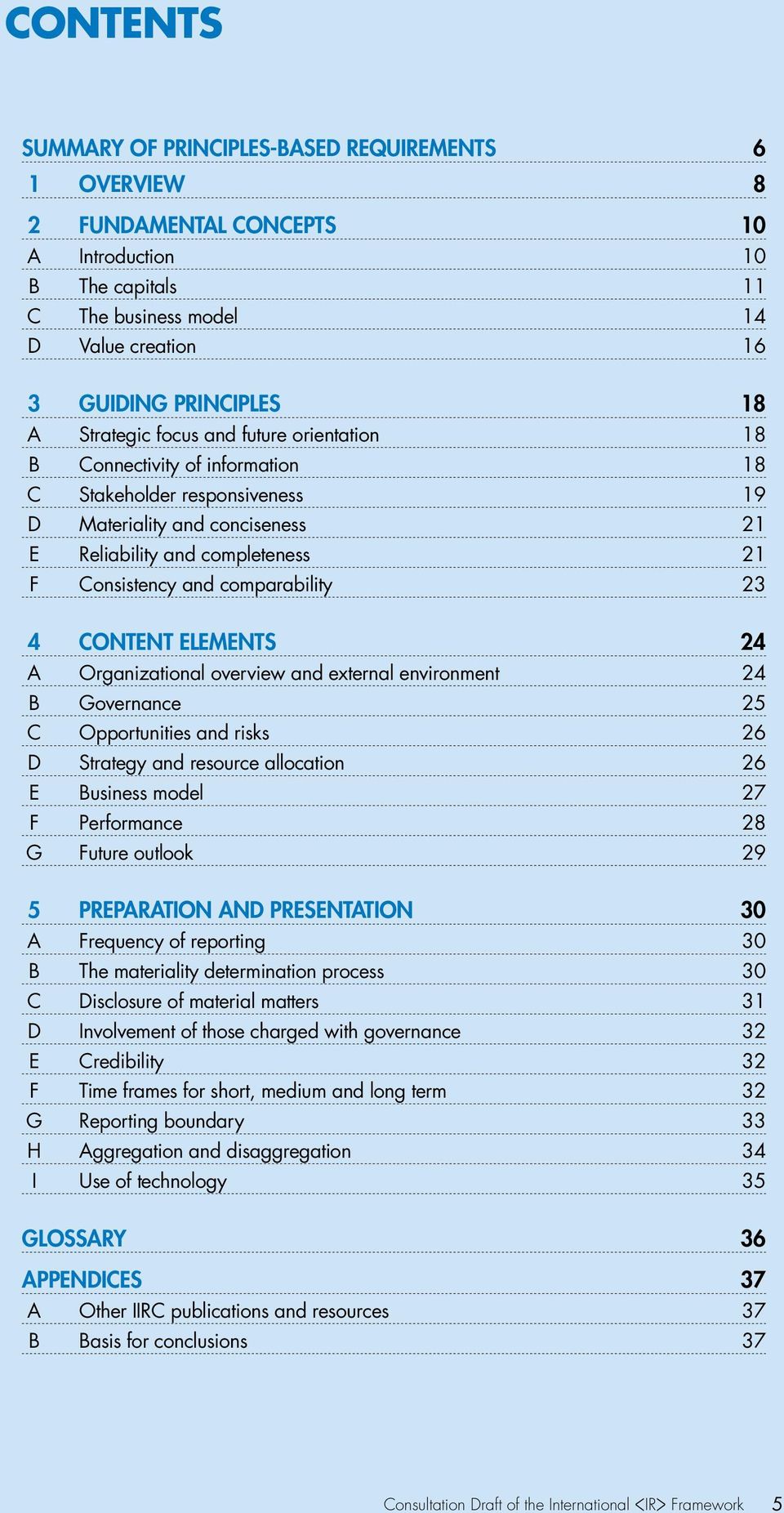
7 CONTENTS SUMMARY OF PRINCIPLES-BASED REQUIREMENTS 6 1 OVERVIEW 8 2 fundamental CONCEPTS 10 A Introduction 10 B The capitals 11 C The business model 14 D Value creation 16 3 GUIDING PRINCIPLES 18 A Strategic focus and future orientation 18 B Connectivity of information 18 C Stakeholder responsiveness 19 D Materiality and conciseness 21 E Reliability and completeness 21 F Consistency and comparability 23 4 CONTENT ELEMENTS 24 A Organizational overview and external environment 24 B Governance 25 C Opportunities and risks 26 D Strategy and resource allocation 26 E Business model 27 F Performance 28 G Future outlook 29 5 PREPARATION AND presentation 30 A Frequency of reporting 30 B The materiality determination process 30 C Disclosure of material matters 31 D Involvement of those charged with governance 32 E Credibility 32 F Time frames for short, medium and long term 32 G Reporting boundary 33 H Aggregation and disaggregation 34 I Use of technology 35 GLOSSARY 36 APPENDICES 37 A Other IIRC publications and resources 37 B Basis for conclusions 37 Consultation Draft of the International <IR> Framework 5
8 SUMMARY OF PRINCIPLES-BASED REQUIREMENTS Overview The overview in Chapter 1 discusses the objectives and audience of Integrated Reporting (<IR>), the objectives of the International <IR> Framework (the Framework) and how the Framework should be applied. It also discusses how <IR> is guided by the concept of integrated thinking and how <IR> interacts with other reports and communications, including how the IIRC aims to complement material developed by others with respect to specific indicators and measurement methods. The overview sets out the conditions that need to be fulfilled for an integrated report to be in accordance with the Framework. Unless unable to do so because of the unavailability of reliable data, specific legal prohibitions or competitive harm, an integrated report should comply with the principles-based requirements identified throughout the Framework in bold italic type (paragraphs ). Those requirements are to be applied taking account of the content of the Framework as a whole, including the fundamental concepts as explained in Chapter 2. Each of those requirements is included in this summary along with a paragraph number for ease of reference. Chapter 1 also includes the definition of <IR> and of an integrated report (paragraphs ), and requires that an integrated report should be prepared: (i) in accordance with this Framework (paragraph 1.4), and (ii) primarily for providers of financial capital (paragraph 1.6). Fundamental concepts The fundamental concepts of <IR> are discussed in Chapter 2. These underpin and reinforce the principles-based requirements and guidance set out in Chapters 3-5. The fundamental concepts centre on: The various capitals (financial, manufactured, intellectual, human, social and relationship, and natural) that an organization uses and affects The organization s business model The creation of value over time. An organization s business model is the vehicle through which it creates value. That value is embodied in the capitals that it uses and affects. The assessment of an organization s ability to create value in the short, medium and long term depends on an understanding of the connectivity between its business model and a wide range of internal and external factors. Those factors are disclosed in an integrated report prepared in accordance with the Framework. Guiding Principles The Guiding Principles inform the content of an integrated report and how information is presented. Each is explained in Chapter 3, which includes the following principles-based requirements: Strategic focus and future orientation: An integrated report should provide insight into the organization s strategy, and how that relates to its ability to create value in the short, medium and long term and its use of and effects on the capitals (paragraph 3.2). Connectivity of information: An integrated report should show, as a comprehensive value creation story, the combination, inter-relatedness and dependencies between the components that are material to the organization s ability to create value over time (paragraph 3.7). Stakeholder responsiveness: An integrated report should provide insight into the quality of the organization s relationships with its key stakeholders and how and to what extent the organization understands, takes into account and responds to their legitimate needs, interests and expectations (paragraph 3.13). Materiality and conciseness: An integrated report should provide concise information that is material to assessing the organization s ability to create value in the short, medium and long term (paragraph 3.22). Reliability and completeness: An integrated report should include all material matters, both positive and negative, in a balanced way and without material error (paragraph 3.30). Consistency and comparability: The information in an integrated report should be presented on a basis that is consistent over time and in a way that enables comparison with other organizations to the extent it is material to the organization s own value creation story (paragraph 3.48). Content Elements The Content Elements to be included in an integrated report are explained in Chapter 4. An integrated report should stand alone as a concise communication, linked to other reports and communications for those stakeholders who want additional information (paragraph 4.4). The requirements with respect to the Content Elements are expressed as questions that should be answered in an integrated report in a way that best expresses the organization s unique value creation story and makes the connections between the Content Elements apparent. They are not intended to appear in a set sequence or as isolated, standalone sections. 6

9 An integrated report should answer the following questions: Organizational overview and external environment: What does the organization do and what are the circumstances under which it operates (paragraph 4.6)? Governance: How does the organization s governance structure support its ability to create value in the short, medium and long term (paragraph 4.10)? Opportunities and risks: What are the specific opportunities and risks that affect the organization s ability to create value over the short, medium and long term and how is the organization dealing with them (paragraph 4.13)? Strategy and resource allocation: Where does the organization want to go and how does it intend to get there (paragraph 4.18)? Business model: What is the organization s business model and to what extent is it resilient (paragraph 4.21)? Performance: To what extent has the organization achieved its strategic objectives and what are its outcomes in terms of effects on the capitals (paragraph 4.27)? Future outlook: What challenges and uncertainties is the organization likely to encounter in pursuing its strategy, and what are the potential implications for its business model and its future performance (paragraph 4.33)? Chapter 4 further identifies the following required disclosures (paragraph 4.5): The organization s materiality determination process The reporting boundary and how it has been determined The governance body with oversight responsibilities for <IR> The nature and magnitude of the material trade-offs that influence value creation over time The reason why the organization considers any of the capitals identified in the Framework to be immaterial given its particular circumstances, if that is the case. Preparation and presentation Chapter 5 provides guidance, with no additional requirements, on the preparation and presentation of an integrated report. Topics include: the materiality determination process, the disclosure of material matters, involvement of those charged with governance, frequency of reporting, reporting boundary, and the use of technology. Strategic focus and future orientation Consistency and comparability Organizational overview and external environment Governance Connectivity of information Opportunities and risks Reliability and Completeness Performance Business model FuturE outlook Strategy and resource allocation Stakeholder Responsiveness Materiality and Conciseness Figure 1: The Guiding Principles and Content Elements. Consultation Draft of the International <IR> Framework 7

10 1. OVERVIEW 1.1 This chapter provides an overview of <IR> and of the Framework. Further background is available on the IIRC website at Integrated Reporting <IR> defined 1.2 <IR> is a process that results in communication by an organization, most visibly a periodic integrated report, about value creation over time. 1.3 An integrated report is a concise communication about how an organization s strategy, governance, performance and prospects, in the context of its external environment, lead to the creation of value over the short, medium and long term. 1.4 An integrated report should be prepared in accordance with this Framework. Objectives of <IR> 1.5 <IR> aims to: Catalyse a more cohesive and efficient approach to corporate reporting that communicates the full range of factors that materially affect the ability of an organization to create value over time, and draws together other reporting strands Inform the allocation of financial capital that supports value creation over the short, medium and long term Enhance accountability and stewardship with respect to the broad base of capitals (financial, manufactured, intellectual, human, social and relationship, and natural) and promote understanding of the interdependencies between them Support integrated thinking, decision-making and actions that focus on the creation of value over the short, medium and long term. Audience for <IR> 1.6 An integrated report should be prepared primarily for providers of financial capital in order to support their financial capital allocation assessments. 1.7 Although providers of financial capital are the primary intended report users, an integrated report and other communications resulting from <IR> will be of benefit to all stakeholders interested in an organization s ability to create value over time, including employees, customers, suppliers, business partners, local communities, legislators, regulators, and policy-makers. 1.8 Those providers of financial capital who take a long term view of an organization s continuation and performance are particularly likely to benefit from <IR>. Their interests are likely to align over time with the interests of other stakeholders because both are focused on the creation of value in the short, medium and long term. Objective of the Framework 1.9 The purpose of the Framework is to assist organizations with the process of <IR>. In particular, the Framework establishes Guiding Principles and Content Elements that govern the overall content of an integrated report, helping organizations determine how best to express their unique value creation story in a meaningful and transparent way. The Framework does not, however, set benchmarks for such things as the quality of an organization s strategy or the level of its performance. Assessing these things is the role of the intended report users based on the information in an organization s integrated report The Framework is intended primarily for application by private sector, for-profit companies of any size but it can also be applied, adapted as necessary, by public sector and not-for-profit organizations. Application of the Framework 1.11 Any communication purporting to be prepared in accordance with the Framework should apply all the principles-based requirements identified in bold italic type (taking account of the content of the Framework as a whole, including the fundamental concepts as explained in Chapter 2) unless, and to the extent, the unavailability of reliable data, specific legal prohibitions or competitive harm results in an inability to disclose information that is material Where the unavailability of reliable data, specific legal prohibitions or competitive harm result in an inability to disclose information that is material, an integrated report should: Indicate what information has been omitted Explain the reason why the information has been omitted In the case of the unavailability of data, identify the steps being taken to obtain the data and the expected time frame for doing so. 8

11 A principles-based approach 1.13 The requirements of the Framework are principlesbased and do not focus on rules for measurement or disclosure of individual matters or the identification of specific key performance indicators (KPIs). Senior management and those charged with governance therefore need to collectively exercise judgement to determine which matters are material. They also need to ensure material matters are appropriately disclosed given the specific circumstances of the organization, including the application of generally accepted measurement and disclosure methods as appropriate (see paragraph 1.19) The intent of the principles-based approach is to strike an appropriate balance between flexibility and prescription that recognizes the wide variation in individual circumstances of different organizations but enables a sufficient degree of comparability across organizations to meet relevant information needs. Integrated thinking 1.15 <IR> is guided by the Framework and by integrated thinking Integrated thinking is the active consideration by an organization of the relationships between its various operating and functional units and the capitals that the organization uses and affects. Integrated thinking leads to integrated decisionmaking and actions that consider the creation of value over the short, medium and long term Integrated thinking can be contrasted with traditional silo thinking. It takes into account the connectivity and interdependencies between the range of factors that have a material effect on an organization s ability to create value over time, including: Interaction with other reports and communications 1.18 The <IR> process is intended to be applied continuously to all relevant reports and communications, including analyst calls and the investor relations section of an organization s website. In addition, it is anticipated that a stand-alone integrated report will be prepared annually in line with the statutory financial reporting cycle. Organizations may provide additional reports and communications (e.g., financial statements and sustainability reports) for compliance purposes or to satisfy the particular information needs of a range of stakeholders. The integrated report may include links to these other reports and communications The Framework does not prescribe specific indicators or measurement methods to be used in an integrated report. The IIRC aims to complement material developed by established reporting standard setters and others, such as industry bodies, and does not intend to develop duplicate content. Nonetheless, the IIRC may reference examples of indicators and measurement methods developed by others Although <IR> builds on developments in financial and other reporting, an integrated report differs from other reports and communications in a number of ways. In particular, it has a combined emphasis on: conciseness, strategic focus and future orientation, the connectivity of information, the capitals, the business model, the ability to create value in the short, medium and long term, and providers of financial capital as the primary audience. The capitals the organization uses and affects, and the critical interdependencies, including trade-offs, between them The capacity of the organization s governance structure to assess resilience against short term disruptions and to respond to stakeholders legitimate needs, interests and expectations How the organization tailors its business model and strategy to respond to the opportunities and risks it faces, as well as major changes in its external environment The organization s value drivers, activities, performance (financial and other), and outcomes in terms of the capitals past, present and future. Consultation Draft of the International <IR> Framework 9

12 2. FUNDAMENTAL CONCEPTS 2A Introduction 2.1 <IR> recognizes that value is not created by or within an organization alone, but is: Influenced by the external environment (including economic conditions, technological change, societal issues and environmental challenges), which creates the context within which the organization operates Created through relationships with others (including employees, customers, suppliers, business partners, and local communities) Dependent on the availability, affordability, quality and management of various resources. 2.2 <IR> therefore aims to provide insight about the following (as depicted in Figure 2): The external environment that affects an organization (see paragraphs ) The resources and relationships used and affected by the organization, which are referred to in this Framework as the capitals (see paragraphs ) How the organization interacts with the external environment and the capitals to create value over the short, medium and long term (see paragraphs ). 2.3 An integrated report results in a broader explanation of performance than traditional reporting by describing, and measuring where practicable, the material elements of value creation and the relationships between them. In particular, it makes visible all the capitals on which value creation (past, present and future) depends, how the organization uses those capitals and its effects on them. 2.4 The elements of an organization that interact with the external environment and the capitals to create value over time are depicted in the expanded diagram in Figure 3. These elements are aligned with the Content Elements of an integrated report (see Chapter 4). 2.5 The mission and vision encompassing the whole organization set out its purpose and intention in clear, concise terms. 2.6 Those charged with governance are responsible for creating an appropriate oversight structure, within which the various elements are in dynamic flux. 2.7 Continuous monitoring and analysis of the external environment in the context of the organization s mission and vision identifies opportunities and risks relevant to the organization. External environment Financial Financial Manufactured Manufactured Intellectual Intellectual Short, medium and long term value creation by the organization Human Human Social and relationship Social and relationship Natural Natural Figure 2: An organization interacts with its external environment and uses and affects the capitals to create value over the short, medium and long term. 10

13 2.8 The organization s strategy identifies how it intends to maximise opportunities and mitigate or manage risks. It sets out strategic objectives and strategies to achieve them, which are implemented through resource allocation plans. 2.9 At the core of the organization is its business model, which draws on various capitals in one form or another as inputs and, through its business activities, converts them to outputs (products, services, by-products and waste). The organization s activities and its outputs lead to outcomes in terms of effects on the capitals. Some of the capitals belong to the organization, while others belong to stakeholders or to society more broadly (identified as society in Figure 3). The organization and society therefore share both the cost of the capitals used as inputs and the value created by the organization The organization needs information about its performance, which involves setting up measurement and monitoring systems to provide information for decision-making The system is not static; regular review of each element and its interactions with other elements, and a focus on the organization s future outlook, lead to revision and refinement to improve all the elements. 2B The capitals The stock and flow of capitals 2.12 All organizations depend on various forms of capital 1 for their success. In this Framework, the capitals comprise financial, manufactured, intellectual, human, social and relationship, and natural, although as discussed in paragraphs this categorization is not required to be adopted by organizations preparing an integrated report The capitals are stores of value that, in one form or another, become inputs to an organization s business model. They are increased, decreased or transformed through the activities and outputs of the organization in that they are enhanced, consumed, modified, destroyed or otherwise affected by those activities and outputs. For example, an organization s financial capital is increased when it makes a profit, and the quality of its human capital is improved when employees become better trained. External environment Financial Mission and vision Financial Manufactured Intellectual Opportunities and risks Governance Strategy and resource allocation Manufactured Intellectual Society Organization Inputs Business activities Business model Outputs Outcomes Society Organization Human Human Social and relationship Performance Future outlook Social and relationship Natural Natural Figure 3: The complete picture of an organization s value creation process, showing the interaction of the Content Elements and the capitals in the context of the organization s external environment. 1 The capitals are sometimes also referred to as resources and relationships. Consultation Draft of the International <IR> Framework 11

14 2. FUNDAMENTAL CONCEPTS Continued 2.14 The overall stock of capitals is not fixed over time. There is a constant flow between and within the capitals as they are increased, decreased or transformed. For example, where an organization improves its human capital through employee training, the related training costs reduce its financial capital. The effect is that financial capital has been transformed into human capital. Although this example is simple and presented only from the organization s perspective 2, it demonstrates the continuous interaction and transformation between the capitals, albeit with varying rates and outcomes Many activities cause increases, decreases or transformations that are far more complex than the above example and involve a broader mix of capitals (or of components within a capital, e.g., the use of water and fertilizers to grow crops that are fed to livestock, all of which are components of natural capital) Although organizations aim to create value overall, this may involve the diminution or destruction of value stored in some capitals, resulting in a net decrease to the overall stock of capitals. In many cases, whether the net effect is an increase or decrease will depend on the perspective chosen; as in the above example, employees and employers may value training differently. In this Framework, unless otherwise stated, the term value creation includes instances when the overall stock of capitals is decreased (i.e., when value is diminished or destroyed). Categories and descriptions of the capitals 2.17 For the purpose of this Framework, the capitals are categorized and described as follows: Financial capital: The pool of funds that is: available to an organization for use in the production of goods or the provision of services obtained through financing, such as debt, equity or grants, or generated through operations or investments. Manufactured capital: Manufactured physical objects (as distinct from natural physical objects) that are available to an organization for use in the production of goods or the provision of services, including: buildings equipment infrastructure (such as roads, ports, bridges, and waste and water treatment plants). Manufactured capital is often created by other organizations, but includes assets manufactured by the reporting organization when they are retained for its own use. Intellectual capital: Organizational, knowledge-based intangibles, including: intellectual property, such as patents, copyrights, software, rights, and licences organizational capital such as tacit knowledge, systems, procedures and protocols intangibles associated with the brand and reputation that an organization has developed. Human capital: People s competencies, capabilities and experience, and their motivations to innovate, including their: alignment with and support for an organization s governance framework, risk management approach, and ethical values ability to understand, develop and implement an organization s strategy loyalties and motivations for improving processes, goods and services, including their ability to lead, manage and collaborate. 2 Other relevant perspectives include the increase to the trainer s financial capital due to the payment received from the employer, and the increase to social capital that may occur if employees use newly acquired skills to contribute to community organizations. 12

15 Social and relationship capital: The institutions and the relationships within and between communities, groups of stakeholders and other networks, and the ability to share information to enhance individual and collective wellbeing. Social and relationship capital includes: shared norms, and common values and behaviours key stakeholder relationships, and the trust and willingness to engage that an organization has developed and strives to build and protect with external stakeholders, such as customers, suppliers, business partners, local communities, legislators, regulators, and policy-makers an organization s social licence to operate. Natural capital: All renewable and nonrenewable environmental resources and processes that provide goods or services that support the past, current or future prosperity of an organization. It includes: air, water, land, minerals and forests biodiversity and eco-system health. Intellectual capital Financial capital Manufactured capital Social and relationship capital Natural capital Human capital Figure 4 3 : This diagram is one way to visualize the capitals; it is not intended to imply a hierarchy that must be used for <IR>. While financial and manufactured capitals are commonly reported on by organizations, <IR> takes a broader view by also considering intellectual, social and relationship, and human capitals, all of which are linked to human activity. <IR> also captures natural capital, which provides the environment in which all the other capitals sit Not all capitals are equally relevant or applicable to all organizations. While most organizations interact with all capitals to some extent, these interactions may be relatively minor or so indirect that they are immaterial for <IR> purposes. Role of the capitals model in the Framework 2.19 The Framework does not require that the categories identified above be adopted by all organizations. Rather, the primary reasons for including the capitals model in the Framework are for it to serve: As a benchmark for ensuring that organizations consider all the forms of capital they use or affect (see paragraph 2.21) As part of the theoretical underpinning for the concept of value (see Section 2D) It would be impracticable, and indeed unnecessary, for the Framework to define every possible stock of value exclusively and exhaustively, and in a way that attempts to cover every organization s approach to value creation. For example, relationships with external stakeholders (part of social and relationship capital in paragraph 2.17), and the intangibles associated with brand and reputation (part of intellectual capital in paragraph 2.17), may be considered by some organizations to be separate capitals, part of other capitals or cutting across a number of individual capitals Regardless of how an organization categorizes the capitals for its own purposes, the categories identified above are to be used as a benchmark to ensure the organization does not overlook a capital that it uses or affects (see also paragraph 4.5). Availability, quality and affordability of the capitals 2.22 The extent to which organizations, collectively or individually, are building up or running down the various capitals can have an important effect on the availability, quality and affordability of those capitals, particularly with respect to capitals that are in limited supply and are non-renewable. This can affect the long term viability of an organization s business model and, therefore, its ability to create value over time. Disclosures about the capitals therefore include the factors that affect their availability, quality and affordability and the organization s expectations of its ability to produce flows from them to meet future demand. 3 Based on diagrams by and Consultation Draft of the International <IR> Framework 13

16 2. FUNDAMENTAL CONCEPTS Continued Ownership of the capitals 2.23 Not all capitals that an organization uses or affects are owned by the organization. They may be owned by others or may not be owned at all in a legal sense (e.g., access to unpolluted air). This point is relevant to the concept of value and is discussed further in Section 2D. Quantitative and qualitative information 2.24 Quantitative indicators, such as KPIs and monetized metrics, can be important in explaining an organization s use of and effects on various capitals. Nonetheless, the Framework does not require, and it would not be practical to expect, organizations to attempt to quantify all uses of and effects on the capitals. Many uses and effects are best (and in some cases can only be) reported on in the form of narrative rather than through quantitative indicators. Complexity, interdependencies and trade-offs 2.25 The Framework does not require, and it would not be practical to expect, <IR> to provide an exhaustive account of all the complex interdependencies between the capitals such that an organization s net impact on the global stock of capitals could be tallied. It is important, however, that an integrated report disclose (as required by paragraph 4.5) the interdependencies that are considered in determining its reporting boundary, and the material trade-offs that influence value creation over time, including trade-offs: 2C Between capitals or between components of a capital (e.g., creating employment through an activity that negatively affects the environment) Over time (e.g., choosing one course of action when another course would result in superior capital increment but not until a later period) Between capitals owned by the organization and those owned by others or not at all. The business model Definition 2.26 An organization s business model is its chosen system of inputs, business activities, outputs and outcomes that aims to create value over the short, medium and long term As shown in Figure 3, the business model sits at the core of an organization and represents the fundamentals of its activities, operating within the overarching organizational architecture. Inputs 2.28 An integrated report identifies the key inputs. It also shows how those inputs relate to the capitals on which the organization depends, or that provide a source of differentiation for the organization, to the extent that they are material to understanding the robustness and resilience of the business model. The discussion provides a concise yet meaningful account of how these key inputs link to the capitals, opportunities and risk, strategy and financial performance (e.g., cost base). For example: To enhance the intended report users understanding of its use of financial capital, the organization ordinarily provides an overview of its funding model. In terms of manufactured capital, the organization may explain how facilities and equipment enhance operational efficiency and effectiveness in the form of productivity, cost containment, enhanced safety and environmental stewardship. Organizations may also explain their reliance on external infrastructure, which may be in the form of public assets or third-party resources. The continued existence of this external infrastructure can be essential to the long term success of the business model. Many knowledge and organizational intangibles are not captured on the balance sheet but may be vital to a robust business model. It is important to explain their capacity to create value. Employees, a key element of human capital, can be an organization s greatest asset, but disclosures often overlook their contribution to long term success. Many business models require not only a dedicated and committed workforce but also one with specialized knowledge or skills. The importance of human capital may be reflected in a discussion of the morale, motivation and diversity of employees and how key skills are maintained, such as through training and development programmes. With respect to social and relationship capital, most business models require a network of relationships to succeed. For some, supply chain management can be one of the most important aspects of the business model, while others can be predicated on interactions with local communities or joint technology development. 14

17 Many organizations rely on raw materials to ensure production continuity. Planetary limits can render a business vulnerable to natural resource changes, some of which may be sudden and irreversible. Ecosystem services such as water purification, nutrient cycling, pollination and carbon sequestration may also feature prominently in the business model. It is important to explain how secure the availability, quality and affordability of these components of natural capital are. Also, environmental remediation efforts are explained in the integrated report where they are likely to be significant An integrated report does not attempt to provide an exhaustive list of all capitals used. Rather, the focus is on those capitals that have a material bearing on the ability to create value in the short, medium and long term, whether or not they are owned or controlled by the organization. Business activities 2.30 At the centre of the business model is the conversion of inputs into outputs through business activities. These activities may include the planning, design and manufacture of products or the deployment of specialized skills and knowledge in the provision of services. Carrying out these activities requires the business model to reflect attributes such as quality, cost competitiveness and technological advantage Where material, an integrated report discusses the contribution made to the organization s long term success by initiatives that influence the effectiveness and efficiency of business activities, such as process improvement, employee training and relationships management The description of business activities includes how the organization differentiates itself in the market place (e.g., through product differentiation, market segmentation, delivery channels and marketing). It may also explain the extent to which the business model relies on revenue generation after the initial point of sale (e.g., extended warranty arrangements or network usage charges) Encouraging a culture of innovation is often a key business activity in terms of generating new products and services that anticipate customer demand, introducing efficiencies and better use of technology, substituting inputs to minimize adverse social or environmental effects, and finding alternative uses for outputs. The capacity of the business model to adapt to changes (e.g., in the availability, quality and affordability of inputs) can affect the organization s longer term viability. The business model description therefore explains the approach to innovation and responsiveness to change. Outputs 2.34 An integrated report identifies an organization s key products and services. There may be other outputs, such as by-products and waste (including emissions), that need to be discussed within the business model disclosure depending on their materiality. Outcomes 2.35 Outcomes are defined as the internal and external consequences (positive and negative) for the capitals as a result of an organization s business activities and outputs. Outcomes can, therefore, be: Internal to an organization (e.g., employee morale and organizational reputation) or external (e.g., benefits customers derive from the organization s products and services, contributions to the local economy through employment and taxes, and environmental effects) Positive (i.e., result in a net increase in the capitals and thereby create value) or negative (i.e., result in a net decrease in the capitals and thereby diminish or destroy value) Identifying and describing outcomes, particularly external outcomes, requires organizations to consider the capitals more broadly than those that are owned or controlled by the organization. For example, it may require disclosure of the effects on capitals up and down the value chain (e.g., carbon emissions caused by products the organization manufactures and labour practices of key suppliers) (see also Section 5G regarding the reporting boundary). Consultation Draft of the International <IR> Framework 15

18 2. FUNDAMENTAL CONCEPTS Continued 2D Value creation 2.37 <IR> explains how an organization creates value over time. Value creation, therefore, lies at the heart of <IR>. As noted in paragraph 2.16, whenever value creation is mentioned it also includes value destruction. In essence: An organization can create and maximize value by serving the interests of, and working with, all its key stakeholders, such as employees, customers, suppliers, business partners, local communities, legislators, regulators, and policy-makers. Value created in this way manifests itself in financial returns to providers of financial capital and also in positive or negative effects on other capitals and other stakeholders. As noted in paragraph 2.13, the capitals are stores of value. Value is created for an organization and its stakeholders as a result of the increase, decrease or transformation of the capitals caused by the organization s activities and outputs. Value for <IR> purposes is determined by reference to a wide range of interactions, activities, relationships, and causes and effects in addition to those directly associated with changes in financial capital. Information that enables assessment of the ability of an organization to create value over time is communicated through a description that includes: how the organization has used and intends to use the different capitals, the effects on and the trade-offs between those capitals over time, and the organization s value drivers and the opportunities and risks that affect them. Such factors are encapsulated in the Content Elements in Chapter 4. Value for providers of financial capital 2.38 Providers of financial capital are focused on value in the form of financial returns. Those returns are, however, dependent on inter-relationships between various types of capital in which other stakeholders have an interest. Therefore, other stakeholders are also likely to benefit from the information in an integrated report By communicating information that assists providers of financial capital to assess an organization s ability to create value over time, <IR> can support their decision-making, engagement and voting practices. It also supports broader societal interests by encouraging the allocation of financial capital to reward and support long term, as well as the short and medium term, value creation within planetary limits and societal expectations Business strategies that are overly focused on optimizing short term financial performance can impede the ability to create long term value. It can, for example, limit investment in research aimed at long term innovation and in the infrastructure needed to address global challenges (e.g., resource shortages as planetary limits are approached, economic instability, climate change, and changing demographics and societal expectations). The meaning of value 2.41 Traditionally, the meaning of value has been associated with the present value of expected future cash flows and value creation has been understood as the change in that measure of value due to an organization s financial performance. <IR> is based on the understanding that future cash flows and other conceptions of value are dependent on a wider range of capitals, interactions, activities, causes and effects, and relationships than those directly associated with changes in financial capital Value for <IR> purposes, therefore, encompasses other forms of value that the organization creates through the increase, decrease or transformation of the capitals, each of which may ultimately affect financial returns. <IR>, therefore, considers the broader context of the value created in all the capitals. It is not, however, the purpose of an integrated report to measure the value of an organization or of all the capitals, but rather to provide information that enables the intended report users to assess the ability of the organization to create value over time Value is created over different time horizons and for different stakeholders through different capitals, and is unlikely to be created through the maximization of one capital while disregarding the others. For example, the maximization of financial capital (e.g., profit) at the expense of human capital (e.g., through inappropriate human resource policies and practices) is unlikely to maximize value in the longer term. 16

19 2.44 <IR> takes account of the extent to which effects on the capitals have been externalized (i.e., the costs or other effects on capitals that are not owned by the organization). Externalities may be positive or negative (i.e., they may result in a net increase or decrease to the value embodied in the capitals). Externalities may ultimately increase or decrease value to providers of financial capital who therefore need information about material externalities to assess their effects and allocate resources accordingly. Value drivers 2.45 Value drivers affect an organization s ability to create value over time. They are the capabilities or variables that give an organization competitive advantage and over which it has some degree of control. The type and combination of each organization s value drivers are unique. They may include, for example: Financial drivers, such as growth in sales or market share, pricing strategy, operational efficiency, brand equity, and the cost of financial capital Customer relations, responses to societal expectations and environmental concerns, innovation, and corporate governance Values such as integrity and trust, and teamwork. Consultation Draft of the International <IR> Framework 17

20 3. GUIDING PRINCIPLES 3.1 The following Guiding Principles underpin the preparation of an integrated report, informing the content of the report and how information is presented: 3A A B C D E F Strategic focus and future orientation Connectivity of information Stakeholder responsiveness Materiality and conciseness Reliability and completeness Consistency and comparability. Strategic focus and future orientation 3.2 An integrated report should provide insight into the organization s strategy, and how that relates to its ability to create value in the short, medium and long term and to its use of and effects on the capitals. 3.3 Applying this Guiding Principle is not limited to the Content Elements Strategy and resource allocation and Future outlook. It pervades the selection and presentation of other content, and may include, for example: Highlighting significant opportunities, risks and dependencies flowing from the organization s market position and business model An explanation of those charged with governance s view of: the relationship between past and future performance, and the factors that may change that relationship how the organization balances short, medium and long term interests. 3.4 Adopting a strategic focus and future orientation in an integrated report includes clearly articulating how the continued availability, quality and affordability of significant capitals contribute to the organization s ability to achieve its strategic objectives in the future and thereby create value. 3.5 Care is needed with respect to future-oriented information to avoid boilerplate disclosures. Information is only included in an integrated report when it is of practical use to the intended report users. This requires that disclosures be specific to the circumstances of the organization. 3.6 Future-oriented information is by nature more uncertain and, therefore, less precise than historical information. Uncertainty is not, however, a reason in itself to exclude such information, but the nature and extent of that uncertainty needs to be disclosed (see also paragraph 5.15). 3B Connectivity of information 3.7 An integrated report should show, as a comprehensive value creation story, the combination, inter-relatedness and dependencies between the components that are material to the organization s ability to create value over time. 3.8 Connectivity is central to ensuring that an integrated report: Focuses on the total picture of the organization s unique value creation story (i.e., how its strategy, governance, performance and prospects create value over time) Supports the intended report users understanding of the different factors that affect the future of the organization and how they interact Helps to break down established silos in accessing, measuring, managing and disclosing information, and to extend the focus of reporting beyond the traditional focus primarily on financial and historical matters Facilitates the intended report users ability to drill down and interlink information in other communications depending on their needs. 3.9 The more that integrated thinking underlies the organization s unique value creation story by being embedded into its activities, the more naturally will the connectivity of information flow into management reporting, analysis and decisionmaking, and subsequently into the integrated report. Accordingly, introducing ways to improve integrated thinking within the organization can help drive the <IR> process It is only by connecting the Content Elements over time that the organization is able to express its unique value creation story. The key components of connectivity of information are, therefore, the connectivity between: The Content Elements, i.e., the connectivity between the organization s external environment, governance, opportunities and risks, strategy and resource allocation, business model, performance, and future outlook. The organization s value creation story integrates the Content Elements into a total picture that reflects the dynamic and systemic interactions of the organization s activities as a whole. For example: 18

21 an analysis of existing resource allocation, and how the organization will combine resources or make further investment to achieve its targeted performance information about how the organization s strategy is tailored when, for instance, new opportunities and risks are identified or past performance is not as expected linking the organization s strategy and risks with its KPIs The past, present, and future. An analysis by the organization of its activities in the pastto-present period can provide the intended report users with useful information to assess the plausibility of what has been reported concerning the present-to-future period. The explanation of the past-to-present period may also be useful to the intended report users in analyzing the quality of management Other components of the connectivity of information include the connectivity between: The capitals, i.e., the increases, decreases and transformations, including trade-offs, of the capitals over time (see discussion of the capitals in Section 2B). Financial information and other information, especially as it relates to future cash flows. For example: research and development policy, technology/know-how, capital investment, or investment in human resources, along with their implications for expected revenue growth or targeted market share environmental policies, energy efficiency, cooperation with local communities, or technologies to tackle social issues, along with their implications for cost reduction or new business opportunities long term customer relationships, customer satisfaction and reputation, along with their implications for revenue and profit growth Quantitative and qualitative information. Both quantitative and qualitative information are necessary for an integrated report to properly represent the organization s unique value creation story as each provides context to the other. Including KPIs as part of a narrative explanation can be an effective way to connect quantitative and qualitative information. Management information, board information and information reported externally. Information reported externally needs to be consistent with that used internally by management and those charged with governance. For example, as noted in paragraph 4.31, it is important for the quantitative indicators in an integrated report to be consistent with the indicators used by those charged with governance. Information in the integrated report, information in the organization s other communications, and information from other sources. This recognizes that all communications from the organization need to be consistent, and that the intended report users make assessments by combining information the organization provides with information they have accumulated from other sources The connectivity of information and the overall usefulness of an integrated report are enhanced when it is logically structured and well presented, written in clear and understandable language, and includes effective navigation devices, such as clearly delineated (but linked) sections and cross-referencing. In this context, information and communication technology (e.g., the Internet, extensible Business Reporting Language (XBRL), and social media) can be used to improve the intended report users capability to search, access, combine, connect, customize, re-use or analyse information (see discussion of technology in Section 5I). 3C Stakeholder responsiveness 3.13 An integrated report should provide insight into the quality of the organization s relationships with its key stakeholders and how and to what extent the organization understands, takes into account and responds to their legitimate needs, interests and expectations <IR> emphasizes the importance of ongoing, positive relationships with the organization s key stakeholders because, as noted in paragraph 2.1, value is not created by or within an organization alone, but is created through relationships with others. Consultation Draft of the International <IR> Framework 19
22 3. GUIDING PRINCIPLES Continued 3.15 Stakeholders provide useful insights about matters that are important to them that also affect the organization, including economic, environmental and social issues. These insights assist the organization to: Understand how stakeholders perceive value Identify future trends that may not yet have come to general attention but which are rising in significance Identify material matters, including opportunities and risks Develop and evaluate strategy Manage risks Implement activities, including strategic and accountable responses to material matters An integrated report enhances transparency and accountability, which are essential in building trust and resilience, by disclosing: The nature and quality of the organization s relationships with key stakeholders How key stakeholders legitimate needs, interests and expectations are understood, taken into account and responded to Responsiveness is demonstrated through decisions, actions and performance, as well as ongoing communication with stakeholders. Making internal processes more transparent is valuable to most stakeholders Engagement with stakeholders occurs regularly in the ordinary course of business (e.g., day-to-day liaison with customers and suppliers or broader ongoing engagement as part of strategic planning and risk assessment). It may also be undertaken for a particular purpose (e.g., engagement with a local community when planning a factory extension). The more integrated thinking is embedded in the business, the more likely it is that a fuller consideration of stakeholders legitimate needs, interests and expectations is incorporated as an ordinary part of conducting business The Guiding Principle Stakeholder responsiveness does not mean that an integrated report should attempt to satisfy all the information needs of all stakeholders. Rather, by focusing on matters that are material to short, medium and long term value creation, an integrated report will often provide relevant information in itself, as well as a clear reference point for other communications. Other communications include compliance information, investor presentations, detailed financial information, sustainability reports, and communications directed to specific stakeholders who have particular information needs. Much of this more detailed information is likely to be placed online As noted above, an integrated report enhances transparency and accountability. Accountability is closely associated with the concept of stewardship and the responsibility of an organization to care for or use responsibly the capitals that its activities and outputs affect. Where the capitals are owned by the organization, a stewardship responsibility is imposed on management and those charged with governance via their legal responsibilities to the organization Some capitals that the organization uses or affects are not owned by it. As discussed in paragraph 2.23, they may be owned by others or may not be owned at all in a legal sense. In either case, the organization may have stewardship responsibilities imposed on it through law or regulation (e.g., through a contract with the owners, or through labour laws or environmental protection regulations). Where a stewardship responsibility is not imposed by law or regulation, the organization may nonetheless accept stewardship responsibilities in accordance with growing stakeholder expectations to do so, and to do so transparently. Responding to stakeholders legitimate needs, interests and expectations in this way is consistent with the concept of value as explained in Section 2D. 20
23 3D Materiality and conciseness 3.22 An integrated report should provide concise information that is material to assessing the organization s ability to create value in the short, medium and long term. Materiality Definition 3.23 A matter 4 is material if, in the view of senior management and those charged with governance, it is of such relevance and importance 5 that it could substantively influence the assessments of the primary intended report users with regard to the organization s ability to create value over the short, medium and long term In determining whether a matter is material, senior management and those charged with governance consider whether the matter substantively affects, or has the potential to substantively affect, the organization s strategy, its business model, or one or more of the capitals it uses or affects in the short, medium or long term. The materiality determination process 3.25 Determining materiality for the purpose of preparing an integrated report involves: Identifying relevant matters (i.e., those matters that have had a past effect, have a present effect, or could have a future effect on the organization s ability to create value over time) Assessing the importance of those matters in terms of their known or potential effect on value creation Prioritizing the matters identified based on their importance in terms of known or potential effect on value creation This materiality determination process applies to both positive and negative matters (e.g., opportunities and risks, and favourable and unfavourable results or prospects for the future), and to financial and other information. Such matters may have direct implications for the organization itself or relate to the organization s effects on the capitals owned by or available to others. The application of this process is described in Section 5B Materiality assessments need to be performed at least annually; however, to be most effective the materiality determination process is integrated into the everyday management of the organization and includes regular engagement with the primary intended report users to identify their information needs. Disclosure 3.28 Material matters require disclosure. The nature and extent of disclosure in an integrated report will be influenced by the nature of the matter and the application of all the Guiding Principles. The materiality determination process is required to be disclosed in an integrated report to enable the intended report users to understand how decisions to include or exclude matters were made (see paragraph 4.5). Conciseness 3.29 An integrated report includes concise information that provides sufficient context to make it understandable, and avoids redundant information. The organization seeks a balance between conciseness and the other Guiding Principles, in particular completeness and comparability. In achieving conciseness, an integrated report can be linked to additional detailed information that is provided separately. 3E Reliability and completeness 3.30 An integrated report should include all material matters, both positive and negative, in a balanced way and without material error. Reliability 3.31 The reliability of information is affected by its balance and freedom from material error. Reliability is enhanced by mechanisms such as robust internal reporting systems, appropriate stakeholder engagement, and independent, external assurance Senior management and those charged with governance exercise judgement in deciding whether information is sufficiently reliable to be included in an integrated report. It may be appropriate in some cases (e.g., with respect to future-oriented information) for an integrated report to describe the mechanisms employed to ensure reliability (see paragraph 1.12 for relevant disclosures when material information is omitted because of the unavailability of reliable data). 4 A matter includes, but is not limited to, an event, issue, opportunity, amount, or statement by the organization. 5 Importance refers to both nature and magnitude. Consultation Draft of the International <IR> Framework 21
24 3. GUIDING PRINCIPLES Continued Balance 3.33 A balanced integrated report has no bias in the selection or presentation of information. Information in the report is not slanted, weighted, emphasized, de-emphasized, combined, offset or otherwise manipulated to change the probability that it will be received either favourably or unfavourably by the intended report users Important methods to ensure balance include: Selection of presentation formats that are not likely to unduly or inappropriately influence assessments by the intended report users Giving equal weight to both increments and decrements to the capitals, both strengths and weaknesses of the organization, both positive and negative performance Reporting against previously reported targets, forecasts, projections and expectations. Freedom from material error 3.35 Freedom from material error does not imply that the information is perfectly accurate in all respects. It does imply that: Processes and controls have been applied to reduce to an acceptably low level the risk that reported information contains a material misstatement If errors have been identified they have been corrected Where amounts are estimates, this is clearly communicated, and the nature and limitations of the estimation process are explained. Completeness 3.36 A complete integrated report includes all material information, both positive and negative. To help ensure that all material matters have been identified, consideration is given to what organizations in the same industry are reporting on as certain matters within an industry are likely to be material to all organizations in that industry In determining completeness, the organization balances potential concerns regarding costs, competitive advantage and future-oriented information (each of which is discussed below) with the benefits of being able to express, in its own terms, its unique value creation story. Cost/benefit 3.38 It is appropriate for the organization to evaluate the cost and benefits (to both the organization and to the intended users) associated with reporting when determining the extent, level of specificity, and preciseness of information to include, but not to refrain entirely from making disclosures on the basis of cost Costs to the organization (both time and expense) may arise from the need to establish or strengthen information systems and controls for capturing and aggregating information or making estimates. Until such systems are implemented, it may be impracticable for certain information to be fully included (i.e., included to the optimum extent, level of specificity and preciseness) If material information is not included in an integrated report, the intended report users may incur costs in obtaining information through other sources or may make sub-optimal decisions as a result of not having that information Information included in an integrated report is, by nature, central to running the business. Accordingly, if management is making decisions on information that is incomplete because of the lack of systems to capture and aggregate the information, the greater cost may be caused by the inability to make sound decisions. As a result, analysing the sufficiency of existing systems while preparing an integrated report may highlight areas where better systems are needed for managing the business, and not just for reporting purposes. Competitive advantage 3.42 One perceived constraint on <IR> is the potential for loss of competitive advantage through the disclosure of commercially sensitive information. It is not expected that the organization disclose information in an integrated report that would significantly harm its competitive advantage. However, the banner of commercial sensitivity is not to be used inappropriately to avoid disclosure This principle is already adopted with respect to analyst calls in which many organizations discuss their strategic objectives and strategies. Similarly, the organization considers how to describe the essence of critical strategies in an integrated report without identifying specific information that might cause a significant loss of competitive advantage. 22
25 3.44 It may often be the case that information about strategies is already known to the market, and therefore available to competitors, and that the true competitive advantage lies in how those strategies are executed (e.g., the efficiency and effectiveness of the processes and practices used) rather than in the strategies themselves Accordingly, the organization considers what advantage a competitor could actually gain from information in an integrated report, and balances this against the legitimate information needs of the intended report users. If material information is not disclosed because of competitive harm, this fact and the reasons for it are to be explained in the integrated report. Future-oriented information 3.46 Legal or regulatory requirements may apply to certain future-oriented information in some jurisdictions, covering for example: The types of disclosures that may be made Whether cautionary statements may be required or permitted to highlight uncertainty regarding achievability An obligation to publicly update such information Key to the intended report users understanding of future-oriented information is a description of the main assumptions applied by the organization, the volatility of those assumptions, and how the information could change if the assumptions do not occur as described. 3F Consistency and comparability 3.48 The information in an integrated report should be presented on a basis that is consistent over time and in a way that enables comparison with other organizations to the extent it is material to the organization s own value creation story. Consistency 3.49 Reporting policies are followed consistently from one period to the next unless a change is needed to improve the quality of information reported. This includes using the same KPIs to report on the same matters if they continue to be material across reporting periods. When a significant change has been made, the organization explains the reason for the change, describing (and quantifying if practicable and material) its effect When information in an integrated report is similar to or based on other information published by the organization, it is prepared on the same basis as, or is easily reconcilable with, that other information. For example, where a KPI covers a similar topic to information published in the organization s financial statements or sustainability report, it is prepared on the same basis, and for the same period, as that other information. Comparability 3.51 The specific information in an integrated report will, necessarily, vary from one organization to another because each organization needs to express its own unique value creation story. Nonetheless, addressing the questions relating to the Content Elements, which apply to all organizations, helps ensure a suitable level of comparability between organizations Other powerful tools for enhancing comparability (both in an integrated report itself and in the more detailed information that it links to) can include reporting: Benchmark data, such as industry or regional benchmarks Information presented in the form of ratios (e.g., research expenditure as a percentage of sales, or carbon intensity measures such as emissions per unit of output) Quantitative indicators commonly used by other organizations with similar activities, particularly when standardized definitions are stipulated by an independent organization (e.g., an industry body). Such indicators are not, however, included in an integrated report unless they are relevant to the individual circumstances of, and are used by, the organization. Consultation Draft of the International <IR> Framework 23
26 4. CONTENT ELEMENTS 4.1 An integrated report includes the following Content Elements, answering the respective question posed for each one: A Organizational overview and external environment B Governance C Opportunities and risks D Strategy and resource allocation E Business model F Performance G Future outlook 4.2 These Content Elements are fundamentally linked to each other and are not mutually exclusive. The sequence in which they appear in this chapter follows how they are explained in Section 2A, but this is not the only way they could be sequenced. The Content Elements are not intended to serve as a standard structure for an integrated report with information about them appearing in a set sequence or as isolated, standalone sections. Rather, information in an integrated report is presented in a way that makes the connections between the Content Elements apparent. 4.3 The content of an organization s integrated report will depend on the individual circumstances of the organization. The Content Elements are therefore stated in the form of questions rather than as checklists of specific disclosures. Accordingly, senior management and those charged with governance will need to exercise judgement in applying the Guiding Principles to determine what information is reported, as well as how it is reported. 4.4 An integrated report should stand alone as a concise communication, linked to other reports and communications for those stakeholders who want additional information. 4.5 In addition to the Content Elements, an integrated report should disclose: 4A The organization s materiality determination process (see paragraph 5.13) The governance body with oversight responsibilities for <IR> (see Section 5D) The reporting boundary and how it has been determined (see Section 5G) The nature and magnitude of the material trade-offs that influence value creation over time (see paragraph 2.25) The reason why the organization considers any of the capitals identified in this Framework to be immaterial given its particular circumstances, if that is the case (see paragraphs ). Organizational overview and external environment 4.6 An integrated report should answer the question: What does the organization do and what are the circumstances under which it operates? 4.7 An integrated report identifies the organization s mission and vision, and provides essential context by identifying: The organization s: culture, ethics and values ownership and operating structure principal activities, markets, products and services competitive landscape and market positioning (considering factors such as the threat of new competition and substitute products or services, the bargaining power of customers and suppliers, and the intensity of competitive rivalry) Key quantitative information (e.g., the number of employees, revenue, and number of countries in which the organization operates), highlighting, in particular, significant changes from prior periods Significant factors affecting the external environment. 24
27 External environment 4.8 Factors affecting the external environment include aspects of the legal, commercial, social, environmental and political context that affect the organization s ability to create value in the short, medium and long term. They can affect the organization directly or indirectly (e.g., by influencing the availability, quality and affordability of a capital that the organization uses or affects). 4.9 These factors occur in the context of the particular organization, in the context of its industry or region, and in the wider social or planetary context. They may include, for example: The legitimate needs, interests and expectations of the organization s stakeholders Macro and micro economic conditions, such as economic stability, globalization, and industry trends Market forces, such as the relative strengths and weaknesses of competitors and customer demand The speed and effect of technological change Societal issues and changing societal expectations, such as population and demographic changes, human rights, health, poverty, collective values and educational systems Environmental challenges, such as climate change, the loss of ecosystems, and resource shortages as planetary limits are approached The legislative and regulatory environment in which the organization operates The political environment in countries in which the organization operates and in other countries that may affect the ability of the organization to implement its strategy. 4B Governance 4.10 An integrated report should answer the question: How does the organization s governance structure support its ability to create value in the short, medium and long term? 4.11 An integrated report provides insight about such matters as: The organization s leadership structure, including the diversity and skills of those charged with governance Specific processes used to make strategic decisions and to establish and monitor the culture of the organization, including its tone at the top and attitude to risk Particular actions those charged with governance have taken to influence and monitor the strategic direction of the organization and its approach to risk management How the organization s culture, ethics and values are reflected in its use of and effects on the various capitals, including its relationships with key stakeholders Whether, and if so how, the organization is implementing best governance practices that go beyond legal requirements The responsibility those charged with governance take for promoting and enabling innovation How remuneration and incentives are linked to value creation in the short, medium and long term, including how they are linked to the organization s use of and effects on the capitals With respect to remuneration and incentives, an integrated report focuses on significant compensation policies and practices (including cash, deferred compensation, post-retirement benefits and stock arrangements). This may involve both quantitative and qualitative information about the oversight arrangements for remuneration of those charged with governance and senior executives, and how the links between the organization s strategy and its use of and effects on capitals are used to arrive at performancebased compensation, including future remuneration and fixed and variable components. Consultation Draft of the International <IR> Framework 25
28 4. CONTENT ELEMENTS continued 4C Opportunities and risks 4.13 An integrated report should answer the question: What are the specific opportunities and risks that affect the organization s ability to create value over the short, medium and long term, and how is the organization dealing with them? 4.14 An integrated report identifies the key opportunities and risks that are specific to the organization, including those that relate to the organization s effects on, and the continued availability, quality and affordability of, relevant capitals An integrated report identifies: The specific source of opportunities and risks, which may be internal, external or, commonly, a mix of the two. External sources include those stemming from the external environment, as discussed in paragraphs Internal sources include those stemming from the organization s business activities, as discussed in paragraphs The organization s assessment of the likelihood that the opportunity or risk will come to fruition and the magnitude of its effect if it does. This includes consideration of the specific circumstances that would cause the opportunity or risk to come to fruition. Such disclosure will invariably involve a degree of uncertainty. Guidance on likelihood and magnitude of effect is included in Section 5B, and guidance on disclosures with respect to uncertainty is included in Section 5C. The specific steps being taken to create value from key opportunities and to mitigate or manage key risks, including the identification of the associated strategic objectives, strategies, policies, targets and KPIs Care is needed to avoid boilerplate disclosures about opportunities and risks. Information is only included in an integrated report when it is of practical use to the intended report users. This requires that disclosures be specific to the circumstances of the organization An integrated report identifies the organization s approach to any risks that are fundamental to the ongoing ability of the organization to create value and that could have extreme consequences, even where the likelihood of their occurrence might be considered quite small. 4D Strategy and resource allocation 4.18 An integrated report should answer the question: Where does the organization want to go and how does it intend to get there? 4.19 An integrated report identifies: The organization s short, medium and long term strategic objectives The strategies it has in place, or intends to implement, to achieve those strategic objectives The resource allocation plans it has in place, or intends to put in place, to implement its strategy How it will measure achievements and target outcomes for the short, medium and long term An integrated report describes: The linkage between the organization s strategy and resource allocation plans, and the information covered by other Content Elements, including how its strategy and resource allocation plans: relate to the organization s business model and what changes to that business model may be necessary to implement chosen strategies are influenced by/respond to the external environment and the identified opportunities and risks affect the capitals, and the risk management arrangements related to those capitals What differentiates the organization to give it competitive advantage and make it able to create value in the future, such as: the role of innovation how the organization develops and exploits intellectual capital the extent to which environmental and social considerations have been embedded into the organization s strategy to give it a competitive advantage Key features and findings of stakeholder consultations that were used in formulating its strategy and resource allocation plans. 26
29 4E Business model 4.21 An integrated report should answer the question: What is the organization s business model and to what extent is it resilient? 4.22 An integrated report describes the organization s business model, as discussed in Section 2C, and focuses on its resilience. This includes: Key inputs and how they relate to the capitals from which they are derived (being those on which the organization depends or that provide a source of differentiation for the organization) Key business activities, considering such factors as: how the organization differentiates itself in the market place (e.g., product differentiation, market segmentation, and channels used to communicate with potential customers and deliver market offerings) the extent to which the business model relies on revenue generation after the initial point of sale (e.g., extended warranty arrangements or network usage charges) how the organization approaches the need to innovate how the business model has been designed to adapt to change Key outputs, explaining the products and services that the organization places in the market, and material by-products and waste Key outcomes in terms of the capitals, including both internal outcomes (e.g., revenue and cash flow) and external outcomes (e.g., customer satisfaction, tax payments, brand loyalty, and social and environmental effects) Features that can enhance the effectiveness and readability of the description of the business model include: Explicit identification of the key elements of the business model A simple diagram highlighting key elements, supported by a clear explanation of the relevance of those elements to the organization Narrative flow that is logical given the particular circumstances of the organization Identification of critical stakeholder and other (e.g., raw material) dependencies, key value drivers (see paragraph 2.45), and important factors affecting the external environment, including factors over which it has control Positioning of the organization within the entire value chain Connection to information in other Content Elements, such as strategy, opportunities and risks, and performance (including KPIs and financial considerations such as cost containment and revenues). Organizations with multiple business models 4.24 Some organizations employ more than one business model (e.g., when operating in different market segments). Disaggregating the organization into its material constituent operations and associated business models is important to an effective explanation of how the organization operates. This requires a distinct consideration of each material business model as well as commentary on the extent of connectivity between the business models, such as the existence of synergistic benefits Some organizations consist of multiple, diverse business divisions or segments managed by a central corporate division acting in an investment management capacity. The assessments made by the intended report users in these cases are likely to focus on the investment management business model, rather than the business models of the individual segments. In such cases the integrated report focuses on the business model of the corporate centre. Consultation Draft of the International <IR> Framework 27
30 4. CONTENT ELEMENTS continued 4.26 The integrated report of an organization with multiple businesses often needs to balance disclosure with the need to reduce complexity. The Guiding Principle Materiality and conciseness, as discussed in Section 3D, is relevant here. Aligning external reporting with internal reporting by considering the top level of information that is regularly reported to those charged with governance is nearly always appropriate, even for the most complex of organizations. 4F Performance 4.27 An integrated report should answer the question: To what extent has the organization achieved its strategic objectives and what are its outcomes in terms of effects on the capitals? 4.28 An integrated report contains qualitative and quantitative information about performance, including: Quantitative indicators with respect to targets, value drivers, and opportunities and risks, explaining their significance and implications, and the methods and assumptions used in compiling them The organization s effects (both positive and negative) on the capitals, including material effects on capitals up and down the value chain The state of key stakeholder relationships and how the organization has responded to stakeholders legitimate needs, interests and expectations The linkages between past and current performance, and between current performance and future outlook It is important to demonstrate the connectivity of financial performance with performance regarding other capitals. This may include, for example, using KPIs that combine financial measures with other components (e.g., the ratio of greenhouse gas emissions to sales) or narrative explaining the financial implications of significant effects on other capitals (e.g., expected revenue growth resulting from efforts to enhance human capital). It may also include monetization with respect to externalities (e.g., carbon emissions and water use) in some cases The discussion of performance includes instances where regulations have a material effect on performance (e.g., a constraint on revenues as a result of regulatory rate setting) or the organization s non-compliance with laws or regulations may materially affect its operations Quantitative indicators, such as KPIs, can help increase comparability and are particularly helpful in expressing and reporting against targets. Common characteristics of suitable quantitative indicators include that they are: Relevant to the circumstances of the organization Consistent with indicators used by those charged with governance Connected (e.g., they display connectivity between financial and other information) Focused on the matters identified by the organization s materiality determination process Presented with targets, forecasts or projections for two or more future periods Presented for three or more past periods to give the intended report users an appreciation of trends Presented against previously reported targets, forecasts or projections for the purpose of accountability Consistent with industry or regional benchmarks to give the intended report users a basis for comparison Reported consistently over successive periods, regardless of whether the resulting trends and comparisons are favourable or unfavourable Presented with qualitative information to provide context and improve meaningfulness. Relevant qualitative information includes an explanation of: measurement techniques and underlying assumptions the reasons for significant variations from targets, trends or benchmarks, and why they are or are not expected to reoccur Where it is not practicable or meaningful to quantitatively measure material movements in the capitals, qualitative disclosures are made to explain changes in the availability, quality or affordability of capitals as business inputs and how their use by the organization increases, decreases or transforms them. 28
31 4G Future outlook 4.33 An integrated report should answer the question: What challenges and uncertainties is the organization likely to encounter in pursuing its strategy, and what are the potential implications for its business model and future performance? 4.34 Future outlook highlights anticipated changes over time. It provides information, built on sound and transparent analysis, about: The expectations of senior management and those charged with governance about the external environment the organization is likely to face in the short, medium and long term How that will affect the organization How the organization is currently equipped to respond to the critical challenges and uncertainties that may arise Care is needed to ensure the organization s stated expectations, aspirations and intentions are grounded in reality. They need to be commensurate with the ability of the organization to deliver on the opportunities available to it (including the availability, quality and affordability of appropriate capitals), and a realistic appraisal of the organization s competitive landscape and market positioning, and the risks it faces An integrated report includes a discussion of the potential implications, including implications for future financial performance, of: The external environment, opportunities and risks, with an analysis of how these could affect the achievement of strategic objectives The availability, quality and affordability of capitals the organization uses or affects (e.g., the continued availability of skilled labour or natural resources), including how key relationships are managed and why they are important to the organization s ability to create value over time The discussion provides the intended report users with an understanding of the organization s main assumptions and possible risks, and, wherever practicable, gives lead indicators, target KPIs, forecasts and projections, relevant information from recognised external sources, and sensitivity analyses. Consultation Draft of the International <IR> Framework 29
32 5. PREPARATION AND PRESENTATION 5.1 This chapter provides guidance to help organizations implement the Guiding Principles and Content Elements identified in Chapters 3-4. It covers the following topics: 5A A B C D E F G H I Frequency of reporting The materiality determination process Disclosure of material matters Involvement of those charged with governance Credibility Time frames for short, medium and long term Reporting boundary Aggregation and disaggregation Use of technology Frequency of reporting 5.2 The <IR> process is intended to be applied continuously to all relevant reports and communications, including analyst calls and the investor relations section of an organization s website (see Section 5I on the use of technology). In addition, it is anticipated that a stand-alone integrated report would be prepared annually in line with the statutory financial reporting cycle. 5B The materiality determination process 5.3 Figure 5 illustrates the materiality determination process as described in Section 3D. Relevance Identify relevant matters based on effect on the organization s ability to create value over time; considering past, present or future effect on the organization s strategy, its business model, or the capitals it uses or affects Importance Assess importance by assessing the magnitude of effect and likelihood of occurrence Prioritization Prioritize based on importance; if necessary revisit the materiality threshold Identifying relevant matters 5.4 Relevant matters are those that have a past, present or potential future effect on the organization s ability to create value over time. This is determined by considering the effect on the organization s strategy, its business model, or the capitals it uses or affects. 5.5 It is important that long term matters not be overlooked. Matters that might be relatively easy to address in the short term but which, if left unchecked, could be increasingly damaging and more difficult to address over time need to be included in the population of relevant matters. Matters are not excluded on the basis that the organization does not wish to address them or does not know how to deal with them. Assessing importance 5.6 Not all relevant matters will be considered material; to be included in an integrated report, a matter also needs to be sufficiently important in terms of its known or potential effect on value creation. Assessing the magnitude of effect 5.7 Magnitude is assessed by considering whether the matter s effect on the organization s strategy, its business model and the capitals over time is of such significance that it has the potential to substantively influence assessments about the organization s ability to create value in the short, medium and long term. This requires judgement and will depend on the nature of the matter in question. 5.8 Assessing the magnitude of a matter s effect does not imply that the effect needs to be quantified. Depending on the nature of the matter, a qualitative assessment may be more appropriate. An understanding of the perspectives of relevant stakeholders is critical to this assessment because stakeholder actions have the potential to affect the organization s ability to create value over time. 5.9 In assessing the magnitude of effect, the organization considers: Quantitative and qualitative factors Financial, operational, strategic, reputational and regulatory perspectives of the effect Area of the effect (internal and external to the organization) Time frame of the effect. Figure 5: Illustration of the materiality determination process. 30
33 Assessing likelihood of occurrence 5.10 Where it is uncertain whether a matter will occur (e.g., a matter that may occur in the future or may have potential future effects), both its magnitude and its likelihood of occurrence are considered to assess its importance Matters with a high likelihood of occurrence and a large effect would have a greater degree of influence on assessments than matters with a lower likelihood of occurrence or smaller effect. As illustrated in Figure 6, the importance of a matter with a large effect and a low likelihood of occurrence (point A) is greater than a matter with a high likelihood of occurrence and a small effect (point B), since the former, should it occur, could severely affect the organization s ability to create value over time. High Likelihood of occurence Low Immaterial B Immaterial Figure 6: Assessing importance. Increasing importance Magnitude of effect A Threshold High Prioritizing material matters 5.12 Once the population of material matters is identified, they are prioritized based on their importance in terms of known or potential magnitude of effect on value creation over time. This helps to focus on the most important matters when determining how they are reported and, if necessary, to revisit the materiality threshold and narrow the population further. Disclosure 5.13 As required by paragraph 4.5, an integrated report should disclose the organization s materiality determination process. This includes: 5C Describing the process used to identify relevant matters and to narrow them down to material matters (including identifying how the information needs of the primary intended report users were identified) Identifying the key personnel involved in the identification and prioritization of material matters Identifying the role of those charged with governance in the process. Disclosure of material matters 5.14 Judgement is applied in determining the appropriate disclosure of material matters in an integrated report. This requires consideration from different perspectives, both internal and external, and is assisted by regular engagement with the primary intended report users (see also paragraph 3.27) Taking the nature of a material matter into consideration, the organization considers providing: Key information, such as: an explanation of the matter and its effect on the organization s strategy, business model or the capitals relevant interactions and interdependencies providing an understanding of causes and effects the organization s view on the matter actions to manage the matter and how effective they have been the extent of the organization s control over the matter quantitative and qualitative disclosures, including comparative information for prior periods and targets for future periods If there is uncertainty surrounding a matter, disclosures about the uncertainty, such as: an explanation of the uncertainty the range of possible outcomes and associated assumptions and probabilities the certainty range or confidence interval associated with the information provided If key information about the matter is considered indeterminable, disclosure of that fact and the reason for it. Consultation Draft of the International <IR> Framework 31
34 5. PREPARATION AND PRESENTATION continued 5.16 Depending on the nature of a matter, it may be appropriate to present it on its own in the integrated report or throughout in conjunction with different Content Elements. 5D Involvement of those charged with governance 5.17 Those charged with governance have ultimate responsibility for how the organization s strategy, governance, performance and prospects lead to value creation over time. They are responsible for ensuring that there is effective leadership and decision-making regarding <IR>, including the identification and oversight of the employees actively involved in the <IR> process (e.g., those involved in identifying material matters, and in collecting, accumulating, measuring and reporting material information) As required by paragraph 4.5, an integrated report should identify the governance body with oversight responsibilities for <IR>. It may also include a statement from that body regarding the following matters: 5E An acknowledgement of its responsibility to ensure the integrity of the integrated report That it has applied its collective mind to the preparation of the integrated report and the information it contains Its opinion or conclusion about whether the report is presented in accordance with the Framework. Credibility 5.19 Organizations use a variety of internal mechanisms to reassure those charged with governance that complete and reliable information is included in an integrated report. Organizations have internal control systems, which may include an internal audit or similar function, as part of the processes for managing, reviewing and reporting information. These are important to the integrity and credibility of an integrated report. Organizations may also have activities that report on the quality or level of performance, such as performance certifications or compliance assessments In addition, organizations may seek independent, external assurance to enhance the credibility of their reports. Independent, external assurance may also provide comfort, in addition to the internal mechanisms, to those charged with governance The Framework provides reporting criteria against which organizations and assurance providers assess a report s adherence; it does not provide the protocols for performing assurance engagements. 5F Time frames for short, medium and long term 5.22 Given the nature of the matters that <IR> seeks to address, the future time dimension to be considered in preparing an integrated report will typically be longer than for some other forms of reporting. The length of each time frame for short, medium and long term is to be decided by the organization with reference to its business and investment cycles, its strategies, and its stakeholders legitimate needs, interests and expectations. Accordingly, there is no set answer for establishing the length for each term Time frames differ by: Industry or sector (e.g., strategic objectives in the automobile industry typically cover two model-cycle terms, spanning between eight and ten years, whereas within the technology industry, time frames may be significantly shorter) The nature of certain matters (e.g., some issues affecting natural and social and relationship capitals can be very long term in nature) The length of each reporting time frame and the reason for such length are disclosed in an integrated report, and may affect the nature of information disclosed. For example, because longer term matters are more likely to be more affected by uncertainty, information about them may be more likely to be qualitative in nature, whereas information about shorter term matters may be better suited to quantification, or even monetization. 32
35 5G Reporting boundary 5.25 As required by paragraph 4.5, an integrated report identifies its reporting boundary and explains how it has been determined. Determining the boundary for an integrated report has two aspects: The boundary used for financial reporting purposes (i.e., the financial reporting entity) Opportunities, risks and outcomes attributable to or associated with other entities/ stakeholders beyond the financial reporting entity that have a material effect on the ability of the financial reporting entity to create value over time The financial reporting entity is central to the reporting boundary because: It is the financial reporting entity that providers of financial capital, the primary intended users of an integrated report, invest in and therefore need information about Using the financial reporting entity enables the information in the financial statements to serve as an anchor or point of reference to which the other information in an integrated report can be related as appropriate Figure 7 depicts a mapping of the entities/ stakeholders that are considered in determining the reporting boundary. <IR> Reporting Boundary (opportunities, risks and outcomes) Financial Reporting Entity (control and significant influence) Parent Joint arrangements Subsidiaries Investments (other forms) Subsidiaries Employees Customers Suppliers Business partners Local communities Others Figure 7: Mapping the entities/stakeholders that are considered in determining the reporting boundary. Consultation Draft of the International <IR> Framework 33
36 5. PREPARATION AND PRESENTATION continued Financial reporting entity control and significant influence 5.28 Broadly speaking, the financial reporting entity identifies which subsidiaries, joint ventures and associates transactions and related events are included in the organization s financial report. The financial reporting entity is determined according to applicable financial reporting standards and revolves around the concepts of control or significant influence. Considering this central aspect of the reporting boundary: Material opportunities, risks and outcomes attributable to or associated with entities that are included in the financial reporting entity are reported on in the organization s integrated report. Information is prepared on the same basis as, or reconciled to, any corresponding information in the organization s financial statements in terms of (i) the entities covered and (ii) the measurement methods and the time frames used. Opportunities, risks and outcomes 5.29 The second aspect of determining the reporting boundary is to identify those opportunities, risks and outcomes attributable to or associated with entities/stakeholders beyond the financial reporting entity that have a material effect on the ability of the financial reporting entity to create value over time The following are considered in identifying and reporting on material matters with respect to this second aspect of the reporting boundary: Opportunities, risks and outcomes attributable to or associated with other entities/ stakeholders are reported on in an integrated report to the extent they materially affect the ability of the financial reporting entity to create value in the short, medium or long term. These other entities/stakeholders may be related parties for the purpose of financial reporting, but will ordinarily extend further to include other entities/stakeholders. 5H The purpose is not to identify entities to be included in the reporting boundary, but to identify the opportunities, risks and outcomes that materially affect the ability of the financial reporting entity to create value. The entities/ stakeholders within this portion of the reporting boundary are not related to the financial reporting entity by virtue of control or significant influence, but rather by the nature and proximity of the opportunities, risks and outcomes. For example, if the labour practices in the organization s industry are material to the ability of the organization to create value, then the labour practices of suppliers may be material. Practical issues may limit the nature and extent of information that can be presented in an integrated report. For example: the availability of reliable data with respect to entities the financial reporting entity does not control the inherent inability to identify all opportunities, risks and outcomes that will materially affect the ability of the financial reporting entity to create value, particularly in the long term. It may be appropriate to disclose such limitations, and actions being taken to overcome them, in an integrated report. Aggregation and disaggregation 5.31 Each organization determines the level of aggregation (e.g., by country, subsidiary, division, or site) at which to present information that is appropriate to its circumstances. This includes balancing the effort required to disaggregate (or aggregate) information against any added meaningfulness to the intended report users of information reported on a disaggregated (or aggregated) basis In some circumstances, aggregation of information can result in the loss of a significant amount of meaning and can also fail to highlight particularly strong or poor performance in specific areas. On the other hand, unnecessary disaggregation can result in clutter that adversely affects the ease of understanding the information. 34
37 5.33 The organization disaggregates (or aggregates) information to an appropriate level considering, in particular, the way in which senior management and those charged with governance manage the organization and its operations. This commonly results in presenting information based on the business or geographical segments used for financial reporting purposes (see also paragraphs regarding organizations with multiple business models) The Guiding Principle Materiality and conciseness may be served by including a link in an integrated report to disaggregated information that appears elsewhere, such as on the organization s website (see Section 5I regarding the use of technology). 5I Use of technology 5.35 Advances in technology enable innovative approaches to reporting that are particularly relevant to the application of the Guiding Principle Connectivity of information. Organizations are encouraged to use technology platforms to increase connectivity within an integrated report and to information outside of the report, and also to facilitate comparisons between reports Paragraphs illustrate a few ways in which technology may be used in <IR>; however, it is recognized that this will evolve over time to keep in step with the current state of, and trends in, technology and likely future advances. Web-based media 5.37 Communications resulting from <IR> may be included in interactive platforms, such as social media and mobile applications, that enable engagement with stakeholders and the sharing of user-generated content. Such platforms are rapidly increasing in popularity as an important source of information. Their capacity to connect information from different sources is also rapidly increasing (e.g., there is an observable trend towards using social media monitoring tools that allow users to search, track and analyse information about organizations or topics of interest) An integrated report will also often be on a separate section of an organization s website, hyperlinked to information elsewhere on that website or on others websites. For example, detailed information that does not change frequently, such as a listing of subsidiaries, may best be included on a separate section of the organization s website rather than in the integrated report, or critical assumptions about future economic conditions may be linked to an authoritative source such as a government website If links are included to information outside the integrated report, care is needed to ensure that such information will continue to be accessible and reliable, and that any relevant legal implications are considered if the integrated report is being used to satisfy regulatory requirements. XBRL 5.40 One of the standardized technology platforms that may be used for <IR> is XBRL. XBRL improves the way information is created, processed, distributed and analyzed by providing standardized definitions, labels, calculations, references and contexts applicable to individual numbers and narrative text Beneficial characteristics of XBRL that improve connectivity are consistent semantic definitions of, and explicit relationships between, information in an integrated report. Capturing an integrated report in machine-readable format also allows the intended report users to more easily compare integrated reports of various organizations. Consultation Draft of the International <IR> Framework 35
38 GLOSSARY For the purpose of the Framework, unless stated otherwise, the following terms have the meanings attributed below: 1. Business model: An organization s chosen system of inputs, business activities, outputs and outcomes that aims to create value over the short, medium and long term. 2. Capitals: Stores of value on which all organizations depend for their success as inputs, in one form or another, to their business model, and which are increased, decreased or transformed through the organization s activities and outputs. The capitals are categorized in this Framework as: financial, manufactured, intellectual, human, social and relationship, and natural. 3. Content Elements: The categories of information required to be included in an integrated report; the Content Elements, which are fundamentally linked to each other and are not mutually exclusive, are stated in the form of questions to be answered in a way that makes the relationships between them apparent. 4. Guiding Principles: The principles that underpin the preparation of an integrated report, informing the content of the report and how information is presented. 5. Integrated report: A concise communication about how an organization s strategy, governance, performance and prospects, in the context of its external environment, lead to the creation of value in the short, medium and long term. 6. Integrated Reporting <IR>: A process that results in communication by an organization, most visibly through a periodic integrated report, about value creation over time. 7. Integrated thinking: The active consideration by an organization of the relationship between its various operating and functional units and the capitals that the organization uses and affects. Integrated thinking leads to integrated decision-making and actions that consider the creation of value over the short, medium and long term. 8. Material/materiality: A matter 6 is material if, in the view of senior management and those charged with governance, it is of such relevance and importance 7 that it could substantively influence the assessments of the primary intended report users with regard to an organization s ability to create value over the short, medium and long term. 9. Outcomes: The internal and external consequences (positive and negative) for the capitals as a result of an organization s business activities and outputs. 10. Outputs: An organization s products and services, and any by-products and waste. 11. Performance: An organization s achievements relative to its strategic objectives, and its outcomes in terms of its effects on the capitals. 12. Providers of financial capital: Equity and debt holders, both existing and potential, including lenders and other creditors. This includes the ultimate beneficiaries of investments, collective asset owners, and asset or fund managers. 13. Reporting boundary: The boundary within which matters are considered relevant for inclusion in an organization s integrated report. 14. Stakeholder: Those groups or individuals that can reasonably be expected to be significantly affected by an organization s business activities, outputs or outcomes, or whose actions can reasonably be expected to significantly affect the ability of the organization to achieve its objectives over time. Stakeholders may include providers of financial capital, employees, customers, suppliers, business partners, local communities, NGOs, environmental groups, legislators, regulators, and policy-makers. 15. Strategy: Strategic objectives together with the strategies to achieve them. 16. Those charged with governance: The person(s) or organization(s) (e.g., the board of directors or a corporate trustee) with responsibility for overseeing the strategic direction of an organization and its obligations with respect to accountability and stewardship. 17. Value drivers: Capabilities or variables that give an organization competitive advantage and over which it has some degree of control. 6 A matter or information includes, but is not limited to, an event, issue, opportunity, amount, or statement by the organization. 7 Importance refers to both nature and magnitude. 36
39 APPENDICES A. Other IIRC publications and resources In addition to the following, the IIRC website includes other information about the IIRC and its activities: Background Papers for <IR> on: Business model the business model is included as a fundamental concept in Chapter 2 Capitals the capitals are included as a fundamental concept in Chapter 2 Materiality materiality is included as a component of the Guiding Principle of Materiality and conciseness in Chapter 3. Business leaders: what you need to know Emerging Integrated Reporting <IR> Database Pilot Programme 2012 Yearbook: Capturing the Experiences of Global Businesses and Investors B. Basis for conclusions This Appendix (or a separate document to be published with, or shortly after, publication of the Framework) will contain a summary of the key issues raised in responses to the Consultation Draft and how they have been dealt with. Consultation Draft of the International <IR> Framework 37
40
CONTENTS PREFACE 3 1. THE PURPOSE OF THE GRI SUSTAINABILITY REPORTING GUIDELINES 5
 CONTENTS PREFACE 3 1. THE PURPOSE OF THE GRI SUSTAINABILITY REPORTING GUIDELINES 5 2. HOW TO USE THE GUIDELINES 2.1 The Guidelines 7 2.2 Using the Guidelines to Prepare a Sustainability Report: The Steps
ISAE 3000 (Revised), Assurance Engagements Other Than Audits or Reviews of Historical Financial Information
 International Auditing and Assurance Standards Board Exposure Draft April 2011 Comments requested by September 1, 2011 Proposed International Standard on Assurance Engagements (ISAE) ISAE 3000 (Revised),
A practical guide to risk assessment*
 A practical guide to risk assessment* How principles-based risk assessment enables organizations to take the right risks *connectedthinking pwc 0ii A practical guide to risk assessment Table of contents
Defining Materiality: What Matters to Reporters and Investors
 Defining Materiality: What Matters to Reporters and Investors Do investors and reporters agree on what s material in the Technology Hardware & Equipment and Banks & Diverse Financials sectors? ABOUT GRI
Addressing Disclosures in the Audit of Financial Statements
 Exposure Draft May 2014 Comments due: September 11, 2014 Proposed Changes to the International Standards on Auditing (ISAs) Addressing Disclosures in the Audit of Financial Statements This Exposure Draft
PRINCIPLES FOR PERIODIC DISCLOSURE BY LISTED ENTITIES
 PRINCIPLES FOR PERIODIC DISCLOSURE BY LISTED ENTITIES Final Report TECHNICAL COMMITTEE OF THE INTERNATIONAL ORGANIZATION OF SECURITIES COMMISSIONS FEBRUARY 2010 CONTENTS Chapter Page 1 Introduction 3 Uses
The Auditor's Responsibilities Relating to Other Information
 Exposure Draft April 2014 Comments due: July 18, 2014 Proposed International Standard on Auditing (ISA) 720 (Revised) The Auditor's Responsibilities Relating to Other Information Proposed Consequential
REPORT ON PRIVATE INVESTMENT IN PUBLIC INFRASTRUCTURE
 PUBLIC ACCOUNTS AND ESTIMATES COMMITTEE SEVENTY FIRST REPORT TO THE PARLIAMENT REPORT ON PRIVATE INVESTMENT IN PUBLIC INFRASTRUCTURE OCTOBER 2006 Ordered to be printed By Authority Government Printer for
Guiding Principles on Business. Implementing the United Nations Protect, Respect and Remedy Framework
 Guiding Principles on Business and Human Rights Implementing the United Nations Protect, Respect and Remedy Framework Guiding Principles on Business and Human Rights Implementing the United Nations Protect,
Corporate Governance Principles and Recommendations
 ASX Corporate Governance Council Corporate Governance Principles and Recommendations 3rd Edition ASX Corporate Governance Council Disclaimer Although Council members and their related bodies corporate
CODE OF PRACTICE FOR THE GOVERNANCE OF STATE BODIES
 CODE OF PRACTICE FOR THE GOVERNANCE OF STATE BODIES PREFACE The first set of guidelines on Corporate Governance in State Bodies entitled State Bodies Guidelines was issued by the Department of Finance
ISO 9001. What to do. for Small Businesses. Advice from ISO/TC 176
 ISO 9001 for Small Businesses What to do Advice from ISO/TC 176 ISO 9001 for Small Businesses What to do Advice from ISO/TC 176 ISO Central Secretariat 1, chemin de la Voie-Creuse Case postale 56 CH -
Approach for reporting on ecosystem services Incorporating ecosystem services. into Topics an organization s. The Amsterdam Global Conference on
 opics ends ools GRI Research & Development Approach for reporting on ecosystem services Incorporating ecosystem services The Amsterdam Global Conference on into an organization s May 7-9 2008 performance
Using and referencing ISO and IEC standards to support public policy
 Using and referencing ISO and IEC standards to support public policy About the IEC and ISO The IEC and ISO are both independent, non-governmental, not-for-profit organizations that develop and publish
From Transparency to Performance. Industry-Based Sustainability Reporting on Key Issues
 From Transparency to Performance Industry-Based Sustainability Reporting on Key Issues From Transparency to Performance Industry-Based Sustainability Reporting on Key Issues Steve Lydenberg Jean Rogers
How To Understand The Benefits Of An Internal Audit
 Practice Guide Reliance by Internal Audit on Other Assurance Providers DECEMBER 2011 Table of Contents Executive Summary... 1 Introduction... 1 Principles for Relying on the Work of Internal or External
a GAO-04-394G GAO INFORMATION TECHNOLOGY INVESTMENT MANAGEMENT A Framework for Assessing and Improving Process Maturity Executive Guide
 GAO United States General Accounting Office Executive Guide March 2004 Version 1.1 INFORMATION TECHNOLOGY INVESTMENT MANAGEMENT A Framework for Assessing and Improving Process Maturity a GAO-04-394G March
IFC Performance Standards on Environmental and Social Sustainability
 IFC Performance Standards on Environmental and Social Sustainability Effective January 1, 2012 B IFC Performance Standards on Environmental and Social Sustainability Table of Contents Performance Standards:
Suite Overview...2. Glossary...8. Functional Map.11. List of Standards..15. Youth Work Standards 16. Signposting to other Standards...
 LSI YW00 Youth Work National Occupational Standards Introduction Youth Work National Occupational Standards Introduction Contents: Suite Overview...2 Glossary......8 Functional Map.11 List of Standards..15
Guidance on Transfer Pricing Documentation and Country-by-Country Reporting
 OECD/G20 Base Erosion and Profit Shifting Project Guidance on Transfer Pricing Documentation and Country-by-Country Reporting ACTION 13: 2014 Deliverable OECD/G20 Base Erosion and Profit Shifting Project
Environmental Management System Tool
 Environmental Management System Tool How to use this Tool The Department of the Environment, Water, Heritage and the Arts (DEWHA) has developed the EMS Tool to assist office based organisation who are
Preparing Secondary Students for Work. A framework for vocational learning and VET delivered to secondary students
 Preparing Secondary Students for Work A framework for vocational learning and VET delivered to secondary students Copyright and Terms of Use Education Services Australia 2014, as the legal entity for the
How to Develop a National Drug Policy
 How to Develop a National Drug Policy A Guide for Policymakers, Practitioners, and Stakeholders Organization of American States (OAS) Inter-American Drug Abuse Control Commission (CICAD) Caribbean Community
A Tale of Two Stories: Sustainability and the Quarterly Earnings Call
 A Tale of Two Stories: Sustainability and the Quarterly Earnings Call by Robert G. Eccles and George Serafeim, Harvard Business School 1 The Rise of Sustainability ustainability has become part of the
UNSOLICITED PROPOSALS
 UNSOLICITED PROPOSALS GUIDE FOR SUBMISSION AND ASSESSMENT January 2012 CONTENTS 1 PREMIER S STATEMENT 3 2 INTRODUCTION 3 3 GUIDING PRINCIPLES 5 3.1 OPTIMISE OUTCOMES 5 3.2 ASSESSMENT CRITERIA 5 3.3 PROBITY
Mary E. Galligan Kelly Rau
 C o m m i t t e e o f S p o n s o r i n g O r g a n i z a t i o n s o f t h e T r e a d w a y C o m m i s s i o n G o v e r n a n c e a n d I n t e r n a l C o n t r o l C O S O I N T H E C Y B E R A G
Financial management of not-for-profit organisations
 Financial management of not-for-profit organisations November 2009 This guide was prepared by Jan Barned, financial management trainer, with the assistance of CPA Australia. CPA Australia wishes to acknowledge
Resource Manual for the Principles of Accreditation:
 Resource Manual for the Principles of Accreditation: Foundations for Quality Enhancement Southern Association of Colleges and Schools Commission on Colleges 1866 Southern Lane Decatur, Georgia 30033-4097