
Disclosure Documents. A Guide for CPOs and CTAs
|
|
|
- Lorena Robbins
- 10 years ago
- Views:
Transcription
1 Disclosure Documents A Guide for CPOs and CTAs April 2015 Revisions: Updated the "Proprietary Trading Results" sections of the guide with minor revisions to clarify that pro-forma adjustments must be made for fees and commissions only. April 2015

2 Table of Contents Who Must Prepare a Disclosure Document?... 1 Disclosure Document Guide for CTAs... 2 Disclosure Document Guide for CPOs Filing Disclosure Documents and the Review Process... 44
3 Who Must Prepare a Disclosure Document? Commodity Trading Advisors (CTA) must deliver a Disclosure Document for the offered program to a prospective client prior to or when it delivers the advisory agreement to the client. (See page 44 for filing procedures.) Similarly, Commodity Pool Operators (CPO) must deliver a Disclosure Document to a prospective pool participant prior to or when it delivers the pool subscription agreement to the participant. (This does not apply when the prospective pool participant is another pool operated by the same CPO, or by a CPO who controls, is controlled by or is under common control with the CPO. Additionally, certain CPOs registered under the Securities Act of 1933 or the Investment Company Act of 1940 may claim relief from the delivery of a Disclosure Document under CFTC Regulation 4.12(c) which provides for substituted compliance. CTAs must obtain from prospective clients an acknowledgement signed and dated by the client stating that they received a Disclosure Document. When the Disclosure Document is delivered by electronic means, the CTA or CPO may accept an electronic signature. CPOs are not required to obtain an acknowledgement from pool participants. Exception. A disclosure document is not required to be delivered where the CTA is directing the account of or a CPO is offering a pool exclusively to a Qualified Eligible Persons (QEPs) as defined by Commodity Futures Trading Commission (CFTC or Commission) Regulation 4.7 and the required exemption notice has been filed with NFA. 1
4 Disclosure Document Guide for CTAs Disclosure Documents ( Documents ) for CTAs must include the following information: Cover Page The cover page of the Document must prominently include the Cautionary Statement below. Prominently means displayed in CAPITAL letters and in boldface type. THE COMMODITY FUTURES TRADING COMMISSION HAS NOT PASSED UPON THE MERITS OF PARTICIPATING IN THIS TRADING PROGRAM NOR HAS THE COMMISSION PASSED ON THE ADEQUACY OR ACCURACY OF THIS DISCLOSURE DOCUMENT. Risk Disclosure Statement The following Risk Disclosure Statement must be prominently displayed immediately after the cover page of the Document. RISK DISCLOSURE STATEMENT THE RISK OF LOSS IN TRADING COMMODITY INTERESTS CAN BE SUBSTANTIAL. YOU SHOULD THEREFORE CAREFULLY CONSIDER WHETHER SUCH TRADING IS SUITABLE FOR YOU IN LIGHT OF YOUR FINANCIAL CONDITION. IN CONSIDERING WHETHER TO TRADE OR TO AUTHORIZE SOMEONE ELSE TO TRADE FOR YOU, YOU SHOULD BE AWARE OF THE FOLLOWING: IF YOU PURCHASE A COMMODITY OPTION YOU MAY SUSTAIN A TOTAL LOSS OF THE PREMIUM AND OF ALL TRANSACTION COSTS. IF YOU PURCHASE OR SELL A COMMODITY FUTURES CONTRACT OR SELL A COMMODITY OPTION OR ENGAGE IN OFF-EXCHANGE FOREIGN CURRENCY TRADING YOU MAY SUSTAIN A TOTAL LOSS OF THE INITIAL MARGIN FUNDS OR SECURITY DEPOSIT AND ANY ADDITIONAL FUNDS THAT YOU DEPOSIT WITH YOUR BROKER TO ESTABLISH OR MAINTAIN YOUR POSITION. IF THE MARKET MOVES AGAINST YOUR POSITION, YOU MAY BE CALLED UPON BY YOUR BROKER TO DEPOSIT A SUBSTANTIAL AMOUNT OF ADDITIONAL MARGIN FUNDS, ON SHORT NOTICE, IN ORDER TO MAINTAIN YOUR POSITION. IF YOU DO NOT PROVIDE THE REQUESTED FUNDS WITHIN THE PRESCRIBED TIME, YOUR POSITION MAY BE LIQUIDATED AT A LOSS, AND YOU WILL BE LIABLE FOR ANY RESULTING DEFICIT IN YOUR ACCOUNT. UNDER CERTAIN MARKET CONDITIONS, YOU MAY FIND IT DIFFICULT OR IMPOSSIBLE TO LIQUIDATE A POSITION. THIS 2

5 CAN OCCUR, FOR EXAMPLE, WHEN THE MARKET MAKES A LIMIT MOVE. THE PLACEMENT OF CONTINGENT ORDERS BY YOU OR YOUR TRADING ADVISOR, SUCH AS A STOP-LOSS OR STOP-LIMIT ORDER, WILL NOT NECESSARILY LIMIT YOUR LOSSES TO THE INTENDED AMOUNTS, SINCE MARKET CONDITIONS MAY MAKE IT IMPOSSIBLE TO EXECUTE SUCH ORDERS. A SPREAD POSITION MAY NOT BE LESS RISKY THAN A SIMPLE LONG OR SHORT POSITION. THE HIGH DEGREE OF LEVERAGE THAT IS OFTEN OBTAINABLE IN COMMODITY INTEREST TRADING CAN WORK AGAINST YOU AS WELL AS FOR YOU. THE USE OF LEVERAGE CAN LEAD TO LARGE LOSSES AS WELL AS GAINS. IN SOME CASES, MANAGED COMMODITY ACCOUNTS ARE SUBJECT TO SUBSTANTIAL CHARGES FOR MANAGEMENT AND ADVISORY FEES. IT MAY BE NECESSARY FOR THOSE ACCOUNTS THAT ARE SUBJECT TO THESE CHARGES TO MAKE SUBSTANTIAL TRADING PROFITS TO AVOID DEPLETION OR EXHAUSTION OF THEIR ASSETS. THIS DISCLOSURE DOCUMENT CONTAINS, AT PAGE (insert page number), A COMPLETE DESCRIPTION OF EACH FEE TO BE CHARGED TO YOUR ACCOUNT BY THE COMMODITY TRADING ADVISOR. THIS BRIEF STATEMENT CANNOT DISCLOSE ALL THE RISKS AND OTHER SIGNIFICANT ASPECTS OF THE COMMODITY INTEREST MARKETS. YOU SHOULD THEREFORE CAREFULLY STUDY THIS DISCLOSURE DOCUMENT AND COMMODITY INTEREST TRADING BEFORE YOU TRADE, INCLUDING THE DESCRIPTION OF THE PRINCIPAL RISK FACTORS OF THIS INVESTMENT, AT PAGE (insert page number). If the CTA may trade foreign futures or options contracts on foreign exchanges, the Risk Disclosure Statement must further state the following: YOU SHOULD ALSO BE AWARE THAT THIS COMMODITY TRADING ADVISOR MAY ENGAGE IN TRADING FOREIGN FUTURES OR OPTIONS CONTRACTS. TRANSACTIONS ON MARKETS LOCATED OUTSIDE THE UNITED STATES, INCLUDING MARKETS FORMALLY LINKED TO A UNITED STATES MARKET MAY BE SUBJECT TO REGULATIONS WHICH OFFER DIFFERENT OR DIMINISHED PROTECTION. FURTHER, UNITED STATES REGULATORY AUTHORITIES MAY BE UNABLE TO COMPEL THE ENFORCEMENT OF THE RULES OF REGULATORY AUTHORITIES OR MARKETS IN NON-UNITED STATES JURISDICTIONS WHERE YOUR TRANSACTIONS MAY BE EFFECTED. BEFORE YOU TRADE YOU SHOULD INQUIRE 3
6 ABOUT ANY RULES RELEVANT TO YOUR PARTICULAR CONTEMPLATED TRANSACTIONS AND ASK THE FIRM WITH WHICH YOU INTEND TO TRADE FOR DETAILS ABOUT THE TYPES OF REDRESS AVAILABLE IN BOTH YOUR LOCAL AND OTHER RELEVANT JURISDICTIONS. If the CTA may engage in retail forex transactions pursuant to the offered trading program, the Risk Disclosure Statement must further state the following: YOU SHOULD ALSO BE AWARE THAT THIS COMMODITY TRADING ADVISOR MAY ENGAGE IN OFF-EXCHANGE FOREIGN CURRENCY TRADING. SUCH TRADING IS NOT CONDUCTED IN THE INTERBANK MARKET. THE FUNDS DEPOSITED WITH A COUNTERPARTY FOR SUCH TRANSACTIONS WILL NOT RECEIVE THE SAME PROTECTIONS AS FUNDS USED TO MARGIN OR GUARANTEE EXCHANGE-TRADED FUTURES AND OPTION CONTRACTS. IF THE COUNTERPARTY BECOMES INSOLVENT AND YOU HAVE A CLAIM FOR AMOUNTS DEPOSITED OR PROFITS EARNED ON TRANSACTIONS WITH THE COUNTERPARTY, YOUR CLAIM MAY NOT BE TREATED AS A COMMODITY CUSTOMER CLAIM FOR PURPOSES OF SUBCHAPTER IV OF CHAPTER 7 OF THE BANKRUPTCY CODE AND REGULATIONS THEREUNDER. YOU MAY BE A GENERAL CREDITOR AND YOUR CLAIM MAY BE PAID, ALONG WITH THE CLAIMS OF OTHER GENERAL CREDITORS, FROM ANY MONIES STILL AVAILABLE AFTER PRIORITY CLAIMS ARE PAID. EVEN FUNDS THAT THE COUNTERPARTY KEEPS SEPARATE FROM ITS OWN FUNDS MAY NOT BE SAFE FROM THE CLAIMS OF PRIORITY AND OTHER GENERAL CREDITORS. FURTHER, YOU SHOULD CAREFULLY REVIEW THE INFORMATION CONTAINED IN THE RISK DISCLOSURE STATEMENT OF THE FUTURES COMMISSION MERCHANT OR RETAIL FOREIGN EXCHANGE DEALER THAT YOU SELECT TO CARRY YOUR ACCOUNT. If the CTA is not also a registered futures commission merchant (FCM), or a registered retail foreign exchange dealer (RFED), the following additional statement must appear as the last paragraph of the Risk Disclosure Statement: THIS COMMODITY TRADING ADVISOR IS PROHIBITED BY LAW FROM ACCEPTING FUNDS IN THE TRADING ADVISOR S NAME FROM A CLIENT FOR TRADING COMMODITY INTERESTS. YOU MUST PLACE ALL FUNDS FOR TRADING IN THIS TRADING PROGRAM DIRECTLY WITH A FUTURES COMMISSION MERCHANT OR RETAIL FOREIGN EXCHANGE DEALER, AS APPLICABLE. 4

7 Table of Contents The Document must contain a table of contents showing, by subject matter, the location of the disclosures made in the Disclosure Document. The table of contents must appear immediately following the Risk Disclosure Statement. Introduction The forepart of the Document must include the name, address of the main business office, main business telephone number and form of organization of the CTA. If the mailing address of the main business office is a post office box number or is not within the United States, its territories or possessions, the Document must state where the CTA s books and records will be kept and made available for inspection. The date (month, day, and year) the CTA first intends to use the Disclosure Document must also be included in the forepart. A CTA may not use a Disclosure Document more than 12 months after the date of the Document. For purposes of the Document, the forepart has been defined as the first few pages following the Table of Contents. Principals The Document must identify, by name, each principal of the CTA. Business Background The Document must disclose the business background of the CTA and any principal of the CTA who will participate in making trading or operational decisions, or who supervises persons so engaged, for the five years preceding the date of the Document. Officers and Directors are included among the principals whose business background is required. The business background of the CTA should include the effective date of its NFA membership and CFTC registration(s). If the CTA was organized within the last five years, then its business background should include the date it organized. This section should also include a reference to the location in the Document where any of the required past performance disclosures for the CTA is presented. If the CTA has been previously registered under any other name, this information must also be included. The business background for each required principal should include the starting and ending dates (month and year) of each period of employment, the full name and main business of each employer (employer's CFTC registration may be used, if applicable), the principal s functions while so employed, and the principal's active registration dates. All gaps in employment must be explained. This section should also include a reference to the location in the Document where any of the required past performance disclosures for the principal is presented. If business background information is beyond the required past five years, it must include the same level of detail as disclosed above for the entire period 5
8 provided. See NFA Interpretative Notice I (May 11, 2010): NFA provides guidance for disclosure of business background information by commodity pool operators and commodity trading advisors. The Futures Commission Merchant and/or RFED If the CTA requires clients to maintain their accounts at a specific FCM and/or RFED, the CTA must disclose the name of that FCM/RFED in the Document. Otherwise, the Document must state that clients are free to choose the FCM and/or RFED with which they will maintain their accounts. The Introducing Broker If the CTA requires clients to have their accounts introduced by a specific introducing broker (IB), the name of the IB must be disclosed. Otherwise, the Document must state that clients are free to choose an IB, if an IB will be used. If the CTA does not want clients using any IB, this must be clearly stated. If a required IB or affiliated IB is guaranteed by a particular FCM and/or RFED, the guaranteeing FCM/RFED is in fact a required FCM/RFED (see CFTC Regulation 1.57(a)(1)) and all appropriate disclosure must be made for that FCM/RFED as well as the IB. Other Forex Counterparties If the CTA requires clients to maintain their account at a specific counterparty not registered as an FCM or RFED, the CTA must disclose the name of that counterparty in the Document. Other eligible counterparties are specified under Section 2(c)(2)(B)(i)(II) of the CEA and include U.S. financial institutions, SEC registered brokers or dealers (or registered affiliates), certain FCM affiliates, and financial holding companies as defined under the Bank Holding Company Act of Principal Risk Factors The Document must include a discussion of the principal risk factors of the trading program. The discussion must include, without limitation, the risks relating to volatility, leverage, liquidity, and counterparty creditworthiness, as applicable to the trading program and types of transactions and investment activity expected to be engaged in pursuant to the trading program (including retail forex transactions, if any). The CTA should examine all aspects of the trading program that may require disclosure of additional risk factors such as day trading, electronic trading issues, concentration risk, the use of options, the use of stops, foreign exchange risk, SFPs, forwards, EFPs, etc. The Trading Program The Document must include a description of the trading program. The description must include the types of commodity interests and other interests that the CTA intends to trade and any restrictions or limitations on such trading established by the trading advisor or otherwise. In addition, if the CTA has chosen a method for how FCMs and/or RFEDs carrying accounts it 6

9 manages treat offsetting positions other than to close out all offsetting positions or to close out offsetting positions on an other than a first-in, firstout basis, then the description of the trading program must disclose the method. Fees The Document must include a complete description of each fee the CTA will charge. Wherever possible, the Document must specify the dollar amount of each fee. If fees may be negotiated on a case by case basis, the Document should provide a range of the highest and lowest fees that may be charged. Wherever any portion of the commission paid to the FCM/RFED or IB is paid to the CTA or its principals, the amount that is to be paid (either a dollar figure or a percentage of the commission) must be disclosed. Wherever any portion of the spread on forex transactions paid to the FCM/RFED is paid to the CTA or its principals, the amount that is to be paid (either a dollar figure or pips of the spread) must be disclosed. Where any fee is determined by reference to a base amount including, but not limited to, net assets, "gross profits," "net profits," "net gains," "pips," "bid-asked spread," account value, or net liquidating value, the Document must explain how such base amount will be calculated. Where any fee is based on the difference between bid and asked prices on retail forex transactions, the Document must explain how such fee will be calculated. Where any fee is based on an increase in the value of the client s commodity interest account including, but not limited to, gross profits, net new profits or net gains, the Document must specify how that increase is calculated, the period of time during which the increase is calculated, the fee to be charged at the end of that period and the value of the account at which payment of the fee commences. The description must discuss whether both realized and unrealized profits are included and whether interest of funds held in T-bills and other liquid investments will be included, if applicable. Fees Based on Nominal Account Size The Nominal Account Size is the total account size established by the customer and the CTA upon which the CTA will base its trading decisions. The Nominal Account Size may be different than the actual funds on deposit in the client s account. When the Nominal Account Size is different than the actual funds on deposit in the client s account, the account is considered to be notionally funded. Nominal Account Size is the actual funds on deposit plus notional funds. 7
10 CTAs who assess fees based on the Nominal Account Size must fully describe how the fee will be calculated. Additionally, the CTA must disclose the fee as a percentage of the actual funds on deposit. For example, the CTA should disclose that a 2% fee is equivalent to 4% of actual funds on an account that is 50% funded. The CTA may choose to reflect this information using the following formula: (Nominal account size/actual funds) * n = a where n is the percentage fee based on the nominal account size and a is the percentage based on actual funds. Additional Disclosures for Partially-Funded or Notionally- Funded Accounts CTAs must provide the following information to clients with partially-funded accounts: (1) An explanation of how cash additions, cash withdrawals and net performance will affect the nominal account size; (2) A brief explanation regarding the effect of partial funding on margin and leverage; (3) A statement that partial funding increases the fees and commissions as a percentage of actual funds but does not increase the dollar amount of those fees; and (4) A description, example or formula of the effect of partial funding on rate of return and drawdown percentages. The disclosures regarding partially funded accounts may be included as part of the CTA s Disclosure Document or client agreement. The CTA may also choose to provide this information to a client in a separate document provided that the client receives this information prior to the first trade being placed in the client s account. Conflicts of Interest The Document must include a full description of any actual or potential conflicts of interest regarding any aspect of the trading program on the part of: The CTA; Any FCM and/or RFED with which the client will be required to maintain its commodity interest account; Any IB through which the client will be required to introduce its account 8

11 to an FCM and/or RFED; Any principal of the above; and Any other material conflict involving any aspect of the trading program. Included in the description of such conflicts must be any arrangement whereby the trading advisor or any principal may benefit, directly or indirectly, from the maintenance of the client s account with an FCM and/or RFED or from the introduction of such account through an IB (such as payment for order flow or soft dollar arrangements). Some common conflicts include: 1. If the CTA (or principal thereof) receives per-trade compensation, the Document must disclose that the CTA has an incentive to overtrade the account to increase his compensation. This statement is required even if the CTA or its principal receives commission rebates in their capacity as an IB or AP. 2. If the CTA (or a principal thereof) is an AP of the FCM/RFED that clients are required to use, the Document must disclose that the CTA has an incentive to trade the account actively to increase the compensation that his employer will receive. 3. If the CTA (or a principal thereof) receives office space or other soft dollar benefits from an FCM, RFED, or IB (e.g. charts, analysis software, etc.), the Document must disclose that this arrangement may dispose the CTA to trade more actively. Litigation The Document must disclose any material administrative, civil or criminal action, whether pending or concluded, within five years preceding the date of the Document, against any of the following persons (a concluded action that resulted in an adjudication on the merits in favor of such person need not be disclosed): The CTA or any of its principals; Any FCM or RFED with which the client will be required to maintain its commodity interest account; Any IB through which the client will be required to introduce its account to an FCM and/or RFED; With respect to an FCM, RFED or IB, an action is material if: The action would be required to be disclosed in the notes to the FCM s, RFED's or IB s financial statements prepared pursuant to generally accepted accounting principles; The action was brought by the Commission (unless the action was 9
12 concluded, did not result in civil monetary penalties exceeding $50,000 and did not involve allegations of fraud or other willful misconduct); or The action was brought by any other federal or state regulatory agency, a non-united States regulatory agency or a self-regulatory organization and involved allegations of fraud or other willful misconduct. Where a matter is material, its description must include a recital of the nature of the action, the parties involved, the allegations or findings, the status of the action and the size of any fine or settlement. Trading for its own Account If the CTA or any of its principals trades or intends to trade commodity interests or forex for its own account, the Document must disclose whether participants will be permitted to inspect the records of such person s trades and any written policies related to such trading. Material Information A CTA is obligated to disclose all material information to existing or prospective clients even if such information is not specifically required to be disclosed pursuant to Commission or NFA rules. Supplemental Information If any information, other than that required by Commission rules, the antifraud provisions of the Commodity Exchange Act (the Act), other federal or state laws or regulations, rules of a self-regulatory agency or laws of a non-united States jurisdiction, is provided, the information: May not be misleading in content or presentation or inconsistent with required disclosures; Is subject to the antifraud provisions of the Act, Commission rules and NFA rules regarding the use of promotional material; May include supplemental non-performance information relating to a required disclosure with the related required disclosure, provided that it is included after the related required disclosure; May include any other supplemental non-performance information as long as this information is presented after all required disclosures. Required Performance Disclosures With the exception of proprietary trading results, the CTA must disclose the actual performance of all accounts directed by the CTA and by each of its trading principals. [Note: If the CTA or trading principal had power of attorney (POA), even if the client had input into the trading or the POA was not exercised, the performance must be disclosed.] Trading principals are any principal of the CTA who participates in making trading decisions for the CTA s clients or who supervises or selects persons so engaged. 10
13 All performance information presented in the Document must be current as of a date not more than three months preceding the date of the Document. All required performance information must be presented for the most recent five calendar years and year-to-date, or for the life of the trading program or account if in existence less than five years. If the CTA or its trading principals previously have not directed any accounts, the trading advisor must prominently disclose this fact with one of the following statements, as applicable: (1) THIS TRADING ADVISOR PREVIOUSLY HAS NOT DIRECTED ANY ACCOUNTS; or (2) NONE OF THE TRADING PRINCIPALS OF THIS TRADING ADVISOR HAS PREVIOUSLY DIRECTED ANY ACCOUNTS; or (3) NEITHER THIS TRADING ADVISOR NOR ANY OF ITS TRADING PRINCIPALS HAVE PREVIOUSLY DIRECTED ANY ACCOUNTS. If the CTA is a sole proprietorship, reference to its trading principals need not be included in the prescribed statement. Performance of the Offered Trading Program The performance of the offered trading program must be identified as such and separately presented first. Unless such presentation would be misleading, the performance of accounts traded pursuant to the same trading program may be presented in composite form. Accounts that differ materially with respect to rates of return (ROR) may not be presented in the same composite. All material differences among accounts included in the composite must be disclosed. This may include, but is not limited to, sizes of accounts, commission rates charged, and differences in management and incentive fees. The past performance of the offered trading program must include monthly RORs for the five most recent calendar years and year-to-date, either in a numerical table or in a bar graph, and annual and year-to-date RORs for the same time period. The disclosure of the past performance of the offered trading program must also include the following additional information: The name of the CTA or other person trading the account and the name of the trading program. The date on which the CTA or other person trading the account began trading client accounts. The date when client funds began being traded pursuant to the offered trading program. 11

14 The number of accounts directed by the CTA or other person trading the account pursuant to the offered trading program, as of the date of the Document. The total assets under the management of the CTA or other person trading the account, as of the date of the Document. The total assets traded pursuant to the offered trading program specified, as of the date of the Document. The largest monthly draw-down experienced by the trading program during the most recent five calendar years and year-to-date expressed as a percentage, as well as the month and year of the draw-down. A definition of the term draw-down must be included in the capsule. The worst peak-to-valley draw-down experienced by the trading program during the most recent five calendar years and year-to-date, as well as the period the draw-down occurred. The period begins with the peak month and year and ends with the valley month and year. The number of accounts traded pursuant to the offered trading program that were opened and closed during the period with positive net lifetime performance as of the date the accounts were closed. The range of returns experienced by these accounts. The number of accounts traded pursuant to the offered trading program that were opened and closed during the period with negative net lifetime performance as of the date the accounts were closed. The range of returns experienced by these accounts. Any past performance presentation must be preceded with the following statement, prominently displayed: PAST PERFORMANCE IS NOT NECESSARILY INDICATIVE OF FUTURE RESULTS. All performance information must be supported by the following amounts, calculated on an accrual basis of accounting in accordance with generally accepted accounting principles: The beginning net asset value (BNAV) for the period, which shall represent the previous period s ending net asset value (ENAV); All additions, whether voluntary or involuntary, during the period; All withdrawals and redemptions, whether voluntary or involuntary, during the period; The net performance for the period, which shall represent the change in the net asset value net of additions, withdrawals, redemptions, fees and expenses; 12

15 The ENAV for the period, which shall represent the BNAV plus or minus additions, withdrawals and redemptions, and net performance; and The ROR for the period, computed on a compounded monthly basis. Computing ROR ROR is the net performance for a period divided by the BNAV for that period. Using this method, however, can sometimes result in distortions in computed ROR under certain circumstances. For example, distortions can result when additions and/or withdrawals are large and are made early in the reporting period. In those instances when using the above method would result in RORs that are inaccurate the following alternate methods are acceptable provided that the resultant RORs are not misleading. Time-weighting. In the time-weighting method, the BNAV is adjusted upward by time-weighted additions and downward by time-weighted withdrawals. For additions, the time-weighting represents the percentage of the month for which funds were available, while for withdrawals the timeweighting represents the percentage of the month for which funds were unavailable. For example, if the actual BNAV was $1,000,000 and an additional $1,200,000 was deposited on the 10th of the month, and $600,000 was withdrawn on the 20th of the month, the BNAV would be adjusted upward by $800,000 (because the $1,200,000 added was available for twothirds of the month) and downward by $200,000 (because the $600,000 withdrawn was unavailable for one-third of the month). Therefore, the adjusted BNAV would be $1,600,000, a 60 percent increase over the actual BNAV. Thus, if the net performance for the month equaled $100,000, the ROR would be 6.25 percent instead of the 10 percent that would have been implied using the actual BNAV. Compounded ROR. In this method, the ROR is calculated for each subperiod between additions/withdrawals (as if each such subperiod were itself an entire month). As the name implies, the compounded ROR for the entire month would be equal to the compounded return for the subperiod. For example, assume a $1,000,000 starting equity and the following subperiod returns and additions/withdrawals: Subperiod Starting Equity Subperiod Percent Return Subperiod Profit/Loss Addition/ Withdrawal Month Start 1,000, , ,000 After first addition/withdrawal 1,280, , ,000 After second addition/withdrawal 1,833, , ,000 After third addition/withdrawal 1,050, ,048 0 Month end 1,260,288 13
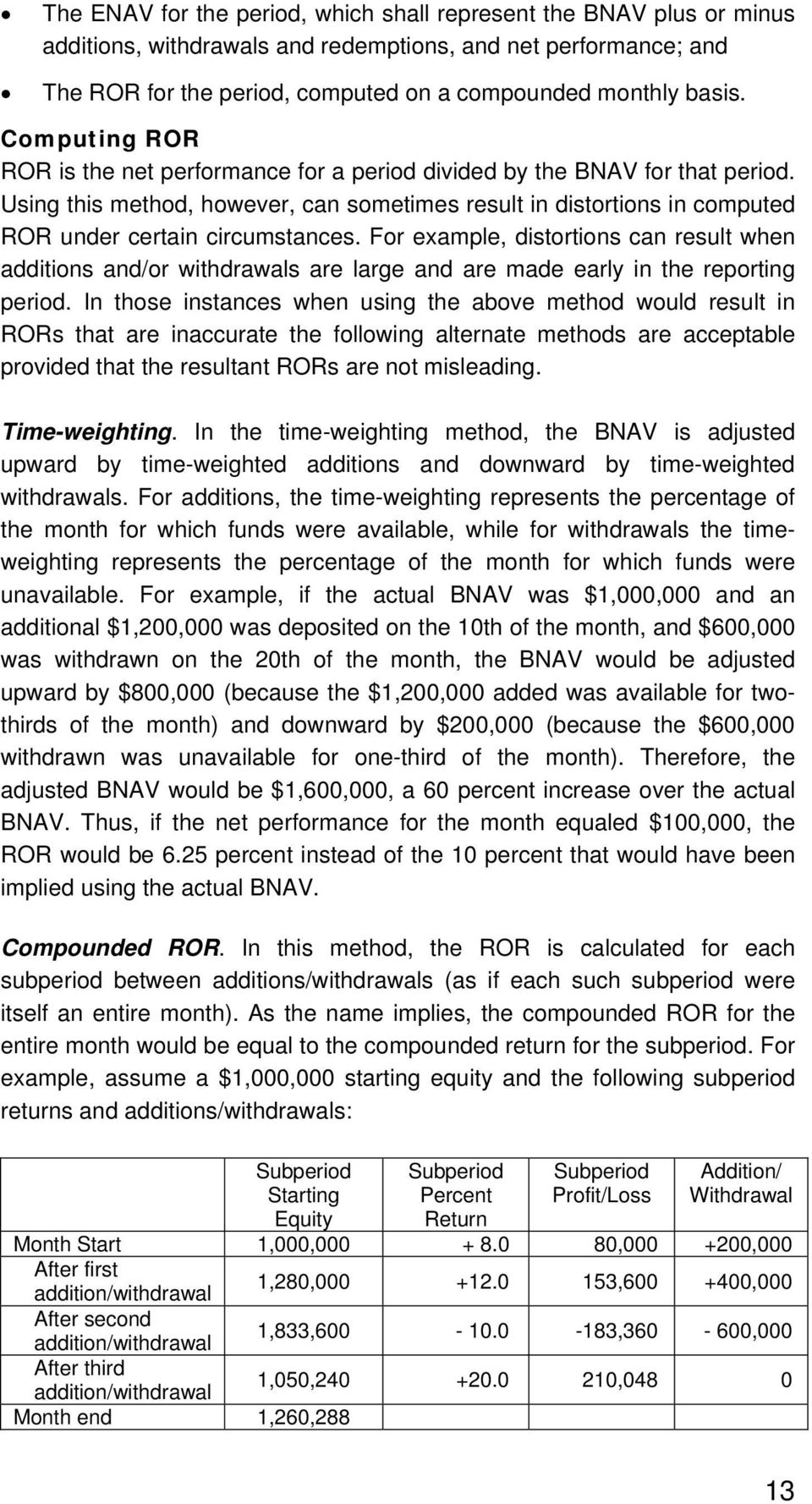
16 In this example, the compounded ROR would be equal to (1.08 x 1.12 x 0.9 x 1.2) 1 = = 30.64% The compounded ROR method will precisely reflect the return realized by accounts that did not experience any additions or withdrawals during the month, given the following set of assumptions: (1) in actual trading, the CTA adjusts the trading leverage daily to account for changes in equity, and (2) the subperiods in the compounded ROR calculation are days. Only Accounts Traded. The only accounts traded (OAT) method calculates the monthly ROR in the conventional manner of dividing the net performance by the BNAV, except that accounts that traded for only part of the month or witnessed material additions/withdrawals during the months would be excluded from the calculations. By excluding these accounts, the calculated figure will reflect the ROR that would have been realized by an investor with an account that was active at the start of the month and held until the end of the month without any additions or withdrawals. In effect, by removing the influence of intramonth additions/withdrawals, the OAT method yields an undistorted actual return figure. Each of the above methods of computing ROR is acceptable if the resultant RORs are not misleading. The registrant is responsible for the accuracy of any method chosen to address the impact of additions and withdrawals upon ROR. Whichever method is selected must be consistently applied from period to period. The registrant may not depart from the chosen method unless performance would otherwise not be properly represented. The method selected for computing ROR must be disclosed in the notes to the performance capsule. Computing ROR for Partially-Funded or Notionally-Funded Accounts When the Nominal Account Size is different than the actual funds on deposit in the client s account, the account is considered to be notionally funded. Nominal Account Size is the actual funds on deposit plus notional funds. CTAs must calculate ROR using the nominal account size. If an account is partially funded, the CTA must maintain written confirmation of the nominal account size agreed to by the client and the CTA. Annual and Year-to-Date Rates of Return Annual RORs can be calculated using the Compounded ROR method described above or the Value Added Monthly Index (VAMI) method. The VAMI method generally assumes an initial investment of $1,000 and shows how such an investment would have fared over a certain period of time. In order to calculate annual ROR using VAMI, you must first calculate the value of the $1,000 investment at the end of each subperiod or month based upon the monthly RORs computed in accordance with one of the above mentioned methods. The calculation would be as follows: 14
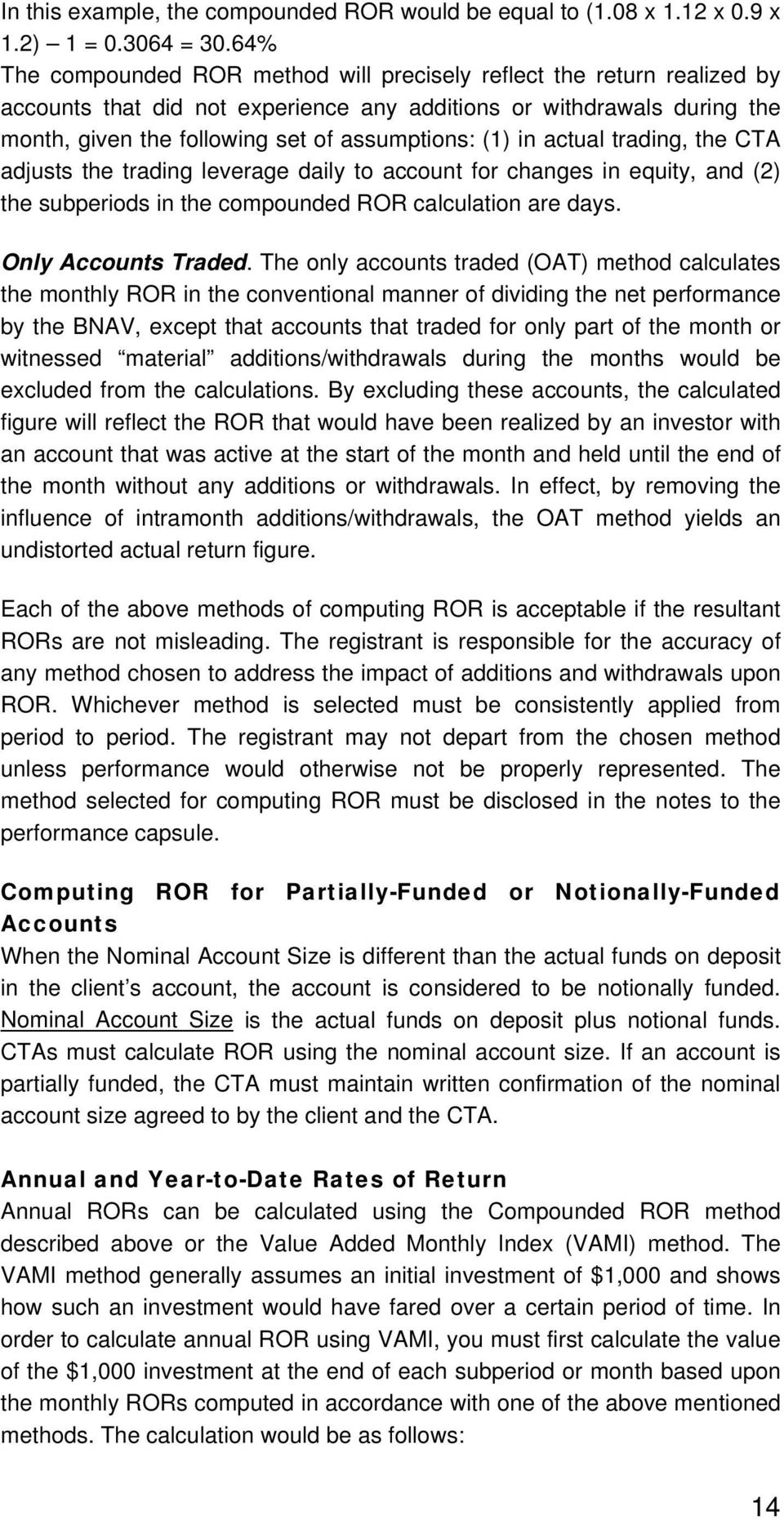
17 In the first month of the period: VAMI for month = (1 + ROR for month) x 1000 For all subsequent months: VAMI for month = (1 + ROR for month) x VAMI for prior month Annual ROR would then be calculated as follows: Annual ROR = (year-end VAMI - $1,000) divided by $1,000. When calculating the annual RORs for subsequent years, the value of the initial investment should be the prior year-end VAMI. Computing Monthly and Peak-to-Valley Draw-Downs Draw-down means losses experienced by a pool or trading program over a specified period. Worst monthly draw-down is simply the trading program s worst monthly percentage ROR. Worst peak-to-valley draw-down is the greatest cumulative percentage decline in month-end net asset value (NAV) due to losses sustained by the accounts during any period in which the initial month-end NAV is not equaled or exceeded by a subsequent month-end NAV. In order to calculate this amount, the firm should calculate a continuous VAMI for the time period presented. Using this method the firm should determine the first month in which the VAMI is not followed by a VAMI that is greater than or equal to that month's VAMI. This would be the first peak. The next peak would be the next month in which the VAMI is greater than the previous peak's VAMI and is followed by a lower VAMI. Once all the peaks have been identified, determine all the months that have the lowest VAMIs during a period between two peaks. These would be the valleys. Then determine the percentage change between each peak and valley using the following calculation: (Valley VAMI Peak VAMI) divided by Peak VAMI The worst peak-to-valley draw-down will be the largest percentage change from a peak to a valley. The peak month and the valley month should be reported in the capsule. A peak-to-valley draw-down that began prior to the beginning of the most recent five calendar years is deemed to have occurred during such five calendar year period. 15
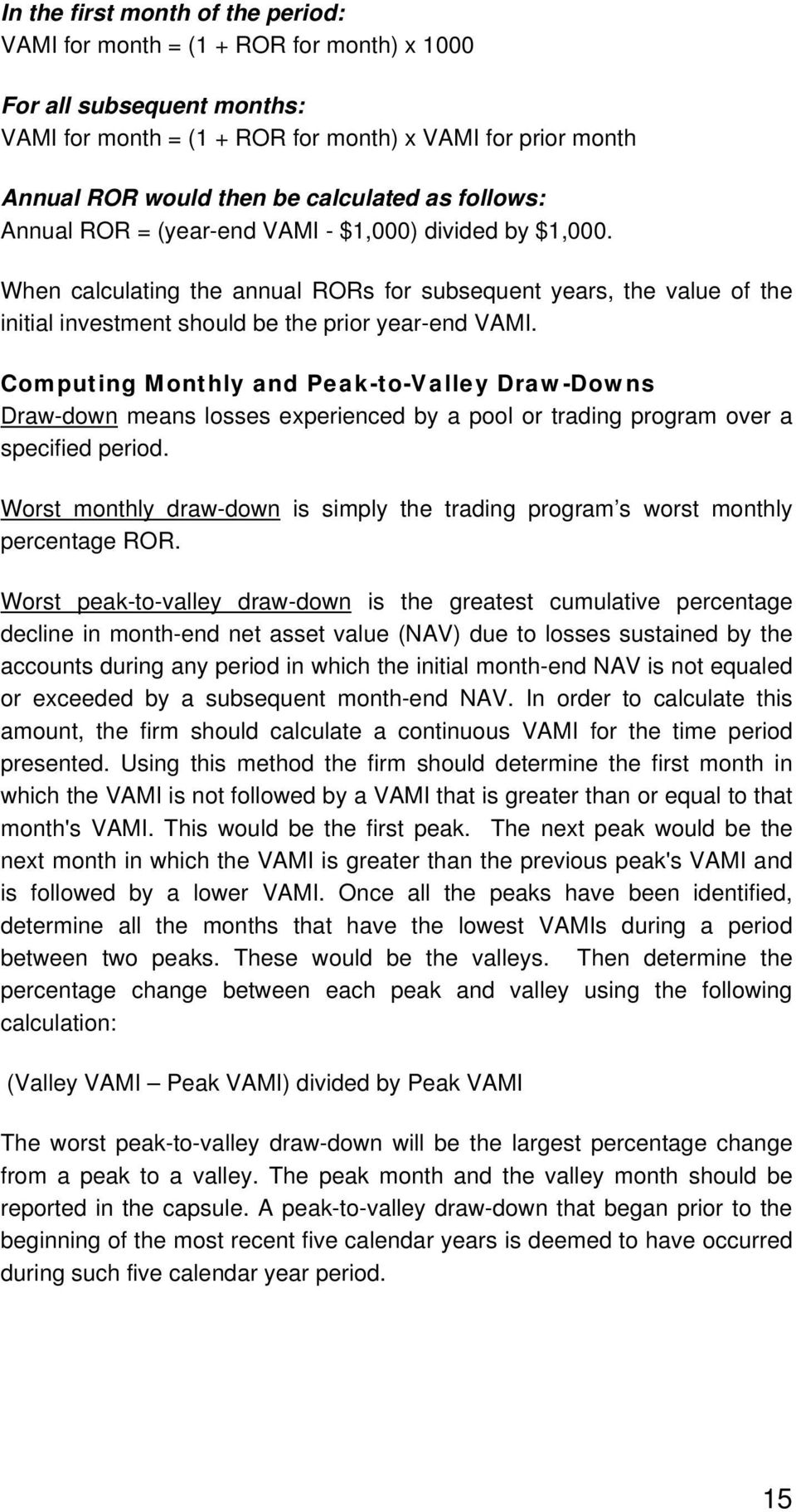
18 SAMPLE PERFORMANCE CAPSULE Below is a sample performance capsule for an offered trading program: Name of CTA (or person trading the account): Name of Trading Program: Sample CTA Offered Trading Program Inception of Trading by CTA (or person trading the account): January 1, 1986 Inception of Trading in Offered Program: January 1, 1989 # of accounts currently traded pursuant to the program: 123 Total nominal assets under management: $30,673,000 Total nominal assets traded pursuant to the program: $21,746,000 Largest monthly draw-down: 16.87%/December 2004 Worst peak-to-valley draw-down: 31.60%/May 2004 April 2005 Number of profitable accounts that have opened and closed: 32 Range of returns experienced by profitable accounts: 1.32% 19.78% Number of losing accounts that have opened and closed: 7 Range of returns experienced by unprofitable accounts: -0.43% % PAST PERFORMANCE IS NOT NECESSARILY INDICATIVE OF FUTURE RESULTS Rate of Return Month January 3.08% 2.43% 1.54% -0.67% -4.45% 0.69% February -0.36% 3.11% -0.89% -3.98% 0.71% -0.82% March 1.54% -0.23% 1.15% 1.82% -0.64% 0.55% April -0.19% 1.16% 0.97% % 1.03% 1.06% May 3.60% 1.54% 1.21% 3.82% 6.05% 0.90% June 6.72% 0.32% 0.51% -0.23% -2.51% 1.12% July 4.79% 1.28% 0.11% 1.16% 0.32% 1.01% August -4.93% 1.12% -0.14% 1.54% 0.75% 0.93% September 1.80% 2.09% 0.56% 0.33% -1.25% 0.99% October 1.34% 0.23% 5.61% -4.65% 1.01% November 1.57% 1.11% 1.22% 2.12% 1.19% December 1.04% 0.32% -1.87% % 1.14% Year 16.72% 18.07% 6.86% -2.76% % 10.20% Draw-down: Losses experienced by the trading program over a specified 16

19 period. (A bar chart may be substituted for the numerical table. The bar chart, if used, must show percentage rate or return on the vertical axis and onemonth increments on the horizontal axis. It must be scaled in such a way as to clearly show month-to-month differences in rate of return and must separately display numerical percentage annual rates of return for the period covered by the bar graph.) Other Performance to be Disclosed In addition to disclosing the past performance of the offered trading program, the Document must also include past performance information for all other accounts directed by the CTA or any of its trading principals in the format described above. The Document, however, need not disclose monthly rates of return for these accounts nor does it need to disclose the number of accounts that opened and closed during the period, or the range of returns those accounts experienced. Proprietary Trading Results Proprietary trading results means the performance of any pool or account in which 50 percent or more of the beneficial interest is owned or controlled by: 1) the CTA or any principal thereof, 2) an affiliate or family member of the CTA, or 3) any person providing services to the account. Proprietary trading results may not be included in a Document unless it is clearly labeled as "Proprietary" and set forth separately after all required and non-required disclosures, together with a discussion of any differences between such performance and the performance of the offered trading program, including, but not limited to, differences in costs, leverage and trading methodology. Pro-forma adjustments must be made for fees and commissions and prepared on a conservative basis. Notes to the table should include complete information on the adjustments made and the performance must be clearly labeled as "Pro-Forma". Hypothetical Results Hypothetical performance results are any performance results derived with the benefit of hindsight. NFA generally discourages the use of hypothetical performance results. However, NFA also recognizes that in certain circumstances the presentation of these results may have some limited utility. Hypothetical, extracted, pro-forma, or simulated results may not be shown for any program for which the CTA has three months of actual trading results trading, whether for customer or proprietary accounts. In situations where a CTA elects to present hypothetical performance results for a trading program which has less than three months of actual performance the CTA must adhere to the following requirements in order to prevent the overemphasis of the hypothetical performance results: 17
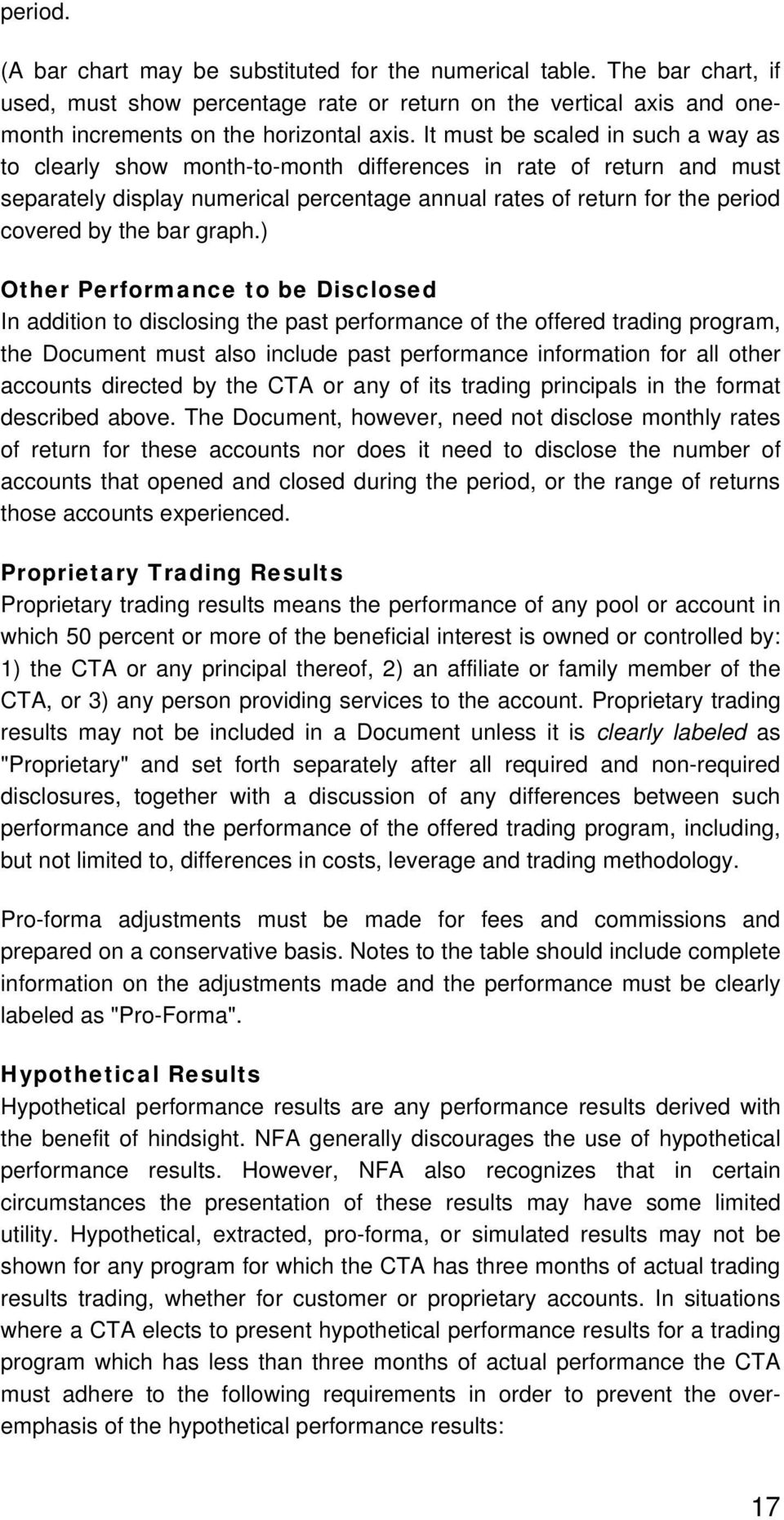
20 The trading results must appear as the last disclosure in the Document. If the CTA has less than one year of experience in directing customer accounts, past performance results must be shown for any proprietary trading over the last five years or over the entire performance history if less than five years. The following disclaimer must be prominently displayed. If the person for whom the hypothetical results are being shown has less than 12 months of actual results, then the disclaimer must immediately precede the hypothetical results, otherwise it may be displayed immediately following the results. If several pages of hypothetical results are shown, the disclaimer may need to be included more than once. HYPOTHETICAL PERFORMANCE RESULTS HAVE MANY INHERENT LIMITATIONS, SOME OF WHICH ARE DESCRIBED BELOW. NO REPRESENTATION IS BEING MADE THAT ANY ACCOUNT WILL OR IS LIKELY TO ACHIEVE PROFITS OR LOSSES SIMILAR TO THOSE SHOWN. IN FACT, THERE ARE FREQUENTLY SHARP DIFFERENCES BETWEEN HYPOTHETICAL PERFORMANCE RESULTS AND THE ACTUAL RESULTS SUBSEQUENTLY ACHIEVED BY ANY PARTICULAR TRADING PROGRAM. ONE OF THE LIMITATIONS OF HYPOTHETICAL PERFORMANCE RESULTS IS THAT THEY ARE GENERALLY PREPARED WITH THE BENEFIT OF HINDSIGHT. IN ADDITION, HYPOTHETICAL TRADING DOES NOT INVOLVE FINANCIAL RISK, AND NO HYPOTHETICAL TRADING RECORD CAN COMPLETELY ACCOUNT FOR THE IMPACT OF FINANCIAL RISK IN ACTUAL TRADING. FOR EXAMPLE, THE ABILITY TO WITHSTAND LOSSES OR TO ADHERE TO A PARTICULAR TRADING PROGRAM IN SPITE OF TRADING LOSSES ARE MATERIAL POINTS WHICH CAN ALSO ADVERSELY AFFECT ACTUAL TRADING RESULTS. THERE ARE NUMEROUS OTHER FACTORS RELATED TO THE MARKETS IN GENERAL OR TO THE IMPLEMENTATION OF ANY SPECIFIC TRADING PROGRAM WHICH CANNOT BE FULLY ACCOUNTED FOR IN THE PREPARATION OF HYPOTHETICAL PERFORMANCE RESULTS AND ALL OF WHICH CAN ADVERSELY AFFECT ACTUAL TRADING RESULTS. If the CTA for whom the hypothetical results are shown has either less than one year of experience in directing customer accounts or trading proprietary accounts, then the disclaimer must also contain the following statement: 18
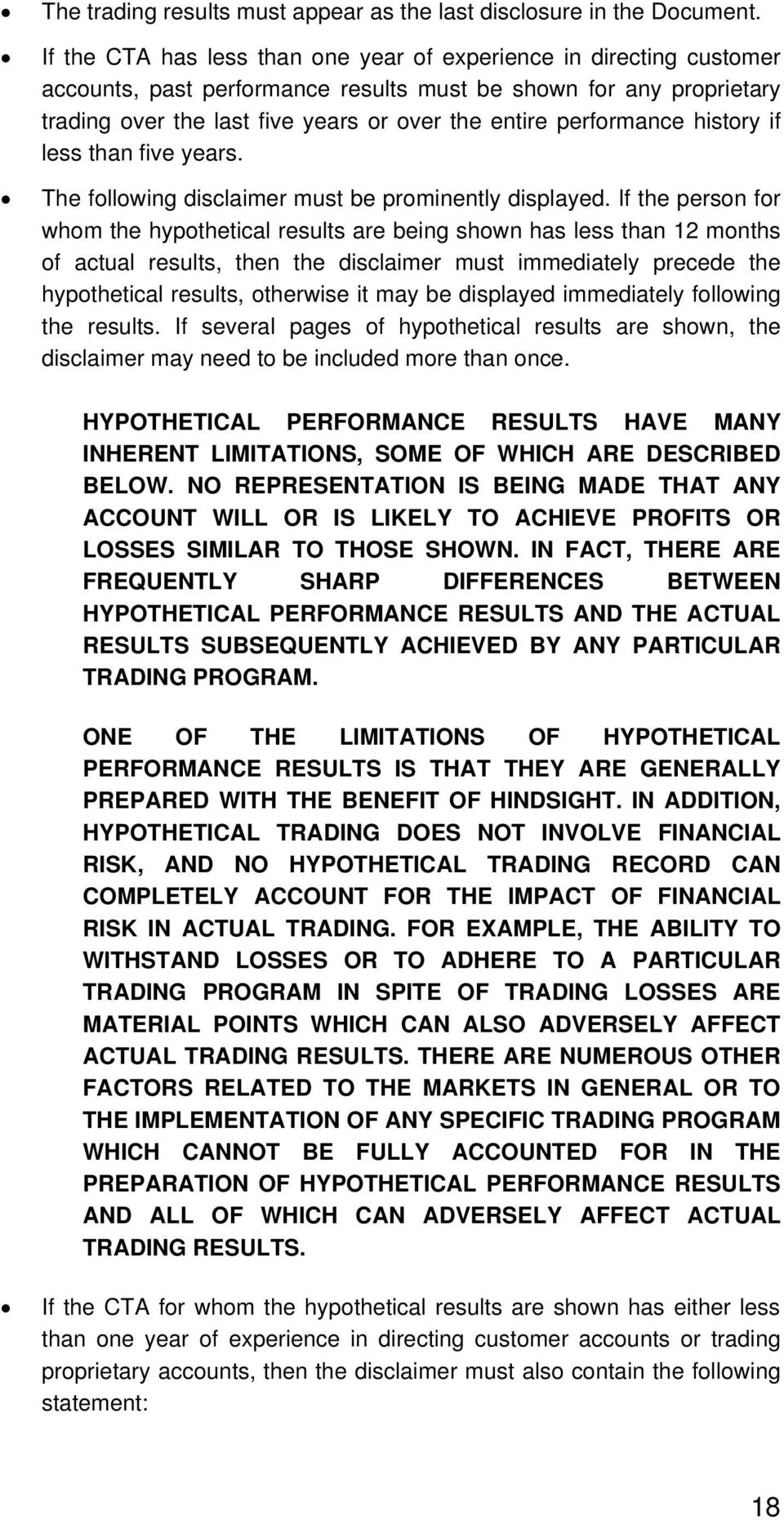
21 (THE CTA) HAS HAD LITTLE OR NO EXPERIENCE IN TRADING ACTUAL ACCOUNTS FOR ITSELF OR FOR CUSTOMERS. BECAUSE THERE ARE NO ACTUAL TRADING RESULTS TO COMPARE TO THE HYPOTHETICAL PERFORMANCE RESULTS, CUSTOMERS SHOULD BE PARTICULARLY WARY OF PLACING UNDUE RELIANCE ON THESE HYPOTHETICAL PERFORMANCE RESULTS. Any hypothetical results must include a description of all material assumptions that were made in preparing the hypothetical results. At a minimum, this description must cover points such as initial investment amount, reinvestment or distribution of profits, commission charges, management and incentive fees, and the method used to determine purchase or sale prices for each trade. Any disclosure which is necessary to place the hypothetical results in their proper context must be made. This may go well beyond the prescribed disclaimer. If a CTA includes or makes reference to a hypothetical composite performance record showing what a multi-advisor account portfolio or pool could have achieved in the past if assets had been allocated among particular trading advisors, the Document must include the following disclaimer: THIS COMPOSITE PERFORMANCE RECORD IS HYPOTHETICAL AND THESE TRADING ADVISORS HAVE NOT TRADED TOGETHER IN THE MANNER SHOWN IN THE COMPOSITE. HYPOTHETICAL PERFORMANCE RESULTS HAVE MANY INHERENT LIMITATIONS, SOME OF WHICH ARE DESCRIBED BELOW. NO REPRESENTATION IS BEING MADE THAT ANY MULTI-ADVISOR MANAGED ACCOUNT OR POOL WILL OR IS LIKELY TO ACHIEVE A COMPOSITE PERFORMANCE RECORD SIMILAR TO THAT SHOWN. IN FACT, THERE ARE FREQUENTLY SHARP DIFFERENCES BETWEEN A HYPOTHETICAL COMPOSITE PERFORMANCE RECORD AND THE ACTUAL RECORD SUBSEQUENTLY ACHIEVED. ONE OF THE LIMITATIONS OF A HYPOTHETICAL COMPOSITE PERFORMANCE RECORD IS THAT DECISIONS RELATING TO THE SELECTION OF TRADING ADVISORS AND THE ALLOCATION OF ASSETS AMONG THOSE TRADING ADVISORS WERE MADE WITH THE BENEFIT OF HINDSIGHT BASED UPON THE HISTORICAL RATES OF RETURN OF THE SELECTED TRADING ADVISORS. THEREFORE, COMPOSITE PERFORMANCE RECORDS INVARIABLY SHOW POSITIVE RATES OF RETURN. ANOTHER INHERENT LIMITATION ON 19
22 THESE RESULTS IS THAT THE ALLOCATION DECISIONS REFLECTED IN THE PERFORMANCE RECORD WERE NOT MADE UNDER ACTUAL MARKET CONDITIONS AND, THEREFORE, CANNOT COMPLETELY ACCOUNT FOR THE IMPACT OF FINANCIAL RISK IN ACTUAL TRADING. FURTHERMORE, THE COMPOSITE PERFORMANCE RECORD MAY BE DISTORTED BECAUSE THE ALLOCATION OF ASSETS CHANGES FROM TIME TO TIME AND THESE ADJUSTMENTS ARE NOT REFLECTED IN THE COMPOSITE. If the CTA for whom the hypothetical results are shown has less than one year of experience allocating assets among particular trading advisors, then the disclaimer must also contain the following statement: (THE CTA) HAS HAD LITTLE OR NO EXPERIENCE ALLOCATING ASSETS AMONG PARTICULAR TRADING ADVISORS. BECAUSE THERE ARE NO ACTUAL ALLCOATIONS TO COMPARE TO THE PERFORMANCE RESULTS FROM THE HYPOTHETICAL ALLOCATIONS, CUSTOMERS SHOULD BE PARTICULARLY WARY OF PLACING UNDUE RELIANCE ON THESE RESULTS. Extracted Performance Extracted performance is when a CTA chooses only one component of its overall past trading results to highlight to customers. The use of extracted performance results is permitted only when a CTA s previous Disclosure Document designated the percentage of assets that would be committed toward that particular component of the overall trading program. For example, if the previous Disclosure Document stated that 25 percent of assets would be dedicated to trading financial futures contracts, and 25 percent were in fact dedicated to trading financial futures contracts, the CTA would be allowed to present the extracted performance of its financial futures trading based on the net asset values equal to 25 percent of the total net asset value. Extracted results must be clearly labeled as "Extracted" and must disclose in an equally prominent fashion the overall actual trading results. 20
23 Disclosure Document Guide for CPOs The Disclosure Document Disclosure Documents for commodity pools must comply with NFA Compliance Rule This rule limits the information that may be included in a pool Disclosure Document. For public commodity pools, the rule requires that Disclosure Documents be prepared in two parts, consisting of a Disclosure Document and a Statement of Additional Information (SAI). The information which can be included in Part 1 of the Document is limited to the information required by the CFTC s Part 4 Regulations and any other information that the SEC or state securities administrators require to be included in Part 1 of a two-part Document. Any information the CPO elects to disclose that is not specifically required by the CFTC, the SEC, or state securities administrators must appear in the SAI. The CPO of a public pool must provide both the Disclosure Document and the SAI to prospective clients prior to accepting or receiving any funds. Disclosure Documents for private placement commodity pools are not required to be prepared in two parts unless the CPO chooses to disclose information other than that required by the CFTC s Part 4 Regulations in which case such information must appear in an SAI. CPOs of private commodity pools are not required to deliver an SAI to all prospective clients but must inform clients that one exists and provide it to them upon request. The SAI may be either bound together with the Disclosure Document or provided separately. If a CPO prepares an SAI, the cover page of the SAI should include a date as well as the name of the commodity pool. In addition, it should include the date of the Disclosure Document and a statement that it is the second part of a two-part document and should be read in conjunction with the pool s Disclosure Document. Finally, a table of contents should immediately follow the SAI cover page. NFA Compliance Rule 2-35 also requires that Disclosure Documents for commodity pools be written using plain English principles. In particular, Disclosure Documents should be written: In the active voice; Using short sentences and paragraphs; Breaking up the Document into short sections, using titles and subtitles that specifically describe the contents of each section; Using words that are definite, concrete, and part of everyday language; Avoiding legal jargon and highly technical terms; 21
24 Using glossaries to define technical terms that cannot be avoided; Avoiding multiple negatives; Saying something once where it is most important rather than repeating information; Using tables and bullet lists, where appropriate. Disclosure Documents which adhere to the guidelines set forth pursuant to the Rule should generally be 30 pages or less. Disclosure Documents for more complex pools; however, such as multi-advisor pools or principalprotected pools may be slightly longer. When reviewing Documents for compliance with this Rule, NFA wants to avoid making determinations on what information must be included in order for a prospective participant to understand the fundamental characteristics of a pool. NFA feels that the CPO of a pool is better able to make these decisions. However, at the same time, NFA will review the Documents to ensure they provide the information in a manner which is manageable and easy to understand. Disclosure Requirements for Commodity Pools Disclosure Documents ( Document ) for pools must include the following information: Cover Page The cover page of the Document must prominently include the Cautionary Statement below. Prominently means displayed in CAPITAL letter and in boldface type. THE COMMODITY FUTURES TRADING COMMISSION HAS NOT PASSED UPON THE MERITS OF PARTICIPATING IN THIS POOL NOR HAS THE COMMISSION PASSED ON THE ADEQUACY OR ACCURACY OF THIS DISCLOSURE DOCUMENT. Risk Disclosure Statement The applicable Risk Disclosure Statement must be prominently displayed immediately after the cover page of the Document. If the pool trades commodity interests, the following Risk Disclosure Statement is required. RISK DISCLOSURE STATEMENT YOU SHOULD CAREFULLY CONSIDER WHETHER YOUR FINANCIAL CONDITION PERMITS YOU TO PARTICIPATE IN A COMMODITY POOL. IN SO DOING, YOU SHOULD BE AWARE 22
25 THAT COMMODITY INTEREST TRADING CAN QUICKLY LEAD TO LARGE LOSSES AS WELL AS GAINS. SUCH TRADING LOSSES CAN SHARPLY REDUCE THE NET ASSET VALUE OF THE POOL AND CONSEQUENTLY THE VALUE OF YOUR INTEREST IN THE POOL. IN ADDITION, RESTRICTIONS ON REDEMPTIONS MAY AFFECT YOUR ABILITY TO WITHDRAW YOUR PARTICIPATION IN THE POOL. FURTHER, COMMODITY POOLS MAY BE SUBJECT TO SUBSTANTIAL CHARGES FOR MANAGEMENT, AND ADVISORY AND BROKERAGE FEES. IT MAY BE NECESSARY FOR THOSE POOLS THAT ARE SUBJECT TO THESE CHARGES TO MAKE SUBSTANTIAL TRADING PROFITS TO AVOID DEPLETION OR EXHAUSTION OF THEIR ASSETS. THIS DISCLOSURE DOCUMENT CONTAINS A COMPLETE DESCRIPTION OF EACH EXPENSE TO BE CHARGED THIS POOL AT PAGE (insert page number) AND A STATEMENT OF THE PERCENTAGE RETURN NECESSARY TO BREAK EVEN, THAT IS, TO RECOVER THE AMOUNT OF YOUR INITIAL INVESTMENT, AT PAGE (insert page number). THIS BRIEF STATEMENT CANNOT DISCLOSE ALL THE RISKS AND OTHER FACTORS NECESSARY TO EVALUATE YOUR PARTICIPATION IN THIS COMMODITY POOL. THEREFORE, BEFORE YOU DECIDE TO PARTICIPATE IN THIS COMMODITY POOL, YOU SHOULD CAREFULLY STUDY THIS DISCLOSURE DOCUMENT, INCLUDING A DESCRIPTION OF THE PRINCIPAL RISK FACTORS OF THIS INVESTMENT, AT PAGE (insert page number). If the pool trades foreign futures or options contracts on foreign exchanges, the Risk Disclosure Statement must further state the following: YOU SHOULD ALSO BE AWARE THAT THIS COMMODITY POOL MAY TRADE FOREIGN FUTURES OR OPTIONS CONTRACTS. TRANSACTIONS ON MARKETS LOCATED OUTSIDE THE UNITED STATES, INCLUDING MARKETS FORMALLY LINKED TO A UNITED STATES MARKET, MAY BE SUBJECT TO REGULATIONS WHICH OFFER DIFFERENT OR DIMINISHED PROTECTION TO THE POOL AND ITS PARTICIPANTS. FURTHER, UNITED STATES REGULATORY AUTHORITIES MAY BE UNABLE TO COMPEL THE ENFORCEMENT OF THE RULES OF REGULATORY AUTHORITIES OR MARKETS IN NON-UNITED STATES JURISDICTIONS WHERE TRANSACTIONS FOR THE POOL MAY BE EFFECTED. 23
26 If the potential liability of a participant in the pool is greater than the amount of the participant s contribution for the purchase of an interest in the pool and the profits earned thereon, whether distributed or not, the CPO must prominently disclose the following in the last paragraph of the Risk Disclosure Statement: ALSO, BEFORE YOU DECIDE TO PARTICIPATE IN THIS POOL, YOU SHOULD NOTE THAT YOUR POTENTIAL LIABILITY AS A PARTICIPANT IN THIS POOL FOR TRADING LOSSES AND OTHER EXPENSES OF THE POOL IS NOT LIMITED TO THE AMOUNT OF YOUR CONTRIBUTION FOR THE PURCHASE OF AN INTEREST IN THE POOL AND ANY PROFITS EARNED THEREON. A COMPLETE DESCRIPTION OF THE LIABILITY OF A PARTICIPANT IN THIS POOL IS EXPLAINED MORE FULLY IN THIS DISCLOSURE DOCUMENT. If the pool may engage in retail Forex transactions, the Risk Disclosure Statement must further state: YOU SHOULD ALSO BE AWARE THAT THIS COMMODITY POOL MAY ENGAGE IN OFF-EXCHANGE FOREIGN CURRENCY TRADING. SUCH TRADING IS NOT CONDUCTED IN THE INTERBANK MARKET. THE FUNDS THAT THE POOL USES FOR OFF-EXCHANGE FOREIGN CURRENCY TRADING WILL NOT RECEIVE THE SAME PROTECTIONS AS FUNDS USED TO MARGIN OR GUARANTEE EXCHANGE-TRADED FUTURES AND OPTION CONTRACTS. IF THE POOL DEPOSITS SUCH FUNDS WITH A COUNTERPARTY AND THAT COUNTERPARTY BECOMES INSOLVENT, THE POOL S CLAIM FOR AMOUNTS DEPOSITED OR PROFITS EARNED ON TRANSACTIONS WITH THE COUNTERPARTY MAY NOT BE TREATED AS A COMMODITY CUSTOMER CLAIM FOR PURPOSES OF SUBCHAPTER IV OF CHAPTER 7 OF THE BANKRUPTCY CODE AND THE REGULATIONS THEREUNDER. THE POOL MAY BE A GENERAL CREDITOR AND ITS CLAIM MAY BE PAID, ALONG WITH THE CLAIMS OF OTHER GENERAL CREDITORS, FROM ANY MONIES STILL AVAILABLE AFTER PRIORITY CLAIMS ARE PAID. EVEN POOL FUNDS THAT THE COUNTERPARTY KEEPS SEPARATE FROM ITS OWN FUNDS MAY NOT BE SAFE FROM THE CLAIMS OF PRIORITY AND OTHER GENERAL CREDITORS. Table of Contents The Document must contain a table of contents showing, by subject matter, the location of the disclosures made in the Disclosure Document. The table of contents must appear immediately following the Risk Disclosure Statement. Introduction The forepart of the Document must include the name, address of the main business office, main business telephone number and form of organization of 24
27 both the pool and the CPO. If the mailing address of the main business office is a post office box number or is not within the United States, its territories or possessions, the Document must state where the books and records will be kept and made available for inspection. The forepart of the Document must state if the pool is privately offered pursuant to section 4(2) of the Securities Act of 1993, as amended or pursuant to Regulation D thereunder, a multiadvisor pool, a principal-protected pool and/or if it is continuously offered. If the pool is not continuously offered, the closing date of the offering must be disclosed. Finally, the date (month, day, and year) when the CPO first intends to use the Disclosure Document and the break-even point per unit of initial investment must be included in the forepart of the Document. The break-even point must be expressed as a dollar amount and a percentage of the minimum unit of initial investment. A CPO may not use a Disclosure Document more than 12 months after the date of the Document. For purposes of the Document, the forepart has been defined as the first few pages following the Table of Contents. The CPO and its Principals The Document must identify, by name, the CPO and all its principals and identify those principals that will make trading decisions for the pool. The Document must disclose the business background of the CPO and each of the principals who will participate in making trading or operational decisions for the pool, or who supervise persons so engaged, for the five years preceding the date of the Document. Officers and Directors are included among the principals whose business background is required. The business background of the CPO should include the effective date of its NFA membership and CFTC registration(s). If the CPO was organized within the last five years, then its business background should include the date it organized. This section should also include a reference to the location in the Document where any of the required past performance disclosures for the CPO is presented. If the CPO has been previously registered under any other name, this information must also be included. The business background for each required principal should include the starting and ending dates (month and year) of each period of employment, the full name and main business of each employer (employer's CFTC registration may be used, if applicable), the principal s functions while so employed, and the principal's active registration dates. All gaps in employment must be explained. This section should also include a reference to the location in the Document where any of the required past performance disclosures for the principal is presented. If business background information is beyond the required past five years, it must include the same level of detail as disclosed above for the entire period 25
28 provided. See NFA Interpretative Notice I (May 11, 2010): NFA provides guidance for disclosure of business background information by commodity pool operators and commodity trading advisors. The Trading Manager A trading manager is any person, other than the pool's CPO, who has sole or partial authority to allocate pool assets to CTAs or investee pools. If the pool will utilize a trading manager, the name of the trading manager and any of its principals must be disclosed in the Document. In addition, the business background of the trading manager and each principal who will participate in making trading or operational decisions for the pool or who supervise persons so engaged must be disclosed for the five years preceding the date of the Document. The Investment Program The Document must disclose the types of commodity interests and other interests that the pool will trade, including the approximate percentage of the pool s assets that will be used to trade commodity interests, securities and other types of interests, categorized by type of commodity or market sector, type of security (debt, equity, preferred equity), whether traded or listed on a regulated exchange market, maturity ranges and investment ratings, as applicable. The Document must disclose the extent to which such interests are subject to state or federal regulation, regulation by non-united States jurisdiction or rules of a self-regulatory organization, the custodian or other entity (e.g., bank or broker-dealer) which will hold such interests and the jurisdiction in which such interests will be held, or pool assets will be invested, if other than the United States. The Document must include a description of the trading and investment programs and policies that will be followed by the pool, and any material restrictions or limitations on trading. This description must include, if applicable, an explanation of the systems used to select CTAs, investee pools and types of investment activity to which pool assets will be committed. In addition, if the CPO has chosen a method for how FCMs and/or RFEDs carrying the pool's accounts treat offsetting positions other than to close out all offsetting positions or to close out offsetting positions on other than a firstin, first-out basis, then the description of the trading and investment programs must disclose the method. Use of Proceeds The Document must disclose the manner in which the pool will fulfill its margin requirements and the approximate percentage of the pool s assets that will be held in segregation pursuant to the Act and the Commission s regulations thereunder. If the pool will fulfill its margin requirements with other than cash deposits, the nature of such deposits must be disclosed and, 26
29 if assets deposited by the pool as margin or as security deposit generate income, the Document must state to whom that income will be paid. The Futures Commission Merchant and/or RFED The Document must identify, if known, the name of the futures commission merchant (FCM) and/or retail foreign exchange dealer (RFED) through which the pool will execute its trades. The Introducing Broker If the pool will use an IB to introduce its trades, the name of the IB must be disclosed in the Document. Other Forex Counterparties If the pool will use a counterparty not registered as an FCM or RFED, the name of that counterparty must be disclosed in the Document. Other eligible counterparties are specified under Section 2(c)(2)(B)(i)(II) of the CEA and include U.S. financial institutions, SEC registered brokers or dealers (or registered affiliates), certain FCM affiliates, and financial holding companies as defined under the Bank Holding Company Act of The CTA(s) The Document must identify, by name, each major CTA. A major CTA is any CTA that is currently or will be allocated 10 percent or more of the pool s assets. The Document must also disclose the names of all principals of these CTAs as well as identify those principals that will make trading decisions for the pool. The Document must disclose the business background(s) of the CTA(s) and each principal who will participate in making trading or operational decisions for the pool, or who will supervise persons so engaged, for the five years preceding the date of the Document. The Document must disclose the location in the Document where any of the required past performance disclosures for such principals is presented. The Document must disclose the respective percentage of pool assets allocated to each CTA, a description of the nature and operation of the trading programs each CTA will follow, including the types of interests traded pursuant to such programs, and each CTA s historical experience trading such programs including material information as to volatility, leverage and rates of return and the length of time during which the CTA has traded such program. If the pool is organized as a series pool, then a major CTA is determined based on whether the CTA is currently or will be allocated 10 percent or more of the series' assets. 27
30 Investee Pools The Document must disclose the percentage allocation of pool assets invested in any major investee pool. A major investee pool is any pool in which 10 percent or more of the offered pool s net asset value is invested. For each major investee pool, the Document must include a description of the nature and operation of such pools, including for each pool the types of interests traded, material information as to volatility, leverage and rates of return for such pool and the period of its operation. The Document must disclose the business background(s) of each major investee pool's CPO and each principal of the investee pool's CPO who will participate in making trading or operational decisions for the pool, or who will supervise persons so engaged, for the five years preceding the date of the Document. The Document must disclose the location in the Document where any of the required past performance disclosures for such principals is presented. If the pool is organized as a series pool, then a major investee pool is determined based on whether the series has invested 10 percent or more of its assets into the investee pool. Principal Risk Factors The Document must include a discussion of the principal risk factors of participation in the offered pool. This discussion must include, without limitation, the risks relating to volatility, leverage, liquidity, and counterparty creditworthiness, as applicable to the types of trading programs to be followed, trading structures to be employed and investment activity (including retail forex transactions) expected to be engaged in by the offered pool. The CPO should examine all aspects of participation in the offered pool that may require disclosure of additional risk factors such as day trading, electronic trading issues, concentration risk, the use of options, the use of stops, foreign exchange risk, SFPs, forwards, EFPs, FOREX, etcetera. Fees and Expenses The Document must include a complete description of each fee, commission and other expense, which was incurred by the pool for its preceding fiscal year, and those expected to be incurred by the pool for its current fiscal year. The description must include, without limitation: Management fees; Brokerage fees and commissions, including interest income paid to FCMs and/or RFEDs, and any fees incurred to maintain an open position in retail forex transactions; Fees and commissions paid in connection with trading advice provided to the pool; Fees and expenses incurred within investments in investee pools, 28
31 investee funds and other collective investment vehicles, which fees and expenses must be disclosed separately for each investment tier; Incentive fees; Any allocation to the CPO, or any agreement or understanding that provides the CPO with the right to receive a distribution, where such allocation or distribution is greater than a pro rata share of the pool s profits based on the percentage of capital contributions made by the CPO; Commissions or other benefits, including trailing commissions paid or that may be paid or accrue, directly or indirectly, to any person in connection with the solicitation of participations in the pool; Professional and general administrative fees and expenses, including legal and accounting fees and office supplies expenses; Organizational and offering expenses; Clearance fees and fees paid to national exchanges and self-regulatory organizations; For principal-protected pools, any direct or indirect costs to the pool associated with providing the protection feature; Any costs or fees included in the spread between bid and asked prices for retail forex transactions; and Any other direct or indirect cost. In addition: Where any fee, commission or other expense is determined by reference to a base amount including, but not limited to, net assets, allocation of assets, gross profits, net profits or net gains, the Document must explain how such base amount will be calculated. Where any fee, commission or other expense is based on an increase in the value of the pool, the Document must specify how that increase is calculated, the period of time during which the increase is calculated, the fee, commission or other expense to be charged at the end of that period and the value of the pool at the time payment of the fee, commission or other expense commences. Where any fee, commission or other expense of the pool has been paid or is to be paid by a person other than the pool, the Document must disclose the nature, the amount and the person paying the fee, commission, or other expense. 29
32 Break-Even Analysis In order to ensure customers are aware of the impact fees and expenses have on the potential profitability of their investments, CPOs are required to disclose in a tabular presentation a calculation of the pool s break-even point or the amount of trading income required for the pool s net asset value (NAV) per unit at the end of one year to equal the selling price per unit. The breakeven point must be expressed as a dollar amount and a percentage of the minimum unit of initial investment. In order to calculate the break-even point, the CPO must determine the amount of all fees and expenses, exclusive of incentive fees, that are anticipated to be incurred by the pool during the first year of the investment. The total of these fees and expenses less the amount of any interest income expected to be earned by the pool represents the preliminary gross trading profits before incentive fees that would be necessary for the pool to retain its initial NAV per unit at the end of the first year. In some situations it will be necessary to include in the calculation of the break-even point the additional trading profit that would be necessary to overcome any incentive fees to be incurred. This situation will arise whenever the incentive fee is based on something other than net profits, or when losses are not carried forward. In addition, it will arise when a CTA is trading a pool and the pool incurs expenses that are not deducted from the CTA s net performance in calculating the CTA s incentive fee. In order to calculate the additional trading profit necessary to overcome an incentive fee, you must first determine the incentive fees that would be incurred if the preliminary gross trading profits arrived at above were achieved and then divide that amount by (1 incentive fee rate). For example, if the incentive fee is 25 percent, the denominate would be (1.25), or.75. The fees and expenses which are used to arrive at the preliminary gross trading profits will depend on the base amount that is used to assess the fee. If the break-even point is expected to vary significantly based upon the size of the offering, as in the case of fixed expenses, then a second break-even point can be calculated based upon an assumed amount of total funds raised. In addition, the Document should also include what the break-even point would be if the minimum or maximum proceeds were raised. If there are redemption fees, they must be clearly shown and considered part of the total cost and reflected in the break-even analysis. If pool participants receive some or all of the interest income generated by the pool, the expected interest income should be deducted from the expenses which must be covered by trading profits to return the customer to the level of his initial investment. The estimate of that interest income must 30
33 include the assumed interest rate, and that rate must reflect current cash market information. If any interest income is to be paid to the pool operator, or to anyone other than the pool participants, that fact and an estimate of the amount must also be clearly disclosed. Below is an example of a break-even analysis: Selling Price per Unit (1) $1, Upfront Syndication and Selling Expense (1) $50.00 General Partner's Management Fee (2) 9.50 Fund Operating Expenses (3) Trading Advisor's and Trading Manager's Management Fees (4) Trading Advisor's and Trading Manager's Incentive Fees on Trading Profits (5) The General Partner's Incentive Fees on Trading Profits (6) 0 Brokerage Commissions and Trading Fees (7) Less Interest Income (8) (28.50) Amount of Trading Income Required for the Fund's Net Asset Value per Unit (Redemption Value) at the End of One Year to Equal the Selling Price per Unit $ Percentage of Initial Selling Price per Unit 13.52% Explanatory Notes: (1) Investors will initially purchase units at $1,000. After the commencement of trading, units will be purchased at the Fund's month-end Net Asset Value per unit. A 5% upfront syndication and selling charge will be deducted from each subscription to reimburse the Fund, the General Partner and/or the Clearing Broker for the syndication and selling expenses incurred on behalf of the Fund. (2) Except as set forth in these explanatory notes, the illustration is predicated on the specific rates or fees contracted by the Fund with the General Partner, the Trading Manager, the Trading Advisor, and the 31
34 Clearing Broker, as described in "Fees, Compensation and Expenses." The Fund's General Partner will be paid a monthly management fee of 1/12 of 1% of Allocated Net Assets. (3) The Fund's actual accounting, auditing, legal and other operating expenses will be borne by the Fund. These expenses are expected to amount to approximately 2.05% of the Fund's Net Asset Value. (4) The Fund's Trading Advisor will be paid a monthly management fee of 1/12 of 2% of Allocated Net Assets. The fund's Trading Manager will be paid a monthly management fee of 1/12 of 1% of allocated Net Assets. (5) The Trading Advisor and Trading Manager will receive incentive fees of 20% and 5%, respectively, of Trading Profits exclusive of interest income. The $17.17 of incentive fees shown above is equal to 25% of the net of total trading income of $135.17, minus $38 of brokerage commissions and trading fees and $28.50 of management fees. (6) In the above example, no incentive fee for the General Partner is included in the calculation. The General Partner also makes the trading decisions for the pool and charges a quarterly incentive fee based upon New Net High Profits. New Net High Profits is the net of all management fees, brokerage commissions and operating expenses and as such, the General Partner does not receive an incentive fee until the pool generates trading income sufficient to offset such expenses. Based on the above analysis, the General Partner would need to earn more than $ of gross trading income per unit before it would be entitled to an incentive fee. (7) Brokerage commissions (including any spread on forex transactions) and trading fees are estimated at 4% of Net Asset Value. (8) The Fund will earn interest on margin deposits with its Clearing Broker. Based on a current assumed interest rate of 3.5%, interest income is estimated at 3% of Net Asset Value. Conflicts of Interest The Document must include a full description of any actual or potential conflicts of interest regarding any aspect of the pool on the part of: The CPO; The pool s trading manager, if any; Any major CTA; The CPO of any major investee pool; Any principal of the above; 32
35 Any other person providing services to the pool or soliciting participants for the pool, or acting as a counterparty to the pool's retail forex transactions; and Any other material conflict involving the pool. Included in the description of such conflicts must be any arrangement whereby a person may benefit, directly or indirectly, from the maintenance of the pool s account with an FCM and/or RFED, or from the introduction of such account to an FCM and/or RFED by an IB (such as payment for order flow or soft dollar arrangements) or from an investment of pool assets in investee pools or funds or other investments. Some common conflicts include: 1. If the CPO or major CTA (or principal thereof) receives per-trade compensation, the Document must disclose that there is an incentive to overtrade the account to increase his compensation. This statement is required even if the CPO, the major CTA or a principal receives commission rebates in his capacity as an IB or AP. 2. If the CPO or major CTA (or principal thereof) is an AP of the FCM/RFED that the pool uses, the Document must disclose that there is an incentive to trade the account actively to increase the compensation that his employer will receive. 3. If the CPO or major CTA (or a principal thereof) receives office space or other soft dollar benefits from an FCM, RFED, or IB (e.g. charts, analysis software, etc.), the Document must disclose that this arrangement may dispose them to trade more actively. Related Party Transactions The Document must contain a full description, including a discussion of the costs to the pool, of any material transactions or arrangements for which there is no publicly disseminated price between the pool and any person affiliated with a person providing services to the pool. Litigation The Document must disclose any material administrative, civil or criminal action, whether pending or concluded, within five years preceding the date of the Document, against the following persons (a concluded action that resulted in adjudication on the merits in favor of such person need not be disclosed): The CPO, the pool s trading manager, the pool s major CTAs, and the operators of the pool s major investee pools; Any principal of the foregoing; and The pool s FCM and/or RFED and its IBs, if any. 33
36 With respect to an FCM and/or RFED or an IB, an action is material if: The action would be required to be disclosed in the notes to the FCM s, RFED's or IB s financial statements prepared pursuant to generally accepted accounting principles; The action was brought by the Commission (unless the action was concluded, did not result in civil monetary penalties exceeding $50,000, and did not involve allegations of fraud or other willful misconduct); or The action was brought by any other federal or state regulatory agency, a non-united States regulatory agency or a self-regulatory organization and involved allegations of fraud or other willful misconduct. Where a matter is material, its description must include a recital of the nature of the action, the parties involved, the allegations or findings, the status of the action and the size of any fine or settlement. Trading for its own Account If the CPO, the pool s trading manager, any of the pool s CTAs or any principals of the foregoing trades or intends to trade commodity interests or forex for their own account, the Document must disclose whether participants will be permitted to inspect the records of such trades and any written policies related to such trading. Principal-Protected Pools Principal-protected pools or guaranteed pools are those which are designed to limit the loss of the initial investment of participants. If the pool is a principal-protected pool, this must be stated in the forepart of the Document. In addition, the Document must describe the nature of the principal protection feature, the manner by which such protection will be achieved, including sources of funding, and what conditions must be satisfied for participants to receive the benefits of such protections. The Document must also specify when the protection feature becomes operative and disclose, in the breakeven analysis, the costs of purchasing and carrying the assets to fund the principal protection feature or other limitations on risk, expressed as a percentage of the price of a unit of participation. Transferability and Redemption The Document must include a complete description of any restrictions upon the transferability of a participant s interest in the pool and a complete description of the frequency, timing and manner in which a participant may redeem interests in the pool. The description must specify the following: How the redemption value of a participant s interest will be calculated; The conditions under which a participant may redeem its interest, including the cost associated therewith; 34
37 The terms of any notification required and the time between the request for redemption and payment; Any restrictions on the redemption of a participant s interest, including any restrictions associated with the pool s investments; and Any liquidity risk relative to the pool s redemption capabilities. Liability of Pool Participants The Document must disclose the extent to which a participant may be held liable for obligations of the pool in excess of the funds contributed by the participant for the purchase of an interest in the pool. Distribution of Profits and Taxation The Document must disclose the pool s policies with respect to payment of distributions from profits or capital and the frequency of such payments. The Document must also disclose the federal income tax effects of such payments for a participant, including a discussion of the federal income tax laws applicable to the form of organization of the pool and to payments from the pool. If the pool is specifically structured to accomplish certain federal income tax objectives, the CPO must explain those objectives, the manner in which they will be achieved and any related risks. Inception of Trading The Document must disclose the minimum and maximum subscriptions that will be necessary for the pool to commence trading and the maximum subscriptions that may be contributed to the pool. The Document must disclose the maximum period of time the pool will hold funds prior to the commencement of trading and the disposition of funds received if the pool does not receive the necessary amount to commence trading, including the period of time within which the disposition will be made. The Document must state where these funds received prior to the commencement of trading will be deposited and to whom any income received from these deposits will be paid. Ownership in the Pool The Document must disclose the extent of any ownership in the pool held by the CPO, the pool s trading manager, the pool s major CTAs, the operators of the pool s major investee pools and any principals of the foregoing. Reporting The Document must state that the CPO is required to provide all participants with either monthly or quarterly statements of account as well as a certified annual report. Account statements must be distributed at least monthly in the case of pools with net assets of more than $500,000 at the beginning of the pool s fiscal year, otherwise at least quarterly. 35
38 Material Information A CPO is obligated to disclose all material information to existing or prospective pool participants even if not specifically required by Commission or NFA rules. Supplemental Information If any information other than that required by Commission rules, the antifraud provisions of the Act, other federal or state laws or regulations, rules of a self-regulatory agency or laws of a non-united States jurisdiction, is provided, such information: Must be included in the SAI; May not be misleading in content or presentation or inconsistent with required disclosures; Is subject to the antifraud provisions of the Act, Commission rules and NFA rules regarding the use of promotional material; May include supplemental non-performance information relating to a required disclosure with the related required disclosure provided that it is included after the related required disclosures; May include any other supplemental non-performance information as long as this information is presented after all required disclosures. Required Performance Disclosures All performance information presented in the Document must be current as of a date not more than three months preceding the date of the Document. All required performance information must be presented for the most recent five calendar years and year-to-date ors for the life of the pool or account if in existence less than five years. If the offered pool has at least a three-year operating history and at least 75% of the contributions to the pool were made by people unaffiliated with the pool s CPO, CTA or trading manager, the performance of the offered pool is all that is required to be disclosed in the Document. If the offered pool has less than a three-year operating history the Document must include the following: The performance of the offered pool. If the offered pool has no operating history, the Document must include the following statement prominently displayed: THIS POOL HAS NOT COMMENCED TRADING AND DOES NOT HAVE ANY PERFORMANCE HISTORY. The performance of each other pool operated or account traded by the CPO (and by the trading manager if the offered pool has a trading manager). If the CPO or the trading manager has not operated any commodity pool for at least three years, the Document must disclose the 36
39 performance of each other pool operated or account traded by the trading principals of the CPO (and the trading manager, if applicable). If neither the CPO or trading manager (if any), nor any of the principals thereof has operated any other pools or traded any other accounts, the Document must include the following statement prominently displayed: NEITHER THIS POOL OPERATOR (TRADING MANAGER, IF APPLICABLE) NOR ANY OF ITS TRADING PRINCIPALS HAS PREVIOUSLY OPERATED ANY OTHER POOLS OR TRADED ANY OTHER ACCOUNTS. If the CPO or trading manager is a sole proprietorship, reference to its trading principals may be deleted from the above statement. The performance of any accounts (including pools) directed by each major CTA. If a major CTA has not previously traded accounts, the Document must include the following statement prominently displayed: (name of the major commodity trading advisor), A COMMODITY TRADING ADVISOR THAT HAS DISCRETIONARY TRADING AUTHORITY OVER (percentage of the pool s funds available for commodity interest trading allocated to that trading advisor) PERCENT OF THE POOL S COMMODITY INTEREST TRADING HAS NOT PREVIOUSLY DIRECTED ANY ACCOUNTS. The performance of any major investee pool. If the major investee pool has not commenced trading, the Document must include the following statement prominently displayed: (name of the major investee pool), AN INVESTEE POOL THAT IS ALLOCATED (percentage of the pool assets allocated to that investee pool) PERCENT OF THE POOL S ASSETS HAS NOT COMMENCED TRADING. The Document must provide a summary description of the performance history of all other CTAs and investee pools not required above, including monthly return parameters (highs and lows), historical volatility and degree of leverage, and any material differences between the performance of such advisors and pools as compared to that of the offered pool s major trading advisors and major investee pools. Performance of the Offered Pool The performance of the offered pool must be identified as such and presented first. The performance of the offered pool must include monthly rates of return (RORs) for the five most recent calendar years and year to date, either in a numerical table or in a bar graph, and annual and year-todate RORs for the same time period. The disclosure of the past performance of the offered pool must also include the following information: The name of the pool; 37
40 A statement as to whether the pool is privately offered, a multi-advisor pool, or a principal protected pool; The date of inception of trading; The aggregate gross capital subscriptions to the pool; The pool s current net asset value; The largest monthly draw-down during the most recent five calendar years and year-to-date, expressed as a percentage of the pool s net asset value and the month and year of the draw-down. A definition of the term draw-down must be included in the capsule. The worst peak-to-valley draw-down during the most recent five calendar years and year-to-date, expressed as a percentage of the pool s net asset value, as well as the period the draw-down occurred. The period begins with the peak month and year and ends with the valley month and year; and Any past performance presentation must be preceded with the following statement, prominently displayed: PAST PERFORMANCE IS NOT NECESSARILY INDICATIVE OF FUTURE RESULTS. Computing Aggregate Gross Capital Subscriptions The aggregate gross capital subscriptions is the total amount of all additions to the pool over its entire operating history. This should be a gross figure and not reduced by the withdrawals from the pool. Computing ROR Refer to the Disclosure Requirements of CTAs for instructions on computing RORs. Annual and Year-to-Date Rates of Return Refer to the Disclosure Requirements of CTAs for instructions on computing annual and year-to-date RORs. Computing Monthly and Peak-to-Valley Draw-Downs Refer to the Disclosure Requirements for CTAs for instructions on computing monthly and peak-to-valley draw-downs. 38
41 Sample Performance Capsule Below is a sample performance capsule for an offered trading program: Name of Pool: Type of Pool: Sample Pool Privately offered Inception of Trading: January 1, 1986 Aggregate Subscriptions: $1,673,000 Current Net Asset Value: $1,925,000 Largest monthly draw-down: 16.87%/December 2004 Worst peak-to-valley draw-down: 31.60%/May April 2005 PAST PERFORMANCE IS NOT NECESSARILY INDICATIVE OF FUTURE RESULTS Rate of Return Month January 3.08% 2.43% 1.54% -0.67% -4.45% 0.69% February -0.36% 3.11% -0.89% -3.98% 0.71% -0.82% March 1.54% -0.23% 1.15% 1.82% -0.64% 0.55% April -0.19% 1.16% 0.97% % 1.03% 1.06% May 3.60% 1.54% 1.21% 3.82% 6.05% 0.90% June 6.72% 0.32% 0.51% -0.23% -2.51% 1.12% July 4.79% 1.28% 0.11% 1.16% 0.32% 1.01% August -4.93% 1.12% -0.14% 1.54% 0.75% 0.93% September 1.80% 2.09% 0.56% 0.33% -1.25% 0.99% October 1.34% 0.23% 5.61% -4.65% 1.01% November 1.57% 1.11% 1.22% 2.12% 1.19% December 1.04% 0.32% -1.87% % 1.14% Year 16.72% 18.07% 6.86% -2.76% % 10.20% Draw-down: Losses experienced by the trading program over a specified period. (A bar chart may be substituted for the numerical table. The bar chart, if used, must show percentage rate or return on the vertical axis and onemonth increments on the horizontal axis. It must be scaled in such a way as to clearly show month-to-month differences in rate of return and must separately display numerical percentage annual rates of return for the period covered by the bar graph.) Other Performance to be Disclosed If additional performance information is required to be disclosed, such other performance information need not include monthly RORs. Performance data for pools of the same class as the offered pool for which performance is 39
42 required to be presented must appear after the performance of the offered pool and be presented on a pool-by-pool basis. For example, if the offered pool is privately offered, the performance of all other privately offered pools for which performance is required to be presented must be presented on a pool-by-pool basis. Other classes of pools include principal-protected pools and non-principal- protected pools and multi-advisor pools vs. single advisor pools. Performance data for pools of a different class than the offered pool must be presented less prominently, and, unless such presentation would be misleading, may be presented in composite form. Only pools of the same class may be included in a composite and they may not differ materially with respect to rate of return. Furthermore, if pool performance is presented in a composite, the Document must disclose how the composite was developed and the material differences among the pools included in the same composites including differences in leverage and the different trading programs used by the pools. Monthly rates of return need not be presented for any pool or account other than the offered pool. Rather, only annual and year-to-date rates of return for the pools for the most recent five calendar years and year-to-date are required to be presented. Proprietary Trading Results Proprietary trading results are the performance of any pool or account in which 50 percent or more of the beneficial interest is owned or controlled by: 1) the CTA or any principal thereof, 2) an affiliate or family member of the CTA, or 3) any person providing services to the account. Proprietary trading results may not be included in a Document unless it is clearly labeled as "Proprietary" and set forth separately after all required and non-required disclosures, together with a discussion of any differences between such performance and the performance of the offered pool, including, but not limited to, differences in costs, leverage and trading methodology. Pro-forma adjustments must be made for fees and commissions and prepared on a conservative basis. Notes to the table should include complete information on the adjustments made and the performance must be clearly labeled as "Pro-Forma". Hypothetical Results Hypothetical performance results are any performance results derived with the benefit of hindsight. NFA generally discourages the use of hypothetical performance results. However, NFA also recognizes that in certain circumstances the presentation of these results may have some limited utility. Hypothetical, extracted, pro-forma, or simulated results may not be shown for any pool for which the CPO has three months of actual trading results trading. In situations where a CPO elects to present hypothetical performance results for a pool which has less than three months of actual performance the CPO must adhere to the following requirements in order to prevent the over-emphasis of the hypothetical performance results: 40
43 The trading results must appear as the last disclosure in the Document. If the CPO has less than one year of experience in directing customer accounts, past performance results must be shown for any proprietary trading over the last five years or over the entire performance history if less than five years. The following disclaimer must be prominently displayed. If the person for whom the hypothetical results are being shown has less than 12 months of actual results, then the disclaimer must immediately precede the hypothetical results, otherwise it may be displayed immediately following the results. If several pages of hypothetical results are shown, the disclaimer may need to be included more than once. HYPOTHETICAL PERFORMANCE RESULTS HAVE MANY INHERENT LIMITATIONS, SOME OF WHICH ARE DESCRIBED BELOW. NO REPRESENTATION IS BEING MADE THAT ANY ACCOUNT WILL OR IS LIKELY TO ACHIEVE PROFITS OR LOSSES SIMILAR TO THOSE SHOWN. IN FACT, THERE ARE FREQUENTLY SHARP DIFFERENCES BETWEEN HYPOTHETICAL PERFORMANCE RESULTS AND THE ACTUAL RESULTS SUBSEQUENTLY ACHIEVED BY ANY PARTICULAR TRADING PROGRAM. ONE OF THE LIMITATIONS OF HYPOTHETICAL PERFORMANCE RESULTS IS THAT THEY ARE GENERALLY PREPARED WITH THE BENEFIT OF HINDSIGHT. IN ADDITION, HYPOTHETICAL TRADING DOES NOT INVOLVE FINANCIAL RISK, AND NO HYPOTHETICAL TRADING RECORD CAN COMPLETELY ACCOUNT FOR THE IMPACT OF FINANCIAL RISK IN ACTUAL TRADING. FOR EXAMPLE, THE ABILITY TO WITHSTAND LOSSES OR TO ADHERE TO A PARTICULAR TRADING PROGRAM IN SPITE OF TRADING LOSSES ARE MATERIAL POINTS WHICH CAN ALSO ADVERSELY AFFECT ACTUAL TRADING RESULTS. THERE ARE NUMEROUS OTHER FACTORS RELATED TO THE MARKETS IN GENERAL OR TO THE IMPLEMENTATION OF ANY SPECIFIC TRADING PROGRAM WHICH CANNOT BE FULLY ACCOUNTED FOR IN THE PREPARATION OF HYPOTHETICAL PERFORMANCE RESULTS AND ALL OF WHICH CAN ADVERSELY AFFECT ACTUAL TRADING RESULTS. If the CPO for whom the hypothetical results are shown has either less than one year of experience in directing customer accounts or trading proprietary accounts, then the disclaimer must also contain the following statement: 41
44 (THE CPO) HAS HAD LITTLE OR NO EXPERIENCE IN TRADING ACTUAL ACCOUNTS FOR ITSELF OR FOR CUSTOMERS. BECAUSE THERE ARE NO ACTUAL TRADING RESULTS TO COMPARE TO THE HYPOTHETICAL PERFORMANCE RESULTS, CUSTOMERS SHOULD BE PARTICULARLY WARY OF PLACING UNDUE RELIANCE ON THESE HYPOTHETICAL PERFORMANCE RESULTS. Any hypothetical results must include a description of all material assumptions that were made in preparing the hypothetical results. At a minimum, this description must cover points such as initial investment amount, reinvestment or distribution of profits, commission charges, management and incentive fees, and the method used to determine purchase or sale prices for each trade. Any disclosure which is necessary to place the hypothetical results in their proper context must be made. This may go well beyond the prescribed disclaimer. If a CPO includes or makes reference to a hypothetical composite performance record showing what a multi-advisor account portfolio or pool could have achieved in the past if assets had been allocated among particular trading advisors, the Document must include the following disclaimer: THIS COMPOSITE PERFORMANCE RECORD IS HYPOTHETICAL AND THESE TRADING ADVISORS HAVE NOT TRADED TOGETHER IN THE MANNER SHOWN IN THE COMPOSITE. HYPOTHETICAL PERFORMANCE RESULTS HAVE MANY INHERENT LIMITATIONS, SOME OF WHICH ARE DESCRIBED BELOW. NO REPRESENTATION IS BEING MADE THAT ANY MULTI-ADVISOR MANAGED ACCOUNT OR POOL WILL OR IS LIKELY TO ACHIEVE A COMPOSITE PERFORMANCE RECORD SIMILAR TO THAT SHOWN. IN FACT, THERE ARE FREQUENTLY SHARP DIFFERENCES BETWEEN A HYPOTHETICAL COMPOSITE PERFORMANCE RECORD AND THE ACTUAL RECORD SUBSEQUENTLY ACHIEVED. ONE OF THE LIMITATIONS OF A HYPOTHETICAL COMPOSITE PERFORMANCE RECORD IS THAT DECISIONS RELATING TO THE SELECTION OF TRADING ADVISORS AND THE ALLOCATION OF ASSETS AMONG THOSE TRADING ADVISORS WERE MADE WITH THE BENEFIT OF HINDSIGHT BASED UPON THE HISTORICAL RATES OF RETURN OF THE SELECTED TRADING ADVISORS. THEREFORE, COMPOSITE PERFORMANCE RECORDS INVARIABLY SHOW POSITIVE RATES OF RETURN. ANOTHER INHERENT LIMITATION ON THESE RESULTS IS THAT THE ALLOCATION DECISIONS REFLECTED IN THE PERFORMANCE RECORD WERE NOT 42
45 MADE UNDER ACTUAL MARKET CONDITIONS AND, THEREFORE, CANNOT COMPLETELY ACCOUNT FOR THE IMPACT OF FINANCIAL RISK IN ACTUAL TRADING. FURTHERMORE, THE COMPOSITE PERFORMANCE RECORD MAY BE DISTORTED BECAUSE THE ALLOCATION OF ASSETS CHANGES FROM TIME TO TIME AND THESE ADJUSTMENTS ARE NOT REFLECTED IN THE COMPOSITE. If the CPO for whom the hypothetical results are shown has less than one year of experience allocating assets among particular trading advisors, then the disclaimer must also contain the following statement: (THE CPO) HAS HAD LITTLE OR NO EXPERIENCE ALLOCATING ASSETS AMONG PARTICULAR TRADING ADVISORS. BECAUSE THERE ARE NO ACTUAL ALLCOATIONS TO COMPARE TO THE PERFORMANCE RESULTS FROM THE HYPOTHETICAL ALLOCATIONS, CUSTOMERS SHOULD BE PARTICULARLY WARY OF PLACING UNDUE RELIANCE ON THESE RESULTS. Extracted Performance Extracted performance is when a CPO chooses only one component of its overall past trading results to highlight to customers. The use of extracted performance results is permitted only when a CPO s previous Disclosure Document designated the percentage of assets which would be committed toward that particular component of the overall trading program. For example, if the previous Disclosure Document stated that 25 percent of a pool s assets would be dedicated to trading financial futures contracts, and if 25 percent of the pool s assets were in fact dedicated to trading financial futures contracts, the CPO would be allowed to present the extracted performance of its financial futures trading based on net asset values equal to 25 percent of the pool s total net asset value. Extracted results must be clearly labeled as "Extracted" and must disclose in an equally prominent fashion the overall actual trading results. 43
46 Filing Disclosure Documents and the Review Process NFA is responsible for reviewing all Disclosure Documents, including Disclosure Documents for CTAs, privately offered commodity pools, and certain public commodity pools (i.e., those that are required to register their securities under the Securities Act of 1933). Prior to using a Disclosure Document, a CPO/CTA must submit the Document to NFA and receive an acceptance letter via from NFA confirming that the Document can be used to solicit. All Disclosure Documents must be filed through NFA's Electronic Disclosure Document Filing System. NFA will not accept any Documents filed through any other mode (i.e., , fax, or regular mail). Through this system, firms may track the status of their submissions online, in real-time, and have instantaneous access to NFA's comment and acceptance letters. Additionally, the system archives all correspondence, including filed Disclosure Documents and NFA's comment or acceptance letters, creating an electronic file cabinet that is easily accessible to CPOs and CTAs at any time. Firms will receive confirmation of receipt upon filing. Copies of all subsequent amendments or updated Documents must be submitted to NFA using the same procedures. NFA s goal is to complete its initial review of a Document within 14 days after NFA receives it. Once the review is complete, NFA will inform the CPO/CTA that the Document is accepted or deficient. The CPO/CTA is required to correct the deficiencies and re-submit the Document to NFA for review before the Document will be accepted. NFA s review is designed to ensure that Disclosure Documents contain all of the required information and that such information is consistent with information on record with NFA. However, NFA s review process does not attempt to verify the accuracy of the information contained in the Disclosure Document. The CPO/CTA is responsible for ensuring it does not use a Disclosure Document that it knows to be materially inaccurate or incomplete. During the course of an NFA examination, a CPO/CTA s Disclosure Document may be reviewed again, with the objective of ensuring consistency between the firm s business operations and the information included in the Disclosure Document. As a result, the receipt of an acceptance letter upon filing a Disclosure Document with NFA may not prevent NFA or the CFTC from raising issues with regard to the Document in the future. A staff member will be assigned to review a Disclosure Document within 24 hours after receipt. Contact NFA s Information Center at (312) or (800) to speak with a member of NFA s Disclosure Document Team concerning Disclosure Document preparation and other issues relating to CPOs and CTAs. 44
47 Subsequent Filings. A CPO/CTA who resubmits a previously reviewed or accepted Disclosure Document must submit two copies: a clean copy and a marked copy of the Document that identifies all deletions and additions that have been made to the Document previously filed with NFA. This may be done, for example, by striking through deletions and underlining additions. A clean copy is the same Document, except without the deletions and additions highlighted. NFA will refuse to review and accept any subsequent filings that fail to include with it a copy of the Document identifying the additions and deletions. Instant Filings. Once a CPO/CTA has filed a Disclosure Document with NFA that has been accepted, subsequent Disclosure Documents may be eligible for instant filing, which results in an expedited review process. Instant filing is available for Disclosure Documents that: do not contain material changes from a previous filing that NFA has accepted, or for new pool offerings that are substantially similar to Disclosure Documents of other pools operated by the CPO that NFA has accepted, or for pools that will be operated pursuant to an exemption under CFTC Regulation 4.12(b). To qualify for instant filing relief, the CPO/CTA must check the appropriate responses during the filing process by requesting instant filing treatment of the Document and indicating that there are no material changes from a previous filing that NFA has accepted. Furthermore, the CPO/CTA must highlight any changes from the previous filing in the body of the Disclosure Document. NFA usually reviews Disclosure Documents that qualify for instant filing within three business days. In those cases, NFA relies on the CPO/CTA firm s representation of the changes made to the Disclosure Document and generally limits its review to only those changes the firm identifies. 45
48 National Futures Association 300 South Riverside Plaza Suite 1800 Chicago, IL National Futures Association 46
DISCLOSURE DOCUMENT OF GT CAPITAL CTA
 DISCLOSURE DOCUMENT OF GT CAPITAL CTA A COMMODITY TRADING ADVISOR REGISTERED WITH THE COMMODITY FUTURES TRADING COMMISSION AND A MEMBER FIRM OF THE NATIONAL FUTURES ASSOCIATION GT Capital CTA 1616 Michael
Market Speculators LLC
 Market Speculators LLC Disclosure Document and Managed Accounts Agreement THE COMMODITY FUTURES TRADING COMMISSION HAS NOT PASSED UPON THE MERITS OF PARTICIPATING IN THIS TRADING PROGRAM NOR HAS THE COMMISSION
is held and maintained at GAIN Capital who serves as the clearing agent and counterparty to your trades. GAIN Capital is a
 Last updated July 2, 2015 FOREX RISK DISCLOSURE STATEMENT Forex trading involves significant risk of loss and is not suitable for all investors. Increasing leverage increases risk. Before deciding to trade
T.T.G. Financial, Inc. Commodities Trading Advisor Disclosure Document. Tripudium, Triumphus and Gnaritus Programs
 T.T.G. Financial, Inc. Commodities Trading Advisor Disclosure Document Tripudium, Triumphus and Gnaritus Programs THE COMMODITY FUTURES TRADING COMMISSION HAS NOT PASSED UPON THE MERITS OF PARTICIPATING
FOUR SEASONS COMMODITIES CORPORATION Commodity Trading Advisor
 DISCLOSURE DOCUMENT FOUR SEASONS COMMODITIES CORPORATION Commodity Trading Advisor Four Seasons Commodities Corporation 5815 Joyce Way Dallas, Texas 75225 214-368-2500 [email protected] THE
CFTC Part 4 Exemption Easy Reference Guide. Click on the exemption type for more information on how to file and requirements for each exemption.
 Click on the exemption type for more information on how to file and requirements for each exemption. Exemption Type General Relief Who Qualifies Exemptions from Registration 4.13(a)(1) (Pool level for
RISK DISCLOSURE STATEMENT FOR FOREX TRADING AND IB MULTI- CURRENCY ACCOUNTS
 RISK DISCLOSURE STATEMENT FOR FOREX TRADING AND IB MULTI- CURRENCY ACCOUNTS Rules of the U.S. National Futures Association ("NFA") require Interactive Brokers ("IB") to provide you with the following Risk
York Business Associates, L.L.C. (d/b/a TransAct Futures) and Subsidiary FINANCIAL STATEMENTS AND INDEPENDENT AUDITORS' REPORT.
 York Business Associates, L.L.C. (d/b/a TransAct Futures) and Subsidiary FINANCIAL STATEMENTS AND INDEPENDENT AUDITORS' REPORT December 31, 2014 CONSOLIDATED STATEMENT OF FINANCIAL CONDITION December
Risk Disclosure Statement
 Risk Disclosure Statement The risk of loss in trading commodity futures contracts can be substantial. You should, therefore, carefully consider whether such trading is suitable for you in light of your
Forex Transactions. A Regulatory Guide
 Forex Transactions A Regulatory Guide March 2015 Revisions: Updated to incorporate amendments to Bylaw 301, NFA Financial Requirements Section 1, 13 and 14; NFA Compliance Rule 2-38 and 2-48; Interpretive
Qualified Eligible Person ("QEP") Definition
 Qualified Eligible Person ("QEP") Definition Although this summary is intended to offer useful and practical information, CFTC Regulation 4.7 sets forth the complete definition of a Qualified Eligible
A Guide to NFA Compliance Rules 2-29 and 2-36
 A Guide to NFA Compliance Rules 2-29 and 2-36 Communications with the Public and Promotional Material April 2015 Revisions: Updated the Hypothetical Performance section to further clarify the requirements
Ditsch Trading, LLC. A Commodity Trading Advisor Registered with the US Commodity Futures Trading Commission
 Ditsch Trading, LLC A Commodity Trading Advisor Registered with the US Commodity Futures Trading Commission Executive Office: 9047 Poplar Avenue, Suite 101 Germantown, TN, 38138 Telephone: (901) 766-4446
Summary Prospectus September 28, 2015 PNC S&P 500 Index Fund Class A PIIAX Class C PPICX Class I PSXIX Class R4 PSPEX Class R5 PSFFX
 Summary Prospectus September 28, 2015 PNC S&P 500 Index Fund Class A PIIAX Class C PPICX Class I PSXIX Class R4 PSPEX Class R5 PSFFX Before you invest, you may want to review the Fund s Prospectus, which
i-cthru Inc. Form ADV Part 2A Client Brochure
 i-cthru Inc. Tamarind Hill Road 33 Upper Prince s Quarter Saint Maarten, Dutch Caribbean Mailing address 1562 First Ave # 205-2863 New York, NY 10028-4004 USA http://www.i-cthru.com Form ADV Part 2A Client
COMMODITY POOL OPERATOR REGISTRATION AND ONGOING COMPLIANCE
 COMMODITY POOL OPERATOR REGISTRATION AND ONGOING COMPLIANCE The Commodity Futures Trading Commission (the CFTC ) regulates the trading of commodity interests, which include instruments such as commodity
PAM Contrarian S&P 500 Stock Index Trading Program TRADING ADVISORY AGREEMENT
 TRADING ADVISORY AGREEMENT THIS TRADING ADVISORY AGREEMENT, made and effective the day of 2010 by and between: Paskewitz Asset Management, LLC 100 Plainfield Avenue, Suite 1 Edison, NJ 08817 (herein, PAM
RISK DISCLOSURE STATEMENT
 RISK DISCLOSURE STATEMENT 1. Trading in margined FX involves a high degree of risk including the risk of loss of the Customer s entire Risk Capital deposited with PTFX. Losses, in some cases, have the
FOREXer Advisory ADVISORY AGREEMENT. Last update of this DisclosureDocument is Aug 1 st, 2013.
 FOREXer Advisory ADVISORY AGREEMENT Last update of this DisclosureDocument is Aug 1 st, 2013. TRADING ADVISORY AGREEMENT This Trading Advisory Agreement (the Agreement ) is entered into as of the Date:-------------------by
Client Acknowledgement. Risk Warning Notice for CFDs
 Please read this document fully. IMPORTANT NOTICE Client Acknowledgement Clients (including account applicants) of CMC Markets Singapore Pte. Ltd. ( CMC Markets ) should be aware of the risks involved
Southwest Managed Investments, LLC. Opening An Account
 Southwest Managed Investments, LLC Opening An Account If after carefully considering the merits and inherent risks of having Southwest Managed Investments, LLC trade a futures account and after having
Commodity Pool Operators and Commodity Trading Advisors:
 Commodity Pool Operators and Commodity Trading Advisors: Key Registration and Compliance Considerations for Fund Sponsors, Managers, and Personnel November 18, 2014 Joshua Sterling Morgan, Lewis & Bockius
Forex Account Application
 In order to expedite your account opening process, if you have been working with a Representative, please enter that person s name below: Representative s Name: _ Promotional Code: _ Leverage 1:50 1:100
Brown Advisory Strategic Bond Fund Class/Ticker: Institutional Shares / (Not Available for Sale)
 Summary Prospectus October 30, 2015 Brown Advisory Strategic Bond Fund Class/Ticker: Institutional Shares / (Not Available for Sale) Before you invest, you may want to review the Fund s Prospectus, which
Part 2A of Form ADV: Firm Brochure
 Part 2A of Form ADV: Firm Brochure Item 1 Cover Page A. VL Capital Management LLC 55 West Church Street Orlando, FL 32801 Mailing Address: P.O. Box 1493 Orlando, FL 32802 Phone: (407) 412-6298 Effective
BRIARWOOD CAPITAL MANAGEMENT INC. MANAGED ACCOUNT AGREEMENT
 BRIARWOOD CAPITAL MANAGEMENT INC. MANAGED ACCOUNT AGREEMENT THIS MANAGED ACCOUNT AGREEMENT (the "Agreement") is made by and between BRIARWOOD CAPITAL MANAGEMENT INC., a New York corporation (the "Advisor")
MONUMENTFX MANAGED FOREX ACCOUNT
 MONUMENTFX MANAGED FOREX ACCOUNT NOVEMBER 2012 TABLE OF CONTENTS MonumentFX Summary.. 3 Our Firm.... 3-4 Program Introduction. 4 MonumentFX Philosophy.... 5 Performance History. 6 Consistent Outperformance.
Amendments to. Companion Policy 31-103CP Registration Requirements, Exemptions and Ongoing Registrant Obligations
 Amendments to Companion Policy 31-103CP Registration Requirements, Exemptions and Ongoing Registrant Obligations This document shows the relevant portions of the Companion Policy as amended. The changes
Selected Marketing Issues for Investment Advisers and Private Funds
 August 2013 Selected Marketing Issues for Investment Advisers and Private Funds Marketing in the alternative asset space is subject to significant regulatory constraints and is therefore rife with risk.
CIPI Soundbite: CPO/CTA Registration & non-us Funds
 CIPI Soundbite: CPO/CTA Registration & non-us Funds Citibank International Plc, Ireland Branch October 2012 Glossary You must learn to talk clearly. The jargon of scientific terminology which rolls off
Market Linked Certificates of Deposit
 Market Linked Certificates of Deposit This material was prepared by Wells Fargo Securities, LLC, a registered brokerdealer and separate non-bank affiliate of Wells Fargo & Company. This material is not
Chapter 374 PIMCO CommodityRealReturn SM DJ-AIGCI SM TRAKRS SM Futures
 Chapter 374 PIMCO CommodityRealReturn SM DJ-AIGCI SM TRAKRS SM Futures 37400. SCOPE OF CHAPTER This chapter is limited in application to trading in PIMCO CommodityRealReturn SM DJ-AIGCI SM TRAKRS SM (
Retail Forex Transactions A Regulatory Guide
 Retail Forex Transactions A Regulatory Guide November 2003 Table of Contents Introduction...1 Registration...2 Counterparties...2 Associated Persons...2 Introducing Entities...2 Account Managers...3 Pool
Introducing the potential for equity powered return with principal protection
 This series is available Introducing the potential for equity powered return with principal protection Enjoy full principal protection Invest for growth or income Consider this investment if: You want
JPMORGAN CHASE & CO FORM FWP. (Free Writing Prospectus - Filing under Securities Act Rules 163/433) Filed 07/16/14
 JPMORGAN CHASE & CO FORM FWP (Free Writing Prospectus - Filing under Securities Act Rules 163/433) Filed 07/16/14 Address 270 PARK AVE 38TH FL NEW YORK, NY 10017 Telephone 2122706000 CIK 0000019617 Symbol
Your rights will expire on October 30, 2015 unless extended.
 DIVIDEND AND INCOME FUND 11 Hanover Square New York, NY 10005 September 28, 2015 Re: Rights Offering. Prompt action is requested. Dear Fellow Shareholder: Your rights will expire on October 30, 2015 unless
If you have any questions, please visit altavra.com, email [email protected], or call 1-800-998-7870
 Account Setup ALTAVRA To setup your managed futures account: Review the program documentation. This will often include both a Disclosure Document and an Advisory Agreement. Many of these documents can
RISK DISCLOSURE STATEMENT FOR SECURITY FUTURES CONTRACTS
 RISK DISCLOSURE STATEMENT FOR SECURITY FUTURES CONTRACTS This disclosure statement discusses the characteristics and risks of standardized security futures contracts traded on regulated U.S. exchanges.
M.S. CAPITAL MANAGEMENT LTD
 M.S. CAPITAL MANAGEMENT LTD DISCLOSURE DOCUMENT February 17, 2015 20 B Grange Road Mount Eden Auckland 1024 New Zealand +64 9 630-8411 PURSUANT TO AN EXEMPTION FROM THE COMMODITY FUTURES TRADING COMMISSION
APPLICATION FOR CONTRACTS FOR DIFFERENCE (CFD) TRADING FACILITY
 Version No: V002/201100606 APPLICATION FOR CONTRACTS FOR DIFFERENCE (CFD) TRADING FACILITY A Customer s Particulars Customer Name NRIC Trading A/C No Trading Representative (TR) Code Telephone No (Home)
Margin Account Agreement
 IMPORTANT TO READ This includes and incorporates by reference the Day-Trading Risk Disclosure Statement and the Truth-in-Lending Statement attached hereto (together, the Agreement ). Acknowledgments and
PROTECTION OF CUSTOMER FUNDS FREQUENTLY ASKED QUESTIONS
 PROTECTION OF CUSTOMER FUNDS Version 4.0 REVISED NOVEMBER 2014 2 This document, first issued in February 2012, has been prepared by members of the FIA Law and Compliance Division and contains questions
The Merchant Securities FTSE 100. Hindsight II Note PRIVATE CLIENT ADVISORY
 The Merchant Securities FTSE 100 Hindsight II Note Our first FTSE-100 Hindsight Note is now fully subscribed; however, as a result of exceptional investor demand we are launching the FTSE- 100 Hindsight
CERTIFICATE OF DEPOSIT DISCLOSURE STATEMENT April 2014
 The information contained in this Disclosure Statement may not be modified by any oral representation made prior or subsequent to the purchase of your Certificate of Deposit. CERTIFICATE OF DEPOSIT DISCLOSURE
INFORMATION CIRCULAR: ALPS ETF TRUST
 INFORMATION CIRCULAR: ALPS ETF TRUST TO: FROM: Head Traders, Technical Contacts, Compliance Officers, Heads of ETF Trading, Structured Products Traders Nasdaq / BX / PHLX Listing Qualifications Department
Investment Adviser Annual and Other Compliance Matters
 2013 Investment Adviser Annual and Other Compliance Matters This annual memorandum provides clients and friends of Finn Dixon & Herling with brief summaries of selected compliance matters relevant to investment
Risk Explanation for Exchange-Traded Derivatives
 Risk Explanation for Exchange-Traded Derivatives The below risk explanation is provided pursuant to Hong Kong regulatory requirements relating to trading in exchange-traded derivatives by those of our
Part 2A Brochure. Investus Financial Planning, Inc. 1765 Santa Ana Ave, U-202 Costa Mesa, CA 92627 949-645-1403
 Part 2A Brochure Investus Financial Planning, Inc. 1765 Santa Ana Ave, U-202 Costa Mesa, CA 92627 949-645-1403 This brochure provides information about the qualifications and business practices of Investus
Clear Perspectives Financial Planning, LLC Firm Brochure
 Clear Perspectives Financial Planning, LLC Firm Brochure This brochure provides information about the qualifications and business practices of Clear Perspectives Financial Planning, LLC. If you have any
Daily Income Fund Retail Class Shares ( Retail Shares )
 Daily Income Fund Retail Class Shares ( Retail Shares ) Money Market Portfolio Ticker Symbol: DRTXX U.S. Treasury Portfolio No Ticker Symbol U.S. Government Portfolio Ticker Symbol: DREXX Municipal Portfolio
A Message from author Dan O'Brien
 A Message from author Dan O'Brien Hi there. As the head educator and a mentor here at Trading Advantage I am excited to be a part of one of the largest schools for traders in the world. Located at the
POLICY STATEMENT Q-22
 POLICY STATEMENT Q-22 DISCLOSURE DOCUMENT FOR COMMODITY FUTURES CONTRACTS, FOR OPTIONS TRADED ON A RECOGNIZED MARKET AND FOR EXCHANGE-TRADED COMMODITY FUTURES OPTIONS 1. In the case of commodity futures
Jarus Wealth Advisors LLC
 Jarus Wealth Advisors LLC Firm Brochure - Form ADV Part 2A This brochure provides information about the qualifications and business practices of Jarus Wealth Advisors LLC. If you have any questions about
Part 1. E. Speculative Theory 1. Leverage 2. Risk 3. Market liquidity 4. Price volatility
 EXAMINATION SUBJECT AREAS National Commodity Futures Examination SERIES 3 The following is a general listing of the major subject areas covered by the examination and does not represent an exhaustive list
Re: Section 1a(6) Commodity Trading Advisor Definition Section 4m Commodity Trading Advisor Registration
 U.S. COMMODITY FUTURES TRADING COMMISSION Three Lafayette Centre 1155 21st Street, NW, Washington, DC 20581 Telephone: (202) 418-5430 Facsimile: (202) 418-5547 [email protected] Division of Clearing
UNITED STATES DISTRICT COURT FOR THE SOUTHERN DISTRICT OF TEXAS HOUSTON DIVISION ) ) ) ) ) ) ) ) ) ) ) ) ) ) )
 Case 4:10-cv-00706 Document 1 Filed in TXSD on 03/04/10 Page 1 of 13 UNITED STATES DISTRICT COURT FOR THE SOUTHERN DISTRICT OF TEXAS HOUSTON DIVISION U.S. COMMODITY FUTURES TRADING COMMISSION, v. Plaintiff,
How To Read The Cta Form Pr
 CTA Form PR Manual (updated as of 07/30/2015) 1 Background of Form CTA PR In 2012, the CFTC adopted Regulation 4.27, which, beginning with the year ended December 31, 2013, requires all registered CTAs
No-Action Letters. Administrative Proceedings
 Performance Advertising Reconciling the GIPS Standards with the Investment Advisers Act of 1940 United States Investment Performance Committee (USIPC) Introduction This white paper addresses key differences
This rule was filed as 13 NMAC 9.3. LIFE INSURANCE AND ANNUITIES VARIABLE ANNUITY CONTRACTS
 This rule was filed as 13 NMAC 9.3. TITLE 13 CHAPTER 9 PART 3 INSURANCE LIFE INSURANCE AND ANNUITIES VARIABLE ANNUITY CONTRACTS 13.9.3.1 ISSUING AGENCY: New Mexico State Corporation Commission [Public
ALPHA DAY MANAGED ACCOUNT
 ALPHA DAY MANAGED ACCOUNT About Us Logic Investments is an independent advisor providing stockbroking and investment management services to private investors, pension trusts and corporations. Our approach
INTRODUCING BROKER COMMODITY FUTURES CUSTOMER AGREEMENT WITH E*TRADE SECURITIES LLC
 INTRODUCING BROKER COMMODITY FUTURES CUSTOMER AGREEMENT WITH E*TRADE SECURITIES LLC Re: Supplement to Commodity Futures Customer Agreement dated between MF Global, Inc ( MF Global ) and the customer named
THE WORLD MARKETS COMPANY PLC DESCRIPTION OF SERVICES AND CONFLICTS OF INTEREST DISCLOSURE STATEMENT MARCH 1, 2015
 THE WORLD MARKETS COMPANY PLC DESCRIPTION OF SERVICES AND CONFLICTS OF INTEREST DISCLOSURE STATEMENT MARCH 1, 2015 The World Markets Company plc (the World Markets Company ) provides a global foreign exchange
Code of Ethics Effective June 1, 2015
 Code of Ethics Effective June 1, 2015 APPLICABLE RULES AND REGULATIONS Rule 17j-1 of the Investment Company Act of 1940, as amended Rule 204A-1 of the Investment Advisers Act of 1940, as amended I. POLICY
Structured Investments
 Term Sheet To prospectus dated November 21, 2008, prospectus supplement dated November 21, 2008 and product supplement no. 165-A-III dated October 18, 2010 Term sheet to Product Supplement No. 165-A-III
Navellier Tactical U.S. Equity Sector Plus
 Navellier Tactical U.S. Equity Sector Plus B-063014/NCD-14-846 www.navellier.com Tactical Series 1 U.S. Equity Sector Plus Navellier Tactical U.S. Equity Sector Plus Model a hypothetical example Hypothetical
RISK WARNING. Retail transactions conducted with NatureForex are not insured by any deposit insurance of any kind.
 RISK WARNING High Risk Investment Margined retail foreign exchange or currency ( forex ), commodities and financial derivatives transactions are extremely risky. Trading with Nature Forex Ltd. ( NatureForex
GENERAL RISK DISCLOSURE
 GENERAL RISK DISCLOSURE Prior to applying for an account the Client should consider carefully whether trading in the Foreign Exchange Markets and CFD's etc. offered by the Company, (Hereinafter: "Forex
Diversifying with Negatively Correlated Investments. Monterosso Investment Management Company, LLC Q1 2011
 Diversifying with Negatively Correlated Investments Monterosso Investment Management Company, LLC Q1 2011 Presentation Outline I. Five Things You Should Know About Managed Futures II. Diversification and
K+S CANADA HOLDINGS INC. K+S AKTIENGESELLSCHAFT POTASH ONE INC.
 This document is important and requires your immediate attention. If you are in doubt as to how to deal with it, you should consult your investment dealer, stockbroker, bank manager, lawyer or other professional