
Annual Activity Report
|
|
|
- Aubrey Anthony
- 10 years ago
- Views:
Transcription
1 Ref. Ares(2015) /03/ Annual Activity Report DG COMMUNICATION
2 Table of Contents INTRODUCTION: 3 DG COMMUNICATION IN BRIEF... 3 THE YEAR 2014 IN BRIEF... 4 EXECUTIVE SUMMARY 8 KEY PERFORMANCE INDICATORS... 8 POLICY HIGHLIGHTS OF THE YEAR KEY CONCLUSIONS ON RESOURCE MANAGEMENT AND INTERNAL CONTROL EFFECTIVENESS (EXECUTIVE SUMMARY ON PART 2 AND 3) INFORMATION TO THE COMMISSIONER(S) POLICY ACHIEVEMENTS ACHIEVEMENT OF GENERAL AND SPECIFIC OBJECTIVES POLICY AREA COMMUNICATION: GENERAL OBJECTIVE 1 - TO CONTRIBUTE TO CITIZENS' UNDERSTANDING OF THE UNION, ITS HISTORY AND DIVERSITY, TO FOSTER EUROPEAN CITIZENSHIP AND TO IMPROVE CONDITIONS FOR CIVIC AND DEMOCRATIC PARTICIPATION AT UNION LEVEL POLICY AREA COMMUNICATION: GENERAL OBJECTIVE 2 - TO COMMUNICATE TO EU CITIZENS EU POLICIES BY LISTENING AND ENGAGING WITH CITIZENS TO ENABLE BETTER INFORMED COLLEGE DECISION MAKING BY FEEDING COUNTRY SPECIFIC INFORMATION AND ANALYSIS INTO THE POLICY MAKING PROCESS ABB ACTIVITY 16 02: SPECIFIC OBJECTIVE 1 - FOSTERING EUROPEAN CITIZENSHIP: TO RAISE AWARENESS OF REMEMBRANCE, THE COMMON HISTORY AND VALUES OF THE UNION AND THE UNION'S AIM, NAMELY TO PROMOTE PEACE, THE VALUES OF THE UNION AND THE WELL-BEING OF ITS PEOPLES, BY STIMULATING DEBATE, REFLECTION AND THE DEVELOPMENT OF NETWORKS ABB ACTIVITY 16 02: SPECIFIC OBJECTIVE 2 - FOSTERING EUROPEAN CITIZENSHIP: TO ENCOURAGE DEMOCRATIC AND CIVIC PARTICIPATION OF CITIZENS AT UNION LEVEL, BY DEVELOPING CITIZENS' UNDERSTANDING OF THE UNION POLICY MAKING-PROCESS AND PROMOTING OPPORTUNITIES FOR SOCIETAL AND INTERCULTURAL ENGAGEMENT AND VOLUNTEERING AT UNION LEVEL ABB ACTIVITY 16 03: SPECIFIC OBJECTIVE 1 - COMMUNICATION ACTIONS: TO ENSURE MEDIA COVERAGE OF THE COMMISSION THROUGH A PRO-ACTIVE MEDIA STRATEGY AND REACTIVE ENGAGEMENT WITH MEDIA ABB ACTIVITY 16 03: SPECIFIC OBJECTIVE 2 - COMMUNICATION ACTIONS: PROVIDING INFORMATION TO CITIZENS EXPLAINING THE DIRECT IMPACT OF EU POLICIES ON THEIR LIFE ABB ACTIVITY 16 03: SPECIFIC OBJECTIVE 3 - COMMUNICATION ACTIONS: PROVIDING CORPORATE COMMUNICATION AND IMPROVING FEEDBACK TO THE COMMISSION TROUGH INFORMATION ANALYSIS ABB ACTIVITY 16 03: SPECIFIC OBJECTIVE 4 - COMMUNICATION ACTIONS: TO IMPLEMENT CORPORATE COMMUNICATION UNDER THE MULTIANNUAL FINANCIAL FRAMEWORK (MFF) EXAMPLE OF EU-ADDED VALUE AND RESULTS/IMPACTS OF PROJECTS OR PROGRAMME FINANCED ECONOMY AND EFFICIENCY OF SPENDING AND NON-SPENDING ACTIVITIES EXAMPLE EXAMPLE MANAGEMENT OF RESOURCES 43 DG COMM BUDGET 2014 IN BRIEF DG COMM HUMAN RESOURCES 2014 IN BRIEF MANAGEMENT OF HUMAN AND FINANCIAL RESOURCES BY DG COMMUNICATION BUDGET IMPLEMENTATION TASKS ENTRUSTED TO OTHER DGS AND ENTITIES ASSESSMENT OF AUDIT RESULTS AND FOLLOW UP OF AUDIT RECOMMENDATIONS ASSESSMENT OF THE EFFECTIVENESS OF THE INTERNAL CONTROL SYSTEMS MANAGEMENT ASSURANCE REVIEW OF THE ELEMENTS SUPPORTING ASSURANCE OVERALL CONCLUSION ON ASSURANCE AND RESERVATIONS DECLARATION OF ASSURANCE 70 2 comm_aar_2014_final

3 INTRODUCTION: DG Communication in brief November / December 2014: DG Communication as a Presidential Service As defined in the Working Methods of the Juncker Commission, adopted on 11 November 2014 as C(2014)9004, communication can only be successful if the Commission speaks with one voice, reflecting the principle of collegiality. In the Juncker Commission, communication has become a presidential service. To be effective, presidential communication activities have to balance three elements: Political communication to pro-actively set the agenda while ensuring a reactive response capacity, from Brussels and via localised messages (announcement and event driven, so short-term). On 1 November 2014, the new, streamlined Spokesperson s Service (SPP) was up and running, now being an integral part of DG Communication (DG COMM) placed under the authority of the President. The new SPP is designed to support the President and Commissioners so they can communicate effectively in the media and with citizens, more generally. Corporate communication to sustain the key political messages engaging with European citizens while enhancing the corporate image (branding) of the Commission (so medium/long-term). DG Communication. as a presidential service and as detailed in Annex 5 of the Working Methods, provides a number of services to the Commission and Cabinets to strengthen the Commission s communication activities: daily press reviews and media analysis, AV studios for live and recorded messages, support for digital communication including social media and political reporting of the Representations on developments in Member States. Stakeholder communication (MFF linked, so medium-term). The information and communication units of the line DGs are key partners of DG COMM, which chairs the External Communication Network, with the aim of ensuring compliance with internal control standard 12 1 and of facilitating exchange on external communication matters. The Political Guidelines for the next European Commission 2, the Working Methods of the Commission and the Commission Work Programme 2015 (CWP 2015), operationalise the approach-based on Project Teams and focus the Commission on delivering on the ten political priorities. The ten political priorities are the Commission's communication priorities. Linked to the reorganisation of the Commission under President Juncker, DG COMM was re-focussed on its core communication priorities, ensuring between 1 November 2014 and 31 December 2014 business continuity as regards the dossiers which were /07/2015; 3 C(2014) /11/ comm_aar_2014_final
4 transferred on 1 January 2015 with the respective resources to DGs CNECT (part of multimedia action budget line covering Euronews and Euranet Plus), DG HOME (Europe for Citizens Programme (EfC), mainly implemented via the Education, Audiovisual and Culture Executive Agency) and DG EAC (Pilot Project New Narrative). The year 2014 in brief January to December 2014 The Commissioners are the best communicators for the Commission. The Commission s communication needs coherence if it is to be effective. In this respect DG COMM plays a key role as a corporate communication service provider and as a horizontal DG. That is why the mission statement of DG COMM reads: DG COMM s communication professionals are at the service of the College and the line DGs, providing strategic advice and communications expertise as well as the tools for two way communication, sharing and explaining what the EU does as a whole and what the impact of EU policy making is on the everyday life of its citizens. It is about communicating the College s 10 political priorities, its key political messages: it is "about the wood, not only about the individual trees. Key developments in the reporting period between January and December 2014 were: 1) Political Dimension President Juncker invited all Commissioners in their mission letters to play an active role at political level in the Member States and asked them to speak regularly to the media and to pursue a dialogue with citizens. Since November 2014, Commissioners report every week in the Press room and frequently appear in the media focusing on the Commission s 10 political priorities. The reform of the Spokesman s Service, the structure of which has been geared to the organisation of the Commission s work around priority projects coordinated by the Vice Presidents, substantially contributes to improving the service provided to the thousands of journalists accredited with the European Institutions. 2) Adopting a corporate approach at European level As an Institution the Commission has to be consistent in what we say, how we say it and when we say it. This goes not just for DG COMM but also for the InfoComm Units within each DG. Building upon the success of the single visual identity (introduced in 2012), DG COMM has been leading a corporate approach to better communicate on 4 comm_aar_2014_final

5 key overarching policy messages, looking beyond individual portfolios to collectively communicate on issues of importance to the institution: Consistency: in spring 2014, DG COMM Headquarters (HQ) and the Spokespersons' Service (SPP) ensured that the revised internal control standards substantially changed for external communication, aligning DGs communication strategies with the Commission s corporate communication priorities. In view of the 10 priorities presented by President Juncker in July 2014 and detailed in the CPW 2015, DGs are now obliged to supply regular information on both the content of communication actions and the associated budgets. Furthermore, a contract was signed in June 2014 for a corporate pilot campaign, operationalising for the first time a pooling of financial resources from different programmes (see SEC(2013)486) to implement corporate communication actions). Common Challenges and Flexibility: In the context of the Management Plan exercise 2015, peer reviews were held with all line DGs on their individual communication plans (annex 5 of the Management Plan). Those peer reviews received from all but one DG positive feedback, leading to a general request for common benchmarks of communication activities. As a complement to this process, a general objective was defined that is applicable to the whole communications family across all DGs, all DGs contributing to improving the EU s image as a joint key performance indicator (KPI). Simplicity: since spring 2013, the Commission s web presence is being rationalised, demonstrating that sometimes "less is better". This major digital transformation project was agreed at Director-Generals level and is under way reducing the number of sites and pages on Europa, making it simpler, more user-friendly and efficient. The revised web presence of the new College went live on 1 November 2014, setting an example of what the final product will look like by ) Tailored communication Adapting the message locally Representations in the Member States are our "eyes and ears" on the ground, speaking the language and understanding the local context. The Juncker Commission being more political than its predecessors, this change needs to be reflected in the way in which the Representations report to Headquarters (HQ) on political and economic developments in the Member States. Building economic expertise: Economic analysis and reporting in the context of the European Semester is well under way in all Representations (REPs) and the recruitment process to fill the additional 28 Economic Semester Officers posts DG COMM received in the 2014 budget allocation is successfully completed for the majority of these posts. Outreach and political reporting focused on the run-up to the elections to the European Parliament in May 2014 and the transition period in summer / autumn 2014, providing sound, country specific analysis and up to date messaging, whilst the reporting tool is being further developed to adapt to changing needs for more exclusive intelligence reports on the one hand and for making more widely available the country profiles on the other hand. 5 comm_aar_2014_final
6 4) Engagement Reaching citizens at individual level As outlined in the Commission Work Programme 2015, the College wants to reach out beyond the Brussels base across the EU to rebuild confidence and regain the trust of the EU citizens. o Citizens' Dialogues: Headquarters and Representations conceptualised and organised 51 4 Dialogues in 2013/14 in which the President and most members of the College participated. These Dialogues combine the advantages of a faceto-face event with the direct interaction / exchange between Commissioners and citizens with reaching out in a Pan-European debate via social media. The series culminated in a Pan-European Dialogue held in end March 2014 in Brussels on the day of the adoption of the Report Citizens' Dialogues as a contribution to developing a European Public Space" 5. In his mission letters to all Commissioners, President Juncker underlined the importance of pursuing such dialogues and the first Citizens Dialogue of the next series was prepared (Starting in Riga, 8 January 2015). Europe Direct: 2014 saw an ever increasing number of citizens queries by phone/sms/mail increase in the requests and queries addressed to the Europe Direct Call Centre. Visitors Centre: The Visitors' Centre located in the Charlemagne Building regularly welcomes visitors groups in state of the art facilities as close as possible to the Commissions decision making in Berlaymont. 5) Management challenges On the management side, the budget cuts (decided by the European Council in 2013 in the context of the Multiannual Financial Framework (MFF) negotiations) had to be implemented. For DG COMM, this translated into identifying how to implement budget cuts for the 2014 budget in the most cost-effective way, notably the cuts for the activity Communications Actions (Institutional Prerogatives) and the Europe for Citizens programme. In addition to the annual staff cuts of 1% over a 5-year-period, the implementation of these budget cuts constitutes a considerable management challenge, in particular as regards internal communication (with staff), in the interinstitutional context 6 and in external communication (with stakeholders). However, the budget cuts also were an opportunity to better focus scarce resources on the most cost-effective actions. As regards the revised organisational structure of the SPP and support communication services for the transition period, DG COMM put the necessary processes in place to ensure a successful launch of the new Commission and of the new SPP as of Day one 4 49 in the Member States, 1 online, 1 pan-european For example termination of Management Partnerships as of the 2014 budget. 6 comm_aar_2014_final
7 of the Juncker Commission and the various teams provided their expertise to ensure quality communication products and services for the transition and start-up period of the new Commission (see Annex 13) whilst in parallel ensuring full service for the outgoing Commission. Concerning budget execution for 2014 (one of DG COMM s Key Performance Indicators (KPI)) the execution rate on 31 December 2014, the implementation rate of commitment appropriations was 98,37%, as for the payment appropriations, the implementation rate on 31 December 2014 was 99,94%. As a follow-up to the participatory process triggered by the 2013 Reflection Day, a Staff Engagement Team (chaired by the Resources Director) was created which merges various existing working in the fields of wellbeing, talent management, equal opportunities and the Hosting Team (practitioners of participatory leadership). A further activity triggered by the 2013 Reflection Day is the analysis and work that has gone into developing a basis for performance measurement of communication actions. 7 comm_aar_2014_final

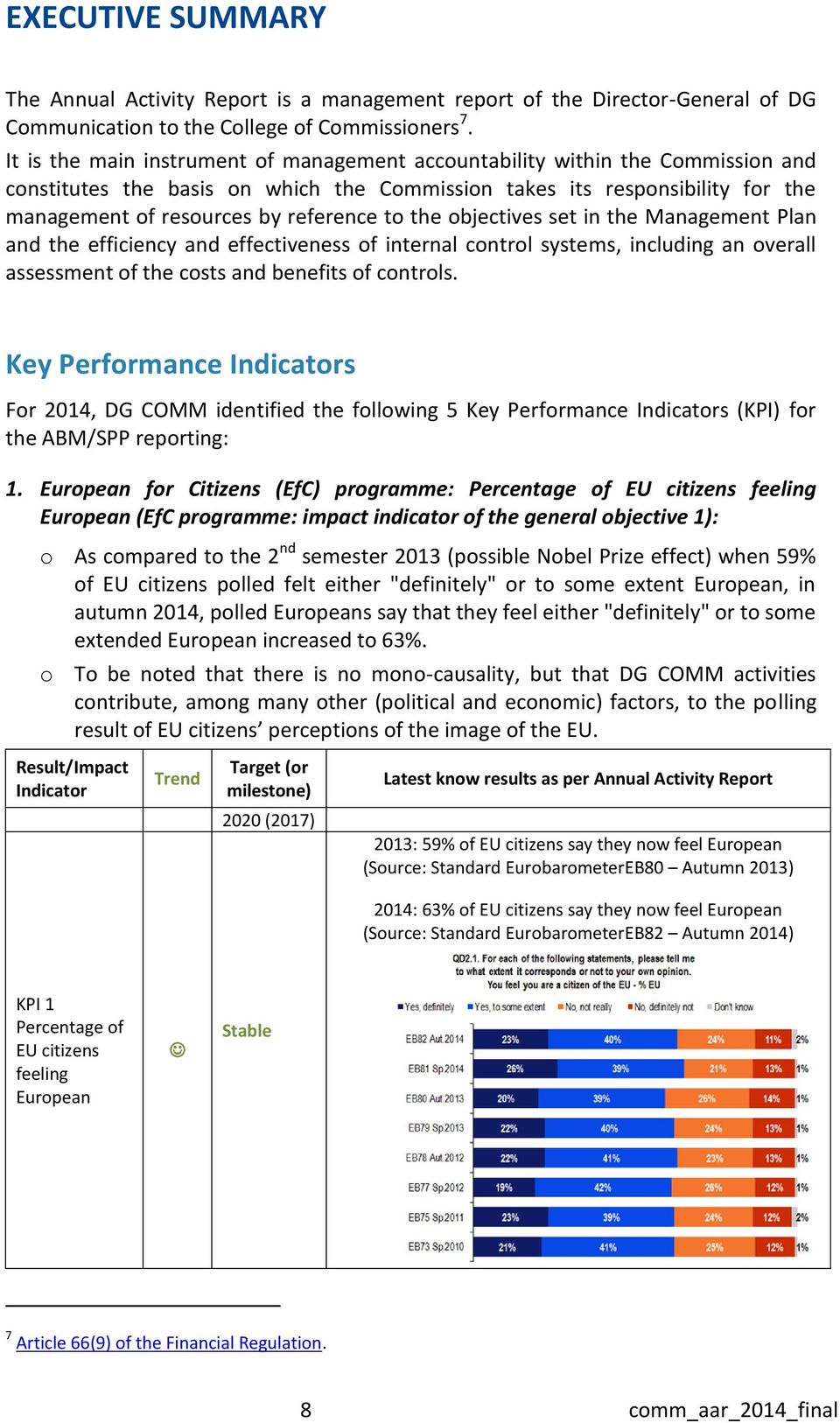
8 EXECUTIVE SUMMARY The Annual Activity Report is a management report of the Director-General of DG Communication to the College of Commissioners 7. It is the main instrument of management accountability within the Commission and constitutes the basis on which the Commission takes its responsibility for the management of resources by reference to the objectives set in the Management Plan and the efficiency and effectiveness of internal control systems, including an overall assessment of the costs and benefits of controls. Key Performance Indicators For 2014, DG COMM identified the following 5 Key Performance Indicators (KPI) for the ABM/SPP reporting: 1. European for Citizens (EfC) programme: Percentage of EU citizens feeling European (EfC programme: impact indicator of the general objective 1): o As compared to the 2 nd semester 2013 (possible Nobel Prize effect) when 59% of EU citizens polled felt either "definitely" or to some extent European, in autumn 2014, polled Europeans say that they feel either "definitely" or to some extended European increased to 63%. o To be noted that there is no mono-causality, but that DG COMM activities contribute, among many other (political and economic) factors, to the polling result of EU citizens perceptions of the image of the EU. Result/Impact Indicator Trend Target (or milestone) Latest know results as per Annual Activity Report 2020 (2017) 2013: 59% of EU citizens say they now feel European (Source: Standard EurobarometerEB80 Autumn 2013) 2014: 63% of EU citizens say they now feel European (Source: Standard EurobarometerEB82 Autumn 2014) KPI 1 Percentage of EU citizens feeling European Stable 7 Article 66(9) of the Financial Regulation. 8 comm_aar_2014_final
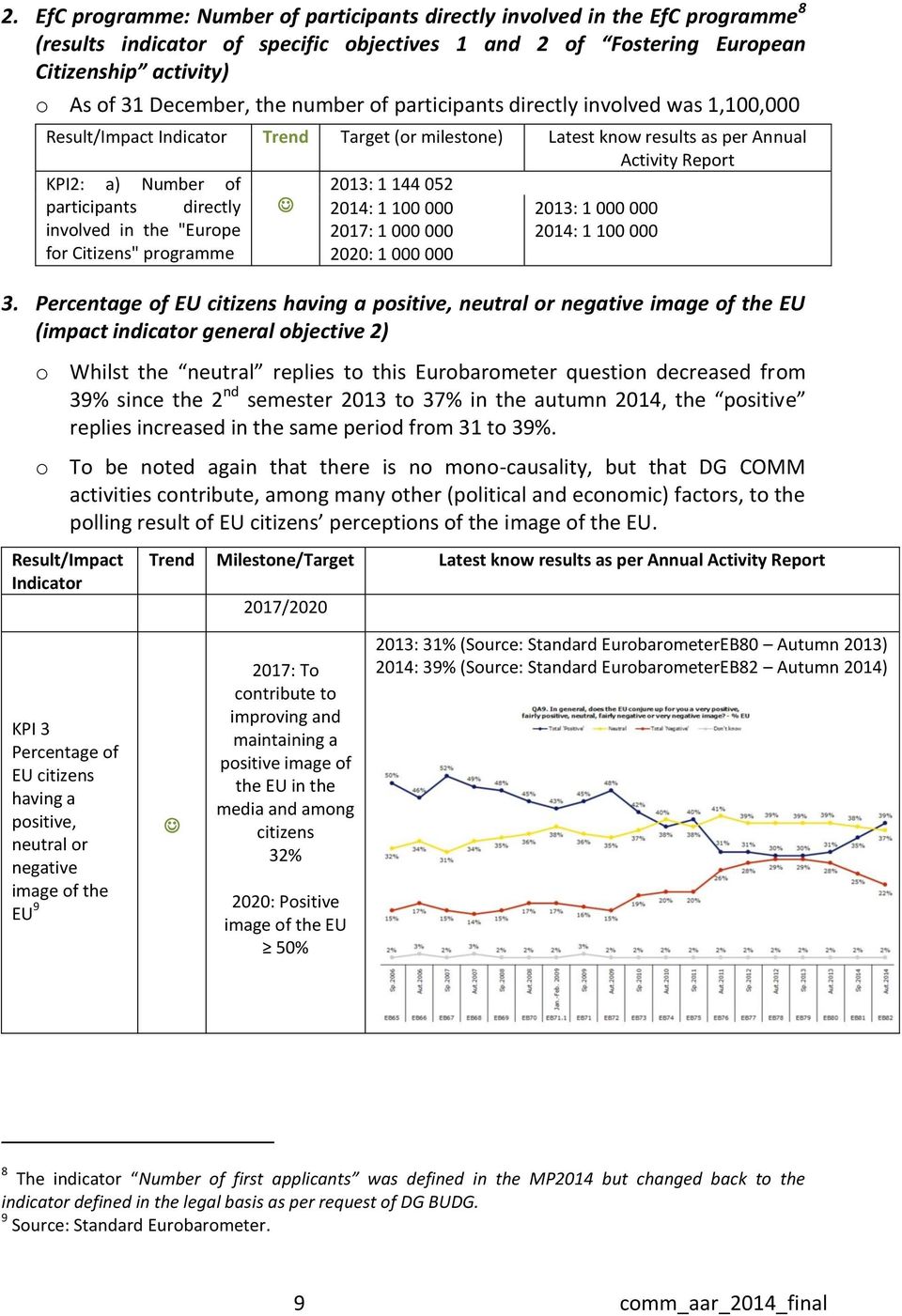
9 2. EfC programme: Number of participants directly involved in the EfC programme 8 (results indicator of specific objectives 1 and 2 of Fostering European Citizenship activity) o As of 31 December, the number of participants directly involved was 1,100,000 Result/Impact Indicator Trend Target (or milestone) Latest know results as per Annual Activity Report KPI2: a) Number of 2013: participants directly 2014: : involved in the "Europe for Citizens" programme 2017: : : Percentage of EU citizens having a positive, neutral or negative image of the EU (impact indicator general objective 2) o Whilst the neutral replies to this Eurobarometer question decreased from 39% since the 2 nd semester 2013 to 37% in the autumn 2014, the positive replies increased in the same period from 31 to 39%. o To be noted again that there is no mono-causality, but that DG COMM activities contribute, among many other (political and economic) factors, to the polling result of EU citizens perceptions of the image of the EU. Result/Impact Indicator Trend Milestone/Target Latest know results as per Annual Activity Report 2017/2020 KPI 3 Percentage of EU citizens having a positive, neutral or negative image of the EU : To contribute to improving and maintaining a positive image of the EU in the media and among citizens 32% 2020: Positive image of the EU 50% 2013: 31% (Source: Standard EurobarometerEB80 Autumn 2013) 2014: 39% (Source: Standard EurobarometerEB82 Autumn 2014) 8 The indicator Number of first applicants was defined in the MP2014 but changed back to the indicator defined in the legal basis as per request of DG BUDG. 9 Source: Standard Eurobarometer. 9 comm_aar_2014_final
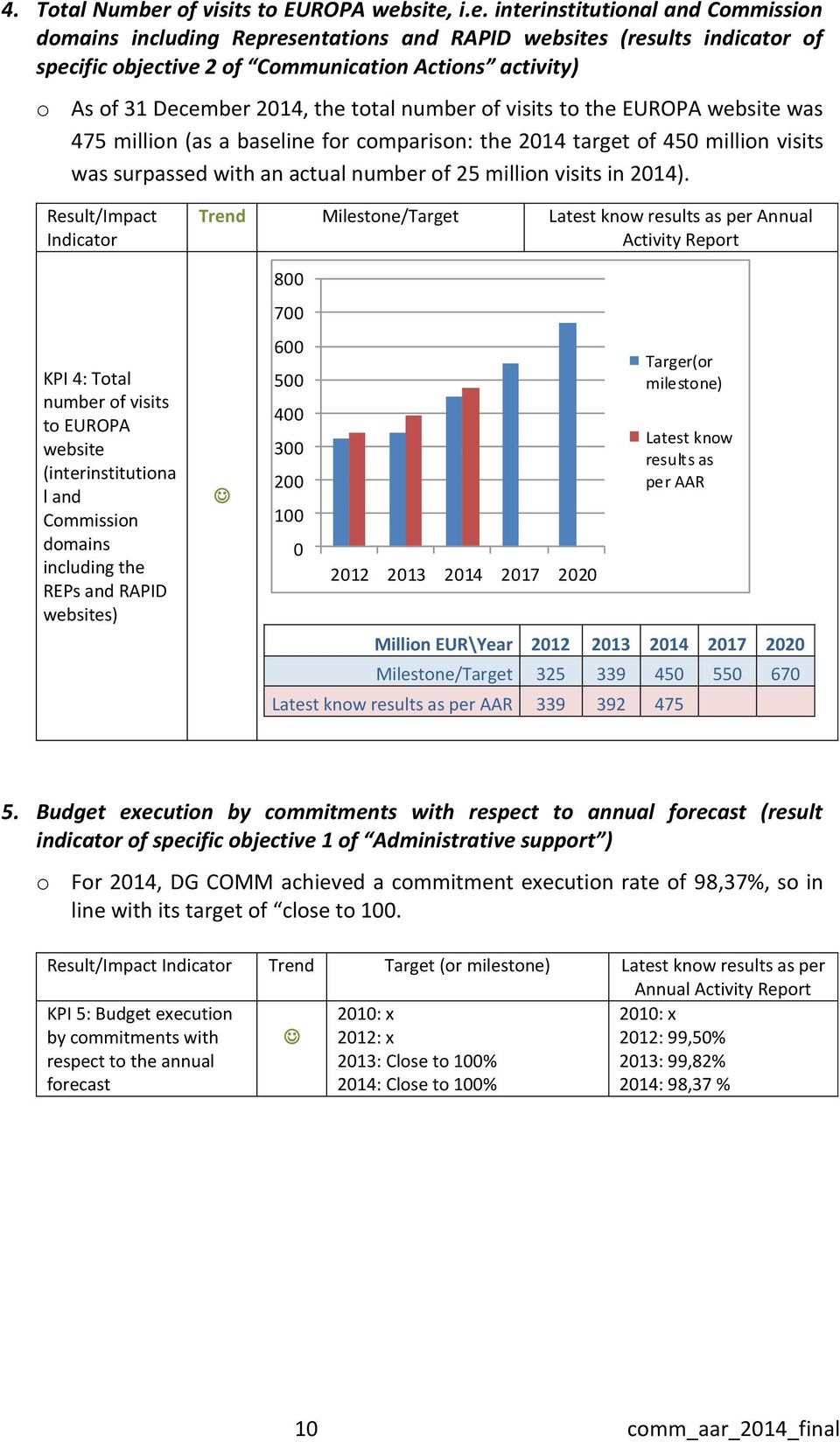
10 4. Total Number of visits to EUROPA website, i.e. interinstitutional and Commission domains including Representations and RAPID websites (results indicator of specific objective 2 of Communication Actions activity) o As of 31 December 2014, the total number of visits to the EUROPA website was 475 million (as a baseline for comparison: the 2014 target of 450 million visits was surpassed with an actual number of 25 million visits in 2014). Result/Impact Indicator Trend Milestone/Target Latest know results as per Annual Activity Report KPI 4: Total number of visits to EUROPA website (interinstitutiona l and Commission domains including the REPs and RAPID websites) Targer(or milestone) Latest know results as per AAR Million EUR\Year Milestone/Target Latest know results as per AAR Budget execution by commitments with respect to annual forecast (result indicator of specific objective 1 of Administrative support ) o For 2014, DG COMM achieved a commitment execution rate of 98,37%, so in line with its target of close to 100. Result/Impact Indicator Trend Target (or milestone) Latest know results as per Annual Activity Report KPI 5: Budget execution by commitments with respect to the annual forecast 2010: x 2012: x 2013: Close to 100% 2014: Close to 100% 2010: x 2012: 99,50% 2013: 99,82% 2014: 98,37 % 10 comm_aar_2014_final
11 Policy highlights of the year As highlighted in the impact assessment, the Europe for Citizens programme is one of the instruments to link the democratic principles of article TEU with a broad range of EU policies, with transnational projects embedded in the local and regional levels. The ex-post evaluation of the Europe for Citizens programme has been launched and will be concluded in Concerning ABB-Activity Fostering European Citizenship, implementation of the current Europe for Citizens Programme is on track (despite the delayed adoption only in April 2014), thereby contributing: o Under the "European remembrance" (Strand 1), to supporting activities that encourage reflection on European cultural diversity and on common values in the broadest sense; this included initiatives to reflect on the causes of totalitarian regimes in Europe's modern history and to commemorate the victims of their crimes, as well as activities concerning other defining moments and reference points in recent European history, giving preference to actions which encourage tolerance, mutual understanding, intercultural dialogue and reconciliation as a means of moving beyond the past and building the future, in particular with a view to reaching the younger generation. o Under the "Democratic engagement and civic participation" (Strand 2), to supporting activities enhancing civic participation in the broadest sense, and focused in particular on structuring methods to ensure that funded activities have a lasting effect. This strand also covered projects and initiatives that develop opportunities for mutual understanding, intercultural dialogue, solidarity, societal engagement and volunteering at Union level. The aim is to increase the citizens democratic participation in political and economic decision-making. The implementation of the above funding actions is delegated to the Education, Audiovisual and Culture Executive Agency (EACEA). The overall intervention logic of the programme is synthesised in the following diagram, representing the causal links between: the outputs (the production of the European Commission) on the left; the results on target groups (here the civil society organisations, local authorities, think tanks and EU networks and umbrellas); the intermediary impacts on direct beneficiaries (here the participants to the various organised activities); and the final (long term) expected impacts on direct and indirect beneficiaries (here citizens at large), on the right. 10 OJ L /04/ comm_aar_2014_final


12 The intervention logic of the programme reflects the nature of programme which does not, unlike for example the Erasmus programmes, target specific groups of EU citizens (ex. student(s) directly, but which works on the basis of multiplayer effect through different "diameters" of influence via (1) Civil Society Organisation, (2) participants to (3) Citizens at large. The funded projects provide the Commission with feedback of citizens' expectations (Listen), encourage project leaders to issue recommendations to policy makers (Advise) and increases democratic participation at EU level (Engage). As regards ABB-Activity Communication Actions, implementation of the communication actions under the institutional prerogatives consisted of 4 specific objectives: Ensuring media coverage of the Commission through a pro-active media strategy and reactive engagement with media o Since November 2014, Commissioners report every week in the Press room and frequently appear in the media focusing on the Commission s 10 political priorities. o The reform of the Spokesperson s Service, the structure of which has been geared to the organisation of the Commission s work around priority projects coordinated by the Vice Presidents, substantially contributes to improving the service provided to the thousands of journalists accredited with the European Institutions. By way of example, the number of consultations of the Commission s online press releases tripled in November 2014 compares to the same observation period in 2013, and in December 2014 the average number of consultations was some 70% higher than in the previous year. o Based on the mid-term evaluation of information events organised for journalists by the European Journalism Centre (details see Annex 9, page 107), work has started in 2014 on the a new call for tender on 12 comm_aar_2014_final

13 public relations and outreach of multipliers, as a follow up to the existing contract, but allowing for a wider public relations scope and including social media. Providing information to citizens explaining the direct impact of EU policies on their life o Euronews 11, Euranet Plus and audio-visual products: User figures of Euronews and Euranet Plus remained more or less stable in 2014, the number of multimedia productions was with 146,094 in December 2014 already higher than the target set for 2020 (140,000) and news coverage via Europe by Satellite also exceeded its target, both in terms of number of videos produced ( produced in relation to a target of 14,000) and in terms of TV uptakes (80,091 uptakes in relation to a target of 40,000) o Europe Direct: 2014 saw an ever increasing number of citizens queries by phone/sms/mail increase in the requests and queries addressed to the Europe Direct Call Centre 12. EDIC events exceeded in numbers the target set at 3,750 by 850 events and in terms of participants satisfaction rate with the event (with 92% of participants agreeing that they feel better informed after the event, as compared to a target set for 2017 of 62%). o Outreach activities of the Representations: Representations closely cooperate on the ground with the European Parliament s Information Offices and authorities in the Member States. A horizontal evaluation of the Management Partnership scheme was completed in 2014; its main recommendations (details see Annex 9, page 107) have been incorporated in the partnership approach which was refocused on strategic and ad-hoc partnerships as of the 2014 budget. Providing corporate communication and improving feedback to the Commission though information analysis o The total number of visits to the EUROPA website by far exceeded any targets set for 2014, see KPI reporting on page 11. o The total number of visits to the Eurobarometer website in 2014 was 1,15 millions, thus already in 2014 exceeding the targets set for 2017 (1 million) and 2020 (1 million). o The number of visits to the Commission is increasing, the target set for 2014 at 1,500 surpassed with visits organised. o The digital transformation project is progressing, 50% of all webpages already cut (target for 2014 was 30%), whilst the target set for cutting 11 (See Annex 9, page 107) for details on interim evaluation of Euronews completed in 2014). 12 An evaluation of the Europe Direct Contact Centre assessing its operations with a view to providing input for a future procurement procedure was ongoing in 2014, the final report had not yet been submitted and accepted by 31 December 2014 (see Annex 9, page 107). 13 comm_aar_2014_final

14 websites (46%) was not reached (33.3%) due to an earlier transition to the new thematic information architecture. Providing corporate communication under the Multiannual Financial Framework o A contract was signed in June 2014 for a corporate pilot campaign, operationalising for the first time a pooling of financial resources from different programmes (see SEC(2013)486) to implement corporate communication actions. The KPIs defined for this campaign were more than reached: The target set for reach was 15 million for 2015, de facto 94 million Europeans were reached via TV alone in 2014 already (2 nd wave scheduled for February 2015). The target set for recall was 1.5 million for 2015, by the end of 2014 already, 22 million Europeans confirmed recalling the campaign. An independent evaluation of this campaign was launched as per SEC(2013)846 in the last quarter of 2014 and is ongoing. 14 comm_aar_2014_final

15 Key conclusions on resource management and internal control effectiveness (executive summary on part 2 and 3) In accordance with the governance statement of the European Commission, (the staff of) DG Communication conducts its operations in compliance with the applicable laws and regulations, working in an open and transparent manner and meeting the expected high level of professional and ethical standards. The Commission has adopted a set of internal control standards, based on international good practice, aimed at ensuring the achievement of policy and operational objectives. As required by the Financial Regulation, the Director-General of DG Communication has put in place an organisational structure and an internal control systems suited to the achievement of the policy and control objectives, in accordance with the standards and having due regard to the risks associated with the environment in which it operates. DG Communication has assessed the effectiveness of its key internal control systems during the reporting year and has concluded that the internal control standards are effectively implemented. Furthermore, DG Communication has taken measures to further improve the efficiency of its internal control systems in the area of Ethical and Organisational Values (ICS2), Processes and Procedures (ICS8) and Assessment of Internal control Systems (ICS15) as reported in Part 3. In addition, DG Communication has systematically examined the available control results and indicators, including those aimed to supervise entities to which it has entrusted budget implementation tasks, as well as the observations and recommendations issued by internal auditors and the European Court of Auditors. These elements have been assessed to determine their impact on the management's assurance as regards the achievement of control objectives as reported in Part 2. In conclusion, management has reasonable assurance that, overall, suitable controls are in place and working as intended; risks are being appropriately monitored and mitigated; and necessary improvements and reinforcements are being implemented. The Director General, in his capacity as Authorising Officer by Delegation has signed the Declaration of Assurance. 15 comm_aar_2014_final

16 Information to the Commissioner(s) From January to June 2014 DG COMM reported to Vice-President Reding, in the transition period June to November 2014, DG COMM reported as of 1 July 2014 to Vice-President Šefčovič and as of 1 November 2014 to President Juncker. The respective ABM/SPP reporting including the updated indicators of the Management Plan 2014 and the necessary elements of assurance were provided to the Cabinet of Vice-President Šefčovič and to the Cabinet of Juncker, respectively, in July/November The main elements of this report and assurance declaration have been brought to the attention of the Cabinet of President of the Commission, Jean-Claude Juncker 14. On 1 January 2015 the following activities were transferred to: DG EAC: New Narrative, handover sent (Ares(2015) /01/2015). DG CNECT: Multimedia actions (Ares(2015) /01/2015). DG HOME: Europe for Citizens Programme (Ares(2015) /01/2015) 13 Ares (2014) /07/2014 and Ares(2014) /11/ /03/ comm_aar_2014_final

17 1. POLICY ACHIEVEMENTS 1.1 Achievement of general and specific objectives Policy area Communication: General Objective 1 - To contribute to citizens' understanding of the Union, its history and diversity, to foster European citizenship and to improve conditions for civic and democratic participation at Union level Performance tables Communication: General objective 1: To contribute to citizens' understanding of the Union, its history and diversity, to foster European citizenship and to improve conditions for civic and democratic participation at Union level Spending programme (European for Citizens programme) Impact indicator 1: Percentage of EU citizens feeling European (Source: Standard Eurobarometer (EB)) Baseline (2013) Current situation Milestone/Target / % of EU citizens say they now feel European (Source: Standard EB82 Autumn 2014) 59% of EU citizens say they now feel European (Source: Standard EB80 Autumn 2013) Stable Narrative for European for Citizens programme Due to the delayed adoption of the Council Regulation on the Europe for Citizens Programme on 14 April 2014 (delays in the UK national legislative procedure), the deadlines for the submission of project proposals and the calendar for the implementation in 2014 had to be adapted. As a consequence, the eligibility period for projects had to be postponed accordingly which means that it is very early to assess at this stage (end December 2014) results and impact of the projects 16. Despite 15 OJ L /04/ It has to be considered that the Europe for Citizens Programme itself is relatively small with a limited budget of EUR 187,468 million for seven years whereas the achievement of its general and specific objectives depends on a variety of factors (for example political and macro-economic 17 comm_aar_2014_final

18 this general remark, the EU's added value of the Europe for Citizens Programme can be shown at the level of the individual actions of the programme. 1. As regards "European remembrance" (Strand 1), the Programme supports activities that encourage reflection on European cultural diversity and on common values in the broadest sense. Funds are available for initiatives to reflect on the causes of totalitarian regimes in Europe's modern history and to commemorate the victims of their crimes. Out of 472 submitted applications, 36 projects from 21 Member States have been selected for funding (EUR 3,104,000); in addition, out of 22 remembrance organisations that applied for structural support, 6 organisations have been awarded multi-annual operating grants (EUR 1,213,966). 2. As regards "Democratic engagement and civic participation" (Strand 2), the programme supports activities that cover civic participation in the broadest sense, and focuses in particular on structuring methods to ensure that funded activities have a lasting effect. This strand may also cover projects and initiatives that develop opportunities for mutual understanding, intercultural dialogue, solidarity, societal engagement and volunteering at Union level. The aim is to increase the citizens democratic participation in political and economic decision-making. 252 town-twinning out of 667 submitted applications have been selected for funding (EUR 3,890,000); in addition, 35 networks of towns (out of 224 submitted applications) were selected for funding (EUR 4,522,500) and 29 civil society projects (out of 538 submitted applications) were selected (EUR 3,593,250). Out of 139 think tanks and European civil society organisations that applied for structural support under strand 2, a total of 29 organisations were selected for multi-annual operating grants covering the years (EUR 5,474,702). Ex post evaluation Europe for Citizens Programme : As set out in Article 14 of the Decision establishing the Europe for Citizens Programme , the European Commission has to submit an ex-post evaluation report to the other Institutions and the two committees by 31 December In this context, of DG COMM with reopening of competition between four shortlisted companies, in October 2014 a contract of EUR 106,200 was awarded to the contractor Coffey International Department Limited (trading as TEP) 18. The objective of the ex post evaluation is not only to assess the results and measures of the Europe for Citizens Programme , but as well to provide recommendations on how to further develop the current Programme as an instrument for the development of a European Citizenship Policy. context (and for example austerity policies), the influence of national issues, cultural factors, educational factors, the role of the media, citizens attitudes towards politics in general, etc.) which makes it extremely difficult to assess in how far its objectives have been achieved. Therefore, the impact of the EFC programme can only be measured appropriately by focussing on plausible contribution rather than on actual contributions. 17 OJ L /12/ Within the existing Multiple Framework Contract PO/2012-3/A3 (Lot 1 for the evaluation of communication activities). 18 comm_aar_2014_final

19 Risk assessment (if applicable) for European for Citizens programme Non-applicable in 2014 Conclusion for European for Citizens programme As described above and evidenced in the performance tables below, the Europe for Citizens Programme managed by DG COMM (and partially delegated to the Education, Audiovisual and Cultural Executive Agency) is on course to meet its multiannual objectives and has achieved the annual performance indicators and outputs in the reporting year comm_aar_2014_final
20 1.1.2 Policy area Communication: General Objective 2 - To communicate to EU citizens EU policies by listening and engaging with citizens To enable better informed College decision making by feeding country specific information and analysis into the policy making process Performance tables Communication: General objective 2: To communicate to EU citizens EU policies by listening and engaging with citizens To enable better informed College decision making by feeding country specific information and analysis into the policy making process Non- Spending Result indicator 1: Percentage of EU citizens having a positive, neutral or negative image of the EU (Source Standard Eurobarometer (EB)) Baseline (2013) Current situation 2014 Milestone/Target 2017/ % (Source: Standard Eurobaromet er EB80 Autumn 2013) 39% (Source: Standard Eurobarometer EB82 Autumn 2014) 2017: To contribute to improving and maintaining a positive image of the EU in the media and among citizens 32% 2020: Positive image of the EU 50% Narrative for Communication Actions (Institutional Prerogatives) EU affairs are frequently reported only under a regional or national angle, rarely in comparison with other Member States or from a European point of view. The Commission aims at increasing the interest, the understanding and the involvement of the citizens in the EU integration and policy-making process. Through its audio-visual communication tools the Commission offers citizens possibilities to inform themselves and find out about the political and legislative process of the EU, its results and how EU policy directly impacts on their daily lives. The Commission intends to bring the EU closer to the citizens, multipliers, media, politicians and other stakeholders by providing them, at local level, but from a 20 comm_aar_2014_final

21 European perspective, with clear information on the EU. The actions are implemented in partnership with the European Parliament and the Member States, and the 500 Europe Direct Information Centres and through the 37 EC Representations and Regional Offices in Member States. Corporate/institutional communication on the key political messages and achievements of the EU and the Commission is essential to attract new multipliers, for example through the visits service, and to disseminate information about the EU policy outcomes through multi-lingual online and written information and via a variety of communication tools. Polling and analysis of the public opinion and media monitoring provides the Commission with data comparable across the EU that can in turn feed upstream - into the policy making process feedback, as the systematic media analysis contributes to the coherent, well-targeted long-term media relations strategy Risk assessment (if applicable) for Communication Actions (Institutional Prerogatives) Non-applicable in 2014 Conclusion for Communication Actions (Institutional Prerogatives) As described above and evidenced in the performance tables below, the Communication Actions managed by DG COMM are on track to meet the multiannual objectives defined in the MFF context; annual performance indicators and outputs were achieved in the reporting year comm_aar_2014_final
22 1.1.3 ABB activity 16 02: Specific objective 1 - Fostering European Citizenship: To raise awareness of remembrance, the common history and values of the Union and the Union's aim, namely to promote peace, the values of the Union and the well-being of its peoples, by stimulating debate, reflection and the development of networks Performance tables Relevant general objective 1 Specific objective 1 19 : To raise awareness of remembrance, the common history and values of the Union and the Union's aim, namely to promote peace, the values of the Union and the well-being of its peoples, by stimulating debate, reflection and the development of networks 20 Result indicator 1: The number of participants who are directly involved Spending programme (European for Citizens programme) Baseline Milestone Current Situation Target Result indicator 2: The number of persons indirectly reached by the programme Baseline Milestone Current Situation Target Result indicator 3: The number of projects Baseline Milestone Current Situation Target Result indicator 4: The quality of projects applications and the degree to which the results of selected projects can be further used, transferred Baseline 2013 Milestone Current Situation Target Lowest score obtained by a retained project: 80 81,6 84,5 83,2 Number of events organised: Council Regulation (EU) 390/ /04/2014 establishing the Europe for Citizens programme for the period (OJ L 115, 17/4/2014). 20 For indicators related to the specific objective 1, the source data is EACEA - Indicators, milestones and targets have been set out on the basis of a study launched by DG COMM in in order to measure the impact of the Europe for Citizens programme 22 comm_aar_2014_final
23 Result indicator 5: Percentage of first time applicants Baseline 2013 Percentage of first-time applicants to the programme: 40 % Main outputs in 2014 Milestone Current Situation Target % - 45% 43% 35% - 45% description indicator Current situation Target Structural support Framework partnerships (4 years) Number of operating grants 6 8 Remembrance projects Number of projects Narrative As regards "European remembrance" (Strand 1), the Programme supports activities that encourage reflection on European cultural diversity and on common values in the broadest sense. Funds are available for initiatives to reflect on the causes of totalitarian regimes in Europe's modern history 21 and to commemorate the victims of their crimes. Out of 472 submitted applications for European remembrance projects, 36 projects from 21 Member States have been selected for funding for a total amount of EUR 3,104,000. In addition, out of 22 remembrance organisations that applied for structural support, 6 organisations have been awarded multi-annual operating grants covering the years for a total amount of EUR 1,213,966. Conclusion: The implementation of strand 1 of the Programme is on track. 21 Especially but not exclusively Nazism which led to the Holocaust, Fascism, Stalinism and totalitarian communist regimes. 23 comm_aar_2014_final
24 1.1.4 ABB activity 16 02: Specific objective 2 - Fostering European Citizenship: To encourage democratic and civic participation of citizens at Union level, by developing citizens' understanding of the Union policy making-process and promoting opportunities for societal and intercultural engagement and volunteering at Union level Performance tables Relevant general objective 1 Specific objective 2 22 : To encourage democratic and civic participation of citizens at Union level, by developing citizens' understanding of the Union policy making-process and promoting opportunities for societal and intercultural engagement and volunteering at Union level 23 Result indicator 1: The number of participants who are directly involved Spending programme (European for Citizens programme) Baseline Milestone Current Situation Target Result indicator 2: The number of persons indirectly reached by the programme Baseline Milestone Current Situation Target Result indicator 3: The number of participating organisations Baseline Milestone Current Situation Target Result indicator 4: The perception of the Union and its institutions by the beneficiaries Baseline 2012 Milestone Current Situation Target % feel more European as a result of their participation in the "Europe for Citizens" programme Stable at 77 % 77% Stable at 77 % 22 Council Regulation (EU) 390/ /04/2014 establishing the Europe for Citizens programme for the period (OJ L 115, 17/4/2014) 23 For indicators related to the specific objective 2, the source data is EACEA - Indicators, milestones and targets have been set out on the basis of a study launched by DG COMM in in order to measure the impact of the Europe for Citizens programme 24 comm_aar_2014_final
25 Result indicator 5: The quality of projects applications Baseline 2013 Milestone Current Situation Target Lowest score obtained by a retained project: Result indicator 6: Percentage of first time applicants Baseline 2013 Milestone Current Situation Target Percentage of first-time applicants to the programme: 40 % 35% - 45% 40% 35% - 45% Result indicator 7: The number of transnational partnerships including different types of stakeholders Baseline 2013 Milestone Current Situation Target Average number of types stakeholders: 1,3 At least 2 types of stakeholders 1,6 At least 2 types of stakeholders Result indicator 8: The number of networks of twinned towns Baseline 2013 Milestone Current Situation Target Result indicator 9: The number and quality of policy initiatives following-up on activities supported by the Programme at the local or European level Baseline Milestone Current Situation Target Not measured before 2 N.A 2 Result indicator 10: The geographical coverage of the activities Baseline 2013 Milestone Current Situation Target The comparison between the percentage of projects submitted by one Member State as a lead partner and the percentage of its population in the total population of the Union 24 : Geographical coverage at EU level = number of Member States for which 90 % < NC < 110 %, NC = National coverage = % of projects submitted per member State as a lead partner / % of its population in the total population of the EU. 25 comm_aar_2014_final
26 The comparison between the percentage of projects selected per Member State as a lead partner and the percentage of its population in the total population of the Union 25 : The comparison between the percentage of projects submitted by one Member State as a lead partner or co-partner and the percentage of its population in the total population of the Union 26 : The comparison between the percentage of projects selected per Member State as a lead partner or co-partner and the percentage of its population in the total population of the Union 27 : 15 Main outputs in 2014 description indicator Current situation target Citizens' meetings Number of projects Networks Twinned Towns Number of networks Civil society projects Number of projects Structural support Framework partnerships (4 years) Peer reviews Support structures in the Members states Number of operating grants Number of network meetings Number of grants Geographical coverage at EU level = number of Member States for which 90 % < NC < 110 %, NC = National coverage = % of projects selected per member State as a lead partner / % of its population in the total population of the EU. 26 Geographical coverage at EU level = number of Member States for which 90 % < NC < 110 %, NC = National coverage = % of projects submitted per member State as a lead partner or co-partner / % of its population in the total population of the EU. 27 Geographical coverage at EU level = number of Member States for which 90 % < NC < 110 %, NC = National coverage = % of projects selected per member State as a lead partner or co-partner / % of its population in the total population of the EU. 26 comm_aar_2014_final
27 Narrative As regards "Democratic engagement and civic participation" (Strand 2), the programme supports activities that cover civic participation in the broadest sense, and focuses in particular on structuring methods to ensure that funded activities have a lasting effect. This strand may also cover projects and initiatives that develop opportunities for mutual understanding, intercultural dialogue, solidarity, societal engagement and volunteering at Union level. The aim is to increase the citizens democratic participation in political and economic decision-making. Under Strand 2 (Democratic engagement and civic participation) 252 town-twinning out of 667 submitted applications have been selected for funding for a total amount of EUR 3,890,000. In addition, 35 networks of towns (out of 224 submitted applications) were selected for funding for a total amount of EUR 4,522,500 and 29 civil society projects (out of 538 submitted applications) for a total amount of EUR 3,593,250. Out of 139 think tanks and European civil society organisations that applied for structural support under strand 2, a total of 29 organisations have been selected for multi-annual operating grants covering the years for a total amount of EUR 5,474,702. Conclusion: The implementation of strand 2 of the Programme is on track. 27 comm_aar_2014_final
28 1.1.5 ABB activity 16 03: Specific objective 1 - Communication actions: To ensure media coverage of the Commission through a pro-active media strategy and reactive engagement with media Performance tables Relevant general objective 2 Specific objective 1: To ensure media coverage of the Non-Spending Commission through a pro-active media strategy and reactive engagement with media Result indicator 1: Number of press material issued (press releases, memos, speeches) (Rapid reporting DG COMM A3) Baseline 2013 Milestone Current Situation Target Result indicator 2: Number of press events organised (press conferences, VIP, technical briefings) (DG COMM/SPP statistics, reference value of 30 September 2014) Baseline 2013 Milestone Situation on Target Main outputs in Description Indicator Current situation Target Pro-active engagement with the media: - Pro-active media strategy for the College, media action plans for individual College members and message in clear language on EU policy results. - Press material on the College's decisions, "Lines" to take' and briefing sheets on EU policy issues related to the work of the Commission. - President's speeches, including the State of the Union Address. N/A N/A N/A 28 The AAR 2014 and related performance indictors cover the work of the Spokesperson s Service (SPP) under the mandate of the previous Commission (01/01/ /10/2014). With the setting up of the new SPP as from 1 November 2014, the results indicators have been substantially reviewed in order to reflect the recommendations of the Court of Auditors, (i.e. to emphasize performance measurement) and to align to the working methods of the new Commission. 29 See previous footnote. 28 comm_aar_2014_final
29 - Daily press briefing "Midday briefing" and journalist briefings in Brussels, in EU Member States and worldwide. - Internal (news ahead) and external press planning tools (Top news, weekly calendar of visits and meetings by the Members of the Commission). Reactive engagement with the media: Respond to press enquiries, rebuttal, Mythbusting N/A N/A N/A Plan and coordinate the timing of communication on the different policy issues. N/A N/A N/A Accreditation of the journalists based in Brussels. N/A N/A N/A Narrative EU affairs are frequently reported only under a regional or national angle, rarely in comparison with other Member States or from a European point of view. The Commission aims at increasing the interest, the understanding and the involvement of the citizens in the EU integration and policy-making process. Through its proactive media strategy and reactive engagement with the media, the Commission ensures media coverage which in turn offers citizens possibilities to inform themselves and find out about the political and legislative process of the EU, its results and how EU policy directly impacts on their daily lives. Conclusion: Following the re-organisation of the SPP under the Juncker Commission result indicators were substantially reviewed, the implementation of these activities is on track. 29 comm_aar_2014_final
30 1.1.6 ABB activity 16 03: Specific objective 2 - Communication actions: Providing information to citizens explaining the direct impact of EU policies on their life Performance tables Relevant general objective 2 Specific objective 2: Providing information to citizens explaining the direct impact of EU policies on their life Result indicator 1 30 : Average number of Euronews viewers per day (Europe) (TV Eureka by Telmar-Peaktime quoted in Euronews reports Q ) Baseline Q Non-Spending Milestone Current Situation Target ,8 million 6 million 4.4 million 32 6 million 33 Result indicator 2: Average number of Euranet Plus listeners per day (As stated by Euranet Plus in its latest report (July-August 2014) Baseline Milestone Current Situation Target (Oct. 2013) million 20 million 19,7 million 25 million 34 Result indicator 3: Number of multimedia productions downloads (AV Analytics and Web Analytics) Baseline Milestone Current Situation Target Sept Result indicator 4: Percentage of participants in EDICs events fully agreeing that they are better informed on EU issues (information provided by EDICs in their reporting based on the results of the obligatory evaluation of 50% of their activities) Baseline 2011 Milestone Current Situation Target % 63% 92% 65% 30 Euronews is an independent body partly funded by the European Commission. Therefore, this indicator does not reflect only DG COMM contribution but Euronews activity. 31 The latest audience data sent by Euronews refer to 2014 Q3: the latest reports/invoices were sent in December 2014 (when Q4 was still ongoing). In the last contact with Euronews (3 rd week of February), Q3 was still the baseline for the available audience data. 32 See previous footnote. 33 The target is lower that the baseline figure due to the facts that there is an evolution of the audience from TV to WEB view and also taking into account the number of the information channel in the same field. 34 Objective presented to DG COMM in the offer following the call for tender. 30 comm_aar_2014_final
31 Result indicator 5: Percentage of participants of events organised by the Representations agreeing that the event improved their knowledge on EU issues (Based on responses to questionnaires distributed after events) Baseline 2013 Milestone Current Situation Target The measurement of the satisfaction rate will 63% 71% 65% start in Main outputs in 2014 Description indicator Current Target situation Programmes on EU affaires Number of broadcast minutes Euronews in Arabic, Greek and Hungarian Audio-visual productions and multimedia projects News coverage Measurement of media usage of audio-visual material Media library: conservation and availability to the public of audiovisual material (audio, video and photo), Web development Europe Direct Information Centres (EDICs) Training, support and coordination of the Europe Direct information networks Organisation of Representations events per year Hours 24/24 24/24 Number of productions for the general public Number of EbS video items, photo reports and audio files produced TV uptakes from EbS ( in minutes) Number of archived audio, video and photo Number of EDICs Number of training days x number of participants Number of events The European Public Spaces Number of EPS In 2014, COMM.B is going to start collecting the satisfaction rate and improved knowledge rate in the REPs through the events and actions questionnaire. Therefore the percentages in the MP 2014 are indicatives. 36 Number of meetings, workshops, conferences, seminars, debates, meetings organised with educational establishments, cultural events, fairs and exhibitions, and other public events organised by the Representation. Source: Events and actions database. The aim is focus gradually on smaller number but bigger scale events. 31 comm_aar_2014_final
32 Narrative EU affairs are frequently reported only under a regional or national angle, rarely in comparison with other Member States or from a European point of view. The Commission aims at increasing the interest, the understanding and the involvement of the citizens in the EU integration and policy-making process. Through its audio-visual communication tools (like Europe by Satellite and other audiovisual and multimedia productions as well as media library) and through the media networks supported by the Commission (like Euronews or Euranet Plus) the Commission offers citizens possibilities to inform themselves and find out about the political and legislative process of the EU, its results and how EU policy directly impacts on their daily lives. Information events organised by the Representations and the actions are implemented by the Representations in partnership with the European Parliament (European Public Spaces), the Member States (strategic partnerships), and the 500 Europe Direct Information Centres, contributing thus to bringing the EU closer to its citizens, multipliers, media, politicians and other stakeholders by providing them, at local level, but from a European perspective, with clear information on EU activities. Conclusion: The implementation of these activities is on track. 32 comm_aar_2014_final
33 1.1.7 ABB activity 16 03: Specific objective 3 - Communication actions: Providing corporate communication and improving feedback to the Commission trough information analysis Performance tables Relevant general objective 2 Specific objective 3: Providing corporate communication and Non-Spending improving feedback to the Commission trough information analysis Result indicator 1: Percentage of participants to the information visits to the Commission very satisfied with the visit (Evaluation forms filled in by each visiting group) Baseline 2012 Milestone Current Situation Target % 73% 80% 77% Result indicator 2: Total number of visits to EUROPA website (interinstitutional and Commission domains including the Representations' and RAPID websites) (SAS Analytics - corporate data collection tool) Baseline 2013 Milestone Current Situation Target million 550 million 475 million 670 million Result indicator 3: Growth in number of followers/fans/subscribers of the EU Commission Social media corporate accounts including the Representations' (Engagor (corporate social media monitoring tool) and the data available on the social media platforms themselves) Baseline 2013 Milestone Current Situation Target Twitter Facebook Google EUTube Twitter (Representations) Facebook (Representations) comm_aar_2014_final
34 Result indicator 4: Web rationalisation Number of Commission websites and webpages (content) cut Baseline 2013 Milestone Current Situation Target % of websites cut for 11 pilot DGs 13% of webpages cut for 11 pilot DGs One coherent web presence for the entire Commission 33.3% 50% One coherent web presence for the entire Commission Result indicator 5: Satisfaction rate on queries replied by the EUROPE DIRECT Contact centre (average rate of evaluations done by users after each query, the maximum rate being 16) (Ratings extracted from the EDCC citizens' enquiries database and submitted in monthly reports) Baseline 2013 Milestone Current Situation Target ,2 / 16 13,3 / 16 13,44 13,4 / 16 Result indicator 6: Number of on-line consultations of e-publications and distributed paper publications (Europa website statistics and OP) Baseline 2012 Mileston e Current Situation Target million 5 million 4.4 million 6 million Result indicator 7: Number of total visits to Eurobarometer website (SAS Analytics - corporate data collection tool) Baseline Sept Mileston e Current Situation million 1,15 million Target million Result indicator 8: Number of political and economical reports and analysis produced (Internal COMM.A3 and COMM.B2) Baseline Oct Milestone Current Situation Target (B) 51 (A3) In 2014, twice as many horizontal reports were distributed than before. The actual workload for the Representations did not decrease since they contributed to each of the horizontal reports with a dedicated national report. 34 comm_aar_2014_final
35 Main outputs in 2014 description indicator Current Target situation Visits to the Number of visits Commission Management of audiovisual technical facilities EUROPA website RAPID main and Number of AV products provided to the College (messages, interviews, statements, clips) Total number of visits to EUROPA website (interinstitutional and Commission domains including the Representations' and RAPID websites) million million Twitter Social media EC corporate platforms Growth in number of followers/fans/subscribers of the EU Commission Social media corporate accounts including Representations' (R) / Facebook Google EUTube Twitter (R) Web Rationalisation Representations electronic newsletters edited Issued and printed publications (done by the Representations) Number of websites cut - 11 DGs Number of webpages cut (11 DGs) Number of Representations electronic newsletters edited Number of issued and printed publications Facebook (R) % 38 46% cut 50% 30% cut In the course of the year the work shifted towards earlier transition to the new thematic information architecture and platform, hence, this activity became less relevant. The target will be achieved by 2017: one coherent web presence for the entire Commission. 35 comm_aar_2014_final
36 Operation of the EUROPE DIRECT Contact Centre (EDCC) Publications, including Commission s General Report Eurobarometer polls taken One contact centre accessible by telephone, online chat and SMS Number of publications Number of Eurobarometer polls taken 8 7 Narrative: EU affairs are frequently reported only under a regional or national angle, rarely in comparison with other Member States or from a European point of view. The Commission aims at increasing the interest, the understanding and the involvement of the citizens in the EU integration and policy-making process. Corporate/institutional communication on the key political messages and achievements of the EU and the Commission is essential to attract new multipliers, for example through the visits service, and to disseminate information about the EU policy outcomes through multi-lingual online and written information and via a variety of communication tools (EUROPA site / digital transformation, social media, e- publications, audio-visual productions, Europe Direct Call Centre). Polling and analysis of the public opinion, media monitoring and, last not least, the Representations country specific intelligence reporting, provide the Commission with data comparable across the EU as well as with country specific analysis, both feeding in turn upstream - into the policy making process. Conclusion: The implementation of these activities is on track comm_aar_2014_final
37 1.1.8 ABB activity 16 03: Specific objective 4 - Communication actions: To implement Corporate Communication under the Multiannual Financial Framework (MFF) Performance tables Relevant general objective 2 Specific objective 4: To implement Corporate Communication Spending under the Multiannual Financial Framework (MFF) Result indicator 1 for the pilot in 2014: Cumulative total number of people reached with the messages of an integrated communication campaign (Ex-post evaluation of the pilot) Baseline Milestone Current Situation Target N/A million on TV alone Result indicator 2 for the pilot in 2014: Cumulative total number of people who are able to recall the messages of an integrated communication campaign (Ex-post evaluation of the pilot) Baseline 2013 Milestone Current Situation Target N/A million Main outputs in 2014 Description indicator Current Target situation Implementation of the 2014 pilot phase by procurement of an integrated communication campaign Execution of the codelegated budget by commitments and payments (latter depending on timing of the campaign and evaluation 44 ) 100% for commitment 27% for payments 100% for commitments 50% for payments 40 Target fixed for 2014 Management Plan in December 2013 before contract signed (in June 2014, NB specificities in Contract RC/2014/COMMA1-10/COMM). 41 See previous footnote. 42 See previous footnote. 43 See previous footnote 44 An independent evaluation of this campaign was launched as per SEC(2013)846 in the last quarter of 2014 and is ongoing (interim report submitted to steering committee in March 2015, final report expected before end April 2015). 37 comm_aar_2014_final
38 Narrative: EU affairs are frequently reported only under a regional or national angle, rarely in comparison with other Member States or from a European point of view. The Commission aims at increasing the interest, the understanding and the involvement of the citizens in the EU integration and policy-making process. Corporate/institutional communication on the key political messages and achievements of the EU and the Commission is essential to inform citizens about what the European Union does and to raise awareness as to how it impacts their daily lives. In line with corporate communication under MFF and Article 3 of the Internal Rules (co-delegation) 46, DG AGRI, DG CLIMA, DG EMPL, DG JUST, DG MARE, DG REGIO, DG RTD and DG COMM contributed in 2014 a total of EUR 13,450,000 to the budget of the corporate communication pilot campaign and its independent evaluation (details see page 54). This corporate pilot campaign has been designed to reach the broad public, in particular those with a neutral image of the EU in six countries (Spain, Germany, Poland, Portugal, Latvia and Finland). Conclusion: The implementation of the campaign is on track; the evaluation of this campaign is ongoing (interim report March 2015, draft final report April 2015) SEC(2013)486-23/09/2013. C(2014) /04/ comm_aar_2014_final
39 1.2 Example of EU-added value and results/impacts of projects or programme financed For the Europe for Citizens Programme: 1. The SUCCESS project ( developed by IFRI 47, is a pertinent example of the EU added value of the European for Citizens Programme, reflecting the new strategic approach of the whole Programme, promoting more ambitious initiatives involving a larger number of towns and cities, and focusing on the EU's social and societal objectives. SUCCESS is a network of young European citizens coming from different cultural, social and national backgrounds who are rethinking citizenship together in Europe. The objective is to contribute to the reversal of populist, racist and xenophobic citizenship in Europe and promote the founding values of European citizenship. SUCCESS adopted a "bottom-up" approach and raised the voice of the citizens living in several popular multicultural disadvantaged neighbourhoods and major European cities: Montreuil (near Paris), Palermo, Oeiras (near Lisbon) and Birmingham towards a multicultural and integrated Europe. Efficiency and effectiveness: This project generated leverage effects and a large impact by setting up a network of young European citizens coming from different cultural, national and social background to rethink citizenship together in Europe. The Europe for Citizens Programme provided the opportunity for this network to develop this reflection with partner towns from other European countries which added the European value to the debate. Synergy: Through the bottom-up approach of the project synergy effects can be found with regard to the ongoing European debates on European citizenship including the fight against racism, xenophobia and populist movements and the reference to common European values. 2. The LED project ( 48, developed by Associazione ARCI 49 must also be noted. Through the project, communities of citizens are invited to debate about Europe's values and politics. One major event was organised in October 2014 in Lampedusa, focusing on the crucial issue of immigration in Europe in order to propose concrete alternatives to the current European migration policies. Migrants, refugees, EU and non EU 47 IFRI is the French Institute of International Relations, an independent research institute. It s Centre for Migrations and Citizenship launched the success project in LED: Laboratories of European Democracy. 49 ARCI is the Italian Association for Cultural Recreation founded in 1957 and present all over the Italian territory with 5000 clubs and more than a million of members. It carries out projects and campaigns on social inclusion, migration, international cooperation. 39 comm_aar_2014_final
40 citizens, public authorities and civil society organisations were gathered together in one of the most symbolic place of Europe today to reflect, debate, discuss about migration as a main challenge of the future of Europe. Efficiency and effectiveness: This project generated leverage effects and a large impact by gathering in Lampedusa (Italy) communities of citizens to debate about European values and policies with a focus on immigration as a challenge for the future of Europe. The Europe for Citizens Programme provided the opportunity for the island very concerned by the topic of immigration to debate with partners from other European countries which added the European value to the debate. Synergy: Through the bottom-up approach of the project synergy effects can be found with regard to the ongoing European debate on migration and citizenship including the reference to common European values. 40 comm_aar_2014_final
41 1.3 Economy and efficiency of spending and non-spending activities. According to the Financial Regulation (art 30), the principle of economy requires that the resources used by the Institution in the pursuit of its activities shall be made available in due time, in appropriate quantity and quality and the best price. The principle of efficiency concerns the best relationship between resources employed and results achieved. The respect of these principles is continuously pursued through the implementation of internal procedures and predefined practices. These procedures ensure that activities are executed in an efficient manner (e.g. the different workflows contribute to the efficient cooperation between staff, units, etc.) and according to the principle of economy. DG Communication is continuously fine-tuning its internal arrangements in order to improve the efficiency and economy of its operations. The following two initiatives show how these principles are implemented in our DG: Example 1 With a view to having a new Spokesperson s Service (SPP) for the Juncker Commission up and running on 1 November 2014, that would be reformed and streamlined, DG COMM managed the respective recruitment procedure based on the applications received following a call for expression of interest in the summer of The structure of the new SPP follows the logic of the Project Teams and allowed for savings made following the restructuring of the SPP of minus 25 posts Example 2 A new global lump sums system was applied by the Education, Audivisual and Culture Executive Agency (EACEA) for both strands of the "Europe for Citizens" programme (except for operating grants) as from EACEA has also taken simplification measures to improve the service to beneficiaries: Introduction of electronic application forms; Introduction of "unilateral" grant decisions in place of "bilateral" grant agreements (thus removing the need for beneficiaries to provide their written acceptance of grant funding) for certain strands of the programmes Introduction of partnership framework agreements within certain strands of the programme, thus providing beneficiaries with the certainty of funding over more than one year; Use of fixed grants for some activities, in place of reimbursement at actual cost, and operating grants; Introduction of a programme guide, which describes the objectives and strands of the programme and provides information regarding selection procedures, 50 SEC (2014)615-25/11/ comm_aar_2014_final
42 general rules, terms and conditions attached to grant funding, and a calendar for the application process; a key benefit of the guide has been a reduction in the volume of information that applicants must take into account in each call for proposals; Reduction in the average time taken to make payments; Increase in the number of monitoring visits to projects; Simplified reporting and budgeting process; Communication activities, including Infodays, attendance at national events, a regularly-updated website. As regards ensuring the principles of economy and efficiency, DG COMM applied throughout 2014 an integrated approach to all its activities, taking into account both the political priorities to be achieved, and the limits imposed on resources in the current context. This is implemented in a systematic and structured manner. 42 comm_aar_2014_final
43 2. MANAGEMENT OF RESOURCES Assurance is an objective examination of evidence for the purpose of providing an assessment of the effectiveness of risk management, control and governance processes in DG Communication. This examination is carried out by management, who monitors the functioning of the internal control systems on a continuous basis, and by internal and external auditors. Its results are explicitly documented and reported to the Director-General. The reports produced are: o AOSD reports in the context of the AAR exercise: each AOSD within DG COMM signed the AOSD Statement on the implementation of programmes, operations or actions in respect of the powers which have been sub-delegated to her/him 51 ; o Reports from Directors General of other DGs who manage as Authorising Officers DG COMM budget appropriations via cross-delegation (see chapter 2.2); o Contribution of the Internal Control Coordinator including the results of the internal control monitoring at DG level 52 ; o Reports of ex-post supervision or audit; o Opinions / observations of the Internal Audit Capability (IAC) o Recommendations reported by the Internal Audit Service (IAS). This section of the AAR reports the control results and other relevant elements that support managements' assurance on the achievement of the internal control objectives 53. It is structured in three separate sections: (1) the DG s assessment of its own activities for the management of its resources; (2) the assessment of the activities carried out by other entities to which the DG has entrusted budget implementation tasks; and (3) the assessment of the results of internal and external audits, including the implementation of audit recommendations. 51 Completeness and accuracy of the reports were checked and the analysis concluded that all reports were accurate and complete Ares(2015) /02/ Ares(2015) /02/ The internal survey on DG COMM effectiveness of internal control systems (ICAT) was launched among DG COMM managers in October 2014 in the framework of the prioritised under DG COMM MP 2014 internal control standard 15 "Overall assessment of internal control systems". The participation rate was of 60% and the overall satisfaction assessed by the participants was of 75.05%.The results were analysed serving as well as basis for next year Management Plan prioritized internal control standards and associated action plans. The exercise will be performed on an annual basis. 53 Effectiveness, efficiency and economy of operations; reliability of reporting; safeguarding of assets and information; prevention, detection, correction and follow-up of fraud and irregularities; and adequate management of the risks relating to the legality and regularity of the underlying transactions, taking into account the multiannual character of programmes as well as the nature of the payments (FR Art 32). 43 comm_aar_2014_final
44 DG COMM budget 2014 in brief DG COMM budget for 2014 amounted to EUR 159, (Commitment appropriations authorised 54 ). The Commitments made amounted to EUR 155, (see annex 3 for an overview of key budgetary figures). ( DG COMM s budget implementation rate for commitments is 98,37%; calculated on the basis of DG COMM internal reporting for 2014 on budgetary outturn (i.e. including only the operational budget, the administrative budget, carried over appropriations, assigned revenues and others budgetary titles are excluded). DG COMM manages two types of expenditure, details see table below: o Administrative expenditure (including real estate expenses related to Representations) executed by using procurement procedures. There is also an operating grant to EACEA included in this kind of expenditure. o Operational expenditure, executed by signing procurement contracts and grant agreements. In addition, DG COMM managed in 2014 the "Europe for Citizens" programme mainly implemented by the Agency EACEA (see annex 7). ABB Activity/Expenditure detail Administrative expenditure - Procurement procedures Administrative expenditure - Grants (Operating Grant to EACEA) Operational expenditure - Procurement Contracts Commitment appropriations Commitment implemented Payment Appropriations Payments made 44,210, ,572, ,191, ,191, ,238, ,444,722.4 Operational expenditure - Grants 30,080, ,713,134.8 Management Partnerships 3,072,024.7 TOTAL ADMINISTRATIVE 48,200, ,401, ,311, ,763,812.3 TOTAL OPERATIONAL 111,406, ,319, ,213, ,229,882.0 TOTAL (2014) 159,606, ,720, ,524, ,993, Commitment appropriations authorised include, in addition to the budget voted by the legislative authority, appropriations carried over from the previous exercise, amending budgets as well as miscellaneous commitment appropriations for the period (e.g. internal and external assigned revenue). 44 comm_aar_2014_final
45 DG COMM human resources 2014 in brief On 31 December 2014, DG COMM staff amounted to 1,125, of which 680 establishment post and 445 external staff (details per ABB activity see Annex 2). To note that DG COMM is a multi-site DG, staff being split between Brussels and Representations in each of the 28 Member State: o 448 in COMM.HQ/SPP o 677 in Representations The indicators and assessments in sections 2.1 and 2.2 (together) cover all (100%) expenditure and management modes except indirect centralised management. Management Partnerships, which are the only actions implemented under indirect centralised management mode, have been discontinued since 2013 and only residual phase-out actions were carried out in Resources dedicated to control activities represent less than 10% of all FTE carrying out control in DG COMM In accordance with the guidelines issued by DG BUDG (Ares(2014) /11/2014 Proposal for a Minimum set of Control Efficiency Indicators), no assessment is made of this management mode. 45 comm_aar_2014_final
46 2.1 Management of human and financial resources by DG Communication. This section reports and assesses the elements identified by management that support the assurance on the achievement of the internal control objectives. Annex 5 outlines the main risks together with the control processes aimed to mitigate them and the indicators used to measure the performance of the control systems. Control effectiveness as regards legality and regularity DG COMM has set up internal control processes aimed to ensure the adequate management of the risks relating to the legality and regularity of the underlying transactions, as well as the nature of the payments concerned The control objective is to ensure that the residual error rate is as low as possible and does not exceed 2% of annual budget implementation (see Annex 10, table 1). The amounts are calculated in terms of payments made. Since grants account for only 20% of payments made and the majority of these grants are lump sums which recur annually, the amount of pre-financing paid for grants in 2014 is considered equivalent to the amount of pre-financing actually cleared against grants in the same period. DG COMM's control system is designed to detect and correct irregularities and fraud by ex-ante and ex-post controls covering all types of financial operations, procurement and grant procedures and prioritised Internal Control Standards. The results in terms of residual error rate in DG COMM are displayed in annex 10 providing the conclusion that the overall impact of errors and weaknesses found by the internal control system is 0,38% of payments made. At the same time residual error rates are below 2% for all budget lines and for all type of expenditures. In May 2012, revised centralised financial circuits were set up for DG COMM Headquarters 56 increasing the opportunity for harmonisation and simplification in parallel with a reduction in the number of staff directly involved in the financial management process (efficiency gains). Ex ante procedural and legal matters Covering indepth review 57 Procurements A total of 56 procurement files were presented for indepth review in 2014 representing a total amount of EUR 205,002,527. Seven Grants A total of 11 calls for proposal were reviewed in depth in 2014 representing a total amount of EUR 26,252,590. Ex-ante control was performed on Ares(2012) of 22/03/ In-depth review: Consists of a mandatory check for consistency and coherence with financial rules prior to the publication of all calls for proposals and all procurement files above the EUR 60,000 threshold as well as any reopening of competition under framework contracts. Advice is also provided 46 comm_aar_2014_final
47 and ex-ante control 58 as well as a helpdesk function for AOSD 59 of these files (representing EUR 78,950,800) were still under in-depth review at the end of the year. Ex-ante control was performed for 41 files for a total amount of EUR 140,024,644. Four opinions were issued with reserves files were in the ex-ante control process at the end of 2014 for a total of EUR 1,750,000. As the control covers all procurements above EUR 60,000 61, the residual level of errors at the procurement/contract level for large contracts is considered zero. calls for proposal for a total amount of EUR 25,851, call for proposal was in the ex-ante control process at the end of 2014 for a total of EUR 19,600. As the control covers all call for proposal files, the residual level of errors is considered zero. to the AOSD on an ad hoc basis during the initial preparatory phase on the way in which to ensure this consistency and coherence. 58 Ex-ante control: Consists of mandatory checks for consistency and coherence with the FR, the rules of application and the procedures defined in the vademecum throughout the entire call for proposal or procurement process. If any discrepancies are detected, advice is given to the AOSD on corrective action. Following the ex-ante control an opinion is addressed to the AOSD and is taken into account by the AOSDs when signing the award decision 59 A helpdesk function is also provided to AOSDs to respond to queries about calls for proposal, procurement procedures and on-going contract management as well as ad hoc assistance with procedures below the EUR threshold. 60 Three of the reserves concerned registering the final signed version of the evaluation report after the opinion was issued. The fourth reserve concerned a missing declaration of honour to be requested from a newly introduced sub-contractor prior to the signature of the contract. Reserves are followed up and all advice has been complied with. 61 Representing 100% controls for procedures above EUR 60,000. According to DG COMM internal financial rules, the control for transaction below EUR 60,000 is performed ex-post by sampling (see Annex 5). 47 comm_aar_2014_final
48 Ex ante second level verification on financial transactions 62 Ex-post on-thespot review of financial transactions From January to December 2014, transactions initiated in the Representations were validated by DG COMM in the MUS DICE control system 63, of which 908 were selected for second-level ex-ante financial control. This control covered 3.1% of the total number of transactions implemented by all Representations and represents 30% of the value of the transactions. There was one error detected in payments (amounting to EUR ) and two transactions were affected by a nonquantifiable substantial error 65 (See Annex 10 for value of error and its implication on the value at risk). In 2014, 13 on-the-spot controls were carried out Controls of financial transactions in 8 Representations 67 There were no errors detected in payments (amounts), nor were there any procedural errors detected for grants. to one grant beneficiary of the EfC programme 68 2 Units in Headquarters. 2 joint missions 69 with the external auditors 70 to Euronews and to one grant beneficiary of European Year of Volunteering Programme procurement files were checked for a total value of 37 grant files were checked for a total value of EUR 946,689. Five final and EUR 39,492,685. Eight final 71 three draft reports for the reports for the Representations were established. There were no quantifiable and Representations were established. There were no payment (amount) errors or procedural errors detected. procedural errors detected. The final results from controls performed on 33 EDIC grant files managed by Representations gave the following results: No payment (amount) error was detected 62 Performed by Headquarters on Representations' transactions. 63 MUS-DICE control system: Monetary Unit Sampling-Decentralised Integrated Control Environment, a corporate tool directly linked to ABAC. 64 Representation in Sweden: difference between purchase order and corresponding invoice. 65 Representation in London and Representation in Paris: no tendering for supplementary contract in the framework of the prolongation of the main contract after the expiry date. 66 Controls in DG COMM Representations and Units in Headquarters follow a multi-annual approach. All Representations and Units are controlled within the period of 3-4 years. 67 Spain, Malta, Luxemburg, Belgium, United Kingdom, Lithuania, Croatia, Greece. 68 Auschwitz-Birkenau State Museum. 69 Euronews in Lyon (France), Landeshauptstadt Düsseldorf (Germany). 70 Mazars. 71 Spain, Malta, Luxemburg, Belgium, Croatia, United Kingdom, Lithuania, Greece. 48 comm_aar_2014_final
49 Ex-post on-thespot on grants beneficiaries In 2014 ex post controls on grant beneficiaries were carried out by an external auditor 72. All the audits concern verification of Final Financial Reports of projects already implemented. The objective was to establish whether the costs presented for the projects to DG COMM are eligible and coherent with the costs that are identified in the budget agreement. The controls are completed and the results are the following: 13 grants for a total value of EUR 4,312,429 were checked and final audit reports were accepted by the AOSD and beneficiaries. As a result, three recovery orders 73 were established and one additional payment 74 was executed by the AOSD. General conclusion on the ABB-materiality of the amount at risk Materiality of the amount at risk is obtained dividing the total of the amounts at risks, by the total value of payments made for a given AAB activity and the administrative budget. The Commission threshold for materiality is set at below 2%. The materiality of the amount at risk on both ABB activities and the administrative budget combined is 0.38% which is considerably lower than the 2% threshold and, therefore, no reserve is needed (see annex 10 Financial control results, table 4). This leads to the conclusion that DG COMM has set up internal control processes which guarantee an adequate management of the risks and a reasonable assurance relating to the legality and regularity of transactions, as well as the nature of the payments concerned. This system operates effectively: finding, correcting and preventing errors. Furthermore, the resources assigned have been used for their intended purpose and in accordance with the principles of sound financial management. 72 Pilot project foreseen in DG COMM 2013 Management Plan as a result of the Financial Circuit Reform in Ares(2014) This grants concerned by this pilot project have now all either been finalised (actions related to the European Year of Volunteering) or transferred to other services in the context of the January 2015 Commission reorganisation. The pilot project will therefore be discontinued. 73 Two recovery orders amounting to EUR 35, have already been established by the AOSD and one is pending for the amount of EUR 10, The additional payment amounts to EUR 6, comm_aar_2014_final
50 Control efficiency and cost-effectiveness. The principle of efficiency concerns the best relationship between resources employed and results achieved. The principle of economy requires that the resources used by the institution in the pursuit of its activities shall be made available in due time, in appropriate quantity and quality and at the best price. This section outlines the indicators used to monitor the efficiency of the control systems, including an overall assessment of the costs and benefits of controls. This AAR contains, for the first time, an analysis of the costs and benefits of controls and related benefits. The estimate of the costs of the main control processes is based on the corporate guidelines defined during These costs, which refer not only to verifications and checks for which benefits in terms of corrected errors can be quantified or other non-quantifiable benefits can be established, but also include management processes for programme implementation, are displayed in further detail in annex During the reporting year the controls carried out by DG COMM for the management of the budget appropriations were cost effective, with the exception of the "ex-ante financial and operational management" stage, if only the quantifiable costs and benefits are taken into account (annex 12). However, there are a number of non-quantifiable benefits resulting from the controls operated during the various control stages such as the programming phase which aims at ensuring that the financed actions contribute to the achievement of policy objectives, and from the deterrent and preventative effects of ex-ante and ex-post controls as well as better value for money, efficiency gains and system improvements. Furthermore, DG COMM considers the necessity of these controls to be undeniable, as they are a regulatory requirement and a significant proportion of the appropriations would be at risk should they not be in place. These non-quantifiable benefits are not directly reflected in the quantified conclusions on cost-effectiveness (ratio benefits/costs) provided in annex In accordance with guidelines from DG BUDG Ares (2013) /11/2013, in Headquarters, an estimate was made of the FTE spent on controls in all of the units directly involved in control activities. In addition DG COMM has 28 Representations and 9 antenna offices in 28 Member States. In order to determine the cost of controls in the Representations, DG COMM extrapolated figures based on a starting set of actual data obtained from one Representation. This extrapolation is considered a secure basis for establishing an estimate of overall costs since the control tasks in the Representations are effectively standardised in so far as they relate to administrative costs. Differences in the number of operational activities controlled in each site are covered by the extrapolation which encompasses the difference in size between the Representations. Externally contracted costs and an estimate of the associated indirect costs and overheads were then added. 76 In accordance with the instructions in the Proposal for a Minimum Set of Common Control Efficiency Indicators Ares (2014) /11/2014. DGs are not required to report on management modes which take up less than 10% of FTE devoted to control. The figures displayed in Annex 12 show that this is the case for indirect central management mode which was used exclusively for Management Partnerships. Note that Management Partnerships were discontinued in 2013 and only a limited number of phasing-out-actions on the 2013 budget were still implemented in comm_aar_2014_final
51 For this reason it is also necessary to consider efficiency indicators, which reveal that the DG allocated the appropriate quantity and quality of resources to ensure a fluent operation of the controls. Annex 11 displays the results of the analysis of time-to-grant as an efficiency indicator. In 2014 the average time to grant was 113 days, well below the Commission s benchmark figure of 270 days. The average time to pay invoices was 13.2 days and 97% of all payments were done within the deadlines (see annex 3). DG COMM has also defined efficiency measures for the controls associated with the main core processes: o For procurements, an estimated EUR 2,330, were invested in the ex-ante control of all procedures including the 43 procurement procedures with a total value of EUR 141,774,644 subject to mandatory controls in 2014 and the estimated other procurement procedures (low value, specific contracts and orders) run in the DG. Thus less than 1.6% of the total contract value was dedicated to ex-ante control and each procurement procedure concluded in 2014 has an estimated cost of EUR 743. o For grants, an estimated EUR 555,611 were invested in controlling 14 calls for proposal for grants with a total value of EUR 25,871,190 subject to mandatory controls in 2014 and the approximately 500 annual grants to the Europe Direct Information Centres in the Member States. Thus less than 2.1% of the total contract value was dedicated to control and each grant procedure has an estimated cost of EUR 1,081. o For financial circuits an estimated EUR 6,573,899 were invested in controlling 34,329 financial transactions. Thus 4.4% of the total payment amounting to EUR 150,993,694 was dedicated to control which translates into each financial transaction costing an estimated EUR 191. However, the benefits of controls of the financial circuits can be quantified in terms of the amount of recovery orders issued, credit notes and non-eligible amounts for grants required following control. In DG COMM this amount to EUR 1,365,790 in 2014 putting the net cost of control of financial circuits at 3.4% of all payments made. This percentage is due to the fact that DG COMM; as a multi-site DG has chosen to implement two different financial circuits, one for HQs and one for Representations. o For supervisory measures an estimated EUR 632,382 were invested in controlling 292 complete transaction files worth EUR 45,115,105. Thus 1.4% of the total values of transactions checked ex post was dedicated to control. Each transaction or procedure checked ex post costs an estimated EUR 2,166. This is reduced to a transaction cost of EUR 2,022 when the benefit of recovery orders issued as a result of supervisory controls is included. 77 Based on the Guidelines from DG BUDG Ares (2013) /11/ Estimated and extrapolated on the same basis as the Guidelines from DG BUDG, see Ares (2013) /11/ comm_aar_2014_final
52 The evolution of these efficiency indicators should be analysed over time and/or be compared with relevant benchmarks in order to assess the relative efficiency of the controls. This will require a series of relevant data about efficiency indicators covering a number of years is the first year that DG COMM has calculated and reported these indicators. Overall DG COMM considers the controls to be cost-effective. In light of the evolution of these efficiency indicators over time, and taking account of its specificity as a multisite service, DG COMM intends to review and revise its control strategy in the coming years with the aim of increasing cost-effectiveness whilst still respecting the regulatory framework and requirements Fraud prevention and detection As stipulated in the Commission s Anti-Fraud Strategy 79, DG COMM developed and adopted its Anti-Fraud Strategy, including a broad risk analysis, in December Taking into account the results of the fraud risk assessment, DG COMM decided to concentrate its efforts on achieving the following strategic objectives: Increasing awareness among staff of what fraud is and its consequences; Facilitating access to tools for fighting fraud. DG COMM s Anti-Fraud Strategy Action Plan defines the specific actions in these fields. These have been almost fully implemented by December As an example, a customised internal training course on fraud-related issues was developed in cooperation with OLAF and the first training session took place in According to the assessment of the residual risk of fraud no additional temporary measures need to be put in place until full implementation of this Anti-Fraud Strategy Action Plan is achieved. OLAF cases In 2014 OLAF concluded one enquiry. There were three cases in Two new cases were handed over to OLAF by DG COMM, one of which was dismissed due to disproportionate resources and the second was dismissed in January 2015 due to insufficient suspicion. The third case led to one new enquiry being opened in 2014 and is still ongoing 81. IDOC cases DG COMM is informed of two ongoing IDOC cases. One concerns alleged facts for professional activity without prior authorisation as well as unjustified absences; a formal procedure could be opened in The second case concerns alleged facts of inappropriate conduct and unjustified absences; the audition took place in November COM(2011) 376 of 24/06/ Ares(2013) /12/ DG COMM appointed a new OLAF Correspondent responsible for contacts with OLAF and owners of DG COMM anti-fraud strategy Ares(2014) /09/ Reviewed 25/02/ comm_aar_2014_final
53 Other control objectives: use of resources for their intended purpose, reliability of reporting, safeguarding of assets and information 1. Use of resources for their intended purpose: corporate communication pilot campaign 83 In line with corporate communication under MFF and Article 3 of the Internal Rules (co-delegation) 85, DG AGRI, DG CLIMA, DG EMPL, DG JUST, DG MARE, DG REGIO, DG RTD and DG COMM contributed a total of EUR 13,450,000 to the budget of the corporate communication pilot campaign and its independent evaluation. This corporate pilot campaign has been designed to reach the broad public, in particular those with a neutral image of the EU in six countries (Spain, Germany, Poland, Portugal, Latvia and Finland). The specific objective of the campaign is to inform citizens about what the European Union does and to raise awareness as to how it impacts their daily lives so it is based on real examples of success stories: o The slogan of the campaign is European Union Working for You. The campaign has three elements: a launch event in each country, an online presence showcasing 80 EU projects and an advertising campaign (TV, print, digital). The campaign is carried out by HAVAS Worldwide Paris. o The key performance indicators are reach and recall (out-take of whether people remember seeing the campaign). o Following the launch events in five of the target countries, the first wave of the advertising campaign was carried out between 28 November and 31 December. The second wave and the campaign in Latvia take place in o The Evaluation Partnership (Coffey/Deloitte) is carrying out an independent evaluation of the ongoing campaign. Below table gives an overview of the financial contributions received by DG COMM and how DG COMM managed the commitments and payments in 2014 (2015 respectively) SEC(2013)486-23/09/2013. SEC(2013)486-23/09/2013. C(2014) /04/ comm_aar_2014_final
54 DG/programme Budget line CA 2014 PA 2014 PA 2015 AGRI CAP + CPR ,000,000 3,000,000 * - CLIMA LIFE , ,000 COMM - EfC , ,000 EMPL ESF (CPR) ,000,000 1,000,000 2,500,000 1,000,000 1,500,000 EMPL - EaSI ,500, ,500,000 JUST RE&C , ,000 MARE EMFF + CPR , ,000 REGIO ERDF (CPR) ,000,000 2,411,100 1,800,000 1,446,660 1,200, ,440 REGIO CF (CPR) , , ,560 RTD Horizon ,000, ,000,000 Total 86 13,450,000 5,800,000 7,650,000 * Non-differentiated appropriations Furthermore, the resources assigned have been used for their intended purpose and in accordance with the principles of sound financial management. 2. Prioritised internal control standards: ICS 2, ICS 8 and ICS 15 The 2014 Management Plan identified 3 Internal Control Standards as priorities for 2014, each to be followed up with a specifically defined action plan (see also page 57). ICS 2: Ethical and Organisational Values ICS 8: Processes and Procedures ICS 15: Assessment of Internal control Systems Following the revision revised internal control standards requirements adopted in April , DG COMM performed in-depth analysis of the entire internal control standards framework including identification of owners for each of them The total co-delegated budget of EUR million was implemented via three contracts on the pilot communication campaign (EUR 13,090,075), the evaluation of the campaign (EUR 310,400) and a specific Twitter campaign in Germany and Spain (EUR 49,525). 87 Ares(2014) /04/ Ares(2014) /07/ comm_aar_2014_final
55 2.2 Budget implementation tasks entrusted to other DGs and entities. This section reports and assesses the elements that support the assurance on the achievement of the internal control objectives as regards the results of the DG s supervisory controls on the budget implementation tasks carried out by other Commission DGs and entrusted entities distinct from the Commission. Cross-sub-delegations to other DGs Cross-sub-delegation to DG COMPETITION 89 : Budget line: General report and other publications o Amount for 2014: 27, in commitment appropriations o Amount committed in 2014: 27, o Amount paid in 2014: EUR 9, o Purpose of the cross-sub-delegation: Publication of reports, brochure and folders of DG COMP. o Application of the internal control system: The cross-subdelegation agreement requires the AOD having received the sub-delegation to report on the use of these appropriations. In his report, the AOD did not communicate any events, control results or issues which could have a material impact on assurance. Cross-sub-delegation to the LEGAL SERVICE 90 : Budget line: Purchase of information o Amount for 2014: EUR 45,000 in commitment appropriations o Amount committed in 2014: EUR 42, o Amount paid in 2014: EUR 10, o Purpose of the cross-sub-delegation: The cost of subscriptions, access to electronic information services and external databases, acquisition of electronic media (CD-ROMs etc.), and the training and support required for accessing this information. o Application of the internal control system: The cross-subdelegation agreement requires the AOD having received the sub-delegation to report on the use of these appropriations. In his report, the AOD did not communicate any events, control results or issues which could have a material impact on assurance. Cross-sub-delegation to DG AGRI 91 : Budget line: Purchase of information o Amount for 2014: EUR 75,000 in commitment appropriations o Amount committed in 2014: EUR 74, o Amount paid in 2014: EUR 6,700 o Purpose of the cross-sub-delegation: provide information to staff and support the sharing of knowledge and information. 89 Ares(2014) /03/ Ares(2013) /11/ Ares(2013) /12/ comm_aar_2014_final
56 o Application of the internal control system: The cross-subdelegation agreement requires the AOD having received the sub-delegation to report on the use of these appropriations. In his report, the AOD did not communicate any events, control results or issues which could have a material impact on assurance. Cross-sub-delegation to the DG MARKT 92 : Budget line: On-line and written information and communication tools o Amount for 2014: EUR 0 in commitment appropriations o Amount committed in 2014: EUR 0 o Amount paid in 2014: EUR 68,600 o Purpose of the cross-sub-delegation: Social Media Communication and webmaster support activities. o Application of the internal control system: The cross-delegation agreement requires the AOD of each DG to report on the use of these appropriations. In his report, the AOD does not communicate any events, control results or issues which could have a material impact on assurance. Cross-sub-delegation to OP 93 : Budget line: General Report and other publications o Amount for 2014: EUR 1,100,000 in commitment appropriations o Amount committed in 2014: EUR 1,100,000 o Amount paid in 2014: 291, o Purpose of the cross-sub-delegation: Simplification of the administrative arrangement with OP for the production of our publications. o Application of the internal control system: The cross-delegation agreement requires the AOD of each DG to report on the use of these appropriations. In her report, the AOD did not communicate any events, control results or issues which could have a material impact on assurance. Cross-sub-delegation to DIGIT 94 : Budget lines: Buildings and related expenditure o Amount for 2014: EUR 0 in commitment appropriations o Amount committed in 2014: EUR 0 o Amount paid in 2014: EUR Support expenditure for Europe for Citizens o Amount for 2014: EUR 0 in commitment appropriations o Amount committed in 2014: EUR 0 o Amount paid in 2014: EUR Support expenditure for communication actions o Amount for 2014: EUR 60, in commitment appropriations o Amount committed in 2014: EUR 60, o Amount paid in 2014: EUR 0 92 Ares(2013) /11/ Ares(2014) /03/ Ares(2014) /09/ comm_aar_2014_final
57 Operation on radio and television studios and audiovisual equipment o Amount for 2014: EUR 31,876 in commitment appropriations o Amount committed in 2014: EUR 31,876 o Amount paid in 2014: EUR Online and written information and communication tools o Amount for 2014: EUR 2,010,413 in commitment appropriations o Amount committed in 2014: EUR 1,476, o Amount paid in 2014: EUR 43, o Purpose of the cross-sub-delegation: Multi-Annual services to DG COMM according to Memoranda of Understanding DIGIT-00036, DIGIT-00195, DIGIT-00246, DIGIT-00414, DIGIT and COMM o Application of the internal control system: The cross-delegation agreement requires the AOD of each DG to report on the use of these appropriations. In his report, the AOD does not communicate any events, control results or issues which could have a material impact on assurance. Executive Agencies On 18 December 2013, the Commission Implementing Decision establishing the "Education, Audiovisual and Culture Executive Agency" (EACEA) and repealing Decision 2009/336/EC was adopted 95 (mandate of the EACEA), together with the Commission decision delegating powers to the Education, Audiovisual and Culture Executive Agency with a view to performance of tasks linked to the implementation of Union programmes in the field of education, audiovisual and culture 96 (delegation act). According to these decisions, EACEA is responsible for implementing parts of the "Europe for Citizens programme (successor to the "Europe for Citizens" programme ). Consequently, DG COMM was in 2014 one of the parent DGs EACEA, which implements the Europe for Citizens Programme ( ). In 2014, an operating subsidy for an amount of EUR was paid to the EACEA (on a total budget of EACEA of EUR ). The final annual accounts 2014 are still subject to the approval by the Steering Committee by the end of March In 2014, EACEA implemented all actions foreseen in its work programme for the EfC programme. 412 projects were selected (out of applications received) for a total amount of EUR A new global lump sums system was applied for both strands of the "Europe for Citizens" programme (except for operating grants) as from EACEA has also taken simplification measures to improve the service to beneficiaries (see example 3 page 42): 95 C(2013) C(2013) comm_aar_2014_final
58 The supervision arrangements are defined in the modalities of cooperation, reporting and supervision between EACEA and DG EAC, DG COMM and DG ECHO, which provide namely: Monthly reporting on the budgetary execution; Quarterly reporting on the execution of the implementation of the EACEA's work programme, on the implementation of the "Europe for Citizens" programme, on the management of the resources and on the control environment; Annual reporting. In 2014, the EACEA provided all these reports on time. This reporting can be considered reliable, taking into account that the EACEA is subject to the same internal control and accountability requirements as the three DGs. DG COMM's representative on the Steering Board of EACEA was the Director COMM.C. In addition to the four meetings of the Steering Committee, the Director COMM.C also represented DG COMM in the quarterly operational meetings, discussing and deciding on operational aspects of the implementation of the programme with the Director of the Agency. Furthermore, Unit COMM.C2 ensured regular contacts with its mirror-unit in EACEA (22 staff), in particular on the implementation of the work programme. Further to the recommendations of the audit report on EACEA Supervision by DG COMM by it DG COMM s IAC in September 2014, an action plan was adopted by DG COMM including a systematic identification and reporting of cross-cutting risks at bilateral Directors meetings every quarter and to check whether there would still be a need to further specify additional working level arrangements, once the new Memorandum of Understanding between EACEA and the parents DGs will be signed. For the AAR of this parent DG of the EACEA, no financial or reputational reservation has to be considered. Conclusion of chapter 2.2. For the 2014 reporting year, the cross-delegated AODs, Executive Agency have themselves reported reasonable assurance on the delegated budget managed by them on our behalf. They have signalled no serious control issues. 58 comm_aar_2014_final
59 2.3 Assessment of audit results and follow up of audit recommendations This section reports and assesses the observations and conclusions reported by auditors which could have a material impact on the achievement of the internal control objectives, and therefore on assurance, together with any management measures taken in response to the audit recommendations. The DG is audited by both internal and external independent auditors: its internal audit capability (IAC), the Commission internal audit service (IAS) and the European Court of Auditors (ECA). European Court of Auditors In 2014, the European Court of Auditors carried out a follow-up audit in order to check the legality and regularity of transactions and to ensure fairness of the accounts with respect to the 2013 Declaration of assurance (DAS). Following this, the Court of Auditors made no formal observation in its annual report concerning the Reliability of Accounts at a systems' or accounting balances' level or about the legality and regularity of the transactions. In the framework of the 2014 DAS, the Court of Auditors selected 4 payments transactions from 2014 (Representations in Rome and Athens, ex-units A2 and Unit C1) to control with respect to legality and regularity. A report will be issued in Commission Internal Audit Service (IAS) During the period of reference, the IAS completed its follow-up audit on Risk Management Process at DG COMM 97. DG COMM prepared an Action Plan to implement the IAS recommendations covering a first period from January 2014 till December The IAS follow-up audit concluded that the internal control system in place provides reasonable assurance regarding the achievement of the business objectives set up for the process examined and the related action plan is considered implemented one year in advance. DG COMM Internal Audit Capability (IAC) In 2014, DG COMM s Internal Audit Capability (IAC) carried out one audit and is finalising two follow-up assignments, in accordance with its multiannual audit planning, which covers the DG management processes, on a risk basis, over a period of five years. The most important assignments of the IAC in 2014 were the following: 97 Ares(2014) /12/ comm_aar_2014_final
60 Audit on EACEA Supervision by DG COMM: An audit on EACEA Supervision by DG COMM has been launched at the end of 2012 and preparatory works have been carried out during Final report 98 was issues on 22/09/2014 with 4 recommendations rated important. In the context of the hand-over procedure of the Europe for Citizens program to DG COMM following the President's decision of 04/11/ , the audit report and the related draft action plan was transferred to DG HOME. Follow-up audit on Financial Reporting: A follow-up audit was carried out to assess the implementation of recommendations of the Audit on Financial Reporting in Fieldwork finished; finalisation is ongoing 100. Follow-up Audit on Administrative Support: The follow-up audit on Administrative Support has been launched during the second half of 2013 and fieldwork was carried out in 2014; finalisation is ongoing 101. Risk Management Process: A detailed risk assessment was carried out by the Internal Auditor to reflect changes foreseen for This risk assessment 102 was transferred to IAS 103, and serves a basis for the 2015 IAS work program. Financial Reporting: A management letter 104 was issued for the Director General on further improvements of financial reporting on 10/07/2014. Two more exercises conducted by the IAC in 2014 were: 1. Review of accounting closure year-end cut-off exercise Validation of user access rights granted in ABAC for DG COMM 106. Consequently, the IAC expressed the opinion that the internal control system in place provided reasonable assurance regarding the achievement of the business objectives set up for the processes audited 107. There were no very important or critical qualifications issued for the processes audited. Management has accepted all the auditors recommendations and submitted action plan 108 which have been assessed favourably by the auditors. As regards the implementation of recommendations issued in previous years, the relevant action plans are (being) implemented as planned and are on schedule except 98 Ares(2014) /09/ C(2014) /11/ Décision du Président relative à l'organisation des responsabilités des membres de la Commission. 100 Follow-up Audit on Financial Reporting Draft final report - Ares(2015) dated 06/02/ Follow-up Audit on "Administrative Support" - Draft final report Ares(2015) dated 13/02/ Ares(2014) /11/ Ares(2014) /11/ Ares(2014) /07/ Ares(2014) /03/ Ares(2014) /04/ DG COMM IAC's opinion on the state of control, addressed to the Authorising Officer by Delegation Ares(2015) /02/ Audit on the supervision of EACEA by DG COMM Action Plan to be defined by the Auditee Ares(2014) dated 22/10/2014 & Further improvement of financial reporting at DG COMM- Ares(2014) dated 02/09/ comm_aar_2014_final
61 for 5 very important recommendations being overdue more than 6 months. However, these recommendations neither have a negative impact on the internal control system, nor do they have a material financial impact or corporate dimension. Consequently, the current state-of-play does not lead to assurance-related concerns. In view of the recentralisation of the IACs into the IAS, as of 1 March 2015, as per Decision of the Juncker Commission, work has been ongoing since December to prepare the transfer of files 109. As a result of the assessment of the risks underlying the auditors' observations together with the management measures taken in response the management of DG COMM, the IAC of DG COMM believes that the recommendations issued do not raise any assurance implications and are being implemented as part of the on-going continuous efforts in terms of further improvements. 109 Ares(2015) /03/ comm_aar_2014_final
62 3. ASSESSMENT OF THE EFFECTIVENESS OF THE INTERNAL CONTROL SYSTEMS The Commission has adopted a set of internal control standards, based on international good practice, aimed to ensure the achievement of policy and operational objectives. In addition, as regards financial management, compliance with these standards is a compulsory requirement. DG Communication has put in place an organisational structure and the internal control systems suited to the achievement of the policy and control objectives, in accordance with the standards and having due regard to the risks associated with the environment in which it operates. The 2014 Management Plan identified 3 Internal Control Standards as priorities to be followed up with a defined action plan as follows: Standard ICS 2 - Ethical and Organisational Values ICS 8 Processes and Procedures ICS 15: Assessment of Internal control Systems Relevant requirements and/or effectiveness criteria Management and staff should be aware of and share appropriate ethical and organisational values and uphold these through their own behaviour and decision-making. The DG's processes and procedures used for the implementation and control of its activities should be effective and efficient, adequately documented and compliant with applicable provisions. They should include arrangements to ensure segregation of duties and should track and give prior approval to control overrides or deviations from policies and procedures. Management assess the effectiveness of the DG's key internal control systems, including the processes carried out by implementing bodies, at least once a year. Control issues and planned measures to improve or develop controls Awareness raising measures on ethics issues and anti-fraud culture Questionnaires to staff in Representations and Units of the Headquarters/SPP. Implementation of Action Plan of Anti- Fraud Strategy Awareness raising measures on ICS 8, noncompliance and exception report register Survey or interviews of Heads of Administration, HoR and HoUs (report to senior management) Ex ante and ex post controls on-the-desk and on-the-spot. Awareness raising measures on internal control system Self-assessments of Heads of Administration, HoR/DepHoR and HoU/DepHoU (sponsored by senior management) of the DG's internal control systems to increase understanding of Internal Control and Risk Management, possibly complemented by staff survey on internal control issues 62 comm_aar_2014_final
63 The three prioritised Internal Control Standards have been managed with reference to the revised internal control standards requirements adopted in April As a complement to the measures set out in the 2014 Management Plan, DG COMM also verified the implementation of ICS2 (Ethical and Organisational Values) and ICS8 (Processes and Procedures) in 8 Representations 111 and all 16 units in Headquarters. No significant issues were identified: ICS2 Ethical and Organisational Values The controllers verified if the procedures in place ensure that the staff are aware of relevant ethical and organisational values, in particular ethical conduct, avoidance of conflicts of interest, fraud prevention and reporting of irregularities. The assessment was performed with the help of a questionnaire. Management and staff are aware of and share appropriate ethical and organisational values and uphold these through their own behaviour and decision-making. ICS 8 Processes and Procedures - The control effectiveness was assessed in the Representations and the Headquarters. The DG's main operational and financial processes and procedures are sufficiently documented. The main reference for procedures remains information provided on DG COMM intranet ("WellComm" site). Some Representations document also their procedures related to specific topics in paper versions and/or on their local common drives. Arrangements are in place in DG COMM to ensure segregation of duties and respect of the validation circuit. In general, no major errors were discovered as result of those controls. A description of the procedure to manage exceptions and non-compliance from established processes is available at "WellComm" site 112. ICS 15 Assessment of internal control systems - Control effectiveness was assessed through the implementation of an Internal Control Self-Assessment exercise to assess whether the systems of internal controls put in place are effective in achieving the control objectives 113. Based on the overall assessment performed following the revision of the internal control standard requirement, owners and actions have been identified for each of the internal control standards 114. As regards compliance with ICS 8, DG COMM maintains a register of all noncompliance and exception events identified within the DG. Actions are then taken by the responsible Authorising Officers by Sub-Delegation (AOSD) in order to correct the weaknesses in the control system and to avoid the future recurrence of those errors. In 2014 five non-compliance events were recorded 115, three 116 of which triggered exception reports: 110 Ares(2014) /04/ Spain, Malta, Luxemburg, Belgium, United Kingdom, Lithuania, Croatia, Greece Ares(2015) /02/ Ares(2014) /07/ Representations in Dublin, London, Paris and Lisbon and Unit COMM/A Representations in London and Paris and Unit COMM/A comm_aar_2014_final
64 1. EC Representation in Dublin 117 : A file related to the Call for tender PO/ /DUB (''Supply of media consultancy services to the REP in Ireland'') did not contain a signed Award Decision by the AOSD, while contracts were signed with successful tenderers 118. No financial impact was reported. Mitigating measures were defined in the Representation to prevent similar cases. The Authorising Officer by Sub-Delegation (AOSD) introduced internal rules and instructions in the Representation to reinforce the workflow of documents and control of procedures managed by the Representation in order to prevent such events recurring in the future. 2. EC Representation in London 119 : A Service contract 30-CE /00-75-LON (''Provision of occasional short-term temporary Administrative/Support staff in the EC Representation in the UK) was extended outside the validity period of the original contract (in contradiction with art of the Special conditions). It was also noted that the legal commitment was signed before the budgetary commitment (which contradict article 86(1) of the FR). Furthermore, a clerical error was detected in relation to the maximum total amount to be paid under the Contract (art ). The detected non-compliance events triggered an exception request concerning all future unexecuted payments related to services delivered under the extended contract in order to comply with the legal obligations the EC assumed under the Contract, as well as the ability to use the extended contract until it expires in January The oversight leading to the extension was the result of human error. Mitigating measures were defined in the Representation to prevent similar cases. The Authorising Officer by Sub-Delegation (AOSD) introduced internal rules and instructions to staff for: reinforcing the workflow of documents and control of procedures managed by the Representation, staff training, a validated budgetary commitment should be enclosed in a file when the legal commitment is presented for signature, and staff have been reminded of their obligations when launching and managing procedures 120. All these were introduced in order to prevent such events recurring in the future. 3. EC Representation in Paris 121 : In the framework of the Communication plan 2014, the EC Representation in Paris launched a negotiated procedure with three economic operators. One single offer was received by CARAT Group and the AOSD decided to award the contract to this tenderer and sent out the Award Decision. Meanwhile changes in the management board of the awarded economic operator took place, therefore, the validation of the budgetary commitment in ABAC was delayed (in contradiction to article 86(1) of the FR), the contract was not signed (only the award decision was sent to successful tenderer), but services were delivered. The detected non-compliance event triggered an exception request, i.e. authorisation of payment of the invoices in order to comply with the legal obligations the Commission assumed after Ares(2014) /05/2014- non-compliance event. 118 There was an Award Decision signed in Ares 118 which appears to be modified / deleted and the document with the minimum obligatory legal requisites cannot be retrieved. Only a blank document was encoded in Ares. There is no paper copy of the signed Award decision in the archived paper file Ares(2014) /10/2014- non-compliance event and exception report. 120 Ares(2014) /10/ Ares(2014) /12/ non-compliance event and exception report. 64 comm_aar_2014_final
65 sending out the award decision and acknowledging the services delivered. Mitigating measures were defined in the Representation to prevent similar cases. The Authorising Officer by Sub-Delegation (AOSD) is considering launching a framework contract for similar activities in order to prevent such events recurring in the future. In addition, the Internal Control Coordinator has reminded 122 the AOSD in the Representation in Paris that the minimum obligatory requirements according to the Financial Regulation are to be respected when authorising the launch or processing of procurement files and to ensure that an appropriate planning for procedures is put in place. 4. EC Representation in Lisbon 123 : The Representation in Lisbon launched a competition to evaluate knowledge about the EU institutions among the Portuguese population. A notification of the decision to award the prize to the winner was sent out 124 on 19/05/2014, but no prior budgetary commitment was made. The staff in the Representation in Lisbon in charge of the European Public Space changed in November This competition and prize were not mentioned in the handover file. Therefore, adequate follow-up of the procedure was not ensured. The winning group visited Brussels on 14 and 15 July 2014 and it was only at that point that the new staff in the Representation in Lisbon acknowledged the legal obligations that were already taken and had to execute a corresponding payment. Mitigating measures were defined in the Representation to prevent similar cases. The Authorising Officer by Sub- Delegation (AOSD) introduced internal rules and instructions to staff for: a follow-up table of all ongoing commitments with the actual status of each commitment; the procedure for adequate completion of a handover file be respected by each official and controlled by a superior 125 ; for future, a copy of the validated budgetary commitment should be enclosed in the file before the notification of the decision to award (serving as a legal commitment). All these were introduced in order to prevent such events recurring in the future. 5. COMM/A.1 Unit 126 : When preparing the payment of an invoice for the Specific Contract (SI ) on the Qualitative Standard Eurobarometer spring 2014, it was noted that the legal commitment was signed before the budgetary commitment (in contradiction to article 86(1) of the FR). The detected non-compliance event triggered an exception request, i.e. authorisation of payment of the invoices in order to comply with the legal obligations the Commission assumed under the specific contract. Given that this non-compliance is the result of an human mistake no changes in the procedures are needed. However, mitigating measures were defined in the service to prevent similar cases, i.e. staff, including managers, were reminded of DG COMM internal procedures. The AOSD was also invited to consider if it would be useful to have a copy of the confirmation that the budgetary 122 Ares(2014) /12/ Ares(2014) /12/ non-compliance event. 124 Notification of the decision to award the prize to the winner serves as the legal commitment, which legally binds the Commission to pay the prize according to the arrangements announced in the rules of the contest (art. 215 RAP). 125 Ares(2014) /10/ Ares(2014) /10/ non-compliance event and exception report. 65 comm_aar_2014_final
66 commitment is complete in the file before signature of the contract in order to prevent such events recurring in the future. DG COMM Risk Management Process A risk management exercise in line with applicable provisions and guidelines 127 is conducted at least twice a year at DG-level as part of the ABM/SPP cycle and more often if management considers it necessary. The COMM Risk Management Group (RMG), an internal consultative and preparatory body created in , provides quality assurance and ensures harmonisation in the identification, assessment and management of risks between the services. Its main objective is to integrate the risk management exercise at DG level. The latest version of the Risk Register 129 consists of 7 risks, one of which is considered as critical 130. The audit on DG COMM Risk management process performed by the Internal Audit Service in 2013 and the measures 131 taken were subject to an audit follow up engagement conducted at the end of (see above) which concluded that all original IAS-recommendations have been adequately and effectively implemented. The main achievements of this exercise were: Clarification on the roles and responsibilities of the actors involved in the Risk Management, including the quality assurance functions of the RMG and proper documentation of the process. Completion of DG COMM internal Guidelines on Risk Management providing adequate instructions to guide the Units/Directorates in the Risk Management exercise. Improving the knowledge on risk management among the staff. Conducting a Risk Management exercise within the Representations 133. Conclusions chapter 3: In conclusion, the internal control standards are effectively implemented in DG COMM. 127 Ares(2013) /11/ Ares(2011) /06/ Ares(2014) /12/ This relates to the security to Commission staff and property in the EC Representations which could have an impact on business continuity. Mitigating measures have been defined and are being implemented including awareness raising actions toward management and staff. 131 Approval of Guidelines 131 for Risk Management in DG COMM, raising awareness among DG COMM staff about the Risk Management process, info sessions for the Heads of Administration, videoconference with Heads of Representation, regular review and analysis of the risks identified by services, etc. 132 Ares(2014) /10/ Ares(2014) /11/ comm_aar_2014_final
67 4. MANAGEMENT ASSURANCE This section reviews the assessment of the elements reported in Parts 2 and 3 and draw conclusions supporting of the declaration of assurance and namely, whether it should be qualified with reservations. 4.1 Review of the elements supporting assurance The information reported in Parts 2 and 3 is drawn from management reports and auditor monitoring. These reports are the result of a systematic analysis of the evidence available. They provide sufficient guarantees as to the completeness and reliability of the information reported and cover the entire budget delegated to the Director-General of DG COMM. In particular, DG COMM has shown that risks are appropriately monitored and mitigated and that all operations are carried out in accordance with the laws and regulations in force. The budget and resources are used for their intended purpose and in accordance with principles of sound financial management. Assurance has been received from other DGs with cross sub-delegations and from the Education, Audiovisual and Culture Executive Agency on the delegated budget managed by them on behalf of DG COMM. No serious control issues have been indicated with respect to the delegated budget. Internal control standards are respected and three of them have been both prioritised and controlled in Ethical and Organisational Values (ICS2), Processes and Procedures (ICS8) and Assessment of Internal control Systems (ICS15). A register of exceptions and non-compliance events is in place and demonstrates that ICS8 is functioning correctly across the service. DG COMM has developed a strategy for fraud prevention and detection which is identifying potential cases and then referring them appropriately. The IAC has not identified any risks from outstanding audit recommendations. The control results and efficiency indicators have been examined for both ABB activities and the administrative budget. Following this assessment controls are shown to be cost effective when only quantifiable costs and benefits are taken into account, with the exception of the "ex-ante financial and operational management" stage. However, certain non-quantifiable benefits are also determined and account is taken of the absolute need for the majority of the controls to be carried in line with the regulatory framework. 67 comm_aar_2014_final
68 4.2 Overall conclusion on assurance and reservations In order to arrive at a conclusion on assurance, DG COMM assessed the overall risk relating to the legality and regularity of the underlying transactions by calculating the weighted average error rate 134 for the annual expenditure and the resulting amount at risk. Where a specific error rate is not available for certain expenditure categories (i.e. no errors were detected during controls carried out in 2014) the average risk of error and amount at risk is presented either as best estimate with reference to a relevant budget line or within a range or on the basis of information provided by another entity (see Annex 10, table 3). The resulting amount at risk is the best, conservative estimate of the amount of expenditure authorised not in conformity with the applicable contractual and regulatory provisions at the time the payment is made. The results in terms of weighted average error rate are per ABB activity and expenditure type displayed in annex 10, table 5 and lead to the conclusion that the overall impact of errors and weaknesses found by the internal control system is 0,46% of payments made (well below the 2% threshold established by the Court of Auditors)and that the specific weighted average error rates are below 2% ABB activities, for the administrative budget and for all types of expenditures. In view of the control results and all other relevant information available, the AOD's best estimate of the value at risk in 2014 amounting to EUR 691, (see Annex 10, table 5). Since expenditure is subject to ex post controls, a sizeable proportion of the underlying error is subsequently corrected. DG BUDGET provided a corrective capacity of 0.7% based on average annual recoveries and financial corrections over the years However, this report uses data provided by DG BUDG on average annual recoveries and financial corrections since 2009 (with the exclusion of data from ) to calculate expected recoveries and corrections since this is the best available indication of the corrective capacity of the ex post control systems implemented by DG COMM both currently and for the future. During the period the implementation of corrective controls has resulted on average in recoveries and financial corrections representing 0.55% of the average payments made over the same period. This provides the best available indication of the corrective capacity of the ex-post controls systems implemented by the DG and amounts to EUR 754,968 for (See Annex 10, table 5). 134 This is the detected error rate, not the residual error rate i.e. without any adjustment for errors corrected after the payment was made, as it is intended to represent the amount of errors which could not be prevented before making the payment and which will be subject to ex post controls in successive financial years % of payments made. 136 Following the closure of the liaison accounts, administrative costs paid by the Commission Representations on behalf of the European Parliament Information Offices have been regularised by recovery orders. As a result the recovery order data for 2014 and the overall corrective capacity based on of 0.7% is not a representative reflection of the corrective capacity of internal controls 68 comm_aar_2014_final
69 Taking into account the conclusions of the review of the elements supporting assurance and the expected corrective capacity of the controls already in place, it is possible to conclude that the internal controls systems implemented by DG COMM provide sufficient assurance to adequately manage the risks relating to the legality and regularity of the underlying transactions. Furthermore, it is also possible to conclude that the internal control systems provide sufficient assurance with regards to the achievement of the other internal control objectives. 69 comm_aar_2014_final
70 DECLARATION OF ASSURANCE I, the undersigned, Gregory Paulger Director-General of the Directorate-General Communication In my capacity as authorising officer by delegation Declare that the information contained in this report gives a true and fair view 137. State that I have reasonable assurance that the resources assigned to the activities described in this report have been used for their intended purpose and in accordance with the principles of sound financial management, and that the control procedures put in place give the necessary guarantees concerning the legality and regularity of the underlying transactions. This reasonable assurance is based on my own judgement and on the information at my disposal, such as the results of the self-assessment, ex-post controls, the work of the internal audit capability, the observations of the Internal Audit Service and the lessons learnt from the reports of the Court of Auditors for years prior to the year of this declaration. Confirm that I am not aware of anything not reported here which could harm the interests of the Institution or those of the Commission. Brussels, 17 March 2015 (e-signed) Gregory PAULGER 137 True and fair in this context means a reliable, complete and correct view on the state of affairs in the DG. 70 comm_aar_2014_final
EN 1 EN TABLE OF CONTENTS
 TABLE OF CONTENTS ACTION PLAN TO IMPROVE COMMUNICATING EUROPE BY THE COMMISSION.. 2 1. Political commitment and ownership... 4 1.1. Involving Commissioners more... 5 1.2. Group of Commissioners for Communication
Vice-President for Budget and Human Resources
 Jean-Claude Juncker, President of the European Commission Mission Letter Brussels, 1 November 2014 Kristalina Georgieva Vice-President for Budget and Human Resources Dear Kristalina, You are becoming a
High Representative of the Union for Foreign Policy and Security Policy/Vice-President of the European Commission
 Jean-Claude Juncker, President-elect of the European Commission Mission letter Brussels, 10 September 2014 Federica Mogherini High Representative of the Union for Foreign Policy and Security Policy/Vice-President
EUROPEAN COMMISSION Employment, Social Affairs and Equal Opportunities DG COMMUNITY PROGRAMME FOR EMPLOYMENT AND SOCIAL SOLIDARITY (PROGRESS)
 EUROPEAN COMMISSION Employment, Social Affairs and Equal Opportunities DG Directorate-General General Coordination, Interinstitutional Relations Brussels, 21 December 2006 01/FB D(2006) PROGRESS/003/2006
COMMISSION STAFF WORKING DOCUMENT. Stock-taking on the Action Plan for the Development of the Article 318 Evaluation Report. Accompanying the document
 EUROPEAN COMMISSION Brussels, 26.6.2015 SWD(2015) 125 final COMMISSION STAFF WORKING DOCUMENT Stock-taking on the Action Plan for the Development of the Article 318 Evaluation Report Accompanying the document
ISSN 2443-8308. EaSI performance in 2014. Executive summary of EaSI Performance Monitoring Report 2014. Social Europe
 ISSN 2443-8308 EaSI performance in 2014 Executive summary of EaSI Performance Monitoring Report 2014 Social Europe The European Union Programme for Employment and Social Innovation (EaSI) aims to contribute
ROADMAP. Initial IA screening & planning of further work
 ROADMAP Title of the initiative: Youth programme post 2013 Type of initiative (CWP/Catalogue/Comitology): CWP Lead DG: DG EAC/E-2, Youth in Action Unit Expected date of adoption of the initiative (month/year):
DG ENLARGEMENT SECTOR BUDGET SUPPORT GUIDELINES
 Ref. Ares(2014)571140-04/03/2014 DG ENLARGEMENT SECTOR BUDGET SUPPORT GUIDELINES EXECUTIVE SUMMARY January 2014 TABLE OF CONTENTS Introduction 1. RATIONALE FOR BUDGET SUPPORT 1.1 What is Budget Support?
URBACT III Programme Manual
 URBACT III Programme Manual Fact Sheet 2A Action Planning Networks Table of contents Fact Sheet 2A 1. Main objectives and expected results... 1 2. Network s development... 2 3. Partnership... 3 4. Activities
URBACT III OPERATIONAL PROGRAMME (2014-2020) CALL FOR PROPOSALS FOR THE CREATION OF 20 ACTION-PLANNING NETWORKS
 URBACT III OPERATIONAL PROGRAMME (2014-2020) CALL FOR PROPOSALS FOR THE CREATION OF 20 ACTION-PLANNING NETWORKS Open 30 March 2015 16 June 2015 1 TABLE OF CONTENT INTRODUCTION... 3 SECTION 1 - ABOUT URBACT
Employment, Social Affairs & Inclusion Programme for Employment and Social Innovation
 European Union (EaSI) Work Programme 2015 Annex 1: Description of the calls for proposals to be launched in 2015 Title 1. Call for Proposals on awareness raising, dissemination and outreach activities
JOINT RECOMMENDATIONS OF THE BELGIAN PRESIDENCY EU YOUTH CONFERENCE ON YOUTH EMPLOYMENT LEUVEN / LOUVAIN-LA-NEUVE, BELGIUM, 2-4 OCTOBER 2010
 JOINT RECOMMENDATIONS OF THE BELGIAN PRESIDENCY EU YOUTH CONFERENCE ON YOUTH EMPLOYMENT LEUVEN / LOUVAIN-LA-NEUVE, BELGIUM, 2-4 OCTOBER 2010 The EU Presidency Trio Spain-Belgium-Hungary together with the
Report on the annual accounts of the Education, Audiovisual and Culture Executive Agency for the financial year 2014. together with the Agency s reply
 Report on the annual accounts of the Education, Audiovisual and Culture Executive Agency for the financial year 2014 together with the Agency s reply 12, rue Alcide De Gasperi - L - 1615 Luxembourg T (+352)
COMMUNICATION FROM THE COMMISSION TO THE EUROPEAN PARLIAMENT AND THE COUNCIL. Proposal for an Interinstitutional Agreement on Better Regulation
 EUROPEAN COMMISSION Strasbourg, 19.5.2015 COM(2015) 216 final COMMUNICATION FROM THE COMMISSION TO THE EUROPEAN PARLIAMENT AND THE COUNCIL Proposal for an Interinstitutional Agreement on Better Regulation
EUROPEAN COMMISSION Directorate-General for Education and Culture. FROM PRAGUE TO BERLIN The EU Contribution PROGRESS REPORT
 EUROPEAN COMMISSION Directorate-General for Education and Culture Education Higher education: Socrates - Erasmus Jean Monnet Project Brussels, 1 August 2002 A2/PVDH FROM PRAGUE TO BERLIN The EU Contribution
COMMUNICATION TO THE COMMISSION FROM THE PRESIDENT, MS WALLSTRÖM, MR KALLAS, MS HÜBNER AND MS FISCHER BOEL
 COMMUNICATION TO THE COMMISSION FROM THE PRESIDENT, MS WALLSTRÖM, MR KALLAS, MS HÜBNER AND MS FISCHER BOEL PROPOSING THE LAUNCH OF A EUROPEAN TRANSPARENCY INITIATIVE Memorandum to the Commission Compliance
Communication Plan. for the. ATLANTIC AREA 2007-2013 Transnational Cooperation Programme
 Communication Plan for the ATLANTIC AREA 2007-2013 Transnational Cooperation Programme Prepared by the Managing Authority 18 January 2008 Index 0. Introduction... 2 1. Communication Strategy... 2 1.1
COMMISSION OF THE EUROPEAN COMMUNITIES. COMMISSION REGULATION (EC) No /..
 EN EN EN COMMISSION OF THE EUROPEAN COMMUNITIES Brussels, XX/XX/2007 COM(2006) XXX COMMISSION REGULATION (EC) No /.. of [ ] implementing Council Regulation (EC) No 1085/2006 establishing an instrument
reflected and translated into policy orientations and priorities as well strategy documents and a management plan.
 ECHO s main mission is to fund the co-ordinated delivery of Community humanitarian assistance and protection through partner humanitarian organisations in order to save and preserve life, reduce or prevent
Roadmap on the follow-up to the Common Approach on EU decentralised agencies
 Roadmap on the follow-up to the Common Approach on EU decentralised agencies The Common Approach endorsed by the European Parliament, the Council and the Commission in July 2012 represents the first political
Discussion Paper on the preparation of the Energy Union Governance. Meeting of Directors General for Energy and Climate.
 Discussion Paper on the preparation of the Energy Union Governance Meeting of Directors General for Energy and Climate 15 July 2015 In its Communication on a Framework Strategy for the Energy Union adopted
Official Journal of the European Union
 L 132/32 COMMISSION IMPLEMTING REGULATION (EU) No 447/2014 of 2 May 2014 on the specific rules for implementing Regulation (EU) No 231/2014 of the European Parliament and of the Council establishing an
Council of the European Union Brussels, 24 November 2014 (OR. en)
 Council of the European Union Brussels, 24 November 2014 (OR. en) 15701/1/14 REV 1 "I/A" ITEM NOTE From: To: General Secretariat of the Council No. prev. doc.: 11153/2/14 REV 2 Subject: JAI 897 DAPIX 175
Policy Paper on Non-Formal Education: A framework for indicating and assuring quality
 Policy Paper on Non-Formal Education: A framework for indicating and assuring quality Adopted by the Council of Members/ Extraordinary General Assembly 2-3 May 2008 (Castelldefels, Catalonia - Spain) 0.
Work Programme Funding priorities for 2015. European Union Programme for Employment and Social Innovation (EaSI)
 Work Programme Funding priorities for 2015 European Union Programme for Employment and Social Innovation (EaSI) Table of Contents 1. Introduction... 3 2. Policy context in employment, social and working
Guidelines for successful e-participation by young people
 youthpart Guidelines for successful e-participation by young people in decision-making at local, regional, national and European levels youth part funded by Content Imprint Published by: IJAB International
COMMISSION OF THE EUROPEAN COMMUNITIES. Proposal for a RECOMMENDATION OF THE COUNCIL AND OF THE EUROPEAN PARLIAMENT
 COMMISSION OF THE EUROPEAN COMMUNITIES Brussels, 12.10.2004 COM(2004) 642 final 2004/0239 (COD) Proposal for a RECOMMENDATION OF THE COUNCIL AND OF THE EUROPEAN PARLIAMENT on further European cooperation
COUNCIL OF THE EUROPEAN UNION. Brussels, 7 October 2003 (OR. en) 12858/03 RECH 152 OC 589
 COUNCIL OF THE EUROPEAN UNION Brussels, 7 October 2003 (OR. en) 12858/03 RECH 152 OC 589 LEGISLATIVE ACTS AND OTHER INSTRUMENTS Subject : Council Decision on the signing of the Framework Agreement between
Funding priorities for 2013 Annual Work Plan European Union Programme for Employment and Social Solidarity PROGRESS
 Funding priorities for 2013 Annual Work Plan European Union Programme for Employment and Social Solidarity PROGRESS Committee for the implementation of Progress 2007-13 Table of Contents Table of Contents...
BUDGET HEADING 04.03.01.08 CALL FOR PROPOSALS. Support for social dialogue VP/2015/001
 EUROPEAN COMMISSION Employment, Social Affairs and Inclusion DG Employment and Social Legislation, Social Dialogue Social dialogue, Industrial Relations BUDGET HEADING 04.03.01.08 Industrial relations
Third EU Health Programme 2014-2020
 Third EU Health Programme 2014-2020 THE CHALLENGES - increasingly challenging demographic context threating the sustainability of health systems - fragile economic recovery limiting the resources available
PROJECT FICHE 3.2.1.2
 PROJECT FICHE 3.2.1.2 TO ACTION PROGRAMME 2005 FOR THE FORMER YUGOSLAV REPUBLIC OF MACEDONIA Title Combating money laundering (phase II) Total cost EC contribution: 1.5 million (approx) Aid Method Project
BUDGET HEADING 04 03 01 05 CALL FOR PROPOSALS VP/2015/002
 EUROPEAN COMMISSION Employment, Social Affairs and Inclusion DG Employment and Social Legislation, Social Dialogue Social dialogue, Industrial Relations BUDGET HEADING 04 03 01 05 Information and training
16094/14 MM/mj 1 DG E - 1C
 Council of the European Union Brussels, 26 November 2014 (OR. en) 16094/14 OUTCOME OF PROCEEDINGS From: On: 25 November 2014 To: CULT 134 AUDIO 69 MI 945 RELEX 980 STATIS 128 Education, Youth, Culture
Performance Measurement
 Brief 21 August 2011 Public Procurement Performance Measurement C O N T E N T S What is the rationale for measuring performance in public procurement? What are the benefits of effective performance management?
CALL FOR PROPOSALS VP/2015/010 Open to EU-level NGO networks having signed a Framework Partnership Agreement for 2014-2017
 EU PROGRAMME FOR EMPLOYMENT AND SOCIAL INNOVATION CALL FOR PROPOSALS VP/2015/010 Open to EU-level NGO networks having signed a Framework Partnership Agreement for 2014-2017 BEING ACTIVE IN THE AREA OF
BUDGET HEADING 04.03.01.08 CALL FOR PROPOSALS. Improving expertise in the field of industrial relations VP/2015/004
 EUROPEAN COMMISSION Employment, Social Affairs and Inclusion DG Employment and Social Legislation, Social Dialogue Social dialogue, Industrial Relations BUDGET HEADING 04.03.01.08 Industrial relations
Submission and selection procedures
 Submission and selection procedures Luciano Di Fonzo Education, Audiovisual and Culture Executive Agency 1 Purpose of the presentation Maximise your chances of submitting a high quality application by:
BUDGET HEADING 04 03 01 08 CALL FOR PROPOSALS. Improving expertise in the field of industrial relations VP/2016/004
 EUROPEAN COMMISSION Employment, Social Affairs and Inclusion DG Employment and Social Governance Social dialogue BUDGET HEADING 04 03 01 08 Industrial relations and social dialogue CALL FOR PROPOSALS Improving
EUROPEAN COMMISSION DIRECTORATE-GENERAL FOR EDUCATION AND CULTURE
 EUROPEAN COMMISSION DIRECTORATE-GENERAL FOR EDUCATION AND CULTURE DGVT Meeting in Ireland 21 22 May 2013 Agenda item II Document 3 OMC THEMATIC WORKING GROUPS IN EDUCATION AND TRAINING Education Ministers
BUDGET HEADING 04.03.03.03 INFORMATION, CONSULTATION AND PARTICIPATION OF REPRESENTATIVES OF UNDERTAKINGS CALL FOR PROPOSALS
 EUROPEAN COMMISSION Employment, Social Affairs and Inclusion DG Employment and Social Legislation, Social Dialogue Labour Law BUDGET HEADING 04.03.03.03 INFORMATION, CONSULTATION AND PARTICIPATION OF REPRESENTATIVES
Communication Handbook for the EU Agencies 1
 Communication Handbook for the EU Agencies 1 December 2013 1 As per Commission Roadmap for Agencies, Nr 21. Develop guidelines for agencies' communication strategies 1 Introduction The European Union agencies
COMMISSION IMPLEMENTING DECISION. of 26.11.2012
 EUROPEAN COMMISSION Brussels, 26.11.2012 C(2012) 8548 final COMMISSION IMPLEMENTING DECISION of 26.11.2012 Implementing Regulation (EU) No 492/2011 of the European Parliament and of the Council as regards
UN JOINT COMMUNICATIONS STRATEGY AND WORKPLAN
 UN JOINT COMMUNICATIONS STRATEGY AND WORKPLAN 2010 UNITED NATIONS LIBERIA 1 UN LIBERIA JOINT COMMUNICATIONS STRATEGY AND WORKPLAN 2010 Communications Strategy and Workplan United Nations in Liberia 2010
Frequently Asked Questions regarding European Innovation Partnerships
 May 2012 Frequently Asked Questions regarding European Innovation Partnerships 6 December 2010 FAQs 1. What are the objectives behind European innovation partnerships? 2. What concrete benefits can be
16207/14 AD/cs 1 DGG 2B
 Council of the European Union Brussels, 28 November 2014 (OR. en) 16207/14 NOTE From: To: General Secretariat of the Council Delegations No. prev. doc.: 10154/14, 13374/14 No. Cion doc.: COM(2014) 284
Council of the European Union Brussels, 10 November 2015 (OR. en)
 Council of the European Union Brussels, 10 November 2015 (OR. en) 13645/1/15 REV 1 CULT 76 RELEX 871 DEVG 215 NOTE From: To: General Secretariat of the Council Permanent Representatives Committee/Council
OUTCOME OF PROCEEDINGS
 Council of the European Union Brussels, 18 November 2014 15585/14 COPS 303 POLMIL 103 CYBER 61 RELEX 934 JAI 880 TELECOM 210 CSC 249 CIS 13 COSI 114 OUTCOME OF PROCEEDINGS From: Council On: 17 18 November
Interpreting and translating for. Europe. european union. union europeenne
 Interpreting and translating for Europe european union union europeenne What is the Interinstitutional Committee for Translation and Interpretation? The Interinstitutional Committee for Translation and
PARIS AGENDA OR 12 RECOMMENDATIONS FOR MEDIA EDUCATION
 PARIS AGENDA OR 12 RECOMMENDATIONS FOR MEDIA EDUCATION 25 years after the adoption of the Grünwald Declaration that paved the way for media education at the international level, experts, education policy-makers,
Funding priorities for 2012 Annual Work Plan European Union Programme for Employment and Social Solidarity PROGRESS
 Funding priorities for 2012 Annual Work Plan European Union Programme for Employment and Social Solidarity PROGRESS Committee for the implementation of Progress 2007-13 Table of Contents Introduction...
Public Private Partnership as Industrial Research and Innovation Instruments The way forward
 Spanish non paper Public Private Partnership as Industrial Research and Innovation Instruments The way forward The purpose of this document is to capture the view of the Spanish Presidency of the European
STRATEGIC PRIORITIES 2013-2018
 STRATEGIC PRIORITIES 2013-2018 ADOPTED BY THE EXTRAORDINARY GENERAL ASSEMBLY BRUSSELS, BELGIUM 22 APRIL 2012 1 INTRODUCTION A strategy is a combination of the goals for which an organisation strives and
SPECIFIC PROGRAMME "CRIMINAL JUSTICE" (2007-2013) CALL FOR PROPOSALS JUST/2012/JPEN/AG/EJT Action grants
 EUROPEAN COMMISSION DIRECTORATE-GENERAL JUSTICE SPECIFIC PROGRAMME "CRIMINAL JUSTICE" (2007-2013) CALL FOR PROPOSALS JUST/2012/JPEN/AG/EJT Action grants 1. INTRODUCTION On 12 February 2007, the Council
COMMUNICATION FROM THE COMMISSION TO THE EUROPEAN PARLIAMENT, THE COUNCIL, THE EUROPEAN ECONOMIC AND SOCIAL COMMITTEE AND THE COMMITTEE OF THE REGIONS
 EUROPEAN COMMISSION Strasbourg, 12.12.2012 COM(2012) 746 final COMMUNICATION FROM THE COMMISSION TO THE EUROPEAN PARLIAMENT, THE COUNCIL, THE EUROPEAN ECONOMIC AND SOCIAL COMMITTEE AND THE COMMITTEE OF
Project Fiche No. 8 Implementation and follow-up of the Small Business Act (SBA)
 1. Basic information Project Fiche No. 8 Implementation and follow-up of the Small Business Act (SBA) 1.1 CRIS Number: 2010/XXXX 1.2 Title: Implementation and follow-up of the Small Business Act (SBA)
I. CONTEXT II. POLITICAL PRIORITIES IDENTIFIED
 SHAPING THE FUTURE OF EQUALITY POLICIES IN THE EU JOINT HIGH LEVEL EVENT ON NON-DISCRIMINATION AND EQUALITY, ROME, 6-7 NOVEMBER 2014 SUMMARY AND MAIN CONCLUSIONS I. CONTEXT The Italian Presidency of the
(COSAC) CONTRIBUTION OF THE XLI COSAC
 Conference of Community and European Affairs Committees of Parliaments of the European Union (COSAC) CONTRIBUTION OF THE XLI COSAC Prague, 10-12 May 2009 1. Current Economic and Financial Situation 1.1
Proposal for a REGULATION OF THE EUROPEAN PARLIAMENT AND OF THE COUNCIL
 EUROPEAN COMMISSION Brussels, 15.11.2011 COM(2011) 752 final 2011/0367 (COD) Proposal for a REGULATION OF THE EUROPEAN PARLIAMENT AND OF THE COUNCIL laying down general provisions on the Asylum and Migration
(Acts whose publication is obligatory) DECISION No 1855/2006/EC OF THE EUROPEAN PARLIAMENT AND OF THE COUNCIL. of 12 December 2006
 27.12.2006 EN Official Journal of the European Union L 372/1 I (Acts whose publication is obligatory) DECISION No 1855/2006/EC OF THE EUROPEAN PARLIAMENT AND OF THE COUNCIL of 12 December 2006 establishing
EUROPEAN COMMISSION Directorate-General for Communications Networks, Content and Technology
 EUROPEAN COMMISSION Directorate-General for Communications Networks, Content and Technology Brussels, 14 September 2012 DG CNECT CALL FOR EXPRESSIONS OF INTEREST FOR THE SELECTION OF EXPERTS FOR "CONNECT
ANNEX. European Fund for the Integration of third-country nationals 2007-2013 Community actions Work Programme for 2012
 ANNEX European Fund for the Integration of third-country nationals 2007-2013 Community actions Work Programme for 2012 1.1 POLICY CONTEXT On 20 July 2011, the Commission adopted a European Agenda for the
STUDY VISITS FOR EDUCATION AND VOCATIONAL TRAINING SPECIALISTS AND DECISION MAKERS
 Brussels,. (LLP/NA/DIR/2011/012 Annex) STUDY VISITS FOR EDUCATION AND VOCATIONAL TRAINING SPECIALISTS AND DECISION MAKERS PROGRAMME ANNOUNCEMENT FOR STUDY VISITS IN THE 2011-2012 ACADEMIC YEAR Applicants
Prosperity Fund Creating Conditions for Global Growth Turkey Programme Strategy (2015-16)
 Prosperity Fund Creating Conditions for Global Growth Turkey Programme Strategy (2015-16) Contents Introduction & Context Programme Objectives and Indicators General Guidance Notes Programme Structure
Middlesbrough Manager Competency Framework. Behaviours Business Skills Middlesbrough Manager
 Middlesbrough Manager Competency Framework + = Behaviours Business Skills Middlesbrough Manager Middlesbrough Manager Competency Framework Background Middlesbrough Council is going through significant
COMMISSION STAFF WORKING DOCUMENT. Report on the Implementation of the Communication 'Unleashing the Potential of Cloud Computing in Europe'
 EUROPEAN COMMISSION Brussels, 2.7.2014 SWD(2014) 214 final COMMISSION STAFF WORKING DOCUMENT Report on the Implementation of the Communication 'Unleashing the Potential of Cloud Computing in Europe' Accompanying
Risk Management Strategy EEA & Norway Grants 2009-2014. Adopted by the Financial Mechanism Committee on 27 February 2013.
 Risk Management Strategy EEA & Norway Grants 2009-2014 Adopted by the Financial Mechanism Committee on 27 February 2013. Contents 1 Purpose of the strategy... 3 2 Risk management as part of managing for
REPORT FROM THE COMMISSION TO THE EUROPEAN PARLIAMENT, THE COUNCIL, THE EUROPEAN ECONOMIC AND SOCIAL COMMITTEE AND THE COMMITTEE OF THE REGIONS
 EUROPEAN COMMISSION Brussels, XXX [ ](2014) XXX draft REPORT FROM THE COMMISSION TO THE EUROPEAN PARLIAMENT, THE COUNCIL, THE EUROPEAN ECONOMIC AND SOCIAL COMMITTEE AND THE COMMITTEE OF THE REGIONS on
European Commission. Complaint by Mr Oliver HOEDEMAN, Corporate Europe Observatory (CEO), ref. 85212014/LP
 European Commission Jean-Claude JUNCKER President of the European Commission Rue de la Loi, 200 B-1049 Brussels Tel. +32 2 295 50 33 [email protected] Brussels, 2 9 JAN. 2016 Subject: Complaint
Preparation of the Informal Ministerial Meeting of Ministers responsible for Cohesion Policy, Milan 10 October 2014
 Preparation of the Informal Ministerial Meeting of Ministers responsible for Cohesion Policy, Milan 10 October 2014 Cohesion Policy and economic governance: complementing each other Background paper September
INDICATIVE GUIDELINES ON EVALUATION METHODS: EVALUATION DURING THE PROGRAMMING PERIOD
 EUROPEAN COMMISSION DIRECTORATE-GENERAL REGIONAL POLICY Thematic development, impact, evaluation and innovative actions Evaluation and additionality The New Programming Period 2007-2013 INDICATIVE GUIDELINES
COMMISSION OF THE EUROPEAN COMMUNITIES COMMISSION RECOMMENDATION. of 12.5.2009
 COMMISSION OF THE EUROPEAN COMMUNITIES Brussels, 12.5.2009 C(2009) 3200 final COMMISSION RECOMMENDATION of 12.5.2009 on the implementation of privacy and data protection principles in applications supported
Communication Capability Review: Department for Business, Innovation & Skills
 Communication Capability Review: Department for Business, Innovation & Skills 1 1 Management summary 1.1 The Communication Capability Review of the Department for Business, Innovation and Skills (BIS)
- CHECK AGAINST DELIVERY -
 Opening statement by Frans Timmermans, First Vice-President designate, in charge of Better Regulation, Inter-Institutional Relations, the Rule of Law and the Charter of Fundamental Rights 7 October 2014
Cedefop invites applications for the drawing up of a reserve list for the position of: Temporary post A*6 1 F/M
 European Centre for the Development of Vocational Training NOTICE OF VACANCY REF.: 4312/13/2006 Cedefop invites applications for the drawing up of a reserve list for the position of: PROJECT MANAGER IN
INTRODUCTION THE 2ND EUROPEAN YOUTH WORK CONVENTION
 INTRODUCTION This Declaration, prepared within the framework of the Belgian Chairmanship of the Committee of Ministers of the Council of Europe, is addressed to the Member States of the Council of Europe,
H2020-LEIT-ICT WP2016-17. Big Data PPP
 H2020-LEIT-ICT WP2016-17 Big Data PPP H2020-LEIT-ICT-2016 ICT 14 Big Data PPP: cross-sectorial and cross-lingual data integration and experimentation (IA) - Budget 27 M ICT 15 Big Data PPP: large scale
Council of the European Union Brussels, 4 July 2014 (OR. en) Mr Uwe CORSEPIUS, Secretary-General of the Council of the European Union
 Council of the European Union Brussels, 4 July 2014 (OR. en) 11603/14 ADD 1 COVER NOTE From: date of receipt: 2 July 2014 To: No. Cion doc.: Subject: RECH 323 TELECOM 140 MI 521 DATAPROTECT 100 COMPET
RECOMMENDATIONS COMMISSION
 16.5.2009 Official Journal of the European Union L 122/47 RECOMMENDATIONS COMMISSION COMMISSION RECOMMENDATION of 12 May 2009 on the implementation of privacy and data protection principles in applications
The European Qualifications Framework for Lifelong Learning (EQF)
 European Qualifications Framework The European Qualifications Framework for Lifelong Learning (EQF) Europe Direct is a service to help you find answers to your questions about the European Union Freephone
Performance Monitoring Report of the European Union Programme for Employment and Social Innovation (EaSI) 2014
 ISSN 1831-6816 Performance Monitoring Report of the European Union Programme for Employment and Social Innovation (EaSI) 2014 Monitoring of the Performance of the European Union Programme for Employment
Revised Policy Paper on Non-Formal Education: A Framework for indicating and assuring quality
 Revised Policy Paper on Non-Formal Education: A Framework for indicating and assuring quality ADOPTED BY THE COUNCIL OF MEMBERS ANTWERP, BELGIUM, 6-7 MAY 2011 1 COMEM -FINAL Executive summary Non-Formal
Realising the European Higher Education Area
 Realising the European Higher Education Area Communiqué of the Conference of Ministers responsible for Higher Education in Berlin on 19 September 2003 Preamble On 19 June 1999, one year after the Sorbonne
BUDGET HEADING 04 03 01 05 CALL FOR PROPOSALS VP/2014/002
 EUROPEAN COMMISSION Employment, Social Affairs and Inclusion DG Employment and Social Legislation, Social Dialogue Social dialogue, Industrial Relations BUDGET HEADING 04 03 01 05 Information and training
COMMISSION DECISION. of XXX
 EUROPEAN COMMISSION Brussels, XXX [ ](2014) XXX draft COMMISSION DECISION of XXX authorising the use of reimbursement on the basis of unit costs for actions requiring the conduct of clinical studies under
Capacity Building in the New Member States and Accession Countries on Further Climate Change Action Post-2012
 Capacity Building in the New Member States and Accession Countries on Further Climate Change Action Post-2012 (Service Contract N o 070402/2004/395810/MAR/C2) 29 November 2007 Almost all New Members States
(Resolutions, recommendations and opinions) RECOMMENDATIONS COUNCIL
 3.7.2009 Official Journal of the European Union C 151/1 I (Resolutions, recommendations and opinions) RECOMMENDATIONS COUNCIL COUNCIL RECOMMENDATION of 9 June 2009 on patient safety, including the prevention
COMMISSION DECISION. of 19.5.2015. establishing the REFIT Platform
 EUROPEAN COMMISSION Strasbourg, 19.5.2015 C(2015) 3261 final COMMISSION DECISION of 19.5.2015 establishing the REFIT Platform EN EN COMMISSION DECISION of 19.5.2015 establishing the REFIT Platform THE
List of actions by the Commission to. advance. LGBTI equality #EU4LGBTI. Justice and Consumers
 List of actions by the Commission to advance LGBTI equality #EU4LGBTI Justice and Consumers I II III IV V VI Foreword Vĕra Jourová Commissioner for Justice, Consumers and Gender Equality I magine if you
STUDY VISITS FOR EDUCATION AND VOCATIONAL TRAINING SPECIALISTS AND DECISION-MAKERS
 Brussels, 31.01.2012 (LLP/NA/DIR/2012/004 Annex-1) STUDY VISITS FOR EDUCATION AND VOCATIONAL TRAINING SPECIALISTS AND DECISION-MAKERS PROGRAMME ANNOUNCEMENT FOR STUDY VISITS IN THE 2012-2013 ACADEMIC YEAR