
Comprehensive Special Business Plan (Outline)
|
|
|
- Annis Harris
- 10 years ago
- Views:
Transcription
1 This is the English translation of the original Japanese version. If there are any discrepancies, the Japanese version shall prevail. Comprehensive Special Business Plan (Outline) May, 2012 This Plan has been drafted by the Nuclear Damage Liability Facility Fund and TEPCO, and has been approved by the competent ministers in accordance with the Nuclear Damage Liability Facility Fund Law
2 1. The Guiding Principles of this Plan P.2 (1) Paving the way towards Renewed Trust P.3 1) National Issues Spanning the Generations 2) TEPCO Measures & Stakeholder Support (2) Implementing the Emergency Special Business Plan P.5 1) Compensation Payouts with Courtesy and Compassion 2) Restoration from the Nuclear Power Accident 3) Securing Stable Power Supply 4) Streamlining Present Management (3) The Organizational Issues TEPCO is Facing P.6 1) Strengthening our financial standing for the smooth implementation of compensation payouts, reactor decommissioning, and stable power supply 2) Optimal Electricity Supply Adaptable to a Volatile Business Environment 3) Optimal Leveraging of Present Management Resources 4) A New Mindset 2. The Road towards Reformation P.7 (1) The future direction of the New TEPCO P.8 (2) The Schedule towards Reformation P.10 (3) Working in Step with Government Reforms P Nuclear Damage Compensation Payouts P.12 (1) The Present Situation of the Nuclear Damage P.13 1) The series of events that led to the nuclear damage 2) Nuclear Damage- The Ensuing Effects 3) Future Projection concerning the Resources for a Full Recovery 4) Countermeasures concerning appropriate treatment of commercial nuclear reactors in light of the nuclear power accident (2) Future Projections of Necessary Amount of Compensation P.16 Payments 1) A Broad Overlook 2) Reevaluations Amidst a Changing Business Environment 3) Estimated Sum of Compensation (3) Measures to Achieve Swift & Accurate Compensation Payouts P.18 1) Post Payment Records 2) Strengthening Efforts to fulfill The Five Promises 3) The Work of Fund -Table of Contents- 4. TEPCO s Business Operation Plan P.22 (1) Principle Business Philosophy P.23 (2) Management Streamlining Measures P.24 1) Thorough Cost Reductions 2) Reevaluating Future Facility Investment Plans 3) Asset Sales (3) Business Reforms P.45 1) Stabilizing Economical Fuel Supply & Optimizing Efficiency of Thermal Power Supplies through alliance etc 2) Increasing Neutrality & Transparency of the Transmission & Distribution Sector 3) Retail Business Development (4) A New Mindset P.50 1) Moving in a New Direction 2) Three Ways to Transform our Vision into a Reality (5) Strengthening Our Financial Standing P.54 1) Request to Financial Institutions 2) The Fund s Capital Injection 3) Request to Our Shareholders 4) Supply-Demand & Income/Expenditure Projections (6) Clarifying Management Responsibilities P.65 (7) Ensuring Implementation of the Special Business Plan P Assets & Budget Evaluation P.68 (1) The Asset Situation P.68 (2) The Budget Situation P Financial Aid P.68 (1) Amount & Detail of Financial Aid Supplied to TEPCO P.68 (2) Resource of Financial Aid including the Requested Amount of Government Bonds P The Fund s Present Financial Situation P.68

3 1. The Guiding Principles of this Plan 1. The Guiding Principles of this Plan P.2 (1) Paving the way towards Renewed Trust. P.3 1) National Issues Spanning the Generations 2) TEPCO Measures & Stakeholder Support (2) Implementing the Emergency Special Business Plan. P.5 1) Compensation Payouts with Courtesy and Compassion 2) Restoration from the Nuclear Power Accident 3) Securing Stable Power Supply 4) Streamlining Present Management (3) The Organizational Issues TEPCO is Facing. P.6 1) Strengthening our Financial standing for the smooth implementation of compensation payouts, reactor decommissioning, and stable power supply 2) Optimal Electricity Supply Adaptable to a Volatile Business Environment 3) Optimal Leveraging of Present Management Resources 4) A New Mindset

4 1.The Guiding Principles of this Plan (1) Paving the way towards Renewed Trust 1) National Issues Spanning the Generations Body p.4 3 The Accident at Fukushima Daiichi Nuclear Power Station was unprecedented in terms of the spread of damage and the length of time needed for restoration. TEPCO sincerely apologizes to the general public for the distress and inconvenience that arose as a result of the accident. Speedy Compensation Payouts Reactor Decommissioning by Combining Domestic and International Know-how Securing Stable & Efficient Power Supply National Issues Spanning the Generations Many people who were forced to evacuate have still not returned to their homes. Restoration measures such as decontaminating the affected area must be accelerated. The decommissioning of the damaged reactors must be taken care of ASAP. Many technical problems will need to be overcome. Nationwide anxiety has arisen concerning stable and efficient power supply. The shutdown of the nuclear power plants has lowered nationwide power supply capability. The increasing dependence on thermal power plants such as LNG plants has resulted in soaring fuel costs and will lead to other risks due to the political tension in the Middle East. Weakening prospects for stable supply and the costs of electric power has affected the economy and daily life in Japan, including the stagnation of business activity and the current Balance of Current Account of Japan s macroeconomic structure. The Fund and TEPCO shall tackle the issues with basic understanding that they are simultaneously facing multiple problems which shall be referred to as National Issues Spanning the Generations. This Plan clarifies issues and strategies that TEPCO and the Fund shall work on, as the first step for the settlement of national issues in the long term.

5 1. The Guiding Principles of this Plan (1) Paving the way towards Renewed Trust 2) TEPCO Measures & Stakeholder Support Body p.5 The National Government, whose primary role is to promote nuclear policy, and TEPCO, as the owner and operator of the disabled reactors, will together shoulder the responsibility to achieve a full recovery. TEPCO is the party responsible for the Compensation Payouts, Reactor Decommissioning and Stable Power Supply and will fulfill those responsibilities with all measures available. TEPCO cannot fulfill all of these responsibilities on their own. Hence, it is vital that consent and cooperation be received from all levels of society and that efforts of all concerned parties are mobilized. As a preliminary condition, TEPCO shall make efforts to reestablish renewed trust via clarifying management responsibilities, implementing thorough management streamlining, paying out all compensation owed, completing the decommissioning and achieving stable power supply in accordance with the needs of the afflicted and customers with the fullest intent of revamping all procedures and starting from zero if necessary. TEPCO shall also maintain transparency and accountability during the implementation to achieve its targets. TEPCO National Government Financial Institutions Shareholders Municipalities, Energy Companies, Customers, etc. TEPCO Measures & Stakeholder Support Clarification of management responsibilities and thorough management streamlining Achieve Compensation Payouts, Reactor Decommissioning and Stable Power Supply in accordance with the needs of the afflicted and customers Thorough efforts to reassure local residents of the safety and security in restarting Kashiwazaki-Kariwa Nuclear Power Plant predicated on the Fund Act s framework and TEPCO safety measures Creating a business environment that allows for stable and efficient fuel procurement, transforming Japan into an energy saving society, expansion of distributed power sources, and so on Necessary financial support to ensure that TEPCO will be able to execute management streamlining. Stock dilution, continue to NOT payout dividends, etc. Achieving understanding, cooperation and goodwill from all relevant parties

6 1.The Guiding Principles of this Plan (2) Implementing the Emergency Special Business Plan (approved in November 2011, partially revised in February 2012 ) Body p.6 5 The Emergency Special Business Plan (Approved in November, 2011, partially revised in February 2012) outlines the details concerning financial support to be provided to TEPCO from the Fund as well as the implementation of compensation payouts with courtesy and compassion, achieving a swift restoration from the accident, and securing a stable power supply. Implementing the Emergency Special Business Plan 1) Compensation Payouts with Courtesy and Compassion 2) Restoration from the Nuclear Power Accident 3) Securing Stable Power Supply 4) Streamlining Present Management Remaking the Compensation Payment Structure to fulfill the five promises. In order to realize smooth compensation payouts, the Fund has also begun other support activities such as dispatching consultation experts to areas needed in addition to continually monitoring TEPCO s efforts. In moving forward, we will initiate further improvements taking into intimate account the needs and concerns of the afflicted. TEPCO achieved Step 2 (Cold shutdown of Reactors etc.) as stated in the Roadmap towards the Restoration from the Accident at Fukushima Daiichi Nuclear Power Station, TEPCO. On December 16, 2011, Nuclear Emergency Headquarters made a determination that the nuclear accident itself had been stabilized. Hereafter, we will decommission the reactors based on the Mid-and-long-Term Roadmap towards the Decommissioning of Fukushima Daiichi Nuclear Power Units 1-4, TEPCO (Midand-long Term Roadmap). We were able to secure a stable power supply in the winter of FY 2011 by restoring damaged power stations, resuming start of the mothballed thermal power units and installing emergency power sources etc. Hereafter also, energy saving efforts in conjunction with securing stable power supply capability is an absolute imperative. Committed to cost cuts of more than 2,545.5 billion in ten years. Drafted Action Plan to Promote Reform (Action Plan) in December (committed cost cut amount increased to 2,648.8 billion in ten years). Established organizations such as the Reform Promotion Team Working Group, and the Management Reform Committee.

7 1. The Guiding Principles of this Plan (3) The Organizational Issues TEPCO is Facing Body p.9 6 As emergency measures, for some time to come, full efforts must be given to the implementation of compensation payouts with courtesy and compassion, steady decommissioning, and the securement of a stable power supply. In addition, while engaged in the thorough implementation of management streamlining based on this Plan, the new organization will leave no stone unturned in ensuring that everything that can be possibly be done will be done to minimize the burden on the Japanese people. In order to achieve the simultaneous implementation of Compensation Payouts, Decommissioning, Stable Power Supply, policies must be formulated for the following management organizational issues. 1) Strengthening our financial standing for the smooth implementation of compensation payouts, reactor decommissioning and stable power supply Due to asset losses, restoration and fuel costs etc., our financial standing is extremely fragile. The Fund s capital injection, obtaining credit from financial Institutions, and minimal electricity rate hikes are necessary. 2) Optimal Electricity Supply Adaptable to a Volatile Business Environment i) Establishing alliances with outside power suppliers (to rectify power supply deficiencies and enhance power source efficiency) IPP Bids and working together with suppliers to replace and enhance the efficiency of existing thermal power units ii) Stable and economical procurement of Fossil Fuels (minimizing risks associated with steady procurement and price increases) Promote alliances with other industries related to fuel procurement to achieve collaborative purchasing and shared operations of fuel facilities. iii) Meeting Diverse Customer Needs Providing a variety of rate menu options, developing new business in energy management and promoting the installation of smart meters. 3) Optimal Leveraging of Present Management Resources Increasing the quality of Power Grids (smart meter installations) and establishing an environment that provides new business opportunities to various industrial players. The promotion of know-how in the areas of construction/operations of high efficient power units and high quality grid management has been at a standstill. Global Business Development with other Partners 4) A New Mindset Concerns that have been pointed out to us are One-sidedness Excessive Conservatism Reluctance to Seek Outside Support, Over-sectionalism, Lack of Transparency and Unwillingness to Compete, etc. It is of utmost importance that each employee adopts the new mindset so that all efforts will be harmonized and the quality of human resources will be enhanced.

8 2. The Road towards Reformation 2. The Road towards Reformation... P.7 (1) The Future Direction of the New TEPCO P.8 (2) The Schedule towards Reformation... P.10 (3) Working in Step with Government Reforms... P.11

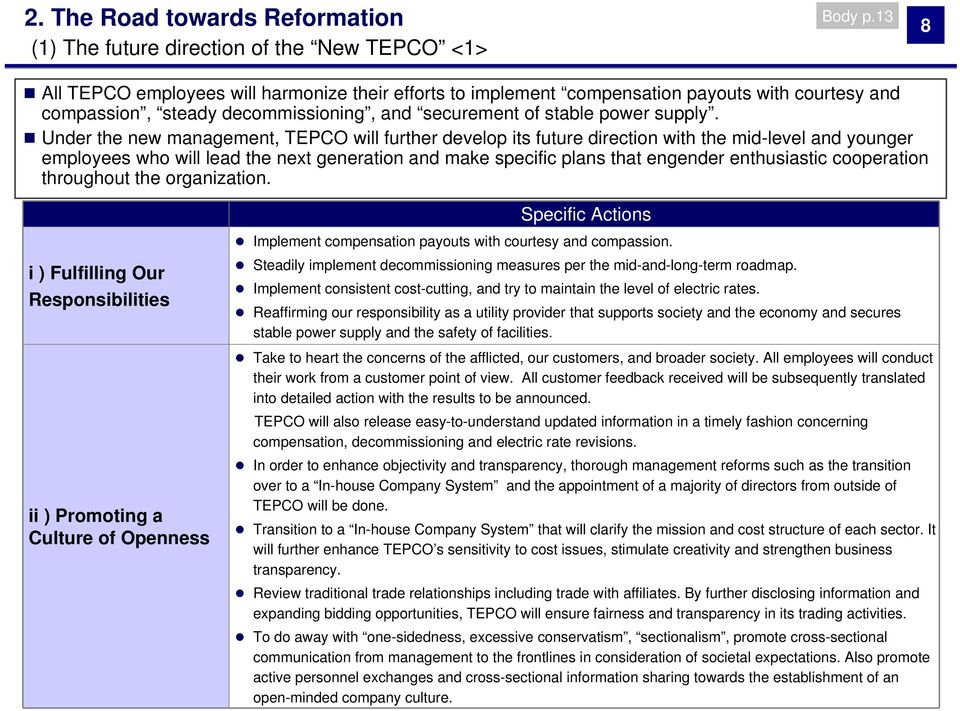
9 2. The Road towards Reformation (1) The future direction of the New TEPCO <1> Body p.13 8 All TEPCO employees will harmonize their efforts to implement compensation payouts with courtesy and compassion, steady decommissioning, and securement of stable power supply. Under the new management, TEPCO will further develop its future direction with the mid-level and younger employees who will lead the next generation and make specific plans that engender enthusiastic cooperation throughout the organization. Specific Actions Implement compensation payouts with courtesy and compassion. i ) Fulfilling Our Responsibilities Steadily implement decommissioning measures per the mid-and-long-term roadmap. Implement consistent cost-cutting, and try to maintain the level of electric rates. Reaffirming our responsibility as a utility provider that supports society and the economy and secures stable power supply and the safety of facilities. Take to heart the concerns of the afflicted, our customers, and broader society. All employees will conduct their work from a customer point of view. All customer feedback received will be subsequently translated into detailed action with the results to be announced. TEPCO will also release easy-to-understand updated information in a timely fashion concerning compensation, decommissioning and electric rate revisions. ii ) Promoting a Culture of Openness In order to enhance objectivity and transparency, thorough management reforms such as the transition over to a In-house Company System and the appointment of a majority of directors from outside of TEPCO will be done. Transition to a In-house Company System that will clarify the mission and cost structure of each sector. It will further enhance TEPCO s sensitivity to cost issues, stimulate creativity and strengthen business transparency. Review traditional trade relationships including trade with affiliates. By further disclosing information and expanding bidding opportunities, TEPCO will ensure fairness and transparency in its trading activities. To do away with one-sidedness, excessive conservatism, sectionalism, promote cross-sectional communication from management to the frontlines in consideration of societal expectations. Also promote active personnel exchanges and cross-sectional information sharing towards the establishment of an open-minded company culture.
10 2. The Road towards Reformation (1) The future direction of the New TEPCO <2> Body p.14 9 iii ) Reforming energy service in step with customer and societal expectations Specific Actions Given the tremendous changes in the power supply-demand balance following the earthquake, in order to optimize energy efficiency, we will reform the business as follows in consideration of customer and societal expectations. In order to improve the installation efficiency of facilities, we must depart from our prior reluctance to seek outside support by forming partnerships with other organizations, actively incorporate new power sources and promote competition. Enhance neutrality and fairness in the network sector. In addition, via improving the efficiency and the reliability of the facilities utilizing ICT, we will establish a network that allows for the largescale introduction of renewable energy and a dispersed power system. Increase the number of rate menus, further control peak demand and reduce electricity rates by actively developing energy management services through business alliances. Also increase customer options and respond to various needs via the active introduction of smart meters and new energy solutions etc.

11 2. The Road towards Reformation (2) The Schedule towards Reformation Body p May April Middle in the 2010 s - Introduction Period Full-scale Implementation Dissemination Period Transition over to a In-house Company System and introduce a governance system with a majority of its members recruited from outside of TEPCO (by June 2012) Strengthening financial standing by receiving a capital injection from the Fund and establishing goodwill with financial institutions to ensure access to credit when needed (to be implemented as early as possible from June 2012) The transition over to a In-house Company System which allows for the separation of the Transmission & Distribution Sector, Fuel & Thermal Generation Sector, and the Retail Sector, will allow for the missions, and revenue/cost structure of each of these sectors to be clarified. In addition, alliances will be created with outside business operators (to be implemented in a timely fashion following the latter half of FY 2012) Full-scale cooperation with outside business operators towards bulk purchases of fuel, joint construction and operation of fuel facilities, replacement of old thermal power stations, etc. Return to the corporate bond market by returning to profitability and increasing the value of owner equity, etc. (by the middle of the 2010 s) Consider spinning off in-house companies into smaller affiliated companies in reflection of power system reformation progress, etc. Implementation of measures towards stable power supply such as alliances with outside suppliers etc. Increase of revenue via aggressive participation in overseas business and new retail business development (Minimization of tax payer s burden by paying back the Fund contribution. (* The status of the nuclear power generation business is to be reviewed following government discussion) Further implementation of management streamlining

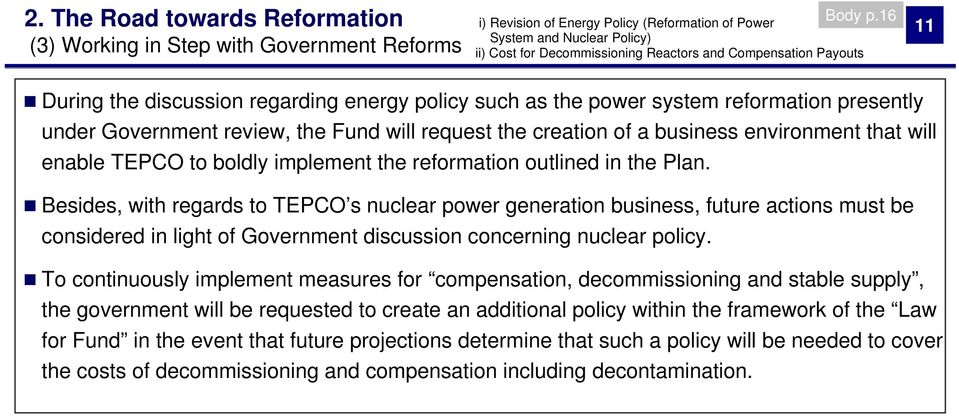
12 2. The Road towards Reformation (3) Working in Step with Government Reforms i) Revision of Energy Policy (Reformation of Power Body p.16 System and Nuclear Policy) ii) Cost for Decommissioning Reactors and Compensation Payouts 11 During the discussion regarding energy policy such as the power system reformation presently under Government review, the Fund will request the creation of a business environment that will enable TEPCO to boldly implement the reformation outlined in the Plan. Besides, with regards to TEPCO s nuclear power generation business, future actions must be considered in light of Government discussion concerning nuclear policy. To continuously implement measures for compensation, decommissioning and stable supply, the government will be requested to create an additional policy within the framework of the Law for Fund in the event that future projections determine that such a policy will be needed to cover the costs of decommissioning and compensation including decontamination.
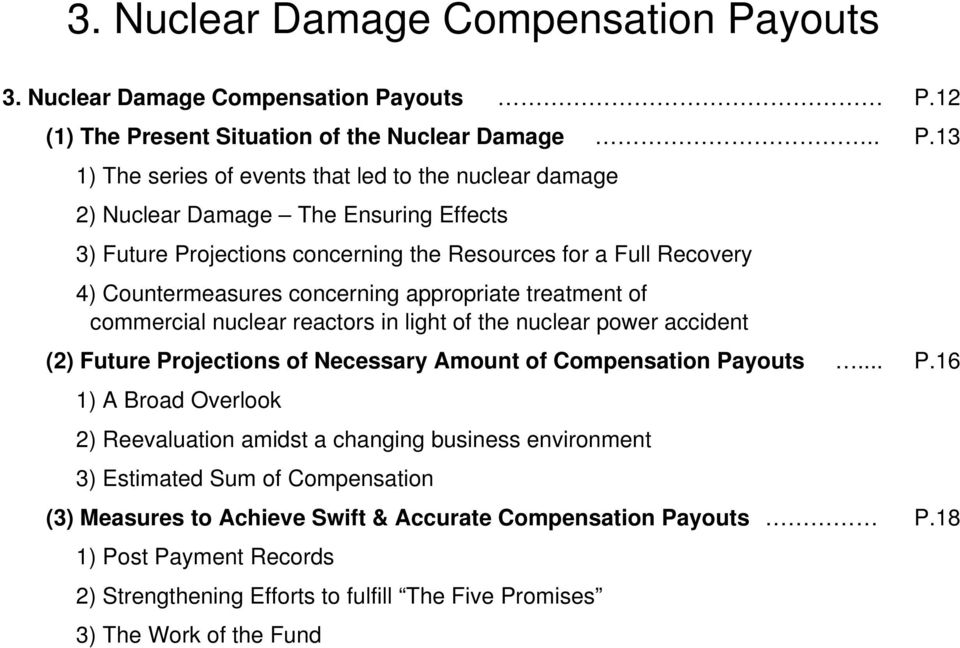
13 3. Nuclear Damage Compensation Payouts 3. Nuclear Damage Compensation Payouts P.12 (1) The Present Situation of the Nuclear Damage.. P.13 1) The series of events that led to the nuclear damage 2) Nuclear Damage The Ensuring Effects 3) Future Projections concerning the Resources for a Full Recovery 4) Countermeasures concerning appropriate treatment of commercial nuclear reactors in light of the nuclear power accident (2) Future Projections of Necessary Amount of Compensation Payouts... P.16 1) A Broad Overlook 2) Reevaluation amidst a changing business environment 3) Estimated Sum of Compensation (3) Measures to Achieve Swift & Accurate Compensation Payouts P.18 1) Post Payment Records 2) Strengthening Efforts to fulfill The Five Promises 3) The Work of the Fund
14 3. Nuclear Damage Compensation Payouts (1) The Present Situation of the Nuclear Damage Body p.23 4) Countermeasures concerning appropriate treatment of commercial nuclear reactors in light of the nuclear power accident i) Steady implementation of the Mid-and-Long-Term Roadmap, etc. 13 The decommissioning of Units 1-4 of Fukushima Daiichi Nuclear Power Station to be implemented based on the Mid-and-Long-Term Roadmap involves unprecedented technical difficulties in many areas. TEPCO will steadily implement the decommissioning, develop necessary organizations and schemes, and work closely with organizations that handle the R&D budget, project management, and safety regulations. [Reference: Overview of the Mid-and-Long-Term Roadmap] Completion of Step 2 Within 2 years Within 10 years years later (December 16, 2011) Step 1,2 Phase 1 Phase 2 Phase 3 <Achieve stable conditions> Cold shut down conditions Significant reduction of radioactive emissions The term before start of fuel removal from the Spent Fuel Pools (within 2 years) Begin removal of the fuels from the Spent Fuel Pool (Unit 4, within 2 years) Reduce impact of radiation caused by additional releases from the whole power plant and radiation waste produced after the accident (Secondary processed water, waste, and debris), and reduce the effective dosage level at the site boundaries to less than 1mSv/year. Maintain stable reactor cooling and treatment of the accumulated water, enhance reliability Start R&D for fuel debris removal, and decontamination work Start R&D for radioactive waste treatment/disposal The term before start of fuel debris removal (within 10 years) Complete removal of fuels from the spent fuel pools of all units Complete preparation works for removing fuel debris such as decontaminating the inside of the buildings, repairing and filling water into the Primary Containment Vessels. etc,, and start removal of the fuel debris (Target: within 10 years) Maintain stable cooling of the reactors Complete treatment of the accumulated water Continue R&D for radioactive waste treatment/disposal, and start R&D for the demolition of the nuclear facilities Conduct systematic and proper assignment/training of employees, increase motivation, and secure working safety (ongoing) The term until the completion of decommissioning (30-40 years later) Complete removal of the fuel debris (20-25 years later ) Complete the decommissioning (30-40 years later) Radioactive waste treatment/disposal Source) Materials of the Mid-and-long term countermeasures meeting by the government and TEPCO (The first session)
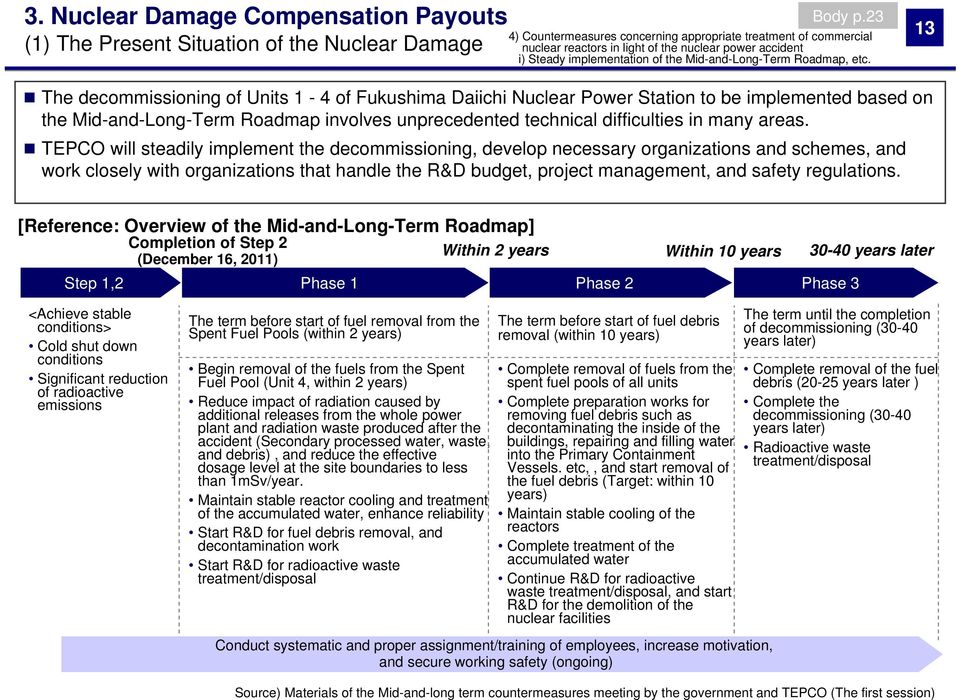
15 3. Nuclear Damage Compensation Payouts (1) The Present Situation of the Nuclear Damage Body p.24 4) Countermeasures concerning appropriate treatment of commercial nuclear reactors in light of the nuclear power accident ii) Overall picture of the decommissioning costs 14 The reasonable estimated range that TEPCO has come up with by the end of December 2011 for decommissioning costs is billion. [Reference: Breakdown of Decommissioning Costs] Reserve for Disaster Loss TEPCO Management and Finance Investigation Committee Report Items of Analysis Costs related to Step 1 and 2 in the Roadmap Amount Adjustment Amount Additional Total reserves ( billion) Amount estimated by TEPCO (As of the end of Dec. 2011) Total Costs related to mid-term issues in the Roadmap * Subtotal Asset Removal Obligation Total , Additional Estimated Decommissioning Costs at 1Q FY 2011 Total liabilities related to decommissioning related costs after adjustments , * Including the amount spent by the end of December 2011
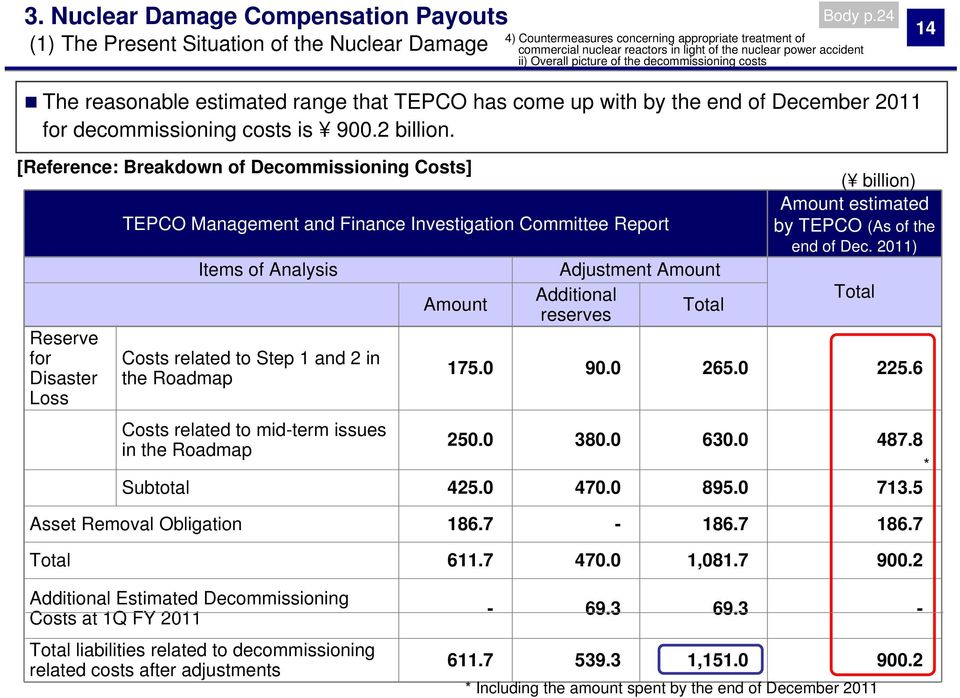
16 3. Nuclear Damage Compensation Payouts (1)The Present Situation of the Nuclear Damage Body p.24 4) Countermeasures concerning appropriate treatment of commercial nuclear reactors in light of the nuclear power accident ii) Overall picture of the decommissioning costs 15 The simultaneous decommissioning of Units 1-4 at Fukushima Daiichi Nuclear Power in a high radiation environment is a very challenging proposition. In addition, the contents of the work and schedule may vary significantly due to the adoption of new technological developments and waste disposal methods. At this stage, it is difficult to estimate the total costs by simply adding up the expenditures for each step. The actual methods shall be determined at each Holding Point (HP) of the Mid-and-Long-Term Roadmap and costs for each item shall be specified in accordance with the schedule below. TEPCO will spend the necessary amount of funds needed to secure safety during decommissioning that will be backed up by our financial standing to be strengthened. Segment Items Period Relating HP Fuel Debris Removal Costs a. Reactor building container costs b. Removal costs Approx. FY 2018 Approx. FY 2018 to FY 2021 [ - ] [ HP3-1 to 3-5 ] c. Fuel debris container costs d. Fuel debris storage and management costs Approx. FY 2020 to FY 2021 Approx. FY 2021 [ HP3-4 ] [ HP3-5 ] e. Fuel debris processing / disposal costs Approx. FY 2031 onward [ HP3-6 ] Reactor Facility Demolition & Radioactive Waste Processing and Disposal Costs f. Overall costs for dismantling the reactor facility g. Overall costs for processing and disposing radioactive waste FY 2021 Approx. FY 2022 onward [ HP4-1 ] [ HP5-3 ]
17 3. Nuclear Damage Compensation Payouts (2) Future Projections of Necessary Amount of Compensation Payouts 1) A Broad Overlook Body p Matters such as the development of the Secondary Supplement of the Interim Guideline by the Dispute Reconciliation Committee (March 16) has enabled us to estimate the amount of compensation for property. Accordingly, we are now able to estimate the relevant portion of the overall compensation. (See below chart.) However, given the ongoing claims being received from businesses seeking compensation for items such as "lost profits" and "damaged reputations", at this point in time it is difficult to estimate the total compensation amount. [Roadmap for compensation (image)] Compensation Amount Establishment of Evacuation Instruction Area Actual Projection Zone Setting Alert Zones, Planned Evacuation Areas, Emergency Evacuation Preparation Areas Lift of emergency evacuation preparation areas Return Home I Return Home II Return Home III Payment Phase Provisional Payment Phase I Phase II Phase III Decontamination Property Voluntary Evacuation Full Compensation Payouts (Corporate) Full Compensations Payouts (Individual) Provisional Payments (Corporate) Sep. Nov. Dec. Feb. Mar. Provisional Payments (Individual) Mar. 11 Apr. 22 Provisional Payment Full Compensati on Emergency Special Business Plan Speed Up Automobile Change of Emergency Special Business Plan Voluntary Evacuation Property Decontamination Measures

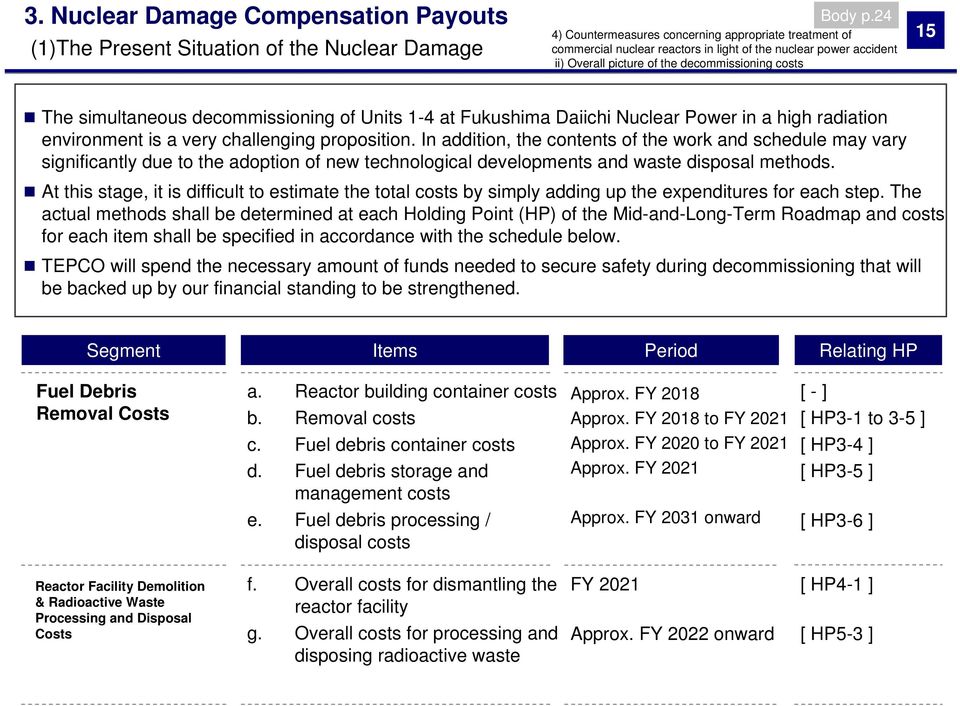
18 3. Nuclear Damage Compensation Payouts (2) Future Projections of Necessary Amount of Compensation payouts 2) Reevaluations amidst a Changing Business Environment 3)Estimated Sum of Compensation Body p In the Secondary Supplement of the Interim Guidance, the compensation payout scheme has been decided regarding the loss or damage of property value related to real estate. It is necessary to come up with new measures to achieve swift and appropriate compensation payouts. As a result of reevaluating the necessary amount of compensation payouts based on the aforementioned supplement, the projected amount of compensation payouts has been increased to 2, billion as a reasonable estimation. [Increase of Projected Payouts] The Emergency Special Business Plan (approved on Feb. 13) 1,700.3 billion billion Comprehensive Special Business Plan 2,546.3 billion Revision of conditions and other factors based on changed circumstances i) Loss/ decrease of property value [The Secondary Supplement of the Interim Guidance] Property value related to real estate in AREA3 (Areas prohibiting the return of evacuees for a long time) - Classified as a TOTAL LOSS due to the accident. Property value related to real estate in AREA2 (Areas unfit for life) and AREA1 (Areas where evacuation orders will soon be lifted). - Value partially decreased due to the accident taking the terms UNTIL the lift etc into consideration ii) Evacuation costs and Emotional Distress [The Second Supplement of the Interim Guidance] The duration of the second term for compensation of damages related to evacuation costs and emotional distress [originally set as six months from the end of the first term (six months since the accident) ] was extended until the review of the evacuation restrictions. Third term compensation amount guidelines are listed per each evacuation order area.
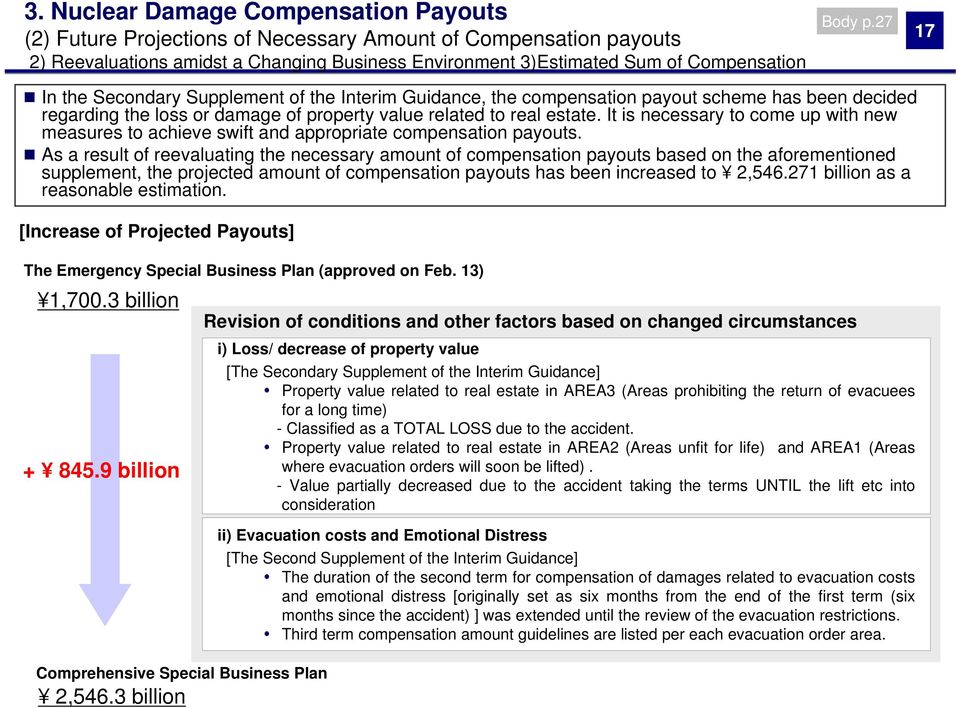
19 3. Nuclear Damage Compensation Payouts (3) Measures to Achieve Swift & Accurate Compensation Payouts 1) Past Payment Records Body p As of April 20, we received 103,638 claim filings from individuals and 52,258 from corporations and sole proprietors. A total of approx billion in compensation was paid out comprised of provisional payments of approx billion and main compensation payouts of approx billion. 42,000 households requesting compensation payouts by the end of 2012 February have increased to the expected approx. 52,000 ~ 53,000 households by the end of April which accounts for approx. 80 % of total covered households who received provisional payouts in [Payment records of Main Compensation Payouts (as of April 20)] Number of Requests Received Number of Requests Fulfilled Payment Amount * [ billion] Approved Amount [ billion] Individuals 103,638 58,996 approx.87.3 approx Voluntary evacuations & related items Corporations Sole Proprietors 554, ,887 approx approx ,258 36,360 approx approx Organizations 210 approx approx Others Total 710, ,454 approx approx *The Payment amount is the approved amount minus the billion amount paid out as provisional payments. [Number of households requesting main compensation payouts] (10,000 household) Rate of applications received (right axis) Number of households filing claims (left axis) ,731 11,84319, ,060 42,697 48,228 37,048 29, YR 2011 YR 2012 *The April record is until April (%) (End of month)

20 3. Nuclear Damage Compensation Payouts (3) Measures to Achieve Swift & Accurate Compensation Payouts 2) Strengthening Efforts to fulfill The Five Promises Body p TEPCO has made every effort to fulfill The Five Promises for the compensation payouts. However, given the ongoing harsh criticism, we will further strengthen our efforts to more effectively meet expectations. [Strengthening Efforts to fulfill The Five Promises ] 1) Speedy compensation payments 2) Payments in consideration of each applicant s situation 3) Pay Due Attention to Reconciliation Proposals 4) Simplified Paperwork Procedures 5) Proactive Follow-up Work Accomplished Increased staff numbers, improved operational flow Fulfilled the promises in the Emergency Special Business Plan (See next page for details) Paid out estimated compensation for corporations and sole proprietors suffering from tight cash flow. Took into serious consideration advice received from the Conflict Resolution Center. Created easy-to-understand instruction manual. Simplified the required paperwork. Via TEPCO s homepage, provided info on how TEPCO is responding to major requests and inquiries. Future Objectives Increase staff numbers to 6,200 to better manage compensation for the voluntary evacuees etc. Create a tentative compensation schedule for damaged cars and voluntary evacuees. When administering payouts, take into careful consideration each individual s situation Provide explanations to clarify the difference between the requested amount and paid amount. Resolve disputes promptly by contributing efforts towards identifying contentious issues. Greatly reduce the amount of required paperwork. (2 nd : 34 pages 3 rd : 9 pages) Continue Present Situation actions Compensation for evacuees who stayed at a friend s or relative s house based on actual expenses

21 3. Nuclear Damage Compensation Payouts (3) Measures to Achieve Swift & Accurate Compensation Payouts 2) Strengthening Efforts to fulfill The Five Promises Body p TEPCO achieved the following goals listed in the Emergency Special Business Plan. Complete processing of compensation applications within three weeks after receiving them Implement payouts within 2 weeks after receiving the Statement of Mutual Agreement At the initial stages, due to the unprecedented nature of the situation, TEPCO was unable to process the tremendous overflow of submitted compensation applications which resulted in a huge accumulation of unprocessed applications in November and December However, the situation has since been rectified by increasing the number of staff and improving operations. [Required number of days for application processing (excluding compensation for damaged cars and voluntary evacuees)] (Individuals) (Corporations and Sole Proprietors) (days) (days) 40 Avg. Days per Month Target (21days) Avg. Days based on Sep to Present Date YR 2011 YR (month) Target (21days) Avg. Days per Month Avg. Days based on Sep to Present Date YR 2011 YR (month) *2012 April: as of Apr 20th 4
22 3. Nuclear Damage Compensation Payouts (3) Measures to Achieve Swift & Accurate Compensation Payouts 3) The Work of the Fund Body p The Fund has guided the total compensation payout procedures and implemented the 3 Measures for Compensation Payouts with Courtesy and Compassion. Hereafter, based on the results to date, the Fund will evaluate present procedures and implement improvements to further assist the afflicted. [The Work of the Fund (As of April 22)] Expert Consultation Visits Monitoring the implementation of Compensation Payouts Transmission of Messages of the Afflicted Work Accomplished 303 Expert Consultation Visits, approx. 4,000 visits were paid to individual residences. The Fund dealt with approx. 2,630 inquiries, and conducted approx. 200 personal consultations. The Compensation Monitoring Committee etc. inspects and confirms that the use of the TEPCO bank account opened for the Compensation Payouts is being used properly. Organize the items to be checked to monitor internal governance regarding Compensation Payouts operations. Grasp the needs of the afflicted at the compensation site and publicize accordingly. (December 2011 and March 2012). Acting as a liaison, the Fund shared the information received with TEPCO, the governments and local authorities and demanded that necessary countermeasures be implemented Future Objectives Hold orientations in Fukushima Prefecture, personal consultations will be continuously available. Outsourced free personal consultations to the Bar Association in Ibaraki Pref. In the near future, such activities will be implemented in other Prefectures. Continue monitoring implementation while improving payout procedures The Fund will check the status of implementation and demand necessary improvements through the 5 Promises Working Group Hereafter, the Fund will take the requests received from the afflicted and share them with TEPCO, the government and local authorities so as to incorporate them into future improvements.
23 4. TEPCO s Business Operation Plan 4. TEPCO s Business Operation Plan.. P.22 (1) Principle Business Philosophy P.23 (2) Management Streamlining Measures P.24 1) Thorough Cost Reductions 2) Reevaluating Future Facility Investment Plans 3) Asset Sales (3) Business Reforms P.45 1) Stabilizing Economical Fuel Supply & Optimizing Efficiency of Thermal Power Supplies through alliance etc 2) Increasing Neutrality & Transparency of the Transmission & Distribution Sector 3) Retail Business Development (4) A New Mindset... P.50 1) Moving in a New Direction 2) Three Ways to Transform our Vision into a Reality (5) Strengthening Our Financial Standing... P.54 1) Requests to Financial Institutions 2) The Fund s Capital Injection 3) Requests to our Shareholders 4) Supply-Demand & Income/Expenditure Projections (6) Clarifying Management Responsibilities P.65 (7) Ensuring Implementation of the Special Business Plan. P.66
24 4. TEPCO s Business Operation Plan (1) Principle Business Philosophy Body p TEPCO will implement the following actions based on Fulfilling its Responsibilities, Promoting a Culture of Openness, Reforming Energy Services in step with Customer & Societal Expectations TEPCO will thoroughly implement Compensation Payouts with Courtesy and Compassion, Steady Reactor Decommissioning, Capping Electricity Rate Hikes and Stable Power Supply and Facility Safety while executing thorough management streamlining efforts. TEPCO will implement the following: a) The swift dissemination of easy-to-understand information to the afflicted, customers and broader society b) Open-door management policy c) Governance and Organizational reform d) Procurement reforms that ensure Fairness and Transaction Transparency Simultaneously, TEPCO will instill a new New Mindset into its employees that will serve as the impetus to achieving the aforementioned reforms. In responding to various customer needs and shifting to a more competitive and alliance-based business model, TEPCO will reform its energy services. The Fund will provide the necessary support to realize the reforms, such as by continuously monitoring TEPCO s reformation efforts and requesting the government to adopt certain policies.
25 4. TEPCO s Business Operation Plan (2) Management Streamlining Measures Body p The TEPCO Management & Finance Investigation Committee and the Fund have left no stone unturned in its management streamlining efforts and have conducted exhaustive and multi-layered due diligence of TEPCO and all its group companies. The Fund and TEPCO will implement mid-to-long term sustainable and bold streamlining over the following 3 phases: Phase I: :Reduce routine expenditures and sell off non-electricity business assets etc. Routine Streamlining Phase II: Structural Streamlining Phase III: Strategic Streamlining :Management streamlining by implementing in-depth structural reforms such as reducing mid-to-long term facility investments and reforming the cost structures in subsidiaries/affiliated companies. :Promote strategic measures to cut fuel costs such as replacing aging thermal power plants and teaming up with other companies in procuring fuel and follow-up operations. [Management Streamlining Measures (Overview)] (FY2010 Actual basis) Comprehensive Special Business Plan Emergency Special Business Plan Phase I Phase II Phase III Routine Streamlining Structural Streamlining Strategic Streamlining Other expenses billion (19.2%) Personnel Expenses 431.2billion(9.0%) Maintenance Outsourcing Expenses Expenses billion 412.1billion (3.9%) (8.6%) Fuel Expense 1,482.2 billion (30.9%) Power Purchase Expenses from Other Suppliers 502.3billion Cut Facility Investments Cut Fuel Expenses Depreciation 655.7billion (13.7%) (10.5%) Inter-area Power Purchase Expenses 201.2billion (4.2%) Replace aging thermal power plants TEPCO (Main Body) Cost Cut Asset Sales Subsidiaries Asset Sales and affiliated Cost Further Measures companies Cut Diversify Fuel Procurement Joint Operation of LNG Facilities, Co-procurement/consolidation of fuel procurement measures
26 4. TEPCO s Business Operation Plan (2) Management Streamlining Measures [Reference: Management Streamlining Measures (overview)] Emergency Special Business Plan (FY ) Content (Issue) FY 2011 forecast for fulfillment Comprehensive Special Business Plan (FY ) Content (Issue) 25 Cost Reductions TEPCO Main Body Cut 2,648.8billion over 10 years Although the original cost cut target was billion, the actual projected cost cut amount will be billion. ( billion) Reduce 3,365 billion over 10 years (An additional billion) Asset Sales Reduction of Facility Investments Real Estate Securities Subsidiaries & Affiliate Companies - - Sell TEPCO Group property equiv. to billion in principle by FY2013 Sell TEPCO Group securities equiv. to billion in principle by FY2013 Sell 45 companies (equiv. to billion) in principle by FY2013 Although the original sales target for TEPCO s main body assets (excluding group company assets) was 15.2 billion, actual projected sales amount will be 43.1 billion. ( billion) Although the original sales target of TEPCO s main body assets was billion, actual projected sales amount will be billion. ( billion) 96% completion of the TEPCO Group total target by FY2013 Although the original sales target for TEPCO s main body assets was 32.8 billion, actual projected sales amount will be 47 billion( billion) Reduce billion over 10 years since the inception of the Emergency Special Business Plan (Facility Investments: 7,611.2 billion over 10 years) billion of assets were sold off in FY These sell off activities were accelerated and far beyond the original FY 2012 target of 43.6 billion for the whole TEPCO group. (an additional billion.) Selling off additional real estate owned by subsidiaries. The selling off of assets will be done ASAP. Accelerate sales to complete the sell-off by the end of FY Reduce billion in costs over 10 years * Routine Streamlining Structural Streamlining *The consolidated cost cut effect is equivalent to billion taking into account the subtraction of the amount per TEPCO business transactions.
27 4. TEPCO s Business Operation Plan (2) Management Streamlining Measures 1) Thorough Cost Reductions Body p Costs will be reduced by over 3,365 billion from FY2012 to 2021, including an additional cost reduction of billion besides the target listed in the Emergency Special Business Plan. [Overall Cost Reduction] Procurement expenses of materials and services Power purchase and fuel expenses Personnel expenses Other expenses Facility Investments Totals Emergency Special Business Plan Total of 10 years (Avg ) (31.3) 85.4 (6.2) 1,113.5 (119.2) (90.2) (FY ) Plan FY 2011 Projection FY 2011 Comprehensive Special Business Plan After Revision of Emergency Special Business Plan Total of 10 years , ,648.8 (246.8) ,708.5 (FY ) Additional Cost Reductions Total of 10 years Total of 10 (Ave ) years (Ave ) (17.2) (21.6) (10.1) 61.1 (4.7) (5.0) (58.6) ( billion) (48.4) (27.7) 1,275.8 (129.3) (94.9) (5.0) 3,365.0 (305.4)
28 4. TEPCO s Business Operation Plan (2) Management Streamlining Measures 1) Thorough Cost Reductions i) Procurement expenses of materials and services <1> Phase I Phase II From a Quantity and Unit Price perspective, cost cuts will be done in easy to implement areas such as cancelling construction/repair work, revising the timing of construction/maintenance work, and uniformly cutting costs in transactions with affiliated companies. Additional cost reductions will be implemented via reforming the cost structures in subsidiaries and affiliate companies as well as revising traditional business relationship networks and the order placing procedures with subsidiaries, affiliate companies and outside business partners. (Transactions based on single tender contracts with subsidiaries and affiliate companies are to be reduced by 30 % via expanding competitive bidding to 30% for all procurement of materials and services over the next 3 years, which is twice the rate of current procurement activities.) [Specific Measures (1) for Procurement Expenses of Materials and Services] Items Contents Phase Cost reductions Additional * reductions Reduction of depreciation costs by cutting facility investments Suspension or revision of timing of construction and inspection Transactions with affiliate companies expand competitive procurement Reduction of capital investments for the short and mid term - Cancel new showrooms for promotion activities (Switch Station) - Reduce construction for expanding trunk transmission systems etc. Emergency reduction of repair costs (revision concerning the construction of power network facilities) Permanent revision of construction timing while ensuring stable supply etc. - Revise facility inspection intervals - Revise equipment inspection methods - Suspend some repair work of communication cables etc. Negotiate a 10% transaction price discount with current business partners, which is the expected discount rate, if procurements are made via competitive bidding. - Cost improvements with affiliate companies and expansion of new suppliers - Implement negotiation in consideration of market prices such as setting a benchmark on the prices in the transactions - Promote optimal procurement methods such as competitive bidding Increase the cost cut amounts via reforming the cost structures in subsidiaries and affiliate companies Body p billion cost reductions in 10 years (added billion from the Emergency Special Business Plan) - Actual cost reductions in FY 2011 (estimation) :Plan 43.4 billion 44.6 billion (+ 1.2 billion) * Additional refers to cost reductions not listed in the Emergency Special Business Plan. The same applies to the following I billion - I 4.9 billion - 27 II 67.6 billion 60.3 billion I billion - II 38.2 billion 38.2 billion
29 4. TEPCO s Business Operation Plan (2) Management Streamlining Measures 1)Thorough cost reductions i) Procurement expenses of material & services <2> [Specific measures for Procurement Expenses of Materials & Services (2)] Items Contents Phase Transactions with group companies: Construction efficiency improvements Reviewing the transaction structures and ways of ordering relating to external business partners Standardization of equipment specification (Smart meters) Cut repair and maintenance costs etc. by increasing the productivity of construction work related to power distribution with group companies or construction companies unaffiliated to TEPCO or via price negotiations and contract reviews based on introductory trials and effective evaluations of new ways of construction or new materials that will lead to enhanced productivity Lower maintenance costs and outsourcing expenses by adopting an order method to minimize costs as much as possible for each contract and review present supplier relationships via considering new business partners and thorough progress management of each project (reflecting an approx. 10% costcut from the current prices by negotiating down to a level calculated based on the expected costs realized via bypassing any middlemen or competitive bidding, as is presently being done with TEPCO s group companies) Review the negotiation / business process: from transactions through agents to direct transactions with manufacturers Review order methods: from blanket orders to separate orders made for individual construction assignments Create competition by placing bids for new business partners or loosening transaction restrictions For those transactions not easily implemented through the bidding process, we will try to cut maintenance costs and outsourcing expenses by negotiating thorough cost cuts via proposing spec changes and/or requesting spec changes from our suppliers. Cost Reductions 28 Additional reductions I 55.3 billion - I 92.3 billion - II Body p billion 21.4 billion Review smart meter procurement methods in order to cut costs I 65.3 billion - Standardization of designs / specification among electric power companies <long-term issue> Total Concrete cost reductions will be realized through such measures as interviewing manufacturers and other electric power companies. Prior to the interviews, we will select items to be standardized with other power companies III billion billion
30 4. TEPCO s Business Operation Plan (2) Management Streamlining Measures 1)Thorough Cost Reductions i) Procurement expenses of materials & services <3> [Group Company Transactions: Expanding Bidding Opportunities] Mainte nance costs FY 2015 Projection Generat ion Transmi ssion Transfor mation Distribut ion (TF report) Purchase 82.1 Construction Commission 8.3 Purchase 5.2 Construction 26.4 Commission 2.6 Purchase 13.7 Construction 4.9 Commission 1.1 Purchase 72.4 Construction 65.6 Commission 37.7 Other 7.1 Outsourcing Expenses Total Body p Review Points of Single Tender Contracts with subsidiaries / affiliate companies Raise the competitive bidding percentage to 30% (will double in 3 years) Securing implementation by establishing a committee to encourage TEPCO to loosen restrictions barring competition Close investigation of the contents of single tender contracts Implement cost-cutting measures (lower unit prices of single tender contracts) the Fund will oversee proper implementation [Review of transaction structures / Order methods with business entities not affiliated with TEPCO] Before Placing Separate Orders After Placing Separate Orders TEPCO Percentage of single tendering Single tendering (85%) Competing bids (15%) Business partner Group companies (31%) External companies (69%) Group companies(12%) External companies (88%) Amount of single tender contracts with subsidiaries / affiliates = billion 30% decrease billion ( billion) TEPCO Order to manufacturers Manufacturing and procuring products Engineering on site and disassembling / assembling / inspection / repair work Order to manufacturers Engineering on site Manufacturing and procuring products Disassembling / assembling / inspection / repairing work on site Engineering on site Orders to other companies Manufacturing and procuring products Disassembling / assembling / inspection / repairing work on site *2 Manufacturing and procuring products * Cost control Cost control Cost control via reverse-engineering technology etc. (*1) and differing unit labor costs etc.(*2) 1
31 4.TEPCO s Business Operation Plan (2) Management Streamlining Measures 1) Thorough Cost Reductions ii) Power Purchase and Fuel Expenses Body p Phase I Phase II From a Quantity and Unit Price perspective, cost cuts that can be independently and immediately implemented will be done such as fuel conversions of our gas turbines from light oil to inexpensive city gas. We will further implement structural streamlining measures such as rationalizing daily fuel logistic operations to enhance the availability factor of LNG thermal power plants whose operational costs are relatively lower than other plants billion cost reduction in 10 years (added billion from the Emergency Special Business Plan) - Actual cost reduction in FY2011 (estimation) : Plan 11.1 billion 16.0 billion (+ 4.9 billion) [Specific measures for the reduction of power purchases and fuel expenses] Additional Items Contents Phase Cost reductions Reductions Fuel conversions of emergency power sources from light oil to cheap city gas. I 14.5 billion - Reduction of Fuel Prices (Unit Prices) Application of Efficient Power Sources Reduction of Power Purchase Expenses Utilizing the Japan Electric Power Exchange (JEPX) Reduction of Fuel Costs from a Mid-to-Long Term Perspective Reduction of agency commissions for LNG imports II 21.3 billion 21.3 billion Reduction of fuel prices for newly installed power supply sources Cost reduction via streamlining of daily operations based on discussions with relevant parties In order to increase the availability factor of LNG fired thermal power plants whose costs are relatively low. II 28.1 billion 28.1 billion Increase in amount of power received from cheaper power sources available from other companies Negotiate to reduce unit prices at the time of re-signing I 69.7 billion - Negotiate to have jointly owned thermal power companies and in-house power generation producers etc. reduce their fixed costs etc. Reduce fuel costs by purchasing cheaper power from JEPX. Increase power sales to other companies by selling power through JPEX In order to stabilize fuel procurement and minimize purchase costs, we will implement measures such as constructing and operating fuel facilities with outside parties, procuring fuels with outside parties, and diversifying procurement sources. II 62.9 billion 62.9 billion II 2.1 billion 2.1 billion III - - Total billion billion
32 4.TEPCO s Business Operation Plan (2) Management Streamlining Measures 1) Thorough Cost Reductions iii) Personnel Expenses Body p Phase I Unit Cost per Person will be cut via the following: reduction of salaries and bonuses, revision of benefit programs, and revision of the Retirement Benefit Scheme. The Number of Persons will also be reduced via personnel restructuring. Phase II Additional Unit Costs per Person will be reduced by revamping the operations of the Personnel Evaluation System such as tightening job assignments and by speeding up the Number of Persons to be cut. 1,275.8 billion cost reduction in 10 years (added billion from the Emergency Special Business Plan) - Actual cost reductions in FY2011 (estimation) : Plan 61.4 billion 68.8 billion (+ 7.4 billion) [Specific measures for the reduction of personnel expenses] Items Personnel Reductions Reduction of Salaries and Bonuses Revision of the Retirement Benefit Scheme Revision of Benefit Programs Thorough implementation of each measure Contents After general streamlining via readjusting the group structure and drastic operational streamlining, we will reduce the number of persons by cutting back on hiring and implementing voluntary retirements (approx. 7,400 employees on a consolidated basis, approx. 3,600 employees on a non-consolidated basis) Continue to cut annual earnings across the board (Supervisory employees -25%, General employees -20%) Introduce a new personnel evaluation system (p. 53 ) Reduce overtime wages (reduction to 25% on weekdays which is the bottom limit of the legal standard) Revise the pension system (reducing the interest rate used for revaluation [to 1.5% for active employees and 2.25% for retirees], and reduction of whole life annuity [-30% ) Revision of health insurance, asset-building schemes, cafeteria plan, employee stock ownership plan Implement Unit Cost per Person reductions by revamping the operations of the personnel system such as tightening job assignments. In addition to accelerating the number of persons to be cut, additional personnel cuts may be done predicated on future streamlining efforts. Phase Cost reductions Additional reductions I billion - I billion - I billion - I 50.0 billion - II billion billion Total 1,275.8 billion billion
33 4.TEPCO s Business Operation Plan (Reference) Personnel Reduction and Personnel Expense Comparison Body p [Personnel Reduction] (persons) consolidated Consolidated - 7,400 persons (2011b.g.: 54,100 46,700 persons) Non-consolidated - 3,600 persons (2011b.g.:39,629 36,000 persons) [Personnel Expenses] (10,000 yen) TEPCO non-consolidated FY 2011 b.g. (End of Fiscal Year) 200 * Sum of salary, standard compensation and bonuses. Actual TEPCO data for March * Gov. officials are adjusted for age-class(4 year) ratio equivalent to TEPCO. Regional compensations have been adjusted in the Kantokoushinetsu area. Educational background personnel ratio are adjusted to TEPCO' ratio. * All industries, All industries-avg. infrastructure, Avg. infrastructure, are all above 1,000 employees (Reference) Research for salary and compensation for Government officials, 2011 (the National Personnel Authority; NRA), salary advice for this year (NRA), comprehensive labor cost (Nippon Keidanren), Salary structure basic statistical survey (Ministry of Health, labor and Welfare) All industries All industries- Avg. infrastructure Avg. infrastructure Comprehensive (above 3000) Electricity Gas Railway Water Telecom Aviation Gov. officials Gov. officials after reduction TEPCO
34 4. TEPCO s Business Operation Plan (2) Management Streamlining Measures 1) Thorough Cost Reductions iv) Other expenses Body p Phase I Phase II Cost reductions for short term gains from a unit price and quantity perspective, such as the abolishment of donations, the reduction of promotion/advertising costs except in necessary cases, and R&D cost cuts. Additional structural cost reductions by revising the investment plan and further reducing personnel expenses in conjunction with other restructuring measures billion cost reductions in 10 years (added 61.1 billion from the Emergency Special Business Plan) - Actual cost reductions in FY2011 (estimation) : Plan billion billion (+ 0.4 billion) [Specific measures for other expenses ] Items Details Phase Amount Additions System outsourcing Other expense (ex. donation) Welfare facilities and offices promotion/ advertising costs Theme research Reduce contracts for system services, facility services as well as survey and analysis services. I billion 8.0 billion Cease donation activities. Review membership fees, union fees, etc. I 84.0 billion - Reduce welfare facilities and company housing costs I 44.0 billion - Reduce office space being rented in anticipation of personnel reductions II 6.5 billion 6.5 billion Reduce TV, radio, newspaper, and magazine advertising costs etc. I billion - Reduce Central Research Inst of Electricity Industry contribution. Suspend theme research other than research related to decommissioning, safety operations and stable supply. Reduce the institute s management fee. Additional research cost reductions by reviewing proposed research themes based on research progress and revision of the investment plan. I billion - II 46.6 billion 46.6 billion Employee training Reduce management education training and operation center costs, etc. I 45.7 billion - Consumables Reduce office supply purchases such as PCs and reading materials. I 66.3 billion - Others Review the transportation services for waste management. Reduction of compensation costs. I 37.6 billion - Total billion 61.1 billion
35 4.TEPCO s Business Operation Plan (2) Management Streamlining Measures 1) Thorough Cost Reductions iv) Other expenses (2) 34 To drastically reduce costs, we will cease donations for municipality/rural community activities and environmental protection in and after promotion and advertisement costs will be suspended except for essential purposes such as public announcements requesting cooperation in saving electricity. [Breakdown of Donations] [Breakdown of Promotion & Advertisement Costs] Field Transition of Cost ( billion) Academic Study /Research/Education Activities of Municipalities /Rural communities International Cooperation/Exchange Disaster Assistance Environmental Protection Art and Culture Others Total * Except for the above, we categorized the following costs as Donations according to accounting rules; cancellation of unpaid small electricity bills (on and after FY2012), contributions to the industrial complex (on and after FY2012), and forgoing TEPCOowned property compensation owed by the municipalities (FY2012).These figures were all eliminated from the costs normally accounted for in the calculation of the electricity rates * Out of 3.11 billion for Municipality/Rural community Activities in FY 2011, 3.0 billion was contributed to the Fund for Emergency Response Measures against Nuclear Damages. [Breakdown of Research Cost] Field Transition of Cost ( billion) Researches on Themes Administration of Research Center Others Total Field Transition of Costs ( billion) Broadcast of TV/Radio Advertisement/PR PR Facilities Administration Sales Consultants Exhibitions/Fairs PR on Electricity Rate Menu Sales campaigns Administration of PR Facilities at the Power Plant Sites Diffusion of Eco Ice/Eco Cute Administration of Electric Facilities Consulting Companies Others Total * Contributions to research centers is under discussion with the recipients and has not yet been settled. (Contributions to research centers have been deleted from the left-hand table.)
36 4.TEPCO s Business Operation Plan (2) Management Streamlining Measures 1) Thorough Cost Reductions v) Cost related to Facility Investments Body p Phase II In order to minimize facility investment costs, we will implement demand control measures and will in principal procure outside power sources via a bidding process for all new and replacement thermal power development projects billion cost reductions in 10 years (added billion from the Emergency Special Business Plan) [Specific Measures for Facility Investments] Item Contents Phase Cost Reductions Additional Reductions Drastic Review on Mid- and Long-term Investment Plan In order to minimize facility investment costs, we will implement demand control measures and will in principal procure power sources from outside via a bidding process for all new and replacement thermal power development projects. II billion billion Total billion billion
37 4.TEPCO s Business Operation Plan (2) Management Streamlining Measures 2)Reevaluating Future Facility Investment Plans Body p Investment plan is to be revised from the perspective of mid-to-long term thorough management streamlining while securing stable power supply. From FY 2012 to 2021, curtail investments of over billion higher than the figure at the time The Emergency Special Business Plan was developed. [Outlook for electric utility investment] (Billion yen) The Emergency Special Business Plan Nuclear Fuel etc. Power Supply Expansion/Power Supply Improvements : billion Main Network Expansion/Power Network Improvements : billion Nuclear Fuel etc. : billion Items i) Restrictive Measures for the Peak Demand Contents Restrict peak demand by expanding the Load Adjustment Contracts and adopting a demand response menu for residents with smart meters Main Network Expansion Power Network Improvements Power Supply Improvements Power Supply Expansion (Estimation) (FY) ii) Power Supply Facilities (construction/ replacement of power stations) iii) Power Network Facilities TEPCO will, in principle, cease the construction of its own thermal power units (new construction and replacements) minus the units that have already been invested in. Instead, through a bidding process, from now on we will appoint a supplier who will build and become the thermal plant owner. After construction is completed, we will procure electricity from them. Curtail investments through reviewing the facility investment plans and facility specifications in light of future demand prospects and changing power source ratios.
38 4.TEPCO s Business Operation Plan (2) Management Streamlining Measures 2)Reevaluating Future Facility Investment Plans Body p In order to minimize the burden related to facility investment expenditures, restrict peak demand by expanding the Load Adjustment Contracts and adopting a demand response menu for residents with smart meters which leads to the curtailment of power supply facility investments. Megawatts Saved per Demand Control will be approx. 2,290MW in the summer of FY [Megawatts Saved Per Demand Control] (10MW) Peak Demand Restriction Measures Summary Anytime Adjustment Contracts Aim to increase the amount of adjustable power through consulting services while keeping current customers. New Price Menu (Large Industrial Power High Voltage Small Industrial Power) Aim to expand our curtailment capability during peak hours by increasing the number of contracts that provide the customer a sufficient amount of lead time prior to cutting their power during high demand hours. Demand Response for Residential Control demand at peak hours by introducing a new power sales menu utilizing smart meters *Effective value at transmission end (FY)
39 4. TEPCO s Business Operation Plan (2) Management Streamlining Measures 2) Reevaluating Future Facility Investment Plans Body p A power development plan based on the revised demand forecast including energy saving measures during peak demand hours shows that a total of 2,620 MW of new power sources will not be needed after FY2018. This will contribute to a decrease in facility investments. As there have been no investments made for the power source installations to take place after FY2018, in principle, we will procure suppliers for the planned installations via a bidding process. This will contribute to reduced facility investments equivalent to 2,600 MW. Kimitsu joint thermal 6 (7.6) 2012/6 Chiba GT (33.4 2) 2011/9,12/7 Kashima GT (26.8 3) 2012/7 Kashima joint thermal 5 (15) 2013/11 Kazunogawa 4 (40) 2014/5 Kashima (14.8 3) 2014/5,6,7 Chiba (16.6 3) 2014/4,6,7 Hirono (60) 2013/12 Pumped Water Coal LNG (installation capacity [10MW]) Ooi 2GT (8.1) 2011/9 Kannagawa 2 (47) 2012/7 Kawasaki 2-1 (50) 2013/2 Hitachinaka 2 (100) 2013/12 Kawasaki 2-2 (71) 2016/7 Kawasaki 2-3 (71) 2017/7 IPP bid (60) 2019/7 IPP bid (100) 2020/7 IPP bid (100) 2021/7 FY
40 4. TEPCO s Business Operations Plan (2) Management Streamlining Measures 3) Asset Sales i) Real estate ii) Securities iii) Subsidiaries/affiliated companies Body p Phase I Sell off billion of assets in principle within 3 years from FY2011, based on the Action Plan of the Emergency Special Business Plan. Phase II -Maximize acceleration of asset disposals. -Management streamlining plans will be developed and implemented with the whole TEPCO Group for those affiliated companies not targeted for sell-off. [Specific measures for sales of assets] Real estate Securities Items Contents Phase Targeting sales Affiliated Companies Incidental Businesses Total Sell off real estate within in principle 3 years, except for such property such as redevelopment projects that cannot be sold off quickly Convert real estate not targeted for sell into rental properties. Accelerate the disposal schedule of real estate as planned in the Emergency Special Business Plan minus that property lacking economic efficiency. (sell off more than 80% of the items listed in the planned sales target by FY2012.) Raise the sales target of the plan by considering the additional sell off of real estate owned by affiliated companies ( 1.6 billion, p. 41 ) Sell securities within in principle 3 years, except those securities essential to the electric power business. (96% of the target amount scheduled to be completed by FY2013 was accomplished in FY2011. Sell 45 affiliated companies within in principle 3 years, which were targeted for sell off in the Committee s report. Management streamlining plans will be developed and implemented with the whole TEPCO Group for those affiliated companies not targeted for sell-off. (reduce billion in 10 years * ) 11 companies targeted for re-organization will be consolidated/reorganized based on a 4 business/role-model. The selling of internet service businesses will be accomplished by FY2012, and the disposal of Power Supply Stand businesses were completed by FY2011. I II I I II billion billion billion billion *The consolidated cost cut effect is equivalent to billion taking into account the subtraction of the amount per TEPCO business transactions.
41 4. TEPCO s Business Operation Plan (2) Management Streamlining Measures 3) Asset Sales i) Real Estates ii) Securities Body p The Sales Plan for and after FY 2012 will be implemented far ahead of the schedule in the Emergency Special Business Plan. We will sell off assets worth more than 80% of the targeted billion sales amount, which was incorporated into the Special Business Plan to be achieved by the whole TEPCO Group in FY (The targeted sales amount to be achieved in FY 2012 was modified to billion, which is more than three times the 43.6 billion amount stated in the original plan.) Securities worth billion were sold off in FY % of the total target amount ( billion) planned for sell off by FY2013, was accomplished ahead of time. [Revised Real Estate Sales Plan (consolidated)] Emergency Special Business Plan Total Target Amount (Consolidated) Plan for FY 2011 (Nonconsolidated) FY 2011 (Actual) Substantially accelerated FY 2012 (Plan) FY 2013 (Plan) From FY 2014 (Plan) ( billion) Total Non-consolidated (Modified Sales Plan) Whole TEPCO Group Target amount in the Emergency Special Business Plan Modified Sales Plan Difference [Sales Schedule of Securities] Emergency Special Business Plan FY 2011 Total Target Plan for FY 2011 (Actual) Amount (Nonconsolidated) (Consolidated) FY 2012 (Plan) FY 2013 (Plan) Non-consolidated Whole TEPCO Group Total
42 4. TEPCO s Business Operation Plan (2) Management Streamlining Measures 3) Asset Sales i) Real Estate Body p As for our subsidiary estates totaling 12.2 billion, a 7.6 billion portion of them will be liquidated by selling off the subsidiaries themselves. As for the remaining portion ( 4.6 billion), after determining their purpose, as was done for TEPCO real estate, these assets were divided into the categories of To be Sold off, Maintain Ownership and For Rental Property based on such conditions as whether or not they have a substation or not. Out of the aforementioned 4.6 billion, approx. 1.6 billion was listed in the FY 2012 sales plan, totaling approx. 9.2 billion when added to the sales of subsidiaries. [Overview of Subsidiary Real Estate Liquidation Policy] Subsidiaries (68 in total) [Treatment policy] Usage Classification Idle land assets and properties for rent Subsidiaries owning real estate (23 companies, 12.2 billion) Subsidiaries not owning real estate (45 companies) Substation Yes No Present Situation (N/A) Future Actions Sell-off Companies sold off (10 companies, 7.6 billion) To be restructured (5 companies, 3.8 billion) Ownership continued but will undergo restructuring (8 companies, 0.8 billion) Amount ( million) 1,237 Liquidate by selling off subsidiaries ( 7.6billion) Make selloff decision per usage ( 4.6billion) Reasons etc. To be sold off (in principle) as there are no substations Welfare facilities Yes No (N/A) Sell-off 123 To be sold off (in principle) -Head-office buildings, branch offices, store buildings -Factories, plants etc. Yes No Convertible for rent Non-convertible Convertible for rent Non-convertible For Rent (N/A) Sell-off Continue Ownership ,888 Convert to rental properties To be sold off as these can be sold partially or are replaceable Used for electricity business but running costs to be minimized Companies condominiums / dormitories Yes No (N/A) Located near plants Other areas Continue Ownership Sell-off Not sold as these are inseparable from plants or it is difficult to secure housing in plant neighborhoods etc. To be sold off (in principle) Facilities for Fukushimarelated work, etc. Continue Ownership 236 Maintain ownership due to use for restoration work at Fukushima Others Continue Ownership 51 Maintain ownership since these assets are difficult to sell separately as they are part of buildings. Total Sell-off Total 4,587 1,553 * Excluding real estate owned by Toden Real Estate Co, Toden Facilities and Tokyo Living Service
43 4. TEPCO s Business Operation Plan (2) Management Streamlining Measures 3) Asset Sales iii) Subsidiaries/Affiliated companies Body p TEPCO s affiliated companies will either be Continued or Discontinued. 45 of the affiliated companies targeted for sell off will in principle be sold within three years beginning from FY For the affiliated companies that will be continually owned, TEPCO will execute business restructuring and in-depth management streamlining based on the action plan. [Overview of Subsidiaries/Affiliated Companies] Number of Affiliates Future Direction To be Continued 65 Affiliates Will Continue with Streamlining Will continue with restructuring and streamlining Domestic Overseas Total An action plan focused on cost reductions has been drawn up billion in cost reductions over ten years has been planned - The implementation of the action plan and the amount of cost reductions will be monitored monthly Raise operations efficiency and reduce costs by restructuring affiliated companies - Targeted business fields are retail, distribution, power plant maintenance, real estate - A restructuring action plan for affiliated companies targeted for restructuring has already been drawn up. TEPCO will do its best to implement business restructuring and increase business efficiency. To be discontinued 54 Affiliates To be Sold To be Liquidated Although there are plans to sell off targeted affiliated companies in principle within three years beginning from FY 2011, we will do our best to accelerate the procedures. - Cash yielded from sales billion in total - If it is not possible to sell the affiliated companies at expected prices and conditions, we will make a decision concerning continual ownership or liquidation in consideration of the amount of cash we will obtain at liquidation based on present value etc, - After restructuring the affiliated companies, sell offs will begin immediately. - Although TEPCO will maintain ownership of three affiliated companies tentatively targeted for sell off, the details will be finalized including sell off plans in the former half of FY2012. Do our best to minimize liquidation costs and realize speedy implementation. Total
44 4. TEPCO s Business Operation Plan (2) Management Streamlining Measures 3) Asset Sales iii) Subsidiaries/Affiliated companies Body p TEPCO will sell off or liquidate 54 affiliated companies targeted to be discontinued in principle within three years. Although the targeted implementation period is three years, TEPCO will do its best to accelerate the process. (e.g. one affiliated company was sold off ahead of schedule in FY 2011) TEPCO will continue ownership of some affiliated companies as a final decision has not yet been made to sell them in The Committee Report. Given changes in the business environment, decisions concerning ownership may change. As for companies facing special circumstances such as those engaged in work directly related to the Fukushima Accident or targeted for reorganization within the TEPCO Group, TEPCO will monitor their situation and sell them off or liquidate them at an appropriate time. [Sell Off or Liquidation Schedule] To be Sold To be Liquid ated The Emergency Special Business Plan The Comprehensive Special Business Plan The Emergency Special Business Plan The Comprehensive Special Business Plan FY 2011 (Result) FY 2012 (Plan) After FY 2013 (Plan) Total Number of Affiliated companies Cumulative Achievement Rate 17.8% 73.3% 100.0% - Sales Value ( billion) Cumulative Achievement Rate 25.2% 56.6% 100.0% - Number of Affiliated Companies Cumulative Achievement Rate 20.0% 77.8% 100.0% - Sales value ( billion) Cumulative Achievement Rate 36.1% 69.4% 100.0% - Number of Affiliated companies Number of Affiliated companies
45 4. TEPCO s Business Operations Plan (2) Management Streamlining Measures 3) Asset Sales iii) Subsidiaries/Affiliated companies Body p companies targeted for re-organization at the time the Emergency Special Business Plan was issued will be consolidated/reorganized based on a 4 business/role model by the end of FY2013. The succeeding companies following the reorganization will create action plans, integrate businesses and optimize their work efficiency. [Summary of Reorganization of Subsidiaries/Affiliated Companies ] Business type and functions Sales-related Number of targeted companies 3 1 Reorganization Period July, 2013 Reference: Main activities Assign outsourcing sales activity to one company Consolidate general administrative work Office integration Make adjustments in accordance with the work load reduction using automated metering Power distributionrelated July, 2013 End of FY 2013 Assign power distribution work to one company Review work flows in the reorganized companies and reduce the time losses due to travelling and arrangements Consolidate general administrative work Office integration Further pursuit of synergy Power generationrelated 3 1 End of FY 2013 Consolidate power generation facility operations and environmental monitoring and cleaning Organizing a unified management system in charge of future Fukushima Accident restoration work Real Estaterelated 2 1 End of FY 2012 Focus on managing existing core assets * In addition to the original 11 companies targeted for reorganization in the Emergency Special Business Plan, 2 more companies targeted for sell-off are listed in the above table. The reason the summation figure and the total figure does not match is because there is one company which falls under both the Sales related and Power distribution related category.
46 4. TEPCO s Business Operation Plan (3) Business Reforms Body p.74 1) Stabilizing Economical Fuel Supply & Optimizing Efficiency of Thermal Power Supplies through alliance etc i) Raising efficiency of thermal power generation a) Approach to raising efficiency Given the current impact that LNG cost fluctuations directly have on financial results, we should improve the aforementioned issues by promoting alliances with outside corporations. Enhancing thermal power generation efficiency is an especially important issue. It is necessary to raise efficiency by replacing old facilities in consideration of the supplydemand balance. b) IPP bid tenders and promoting replacements in alliance with other business operators In order to suppress facility investments, in principle, we will hold bid tenders for all new development or replacement thermal power generation facility projects minus presently ongoing investments. Electricity will be purchased from the bid winners who will be assigned to develop power plant installations. We will move forward to sell or lease our assets to other business operators and hold them responsible for the facility replacements instead of us. In addition, we will set up joint ventures with outside partners to implement replacements by establishing and utilizing SPC, etc. The ventures will participate in the replacement bids that we will hold. ii) Strategic Business Development to Stabilize Economical Fuel Procurement a) Cost reductions by reviewing fuel receiving operations Enhance the LNG thermal power availability factor, which is relatively cost effective, by improving daily fuel receiving operations. Lower overall fuel costs by lowering the operation rate of oil thermal power which is relatively more expensive. Thus, we will reduce fuel costs throughout the whole division. b) Co-construction and co-operation of fuel related facilities Reduce costs by establishing a cooperative management structure with outside business partners, raise the efficiency of facility operations and construct new facilities for LNG cooperative terminals and Oil terminals. Enlarge the portfolio by adding different types of LNG fuel able to be procured. c) Coordination and consolidation in fuel procurement and diversification of procurement sources etc. We will cooperate with efforts towards fuel procurement while diversifying fuel sources including unconventional types as well as diversifying pricing methods. In addition, we will increase our involvement in the upper stream of the fuel supply chain in order to strengthen our procurement capability. iii) Utilization of facility operation know-how in emerging nations etc. Participation in IPP business etc. in emerging overseas markets by offering technological expertise consulting services 45
47 4. TEPCO s Business Operation Plan (3) Business Reforms 2) Increasing neutrality and transparency of the transmission and distribution department Body p i) Achieving Enhanced Neutralization & Thorough Transparency It is necessary to reduce the burden of fuel costs related to demand/supply control and the burden of facility investment by taking advantage of other suppliers supply capacities and power source development capabilities as well as consumer energy saving capability. In order to do so, it is important to clarify and evaluate fairly the costs involved in utilizing other enterprises capability and the implementation costs. In light of the aforementioned situation, we will greatly enhance our transparency in the areas of demand and supply, power system operations, power system capability and the cost to increase the capability of TEPCO s power system. As for the operation of transmission/distribution power grids, in order to garner the cooperation of other enterprises and customers, we will consider improvements based on the following three points; a) Being open to the utilization of other enterprise s power source facilities (increase neutrality in the development of our power system) b) Executing a rigid distinction between the revenue maximized in the generation sector and ancillary service costs minimized for the development of the whole power system (increase neutrality in our power system operations) c) In light of the fact that demand Nega-watt transactions and the incorporation of dispersed power sources such as Photo-voltaic Generation will be increased, transactions between the Transmission/Distribution Sector and Retail Sector will be started. (enhance efficiency in the development of our power system) ii) Verification of Power Grid Development Regarding the power grid investment plan, we will reevaluate the needs and priorities of enhancing the power system and if necessary implement the necessary revisions taking into consideration the below points: a) Increase openness to the utilization of other enterprise s power source facilities b) Expand power grid operations to exceed coverage of the current supply area c) Ensure transmission capacity in light of future replacements d) Changes such as those due to the fluctuating status of nuclear power operations
48 4. TEPCO s Business Operation Plan (3) Business Reforms 2) Increasing neutrality and transparency of the transmission and distribution department Body p iii) Expansion of domestic and international open procurement/introduction of smart meters We will increase transaction transparency and implement further cost reductions by drastically reforming the procurement procedures : traditional procurement methods that limited transactions to old time vendors will be done away with as we embark on a new path that will entail fresh opinion seeking and initiating tender bids including overseas companies. Introduce approx. 17 million smart meters to residences etc by FY 2018, and 27 million that will cover all our customers by FY 2023 at the latest. Smart Meter Procurement Reforms Disclosure and standardization of specifications RFC process (Request for Comments) Disclose specifications and seek both domestic and international public opinions Weigh the pros and cons of opinions received and decide specifications*in consideration of the Councilor of Fund s viewpoint Open Order System International Bidding Loosen entry restrictions for domestic and overseas companies, enhance competition, optimize the ordering process Decide how order processing should take place based on discussion between the Fund and TEPCO Accelerate Introduction Meet Customer Needs When customers apply for smart meters, upon switching over to one of the new rate menu options, installation work will be started. * Reflect contents of study under Smart House Standardization study group at Smart Community Alliance 46 domestic companies and 15 overseas companies attended the Specification Briefing (measuring devices) held on March 12. Received 482 opinions from RFC regarding the measuring and communication devices.
49 4.TEPCO s Business Operation Plan (3) Business Reforms 3) Retail Business Development Body p i) Control peak demand by rewarding electricity saving efforts. To reduce electricity rate burdens and grant electricity saving incentives via the provision of a variety of rate menu options and creating new business models in alliance with outside business partners. Seek out business proposals from outside partners called Business Synergy Proposals to control peak demand. ii) Executing new services and businesses that meet customer needs. Discuss and develop new energy services that meet customer needs and prepare a variety of rate menu options such as those that will allow for the use of green energy in the future. iii) Developing new residential services etc. utilizing smart meters. Via the full-scale introduction of smart meters, we will reduce customer burdens by providing a variety of rate menu options and discuss and develop new services in alliance with outside business partners to control peak demand. [Reference: Scheme of Business Synergy Proposal ] TEPCO Request Report the Results Fees & Penalties Business Partners Notice Operations (Remote monitoring & control) Measure & summarize Incentives Business Offices Commercial facilities Factories Customers Electricity Provider Contract Others Electricity Control peak demand Fees & Penalties
50 4.TEPCO s Business Operation Plan Summary of Business Synergy Proposals Body p In order to implement further management streamlining via the decrease of facility investments etc., the Fund and TEPCO worked together in widely seeking out new Business Synergy Proposals from outside entities that will contribute to the control of peak demand. During an approx. one month application period, we received 81 plans. After TEPCO, the Fund, and key figures reviewed those plans, the following 6 plans were adopted. Currently, TEPCO and those who submitted proposals are working together to determine the potential feasibility of implementing the below business plans. Name of Business Plan Negawatt Aggregation Business Demand Response Solution for distribution, retailing and service business 1) Suppress Maximum Demand in the Summer utilizing demand monitoring equipment 2) Automatic air-conditioning system containing demand control equipment Smart Cut Plan - Creating Negawatts on the demand side to avoid a supply shortage - Representative of Proposers Communication service company Consulting firm Electrical safety inspection operator Energy company Summary of the Plan Aggregate Negawatt data (saved electricity) via the monitoring of electric equipment by installing the Energy Management System at various customer locations such as business offices and supermarkets. The aggregated data will in turn be provided to TEPCO. Improve peak demand restrictions, organize the operations of mediumsize commercial facilities such as supermarkets and pachinko parlors via remote monitoring systems. Provide energy saving consulting services to ensure the successful implementation of the above measures. Install equipment that monitors and controls electricity demand. This equipment contains an alarm and air-conditioner control function that responds when collective demands exceed the set value. This simple system is able to control peak demand inexpensively. During peak hours, the company representing this proposal will issue an order to have the customer's private electricity generators on standby begin operations. Once this happens, the flow of electricity to customers will be automatically decreased. This effective utilization of existing facilities will allow us to control peak demand. Synergy project to restrict peak demand hours via the demand-supply integrated plan General electricappliance manufacturer Using its own integrated supply-demand planning system, the representative of this proposal will summarize and optimize the peak control measures such as peak cuts via the remote control of air conditioners and peak cut measures implemented by many customers utilizing BEMS. *Predicting amount of peak demand restriction reported by the proposers, a total of 6 adopted plans will total approx. 400MW in the Summer of FY 2012, and approx. 1,400MW in the Summer of FY 2014.
51 4. TEPCO s Business Operation Plan (4) A New Mindset 1) Moving in a New Direction Body p If TEPCO is to completely fulfill its responsibilities in the areas of compensation payouts, decommissioning and stable power supply and restore lost trust, TEPCO has no choice but to undergo a serious transformation and reinvent itself. To achieve these targets, all executives and employees should make a sincere effort to identify bad practices which have been pointed out from both inside and outside the company. For example, tendency to think in a One-sided Manner, Inflexible Bureaucracy, Reluctance to Seek Outside Support, Sectionalism and Departmentalism and Lack of Transparency. It is vitally important that all TEPCO employees share the same work ethic and harmonize their efforts to implement these reforms. The three pillars of the new direction are as follows. Direction of new TEPCO (p. 8 ) i ) Fulfill our responsibility ii ) Promoting a Culture of Openness iii) Reform energy service in step with customer and societal expectations
52 4. TEPCO s Business Operation Plan (4) A New Mindset 2) Three Ways to Transform our Vision into a Reality i) Governance Reforms Body p In order to improve management objectivity and transparency as well as realize prompt and precise decision-making and operations, we will change our management system to a Company with Committees structure following approval at the shareholder s meeting in June The Board of Directors, which is mainly comprised of outside members, will be instrumental in the development of important corporate strategies and operations supervision. The Executive Officers/Corporate Officers, mainly comprised of TEPCO members, will manage operations based on these strategies. The number of board members will be reduced as part of management streamlining efforts. To promote various reforms to be executed by the chairman and president with strong leadership, we will establish a Staff Department consisting of staff seconded from the Fund and TEPCO s mid-career staff who will be under the direct supervision of the chairman and president. (relevant p. 66 ) Company with Board of Auditors (Current System) Reference: Image of Company with Committees Appointment / Removal Board of Auditors(7) Shareholders Meeting Appointment / Removal Board of Directors(16) Development and Supervision of important corporate strategies Shareholders Meeting Appointment/Removal Board of Directors (Mainly from outside the company) *Downsizing the Director s number Standing Auditors(3) Outside Auditors(4) Audit Director(1) Representative Directors(7) Managing Directors(8) Supervision Separation Audit Committee (Over 50% are outside directors) Audit Remuneration Committee (Over 50% are outside directors) Appointment/Removal/Supervision of Executive Officers Nominating Committee (Over 50% are outside directors) Operation (): Number of member Instruction Operation Executive Officers (Mainly from inside the company) Representative Executive Officers Executive Officers (Can also simultaneously serve as Director) Instructions Corporate Officers (26), Employees Corporate Officers/Employees
53 4. TEPCO s Business Operation Plan (4) A New Mindset 2) Three Ways to Transform our Vision into a Reality ii) Organization Reforms Body p In order to clarify the mission and revenue/cost structure and to enhance transparency of each sector, etc. we will adopt a Inhouse Company System. In early FY2012, a transitional plan for the switchover to an In-house Company System will be established. The Fuel and Thermal Generation Sector will be transformed into an In-house Company in the latter half of FY2012. The Transmission & Distribution Sector and Retail Sector will be transformed into an In-house Company in April Over the mid term, we will consider new measures such as spinning off some in-house companies into separate group companies or changing TEPCO s present corporate structure into a holding company in step with reform progress and future power system policy changes. [Reference: In-house Company System] Board of Directors Mission, Goal setting, Personnel affairs of top management and Executive Officers audits Other sectors including Nuclear Power Sector (Corporate Sector) Compensation with Courtesy & Compassion Steady decommissioning Concrete plans in align with management strategy Providing shared service etc. Sector transformed into an in-house company in the latter half of FY2012 Fuel Procurement & Thermal Generation Sector Sector transformed into an in-house company in April, 2013 Transmission & Distribution Sector Sector transformed into an in-house company in April, 2013 Retail Sector Business Reformation Measures Improve efficiency of thermal power sources Strategic business to realize stabilization and fuel procurement cost reductions Export of TEPCO facility operational knowhow to emerging nations etc. Enhanced Neutralization & Transparency Verification of power grid development Expansion of domestic and international open procurement/introduction of smart meters Implement peak-cuts by utilizing energy saving incentives. Develop new services and businesses in accordance with customer needs Develop new services using smart meters for residential customers
54 4. TEPCO s Business Operation Plan (4) A New Mindset 2) Three Ways to Transform our Vision into a Reality iii) Personnel System Reforms Body p In order to establish a New Mindset and develop a strong foundation of qualified human resources to promote management streamlining and business reforms, we will introduce a new personnel-system in the former half of FY2013. We will adopt the following concrete measures; a) maintain the total amount of reduced personnel costs, b) establish roles that meet the expectations of the New TEPCO, c) conduct assessments utilizing outside organizations, d) reward individual job performance, e) create a new Team Leader position that will support the frontlines of TEPCO business, etc. It is in these ways that we will gradually transform from a seniority-based system to a dynamic meritocracy. Via the implementation of the aforementioned measures, the opportunities for young employees to fully exercise their talents and take on new and challenging tasks will increase. In addition, by promoting friendly competition among employees, we will create a work environment that stimulates creativity and motivation resulting in the overall improvement of the work being done on the frontlines. We will establish a job-rotation rule for senior employees in all sectors including each new in-house company to prevent excessive sectionalism. Job rotations for general employees will also be encouraged to strengthen cooperation between sectors and contribute to broadened perspectives that will lead to reform.
55 4. TEPCO s Business Operation Plan (5) Strengthening our Financial Standing 1) Requests to Financial Institutions Body p In the Emergency Business Plan, requests were made to Lenders to maintain TEPCO s credit line via refinancing etc., and arrange a 300 billion short-term commitment line for the compensation payments to the afflicted. In addition to the so called Emergency Loans extended in 2011 by our main lenders, all of our lenders responded to the aforementioned requests prior to the official submission of the Plan. In this Plan, TEPCO aims to recover its financial status to pre-earthquake levels. Furthermore, the following requests have been made to our main lenders (providers of loans outstanding as of 11 March 2011) in order to procure sufficient funding for the compensation payments and continuation of stable power supply. [Details of Requests to Financial Institutions] Per discussions between the Fund and TEPCO, all the Lenders will maintain TEPCO s credit line via refinancing efforts etc until we reach the stage where we will be able to procure financing independently through the corporate bond market etc. (by the end of March 2015 according to the Plan). Per discussions between the Fund and TEPCO, our main lenders will promptly provide additional credit up to approx. 1 trillion including the financing in the below recovery plan via provision of new loans and short term commitment lines. Per discussions between the Fund and TEPCO, those Lenders who received debt repayments from TEPCO between 11 March and 30 September of 2011 will provide funds equivalent to the amount repaid when the Fund executes a capital injection.
56 4. TEPCO s Business Operation Plan (5) Strengthening our Financial Standing 2) The Fund s Capital Injection Body p The Fund will execute a 1 trillion capital injection to ensure stable compensation payouts, implement decommissioning and pave the way for TEPCO s ability to procure financing independently through the corporate bond market etc., which is a prerequisite to the stable supply of electricity. Upon execution of the capital injection, the Fund will acquire a majority stake of TEPCO voting rights (temporary government control). Furthermore, the Fund will potentially have over a 2/3 s stake via their additional holdings in Convertible class shares without Voting Rights. The Fund will reduce its majority holdings to a minority stake and terminate temporary government control when it determines that the intensive management streamlining has achieved a satisfactory degree of momentum or that TEPCO has regained independent financing capability in the corporate bond market. Thereafter, the Funds aims to recover its capital injection in a short period of time. TEPCO will implement exhaustive management streamlining measures and strategic business development to procure profits and aim to reinforce its financial standing with sufficient retained earnings while repaying back the emergency aid. Initiate Temporary government control Termination of Temporary government control Post Temporary government control Ratio Majority Stake (Potentially 2/3+) Minority Stake (Aim for swift capital recovery) Fund s Voting Rights Measur es Conditi ons Term Procurement of class shares with voting rights and convertible class shares without voting rights Approval of relevant decisions by shareholders After the Shareholders meeting in June 2012 Convert a portion of class shares with voting rights to convertible class shares without voting rights, etc Steady improvement via intensive management streamlining or independent financing capability realized in the corporate bond market Mid 2010 s, ASAP Procurement by TEPCO Stock market sale by conversion to regular shares, etc Take into account financial status and stock market movement No negative impact to the management reform At an appropriate time after temporary government control
57 4. TEPCO s Business Operation Plan (5)Strengthening Our Financial Standing 3) Requests to our Shareholders Body p i) Cooperation to Receive the Fund s Capital Injection The capital injection by the Fund will relatively dilute the currently held share s value. TEPCO seeks to obtain shareholder understanding concerning the necessity of receiving a capital injection and handing over a majority of the voting power to the Fund. At the shareholder meeting to be held in June 2012, TEPCO will call for shareholder cooperation to endorse bills allowing for a capital injection from the Fund (amendment of the articles of incorporation including the increase of the Total Number of Shares Authorized to be Issued and the issuing of Class Shares etc). ii) Cooperation for Restrained Dividend No dividends for FY 2010 year-end and FY 2011 midterm TEPCO will seek shareholder understanding in this area for the time being.
58 4. TEPCO s Business Operation Plan (5)Strengthening Our Financial Standing 4) Supply-Demand & Income/Expenditure Projections i) Supply-Demand projection Body p The maximum demand during the winter FY2011 was GW (January 20, 2012). Supply-Demand balance was secured with the rehabilitation of the earthquake stricken power plants, resumption of mothballed thermal power plants and emergency power units installed after the earthquake, although power supply was largely reduced due to the shutdown of the nuclear power plants and etc. TEPCO has been conducting a regular inspection of Unit No. 6 of the Kashiwazaki-Kariwa nuclear power station since March 26, 2012, and all nuclear power plants have been shutdown. During the summer peak in FY2012, TEPCO will, however, secure a proper reserve margin via the installation of additional emergency power units and the promotion and development of demand-side control measures such as introducing a load adjustment contract for demand-supply control. [Securing power supply and Demand-side control] Winter in FY 2011 Summer in FY 2012 From FY 2013 Securing power supply Rehabilitation of earthquake stricken power plants Resumption of mothballed thermal power plants Installation of additional emergency power units such as gas turbines Securing power supply Installation of additional emergency power units in Chiba and Kashima TPS Start of commercial operations of Kannagawa HPS Unit 2 Commissioning of Kawasaki TPS Unit 2-1 Operation of installed emergency power units after the earthquake Demand-side control Promotion of existing contract for demand-supply control Development of new contracts for demand-supply control Securing power supply Start of commercial operations of Hitachinaka TPS Unit 2, Hirono TPS Unit 6 and Kazunogawa HPS Unit 4 Switchover of emergency installed power units in Chiba and Kashima TPS to combined cycle plants Demand-side control Promotion of energy management business in alliance with outside partners
59 4. TEPCO s Business Operation Plan (5) Strengthening Our Financial Standing 4) Supply-Demand & Income/Expenditure Projections ii) Electricity Rate Revision Costs are systematically increasing due to the increase in fossil fuel costs as a result of strong dependence on thermal power plants and increased costs for securing stable power supply such as emergency power unit installations. We will thoroughly implement cost reductions according to this plan, but it will be insufficient to cover the aforementioned increasing costs. Under current electricity rates, we will continue to operate in the red, and our financial condition will only worsen, which will eventually make it difficult for us to payout damage compensation, complete the reactor decommissioning and maintain stable power supply. Given these extenuating circumstances, we have no choice but to raise electricity rates. TEPCO will take into full consideration the fact that the raise in electricity rates will deeply affect industry and society in many ways. Hence, by adhering to the principles below, we will make every effort to establish goodwill and kindly obtain understanding from our customers. 1. Thorough disclosure of information and clear explanations (p. 62 ) Thorough disclosure of information, clear explanations, preparation of detailed explanations in response to individual requests 2. Offering rate menu options that may ease the burden due to rate increases (p. 63 ) Provide a variety of menu options in order to adapt to different electricity usage patterns and ease the burden due to the rate increase. 3. Implement thorough management streamlining (p. 61) [Outline of the submitted rate revision] Raise in rate (average) Rate of increase (average) Regulated sector /kWh ( /kWh) % Deregulated sector /kWh ( /kWh) % Body p.92 The application will be done in accordance with the items that were pointed out in the Advisory Council Report. The rates above may be altered per an assessment by the Minister of Economy, Trade and Industry. The rate of the aforementioned deregulated sector reflects the calculations based on the total costs submitted this time. After the assessment by the Minister of Economy, Trade and Industry we will revise the rates in the deregulated sector and discount the difference between the revised rates and the rates we have applied for since April 2012, from future electricity bills. 58
60 4. TEPCO s Business Operation Plan (5) Strengthening Our Financial Standing 4) Supply-Demand & Income/Expenditure Projections ii) Electricity Rate Revision Body p The annual average cost for FY is estimated to rise to 5,723.1 billion, even after thorough cost reductions. This is mainly due to the expected rise in fossil fuel costs. On the other hand, if we do not revise the electricity rates, our annual average revenue is expected to be 5,046.8 billion for the same period. As a result, the annual average deficit will be billion. Thus, we have no choice but to raise the electricity rates. [Shortage of revenue compared to necessary costs] Deficit billion Annual average Cost over three years 5,723.1 billion ( p. 60 ) Annual average revenue calculated based on current electricity rates 5,046.8 billion *The calculated costs are those for FY
61 4. TEPCO s Business Operation Plan (5) Strengthening Our Financial Standing Fuel costs have drastically increased since the previous electricity rate revision in FY2008. (Increased amount: billion) Increase in fuel costs related to the growing dependence on thermal power caused by the decline in nuclear power availability ( billion) Cost increase due to installation of the emergency power source ( billion), etc Per this Plan, we will achieve a maximum reduction of billion on average over 3 years (FY 2012 to 2014) by streamlining present management. However, we will not be able to cover the incremental costs and total costs will increase by billion. [Cost increase (since the previous rate revision) ] 5,378.9 billion Cost increase billion 5,723.1 billion billion Business streamlining billion Energy source composition (electricity generated) Body p.93 4) Supply-Demand & Income/Expenditure Projections ii) Electricity Rate Revision [Increase in Fuel Costs] Growing dependence on thermal power 60 Fuel costs 2,365.6 billion Fuel costs 2,878.6 billion billion Thermal Previous revision (2008) New Revision ( average) Previous revision Nuclear Hydro 1% New Revision Renewable * As for Kashiwazaki-Kariwa Nuclear Power Station, it is absolutely imperative to obtain understanding from local governments and residents by ensuring future safety and security. In the 3-year rate calculation period applied this time, however, the cost is calculated assuming that each unit in the Station will be restarted one by one from April 2013.
62 4. TEPCO s Business Operation Plan (5) Strengthening Our Financial Standing Cost reductions realized by streamlining present management from FY2012 to 2014 will exceed what was shown in the Emergency Special Business Plan. The yearly cost average over three years will be reduced by 278.5billion ( 220.8billion 278.5billion [+ 57.7billion]) [Cost Reductions due to Management Streamlining] Items Avg. Main Contents Materials & service procurement Power & fuel purchases Other expenses Personnel expenses Suspending/rescheduling construction and inspection, Expanding competitive bidding on affiliate company transactions, Revising outsourcing method with contractors as well as the transaction structure Using economically efficient power sources, Lowering fuel (unit) prices, Reducing power purchase costs, etc. Discontinuing donations, Reducing welfare facilities, Slashing promotion and advertisement costs, Cancelling research projects, etc. Personnel reductions, Reduction of salaries and bonuses, revising benefit programs, etc. Facility investments Fundamental review of the mid-and-long term facility investment plan Total ((1)+(2)) Breakdown(1) Cost reductions planned in the Emergency Special Business Plan Items Avg. Action Plan (1) Breakdown (2) Further cost reductions added in the Comprehensive Special Business Plan Items Avg. Materials & service Power & fuel Other expenses Personnel expenses Capital investment Further reduction(2) Body p.93 4) Supply-Demand & Income/Expenditure Projections ii) Electricity Rate Revision [Management Streamlining] * Cost reductions realized via management streamlining ( billion) when raising electricity rates in the deregulated sector corresponds to the value of FY2012 in the action plan ( billion). However, they do not match each other as we define it as a reduction in fuel costs, instead of the amount equivalent to the streamlining of fuel procurement ( 6.8 billion). 61
63 4. TEPCO s Business Operation Plan (5) Strengthening Our Financial Standing 4) Supply-Demand & Income/Expenditure Projections ii) ) Electricity Rate revisions [Explanation for customers] [Communicating with Regulated Market Customers] [Communicating with Deregulated Customers] Body p.96 We will provide information concerning the rate revision in the following ways; distribute written notifications during routine meter reading visits, visiting influential organizations, and finding opportunities to meet customers during daily work. Written Notifications during Routine Meter Readings An announcement will be printed on the reverse side of the Meter Reading Notification. The TEPCO web site will be updated with detailed information. Orientations at Influential Organizations Orientations concerning the rate revision will be held at approx. 8,000 associations. Communication Opportunities during Daily Work Careful explanations will be provided when visiting customers and Customer Center Staff numbers will be increased to handle a broad range of customer inquiries. In addition to rate revision information, we will also provide useful information on cost reduction methods. Since last April when TEPCO requested customers to accept an approx. 17% rate hike on average, much criticism ensued concerning the lack of sufficient detail warranting such price changes. Hence, TEPCO will make every effort to provide easy-to-understand, careful explanations in addition to intimately responding to customer needs by offering a variety of price menu options. Furthermore, in the event that immediate consent to the rate increase is not received, the option for the customer to continue service with their present contract until expiration was also an allowable possibility that we admit was not fully and properly explained. TEPCO sincerely regrets this mishap and based on the feedback received will make every effort to ensure that future communications always take into careful consideration customer expectations. Large-scale customers (more than 500kW demand) [approx. 13 thousands We will visit each customer to provide information and careful advice in accordance with their electricity consumption patterns. Small-scale customers (under 500kW demand) [approx. 224 thousands] We will send out letters concerning the rate hike to all customers and place follow-up calls to those customers from whom we did not receive any contact. In addition, a dedicated hotline will be set up to answer further customer inquiries. 62
64 4. TEPCO s Business Operation Plan (5) Strengthening Our Financial Standing 4)Supply-Demand & Income/Expenditure Projections ii) ) Electricity Rate revision [Rate Menu Option Enhancements] [Residential Customers] Present Methodology of Rate Revision for Residential Customers We have adopted a 3-tier rate system whereby electricity price levels are linked to the consumption amount. The electricity unit price in the first tier is relatively lower because the electricity usage levels in this range are indispensable to daily life. The hike rate at the 1 st tier is relatively lower than the other two tiers and provides incentives that induce customers to save electricity. In other options outside of the above basic rate menu, we will create a rate menu whereby rates are high at limited times during the summer 120kWh 300kWh (Consumption) and lower at night. This will motivate customers to shift their consumption patterns from the day to night time. (Seasonal & Hourly Peak Demand Suppression Lighting Rate Menu) [Deregulated Customers] We will provide the following new rate menu 3-Tier Rates System & Image of Mark-up (rate) Mark-up (image) 1 st Tier Body p.97 Suppress the hike 2 nd Tier 3 rd Tier 63 Current Rates Under 500kW More than 500kW New rate Summer Assist Plan Demand Diet Plan Summer Holiday Plan Weekly Plan Daily Plan substance The following 3 types of rate menus will provide discounts based on the customer s energy saving efforts during peak summer hours If the peak consumption amount for a given month is lower than the allowable peak usage amount per the customer contract, a discount will be rewarded based on the reduced demand. This option allows for a discount when a normal business weekday is changed to an off day or substituted for a weekend or holiday. We request that our customers aim for at least a 50% reduction in their amount of contracted electric power. If the electricity consumption being reduced on a weekly basis during peak hours exceeds 50kW, a discount will be rewarded based on the reduced amount (in kw) If customers save a certain amount of electricity during designated hours per a TEPCO notification sent the day before, a discount will be rewarded.
65 4. TEPCO s Business Operation Plan (5) Strengthening Our Financial Standing 4) Supply-Demand & Income/Expenditure Projections iii) Income/Expenditures Body p Operating income for the FY2011 will be billion, drastically worse than the previous year mainly due to fuel cost increases. Net income for the period will be billion mainly due to additional extraordinary losses from natural disasters. Cash and cash instruments at the end FY2011 will be 1,056.7 billion, drastically worse than the previous year as negative cash flow is to be expected from operating, investment and financing activities. (Difference from the previous year s end: - 1,077.7 billion) Operating income after the FY2011 is expected to improve due to factors such as an increase in revenue from rate revisions and a decrease in expenses predicated on the restart of Kashiwazaki Kariwa Nuclear Power Station. Net assets for the FY2014 will be - 1,747.8 billion factoring in the capital injection from the Fund in the FY2012. [Income/Expenditures] ( billion) FY 2011 (Projection) FY 2012 (Plan) FY 2013 (Plan) FY 2014 (Plan) Operating income Net income for the period Net assets at the end of the year , , ,747.8 Cash flow from operating activities ,035.6 Cash flow from investing activities Cash flow from financing activities Cash and cash instruments at the year s end 1, , *Actual results may vary due to such factors as future changes in the business environment.
66 4. TEPCO s Business Operations Plan (6) Clarifying Management Responsibilities Body p As part of efforts to clarify management responsibilities regarding the nuclear accident, the former President and Executive Vice President in charge of nuclear power retired in June 2011, and measures such as receiving salary paybacks from board members as well as decreasing their compensation. TEPCO will request that the Fund provide a significant amount of capital injection in addition to the financial support for compensation payouts while garnering support from financial institutions. The implementation of this Plan in conjunction with the aforementioned measures will pave the way towards the creation of the New TEPCO. In light of this new vision, management responsibilities are to be clarified as follows: All the Directors and Auditors will retire at the ordinary general meeting which will be held this June, and most of the members will not be reappointed. Those eligible for retirement remuneration (including already retired board members who have not yet received their remuneration) have decided to forgo these payments. The decided decrease of compensation for incumbent Directors and Corporate Officers will continue until the ordinary general meeting this June. Auditors will also not be exempt from this decrease. The Advisor System, which assigns retired board members and outside experts, was abolished at the end of March this year.
67 4. TEPCO s Business Operations Plan (7) Ensuring Implementation of the Special Business Plan Body p Following the approval of the new organization at the Shareholders Meeting in June 2012, the new management will be responsible for implementing this Plan with the support of the Fund who will also monitor progress. The new management will render management decisions concerning the Plan s implementation and other business operations. The Fund will receive necessary reports from their dispatched directors and staff, and make necessary requests to TEPCO in order to ensure implementation. i ) TEPCO MANAGEMENT ACTIONS TO ENSURE IMPLEMENTATION Based on the support from the staff under the direct control of the Chairman/President and advice from outside directors who have much management experience, the Chairman of the board will clarify the guiding principles of this Plan and through his supervision and advice empower the executive officers and corporate officers. The Chairman of the board will provide advice at key officer meetings as one of his supervisory responsibilities to ensure implementation of this Plan at all levels. ii ) THE FUND s ACTIONS TO ENSURE IMPLEMENTATION As the Fund will gain a majority of voting power over TEPCO due to its capital injections, the Fund will have the right to exercise their discretion in the selection of directors and will participate in board meetings by assigning their own members to serve as TEPCO board members. By assigning their own members to serve as TEPCO corporate officers and executive officers, the Fund will support the reformation efforts by the Chairman and President and ensure the implementation of this plan at the operations level. The Fund will also dispatch staff to the section under direct control of the Chairman/President. At the Steering Committee, the Fund will receive progress reports from management quarterly and from seconded staff periodically. The Management Reformation Committee will be dissolved once the report flow process has been established.
68 5. Assets & Budget Evaluation 5. Assets & Budget Evaluation P.68 (1) The Asset Situation P.68 (2) The Budget Situation.. P Financial Aid 6. Financial Aid. P.68 (1) Amount & Detail of Financial Aid Supplied to TEPCO. P.68 (2) Resource of Financial Aid including the Requested Amount of Government Bonds P The Fund s Present Financial Situation 7. The Fund s Present Financial Situation. P.68
69 5. Assets & Budget Evaluation / 6. Financial Aid / 7. The Fund s Present Financial Situation Body p Assets & Budget Evaluation (1) The Asset Situation The Fund will treat the evaluation results received by the Committee as accurate, objective and basic data. Acceleration of asset sales is reflected based on present reevaluation results. (2) The Budget Situation Income/Expenditures projection for 3 years (from FY2012 to 2014) has been revised based on the evaluation results received from the Committee. 6. Financial Aid (1) Amount & Detail of Financial Aid Supplied to TEPCO The Fund s financial support in response to the compensation payouts will be 2, billion. The necessary compensation amount is 2, billion and 120 billion already received based on the act of compensation for nuclear damage is deducted. The Fund will implement a capital injection (total paid amount of 1 trillion) after the Shareholders Meeting in June (2) Resource of Financial Aid including the Requested Amount of Government Bonds The Fund received government bonds of 5 trillion based on the committee s estimation in order to prepare enough capital for the compensation aid. A government guarantee of 4 trillion has been allocated in the FY 2012 budget in order to secure the Fund s capital aid. This government-backed allotment will allow the Fund to procure the necessary capital from financial institutions in order to implement a capital injection. 7. The Fund s Present Financial Situation The FY2011 budget s general Fund contribution is 81.5 billion (FY2012 receipt) to be used to cover evacuee consultation costs and TEPCO monitoring expenses etc. Any remaining amount will be returned to the national treasury.
New Comprehensive Special Business Plan. Tokyo Electric Power Company [January 15, 2014]
![New Comprehensive Special Business Plan. Tokyo Electric Power Company [January 15, 2014]](/thumbs/40/21677800.jpg "New Comprehensive Special Business Plan. Tokyo Electric Power Company [January 15, 2014]") New Comprehensive Special Business Plan Tokyo Electric Power Company [January 15, 2014] INTRODUCTION The New Comprehensive Special Business Plan replaces the previous Comprehensive Plan. The new plan is
New Comprehensive Special Business Plan Tokyo Electric Power Company [January 15, 2014] INTRODUCTION The New Comprehensive Special Business Plan replaces the previous Comprehensive Plan. The new plan is
Business Plan in 2015 of Organization for Cross-regional Coordination of Transmission Operators, Japan
 Business Plan in 2015 of Organization for Cross-regional Coordination of Transmission Operators, Japan Version 1.0: 2016/1/21 This Organization has received an approval of establishment on August 22, 2014,
Challenge 2020 Vision
 Challenge 2020 Vision Overview The Tokyo Gas Group s Vision for Energy and the Future Debate over the nature of Japan s energy supply continues unabated. Against this backdrop, Tokyo Gas has long played
Rating Methodology by Sector. Electric Power
 Last updated: April 23, 2015 Rating Methodology by Sector Electric Power 1. Business base Vital to public interest, the electric power industry is regulated and protected by the government in its role
Activities of Nuclear Damage Compensation & Decommissioning Facilitation Corporation (NDF) Yasuharu Igarashi
 Nuclear Damage Compensation and Decommissioning Facilitation Corporation Activities of Nuclear Damage Compensation & Decommissioning Facilitation Corporation (NDF) June 3, 2015 Yasuharu Igarashi Executive
[Translation] East Japan Railway Company. Corporate Governance Guidelines. Section 1 General Provisions
![[Translation] East Japan Railway Company. Corporate Governance Guidelines. Section 1 General Provisions](/thumbs/31/14936247.jpg "[Translation] East Japan Railway Company. Corporate Governance Guidelines. Section 1 General Provisions") [Translation] East Japan Railway Company Corporate Governance Guidelines Section 1 General Provisions Established on November 25, 2015 Article 1 Objectives 1.1 The Company sets forth in these Guidelines,
[Translation] East Japan Railway Company Corporate Governance Guidelines Section 1 General Provisions Established on November 25, 2015 Article 1 Objectives 1.1 The Company sets forth in these Guidelines,
Notice of Establishment of Basic Policy for Corporate Governance
 URL:http://www.ty-top.com/ For Immediate Release Notice of Establishment of Basic Policy for Corporate Governance At its Board meeting held on November 26, 2015, the company established a Basic Policy
Electricity System Reform in Japan
 Electricity System Reform in Japan Overview On November 13, 2013, the Amended Electricity Business Act (the Act ), which relates to a substantial reform of the electricity system in Japan (the Electricity
Agreement to Acquire 100% Ownership of Protective Life Corporation
 [Unofficial Translation] June 4, 2014 Koichiro Watanabe President and Representative Director The Dai-ichi Life Insurance Company, Limited Code: 8750 (TSE First section) Agreement to Acquire 100% Ownership
Hitachi Smart Transformation Project
 Hitachi Smart Transformation Project Hitachi IR Day 2014 June 12, 2014 Tatsuro Ishizuka Executive Vice President and Executive Officer CTrO Hitachi, Ltd. Hitachi Smart Transformation Project Contents 1.
Consolidated Summary Report of Operating Results for the First Quarter of Fiscal 2011 (Year ending December 2011) [Japan GAAP]
![Consolidated Summary Report of Operating Results for the First Quarter of Fiscal 2011 (Year ending December 2011) [Japan GAAP]](/thumbs/37/17731010.jpg "Consolidated Summary Report of Operating Results for the First Quarter of Fiscal 2011 (Year ending December 2011) [Japan GAAP]") April 26, 2011 Consolidated Summary Report of Operating Results for the First Quarter of Fiscal 2011 (Year ending December 2011) [Japan GAAP] Company name: Future Architect, Inc. Shares listed on: First
April 26, 2011 Consolidated Summary Report of Operating Results for the First Quarter of Fiscal 2011 (Year ending December 2011) [Japan GAAP] Company name: Future Architect, Inc. Shares listed on: First
Nuclear Safety Regulation Reform in Japan
 Nuclear Safety Regulation Reform in Japan 18th January 2012 Shuichi KANEKO Cabinet Secretariat Government of JAPAN 1 Contents Background of the Reform Process of the Reform Basic System for Nuclear Safety
CANON REPORTS RESULTS FOR FISCAL 1999
 February 14, 2000 CANON REPORTS RESULTS FOR FISCAL 1999 1. CONSOLIDATED RESULTS Millions of yen (except per share amounts) Actual Projected 1999 1998 Change(%) 2000 Change(%) Net sales 2,622,265 2,826,269-7.2
Rating Methodology by Sector. Electric Power
 Last updated: July 13, 2011 Rating Methodology by Sector Electric Power 1. Business base Vital to public interest, the electric power industry is regulated and protected by the government in its role as
REFERENCE: Concept of Total Cost Calculation
 REFERENCE: Concept of Total Cost Calculation 0 Total Cost is the total value of s required to provide all customers with power including regulated and deregulated sectors in the calculation period *1 based
Highlights of 1H FY2015 Results. November 18, 2015
 Highlights of 1H FY2015 Results November 18, 2015 Table of Contents 1. Trend of business results 3. Domestic life insurance Summary of 1H FY2015 results 3 Overview of 1H FY2015 results Himawari Life 27
March 13 th of March, 2014
 March 13 th of March, 2014 Yoshiharu TACHIBANA Visiting Researcher Graduate School of Public Policy The University of Tokyo [email protected] Death 15,884(March 11 th,2011) Still missing 2,633(2014)
Tokyo Electric Power Company, Incorporated
 TRANSLATION Please note that the following purports to be an accurate and complete translation of the original Japanese version prepared for the convenience of the Shareholders outside Japan. However,
Final Report on the Accident at Fukushima Nuclear Power Stations of Tokyo Electric Power Company --- Recommendations ---
 Final Report on the Accident at Fukushima Nuclear Power Stations of Tokyo Electric Power Company --- Recommendations --- Investigation Committee on the Accident at Fukushima Nuclear Power Stations of Tokyo
R&I Rating Methodology by Sector
 R&I Rating Methodology by Sector Electricity December 20, 2013 R&I applies this rating methodology mainly to the ten general electricity utilities that account for the majority of Japan's electricity business
IAEA INTERNATIONAL FACT FINDING EXPERT MISSION OF THE NUCLEAR ACCIDENT FOLLOWING THE GREAT EAST JAPAN EARTHQUAKE AND TSUNAMI
 IAEA INTERNATIONAL FACT FINDING EXPERT MISSION OF THE NUCLEAR ACCIDENT FOLLOWING THE GREAT EAST JAPAN EARTHQUAKE AND TSUNAMI Tokyo, Fukushima Dai-ichi NPP, Fukushima Dai-ni NPP and Tokai NPP, Japan 24
Japan s Electricity Market Reform and Beyond
 Japan s Electricity Market Reform and Beyond July 7, 2015 Takuya Yamazaki Director, Electricity Market Division Director for Electricity Market Reform Agency for Natural Resources and Energy (ANRE) 1
MS&AD Insurance Group Holdings 2 nd Information Meeting of FY 2015 (Held on November 25, 2015) Q&A Session Summery
 MS&AD Insurance Group Holdings 2 nd Information Meeting of FY 2015 (Held on November 25, 2015) Q&A Session Summery Below is a summery of Q&A session from the Information Meeting held on November 25, 2015
Establishment of an Action Plan for the Electricity Business for Achieving a Low-Carbon Society
 Establishment of an Action Plan for the Electricity Business for Achieving a Low-Carbon Society Document 2 2 資 料 2 July 17, 2015 Federation of Electric Power Companies J-Power The Japan Atomic Power (JAPC)
IAEA Action Plan on Nuclear Safety 1
 IAEA Action Plan on Nuclear Safety 1 In June 2011 a Ministerial Conference on Nuclear Safety was convened to direct, under the leading role of the IAEA, the process of learning and acting upon lessons
Draft IAEA Action Plan on Nuclear Safety
 Atoms for Peace Board of Governors General Conference GOV/2011/59-GC(55)/14 Date: 5 September 2011 For official use only Item 3(b) of the Board's provisional agenda (GOV/2011/46) Item 14(b) of the Conference's
Structural Reform and Medium-Term Economic and Fiscal Perspectives - FY2004 Revision
 Structural Reform and Medium-Term Economic and Fiscal Perspectives - FY2004 Revision January 21, 2005 Cabinet Decision 1. About FY2004 Revision 1 Despite recent slack movement observed in certain areas,
Damage of Fukushima Nuclear Accident and a new compensation scheme
 Damage of Fukushima Nuclear Accident and a new compensation scheme Kenichi Oshima College of International Relations, Ritsumeikan University SPRU, University of Sussex [email protected] 1 Contents
TOYOTA CODE OF CONDUCT
 TOYOTA CODE OF CONDUCT March, 2006 Guiding Principles at Toyota 1. Honor the language and spirit of the law of every nation and undertake open and fair corporate activities to be a good corporate citizen
Mitsubishi Electric Announces Consolidated and Non-consolidated Financial Results for Fiscal 2016
 MITSUBISHI ELECTRIC CORPORATION PUBLIC RELATIONS DIVISION 7-3, Marunouchi 2-chome, Chiyoda-ku, Tokyo, 100-8310 Japan FOR IMMEDIATE RELEASE No. 3023 Investor Relations Inquiries Investor Relations Group,
OMRON Corporate Governance Policies
 This document has been translated from the Japanese original for reference purposes only. Where there are any discrepancies between the Japanese original and the translated document, the original Japanese
The integrity evaluation of the reactor building at unit4 in the Fukushima Daiichi nuclear power station
 The integrity evaluation of the reactor building at unit4 in the Fukushima Daiichi nuclear power station May 2012 Government and TEPCO s Mid-to Long Term Countermeasure Meeting Management Council Outline
Holistic Company Report
 Holistic Company Report Prestige International 4290 TSE First Section Update Report March 7, 2014 The Stock Research Center (General Incorporated Association) Copyright 2012 The Stock Research Center.
FOR IMMEDIATE RELEASE February 4, 2016
 FOR IMMEDIATE RELEASE February 4, 2016 Toshiba Announces Consolidated Results for the First Nine Months and Third Quarter of Fiscal Year Ending March 2016 TOKYO Toshiba Corporation (TOKYO: 6502) today
Mitsubishi Electric Announces Consolidated Financial Results for the First 9 Months and Third Quarter of Fiscal 2016
 MITSUBISHI ELECTRIC CORPORATION PUBLIC RELATIONS DIVISION 7-3, Marunouchi 2-chome, Chiyoda-ku, Tokyo, 100-8310 Japan FOR IMMEDIATE RELEASE No. 2989 Investor Relations Inquiries Investor Relations Group
July 30, 2012 Nuclear Emergency Response Headquarters Government-TEPCO Med-and-long Term Response Council
 Supplementary Document 1 Research and Development Road Map for Decommissioning Units 1 4 at TEPCO's Fukushima Daiichi Nuclear Power Plant July 30, 2012 Nuclear Emergency Response Headquarters Government-TEPCO
2013 TEPCO ILLUSTRATED
 2013 TEPCO ILLUSTRATED TEPCO ILLUSTRATED is an English translation of the Japanese original. If there are discrepancies between the translation and the original, the latter shall prevail. - CONTENTS -
Analyst Meeting Materials
 Azbil Corporation RIC: 6845.T, Sedol: 6985543 Analyst Meeting Materials For the Third Quarter of the Fiscal Year Ending March 31, 2016 (Based on Japanese GAAP) Human-centered Automation 1. Financial
Consolidated Financial Results for the First Two Quarters of the Fiscal Year Ending March 31, 2016 (Japan GAAP)
 Consolidated Financial Results for the First Two Quarters of the Fiscal Year Ending March 31, 2016 (Japan GAAP) Name of Listed Company: Yokogawa Electric Corporation (the Company herein) Stock Exchanges
of Fiscal 2006 (Consolidated)
 Outline of Financial Results for the 3rd Quarter of Fiscal 2006 (Consolidated) Feb.3, 2006 For Immediate Release Company Name (URL http://www.fhi.co./jp/fina/index.html ) : Fuji Heavy Industries Ltd. (Code
Financial Results for the Nine-Month Period Ended March 31, 2013
 Financial Results for the Nine-Month Period Ended March 31, 2013 May 14, 2013 Company name: ZERO CO., LTD. Code No: 9028 Tokyo Stock Exchange (Second Section) (URL http://www.zero-group.co.jp/) Representative:
February 2, 2016 Consolidated Financial Results for the Third Quarter of Fiscal Year 2015 (From April 1, 2015 to December 31, 2015) [Japan GAAP]
![February 2, 2016 Consolidated Financial Results for the Third Quarter of Fiscal Year 2015 (From April 1, 2015 to December 31, 2015) [Japan GAAP]](/thumbs/34/17006729.jpg "February 2, 2016 Consolidated Financial Results for the Third Quarter of Fiscal Year 2015 (From April 1, 2015 to December 31, 2015) [Japan GAAP]") February 2, 2016 Consolidated Financial Results for the Third Quarter of Fiscal Year 2015 (From April 1, 2015 to December 31, 2015) [Japan GAAP] Company Name: Idemitsu Kosan Co.,Ltd. (URL http://www.idemitsu.com)
February 2, 2016 Consolidated Financial Results for the Third Quarter of Fiscal Year 2015 (From April 1, 2015 to December 31, 2015) [Japan GAAP] Company Name: Idemitsu Kosan Co.,Ltd. (URL http://www.idemitsu.com)
Consolidated Financial Results for the First Three Quarters of the Fiscal Year Ending March 31, 2016 (Japan GAAP)
 Consolidated Financial Results for the First Three Quarters of the Fiscal Year Ending March 31, 2016 (Japan GAAP) Name of Listed Company: Yokogawa Electric Corporation (the Company herein) Stock Exchanges
SMFG Corporate Governance Guideline
 [Translation] SMFG Corporate Governance Guideline Chapter 1 General provisions Article 1 Purpose The purpose of this SMFG Corporate Governance Guideline (this Guideline ) is for Sumitomo Mitsui Financial
TO OUR SHAREHOLDERS A MESSAGE FROM THE CEO. shareholders equity ratio and ROE both rose to over 10%.
 TO OUR SHAREHOLDERS A MESSAGE FROM THE CEO During the fiscal year ended March 31, 2004, attained record-high total revenues, income before income taxes, and net income. We also made steady progress in
Sharing and coordinating the response to disaster relief and restoration
 Field survey of the area affected by the Great East Japan Earthquake conducted by Nihon Bus Association from May 9 11, 2011 Sharing and coordinating the response to disaster relief and restoration May
February 19, 2014. Senior Fellow, Nuclear Energy Systems & Services Division Power Systems Company
 JAPAN-U.S. DECOMISSIONING AND REMEDIATION FUKUSHIMA RECOVERY FORUM February 19, 2014 Senior Fellow, Nuclear Energy Systems & Services Division Power Systems Company Toshiba global formation Information
ASICS Corporation's Acquisition of ASICS Trading Co., Ltd. as its Wholly owned Subsidiary by Means of Share Exchange
 Note: This document is a translation of the Japanese original for reference purposes only. In the event of any discrepancy between this translated document and the Japanese original, the original shall
Anritsu Corporation Basic Policy on Corporate Governance
 The following document is a summarized English translation of the Anritsu Corporation Basic Policy on Corporate Governance. We provide this translation for your reference and convenience only and without
FY2015 2nd Quarter Earnings Results (April 1 September 30, 2015)
 FY2015 2nd Quarter Earnings Results (April 1 September 30, 2015) Tokyo Electric Power Company October 29, 2015 Regarding Forward-Looking Statements Certain statements in the following presentation regarding
Envisioning a Future for Public Health Knowledge Management
 Envisioning a Future for Public Health Knowledge Management By Cadence Group Public health today faces challenges and opportunities of a degree that it has never seen before. Never before have methods
The Medium-term Program for Establishing a Sustainable Social Security System and Securing Its Stable Revenue Sources
 Provisional Translation The Medium-term Program for Establishing a Sustainable Social Security System and Securing Its Stable Revenue Sources December 24, 2008 (Cabinet Decision) Revised: June 23, 2009
New Developments in Overseas Insurance Business ~ Agreement to Acquire 100% Ownership of a Listed
 New Developments in Overseas Insurance Business ~ Agreement to Acquire 100% Ownership of a Listed U.S. Life Insurance Group, StanCorp Financial Group, Inc. ~ July 24, 2015 Meiji Yasuda Life Insurance Company
NIPPON PAINT HOLDINGS CORPORATE GOVERNANCE POLICY
 Note: This document has been translated from the Japanese original for reference purposes only. In the event of any discrepancy between this translated document and the Japanese original, the original
Basic Policy for Employees Pension Insurance Benefit Adjustment Fund
 Basic Policy for Employees Pension Insurance Benefit Adjustment Fund (Established on October 1, 2015) In accordance with Article 112-4, Paragraph (1) of the Local Public Service Mutual Aid Association
Midterm Management Plan 2014
 Midterm Management Plan 2014 FY2012~ FY2014 May-10-2012 Contents 1.Review the Revised Management Plan 1 2.Recognize the business environment 2 3. Management Target 3 4. Basic policy 4 5. Specific measures
Nichirei Group Announces Shift to Holding Company System
 FOR IMMEDIATE RELEASE (English translation from the original Japanese-language document) Company Name: Nichirei Corporation Representative: Mitsudo Urano, Representative Director and President Location:
Fiscal year ending March 2008 3rd Quarter Financial Results (cumulative)
 Fiscal year ending March 2008 3rd Quarter Financial Results (cumulative) January 2008 Osaka Gas Co., Ltd 1 I. Consolidated results for 3rd quarter and full-year forecast Management information is available
Provisional edition. Report of the Electricity System Reform Expert Subcommittee
 Report of the Electricity System Reform Expert Subcommittee February 2013 This document was translated and edited by Secretary of Electricity System Reform Expert Subcommittee (Electricity Market Reform
Nihon Unisys Group. Integrated Report 2015
 Nihon Unisys Group Integrated Report 215 For the Year Ended March 31, 215 Table of Contents 1 The Nihon Unisys Group: History of Value Creation 2 Corporate Philosophy and Charter of Corporate Behavior
Medium-term Business Plan
 Mitsubishi UFJ Financial Group, Inc. Medium-term Business Plan Tokyo, May 15, 2015 --- Mitsubishi UFJ Financial Group, Inc. (MUFG) announced today that it has formulated its medium-term business plan for
Overview of Business Results for the 2nd Quarter of Fiscal Year Ending March 31, 2012 (2Q FY2011)
 November 8, 2011 Overview of Business Results for the 2nd Quarter of Fiscal Year Ending March 31, 2012 () Name of the company: Iwatani Corporation Share traded: TSE, OSE, and NSE first sections Company
Roadmap towards Restoration from the Accident at Fukushima Daiichi Nuclear Power Station, TEPCO. Progress Status
 Appendix 1-2 Roadmap towards Restoration from the Accident at Fukushima Daiichi Nuclear Power Station, TEPCO Progress Status July 19 th, 2011 Nuclear Emergency Response Headquarters Government-TEPCO Integrated
Net Sales. Cost of Sales, Selling, General & Administrative Expenses, and Operating Income
 Net Sales In the fiscal year ending March 31, 2002 (fiscal 2001), the Fujitsu Group faced a difficult global economic environment, with the impact of the slowdown in the U.S. economy reverberating throughout
To Our Shareholders A Message from the CEO
 To Our Shareholders A Message from the CEO Overview of Fiscal 2007 Performance Looking at consolidated performance during fiscal 2007, or the year ended March 31, 2007, ORIX achieved an 18% rise in net
(Unofficial Translation) Acquisition of Protective Life Corporation Conference Call for Institutional Investors and Analysts Q&A Summary
 (Unofficial Translation) Acquisition of Protective Life Corporation Conference Call for Institutional Investors and Analysts Q&A Summary Date: June 4, 2014 16:00-17:00 Respondent: Seiji Inagaki, Executive
Full Repayment of Public Funds and Formulation of New Medium-term Management Plan. - Aiming at Becoming No. 1 Retail Bank-
 To whom it may concern, February 27, 2015 Resona Holdings, Inc. Kazuhiro Higashi Director, President and Representative Executive Officer (Code No.: 8308, 1st Section of the Tokyo Stock Exchange) Full
Basic Plan on Measures for Providing Safe and Secure Internet Use for Young People
 Basic Plan on Measures for Providing Safe and Secure Internet Use for Young People June 2009 Council for Promoting Measures Against Content Harmful to Young People on the Internet and Development of an
Notice on Restatement of Past Financial Results, Outline of FY2014 Consolidated Business Results,
 [Translation] September 7, 2015 For Immediate Release Company name: Representative: Securities code: Contact: Toshiba Corporation 1-1-1 Shibaura, Minato-ku, Tokyo, Japan Masashi Muromachi, President &
Financial Highlights for the Fiscal Year Ended March 31, 2016 May 13, 2016
 Financial Highlights for the Fiscal Year Ended March 31, 2016 May 13, 2016 Japan Post Holdings: Financial Highlights Results of Operations for the Fiscal Year Ended March 31, 2016 Japan Post Holdings (Consolidated)
Consolidated and Non-Consolidated Financial Statements
 May 13, 2016 Consolidated and Non-Consolidated Financial Statements (For the Period from April 1, 2015 to March 31, 2016) 1. Summary of Operating Results (Consolidated) (April 1,
Consolidated Financial Results for the First Quarter of the Fiscal Year Ending March 31, 2016 (Japan GAAP)
 Consolidated Financial Results for the First Quarter of the Fiscal Year Ending March 31, 2016 (Japan GAAP) Name of Listed Company: Yokogawa Electric Corporation (the Company herein) Stock Exchanges Where
November 4, 2015 Consolidated Financial Results for the Second Quarter of Fiscal Year 2015 (From April 1, 2015 to September 30, 2015) [Japan GAAP]
![November 4, 2015 Consolidated Financial Results for the Second Quarter of Fiscal Year 2015 (From April 1, 2015 to September 30, 2015) [Japan GAAP]](/thumbs/25/6762882.jpg "November 4, 2015 Consolidated Financial Results for the Second Quarter of Fiscal Year 2015 (From April 1, 2015 to September 30, 2015) [Japan GAAP]") November 4, 2015 Consolidated Financial Results for the Second Quarter of Fiscal Year 2015 (From April 1, 2015 to September 30, 2015) [Japan GAAP] Company Name: Idemitsu Kosan Co., Ltd. (URL http://www.idemitsu.com)
November 4, 2015 Consolidated Financial Results for the Second Quarter of Fiscal Year 2015 (From April 1, 2015 to September 30, 2015) [Japan GAAP] Company Name: Idemitsu Kosan Co., Ltd. (URL http://www.idemitsu.com)
Consolidated Financial Results for the First Quarter of the Fiscal Year Ending March 31, 2014
 Note;This document is in English translation of Kessan Tanshin for the First Quarter of the Fiscal Year Ending March 31, 2014 and is provided solely for reference purposes. In the event of any inconsistency
SEMIANNUAL REPORT 2005
 SEMIANNUAL REPORT 2005 For the Six-Month Period Ended September 30, 2005 NOHMI BOSAI LTD. A MESSAGE FROM THE PRESIDENT Operating Results and Business Report Despite the harsh business climate, seeds of
Kurita Water Industries Reports Earnings for the First Half Ended September, 2004
 FOR IMMEDIATE RELEASE Kurita Water Industries Reports Earnings for the First Half Ended September, Tokyo Japan November 4, Kurita Water Industries Ltd. (TSE Security Code 6370) announced revenue for the
Change (%) Six months ended June 30, 2013 Six months ended June 30, 2012. Operating income ( million) Change (%) 24.6 133.1.
 Consolidated Financial Statements for the First Half of 2013 These financial statements have been prepared for reference only in accordance with accounting principles and practices generally accepted in
Consolidated Financial Results for the Fiscal Year Ended March 31, 2015 (Japan GAAP)
 These documents have been translated from Japanese originals for reference purposes only. In the event of any discrepancy between these translated documents and the Japanese originals, the originals shall
FY2008-2011 Mid-term Management Plan
 FY2008-2011 Mid-term Management Plan - Customer Satisfaction: Our Customers are everything - February 28, 2007 Fuji Heavy Industries Ltd. President & CEO Ikuo Mori 1 Agenda Management Vision Position of
Financial Status, Operating Results and Risk Management
 Financial Status, Operating Results and Risk Management 87 Financial Status 88 89 90 90 90 95 95 Operating Results Cash Flow Effects of Major Capital Expenditures in the Most Recent Fiscal Year on Financial