
Medicare Coverage of Skilled Nursing Facility Care
|
|
|
- Horatio Reed
- 11 years ago
- Views:
Transcription


1 CENTERS for MEDICARE & MEDICAID SERVICES Medicare Coverage of Skilled Nursing Facility Care This official government booklet explains: Medicare-covered skilled nursing facility care Your rights and protections Where you can get help with your questions


2 Medicare Coverage of Skilled Nursing Facility Care is prepared by the Centers for Medicare & Medicaid Services (CMS). CMS and states oversee the quality of skilled nursing facilities (SNFs). State agencies make certification recommendations to CMS and federal government agencies certify SNFs. Medicare Coverage of Skilled Nursing Facility Care isn t a legal document. Official Medicare Program legal guidance is contained in the relevant statutes, regulations, and rulings. The information in this booklet describes the Medicare program at the time this booklet was printed. Changes may occur after printing. Visit Medicare.gov, or call MEDICARE ( ) to get the most current information. TTY users should call

3 3 Table of Contents Introduction Section 1: The Basics A quick look at Medicare coverage of skilled nursing facility (SNF) care What s skilled nursing facility (SNF) care? Why would I need skilled nursing or therapy care? How do I find and choose a skilled nursing facility (SNF)? Section 2: Medicare SNF Coverage When will Medicare cover skilled nursing facility (SNF) care? How long does Medicare cover my SNF care? Examples of Medicare skilled nursing facility (SNF) coverage What does Medicare cover when I qualify for skilled nursing facility (SNF) care? Section 3: What You Pay What do I pay for skilled nursing facility (SNF) care in 2015? Ways to get help paying for skilled care and other health care costs Section 4: Your Care in a SNF What s an assessment? What s a care plan? Section 5: When Your Medicare Coverage Ends What if I think my skilled nursing facility (SNF) coverage is ending too soon? Plan ahead

4 4 Table of Contents (continued) Section 6: Your Rights & Protections What are my rights in a skilled nursing facility (SNF)? How can I report and resolve problems? What if I think my SNF charges are wrong? Section 7: Skilled Nursing Facility Checklist Other Medicare booklets and related topics Section 8: For More Information Section 9: Definitions Section 10: Index Important note: Before you read this booklet, it s important to know how you get your Medicare health care. Most people with Medicare get their health care through Original Medicare. The information in this booklet explains SNF coverage in Original Medicare. If you get your health care from a Medicare Advantage Plan (like an HMO or PPO) or other Medicare health plan, you must get at least the same coverage as Original Medicare provides. Look for special notes throughout this booklet that explain how your SNF benefits, choice of facility, costs, coverage, and/or rights and protections may be different in a Medicare Advantage Plan. Read your plan materials or check with your plan for specific information.


5 5 Section Introduction X Xxxxxx If you or someone you care for needs skilled nursing facility (SNF) care, read this booklet for more information about: What Medicare covers and what you pay for services How to find and compare SNFs How your care is planned Your rights and protections Where you can get help SNF care is health care given when you need skilled nursing or therapy staff to manage, observe, and evaluate your care. Examples of skilled care include intravenous injections and physical therapy. Medicare will only cover skilled care when you meet certain conditions (see page 17.) A SNF could be part of a nursing home or hospital. Medicare certifies these facilities if they have the staff and equipment to give skilled nursing care, therapy services, and/or other related health services. Medicare doesn t cover custodial care if it s the only kind of care you need. Custodial care is care that helps you with usual daily activities like getting in and out of bed, eating, bathing, dressing, and using the bathroom. It may also include care that most people do themselves, like using eye drops, oxygen, and taking care of colostomy or bladder catheters. Custodial care is often given in a nursing facility. See page 24 for ways to get help paying for custodial care. Words in blue are defined on pages Generally, skilled care is covered by Medicare only for a short time after a hospitalization. Custodial care may be needed for a much longer period of time.
6 6 Notes

7 7 Section 1: The Basics A quick look at Medicare coverage of skilled nursing facility (SNF) care This page gives you a quick look at Medicare-covered care in a SNF. It helps you find answers to questions you may have if you, or someone you care for, needs SNF care. The rest of the booklet gives more detailed information. How do I find and choose a facility that gives skilled care? 1. Read the list of contacts on page Compare the quality of the SNFs you re interested in. 3. Call or visit the SNFs you re interested in. 4. Choose the SNF that best meets your needs. When and how long does Medicare cover care in a SNF? Medicare covers care in a SNF up to 100 days if you continue to meet Medicare s requirements (see page 17.) How much is covered by Original Medicare (see page 23)? For days Medicare pays for covered services You pay for covered services 1 20 Full cost Nothing All but a daily A daily coinsurance* coinsurance* Beyond 100 Nothing Full cost Words in blue are defined on pages * The coinsurance is up to $ per day in It can change each year. If you have a Medicare Supplement Insurance (Medigap) policy with Original Medicare or are in a Medicare Advantage Plan (like an HMO or PPO), your costs may be different or you may have additional coverage.

8 8 Section 1: The Basics A quick look at Medicare coverage of skilled nursing facility care (SNF) (continued) Where can I get help or more information? For free booklets on Medicare and related topics, see page 42. For phone numbers of local organizations that can help you, see pages Visit Medicare.gov or call MEDICARE ( ). TTY users should call What s SNF care? Skilled care is health care given when you need skilled nursing or therapy staff to treat, manage, observe, and evaluate your care. Examples of SNF care include intravenous injections and physical therapy. Care that can be given by non-professional staff isn t considered skilled care. People don t usually stay in a SNF until they re completely recovered because Medicare only covers certain SNF care services that are needed daily on a short-term basis (up to 100 days). Skilled care involves safe and effective care given by skilled nursing or rehabilitative staff. Skilled nursing and therapy staff includes: Registered nurses Licensed practical and vocational nurses Physical and occupational therapists Speech-language pathologists Audiologists

9 Section 1: The Basics 9 Why would I need skilled nursing or therapy care? You may get skilled nursing care or skilled therapy care if it s necessary to: Help improve your condition. Maintain your current condition and prevent or delay it from getting worse. You may get skilled therapy care to: Help improve your condition. Set up a maintenance program designed to maintain your current condition and prevent or delay it from getting worse. Your condition or the services you get may sometimes require continued skilled therapy care even after the maintenance program is set up to ensure that the program is performed safely and effectively.

10 10 Section 1: The Basics Skilled care helps you get better, function more independently, and/or learn to take care of your health needs. You and your family can take part in setting your health goal. See pages How do I find and choose a skilled nursing facility (SNF)? Choosing a SNF is an important decision. Only you can decide which SNF is the right choice for you. There are steps you can take to find the SNF that s best for you. It s important to plan ahead. Planning ahead will help you make a SNF choice that meets your needs and gives you good quality care. Finding the right SNF is important because you may be a resident there for a short or long period of time. You want to be comfortable, secure, and cared for properly. If the hospital you re in has its own SNF, and a bed is available, you may choose to stay there. If not, you may need to find an available bed at a separate facility. Deciding where to get skilled care is an important decision. If you have: Original Medicare, you can go to any Medicare certified SNF if a bed is available. A Medicare Preferred Provider Organization (PPO), you can go to any Medicare-certified SNF if a bed is available, but it may be less expensive if you go to a SNF that belongs to your plan. A Medicare Private Fee-for-Service Plan (PFFS), you can go to any Medicare certified SNF if a bed is available, but you may need to let the plan know you need SNF care before you re admitted to the SNF. If you don t tell your plan before you re admitted, you may have to pay more or for all of your SNF care. A Medicare Health Maintenance Organization (HMO) Plan or Point-of-Service (POS) Plan, you may have to get your SNF care from a SNF that belongs to your plan. Call your plan to see which SNFs belong to your plan. However, if certain conditions are met, you may be able to get your SNF care from a SNF that doesn t belong to your plan. At your request, your plan may be able to arrange your SNF care from: A nursing home or the nursing home in your continuing care retirement community (that gives SNF care) where you lived right before you went to the hospital. A SNF where your spouse lives when you get out of the hospital.
11 Section 1: The Basics 11 To choose a skilled nursing facility (SNF) you should: 1. Find out about the SNFs in your area (see below.) 2. Find out how SNFs compare in quality of care (see page 12.) 3. Visit the SNFs you re interested in, or have someone visit for you (see pages ) 4. Choose the SNF that best meets your needs (see page 15.) Step 1: Find out about the SNFs in your area. Visit Medicare.gov and select Find nursing homes in the bottom left of the screen. You can find a list of all the Medicareand Medicaid-certified nursing homes in your area and general information about every Medicare- and Medicaid-certified nursing home in the country. Medicare.gov has nursing home inspection results, the number of nursing staff, and resident information. Call the nursing home to find out if it provides skilled care. If you don t have a computer, your local library or senior center may be able to help you. If you re in the hospital, ask the hospital s discharge planner or social worker for a list of local nursing homes. They may help you find an available bed. Visit or call your local social service agency or hospital. Ask to speak to a social worker or case manager who can help you find a SNF in your area. Ask people you trust, like your doctor, family, friends, or neighbors, if they have had personal experience with SNFs. They may be able to give you the name of a SNF with which they had a good experience. Call your Area Agency on Aging. Their phone number should be listed in your local phone book. This agency can give you information about the SNFs in your area. You can get the phone number of your local Area Agency on Aging by visiting Eldercare.gov. Visit Eldercare.gov or call the Eldercare Locator at (weekdays 9:00 a.m. to 8:00 p.m. Eastern time) for information about SNFs in your area.

12 12 Section 1: The Basics Step 2: Find out how skilled nursing facilities (SNFs) compare in quality of care. Quality of care means doing the right thing, at the right time, in the right way for the right person, and having the best possible results. SNFs are certified to make sure they meet certain federal health and safety requirements. To find out how SNFs compare in quality in your area, visit Medicare.gov and select Find Nursing Homes. You can compare the state inspection reports of the SNFs in your area and look at other information, like quality measures, resident characteristics, staffing levels, and the SNF s rating under the Medicare Five-Star Rating System. Other ways to find out about SNF quality of care are to: Ask people you know if they are or were satisfied with the quality of care. Call the local office of consumer affairs for your state. Ask if they have information on the quality of SNFs (look in the blue pages of your phone book for their phone number.) Call your state health department. Ask if they have information on the quality of SNFs (look in the blue pages of your phone book for their phone number.) Call your Long-Term Care Ombudsman (see pages ) The Ombudsman program helps residents of SNFs solve problems by acting on their behalf. Ombudsmen visit SNFs and speak with residents throughout the year to make sure residents rights are protected. They re a very good source of general information about SNFs and can work to solve problems with your care, including financial issues. They may be able to help you compare the SNF s strengths and weaknesses. Ask them questions like how many complaints they ve gotten about a SNF, what kind of complaints they were, and if the problems were resolved.
13 Section 1: The Basics 13 Step 3: Visit the skilled nursing facilities (SNFs) you re interested in, or have someone visit for you. Before you make a decision, visit the SNFs you re interested in. A visit gives you the chance to see the residents, staff, and facility. It also allows you to talk with SNF staff and with the people who reside and get care at the SNF and their family members. Be sure to call and make an appointment to tour the SNF before you visit. If you can t visit the SNF yourself, you may want to get a family member or friend to visit for you. If a family member or friend can t visit for you, you can call for information. However, a visit gives you a better way to see the quality of care the residents get. When you visit Review information Before your visit, review any information you ve already gathered. Take a formal tour Make an appointment with the SNF before you visit. Take a formal tour with a SNF staff member. Ask questions during your tour, including questions about the quality measures from Nursing Home Compare. Visit Medicare.gov, and select Find nursing homes to find the quality measures. Ask the staff to show you the information they re required to post about the number of licensed and unlicensed nursing staff. Look around to get a better picture of the services, activities, and quality of care and life for the residents. The SNF must have the results of the most recent survey of the facility done by the federal or state surveyors available for you to look at.

14 14 Section 1: The Basics Step 3: Visit the skilled nursing facilities (SNFs) you re interested in, or have someone visit for you. (continued) Visit again Revisit the SNF on a different day and at a different time of the day than when you first visited. Staffing can be different at different times of the day and on weekends. Try to visit during the late morning or midday. This allows you to see the residents when they re out of bed, eating, and going to activities. Go to resident/family council meetings Ask a SNF staff member if you can get permission from the residents or residents families to attend a meeting of the nursing home s resident council and/or family council meeting. These councils are usually organized and managed by the residents families to improve the quality of care and life for the residents, and to address concerns. Ask questions Use the Skilled Nursing Facility Checklist Ask questions from the Skilled Nursing Facility Checklist. See pages The checklist can help you to know what to look for and what questions to ask so you can compare SNFs. Ask to see a copy of the SNF s most recent inspection report. If any deficiencies were found, ask if they ve been corrected and ask to see the correction plan. Ask about satisfaction Talk to staff, residents, and family members if you can. Ask them if they re satisfied with the care at the SNF and its services.
15 Section 1: The Basics 15 Other questions Write down any questions you still have about the skilled nursing facility (SNF) or how the SNF will meet your needs. Ask the staff about the quality information from Nursing Home Compare. Visit Medicare.gov, and select Find Nursing Homes. This may help you compare SNFs. Ask the staff to explain anything you see and hear that you don t understand. For example, a person may be calling out. It may be because he or she is confused, not because they re being hurt or neglected. Don t be afraid to ask questions. Don t go into resident rooms or care areas without checking with the resident and SNF staff first. Residents have a right to privacy. Step 4: Choose the SNF that best meets your needs. If you find more than one facility with a bed available, use all the information you get to compare them. Trust your senses. If you don t like what you see on a visit, if the facility doesn t smell clean, or if you aren t comfortable talking to the staff at the facility, you may want to choose another SNF. If you feel that the residents are treated well, the facility is clean, and the staff is helpful, you may feel better about your decision. Once you have made your decision, you can make your arrangements with the SNF.

16 16 Notes

17 17 Section 2: Medicare SNF Coverage When will Medicare cover skilled nursing facility (SNF) care? Medicare will cover SNF care only if all of these are true: 1. You have Medicare Part A* (Hospital Insurance) and have days left in your benefit period (see next page) available to use. 2. You have a qualifying hospital stay. This means an inpatient hospital stay of 3 consecutive days or more, starting with the day the hospital admits you as an inpatient, but not including the day you leave the hospital**. You must enter the SNF within a short period of time (generally 30 days) of leaving the hospital. After you leave the SNF, if you re-enter the same or another SNF within 30 days, you may not need another qualifying 3-day hospital stay to get additional SNF benefits. See item 5 on page 18. This is also true if you stop getting skilled care while in the SNF and then start getting skilled care again within 30 days. 3. Your doctor has ordered the inpatient services you need for SNF care, which require the skills of professional personnel like registered nurses, licensed practical nurses, physical therapists, occupational therapists, speech-language pathologists, or audiologists, and are furnished by, or under the supervision of, these skilled personnel. 4. You get the required skilled care on a daily basis and the services must be ones that can only be provided in a SNF on an inpatient basis. If you re in a SNF for skilled therapy services only, and these services aren t available at the SNF 7 days a week, your care is considered daily care even if the therapy services are offered just 5 or 6 days a week. Words in blue are defined on pages * If you aren t sure if you have Part A, look on your red, white, and blue Medicare card. It will show Hospital (Part A) on the lower left corner of the card. You can also find out if you have Part A if you call your local Social Security office, or call Social Security at TTY users should call ** Time you re being observed in a hospital or in an emergency room before you re admitted doesn t count toward the 3-day qualifying inpatient hospital stay.

18 18 Section 2: Medicare SNF Coverage When will Medicare cover skilled nursing facility (SNF) care? (continued) 5. You need these skilled services for: An ongoing condition that was also treated during your qualifying 3-day inpatient hospital stay (even if it wasn t the reason you were admitted to the hospital.) A new condition that started while you were getting SNF care for the ongoing condition. For example, if you re in a SNF because you broke your hip and then have a stroke, Medicare may cover therapy services for the stroke, even if you no longer need therapy for your hip. 6. The skilled services must be reasonable and necessary for the diagnosis or treatment of your condition. 7. You get these skilled services in a Medicare-certified SNF. How long does Medicare cover my SNF care? Medicare uses a period of time called a benefit period to keep track of how many days of SNF benefits you use, and how many are still available. A benefit period begins on the day you start getting inpatient hospital or SNF care. You can get up to 100 days of SNF coverage in a benefit period. Once you use those 100 days, your current benefit period must end before you can renew your SNF benefits. Your benefit period ends: When you haven t been in a SNF or a hospital for at least 60 days in a row. If you remain in a SNF, when you haven t gotten skilled care there for at least 60 days in a row. There s no limit to the number of benefit periods you can have. However, once a benefit period ends, you must have another 3-day qualifying hospital stay and meet the Medicare requirements as listed on page 17 before you can get up to another 100 days of SNF benefits.

19 Section 2: Medicare SNF Coverage 19 What if I stop getting skilled care in the skilled nursing facility (SNF), or leave the SNF altogether? How does this affect Medicare coverage if I need more skilled care in a SNF later on? This depends on how long your break in SNF care lasts. If your break in SNF care lasts for Less than 30 days At least 30 but less than 60 days At least 60 days You don t need a new 3-day inpatient hospital stay to qualify for coverage of additional SNF care, but you need to meet all other coverage requirements (see item 2 on page 17.) Since your break in SNF care lasted for less than 60 days in a row, your current benefit period would continue. This means that the maximum coverage available would be the number of unused SNF benefit days remaining in your current benefit period. Medicare won t cover additional SNF care unless you have a new 3-day qualifying inpatient hospital stay and you met all other coverage requirements. The new hospital stay doesn t need to be for the same condition that you were treated for during your previous stay. Since your break in SNF care lasted for less than 60 days in a row, your current benefit period would continue. This means that the maximum coverage available would be the number of unused SNF benefit days remaining in your current benefit period. Medicare won t cover additional SNF care unless you have a new 3-day qualifying hospital stay and all other coverage requirements are met. The new hospital stay doesn t need to be for the same condition that you were treated for during your previous stay. Since your break in skilled care lasted for at least 60 days in a row, this would end your current benefit period and renew your SNF benefits. This means that the maximum coverage available would be up to 100 days of SNF benefits in your new benefit period.


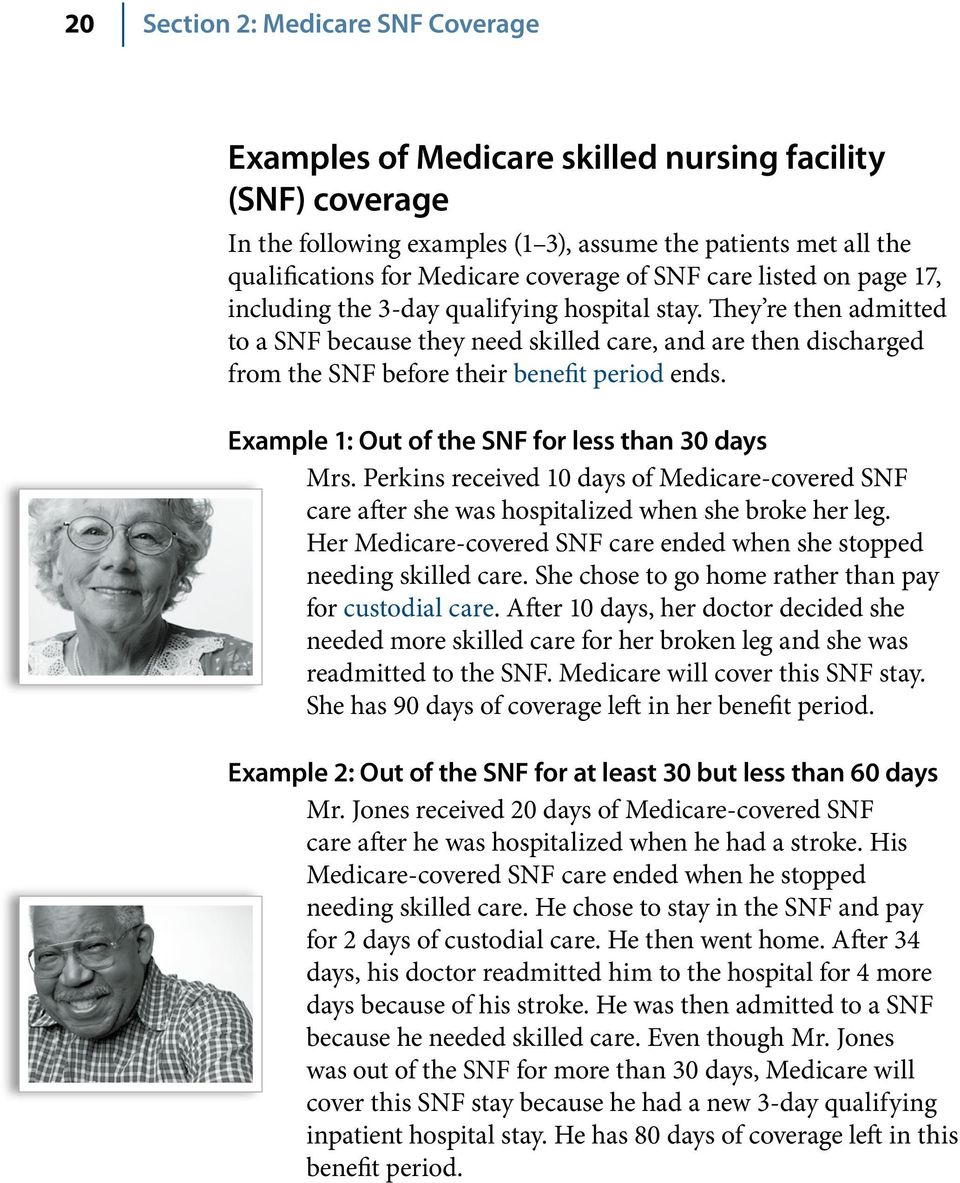
20 20 Section 2: Medicare SNF Coverage Examples of Medicare skilled nursing facility (SNF) coverage In the following examples (1 3), assume the patients met all the qualifications for Medicare coverage of SNF care listed on page 17, including the 3-day qualifying hospital stay. They re then admitted to a SNF because they need skilled care, and are then discharged from the SNF before their benefit period ends. Example 1: Out of the SNF for less than 30 days Mrs. Perkins received 10 days of Medicare-covered SNF care after she was hospitalized when she broke her leg. Her Medicare-covered SNF care ended when she stopped needing skilled care. She chose to go home rather than pay for custodial care. After 10 days, her doctor decided she needed more skilled care for her broken leg and she was readmitted to the SNF. Medicare will cover this SNF stay. She has 90 days of coverage left in her benefit period. Example 2: Out of the SNF for at least 30 but less than 60 days Mr. Jones received 20 days of Medicare-covered SNF care after he was hospitalized when he had a stroke. His Medicare covered SNF care ended when he stopped needing skilled care. He chose to stay in the SNF and pay for 2 days of custodial care. He then went home. After 34 days, his doctor readmitted him to the hospital for 4 more days because of his stroke. He was then admitted to a SNF because he needed skilled care. Even though Mr. Jones was out of the SNF for more than 30 days, Medicare will cover this SNF stay because he had a new 3-day qualifying inpatient hospital stay. He has 80 days of coverage left in this benefit period.

21 Section 2: Medicare SNF Coverage 21 Example 3: Out of the skilled nursing facility (SNF) for at least 60 days Mrs. Smith received 20 days of Medicare-covered SNF care after she was hospitalized when she had back surgery. Her Medicare covered SNF care ended when she no longer needed skilled care. She chose to go home rather than pay for custodial care. After 65 days, she was hospitalized for 3 days due to a fall. She was then admitted to a SNF because she needed skilled care. Since she was out of the SNF for more than 60 days, her benefit period ended. Her new 3-day qualifying hospital stay starts a new benefit period. Medicare will cover up to 100 days of SNF care in this new benefit period. If I m in a SNF but must be readmitted to the hospital, will the SNF hold my bed for me? There s no guarantee that a bed will be available for you at the same SNF if you need more skilled care after your hospital stay. You may have to go to another SNF if a bed isn t available. Ask the SNF if it will hold a bed for you if you must go back to the hospital. Also ask if there is a cost to hold the bed for you. Note: See pages for information about what happens when your SNF coverage ends.
22 22 Section 2: Medicare SNF Coverage What does Medicare cover when I qualify for skilled nursing facility (SNF) care? Medicare services Semi-private room (a room you share with other patients) Meals Skilled nursing care Physical therapy* Occupational therapy* Speech-language pathology services* Medical social services Medications Medical supplies and equipment used in facility Ambulance transportation (when other transportation endangers your health) to the nearest supplier of medically necessary services that aren t available at the SNF, including the return trip Dietary counseling Covered * Medicare covers these services if they re needed to meet your health goal.
23 23 Section 3: What You Pay What do I pay for skilled nursing facility (SNF) care in 2015? In Original Medicare, for each benefit period in the calendar year 2015 you pay: For days You pay for covered services Medicare pays for covered services 1 20 Nothing Full cost Up to $ per day All but the daily coinsurance Beyond 100 Full cost Nothing You must also pay all additional charges not covered by Medicare (like phone charges and laundry fees). Note: Your SNF costs may be different if you re in a Medicare Advantage Plan (like an HMO or PPO). Check with your plan. Words in blue are defined on pages Payment example 1: SNF stay 1 20 days: Mr. Anderson is in the hospital for 5 days and is then admitted to a SNF (within 30 days of leaving the hospital). He s in the SNF for 12 days. Mr. Anderson won t have to pay anything for this Medicare-covered SNF care. Days in hospital Days in SNF Mr. Anderson pays for SNF care 5 12 $0 for covered services Payment example 2: SNF stay days: Mrs. Baker is in the hospital for 5 days. She is then admitted to a SNF (within 30 days of leaving the hospital). She s in the SNF for 30 days. Mrs. Baker will have to pay up to $1,575 (the $ a day coinsurance for days 21 30) for her Medicare-covered SNF care. Days in hospital Days in SNF Mrs. Baker pays for SNF care 5 30 Up to $1,575 for covered services ($ per day for days 21 30)
24 24 Section 3: What You Pay Ways to get help paying for skilled care and other health care costs There are ways to get help paying for skilled care and other health care costs. Help from your state: If your income and resources are limited, you may be able to get help to pay for skilled and/or custodial care, or other health care costs. If you qualify for both Medicare and Medicaid, most health care costs are covered. You may also qualify for the Medicaid nursing home benefit or the Programs of All-inclusive Care for the Elderly (PACE). Call your State Medical Assistance (Medicaid) Office for more information. See pages Employer or union coverage: If you have coverage from an employer or union, check with your benefits administrator to see what health care is covered. Medigap policy: If you have Original Medicare, you may also have a Medicare Supplemental (Medigap) Policy to fill gaps in your coverage. Some Medigap policies pay the skilled nursing facility (SNF) coinsurance for days Check with your policy or call the insurance company to find out if your policy provides coverage for the Medicare SNF coinsurance. If you re shopping for a Medigap policy, review the different policy options to find out which one provides the coverage you need. For more information about Medigap policies, visit Medicare.gov. Under Supplements & Other Insurance, select Find a Medigap policy. Or, call MEDICARE ( ) and ask for a free copy of the Choosing a Medigap Policy: A Guide to Health Insurance for People with Medicare. TTY users should call Long-term care insurance: If you have long-term care insurance, check your policy or call the insurance company to find out if skilled or custodial care is covered. If you re shopping for long-term care insurance, find out which types of long-term care services the different policies cover. For more information about long-term care insurance, call to get a copy of The Shopper s Guide to Long Term Care Insurance from your State Insurance Department, or ask for one, in writing, from the National Association of Insurance Commissioners, 2301 McGee Street, Suite 800, Kansas City, MO For more information about help paying for health care, call your State Health Insurance Assistance Program. See pages
25 25 Section 4: Your Care in a SNF The care you get in a skilled nursing facility (SNF) is: Based on your daily assessments (see below.) Planned to meet your needs (see care plan on page 26.) What s an assessment? When you go to a SNF, a team of staff from different medical fields (depending on your health needs) plans your care. Your SNF care is based on your doctor s orders and information the team gathers when they do daily assessments of your condition. Your doctor and the SNF staff (with your input) use the assessments to decide what services you need and your health goal (or goals.) A health goal is the expected result of your treatment, like being able to walk a certain distance or to climb stairs. Your daily assessments and skilled care start the day you arrive at the SNF. Medicare requires that your assessments be recorded periodically. These recorded assessments are used by the SNF to plan and manage your care, and are used by Medicare to determine appropriate payment to the SNF. The first recorded assessment must be within the first 8 days of your SNF stay, known as the 5-day assessment. Medicare also requires the SNF to record assessments done on days 14, 30, 60, and 90 of your covered stay and any other assessments that are necessary to account for significant changes in your condition (until you re discharged or you ve used all 100 days of SNF coverage in your benefit period, whichever comes first). Words in blue are defined on pages An assessment includes gathering information about: Your current physical and mental condition Your medical history Medications you re taking How well you can do activities of daily living like bathing, dressing, eating, getting in and out of bed or a chair, moving around, and using the bathroom Your speech Your decision-making ability Physical limitations (like problems with your hearing or vision, paralysis after a stroke, balance problems, etc.)
26 26 Section 4: Your Care in a SNF What s a care plan? When your health condition is assessed, skilled nursing facility (SNF) staff prepares or updates your care plan. You (if you re able) and/or your family, or someone acting on your behalf, have the right to take part in planning your care together with the SNF staff. Let the staff know if you want to take part. This helps keep you aware of how the care you get will help you reach your health care goals. Your care plan may include: What kind of services you need What type of health care professional should give you the services How often and for how long you ll need the services What kind of equipment or supplies you need (like a wheelchair or feeding tube) Your special diet, if you need one Your health goal (or goals), and how your care plan will help you reach your goal Your Medicare coverage continues if all of these apply You ve used less than 100 days of coverage in this benefit period You still need inpatient skilled care on a daily basis, The skilled services you get are reasonable and necessary for your condition Your Medicare coverage ends if any of these apply You ve used all 100 days of coverage in the benefit period You no longer need inpatient skilled care on a daily basis The skilled care you get is no longer reasonable and necessary for your condition Note: If you refuse your daily skilled care or therapy, you may lose your Medicare SNF coverage. If your condition won t allow you to get skilled care (for instance if you get the flu), you may be able to continue to get Medicare coverage temporarily.

27 27 Section 5: When Your Medicare Coverage Ends What if I think my skilled nursing facility (SNF) coverage is ending too soon? When Medicare coverage of your SNF stay is ending because it s no longer medically reasonable and necessary or is considered custodial care, you ll get a written notice ( Notice of Medicare Non-Coverage NOMNC). If you re getting Medicare-covered services from a SNF, and you think your Medicare-covered SNF services are ending too soon, you can ask for a fast appeal. Your provider will give you a NOMNC before your services end that will tell you how to ask for a fast appeal. (The notice might call it an immediate appeal.) If you don t get this notice, ask your provider for it. With a fast appeal, an independent reviewer called a Beneficiary and Family Centered Care Quality Improvement Organization (BFCC-QIO) will decide if your services need to continue. It s important to call your BFCC-QIO to request a fast appeal no later than the time shown on the notice you get from your provider. Use the phone number for your BFCC-QIO listed on your notice to request your appeal. Ask your doctor or other health care provider to submit any information to the BFCC-QIO that may help your case. If you miss the deadline, you may still have appeal rights: If you have Original Medicare, call your BFCC-QIO. If you re in a Medicare health plan, call your plan. Words in blue are defined on pages When Medicare coverage of your SNF stay is ending because you have no benefit days remaining, the SNF may give you a notice. However, written notice isn t required to charge you when you no longer have benefit days and remain in the facility, so it s important that you or your family keep track of the number of benefit days you have remaining.
28 28 Section 5: When Your Medicare Coverage Ends When Medicare coverage of your skilled nursing facility (SNF) stay is ending because continued care isn t medically reasonable and necessary or is considered custodial and you choose to remain in the SNF, you may have to pay for SNF charges. If you have Original Medicare, the SNF must issue the Skilled Nursing Facility Advance Beneficiary Notice of Noncoverage (SNFABN) or a SNF denial letter to transfer financial liability to you. This notice must tell you: The date your Medicare coverage will end (and you must start to pay) Why your stay isn t (or is no longer) covered The estimated cost of the noncovered care Your right to request that the SNF submit a claim to Medicare so that you can get an official payment decision from Medicare this type of claim is sometimes called a demand bill That, if you request to have a claim submitted, you aren t required to pay for your SNF stay until you re informed of Medicare s decision* (you do have to pay any coinsurance charged, and for services and supplies not covered by Medicare) Where you (or someone acting on your behalf ) should sign to show you got the notice You can choose to pay for skilled care yourself when your SNF care coverage ends. Check with the SNF to see how much it costs. Long-term care can be very expensive. See page 24 for information on ways you may get help to pay skilled and custodial nursing care costs. Note: If you re in a Medicare Advantage Plan (like an HMO or PPO) or other Medicare health plan, check with your plan to find out how they ll let you know your Medicare coverage is ending when you no longer have benefit days. You can ask your plan for prior authorization of your stay. If you don t agree with your plan s decision, you can then file an appeal (see page 27.) *You ll be responsible for the cost of the stay if Medicare determines you didn t meet Medicare s criteria.
29 Section 5: When Your Medicare Coverage Ends 29 Plan ahead It s important to plan ahead Try to plan ahead for any services you may need when you leave the skilled nursing facility (SNF). If you ll be going home, you may need help with grocery shopping, bathing, dressing, or transportation. Or, you may need to think about home health care. See page 42. If you need custodial care in a nursing facility after you re discharged from the SNF, you may want to start thinking about where you want to go. If the SNF you re in has a bed available, and you re happy with the care you have had so far, you may wish to stay there. Remember, Medicare doesn t cover custodial care if it s the only kind of care you need.
30 30 Notes
31 31 Section 6: Your Rights & Protections What are my rights in a skilled nursing facility (SNF)? As a resident of a SNF, you have all the same rights and protections as all U.S. citizens. SNF residents have certain rights and protections under the law. The SNF must provide you with a written description of your legal rights. Keep the information you get about your rights, admission and transfer policies, and any other information you get from the SNF in case you need to look at it later. Words in blue are defined on pages At a minimum, federal law specifies that a SNF s resident s rights include: Freedom from discrimination SNFs don t have to accept all applicants, but they must comply with Civil Rights laws that don t allow discrimination based on race, color, national origin, disability, age, or religion under certain conditions. If you believe you ve been discriminated against, call the Department of Health and Human Services, Office for Civil Rights at TTY users should call Respect You have the right to be treated with dignity and respect. As long as it fits your care plan, you have the right to make your own schedule, including when you go to bed, rise in the morning, and eat your meals. You have the right to choose the activities you want to go to. Freedom from abuse and neglect You have the right to be free from verbal, sexual, physical, and mental abuse, involuntary seclusion, and misappropriation of your property by anyone. This includes, but isn t limited to: SNF staff, other residents, consultants, volunteers, staff from other agencies, family members or legal guardians, friends, or other individuals. If you feel you ve been abused or neglected (your needs were not met), report this to the SNF, your family, your local Long-Term Care Ombudsman, or your State Survey Agency. See pages It may be appropriate to report the incident of abuse to local law enforcement or the Medicaid Fraud Control Unit (their phone number should be posted in the SNF.)
32 32 Section 6: Your Rights & Protections What are my rights in a skilled nursing facility (SNF)? (continued) At a minimum, federal law specifies that a SNF resident s rights include (continued): Freedom from restraints Physical restraints are any manual method, or physical or mechanical device, material, or equipment attached to or near your body so that you can t remove the restraint easily. Physical restraints prevent freedom of movement or normal access to one s own body. A chemical restraint is a drug that is used for discipline or convenience and isn t needed to treat your medical symptoms. It s against the law for a SNF to use physical or chemical restraints, unless it s necessary to treat your medical symptoms. Restraints may not be used to punish nor for the convenience of the SNF staff. You have the right to refuse restraint use except if you re at risk of harming yourself or others. Information on services and fees You must be informed in writing about services and fees before you move into the SNF. The SNF can t require a minimum entrance fee as a condition of residence. You can t be charged by the SNF for items or services that you didn t request, and you can t be required to request extra services as a condition of continued stay. Money You have the right to manage your own money or to choose someone you trust to do this for you. If you ask the SNF to manage your personal funds, you must sign a written statement that allows the SNF to do this for you. However, the SNF must allow you access to your bank accounts, cash, and other financial records. Your money (over $50) must be placed by the SNF in an account that will provide interest. They must give you quarterly statements. The SNF must protect your funds from any loss by buying a bond or providing other similar protections.
33 Section 6: Your Rights & Protections 33 What are my rights in a skilled nursing facility (SNF)? (continued) At a minimum, federal law specifies that a SNF resident s rights include (continued): Privacy, property, and living arrangements You have the right to privacy, and to keep and use your personal belongings and property as long as they don t interfere with the rights, health, or safety of others. SNF staff should never open your mail unless you allow it. You have the right to use a phone and talk privately. The SNF must protect your property from theft. This may include a safe in the facility or cabinets with locked doors in resident rooms. If you and your spouse live in the same SNF, you re entitled to share a room (if you both agree to do so). Medical care You have the right to be informed about your medical condition, medications, and to see your own doctor. You also have the right to refuse medications and treatments (but this could be harmful to your health). You have the right to take part in developing your care plan. Care plans are explained on page 26. You have the right to look at your medical records and reports when you ask. Visitors You have the right to spend private time with visitors at any reasonable hour. The SNF must permit your family to visit you at any time, as long as you wish to see them. You don t have to see any visitor you don t wish to see. Any person who gives you help with your health or legal services may see you at any reasonable time. This includes your doctor, representative from the health department, and your Long-Term Care Ombudsman, among others. Social services The SNF must provide you with any needed medically related social services, including counseling, help solving problems with other residents, help in contacting legal and financial professionals, and discharge planning.
34 34 Section 6: Your Rights & Protections What are my rights in a skilled nursing facility (SNF)? (continued) At a minimum, federal law specifies that a SNF resident s rights include (continued): Complaints You have the right to make a complaint to the staff of the SNF, or any other person, without fear of punishment. The SNF must resolve the issue promptly. See How can I report and resolve problems? on page 35. Protection against unfair transfer or discharge You can t be sent to another SNF, or made to leave the SNF unless: It s necessary for the welfare, health, or safety of you or others. Your health has declined to the point that the SNF can t meet your care needs. Your health has improved to the point that SNF care is no longer necessary. You don t pay for the services you re responsible for. The SNF closes. A SNF can t make you leave if you re waiting to get Medicaid (see page 24.) The SNF should work with other state agencies to get payment if a family member or other person is holding your money. Involvement of your family and friends Family members and legal guardians may meet with the families of other residents and may participate in family councils. By law, SNFs must develop a plan of care (care plan) for each resident. Care plans are explained on page 26. You have the right to take part in this process, and family members can help with your care plan with your permission. If your relative is your legal guardian, he or she has the right to look at all medical records about you and has the right to make important decisions on your behalf. Family and friends can help make sure you get good quality care. They can visit and get to know the staff and the SNF s rules.
35 Section 6: Your Rights & Protections 35 How can I report and resolve problems? If you have a problem at the skilled nursing facility (SNF), talk to the staff involved. For example, if you have a problem with your care, talk to the nurse or Certified Nurse Assistant (CNA). The staff may not know there s a problem unless you tell them. If the problem isn t resolved, ask to talk with the supervisor, the social worker, the Director of Nursing, or your doctor. The facility must have a grievance procedure for complaints. If your problem isn t resolved, follow the facility s grievance procedure. You may also want to bring the problem to the resident or family council. The SNF must post the name, address, and phone number of state groups, like the State Survey Agency, the State Licensure Office, the State Ombudsman Program, the Protection and Advocacy Network, and the Medicaid Fraud Control Unit. If you feel you need outside help to resolve your problem, call the Long-Term Care Ombudsman or the State Survey Agency for your state. See pages What if I think my SNF charges are wrong? If you have Original Medicare, you ll get a Medicare Summary Notice (MSN) from a company that handles Medicare bills for all your SNF charges. If you think these charges are wrong, call the phone number on the notice for the company that sent the notice to you. Note: If you re in a Medicare Advantage Plan, call your plan if you have questions about your bills.
36 36 Notes
37 37 Section 7: Skilled Nursing Facility Checklist The checklist on the following pages can help you look at and compare the skilled nursing facilities (SNFs) that you visit. Look at the checklist before you go on your visit or tour. This will give you an idea about the kinds of questions to ask and what you should look for as you tour the facility and see the staff and the residents. Some of these questions may be more personally important to you and your family, and some are more important for finding out about the quality of care the residents get. Use a new checklist for each SNF you visit. Use your completed checklist with the quality of care information from Medicare.gov to help you compare the SNFs you re interested in. You can find this information by visiting Medicare.gov and selecting Find nursing homes. Nursing Home Compare at Medicare.gov includes information like: The number of beds at the facility, and how many are being used (occupied) Nursing staff hours per resident per day SNF inspection summary results Deficiency and complaint information Quality measures for each nursing home If you don t have a computer, your local library or senior center may be able to help you find this information on their computer. You can also call MEDICARE ( ) and a customer service representative will read this information to you. TTY users should call Words in blue are defined on pages
38 38 Section 7: Skilled Nursing Facility Checklist Name of skilled nursing facility (SNF): Date of visit: Basic information The SNF is Medicare-certified. The SNF is Medicaid-certified. The SNF provides the skilled care you need, and a bed is available. The SNF has special services if needed in a separate unit (like dementia, ventilator, or therapy), and a bed is available. The SNF is located close enough for friends and family to visit. Resident appearance Residents are clean, appropriately dressed for the season or time of day, and well groomed. Living spaces The SNF is free from overwhelming unpleasant odors. The SNF appears clean and well kept. The temperature in the SNF is comfortable for residents. The SNF has good lighting. Noise levels in the dining room and other common areas are comfortable. Smoking isn t allowed or may be restricted to certain areas of the SNF. Furnishings are sturdy, yet comfortable and attractive. Yes No Comments
39 Section 7: Skilled Nursing Facility Checklist 39 Staff The relationship between the staff and the residents appears to be warm, polite, and respectful. All staff wear name tags. Staff knock on the door before entering a resident s room and refer to residents by name. The skilled nursing facility (SNF) offers a training and continuing education program for all staff. The SNF does background checks on all staff. The guide on your tour knows the residents by name and is recognized by them. There s a full-time Registered Nurse (RN) in the SNF at all times, other than the Administrator or Director of Nursing. The same team of nurses and Certified Nursing Assistants (CNAs) work with the same resident 4 to 5 days per week. CNAs work with a reasonable number of residents. CNAs are involved in care planning meetings. There s a full-time social worker on staff. There s a licensed doctor on staff. Is he or she there daily? Can he or she be reached at all times? The SNF s management team has worked together for at least one year. Yes No Comments
40 40 Section 7: Skilled Nursing Facility Checklist Residents rooms Residents may have personal belongings and/or furniture in their rooms. Each resident has personal storage space (closet and drawers) in his or her room. Each resident has a window in his or her bedroom. Residents have access to a personal phone and television. Residents have a choice of roommates. Water pitchers can be reached by residents. There are policies and procedures to protect residents possessions. Hallways, stairs, lounges, & bathrooms Exits are clearly marked. There are quiet areas where residents can visit with friends and family. The skilled nursing facility (SNF) has smoke detectors and sprinklers. All common areas, resident rooms, and doorways are designed for wheelchair use. There are handrails in the hallways and grab bars in the bathroom. Yes No Comments
41 Section 7: Skilled Nursing Facility Checklist 41 Menus & food Residents have a choice of food items at each meal. (Ask if your favorite foods are served.) Nutritious snacks are available upon request. Staff help residents eat and drink at mealtimes if help is needed. Activities Residents, including those who are unable to leave their rooms, may choose to take part in a variety of activities. There are quiet areas where residents can visit with friends and family. The skilled nursing facility (SNF) has outdoor areas for resident use, and staff help residents go outside. The SNF has an active volunteer program. Safety & care The SNF has an emergency evacuation plan and holds regular fire drills. Residents get preventive care, like a yearly flu shot, to help keep them healthy. Residents may still see their regular doctors. The SNF has an arrangement with a nearby hospital for emergencies. Care plan meetings are held with residents and family members at times that are convenient whenever possible. The SNF has corrected all deficiencies (failure to meet one or more federal or state requirements) on its last state inspection report. Yes No Comments
42 42 Section 7: Skilled Nursing Facility Checklist Other Medicare booklets and related topics Medicare has other booklets available that may be helpful. To read or print a copy of these booklets, visit Medicare.gov/Publications. You can also call MEDICARE ( ) to find out if these booklets are available in print. TTY users should call Guide to Choosing a Nursing Home This booklet gives in-depth information on choosing a nursing home and other long-term care choices. Medicare & You This handbook gives basic information about Medicare coverage and benefits, health plan choices, rights and protections, and more. Medicare and Home Health Care This booklet explains Medicare coverage of home health care. Medicare Hospice Benefits This booklet explains Medicare coverage of hospice care for people who have a terminal illness.
43 43 Section 8: For More Information State Long-Term Care Ombudsman Call for information about a skilled nursing facility (SNF) or nursing home, or about problems with your care. State Survey Agency Call with questions or complaints about the quality of care, or the quality of life in a SNF or nursing home. State Medical Assistance (Medicaid) Office Call for more information on state programs that help pay health care costs. State Health Insurance Assistance Program Call for free counseling about Medicare, insurance and health plan decisions, and your rights. Alabama (877) (800) (800) (800) Alaska (800) (888) (800) (800) American Samoa (888) (808) (808) (888) Arizona (800) (602) (800) (800) Arkansas (501) (800) (800) (800) California (800) (800) (916) (800) Colorado (800) (800) (800) (888) Connecticut (860) (860) (800) (800) Delaware (800) (877) (800) (800) Florida (888) (888) (866) (800) Georgia (888) (800) (866) (800) Guam (888) (808) Number not (671) available Hawaii (888) (808) (808) (888) Idaho (877) (208) (877) (800) Illinois (800) (800) (866) (800) Indiana (800) (800) (800) (800) Iowa (800) (877) (800) (800) Kansas (877) (800) (800) (800)
44 44 Section 8: For More Information State Long-Term Care Ombudsman Call for information about a skilled nursing facility (SNF) or nursing home, or about problems with your care. State Survey Agency Call with questions or complaints about the quality of care, or the quality of life in a SNF or nursing home. State Medical Assistance (Medicaid) Office Call for more information on state programs that help pay health care costs. State Health Insurance Assistance Program Call for free counseling about Medicare, insurance and health plan decisions, and your rights. Kentucky (800) (502) (800) (877) Louisiana (800) (888) (888) (800) Maine (800) (800) (800) (877) Maryland (800) (877) (800) (800) Massachusetts (800) (800) (800) (800) Michigan (866) (800) (800) (800) Minnesota (800) (800) (800) (800) Mississippi (601) (800) (800) (800) Missouri (800) (800) (800) (573) Montana (800) (406) (800) (800) Nebraska (800) (402) (800) (800) Nevada (800) (800) (800) (800) New Hampshire (800) (800) (800) (866) New Jersey (877) (800) (800) (800) New Mexico (866) (800) (888) (800) New York (800) (888) (800) (800) North Carolina (919) (800) (800) (800) North Dakota (800) (701) (800) (888) Northern (888) (808) (808) (888) Mariana Islands Ohio (800) (800) (800) (800) Oklahoma (800) (800) (800) (800) Oregon (800) (800) (800) (800) Pennsylvania (717) (800) (800) (800) Puerto Rico (800) (787) (877) (877)
45 Section 8: For More Information 45 State Long-Term Care Ombudsman Call for information about a skilled nursing facility (SNF) or nursing home, or about problems with your care. State Survey Agency Call with questions or complaints about the quality of care, or the quality of life in a SNF or nursing home. State Medical Assistance (Medicaid) Office Call for more information on state programs that help pay health care costs. State Health Insurance Assistance Program Call for free counseling about Medicare, insurance and health plan decisions, and your rights. Rhode Island (401) (401) (800) (401) South Carolina (800) (800) (888) (800) South Dakota (866) (605) (800) (800) Tennessee (877) (800) (866) (877) Texas (800) (800) (877) (800) Utah (800) (800) (800) (800) Vermont (800) (802) (800) (800) Virgin Islands (800) not available (877) (340) Virginia (800) (800) (804) (800) Washington (800) (800) (800) (800) Washington DC (800) (202) (888) (202) West Virginia (304) (800) (304) (877) Wisconsin (800) (800) (800) (800) Wyoming (307) (800) (307) (800) Note: At the time of printing, phone numbers listed were correct. To get the most up-to-date phone numbers, visit Medicare.gov/contacts. You can also call MEDICARE ( ). TTY users should call
46 46 Notes
47 47 Section 9: Definitions Appeal An appeal is the action you can take if you disagree with a coverage or payment decision made by Medicare, your Medicare health plan, or your Medicare Prescription Drug Plan. You can appeal if Medicare or your plan denies one of these: Your request for a health care service, supply, item, or prescription drug that you think you should be able to get Your request for payment for a health care service, supply, item, or prescription drug you already got Your request to change the amount you must pay for a health care service, supply, item or prescription drug. You can also appeal if Medicare or your plan stops paying providing or paying for all or part of a health care service, supply, item, or prescription drug you think you still need. Benefit period The way that Original Medicare measures your use of hospital and skilled nursing facility (SNF) services. A benefit period begins the day you re admitted as an inpatient in a hospital or SNF. The benefit period ends when you haven t received any inpatient hospital care (or skilled care in a SNF) for 60 days in a row. If you go into a hospital or a SNF after one benefit period has ended, a new benefit period begins. You must pay the inpatient hospital deductible for each benefit period. There s no limit to the number of benefit periods. Coinsurance An amount you may be required to pay as your share of the cost for services after you pay any deductibles. Coinsurance is usually a percentage (for example, 20%). Custodial care Nonskilled personal care, like help with activities of daily living like bathing, dressing, eating, getting in or out of a bed or chair, moving around, and using the bathroom. It may also include the kind of health-related care that most people do themselves, like using eye drops. In most cases, Medicare doesn t pay for custodial care.
48 48 Section 9: Words to Know Long-term Care Ombudsman An independent advocate (supporter) for nursing home and assisted living facility residents who works to solve problems between residents and nursing homes or assisted living facilities. They may be able to provide information about home health agencies in their area. Medicaid A joint federal and state program that helps with medical costs for some people with limited incomes and resources. Medicaid programs vary from state to state, but most health care costs are covered if you qualify for both Medicare and Medicaid. Medicare Advantage Plan (Part C) A type of Medicare health plan offered by a private company that contracts with Medicare to provide you with all your Medicare Part A and Part B benefits. Medicare Advantage Plans include Health Maintenance Organizations, Preferred Provider Organizations, Private Fee-for-Service Plans, Special Needs Plans, and Medicare Medical Savings Account Plans. If you re enrolled in a Medicare Advantage Plan, Medicare services are covered through the plan, and aren t paid for under Original Medicare. Most Medicare Advantage Plans offer prescription drug coverage. Medicare Part A (Hospital Insurance) Part A covers inpatient hospital stays, care in a skilled nursing facility, hospice care, and some home health care. Medicare Preferred Provider Organization (PPO) Plan A type of Medicare Advantage Plan (Part C) available in some areas of the country in which you pay less if you use doctors, hospitals, and other health care providers that belong to the plan s network. You can use doctors, hospitals, and providers outside of the network for an additional cost.
49 Section 9: Words to Know 49 Medicare Private Fee-for-Service (PFFS) Plan A type of Medicare Advantage Plan (Part C) in which you can generally go to any doctor or hospital you could go to if you had Original Medicare, if the doctor or hospital agrees to treat you. The plan determines how much it will pay doctors and hospitals, and how much you must pay when you get care. A Private Fee-For-Service Plan is very different than Original Medicare, and you must follow the plan rules carefully when you go for health care services. When you re in a Private Fee-For-Service Plan, you must pay more or less for Medicare-covered benefits than in Original Medicare. Medicare Summary Notice (MSN) A notice you get after the doctor, other health care provider, or supplier files a claim for Part A and Part B services in Original Medicare. It explains what the doctor, other health care provider, or supplier billed for, the Medicare-approved amount, how much Medicare paid, and what you must pay. Medigap policy Medicare Supplement Insurance sold by private insurance companies to fill gaps in Original Medicare coverage. Occupational therapy Treatment that helps you return to your usual activities (like bathing, preparing meals, and housekeeping) after illness. Original Medicare Original Medicare is fee-for-service coverage under which the government pays your health care providers directly for your Part A and/or Part B benefits. Physical therapy Treatment of an injury or a disease by mechanical means, like exercise, massage, heat, and light treatment.
50 50 Section 9: Words to Know Programs of All-inclusive Care for the Elderly (PACE) A special type of health plan that provides all the care and services covered by Medicare and Medicaid as well as additional medically necessary care and services based on your needs as determined by an interdisciplinary team. PACE serves frail older adults who need nursing home services but are capable of living in the community. PACE combines medical, social, and long-term care services and prescription drug coverage. Speech-language therapy (speech-language pathology services) Treatment that helps you strengthen or regain speech, language, and swallowing skills. State Health Insurance Assistance Program (SHIP) A state program that gets money from the federal government to give free local health insurance counseling to people with Medicare. State Survey Agency A state agency that oversees health care facilities on behalf of CMS that participate in the Medicare and/ or Medicaid programs. The State Survey Agency inspects health care facilities and investigates complaints to ensure that health and safety standards are met.
51 51 Section 10: Index MEDICARE 24, 37, 42, 45 A Abuse 31 A Guide to Health Insurance for People with Medicare 24 Ambulance 22 Appeal 27, 28, 47 Area Agency on Aging 11 Assessment 25 Audiologist 8, 17 B Background checks 39 Benefit period 17 21, 23, 25, 26, 47 C Care plan 26, 31, 33, 34 Certified Nursing Assistant 39 Checklist Coinsurance 7, 23, 24, 28, 47 Complaints 12, 34, 35 Coverage 7 8, Qualifying for 17 When it ends 18, 19 Custodial care 5, 20, 21, 24, 27, 29, 47 D Demand bill 28 Dietary counseling 22 Discrimination 31 E Eldercare Locator 11 Employer coverage 24 F Family Council 14, 34, 35 Fees 23, 32 G Guide to Choosing a Nursing Home 42 H Health Goal 22, 25, 26 L Licensed practical nurse 17 Long-term care insurance 24 Long-term care ombudsman 12, 31, 33, 35, 43 45, 48 M Meals 22 Medicaid 24, 31, 34, 35, 48 Medical care 33 Medical Social Services 22 Medical supplies 22 Medicare Advantage Plan 7, 10, 23, 28, 35, 48 Medicare booklets 42 Medicare Part A 17, 48 Medicare Preferred Provider Organization 10, 48
52 52 Section 10: Index Medicare Private Fee-for-Service Plan 10, 49 Medicare Summary Notice 35, 49 Medications 22, 25, 33 Medigap policy 7, 24, 49 Money (personal) 32, 34 N Neglect 15, 31 Notice of Medicare non-coverage 27 O Occupational therapist 8, 17 Occupational therapy 22, 49 Original Medicare 7, 10, 23, 24, 27, 28, 35, 49 P Physical therapist 17 Physical therapy 5, 8, 22, 49 Privacy 15, 33 Programs of All-inclusive Care for the Elderly (PACE) 24, 50 Q Quality 12 S Safety 33, 34, 41 Semi-private room 22 Skilled care (nursing and rehabilitation) 5, 7, 8, 22 Skilled Nursing Facility Checklist Skilled nursing facility (SNF) 5, 7, 8, 10, 11 Social Security 17 Speech-Language pathologist 8, 17 State Health Insurance Assistance Program (SHIP) 24, 43 45, 50 State Survey Agency 31, 35, 43 45, 50 T Transfer 31, 34 U Union coverage 24 V Visitors 33 Vocational nurse 8 R Registered nurses 8, 17, 39 Resident Council 14 Resident rights Respect 31 Restraints 32
53 Notes
54 Notes
55
56 U.S. DEPARTMENT OF HEALTH AND HUMAN SERVICES Centers for Medicare & Medicaid Services 7500 Security Boulevard Baltimore, Maryland Official Business Penalty for Private Use, $300 CMS Product No Revised January 2015 This booklet is available in Spanish. To get a free copy, call MEDICARE ( ). TTY users should call Esta publicación está disponible en Español. Para obtener una copia, llame al MEDICARE ( ). Los usuarios de TTY deben llamar al
Your Guide to Choosing a Nursing Home or Other Long Term Care
 CENTERS FOR MEDICARE & MEDICAID SERVICES Your Guide to Choosing a Nursing Home or Other Long Term Care This official government booklet explains: How to find and compare nursing homes and other long-term
Basics M E D I C A R E. A Guide for Families and Friends of People with Medicare
 M E D I C A R E Basics CENTERS FOR MEDICARE & MEDICAID SERVICES CENTERS FOR MEDICARE & MEDICAID SERVICES CENTERS FOR MEDICARE & MEDICAID SERVICES CENTERS FOR MEDICARE & MEDICAID SERVICES CENTERS FOR MEDICARE
Choosing a Medigap Policy:
 CENTERS FOR MEDICARE & MEDICAID SERVICES 2015 Choosing a Medigap Policy: A Guide to Health Insurance for People with Medicare This official government guide has important information about: Medicare Supplement
Prescription Drug Coverage
 CENTERS for MEDICARE & MEDICAID SERVICES Your Guide to Medicare Prescription Drug Coverage This official government booklet tells you: How your coverage works How to get Extra Help if you have limited
This is the official U.S. government Medicare handbook. What s important in 2015 (page 12) What Medicare covers (page 35)
 2015 This is the official U.S. government Medicare handbook. What s important in 2015 (page 12) What Medicare covers (page 35) CENTERS FOR MEDICARE & MEDICAID SERVICES Want to read this information online?
Answers to questions that many parents ask about how the CAH program works. Helpful advice from other parents who have children in the CAH programs
 Preface Care at Home: A Handbook for Parents is a guide that is intended to help parents/guardians meet some of the challenges of caring for a physically disabled child at home. It includes information
In Treatment. Financial Guidance for Cancer Survivors and Their Families
 In Treatment Financial Guidance for Cancer Survivors and Their Families In Treatment Financial Guidance for Cancer Survivors and Their Families When I think about it now, I realize I ve had two lives.
Who Pays First. Your Guide to. Medicare & Other Health Benefits: This official government booklet tells you:
 Medicare & Other Health Benefits: Your Guide to Who Pays First C E N T E R S F O R M E D I C A R E & M E D I C A I D S E R V I C E S This official government booklet tells you: How Medicare works with
A guide to receiving direct payments from your local council
 A guide to receiving direct payments from your local council A route to independent living September 2009 This guide contains information on direct payments updated in 2009, under the provisions contained
Partnering With Your Transplant Team
 Partnering With Your Transplant Team The Patient s Guide to Transplantation U.S. DEPARTMENT OF HEALTH AND HUMAN SERVICES Health Resources and Services Administration This booklet was prepared for the Health
Your Options for Financing Long-Term Care: A Massachusetts Guide
 Your Options for Financing Long-Term Care: A Massachusetts Guide DIVISION OF INSURANCE 1000 Washington Street, Suite 810, Boston, Massachusetts 02118-6200 (617) 521-7794; Springfield (413) 785-5526 FAX:
Your Mind. Your Rights. Campus Mental Health Know Your Rights. A guide for students who want to seek help for mental illness or emotional distress
 Your Mind. Your Rights. Campus Mental Health Know Your Rights A guide for students who want to seek help for mental illness or emotional distress Leadership21 Committee Judge David L. Bazelon Center for
HEALTH INSURANCE. Types of Health Insurance. Know Your Rights and Their Limits. Using Your Health Coverage. Where to Find Help and Information
 What Cancer Survivors Need To Know About HEALTH INSURANCE Types of Health Insurance Know Your Rights and Their Limits Using Your Health Coverage Where to Find Help and Information A publication of the
Wisconsin Guide to Health Insurance for People with Medicare
 Wisconsin Guide to Health Insurance for People with Medicare 2015 For more information on health insurance call: MEDIGAP HELPLINE 1-800-242-1060 This is a statewide toll-free number set up by the Wisconsin
Your Guide to Medicare Special Needs Plans (SNPs)
 CENTERS FOR MEDICARE & MEDICAID SERVICES Your Guide to Medicare Special Needs Plans (SNPs) This official government booklet has important information about Medicare Special Needs Plans, including the following:
WHAT HAPPENS IF MY CHILD IS HAVING TROUBLE LEARNING IN SCHOOL?
 TABLE OF CONTENTS INTRODUCTION... 1 WHAT HAPPENS IF MY CHILD IS HAVING TROUBLE LEARNING IN SCHOOL?... 2 STEPS TO GETTING SERVICES... 3 ANSWERS TO FREQUENTLY ASKED QUESTIONS... 9 REQUEST FOR ASSISTANCE...
Making decisions...about your health, welfare or finance. Who decides when you can t?
 Making decisions...about your health, welfare or finance. Who decides when you can t? BOOKLET 1 IN A SERIES OF 5 1 There is a new law that can help - The Mental Capacity Act 2005 CONTENTS NEXT Who decides
Riders Guide. to Public Transit for People with Disabilities. Fixed Route. ADA Complementary Paratransit. by meeting the challenge, inc.
 Riders Guide to Public Transit for People with Disabilities Fixed Route ADA Complementary Paratransit by meeting the challenge, inc. Table of Contents Introduction...5 Fixed Route ADA Requirements for
OPG602. Making decisions A guide for family, friends and other unpaid carers. The Mental Capacity Act
 OPG602 Making decisions A guide for family, friends and other unpaid carers The Mental Capacity Act Making decisions A guide for family, friends and other unpaid carers Helping people who are unable to
Health Insurance Coverage
 Protecting Your Health Insurance Coverage This booklet explains... Your rights and protections under recent Federal law How to help maintain existing coverage Where you can get more help For additional
Do-it-Yourself Recovery of Unpaid Wages
 Do-it-Yourself Recovery of Unpaid Wages How to Represent Yourself Before the California Labor Commissioner A Publication of: The Legal Aid Society-Employment Law Center 600 Harrison Street, Suite 120 San
Medicare Part D: Things People With Cancer May Want to Know
 Medicare Part D: Things People With Cancer May Want to Know Medicare Part D prescription drug coverage This information is designed to help you decide whether to enroll in a Medicare Part D drug plan and
How to appeal against a decision made by the Department for Work and Pensions
 SSCS1A How to appeal against a decision made by the Department for Work and Pensions www.justice.gov.uk 3 Contents 1. About this guide 4 2. What to consider 5 3. Making your appeal 6 4. Completing form
Clinical Trials: What You Need to Know
 Clinical Trials: What You Need to Know Clinical trials are studies in which people volunteer to test new drugs or devices. Doctors use clinical trials to learn whether a new treatment works and is safe
Do It Yourself DIVORCE GUIDE
 A PUBLICATION OF THE JUDICIAL BRANCH STATE OF CONNECTICUT Do It Yourself DIVORCE GUIDE Judicial Branch Mission Statement The mission of the State of Connecticut Judicial Branch is to serve the interests
When Someone Dies A NON-LAWYER S G UIDE TO P ROBATE WASHINGTON, DC. Council for Court Excellence Improving Justice for the Community
 When Someone Dies A NON-LAWYER S G UIDE TO P ROBATE IN WASHINGTON, DC P PROBATE Council for Court Excellence Council for Court Excellence Improving Justice for the Community Table of Contents What is Probate
Coping Financially with the Loss of a Loved One. Financial Guidance for Families
 Coping Financially with the Loss of a Loved One Financial Guidance for Families Coping Financially with the Loss of a Loved One Financial Guidance for Families When my mother died, I realized that, in
Protecting residents from financial exploitation. A manual for assisted living and nursing facilities
 Protecting residents from financial exploitation A manual for assisted living and nursing facilities About the Consumer Financial Protection Bureau The Consumer Financial Protection Bureau, or the CFPB,
The Manual for Parents and Students About Special Education Services in Texas
 The Manual for Parents and Students About Special Education Services in Texas 2012 Revised and Updated September 2011 A JOINT PROJECT OF www.thearcoftexas.org www.disabilityrightstx.org Table of Contents
It s My Choice... Minnesota Governor s Council on Developmental Disabilities
 It s My Choice... Minnesota Governor s Council on Developmental Disabilities It s My Choice by William T. Allen, Ph.D. William T. Allen Allen, Shea & Associates 1780 Third Street Napa, CA 94559 707. 258.1326