
Nursing Education Programs in Pennsylvania Data from 2012 Nursing Education Program Annual Reports
|
|
|
- Cordelia Sullivan
- 10 years ago
- Views:
Transcription
1 Nursing Education Programs in Pennsylvania Data from 2012 Nursing Education Program Annual Reports Bureau of Health Planning Division of Plan Development Volume 11, January 2014

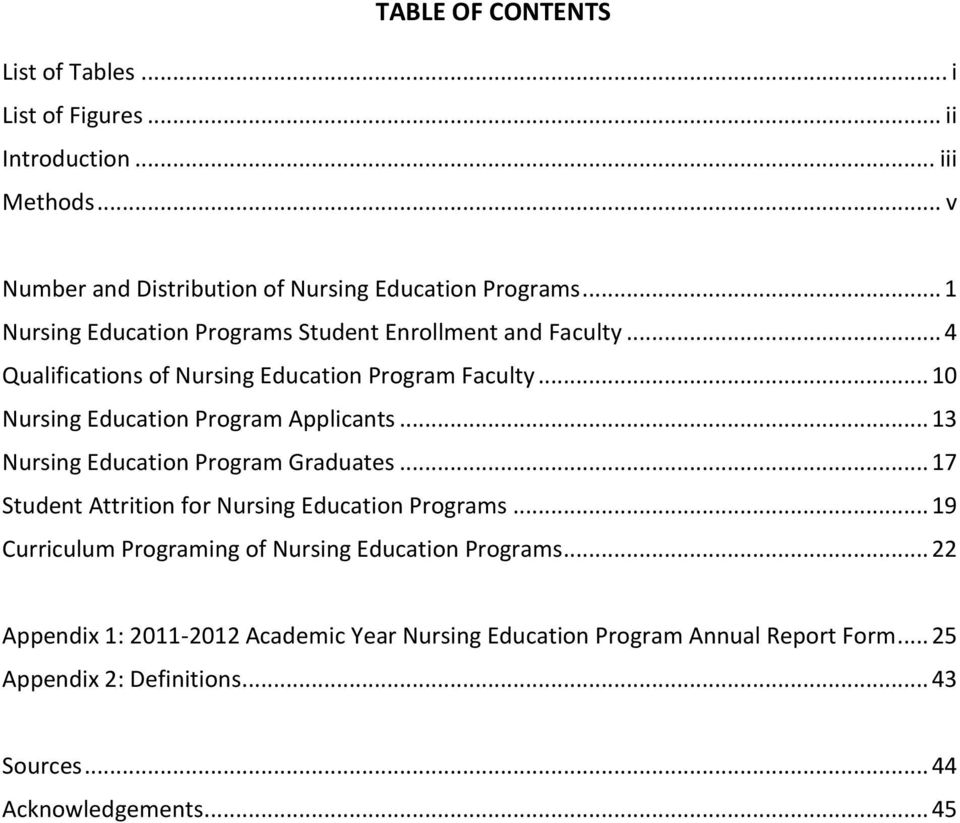
2 TABLE OF CONTENTS List of Tables... i List of Figures... ii Introduction... iii Methods... v Number and Distribution of Nursing Education Programs... 1 Nursing Education Programs Student Enrollment and Faculty... 4 Qualifications of Nursing Education Program Faculty Nursing Education Program Applicants Nursing Education Program Graduates Student Attrition for Nursing Education Programs Curriculum Programing of Nursing Education Programs Appendix 1: Academic Year Nursing Education Program Annual Report Form Appendix 2: Definitions Sources Acknowledgements... 45
3 LIST OF TABLES Table 1: Number of Nursing Education Annual Reports Reviewed, Pennsylvania Table 2: Number of Nursing Education Programs by Program Type, Pennsylvania Table 3: Number of Nursing Education Programs by Program Type, Pennsylvania Table 4: Nursing Programs Faculty Size and Changes, Pennsylvania Table 5: Average Faculty Age Groups by Program Type, Pennsylvania Table 6: Number of Years Until Anticipated Retirement of Full-Time Faculty by Program Type, Pennsylvania Table 7: Nursing Education Program Faculty with Required Degrees, Pennsylvania Table 8: Applicants to Nursing Education Programs, Pennsylvania Table 9: Reasons Nursing Education Programs Were Unable to Admit All Qualified Applicants, Pennsylvania Table 10: Nursing Education Programs With Vacant Seats, Pennsylvania Table 11: Nursing Education Program Graduates, Pennsylvania Table 12: Nursing Education Program Student Attrition Number and Rate by Program Type, Pennsylvania Table 13: Nursing Education Program Reasons for Student Attrition by Program Type, Pennsylvania Table 14: Level of Difficulty for Nursing Education Programs that Indicated Difficulty in Obtaining Clinical Sites for Student Experiences by Areas of Clinical Practice, Pennsylvania Table 15: Relative Weight of Factors Assigned by Nursing Schools Contributing to the Difficulty in Obtaining Clinical Sites by Program Type, Pennsylvania Data from the 2012 Annual Reports i January 2014

4 LIST OF FIGURES Figure 1: Nursing Education Programs, Pennsylvania Figure 2: Pennsylvania RN Education Program Enrollments, Pennsylvania Figure 3: Pennsylvania PN Education Programs Enrollments, Pennsylvania Figure 4: Nursing Education Programs With Vacant Seats, Pennsylvania Figure 5: Nursing School Graduates by Program Type, Pennsylvania and 2013 Estimate Figure 6: Nursing Education Program Attrition Rate by Program Type and Class Year, Pennsylvania Figure 7: Students Re-Admitted to Nursing Education Programs by Program Type, Pennsylvania Data from the 2012 Annual Reports ii January 2014

5 INTRODUCTION In response to legislative concerns regarding the lack of data available to inform policy discussions related to the shortage of health professionals, the Pennsylvania Department of Health convened a Health Professions Study Group in January The goal of this study group was to develop an objective understanding of the supply and distribution of the healthcare workforce in Pennsylvania, the impact and potential impact upon our communities, and possible solutions to the emerging healthcare workforce shortage. This group met initially as a whole and later as a set of task forces. The groups developed a continuing dialogue among state agencies, employers, nursing leaders, academics and others. As part of the activities of the Health Professions Study Group, staff from the Department of Health and the Department of State discussed the nature and scope of data available through the Department of State s Bureau of Professional and Occupational Affairs. The study group focused its attention on data available through the State Board of Nursing. The Department of State, Bureau of Professional and Occupational Affairs, State Board of Nursing is responsible for administering the professional and vocational standards of Title 49, Chapter 21 of the Pennsylvania Code to ensure safe nursing services for the citizens of the commonwealth. The Board s responsibilities set forth at 49 Pa.Code 21.3 are to: establish safe standards for the preparation of registered and practical nurses in approved education programs; and assure safe standards of nursing practice through examination and licensure of graduates of approved educational programs, through endorsement of registered and practical nurses from other jurisdictions, and through the regulation of the practice of nursing in this commonwealth. In order to fulfill the responsibilities according to statutory authority 1, the State Board of Nursing collects demographic and regulatory compliance data from the commonwealth s nursing education programs. These nursing education programs include baccalaureate (RN-BS), hospital-based diploma (RN-DIP) and associate degree (RN-AD) programs for professional registered nurses (RN) and community college, hospital, private-licensed and vocationaleducation programs for practical nurses (PN). The source of information included in this report is the Professional/Practical Nursing Education Program Annual Report (Appendix 1). The annual report collects demographic and statistical information of pre-licensure nursing education programs in Pennsylvania. Through this report, the State Board of Nursing collects information on each program, including number of faculty, faculty changes, number of faculty with required degrees by regulation, number of secondary site campuses, number of credits required by the program, student enrollment and graduation. Data from the 2012 Annual Reports iii January 2014

6 INTRODUCTION, CONTINUED Since the annual report is completed by all RN and PN programs approved in Pennsylvania, it is an excellent source of trend information regarding basic nursing education. The Clinical Education Taskforce of the Pennsylvania Center for Health Careers recommended that new questions be added to the 2007 annual report, and the State Board of Nursing accepted the recommendation. These questions address faculty and students who speak other languages fluently, as well as gender and race of graduates. Also, the Clinical Education Taskforce included definitions of full-time nurse faculty, part-time nurse faculty and contracted nurse faculty, which are included in Appendix 2. The Department of Health recognizes that objective data is crucial to understanding the status of the healthcare workforce and is committed to continuing its collaboration with the State Board of Nursing on the collection and analysis of these data. This report is the eleventh in a series intended to present information on nursing education programs information that can dramatically influence the supply side of the nursing workforce. Data from the 2012 Annual Reports iv January 2014
7 METHODS The data on nursing education programs were collected from the 2012 Professional/Practical Nursing Education Program Annual Report and compared to previously available annual report data when appropriate. Annual reports have been submitted by 124 or more programs annually since Table 1 indicates the number of annual reports reviewed by the Department of Health. The information in this report is based on data provided by these programs unless specified otherwise. For the sixth time, annual report submissions were done electronically via the database system EppiccNURSE (Education Program Portal Information and Communication Channel). Inconsistent and/or incomplete data may appear due to the availability of the requested data at the time the report is due or because of changes occurring in the program. For example, a nurse education program may be going through a period of expansion, closure or merger of controlling institutions, and this will affect how program numbers, options, admission, attrition and other information are recorded. Completeness of the data was a factor in the creation of a number of tables in this report. The number of annual reports is not the same as the number of approved nursing programs. For the year in review, if a program did not admit students before Oct. 1, then no annual report was collected. Data from the 2012 Annual Reports v January 2014

8 Number and Distribution of Nursing Education Programs 1

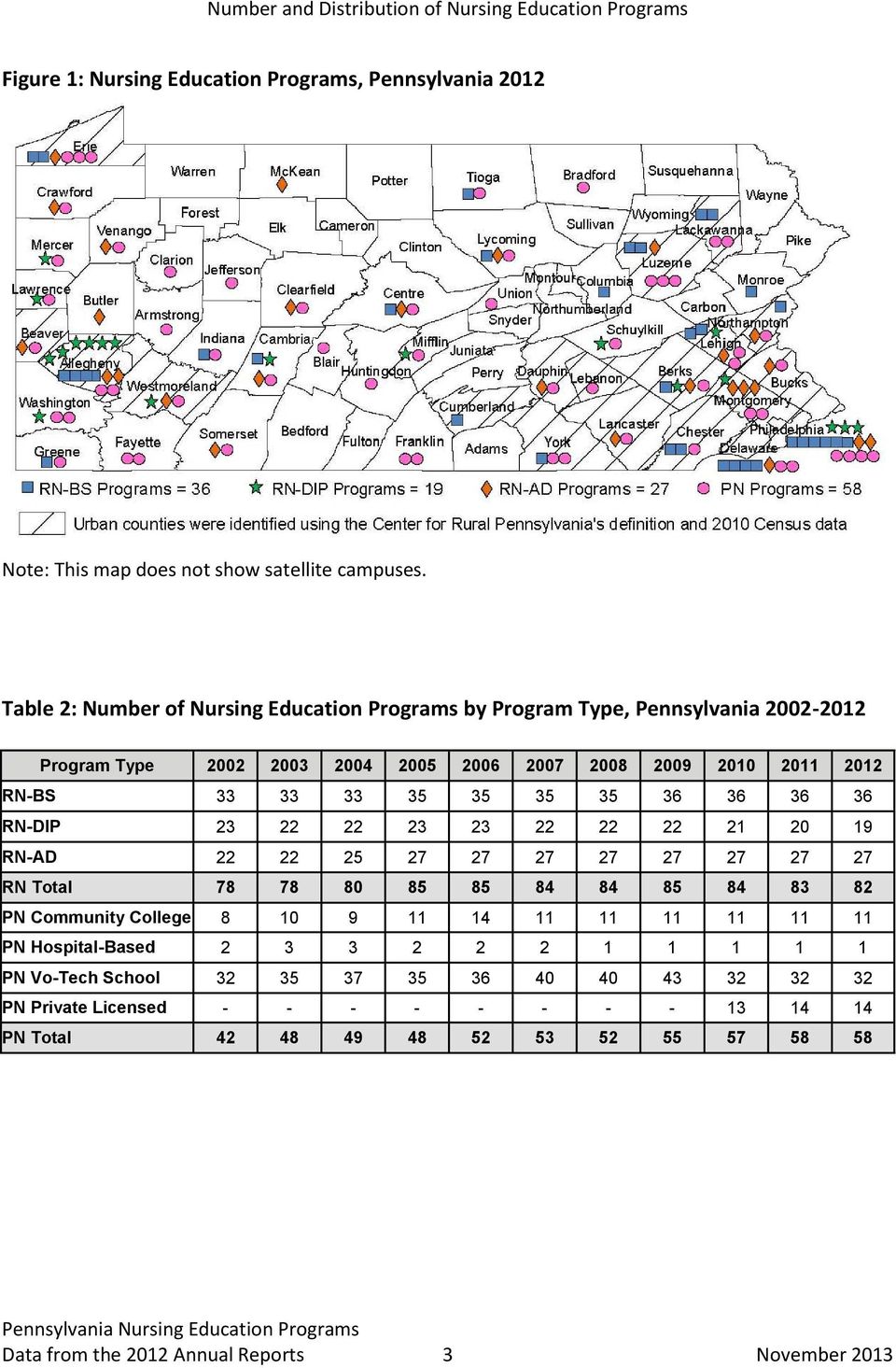
9 Number and Distribution of Nursing Education Programs In 2012, 140 nursing education programs submitted reports to the Pennsylvania Department of State, State Board of Nursing for review (Table 1). 36 registered nurse baccalaureate degree programs (RN-BS) 19 registered nurse diploma programs (RN-DIP) 27 registered nurse associate degree programs (RN-AD) 58 practical nurse programs (PN) During the academic year, one RN-DIP program closed. The RN-DIP program that closed did not submit an annual report. Twenty counties do not have either a PN or RN program, and are all rural counties as defined by the Center for Rural Pennsylvania s definition and 2010 Census data. Several approved programs have established satellite programs in these counties. Philadelphia County had the largest number of nursing programs with 15, followed by Allegheny County with 14 (Figure 1). Twenty-eight percent of RN programs and 47 percent of PN programs were located in rural counties (Figure 1). According to the Center for Rural Pennsylvania s definition and 2010 Census data, 27 percent of Pennsylvania s population resides in rural counties. 2 Table 1: Number of Nursing Education Annual Reports Reviewed, Pennsylvania RN-BS RN-DIP RN-AD Total RN PN All Programs Data from the 2012 Annual Reports 2 November 2013

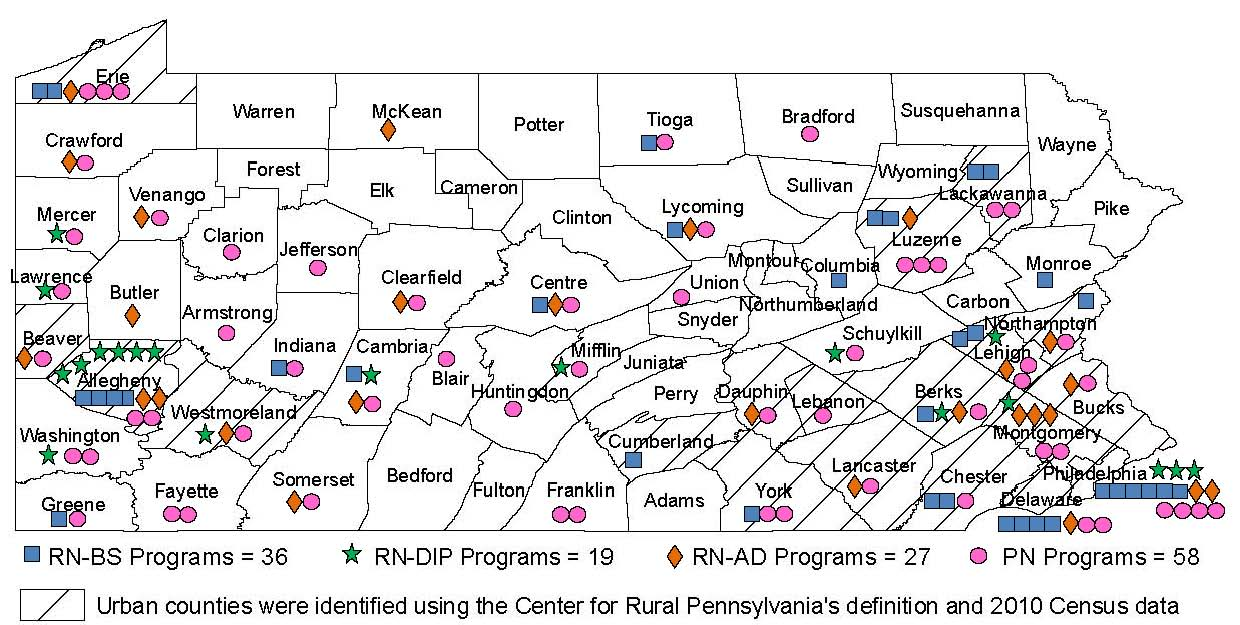
10 Number and Distribution of Nursing Education Programs Figure 1: Nursing Education Programs, Pennsylvania 2012 Note: This map does not show satellite campuses. Table 2: Number of Nursing Education Programs by Program Type, Pennsylvania Program Type RN-BS RN-DIP RN-AD RN Total PN Community College PN Hospital-Based PN Vo-Tech School PN Private Licensed PN Total Data from the 2012 Annual Reports 3 November 2013
11 Nursing Education Programs Student Enrollment and Faculty 4

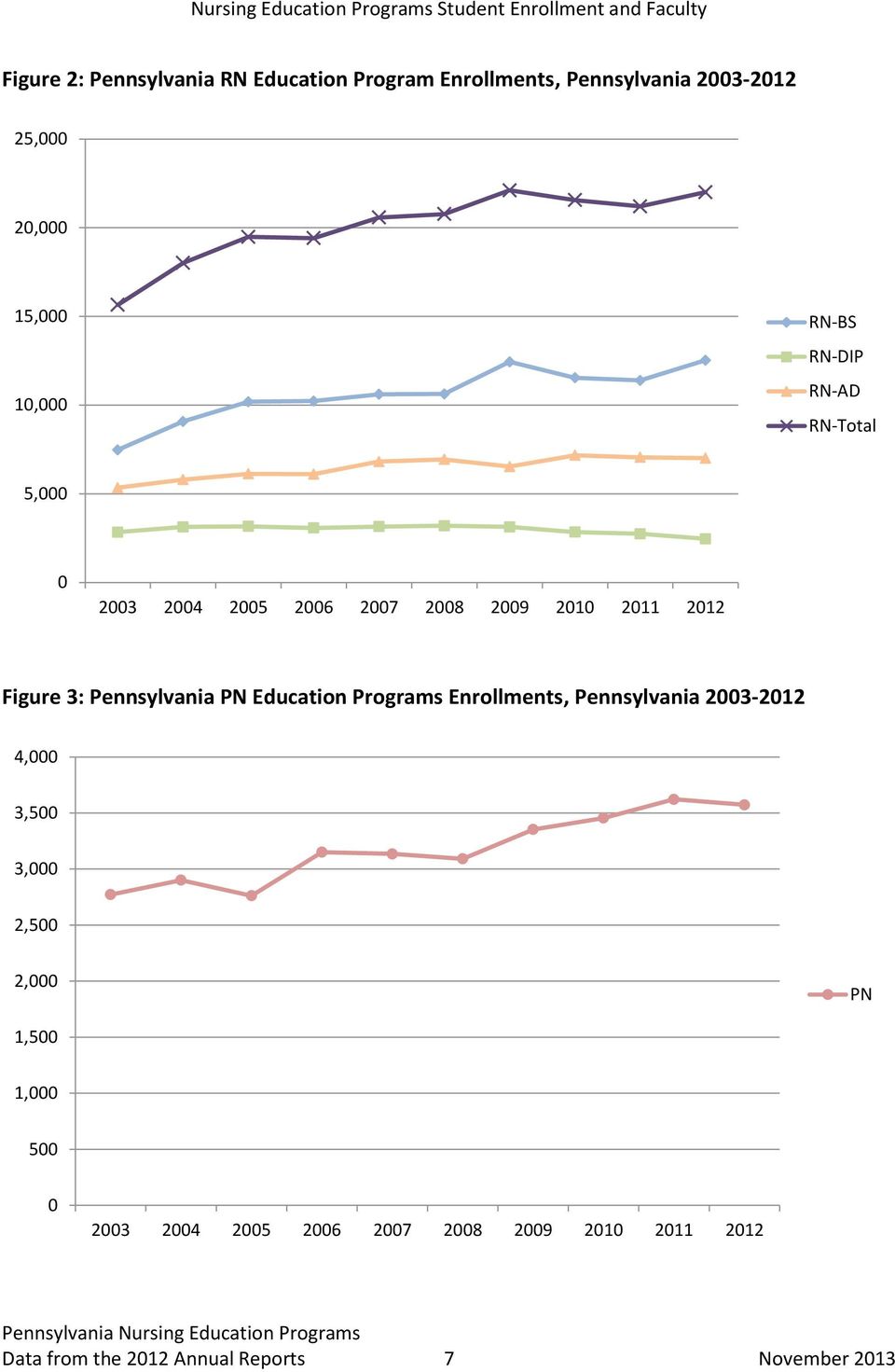
12 Nursing Education Programs Student Enrollment and Faculty RN PN Enrollment increased in RN programs by 4 percent (from 21,194 to 22,004) between 2011 and While RN-BS programs had an increase of 10 percent, RN-DIP and RN-AD had decreases of 10 percent and 1 percent, respectively (Table 3). Since 2003, enrollment in RN programs increased by 40 percent (from 15,651 to 22,004) [Table 3]. The total number of faculty employed in RN programs increased by 8 percent (from 4,081 to 4,423) between 2011 and RN-BS and RN-AD programs each increased 9 percent, while RN-DIP increased 3 percent (Table 3). Contracted or per diem faculty increased by 4 percent for RN-AD programs, 20 percent for RN-BS programs and 57 percent for RN-DIP programs between 2011 and 2012 (Table 3). Between 2011 and 2012, the only decreases in RN faculty were for full-time and part-time faculty in RN-DIP programs at 1 percent and 8 percent, respectively, due to the closure of a program (Table 3). Since 2003, total faculty in RN programs increased by 126 percent (from 1,961 to 4,423), when four new programs were added (Tables 1 and 3). In 2012, the weighted student faculty ratio reached an all-time low for both RN-DIP programs (7.2 to 1) and RN-AD programs (8.5 to 1) since 2003 (Table 3). For RN-BS programs in 2012 this ratio increased to 9.2:1 (Table 3). The total number of newly hired faculty increased for all RN programs from 2011 to Part-time faculty held steady or increased for all types of RN programs, while both increases and decreases occurred in full-time and contracted (or per diem) faculty (Table 4). Turnover for part-time faculty in all RN programs was higher than for full-time or contracted (or per diem) faculty (Table 4). Enrollment decreased in PN programs by 1 percent (from 3,622 to 3,573) between 2011 and 2012 (Table 3). Since 2003, the total number of students enrolled in PN programs increased by 29 percent (2,772 to 3,573) [Table 3]. The total number of faculty employed in PN programs increased by less than 1 percent (from 751 to 755) between 2011 and Part-time faculty increased by 30 percent, while per diem faculty decreased by 13 percent (Table 3). Since 2003, total faculty in PN programs increased by 39 percent (from 544 to 755), when 10 new programs were added (Tables 1 and 3). For the past three years, the weighted student faculty ratio for PN programs held steady at 8.2 to 1 (Table 3). PN programs employ approximately two part-time and/or contracted (or per diem) faculty for each full-time faculty (Table 4). Note: Overall faculty numbers vary each year based on the timing of resignations and new hires. Some nursing education programs count faculty that may only teach one course as a part-time faculty member. Part-time faculty may also be working either part time or contracted for several different nurse education programs. Data from the 2012 Annual Reports 5 November 2013
![Since 2003, enrollment in RN programs increased by 40 percent (from 15,651 to 22,004) [Table 3].](/docs-images/43/597059/images/page_12.jpg "The total number of faculty employed in RN programs increased by 8 percent (from 4,081 to 4,423) between 2011 and 2012.")
13 Nursing Education Programs Student Enrollment and Faculty Table 3: Number of Nursing Education Programs by Program Type, Pennsylvania Program Type Year Full-Time Program Number Enrolled Faculty Student Faculty Ratio Part-Time Program Total Full Time Part Time Contracted (Per Diem) Total Unweighted Weighted* RN-BS , , N/A :1 11.0: ,041 1,039 9, N/A 1, :1 12.2: ,000 1,193 10, N/A 1, :1 12.3: , , , :1 10.6: ,521 1,090 10, , :1 9.8: ,630 1,115 10, , :1 9.5: ,172 2,270 12, , :1 10.6: , , ,079 2, :1 8.5: , , ,056 2, :1 9.0: ,497 1,035 12, ,262 2, :1 9.2:1 RN-DIP , , N/A :1 9.5: , , N/A :1 9.6: , , N/A :1 9.4: , , :1 8.8: , , :1 8.6: , , :1 8.8: , , :1 8.8: , , :1 8.6: , , :1 8.5: , , :1 7.6:1 RN-AD ,803 1,691 5, N/A :1 8.9: ,111 1,692 5, N/A :1 10.4: ,760 2,363 6, N/A :1 9.9: ,770 1,336 6, :1 10.9: ,765 2,050 6, , :1 10.2: ,947 1,995 6, , :1 10.2: ,537 1,998 6, , :1 8.9: ,854 2,320 7, , :1 8.2: ,130 1,928 7, , :1 9.5: ,815 2,193 7, , :1 8.5:1 PN , , N/A :1 8.3: , , N/A :1 7.9: , , N/A :1 7.2: , , :1 9.8: , , :1 8.6: , , :1 8.2: , , :1 8.5: , , :1 8.2: , , :1 8.2: , , :1 8.2:1 * In calculating the weighted student faculty ratio, part-time students and part-time/contracted faculty are both weighed as 0.25x full-time student or faculty. In some cases, a breakdown of full-time and part-time students and parttime/contracted faculty was not available from every program. Where this occurred, those programs were not included in the calculation of the weighted student faculty ratio. Note: Lower numbers denote improved ratios. Data from the 2012 Annual Reports 6 November 2013

14 Nursing Education Programs Student Enrollment and Faculty Figure 2: Pennsylvania RN Education Program Enrollments, Pennsylvania ,000 20,000 15,000 10,000 RN-BS RN-DIP RN-AD RN-Total 5, Figure 3: Pennsylvania PN Education Programs Enrollments, Pennsylvania ,000 3,500 3,000 2,500 2,000 PN 1,500 1, Data from the 2012 Annual Reports 7 November 2013
15 Nursing Education Programs Student Enrollment and Faculty Table 4: Nursing Programs Faculty Size and Changes, Pennsylvania Program Type Year Full Time Total Faculty Newly Hired Left Employment Turnover Rate** Part Time Contracted (per diem) FT/PT* Ratio Full Time Part Time Contracted (per diem) Full Time Part Time Contracted (per diem) Full Time Part Contracted Time (per diem) RN-BS N/A 1.1: N/A N/A 7% 11% N/A N/A 1.1: N/A N/A 9% 19% N/A N/A 0.9: N/A N/A 10% 15% N/A : % 10% 15% : N/A N/A 7% 20% N/A : % 24% 29% : % 24% 29% , : % 11% 16% , : % 12% 17% , : % 25% 6% RN-DIP N/A 3.0: N/A N/A 13% 12% N/A N/A 2.9: N/A N/A 12% 24% N/A N/A 2.6: N/A N/A 15% 19% N/A : % 22% 53% : N/A N/A 14% 36% N/A : % 25% 28% : % 26% 23% : % 27% 42% : % 26% 49% : % 17% 13% RN-AD N/A 0.7: N/A N/A 7% 20% N/A N/A 0.7: N/A N/A 6% 16% N/A N/A 0.7: N/A N/A 9% 15% N/A : % 20% 23% : N/A N/A 9% 34% N/A : % 28% 27% : % 26% 34% : % 15% 26% : % 22% 28% : % 24% 8% PN N/A 0.6: N/A N/A 11% 15% N/A N/A 0.6: N/A N/A 6% 14% N/A N/A 0.6: N/A N/A 10% 12% N/A : % 22% 8% : N/A N/A 12% 27% N/A : % 22% 19% : % 20% 26% : % 20% 26% : % 25% 16% : % 24% 17% * FT=Full-time faculty; PT=Part-time faculty; FT/PT Ratio=FT faculty/pt faculty + contracted faculty ** Turnover Rate=Faculty who left employment divided by total faculty x 100 Data from the 2012 Annual Reports 8 November 2013

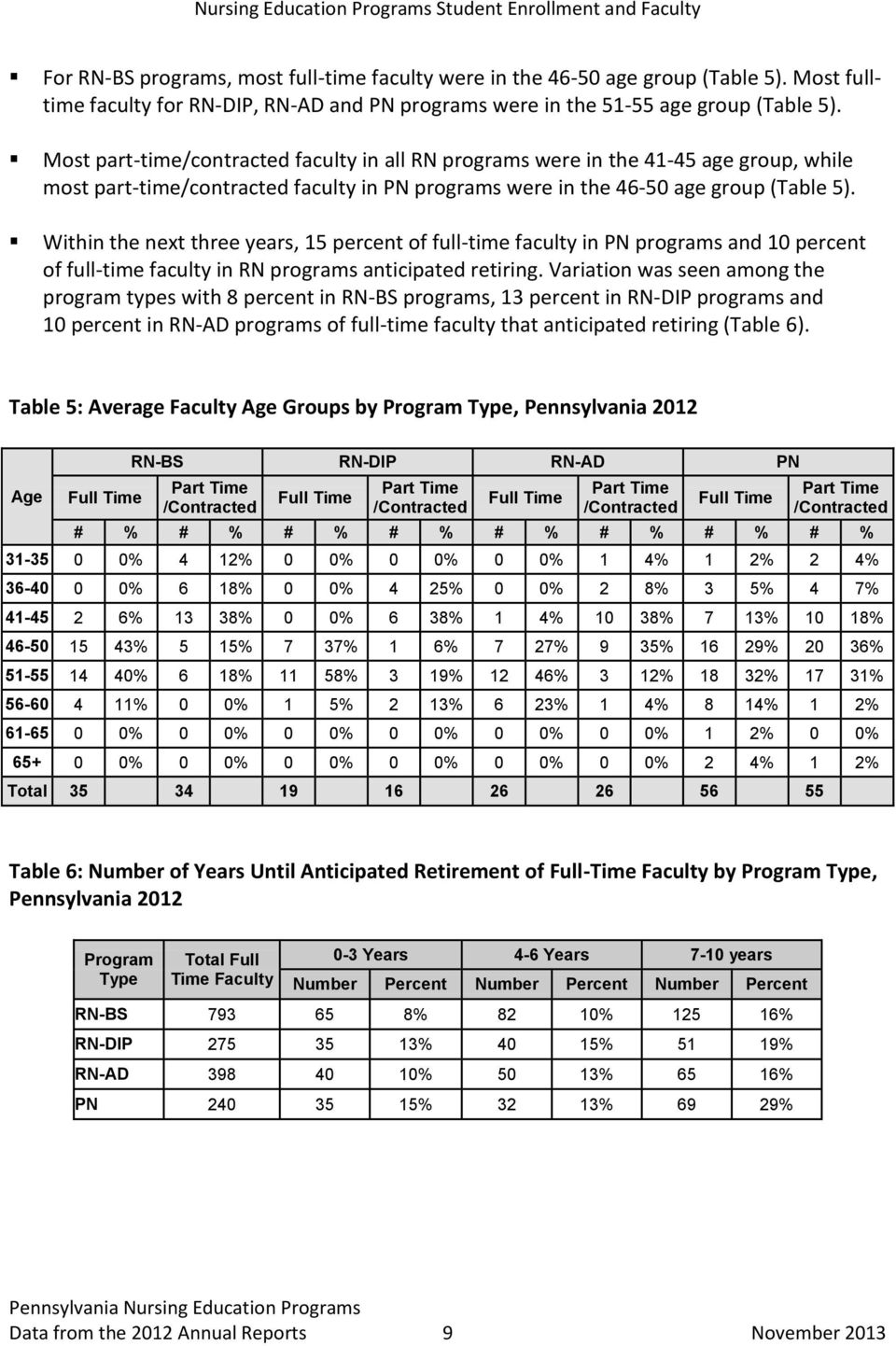
16 Nursing Education Programs Student Enrollment and Faculty For RN-BS programs, most full-time faculty were in the age group (Table 5). Most fulltime faculty for RN-DIP, RN-AD and PN programs were in the age group (Table 5). Most part-time/contracted faculty in all RN programs were in the age group, while most part-time/contracted faculty in PN programs were in the age group (Table 5). Within the next three years, 15 percent of full-time faculty in PN programs and 10 percent of full-time faculty in RN programs anticipated retiring. Variation was seen among the program types with 8 percent in RN-BS programs, 13 percent in RN-DIP programs and 10 percent in RN-AD programs of full-time faculty that anticipated retiring (Table 6). Table 5: Average Faculty Age Groups by Program Type, Pennsylvania 2012 Age Full Time RN-BS RN-DIP RN-AD PN Part Time /Contracted Full Time Part Time /Contracted Full Time Part Time /Contracted Full Time Part Time /Contracted # % # % # % # % # % # % # % # % % 4 12% 0 0% 0 0% 0 0% 1 4% 1 2% 2 4% % 6 18% 0 0% 4 25% 0 0% 2 8% 3 5% 4 7% % 13 38% 0 0% 6 38% 1 4% 10 38% 7 13% 10 18% % 5 15% 7 37% 1 6% 7 27% 9 35% 16 29% 20 36% % 6 18% 11 58% 3 19% 12 46% 3 12% 18 32% 17 31% % 0 0% 1 5% 2 13% 6 23% 1 4% 8 14% 1 2% % 0 0% 0 0% 0 0% 0 0% 0 0% 1 2% 0 0% % 0 0% 0 0% 0 0% 0 0% 0 0% 2 4% 1 2% Total Table 6: Number of Years Until Anticipated Retirement of Full-Time Faculty by Program Type, Pennsylvania 2012 Program Type Total Full Time Faculty 0-3 Years 4-6 Years 7-10 years Number Percent Number Percent Number Percent RN-BS % 82 10% % RN-DIP % 40 15% 51 19% RN-AD % 50 13% 65 16% PN % 32 13% 69 29% Data from the 2012 Annual Reports 9 November 2013
17 Qualifications of Nursing Education Program Faculty 10

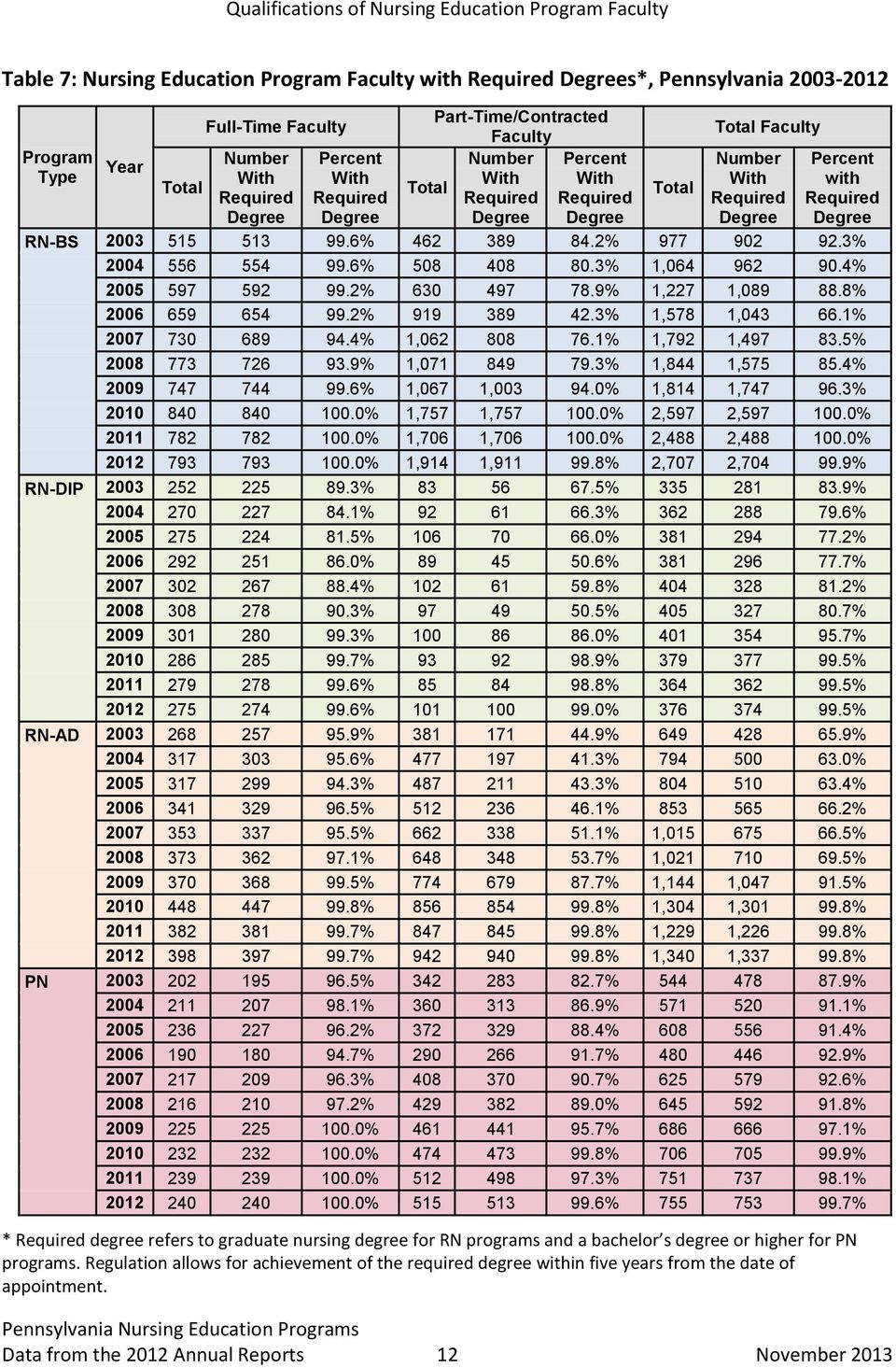
18 Qualifications of Nursing Education Program Faculty RN faculty can be hired with a minimum requirement of a bachelor s degree in nursing to work as an assistant for a maximum of five cumulative years under the direct guidance of a fully qualified faculty member, as set forth at 49 Pa.Code 21.71(c)(1-2). This subsection also sets forth that, during these five years, the assistant shall give evidence of actively pursuing a graduate degree in nursing. PN faculty can be hired with a baccalaureate degree, preferably in nursing, as set forth at 49 Pa.Code Of the 4,423 RN faculty members in Pennsylvania in 2012, 4,415 (99.8 percent) met the faculty requirements or were working towards completing that requirement within five years (Table 7). Of the 755 PN faculty members in Pennsylvania in 2012, 753 (99.7 percent) met the faculty requirements or were working towards completing that requirement (Table 7). Data from the 2012 Annual Reports 11 November 2013

19 Qualifications of Nursing Education Program Faculty Table 7: Nursing Education Program Faculty with Required Degrees*, Pennsylvania Program Type Year Total Full-Time Faculty Number With Required Degree Percent With Required Degree Part-Time/Contracted Faculty Number Percent With With Total Required Required Degree Degree Total Faculty Data from the 2012 Annual Reports 12 November 2013 Total Number With Required Degree Percent with Required Degree RN-BS % % % % % 1, % % % 1,227 1, % % % 1,578 1, % % 1, % 1,792 1, % % 1, % 1,844 1, % % 1,067 1, % 1,814 1, % % 1,757 1, % 2,597 2, % % 1,706 1, % 2,488 2, % % 1,914 1, % 2,707 2, % RN-DIP % % % % % % % % % % % % % % % % % % % % % % % % % % % % % % RN-AD % % % % % % % % % % % % % % 1, % % % 1, % % % 1,144 1, % % % 1,304 1, % % % 1,229 1, % % % 1,340 1, % PN % % % % % % % % % % % % % % % % % % % % % % % % % % % % % % * Required degree refers to graduate nursing degree for RN programs and a bachelor s degree or higher for PN programs. Regulation allows for achievement of the required degree within five years from the date of appointment.
20 Nursing Education Program Applicants 13
21 Nursing Education Program Applicants Of those who applied to nursing education programs in 2012, 48 percent of RN and 61 percent of PN applicants were qualified for admission (Table 8). PN programs reported the highest level of qualified applications at 61 percent, and RN-AD programs reported the lowest level of qualified applicants at 44 percent (Table 8). RN programs admitted 56 percent of the qualified applicants into this year s class, while PN programs admitted 74 percent of the qualified applicants (Table 8). RN and PN programs reported a variety of reasons for not accepting all qualified applicants. RN-BS and RN-DIP programs most frequently reported physical capacity as a limitation, while RN-AD programs most frequently reported clinical capacity as a limitation. PN programs most frequently reported other reasons, which included applicants not enrolling after acceptance into the program (Table 9). In 2012, 35 percent of RN programs had vacant seats, a reduction from 40 percent in 2011 (Table 10). In 2012, 55 percent of PN programs had vacant seats, the same percentage as 2011 (Table 10). Twenty-eight percent of RN programs and 45 percent of PN programs with vacant seats were in rural counties (Figure 4). RN programs had a 35 percent decrease in the number of vacant seats from 2011 to 2012, while PN programs had a 45 percent increase in the number of vacant seats from 2011 to 2012 (Table 10). Table 8: Applicants to Nursing Education Programs, Pennsylvania 2012 Total Total Qualified Applicants Applicants Percent Qualified Applicants Number Admitted Percent of Qualified Applicants Admitted to this Class RN-BS 24,434 12,075 49% 6,584 55% RN-DIP 4,177 2,217 53% 1,394 63% RN-AD 13,636 5,977 44% 3,331 56% RN Total 42,247 20,269 48% 11,309 56% PN 7,031 4,306 61% 3,191 74% Data from the 2012 Annual Reports 14 November 2013
22 Nursing Education Program Applicants Table 9: Reasons Nursing Education Programs Were Unable to Admit All Qualified Applicants, Pennsylvania 2012 Total Programs Responding At Physical Capacity At Faculty Capacity At Clinical Capacity Other Reason Number Percent Number Percent Number Percent Number Percent RN-BS % 11 55% 13 65% 6 30% RN-DIP % 6 67% 3 33% 2 22% RN-AD % 17 74% 19 83% 6 26% RN Total % 34 65% 35 67% 14 27% PN % 12 35% 14 41% 18 53% Table 10: Nursing Education Programs With Vacant Seats, Pennsylvania Program Type Year Total Programs Programs with Total Number of Percent of Programs Responding Vacant Seats Vacant Seats With Vacant Seats RN-BS % % ,189* 44% % % % % RN-DIP % % % % % % % RN-AD % % % % % % % PN % % % % % % % Data from the 2012 Annual Reports 15 November 2013
23 Nursing Education Program Applicants Figure 4: Nursing Education Programs With Vacant Seats, Pennsylvania 2012 Data from the 2012 Annual Reports 16 November 2013
24 Nursing Education Program Graduates 17
25 Nursing Education Program Graduates The total number of RN program graduates increased 151 percent from 2,939 in 2002 to 7,372 in 2012 (Table 11). This is a new highest number of total RN program graduates. Between 2011 and 2012, the total number of RN program graduates increased by 3 percent (Table 11). This was a combination of a 5 percent increase for RN-BS programs, a 4 percent increase in RN-DIP programs and a 1 percent decrease in RN-AD programs (Table 11). Between 2002 and 2012, the number of PN program graduates increased 103 percent from 1,236 to 2,509 (Table 11). The year with the highest number of PN program graduates was 2011 with 2,559 (Table 11). PN programs had a 2 percent decrease in graduates from 2011 to In 2012, RN programs graduated 843 or 10 percent fewer students than previously estimated for 2012 (Table 11). In 2012, PN programs graduated 329 or 12 percent fewer students than previously estimated for 2012 (Table 11). Table 11: Nursing Education Program Graduates, Pennsylvania Estimate Estimate RN-BS 1,190 1,158 1,538 1,983 2,368 2,731 2,870 3,029 2,978 3,095 3,344 3,264 3,563 RN-DIP ,146 1,158 1,138 1,153 1,251 1,304 1,100 1,262 1,142 1,138 RN-AD 1,161 1,559 2,050 2,272 2,411 2,637 2,620 2,917 2,955 2,997 3,609 2,966 3,392 RN Total 2,939 3,464 4,497 5,401 5,937 6,506 6,643 7,197 7,237 7,192 8,215 7,372 8,093 PN 1,236 1,790 1,894 1,993 2,347 2,106 2,233 2,191 2,536 2,559 2,838 2,509 2,849 Figure 5: Nursing School Graduates by Program Type, Pennsylvania and 2013 Estimate 9,000 8,000 7,000 6,000 5,000 4,000 3,000 2,000 1, Estimate RN-BS RN-DIP RN-AD RN Total PN Data from the 2012 Annual Reports 18 November 2013
26 Student Attrition for Nursing Education Programs 19
27 Student Attrition for Nursing Education Programs When students leave a program before graduation, it is known as attrition. Nursing programs were asked to provide attrition numbers for each graduating class. The percentages in Table 12 indicate the total attrition rate for the classes of that specific year. Table 13 shows the reasons for students leaving a program and the percentages for each reason by program type. Attrition rates in 2012 increased for all nursing education programs from the rates in RN-BS programs maintained the lowest rate among all programs at 22 percent, and RN-AD programs had the highest rate at 39 percent (Table 12). While attrition due to academic failure remained the most reported reason for attrition, it decreased from 61 percent in 2011 to 58 percent in 2012 (Table 13). RN-BS continued to have the lowest rate of attrition due to academic failure at 46 percent (Table 13). Change in career goals was the second most commonly cited reason for RN student attrition at 14 percent (Table 13). Other was the second most commonly cited reason for PN student attrition at 24 percent (Table 13). Specific reasons in the category of other were mostly personal or family issues. Table 12: Nursing Education Program Student Attrition Number and Rate by Program Type, Pennsylvania Num. Rate Num. Rate Num. Rate Num. Rate Num. Rate Num. Rate Num. Rate Num. Rate RN-BS % % % % % % % % RN-DIP % % % % % % % % RN-AD % % % 1,026 29% 1,023 27% % % 1,426 39% RN Total 1,048 33% 1,500 20% 1,835 24% 2,015 24% 2,253 17% 1,677 19% 1,716 18% 2,643 29% PN % % % % % % 1,074 30% 1,194 34% All Programs 1,607 33% 2,077 19% 2,651 24% 2,913 25% 3,081 19% 2,546 21% 2,790 21% 3,837 31% Note: Previous reports showed attrition rates as negative numbers. The rates are calculated in the same way but are now displayed as positive numbers. Table 13: Nursing Education Program Reasons for Student Attrition by Program Type, Pennsylvania 2012 RN-BS RN-DIP RN-AD RN Total PN Combined Academic Failure 46% 76% 66% 61% 50% 58% Financial 7% 3% 8% 7% 7% 7% Change In Career Goals 20% 10% 11% 14% 9% 12% Health 2% 4% 5% 4% 8% 5% Relocation 3% 1% 1% 1% 1% 1% Other Reasons 21% 6% 10% 13% 24% 16% Data from the 2012 Annual Reports 20 November 2013
28 Student Attrition for Nursing Education Programs Figure 6: Nursing Education Program Attrition Rate by Program Type and Class Year, Pennsylvania % 40% 35% 30% 25% 20% 15% 10% RN-BS RN-DIP RN-AD PN 5% 0% Twenty-eight percent of all RN students who left nursing education programs were later readmitted (Figure 7). RN-AD programs had the highest percentage (33 percent) of students who were readmitted, followed by RN-DIP programs (25 percent) and RN-BS programs (21 percent) [Figure 7]. PN programs readmitted 14 percent of students who left nursing education programs (Figure 7). Figure 7: Students Re-Admitted to Nursing Education Programs by Program Type, Pennsylvania % 50% 40% 30% 20% RN-BS RN-DIP RN-AD PN 10% 0% Data from the 2012 Annual Reports 21 November 2013
29 Curriculum Programing of Nursing Education Programs 22
30 Curriculum Programing of Nursing Education Programs Nursing education programs are required to establish agreements with clinical agencies approved by state and/or national bodies, if such exist, to meet curriculum objectives as set forth at 49 Pa.Code 21.61, 21.62, and In order for their nursing students to gain clinical experiences, nursing education programs establish cooperative agreements with healthcare providers or facilities. These agreements ensure students receive a variety of highquality, planned learning experiences. Clinical practice placements are an integral part of nursing education. Since 2003, the Nursing Program Annual Report has included the following questions regarding the clinical placement practice: Has the program experienced any difficulty in obtaining clinical sites for student experience? If yes, for which areas of clinical practice has your program experienced the most difficulty? What do you believe to be the factor(s) contributing to difficulty in obtaining clinical sites for student learning experiences? Please rank your responses from 1 to 5, with 1 being the most significant contributing factor. The following results were drawn from the responses to these questions. Difficulty obtaining clinical sites for student experience was indicated by 86 percent of RN-BS programs, 78 percent of RN-AD programs, 58 percent of RN-DIP programs and 93 percent of PN programs (Table 14). All programs reported the highest levels of difficulty obtaining clinical sites for pediatric, obstetric and psychiatric practice (Table 14). Community health experiences were the most reported clinical site in the category of other for RN programs (Table 14). Use of the facility by another nursing program was rated the most significant factor contributing to difficulty in obtaining clinical sites for RN-BS, RN-AD and PN programs (Table 15). PN programs noted that preference is given to RN students and some clinical sites are not open to PN students. RN-DIP programs reported decreased census as the most significant factor contributing to difficulty obtaining clinical sites (Table 15). Data from the 2012 Annual Reports 23 November 2013
31 Curriculum Programing of Nursing Education Programs Table 14: Level of Difficulty for Nursing Education Programs that Indicated Difficulty in Obtaining Clinical Sites for Student Experiences by Areas of Clinical Practice, Pennsylvania 2012 Total Number of Programs with Difficulty Obstetrics Pediatrics Psychiatry Medical - Surgical Critical Care Other # % # % LD # % LD # % LD # % LD # % LD # % LD RN-BS 31 86% 28 78% % % % % % 3.5 RN-DIP 11 58% 7 37% % % % % % 4.0 RN-AD 21 78% 15 56% % % % % % 6.0 PN 54 93% 44 76% % % % % % 4.8 LD = Average level of difficulty experienced in obtaining clinical sites on a scale of 1 to 6 (1 is the area of most difficulty and 6 is the area of least difficulty) Table 15: Relative Weight of Factors Assigned by Nursing Schools Contributing to the Difficulty in Obtaining Clinical Sites by Program Type, Pennsylvania 2012 Decreased Length of Stay Decreased Census Other Nursing Program Using Facility Distance to Facility Other RN-BS RN-DIP RN-AD PN Note: Average weight of factors contributing to difficulty obtaining clinical sites on a scale of 1 to 5 (1 is the most significant contributing factor and 5 is the least significant contributing factor) Data from the 2012 Annual Reports 24 November 2013
32 Appendix 1: Academic Year Nursing Education Program Annual Report Form Data from the 2012 Annual Reports 25 November 2013
33 Appendix 1: Academic Year Nursing Education Program Annual Report Form Data from the 2012 Annual Reports 26 November 2013
34 Appendix 1: Academic Year Nursing Education Program Annual Report Form Data from the 2012 Annual Reports 27 November 2013
35 Appendix 1: Academic Year Nursing Education Program Annual Report Form Data from the 2012 Annual Reports 28 November 2013
36 Appendix 1: Academic Year Nursing Education Program Annual Report Form Data from the 2012 Annual Reports 29 November 2013
37 Appendix 1: Academic Year Nursing Education Program Annual Report Form Data from the 2012 Annual Reports 30 November 2013
38 Appendix 1: Academic Year Nursing Education Program Annual Report Form Data from the 2012 Annual Reports 31 November 2013
39 Appendix 1: Academic Year Nursing Education Program Annual Report Form Data from the 2012 Annual Reports 32 November 2013
40 Appendix 1: Academic Year Nursing Education Program Annual Report Form Data from the 2012 Annual Reports 33 November 2013
41 Appendix 1: Academic Year Nursing Education Program Annual Report Form Data from the 2012 Annual Reports 34 November 2013
42 Appendix 1: Academic Year Nursing Education Program Annual Report Form Data from the 2012 Annual Reports 35 November 2013
43 Appendix 1: Academic Year Nursing Education Program Annual Report Form Data from the 2012 Annual Reports 36 November 2013
44 Appendix 1: Academic Year Nursing Education Program Annual Report Form Data from the 2012 Annual Reports 37 November 2013
45 Appendix 1: Academic Year Nursing Education Program Annual Report Form Data from the 2012 Annual Reports 38 November 2013
46 Appendix 1: Academic Year Nursing Education Program Annual Report Form Data from the 2012 Annual Reports 39 November 2013
47 Appendix 1: Academic Year Nursing Education Program Annual Report Form Data from the 2012 Annual Reports 40 November 2013
48 Appendix 1: Academic Year Nursing Education Program Annual Report Form Data from the 2012 Annual Reports 41 November 2013
49 Appendix 1: Academic Year Nursing Education Program Annual Report Form Data from the 2012 Annual Reports 42 November 2013
50 Appendix 2: Definitions The Professional Nursing Law and the Practical Nurse Law resulted in the Pennsylvania State Board of Nursing developing regulations for the educational requirements for nursing schools, the conduct of nursing programs, education of professional and practical nurses, and the practice of professional and practical nursing. The laws established the following definitions of the practice of professional nursing (registered nurse) and the practice of practical nursing (licensed practical nurse). The practice of professional nursing (registered nurse): Diagnosing and treating human responses to actual or potential health problems through such services as case finding, health teaching, health counseling, provision of care supportive to or restorative of life and well-being, and executing medical regimens as prescribed by a licensed physician or dentist. 3 The practice of practical nursing (licensed practical nurse): The performance of selected nursing acts in the care of the ill, injured or infirm under the direction of a licensed professional nurse, a licensed physician or a licensed dentist which do not require the specialized skill, judgment and knowledge required in professional nursing. 4 The State Board of Nursing is charged to establish safe standard for the preparation of registered and practical nurses in approved education programs as set forth at 49 Pa.Code and The information presented in this report is categorized by four basic types of nursing education programs: RN baccalaureate program (RN-BS): Four-year college degree program of nursing developed under the authority of a regionally accredited university or college. RN hospital-based diploma program (RN-DIP): Approximately a two-year nursing diploma program developed under the authority of a hospital accredited by the Joint Commission. RN associate program (RN-AD): Two-year college degree program of nursing developed under the authority of a regionally accredited university or college. Licensed practical nursing program (LPN): A program for the education of practical nurses developed under the authority of a hospital, educational institution or combination thereof. Full-time nurse faculty are employed by and receive benefits from an academic institution in exchange for working at least 32 hours a week. Their responsibilities may include teaching didactic courses, supervising students at clinical sites, scholarship and service. Part-time nurse faculty are employed by an academic institution to work no more than 32 hours a week. They received limited benefits from the academic institution. They may teach didactic courses and/or supervise students at clinical sites. Contracted/per diem nurse faculty are hired on an as needed basis by the academic institution for services rendered by semester, year or course. They may or may not receive payment and/or benefits from the academic institution. They may teach didactic courses and/or supervise students in clinical settings. Data from the 2012 Annual Reports 43 November 2013
51 SOURCES 1 Commonwealth of Pennsylvania, The Professional Nursing Law, on the internet at (last accessed January 24, 2013). 2 The Center for Rural Pennsylvania, Rural/Urban PA, on the internet at (last accessed January 17, 2013). 3 Commonwealth of Pennsylvania, The Professional Nursing Law, on the internet at (last accessed January 24, 2013). 4 Commonwealth of Pennsylvania, Practical Nurse Law, on the internet at (last accessed January 24, 2013). Data from the 2012 Annual Reports 44 November 2013
52 ACKNOWLEDGEMENTS Pennsylvania Department of Health Bureau of Health Planning Division of Plan Development Room 1033, Health and Welfare Building 625 Forster St. Harrisburg, PA Telephone: Pennsylvania Department of State Bureau of Professional and Occupational Affairs 2601 N. Third St. Harrisburg, PA Telephone: Data from the 2012 Annual Reports 45 November 2013
Iowa Legislative Fiscal Bureau. Iowa's Nursing Shortage. This Issue Review provides a comprehensive overview of the current nursing shortage in Iowa.
 Iowa Legislative Fiscal Bureau I S S U E R E V I E W Dennis Prouty State Capitol (515) 281-5279 Des Moines, IA 50319 FAX 281-8451 September 20, 2001 ISSUE Iowa's Nursing Shortage This Issue Review provides
Survey of Nursing Education Programs: 2009 2010 School Year
 Survey of Nursing Education Programs: 2009 2010 School Year Prepared for Michigan Center for Nursing Okemos, Michigan Prepared by Public Sector Consultants Lansing, Michigan www.pscinc.com Survey of Nursing
BACHELOR OF APPLIED SCIENCE with a major in Health Science with an Option in Physician Assistant Studies
 PROPOSAL BACHELOR OF APPLIED SCIENCE with a major in Health Science with an Option in Physician Assistant Studies Submitted to: The Florida Department of Education by MIAMI DADE COLLEGE School of Health
16.12.3.3 STATUTORY AUTHORITY: Nursing Practice Act, Section 61-3-26 NMSA 1978 Comp. [1-1-98; 16.12.3.3 NMAC - Rn, 16 NMAC 12.3.
 TITLE 16 CHAPTER 12 PART 3 OCCUPATIONAL AND PROFESSIONAL LICENSING NURSING AND HEALTH CARE RELATED PROVIDERS NURSING EDUCATIONAL PROGRAMS 16.12.3.1 ISSUING AGENCY: New Mexico Board of Nursing. [1-1-98;
Survey of Nursing Education Programs: 2005 2006 School Year
 Survey of Nursing Education Programs: EXECUTIVE SUMMARY In the fall of 2006, the Michigan Center for Nursing conducted a survey of nursing education programs in Michigan to collect information on the types
Senate Bill No. 1245 CHAPTER 718
 Senate Bill No. 1245 CHAPTER 718 An act to add and repeal Article 8 (commencing with Section 89270) of Chapter 2 of Part 55 of the Education Code, relating to the California State University. [Approved
Survey of Nursing Education Programs: 2005 2006 School Year
 Survey of Nursing Education Programs: 2005 2006 School Year EXECUTIVE SUMMARY In the fall of 2006, the Michigan Center for Nursing conducted a survey of nursing education programs in Michigan to collect
December, 2009. Salary, Education, Benefits, and Job Descriptions of Nurses, Teachers, and Social Workers: A Comparative Analysis
 December, 2009 Salary, Education, Benefits, and Job Descriptions of Nurses, Teachers, and Social Workers: A Comparative Analysis Contents Introduction 3 Problem Statement 3 Social Work within the Texas
Florida Licensed Practical Nurse Education: Academic Year 2012-2013
 Florida Licensed Practical Nurse Education: Academic Year 2012-2013 This report presents the key findings regarding the Licensed Practice Nursing education system in Florida. This report details information
EFFECTIVE NEBRASKA HEALTH AND HUMAN SERVICES 172 NAC 97 12/9/06 REGULATION AND LICENSURE
 TITLE 172 CHAPTER 97 PROFESSIONAL AND OCCUPATIONAL LICENSURE APPROVAL OF BASIC NURSING PROGRAMS IN NEBRASKA TABLE OF CONTENTS SUBJECT SECTION PAGE Accreditation of Controlling Institution 004 4 Administration
2010/2011 Pulse of Pennsylvania s Registered Nurse Workforce. Bureau of Health Planning Division of Plan Development
 2010/2011 Pulse of Pennsylvania s Registered Nurse Workforce Bureau of Health Planning Division of Plan Development A Report on the 2010/2011 Survey of Registered Nurses Volume 5, January 2013 TABLE OF
Florida Pre-Licensure Registered Nurse Education: Academic Year 2012-2013
 The information below represents the key findings regarding the pre-licensure RN (Associate Degree in Nursing, ADN, and Bachelor of Science Degree in Nursing, BSN) education system in Florida. This report
New Program Proposal Bachelor of Science Nursing (R.N. to B.S.N. Completion) Coastal Carolina University
 New Program Proposal Bachelor of Science Nursing (R.N. to B.S.N. Completion) Coastal Carolina University Summary Coastal Carolina University requests approval to offer a program leading to the Bachelor
The State of Arkansas Nursing Education Programs and Their Ability to Address the Nursing Workforce Shortage
 The State of Arkansas Nursing Education Programs and Their Ability to Address the Nursing Workforce Shortage Results of the: Fall 21 Survey of Arkansas Nursing Education Programs by the Arkansas Legislative
BUSINESS, CONSUMER SERVICES, AND HOUSING AGENCY GOVERNOR EDMUND G. BROWN JR.
 BUSINESS, CONSUMER SERVICES, AND HOUSING AGENCY GOVERNOR EDMUND G. BROWN JR. BOARD OF REGISTERED NURSING PO Box 944210, Sacramento, CA 94244-2100 P (916) 322-3350 F (916) 574-8637 www.rn.ca.gov Louise
244 CMR: BOARD OF REGISTRATION IN NURSING 244 CMR 6.00: APPROVAL OF NURSING EDUCATION PROGRAMS AND THE GENERAL CONDUCT THEREOF
 244 CMR 6.00: APPROVAL OF NURSING EDUCATION PROGRAMS AND THE GENERAL CONDUCT THEREOF Section 6.01: Definitions 6.02: Public Notice of Nursing Education Program Approval Status 6.03: Nursing Education Programs
2014-15 Proposal to Fill a Full-Time Faculty Position
 1. Faculty position being proposed Pediatric Nursing Faculty 2. Proposal Being Made by (List Name(s) and Title(s) Sally Scofield, Director, Registered Nursing Program 2014-15 Proposal to Fill a Full-Time
Accreditation Standards and Rules and Regulations for Mississippi Nursing Degree Programs
 Accreditation Standards and Rules and Regulations for Mississippi Nursing Degree Programs Revised July 1, 1992 Revised July 1, 1993 Amended April 1995 Amended June 1998 Amended July 1999 Revised November
Legislative Council, State of Michigan Courtesy of www.legislature.mi.gov
 PUBLIC HEALTH CODE (EXCERPT) Act 368 of 1978 PART 27 MICHIGAN ESSENTIAL HEALTH PROVIDER RECRUITMENT STRATEGY 333.2701 Definitions. Sec. 2701. As used in this part: (a) "Board certified" means certified
How To Make Nursing A Nursing Program A Nursing Degree
 CHAPTER 2014-92 Committee Substitute for Committee Substitute for Senate Bill No. 1036 An act relating to nursing education programs; amending s. 464.003, F.S.; revising definitions; conforming a cross-reference;
Texas Board of Nursing Fiscal Year 2015-2019 Workforce Plan
 Texas Board of Nursing Fiscal Year 2015-2019 Workforce Plan I. AGENCY OVERVIEW The Board of Nursing (BON), has one of the largest licensee database in the State of Texas. We regulate over 360,000 nurses
Virginia Nursing Education Programs: 2011-2012 Academic Year
 Virginia Nursing Education Programs: 2011-2012 Academic Year August 2013 Virginia Department of Health Professions Healthcare Workforce Data Center Perimeter Center 9960 Mayland Drive, Suite 300 Richmond,
REPORT FALL 2003 SURVEY OF MAINE NURSING EDUCATION PROGRAMS
 REPORT FALL 003 SURVEY OF MAINE NURSING EDUCATION PROGRAMS Prepared by Jane Kirschling, Dean and Professor of Nursing College of Nursing and Health Professions University of Southern Maine [email protected]
Nursing Education Programs and Licensure Requirements General
 Nursing Education Programs and Licensure Requirements General Nursing Education Programs and Licensure Requirements General General 20-90-45. Definition of terms As used in sections 20-90-45 to sections
New Program Proposal Associate in Health Sciences Major in Nursing Northeastern Technical College
 Agenda Item 4.02A.2 New Program Proposal Associate in Health Sciences Major in Nursing Northeastern Technical College Summary Northeastern Technical College requests approval to offer a program leading
Nature of the Program
 Nature of the Program The University of West Florida has had an accredited social work undergraduate program since 1974, the first year that the Council on Social Work Education recognized undergraduate
Sec. 20-90 page 1 (11-04)
 Department of Public Health Sec. 20-90 page 1 (11-04) TABLE OF CONTENTS The Board of Examiners for Nursing and Requirements for Registration of Professional Nurses and Certification of Licensed Practical
Commission on Peer Review and Accreditation
 Commission on Peer Review and Accreditation Network of Schools of Public Policy, Affairs, and Administration ACCREDITATION STANDARDS For Master s degree programs Adopted October 16, 2009 at the NASPAA
A Profile of Virginia Nursing Education Programs
 A Profile of Virginia Nursing Education Programs Results of the 2009 Survey of Virginia Nursing Education Programs July, 2010 Prepared for the Virginia Department of Health Professions Healthcare Workforce
CHAPTER 6 STANDARDS FOR NURSING EDUCATION PROGRAMS
 CHAPTER 6 STANDARDS FOR NURSING EDUCATION PROGRAMS Section 1: Statement of Purpose. (a) To foster the safe and effective practice of nursing by graduates of nursing education programs by setting standards
New Program Proposal Bachelor of Science in Nursing University of South Carolina-Beaufort
 Agenda Item 4.02.A.4 New Program Proposal Bachelor of Science in Nursing University of South Carolina-Beaufort Summary University of South Carolina-Beaufort requests approval to offer a program leading
Nursing Supply and Demand Study 2008
 Nursing Supply and Demand Study 2008 2100 Sherman Avenue, Suite 100 Cincinnati, OH 45212-2775 Phone: (513) 531-0200 2 Table of Contents I. Introduction... 3 II. Hospital Survey (Demand)... 4 A. Registered
National Nursing Workforce Minimum Datasets: Education. Rationale for Selection and Measurement of Minimum Dataset Items
 National Nursing Workforce Minimum Datasets: Education Rationale for Selection and Measurement of Minimum Dataset Items Prior to development of this draft, the National Forum of State Nursing Workforce
Wisconsin Nursing Education and Nurse Faculty: 2010 Survey Results. Susan Dean-Baar, PhD, RN, FAAN Ann Cook, PhD, RN Christine Laurent, MSN, RNC
 Wisconsin Nursing Education and Nurse Faculty: 2010 Survey Results Susan Dean-Baar, PhD, RN, FAAN Ann Cook, PhD, RN Christine Laurent, MSN, RNC Wisconsin Center for Nursing http://www.wicenterfornursing.org
STATE OF NEBRASKA STATUTES RELATING TO NURSE PRACTICE ACT. Department of Health and Human Services Division of Public Health Licensure Unit
 2012 STATE OF NEBRASKA STATUTES RELATING TO NURSE PRACTICE ACT Department of Health and Human Services Division of Public Health Licensure Unit 301 Centennial Mall South, Third Floor PO Box 94986 Lincoln,
Cerritos College Associate Degree Nursing Program
 Cerritos College Associate Degree Nursing Program The California Board of Registered Nursing 2010-2011 Annual School Report reflected that 61% of nursing programs in California are Associate Degree programs.
New Jersey Practical Nursing Education Programs 2008
 New Jersey Practical Nursing Education Programs 2008 Results of the 2008 Survey of New Jersey Nursing Education Programs Introduction New Jersey has both public Practical Nurse Education Programs and others
OFFICE OF HUMAN RESOURCES MANAGEMENT CODE OF PRACTICE REGARDING INSTRUCTIONAL STAFF TITLES: TITLE DESCRIPTIONS AND MINIMUM QUALIFICATIONS
 OFFICE OF HUMAN RESOURCES MANAGEMENT CODE OF PRACTICE REGARDING INSTRUCTIONAL STAFF TITLES: TITLE DESCRIPTIONS AND MINIMUM QUALIFICATIONS PREAMBLE INDEX I. ADMINISTRATIVE POSITIONS 1. SENIOR VICE PRESIDENT
Nursing (Established in 1954 with NURSE AS) Program Viability Measures Report 2009-10
 Nursing (Established in 1954 with NURSE AS) Program Viability Measures Report 2009-10 A.S. Degree: Nursing (R.N.) Program Graduates Actual Course Enrollment Graduates 400 350 300 250 200 150 100 50 0 355
Ashland University Dwight Schar College of Nursing Case for Support
 Ashland University Dwight Schar College of Nursing Case for Support History Established in 1919 by Mansfield General Hospital as a hospital-based diploma program, the Mansfield General Hospital School
Nursing: RN Program BSN
 Nursing: RN Program BSN Why Choose Nursing? Nursing is the largest health care profession with workforce shortages anticipated for the next two decades. Earnings are above average, particularly for advanced
SUBCHAPTER 1 GENERAL PROVISIONS
 SUBCHAPTER 1 GENERAL PROVISIONS 17-87-101. License Required - Purpose. 17-87-102. Definitions. 17-87-103. Exceptions. 17-87-104. Penalty. 17-87-105. Injunction. 17-87-106. Construction of Chapter. 17-87-101.
Survey of Publicly Funded, Accredited Nursing Colleges in New Mexico
 Survey of Publicly Funded, Accredited Nursing Colleges in New Mexico March 2014 Written By: Shanna Schultz, Program Coordinator for the Academic Progression in Nursing Grant 0 Contents Executive Summary...
E-Learning to Ease the Nursing Shortage: A New Model for Transitioning Licensed Vocational Nurses (LVNs) to Registered Nurses (RNs)
 E-Learning to Ease the Nursing Shortage: A New Model for Transitioning Licensed Vocational Nurses (LVNs) to Registered Nurses (RNs) Dr. Carol Diminnie Professor of Management Sciences Angelo State University,
Nursing Education Programs 2013-2014 Annual School Report
 STATE OF WASHINGTON DEPARTMENT OF HEALTH Nursing Education Programs 2013-2014 Annual School Report Statistical Summary and Trends Analysis Nursing Care Quality Assurance Commission DOH 669-269 (Revised
How To Set Up A Nursing Education Program In Wyoming
 CHAPTER VI6 STANDARDS FOR NURSING EDUCATION PROGRAMS Section 1. Statement of Purpose. (a) The purpose of the bboardthese Board Rules are in adoptinged to rules and regulations in this Chapter is to implement
School Performance Fact Sheet
 UNIVERSITY OF THE PEOPLE 225 S. Lake Ave., Suite 300 Pasadena, CA 91101 Phone: 626 264 8880 www.uopeople.edu School Performance Fact Sheet Reporting for s 2013 & 2014 In compliance with the California
The Florida Senate. Interim Project Report 2005-140 November 2004 REVIEW OF NURSING SHORTAGES IN HOSPITALS AND NURSING HOMES SUMMARY BACKGROUND
 The Florida Senate Interim Project Report 2005-140 November 2004 Committee on Health Care Senator Durell Peaden, Jr., Chair REVIEW OF NURSING SHORTAGES IN HOSPITALS AND NURSING HOMES SUMMARY The current
Master of Science Degree in Psychiatric Nursing Family Psychiatric Nurse Practitioner Certificate. Certificate Family Psychiatric Nurse Practitioner
 Binghamton University Letter of Intent A. Program Identity A1 Proposed Title A2 Proposed Award Master of Science Degree in Psychiatric Nursing Family Psychiatric Nurse Practitioner Certificate Master of
Nursing Program Application and Admission Information
 Welcome to the Thomas Nelson Community College nursing website. We appreciate your interest in the Thomas Nelson Community College nursing program. We hope that you will find the information needed to
EXECUTIVE SUMMARY. Findings from the Annual Survey of Schools of Nursing Academic Year 2009-2010
 EXECUTIVE SUMMARY Findings from the Annual Survey of Schools of Nursing Academic Year 2009-2010 NLN Data Show Both Progress and Challenges in Meeting IOM Objectives This executive summary describes findings
New Nursing Programs Requesting Approval in Louisiana-(Out of State SON-Undergraduate Program)
 1 New Nursing Programs Requesting Approval in Louisiana-(Out of State SON-Undergraduate Program) SON: DATE To receive approval by the Board of Nursing for new undergraduate programs in Louisiana by nursing
8U81NES8. CONSUMER SERVICES ANDHDUBINGAGENCY ~SD~E~2~G.tt~~. #7.A.3.
 cc:a BTATS CP CA.LIPDRNIA 2535 DEPARTMENT OF CONSUMER AFFAIRS 8U81NES8. CONSUMER SERVICES ANDHDUBINGAGENCY ~SD~E~2~G.tt~~. #7.A.3. Board of Vocational Nursing and Psychiatric Technicians Capitol Oaks Drive
GENERAL ASSEMBLY OF NORTH CAROLINA SESSION 1989 H 2. HOUSE BILL 320* Committee Substitute Favorable 4/5/89. February 22, 1989
 GENERAL ASSEMBLY OF NORTH CAROLINA SESSION H HOUSE BILL * Committee Substitute Favorable // Short Title: Nursing Shortage Alleviation Act. Sponsors: Referred to: (Public) February, A BILL TO BE ENTITLED
NURSES NEEDED SHORT-TERM RELIEF, ONGOING SHORTAGE. Results from the 2010 Nursing Workforce Survey
 NURSES NEEDED SHORT-TERM RELIEF, ONGOING SHORTAGE Results from the 2010 Nursing Workforce Survey JUNE 2010 IN COLLABORATION WITH WNYHA Western New York Healthcare Association Demand for nurses will continue
COMMUNITY COLLEGE BACCALAUREATE DEGREE PROPOSAL EVALUATION
 COMMUNITY COLLEGE BACCALAUREATE DEGREE PROPOSAL EVALUATION The proposals of several community colleges to undertake programs resulting in the granting of baccalaureate degrees is an important issue because
IAC 7/2/08 Nursing Board[655] Ch 2, p.1. CHAPTER 2 NURSING EDUCATION PROGRAMS [Prior to 8/26/87, Nursing Board[590] Ch 2]
![IAC 7/2/08 Nursing Board[655] Ch 2, p.1. CHAPTER 2 NURSING EDUCATION PROGRAMS [Prior to 8/26/87, Nursing Board[590] Ch 2]](/thumbs/26/9126685.jpg "IAC 7/2/08 Nursing Board[655] Ch 2, p.1. CHAPTER 2 NURSING EDUCATION PROGRAMS [Prior to 8/26/87, Nursing Board[590] Ch 2]") IAC 7/2/08 Nursing Board[655] Ch 2, p.1 CHAPTER 2 NURSING EDUCATION PROGRAMS [Prior to 8/26/87, Nursing Board[590] Ch 2] 655 2.1(152) Definitions. Approval means recognition status given to nursing education
IAC 7/2/08 Nursing Board[655] Ch 2, p.1 CHAPTER 2 NURSING EDUCATION PROGRAMS [Prior to 8/26/87, Nursing Board[590] Ch 2] 655 2.1(152) Definitions. Approval means recognition status given to nursing education
Nursing Supply and Demand Study Acute Care
 2014 Nursing Supply and Demand Study Acute Care Greater Cincinnati Health Council 2100 Sherman Avenue, Suite 100 Cincinnati, OH 45212-2775 Phone: (513) 531-0200 Table of Contents I. Introduction and Executive
TEXAS ACADEMY OF PHYSICIAN ASSISTANTS
 TEXAS ACADEMY OF PHYSICIAN ASSISTANTS TAPA TEXAS ACADEMY OF PHYSICIAN ASSISTANTS TAPA was established as a non-profit organization in February 1975 PAs function in team-based care with physicians as provided
Ch. 338 INTERIM STANDARDS FOR COLLEGE PROG 22 338.1 CHAPTER 338. INTERIM STANDARDS FOR TECHNICAL COLLEGE PROGRAMS
 Ch. 338 INTERIM STANDARDS FOR COLLEGE PROG 22 338.1 CHAPTER 338. INTERIM STANDARDS FOR TECHNICAL COLLEGE PROGRAMS Sec. 338.1. Scope and purpose. 338.2. Definitions. 338.3. Program approval procedures.
4. Appendices - supplemental information that supports the documentation related to the standards provided in the report.
 Oklahoma Board of Nursing 2915 North Classen Boulevard, Suite 524 Oklahoma City, OK 73106 (405) 962-1800 GUIDELINES FOR SURVEY VISITS OF NURSING EDUCATION PROGRAMS Preparing for the Survey Visit Each nursing
DEPARTMENT OF REGULATORY AGENCIES. Division of Professions and Occupations
 DEPARTMENT OF REGULATORY AGENCIES Division of Professions and Occupations 3 CCR 716-1 CHAPTER 2 RULES AND REGULATIONS FOR APPROVAL OF NURSING EDUCATION PROGRAMS STATEMENT OF BASIS: The authority for the
EXECUTIVE SUMMARY. Findings from the Annual Survey of Schools of Nursing Academic Year 2007-2008
 EXECUTIVE SUMMARY Findings from the Annual Survey of Schools of Nursing Academic Year 2007-2008 As Recession Hits, Expansion of Educational Capacity Stalls Insufficient Faculty Is Major Constraint to Expansion
PENNSYLVANIA PRIMARY CARE LOAN REPAYMENT PROGRAM
 PENNSYLVANIA PRIMARY CARE LOAN REPAYMENT PROGRAM Practice Site Application Reference Guide & Instructions PENNSYLVANIA DEPARTMENT OF HEALTH Bureau of Health Planning Division of Health Professions Development
RN to BSN Application and Information Packet
 RN to BSN Application and 2016 RN to BSN Degree Completion Program Program start: Summer 2016 Application Period: October 31, 2014 March 31, 2015 University of Great Falls Admissions Office RN to BSN Admissions