
Export Market Development by Agricultural Commodity Promotion Programs
|
|
|
- Augustine Sanders
- 10 years ago
- Views:
Transcription
1

2 ABSTRACT Export Market Development by Agricultural Commodity Promotion Programs Karen J. Spatz Agricultural Cooperative Service U.S. Department of Agriculture Export market development activities are an integral part of today's agricultural marketing due to increasing competition worldwide. Marketing activities include promotion, advertising, and research financed by private and government-supported commodity groups. Cooperatives and private industry primarily market brand products but they also support generic promotion through legislated commodity programs. Federal and State agricultural commodity promotion programs are supported by growers and/or handlers, including cooperatives and their members. These legislated commodity programs promote domestically and overseas. Half of the 256 State checkoff programs reported export promotion expenditures totaling more than $27 million in Exporting cooperatives pay assessments to 59 State checkoff programs with export promotion expenditures. Four case studies detail effective export promotion programs. Key Words: Cooperatives, generic advertising, agricultural exports, State checkoff programs, Federal marketing orders. ACS Research Report 79 April 1989

3 PREFACE This report describes the activities and expenditures for export promotion by State and Federal commodity promotion programs such as marketing orders and checkoff programs in 1986 and estimated The objectives of this report are to document and describe the activities and extent of coordinated promotion for agricultural products. First it classifies the various types and number of programs in operation. Second, a case study approach is used to describe four programs. Some agricultural commodities have had promotion programs for many years, and their respective organizations have developed innovative strategies. The challenges and circumstances facing each product are often different, and a case study approach is designed to point out some of the complexity and variety of promotion efforts. Data from State commodity promotion programs were collected by use of a one-page questionnaire. The initial mailing was followed by a second mailing and telephone contact for each nonrespondent. The survey was mailed to 283 identified State programs and 256 responded, a response rate of 90 percent. Data for Federal legislated programs were obtained from the Agricultural Marketing Service, USDA. Exporting cooperatives were identified from a survey conducted by the Agricultural Cooperative Service (ACS) in In-depth interviews were held in 1987 with representatives of U.S. Wheat Associates, National Peanut Council of America, California Raisin AdviSOry Board, and the Washington Apple Commission.

4 CONTENTS HIGHLIGHTS... v COORD INATED PROMOTION PROGRAMS... 1 PROMOTION AN D ADVERT IS I NG... 1 PROMOTION PROGRAMS... 3 Federal Marketing Orders... 4 National Promotion Programs... 5 State Commodity Prog rams... 5 EXPORT PROMOTION... 7 Federal Marketing Orders... 7 State Commodity Programs... 9 Commodity Organizations The Role of Cooperatives in Export Promotion CAS E ST U DIES U.S. Wheat Associates..., Western Wheat Associates Great Plains Wheat, Inc U.S. Wheat Associates National Peanut Council of America Washington Apple Commission California Raisin AdviSOry Board Historical Background... : Western Europe Japan Taiwan and Korea Food Technology Program CONCLUSIONS LITERATURE CITATIONS iii
5 HIGHLIGHTS Generic and brand advertising and promotion are an important part of export market development of agricultural commodities. Cooperatives and private companies use brands to differentiate their products and to increase sales. Generic agricultural commodity promotion is generally supported by growers and/or producers who pay assessments to State or Federally legislated commodity programs. The purpose of generic advertising in the export market is to increase sales of a commodity by increasing per capita consumption or increasing the U.S. market share. National commodity groups such as U.S. Wheat Associates are funded by State checkoff programs to represent U.S. producers overseas. The Targeting Export Assistance Program (TEA) supports export promotion activities by State checkoff programs and national commodity groups. State commodity programs include councils, commissions, and marketing orders. These checkoff programs assess growers and/or handlers for promotion, advertising, research and, in some cases, quality and quantity controls. Almost half of the State programs, 126 out of 256, reported total export promotion expenditures of $27 million in The largest expenditure was $14 million in 1986 involving 60 grain and oilseed programs. California alone accounted for more than 44 percent of the expenditures. Many programs redirect export promotion expenditures to national commodity groups. Generic advertising and promotion benefit cooperatives. Once a market is developed for U.S. exports, an individual cooperative can increase its share of the market with brand promotion. Fifty-nine State checkoff programs with export promotion expenditures assess 37 exporting cooperatives. These export promotion programs are relatively successful and have affected U.S. exports of many agricultural commodities. Case studies of U.S. Wheat Associates, National Peanut Council of America, Washington Apple Commission, and California Raisin Advisory Board demonstrate export promotion programs. U.S. Wheat Associates provided technical assistance and other trade promotion to develop new wheat markets in Japan and other Pacific Rim countries. Peanut promotion centers on increasing the use of U.S. peanuts in processed products by supporting processors of peanuts overseas in the development and marketing of new products. Generic promotion informs industrial buyers of the benefits of using California raisins. Consumer advertising supports brand packaged raisins for snacks or baking. Exports of apples increased due to increased supply and the activities of the Washington Apple Commission. Quality apples are promoted at the point of purchase and a logo differentiates Washington apples. Despite increasing competition, the Washington Apple Commission has been able to retain market share in most cases. v

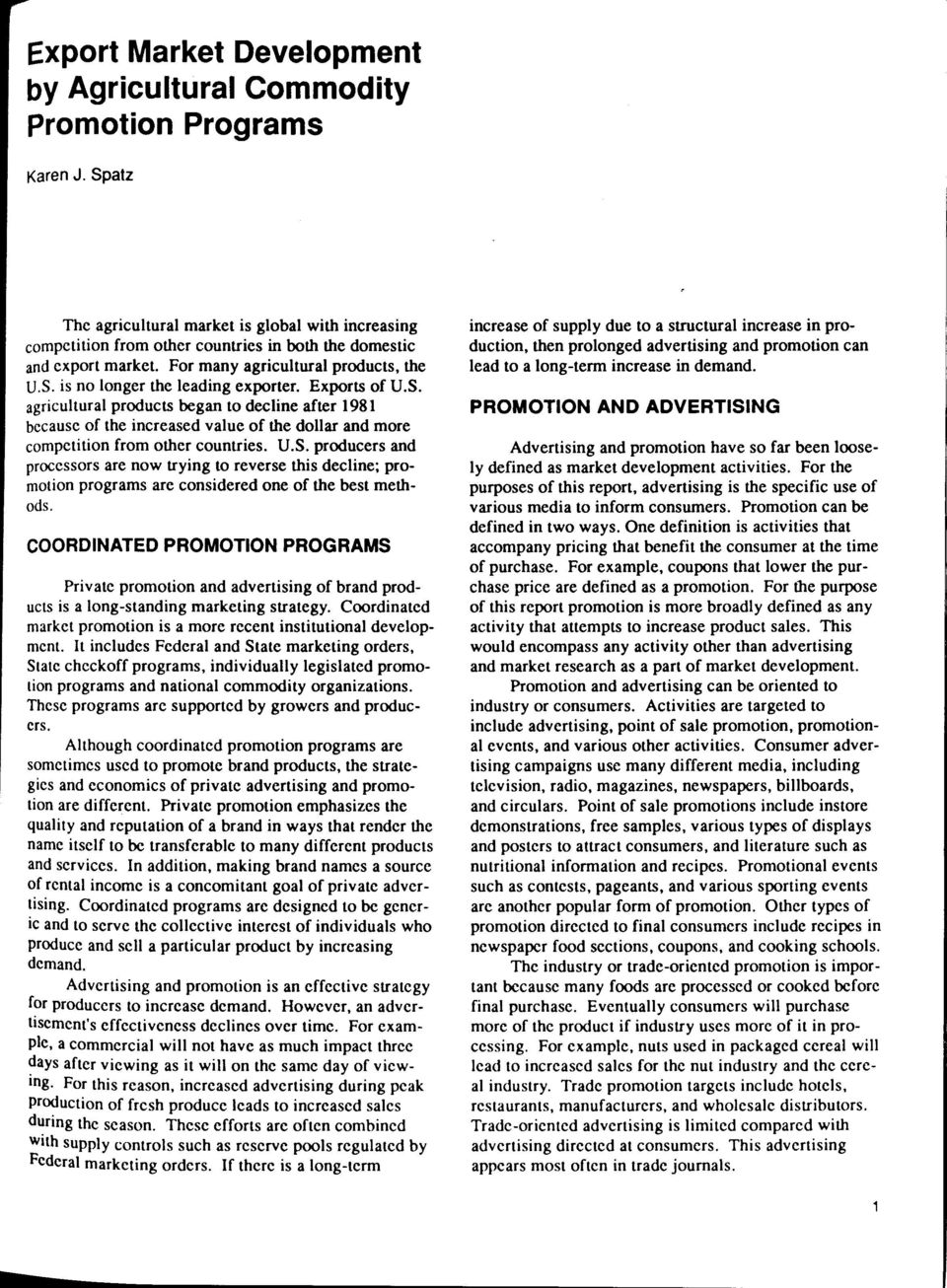
6 Export Market Development by Agricultural Commodity Promotion Programs Karen J. Spatz The agricultural market is global with increasing competition from other countries in both the domestic and export market. For many agricultural products, the U.S. is no longer the leading exporter. Exports of U.S. agricultural products began to decline after 1981 because of the increased value of the dollar and more competition from other countries. U.S. producers and processors are now trying to reverse this decline; promotion programs are considered one of the best methods. COORDINATED PROMOTION PROGRAMS Private promotion and advertising of brand products is a long-standing marketing strategy. Coordinated market promotion is a more recent institutional development. It includes Federal and State marketing orders, State checkoff programs, individually legislated promotion programs and national commodity organizations. These programs are supported by growers and producers. Although coordinated promotion programs are sometimes used to promote brand products, the strategies and economics of private advertising and promotion are different. Private promotion emphasizes the quality and reputation of a brand in ways that render the name itself to be transferable to many different products and services. In addition, making brand names a source of rental income is a concomitant goal of private advertising. Coordinated programs are designed to be generic and to serve the collective interest of individuals who produce and sell a particular product by increasing demand. Advertising and promotion is an effective strategy for producers to increase demand. However, an advertisement's effectiveness declines over time. For example, a commercial will not have as much impact three days after viewing as it will on the same day of viewing. For this reason, increased advertising during peak production of frcsh produce leads to increased sales during the season. These efforts are often combined with supply controls such as reserve pools regulated by Federal marketing orders. If there is a long-term increase of supply due to a structural increase in production, then prolonged advertising and promotion can lead to a long-term increase in demand. PROMOTION AND ADVERTISING Advertising and promotion have so far been loosely defined as market development activities. For the purposes of this report, advertising is the specific use of various media to inform consumers. Promotion can be defined in two ways. One definition is activities that accompany pricing that benefit the consumer at the time of purchase. For example, coupons that lower the purchase price are defined as a promotion. For the purpose of this report promotion is more broadly defined as any activity that attempts to increase product sales. This would encompass any activity other than advertising and market research as a part of market development. Promotion and advertising can be oriented to industry or consumers. Activities are targeted to include advertising, point of sale promotion, promotional events, and various other activities. Consumer advertising campaigns use many different media, including television, radio, magazines, newspapers, billboards, and circulars. Point of sale promotions include instore demonstrations, free samples, various types of displays and posters to attract consumers, and literature such as nutritional information and recipes. Promotional events such as contests, pageants, and various sporting events are another popular form of promotion. Other types of promotion directed to final consumers include recipes in newspaper food sections, coupons, and cooking schools. The industry or trade-oriented promotion is important because many foods are processed or cooked before final purchase. Eventually consumers will purchase more of the product if industry uses more of it in processing. For example, nuts used in packaged cereal will lead to increased sales for the nut industry and the cereal industry. Trade promotion targets include hotels, restaurants, manufacturers, and wholesale distributors. Trade-oriented advertising is limited compared with advertising directed at consumers. This advertising appears most often in trade journals.
7 Public relations activities such as receptions are useful as part of trade promotions. Trade shows and food fairs are also effective. Field representatives are helpful as contacts with retail buyers and food editors and for monitoring retail activities. Often retailers are offered incentives for ins tore promotion. Contests with prizes such as vacation packages for the best display of a product are all part of trade promotion. Cooking schools and technical assistance further exemplify trade promotion. Technical assistance involves distribution of information to aid processors' developing the best product. A team of engineers can provide the technical assistance in setting up and ing the correct processing equipment. Sponsoring of farms, packing houses, storage, and other facilities is another method. Depending on the commodity and purchasers, market promotion activities will differ, but the goal of increasing long-term sales will remain the same. Table 1-Federal fruit and vegetable marketing orders authorized for research and development, 1986 Order Production Market Market Paid number Area and commodity research research development advertising 906 Texas oranges and grapefruit x x x 907 California-Arizona navel oranges x x 908 California Arizona valencia oranges x x 910 California-Arizona lemons x x 911 Florida limes x x x x 915 Florida avocados x x x x 916 California nectarines x x x x 917 California pears, plums, and peaches x x x x 919 Colorado peaches x x 921 Washington peaches x x 922 Washington apricots x x 923 Washington cherries (sweet) x x 924 Washington-Oregon fresh prunes x x x 925 California desert grapes x x x 926 California tokay grapes x x x 927 Oregon-Washington-Calif. winter pears x x x 928 Hawaii papayas x x x x 929 Cranberries (10 states) x x 931 Oregon-Washington bartlett pears x x 932 California olives x x x x 947 Oregon-California potatoes x x 948 Colorado potatoes x x 958 Idaho-Oregon onions x x x x 959 Texas onions x x x 965 Texas tomatoes x x x x 966 Florida tomatoes x x x 967 Florida celery x x x x 971 Texas lettuce x x x 979 Texas melons x x x 981 California almonds x x x x 982 Oregon-Washington filberts x x x x 984 California walnuts x x x 985 Far West spearmint oil x x x 987 California dates x x x 989 California raisins x x x 993 California dried prunes x x Source: Title 7. Code of Federal Regulations, Parts 900 to 999, Revised as of January

8 PROMOTION PROGRAMS Coordinated export promotion is supported by private or public funds. Individual firms or cooperatives can be involved in this type of promotion. Private efforts include voluntary commodity or producer marketing organizations. For example, the California Granny Smith Association asks producers to voluntarily contribute funds to promote their commodity. This type of arrangement works best if all who benefit contribute. Economies of size and the long-term return on export market development often prevents growers and processors from having adequate resources to support a program. Funds are needed for trained and experienced personnel, overseas offices, travel, and other activities. Economies of size is one reason various Government programs support export promotion. The Foreign Agricultural Service (FAS) of USDA administers the cooperator foreign market development program. This program is financed by three sources: (1) FAS. (2) private, nonprofit trade associations representing farmer. producer, and other farm related interests. and (3) "third party cooperators" who are governments or private firms in foreign countries. In 1984, this program involved 60 cooperators working in more than 130 countries with a budget of $95 million. The passage of the Food Security Act of 1985 established the Targeted Export Assistance Program (TEA). This program is administered by FAS and is partially funded by surplus stocks of the Commodity Credit Corporation (CCC). The goal of the program is to aid U.S. producers disadvantaged by foreign trade policies. TEA participants include nonprofit agricultural associations and State organizations which develop generic promotional programs. Private companies also receive Government funds to promote products under their brand names. USDA spent at least $110 million each year from 1986 through 1988 on this program. Some States are involved in promoting their agri Cultural products. The State of California has a ship. the Golden Bear. which promotes California products overseas. Some States also have trade offices overseas. Commodity research and promotion programs are authorized by Federal and State statutes. These Federal and State commodity programs require handlers and/or producers to pay an assessment to support the program. Federal programs include marketing orders and individually legislated programs. Federal marketing orders are p~imarily for supply regulation, but some have provi ~lons for research and promotion. State programs Include marketing orders, commissions. and councils. These State programs. often referred to as checkoff programs. are authorized primarily for research and promotion. Many of these groups work together. National commodity agencies (not legislated) are funded by State checkoff programs and other industry groups. Some of these national agencies are for export promotion only. So a checkoff program might administer its own domestic promotion activities and send funds to support export promotion by a national group. An example of such an agency is the U.S. Meat Export Federation whose export promotional programs are funded by members including checkoff programs. private organizations, and TEA funding. Brand advertising is usually funded by the individual firm or cooperative. But there are exceptions. For example. brand advertising is used for certain TEA programs administered by State checkoff programs. Most voluntary and legislated programs support generic promotion. Table 2-Expendltures for promotion under Federal marketing orders Order number Area and commodity ' dollars 906 Texas oranges and grapefruit Florida limes Florida avocados California nectarines 1,461 1, California pears, plums, and peaches 2,294 3, Washington cherries (sweet) 4 na 926 California tokay grapes Oregon-Washington-California winter pears 1,612 na 928 Hawaii papayas California olives 2 1,415 na 958 Idaho-Oregon onions 404 na 959 Texas onions Florida tomatoes Florida celery Texas melons 97 na 981 California almonds 2 5,692 14, California walnuts California dried prunes na = Data not available. 'Estimated budget for Creditable brand advertising 3TEA funds not included for Source: Agricultural Marketing Service. USDA. i ; 3

9 Federal Marketing Orders Federal marketing orders are authorized under the Agricultural Marketing Agreement Act (AMAA) of The goal of this act is to establish and maintain orderly marketing conditions for fresh or dried fruit, fresh vegetables, and various specialty crops such as nuts. The legislation limits the area of production to the smallest area that is practical, as decided by the Secretary of Agriculture. Orders are designed and carried out by the growers and handlers of the regulated commodity. Activities are funded by assessments paid by first handlers The rate of assessment is a fixed amount per unit of product shipped. Therefore, the revenues collected will depend on the size and saleability of the crop. Quantity and quality controls are the primary areas of the orders. The role of Federal marketing orders is still primarily supply control, but over the years the demand side activities have increased in importance. In the 1950's, the AMAA was amended to include provisions for research and promotion. It was not until the midsixties that paid advertising was autho-. Table 3-Commodlty research and promotion programs authorized by Federal statute, most recent 12-month period, March 1987 Authorized by individual legislation; administered by Industry boards Current Total collections Total funds Expenditures for- Net Collec- available, tions after including interest Other refunds and other income Promotion Research programs Thousand dol/ars National Wool Act of American Sheep Producers Council 4,120 -Mohair Council of America 614 Refunds not 7,800 3,838 authorized 1, Refunds not 6666 authorized Cotton Research & Promotion Act of 1966 Cotton Board 33,902 21,794 32,330 13,081 3,771 2,032 Potato Research & Promotion Act of 1971 Potato Board 5,649 4,684 7,213 5,620 Egg Research & Consumer Information Act of 1974-American Egg Board 7, , , Dairy & Tobacco Adjustment Act of 1983 National Dairy Promotion & Research Board 83,651 Refunds not authorized 84,942 61,167 3,855 64,017 Honey Research, Promotion, and Consumer 1,600 Information Act of 1984-Honey Board (projected) Beef Promotion and Research Act of 1985 Cattlemen's Beef Promotion & Research Board '70,000 63,000 63, , ,000 Pork Promotion, Research, and Consumer Information Act of 1985 National Pork Board 220,000 18, , ~ 'Estimated annual collections; collections began October Estimated annual collections: collections began November Budgeted Board promotion (States control 50 percent of domestic assessments which are not shown) 'Estimated Board promotion (States and the National Pork Producers CounCil expend over 60 percent of funds. listed as "other" but Includes promotion '$78,000 designated for grants: $ to fund a nutrition center. cholesterol action program. and product development prolects "Industry services and market inf'jrmatlon. 'Consumer education, cooperative funding with States. foodservlce. and producer relations 8$2,339 for nutrition education and $1.678 for program evaluation. Source: Agricutural Marketing Service. USDA. 4
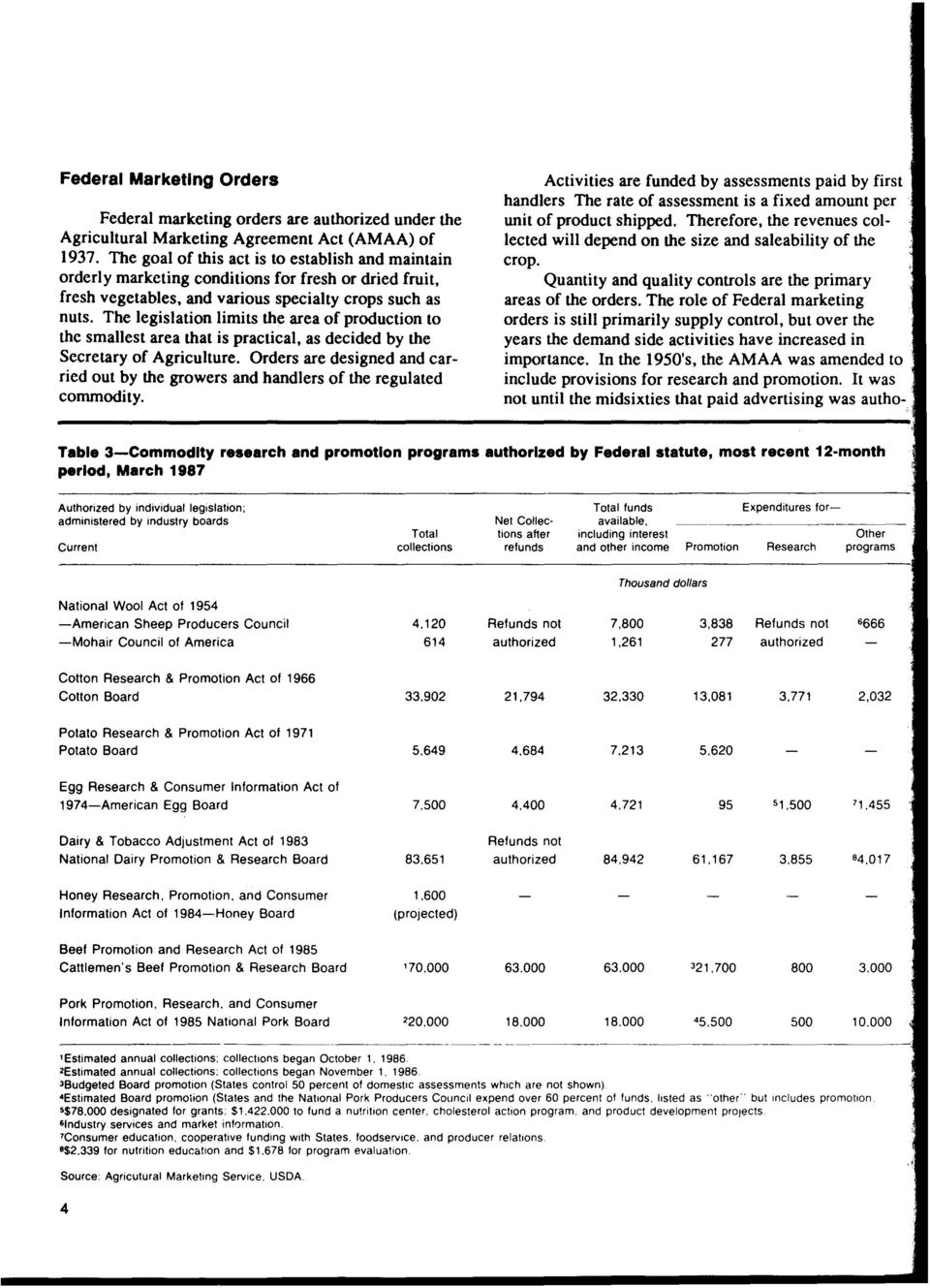
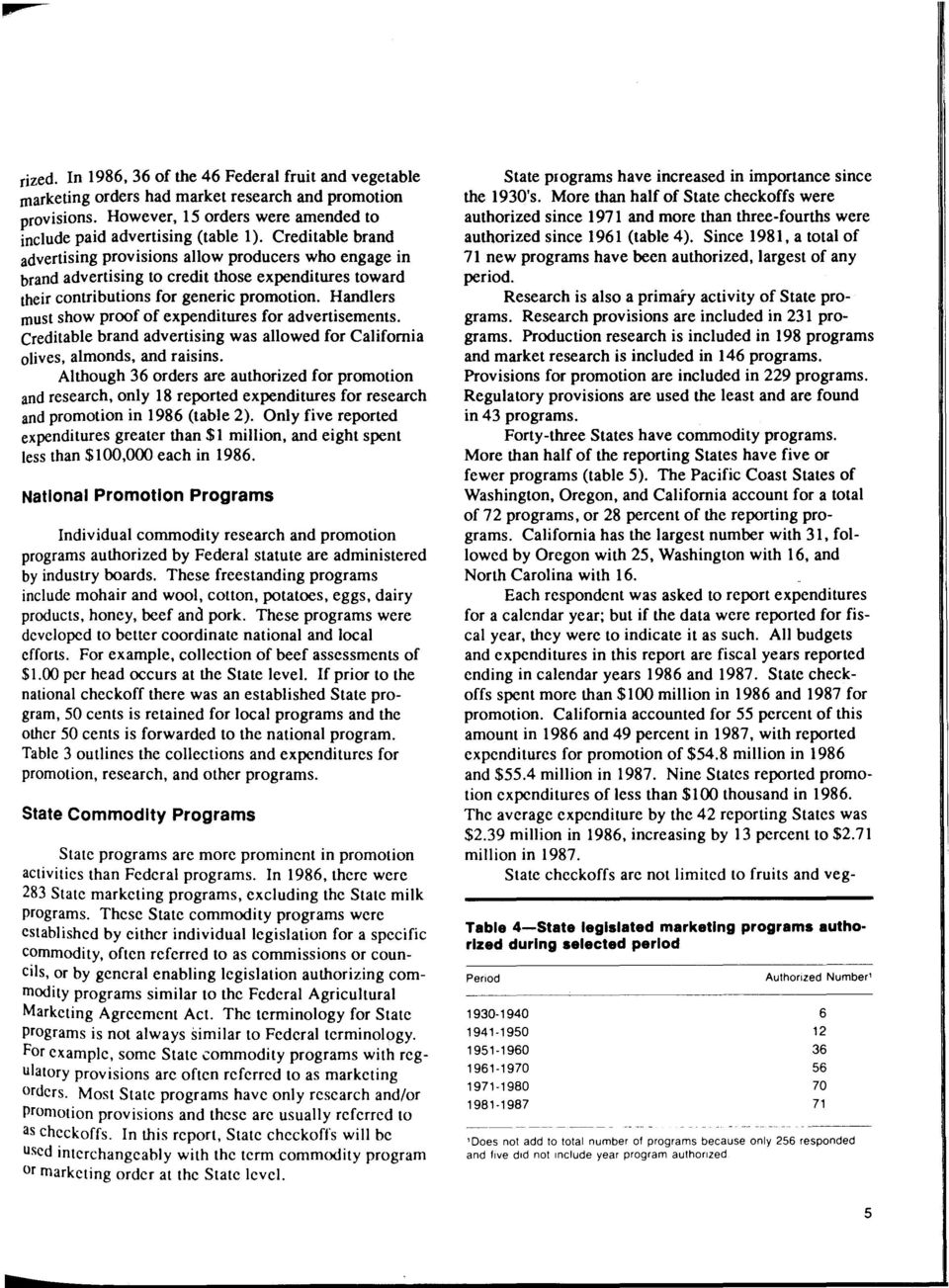
10 rized. In 1986, 36 of the 46 Federal fruit and vegetable marketing orders had market research and promotion provisions. However, 15 orders were amended to include paid advertising (table 1). Creditable brand advertising provisions allow producers who engage in brand advertising to credit those expenditures toward their contributions for generic promotion. Handlers must show proof of expenditures for advertisements. Creditable brand advertising was allowed for California olives, almonds, and raisins. Although 36 orders are authorized for promotion and research, only 18 reported expenditures for research and promotion in 1986 (table 2). Only five reported expenditures greater than $1 million, and eight spent less than $100,000 each in National Promotion Programs Individual commodity research and promotion programs authorized by Federal statute are administered by industry boards. These freestanding programs include mohair and wool, cotton, potatoes, eggs, dairy products, honey, beef ana pork. These programs were developed to better coordinate national and local efforts. For example, collection of beef assessments of $1.00 per head occurs at the State level. If prior to the national checkoff there was an established State program, 50 cents is retained for local programs and the other 50 cents is forwarded to the national program. Table 3 outlines the collections and expenditures for promotion, research, and other programs. State Commodity Programs State programs are more prominent in promotion activities than Federal programs. In 1986, there were 283 State marketing programs, excluding the State milk programs. These State commodity programs were established by either individual legislation for a specific commodity, often referred to as commissions or councils, or by general enabling legislation authorizing commodity programs similar to the Federal Agricultural Marketing Agreement Act. The terminology for State programs is not always similar to Federal terminology. For example, some State commodity programs with regulatory provisions are often referred to as marketing orders. Most State programs have only research and/or promotion provisions and these are usually referred to as checkoffs. In this report, State checkoffs will be Used interchangeably with the term commodity program Or marketing order at the State level. State programs have increased in importance since the 1930's. More than half of State checkoffs were authorized since 1971 and more than three-fourths were authorized since 1961 (table 4). Since 1981, a total of 71 new programs have been authorized, largest of any period. Research is also a primary activity of State programs. Research provisions are included in 231 programs. Production research is included in 198 programs and market research is included in 146 programs. Provisions for promotion are included in 229 programs. Regulatory provisions are used the least and are found in 43 programs. Forty-three States have commodity programs. More than half of the reporting States have five or fewer programs (table 5). The Pacific Coast States of Washington, Oregon, and California account for a total of 72 programs, or 28 percent of the reporting programs. California has the largest number with 31, followed by Oregon with 25, Washington with 16, and North Carolina with 16. Each respondent was asked to report expenditures for a calendar year; but if the data were reported for fiscal year, they were to indicate it as such. All budgets and expenditures in this report are fiscal years reported ending in calendar years 1986 and State checkoffs spent more than $100 million in 1986 and 1987 for promotion. California accounted for 55 percent of this amount in 1986 and 49 percent in 1987, with reported expenditures for promotion of $54.8 million in 1986 and $55.4 million in Nine States reported promotion expenditures of less than $100 thousand in The average expenditure by the 42 reporting States was $2.39 million in 1986, increasing by 13 percent to $2.71 million in State checkoffs arc not limited to fruits and veg- Table 4-State legislated marketing programs authorized during selected period Period AuthOrized Number' , Does not add to total number of programs because only 256 responded and five did not Include year program authorized 5
11 Table 5-5tate checkoff budget. and expenditure. for promotion, by State Budget Promotion expenditures Number of State programs ' ' Thousand dollars Alabama 4 1,485 1, ,066 Arizona Arkansas 4 1,605 3, ,066 California 31 74,758 72,532 54,806 55,422 Colorado 5 1, Connecticut Florida 4 6,035 6,036 5,273 5,269 Georgia 8 3,658 3, ,006 Idaho 8 5,516 5,653 3,564 3,967 Illinois 6 4,597 6,111 3,066 3,355 Indiana Iowa 6 11,015 6,635 4,251 5,094 Kansas 6 3,993 10,267 1,259 1,165 Kentucky , ,442 LOUisiana 3 1,116 1, Maine Maryland Michigan 10 2,206 2, ,231 Minnesota 7 4,582 4,777 1,292 1,270 Mississippi Missouri 5 1,179 2, ,397 Montana 4 2,546 2, Nebraska 6 2,904 3,191 1,125 1,112 Nevada New Jersey New York 3 1,298 1,454 1,048 1,175 North Carolina 11 2,155 2,438 1,134 1,180 North Dakota 8 3,169 4,213 1,126 1,623 Ohio 5 1,065 1, Oklahoma 5 4,221 4,823 1,630 1,923 Oregon 25 5,592 6,341 2,418 2,739 Pennsylvania South Carolina South Dakota Tennessee Texas 8 1,793 1, Utah Vermont Virginia 10 1,321 1, ,100 Washington 16 11,501 16,690 7,860 13,435 Wisconsin Wyoming TOTAL , , , ,908 'Estimate 6

12 etables as in Federal nondairy marketing orders. A wide variety of products are regulated. including animals and animal products. grains. seeds. oilseeds. and natural fibers (table 6). There are 70 checkoff programs for grains and oilseeds. Some programs assess more than one commodity. such as in Louisiana where one program covers soybeans. wheat. corn. and milo and a program in North Carolina that includes wheat. oats. barley. and rye. Grains and oilseeds have been combined into one category because of these multicommodity programs. Grains include wheat. com. oats. milo. hops. barley. rice. rye. and wild rice. Oilseeds include soybeans. peanuts. and sunflowers. Even though there are 70 grain and oilseed checkoff programs. this category does not account for the largest percentage of expenditures for promotion. Programs for fruit accounted for the largest. with expenditures of $57.22 million in 1986 and $64.05 million in The second and third largest expenditures were for grains and oil seeds combined and beef. with $17.45 million and $8.32 million of expenditures. respectively. in EXPORT PROMOTION Federal Marketing Orders Federal marketing orders are minimally involved in export promotion programs. The Almond Board of California does not directly advertise or promote exports. Instead. it has creditable brand advertising. Handlers often spend more on advertising under their brand names than is required by the board. A separate assessment rate is levied for generic public relations. production research. and administrative costs. This program appears to be successful in that the second highest agricultural export from California is almonds. The Walnut Marketing Board is active in domestic promotion. In TEA funds were available for walnut promotion overseas and were first handled by The California Raisin Advisory Board. In the California Walnut Commission was formed to promote exports. TEA funds for 1986 and 1987 were $2 million and $7 million. respectively. The California Tree Fruit- Agreement contains Table 8-State checkoff budgets and total promotion expenditures, by commodity Budget Promotion expenditures Number of State programs ' ' Thousand dollars Seeds , Fruit 53 77,238 79,026 57,220 64,050 Vegetables 32 11,723 11,930 6,734 7,311 Pulses 3 7 1,528 1, Wool/Iamb Cotton Beef 25 16,806 30,703 8,319 11,451 Pork 8 6, Poultry and eggs 23 8,404 7,735 6,381 6,025 Marine products Grains and oilseedss 70 40,902 43,927 17,445 19,749 Other6 11 2,075 4,465 2,663 2,840 Total , , , ,908 Note: For 1986, 249 programs reported annual budgets and in 1987,243 reported annual budgets. There were 215 reporting promotion expenses in 1986 and 'Estimate for ncludes seeds, nursery stock and bulbs. 31ncludes dry beans, dry peas, and lentils. 'Includes crawfish, dungeness crab, salmon, marine products, and trawl caught seafood.!grains include wheat, corn, milo, hops, barley, oats, rice, wild rice, and rye. Oilseeds include soybeans, peanuts, and sunflowers. "Other includes tobacco, honey, nuts, and ginseng root. 7

13 assessments for nectarines. pears. plums. and peaches in California. In expenditures for export promotion of these products were $ for nectarines. and $ for pears. plums. and peaches. The Federal marketing order for Hawaii papayas has been active in export promotion since Table 7-Number of State checkoff export promotion program. Initiated during.elected period. Period 'Does not add to 126 because 17 did not respond. Number of programs' Table 8-State checkoff expenditure. for export promotion, by commodity Export promotion expenditures Number of Commodity programs' Thousand dollars Seeds FruiP 18 12, , Vegetables Pulses Beef Pork Poultry and eggs Grain and oilseeds s 60 13, , Otherii Total , , 'Includes only State promotion programs that reported expenditures for export promotion in 1986 and/or A total of 126 programs reported export promotion. 2Estimate for 'Does not include TEA funds for California table grapes, cling peaches. raisins, avocados, kiwifruit. prunes. Washington apples. and Florida citrus. "Includes dry beans. dry peas. and lentils. 5(3rains include wheat. corn. milo. barley. oats. rice. and wild rice. Ollseeds include soybeans. peanuts. and sunflowers. 8()ther includes tobacco and nuts. Does not Include TEA funds for California pistachios. Table 9-State checkoff expenditure. for export pro-. motion, by State. State Export promotion expenditures Number of programs' Thousand dollars Alabama Arizona Arkansas , California , , Colorado Florida , Georgia Idaho Illinois 3 1, , Indiana Iowa 4 2, , Kansas 5 1, , Kentucky Louisiana Maine Maryland Michigan Minnesota 5 1, , Missouri Montana Nebraska 4 1, , North Carolina North Dakota Ohio Oklahoma Oregon South Carolina South Dakota Tennessee Texas Utah Vermont Virginia B.30 Washington S Wisconsin Wyoming Total 'Includes only State promotion programs that reported expenditures for export promotion In 1986 and Estimate for 'Does not Include TEA funds for table grapes. cling peaches. pistachios. avocados. kiwifruit. and prunes. 'Does not Include TEA funds for citrus. sdoes not include TEA funds for apples 8

14 State Commodity Programs In contrast to Federal marketing orders. State checkoff programs are very active in export promotion. Out of the 256 State checkoffs that responded to the survey. 126 reported involvement in export promotion activities. State checkoff programs began export promotion in the 1940's. but the majority of the programs began after Forty export programs began between 1971 and 1980 and 41 programs were initiated after 1980 (table 7). Furthermore. 10 new export promotion programs began in and 8 new export programs were reported in Out of the 126 State programs reporting export promotion. only 120 reported expenditures in 1986 and/or Outlays for export promotion were $27 million in 1986 and $24.9 million in 1987 (table 8 and table 9). The reported expenditures do not include TEA funds. so the amount spent by State programs for export promotion is actually larger. Table 10 indicates the TEA allocations to State checkoff programs for fiscal years 1986 and Because the funds reported are not comparable to the ones reported for the Federal fiscal year. these expenditures are not included in tables 8 and 9. The funds are primarily for California products. Also. the funds are for fruits except for pistachios. The TEA allocations totaled $i9 million and $29.5 million. respectively. for fiscal year 1986 and The largest allocation was to the California Raisin Advisory Board. Their total export expenditures combined with their own funds<was $12.5 million in both years. As in the promotion outlays. the largest category is grains and oilseeds. with expenditures of $13.62 million and $15.03 million. respectively. in 1986 and Sixty programs reported. so the average is lower than the fruit category. with 18 programs reporting expenditures of $12.87 million and $9.06 million. respectively. in 1986 and The average program expenditure for grains and oil seeds was $ in 1986 and $250,000 in compared to fruit with more than twice the average expenditure of $714,000 in 1986 and $ in Table 10-Targeted Export Assistance program grants to State checkoff programs Participant Commodities Thousand dol/ars California Avocado Commission Avocados California Cling Peach Advisory Board Processed cling peaches and fruit cocktail 2,500 5,100 California Kiwifruit Commission Kiwifruit California Pistachio Commission Pistachios, shelled and inshell California Prune Board Prunes 4,000 4,500 California Raisin Advisory Board Raisins 6,300 9,800 California Table Grape Commission Table grapes Florida Department of Citrus Florida fresh and processed citrus (primarily fresh grapefruit) 4,600 7,000 Northwest Horticultural Council' Fresh apples 1,400 1,500 Total 19,350 29,500 'Northwest Hort,cultural Council IS participant. but the Washington Apple Commission receives the mo~ey for spending Note: Does not Include walnuts. Received $2 million In TEA funds In 1986 and California Walnut CommiSSion received $7 million In

15 Table 11-Number of State checkoff programs using commodity associations for export promotion Commodity Number of programs' Oilseeds 2 26 Grain and Feed 3 30 Fruit4 7 Livestock and Products 5 17 Other; 5 'The number of programs total to more than the actual number using commodity agencies, since some programs regulate more than one commodity. 21ncludes sunflowers, soybeans, and peanuts. 31ncludes wheat. corn, milo, barley, and rice. 'Includes apples, blueberries, cherries, red raspberries, wine grapes and wine. 51ncludes beef, pork and mohair. "Includes dry peas, lentils, chickpeas, hazelnuts, and tobacco. The other categories, with 10 or more reportin outlays for export promotion, include vegetables an~ beef. Seeds and poultry each have one program repl ing expenditures for export promotion, Furthermore all the categories, except for fruit and grains and oilseeds, report expenditures of less than $1 million, Fewer States reported export promotion than domestic promotion; 42 States reported domestic pr< motion, but only 36 reported export promotion. Connecticut, Mississippi, Nevada, New Jersey, New York, and Pennsylvania promote in the domestic mal but not in the overseas market. Disbursement by Sta for export promotion is shown in table 9. The table shows California accounting for more than 44 percer of the expenditures in 1986, but accounting for only percent of the number of programs. The expenditure for California declined dramatically due to the numb of TEA allocations to California programs replacing their own funds. Florida increased expenditures 574 percent from 1986 to This is due in part to the contributions required to receive TEA funds. In 198/ six States spent more than $1 million each for export Table 12-Commodlty associations that promote overseas and receive funds from State checkoffs Dairy, Livestock, and Poultry International Mohair Assoc. 'U.S. Meat Export Federation National Pork Producers Council Horticultural and Tropical Products Cherry Exporter Assoc. National Red Cherry Institute International Apple Institute Northwest Cherry Growers Wild Blueberry Assoc. of North America North American Blueberry Coun'cil 'Wine Institute Grain and Feed Corn Growers Assoc. International Grains Program National Grain Sorghum Producers Assoc. 'Rice Council for Market Development 'U.S. Feed Grains Council 'USA Dry Pea and Lentil Council 'U.S. Wheat Associates Tobacco 'Tobacco Associates Oilseeds And Products 'American Soybean Assoc. 'American Sunflower Assoc. KenTen Soybean Promotion Council 'National Peanut Council State Organizations 'Western U.S. Agricultural Trade Assoc.s California Agricultural Export Program Oregon State Department of Agriculture Texas Department of Agriculture Other Agricultural Council of America 'National Potato Promotion Board' = Received TEA funds in 1986 or 'A national legislated commodity program. See table 3. 10
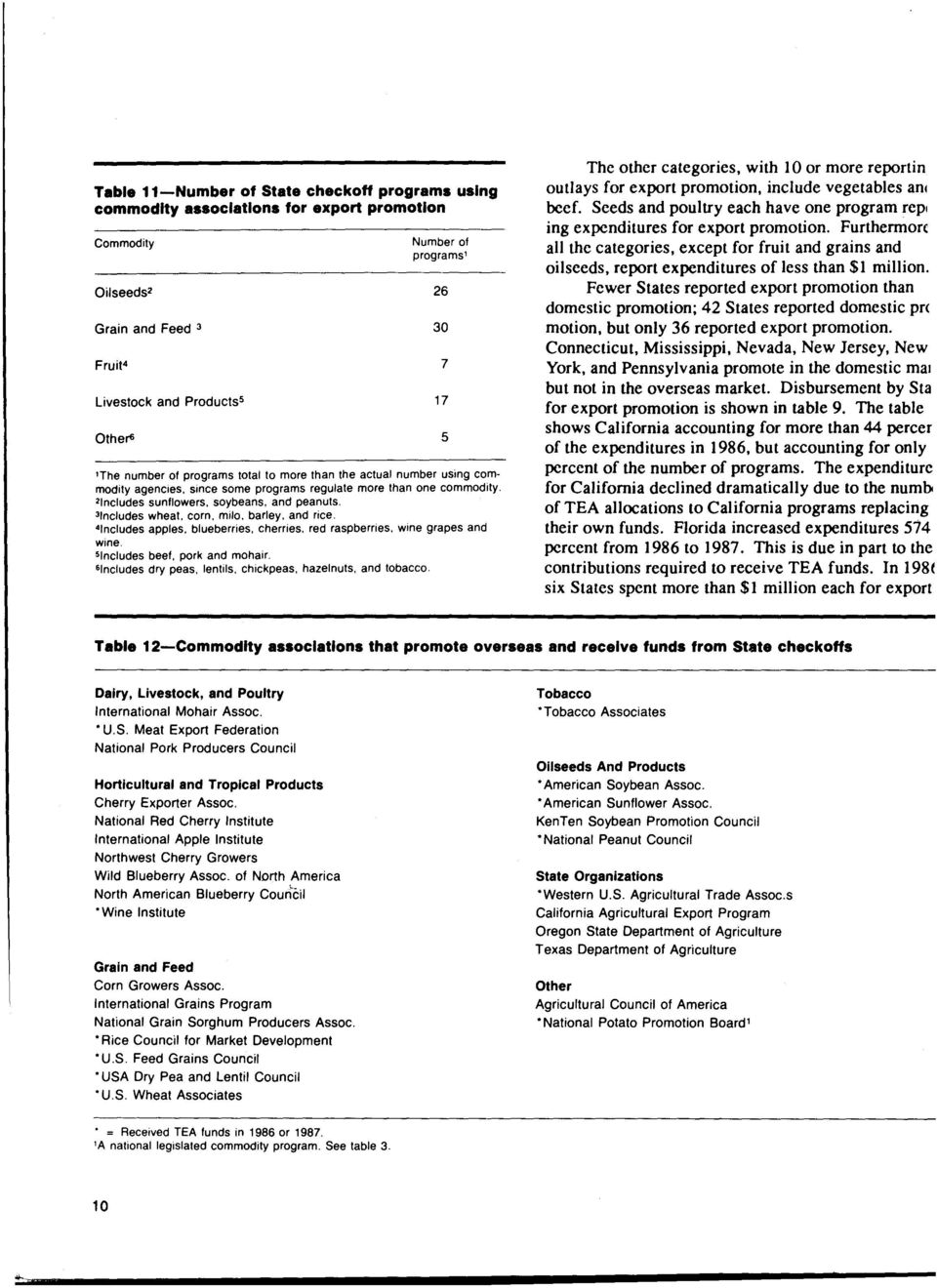
16 promotion. The number increased to eight States in California is the only State with more than 10 programs; all other reporting States have fewer. Commodity Organizations Many State commodity promotion programs do not promote overseas themselves; instead, funds for export promotion are used by one or more national or regional commodity associations that promote for their members in the domestic and/or export market. Some commodity associations are funded only by State checkoff programs, such as U.S. Wheat Associates. Other groups are funded by members that include other commodity associations, producers, processors, and other representatives of the industry. For example, members of the U.S. Meat Export Federation include packers, processors, and exporters of lamb, beef and pork, grain promotion groups, farm organizations, and producer checkoff programs. Furthermore many of these groups are recipients of TEA funds, such as U.S. Meat Export Federation. Table 11 shows the Humber of checkoff programs that are members of commodity associations. This list docs not include the contributions of the potato checkoffs to the National Potato Promotion Board because this is a national legislated program (table 3). Also, table 11 does not include three programs that contract with foreign agencies for export promotion. This list docs include programs that contribute to their State Department of Agriculture's export enhancement programs. Grain and feed have the largest number of checkoff programs supporting commodity organizations. If these programs were combined with oilseeds, then the total number of checkoffs contributing to the programs of commodity organizations (with no double counts) would be 84 programs. The category, including grains and oilseeds, wou.id consist of 55 programs or 65 percent of those programs using commodity organizations for export enhancement. Only five of the checkoff programs that reported export promotion expenditures in this category do not use commodity organizations to undertake all or part of their export promotion efforts. Livestock (primarily beed accounts for 17 programs or 20 percent, and fruit and other categories each account for less than 10 percent of the checkoff programs using Commodity organizations. As previously reported, the category of grain, feed, and oil seeds comprises half the programs with export promotion expenditures; but average expenditures of each group is small in comparison with fruit checkoff programs. In addition, more States have checkoff programs for grain, feed, and oil seeds than for fruits. Commodity organizations can create an effective export promotion program targeting many countries because of their large budget funded by State checkoffs. Rather than States competing for larger shares of the export market, it has been effective for the State checkoff programs of homogeneous commodities (such as soybeans) to work together to improve the U.S. share of world imports. Many commodity organizations are recipients of TEA funding, as noted in table 12. TEA fund recipients are generally distributed to individual State checkoff programs for fruit and to a national commodity organization for grains, feed, and oilseeds. The Role of Cooperatives In Export Promotion Advertising and promotion by a cooperative is designed to benefit members rather than all producers in a State or region, as opposed to State or Federal promotion programs. The budget process for advertising and promotion expenditures are similar to a noncooperative business', there is no tax on members for promotion by the cooperative. Increased profits from advertising are passed along to grower-members of a cooperative, whereas a private processor or packer will not necessarily share the benefits with producers. Furthermore, members have some degree of control over promotion expenditures, unlike growers who sell to a private company. Growers voluntarily support the promotion efforts of their cooperatives by their membership, unlike State or Federal marketing orders where they are required by law to participate. Cooperatives and legislated promotion programs interact in many ways. If there is a legislated checkoff and handlers are assessed, the cooperative will be assessed as a handler. When referendums are held, cooperatives often vote for their members as a bloc, rather than growers voting separately. If a majority of growers are members, the role of a cooperative in a legislated program is large. Cooperatives playa major role in the marketing of agricultural products domestically and abroad. In many overseas markets, cooperatives have been successful promoting their brand without a generic promotion program to accompany it. Successful export programs of cooperative brands include Sunkist, Welch Foods, and Ocean Spray. Overseas consumers have learned to equate these brands with quality products from the 11
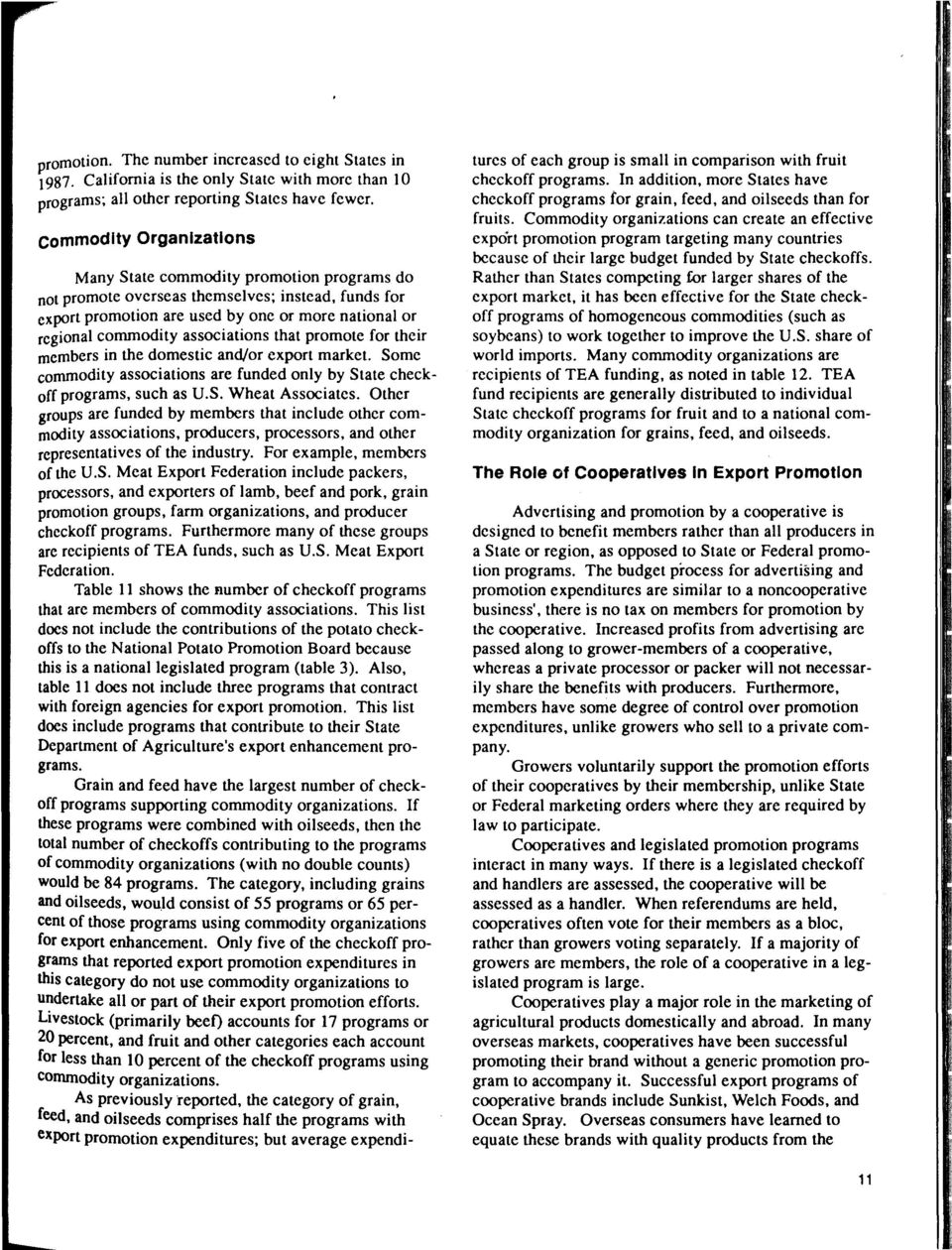
17 Figure 1 - Number of Export Promotion Programs, % 22.03% 5.08% 35.59% o Fruit Vegetables and Pulses II Grain f?:l Oilseeds ~ Other Figure 2 - Export Promotion Expenditures by Programs, % o Fruit Vegetables and Pulses II Grain ~ Oilseeds I Other 0.41% 12

18 - bl. 13-5tat. ch.ckoff.xp.ndltur for.xport T:omotlon, by commodity, for program. a lng :xportlng coop.ratlv Export promotion expenditures Number of Commodity programs' '. Thousand dollars Fruit 13 12, , vegetables and Pulses Grain 15 3, , Oilseeds 21 5, , Other Total 59 21, , 'Estimate for 'Includes tobacco. nuts. and pork. United States. However, some cooperatives promote their brand concurrently with a generic export promotion program. For example, export promotion of California raisins include -generic and brand promotion of Sun-Maid raisins. Cooperatives that handle bulk commodities benefit from State or regional generic export promotion programs. Generic advertising can pave the way for an export market to grow and develop. Once a market is established, an individual firm or cooperative can affect its share of the market with brand promotion. If a processor has market power, generic promotion combined with brand advertising can either increase its market share or raise its prices. Since cooperatives must handle all the volume their members deliver, they can be expected to pursue market shares. Generic advertising can diminish the effect of brand promotion when it stresses homogeneity and uniformity of a product. A noncooperative processor might not benefit from a generic program; whereas a cooperative usually benefits when it must handle large receipts for its members while trying to prevent the price level from falling. A 1985 study by ACS determined that 87 cooperatives reported exports of agricultural products. Cooperatives export every major commodity, including grains. feed. oil seeds. horticultural products, livestock products. and natural fibers. These exporting cooperatives often have members or plants in more than one State or process mote than one commodity. Therefore. exporting cooperatives are assessed by commodity export promotion programs. Comparing the results of the 1985 ACS survey of exporting cooperatives and the current ACS survey of State and Federal commodity export promotion program$, it was found that 59 State checkoff programs with export promotion expenditures assess exporting cooperatives and their members. Forty-three programs regulate 1 cooperative each, lzprograms regulate 2 cooperatives each, and 4 programs regulate 3 or more cooperatives. A total of 37 exporting cooperatives payed assessments to State checkoff programs promoting exports. Twenty-three cooperatives were assessed by one program each, seven cooperatives pay two programs each and seven cooperatives were assessed by three or more programs each. These 59 State checkoff programs that assess exporting cooperatives are primarily grain and oilseed programs (table 13 and figure I), accounting for 61 percent of the total number of programs. In 1986, grain and oilseeds accounted for only a small portion of the export expenditures percent (figure 2). Fruit export promotion expenditures assessing exporting cooperatives accounted for 54.9 percent of the expenditures or $12.06 million, but accounted for only 22 percent of the programs. This coincided with the previous discussion of export promotion activities by State checkoffs. The vegetables and other commodities each account for less than 10 percent of the number and expenditures. The percentage of programs assessing cooperatives to total number of programs with export promotion expenditures for fruit is 72 percent of the number, but more than 90 percent of the expenditures. Grain and oilseeds are 60 percent of the number of programs and more than 70 percent of the expenditures. In other words, the majority of programs and their expenditures for export promotion are for programs that regulate at least one cooperative that exports. Almost half of all checkoff programs regulate cooperatives, and 81 percent of the total expenditures for export by checkoffs are for programs assisting exporting cooperatives. CASE STUDIES Details of the export promotion of four commodity programs follow. All four programs. U.S. Wheat Associates. National Peanut Council of America. Washington Apple Commission. and California Raisin Advisory Board promote commodities exported by c(xlpcratives. In the case of the California Raisin Advisory Board. brand advertising for export promotion 13

19 is supported by the board. All other programs support generic promotion. These case studies will help cooperatives in general make better decisions concerning their involvement with export promotion. If a cooperative is new to the export market or only indirectly exports. then the generic export promotion activities by a State checkoff might be beneficial for them; and these case studies highlight the different ways to implement a program. The California Raisin Advisory Board and the Washington Apple Commission are State checkoff programs. U.S. Wheat Associates and the National Peanut Council of America are national commodity agencies supported by State checkoff programs. These programs were chosen because of several factors. including the promotion of commodities exported by cooperatives. Their export programs began prior to and their export promotion expenditures were greater than $ in the reporting years. Other factors included geographic and product variation. Products included nuts. fresh and processed fruit. and grain; geographic locations included the South. Northwest. West. and the Midwest. u.s. Wheat As~oclates U.S. Wheat Associates is the export market development organization supported by State checkoff programs in the major wheat producing States. They are Arizona. Arkansas. California. Colorado. Idaho. Kansas. Minnesota. Montana. Nebraska. North Dakota. Oklahoma. Oregon. South Dakota. Texas. Washington. and Wyoming. U.S. Wheat Associates activities are also funded by FAS and third party cooperators overseas. Their national office is in Washington. DC with a West Coast office in Portland. OR. and 14 overseas offices. Export promotion is the sole activity of U.S. Wheat Associates. It is not a lobbying organization. nor does it support research other than market development for new products. The other distinction to be noted is that wheat is primarily an input for products such as breads or cakes. Therefore. the milling and baking industry is usually the target of promotion. In countries where the wheat industry is not developed and the per capita consumption of wheat products is low. attempts are made to increase consumption through consumer promotion campaigns. U.S. Wheat Associates (USW) was formed in 1980 with the merger of two region~l wheat organizations. Western Wheat Associates and Great Plains Wheat. Each organization was supported by State checkoff programs for the purpose of export promotiol Western Wheat Associates primarily targeted Asia. whereas Great Plains Wheat targeted Europe. Africa. and the Middle East. Discussion of the U.S. Wheat export promotion activities will include the activities c the two regional organizations prior to After the discussion will focus on U.S. Wheat Associates. Western Wheat Associates The first organized effort to promote wheat in the U.S. was the formation of the Oregon Wheat Commission in Activities included trade missions to ascertain the potential market for "western" wheat in Japan. India. and other nations in the Far East and to familiarize these countries with the benefits of "western" wheat.' Washington wheat growers approved a State program in 1955 and Idaho followed in The formation of an independent wheat promotion organization funded by these States soon followed. Western Wheat Associates carried on the work of creating and expanding the Asian markets for western wheat. The central office was in Oregon. and overseas offices were in Tokyo. New Dehli. Singapore. Manila. Taipei. and Seoul. It is important to understand that parts of Asia were nol traditional wheat consumers. Consumer promotion such as cooking schools and distribution of recipes and nutritional information helped develop a preference for wheat and wheat products. This emphasis on consumer promotion essentially developed the final consumer wheat market in Asia. Furthermore. a milling and baking industry had to be developed. Seminars were sponsored for the industry as well as technical assistance. This included cooking schools for bakers and assistance to set up flour mills and bakeries. Technical assistance also helped establish good relationships. In the period from 1960 to Japan increased its per capita flour consumption from 57 pounds per year to more than 70. Likewise. during this same period flour production increased in Japan by 40 percent. 2 I Garry L. Frank. U.S Agricultural Policy and the Federal and State Commodity Check-off Programs. (Unpublished Ph.D. dissertation. Univ. Nebr. Lincoln. 1980). p Harry Fornari. Bread Upon the Waters. (Nashville. TN: Aurora Publishers Incorporated. 1973). p
20 Great Plains Wheat, Inc. Wheat growers in the Great Plains States followed a similar formation as Western Wheat Associates. The first State checkoff in this region was the Nebraska Wheat Board in Other States followed with programs of their own. Kansas Wheat Commission was authorized in 1957 and Colorado passed legislation for a checkoff tax in These programs promoted hard red winter wheat in Europe and Latin America. The formation of Great Plains Wheat. Inc. soon followed. Seven other States followed with wheat checkoff programs of their own: North Dakota. 1959; South Dakota. 1961; Oklahoma. 1965; Montana. 1967; Texas. 1971; Wyoming. 1975; and Minnesota The markets targeted by Great Plains Wheat.Inc. were established wheat markets. Therefore. promotion activities were focused on the milling and baking industry. Because the per capita consumption of these mature markets was already high. the goal of Great Plains Wheat. Inc. was to increa~e market shares. In Southeast Asia. the per capita consumption of wheat is 4-5 kilograms per capita; whereas in Algeria. the per capita consumption is kilograms per capita - the highest in the world. Great Plains Wheat. Inc. worked with mills in Africa and the Middle East to improve processing. Offices were in Central and South America. Europe. Africa. and the Middle East. U.S. Wheat Associates U.S. Wheat Associates (USW) formed in 1980 with the main office located in Washington. DC. and an office in Oregon for west coast trade. It has overseas offices in Panama (Central America/Caribbean). Chile (South America). Rotterdam (Europe). Morocco (North Africa). Ivory Coast (Sub-Saharan Africa). Egypt (Middle East/East Africa). Singapore. India. Philippines. Taiwan. Hong Kong. Peoples Republic of China. Japan. and Korea. Since California. Arkansas. and Arizona have passed State check9ff programs and contribute funds to U.S. Wheat Associates. North Carolina passed a checkoff program in but currently does not engage in export promotion nor contribute funds. The goal of U.S. Wheat is to ~ssure buyers that the United States is a reliable supplier of a wide range of quality wheat. U.S. Wheat defines its export market development as trade services. technical assistance. market analysis. and consumer promotion. Trade services include information services and educational programs for overseas buyers. For example. trade groups visit the United States each year to learn about the production and marketing system of wheat. Tec;hnical assistance programs include educating overseas processors and handlers of wheat. Training courses in the United States include courses in grain grading. storage. flour milling. and baking at the International Grains Program at Kansas State University in Manhattan and the Northern Crops Institute at North Dakota State University in Fargo. Overseas. USW has helped develop a number of baking schools. Technical assistance is given in biscuit. cracker. noodle. and pasta production. Market information and analysis is necessary to plan and conduct market development. Projections of future consumption and production of wheat aid in decisionmaking. Consumer promotion includes distribution of recipes and nutritional information. cooking schools. and demonstrations. By the market in Asia was very different from the market in 1948 when the Oregon Wheat Commission began export promotion. Consumer promotion was no longer as important as it had been in the 1960's and 1970's. In Korea. Taiwan. and Japan. there is an effort to provide assistance to the local industries. thus increasing the quality of wheat products resulting in increased consumer demand. In Korea. the baking industry was the focus of promotion rather than the milling industry. The Taiwan baking industry was well orgallized. In Western Wheat Associates and the Taiwan Hour Millers Association established the Taiwan Baking School; in a new and expanded facility was built. U.S. Wheat is now concerned with increasing competition from other wheat-producing countries. After helping to create an efficient milling and baking industry. the United States must now keep its marketing edge. The major competitors in today's market are Canada. Australia. Argentina. and the EC. China has grown and used wheat for centuries. primarily to make noodles and steamed bread. As part of USW market development a demonstration bakery was built in Beijing to aid in the modernization of the wheat industry in China. Furthermore. technical teams have helped set up a 150-ton-per-day flour mill in Beijing and an instant noodle plant in Shanghai. U.S. wheat was imported to Western Europe in the 1970's to improve quality of wheat protein in bread and pasta color. With improvement in seeds. Europe now produces most of its own high quality wheat. A pasta 15
21 information center was instrumental in developing a new market for pasta in the United Kingdom. It is difficult to develop markets in North Mrica and the Middle East due to the high turnover of people in the wheat industry in these countries. Also, countries with balance of payment problems try to cut back on imports. With TEA funds available to USW, activities expanded. The TEA budget was $3.1 million in For 1986, plans included the Wheat Sampling Program, to get countries to try other classes of wheat. In the first 2 years of this program, more than 21 l00-ton samples have been distributed successfuily in countries all over the world including Korea, Gabon, Taiwan, Malaysia, Philippines, Yemen, Togo, Cameroon, U.A.E., and Colombia. Other TEA activities include consumer promotion in Colombia, a model flour mill and training center in Egypt, and an Algerian bread and pasta training center. U.S. Wheat provides market and technical information to the wheat industry in nearly 100 countries. Success stories, such as the Japanese wheat market, are a clear indication that the money was weil spent. From 1960 to 1985, the U.S. market share increased from 32 percent of a 2.6-million-ton market to 60 percent of a 5.6-million-ton market. The baking school in Taiwan has graduated more than 3,800 students. FAS estimated that the dollar return for USW in the Taiwan Baking School from 1968 to 1982 was $271 per doilar invested. l National Peanut Council of America The National Peanut Council of America was established in Prior to formation of the National Peanut Council of America (NPCA) Export Market Development Program in 1978, exports of U.S. peanuts were limited to marketing residual production. Export promotion was primarily undertaken at the State level by State checkoff programs or by individual processors. Georgia and Virginia were first with export promotion programs, beginning in 1962 and 1965, respectively. Florida and North Carolina foliowed in the 1970's with checkoff programs prior to the founding of the National 'Lee, Jong-Ying, "Research Directed Toward Foreign Market Developmenl.Programs," Proceedings from Research on Effectiveness of Agricultural Commodity Promotion Seminar, (Arlington, Va., 9-10 April 1985).p.63. Peanut Council of America's Export Market Development Program. Alabama and Texas initiated checkoff programs for peanuts in 1957 and 1969, but did not promote exports until after Oklahoma has a checkoff program for domestic promotion and research, but is not involved in export promotion. The seven States of Georgia, Virginia, Florida, North Carolina, Alabama, Texas, and Oklahoma account for 98 percent of U.S. peanut production. South Carolina and New Mexico grow small amounts of peanuts and do not have checkoff programs. The Georgia Peanut Commission was instrumental in establishing the National Peanut Council of America's Export Program. Georgia produces nearly half of U.S. production, so without their support it would be difficult to unify the peanut industry. The NPCA Export Program began the year after passage of the Farm Bill of Expansion of the export marke is linked to the domestic peanut program. Prior to 1978, peanuts were grown on fixed acreage allotments and there was one support price. The 1977 Farm bill set up a two-price system for peanuts, "quota" and "nonquota." The support price was higher for "quota" peanuts, and a lower support price was established for "nonquota" peanuts that were restricted for sale to export or crush markets. The Agriculture and Food Ac of 1981 suspended acreage ailotments, and "nonquota" peanuts were eligible for price supports at rates set to ensure no government expenditures. The 1985 farm bill continued the peanut stabilization program for another 5 years. In 1986, the price support level for domestic or "quota" was $ per ton, and for additional or "nonquota" production it was $ per ton. The impact of the 1978 pricing system was to make the U.S. export price competitive in the world market. The National Peanut Council of America established an export promotion program which is supported by checkoff programs representing growers in six major peanut-producing States of Georgia, Alabama, Florida, North Carolina, Virginia, and Texas, plus three regional sheller associations--southeast, Southwest. and Virginia-Carolina. NPCA is run by an executive committee representing contributing grower and sheller organizations. Offices are in Washington, DC, London. and Rotterdam. Funding is also received from USDA's Foreign Agricultural Service. Peanuts are classified as oilseeds and are crushed for oil and meal in most major producing countries. India is the world's largest producer of peanuts; but nearly all its crop is used for crush, and government policy docs not encourage export. India has an export 16
22 quota limit because domestic peanuts are needed for vegetable oil. In the United States, only poor quality peanuts are sold for crush. Most peanuts are sold to the edible market, shelled or inshell, for manufactured peanut products such as salted peanuts or dry-roasted peanuts, peanut butter, and confectionery products. These higher quality products bring greater returns to growers. The first strategy for export market development by the National Peanut Council of America was to identify the potential markets for edible peanuts and to identify competing exporting countries and competing commodities. Variables for identifying markets included processing capability, populations with disposable incomes, and current importers. Western Europe, Japan, and Canada. were thus chosen for market development activities. The major Western European importing countries in 1978 were France, United Kingdom, Netherlands, Switzerland, and Italy. Table 14 shows calendar year market shares of U.S. green peanuts from 1972 to The value of U.S. green geanut exports increased in the 1970's from $48,918,000 in 1972 to $262,993,000 in 1979 (table 15). China and Argentina are competing exporters of peanuts. China sells large quantities of inshell and shelled peanuts to obtain hard currency rather than focusing on quality. Argentina has been improving the quality of its peanut exports, but is not yet competitive with the U.S. in quality and service. In the United States, 6 out of the top 10 candy bars use peanuts, but in Western Europe confectionery products use higher quality chocolate and tree nuts. The potential market in Western European countries for peanuts was the snack food market where the competition included potato chips, extruded products, and other nuts. The 1970's were a time of prosperity for most agricultural commodity exports. U.S. peanut exports had increased to 387,000 metric tons by the marketing year. In 1980, a drought decreased U.S. peanut production, causing exports to decrease to 172,000 metric tons in the marketing year. Many Europeans buyers found other suppliers and the U.S. peanut industry had a difficult job regaining lost market shares. An added burden was that most of U.S. agricultural exports were decreasing due to the rising value of the dollar. To reestablish the United States as a reliable supplier of raw peanuts, the National Peanut Council of America worked with peanu~ processors in major U.S. export markets. Trade servicing and technical seminars were a means to work closely with processors and provide a service that competing nations do not provide. Trade servicing provides information and offers support designed to increase trade. Media and retail teams from overseas are invited to the United States to observe the peanut production and harvesting. Furthermore, the NPCA staff visits international processors to provide information and support. A Table 14-Market shar.s of U.S. exports of green peanuts by major trade partners, calendar years ' Country Canada France United Kingdom Switzerland Netherlands Japan Italy Spain West Germany Portugal Rest of World ~ ~ _._ 'Peanuts Include green. shelled and Inshell. for ollstock and not for olistock. Not Included are peanuts. prepared or preserved. SOurce Trade and Economic Information D,v,s,on. Foreign Agricultural Service. Derived from United Nations Calendar Year Trade Data. USDA Percent 17
23 Table 15-Value of United States exports of green peanuts by major trade partners, calendar years Country Thousand dollars... Canada ,467 39, France United Kingdom 2, , Switzerland , Netherlands Japan , Italy : Spain 752 1, ,46 West Germany : Portugal Rest of World , , ! Total : 'Peanuts include green. shelled and inshell. for oilstock and not for oilstock. Does not include prepared and preserved peanuts. Source: Trade and Economic Information Division. Foreign Agricultural Service. USDA Derived from United Nations Calendar Year Trade Data European office in London monitors NPCA projects, and acts as intermediary for information between the U.S. office and the international industry. The office in Rotterdam, the previous European headquarters, maintains contact with processors and traders. Seminars are held periodically in Europe and Canada to inform foreign processors of the latest technical developments in the U.S. peanut industry. Beginning in 1986, associate membership wa!! available for processors, traders, brokers, and others involved in international marketing of U.S. peanut products. Today there are 25 associate members. This is another way of providing service to processors, including seminars. forums, and general meetings and information such as newslehers, brochures, and directories. Working cooperatively with processors of peanuts has been the primary means of promoting exports of U.S. peanuts. Cooperative promotion programs with brand leaders of peanut products have been successful. This includes promoting new or established products as U.S. origin peanuts by using the USA quality logo on labels of branded peanut products. Other activities include advertising, instore displays, sampling, and public relations projects. The National Peanut Council of America successfully promoted dry roasted peanuts in Europe. Prior to 1980, this product was almost unknown in Europe, but a promotion campaign has since established dry roasted peanuts as a new product. New product development by processors is supported by NPCA. Processors submit new product development plans, including testing by consumers, advertising, and instore displays; and if these projects are approved in the annual marketing plan submitted t( FAS prior to activity, then the National Peanut Council will reimburse 50 percent of the cost. Western Europe consumes 80 percent of U.S. peanut imports as snacks, 10 percent as peanut butter, and the rest in confectionery products. In an attempt t( upgrade the image of peanuts in France from a snack food to a cooking ingredient, a French cookbook, Les Recelles Aux Peanuts D'Hubert, was developed by Chef Hubert. The book was directed at food editors. the food and restaurant trade, and was written in Frencl and English. Chef Hubert has demonstrated peanut recipes in his Paris restaurant and in London for food editors. The recipe book was also distributed to processing companies, who then offered it to consumers either as a prize or as a special consumer promotion. Japan consumes 95 percent of its peanut imports from the U.S. as snack foods, including peanuts coated with seaweed and shrimp. However, expansion is limited due to an import quota. The U.S. Government is trying to lift these quotas with the expectation that exports to Japan could increase by 50 to 60 percent. The National Peanut Council of America has been successful in increasing exports. Since 1980, exports 18
24 I:, II I -Figure 3 - U.S. Peanut Exports, Crop Years 1978/ /86 1,000 metric tons 400~ ~ 100~~~----~------~------~------~----~------~------~~ 1978/79 "1979/ / / / / / /86 Note: Peanuts include edible, inshell or shelled basis for oilstock, prepared and presened. Source: Foreign Agricultural SeNice, USDA of peanuts have increased to 356,000 metric tons in , 31,000 metric tons short of the previous high level of exports in (figure3). In 1986, the U.S. accounted for 50 percent of world peanut exports, and was the leading exporter of edible peanuts. In 1986 and 1987, the National Peanut Council received TEA funds of $4.5 million. This money enabled the council to continue and expand its promotion activities with brand leaders and processors in Europe for salted peanuts, inshell peanuts, dry roasted peanuts, honey roasted and flavored peanuts, and peanut butter. TEA funded programs were targeted at major European markets, which accounted for 60 percent of total U.S. peanut exports. The United Kingdom, Germany, Netherlands, and France received 85 percent of the targeted funds because these four markets accounted for 85 percent' of the U.S. peanut exports to Europe in An example of programs with leading brand processors for promotion of new and existing products include the introduction of whole nut natural peanut butter in the United Kingdom. This new whole nut peanut butter is a response to nutritional concerns of European consumers. NPCA provides information on quality and nutritive value of peanuts to consumers and nutritionists, such as the information in the brochure "Peanuts--The Inside Story." Two new programs are generic promotion and a processed product program. The processed product program promotes peanut products processed in the United States. The TEA funds will pay for advertising, retail promotional materials, and sampling. The goal is to introduce new products and develop new markets. Generic promotion aims to increase the overall consumption of peanuts, not just selected brands and products. Germany, France, and the United Kingdom are targeted for campaigns. Activities include advertisements, recipe distributions, and public relations. For example, a retail program in Germany included instore displays, posters, and other materials using a special slogan and the U.S.A. quality logo. Canada continues to be a major market for U.S. peanuts and NPCA continues its promotional efforts there, even though TEA funds are not available. In 1987, the NPCA will fund 40 promotion projects in more than 15 different markets including Japan. In all, the council has been successful in promoting U.S. peanuts by working closely with processors, even though competition has increased in recent years. 19
25 Washington Apple Commission The Washington Apple Commission was established in 1937 to promote fresh Washington State apples. Washington accounts for about 50 percent of the fresh apples in the United States and about 36 percent of total U.S. apple production. Red Delicious apples represent almost 70 percent of Washington State apple production and combined Red and Golden Delicious apples account for 95 percent of the crop. The first regulations on behalf of the Washington State apple growers were implemented in At the request of growers, the State legislature approved mandatory apple inspection before shipment. Grade standards enacted by the legislature in 1915 were followed by Federal standards 8 years later. Washingtqn State apples are graded more stringently than those from any other State. The next step was the creation of the Washington State Apple Advertising Commission in 1937 to promote fresh Washington apples as the world's finest. Activities include advertising, promotion, public relations, and information. In the 1950's, implementation of controlled atmo- sphere (CA) storage extended the market season to ye round for Washington State apples. A State law was passed in 1961 establishing standards for CA to be so as Washington CA apples. Apples are produced worldwide and the market: very competitive. Some apple-producing countries w import when supply is short or when the market seaso ends. The actions and strategies of the Apple Commission are best understood in the context of war apple production and trade. The commission defensively responds to world markets, as well as to season fluctuations of supply, by adjusting its promotion cam paign strategies. Apples can be stored only for so Ion: -even in a controlled atmosphere--before quality is los By 1915, Washington State apples were established in eastern markets, and exports began in the 1920's. Mandatory inspection assured overseas customers of quality while the producers were improving export market share. Prior to World War II, Germany, France, the Netherlands, the United Kingdom, and Scandinavia imported a substantial amount of apples from Washington. After World War II, apple tree stocks were shipped to Europe, and over time they became viable apple producing nations themselves. Figure 4 - Exports of Washington State Apples Million boxes 15~ ~ 10~ ~ # ~ o~~.-~~~~~~~~~~~~~~~~~~~~~~.. ~~ Source: Washington State Apple Commission 20
26 Hong Kong. Singapore. and Thailarid remained as export markets. After World War n. the Washington apple industry grew slowly. Apple production varied each year. In 1945 production was 23.1 million boxes; in million boxes; in it was 22.3 million boxes. Exports also fluctuated by year. In million boxes were exported; in million boxes were exported. Exports of Washington apples increased from 1.03 million boxes in 1972 to 4.6 million boxes in more than double in 5 years (figure 4). In two major events changed the export market for Washington State apples. The first was the lifting of import restrictions by Taiwan. a traditional apple-consuming country. Prior to the liberalization. imports were limited to boxes. After Taiwan imported more than 2 million boxes a year. and became the number one export customer of Washington State apples. The other major change to the international market was the building of cold storage facilities in Saudi Arabia. In the first year the Commission collected export data by destination. Taiwan imported 3.9 million boxes and Saudi Arabia imported 2.01 million boxes. Total exports in were a record 12.7 million boxes (table 16). These two events and favorable tax laws. stimulated new plantings of apple trees in Washington State. Between 1978 and to new acres of trees were planted each year. It takes between 3 and 7 years for the plants to come into production. and the current large supply is primarily due to these plantings. Export promotion began in Expenditures for export promotion between 1979 and 1983 ranged between $ to $ a year. Activities included sending point-of-sale material accompanying shipd}ents and the use of a logo to identify the apples as a Washington State product. The point-of-sale promotion materials were printed in 16 languages. Because of a lack of product information afid overall product education. much of the generated materials were not effectively used by retail outlets. By the early 1980's. Western Europe was mostly self sufficient. with France. Germany. and Italy producing a large supply of apples. The apple commission primarily targeted the Pacific Rim where there was relatively little competition between September and March. This market included Taiwan. Hong Kong. Singapore. and Malaysia. In the industry began to be concerned about expected production surpluses due to the increased plantings. Apple production was predicted to be 100 million boxes by compared with 47 million in In response. the commi,ssion surveye(j th_e consumption of apples to determine where there was room for growth. Apple consumption in the United States was 18 pounds per person in 1982, compared with Germany. Austria. and Switzerland. where it is 80 pounds per person. In the Netherlands it is 100 pounds per capita. and in the United Kingdom only pounds per capita. The potential growth markets were identified as the domestic market and selected overseas markets. In the Washington State Apple Commission established the International Promotion Department to Table 16-Exports of Washington State apples by selected countries and total, Country Boxes Central & South America SaUdi Arabia ,857 Hong Kong , ,587 1,504, ,271 1, Taiwan 3.937, , , ,317,755 1,912,831 United Kingdom , ,183 81, ,299 Norway , Finland , ,407 Western Europe , ,938 Canada nfa Total , n/a = not ava,lable SOUrce: Washington State Apple CommiSSion 21
27 promote Washington State apples overseas including the identified growth markets, the United Kingdom, Taiwan, Singapore, and Malaysia. The Washington Apple Commission received $150,000 from the FAS cooperator funds in 1983, increasing to $250,000 in The international group established representation in Hong Kong and Taiwan, and a Commission representative was established in the United Kingdom. The commission targeted foreign consumers and wholesale buyers of fresh apples. The processing industry is not targeted because the expected gains from promotion are small. Apple advertising used all forms of media; TV, newspapers, magazines, radio, biiiboards, posters, and point-of-sale material. Promotion included hotel and restaurant menu promotions, recipe contests, instore promotions for both small retail outlets to large supermarkets, and participation in food festivals. More than 250 brands are used by the Washington apple industry. The Washington apple logo differentiates Washington apples from competing exports. About 75 to 80 percent of the industry uses Washington apple display materials including the logo. TEA funds combined with commission funds increased export probotion expenditures to $1.8 million in and $2.2 million in This increase in funds enabled the commission to expand promotion activities at a time when exports where decreasing. Total apple exports declined from a record 12.7 million boxes in 1980 to 5.4 million boxes in 1985, a year of short supply (figure 5). In 1984, total production was 52 million boxes, the same as in 1980, but exports decreased by more than 21 percent. Reasons for the decrease in exports include high U.S. prices, increased competition, a recession in oil-producing countries, and a lack of the smaller size apples preferred by most overseas buyers. A larger network of representatives was developed. Agencies are now in Taiwan, Hong Kong, Singapore, Malaysia, the United Kingdom, Saudi Arabia, and an Apple Commission staff member is based in Rotterdam, Netherlands. In 1987, a new representative was established in Manila. Washington apples are exported to 30 different countries. Expansion to new markets have been Iimitec due to import restrictions by many countries. For example, Japan, a large agricultural market, prohibits Figure 5 - Selected Exports of Washington State Apples Million boxes 125i-----~~ ~ 100~----~ ~------~ 75-t----t Central & South America Saudi Arabia Taiwan Western Europe Total / / / / / / /87 Source: Washington State Apple Commission 22
28 imports of Washington apples, citing the codling moth and fire blight problem. Efforts are underway to convince Japan that apples can be imported free of codling moths. However, Japan has no incentive to lift these restrictions because it has no apple shortage. Korea restricts apple imports due to codling moth, and Australia restricts imports because of fire blight. India is self-sufficient and has begun exporting. New Zealand, a competitor and exporter to United States, supports apple imports from Washington when its supply is low. Apple exports to Saudi Arabia decreased from more than 2 million boxes in 1980 to 600,000 in 1986 because of a reduced supply of preferred small-size apples and increasing competition. For example, Chile sold 2.3 million boxes to Saudi Arabia in Imports to other Middle East countries and Africa have decreased due to declining oil revenues and increasing competition. Also, advertising is limited in these countries; only Saudi Arabia allows TV advertising and, given a low literacy rate, in-store promotion literature is not the best method. Taiwan purchases 25 percent of Washington exports, and should increase that figure in the future with an expected decrease of import duty rates. Exports to Hong Kong have remained fairly steady, but import shares are threatened by Chilean and Australian apples. Traditionally, Hong Kong consumes Red Delicious apples, but in 1986 Golden Delicious apples were successfully introduced. The commission is promoting Golden Delicious apples after seeing an opportunity with major retail outlets. Sales to Malaysia and Singapore almost doubled from 1980 to An insufficient supply of small apples preferred by consumers caused exports to decrease from 1985 to There is increasing competition from New Zealand, which supplies a high-quality Granny Smith apple. Exports to Central and South America declined 90 percent from 1980 to Washington apple exporters have lost the Central and South American markets over the past 10 years because of increasing supplies from Chile and commensurate capabilities of Chilean CA storage.. Exports also declined in Western Europe due to increasing competition. France, Italy, and Germany combined produce more than total U.S. production. Norway, Finland, and Sweden open their markets to imports only when domestic supplies run out. Even with the limited access to their market, Scandinavia accounted for 10 percent of Washington apple exports in When the Southern Hemisphere crop comes in, Washington apples are no longer imported. The United Kingdom was chosen as a targeted mar~et even before TEA funds were available. Exports to the United Kingdom decreased from over 350,000 in 1980 to 81,650 boxes in 1985 due to a 40 percent reduction in the Washington crop due to frost at blossom time and the resulting high FOB prices. This market will be difficult because of competition. A typical British retail market carries 11 different varieties of apples from 21 countries. Washington apples represent less than 1 percent of that market but the commission views the United Kingdom as an opportunity for expanded market share. The first step in the United Kingdom was to work closely with the major retail stores. Initially, three of the largest chains signed contracts with the commission, and these sales represent 75 percent of total retail sales. Instore promotions are not the only activity carried out in the United Kingdom. Activities include a visit to Washington State by British importers and ret~i1ers to observe the apple harvest. National advertising on the radio and planned TV advertising helped increase awareness of Washington apples as a superior product. This campaign was not as successful as hoped in Plans for the United Kingdom market were developed as a 3-year plan. It takes a long time to build a reputation as a quality product. In 1987, the crop was a record 68 miiiion boxes and exports to the United Kingdom soared to 600,000 boxes, almost 250,00 boxes more than the 1980 record. California Raisin Advisory Board All U.S. raisins are produced in California and the industry is highly organized. Forty percent of the growers belong to Sunmaid; 40 percent of the growers and almost all the packers are members of the Raisin Bargaining Association. The industry is concentrated in the San Joaquin Valley, but it still produces enough raisins to supply the United States and nearly a third of the world market. Production averages 250,000 tons a year, a small volume compared with other agricultural products. However, the raisin industry has the largest export promotion campaign in the horticultural products category. This promotion is carried out both by private firms and the California Raisin Advisory Board (CALRAB). The world raisin market is highly competitive. There are eight major producing and exporting countries: Greece, Turkey, Afghanistan, South Africa, Iran, 23
29 Australia, Mexico, and the United States. The markets targeted and the amount of money spent in a country by CALRAB is affected by the actions of competing exporters. CALRAB is a good example of how commodity promotion programs can effectively use generic and brand name advertising. Raisins are consumed as a snack food or as an ingredient in a baked good or other processed product. In other words, the market is divided between brand name, or private label packaging for direct consumer purchase, and bulk sales to food processors. The allocation of promotion budgets between brand and generic advertising depends upon a country's use of raisins. Generic promotion and advertising is used for bulk and packaged raisins, whereas brand advertising is limited to packaged raisins. Because CALRAB is authorized to promote brand name raisins in the export market, they have more options when creating a promotion program. When there is weak brand name recognition in a market, CALRAB uses generic promotion and gradually switches to brand advertising. Historical Background The California Raisin Advisory Board was established in 1949 in response to an oversupply of raisins. During World War II, raisin production increased when the Federal Government forced the drying of grapes to divert them from wine production. In 1943 and 1944, the industry produced 400,000 and 3oo,()()() tons, respectively. The nutritional quality of raisins was recognized and the domestic demand improved. A new raisin market opened up in Europe as a result of the war that disrupted their own supplies. Foreign sales improved also with the Lend Lease program. A poor crop in 1947 and the resulting high prices slowed domestic demand, which continued to decline in the following years. Exports came to nearly a complete halt. In 1949, a large crop combined with diminishing demand prompted the processors to take action to control supply and increase demand. First, a Federal marketing order was passed in 1949 to regulate supply and quality. Second, the processors created CALRAB to promote raisinsdomesticaiiy and internationaiiy. The State marketing order initiaiiy assessed processors, but in 1951 the order was amended to include producers, This increased funding expanded the budget for advertising, promotion, and research. Export promotion began in 1956 with a pilot promotion program in Europe. An agreement for $25,000 from FAS supported advertising in West Germany. Export promotion and advertising activities did not begin in earnest until 1961, with cooperative agre~ ments between FAS and third party cooperators in Denmark, France, West Germany, Sweden, and Japan. These combined funds totaled $240,000 for activities including trade advertising, consumer promotions, point-of-purchase merchandising, public relations, fairs, and exhibits. The market remained fairly stable as exports grew in the 1960's and 1970's, averaging about 60,000 tons a year. Most of the promotion activ ties were targeted for Japan and Western Europe. When Greece entered the EC, total U.S. raisin exports decreased from 63,071 metric tons in 1980 to 51,518 metric tons in 1982, an 18 percent decline. Th~ California raisin industry sought to counteract the EC subsidy and stop the loss of their market shares in Europe. The Omnibus Reconciliation Act of 1982 pro vided funds to improve exports for 1 year. Funds wer~ passed through FAS to CALRAB for promotion in Europe. The $5 million was given to the industry if they would adjust the price of raisins to within 10 to I! percent of the European market price. The California Raisin Advisory Board contributed $2 miiiion and packers contributed $2.5 million. The Board then redi~ rected the FAS cooperator program funds from EUrope": to the Pacific Rim. In 1985, $4.5 million from the Helms bill or the 1982 Omnibus Trade bill was provided to CALRAB foi promotion activities in Europe to offset Greece's entrance into the EC. The programs began in 1983 continued, but minor adjustments were made. In some countries, they increased brand over generic advertising. Exports to the United Kingdom increased to 7,080 metric tons in 1985, an increase of 48 percent over 1984 exports. The board received $6.3 miiiion in 1986 and $9.3 million in 1987 in TEA funds for activities in Western Europe and the Pacific Rim. Over the years, the board has worked with other commodity promotion programs. CALRAB began a cooperative program in 1956 with the Oregon Wheat Growers for promotion in the Pacific Rim. Representatives of Western Wheat and later U.S. Whea Associates combined their efforts with CALRAB in Japan. CALRAB has worked with The California Cling Peach Board in Europe. CALRAB's activities to pursue opportunities in a larger world market have grown significantly since California raisins are sold in more than 56 countries; CALRAB has promotion activities in 31 of them. 24
30 Regional offices have increased from four in Europe to locations in New Zealand, Belgium, Hong Kong, Saudi Arabia, England, Philippines, Korea, Singapore, Taiwan, Japan, and Canada. western Europe Traditional European importers prior to Greece's Ee membership were The United Kingdom, Germany, Netherlands, Belgium, Norway, Sweden, Denmark, and Finland. CALRAB's activities initially focused on bulk sales, with trade advertising, merchandising, and public relations accounting for 75 percent of the funds. Western European expenditures averaged between $200,000 and $300,000. Within the first 18 months of Greece's entry into the Ee, California raisin sales to the EC dropped from 25,000 tons a year to 12,000 tons a year. This was due to the increased flow of raisins to the EC by Greece at a subsidized price. Exports of sultana raisins from Greece to the EC increased from 38,707 metric tons in 1981 to 47,237 metric tons in Exports by Greece to Eastern Europe decreased from 21,148 metric tons to 12,520 metric tons in the same period. After the passage of the Omnibus Reconciliation Act of 1982, CALRAB focused more on consumer promotion. Most of the funds were spent on advertising, including television, radio, and magazines. This shift- ing of focus to the consumer market is similar to the marketing strategy in the domestic market where 60 to 70 percent of domestic promotion is consumer-oriented. The $5 million was allocated between advertising and promotion, $3.5 for media advertising and $1.5 for promotion. This increase in funding allowed for effective consumer advertising. Previously the funds were not sufficient to have a long-term impact on consumers. CALRAB's consumer advertising and promotion campaign pursued a strategy of promoting raisins as a generic product and providing funds for advertising the leading brands in different markets. The brands included Sunmaid (owned by the Sun-Diamond cooperative), Bonner, and Champion. Generic promotion focused on differentiating California raisins on the basis of nutrition and quality. It pointed out that California raisins are naturally sun-dried with no further processing, compared with sultanas produced by other countries. Consumer advertising differed by country. In the United Kingdom and Germany, raisins were promoted as a baking ingredient. In the Nordic countries, emphasis was placed on raisins as a snack. Brand leaders would promote their products as California raisins and label it on their packaging. Shipments to the EC increased from 14,463 short tons in the crop year to 24,355 short tons in However, the quantity increase still was not close to the shipments to the EC of 31,000 Table 17-Exports of raisins to selected destinations Country t986 Metric tons Japan 8,801 15,156 16,167 United Kingdom 2,647 7,348 3,137 Germany 3,661 7,570 4,162 Sweden 2,375 3,275 3,685 Denmark 1,868 2,210 1,975 Canada 6,738 6,784 9,407 Netherlands 1,261 2,258 1,386 Finland 1,813 2,099 2,533 Norway 1,449 1,790 2,060 Taiwan 654 2,086 2,053 Other 9,684 12,495 13,234 Total 40,951 63,071 59,799 15,477 17,839 16,686 20,263 20,815 1,891 2,818 4,825 7,080 13,056 3,021 2,683 3,947 4,193 6,657 3,460 3,803 3,389 4,235 5,129 1,369 1,919 2,137 2,721 5,131 6,975 5,525 3,668 3,409 2,713 1,427 1,749 2,831 3,117 3,670 1,107 1,855 1,630 1,421 2,291 1,844 1,460 1,750 1,891 2,084 2,722 3,122 2,330 2,332 2,058 12,225 12,762 11,631 15,834 14,144 51,518 55,535 54,823 66,497 77,747 Source: United Nations Calendar Year Trade Data Note: Totals may not add due to rounding. 25
31 Figure 6 - Raisin Exports to Selected Countries Thousand metric tons United Kingdom ""' Japan ~ Total ~=-~~~~~...,11...," ",.. II""".,' ,.'.,1,.,.'11..., ,...,11...,. I...""""".., ","''''...,. U... ""'"... ~..".. "'"... O ~------~----~~~----, ~------~------~ Source: United Nations Calendar Year Trade Data short tons. table 17 and figure 6 show selected export sales of raisins from 1979 to Funds to counteract the effects of Greece's entry into the EC and the EC subsidy continued after the initial passage in Funding from the Helms bill in 1985 was $4.5 million. The primary brands promotion program lead to the recognition that California labeled raisins were quality raisins, and consumers were now receptive to secondary brands and private labels. In 1986, the TEA funds allowed for further expansion of the promotion activities in Europe, such as supporting secondary and'private label advertising. In the United Kingdom, out of the $1.7 million TEA funds, $1.3 million was allocated for consumer advertising. Media included posters, radio, magazines, and television. Because consumers viewed raisins the same as sultanas when used in cooking, the advertising in the United Kingdom tried to differentiate California raisins from sultanas. Another aspect was to introduce raisins as a snack food. Consumer campaigns continued to differ by country. The United Kingdom and West Germany were the primary targets for advertising and promotion activities in Europe by CALRAB. Beginning in 1987, the EC established a minimum import price for raisins. This included a two-level price system for bulk and packaged pciv.. e label imports_ TJ penalty will be the greatest for prepackaged products. j Given the fact that California raisins were already the... most expensive in the European market, this new price. system will make it more difficult to expand the Europe market. The increased TEA funds for 1987 of $9.8 mil lion should help defend and expand market shares. Japan Today Japan is the largest importer of California raisins. Japanese raisin imports increased from close nothing in 1956 to more than 16,000 metric tons in 1981 (table 17). Promotion by CALRAB began in 1965 with programs such as seminars and cooking schools in coordination with Western Wheat targeting. the baking industry. The shakeup of the raisin market caused by Greece's entry into the EC created increased competition in Japan. Exports decreased to 15,477 metric lon. in With new funds for promotion in Europe, F cooperator program funds were shifted to Japan. Expenditures for promotion in Japan were $500,000 i Half of this amount came from FAS funds. 26
32 Activities remained focused on the baking industry. with lillie support for consumer promotion. The Japanese continued to consume their raisins in raisin bread and other baked goods. However. the bakers were pulling in fewer raisins. In some cases the amount of raisins in bread was cut in half. This decreased raisin usage led the Japanese Dried Fruit Importers Association (JDFIA). to take corrective action in This JDFIA was able to coordinate an increase in raisin prices for financing an improved promotion program. They established a joint venture promotion coampign with CALRAB to target the baking industry. In effect. the JDFIA implemented what amounted to a checkoff on users of the commodity. and applied these revenues to increase the baking industry's knowledge about the advantages of California raisins for their business. Imports increased from metric tons in 1984 to metric tons in a 21 percent increase in 1 year. In CALRAB and JDFIA began to focus on the consumer market for raisins. which accounted for 15 percent of the sales. Japanese raisin consumption of 1/2 pound per person has the potential to increase to U.S. consumption of 2 pounds per person. Futhermore. there are five major buyers of bulk raisins in Japan creating instability. If one buyer chose to switch overnight to Australian sources. then the California raisin market would suffer a severe loss of market share. Therefore. the consumer market will not only increase sales of raisins but also create a more stable demand. Taiwan and Korea Prior to joining the EC. Greece marketed its raisins to Eastern bloc countries. Upon joining the European Community. Greece displaced exports from Australia. Turkey. Mexico. and South Africa to the EC. This led to increas~d competition for California raisins in the Pacific Rim. especially in Korea and Taiwan. When Taiwan and Korea liberalized their markets to U.S. raisins in the board perceived them as a future Japan where they would be able to build markets from scratch and become the primary source of raisins. These new markets required an educational approach to promoting that emphasized the various uses of raisins. Activities included cooking schools and public relations activities. The board continued promotional activities centered on consumers with brand and generic advertising from 1982 until With more money available to CALRAB in 1986 because of the TEA program. the number of countries targeted for promotion activities expanded. Generic advertising began in Taiwan and Korea. but later shifted to brand advertising. Korea has one U.S. brand selling as well as local repackers. Taiwan does not have a California brand. so CALRAB supports promotion by local repackers of California rai.sins. California is the largest supplier of raisins to Taiwan. but due to increased competition from other countries. U.S. raisin exports decreased from metric tons in 1982 to metric tons in Taiwan remains the sixth largest importer of California raisins. Korea has a duty on raisins that limits the growth of the Korean market. Also. increasing competition from cheaper competitors has threatened the market share of California raisins. CALRAB's task includes increasing demand and at the same time trying to prevent competition from taking away the market they have developed. Food Technology Program A new program. transferred from a domestic program. was introduced in Europe in The European Food Technology Program has identified 150 ways that California raisins differ from those of other countries. The goal is to influence food technologists. and thus get foreign food manufacturers to purchase California raisins rather than cheaper raisins from other countries. Rather than focusing on a country by country strategy. this program targets large food manufacturing firms in Europe who use raisins in baking. confections. and other products. This program was developed in three steps. The first step was to use a European laboratory to analyze California raisins for chemical. physical. and aesthetic qualities. For example. California raisins have tougher skins, allowing them to plump rather than disintegrate when baked in bread. The resulting 150 differences were documented in five languages. The second step was to demonstrate the differences to food technologists. To do this, the board hired a European food technologist to represent the industry. Seminars were conducted in European laboratories. The third step was to communicate the differences through various articles in industry magazines This program has successfully led manufacturers to switch to California raisins. For example, Kellogg's of Scandinavia switched to California raisins. New raisin products have also been developed as a result of this program. If a company changes its product to include California raisins or develops a new product, 27
33 then the cost of launching the new product with a package identifying the raisins as California raisins is split fifty-fifty with CALRAB. The Food Technology program will be expanded to the Pacific Rim countries. Furthermore. funds have been allocated to additional countries. Malaysia was identified as a potential market for raisins. Other markets with potential include Hong Kong. Singapore. Sri Lanka. New Zealand. Philippines. and Thailand. CONCLUSIONS Export market development is an integral part of exporting today. The large number of commodity promotion programs supporting export promotion would not be possible without the support of industry representatives. including growers and handlers. How a commodity is promoted depends on the characteristics of the commodity and the country targeted. Based on case studies. bulk commodities benefit from a national or regional program such as U.S. Wheat Associates. which represents all the major wheat-producing States where State commodity promotion programs are in effect. Commodity promotion programs enable the industry to work together to the benefit of all the growers and handlers. Promotion and advertising differ by country targeted. Market development will either introduce a new product to consumers or try to increase the size of an established market. The lalter includes broadening the customer base and increasing per capita consumption of a commodity. In some cases. due to increasing competition. market development is designed to retain market shares. High value products benefit from brand advertising if they are sold as apac"aged consumer product. Selling nuts to confectioners is very different from promoting packaged and roasted nuts for snacks. Commodity promotion programs have had to broaden their strategies and to adopt different approaches on a case-by-case basis. Lead brand advertising is an example of coordinated promotion for U.S. agricultural products that reinforces and builds on earlier marketing efforts and achievements by cooperatives and other firms. The commodity groups and State checkoff programs for promotion are more active overseas than previously suspected. Their role has grown. Either acting alone or combining their efforts as a regional group. they have changed the way products arc marketed here and abroad. Even though producers cannot control elements in marketing and production. market devel ment by State and Federal programs allows them to lectively improve the markets for their products. LITERATURE CITATIONS Adams. Julie and Jeannette Anderson. National Pea Council. Interview. 23 August Anderson. Jeannette H. "National Peanut Council is, Nuts About U.S. Export Promotion." Foreign Agriculture. Nov pp California Department of Food and Agriculture. "Tabular Outline of Active Marketi Orders. Marketing Programs. Marketing Agreements and Commissions." August California Raisin Advisory Board. Unpublished mate al. Fresno. Ca. no date. Foreign Agriculture. "Europe's Food Processors Are. Raisin' Eyebrows Over U.S. Raisins." July 1987 pp.4-5. Foreign Agriculture. "Fact File: The Targeted Export Assistance Program." Oct pp Fornari. Harry. Bread Upon the Waters: A History of ~. United States Grain Exporters. Nashville. TN: Aurora Publishers Incorporated Frank. Garry L. "Generic Agricultural Promotion and Advertising: An Overview." Proceedings from Research on Effectiveness of Agricultural Commodity Promotion Seminar. pp Arlington. VA: April Frank. Garry L. "U.S. Agricultural Policy and the Federal and State Commodity Check-off Programs." Ph.D. thesis. University Nebraska. Lincoln, Karst, Tom. "Export Picture Brighter." The Packer, 29 Aug. 1987, p. 6A. Kennedy, Tracey L. and Bunker, Arvin R., Agricultural Exports by Cooperatives, /985, USDA ACS Research Report 66, Sept
34 , Lee, Jonq-Ying. "Research Directed Toward Foreign Market Development Programs." Proceedings from Research on Effectiveness of Agricultural Commodity Promotion Seminar, pp Arlington, Va., 9-10 April Manley, William T., and Marc Warman. "Commodity Research and Promotion Programs: A governament Overview." Paper presented at Symposium on Farm Commodity Promotion Programs: Research Issues and Approaches, Southern Agricultural Economics Association, Orlando, Fl., February 3, Unpublished. Morrison, Rosanna Mentzer. Generic Advertising of Farm Products, Washington, D.C.: USDA ERS Agriculture Information Bulletin No. 481, Sept National Peanut Council of America Export Market Development Program, Alexandria, VA., no date. National Peanut Council of America. VSA Peanuts Alexandria, Va., National Peanut Council of America, no date. Parlett, R. and P. Henderson, "Promotional Activities of Agricultural Promotion Groups," Washington,D.C.: USDA ESCR, Mimeo. Phinney, Bob. California Raisin Advisory Board, Interview, 2 September Polopolus, Lco C., Carman, Hoy F., Jesse, Edward V. and Shaffer, James D.. Criteria for Evaluating Federal Marketing Orders: Fruits. Vegetables. Nuts and Specialty Commodities. Washington D.C.: Published through USDA ERS, Dec Ricker, Harold S."Data Availability for Evaluating Fruit and Vegetable Generic Promotion Programs." Paper presented at the Workshop of the Regional Research Committee on Commodity Promotion Programs (NEC-63), Washington, D.C., 30 Oct Scheer, Fred. Unpublished "State 'Marketing Order' and Research and Promotion Programs." USDA AMS Fruit and Vegetable Division Smith, Jennifer M. "California Products Star in Foreign Markets." Foreign Agriculture, January 1987, pp State of California, Department of Food and Agriculture, Marketing Branch. Purpose and Nature of Marketing Order. G:ommission. and Council Programs. Sacramento, Ca.: Turner, Robert N., Washington Apple Commission, Interview, 3 September U.S. Agricultural Export Development Council. Successfully Selling Abroad: The Agricultural Market Development Program. Washington, D.C: June U.S. Department of Agriculture, Foreign Agricultural Service. Horticultural Products. Washington,D.C., selected monthly issues. U.S. Department of Agriculture: Foreign Agricultural Service. Oilseeds and Products: World Oilseed Situation and V.S. Export Opportunities. Washington, D.C., various monthly issues. U.S. General Accounting Office. The Role of Marketing Orders in Establishing and Maintaining Orderly Marketing Conditions. GOA/RCED July U.S. Wheat Associates. Developing International Wheat Markets for the American Farmer. Washington, D.C.: U.S. Wheat Associates, no date. U.S. Wheat Associates. VS Wheat. Washington, D.C.: U.S. Wheat Associates, no date. Ward, R.W., J.Chang, and S. Thompson. "Commodity Advertising: Theoretical Issues Relating to Generic and Brand Promotion." Agribusiness. no.4 (Winter 1985) pp Ward,R.W., S.R. Thompson, and W.J. Armbruster. "Advertising, Promotion and Research." Federal Marketing Programs in Agriculture: Issues and Options, ed. WaIter J. Armbruster et ai., pp Danville IL: The Interstate Printers & Publishers, Inc.,
35 Warner, Geraldine. "Water Core May Taint Wash. Apple Export Picture." The Packer, 20 Dec. 1986, p.14a. Washington State Apple Advertising Commission. Where Washington Apples Are Marketed. Wenatchee, Wa., Supplement No. 31 including marketing season. Williams, Gary W., "Returns to US Soybean Export Market Development." Agribusiness, no. 3 (Fall 1985) pp "'U. S.COVERNIllENT PRINTINC OffICE' _852,DD141/
36 U.S. Department of Agriculture Agricultural Cooperative Service P.o. Box Washington, D.C Agricultural Cooperative Service (ACS) provides research, management, and educational assistance to cooperatives to strengthen the economic position of farmers and other rural residents. It works directly with cooperative leaders and Federal and State agencies to improve organization, leadership, and operation of cooperatives and to give guidance to further development. The agency (1 ) helps farmers and other rural residents develop cooperatives to obtain supplies and services at lower cost and to get better prices for products they sell; (2) advises rural residents on developing existing resources through cooperative action to enhance rural living; (3) helps cooperatives improve services and operating efficiency; (4) informs members, directors, employees, and the public on how cooperatives work and benefit their members and their communities; and (5} encourages international cooperative programs. ACS publishes research and educational materials and issues Farmer Cooperatives magazine. All programs and activities are conducted on a nondiscriminatory basis, without regard to race, creed, color, sex, age, marital status, handicap, or national origin.
Public School Teacher Experience Distribution. Public School Teacher Experience Distribution
 Public School Teacher Experience Distribution Lower Quartile Median Upper Quartile Mode Alabama Percent of Teachers FY Public School Teacher Experience Distribution Lower Quartile Median Upper Quartile
Impacts of Sequestration on the States
 Impacts of Sequestration on the States Alabama Alabama will lose about $230,000 in Justice Assistance Grants that support law STOP Violence Against Women Program: Alabama could lose up to $102,000 in funds
Three-Year Moving Averages by States % Home Internet Access
 Three-Year Moving Averages by States % Home Internet Access Alabama Alaska Arizona Arkansas California Colorado Connecticut Delaware Florida Georgia Hawaii Idaho Illinois Indiana Iowa Kansas Kentucky Louisiana
Workers Compensation State Guidelines & Availability
 ALABAMA Alabama State Specific Release Form Control\Release Forms_pdf\Alabama 1-2 Weeks ALASKA ARIZONA Arizona State Specific Release Form Control\Release Forms_pdf\Arizona 7-8 Weeks by mail By Mail ARKANSAS
NON-RESIDENT INDEPENDENT, PUBLIC, AND COMPANY ADJUSTER LICENSING CHECKLIST
 NON-RESIDENT INDEPENDENT, PUBLIC, AND COMPANY ADJUSTER LICENSING CHECKLIST ** Utilize this list to determine whether or not a non-resident applicant may waive the Oklahoma examination or become licensed
MAINE (Augusta) Maryland (Annapolis) MICHIGAN (Lansing) MINNESOTA (St. Paul) MISSISSIPPI (Jackson) MISSOURI (Jefferson City) MONTANA (Helena)
 HAWAII () IDAHO () Illinois () MAINE () Maryland () MASSACHUSETTS () NEBRASKA () NEVADA (Carson ) NEW HAMPSHIRE () OHIO () OKLAHOMA ( ) OREGON () TEXAS () UTAH ( ) VERMONT () ALABAMA () COLORADO () INDIANA
High Risk Health Pools and Plans by State
 High Risk Health Pools and Plans by State State Program Contact Alabama Alabama Health 1-866-833-3375 Insurance Plan 1-334-263-8311 http://www.alseib.org/healthinsurance/ahip/ Alaska Alaska Comprehensive
Englishinusa.com Positions in MSN under different search terms.
 Englishinusa.com Positions in MSN under different search terms. Search Term Position 1 Accent Reduction Programs in USA 1 2 American English for Business Students 1 3 American English for Graduate Students
Net-Temps Job Distribution Network
 Net-Temps Job Distribution Network The Net-Temps Job Distribution Network is a group of 25,000 employment-related websites with a local, regional, national, industry and niche focus. Net-Temps customers'
States Ranked by Alcohol Tax Rates: Beer (as of March 2009) Ranking State Beer Tax (per gallon)
 States Ranked by Alcohol Tax Rates: Beer (as of March 2009) Ranking State Beer Tax (per gallon) Sales Tax Applied 1 Wyoming $0.02 4% 2 4 8 10 Missouri $0.06 4.225% Wisconsin $0.06 5% Colorado $0.08 2.9%
Chex Systems, Inc. does not currently charge a fee to place, lift or remove a freeze; however, we reserve the right to apply the following fees:
 Chex Systems, Inc. does not currently charge a fee to place, lift or remove a freeze; however, we reserve the right to apply the following fees: Security Freeze Table AA, AP and AE Military addresses*
BUSINESS DEVELOPMENT OUTCOMES
 BUSINESS DEVELOPMENT OUTCOMES Small Business Ownership Description Total number of employer firms and self-employment in the state per 100 people in the labor force, 2003. Explanation Business ownership
Licensure Resources by State
 Licensure Resources by State Alabama Alabama State Board of Social Work Examiners http://socialwork.alabama.gov/ Alaska Alaska Board of Social Work Examiners http://commerce.state.ak.us/dnn/cbpl/professionallicensing/socialworkexaminers.as
Low-Profit Limited Liability Company (L3C) Date: July 29, 2013. [Low-Profit Limited Liability Company (L3C)] [July 29, 2013]
![Low-Profit Limited Liability Company (L3C) Date: July 29, 2013. [Low-Profit Limited Liability Company (L3C)] [July 29, 2013]](/thumbs/27/11522934.jpg "Low-Profit Limited Liability Company (L3C) Date: July 29, 2013. [Low-Profit Limited Liability Company (L3C)] [July 29, 2013]") Topic: Question by: : Low-Profit Limited Liability Company (L3C) Kevin Rayburn, Esq., MBA Tennessee Date: July 29, 2013 Manitoba Corporations Canada Alabama Alaska Arizona Arkansas California Colorado
Topic: Question by: : Low-Profit Limited Liability Company (L3C) Kevin Rayburn, Esq., MBA Tennessee Date: July 29, 2013 Manitoba Corporations Canada Alabama Alaska Arizona Arkansas California Colorado
STATISTICAL BRIEF #273
 STATISTICAL BRIEF #273 December 29 Employer-Sponsored Health Insurance for Employees of State and Local Governments, by Census Division, 28 Beth Levin Crimmel, M.S. Introduction Employees of state and
Real Progress in Food Code Adoption
 Real Progress in Food Code Adoption The Association of Food and Drug Officials (AFDO), under contract to the Food and Drug Administration, is gathering data on the progress of FDA Food Code adoptions by
NAIC ANNUITY TRAINING Regulations By State
 Select a state below to display the current regulation and requirements, or continue to scroll down. Light grey text signifies states that have not adopted an annuity training program. Alabama Illinois
Real Progress in Food Code Adoption
 Real Progress in Food Code Adoption August 27, 2013 The Association of Food and Drug Officials (AFDO), under contract to the Food and Drug Administration, is gathering data on the progress of FDA Food
State Pest Control/Pesticide Application Laws & Regulations. As Compiled by NPMA, as of December 2011
 State Pest Control/Pesticide Application Laws & As Compiled by NPMA, as of December 2011 Alabama http://alabamaadministrativecode.state.al.us/docs/agr/mcword10agr9.pdf Alabama Pest Control Alaska http://dec.alaska.gov/commish/regulations/pdfs/18%20aac%2090.pdf
STATE-SPECIFIC ANNUITY SUITABILITY REQUIREMENTS
 Alabama Alaska Arizona Arkansas California This jurisdiction has pending annuity training legislation/regulation Annuity Training Requirement Currently Effective Initial 8-Hour Annuity Training Requirement:
State Specific Annuity Suitability Requirements updated 10/10/11
 Alabama Alaska Ai Arizona Arkansas California This jurisdiction has pending annuity training legislation/regulation Initial 8 Hour Annuity Training Requirement: Prior to selling annuities in California,
Data show key role for community colleges in 4-year
 Page 1 of 7 (https://www.insidehighered.com) Data show key role for community colleges in 4-year degree production Submitted by Doug Lederman on September 10, 2012-3:00am The notion that community colleges
State Tax Information
 State Tax Information The information contained in this document is not intended or written as specific legal or tax advice and may not be relied on for purposes of avoiding any state tax penalties. Neither
We do require the name and mailing address of each person forming the LLC.
 Topic: LLC Managers/Members Question by: Jeff Harvey : Idaho Date: March 7, 2012 Manitoba Corporations Canada Alabama Alaska Arizona Arkansas California Colorado Arizona requires that member-managed LLCs
American C.E. Requirements
 American C.E. Requirements Alaska Board of Nursing Two of the following: 30 contact hours 30 hours of professional nursing activities 320 hours of nursing employment Arizona State Board of Nursing Arkansas
2009-10 STATE AND LOCAL GOVERNMENT TAX AND REVENUE RANKINGS. By Jacek Cianciara
 2009-10 STATE AND LOCAL GOVERNMENT TAX AND REVENUE RANKINGS By Jacek Cianciara Wisconsin Department of Revenue Division of Research and Policy December 12, 2012 TABLE OF CONTENTS Key Findings 3 Introduction
State-Specific Annuity Suitability Requirements
 Alabama Alaska Arizona Arkansas California Colorado Connecticut Delaware District of Columbia Effective 10/16/11: Producers holding a life line of authority on or before 10/16/11 who sell or wish to sell
STATE DATA CENTER. District of Columbia MONTHLY BRIEF
 District of Columbia STATE DATA CENTER MONTHLY BRIEF N o v e m b e r 2 0 1 2 District Residents Health Insurance Coverage 2000-2010 By Minwuyelet Azimeraw Joy Phillips, Ph.D. This report is based on data
ECONOMIC CONTRIBUTION OF NORTH CAROLINA AGRICULTURE AND AGRIBUSINESS
 ECONOMIC CONTRIBUTION OF NORTH CAROLINA AGRICULTURE AND AGRIBUSINESS $76 BILLION Agriculture and Agribusiness, including the farming, processing, wholesaling and retailing of food, natural fiber and forestry
State Tax Information
 State Tax Information The information contained in this document is not intended or written as specific legal or tax advice and may not be relied on for purposes of avoiding any state tax penalties. Neither
Changes in the Cost of Medicare Prescription Drug Plans, 2007-2008
 Issue Brief November 2007 Changes in the Cost of Medicare Prescription Drug Plans, 2007-2008 BY JOSHUA LANIER AND DEAN BAKER* The average premium for Medicare Part D prescription drug plans rose by 24.5
2014 INCOME EARNED BY STATE INFORMATION
 BY STATE INFORMATION This information is being provided to assist in your 2014 tax preparations. The information is also mailed to applicable Columbia fund non-corporate shareholders with their year-end
TOTAL AWARD AMOUNT $119,067,687 1. State and Territory Base Awards for Policy and Environmental Change $44,602,383
 American Recovery and Reinvestment Act Prevention and Wellness Initiative Final s for State and Territory Component Friday February 5, 2010 TOTAL AWARD AMOUNT $119,067,687 1. State and Territory Base Awards
DAIRY MARKETS And POLICY ISSUES AND OPTIONS
 DAIRY MARKETS And POLICY ISSUES AND OPTIONS M-8 January 1993 MARKETING AGENCIES-IN-COMMON R.A. Cropp, E.V. Jesse, and W. Dobson* Why The Interest In Marketing Agencies-In-Common? The current federal dairy
LPSC Renewable Energy Pilot y RFPs issued by Utility Companies by Order of Commission, November 2010
 Renewable Energy LPSC Renewable Energy Pilot y RFPs issued by Utility Companies by Order of Commission, November 2010 y Searching for various forms of renewable energy and their actual cost in Louisiana
recovery: Projections of Jobs and Education Requirements Through 2020 June 2013
 recovery: Projections of Jobs and Requirements Through June 2013 Projections of Jobs and Requirements Through This report projects education requirements linked to forecasted job growth by state and the
SECTION 109 HOST STATE LOAN-TO-DEPOSIT RATIOS. The Board of Governors of the Federal Reserve System (Board), the Federal Deposit
 SECTION 109 HOST STATE LOAN-TO-DEPOSIT RATIOS The Board of Governors of the Federal Reserve System (Board), the Federal Deposit Insurance Corporation (FDIC), and the Office of the Comptroller of the Currency
Liquor Wine Beer Other taxes
 6-Feb-5 State Alcohol Excise Tax Rates 205 State Tax Rate ($ per gallon) Sales tax applied? Liquor Wine Beer Tax Rate Sales tax Tax Rate Sales tax ($ per gallon) applied? ($ per gallon) applied? Alabama
PUBLIC HOUSING AUTHORITY COMPENSATION
 PUBLIC HOUSING AUTHORITY COMPENSATION Background After concerns were raised about the level of compensation being paid to some public housing authority (PHA) leaders, in August 2011 HUD reached out to
********************
 THE SURETY & FIDELITY ASSOCIATION OF AMERICA 1101 Connecticut Avenue, N.W., Suite 800 Washington, D. C. 20036 Phone: (202) 463-0600 Fax: (202) 463-0606 Web page: www.surety.org APPLICATION Application
Use of "Mail Box" service. Date: April 6, 2015. [Use of Mail Box Service] [April 6, 2015]
![Use of Mail Box service. Date: April 6, 2015. [Use of Mail Box Service] [April 6, 2015]](/thumbs/26/8624083.jpg "Use of Mail Box service. Date: April 6, 2015. [Use of Mail Box Service] [April 6, 2015]") Topic: Question by: : Use of "Mail Box" service Kathy M. Sachs Kansas Date: April 6, 2015 Manitoba Corporations Canada Alabama Alaska Arizona Arkansas California Colorado Connecticut Delaware District
Topic: Question by: : Use of "Mail Box" service Kathy M. Sachs Kansas Date: April 6, 2015 Manitoba Corporations Canada Alabama Alaska Arizona Arkansas California Colorado Connecticut Delaware District
SECTION 109 HOST STATE LOAN-TO-DEPOSIT RATIOS. or branches outside of its home state primarily for the purpose of deposit production.
 SECTION 109 HOST STATE LOAN-TO-DEPOSIT RATIOS The Board of Governors of the Federal Reserve System, the Federal Deposit Insurance Corporation, and the Office of the Comptroller of the Currency (the agencies)
Schedule B DS1 & DS3 Service
 Schedule B DS1 & DS3 Service SCHEDULE B Private Line Data Services DS1 & DS3 Service... 2 DS-1 Local Access Channel... 2 DS-1 Local Access Channel, New Jersey... 2 DS-1 Local Access Channel, Out-of-State...
PRODUCER MILK MARKETED UNDER FEDERAL MILK ORDERS BY STATE OF ORIGIN, 2005
 PRODUCER MILK MARKETED UNDER FEDERAL MILK ORDERS BY STATE OF ORIGIN, 2005 During 2005, milk processors regulated under the Federal milk order (FMO) system purchased about 115 billion pounds of milk from
NAIC Annuity Suitability Requirements by State
 NAIC Annuity Suitability Requirements by Specific Alabama Alaska 10/16/2011 TBD Arizona Arkansas If you obtained a life insurance license prior to 10/16/11, you must complete the NAIC course by 4/16/12.
In-state Tuition & Fees at Flagship Universities by State 2014-15 Rank School State In-state Tuition & Fees Penn State University Park Pennsylvania 1
 In-state Tuition & Fees at Flagship Universities by State 2014-15 Rank School State In-state Tuition & Fees Penn State University Park Pennsylvania 1 $18,464 New New Hampshire 2 Hampshire $16,552 3 Vermont
State Corporate Income Tax Rates As of July 1, 2009
 State Tax Rates and Special Rates or Notes Brackets Alabama 6.5% Federal deductibility Alaska 1.0% > $0 2.0 > 10K 3.0 > 20K 4.0 > 30K 5.0 > 40K 6.0 > 50K 7.0 > 60K 8.0 > 70K 9.0 > 80K 9.4 > 90K Arizona
National Retail Report - Fruits and Vegetables
 Fruit and Vegetable Market News Division Agricultural Marketing Service National Retail Report - Fruits and Vegetables Websites: www.marketnews.usda.gov/mnp/fv-home and http://www.ams.usda.gov/mnreports/fvwretail.pdf
STATE MOTORCYCLE LEMON LAW SUMMARIES
 STATE MOTORCYCLE LEMON LAW SUMMARIES The Federal Lemon Law covers motorcycles and each state also has its own unique Lemon Law. In the chart below, Covered means whether or not a motorcycle is normally
Commission Membership
 Multistate Tax Commission Update Joe Huddleston Executive Director 2008 Federation of Tax Administrators Annual Meeting Philadelphia, Pennsylvania Commission hip As of July 1, 2007 Compact Sovereignty
Please contact [email protected] if you have any questions regarding this survey.
 1. Which of the following best describes your position within the company? - CEO/owner - Partner/senior executive - Professional (consultant, legal, medical, architect) - Finance/accounting/purchasing
LLC Domestications. Date: March 23, 2015. [LLC Domestication] [March 23, 2015]
![LLC Domestications. Date: March 23, 2015. [LLC Domestication] [March 23, 2015]](/thumbs/27/9699692.jpg "LLC Domestications. Date: March 23, 2015. [LLC Domestication] [March 23, 2015]") Topic: Question by: : LLC Domestications Earl B. Weaver, Jr. Illinois Date: March 23, 2015 Manitoba Corporations Canada Alabama Alaska Arizona Alabama has removed the term domestication from our Code for
Topic: Question by: : LLC Domestications Earl B. Weaver, Jr. Illinois Date: March 23, 2015 Manitoba Corporations Canada Alabama Alaska Arizona Alabama has removed the term domestication from our Code for
Supplier Business Continuity Survey - Update Page 1
 Supplier Business Continuity Survey - Update Page 1 Supplier Business Continuity Survey A response is required for every question General Information Supplier Name: JCI Supplier Number: Supplier Facility
Fuel Taxes: December 2012. A State-by-State Comparison
 Fuel Taxes: A -by- Comparison December 2012 The 18th Amendment to the Washington Constitution dedicates motor fuel tax collections to highway purposes. Strategic Planning and Finance Number of s Fuel
$7.5 appropriation $6.5 2011 2012 2013 2014 2015 2016. Preschool Development Grants
 School Readiness: High-Quality Early Learning Head Start $10.5 $9.5 $10.1 +$1.5 +17.7% $8.5 $7.5 +$2.1 +27.0% $6.5 for fiscal year 2010 Included in the budget is $1.078 billion to ensure that every Head
STATISTICAL BRIEF #435
 STATISTICAL BRIEF #435 April 2014 Premiums and Employee Contributions for Employer-Sponsored Health Insurance: Private versus Public Sector, 2012 Karen E. Davis, MA Introduction Employer-sponsored health
Nurse Aide Training Requirements, 2011
 Nurse Aide Training Requirements, 2011 Background Federal legislation (Omnibus Budget Reconciliation Act of 1987) and associated regulations (42 CFR 483.152) require that Medicare- and Medicaid-certified
LLC Member/Manager Disclosure Question by: Cathy Beaudoin. Jurisdiction. Date: 01 March 2011. LLC Member/Manager Disclosure 2011 March 01
 Topic: LLC Member/Manager Disclosure Question by: Cathy Beaudoin : Maine Date: 01 March 2011 Manitoba Corporations Canada Alabama Alaska Arizona Arkansas California Our statement of information (aka annual
Q1 2009 Homeowner Confidence Survey. May 14, 2009
 Q1 2009 Homeowner Confidence Survey Results May 14, 2009 The Zillow Homeowner Confidence Survey is fielded quarterly to determine the confidence level of American homeowners when it comes to the value
U.S. Agriculture and International Trade
 Curriculum Guide I. Goals and Objectives A. Understand the importance of exports and imports to agriculture and how risk management is affected. B. Understand factors causing exports to change. C. Understand
State Revenues from Gambling Show Weakness Despite Gambling Expansion
 Data Alert March 23, 2015 For Immediate Release Contact: Robert Bullock Deputy Director for Operations 518-443-5837 or by email at [email protected] State Revenues from Gambling Show Weakness
What to Know About State CPA Reciprocity Rules. John Gillett, PhD, CPA Chair, Department of Accounting Bradley University, Peoria, IL
 What to Know About State CPA Reciprocity Rules Paul Swanson, MBA, CPA Instructor of Accounting John Gillett, PhD, CPA Chair, Department of Accounting Kevin Berry, PhD, Assistant Professor of Accounting
State by State Summary of Nurses Allowed to Perform Conservative Sharp Debridement
 State by State Summary of Nurses Allowed to Perform Conservative Sharp Debridement THE FOLLOWING ARE ONLY GENERAL SUMMARIES OF THE PRACTICE ACTS EACH STATE HAS REGARDING CONSERVATIVE SHARP DEBRIDEMENT
Appendix A: Glossary
 Appendix A: Glossary Acreage class - a structural indicator of farm size based on acres operated. The five acreage classes generally used in this report are: 1-49 acres, 50-179 acres, 180-499 acres, 500-999
Consent to Appointment as Registered Agent
 Consent to Appointment as Registered Agent This form is used by the person or business entity that agrees to act as the registered agent for a limited liability company. Every person or business entity
US Exports to China by State
 US Exports to China by State 2004 2013 1818 N Street, NW, Suite 200, Washington, DC 20036 Tel: 202-429-0340 Fax: 202-775-2476 E-mail: [email protected] www.uschina.org Executive Summary Exports to China:
State Corporate Income Tax Rates As of December 31, 2006 (2006's noteworthy changes in bold italics)
 State Corporate Income Tax Rates As of December 31, 2006 (2006's noteworthy changes in bold italics) State Tax Rates and Brackets Special Rates or Notes Alabama 6.50% Federal deductibility Alaska 1.0%
Education Program Beneficiaries
 Education Program Beneficiaries Prepared by the National Center for Veterans Analysis and Statistics January 2014 Current VA Education Programs The Post-9/11 GI Bill - Chapter 33, sections 3301-3324, of
United States Department of Justice Executive Office for United States Trustees. Public Report:
 United States Department of Justice Executive Office for United States Trustees Public Report: Debtor Audits by the United States Trustee Program Fiscal Year 2014 (As required by Section 603(a)(2)(D) of
Question by: Karon Beyer. Date: March 28, 2012. [LLC Question] [2012-03-29]
![Question by: Karon Beyer. Date: March 28, 2012. [LLC Question] [2012-03-29]](/thumbs/39/18786001.jpg "Question by: Karon Beyer. Date: March 28, 2012. [LLC Question] [2012-03-29]") Topic: LLC Question Question by: Karon Beyer : Florida Date: March 28, 2012 Manitoba Corporations Canada Alabama Alaska Arizona Arkansas California Colorado Arizona uses "manager" or "member," but not
Topic: LLC Question Question by: Karon Beyer : Florida Date: March 28, 2012 Manitoba Corporations Canada Alabama Alaska Arizona Arkansas California Colorado Arizona uses "manager" or "member," but not
Nurse Aide Training Requirements, October 2014
 Nurse Aide Training Requirements, October 2014 Background Federal legislation (Omnibus Budget Reconciliation Act of 1987) and associated regulations (42 CFR 483.152) require that Medicare- and Medicaid-certified
2015 National Utilization and Compensation Survey Report. Section 3 Billing Rates. Based on Data Collected: 4 th Quarter 2014
 2015 National Utilization and Compensation Survey Report Section 3 Billing s Based on Data Collected: 4 th Quarter Copyright 2015 Reproduction of this report or portions thereof without express written
Hosted and Cloud-Based VoIP and UC Services Template
 1. Do you offer consumer services? 2. Do you offer business services? (If not, we'll save you the trouble of seeing the questions about business services.) 3. What size range(s) of customers are a best
Model Regulation Service January 2006 DISCLOSURE FOR SMALL FACE AMOUNT LIFE INSURANCE POLICIES MODEL ACT
 Table of Contents Section 1. Section 2. Section 3. Section 4. Section 5. Section 6. Section 1. Model Regulation Service January 2006 Purpose Definition Exemptions Disclosure Requirements Insurer Duties
NAIC Annuity Suitability Requirements by State
 NAIC Annuity Suitability Requirements by Specific Alabama Alaska 10/16/2011 TBD Arizona Arkansas If you obtained a life insurance license prior to 10/16/11, you must complete the NAIC course by 4/16/12.
AGRI- BUSINESS IN ARGENTINA A SEMINAR ON INVESTMENT OPPORTUNITIES
 AGRI- BUSINESS IN ARGENTINA A SEMINAR ON INVESTMENT OPPORTUNITIES Maximiliano Moreno Director of Multilateral Negotiations Ministry of Agriculture, Livestock and Fisheries Argentina NEW INTERNATIONAL ENVIRONMENT
July 2012 (1) States With Negative Growth 22 States With Positive Growth 25
 Respondent Coverage: 100% July 2012 Current Month Current Month New England 9.5% Connecticut -3.3% Maine 3.6% Massachusetts 24.1% New Hampshire -0.1% Rhode Island 13.3% Vermont -0.3% Middle Atlantic -3.5%
Question for the filing office of Texas, Re: the Texas LLC act. Professor Daniel S. Kleinberger. William Mitchell College of Law, Minnesota
 Topic: Question by: : Question for the filing office of Texas, Re: the Texas LLC act Professor Daniel S. Kleinberger William Mitchell College of Law, Minnesota Date: March 18, 2012 Manitoba Corporations
(In effect as of January 1, 2004*) TABLE 5a. MEDICAL BENEFITS PROVIDED BY WORKERS' COMPENSATION STATUTES FECA LHWCA
 (In effect as of January 1, 2004*) TABLE 5a. MEDICAL BENEFITS PROVIDED BY WORKERS' COMPENSATION STATUTES Full Medical Benefits** Alabama Indiana Nebraska South Carolina Alaska Iowa Nevada South Dakota
Recruitment and Retention Resources By State List
 Recruitment and Retention Resources By State List Alabama $5,000 rural physician tax credit o http://codes.lp.findlaw.com/alcode/40/18/4a/40-18-132 o http://adph.org/ruralhealth/index.asp?id=882 Area Health
Ohio law requires for-profit corporations to pay a fee/incorporation tax on shares being issued. We also require a fee/tax on increases in shares.
 Topic: Fees and Taxes on Shares of For-Profit Corporations Question by: Allison Clark Jurisdiction: Ohio Date: 21 January 2011 Jurisdiction Question(s) Ohio law requires for-profit corporations to pay
ANNUAL FINANCIAL PROFILE OF AMERICA S FRANCHISED NEW-CAR DEALERSHIPS. 2014 www.nada.org/nadadata
 ANNUAL FINANCIAL PROFILE OF AMERICA S FRANCHISED NEW-CAR DEALERSHIPS 2014 www./nadadata Overview NADA Data 2014 the annual financial profile of America s franchised new-car dealerships shows a robust and
The Obama Administration and Community Health Centers
 The Obama Administration and Community Health Centers Community health centers are a critical source of health care for millions of Americans particularly those in underserved communities. Thanks primarily
Economic Impact and Variation in Costs to Provide Community Pharmacy Services
 Economic Impact and Variation in Costs to Provide Community Pharmacy Services Todd Brown MHP, R.Ph. Associate Clinical Specialist and Vice Chair Department of Pharmacy Practice School of Pharmacy Northeastern
GOVERNMENT-FINANCED EMPLOYMENT AND THE REAL PRIVATE SECTOR IN THE 50 STATES
 GOVERNMENT-FINANCED EMPLOYMENT AND THE REAL PRIVATE SECTOR IN THE 50 STATES BY KEITH HALL AND ROBERT GREENE November 25, 2013 www.mercatus.org 0.7 2.4 4.2 FEDERAL CONTRACT FUNDED PRIVATE-SECTOR JOBS AS
Food Sources of Fibre
 Food Sources of Fibre Information About Fibre Fibre includes all parts of plant foods that your body can't digest or absorb. Fibre is also known as roughage or bulk. Insoluble fibre helps promote regularity
AIC Farm Bill Brief #1
 University of California July 2007 Agricultural Issues Center AIC Farm Bill Brief #1 The Farm Bill and California Food and Agriculture* Daniel A. Sumner** Every five years or so the United States reconsiders
Connecticut s Insurance Industry: Economic Impacts & Contributions
 Connecticut s Insurance Industry: Economic Impacts & Contributions Prepared by: Connecticut Economic Resource Center, Inc. December 2006 2006 Insure Connecticut s Future, Connecticut Insurance and Financial
Overview of School Choice Policies
 Overview of School Choice Policies Tonette Salazar, Director of State Relations Micah Wixom, Policy Analyst CSG West Education Committee July 29, 2015 Who we are The essential, indispensable member of
National Association of Black Accountants, Inc. National Policies and Procedures Manual
 Introduction The purpose of the (NPPM) is to provide additional guidance on implementing the Bylaws of the Association. This manual provides a comprehensive set of policies, procedures and guidelines that
New England Cash Receipts 2012
 New England Cash Receipts 2012 December 15, 2013 2012 Farm Cash Receipts down 2 percent in New England New England cash receipts from farm marketings totaled $2.702 billion in 2012, a decrease of $67 million