
CALIFORNIA WESTERN LAW REVIEW
|
|
|
- Avice Barton
- 10 years ago
- Views:
Transcription
1 CALIFORNIA WESTERN LAW REVIEW VOLUME 45 SPRING 2009 NUMBER 2 THE PRESUMPTION OF GUILT: SYSTEMIC FACTORS THAT CONTRIBUTE TO INEFFECTIVE ASSISTANCE OF COUNSEL IN CALIFORNIA TABLE OF CONTENTS I. INTRODUCTION II. METHODOLOGY III. OVERVIEW OF SIGNIFICANT FINDINGS IV. INSTITUTIONAL PUBLIC DEFENDER OFFICES A. Excessive Workloads Staff Attorneys Investigators B. Time of First Contact C. DNA and Other Forensic Testing D. Expert Witnesses E. Assistance in Sentencing Mitigation F. Training G. Qualifications and Supervision H. Independence V. CONTRACT DEFENDERS VI. ASSIGNED COUNSEL SYSTEMS VII. DISPARITY IN RESOURCES FOR INDIGENT DEFENSE A. Institutional Defenders & Contract Defenders Compared B. The Widening Gap C. Counties in Danger VIII. JUDICIAL DECISIONS ON INEFFECTIVE ASSISTANCE OF COUNSEL A. Type of Errors B. The Ineffective Attorneys IX. SOLUTIONS A. Providing for Adequate Defense Investigation Providing Prompt Discovery Reinstatement of the Traditional Preliminary Examination

2 264 CALIFORNIA WESTERN LAW REVIEW [Vol Depositions Providing for Pre-Arraignment Representation B. Providing Adequate Funding for Indigent Defense Services Commission for Indigent Defense Services Sources of Funding for Indigent Defense Improvements Regulating Contracts for Indigent Defense Services Adequate Compensation for Assigned C. Providing for an Independent Forensics Laboratory for the Defense D. Judicial Training X. LISTENING TO THEIR VOICES Appendix I. Type of Indigent Defense Provider by County Appendix II. California Ineffective Assistance of (IAC) Cases FIGURES Figure 1. Primary Provider of Indigent Defense Services Figure 2. Counties Represented by Survey Data Figure 3. Most Frequent Performance Deficiency Figure 4. Attorney to Investigator Ratios Figure 5. Lack of Prompt Discovery Figure 6. Inability to Interview Prosecution Witnesses: Figure 7. Excessive Attorney Caseloads: Figure 8. First Contact with Indigent Accused Figure 9. Should Traditional Preliminary Hearing Be Reinstated? Figure 10. Parity TABLES Table 1. Yolo County Resource Comparison Table 2. Comparison of El Dorado and Humboldt Counties Table 3. Statewide Comparison of Prosecution and Defense Budgets Table 4. Contract Defender Counties Defense Ratios Table 5. Counties in Danger Table 6. Category of Deficient Performance Table 7. Years of Experience

3 BENNER 5/7/2009 2:21:14 PM 2009] THE PRESUMPTION OF GUILT 265 THE PRESUMPTION OF GUILT: SYSTEMIC FACTORS THAT CONTRIBUTE TO INEFFECTIVE ASSISTANCE OF COUNSEL IN CALIFORNIA LAURENCE A. BENNER * I. INTRODUCTION Our adversary system of criminal justice is premised upon the belief that effective advocacy by counsel for both the prosecution and the defense, conducted within a process founded upon principles of fundamental fairness, will best promote the ultimate objective that the guilty be convicted and the innocent go free. 1 The exoneration of the wrongfully convicted by the California Innocence Project and other innocence projects across the county has revealed, however, that our criminal justice system is sometimes deeply flawed. 2 In theory, every person accused of a serious crime comes to court protected by a presumption of innocence and the promise of effective representation * Professor of Law, California Western School of Law. 1. Herring v. New York, 422 U.S. 853, 862 (1975). Herring invalidated a state law that precluded defense counsel from making a closing argument in a bench trial because it deprived defendant of his Sixth Amendment right to the assistance of counsel. Id. at Since 1989 there have been over 230 exonerations of innocent defendants by innocence projects based upon DNA evidence. Know the Cases, The Innocence Project, (last visited Mar. 11, 2009). Since 1973, the convictions of 130 innocent defendants awaiting execution on death row have been overturned. The Innocence List, Death Penalty Information Center, (last visited Mar. 11, 2009). There have been wrongful convictions of the innocent in twenty-six of the thirty-six states which have the death penalty. Facts About the Death Penalty, Death Penalty Information Center, (last visited Mar. 11, 2009). See also Jeffrey Chinn & Ashley Ratliff, I was Put Out the Door with Nothing Addressing the Needs of the Exonerated Under a Refugee Model, 45 CAL. W. L. REV. 405 (2009) (describing exonerations by the California Innocence Project).

4 266 CALIFORNIA WESTERN LAW REVIEW [Vol. 45 by a well-prepared and experienced defense counsel, supported by defense investigators, experts, and other resources needed to mount an effective defense. 3 Yet recent empirical research undertaken by the author for the California Commission on the Fair Administration of Justice (Fair Commission) portrays a discouraging reality that is often far different from this theoretical model See Coffin v. United States, 156 U.S. 432, (1895) (presumption of innocence); Gideon v. Wainwright, 372 U.S. 335, 344 (1963) (right to counsel in felony cases); McMann v. Richardson, 397 U.S. 759, 771 (1970) (felony defendants entitled to the effective assistance of counsel); Ake v. Oklahoma, 470 U.S. 68, 82 (1985) (defendant in capital case entitled to funds to hire expert psychiatrist to assist in raising insanity defense). 4. This article is based upon data collected pursuant to a grant from the California Commission on the Fair Administration of Justice in connection with a study by the Commission concerning the problem of ineffective assistance of counsel. The Fair Commission was established by the California State Senate to study and review the administration of criminal justice in California, to determine the extent to which that process has failed in the past and to examine safeguards and improvements. Press Release, Cal. Comm n on the Fair Admin. of Justice, Publ n of Final Report and Recommendations (Aug. 4, 2008), available at The author, assisted by research assistants Lorenda Stern, Alex Avakian, Mathew Izu, and students in the author s Advanced Criminal Justice Seminar, prepared two reports for the Commission based upon examination of over 2,500 ineffective assistance of counsel decisions, questionnaires to judges, public defenders and certified criminal defense specialists, as well as court statistics and financial data obtained from each of California s fiftyeight counties. See infra Part II, Methodology. The first report, Systemic Factors Affecting the Quality of Criminal Defense Representation, Preliminary Report, and a second Supplemental Report were presented at the July and October 2007 meetings of the Commission. LAURENCE A. BENNER ET AL., SYSTEMIC FACTORS AFFECTING THE QUALITY OF CRIMINAL DEFENSE REPRESENTATION (July 2007) [hereinafter SYSTEMIC FACTORS I], available at f; LAURENCE A. BENNER ET AL., SYSTEMIC FACTORS AFFECTING THE QUALITY OF CRIMINAL DEFENSE REPRESENTATION, SUPPLEMENTAL REPORT (Oct. 2007) [hereinafter SYSTEMIC FACTORS II], available at reports/prosecutorial/expert/supplemental%20report%20benner.pdf. All data not otherwise referenced to one of the above-mentioned two reports is from the database assembled and kept on file with the author. The opinions, conclusions, and recommendations of the author do not necessarily represent the opinions, conclusions, or recommendations of the California Commission on the Fair Administration of Justice. The author wishes to thank the judges, public defenders, contract defenders, and certified criminal defense specialists who participated in answering our
5 BENNER 5/7/2009 2:21:14 PM 2009] THE PRESUMPTION OF GUILT 267 California, having established the first public defender office in 1914, has always been looked upon as a leader in providing indigent defense services. 5 Sadly, in some of the richest as well as poorest counties in California, we find a system that has broken faith with a fundamental principle that underlies our adversary system: the presumption of innocence. Instead, the criminal justice systems in these counties have forgotten their primary mission and increasingly operate under a presumption of guilt. That perception, coupled with the escalating cost of providing counsel for the indigent accused, has resulted in a system where processing the presumed guilty as cheaply as possible has been made a higher priority than investigating the possibility of innocence. This is not to suggest that all or even a majority of the public defender offices in California are providing inadequate representation. What we do find, however, is a tremendous disparity across the state in the ability of individual counties to provide an adequate defense for a person who cannot afford to hire their own attorney. We also find systemic factors embedded in questionnaires and to express special thanks to Lorenda Stern for her extraordinary organizational skills and budgetary analysis; Alex Avakian for his thorough attention to detail in data collection and processing; Mathew Izu for exceptional research assistance; and Miranda Benner for her generous assistance in graphic design. The organization, analysis, and presentation of the massive amount of data collected would not have been possible without their unique contributions. In addition, the author is indebted to Kitty A. Baker, Lance D. Banks, Drew A. Callahan, Solomon Chang, Wayland C. Chang, Jessica L. Coto, AnnaMarie F. Farrales, Andrea Gable, Kristina M. Hein, Victor J. Herrera, Joanna A. Hojdus, Taren Kern, Pritesh Kothary, Kristen B. Longo, Lindsey E. McGregor, Colleen Polak, Amber B. Rabon, Shelly D. Rowe-Krusic, Meghan L. Salmans, and Martin Serra for their assistance in legal research and collection of empirical data from each of the fifty-eight counties in California. 5. The Los Angeles County Public Defender Office was the first public defender office established in the nation in Los Angeles County Public Defender, History of the Office, (last visited Mar. 3, 2009). See also Nancy Goldberg, Los Angeles County Public Defender Office in Perspective, 45 CAL. W. L. REV. 445 (2009), for an excellent discussion of the current operation of the Los Angeles County Public Defender Office. The concept of the public defender was first introduced by Clara Shortridge Foltz, California s first female lawyer, in a speech at the World s Fair in Clara Foltz, Address to the Congress on Jurisprudence and Law Reform: Public Defenders Rights of Persons Accused of Crime Abuses Now Existing, in 48 ALB. L.J. 248 (1893). See generally Barbara Babcock, Inventing the Public Defender, 43 AM. CRIM. L. REV (2006).

6 268 CALIFORNIA WESTERN LAW REVIEW [Vol. 45 California law and procedure, which threaten to erode the ability of all indigent defense systems to fulfill their constitutional mandate to make the Sixth Amendment right to the effective assistance of counsel a meaningful reality. More than eight out of every ten felony defendants prosecuted in the superior courts of California are indigent and must be provided with counsel by the county. 6 As discussed below, our research has revealed that there are significant disparities between counties in their commitment and ability to provide effective defense services for the indigent accused. Even more disturbing, this research also documents that while public defenders represent the lion s share of criminal defendants in California, in almost all counties across the state there is a glaring disparity between the resources allocated to the prosecution and the defense function. For every dollar spent statewide on prosecution, only fifty-three cents is spent on average for the defense of the indigent accused. Yet at least 85% (and in some counties as high as 95%) of the felony docket is comprised of defendants who must rely upon publicly provided defense services. 7 Not surprisingly, when measured against national standards promulgated to ensure the delivery of adequate defense services, we found that the majority of these indigent defense systems are laboring under excessive caseloads. Over half of the public defender offices surveyed reported their staff attorneys handled caseloads that exceeded national standards established by the National Advisory Commission on Criminal Justice Standards and Goals 8 and the American Bar Association. 9 This was 6. See infra note 111 and accompanying text. 7. Id. 8. See NAT L ADVISORY COMM N ON CRIMINAL JUSTICE STANDARDS AND GOALS, COURTS 276 (1973) [hereinafter NAC]. Standard specifies maximum caseload standards per year for felonies (150), misdemeanors (400), juvenile (200), mental health (200), and appeals (25). Id. 9. See ABA STANDING COMM N ON LEGAL AID AND INDIGENT DEFENDANTS, TEN PRINCIPLES OF A PUBLIC DEFENSE DELIVERY SYSTEM (2002) [hereinafter ABA, TEN PRINCIPLES], available at sclaid/indigentdefense/tenprinciplesbooklet.pdf. These standards, approved by the American Bar Association House of Delegates in February 2002, were created to assist governmental officials and constitute the fundamental criteria necessary to design a system that provides effective, efficient, high quality, ethical, conflict-free legal representation for criminal defendants who are unable to afford an attorney. Id. Introduction. The commentary to the Fifth Principle (requiring defense counsel s

7 BENNER 5/7/2009 2:21:14 PM 2009] THE PRESUMPTION OF GUILT 269 confirmed by private practitioners, certified as criminal defense specialists, who were asked to assess the health of the public defender system in their county. One in four of these independent observers reported that excessive public defender workloads were a serious problem in their county. The problem of excessive attorney caseloads is aggravated further by the lack of adequate support services. Both institutional and contract defenders 10 reported having excessive investigator caseloads. Some institutional defender offices have only one investigator for every nine attorneys and several contract defenders have no staff investigators at all. A majority of the certified criminal defense specialists also reported that the lack of investigative resources was a significant problem for their indigent defense system. In our examination of appellate cases, we discovered that the failure to conduct an adequate investigation was a major cause of ineffective representation. An example of how the lack of adequate resources for investigation can impact the ability to mount an effective defense can be seen in a case from one of our major metropolitan counties. 11 The public defender, who had twelve years experience, was found ineffective for failing to interview two eyewitnesses to an alleged carjacking. 12 These witnesses contradicted the prosecution s sole witness on the critical fact that the defendant possessed a weapon. It appeared that the public defender did send an investigator out to interview one witness, without success, and did attempt unsuccessfully to contact the other witness by phone. 13 Although blame was laid on the head of the attorney, a substantial contributing cause of this failure to investigate may well have been the fact that the investigator s workload precluded a more thorough and persistent search for these witnesses, one of whom apparently did not want to be workload to be controlled to permit the rendering of quality representation) specifically refers to National Advisory Commission Standard and states: National caseload standards should in no event be exceeded. Id. at See infra Part II, Methodology, for definitions of institutional and contract defender systems. 11. Black v. Larson, No , 2002 WL (9th Cir. Aug. 22, 2002). 12. Id. at ** Id.
8 270 CALIFORNIA WESTERN LAW REVIEW [Vol. 45 found. One hundred percent (100%) of the institutional defender offices responding to our survey indicated that excessive investigator workloads were a problem. By continuing to tolerate both excessive attorney and investigator workloads, we substantially impair the ability to provide effective representation and increase the risk of wrongfully convicting the innocent accused. Unfortunately, when examples of injustice come to light there is a tendency to blame the failures of our system upon the individual lawyers involved. This is not surprising, as our appellate procedure is ordinarily not structured to litigate claims of actual innocence, but instead examines whether the defendant had a fair trial. 14 If it is later discovered that evidence pointing to innocence was available, we 14. Defense counsel has a duty to conduct a reasonable investigation, Strickland v. Washington, 466 U.S. 668, 687 (1984), but this does not ensure that evidence of defendant s innocence will be found. Whether a defendant can bring a free standing claim of actual innocence has been a matter of debate ever since Herrera v. Collins, 506 U.S. 390 (1993). Herrera was a narcotics trafficker sentenced to death for the murder of several state troopers. Id. at 393. After his conviction, Herrera s brother died and the brother s lawyer came to court claiming that the brother was guilty of the crime, not Herrera. Id. at 396. Although the Supreme Court affirmed Herrera s conviction and sentence, five justices indicated in different opinions that a truly compelling claim of innocence would be cognizable via a petition for a writ of habeas corpus. In order to establish this free standing or bare claim of innocence, Justices Blackmun, Stevens, and Souter stated that the petitioner must not only show there is a reasonable doubt as to guilt, but that he is probably actually innocent. Id. at 435. Justice O Connor also cautioned that the test should not be too low, lest the Court become inundated with frivolous claims of actual innocence. Id. at 426. Because the Court did not decide in Herrera s favor, a debate has ensued as to whether, in the absence of constitutional error, such a free standing claim of innocence can in fact be presented in a habeas petition, and if so, what the standard of persuasiveness as to innocence should be. The Court again declined to resolve the Herrera debate and rule one way or the other regarding the legitimacy of a free standing innocence claim in House v. Bell, stating: whatever burden a hypothetical freestanding innocence claim would require, this petitioner has not satisfied it. House v. Bell, 547 U.S. 518, 555 (2006). Acknowledging that the defendant in House had cast considerable doubt on his guilt, Justice Kennedy nevertheless observed that this was not a case of conclusive exoneration and hinted that more convincing proof of innocence would be required to support a Herrera claim. Id. at While there was circumstantial evidence against House, and a witness saw him near the location where the victim s body was discovered, the victim s husband later made admissions that he had accidentally killed his wife. There was also substantial evidence that the police had deliberately fabricated forensic evidence at House s trial.

9 BENNER 5/7/2009 2:21:14 PM 2009] THE PRESUMPTION OF GUILT 271 assume counsel is obviously to blame for not uncovering it at the time of trial. Narrowly focusing upon the errors of individual attorneys, however, ignores the wider systemic conditions that can give rise to such errors. As shown below, this includes not only excessive attorney and investigator caseloads, but also the lack of prompt appointment, the loss of the check and balance once provided by the traditional preliminary hearing, the lack of independent forensic resources for the defense, and the absence of any effective remedy for the prosecutor s failure to disclose evidence favorable to the accused or to provide in a timely manner through discovery, the evidence against the accused that the defense will be required to challenge. The institutional public defender office is, in theory, an effective delivery mechanism for providing quality representation in a cost effective manner. Its capacity to develop and maintain skilled expertise, furnish comprehensive training and supervision, and provide the supportive environment necessary for effective representation is without equal. But until we address the systemic problems that hinder effective representation and reduce the tremendous disparity between the resources allocated to the prosecution and the defense, we destroy the promise of our criminal justice system to truly administer equal justice. Part II of this article describes the methodology used to collect the data reported in this article, and Part III gives an overview of some of the most significant findings arising from the research conducted for the Fair Commission. Parts IV through VI report details of our survey of California s institutional public defender, contract defender, and assigned counsel systems. Part VII examines the funding for indigent defense services, revealing the disparity between counties and the disparity in resources between prosecution and defense. Part VIII discusses California judicial decisions that found ineffective assistance of counsel and looks at the types of errors that are most frequently made. These cases are individually detailed in Appendix II. Part IX presents a number of solutions to help alleviate some of the systemic problems that contribute to the ineffective assistance of counsel in California. Part X concludes by listening to the voices of those public defenders and private criminal defense attorneys who responded with comments about the system they live, breathe, and work in on a daily basis.

10 272 CALIFORNIA WESTERN LAW REVIEW [Vol. 45 II. METHODOLOGY We began our study in January of We first determined whether an institutional public defender, contract defender, or assigned counsel system was the primary provider of indigent defense services in each of the fifty-eight counties in California. 15 We have defined institutional public defender office as a county department where the attorneys employed are salaried public employees. Institutional public defenders are distinguished from contract defenders who are also often called public defenders. We have defined contract defender as a solo practitioner or a law firm that acts as an independent contractor when negotiating with the county to handle indigent criminal cases. A third method of providing counsel is the assigned counsel system where counsel for an individual case is appointed from a panel of private attorneys who have individual private practices. All three types of providers can operate in a single county. For example, a county can have an institutional public defender office that provides representation for the majority of defendants, but use a contract defender or assigned counsel system to represent defendants where the regular public defender has a conflict of interest. Figure 1 shows the primary provider for each county We are grateful to the California Public Defender s Association for providing the names and addresses of their member offices. Online searches of County web pages and telephone calls to court personnel gained additional information to complete the list of indigent defense providers whom we surveyed. The responses by these actors to our questionnaires confirmed whether they were the primary provider of indigent defense services or handled only cases where the primary provider had a conflict of interest. 16. Figure 1 is based on data verified as of July 2007.
11 BENNER 5/7/2009 2:21:14 PM 2009] THE PRESUMPTION OF GUILT 273 Figure 1. Primary Provider of Indigent Defense Services

12 274 CALIFORNIA WESTERN LAW REVIEW [Vol. 45 Data was collected from each county concerning felony and misdemeanor filings, and comparative budget information was obtained regarding the amount spent on indigent defense and prosecution. Statistical data on case filings was obtained from the Judicial Council of California. 17 We obtained budgets for indigent defense and prosecution from fifty-one (88%) of the fifty-eight counties in California. 18 In addition to collecting statistical data, we sent questionnaires to Superior Court judges, indigent defense providers, and private practitioners specializing in criminal defense across the state. As Figure 2 indicates, forty-four (76%) of California s fifty-eight counties were represented in the responses we received back. Appendix I lists the counties from which a response was received. 17. JUDICIAL COUNCIL OF CAL., 2007 COURT STATISTICS REPORT: STATEWIDE TRENDS (2007) (covering fiscal years through ), available at The Judicial Council, an arm of the Administrative Office of the Courts, collects this data directly from the counties. 18. Seven counties (Del Norte, Inyo, Madera, Mariposa, Modoc, Tehama, and Tuolumne) did not have budgets available online and repeated efforts to obtain a manual copy of the budget were unavailing. Prosecution and indigent defense budget information was retrieved from a county s adopted budget for the most recent year ( ). If the adopted budget was unavailable for the most recent year, the county s recommended budget was used. In the event that both the adopted and recommended budget for the most recent year was missing, the county s actual budget from the preceding year was used (usually ). Forty budgets were from the recording year, eight budgets (16%) were from , and three budgets (6 %) were from the recording year.

13 BENNER 5/7/2009 2:21:14 PM 2009] THE PRESUMPTION OF GUILT 275 Counties Represented by Survey Data 76% Percent of Responding Counties Figure 2 We designed and, with the help of members of the San Diego Public Defender Office and San Diego Criminal Defense Lawyer s Club, field-tested a questionnaire for providers of indigent criminal defense services. This questionnaire covered twenty-five topics and collected forty-five items of information. Some of the questions asked for factual information (e.g., how many staff attorneys, investigators, etc. are employed by the office?). Other questions asked the respondent to make an evaluative judgment. For example, chief defenders were asked: To what extent does your office confront any of the following problems? Respondents were then asked to rank the significance of the problem (e.g., excessive attorney workloads) on a zero to five point scale that indicated: 0 = not a problem, 1 = minor problem, 3 = significant problem, 5 = serious problem. Respondents were also given the opportunity to comment with open-ended responses and address concerns not listed on the questionnaire. The questionnaire was limited to one page, front and back, to encourage an adequate response rate and indigent defense providers from over two-thirds (67%) of the counties responded. The response rate for counties having an institutional public defender was 85%. Only sixteen of the fifty-seven contract defenders responded. These

14 276 CALIFORNIA WESTERN LAW REVIEW [Vol. 45 responders, however, represented 45% of the twenty-four counties that use a contract defender as the primary provider. The only county to use an assigned counsel system as a primary provider also responded. We also designed separate questionnaires for certified criminal defense specialists 19 and judges. 20 Thirty-eight Superior Court judges answered our questionnaires. Almost a third of the criminal defense specialists responded (n=110), representing twenty-one counties that were largely in metropolitan and urban areas. Some counties have no certified criminal defense specialist. As Appendix I reflects, counties were broken down into nine population categories. Nine counties having a population exceeding one million were classified as metropolitan. Twenty-two counties with populations under 100,000 were classified as rural, and twenty-seven counties having populations from 100,000 to 1,000,000 were classified as urban. We achieved a response from either an indigent defense provider or a certified criminal defense specialist for all (100%) of the metropolitan counties. The response rate was 93% for urban counties and 36% for rural counties. An analysis of ineffective assistance of counsel cases from the last ten years was also conducted. Using a variety of research tools, we reviewed over 2,500 published and unpublished appellate court decisions in which the issue of ineffective assistance of counsel was 19. The standards for certification by the State Bar of California as a criminal defense specialist require within the five years immediately preceding application, that counsel have: 1) five felony jury trials, 2) five additional jury trials regardless of the nature of the offense, 3) forty additional criminal matters, and 4) any two of the following: a) five hearings on a motion to suppress evidence, and three extraordinary writ proceedings, or b) three appeals, or c) five additional jury trials. STATE BAR OF CAL., STANDARDS FOR CERTIFICATION AND RECERTIFICATION IN CRIMINAL LAW 1 (2008), available at itle3_div2-ch4_legspec_crim.pdf. In addition, the applicant must have references from practicing criminal defense lawyers, judges, and opposing counsel, and must, within the last three years, have completed forty-five hours of training in criminal law and procedure, evidence, and trial advocacy. To maintain certification, counsel must demonstrate every five years that he or she has continued to try cases to a jury and has at least sixty hours of specifically approved training for criminal law specialists. Id. 20. These judges were either the Presiding Judge of the Superior Court or a judge who was specifically identified as having administrative responsibility over criminal cases in their county. To encourage candid responses, judges were not asked to name the counties in which they presided.

15 BENNER 5/7/2009 2:21:14 PM 2009] THE PRESUMPTION OF GUILT 277 raised. 21 Appendix II contains detailed information with respect to each case in which counsel s performance was found to be deficient. III. OVERVIEW OF SIGNIFICANT FINDINGS The most important finding from our study is the discovery that indigent defense providers in many California counties lack the resources necessary to conduct adequate defense investigations. As discussed below, the duty of defense counsel to conduct a thorough factual investigation is an essential component of the right to the effective assistance of counsel guaranteed by the Constitution. This finding is especially troubling because it concerns more than the technical right to a fair trial; it goes directly to the heart of guilt or innocence. As Figure 3 discloses, our study of ineffective assistance of counsel decisions reveals that in nearly half (44%) of the cases finding deficient performance, the error involved the failure to conduct a proper investigation. 21. Initial searches were run on January 19, 2007 using Westlaw s CA-CS-All database [CO(CA) & 110K or 110K or 110XXX & Strickland & da(last 10 years)]. This retrieved over 900 appellate cases, decided within the last ten years, which were culled to find cases actually raising the ineffectiveness issue. A second run using LexisNexis was also performed which gathered additional cases. We discovered, however, that there were still many more unpublished decisions which do not have Westlaw headnotes. We located these additional cases through a series of word search formulas. While our initial Westlaw search pulled appellate cases decided within the past ten years, we found that the trials in a number of these cases had occurred decades ago. We therefore expanded our exploration of 2007 cases and limited our follow-up research seeking unpublished cases to appellate decisions rendered within the last five years. The last case examined was decided on June 27, 2007.

16 278 CALIFORNIA WESTERN LAW REVIEW [Vol. 45 Most Frequent Performance Deficiency 56% Failure to Investigate 44% Failure to investigate Other Figure 3 Data from indigent defense providers, certified criminal defense specialists, and judges confirmed the lack of investigative resources throughout the state. Over two thirds (69%) of the judges answering our questionnaire on this subject admitted that the lack of resources to investigate cases thoroughly was a problem for the indigent defense system in their county. Eighty-nine percent (89%) of the responding certified criminal defense specialists also reported that the indigent defense system in their county faced problems because of the lack of resources to investigate cases thoroughly. One hundred percent (100%) of the institutional public defender offices and all but one of the contract defenders reported that excessive investigator workloads were a problem. In six counties the defender had no staff investigators at all. 22 One contract defender, a solo practitioner in a rural county, complained he had difficulty investigating cases because the court would not appoint an investigator unless it was a serious case. Not surprisingly, while 59% of the certified specialists indicated that an investigator often, very 22. Two were institutional public defender offices and four were contract defenders.
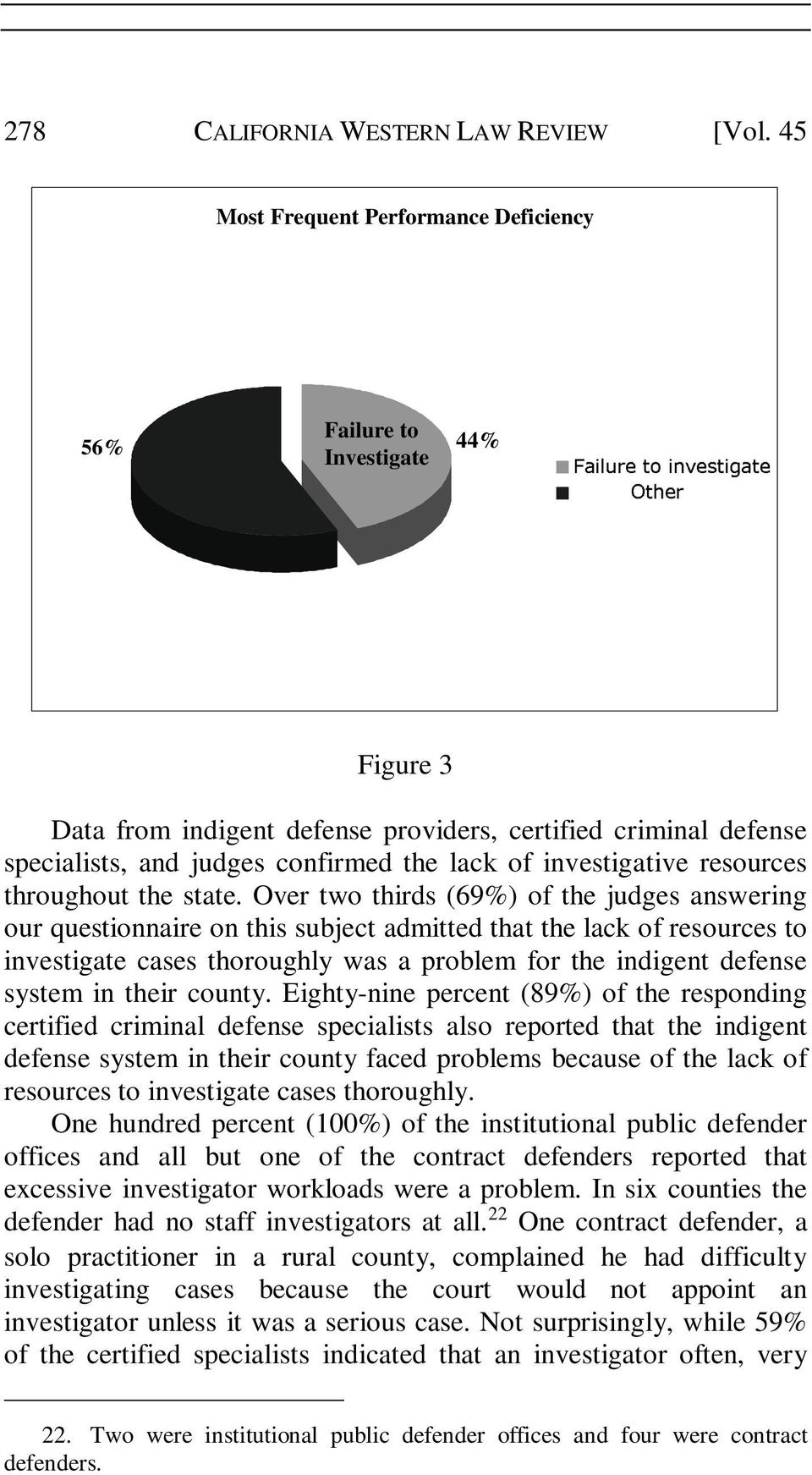
17 BENNER 5/7/2009 2:21:14 PM 2009] THE PRESUMPTION OF GUILT 279 often, or always interviewed victims and eyewitnesses before a preliminary examination, only a little more than one third (35%) of the indigent defense providers reported routinely conducting such interviews at this stage. As Figure 4 reflects, the ratio of attorneys to investigators also varied widely between counties. While a number of offices had one investigator for every three or four attorneys, other offices had ratios as high as nine attorneys to one staff investigator. Figure 4 The problems created by the lack of investigatory resources are further exacerbated by the fact that a number of prosecutors across the state appear to be routinely failing to comply with their discovery obligations under both state law and the Constitution. The overwhelming majority of both certified criminal defense specialists (90%) and indigent defense providers (93%) reported they had experienced a problem with prosecutors withholding evidence

18 280 CALIFORNIA WESTERN LAW REVIEW [Vol. 45 favorable to the accused, known as Brady material. 23 Over 90% of these respondents also reported that delay in turning over routinely requested discovery material was a problem. California s statutory discovery provisions set forth a laundry list of specific information and material that the prosecution is required to disclose to the defense. 24 This includes the names and addresses of witnesses the prosecution intends to call at trial, along with any written or recorded statements of such witnesses, relevant real evidence seized or obtained as part of the investigation, and the results of any scientific tests, experiments, or comparisons which the prosecutor intends to offer in evidence at the trial. 25 The defense has similar reciprocal discovery obligations. 26 However, the statutory scheme does not provide that such mandatory disclosures automatically be promptly made. Instead, the statute merely provides that such disclosures are required at least 30 days prior to the trial. 27 The trial, of course, can be many months after arrest. In a death penalty case the trial can be delayed even a year or longer. 28 A separate provision establishes the exclusive mechanism for the enforcement of discovery obligations. 29 This subsection requires that before enforcement can be sought, defense counsel must first make an informal request for the desired information or materials and then wait fifteen days before seeking to compel production. 30 While judges are given ample powers to impose sanctions for the failure to promptly 23. Prosecutors have a constitutional duty to turn over evidence favorable to the accused, including evidence that could be used to impeach a prosecution witness. Brady v. Maryland, 373 U.S. 83 (1963); United States v. Bagley, 473 U.S. 667 (1985) (extending Brady to impeachment evidence). Prosecutors also have a legal duty under state law to disclose to the defendant any exculpatory evidence. CAL. PENAL CODE (e) (West 2009). Almost two thirds (65%) of the indigent defense providers (institutional public defenders and contract defenders combined) reported that withholding Brady evidence was a significant problem in their county. 24. CAL. PENAL CODE (West 2009). 25. Id. 26. CAL. PENAL CODE (West 2009). 27. CAL. PENAL CODE (West 2009). 28. Telephone Interview with Gary Gibson, veteran public defender with the San Diego Public Defender Office (April 2009). 29. CAL. PENAL CODE (West 2009). 30. Id.

19 BENNER 5/7/2009 2:21:14 PM 2009] THE PRESUMPTION OF GUILT 281 comply with discovery obligations, 31 a number of defenders and certified specialists complained in the comments section of our questionnaire that judges refused to impose sanctions on prosecutors for discovery violations. Figure 5 reflects the extent of the delayed discovery problem as reported by institutional public defender offices. 32 Almost a third (31%) reported that the lack of prompt disclosure of discovery by the prosecution was a serious problem. Figure 5 The failure to provide indigent defense counsel with adequate resources to conduct an independent defense investigation, coupled with the inability of counsel to promptly gain access to the 31. Id. 32. n=32. The five-point scale used to measure significance was defined in the questionnaire as follows: 0=not a problem, 1=minor problem, 3=significant problem, 5=serious problem. Respondents marking a 2 were coded as moderate problem. Respondents marking a 4 were coded as very significant problem.

20 282 CALIFORNIA WESTERN LAW REVIEW [Vol. 45 information and evidence the defense will be required to counter at trial, combines to seriously undermine the ability to provide effective representation. One of the most vital functions of defense counsel in an adversary system is to test the prosecution s case. In order to do that, defense counsel must be able to interview the witnesses against the accused and investigate to determine the accuracy of their statements. Yet ninety-nine percent (99%) of all indigent defense providers reported having difficulty interviewing prosecution witnesses. Over a quarter of the institutional defenders, moreover, reported that this was a serious problem. Figure 6 reflects the extent of the problem faced by institutional public defender offices in interviewing prosecution witnesses. 33 Figure 6 Ninety-five percent (95%) of the certified specialists also reported that they had difficulty interviewing prosecution witnesses in 33. n=32. See supra note 32.

21 BENNER 5/7/2009 2:21:14 PM 2009] THE PRESUMPTION OF GUILT 283 retained cases. More than one in four (29%) stated that this was a serious problem. It is often assumed that a defendant who is able to afford to hire an attorney will also have the funds necessary to conduct a proper investigation. However, we discovered that privately-retained counsel also often lack sufficient funds to mount an effective challenge to the prosecution s case. Eighty percent (80%) of the certified criminal defense specialists reported they had difficulty obtaining DNA testing in retained cases. Almost two thirds of the indigent defense providers also indicated difficulty in obtaining DNA as well as other forensic testing. Both retained counsel (92%) and indigent defense providers (67%) reported that they were at a disadvantage compared to the prosecution in hiring expert witnesses because they lacked sufficient funds to match what the prosecution could pay for expert assistance. Finally, it should be recognized that the true impact of the lack of adequate resources cannot be fully appreciated without understanding the pressurized environment in which defense counsel work on a daily basis. Over 90% of the indigent defense providers and 94% of certified criminal defense specialists reported that judicial pressure to expedite cases was a problem to some degree. Judicial pressure was not limited to just metropolitan counties, but existed in counties of all population sizes. 34 In almost one half (45%) of the counties judicial pressure on defense counsel was viewed as a significant problem. In light of these findings we have proposed solutions, discussed in Part IX, which will help improve the ability of both privately retained counsel and indigent defense providers to conduct an adequate investigation. This includes proposals to (1) reinstate the traditional preliminary hearing as it existed prior to Proposition 115 (which dramatically curtailed its historic function); (2) to amend the criminal discovery provisions to clarify the obligations of prosecutors to disclose favorable evidence to the defense; (3) to make the prosecutor s duty to promptly turn over discovery enforceable; and (4) to create an independent forensics center for the exclusive use of the defense. 34. Counties were grouped into nine population categories and then classified as Metropolitan (over 1 million), Urban (one million to 100,000), and Rural (under 100,000). See Appendix I.
22 284 CALIFORNIA WESTERN LAW REVIEW [Vol. 45 IV. INSTITUTIONAL PUBLIC DEFENDER OFFICES 35 Just over one half (57%) of California s fifty-eight counties have created an institutional public defender office as a county department to serve as the primary provider of criminal defense services to the indigent accused. Offices in twenty-nine (88%) of these thirty-three counties responded to our questionnaire. 36 All of these offices represented felony and misdemeanor clients and the majority (96%) also provided representation in juvenile and mental commitment cases. Over half (58%) of the offices handled additional matters such as civil contempt, probate conservatorship, child support, and civil commitment of sexually violent predators. The majority (96%) were primary providers. A. Excessive Workloads 1. Staff Attorneys The concern that public defender offices would be overloaded with too many cases to be able to provide effective representation has led to the promulgation of a number of state and national standards. The California State Bar has adopted standards that provide: Indigent defense providers shall not accept nor be burdened with excessive workloads that compromise the ability of the provider to render competent and quality representation in a timely manner, without the risk of damaging the mental/physical health and 35. See supra Part II, Methodology, for definition of institutional public defender. 36. There are sometimes several institutional public defender offices in a single county because of the need to deal with conflicts of interest arising from the representation of co-defendants. See infra note 84 for discussion of conflicting interests. For example, in San Diego County, the Department of the Public Defender is the primary provider (see html). The Department of Alternative Public Defender (see ca.gov/apd/) and the Office of Assigned (see /oac/) handle conflict of interest cases. Forty-five questionnaires were sent out to institutional public defender offices and thirty-two (71%) of these offices responded. One office also partially responded to a telephone follow-up, making n=33 for some questions.
23 BENNER 5/7/2009 2:21:14 PM 2009] THE PRESUMPTION OF GUILT 285 motivation of the providers. 37 The American Bar Association (ABA) standards relating to the defense function provide: Defense counsel should not carry a workload that, by reason of its excessive size, interferes with the rendering of quality representation, endangers the client s interest in the speedy disposition of charges, or may lead to the breach of professional obligations. 38 The ABA Ten Principles of a Public Defense Delivery System further provides: National caseload standards should in no event be exceeded, but the concept of workload (i.e., caseload adjusted by factors such as case complexity, support services, and an attorney s nonrepresentational duties) is a more accurate measurement. 39 The majority of California s counties using institutional public defender offices do not comply with these standards. All institutional public defender offices, except one, reported having a problem with excessive attorney workloads. These respondents were asked to rank the significance of this problem on a five-point scale. 40 Over 79% of the institutional defenders stated that excessive attorney workloads were a significant, very significant, or serious problem (see Figure 7 below) THE STATE BAR OF CAL., GUIDELINES ON INDIGENT DEFENSE SERVICES DELIVERY SYSTEMS 24 (2006) [hereinafter CALIFORNIA STATE BAR STANDARDS]. 38. ABA, STANDARDS FOR CRIMINAL JUSTICE, PROSECUTION FUNCTION AND DEFENSE FUNCTION 126, Standard 4-1.3(e) (3d ed. 1993) [hereinafter ABA, STANDARDS FOR CRIMINAL JUSTICE], available at /standards/prosecutionfunction.pdf; see also ABA, STANDARDS FOR CRIMINAL JUSTICE, PROVIDING DEFENSE SERVICES 68-69, Standard (3d ed. 1992) [hereinafter ABA, STANDARDS FOR PROVIDING DEFENSE SERVICES], available at ABA, TEN PRINCIPLES, supra note 9, at See supra note 32 for definitions and coding of responses. 41. n=33. One chief defender answered this question during a telephone follow-up.
24 286 CALIFORNIA WESTERN LAW REVIEW [Vol. 45 Figure 7 This finding was independently confirmed by certified criminal defense specialists who were also asked to assess the health of public defender offices in the county in which they practice. Almost three fourths (73%) of those responding from counties with institutional public defender offices indicated that excessive attorney caseloads were a significant problem. More than one in four (28%) criminal defense specialists ranked it as a serious problem. Fifty-nine percent (59%) of the institutional public defender offices reported having felony caseloads that exceeded the standard of 150 non-capital felonies per year established by the National Advisory Commission on Criminal Justice Standards and Goals (NAC) 42 and adopted by the ABA in its Ten Principles. 43 Seventy-five percent (75%) of these public defender offices exceeded the NAC Standard of 400 non-traffic misdemeanors per attorney per year. As the National Study Commission on Defense Services observed in 1976, these national standards should serve only as a starting point 42. NAC, supra note 8, at See ABA, TEN PRINCIPLES, supra note 9.
25 BENNER 5/7/2009 2:21:14 PM 2009] THE PRESUMPTION OF GUILT 287 in the analysis, because only an actual workload study can determine the maximum number of cases an attorney can effectively handle in a given jurisdiction. 44 The National Center for State Courts, for example, did a workload assessment for the Maryland Public Defender Office in 2005, which recommended substantially lower caseloads than the national standards. 45 Operating under excessive caseloads, of course, has a ripple effect. It not only makes ineffective assistance more likely, it also leads to burnout. Turnover of experienced staff was a problem in over 62% of the public defender offices. Almost three out of four offices 44. THE NAT L STUDY COMM N ON DEFENSE SERVICES, GUIDELINES FOR LEGAL DEFENSE SYSTEMS IN THE UNITED STATES, FINAL REPORT 295 (National Legal Aid & Defender Association 1976) [hereinafter NATIONAL STUDY COMMISSION]. 45. BRIAN J. OSTROM, MATTHEW KLEIMAN, & CHRISTOPHER RYAN, MARYLAND ATTORNEY AND STAFF WORKLOAD ASSESSMENT 1, 35 (National Center for State Courts 2005), available at Res_WorkLd_MDAtty&StaffWkLdAs05Pub.pdf. Maryland: Recommended Annual Attorney Caseloads Based on Final Case Weights Cases per Attorney Rural Suburban Urban Capital (Death Notice Not Filed) Capital (Death Notice Filed) Violent Felony Non-Violent Felony Homicide Misdemeanor Jury Trial Demands and Appeals The recommendations in the table were based upon a time study, focus group discussions, and surveys of attorneys. Id. at 110. The Maryland study highlights that there are differences in the workload urban and rural offices can handle. Curiously, our study also found that there appeared to be a relationship between California defenders own views of how many cases one attorney could effectively handle and the population of their county. When asked for their views, twenty-three of the California public defenders answered this question. One half of this group of respondents believed that felony and misdemeanor caseloads should be at or below the national standards. The majority of those respondents who believed the felony and misdemeanor caseloads could exceed the national standards were from counties with populations of 500,000 or less. The median for non-capital felonies was 170 per year. The median for nontraffic misdemeanors was 450 per year.
26 288 CALIFORNIA WESTERN LAW REVIEW [Vol. 45 that reported excessive caseloads as a significant problem, also reported a significant problem with turnover. 46 ABA Standards for Providing Defense Services, Standard 5-5.3, specifically states that indigent defense providers should not accept workloads that, by reason of their excessive size, interfere with the quality of representation This standard further provides: Whenever defender organizations, individual defenders, assigned counsel or contractors for services determine, in the exercise of their best professional judgment, that the acceptance of additional cases or continued representation in previously accepted cases will lead to the furnishing of representation lacking in quality or to the breach of professional obligations, the defender organization, individual defender, assigned counsel or contractor for services must take such steps as may be appropriate to reduce their pending or projected caseloads, including the refusal of further appointments. Courts should not require individuals or programs to accept caseloads that will lead to the furnishing of representation lacking in quality or to the breach of professional obligations Investigators One hundred percent (100%) of the public defender offices also reported that excessive investigator workloads were a problem. Seventy-seven percent (77%) reported that this was a significant, very significant, or a serious problem. The average ratio was one investigator for every 4.6 attorneys. The actual ratio of investigators to attorneys varied widely among offices. In three counties there was only one investigator for every eight attorneys. One of these offices handled ten death penalty cases, while the other handled none. Two offices had no staff investigator and one of these reported that there was a very significant problem in obtaining court approval for investigative assistance. Investigation may also be hindered by the fact that more than one half (59%) of the offices reported that the lack of interpreters was a problem. 46. Inadequate compensation may also be a factor contributing to turnover in some counties. Over one third (39%) of the public defender offices reported disparity in salary and benefits when compared to the District Attorney s office. 47. ABA, STANDARDS FOR PROVIDING DEFENSE SERVICES, supra note Id.
27 BENNER 5/7/2009 2:21:14 PM 2009] THE PRESUMPTION OF GUILT 289 Most revealing, however, was the fact that 100% of the offices reported that the inability to interview prosecution witnesses was a problem. More than one quarter (27%) of the offices reported that this presented a serious problem. This problem is compounded by three additional factors. First, most defender offices are not contacting defendants until several days after arrest, so prompt investigation is impossible. Second, it was reported by both defenders and certified criminal defense specialists that prosecutors in most counties delay in turning over requested discovery and fail to provide Brady evidence to defense counsel. Third, and perhaps most important, many cases are being disposed of at a readiness/disposition conference with the district attorney and the trial judge soon after arraignment, where in some counties a take it or leave it offer is often presented by the prosecution before the defense has had time to conduct a complete investigation. B. Time of First Contact The ABA Standards for Criminal Justice state: Defense counsel should conduct a prompt investigation of the circumstances of the case and explore all avenues leading to facts relevant to the merits of the case and the penalty in the event of conviction.... The duty to investigate exists regardless of the accused s admissions or statements to defense counsel The ABA Ten Principles also require appointment of counsel as soon as feasible and in the commentary to the Third Principle state: 49. ABA, STANDARDS FOR CRIMINAL JUSTICE, supra note 38. It may be thought that an investigation is unnecessary where the defendant admits guilt or indicates he or she is willing to accept the prosecutor s offer. However, it is defense counsel s job to test the state s case, not be a guilty-plea facilitator. The importance of this was brought home to the author, who once represented a juvenile, bound over to be tried as an adult for armed robbery. Footprints in the snow led from the crime scene to the defendant s family home, where he was arrested and identified by the victim as the robber. Although the youthful defendant expressed his willingness to plead guilty, investigation disclosed that his older brother, who would have faced life imprisonment as a habitual offender, was the actual assailant. The family, believing the younger brother would only be sentenced as a juvenile, had kept silent about the misidentification in order to protect the older brother.
28 290 CALIFORNIA WESTERN LAW REVIEW [Vol. 45 should be furnished upon arrest, detention or request and usually within 24 hours thereafter. 50 The State Bar of California s Guidelines on Indigent Defense Services Delivery Systems also observe in the Standards of Representation section that indigent defense providers have the responsibility to conduct an in-depth factual inquiry in a timely manner. 51 Only one public defender office reported that it establishes contact with an indigent accused prior to arraignment. 52 The majority of offices are appointed at the initial arraignment on a felony charge and briefly make first contact with an in-custody defendant at that time. 53 Eight offices indicated that they were not appointed until after arraignment. The time public defenders make first contact with their clients varies widely, as shown in Figure 8. Only one office reported that contact was made with an in-custody felony defendant within twenty-four hours after arrest. Less than one half (48%) made first contact between one-to-two days after arrest. Eight offices made first contact between three-to-five days and three offices did not make contact until more than five days after arrest. Figure ABA, TEN PRINCIPLES, supra note 9, at CALIFORNIA STATE BAR STANDARDS, supra note 37, at The San Diego Public Defender s office, in a joint venture with California Western School of Law, established the San Diego Bail Project in Under this program, law students interview recent arrestees at the Central Jail, verify information necessary for accurate bail determinations, and represent indigent defendants at their arraignment, arguing for release or reduced bail. See discussion infra notes and accompanying text. 53. This was also true with respect to misdemeanors, although a higher number (40%) of the offices were not appointed until after arraignment.
29 BENNER 5/7/2009 2:21:14 PM 2009] THE PRESUMPTION OF GUILT 291 The National Study Commission s Guidelines for Legal Defense Systems, Standard 1.2 (Time of Entry) provides: Effective representation should be available for every eligible person as soon as: (a) The person is arrested or detained, or (b) The person reasonably believes that a process will commence which might result in a loss of liberty or the imposition of a legal disability of a criminal or punitive nature, whichever occurs earliest. 54 Standard 1.3 (Procedures for Providing Early Representation: Program Responsibilities) further provides: In order to ensure early representation for all eligible persons, the defender office or assigned counsel program should: (a) Respond to all inquiries made by, or on behalf of, any eligible person whether or not that individual is in the custody of law enforcement officials; (b) Establish the capability to provide emergency representation on a 24-hour basis; (c) Implement systematic procedures, including daily checks of detention facilities to ensure that prompt representation is available to all persons eligible for services;... and (f) Publicize its services in the media. Upon initial contact with a prospective client, the defender or assigned counsel should offer specific advice as to all relevant constitutional or statutory rights, elicit matters of defense, and direct investigators to commence fact investigations, collect information relative to pre-trial release, and make a preliminary determination of eligibility for publicly provided defense services. Where the defender or assigned counsel interviews a prospective client and it is determined that said person is ineligible for publicly provided representation, the attorney should decline the case and, in accordance with appropriate procedure, assist the person in obtaining private counsel. However, should immediate service be necessary to protect that person s interest, such service should be rendered until the person has had the opportunity to 54. NATIONAL STUDY COMMISSION, supra note 44, at 501.
30 292 CALIFORNIA WESTERN LAW REVIEW [Vol. 45 retain private counsel. 55 The California State Bar Standards also emphasize that institutional public defenders are to provide comprehensive services and declare that there should exist no gap in the services spectrum. 56 Citing California Government Code section 27706, the State Bar Standards observe that the institutional defender need not wait until court appointment to commence representation of a client. 57 Government Code section provides: The public defender shall perform the following duties: (a) Upon request of the defendant or upon order of the court, the public defender shall defend... any person who is not financially able to employ counsel and who is charged with the commission of any contempt or offense triable in the superior courts at all stages of the proceedings, including the preliminary examination. The public defender shall, upon request, give counsel and advice to such person about any charge against the person upon which the public defender is conducting the defense Many public defender offices have heeded the spirit of the State Bar Standards and provide representation even before arrest Id. at CALIFORNIA STATE BAR STANDARDS, supra note 37, at Id. at CAL. GOV T CODE 27706(a) (West 2009). 59. See, e.g., County of San Bernardino Public Defender, FAQ, (last visited Feb. 6, 2009). The FAQ section provides: What should I do if I believe I am under law enforcement investigation in San Bernardino? If you have reason to believe you are under investigation by San Bernardino law enforcement, you should contact the San Bernardino County Public Defender either by telephone at or by through the Department s internet website at Consultation with an attorney is important so that you can understand your rights, responsibilities and the potential outcomes of any law enforcement investigation. Most law enforcement investigators will understand and must respect your desire to first speak with an attorney. Any consultation about your own potential case with the San Bernardino County Public Defender will be completely confidential. This Department will accept collect calls regarding San Bernardino County criminal or civil commitment legal matters.
31 BENNER 5/7/2009 2:21:14 PM 2009] THE PRESUMPTION OF GUILT 293 However, other defenders state in the Frequently Asked Questions (FAQ) of their web page that they cannot provide representation until appointed by the court. 60 While Government Code section appears to impose a mandatory duty upon the public defender to provide advice about a criminal charge upon request, that section is ambiguously drafted because the words defend... at all stages can be narrowly construed to include only critical stages of a criminal proceeding. 61 The duty to advise, moreover, only applies to a charge upon which the public defender is conducting the defense which Id.; see also Santa Barbara Public Defender, FAQ, defender/default.aspx?id=4064. The section provides: When and how does one apply for the services of the public defender? When: The services of the office are available seven days a week, 24 hours a [day] for emergency needs. Attorneys are on call during non-office hours and may be reached at in the north county at (805) and in the south county at (805) Any indigent person who is about to be arrested, charged with a misdemeanor or more serious crime may request our assistance. All law enforcement agencies in the county are regularly mailed a list of on call attorneys and reminded that we are available to respond to requests for services (such as when a suspect seeks the advice of an attorney prior to interrogation) quickly. By law these numbers are to be posted in any place of detention so that a person being arrested may contact us at that time. Id. 60. See, e.g., Monterey Public Defender Office, FAQ, monterey.ca.us/pubdef/faqs.html (last visited Feb. 6, 2009). The section provides: Can I drop by the Public Defender s Office for legal advice if the court hasn t appointed me? No. Our office welcomes the public to drop by however; the Public Defender is only allowed to represent clients that the court has appointed. If you need general information our office may be able to assist. Id. It should be noted that this office reported that it had serious excessive attorney and investigator workloads, had no paralegal staff, and had handled a death penalty case while laboring under caseloads that exceed national standards. Asking such an office to provide additional services would obviously require additional resources. 61. See supra note 58 and accompanying text. It is not suggested that this is a correct interpretation, only that it is a possible one. The right to counsel at a post charge line-up and the right to consult an attorney before submitting to custodial interrogation are of course well established, but an accused can waive those rights without such consultation if they do not think counsel is readily available. Early representation is also needed to assist in obtaining pre-trial release, and of course to commence an immediate investigation.
32 294 CALIFORNIA WESTERN LAW REVIEW [Vol. 45 also implies there has been an appointment. 62 This section should be amended to clarify the duty of the primary indigent defense provider in each county to furnish advice prior to formal appointment. Early representation is essential to obtaining pre-trial release and can be critical in cases requiring immediate investigation. There is also an additional reason to ensure prompt representation is provided to the indigent accused. Public defender offices in fourteen of the thirty-three public defender counties reported that they frequently determine the disposition of a felony case at a disposition conference with the district attorney and judge held prior to the preliminary hearing, which is set within ten days following arraignment if the defendant is held in custody. 63 Given the fact that most defenders are not appointed until arraignment, there is little time to conduct an investigation for an in-custody defendant. 64 C. DNA and other Forensic Testing The ABA Ten Principles mandate parity between defense counsel and the prosecution with respect to resources 65 and state that there should be separate funding for litigation support services. 66 In the wake of numerous scandals involving the falsification of forensic evidence, it has become increasingly clear that the defense must have the ability to conduct its own independent forensic investigation. For example, in Dallas, fake drugs planted by police were used to convict more than forty innocent defendants. 67 In West Virginia, crime lab 62. See supra note 58 (emphasis added). 63. By statute the preliminary hearing must be held within ten court days following arraignment for a defendant held in custody. CAL. PENAL CODE 859(b) (West 2009). 64. A staff attorney has to be assigned to the case before an in-depth interview with the defendant normally takes place. Because this can take several days following arraignment, the window for investigation can be quite small. See, e.g., County of Ventura Public Defender, FAQ, index_files/faq.htm (last visited Feb. 6, 2009) ( When do I meet my Public Defender? There will be a Public Defender in court at your first appearance. Often that attorney will not be your permanent Public Defender. It takes a few days for your case to be assigned to your personal Public Defender. ). 65. ABA, TEN PRINCIPLES, supra note 9, at Id. 67. See Megan K. Stack, Drug Busts Gone Bad, Then Worse, L.A. TIMES, Apr.
33 BENNER 5/7/2009 2:21:14 PM 2009] THE PRESUMPTION OF GUILT 295 superstar Fred Zain was finally exposed after sixteen years of fraudulently manipulating forensic evidence test results to win victories for the prosecution. 68 In Riverside County, California, it was recently revealed that a crime lab technician falsified hundreds of drug and alcohol reports while working with a company that contracted with law enforcement agencies to provide testing to confirm drug or alcohol intoxication. 69 Our study disclosed that while funds are in theory supposed to be available for the defense for forensic testing, one half (50%) of the institutional public defenders experienced difficulty obtaining DNA testing and an almost equal number (48%) had difficulty obtaining other forensic testing. Over one third (34%) of these offices were located in counties having a population between 100,000 to 250,000. However, this problem was widespread and existed in counties of all sizes. Over two thirds (70%) of the institutional public defenders responding to our questionnaire favored establishing a forensic laboratory available to both the defense and prosecution, which would be operated as an independent agency. Twenty-five percent (25%) of these respondents strongly favored such a laboratory. Eighty-two percent (82%) of the certified criminal defense specialists favored, and over half (58%) strongly favored such an agency. Those disfavoring this proposal indicated that they did not believe such a laboratory could be truly independent if law enforcement agencies were involved as clients. D. Expert Witnesses A reputable expert witness is often critical to mounting an effective defense, especially when, for example, a defendant s sanity is at issue, or when issues involving forensic evidence are disputed. In such cases victory can often turn on which side s experts have the better credentials. While some public defender offices have budgeted funds from which to retain such expert assistance, other offices must 5, 2002, at A-1, available at George Castelle, Fake Data, Wrongful Convictions: Learning from a Crime Lab Fraud Fiasco, 19 CORNERSTONE 9 (1997). 69. See KPSP Local 2 News, Riverside Lab Worker Admits to Falsifying Reports, Mar. 5, 2009,
34 296 CALIFORNIA WESTERN LAW REVIEW [Vol. 45 obtain court approval for such assistance. Surprisingly, almost one third (30%) of the offices reported having difficulty obtaining such approval. Moreover, even when such assistance is approved, there is still a lack of equality in funding between the defender office and the district attorney s office. Over one half (56%) of the institutional public defender offices reported that they are handicapped by the lack of funds sufficient to obtain experts that match the district attorney s experts. E. Assistance in Sentencing Mitigation Over sixty-two percent (62%) of the public defender offices reported that the lack of expert assistance at the sentencing stage was a problem. The disparity among offices was striking especially with respect to the death penalty. Citing ABA Standards for Criminal Justice, the U.S. Supreme Court established in Wiggins v. Smith 70 and Rompilla v. Beard 71 that it is imperative that defense counsel investigate all reasonably available mitigating evidence including family social history, which may be relevant to reduce a defendant s sentence. 72 Only nine offices, however, had staff personnel with a Masters degree in social work (MSW) to assist in such investigations. Even fewer offices (four) had a full-time death penalty mitigation specialist on staff. Nine offices, that had represented collectively thirty-three death penalty clients, had no such staff assistance at all. While one of these offices was in a metropolitan county (over 1 million population), the majority were in counties having a population ranging from 100,000 to 500, Only twelve offices had personnel specifically assigned to develop sentencing alternatives for clients in non-capital cases. While a bare majority (53%) of offices had paralegals on staff, fourteen offices had no such staff assistance. 70. Wiggins v. Smith, 539 U.S. 510 (2003). 71. Rompilla v. Beard, 545 U.S. 374 (2005). 72. See Wiggins, 539 U.S. at (citing ABA, STANDARDS FOR CRIMINAL JUSTICE, supra note 37); Rompilla, 545 U.S. at 387 (citing ABA, STANDARDS FOR CRIMINAL JUSTICE, supra note 38; and ABA, GUIDELINES FOR THE APPOINTMENT AND PERFORMANCE OF COUNSEL IN DEATH PENALTY CASES (1989)). 73. Four counties were class VI (100, ,000) and three were class V (250,000+ to 500,000).
35 BENNER 5/7/2009 2:21:14 PM 2009] THE PRESUMPTION OF GUILT 297 F. Training Fifty-nine percent (59%) of the responding public defender offices reported that the lack of a full-time training director presented a problem and three offices felt this was a serious problem. Defenders reported a need for training in basic trial skills, motion practice, jury selection, DNA and forensic evidence, handling expert testimony, mental defenses, and immigration consequences of a guilty plea. Only a few offices reported that the lack of funds to attend training programs or the lack of training programs in their area was a significant problem. More defenders felt that the lack of time to attend training programs was a problem, which of course is one of the ripple effects of excessive caseloads. G. Qualifications and Supervision When asked what level of experience was required before an attorney was assigned to a serious or violent felony, the majority (67%) of the public defender offices reported that they required three or more years of experience. Eight offices, however, reported that two years or less experience was sufficient. There was a statistically significant correlation between having an excessive caseload and using attorneys with less than three years of experience to handle serious felonies. 74 The impact of excessive caseloads is also aggravated when an office has to handle a death penalty case. Eighteen offices indicated that they handled one or more death penalty cases during the last reporting period. Fourteen of these offices also reported having a 74. This correlation was significant at the 95% confidence level, n=23, Chisquare (df=1), value = 4.329, p.<.037. Chi-square is a method of analysis within a class of statistical procedures known as non-parametric tests. A chi-square analysis compares the observed, or actual frequency, to what would be expected based on a random assignment. The chi-square value is deemed significant, when the deviation from randomness is so great that one is justified in ruling out the possibility that the deviation was due to chance. For example, where the probability of obtaining a deviation from randomness exceeds five in 100 (i.e., p.<.05), it is accepted practice in scientific research to assume that the results are not due to chance, but rather to some systematic pattern of behavior. See DENNIS P. SACCUZZO, PSYCHOLOGY: FROM RESEARCH TO APPLICATIONS (1987). In the instant case, the value of chi-square was quite significant.
36 298 CALIFORNIA WESTERN LAW REVIEW [Vol. 45 significant to serious problem 75 with excessive caseloads. More startling was the fact that four offices, three of whom had actually handled a death penalty case during the last year, reported that they would allow an attorney with only five years experience to handle a capital case. The California Rules of Court state than an attorney must have at least ten years of litigation experience in the field of criminal law before being eligible to serve as lead counsel in a death penalty case. 76 The majority of responding offices indicated familiarity with this rule. However, the rule does not place a mandatory duty of compliance upon public defender offices. 77 A number of defender offices reported that they had no set criteria for death penalty cases. One office responded that they had not seen a death penalty case in twenty years. It would therefore appear that some offices may not be prepared to meet the requirements of Rule 4.117(d) if faced with an increase in death penalty cases in their county. The majority of public defender offices formally evaluate their staff attorneys on an annual basis. 78 All offices used multiple methods of evaluation, which included: in-court observation (100%), judicial contact (77%), and review of closed case files (75%). Over one third (34%) of the offices had an official policy regarding review of an attorney s performance if a judicial finding was made that the attorney was ineffective. These policies were described as including an 75. The phrase significant to serious indicates that the respondent marked either a 3, 4, or 5 on a five-point scale when asked to rank the significance of the problem. See Part II, Methodology, supra at p. 275 and note CAL. R. CT. R (d) (2007). The Rule further requires the attorney to have tried ten serious or violent felonies including at least two murder trials, be experienced in the use of expert witnesses, and have received special training in capital defense. Id. The rule provides an alternate way to qualify for an attorney without ten years experience, but further states that meeting these minimum qualifications alone does not entitle an attorney to handle a death penalty case, since the court must also assess the attorney s background, experience, and training, and determine that he or she has demonstrated the skill, knowledge and proficiency necessary to competently represent a capital defendant. R (b). 77. Subsection g of Rule only provides that the office should assign an attorney meeting the requirements of the rule. R (g) (emphasis added). 78. One office evaluates biannually and two evaluate every six months. One office reported that it conducted evaluations every six months for three to four years implying that after this time further evaluations were not done.
37 BENNER 5/7/2009 2:21:14 PM 2009] THE PRESUMPTION OF GUILT 299 investigation into the cause, creation of a corrective action plan, retraining, and sometimes close monitoring of the individual attorney. H. Independence Ensuring that both individual defense attorneys and the management of an indigent defense system remain free from judicial and political pressure is vital to the ability of that system to fulfill its role as a necessary check and balance. Without such independence the ability to provide effective representation is jeopardized. California, unfortunately, has a sad history of harassment and termination of public defenders who have had the courage to fight against excessive caseloads. 79 Our study found that this type of intimidating pressure still exists. The commentary to the ABA Ten Principles states that a nonpartisan board of trustees should oversee public defender systems in order to safeguard their independence. 80 None of the responding public defenders had such a board. All chief defenders are selected by the county board of supervisors, except in San Francisco, where the chief defender is elected. 81 Almost three fourths (73.1%) of the 79. See, e.g., Portman v. County of Santa Clara, 995 F.2d 898, 901 (9th Cir. 1993) (describing how the chief public defender, Sheldon Portman, was first reprimanded, then stripped of a pay raise, and ultimately fired after stating at a public budget session that his attorneys would face professional disciplinary action for handling too many cases if the board did not grant his request for additional lawyers); see also Wilson v. Superior Court, 240 Cal. Rptr. 131 (Cal. Ct. App. 1987); Gail Diane Cox, Public Defenders Find Independence Can Be Precarious, L.A. DAILY J., Feb. 21, 1986 (both describing other similar incidents). Recently the Chief Public Defender of Cook County, Illinois, Edwin Burnette, successfully sued the President of the Cook County Board of Commissioners to prevent interference with management of the Chicago Public Defender Office. The County Board President had unilaterally selected thirty-four assistant public defenders for termination (called layoffs) and had ordered other staff to take unpaid furlough days. In a unanimous decision, the Illinois Appellate Court ruled that the county board president lacked the authority to select whom to hire, fire or retain among the public defender s staff. Burnette v. Stroger, No , slip op. at 32 (Ill. App. Ct. Mar. 30, 2009). Unfortunately the courageous chief defender paid the ultimate price for this victory as his contract was not renewed. See Hal Dardick, Public Defender Wins Last Case Over Stroger; County Board Chief has Limited Control of Appointee s Office, CHI. TRIB., Apr. 1, 2009, at C ABA, TEN PRINCIPLES, supra note 9, at In two cases, the power to select the public defender was delegated to the
38 300 CALIFORNIA WESTERN LAW REVIEW [Vol. 45 institutional defenders reported that county board pressure to keep costs down was a problem. 82 Over one third (34%) indicated that this was a significant to serious problem. 83 Even more disturbing was the fact that 91% of the institutional public defenders reported that judicial pressure to expedite cases was a problem in their county. Fifty-nine percent (59%) stated that this was a significant to serious problem, with five offices reporting this presented a serious problem. V. CONTRACT DEFENDERS Contract defenders are the primary provider of indigent felony and misdemeanor representation in twenty-four counties. While this type of system is heavily concentrated in rural counties with populations of less than 100,000, it also exists in a number of urban counties. Some counties with a public defender office also use a contract defender to handle conflicts. 84 There are a wide variety of arrangements. Eight counties have contracted with a single law firm that provides various types of representation through branch offices. Some counties contract with solo practitioners. Several counties, for example, have four different contract defenders handling different portions of the caseload and one county has seven separate contract defenders. The amount spent by counties per capita for contract county administrator. 82. After presenting the findings of our study to the Fair Commission in July 2007, a chief public defender, who was a member of the Commission, told the author that at the time they were hired it was made very clear to them that they would be expected to do the job with the resources given to them and if they could not, then the Board would find somebody else who would. In California, most institutional public defenders are appointed by the county board of supervisors and serve at the will of the board. CAL. GOV T CODE (West 2009). 83. See supra note 75 regarding the meaning of significant to serious. 84. Conflicts of interest arise, for example, when there are multiple codefendants involved in the same crime. In Holloway v. Arkansas, the U.S. Supreme Court held that automatic reversal of defendant s conviction was required because prejudice was presumed where, without a hearing, the trial court forced defense counsel to simultaneously represent three co-defendants over defense counsel s objection. Holloway v. Arkansas, 435 U.S. 475, (1978). A conflict of interest can also arise from a variety of other circumstances. For example, where a prosecution witness is a former client of defense counsel, counsel s ability to effectively cross-examine that witness may be compromised by his ethical duty to keep confidences of the former client.
39 BENNER 5/7/2009 2:21:14 PM 2009] THE PRESUMPTION OF GUILT 301 defender services varied widely, ranging from a low of $5.85 to a high of $ We sent questionnaires to fifty-seven separate contract defenders and received sixteen responses. 85 Almost half (45%) of the counties employing contract defenders as their primary indigent defense provider were represented by these respondents. One half of the respondents were solo practitioners; the other half were law firms. The majority indicated that they were appointed at arraignment and contacted the defendant within one to three days after arrest. However, three reported that they did not contact an in-custody felony defendant until more than five days after arrest. Contract defenders reported having the same difficulty in investigating cases as institutional public defenders and appeared to have even less resources. Six contract defenders had no staff investigators at all. 86 Three respondents reported that obtaining court approval for funds for an investigator was a serious problem. One office had just two investigators for eighteen attorneys. All but one of the contract defenders reported that the inability to interview prosecution witnesses was a problem. Half of these respondents reported that this was a significant to serious 87 problem. Only one in four reported that they often interviewed victims and/or eyewitnesses prior to a preliminary examination. Seventy-one percent (71%) reported that this was only rarely or occasionally done. The disposition of felony cases was most often determined at a disposition conference held prior to the time scheduled for the preliminary examination. The responding contract defenders also lacked other important support personnel. Only one office had a full-time staff member with an MSW degree to assist in sentencing and only three offices reported having paralegals. 88 One half of the contract defenders indicated that the lack of expert assistance at sentencing was a significant problem. One office, which had handled a death penalty case during the year, 85. All of those responding provided felony representation. All but one also provided misdemeanor and juvenile representation. Two thirds were primary providers and one third handled conflicts cases. 86. Two of these respondents were from the same county. 87. See supra note One office reported having a part-time MSW on staff.
40 302 CALIFORNIA WESTERN LAW REVIEW [Vol. 45 did not have a mitigation specialist on staff or even a paralegal. This office reported having a serious problem in obtaining court approval for experts and stated that withholding of Brady evidence by the prosecutor and judicial pressure to expedite cases were also serious problems. A majority of the responding contract defenders had felony caseloads exceeding 150 felonies per year. Only one in four of these respondents reported that excessive attorney workload and investigator workloads were a significant problem. The remaining respondents did not answer this question or indicated that excessive workloads were only a minor to moderate problem. While some offices indicated that delayed discovery as well as Brady violations were a significant or serious 89 problem in their county, almost a third did not answer this question and the remainder either experienced no discovery problems or only minor problems. However, a majority reported that the lack of funds to match the prosecution s experts, difficulty in obtaining DNA testing, and difficulty in obtaining other forensic testing were all significant problems. The majority favored establishing an independent forensic laboratory, with only one indicating disfavor and four expressing no preference. All but one of the contract defenders thought that the disparity between their pay scale and that of the district attorney s was a problem. Eighty-six percent (86%) viewed this disparity in compensation as a significant to serious 90 problem. By contrast, only 39% of the institutional public defenders reported having a lack of salary parity with the prosecutor s office. None of the contract defenders reported having a serious problem with training. Although they were from some of the most rural counties in the state, only two respondents indicated that the lack of training programs in their area was a significant problem. Three respondents reported that the lack of funds to attend training programs was a significant problem. Only four respondents reported having any training needs. The topics noted were: advocacy/trial techniques, mental health, sentencing, evidence, and sex crimes. There was a general lack of uniformity in the level of experience attorneys were required to have before being allowed to represent 89. See supra note Id.
41 BENNER 5/7/2009 2:21:14 PM 2009] THE PRESUMPTION OF GUILT 303 clients charged with serious felonies. One office reported that only one year of experience was needed to handle a serious felony or a three strikes case. Three offices reported that at least three or four years would be required, while one said five years, one said ten years, and one reported that all attorneys in their office had twenty-plus years experience. Over one third (37%) of the contract defenders did not answer this question. In our judicial survey, we asked presiding Superior Court judges for their input on experience levels needed for effective representation. Two thirds of the judges responding to our questionnaire believed that an attorney should have at least three or more years experience before representing a client charged with a serious felony. More than one third of the judges, and several certified criminal defense specialists from counties employing contract defenders, indicated that the contract defender attorneys were less experienced than the district attorneys in their county. It should be noted that judges and certified specialists from counties with institutional public defender offices and assigned counsel systems also reported a similar gap in experience in those systems. Monitoring and supervision of contract defender attorneys also varied widely. Where a county contracts with a solo practitioner there is no supervision at all other than general oversight by the judiciary. While most responding contract defenders who indicated that they were a law firm had some type of formal review process, one indicated this only entailed contacting judges for their evaluation of an attorney s performance. Several offices had no formal review process. Only four offices indicated that they reviewed closed case files. Only one contract defender office had an official policy in place to review an attorney s performance if a judicial finding was made that the attorney had rendered ineffective assistance. All but one of the responding contract defenders indicated that pressure from the county board of supervisors to keep costs down and judicial pressure to expedite cases presented a problem. While the county board in most cases selects the contractor, several respondents noted that the board only appointed who the judges approved. This practice of judicial involvement in selecting the contractor was also confirmed by a number of judges who indicated that either the judge or a judicial committee selected the contract defender in their county. While input from the judiciary as to the criteria which should be used
42 304 CALIFORNIA WESTERN LAW REVIEW [Vol. 45 to select a contract defender should be welcomed, the actual selection of the defender by the judiciary violates national standards which provide that the public defense function should be independent from political influence and subject to judicial supervision only in the same manner and to the same extent as retained counsel. 91 None of the contracts were for longer than a three-year period. The amount of compensation awarded was often based upon a fixed fee per case or a flat fee for the entire projected annual caseload. While a contract system can be a cost-effective means of delivering indigent defense services in rural areas having low caseloads, California has had an unfortunate history with such systems. In a monograph prepared for the U.S. Justice Department s Bureau of Justice Assistance, the following disastrous experience with a contract defender was reported: In 1997 and 1998, a rural county in California agreed to pay a low bid contractor slightly more than $400,000 a year to represent half of the county s indigent defendants. The contractor was a private practitioner who employed two associates and two secretaries, but no paralegal or investigator. The contract required the contractor to handle more than 5,000 cases each year. All of the contractor s expenses came out of the contract. To make a profit, the contractor had to spend as little time as possible on each case. In 1998, the contractor took fewer than 20 cases less than 0.5 percent of the combined felony and misdemeanor caseload to trial. One of the contractor s associates was assigned only cases involving misdemeanors. She carried a caseload of between 250 and 300 cases per month.[sic] 92 The associate had never tried a case before a jury. She was expected to plead cases at the defendant s first appearance in court so she could move on to the next case. 91. ABA, TEN PRINCIPLES, supra note 9, at 2. As the commentary points out, keeping the judiciary from becoming entangled in the oversight and budgetary concerns of the indigent defense system is also important to protect the judiciary from undue political pressure and thus helps to ensure judicial independence. Id. The ABA and other national standards recommend that a nonpartisan board should be established to oversee all types of defense systems, whether institutional public defender, contract defender or assigned counsel system. Id. (citing other national standards). 92. The national standard is 400 misdemeanor cases per attorney per year. See NAC, supra note 8, at 276.
43 BENNER 5/7/2009 2:21:14 PM 2009] THE PRESUMPTION OF GUILT 305 One afternoon, however, the associate was given a felony case scheduled for trial the following week. The case involved multiple felony and misdemeanor charges. When she looked at the case file, the associate discovered that no pretrial motions had been filed, no witness list had been compiled, no expert witnesses had been endorsed, and no one had been subpoenaed. In short, there had been no investigation of any kind into the case, and she had no one to help her with the basics of her first jury trial. The only material in the case file was five pages of police reports. In these reports she found evidence of a warrantless search, which indicated strong grounds for suppression. She told the judge she was not ready to proceed and that a continuance was necessary to preserve the defendant s Sixth Amendment [sic] right to counsel. The continuance was denied. The associate refused to move forward with the case. The contractor s other associate took over the case and pled the client guilty to all charges. The associate who had asked for a continuance was fired. In this California county, critics worst fears about indigent defense contract systems came true. When contract systems are created for the sole purpose of containing costs, they pose significant risks to the quality of representation and the integrity of the criminal justice system. 93 In a deposition arising out of a lawsuit brought by the associate who had been summarily dismissed, the contract defender stated that he was able to handle a high volume of cases because he pled 70% of his clients guilty at the first court appearance after spending thirty seconds explaining the prosecutor s offer. 94 The county has since established an institutional public defender office. 95 Testimony before the Fair Commission also revealed that some counties employing contract defenders solicited bidding wars in an 93. U.S. DEP T OF JUSTICE, BUREAU OF JUSTICE ASSISTANCE, CONTRACTING FOR INDIGENT DEFENSE SERVICES: A SPECIAL REPORT 1-2 (2000). 94. CAL. COMM'N ON THE FAIR ADMIN. OF JUSTICE, REPORT AND RECOMMENDATIONS ON FUNDING OF DEFENSE SERVICES IN CALIFORNIA 8-9 (Apr. 14, 2008) [hereinafter FAIR COMMISSION] (citing deposition of Jack Suter in Fitzmaurice-Kendrick v. Suter, Civ. S (E.D. Cal. 1999)). The lawsuit reportedly resulted in a substantial settlement for the plaintiff. Id. at Id.
44 306 CALIFORNIA WESTERN LAW REVIEW [Vol. 45 effort to cut back on the cost of indigent defense services. The Commission reported the story of one contract defender of long standing who had repeatedly fought off low bidders in the past with the support of the judiciary. His budget, which had been 41% of the District Attorney s budget in 2000, declined to only 27% of prosecutor s budget in Yet in 2006, he was undercut by a bid that was almost 50% less than his submission. 97 As a result, this veteran defender lost the contract he had repeatedly renewed since According to the Commission: He was undercut by a bid from John A. Barker & Associates, now operating as Richard A. Ciummo & Associates. Ciummo now contracts with eight California counties to provide defense services.... Ciummo s operation has been described as the Wal- Mart Business Model for providing defense services, generating volume and cutting costs in ways his government-based counterparts can t and many private-sector competitors won t. Mr. Ciummo responds that he operates on a single-digit profit margin, and substantial savings result from hiring attorneys on a contract basis that does not include expensive benefit and retirement packages. While his contracts with counties provide separate reimbursement for interpreters and expert witness fees, there is no separate reimbursement for investigative services. 98 The Commission noted that the successful bidder s website contains an advertisement stating: What Would Your County Do With Hundreds of Thousands of Dollars? The advertisement suggests the answer ( Better schools? Better fire protection? More police? Improved roads? More parks? ) and boasts: Every county we have contracted with has saved substantial funds over their previous 96. Id. at Id. at The existing defender s bid was $28 million and the competitor s winning bid was $15 million. This amount was later adjusted during contract negotiations to $16.8 million. SYSTEMIC FACTORS I, supra note 4, at 33 n FAIR COMMISSION, supra note 94, at (quoting Cheryl Miller, California Defense Firm Borrows Wal-Mart Business Model, THE RECORDER, Dec. 26, 2007).
45 BENNER 5/7/2009 2:21:14 PM 2009] THE PRESUMPTION OF GUILT 307 method of providing these services. Additionally, our firm has an excellent record of containing cost increases. 99 In hard economic times, competitive bidding can obviously lead to a dangerous downward spiral of cost cutting. If cost is the only touchstone, contract systems can result in bids that provide an inadequate number of inexperienced attorneys who are given little training, supervision, or support services. Awarding contracts on the basis of a flat fee contract also creates an inherent conflict of interest because of the economic incentives to maximize profits. Allowing competitive bidding for defense services contracts creates further pressures to provide the bare minimum in services, especially when the contract is open-ended with respect to the number of cases the contractor might be required to take. Therefore, common sense would suggest that contracts for indigent defense services be awarded on a cost-plus basis for a pre-determined number of cases. The contract bidder should be required to set forth in their proposal the number of attorneys that will be hired to handle that caseload, their minimum qualifications, and compensation. This should likewise apply to staff investigators and other support personnel. In addition, the proposal should also provide a plan showing how staff attorneys will be supervised, and a case management information system for ensuring that the contractor s performance can be monitored by outside auditors. Only then will a county board supervisor be able to intelligently assess the value of the contract proposal. Only then will the competition be about cutting the amount of profit rather than cutting the quality of representation provided. VI. ASSIGNED COUNSEL SYSTEMS Only San Mateo County uses an assigned counsel system administered by the local bar association as the primary provider of indigent defense services. However, assigned counsel systems exist in virtually every county in order to handle multiple defendant cases. Over 60% of the certified criminal defense specialists across the state who responded to our questionnaire had been appointed to represent an indigent accused during the past year. While the majority indicated 99. Id. at 11 n.4. The law firm still maintains the same advertisement. See Richard A. Ciummo & Associates, (last visited Feb. 28, 2009).
46 308 CALIFORNIA WESTERN LAW REVIEW [Vol. 45 they were selected by an assigned counsel panel administrator, some indicated that they were selected directly by the court. 100 While the majority were notified of their appointment within three days after arrest, more than one in four (29%) indicated it could be more than four days after arrest. The method of compensation varied widely. Sixty-five percent (65%) of the certified specialists indicated that they were paid an hourly rate as appointed counsel. The amount ranged from a low of $40 an hour to a high of $125 an hour for a non-capital felony, excluding trial. Over 80% of these respondents reported the normal hourly rate was less than $100 per hour. In some counties, there was a cap on the number of hours. In other counties, assigned counsel were paid a flat fee per case, which included trial. This obviously creates an economic incentive to dispose of the case without trial and thus generates an inherent conflict of interest, especially in localities where low assigned counsel fees provide inadequate compensation. A number of counties use a combination of methods, paying a base amount per case and then additional amounts per event (e.g. preliminary hearing) with compensation for trial determined by either a fixed amount per day or by an hourly rate. All of the certified specialists responding from San Mateo County (which has a highly refined system of compensation, providing a base fee per case plus additional payments per event and trial) indicated that their fee structure was adequate. This was not true for the rest of the state, however. When asked to assess the adequacy of assigned counsel fees, over one half (55%) of the certified specialists answering, reported that the fee structure in their county did not provide adequate compensation for investigation, research, or bringing appropriate motions before disposition. 101 Almost two thirds (64%) of those answering believed that their fee structure did not adequately compensate an attorney who took a case to trial. 102 While only ten percent of the judges surveyed believed that assigned counsel fees were inadequate to investigate cases, one in five admitted that the fees 100. A number of judges responding to our questionnaire also indicated that they or a panel of judges picked assigned counsel. In one county this was done by the court clerks using a rotation system n=84. Twenty-five of the 110 certified criminal defense specialists who returned our questionnaire did not answer this question n=74.
47 BENNER 5/7/2009 2:21:14 PM 2009] THE PRESUMPTION OF GUILT 309 were not adequate to compensate an assigned attorney who went to trial. Obviously when an appointed attorney is not adequately compensated, the economic incentives create pressure to quickly dispose of the case at the initial disposition conference. As one attorney on an assigned counsel panel for conflicts explained, Once I move beyond the disposition conference, I m losing money. 103 VII. DISPARITY IN RESOURCES FOR INDIGENT DEFENSE Chief Justice Warren Burger declared in Argersinger v. Hamlin 104 that the system for providing counsel and facilities for the defense should be as good as the system which society provides for the prosecution. 105 Significant disparities between staffing and resources allocated to the prosecution and the defense result in excessive workloads in defender offices, which in turn lead to delays in justice for both victims and defendants. Such an imbalanced criminal justice system also promotes ineffective assistance of counsel, which gives rise to more appeals, retrials, and unnecessary expense. Our study found two different types of disparity with respect to the adequacy of resources for indigent defense in California. First, there is a dramatic disparity between funding for the prosecution when compared to the defense. Second, there is an equally disturbing disparity between counties in their ability and/or commitment to fund indigent defense services. The resources allocated to indigent defense systems vary dramatically across the state. The statewide average spent on indigent defense is $19.62 spent per capita. Sutter County, with a population of 91,000, however, spends only $5.85 per capita, while Alpine, given its small population of less than 15,000, spends $44.32 per capita. 106 Moreover, Alpine County spends almost four times more on 103. Telephone interview with criminal defense attorney serving on assigned counsel panel in a metropolitan county (May 2007) Argersinger v. Hamlin, 407 U.S. 25 (1972) (extending the right to counsel to misdemeanor cases) Id. at 43 (Burger, C.J., concurring) The per capita budgets for prosecution also ranged widely from $7.61 per person in Kings County to $ per person in Alpine County. SYSTEMIC FACTORS I, supra note 4, at 17 (Table 4).
48 310 CALIFORNIA WESTERN LAW REVIEW [Vol. 45 prosecution than defense, while Sutter County spends over five times as much on prosecution as it does on defense. 107 Even within the same population class there are marked disparities. Butte County, with a population of 217,000, spends less than $10.00 per capita on indigent defense, while Yolo County, with a population of 190,000, spends almost $31.00 per capita. Despite this, there is still a glaring disparity between resources allocated to indigent defense and prosecution in Yolo County. Such disparities are especially troubling when death penalty cases are involved. The Yolo County Public Defender and District Attorney handled one death penalty case during the annual reporting period we examined. However, as Table 1 below shows, the Public Defender office did so with just under one half of the resources that were allocated to the prosecution. Viewed from the standpoint of resources per attorney, the prosecutor had the advantage of over $100,000 more per staff attorney than the public defender. 108 Significant problems with the lack of prompt discovery and the withholding of Brady evidence by the prosecution were also reported for this county. Yolo County Total Budget # of attorneys Resources per attorney Public Defender $5,847, $243,640 District Attorney $11,444, $346,794 Table 1. Yolo County Resource Comparison The disparity in funding between prosecution and defense was also seen in counties having similar caseloads. As shown in Table 2, El Dorado and Humboldt counties have comparable populations and 107. SYSTEMIC FACTORS II, supra note 4, at 2 (Figure 1) This comparison actually overstated the resources per public defender staff attorney because not all of the indigent defense budget goes to the public defender office. It also ignores the additional manpower resources available to the prosecution from the city police, the county sheriff s department, and the state highway patrol.
49 BENNER 5/7/2009 2:21:14 PM 2009] THE PRESUMPTION OF GUILT 311 comparable felony and misdemeanor caseloads. Yet El Dorado spends two and half million dollars more on prosecution a disparity of $24.49 per capita. County Population Total Caseload # felony cases Defense Budget Prosecution Budget Per Capita Disparity El 133,000 4,342 1,248 $2,750,000 $6,960,000 $31.65 Dorado Humboldt 176,000 3,701 1,415 $2,890,000 $4,150,000 $7.16 Table 2. Comparison of El Dorado and Humboldt Counties The total amount allocated annually to indigent defense by county governments was $727 million while the amount spent on prosecution totaled $1.2 billion. 109 Statewide, the statistical mean (average) indigent defense budget was $14 million, while the statistical mean (average) prosecutorial budget was $24 million. 110 More than eight out of ten criminal defendants prosecuted in California Superior Courts require appointment of counsel. 111 Yet data from the fiscal year county budgets show that for every dollar spent on prosecution, California counties spent on average only fiftythree cents on indigent defense SYSTEMIC FACTORS I, supra note 4, at Id We sent questionnaires to the presiding Superior Court judge and where applicable, the criminal supervising judge in each county, and received responses from thirty-eight judges. To encourage an adequate response, judges were not asked to indicate their county. We thus do not have indigency rates for individual counties. The overwhelming majority of the responding judges (84%) reported that they had previously served as prosecutors or defense counsel. These judges were asked to assess the percent of their felony criminal docket that required appointment of counsel. Some judges reported indigency rates as high as 95%. With the assistance of Professor Donald Smythe of California Western School of Law, we undertook a statistical analysis of these judicial responses and determined that we could reject the hypothesis that the indigency rate was as low as 85% in favor of the alternative that it was higher with a 98% level of confidence. We therefore would expect the indigent defense budget to be higher than 85% of the prosecution s budget.
50 312 CALIFORNIA WESTERN LAW REVIEW [Vol. 45 Table 3. Statewide Comparison of Prosecution and Indigent Defense Budgets County 1 Defense Budget 2 Prosecution Budget Difference in $ Defense Ratio 3 Alameda $39,348,805 $52,979,521 $13,630,716 74% Alpine $55,000 $217,460 $162,460 25% Amador $561,613 $3,150,723 $2,589,110 18% Butte $2,158,276 $8,604,246 $6,445,970 25% Calaveras $433,500 $1,350,949 $917,449 32% Colusa $285,715 $656,543 $370,828 44% Contra Costa $20,016,941 $27,334,381 $7,317,440 73% Del Norte El Dorado $2,750,135 $6,960,087 $4,209,952 40% Fresno $12,508,874 $21,928,145 $9,419,271 57% Glenn $340,663 $980,084 $639,421 35% Humboldt $2,898,913 $4,151,423 $1,252,510 70% Imperial $2,112,820 $3,958,689 $1,845,869 53% Inyo Kern $15,780,940 $22,591,632 $6,810,692 70% Kings $900,000 $1,124,434 $224,434 80% Lake $989,609 $2,018,832 $1,029,223 49% Lassen $519,280 $618,747 $99,467 84% Los Angeles $196,788,000 $294,647,000 $97,859,000 67% Madera Marin $5,610,745 $14,145,763 $8,535,018 40% Mariposa Mendocino $2,254,711 $3,612,137 $1,357,426 62% Merced $4,520,530 $7,609,293 $3,088,763 59% Modoc Mono $485,000 $1,646,222 $1,161,222 29% Monterey $5,447,046 $13,369,056 $7,922,010 41% Napa $3,716,962 $7,040,009 $3,323,047 53% Nevada $1,800,407 $3,263,407 $1,463,000 55% Orange $65,277,088 $90,456,643 $25,179,555 72% Placer $10,283,275 $16,114,921 $5,831,646 64% Plumas $353,498 $911,466 $557,968 39% Riverside $41,348,356 $84,264,984 $42,916,628 49% Sacramento $22,749,779 $37,659,643 $14,909,864 60% San Benito $641,486 $1,037,973 $396,487 62% San Bernardino $27,262,282 $61,943,252 $34,680,970 44% San Diego $65,889,048 $118,940,401 $53,051,353 55% San Francisco $22,316,010 $37,569,853 $15,253,843 59% San Joaquin $14,946,141 $17,711,400 $2,765,259 84% San Luis Obispo $4,329,000 $10,487,000 $6,158,000 41% San Mateo $14,624,218 $20,707,020 $6,082,802 71% Santa Barbara $8,209,134 $14,502,927 $6,293,793 57% Santa Clara $38,351,909 $74,084,132 $35,732,223 52% Santa Cruz $7,322,155 $10,369,301 $3,047,146 71% Shasta $4,447,632 $6,350,152 $1,902,520 70% Sierra $91,708 $238,208 $146,500 38% Siskiyou $655,143 $2,203,960 $1,548,817 30% Solano $9,210,446 $18,605,916 $9,395,470 50% Sonoma $7,780,233 $10,679,993 $2,899,760 73% Stansilaus $8,022,104 $13,048,706 $5,026,602 61% Sutter $534,700 $2,902,618 $2,367,918 18% Tehama Trinity $502,500 $1,044,025 $541,525 48% Tulare $7,489,699 $14,613,242 $7,123,543 51% Tuolumne Ventura $14,973,331 $34,890,001 $19,916,670 43% Yolo $5,847,368 $11,444,209 $5,596,841 51% Yuba $1,030,468 $1,740,275 $709,807 59% Statewide Average Defense Ratio 53% 1. Data represents fiscal year except as follows: Lake, Monterey, Plumas, San Luis Obispo, Santa Barbara, Siskiyou and Yuba =FY05-06; Amador, Kings, Marin and San Benito =FY Years are the same for both prosecution and indigent defense budgets. 2. Includes total indigent defense budget for all providers in the county. 3. The proportion of the prosecution budget that the indigent defense budget equals indicates no budget data was reported by the county to the State Controller.
51 BENNER 5/7/2009 2:21:14 PM 2009] THE PRESUMPTION OF GUILT 313 Table 3 shows this disparity by county, both in terms of actual dollar difference and in terms of the fraction of the prosecution s budget represented by the entire indigent defense budget. This gap is referred to as the defense ratio. The ABA Ten Principles states that there should be parity between the resources allocated to the prosecution and the indigent defense system. 112 The Commentary to Principle 8 states: There should be parity of workload, salaries and other resources (such as benefits, technology, facilities, legal research, support staff, paralegals, investigators, and access to forensic services and experts) between prosecution and public defense. 113 While indigency rates vary from county to county, it can reasonably be expected, based upon the data we collected from judges concerning indigency rates, that the indigent defense budget would be equal to at least 85% of the prosecution s budget. 114 However, only a handful of counties even approached this type of parity. In the aggregate it would therefore appear that indigent defense is under-funded statewide by at least 300 million dollars. 115 Two counties had indigent defense budgets that only amounted to 18% of the prosecutor s budget. Over half of the counties had indigent defense budgets below 70% of the prosecution s budget. It has been suggested that this disparity may be explained in part by the fact that the district attorney s office requires additional staff to screen all arrests before filing. However, California State Bar Standards, citing section of the California Government Code, emphasize that the public defender is also responsible for providing representation at the arrest stage. 116 Moreover, an examination of 112. ABA, TEN PRINCIPLES, supra note 9, at Id Id The total prosecution budget ($1,218,481,004) x 85% = $1,035,708,854. The total actual indigent defense expenditure, however, is only $726,773,196, leaving a shortfall of $308,935, California State Bar Standards require the public defender to provide comprehensive services and provide representation at all stages upon request of any indigent person charged with an offense triable in the superior courts. CALIFORNIA STATE BAR STANDARDS, supra note 37, at 11; see SYSTEMIC FACTORS I, supra note 4, at 25.
52 314 CALIFORNIA WESTERN LAW REVIEW [Vol. 45 comparative workloads of district attorneys and indigent defense providers shows that the small incremental segment of a district attorney s workload represented by screening arrests is more than offset by the much larger additional workload imposed on the indigent defense system to handle non-traffic misdemeanor cases occurring within cities that are not prosecuted by the county district attorney s office The San Diego City Attorney s Office, for example, handles all misdemeanors occurring within the city limits. Many of these cases are serious offenses, as indicated by the fact that in addition to its regular Criminal Division staff, the City Attorney has a separate Domestic Violence and Special Victims Unit which handles misdemeanor cases involving domestic violence, elder abuse, sexual battery, stalking, and child abuse, including neglect, molestation, child pornography, and statutory rape. See City Attorney of San Diego, Criminal Division, (last visited Mar. 23, 2009). Subtracting the number of actual filings from the total number of arrests determines the additional workload a district attorney s office has with respect to screening arrests. Comparing that aggregate number (arrests not prosecuted) with the aggregate number of misdemeanor defendants handled by local city attorney s offices, which the indigent defense system would have to represent (but the county district attorney s office would not), shows that the additional prosecution workload to screen arrests is more than offset by the additional misdemeanor defense workload. There were 534,460 felony arrests statewide in CRIMINAL JUSTICE CTR., OFFICE OF ATT Y GEN., CALIFORNIA CRIMES viii (2006), available at The Judicial Council of California s Court Statistics Report for fiscal year reports that there were 289,206 felony filings. JUDICIAL COUNCIL OF CAL., 2007 COURT STATISTICS REPORT: STATEWIDE CASELOAD TRENDS 51 (2007) (covering fiscal years through ) [hereinafter 2007 COURT STATISTICS REPORT], available at The net additional statewide prosecution workload to screen cases not filed as felonies is thus 248,960 cases. This figure is more than offset, however, by the additional workload public defenders must undertake to represent misdemeanor defendants who are prosecuted by the local city attorney s office rather than the district attorney. The Judicial Council reported 625,233 non-traffic misdemeanor filings for the same period. Id. Conservatively assuming that only 50% of these defendants were city cases prosecuted by city attorneys (as opposed to misdemeanors occurring in unincorporated portions of the county which are prosecuted by the county district attorney) and were indigent requiring representation by indigent defense counsel, this still leaves indigent defenders handling 63,656 more cases than district attorneys. It hardly needs to be added that competently defending a non-traffic misdemeanor client also entails a significantly greater amount of work than simply screening a felony arrest for the purpose of making a charging decision.
53 BENNER 5/7/2009 2:21:14 PM 2009] THE PRESUMPTION OF GUILT 315 In addition, the indigent defense system must also provide individual counsel to represent each felony co-defendant, while the prosecution of multiple co-defendants can be handled by a single staff attorney. The indigent defense system must also provide representation to those who face involuntary commitment as a result of mental illness. 118 These matters are not normally handled by the district attorney, unless the commitment involves a sexually violent predator. 119 Therefore, in view of these additional workloads and the fact that privately retained cases make up only between five to fifteen percent of the felony docket, one would not expect the workload of a county s indigent defense system to be substantially lower than the workload of the county district attorney s office. Yet the disparity in funding for these two components of the criminal justice system is substantial. A. Institutional Defenders and Contract Defenders Compared We found a statistically significant relationship between the size of the gap in resources and the type of indigent defense provider. The gap between indigent defense and prosecution is significantly larger in counties having contract defenders than those with institutional public defender systems. As Table 4 indicates, thirteen of the twenty-four contract defender counties have disparities far greater than the state average. Five of the contract defender counties (Del Norte, Madera, Mariposa, Modoc and Tehama) are not shown because they reported no data to the State Controller There are approximately 14,000 mental health filings in California annually COURT STATISTICS REPORT, supra note 117, at 137 (noting Table 11c, named Mental Health Filings and Dispositions by County, Fiscal Year ) A sexually violent predator is a person who has been convicted of a sexually violent offense against two or more victims and who has a diagnosed mental disorder that makes the person a danger to the health and safety of others in that it is likely that he or she will engage in sexually violent criminal behavior. CAL. WELF. & INST. CODE 6600(a)(1) (West 2006).
54 316 CALIFORNIA WESTERN LAW REVIEW [Vol. 45 Table 4 While an on-site docket study would be necessary to comprehensively assess the impact on the quality of representation provided by such chronically under-funded counties, one danger sign is whether cases are simply processed by guilty pleas or contested before a jury. We therefore looked at court data from all counties regarding the rate at which Superior Court cases are tried to a jury. We found a statistically significant relationship between the type of provider and the rate of felony jury trials. Institutional public defender systems were twice as likely to take a case to jury trial as contract defender systems This analysis was conducted on court data obtained from the California Judicial Council for fiscal year JUDICIAL COUNCIL OF CAL., 2006 COURT STATISTICS REPORT: STATEWIDE CASELOAD TRENDS (2006) (covering fiscal years through ), available at /documents/csr2006.pdf. The difference was statistically significant at the 98% level of confidence.
55 BENNER 5/7/2009 2:21:14 PM 2009] THE PRESUMPTION OF GUILT 317 B. The Widening Gap The most disturbing finding, however, is that the gap between prosecution and indigent defense funding appears to be increasing. Between fiscal year and fiscal year the disparity increased in the aggregate by over 20%. 121 In two counties, this gap widened by almost 50% over the three-year period and in one county (San Bernardino) it doubled. Given the current economic climate of scarce resources, there is a substantial danger that the gap between prosecution and indigent defense resources will continue to widen even further. C. Counties in Danger Contract defender counties were not the only counties exhibiting danger signs as a result of significant under-funding. We identified four objective indicators, which would provide an indication of the health of a county s indigent defense system. These factors are: 1) a defense ratio below the mean (i.e., the disparity between prosecution and defense funding was greater than the state average), 2) a below average jury trial rate, 3) having one or more death penalty cases, and 4) having no certified criminal defense specialist in the county We were able to obtain budgetary data for this comparative period for sixteen counties. The difference in the aggregate amount spent on prosecution and defense was $117,140,588 in fiscal year This gap increased to $211,438,915 in fiscal year
56 318 CALIFORNIA WESTERN LAW REVIEW [Vol. 45 Table 5 As Table 5 shows, fourteen counties were found to exhibit at least three out of four of these factors. Over one half (57%) of these counties employed contract defender systems and were (with the exception of Butte County) under 100,000 in population. However, several urban and two metropolitan counties (San Bernardino and Santa Clara) also exhibited these danger signs. Santa Clara is one of the richest counties in the nation, ranking 17th out of 3,000 counties in terms of per capita income. 122 Yet Santa Clara County s indigent defense system is below the state average in terms of parity with the prosecution. When state and federal grants to the prosecutor s office are taken into account it appears that the Santa Clara prosecutor s budget is more than twice that of all of the indigent defense components combined. 123 This translates into a dramatic disparity in 122. America s Richest Counties, Forbes.com, /22/counties-rich-income-forbeslife-cx_mw_0122realestate.html (last visited Mar. 20, 2009) See OFFICE OF THE DIST. ATT Y, COUNTY OF SANTA CLARA, FINAL BUDGET, FISCAL YEAR (2007) [hereinafter SANTA CLARA FINAL BUDGET]. The Santa Clara District Attorney received $1.4 million from the State of California s Department of Insurance and $1.9 million from the federal government s Office of Emergency Services. Id. Other grants included an Anti-
57 BENNER 5/7/2009 2:21:14 PM 2009] THE PRESUMPTION OF GUILT 319 staffing resources. The District Attorney had 449 budgeted positions, which increases to 504 if you include the fifty-five personnel employed in the District Attorney s own crime lab. 124 The crime lab is funded out of a separate budget financed in part by fines from convicted drug offenders pursuant to Health and Safety Code section As compared to this staff of over 500, the two public defender offices combined have a budgeted staff of only 206, and one was facing staffing cuts at the time of our survey. 126 This disparity in resources is compounded by the reported practice of some Santa Clara prosecutors to withhold evidence favorable to the defense. 127 News reports document that even the District Attorney concedes that at least Drug-Abuse Enforcement Program Fund, Child Abuse Vertical Prosecution Fund, D.A. Worker s Compensation Fraud Grant Fund, Hi-Tech Identity Theft Program Fund, and Welfare Fraud Investigation Fund. Id. at Combined with county funds and money from the Public Safety Sales Tax (known as Proposition 172 funds) the prosecutor s budget for 2007 totaled over $86 million. Id. at 134, The total funding for the Santa Clara Public Defender Office, Alternate Public Defender Office, and Legal Aid Society of Santa Clara County, which administers an assigned counsel panel to handle conflict of interest cases the Alternative Public Defender cannot represent, totaled only $42.7 million. Id. at , ; Legal Aid Society of Santa Clara County, org/goal.html (last visited Feb. 26, 2009) SANTA CLARA FINAL BUDGET, supra note 123, at CAL. HEALTH & SAFETY CODE (West 2009). Because this amount was not included in the District Attorney s budget (which was taken from the county s Final Budget), this additional amount was not included in measuring the disparity between prosecution and defense The fiscal year 2007 Final Budget notes that the County Executive recommended deletion of one senior attorney position. SANTA CLARA FINAL BUDGET, supra note 123, at 138. The Santa Clara District Attorney s web page listed the names of 186 attorneys compared to only 122 attorneys for the two defender offices combined. The County of Santa Clara, Office of the District Attorney, (follow District Attorney s Office Directory hyperlink; then follow Attorney Directory hyperlink) (last visited Feb. 28, 2009). No comparable cuts in prosecution staff attorneys were found in the County Executive s Recommendation for the District Attorney s Office. See SANTA CLARA FINAL BUDGET, supra note 123, at See Fredric N. Tulsky, Prosecutors Over the Line, SAN JOSE MERCURY NEWS, Jan. 23, 2006,
58 320 CALIFORNIA WESTERN LAW REVIEW [Vol. 45 one wrongful conviction of an innocent man for murder has occurred in Santa Clara County. 128 It is significant that in both Santa Clara and San Bernardino counties the disparity in funding for prosecution and indigent defense is growing. The gap between the prosecution and defense budget in Santa Clara County increased from $28,925,070 in fiscal year to $35,732,223 in fiscal year an increase of 24%. The gap in San Bernardino County increased by 100% (from $17,365,106 to $34,680,970) during the same period. Although excessive caseloads were not used as one of the factors to determine if a county was endangered, Table 5 also includes whether the indigent defense providers in the endangered county reported excessive attorney and/or investigator caseloads. Only one of the contract defenders from the endangered counties responded to our questionnaire. The institutional public defenders all reported that they had excessive attorney caseloads, and all but one reported they had excessive investigator caseloads. The Santa Clara Public Defender and the Alternate Defender, for example, reported that they labored under both excessive attorney workloads and excessive investigator workloads. 129 The Santa Clara Public Defender Office handled over 30,000 cases annually with only 101 attorneys (over 300 cases per attorney) and reported that they were on the knife s edge with respect to whether they could continue to accept new cases Id Defenders were asked: To what extent does your office confront any of the following problems? Excessive attorney workloads and excessive investigator workloads were among the items listed for consideration. Respondents could mark no problem or could indicate the significance of the problem using a five point scale in which 1 = minor problem, 3 = significant problem, and 5 = serious problem. Both Santa Clara respondents rated the significance level at 4 with respect to both types of excessive workloads See ABA Comm. on Ethics and Prof l Responsibility, Formal Op , at 9 (2006) (stating that [a]ll lawyers, including public defenders, have an ethical obligation to control their workloads so that every matter they undertake will be handled competently and diligently. ). The Opinion further provides that if the workload of a public defender prevents her from provid[ing] competent and diligent representation to existing clients, she must not accept new clients. Id.; see also Norman Lefstein & Georgia Vagenas, Restraining Excessive Defender Caseloads: The ABA Ethics Committee Requires Action, THE CHAMPION, Dec. 2006, at 10-12, available at s/aba_ethicsp10-22.pdf.
59 BENNER 5/7/2009 2:21:14 PM 2009] THE PRESUMPTION OF GUILT 321 Both offices handled a combined total of eight death penalty cases during the year. In both offices the ratio of attorneys to investigators exceeded the standard recommended by the National Study Commission of three attorneys to one investigator. 131 One office indicated that its attorneys substantially exceeded the ABA Standard of 150 felonies per attorney per year. 132 The other office did not answer this question. However, both offices indicated that their attorneys handled misdemeanor caseloads that substantially exceeded the ABA minimum 400 cases per attorney per year. 133 The San Bernardino Public Defender also responded to our questionnaire and gave similar responses. This office handled seven death penalty cases, and also had both felony and misdemeanor caseloads that substantially exceeded the ABA Standards. 134 We do not mean to suggest that these offices we have mentioned are providing less than adequate representation. However, the pressure created by the increased demands of death penalty cases in the face of excessive caseloads for both attorneys and investigators when aggravated by the magnitude of the increasing disparity in staffing resources when compared to the prosecution, clearly creates a significant danger that this could happen. If this is the situation in one of our nation s wealthiest counties, it paints a bleak picture for the future of indigent defense in counties across the state that are financially less well-endowed. VIII. JUDICIAL DECISIONS ON INEFFECTIVE ASSISTANCE OF COUNSEL The hope that the Warren Court s landmark decision in Gideon v. Wainwright 135 would ensure equal justice for the criminally accused, 131. NATIONAL STUDY COMMISSION, supra note 44, at 513. The ratio was four to one in one office and almost five to one in the other. Id ABA TEN PRINCIPLES, supra note 9, at Id While caseload should be adjusted to take into account the adequacy of support services and the complexity of cases to determine an accurate measurement of actual workload, the ABA has stated that these national caseload standards represent the absolute maximum and should in no event be exceeded. ABA, TEN PRINCIPLES, supra note 9, at Gideon v. Wainwright, 372 U.S. 335 (1963) (establishing the right to appointed counsel at trial in all felony cases).
60 322 CALIFORNIA WESTERN LAW REVIEW [Vol. 45 regardless of wealth, has proven to be unrealistic. 136 As we have seen, this has been due in part to either the inability or the lack of political will to adequately fund indigent defense services. 137 But a contributing factor has also been the failure of the U.S. Supreme Court to meaningfully enforce the constitutional right to the effective assistance of counsel. 138 This failure can be directly linked to the strict two-pronged test for ineffectiveness claims established by the Supreme Court in Strickland v. Washington. 139 To establish a violation of the Sixth Amendment right to counsel under this demanding test, the defendant must show not only a deficient performance by counsel, but also resulting prejudice. 140 Moreover, in the context of a deficient performance at trial, proving prejudice requires establishing that but for the unprofessional error, the fact finder would have had a reasonable doubt respecting guilt. 141 As Justice Marshall pointed out in his dissenting opinion in Strickland, this standard is unworkable because evidence that may establish the defendant s innocence may be missing from the record precisely because of the incompetence of defense counsel. 142 Documenting ineffective assistance therefore often requires the development of additional evidence at a postconviction hearing. As a recent study of federal habeas petitions by Professors Nancy J. King and Joseph L. Hoffman points out, however, relief at this stage is largely hypothetical because in practice [i]t is available only if the defendant (1) does not waive through his 136. See generally LAURENCE A. BENNER & ELIZABETH L. NEARY, THE OTHER FACE OF JUSTICE (1973) (reporting on the National Defender Survey conducted by the National Legal Aid and Defender Association) See also ABA STANDING COMM. ON LEGAL AID & INDIGENT DEFENDANT, GIDEON S BROKEN PROMISE (2004), available at g/legalservices/sclaid/defender/brokenpromise/ The right to counsel guaranteed by the Sixth Amendment means the right to the effective assistance of counsel. McMann v. Richardson, 397 U.S. 759, 771 n.14 (1970) Strickland v. Washington, 466 U.S. 668, 687 (1984) To establish a constitutional violation, a defendant must show 1) that counsel s performance fell below an objective standard of reasonableness, and 2) that there is a reasonable probability but for counsel s unprofessional error the outcome would have been different. Strickland, 466 U.S. at Id. at Id. at 710 (Marshall, J., dissenting).
61 BENNER 5/7/2009 2:21:14 PM 2009] THE PRESUMPTION OF GUILT 323 plea the right to raise a Strickland claim in post-conviction review, (2) is sentenced long enough to reach a post-conviction stage where a record can be made, (3) can show that his lawyer s action was not strategic, and hardest of all, (4) can show a reasonable probability of a different outcome had the error never happened. 143 King and Hoffman found that only seven out of nearly 2,400 federal habeas petitioners obtained any form of relief. 144 As they observe, however, because today there are so many obstacles to obtaining federal habeas relief, it can be argued that these rare successes represent not a needle in a haystack but the tip of an iceberg. 145 Responses from certified criminal defense specialists validate this observation. These criminal defense specialists were asked: Have you personally witnessed within the last 12 months an error or deficient performance by a criminal defense lawyer in your county, which you believe fell below the standard of reasonably competent representation. More than three fourths (76%) answered that they had observed such ineffective representation. Over half (55%) indicated that they had seen deficient performances by both retained counsel and indigent defense counsel. 146 Our examination of more than 2,500 California state and federal appellate cases raising an ineffectiveness of counsel (IAC) claim during the last ten years revealed a success rate somewhat higher than that found by King and Hoffman. Nevertheless, successful claims represented only a tiny fraction of the cases we examined. We discovered only 121 cases in which counsel s performance was found to be deficient. The majority of these cases (60%) were brought via post-conviction petitions. 147 In only 104 cases was this deficient 143. Nancy J. King & Joseph L. Hoffman, Envisioning Post-Conviction Review for the Twenty-First Century, 78 MISS. L.J. 433, (2008) Id. at Id. at n=107. Fifty-nine respondents witnessed errors by both private and publicly provided counsel. Fourteen witnessed errors by only retained counsel and eight witnessed errors by only indigent defense counsel. Twenty-six reported seeing no ineffective representation. Three respondents did not answer this question The largest number of these deficient performance cases (43%) were brought as federal habeas petitions, 17% were state habeas petitions, and 38% were direct appeals. Two cases were appeals involving a motion for a new trial, and one case was brought via a writ of mandate.
62 324 CALIFORNIA WESTERN LAW REVIEW [Vol. 45 performance also found to be prejudicial and thus justify reversal of the defendant s conviction or sentence. Thus, the success rate was only 4%. 148 A. Type of Errors One of the most significant findings from our study was the discovery that nearly half (44%) of the deficient performance cases involved counsel s failure to conduct an adequate investigation. This finding is especially disturbing because in the majority (74%) of these cases, counsel s failure went directly to the heart of guilt or innocence. In the remaining cases, counsel failed to uncover mitigating evidence that would have affected the outcome of the defendant s sentence. The Supreme Court in Rompilla v. Beard 149 recently shed light on the duty to investigate with respect to mitigating evidence. Rompilla involved a death penalty case in which the Court found that defense counsel was ineffective for failing to discover critical mitigation evidence, some of which was contained in readily available court records relating to a prior conviction. 150 Rompilla was arrested in 1988 for the murder of a bar owner in Allentown, Pennsylvania. The prosecution asked for the death penalty and notified Rompilla s public defenders that they were going to use the transcript of a prior conviction in aggravation. 151 The defense put on several family members in mitigation, but failed to review school records, medical records, juvenile and adult prison records, police records, or the complete transcript of his prior conviction. 152 Had they done so, the defense would have found significant evidence of mental illness, mental retardation, and an abusive childhood. Rompilla s parents were alcoholics. 153 He was repeatedly beaten by his father, locked in a dog pen, forced to sleep in a freezing attic, and kept isolated from others. 154 Tests indicated that divided by 2,500 equals 4% Rompilla v. Beard, 545 U.S. 374 (2005) Id. at Id. at Id. at 378, Id. at Id. at 392.
63 BENNER 5/7/2009 2:21:14 PM 2009] THE PRESUMPTION OF GUILT 325 Rompilla suffered from schizophrenia and had only a third-grade level of cognition. 155 None of this was brought to the attention of the jury, however, and Rompilla was given a death sentence, which the Pennsylvania Supreme Court affirmed. 156 On habeas review, the Federal District Court granted relief, ordering a new penalty phase on the basis of ineffective assistance of counsel because counsel had failed to investigate pretty obvious signs that Rompilla had a troubled childhood and suffered from mental illness. 157 The Third Circuit Court of Appeals, in an opinion by Judge Samuel Alito, as he then was, reversed the District Court. 158 Under United States Code section 2254(d), habeas relief may not be granted unless the state court s decision was contrary to, or involved an unreasonable application of, clearly established Federal law. 159 Rompilla argued that the failure of defense counsel to obtain and examine records that they knew existed could not possibly be considered a reasonable strategy or tactic, and thus, could not reasonably be justified under the standard for determining ineffective assistance of counsel set forth in Strickland. 160 Furthermore, post conviction counsel developed testimony that Rompilla suffered from organic brain damage, probably caused by fetal alcohol syndrome, which significantly impaired his cognitive functioning and substantially impaired Rompilla s capacity to appreciate the criminality of his conduct or to conform his conduct to the law. 161 The Pennsylvania Supreme Court had found significant, however, the fact that defense counsel had interviewed family members and neither they nor the defendant himself had suggested that any abuse occurred. 162 Defense counsel also had Rompilla examined by three experienced psychiatrists who did not detect mental illness Id. at Id. at Id. at Id U.S.C. 2254(d)(1) (2000) Rompilla, 545 U.S. at 380 (citing Strickland v. Washington, 466 U.S. 668, 687 (1984)) Id. at Rompilla v. Horn, 355 F.3d 233, 241 (3d Cir. 2004), rev d, 545 U.S. 374 (2005) Id. at 242.
64 326 CALIFORNIA WESTERN LAW REVIEW [Vol. 45 Although these individuals later testified that had they known of the defendant s background they would have conducted further tests, 164 the state court found defense counsel s reliance upon these professionals to be reasonable. 165 Judge Alito, over a strong dissent, held that the state court s conclusion that trial counsel acted reasonably and rendered effective assistance was not an unreasonable application of Strickland. 166 In reversing Judge Alito s decision, Justice Souter, writing for a five-justice majority, joined by Justices Stevens, Breyer, Ginsburg, and O Connor, found that obtaining the readily available records was not only a matter of common sense, but an unmistakable obligation established by the ABA Standards for Criminal Justice. In Wiggins v. Smith, the Court observed that the ABA Standards are reliable norms for determining what are reasonable standards for attorney performance. 167 Standard 4-4.1, then in circulation at the time of Rompilla s trial, provided: It is the duty of the lawyer to conduct a prompt investigation of the circumstances of the case and to explore all avenues leading to facts relevant to the merits of the case and the penalty in the event of conviction. The investigation should always include efforts to secure information in the possession of the prosecution and law enforcement authorities. The duty to investigate exists regardless of the accused s admissions or statements to the lawyer of facts constituting guilt or the accused s stated desire to plead guilty. 168 Finding the state court s decision objectively unreasonable, Justice Souter stated that it flouts prudence to deny that a defense lawyer should try to look at a file he knows the prosecution will cull 164. Id Id. at 245. The Pennsylvania Supreme Court found that counsel reasonably relied upon their discussion with Appellant and upon their experts to determine the records needed to evaluate his mental health and other potential mitigating circumstances. Id Id. at Wiggins v. Smith, 539 U.S. 510, 524 (2003) Rompilla v. Beard, 545 U.S. 374 (2005) (citing 1 ABA, STANDARDS FOR CRIMINAL JUSTICE, PROSECUTION FUNCTION AND DEFENSE FUNCTION (2d ed Supp.)). The current provision (4-1.2) is substantially the same. ABA, STANDARDS FOR CRIMINAL JUSTICE, supra note 38, at
65 BENNER 5/7/2009 2:21:14 PM 2009] THE PRESUMPTION OF GUILT 327 for aggravating evidence, let alone when the file is sitting in the trial courthouse, open for the asking. No reasonable lawyer would forego examination of [such a] file. 169 Justice Kennedy, joined by Chief Justice Rehnquist, and Justices Scalia and Thomas, dissented. While it seems clear in Wiggins and Rompilla that the Supreme Court put new teeth in the Strickland standard for determining the effectiveness of capital defense representation, one may question whether this commitment will remain now that Justice Alito has replaced Justice O Connor on the Court. Table 6 Table 6 identifies the other categories in which our research showed courts had found deficient performance by defense counsel. Almost one third (32%) involved counsel s lack of knowledge of the law. These error of law cases involved deficient understanding of 169. Id. at 389.
66 328 CALIFORNIA WESTERN LAW REVIEW [Vol. 45 procedure, the criminal law, or the law of evidence. Evidentiary errors, for example, included the failure to object to character evidence, profile evidence, and other prejudicial and irrelevant evidence. 170 The next most frequent types of deficiency concerned inaccurate guilty plea advice, failure to raise mental health issues relevant to a defense or mitigation of sentence, lack of trial skills (such as failure to object to improper actions of the prosecutor), and errors at sentencing such as the failure to correct sentencing calculation errors. Interestingly, a number of mistakes attributed to defense counsel were first committed by the prosecutor and acquiesced in by the trial judge. For example, in People v Holguin, 171 defendant had waived his right to jury trial on the allegation he had been convicted of a burglary, which qualified as a strike under California s Three Strikes law. 172 On the day set for bench trial on the strike allegation, the prosecutor filed an amended allegation stating a different charge because the original burglary did not qualify as a strike. Defense counsel objected on the ground of timeliness, but failed to precisely state the proper ground. 173 may have been ineffective, but the error was made in the first instance by the prosecutor, and this error was furthermore sanctioned by the trial judge over defense counsel s objection. In another case, defense counsel was found ineffective for failing to object when the prosecutor took the stand and testified to impeach her own witness. At trial the prosecution s witness gave exculpatory testimony and recanted earlier statements that had incriminated the defendant. The prosecutor then expressed her personal belief in defendant s guilt during closing argument stating: I said it on the stand, but now I will say it to you as arguing this case, I 170. SYSTEMIC FACTORS II, supra note 4, at People v. Holguin, No. B153066, 2002 WL (Cal. Ct. App. Dec. 23, 2002) (unpublished decision) Under California s Three Strikes law, a defendant s sentence can be dramatically increased as a result of prior felony convictions which qualify as strikes. CAL. PENAL CODE (West 2009) Defendant was entitled to have the same jury that convicted him decide all strike allegations. People v. Tindall, 14 P.3d 207 (Cal. 2000). Because counsel proceeded with the bench trial after his timeliness objection was overruled, the appellate court held that he waived the defendant s jury trial right, and then found counsel ineffective for doing so.
67 BENNER 5/7/2009 2:21:14 PM 2009] THE PRESUMPTION OF GUILT 329 believe, based on the evidence before you in this case, that this woman placed that pillow over her baby s head [and] is guilty of felony child endangerment. 174 Although the prosecutor engaged in blatant misconduct in both continuing as an advocate after testifying and in expressing her personal belief in defendant s guilt, the case was decided on the ineffectiveness of counsel (IAC) claim. 175 B. The Ineffective Attorneys Attempting to identify the attorney who provided ineffective assistance proved to be quite challenging as appellate courts routinely fail to state either the name or the affiliation of the attorney. The veil of secrecy that surrounds IAC cases reached unusual proportions in an embarrassing case where a retained defense lawyer was found in his car in the courthouse parking lot, passed out from methamphetamine use. Arrested for drug possession, he spent the night in jail and then, without preparation, gave an incoherent closing argument to the jury the next day. 176 This case came to our attention as a federal habeas case, but we learned that the California Court of Appeal had failed to even send the state appellate decision (which found no ineffective assistance) to Westlaw. 177 While this case was literally unpublished, 174. People v. Donaldson, 113 Cal. Rptr. 2d 548, 555 (Ct. App. 2001) Id. at 919. The Court acknowledged that State Bar Rules of Professional Conduct, Rule 5-210, prohibit a lawyer from acting as both a witness and advocate before a jury, subject to limited exceptions that were clearly not applicable. Id. at The Court also acknowledged that the prosecutor s expression of personal belief in defendant s guilt was also highly prejudicial. Id. at 931. It should also be noted that the trial court did nothing to stop the prosecutor s misconduct although California law expressly grants a trial court the power... [t]o control in furtherance of justice, the conduct of its ministerial officers and all other persons in any manner connected with a judicial proceeding.... CAL. CIV. PROC. CODE 128(a)(5) (West 2009) Alvary v. Cambra, No , 2006 WL (9th Cir. Dec. 12, 2006) We discovered the state Court of Appeal decision because it was mentioned in defendant s brief in his federal habeas appeal. Brief for Appellant at *5, Alvary v. Cambra, 2006 WL (9th Cir. Apr. 16, 2006) (No. USCA ). The Ninth Circuit decision affirming the denial of defendant s habeas petition was also unpublished. Deciding the appeal without oral argument, the Ninth Circuit conceded that counsel s performance in this first degree murder case was
68 330 CALIFORNIA WESTERN LAW REVIEW [Vol. 45 we found that over half (54.5%) of the successful IAC cases we discovered were not certified for publication. When such decisions are decertified before being sent to Westlaw, no headnote or key number is added by Westlaw to facilitate research on this issue. The recurrent practice of not publishing ineffective assistance of counsel decisions not only hampers research on this issue, it also hinders the development of the law and dissemination of legal standards of conduct for defense attorneys. Protecting the reputation of the bar from being tarnished by such decisions would seem an insufficient justification when what is needed is more transparency. In those cases in which the status of the attorney could be identified, thirty-nine (32%) were privately retained, eighteen (15%) were assigned counsel, and forty (33%) were public defenders. In the remaining twenty-four cases we were not able to determine the identity of the attorney. Further research in this area would require doing a docket study in each county in which the IAC case arose. Nevertheless, based on the available data, it does appear that the deficient performance rate by privately retained counsel is higher than would be expected if one assumes, based upon the indigency rate for California counties, that only about 15% of criminal defendants retain private counsel. 178 As Table 7 shows, the overwhelming majority of the attorneys who provided ineffective assistance were experienced attorneys. Seventy-six percent had eleven or more years of experience. The average number of years experience at the time of the deficient performance was eighteen years. Only five attorneys (6%) had less than five years experience. One third of the attorneys had over twenty years experience. In those cases where counsel had over twenty years experience, the most frequent error was lack of knowledge of law (38%), followed by the failure to investigate (35%), and failure to raise a mental health issue (17%). The fact that almost one in five (19%) of these cases involved the death penalty may account for the apparent overrepresentation of older attorneys, since these cases were, with few exceptions, 179 deficient, but concluded without discussion that the petitioner had failed to prove prejudice. The opinion contains only eleven sentences, totaling 284 words This is based upon our finding that the indigency rate is at least 85%. See supra note One death penalty attorney had less than ten years experience. See supra
69 BENNER 5/7/2009 2:21:14 PM 2009] THE PRESUMPTION OF GUILT 331 represented by attorneys with substantial experience. In any event, it cannot be said that most errors are due to inexperience. Table 7 IX. SOLUTIONS As several commentators have concluded and our research confirms, relying upon post-conviction remedies to correct deficiencies in the provision of defense services has not worked. 180 What then can be done to remedy the systemic problems that threaten our ability to provide effective assistance of counsel? In light of the current economic downturn, it is obviously not an opportune time to propose solutions that entail an additional expenditure of government funds. Therefore, every effort must be made to search for pragmatic alternatives without abandoning the principles that are the foundation for our adversary system of criminal justice. We should never forget, however, that the right to counsel is not an optional entitlement, but a necessity that should have priority when compared to many other competing claims for government funding. note 76 and accompanying text discussing minimum qualifications for counsel in capital cases. Three others had ten to eleven years experience. The majority, however, had substantial experience, often over twenty years See King & Hoffman, supra note 143, at 442.
70 332 CALIFORNIA WESTERN LAW REVIEW [Vol. 45 A. Providing for Adequate Defense Investigation In light of the findings we have reported above, it is clear that reforms need to be made to ensure that our criminal justice system provides every person accused of serious crime with the opportunity to have an adequate investigation conducted in their defense. The problem any system for providing investigation confronts is that every case does not need investigation. Defendants who are guilty are often happy to accept a plea bargain. Yet we know from the Los Angeles Rampart Scandal that the pressures created by the plea bargaining system can induce innocent defendants to plead guilty to crimes they did not commit. 181 About half of all the defense counsel responding to our questionnaire (both indigent defense providers and certified criminal defense specialists) reported that the stage at which a felony case is most frequently resolved is at a disposition conference prior to the time scheduled for the preliminary examination (also called the preliminary hearing). Since preliminary hearings for defendants in custody must be held within ten court days following arraignment, 182 investigation must be promptly undertaken to properly evaluate the merits of the case. If defense attorneys presume their client is guilty based on little more than a police report, and do not conduct an independent investigation (especially where the evidence against the accused consists of eyewitness identification testimony), there is little assurance that a Rampart type scandal could not happen again. The first step would therefore be to ensure that, at a minimum, every defendant charged with a felony is promptly provided with a qualified investigator. In an ideal world, an inquiry by the court into the adequacy of resources for conducting a proper defense investigation should be made at the arraignment regardless of whether the defendant has retained counsel or the public defender. Therefore, unless private defense counsel represents to the court that his or her client has sufficient funds to conduct an adequate investigation, or, if 181. See the Fair Commission, reporting the dismissal of over 100 convictions, many of them on pleas of guilty which had been obtained as a result of a pattern of false arrests, perjured testimony and the planting of evidence by L.A.P.D. officers assigned to the Crash Unit of the Department s Rampart Division. CAL. COMM N ON THE FAIR ADMIN. OF JUSTICE, REPORT AND RECOMMENDATIONS ON COMPLIANCE WITH THE PROSECUTORIAL DUTY TO DISCLOSE EXCULPATORY EVIDENCE 3 (2008) CAL. PENAL CODE 859(b) (West 2009).
71 BENNER 5/7/2009 2:21:14 PM 2009] THE PRESUMPTION OF GUILT 333 counsel is appointed, that the defender office or assigned counsel program has sufficient investigative resources to conduct the in-depth factual inquiry mandated by California State Bar standards, 183 the court should ensure that a proper investigation will be conducted. This could be done by authorizing the necessary funds to hire a qualified investigator if the court determines that an investigation is reasonably necessary considering the nature of the charges and the type of evidence against the accused. In such an ideal world no guilty plea would be taken without the trial court satisfying itself that an adequate investigation has been conducted. However, we do not live in an ideal world and given the current economic climate, it is perhaps unrealistic to expect that funding for investigators would routinely be made available at such an early stage, even though that is when investigation is most needed and most likely to be efficient and effective. We therefore turn to other structural solutions. 1. Providing Prompt Discovery It is elementary that in order for defense counsel to comply with their duty to provide effective representation and in particular their duty to investigate, 184 they must first have received and had an adequate opportunity to examine the evidence against the accused. California law already requires the prosecutor to disclose this evidence to the defense in discovery. 185 Yet 95% of the certified criminal defense specialists and 93% of all indigent defense providers (institutional and contract defenders combined) reported having a problem getting prompt discovery from the prosecutor in their county. As previously noted, the fate of the defendant in many felony cases is determined at a disposition conference held prior to the preliminary hearing. However, under California s statutory provisions regulating criminal discovery, disclosure is not required until thirty days before trial. 186 Therefore, as a practical matter, the existing time limitations under California law render the prosecutor s disclosure obligations 183. CALIFORNIA STATE BAR STANDARDS, supra note 37, at See ABA, STANDARDS FOR CRIMINAL JUSTICE, supra note CAL. PENAL CODE (West 2007) CAL. PENAL CODE (West 2007).
72 334 CALIFORNIA WESTERN LAW REVIEW [Vol. 45 illusory in those cases disposed of shortly after arraignment. One solution for improving the ability of the defense to conduct a prompt and adequate investigation would be to bring the discovery rules in line with actual practice. Because about half of all felony dispositions occur at a felony disposition conference held shortly after arraignment, the prosecutor should provide prompt discovery prior to that stage. This could be accomplished by amending California Penal Code (PC) section to require the prosecution to promptly turn over all statutorily required discovery 187 requested by defendant within five working days after arraignment, with a continuing duty to promptly disclose additional information arising after that time. An alternative would be to require the prosecutor to make such disclosures at the felony disposition conference. This would allow the judge to monitor compliance. The proceeding could then be continued to enable defense counsel to conduct any investigation needed as a result of such disclosures. Prosecutors should be barred from making a take it or leave it offer until all discovery obligations have first been complied with and defense counsel has had adequate opportunity to interview eyewitnesses and other key witnesses essential to establishing any controverted material fact necessary to establish an element of the crime charged. In view of the problems encountered in turning over Brady evidence, 188 it is also proposed that PC section (e) be amended to remove any ambiguity in defining this duty of disclosure by expressly defining exculpatory evidence to include the following: Exculpatory Evidence: Any fact, opinion, claim, statement or report (whether verbal or written) and any tangible evidence, that tends to 187. See CAL. PENAL CODE (West 2007) See supra note 23 and accompanying text. The problem of prosecutors withholding evidence from the defense that is favorable to the accused was recently highlighted by U.S. Attorney General Erik Holder, who moved to void the conviction obtained against former Alaska Senator Ted Stevens on corruption charges after it was discovered that notes of a prosecution interview with a key witness, which were inconsistent with the witness s testimony at trial, had not been disclosed to the defense. See Erika Bolstad, Justice Department Moves to Void Stevens Conviction, MIAMI HERALD, Apr. 1, 2009, news/politics/ap/story/ p2.html.
73 BENNER 5/7/2009 2:21:14 PM 2009] THE PRESUMPTION OF GUILT 335 support any defense or position that is favorable to the accused with regard to either guilt, an affirmative defense, or mitigation of punishment, or, which would be inconsistent with any fact, opinion, claim, statement, report or position that might reasonably be expected to be asserted by the prosecution at trial. This definition is consistent with the ABA Prosecution Function Standards, which require disclosure of evidence under a relevance standard i.e., that it has a tendency to benefit the accused. 189 It is also supported by the U.S. Supreme Court s decision in United States v. Bagley, which held that impeachment evidence is included within the definition of exculpatory evidence favorable to the accused and must be disclosed to the defense. 190 To ensure that these provisions are enforceable, it is suggested that a defendant be given a statutory right to continue any readiness conference, disposition conference, preliminary hearing, or other hearing, if requested discovery has not been promptly provided prior to that stage. Provision should also be made that any such continuance shall not be construed as a waiver of time with respect to any statutory or constitutional right to a speedy trial. 2. Reinstatement of the Traditional Preliminary Examination Given limited investigative resources, public defender offices do not routinely interview witnesses before the preliminary hearing, which must be held within ten days after arraignment for a felony defendant in custody. When defenders were asked how often 189. The ABA Prosecution Function Standards provides: Standard Disclosure of Evidence by the Prosecutor (a) A prosecutor should not intentionally fail to make timely disclosure to the defense, at the earliest feasible opportunity, of the existence of all evidence or information which tends to negate the guilt of the accused or mitigate the offense charged or which would tend to reduce the punishment of the accused. (b) A prosecutor should not fail to make a reasonably diligent effort to comply with a legally proper discovery request. (c) A prosecutor should not intentionally avoid pursuit of evidence because he or she believes it will damage the prosecution's case or aid the accused. ABA, STANDARDS FOR CRIMINAL JUSTICE, supra note 38, at United States v. Bagley, 473 U.S. 667, 676 (1985).
74 336 CALIFORNIA WESTERN LAW REVIEW [Vol. 45 investigators interviewed victims and/or eyewitnesses before the preliminary hearing, over one half (56%) stated this was done only occasionally. Four offices responded that such interviews were rarely done. Less than one third (31%) of the offices stated that key witnesses were often (or very often) interviewed before the preliminary hearing. 191 Prior to Proposition 115, 192 defense counsel had the opportunity to cross examine such key witnesses at the preliminary hearing and were thus able to make an informed assessment of the credibility of the witness and intelligently evaluate the merits of the case. Proposition 115, however, took away the right to confront witnesses at the preliminary hearing. The statements of witnesses, untested by crossexamination, can simply be presented by a police officer. 193 Thus, the defense is deprived of any meaningful opportunity to test the merits of the state s case at this stage. The loss of the check and balance provided by the traditional preliminary hearing is a serious problem where defense counsel lacks the investigative resources necessary to conduct the in depth factual inquiry required by national and California State Bar standards. 194 This problem is compounded further where the prosecution delays in turning over discovery and withholds Brady evidence. Without adequate resources, defender office investigators are forced to play catch up, interviewing witnesses shortly before trial when memories may have faded, or worse, may have been contaminated by media and other influences. By contrast, if the traditional preliminary hearing is reinstated, this will give the defense an opportunity to meaningfully 191. Only three offices reported that such interviews were conducted very often CAL. PENAL CODE 872(b) (West 2009) (as amended by the Crime Victims Justice Reform Act, Initiative Measure Prop. 115 (approved June 5, 1990) and codified at CAL. CONST. art. I, 14.1, 24, 29, 30; CAL. CIV. PROC. CODE 223, (West Supp. 1998); CAL. EVID. CODE (West 1995); CAL. PENAL CODE 189, 190.2, , 190.5, 206, 206.1, 859, 866, 871.6, 872, 954.1, , , , 1054, , , , , , , , , , ,1430, 1511 (West Supp. 1998)). See generally Laura Berend, Less Reliable Preliminary Hearings and Plea Bargains in Criminal Cases in California: Discovery Before and After Proposition 115, 48 AM. U. L. REV. 465, 466 (1998) CAL. PENAL CODE 872(b) (West 2009) See supra note 51 and accompanying text.
75 BENNER 5/7/2009 2:21:14 PM 2009] THE PRESUMPTION OF GUILT 337 test the merits of the prosecution s case before making a decision regarding disposition. At the same time, it will cause the prosecution to focus on its discovery obligations, which will have the additional benefit of weeding out charges that cannot be sustained. At a minimum, PC section 872 could be amended to require that all eyewitnesses and any essential witness concerning a contested issue material to probable cause be called to testify at the preliminary hearing absent good cause. This recommendation is not new. It essentially tracks the same recommendation made by the Los Angeles County Bar Association Task Force on the State Criminal Justice System in April 2003, following the Rampart Scandal. 195 In gutting the preliminary hearing to promote efficiency and convenience over justice, Proposition 115 departed from a long historical tradition that ensured an accused would have the opportunity to test the accuracy of the prosecution s case at an early stage. As the L.A. Task Force observed: The preliminary hearing should be more than a procedural nicety in which a court determines whether the face of a police report supplies probable cause to proceed to trial. All parties should use it as a reliable and efficient way to evaluate the testimony and evidence, as well as to judge the case s merits. 196 It was hoped that prosecutors would take the lessons learned from the Rampart Scandal to heart and exercise their discretion to test the credibility and accuracy of key witnesses at the preliminary hearing, but this has not happened uniformly throughout the state. Over one half of the indigent defense providers (57%) and certified specialists (62%) reported that key witnesses such as victims and eyewitnesses were rarely or only occasionally called at the preliminary hearing. The preliminary hearing has thus remained an empty ritual L.A. COUNTY BAR ASS N TASK FORCE ON THE STATE CRIMINAL JUSTICE SYS., A CRITICAL ANALYSIS OF LESSONS LEARNED: RECOMMENDATIONS FOR IMPROVING THE CALIFORNIA CRIMINAL JUSTICE SYSTEM IN THE WAKE OF THE RAMPART SCANDAL (2003). The 24 member Task Force included former prosecutors, criminal defense practitioners, judges, academicians, and community leaders, and was chaired by U.S. District Court Judge Audrey Collins. Id. Appendix C Id. at 8.
76 338 CALIFORNIA WESTERN LAW REVIEW [Vol. 45 As Figure 9 reveals, 95% of the certified criminal defense specialists agreed that giving defendants the right to cross examine key witnesses at the preliminary hearing would improve the effectiveness of defense representation; 83.5% strongly agreed with this proposition. Only by bringing back the preliminary hearing, as it existed prior to Proposition 115, will we be able to guarantee that all participants the defense counsel, the district attorney, and the court will take an active role in examining the case against the accused at an early stage. Figure 9 It is recognized that any change in the current law would require a super-majority of the state legislature. 197 However, returning to the time-honored traditional means of ensuring innocent defendants are not convicted should at least be considered in cases involving eyewitness identification testimony. In view of the documented 197. Proposition 115 limited the normal legislative process by requiring that its provisions could not be amended except by a two-thirds majority vote in both houses or by a statute approved by the voters. See 872(b).
77 BENNER 5/7/2009 2:21:14 PM 2009] THE PRESUMPTION OF GUILT 339 dangers of mistaken eyewitness identification, 198 it is difficult to understand how rational opposition could be made to the following limited amendment: Where probable cause is based in whole or in part upon statements relating to eyewitness identification, 199 the defendant shall have the right to cross examine any percipient eyewitness at the preliminary examination, provided that where an eyewitness is a victim of the defendant s alleged crime, the court may, upon a showing of good cause, order that the victim s deposition be taken in lieu of public testimony, at which deposition the defendant shall be represented by counsel. 3. Depositions Because both private and publicly provided defense counsel have reported difficulty in interviewing prosecution witnesses, the wider use of depositions should also be considered. This would give defense counsel an effective option where witnesses have been encouraged not to talk to defense counsel, 200 or where the prosecution has failed to call key witnesses at the preliminary hearing. Such notable jurists as Supreme Court Justice William J. Brennan have advocated the use of depositions in criminal cases. 201 Taking depositions of witnesses in 198. Innocence projects have shown us that mistaken eyewitness identification is a leading cause of unjust convictions of the innocent. See Arye Tattner, Convicted But Innocent, 12 LAW & HUM. BEHAV. 283 (1988) (reporting that in a study of 205 wrongful convictions, 52.3% had been the result of mistaken eyewitness identification testimony) Statements relating to identification would include not only statements identifying the person of the defendant, but also any statement making an identification which incriminated the defendant, such as identification of the car he was allegedly driving Neither the police nor the prosecutor are permitted to instruct a witness not to talk to the defense. Walker v. Superior Court, 317 P.2d 130, 134 (Cal. Ct. App. 1957). However, the practice of discouraging witnesses from speaking with defense attorneys reportedly persists. See Comments of certified criminal defense specialists infra p See William J. Brennan, Jr., The Criminal Prosecution: Sporting Event or Quest For Truth?, 1963 WASH. U. L. Q. 279 (1963).
78 340 CALIFORNIA WESTERN LAW REVIEW [Vol. 45 felony cases has also been authorized by State Supreme Court Rule in a number of states, including Florida, Missouri, and Vermont. 202 If the broad use of depositions is not considered feasible, at a minimum defense counsel should be given the option to take the deposition of a witness in the limited circumstance where the witness s name and address have not been promptly disclosed to the defense as required by PC section This remedy is in theory already available under the broad discretion given to the trial court by PC section However, in view of the widespread complaints we received that prosecutors were not providing prompt discovery and that judges were not disciplining prosecutors for such discovery violations, including Brady violations, making this limited remedy explicit would provide a needed incentive to ensure prosecutors comply with their discovery obligations. This could be done either by Supreme Court Rule or by amending PC section 1335, which already permits taking depositions of witnesses under certain limited circumstances. 204 This remedy should also be available when a witness refuses to talk to the defense, especially where it appears that the witness has been encouraged not to talk to anyone prior to trial. As the Supreme Court of California stated in People v. Hannon: [E]qual access to potential witnesses is a goal to be encouraged. Attempts by one side of a controversy to limit such accessibility by the other side is not conduct which brings about respect for our system of justice Providing for Pre-Arraignment Representation We documented that most indigent defense providers are not appointed until arraignment. More than one in four does not contact a felony defendant in custody until three or more days after arrest. In some instances, the first contact is more than five days after arrest. This systemic problem interferes with the duty to conduct a prompt 202. See FLA. R. CRIM. PROC (h)(2001); MO. SUP. CT. R (2004); VT. R. CRIM. PROC. 15(e)(4) (2000) PC section provides that upon a showing of non-compliance with discovery obligations a court may make any order necessary to enforce the provisions of this chapter.... CAL. PENAL CODE (West 2009) CAL. PENAL CODE 1335 (West 2009) People v. Hannon, 564 P.2d 1203, 1211 n.5 (Cal. 1977); see also Walker, 317 P.2d at 134.
79 BENNER 5/7/2009 2:21:14 PM 2009] THE PRESUMPTION OF GUILT 341 investigation. In addition, we found confusion regarding the duty of indigent defense providers to provide advice to an indigent arrestee upon request. Some primary providers also apparently believe that they cannot provide any representation until appointed. An easy solution to this problem is to amend Government Code section to remove any ambiguity about the public defender s duty to provide advice prior to appointment by the court, and thereby clarify the right of the public defender to have immediate access to an accused who remains in custody without counsel. In view of the fact that virtually all of the institutional public defenders already labor under excessive attorney and investigator caseloads, it will be necessary to give the primary indigent defense provider in each county the resources necessary to screen in-custody felony arrestees on a daily basis and interview any arrestee, who in their opinion may be indigent, to determine the need for advice, representation, and immediate investigation. Law schools are one source that can be enlisted to provide assistance in this endeavor. The San Diego Bail Project, created as a joint venture between the San Diego Public Defender Office and California Western School of Law (CWSL), has successfully provided the indigent accused in San Diego with immediate access to legal services since Designed to implement national standards that provide that defense services should be available to an indigent accused as soon as they are arrested, 207 second and third-year law students are given specialized training in client interviewing, ethics, and bail representation. After obtaining security clearances and certification from the State Bar, the students then act as pre-arraignment representatives of the Public Defender s Office. Going into the jail in three-hour shifts, the students interview recent arrestees who have not made bail and advise them of their rights. Students verify information essential for bail representation (such as the defendant s current employment, length of residence, and 206. See CWSL course description for Advanced Criminal Justice Seminar with integrated Bail Project clinical component, available at /main/default.asp?nav=faculty.asp&header=faculty.gif&body=benner/courses_taugh t.asp#bail (last visited Mar. 20, 2009). Due to the popularity of the Bail Project, the two other local law schools (the University of San Diego Law School and Thomas Jefferson School of Law) now also participate in the program See ABA, STANDARDS FOR PROVIDING DEFENSE SERVICES, supra note 38, at 77; NATIONAL STUDY COMMISSION, supra note 44, at 501 (Recommendation 1.2).
80 342 CALIFORNIA WESTERN LAW REVIEW [Vol. 45 ties to the local community) and deal with concerns arising from their incarceration. By establishing early contact with clients, students are in a position to initiate an immediate investigation if needed. 208 Students also represent clients at arraignment and in appropriate cases seek a reduction in bail or release on the client s own recognizance. Honored with the Program of the Year award by the California Public Defenders Association, the Bail Project benefits both defendants and the corrections system. 209 Not only do defendants benefit from the law student s efforts on their behalf, but the judicial system also benefits because bail decisions are made on the basis of reliable information. There are also cost savings to the county as clients who would otherwise have remained in jail do not have to be warehoused, do not lose their jobs, and do not see their families go on welfare For example, there have been incidents where a defense investigator was called to the jail to document and photograph cuts and bruises on the defendant The Sheriff of San Diego County, William Kolender, enthusiastically endorsed the Bail Project noting that it has helped the county make better use of limited incarceration facilities by providing judges with the information they need to make appropriate decisions regarding pre-trial release of suitable inmates. Letter from William B. Kolender, Sheriff, San Diego County Sheriff s Dep t (Feb. 22, 2007) (on file with author) During a single trimester in which detailed statistics were kept (Spring trimester 2007), CWSL students obtained a reduction in bail or release on the defendant s own recognizance in 227 cases. Of this total, 196 (86%) actually obtained release. This resulted in significant alleviation of jail overcrowding as the 196 inmates would have spent a combined total of 7,644 days in jail awaiting disposition. (This figure is based upon data collected by the Bail Project pursuant to a federal grant sponsored by former Congressman Duncan Hunter.) Inmates interviewed during the term who did not bail out remained in jail pending disposition an average of 39 days; thus 39 days x 196 inmates released = 7,644 days). According to the San Diego County Sheriff Department s 2004 Year in Review, it cost $94.29 per day for the county to incarcerate an inmate in 2004, with meals costing $2.25 per meal. SAN DIEGO COUNTY SHERIFF S DEP T, 2004 YEAR IN REVIEW (2004), available at pdf. According to the same report for 2007 this cost increased by 16.6% in just three years to $110 per day per inmate despite reducing the cost of meals in 2007 to $.95 per meal. See SAN DIEGO COUNTY SHERIFF S DEP T, 2007 ANNUAL REPORT 12 (2007), available at The potential for substantial cost savings from pre-arraignment representation would therefore appear to justify serious consideration be given to adding a paralegal to the staff of a public defender office to undertake this function in areas that cannot be serviced by law schools. Extrapolating the results of this single term suggests that
81 BENNER 5/7/2009 2:21:14 PM 2009] THE PRESUMPTION OF GUILT 343 B. Providing Adequate Funding for Indigent Defense Services The obligation to provide effective assistance of counsel and the resources necessary to conduct an adequate defense are state obligations. More than a mere entitlement, such obligations are constitutionally mandated as bedrock fundamental rights of the indigent accused. Yet we have seen substantial disparities among counties in the resources allocated for indigent defense. The type of representation an indigent accused receives should not depend upon the county in which he or she is arrested. It can therefore be argued that the failure of a state to ensure that resources necessary to an adequate defense are provided in each county across the state violates the Equal Protection Clause of the Fourteenth Amendment. 211 As recognized by the ABA Ten Principles of a Public Defense Delivery System, 212 our criminal justice system should also ensure that there is substantial parity between the resources allocated to indigent defense providers and the district attorney s office in terms of over $100,000 could be saved annually in just meal costs alone. Because Bail Project students must first be trained and obtain security clearances and bar certification, law students only interview and represent inmates for about ten weeks during the fourteen-week term. Thus it is estimated that if one paralegal performed the same tasks for fifty weeks, five times as many days would be saved by a full time paralegal (7,644 x 5 = 38,220). Thus, $.95 per meal x three meals per day = $2.85 per day per inmate x 38,220 days saved = $108, savings in meal costs See Griffin v. Illinois, 351 U.S. 12 (1956); Bush v. Gore, 531 U.S. 98 (2000). The Equal Protection argument can be sketched briefly as follows: Bush v. Gore held that where the enjoyment of a fundamental right is endangered by the failure to employ uniform standards, a state is required to take reasonable steps to ensure equal treatment in the enjoyment of that right. The right to the effective assistance of counsel is of course a fundamental right. Gideon v. Wainwright, 372 U.S. 335, 344 (1963). As the U.S. Supreme Court recognized in Rompilla v. Beard, 545 U.S. 374 (2005), national standards provide a benchmark for assessing uniformly the effectiveness of representation. Thus, unequal treatment in providing indigent defense services could be shown where there are significant disparities in the resources allocated to indigent defense systems in different counties and these disparities result in measurable differences in compliance with national and state bar standards. Significant disparity in the adequacy of resources would thus arguably give rise to an Equal Protection claim in counties where, for example, a defense investigator is not provided or where attorney caseloads are so grossly excessive that an attorney cannot give adequate attention to a case. See supra Part IV.A ABA, TEN PRINCPLES, supra note 9, at 3.
82 344 CALIFORNIA WESTERN LAW REVIEW [Vol. 45 workload, salaries, technology, legal research, support staff, investigators, and access to forensic services and experts. Figure 10 Ideally, the most efficient and cost effective way to eliminate the disparity between counties and the disparity in resources between prosecution and defense is to create a state funded, statewide public defender system organized as a state agency. Half of the states have already done this. 213 Given California s current budget crisis, this may not seem to be a realistic option at this time, but to rely upon county governments, which depend upon property taxes for revenue, would seem to be an even greater folly in times of economic hardship Thirty states have now taken over the responsibility for funding indigent defense services at the trial level. They are Alabama, Alaska, Arkansas, Colorado, Connecticut, Delaware, Florida, Hawaii, Iowa, Louisiana, Kentucky, Maine, Maryland, Massachusetts, Minnesota, Missouri, Montana, New Hampshire, New Jersey, New Mexico, North Carolina, North Dakota, Oregon, Rhode Island, Tennessee, Vermont, Virginia, West Virginia, Wisconsin and Wyoming. NAT L LEGAL AID & DEFENDER ASS N, A RACE TO THE BOTTOM, SPEED AND SAVINGS OVER DUE PROCESS: A CONSTITUTIONAL CRISIS 5 n.8 (2008), rg/michigan/michigan_report.pdf.
83 BENNER 5/7/2009 2:21:14 PM 2009] THE PRESUMPTION OF GUILT Commission for Indigent Defense Services To help solve the threat to effective representation created by the disparities documented by our research, it is therefore suggested as an interim measure that an independent, state funded, Commission for Indigent Defense Services be established to assist counties in bringing their system for delivering indigent defense services into compliance with national and State Bar standards. 214 The Commission s first task would be to conduct an audit of the indigent defense delivery systems in each county, concentrating initially on the counties we have identified as being at risk. 215 This audit would primarily focus on the need for additional attorneys, investigators, and other support personnel. Using time studies and other analytical tools, the Commission would determine and justify appropriate workload levels for attorneys and investigators, taking into account the unique circumstances of each county, including its geographic and demographic characteristics and its prosecutorial and judicial practices. Because of the wide disparity in the financial ability of counties to fund indigent defense services, it is anticipated that state assistance would be needed to establish appropriate staffing levels determined by the Commission s audit. The Commission would then certify that a county is in compliance when appropriate staffing levels are met. The Commission would also assist in providing training for new attorneys, investigators, and support personnel, and in rural areas would create regional backup service centers that would provide qualified investigators and sentencing mitigation specialists in death penalty and other appropriate cases Only the bare outlines can be sketched here, but critical to the success of this proposal is an effective guarantee of the independence of the Commission. This could be achieved by legislation which sets forth qualifications for members of the Commission and provides that the Governor, Chief Justice of the California Supreme Court, President of the State Bar of California, and President of the California Public Defender s Association each select one member of the Commission. These four members would then select the fifth member. The Commission would hire an Executive Director and staff to carry out the work of the Commission and issue annual reports on the status of indigent defense services in California See Table 5 supra p. 318.
84 346 CALIFORNIA WESTERN LAW REVIEW [Vol. 45 Finally and equally important, legislation should provide that the Commission receive from each county basic statistical data sufficient to permit it to monitor the health of the indigent defense delivery system. In the event excessive caseloads reappear and are not corrected within a reasonable period, the Commission should have the power to revoke the county s certification. The negative publicity from de-certification and the impact this would have on ineffective assistance of counsel claims arising from that county, as well as providing a basis for a lawsuit to order compliance, would provide strong incentives for voluntary compliance with the maximum workload levels established by the Commission. Under this proposed hybrid system of county and state funding, the county would thus maintain its existing level of commitment and the state would continue to fund in the future the amount needed for additional staff. This would ensure that as the cost of indigent defense services rises as a result of increasing caseloads, this additional cost would be borne by the state. 2. Sources of Funding for Indigent Defense Improvements Obtaining additional funding for indigent defense is difficult in the best of times and would seem even more problematic given today s economic realities. Yet a significant portion of the funds needed to improve California s indigent defense system could be found by simply rethinking how we spend our criminal justice dollars and redirecting the cost savings from some of California s current poor choices. There are a number of areas where cost savings could be achieved. These include: (1) abolishing the death penalty, (2) abolishing mandatory minimum sentences, and (3) decriminalizing some non-violent misdemeanor offenses by making them infractions. In addition, fines currently given exclusively to law enforcement should be shared so that an appropriate portion is given to the defense component of the criminal justice system. Finally, the bail system could be reformed so that defendants would pay 10% of the amount of bail to the state rather than a private bail bondsman. 216 It is clear that much of the funding needed to improve indigent defense systems in California could be found by simply eliminating 216. Illinois, for example, operates such a system. See 38 ILL. COMP. STAT (2009).
85 BENNER 5/7/2009 2:21:14 PM 2009] THE PRESUMPTION OF GUILT 347 the death penalty. The Fair Commission estimated that it costs $137.7 million annually to maintain the present death penalty system in California. 217 By contrast, only $11.5 million would be required to handle these same cases if a sentence of life without parole was imposed. 218 Thus $126.2 million in current expenditures could be transferred to improving indigent defense in California Regulating Contracts for Indigent Defense Services The temptation for counties to use contract systems to save money (by awarding contracts solely on the basis of the lowest bid) presents a serious danger to the integrity of our criminal justice system. 220 What should be bid on is the amount of profit the contractor will receive, not the amount of quality that will be provided. It is therefore suggested that flat fee bids (per case or for an indeterminate or fixed caseload) be prohibited. Instead, contracts for indigent defense services should be required to specify the number and cost of attorneys, staff investigators, and other support services that will be utilized to handle a specific number of cases. Thus, all bids would be on a cost-plus basis for a specific pre-determined number of cases. The Commission could also be given responsibility to oversee and approve contracts for indigent defense services based on specific criteria linked to national and State Bar standards. 221 These criteria would include (1) establishing minimum levels of experience for 217. CAL. COMM N ON THE FAIR ADMIN. OF JUSTICE, FINAL REPORT 156 (2008) Id $ $11.5 = $ A number of studies in other states have also found similar cost savings. Death Penalty Information Center, Costs of the Death Penalty, (last visited Mar. 3, 2009) Guidelines for contracting for indigent defense services promulgated by the National Legal Aid and Defender Association provide: Under no circumstances should a contract be awarded on the basis of cost alone. See NAT L LEGAL AID & DEFENDER ASS N, GUIDELINES FOR NEGOTIATING AND AWARDING GOVERNMENTAL CONTRACTS FOR CRIMINAL DEFENSE SERVICES, Guideline IV-3 (1984), available at D_Contracts#threethree An alternative would be to amend state contracting laws to require that indigent defense contractors meet the established criteria discussed above.
86 348 CALIFORNIA WESTERN LAW REVIEW [Vol. 45 attorneys assigned to a death penalty or serious felony cases, (2) compliance with maximum workload levels established for the county by the Commission for Indigent Defense Services, and (3) implementation of a supervisory structure and case management information system for ensuring adequate supervision of staff attorneys and monitoring of the contractor s overall performance. These minimum safeguards are essential to ensure contractors are not tempted to cut corners on the quality of representation provided. 4. Adequate Compensation for Assigned Inadequate compensation for assigned counsel panel attorneys is not only unjust but promotes ineffective assistance of counsel by providing economic incentives that work against the provision of adequate representation. PC section 987.2(a) could be amended to provide that the fee structure for assigned counsel be determined by a three member panel of experts appointed by the local judiciary, the county board of supervisors, and the local bar association. This would help ensure fair compensation with input from all important participants. C. Providing for an Independent Forensics Laboratory for the Defense In an adversary system that increasingly relies upon scientific evidence, it is imperative that an objectively neutral laboratory be available for the defense. The number of national scandals revealing corrupted laboratory technicians in state-run crime labs underscores this point. 222 Eighty-eight percent (88%) of the certified criminal defense specialists and 73% of the indigent defense providers expressing an opinion favored the establishment of an independent forensics laboratory. It is therefore suggested that a state funded forensics laboratory be established to provide expert criminalists and conduct forensic testing. These support services should be available not only to indigent defense providers, but also to retained counsel, with provision for reimbursement based on the ability to pay. It should be noted that when we asked private and public defense counsel to express their opinion about whether they favored such a 222. See supra notes and accompanying text.
87 BENNER 5/7/2009 2:21:14 PM 2009] THE PRESUMPTION OF GUILT 349 laboratory, the question stipulated that the laboratory would be available to both prosecution and defense, but would be operated as an independent agency. A number of defense counsel expressed skepticism regarding whether true independence could be achieved if police and prosecutors would be clients of the laboratory. Therefore, it is recommended that the laboratory serve the defense function exclusively. The laboratory should be operated by a non-governmental agency, possibly attached to a university, and should be governed by an independent board of trustees who would hire the director, set standards for staff, and monitor the operation of the laboratory. One source of funding that could be considered is California Health and Safety Code section (b), which controls the disposition of fines collected from drug offenders and specifically provides that those funds be used for a criminalistics laboratory. 223 As seen in Santa Clara County, these funds were being used exclusively for a prosecution crime lab. However, as former Attorney General Janet Reno observed: We have to ensure that we provide the same level of support and oversight for indigent defense services that we provide for other agencies and functions, or our criminal justice system will not be a system and it won t work. 224 D. Judicial Training It is respectfully suggested that state court judges presiding over criminal trials should receive training about the types of situations that have led to the conviction of the innocent. While the great majority (74%) of judges responding to our questionnaire reported that recent training had been offered to judges and/or attorneys in their county on the topic of search and seizure, only one third reported such training was offered on proper eyewitness identification procedures. Yet, as previously noted, mistaken eyewitness identification is a leading cause of the conviction of the innocent. Further, only about one half of the responding judges reported that training was offered regarding forensic evidence collection and testing techniques, or on the impact brain disorders, mental illness, and retardation have on competency 223. CAL. HEALTH & SAFETY CODE (b) (West 2009) Attorney General Janet Reno, Remarks at the National Symposium on Indigent Defense (2000), in INDIGENT DEFENSE, Oct.-Nov vol. 4 n.2.
88 350 CALIFORNIA WESTERN LAW REVIEW [Vol. 45 and culpability. The lessons learned from the work of innocence projects across the country and a review of ineffective assistance of counsel cases should be made available to judges so that they will have a greater appreciation of defense counsel s need for investigative assistance including forensic and other expert assistance. X. LISTENING TO THEIR VOICES Indigent defense providers and certified criminal defense specialists were asked to describe any practice or policy of judges or prosecutors which they believed hindered effective defense representation in their county. They were also given the opportunity to comment on any area of concern not addressed in the questionnaire sent to them. While space limitations do not permit the reporting of all comments made 225 it would seem appropriate to conclude this article by listening to some of the voices of those who are in the courtroom every day, dealing with the reality of scarce resources and a system of criminal justice that has forgotten it was designed to protect the innocent and instead has become a system for processing the presumed guilty. 226 Comments by Metropolitan Public Defenders: Late discovery without any court sanctions; late lab work (drug results); our D.A. files all strikes without using discretion... Lack of prompt discovery from D.A., withholding of Brady evidence by D.A., inability to interview prosecution witnesses. Constant hassle re: expert appointments. Judges participate in strong arm tactics to assist D.A. in pushing hard bargains See SYSTEMIC FACTORS II, supra note 4, Appendix I Reponses are reported by type of county: Metropolitan (population over one million), Urban (100,000 to one million) and Rural (under 100,000).
89 BENNER 5/7/2009 2:21:14 PM 2009] THE PRESUMPTION OF GUILT 351 Comments by Urban Public Defenders: System is completely broken in my view, and there s no such thing as the evidence code or constitutional protections anymore.... AND neither courts nor D.A. s take any action against cops who blatantly lie on stand so they get away with anything and everything w/ impunity. D.A. s filing policies everything is a felony.... Petty theft is a burglary or robbery;.01 gram of meth is a felony even if Prop. 36 eligible.... In my view, whole criminal justice system is broken we re creating an entire class of people who will never be able to reap the benefits of society, and who have no upward mobility whatsoever, creating worsening social problems. We put them in a hole so deep (fines, assessment, fees, terms of probation for those lucky enough to get probation) they can never get out. And we force them to wear a scarlet letter forever. The whole thing is a complex, convoluted mess. I have been a public defender for over thirty years in three different counties. There is a great disparity in the quality of defender services throughout the state, I think that statewide minimum standards with teeth should be established and every county should be required to meet those standards. A move in that direction exists in dependency representation. Why not for criminal defense? An alternative would be for the state to take over administration and funding for criminal defense services. Judges favor prosecutors even suggesting how to prosecute a case, giving continuances, putting pressure on defense attorneys but not on prosecutors. Defense attorneys are criticized for lack of ability to force defendants to plead while D.A.s who cannot make offers or settle cases without their supervisor s approval are given every courtesy. There is a general disdain by the judges
90 352 CALIFORNIA WESTERN LAW REVIEW [Vol. 45 towards criminal defendants and their counsel, which is reflected in their choice of words, demeanor, body language, and rulings. Comments by Rural Public Defenders: The amount of assigned cases is not the problem. The problem is the workload. Investigators are only provided for very serious cases, so the individual attorney is forced to do all investigation and witness interviews. Judge pushes cases through system at rapid speed. Comments by Certified Criminal Defense Specialists (from both urban and metropolitan counties): 1) Discovery is always late.... The discovery scheme is a hindrance to effective investigations by the defense. This must be improved. 2) If the D.A. chooses to proceed by preliminary hearing the eyewitnesses must be presented. Restore a meaningful preliminary hearing. The present system is of no value. Need to disclose all discovery and seek out Brady evidence more vigorously and at an earlier point than just before trial. Put ethics teeth into Brady obligations. D.A. s rarely are disciplined by State Bar or D.A.... even in the most egregious cases of withholding evidence. Set up an independent body to authorize funds for resources for indigent defendants.... The fees/rates that investigators are authorized make it very difficult to get competent investigation done in my court appointed cases. Stop the prosecution from using victim witness advocates and/or its own lawyers to discourage victims and witnesses from speaking with defense investigators witnesses should be made available for brief, videotaped interviews with defense investigators. The current practice of telling
91 BENNER 5/7/2009 2:21:14 PM 2009] THE PRESUMPTION OF GUILT 353 witnesses they do not have to talk with defense is used to discourage and thwart defense investigation. I began when victims/witnesses were called at P.H. [preliminary hearing]. We should return to that system. It taught lawyers how to question witnesses and helped to weed out weak cases.
92 354 CALIFORNIA WESTERN LAW REVIEW [Vol. 45 Appendix I Type of Indigent Defense Provider by County Population Class % of pop. Class that responded County Response received from county 1 Type of Primary Defense Provider 10 million+ 100% Los Angeles Yes Institutional 2 million+ to 10 million 100% Orange Yes Institutional San Diego Yes Institutional 1 million+ to 2 million 100% Alameda Yes Institutional Contra Costa Yes Institutional Riverside Yes Institutional Sacramento Yes Institutional San Bernardino Yes Institutional Santa Clara Yes Institutional 500,000+ to 1 million 86% Fresno Yes Institutional Kern Yes Institutional San Francisco Yes Institutional San Joaquin No Institutional San Mateo Yes Assigned Stansilaus Yes Institutional Ventura Yes Institutional 250,000+ to 500, % Marin Yes Institutional Monterey Yes Institutional Placer Yes Contract San Luis Obispo Yes Contract Santa Barbara Yes Institutional Santa Cruz Yes Contract Solano Yes Institutional Sonoma Yes Institutional Tulare Yes Institutional 100,000+ to 250,000 82% Butte No Contract
93 BENNER 5/7/2009 2:21:14 PM 2009] THE PRESUMPTION OF GUILT 355 El Dorado Yes Institutional Humboldt Yes Institutional Imperial Yes Institutional Kings No Contract Madera Yes Contract Merced Yes Institutional Napa Yes Institutional Nevada Yes Institutional Shasta Yes Institutional Yolo Yes Institutional 50,000+ to 100,000 43% Lake No Contract Mendocino Yes Institutional San Benito Yes Contract Sutter No Contract Tehama No Contract Tuolumne Yes Contract Yuba No Contract 15,000+ to 50,000 60% Amador No Contract Calaveras No Contract Colusa Yes Contract Del Norte Yes Contract Glenn No Contract Inyo Yes Contract Lassen Yes Institutional Mariposa No Contract Plumas Yes Contract Siskiyou Yes Institutional 0 to 15,000 40% Alpine No Contract Modoc Yes Contract Mono Yes Contract Sierra No Contract Trinity No Contract 1 Based on responses received from indigent defense providers, certified criminal defense specialists, judges, and/or court personnel in each county. Institutional = Institutional Public Defender, Contract = Contract Defender
94 Appendix II California Ineffective Assistance of (IAC) Cases Finding Deficient Performance 1 Case & Citation Cheung v. Maddock 32 F. Supp. 2d 1150 (N.D. Cal. 1998) Mitchell v. Ayers 309 F. Supp. 2d 1146 (N.D. Cal. 2004) Hovey v. Ayers 458 F.3d 892 (9th Cir. 2006) In re Thomas 129 P.3d 49 (Cal. 2006) People v. DeGarmo 2003 WL (Cal. Ct. App. 2003) Most Serious Crime Attempted Voluntary Manslaughter Year of Trial Type of Trial Attorney 1995 Retained Burglary 1988 Retained Capital Murder 1981 Public Defender Capital Murder 1986 Public Defender Forgery 2002 Retained County Description of IAC Claim IAC Classification Alameda Alameda Alameda 1) Failure to investigate victim s level of intoxication that would have impeached his identification of defendant as the shooter. 2) Failure to investigate defense that defendant's companion was the shooter. 3) Failure to translate companion's tape-recorded statement in Cantonese that admitted the Failure h ti to locate and interview witness who could have corroborated defendant s account that he entered house to escape after being threatened and chased. 1) Failure to investigate defendant s mental health records, which supported diagnosis of schizophrenia that was relevant to mitigation. 2) Failure to properly prepare expert witness. Failure to Investigate Failure to Investigate 1) Failure to Investigate (Death Penalty Mitigation) 2) Lack of Trial Skills Alameda Failure to locate witnesses indicating that another man was the shooter. The California Supreme Court, with one dissent, found no prejudice because defendant could not establish there was a reasonable probability that the outcome would have been different. Failure to Investigate Butte Failure to object to erroneous restitution order. Sentencing Error 1 See supra note 21 and accompanying text. The term public defender can indicate either institutional public defender or contract public defender.
95 People v. Burnett 83 Cal. Rptr. 2d 629 (Cal. Ct. App. 1999) Felon in Possession of Firearm 1996 Public Defender Contra Costa Failure to object to Prosecutor's closing argument based on a firearms incident different from and not transactionally related to the offense shown at the preliminary hearing. 1) Lack of Knowledge of Law: Procedure 2) Lack of Trial Skills People v. Eldridge 2002 WL (Cal. Ct. App. 2002) Felony Child Abuse 1996 Public Defender Contra Costa Failure to investigate medical records and call expert witness to testify about complex medical condition regarding infants born to drug addicted mothers where fragile child was placed in defendant's care as foster mother. 1) Failure to Investigate 2) Failure to present Forensic Evidence 3) Failure to call Expert Jennings v. Woodford 290 F.3d 1006 (9th Cir. 2002) Capital Murder 1993 Unknown Contra Costa Failure to investigate mental health and drug abuse issues that might have raised reasonable doubt about defendant s ability to form the requisite intent for first degree murder and thus avoid the death penalty. 1) Failure to Investigate (Death Penalty Mitigation) 2) Failure to raise Mental Health Issue Karis v. Calderon 283 F.3d 1117 (9th Cir. 2002) Capital Murder 1982 Unknown El Dorado Failure to discover and present significant mitigating evidence of childhood abuse. Failure to Investigate Lewis v. Mayle 391 F.3d 989 (9th Cir. 2004) Murder 1997 Retained El Dorado Failure to properly impeach key witness against defendant because he was a former client. Conflict of Interest Flores-Ortega v. Roe 2002 WL (9th Cir. 2002) Seidel v. Merkel 146 F.3d 750 (9th Cir. 1998) Murder 1993 Public Defender Fresno Failure to consult with defendant regarding whether to file an appeal from conviction. Murder 1991 Unknown Humboldt Failure to conduct any investigation into defendant's psychiatric impairment despite the fact that it was clear from evidence available to counsel at time of trial that defendant had extensive history of mental problems based on organic brain damage, which affected his perception of external threats and was relevant to self defense claim. 1) Failure to File Notice of Appeal 2) Negligence 1) Failure to Investigate 2) Failure to raise Mental Health Issue
96 People v. Aveja 2003 WL (Cal. Ct. App. 2003) Probation Violation 2001 Public Defender Humboldt Failure to correct error in probation report that incorrectly stated that a sentence of imprisonment had previously been imposed and suspended, when no sentence had been imposed. 1) Lack of Knowledge of Law 2) Sentencing Error People v. Donaldson 113 Cal. Rptr. 2d 548 (Cal. Ct. App. 2001) Child Endangerment 1999 Public Defender Kern 1) Failure to object to prosecutor's testimony before she took the stand. 2) Failure to object to Prosecutor's closing argument, where she expressed her personal belief in defendant s guilt. 1) Lack of Knowledge of Law: Procedure 2) Lack of Trial Skills People v. McCombs 2002 WL (Cal. Ct. App. 2002) People v. De La Cerda 2003 WL (Cal. Ct. App. 2003) Transportation of Methamphetamine Transportation of Methamphetamine 2001 Assigned 2000 Public Defender Kern Kern Failure to object to the admission of "assertive conduct" statement made in violation of Miranda. Failure to object to police officer's purported expert testimony offered to prove defendant's subjective knowledge of both the nature and presence of methamphetamine found in vehicle in which he was a passenger. 1) Lack of Knowledge of Law: Procedure 2) Failure to Suppress Inadmissible Evidence Lack of Knowledge of Law: Evidence People v. Hernandez 2004 WL (Cal. Ct. App. 2004) Armed Robbery 2002 Retained Kern Failure to request appropriate jury instruction on enhancement for personally using a firearm. Lack of Knowledge of Law Alvary v. Cambra 2006 WL (9th Cir. 2006) Murder 1997 Retained Kern arrested for narcotics violation spent night in jail before giving closing argument that was disjointed and unintelligible. Court found no prejudice. Other People v. Stevens 2003 WL (Cal. Ct. App. 2003) Continuous Sexual Abuse of a Minor 2002 Public Defender Kings 1) Failure to raise the statute of limitations as a defense. 2) Failure to request jury instructions regarding the applicability of tolling provision. 1) Lack of Knowledge of Law: Procedure 2) Lack of Knowledge of Law: Procedure Bloom v. Calderon 132 F.3d 1267 (9th Cir. 1997) Capital Murder 1983 Assigned Los Angeles delayed contacting psychiatric expert until just days before trial and did not investigate family social history that would have provided expert with evidence of severe childhood abuse and brain damage relevant to mens rea defenses. Failure to Investigate
97 Brown v. Myers 137 F.3d 1154 (9th Cir. 1998) People v. Holguin 2002 WL (Cal. Ct. App. 2002) Attempted Murder 1987 Public Defender Armed Robbery 2001 Assigned Los Angeles Failure to investigate and present alibi defense. Failure to Investigate Los Angeles Prosecutor filed amended strike allegation after the jury had been discharged. failed to object on the proper ground that defendant was entitled to have the same jury decide all strike allegations. Lack of Knowledge of Law: Procedure People v. Kindle 2002 WL (Cal. Ct. App. 2002) Gentry v. Roe 320 F.3d 891 (9th Cir. 2002) Robbery 2000 Public Defender Attempted Murder 1997 Retained Los Angeles Failure to offer an eyewitness identification expert. Failure to call Expert Los Angeles made perfunctory closing argument that called defendant derogatory names and failed to address weaknesses in state's case. Lack of Trial Skills Black v. Larson 2002 WL (9th Cir. 2002) Assault w/ Deadly Weapon 1995 Public Defender Los Angeles Failure to interview and call two eyewitnesses who would have testified contrary to victim that defendant did not have a weapon during altercation. Failure to Investigate Avila v. Galaza 297 F.3d 911 (9th Cir. 2002) Attempted Murder 1991 Retained Los Angeles Failure to investigate and introduce evidence that defendant's brother was the shooter. Failure to Investigate In re Beltran 2003 WL (Cal. Ct. App. 2003) Making Terrorist Threats 1999 Retained Los Angeles incorrectly advised defendant that he could not be deported if he pled guilty. Guilty Plea Advice: Immigration People v. Paredes 2003 WL (Cal. Ct. App. 2003) Murder 1998 Assigned Los Angeles representing two co-defendants mistakenly waived any objection to one co-defendant's taped statement which implicated the other defendant. Conflict of Interest
98 Goldstein v. Harris 2003 WL (9th Cir. 2003) People v. Whitaker 2003 WL (Cal. Ct. App. 2003) People v. Boyd 2002 WL (Cal Ct. App. 2002) In re De la Torre 2002 WL (Cal. Ct. App. 2002) Aguirre v. Alameida 2005 WL (9th Cir. 2003) Murder 1984 Retained Los Angeles Failure to interview sole eyewitness who identified defendant. Investigation would have revealed police engaged in impermissibly suggestive photo identification. There was no physical evidence that linked defendant to crime; counsel knew that witness's identification was contradicted by other witnesses; and prosecution's only corroborating witness was a notorious jailhouse informant. Robbery 2001 Unknown Los Angeles Failure to seek suppression of defendant's involuntary confession based on promises of leniency. Murder 2001 Unknown Los Angeles Failure to request self defense jury instruction on antecedent threats made to defendant. Assault w/ Deadly Weapon Attempted Robbery 1997 Unknown Los Angeles Failure to advise defendant concerning immigration consequences of his guilty plea. Court found no prejudice Unknown Los Angeles 1) Failure to investigate post traumatic stress disorder. 2) Failure to call expert. 1) Failure to Investigate 2) Failure to Suppress Inadmissible Evidence Failure to Suppress Inadmissible Evidence Lack of Knowledge of Law: Procedure Guilty Plea Advice: Immigration 1) Failure to Investigate 2) Failure to raise Mental Health Issue People v Harris 2003 WL (Cal. Ct. App. 2003) Possession of Cocaine 2001 Retained Los Angeles Failure to investigate prior convictions to determine if they were valid strikes and misadvising defendant as to maximum sentence if convicted at trial. 1) Failure to Investigate 2) Guilty Plea Advice Cortez v. Terhune 2004 WL (9th Cir. 2004) Possession of Narcotics 2003 Public Defender Los Angeles s failure to comply with "Uniform Act" to secure out of state witness precluded admission of testimony that man in Arizona prison had admitted to sole possession of drugs found in defendant s apartment. Lack of Knowledge of Law: Procedure In re Lucas 94 P.3d 477 (Cal. 2004) Capital Murder 1987 Assigned Los Angeles Failure to investigate available mitigation evidence of childhood abuse. Failure to Investigate
99 People v. Walker 2004 WL (Cal. Ct. App. 2004) People v. Robinson 2004 WL (Cal. Ct. App. 2004) In re Guan 2004 WL (Cal. Ct. App. 2004) Felon in Possession of a Firearm Assault on a Peace Officer 2003 Unknown Los Angeles Failure to renew a motion to suppress illegally obtained evidence at trial Public Defender Attempted Murder 2002 Retained Los Angeles Los Angeles 1) Failure to locate and interview alibi witnesses. 2) Failure to conduct ballistics test. Prior to doing any investigation, counsel advised defendant the charges were defensible. Defendant, therefore, did not accept the prosecutor s offer prior to start of the preliminary hearing and the offer was withdrawn. Defendant was convicted and received a sentence almost twice that of the offer. Lack of Knowledge of law: Procedure 1) Failure to Investigate 1) Failure to Investigate 2) Guilty Plea Advice Banyard v. Duncan 342 F. Supp. 2d 865 (C.D. Cal. 2004) Aguirre v. Alamedia 2005 WL (9th Cir. 2005) Possession of a Controlled Substance 1997 Assigned Robbery 2003 Public Defender Los Angeles Los Angeles 1) Trial counsel failed to review transcript of plea in prior assault conviction. Investigation would have revealed prior conviction did not count as a "strike" under three strikes (enhanced punishment) statute. 2) Appellate counsel failed to raise trial counsel's IAC on direct appeal. Failure to investigate Post Traumatic Stress Disorder (PTSD), which was relevant to self defense claim. Failure to Investigate (by both trial and appellate counsel) 1) Failure to Investigate 2) Failure to raise Mental Health Issue Edwards v. Lamarque 439 F.3d. 504 (9th Cir. 2005) Murder 1999 Public Defender Los Angeles elicited testimony from defendant that waived his marital privilege and opened the door to permit wife to testify about admissions he made to her. Lack Knowledge of Law: Evidence Villegas v. Yearwood 2005 WL (9th Cir In re Rocha 37 Cal. Rptr. 3d 345 (Cal. Ct. App. 2005) Felony Murder 1995 Retained Murder 1998 Retained Los Angeles Los Angeles was unaware defendant would receive mandatory sentence of life without parole if convicted and did not advise defendant of this fact when defendant chose to reject offer of fifteen years to life. Failure to conduct reasonable investigation to locate percipient witnesses who could have testified defendant was not in the vicinity at the time of the shooting. 1) Guilty Plea Advice 2) Lack of Knowledge of Law Failure to Investigate
100 People v. Coley 2005 WL (Cal. Ct. App. 2005) People v. Townsend 2005 WL (Cal. Ct. App. 2005) Mirzayance v. Knowles 2006 WL (9th Cir. 2006) Assault 2004 Unknown Los Angeles Failure to object to improper sentence. Sentencing Error Robbery 2004 Unknown Los Angeles Failure to and object to prosecutor's improper use of hearsay evidence and seek limiting instruction. Murder 1997 Retained Los Angeles Failure to present insanity defense. Note: This case was awaiting decision by U.S. Supreme Court at time of publication. Lack of Trial Skills Failure to raise Mental Health Issue Frierson v. Woodford 463 F.3d 982 (9th Cir. 2006) Capital Murder 1979 Public Defender Los Angeles 1) & 2) Failure to investigate and present mitigating evidence of organic brain damage at the sentencing phase. 3) Failure to object to witness's invocation in court of his Fifth Amendment right against selfincrimination where investigation would have shown witness had been acquitted of the murder. 1) Failure to Investigate (Death Penalty Mitigation) 2) Failure to Raise Mental Health Issue 3) Failure to Investigate Reynoso v. Giurbino 462 F.3d 1099 (9th Cir. 2006) Murder 2000 Public Defender Los Angeles Failure to interview prosecution eyewitnesses and discover each had been paid a $7,500 reward for their testimony. Failure to Investigate In re Chen 2007 WL (Cal. Ct. App. 2007) In re Walker 54 Cal. Rptr. 3d 411 (Cal. Ct. App. 2007) Sexual Assault 1998 Unknown Los Angeles Failure to interview and call favorable witnesses for defendant. Murder 1991 Unknown Los Angeles Failure to introduce expert testimony regarding intimate partner battering and its effects. Failure to Investigate Failure to call Expert People v. Robinson 2002 WL (Cal. Ct. App. 2002) Murder 2000 Public Defender Los Angeles Failure to submit complete jury instructions on selfdefense. Court found no prejudice. Lack of Knowledge of Law
101 In re Aaron A WL (Cal. Ct. App. 2002) Termination of Parental Rights 2001 Unknown Madera 1) Failure to object to insufficiency of petition to terminate parental rights. 2) Failure to meet with parent/mother who was mentally ill or seek appointment of guardian ad litem for her. 1) Lack of Knowledge of Law 2) Negligence People v. Costa 2004 WL (Cal. Ct. App. 2004) Possession of Methamphetamine 2002 Public Defender Madera Failure to renew a motion to suppress illegally obtained evidence. 1) Lack of Knowledge of Law 2) Failure to Suppress Inadmissible Evidence People v. Somersall 2002 WL (Cal. Ct. App. 2002) In re Jones 917 P.2d 1175 (Cal. 1996) Robbery 2000 Retained Capital Murder 1982 Retained Mendocino Merced 1) Failure to object to jury instruction that required only general intent for enhancement. 2) Failure of appellate counsel to appeal jury instruction that precluded voluntary intoxication as a defense to aiding and abetting. 1) conducted only perfunctory investigation without hiring licensed investigator and failed to discover favorable witness. 2) Inept cross-examination. 3) Multiple failures to object to prejudicial evidence that was inadmissible. Lack of Knowledge of Law (by both trial and appellate counsel) 1) Failure to Investigate: 2) Lack of Trial Skills 3) Lack of Knowledge of Law: Evidence People v. Legaspi 2002 WL (Cal. Ct. App. 2002) Misdemeanor Battery 2001 Public Defender Monterey Failure to object to probation condition that defendant not associate with people who used or sold drugs regardless of whether defendant knew persons were users or sellers. Sentencing Error People v. Guerrero 2002 WL (Cal. Ct. App. 2002) Lewd Acts on a Child under Public Defender Monterey Failure to object to child molester profile testimony by prosecution expert. Lack of Knowledge of Law: Evidence In re Jasso 48 Cal. Rptr. 3d 684 (Ca. Ct. App. 2006) Conspiracy to Transport Drugs 2002 Retained Monterey Failure to object to defendant's appearing in prison garb and shackles during trial. Failure to Object
102 In re Viscotti 926 P.2d 987 (Cal. 1996) Capital Murder 1982 Retained Orange Although on notice of brutal family history, counsel failed to investigate school and juvenile records and present available mitigation evidence of physical and psychological abuse by parents. Court found no prejudice. Failure to Investigate (Death Penalty Mitigation) Thompson v. Calderon 120 F.3d 1045 (9th Cir. 1997) Capital Murder 1987 Unknown Orange 1) Failure to investigate and discover evidence impeaching two jailhouse informants. 2) Failure to investigate and present forensic evidence rebutting State's forensic evidence of rape. 1) Failure to Investigate 2) Failure to present Forensic Evidence People v. Ortega & Torres 2002 WL (Cal. Ct. App. 2002) Armed Robbery 2000 Retained Orange Judge, prosecutor, and defense counsel all miscalculated mandatory minimum defendant should receive on a plea offer involving robbery with gun use enhancement. As a result, defendant claimed he was misled into rejecting offer. He later received a higher sentence after conviction at trial. Court found no prejudice. Guilty Plea Advice Ippolito v. Superior Court 2003 WL (Cal. Ct. App. 2003) Possession for Sale of Controlled Substances 2003 Retained Orange, who is certified defense specialist, filed two separate motions violating procedural rule that all suppression issues brought under penal code section must be filed in one motion. 1) Lack of Knowledge of Law: Procedure 2) Failure to Suppress Inadmissible Evidence Alcala v. Woodford 334 F.3d 862 (9th Cir. 2003) Capital Murder 1986 Public Defender Orange 1) Failure to support alibi defense with additional witness and business records, which established time defendant was present. 2) Deficient preparation of defense witness for crossexamination, whose credibility was seriously damaged by evasive answers and prior inconsistent statements. 3) Failure to investigate scene and call expert to impeach prosecution witness. 1) Failure to Call Witness 2) Lack of Trial Skills 3) Failure to Investigate 4) Failure to present Forensic Evidence
103 Douglas v. Woodford 316 F.3d 1079 (9th Cir. 2003) People v. Palomino 2004 WL (Cal. Ct. App. 2004) People v. Gayton 40 Cal. Rptr. 3d 40 (Cal. Ct. App. 2006) People v. Enciso 2006 WL (Cal. Ct. App. 2006) Chappel v. Garcia 2006 WL (E.D. Cal. 2006) Capital Murder 1985 Public Defender Transportation of Heroin Probation Revocation Orange Although case file from defendant's prior conviction contained court order directing psychological testing, counsel failed to investigate defendant s mental illness and did not raise mental health issue as either a defense to charge of premeditated murder or as mitigation during penalty phase. Court found no prejudice regarding guilt phase, but did find prejudice as to penalty phase Unknown Orange Failure to object to judge's failure to state reasons for imposing maximum term Public Defender Orange Failure to examine client's probation records and introduce records to impeach inaccurate testimony of probation officer. Murder 2005 Unknown Orange Failure to object to prosecutor's misstatements of criminal law in closing argument. Court found no prejudice. Kidnapping 1999 Retained Placer 1) Failure to object to identification of defendant made without counsel present. 2) Failure to move to suppress suggestive pre-trial identification. 1) Failure to Investigate: (Death Penalty Mitigation) 2) Failure to Investigate 3) Failure to raise Mental Health Issue 1) Lack of Knowledge of Law 2) Sentencing Error Failure to Investigate Failure to Object 1) Lack of Knowledge of Law 2) Failure to Suppress Inadmissible Evidence Mickey v. Ayers 2006 WL (N.D. Cal. 2006) Orner v. Farmon 2004 WL (9th Cir. 2004) Capital Murder 1983 Assigned Murder 1997 Retained Placer (Tried in San Mateo) Plumas Failure to investigate and present evidence of defendant s schizophrenia as mitigation. After jury hung in first trial where defense played videotaped statement of dying husband stating his wife did not shoot him, counsel agreed, without conducting any investigation, not to use videotape in retrial in exchange for the prosecutor's promise not to use a new witness who claimed husband had declared "the bitch shot me." Investigation would have revealed the new witness was unreliable and subject to impeachment. 1) Failure to Investigate (Death Penalty Mitigation) 2) Failure to raise Mental Health Issue Failure to Investigate
104 Farmer v. Ratelle 1997 WL (Cal. Ct. App. 1997) People v. Jones 70 P.3d 359 (Cal. 2003) Capital Murder 1982 Retained Capital Murder 1991 Assigned Riverside Riverside Failure to present evidence that another man, after being acquitted of the murder, then confessed that he had been the actual killer. Failure to find person defendant claimed was real shooter. Court found no prejudice. 1) Failure Call Witness 2) Failure to conduct Investigation Properly Failure to Investigate Daniels v. Woodford 428 F.3d 1181 (9th Cir. 2004) Bean v. Calderon 163 F.3d 1073 (9th Cir. 1998) Rios v. Rocha 299 F.3d 796 (9th Cir. 2002) Capital Murder 1984 Assigned Capital Murder 1981 Assigned Murder 1987 Assigned Riverside Sacramento Sacramento Failure to investigate mitigating evidence of mental illness. Failure to investigate childhood abuse and adequately present evidence of mental retardation. Failure to interview witnesses who would have supported a misidentification defense. 1) Failure to Investigate (Death Penalty Mitigation) 2) Failure to raise Mental Health Issue 1) Failure to Investigate (Death Penalty Mitigation) 2) Failure to raise Mental Health Issue Failure to Investigate Manzano v. Kramer 2002 WL (9th Cir. 2002) Murder 1996 Retained Sacramento Failure to object to prosecutor s additional charge of felon-in-possession of a weapon. Court found no prejudice. Lack of Knowledge of Law Allen v. Woodford 395 F.3d 979 (9th Cir. 2005) People v. Maxwell 2003 WL (Cal. Ct. App. 2003) People v. Yang 2004 WL (Cal. Ct. App. 2004) Capital Murder 2001 Retained Transportation of Cocaine Possession of Methamphetamine Sacramento Failure to investigate and present mitigation evidence. Court found no prejudice Unknown Sacramento Failure to object to post verdict amendment adding a three year enhancement Public Defender Sacramento Failure to discover that out of state front license plate was not required and failure to file Fourth Amendment suppression motion based on improper stop. Failure to Investigate (Death Penalty Mitigation) Sentencing Error 1) Failure to Investigate 2) Failure to Suppress Inadmissible Evidence
105 Baylor v. Estelle 94 F.3d 1321 (9th Cir. 1996) Rape 1989 Assigned San Bernardino Failure to subpoena crime laboratory criminalist who conducted test favorable to defendant. Rapist was secretor; defendant was not. Failure to present Forensic Evidence Bowen v. Giurbino 305 F. Supp. 2d 1131 (C.D. Cal. 2004) Burglary 2000 Retained San Bernardino Failure to object to prosecutor's improper closing argument, which referred to defendant's prior convictions. 1) Lack of Knowledge of Law: Evidence 2) Lack of Trial Skills 3) Failure to Object Silva v. Woodford 279 F.3d 825 (9th Cir. 2002) Capital Murder 1982 Assigned San Bernardino Failure to discover evidence relating to defendant's organic brain disorder, which would have constituted substantial mitigating evidence. Failure to Investigate (Death Penalty Mitigation) People v. Weisman 2002 WL (Cal. Ct. App. 2002) Battery w/ Serious Bodily Injury 2000 Retained San Diego Failure to exclude character evidence presented during videotaped interview of victim. Court found no prejudice. Lack of Knowledge of Law: Evidence In re Anthony J. 11 Cal. Rptr. 3d 865 (Cal. Ct. App. 2004) Receiving Stolen Vehicle 2002 Unknown San Diego Failure to file notice of appeal. Failure to file Notice of Appeal Tran v. Lamarque 2006 WL (9th Cir. 2006) Murder 1999 Retained San Diego Failure to object to or seek a limiting instruction regarding the admission of taped police interrogations, which contained hearsay, speculation, and personal opinions of the officers. Court found no prejudice. Lack of Knowledge of Law: Evidence In re Owens 2005 WL (Cal. Ct. App. 2005) Attempted Murder 2004 Public Defender San Diego Failure to investigate defendant's mental retardation and move to suppress statement based on invalid Miranda waiver. 1) Failure to Investigate 2) Failure to raise Mental Health Issue 3) Failure to Suppress Inadmissible Evidence People v. Anzalone 45 Cal. Rptr. 3d 876 (Cal. Ct. App. 2006) Attempted Murder 2004 Public Defender San Diego Failure to object to prosecutor's misstatement of law regarding the concept of concurrent intent. Lack of knowledge of Law
106 In Re Nourn 52 Cal. Rptr. 3d 31 (Cal. Ct. App. 2006) Murder 2003 Retained San Diego Failure to conduct investigation or apply for expert assistance in developing Battered Woman's Syndrome defense for co-defendant accomplice, a Cambodian refugee known to be in an abusive relationship with actual killer. Failure to Investigate In re Prescott, 57 Cal. Rptr. 3d 126 (Cal. Ct. App. 2007) Corporal Injury to a Spouse 2004 Assigned San Diego When appointed to represent client regarding withdrawal of guilty plea, counsel revealed confidential communications from client to both court and prosecutor in order to justify his decision not to file motion to withdraw plea. Lack of Knowledge of Law Coleman v. Calderon 150 F.3d 1105 (9th Cir. 1998) Capital Murder 1981 Public Defender San Francisco Failure to introduce evidence that hair found on victim's hand was inconsistent with defendant's hair. never read the supplemental report from the crime lab, although it was allegedly given to someone in his office. Court found no prejudice. Failure to Investigate Nunes v. Miller 350 F.3d 1045 (9th Cir. 2003) Murder 1993 Unknown San Francisco Failure to fully communicate terms of manslaughter plea offer. Defendant convicted of murder at trial. Guilty Plea Advice Jones v. Calderon 2004 WL (Cal. Ct. App. 2004) Robbery and Attempted Car Jacking 1994 Public Defender San Francisco Failure to investigate record concerning defendant's prior conviction before advising him to reject a seven-year plea offer. Defendant had one prior conviction based on two counts of burglary (which counted as two prior strikes). Convicted at trial, defendant was sentenced under three strikes law to thirty years to life. Failure to Investigate In re Thomas 39 Cal. Rptr. 3d 845 (Cal. 2006) Capital Murder 1986 Public Defender San Francisco Failure to look for supporting witnesses who would have corroborated testimony of single defense witness that third party was killer. Court found no prejudice. Failure to Investigate People v. Franklin 2002 WL (Cal. Ct. App. 2002) Robbery 2001 Public Defender San Joaquin Trial counsel's motion to strike a prior conviction (so it could not be used as an enhancement) was based upon an erroneous understanding of the law. Court found no prejudice. Lack of Knowledge of Law: Procedure
107 Banks v. Muller 2003 WL (N.D. Cal. 2003) Robbery 1997 Assigned San Mateo Defendant was resentenced after a successful appeal. failed to file an appeal with respect to the new sentence although specifically instructed to do so by defendant. Failure to file Notice of Appeal Beardslee v. Woodford 358 F.3d 560 (9th Cir. 2004) Capital Murder 1989 Assigned San Mateo Failure to conduct investigation into defendant's background and mental state before deciding on strategy that relied upon defendant's cooperation in admitting to other crimes. Court found no prejudice. Failure to Investigate: (Death Penalty Mitigation) Cobbs v. McGraff 2007 WL (N.D. Cal. 2007) People v. Avilla 2002 WL (Cal. Ct. App. 2002) Robbery 1999 Assigned Possession of Methamphetamine 2001 Public Defender San Mateo Santa Clara Failure to investigate defendant's history of mental illness before advising nolo contendere plea. Failure to object to Court's imposition of consecutive sentences without stating reasons. 1) Failure to Investigate 2) Failure to raise Mental Health Issue Sentencing Error People v. Valencia 2002 WL (Cal. Ct. App. 2002) Felon in Possession of Firearm 2000 Retained Santa Clara 1) Advised defendant to plead to two counts when conviction on only one count could have been obtained after trial. 2) Advised defendant to plead to enhancement without conducting investigation, which would have revealed that the record of conviction would not have been sufficient to prove enhancement. 1) Guilty Plea Advise 2) Lack of Knowledge of Law 3) Failure to Investigate People v. Deleon 2002 WL (Cal. Ct. App. 2002) Burglary 2000 Public Defender Santa Clara Failure to object to trial court's incorrect calculation of statutory restitution fine. Sentencing Error People v. Bustos 2002 WL (Cal. Ct. App. 2002) Making Criminal Threats 1998 Public Defender Santa Clara Failure to advise defendant of the immigration consequences of his guilty plea. Court found no prejudice. Guilty Plea Advise: Immigration Caro v. Woodford 280 F.3d 1247 (9th Cir. 2002) Capital Murder 1981 Unknown Santa Clara Failure to investigate and present mitigating evidence concerning childhood abuse and exposure to toxic chemicals that caused brain damage. 1) Failure to Investigate (Death Penalty Mitigation) 2) Failure to raise Mental Health Issue
108 People v. Gezzi 2003 WL (Cal. Ct. App. 2003) Robbery 2001 Public Defender Santa Clara 1) Failure to subpoena business records that would have supported wife's alibi testimony. 2) Failure to call expert. 3) Failure to interview witness who could impeach police officer's testimony. 1) Failure to Investigate 2) Failure to call Expert 3) Failure to Investigate People v. Cruz 2004 WL (Cal. Ct. App. 2004) People v. Sanchez- Martinez 2004 WL (Cal. Ct. App. 2004) Grand Theft 2003 Assigned Possession of Methamphetamine w/ Intent to Distribute 2003 Retained Santa Clara Santa Clara Failure to advocate on behalf of defendant at sentencing stage. 1) Failure to advise defendant of immigration consequences of his plea. 2) Failure to raise mistake of fact defense. Sentencing Error 1) Guilty Plea Advice 2) Lack of Knowledge of Law People v. Bautists 8 Cal. Rptr. 3d 862 (Cal. Ct. App. 2004) Possession of Marijuana w/ intent to Sell 2002 Unknown Santa Clara Failure to advise defendant of immigration consequences of his plea. Guilty Plea Advice Bedolla Garcia v. Runnels 2004 WL (Cal. Ct. App. 2004) Armed Robbery 1999 Retained Santa Clara Failure to give accurate advice on maximum sentence possible if convicted at trial. 1) Guilty Plea Advice 2) Lack of Knowledge of Law People v. Lopez 29 Cal. Rptr. 3d 586 (Cal. Ct. App. 2005) People v. Thimmes 41 Cal. Rptr. 3d 925 (Cal. Ct. App. 2006) Resisting Police Officer in the Performance of his Duties Possession of Cocaine 2003 Public Defender Santa Clara 1) Failure to object to improper impeachment of defense witnesses with evidence of mere arrests and misdemeanor conduct not amounting to moral turpitude. 2) Failure to object to prosecutor's closing argument, which portrayed defendant's profanity-prefaced invocation of his right to counsel as an admission of guilt Unknown Santa Clara Failure to investigate record of prior conviction, which would have disclosed that defendant had not been warned of three strikes consequences if he committed another felony. 1) Law of Knowledge of Law: Evidence 2) Lack of Trial Skills Failure to Investigate
109 Cordova v. Terhune 2006 WL (9th Cir. 2006) People v. Le 39 Cal. Rptr. 3d 146 (Cal. Ct. App. 2006) Carrying a Concealed Dagger Robbery and Burglary 1996 Retained Santa Clara Allegation that counsel affirmatively misled defendant into believing plea offer "would always be there was sufficient to entitle defendant to an evidentiary hearing on IAC claim where offer was later withdrawn. Guilty Plea Advice 2005 Unknown Santa Clara Failure to object to invalid multiple punishments. Sentencing Error Hutchinson v. Hamlet 2006 WL (N.D. Cal. 2006) Robbery 2000 Retained Santa Clara Failure to investigate crime scene, interview witnesses, and employ photogrammetry expert to establish defendant was not same height as robber shown on store videotape. 1) Failure to Investigate 2) Failure to call Expert Pakes v. Yates 2007 WL (N.D. Cal. 2007) Child Endangerment 2003 Unknown Santa Clara failed to inform defendant of valid defenses to crime to which he pled guilty. 1) Guilty Plea Advice 2) Lack of Knowledge of Law People v. Hall 2003 WL (Cal. Ct. App. 2003) Conspiracy to Cultivate Marijuana 2000 Retained Shasta Failure to object to jury instruction that precluded mistake of fact as a defense to conspiracy. Lack of Knowledge of Law People v. Jansen 2003 WL (Cal. Ct. App. 2003) Unlawful Taking of a Vehicle 2001 Public Defender Solano Failure to timely disclose to prosecution a list of trial witnesses and statements resulted in adverse jury instruction and prosecutor being permitted to make adverse comments about witnesses in closing argument. Other People v. Dempsey 2003 WL (Cal. Ct. App. 2003) Possession of Ammunition by Felon 2002 Public Defender Sonoma After dismissal following successful motion to suppress, prosecution re-filed charges and counsel failed to object to having different judge hear renewed motion to suppress. Lack of Knowledge of Law Procedure People v. Marshall 2002 WL (Cal. Ct. App. 2002) Receiving Stolen Property 1998 Retained Tulare In "egregious behavior," counsel pursued a nonviable defense of entrapment and sabotaged the defendant's defense by portraying defendant as a liar when he testified he was factually innocent. 1) Lack of Knowledge of Law 2) Lack of Trial Skills
110 People v. Andrade 94 Cal. Rptr. 2d 314 (Cal. Ct. App. 2000) Assault w/ Intent to Rape 1999 Retained Ventura 1) Failure to interview character witnesses. 2) Failure to properly impeach complaining witnesses because he was unfamiliar with their statements. 3) Failure to allow defendant to testify. 1) Failure to Investigate 2) Lack of Trial Skills 3) Failure to call Witness People v. Callahan 21 Cal. Rptr. 3d 226 (Cal. Ct. App. 2004) Felony Murder 2003 Retained Ventura 1) Failure to impeach prosecution witnesses. 2) Failure to call Defendant to testify. 1) Lack of Trial Skills 2) Failure to call Witness People v. Plue 2002 WL (Cal. Ct. App. 2002) Possession of Marijuana 2001 Public Defender Yuba Failure to preserve issue of legality of search for appellate review. 1) Lack of Knowledge of Law 2) Failure to Suppress Inadmissible evidence
Systemic Factors Affecting the Quality of Criminal Defense Representation
 of Criminal Defense Representation PRELIMINARY REPORT by Laurence A. Benner Lorenda S. Stern Alex Avakian Primary Provider Public Defender Contract Defender Assigned Counsel Program TABLE OF CONTENTS I.
Campaign for Justice 403 Seymour, Suite 201 Lansing, MI 48933 [email protected] www.mijustice.org
 ELEVEN PRINCIPLES of a Public Defense Delivery System Adopted by the State Bar of Michigan Representative Assembly, April 2002 State Bar of Michigan www.michbar.org Michigan Public Defense Taskforce www.mipublicdefense.org
SENATE BILL 1486 AN ACT
 Senate Engrossed State of Arizona Senate Forty-fifth Legislature First Regular Session 0 SENATE BILL AN ACT AMENDING SECTION -, ARIZONA REVISED STATUTES, AS AMENDED BY LAWS 00, CHAPTER, SECTION ; AMENDING
[New] Standard 1. Compensation. Standard 2. Duties and Responsibilities of Counsel. Standard 3. Caseload Limits and Types of Cases
![[New] Standard 1. Compensation. Standard 2. Duties and Responsibilities of Counsel. Standard 3. Caseload Limits and Types of Cases](/thumbs/39/20483642.jpg "[New] Standard 1. Compensation. Standard 2. Duties and Responsibilities of Counsel. Standard 3. Caseload Limits and Types of Cases") STANDARDS FOR INDIGENT DEFENSE [New] Preamble The Washington Supreme Court adopts the following Standards to address certain basic elements of public defense practice related to the effective assistance
STANDARDS FOR INDIGENT DEFENSE [New] Preamble The Washington Supreme Court adopts the following Standards to address certain basic elements of public defense practice related to the effective assistance
APPLICATION FOR CRIMINAL LAW PANELS. State Bar number: Telephone: Fax: Full time SF office address: Mailing address (if different):
 APPLICATION F CRIMINAL LAW PANELS Lawyer Referral and Information Service 301 Battery Street, 3rd Floor San Francisco, CA 94111 Telephone: (415) 477-2374 Fax: (415) 477-2389 URL: http://www.sfbar.org Name:
Stages in a Capital Case from http://deathpenaltyinfo.msu.edu/
 Stages in a Capital Case from http://deathpenaltyinfo.msu.edu/ Note that not every case goes through all of the steps outlined here. Some states have different procedures. I. Pre-Trial Crimes that would
TESTIMONY ROBERT M. A. JOHNSON ANOKA COUNTY ATTORNEY ANOKA, MINNESOTA JUNE 4, 2009 INDIGENT REPRESENTATION: A GROWING NATIONAL CRISIS
 TESTIMONY OF ROBERT M. A. JOHNSON ANOKA COUNTY ATTORNEY ANOKA, MINNESOTA JUNE 4, 2009 ON INDIGENT REPRESENTATION: A GROWING NATIONAL CRISIS TESTIMONY OF ROBERT M.A. JOHNSON FOR THE HOUSE JUDICIARY SUBCOMMITTEE
UNITED STATES DISTRICT COURT FOR THE SOUTHERN DISTRICT OF CALIFORNIA CRIMINAL JUSTICE ACT PLAN
 UNITED STATES DISTRICT COURT FOR THE SOUTHERN DISTRICT OF CALIFORNIA CRIMINAL JUSTICE ACT PLAN 1. AUTHORITY Pursuant to the Criminal Justice Act of 1964 as amended (CJA), Section 3006A of Title 18, United
A Victim s Guide to the Capital Case Process
 A Victim s Guide to the Capital Case Process Office of Victims Services California Attorney General s Office A Victim s Guide to the Capital Case Process Office of Victims Services California Attorney
BRYCE A. FETTER ORLANDO JUVENILE CHARGES ATTORNEY
 BRYCE A. FETTER ORLANDO JUVENILE CHARGES ATTORNEY People make mistakes, especially young people. Juvenile lawyer Bryce Fetter believes children should get a second chance through rehabilitation rather
Cuyahoga County Common Pleas Court Local Rules 33.0 ASSIGNMENT AND COMPENSATION OF COUNSEL TO DEFEND
 33.0 ASSIGNMENT AND OF COUNSEL TO DEFEND PART I. (A) No attorney will be assigned to defend any indigent person in a criminal case unless his or her name appears on one of the approved trial counsel lists
CrR 3.1 STANDARDS FOR INDIGENT DEFENSE. [New] Standard 1. Compensation. [Reserved.] Standard 2. Duties and Responsibilities of Counsel
![CrR 3.1 STANDARDS FOR INDIGENT DEFENSE. [New] Standard 1. Compensation. [Reserved.] Standard 2. Duties and Responsibilities of Counsel](/thumbs/39/20483700.jpg "CrR 3.1 STANDARDS FOR INDIGENT DEFENSE. [New] Standard 1. Compensation. [Reserved.] Standard 2. Duties and Responsibilities of Counsel") CrR 3.1 STANDARDS FOR INDIGENT DEFENSE [New] Preamble The Washington Supreme Court adopts the following Standards to address certain basic elements of public defense practice related to the effective assistance
CrR 3.1 STANDARDS FOR INDIGENT DEFENSE [New] Preamble The Washington Supreme Court adopts the following Standards to address certain basic elements of public defense practice related to the effective assistance
LR2-400. Case management pilot program for criminal cases. A. Scope; application. This is a special pilot rule governing time limits for criminal
 LR2-400. Case management pilot program for criminal cases. A. Scope; application. This is a special pilot rule governing time limits for criminal proceedings in the Second Judicial District Court. This
SANTA CRUZ COUNTY CRIMINAL DEFENSE CONFLICTS PROGRAM POLICIES AND PROCEDURES
 SANTA CRUZ COUNTY CRIMINAL DEFENSE CONFLICTS PROGRAM POLICIES AND PROCEDURES OVERVIEW The Office of County Counsel administers the County s Criminal Defense Conflicts Program. The Program Administrator
BEXAR COUNTY CRIMINAL DISTRICT COURTS PLAN STANDARDS AND PROCEDURES RELATED TO APPOINTMENT OF COUNSEL FOR INDIGENT DEFENDANTS
 BEXAR COUNTY CRIMINAL DISTRICT COURTS PLAN STANDARDS AND PROCEDURES RELATED TO APPOINTMENT OF COUNSEL FOR INDIGENT DEFENDANTS The following Local Rules replace the current local rules, Part 5, Section
42 4 1301. Driving under the influence driving while impaired driving with excessive alcoholic content definitions penalties.
 42 4 1301. Driving under the influence driving while impaired driving with excessive alcoholic content definitions penalties. (1) (a) It is a misdemeanor for any person who is under the influence of alcohol
APPLICATION FOR INDIGENT REPRESENTATION
 APPLICATION FOR INDIGENT REPRESENTATION AFFIDAVIT OF LICENSED ATTORNEY RESIDING OR PRACTICING LAW IN BRAZORIA COUNTY, TEXAS THE STATE OF TEXAS COUNTY OF BRAZORIA I,, (PRINT name of attorney completing
CRIMINAL JUSTICE REFORM: Addressing Deficiencies in Idaho s Public Defense System
 CRIMINAL JUSTICE REFORM: Addressing Deficiencies in Idaho s Public Defense System By delegating to each county the responsibility to provide counsel at the trial level without any state funding or oversight,
Decades of Successful Sex Crimes Defense Contact the Innocence Legal Team Now
 Criminal Court Felonies The U.S. has the highest rate of felony conviction and imprisonment of any industrialized nation. A felony crime is more serious than a misdemeanor, but the same offense can be
CHAPTER 6: CRIMINAL PROCEDURE MICHIGAN COURT RULES OF 1985
 CHAPTER 6: CRIMINAL PROCEDURE MICHIGAN COURT RULES OF 1985 Subchapter 6.000 General Provisions Rule 6.001 Scope; Applicability of Civil Rules; Superseded Rules and Statutes (A) Felony Cases. The rules
UNITED STATES DISTRICT COURT DISTRICT OF MINNESOTA CRIMINAL JUSTICE ACT PLAN
 UNITED STATES DISTRICT COURT DISTRICT OF MINNESOTA CRIMINAL JUSTICE ACT PLAN I. AUTHORITY Under the Criminal Justice Act of 1964, as amended, (CJA), 18 U.S.C. 3006A and the Guidelines for Administering
Illinois. An Assessment of Access to Counsel & Quality of Representation in Delinquency Proceedings
 Illinois An Assessment of Access to Counsel & Quality of Representation in Delinquency Proceedings by the Children and Family Justice Center, Bluhm Legal Clinic, Northwestern University School of Law,
I. Introduction. Objectives. Definitions
 United States District Court Southern District of Illinois David R. Herndon, Chief United States District Judge Nancy J. Rosenstengel, Clerk of Court CRIMINAL JUSTICE ACT PLAN I. Introduction Pursuant
FLORIDA STATE UNIVERSITY POLICE DEPARTMENT Chief David L. Perry
 FLORIDA STATE UNIVERSITY POLICE DEPARTMENT Chief David L. Perry 830 West Jefferson Street 850-644-1234 VICTIMS' RIGHTS BROCHURE YOUR RIGHTS AS A VICTIM OR WITNESS: ------- We realize that for many persons,
Name: State Bar number: Telephone: Fax: Full time SF office address: Mailing address (if different):
 Lawyer Referral and Information Service 301 Battery Street, Third Floor San Francisco, CA 94111 Telephone: (415) 477-2374 Fax: (415) 477-2389 URL: www.sfbar.org APPLICATION FOR JUVENILE DELINQUENCY LAW
Subchapter 6.600 Criminal Procedure in District Court
 Subchapter 6.600 Criminal Procedure in District Court Rule 6.610 Criminal Procedure Generally (A) Precedence. Criminal cases have precedence over civil actions. (B) Pretrial. The court, on its own initiative
MINNESOTA S EXPERIENCE IN REVISING ITS JUVENILE CODE AND PROSECUTOR INPUT IN THE PROCESS September 1997
 MINNESOTA S EXPERIENCE IN REVISING ITS JUVENILE CODE AND PROSECUTOR INPUT IN THE PROCESS September 1997 In 1991, Minnesota began a major effort to substantially revise the laws governing our juvenile justice
A Federal Criminal Case Timeline
 A Federal Criminal Case Timeline The following timeline is a very broad overview of the progress of a federal felony case. Many variables can change the speed or course of the case, including settlement
FIRST JUDICIAL DISTRICT OF PENNSYLVANIA COURT OF COMMON PLEAS OF PHILADELPHIA COUNTY. Order
 FIRST JUDICIAL DISTRICT OF PENNSYLVANIA COURT OF COMMON PLEAS OF PHILADELPHIA COUNTY President Judge General Court Regulation No. 2011-01 In re: Adoption of Philadelphia Criminal Rule No. 122-1; rescission
KANE COUNTY DRUG REHABILITATION COURT COURT RULES AND PROCEDURES
 KANE COUNTY DRUG REHABILITATION COURT COURT RULES AND PROCEDURES I. MISSION The Illinois General Assembly has recognized that there is a critical need for a criminal justice program that will reduce the
HOW A TYPICAL CRIMINAL CASE IS PROSECUTED IN ALASKA
 HOW A TYPICAL CRIMINAL CASE IS PROSECUTED IN ALASKA The Office of Victims Rights receives many inquiries from victims about how a criminal case in Alaska is investigated by police and then prosecuted by
BASIC CRIMINAL LAW. Joe Bodiford. Overview of a criminal case Presented by: Board Certified Criminal Trial Lawyer
 BASIC CRIMINAL LAW Overview of a criminal case Presented by: Joe Bodiford Board Certified Criminal Trial Lawyer www.floridacriminaldefense.com www.blawgger.com THE FLORIDA CRIMINAL PROCESS Source: http://www.fsu.edu/~crimdo/cj-flowchart.html
How To Write A Law In Oklahoma
 OKLAHOMA INDIGENT DEFENSE ACT 22 O.S.2001, 1355 A. Sections 1355 through 1369 of this title shall be known and may be cited as the Indigent Defense Act. B. The Oklahoma Indigent Defense System is hereby
MODEL CRIMINAL DEFENSE MENTORING PROGRAM Utah State Bar New Lawyer Training Program
 MODEL CRIMINAL DEFENSE MENTORING PROGRAM Utah State Bar New Lawyer Training Program The following is submitted as a Model Mentoring Plan for the criminal defense practice field. It was prepared by an experienced
Mahoning County Criminal Local Rules of Court. Table of Contents. 2 Grand Jury 2. 3 Dismissals.. 3. 4 Appointment of Counsel... 4
 Mahoning County Criminal Local Rules of Court Table of Contents Rule Page 1 Applicability. 1 2 Grand Jury 2 3 Dismissals.. 3 4 Appointment of Counsel...... 4 5 Case Filing and Court Designation. 6 6 Arraignment...
PUBLIC DEFENDER EXCESSIVE CASELOAD LITIGATION IN MIAMI-DADE COUNTY, FLORIDA
 PUBLIC DEFENDER EXCESSIVE CASELOAD LITIGATION IN MIAMI-DADE COUNTY, FLORIDA I. INTRODUCTION Parker D. Thomson Julie E. Nevins Hogan & Hartson LLP 1. In the past 18 months, the Public Defender for the Eleventh
Office of Assigned Counsel County of San Diego Application for Indigent Defense Attorney Panel
 . Background Name: SS#: Bar No.: Office Address: Phone: Fax: E-mail: Are you a SDCBA Member? Yes No. Education and Admissions Law School: Graduated: Years Practiced Law: Date Admitted in California: Admitted
PLACER COUNTY INDIGENT CRIMINAL DEFENSE ASSIGNED COUNSEL AND OTHER EXPERTS PROGRAM
 PLACER COUNTY INDIGENT CRIMINAL DEFENSE ASSIGNED COUNSEL AND OTHER EXPERTS PROGRAM POLICIES & PROCEDURES FOR ASSIGNED COUNSEL (Revised September 14, 2015) Table of Contents 1.0 Background:... 2 2.0 Application
Glossary of Terms Acquittal Affidavit Allegation Appeal Arraignment Arrest Warrant Assistant District Attorney General Attachment Bail Bailiff Bench
 Glossary of Terms The Glossary of Terms defines some of the most common legal terms in easy-tounderstand language. Terms are listed in alphabetical order. A B C D E F G H I J K L M N O P Q R S T U V W
UNDERSTANDING THE CRIMINAL JUSTICE SYSTEM Anne Benson
 UNDERSTANDING THE CRIMINAL JUSTICE SYSTEM Anne Benson What is the Criminal Justice System? The criminal justice system is the system we have in the United States for addressing situations where it is believed
UNITED STATES DISTRICT COURT FOR THE MIDDLE DISTRICT OF TENNESSEE DIVISION. UNITED STATES OF AMERICA ) ) ) v. ) No. ) (Judge ) ) )
 UNITED STATES DISTRICT COURT FOR THE MIDDLE DISTRICT OF TENNESSEE DIVISION UNITED STATES OF AMERICA ) ) ) v. ) No. ) (Judge ) ) ) PETITION TO ENTER A PLEA OF GUILTY (Misdemeanor) I,, respectfully represent
UNITED STATES DISTRICT COURT FOR THE DISTRICT OF MARYLAND CRIMINAL JUSTICE ACT PLAN
 UNITED STATES DISTRICT COURT FOR THE DISTRICT OF MARYLAND CRIMINAL JUSTICE ACT PLAN I. AUTHORITY. Pursuant to the Criminal Justice Act of 1964, as amended, (codified at section 3006A of title 18, United
ATTORNEY APPLICATION FOR APPOINTMENT (LONG)
 ATTORNEY APPLICATION FOR APPOINTMENT (LONG) THE STATE OF TEXAS COUNTY OF I,, (Print name of attorney) do hereby file this statement in compliance with the County Plan and Standing Rules and Orders for
Using Administrative Records to Report Federal Criminal Case Processing Statistics
 Using Administrative Records to Report Federal Criminal Case Processing Statistics John Scalia, Jr. Statistician Bureau of Justice Statistics U.S. Department of Justice Federal criminal case processing
AN ACT. The goals of the alcohol and drug treatment divisions created under this Chapter include the following:
 ENROLLED Regular Session, 1997 HOUSE BILL NO. 2412 BY REPRESENTATIVE JACK SMITH AN ACT To enact Chapter 33 of Title 13 of the Louisiana Revised Statutes of 1950, comprised of R.S. 13:5301 through 5304,
LEGAL MALPRACTICE AND THE CRIMINAL DEFENSE ATTORNEY By Peter L. Ostermiller
 LEGAL MALPRACTICE AND THE CRIMINAL DEFENSE ATTORNEY By Peter L. Ostermiller Occasionally, a defendant, while incarcerated and apparently having nothing better to do, will file a Motion under RCr. 11.42,
Maricopa County Attorney s Office Adult Criminal Case Process
 The following is a brief description of the process to prosecute an adult accused of committing a felony offense. Most misdemeanor offenses are handled by municipal prosecutors; cases involving minors
IAC 7/2/08 Parole Board[205] Ch 11, p.1. CHAPTER 11 PAROLE REVOCATION [Prior to 2/22/89, Parole, Board of[615] Ch 7]
![IAC 7/2/08 Parole Board[205] Ch 11, p.1. CHAPTER 11 PAROLE REVOCATION [Prior to 2/22/89, Parole, Board of[615] Ch 7]](/thumbs/30/14732577.jpg "IAC 7/2/08 Parole Board[205] Ch 11, p.1. CHAPTER 11 PAROLE REVOCATION [Prior to 2/22/89, Parole, Board of[615] Ch 7]") IAC 7/2/08 Parole Board[205] Ch 11, p.1 CHAPTER 11 PAROLE REVOCATION [Prior to 2/22/89, Parole, Board of[615] Ch 7] 205 11.1(906) Voluntary termination of parole. Any voluntary termination of parole should
IAC 7/2/08 Parole Board[205] Ch 11, p.1 CHAPTER 11 PAROLE REVOCATION [Prior to 2/22/89, Parole, Board of[615] Ch 7] 205 11.1(906) Voluntary termination of parole. Any voluntary termination of parole should
GLOSSARY OF SELECTED LEGAL TERMS
 GLOSSARY OF SELECTED LEGAL TERMS Sources: US Courts : http://www.uscourts.gov/library/glossary.html New York State Unified Court System: http://www.nycourts.gov/lawlibraries/glossary.shtml Acquittal A
IN THE UNITED STATES DISTRICT COURT NORTHERN DISTRICT OF GEORGIA ATLANTA DIVISION
 IN THE UNITED STATES DISTRICT COURT NORTHERN DISTRICT OF GEORGIA ATLANTA DIVISION : SAM STINSON, on his behalf : and on behalf of all persons : similarly situated, : : Plaintiffs : Civil Action File v.
The Legal System in the United States
 The Legal System in the United States At the conclusion of this chapter, students will be able to: 1. Understand how the legal system works; 2. Explain why laws are necessary; 3. Discuss how cases proceed
CITY OF EDMONDS REQUEST FOR QUALIFICATIONS FOR PUBLIC DEFENSE ATTORNEYS. The City of Edmonds ( City ), Washington, is requesting proposals from well
 CITY OF EDMONDS REQUEST FOR QUALIFICATIONS FOR PUBLIC DEFENSE ATTORNEYS The City of Edmonds ( City ), Washington, is requesting proposals from well qualified attorneys interested in providing legal representation
NOT ACTUAL PROTECTION: ACTUAL INNOCENCE STANDARD FOR CRIMINAL DEFENSE ATTORNEYS IN CALIFORNIA DOES NOT ELIMINATE ACTUAL LAWSUITS AND ACTUAL PAYMENTS
 NOT ACTUAL PROTECTION: ACTUAL INNOCENCE STANDARD FOR CRIMINAL DEFENSE ATTORNEYS IN CALIFORNIA DOES NOT ELIMINATE ACTUAL LAWSUITS AND ACTUAL PAYMENTS By Celeste King, JD and Barrett Breitung, JD* In 1998
GUILTY PLEA and PLEA AGREEMENT United States Attorney Northern District of Georgia
 Case 1:11-cr-00326-SCJ-JFK Document 119-1 Filed 01/20/12 Page 1 of 16 GUILTY PLEA and PLEA AGREEMENT United States Attorney Northern District of Georgia UNITED STATES DISTRICT COURT NORTHERN DISTRICT OF
INSTRUCTION FOR ATTORNEY APPLICATION AND AGREEMENT
 INSTRUCTION FOR ATTORNEY APPLICATION AND AGREEMENT 1. Application. Complete the Application in legible print or type. Attach the appropriate Classification form, requested documentation, and the applicable
Prosecuting Attorneys Council of Georgia Transition Into Prosecution Program
 Prosecuting Attorneys Council of Georgia Transition Into Prosecution Program Office: Name of Beginning Lawyer: Bar No. Name of Mentor: Bar No. MODEL MENTORING PLAN OF ACTIVITIES AND EXPERIENCES FOR STATE
ARTICLE 36: KANE COUNTY DRUG REHABILITATION COURT RULES AND PROCEDURES
 ARTICLE 36: KANE COUNTY DRUG REHABILITATION COURT RULES AND PROCEDURES (a) Mission: The Illinois General Assembly has recognized that there is a critical need for a criminal justice program that will reduce
Victims of Crime Act
 Victims of Crime Act PURPOSE Recognizing the state's concern for victims of crime, it is the purpose of the Victims of Crime Act [31-26-1 NMSA 1978] to assure that: A. the full impact of a crime is brought
Chapter VI Court Costs of Indigent Persons Fund. Assigned Counsel Manual Table of Contents CPCS Home Page
 VI. COURT COSTS OF INDIGENT PERSONS FUND G.L. c. 261, 27A G Assigned Counsel Manual Table of Contents CPCS Home Page I. INTRODUCTION A. General Guidelines for Obtaining Funds for Defense Costs B. Expert
Information for Crime Victims and Witnesses
 Office of the Attorney General Information for Crime Victims and Witnesses MARCH 2009 LAWRENCE WASDEN Attorney General Criminal Law Division Special Prosecutions Unit Telephone: (208) 332-3096 Fax: (208)
IN THE COURT OF APPEALS OF IOWA. No. 14-0420 Filed May 20, 2015. Appeal from the Iowa District Court for Woodbury County, Jeffrey A.
 CHARLES EDWARD DAVIS, Applicant-Appellant, vs. IN THE COURT OF APPEALS OF IOWA No. 14-0420 Filed May 20, 2015 STATE OF IOWA, Respondent-Appellee. Appeal from the Iowa District Court for Woodbury County,
Title 15 CRIMINAL PROCEDURE -Chapter 23 ALABAMA CRIME VICTIMS Article 3 Crime Victims' Rights
 Section 15-23-60 Definitions. As used in this article, the following words shall have the following meanings: (1) ACCUSED. A person who has been arrested for committing a criminal offense and who is held
MASON COUNTY INDIGENT DEFENSE STANDARDS SUPERIOR AND JUVENILE COURT
 MASON COUNTY INDIGENT DEFENSE STANDARDS SUPERIOR AND JUVENILE COURT Ordinance No. ~~q- 09:> WHEREAS, the Washington Legislature mated in RCW 10.101.030 that counties adopt stards for the delivery of public
Glossary of Court-related Terms
 Glossary of Court-related Terms Acquittal Adjudication Appeal Arraignment Arrest Bail Bailiff Beyond a reasonable doubt Burden of proof Capital offense Certification Charge Circumstantial evidence Citation
The right to counsel in Utah An assessment of trial-level indigent defense services
 The right to counsel in Utah An assessment of trial-level indigent defense services October 2015 The Right to Counsel in Utah: An Assessment of Trial-Level Indigent Defense Services Copyright 2015 by the
A Citizen s Guide to the Criminal Justice System: From Arraignment to Appeal
 A Citizen s Guide to the Criminal Justice System: From Arraignment to Appeal Presented by the Office of the Richmond County District Attorney Acting District Attorney Daniel L. Master, Jr. 130 Stuyvesant
Chapter 813. Driving Under the Influence of Intoxicants 2013 EDITION. Title 59 Page 307 (2013 Edition)
 Chapter 813 2013 EDITION Driving Under the Influence of Intoxicants GENERAL PROVISIONS 813.010 Driving under the influence of intoxicants; penalty 813.011 Felony driving under the influence of intoxicants;
court. However, without your testimony the defendant might go unpunished.
 Office of State Attorney Michael J. Satz VICTIM RIGHTS BROCHURE YOUR RIGHTS AS A VICTIM OR WITNESS: CRIMINAL JUSTICE PROCESS The stages of the criminal justice system are as follows: We realize that for
Criminal Justice System Commonly Used Terms & Definitions
 Criminal Justice System Commonly Used Terms & Definitions A B C D E F G H I J K L M N O P Q R S T U V W X Y Z Accused: Acquittal: Adjudication: Admissible Evidence: Affidavit: Alford Doctrine: Appeal:
IN THE SUPREME COURT OF THE STATE OF DELAWARE
 IN THE SUPREME COURT OF THE STATE OF DELAWARE EDWIN SCARBOROUGH, Defendant Below- Appellant, v. STATE OF DELAWARE, Plaintiff Below- Appellee. No. 38, 2014 Court Below Superior Court of the State of Delaware,
WEBB COUNTY APPLICATION/AFFIDAVIT Criminal Felony, Misdemeanor or Juvenile Courts Attorney Appointment Rotation List
 WEBB COUNTY APPLICATION/AFFIDAVIT Criminal Felony, Misdemeanor or Juvenile Courts Attorney Appointment Rotation List PLEASE COMPLETE THIS ENTIRE PAGE Date: Name: Birth Date: Business Address: Day Phone:
NC General Statutes - Chapter 15A Article 48 1
 SUBCHAPTER IX. PRETRIAL PROCEDURE. Article 48. Discovery in the Superior Court. 15A-901. Application of Article. This Article applies to cases within the original jurisdiction of the superior court. (1973,
Responsible for prosecuting all criminal and traffic cases within Mecklenburg County
 Memo from District Attorney Andrew Murray on Impacts Related to Reductions or Elimination of City funded services to the District Attorney s Office and Court System At the May 13, 2015 Budget Adjustments
Chapter 3. Justice Process at the County Level. Brooks County Courthouse
 Chapter 3 Justice Process at the County Level Brooks County Courthouse Chapter Three: Judice Process at the County Level Developmental Assets: Life Skills: TEKS: Objectives: 10. Safety 30. Responsibility
UNITED STATES DISTRICT COURT FOR THE DISTRICT OF UTAH. AMENDED CRIMINAL JUSTICE ACT PLAN January 2015..
 UNITED STATES DISTRICT COURT FOR THE DISTRICT OF UTAH, 1 (' r,f~_ilejj,,.). J/.:; r1c 1 cnufjr -. -, ; I. II. l015 JAN 8 /\ 8: Ob AMENDED CRIMINAL JUSTICE ACT PLAN January 2015.. UIS7RICT or UTAH AUTHORITY.
Part 3 Counsel for Indigents
 Part 3 Counsel for Indigents 77-32-301 Minimum standards for defense of an indigent. (1) Each county, city, and town shall provide for the legal defense of an indigent in criminal cases in the courts and
COMMONWEALTH OF MASSACHUSETTS THE TRIAL COURT STANDING ORDER NO. 2-86 (AMENDED)
 COMMONWEALTH OF MASSACHUSETTS THE TRIAL COURT SUFFOLK, ss. SUPERIOR COURT DEPARTMENT STANDING ORDER NO. 2-86 (AMENDED) Applicable to All Counties to cases initiated by indictment on or after September
Collin Juvenile Board Plan
 Collin Juvenile Board Plan Preamble 10/31/2013 To implement the Texas Fair Defense Act (FDA, Acts 2001,77th Leg.), the following Local Rules of Administration are adopted under Texas Local Government code
STATE OF OHIO ) CASE NO. CR 12 566449 ) Plaintiff, ) JUDGE JOHN P. O DONNELL ) vs. ) ) LONNIE CAGE ) JOURNAL ENTRY ) Defendant )
 IN THE COURT OF COMMON PLEAS CUYAHOGA COUNTY, OHIO STATE OF OHIO ) CASE NO. CR 12 566449 ) Plaintiff, ) JUDGE JOHN P. O DONNELL ) vs. ) ) LONNIE CAGE ) JOURNAL ENTRY ) Defendant ) John P. O Donnell, J.:
COURT OF APPEAL OF THE STATE OF CALIFORNIA FIFTH APPELLATE DISTRICT. Plaintiff and Respondent, v. Kern County Superior Court
 COURT OF APPEAL OF THE STATE OF CALIFORNIA FIFTH APPELLATE DISTRICT PEOPLE OF THE STATE OF CALIFORNIA, Plaintiff and Respondent, F065134 v. Kern County Superior Court ARMANDO ALVAREZQUINTERO, No. BF132212A
California Judges Association OPINION NO. 56. (Issued: August 29, 2006)
 California Judges Association OPINION NO. 56 (Issued: August 29, 2006) ETHICAL CONSIDERATIONS WHEN A JUDGE OR A MEMBER OF A JUDGE S FAMILY HAS BEEN ARRESTED OR IS BEING PROSECUTED FOR CRIMINAL ACTIVITY
CHAPTER SIX: CRIMINAL PROCEDURE
 CHAPTER SIX: CRIMINAL PROCEDURE By Gino L. DiVito, Retired Justice, Illinois Appellate Court, Partner, Quinlan & Crisham, Ltd.; Chicago Commencement of Prosecution In Illinois, the prosecution of a criminal
The Federal Criminal Process
 Federal Public Defender W.D. Michigan The Federal Criminal Process INTRODUCTION The following summary of the federal criminal process is intended to provide you with a general overview of how your case
MAYWOOD, IL JANUARY 30, 2007
 TESTIMONY OF THE NATIONAL ASSOCIATION OF CRIMINAL DEFENSE LAWYERS BEFORE THE COOK COUNTY BOARD OF COMMISSIONERS AGAINST BUDGET CUTS FOR THE OFFICE OF PUBLIC DEFENDER MAYWOOD, IL JANUARY 30, 2007 Martin
An Introduction to the Federal Public Defender=s Office and the Federal Court System
 Some Things You Should Know An Introduction to the Federal Public Defender=s Office and the Federal Court System Office of the Federal Public Defender Southern District of West Virginia 300 Virginia Street
Page 2 IN THE MA TTER OF THE ADOPTION OF NEW STANDARDS FOR INDIGENT DEFENSE AND CERTIFICATION OF COMPLIANCE
 THE SUPREME COURT OF WASHINGTON IN THE MATTER OF THE ADOPTION OF NEW STANDARDS FOR INDIGENT DEFENSE AND CERTIFICATION OF COMPLIANCE ORDER NO. 25700-A- Y^OM The having recommended the adoption of New and
Notice of Proposed Local Rule Amendments and Finding Good Cause to Deviate From Established Schedule May 15, 2014
 STATE OF INDIANA COUNTY OF MIAMI IN THE MIAMI CIRCUIT AND SUPERIOR COURTS Notice of Proposed Local Rule Amendments and Finding Good Cause to Deviate From Established Schedule May 15, 2014 The judges of
SUPERIOR COURT KENT COUNTY CRIMINAL CASE MANAGEMENT PLAN
 SUPERIOR COURT KENT COUNTY CRIMINAL CASE MANAGEMENT PLAN The following Plan is adopted by the Superior Court of the State of Delaware in order to ensure the orderly and prompt disposition of criminal cases
Adult Plea Negotiation Guidelines
 From the office of the Rice County Attorney: Adult Plea Negotiation Guidelines Revision June, 2004 1. These guidelines apply to any adult felony defendant case prosecuted by this office, which is not disposed
REPORT BY THE CRIMINAL COURTS COMMITTEE AND CRIMINAL JUSTICE OPERATIONS COMMITTEE RECOMMENDING THE ADOPTION OF A BRADY CHECKLIST
 REPORT BY THE CRIMINAL COURTS COMMITTEE AND CRIMINAL JUSTICE OPERATIONS COMMITTEE RECOMMENDING THE ADOPTION OF A BRADY CHECKLIST The Committees on Criminal Courts and Criminal Justice Operations of the
General District Courts
 General District Courts To Understand Your Visit to Court You Should Know: It is the courts wish that you know your rights and duties. We want every person who comes here to receive fair treatment in accordance
The Juvenile and Domestic Relations District Court
 The Juvenile and Domestic Relations District Court I. General Information The juvenile and domestic relations district court handles cases involving: Juveniles accused of delinquent acts, traffic infractions
A petty offense is either a violation or a traffic infraction. Such offenses are not crimes.
 F REQUENTLY A SKED Q UESTIONS A BOUT T HE C RIMINAL J USTICE S YSTEM WHO IS THE DISTRICT ATTORNEY? The New York State Constitution provides that the District Attorney is a public official elected by the
IN THE COURT OF APPEAL OF THE STATE OF CALIFORNIA SECOND APPELLATE DISTRICT DIVISION THREE
 Filed 6/21/16 P. v. Archuleta CA2/3 NOT TO BE PUBLISHED IN THE OFFICIAL REPORTS California Rules of Court, rule 8.1115(a), prohibits courts and parties from citing or relying on opinions not certified
Commonwealth of Kentucky Court of Appeals
 RENDERED: MARCH 14, 2008; 2:00 P.M. NOT TO BE PUBLISHED Commonwealth of Kentucky Court of Appeals NO. 2007-CA-001304-MR DONALD T. CHRISTY APPELLANT v. APPEAL FROM MASON CIRCUIT COURT HONORABLE STOCKTON
CONSTITUTIONAL RIGHTS
 RIGHTS OF THE CRIMINALLY ACCUSED GENERAL LEGAL RIGHTS CHAPTER 10 INTRODUCTION Constitutional rights relating to American criminal law are the same for all adult persons, whether they have a disability
RULES OF SUPREME COURT OF VIRGINIA PART THREE A CRIMINAL PRACTICE AND PROCEDURE APPENDIX
 RULES OF SUPREME COURT OF VIRGINIA PART THREE A CRIMINAL PRACTICE AND PROCEDURE APPENDIX Form 6. Suggested Questions to Be Put by the Court to an Accused Who Has Pleaded Guilty (Rule 3A:8). Before accepting