
A Human Capital Crisis in Cybersecurity
|
|
|
- Rudolph Robbins
- 10 years ago
- Views:
Transcription
1 A Human Capital Crisis in Cybersecurity Technical Proficiency Matters A White Paper of the CSIS Commission on Cybersecurity for the 44th Presidency cochairs Representative James R. Langevin Representative Michael T. McCaul Scott Charney Lt. General Harry Raduege, USAF (ret.) project director James A. Lewis July 2010 CSIS CENTER FOR STRATEGIC & INTERNATIONAL STUDIES
2 A Human Capital Crisis in Cybersecurity Technical Proficiency Matters A White Paper of the CSIS Commission on Cybersecurity for the 44th Presidency cochairs Representative James R. Langevin Representative Michael T. McCaul Scott Charney Lt. General Harry Raduege, USAF (ret.) project director James A. Lewis July 2010

3 About CSIS In an era of ever-changing global opportunities and challenges, the Center for Strategic and International Studies (CSIS) provides strategic insights and practical policy solutions to decision makers. CSIS conducts research and analysis and develops policy initiatives that look into the future and anticipate change. Founded by David M. Abshire and Admiral Arleigh Burke at the height of the Cold War, CSIS was dedicated to the simple but urgent goal of finding ways for America to survive as a nation and prosper as a people. Since 1962, CSIS has grown to become one of the world s preeminent policy institutions. Today, CSIS is a bipartisan, nonprofit organization headquartered in Washington, DC. More than 220 full-time staff and a large network of affiliated scholars focus their expertise on defense and security; on the world s regions and the unique challenges inherent to them; and on the issues that know no boundary in an increasingly connected world. Former U.S. Senator Sam Nunn became Chairman of the CSIS Board of Trustees in 1999, and John J. Hamre has led CSIS as its President and Chief Executive Officer since CSIS does not take specific policy positions; accordingly, all views expressed herein should be understood to be solely those of the authors by Center for Strategic and International Studies Washington, DC All rights reserved K Street, NW Washington, DC

4 TABLE OF CONTENTS Executive Summary... 1 A Human Capital Crisis in Cybersecurity - Technical Proficiency Matters... 5 Vision for the Future Cybersecurity Workforce Current Efforts Other Efforts That Could Make a Big Difference Next Steps: Recommendations Recommended Action Plan Long Term Recommendations Governance Analysis of Alternatives Summary Assessment Conclusion Appendix A Federal CIO Council Documents: 1. Federal Information Security Workforce Development Matrix: Roles Identification, Definitions and Prioritization dated April 21, Information Security Workforce Development Matrix (DRAFT): Systems Operations and Maintenance Professional Information Security Workforce Development Matrix (DRAFT): Chief Information Security Officer US Cyber Command: Memorandum for Secretaries of the Military Departments, dated June 23, 2009; SUBJECT: Establishment of a Subordinate Unified U.S. Cyber Command Under U.S. Strategic Command for Military Cyberspace Operations Appendix B Taxonomy of Cybersecurity Roles Appendix C Draft Definition for Potential Legislation Appendix D Cybersecurity Workforce Action Plan Appendix E Acknowledgements... 48

5 EXECUTIVE SUMMARY Crisis in Cybersecurity The cyber threat to the United States affects all aspects of society, business, and government, but there is neither a broad cadre of cyber experts nor an established cyber career field to build upon, particularly within the Federal government. 1 Evidence continues to build showing our information infrastructure is vulnerable to threats not just from nation states but also from individuals and small groups who seek to do us harm or who wish to exploit our weaknesses for personal gain. Where we are The nation and the world are now critically dependent on the cyber infrastructure that is vulnerable to threats and often under attack in the most real sense of the word. Military and nuclear energy systems are under continuous attack, experiencing large losses. For at least the past six years the US Department of Defense, nuclear laboratory sites and other sensitive US civilian government sites have been deeply penetrated, multiple times, by other nation-states. China has downloaded 10 to 20 terabytes of data from the NIPRNet (the sensitive, but unclassified US military network). There is a nation-state threat by the Chinese. (Maj. Gen. William Lord, Director of Information, Services and Integration in the Air Force s Office of Warfighting Integration and Chief Information Officer, 8/21/06 Government Computer News, Red Storm Rising ) Terrorists and organized crime groups are actively exploiting weak US security and extorting money used for criminal purposes and to buy terrorist bombs. In October 2008, for example, Express Scripts, one of the nation s largest processors of pharmacy prescriptions, reported extortionists had threatened to disclose personal and medical information on millions of Americans if the company failed to meet payment demands. A critical element of a robust cybersecurity strategy is having the right people at every level to identify, build and staff the defenses and responses. And that is, by many accounts, the area where we are the weakest. There are about 1,000 security people in the US who have the specialized security skills to operate effectively in cyberspace. We need 10,000 to 30,000. (Jim Gosler, Sandia Fellow, NSA Visiting Scientist, and the founding Director of the CIA s Clandestine Information Technology Office.) 1 Center for Strategic and International Studies, Report of the Commission on Cybersecurity for the 44th Presidency, December

6 The problem is both of quantity and quality especially when it comes to highly skilled red teaming professionals We not only have a shortage of the highly technically skilled people required to operate and support systems already deployed, but also an even more desperate shortage of people who can design secure systems, write safe computer code, and create the ever more sophisticated tools needed to prevent, detect, mitigate and reconstitute from damage due to system failures and malicious acts. The cybersecurity workforce to which we speak in this report consists of those who self-identify as cybersecurity specialists as well as those who build and operate our systems and networks. That workforce includes not only workers on government payrolls, but also those contractors who operate as part of the extended government workforce. It also includes those who build and maintain the critical infrastructure on which the public and private sectors have come to rely. Where we need to go Having the right number of people with the requisite technical skills matters and there are four elements of any strategy to deal with this challenge. Promote and fund the development of more rigorous curricula in our schools. Support the development and adoption of technically rigorous professional certifications that include a tough educational and monitored practical component. Use a combination of the hiring process, the acquisition process and training resources to raise the level of technical competence of those who build, operate, and defend governmental systems. Ensure there is a career path as with other disciplines like civil engineering or medicine, rewarding and retaining those with the high-level technical skills. It is the consensus of the Commission that the current professional certification regime is not merely inadequate; it creates a dangerously false sense of security for the following reasons: Individuals and employers are spending scarce resources on credentials that do not demonstrably improve their ability to address security-related risks; and Credentials, as currently available, are focused on demonstrating expertise in documenting compliance with policy and statutes rather than expertise in actually reducing risk through identification, prevention and intervention. 2

7 In many ways, cybersecurity is similar to like 19 th century medicine a growing field dealing with real threats with lots of self-taught practitioners only some of whom know what they are doing. The evolution of the practice of medicine mandated different skills and specialties coupled with qualifications and assessments. In medicine, we now have accreditation standards and professional certifications by specialty. We can afford nothing less in the world of cybersecurity. We need to develop a culture of professionalism and goal orientation for the cybersecurity workforce; doing so will help prevent, detect, and/or respond to intentional or unintentional compromises involving both federal and other critical infrastructure systems. What is being done Skills matter. They must be taught, and then demonstrated on the job. The Commission s work has been focused on those currently in the workforce, and those who are, or will shortly be, in the labor pool. We do not start with a blank slate, as there are several initiatives attempting to address the issues of career paths and training of the cybersecurity workforce. Organizations and initiatives that can be leveraged going forward include the Department of Homeland Security, International Information Systems Security Certification Consortium, Information Systems Audit and Control Association, the Institute of Electrical and Electronics Engineers, the Department of Justice, Federal Bureau of Investigation, National Security Agency, Department of Defense, Federal Chief Information Officers Council, Office of Personnel Management, State Department, US Cyber Command and US Cyber Challenge. How we get from where we are With all these activities underway, it is the Commission s intention to give impetus to and leverage the existing efforts and initiatives to move forward in a comprehensive manner. This report focuses on those actions that the Federal government can take in the short-medium term to develop and hire a more cybersecurity capable workforce. By using its instruments of direct control hiring and procurement and by serving as a model, the Federal government can significantly influence the quantity and quality of the cybersecurity workforce. Expand cyber education. The current Administration is addressing the education of cyber professionals as part of the Comprehensive National Cybersecurity Initiative, an unclassified description of which was released on March 2, The topic is included as Initiative 8: While billions of dollars are being spent on new technologies to secure the U.S. Government in cyberspace, it is the people with the right knowledge, skills, and abilities to implement those technologies who will determine success. However there are not enough cybersecurity experts within the Federal Government or private sector to implement the CNCI, nor is there an adequately established Federal cybersecurity career 3

8 field. Existing cybersecurity training and personnel development programs, while good, are limited in focus and lack unity of effort. In order to effectively ensure our continued technical advantage and future cybersecurity, we must develop a technologically skilled and cyber-savvy workforce and an effective pipeline of future employees. It will take a national strategy, similar to the effort to upgrade science and mathematics education in the 1950 s, to meet this challenge. ( The Commission makes recommendations to build on the current activities of both the Executive Branch and the Legislative Branch. Additionally, there is an Action Plan, including a time line, in order to address those recommendations. Long-term recommendations for sustainability and governance are also included. Build a rigorous certification system. On the basis of our analysis, the Commission is recommending the creation of a governance body, which would develop and administer certifications in two or three specialty areas, where rigorous certifications do not exist. The governance body should also develop criteria for evaluating other certification programs so that, using a federated model, other existing or future certification programs that meet its standards can also be accredited. The organization could be created initially as not-for-profit and there would be an oversight of a board that would include representatives of each of the following: Major private sector organizations that employ cybersecurity professionals; Universities with major cyber education and research programs; and Key Federal government agencies. The role of the oversight board would be to direct and evaluate a two-year pilot test and, at the end of the first year, offer recommendations on whether/how the body should continue. CONCLUSION We are unified by a shared objective to help protect our critical infrastructure by detecting, responding to and ultimately preventing cyber attacks and accidents. Our analysis indicates there are many initiatives and efforts underway. As included in the President s Cyberspace Policy Review, the CNCI initiatives are mutually reinforcing and are designed to help secure the United States in cyber space. The goal to strengthen the future cybersecurity environment by expanding cyber education;. can be achieved by implementing the recommendations included in this paper. We are beginning now. 4
9 A HUMAN CAPITAL CRISIS IN CYBERSECURITY TECHNICAL PROFICIENCY MATTERS The cyber threat to the United States affects all aspects of society, business, and government, but there is neither a broad cadre of cyber experts nor an established cyber career field to build upon, particularly within the Federal government. [Using an] airplane analogy, we have a shortage of pilots (and ground crews to support them) for cyberspace. (Center for Strategic and International Studies, Report of the Commission on Cybersecurity for the 44th Presidency, December 2008) That the nation and the world are now critically dependent on the cyber infrastructure is no longer a matter of debate. Evidence continues to build showing our systems for power (nuclear and conventional), water, banking and credit as well as our national security and public safety systems rely on complex and sophisticated computer and telecommunications technology. Our information infrastructure is vulnerable to threats not just from nation states but also from individuals and small groups who seek to do us harm or who wish to exploit our weaknesses for personal gain. Military and nuclear energy systems are under continuous attack, experiencing large losses. For at least the past six years the US Department of Defense, nuclear laboratory sites and other sensitive US civilian government sites have been deeply penetrated, multiple times, by other nation-states. China has downloaded 10 to 20 terabytes of data from the NIPRNet (the sensitive, but unclassified US military network). There is a nation-state threat by the Chinese. (Maj. Gen. William Lord, Director of Information, Services and Integration in the Air Force s Office of Warfighting Integration and Chief Information Officer, 8/21/06 Government Computer News, Red Storm Rising ) Terrorists and organized crime groups are actively exploiting weak US security and extorting money used for criminal purposes and to buy terrorist bombs. In October 2008, for example, Express Scripts, one of the nation s largest processors of pharmacy prescriptions, reported extortionists had threatened to disclose personal and medical information on millions of Americans if the company failed to meet payment demands. A critical element of a robust cybersecurity strategy is having the right people at every level to identify, build and staff the defenses and responses. And that is, by many accounts, the area where we are weakest. I cannot get the technical security people I need. (Lt. Gen. Charles Croom, Commander, Joint Task Force - Global Network Operations, in response to a question from a CSIS Commissioner asking what is the most critical problem he faces in meeting the growing cyber challenge. May 28, 2008) 5
![[Using an] airplane analogy, we have a shortage of pilots (and ground crews to support them) for cyberspace.](/docs-images/41/583222/images/page_9.jpg "(Center for Strategic and International Studies, Report of the Commission on Cybersecurity for the 44th Presidency, December 2008) That the nation and the world are now critically dependent on the")
10 There are about 1,000 security people in the US who have the specialized security skills to operate at world-class levels in cyberspace. We need 10,000 to 30,000. (Jim Gosler, Sandia Fellow, NSA Visiting Scientist, and the founding Director of the CIA s Clandestine Information Technology Office.) The problem is both of quantity and quality especially when it comes to highly skilled red teaming professionals. The December 2008 CSIS report in some ways understates the problem. We not only have a shortage of the highly technically skilled people required to operate and support systems we have already deployed; we also face an even more desperate shortage of people who can design secure systems, write safe computer code, and create the ever more sophisticated tools needed to prevent, detect, mitigate and reconstitute systems after an attack. The reality of the staffing problem was illuminated on April 19, 2007, in a hearing of the US House Homeland Security Committee, Subcommittee on Emerging Threats, Cybersecurity and Science and Technology. Witnesses from the State Department and the Commerce Department both testified their systems were penetrated with zero day attacks (attacks using exploits for which no patch exists). The Commerce Department witness testified he did not know when the attack had first occurred. He said the attack had spread to at least 32 systems, all of which were contacting servers in China. These Commerce systems were in the Bureau of Industry and Security (BIS), the division that determines which US technologies are too sensitive to be exported. He further said he did not know how many other BIS systems were infected or whether the infections had been eliminated from Commerce Department networks. The State Department witness, on the other hand, testified his people found the attack within moments after it had occurred, cleaned the infected system and stopped the infection s spread. The Commerce Department witness said his organization had met the compliance requirements of the Federal Information Security Management Act (FISMA) but the attack got through because it used a zero-day vulnerability. By contrast, the State Department witness, who also met FISMA compliance requirement, had built a team of network forensics investigators, deep-packet-analysis experts and security programmers who could find and eliminate problems. Richard Hale, Chief Information Assurance Executive at the Defense Information Systems Agency, told a small gathering at the March 2010 RSA Conference in San Francisco that the State Department manpower experience directly mirrors what DISA finds when it evaluates DoD facilities. Those units that are overly dependent on security tools rarely find the advanced persistent threat (APT) while those that have deep and broad technical security skills and constantly adapt the tools to changing threat patterns are the ones that find and eliminate the APT. 6
11 When in January, 2010, Google and other commercial companies reported that their systems had been penetrated by foreign government attacks. They met with government officials and asked why the government was not doing a better job of protecting them. The answer was that today s tools are ineffective in stopping the advanced persistent threat; and that the companies themselves needed to upgrade the skills of their security hunters. Hunters are the people who can dig deeply into the workings of computers and networks to track the attackers who get through the organization s defenses. Sadly, when the commercial companies began seeking people with those skills, they discovered that such people were very rare and that the commercial companies faced intense competition for every qualified person from the entire defense industrial base. Having the right number of people with the requisite technical skills matters. That s what the comparison of the Commerce and State Department experiences illustrates. There are four elements of any strategy to deal with this challenge, all of which can be accelerated by governmental action: Promoting and funding the development of more rigorous curricula in our schools. The National Science Foundation and the National Security Agency, among others, have begun to move in this direction. While there are understandable concerns about infringement on academic discretion, there is a connection between the skill level of those who build systems and their safety and security. Several US colleges, funded under that Scholarship for Service program, have been graduating security experts with advanced technical skills, but the total number of new graduates with very deep technical skills is well under 200 per year. Supporting the development and adoption of technically rigorous professional certifications that include a tough educational component and a monitored practical component. Unfortunately, there is already a plethora of certifications, some of which require little more than passing a written examination and being able to describe one s job experience creatively. And all but a few focus on terms and principles, but not on the hard technical skills and knowledge that are in such short supply. Using a combination of the hiring process, the acquisition process and training resources to raise the level of technical competence of those who build, operate, and defend governmental systems. We need to be sure those whom we hire, whether as Federal employees or contractors, have the requisite skills. As more rigorous professional credentials become available, we have a duty to those currently in the workforce to help them attain the performance levels that we need. 7

12 Assuring there is a career path as with other disciplines, like engineering or medicine, rewarding and retaining those with highlevel technical skills, both in the civilian workforce and in the uniformed services. It is the consensus of the Commission that the current professional certification regime is not merely inadequate; it creates a dangerously false sense of security for the following reasons: Individuals and employers are spending scarce resources on credentials that do not demonstrably improve their ability to address security-related risks; and Credentials, as currently available, are focused on demonstrating expertise in documenting compliance with policy and statutes rather than expertise in actually reducing risk through identification, prevention and intervention. Any efforts to mandate certifying and licensing requirements based on the current regime of professional certifications would be premature. As early as 1995, the Association for Computing Machinery (ACM) voiced its opposition to licensing software engineers. In expressing ACM s reservations about efforts to license software professionals in 2000, the then-president of the ACM wrote: ACM believes the problem of reliable and dependable software, especially in critical applications, is the most important problem facing the IT profession. ACM will continue to work closely with IEEE Computer Society on projects that further the evolution of software engineering as a professional computing discipline and improve the quality of software and the capabilities of software engineers. 2 He went on to note that: In the U.S., mandatory licensing has been used as a means to protect the public from malpractice by those offering services directly to the public, such as doctors, lawyers, civil engineers, contractors, day care workers, barbers, and surveyors. Many licensing advocates argue it would help promote software engineering into a profession and would safeguard society against incompetent engineers. Those against licensing argue it would not be practical-nor effective-in achieving these goals. Indeed, they say no recognized, generally accepted body of knowledge exists on which licensing examinations could be based. We fully concur that certification and licensing regimes are essential elements for informing and protecting those who buy complex professionals services that the buyers are often unable to evaluate. We further agree that any such regime must be 2 A Summary of the ACM Position on Software Engineering as a Licensed Engineering Profession, July 17,
13 based on a body of knowledge that represents the complete set of concepts, terms and activities that make up a professional domain. And absent such a body of knowledge there is little basis for supporting a certification program. Indeed it would be dangerous and misleading. A complete body of knowledge covering the entire field of software engineering may be years away. However, the body of knowledge needed by professionals to create software free of common and critical security flaws has been developed, vetted widely and kept up to date. That is the foundation for a certification program in software assurance that can gain wide adoption. It was created in late 2008 by a consortium of national experts, sponsored by DHS and NSA, and was updated in late It contains ranked lists of the most common errors, explanations of why the errors are dangerous, examples of those errors in multiple languages, and ways of eliminating those errors. It can be found at Any programmer who writes code without being aware of those problems and is not capable of writing code free of those errors is a threat to his or her employers and to others who use computers connected to systems running his or her software. Just as a body of knowledge exists for creating software free of common and critical security flaws, the development of other certifications will depend on the development of similar bodies of knowledge. The path to meaningful certification should also be one which is structured. For example, schools should teach the theory of good coding, specialized and/or a major in schools/clinics should teach the hands on practice of good coding, and exams should validate the learning has been internalized. In many ways, cybersecurity is a lot like 19 th century medicine a growing field dealing with real threats with lots of often self-taught practitioners only some of whom know what they are doing. What has evolved in medicine over the last century is a system that recognizes that different kinds of skills and specialties are required. And, since most of us are not able to assess the qualifications of a practitioner when a need arises, we now have an education system with accreditation standards and professional certifications by specialty. We can afford no less in the world of cyber. With the evolution and revolution of technology, the technical proficiency problem could be addressed in the short run, but it is not the complete answer. Tools and techniques, like automated configuration and patch management, will reduce the need for high-end skills in many organizations, but, we will continue to need people with the knowledge and skills to develop those tools and to identify and respond to the ever-changing threat to our cyber infrastructure. If we have learned nothing else, we now know that those who seek to exploit our weaknesses for gain, to do us harm, or even just for mischief, are every bit as smart as we are. We seek to change the mindset of the current workforce and to develop 1) a workforce of true cybersecurity professionals and 2) security-enable the workforce. We need both a cadre of cybersecurity professionals and a cyber-enhanced workforce who are 9
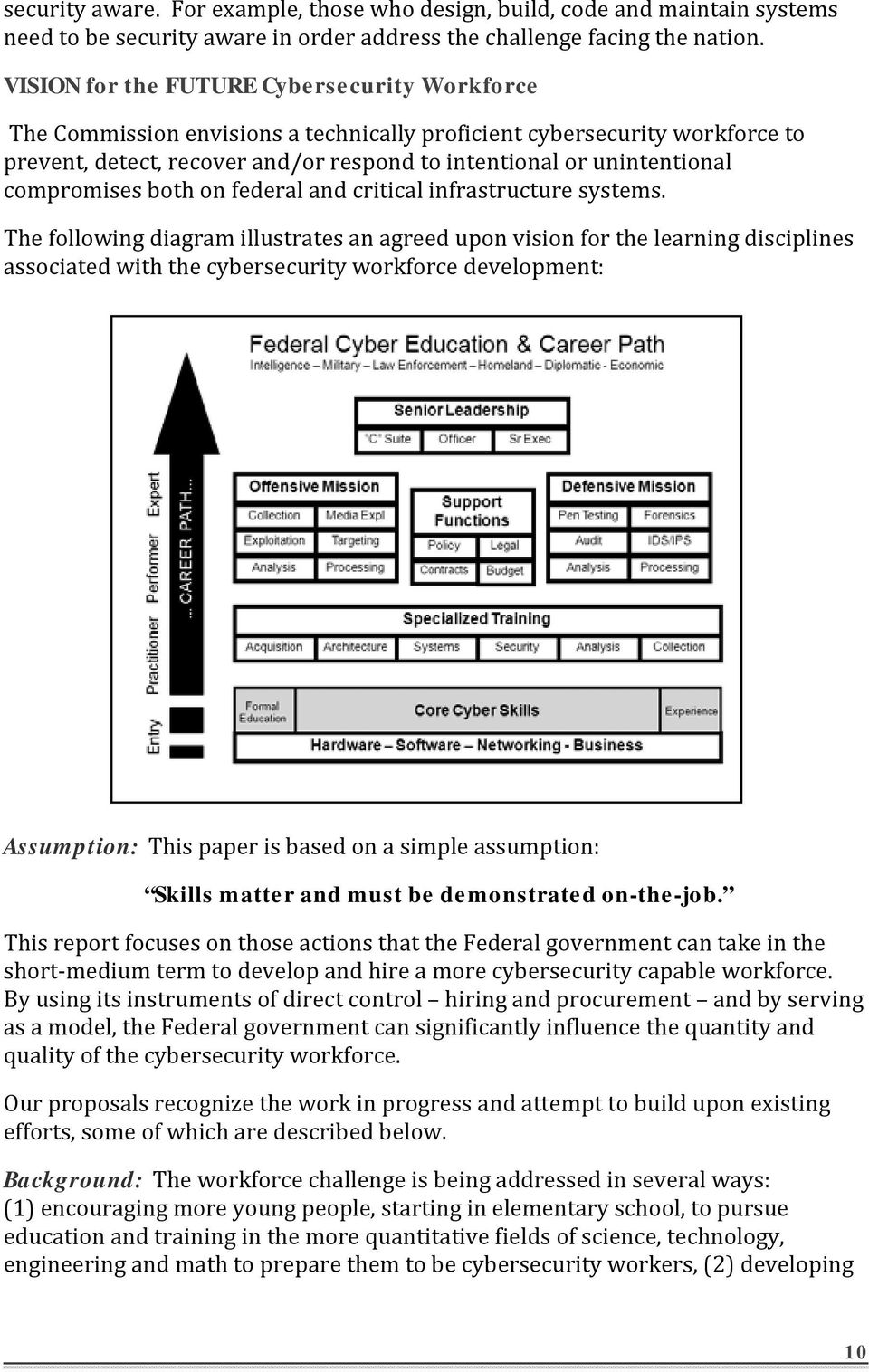
14 security aware. For example, those who design, build, code and maintain systems need to be security aware in order address the challenge facing the nation. VISION for the FUTURE Cybersecurity Workforce The Commission envisions a technically proficient cybersecurity workforce to prevent, detect, recover and/or respond to intentional or unintentional compromises both on federal and critical infrastructure systems. The following diagram illustrates an agreed upon vision for the learning disciplines associated with the cybersecurity workforce development: Assumption: This paper is based on a simple assumption: Skills matter and must be demonstrated on-the-job. This report focuses on those actions that the Federal government can take in the short-medium term to develop and hire a more cybersecurity capable workforce. By using its instruments of direct control hiring and procurement and by serving as a model, the Federal government can significantly influence the quantity and quality of the cybersecurity workforce. Our proposals recognize the work in progress and attempt to build upon existing efforts, some of which are described below. Background: The workforce challenge is being addressed in several ways: (1) encouraging more young people, starting in elementary school, to pursue education and training in the more quantitative fields of science, technology, engineering and math to prepare them to be cybersecurity workers, (2) developing 10
15 more rigorous curricula in computer-related disciplines; and (3) automating daily operational tasks in cybersecurity, like configuration and patch management. While these approaches offer promise for addressing part if not the entire problem in the longer term, we cannot afford to wait. Hence, the Commission s work has been focused on those currently in the workforce and those who are, or will shortly be, in the labor pool. Current Efforts: We do not start with a blank slate. The following is a short description of several organizations and initiatives attempting to address the issues for career paths and training of the cybersecurity workforce. This listing is no means exhaustive but attempts to highlights initiatives that can be leveraged going forward. DEPARTMENT OF HOMELAND SECURITY (DHS) IT Security Essential Body of Knowledge (EBK): A Competency and Functional Framework. The EBK is a framework to map Information technology (IT) security competencies. DHS has included fourteen areas ranging from incident management through digital forensics. The EBK was developed as complimentary framework to existing efforts of the National Institute of Standards and Technology (NIST) or the Committee on National Security Systems (CNSS) guidance on IT security training. DHS built upon established work resources and best practices from the public and private sectors. The EBK is intended to be a resource tool for the public and private sectors as well as higher education in development of curriculum and training. ( INTERNATIONAL INFORMATION SYSTEMS SECURITY CERTIFICATION CONSORTIUM (ISC) 2 ( Certified Information Systems Security Professional (CISSP) is an information security credential accredited by ANSI ISO/IEC Standard 17024:2003 accreditation and leads the industry in acceptance. This certification is included in the Department of Defense (DoD) Information Assurance Workforce Improvement Program. The CISSP curriculum includes ten Common Body of Knowledge (CBK) information security topics. According to the (ISC) 2, the CISSP CBK is a taxonomy a collection of topics relevant to information security professionals around the world. The CISSP CBK establishes a common framework of information security terms and principles that allow information security professionals worldwide to discuss, debate and resolve matters pertaining to the profession with a common understanding. (Tipton; Henry. Official (ISC)² Guide to the CISSP CBK. Auerbach Publications. ISBN ) ISACA ( ISACA, originally known as the, Information Systems Audit and Control Association, ISACA has established the CoBIT auditing and control standards, which are widely recognized and used. ISACA offers the following: 11
16 Certified Information Systems Auditor (CISA); Certified Information Security Manager (CISM); Certified in Governance of Enterprise (CGIT); and Certified in Risk and Information Systems Control (CRISC). The SANS INSTITUTE ( SANS is a graduate degree-granting education and research institution that also provides advanced security training and certifications. Its 120,000 alumni are the computer network defenders, penetration testers, security-savvy system operators, forensics experts, secure programmers, and managers in more than 20,000 organizations ranging from the NSA and the Defense Industrial Base to the FBI to banks to hospitals to universities. CREST ( The United Kingdom has developed a model for hands-on certification in the form of its Council of Registered Security Testers (CREST) test for security penetration testers and is building a network of independent certifiers. CREST was created in response to the need for regulated and professional security testers to serve the global information security marketplace. CREST is a not for profit organization with the goal to represent the information security testing industry and offer a demonstrable level of assurance as to the competency of organizations and individuals within approved companies. The INSTITUTE OF ELECTRICAL AND ELECTRONICS ENGINEERS (IEEE) ( The IEEE is an international non-profit, professional organization, which provides learning opportunities within the engineering, research, and technology fields. The goal of the IEEE education programs is to ensure the growth of skill and knowledge in the electricity-related technical professions and to foster individual commitment to continuing education among IEEE members, the engineering and scientific communities, and the general public. The IEEE offers certification and training for software professionals. Their organization recognizes there is a gap between education and work requirements and attempts to verify the students understanding the fundamentals of software development practices. ( IEEE certifications include: Certified Software Development Associate (CSDA); and Certified Software Development Professional (CSDP). 12
17 THE DEPARTMENT OF JUSTICE; FEDERAL BUREAU OF INVESTIGATION (FBI) The FBI Academy at Quantico provides a cyber education training program for domestic law enforcement and counterintelligence. They train over 2,192 new FBI agents in basic cyber training with 783 FBI cyber agents with advance training and over 1,100 cyber taskforce agents. Currently, the Office of Justice Programs (OJP), Bureau of Justice Assistance (BJA) provides federal assistance for training for law enforcement officials. The Counter Terrorism Training and Resources for Law Enforcement non-profit organization does provide training for cybersecurity and privacy. ( NATIONAL SECURITY AGENCY (NSA) The NSA and the DHS have jointly sponsored the National Centers of Academic Excellence in Information Assurance (IA) Education (CAE/IAE) and CAE-Research (CAE-R) programs. The goal of the programs is to reduce vulnerabilities in our national information infrastructure by promoting higher education and research in IA. It is also attempting address the growing need of professionals with IA expertise in various disciplines. The designation of an institution as a CAE/IAE or CAE-R is valid for five academic years and then, the school must reapply. Students who attend these designated schools are eligible for scholarships and grants through DoD and DHS. ( Additionally, the NSA has an initiative underway which is working to qualifying cyber-warriors. Aspects of this initiative include defining the cybersecurity workforce and moving forward with education and training. DEPARTMENT OF DEFENSE (DoD): DoD M, Information Assurance Workforce Improvement Program. Implements DoD Directive , Information Assurance Training, Certification, and Workforce Management, dated August 15, Provides guidance for the identification and categorization of positions and certification of personnel conducting Information Assurance (IA) functions within the DoD workforce supporting the DoD Global Information Grid (GIG) per DoD Instruction The DoD IA Workforce includes, but is not limited to, all individuals performing any of the IA functions described in the Manual. Additional chapters focusing on personnel performing specialized IA functions including certification and accreditation (C&A) and vulnerability assessment will be published as changes to the Manual. Also establishes IA workforce oversight and management reporting requirements to support DoD Directive DoD M establishes the following goals: Develop a DoD IA workforce with a common understanding of the concepts, principles, and applications of IA for each category, specialty, level, and function to enhance protection and availability of DoD information, information systems, and networks; 13
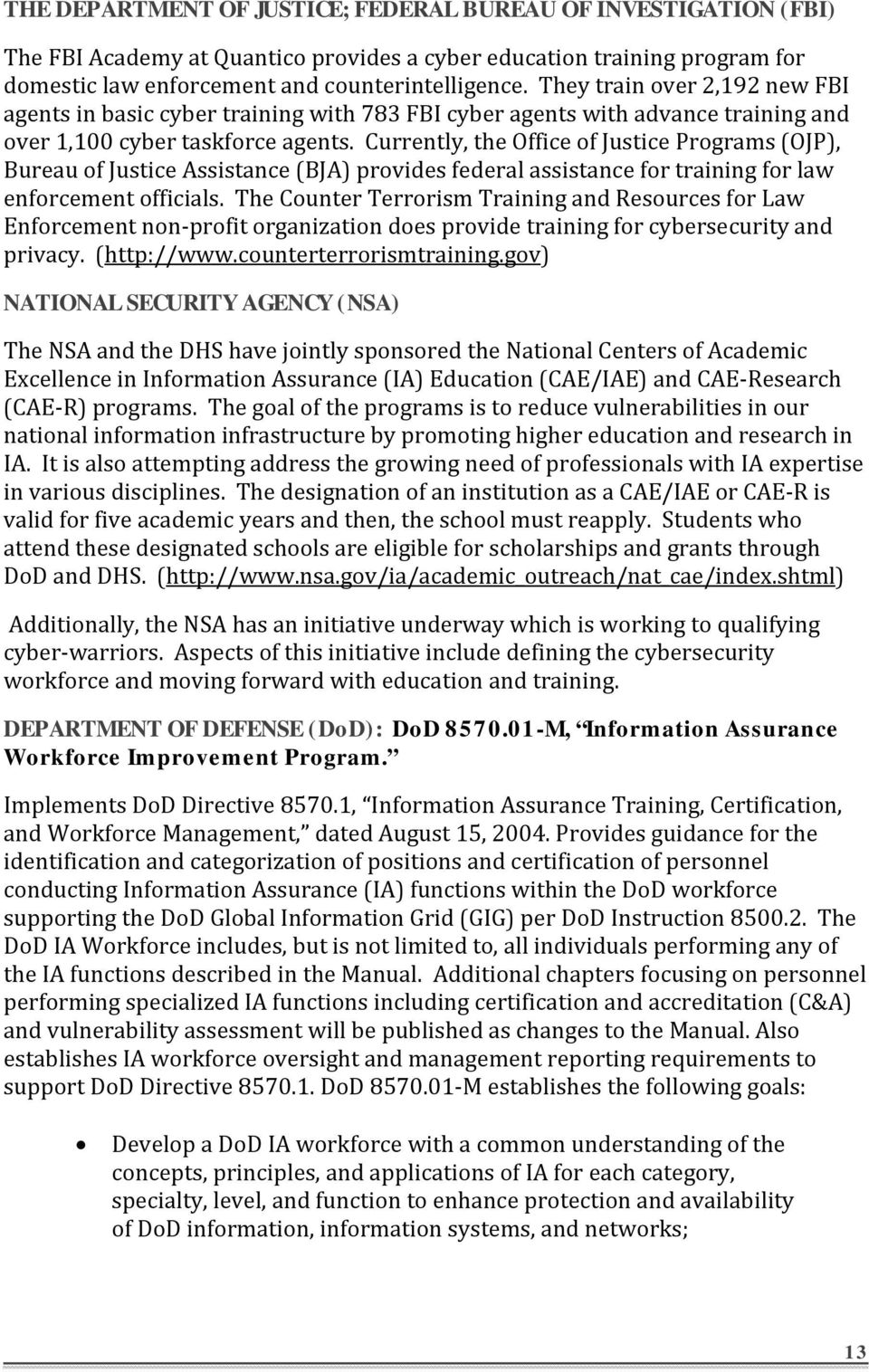
18 Establish baseline technical and management IA skills among personnel performing IA functions across the DoD enterprise; Provide warfighters qualified IA personnel in each category, specialty and level; Implement a formal IA workforce skill development and sustainment process, comprised of resident courses, distributive training, blended training, supervised on the job training (OJT), exercises, and certification/recertification; Verify IA workforce knowledge and skills through standard certification testing; and Augment and expand on a continuous basis the knowledge and skills obtained through experience or formal education. FEDERAL CHIEF INFORMATION OFFICERS (CIO) COUNCIL and the OFFICE OF PERSONNEL MANAGEMENT (OPM) The E-Government Act of 2002 (Section209) ( and Clinger-Cohen Act of 1996 (Division E) ( includes the requirement for the assessment of the competencies and skills of the federal information technology (IT) workforce. The purpose of the requirement is to analyze the needs of the federal government relating to IT and information resources management. Currently, the CIO Council s IT Workforce Committee, in conjunction with the OPM, is working on the new workforce survey instrument. Additionally, they have identified eleven information security roles (See Appendix A, Federal Information Security Workforce Development Matrix: Roles Identifications, Definitions and Prioritization dated April 21, 2009) and have assigned priorities to the roles. They are working on developing a matrix similar to their efforts for project management. To date, there are two draft documents available: Systems Operations and Maintenance Professional and Chief Information Security Officer (See Appendix A, Information Security Workforce Development Matrix (DRAFT): Systems Operations and Maintenance Professional and Information Security Workforce Development Matrix (DRAFT): Chief Information Security Officer). Other Efforts That Could Make a Big Difference: As previously stated, there are several initiatives underway that can be leveraged to address workforce issues. The following initiatives identified by the Commission should be studied, as they initially appear to be addressing short and mid-term cybersecurity workforce issues such as training. 14
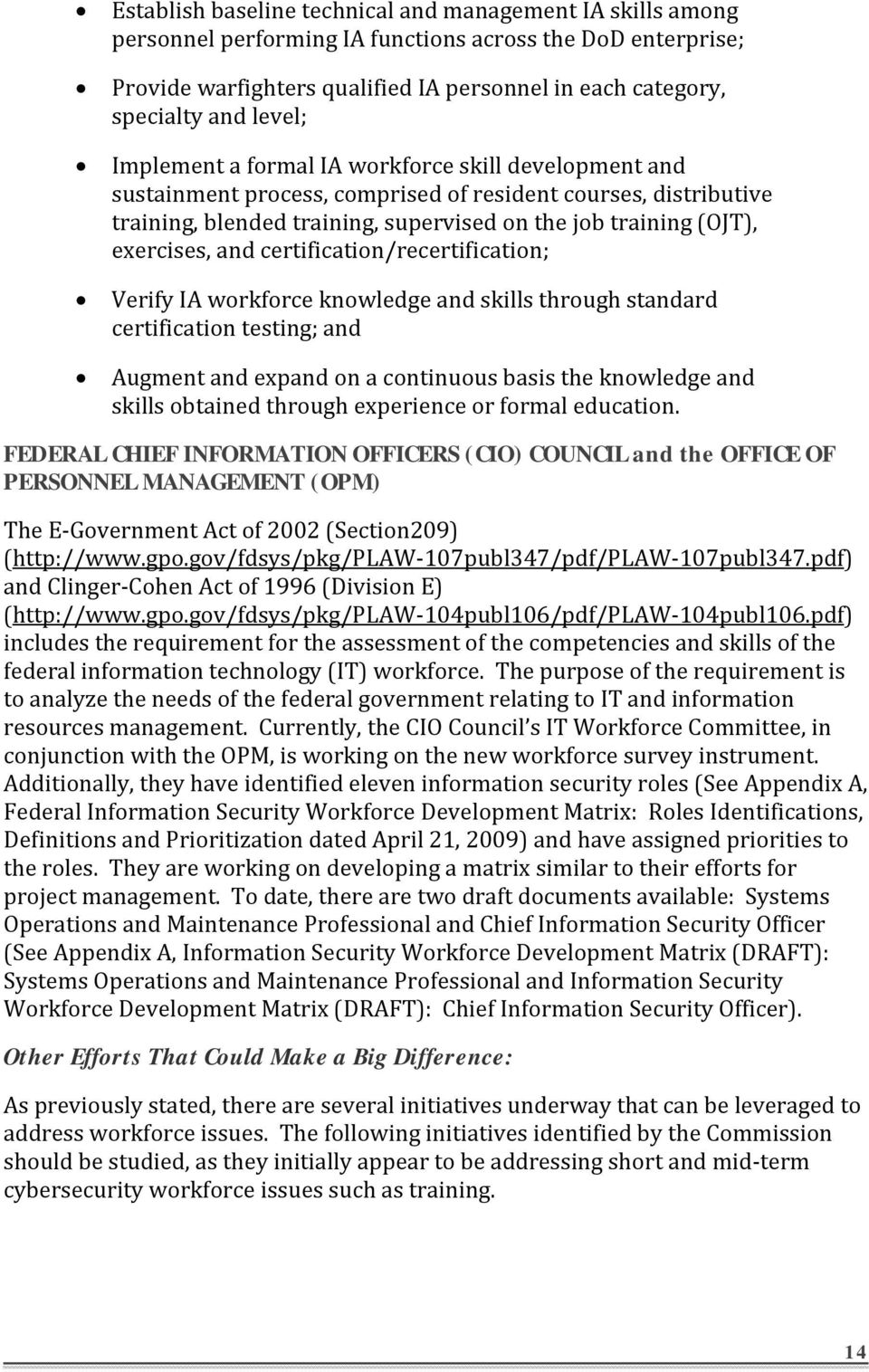
19 STATE DEPARTMENT As discussed above, the State Department team is clearly demonstrating that skills do matter. They have instituted a training program for all new team members covering multiple levels of competency with extensive, hands-on training in their environment. US CYBER COMMAND The US Cyber Command (USCYBERCOM) is a subordinate unified command under the United States Strategic Command created by the Secretary of Defense on June 23, 2009 (See Appendix A, Memorandum for Secretaries of the Military Departments, SUBJECT: Establishment of a Subordinate Unified U.S. Cyber Command Under U.S. Strategic Command for Military Cyberspace Operations). USCYBERCOM includes responsibility for several organizations including: the Joint Task Force for Global Network Operations (JFT-GNO); Joint Functional Component Command for Network Warfare (JFCC-NW); and the Defense Information Systems Agency (DISA), which will provide technical assistance for network and information assurance. They are to coordinate computer-network defense and direct US cyberattack operations. DoD M Change 2 (released Spring 2010) This release reflects the DoD s commitment to continuous improvement in the IA Workforce Improvement Program. Change 2 emphasizes the Department s intent that the IA Workforce Improvement Program rely on skills-based training aligned with operational needs. DoD components will be encouraged to construct training and certification regimes that develop and assess the skills necessary to provide effective IA capabilities. This emphasis, coupled with improved compliance metrics, will move the Department away from reliance on stand alone, prescriptive certifications as the primary compliance metric for IA Workforce training and certification. US CYBER CHALLENGE ( The Center for Strategic and International Studies (CSIS) brought together executives from high tech companies, academics, and government officials to launch under a project known as the US Cyber Challenge enabling Americans to demonstrate their cybersecurity knowledge, skills, and passion. As part of this effort, candidates who prove their skills are being invited to attend regional cyber camps which will be held at local colleges, where they will continue to develop their skills more fully and participate in additional competitions. The best of the candidates will be introduced to key federal agencies and corporations where the most advanced cybersecurity work is being done. Several Examples of Cyber Challenge competitions are show in the following table: 15

20 Competition Target audience What it does Impact Cyber Security Treasure Hunt Adults and college students (and very talented high school students who want to prove they have basic mastery of vulnerabilities and other areas of security) Like a scavenger hunt, the game delivers an on-line quiz that sends candidates to a simulated environment where they can safely explore, find answers, and return to the quiz. This is the primary qualification for students wishing to earn a place in the 2010 cyber camps. Comment: Even if the contestant cannot complete all the challenges, it creates a powerful interest to learn and explore more of these ideas. CyberPatriot High school students Students must harden systems to block attacks and are scored on their success in keeping the attackers out. An Air Force official: all the contestants I met are interested in pursuing degrees, scholarships, USAF appointments, etc., to have a role in cyberspace in some form in the future! Netwars Adults and college students (and very talented high school students) who have very high levels of skills and want to prove they should win internships and scholarships at important organizations. Students work in a real-world, on-line laboratory where contestants must capture and hold cyber territory as hundreds of others try to do the same. CNN s story of December 21 shows the impact: finds the ultratalented kids and gets them jobs DC3 Digital Forensics Challenge Separate competitions for high school students, college students, and adults to show Provides a disk image of data taken from actual cases investigated by the DoD Cyber Crime Center and Motivates young people to further develop their forensics skills. 16
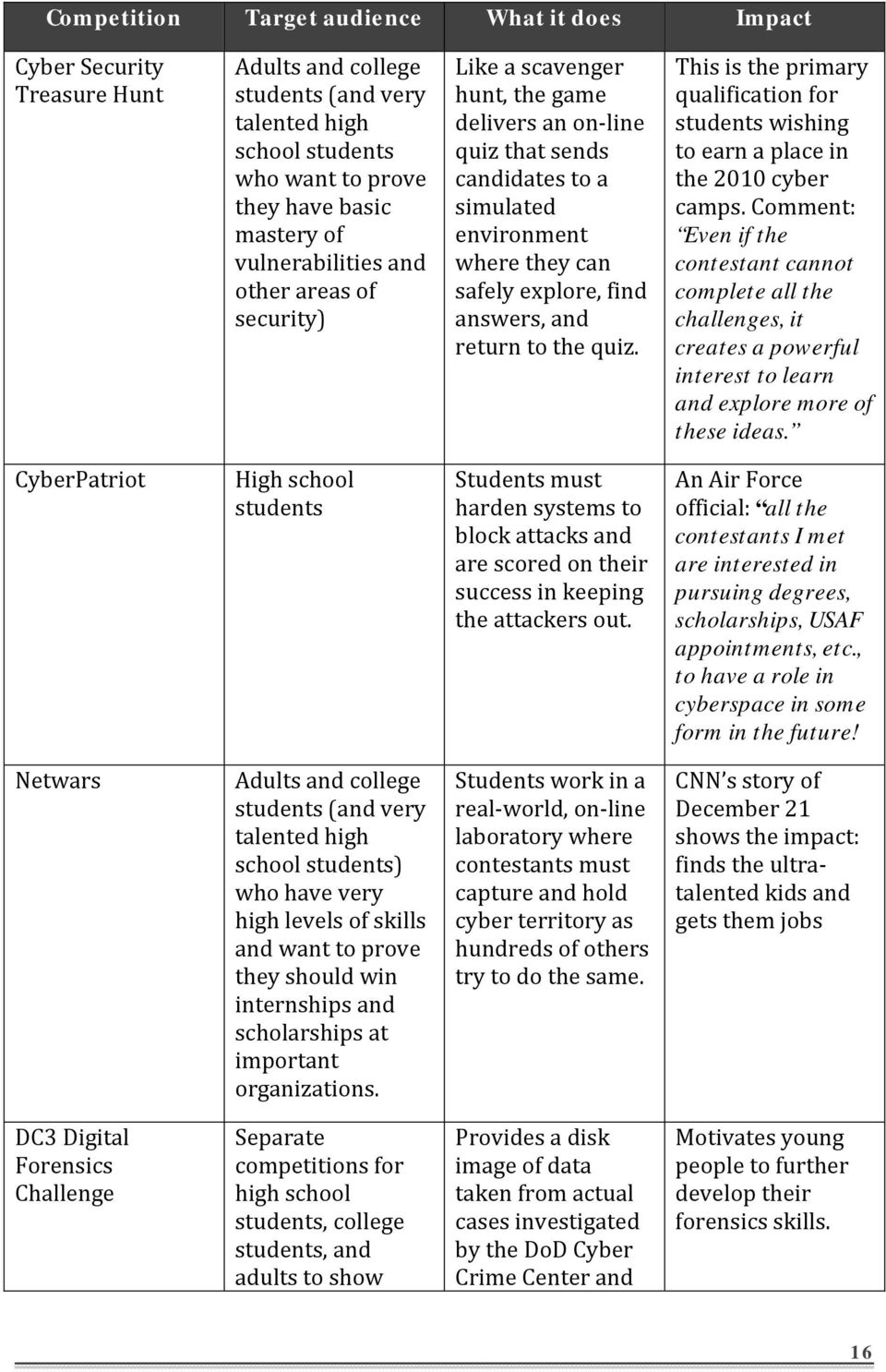
21 they have forensics skills asks four levels of questions. The fourth level includes questions even DC3 does not know how to answer. On-site cyber tournaments College students Teams come together to attack and defend systems over a period of one-totwo days. The entire first place team in the tournament held at CSU Cal Poly Pomona was offered cyber security jobs by Boeing. UNIVERSITY OF MARYLAND UNIVERSITY COLLEGE (UMUC) ( The University of Maryland University College (UMUC) has three new degree programs starting in Fall They are a Bachelor and Master of Science in cybersecurity and Master in Science in Cybersecurity Policy. The UMUC is the largest U.S. public university with approximately 94,000 enrolled, which includes 50,000 active duty military, reserves, dependents, and veterans. NATIONAL COLLEGIATE CYBERSECURITY COMPETITION ( The mission of the Collegiate Cyber Defense Competition (CCDC) system is to provide institutions with an information assurance or computer security curriculum in a controlled, competitive environment to assess their students depth of understanding and operational competency in managing the challenges inherent in protecting a corporate network infrastructure and business information systems. Competition has grown from 5 schools in 2005 to 63 schools across 8 regions in CCDC Events are designed to: Build a meaningful mechanism by which institutions of higher education may evaluate their programs. Provide an educational venue in which students are able to apply the theory and practical skills they have learned in their course work 17
22 Foster a spirit of teamwork, ethical behavior, and effective communication both within and across teams Create interest and awareness among participating institutions and students. DEFENSE ADVANCED RESEARCH PROJECTS AGENCY (DARPA) ( The Defense Advanced Research Projects Agency (DARPA) mission is to facilitate research and development including the development of new technology and techniques for use by the military. One example is the recently completed program titled, The Cyber Trust Program which was to create the technology and techniques to enable trustworthy information systems by: 1. Developing hardware, firmware, and microkernel architectures as necessary to provide foundational security for operating systems and applications. 2. Developing tools to find vulnerabilities in complex open source software. 3. Developing scalable formal methods to formally verify complex hardware/software. Next Steps: Recommendations With all these activities underway, it is the Commission s intention to give impetus to and leverage the existing effort and initiatives to move forward in a comprehensive manner. The current Administration is addressing the education of cyber professional as part of the Comprehensive National Cybersecurity Initiative, an unclassified description of which was released on March 2, The topic is included as Initiative 8: Expand cyber education. While billions of dollars are being spent on new technologies to secure the U.S. Government in cyberspace, it is the people with the right knowledge, skills, and abilities to implement those technologies who will determine success. However there are not enough cybersecurity experts within the Federal Government or private sector to implement the CNCI, nor is there an adequately established Federal cybersecurity career field. Existing cybersecurity training and personnel development programs, while good, are limited in focus and lack unity of effort. In order to effectively ensure our continued technical advantage and future cybersecurity, we must develop a technologically skilled and cyber-savvy workforce and an effective pipeline of future employees. It will take a national strategy, similar to the effort to upgrade science and mathematics education in the 1950 s, to meet this challenge. 18
23 ( By building on many of the activities underway, the Commission is recommending the following for both the Executive Branch and Legislative Branch of the Federal Government: 1. The President s cybersecurity coordinator should sponsor an effort to create an initial taxonomy of cyber roles and skills (See Appendix B, Taxonomy of Roles, v5 Draft) that can be the basis for recruiting and training and provide a more specific target for the education and training community to drive curriculum development and a regime of professional certifications grounded in practical reality; 2. The Office of Management and Budget (under the leadership of the Chief Information Officer and the Administrator of Federal Procurement Policy) in conjunction with the National Institute Standards and Technology should ensure the skills matrix along with future certification and eventually licensing requirements, if appropriate, be included as standards in their and develop any additional procurement language, if necessary for: PART 39-ACQUISITION OF INFORMATION TECHNOLOGY 1. The authority citation for 48 CFR part 39 continues to read as follows: Authority: 40 U.S.C. 121(c); 10U.S.C. chapter 137; and 42 U.S.C. 2473(c). 2. Amend section by revising paragraph (d) to read as follows: Policy. (d) In acquiring information technology, agencies shall include the appropriate IT security policies and requirements, including use of common security configurations available from the NIST's website at Agency contracting officers should consult with the requiring official to ensure the appropriate standards are incorporated. ( da/fy2008/m08-22.pdf) 3. The Chief Information Officers Council should modify its biennial survey of the Federal information technology workforce to elicit more granular information on the cybersecurity skill profile of that workforce and to identify gaps; 4. The Office of Personnel Management should draft an action plan to 19
24 address career path issues in the Federal workforce including developing a separate job series similar to the existing professional services such as legal/medical/chaplain/mental health and/or adjust the law enforcement classification (agents with the power to carry weapons and make arrests) to also include special hiring authority where there is evidence of shortages, consider mandatory continuous training, and/or establishing an extensive probationary period for skills to be demonstrated on-the-job; 5. The Department of Homeland Security in conjunction with the Federal CIO Council should create the Cyber Corp Alumni group which would include the top 10 percent of the students who complete the program. As part of this initiative, the program for the alumni group would include specific set of benefits such as training on how to be a Chief Information Security Officer; networking with top cybersecurity professionals; and other related topics; 6. Develop model legislative language to address potential workforce gaps (See Appendix C, Definition for Legislative Branch); and 7. The Department of Labor s Bureau of Labor Statistics (BLS) should lead an interagency committee to develop Standard Occupational Classification (SOC) for cybersecurity workforce ( This committee work would build upon the taxonomy recommended in Item 1. Recommended Action Plan: The following actions could be taken in order to address the recommendations. The actions are intended to be a starting place not necessarily inclusive of all actions which must be taken to achieve the all the workforce issues: 3 to 6 Months: Harmonize the existing efforts with the Office of National Director; Office of Personnel Management and the Federal Chief Information Officers (CIO) Council to address potential for a new federal personnel classification series. For example: Address the need for forensic analysts; Develop and expand the workforce survey initiative of the Federal CIO Council to address cybersecurity throughout the federal workforce; Create the Cyber Alumni Group; Begin development of the program for the Cyber Alumni Group; Expand on the initial taxonomy of cybersecurity roles and skills (See Appendix B, Taxonomy of Roles ); Finalize the definitions for cybersecurity services (See Appendix 20
25 C, Model Legislative Language); Develop model procurement language for inclusion in federal contracts; and Finalize model legislative language to address cybersecurity workforce issues for the executive branch to share with Congress. 6 to 9 Months: Publish the classification standards for any new designations for cybersecurity positions; Recruit a workforce on the basis of the agreed upon classification standards; Finalize the taxonomy and train agency personnel on its use. The Office of Personnel Management in conjunction with the Federal CIO Council should take the lead for this effort; Include model legislative language for the cybersecurity workforce for inclusion in any appropriate cyber-related legislation; Develop curriculum for inclusion of federal programs such as Scholarship for Service; Establish and invite membership to the Cyber Alumni Group; Finalize the model procurement language for inclusion in contracts along with appropriate policy documents if necessary; Establish the SOC Committee to address the outcome of the finalized taxonomy; and Conduct the workforce survey. 9 to 12 Months: Analyze and finalize the workforce survey to include recommendations; Finalize initial curriculum to address future needs on the basis of the recommendations identified from the final workforce survey; Identify and develop activities to be automated for the cybersecurity workforce including but not limited to configuration management and patch management; Review and update the taxonomy on the basis of the recommendations identified from the workforce survey; Continue the Cyber Alumni Group initiative; Finalize the SOC and Update the SOC Manual; and Review and ensure contracts are being updated with the approved procurement language. 12 Months and beyond: Develop and deploy training programs addressing the existing federal workforce; 21
26 Continue to recruit and train the cybersecurity workforce; Develop and deploy automated tools for lower level daily cybersecurity tasks; Continue with the development and enhancement of the Cyber Alumni Group initiative; Update and modify curriculum for federally funded cybersecurity programs; and Continue to address workforce issues to ensure a clearly defined career path. Long Term Recommendations: The following recommendations will sustain and maintain the professional cybersecurity workforce for both the public and private sectors: 1. The creation of an ongoing U.S. Cyber Challenge by leveraging the existing efforts and initiative launched by CSIS; and 2. The establishment of an independent Board of Information Security Examiners to develop and administer a process for certifying cybersecurity professionals in each area of specialization as developed from the action plan above. The areas of specialization should include not only so-called cybersecurity roles, such as intrusion detection and forensics, but also areas such as software development and network operations, which are critical to cybersecurity. GOVERNANCE The creation of an ongoing U.S. Cyber Challenge and an independent Board of Information Security Examiners recommended in this report raises the issue of how those efforts should be governed. Both initiatives are intended to create a pipeline of technically proficient cybersecurity practitioners and to provide employers and purchasers of cybersecurity services some level of assurance as to the integrity and competence of those whom they engage. The following outlines the potential alternatives for the independent Board of Information Security Examiners, which is envisioned to set the standards for all related activities for certification: ANALYSIS OF ALTERNATIVES There are several options for overseeing this initiative: 1. Status quo: a variety of professional societies and for-profit entities developing and issuing certifications along with separate entities operating what is currently the U.S. Cyber Challenge. 2. Federated model: A central body that establishes standards for and accredits professional certifications including developing 22
27 model certifications. Testing is conducted by accredited professional organizations. 3. Unified model: Independent Board of Information Security Examiners is established in which a single body administers all professional certifications. In our view, the criteria for evaluating governance options are: Relevance to the current and future labor market. As is already obvious, cybersecurity is a diverse and dynamic field that requires a broad range of ever-evolving sets of skills. Most importantly, training and certifications need to be connected to real jobs in the current marketplace AND new challenges. This criterion also includes the time to implement the model. Independence and integrity. Potential employers and purchasers of cybersecurity services need to be assured that certification processes have intellectual rigor and are not unduly biased by the economic interests of particular providers. Sustainability. There needs to be a viable business model. The status quo A number of certification programs have evolved, some even ISO certified. A few address specific equipment or technologies while others are more general. While the existence of such programs has spurred investments in training, the consensus of the CSIS Commission was that, all too often, there was little if any connection to the specific technical cybersecurity skills that are needed in the workplace. In the absence of an alternative, several organizations have built robust and highly profitable lines of business and are understandably anxious to evolve the work that they have done to meet changing needs. The Federated Model As included this report, there are number of certification programs already underway. The Federated Model could move forward on its own and eventually there will evolve standards and certification. Many times under a model such as this one, the time to implement and/or evolve is long due to the need to engage a large number of stakeholders and build consensus. Additionally, it would be difficult to ensure these skills are demonstrated and included in the procurement vehicles. The Unified Model There is the Unified Model, which is working in other professions (e.g., electricians, day care providers, and the medical profession). The challenges of developing and 23
28 implementing a reliable regime for certifying and licensing cybersecurity professionals will be difficult. These other professions, most notably the medical profession, have built a structure of independent certifying bodies linked to State licensing requirements. To practice in most jurisdictions, physicians are required to meet certain educational requirements and demonstrate certain practical experience at independently accredited institutions. See Other medical-related professions nurses, physician assistants, etc are subject to similar requirements. And the education sector has responded by developing curricula that support certification and licensing and, we are convinced, will do so if the roles and skills required in the cybersecurity workforce are clearly defined. Medicine has addressed the need for more specialized professional certifications under a regime overseen by the American Board of Medical Specialties ( Board certifications, rigorously administered and overseen, provide important information about the skills and knowledge of practitioners to the purchaser of medical services. While no test or credential can guarantee an outcome, taken together with information about performance, it increases the quality of care and patient s level of assurance. Similarly, it is essential to assure that those who buy cybersecurity services have tools to evaluate the competence of those whom they engage. Facing medical problems, few of us have the knowledge to evaluate the competence of those to whom we turn for assistance. Instead, we rely on a combination of independently administered professional certifications and state licensing authorities to tell us whether the provider has the needed training and has demonstrated the skills that we need. The following shows the potential functional areas, which could be governed by the Independent Board of Examiners: Potential Governance Work Areas Formal Cybersecurity Education Cybersecurity Workforce Structure Cybersecurity Workforce Training & Prof Dev t 1 General IT Use 2 IT Infrastructure, Operations, Maintenance, Information Assurance 3Domestic Law Enforcement and Counterintelligence 4 Specialized Cybersecurity Operations 24
29 The following table includes our assessment using the criteria defined with a low to high ranking of the criteria for each alternative: Summary Assessment Status Quo Federated Unified Relevance Low-medium High High Rigor and Independence Low-medium High High Sustainability High Medium High On the basis of our analysis, the Commission is recommending the creation of a governance body initially based on a federated model, which would develop and administer certifications in two or three specialty areas and evaluate whether some/any existing certification programs meet its standards. The organization could be created initially as a not-for-profit in order to conduct the pilots. The effort would be under the direction of a Board of overseers that would include 3-5 representatives each from: Major private sector organizations that employ high-end cybersecurity professionals; Universities with major cyber education and research programs; and Key Federal government agencies and congressional committees. 3 The role of the oversight board would be to direct and evaluate a two-year pilot test and, at the end of the first year, offer recommendations on whether/how the body should continue. CONCLUSION We are unified by a shared objective to help protect our critical infrastructure by detecting, responding to and ultimately preventing cyber attacks and accidents. Our analysis indicates there are many initiatives and efforts underway. As included in the President s Cyberspace Policy Review, the CNCI initiatives are mutually reinforcing and are designed to help secure the United States in cyber space. The goal to strengthen the future cybersecurity environment by expanding cyber education;. can be achieved by implementing the recommendations included in this paper. We are beginning now. 3 Since this would be an oversight/advisory group, not a board of directors with fiduciary responsibilities, we presume that it will be possible for government officials to participate 25
30 FEDERAL INFORMATION SECURITY WORKFORCE DEVELOPMENT MATRIX: Roles Identification, Definition, and Prioritization INFORMATION SECURITY DRAFT ROLES* (Last updated 4/21/2009) *The following listed roles are specific to the information security, information assurance, and information technology security function and environment. High Priority 1. Chief Information Security Officer- The Chief Information Security Officer (CISO) is responsible for the information security strategy within an organization. The CISO establishes, implements, and monitors the development and subsequent enforcement of the organization s information security program (i.e., policies, procedures, security architecture standards, security awareness and training program, IT contingency plans, IT security compliance issues). The CISO leads the evaluation and assessment of the security program to ensure that all aspects are in compliance with security requirements, while understanding security threats and vulnerabilities to operations and the organization s environment. The CISO is responsible for information security risk management (e.g., determines risk impact, establishes risk mitigation plans and programs, works with business owners to devise processes for risk assessment) within the organization. The CISO manages the incidents response program (e.g., identifies, reports, and remediates incidents). 2. Systems Operations & Maintenance Professional- The Systems Operations and Maintenance Professional supports and implements the security of information and information systems during the operations, maintenance, and enhancements phases of the systems development life cycle. The Systems Operations and Maintenance Professional is also responsible for implementing server configurations, operating systems, database systems, firewalls, patch management, and account management to protect the systems against threats and vulnerabilities. 3. Network Security Specialist- The Network Security Specialist is responsible for examining malicious software, suspicious network activities, and non-authorized presence in the network to analyze the nature of the threat, and secure and monitor firewall configurations. The Network Security Specialist needs to understand the specimen s attack capabilities, its propagation characteristics, and define signatures for detecting malware presence. 4. Digital Forensics & Incident Response Analyst- The Digital Forensics and Incident Response Analyst performs a variety of highly technical analyses and procedures dealing with the collection, processing, preservation, analysis, and presentation of computer-related evidence, and is responsible for disseminating and reporting cyber-related activities, conducing vulnerability analyses and risk management of computer systems and all applications during all phases of the systems development lifecycle. The Digital Forensics and Incident Response Analyst provides oversight of incident data flow and response, content, and remediation, and partners with other incident response centers in maintaining an understanding of threats, vulnerabilities, and exploits that could impact networks and assets. 5. Information Security Assessor- The Information Security Assessor is responsible for overseeing, evaluating, and supporting compliance issues pertinent to the organization. Individuals in this role perform a variety of activities that encompass compliance from internal and external perspectives. These include leading and conducting internal investigations, helping employees to comply with internal policies and procedures, and serving as a resource for external compliance officers during independent assessments. The Information Security Assessor provides guidance and autonomous evaluation of the organization to management. This individual is responsible for planning and executing information systems operational assessment by obtaining, analyzing, and appraising competent evidential data for forming an objective opinion on the adequacy of information systems, procedures, and documentation. This individual also prepares, tests, and utilizes generalized computer audit software, programs, and questionnaires for accomplishing audit objectives and procedures. Medium Priority 6. Information Systems Security Officer- The Information Systems Security Officer (ISSO) specializes in the information and security strategy within a system and is engaged throughout the systems development life cycle. The ISSO is charged with the development and subsequent enforcement of the company s security policies and procedures, security awareness programs, business continuity and disaster recovery plans, and all industry and governmental compliance issues. The ISSO communicates with the business at the system level and understands security threats and vulnerabilities to the operations and the system s environment. 7. Security Architect- The Security Architect is responsible for implementing business needs. The Security Architect supports the business function as well as technology and environmental conditions (e.g., law and regulation), and translates them into security designs that support the organization to efficiently carry out its activities while minimizing risks from security threats and vulnerabilities. 8. Vulnerability Analyst- The Vulnerability Analyst is responsible for detecting threats and vulnerabilities in target systems, networks, and applications by conducting systems, network, and web penetration testing. The Vulnerability Analyst identifies flaws that can be exploited to cause business risk, and provides crucial insights into the most pressing issues, suggesting how to prioritize security resources. 9. Information Security Systems & Software Development Specialist**-The Information Security Systems and Software Development Specialist is responsible for secure design, development, testing, integration, implementation, maintenance, and/or documentation of software applications (web based and non-web) following formal secure systems development lifecycle processes and using security engineering principles. 26
31 FEDERAL INFORMATION SECURITY WORKFORCE DEVELOPMENT MATRIX: Roles Identification, Definition, and Prioritization Low Priority 10. Chief Information Officer- The Chief Information Officer (CIO) focuses on information security strategy within an organization and is responsible for the strategic use and management of information, information systems, and IT. The CIO establishes and oversees IT security metrics programs, including evaluation of compliance with corporate policies and the effectiveness of policy implementation. The CIO also leads the evaluation of new and emerging IT security technologies. 11. Information Security Risk Analyst- The Risk Analyst is responsible for facilitating and developing datagathering methods to control and minimize risks by understanding external threats and vulnerabilities to the operation and environment. The Risk Analyst analyzes vulnerabilities identified and implements best practices in their mitigation. This individual communicates compliance regulations and policies, monitors audit preparation practices, and implements risk management policies and procedures. ** The Information Security Systems & Software Development Specialist is an emerging role that was not rated on importance in the February focus group exercise. This role is classified under medium priority until further data and feedback can be obtained and analyzed. 27
32 INFORMATION SECURITY WORKFORCE DEVELOPMENT MATRIX* Systems Operations and Maintenance Professional**: The Systems Operations and Maintenance Professional supports and implements the security of information and information systems during the operations, maintenance, and enhancements phases of the systems development life cycle. The Systems Operations and Maintenance Professional is also responsible for implementing server configurations, operating systems, database systems, firewalls, patch management, and account management to protect the systems against threats and vulnerabilities. Performance Suggested Learning & Development Description/Complexity Competencies/Skills Suggested Credentials Level Sources I: Entry Has a basic understanding of computer systems and related information security software and hardware components Ability to perform basic security system administration duties including software and hardware installation, troubleshooting, system backup, network component maintenance Basic understanding of tools and methods for identifying anomalies in system behavior; develops ability to recognize anomalies Applies skills and abilities with supervision on projects, programs, and initiatives with low threat and scope (e.g., inter-office) II: Intermediate Applies an understanding of the information security operational characteristics of a variety of computer platforms, networks, software applications, and operating systems Ability to explain to others the methods and techniques used in installation, testing, network debugging, troubleshooting, and maintenance of PCs, servers, printers, and related equipment Automates repetitive processes (e.g., log reviews, configuration testing) to facilitate information security operations Evaluates and assesses operating practices to determine adequate risk management and compliance standards, with on-going systems monitoring Is responsible for contributing, with limited supervision, to projects, programs, and initiatives with medium-threat and moderate scope (e.g., suborganization wide) III: Advanced Effectively communicates technical information to non-technical audiences; influences others to comply with policies and conform to standards and best practices Designs the organization s working information security systems operations and maintenance strategy and methodology to comply with the organization s standards and mission Understands the needs of the organization and establishes appropriate vendor relationships to manage the proposal and purchasing process Attends and participates in professional conferences to stay abreast of new trends and innovations in the field of information systems Independently manages, plans, evaluates, and advocates for information security compliance systems, plans, and functions, and is responsible for the management of complex projects, programs, and initiatives with high threat and large scope (e.g., agency-wide or inter-governmental), with on-going systems monitoring Performance levels are associated with recommended proficiency descriptors applicable to each of the relevant competency/skill models listed below. Competency/Skill Proficiency Descriptors I-Entry: Basic understanding of concepts addressed in relevant competency/skill models II-Intermediate: Working knowledge and application of relevant competency/skill models in work activities III-Advanced: Advanced application and mastery of relevant competency/skill models Relevant Competency/Skills Sources: OPM GS-2200 Job Family Standard Competencies Clinger-Cohen Core Competencies with an emphasis on Technical, Desktop Technology Tools, and IT Security/Information Assurance competency areas ( DHS EBK Competencies FISMA Guidance OPM s IT Workforce Roadmap NIST SP , Revision 1 ODNI Cyber Subdirectory Competencies DoD Directive 8570 CNSS Policies, Directives, and Reports 0-3 years experience involving work directly related to systems operations and maintenance (e.g., help desk); OR a Bachelors Degree (suggested areas of study include Computer Science, Information Technology, Information Assurance/Security, Engineering, Business/Management) Participation in Scholarship for Service program through a designated Center of Academic Excellence in Information Assurance Education (CAEIAE) Bachelors Degree and 2+ years experience (suggested areas of study include Computer Science, Information Technology, Information Assurance/Security, Engineering, Business/Management, or degrees from a designated CAEIAE); OR 3-5 years experience involving work directly related to security control evaluation and implementation on information technology, systems, and programs Possession and demonstrated application of relevant certifications Core: MCSE, CCNA, CCNP, ISC² CAP Related: CISSP, CISM, ISC² ISSMP, CompTIA, SANS GIAC, PMP Bachelors Degree and 3+ years experience (preferred areas of study include Computer Science, Information Technology, Information Assurance/Security, Engineering, Business/Management, or degrees from a designated CAEIAE); OR 5+ years of experience involving work directly related to security control evaluation and implementation on information technology, systems, and programs Demonstrated experience in managing/supervising a systems operations and maintenance group Possession and demonstrated application of relevant certifications Core: MCSE, CCNA, CCNP, ISC² CAP Related: CISSP, CISM, ISC² ISSMP, CompTIA, SANS GIAC, PMP 1. Development Resources: IT Workforce Roadmap (IT Roadmap) Graduate Programs, USDA IT Programs GoLearn Courses ( CIO Council ( DoD DISA Training GSA s CIO university Program 2. University Information Security Programs: National Defense University- IRM College IS/IA Degree Programs- CAEIAE Private University Programs (e.g., GMU, MIT) 3. OPM Development Center: The Federal Executive Institute and the Management Development Centers 4. Participation in coaching/mentoring/job shadowing programs 5. Agency Requirements: organization and business area training identified as required 6. Clinger-Cohen Core Competencybased training sources and Capital Planning and Investment Control (CPIC) mandate 7. Current and emerging legislation, policy, and regulations (e.g., FISMA, NIST SP-800 series, FIPS, OMB directives, CNSSI No. 4012) 8. Training by external vendors for security configuration (e.g., Oracle, Computer Associate, IBM, and HP Tools, Sans Institute) * Criteria included in the above matrix are provided as guidance only. These criteria are not a replacement for OPM basic qualifications as outlined in the relevant occupational qualification standards. The intention of the qualifications matrix is to assist departments/agencies in defining the qualifications criteria that are most relevant and applicable to their IT Security workforce. No singular qualification component on its own (i.e., education) should be the sole determinant in classifying an individual s proficiency level. Rather, all aspects of experience, competencies, education, and training/certifications should be considered when making performance level evaluations. **The role description is specific to the information security, information assurance, and information technology security function and environment. 28
33 INFORMATION SECURITY WORKFORCE DEVELOPMENT MATRIX* CHIEF INFORMATION SECURITY OFFICER**: The Chief Information Security Officer (CISO) is responsible for the information security strategy within an organization. The CISO establishes, implements, and monitors the development and subsequent enforcement of the organization s information security program (i.e., policies, procedures, security architecture standards, security awareness and training program, IT contingency plans, IT security compliance issues). The CISO leads the evaluation and assessment of the security program to ensure that all aspects are in compliance with security requirements, while understanding security threats and vulnerabilities to operations and the organization s environment. The CISO is responsible for information security risk management (e.g., determines risk impact, establishes risk mitigation plans and programs, works with business owners to devise processes for risk assessment) within the organization. The CISO manages the incidents response program (e.g., identifies, reports, and remediates incidents). Performance Level III: Advanced Description/Complexity Competencies/Skills Suggested Credential Demonstrates an in depth understanding of enterprise-wide, multi-platform operating systems security, network security, application security, database security, regulatory compliance, incident and risk management Identifies, understands, manages, and interprets information security risks and threats as it affects the business and aligns the information security strategy to achieve organizational mission Designs the organization s information security governance framework to facilitate the implementation of the organization s information security strategy Set expectations, determines appropriate security measures to be used across the department/agency, and maintains governance over the standards and methodologies for information security risk management and compliance reviews Independently manages, plans, evaluates, and advocates for information security solutions, plans, and functions, and is responsible for the management of complex projects, program, and initiatives with high threat and large scope (e.g., organization-wide or inter-governmental) Leads, enables, and is accountable for the implementation and integration of solutions to ensure information security within the organization Understands mechanisms for securing new technologies; understands the impact of new and emerging technologies on the information security environment, as well as tools and methods for mitigating risks Performance levels are associated with recommended proficiency descriptors applicable to each of the relevant competency/skill models listed below Competency/Skill Proficiency Descriptors III-Advanced: Advanced application and mastery of relevant competency/skill models Relevant Competency/Skill Sources: NIST SP Information Security Handbook: A Guide for Managers OPM GS-2200 Job Family Standard Competencies Clinger-Cohen Core Competencies with an emphasis on Technical, Desktop Technology Tools, and IT Security/Information Assurance competency areas DHS EBK Competencies FISMA Guidance OPM s IT Workforce Roadmap NIST SP , Revision 1 ODNI Cyber Subdirectory Competencies DoD Directive 8570 CNSS Policies, Directives, and Reports OPM s Executive Core Qualifications (ECQs) (for SES positions) Additional Key Competencies identified for this role (for senior management positions): Leadership & People Management Written & Oral Communication Creative Problem Solving Budget Formation & Allocation Project/Program Management Graduate Degree with 5+ years experience (suggested areas of study include Computer Science, Information Technology, Information Assurance/Security, Engineering, Business/Management, or degrees from a designated CAEIAE); OR 8+ years of experience involving work with transferable skills related to information security, incident and risk management Demonstrated experience in leading an Information Security/IA compliance group Possession and demonstrated application of relevant certifications Core: CISSP, CISM, CISA, GSLC Related: ISSMP, CIW-Security, CAP, COMPTIA Security clearance commensurate with organizational requirements Suggested Learning & Development Sources 1. University Information Security Programs: National Defense University- IRM College IS/IA Degree Programs- CAEIAE Private University Programs (e.g., GMU, MIT) 2. OPM Development Center: The Federal Executive Institute and the Management Development Centers 3. Attendance at industry conferences, work groups, and briefings (i.e., DHS- GFirst; FIA; Black Hat; RSA; ISACA; SANS FIRE; CAISSWG; AFCEA) 4. Development Resources: IT Workforce Roadmap (IT Roadmap) Graduate Programs, USDA IT Programs GoLearn Courses ( CIO Council ( DoD DISA Training AFCEA ( CAISSWG GSA s CIO University Program 5. Participation in coaching/mentoring/job shadowing programs 6. Agency Requirements: organization and business area training identified as required 7. Current and emerging legislation, policy, and regulations (e.g., FISMA, NIST SP-800 series, FIPS, OMB directives, CNSSI No & 4012 ) 8. Training by external vendors (e.g., Sans Institute, ISC², ISACA, MIS) * Criteria included in the above matrix are provided as guidance only. These criteria are not a replacement for OPM basic qualifications as outlined in the relevant occupational qualification standards. The intention of the qualifications matrix is to assist departments/agencies in defining the qualifications criteria that are most relevant and applicable to their IT Security workforce. No singular qualification component on its own (i.e., education) should be the sole determinant in classifying an individual s proficiency level. Rather, all aspects of experience, competencies, education, and training/certifications should be considered when making performance level evaluations. **The role description is specific to the information security, information assurance, and information technology security function and environment. 29
34 30
35 31
36 32
37 TAXONOMY OF CYBERSECURITY ROLES This appendix is predicated on two premises: (1) that in protecting the cyber infrastructure, skills matters: and (2) that cybersecurity is a complex field embracing a range of roles and therefore, the skills required to perform them and, thus, a robust strategy must reflect the diversity of roles and skills sets each role requires. 1 The purpose of this paper is to identify the key roles in cybersecurity, the functions they perform, and then, the specific skills (including requisite training and education) required to perform those roles. The good news is a great deal of work is already under way in various quarters and a number of organizations already have models on which we can draw; this is a journey of discovery, not invention. The taxonomy is intended to be illustrative as a basis for a more robust conversation about key cybersecurity roles and skills and training and certifications required to fulfill those roles. Our objective is to synthesize what we know, disseminate it so that others can use and perfect it, and accelerate the development of a more robust model. If we can come to consensus on the roles and requisite skill sets, then: the Training and Education sectors will have a much clearer understanding of the labor market into which their graduate will be going; the purchasers of cybersecurity services, whether they are hiring staff or buying contractual support, can specify more clearly the qualifications they seek; and the current, sometimes confusing regime of professional certification programs can reflect the needs of potential employers. To begin the conversation, we have identified nine key roles. As the suggested taxonomy demonstrates, many of the key roles in cybersecurity, like writing safe programs, are performed by persons not identified as cybersecurity specialists. They are as follows: System administration client systems and servers; Network administration and network security operations; Security assessment, security auditing and information assurance; Threat analysis, intrusion and data analysis, intelligence and counter intelligence; Forensics investigation; 1 An apt metaphor may be modern medicine, which relies on very specific roles and skill sets from the board-certified neurosurgeon to the licensed technician who operates the sophisticated imaging equipment. And, in challenging problems even within a specialty, different skills and aptitudes differentiate the practitioners adept at diagnosis from those highly accomplished at treating a condition. 33
38 Programming; Technical writing; Security architecture and engineering; and Information security and incident management. 2 At least for the moment, we have not included executive and leadership roles or specialized functions unique to national security, intelligence or law enforcement. We have also omitted the basic awareness and survival skills that everyone in an organization needs to possess; the cyber equivalent of good hygiene. 2 Based on "Enhancing and Expanding the National Cybersecurity Work Force: Manpower Requirements and an Action Plan to Meet Those Requirements" Version 0.6, April 15, 2009 [unpublished] 34
39 Role Duties Illustrative Duties Skills System administration Servers and Client Systems System administrators ensure software and hardware are installed and running effectively, both upon initial implementation and as changes are made for updates and patches and reconfigurations. They also manage user accounts and may manage access privileges. In small sites they also manage security devices and software like firewalls and intrusion detection systems. According to NSA reports to military CIOs, errors and omissions in configuration have accounted for more than 80% of all exploitable problems found by the NSA Red Teams (groups that test the defenses of computer networks and systems by doing what adversaries would do to find and exploit weaknesses). Thus, system administrators are the keys to ensuring systems are implemented and maintained securely. System administrators also have another critical security role serving as the human early warning sensors. 1. Use command line functions to identify potentially malicious processes and behaviors such as anonymous administrative logins via the network. 2. Use scripts to eliminate normal events so that abnormal events will stand out when logs are reviewed. 3. Use standard testing tools to verify that standard secure configurations have not been disabled or corrupted by software installation scripts or malicious actors. 4. Ensure all default passwords have been changed, administrative passwords are regularly changed, screen locking is active on all client systems and that user passwords are of appropriate strength to meet organizational standards. 5. Apply strong and appropriate access controls to shared file systems and applications. 35
40 Secure Network Administration and Network Security Operations Sometimes called Network Engineering or Network Security Engineering Because they know their systems and the way those systems should be operating, they are often the first people to see evidence that an adversary has penetrated their systems and taken control. Rapid identification and response helps lessen the damage from break-ins and can help reduce the spread of infections introduced during those breakins. Network administrators install, configure, operate, and troubleshoot route and switched networks. They implement and verify connections to remote sites in a wide area network. They work with Internet Protocol (IP), frame relay, VLANS, Ethernet, gateway routing protocols, and access control lists. Their principal responsibility is to maintain the reliability and performance of the network, with security being 6. Place each user in the appropriate group and (for Windows systems) ensure group policy is administered effectively. 7. Verify backup files have not been corrupted. 8. Use Wireshark or other tool to baseline network traffic so abnormal traffic can be seen. (advanced). 9. Develop scripts to automate monitoring activities (advanced). 1. Configure firewall to perform a route lookup based on source address to protect from IP spoofing using ingress and egress filtering. 2. Prevent ICMP DOS attacks without blocking ICMP packets. 3. Configure a firewall for static network address translation (NAT). 36
41 Security assessment, security auditing and information assurance an increasing element of reliability. Network administrators may manage wireless networks and voice networks as well as data networks. Years ago the network administrators worked in network operations centers while people responsible for monitoring security worked in security operations centers. Separation of those functions, however, led to cracks in network defenses that were deeply exploited by adversaries. As a result, today many securityaware organizations are breaking down the barriers and integrating their network and security operations staff and centers so that the career paths are merging. The combined centers manage and monitor and spam control systems, firewalls, intrusion detection and prevention and other network and gateway security services. These are the people who verify that security controls have been implemented effectively and identify areas that need 4. Set routes to black hole unwanted traffic. 5. Use tools to test firewall configurations to ensure they are in compliance with policy. 6. Identify security weaknesses in network architectures. 7. Use network monitoring tools to establish expected network behavior. 1. Perform penetration test. 2. Verify inventory of hardware and software is complete using 37
42 improvement. They also implement advanced security procedures to deal with highly targeted and sophisticated threats. They work in many different groups, from operations, to information security, to internal audit, to investigations. They may be called penetration testers, blue teamers, security assessors, auditors, or simply information assurance professionals. Regardless of their location and job title, their most important roles are to verify that the important controls are in place, to identify the controls that have not been implemented correctly or fully, and to assist the site in making the corrections. The best of the assessors and information assurance staff not only find problems; but also assist organizations in solving the problems they find by making recommendations that are feasible and that they can back up with models of where those controls are in place. They see themselves as successful only when the organization s controls are effectively in place. active network inventory technology. 3. Verify perimeter protections are in place by verifying firewall and other gateway settings correspond with enterprise policy, and by deploying packet sniffers to verify that http traffic does not bypass http proxies. 4. Verify that log analysis is tuned to identify and respond to anomalies from site-specific baselines. 5. Verify administrative passwords are not shared and that two factor authentication is used on all critical systems. 6. Assess the time that divisions require to correct critical vulnerabilities and monitor and compare trends in that metric. 7. Verify that dormant accounts and accounts of employees that have left are disabled regularly and in a timely fashion. 38
43 Threat analysis, intrusion and data analysis, intelligence and counter intelligence Intrusion analysts, working closely with threat and intelligence analysts, are the watchers who look at network traffic and logs (and increasingly at large amounts of data) trying to pick the signal out of the noise. They are supported by increasingly sophisticated tools, but in the end it is their deep understanding of how attacks are formed and how they hide along with their pattern recognition skills and instincts 8. Verify malware defenses are effectively implemented and that systems with out o date malware defenses are found and corrected on a regular basis. 9. Test configurations of the operating systems and ensure such tests are done regularly for all systems or that group policy is effectively in place for all systems. 10. Scan for wireless connections. 11. Measure the effectiveness of incident response in actual or simulated incidents. 1. Monitoring current attack and threat information to identify those that are relevant to the enterprise. 2. Identifying elements of the organization that are subject to targeted attacks and identifying traffic patterns that define potential attacks. 3. Differentiating between anomalous traffic patterns caused by misbehaving 39
44 that enable the identification of many of the newest and most challenging attacks. Forensics investigation When a system has been compromised or when an employee or contractor is suspected of using a computer in an illegal manner, or when a computer is captured in a hardware and that caused by malicious actors using deep understanding of networking, TCP/IP, and logs. 4. Finding evidence of low and slow attacks (stealthy attacks that might send a few packets only every three or four days). 5. Setting up and monitoring honey pots. 6. Establishing expected traffic patterns and log patterns to enable the discovery of anomalous traffic. 7. Developing scripts and short programs for automating analysis of logs and network traffic. 8. Reverse engineering malware to identify behaviors and to point to other systems that may have been attacked. 1. Image volatile memory on a computer without corrupting the data. 2. Image a disk including all hidden sectors. 40
45 terrorist hideout, forensics experts are called in to find evidence of a crime, to follow the trail of the intruder to determine what damage was done, to isolate the methods used in penetrating networks and in spreading through computer systems, or to find other information that can assist in identifying and convicting hackers and other criminals. Forensics analysts capture digital data from media and network devices and mobile devices, capture volatile data from computers; conduct incident analysis on standalone computers or networks; analyze digital media and network devices to find the data of value to the investigation. And they do all that with an understanding of legal issues and techniques that will allow their work to be accepted as evidence in courts of law. Software Development Computers have no business value without software and software is written by 3. Use dirty string searches to find information of interest. 4. Create a timeline of intruder activity. 1. Software/applications are developed using enhanced security controls such as two 41
46 programmers. At the same time, programmers are the source of nearly every vulnerability that allows attackers to penetrate systems. Security people spend a great deal of time cleaning up after attacks that exploited software errors. Proactive security depends heavily on ensuring programmers write code that is as free as possible from the errors that commonly create vulnerabilities. Early in 2009 a task force of federal and private software security experts reached consensus on the twenty-five most dangerous errors programmers make. The one security task for programmers, then, is to develop code that is free of those Top 25 errors. In assessing skills in this area, it is useful to differentiate between general security knowledge and languagespecific, hands-on secure coding skills. Generalized security training for programmers, although easier to administer, fails to answer the key questions factor authentication; encryption; passwords. 2. Software/applications are tested by a security team prior to deployment into the production environment. 3. Software/applications are developed with audit trails to ensure to track data access and authorizations. 42
47 Security architecture (sometimes called Security Engineering): Baking Security In that the programmers have how do I write secure code and what errors must I avoid. Those questions can be answered only in specific programming languages. When a new technology, system or application is being designed or upgraded, the planners and designers focus on selecting the hardware and shaping the software that is needed to deliver the system s proposed functions effectively and reliably. They rarely consider security threats as part of that process, even though security problems can be a huge threat to reliability. Baking security into the design, early in the process, can make the system much easier to secure when it is deployed. The key skills needed to be effective in designing security into the architecture of new systems, are (1) applying knowledge of applicable attack vectors to virtual testing of the design of the system and (2) 43
48 Information security and incident management applying knowledge of network architecture, system and network capabilities, and their interactions. These are VERY RARE skills -- much like building and bridge engineering skills before the requisite knowledge became codified and taught in engineering schools. The most difficult position for which to define tasks is the security manager. Security managers do everything from budgeting and selling ideas to reviewing security plans to assessing actual security controls, to selecting, purchasing, and deploying security tools, preparing and submitting and defending compliance reports, negotiating with auditors, helping operations people bake security in, managing security awareness programs, and much, much more. We include the job here with the hope that others perhaps the team working with the US Office of Personnel management. 44
49 The one area of security management that is often most critical, at least when it happens, is incident response. When systems have been penetrated, when data has been lost, when systems need to be shut down, the security manager must rise to the occasion. 45
50 DRAFT DEFINITION FOR POTENTIAL LEGISLATION: The term cyber security services means the development, implementation, operation and administration of measures and/or activities intended to prevent, detect, recover from and/or respond to intentional or inadvertent compromises of the confidentiality, integrity and availability of information technology including but not limited to intrusion detection, computer forensics, configuration management, and system development. (a) CERTIFICATION - Beginning 3 years after the date of enactment of this Act for it shall be unlawful for an individual to be employed as a provider of cybersecurity services to any Federal agency who is not a cybersecurity professional unless such individual is operating under the direct supervision of a cybersecurity professional. (b) CERTIFIED SERVICE PROVIDER REQUIREMENT Notwithstanding any other provision of law, the head of a Federal agency may not use, or permit the use of, cybersecurity services for that agency that are not directly supervised by a cybersecurity professional. 46
51 47
52 ACKNOWLEDGEMENTS With apologies to those whom we have omitted, members of the Commission would like to thank the staff members of the following Executive Branch Departments and Agencies; Congressional committees; and associations for their time and the insights they offered: Office of Management and Budget Federal Chief Information Officers Council Office of Personnel Management Office of the Director for National Intelligence Department of Defense o Department of the Army o Department of the Air Force o Department of the Navy o Joint Chiefs of Staff o National Security Agency o National Defense University Department of Homeland Security Department of Justice o Federal Bureau of Investigation Department of State Department of Commerce o Information Security Program Advisory Board U.S. House of Representatives: Armed Services Homeland Security Oversight and Government Reform Science and Technology U.S. Senate: Commerce, Science and Transportation Homeland Security and Government Affairs Select Committee on Intelligence Associations: International Information Systems Security Certification Consortium (ISC) 2 ISACA 48
53 CSIS CENTER FOR STRATEGIC & INTERNATIONAL STUDIES 1800 K Street, NW Washington, DC Tel: (202) Fax: (202) [email protected] Web:
A Human Capital Crisis in Cybersecurity
 A Human Capital Crisis in Cybersecurity Technical Proficiency Matters A Report of the CSIS Commission on Cybersecurity for the 44th Presidency authors Karen Evans Franklin Reeder cochairs Representative
The Comprehensive National Cybersecurity Initiative
 The Comprehensive National Cybersecurity Initiative President Obama has identified cybersecurity as one of the most serious economic and national security challenges we face as a nation, but one that we
Introduction to NICE Cybersecurity Workforce Framework
 Introduction to NICE Cybersecurity Workforce Framework Jane Homeyer, Ph.D., Deputy ADNI/HC for Skills and Human Capital Data, ODNI Margaret Maxson, Director, National Cybersecurity Education Strategy,
Middle Class Economics: Cybersecurity Updated August 7, 2015
 Middle Class Economics: Cybersecurity Updated August 7, 2015 The President's 2016 Budget is designed to bring middle class economics into the 21st Century. This Budget shows what we can do if we invest
APPENDIX J INFORMATION TECHNOLOGY MANAGEMENT GOALS
 APPENDIX J INFORMATION TECHNOLOGY MANAGEMENT GOALS Section 5123 of the Clinger-Cohen Act requires that the Department establish goals for improving the efficiency and effectiveness of agency operations
Preventing and Defending Against Cyber Attacks June 2011
 Preventing and Defending Against Cyber Attacks June 2011 The Department of Homeland Security (DHS) is responsible for helping Federal Executive Branch civilian departments and agencies secure their unclassified
STATEMENT BY DAVID DEVRIES PRINCIPAL DEPUTY DEPARTMENT OF DEFENSE CHIEF INFORMATION OFFICER BEFORE THE
 STATEMENT BY DAVID DEVRIES PRINCIPAL DEPUTY DEPARTMENT OF DEFENSE CHIEF INFORMATION OFFICER BEFORE THE HOUSE OVERSIGHT AND GOVERNMENT REFORM COMMITTEE S INFORMATION TECHNOLOGY SUBCOMMITTEE AND THE VETERANS
VA Office of Inspector General
 VA Office of Inspector General OFFICE OF AUDITS AND EVALUATIONS Department of Veterans Affairs Audit of Office of Information Technology s Strategic Human Capital Management October 29, 2012 11-00324-20
[STAFF WORKING DRAFT]
![[STAFF WORKING DRAFT]](/thumbs/24/2919786.jpg "[STAFF WORKING DRAFT]") S:\LEGCNSL\LEXA\DOR\OI\PARTIAL\CyberWD..xml [STAFF WORKING DRAFT] JULY, 0 SECTION. TABLE OF CONTENTS. The table of contents of this Act is as follows: Sec.. Table of contents. Sec.. Definitions. TITLE
S:\LEGCNSL\LEXA\DOR\OI\PARTIAL\CyberWD..xml [STAFF WORKING DRAFT] JULY, 0 SECTION. TABLE OF CONTENTS. The table of contents of this Act is as follows: Sec.. Table of contents. Sec.. Definitions. TITLE
NICE and Framework Overview
 NICE and Framework Overview Bill Newhouse NIST NICE Leadership Team Computer Security Division Information Technology Lab National Institute of Standards and Technology TABLE OF CONTENTS Introduction to
How to use the National Cybersecurity Workforce Framework. Your Implementation Guide
 How to use the National Cybersecurity Workforce Framework Your Implementation Guide A NATIONAL PROBLEM The Nation needs greater cybersecurity awareness. The US workforce lacks cybersecurity experts. Many
Department of Defense DIRECTIVE
 Department of Defense DIRECTIVE NUMBER 5505.13E March 1, 2010 ASD(NII)/DoD CIO SUBJECT: DoD Executive Agent (EA) for the DoD Cyber Crime Center (DC3) References: See Enclosure 1 1. PURPOSE. This Directive:
CYBER SECURITY WORKFORCE
 Department of the Navy CYBER SECURITY WORKFORCE SCHEDULE A HIRING AUTHORITY FINAL IMPLEMENTING GUIDANCE Prepared by: DONCIO USMC SPAWAR NAVY CYBER FORCES FFC OCHR HRO HRSC 1 Table of Contents I. Introduction
September 24, 2015. Mr. Hogan and Ms. Newton:
 Mr. Michael Hogan and Ms. Elaine Newton Office of the Director, Information Technology Laboratory National Institute of Standards and Technology 100 Bureau Drive Mail Stop 8930 Gaithersburg, MD 20899-8930
Chairman Johnson, Ranking Member Carper, and Members of the committee:
 UNITED STATES OFFICE OF PERSONNEL MANAGEMENT STATEMENT OF THE HONORABLE KATHERINE ARCHULETA DIRECTOR U.S. OFFICE OF PERSONNEL MANAGEMENT before the COMMITTEE ON HOMELAND SECURITY AND GOVERNMENTAL AFFAIRS
U.S. Department of Energy Office of Inspector General Office of Audits and Inspections
 U.S. Department of Energy Office of Inspector General Office of Audits and Inspections Audit Report The Department's Configuration Management of Non-Financial Systems OAS-M-12-02 February 2012 Department
Preventing and Defending Against Cyber Attacks November 2010
 Preventing and Defending Against Cyber Attacks November 2010 The Nation s first ever Quadrennial Homeland Security Review (QHSR), delivered to Congress in February 2010, identified safeguarding and securing
Cybersecurity High School and Beyond
 Cybersecurity High School and Beyond High School Career Fair and Expo March 29, 2014 Diane G. Miller, CCP Director, Operations Northrop Grumman Information Security Program Director, CyberPatriot Topics
Actions and Recommendations (A/R) Summary
 Actions and Recommendations (A/R) Summary Priority I: A National Cyberspace Security Response System A/R 1-1: DHS will create a single point-ofcontact for the federal government s interaction with industry
The GW CyberCorps Program
 The GW CyberCorps Program www.seas.gwu.edu/cybercorps Introduction The need for educated personnel in the government s cyber security workforce is critical to the nation s security. As evidenced by remarks
GAO CYBERSECURITY HUMAN CAPITAL. Initiatives Need Better Planning and Coordination
 GAO November 2011 United States Government Accountability Office Report to the Chairman, Subcommittee on Immigration, Refugees, and Border Security, Committee on the Judiciary U.S. Senate CYBERSECURITY
Department of Defense DIRECTIVE
 Department of Defense DIRECTIVE NUMBER 8140.01 August 11, 2015 DoD CIO SUBJECT: Cyberspace Workforce Management References: See Enclosure 1 1. PURPOSE. This directive: a. Reissues and renumbers DoD Directive
Updating U.S. Federal Cybersecurity Policy and Guidance
 a report of the csis technology and public policy program Updating U.S. Federal Cybersecurity Policy and Guidance spending scarce taxpayer dollars on security programs that work Authors Franklin S. Reeder
STATEMENT OF MARK A.S. HOUSE OF REPRESENTATIVES
 STATEMENT OF MARK A. FORMAN ASSOCIATE DIRECTOR FOR INFORMATION TECHNOLOGY AND ELECTRONIC GOVERNMENT OFFICE OF MANAGEMENT AND BUDGET BEFORE THE COMMITTEE ON GOVERNMENT REFORM SUBCOMMITTEE ON GOVERNMENT
ISACA S CYBERSECURITY NEXUS (CSX) October 2015
 ISACA S CYBERSECURITY NEXUS (CSX) October 2015 DO2 EXECUTIVE OVERVIEW Will you be a Cyber defender? ISACA launched the Cybersecurity Nexus (CSX) program earlier this year. CSX, developed in collaboration
Wasting Money on the Tools? Automating the Most Critical Security Controls. Mason Brown Director, The SANS Institute
 Wasting Money on the Tools? Automating the Most Critical Security Controls Bonus: Gaining Support From Top Managers for Security Investments Mason Brown Director, The SANS Institute The Most Trusted Name
Office of Inspector General
 DEPARTMENT OF HOMELAND SECURITY Office of Inspector General Security Weaknesses Increase Risks to Critical United States Secret Service Database (Redacted) Notice: The Department of Homeland Security,
2012 Information Technology Workforce Assessment for Cybersecurity (ITWAC) Summary Report
 2012 Information Technology Workforce Assessment for Cybersecurity (ITWAC) Summary Report March 14, 2013 TABLE OF CONTENTS List of Tables... iii List of Figures... iv Executive Summary... v 1. INTRODUCTION...
WRITTEN TESTIMONY OF
 WRITTEN TESTIMONY OF KEVIN MANDIA CHIEF EXECUTIVE OFFICER MANDIANT CORPORATION BEFORE THE SUBCOMMITTEE ON CRIME AND TERRORISM JUDICIARY COMMITTEE UNITED STATES SENATE May 8, 2013 Introduction Thank you
STATEMENT OF. Dr. David McClure Associate Administrator Office of Citizen Services and Innovative Technologies General Services Administration
 STATEMENT OF Dr. David McClure Associate Administrator Office of Citizen Services and Innovative Technologies General Services Administration BEFORE THE HOUSE COMMITTEE ON HOMELAND SECURITY SUBCOMMITTEE
The National Cybersecurity Workforce Framework. 2015 Delaware Cyber Security Workshop September 29, 2015
 The National Cybersecurity Workforce Framework 2015 Delaware Cyber Security Workshop September 29, 2015 Bill Newhouse NICE Program Office at the National Institute of Standards and Technology NICE is a
CYBER SECURITY TRAINING SAFE AND SECURE
 CYBER SECURITY TRAINING KEEPING YOU SAFE AND SECURE Experts in Cyber Security training. Hardly a day goes by without a cyber attack being reported. With this ever-increasing threat there is a growing need
NATIONAL CREDIT UNION ADMINISTRATION OFFICE OF INSPECTOR GENERAL
 NATIONAL CREDIT UNION ADMINISTRATION OFFICE OF INSPECTOR GENERAL INDEPENDENT EVALUATION OF THE NATIONAL CREDIT UNION ADMINISTRATION S COMPLIANCE WITH THE FEDERAL INFORMATION SECURITY MANAGEMENT ACT (FISMA)
HOW TO ADDRESS THE CURRENT IT SECURITY SKILLS SHORTAGE
 HOW TO ADDRESS THE CURRENT IT SECURITY SKILLS SHORTAGE ISACA S CYBER SECURITY NEXUS Ivan Sanchez-Lopez Senior Manager Information Security, IT Risk & Continuity, DHL Global Forwarding ISACA Luxembourg
An Accelerated Pathway to Careers in Cybersecurity for Transitioning Veterans. NICE Annual Conference November 2015
 An Accelerated Pathway to Careers in Cybersecurity for Transitioning Veterans NICE Annual Conference November 2015 Panelists David Brown, Director of CyberTalent at the SANS Institute, a new business unit
National Initiative for Cyber Security Education
 2014/PPWE/SEM2/007 Agenda Item: 5 National Initiative for Cyber Security Education Submitted by: United States Women Business and Smart Technology Seminar Beijing, China 23 May 2014 NICE OVERVIEW Women
FREQUENTLY ASKED QUESTIONS
 FREQUENTLY ASKED QUESTIONS Continuous Monitoring 1. What is continuous monitoring? Continuous monitoring is one of six steps in the Risk Management Framework (RMF) described in NIST Special Publication
STATEMENT OF. Dr. David McClure Associate Administrator Office of Citizen Services and Innovative Technologies General Services Administration
 STATEMENT OF Dr. David McClure Associate Administrator Office of Citizen Services and Innovative Technologies General Services Administration BEFORE THE HOUSE SCIENCE, SPACE AND TECHNOLOGY COMMITTEE SUBCOMMITTEE
SECURE AND TRUSTWORTHY CYBERSPACE (SaTC)
 SECURE AND TRUSTWORTHY CYBERSPACE (SaTC) Overview The Secure and Trustworthy Cyberspace (SaTC) investment is aimed at building a cybersecure society and providing a strong competitive edge in the Nation
Deputy Chief Financial Officer Peggy Sherry. And. Chief Information Security Officer Robert West. U.S. Department of Homeland Security.
 Deputy Chief Financial Officer Peggy Sherry And Chief Information Security Officer Robert West U.S. Department of Homeland Security Testimony Before the Subcommittee on Government Organization, Efficiency
IT Security Training. Why Security Certification? A Serious Business - Fear Drives the Demand High Demand Freedom to Make and Break Rules
 IT Security Training Why Security Certification? A Serious Business - Fear Drives the Demand High Demand Freedom to Make and Break Rules Benefits of Certification Provides Assurance to Employers Certification
Statement of Danny Harris, Ph.D. Chief Information Officer U.S. Department of Education
 Statement of Danny Harris, Ph.D. Chief Information Officer U.S. Department of Education Before the U.S. House Oversight and Government Reform Committee Hearing on Agency Compliance with the Federal Information
National Initiative for Cybersecurity Education
 ISACA National Capital Area Chapter March 25, 2014 National Initiative for Cybersecurity Education Montana Williams, Branch Chief Benjamin Scribner, Program Director Department of Homeland Security (DHS)
GAO. IT SUPPLY CHAIN Additional Efforts Needed by National Security- Related Agencies to Address Risks
 GAO For Release on Delivery Expected at 10:00 a.m. EDT Tuesday, March 27, 2012 United States Government Accountability Office Testimony Before the Subcommittee on Oversight and Investigations, Committee
Information Security Workforce Development Matrix Initiative. FISSEA 23 rd Annual Conference March 23, 2010
 Information Security Workforce Development Matrix Initiative FISSEA 23 rd Annual Conference March 23, 2010 Professionalization of the Workforce The CIO Council s IT Workforce Committee partnered with Booz
Protecting Energy s Infrastructure and Beyond: Cybersecurity for the Smart Grid
 Protecting Energy s Infrastructure and Beyond: Cybersecurity for the Smart Grid Which is it? Cyber Security ~or~ Cybersecurity? Dr. Ernie Lara President Presenters Estrella Mountain Community College Dr.
THE HUMAN FACTOR AT THE CORE OF FEDERAL CYBERSECURITY
 THE HUMAN FACTOR AT THE CORE OF FEDERAL CYBERSECURITY CYBER HYGIENE AND ORGANIZATIONAL PLANNING ARE AT LEAST AS INTEGRAL TO SECURING INFORMATION NETWORKS AS FIREWALLS AND ANTIVIRUS SOFTWARE Cybersecurity
U.S. ELECTION ASSISTANCE COMMISSION OFFICE OF INSPECTOR GENERAL
 U.S. ELECTION ASSISTANCE COMMISSION OFFICE OF INSPECTOR GENERAL FINAL REPORT: U.S. Election Assistance Commission Compliance with the Requirements of the Federal Information Security Management Act Fiscal
How To Write A National Cybersecurity Act
 ROCKEFELLER SNOWE CYBERSECURITY ACT SUBSTITUTE AMENDMENT FOR S.773 March 17, 2010 BACKGROUND & WHY THIS LEGISLATION IS IMPORTANT: Our nation is at risk. The networks that American families and businesses
U.S. Office of Personnel Management. Actions to Strengthen Cybersecurity and Protect Critical IT Systems
 U.S. Office of Personnel Management Actions to Strengthen Cybersecurity and Protect Critical IT Systems June 2015 1 I. Introduction The recent intrusions into U.S. Office of Personnel Management (OPM)
STATEMENT OF MR. THOMAS ATKIN ACTING ASSISTANT SECRETARY OF DEFENSE FOR HOMELAND DEFENSE AND GLOBAL SECURITY OFFICE OF THE SECRETARY OF DEFENSE;
 STATEMENT OF MR. THOMAS ATKIN ACTING ASSISTANT SECRETARY OF DEFENSE FOR HOMELAND DEFENSE AND GLOBAL SECURITY OFFICE OF THE SECRETARY OF DEFENSE; LIEUTENANT GENERAL JAMES K. MCLAUGHLIN DEPUTY COMMANDER,
An Overview of Large US Military Cybersecurity Organizations
 An Overview of Large US Military Cybersecurity Organizations Colonel Bruce D. Caulkins, Ph.D. Chief, Cyber Strategy, Plans, Policy, and Exercises Division United States Pacific Command 2 Agenda United
Strategic Plan September 2012
 Strategic Plan September 2012 NIST NICE Component Leads Overall Lead Ernest L. McDuffie, Ph.D. Lead for the National Initiative for Cybersecurity Education (NICE) United States Department of Commerce (DoC)
Written Testimony. Dr. Andy Ozment. Assistant Secretary for Cybersecurity and Communications. U.S. Department of Homeland Security.
 Written Testimony of Dr. Andy Ozment Assistant Secretary for Cybersecurity and Communications U.S. Department of Homeland Security Before the U.S. House of Representatives Committee on Oversight and Government
El Camino College Homeland Security Spring 2016 Courses
 El Camino College Homeland Security Spring 2016 Courses With over 250,000 federal positions in Homeland Security and associated divisions, students may find good career opportunities in this field. Explore
DHS. CMSI Webinar Series
 DHS CMSI Webinar Series Renee Forney Executive Director As the Executive Director for the Cyberskills Management Support Initiative (CMSI), Ms. Forney supports the Undersecretary for Management (USM) for
JOINT EXPLANATORY STATEMENT TO ACCOMPANY THE CYBERSECURITY ACT OF 2015
 JOINT EXPLANATORY STATEMENT TO ACCOMPANY THE CYBERSECURITY ACT OF 2015 The following consists of the joint explanatory statement to accompany the Cybersecurity Act of 2015. This joint explanatory statement
THE NATIONAL CYBERSECURITY WORKFORCE FRAMEWORK. USER GUIDE Employers
 THE NATIONAL CYBERSECURITY WORKFORCE FRAMEWORK USER GUIDE Employers Workforce Framework User Guide Welcome to the User Guide! The Workforce Framework helps Employers to recruit from a larger pool of more
Audit Report. Management of Naval Reactors' Cyber Security Program
 U.S. Department of Energy Office of Inspector General Office of Audits and Inspections Audit Report Management of Naval Reactors' Cyber Security Program DOE/IG-0884 April 2013 Department of Energy Washington,
NASA OFFICE OF INSPECTOR GENERAL
 NASA OFFICE OF INSPECTOR GENERAL OFFICE OF AUDITS SUITE 8U71, 300 E ST SW WASHINGTON, D.C. 20546-0001 April 14, 2016 TO: SUBJECT: Renee P. Wynn Chief Information Officer Final Memorandum, Review of NASA
DEFENSE ACQUISITION WORKFORCE
 United States Government Accountability Office Report to Congressional Committees December 2015 DEFENSE ACQUISITION WORKFORCE Actions Needed to Guide Planning Efforts and Improve Workforce Capability GAO-16-80
(U) Appendix D: Evaluation of the Comprehensive National Cybersecurity Initiative
 (U) Appendix D: Evaluation of the Comprehensive National Cybersecurity Initiative (U) Presidential Directive NSPD 54/HSPD 23, Cybersecurity Policy, established United States policy, strategy, guidelines,
NGA Paper. Act and Adjust: A Call to Action for Governors. for cybersecurity;
 NGA Paper Act and Adjust: A Call to Action for Governors for Cybersecurity challenges facing the nation. Although implementing policies and practices that will make state systems and data more secure will
JOB ANNOUNCEMENT. Chief Security Officer, Cheniere Energy, Inc.
 JOB ANNOUNCEMENT Chief Security Officer, Cheniere Energy, Inc. Position Overview The Vice President and Chief Security Risk Officer (CSRO) reports to the Chairman, Chief Executive Officer and President
Solving the CIO s Cybersecurity Dilemma: 20 Critical Controls for Effective Cyber Defense
 Solving the CIO s Cybersecurity Dilemma: 20 Critical Controls for Effective Cyber Defense John M. Gilligan Information systems Security Association National Capital Chapter January 19, 2010 1 Topics Background
AUDIT REPORT. The Department of Energy's Implementation of Voice over Internet Protocol Telecommunications Networks
 U.S. Department of Energy Office of Inspector General Office of Audits and Inspections AUDIT REPORT The Department of Energy's Implementation of Voice over Internet Protocol Telecommunications Networks
IT Security Management 100 Success Secrets
 IT Security Management 100 Success Secrets 100 Most Asked Questions: The Missing IT Security Management Control, Plan, Implementation, Evaluation and Maintenance Guide Lance Batten IT Security Management
The CAG An Earthquake in Security Compliance and How Security Is Measured ALAN PALLER DIRECTOR OF RESEARCH SANS INSTITUTE APALLER@SANS.
 The CAG An Earthquake in Security Compliance and How Security Is Measured ALAN PALLER DIRECTOR OF RESEARCH SANS INSTITUTE [email protected] An Earthquake In Security Compliance The unpleasant wake up call
Certification for Information System Security Professional (CISSP)
 Certification for Information System Security Professional (CISSP) The Art of Service Copyright Notice of rights All rights reserved. No part of this book may be reproduced or transmitted in any form by
GAO DEFENSE DEPARTMENT CYBER EFFORTS. More Detailed Guidance Needed to Ensure Military Services Develop Appropriate Cyberspace Capabilities
 GAO United States Government Accountability Office Report to Congressional Requesters May 2011 DEFENSE DEPARTMENT CYBER EFFORTS More Detailed Guidance Needed to Ensure Military Services Develop Appropriate
Network Management and Defense Telos offers a full range of managed services for:
 Network Management and Defense Telos offers a full range of managed services for: Network Management Operations Defense Cybersecurity and Information Assurance Software and Application Assurance Telos:
NICE Cybersecurity Workforce Framework Tutorial
 NICE Cybersecurity Workforce Framework Tutorial Jane Homeyer, Ph.D., Deputy ADNI/HC for Skills and Human Capital Data, ODNI Margaret Maxson, Director, National Cybersecurity Education Strategy, DHS Outline
AT A HEARING ENTITLED THREATS TO THE HOMELAND
 STATEMENT OF JAMES B. COMEY DIRECTOR FEDERAL BUREAU OF INVESTIGATION BEFORE THE COMMITTEE ON HOMELAND SECURITY AND GOVERNMENTAL AFFAIRS UNITED STATES SENATE AT A HEARING ENTITLED THREATS TO THE HOMELAND
Department of Homeland Security Office of Inspector General
 Department of Homeland Security Office of Inspector General Vulnerabilities Highlight the Need for More Effective Web Security Management (Redacted) OIG-09-101 September 2009 Office of Inspector General
Information Security Specialist Training on the Basis of ISO/IEC 27002
 Information Security Specialist Training on the Basis of ISO/IEC 27002 Natalia Miloslavskaya, Alexander Tolstoy Moscow Engineering Physics Institute (State University), Russia, {milmur, ait}@mephi.edu
UNM Information Assurance Scholarship for Service (SFS) Program
 UNM Information Assurance Scholarship for Service (SFS) Program What is Information Assurance? Committee on National Security Systems (CNSS) defines information assurance (IA): Measures that protect and
Department of Defense Information Assurance Scholarship Program. Sponsored by the. DoD Chief Information Officer
 Department of Defense Information Assurance Scholarship Program Sponsored by the DoD Chief Information Officer SOLICITATION FOR PROPOSALS From Universities Designated by the National Security Agency (NSA)
CyberSecurity Solutions. Delivering
 CyberSecurity Solutions Delivering Confidence Staying One Step Ahead Cyber attacks pose a real and growing threat to nations, corporations and individuals globally. As a trusted leader in cyber solutions
Federal Bureau of Investigation s Integrity and Compliance Program
 Evaluation and Inspection Division Federal Bureau of Investigation s Integrity and Compliance Program November 2011 I-2012-001 EXECUTIVE DIGEST In June 2007, the Federal Bureau of Investigation (FBI) established
Cybersecurity Enhancement Account. FY 2017 President s Budget
 Cybersecurity Enhancement Account FY 2017 President s Budget February 9, 2016 Table of Contents Section 1 Purpose... 3 1A Mission Statement... 3 1.1 Appropriations Detail Table... 3 1B Vision, Priorities
M ANAGEMENT I NTEGRATION G OAL. Achieve organizational and management excellence
 M ANAGEMENT I NTEGRATION G OAL Achieve organizational and management excellence 71 MANAGEMENT INTEGRATION STRATEGIC GOAL Management Integration Goal Achieve organizational and management excellence The
AUDIT REPORT. Cybersecurity Controls Over a Major National Nuclear Security Administration Information System
 U.S. Department of Energy Office of Inspector General Office of Audits and Inspections AUDIT REPORT Cybersecurity Controls Over a Major National Nuclear Security Administration Information System DOE/IG-0938
An Introduction to the DHS EBK: Competency and Functional Framework for IT Security Workforce Development
 An Introduction to the DHS EBK: Competency and Functional Framework for IT Security Workforce Development Wm. Arthur Conklin University of Houston, College of Technology 312 Technology Bldg, Houston, TX