
In a long-awaited move, Congress enacted legislation
|
|
|
- Sarah Wilkins
- 10 years ago
- Views:
Transcription
1 Multi-Office Bank Lending to Small Businesses: Some New Evidence By William R. Keeton William R. Keeton is a senior economist at the Federal Reserve Bank of Kansas City. Corey Koenig, a research associate at the bank, helped prepare the article. In a long-awaited move, Congress enacted legislation last fall authorizing full interstate banking. While most states had already acted to allow some form of entry by outside holding companies, the new law was expected to hasten the spread of large multi-office banking organizations. Most analysts believe the change will benefit the public by increasing competition, improving services to depositors, and reducing banks vulnerability to local downturns. Concern has been voiced, however, that the benefits of multi-office banking may be achieved at the expense of small businesses. Specifically, some analysts worry that large multi-office banks will be less able or less willing to lend to small businesses than the smaller banks they replace. Such a decline in small business lending could have serious consequences, these analysts argue, because small businesses account for a major share of job creation and lack alternative sources of financing. This article investigates the relationship between multi-office banking and small business lending using new information on small business loans in Tenth District states. Data for mid-1994 show that branch banks, smaller banks in multibank holding companies, and banks owned by out-ofstate companies all tend to lend a smaller proportion of their funds to small businesses than other banks. These results support the view that further growth in multi-office banking may impose short-run costs on some small businesses. The article cautions, though, against concluding that multi-office banking should be curtailed. Instead, regulators should continue to ensure that local banking markets remain competitive, so other banks can step in and fill any gaps in the legitimate credit needs of small businesses. The first section of the article reviews the controversy over the effects of multi-office banking on small business lending. The second section describes the different forms of multi-office banking in Tenth District states. The third section presents the evidence on small business lending by multioffice banks in the district. The article concludes with a discussion of the policy implications. THE CONTROVERSY OVER MULTI-OFFICE BANKING AND SMALL BUSINESS LENDING While the advent of interstate banking has heightened interest in the issue, the debate over the effects of multi-office banking on small business lending goes back many years. In the first half of the century, the debate centered on differences in the lending behavior of branch banks and unit

2 46 FEDERAL RESERVE BANK OF KANSAS CITY banks banks with only one office. Later, as the holding company form of organization spread in the 1960s and 1970s, analysts debated whether banks affiliated with multibank holding companies (MBHCs) were less disposed to lend to small businesses than independent banks. More recently, as states moved to allow some form of interstate banking in the 1980s, attention turned to differences in lending behavior between in-state banks and banks owned by out-of-state MBHCs. This section reviews the effects these various forms of multi-office banking might have on small business lending and summarizes previous research. Why multi-office banks might make fewer small business loans Banking analysts have suggested several reasons why large, multi-office banks might lend less to small businesses than other banks. 1 One reason is that large banks do not have to rely as heavily on small borrowers to achieve a desired level and composition of commercial lending. Because loans to a single borrower cannot exceed a certain percentage of a bank s capital, small banks are legally prohibited from making loans above a certain size. 2 Also, given the limited funds at their disposal, the only way small banks can spread their risks sufficiently is by making a large number of small loans. If small banks instead made a small number of large loans, they would be more vulnerable to bad luck on the part of a few customers. Large banks do not have such concerns, both because the single-borrower loan limit is not binding for them and because they have enough funds to make mostly large loans and still spread their risks. Another reason large, multi-office banks might make fewer small business loans is that they tend to have long lines of managerial control. According to this view, it is not feasible for the top managers of a large bank to review every lending decision on small loans, especially when the bank s offices are dispersed over a wide area. As a result, the large bank s loan officers are given less autonomy than their counterparts at smaller banks and are required to follow rigid rules in granting credit for example, rules about the minimum collateral on the loan or net worth of the borrower. These rigid lending rules result in fewer loans being granted to small businesses by large multi-office banks. Finally, some critics of multi-office banks argue that such banks make fewer small business loans because they often siphon deposits from the banks they acquire. According to this view, large banks take over smaller banks in distant markets with the aim of using the acquired banks deposits to fund their own loan customers. Because large banks lend mainly to large businesses and small banks to small businesses, this redistribution of deposits decreases total lending to small businesses. Why multi-office banks might make more small business loans Not everyone agrees there is a natural tendency for large multi-office banks to make fewer small business loans. Such banks might even lend more to small businesses than other banks because they are more diversified and can borrow more easily on the open market in the event of a liquidity crisis. Greater diversification and access to the open market enable large banks to invest more of their funds in loans and less in safe, liquid assets like government securities. The ability to invest a higher proportion of funds in loans may result in higher lending to all borrowers, including small businesses. Multi-office banks might also lend more to small businesses because they are able to shift funds from areas where loan demand is low to areas where loan demand is high. In principle, the same redistribution of funds could be achieved by small banks in low-demand markets lending to small banks in high-demand areas, either through the federal funds market or a correspondent bank. In practice,

3 ECONOMIC REVIEW SECOND QUARTER however, it is easier for a multi-office bank to shift funds among its own offices. Thus, to the extent economic conditions vary across markets, total lending to small borrowers is likely to be higher for a large bank with offices in many markets than for a group of small independent banks located in the same markets. Finally, the removal of geographic barriers to expansion may make it easier for large banks to lend to small businesses. Such banks may have specialized in large business loans in the past, not because they were any worse at making small business loans, but because geographic barriers confined them to large urban markets with mostly large borrowers. If so, there should be nothing to prevent large banks from making more small business loans as they expand into smaller rural markets. Anecdotal evidence also suggests that large banks have become more interested in small business lending as competition from the capital markets has eroded the profitability of their large business loans. What previous studies show Since valid arguments can be made on both sides of the issue, the question whether multi-office banking reduces small business lending can only be resolved empirically. Unfortunately, research in this area has been hampered by lack of suitable data. Most studies have relied on the Reports of Condition and Income, or call reports, filed regularly by commercial banks. 3 Until recently, these reports included data on total loans and total business loans but not on small business loans. Studies using call report data have found that branch banks, banks owned by in-state MBHCs, and banks owned by out-of-state MBHCs all tend to lend a higher proportion of their deposits than other banks. 4 Some studies have also found that multi-office banks make more business loans, although the results are less definitive than for total loans. 5 Such findings support the claim that multi-office banks diversification, access to open market funds, and ability to shift funds between markets allow them to lend more than other banks. The studies do not reveal, however, whether small businesses have benefited from this greater ability to lend. A second group of studies based on survey data have found a strong inverse relationship between the size of bank and the proportion of funds loaned to small business. 6 This finding is relevant because the argument that multi-office banking reduces small business lending is often based on the dual claim that multi-office banking leads to bigger banks and that bigger banks lend less to small businesses. The finding is not conclusive, though, because small banks that become part of larger organizations may continue to behave like small banks after acquisition. Most relevant to this article are the small number of studies that have used survey data to directly examine the effect of multi-office banking on small business lending. While limited in scope, these studies generally support the view that multi-office banks lend less to small businesses. Recent surveys have found that small businesses are more likely to report their credit needs are unsatisfied if they are located in markets dominated by multi-office banks. 7 And early surveys of branch banks in New England and New York found that out-of-town branches made fewer unsecured loans to small businesses than unit banks in the same markets. 8 Taken as a whole, previous research provides limited support for the view that multi-office banking reduces small business lending. Studies based on large samples of banks have found that total lending is higher at large multi-office banks than at other banks. But because these studies have relied on call report data, they have been unable to distinguish small business loans from other types of loans. Studies using survey data have generally found that multi-office banks make fewer small business loans than other banks. These studies are only suggestive, however, because the surveys on which they are based are dated or limited in scope.

4 48 FEDERAL RESERVE BANK OF KANSAS CITY Table 1 Distribution of Banks by Degree of Branching Tenth District states, June 1994 Number of banks Low Moderate High Percent of total deposits Number of banks Percent of total deposits Number of banks Percent of total deposits Colorado Kansas Missouri Nebraska New Mexico Oklahoma Wyoming Tenth District states 1, Note: For each bank, the degree of branching is defined as low if the share of deposits in branches outside the main market is less than 1 percent; moderate if the share is between 1 and 20 percent; and high if the share is greater than 20 percent. See the text for the definition of markets. MULTI-OFFICE BANKING IN TENTH DISTRICT STATES The controversy over multi-office banking and small business lending has attracted increasing attention in the Tenth District because district states have recently loosened geographic restrictions on bank expansion. Since the mid-1980s, all seven district states have allowed statewide branching and have passed laws allowing some form of entry by out-of-state holding companies. 9 As a result, branch banks and out-of-state MBHCs have joined in-state MBHCs as important forms of multi-office banking in the region. Table 1 gives an idea how important branching has become in each state and in the district as a whole. In this article, the degree of branching at each bank is measured by the percent of the bank s deposits held in branches outside the bank s main market. Markets are defined to include groups of counties that are homogeneous in economic characteristics. 10 A bank s degree of branching is defined as low if the percent of outside deposits is less than 1 percent, moderate if the percent of outside deposits is between 1 and 20 percent, and high if the percent of outside deposits is greater than 20 percent. Applying this definition to Tenth District states, 78 banks holding 17 percent of total deposits had a moderate degree of branching in June 1994, while 99 banks holding 17 percent of total deposits had a high degree of branching. Branching is most important in Kansas, Nebraska, Oklahoma, and Wyoming, the first four district states to allow statewide

5 ECONOMIC REVIEW SECOND QUARTER Table 2 Distribution of Banks by Holding Company Status Tenth District states, June 1994 Independent banks Number of banks Percent of total deposits Banks owned by in-state MBHCs Number of banks Percent of total deposits Banks owned by out-of-state MBHCs Number of banks Percent of total deposits Colorado Kansas Missouri Nebraska New Mexico Oklahoma Wyoming Tenth District states 1, branching. In all four states, banks with a high degree of branching accounted for more than a fifth of total deposits in the state. Table 2 provides similar information on the importance of MBHCs in Tenth District states. For purposes of this study, three classes of MBHC banks can be distinguished: independent banks not owned by a BHC or owned by a one-bank BHC, banks owned by MBHCs with headquarters in the same state, and banks owned by MBHCs with headquarters outside of the state. According to these definitions, 494 district banks holding 36 percent of total deposits were owned by in-state MBHCs in June 1994, while 153 banks holding 21 percent of total deposits were owned by out-of-state MBHCs. In-state MBHCs are most important in Missouri, where they hold three-quarters of deposits, and in Nebraska, where they hold half of deposits. Out-of-state MBHCS are most important in Colorado, New Mexico, and Wyoming, accounting for almost three-fifths of deposits in each of those states. Not surprisingly, out-of-state MBHCs are much less important in Kansas and Missouri, the two states that allow entry only from neighboring states. EVIDENCE ON SMALL BUSINESS LENDING IN TENTH DISTRICT STATES Do multi-office banks in Tenth District states lend a smaller proportion of their funds to small businesses than other banks? This section describes a new source of data for answering the question and then presents evidence on small business lending by degree of branching and MBHC status. Data on small business lending New data on small business loans have recently become available from bank call reports. Since 1993, banks have been required to report each June the dollar amount of C&I loans outstanding in four

6 50 FEDERAL RESERVE BANK OF KANSAS CITY Table 3 Average Ratio of Small C&I Loans to Deposits Banks with moderate to high degree of branching Degree of branching Average ratio Average peer ratio Average difference Moderate High * * Significant at the 1 percent level. Note: For each bank, the peer ratio is the estimated mean loan-deposit ratio for comparable local banks with a low degree of branching. See text for further details. size categories under $100,000, from $100,000 to $250,000, from $250,000 to $1 million, and over $1 million. 11 While there is no exact relationship between the size of the loan and the size of the borrower, previous surveys have shown a strong correlation between the two. Accordingly, loans to small businesses are approximated in this article by C&I loans under $100, Although data are available for both 1993 and 1994, only 1994 data are used since the more recent data are likely to be more reliable. 13 Because the call report questions on loan size were only recently introduced, the data cannot be used for a before-and-after study of acquisitions by multi-office banks. For now, the data can only be used to examine the relationship between multioffice banking and small business lending at a single point in time. Such a cross-section approach can show whether large multi-office banks lend less to small businesses than other banks. What the approach cannot determine is whether such differences exist because multi-office banks are less suited to small business lending or because they grew by acquiring banks that were already making few such loans. 14 Small business lending by degree of branching The ideal way to determine the effect of branching on small business lending would be to compare the ratio of small C&I loans to deposits at each branch with the average loan-deposit ratio of similar size unit banks in the same market. Such an approach is not feasible with existing data, however. While deposits are reported for each branch, loans are reported only for the bank as a whole, making it impossible to compute the loan-deposit ratio of each branch. Since loan data are not available by branch, the only way to determine the impact of branching on small business lending is to compare the aggregate loan-deposit ratio of each branch bank with the average loan-deposit ratio of unit banks comparable to the branches. This approach is followed in Table 3. The first column reports the average ratio of small C&I loans to deposits in June 1994 for two groups of branch banks those with a moderate degree of branching and those with a high degree of branching. The second column reports the average peer ratios for the two groups. The peer ratio for each
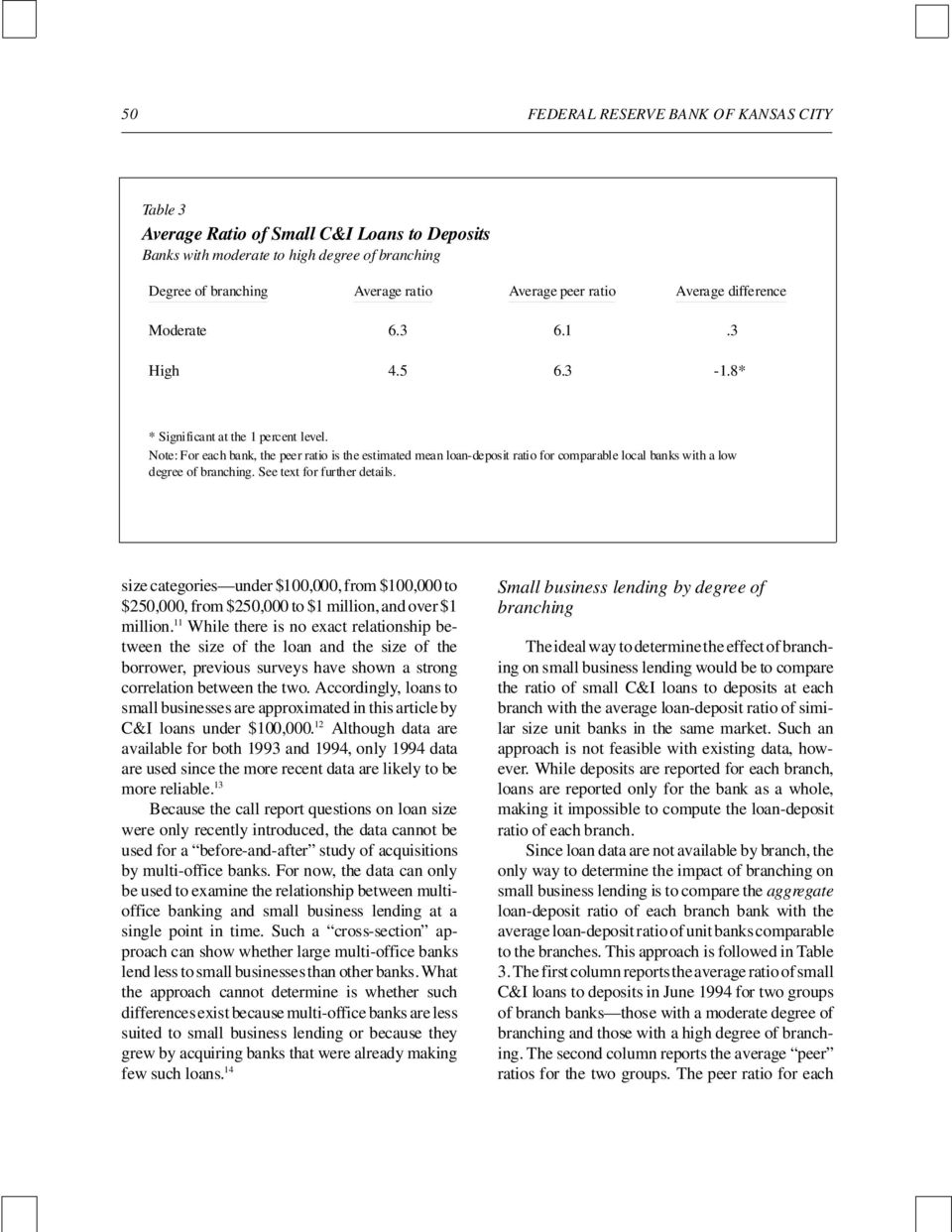
7 ECONOMIC REVIEW SECOND QUARTER Table 4 Distribution of Small C&I Loan-Deposit Ratio Banks with moderate to high degree of branching Degree of branching Percent with higher ratio than peers Percent with lower ratio than peers Moderate High Note: For each bank, the peer ratio is the estimated median loan-deposit ratio for comparable local banks with a low degree of branching. See text for further details. bank is the average loan-deposit ratio among comparable unit banks unit banks operating in the same markets as the bank s branches, similar in size to the bank s branches, and having the same MBHC status as the bank. 15 Finally, the third column shows the difference between the two ratios. A negative number indicates that the group lends less to small business on average than comparable unit banks, while a positive number indicates that the group lends more on average than comparable unit banks. Table 3 suggests that a moderate degree of branching does not reduce small business lending but that a high degree of branching does. The average loan-deposit ratio at banks with a moderate degree of branching is slightly higher than at comparable unit banks 6.3 percent versus 6.1 percent. In contrast, the average loan-deposit ratio at banks with a high degree of branching is substantially lower than at comparable unit banks 4.5 percent versus 6.3 percent. The average difference of 1.8 percentage points between this group of branch banks and comparable unit banks is also statistically significant, in the sense of being too large to be attributed to chance. While these results are informative, it is also useful to know how widespread the tendency is for the loan-deposit ratios of branch banks to differ from those of comparable unit banks. For example, do banks with a high degree of branching have a lower average loan-deposit ratio than their peers mainly because a few of them have extremely low ratios that pull down the average for the group? Table 4 helps answer such questions by showing the percent of banks with higher ratios than comparable unit banks and the percent with lower ratios. 16 Table 4 points to three conclusions. First, as in Table 3, there is little difference between banks with a moderate degree of branching and comparable unit banks. Among this first group of branch banks, about half have higher ratios than their peers and half have lower ratios. Second, the low average loan-deposit ratio reported in Table 3 for banks with a high degree of branching is not due to the influence of a few outliers but reflects a general tendency for such banks to make fewer small business loans. Among this second group of branch banks, the number of banks with lower ratios than their peers is more than double the number of banks with higher ratios a substantial difference. Finally, while banks with a high degree of branching tend

8 52 FEDERAL RESERVE BANK OF KANSAS CITY Table 5 Average Ratio of Small C&I Loans to Deposits Banks owned by MBHCs Type of bank Average ratio Average peer ratio Average difference Banks owned by in-state MBHCs Lead banks Other banks * Banks owned by out-of-state MBHCs * * Significant at the 1 percent level. Note: For each bank, the peer ratio is the estimated mean loan-deposit ratio for comparable independent banks. See text for further details. to make fewer small business loans than comparable unit banks, there are many exceptions to the rule. The table shows that almost a third of banks with a high degree of branching have higher loan-deposit ratios than comparable unit banks. Thus, while most branch banks in this group lend less to small business than their peers, a sizable minority lend more than their peers. Small business lending by MBHC status Because data on loans and deposits are available for each bank in a MBHC and not just the entire organization, the effect of MBHC status on small business lending can be determined more directly than the effect of branching. Table 5 compares the average loan-deposit ratio of three different groups of MBHC banks with the loan-deposit ratio of comparable independent banks. The three groups are lead banks of in-state MBHCs, defined as banks holding more than half of the MBHC s total deposits; all other banks owned by in-state MBHCs; and banks owned by out-of-state MBHCs. 17 The first column shows the average loan-deposit ratio for each group of MBHC banks in June The second column shows the average loan-deposit ratio at comparable independent banks those of similar size, location, and branching status. 18 The last column shows the difference between the two ratios. Table 5 shows that lead banks of in-state MBHCs tend to lend the same percent of deposits as comparable independent banks, while the other two groups of MBHC banks tend to lend a smaller percent of deposits than their peers. The average loan-deposit ratio at lead banks of in-state MBHCs is 6.0 percent, about the same as for comparable independent banks. For other banks owned by instate MBHCs, the average loan-deposit ratio is 5.5 percent, 1.0 percentage point below the average for comparable independent banks. Banks owned by out-of-state MBHCs differ the most from their peers. The average loan-deposit ratio for this group is only 4.7 percent, 1.8 percentage points below the average for comparable independent banks. For
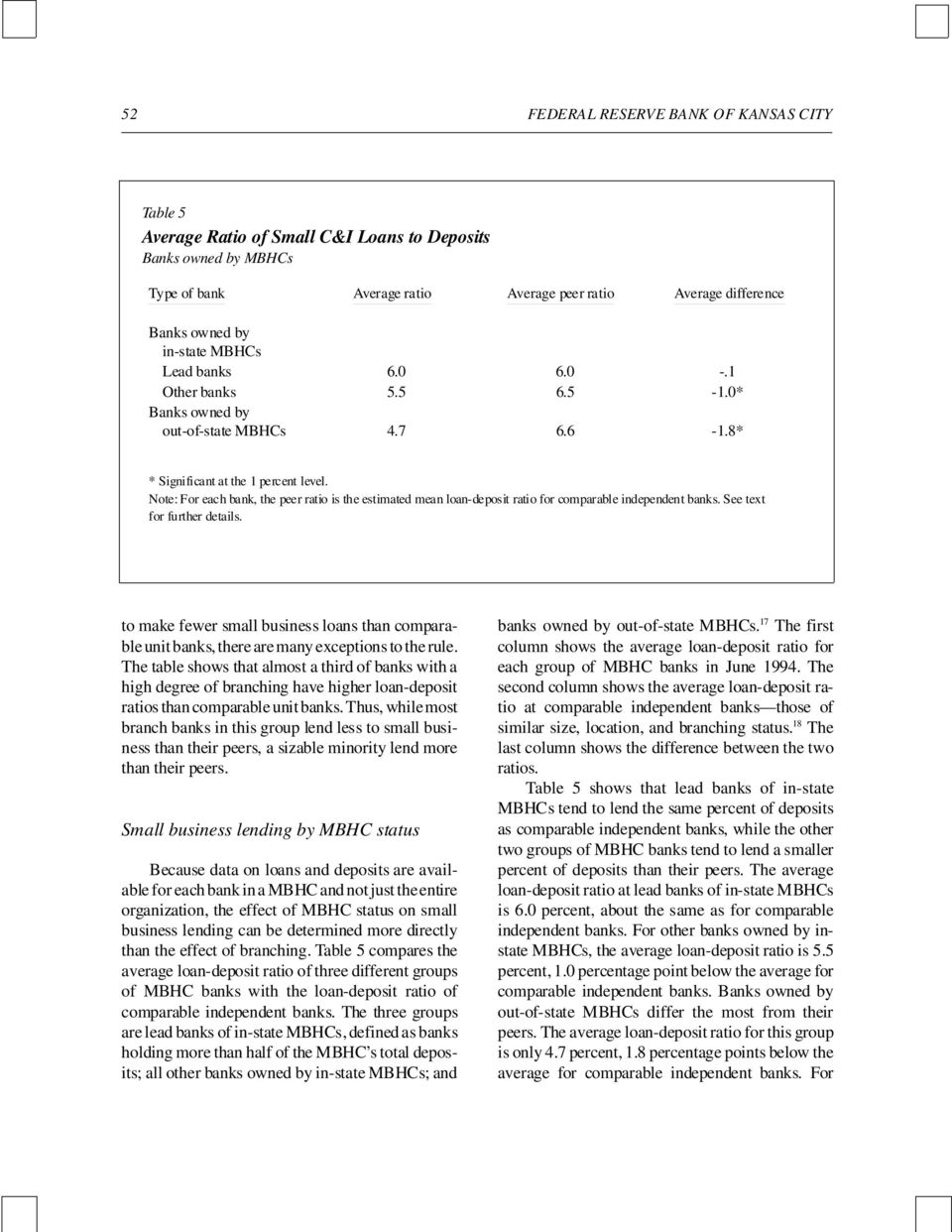
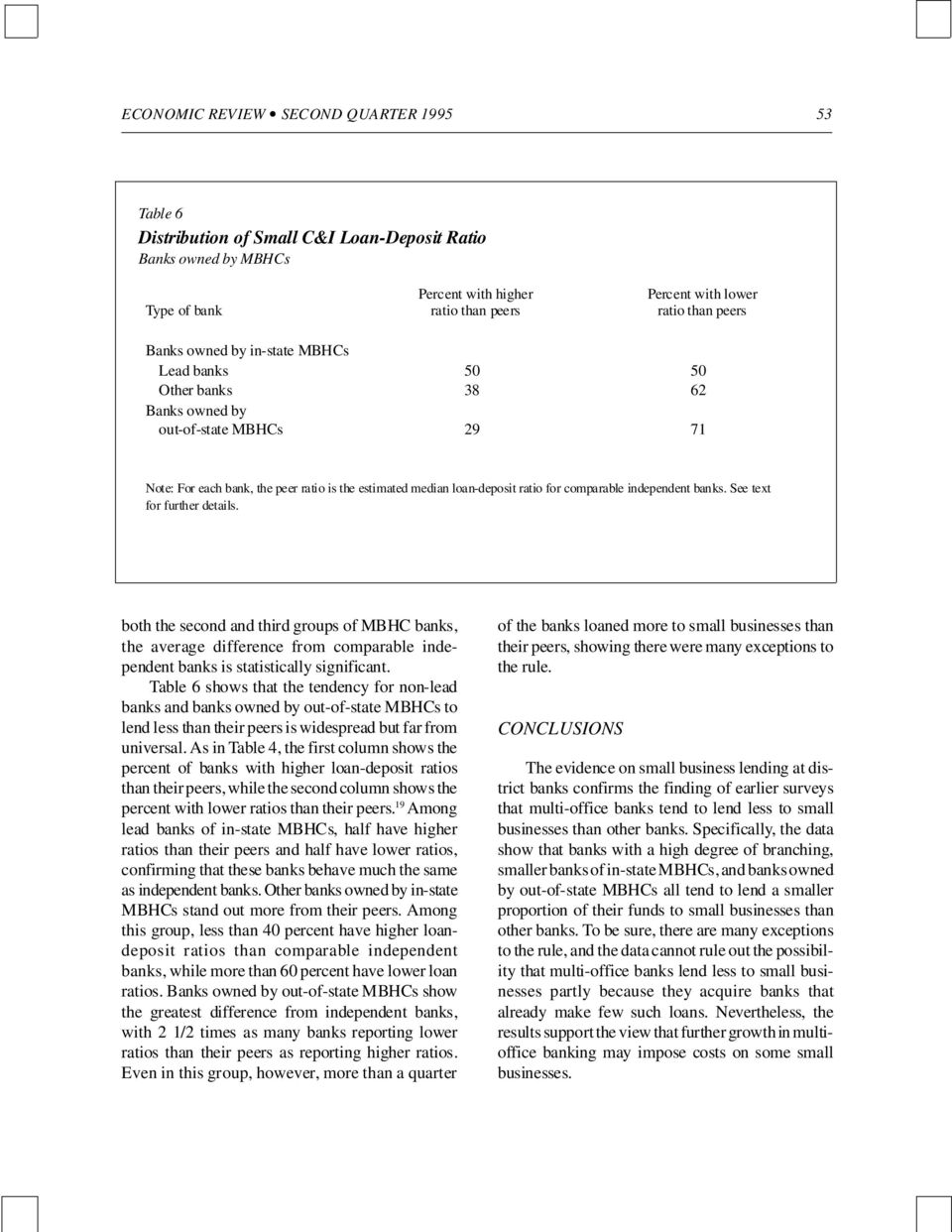
9 ECONOMIC REVIEW SECOND QUARTER Table 6 Distribution of Small C&I Loan-Deposit Ratio Banks owned by MBHCs Type of bank Percent with higher ratio than peers Percent with lower ratio than peers Banks owned by in-state MBHCs Lead banks Other banks Banks owned by out-of-state MBHCs Note: For each bank, the peer ratio is the estimated median loan-deposit ratio for comparable independent banks. See text for further details. both the second and third groups of MBHC banks, the average difference from comparable independent banks is statistically significant. Table 6 shows that the tendency for non-lead banks and banks owned by out-of-state MBHCs to lend less than their peers is widespread but far from universal. As in Table 4, the first column shows the percent of banks with higher loan-deposit ratios than their peers, while the second column shows the percent with lower ratios than their peers. 19 Among lead banks of in-state MBHCs, half have higher ratios than their peers and half have lower ratios, confirming that these banks behave much the same as independent banks. Other banks owned by in-state MBHCs stand out more from their peers. Among this group, less than 40 percent have higher loandeposit ratios than comparable independent banks, while more than 60 percent have lower loan ratios. Banks owned by out-of-state MBHCs show the greatest difference from independent banks, with 2 1/2 times as many banks reporting lower ratios than their peers as reporting higher ratios. Even in this group, however, more than a quarter of the banks loaned more to small businesses than their peers, showing there were many exceptions to the rule. CONCLUSIONS The evidence on small business lending at district banks confirms the finding of earlier surveys that multi-office banks tend to lend less to small businesses than other banks. Specifically, the data show that banks with a high degree of branching, smaller banks of in-state MBHCs, and banks owned by out-of-state MBHCs all tend to lend a smaller proportion of their funds to small businesses than other banks. To be sure, there are many exceptions to the rule, and the data cannot rule out the possibility that multi-office banks lend less to small businesses partly because they acquire banks that already make few such loans. Nevertheless, the results support the view that further growth in multioffice banking may impose costs on some small businesses.
10 54 FEDERAL RESERVE BANK OF KANSAS CITY The results do not imply, however, that multioffice banking should be curtailed. First, the costs to small businesses may be only temporary because other banks may step in and fill any lending gap left by multi-office banks. Suppose, for example, that a small bank absorbed by a large multi-office organization makes fewer small business loans because the head office imposes overly rigid credit criteria or siphons deposits from the bank. Then other banks in the community can be expected to increase their own lending or new banks can be expected to enter the market, leaving total credit to local businesses unchanged. Second, the costs of multi-office banking to small businesses may be outweighed by other benefits. There is substantial evidence that multi-office banking improves service to depositors and increases competition in local markets (Calem). Multi-office banking also makes banks less vulnerable to downturns in the local economy by helping them diversify their loan portfolios. The resulting increase in bank safety benefits taxpayers by reducing the chance of deposit insurance losses. And, it increases the ability of banks to maintain lending during periods of economic stress, helping soften local recessions. Rather than justifying curbs on multi-office banking, the results of this article underscore the importance of keeping local banking markets competitive (General Accounting Office). Regulators should continue to use the tools at their disposal to ensure that multi-office banks do not dominate local markets by absorbing smaller banks. These tools include the right to disapprove anticompetitive mergers or to require merging banks to divest themselves of some offices. Further progress should also be made in reducing regulatory reporting burdens, which tend to hurt small banks more than large banks. Such measures should preserve the benefits of multi-office banking, while helping guarantee that smaller banks can step in and satisfy any legitimate credit needs unmet by large multi-office banks. ENDNOTES 1 The possible effects of multi-office banking on small business lending are discussed in many sources, including Evanoff and Fortier, General Accounting Office, Guttenag and Herman 1967, Horvitz and Shull, Jacobs, Mote, Nakamura 1993 and 1994, Shull, and Wilmarth. 2 Loans to a single borrower are limited to 15 percent of the bank s capital. For most banks, this means the maximum loan size is 1 to 1 1/2 percent of total assets. 3 Studies of in-state MBHCs are surveyed in Brown and Curry; studies of branch banks in Guttenag and Herman 1967 and Mote; and studies of both types of banks in Department of Treasury and Fischer and Davis. Recent studies of banks owned by out-of-state MBHCs include General Accounting Office, Lawrence and Klugman, Rose, and Spong and Shoenhair. 4 In principle, multi-office banks could have higher loan-asset or loan-deposit ratios only because they tend to acquire banks that already have high ratios. However, some studies of MBHC banks have controlled for this possibility by looking at the behavior of such banks before and after acquisition. These studies almost all find that the acquired banks increased their loan-deposit or loan-asset ratios more than independent banks of similar size and location. 5 In the eight studies of MBHC banks surveyed by Brown in 1983, five found no significant difference between MBHC banks and independent banks, two found a higher business loan ratio at MBHC banks, and one found a lower business loan ratio at MBHC banks. Two recent studies of banks acquired by out-of-state MBHCs found that such banks increased their total business lending more than other banks after acquisition (General Accounting Office, Spong and Shoenhair). A pioneering study of branching by Schweiger and McGee found that branch banks made more business loans on average than other banks (p. 239). However, this study also found that branch banks in some types of communities and size classes made fewer business loans than other banks (p. 229). 6 According to the Federal Reserve s Survey of Terms of Lending, for example, banks with less than $1 billion in assets accounted for 84 percent of new business loans under $100,000 in 1988 (Nakamura). But in that year, such banks accounted for only 31 percent of total bank assets, implying that they loaned a much higher proportion of their funds to

11 ECONOMIC REVIEW SECOND QUARTER small businesses than banks in aggregate (Federal Deposit Insurance Corporation). An earlier study estimated that the ratio of small business loans to deposits increased with bank size up to $250 million in deposits and then decreased thereafter (Guttenag and Herman 1966). 7 Specifically, Struck and Mandel found that small businesses were more likely to report credit constraints in states without restrictions on multi-office banking, while Markley found that a higher proportion of small businesses viewed themselves as credit-constrained in markets dominated by multi-office banks. It should be noted, however, that another survey found no evidence that the rate of bank solicitation was less in states without restrictions on multi-office banking (Leeth, Scott, and Dunkelberg). 8 The New England study was based on a commercial loan survey and interviews with banks (Horvitz), while the New York studies used loan and deposit data collected for each banking office (New York State Banking Department, Kohn and Carlo). Another study often cited in support of multi-office banking found that large banks in branching states made a greater proportion of their loans to small local borrowers than similar-size banks in unit banking states (Eisenbeis). However, this study did not show that large branch banks made more small business loans than groups of small unit banks operating in the same markets, which is the more meaningful comparison. Also relevant is a recent study of business lending at several hundred banks in the Survey of Terms of Lending (Berger and Udell). This study found that banks that were organizationally complex tended to make fewer small business loans than other banks. 9 Nebraska allowed statewide branching in 1985, Kansas in 1987, Oklahoma and Wyoming in 1988, Missouri in 1990, and Colorado and New Mexico in Before the changes, New Mexico allowed limited branching, while the other states severely restricted branching. 10 The deposit data are from the Summary of Deposits, the only public source of information on branch activity. The definition of markets was taken from the FDIC s Bank Operating Statistics, a publication discontinued in the early 1980s. According to this definition, there are 59 markets in Tenth District states: 8 in Colorado, 11 in Kansas, 13 in Missouri, 9 in Nebraska, 4 in New Mexico, 12 in Oklahoma, and 2 in Wyoming. 11 The loan size refers to the original amount of the loan. For a loan drawn down under a line of credit, the original amount is defined as the size of the line of credit when the line of credit was granted. Similarly, for a loan participation, the original amount is the total credit to the borrower generated by the lead lender. 12 For example, the 1989 National Survey of Small Business Finance found that 80 percent of loans to businesses with less than $1 million in annual sales were for amounts under $100,000, while only 15 percent of loans to firms with sales greater than $10 million were that small (Board of Governors). Earlier surveys yielded similar results (Scanlon). 13 Some analysts have warned that banks may make mistakes in classifying loans by size until they become more familiar with the new questions (Allen). While the 1994 data are likely to be more reliable than the 1993 data, the data may still contain reporting errors a possibility confirmed by a recent study comparing call report data with data from the Survey of Terms of Lending (Berger and Udell). Such errors make it harder to detect true relationships but should not bias the results unless there are systematic differences in reporting practices between multi-office banks and other banks. 14 For example, multi-office banks may seek out banks with low loan-deposit ratios so they can warehouse loans generated elsewhere in the organization. A recent study of out-of-state acquisitions of rural banks in the Midwest found some evidence of such behavior (Lawrence and Klugman). Acquired banks had lower ratios of farm loans to deposits both before and after acquisition; lower ratios of total loans to deposits before acquisition; and higher ratios of total loans to deposits after acquisition. 15 The peer ratio was estimated from a regression because for some branches, no unit bank of similar size operated in the same market as the branch. For all unit banks, the loan-deposit ratio was first regressed against measures of the bank s total deposits, location, and holding company status. This regression was then used to estimate the peer ratio for each branch bank the loan-deposit ratio the bank would be predicted to have if it behaved the same as a collection of unit banks operating in the same markets, holding similar amounts of deposits in each market, and having the same MBHC status. Statistical significance was determined from the variance-covariance matrix of the prediction errors. 16 In Table 4, the loan-deposit ratio of each branch bank is compared to the estimated median ratio for comparable unit banks. Because the distribution of loan-deposit ratios is skewed to the right, the median loan-deposit ratio for unit banks was less than the mean and the median regression residual was negative. Accordingly, for each branch bank, the median loan-deposit ratio for comparable unit banks was estimated by taking the estimated mean loan-deposit ratio for comparable unit banks and adding the median regression residual. 17 Of the 494 district banks owned by in-state MBHCs in June 1994, 111 were lead banks.
12 56 FEDERAL RESERVE BANK OF KANSAS CITY 18 The peer ratio was estimated essentially the same way as in Table 3. For all independent banks in the sample, the loan-deposit ratio was first regressed against measures of the bank s average deposits per market, distribution of deposits across markets, and degree of branching. This regression was then used to estimate the peer ratio for each MBHC bank the loan-deposit ratio the bank would be predicted to have if it behaved the same as independent banks with the same average deposits per market, the same distribution of deposits across markets, and the same degree of branching. As before, statistical significance was determined from the variance-covariance matrix of the prediction errors. 19 In Table 6, the loan-deposit ratio of each MBHC bank is compared to the estimated median ratio for comparable independent banks. As in Table 4, this median was computed by taking the estimated mean ratio for comparable independent banks and adding the median regression residual. REFERENCES Allen, James C Bank Loans to Small Firms Grow Fast, But Terms Ease, American Banker, November 8. Berger, Allen N., and Gregory F. Udell Universal Banking and the Future of Small Business Lending, unpublished paper, Board of Governors, February. Board of Governors Credit Availability for Small Businesses and Small Farms, December 31, p. 5. Brown, Donald M Bank Holding Company Performance Studies and the Public Interest: Normative Uses for Positive Analysis? Federal Reserve Bank of St. Louis, Review, March. Calem, Paul S The Proconsumer Argument for Interstate Branching, Federal Reserve Bank of Philadelphia, Business Review, May-June. Curry, Timothy J The Performance of Bank Holding Companies, in Board of Governors, The Bank Holding Company Movement to 1978: A Compendium, September. Department of Treasury Geographic Restrictions on Commercial Banking in the United States, Chap. 6. Eisenbeis, Robert A The Allocative Effects of Branch Banking Restrictions on Business Loan Markets, Journal of Bank Research, Spring. Evanoff, Douglas D., and Diana Fortier The Impact of Geographic Expansion in Banking: Some Axioms to Grind, Federal Reserve Bank of Chicago, Economic Perspectives, May/June. Federal Deposit Insurance Corporation, Statistics on Banking 1988, p. 26. Fischer, Gerald C., and Raymond N. Davis The Impact of Multi-Office Banking on the Availability of Credit in Smaller Communities, in U.S. Senate, Committee on Banking, Housing, and Urban Affairs, Compendium of Issues Relating to Branching by Financial Institutions, October. General Accounting Office Interstate Banking: Benefits and Risks of Removing Regulatory Restrictions, November, Chap. 6. Guttenag, Jack M., and Edward S. Herman Do Large Banks Neglect Small Business? Journal of Finance, September Banking Structure and Performance, Institute of Finance, New York University, Bulletin 41/43, February, Chap. 6. Horvitz, Paul M Concentration and Competition in New England Banking, Federal Reserve Bank of Boston, Research Report No. 2, pp and Bernard Shull The Impact of Branching on Bank Performance, National Banking Review, December. Jacobs, Donald P The Interaction Effects of Restrictions on Branching and Other Bank Regulations, Journal of Finance, May. Kohn, Ernest, and Carmen J. Carlo Small Business Lending Activity by Commercial Banks in New York State," New York State Banking Department, August. Lawrence, David B., and Marie R. Klugman Interstate Banking in Rural Markets: The Evidence from the Corn Belt, Journal of Banking and Finance. December. Leeth, John D., Johnathan A. Scott, and William C. Dunkelberg Branch Banking, Market Concentration, and the Competition for Small Firm Business, Proceedings of Conference on Bank Structure and Competition. Federal Reserve Bank of Chicago, May. Markley, Deborah M The Impact of Deregulation on Rural Commercial Credit Availability in Four New England States: Empirical Evidence and Policy Implications, Final Report to the Ford Foundation and the Rural Economic Policy Program of the Aspen Institute, May. Mote, Larry R The Perennial Issue: Branch Banking, Federal Reserve Bank of Chicago, Business Conditions, February. Nakamura, Leonard I Commercial Bank Information: Implications for the Structure of Banking, in Michael Klausner and Lawrence J. White, eds., Structural Change in Banking, Homewood, Ill.: Business One Irwin Small Borrowers and the Survival
13 ECONOMIC REVIEW SECOND QUARTER of the Small Bank: Is Mouse Bank Mighty or Mickey? Federal Reserve Bank of Philadelphia, Business Review, December. New York State Banking Department Branch Banking and the Public Interest, January. Rose, Peter S Interstate Banking: Performance, Market Share, and Market Concentration Issues, The Antitrust Bulletin, Fall. Scanlon, Martha S., Relationship between Commercial Bank Loan Size and Size of Borrower, in Paul M. Horvitz and R. Richardson Pettit, eds., Small Business Finance: Sources of Financing for Small Business. Greenwich, Conn.: JAI Press. Schweiger, Irving, and John S. McGee Chicago Banking, Journal of Business, July. Shull, Bernard Changes in Commercial Banking Structure and Small Business Lending, in Horvitz and Pettit, eds., Small Business Finance: Sources of Financing for Small Business. Greenwich, Conn.: JAI Press. Spong, Kenneth, and John D. Shoenhair Performance of Banks Acquired on an Interstate Basis, Federal Reserve Bank of Kansas City, Financial Industry Perspectives, December. Struck, Peter L., and Lewis Mandell The Effect of Bank Deregulation on Small Business: A Note, Journal of Finance, June. Wilmarth, Arthur E., Jr Too Big to Fail, Too Few to Serve? The Potential Risks of Nationwide Banks, Iowa Law Review. March.
14

Small Business Lending At Tenth District Banks
 Small Business Lending At Tenth District Banks By William R. Keeton One of the most important roles commercial banks perform is to lend to small businesses. Such lending is vital to the regional economy
After stagnating for many years, the rate of
 Are Mergers Responsible for the Surge in New Bank Charters? By William R. Keeton After stagnating for many years, the rate of new bank formation has increased sharply in the second half of the 199s. The
Lending to small firms traditionally has been a business served
 The Evolution of Bank Lending to Small Business Joe Peek and Eric S. Rosengren Professor of Economics, Boston College, and Visiting Economist, Federal Reserve Bank of Boston; and Vice President and Economist,
FRBSF ECONOMIC LETTER
 FRBSF ECONOMIC LETTER 211-32 October 17, 211 Recent Trends in Small Business Lending BY LIZ LADERMAN AND JAMES GILLAN Although bank small business loan portfolios continue to shrink, there are hints of
Key Data on the. Authors: dus.org
 Key Data on the Scale of Microlending in the U.S. February 2011 Authors: William Girardo, Research Associate Elaine L. Edgcomb, Director 1 Dupont Circle, NW, Suite 700 Washington, DC 20036 Website: www.field
SECTION 109 HOST STATE LOAN-TO-DEPOSIT RATIOS. The Board of Governors of the Federal Reserve System (Board), the Federal Deposit
 SECTION 109 HOST STATE LOAN-TO-DEPOSIT RATIOS The Board of Governors of the Federal Reserve System (Board), the Federal Deposit Insurance Corporation (FDIC), and the Office of the Comptroller of the Currency
FRBSF ECONOMIC LETTER
 FRBSF ECONOMIC LETTER 1-6 August 7, 1 Small Business Loans and Small Bank Health BY ELIZABETH LADERMAN Total business loans under $1 million held by small U.S. banks continue to dwindle. Disproportionate
Large and Small Companies Exhibit Diverging Bankruptcy Trends
 JANUARY, 22 NUMBER 2-1 D I V I S I O N O F I N S U R A N C E Bank Trends Analysis of Emerging Risks In Banking WASHINGTON, D.C. ALAN DEATON (22) 898-738 [email protected] Large and Small Companies Exhibit
SECTION 109 HOST STATE LOAN-TO-DEPOSIT RATIOS. or branches outside of its home state primarily for the purpose of deposit production.
 SECTION 109 HOST STATE LOAN-TO-DEPOSIT RATIOS The Board of Governors of the Federal Reserve System, the Federal Deposit Insurance Corporation, and the Office of the Comptroller of the Currency (the agencies)
Reports - Findings from Analysis of Nationwide Summary Statistics for 2013 Community Reinvestment Act Data Fact Sheet (August 2014)
 Reports - Findings from Analysis of Nationwide Summary Statistics for 2013 Community Reinvestment Act Data Fact Sheet (August 2014) This analysis is based on data compiled by the three federal banking
Small business lending by commercial banks in Colorado, 1994 to 1996
 Small business lending by commercial banks in Colorado, 1994 to 1996 Richard J. Sullivan, Richard D. Johnson, Ronnie J. Phillips, and Kenneth R. Spong Richard J. Sullivan and Kenneth R. Spong are economists
The New FDIC Insurance Premium Assessments: A Better Way Scott Hein and Timothy Koch April 6, 2009
 The New FDIC Insurance Premium Assessments: A Better Way Scott Hein and Timothy Koch April 6, 2009 Effective January 1, 2009 the FDIC increased the annual insurance assessment rate by 7 basis points applied
Small Bank Comparative Advantages in Alleviating Financial Constraints and Providing Liquidity Insurance over Time
 Small Bank Comparative Advantages in Alleviating Financial Constraints and Providing Liquidity Insurance over Time Allen N. Berger University of South Carolina Wharton Financial Institutions Center European
Chapter 13 Money and Banking
 Chapter 13 Money and Banking Multiple Choice Questions Choose the one alternative that best completes the statement or answers the question. 1. The most important function of money is (a) as a store of
January 2015. Report on SBLF Participants Small Business Lending Growth Submitted to Congress pursuant to Section 4106(3) of
 January 2015 Report on SBLF Participants Small Business Lending Growth Submitted to Congress pursuant to Section 4106(3) of the Small Business Jobs Act of 2010 OVERVIEW Small businesses are a vital part
NFIB SMALL BUSINESS. William C. Dunkelberg Holly Wade SMALL BUSINESS OPTIMISM INDEX COMPONENTS
 NFIB SMALL BUSINESS ECONOMIC TRENDS William C. Dunkelberg Holly Wade December 21 Based on a Survey of Small and Independent Business Owners SMALL BUSINESS OPTIMISM INDEX COMPONENTS Seasonally Change From
Introduction1. Sample Description. Drivers of Costs and the Empirical Approach or Explanatory Variables:
 Efficiency Drivers of Microfinance Institutions (MFIs): The Case of Operating Costs 1 Adrian Gonzalez, Researcher, MIX ([email protected]) The findings, interpretations, and conclusions expressed in
Federal Reserve Bank of Kansas City: Consumer Credit Report
 Federal Reserve Bank of Kansas City: Consumer Credit Report Tenth District Consumer Credit Report May 29, 2015 By Kelly Edmiston, Senior Economist and Mwai Malindi, Research Associate FIRST QUARTER 2015
The U.S. banking system is unusual in consisting not only of
 The Role of Community Banks in the U.S. Economy The U.S. banking system is unusual in consisting not only of some very large banks but also a large number of relatively small community banks. This bifurcated
Macroeconomics, 8e (Parkin) Testbank 1
 Macroeconomics, 8e (Parkin) Testbank 1 Chapter 9 Money, the Price Level, and Inflation 9.1 What is Money? 1) The functions of money are A) medium of exchange and the ability to buy goods and services.
Consumer Credit Report
 Page 1 of 5 Consumer Credit Report Tenth District Consumer Credit Report December 2, 2015 By Kelly Edmiston, Senior Economist Average debt for Tenth District consumers, defined for this report as all outstanding
Report to the Congress on the Profitability of Credit Card Operations of Depository Institutions
 BOARD OF GOVERNORS OF THE FEDERAL RESERVE SYSTEM Report to the Congress on the Profitability of Credit Card Operations of Depository Institutions Submitted to the Congress pursuant to section 8 of the
Income and Racial Disparities in Subprime Lending May 2000
 Income and Racial Disparities in Subprime Lending May 2000 U.S. Department of Housing and Urban Development Office of Policy Development and Research UNEQUAL BURDEN IN CHICAGO: INCOME AND RACIAL DISPARITIES
GAO STUDENT LOAN PROGRAMS. As Federal Costs of Loan Consolidation Rise, Other Options Should Be Examined. Report to Congressional Requesters
 GAO United States General Accounting Office Report to Congressional Requesters October 2003 STUDENT LOAN PROGRAMS As Federal Costs of Loan Consolidation Rise, Other Options Should Be Examined GAO-04-101
Financial Market Infrastructure
 CHAPTER 11 Financial Market Infrastructure Too Important to Fail Darrell Duffie 1 A major focus of this book is the development of failure resolution methods, including bankruptcy and administrative forms
A Banker s Quick Reference Guide to CRA
 Federal Reserve Bank of Dallas A Banker s Quick Reference Guide to CRA As amended effective September 1, 2005 This publication is a guide to the CRA regulation and examination procedures. It is intended
Performance and Operation of Commercial Bank Web Sites
 Performance and Operation of Commercial Bank Web Sites Richard J. Sullivan Richard J. Sullivan is an economist in the Division of Supervision and Risk Management of the Federal Reserve Bank of Kansas City.
An overview of commercial banks: performance, regulation, and market value
 Review of Financial Economics 13 (2004) 1 5 www.elsevier.com/locate/econbase An overview of commercial banks: performance, regulation, and market value 1. Introduction Commercial banks exist because of
Thank you, Saurabh, for that very kind introduction. I m delighted to be back in
 Remarks by John G. Walsh Chief of Staff and Public Affairs Office of the Comptroller of the Currency Before the National Community Investment Fund s Annual Development Banking Conference Chicago, Illinois
Federal Reserve Bank of Dallas A Banker s Quick Reference Guide to CRA
 Federal Reserve Bank of Dallas A Banker s Quick Reference Guide to CRA This publication is a guide to the CRA regulation and examination procedures. It is intended for bank CEOs, presidents, and CRA and
HAS FINANCE BECOME TOO EXPENSIVE? AN ESTIMATION OF THE UNIT COST OF FINANCIAL INTERMEDIATION IN EUROPE 1951-2007
 HAS FINANCE BECOME TOO EXPENSIVE? AN ESTIMATION OF THE UNIT COST OF FINANCIAL INTERMEDIATION IN EUROPE 1951-2007 IPP Policy Briefs n 10 June 2014 Guillaume Bazot www.ipp.eu Summary Finance played an increasing
Small Institutions Examination Procedures and Sample Format for Public Disclosure of Examination Results
 Small Institutions Examination Procedures and Sample Format for Public Disclosure of Examination Results The Examination Procedures for Small Institutions (which include the CRA Ratings Matrix for Small
STATEMENT OF THE FEDERAL DEPOSIT INSURANCE CORPORATION RICHARD A. BROWN CHIEF ECONOMIST
 STATEMENT OF THE FEDERAL DEPOSIT INSURANCE CORPORATION by RICHARD A. BROWN CHIEF ECONOMIST on LESSONS LEARNED FROM THE FINANCIAL CRISIS REGARDING COMMUNITY BANKS before the COMMITTEE ON BANKING, HOUSING,
Small Business Lending in the United States 2012
 Office of Advocacy wwwsbagov/advocacy Small Business Lending in the United States 22 Office of Advocacy US Small Business Administration July 23 Created by Congress in 976, the Office of Advocacy of the
225.144 Policy statement on equity investments in banks and bank holding companies
 225.144 Policy statement on equity investments in banks and bank holding companies (a) Introduction and guiding principles. For many years, bank holding companies, nonbank financial companies, private
Financial-Institutions Management. Solutions 6
 Solutions 6 Chapter 25: Loan Sales 2. A bank has made a three-year $10 million loan that pays annual interest of 8 percent. The principal is due at the end of the third year. a. The bank is willing to
chapter: Solution Fiscal Policy
 Fiscal Policy chapter: 28 13 ECONOMICS MACROECONOMICS 1. The accompanying diagram shows the current macroeconomic situation for the economy of Albernia. You have been hired as an economic consultant to
Flaws in the Use of Loan Defaults To Test for Mortgage Lending Discrimination
 Flaws in the Use of Loan Defaults To Test for Mortgage Lending Discrimination Flaws in the Use of Loan Defaults To Test for Mortgage Lending Discrimination Stephen L. Ross University of Connecticut Abstract
The financial progress of pure-play internet banks
 The financial progress of pure-play internet banks Robert DeYoung 1 1. Introduction The internet has become a major distribution channel for US banks. Most internet banks use a clicks and mortar banking
Statement by. Preston Martin. Vice Chairman, Board of Governors of the Federal Reserve System. before the
 For release on delivery April 3, 1985 Statement by Preston Martin Vice Chairman, Board of Governors of the Federal Reserve System before the Subcommittee on Commerce, Consumer and Monetary Affairs of the