
SpeakerCraft MZC-66 Multi-Zone A/V Amplifier Controller With EZ-Pad System
|
|
|
- Basil Greene
- 10 years ago
- Views:
Transcription
1 SpeakerCraft MZC-66 Multi-Zone A/V Amplifier Controller With EZ-Pad System INSTALLATION INSTRUCTIONS -- DRAFT

2 Table Of Contents Table Of Contents... 2 OVERVIEW... 5 EZ-PAD GANG CONFIGURATIONS... 5 FEATURE DESCRIPTIONS - EZ-PAD (refer to Figure 2)... 6 FEATURE DESCRIPTIONS MZC MZC-66 Multi-Zone A/V Amplifier Controller (Refer to Figure 3 & 4)... 7 FEATURE DESCRIPTIONS EPR-1.0 EZ-Pad Relay Muting Module (refer to Figure 5) FEATURE DESCRIPTIONS EZ-Tools, LTM-1.0 Learning Test Module and Transfer / Adapter Cables SYSTEM CONNECTIONS AND CONFIGURATION Factory Default System Whole House/Party Mode A Typical MZC-66 System Installation Configure the EZ-Pad Buttons PROGRAMMING WITH EZ-TOOLS Quick Start Serial Port Selection Assigning IR Commands to Button Keys Power Management/Events Programming Cloning and Programming the Remaining Zones ADVANCED PROGRAMMING Delays Punched Commands Priority Priority Equal Priority First Come First Served Zone Priority Source Priority Individual Key Priority Muting Relays Designated Relay Mute Key Insert Mute Relay Commands Keypad - Mute On, OFF, or Toggle Zone - Mute On, OFF, or Toggle Global - Mute On, OFF, or Toggle Learning IR Commands

3 Using The LTM-1.0 IR Learning Sensor System Learning IR Commands New Brands Existing Brands Programming Learning Remotes With EZ-Code System Commands Programming Procedure EZ-Code Group Settings Programming Learning Remotes With Library IR Commands Programming Procedure Templates Source Templates Exporting Sources as Template Files Importing Source Template Files Icon Templates Exporting Icons as Template Files Importing Icon Template Files Doorbell / Page Programming Timeout and Momentary Page Control Timeout Programming Momentary Page Programming Direct Door Viewing/Listening Programming MZC-66 Internal Commands Audio Level Commands Tone Commands Tier Programming Audio Routing Commands Video Routing Commands Contact Closure Commands MZC-66 Setup Menus Source Assignments Misc ZONE SETUP Menus Name/Sources Whole House/Mute EVENTS SETUP System Turning ON (1 st Zone ON) System Turning OFF (Last Zone OFF) Zone Turning ON & Zone Turning OFF Events Doorbell Triggers #1 and # Party Mode Start-Up ZONE EXPANSION Making Connections Programming for Zone Expansion Downloading to Master & Slave Units Additional Expansion Issues
4 PHONE/VIDEO PAGE IN Jacks DOORBELL/STATUS IN Jacks COMMON IR OUT Jack COMMON STATUS OUT Jack PRINTING PROJECTS Installation Information Printing the Project SAVING AND BACKING UP EZ-Pad FILES AutoSave Back Ups FIRMWARE & EZ-Tools UPGRADES Firmware Updates EZ-Tools Upgrades Command Library Merges APPENDIX EZ-Tools Menu Items File Edit Project MZC Tools View Help Importing Pronto Hex Code Importing Xantech Palette (".pal") Files Command Properties (IR) Command Protocol & Data Wide Bursts Min. Output Time (Sec.) Frequency (25k-470k) Capture Repeating Data Custom Code & Data Code Fields Specifications, MZC Audio Sections Video Sections Control Sections General
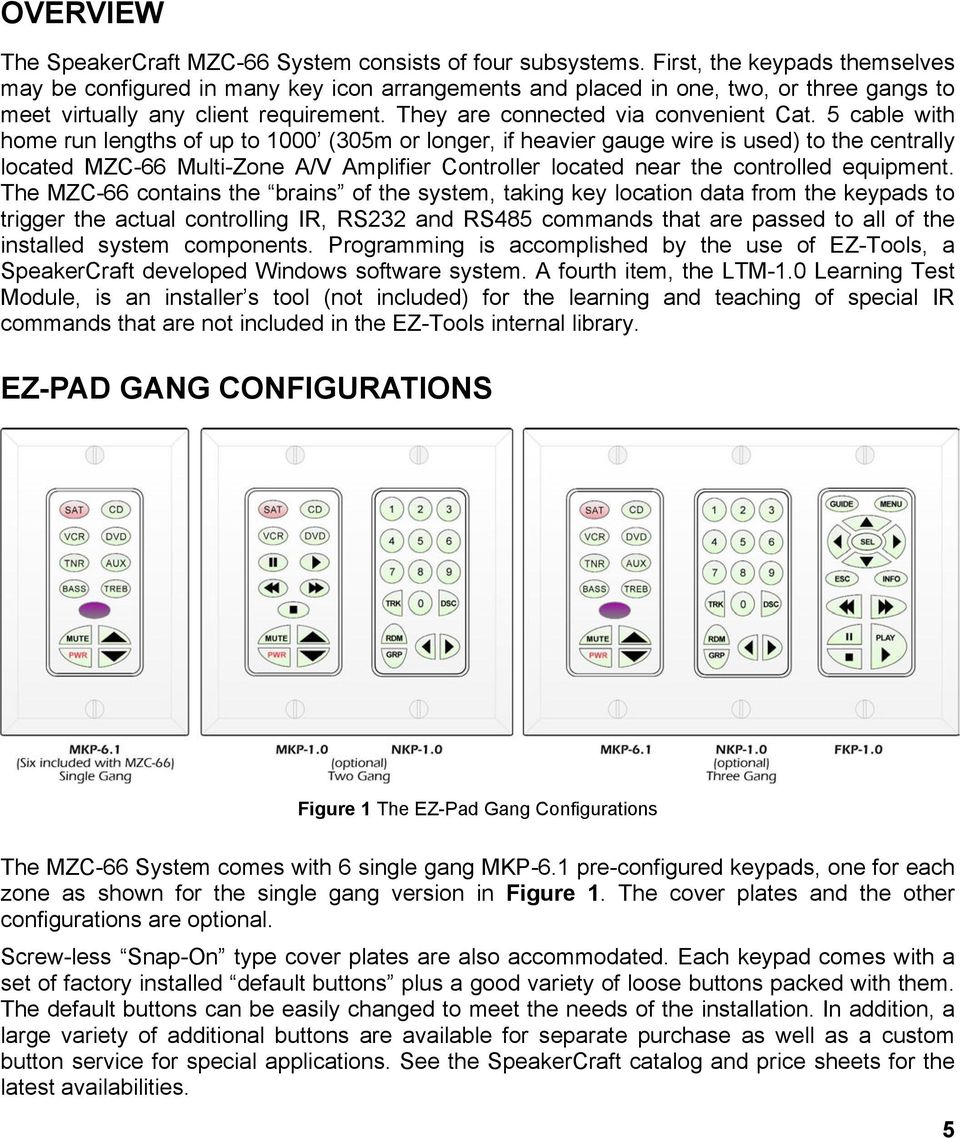
5 OVERVIEW The SpeakerCraft MZC-66 System consists of four subsystems. First, the keypads themselves may be configured in many key icon arrangements and placed in one, two, or three gangs to meet virtually any client requirement. They are connected via convenient Cat. 5 cable with home run lengths of up to 1000 (305m or longer, if heavier gauge wire is used) to the centrally located MZC-66 Multi-Zone A/V Amplifier Controller located near the controlled equipment. The MZC-66 contains the brains of the system, taking key location data from the keypads to trigger the actual controlling IR, RS232 and RS485 commands that are passed to all of the installed system components. Programming is accomplished by the use of EZ-Tools, a SpeakerCraft developed Windows software system. A fourth item, the LTM-1.0 Learning Test Module, is an installer s tool (not included) for the learning and teaching of special IR commands that are not included in the EZ-Tools internal library. EZ-PAD GANG CONFIGURATIONS Figure 1 The EZ-Pad Gang Configurations The MZC-66 System comes with 6 single gang MKP-6.1 pre-configured keypads, one for each zone as shown for the single gang version in Figure 1. The cover plates and the other configurations are optional. Screw-less Snap-On type cover plates are also accommodated. Each keypad comes with a set of factory installed default buttons plus a good variety of loose buttons packed with them. The default buttons can be easily changed to meet the needs of the installation. In addition, a large variety of additional buttons are available for separate purchase as well as a custom button service for special applications. See the SpeakerCraft catalog and price sheets for the latest availabilities. 5
6 FEATURE DESCRIPTIONS - EZ-PAD (refer to Figure 2) The EZ-Pads come in four basic modules as shown. The MKP-1.0 (13 buttons) and MKP-6.1 or MKP-1.1 (12 buttons) are the Master keypads and one or the other must be used in each system. As mentioned earlier, the MZC-66 comes with a pre-configured version of the MKP- 1.1, the MKP-6.1, for the convenience of the installer. It is usable right "out of the box" in conjunction with a default project that is factory programmed into the MZC-66. Like the MKP- 1.1 the MKP-6.1 includes an IR receiver and has one less function button, but is otherwise identical to the MKP-1.0. The NKP-1.0 Numeric (16 buttons) and FKP-1.0 Function (14 buttons) key modules may be thought of as slaves to the master unit (they will not work alone), giving more key locations for additional numeric and function commands. Figure 2 EZ-Pad Features 1. MKP-1.0/6.1 Source/Function Buttons - Six of this set of eight buttons may be programmed as Source Select for the MZC-66 or as transport/function buttons. One of the six must always be designated as a Source Button. When the system is off, all buttons have a background green color. When a source button is pressed, it turns to a low-level red color to show that it is the active source and the system is on. 2. KEYPAD EXPANSION Terminal - This 16-pin header terminal is used to interconnect the EZ-Pad modules for expansion as needed. A 3-connector ribbon cable is packed with each NKP-1.0 and FKP-1.0 module for making these connections. 6
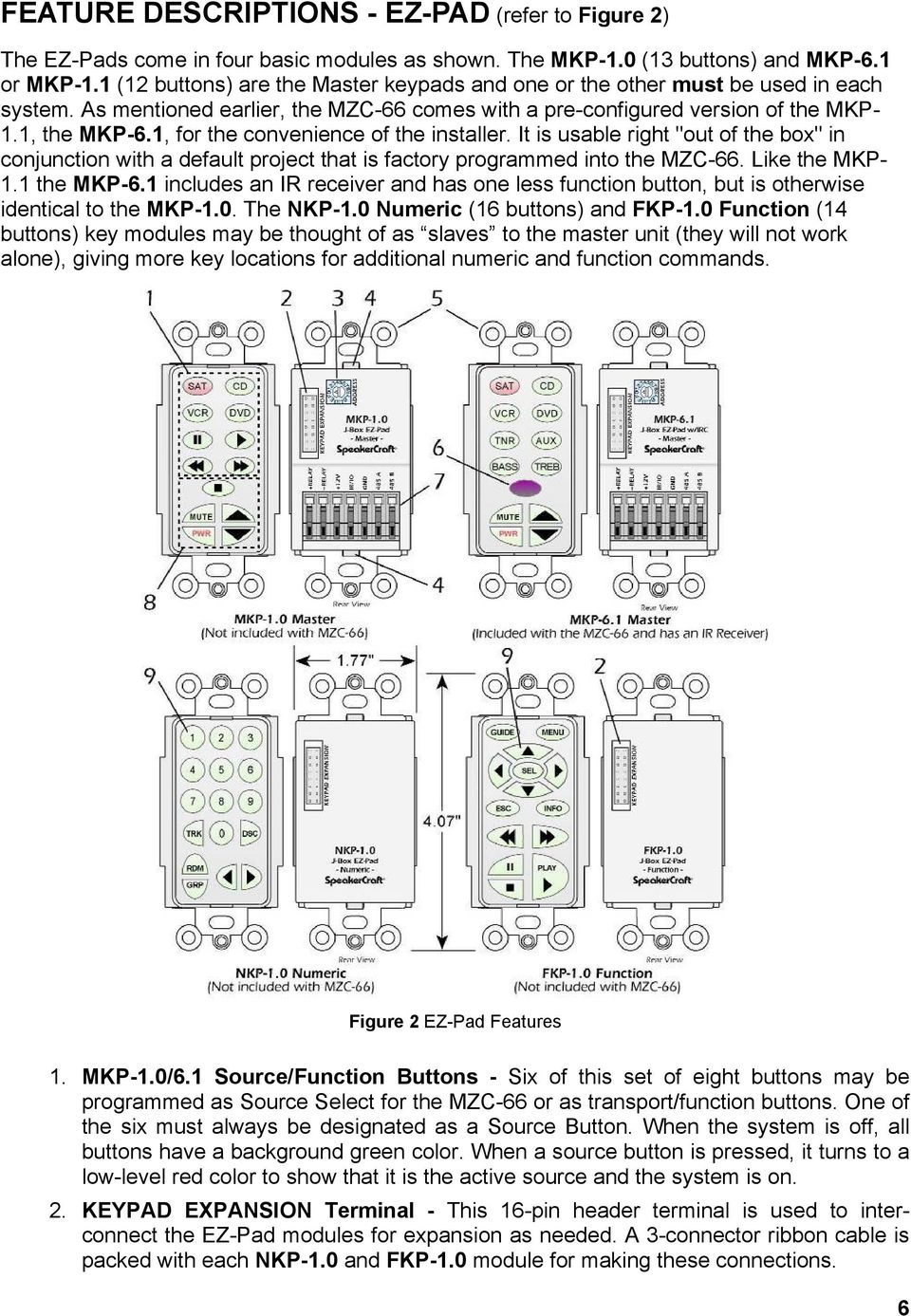
7 3. ADDRESS Switch - An unique hex address must be set for each master keypad when connected on a common bus within a single zone. Unique addresses are not required zone-to-zone. It provides up to 16 addresses (0 to F). 4. Snap Tabs - These tabs hold the decorator style insert panel to the metal mounting plate and are easily released for custom changing of the buttons. 5. Mounting Plate Standard plate allows the keypad module to be attached to standard in-wall J-Boxes using the 2 screws provided. Allows attachment of standard decorator type cover plates (also screw-less snap-on plates). 6. IR Receiver Lens Version MKP-6.1 includes SpeakerCraft s exclusive ANS IR Receiver, built-in. Allows the use of a handheld remote for control of system components. 7. EZ-Connect terminals - These spring-loaded terminals accept wire sizes 14 to 28 AWG for connection of the following: +Relay and -Relay For connection of the external EPR-1.0 EZ-Pad Relay Speaker Muting Module. (Refer to Designated Relay Mute Key section and Figures 5 & 29). +12 VDC Powers the Keypad, including the internal IR Receiver on model MKP- 6.1 or MKP-1.1. Includes reverse voltage protection. IR/IO Sends IR control signals for control of system components. GND Return for Power, IR signal and Data. 485 A / 485 B Balanced, bi-directional system communications data. 8. Function Buttons These lower 5 buttons (4 buttons in the case of the MKP-6.1) can be programmed for any function except source select. 9. Numeric and Function Buttons All numeric and function buttons, including those on the Master keypads, glow a low-level background green and do not change color when pressed. This background lighting can be programmed to go off after a set time of inaction, or stay on continuously via EZ-Tools. FEATURE DESCRIPTIONS MZC-66 MZC-66 Multi-Zone A/V Amplifier Controller (Refer to Figure 3 & 4) The MZC-66 is a 6-Zone, 6-Source A/V Amplifier Controller. It serves as the brains of the entire keypad system as well as providing audio/video switching for six sources, 30W/channel audio power amplifiers for six zones and connection termination facilities for the controlled whole house system. The following describes the front and rear panel features. 7

8 Figure 3 MZC-66 Front Panel Features 1. ZONE STATUS LED Indicators and Labels Green LEDs indicate the zones that are currently active. Indented spaces accept adhesive backed labels for zone/room identification. A sheet of descriptive labels, typical of room or area names used in homes, are included. 2. MASTER POWER Switch When pressed to the in position, the MZC-66 is placed in the power ON standby condition, permitting individual zones to be turned ON and OFF by keypad or touch panel commands. In the OFF (out) position, power from the AC mains is completely turned off. 3. Red Indicator LED Indicates when the Master Power switch is in the depressed position and that power has been applied from the AC mains. Figure 4 MZC-66 Rear Panel Features 8
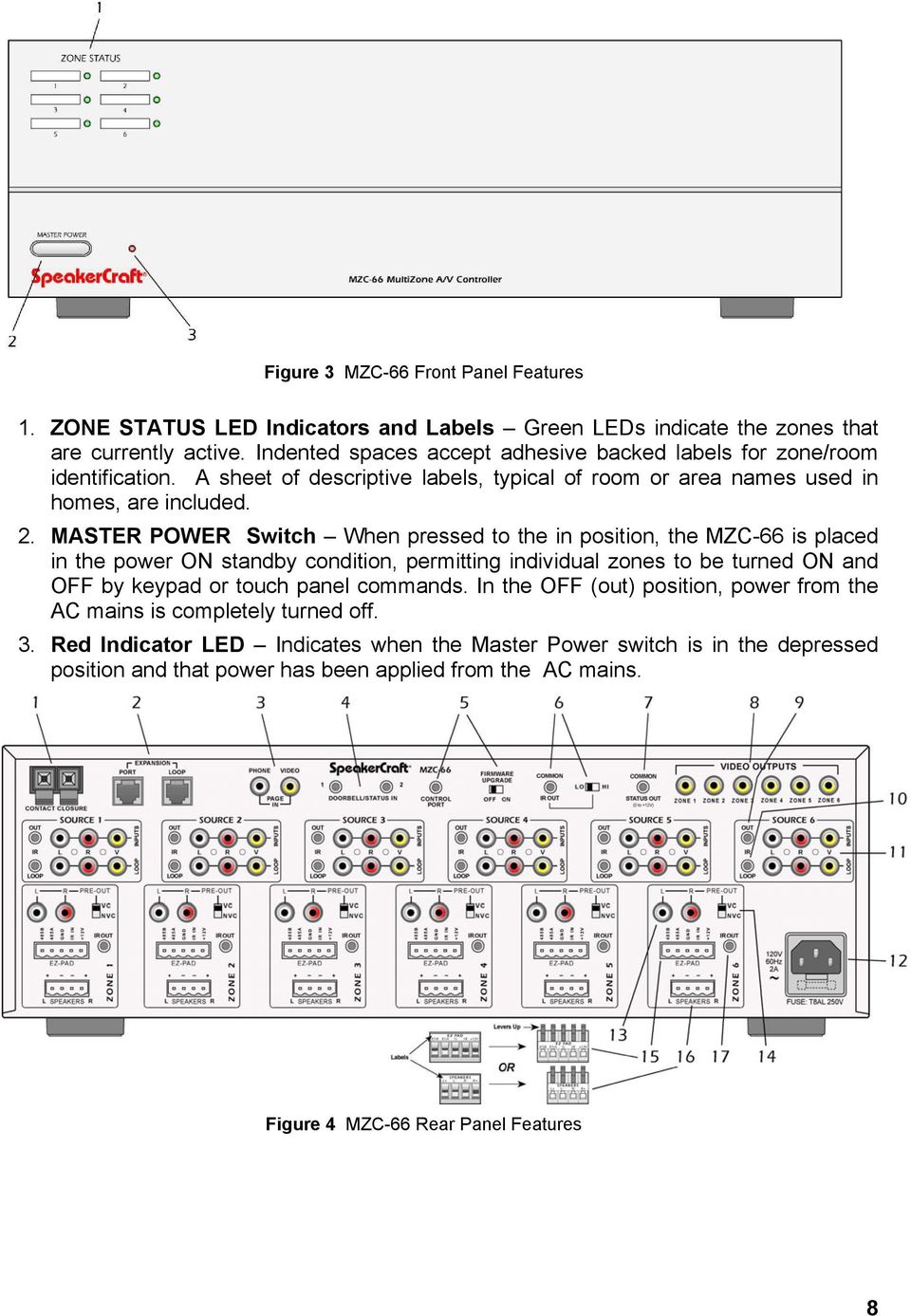
9 1. CONTACT CLOSURE Provides a single pole dry relay contact to activate any device that can be controlled or triggered by a switch closure. The closure can be programmed within EZ-Tools to be activated by keypad presses, EZ-Code IR, or within macro commands for Momentary, Toggle and Open/Close Paired operations. Spring loaded terminals accept wire sizes from 28 to 14 AWG. Internal relay contacts are rated at 2A/30V AC or DC. 2. EXPANSION PORT / LOOP RJ45 jacks provide for connection of specialized RS485 controlled products and for looping to additional MZC-66's for zone expansion capability. 3. PHONE / VIDEO PAGE IN Jacks These jacks provide input porting for audio and video feeds from door mikes and cameras or other forms of phone or doorbell paging. Both jacks are programmable by EZ-Tools, to turn on as events, when triggered by the DOORBELL/STATUS IN Jacks, item #4. 4. DOORBELL/STATUS IN 1 & 2 Jacks These 3.5mm mini phone trigger inputs work in conjunction with the PHONE/VIDEO PAGE IN jacks, item #3. When triggered, the Phone and/or Video inputs can be turned on as programmed by EZ-Tools. If Audio or Video paging is not required, these 1 & 2 jacks may also be programmed as STATUS Inputs for power management of Source or Zone components. They accept input levels of 3V to 30V AC or DC for the trigger ON condition. The voltage level must drop below 1V AC or DC for the OFF condition. 5. CONTROL PORT & FIRMWARE UPGRADE Switch 3.5mm 4-circuit mini phone jack allows several control functions. All keypad programming is accomplished via this port using EZ-Tools in conjunction with the mating Transfer Cable (provided with EZ- Tools). It also accommodates factory firmware updates in conjunction with the FIRMWARE UPGRADE OFF/ON Switch. Be sure to leave this switch in the OFF position at all times, except, as instructed within EZ-Tools, when you are doing a firmware update. Such updates ensure that you can always have the latest functionality improvements in the field. Another function of this port is that you can control installed system components with bi-directional data via touch panels or computers using RS232 protocol. NOTE: You would normally connect the Transfer Cable to the DB9 COM Port on your computer. However, if your computer does not have a DB9 COM Port, use the USB / Serial Adapter and related software on the CD-ROM, included in the EZ-Tools/LTM package. See Figure 6. When using a USB port, connect the USB / Serial Adapter and the Transfer Cable together. 6. COMMON IR OUTPUT & HI/LO Switch 3.5mm mini phone jack provides a Common IR Output derived from all of the Zone IR inputs and from Keypad initiated IR commands derived from the internal IR Library. High or low IR power output is set by means of the HI/LO switch. Set it to the LO setting when driving standard low power emitters (i.e., IRE-1.0, 2.0, 3.0 and 4.0). Set it to the HI position when driving a high power emitter (i.e., the IRE-5.0 Blaster) for teaching IR commands into learning remotes. Caution: The HI position will smoke low power emitters! 7. COMMON STATUS OUT Port This 3.5mm mini phone jack will go high (+12V DC) when any zone is turned ON and will go LOW (under 1V DC) when the last zone is turned OFF. The max. output of this jack is 100 ma at 9.5V DC. 8. VIDEO OUTPUTS These 6 RCA jacks provide a dedicated composite video output for each zone. 75 Ohm outputs provide matched line impedance for high quality video over RG6 cable for lengths up to 500 feet. 9

10 9. IR OUT Jacks - These 3.5mm mini phone jacks, one for each Source, provide dedicated IR output to specific source components. When a source is selected on a keypad, IR function commands are routed directly to that source. This prevents crosscontrol interference between 2 or more sources that have identical IR commands. 10. IR LOOP Jacks These six 3.5mm mini phone jacks, one for each Source, are provided exclusively for zone expansion capability when using two or more MZC-66's. They permit the Source IR signals from the added zones to be carried to the Source component emitters. 11. L & R Audio & Video IN and LOOP Jacks. These RCA jacks, 6 for each Source, provide audio and video signal inputs and buffered loop outputs, for each Source. The buffered outputs may be used to drive local components or loop the signals to the additional zone inputs of other MZC-66's when using them for zone expansion. 12. IEC Type AC Mains Receptacle and Fuse Mates with included AC power cord. Also houses the rear panel replaceable AC mains fuse (T8AL 250V). 13. L & R PRE-OUT Jacks These RCA jacks provide line level audio outputs for driving external power amplifiers for additional rooms within zones, where needed. 14. VC-NVC Switch The audio output from the PRE-OUT jacks can either be controlled by the internal Volume Control of the MZC-66 (VC position) or be a fixed line level output in the No Volume Control (NVC) position. In either case, the tone control action remains available for room "EQ" settings. NOTE: On first release of the MZC-66, the internal amplifier also is set to a fixed level in the NVC position. On later units, the internal amplifier operates with the normal internal volume control and is independent of the VC-NVC Switch settings. 15. EZ-PAD Zone Inputs These plug-able screw-down terminals (some are springloaded) accept wire sizes from 14 to 28 AWG for easy connection of the inter-room wiring from EZ-Pads in the various rooms. Normally this is accomplished by using Cat. 5 cable with home run lengths of up to 1000 (longer, if heavier gauge wire is used). The terminals are defined as follows: 485 A / 485 B Balanced, bi-directional system communications data. GND Return for Power, IR signal and Data. IR IN Receives IR control signals from the MKP-6.1, or from a separately connected IR Receiver for control of system components. +12 VDC Feeds power to the Keypads, including the internal IR Receiver on model MKP L SPEAKERS R Terminals These 4-circuit plug-able screw-down terminals (some are spring-loaded) accept wire sizes from 14 to 28 AWG. They allow quick connection of the internal amplifiers to stereo pairs of speakers in the various zone rooms. 17. IR OUT This 3.5mm mini jack, one for each zone, provides dedicated Zone IR output initiated from the respective Zone Inputs. They may control specific zone components where desired. (i.e., a dedicated zone source component or device, when you wish to prevent the control of it from the other zones). FEATURE DESCRIPTIONS EPR-1.0 EZ-Pad Relay Muting Module (refer to Figure 5) The EPR-1.0 EZ-Pad Speaker Muting Relay Module allows speakers in any room with an EZ- Pad to be connected to provide local muting. The only way to provide local muting in 2 or more 10
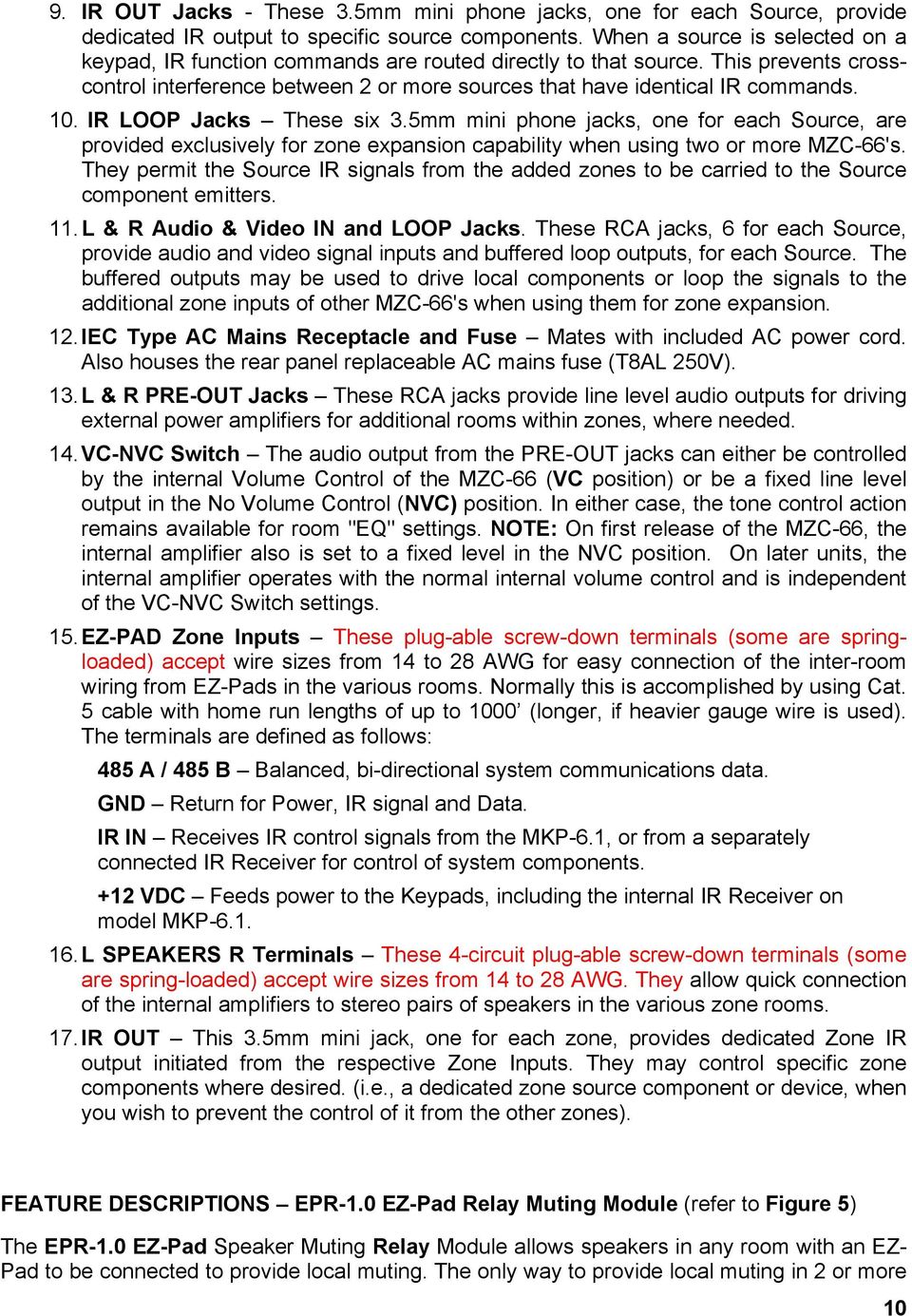
11 rooms within one of the MZC-66 zones, for instance, would be through the use of the EPR- 1.0's, one for each room's keypad. The rooms could be driven by a separate amplifier connected to the PRE-OUT jacks of one zone of the MZC-66. The room s speakers are connected in series with the EPR-1.0 Module and the room's amplifier. A button on the EZ-Pad is then designated, via EZ-Tools, to be a toggled local room muting key. The EPR-1.0 is available as a separate accessory and is not included with the MZC-66 or with any of the EZ- Pads. Figure 5 EPR-1.0 EZ-Pad Relay Features 1. Mounting Holes The EPR-1.0 can be mounted to any flat surface (usually to the studding in the wall behind the EZ-Pad or the in-wall speakers) using these holes and the screws provided. 2. Amplifier EZ-Connect Terminals. These spring-loaded terminals accept wire sizes 14 to 28 AWG for easy connection of stereo amplifier speaker leads. 3. Speakers EZ-Connect Terminals. These spring-loaded terminals accept wire sizes 14 to 28 AWG for easy connection of the in-room stereo speaker leads. 4. Relay Coil Leads This 12 (305mm) 2-conductor lead connects to the +Relay and Relay terminals on the back of the EZ-Pad. It can be extended to any length required (2000 with 24 AWG wire). Be sure to observe correct polarity. When the designated MUTE key on the EZ-Pad is pressed, the EPR-1.0 relay opens, thus muting the audio. The selected source button on the EZ-Pad will blink at a slow rate to indicate the muted condition. FEATURE DESCRIPTIONS EZ-Tools, LTM-1.0 Learning Test Module and Transfer / Adapter Cables EZ-Tools and the LTM-1.0 (optional) come packaged together and include the items illustrated in Figure 6. 11

12 Figure 6 EZ-Tools, LTM-1.0 and Cables Package SpeakerCraft EZ-Tools is a Windows based software program. It comes on a CD ROM packed with the LTM-1.0 Learning Test Module. It is also available as a free download from the SpeakerCraft web site. EZ-Tools provides for the complete configuring and programming of EZ-Pad control systems. Some of its many features include: Key button choice and placement, single and multiple zone assignments, Command Library, IR learning and testing capability in conjunction with the LTM-1.0, single and macro command programming, status/power management, priority commands management, code length timing, delay settings, events programming, etc. See item 3 below for details regarding use of the Transfer Cable and the USB / Serial Adapter Cable. The LTM-1.0 Learning Test Module is primarily an installer s tool and serves as an IR learning, IR teaching, and command test module. Refer to Figure 7. It includes blaster emitters so that learning remotes, used in conjunction with the EZ-Pads, can be programmed with system commands. Also, special SpeakerCraft EZ-Codes are similarly taught so that keypad sources track automatically with sources selected by the remote. 12

13 Figure 7 LTM-1.0 Learning Test Module Features 1. RS232 PORT DB9M jack allows RS232 commands to be tested with RS232 controlled system components. 2. EXPANSION Ports RJ45 jacks provide for the connection and testing of commands for future RS485 controlled products. 3. CONTROL PORT 3.5mm 4-circuit phone jack is a serial port that provides several control functions. All command learning and testing functions are accomplished via this port, using EZ-Tools, in conjunction with the mating Transfer Cable (included). Firmware updates for the LTM-1.0 are also accomplished via this port. NOTE: You would normally connect the Transfer Cable to the DB9 COM Port on your computer. However, if your computer does not have a DB9 COM Port, use the USB / Serial Adapter and related software on the CD-ROM, included. When using a USB port, connect the USB / Serial Adapter and the Transfer Cable together VDC REGULATED 2.1mm DC power jack powers the LTM-1.0. Use the SpeakerCraft PS VDC 200mA power supply (included). 5. PROGRAMMING Switch The upper DIP switch DISables or ENables internal LTM- 1.0 factory firmware updates. Leave this switch in the DIS position at all times, unless you are doing a firmware update and EZ-Tools prompts you to do otherwise. Such updates are accomplished via EZ-Tools through the CONTROL PORT (item #3) and ensure that improved functionality can always be accomplished in the field. 13

14 6. SENSE Switch The lower DIP switch sets the sensitivity of the internal IR Learning Sensor. Normally, set it to the LO position. However, if the teaching remote has weak output, move it to the HI position. 7. POWER Red LED indicates power supply is connected and system is active. 8. LEARNING SENSOR Lens Internal IR sensor receives IR command data from external handheld remotes for learning purposes. Works with EZ-Tools for the learning and storage of IR commands that are not available in the internal command library. Point the teaching remote at this lens from a distance of about 1 to 4 inches when learning commands. 9. BLASTER EMITTERS These high power emitters output IR commands for testing and teaching purposes. When testing commands, the controlled device(s) can be 30 feet or more away. When teaching commands into a learning remote, point the learning remote toward these emitters at a distance of about 1 to 4 inches. NOTE: These Blaster Emitters are automatically disabled whenever an emitter or any mating 3.5mm mini phone plug is inserted into the IR OUT jack (item # 11). 10. ACTIVITY INDICATOR Green LED indicates IR learning mode activities. Also flashes during activation of internal command data. 11. IR OUT 3.5mm 2-circuit mini phone jack will drive any of the SpeakerCraft or other compatible emitters at medium power levels for operational tests of IR commands. It will also drive one or more AT-1.0 Terminator blocks for fan-out to many emitters. NOTE: The Blaster Emitters (item # 9) are automatically disabled whenever a mating 3.5mm mini phone plug is inserted into this jack. 12. Non-Skid Foot Pads SYSTEM CONNECTIONS AND CONFIGURATION Factory Default System As mentioned earlier, the MZC-66 comes with a set of six pre-configured MKP-6.1 keypads, one for each Zone. In addition, the MZC-66 is pre-programmed at the factory with a default project so that the entire system will function "right out of the box". The installer can use this default as a base on which to build customized projects. The default project is named "MZC66DEF1.etp" in the EZ-Tools Project folder. When you alter it to build your own project, be sure to save it out with a different file name (i.e. "JonesHome"). The default project has the following functionality: (Refer to Figures 1 & 8). 1. Six Source Keys: SAT, CD, VCR, DVD, TNR, AUX 2. Six Function Keys: BASS, TREB, MUTE, PWR, VOL UP, VOL DOWN 3. The six Source Keys are set as Zone ON keys and are programmed to select the MZC- 66 rear panel Audio/Video Source inputs as follows: SAT = Audio/Video Source 1, CD = Audio/Video Source 2, VCR = Audio/Video Source 3, DVD = Audio/Video Source 4, TNR = Audio/Video Source 5, AUX = Audio/Video Source 6. In addition, a Mute Off command is programmed under each Source Key. 4. The six Function Keys are programmed as follows: 14

15 BASS: 1 st press changes Vol UP/Down to Bass Up/Down. 2 nd press = Bass Flat. TREB: 1 st press changes Vol UP/Down to Treble Up/Down. 2 nd press = Treble Flat. NOTE: While in the Treble or Bass tone modes, the selected Source button will blink at a medium rate, to indicate the tone setting mode. Tone setting mode is defeated by one press of any button other than the tone and volume buttons. MUTE: Set for Internal Preamp Muting. Toggles ON/OFF. Pressing Source and Volume buttons also un-mutes. During Mute, selected source key blinks slowly. PWR: Set as Zone Power OFF. Will NOT turn the Zone ON. Press and Hold for 2 seconds turns all Zones OFF (Whole House). : Volume Up command. Also serves as Bass or Treble Up after first pressing BASS or TREB keys. : Volume Down command. Also serves as Bass or Treble Down after first pressing BASS or TREB keys. Whole House/Party Mode 5. All Zones are set for Whole House/Party Mode capability Whole House/Party Mode: Forces all zones to same source and allows volume and mute functions to operate all zones in unison. - To engage Whole House/Party mode, press and hold a desired Source button for >2 seconds. During press and hold, source button blinks rapidly (busy). - Release button when blinking stops. Source button then turns Amber in color, indicating system is now in Whole House/Party mode. Source selection, Volume Control and Mute functions will now operate in all zones from the initiating zone only. - To transfer Whole House/Party mode control to another zone, above steps are repeated from the desired zone. - To cancel Whole House/Party Mode, press and hold a Source button from the initiating zone for >2 seconds (until blinking stops). NOTE: Zones other than the initiating zone will have red active Source buttons and will operate as normal independent zones. 6. Priority is set to ON for all zones. This means that commands from any keypad in any zone will execute, regardless of previous command executions in other zones. See Priority section for details. 7. When a zone is first turned on, the volume will be at a default medium background level. After that, it will come on at the last volume used prior to zone turn OFF. A Typical MZC-66 System Installation Perhaps the best way to become familiar with the MZC-66 / EZ-Pad system is to show its application in a typical installation. Figure 8 shows the six MKP-6.1 EZ-Pads (included) controlling the MZC-66 and related source components in a 6-zone application. 15
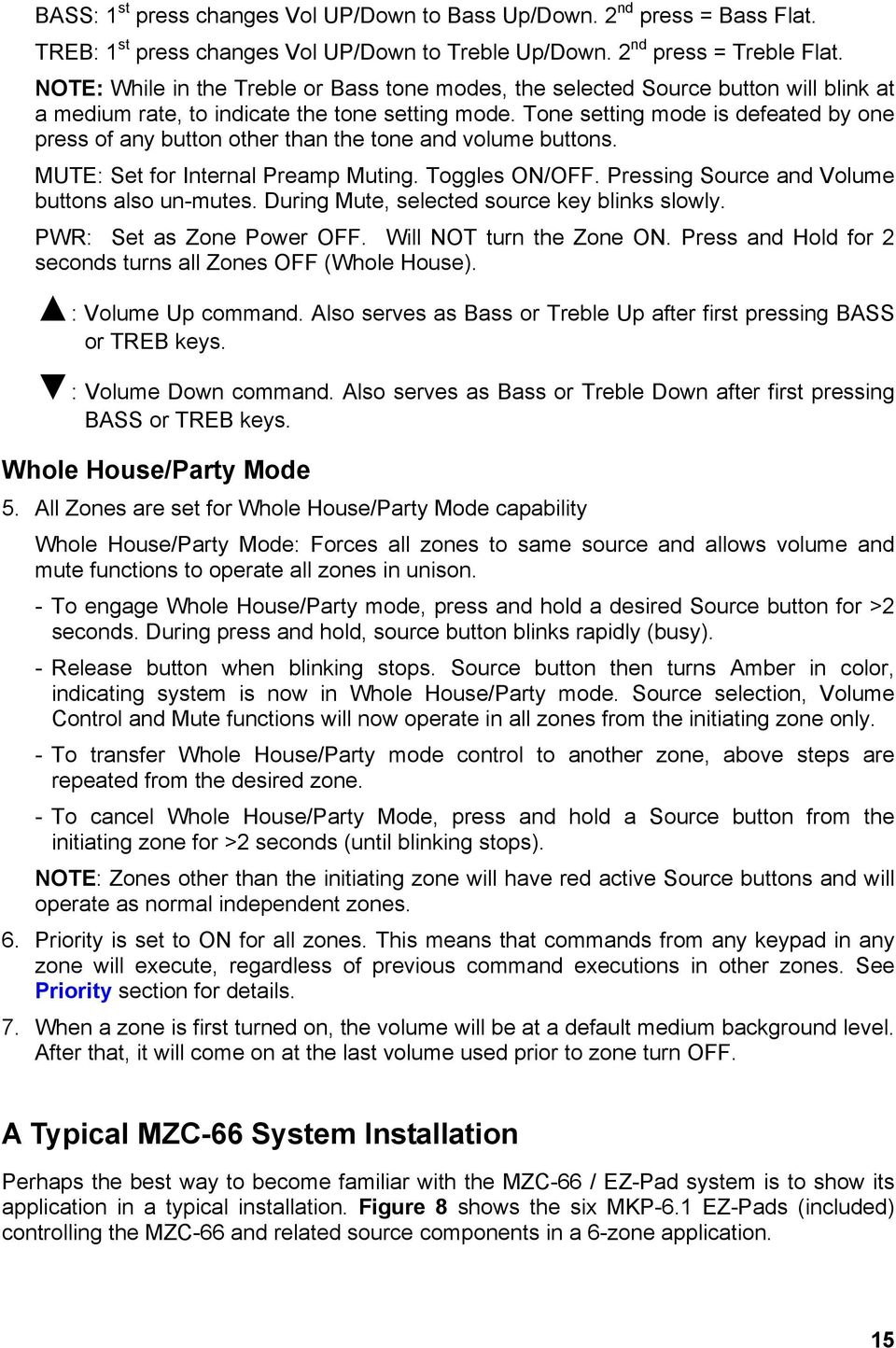
16 NOTE: The system in Figure 8 is given to illustrate the basics on how to configure and program a system, not to show all aspects of such an installation. For instance, for simplicity, the TV video monitors and speakers in each zone are not shown in Figure 8, even though such components would be required for a complete working system. Figure 8 A Typical EZ-Pad MZC-66 Controlled System The recommended steps to install such a system would be as follows: 1. Pull all wiring for the keypads, TV monitors, speakers, etc., from the various zone rooms (home runs) to a central equipment area. NOTE: Maximum recommended lead length for the keypads with Cat. 5 cable is 1000 (305m). 2. Set up and make all the necessary audio/video connections from the source components to the MZC-66, the amplifiers to speakers in rooms, video to TV monitors in rooms, etc. 3. Make sure all system components function first, with their own remote controls, before configuring the keypads and programming the MZC
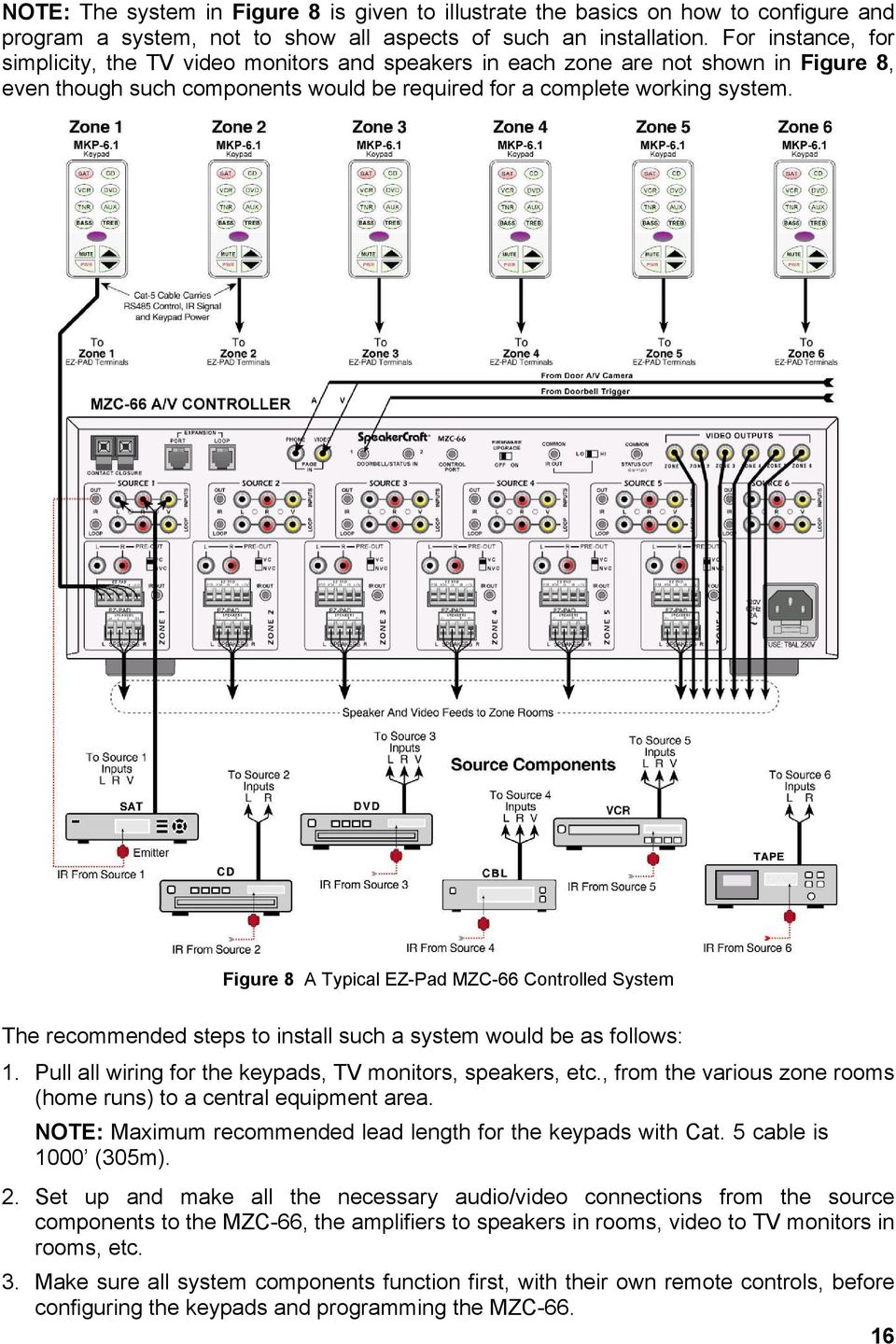
17 4. Place emitters on each of the source components and plug them into the corresponding Source IR OUTputs on the MZC Connect components with voltage Status Outputs to the DOORBELL STATUS Inputs on the MZC-66 (for power management, if desired). Configure the EZ-Pad Buttons 1. As received from the factory, the EZ-Pads will have a preinstalled set of buttons already in place. These may not match the source and function arrangements you need or desire. To change them, release the tabs, Figure 9, and remove the decorator insert panel, exposing the key buttons, Figure 10. Figure 9 Release Tab Figure 10 Remove Decorator Insert Panel 2. Starting with the Zone 1 MKP-6.1 (Master Keypad), and using the extra buttons supplied, if needed, move and place the source and function buttons in the arrangement you desire. See Figure 11. When you finish the arrangement, replace the Decorator Insert Panel over the buttons, being careful to see that the buttons align correctly with the panel openings. Press the panel down until the tabs snap into place. Figure 11 Moving and Placing Buttons 3. Repeat these steps for each of the other zone Master keypads. Note that each zone can have its own unique configuration however, it is best to keep them as similar as possible to simplify programming. 4. In the same way, configure the buttons on the Numeric and Function keypads (not included) that you may chose to use in some zones. 17

18 NOTE: The Numeric and Function keypads will not work on their own. They must be connected to a Master keypad using the 3-Connector Ribbon Cable supplied (included with each NKP-1.0 and FKP-1.0). The cable is symmetrical so it can be connected with the red striped side up or down, to best fit the configuration. Figure 12 shows it connected so that the MKP Master keypad will be to the right of the NPK Numeric and FKP Function keypads when mounted, whereas Figure 13 places the MKP to the left. Figure 12 Ribbon Cable MKP Right Figure 13 Ribbon Cable MKP Left 5. Connect all keypads to their assigned zones on the MZC-66 as in Figure 8. Be sure you connect the various colored Cat.5 leads to the correct Terminals on each end. Refer to Figure 14. Figure 14 Using Cat. 5 Cable to Connect MPK Keypads to MZC-66 It would be wise to use the same colors for each zone to help reduce errors. NOTE 1: Maximum recommended lead length with Cat. 5 cable is 1000 (305m). You could connect the 3 unused leads of the Cat. 5 cable in parallel with the +12V, GND and IR/IO leads, for better performance when using long cable lengths. 18

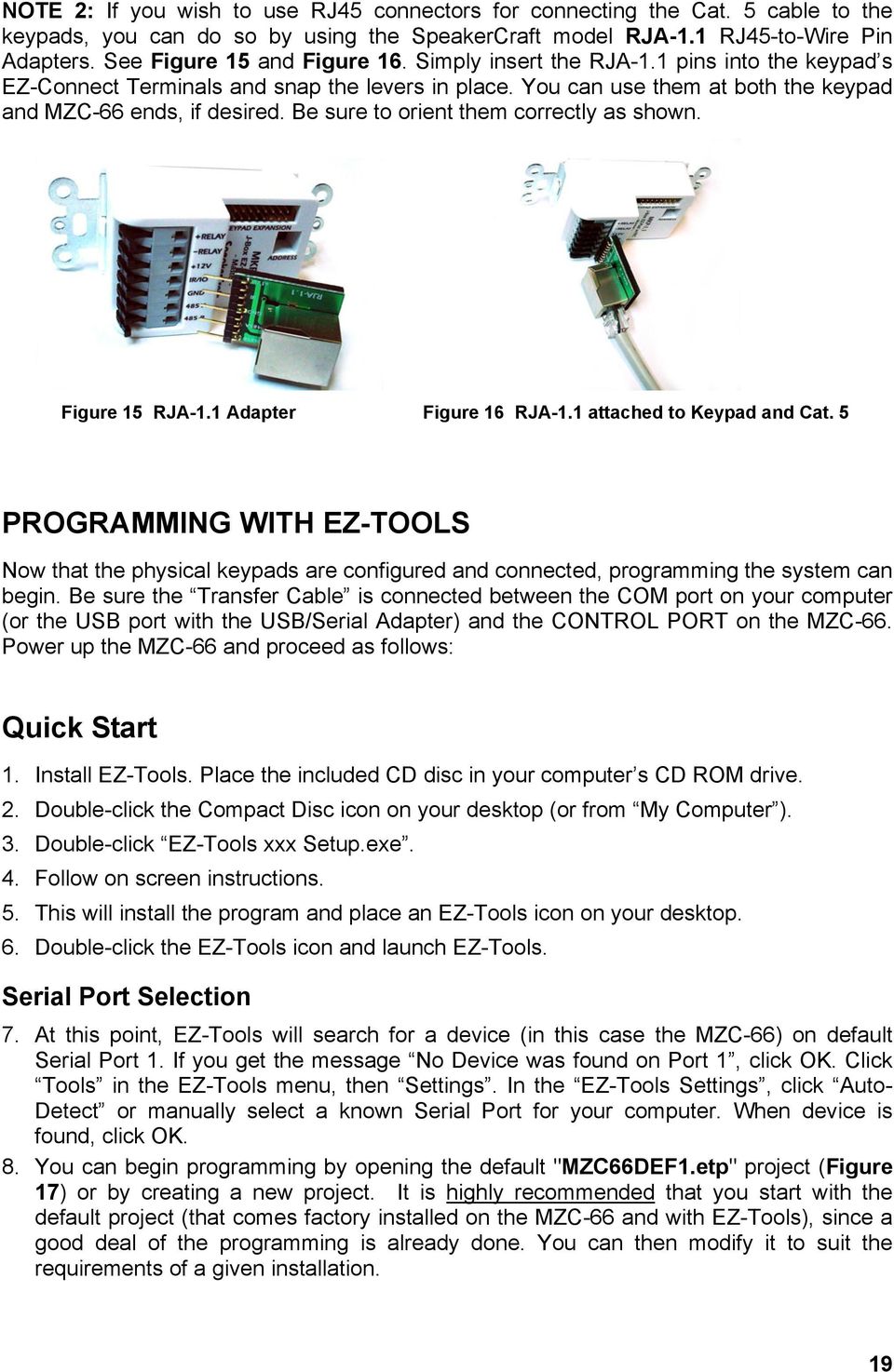
19 NOTE 2: If you wish to use RJ45 connectors for connecting the Cat. 5 cable to the keypads, you can do so by using the SpeakerCraft model RJA-1.1 RJ45-to-Wire Pin Adapters. See Figure 15 and Figure 16. Simply insert the RJA-1.1 pins into the keypad s EZ-Connect Terminals and snap the levers in place. You can use them at both the keypad and MZC-66 ends, if desired. Be sure to orient them correctly as shown. Figure 15 RJA-1.1 Adapter Figure 16 RJA-1.1 attached to Keypad and Cat. 5 PROGRAMMING WITH EZ-TOOLS Now that the physical keypads are configured and connected, programming the system can begin. Be sure the Transfer Cable is connected between the COM port on your computer (or the USB port with the USB/Serial Adapter) and the CONTROL PORT on the MZC-66. Power up the MZC-66 and proceed as follows: Quick Start 1. Install EZ-Tools. Place the included CD disc in your computer s CD ROM drive. 2. Double-click the Compact Disc icon on your desktop (or from My Computer ). 3. Double-click EZ-Tools xxx Setup.exe. 4. Follow on screen instructions. 5. This will install the program and place an EZ-Tools icon on your desktop. 6. Double-click the EZ-Tools icon and launch EZ-Tools. Serial Port Selection 7. At this point, EZ-Tools will search for a device (in this case the MZC-66) on default Serial Port 1. If you get the message No Device was found on Port 1, click OK. Click Tools in the EZ-Tools menu, then Settings. In the EZ-Tools Settings, click Auto- Detect or manually select a known Serial Port for your computer. When device is found, click OK. 8. You can begin programming by opening the default "MZC66DEF1.etp" project (Figure 17) or by creating a new project. It is highly recommended that you start with the default project (that comes factory installed on the MZC-66 and with EZ-Tools), since a good deal of the programming is already done. You can then modify it to suit the requirements of a given installation. 19
20 Figure 17 Opening the Default Project 9. If you wish to start an entirely new project, click New MZ-66 Project from the File menu or click the dual Green MZC-66 Icon. Type in an EZ-Pad Project Filename for your system, such as JonesHome and click Save. This places the filename in the Projects folder in the EZ-Tools directory. A typical path to the Projects folder would be C:\Program Files\SpeakerCraft\EZ Tools\Projects. Assigning IR Commands to Button Keys At this point, we will assume that the default project key choices will be used as is. IR Commands to control the source components can now be assigned. IR (and RS232) commands are obtained from the internal Command Library in EZ-Tools. You can also custom learn and place your own commands in the Library and use them in your projects. At this time we will use the existing commands in the library. 10. With the "MZC66DEF1.etp" default project open, save it with a new file name, such as JonesHome, by using "Save As " in the File menu. This will retain the default project "as is" for future use. 11. We will begin with the Source buttons in Zone 1 (we will clone Zone 1 to the other zones, after Zone 1 is programmed). The default program already has internal non-ir commands (red asterisk *) programmed for source/zone routing so we only need to be concerned with source function IR commands. The IR commands will typically consist of a macro of power commands for turning on a source component, placing it in Play, or turning on any other device you may want to come on with a single press of a Source button. Click on CMD Library. A Brands window appears with device folders just below. Refer to Figure Click a Source button (i.e. SAT) on the virtual keypad. Then click and scroll the Brands list for the component brand you have for SAT (i.e. RCA). 20

21 Figure 18 Assigning IR Commands to Button Keys 13. Double click the SAT/DSS folder. A list of Code Sets appears. At this point you may have to test the commands in more than one code set to find commands that work with the component. 14. To Test the commands, open a Code Set folder and left click a POWER command to highlight it. Press F9 to test the command. (When a command is sent by F9, the Source keys on all connected keypads will flash. The power command will be sent to the selected Source and Zone IR Outputs as well as the Common IR OUT). Once a power command is found to work, usually all the others for that device will work also (if not, try other code sets). NOTE: This test assumes you have the Transfer Cable (between your computer and the MZC-66) connected, all source and system components connected, all IR emitters attached and plugged in, and all devices powered up. 15. When a Power ON command is found to work, double click it to place it on the Command List under Button Properties for the selected Source key. Refer to Figure Once a command is on the Command List, you can also test it by clicking Test and then clicking the selected (Source) button on the virtual keypad. It acts just like you were pressing a button on the real keypad. Click Test a second time to turn the Test mode off. 17. If the command is a Discrete Power ON command, you do not have to use Power Management. However, if you do have a component that only operates with a toggle power command, see Power Management/.. section, beginning at step 19 following. 21
22 18. Repeat steps 12 ~ 17 for each of the remaining Source keys. If you use a play command so that a CD, DVD, etc. starts playing when a source key is pressed, be sure to add it after the Power ON command, as in Figure 19. Power Management/Events Programming 19. Some components, where only Toggle Power commands are available, will require Power Management. We will consider the VCR source, in this regard, for the Power ON action of a Source key. Click VCR on the virtual keypad and then go to the CMD Library for the VCR brand you have (JVC in this example). 20. At JVC brand, go to VCR and open Code Set 1. Left click POWER ON/OFF command (a Toggle Power command) and test with F9. Double click command to place it on the Command List. 21. Right click POWER ON/OFF command on the Command List and left click Toggle Power Management. On the pop-up, click Allow component to power ON. Refer to Figure 19. Figure 19 Programming Toggle ON Power Management 22
23 22. Next, select the Status Input number to which you have a sense voltage connected (see Notes 1 and 2 below) that represents the VCR s ON or OFF condition (in this case, Figure 19, it is #2). The command summary is now shown on the Command List as (TogON-2) POWER ON/OFF Code Set 1 (JVC-VCR). This means that if the VCR is OFF, the sense voltage will be low and therefore the power command will be allowed to pass to turn the VCR ON when the VCR button is pressed. Conversely, if the VCR were already ON, the video sense would be high, thus prohibiting the power command from being sent when the VCR button is pressed. Note 1 The sense voltage would be connected to the one of the DOORBELL/STATUS IN jacks on the rear of the MZC-66. It needs to be in the range of 3 to 30 V AC or DC. This could be derived from a Current or Video sensing module which has an output voltage that goes high (>3 V) when the component is ON or low (< 1 V) when the component is OFF. Note 2 The DOORBELL/STATUS IN jacks can be used for either doorbell input triggering or for component power status management. 23. Repeat steps 19 ~ 22 for one other source that needs to operate with Toggle Power commands. Remember, if you do this, you will have no DOORBELL/STATUS IN jacks left over for doorbell use. To avoid this, try to always use components that have discrete power ON and OFF commands available, so that you do not have to use power management. Many discrete commands are available on "remotecentral.com". 24. Now we need to program Power OFF Management. Pressing the PWR button should power off a Zone, but not any of the Sources until any given Zone is the last to be powered off, or when a Whole House OFF command is executed (pressing & holding PWR for > 2 Sec.). Proceed as follows: 25. To program power OFF management we will not place commands under the PWR key, but rather within EVENTS SETUP. (This allows you to program the Off events in one location rather than under every power key in each zone. Refer to Events Setup section for more detail). 26. Under Project Content, left click EVENTS SETUP. Under "System Turning OFF (Last Zone OFF)" left click "Source Output 3" which corresponds to the VCR as Source 3. Place the same JVC POWER ON/OFF command on the Command list. Now right click the POWER ON/OFF command on the Command List and left click Toggle Power Management. On the pop-up, click Allow component to power OFF and click OK. Refer to Figure
24 Figure 20 Programming Toggle Power OFF under Events Setup The System Turning OFF is now programmed so that the VCR will turn OFF when the last zone is powered OFF or when Whole House OFF is executed by pressing and holding any PWR key for more than 2 seconds. 27. Repeat steps 19 ~ 26 to place a Toggle Power OFF command under one other Source Output for a different source component, if desired. 28. The other source components must use discrete power commands. Place such discrete Power OFF commands under each of the remaining Source Outputs in the System Turning OFF list. NOTE 1: When done, all Source power OFF events will occur without the need to place them under the PWR keys in each zone. This results in easier programming and a much shorter Power OFF macro. NOTE 2: If you have a Zone component, such as an IR controlled amplifier, you will need to place its power OFF command under the PWR key of the Zone that controls it, OR under the applicable Zone Turning OFF section in Events Setup. Cloning and Programming the Remaining Zones 29. Now that Zone 1 is programmed, we can proceed to the remaining 5. Since all zones share most of the same programming, we can simply Clone Zone 1 to each of the remaining 5 and save a great deal of time. The less extensive programming of each zone s differences can then be performed, if needed. Proceed as follows: 30. Left click Zone 1 under Project Content and drag and drop it onto Zone 2. Click Clone on the pop-up. Refer to Figure 21. You now have an exact replica of Zone 1 at Zone 2. Repeat this for each zone. 24
25 Figure 21 Cloning Zone 1 to Zone 2, etc. NOTE: Move also shows on the pop-up. This allows a given zone to be moved to any different zone, without cloning. Be cautious with Move, however. It will leave the previous zone completely un-programmed! (Not Setup). 31. When done, all 6 zones will now be identical. At this point, you can make individual zone-by-zone changes, such as different zone commands for zone specific devices, if needed. 32. When the above steps are fully implemented, you will have a basic functioning system that includes the functionality stated under " Factory Default System ", previous, plus the following; a) Source and Zone components will power ON with the press of any Source button. b) Source Power ON Management for up to two Sources of your choice. c) Source Play at turn ON, if programmed, at your choice. d) Zone components power OFF with press of individual Zone PWR buttons. e) All Source components stay ON until last Zone powers OFF. f) All Source and Zone components power OFF with press of the "last on" Zone's PWR button or with Whole House power OFF (press and hold any Zone's PWR button for >2 seconds). For other types of programming, see "Advanced Programming" section following. ADVANCED PROGRAMMING EZ-Tools, in conjunction with the EZ-Pad/MZC-66 components, is a very flexible and extensive programming and control system. Advanced options are as follows: Delays 1. In some cases, particularly Video Projectors, DVDs and VCRs, a component may require 1 to 4 seconds to fully execute a power On, Off, or other function. This is no problem unless the user presses the component s Source button very quickly after the power OFF command. Or commands execute so quickly in a Whole House On macro that Status is not established before the next Power command arrives. The Keypad could then show an ON condition when in reality the component would be Off. 25
26 Figure 22 Programming Delays 2. To prevent this, place a delay just after the Power command for the related Source Output under System Turning OFF in Events Setup (and under the Source button, if needed at turn ON). To do so, left click the clock symbol just above the Command List. A Delay line with a clock symbol will appear in the Command List. Refer to Figure Double click the Delay line and adjust the Delay Time as necessary. Click OK. NOTE: Keep delays to the shortest times possible to avoid long executions of the resulting macros. 4. If you have several commands in any given list, left click the Delay line and drag and drop it into position within the list as desired. Punched Commands 1. The Punch command allows you to instantly Punch Through common commands, such as Tone, Volume Up/Down, etc., to all Source (bank) selections. This will save you a great deal of programming time and help reduce programming errors. Keep in mind however, that commands such as Stop and Play will be different for each Source (bank) and should not be punched. Also, if you use the MZC66DEF1.etp default project that comes installed on the MZC-66 (and in EZ-Tools), the needed punch throughs have already been done for the above mentioned commands. 2. If you need to do a Punch Through, say for volume, begin by left clicking any one of the Source buttons. Place volume up and down commands on the Vol UP and Vol Down keys. For the MZC-66, these would be the internal Zone 1 Volume Up and Zone 1 Volume Down commands from the MZC-66 Cmds tab. Click Vol UP key so that it is highlighted blue. 3. Click MZC-66 Cmds tab then Audio Level Commands. 4. Double click Zone 1 Volume Up command from the list (if you are programming Zone 1). Refer to Figure
27 Figure 23 Punch Programming 5. To Punch, right click the Vol Up button and left click Punch key s Commands and Yes on the pop-up. Refer to Figure 23. Repeat this for Vol Down. The commands under these keys will now appear regardless of the Source selected. 6. Repeat these steps for any other command that would make sense to Punch through. Priority There are times when you would like to select a source, such as CD, and have it play without interruption in a given zone, such as when dining. Other zones could listen to (leech) the same source, but not change discs, tracks, or stop the CD, etc. In EZ-Tools, such priority can be given either on a first come first served basis or on an equal access basis. They can be assigned on a Global, Zone, Source or individual key basis. The options are as follows: Priority Equal This is the default setting in EZ-Tools, before any priority programming changes are made. It means that all keys in all zones have the same priority (Priority On) and commands work regardless of the actions of others in other zones. It will likely be the most often used in installed systems. You can verify this by right clicking any of the function or numeric keys. A check mark will appear next to the Priority On in the pop-up. See Figure
28 Figure 24 Check Mark Indicates Priority is Set to ON (Initial Default Setting) Priority First Come First Served This type of priority would give controlling access (priority) to the first zone that selects any given source. For instance, the first person pressing CD source in any given zone would be the only one able to control the CD. Others in other zones could leech (listen) but not be able to control it until the first person released it by selecting another source. The next person pressing CD would then have priority control to the exclusion of all others. To program this type of priority, proceed as follows: 1. Right click MZC-66 under Project Content. Left click Force Global Priority Off and click Yes on the pop-up. See Figure 25. This will force Priority Off on all function and numeric keys in all zones with the exception of keys checked as Mute (Relay) Key and Zone Power Off keys. You can verify this by right clicking any function key. You will see that Priority OFF is checked instead of Priority ON. Figure 25 Forcing Global Priority OFF 2. Restoring Priority to Common Commands. The previous action even removes priority control from common commands like Bass/Treble and Volume. These will need to be restored as follows: 3. Right click a Volume button in any Zone and left click Priority On in the pop-up. Next, click Punch Priority Setting and Yes in the pop-ups. This punches through Priority On for that key for every Source (bank) in the Zone. 4. Repeat steps 2 and 3 for the remaining volume and other common keys in the zone. 5. Now repeat steps 2, 3, and 4 for each of the remaining zones. This completes this type of programming. 28
29 Zone Priority If you want one or more Zones to have full priority in any given zone (that is, you want to always override anyone else s First Come First Served selections for all Sources within a Zone), proceed as follows: Figure 26 Forcing Zone Priority ON 1. Perform steps 1 through 5 above first. 2. Right click the desired Zone (i.e. Zone 2 under Project Content) and left click Force Zone Priority On and Yes in the pop-ups. Refer to Figure 26. All function and numeric keys for all Sources in that Zone, where applicable, will now have all their Priority On options checked. 3. Repeat step 6 for any other Zone where you desire to have this action. Source Priority If you want one or more single Sources to have full priority in any given zone (that is, you want to always override anyone else s First Come First Served selection for a given Source, but not all Sources), proceed as follows: Figure 27 Forcing Source Priority ON 1. Right click the desired Source key (i.e. CD) and left click Force Source Priority On and Yes in the pop-ups. Refer to Figure 27. All function and numeric keys for that Source, where applicable, will now have all their Priority On options checked. 29
30 2. Repeat step 8 for any other Source in any other Zone where you desire to have this action. Individual Key Priority If you want just one or more function or numeric keys to have full priority for any given Source in any given zone [that is, you want to always override anyone else s First Come First Served selection on an Individual Key basis (i.e. Play, Stop, etc. on DVD)], proceed as follows: 1. Right click the desired function or numeric key (i.e. Pause) and left click Priority On in the pop-up. See Figure 28. The key will then have Priority On checked. Figure 28 Forcing Individual Key Priority ON 2. Repeat step 10 on any other function or numeric key for any Source in any other Zone where you desire to have this action. Muting Relays The EPR-1.0 EZ-Pad Speaker Muting Relay Module is used to provide local room Muting as explained earlier (see Figure 5). Actually, Muting can be accomplished two ways, 1) by using Preamp Muting as explained in reference to the system example (Figure 8) or 2) by using a Dedicated Mute Key on the EZ-Pad to actuate the EPR-1.0 Relay. Using the Relays would be desirable, for instance, when you have two or more rooms, with keypads, connected within the same Zone. They allow individual room muting not possible with Preamp Muting. To use the relays, proceed as follows: Designated Relay Mute Key This will designate one function key for dedicated Toggle Relay Mute action. When programmed on a Zone, the MUTE key will mute individual keypads within a Zone when pressed for a short time (under 2 seconds.) and will also provide Whole House Muting (all zones) when the key is pressed for longer than 2 seconds. When muted, the selected Source key will blink about once per second. Whole House Muting will un-mute when the 30
31 Mute key is re-pressed for longer than 2 seconds. Also, all Muting Relays are released (unmuted) when the Whole House or last Zone is powered down. 1. First, connect the amplifier and the room speakers to the EPR-1.0 Relay. Refer to Figure 29. Then connect the Relay coil leads to the Relay + and Relay- terminals on the rear of the Master MKP module as in Figure 29. Be sure to observe correct polarity. NOTE: If you wish to mount the EPR-1.0 Relay Module near the speakers rather than the keypad, you can extend the Relay Coil Lead by splicing on 2-conductor wire (up to 2000 with 24 AWG). Figure 29 System Connections for the EPR-1.0 Muting Relay 31
32 2. In EZ-Tools, click on the Zone under Project Content in which you wish to have Mute Relay action (in this case Zone 4, refer to Figure 30) and then click the Whole House/Mute tab to the right. Figure 30 Selecting Mute Relay Key Functionality 3. Under Mute Key Functionality, click EZ-Pad Relay Speaker Muting, then Apply. 4. Under Project Content click EZ-Pad in the selected Zone. 5. Now right click the MUTE key and left click the pop-up to select and check Mute (Relay) Key. Refer to Figure 31. Figure 31 Selecting a Mute (Relay) Key NOTE: The Mute key will now have a green outline when other keys are selected, indicating that it is a designated Mute key. Also, when a key is selected to be a designated Mute (Relay) Key, IR commands cannot be placed under it. The muting action is driven internally by an embedded command. You will see no command in the Command List for this key. 32
33 6. Repeat steps 2 through 5 for each additional Zone where you may want to use Relay Muting. Insert Mute Relay Commands You can actually insert embedded Mute Relay commands on other keys (NOT on Designated Relay Mute Keys) to improve functionality, as follows: Keypad - Mute On, OFF, or Toggle These actions, when programmed, provide either discrete ON, discrete OFF or Mute Toggle actions that will work on any keypad within a Zone. Other keypads set to different addresses within that same Zone will not be affected. A typical Mute action would be to place a Keypad - Mute Off command on the Volume Up key so that Mute will be released immediately when Volume Up is pressed, to avoid blasting. To do so, proceed as follows: 1. Right click the Volume Up key (it turns dark blue) and go to Insert EZ-Pad Mute Relay Command on the pop-up. Left click on Keypad - Mute Off (De-Energized). Refer to Figure 32. Figure 32 Placing a Keypad Mute OFF on Volume Key 2. Keypad - Mute Off (De-Energized) now appears on the Command List. Now click on the Keypad - Mute Off (De-Energized) command line and drag and drop it to be ahead of the Volume Up command. 33
34 NOTE: If the Keypad - Mute Off (De-Energized) command line follows the Volume Up command, it will work, but it will cause the ramping of the MZC-66 volume command to be very slow. In addition, if you were to use an IR volume command for an external amplifier for some reason, then you must place the Keypad - Mute Off (De-Energized) command line ahead of the Volume Up command line, otherwise the volume command will not ramp when the Volume Up key is held down. 3. Right click the Volume Up key and left click Punch Key s Commands and Yes on the pop-ups. This will make the mute action and the volume apply to all Source selections. 4. DOWNLOAD the project and test the mute actions. NOTE: The embedded Relay Mute commands cannot be tested from the virtual keypad in EZ-Tools. 5. You may repeat steps 1 to 4 for any of these three Keypad - Mute actions on any Function key to provide special muting actions of your choice. You may also use them on Source keys, but in this case you would have to omit step 3 and place them on each Source key individually. Your programming of these muting selections may be repeated for keypads in other zones as desired. Zone - Mute On, OFF, or Toggle These actions, when programmed, provide either discrete ON, discrete OFF or Mute Toggle actions that will apply to all keypads within a given Zone. Other keypads set to different addresses within the same Zone will be affected, but will not affect keypads in other zones. Again, a typical Mute action would be to place a Zone - Mute Off command on the Volume Up key so that Mute will be released immediately when Volume Up is pressed, to avoid blasting. To do so, proceed as follows: 1. Right click the Volume Up key (it turns dark blue) and go to Insert EZ-Pad Mute Relay Command on the pop-up. Left click on Zone - Mute Off (De-Energized) using the same method as illustrated in Figure Zone - Mute Off (De-Energized) now appears on the Command List. Now click on the "Zone - Mute Off.." command line and drag and drop it to be ahead of the Volume Up command. NOTE: It actually doesn't matter if the "Zone - Mute Off.." command line is ahead of the Volume Up command when using the MZC-66 internal volume commands. However, if you were to use an IR volume command for an external amplifier for some reason, then you must place the "Zone - Mute Off.." command line ahead of the Volume Up command line, otherwise the volume command will not ramp when the Volume Up key is held down. 3. Right click the Volume Up key and left click Punch Key s Commands and Yes on the pop-ups. This will make the mute action and the volume apply to all Source selections. 4. DOWNLOAD the project and test the mute actions. NOTE: The embedded Relay Mute commands cannot be tested from the virtual keypad in EZ-Tools. 34
35 5. You may repeat steps 1 to 4 for any of these three Zone - Mute actions on any Function key to provide special muting actions of your choice. You may also use them on Source keys, but in this case you would have to omit step 3 and place them on each Source key individually. Your programming of these muting selections may be repeated for keypads in other zones as desired. Global - Mute On, OFF, or Toggle These actions, when programmed, provide either discrete ON, discrete OFF or Mute Toggle actions that will apply (globally) to all keypads within all Zones. Again, a typical Mute action would be to place a Global - Mute Off command on the Volume Up key so that Mute will be released immediately when Volume Up is pressed, to avoid blasting. To do so, proceed as follows: 1. Right click the Volume Up key (it turns dark blue) and go to Insert EZ-Pad Mute Relay Command on the pop-up. Left click on Global - Mute Off (De-Energized) using the same method as illustrated in Figure Global - Mute Off (De-Energized) now appears on the Command List. Now click on the "Zone - Mute Off..." command line and drag and drop it to be ahead of the Volume Up command. NOTE: It actually doesn't matter if the "Global - Mute Off..." command line is ahead of the Volume Up command when using the MZC-66 internal volume commands. However, if you were to use an IR volume command for an external amplifier for some reason, then you must place the "Global - Mute Off.." command line ahead of the Volume Up command line, otherwise the volume command will not ramp when the Volume Up key is held down. 3. Right click the Volume Up key and left click Punch Key s Commands and Yes on the pop-ups. This will make the mute action and the volume apply to all Source selections. 4. DOWNLOAD the project and test the mute actions. NOTE: The embedded Relay Mute commands cannot be tested from the virtual keypad in EZ-Tools. 5. You may repeat steps 1 to 4 for any of these three Global - Mute actions on any Function key to provide special muting actions of your choice. You may also use them on Source keys, but in this case you would have to omit step 3 and place them on each Source key individually. 6. Your programming of these muting selections may be repeated for keypads in other zones as desired. Or you may wish to have Global Mute actions work from only the Master Bedroom keypad, for example. Learning IR Commands There will be times when you will not find IR commands for certain brands or models in the internal Command Library within EZ-Tools. You can easily learn such commands, however, and make them part of the internal Command Library. The IR Learning Sensor system of the LTM-1.0 (optional) permits you to do so in conjunction with EZ-Tools. Proceed as follows: 35
36 Using The LTM-1.0 IR Learning Sensor System The LTM-1.0 Learning Test Module (Figure 7), as an Installer s optional tool, permits the learning of IR code and other special functions in the shop, before programming the MZC- 66 or other SpeakerCraft models. Learning IR Commands 1. Connect your computer s DB9 COM Port via the Transfer Cable to the LTM-1.0 s CONTROL PORT. (Refer to Figure 36 for connections. Use the USB / Serial Adapter with the Transfer Cable for USB port interface, if necessary). 2. In EZ-Tools, click on CMD Library. New Brands 3. If the Brand name does not already exist, right click within the Brands space and left click New Brand. Type in the new brand name and click OK. 4. Right click the empty space below the brand name and left click New Component. Type in the new component name (i.e. DVD) and click OK. 5. Right click the new (DVD) folder and left click New Model. Type in the new model name (the model # of the component or it s remote, i.e., RM-DVD40) and click OK. 6. Right click the new model # folder (i.e., RM-DVD40). Go to New Commands and left click IR Commands. Type in command name (i.e., PLAY) and left click right arrows (>>) to put the name in the New Command List. At this point, you can type in a whole list of command names (i.e., STOP, PAUSE, TITLE, MENU, etc.). Refer to Figure 33. Figure 33 Adding New Command Names 7. When done, click OK and they will all be placed in and appear below the model folder in the CMD Library. 36
37 8. To Learn a Command. First have the teaching remote ready and pointed directly at the LEARNING SENSOR on the LTM-1.0 (spaced about 1 away). Set the SENSE switch to LO. (If you have a weak remote, you may need to set this switch to HI). 9. Next, left click the desired command and press F12 (or right click and click Capture IR Command ). Refer to Figure 34. An IR Command Capture pop-up will next appear. 10. At this point, press and hold the corresponding key on the teaching remote until the green ACTIVITY INDICATOR on the LTM-1.0 turns off. The word Capturing and two bars in the pop-up show progress and give you about 5 seconds to capture the command. If the command is learned, the words Capture Successful appear momentarily and the command name in the list will turn Red. If not, Capture Unsuccessful appears and the command name remains black. Figure 34 Capture IR (or press F12) Figure 35 Test IR (or press F9) 11. You may test the command now. Left click the command and press F9 (or right click and click Test Command ). Refer to Figure 35. NOTE: The ability to test commands assumes you have an emitter attached to the component under test and the emitter is plugged into the IR OUT jack on the LTM-1.0. Or you can simply aim the BLASTER EMITTERS on the LTM-1.0 at the component under test (up to 30 feet or so away). Remember, for the BLASTER EMITTERS to work, you must unplug the emitter from the IR OUT jack! 12. Repeat steps 8 ~ 11 for all remaining IR commands you need. They can then be used in any of your projects in the normal manner. Existing Brands If you only need to add a new model to an existing brand, proceed as follows: 13. Select the brand in the CMD Library (i.e., Carver). 14. If you need to add a new Component (i.e., DVD), do so as in step 4 above. 15. Add a Model Name as in step 5 and Command Names as in step Repeat steps 8 ~ 11, as necessary, to learn all the desired commands. 37
38 Programming Learning Remotes With EZ-Code System Commands The EZ-Pad system has a unique capability whereby commands programmed into a keypad project can be executed by a learning remote control. Special SpeakerCraft EZ- Code key commands can be taught to such remotes, which, when executed from the remote, will control the Audio/Video system as if you were pressing the keys on the EZ- Pads themselves. These EZ-Code commands are actually single commands that merely trigger, if you will, the actual IR command(s) programmed under the related EZ-Pad key. This is a decided advantage in that long macros under EZ-Pad keys do not have to be stored and executed by the handheld remote. When programmed, the EZ-Code commands from the remote, in IR form, are picked up by the IR Receiver in the MKP-6.1 Keypad, or a separate IR Receiver (i.e., IRC-4.0) in the room connected to the same IR bus as the keypad (+12V, IR IN, GND). When executed, sources selected by the remote will be tracked and indicated automatically on the keypad s lighted Source buttons. Programming Procedure First, you should complete all programming for your EZ-Pad project, such as that outlined previously for the system in Figure 8. Once that is done, plug the Transfer Cable into the CONTROL PORT of the LTM-1.0 Learn/Test Module as shown in Figure 36. Then proceed as follows: Figure 36 Programming Learning Remotes 1. Launch your EZ-Pad project in EZ-Tools. Left click a Zone, such as Zone 2 under Project Content and left click a Source key (i.e. SAT). 38
39 2. Point the learning remote directly at the BLASTER EMITTERS on the LTM-1.0 (spaced 2 to 3 ) and activate the learn mode. We will use the SpeakerCraft EazyR-2 Learning Remote in this exercise. 3. To place the EazyR-2 in the learn mode, first press the desired Source key on the EazyR-2 (i.e. SAT). 4. Press and hold the SETUP key until the red LED flashes twice, then release. 5. Press the numbers LED will flash twice after the Press and release the key you want to learn onto (in this case, the INPUT button). The LED will flash rapidly, awaiting the command to be stored. NOTE: You only have about 5 seconds to act at this point. If it times out, simply repeat the procedure from step In EZ-Tools, left click the desired key (in this case the Source key SAT) and press F8 (or right click then left click TX Key s IR Code on pop-up). This will transmit the SAT key s IR EZ-Code to the learning remote. Refer to Figure 37. Figure 37 Transmitting Key s EZ-Code to Learning Remote (or press F8) 8. If successful, the LED on the remote will stop flashing and blink twice. If unsuccessful, the LED will stop flashing and blink one time long. 9. Repeat steps 6 through 8 for all remaining function keys that you want to control for that particular Source. If the learn mode times out, repeat from step Repeat from step 6 for each additional Source key you wish to program as well as all the related function keys. It the Learn mode times out, repeat from step 4 to select the new Source. 39
40 NOTE 1: The EazyR-2 is not capable of recording IR commands under the Source buttons and that is the reason for using the INPUT button in step 6. After programming, selecting a Source on the EazyR-2 and issuing the commands under that Source, is therefore a 2-step process. First, press the desired Source button (to select the bank), then press INPUT to execute the Source power-up and other commands that may exist under the like Source key of the EZ-Pad. The EZ-Pad Source key will light up to track and show your selection. NOTE 2: Each EZ-Pad zone has its own zone related EZ-Code. Therefore, an EazyR-2 remote, after programming, will only control that one zone. Additional EazyR-2 remotes, each programmed as above for each specific zone via EZ-Tools, is required, if you want remote control in other zone rooms. EZ-Code Group Settings In rare instances, other components might respond to (or be stepped on by) one or more of these EZ-Code key commands. If this happens, you can change the EZ-Code Group to a different EZ-Code command Group. To do so, proceed as follows: 1. Click MZC-66 under Project Content to open the MZC-66 Setup window. 2. Click the Misc. tab, then the down arrow under EZ-Code Group. 3. Select a different EZ-Code Group number (i.e., 02 instead of is the default selection). Click Apply. Refer to Figure 38. Figure 38 Changing the EZ-Code Group Number 4. Click DOWNLOAD on the Toolbar to make the new EZ-Code Group effective in the MZC
41 5. Repeat the programming procedures previous for all keys on each Remote in each zone. Programming Learning Remotes With Library IR Commands You can program learning remotes with any of the normal IR commands from the EZ-Tools Command Library. Set up the LTM-1.0 system as in Figure 36 and proceed as follows: Programming Procedure 1. Launch an EZ-Pad project in EZ-Tools. Left click the CMD LIBRARY and choose the Brand. 2. Select the component type (i.e., TV) and the Code Set you wish to learn code from. 3. Left click the first code you wish to learn (i.e., POWER ON). 4. Point the learning remote directly at the BLASTER EMITTERS on the LTM-1.0 (spaced 2 to 3 as in Figure 36) and activate its learn mode. We will use the SpeakerCraft EazyR-2 in this exercise. 5. To place the EazyR-2 in the learn mode, first press the desired Source key on the EazyR-2 (i.e. TV). 6. Press and hold the SETUP key until the red LED flashes twice, then release. 7. Press the numbers LED will flash twice after the Press and release the key you want to learn onto (i.e., the INPUT button for the POWER ON code). The LED will flash rapidly, awaiting the command to be stored. NOTE: You only have about 5 seconds to act at this point. If it times out, simply repeat the procedure from step In EZ-Tools, left click the desired code (in this case POWER ON) and press F9 (or right click then left click Test Command on pop-up). Refer to Figure 39. This will transmit the IR Code to the learning remote. Figure 39 Using Test Command (F9) to Teach Learning Remotes 41
42 10. If successful, the LED on the remote will stop flashing and blink twice. If unsuccessful, the LED will stop flashing and blink one time long. 11. Repeat steps 6 or 8 through 10, as needed, for all remaining keys that you want to learn code onto. Templates To save time on new projects, you can simply do a Save As from the File menu in EZ- Tools and save existing projects under different file names. You would then use them as Templates for new projects that have similar programming. In addition, EZ-Tools provides for the use of specific Templates to shorten individual Source and Icon Layout programming times within any given project. Source Templates After you have done 1 or 2 projects, such as that relating to the system in Figure 8 previous, you can export all the programming you have done for each Source for use in other projects. Remember, when you do this, every command, macro, etc., that you have programmed under that Source bank for all Numeric and Function keys, will be saved as a Template, including any commands under the Source key itself. When Imported into a new project, you can use the programming as is, or make small custom changes, as necessary, to fit the particular needs of the new project. Proceed as follows: Exporting Sources as Template Files 1. Open the project from which you wish to export Source programming. Click on the EZ- Pad icon in the desired zone (i.e., Zone 2) under Project Content. 2. Right click the desired Source button and click Export Source to Template " from the pop-up. See Figure 40. Figure 40 Exporting a Source To a Template 3. At this point, type a File name by which you wish to identify that particular Source (i.e., CD Player ) and click Save. This will add the file to the Source folder in the Templates subdirectory. Refer to Figure
43 Figure 41 Saving a Source Template File 4. Repeat this for each Source you wish to save as a Source Template. Importing Source Template Files 1. Start a new project by creating a new project file name and assign the basic keypad configurations with SOURCE SETUP and ZONE SETUP. 2. Once you have a zone keypad configured with the Source names you want, right click one (i.e., SAT) and click Import Source From Template. See Figure 42. Figure 42 Importing a Source Template 3. Click on the file you want (i.e., SAT Receiver), and then Open. You will be prompted that this import assumes identical locations for all function buttons as they existed in the previous project from which the template was created, and that every button under this source will be overwritten (with the template commands). Click Yes. 4. You now have all the programming loaded for the new Source bank that exists in the template file. 5. Repeat this for each Source Template you wish to import. CAUTION: If your new project has different Source assignments for the SOURCE INPUTS and the DOORBELL/STATUS INPUTS, you will need to make changes in these also to have correct selection and IR control of Sources and correct synchronization for Power Management. 43
44 Icon Templates You can make and use Icon file templates as well. In addition, EZ-Tools comes with an EZ- Pad Default Layout template that matches the buttons that are factory pre-installed on the actual EZ-Pads. NOTE: These Icon Templates import and export Icon sets only, not command sets. Also, icon templates apply to Function and Numeric buttons only, not to Source buttons. To save time, you can use these and then make a few changes as necessary, to match your real project, both in EZ-Tools and on the real keypads. Exporting Icons as Template Files 1. Open the project from which you wish to export an Icon Template. Click on the desired zone (i.e., Zone 2) under Project Content. 2. Click the "---> ICONS" (Export) symbol in the Toolbar. At this point, type a File name in the Save As pop up by which you wish to identify that particular Icon template (i.e., JonesHmZone2 ) and click Save. Refer to Figure 43. Figure 43 Exporting and Saving an Icon Layout Template File 3. This will add the file to the Icon folder in the Templates subdirectory. 4. Repeat this for each Zone you wish to save as an Icon Template. Importing Icon Template Files 1. Start a new project by creating a new project file name and assign the basic configurations with SOURCE SETUP and ZONE SETUP. 2. Once you have a zone configured with one or more keypad gangs (without icons on the numeric or function buttons), click the "<--- ICONS" (Import) symbol in the Toolbar. Refer to Figure
45 Figure 44 Importing an Icon Layout Template File 3. Click on the file you want (i.e., JonesHmZone2 or the EZ-Pad Default Layout ), and then Open. 4. You now have all the icons in place on the virtual EZ-Pad(s) that exist in the Icon template file for that Zone. Repeat these steps for each remaining Zone with the Icon Templates you wish to import. Doorbell / Page Programming The PHONE & VIDEO PAGE IN jacks can be programmed to receive audio and video signals in response to a doorbell page or other triggering event received at the DOORBELL/STATUS IN jacks. - The PHONE PAGE IN (audio input, line level) could be a ringer signal from a doorbell or chime device, sound from a door entrance mounted microphone, voice from a page microphone, ringer and/or voice audio from a phone system, etc. - The VIDEO PAGE IN (composite video input) could be from a door entrance mounted video camera, an exterior or interior surveillance camera, etc. Timeout and Momentary Page Control Such audio and/or video signals can be programmed in EZ-Tools to interrupt current listening or viewing for a desired Timeout interval or for a Momentary Page controlled interval. The Timeout action would be best for doorbell use, since doorbell button presses are unpredictable. The Momentary controlled action causes the Page signal to be heard (and seen if Video is programmed) only while the trigger voltage is high, then ceases immediately after the trigger goes low. This would be best for predictable phone or microphone "press-to-talk" paging. 45
46 Timeout Programming To program for a Timeout action, proceed as follows: 1. Under Project Content, click MZC-66 to open the MZC-66 Setup window. 2. Click the Misc. tab and select Doorbell under Doorbell/Status In Jack #1. 3. Just to the right, adjust Timeout (Sec.) to your preferred time value. A value of 8 to 10 seconds may be considered typical allow enough time to hear or see the doorbell event without interrupting the viewed or listened-to program for too long. Click Apply. Refer to Figure 45. Figure 45 Selecting & Adjusting Doorbell Timeout 4. Repeat steps 2 and 3 for Doorbell/Status In Jack #2 if you wish to have the system respond to a 2 nd (i.e., back door) doorbell event as well. 5. Under Project Content, click EVENTS SETUP, then scroll down and click to highlight Doorbell Trigger #1. 6. Click MZC-66 Cmds tab and double click Audio Routing Commands. 7. Double click Zone 1 Audio Page, Zone 2 Audio Page, Zone 3 Audio Page, etc., until you have all 6 of these commands show up in the Doorbell Trigger #1 Command list. Refer to Figure
47 Figure 46 Appling Audio Page Commands to Doorbell Triggers 8. Now if you wish to have Video paging occur simultaneously with Audio Paging, minimize Audio Routing Commands and double click Video Routing Commands to open the video list. 9. Double click Zone 1 Video Page, Zone 2 Video Page, Zone 3 Video Page, etc., in the same manner as you did in step 7, to place them in the command list. NOTE: If you wish to exclude some Zones from Doorbell or other forms of Paging, simply leave them out as you perform steps 7, 8 and 9. This completes the programming. In summary then, when a trigger is received at the Doorbell/Status In jack #1 (also #2 if programmed) the following will now occur: a) The Video and Audio program material currently in progress will be interrupted. b) The doorbell or paging signals will play for 10 seconds, then return to the previous programming. c) Subsequent triggers will initiate the page action again. 47
48 Momentary Page Programming Use this type of programming when you wish to have the page interrupt the viewed or listened-to program for only as long as the paging trigger voltage remains high at the DOORBELL/STATUS IN jacks, such as for telephone or microphone "push-to-talk" paging. To do so proceed as follows: 1. Under Project Content, click MZC-66 to open the MZC-66 Setup window. 2. Click the Misc. tab and select Doorbell under Doorbell/Status In Jack #1. 3. Just to the right, select 0 (zero Sec.) in the Timeout (Sec.) list. Click Apply. Refer to Figure 47. Figure 47 Selecting & Adjusting Time 0 for Momentary Page Action 4. Repeat steps 2 and 3 for Doorbell/Status In Jack #2 if you wish to have the system respond to a 2 nd paging input as well. 5. Refer to steps 5 to 9 under Timeout Programming above, to apply the Audio and Video Page commands to the Doorbell Triggers. This completes Momentary Page Programming. The MZC-66 will now interrupt normal program listening with the Page signal when the trigger voltage goes high and remains high. It then reverts back to the original program immediately after the Page is over (trigger goes low). Direct Door Viewing/Listening The Video and Audio Page commands can also be placed under Source or Function keys. This allows direct viewing or listening to a door camera/mic. with one button press. Apply the Audio & Video Page commands to the keys of your choice in the same manner as steps 5 to 9 under Timeout Programming above. 48
49 Programming MZC-66 Internal Commands Since the MZC-66 has a preamp, A/V input switching, and a stereo digital power amplifier for each Zone, it therefore has a full set of internal commands to perform all the functions related thereto. These commands are internal logic code, not IR commands and are located under the CMD MZC-66 Cmds tab in EZ-Tools. Since the MZC-66 and EZ-Tools comes with a factory installed default project, most of these commands are already in place. If you use the "MZC66DEF1.etp" default project as a base, you can then add or alter it as needed to customize it to your own application and thus greatly reduce programming time. The MZC-66 Internal Commands are divided into the following groups: Audio Level Commands Tone Commands Tier Programming Audio Routing Commands Video Routing Commands Contact Closure Commands Refer to Figure 48. Figure 48 MZC-66 Internal (non IR) Commands When placed in a key's Command list, they are prefixed by a large red asterisk ( ) symbol as in Figure 49. A description for programming these commands follows: Audio Level Commands These consist of Mute, Volume and Preset Audio Level commands for each Zone. Refer to Figure
50 Figure 49 Placing MZC-66 Internal Commands on Key Command Lists You would place them in the Command list for a given key in the same way as IR commands. 1. Select the desired Zone, Source and Key for the command, such as Volume Up ( ). 2. Double click Zone 1 Volume Up to place it in the Command list. See Figure Repeat this for other commands in Zones, Sources and Keys, as desired. NOTE: Zone Preset level commands can be placed on any key where you want a specified fixed Volume level to occur. For instance, instead of programming the MUTE key as a designated Mute key, you could place a Zone Preset level of 30dB on it instead (or some other desired level). In this case the volume would be reduced to a low background level, rather than a full-off mute. 50
51 Another application for a Zone Preset would be a Zone turn-on level of your choice. It could be placed under a given Source key, or preferably under Zone_Turning ON in EVENTS SETUP so that it would apply to all Sources within a Zone with minimum programming. This is particularly useful to drive a constant audio level into 2 or more rooms within a Zone where you have Wall Volume Controls for individual room volume. You may also wish to remove the Volume commands on the keypads in these rooms to avoid multiple volume actions. To do this, proceed as follows: Figure 50 Placing Zone Preset Levels 1. Under Project Content, click EVENTS SETUP and then Zone 1 Turning ON (or other Zone of your choice). 2. Under MZC-66 Cmds, double click Zone 1 Preset 6dB to place it on the Command list for Zone 1 Turning ON. Refer to Figure 50. NOTE: You may use any other Preset value you wish. Just avoid overdriving the Zone power amplifier that drives the multiple speakers within the rooms. 3. Delete Volume UP/Down commands that may already exist on the keypads within the rooms for this Zone. 4. Repeat this process for any other Zone you wish to have this action apply to. Tone Commands These commands permit programming of Bass and Treble Tone Control action for keys of your choice. They consist of Bass Up, Bass Down, Bass Flat, Treble Up, Treble Down and Treble Flat for each Zone. No programming is necessary if you use the pre-configured "MZC66DEF1.etp" default project and the MKP-6.1 keypads that come with the MZC-66. See Factory Default System section for a functionality description. However, if you wish to use other keys in the keypad system, proceed as follows: 1. Suppose you want to use the keys in the adjacent NKP-1.0 (numeric) keypad for Bass and Treble up/down action instead of sharing it with the Volume keys. To do so will require the programming of Tiering Commands on the keys that handle the multiple functions of Bass and Treble control actions. 51
52 Tier Programming Tier Programming permits the same keys to perform more than one function and is done as follows, in this case, for the Bass and Treble example: 2. First, click any given Source key within the desired Zone. Click the BASS button, then Tier 1 under Button Properties. 3. Right click the BASS button, then left click Switch to Tier 2 on the Insert Tier Command line of the pop-up. Refer to Figure 51. This will cause the first press of the BASS key to point to Tier 2 commands on the Bass and (Up) keys. Figure 51 Placing Tier Commands 4. Now click Tier 3, right click BASS and then Switch to Tier 2 from the Insert Tier Command line. This will cause return to BASS action after pressing the TREB key. 5. Click the MZC-66 Cmds tab. Double click Tone Commands to expose the list. 6. Click Tier 2 under Button Properties, then double click Zone 1 Bass Flat from the Tone Commands list. This will cause the 2 nd press of the BASS key to execute the Bass Flat function. This completes the BASS key programming. Refer to Figure Now we can program the TREB key in a similar manner. Click the TREB button, then Tier 1 under Button Properties. 8. Right click the TREB button, then left click Switch to Tier 3 on the Insert Tier Command line of the pop-up. This will cause the first press of the TREB key to point to Tier 3 commands on the TREB and (Up) keys. 9. Now click Tier 2, right click TREB and then Switch to Tier 3 from the Insert Tier Command line. This will cause return to TREBLE action after pressing the BASS key. 10. Click Tier 3 under Button Properties, then double click Zone 1 Treble Flat from the Tone Commands list. This will cause the 2 nd press of the TREB key to execute the Treble Flat function. This completes the TREB key programming. 11. The next step is to program the keys in the adjacent NKP-1.0 (numeric) keypad for Bass and Treble up/down action. 12. Click the key then Tier 2 under Button Properties. 52
53 13. Double click Zone 1 Bass Up from the Tone Commands list. This places the Zone 1 Bass Up command on Tier 2 of the key. This will allow the (Up) key to increase Bass Boost after 1 st pressing the BASS key. Figure 52 Placing Zone1 Bass Flat Command 14. Repeat steps 12 & 13, but this time place Zone 1 Bass Down on Tier 2 of the key. This will allow the (Down) key to decrease Bass Boost after 1 st pressing the BASS key. 15. Click the key then Tier 3 under Button Properties. 16. Double click Zone 1 Treble Up from the Tone Commands list. This allows the (Up) key to increase Treble Boost after 1 st pressing the TREB key. 17. Repeat steps 15 & 16, but this time place Zone 1 Treble Down on Tier 3 of the key. This allows the (Down) key to decrease Treble Boost after 1 st pressing the TREB key. 18. Right click the BASS key and left click Punch Key's Commands on the pop-up. Repeat this for the TREB and keys as well. This will ensure that the Bass and Treble actions will apply to all sources in the Zone. In addition, you may Clone this Zone to all the other Zones to save programming time. Refer to "Cloning and " section and Figure 21 for details. 19. This completes the Bass and Treble keys programming and it accomplishes the following: BASS: 1 st press changes the keys to Bass Up/Down. 2 nd press = Bass Flat. TREB: 1 st press changes the keys to Treble Up/Down. 2 nd press = Treble Flat. You will note that Tier 1 on the keys is still open and could be used for other functions, such as Random or Repeat commands for a CD source. You may accomplish other types of Tier programming using the same basic procedures as above. 53
54 Audio Routing Commands These commands route the 1 ~ 6 Audio Inputs signals according to the programming of the Source Selection buttons. Again, these are default programmed in the pre-configured "MZC66DEF1.etp" default project and would normally not need to be changed, except for special situations. They consist of routing commands for the Audio 1 ~ 6 and Page inputs plus an Audio Clear command. If you wish to make a change, proceed as follows: Audio 1 ~ 6 Routing Commands Suppose you want to watch Video on SAT while listening to disassociated sound from a CD. 1. Click SAT key then MZC-66 Cmds tab. 2. Open Audio Routing Commands list and double click ZONE 1 Audio 2. This puts Audio 2 along with Video 1 in the Command list. Refer to Figure 53. Figure 53 Audio 2 Routing to Source 1 (SAT) 3. Click and delete the Zone 1 Audio 1 command (existing from the default project). 4. Repeat this for other Zones if desired and Download to the MZC-66. Now when you press SAT, Video will play through from Source Input 1 while audio plays through from Source Input 2. HINT: You could also place the ZONE 1 Audio 2 routing command under a function or numeric key, such as the number 2 key. This would allow instant return to proper SAT sound after using the disassociated CD sound temporarily. Audio Page Commands To program these, refer to the Doorbell / Page Programming section. 54
55 Audio Clear Commands For future use. Video Routing Commands These commands have the same functionality for Video as the previous Audio Routing Commands have for Audio. You program them in the same way. Contact Closure Commands These commands operate the Contact Closure Relay. See Item 1 Figure 4 for location and other details. Refer also to Figure 54. Definition of the 4 commands are as follows: Contact Closure #1 Open. When this command is sent, the relay contacts will open and stay open until a Close command is sent. Figure 54 Contact Closure Commands Contact Closure #1 Close. Likewise, when this command is sent, the relay contacts will close and stay closed until an Open command is sent. These types of commands are often referred to as "Paired" commands and are useful to ensure an absolute open or closed condition when the related controlled action is not readily observable. Contact Closure #1 Toggle. When this command is sent, the relay will change state and remain so until another Toggle command is sent. Useful for simple ON/OFF control of a lamp, for example, and uses only one key button. Contact Closure #1 Momentary. This command will cause a contact closure only while the command is present. Useful for triggering of devices that will execute an action with a momentary closure, such as lifts, screen drops, etc. These commands can be programmed under any desired key or placed in macros in the normal way. 55
56 MZC-66 Setup Menus These menus may be used for initial Source Setup and other functions, or to modify them after the project is in progress. It consists of 3 menu tabs; Source Assignments, Misc. and CS-6/10/Mobile. Source Assignments The default project that comes with EZ-Tools, "MZC66DEF1.etp", will have Source assignments already made. If you wish to change them to suit your individual installation needs, or set them up from scratch without using the default project, proceed as follows: 1. Under Project Content, click MZC-66 or SOURCE SETUP. 2. On the pop-up, click the Source Assignments tab. A list of 6 sources appears that correspond to the 6 sets of SOURCE input jacks on the MZC-66 rear panel. 3. Click on any of the 6 inputs under "Source Name" that you wish to change. A drop list of some 24 choices will appear. Refer to Figure 55. Figure 55 MZC-66 Source Assignments 4. Click on your choice and then Apply. Repeat this for each Source, as desired. Your choices will now show under SOURCE SETUP under the Project Content tab. Be sure to make a similar change on the actual keypad buttons. Refer to "Configure the EZ-Pad Buttons" section. In some cases you may need to order additional buttons that are not included in the default set that come with the keypads. 5. When you finish making your selections, you can add identifying information for each source component in the fields under Description, such as make, model, etc., for future reference. See Figure
57 Misc. The settings under this tab include; EZ-Code Group, MZC-66 System Configuration and Doorbell/Status. EZ-Code Group In rare instances, other components might respond to (or be stepped on by) one or more EZ-Code key commands when taught to and used with learning remotes. If this happens, you can change the EZ-Code Group to a different one. To do so, refer to EZ-Code Group Settings under the "Programming Learning Remotes With EZ-Code System Commands" section. In addition, when using multiple MZC-66's for Zone Expansion that also use EZ-Code key commands in learning remotes, each MZC-66 should use a different EZ-Code Group Setting. This is necessary if you want to prevent commands from learning remotes in one MZC-66 group from controlling the same zones in the other MZC-66 groups. MZC-66 System Configuration (for Zone Expansion) These settings consist of: 1 MZC-66 (Standalone), 2 MZC-66s (M,S1), 3 MZC-66s (M,S1,S2), 4 MZC-66s (M,S1,S2,S3). Refer to Figure 56. Figure 56 EZ-Code & MZC-66 System Configuration (Zone Expansion) Settings These System settings are necessary when using multiple MZC-66's for zone expansion. 1 MZC-66 (Standalone) is the default setting for single use of an MZC-66 (6 Zones). For multiple MZC-66's you would make selections, depending on the total number of desired zones, as follows: 2 MZC-66s (M,S1) (setting for 12 Zones total) 3 MZC-66s (M,S1,S2) (setting for 18 Zones total) 57
58 4 MZC-66s (M,S1,S2, S3) (setting for 24 Zones total) NOTE: Refer to ZONE EXPANSION section for full details on programming and implementing zone expansion systems. Doorbell/Status In Jack #1 & #2 Settings here allow doorbell or status selections and doorbell timing adjustments. Refer to the "Doorbell / Page Programming" section and the "Power Management/Events Programming" section, steps 22 & 23, for details. ZONE SETUP Menus These menus may be used for initial Zone Setup and other functions, or to modify them after the project is in progress. It consists of 2 menu tabs; Name/Sources, and Whole House/Mute. Open the menus by clicking on any of the individual ZONE #'s under Project Content. Settings made here can be different for every Zone or Cloned from one Zone to the next to make them the same. Name/Sources Click this tab to name the zone and/or enable/disable sources within a zone. Name/Description 1. In this field type a name or description you desire for this zone (ex. Kitchen). Figure 57 Zone (1) Naming 2. Click Apply. The name will now appear next to the Zone number under ZONE SETUP within Project Content. Refer to Figure Repeat steps 1 & 2 for each zone and name them as desired. 58
59 Available Sources: (Check to Enable In This Zone) The list of Sources shown under this heading are those that have been assigned under SOURCE SETUP. 1. If you are programming from scratch, click to check each Source that you want to play in the zone. 2. If you are working from a default project and do not want to have a particular Source play in a given Zone, or you wish to change them from Source to Function keys, uncheck them here. Refer to Figure Click Apply. Figure 58 Unchecked Sources for use as Functions 4. If you wish to use the two empty keys as Function keys, click each one in turn and place the desired function symbol on the keys from the Button Bucket tab. Refer to Figure
60 Figure 59 Adding Functions to Previous Source Keys 5. Finish by adding the appropriate command(s) to the Command list for the function keys just added. Whole House/Mute This tab of Zone # Setup includes Whole House/Party Mode and Mute Key Functionality settings. Refer to Figure 60. Figure 60 Whole House/Party and Mute Key Settings 60
61 Whole House/Party Mode These settings determine whether a Zone is allowed to initiate and/or ignore Whole House/Party Mode key presses. See "Whole House/Party Mode" under "SYSTEM CONNECTIONS AND CONFIGURATION" and "Factory Default System" section, for a discussion on Whole House/Party Mode functions. 1. Check "This Zone Initiates" if you wish to have the selected zone capable of initiating a whole house/party mode key press (i.e., pressing and holding a Source button for more than 2 seconds forces all Zones to the same Source. Subsequent presses of Source, Volume and Mute actions will be effective in all other Zones, except as noted in 2 below). 2. Check "This Zone Ignores Other Zone Initiations" if you wish to have the selected zone NOT respond to whole house/party mode key presses of other zones (i.e., a room you want to keep quiet during a whole house party). 3. Checking both of these will allow the selected zone to send party mode commands, but not accept party mode commands from other Zones. 4. Click Apply after your choices are made. Mute Key Functionality 1. These selections allow either the MZC-66 Internal Preamp Muting or the external EZ- Pad Relay Speaker Muting to be controlled by the designated Mute key in the Zone. 2. Click Apply after your choice is made. For further discussion on this functionality, refer to the "Muting Relays" section. EVENTS SETUP This feature permits the programming of System and Zone functions that occur with ON/OFF and other specialized events. It allows functions such as Power OFF macros to be programmed in one place, rather than having to place such commands under many keypad key locations. It can also result in much shorter macros to reduce execution times of Power OFF events. Some Events programming has been covered in previous sections, however an explanation of each follows: System Turning ON (1 st Zone ON) 1. To access, click EVENTS SETUP under the Project Content tab. Refer to Figure
62 Figure 61 Accessing Events Setup 2. Double click System Turning ON (1 st Zone ON) in the Events Setup pop-up. A list of Source Outputs 1 through 6 appears. Commands placed on these will be sent from the Source IR OUT jacks on the MZC-66 to turn ON or otherwise control the respective Source(s) when the system is first turned ON (1 st Zone ON). 3. For instance, a Power ON command for each could be placed here. As an example, click Source Output Double click an IR command from the CMD Library for a typical source, such as Power ON for a SAT/DSS receiver, placing it on the Command list. Refer to Figure
63 Figure 62 Placing Commands on Source Outputs For System ON 5. Other commands could also be placed here. 6. Repeat steps 3, 4 and 5 for each Source as desired. NOTE: Normally if would be preferable to place Power ON commands under each Source key of the keypad rather than under Events as just illustrated. Programming under the Source keys would mean Source components are turned ON only as needed rather than all at once (saving power, for example, if only the tuner is played all day). System Turning OFF (Last Zone OFF) In a similar manner, all Source IR Outputs can be programmed to execute OFF or other related commands when the last Zone is turned OFF. This would occur when a designated Zone PWR button is pressed on the keypad of the last Zone to go OFF, or is pressed and held for >2 seconds even when other Zones are still ON (Whole House OFF). 1. To access, click EVENTS SETUP under the Project Content tab. 2. Double click System Turning OFF (Last Zone OFF) in the Events Setup pop-up. A list of Source Outputs 1 through 6 appears. Commands placed on these will be sent from the Source IR OUT jacks on the MZC-66 to turn OFF or otherwise control the respective Source(s) when the system is turned OFF (Last Zone OFF or Whole House OFF). 3. For instance, a Power OFF command for each could be placed here. As an example, click Source Output Double click an IR command from the CMD Library for a typical source, such as Power OFF for a VCR, placing it on the Command list. Refer to Figure
64 Figure 63 Placing Commands on Source Outputs For System OFF 5. Other commands could also be placed here. 6. Repeat steps 3, 4 and 5 for each Source as desired. For additional details on Power Management, refer to Power Management/Events Programming section. Zone Turning ON & Zone Turning OFF Events You would program these with events that relate to Zones, such as the powering ON or OFF of external IR controlled power amplifiers dedicated to specific Zones. It is also the place to program audio Preset Levels for Zones that you want to come on at a specific volume level. For more information in this regard, see Audio Level Commands under the Programming MZC-66 Internal Commands section. 1. To access, click EVENTS SETUP under the Project Content tab. 2. Click Zone 1 Turning ON in the Events Setup pop-up. Commands (IR) placed on the Command list will be sent from the respective ZONE IR OUT jacks on the MZC-66 back panel. An emitter connected here would turn ON or otherwise control the respective device (amplifier) when the Zone is turned ON. Internal (none IR) commands, such as a Preset level, will be directed to and set the volume of the MZC-66 preamp for that Zone. 3. For instance, place a Zone 1 Preset 6dB command on the Command list by double clicking it from the Audio Level Commands under the MZC-66 Cmds tab. 4. Double click a POWER ON IR command from the CMD Library for a typical IR controlled amplifier, placing it on the Command list. Refer to Figure
65 Figure 64 Placing Commands on Zone 1 Turning ON and OFF 5. Double click a POWER OFF IR command from the CMD Library for the same IR controlled amplifier, placing it on the Command list under Zone 1 Turning OFF. Now, when Zone 1 is turned ON (by pressing any Source key), the external amplifier will turn ON and play at the 6dB level you specified. When Zone 1 is turned OFF, the external amplifier will turn OFF. Repeat these steps for other Zones as necessary. Doorbell Triggers #1 and #2 Refer to Doorbell / Page Programming section for details. Party Mode Start-Up Internal MZC-66 commands (IR Commands not permitted) placed here will be executed only when a Source button is pressed and held for >2 seconds for Whole House Party Mode. This is useful, for instance, if you wish all the Zones in Party Mode to come up to the same volume level. Or, to different levels, if desired. Other commands could be place here too, such as a CONTACT CLOSURE to turn on a lamp or other device. To program preset levels, proceed as follows: 1. To access, click EVENTS SETUP under the Project Content tab. 2. Click Party Mode Start-Up in the Events Setup pop-up. 3. From the Audio Level Commands under the MZC-66 Cmds tab, double click Zone 1 Preset +2dB (or any other Preset value you want) to place it on the Command list. Refer to Figure
66 Figure 65 Placing Zone Preset Level Commands for Party Mode Start-Up 4. Repeat step 3 for each of the other Zone Presets as desired. Now, when pressing a Source Button for >2 seconds to initiate Party Mode, all Zones will come on at the Audio volume levels just programmed. NOTE: You may need to download, test and repeat the above steps several times until you arrive at the "just right" volume levels. ZONE EXPANSION The MZC-66's can be linked together to provide additional zones for large installations. This can be done for up to 24 Zones max. (4 MZC-66's). See Figure 66 for an illustration of the basic linking connections required. 66
67 Figure 66 Basic Linking Connections for Zone Expansion 67
68 Making Connections Using Figure 66 as a guide, proceed as follows: 1. Stack the units and do not apply power until all connections are made. Caution: When stacking MZC-66's, be sure they have adequate ventilation. If mounted within a cabinet or other restrictive enclosure, a fan is recommended placed near the top of the units to circulate and exhaust warm air from the enclosure. Be sure an opening below the units allows the entrance of cool air. 2. Connect the IR LOOP jack of each Source on the Master unit to the Slave units as shown. You may use the SpeakerCraft PTP-1 3.5mm patch cables for this purpose. 3. Plug the IR Emitters that control the Source Components into the IR OUT jacks of each Source on the Master Unit only, as shown. 4. Using short Cat.5/RJ45 cables, connect the EXPANSION LOOP jack on the Master unit to the EXPANSION PORT jack on the Slave as shown. Likewise loop to additional Slaves as needed. These cables permit control communication between the units. 5. Connect the Source Components to the Source R, L, V jacks on the Master unit with appropriate RCA type interconnect cables, as shown. 6. Using short RCA type interconnect cables, loop from the Master Source jacks to the Slave Source jacks as shown. 7. Connect keypads, speakers and video monitors from all of the zone rooms to the MZC- 66's, using homerun wiring, in the usual way. Programming for Zone Expansion The programming for the MZC-66 Master and Slave units is done in EZ-Tools as follows: 1. Be sure you have a version of EZ-Tools that supports expansion programming. If you are uncertain, download the latest version from the SpeakerCraft web site. It must be Version (Build 958) or later. 2. Launch EZ-Tools and create a Filename for your project in the normal manner (i.e., JonesHomeExpansion.etp). This could be a project file you had previously programmed for just 6 Zones and you rename it for use in an expanded system. 3. Under Project Content, click MZC-66, then Misc. in the MZC-66 Setup pop up. Refer to Figure
69 Figure 67 Select MZC-66 Standalone 4. Under MZC-66 System Configuration, select 1 MZC-66 (Standalone). Click Apply. 5. At this point, program all 6 Zones of this "Standalone" MZC-66 in the normal manner. It will become the "Master" MZC-66 later. 6. When you are satisfied with all programming, you are ready to select your desired Master and Slave configurations. Under Project Content, click MZC-66 - Standalone, then Misc. in the pop up. Refer to Figure 68. Figure 68 Select Master/Slave Configuration 69
70 7. Under MZC-66 System Configuration, you have 3 Master/Slave choices. If your system requires 12 Zones, select 2 MZC-66s (M,S1). If 18 Zones, select 3 MZC-66s (M,S1,S2). Lastly, if 24 Zones, select 4 MZC-66s (M,S1,S2,S3). Click Apply. 8. When you click Apply, three actions occur. First, MZC-66 - Master will appear just under Project Content. Second, icons with MZC-66 - Slave 1, Slave 2, etc., will appear near the bottom of the list. Refer to Figure 69. Third, all programming you have done is cloned instantly from the Master to the Slave units within EZ-Tools, saving you a great deal of programming time. 9. At this point, you can make customized changes to any of the Zones in the Master or Slave units. Such changes will NOT be cloned to the others. 10. For instance, to customize Zones within Slave 1, click MZC-66 - Slave 1. This highlights it and places it just under the Master near the top. In this position, all changes made will apply to Slave 1 only. Refer to Figure Repeat step 10 for each of the remaining Slave units, if used. 12. If you find later that you want to make massive programming changes that you wish to apply to all Zones, do so by repeating all steps from step 4 above. Caution: Remember, if you do this, you will eliminate all customized changes that you may have made to Zones within the Slave units. Figure 69 Customizing Slave Zones Downloading to Master & Slave Units When programming is complete, you must download the expansion project to the Master and Slave units individually. Turn Power ON to each MZC-66 and proceed as follows: 1. Plug the Transfer Cable from your computer into the Control Port of the MZC-66 Master unit. 2. Click to highlight MZC-66 Master under Project Content in EZ-Tools, then click DOWNLOAD. 3. Plug the Transfer Cable from your computer into the Control Port of the MZC-66 Slave 1 unit. 4. Click to highlight MZC-66 Slave 1 under Project Content in EZ-Tools, then click DOWNLOAD again. 5. Repeat steps 3 and 4 for Slaves 2 and 3, if used in your system. 70
71 This completes connections and programming for basic Zone Expansion. Additional Expansion Issues You will note that the basic expansion connections shown in Figure 66 do not include the PAGE, DOORBELL, COMMON IR OUT, or COMMON STATUS OUT functions and jacks. In other words, these functions, in the basic expansion system, operate independently for each MZC-66. This may be satisfactory for some types of systems, but in others, such as doorbell/page actions, you may want them to operate on the system as a whole. To "expand" or Loop any or all of these items, proceed as follows: PHONE/VIDEO PAGE IN Jacks The PHONE PAGE IN jack is audio line level and can be simply paralleled and looped from one MZC-66 to the next with standard RCA phono type "Y" connectors. The VIDEO PAGE IN is another matter. It requires buffered 75 Ohm matching when looping to the other MZC-66's to retain correct video levels. A video distribution amp is therefore required. If you choose an A/V distribution amp, such as the Xantech AV61, you can distribute audio to the PHONE PAGE IN jacks as well, rather than using "Y" connectors mentioned above. Refer to Figure 70. Figure 70 Using an A/V Distribution Amp to "Expand" or "Loop" the PAGE IN Jacks When connected, the Page Video and Page Phone Audio signals will drive all MZC-66's simultaneously. 71
72 DOORBELL/STATUS IN Jacks These trigger inputs can be looped with standard 3.5mm (1/8") "Y" adapters, such as the Radio Shack # When connected, the Doorbell or Status trigger voltage will drive all MZC-66's simultaneously. Refer to Figure 71, which shows looping of the #1 jacks. You would loop the #2 jacks in like manner. Figure 71 Using 3.5mm "Y" Adapters to "Expand" or "Loop" the DOORBELL/STATUS Jacks COMMON IR OUT Jack This IR output can also be paralleled and looped with standard 3.5mm (1/8") "Y" adapters. When connected, the Common IR output from any one of the MZC-66's will drive a common emitter or the IR input of a device that may be common to all Zones. Refer to Figure 72. Figure 72 Using 3.5mm "Y" Adapters to "Expand" or "Loop" the Common IR OUT Jacks 72
73 COMMON STATUS OUT Jack Again, this jack can also be paralleled and looped with standard 3.5mm (1/8") "Y" adapters. When connected, a Status "12V DC high" output from any one of the MZC-66's will trigger, for instance, a device common to all Zones. Refer to Figure 73. Figure 73 Using 3.5mm "Y" Adapters to "Expand" or "Loop" the Common Status OUT Jacks PRINTING PROJECTS You can print projects after completion of a system installation for your client s files. Or you can print a project at any time during your development to more easily review where commands are placed. Before printing, if desired, you may enter the client s and your installation company s information so that it prints out with the project. Proceed as follows: Installation Information From the Project menu, click Installation Information. Type in the relevant information and click OK. Refer to Figure
74 Figure 74 Entering Project s Installation Information Printing the Project From the File menu in EZ-Tools, select Print. Set up your printer properties in the usual manner and click OK. The project will print out showing information in the following sequence: 1. Installation Information, including the Filename of the project. 2. MZC-66 Properties; a list of Source assignments and the EZ-Code Group number. 3. Next are the Zone Properties, followed by Zone Keypad Layout displays. Zone 1 is shown first with it s Properties, followed by illustrations of each key button and the command descriptions next to them. See Figure 75 for a typical print out of the first page. 74
75 Figure 75 Project Printout, 1 st Page You will note that two keypads are illustrated. The left one shows the actual icons you chose for the keys. The right one is a numeric position reference for each key and is listed next to the key icons in the printout. You can now review all key assignments on each page for possible errors or extraneous commands, or simply use it as a hard copy record for your client s file. NOTE: If you have Acrobat Distiller or other.pdf creator, you can also make a.pdf document of the project. In this way, you can view the entire project on screen, without physically printing it out. To do so, select Acrobat Distiller in the Print menu. Click OK and follow the prompts. You will have to add a filename for the.pdf file. 75
76 SAVING AND BACKING UP EZ-Pad FILES There are a number of folders in the EZ-Tools subdirectory that contain your Projects, IR Command Codes and Template data. Such data can be automatically stored to these folders on your hard drive as you perform your work in EZ-Tools. In addition, to guard against the possible loss of your hard earned data in the event of a hard drive failure, you should make frequent back-ups to a CD-ROM, a 2 nd hard drive, external storage media, etc. AutoSave This feature saves EZ-Tools project data automatically to your hard drive. The save interval is adjustable as follows: 1. In the Tools menu, click Options. 2. Adjust AutoSave Interval as desired (from 1 to 10 minutes). Refer to Figure 76. Figure 76 Adjusting AutoSave Interval Since AutoSave on a fast computer is virtually transparent in use, it is recommended that you adjust it to the fastest setting (1 minute) for best data security. CAUTION: The 0 interval disables AutoSave and therefore leaves frequent file saving up to you. In any case, you will be prompted to Save (Ctrl+S) when closing EZ-Tools, if the file had not been saved. Back Ups With the following folders backed up, you will be able to restore your work in the event of a hard drive failure. Proceed as follows: 1. Close EZ-Tools (if open). 2. From My Computer double-click your C: drive, then Program Files. 3. From the folder list double click SpeakerCraft, then EZ-Tools. 4. Copy and Paste or Drag and Drop the MZC-66, Library and Projects folders to a CD- ROM or other storage media. Refer to Figure
77 Figure 77 Selecting Files for Backup 5. If you need to use them later, simply Copy and Paste or Drag and Drop them back into the EZ-Tools folder. They will overwrite the basic folders that already exist if a new EZ- Tools installation becomes necessary. FIRMWARE & EZ-Tools UPGRADES A major advantage of the EZ-Tools system is that operational improvements or changes can be implemented, in the field, at any time. The latest versions of the Firmware for the MZC-66 (and the LTM-1.0 Learn/Test Module and other future models) plus the EZ-Tools Application software, are available on the SpeakerCraft web site. To install updates, proceed as follows: Firmware Updates The first thing you should do before the installation of any SpeakerCraft control product, is download the latest firmware for that product from the SpeakerCraft website. This will ensure that you have the latest functionality updates and fixes. To do so, proceed as follows: 1. First, check to see that you have the Transfer Cable connected to the MZC-66 (or other SpeakerCraft product - refer to Figure 36). 2. If you wish to observe the currently installed firmware version, click Tools in EZ-Tools and then Get Product and Firmware Version. Refer to Figure 78. Figure 78 Observing Current Firmware Version 77
78 3. To download the latest firmware, go to the SpeakerCraft web site at Click Downloads, then Software. Click on the Firmware Update that you desire to download (i.e., MZC-66, LTM, etc.). Refer to Figure 79. Figure 79 Downloading Firmware Updates From the SpeakerCraft Website 4. Click "Save" and select a location on your hard drive for the downloaded file. 5. After the download, double click the Firmware Updater.exe file to launch the update and click "OK". 6. On the pop-up, you will be informed that "All files have been installed successfully". This means they have been placed in the Firmware folder of the EZ-Tools directory. Click OK. Refer to Figure 80. Figure 80 Firmware Updater 7. Now to install the updated firmware in the device (MZC-66, etc.), click Tools In EZ- Tools and then Update Product s Firmware. Refer to Figure 81. Figure 81 Updating Product s Firmware 78
79 8. The Firmware Upgrade Wizard appears. Refer to Figure 82. Read the text and click Next. Figure 82 Firmware Upgrade Wizard A page showing the Product Model No. and the new Firmware Version automatically appears for the connected device. Also, Product, Firmware and Date information are shown, with a list of Issues and Solutions that pertain to the new firmware version. Refer to Figure 83. NOTE: Both the Model No. and Firmware versions are selectable at this point. Normally, unless you wanted to return to an older firmware version, you would not make changes in these selections. 79
80 Figure 83 Model, Firmware & Update Information 9. To proceed with the update, click Next and follow the prompts. 10. Be sure to set the FIRMWARE UPGRADE switch back to OFF on the MZC-66 (or other device) after you are prompted that the firmware upgrade was successful. EZ-Tools Upgrades As with firmware upgrades, you should check frequently to see that you have the latest EZ- Tools version before installing any of the SpeakerCraft control products. You can do so by downloading the latest version from the SpeakerCraft website. This will ensure that you have the latest updates and functionality. To do so, proceed as follows: 1. You can observe the EZ-Tools version you currently have by clicking Help in EZ-Tools and then About EZ-Tools 2. To download the latest version, go to the SpeakerCraft web site at Click Downloads, then Software. Refer to Figure Click the EZ-Tools software line and proceed to download it to a location on your hard drive. 4. On your hard drive location, double click EZ-Tools xxx Setup.exe to launch the installation. Follow the prompts of the Installation Wizard. 5. The new version installation will replace just those files necessary for the upgrade and will leave all of your Projects, Templates and custom learned IR codes intact. 80
81 Command Library Merges There may be times when you have learned commands on one computer (such as the laptop you take to the installation site) that you will want to merge into the Command Library on a 2 nd computer (such as your desktop) without overwriting existing custom learned commands on the 2 nd computer. In addition, updated Command Libraries will be made available, from time to time, on the SpeakerCraft web site. These you will also want to merge into your existing library without loosing custom learned commands. To perform these merge actions, proceed as follows: 1. On the 1 st computer, open the EZ-Tools Library folder in the EZ-Tools directory. 2. Copy or drag and drop the EZ Library.lib file to a removable storage media (i.e. USB Mobile Drive, Jumpdrive, CD-R, etc). Refer to Figure 84. Figure 84 Copying EZ Library.lib File to/from Removable Storage Media 3. Now, plug or insert the removable storage media into the 2 nd computer. 4. Open the EZ-Tools Library folder in the EZ-Tools directory on the 2 nd computer. 5. Copy or drag and drop the EZ Library.lib file from the external storage media into the Library Merge folder within the Library folder. 6. Launch EZ-Tools on the 2 nd computer (do NOT open a Project). Left click Command Library Merge under Tools. See Figure 85. Click Yes on the pop up. You will be prompted when the Library files are successfully merged. Click OK. Figure 85 Command Library Merge 7. When downloading a Command Library update from the SpeakerCraft web site, it will be in the form of a Setup file. When you run the Setup file after the download, it will place the new EZ Library.lib file automatically in the Library Merge folder. 8. After that, follow the prompts to automatically perform the merge. NOTE: An open project must be Closed before library merges are allowed. 81
82 APPENDIX EZ-Tools Menu Items The following are basic descriptions of the Menu and Toolbar Items. Figure 86 Menu & Toolbar Items File New > MZC-66 Project For creation of a new MZC-66 Project File (and for other models as listed). Same as New MZC-66 Project Icon on the Toolbar. Other items under File follow normal Windows convention. Edit Undo Reverses up to 4 of the last changes or actions you made. Redo Restores up to 4 Undos. Project Figure 87 Project Menu Items Installation Information A place to record basic client and installer information for any given project. Refer to Printing Projects section, Installation Information and Figure 74 for details. 82
83 Check Project s Memory Usage Gives Project size, Total Commands, Unique Commands and percentage of MZC-66 s Memory Usage, if connected. This advises how close you are getting to the device s maximum memory capacity. MZC-66 Figure 88 MZC-66 Menu Items Download Ctrl+D Launches download of your project from EZ-Tools to the MZC-66 and is the same command as DOWNLOAD on the Toolbar. Verify to Current Project Tests whether the currently loaded project in EZ-Tools matches that already existing in the MZC-66. Tools Figure 89 Tools Menu Items Get Product & Firmware Version Shows which SpeakerCraft product is connected (i.e., MZC-66, EZC-1.0, LTM-1.0, etc.) and the existing Firmware version installed on that connected product. Update Product s Firmware Launches a Firmware Upgrade Wizard so that factory improvements and changes in the functionality of the product can be accomplished in the field at any time. Refer to Firmware and EZ-Tools Upgrades section for details. Command Library Merge Permits user commands created on one computer to be merged into the CMD Library of another computer. Refer to Command Library Merges section. NOTE: An open project must be Closed before library merges are allowed. Settings Permits AutoSave and Serial Port assignments and Miscellaneous Program Options. Refer to Figure
84 Figure 90 EZ-Tools Settings For AutoSave details, refer to AutoSave under the SAVING AND BACKING UP EZ-Pad FILES section. For Serial Port details, refer to Quick Start section, item 7. Auto-Protocol (IR Learning). When checked, causes certain IR code, when learned, to conform to a recognized code protocol. Particularly useful to obtain "clean code" and enable toggle bit operation for learned RC5 & RC6 codes. Audible Feedback (Beeping). When checked, enables audible beeping during IR learning and other EZ-Tools programming actions. View Hides or displays the Toolbar at the top and/or the Status Bar at the bottom. Hiding these bars will give more room for EZ-Tools when working with low monitor screen resolution settings (such as 800x600). The Status Bar gives context sensitive descriptions of many Tool Bar and Pop Up Menu programming actions in EZ-Tools. Refer to Figure
85 Figure 91 Status Bar Descriptions of Menu Items Help Help Topics Gives Instructional help when working with the total EZ-Pad system. About EZ-Tools Provides EZ-Tools Version and Copyright information. Importing Pronto Hex Code There may be times when you will need special IR commands to perform certain functions, such as discrete power ON/OFF code for AC Power management. The "Remote Central" web site is a good source for such IR commands in Hex Code. To access and use these commands in your EZ-Tools IR command lists, proceed as follows: 1. Under CMD Library, select the Brand, Model and Code Set of the component for which you wish to add such commands (i.e., JVC, VCR, Code Set 2). 85
86 2. Right click the Code Set 2 folder, for example, and point to New Commands in the drop down, then left click IR Commands. Refer to Figure 92. Figure 92 Accessing the New IR Commands Fields 3. A New IR Commands window appears. In the New Command Name field, type the desired name for the command (i.e., PWR ON (discrete). 4. Click the >> arrows to place the new command name in the New Command List. Refer to Figure 93. Figure 93 Adding New Command Names to a Command List 5. Repeat this for any other commands you desire (i.e., PWR OFF (discrete). When finished, click OK. The new command names will appear at the end of the commands under Code Set 2 (in black print). 6. At this point, retrieve the Hex Code for these commands from Remote Central. 7. Go to the Remote Central.com web site and click on Files. 86
87 8. Click on Philips Pronto & ProntoPro and then scroll down and click on the folder that says " Discrete Infrared Hex Codes ". 9. Under the Discrete Infrared Hex Code listings, click on the manufacturer of your choice (in this case JVC ), then on VCRs. 10. At this point, you may have several binary code sets to choose from for each of the commands you want. (You may need to try more than one set to find one that works, since many are not model specific). 11. Drag across the entire Hex code data to highlight it and copy it to the Windows clipboard with Ctrl C. Refer to Figure 94. Figure 94 Highlighting and Copying Hex Code From Remote Central 12. Go back to EZ-Tools and right click the PWR OFF (DISCRETE) command. 13. Left click Import Pronto Hex Code and place curser in the Enter/Paste Pronto Hex Code field of the Import Pronto Hex Code pop-up. Refer to Figure 95. Figure 95 Importing/Pasting Pronto Hex Code for Special IR Commands 87
88 14. Press Ctrl V to paste the code into the field, then click OK. The command name in the list [PWR OFF (DISCRETE)] will turn red, indicating the code is saved and ready for use. 15. Repeat steps 7 through 14 for any additional codes you may wish to download from Remote Central. Importing Xantech Palette (".pal") Files This feature allows you to import and use any of the IR codes contained in Xantech palette files. These include any palettes you may have created yourself in the Dragon Drop software system for Xantech projects or other specially created code palettes placed on the Xantech web site. To use these IR commands in SpeakerCraft EZ-Tools projects, proceed as follows: 1. Locate the Xantech palette file with the.pal extension on your hard drive, or, download it to a known location on your hard drive from the Xantech web site. 2. Under CMD Library in EZ-Tools, select the Brand name that is the same as the.pal file you are importing (i.e., JVC). Refer to Figure 96. Figure 96 Selecting 'Import Xantech ".pal" file(s) ' 3. Right click in the white space under the last component name in the list (i.e. VCR) and left click Import Xantech ".pal" file(s) in the pop-up. Refer to Figure In the OPEN window, locate your desired.pal file (i.e. JVC-VCR.pal) in a location on your hard drive. Click it once to place it in the File name field, then click OPEN. 5. At this point, an EZ Tools caution note regarding file name overwrites appears. Read this, then click Yes. 6. An IR Command Import Information pop-up occurs, listing basic naming information derived from the.pal file. You would usually leave Step 1 and 2 fields as is (although you can change them), but you must type in a Model name of the component in the Step 3 field. Refer to Figure 97. Click OK. 88
89 Figure 97 Brand, Component and Model Fields for.pal Command Sets 7. A new blue folder with the chosen Model name will appear in the list, containing the complete IR command set from the.pal file. Refer to Figure 98. These commands are then ready for use in any of your projects. Figure 98 Imported IR Command Set from a Xantech.pal File 8. Repeat the above process, steps 1 ~7, for import of other.pal files as desired. Note: To save time, several.pal files can be selected in step 4. They will be placed in the correct brand locations automatically after completing step 6. 89
90 Command Properties (IR) This properties menu allows you to observe and make certain adjustments to the parameters of learned or imported IR codes as follows: Command Protocol Name & Data Displays Burst Width Adjustments Min. Output Time (Sec.) Frequency (25k-470kHz, IR Carrier) Display & Adjustment Graphical IR Code Displays - Original & Preview Capturing and Testing of IR Codes Repeating Data Frames Entry of Custom Data Codes, in Hex or Decimal Note: All of the above functions apply to learned or imported IR code (code that has the blue letters CPY just to the left of the code name in the command list. Refer to Figure 99). Code in the existing internal Command Library within EZ-Tools (sans CPY letters) can be adjusted and tested for Min. Output Time (Sec.) only! To access the Command Properties Menu, right click the desired command in the CMD Library under Brands in the command list. Refer to Figure 99. Then left click Command Properties in the pop-up. Figure 99 Selecting Command Properties A discussion of each of these command functions are as follows: Command Protocol & Data When Command Properties is opened, it will immediately compare the code data of the selected learned or imported IR command against several known IR command protocols within EZ-Tools. The result will be displayed in the Protocol and Data fields. If the code does not conform to any of the known protocols, "Unknown/Not Recognized" will be displayed. Refer to Figure 100. In the case of unrecognized code, the only modifications that can be made to them are adjustments to the Min. Output Time and the Carrier Frequency, and in some cases, Burst Widths. 90
91 Figure 100 Command Properties Display Unknown/Not Recognized Protocol If it is a recognized protocol, it will be displayed in the Protocol field as in Figure 101. Figure 101 Command is a Recognized Protocol 91
92 With a known protocol, clicking Generate, then OK, will force the selected command to conform exactly to that protocol. This means that certain timing, burst/space sizes and carrier frequency errors that may have occurred during the learning process, will be eliminated. This creates "clean code" for flawless command executions on the controlled component. Wide Bursts Some code protocols, such as Sharp/Denon, have short burst times. When used with certain IR Plasma receivers in repeater systems, intermittent or poor execution of commands will sometimes result. Checking the Wide Bursts box, then Generate will add sufficient burst width to the original code to result in perfect execution of the command. You can observe the change in burst widths by comparing the Original bursts in the code to the Preview bursts in the display. Use the Zoom and Pan controls to see the code details. Refer to Figure 101. Click OK to leave Command Properties and to make the change effective on the selected command in the command list. You can also use a pop-up menu to increase or decease or optimize burst widths by right clicking anywhere within the code display area. Refer to Figure 102. Figure 102 Adjusting Burst Widths This menu allows you to increase or decrease burst widths in 5% increments, or to a 400uS value that is optimized for SpeakerCraft Plasma Block type IR Receivers. When you click the latter, 400uS will show for the Smallest Burst in the menu and Wide Bursts will automatically be checked. At this point, you can Test the command, but do not click Generate. Click OK for the change to take effect or Cancel to leave without any change. Min. Output Time (Sec.) Sometimes a code will not contain sufficient frames for the component to respond properly, or, it may have been learned with too many frames, causing excessive execution times in a macro. To correct this, use the up/down arrows to set a longer or shorter time. Use the Test button to verify correct operation. Usually, a time setting of 0.2 to 0.3 Sec. will give the right amount of time for robust execution and still have a quick response time. When done, click OK. When adjusting imported or learned commands, refer to Figure 100 or
93 When adjusting internal Library commands (without the blue CPY symbol), a different popup menu appears, but works the same. Refer to Figure 103. Frequency (25k-470k) Figure 103 Adjusting Minimum Output Time (Sec.) This field displays the carrier frequency of the selected IR command code. Refer to Figure 101 or 104. A different frequency can be typed in for special applications, if desired. Click OK after a change to make it effective. Capture This permits learning new code from within Command Properties. Refer to Learning IR Commands section for details. Repeating Data Some code protocols only transmit one data frame followed by repeater bursts when the command is issued for ramping purposes. This is usually OK when working in noise free environments. However, if noise or other environmental factors cause the IR signal to be interrupted momentarily, the controlled component's processor will lose the command instruction and the action stops. This is particularly true for volume up/down actions, which depend on ramping. Only repeated pressing of the keypad or remote key, for instance, will restart the command, but in an undesirable stepping action. This condition may be alleviated by repeating the full frame each time, instead of just repeating the repeater burst. In this way, the data instruction, if interrupted, is repeated immediately without the need of continuous represses of the command key(s). To change the code to do this, check the box next to Repeating Data and click the Generate button. You can observe the repeated frame in the Preview section of the code display. Refer to Figure 104. Test the code, then click OK to make the change effective. 93
94 Figure 104 Repeating the Data Frame For Better Ramping Custom Code & Data Code Fields You can enter data in these fields for advanced use. Refer to Figure 104. If you have access to a manufacturer's Code Data, you would be able to enter such data in either Decimal or Hex form. If you have programming knowledge, you can even enter trial code to "discover" desired control actions. These capabilities are useful to create custom code for special functions, for instance, that are not included on the set of buttons of a handheld remote control. Such code could be discrete power ON/OFF commands, direct source selection commands, etc. 94
95 Specifications, MZC-66 Audio Sections Rated Power/Channel (RMS, 2 channels driven into 8 Ohms) 30 Watts, 20 Hz to 20 khz THD (at rated power) < 0.7 % Power/Channel (RMS, 2 channels driven into 4 Ohms) 45 1 khz Input Sensitivity (For rated max VC) 300 mv, VC 2.8 V, NVC Input Impedance (Source Inputs) > 22 K Ohms Input Overload (Source Inputs) 7.2 V Output Pre-Outs (w/300 Source Inputs) 1.7 V, VC 180 mv, NVC Output Impedance (Pre-Outs) < 300 Ohms Frequency Response (@ 1 Watt) 20 Hz to 20 khz +/- 1.5 db Channel Separation > khz Cross talk between Sources > khz S/N Ratio (Re: Rated Output, IEC A, Source Inputs Shorted) > 100 db Bass Control Range +/ Hz Treble Control Range +/ khz Video Sections Bandwidth (Outputs 75 Ohms Terminated) 10 Hz to 6 MHz +/- 1dB Input/Output Levels (Outputs 75 Ohms Terminated) 1.0 V p-p +/- 5% Control Sections Contact Closures (dry) 2A, 30 VAC/DC max Phone Page In Voltage/Impedance Audio Line Level, > 22k Ohm Video Page In 1.0 V p-p, 75 Ohm Doorbell In 1 & 2, 3V to 30V AC or DC VDC/AC Common IR Out HI (High Power) 9 V Active High, 82 Ohms LO (Emitter Power) 9 V Active High, 670 Ohms Zone IR Outs Voltage/Impedance 9.2 V Active High, 620 Ohms Source IR Outs (and Loop) Voltage/Impedance 11.5 V Active High, 390 Ohms Common Status Out (0 to 12 VDC) ma General Power Consumption No signal (idle) At 1/8 Rated Power (3.75 Watts/Channel) Line Ratings (N.A. Version) Rear Panel Fuse 55 Watts 125 Watts 120 VAC, 2A T8AL 250V Dimensions 17" (432mm) W x *5-1/4" (133mm) H x 14-3/4" (375mm) D *5-3/4" (146mm) H, including feet. Weight 23 lbs (10.5 kg) 95
AVR 158. Audio/video receiver. Quick-Start Guide ENGLISH
 158 Audio/video receiver ENGLISH Quick-Start Guide 158 Introduction, Speaker Placement and Connection Introduction Thank you for choosing a harman kardon product! This quick-start guide contains all the
Features of Your Cisco Unified IP Phone
 Cisco Unified IP Phone 8961, page 1 Cisco Unified IP Phone 9951, page 9 Cisco Unified IP Phone 9971, page 18 General Phone Information, page 27 Cisco Unified IP Phone 8961 The following sections describe
PCM2000 Configuration Guide
 2000 Configuration Guide 2012 Bogen Communications, Inc. All rights reserved. Specifications subject to change without notice. 54501901C 1209 2 Contents SECTION I APPLICATION CONFIGURATIONS...431 Configuration
LSR4300 Control Center Software
 LSR4300 Control Center Software User Guide Updated for version 2.0 software Table Of Contents Introduction...3 System Requirements...4 Installation...4 Launching The Software...5 Reference...7 Main Screen...7
Config software for D2 systems USER S MANUAL
 DT-CONFIG SOFTWARE Config software for D2 systems USER S MANUAL CONTENTS 1. Introductions ------------------------------------------------------------------- 3 2. System Requirement and Connection ----------------------------------------
SAFEPATH 4 Telephone Zone Controller
 SAFEPATH 4 Telephone Zone Controller SP4-TZC P/N 109921 SP4-TZC-P P/N 105590 Installation, Testing, Operation and Maintenance Manual 273 Branchport Avenue, Long Branch, NJ 07740-6899 Ph: (800) 631-2148
Smarthome SELECT Bluetooth Wireless Stereo Audio Receiver and Amplifier INTRODUCTION
 Smarthome SELECT Bluetooth Wireless Stereo Audio Receiver and Amplifier INTRODUCTION The Smarthome SELECT Bluetooth Wireless Stereo Audio Receiver and Amplifier is a multi-functional compact device. It
LOXONE 12 Channel Amplifier
 LOXONE 12 Channel Amplifier Item no.: 200110 Thank you for purchasing the Loxone Twelve Channel Amplifier. The versatility of the Amplifier makes it the perfect choice for almost every type of custom multi-room
for Windows Media Center User's Guide
 for Windows Media Center User's Guide Table of Contents Introduction System Requirements Installation Running HAI Home Control Using HAI Home Control Product Support Introduction Thank you for purchasing
CINEMA SB100 powered soundbar speaker
 CINEMA SB100 powered soundbar speaker quick-start guide Thank You For Choosing This JBL Product The JBL Cinema SB100 powered soundbar speaker is a complete, integrated sound system that will dramatically
Setting Up the Cisco Unified IP Phone
 CHAPTER 3 This chapter includes the following topics, which help you install the Cisco Unified IP Phone on an IP telephony network: Before You Begin, page 3-1 Understanding the Cisco Unified IP Phone 7962G
AC-115 Compact Networked Single Door Controller. Installation and User Manual
 AC-115 Compact Networked Single Controller Installation and User Manual December 2007 Table of Contents Table of Contents 1. Introduction...5 1.1 Key Features... 6 1.2 Technical Specifications... 7 2.
Breathe. Relax. Here Are the Most Commonly Asked Questions and Concerns About Setting Up and Programming the SurroundBar 3000.
 Breathe. Relax. Here Are the Most Commonly Asked Questions and Concerns About Setting Up and Programming the SurroundBar 3000. Our Customer Service Department has compiled the most commonly asked questions
mdm-mp3 minidirector with MP3 Player
 minidirector with MP3 Player User Manual December 15, 2014 V1.02 Copyright Light O Rama, Inc. 2007, 2008 Table of Contents Introduction... 4 What s in the Box... 4 Hardware Utility Version... 5 Important
Animated Lighting Software Overview
 Animated Lighting Software Revision 1.0 August 29, 2003 Table of Contents SOFTWARE OVERVIEW 1) Dasher Pro and Animation Director overviews 2) Installing the software 3) Help 4) Configuring the software
Firmware version: 1.10 Issue: 7 AUTODIALER GD30.2. Instruction Manual
 Firmware version: 1.10 Issue: 7 AUTODIALER GD30.2 Instruction Manual Firmware version: 2.0.1 Issue: 0.6 Version of the GPRS transmitters configurator: 1.3.6.3 Date of issue: 07.03.2012 TABLE OF CONTENTS
ADEMCO LYNXR-I Security Systems
 K14117 3/06 Rev. A ADEMCO LYNXR-I Security Systems Quick Start Guide UL LYNXR-I is not intended for UL985 Household Fire applications unless a 24-hour backup battery (P/N LYNXRCHKIT-HC or LYNXRCHKIT-SHA)
Back Office Recorder 4iP Installation Guide Intelligent Recording Limited
 Back Office Recorder 4iP Installation Guide Intelligent Recording Limited Downloads Available at www.usbcallrecord.com UK Office +44 (0) 1909 512148 US Office +1 949.587.1226 Copyright Intelligent Recording
HCS-3300/3302/3304 USB Remote Programmable Laboratory Grade Switching Mode Power Supply
 1. INTRODUCTION HCS-3300/3302/3304 USB Remote Programmable Laboratory Grade Switching Mode Power Supply User Manual This family of efficient, upgraded SMPS with small form factor, auto cross over CV CC,
Troubleshooting Tips Lifestyle SA-2 & SA-3 Amplifier. Troubleshooting Tips
 Troubleshooting Tips Lifestyle SA-2 & SA-3 Amplifier Refer to the Lifestyle SA-2 & SA-3 Amplifier service manuals, part number 271720 for schematics, PCB layouts and parts lists. Preventative Repair Measures
SA-9600 Surface Area Software Manual
 SA-9600 Surface Area Software Manual Version 4.0 Introduction The operation and data Presentation of the SA-9600 Surface Area analyzer is performed using a Microsoft Windows based software package. The
8 Channel Status Input Panel model SIP-8
 Description The Sine Systems model SIP-8 Status Input Panel is to be used with the RFC-1/B Remote Facilities Controller. It consists of a long PC board mounted on a 1.75 inch (1U) rack panel. The SIP-8
CINEMATE 1 SR DIGITAL HOME THEATER SPEAKER SYSTEM. Operating Guide Guía del usuario Guide d utilisation
 CINEMATE 1 SR DIGITAL HOME THEATER SPEAKER SYSTEM Operating Guide Guía del usuario Guide d utilisation Notice This equipment has been tested and found to comply with the limits for a Class B digital device,
Plena Voice Alarm System. Software Manual Configuration Software
 Plena Voice Alarm System en Software Manual Configuration Software Plena Voice Alarm System Software Manual Table of Contents en 3 Table of Contents Table of Contents...3 1. Introduction...7 1.1 Purpose...7
Evolution Digital HD Set-Top Box Important Safety Instructions
 Evolution Digital HD Set-Top Box Important Safety Instructions 1. Read these instructions. 2. Keep these instructions. 3. Heed all warnings. 4. Follow all instructions. 5. Do not use this apparatus near
CAUTION RISK OF ELECTRIC SHOCK NO NOT OPEN
 Evolution Digital HD Set-Top Box Important Safety Instructions 1. Read these instructions. 2. Keep these instructions. 3. Heed all warnings. 4. Follow all instructions. 5. Do not use this apparatus near
SE05: Getting Started with Cognex DataMan Bar Code Readers - Hands On Lab Werner Solution Expo April 8 & 9
 SE05: Getting Started with Cognex DataMan Bar Code Readers - Hands On Lab Werner Solution Expo April 8 & 9 Learning Goals: At the end of this lab, the student should have basic familiarity with the DataMan
HydraPort 12 Module Connection Ports HPX-1200SL, Brushed Aluminum (FG560-03-SL) HPX-1200BL, Black Anodized (FG560-03-BL)
 DATA SHEET HydraPort 12 Module Connection Ports HPX-1200SL, Brushed Aluminum (FG560-03-SL) HPX-1200BL, Black Anodized (FG560-03-BL) Overview With space for up to 12 modules, the HPX-1200 allows you to
VIEW. SLX300 SpeakerLinX IP Zone. Amplifier Installation and Setup Guide. AVoIP
 VIEW SLX300 SpeakerLinX IP Zone Amplifier Installation and Setup Guide TM AVoIP ClearOne 5225 Wiley Post Way Suite 500 Salt Lake City, UT 84116 Telephone 1.800.283.5936 1.801.974.3760 Tech Sales 1.800.705.2103
Using the enclosed installation diagram, drill three holes in the wall with the lower hole 1150mm from the floor.
 Terminal Installation When choosing the location of the terminal, care should be taken to select an area with consistent light levels throughout the day and avoid areas where the unit may be subjected
CM705B - Universal Expander Module CM707B - Plug On Zone Expander Security Systems
 CM705B - Universal Expander Module CM707B - Plug On Zone Expander Security Systems EN Security System CM705B CM705B - Universal Expander Module The CM705B universal expander provides a cost effective way
JBL CINEMA SB350. Home Cinema 2.1 soundbar with wireless subwoofer
 JBL CINEMA SB350 Home Cinema 2.1 soundbar with wireless subwoofer Owner s Manual BASS English JBL CINEMA SB350 JBL CINEMA SB350 Optical cable Table of Contents INTRODUCTION 5 ITEMS INCLUDED 5 JBL CINEMA
16-700 / 16-701 / 16-702 / 16-703 Audio distribution system A44/A88 pc software
 Audio distribution system A44/A88 pc software 1. System requirements 2. Installing the software 3. Connection with the pc 4. Use of the software in standard mode 4.1. Connection 4.2. Adjusting the audio
User Manual GSM Alarm System. www.deltasecurity.cn. All rights reserved by Delta Security Co., Ltd
 User Manual GSM Alarm System All rights reserved by Delta Security Co., Ltd Dear Clients, Thank you for using our GSM Alarm System. We are committed to giving you the best home security available today
Getting to Know Xsight... 3. Home Screen and Everyday Use... 9. Settings... 11. PC Setup... 17. 2 www.oneforall.com
 User Manual English English Getting to Know Xsight........................................ 3 Unpacking and Setting Up Xsight............................................................. 3 Using Xsight
MANUAL PC1000R [email protected]
 MANUAL PC1000R [email protected] Features The APart PC1000R is a professional multisource CD/USB/SD card music player, equipped with balanced and unbalanced analog outputs, coaxial and optical digital
HyperSound System (HSS) Demo and Evaluation Systems Set-Up and Operation Guide
 HyperSound System (HSS) Demo and Evaluation Systems Set-Up and Operation Guide Follow this step-by-step guide for an optimal installation. Included: ü 2 HSS Emitters (Speakers) ü 2 Sets of Red & Black
Networking. General networking. Networking overview. Common home network configurations. Wired network example. Wireless network examples
 Networking General networking Networking overview A network is a collection of devices such as computers, printers, Ethernet hubs, wireless access points, and routers connected together for communication
(2012 10 24) manual_tocomsat duo LITE.indd 20-1 2012-10-24 7:44:57
 (2012 10 24) manual_tocomsat duo LITE.indd 20-1 2012-10-24 7:44:57 TABLE OF CONTENTS Table of Contents Table of Contents Safety Warning General Information Package Contents & Features Front Panel Rear
JBL CINEMA BASE. Home Cinema 2.2 all-in-one soundbase for television OWNER S MANUAL
 JBL CINEMA BASE Home Cinema 2.2 all-in-one soundbase for television OWNER S MANUAL JBL CINEMA BASE TABLE OF CONTENTS INTRODUCTION 1 DESCRIPTION AND FEATURES 1 JBL CINEMA BASE TOP PANEL CONTROLS 2 JBL CINEMA
ADA COMPLIANT BOX STYLE TELEPHONE INSTALLATION, PROGRAMMING AND OPERATING INSTRUCTIONS FOR MODEL PBX
 ADA COMPLIANT BOX STYLE TELEPHONE INSTALLATION, PROGRAMMING AND OPERATING INSTRUCTIONS FOR MODEL PBX INSTALLATION INSTRUCTIONS Step 1. Determine the position for the Hands-free phone in the elevator phone
One Room One Cable Architectural Specification
 One Room One Cable Architectural Specification ORC-1: One Room One Cable Kit: The ORC-1 One Room One Cable Kit shall consist of one (1) DXW-2 Wall Plate switcher, one (1) DXE-CAT-RX3-A HDBaseT Receiver
Setting Up the Cisco Unified IP Phones
 CHAPTER 3 This chapter includes the following topics, which help you install the Cisco Unified IP Phones on an IP telephony network: Before You Begin, page 3-1 Understanding the Cisco Unified IP Phone
GV- RK1352 Card Reader
 GV- RK1352 Card Reader The GV-RK1352 is a card reader with keypad, designed to recognize PIN codes, identification cards or both. Featured with the Wiegand and RS-485 outputs, the unit can be connected
QUALITY AV PRODUCTS INMATE/INMATE USB PROFESSIONAL 19" MIXER. User Guide and Reference Manual
 INMATE/INMATE USB PROFESSIONAL " MIXER User Guide and Reference Manual INTRODUCTION Welcome to the NEWHANK INMATE and INMATE USB professional " mixers series user manual. INMATE and INMATE USB both offer
PM1122 INT DIGITAL INTERFACE REMOTE
 PM1122 INT DIGITAL INTERFACE REMOTE PM1122 INT front panel description: 1. Clear wireless remotes knob: push this button for more than 2 seconds to clear the list of all assigned wireless remote settings
2M IR Mini Dome Quick Installation Guide
 2M IR Mini Dome 2M IR Mini Dome Quick Installation Guide Please follow the installation steps below to set up 2M IR Mini Dome IP Camera. Check the package contents against the list below. See P.1 Physical
PRODUCTIVITY THROUGH INNOVATION 600 CONTROL DIRECT DRIVE TECHNICAL/OPERATION MANUAL
 Rev. D PRODUCTIVITY THROUGH INNOVATION 600 CONTROL DIRECT DRIVE TECHNICAL/OPERATION MANUAL 10 BORIGHT AVENUE, KENILWORTH NEW JERSEY 07033 TELEPHONE: 800-524-0273 FAX: 908-686-9317 TABLE OF CONTENTS Page
Operation Manual for Users
 Operation Manual for Users Model No.: FLTAMFMRCD!!!!!!!!!! ATTENTION!!!!!!!!!! THE RESET BUTTON MUST BE PRESSED TO ENSURE PROPER OPERATION. SEE INSTRUCTION MANUAL Table of Contents Table of Contents ---------------------------------------------------------------------------------------------
QUICK REFERENCE MANUAL
 PIONEER PLASMA DISPLAY SYSTEM QUICK REFERENCE MANUAL PDP-501HD: PLASMA DISPLAY PANEL PDP-501R: MEDIA RECEIVER PDP-501S-LR: SPEAKERS TABLE OF CONTENTS 1.0 CHOOSE THE INSTALLATION SITE...2 2.0 SET UP THE
SL1100 Installation Instructions. This Installation Packet is Organized into Five Chapters:
 Thank you for choosing NEC SL1100 Distributors! This Installation Packet is Organized into Five Chapters: BLUE: Hardware Installation Overview (Block Wiring, Music On-Hold, Paging, Door Box & Relays) GREEN:
DVR-4TL/8TL/16TL Setup Guide
 Package Content DVR-4TL/8TL/16TL Setup Guide Inspect the DVR s packaging. Make sure that the DVR-4TL/8TL/16TL is packed properly. Remove all items from the box and make sure it contains the following items.
LINE POWERED ADA TELEPHONE USER S MANUAL Use With Part Numbers 11-580, 11-581, 11-582, 11-583, 11-585,11-586 and 11-589
 LINE POWERED ADA TELEPHONE USER S MANUAL Use With Part Numbers 11-580, 11-581, 11-582, 11-583, 11-585,11-586 and 11-589 6200 Brent Drive, Toledo, Ohio 43611 Phone: 800-837-1066 Fax: 419-729-5764 Email:
QUICK START GUIDE. SG2 Client - Programming Software SG2 Series Programmable Logic Relay
 QUICK START GUIDE SG2 Client - Programming Software SG2 Series Programmable Logic Relay SG2 Client Programming Software T he SG2 Client software is the program editor for the SG2 Series Programmable Logic
Owner s Manual AWM910 JENSEN AWM910 COMPACT DISC PLAYER RADIO CD COMPACT MUSIC SYSTEM MUTE AUX BAND AUX IN PUSH PUSH PWR VOL ALARM T/F AUD SPK A SPK B
 AWM910 Owner s Manual COMPACT DISC PLAYER PUSH 1 2 3 4 5 6 RPT SCAN RDM H M PUSH PWR VOL ALARM SET ON/OFF EQ T/F AUD RADIO CD COMPACT MUSIC SYSTEM MUTE AUX BAND CD AUX IN A B A+B JENSEN AWM910 Thank You!
RACEAIR REMOTE PAGER SYSTEM
 Computech Systems, Inc. 301-884-5712 30071 Business Center Dr. Charlotte Hall, MD 20622 RACEAIR REMOTE PAGER SYSTEM TM Introduction: Computech s RaceAir Remote Competition Weather Station with the Data
How To Use Mview On A Powerline 2.2 (Powerline) On A Pc Or Macbook 2 (Powerplst) On An Iphone Or Ipa 2 (Aldo) On Your Iphon 2 (
 mview for V8.53 and Later Motion Software mview is an elevator monitoring application. Through 1 Ethernet, the computer running mview may be connected directly to a single Motion 2000 or Motion 4000 controller
bba - Balboa Bluetooth Audio (AMP) Installation & User Guide
 bba - Balboa Bluetooth Audio (AMP) Installation & User Guide Bluetooth Integration CONNECT YOUR SMART DEVICE TO YOUR HOT TUB With Bluetooth connection you can now play all your favorite songs directly
Basics. Mbox 2. Version 7.0
 Basics Mbox 2 Version 7.0 Copyright 2005 Digidesign, a division of Avid Technology, Inc. All rights reserved. This guide may not be duplicated in whole or in part without the express written consent of
GSM ALARM SYSTEM USER MANUAL
 GSM ALARM SYSTEM USER MANUAL 1. Instruction The alarm system is based on GSM network. With a GSM SIM card, it can be used wherever you want and no need to connect any wire, which is convenient and easy
PS 29M DUAL CHANNEL BELTPACK IN METAL CASE
 PS 29M DUAL CHANNEL BELTPACK IN METAL CASE USER MANUAL October 2013 This product is designed and manufactured by: ASL Intercom BV Zonnebaan 42 3542 EG Utrecht The Netherlands Phone: +31 (0)30 2411901 Fax:
Advantium 2 Plus Alarm
 ADI 9510-B Advantium 2 Plus Alarm INSTALLATION AND OPERATING INSTRUCTIONS Carefully Read These Instructions Before Operating Carefully Read These Controls Corporation of America 1501 Harpers Road Virginia
How To Use A Power Supply On A Powerline 2.2 (Ai)
 KNX/EIB Product documentation Issue: 05.08.2010 629x1220 Push button sensor 3 comfort 1-gang Push button sensor 3 comfort 2-gang (1+1) Push button sensor 3 comfort 3-gang Push button sensor 3 comfort 4-gang
Business/Home GSM Alarm System. Installation and User Manual
 Business/Home GSM Alarm System Installation and User Manual Brief Introduction: GSM 900/1800/1900 bands, can be used in most parts of the world Full duplex communication with the host Monitor the scene
INSTALLATION GUIDE. Card Reader & Controller with KIM Swipe Reader for Solitaire 850 / 950 / 850L Learnlok PK2930
 INSTALLATION GUIDE Card Reader & Controller with KIM Swipe Reader for Solitaire 850 / 950 / 850L Learnlok PK2930 Card Reader and Controller Model 3.5 with KIM Swipe Reader Table of Contents 1. Features..................................
How To Power A Power Control On An Ip40 (Ipl) With A Power Supply (Iplug) With An Ip20 Controller (Iphones) With Power Control (Power Control) With No Antenna) With The Ip20 (Power)
 MODEL NUMBER: ISC910-1-0-GB-XX ISC911-5-0-GB-XX IXP20 CONTROLLER SPECIFICATIONS Working Environment Plastic Housing... Power ImproX IXP20 Controller INSTALLATION MANUAL Designed to work in an indoor (dry)
Pop-up Surveillance Camera On Your TV
 Pop-up Surveillance Camera On Your TV Would you like to automatically see who s at your front door, even before they ring the doorbell? It s easy to do! Just follow the simple steps described below. CAMERA
Nighthawk AC1900 WiF Range Extender
 Nighthawk AC1900 WiF Range Extender Model EX7000 User Manual December 2014 202-11469-01 350 East Plumeria Drive San Jose, CA 95134 USA Nighthawk AC1900 WiF Range Extender Support Thank you for selecting
WA Manager Alarming System Management Software Windows 98, NT, XP, 2000 User Guide
 WA Manager Alarming System Management Software Windows 98, NT, XP, 2000 User Guide Version 2.1, 4/2010 Disclaimer While every effort has been made to ensure that the information in this guide is accurate
Application/Connection Examples
 This Quick Start Guide is designed to familiarize the user with the connection and configuration of the DTS-305 DIN rail mounted single / 3 phase power & energy meter with RS-485 or TCP communications.
REC FIM LOCKPICK INSTALLATION OPTIONS
 REC FIM LOCKPICK INSTALLATION OPTIONS TM PLUG INTO RADIO PLUG WHITE CONNECTOR INTO RADIO PLUG AND PLAY RADIO CONNECTORS UNPLUG ORIGINAL RADIO GRAY CONNECTOR THEN PLUG IN HERE AFTERMARKET FRONT CAMERA VIDEO
GSM HOME SECURITY SYSTEM
 Cell /Mobile phone home security system GSM HOME SECURITY SYSTEM Model : GSM-120 TABLE OF CONTENTS 1. FEATURES... 1 2. APPLICATION... 2 3. SPECIFICATIONS... 3 4. FRONT PANEL & LAYOUT DESCRIPTION...6 5.
FAQs. XAP Frequently Asked Questions. Software/Configuration
 XAP Frequently Asked Questions ~ Software/Configuration ~ Echo Cancellation ~ Audio Performance ~ Expansion Bus ~ Firmware ~ Installation ~ Presets ~ Telephone Hybrid Software/Configuration What is the
Bluetooth HC-06 with serial port module Easy guide
 1 Bluetooth HC-06 with serial port module Easy guide This manual consists of 3 parts: PART 1. Overview of Bluetooth HC-06 module with serial port. PART 2. Installing Bluetooth HC-06 module with Bolt 18F2550
User Manual. For additional help please send a detailed e-mail to [email protected]. - 1 Phoenix Audio Technologies www.phnxaudio.
 User Manual Please read the instructions in this manual before using the Duet Please refer to our website www.phnxaudio.com for more information, specifically to our Q&A section in our Support page. For
Fire Fighter Phone System Installation Instructions
 Fire Fighter Phone System Installation Instructions Introduction This publication describes the installation procedure for the Fire Fighter s Phone on a 4100U or a 4100ES Fire Alarm Control Panel (FACP).
Mirror Mount Video Monitor/Recorder with Front and Rear View Night Cameras PLCMDVR5
 Mirror Mount Video Monitor/Recorder with Front and Rear View Night Cameras PLCMDVR5 www.pyleaudio.com Instruction Manual Installation and Connection: 1. Please disconnect your car battery. 2. In the contents
Audio-Technica AT-LP60-USB, AT-LP120-USB, AT-LP240-USB & AT-LP1240-USB Turntables. Software Guide
 Audio-Technica AT-LP60-USB, AT-LP120-USB, AT-LP240-USB & AT-LP1240-USB Turntables Software Guide Audio-Technica USB Turntables Contents A note about software... 2 System requirements... 2 Installing Audacity
Media Technology Services Classroom Equipment Guide
 Media Technology Services Classroom Equipment Guide 412 268-8855 www.cmu.edu/computing/mediatech [email protected] JULY 2010 Large Classroom Media Technology Our Services Media Technology Services (MediaTech),
Application & Quick-Start Guide
 Model: CRMWIC Web Intelligent Controller 1 This document will illustrate various ways to connect and use a CRM-WIC as well as programming examples. When connecting CRM-WIC, the installer has several interface
User Manual. Please read this manual carefully before using the Phoenix Octopus
 User Manual Please read this manual carefully before using the Phoenix Octopus For additional help and updates, refer to our website To contact Phoenix Audio for support, please send a detailed e-mail
S PT-E550W ELECTRONIC E C LABELING L SYSTEM
 ELECTRONIC E C LABELING L SYSTEM S PT-E0W In order to use your P-touch labeling system safely, read the included Quick Setup Guide first. Read this guide before you start using your P-touch labeling system.
USER GUIDE. Studio Hotline Multi-line System Phone Flasher and Door/Alert Indicator Input Module and Indicator. DM Engineering. Version 1.
 USER GUIDE Studio Hotline Multi-line System Phone Flasher and Door/Alert Indicator Input Module and Indicator Version 1.3 DM Engineering 2174 Chandler St. Camarillo, CA 91345-4611 805-987-7881 800-249-0487
Draper Low Voltage, Remote Control, Serial and Network Wiring Guide
 Draper Low Voltage, Remote Control, Serial and Network Wiring Guide Copyright 2007 Draper Inc. Form LV-RC-Serial-Network_Wiring07 Print ed in U.S.A. Draper Low Voltage, Remote Control, Serial and Network
ENET-710. ENET-710 - Ethernet Module ENET-710 JAN / 06 FOUNDATION
 ENET-710 ENET-710 - Ethernet Module JAN / 06 ENET-710 FOUNDATION E N E T 7 1 0 ME smar www.smar.com Specifications and information are subject to change without notice. Up-to-date address information is
MicroTech II McQuay Maverick II Rooftop Unit Controller BACnet Communication Module (MS/TP)
 Installation and Maintenance Manual IM 852 Group: Controls Part Number: IM 852 Date: June 2007 Supercedes: New MicroTech II McQuay Maverick II Rooftop Unit Controller BACnet Communication Module (MS/TP)
Four-Line Intercom Speakerphone 944
 1 USER S MANUAL Part 2 Four-Line Intercom Speakerphone 944 Please also read Part 1 Important Product Information AT&T and the globe symbol are registered trademarks of AT&T Corp. licensed to Advanced American
OWNERS MANUAL. Status Monitor. for Windows 95, 98, ME, NT 4, 2000 & XP. SIGNALCRAFTERS TECH, INC. www.signalcrafters.com
 OWNERS MANUAL Status Monitor for Windows 95, 98, ME, NT 4, 2000 & XP SIGNALCRAFTERS TECH, INC. www.signalcrafters.com 57 Eagle Rock Avenue, East Hanover, NJ 07936 Tel: 973-781-0880 or 800-523-5815 Fax:
HP USB Digital/Analog TV Tuner. User Guide
 HP USB Digital/Analog TV Tuner User Guide Copyright 2008 Hewlett-Packard Development Company, L.P. Windows and Windows Vista are U.S. registered trademarks of Microsoft Corporation. The information contained
Connect and Project: Using a Video Projector in the Classroom
 Connect and Project: Using a Video Projector in the Classroom Apple and Dell Laptops User Guide Training Module Version Date: 7/2008 1 Connect and Project: Using a Video Projector in the Classroom Video
Programming and Using the Courier V.Everything Modem for Remote Operation of DDF6000
 Programming and Using the Courier V.Everything Modem for Remote Operation of DDF6000 1.0 Introduction A Technical Application Note from Doppler System July 5, 1999 Version 3.x of the DDF6000, running version
************* OWNER'S MANUAL BAMF800/2 BAMF1250/2 BAMF1800/2 BAMF2200/2 BAMF2600/2 BAMF1200/4 BAMF1600/4 BAMF2000/1D BAMF4000/1D BAMF5500/1D
 ************* OWNER'S MANUAL BAMF800/2 BAMF1250/2 BAMF1800/2 BAMF2200/2 BAMF2600/2 BAMF1200/4 BAMF1600/4 BAMF2000/1D BAMF4000/1D BAMF5500/1D INTRODUCTION Power Acoustik amplifiers provide high-performance
Emergency Dialer DIAL-ALERT MODEL: AD-105. www.skylinkhome.com
 www.skylinkhome.com Emergency Dialer TM DIAL-ALERT MODEL: AD-105 If you would like to order Skylink s products or have difficulty getting them to work or download information and user manual, please :
How To Use A 1232 On A 1236 On A Computer Or A Cell Phone
 12-36-1000 Autodialler and Relay Telephone Interface 1.0 INTRODUCTION 12-36-1000 I/O Telephone Interface with AutoDialer The 12-36-1000 is a autodialer and telephone interface that can be used autonomously
How to read this guide
 How to read this guide The following shows the symbols used in this Quick start guide with descriptions and examples. Symbol Description Example P oint Reference Caution [ ] This symbol explains information
INSTRUCTIONS Please read all instructions carefully before using
 Car Multimedia System XM-2DTSB79 AUX IR MIC RESET USB INSTRUCTIONS Please read all instructions carefully before using Touch calibration If touch calibration error occurs, you can adjust the touch coordinate
WinLIN Setup and Operation:
 Frequently Asked Questions about the 07551-Series Masterflex L/S Computer-Compatible drives and about the Masterflex WinLIN Linkable Instrument Control Software (07551-70) WinLIN Setup and Operation: Will
DVB-T 730. User s Manual
 EPG Program Reservation There are 10 program timers to bring up reminder for a reserved program. 20 seconds before the start of the reserved program, a pop-up window will remind viewer. If no further instruction,
EQUIPMENT SPECIFICATIONS
 EQUIPMENT SPECIFICATIONS IC-1600 Intelligent Controller The IC-1600 Intelligent Controller is a fully intelligent panel that has a complete database on board. It operates in conjunction with the Access