
Fiscal Year 2013 Annual Report
|
|
|
- Gwendoline Ford
- 10 years ago
- Views:
Transcription
1 ILLINOIS WORKERS COMPENSATION COMMISSION Fiscal Year 2013 Annual Report Pat Quinn Governor Michael P. Latz Chairman

2 TABLE OF CONTENTS Letter to Governor Quinn... 1 Fiscal Year 2013 Highlights... 2 Mission Statement... 2 Overview of Workers' Compensation... 3 Legislative and Rulemaking Activity... 4 Board Members... 6 Financial Information... 7 Insurance Administration Statistics Interstate Comparisons Works Cited COMMISSION OFFICES 100 W. Randolph # Eastport Plaza Dr. Chicago, IL Collinsville, IL / / Main Street, 6 th floor 200 S. Wyman Peoria, IL Rockford, IL / / S. Sixth St. Frontage Road Springfield, IL / Toll-free: 866/ (within Illinois only) TDD: 312/ Website: [email protected] This report was posted online in June 2014 by the authority of the State of Illinois. No printing order number was used. 100 copies were printed on recycled paper using soy-based inks at a per-copy price of $2.89.

3
4 FISCAL YEAR 2013 HIGHLIGHTS Illinois workers compensation advisory insurance rates decreased 13.3% since 2011, representing $315 million in savings to employers. Advisory insurance rates decreased 3.8% in 2013 and another 4.5% in Insurers reported a 12% decrease in incurred losses between Work accidents continue to decline. The overall injury rate in Illinois is lower than most states, and has declined dramatically over the years: the Illinois 2010 injury rate is 65% lower than in Fewer than 4% of Illinois workers experience an injury each year; only 1% loses time from work. The Commission collected $1.1 million in fines from uninsured employers that were found to be operating without workers compensation insurance. These fines are used to pay benefits to injured workers whose cases were closed in FY13 and whose uninsured employers failed to pay the benefits. Without this program, these workers and their medical providers might have received nothing. Unfortunately, due to a structural, statutory problem, funds were sufficient to pay only 31% of the benefits that were awarded. To protect claimants privacy, the Commission now requires people who are not parties to a case to submit a request under the Freedom of Information Act (FOIA) in order to view file documents. Information such as the petitioner s Social Security number, birthdate, home address, and certain medical records are redacted. In addition, the Commission stopped collecting Social Security numbers on applications. Parties may now search the Commission s website for cases using the petitioner or respondent name. This web page receives nearly two million hits per year, and represents an enormous convenience to the parties, who previously were required to call the Commission for the information. MISSION STATEMENT The Illinois Workers Compensation Commission resolves claims made by injured workers for injuries arising out of and in the course of employment. The Commission strives to assure financial protection for injured workers and their dependents at a fair cost to employers. The Commission performs three main functions: 1) Resolves claims. The Commission strives to provide a fair, timely process by which disputed claims may be resolved. 2) Ensures compliance with the law. The Commission protects the rights of employees and employers under the Illinois Workers Compensation and Occupational Diseases Acts. 3) Administers self-insurance. The Commission evaluates and approves eligible employers that wish to insure themselves for their workers compensation liabilities. The Commission strives to accomplish these goals while looking constantly for ways to improve the quality of service. 2

5 OVERVIEW OF WORKERS COMPENSATION Workers compensation laws were the first acts of social legislation passed in the United States. At the beginning of the 20th century, employers feared the assumption of liability for work injuries would destroy their businesses, while workers feared financial ruin from disabling injuries. Before the advent of workers compensation laws, an injured worker seeking compensation was required to file a lawsuit against his or her employer in court. At the time, the common law held that the employer had a duty to provide a safe workplace, to give warnings of dangers, and to provide a sufficient number of appropriate fellow servants to perform the tasks. In order to obtain compensation before the advent of workers compensation laws, the employee was required to prove the employer was negligent. The employer could present a defense that blamed the injured worker s contributory negligence, or attributed the injury to the negligence of a fellow servant, or argued that the employee assumed certain risks in accepting the job. The process was prolonged and uncertain, with large risks to both employee and employer. The employer s liability was unlimited. The high injury and death rates throughout the Industrial Revolution and growing dissatisfaction with the common law gradually led to the enactment of employer liability acts. Employers were held more responsible for negligence, but employees still had to file lawsuits for damages. The first workers compensation laws originated in Germany in 1884 with a compulsory system of accident insurance covering all employees in manufacturing, mining, and transportation. Similar laws passed in other European countries. In the U.S., workers compensation laws were passed on a state-by-state basis. Most of the early laws covered only hazardous occupations and were frequently challenged as unconstitutional. Maryland passed the first act in 1902, which was restricted to fatal cases. The first law of general application that withstood legal challenges was Wisconsin s act of Illinois passed its first workers compensation law in 1911, effective May 1, It took until 1948 for all states to establish a workers compensation law. Workers compensation laws balance competing interests: employees give up their right to sue in civil court and potentially win large awards in exchange for more modest but prompt compensation; employers give up their common law defenses in exchange for limits on their liabilities. Workers compensation was established as a no-fault system. The theory behind the law is that the cost of work-related injuries or illnesses should be part of the cost of the product or service. Originally, the courts administered the Act, but the volume overwhelmed the courts. On July 1, 1913, a three-member Industrial Board was created. 2 In 1917, a five-member Industrial Commission was created within the Illinois Department of Labor. 3 In 1957, the Commission separated from the Department of Labor and became a self-standing agency. 4 On January 1, 2005, the agency officially became the Illinois Workers Compensation Commission. 5 1 Act of June 10, Ill. Laws Act of June 28, 1913, sec. 1, Ill. Laws Act of May 31, 1917, sec. 1, 13(a) and (b) Ill. Laws Act of July 11, 1957, sec. 1, 13(a) Ill. Laws P.A

6 Almost every employee who is hired, injured, or whose employment is located in Illinois is protected by the Illinois Workers Compensation Act. When an injury is caused by work, the injury is compensable according to the Act. Benefits may include an award for medical treatment, lost income, and permanent disability. Illinois employers pay for workers compensation benefits through insurance policies or by becoming self-insured. Cases are first heard by Arbitrators, whose decisions may be appealed to Commissioners. Cases may proceed on to the Circuit Court, Illinois Appellate Court, and, if leave is granted, the Illinois Supreme Court. Most claims, however, are settled between the parties prior to, or subsequent to, the initial arbitration. LEGISLATIVE AND RULEMAKING ACTIVITY LEGISLATION House Bill 3390 (Public Act 98-40), effective June 28, 2013, made three substantive changes: 1. Eliminated the handbook requirement. Instead of supplying a handbook to each injured worker, the handbook is available to the public on the Commission s website. 2. Eliminated the $35 transcript fee. Parties who appeal decisions from the Commission to the Circuit Court are no longer required to pay a fee, and the Commission no longer needs to perform an archaic and time-consuming calculation for the preparation of records. Instead, parties file with the Commission a Notice of Intent to File For Review in Circuit Court. Remaining monies in the Transcript Deposit Fund were transferred to the Injured Workers Benefit Fund, which provides benefits to the injured employees of uninsured employers. 3. Established new requirement for Commission to obtain interpreters when necessary for settlement contracts. Upon request, the Commission must furnish language interpreters for petitioners who do not speak English, do not have an attorney, do not have their own interpreter, and are signing settlement contracts. RULEMAKING The Commission saw five sets of changes to the rules: 1. Updated the medical fee schedule, effective November 5, 2012, as follows: a. Cut all fee schedule amounts by 30%, effective September 1, 2011; b. Set maximum reimbursement for medical implants at 25% above the net manufacturer s invoice price less rebates, plus actual and reasonable customary shipping prices; c. Added a new provision for the reimbursement of out-of-state medical services; d. Added certain accredited Ambulatory Surgical Treatment Facilities (ASTFs) to the fee schedule; and e. Brought the outlier formula in the Hospital Inpatient and Hospital Outpatient Surgical Facility fee schedules into compliance with the new law. 4

7 2. Established procedures for drug and alcohol testing, effective November 5, This rule implemented Public Act 97-18, which amended Section 11 of the Workers Compensation Act to provide that an employee will not receive workers compensation benefits if the employee s intoxication is the proximate cause of the injury or if at the time of injury, the employee was so intoxicated that the intoxication constituted a departure from the employment. Section 11 mandates that these rules follow several specific guidelines, including compliance with regulations promulgated by the United States Department of Transportation; that samples are collected and tested in a manner reasonably calculated to ensure sample reliability and to identify errors, and that split testing procedures are utilized. The new rule set forth the process for the collection of blood, urine, breath, and saliva, including requirements for documentation, transportation, and disposal of these samples. 3. Limited reimbursement of physician-dispensed drugs, effective November 20, This rule change implemented Section 8.2(a-3) of the Act by specifying that when a prescription dispensed outside of a licensed pharmacy is repackaged, reimbursement shall be based on the Average Wholesale Price (AWP) for the original product, as identified by its National Drug Code (NDC). The significance is that parties cannot purchase a large quantity of a drug and then repackage it in smaller amounts at a new and higher price per pill. 4. Updated the Commission Review Board, effective December 4, This rule change was in response to an audit finding, and pursuant to House Resolution 131 of the 97th General Assembly, which found that the Commission Review Board had failed to call a meeting within 15 days of receipt of a complaint against an Arbitrator or Commissioner. In its response, the Commission pointed to the logistical challenge of both posting and holding a meeting for every complaint received by the Commission, as many of the communications received by the Commission Review Board do not constitute complaints as defined in the rule. Thus, the updated rule creates a process where the General Counsel of the Commission evaluates all communications received and determines whether the communication qualifies as a complaint. The Board will then consider a complaint during its next regularly scheduled meeting. Other changes updated in this rule include the correction of outdated statutory references, typographical errors, and clarification of confusing and redundant language. 5. Updated the bases for disqualification of Arbitrator and Commissioners, effective December 4, This rule addressed an audit finding that Section conflicted with the changes of Public Act Public Act provided that the Canons of Judicial Conduct as adopted by the Illinois Supreme Court apply to the hearing and non-hearing conduct of Arbitrators and Commissioners. Thus, the rule aligned Commission rules for disqualification and the remittal of a disqualification by an Arbitrator or Commissioner with the Canons of Judicial Conduct. In addition, the rule created a formalized process for the filing of a Petition for Substitution of an Arbitrator or Commissioner, as directed by Preston v. Industrial Commission, 332 Ill. App. 3d 708 (3rd Dist. 2002). 5

8 BOARD MEMBERS The Commission is grateful to all board members. Membership listing is as of June 30, COMMISSION REVIEW BOARD The board investigates complaints made against Arbitrators and Commissioners. The Governor appoints two public members, the senior labor and business Commissioners serve by statute, and the Arbitrators elect one Chicago and one Downstate Arbitrator. Robert Hanaford Attorney, Robert H. Hanaford Ltd Velisha Haddox Governor s Office Mario Basurto Senior Business Commissioner David L. Gore Senior Labor Commissioner Arbitrator Milton Black Chicago Arbitrator Arbitrator Douglas Holland Downstate Arbitrator SELF- INSURERS ADVISORY BOARD The board reviews applications from private companies to self-insure, and makes recommendations to the Chairman. The board also ensures the continued payment of benefits to workers of bankrupt self-insurers. Alex G. Alexandrou City of Aurora Brian C. Baer Dominicks Gerald F. Cooper Scopelitis, Garvin, Light, Hanson & Feary David Henwood CCMSI Debbie Stafford Archer Daniels Midland Co. David Taylor Reyes Holdings WORKERS COMPENSATION ADVISORY BOARD The board assists the Commission in formulating policies, setting priorities, and developing administrative goals. The board also makes recommendations to the Governor regarding Commission appointments. EMPLOYEES Richard Aleksy Corti, Aleksy, & Castenada Aaron Anderson Painters Dist. Council #30 Michael Carrigan Illinois AFL-CIO Philip Gruber Int l. Assoc. of Machinists Mark Prince Prince Law Firm Sean Stott Laborers International Union Mitchell Abbett FKG Oil John Carpenter Chicagoland Chamber of Commerce EMPLOYERS Mark Denzler IL Manufacturers Assoc. David Halffield Sears Holding Mgmt. Co. William Lowry Nyhan, Bambrick, Kinzie, & Lowry David Vite IL Retail Merchants Assoc. WORKERS COMPENSATION MEDICAL FEE ADVISORY BOARD The board advises the IWCC on the establishment of medical fees and the accessibility of treatment. EMPLOYEES Jason Keller IL AFL-CIO Dianne McGuire College of DuPage vacant EMPLOYERS Barb Molloy Molloy Consulting Kim Moreland Rising Medical Solutions vacant 6 MEDICAL PROVIDERS Avi Bernstein, MD Spine Center William McAndrew IL Hospital Assoc. Michael Vendor, MD Hand Surgery Assoc.

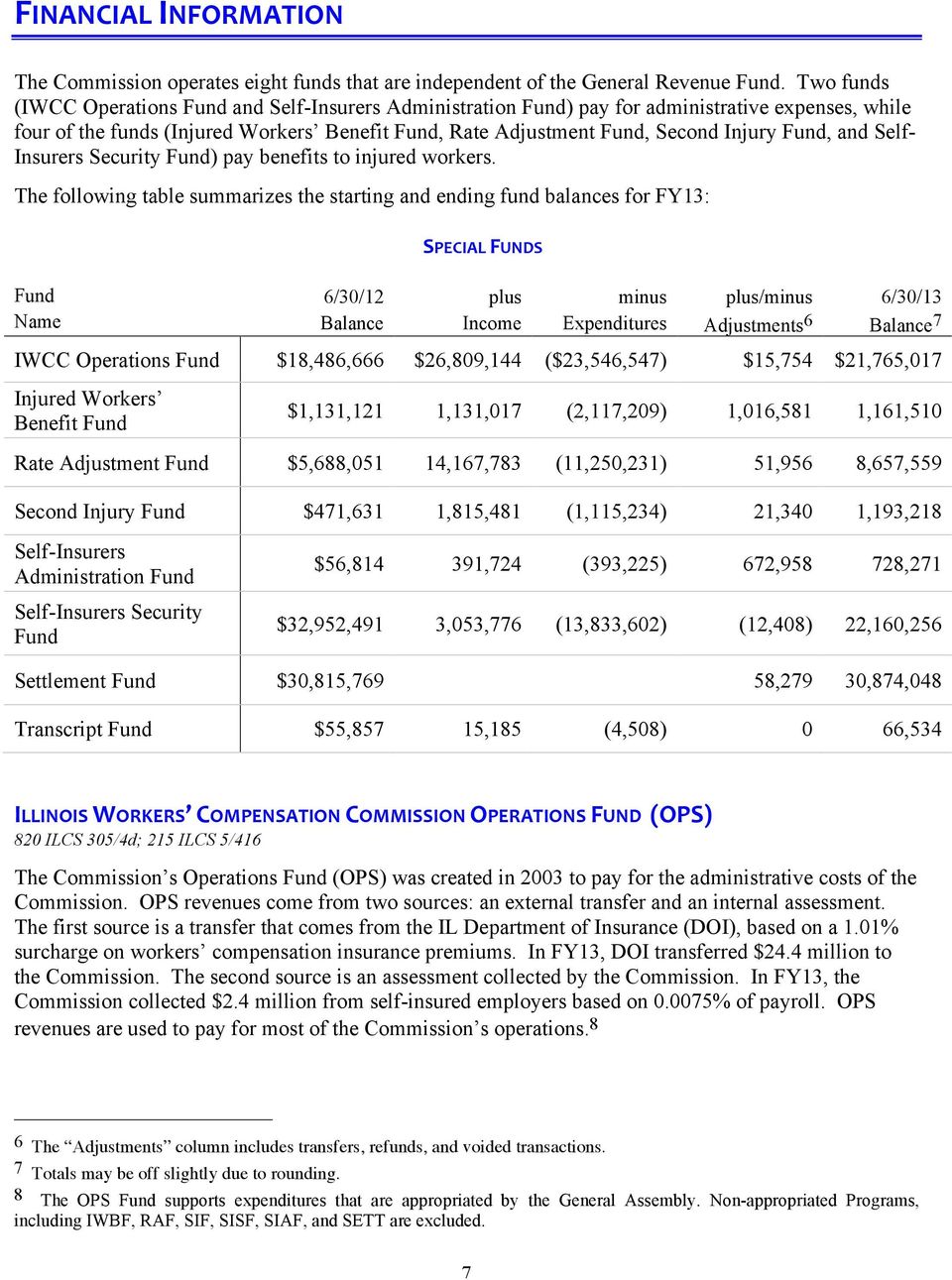
9 FINANCIAL INFORMATION The Commission operates eight funds that are independent of the General Revenue Fund. Two funds (IWCC Operations Fund and Self-Insurers Administration Fund) pay for administrative expenses, while four of the funds (Injured Workers Benefit Fund, Rate Adjustment Fund, Second Injury Fund, and Self- Insurers Security Fund) pay benefits to injured workers. The following table summarizes the starting and ending fund balances for FY13: SPECIAL FUNDS Fund 6/30/12 plus minus plus/minus 6/30/13 Name Balance Income Expenditures Adjustments 6 Balance 7 IWCC Operations Fund $18,486,666 $26,809,144 ($23,546,547) $15,754 $21,765,017 Injured Workers Benefit Fund $1,131,121 1,131,017 (2,117,209) 1,016,581 1,161,510 Rate Adjustment Fund $5,688,051 14,167,783 (11,250,231) 51,956 8,657,559 Second Injury Fund $471,631 1,815,481 (1,115,234) 21,340 1,193,218 Self-Insurers Administration Fund Self-Insurers Security Fund $56, ,724 (393,225) 672, ,271 $32,952,491 3,053,776 (13,833,602) (12,408) 22,160,256 Settlement Fund $30,815,769 58,279 30,874,048 Transcript Fund $55,857 15,185 (4,508) 0 66,534 ILLINOIS WORKERS COMPENSATION COMMISSION OPERATIONS FUND (OPS) 820 ILCS 305/4d; 215 ILCS 5/416 The Commission s Operations Fund (OPS) was created in 2003 to pay for the administrative costs of the Commission. OPS revenues come from two sources: an external transfer and an internal assessment. The first source is a transfer that comes from the IL Department of Insurance (DOI), based on a 1.01% surcharge on workers compensation insurance premiums. In FY13, DOI transferred $24.4 million to the Commission. The second source is an assessment collected by the Commission. In FY13, the Commission collected $2.4 million from self-insured employers based on % of payroll. OPS revenues are used to pay for most of the Commission s operations. 8 6 The Adjustments column includes transfers, refunds, and voided transactions. 7 Totals may be off slightly due to rounding. 8 The OPS Fund supports expenditures that are appropriated by the General Assembly. Non-appropriated Programs, including IWBF, RAF, SIF, SISF, SIAF, and SETT are excluded. 7
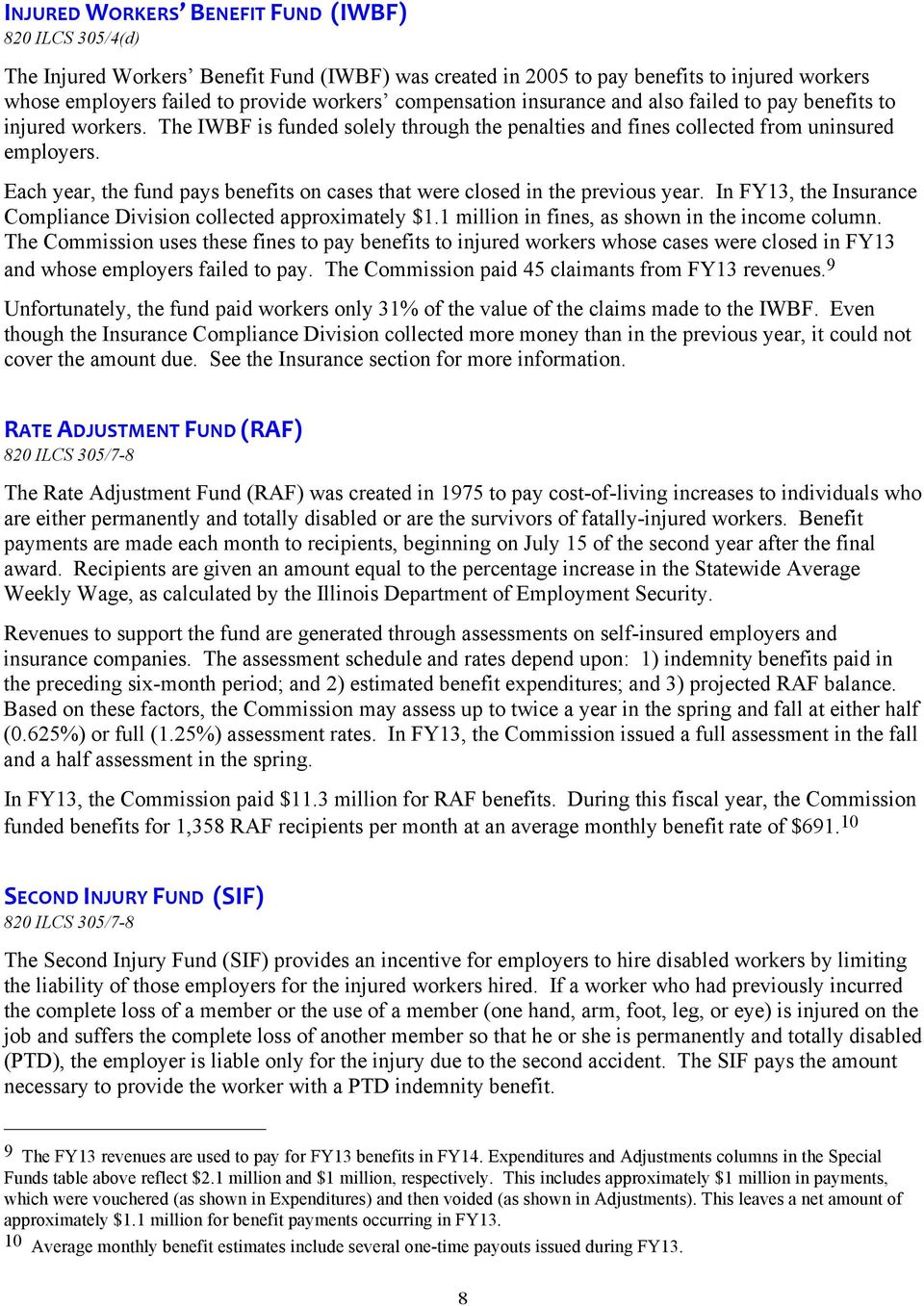
10 INJURED WORKERS BENEFIT FUND (IWBF) 820 ILCS 305/4(d) The Injured Workers Benefit Fund (IWBF) was created in 2005 to pay benefits to injured workers whose employers failed to provide workers compensation insurance and also failed to pay benefits to injured workers. The IWBF is funded solely through the penalties and fines collected from uninsured employers. Each year, the fund pays benefits on cases that were closed in the previous year. In FY13, the Insurance Compliance Division collected approximately $1.1 million in fines, as shown in the income column. The Commission uses these fines to pay benefits to injured workers whose cases were closed in FY13 and whose employers failed to pay. The Commission paid 45 claimants from FY13 revenues. 9 Unfortunately, the fund paid workers only 31% of the value of the claims made to the IWBF. Even though the Insurance Compliance Division collected more money than in the previous year, it could not cover the amount due. See the Insurance section for more information. RATE ADJUSTMENT FUND (RAF) 820 ILCS 305/7-8 The Rate Adjustment Fund (RAF) was created in 1975 to pay cost-of-living increases to individuals who are either permanently and totally disabled or are the survivors of fatally-injured workers. Benefit payments are made each month to recipients, beginning on July 15 of the second year after the final award. Recipients are given an amount equal to the percentage increase in the Statewide Average Weekly Wage, as calculated by the Illinois Department of Employment Security. Revenues to support the fund are generated through assessments on self-insured employers and insurance companies. The assessment schedule and rates depend upon: 1) indemnity benefits paid in the preceding six-month period; and 2) estimated benefit expenditures; and 3) projected RAF balance. Based on these factors, the Commission may assess up to twice a year in the spring and fall at either half (0.625%) or full (1.25%) assessment rates. In FY13, the Commission issued a full assessment in the fall and a half assessment in the spring. In FY13, the Commission paid $11.3 million for RAF benefits. During this fiscal year, the Commission funded benefits for 1,358 RAF recipients per month at an average monthly benefit rate of $ SECOND INJURY FUND (SIF) 820 ILCS 305/7-8 The Second Injury Fund (SIF) provides an incentive for employers to hire disabled workers by limiting the liability of those employers for the injured workers hired. If a worker who had previously incurred the complete loss of a member or the use of a member (one hand, arm, foot, leg, or eye) is injured on the job and suffers the complete loss of another member so that he or she is permanently and totally disabled (PTD), the employer is liable only for the injury due to the second accident. The SIF pays the amount necessary to provide the worker with a PTD indemnity benefit. 9 The FY13 revenues are used to pay for FY13 benefits in FY14. Expenditures and Adjustments columns in the Special Funds table above reflect $2.1 million and $1 million, respectively. This includes approximately $1 million in payments, which were vouchered (as shown in Expenditures) and then voided (as shown in Adjustments). This leaves a net amount of approximately $1.1 million for benefit payments occurring in FY Average monthly benefit estimates include several one-time payouts issued during FY13. 8
11 Similar to the RAF, the SIF program relies on revenues from self-insured employers and insurance companies, and bases assessments on the same factors. In FY13, the Commission issued a full assessment in the fall, and a half assessment in the spring. In FY13, the Commission paid $1.1 million for SIF benefits to, on average, 81 SIF recipients per month at an average monthly benefit rate of $1,154. SELF- INSURERS ADMINISTRATION FUND (SIAF) 820 ILCS 305/4a-6.1 The Self-Insurers Administration Fund (SIAF) was created in 1988 to pay the administrative costs of the Commission s self-insurance program. Revenues come from a $500 fee paid by private self-insured employers when applying for or renewing the privilege to self-insure. In FY13, the Commission expended roughly $393,000 on its non-appropriated operations for this program and collected $392,000 in fee revenue. During the year, the SIAF developed a cash flow problem, as expenditures exceeded revenues. The Commission transferred in $673,000 from the Self- Insurers Security Fund, which had surplus revenues due to a historical bankruptcy. The transfer is shown in the Adjustments column. SELF- INSURERS SECURITY FUND (SISF) 820 ILCS 305/4a-5, 7 The Self-Insurers Security Fund (SISF) was created in 1986 to pay benefits to employees of private selfinsurers that became insolvent after SISF also pays for a portion of operations costs related to the self-insurance program. Self-insurance offers employers an alternative to conventional insurance. Qualified employers may manage their workers compensation risk by controlling costs in an efficient manner and ensuring their injured employees receive timely and proper care. Employers that want to self-insure must apply to the Commission and meet certain financial requirements. Revenues come from two major sources: assessments and securities (i.e., surety bonds, escrow deposits, and letters of credit posted by self-insurers). The securities are called when self-insured employers file bankruptcy and default on their obligations. A letter of credit may also be called as it approaches expiration and is not replaced. To determine if an assessment is needed, the Self-Insurers Advisory Board reviews the SISF fund balance and outstanding liabilities on a quarterly basis. Upon approval, the Board assesses current and former self-insured employers. Assessments are based on employer indemnity payments. The Commission may assess up to a maximum of 1.2% of indemnity benefits paid during the preceding year. In FY13, the Commission issued an assessment in October 2012 at a rate of 0.5%. United Airlines (UAL) is one of the largest companies in the self-insurance program. In October 2012, UAL made a change to its self-insurance security. UAL opted to transfer its Commission-held letter of credit into a privately-held escrow account. This transfer resulted in an $11.4 million reduction in SISF as shown in the Expenditures column The value of the letter of credit was $9,215,000 and the value of the earned interest was $2,203, The two amounts total $11,418,

12 In addition to the UAL transfer out, the Commission also transferred roughly $673,000 from the SISF into SIAF, as explained in the SIAF section. SISF expenditures also include $251,000 for Larkin Center. The Self-Insurers Advisory Board approved this payment for the return of security proceeds because all claims were closed and no further liability existed. In FY13, the Commission paid $1.3 million for SISF benefits. During the year, the Commission funded benefits for an average of 57 SISF recipients per month at an average monthly benefit rate of $1, SETTLEMENT FUND (SETT) 820 ILCS 305/7 The Settlement Fund was created in FY11 as a result of litigation between the State of Illinois and the Chamber of Commerce (Chamber of Commerce v. Filan, et al, case #04CH6750). At issue was the constitutionality of the IWCC Operating Fund surcharge. The litigation started in FY04 and was amicably resolved in FY10. During FY04-FY10, the State collected the surcharge revenues, but placed them in an escrow account. In FY10, a Settlement Agreement, Release and Consent Decree (Settlement Agreement) was entered into by the parties. 13 By June 2011, $30.8 million had accrued in the Settlement Fund. Based on the terms of the Settlement Agreement, the Commission may use these funds to pay for capital/systems improvements to the Commission s Information Technology (IT) infrastructure or pay prior-year RAF liabilities. In FY13, $58,000 was transferred into the fund as a result of the Claims Fund closeout pursuant to the terms of the original agreement. TRANSCRIPT DEPOSIT FUND (TDF) 820 ILCS 305/19a The Transcript Deposit Fund (TDF) was created to cover the costs of transcripts copies and related document production. On June 28, 2013, Governor Quinn signed into law HB 3390 (Public Act 98-40), which eliminated the transcript fee, and directed all remaining funds in the Transcript Fund shall be transferred to the IWBF. The Commission transferred a majority of the funds in August 2013, but left a small balance to cover outstanding expenses. The Commission will conduct a second transfer at the end of FY14 to close out the entire fund. 12 Unlike the RAF and SIF Programs, which provide only cash benefits, SISF provides both indemnity and medical benefits. 13 On July 19, 2010, the Circuit Court gave order for Final Approval of the Settlement Agreement. The order established a Settlement Fund of $44.0 million, which was composed of $31.6 million from the Protest Fund and $12.4 million from the Escrow Account. A transfer of $13.2 million from the Fund to the General Revenue Fund (GRF) was made to release the loan of Rate Adjustment Fund (RAF) from the GRF incurred in prior years in accordance with Public Act , which authorized the State Comptroller and Treasurer to transfer at the request of the Chairman of the Commission up to a total of $19,000,000 from the GRF to the Rate Adjustment Fund to the extent that there were insufficient money in the Rate Adjustment Fund to pay claims and obligations. 10

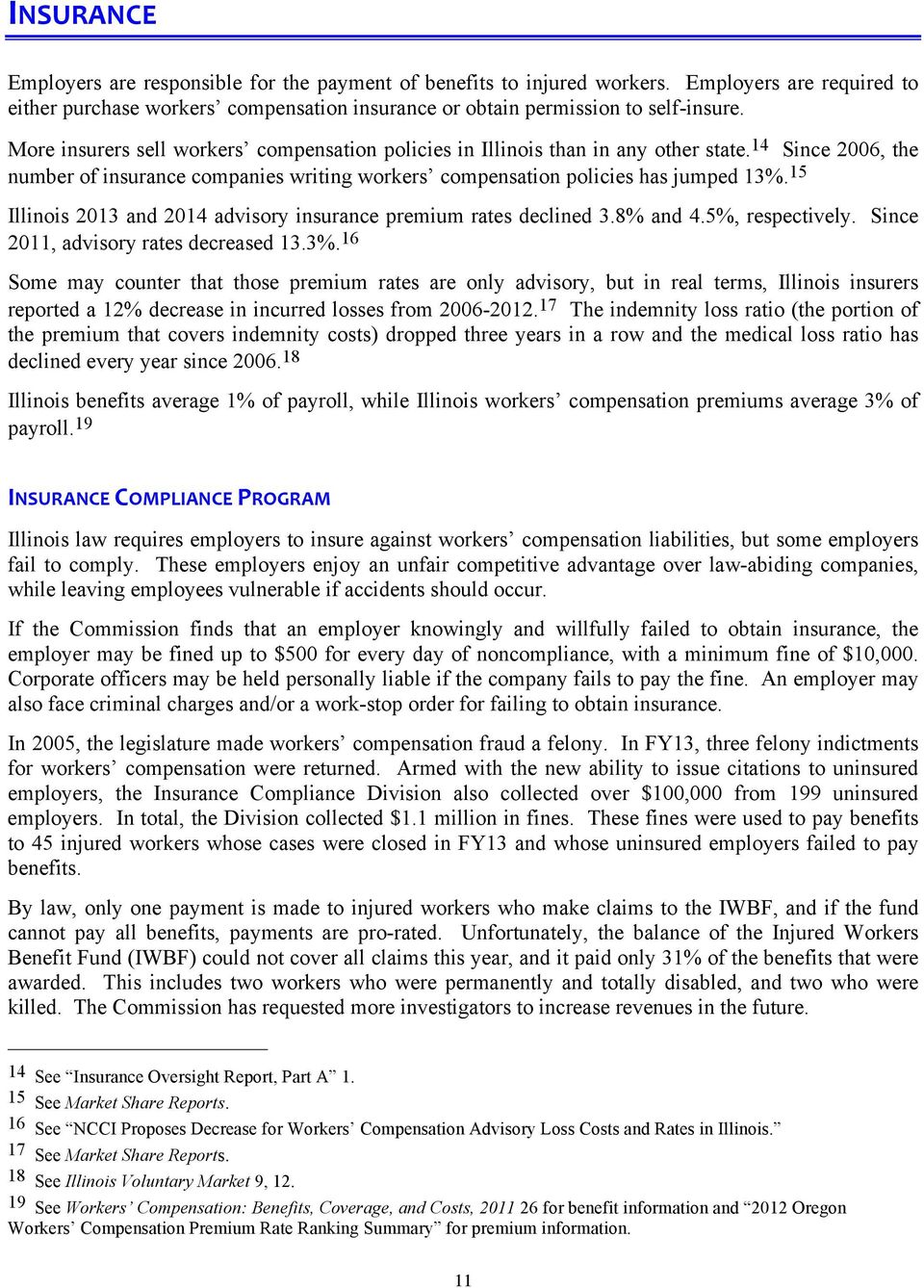
13 INSURANCE Employers are responsible for the payment of benefits to injured workers. Employers are required to either purchase workers compensation insurance or obtain permission to self-insure. More insurers sell workers compensation policies in Illinois than in any other state. 14 Since 2006, the number of insurance companies writing workers compensation policies has jumped 13%. 15 Illinois 2013 and 2014 advisory insurance premium rates declined 3.8% and 4.5%, respectively. Since 2011, advisory rates decreased 13.3%. 16 Some may counter that those premium rates are only advisory, but in real terms, Illinois insurers reported a 12% decrease in incurred losses from The indemnity loss ratio (the portion of the premium that covers indemnity costs) dropped three years in a row and the medical loss ratio has declined every year since Illinois benefits average 1% of payroll, while Illinois workers compensation premiums average 3% of payroll. 19 INSURANCE COMPLIANCE PROGRAM Illinois law requires employers to insure against workers compensation liabilities, but some employers fail to comply. These employers enjoy an unfair competitive advantage over law-abiding companies, while leaving employees vulnerable if accidents should occur. If the Commission finds that an employer knowingly and willfully failed to obtain insurance, the employer may be fined up to $500 for every day of noncompliance, with a minimum fine of $10,000. Corporate officers may be held personally liable if the company fails to pay the fine. An employer may also face criminal charges and/or a work-stop order for failing to obtain insurance. In 2005, the legislature made workers compensation fraud a felony. In FY13, three felony indictments for workers compensation were returned. Armed with the new ability to issue citations to uninsured employers, the Insurance Compliance Division also collected over $100,000 from 199 uninsured employers. In total, the Division collected $1.1 million in fines. These fines were used to pay benefits to 45 injured workers whose cases were closed in FY13 and whose uninsured employers failed to pay benefits. By law, only one payment is made to injured workers who make claims to the IWBF, and if the fund cannot pay all benefits, payments are pro-rated. Unfortunately, the balance of the Injured Workers Benefit Fund (IWBF) could not cover all claims this year, and it paid only 31% of the benefits that were awarded. This includes two workers who were permanently and totally disabled, and two who were killed. The Commission has requested more investigators to increase revenues in the future. 14 See Insurance Oversight Report, Part A See Market Share Reports. 16 See NCCI Proposes Decrease for Workers Compensation Advisory Loss Costs and Rates in Illinois. 17 See Market Share Reports. 18 See Illinois Voluntary Market 9, See Workers Compensation: Benefits, Coverage, and Costs, for benefit information and 2012 Oregon Workers Compensation Premium Rate Ranking Summary for premium information. 11
14 INSURANCE FRAUD The Illinois Department of Insurance investigates workers compensation fraud through its Fraud Unit, which is funded by the Commission. The Fraud Unit annual reports are available at It is illegal for anyone a worker, employer, insurance carrier, or medical provider to intentionally make a false statement in order to obtain or deny workers compensation benefits, obtain workers compensation insurance at less than the proper rate, obtain approval to self-insure, etc. A statement includes any writing, notice, proof of injury, medical bill, record, report, or test result. More information is available at SELF- INSURANCE Private employers may obtain approval to insure themselves for their workers compensation liabilities, or they may join a pool of other employers. The Commission evaluates individual self-insurers, while the Illinois Department of Insurance evaluates insurance pools. Public employers may self-insure without obtaining approval. All together, self-insured employers pay 26% of benefits. 20 PARENT COMPANIES PARTICIPATING IN THE COMMISSION S SELF- INSURANCE PROGRAM Date # Parent Companies 6/30/ /30/ /30/ /30/ /30/ /30/ See Workers Compensation: Benefits, Coverage, and Costs, 2011 Table

15 ADMINISTRATION At the end of FY13, the Commission consisted of the Chairman, seven Commissioners, 149 employees, and six employees in the separately funded Self-Insurance Division, for a total of 163 people. 21 During FY13, the Commission continued to work on the implementation of House Bill 1698 (Public Act 97-18), as well as House Bill 3390 (Public Act 98-40). Other administrative achievements: ARBTRACK NOW UPDATES MAINFRAME CASE RECORDS A Commission programmer connected the Arbitrators case tracking system, ArbTrack, with the Commission s mainframe case management system so that when Arbitrators enter dismissal notices, the mainframe computer system is automatically updated overnight. This eliminates double data entry, and publishes the information several weeks earlier than in the past. OLD FILES DESTROYED To reduce storage costs, the Commission undertook an extensive process by which old cases were reviewed and, when appropriate, destroyed. Approximately 100,000 pounds of files were shredded, thereby freeing up storage space. FILE ROOM REORGANIZED The Commission removed all desks from the File Room and replaced the old shelves, thereby doubling the available storage space. FILE SECURITY INCREASED To protect privacy, the Commission tightened access to case files. An individual who is not a party to a case must submit a written request under the Freedom of Information Act (FOIA) for a file. Confidential information is redacted before the case documents are released. 21 Temporary employees, summer workers, and employees on leave were not included. These figures represent the headcount as of the end of the fiscal year. 13

16 STATISTICS Each year in Illinois, approximately 200,000 work-related accidents occur. In most of these cases, the worker does not lose time from work. Fewer than 50,000 claims are filed with the Commission. The statistics in this section refer only to those cases that are filed with the Commission. The flowchart below illustrates the main process. Note that cases can go back and forth, and there are other processes to hear insurance compliance cases, motions, etc. Employee reports injury to employer ~200,000/year Employer reports to Commission injuries of more than 3 lost workdays ~65,000/year Parties resolve case Parties do not resolve case Arbitrator settles case 40,000/year Commissioner settles case 500/year Employee files claim at Commission 50,000/year Arbitrator issues decision 3,000-4,000/year Appeal to commissioner 50% appealed Panel issues decision 1,500/year Appeal to Circuit Court 25% appealed Circuit Ct. issues opinion /year Appeal to Appellate Court Appellate Ct. issues opinion 100/year Appeal to Supreme Court 5% appealed Supreme Ct. issues opinion 1/year Arbitrator dismisses case 5,000/year Commissioner dismisses case 100/yr. 14

17 ACCIDENT Cases are assigned to the hearing site nearest the site of the accident. If the accident occurred outside of Illinois, the case is assigned to the hearing site closest to the petitioner s home; if the petitioner lives outside of Illinois, the case is set at the site most convenient to the parties. The following table lists the 17 hearing sites to which claims are assigned. NEW CASES FILED IN FY13 Chicago (1 hearing site) 17,784 (42%) Downstate (16 sites) 24,759 (58%) Zone 1 Zone 2 Zone 3 Zone 4 Zone 5 Zone 6 22 Collinsville Quincy Bloomington Geneva Rockford Wheaton 2,325 (4%) 408 (1%) 960 (2%) 2,049 (5%) 1,735 (4%) 2,786 (7%) Herrin Springfield Kewanee New Lenox Waukegan 1,171 (3%) 1,853 (4%) 1,213 (3%) 2,847 (7%) 1,689 (4%) Mt. Vernon Urbana Peoria Ottawa Woodstock 1,186 (3%) 1,506 (4%) 1,672 (4%) 678 (2%) 681 (2%) Because of rounding, percentages may not add up to 100%. CASES OPENED Filings have been declining since FY95, when roughly 72,000 cases were filed. CASES OPENED FY09 FY10 FY11 FY12 FY13 New claims filed 46,752 42,701 42,883 40,596 37,752 Original settlements filed 23 8,745 8,153 7,498 6,093 4,791 Total new cases filed 55,497 50,854 50,381 46,689 42,543 Reinstated 1,644 1,511 1,659 1,592 1,594 Remanded to Arbitrator Remanded to Commissioner Total cases returned to caseload 1,786 1,929 2,166 2,119 2,081 Total additions to the caseload 57,283 52,783 52,547 48,808 44,624 A new claim is usually opened when a worker files an application with the Commission; in 99% of those cases, the worker has an attorney. When a settlement contract is filed without a prior application, it is referred to as an original settlement; in 97% of those cases, the worker does not have an attorney. In total, injured workers are unrepresented in 14% of cases. 22 Zone 6 Arbitrators hear Chicago cases during the two months they are not in Wheaton. 23 Original settlements are settlements that were filed without a prior application. 15

18 CASES PENDING At the end of FY13, there were roughly 90,000 cases pending at arbitration. In the vast majority of the cases, the parties have not petitioned the Commission to act, and therefore cases are automatically continued. The majority of cases at arbitration are settled, and parties are free to settle at any time. At the review level, roughly 3,000 appeals of Arbitrators decisions were pending. Another 1,000 pending cases involve issues such as attorneys fees, insurance compliance, medical care, and penalties. CASES CLOSED As in other court systems, most cases filed at the Commission are settled. Please note that the figures below report only the final action on a case. If a case had more than one action (e.g., a case was decided at arbitration, then decided on the Commission level, then settled), only the final action is reported here. An Arbitration case is counted as closed if it was dismissed, settled, or if a decision was issued and no appeal was filed. A Commissioner s decision is counted as closed if no appeal was filed. 24 Note that cases opened decreased 9% between FY12-13 and 22% between FY Cases closed decreased less, 2% and 20%, respectively. TOTAL CASES CLOSED FINAL ACTION FY09 % FY10 % FY11 % FY12 % FY13 % Dismissals 5,271 9% 5,172 9% 5,616 11% 5,184 11% 5,471 12% Settlements 51,230 87% 47,946 86% 43,324 85% 40,934 84% 39,610 84% Decisions 2,402 4% 2,802 5% 2,196 4% 2,178 5% 2,210 5% Total 58,903 55,920 51,136 48,296 47,291 CASES CLOSED BY ARBITRATORS Voluntary dismissals DWP 4,593 4,390 4,930 4,422 4,663 Total dismissals 5,188 9% 4,996 9% 5,499 11% 5,009 11% 5,270 12% Original settlements 9,016 7,853 6,786 5,895 4,925 SC before arb. dec. 40,750 38,691 35,322 33,778 33,496 SC after arb. decision Total settlements 50,610 88% 47,529 88% 43,081 87% 40,451 87% 39,180 86% Arbitration decisions 1,394 2% 1,601 3% 1,066 2% 1,020 2% 1,048 2% Total 57,192 54,126 49,646 46,480 45,498 CASES CLOSED BY COMMISSIONERS Dismissals at review 83 5% % 117 8% % % SC before arb. decision SC before review dec SC after review dec Total settlements % % % % % Review decisions 1,008 59% 1,201 67% 1,130 76% 1,158 64% 1,162 65% Total 1,711 1,794 1,490 1,816 1, DWP refers to cases that were Dismissed for Want of Prosecution. Original settlements are settlements that were filed without a prior application. SC refers to settlement contracts. 16

19 DECISIONS ISSUED Most of the cases filed with the Commission are settled. More complex cases are usually disputed and go to contested hearing. Cases involving novel or difficult issues are often appealed. Out of 200,000 work-related injuries that occur each year, only about 400 cases are appealed from the Commission to the circuit courts. 25 DECISIONS AND APPEALS Arbitration Commission Circuit Ct. Appellate Ct. Supreme Ct. Decisions % Decisions % Decisions Opinions/Orders Opinions Issued Appealed Issued Appealed Issued Issued Issued ,541 48% 1,470 25% ,581 49% 1,503 26% ,171 55% 1,405 25% ,096 57% 1,410 29% ,326 57% 1,504 27% Outcome of appeals. Parties have the right to appeal Arbitrators decisions, but history has shown that, in most cases, Commissioners affirm the Arbitrators decisions. Petitioners (workers) appeal in hopes of higher benefits, but 84% of the time their appeals do not result in higher benefits. Similarly, 71% of cases appealed by Respondents (employers) do not result in lower benefits. Trends. Under Section 19(b-1), an injured worker who is not receiving temporary total disability or medical benefits may petition for an emergency hearing. Alternately, the worker may choose to file under 19(b) if he or she is not receiving TTD or medical benefits. Over the years, there has been a clear shift from 19(b-1) petitions, which involve statutorily set deadlines, to 19(b) petitions. Each year, Arbitrators issue fewer than a dozen 19(b-1) decisions and roughly 1,000 19(b) decisions. GENDER Women constitute 47% of the Illinois workforce, 26 but they file a smaller share of claims. This might be due to the fact that the most dangerous industries construction, agriculture, and transportation are still male-dominated. Over the years, the proportion of female claimants has increased, however, from 22% of claimants in FY85 to 35% in FY13. INJURY RATES The statistics in this section come from the National Council on Compensation Insurance (NCCI) and the U.S. Bureau of Labor Statistics (BLS), which use different methods. NCCI excludes self-insurers, while the BLS nonfatal survey is prone to sampling error. Despite these limitations, these two sources produce the best data now available. 25 Commission figures are for the fiscal year. Court figures are for the calendar year. Note that the law requires circuit courts to send the IWCC their orders, but they do not always do so: the circuit court figures represent the orders we received. 26 See U.S. Bureau of Labor Statistics: ptable14full12.pdf 17

20 Both data sets indicate that 3-4% of Illinois workers were injured each year. Only 1% loses time from work. For decades, the overall injury rate in Illinois has been below average and continues to drop. The 2010 injury rate is 65% lower than NCCI DATA PERCENTAGE OF WORKERS EXPERIENCING WORK- RELATED INJURIES IN ILLINOIS EACH YEAR BY INJURY TYPE 27 Policy Medical Temporary Permanent Permanent Year Only Total Partial Total Fatal Total % 1.66% 0.92%.004%.007% 9.5% % 1.23% 0.68%.004%.004% 6.8% % 0.84% 0.69%.007%.005% 5.4% % 0.60% 0.54%.013%.002% 3.7% % 0.55% 0.54%.003%.003% 3.4% % 0.53% 0.56%.002%.002% 3.3% BLS DATA RATE OF NONFATAL WORK- RELATED INJURIES AND ILLNESSES IN ILLINOIS IN Workers Nonfatal Injury Rate by Industry Private Sector Workers Injury Rate by Event Government 6% Overexertion 37% Natural resources and mining 5% Contact w. objects/equip. 25% Manufacturing 4% Fall 19% Services 3% Slip or trip (no fall) 5% Construction 2% Transportation accident 4% Exposure to harmful substances 4% Incidence rate for all workers 3.6% Assault or violent act 4% Repetitive motion 3% Distribution of Fatal Injuries Among Industries FATAL WORK- RELATED INJURIES IN ILLINOIS IN Distribution of Fatal Injuries by Event Transportation 19% Transportation incident 31% Agriculture 12% Violence/injuries by person/animal 25% Construction 12% Falls, slips, trips 16% Trade, wholesale & retail 11% Exposure to harmful subst/env. 14% Manufacturing 8% Contact with objects/equip. 11% Administrative and waste serv. 8% Fires and explosions 2% Educational & health serv. 6% Government 2% Other 22% 27 See Annual Statistical Bulletin, editions, Exhibit XII First Report data. Figures for fatalities and PTDs come from a small number of cases and should be viewed with caution. This information refers only to the experience of employers with insurance, not self-insurers or monopolistic state funds. The NCCI updated figures from earlier reports. 28 Since 1992, the Illinois Department of Public Health has participated in the U.S. Bureau of Labor Statistics Survey of Occupational Injuries and Illnesses (SOII). Each year IDPH surveys a sample of employers in the private and nonfederal public sectors. See Survey of Occupational Injuries and Illnesses in Illinois, See Census of Fatal Occupational Injuries and Illnesses in Illinois, ,

21 MEDICAL CARE Illinois first medical fee schedule took effect for treatment on or after February 1, There have been a number of substantial changes since then. February 1, 2006 February 1, 2009 Fee schedules take effect for treatment on or after this date Fee schedules were created for Ambulatory Surgical Treatment Centers and Hospital Outpatient services: before, treatment paid at 76% of charge (POC) A new fee schedule was created for three Rehabilitation Hospitals June 30, 2009 May 21, 2010 July 6 Oct. 28, 2010 June 28, 2011 Hospital Inpatient fee schedule converted to new MS-DRG coding system Fee schedule created for Ambulatory Surgical Treatment Centers in Geozip 607, Chicago/Niles (formerly POC) Emergency rule limiting implant reimbursements in effect Physician-dispensed medicines capped Ambulatory Surgical Treatment Center (ASTC) fee schedule expanded to include both licensed and certified ambulatory surgical centers Out-of-state reimbursements reduced September 1, 2011 Implant reimbursements were again limited to 25% over invoice All fee schedule amounts were cut by 30% PPD awards hereafter shall consider AMA Guides rating Utilization review provisions strengthened Intoxicated injured workers barred from compensation January 1, 2012 June 20, 2012 November 20, 2012 March 4, 2013 Geozips were converted to regions, making reimbursements more consistent First dental fee schedule took effect Reimbursement for repackaged drugs must now be based on the original National Drug Code (NDC) Preferred Provider Program (PPP) rules took effect: employer s PPP counts as one of employee s two chosen medical providers Interest in the effects of these changes is high, but no comprehensive study on their effects has yet been produced. The fee schedule is constantly evolving, it is difficult and sometimes impossible to identify the effect of various provisions, and there is a long time lag to obtain data. Indications, however, are encouraging. 19
22 The National Council on Compensation Insurance (NCCI) reported the medical loss ratio (the portion of the premium that pays medical costs) has declined every year since 2006, and the average medical cost per case dropped 4% from The Workers Compensation Research Institute (WCRI) reported the 30% cut in fee schedule amounts resulted in an overall 24% decrease in prices paid for professional services from 2010 to CHANGE IN AVERAGE PRICE PAID FROM 2010 TO 2012 IN ILLINOIS Emergency Room -18% Evaluation and Management -25% Major Radiology -13% Major Surgery -23% Minor Radiology -22% Neurological Testing -34% Pain Management Injections -26% Physical Medicine -27% The WCRI found significant reductions in the growth of both indemnity and medical costs per case. 32 AVERAGE COST PER CASE IN ILLINOIS FOR ALL CASES AT 12 MONTHS EXPERIENCE Indemnity % Annual Medical % Annual Total Benefit % Annual Year Cost per case Change Cost per case Change Cost per case Change 2005 $1,649 6% $3,799 14% $5,448 11% 2010 $2,398-3% $5,434 5% $7,832 3% 2011 $2,441 2% $5,276-3% $7,717-1% Both the NCCI and WCRI (in a different study than above, producing different results) indicate that the double-digit medical cost growth in the years before the fee schedule has been stemmed. 33 AVERAGE MEDICAL COST PER CASE IN ILLINOIS FOR ALL CASES AT 12 MONTHS EXPERIENCE NCCI % Annual WCRI % Annual Year Data Change Data Change 2000 $3,538 16% $2,422 20% 2005 $7,735 16% $3,921 15% 2010 $10,665 4% $5,447 6% 2011 na na $5,276-3% 30 See Illinois Voluntary Market See Early Evidence and Baselines See Early Evidence ; Baseline for Monitoring ; and Baseline Metrics for 2005 Reforms See NCCI Annual Statistical Bulletin, editions, Exhibit XI First Report data; WCRI Anatomy of Medical Costs, editions, Figure 3.1, CompScope Medical Benchmark studies, editions, Figure 2. Note that NCCI reports by Policy Year and WCRI reports by Accident Year. 20
23 PENALTIES Under Section 19(k), the Commission may award the petitioner additional compensation equal to 50% of the amount of compensation payable at the time of the award if there was an unreasonable or vexatious delay of payment, or an intentional underpayment of compensation. Under Section 19(l), the Commission may award the petitioner $30 per day for every day that a cash or medical benefit has been withheld without good and just cause, up to $10,000. Under Section 16, the Commission may order the respondent to pay the petitioner s attorneys fees if the respondent or its agent has unreasonably delayed benefits to an employee, intentionally underpaid an employee, engaged in frivolous defenses, or has otherwise treated an employee unfairly. Arbitrators award penalties in roughly 10% of expedited decisions and 2% of regular decisions. Commissioners award penalties in roughly 5% of expedited decisions and 2% of regular decisions. This represents less than 1% of all cases closed. POST- AWARD PETITIONS Cases that were closed by decisions or some settlements may return to the Commission for additional hearings. Under Section 8(a) of the Act, an injured worker may petition the Commission to order payment for additional medical treatment. Under Section 19(h), either party may petition if the injured worker s physical condition changes significantly within months of the decision or settlement. Each year, approximately 300 post-award petitions are filed. WAGES Claimants wages generally are lower than the statewide average weekly wage (SAWW). The wages of injured workers who filed in FY13 were 15% lower than the SAWW. AVERAGE WEEKLY WAGE BY YEAR OF ACCIDENT FY09 FY10 FY11 FY12 FY13 Claimants Average Weekly Wage $ $ $ $ $ SAWW as of end of FY $ $ $ $ $ Claimants wages as % of SAWW 84% 84% 86% 82% 85% 21
24 INTERSTATE COMPARISONS Although Illinois has consistently ranked in the top 10 states for the highest wages paid to workers, historically our workers compensation costs have ranked near the median. In 2010, Illinois rose to become the 3rd most expensive state for workers compensation insurance. This high ranking contributed to the drive for legislative changes, which culminated in the enactment of House Bill 1698 (Public Act 97-18) in The 2012 ranking, which mostly covered time before the reform took effect, moved Illinois down to #4. The study comes out every two years. The 2014 report is due out in Figures in this section are the latest available, but were produced before House Bill 1698 took effect. Illinois v. Median/Average Illinois wages are 6% higher 34 $49,504 v. $46,748 Illinois indemnity cost per claim is 71% higher 35 $34,945 v. $20,382 Illinois medical cost per claim is 41% higher 36 $10,278 v. $6,800 Illinois insurance rates are 51% higher 37 $2.83 v. $1.88 per $100 of payroll Illinois benefit rates are 14% higher 38 $1.11 v. $0.97 per $100 of payroll Illinois has a much larger gap between $1.73 v $0.91 the rates employers pay and the benefits employees receive 39 per $100 of payroll Illinois injury rate is 16% lower % v. 4.0% 34 See U.S. Bureau of Labor Statistics website: Table annual averages. 35 See Annual Statistical Bulletins, Exhibit XI, First report. Policy Year Most recent complete data available. 36 See Annual Statistical Bulletins, Exhibit XI, First report. Policy Year Most recent complete data available. 37 See 2012 Oregon Workers Compensation Premium Rate Ranking Summary. The report compares employers w.c. insurance costs in 50 different class codes. Note that discounts are not included, and Illinois reportedly gives more discounts than most states, so Illinois rates look higher here than they really are. A review of the results over the years is instructive. Workers Compensation Premium Rate Rankings Per $100 of payroll/ % Change Report year IL est. premium $5.48 $2.65 $2.69 $2.79 $3.05 $2.83 (48%) Median est. premium $4.35 $2.58 $2.48 $2.26 $2.04 $1.88 (57%) IL as % over median 26% 3% 8% 23% 50% 51% IL rank (50 states + DC) = most expensive 38 See Workers Compensation: Benefits, Coverage, and Costs, 2011 Tables 10 and 12, 26-27, See 2012 Oregon Workers Compensation Premium Rate Ranking Summary, and Workers Compensation: Benefits, Coverage, and Costs, 2011 Tables 10 and 12, 26-27, See Annual Statistical Bulletin, Exhibit XII, First report. Policy Year Most recent complete data available. 22
25 TOTAL BENEFITS PAID The annual percentage change in benefits has run below the national average for the past two years. 41 TOTAL WORKERS COMPENSATION BENEFIT PAYMENTS $ in billions Illinois $2.4 $2.8 $3.0 $3.1 $3.0 $3.1 % change from prior year 1% 12% 6% 3% (2%) 3% U.S. nonfederal total $51.6 $53.0 $54.9 $54.9 $54.5 $56.4 % change from prior year 3% 1% 4% 0% (1%) 4% COMPLIANCE WITH 1972 RECOMMENDATIONS In 1972, the National Commission on State Workmen s Compensation Laws, appointed by President Nixon, unanimously listed 19 items as essential to an adequate system. Decades later, no state in the country meets all the requirements; Illinois meets more than most. 42 NEIGHBORING STATES NUMBER OF 19 ESSENTIAL RECOMMENDATIONS MET National average Illinois LARGE INDUSTRIAL STATES Iowa Ohio Illinois Illinois Wisconsin Pennsylvania Kentucky Texas Missouri California Indiana New York Michigan 9.75 Florida 9.75 COVERAGE OF EMPLOYEES More workers are covered under the law in Illinois than in most other states. 43 NEIGHBORING STATES PERCENTAGE OF EMPLOYEES COVERED National nonfederal average 97.3% Illinois 99.8% LARGE INDUSTRIAL STATES Illinois 99.8% California 100.0% Kentucky 99.8% Ohio 100.0% Indiana 99.6% Illinois 99.8% Iowa 99.1% New York 99.8% Wisconsin 97.0% Pennsylvania 99.6% Michigan 96.9% Florida 94.9% Missouri 95.4% Texas 82.6% 41 See Workers Compensation: Benefits, Coverage, and Costs, 2011 Table 7, Previous years figures were revised. 42 See "State Workers Compensation Laws in Effect Table 1, See Workers Compensation: Benefits, Coverage, and Costs, 2011 Table A2,
26 DURATION OF DISABILITY The duration of temporary total disability in Illinois is longer than most states, perhaps partly due to our higher unemployment rates. 44 TTD DURATION IN WEEKS NEIGHBORING STATES Median 16.7 Illinois 20.8 LARGE INDUSTRIAL STATES Illinois 20.8 Pennsylvania 24.9 Michigan 16.8 California 22.7 Indiana 11.8 Illinois 20.8 Wisconsin 10.8 Texas 16.6 Iowa 10.7 Florida 12.1 PROMPTNESS OF FIRST TTD PAYMENT Illinois is behind most states in the prompt payment of TTD benefits. 45 PERCENTAGE OF CLAIMS WITH FIRST INDEMNITY PAYMENT WITHIN 14 DAYS OF NOTICE NEIGHBORING STATES Median 43.6% Illinois 38.2% LARGE INDUSTRIAL STATES Wisconsin 51.3% Texas 49.7% Iowa 45.8% California 44.3% Michigan 42.7% Florida 42.7% Illinois 38.2% Illinois 38.2% Indiana 35.6% Pennsylvania 35.9% 44 Figures reflect PY2009 (10/1/08 9/30/09) injuries involving more than seven lost workdays, assessed as of March 31, See Early Evidence and Baselines CompScope 14th edition 65. The median was calculated from the 16 states in the WCRI study. 45 See Early Evidence and Baselines CompScope, 14th edition
27 WORKS CITED Eccleston, Stacey M. and Xiaoping Zhao. The Anatomy of Workers Compensation Medical Costs and Utilization: Trends and Interstate Comparisons, : A Reference Book Print. Eccleston, Stacey M., et al. The Anatomy of Workers Compensation Medical Costs and Utilization: Trends and Interstate Comparisons Print. Employment status of the civilian noninstitutional population by sex, race, Hispanic or Latino ethnicity, marital status, and detailed age, 2012 annual averages. United States Bureau of Labor Statistics. n.d. Web. August 7, National Council on Compensation Insurance. Annual Statistical Bulletin, editions. Boca Raton: NCCI, Print Illinois State Advisory Forum. Boca Raton: NCCI, Print Illinois Voluntary Market: Workers Compensation: Advisory Rates, Loss Costs and Rating Values Effective January 1, Little Rock: NCCI, July 30, Print NCCI Proposes Decrease for Workers Compensation Advisory Loss Costs and Rates in Illinois. Little Rock: NCCI, July 31, Print. Radeva, Evelina, et al. Monitoring the Impact of Illinois Regulatory Changes: CompScope Medical Benchmarks, 10th edition. Workers Compensation Research Institute. Boston: WCRI, Web. Radeva, Evelina. Baseline for Monitoring the Impact of 2011 Reforms in Illinois: CompScope Benchmarks, 12th edition. Workers Compensation Research Institute. Boston: WCRI, Web Baseline for Monitoring the Impact of 2011 Reforms in Illinois: CompScope Benchmarks, 13th edition. Workers Compensation Research Institute. Boston: WCRI, Web CompScope Medical Benchmarks for Illinois, 11th edition. Workers Compensation Research Institute. Boston: WCRI, Web Illinois Medical Cost Drivers Prior to 2011 Reforms: CompScope Medical Benchmarks, 12th edition. Workers Compensation Research Institute. Boston: WCRI, Web Medical Payments, Prices, and Utilization Prior to 2011 Reforms in Illinois: CompScope Medical Benchmarks, 13th edition. Workers Compensation Research Institute. Boston: WCRI, Web Early Evidence and Baselines for Monitoring the 2011 Reforms in Illinois: CompScope Benchmarks, 14th edition. Workers Compensation Research Institute. Boston: WCRI, Web. Sengupta, Ishita, Marjorie Baldwin, and Virginia Reno. Workers Compensation: Benefits, Coverage, and Costs, Washington, D.C.: National Academy of Social Insurance, August Web. 25
28 State of Illinois. Department of Insurance. Premium Written in Illinois by Illinois Licensed Companies: Workers Compensation. Market Share Report, editions. Springfield: IDOI, Web Insurance Oversight Report: Part A and Insurance Oversight Report: Part B. Springfield: IDOI, Web. State of Illinois. Department of Public Health. Census of Fatal Occupational Injuries and Illnesses in Illinois, Springfield: IDPH, Web Survey of Occupational Injuries and Illnesses in Illinois, Springfield: IDPH, Web. State of Oregon. Department of Consumer and Business Services, 2012 Oregon Workers Compensation Premium Rate Ranking Summary reports. Salem: ODCBS, Web. "State Workers Compensation Laws in Effect January 1, 2004 Compared with the 19 Essential Recommendations of the National Commission on State Workmen s Compensation Laws. United States Department of Labor Employment Standards Administration. n.d. Web. June 27, Telles, Carol A., et al. Baseline Metrics for Monitoring 2005 Reforms in Illinois: CompScope Benchmarks, 8th edition. Workers Compensation Research Institute. Boston: WCRI, Web. --. Monitoring the Impact of 2005 Reforms in Illinois: CompScope Benchmarks, 9th edition. Workers Compensation Research Institute. Boston: WCRI, Web. Total coverage (UI and UCFE) by State, 2010 annual averages. United States Bureau of Labor Statistics. n.d. Web. November 7,
CHAPTER 1. Wyoming Workers Compensation. Workers Compensation Programs Benefit Injured Workers and Employers
 CHAPTER 1 Wyoming Workers Compensation Workers Compensation Programs Benefit Injured Workers and Employers Injured workers receive medical and lost wage benefits, regardless of fault. Employers receive
Rights & Obligations under the Nebraska Workers Compensation Law
 Nebraska Workers Compensation Court Information Sheet: Rights & Obligations under the Nebraska Workers Compensation Law NEBRASKA WORKERS COMPENSATION COURT OFFICIAL SEAL What is workers compensation? Workers
STATE OF TENNESSEE. Workers Compensation Advisory Council. REPORTS TO THE GENERAL ASSEMBLY and THE SPECIAL JOINT COMMITTEE ON WORKERS COMPENSATION
 STATE OF TENNESSEE Workers Compensation Advisory Council ~~~~~~~~~~~~~~~~~~~~~~~~~~~~~~~~~~~~~~~~~~~ REPORTS TO THE GENERAL ASSEMBLY and THE SPECIAL JOINT COMMITTEE ON WORKERS COMPENSATION Findings and
Workers Compensation: USA and California
 International Social Security Association Conference Seminar III: Respiratory Diseases in Asia - Reporting, Recording, Prevention and Rehabilitation Shenzhen, Peoples Republic of China September 2006 Workers
Comparative Review of Workers Compensation Systems in Select Jurisdictions
 of Workers Compensation Systems in Select Jurisdictions JURISDICTION: TEXAS ENVIRONMENT Population Size 19.3 million in 1997. Labour Force 8 million (1997) Demographic and Economic Indicators has enjoyed
Does Texas Need a Workers Compensation System? Bill Peacock Texas Public Policy Foundation
 Does Texas Need a Workers Compensation System? Bill Peacock Texas Public Policy Foundation Beginnings of Workers Compensation Liability and Litigation in the 19 th Century The problem of industrial accidents
PUBLIC ENTITY RISK MANAGEMENT AUTHORITY MEMORANDUM OF WORKERS COMPENSATION AND EMPLOYERS LIABILITY COVERAGE
 PUBLIC ENTITY RISK MANAGEMENT AUTHORITY MEMORANDUM OF WORKERS COMPENSATION AND EMPLOYERS LIABILITY COVERAGE FOR THE PERIOD JULY 1, 2015 TO JUNE 30, 2016 EFFECTIVE: JULY 1, 2015 PUBLIC ENTITY RISK MANAGEMENT
Quick Guide to Workers Compensation for Small Business
 Quick Guide to Workers Compensation for Small Business Do I Need Workers Compensation Coverage? Generally speaking, businesses must obtain workers compensation coverage if they have employees that are
INJURED ON THE JOB? A SUMMARY OF THE RIGHTS AND BENEFITS AVAILABLE TO INJURED WORKERS UNDER ILLINOIS LAW
 INJURED ON THE JOB? A SUMMARY OF THE RIGHTS AND BENEFITS AVAILABLE TO INJURED WORKERS UNDER ILLINOIS LAW Law Offices ANESI, OZMON, RODIN, NOVAK & KOHEN, LTD 161 NORTH CLARK STREET AT RANDOLPH 21ST FLOOR
INITIAL CONSIDERATIONS FOR THE PETITIONER AND RESPONDENT IN WORKERS COMPENSATION CASES INTRODUCTION: THE COMMISSION
 INITIAL CONSIDERATIONS FOR THE PETITIONER AND RESPONDENT IN WORKERS COMPENSATION CASES INTRODUCTION: THE COMMISSION The Workers Compensation Act provides an administrative law remedy for employees who
Preferred Provider Programs in Illinois
 Preferred Provider Programs in Illinois An Introduction 6/13/13 Michael E. Rusin Rusin Maciorowski & Friedman LTD 10 S. Riverside Plaza #1530 Chicago, IL 60606 312-454-5119 [email protected] Introduction
Florida Workers Compensation: A Guide for the HR Professional
 Florida Workers Compensation: A Guide for the HR Professional Jennifer K. Price, FCAS, MAAA Session Objectives Workers Compensation Basics Florida Reforms, Cost Trends, and Challenges The Patient Protection
Enhanced Worker s Compensation. Violations or Employer Misconduct
 Enhanced Worker s Compensation Awards or Penalties Based on Safety Violations or Employer Misconduct Richard J. Swanson Macey Swanson and Allman 445 N. Pennsylvania Street, Suite 401 Indianapolis, IN 46204
COMPARISON OF STATE WORKERS COMPENSATION SYSTEMS. Texas Department of Insurance Workers Compensation Research Group
 COMPARISON OF STATE WORKERS COMPENSATION SYSTEMS Texas Department of Insurance Workers Compensation Research Group 1 Table of Contents Page State Workers Compensation Coverage Requirements..2 Figure 1:
WCIRB REPORT ON THE STATE OF THE CALIFORNIA WORKERS COMPENSATION INSURANCE SYSTEM
 STATE OF THE SYSTEM WCIRB REPORT ON THE STATE OF THE CALIFORNIA WORKERS COMPENSATION INSURANCE SYSTEM Introduction The workers compensation insurance system in California is over 100 years old. It provides
Workers' Compensation
 Workers' Compensation Workers compensation provides benefits to injured employees for accidents or occupational diseases arising out of, and in the course of, their employment. Compensation coverage is
Comparative Review of Workers' Compensation Systems in Select Jurisdictions
 of Workers' Compensation Systems in Select Jurisdictions JURISDICTION: WASHINGTON ENVIRONMENT Population Size 5.5 million in 1996. Labor Force 2.8 million in 1996. Demographic and Economic Indicators The
Quick Guide to Workers Compensation
 Quick Guide to Workers Compensation What Is Workers Compensation Insurance? Workers compensation insurance covers businesses for their statutory and legal obligations for employee expenses that are a direct
Minnesota Workers' Compensation. System Report, 2006. minnesota department of. labor & industry. Policy Development, Research and Statistics
 Minnesota Workers' Compensation System Report, 2006 minnesota department of labor & industry Policy Development, Research and Statistics Minnesota Workers Compensation System Report, 2006 by David Berry
Handbook on Workers Compensation & Occupational Diseases
 Handbook on Workers Compensation & Occupational Diseases Presented by: Park District Risk Management Agency P.O. Box 4320 Wheaton, IL 60189-4320 (630) 769-0332 (630) 769-0445 (fax) Illinois Workers Compensation
CITY COUNTY INSURANCE SERVICES TRUST WORKERS' COMPENSATION COVERAGE AGREEMENT
 CITY COUNTY INSURANCE SERVICES TRUST WORKERS' COMPENSATION COVERAGE AGREEMENT Various provisions of this agreement restrict coverage. Read the entire coverage agreement carefully to determine rights, duties,
History of the Workers' Compensation Court For the Senate Joint Resolution No. 23 Study
 History of the Workers' Compensation Court For the Senate Joint Resolution No. 23 Study Prepared for the Revenue and Transportation Interim Committee by Megan Moore, Legislative Research Analyst Legislative
Minnesota Workers' Compensation. System Report, 2012. minnesota department of. labor & industry. research and statistics
 Minnesota Workers' Compensation System Report, 2012 minnesota department of labor & industry research and statistics Minnesota Workers Compensation System Report, 2012 by David Berry (principal) Brian
Ohio Legislative Service Commission
 Ohio Legislative Service Commission Bill Analysis Kelly Bomba H.B. 205 131st General Assembly () Reps. Henne and Retherford, Becker, Butler, Hambley, Hood, Terhar, Maag, Brenner, Romanchuk, Amstutz, Reineke
INDUSTRIAL COMMISSION OF ARIZONA
 INDUSTRIAL COMMISSION OF ARIZONA WORKERS COMPENSATION INFORMATION FOR THE INJURED WORKER Phoenix Office: Industrial Commission of Arizona 800 W. Washington Street Phoenix, Arizona 85007-2922 Claims Phone:
1 copyright 2012 workers compensation research institute
 Fees For Worker's Source Of Payments To Worker's Worker's Fee Worker's Fee Formula Alabama Statutory formula: 15% N/A Alaska As stated, 25% of first $1,000 and 10% of 10% of recovery or actual fees, Paid
An Injured Workers Guide to the Workers Compensation Process Table of Contents
 An Injured Workers Guide to the Workers Compensation Process Table of Contents I. Claim Information A. General Information 1. What is workers compensation? 2. How do I know if I qualify for Workers Compensation?
History: Add. 1971, Act 19, Imd. Eff. May 5, 1971; Am. 1976, Act 89, Imd. Eff. Apr. 17, 1976.
 MOTOR VEHICLE ACCIDENT CLAIMS ACT Act 198 of 1965 AN ACT providing for the establishment, maintenance and administration of a motor vehicle accident claims fund for the payment of damages for injury to
ILLINOIS WORKERS COMPENSATION COMMISSION HANDBOOK ON WORKERS COMPENSATION AND OCCUPATIONAL DISEASES
 This book replaces all previous versions of the handbook. ILLINOIS WORKERS COMPENSATION COMMISSION HANDBOOK ON WORKERS COMPENSATION AND OCCUPATIONAL DISEASES HANDBOOK ON WORKERS COMPENSATION AND OCCUPATIONAL
Guide. to Recovery Under The Illinois Workers Compensation Act. The Injured Employee s
 The Injured Employee s Guide to Recovery Under The Illinois Workers Compensation Act Prepared By: Romanucci & Blandin, LLC 33 North LaSalle Street, 20th Floor Chicago, Illinois 60602 Toll Free: 888.458.1145
2013 Nuts & Bolts Seminar Coralville
 2013 Nuts & Bolts Seminar Coralville LITIGATION TRACK Work Comp 101 2:30 pm.-3:30 p.m. Presented by Tim Semelroth RSH Legal 425 Second Street SE, Suite 1140 Cedar Rapids, Iowa 52401 Phone: 319-365-9200
Key Provisions of Tennessee Senate Bill 200 Effective July 1, 2014, through July 1, 2016
 2014 Construction of Statute Definition of Injury (Causation) Revises Section 50-6-116, Construction of Chapter, to indicate that for dates of injury on or after July 1, 2014, the chapter should no longer
Arkansas Workers Compensation Questions & Answers
 Arkansas Workers Compensation Questions & Answers What is Workers' Compensation? Arkansas' no-fault com pensation law was created by an initiated act in 1939 to guarantee prom pt, automatic benefits to
A GUIDE TO THE BENEFITS PROVIDED BY THE ILLINOIS WORKERS COMPENSATION ACT
 A GUIDE TO THE BENEFITS PROVIDED BY THE ILLINOIS WORKERS COMPENSATION ACT INTRODUCTION The information contained in this booklet is an overview of benefits provided by the Illinois Workers Compensation
An Employee s Guide to the Missouri Workers Compensation System
 An Employee s Guide to the Missouri Workers Compensation System Missouri Department of Labor and Industrial Relations Division of Workers Compensation Important Information You may want to put names and
Summary of New South Carolina Workers Compensation Laws For Injuries On or After July 1, 2007
 Summary of New South Carolina Workers Compensation Laws For Injuries On or After July 1, 2007 Appeals o 1-23-600(D): Cuts out the Circuit Court chain of appeal. Appeals from the Full Commission go directly
Division of Workers' Compensation
 1 of 5 10/14/2010 11:32 AM Division of Workers' Compensation Frequently Asked Questions Employer FAQs Who needs Workers' Compensation coverage? How does an employer obtain workers' compensation insurance?
WORKERS' COMPENSATION COMMISSION
 WORKERS' COMPENSATION COMMISSION Enabling Laws Act 236 of 214 Constitution of Arkansas Amendment 7 Constitution of Arkansas Amendment 26 History and Organization Workers' compensation insurance is directed
Information for Worker s Compensation Clients
 Information for Worker s Compensation Clients Overview of the Worker s Compensation Act Indiana Worker s Compensation cases are governed by a State law known as the Worker s Compensation Act. The legislature
Your Rights Under the Missouri Workers Compensation Law
 Your Rights Under the Missouri Workers Compensation Law All states have workers compensation laws. The Missouri Workers Compensation Law is contained in Chapter 287 of the Revised Statutes of Missouri.
Workers Compensation and Seniors
 Chapter 10 Workers Compensation and Seniors Gregory B. Cairns, Esq. Cairns & Associates, P.C. SYNOPSIS 10-1. Workers Compensation 10-2. Benefits Available 10-3. Filing a Workers Compensation Claim 10-4.
Utah Labor Commission Industrial Accidents Division. Employers Guide to. Workers Compensation
 2015 2016 Utah Labor Commission Industrial Accidents Division E m p l o y e r s G u i d e Employers Guide to Workers Compensation Utah Labor Commission Industrial Accidents Division Employers Guide to
SENATE BILL 721. By Green BE IT ENACTED BY THE GENERAL ASSEMBLY OF THE STATE OF TENNESSEE:
 SENATE BILL 721 By Green AN ACT to amend Tennessee Code Annotated, Title 50 and Title 56, relative to workers compensation. BE IT ENACTED BY THE GENERAL ASSEMBLY OF THE STATE OF TENNESSEE: new chapter:
Appendix I: Select Federal Legislative. Proposals Addressing Compensation for Asbestos-Related Harms or Death
 Appendix I: Select Legislative Appendix I: Select Federal Legislative is and Mesothelioma Benefits Act H.R. 6906, 93rd 1973). With respect to claims for benefits filed before December 31, 1974, would authorize
Social Security Social Website
 9126113 SSA- POMS: 0152120.080 Illinois Workers' Compensation (WC)- 09i24/2009 Social Security Social Website E Program Operations Manual System (POMS) Effective Dates: 09/24/2009 - Present BASIC (09-08)
Workers Compensation Insurance
 Workers Compensation Insurance EMPLOYERS FREQUENTLY ASKED QUESTIONS INTRODUCTION This information is intended to provide employers with a basic overview of the workers compensation system in Arizona. The
Workers' Compensation in Oklahoma Employee s Rights & Responsibilities
 Workers' Compensation in Oklahoma Employee s Rights & Responsibilities Workers Compensation Court Counselor Program 1915 N. Stiles Avenue, Oklahoma City, OK 73105 210 Kerr State Office Bldg., 440 S. Houston,
Workers' Compensation in Oklahoma Employee s Rights & Responsibilities
 Workers' Compensation in Oklahoma Employee s Rights & Responsibilities The information provided in this pamphlet is general in nature and for informational purposes only. It is not intended to be a legal
Who Administers the Workers Compensation Program and Related Responsibilities?
 What is Workers Compensation? Who Administers the Workers Compensation Program and Related Responsibilities? Who is Eligible for Workers Compensation? What Coverage is Provided? What is a Compensable Injury?
How To Change The Law On Workers Compensation
 Overview 2013 Changes to the Tennessee Workers Compensation Act On April 29, 2013 Tennessee Governor Bill Haslam signed into law the Tennessee Workers Compensation Reform Act of 2013 (SB200/HB194). This
Indemnity Payment at 30 Months Maturity
 2013 Workers Compensation Insurance Oversight Report INTRODUCTION: Revisions to the Illinois Workers Compensation Act (820 ILCS 305/29) in the summer of 2011 require the Department of Insurance (Department)
ILLINOIS WORKERS COMPENSATION COMMISSION HANDBOOK OCCUPATIONAL DISEASES AND FOR INJURIES AND ILLNESSES BEFORE 2/1/06
 ILLINOIS WORKERS COMPENSATION COMMISSION HANDBOOK ON WORKERS COMPENSATION AND OCCUPATIONAL DISEASES FOR INJURIES AND ILLNESSES BEFORE 2/1/06 ILLINOIS WORKERS COMPENSATION COMMISSION Note: On January 1,
THE ILLINOIS WORKERS COMPENSATION ACT
 THE ILLINOIS WORKERS COMPENSATION ACT Frequently Asked Questions Phone: 312.977.0100 800.922.4500 Fax: 312.977.0795 www.healylawfirm.com www.illinoistruckingaccidents.com 111 WEST WASHINGTON STREET SUITE
AN EMPLOYER S GUIDE TO WORKERS COMPENSATION IN NEW JERSEY
 AN EMPLOYER S GUIDE TO WORKERS COMPENSATION IN NEW JERSEY I. WHAT IS WORKERS COMPENSATION?... 2 II. WORKERS COMPENSATION BENEFITS... 3 III. INSURANCE REQUIREMENTS... 4 Types of Coverage Definition of Employee
Guide for Injured Workers
 Guide for Injured Workers This is a guide to Oklahoma workers' compensation law and rules. It is based on laws and rules in effect in 2015. Laws and rules can change by acts of the Legislature, rulemaking
The Employers Guide to. Pennsylvania s Workers Compensation Law
 The Employers Guide to Pennsylvania s Workers Compensation Law Table of Contents About this Guide. 3 The Pennsylvania Workers Compensation Act: An Overview for the Pennsylvania Employer....4 Your Duties
CHAPTER 30: EMPLOYEE INJURIES
 CHAPTER 30: EMPLOYEE INJURIES INTRODUCTION TO JOB SAFETY Our legal system has developed three ways of handling employee injuries: A. NEGLIGENCE SUITS Was developed under common-law where the injured employee
WORKERS COMPENSATION QUICK FACTS
 The Workers' Compensation Handbook // 1 WORKERS COMPENSATION QUICK FACTS Workers Compensation Quick Facts contains general information about the workers compensation system in New Mexico, to provide employers
Strategic Plan Fiscal Years Ending June 30, 2013 June 30, 2017
 Idaho Industrial Commission Strategic Plan Fiscal Years Ending June 30, 2013 June 30, 2017 Thomas E. Limbaugh, Chairman Thomas P. Baskin, Commissioner R.D. Maynard, Commissioner July 1, 2012 I n d u s
State & Local Tax Alert Breaking state and local tax developments from Grant Thornton LLP
 State & Local Tax Alert Breaking state and local tax developments from Grant Thornton LLP Illinois Enacts Legislation to Create Independent Tax Tribunal On August 28, Illinois Governor Pat Quinn approved
Workers Compensation Cost Data
 Workers Compensation Cost Data Edward M. Welch Workers Compensation Center School of Labor and Industrial Relations Michigan State University E-mail: [email protected] Web Page: http://www.lir.msu.edu/wcc/
Senate Bill No. 2 CHAPTER 673
 Senate Bill No. 2 CHAPTER 673 An act to amend Section 6254 of the Government Code, to add Article 3.11 (commencing with Section 1357.20) to Chapter 2.2 of Division 2 of the Health and Safety Code, to add
NEW MEXICO SELF-INSURERS' FUND WORKERS' COMPENSATION AND EMPLOYERS' LIABILITY PLAN
 NEW MEXICO SELF-INSURERS' FUND WORKERS' COMPENSATION AND EMPLOYERS' LIABILITY PLAN In return for the payment of the premium and subject to all terms of this Policy, we agree with you as follows. GENERAL
.25 Schedule of [Attorneys'] Attorney's Fees.
![.25 Schedule of [Attorneys'] Attorney's Fees.](/thumbs/24/3479873.jpg ".25 Schedule of [Attorneys'] Attorney's Fees.") .25 Schedule of [Attorneys'] Attorney's Fees. A. The Commission shall approve [attorneys'] attorney's fees in accordance with the schedule of fees established from time to time by the Commission and set
.25 Schedule of [Attorneys'] Attorney's Fees. A. The Commission shall approve [attorneys'] attorney's fees in accordance with the schedule of fees established from time to time by the Commission and set
How To Get A Workers Compensation Rate Decrease In Florida
 Florida Workers Compensation Insurance Rates Decrease By 5.2% in 2015, Down by More than 57% Since the 2003 Reforms A. Introduction. Rafael Gonzalez Vice President of Strategic Solutions Helios Tampa,
A COMPARISON OF SYSTEM FEATURES: 14 STATES
 A COMPARISON OF SYSTEM FEATURES: 14 STATES CAROL A. TELLES RUI YANG RAMONA P. TANABE With the Assistance of Stacey O Brien February 2007 WORKERS COMPENSATION RESEARCH INSTITUTE CAMBRIDGE, MASSACHUSETTS
The Labor Commission of Utah Division of Industrial Accidents. Employers Guide to Workers Compensation
 The Labor Commission of Utah Division of Industrial Accidents Employers Guide to Workers Compensation Revised: August 2008 TABLE OF CONTENTS Who Should Be Covered... 1 Independent Contractors/Subcontractors...
BUSINESS REFORM COMPENSATION A ROCHESTER BUSINESS ALLIANCE REPORT
 BUSINESS 5YRS of W O R K E R S COMPENSATION REFORM S T I L L A W O R K I N P R O G R E S S A ROCHESTER BUSINESS ALLIANCE REPORT Essential reforms are failing to achieve their promise About 100 years ago,
The Commonwealth of Massachusetts Department of Industrial Accidents. For injured workers
 The Commonwealth of Massachusetts Department of Industrial Accidents For injured workers WHAT IS WORKERS COMPENSATION? The Massachusetts Workers Compensation system is in place to protect you if you are
Workers' Compensation Division profile Revised September 2011
 443 Lafayette Road N. St. Paul, MN 55155 www.dli.mn.gov (651) 284-5005 1-800-342-5354 Workers' Compensation Division profile Revised September 2011 The Workers Compensation Division is part of the Minnesota
Corporate Consulting Services, Ltd. Workers Compensation in Today s Environment
 Corporate Consulting Services, Ltd. Workers Compensation in Today s Environment 2014 Corporate 2014 Corporate Consulting Consulting Services, Services, Ltd. Ltd. Forces Impacting Workers Compensation Today
2013-2014 ANNUAL REPORT OF THE WORKERS COMPENSATION COMMISSION
 2013-2014 ANNUAL REPORT OF THE WORKERS COMPENSATION COMMISSION SEPTEMBER 1, 2014 HISTORICAL AND STATISTICAL DATA FOR THE ANNUAL REPORT DATA AS OF JUNE 30, 2014 Workers Compensation Commission (Title of
Provided By Touchstone Consulting Group Workers Compensation Employer Penalties
 Provided By Touchstone Consulting Group Workers Compensation Employer New Jersey s workers compensation laws determine the benefits available to employees who are injured in the course and scope of employment.
Checklist of Current Problems in the Workers Compensation System
 Checklist of Current Problems in the Workers Compensation System General Workers compensation, the nation s oldest social insurance program, is broken. Introduced as a no-fault program to provide medical
A Guide. 1995 Workers Compensation Reform Legislation. State of Connecticut Workers Compensation Commission John A. Mastropietro, Chairman
 A Guide to 1995 Workers Compensation Reform Legislation State of Connecticut Workers Compensation Commission John A. Mastropietro, Chairman Rev. 10/99 PREFACE The 1995 legislative session produced five
Steiner, Segal, Muller & Donan
 The Law Firm of Steiner, Segal, Muller & Donan What You Need To Know About Pennsylvania Worker s Compensation Benefits Representing Injured Workers in Pennsylvania for over 25 years! 2401 Pennsylvania
LIQUOR LIABILITY COVERAGE FORM
 COMMERCIAL GENERAL LIABILITY CG 00 34 12 07 LIQUOR LIABILITY COVERAGE FORM THIS FORM PROVIDES CLAIMS-MADE COVERAGE. PLEASE READ THE ENTIRE FORM CAREFULLY. Various provisions in this policy restrict coverage.
Collaboration and innovation are top strategies used by states seeking to improve workers compensation programs
 Lessons to learn: Collaboration and innovation are top strategies used by states seeking to improve workers compensation programs New York state efforts still mixed, but moving forward the of the industry
North Carolina Interlocal Risk Management Agency (NCIRMA) Workers Compensation and Employers Liability Insurance Policy
 North Carolina Interlocal Risk Management Agency (NCIRMA) Workers Compensation and Employers Liability Insurance Policy WORKERS COMPENSATION AND EMPLOYERS LIABILITY INSURANCE POLICY QUICK REFERENCE Beginning