
Nos & ================================================================ In the
|
|
|
- Alexander Paul
- 10 years ago
- Views:
Transcription
1 Nos & ================================================================ In the Supreme Court of the United States KATHLEEN SEBELIUS, SECRETARY OF HEALTH AND HUMAN SERVICES, et al., Petitioners, v. HOBBY LOBBY STORES, INC., et al., Respondents CONESTOGA WOOD SPECIALTIES CORP., et al., Petitioners, v. KATHLEEN SEBELIUS, et al., Respondents On Writs Of Certiorari To The United States Courts Of Appeals For The Tenth And Third Circuits BRIEF OF CALIFORNIA, MASSACHUSETTS, CONNECTICUT, DELAWARE, DISTRICT OF COLUMBIA, HAWAII, ILLINOIS, IOWA, MAINE, MARYLAND, NEW MEXICO, NEW YORK, RHODE ISLAND, OREGON, VERMONT, AND WASHINGTON AS AMICI CURIAE SUPPORTING FEDERAL PETITIONERS AND RESPONDENTS KATHLEEN SEBELIUS, ET AL MARTHA COAKLEY Attorney General of Massachusetts JONATHAN B. MILLER JOSHUA D. JACOBSON MICHELLE L. LEUNG Assistant Attorneys General COMMONWEALTH OF MASSACHUSETTS OFFICE OF THE ATTORNEY GENERAL KAMALA D. HARRIS Attorney General of California EDWARD C. DUMONT Solicitor General KATHLEEN A. KENEALY Chief Assistant Attorney General JULIE WENG-GUTIERREZ Senior Assistant Attorney General JOSHUA N. SONDHEIMER* Deputy Attorney General CRAIG J. KONNOTH Deputy Solicitor General One Ashburton Place STATE OF CALIFORNIA Boston, MA DEPARTMENT OF JUSTICE (617) Golden Gate Avenue, Suite San Francisco, CA (415) *Counsel of Record [Additional Counsel Listed On Signature Pages] ================================================================

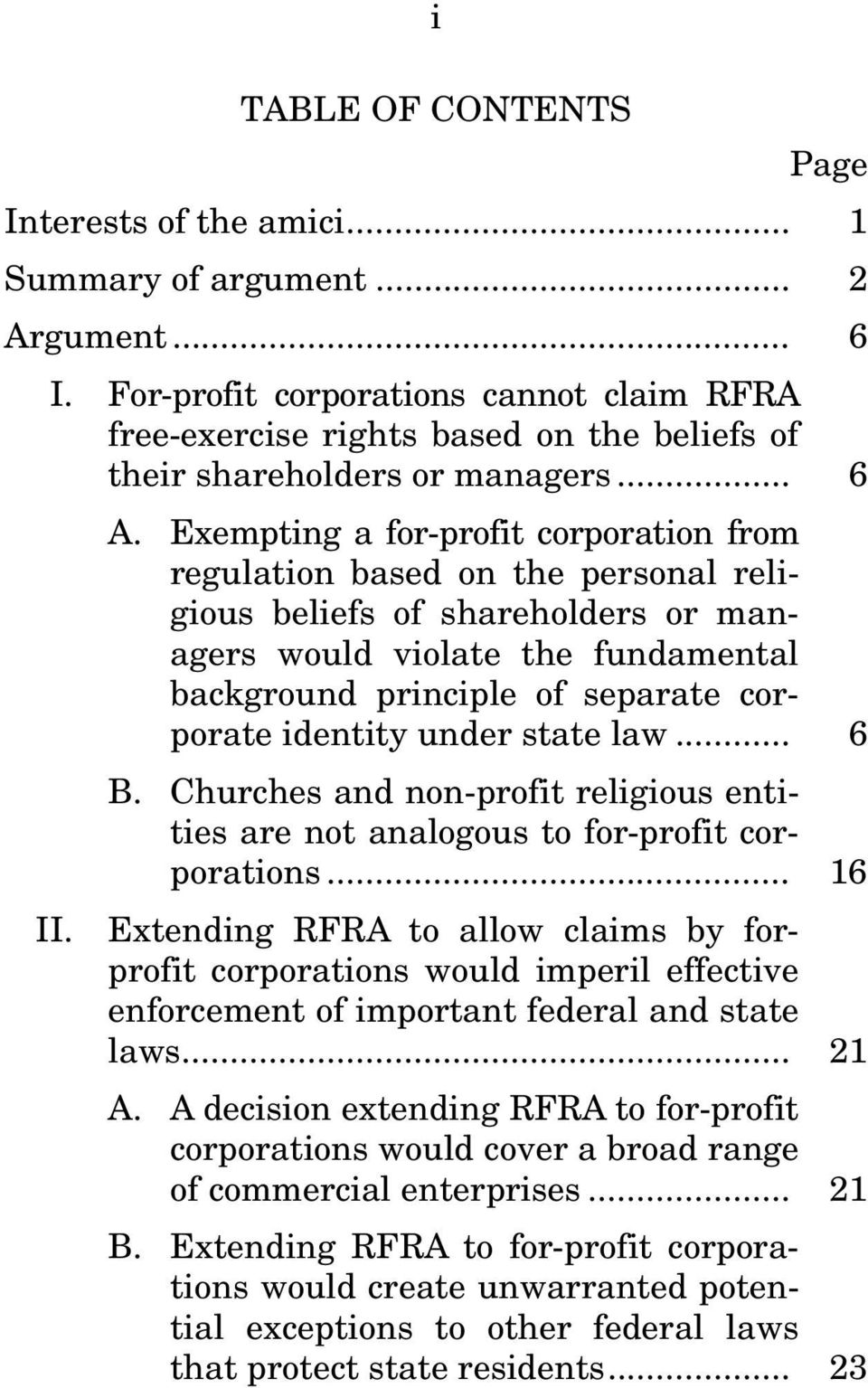
2 i TABLE OF CONTENTS Page Interests of the amici... 1 Summary of argument... 2 Argument... 6 I. For-profit corporations cannot claim RFRA free-exercise rights based on the beliefs of their shareholders or managers... 6 A. Exempting a for-profit corporation from regulation based on the personal religious beliefs of shareholders or managers would violate the fundamental background principle of separate corporate identity under state law... 6 B. Churches and non-profit religious entities are not analogous to for-profit corporations II. Extending RFRA to allow claims by forprofit corporations would imperil effective enforcement of important federal and state laws A. A decision extending RFRA to for-profit corporations would cover a broad range of commercial enterprises B. Extending RFRA to for-profit corporations would create unwarranted potential exceptions to other federal laws that protect state residents... 23
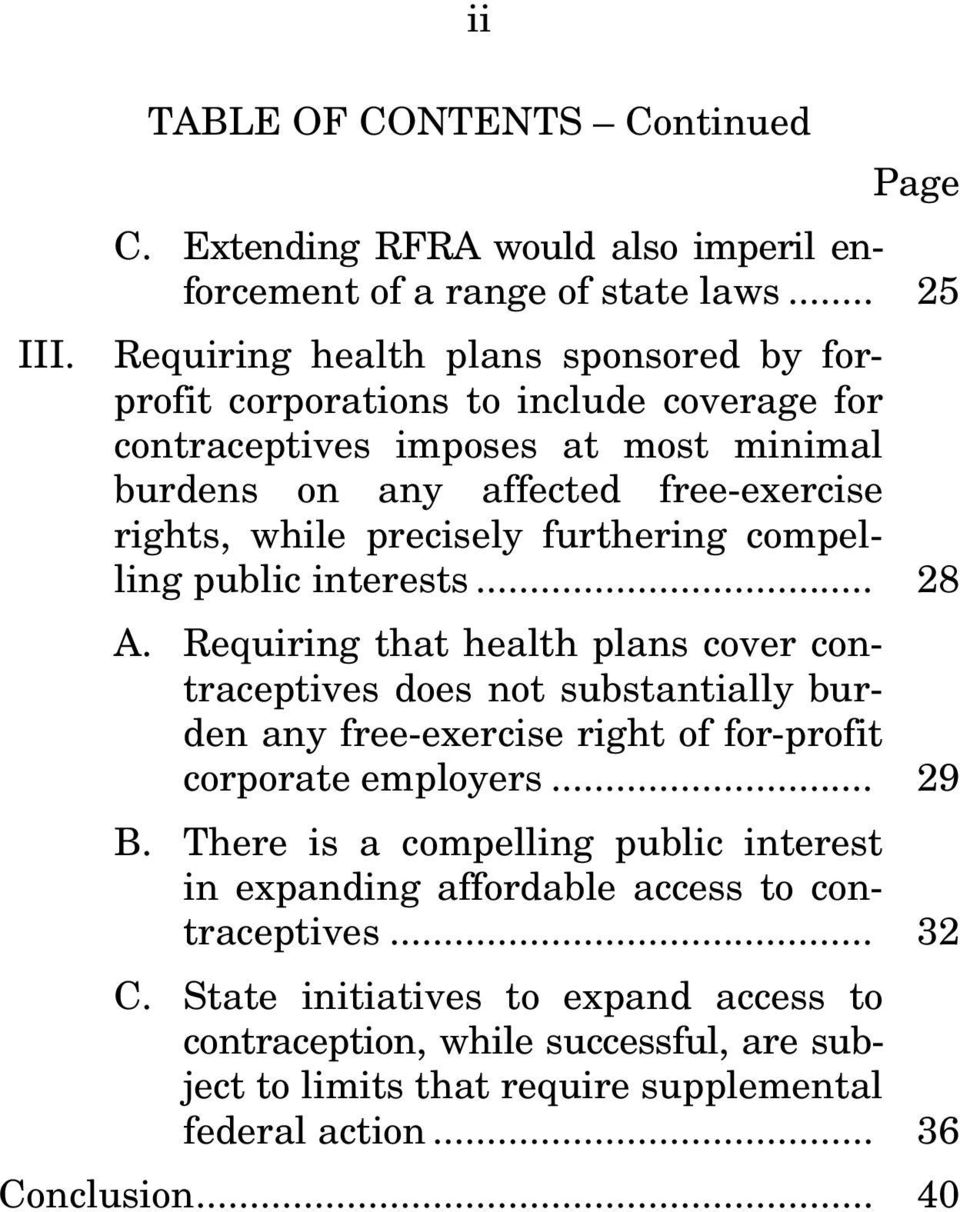
3 ii TABLE OF CONTENTS Continued Page C. Extending RFRA would also imperil enforcement of a range of state laws III. Requiring health plans sponsored by forprofit corporations to include coverage for contraceptives imposes at most minimal burdens on any affected free-exercise rights, while precisely furthering compelling public interests A. Requiring that health plans cover contraceptives does not substantially burden any free-exercise right of for-profit corporate employers B. There is a compelling public interest in expanding affordable access to contraceptives C. State initiatives to expand access to contraception, while successful, are subject to limits that require supplemental federal action Conclusion... 40
4 iii TABLE OF AUTHORITIES Page CASES Autocam Corp. v. Sebelius, 730 F.3d 618 (6th Cir. 2013) Barr v. Sinton, 295 S.W.3d 287 (Tex. 2009) Bellis v. United States, 417 U.S. 85 (1974)... 10, 12, 14 Burke v. Ipsen, 189 Cal. App. 4th 801 (2010) Burks v. Lasker, 441 U.S. 471 (1979)... 6 Catholic Charities of Diocese of Albany v. Serio, 859 N.E.2d 459 (N.Y. 2006) Catholic Charities of Sacramento, Inc. v. Super. Ct., 85 P.3d 92 (Cal. 2004) Cedric Kushner Promotions, Ltd. v. King, 533 U.S. 158 (2001)... 8 Chamber of Commerce v. Whiting, 131 S. Ct (2011)... 7 Church of the Lukumi Babalu Aye, Inc. v. Hialeah, 508 U.S. 520 (1993)... 8 Citizens United v. Fed. Election Comm n, 558 U.S. 310 (2010)... 9, 12 City of Boerne v. Flores, 521 U.S. 507 (1997)... 26, 27 E.E.O.C. v. Catholic Univ. of Am., 83 F.3d 455 (D.C. Cir. 1996) E.E.O.C. v. Townley Eng g & Mfg. Co., 859 F.2d 610 (9th Cir. 1988) Elane Photography, LLC v. Willock, 309 P.3d 53 (N.M. 2013)... 24

5 iv TABLE OF AUTHORITIES Continued Page Employment Division, Department of Human Resources of Oregon v. Smith, 494 U.S. 872 (1990) First Nat l Bank of Boston v. Bellotti, 435 U.S. 765 (1978) FMC Corp. v. Holliday, 498 U.S. 52 (1990) Franchise Tax Bd. of California v. Alcan Aluminium Ltd., 493 U.S. 331 (1990) Gilardi v. U.S. Dep t of Health & Human Servs., 733 F.3d 1208 (D.C. Cir. 2013)... 10, 11, 13, 21, 30 Goehring v. Brophy, 94 F.3d 1294 (9th Cir. 1996) Harris v. Stony Clove Lake Acres, 202 A.2d 745 (N.Y. App. Div. 1994)... 8 Hosanna-Tabor Evangelical Lutheran v. Equal Employment Opportunity Comm n, 132 S. Ct. 694 (2012)... 16, 17, 18, 24 In Pacific Home v. Los Angeles, 264 P.2d 539 (Cal. 1953) Korte v. Sebelius, 735 F.3d 654 (7th Cir. 2013)... passim Kush v. Am. States Ins. Co., 853 F.2d 1380 (7th Cir. 1988)... 9 Little Canada Charity Bingo Hall Ass n v. Movers Warehouse, Inc., 498 N.W.2d 22 (Minn. Ct. App. 1993) Planned Parenthood v. Casey, 505 U.S. 833 (1992)... 32

6 v TABLE OF AUTHORITIES Continued Page Presbyterian Church in United States v. Mary Elizabeth Blue Hull Mem l Presbyterian Church, 393 U.S. 440 (1969) Santa Fe Indus., Inc. v. Green, 430 U.S. 462 (1977)... 7, 20 See v. City of Seattle, 387 U.S. 541 (1967) Serbian E. Orthodox Diocese v. Milivojevich, 426 U.S. 696 (1976) State v. Cordingley, 302 P.3d 730 (Idaho Ct. App. 2013) State v. Hardesty, 214 P.3d 1004 (Ariz. 2009) Tarsney v. O Keefe, 225 F.3d 929 (8th Cir. 2000) Thomas v. Dickson, 301 S.E.2d 49 (Ga. 1983) United States v. White, 322 U.S. 694 (1944)... 12, 14 Warner v. Boca Raton, 887 So. 2d 1023 (Fla. 2004) Westchester Day Sch. v. Vill. of Mamaroneck, 504 F.3d 338 (2d Cir. 2007) Wyeth v. Levine, 555 U.S. 555 (2009)... 7, 8 Zaist v. Olson, 227 A.2d 552 (Conn. 1967)... 9 STATUTES 1 U.S.C U.S.C. 300gg U.S.C. 300gg-13(a)(4)... 29

7 vi TABLE OF AUTHORITIES Continued Page 42 U.S.C. 2000e-1(a) Cal. Corp. Code 9230(a) Employee Retirement Income Security Act of 1974, 29 U.S.C et seq Religious Freedom Restoration Act of 1993, 42 U.S.C. 2000bb et seq U.S.C. 2000bb-1(a) U.S.C. 2000bb-1(b) Religious Land Use and Institutionalized Persons Act of 2000, 42 U.S.C. 2000cc et seq , 26, U.S.C. 2000cc-1(a) REGULATIONS 45 C.F.R OTHER AUTHORITIES 78 Fed. Reg. 39,870 (July 2, 2013) Cong. Rec. 29,070 (2009) Adam Sonfeld et al., U.S. Insurance Coverage of Contraceptives and the Impact of Contraceptive Coverage Mandates 2002, 36 Perspectives on Sexual & Reproductive Health, No. 2 (2004)... 37, 38
8 vii TABLE OF AUTHORITIES Continued Page Adam Sonfeld & Katherine Kost, Public Costs from Unintended Pregnancies and the Role of Public Insurance Programs in Paying for Pregnancy and Infant Care: Estimates for 2008 (2013) Adam Sonfeld & Rachel Benson Gold, Medicaid Family Planning Expansions: Lessons Learned and Implications for the Future Carey Goldberg, Insurance for Viagra Spurs Coverage for Birth Control, N.Y. Times, June 30, Claudia Goldin & Lawrence F. Katz, The Power of the Pill: Contraceptives and Women s Career and Marriage Decisions, 110 J. of Pol. Econ. 730 (2002) Conway Center for Family Business, Family Business Facts, Figures and Fun, businesscenter.com/resources/family-businessfacts/ (last visited January 24, 2014) Cynthia Dailard, Contraceptive Coverage: A 10- Year Retrospective, Guttmacher Report on Public Policy (2004) Diana G. Foster, et al., Univ. Cal. S.F.: Bixby Ctr. for Global Reproductive Health, Cost Benefits from the Provision of Specific Methods of Contraception in 2009 (2010)... 38

9 viii TABLE OF AUTHORITIES Continued Page Douglas Laycock, Towards a General Theory of the Religion Clauses: The Case of Church Labor Relations and the Right to Church Autonomy, 81 Colum. L. Rev (1981) Forbes.com, America s Largest Private Companies 2013, /12/18/americas-largest-private-companies- 2013/ (last visited January 24, 2014) Guttmacher Inst., State Policies in Brief: Insurance Coverage of Contraceptives (2014) Institute of Med., Nat l Acad. of Sci., Best Intentions, Unintended Pregnancy and the Well-Being of Children and Families (Sarah S. Brown & Leon Brown, eds., 1997) Institute of Med., Nat l Acad. of Sci., Clinical Preventive Services for Women: Closing the Gaps (2011) Janna C. Merrick, Spiritual Healing, Sick Kids and the Law: Inequities in the American Healthcare System, 29 Am. J.L. & Med. 269 (2003) Joseph Angell et al., Treatise of the Law of Private Corporations Aggregate (1882) Joseph Stancliffe Davis, Essays in the Earlier History of American Corporations (1917) Kaiser Family Found. & Health Research & Educ. Trust, Employer Health Benefits 2013 Annual Survey (2013)... 39
10 ix TABLE OF AUTHORITIES Continued Page Lesley Stone et al., When the Right to Health and the Right to Religion Conflict: A Human Rights Analysis, 12 Mich. St. J. Int l L. 247 (2004) M. Antonia Biggs et al., Univ. Cal. S.F.: Bixby Ctr. for Global Reproductive Health, Cost- Benefit Analysis of the California Family PACT Program for Calendar Year 2007 (2010)... 35, 39 Megan L. Kavanaugh & Ragnar M. Anderson, Guttmacher Inst., Contraception and Beyond: The Health Benefits of Services Provided at Family Planning Centers (2013)... 33, 34 Michael W. McConnell, The Origins and Historical Understanding of Free Exercise of Religion, 103 Harv. L. Rev (1990) Model Nonprofit Corp. Act 2d ed cmt. (1987) Nat l Guideline Clearinghouse, U.S. Dep t of Health & Human Servs., Noncontraceptive Uses of Hormonal Contraceptives (2010) Nat l Health Law Program, Health Care Refusals: Undermining Quality Health Care for Women (2010) Oscar Handlin & Mary F. Handlin, Origins of the American Business Corporation, 5 J. Econ. Hist. 1 (1945)... 18
11 x TABLE OF AUTHORITIES Continued Page Patty Gerstenblith, Associational Structures of Religious Organizations, 1995 B.Y.U. L. Rev. 439 (1995) Rachel Benson Gold et al., Next Steps for America s Family Planning Program: Leveraging the Potential of Medicaid and Title X in an Evolving Health Care System (2009) Rachel Jones, Beyond Birth Control: The Overlooked Benefits of Oral Contraceptive Pills (2011) Roscoe Pound, Visitatorial Jurisdiction over Corporations in Equity, 49 Harv. L. Rev. 369 (1935) Rute A. Pinhel, Exemptions From the Higher Education Licensing Process for Religious Colleges (2007) Sara Sills, Nat l Acad. of State Health Pol y, Cost-Effectiveness of Medicaid Family Planning Demonstrations (2007) Sidley, Austin, Brown & Wood, Religious Employer Exemptions: A State by State Guide, religious%20institutions%20practice%20group. pdf (last visited January 24, 2014) William Blackstone, Commentaries William N. Eskridge, Jr., Noah s Curse: How Religion Often Conflates Status, Belief, and Conduct to Resist Antidiscrimination Norms, 45 Ga. L. Rev. 657 (2011)... 24
12 1 INTERESTS OF THE AMICI These cases involve the intended reach of the federal Religious Freedom Restoration Act (RFRA), 42 U.S.C. 2000bb et seq. Construing RFRA to extend free-exercise rights to for-profit corporations would depart sharply from the fundamental state-law rule that a corporation s legal identity is separate and distinct from that of its shareholders or managers. Any such departure from this background norm is improper absent a clear expression of congressional intent. States have a strong interest in ensuring that RFRA and other federal statutes are not improperly read to displace, sub silentio, settled principles of state law that provide the presumptive backdrop for congressional action. Extending free-exercise rights under RFRA to for-profit corporations would also affect the States by calling into question the effective enforcement of important health care, antidiscrimination, and other protections for state residents under federal and state laws. Finally, States have their own compelling interests in promoting public health and gender equity. Many States have furthered these interests by expanding access to contraceptive services, in part through requirements that health plans include coverage for contraceptives. The federal Patient Protection and Affordable Care Act (ACA) and its coverage requirements for women s preventive services substantially advance these same goals. State initiatives

13 2 cannot be fully effective without the ACA s coverage requirement, which protects large numbers of state residents whose health plans the States cannot regulate because of the preemptive effect of other federal law. The States accordingly have a direct interest in ensuring that RFRA is not misconstrued to interfere with that requirement SUMMARY OF ARGUMENT The ACA and its implementing regulations relating to coverage of contraceptives seek to advance compelling interests in public health and gender equity while avoiding any undue interference with the free exercise of personal religious beliefs. As a general matter, they require that all health plans, including those provided by employers, cover FDA-approved contraceptives. They provide, however, a complete exemption for non-profit religious employers ; and other non-profit religious organizations need not provide coverage for contraceptives directly if they object to doing so. See generally Coverage of Certain Preventive Services Under the Affordable Care Act, 78 Fed. Reg. 39,870, 39,873-82, 39, (July 2, 2013) (preamble to final regulations adopted at 45 C.F.R ). In the cases now before the Court, private forprofit corporations argue that RFRA requires they be exempted from the ACA s contraceptive-coverage provision because of the personal religious beliefs
14 3 of their shareholders, directors, or managers. Construing RFRA to provide any such extended exemption would improperly disregard settled background principles of state law; threaten to undermine the enforcement of important protections afforded to all state residents under federal and state law; and directly threaten States ability to pursue their own compelling public interests. 1. Nothing in RFRA suggests any congressional intention to ignore or displace basic principles of state corporation law. The fundamental point of organizing a business in corporate form is to separate the legal identity of the business from that of its shareholders or managers. Interpreting RFRA to allow a for-profit business corporation to assert religious free-exercise rights based on the personal beliefs of some group of individual shareholders or managers would be a startling departure from that norm. Allowing individual shareholders to assert personal free-exercise rights as a basis for limiting public regulation of the corporation, despite the choice they previously made to hold and conduct their business in corporate form, would likewise require overriding settled principles of state corporate law. Disregarding the principle of separate legal identity would be especially problematic in the context of free-exercise rights. It is entirely unclear how courts, legislatures, or public administrators could appropriately attempt to ascertain what religious beliefs should be legally attributed to a for-profit corporation. Nor is it clear how one would decide which
15 4 shareholders or managers should be allowed to seek accommodations for their individual beliefs in the operation of the corporate business. These concerns cannot be set aside on the ground that religious organizations, including many that are organized for legal purposes in non-profit corporate forms, are often treated as properly able to assert statutory or constitutional free-exercise rights. Such organizations play a unique role in facilitating religious exercise by individuals and communities of faith, and have historically been accorded special legal consideration. There is, however, no fair analogy between such institutions and private, for-profit corporations whose shareholders have chosen to avail themselves of the advantages of separate corporate legal identity for purposes of conducting a commercial business. Nor is there any indication that Congress, in enacting RFRA, intended to go well beyond historical norms by extending the Act s special accommodations to for-profit corporations. 2. Construing RFRA to permit free-exercise claims by for-profit corporations would threaten important state interests. It would call into question the effective enforceability of federal and state laws that provide important rights and protections for all state residents, promoting public interests in full participation by all residents in economic and social activity. These include laws ensuring access to health care, protecting civil and economic rights, and regulating land use. Although RFRA by its terms affects only the enforcement of federal laws, any decision by
16 5 this Court expanding the scope of the Act in the manner proposed in these cases would likely influence the construction of other laws. These include both other federal restrictions that directly limit state and local regulation, and state statutes with provisions parallel to those of RFRA. None of this is warranted by RFRA. 3. Finally, even if RFRA were properly read to permit for-profit corporations to assert statutory freeexercise rights, compelling public interests justify any minimal burden imposed on those rights by the ACA s contraceptive-coverage provision. The law does not require corporate employers, or their shareholders or managers, to endorse any form of medical treatment. It requires only that employer health plans cover, among many other possible treatments or services, the cost of FDA-approved contraceptives for any employee who might make the personal choice to use them. That requirement imposes at most a highly attenuated burden on any free-exercise right held by a for-profit corporation. Conversely, from the point of view of individual employees and the public as a whole, ensuring affordable access to contraceptives serves compelling public interests in promoting public health, gender equity, individual autonomy, and other social and economic goals, including easing burdens on the public fisc. Twenty-eight States, including all amici except the District of Columbia, have sought to further these same interests by adopting state rules requiring coverage for contraceptives, as well as by expanding low-income families eligibility for family-planning
17 6 services. As a practical matter, however, state coverage requirements cannot benefit some 60% of workers and their families, because federal law preempts state regulation of self-funded employer health plans. The ACA s contraceptive-coverage provision addresses this and other gaps in affordable access to contraceptives, thus providing an essential complement to state regulation and serving compelling interests not only of the United States but also of the States themselves ARGUMENT I. For-Profit Corporations Cannot Claim RFRA Free-Exercise Rights Based on the Beliefs of Their Shareholders or Managers A. Exempting a For-Profit Corporation from Regulation Based on the Personal Religious Beliefs of Shareholders or Managers Would Violate the Fundamental Principle of Separate Corporate Identity Under State Law Like any federal law, RFRA must be construed in light of other law existing at the time of its enactment, which Congress is presumed to have understood formed the background for the new Act. See Burks v. Lasker, 441 U.S. 471, 478 (1979). This is especially true where that background consists of well settled and widely understood principles of state law, which this Court assumes Congress does not

18 7 intend to displace absent some clear indication to the contrary. See Wyeth v. Levine, 555 U.S. 555, 565 (2009). The Court has emphasized this presumption in the area of corporation law, because corporations are creatures of state law. Santa Fe Indus., Inc. v. Green, 430 U.S. 462, 479 (1977). 1 Here, it is a foundational indeed, definitional principle of state corporate law that corporations have a legal identity distinctly separate from that of their shareholders or managers. Construing RFRA to allow corporations to assert the personal religious beliefs of shareholders or managers as a shield against the enforcement of generally applicable laws or regulations would require disregarding or overriding that basic legal distinction. Blurring the otherwise clear line between the corporation s artificial legal identity and the personal beliefs of individual shareholders or managers would, in turn, create grave practical difficulties in application. There is no basis for concluding that Congress would have contemplated a construction of RFRA that thus ignores the historical presence of state law governing respect 1 See Santa Fe Indus., 430 U.S. at 479 (refusing to read federal securities laws as displacing state law regarding fiduciary responsibilities, and expressing reluctance to override[ ] established state policies of corporate regulation ); cf. Chamber of Commerce v. Whiting, 131 S. Ct. 1968, 1981 (2011) (even in uniquely federal area of immigration law, Congress expressly preserve[d] state power to regulate corporate charters).

19 8 for the separate corporate form. See Wyeth, 555 U.S. at 565 n It is a central principle of state corporate law that shareholders of a corporation are distinct from the corporation itself,... with different rights and responsibilities.... Cedric Kushner Promotions, Ltd. v. King, 533 U.S. 158, 163 (2001); see also Harris v. Stony Clove Lake Acres, 202 A.2d 745, 747 (N.Y. App. Div. 1994) ( A corporation, even when wholly owned by a single individual, has a separate legal existence from its shareholders, and courts are loathe to disregard the corporate form for the benefit of those who have chosen that form to conduct business. ) (citations omitted); see generally Brief of Corporate and Criminal Law Professors at 3-19 (Professors Brief). The creation of a separate legal identity provides many benefits in conducting business. Unlike a traditional partnership, for example, a business corporation typically maintains its unitary identity with respect to customers, creditors, employees, regulators, and even its own shareholders and agents, 2 Petitioners in Conestoga Wood Specialties v. Sebelius also argue briefly that the ACA s contraceptive-coverage provision violates not only RFRA but also the Free Exercise Clause Pet. Br That claim fails for reasons similar to those addressed in this brief with respect to RFRA. See Pet. App. 28a. In addition, constitutional strict scrutiny does not apply because the contraceptive-coverage provision is a neutral and generally applicable regulation of economic conduct. There is no indication that it aims to infringe upon or restrict practices because of their religious motivation. Church of the Lukumi Babalu Aye, Inc. v. Hialeah, 508 U.S. 520, 533 (1993).

20 9 notwithstanding possible changes in ownership interests or disputes among different shareholders or managers. The separate identity also benefits shareholders in various ways, the most obvious being that they limit their investment in the business and their liability to each other or third parties for the business s debts or torts. See, e.g., Kush v. Am. States Ins. Co., 853 F.2d 1380, 1384 (7th Cir. 1988). This legal separation between an incorporated business and its owners is so fundamental that each State maintains a specific body of law for determining what must be done to establish and maintain it, and under what limited circumstances it may be breached. See, e.g., Zaist v. Olson, 227 A.2d 552 (Conn. 1967) (plaintiff may sue shareholder directly by showing such a unity of interest and ownership that the independence of the corporation had in effect ceased ). 2. As independent legal entities, corporations can hold and exercise many legal rights, just as they are subject to legal obligations. Most obviously, a business corporation may engage in trade, incurring enforceable debts and obtaining rights to enforce debts or contracts against others. More broadly, a for-profit corporation may, through its ordinary governance structures, develop positions on matters relevant to its business or operations, including matters of public policy. In such cases the Court has viewed the corporation, as an entity, as holding a right to express those positions in public debate. See Citizens United v. Fed. Election Comm n, 558 U.S. 310, , 361 (2010).

21 10 In contrast, certain rights by their nature are purely personal guarantees that cannot be held by a business corporation (or, in some cases, by any corporation or collective entity). First Nat l Bank of Boston v. Bellotti, 435 U.S. 765, 778 n.14 (1978) (citation omitted). The right to vote, for example, is inherently personal. Similarly, the Court has long held that the privilege against self-incrimination, which respects a private inner sanctum of individual feeling and thought... and proscribes state intrusion to extract self-condemnation, is a personal right that cannot be held by a collective entity or asserted by a corporate owner or manager as such. Bellis v. United States, 417 U.S. 85, 91 (1974) (citation omitted). Rights to the free exercise of religious beliefs, whether created by statute or by the Constitution, likewise protect the development and expression of an inner sanctum of personal religious faith. Freeexercise rights have thus also been understood as personal, relating only to individual believers and to a limited class of associations comprising or representing them. See generally Gilardi v. U.S. Dep t of Health & Human Servs., 733 F.3d 1208, (D.C. Cir. 2013). Unsurprisingly, there is no tradition of recognizing or accommodating the exercise of such inherently personal rights by ordinary, for-profit business corporations. Accordingly, in the present context, those courts of appeals that have allowed for-profit corporations to claim RFRA exemptions from the ACA s
22 11 contraceptive-coverage provision have justified that conclusion by reference to the religious beliefs of individual corporate shareholders or managers. See Korte v. Sebelius, 735 F.3d 654, 683 (7th Cir. 2013) (burden arises from [t]he Kortes and the Grotes as corporate owners and managers being forced to provide coverage); Gilardi, 733 F.3d at 1216 (basing holding only on individual religious beliefs); Pet. App. 8a-9a, 50a (identifying purported corporate beliefs based on complaint alleging that corporation bears the imprint of its owners faith, see J.A. 135); see also E.E.O.C. v. Townley Eng g & Mfg. Co., 859 F.2d 610, 620 (9th Cir. 1988) ( Townley is merely the instrument through and by which Mr. and Mrs. Townley express their religious beliefs.... [T]he rights at issue are those of Jake and Helen Townley. ). 3. Allowing for-profit corporations to seek exemptions from their ordinary regulatory obligations based on the religious beliefs of individual shareholders or managers is not a sustainable way of construing RFRA, in light of the basic principle of separate corporate identity under state law. Lower courts that have sought to apply RFRA to such corporations in the ACA context have either (a) attributed the rights of individual shareholders or managers to their corporations or (b) allowed the shareholders to assert their personal rights based on the obligations of the corporation. Neither approach is sound. a. Courts that have allowed for-profit business corporations to assert a religious exemption on their own behalf have confused the rights of a corporation with those of its shareholders or managers. Korte, 735
23 12 F.3d at ; see Pet. App. 50a-56a. But corporations can properly exercise only those substantive rights that they possess as separate... institutions, legally distinct from their shareholders or agents. United States v. White, 322 U.S. 694, 703 (1944) (self-incrimination). Thus, for example, corporations own property and hold resources in their own right, apart from the private and personal resources of their shareholders. Id. at 702; see Bellis, 417 U.S. at 93 (same). Similarly, a business corporation s claims to rights of privacy or speech may be analyzed coherently as asserted based on the activities and interests of the corporate entity itself, without reference to the interests of individual shareholders or managers. See Citizens United, 558 U.S. at 361; See v. City of Seattle, 387 U.S. 541, 543 (1967). Assessing whether a law infringes on corporate privacy or speech rights does not require determining whether the rights of the company s shareholders or managers are burdened as individuals. In sharp contrast, lower courts have found no way to analyze how a business corporation would exercise its religion. They have considered instead the personal religious beliefs of the corporation s owners, officers, and directors. Korte, 735 F.3d at 668; see also Pet. App. 8a-9a, 50a. Courts that have taken this approach have done so in actions involving corporations owned and run by small family groups, with an asserted unanimity of religious belief as to morally permissible methods of contraception and the burden imposed by the ACA s
24 13 coverage requirement. Korte, 735 F.3d at 662; Pet. App. 7a-9a. Even in that situation, looking to the beliefs of shareholders and managers to define the basis for a corporate free-exercise claim would either disregard or override the state-law principle of separate legal identity. Beyond that concern, however, RFRA cannot be construed on the assumption that the shareholders and officers of a business corporation will share the same religious beliefs. If some are from different faiths (or of no faith), or hold differing understandings or beliefs on particular issues even within one faith tradition, there is no sound way for counsel, regulators, or courts to determine what particular religious beliefs the corporation may properly assert on its own behalf. b. Other courts have sought to apply RFRA to for-profit corporations not by allowing the corporation to assert free-exercise rights as its own, but by treating any burden imposed by applying ACA s contraceptive coverage requirement to the corporation as also burdening the personal free-exercise rights of the corporation s shareholders or agents. Gilardi, 733 F.3d at 1216; Korte, 735 F.3d at 666. This approach is equally incompatible with the principle of separate corporate identity under settled state-law principles. Shareholders are often able to assert some practical interest in the operations of business corporations in which they have invested. There would, however, be legal chaos if individual shareholders thereby gained standing to proceed on behalf of the corporation. Instead, the law commits vindication of
25 14 the corporation s legal rights to the corporation, acting in its separate capacity and through its duly constituted governance mechanisms and agents. Under standard state-law rules of shareholder standing, the legal distinction between shareholder and corporate entity is maintained by allowing shareholders to bring suit on their own behalf only if they can assert and maintain a direct, personal interest in a cause of action, separate and distinct from any injury suffered by the corporation. Franchise Tax Bd. of California v. Alcan Aluminium Ltd., 493 U.S. 331, 336 (1990). This rule prevents a multiplicity of individual suits, protects the rights of creditors, and ensures that any judgment inures to the benefit of the corporation as a whole. See, e.g., Thomas v. Dickson, 301 S.E.2d 49, 50 (Ga. 1983). Similarly, corporate managers and other agents have, as such, legal personalities quite distinct from those they have as individuals. As this Court has explained in the Fifth Amendment context, individuals, when acting as representatives of a collective group, cannot be said to be exercising their personal rights and duties nor to be entitled to their purely personal privileges. Rather they assume the rights, duties and privileges of the artificial entity or association of which they are agents or officers and they are bound by its obligations. Bellis, 417 U.S. at 90 (quoting White, 322 U.S. at 699). Thus, an individual right or privilege held by a particular corporate manager may not be asserted to shield the corporation
26 15 from a duty or obligation that the individual is required to perform on its behalf. In the ACA context, any burden imposed on a business corporation, as an employer required to provide certain health benefits as part of any health plan it may sponsor for its employees, falls only on the corporation. Any incidental effect on individual shareholders or managers affects them only in their capacities as part-owners or corporate agents. Actions that an agent might be required to take, for example, are not actions taken in an individual capacity, but as officers and directors of the corporation. Autocam Corp. v. Sebelius, 730 F.3d 618, 623 (6th Cir. 2013). Requirements imposed on the corporation by the ACA thus cause no cognizable personal injury to any individual shareholder or manager; and any injury suffered by the corporation would, under settled law, have to be asserted by the corporation on its own behalf. Again, RFRA provides no warrant for departing from standard background principles of state law by allowing a legally separate, for-profit corporation to challenge a regulatory obligation on the ground that compliance would burden the religious exercise of individual shareholders or managers.
27 16 B. Churches and Non-Profit Religious Entities Are Not Analogous to For-Profit Corporations Organized churches and related religious institutions have been recognized as capable of asserting free-exercise rights. Lower courts that have treated for-profit corporations as persons covered by RFRA have effectively put them in the same category as these traditional religious institutions, on the ground that the institutions are often legally organized in some non-profit corporate form. See Korte, 735 F.3d at ; Pet. App. 24a-25a. There is, however, no good analogy between the two situations. The fact that the law gives special solicitude to the rights of religious organizations, Hosanna-Tabor Evangelical Lutheran v. Equal Employment Opportunity Comm n, 132 S. Ct. 694, 697 (2012), provides no basis for extending the statutory free-exercise rights created by RFRA to ordinary, for-profit business corporations. Individuals commonly practice their religions at least in part collectively, in or under the auspices of religious institutions. The term religion itself connotes a community of believers. Michael W. McConnell, The Origins and Historical Understanding of Free Exercise of Religion, 103 Harv. L. Rev. 1409, 1490 (1990). The very existence of religious organizations is dedicated to the collective expression and propagation of shared religious ideals. Hosanna-Tabor, 132 S. Ct. at 712 (Alito, J., concurring) (citation omitted). Religious organizations act as critical buffers between the individual and
28 17 the power of the State, giving individuals a space in which to exercise faith without state intrusion. Id. (citations omitted). In addition, religious organizations often serve as authoritative voices on matters of religious doctrine. Korte, 735 F.3d at 695 (Rovner, J., dissenting). In this unique context, the law often gives special consideration to religious organizations. For example, although neutral and generally applicable regulations may usually be applied constitutionally without regard to incidental effects on religious exercise, the First Amendment may require special protection for religious institutions. Hosanna-Tabor, 132 S. Ct. at 707 (majority opinion); see also Korte, 735 F.3d at (majority opinion) (identifying claims involving rights of conscience and church autonomy rights) (citing Douglas Laycock, Towards a General Theory of the Religion Clauses: The Case of Church Labor Relations and the Right to Church Autonomy, 81 Colum. L. Rev. 1373, (1981)). Thus, the Court has held that implied or charitable trust doctrines, which generally require courts to investigate the extent to which a secular charity conforms to the purpose of a grant, see In Pacific Home v. Los Angeles, 264 P.2d 539, 543 (Cal. 1953), do not apply when they would require an analysis of conformity to church doctrine. Presbyterian Church in United States v. Mary Elizabeth Blue Hull Mem l Presbyterian Church, 393 U.S. 440, 446 (1969). Similarly, although actions for breach of the bylaws of secular organizations are treated as traditional breach of contract actions
29 18 under state law, see Burke v. Ipsen, 189 Cal. App. 4th 801 (2010); Little Canada Charity Bingo Hall Ass n v. Movers Warehouse, Inc., 498 N.W.2d 22, 24 (Minn. Ct. App. 1993), when an organization is religious, its own judicial bodies may retain greater authority on the interpretation of bylaws. Serbian E. Orthodox Diocese v. Milivojevich, 426 U.S. 696, 720 (1976). Most recently, the Court confirmed that religious institutions enjoy a ministerial exception from employment laws in certain contexts. Hosanna-Tabor, 132 S. Ct. at 710. These special accommodations for religious organizations have deep historical roots. Blackstone explains that, at common law, religious organizations did not need to show a charter in order to claim corporate status. See 1 William Blackstone, Commentaries *460; see also Joseph Angell et al., Treatise of the Law of Private Corporations Aggregate (1882) (citing similar cases in the American context). Similarly, by the time the First Amendment was adopted, general incorporation laws existed only for religious corporations. 2 Joseph Stancliffe Davis, Essays in the Earlier History of American Corporations (1917). In contrast, for-profit corporations which were typically special-purpose entities, unlike modern general-purpose business corporations required special state charters. Oscar Handlin & Mary F. Handlin, Origins of the American Business Corporation, 5 J. Econ. Hist. 1, 22 (1945). Today, many States continue to exempt religious corporations from normal registration requirements. See
30 19 generally Patty Gerstenblith, Associational Structures of Religious Organizations, 1995 B.Y.U. L. Rev. 439, 469 & n.92 (1995). Religious corporations also have been subject to more limited state oversight. Secular non-profits at common law were subject to supervision in order to... secure their adherence to the purposes of their institution. Roscoe Pound, Visitatorial Jurisdiction over Corporations in Equity, 49 Harv. L. Rev. 369, 371 (1935). However, based on the old separation of spiritual from temporal jurisdiction, churches were permitted to self-supervise. This rule survives to the modern day: in many States, [r]eligious corporations are subject to minimal attorney general supervision. Model Nonprofit Corp. Act 2d ed cmt. (1987); see also Cal. Corp. Code 9230(a) (state Attorney General shall have no powers with respect to any corporation incorporated or classified as a religious corporation under or pursuant to California law). Finally, States routinely grant statutory exemptions from other generally-applicable laws in an effort to accommodate religion. For example, Congress and the vast majority of States with antidiscrimination laws typically exempt religious organizations from compliance, at least under certain circumstances. See, e.g., Sidley, Austin, Brown & Wood, Religious Employer Exemptions: A State by State Guide; 3 see also 3 institutions%20practice%20group.pdf (last visited January 24, 2014).
31 20 42 U.S.C. 2000e-1(a) (federal analog). States also commonly exempt certain religious institutions from educational licensing, taxes, and other regulations. Rute A. Pinhel, Exemptions From the Higher Education Licensing Process for Religious Colleges (2007). 4 For present purposes, however, the main point of this tradition of special accommodation for religious organizations is what it does not include. There is no tradition of special exemptions for corporations formed and used to conduct businesses for profit. Nor is there any tradition of attributing to such corporations the individual free-exercise rights of their shareholders or managers, or of treating incorporated businesses as religious institutions simply because their shareholders or managers may have deeply-held beliefs, and may strive to put their religious principles into action in their commercial activities as in other aspects of their lives. In the absence of any such tradition, there is no basis for concluding that Congress would have intended RFRA s special free-exercise protections to extend to ordinary, for-profit business corporations. On the contrary, the presumption is that Congress enacted RFRA with an understanding of existing law, and did not intend to modify existing background principles unless it did so expressly. See, e.g., Santa Fe Indus., 430 U.S. at 479. There is nothing to suggest that, in enacting RFRA, Congress intended 4 Available at
32 21 either to override standard principles of separate corporate identity or to provide for a radical extension of traditional religious accommodations to for-profit corporations. II. Extending RFRA to Allow Claims by For- Profit Corporations Would Imperil Effective Enforcement of Important Federal and State Laws Allowing for-profit corporations to invoke RFRA and seek religious exemptions from generallyapplicable laws would threaten broad disruption in the enforcement of federal and state laws that are of signal importance to States and their residents. A. A Decision Extending RFRA to For- Profit Corporations Would Cover a Broad Range of Commercial Enterprises Some lower courts that have permitted RFRA claims by for-profit corporations have suggested that their holdings are narrow, applying only to closelyheld or essentially family corporations. Korte, 735 F.3d at 682 n.17; Gilardi, 733 F.3d at 1216 n.5; Pet. App. 42a-43a. There is, however, no clear basis for such a limitation. To the extent, for example, that a construction of RFRA relies on the fact that a corporation is in many contexts a legal person, it is not clear why any corporation could not make the same argument. See 1 U.S.C. 1; Korte, 735 F.3d at ; Pet. App. 24a-42a.
33 22 In any event, even an extension of RFRA that is purportedly limited to closely-held or family businesses would have an exceptionally broad sweep. Family-held Hobby Lobby, for example, operates more than 500 stores and has some 13,000 full-time employees Pet. App. 171a. Indeed, according to one account, family-owned or -controlled businesses account for some 80-90% of all North American businesses, including more than one-third of Fortune 500 companies, and account for 60% of all U.S. employment. Conway Center for Family Business, Family Business Facts, Figures and Fun. 5 Likewise, some of the largest corporations in the United States can be described as closely-held, including Cargill, Mars, Bechtel, Koch Industries, and Dell. Forbes.com, America s Largest Private Companies 2013; 6 see also Pet. App. 128a (Briscoe, C.J., concurring in part, dissenting in part) ( [I]t is difficult to imagine why the majority s holding would not apply to any number of large, closely-held corporations that employ far more employees... than Hobby Lobby and Mardel. ). There should, accordingly, be no attempt to minimize the scope and importance of the statutory question at issue in these cases. 5 (last visited January 24, 2014). 6 (last visited January 24, 2014).
34 23 B. Extending RFRA to For-Profit Corporations Would Create Unwarranted Potential Exceptions to Other Federal Laws that Protect State Residents Allowing ordinary business corporations to claim religious exemptions from generally-applicable laws would profoundly affect the relationship between the government and potentially millions of business entities in our society in ways we can only begin to anticipate Pet. App. 150a (Matheson, J., concurring in part and dissenting in part). Without any clear congressional mandate, it would create a direct threat of substantial disruption in the enforcement of important protections otherwise provided to state residents by both federal and state law. The following are just two examples. Health Care. If accorded free-exercise rights under RFRA, commercial enterprises could seek to deny customers or employees access to a broad range of health care products or services that they would otherwise be required to provide. Some religious denominations or adherents object to aspects of medical care other than contraceptives: blood transfusions, immunizations, stem-cell based treatments, and psychiatric care, to name a few. See Lesley Stone et al., When the Right to Health and the Right to Religion Conflict: A Human Rights Analysis, 12 Mich. St. J. Int l L. 247, 259 & n.49, 288 n.190, 307 (2004). Indeed, some object to the use of modern medical treatment at all. Janna C. Merrick, Spiritual Healing, Sick Kids and the Law: Inequities in the American
35 24 Healthcare System, 29 Am. J.L. & Med. 269, (2003). Civil Rights. Some for-profit corporations asserting free-exercise rights under RFRA would no doubt also seek exemptions from historic nondiscrimination guarantees in areas such as employment, housing, and public accommodations. Presumably, for example, a corporation treated as having free-exercise rights could seek exemption from prohibitions on hiring or firing employees based on their own religious beliefs or practices. Thus, an ordinary business could, like a church or parochial school, seek to impose religious tests for employment. Similarly, for-profit corporations whose shareholders or managers shared particular religious beliefs could claim a right to discriminate, in employment or the provision of goods or services, on the basis of otherwise prohibited criteria such as gender, marital status, disability, sexual orientation, or even race. Cf. E.E.O.C. v. Catholic Univ. of Am., 83 F.3d 455 (D.C. Cir. 1996) (sex discrimination claim); Hosanna-Tabor, 132 S. Ct. 694 (claim under Americans with Disabilities Act); Elane Photography, LLC v. Willock, 309 P.3d 53 (N.M. 2013) (sexual orientation discrimination claim); see generally William N. Eskridge, Jr., Noah s Curse: How Religion Often Conflates Status, Belief, and Conduct to Resist Antidiscrimination Norms, 45 Ga. L. Rev. 657 (2011); Professors Brief at Allowing business corporations to claim religious exemptions would thus pose a serious threat to hardwon antidiscrimination protections that otherwise
36 25 safeguard the rights of all state residents. Comprehensive enforcement of those protections is essential to continue the progress that has been made in ensuring fair and equal opportunities for all state residents in most areas of economic and social activity. Recognizing potential exceptions to these laws under RFRA would invite resumption of the sort of invidious discrimination that preceded and engendered the prohibitions. C. Extending RFRA Would also Imperil Enforcement of a Range of State Laws Extending RFRA free-exercise rights to for-profit corporations would also threaten the continued effective enforcement of state and local laws, in at least two ways. First, the federal Religious Land Use and Institutionalized Persons Act of 2000 (RLUIPA), 42 U.S.C. 2000cc et seq., directly limits state and local land use regulation in much the same way that RFRA limits the enforcement of federal law. RLUIPA requires state and local governments to demonstrate a compelling government interest when an application of certain land-use regulations is challenged on the basis that it imposes a substantial burden on the religious exercise of a person. Id. 2000cc-1(a). A decision according for-profit corporations free-exercise rights under RFRA would surely lead to claims by for-profit corporations under RLUIPA seeking religious exemptions from land use regulations, similar
37 26 to actions that have up to now been brought solely by religious assemblies and institutions. Commercial enterprises could seek to expand structures or conduct operations in ways that override important local interests, such as limiting density or preserving areas for particular uses as some religious institutions have been permitted to do under RLUIPA. See, e.g., Westchester Day Sch. v. Vill. of Mamaroneck, 504 F.3d 338 (2d Cir. 2007) (overturning denial of special use permit for significant expansion of religious school facilities); see generally Brief of the Nat l League of Cities. Second, a decision extending RFRA rights to forprofit corporations would undoubtedly lead to new litigation challenging the enforcement of state and local laws under state statutes modeled after RFRA. In Employment Division, Department of Human Resources of Oregon v. Smith, 494 U.S. 872 (1990), this Court held that enforcement of a neutral and generally applicable regulation does not violate the Free Exercise Clause of the federal Constitution even if it incidentally burdens the religious exercise of an individual or group. Congress then enacted RFRA, seeking to establish strict scrutiny as a federal statutory standard for justifying enforcement of any general federal, state, or local law that imposed a substantial burden on religious exercise. In City of Boerne v. Flores, 521 U.S. 507 (1997), however, this Court held that RFRA could not be applied to state regulation.
38 27 After Boerne, a number of States passed state laws modeled after the federal RFRA. Warner v. Boca Raton, 887 So. 2d 1023, 1031 (Fla. 2004). The legislative history of some of these laws makes it clear that in adopting the statute, the... legislature intended to adopt the standards of the federal counterpart in certain, if not all, respects. State v. Cordingley, 302 P.3d 730, 733 (Idaho Ct. App. 2013). Thus, while constructions of RFRA are technically not binding in [state] interpretation of similar state statutes, State v. Hardesty, 214 P.3d 1004, 1008 n.7 (Ariz. 2009), state courts often interpret the state Acts in pari materia with the substantially identical provisions of federal law. Id.; see also Barr v. Sinton, 295 S.W.3d 287, 296 (Tex. 2009) ( Because TRFRA, RFRA, and RLUIPA were all enacted in response to Smith and were animated in their common history, language, and purpose by the same spirit of protection of religious freedom, we will consider decisions applying the federal statutes germane in applying the Texas statute. ). Accordingly, any improper extension of federal RFRA rights to for-profit business corporations will, at a minimum, require state and local governments to defend against similar claims under state law. It will thus put at risk the fair and comprehensive enforcement of many state and local regulations, including those addressing matters of vital state concern such as health care coverage requirements, land use, and civil rights protections.
39 28 III. Requiring Health Plans Sponsored by For- Profit Corporations to Include Coverage for Contraceptives Imposes at most Minimal Burdens on any Affected Free-Exercise Rights, While Precisely Furthering Compelling Public Interests If application of the ACA s contraceptive coverage requirement to for-profit corporations is subject to review under RFRA, it should be sustained. Under RFRA, the United States may not substantially burden a person s exercise of religion unless it shows that imposition of that burden is the least restrictive means available to further a compelling public interest. 42 U.S.C. 2000bb-1(a)-(b). The contraceptive-coverage requirement imposes at most a highly attenuated burden on any free-exercise right of the corporation or of its individual shareholders or managers. At the same time, it is narrowly tailored to further compelling public interests in expanding affordable access to contraceptives and related family planning services, which are critical to promoting public health goals, individual autonomy, and social and economic equality for women. Seeking to further those same interests, a majority of States have established contraceptive coverage requirements of their own, and expanded Medicaid eligibility to increase access to contraceptives. State coverage requirements cannot, however, benefit many state residents, because federal law preempts their application to health plans maintained by many corporate employers. The ACA s coverage requirement is
40 29 thus also essential to enable these States to pursue their own compelling public interests. A. Requiring that Health Plans Cover Contraceptives Does Not Substantially Burden any Free-Exercise Right of For- Profit Corporate Employers The ACA requires all health plans, including those provided by employers, to cover various preventive health services. See 42 U.S.C. 300gg-13. These include services for women provided for in guidelines adopted by the Health Resources and Services Administration, see id. 300gg-13(a)(4), and those guidelines include, among other things, access to FDA-approved contraceptives. See, e.g., Pet. Br Complying with these requirements (along with many others) when providing health coverage to employees does not substantially burden any freeexercise right of a for-profit corporation. As discussed above, the personal religious beliefs necessary to give content to any such right can only be those of one or more of the corporation s shareholders or managers. The ACA does not, however, require any individual shareholder or manager to engage in any conduct, such as the personal use of particular types of contraceptives, that might be inconsistent with individual beliefs. The corporation, as a separate legal entity, provides health coverage for its employees. Covered
41 30 employees and their personal physicians or other health care providers then make all decisions concerning what covered services they need or want to use. An employee may have no need for a particular covered service, or may choose not to use it because he or she personally shares the religious views of the corporate employer s shareholders or managers, or for any other reason. In any event, neither the corporate employer nor, certainly, any of its individual shareholders or managers can reasonably be seen as having anything to do with the employee s personal choices, or as bearing any moral or other responsibility for them. These parties no more cause an increase in contraceptive use by any employee when they authorize [the corporation] to pay for a benefits plan that employees might use to get contraception than they would simply by authoriz[ing] wages that an employee might use to purchase contraception she would not otherwise be able to afford. Gilardi, 733 F.3d at (Edwards, J., concurring in part and dissenting in part). Under these circumstances, any burden that the ACA s contraceptive coverage requirement might be said to impose on the private parties in the cases now before the Court is too attenuated to be deemed substantial. Moreover, treating a corporate shareholder or manager s objection to such an indirect association with an employee s health care choices as a substantial burden for purposes of RFRA could have serious implications for other areas of the law. Heretofore, for example, courts have consistently dismissed claims
42 31 for religious exemptions from routine tax or fee obligations on the ground that any harm alleged by a taxpayer based on how the government may use funds it collects is too indirect and attenuated to support standing. See, e.g., Tarsney v. O Keefe, 225 F.3d 929, 938 (8th Cir. 2000) (state taxpayers lacked direct injury required for standing); Goehring v. Brophy, 94 F.3d 1294, 1300 (9th Cir. 1996) (any harm flowing from fact that university registration fee was used in part to fund health insurance program that subsidized abortions was too attenuated to be a substantial burden ). These cases have relied on the fact that mere payment of a tax or fee does not require a party to accept, participate in, or advocate in any manner for the provision of any service or benefit to which the party may object. Goehring, 94 F.3d at If, however, this Court holds that a corporate employer suffers a substantial burden because its employee health plan is required to offer coverage for services to which some of its shareholders or managers may object, then it is not clear why other plaintiffs should be barred from challenging the collection of taxes or fees because the government might use them in part to fund executions, stem cell research, civil unions, or various civil rights laws to which the plaintiff likewise might personally object. Tarsney, 225 F.3d at 938. This Court should not adopt a new approach to assess what constitutes a substantial burden that could subject[ ] a potentially wide range of statutory protections to strict scrutiny. Korte, 735 F.3d at 693 (Rovner, J., dissenting).
43 32 B. There is a Compelling Public Interest in Expanding Affordable Access to Contraceptives Even if the ACA s contraceptive-coverage requirement could be viewed as imposing a substantial burden on a for-profit corporate employer or its shareholders or managers, it should still be sustained against a RFRA challenge. Measures adopted by States, and now the federal government, to expand affordable access to contraceptives through health plan coverage provisions are narrowly tailored to further compelling public interests in promoting gender equity and achieving significant health, social, and economic benefits. Approximately one-half of all pregnancies in the United States are unintended, often causing negative health and economic effects. Institute of Med., Nat l Acad. of Sci., Clinical Preventive Services for Women: Closing the Gaps 102 (2011) (IOM Report). Allowing a woman to control [her] reproductive li[fe] permits her to take lifesaving drugs that cannot be taken during pregnancy, plan for prenatal care, avoid risky behavior, and plan her professional, economic and social goals accordingly. Planned Parenthood v. Casey, 505 U.S. 833, 856 (1992); see IOM Report at ; Nat l Health Law Program, Health Care Refusals: Undermining Quality Health Care for Women
44 , (2010); 7 Claudia Goldin & Lawrence F. Katz, The Power of the Pill: Contraceptives and Women s Career and Marriage Decisions, 110 J. of Pol. Econ. 730, 731 (2002). Affordable access to contraceptives also provides women with important health benefits apart from avoiding unwanted pregnancies, including decreasing the risk of certain ovarian and uterine cancers, treating menstrual disorders, and preventing menstrualrelated migraines. 78 Fed. Reg. at 39,872; Rachel Jones, Beyond Birth Control: The Overlooked Benefits of Oral Contraceptive Pills 3 (2011); 8 Nat l Guideline Clearinghouse, U.S. Dep t of Health & Human Servs., Noncontraceptive Uses of Hormonal Contraceptives (2010). 9 It reduces pregnancy-related morbidity and mortality, prematurity, poor birth outcomes, and abortions. See Megan L. Kavanaugh & Ragnar M. Anderson, Guttmacher Inst., Contraception and Beyond: The Health Benefits of Services Provided at Family Planning Centers 8-9 (2013); 10 Institute of Med., Nat l Acad. of Sci., Best Intentions, Unintended Pregnancy and the Well-Being of Children and Families (Sarah 7 Available at 8 Available at Control.pdf Available at Available at
45 34 S. Brown & Leon Brown, eds., 1997). 11 And it helps families and children by reducing rates of single motherhood, and promoting the ability of mothers, especially single mothers, to obtain medical care and pursue professional and economic opportunities to provide for their families. Kavanaugh & Anderson, supra, at 8. Requiring coverage for contraceptives also helps equalize the cost of health care for women as compared to men. Women of reproductive age spend 68% more out of pocket than men on health care, partly because reproductive medical treatment requires more frequent health care visits and is not always adequately covered by insurance. 155 Cong. Rec. 29,070 (2009) (statement of Sen. Feinstein); see Cynthia Dailard, Contraceptive Coverage: A 10-Year Retrospective, Guttmacher Report on Public Policy 6 (2004). 12 Further, coverage requirements prevent insurance plans from discriminating against women by denying coverage for contraceptives while covering other prescription drugs and devices that may be differentially used by men. Finally, from a fiscal perspective, the public costs associated with unintended pregnancies are high. Publicly-funded care for unintended pregnancies, 11 Available at = Available at pdf.
46 35 births, and essential infant care alone cost the States almost $5.2 billion in 2008, including over $700 million in California and almost $100 million in Massachusetts. Adam Sonfeld & Katherine Kost, Public Costs from Unintended Pregnancies and the Role of Public Insurance Programs in Paying for Pregnancy and Infant Care: Estimates for 2008, at 7-9 (2013). 13 Lack of access to contraceptives also contributes to economic insecurity for women and their families, limiting their potential contributions to the general economy. Expanded access to contraceptives helps control these and other associated public costs. A California Medicaid program that expanded access to contraceptives to otherwise ineligible women saved the State an estimated $1.35 billion in medical, welfare, and other social service costs by averting unwanted pregnancies in 2007 alone, and double that amount $2.7 billion in cost savings to the federal government for the same period. M. Antonia Biggs et al., Univ. Cal. S.F.: Bixby Ctr. for Global Reproductive Health, Cost-Benefit Analysis of the California Family PACT Program for Calendar Year 2007 at (2010). 14 Accordingly, both States and the federal government have compelling interests in promoting access to contraceptives, both to promote the health and 13 Available at 14 Available at FamilyPACTCost-BenefitAnalysis2007_2010Apr.pdf.
47 36 equitable treatment of all residents and to ease substantial burdens on public programs. C. State Initiatives to Expand Access to Contraception, While Successful, Are Subject to Limits that Require Supplemental Federal Action A majority of States have sought to further the same public interests on their own, by adopting contraceptive coverage requirements under state law and expanding access to contraception under the cooperative state and federal Medicaid program. These efforts have met with considerable success, but their effectiveness has been limited by federal preemption that bars States from imposing coverage requirements on self-funded employer plans that cover some 60% of workers. The ACA s coverage provision is thus essential to enable these States to fulfill their own goals of ensuring affordable access to contraceptives for all state residents and their families. States have made significant efforts to increase affordable access to contraceptives. A majority of States, for example, have enacted their own contraceptive-coverage requirements. See Guttmacher Inst., State Policies in Brief: Insurance Coverage of Contraceptives 2 (2014). 15 These state provisions have targeted gender discrimination in insurance coverage and inequities in costs and prescription coverage for 15 Available at
48 37 women, as well as the public health implications of barriers to contraceptive access. See Catholic Charities of Sacramento, Inc. v. Super. Ct., 85 P.3d 67, 92 (Cal. 2004) (noting that elimination of gender inequities in coverage was principal object of California s coverage law); Catholic Charities of Diocese of Albany v. Serio, 859 N.E.2d 459, (N.Y. 2006) (stating that New York s coverage law was designed to advance both women s health and the equal treatment of men and women ); Carey Goldberg, Insurance for Viagra Spurs Coverage for Birth Control, N.Y. Times, June 30, 1998, at A1. These state laws demonstrably expanded women s access to contraceptives. In 1993, only 28% of typical non-self-funded insurance plans covered the five leading prescription methods of reversible contraception; by 2002, that figure had increased threefold, to 86% of insurance plans nationwide. Adam Sonfeld et al., U.S. Insurance Coverage of Contraceptives and the Impact of Contraceptive Coverage Mandates 2002, 36 Perspectives on Sexual & Reproductive Health, No. 2, (2004). 16 The state contraceptivecoverage requirements played a significant role: health plans specific to those States with a coverage rule were far more likely to cover the five leading contraceptive methods than such plans in States with no coverage requirement. Id. at State requirements accounted for 30%-40% of the increases in pdf. 16 Available at
49 38 overall coverage for various contraceptive methods in that period. Id. at 78. In addition to enacting contraceptive-coverage requirements applicable to private insurance plans, a majority of States have, with federal approval, expanded Medicaid eligibility limitations to allow more low-income women to receive Medicaid-supported family planning services without cost sharing. Rachel Benson Gold et al., Next Steps for America s Family Planning Program: Leveraging the Potential of Medicaid and Title X in an Evolving Health Care System 8 (2009). 17 These programs have shown dramatic results in expanding and improving contraceptive use and preventing unintended pregnancies. See Adam Sonfeld & Rachel Benson Gold, Medicaid Family Planning Expansions: Lessons Learned and Implications for the Future, In , California s expansion program provided contraceptives to more than 1 million women, including 215,000 teenagers, and helped avoid some 200,000 unintended pregnancies. Diana G. Foster, et al., Univ. Cal. S.F.: Bixby Ctr. for Global Reproductive Health, Cost Benefits from the Provision of Specific Methods of Contraception in 2009, at (2010). 19 These programs have resulted in billions of dollars in cost savings for the States and pdf Available at Available at Available at CostBenefitAnalysis_ADA.pdf.
50 39 federal government. M. Antonia Biggs et al., supra, at 19-20; Sara Sills, Nat l Acad. of State Health Pol y, Cost-Effectiveness of Medicaid Family Planning Demonstrations passim (2007). 20 Notwithstanding the gains realized by these state initiatives, significant gaps remain in contraceptive coverage. This results in large part from the fact that the federal Employee Retirement Income Security Act of 1974 (ERISA), 29 U.S.C et seq., preempts States from imposing coverage requirements on (or otherwise regulating) the self-funded health plans offered by many employers. See FMC Corp. v. Holliday, 498 U.S. 52, 61 (1990). Such plans cover 61% of all U.S. workers covered by employersponsored insurance. Kaiser Family Found. & Health Research & Educ. Trust, Employer Health Benefits 2013 Annual Survey 158, 160 (2013). 21 In addition, Medicaid, even under the state expansion programs, serves only low-income residents. The federal ACA s contraceptive-coverage provision thus plays an essential role in closing gaps that the States own programs cannot fill. Any minimal burden that the provision may impose on freeexercise rights of for-profit corporate employers, or their individual shareholders or managers, under 20 Available at familyplanning.pdf. 21 Available at com/2013/08/8465-employer-health-benefits pdf.
51 40 RFRA is thus justified by the compelling public interests that the federal coverage requirement serves not only for the United States, but also for the many States whose own similar requirements cannot be fully effective in the absence of the federal rule CONCLUSION In No , the judgment of the Tenth Circuit should be reversed. In No , the judgment of the Third Circuit should be affirmed. MARTHA COAKLEY Attorney General of Massachusetts JONATHAN B. MILLER JOSHUA D. JACOBSON MICHELLE L. LEUNG Assistant Attorneys General COMMONWEALTH OF MASSACHUSETTS OFFICE OF THE ATTORNEY GENERAL Respectfully submitted, KAMALA D. HARRIS Attorney General of California EDWARD C. DUMONT Solicitor General KATHLEEN A. KENEALY Chief Assistant Attorney General JULIE WENG-GUTIERREZ Senior Assistant Attorney General JOSHUA N. SONDHEIMER* Deputy Attorney General CRAIG J. KONNOTH Deputy Solicitor General One Ashburton Place STATE OF CALIFORNIA Boston, MA DEPARTMENT OF JUSTICE (617) Golden Gate Avenue, Suite San Francisco, CA (415) *Counsel of Record
52 41 GEORGE JEPSEN Attorney General STATE OF CONNECTICUT 55 Elm Street Hartford, CT JOSEPH R. BIDEN, III Attorney General STATE OF DELAWARE 820 North French Street, 6th Floor Wilmington, DE IRVIN B. NATHAN Attorney General DISTRICT OF COLUMBIA One Judiciary Square 441 4th Street, N.W., Suite 600 South Washington, D.C DAVID M. LOUIE Attorney General STATE OF HAWAII 425 Queen Street Honolulu, HI LISA MADIGAN Illinois Attorney General STATE OF ILLINOIS 100 West Randolph Street, 12th Floor Chicago, IL TOM MILLER Attorney General STATE OF IOWA 1305 East Walnut Street Des Moines, IA JANET T. MILLS Attorney General STATE OF MAINE Six State House Station Augusta, ME DOUGLAS F. GANSLER Attorney General STATE OF MARYLAND 200 St. Paul Place, 20th Floor Baltimore, MD GARY K. KING Attorney General STATE OF NEW MEXICO P.O. Drawer 1508 Santa Fe, NM ERIC T. SCHNEIDERMAN Attorney General STATE OF NEW YORK 120 Broadway, 25th Floor New York, NY PETER F. KILMARTIN Attorney General STATE OF RHODE ISLAND 150 South Main Street Providence, RI ELLEN F. ROSENBLUM Attorney General STATE OF OREGON 1166 Court Street NE Salem, OR WILLIAM H. SORRELL Attorney General STATE OF VERMONT 109 State Street Montpelier, VT ROBERT W. FERGUSON Attorney General STATE OF WASHINGTON 1125 Washington Street S.E. P.O. Box Olympia, WA January 28, 2014
The Contraceptive Coverage Gap in New York State: Burwell v. Hobby Lobby Stores, Inc. and Beyond
 125 Broad Street New York, NY 10004 212.607.3300 212.607.3318 www.nyclu.org The Contraceptive Coverage Gap in New York State: Burwell v. Hobby Lobby Stores, Inc. and Beyond November 5, 2014 Religious liberty
UNITED STATES DISTRICT COURT MIDDLE DISTRICT OF FLORIDA FORT MYERS DIVISION. v. Case No: 2:13-cv-795-JSM-CM ORDER
 Case 2:13-cv-00795-JSM-CM Document 59 Filed 10/28/14 Page 1 of 10 PageID 815 AVE MARIA SCHOOL OF LAW, Plaintiff, UNITED STATES DISTRICT COURT MIDDLE DISTRICT OF FLORIDA FORT MYERS DIVISION v. Case No:
July 2, 2015. Via Certified Mail & Email
 Via Certified Mail & Email The Honorable Mitch McConnell Majority Leader United States Senate 317 Russell Senate Office Building Washington, DC 20510 [email protected] The Honorable John Boehner
United States Court of Appeals For the Eighth Circuit
 United States Court of Appeals For the Eighth Circuit No. 14-2726 Dordt College; Cornerstone University lllllllllllllllllllll Plaintiffs - Appellees v. Sylvia M. Burwell, in her official capacity as Secretary
Case 8:13-cv-01731-VMC-TBM Document 36 Filed 03/17/14 Page 1 of 11 PageID 134 UNITED STATES DISTRICT COURT MIDDLE DISTRICT OF FLORIDA TAMPA DIVISION
 Case 8:13-cv-01731-VMC-TBM Document 36 Filed 03/17/14 Page 1 of 11 PageID 134 JOHN and JOANNA ROBERTS, UNITED STATES DISTRICT COURT MIDDLE DISTRICT OF FLORIDA TAMPA DIVISION Plaintiffs, v. Case No. 8:13-cv-1731-T-33TBM
Case 1:13-cv-00563-RBJ Document 56 Filed 09/17/13 USDC Colorado Page 1 of 9
 Case 1:13-cv-00563-RBJ Document 56 Filed 09/17/13 USDC Colorado Page 1 of 9 Civil Action No 13-cv-00563-RBJ W.L. (BILL) ARMSTRONG; JEFFREY S. MAY; WILLIAM L. (WIL) ARMSTRONG III; JOHN A. MAY; DOROTHY A.
CURRENT FEDERAL LAWS PROTECTING CONSCIENCE RIGHTS
 CURRENT FEDERAL LAWS PROTECTING CONSCIENCE RIGHTS Over the past forty-one years, numerous federal laws and regulations have been enacted to protect rights of conscientious objection. Many of these laws
UNITED STATES DISTRICT COURT EASTERN DISTRICT OF WISCONSIN. v. Case No. 14-mc-0052 DECISION AND ORDER
 EEOC v. Union Pacific Railroad Company Doc. 13 UNITED STATES DISTRICT COURT EASTERN DISTRICT OF WISCONSIN EQUAL EMPLOYMENT OPPORTUNITY COMMISSION, Petitioner, v. Case No. 14-mc-0052 UNION PACIFIC RAILROAD
UNITED STATES COURT OF APPEALS FOR THE NINTH CIRCUIT
 FOR PUBLICATION UNITED STATES COURT OF APPEALS FOR THE NINTH CIRCUIT MATTHEW PRICHARD, Plaintiff-Appellant, v. METROPOLITAN LIFE INSURANCE COMPANY; IBM LONG TERM DISABILITY PLAN, Defendants-Appellees.
United States Court of Appeals for the Federal Circuit
 NOTE: This disposition is nonprecedential. United States Court of Appeals for the Federal Circuit ROBERT DOURANDISH, Plaintiff-Appellant v. UNITED STATES, Defendant-Appellee 2015-5091 Appeal from the United
Case 2:14-cv-01214-DGC Document 38 Filed 08/25/14 Page 1 of 7 IN THE UNITED STATES DISTRICT COURT FOR THE DISTRICT OF ARIZONA
 Case :-cv-0-dgc Document Filed 0// Page of 0 WO Wintrode Enterprises Incorporated, v. PSTL LLC, et al., IN THE UNITED STATES DISTRICT COURT FOR THE DISTRICT OF ARIZONA Plaintiff, Defendants. No. CV--0-PHX-DGC
VOLUME NO. 51 OPINION NO. 16
 VOLUME NO. 51 OPINION NO. 16 INSURANCE - Mont. Code Ann. 49-2-309 requires inclusion of coverage for prescription contraceptives and related medical services; INSURANCE - Mont. Code Ann. 49-2-303 requires
LABOR AND EMPLOYMENT LAW UPDATE FOR MAY 2016 LEAGUE OF CALIFORNIA CITIES CONFERENCE. Timothy L. Davis. Burke, Williams & Sorensen, LLP www.bwslaw.
 LABOR AND EMPLOYMENT LAW UPDATE FOR MAY 2016 LEAGUE OF CALIFORNIA CITIES CONFERENCE Timothy L. Davis Burke, Williams & Sorensen, LLP www.bwslaw.com OVERVIEW FOR 2016 UPDATE Labor Law Court Decisions Employment
Case 3:14-cv-00137-AC Document 10 Filed 03/26/14 Page 1 of 14 Page ID#: 43
 Case 3:14-cv-00137-AC Document 10 Filed 03/26/14 Page 1 of 14 Page ID#: 43 Calvin L. Keith, OSB No. 814368 [email protected] Sarah J. Crooks, OSB No. 971512 [email protected] PERKINS COIE LLP
STATE OF TENNESSEE OFFICE OF THE ATTORNEY GENERAL. February 3, 2014. Opinion No. 14-15 QUESTIONS
 STATE OF TENNESSEE OFFICE OF THE ATTORNEY GENERAL Juveniles on Sex Offender Registry February 3, 2014 Opinion No. 14-15 QUESTIONS 1. Would a juvenile who committed a violent juvenile sexual offense before
IN THE UNITED STATES DISTRICT COURT FOR THE EASTERN DISTRICT OF PENNSYLVANIA
 IN THE UNITED STATES DISTRICT COURT FOR THE EASTERN DISTRICT OF PENNSYLVANIA DENIS SHEILS AND HARRIET SHEILS : CIVIL ACTION : v. : : UNIVERSITY OF PENNSYLVANIA : NO. 97-5510 MEDICAL CENTER, : JANET RENO,
UNITED STATES DISTRICT COURT DISTRICT OF MINNESOTA. v. MEMORANDUM AND ORDER
 Case 0:10-cv-00772-PAM-RLE Document 33 Filed 07/13/10 Page 1 of 8 UNITED STATES DISTRICT COURT DISTRICT OF MINNESOTA Ideal Development Corporation, Mike Fogarty, J.W. Sullivan, George Riches, Warren Kleinsasser,
IN THE UNITED STATES DISTRICT COURT FOR THE DISTRICT OF MARYLAND : : : : : : : MEMORANDUM
 IN THE UNITED STATES DISTRICT COURT FOR THE DISTRICT OF MARYLAND CATHERINE HOWELL, et al. Plaintiffs v. STATE FARM INSURANCE COMPANIES, et al. Defendants Civil No. L-04-1494 MEMORANDUM This is a proposed
National Labor Relations Board Rules That Mandatory Arbitration Clause Violates The National Labor Relations Act
 National Labor Relations Board Rules That Mandatory Arbitration Clause Violates The National Labor Relations Act October 16, 2006 In a recent decision potentially affecting all companies that use mandatory
5 Discrimination Based on Disability
 5 Discrimination Based on Disability I. Overview 5.1 Darcie R. Brault Allyson A. Miller II. The Americans with Disabilities Act of 1990 (ADA) A. The Purpose of the ADA 5.2 B. Who Must Comply with the ADA
Supreme Court of the United States
 No. 06-1085 ================================================================ In The Supreme Court of the United States --------------------------------- --------------------------------- ROBERT J. AYERS,
SIGNED this 31st day of August, 2010.
 SIGNED this 31st day of August, 2010. CRAIG A. GARGOTTA UNITED STATES BANKRUPTCY JUDGE IN THE UNITED STATES BANKRUPTCY COURT FOR THE WESTERN DISTRICT OF TEXAS AUSTIN DIVISION IN RE: ' CASE NO. 09-12799-CAG
Employee Relations. Howard S. Lavin and Elizabeth E. DiMichele
 VOL. 34, NO. 4 SPRING 2009 Employee Relations L A W J O U R N A L Split Circuits Does Charging Party s Receipt of a Right-to-Sue Letter and Commencement of a Lawsuit Divest the EEOC of its Investigative
COURT OF APPEAL STATE OF CALIFORNIA FIRST APPELLATE DISTRICT, DIVISION FIVE CITY AND COUNTY OF SAN FRANCISCO. vs.
 COURT OF APPEAL STATE OF CALIFORNIA FIRST APPELLATE DISTRICT, DIVISION FIVE CITY AND COUNTY OF SAN FRANCISCO vs. Appellant, INTERNATIONAL UNION OF OPERATING ENGINEERS, LOCAL 39 From an Order of the San
NOT TO BE PUBLISHED IN THE OFFICIAL REPORTS IN THE COURT OF APPEAL OF THE STATE OF CALIFORNIA SECOND APPELLATE DISTRICT DIVISION TWO
 Filed 8/27/14 Tesser Ruttenberg etc. v. Forever Entertainment CA2/2 NOT TO BE PUBLISHED IN THE OFFICIAL REPORTS California Rules of Court, rule 8.1115(a), prohibits courts and parties from citing or relying
Home Schooling in California
 michael e. hersher Home Schooling in California The recent decision of the California Court of Appeal in the Rachel L. case set off a storm of protest from the California home school community and drew
The Law in Texas Regarding Piercing the Corporate Veil. An Overview of the Corporate Veil
 The Law in Texas Regarding Piercing the Corporate Veil Section 1. An Overview of the Corporate Veil The Texas corporation, like the corporation in every other state, is a creature of statute and is legally
2015 IL App (5th) 140227-U NO. 5-14-0227 IN THE APPELLATE COURT OF ILLINOIS FIFTH DISTRICT
 NOTICE Decision filed 10/15/15. The text of this decision may be changed or corrected prior to the filing of a Petition for Rehearing or the disposition of the same. 2015 IL App (5th 140227-U NO. 5-14-0227
WORKERS COMPENSATION OPTIONS FOR TRIBES IN WASHINGTON STATE
 WORKERS COMPENSATION OPTIONS FOR TRIBES IN WASHINGTON STATE Peter S. Hicks WILLIAMS KASTNER & GIBBS PLLC 2005. ALL RIGHTS RESERVED Peter S. Hicks I. INTRODUCTION. This paper provides an overview of the
Liability of Volunteer Directors of Nonprofit Corporations (10/02)
 Liability of Volunteer Directors of Nonprofit Corporations (10/02) This memorandum addresses the California and federal law protections that exist to shield volunteer directors of nonprofit corporations
ERISA Causes of Action *
 1 ERISA Causes of Action * ERISA authorizes a variety of causes of action to remedy violations of the statute, to enforce the terms of a benefit plan, or to provide other relief to a plan, its participants
Advisory on the Massachusetts Independent Contractor/Misclassification Law
 Advisory on the Massachusetts Independent Contractor/Misclassification Law http://www.mass.gov/?pageid=cagoterminal&l=2&l0=home&l1=workplace+rights&sid=cago&b=te... Page 1 of 1 9/15/2008 The Official Website
THE GEORGIA NON-PROFIT AND LAWS PREVENTING DISCRIMINATION IN EMPLOYMENT
 THE GEORGIA NON-PROFIT AND LAWS PREVENTING DISCRIMINATION IN EMPLOYMENT By: Benjamin D. Briggs Anna C. Curry TROUTMAN SANDERS LLP 600 Peachtree Street NE Bank of America Plaza, Suite 5200 Atlanta, Georgia
Client Alert. When Is Qui Tam False Claims Act Litigation Based Upon Prior Public Disclosure and Who Qualifies as Original Source of Information?
 Contact Attorneys Regarding This Matter: Aaron M. Danzig 404.873.8504 direct [email protected] W. Jerad Rissler 404.873.8780 direct [email protected] Client Alert When Is Qui Tam False Claims Act
THE CURRENT STATUS OF THE FEDERAL AVIATION ACT S IMMUNITY PROVISION FOUND IN SECTION 44112: A CASE STUDY OF VREELAND V. FERRER
 THE CURRENT STATUS OF THE FEDERAL AVIATION ACT S IMMUNITY PROVISION FOUND IN SECTION 44112: A CASE STUDY OF VREELAND V. FERRER Lea Pilar Valdivia 1 Podhurst & Orseck, P.A. Miami, Florida On July 18, 2011,
RELIGION IN THE PUBLIC SCHOOLS
 RELIGION IN THE PUBLIC SCHOOLS BACKGROUND RELIGIOUS LIBERTY IN AMERICA & OUR PUBLIC SCHOOLS Since its founding in 1913, the Anti-Defamation League (ADL) has been guided by its mandate of combating bigotry,
IN THE UNITED STATES COURT OF APPEALS FOR THE ELEVENTH CIRCUIT. No. 12-12593. D. C. Docket No. 4:11-cv-00400-RS-CAS. versus
 Case: 12-12593 Date Filed: 04/09/2013 Page: 1 of 13 [PUBLISH] IN THE UNITED STATES COURT OF APPEALS FOR THE ELEVENTH CIRCUIT No. 12-12593 D. C. Docket No. 4:11-cv-00400-RS-CAS OPIS MANAGEMENT RESOURCES
IN THE UNITED STATES COURT OF APPEALS FOR THE FIFTH CIRCUIT
 IN THE UNITED STATES COURT OF APPEALS United States Court of Appeals FOR THE FIFTH CIRCUIT Fifth Circuit FILED March 3, 2016 No. 15-11188 In re: AMERICAN LEBANESE SYRIAN ASSOCIATED CHARITIES, INCORPORATED;
UNITED STATES DISTRICT COURT FOR THE DISTRICT OF RHODE ISLAND
 UNITED STATES DISTRICT COURT FOR THE DISTRICT OF RHODE ISLAND NICOLE MARIE CRUZ, Plaintiff, v. C.A. No. 05-38S HARTFORD CASUALTY INSURANCE COMPANY, Defendant. DECISION AND ORDER WILLIAM E. SMITH, United
MEMORANDUM. Tim Cameron, Kim Chamberlain, Chris Killian Securities Industry and Financial Markets Association
 MEMORANDUM TO: FROM: RE: Tim Cameron, Kim Chamberlain, Chris Killian Securities Industry and Financial Markets Association David R. Carpenter, Collin P. Wedel, Lauren A. McCray Liability of Municipal Members
2:13-cv-11296-PDB-RSW Doc # 17-1 Filed 05/23/13 Pg 1 of 19 Pg ID 378
 2:13-cv-11296-PDB-RSW Doc # 17-1 Filed 05/23/13 Pg 1 of 19 Pg ID 378 IN UNITED STATES DISTRICT COURT FOR THE EASTERN DISTRICT OF MICHIGAN SOUTHERN DIVISION MERSINO MANAGEMENT COMPANY; ) KAREN A. MERSINO,
In the Court of Appeals of Georgia
 FIRST DIVISION PHIPPS, C. J., ELLINGTON, P. J., and MCMILLIAN, J. NOTICE: Motions for reconsideration must be physically received in our clerk s office within ten days of the date of decision to be deemed
COMPLAINT. Now come Plaintiffs, personal care attendants, consumers, surrogates,
 DOCKET NO. SUPERIOR COURT Catherine D. Ludlum, : Amber L. Michaud, : The Connecticut Association of Personal : SUPERIOR COURT Assistance, Inc., : Senator Joseph Markley, : State Representative Robert C.
United States Court of Appeals for the Federal Circuit
 NOTE: This disposition is nonprecedential. United States Court of Appeals for the Federal Circuit YVONNE MURPHY HICKMAN, Plaintiff-Appellant v. UNITED STATES, Defendant-Appellee 2015-5134 Appeal from the
IN THE COURT OF APPEALS OF TENNESSEE AT NASHVILLE May 7, 2003 Session
 IN THE COURT OF APPEALS OF TENNESSEE AT NASHVILLE May 7, 2003 Session ALEXANDER C. WELLS v. STATE OF TENNESSEE Appeal from the Tennessee Claims Commission No. 99002107 No. M2002-01958-COA-R3-CV - Filed
DEPARTMENT OF JUSTICE
 DEPARTMENT OF JUSTICE Statement of Christine A. Varney Assistant Attorney General Antitrust Division U.S. Department of Justice Before the Committee on the Judiciary United States Senate Hearing on Prohibiting
DELAWARE SUPREME COURT AFFIRMS DISNEY, CONTINUING VITALITY OF BUSINESS JUDGMENT RULE
 August 2006 EXECUTIVE SUMMARY CORPORATE GOVERNANCE TASK FORCE DELAWARE SUPREME COURT AFFIRMS DISNEY, CONTINUING VITALITY OF BUSINESS JUDGMENT RULE Michael W. Peregrine, Esquire McDermott Will & Emery LLP,
PROGRAM MEMORANDUM INSURANCE COMMISSIONERS INSURANCE ISSUERS
 PROGRAM MEMORANDUM INSURANCE COMMISSIONERS INSURANCE ISSUERS Department of Health and Human Services Centers for Medicare and Medicaid Services Transmittal No. 04-01 Date March 2004 Title: Subject: Market:
IN THE UNITED STATES DISTRICT COURT FOR THE EASTERN DISTRICT OF PENNSYLVANIA
 IN THE UNITED STATES DISTRICT COURT FOR THE EASTERN DISTRICT OF PENNSYLVANIA CRAIG VAN ARSDEL Plaintiff, CIVIL ACTION NO. 14-2579 v. LIBERTY MUTUAL INSURANCE COMPANY, Defendant. Smith, J. September 5,
Supreme Court of the United States
 No. 14-181 ================================================================ In The Supreme Court of the United States ALFRED GOBEILLE, in His Official Capacity as Chair of the Vermont Green Mountain Care
CLASS ACTION FAIRNESS ACT OF 2005
 PUBLIC LAW 109 2 FEB. 18, 2005 CLASS ACTION FAIRNESS ACT OF 2005 VerDate 14-DEC-2004 04:23 Mar 05, 2005 Jkt 039139 PO 00002 Frm 00001 Fmt 6579 Sfmt 6579 E:\PUBLAW\PUBL002.109 BILLW PsN: PUBL002 119 STAT.
UNITED STATES COURT OF APPEALS FOR THE THIRD CIRCUIT NO. 10-4345. DOROTHY AVICOLLI, Appellant
 NOT PRECEDENTIAL UNITED STATES COURT OF APPEALS FOR THE THIRD CIRCUIT NO. 10-4345 DOROTHY AVICOLLI, Appellant v. GOVERNMENT EMPLOYEES INSURANCE COMPANY, a/k/a GEICO; ANGELO CARTER; CHARLES CARTER On Appeal
No. 2--07--1205 Filed: 12-19-08 IN THE APPELLATE COURT OF ILLINOIS SECOND DISTRICT
 Filed: 12-19-08 IN THE APPELLATE COURT OF ILLINOIS SECOND DISTRICT WESTPORT INSURANCE Appeal from the Circuit Court CORPORATION, of McHenry County. Plaintiff and Counterdefendant-Appellee, v. No. 04--MR--53
A. For the consideration agreed below to be paid to Contractor by City, Contractor shall provide
 STATE OF TEXAS CONTRACT FOR SERVICES COUNTY OF DALLAS THIS CONTRACT is made and entered into by and between the CITY OF DALLAS, a Texas municipal corporation, located in Dallas County, Texas (hereinafter
Case 2:10-cv-02263-JAR Document 98 Filed 05/04/11 Page 1 of 8 IN THE UNITED STATES DISTRICT COURT FOR THE DISTRICT OF KANSAS
 Case 2:10-cv-02263-JAR Document 98 Filed 05/04/11 Page 1 of 8 IN THE UNITED STATES DISTRICT COURT FOR THE DISTRICT OF KANSAS SANDRA H. DEYA and EDWIN DEYA, individually and as next friends and natural
REVISITING DIRECTOR AND OFFICER INDEMNIFICATION: PROVISIONS IN THE NEW D.C. NONPROFIT ACT
 Updated July 2015 REVISITING DIRECTOR AND OFFICER INDEMNIFICATION: PROVISIONS IN THE NEW D.C. NONPROFIT ACT 1. Initial Considerations The District of Columbia has recently modernized its statute dealing
The Distinction Between Insurance Agent and Insurance Broker in California. Robert W. Hogeboom, Esq. 1 (213) 614-7304. May 2006
 The Distinction Between Insurance Agent and Insurance Broker in California Robert W. Hogeboom, Esq. 1 (213) 614-7304 May 2006 The legal distinction between an insurance agent and insurance broker is under
DEPARTMENT OF THE TREASURY INTERNAL REVENUE SERVICE WASHINGTON, D.C. 20224
 DEPARTMENT OF THE TREASURY INTERNAL REVENUE SERVICE WASHINGTON, D.C. 20224 April 27, 2000 GL-607849-99 Number: 200027045 CC:EL:GL:B1 Release Date: 7/7/2000 UILC 20.02.03-00 9999.98-00 MEMORANDUM FOR VIRGINIA-WEST
T.C. Memo. 2007-53 UNITED STATES TAX COURT. LLOYD T. ASBURY, ATTORNEY AT LAW, P.A., Petitioner v. COMMISSIONER OF INTERNAL REVENUE, Respondent
 T.C. Memo. 2007-53 UNITED STATES TAX COURT LLOYD T. ASBURY, ATTORNEY AT LAW, P.A., Petitioner v. COMMISSIONER OF INTERNAL REVENUE, Respondent Docket No. 13589-05. Filed March 6, 2007. Lloyd T. Asbury (an
Case 3:12-cv-01348-HZ Document 32 Filed 03/08/13 Page 1 of 8 Page ID#: 144
 Case 3:12-cv-01348-HZ Document 32 Filed 03/08/13 Page 1 of 8 Page ID#: 144 IN THE UNITED STATES DISTRICT COURT FOR THE DISTRICT OF OREGON PORTLAND DIVISION KELLY J. YOX, an individual, v. Plaintiff, No.
Case 1:14-cv-01265-JEB Document 17 Filed 09/23/14 Page 1 of 8 UNITED STATES DISTRICT COURT FOR THE DISTRICT OF COLUMBIA UNOPPOSED MOTION TO DISMISS
 Case 1:14-cv-01265-JEB Document 17 Filed 09/23/14 Page 1 of 8 UNITED STATES DISTRICT COURT FOR THE DISTRICT OF COLUMBIA INGA L. PARSONS, et al., Plaintiffs, Civ. No. 14-1265 (JEB v. UNOPPOSED MOTION TO
Legal Exemptions for Religious Based Medical Neglect. Ariel Alvarez Montclair State University April 19, 2013 Center for Child Advocacy
 Legal Exemptions for Religious Based Medical Neglect Ariel Alvarez Montclair State University April 19, 2013 Center for Child Advocacy Overview *About the research and goals. *Methods *Results *Discussion
UNITED STATES COURT OF APPEALS FOR THE TENTH CIRCUIT ORDER AND JUDGMENT *
 UNITED STATES OF AMERICA EX REL. MARK TROXLER, UNITED STATES COURT OF APPEALS FOR THE TENTH CIRCUIT FILED United States Court of Appeals Tenth Circuit October 28, 2015 Elisabeth A. Shumaker Clerk of Court
Case 4:08-cv-00142-MHS-ALM Document 58 Filed 06/30/2009 Page 1 of 9
 Case 4:08-cv-00142-MHS-ALM Document 58 Filed 06/30/2009 Page 1 of 9 IN THE UNITED STATES DISTRICT COURT FOR THE EASTERN DISTRICT OF TEXAS SHERMAN DIVISION UNITED STATES OF AMERICA v. Case No. 4:08-CV-142
Wells Fargo Credit Corp. v. Arizona Property and Cas. Ins. Guar. Fund, 799 P.2d 908, 165 Ariz. 567 (Ariz. App., 1990)
 Page 908 799 P.2d 908 165 Ariz. 567 WELLS FARGO CREDIT CORPORATION, a California corporation, Plaintiff-Appellant, v. ARIZONA PROPERTY AND CASUALTY INSURANCE GUARANTY FUND, Defendant- Appellee. No. 1 CA-CV
IN THE UNITED STATES DISTRICT COURT FOR THE EASTERN DISTRICT OF PENNSYLVANIA MEMORANDUM. McLaughlin, J. February 4, 2015
 IN THE UNITED STATES DISTRICT COURT FOR THE EASTERN DISTRICT OF PENNSYLVANIA PIOTR NOWAK : CIVIL ACTION : v. : : MAJOR LEAGUE SOCCER, LLC, : et al. : NO. 14-3503 MEMORANDUM McLaughlin, J. February 4, 2015
United States Court of Appeals
 In the United States Court of Appeals No. 13-1186 For the Seventh Circuit IN RE: JAMES G. HERMAN, Debtor-Appellee. APPEAL OF: JOHN P. MILLER Appeal from the United States District Court for the Northern
INTERNAL REVENUE SERVICE Index No.: 115.02-00. Number: 199923029 Release Date: 6/11/1999. CC:DOM:FI&P:1 - PLR-116624-98 March 11, 1999 LEGEND:
 INTERNAL REVENUE SERVICE Index No.: 115.02-00 Number: 199923029 Release Date: 6/11/1999 CC:DOM:FI&P:1 - PLR-116624-98 March 11, 1999 LEGEND: Authority = State A = Year 1 = County = Date 1 = Program = Date
Case: 09-1166 Document: 00319804259 Page: 1 Date Filed: 09/09/2009 UNITED STATES COURT OF APPEALS FOR THE THIRD CIRCUIT. No.
 Case: 09-1166 Document: 00319804259 Page: 1 Date Filed: 09/09/2009 PER CURIAM. UNITED STATES COURT OF APPEALS FOR THE THIRD CIRCUIT No. 09-1166 LOU MARRA HOGG S, Appellant v. NOT PRECEDENTIAL STATE OF
UNITED STATES COURT OF APPEALS FOR THE NINTH CIRCUIT
 FOR PUBLICATION UNITED STATES COURT OF APPEALS FOR THE NINTH CIRCUIT RICHARD REYES, as an individual and on behalf of all others similarly situated, Plaintiff-Appellee, v. DOLLAR TREE STORES, INC., a corporation,
CHIEF JUSTICE STEELE S POSITION CONCERNING THE APPLICATION OF DELAWARE COMMON LAW FIDUCIARY RULES TO DELAWARE LIMITED PARTNERSHIPS AND
 CHIEF JUSTICE STEELE S POSITION CONCERNING THE APPLICATION OF DELAWARE COMMON LAW FIDUCIARY RULES TO DELAWARE LIMITED PARTNERSHIPS AND LLCs AN LLC PRACTITIONER S RESPONSE By John M. Cunningham 1 I. INTRODUCTION
Supreme Court Decision Affirming Judicial Right to Review EEOC Actions
 Supreme Court Decision Affirming Judicial Right to Review EEOC Actions The Supreme Court Holds That EEOC s Conciliation Efforts Are Subject to Judicial Review, Albeit Narrow SUMMARY A unanimous Supreme
Case 1:12-cv-01635-RBW Document 53 Filed 07/15/15 Page 1 of 9 UNITED STATES DISTRICT COURT FOR THE DISTRICT OF COLUMBIA
 Case 1:12-cv-01635-RBW Document 53 Filed 07/15/15 Page 1 of 9 UNITED STATES DISTRICT COURT FOR THE DISTRICT OF COLUMBIA TYNDALE HOUSE PUBLISHERS, INC., et al., Plaintiffs, v. Civil Action No. 12-1635 (RBW
2:05-cv-74922-GER-VMM Doc # 5 Filed 02/08/06 Pg 1 of 5 Pg ID 53 UNITED STATES DISTRICT COURT EASTERN DISTRICT OF MICHIGAN SOUTHERN DIVISION
 2:05-cv-74922-GER-VMM Doc # 5 Filed 02/08/06 Pg 1 of 5 Pg ID 53 UNITED STATES DISTRICT COURT EASTERN DISTRICT OF MICHIGAN SOUTHERN DIVISION MCCONNELL ADAMS, JR., Plaintiff, v. CASE NO. 05-CV-74922-DT HONORABLE
PUBLISH UNITED STATES COURT OF APPEALS TENTH CIRCUIT. Debtors. No. 09-2238
 PUBLISH UNITED STATES COURT OF APPEALS TENTH CIRCUIT FILED United States Court of Appeals Tenth Circuit April 12, 2011 Elisabeth A. Shumaker Clerk of Court RONALD HUGH STANDIFERD; BETTY ANN STANDIFERD,
IN THE COMMONWEALTH COURT OF PENNSYLVANIA
 IN THE COMMONWEALTH COURT OF PENNSYLVANIA In Re Petition of the Tax Claim Bureau of Westmoreland County, Pennsylvania, to Sell Free and Clear the Property of Estate of Anna S. Rowley, her heirs and assigns
United States Court of Appeals For the Seventh Circuit Chicago, Illinois 60604
 NONPRECEDENTIAL DISPOSITION To be cited only in accordance with Fed. R. App. P. 32.1 United States Court of Appeals For the Seventh Circuit Chicago, Illinois 60604 Submitted June 18, 2015 * Decided July
COURT OF APPEAL, FOURTH APPELLATE DISTRICT DIVISION ONE STATE OF CALIFORNIA
 Filed 4/11/13 CERTIFIED FOR PUBLICATION COURT OF APPEAL, FOURTH APPELLATE DISTRICT DIVISION ONE STATE OF CALIFORNIA BATTAGLIA ENTERPRISES, INC., D063076 Petitioner, v. SUPERIOR COURT OF SAN DIEGO COUNTY,
State of New York Supreme Court, Appellate Division Third Judicial Department
 State of New York Supreme Court, Appellate Division Third Judicial Department Decided and Entered: April 8, 2010 508190 NEW YORK STATE HIGHER EDUCATION SERVICES CORPORATION, Respondent, v OPINION AND ORDER