
from Graduate Catalog
|
|
|
- Paul Erick Harrison
- 10 years ago
- Views:
Transcription
1 F R O S T B U R G S TAT E U N I V E R S I T Y OFFICE OF GRADUATE SERVICES FROSTBURG STATE UNIVERSITY 101 BRADDOCK ROAD FROSTBURG, MARYLAND GRADUATE CATALOG G R A D U AT E C ATA L O G

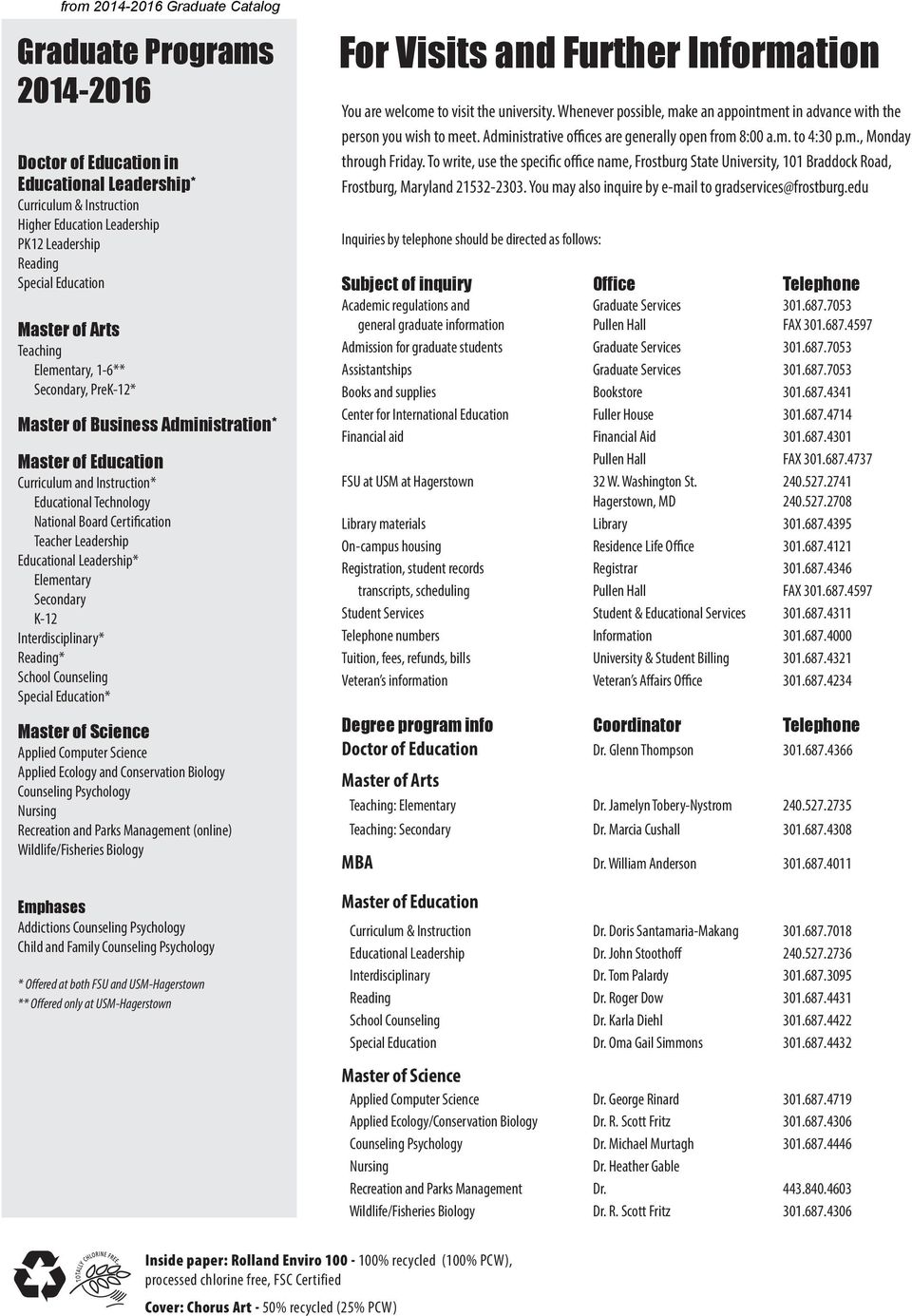
2 Graduate Programs Doctor of Education in Educational Leadership* Curriculum & Instruction Higher Education Leadership PK12 Leadership Reading Special Education Master of Arts Teaching Elementary, 1-6** Secondary, PreK-12* Master of Business Administration* Master of Education Curriculum and Instruction* Educational Technology National Board Certification Teacher Leadership Educational Leadership* Elementary Secondary K-12 Interdisciplinary* Reading* School Counseling Special Education* Master of Science Applied Computer Science Applied Ecology and Conservation Biology Counseling Psychology Nursing Recreation and Parks Management (online) Wildlife/Fisheries Biology Emphases Addictions Counseling Psychology Child and Family Counseling Psychology * Offered at both FSU and USM-Hagerstown ** Offered only at USM-Hagerstown For Visits and Further Information You are welcome to visit the university. Whenever possible, make an appointment in advance with the person you wish to meet. Administrative offices are generally open from 8:00 a.m. to 4:30 p.m., Monday through Friday. To write, use the specific office name, Frostburg State University, 101 Braddock Road, Frostburg, Maryland You may also inquire by to [email protected] Inquiries by telephone should be directed as follows: Subject of inquiry Office Telephone Academic regulations and Graduate Services general graduate information Pullen Hall FAX Admission for graduate students Graduate Services Assistantships Graduate Services Books and supplies Bookstore Center for International Education Fuller House Financial aid Financial Aid Pullen Hall FAX FSU at USM at Hagerstown 32 W. Washington St Hagerstown, MD Library materials Library On-campus housing Residence Life Office Registration, student records Registrar transcripts, scheduling Pullen Hall FAX Student Services Student & Educational Services Telephone numbers Information Tuition, fees, refunds, bills University & Student Billing Veteran s information Veteran s Affairs Office Degree program info Coordinator Telephone Doctor of Education Dr. Glenn Thompson Master of Arts Teaching: Elementary Dr. Jamelyn Tobery-Nystrom Teaching: Secondary Dr. Marcia Cushall MBA Dr. William Anderson Master of Education Curriculum & Instruction Dr. Doris Santamaria-Makang Educational Leadership Dr. John Stoothoff Interdisciplinary Dr. Tom Palardy Reading Dr. Roger Dow School Counseling Dr. Karla Diehl Special Education Dr. Oma Gail Simmons Master of Science Applied Computer Science Dr. George Rinard Applied Ecology/Conservation Biology Dr. R. Scott Fritz Counseling Psychology Dr. Michael Murtagh Nursing Dr. Heather Gable Recreation and Parks Management Dr Wildlife/Fisheries Biology Dr. R. Scott Fritz Inside paper: Rolland Enviro % recycled (100% PCW), processed chlorine free, FSC Certified Cover: Chorus Art - 50% recycled (25% PCW)
3 Graduate Catalog FROSTBURG STATE UNIVERSITY 101 BRADDOCK ROAD FROSTBURG, MARYLAND Published for the Division of Academic Affairs by the FSU Office of Publications Frostburg State University is a constituent institution of the University System of Maryland.

4 INTRODUCTION The provisions of this catalog are not to be regarded as an irrevocable contract between the University and the student. The University reserves the right to change any provisions of requirement at any time, but its practice is to not make changes in degree and admission requirements retroactive. Other regulations and procedures and course offerings may change during the period of your enrollment. Whenever possible, such changes will be published in official University publications such as the Undergraduate Catalog and Registration Guidelines, and on the University Web site, with prior notice of changes provided. However, if circumstances require, such changes may be made without notice. NOTE: Notwithstanding any other provision of this or any other University publication, the University reserves the right to make changes in tuition, fees and other charges at any time such changes are deemed necessary by the University and the University System of Maryland Board of Regents. FSU is committed to making all of its programs, services and activities accessible to persons with disabilities. To request accommodation through the ADA Compliance Office, call or use a Voice Relay Operator at Frostburg State University is an Affirmative Action/Equal Opportunity institution. Admission as well as all policies, programs and activities of the University are determined without regard to race, color, religion, sex, national origin, age or handicap. ii
5 Welcome to the Frostburg State University Graduate Program INTRODUCTION Congratulations on your decision to take this next step in your education. Since you have made this choice, I m sure you are already aware that as the workplace continues to adapt to a changing economy, advanced degrees are now seen more and more as a necessity in situations where a bachelor s degree once was all that was required. And while economic opportunity drives many to pursue an advanced degree, your academic program should and will mean much more. Whether your undergraduate education has just ended or is several years behind you, the program you are about to start will challenge you to deepen your understanding of your core discipline, act upon opportunities and further your personal and professional goals. Take advantage of this time to challenge yourself, to reach out to the excellent faculty who will be guiding you and to explore the possibilities that will open up with your master s or doctoral degree from Frostburg State University. Dr. Jonathan Gibralter President, Frostburg State University Use this catalog as your road map to our academic programs as you progress toward your degree. We are constantly working to keep the special needs of graduate students in mind and to adapt as those needs evolve. We recognize that employment and family commitments must often be considered when you make your plan to continue your education. Class times, program design, courses offered both in Frostburg and Hagerstown and growing online opportunities are just some of the ways we are accommodating the demands of both part-time and full-time graduate students. We are so glad you have chosen Frostburg State University to take you on this journey. Welcome to our academic community. Jonathan Gibralter, President iii

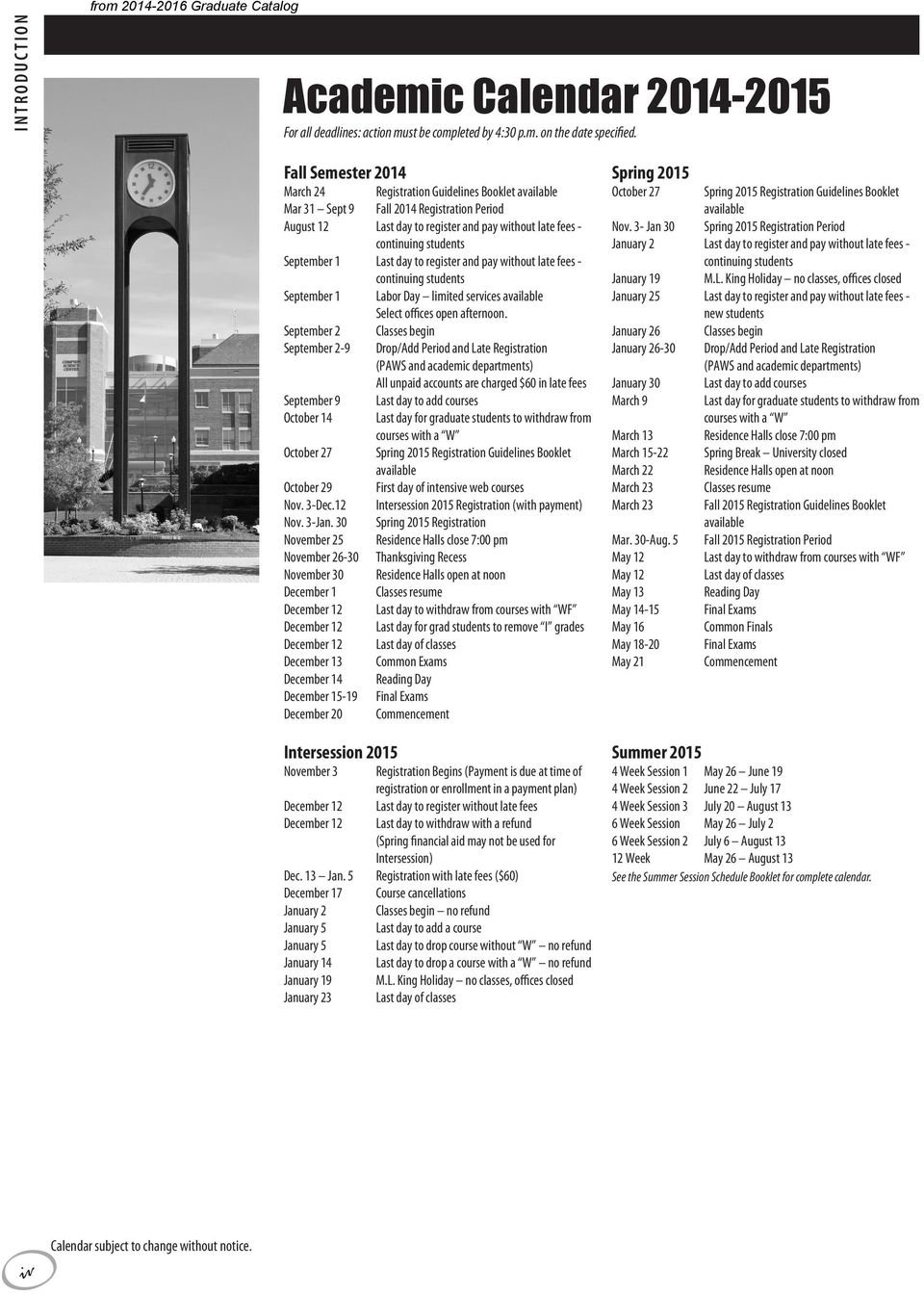
6 INTRODUCTION Academic Calendar For all deadlines: action must be completed by 4:30 p.m. on the date specified. Fall Semester 2014 March 24 Registration Guidelines Booklet available Mar 31 Sept 9 Fall 2014 Registration Period August 12 Last day to register and pay without late fees - continuing students September 1 Last day to register and pay without late fees - continuing students September 1 Labor Day limited services available Select offices open afternoon. September 2 Classes begin September 2-9 Drop/Add Period and Late Registration (PAWS and academic departments) All unpaid accounts are charged $60 in late fees September 9 Last day to add courses October 14 Last day for graduate students to withdraw from courses with a W October 27 Spring 2015 Registration Guidelines Booklet available October 29 First day of intensive web courses Nov. 3-Dec.12 Intersession 2015 Registration (with payment) Nov. 3-Jan. 30 Spring 2015 Registration November 25 Residence Halls close 7:00 pm November Thanksgiving Recess November 30 Residence Halls open at noon December 1 Classes resume December 12 Last day to withdraw from courses with WF December 12 Last day for grad students to remove I grades December 12 Last day of classes December 13 Common Exams December 14 Reading Day December Final Exams December 20 Commencement Intersession 2015 November 3 Registration Begins (Payment is due at time of registration or enrollment in a payment plan) December 12 Last day to register without late fees December 12 Last day to withdraw with a refund (Spring financial aid may not be used for Intersession) Dec. 13 Jan. 5 Registration with late fees ($60) December 17 Course cancellations January 2 Classes begin no refund January 5 Last day to add a course January 5 Last day to drop course without W no refund January 14 Last day to drop a course with a W no refund January 19 M.L. King Holiday no classes, offices closed January 23 Last day of classes Spring 2015 October 27 Spring 2015 Registration Guidelines Booklet available Nov. 3- Jan 30 Spring 2015 Registration Period January 2 Last day to register and pay without late fees - continuing students January 19 M.L. King Holiday no classes, offices closed January 25 Last day to register and pay without late fees - new students January 26 Classes begin January Drop/Add Period and Late Registration (PAWS and academic departments) January 30 Last day to add courses March 9 Last day for graduate students to withdraw from courses with a W March 13 Residence Halls close 7:00 pm March Spring Break University closed March 22 Residence Halls open at noon March 23 Classes resume March 23 Fall 2015 Registration Guidelines Booklet available Mar. 30-Aug. 5 Fall 2015 Registration Period May 12 Last day to withdraw from courses with WF May 12 Last day of classes May 13 Reading Day May Final Exams May 16 Common Finals May Final Exams May 21 Commencement Summer Week Session 1 May 26 June 19 4 Week Session 2 June 22 July 17 4 Week Session 3 July 20 August 13 6 Week Session May 26 July 2 6 Week Session 2 July 6 August Week May 26 August 13 See the Summer Session Schedule Booklet for complete calendar. iv Calendar subject to change without notice.
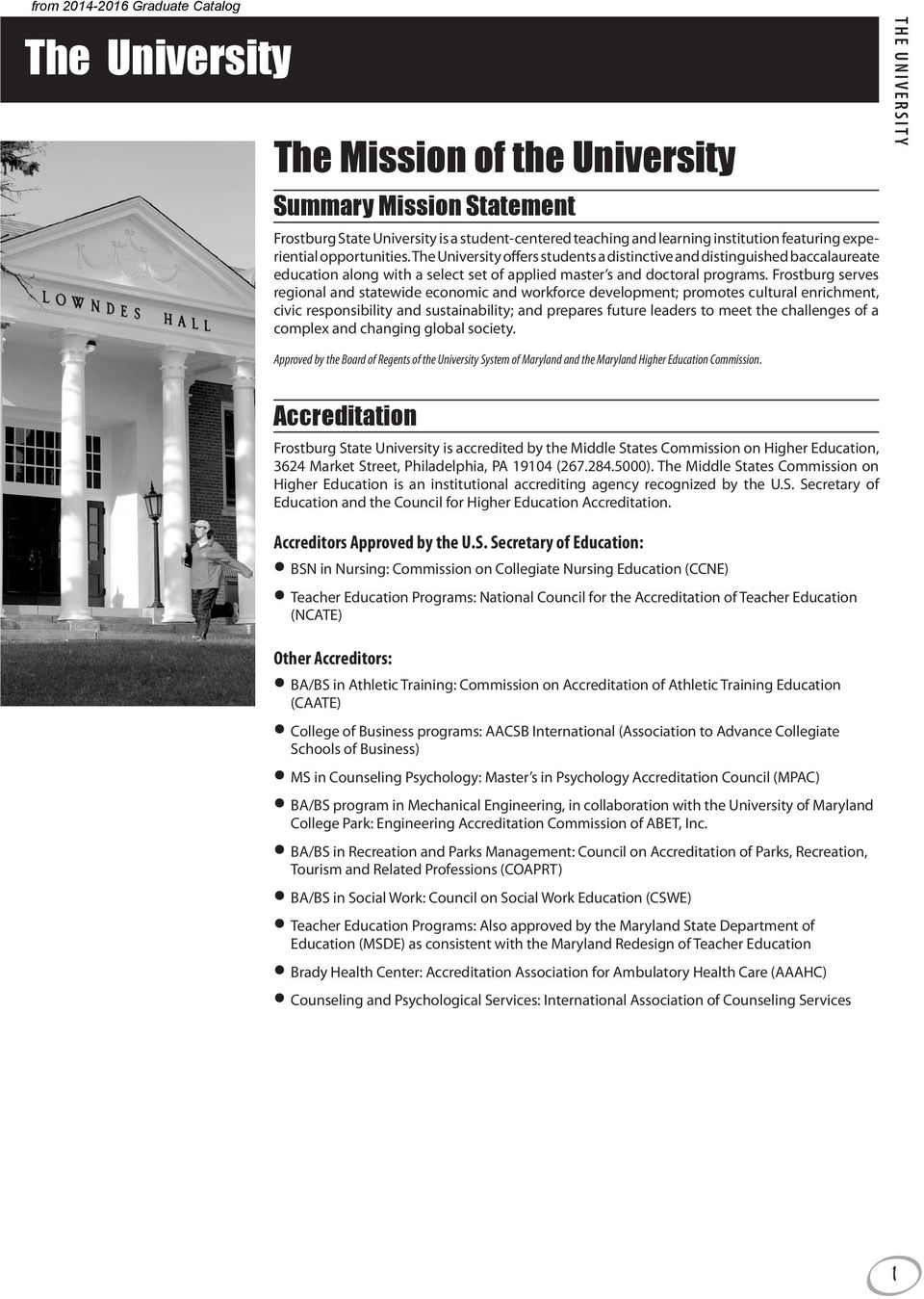
7 The University The Mission of the University Summary Mission Statement Frostburg State University is a student-centered teaching and learning institution featuring experiential opportunities. The University offers students a distinctive and distinguished baccalaureate education along with a select set of applied master s and doctoral programs. Frostburg serves regional and statewide economic and workforce development; promotes cultural enrichment, civic responsibility and sustainability; and prepares future leaders to meet the challenges of a complex and changing global society. Approved by the Board of Regents of the University System of Maryland and the Maryland Higher Education Commission. THE UNIVERSITY Accreditation Frostburg State University is accredited by the Middle States Commission on Higher Education, 3624 Market Street, Philadelphia, PA ( ). The Middle States Commission on Higher Education is an institutional accrediting agency recognized by the U.S. Secretary of Education and the Council for Higher Education Accreditation. Accreditors Approved by the U.S. Secretary of Education: BSN in Nursing: Commission on Collegiate Nursing Education (CCNE) Teacher Education Programs: National Council for the Accreditation of Teacher Education (NCATE) Other Accreditors: BA/BS in Athletic Training: Commission on Accreditation of Athletic Training Education (CAATE) College of Business programs: AACSB International (Association to Advance Collegiate Schools of Business) MS in Counseling Psychology: Master s in Psychology Accreditation Council (MPAC) BA/BS program in Mechanical Engineering, in collaboration with the University of Maryland College Park: Engineering Accreditation Commission of ABET, Inc. BA/BS in Recreation and Parks Management: Council on Accreditation of Parks, Recreation, Tourism and Related Professions (COAPRT) BA/BS in Social Work: Council on Social Work Education (CSWE) Teacher Education Programs: Also approved by the Maryland State Department of Education (MSDE) as consistent with the Maryland Redesign of Teacher Education Brady Health Center: Accreditation Association for Ambulatory Health Care (AAAHC) Counseling and Psychological Services: International Association of Counseling Services 1
8 THE UNIVERSITY The Campus and Its Surroundings Getting to FSU From Baltimore and east: take I-70 west to I-68 west at Hancock, MD. Continue to the second exit for Frostburg, Exit 33 (Midlothian/ Braddock Road). Bear right and proceed approximately one mile to the main entrance to the FSU campus. From Morgantown, WV, and west: take I-68 east to Exit 33 (Midlothian /Braddock Road). Turn left onto Braddock Road and proceed approximately one mile to the main entrance to the campus. To the USM at Hagerstown: take I-70 west from Baltimore and exit onto I-81 north. Take the Downtown Hagerstown exit and follow Route 40 east. Route 40 through Hagerstown is also named Washington Street. The University System of Maryland at Hagerstown is located at 32 W. Washington St. The Campus and Its Surroundings Frostburg State University is located in the Appalachian highlands (elevation 2,000 feet) of western Maryland. The main campus covers 260 acres within the town limits of Frostburg (population 7,500). The University also offers courses at the University System of Maryland at Hagerstown, and undergraduate programs at the Anne Arundel Community College Regional Higher Education Center at Arundel Mills, and on the Catonsville Campus of the Community College of Baltimore County. The local region is rich in both history and outdoor activities. Students can visit nearby recreational areas Rocky Gap, New Germany and Deep Creek Lake State Parks which offer camping, boating, swimming, hiking and skiing. Pittsburgh Washington, D.C. Philadelphia Baltimore New York Facilities The University buildings and grounds, set on 260 acres, make learning, living and working on our campus a special pleasure. Nature easily enters into the daily lives of students: buildings are set around grassy quads; varieties of plants and the surrounding woods change with the seasons. The University is also the Coordinating Institution for the University System of Maryland at Hagerstown. The Main Campus Our classroom buildings include Compton Science Center, Dunkle, Fine Arts, Framptom, Gunter, Lowndes, Old Main, Pullen and the Guild Human Resources Center. Students also attend classes in the Performing Arts Center and the Cordts Physical Education Center. A new Center for Communications and Information technology opens for fall semester In addition to specialized departmental labs in all departments, science facilities include a planetarium, greenhouse, live animal rooms, centrifuge, herbarium, arboretum, biotechnology center and electron microscope. The Appalachian Laboratory of the USM Center for Environmental Studies also provides research facilities for FSU students and faculty, as does the new research park. Finally, FSU is one of the few institutions that gives undergraduates the opportunity to conduct non-invasive research on animal behavior through providing a home to a cotton-top tamarin colony. Forty-eight percent of our students live on campus in 11 residence halls (Allen, Annapolis, Cambridge, Cumberland, Diehl, Frederick, Frost, Gray, Simpson, Sowers and Westminster), and Edgewood Commons, a privately owned apartment-style community. Student meals are served in the Chesapeake Dining Hall, the Appalachian Station in the Lane University Center, and at Sub Zero in Sowers Hall. Executive offices are located in the Hitchins Administration Building. Pullen and Sand Spring Halls house most student services offices. In Pullen, you will find Admissions and Financial Aid, the Registrar, University and Student Billing, Office of Graduate Services, Programs for Academic Support and Studies (P.A.S.S.), Disability Support Services and Student Support Services. Sand Spring Hall is the home to Counseling and Psychological Services, Career Services, the Career Resource Center, Veterans Affairs, Upward Bound and the Regional Math/Science Center. 2
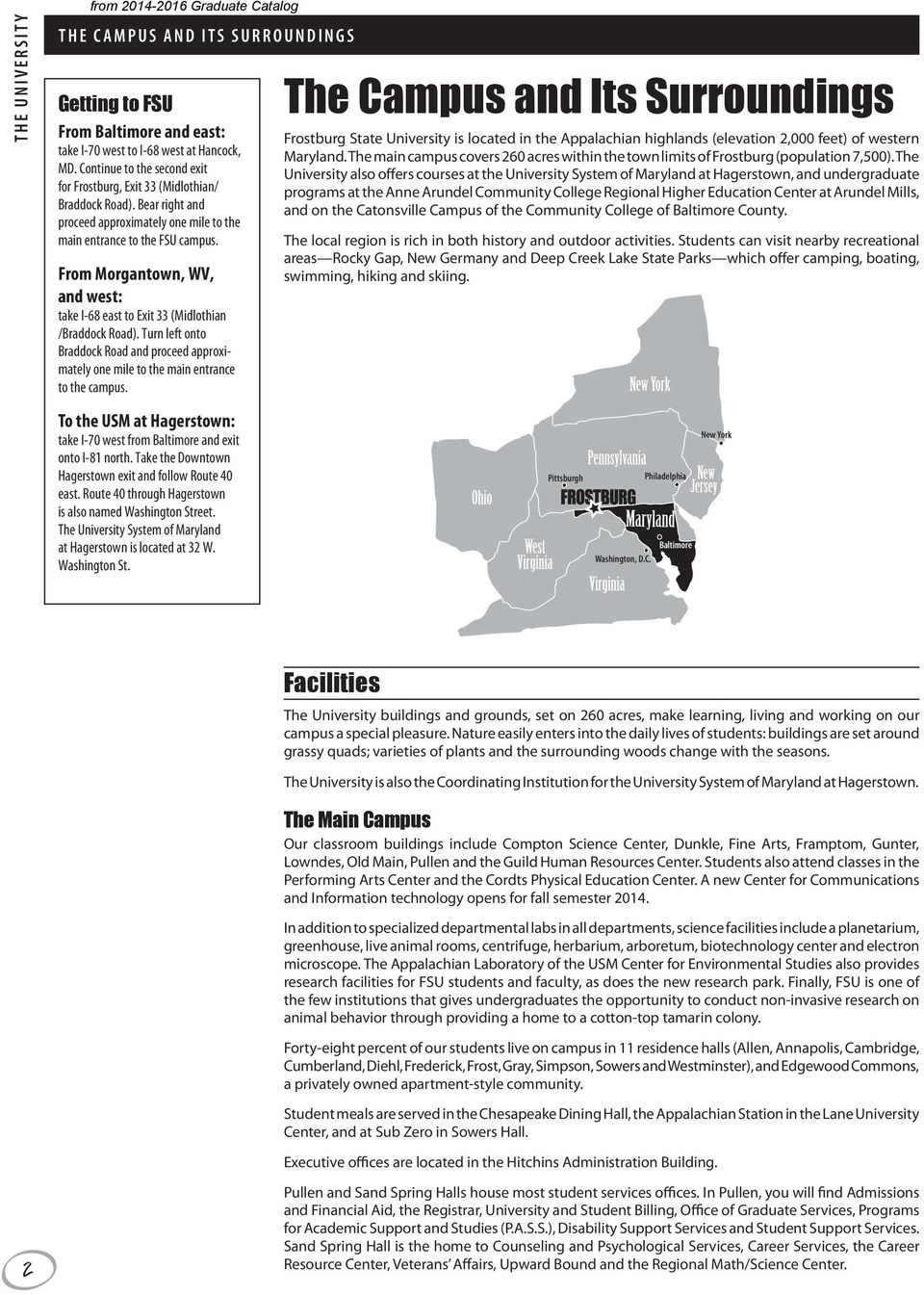
9 The Campus and Its Surroundings Specialized Facilities The Library THE UNIVERSITY The Lewis J. Ort Library provides a wealth of research and reference materials for student and community use. the library s discovery tool for thousands of books, articles, information databases OneSearch, and online resources available at of 16 libraries within the University System of Maryland and Affiliated Institutions Consortium (USMAI), which provides access to additional research materials interlibrary loan services to request research materials from other libraries beyond the ILLIAD USMAI libraries of electronic books (e-books) covering all academic subjects and accessible 24/7 Thousands using the Library s online catalog at or OneSearch. assistance onsite or online through Maryland AskUsNow chat reference or Ask a Reference Librarian at reference resources available online via Credo at and Gale 700 Virtual Reference Library at bit.ly/fsugale Circulating art prints, DVDs, CDs, VHS tapes and teacher materials Microfilm reader/printer/scanners available for historic newspaper and periodical collection depository for print and electronic U.S. and Maryland government documents and Selective maps collections and archives with emphasis on Western Maryland, including the public papers Special of two U.S. Senators from Maryland J. Glenn Beall and J. Glenn Beall, Jr. and group instruction in information literacy/fluency in the use of the library s Individual resources Internet work stations, 4 imacs, a 32-station electronic instruction center, public scanners and 100 wireless Internet access study rooms, five small group computer rooms and a smart multimedia room for Individual practicing group oral presentations Visit the Lewis J. Ort Library website at Performing Arts Center Students studying theatre and dance, music and communication studies can flourish in the Performing Arts Center. The center contains three state-of-the-art performing spaces: the 338-seat Drama Theater, the 175-seat F. Perry Smith Studio Theater and the 458-seat Pealer Recital Hall. It is complete with scenic and costume shops, a box office, practice rooms, faculty and staff offices, dressing rooms, two separate dedicated computer labs and other production facilities. Campus and community audiences are welcome at a wealth of concerts and performances. For more information, contact the director of the Performing Arts Center at Driving Times to Frostburg Baltimore Frederick Hagerstown Harrisburg Johnstown Morgantown New York Norfolk Philadelphia Pittsburgh Richmond Salisbury (Md.) Somerset (Pa.) Washington, D.C. 2 1/2 hrs. 1 1/2 hrs. 1 hr. 2 hrs. 1 hr. 1 hr. 6 1/2 hrs. 6 1/2 hrs. 4 1/2 hrs. 2 1/2 hrs. 4 hrs. 5 1/2 hrs. 3/4 hr. 2 1/2 hrs. FSU s new Compton Science Center houses the departments of biology, chemistry, physics and engineering. 3
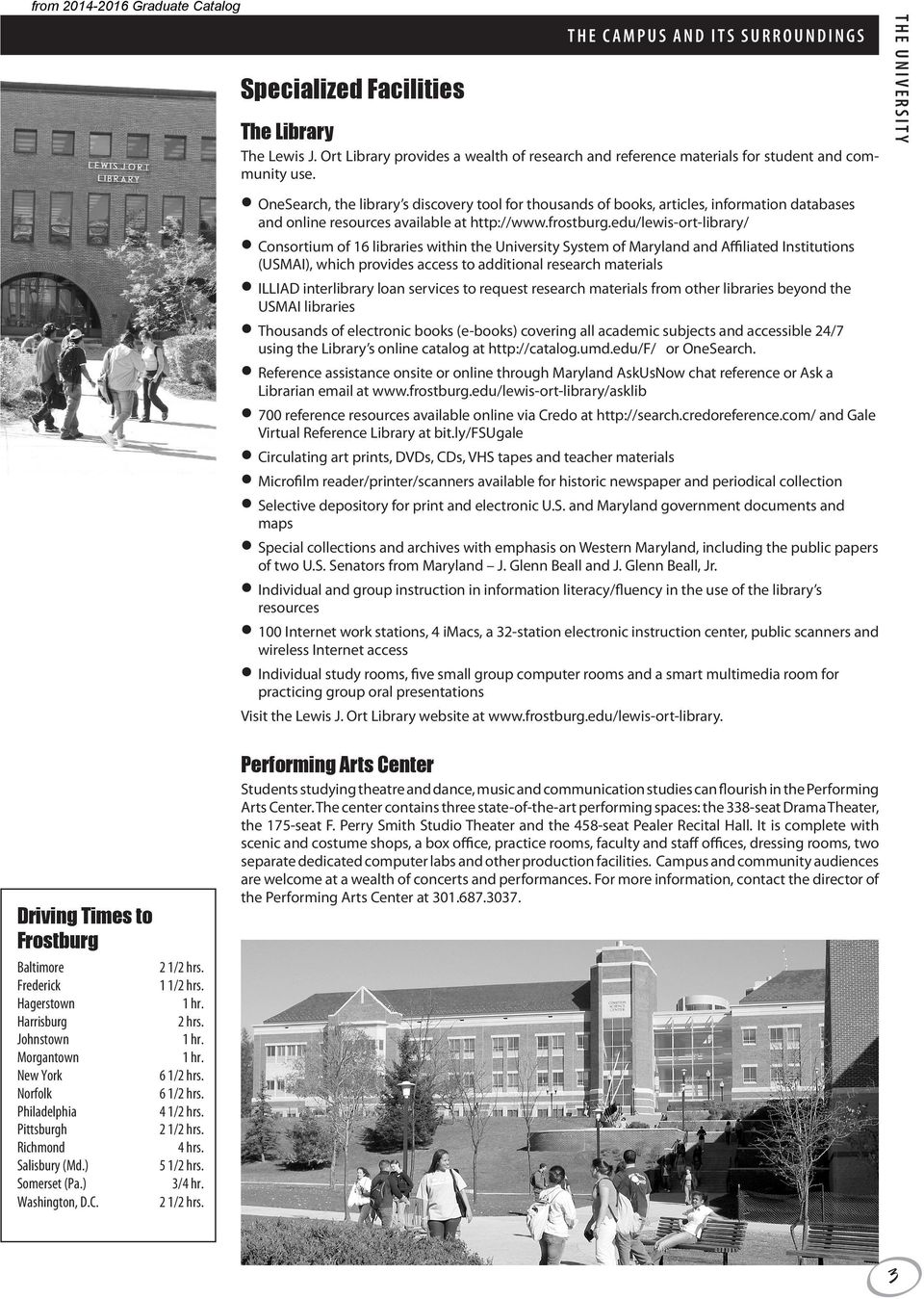
10 THE UNIVERSITY The Campus and Its Surroundings Lane University Center The newly renovated and expanded Lane University Center is the hub for student activities and was built and operates with student fees. It contains a fitness center, computer lab, a state-of-the-art smart lounge featuring Xbox 360 and Wii gaming stations, student organization offices, the new University Store, The Appalachian Station restaurant, The Loft and a Java City Coffee bar. Lane University Center programs and services are described in the Campus Life chapter. Performing Arts Center Harold J. Cordts Physical Education Center Students with valid University identification can use the extensive indoor and outdoor facilities of the Harold J. Cordts Physical Education Center: Three gymnasiums for basketball and other sports Swimming pool Weight rooms with Matrix and Life Fitness cardio-vascular equipment, Hammer Strength free weights and Tuff Stuff machines Racquetball courts Outdoor tennis courts and all-weather track For information on availability, contact the director at Department of Technology Services The Technology Services Department is dedicated to providing meaningful and successful experiences with technology to support teaching and learning. We provide resources, technical assistance, and advocacy for technology initiatives for faculty, staff, and students. Core components of the department include Help Desk, PC maintenance, Classroom and Lab Support, Computer Purchases, Software Licensing, Website Management, and Multi-media. Help Desk support provides assistance for any technical issue including Blackboard, PAWS, , Internet connectivity, etc. Interactive video instruction at FSU is conducted through the University System of Maryland s Interactive Video Network (IVN). This network provides an opportunity for interaction with other institutions within the state of Maryland and beyond. Computer Labs Students have access to a rich computing environment that includes specialized department labs housed in various campus buildings as well as the main University Computer Labs located in Pullen Hall. The University Computer Labs offer: Apple and Windows workstations connected to the campus network and the Internet. Scanning and printing facilities. Standard software including word processing, spreadsheets, databases, Internet browsers, graphics production, and other specialized software. Access to statistics packages, programming languages, and database programs through academic servers. Operational support for the 24 hour/7 days a week lab located in Dunkle Hall (access via student ID only). Department of Instructional Design & Delivery The principal mission of education at Frostburg is to enhance student access to the University s academic programs. The University is committed to providing students the support and resources needed to succeed as participants in campus-based and distance education. The Instructional Design & Delivery Department provides helpful resources for online and face-to-face courses. Edgewood Commons, FSU s apartmentstyle residence hall Frostburg State University s online courses and programs, taught by certified faculty, are open to all eligible students who are prepared to learn in an online environment. Online courses at FSU allow students to pursue their degree requirements outside the traditional classroom setting, which also provides an opportunity to acquire the technical skills and learning strategies important to the pursuit of students academic and career goals. Taking online courses can also accelerate their time to degree. Most of the course materials (other than textbooks) are available electronically with use of the web as the primary means of communication. Some courses may require limited on-site contact between students and the instructor (e.g., an orientation session or proctored testing) at various times throughout the academic term. 4
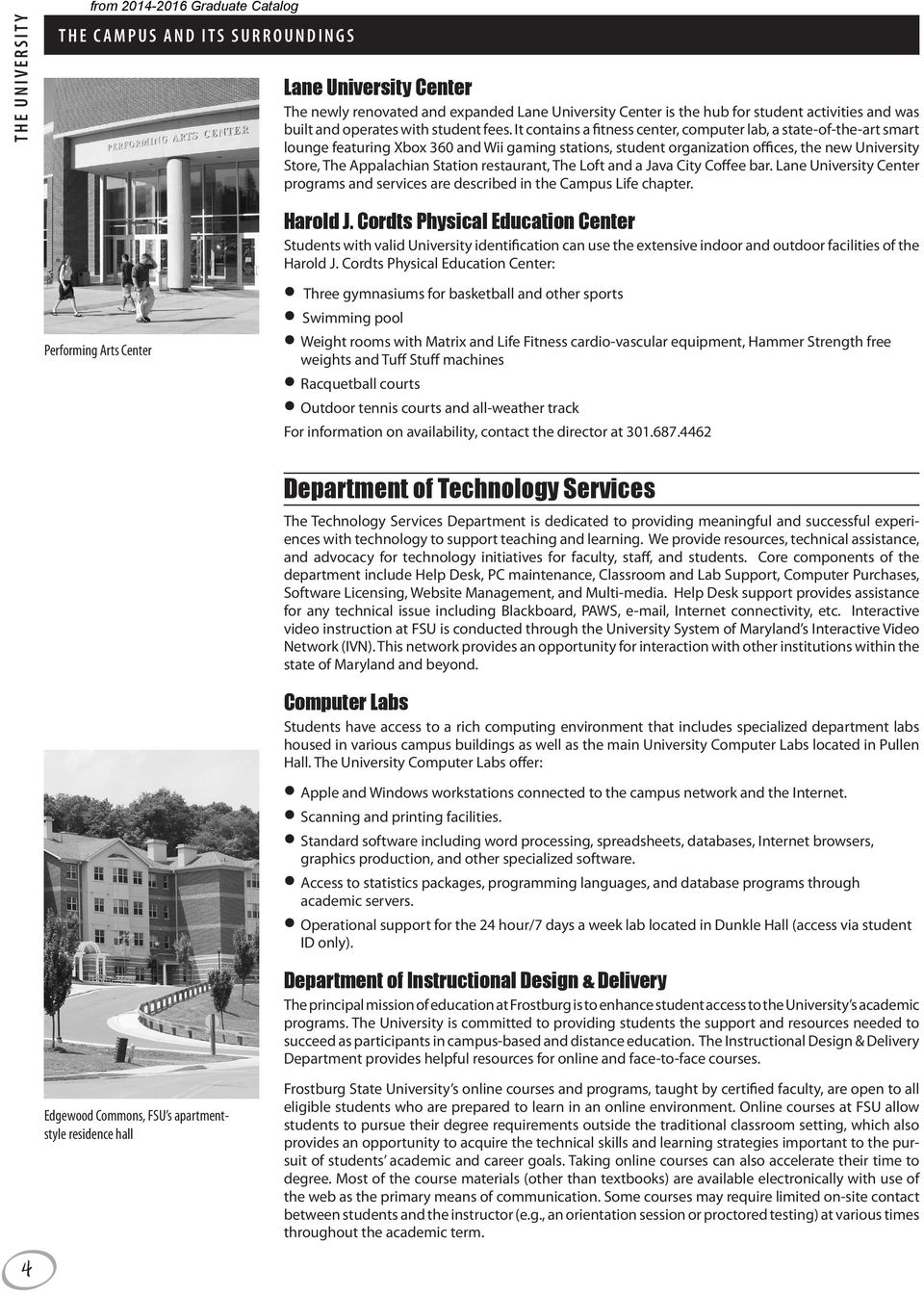
11 The Campus and Its Surroundings Both departments may be reached at The FSU Help Desk can be reached at Visit our website at The University System of Maryland at Hagerstown The University System of Maryland at Hagerstown (USMH) is a regional higher-education center located in downtown Hagerstown that offers upper-division-undergraduate and graduate academic programs of the universities within the University System of Maryland at a state-of-the-art facility. While Frostburg State University is the managing institution for USMH, five institutions offer degrees at USMH: Frostburg State University; Towson University; University of Maryland, College Park; University of Maryland University College and Salisbury University. USMH undergraduate and graduate programs are premier offerings of the USM educational institutions, chosen because they meet the needs of the Washington County business community and of prospective students from Hagerstown and Frederick Community Colleges and the wider tri-state region. THE UNIVERSITY USM institutions currently offer 13 undergraduate and 8 graduate degrees onsite. Baccalaureate programs include: business administration, early childhood education, sociology and liberal studies. Graduate programs include master s programs in business administration, and elementary and secondary education, and a Ed.D. in educational leadership. USMH offers access to on-site academic advising, computer labs and a full-service library to meet student needs. The University System of Maryland at Hagerstown USMH is open Monday through Thursday, 8:30 a.m. to 9:00 p.m.; Friday, 8:30 a.m. to 5:00 p.m.; and Saturday, 9:00 a.m. to 2:00 p.m.. For further information, contact the USMH Center at , or the FSU office at USMH at Other Instructional Sites and Online Programs The BA/BS in recreation and parks management, including the therapeutic recreation concentration, is offered at the Catonsville campus of the Community College of Baltimore County. The electrical engineering concentration in the BS in engineering may be completed at the Anne Arundel Community College Regional Higher Education Center at Arundel Mills. The MS in recreation and parks management is offered online, and the MBA and the MEd in Special Education offer online options. Graduate programs delivered online include: Master of Business Administration, Master of Science in Recreation and Parks Management, Master of Education in Special Education and Master of Science in Nursing. 5
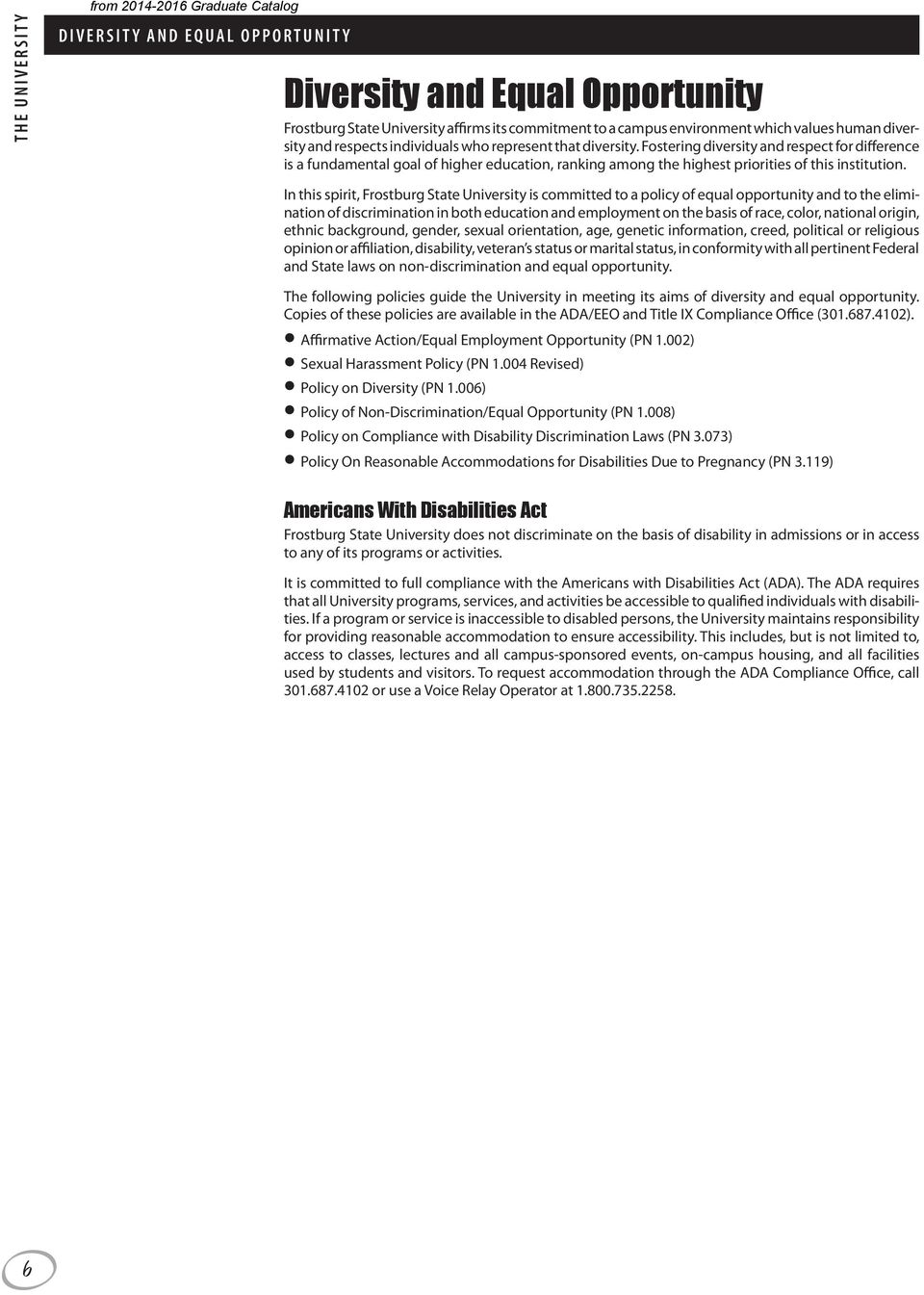
12 THE UNIVERSITY Diversity and Equal Opportunity Diversity and Equal Opportunity Frostburg State University affirms its commitment to a campus environment which values human diversity and respects individuals who represent that diversity. Fostering diversity and respect for difference is a fundamental goal of higher education, ranking among the highest priorities of this institution. In this spirit, Frostburg State University is committed to a policy of equal opportunity and to the elimination of discrimination in both education and employment on the basis of race, color, national origin, ethnic background, gender, sexual orientation, age, genetic information, creed, political or religious opinion or affiliation, disability, veteran s status or marital status, in conformity with all pertinent Federal and State laws on non-discrimination and equal opportunity. The following policies guide the University in meeting its aims of diversity and equal opportunity. Copies of these policies are available in the ADA/EEO and Title IX Compliance Office ( ). Affirmative Action/Equal Employment Opportunity (PN 1.002) Sexual Harassment Policy (PN Revised) Policy on Diversity (PN 1.006) Policy of Non-Discrimination/Equal Opportunity (PN 1.008) Policy on Compliance with Disability Discrimination Laws (PN 3.073) Policy On Reasonable Accommodations for Disabilities Due to Pregnancy (PN 3.119) Americans With Disabilities Act Frostburg State University does not discriminate on the basis of disability in admissions or in access to any of its programs or activities. It is committed to full compliance with the Americans with Disabilities Act (ADA). The ADA requires that all University programs, services, and activities be accessible to qualified individuals with disabilities. If a program or service is inaccessible to disabled persons, the University maintains responsibility for providing reasonable accommodation to ensure accessibility. This includes, but is not limited to, access to classes, lectures and all campus-sponsored events, on-campus housing, and all facilities used by students and visitors. To request accommodation through the ADA Compliance Office, call or use a Voice Relay Operator at
13 FSU s Teacher Education Report Card FSU s Teacher Education Report Card FSU s Teacher Education Report Card THE UNIVERSITY Contextual Information Total number of students admitted into teacher preparation, all specializations 496 Number of students in supervised student teaching 162 Average number of clock hours required prior to student teaching 40 Average number of clock hours required for student teaching 700 Number of full-time equivalent faculty in supervised clinical experience during this academic year 16 Number of full-time equivalent adjunct faculty in supervised clinical experience during this academic year (IHE & PreK-12 staff) 19 Number of students in supervised clinical experience during this academic year 212 *Student teaching varies by program with most being 20 weeks in the school. Aggregate and Summary Institutional-level Pass-rate Data: Regular Teacher Preparation Program Academic Year: Number of Program Completers: Type of Assessment 2 Number Taking Number Passing Institutional Statewide Assessment 3 Assessment 4 Pass Rate Pass Rate Summary Totals and Pass Rates % 98% 1 The number of program completers found, matched and used in the passing rate calculation will not equal the sum of the column labeled Number Taking Assessment since a completer can take more than one assessment. 2 Institutions and/or states did not require the assessments within an aggregate where data cells are blank. 3 Number of completers who took one or more tests in a category and within their area of specialization. 4 Number who passed all tests they took in a category and within their area of specialization. 5 Summary Totals and Pass Rate: Number of completers who successfully completed one or more tests across all categories used by the state for licensure and the total pass rate. See College of Education Web site for detailed report: **Math, English, Biology, etc. 7
14 THE UNIVERSITY University History University History 1898 The Maryland General Assembly authorized State Normal School No. 2 and a $20,000 appropriation for a building. The governor selected Frostburg as a site because the residents offered the best suitable location without cost to the State Townspeople raised the money to buy Beall s Park a 2-acre site for the State Normal School Old Main the first campus building was completed Fifty-seven students attended the first classes of the State Normal School at Frostburg. We offered a 2-year program of elementary school teacher training Our first commencement. Students received a diploma and a life-time teaching certificate The Model School began operating in its new building. This was our first campus training school that allowed student teachers to work directly with children in the classroom We opened our first residence hall A six-room training school for student teachers replaced the 1913 Model School Our teacher training program expanded from 2 to 3 years, and then from 3 to 4 years in The institution s name changed to State Teachers College at Frostburg. The first four-year degree students graduated with Bachelor of Science in Elementary Education Lillian Compton became the first woman president of our institution The college first offered a liberal arts junior college program. This degree was discontinued in 1960 when 4-year programs replaced it We completed our first science building. It was followed by the Garrett Science Building in 1952, the Tawes Science Hall and Planetarium in 1968 and the Compton Science Center in The State Legislature funded a 40-acre expansion to our campus and five new buildings The new teacher-training laboratory school was completed and named after State Superintendent of Schools Thomas G. Pullen. It continued operating as an elementary school until The Board of Trustees granted Frostburg State Teachers College the right to confer the Bachelor of Arts degree and the Master of Education In July, we became Frostburg State College The Master of Science in Management Degree was first offered. This degree was replaced by the MBA in The Appalachian Environmental Laboratory part of the Center for Environmental Science of the University System of Maryland opened on our campus The Nelson P. Guild Center was completed to house the Social Sciences and Business programs In July, our institution was granted University status We joined the University System of Maryland, which is comprised of 11 degree-granting institutions, one research institution and two regional higher education centers. The Center in Hagerstown opened The first FSU Medallion was presented to Lewis J. Ort. Other recipients were Governor William Donald Schaefer in 1990 and Gerald Arpino in Dr. Catherine Gira became the second woman president of our institution The Performing Arts Center was completed. On April 24, the Joffrey Ballet performed in the new Center in celebration of the ballet company s debut on our campus 37 years before Bell Atlantic distance education classrooms were installed at Frostburg and the Hagerstown Center The University celebrated its Centennial with a year-long series of events The Center for Environmental Science s new Appalachian Laboratory building opened FSU was the first-ever recipient of the Corporation for National Service s Higher Education Award for Leadership in National Service Gunter Hall was renovated and reopened Compton Science Center and Edgewood Commons apartment complex opened FSU began offering programs at the new University System of Maryland at Hagerstown Dr. Jonathan Gibralter became the 14th president of Frostburg State University The first building, the FSU Research Center, opened in ABC@FSU President Gibralter was given the first-ever Presidential Leadership Award for promoting a campus climate that de-emphasizes alcohol Ground broken on FSU s Sustainable Energy Research Facility (SERF) FSU began offering its first Ed.D. program, the Doctor of Education in Educational Leadership. Ground broken on Center for Communications and Information Technology (CCIT) Master of Science in Nursing program approved 8
15 Graduate Study at FSU Graduate study allows you to advance your education under the direction of discipline specialists. You should carefully select a field of study that provides you with the opportunity to acquire the understandings, skills, and values needed for advancement in your chosen field and for continuing self-education. Graduate programs are designed to extend your academic, professional and personal competence; to familiarize you with the research in your field of study; and to enable you to apply relevant research to contemporary issues in your specialty. The doctoral and master s degrees confer upon recipients recognition as leaders within the fields of study. Therefore, as a graduate student, you are expected to reflect not only superior academic achievement, but also the commitment, values and leadership skills necessary for you to assume a leadership role in your specialty area. Graduate Mission Statement Frostburg State University Graduate Studies encourages lifelong learning, development of intellectual curiosity, the capacity for scholarship and applied research and mastery of subject matter in advanced professional programs. The University is committed to excellence in preparing students to engage in the challenges of a technologically complex and pluralistic society. The programs enhance and enrich the academic environment of the University while seeking to meet the needs of the region and the larger global community. Graduate Program Governance/ Administration The Graduate Council, a committee of the Faculty Senate, functions as the major policies and procedures body for graduate programs. The full range of the council s responsibilities can be found in its charter. School deans are responsible for overseeing the administration of the graduate programs under their jurisdiction. Each graduate program coordinator is responsible for administering his or her graduate program. Students Rights and Responsibilities and Standards of Personal and Group Conduct As a student, you enjoy the basic rights of any citizen of our society as you pursue your graduate education, but there is often confusion between the rights of students as citizens and the assumed rights of students as students. Established at the University are clear behavioral guidelines along with the consequences for acts outside these guidelines. A publication, The Pathfinder, available on FSU s Web site, includes enumeration of students rights and responsibilities, identifies the University s standards of personal and group conduct and explains the University Judicial System. Admission Requirements Admission to graduate studies is based on the academic qualifications of the applicant and is granted without regard to race, color, religion, sex or disability. Regardless of the purpose for which you plan to take graduate courses, you must file an application for admission to graduate studies. A formal letter indicating your admission status is issued when your application is completed. File your application with the Office of Graduate Services early during the semester immediately preceding actual enrollment in graduate classes. Please note that some programs have application deadlines. You may submit the application for admission online at or download and mail the pdf version of the application to FSU, Office of Graduate Services, 101 Braddock Rd., Frostburg, MD It should be understood, however, that if you seek a degree and have not been fully admitted, or have not developed an approved study plan (in programs where study plans are required), you have no guarantee that the courses taken prior to admission will be accepted into the Master s program. You must complete the admission process in its entirety prior to completing the first semester of courses or you will not be permitted to register for additional courses. Your admission is valid for the entire time of graduate study provided you register for at least one course during an 18-month period. Should 18 months elapse since you registered for a course, you must submit a request to the Office of Graduate Services to be readmitted before you may register again. Applicants for graduate study are assigned to one of the following categories: degree program admission, provisional status or non-degree status. Degree Program Admission You may be granted degree program admission if you have a strong undergraduate academic record and appear to have potential for successful completion of a graduate program. GRADUATE STUDY AT FSU 9
16 G R A D U AT E S T U D Y AT F S U Graduate Study at FSU G r a d u at e S t u d y at F S U Degree program admission is based on the following criteria: 1. Each graduate program has specific admission requirements, which are detailed in the sections of this catalog devoted to these programs. 2. Completion of an application for admission to graduate study as a degree program student. 3. Submission of official transcripts of all previous graduate work and a transcript certifying the completion of a baccalaureate degree. This official transcript must be sent directly to the Office of Graduate Services from the degree-granting institution. 4. If you have previously completed a graduate degree, but have not taken the GMAT (Graduate Management Admissions Test), GRE (Graduate Record Examination) or MAT (Miller Analogies Test), you may be eligible to have this requirement waived. These tests may be waived if you have successfully completed a graduate degree with a 3.0 cumulative grade point average. The graduate program coordinator of the program to which you are applying will determine the relevance of previous graduate degrees in making the decision to waive the GMAT, GRE or MAT requirements. Provisional Status Provisional status allows you to enroll in graduate courses to qualify for admission to a degree program. You may be granted provisional status if denied unconditional admission due to (1) less than the minimum grade point average required for admission to the program to which you are applying, (2) baccalaureate degree not from a regionally accredited college or university or (3) undergraduate course deficiencies. Provisional admission decisions are made by the program coordinator on a case-by-case basis. This category usually includes students who wish to take courses for professional development, for transfer to another institution or for maintaining certification in the field of education. Non-degree status is based on the following requirements: If you are assigned provisional status, you must construct a special study plan of 9 to 15 credits approved by your advisor. After completing the 9-15 credits, you must apply to the graduate program coordinator for a change of status. You must achieve a minimum cumulative grade point average of 3.0 to apply for a change of status to degree program admission. 1. Completion of the baccalaureate degree at a regionally accredited institution of higher education. Non-Degree Status You may be assigned non-degree status if you wish to apply for graduate study but do not wish to work toward a graduate degree. 2. Submission of an official transcript certifying the completion of a baccalaureate degree. This official transcript must be sent directly to the Office of Graduate Services from the degree-granting institution. Enrollment of Undergraduates in Graduate Courses Frostburg State University undergraduates may take no more than 7 credits in graduate courses for graduate credit prior to completion of the bachelor s degree requirements. To enroll in a graduate course, you must be a senior with at least a 2.5 grade point average and must have the recommendation of your advisor. If you are a full-time undergraduate student taking a graduate course during the academic year, you will not be required to pay tuition for the graduate course since you will pay tuition and fees as a full-time undergraduate. 10 Credit earned in a graduate course may be considered only as graduate credit and may not be used as undergraduate credit for the baccalaureate degree. The credit, although technically graduate credit, may not be used for a graduate degree at Frostburg State University unless it later becomes part of your graduate requirements.
17 G r a d u at e S t u d y at F S U Exceptions to these policies are made only for students who are admitted to a combined baccalaureate-master s program at Frostburg State University. See the degree program listings for descriptions of current programs and selection criteria. An exception will be granted to undergraduate students accepted into the undergraduate Generic Special Education Secondary/ Adult Certificate who are required to undertake 9 credits hours (SPED 601, SPED 602 and SPED 605). G R A D U AT E S T U D Y AT F S U Senior Citizen Golden Identification Card Senior citizens may qualify for admission and a Golden Identification Card. Participants in the Golden Identification Card program may register for up to three courses each semester for credit on a space-available basis without paying tuition. They may enroll only at late registration. Although the late registration fee is waived for senior citizens, they must pay all other fees. To qualify for the Golden Identification Card, the prospective student must meet the following criteria: Be a resident of Maryland a U.S. citizen or produce a BeResident Alien card (formerly an Alien Registration card) age by the beginning of Bethe60termyearsforofwhich you are applying be employed more than 25 hours a Not week Individuals who qualify for the Golden Identification Card may obtain applications from the Office of Admissions. For further information about these qualifications, call

18 GRADUATE STUDY AT FSU International Student Admission International Student Admission If you are a foreign national and have been awarded the baccalaureate degree (or its equivalent) from any institution other than a U.S. regionally accredited institution of higher education, you must do the following before you can be considered for admission to graduate study: 1. Submit a completed Application for Graduate Study to the Office of Graduate Services, Frostburg State University, Frostburg, MD , U.S.A. 2. If your native language is not English, you are required to demonstrate English language proficiency. Students can validate their proficiency by earning an acceptable score on the TOEFL, IELTS or other approved examinations. The University requires a minimum TOEFL score of 79ibit or a minimum IELTS score of 6.0. Comparable scores on the TOEFL paper or computer-based test will be accepted as well. In addition, students can also present English language certification through TLC, LADO, itep, Inlingua or ELS. All international students will be required to demonstrate English language proficiency with the possible exceptions: (a) Non-native speakers of English who have graduated from secondary institutions or who transfer from post-secondary institutions in English-speaking countries, provided they have spent a minimum of 2 years in successful full-time study and the language of instruction was English. (b) Students from approved countries where English is the first language or the language of instruction in the educational system. 3. Submit official copies of transcripts showing all university and college work. These transcripts must show the subjects taken, grades for the subject and degrees awarded. Official copies must bear the seal of the issuing institution and the actual signature of the college or university registrar. 4. Have a transcript evaluation for institutions other than American institutions translated and evaluated by an approved evaluation service. The professional evaluation should be a course-by-course evaluation that will determine your academic level within the American system of education. The final report should be forwarded to the Office of Graduate Services. No action will be taken on your application for admission until the evaluation has been received. 5. Complete the International Student Certification of Financial Support form and submit it to the Office of Graduate Services. This form attests that your sponsor is aware of the educational and living expenses and is prepared to provide the necessary funds. Students must work with the Office of University and Student Billing to meet all financial obligations at the time of registration. 6. Complete the Health Insurance Acknowledgment Form and submit it to the Office of Graduate Services. You are required to maintain adequate health insurance to continue as an active FSU graduate student and as a valid F-1 visa holder. 7. Fulfill program admission requirements. International Student Application Deadlines The application and other required documents must be received by the Office of Graduate Services according to the following schedule: Semester Planning Deadline for Submitting to Enter FSU Complete Application* Fall Semester June 1 Spring Semester Oct. 15 Summer School Jan. 15 *Refer to application guidelines listed in specific degree programs. We will not grant you an I-20 until we have received all your required information. If you are an international student residing outside the United States, you should not come to Frostburg State University before receiving a formal letter of admission and an I-20. For complete instructions, contact the Office of Graduate Services, Frostburg State University, Frostburg, MD , U.S.A. International Students at FSU Each semester Frostburg State University hosts a number of international students from all over the world. In addition to providing services in dealing with the U.S. Citizenship and Immigrations Service (UCIS), academic counseling and organizing a number of social events and excursions, the Center for International Education also oversees the awarding of a number of scholarships to international students attending Frostburg State University. Awards are available both to incoming and returning international students in F or J status. For further information, call the Center for International Education at or visit the CIE on the Internet at: edu/admin/cie/cie.htm. 12

19 Expenses, Financial Aid & Scholarships Expenses This information applies to the academic year only. Please see appropriate Registration Guidelines for rates. Notwithstanding any other provision of this or any other University publication, the University reserves the right to make changes in tuition, fees and other charges at any time such changes are deemed necessary by the University and the University System of Maryland Board of Regents. Tuition Tuition, full-time, evening or summer, for master s students is $357 per credit hour for Maryland residents, and $459 per credit hour for non-residents. Tuition for doctoral students is $491 per credit hour for Maryland residents and $615 per credit hour for non residents. Students taking courses for pass/fail or courses without credit designation will receive assigned equivalency credit hours for tuition and fee purposes. Fees Graduate Tuition & Fees * The following paragraphs explain how the University uses the fees that students pay. Tuition (per credit hour) Master s Program Maryland Residents** $357 Master s Program Out-of-State Residents $459 Doctoral Program Maryland Residents** $491 Doctoral Program Out-of-State Residents $615 Semester Fees (per credit hour) Athletic Fee+ $43 Auxiliary Facilities Fee+ $24 Student Union Operating Fee+ $18 Activities Fee (optional) $25 Technology Fee $13 Transportation Fee+ $2 Other fees & expenses See detailed explanation at right. Application Fee, one time only, waived for FSU graduates $30 Career Services Credentials $20 3-Pay Payment Plan $60 per semester Duplicate Copy $3 Late Registration Fee $30 Late Payment Fee $30 Lost ID Card $20 Private Music Fee $150 per credit Returned Check Fee $30 Vehicle Registration day $40 per year evening only $10 per year Student Teaching Internship $350 EDAD 644 Public School Finance $65 MSN Courses $6 per credit hour During the summer, you will be required to pay a University fee for the administration of summer school. * See Graduate Schedule Booklet for rates. **See Policy for Student Residency Classification, policies chapter of this catalog. +You are not required to pay these if you are enrolled at an off-campus site or online. Note: Notwithstanding any other provision of this or any other University publication, the University reserves the right to make changes in tuition, fees and other charges at any time such changes are deemed necessary by the University and the University System of Maryland Board of Regents. For information on other fees and expenses related to summer and undergraduate programs, refer to the respective catalogs and bulletins. Activities Fee: An optional activities fee of $25 per semester is collected to support student publications, the campus radio station, social activities, student government and a balanced program of cultural events. To be billed for the activities fee, write to the University and Student Billing Office to indicate the number of credits for which you are registered. Application Fee: Applicants pay a $30 non-refundable application fee when they apply to the University. This one-time only fee is sent directly to University and Student Billing at the same time the application is mailed to the Office of Graduate Services. This fee is waived for FSU graduates. Main Campus Fees Note: You are not required to pay the following fees if you are enrolled at an offcampus site. Athletic Fee: A non-refundable athletic fee of $43 per credit hour for graduate students is used to support the University s program in intercollegiate and intramural athletics. Auxiliary Facilities Fee: An auxiliary facilities fee of $24 per credit hour for graduate students is assessed for construction expenses of the auxiliary facilities. Student Union Operating Fee: Graduate students are charged a student union operating fee of $18 per credit hour for operating expenses of the Lane University Center. Transportation Fee: $2 per credit hour is charged for graduate students, allowing students to ride Allegany Transit Authority buses by showing a student ID. Other Fees and Expenses Technology Fee: Graduate students are charged $13 per credit hour to fund technology initiatives for student enhancement. Late Payment Fee: A late payment fee of $30 is charged for payments received after the established payment deadline. Late Registration Fee: A late registration fee of $30 is charged for not registering as prescribed. EXPENSES, FINANCIAL AID & SCHOLARSHIPS 13

20 EXPENSES, FINANCIAL AID & SCHOLARSHIPS Expenses Private Music Fee: Music students desiring private study of organ, piano, other instruments or voice are charged $150 per credit hour. Duplicate Copies: A $3 fee is charged for each duplicate statement of fees (or other receipt) requested. A $20 fee is charged for each duplicate ID card. Returned Payment Fee: A $30 fee is charged whenever a check given in payment of any obligation is returned by the bank. Article 27, Section 142 of the Annotated Code of Maryland states that anyone who obtains money, etc., by bad check is subject to prosecution. All checks returned to the University by the bank as unpaid (this includes checks on which payment has been stopped and electronic transactions) must be paid within 7 days of the University s notification to the student. Motor Vehicle Registration: A $40 motor vehicle registration fee is charged for students registering a vehicle. Students who register for evening classes only may purchase a permit at the reduced price of $10. Evening permits are not valid from 6 a.m. to 4 p.m., Monday through Friday. Permits are issued for the academic year. Room and Board Graduate students may choose to live in University residence halls. Rooms are assigned on a space-available basis. Room contracts are binding for 1 academic year (fall and spring semesters). All students living in the residence halls are required to purchase a meal plan for the University dining hall. Residence Hall Damage Deposit You will be charged a $100 damage deposit before you move on campus your first semester. Money will be deducted from this deposit for the following: (1) Damages to your room and room furnishings. (2) Damages to common areas within your residence hall if these damages are unreported and/or unclaimed. These damages will be charged collectively to the residents. The balance of this damage deposit remains in your account until the end of the spring semester or until you leave the halls. It will be refunded annually through the State Comptroller s Office. If the remainder of the deposit is not sufficient to cover damage costs, you will receive a miscellaneous bill for the outstanding amount. Payment of Fees Make all checks or money orders payable to Frostburg State University for the exact amount on the bill you receive. All fees must be paid prior to the beginning of each semester or before the date shown on the statement of fees. Students will not be admitted to classes until all bills have been paid or they have made approved arrangements with the University & Student Billing Office and they may not register for the next semester. Failure to meet the due date may result in the cancellation of the student s schedule. FSU accepts online payments via PAWS or Two forms of payment are accepted: ACH (electronic check) and credit card (MasterCard, American Express and Discover). Additionally, FSU has a voice payment system. To pay by ACH, call , or credit card, call Be aware that all credit card transactions (online or phone system) charge a convenience fee for usage. Payment Plans Frostburg State University has partnered with SallieMae to offer several payment plans through TuitionPay. All the plans are interest-free, debt-free ways to spread tuition payments over a number of months. To enroll in one of our payment plans, visit or call Three plans are available. 10-month plan: Enrollment in the 10-month plan commences July 1 and continues through April 1. With this plan, the cost of attendance for fall and spring are added together less financial aid and divided by 10. The nonrefundable enrollment fee for this plan is $75 per year. 5-month plan: Enrollment in the 5-month plan is geared for students who are enrolled for one semester only. The cost of attendance for one semester less financial aid is divided by 5. The fall plan begins July 1 and continues through Nov. 1. The spring plan begins Dec. 1 and continues through April 1. The non-refundable enrollment fee for this plan is $75 per semester. 3-pay plan: Enrollment in the 3-pay plan is for one semester. The cost of attendance less financial aid is divided by 3. The first payment is due upon enrollment in the payment plan; however, enrollment in the plan must be completed by the semester due date to avoid late fees. The second payment is due 30 days after the first day of classes and the final payment 30 days later. The non-refundable enrollment fee for this plan is $60 per semester. You may request information about this directly from University and Student Billing, , or toll free: Charges for Collection of Unpaid Bills If a student s account is not promptly paid, the University will turn it over to the Maryland State Central Collection Unit and a 17 percent collection fee will be added to the bill. If further collection action is needed, an outside agency will be retained and those charges will also be billed to the student. The state may also withhold any refund due to the student from the Maryland State Income Tax and apply it to the overdue account. Identification Card You should obtain an FSU identification card, which is required for access to certain facilities and equipment and will admit you to University-sponsored activities and events. You must have an ID card to check books out of the University library. ID cards are processed and obtained in the ID Office located in the north lobby of Chesapeake Dining Hall (enter the door nearest Frederick Hall). The hours are 9 a.m.-1 p.m. and 2-4 p.m. daily. 14
21 Refund Schedules Fall and Spring Semesters Before the end of each registration period Before the 15th calendar day after the official start of classes for that session From the 15th day until the end of third week after the official start of classes During the 4th week after the official start of classes During the 5th week after the official start of classes At the end of the 5th week after the official start of classes Fee Refund Schedule (including summer session) 100% tuition refunded 80% tuition refunded 60% tuition refunded 40% tuition refunded 20% tuition refunded 0% tuition refunded Application fee 0% refund Board fee - Up to mid-semester prorated on a weekly basis plus 1 week - After mid-semester 0% refund Summer Sessions Before the end of the summer registration period 100% tuition refunded Before the end of 1/5 of the length of the session, but in no case beyond the 7th calendar day of the session 80% tuition refunded Before the end of 2/5 of the length of the session 40% tuition refunded At the end of 2/5 of the length of the session, but in all cases beginning with at least the 15th calendar day of the session 0% tuition refunded *In the case of special courses of short duration (i.e., 1 week or less), this policy will be applied on a pro rata basis in a manner consistent with the policy. Non-refundable Fees The following fees are non-refundable after the end of each registration period, including the summer session and Intersession: Room Rent Fee Private Music Fee Transportation Fee Activities Fee Student Union Operating Fee University Fee Athletic Fee Student Teaching Fee Vehicle Registration Fee Auxiliary Facilities Fee Course Fees Class Fees Internship Fee Recreation and Parks Orientation Fee Technology Fee Refund Policy Financial Aid The following regulations govern refunds available upon withdrawal from the University or when other changes of status take place. To withdraw from the University, you must complete an official withdrawal card and file it in the Office of Registration and Records before you are entitled to any refund. Because refund amounts change depending upon when you file, the date used to determine refunds will be the date on which you submit the final filing or change of status to the Office of Registration and Records. For Intersession, refunds of tuition are provided up to and including the last day of registration. Students dismissed for disciplinary reasons are not entitled to any tuition or fee refund. Student Refund Policy For Title IV Recipients See page 16 of this catalog for information regarding the Student Refund Policy for Title IV recipients. EXPENSES, FINANCIAL AID & SCHOLARSHIPS Financial Aid The University s financial aid office helps students who have limited financial resources. Every effort is made to aid qualified students in need of financial assistance through loans, scholarships and part-time employment. The Financial Aid Office operates with an open-door policy and provides financial aid information to assist students with the application process. Office of Financial Aid 114 Pullen Hall: Fax Application Process All students applying for financial aid through the University must complete the Free Application for Federal Student Aid (FAFSA). The application is available on the Internet at By submitting this form, graduate students will be considered for federal, state and institutional aid. Student Loans Federal Direct loans are the major form of financial aid available to graduate students. Students must be enrolled for at least 6 credit hours per semester to be eligible for student loans. The loans are made available through the federal government and instructions for applying will be sent to eligible students via paper and or . A student must complete a FAFSA form to receive Federal Stafford Loans. Graduate students are eligible to obtain Federal Direct Unsubsidized Loans and GRAD PLUS loans. Federal Direct Unsubsidized Loans and GRAD PLUS loans are loans where the borrower is charged interest from the time the loan is disbursed until it is paid in full. If the borrower chooses not to pay the interest while in school, the interest will accumulate and capitalize on the principle of the loan. Note: If your interest is capitalized, it will increase the amount you have to repay. As a graduate student, the maximum loan amount allowed to borrow in a Direct Unsubsidized Loan is $20,500 per academic year. An aggregate cap of $138,500 is allotted to all graduate and doctorial students. Keep in mind, the aggregate limit includes any loans previously borrowed, including loans from undergraduate study. You may receive less if you receive other financial aid or resources (such as tuition waivers or scholarships) that are used to cover a portion of your cost of attendance. The Federal GRAD PLUS loan has different eligibility requirements from the Federal Direct Unsubsidized Loan. GRAD PLUS loans require a credit check to be eligible to receive funds. Also, the interest rate is typically higher and 15
22 EXPENSES, FINANCIAL AID & SCHOLARSHIPS 16 Financial Aid currently varies from year to year. The maximum loan amount a student is allowed to borrow in an academic year is the published cost of education minus any other financial aid the student received. Important notes about financial aid, including Stafford loans: Students must reapply for financial aid each year using the FAFSA form. Students must be enrolled for at least 6 credits and be pursuing a degree. Changes in eligibility (such as receipt of additional resources, changes in enrollment, etc.) may result in loan reduction or cancellation. Graduate students must maintain satisfactory progress standards as listed below. Satisfactory Academic Progress Standards for Graduate Students Federal regulations require that institutions of higher education establish minimum standards of Satisfactory Academic Progress for students who receive federal financial aid, including loans. As a result, the FSU Financial Aid Office is required to evaluate all recipients progress toward obtaining a degree at the end of each enrollment period. Students who fail to meet these requirements will not be eligible to receive any federal Title IV financial aid. To meet satisfactory progress standards, students must meet all the following components: 1. Complete at least 67 percent of attempted credits throughout graduate enrollment. Example 1: You enroll for 9 credits fall and only complete 6 of those credits satisfactorily (get an incomplete in three credits), then enroll for 12 credits in spring and complete 6 credits satisfactorily. You have attempted 21 credits (9 + 12) and completed 12 (6 + 6). 12/21 = 57 percent You do not meet satisfactory progress standards. Keep in mind, the above calculation will be determined by the number of semester hours for which the student is enrolled on the last day of the drop/ add period of each semester. 2. Students must maintain a minimum cumulative grade point average of Students attempted hours must not exceed 60 credits (some majors are allowed more credits due to accreditation requirements). Students should be aware that while academic probation may allow them to continue enrollment, they may not be eligible for financial aid. Please review the standards located on the FSU website. (*Academic year includes all periods of the student s enrollment, including summer session/s.) NOTES: 1. The following grade symbols will be considered as credits passed: A, B, C, P. 2. In addition to the grades listed as credits passed, the following grades will be calculated in credits attempted: W, WF, CS, NC, F, FX, N, I. 3. In addition to the policies listed above, students can only repeat previously passed courses one more time and still have the course credits count toward enrollment for financial aid purposes. Passing grades include A, B, C or D. Students may repeat courses with the following grades CS, NC, W or F until they receive a passing grade. If repeating a previously passed class is the only option, students would need to ensure they are registered for at least 6 additional credits to remain eligible for loans at a graduate level. 4. Each semester (including summer sessions) is counted as a semester/session attempted, regardless of whether or not the student was a financial aid recipient. 5. Reminder: GPAs do not transfer from one institution to another. 6. Satisfactory academic progress has no bearing on graduate assistantships. Appeal Process All students have the right to appeal when notified that they are ineligible to receive financial aid due to not making satisfactory academic progress. The University makes every effort to notify ineligible students by first-class mail at his or her home address immediately following each semester. However, keep in mind it is the student s responsibility to recognize his or her ineligibility and actively pursue appeal procedures where mitigating circumstances exist. Appeals should be based on mitigating circumstances, such as serious physical or emotional problems. All appeals must clearly state the student s special circumstances. In addition, the student is responsible for supplying documentation that supports his or her claim. For instance, a letter from a physician is required in the case of a physical problem. The appeal should also state the specific means by which a student intends to attain satisfactory academic progress in the future. Students wishing to appeal must submit their appeals to the Financial Aid Office. The deadline for submitting appeals is normally within 2 weeks of the semester s end date. The Financial Aid Appeals Committee will review appeals and students are notified of the outcome via mail. Special Note: Federal regulations require your written permission to deduct, from your financial aid on an annual basis, miscellaneous institutional charges such as library fines, etc. You must sign and complete a permission form, which will be available online. If at all possible, you should submit this permission form prior to billing. If you choose not to complete the permission form, you will be responsible for paying any miscellaneous obligations from personal funds by the bill payment deadline date. Note: The University may not apply your loan funds to any charges assessed to you in a prior award year. Return of Title IV Funds for Financial Aid Recipients FSU is required to use the mandatory Return of Title IV Funds policy established by federal regulations. All Title IV financial aid recipients who officially and/or unofficially withdraw from the University are affected. Title IV aid included in this refund policy is Federal Direct Unsubsidized Loans and any other federal financial aid offered. When a student withdraws from the University before 60 percent of the semester has elapsed, his or her Title IV financial assistance will be adjusted based on the amount of aid the student has earned up to the date of withdrawal. After the calculation has been performed, the amount of unearned aid will be returned to the various Title IV programs. The funds will be returned to the various programs in the following order: Federal Direct Unsubsidized Loans Other Federal Financial Aid Each student will be responsible for the remainder of his or her bill after Title IV funds have been returned. Therefore, a student contemplating withdrawal from the University should contact the Financial Aid Office about how financial aid will be adjusted as a result of withdrawal.
23 G r a d u at e A s s i s ta n t s h i p s Graduate Assistantships raduate assistantships are offered each year to outstanding students. Graduate assistantg ships represent an honor and distinction and are given only to high-quality students. Graduate assistants receive a stipend in the amount of $5,000 for the academic year. In addition, the graduate assistant receives a tuition waiver, which amounts to as much as $10,710 to $13,770 annually. Graduate assistants engage in research studies, projects, teaching or other activities that are usually related to their programs of study. Terms of Assistantship Graduate assistants are expected to pursue and perform assigned activities for 20 hours each week during their assistantship. Normally, there are 15 weeks in the fall and spring semesters and 6 weeks in each of two summer terms. However, orientation for assistantships may require time during the week before classes start. Any deviation must be approved by the student s supervisor and the graduate program coordinator. Sick and Emergency Leave If the graduate assistant is sick or has an emergency, leave should be supported collegially and can be made up at the discretion of the supervisor. Notification and rescheduling are the responsibility of the graduate assistant who must work with the supervisor to gain the approval. Inability to work for extended periods or on a regular basis because of illness may be cause for termination of the assistantship. University Closures and Holidays If the University is closed due to a scheduled holiday or inclement weather and it falls on a regularly scheduled work day, the GA will not be required to make up scheduled hours and it will be considered paid worked time. Vacation/Personal Leave Paid leave of 20 hours will be provided to graduate students that have a full-time (20 hour per week) 12-month contract. All requests for time away from duty must be approved by the GA supervisor and department chair or dean with consideration given to the personal needs of the graduate assistant for such leave. Graduate assistants with less than a 12-month contract are not eligible for vacation/personal paid leave. Summer School Assistantships Students who are graduate assistants during the previous academic year or semester may receive graduate assistantships during the summer if approved by the department. However, when a graduate assistantship position requires an occupant during the summer and no continuing graduate assistant is available, a new student may fill that position. Other Employment Graduate assistant responsibilities combined with course work represent a full-time undertaking. Graduate assistants are full-time students who are registered for 9 or more graduate credits and work 20 hours per week. Graduate assistants are not permitted to work for pay for more than 20 hours per week for the University. EXPENSES, FINANCIAL AID & SCHOLARSHIPS Graduate assistants may work additional part-time jobs provided they meet all three of the following: 1. The additional jobs do not interfere with their academic success. 2. The additional jobs do not interfere with the responsibilities or schedule assigned to their graduate assistantship. 3. The additional jobs do not take away opportunities for other students to gain financial assistance. These additional part-time jobs do not include a second assistantship. Performance, both academic and job-related, will be monitored by the student s academic advisor/graduate program coordinator and the advisor will sign each student s time sheet to indicate acceptable levels of performance. This policy does not extend to international students, who are restricted to a 20-hour workweek by the U.S. Citizenship and Immigration Service (UCIS) guidelines. Tuition Waiver Tuition waiver is granted to graduate assistants. Normally, graduate assistants are provided tuition waiver for 9 to 12 credits per semester, but may not exceed 30 credits over any 12-month period. The tuition remission waiver covers only courses approved by the program coordinator, required in the degree program, included on an approved study plan and only during the semester and/or summer session for which the assistantship is granted. Old Main 17
24 EXPENSES, FINANCIAL AID & SCHOLARSHIPS Scholarships and Awards Evaluation The program coordinator/supervisor is responsible for providing feedback on performance to the graduate assistant. That feedback should identify strengths and weaknesses of the performance and offer constructive suggestions for improving performance where it is less than expected. The evaluation should be both oral and written, with the written portion retained in the file of the graduate assistant. Termination Termination of the assistantship by the student prior to the end of the assistantship completion date requires 2 weeks of written notice to the program coordinator and the school dean or contract originator. In such cases, tuition waiver is voided, and the student is billed for the tuition owed for the semester. If the student works until the termination date, the stipend continues until that date. Termination of the graduate assistantship by the University is the responsibility of the dean or contract originator. Graduate assistants can be terminated for cause only. Termination should be considered only as a last resort and after all other alternatives have been pursued. Grounds for termination shall be unsatisfactory performance (e.g., extended absenteeism or illness, violation of the terms of the contract or University policy). To ensure fairness and to protect the rights of the graduate assistant, the following process for termination has been developed. If the supervisor recommends to the department chair/program coordinator that a graduate assistant be terminated, there must be adequate documentation substantiating the termination. This would include accurate documentation of the problem(s), demonstration of effort to assist the graduate assistant in correcting the problem(s) and a copy of at least one written warning to the graduate assistant. The graduate assistant has the right to appeal a termination decision of the department chair/program coordinator to the dean or contract originator. In severe cases where University policy is breached, the graduate assistant may be terminated without warning. If cause is established and termination of the graduate assistant results, payment of the stipend and voiding of the tuition waiver is the same as when the student terminates the assistantship. Request to appeal the termination should be made to the dean or contract originator by written request within 10 days of the termination. If cause is established and termination of the graduate assistant results, payment of the stipend and voiding of the tuition waiver is the same as when the student terminates the assistantship. Eligibility and Enrollment Eligibility for a graduate assistantship requires full admission to a master s degree program. Students who have begun study and have been admitted to a degree program must be in good academic standing and maintain a minimum grade point average of 3.0 in all semesters for which the student holds a GA position. In addition, graduate assistants must register for a minimum of 9 credits leading to the degree during every semester of the assistantship. If awarded an assistantship for a summer session, the student must be registered for 3 credits for that session. Responsibilities The performance of graduate assistants in their assigned responsibilities is expected to be of the highest quality throughout the term of the appointment. Specific responsibilities are assigned by the designated supervisor. Ordinarily, assignments will include research studies, projects, teaching and other activities directly related to the graduate assistant s program of study GA assignment. Reapplication Current graduate assistants applying for an assistantship for the subsequent academic year need only complete the first page of the application; references are optional. Submission of the first page must occur by the deadline for applying for an assistantship. Processing Requirements and Procedures For the contract to be executed (i.e., for you to work), all documentation paperwork must be completed. Additional documentation to be completed includes the Employee Withholding Exemption Certificate, the University of Maryland System Graduate Assistant Tuition Remission Form, Authorization to Release Information, Payroll Direct Deposit Authorization and an INS I-9 form. The first four forms are returned along with the contract; the I-9 form is returned in person to the Office of Payroll & Employee Services (318 Hitchins Administration Building) no later than the date of hire. When submitting the I-9, you will need to bring with you original government-issued identification documents such as driver s license and Social Security card or birth certificate. For more information Contact the Office of Graduate Services for detailed information about graduate assistantships at or [email protected]. Scholarships and Awards Because Frostburg State University is firmly committed to academic excellence, a number of scholarship programs are available to graduate students. Several have been established through the Frostburg State University Foundation; others are made available by the state of Maryland, individual donors, businesses and corporations, and civic organizations. The Financial Aid Office utilizes an online scholarship application process called STARS. A list of scholarships, instructions and the link to the STARS application can be found at 18
25 Student Services The University has a number of services available to you. Among these are counseling and testing, career services, computing services, health services, housing, cultural activities, as well as a day care center. Regulations pertaining to matters on student life are found in the Pathfinder, the Residence Hall Handbooks and other bulletins issued by University officials. Health Services Required Medical History: When you are accepted at the University, you will receive a packet of information, including instructions on how to complete your medical history form online ( edu). A complete physical examination by your health care provider is recommended but only required for student athletes. Required Immunization Form: The University requires all students to be immunized for rubeola, rubella, mumps, diphtheria and tetanus and to have documentation of these up-todate immunizations on file in the Brady Health Center prior to registration. Tuberculosis risk assessment is also required. If you were born before 1957, you are exempt from documentation for rubeola, rubella and mumps. The immunization requirements are waived for student who are enrolled in online only programs and who do not physically come to the Frostburg campus. Students who reside in on-campus housing need to be vaccinated against meningococcal disease, or if they choose not to be vaccinated, they must sign a waiver. Health Insurance and Fees: Currently there is a $15 fee for most visits to the health center; there are also miscellaneous charges for diagnostic tests, immunizations, treatments and prescription medications. Payments can be made at the center by cash, check or Bobcat Express, or the charges can be billed to the student s account. Health insurance is strongly recommended for lab work and other care required outside the health center. Services: The Health Center is accredited by the AAAHC (Accreditation Association for Ambulatory Health Care). The services are available to all currently enrolled students. The health services program offers visits for common illness and minor injury, women s health, STI/HIV testing, allergy injections, immunizations and wellness programs. Referrals to community agencies, hospitals and specialists are provided as indicated. More detailed information regarding health center services can be found at the the Brady website (www. frostburg.edu/brady). Also, all required forms can be downloaded from the website. Counseling and Psychological Services Counseling and Psychological Services, located in Sand Spring Hall, provides services throughout the academic year and during the summer months. Individual and group counseling personal, vocational and educational is provided by experienced counselors and psychologists. The service is accredited by the International Association of Counseling Services. In addition, counseling and skill-building groups, psychiatric consultation, psychological testing and referral services are available. All counseling sessions are private and confidential. Appointments may be made in person or by telephone Monday through Friday, 8 a.m. to 5 p.m., at Services are provided without charge. University Testing Program The Counseling Service provides information for the Graduate Record Exam (GRE), the Miller Analogies Test (MAT), the PRAXIS, the Law School Admission Test (LSAT) and the Medical College Admission Test (MCAT). On-campus testing is available for the Graduate Record Exam (GRE), the PRAXIS, the Medical College Admission test (MCAT) at the Computer-Based Testing Center in Pullen Hall 105-A. The Law School Admission Test (LSAT), and GRE-Subject exams are given on campus on national testing dates. Appointments may be made by calling Appointments for the Miller Analogies Test (MAT) may be made by calling the Counseling Service at Career Services The Office of Career Services offers a variety of programs and services for graduate and undergraduate students enrolled at Frostburg State University. Career Services assists students with entry into professional careers and encourages the development of job search skills that will facilitate mobility in these careers. Individual assistance is available in the form of career counseling, self-awareness and assessment, career exploration, career research, resume critiques, mock interviews and job search assistance. Graduate students are eligible to enroll in our programs designed to promote the career development and job preparedness of our students. The Career Resource Center offers a computerized career guidance system, Career Beam: id=2244, you must register on this site. The Self-Assessment tool is in this site. It is open for your use weekdays, 8 a.m. until 4:30 p.m. During the Fall and Spring semesters, the office has extended hours. Please check with the office. Additional programs offered include campus workshops, credential file services, oncampus recruitment and resume referrals. Alumni Expo is sponsored annually where alumni return to campus during the fall to speak to students regarding their career development and their current job responsibilities. Free access to the career development and job search ISP College Central Network is also available: frostburg. Students may participate in the Career and Internship Fair in April, and a Teacher Education Job Fair is held in mid-april each year. The Office of Career Services is open Monday through Friday, 8 a.m. to 4:30 p.m., and is located in Sand Spring Hall, Disability Support Services Disability Support Services assists students with disabilities by coordinating services that allow them an equal opportunity to participate in all aspects of the educational environment. The office collaborates with students, faculty and staff to create a welcoming campus that meets the needs of students with disabilities, fosters student STUDENT SERVICES 19
26 STUDENT SERVICES 20 Student Services Student Services independence and recognizes students on the basis of their abilities rather than their disabilities. Services include notetakers, electronic textbooks, scribe/reader services, testing accommodations, assistive technology and advocacy. Students must present documentation of their disability and meet with the director to qualify for services. ( ; TTY/HCO Maryland Relay) Policy on Compliance With Disability Discrimination Laws Frostburg State University is committed to compliance with Section 504 of the Rehabilitation Act of 1973, as amended (29 U.S.C. 794), and the Americans With Disabilities Act of It is a priority of the University to ensure full participation in programs, employment and activities for all individuals. Reasonable accommodations shall be provided, upon request, to employees, students and visitors to the University who are eligible to receive them. All University publications and events announcements shall contain a statement informing persons with disabilities of the procedure for requesting accommodations. New construction projects and renovations shall comply fully with all federal, state and local codes, including the Americans With Disabilities Act Accessibility Guidelines and the Uniform Federal Accessibility Standards. The University is committed to ensuring nondiscrimination and to resolving any complaints related to disability in a prompt and equitable manner. The ADA/504 compliance officer shall attempt to resolve complaints following the University s internal grievance procedure. Writing Services Writing services are available to all students with writing concerns. Students can receive individual help with coherence and unity; development of ideas; overcoming wordiness, redundancy and vagueness; grammar and punctuation; and MLA, APA and other documentation styles. The Tutoring Center is open Sunday, 6 to 8 p.m.; Monday through Wednesday, 10 a.m. to 8 p.m.; Thursday, 10 a.m. to 6 p.m.; and Friday, 10 a.m.- 4 p.m. It is located in 151 Pullen Hall, Alcohol/Drug Programs Frostburg State University believes that members of the University community who use illegal drugs or misuse/abuse alcohol severely limit their educational and human potential and their ability to achieve educational, career and other personal goals. The Alcohol/Drug Education coordinator provides educational programs and activities for all members of the University community to increase their knowledge, awareness and understanding of drugs and alcohol. The University assists its members who seek rehabilitation by offering counseling and other support services. In addition, the University works closely with local agencies coordinating services with those of the University. FSU provides alcohol/drug counseling information and services through the University Counseling and Psychological Services and the Substance Abuse Facts and Education (SAFE) Office. Both offices are located in Sand Spring Hall. Office of Veterans Affairs The Office of Veteran Affairs exists to serve the needs of individuals eligible for Veterans Administration educational benefits. The staff of the office is here to assist veterans, veteran s dependents and others eligible for educational benefits with problems or questions regarding benefits, certification or other matters relating to VA benefits. The office is located in Sand Spring Hall Room 110 and is open during the hours posted. The campus phone number is It is advisable for new, re-entering or returning students, who are or may be eligible for VA benefits, to contact the Office of Veterans Affairs prior to registration to ensure that all necessary VA paperwork is properly initiated. Please remember, eligibility for VA educational benefits is determined by the Veterans Administration. Eligibility for VA educational benefits bears no relationship to an individual s indebtedness to Frostburg State University. Housing Graduate students who have been admitted to the University and have been issued a seven-digit student ID number are invited to apply for on-campus housing; the ID number is included in the acceptance letter issued by the Office of Graduate Services. It is important that you apply well in advance of the term in which you plan to begin graduate study. Graduate students will be assigned to on-campus housing as space remains available. Graduate students are most often assigned to single rooms in apartments at Edgewood Commons or to double rooms in our upper-class halls. A limited number of assistantships are available for qualified graduate students to serve as live-in Resident Directors; in addition to compensation as a graduate assistant, Resident Directors also reside in a single apartment at no charge and receive an oncampus meal plan. Inquiries may be directed to [email protected]. All students choosing to live on campus sign a one school year (fall and spring semester) housing contract. Interested students may complete a housing application online at Students interested in living at Edgewood Commons, a privately-managed facility offering four-bedroom apartments with single rooms, may apply at
27 Campus Activities Lane University Center The Lane University Center the FSU Student Union located in the center of campus serves as the hub of student activities. Student organization offices, the University Store, a bank, an information center, a lounge, game room, ticket office, meeting rooms, a computer lab, a fitness center and a food court are all located here. The campus community uses the Lane University Center for gathering with friends as well as for attending banquets, concerts, dances, performances, conferences, meetings and many other events. Additionally, it is home to the Campus Information Desk, Reservations office, Student Activities and Greek Life offices, Cultural Events Series ticket office, Greek Life and Leadership offices, the University Programming Council, Student Government Association, Black Student Alliance and The Bottom Line student newspaper. Off-Campus Student Mailboxes There are mailboxes and lockers for off-campus students located in the Lane University Center free of charge on a first-come, firstserved basis. Interested students should inquire at the Reservations Office, room 231, located on the second level of the LUC behind the Campus Information Desk. Appalachian Station Your stop for hot food with express service, Appalachian Station offers breakfast, lunch and dinner. Menu items include Chick-fil-A, pizza, made-fresh deli sandwiches and salads. The Loft If you want simply the best in hot beverages, visit The Loft for a Java City cappuccino, latte, mocha or chai, all made to the exacting specifications of one of the world s most famous purveyors of fine coffees and teas. Great sweet treats and cold drinks round out the offerings in the best spot on campus to either grab a cup on the go or to kick back and relax with a frothy hot one. In spring 2015, Java City will be replaced with Starbucks. Campus Activities University Programming Council The University Programming Council (UPC) is dedicated to providing not only a wellbalanced program of activities to foster and encourage education in the extracurricular and co-curricular life of the students and Frostburg State University, but to extend assistance and program expertise to student organizations in an effort to coordinate the activity programs of the University campus. UPC offers a wide variety of programs, including music, comedy, dances, concerts and special events. STUDENT SERVICES Cultural Events Series Each year the University sponsors many cultural events in the fine and performing arts. The Cultural Events Series ( ) presents professional performances throughout the year. Past guests have included GooGoo Dolls, Herbie Hancock, Maroon 5, Sara Bareilles, The Roots, as well as Broadway musicals such as Music Man, Seven Brides for Seven Brothers, Urban Cowboy and Hello Dolly. FSU students receive discount ticket pricing for all CES performances. Opportunities also exist for student internships and employment with CES to assist in the production of the events. A vast array of workshops and educational outreach opportunities with professional performers are also offered throughout the year. 21
28 STUDENT SERVICES Campus Activities Campus Activities University departments present major theatre productions, numerous music performances, poetry readings, lectures, art shows and other events featuring both students and visiting artists. Sports Sports for men and women, both intercollegiate and intramural, are presented through the Department of Athletics. There are 21 intercollegiate sports, 11 for women and 10 for men. There are also intramural sports consisting of male, female and co-ed competition as well as club sports. Intercollegiate sports include baseball, men s and women s basketball, men s and women s cross country, field hockey, football, men s and women s lacrosse, men s and women s soccer, softball, men s and women s swimming, men s and women s tennis, men s and women s indoor and outdoor track and women s volleyball. Intramural sports include flag football, 4v4 volleyball, floor hockey, 3v3 basketball, 5v5 basketball, dodgeball, softball and indoor soccer. Club sports include men s and women s rugby, men s lacrosse and women s soccer. Department of Athletics Competing in Division III of the National Collegiate Athletic Association (NCAA), Frostburg State University is a member of the Eastern Collegiate Athletic Conference (ECAC), the Capital Athletic Conference (CAC) and the Empire 8 (football only). Starting in 2015, Frostburg football will compete in the New Jersey Athletic Conference. As a member of NCAA Division III, FSU can offer no athletic scholarships. Frostburg State has won championships in the NCAA, ECAC, CAC, Allegheny Mountain Collegiate Conference (AMCC) and the Mason-Dixon Conference and hundreds of FSU student-athletes have earned All-American honors over the years. As a result of paying an athletic fee, students are admitted free of charge to home athletic events, have access to recreation facilities and may participate in intramural and club sports. The Athletic Department administers and funds the intramural and club sports programs at the University. A variety of intramural activities are held each year for both men and women. Media and Student Publications Students who want invaluable experience in media can take part in several extracurricular activities. Writers, editors and artists/designers can join the staffs of two official student publications: The Bottom Line, a student newspaper, and Bittersweet, a literary magazine. Students interested in broadcasting can work at WFWM, the campus radio station. FSU-TV transmits important campus information over channel 3. 22
29 Academic Regulations & Procedures As a graduate student, you must assume the responsibility for obtaining the Graduate Catalog, becoming familiar with degree requirements and academic regulations as stated in the catalog and filing the necessary forms at the appropriate times. Basic Graduate Degree Requirements To graduate from the University with a graduate degree, you must meet all the following requirements: 1. You must have been admitted into a degree program. 2. You must have been admitted to degree candidacy where required by the degree program. 3. Your program of study must include at least 30 credits for master s level and 60 credits at the doctoral level. 4. You must have a minimum grade point average of 3.0. The grade point average is determined by all courses taken excluding repeated ones where the most recent grade is used in the computation, passed courses where no grade is given and transferred courses. 5. All your course work for the degree must have been completed within six years. 6. You must have submitted your Application for Graduation to the Office of Graduate Services. 7. All tuition, fees and other financial obligations to the University must have been satisfied prior to graduation. Grading System The course work of graduate students is evaluated according to the chart below. The grade of F is the only grade lower than C and does not count toward the graduate degree. The grade of I (incomplete) is assigned in exceptional cases if you are unable to complete the requirements of a course. An I grade may be removed and another grade substituted if you complete the course requirements to the instructor s satisfaction before the end of the following semester. If you fail to remove the incomplete within the prescribed period, the I will be replaced by an F on your permanent record. Grading System Continuous Registration Grading Policy For thesis, field experience, or internship culminating courses (BIOL 710, EDUC 710/700, PHEC 710/700, EDLP 911/912/913) the grade of CS (continuing study) may be given to students who are required to register for additional credits to complete their program requirements. Upon completion of all program requirements, including the culminating experience, the faculty member will submit a grade change form with the appropriate grade (as designated in the course description) for the minimum number of credits required for the culminating experience. The continuous registration credits in excess of the minimum required will have the CS grade replaced with the grade of NC (no credit) or P (pass). If you do not continuously enroll in BIOL 710, EDUC 700/710, PHEC 700/710, EDLP 911/912/913, you will be dismissed. A Superior (4.0) I Incomplete B Satisfactory (3.0) P Pass C Marginal (2.0) NC No Credit F Failure (0.0) FX Unofficial Withdrawal (0.0) W Withdrew N Non Pass WF Withdrew Failing (0.0) PT Pass by Examination NR Grades not supplied by instructor CS Continuing Study Credit and Course Load The normal course load as a full-time graduate student is 9 to 12 credits per semester or summer. Requests for a course load above 12 credit hours during any one semester or summer must be approved by your program coordinator. Graduate assistants are required to be enrolled in 9-12 credits per semester. Graduate assistants with summer contracts will be required to be enrolled in 3-12 credits per summer session throughout the summer contract period. Graduate assistants cannot receive tuition remission for more than 30 credit hours within a 12-month period. Course Numbering Courses approved for master s credit are numbered at the 500, 600 and 700/710 levels. Courses at the 700/710 level are capstone experiences or thesis and research/projects. Courses approved for doctoral level credit are numbered Courses at the 900 level are doctoral capstone experiences and courses at 901/902 are doctoral practicum experiences. Courses at are doctoral dissertation courses. Course Repetition You are permitted to repeat a graduate course with the approval of your graduate program coordinator only once and up to a maximum of one course in which a grade of C, F, FX or WF was earned. If the most recent grade for the repeated course is an F, FX or WF, or if you fail a required course after you have repeated the maximum credit hours allowed, you will be dismissed from the University. Please note: Based on the dismissal policy, F grades will result in dismissal. Course repeat policy only applies after a dismissal appeal is granted. Course Changes/Withdrawal Changes in your course schedule are permitted only during the first week of the semester. You may officially withdraw from a course without penalty during the first six weeks of classes (or the equivalent period during a summer session); you may withdraw from a course with a W if the withdraw takes place before the withdraw with a W deadline. A grade of W shall be assigned in such cases. After the first six weeks of classes (or the equivalent period during a summer session), if you withdraw from a course but not from the University, you will be assigned a grade of WF (withdrew failing), except that a grade FX shall be assigned if you withdraw from the course without completing the proper drop procedure. To withdraw from a course ACADEMIC REGULATIONS & PROCEDURES 23
30 A C A D E M I C R E G U L AT I O N S & P R O C E D U R E S Academic Regulations & Procedures A c a d e m i c R e g u l at i o n s & P r o c e d u r e s applicable, the members of your master s or dissertation committee. While the nature and adequacy of the content of the proposal of the thesis/dissertation or master s research paper/project are matters for you and your committee to determine, it is suggested that the proposal include, as a minimum, the following elements: (1) date; (2) names of student and all committee members; (3) proposed title of study; (4) subject area and primary research questions; (5) expected contribution of the study; (6) methods, techniques, materials, etc.; (7) expected completion date; and (8) literature cited. See the graduate program coordinator, department chair or major professor for registration procedures for capstone courses. Master s Thesis, Research Paper/Project, Practica, Internships Continuous Enrollment Requirement after the first week of class, complete and submit a drop/add form available in Office of Graduate Services or the Registrar s Office or send written notification to the Office of Graduate Services or the Registrar s Office. Your signature is required in either situation. Please note that grades of F, FX or WF will result in dismissal. If withdraw is due to extenuating circumstances such as illness, service deployment, etc., you should contact the Office of Graduate Services to discuss your withdraw options and procedures. Master s Thesis, Research Paper/Project or Dissertation Registration Procedures To register for master s thesis credit (710) or for master s research paper/project (700), or dissertation credits (911/912/913), complete the following process: 1. Prior to registration for 700, 710, 911, 912, 913, submit to your graduate program coordinator a proposal of the study to be undertaken The proposal must contain your signature and the signatures of your major professor, graduate program coordinator and, where Ordinarily, when you complete the prerequisites, you should enroll in thesis (710), research paper/project (700), practicum/ field experience (690) or internship (695/696 and 697). Your initial enrollment in the capstone course is for the minimum number of credits as established by the program/ course requirements. Should you be unable to complete this capstone experience during the semester in which you initially enroll, you must register for a minimum of one continuous credit, as described in the program/course requirements, during each subsequent semester until the experience is completed. The instructor of the course, with your major professor (or advisor) and/or the graduate program coordinator, will determine the number of credits based on your progress and the number of credits required by your degree program. [Under exceptional circumstances, a grade of I (incomplete) may be awarded.] Independent Study Independent study courses are designed to allow you to earn credit for extensive readings, research, practicum or other individualized learning projects in a specific area of study. These projects are carried out under the direct supervision of a faculty member after a written proposal is developed and approved prior to registration. Typically, the independent study course is not to be used as a substitute for other courses offered by the academic departments. The following procedures apply to independent study courses: 1. Complete in triplicate the Proposal for Independent Study form, available in departmental offices, and secure the approval of the faculty supervisor and department chair prior to registration. 2. Follow independent study regulations in the catalog with respect to credits per registration and total credits allowed. 3. If your proposal for independent study reflects an intent to gain credit for another course offered by a department, it may be approved under extenuating circumstances by the program coordinator. 4. The department chair is responsible for final approval of your independent study proposal and for course rosters for independent study courses. 5. Faculty supervisors are responsible for assisting you in developing the proposal, granting initial approval of the proposal,
31 assisting you in the independent study as necessary, evaluating the results of the study and submitting the final grade to the Office of the Registrar. 6. Individual departments may establish additional procedures for independent study courses. 7. Submit the independent study form to the Office of the Registrar for all registrations. Approved proposals are kept by the Office of the Registrar for filing. The two copies of the proposal are for you and the faculty supervisor. Academic Probation When your cumulative grade point average (GPA) falls below 3.0, you are placed on academic probation. You will be notified that your academic progress is unsatisfactory and you will be required to develop a study plan with your program coordinator for registration for the subsequent semester/s. You have a maximum of two semesters of graduate study to achieve a cumulative GPA of 3.0. If, after two semesters (including summer and intersessions) of graduate study you have not achieved a GPA of 3.00, you will be dismissed. Dismissal If you earn two grades below the level of B within your first 6-9 credit hours or within your first two semester of study, you will be dismissed from the program. If you earn a grade of F, FX or WF, you will be dismissed from the program. If your academic progress is such that you cannot reach the 3.0 GPA requirement to earn the degree at any time during the program, you will be dismissed from the program. If you do not complete the degree within six years from the time of completion of the first graduate course or if you do not complete the degree within six years after having been admitted as a degree-seeking student, you will be dismissed from the program. See the exceptions in the Time Limitations section. Appeals will be considered by the Dean s Office if extraordinary circumstances exist. In such appeals, faculty recommendations will be considered as well as mitigating circumstances. If you are dismissed from a graduate program for any reason, you may not reapply to the program of study from which you have been dismissed. Note: Individual degree programs may have additional academic probation and dismissal standards. See the appropriate degree program section of this catalog. Transfer Credit A maximum of 9 credit hours from regionally accredited and certain non-regionally accredited institutions, with a grade of B or better, may be accepted for transfer if the courses are appropriate to your plan of study. Grades from courses transferred are not computed into your FSU grade point average. Credit earned at degree-granting higher education institutions that are not regionally accredited but that hold national or specialized accreditation recognized by the U.S. Department of Education, and at non-degree granting institutions that are approved by the Maryland State Department of Education, the Maryland Higher Education Commission or a state or local government agency authorized to approve curricula, will be considered for transfer only if an articulation agreement exists between Frostburg State University and the other institution or, at student request, on a case-by-case basis. If an individual review is requested, the graduate student must provide the FSU Office of Graduate Services with a copy of the institutional graduate catalog and a copy of the course syllabi for the course(s) for which transfer credit is desired. Transfer credit may not be given for graduatelevel courses completed in fulfilling baccalaureate degree requirements. Academic Regulations & Procedures Schedule of Application for Graduation Where required, approved Diploma to be received in Apply for graduation by thesis submitted to graduate program coordinator by May January 31 March 30 August May 15 July 20 December September 1 November 1 Graduate students who have completed a degree program at Frostburg State University may request a maximum of 9 credit hours to be transferred toward the completion of a second graduate degree at Frostburg State University. The decision to accept previous course work lies with the graduate program coordinator of the most recent program of study. Usually the six-year time limit will be applied (see Time Limitations below). A grade of B or better is also required for courses transferred between programs at Frostburg State University. FSU will not accept transfer credit from another institution for a graduate course previously taken at FSU. ACADEMIC REGULATIONS & PROCEDURES 25
32 ACADEMIC REGULATIONS & PROCEDURES Academic Regulations & Procedures Inter-Institutional Enrollment Graduate students with full program admission may be approved to enroll in course work at other institutions of the University System of Maryland. If you intend to enroll inter-institutionally and have the graduate course work applied to your degree requirements, you must secure the approval of your graduate program coordinator, department chair and school dean at FSU. Your program of study must include this graduate course work for it to be applied to degree requirements. The title of the course, number of credit hours and the grade earned become part of your academic record. The grade earned in such course registration will be calculated in your cumulative GPA. Graduate credits earned through inter-institutional enrollment are not considered transfer credits. Frostburg State University graduate students will pay tuition and fees to Frostburg. Graduate students from other institutions of the University System of Maryland will pay tuition and fees at their home institution. A complete description of applicable regulations governing this type of enrollment and the form may be obtained in the Office of Graduate Services. Time Limitations You will be dismissed from the University if you do not complete all your degree requirements within any of the following time limitations: Within six years from the time of completion of the first graduate course Within six years after having been admitted as a degree-seeking student The only exception will be if you received an approved extension on the time limit from your graduate program coordinator and the director of the Office of Graduate Services. You should also be aware that if you have not enrolled for a period of 18 months, you must reapply for acceptance into the program, and if accepted, enter under the catalog in place at the time of reapplication. Appeals Appeals regarding the enforcement and interpretation of, or exceptions to, graduate studies administrative processes (including admission and graduate assistantships), regulations and procedures are directed to the appropriate graduate program coordinator and then to the appropriate college dean. Appeals regarding interpretation of, or exceptions to, degree requirements (including transfer credit, changes in the catalog year under which your program of study falls) are directed to the Graduate Council. Some programs have additional appeals procedures; e.g., students in College of Education graduate programs appeal first to the graduate program coordinators group before going to the Graduate Council. See specific graduate program policies for additional appeals procedures. Retention of Student Records When you complete your master s degree program, your file folders will be kept for five years. If you have been admitted but do not register, or if you do not complete a program, your file folder will be kept for six years after the last course completed. If you do not complete the application process, your file folders will be kept for one year. Transcripts of courses taken at Frostburg State University are a part of your permanent record and will be maintained indefinitely by FSU. Graduation Degrees are conferred three times in a calendar year: in May, August and December. Apply for graduation through your student PAWS account. You may also apply by obtaining a paper application from the Office of Graduate Services. You must apply for graduation to receive your diploma and/or participate in commencement ceremonies. Transcripts To obtain a transcript of your academic record, put your request in writing to the Office of Graduate Services. 26
33 Doctor of Education in Educational Leadership Levels of Specialization PK12 LEADERSHIP CURRICULUM AND INSTRUCTION HIGHER EDUCATION LEADERSHIP EDUCATIONAL INSTRUCTIONAL TECHNOLOGY Program Purpose The applied doctorate in Education is designed to provide an avenue for practitioners to complete a terminal degree in the profession. The program is rooted in authentic experiences, case studies, problem based learning activities, and an integrated practicum, in addition to the requisite theory and knowledge base commensurate with the terminal degree. The target audience includes individuals aspiring to be educational leaders, including administrators, supervisors, master teachers, policy specialists, and other educational professions at all levels. The delivery design of the program is to integrate leadership as a theme throughout the selected area of specialization: Curriculum and Instruction, Higher Education Leadership, PK-12 Leadership and Educational Instructional Technology. Program delivery is via the cohort model spanning two years of study with the practicum and dissertation completed in the third year. Course load and sequencing is designed to be attainable for the practitioner. Content mastery and research will require an authentic connection between theory and practice. Special Admission Criteria Successful applicants must hold a master s degree from a recognized accredited institution and have earned a GPA of 3.0 or above in master s study. Applicants subject to professional licensure must already hold, or be eligible to hold, such licensure in the field of specialization. Applicants must submit three (3) letters of professional recommendation, statement of purpose, and resume. Applicants will also be asked to submit to an oral interview and complete a written problem-solving prompt. Cohorts of not more than 25 are admitted in the summer semester and will be admitted no more frequently than alternate years per site at the Frostburg State campus and University System of Maryland at Hagerstown. DOCTOR OF EDUCATION IN EDUCATIONAL LEADERSHIP Program Description (60 credits) The program consists of a minimum* of 60 hours of graduate study in the following areas: Educational Leadership Core (33 credits) EDLP 715 Introductory Seminar in Educational Leadership (3) EDLP 716 Organizational Change and Leadership Theory (3) EDLP 781 History of American Education (3) EDLP 782 Educational Politics and Policy (3) EDLP 785 Educational Assessment (3) EDLP 801 Cognition and Exceptionalities (3) EDLP 806 Educational Research I (3) EDLP 807 Educational Research II (3) EDLP 808 Applying Theory and Research to Practice (3) EDLP 840 Strategic Planning and Data-Driven Decision Making (3) EDLP 900 Capstone Seminar (3) For more information: Office of Graduate Services [email protected] Coordinator: Dr. Glenn Thompson Department of Educational Professions [email protected] Specialization (9 credits) PK12 Leadership EDAD 742 Human Resources (3) EDAD 743 Educational Law and Ethics (3) EDAD 744 Educational Finance (3) SPED 712 Advanced Special Education Law and Procedures (3) SPED 713 Supervision of Special Education Programs (3) SPED 714 Special Education Funding and Grant Writing (3) Curriculum and Instruction CUIN 722 Curriculum and Instructional Leadership (3) CUIN 723 Planning and Implementing Curriculum and Instructional Change Becoming a Change Agent (3) CUIN 724 Planning and Conducting Professional/Staff Development and Training (3) Higher Education Leadership HIED 752 Higher Education Structure and Governance (3) HIED 753 Higher Education Finance (3) HIED 754 Current Issues in Higher Education Leadership and Law (3) 27
34 DOCTOR OF EDUCATION IN EDUCATIONAL LEADERSHIP Doctor Program of Education Description in Educational Leadership Doctor of Education in Educational Leadership Educational Instructional Technology EDTC 762 Leading Instructional Design Initiatives (3) EDTC 763 Leadership for Web-based Instructional Delivery (3) EDTC 764 Ethics and Social Responsibility in Distance Education(3) Practicum (6 credits) EDLP 901 Doctoral Practicum I (3) EDLP 902 Doctoral Practicum II (3) Dissertation (12 credits*) EDLP 911 Dissertation I (6) EDLP 912 Dissertation II (6) *EDLP 913 Dissertation CE (1-3) Individuals not completing the dissertation by the end of EDLP 912 must maintain continuous enrollment of at least one (1) dissertation credit each semester until completion. The student must enroll for three (3) dissertation hours in the term of the dissertation defense. With approval of the program coordinator, a student may elect to take one course outside the selected specialization area. Special Degree Requirements Academic Progress Candidates must maintain a minimum of a 3.0 GPA throughout. When a candidate s GPA falls below a 3.0, he/she is placed on academic probation and has a maximum of two semesters of graduate study (including summer) to achieve a cumulative GPA of 3.0. If after two semesters, a candidate has not achieved a cumulative GPA of 3.0, he/she will be dismissed from the program. Any candidate who earns a course grade below a C will be dismissed from the program. Appeals for probation and dismissal can be considered by the Dean s office if extraordinary circumstances exist. Advancement to Degree Candidacy: cohort members will be considered to have advanced to degree candidacy when both the comprehensive exam has been passed, and the candidate has successfully defended a dissertation proposal. Candidates not advancing to degree candidacy by the end of 12 semesters of enrollment will be dismissed from the program. The Dissertation: by the end of the second summer of study, candidates will have devised a proposal for research. Candidates will form a Dissertation Committee of three (3) professors, one of whom will have agreed to serve as Chair, and will present and have approved by them a research topic and proposal for the dissertation. Typically the dissertation proposal consists of the first three chapters of the dissertation: Introduction, Literature Review, and Research Methodology. Once approved by the Committee and received IRB approval, the candidate is authorized to conduct the study. Candidates may secure one member of the committee external to the university. Authorization for publication of all or a portion of the dissertation prior to its successful defense must be discussed between the candidate and the Dissertation Committee chair. The Dissertation Defense: upon completion of all examinations, coursework and research, the candidate will present the final study to the Dissertation Committee, which will then determine the quality and success of the presentation and defense, directing any changes and edits as necessary. The Doctor of Education degree is the highest degree awarded by the university and is granted only upon sufficient evidence of high attainment in scholarship and the ability to engage in independent research. Dissertations must be successfully presented and unanimously approved by the Dissertation Committee for degree completion. 28
35 Master of Arts in Teaching - Elementary Program Purpose This program is designed to provide qualified individuals with a master s degree and initial certification in the area of Elementary Education by providing study of the knowledge, skills and dispositions necessary for effective teachers. This program contains extensive field work in Professional Development School settings and anticipate the full-time enrollment of the candidate. This program presumes a particular sequence of certain researchbased courses. Certification The MAT-E program is intended to lead to an initial full Maryland certification in Elementary Education. Program Location Offered by FSU only at the University System of Maryland - Hagerstown Program Objectives Provides candidates with an integrated, quality and intensive research-driven experience for teacher preparation Provides candidates with the knowledge, skills and dispositions of highly effective teachers Develops candidates who will demonstrate satisfactory performance on all relevant NCATE, state and constituent professional association program standards for the specialization area and on the College of Education s Conceptual Framework outcomes Engages candidates in a collaborative experience of staff development and preservice teacher training in Professional Development Schools Helps candidates make a positive impact on participant schools and on the students Engages and aids candidates in deep reflection, research and problem solving involving teaching and learning Expects candidates provide evidence of proficient performance through displays of teaching skills and through documentation of student learning Provides candidates with a broad understanding of learning and literacy acquisition and the skills to promote effective learning across curricular areas Provides candidates who hold bachelor s degrees in fields other than education with an alternative avenue of initial certification and induction into teaching Program Entry Requirements Program entry is a three-step process as described below. Step I: Applicant Screening The minimum academic requirements for admission are as listed below. NOTE: Elementary applicants must submit applications by March 1. Applicants may be accepted upon completion of the admissions requirements. Academic Requirements: Bachelor s degree from a regionally accredited institution with a minimum grade of C in each required course. Pass/Fail will be accepted if the institution can assure the passing grade is above a D. Documented By: Transcripts from all undergraduate institutions on file with the Office of Graduate Services MASTER OF ARTS IN TEACHING - ELEMENTARY For more information: Office of Graduate Services [email protected] Demonstration of Advanced Writing Successful completion of college-level mathematics excluding developmental mathematics Successful completion of natural science courses Successful completion of a literature course Successful completion of social science courses An advanced writing course or documentation of advanced writing skills Three courses and a minimum of 9 credit hours A minimum of 10 credit hours in science that must include one course in biological, one course in physical science and preferably one course in earth science. Additionally, one of the courses submitted must contain a lab. A minimum of 3 credit hours in course A minimum of 9 credit hours in social sciences, including history and psychology Coordinator: Dr. Jamelyn Tobery-Nystrom Department of Educational Professions USM-Hagerstown [email protected] or , 2738 An additional 3 credit hours in any previously stated required area or fine arts or a foreign language. Minimum undergraduate cumulative GPA of 3.0 Applicants must have a minimum grade point average (GPA) of 3.0 or higher for full admission status. Applicants with GPAs between 2.75 and 2.99 may be given provisional admission. Applicants with GPAs under 2.75 may be considered on an individual basis for provisional admission. Provisional admission candidates must achieve a minimum 3.0 GPA in the first semester to achieve full admission status. Additional credits must meet the previously mentioned guidelines as stated. All official transcripts from undergraduate institutions submitted to the Office of Graduate Services 29
36 Master of Arts in Teaching - Elementary MASTER OF ARTS IN TEACHING - ELEMENTARY Master of Arts in Teaching - Elementary Passing grade on PRAXIS CORE test: Before applicants can be provisionally or fully accepted into the program, a passing cumulative score as established by the state of Maryland for PRAXIS CORE test or qualifying scores on the SAT, ACT or GRE test must be on file in the Office of Graduate Services. SAT, ACT or GRE will only be accepted for applicants with an undergraduate GPA of 2.75 or higher. Applicants with a GPA below a 2.75 must take and pass each section of the Praxis Core exam. Additional Requirements: Once admitted, a TB test (current to one year) must be completed during the beginning of the program and prior to entering the schools. Deadline for submission is August 1. Once admitted, students will be required to participate in fingerprinting and a criminal background check, and submit the criminal disclosure statement, confirming that the candidate is free of convictions that would disqualify him or her from obtaining certification in Maryland as an admissions requirement. Documented By: Submission of test results to the Office of Graduate Services Submission of test results to the program coordinator Submission of results to the program coordinator STEP II: Entry Portfolio Submission The MAT Screening Committees review applicant portfolios. Applicants must demonstrate in their entry portfolios how they possess intellectual, personal and professional qualities. Applicants must include evidence of the following six attributes in their entry portfolios. The portfolio must contain at least three artifacts for each attribute. Possible examples of artifacts show relevance to educational practices and working with students. Students are encouraged to meet with the program coordinator to review portfolio requirements. Attribute 1: Dedicated Professional Attribute 2: Leader (instructional leader) Attribute 3: Continuous Assessor Attribute 4: Educational Advocate Attribute 5: Collaborative Bridge Builder Attribute 6: Reflective Decision-maker STEP III: In-Person Assessment Selected applicants will be invited to participate in the in-person assessments. Applicants are encouraged to attend an information session or schedule an appointment with the program coordinator to review the portfolio requirements and process. Applicants will be scheduled for an interview when applications have been received, transcripts have been received and cleared for prerequisites, and applicants have reviewed the interview process. There are three parts to the entrance in-person assessment: 1. Question/response 2. Presentation/lesson 3. Writing sample Successful presentation of the entrance portfolio and clear articulation of reasons for entering teaching are presented in an entrance interview that shall be conducted by members of the educational community. Interview team members may include FSU faculty, Professional Development School administrators and teachers, county administrators and/or former Master of Arts in Teaching candidates. Following the in-person assessment and submission of passing PRAXIS CORE, SAT, ACT or GRE scores, applicants will receive written notice regarding acceptance into the program through the Office of Graduate Services. 30
37 Master of Arts in Teaching - Elementary Master of Arts in Teaching - Elementary Program Exit Requirements (Elementary Education) Program exit and recommendation for certification are contingent upon the following: Successful completion of all course work Successful completion of all practicum experiences NOTE: Candidates are required to complete two in-school practicum experiences totaling a minimum of 100 days of supervised and mentored interning. Full-time or part-time teaching employment while enrolled in the MAT program is considered on an individual basis and requires permission from the dean of the College of Education and an official memorandum of understanding between Frostburg State University and the hiring Board of Education or like educational entity. Successful completion of the research requirement Successful completion of the Exit Portfolio presentation Successful attainment and documentation of the Maryland Teacher Technology Standards Evidence of having taken the appropriate Praxis II content and pedagogy tests. Note: Passing scores on applicable content area Praxis II exams are required for licensure by the state of Maryland. Completion of program with a cumulative GPA of 3.0 or higher Approval of the MAT Assessment Committee MASTER OF ARTS IN TEACHING - ELEMENTARY Professional Education Core Program Course Requirements Practicum Requirement Total 6 credits 31 credits 9 credits 46 credits Program Description Professional Education Core: 6 credits EDUC 603 Principles and Practices of Research EDUC 606 Developmental Theory & Experiential Growth Program Course Requirements: 31 credits EDUC 661 Mathematics: Curriculum, Instruction & Assessment EDUC 662 Science and Health: Curriculum, Instruction & Assessment EDUC 665 The Arts: Contrast and Connections EDUC 666 Social Studies: Curriculum, Instruction & Assessment EDUC 667 Management and the Elementary Learning Environment PHEC 604 Human Movement and Physical Activity for the Elementary Classroom REED 530 Process and Acquisition of Language and Reading REED 531 Literacy Instruction REED 532 Reading Materials REED 533 Reading Assessment SPED 551 Adapting Instruction in Diverse Classrooms Practicum Requirement: 9 credits EDUC 696 Practicum I (3 credits) EDUC 697 Practicum II (6 credits) Total credit hours: 46 31
38 Master of Arts in Teaching - Elementary MASTER OF ARTS IN TEACHING - ELEMENTARY Master of Arts in Teaching - Elementary 32
39 Master of Arts in Teaching - Secondary/Pre K-12 Certification Subject Areas: ART BIOLOGY CHEMISTRY EARTH SCIENCE ENGLISH FRENCH MATH PHYSICS SOCIAL STUDIES SPANISH Program Purpose This program is designed to provide qualified individuals with a master s degree and initial certification in the area of Secondary Education (7-12) content specialization, World Languages (PreK-12) or Art (PreK-12) by providing study of the knowledge, skills and dispositions necessary for effective teachers. This program contains extensive field work in Professional Development School settings and anticipates the full-time enrollment of the candidate. This program presumes a particular sequence of certain research-based courses. Certification The MAT-S program is intended to lead to an initial full Maryland certification in Secondary Education (7-12) content specialization, World Languages (PreK-12) or Art (PreK-12) content specialization. Program Locations Offered at Frostburg and at the University System of Maryland - Hagerstown Program Objectives Provides candidates with an integrated, quality and intensive research-driven experience for teacher preparation Provides candidates with the knowledge, skills and dispositions of highly effective teachers Develops candidates who will demonstrate satisfactory performance on all relevant NCATE, state and constituent professional association program standards for the specialization area and on the College of Education s Conceptual Framework outcomes Engages candidates in a collaborative experience of staff development and preservice teacher training in Professional Development Schools Helps candidates make a positive impact on participant schools and on the students Engages and aids candidates in deep reflection, research and problem solving involving teaching and learning Expects candidates provide evidence of proficient performance through displays of teaching skills and through documentation of student learning Provides candidates with a broad understanding of learning and literacy acquisition and the skills to promote effective learning across curricular areas Provides candidates who hold bachelor s degrees in fields other than education with an alternative avenue of initial certification and induction into teaching Program Entry Requirements Program entry is a three-step process as described below. Step I: Applicant Screening The minimum academic requirements for admission are as listed below. NOTE: Application deadline is April 1. Bachelor s Degree Applicants must possess a bachelor s degree from a regionally accredited institution in the content area to be pursued for teaching certification that will satisfy the content standards for national teacher education accrediting associations and their constituent professional association programs for the content area. In lieu of the content degree in the area of certification, applicants must have successfully completed the equivalent university core course requirements, any specific state requirements for Maryland teacher certification not addressed in the MAT program, national teacher education and accrediting associations standards and outcomes, and Maryland certification requirements as determined by transcript audit by the MAT Secondary/ PreK-12 coordinator. A transcript audit will be completed for every applicant by the MAT Secondary/PreK-12 coordinator. Applicants with course deficits as determined by the transcript audit are required to complete all deficit course work before entering the first practicum semester. GPA Requirements Applicants must have a minimum cumulative GPA (grade point average) of 3.0 or higher or possess a prior graduate degree in an appropriate content area. Students with GPAs between 2.75 and 2.99 may be granted provisional admission. Provisional admission candidates must achieve at least a 3.0 GPA during the first semester in the program to achieve full admission status. PRAXIS CORE, SAT, ACT or GRE scores (by May 1) Applicants must submit a passing cumulative score (as established by the State of Maryland) on the PRAXIS CORE tests, or a qualifying score on the SAT, ACT or GRE test by May 1. MASTER OF ARTS IN TEACHING - SECONDARY/PRE K-12 For more information: Office of Graduate Services [email protected] Coordinator: Dr. William AuMiller Department of Educational Professions [email protected] STEP II: Entry Portfolio Submission* Applicants must demonstrate in an entry portfolio how they possess intellectual, personal, and professional qualities that will contribute to making them successful teachers. The entrance portfolio consists of a resume, self-statement, reflections on the Conceptual Framework attributes and three professional reference letters. The Conceptual Framework for the program consists of six attributes: Dedicated Professional Instructional Leader Continuous Assessor Educational Advocate Collaborative Bridge Builder Reflective Decision-maker 33
40 Master of Arts in Teaching - Secondary/Pre K-12 MASTER OF ARTS IN TEACHING - SECONDARY/PRE K-12 Master of Arts in Teaching - Secondary/Pre K-12 Portfolios are submitted to the MAT program coordinator prior to the scheduled interview. The portfolio is used as part of the overall selection process for admission to the MAT. [If applicants have experience working with students in an educational setting, then the self-statement and reflections on the Conceptual Framework should demonstrate this.] STEP III: In-Person Assessment* Selected applicants will be invited to participate in the In-Person Panel Interviews. Applicants are encouraged to attend an information session or schedule an appointment with the program coordinator to review the interview process. Applicants will be scheduled for an interview when their applications have been received, transcripts have been received and reviewed for prerequisites, and applicants have reviewed the interview process. There are three parts to the panel interview: 1. Question/response 2. Presentation 3. Writing sample Interview panel members may include FSU faculty, Professional Development School administrators and teachers, county administrators, and/or former Master of Arts in Teaching candidates. * Portfolio/interview information sessions are scheduled for fall and spring. In these sessions, applicants will receive information and instructions about constructing the portfolio and preparing for the 3-part entrance interview. Additional Program Requirements All candidates must pass a fingerprinting and criminal background check prior to participating in any clinical experiences in the program. All candidates must submit a passing score (as established by the state of Maryland) on the PRAXIS II Content Test in the area in which they seek certification by June 15. All candidates seeking certification in teaching world languages must submit a score of at least Advanced Low on an official Oral Proficiency Interview arranged through Language Testing International by June 15. All candidates must meet Practicum I Candidacy requirements. To continue in the program, candidates must maintain a 3.0 or higher GPA with no grade lower than C and no incomplete grades for each semester. Candidates must attain an acceptable or higher rating on an applicable candidate dispositions and responsibilities evaluation for each administration (including remediation process) of the evaluation instrument. Practicum I Candidacy Before admission to Practicum I, applicants must meet the following requirements: Candidates must complete all prerequisite requirements. Candidates must be certified free of TB (current to one year). Candidates must submit the criminal disclosure statement confirming that the candidate is free of convictions that would disqualify him/her from obtaining certification in Maryland. Candidates must complete all courses with a C or above cumulative 3.0 GPA. Candidates must pass Praxis II content knowledge test in area of specialization. 34 Program Exit Requirements Program exit and recommendation for certification are contingent upon the following: Successful completion of all course work. Successful completion of all practicum experiences. NOTE: Candidates are required to complete two in-school practicum experiences totaling a minimum of 100 days of supervised and mentored interning. Full-time or part-time teaching employment while enrolled in the MAT program is considered on an individual basis and requires permission from the dean of the College of Education and an official memorandum of understanding between Frostburg State University and the hiring Board of Education or like educational entity. Successful completion of the research requirement. Successful completion of the Exit Portfolio presentation. Successful attainment and documentation of the Maryland Teacher Technology Standards. Successful completion of the PDS activities requirement for each practicum.
41 Program Description Master of Arts in Teaching - Secondary/Pre K-12 Master of Arts in Teaching - Secondary/Pre K-12 Evidence of having taken the appropriate Praxis II content and pedagogy tests. Note: Passing scores on applicable content area Praxis II exams are required for licensure by the state of Maryland. Completion of program with a cumulative GPA of 3.0 or higher. Approval of the MAT program coordinator. Professional Education Core Program Course Requirements Practicum Requirements Total Program Description 6 Credits Credits 12 Credits Credits Professional Education Core (6 credits) EDUC 603 Principles and Practices of Research () EDUC 606 Developmental Theory and Experiential Growth () Program Course Requirements (24-25 credits) REED 617 Teaching Reading in the Content Areas () REED 518 Reading and Writing Connections () SCED 51x or 520 or EDUC 550 and 551 Content Area Methods (3-4 cr.) SCED 510 Secondary Methods and Curriculum () EDUC 565 Introduction to Technology for Teaching and Learning in the 21st Century (1 cr.) EDUC 663 Management and the Learning Environment (2 cr.) SPED 551 Adapting Instruction in Diverse Classrooms () EDUC 613 Classroom Assessment () Practicum Requirements (12 credits) SCED 696 Practicum I with Secondary Seminar (6 cr.) SCED 697 Practicum II with Secondary Seminar (6 cr.) Capstone (3 credits) SCED 700 MAT Secondary/P-12 Capstone: Action Research and Professional Portfolio (6 cr.) Additional Co-curricular Recommendation A candidate wishing to teach in the middle school may choose to add EDUC 545 Middle School Curriculum and Methods. Transfer/Proficiency Credit If you have successfully completed (grade of B or better) graduate courses at another accredited institution, you may apply for transfer credit for up to 9 credits. If, upon faculty assessment, the courses are deemed essentially comparable to courses in the program, you will be awarded credit toward completion of your degree. This does not apply to the two practica and the capstone course. All courses considered for transfer credit must meet the graduate transfer credit policy requirements including the six-year limit. MASTER OF ARTS IN TEACHING - SECONDARY/PRE K-12 Proficiency credit and credit by exam are not options in this program. 35
42 MASTER OF ARTS IN TEACHING - SECONDARY/PRE K-12 Master of Arts in Teaching - Secondary/Pre K-12 Master of Arts in Teaching - Secondary/Pre K-12 36
43 Master of Business Administration Frostburg s MBA at a Glance: 36- to 42-credit hour program depending on academic background Accredited by AACSB Online delivery 12-month completion with full-time enrollment Fall, spring and summer admission GMAT or GRE required. Waiver is available. See waiver options. Admission Checklist: Application Official transcripts (all colleges/universities) GMAT or GRE test (See waiver options for information to determine eligibility for waiver.) Please submit all application materials to the Office of Graduate Services. For more information: Graduate Services: [email protected] MBA Program Coordinator: Dr. Cathy Ashley-Cotleur [email protected] (online) The FSU MBA Program offers students an opportunity to develop and enhance managerial skills necessary to succeed in organizations today and tomorrow whether in the corporate, small business, public or not-forprofit sectors. Who Should Apply? Frostburg State University s MBA program is open to all students with an undergraduate degree from an accredited university. While it is specifically designed with the working adult in mind, the program is also relevant for those choosing to immediately continue their education after receiving an undergraduate baccalaureate degree. The program is structured to support students with or without prior academic training in business fields. Admission Requirements To be eligible for full program admission, students must have a baccalaureate degree from a regionally accredited college or university and must have taken the GMAT with a minimum score of 450. GRE (Graduate Record Exam) may be substituted for the GMAT test. GRE scores will be converted to equivalent GMAT scores. Admission to the program is based on the following formula using your undergraduate grade point average (on a 4.0 scale) and your GMAT score: (GPA x 200) + GMAT score > 1000 or (GPA on last 60 semester credits x 200) + GMAT score > 1110 GMAT Waiver option: Waiver of the GMAT/GRE admission test is an option for students who meet the following criteria: a. Have an advanced degree with a 3.0 GPA or higher based on a 4.0 scale b. Have a bachelor s degree with a GPA of 3.65 or higher based on a 4.0 scale (no work experience required) c. Have a bachelor s degree GPA of 3.25 or higher (based on a 4.0 scale) with two years of relevant work experience This option requires waiver to be requested in writing with an accompanying resume highlighting work experience. Provisional admission: If a student does not meet the above criteria, provisional admission will only be considered in exceptional cases and only after all admission documents, including the GMAT or GRE test scores, are received. Students without GMAT or GRE scores cannot be considered for provisional admission. Provisionally admitted students will be required to attain a grade of B or better in the first credit hours. International students: International students must be able to meet the above admission standards, as well as scoring 79 ibit or better on the TOEFL, 6.0 or better on the IELTS test or meeting other acceptable English language requirements. Registration for courses: Students with a GPA of 2.75 (as determined by official transcripts) or higher may register for courses for one semester as a nondegree-seeking student before gaining admission to the MBA program while completing the application process with GMAT or GRE scores. Students that choose to register will have no guarantee of admission and must complete the admission process in its entirety prior to completing the first semester. If admissible scores are not provided by the end of the semester, the student will be denied admission and will be unable to register for subsequent semesters. Students with a GPA below 2.75 are not permitted to register for courses until after completion of the application process and gaining admission. Program Philosophy This program embraces the assumption that managers must function within a dynamic environment of uncertainty and change. Success will be influenced by the capacity to sensitively scan the environment; to assess facts for their relevance; to formulate appropriate, informed and innovative decisions; and to implement actions for maximum effectiveness. The ability to persuasively communicate, founded on self-awareness and relating to others, is integral to this process. Curricular Focus You will be exposed to a broad-based, generalist perspective of the organizational environment. This entails development of an understanding of the functional components of organizational activity (e.g., accounting, finance, marketing, human resources and management), but within an integrated context. Additionally, we strive to assist in the development of the following: Leadership and ethical behavior A systems perspective The ability to analyze, synthesize and integrate An awareness of self and environment MASTER OF BUSINESS ADMINISTRATION 37
44 MASTER OF BUSINESS ADMINISTRATION Master of Business Administration Master of Business Administration Commitment to ongoing professional development Communication effectiveness Creativity/vision/the inclination to initiate Collaboration and effectiveness as a team member Technological sophistication An appreciation of ambiguity, uncertainty and equifinality A willingness to embrace and promote change/risk-taking An attitude of professionalism Program Structure The MBA-required core consists of 36 credits (12 required courses of 3 credit hours each). Students are eligible to enroll directly in the 36-credit program after successfully completing 6 credits in essential courses (the MBA essentials) or their equivalent as an undergraduate or graduate student. If you do not have the necessary prior course work in business, you will be required to complete up to a total of 42 credits to earn the MBA. Waiver of the 6-credit essential courses will be considered with review of the official transcript. Students with undergraduate degrees in business administration are usually waived from essential courses. Program of Study (36-42 credits) MBA Essentials (6 credit hours) (The Essentials courses are 3 credit hours each. If you have credit for equivalent courses as an undergraduate or graduate student, these courses are not required. At the time of admission, your previous course work will be evaluated and you will receive a letter of acceptance indicating which of these courses you must complete.) BUAD 507 Essentials: Accounting and Finance BUAD 508 Essentials: Management and Marketing Required MBA Core (36 credit hours) MGMT 510 Leadership and Ethics MGMT 512 Management Decision Analysis (Prerequisite: BUAD 508) MGMT 542 Organizational Behavior (Prerequisite: BUAD 508) MGMT 620 Strategic Human Resource Management (Prerequisite: BUAD 508) MGMT 680 Strategic Integration* (Prerequisite: ACCT 546) MGMT 690 Special Topics in Management** ACCT 540 Financial Accounting (Prerequisite: BUAD 507) ACCT 546 Managerial Accounting (Prerequisite: ACCT 540) ECON 511 Economics for Managers BMIS 607 Information Management FINA 610 Financial Management (Prerequisite: ACCT 540) MKTG 640 Marketing Management (Prerequisite: BUAD 508) *MGMT 680 must be taken in the last 6-9 credits of study. **While there are no prerequisites, MGMT 690 should be taken near the end of the program. Note: The College of Business has established a Global Experiential Learning program. Students interested in adding international travel to course options should check with the MBA coordinator. Course Load and Scheduling Frostburg State University s MBA program offers all courses in the fall and spring semesters. Summer session schedule traditionally includes all courses; however, this may vary based on demand. Students may take one to four courses per semester, and though it is possible to complete the program in 1 year attending full time, most students complete the program in 2 to 3 years. This program is designed with the recognition that students will progress at different paces, depending upon the personal and professional demands on their time. It is recommended that students working full time should consider no more than two courses per session. Please be advised that courses can fill up quickly, so all students, particularly those graduating from the program, should register early to ensure placement. Program Progression Students should start with the Essentials courses (if required) and progress through, as much as possible, in numeric order, starting with the 500 level courses. Several of the courses have prerequisites (which are listed above). You should consider the prerequisites when planning your program of study. To allow for some flexibility in scheduling, students should plan to take MGMT 680 in the final semester with any of the following courses: MGTM 510, BMIS 607, MGMT 690 and/or ECON 511. Only these courses are recommended to be taken in the last 6-9 credit hours with the MGMT 680 capstone course. 38
45 Master of Business Administration The Classes College of Business faculty bring a combination of real world and academic experience to the classroom to assist you in developing and enhancing the requisite skills and abilities needed to be a successful manager. Faculty will use a variety of teaching methods, including cases, projects, papers, team exercises, tests, etc., to realize the goals of the course. Student engagement and participation are needed for learning to take place, and all classes emphasize interactions between faculty and students and among students. Online virtual classrooms are used in some courses to supplement and enhance content delivery. Transfer Credit/Profiency Credit You may apply for transfer credit for up to three courses (9 credit hours) from another graduate program into the Frostburg MBA if you have received a grade of B or higher in the courses. To be accepted as transfer credits, the course work must be deemed essentially comparable to courses in this program and approved by the department chairs. Students should submit a copy of their transcript along with course descriptions and syllabi for evaluation of transfer requests. Proficiency credit or credit by exam is not an option with the following exception: students that hold an active CPA license or active CMA certificate may apply for proficiency credit/credit by exam for ACCT 540 and ACT 546. Administrative Features Because most students are busy professionals, all administrative features of the program have been simplified and are achievable online: Other than the requirement for an undergraduate degree, there are no course requirements that cannot be satisfied within the program offerings. All registration activities can be conducted through FSU s PAWS online registration system or by mail. Contact with the graduate program coordinator, instructors and administrative support may be accomplished via phone or . Book ordering can also be conducted online. Computer labs are available for students who are within geographic proximity of the Frostburg or Hagerstown (Md.) campuses. All students are provided access (from personal PCs or program computer labs) to the University s online research resources (including access to 16,000 journals, as well as the ability to download and print out full-text copy of articles). MASTER OF BUSINESS ADMINISTRATION Technology Support Frostburg s MBA program uses the Blackboard platform and Blackboard Collaborate (a virtual online classroom). Technology training for students is available online. The Help desk offers technology support 7 days a week with an expanded evening schedule during the week and various hours during the weekend. Current MBA Students To receive an MBA degree from Frostburg State University, students must meet the graduation requirements of the catalog in effect at the time of admission. Should students fail to register for 18 months, application for readmission will be required. Students must follow the admission requirements and degree requirements in effect in the catalog at the time of readmission. 39
46 MASTER OF BUSINESS ADMINISTRATION Combined BS in Accounting/MBA Combined BS in Accounting/MBA Combined BS in Accounting/MBA Coordinator: Dr. Kathie Shaffer Chair, Department of Accounting (online) This program is only available to students who have graduated or will graduate from Frostburg State University with a bachelor s degree in accounting. The 150-hour combined BS/MBA program enables eligible students to complete Frostburg State University s BS in Accounting and MBA degree programs with 150 hours of academic credit. Separate pursuit of these degrees would require a minimum of 156 hours of course work. All CPA exam candidates in many states, including Maryland, are required to complete 150 hours of academic credit. Completion of this combined BS/MBA program will meet all educational requirements for CPA exam candidacy in many states, including Maryland. This program is available to students that have graduated or will graduate from FSU with a bachelor s degree in accounting. Eligibility requirements for the combined BS/MBA a) Declared accounting major at FSU, or FSU accounting graduate b) GMAT or GRE scores (see above for GMAT/GRE score requirements for admission and waiver options) c) Major GPA of 2.5 or better at the time of application d) Application for admission to the 150-hour program approved by the Department of Accounting Summary of Requirements for Combined BS/MBA Option Undergraduate Requirements for BS in Accounting 1. Complete all requirements for baccalaureate degree in accounting. See the FSU Undergraduate Catalog. 2. Complete the following additional MBA courses (30 hours): MGMT 510 Leadership and Ethics ECON 511 Economics for Managers MGMT 512 Management Decision Analysis MGMT 542 Organizational Behavior BMIS 607 Information Management FINA 610 Financial Management MGMT 620 Strategic Human Resource Management MKTG 640 Marketing Management MGMT 680 Strategic Integration* MGMT 690 Special Topics in Management** *MGMT 680 must be taken in the last 6-9 credits of study. **While there are no prerequisites, MGMT 690 should be taken in the last semester/s. Office of Graduate Services: [email protected] 40
47 Master of Education Concentrations in: CURRICULUM & INSTRUCTION - NATIONAL BOARD CERTIFICATION - TEACHER LEADERSHIP - EDUCATIONAL TECHNOLOGY EDUCATIONAL LEADERSHIP INTERDISCIPLINARY PROGRAM READING SCHOOL COUNSELING SPECIAL EDUCATION FSU s programs are accredited by the state of Maryland under its Redesign for Teacher Education, recognized nationally by and in compliance with 14 professional content associations and by the National Council for Accreditation of Teacher Education under the new 2000 performance standards. Program Outcomes Students who have successfully completed an M.Ed. program will have demonstrated: An understanding of the mission and function of education in a diverse, complex, society Attainment of skills needed for professional analysis, problem-solving and reflection Attainment of advanced knowledge of physical, cognitive, cultural and emotional development as related to the learning process Ability to conduct rigorous self-evaluation of professional and ethical behavior, practice and progress Attainment of extensive skills and knowledge in an area of specialization Ability to incorporate current research and technology within a specialization and related areas Requirements and Regulations for All M.Ed. Students Special Admission Criteria Graduate admission is based on an undergraduate cumulative GPA from a regionally accredited institution, teacher certification or eligibility and submission of scores from the Praxis II, the National Teacher Examination or equivalent state certification testing in your field(s) of initial teacher certification, with the exception of School Counseling and the Interdisciplinary Program (see below). To warrant full graduate admission to the M.Ed. degree programs, but not to specific concentrations that possess additional requirements, all applicants must have earned a cumulative GPA of at least 3.0, completed a bachelor s degree from a regionally accredited institution and submit scores from NTE, Praxis II, GRE (Graduate Record Examination) or MAT (Miller Analogy Test). Provisional admission may be granted for students who have a cumulative undergraduate GPA of Applicants with a cumulative undergraduate GPA of less than 2.75 may be considered individually for provisional status by the College of Education Unit Monitoring Committee or Advanced Program Leadership. (See other additional requirements and standards for admission in the appropriate sections for each program.) In addition, all applicants, except for School Counseling and Interdisciplinary Studies, must be eligible for, or hold, a teaching certificate. Admission criteria for the Master of Arts in Teaching may be found in the appropriate section of this catalog. Applicants holding an advanced professional certificate prior to 1987 will not be required to take additional external measures for admission to graduate programs in the Educational Professions Department with the exception of those not meeting the GPA requirements for School Counseling. Credentials of international students applying for admission to graduate programs in the Educational Professions Department will be evaluated on a case-by-case basis. Study Plan The study plan is a document required by specific areas of concentration within the Master of Education program. You must interview with the graduate program coordinator to devise a study plan whereby your educational goals and degree requirements can be achieved. This interview must occur before your initial registration for classes. The study plan is a list of courses that you must satisfactorily complete to meet degree requirements. Once the study plan is approved by your advisor and program coordinator, any subsequent changes must be approved by the aforementioned. The following concentrations require the use of approved study plans: Educational Leadership Reading Curriculum and Instruction School Counseling Interdisciplinary Special Education Basic Degree Requirements In addition to the basic requirements for a master s degree found in the general regulations section of this catalog, you must meet the following requirements for the M.Ed. degree: 1. Your entire degree program of study must not be less than 30 credit hours with a minimum of 18 credit hours of the entire program of study taken in 600-level courses, 9 credits of which must be in the area of concentration. 2. You must successfully complete a research paper, project or thesis or you may substitute six credits of graduate course work approved by your advisor. The Master s Committee Decision form must be submitted to the graduate program coordinator by the committee chair no later than the last day of the final examination period for the semester in which you expect to receive the degree. MASTER OF EDUCATION 41
48 MASTER OF EDUCATION Master of Education Master of Education Degree Candidacy Frostburg State University regards degree candidacy as an important element of the Master of Education degree program. The purpose of degree candidacy is to provide a formal mechanism as part of your program of study whereby your academic performance and progress toward completion of degree requirements are evaluated. This evaluation normally occurs at the midpoint of your degree program. Conditions You must apply for degree candidacy. Failure to apply for degree candidacy may jeopardize your registration for further courses. To apply for degree candidacy, you must: 1. Have completed no less than 15 credit hours or more than 18 credit hours taken as approved graduate credit from Frostburg State University 2. Have a cumulative GPA of at least 3.0 in the graduate courses taken at Frostburg State University 3. Have completed the Professional Education Core (9 credits) as part of your first 18 credit hours of graduate credit taken as approved graduate credit from Frostburg State University or transferred 4. Have completed at least 6 of the credits taken at Frostburg State University in your area of concentration 5. Have completed all course deficiencies if any are listed on your study plan 6. Demonstrate academic and professional qualities to the satisfaction of the members of your Master s Committee 7. Meet any additional requirements as specified by the area of concentration Application Process for Degree Candidacy 1. At the appropriate point in time in your degree program (see Degree Candidacy conditions), you should secure an Application for Degree Candidacy from your graduate program coordinator. 2. The Application for Degree Candidacy is to be completed and returned to the graduate program coordinator. 3. The program faculty and the program coordinator will evaluate your performance through your first credit hours of study and make a recommendation regarding your candidacy for the degree. 4. You will receive formal notification of the decision from the director of Graduate Services. You may appeal the decision to the Graduate Leadership Team in the Educational Professions Department. 5. You must have completed all course deficiencies if any are indicated in your letter of admission. 6. You must demonstrate academic and professional qualities to the satisfaction of the program faculty. 7. You must meet any additional requirements as specified by the area of concentration. Second Master s Degree You may earn a second M.Ed. degree in another area of concentration. A maximum of 9 credit hours in professional education from the first degree may be applied toward the second degree. Phi Delta Kappa Phi Delta Kappa is an international professional fraternity for men and women in education. The membership is composed of recognized leaders in the profession and graduate students with leadership potential. Members are from a wide range of educational endeavors. They include classroom teachers, administrators, college and university professors and other educational specialists. The Chapter of Phi Delta Kappa serves Frostburg State University and the tri-state surrounding the Cumberland-Frostburg area. The chapter actively promotes the interests and education of professional educators. For more information about Phi Delta Kappa, see the chair of the Department of Educational Professions. 42
49 Curriculum & Instruction Levels of Specialization NATIONAL BOARD CERTIFICATION TEACHER LEADERSHIP EDUCATIONAL TECHNOLOGY Note: All are 3-credit courses. Professional Education Core Curriculum and Instruction Core Level of Specialization Capstone Total Curriculum & Instruction 9 credits 12 credits 9-12 credits 3 credits credits MASTER OF EDUCATION Program Purposes This is an applied program designed as ongoing professional development for on-the-job teachers. The program has a job-embedded professional development emphasis and holds the promise of preparing teachers in the context of current educational reform initiatives. The program is designed for the classroom teacher who may also have, or want to pursue, curricular and/or instructional leadership responsibilities. Examples of such teacher positions would include department heads, PD leaders and grade-level heads. Further, the program is intended to prepare classroom teachers for additional teaching responsibilities by increasing their curricular and instructional skills, while adding to their content background. Certification This program does not lead to advanced certification. However, the Curriculum and Instruction (C&I) program provides education professionals from varying backgrounds the opportunity for advanced study. As such, the program is aligned with the National Board for Professional Teaching Standards (NBPTS) Core Propositions. Students who apply to and complete the M.Ed. degree in the C&I program with the intent of applying for National Board certification will be required to take the National Board Certification Track and produce their NBPTS portfolio as requisites for their certification application. For more information: Office of Graduate Services [email protected] Coordinator: Dr. Doris Santamaria-Makang Department of Educational Professions [email protected] Program Objectives 1. Provide candidates an opportunity to advance personal and professional growth through graduate study 2. Provide candidates an avenue to redefine and personalize their professional development through job-embedded professional development opportunities 3. Provide educators with opportunities for additional preparation to expand career options through professional tracks of specialization 4. Encourage a spirit of inquiry that will enable candidates to design and interpret classroom research leading to instructional changes 5. Enable and empower teachers to assume leadership in curriculum and instruction at school and district levels Special Admission Criteria In addition to Frostburg State University s general admission requirements, applicants to the M.Ed. in Curriculum and Instruction program must comply with the following requirements: Applicants must be certified teachers or eligible for certification. Applicants must have earned a cumulative GPA of at least 3.0 on a 4.0 scale in their undergraduate programs. Applicants must have completed a bachelor s degree from a regionally accredited institution. Applicants must have passed the Praxis II examinations. An official copy of the Praxis II scores must be submitted with the application. Interview: Applicants are required to have a pre-admission interview with the graduate program coordinator, or designee. A component of the interview includes the completion of the Curriculum and Instruction Self-Reflection Survey. The survey is based on the NBPTS Core Propositions, and is intended to provide a personal profile of academic achievement and professional growth of the candidate at the time he or she enters the program. The same survey will be administered at the completion of the capstone requirement to examine the candidate s professional and academic growth, and to provide information about the effectiveness of the program s operation. Program Description The program offers an M.Ed. degree in Curriculum and Instruction and a graduate certificate in Educational Technology. (The Graduate Certificate program in Educational Technology is described in the next section of this catalog.) Students in the M.Ed. degree program can choose a level of specialization from three tracks: National Board Certification, Teacher Leadership and Educational Technology. Based on the track, students must complete a minimum of credits. The M.Ed. program requires 21 credits in the Professional Education Core and the Curriculum and Instruction Core courses. Depending upon the track, the next credits are selected from the courses listed under the appropriate track, including the capstone course. Professional Education Core (9 credits) EDUC 603 EDUC 606 EDUC 640 Principles and Practices of Research Developmental Theory and Experiential Growth Curriculum Theory, Design and Analysis Curriculum and Instruction Core (12 credits) CUIN 651 Instructional Design for Understanding CUIN 652 Assessing for Understanding CUIN 653 Accountability in the Context of Student Learning CUIN 654 Cultural and Technological Awareness in the Context of Global Education 43
50 MASTER OF EDUCATION Curriculum & Instruction Curriculum & Instruction Tracks and Capstone (12-15 credits) 1. National Board Certification (9 credits) CUIN 604 Introduction to National Board for Professional Teaching Standards CUIN 606 National Board Certification Professional Portfolio CUIN 693 National Board Certification Practicum Capstone (3 credits) CUIN 700 Research Applications in Education: Action Research 2. Teacher Leadership (9 credits) CUIN 602 Becoming a Teacher Leader CUIN 603 The Highly Effective Practitioner CUIN 694 Teacher Leadership Practicum Capstone (3 credits) CUIN 700 Research Applications in Education: Action Research 3. Educational Technology (12 credits) At least 12 credit hours must be selected from the following courses: EDUC 530 Technology Specialist in Education EDUC 558 Educational Technology for Teachers EDUC 633 Multimedia Design and Publication for Instruction EDUC 635 Evaluation and Integration of Technology in Instruction EDUC 638 Online Instruction EDUC 645 Advanced Instructional Design EDUC 655 Design and Administration of Instructional Games Capstone (3 credits) CUIN 700 Research Applications in Education: Action Research Transfer/Proficiency Credit If you have successfully completed (grade of B or better) graduate courses at another accredited institution, you may apply for transfer credit for up to 9 credits. If, upon faculty assessment, the courses are deemed essentially comparable to courses in the program, you will be awarded credit toward completion of your degree. This does not apply to the two practica and the capstone course. All courses considered for transfer credit must meet the graduate transfer credit policy requirements including the six-year limit. Proficiency credit and credit by exam are not options in this program. Special Degree Requirements Study Plan A study plan is required for all students. It is required to be completed at the beginning of the program at the interview with the coordinator. This is expected to occur prior to registering for the first course. Once approved, changes require the permission of the advisor and program coordinator. Special Provision: If the student has not had extensive direct teaching experience within the last 5 years prior to applying to the program, the student will be required to complete a graduate course that includes a field-based component in the student s area of concentration. Respective supervision of a mentor teacher and a University supervisor will be assigned by the program coordinator. Admission to Candidacy For admission to candidacy, students must comply with the following requisites: Students must have completed a minimum of 15 credits and a maximum of 18 credits. Transfer courses are not counted toward the credits unless they are accepted as equivalent courses. If so, the grades are not calculated in the GPA. Students must have completed the Professional Education Core and part of the Curriculum and Instruction Core courses. Students must have reached and maintained a GPA of 3.0. The student s application to candidacy must have the approval of the advisor and two other faculty members who have taught the student. The program coordinator has the right to require that a student remediate deficiencies even if that requires extra courses, or to require that a student be dismissed from the program based on the student s aptitude and professional growth and potential. If dismissed, the student has the right of appeal to the dean. Program Regulations To obtain the M.Ed. degree in Curriculum and Instruction, students must observe the following regulations: Students must be enrolled in at least one graduate course (3 credit hours) within a period of 18 months to remain in good academic standing status. When/if the student intends to be absent from the program for a period longer than 18 months, students must formally submit a request for a program extension, and be approved by the program coordinator and the Graduate Services Office. When not enrolled in the program for a period of 18 months, students must re-apply for acceptance into the program. If approved, the student s study plan will be modified according to the current graduate catalog. Students must complete all degree requirements within the time limitations established by Frostburg State University, or submit a request for program extension, if needed. 44
51 Educational Leadership Program Purposes This program is designed for certified teachers to prepare for entry-level positions in administration and supervision by providing knowledge, theories, techniques, skills and concepts appropriate to the field through lecture, simulation, case study, role playing, inbasket activities and other appropriate methods. Certification This program is intended to lead to professional certification. While reciprocity considerations generally serve non-maryland resident students effectively, those students are encouraged to consult their state certification offices about additional requirements, such as teaching experience, testing or specific course completion. Note: All are 3-credit courses. Professional Education Core Area of Concentration Capstone Total Educational Leadership Program Objectives To provide background in major content areas of administration, including general administration, curriculum instruction, finance and business operations, school-community relations, personnel services, staff development, pupil services, facilities operation, organization and structure, and human relations To provide background in theories appropriate to the field and to require student application To provide opportunities for students to practice the administrative/supervisory skills through simulation, role playing, inbasket and group activities, as well as field experiences To provide knowledge, application, analysis and reflection of current practice in the field To provide knowledge, recognition and ability to work with individual differences and capabilities of children and adults To provide a capstone experience that integrates the program s content and skills with on-site activities and assessment Program Description (33 credits) Professional Education Core (9 credits) EDUC 603 Principles and Practices of Research EDUC 606 Developmental Theory and Experiential Growth EDUC 640 Curriculum Theory, Design and Analysis Area of Concentration (18 credits) CUIN 651 Instructional Design for Understanding EDAD 628 School Law EDAD 611 Educational Leadership I EDAD 612 Educational Leadership II EDAD 644 Public School Finance EDSU 643 Supervision and Human Resources Capstone (6 credits required) EDAD 693 Practicum I EDAD 694 Practicum II Total credit hours: 33 9 credits 18 credits 6 credits 33 credits MASTER OF EDUCATION For more information: Office of Graduate Services [email protected] Coordinator: Dr. John L. Stoothoff Department of Educational Professions Special Degree Requirements 1. Study Plan A study plan is required for all students in Administration and Supervision. It must be completed and approved prior to registering for the first course. Once approved, any changes require the permission of the program coordinator. 2. Admission to Candidacy Admission to candidacy occurs when the student has completed a minimum of 15 credits and a maximum of 18 credits. Students must have completed the three professional core courses (EDUC 603, 606 and 640) as part of this admission process. Six credits within the program concentration must have also been completed. A cumulative GPA of 3.0 is required as well as the approval of the program coordinator. Transfer courses are not counted toward the credits unless they are accepted as equivalent courses, and then the grades are not calculated in the GPA. The program coordinator has the right to require that a student remediate deficiencies even if that requires extra courses or to require that a student be disenrolled from the program based on the student s aptitude and professional growth and potential. If disenrolled, the student has the right of appeal to the Educational Professions Graduate Leadership Team. If the appeal is denied, the student may re-apply to the program after one year. 45
52 Interdisciplinary Program MASTER OF EDUCATION Interdisciplinary Program Transfer/Proficiency Credit If a student has successfully completed (grade of B or better) graduate courses at another accredited institution, he or she may apply for transfer credit for up to nine credits. If, upon faculty assessment, the courses are deemed essentially comparable to courses in the program, the student will be awarded credit toward completion of the degree. This does not apply to the two practica. All courses considered for transfer credit must meet the graduate transfer credit policy requirements including the six-year limit. Proficiency credit and credit by exam are not options in this program. Interdisciplinary Program Program Purposes The individualized Interdisciplinary Master of Education Degree program is designed for those students who have specific needs not addressed in existing areas of concentration. The interdisciplinary approach allows students to tailor a program specific to their personal and professional goals. Certification This program is not intended to lead to initial certification or specialized advanced certification. Note: All are 3-credit courses. Professional Education Core Area of Specialization No. 1 Area of Specialization No. 2 Capstone Total Program Objectives 1. Read and use research in areas of speciality and related fields 2. Develop knowledge in two separate fields that can be linked for personal and professional reasons 3. Relate human growth and development to areas of speciality 4. Analyze and practice contemporary curriculum development 9 credits 12 credit minimum 9 credit minimum 3-6 credits credits Program Description The student may develop an individualized, interdisciplinary program of study through the cooperation of a least two departments with courses approved for graduate credit. Approval of the study plan is required by the program coordinators of the departments involved and the program coordinator of the Interdisciplinary Program. The study plan (available in the Office of Graduate Services) is the means by which your interdisciplinary degree program is documented and routed for required approvals. Upon completion of the study plan form with the necessary signatures, it must be submitted to the Office of Graduate Services. Teacher certification is not an admission requirement for this program, and initial teacher certification is not a goal of this program. Special Admissions Criteria Applicants to this program must meet initially with the Interdisciplinary program coordinator and then the coordinators of the two departments that are to be part of the individualized Interdisciplinary program. A study plan with signatures from coordinators from both areas and the coordinator s signature are required. 46 For more information: Office of Graduate Services [email protected] Coordinator: Dr. William AuMiller Department of Educational Professions [email protected] Program Description Professional Education Core (9 credits) EDUC 603 Principles and Practices of Research EDUC 606 Developmental Theory and Experiential Growth EDUC 640 Curriculum Theory, Design and Analysis Interdisciplinary Content Areas (21 credits) Courses are selected with the department chair/program coordinator s approval. Capstone (3-6 credits) EDUC 700 Research Paper or Project, or 6-credit option with coordinator s approval Total credit hours: Special Degree Requirements 1. Study Plan A study plan is required for all students in interdisciplinary studies. It is required to be completed at the beginning of the program at the interview with the coordinator. This is expected to occur prior to registering for the first course. Once approved, changes require the permission of the advisor and program coordinator.
53 Interdisciplinary Program 2. Admission to Candidacy Admission to candidacy occurs when the student has completed a minimum of 15 credits and a maximum of 18 credits. Students have completed the three Professional Education Core courses (EDUC 603, 606, 640) or part of their admission process. Six credits within the program concentration must have been completed. A cumulative GPA of 3.0 is required. Transfer courses are not counted toward the credits unless they are accepted as equivalent courses, and then the grades are not calculated in the GPA. The program coordinator has the right to require that a student remediate deficiencies, even if that requires extra courses, or to require that a student be disenrolled from the program based on the student s aptitude and professional growth and potential. The student has the right to appeal to the Educational Professions Graduate Leadership Team and may, if disenrolled, re-apply to the program after one year. MASTER OF EDUCATION Transfer/Proficiency Credit If you have successfully completed (Grade B or better) graduate courses at another accredited institution, you may apply for transfer credit up to nine credits in this program. If upon faculty assessment, the courses are deemed comparable to courses in the program, you will be awarded credit toward completion of your degree. All courses considered for transfer credit must meet the Graduate transfer credit policy requirements, including the six-year limit. You also have an option to request a proficiency exam in courses selected for your program based upon your prior training or experience. Proficiency exams may be taken only once per course. Credit by exam must be approved by the program coordinator. You may not exceed a combined total of 9 credits by transfer and credit by exam. 47
54 MASTER OF EDUCATION Reading Reading Prepares Students for: READING TEACHER READING SPECIALIST LITERARY COACH Program Purposes This program is designed for certified teachers to prepare for entry-level positions in reading by providing knowledge, theories, techniques, skills and strategies appropriate to reading instruction and assessment in a variety of academic settings where graduates exhibit leadership, scholarship and a commitment to professional development. Certification This program is intended to lead to advanced certification. Professional Education Core Reading Core Capstone Electives or Thesis Total Program Objectives 1. To promote learning by providing many paths for the candidate to construct knowledge about reading. 2. To integrate learning so that topics are connected across the program components, assuring competence as a reading professional. 3. To encourage candidates to apply learning through course experiences involving students, colleagues and peers. 4. To require candidates to engage in action, analysis and reflection of program areas of knowledge and skills and dispositions through core program components and individual classes. 5. To integrate the International Reading Association Standards for Reading Professionals throughout all program components. 6. To promote scholarship, leadership and service through development of a portfolio and completion of an action research project. Special Admission Criteria Applicants to this program must be a certified teacher or eligible for certification. 3.0 minimum GPA. Provisional admission can be considerde for GPA. Program Description (39 credits) Professional Education Core (9 credits) EDUC 603 Principles and Practices of Research EDUC 606 Development Theory and Experiential Growth EDUC 640 Curriculum Theory, Design and Analysis Reading Core (21 credits) REED 540 Children s Literature REED 610 Foundations of Teaching Reading REED 617 Teaching Reading in the Content Areas REED 620 Diagnosis and Correction of Reading Difficulties REED 637 Organizing and Administering the Reading Program REED 695 Reading Clinic (6 credits) Capstone (3 credits) REED 638 Reading Capstone 9 credits 21 credits 3 credits 6 credits 39 credits Electives or thesis (6 credits) EDUC 710 Thesis or 6-credit option with advisor approval (A list of suggested electives is available from the program coordinator.) Total: 39 credit hours For more information: Office of Graduate Services [email protected] Coordinator: Dr. Kris McGee Department of Educational Professions [email protected] Special Degree Requirements 1. Study Plan All students must complete a plan of study prior to taking their first course or during their first semester of graduate study. This plan must be developed with advice from the graduate reading coordinator or the assigned advisor. 2. Admission to Candidacy All students must apply for admission to candidacy through their graduate advisor. A candidacy form will be completed and filed with the advisor and a form will be filed with the Graduate Office. Admission to candidacy occurs when the student has completed a minimum of 15 credits. Students must have completed the three professional education core courses (EDUC 603, 606, 640) as part of this admission process and 6 credits within the program concentration. A cumulative GPA of 3.0 is required as well as the approval of the advisor and two other faculty members who have taught the student. Transfer courses are not counted toward the credits unless they are accepted as equivalent courses, and then the grades are not calculated in the GPA. The advisor and the program coordinator have the right to require that a student remediate deficiencies, even if that requires extra courses or to require that a student no longer be enrolled in the program based on the student s aptitude and professional growth and potential. The student has the right to appeal to the Educational Professions Graduate Leadership Team and, if the student is no longer enrolled, he or she may reapply to the program after one year. 3. Praxis II Reading Specialist Assessment Graduates of the M.Ed. Reading program would be required to take the Praxis II Reading Specialist Assessment to graduate from the program. Candidates would be encouraged to take this assessment during their last semester. Official scores must be submitted to Frostburg State University before the graduation date. International students would be exempt from this graduation requirement. 48
55 Reading Reading 4. Clinical Program Portfolio All students must complete a Clinical Program Portfolio to represent learning across the program, as demonstrated and applied within REED 695 Reading Clinic. This portfolio will be organized around the five standards for reading professionals, as stated by the International Reading Association. Each section must contain a rational statement and program materials as evidence that the current IRA standards for reading specialist/literacy coach candidates have been met. Candidates will present their portfolio for evaluation by the graduate reading faculty and other members of the educational community. 5. Reading Program Assessment During the first semester in the program, candidates must complete a reading program assessment as a pre-test measure. After completing the coursework and before being allowed to enroll in the program capstone experience, candidates would be required to complete this assessment as a post-test measure. In this second instance, they must receive a passing score (85 percent). Candidates would be allowed to retake the assessment until a passing score is reached. In both situations, this assessment would be created and administered by the reading faculty. 6. Action Research Project As part of the reading capstone experience, candidates will complete a schoolwide action research project focused on literacy. The project will be presented as part of a University research symposium and will be shared with the candidate s school community. 7. Transfer Credit and Credit by Examination If you have successfully completed (grade of B or better) graduate courses at another accredited institution, you may apply for transfer credit for up to 9 credits in this program. If, upon faculty assessment, the courses are deemed essentially comparable to courses in this program, you will be awarded credit toward completion of your degree. All courses considered for transfer credit must meet the Graduate transfer credit policy requirements, including the six-year limit. Proficiency credit by examination is not an option in the Graduate Reading Program. MASTER OF EDUCATION 49
56 MASTER OF EDUCATION 50 School Counseling School Counseling Level of Specialization K-12 Program Purposes The Master of Education in School Counseling degree program is intended for individuals who plan a professional career in school counseling. In this program, the school counselor is viewed as a professional who provides services to all students in a K-12 school setting. In serving this population, the school counselor seeks to facilitate the learning and positive development of all students, and provides preventative, remedial and, at times, crisis intervention services. Thus, at the conclusion of this graduate program, candidates possess the requisite knowledge, skills and dispositions that will allow them to function effectively in the holistic development of students in the K-12 setting. These competencies are based upon the six-unit outcomes that form the foundation for the conceptual framework of the College of Education. These outcomes include becoming a dedicated professional, instructional leader, continuous assessor, educational advocate, collaborative bridgebuilder and reflective decision-maker. A background in teacher education is NOT a requirement for admission to the School Counseling program. Students who successfully complete the program will be eligible for certification as a K-12 school counselor in Maryland. Certification The School Counseling program is accredited by the Maryland State Department of Education. For more information: Office of Graduate Services [email protected] Coordinator: Dr. Karla Diehl Department of Educational Professions [email protected] Professional Education Core Area of Concentration Capstone Total Program Objectives 1. To provide academic and experiential preparation in the major content areas of school counseling, grades K-12, in accordance with the Council for Accreditation of Counseling and Related Educational Program s standards for school counseling programs 2. To provide supervised opportunities for practical application of school counseling that underscore academic learning 3. To train students in ethical practices of school counseling as prescribed by the American Counseling Association and the American School Counselor Association 4. To require knowledge, application, analysis and reflection of current thought and research in the field 5. To require knowledge, recognition and ability to work with children in a school setting in developmental, preventative, remedial and crisis counseling 6. To develop knowledge and skills in consulting with faculty, parents and referral sources in the community 7. To develop technological skills necessary to function as a school counselor 8. To require an internship experience that integrates the program s content and skills with on-site activities and assessment 9. To develop knowledge of and ability to work with an array of diversity issues that are present in a K-12 environment 10. To foster personal growth with professional knowledge and skill development 6 credits 33 credits 6 credits 45 credits Special Admission Criteria NOTE: Students will be admitted for graduate study in school counseling once a year to begin coursework in the summer session. Application deadline is February 1. All applications received after the deadline will be considered pending availability in the cohort. Applicants to the M.Ed. in School Counseling program must comply with the following: 1. If applicants have not earned at least a 3.0 GPA on a 4.0 scale in their undergraduate programs, they must submit a minimum score of 402 on the Miller Analogies Test or a minimum of 300 (V+Q) on the General Test of the Graduate Record Examination prior to the interview. Scores below the above criteria may be considered individually. 2. Applicants must provide the names, occupational titles, addresses and phone numbers of at least three references, two of whom must be previous work supervisors or someone who will be able to respond to questions concerning the candidate s suitability for graduate study in school counseling. 3. Applicants will provide a typewritten statement that will answer questions about themselves. These questions will be supplied by the Office of Graduate Services as part of the application for graduate study. 4. Applicants are required to have a pre-admission interview with the graduate program coordinator. 5. Applicant s undergraduate preparation must include the following courses (or their equivalent as determined by the program coordinator) for a total of 6 hours: a. Introduction/General Psychology b. Educational Psychology or Developmental Psychology (Child or Adolescent) 6. Applicants must provide documentation of experience working with children and/or adolescents through paid employment, extensive volunteer work and/or internship. Special Degree Requirements Study Plan Students seeking a master s degree in school counseling are required to file a study plan with the program coordinator prior to the first course. Once approved, any changes in course work require permission of the program coordinator. Admission to Candidacy Application for admission to candidacy is made after completion of credit hours of graduate course work. This must include the two Professional Education Core courses (EDUC 603, EDUC 606) as well as a minimum of 6 hours in the School Counseling Concentration (including SCCO 600 and SCCO 609). A cumulative GPA of 3.0 is also required, as well as the completion of any provisional admissions requirements. Transfer credits are not counted toward the credits unless they are accepted as equivalent courses, and then the grades are not calculated in the GPA.
57 School Counseling School Counseling The program coordinator with the program faculty will review the application and make a decision regarding degree candidacy based on evidence of satisfactory academic performance and professional growth and development of the student. If a student s performance is found to be not acceptable, or the student s behavior indicates concern for optimal functioning as a school counselor, the program coordinator and program faculty have the right to require that the student be removed from the program based on the student s aptitude, professional growth or potential. If a student is removed from the program, he or she has the right to appeal to the Graduate Leadership Team of the Education Professions Department. If the appeal is denied, the student may reapply to the program after 1 year. Comprehensive Examinations All students seeking a degree in school counseling are required to successfully complete the comprehensive examination. The exam will be given once in the fall and once in the spring. Students typically take the exam during or just prior to their final semester in the program. If there is a question regarding the quality of responses on the comprehensive examination, it will be read by another faculty member. If necessary, the student will have the opportunity to rewrite a question one time, or to complete an oral examination with the school counseling faculty. Personal Growth Experience All students are required to participate in a counseling experience designed to enhance self-growth and self-awareness. This may be individual or group counseling, or a structured workshop, and must be a minimum of 12 contact hours. Students are to establish appropriate documentation of this experience with the program coordinator. Fingerprinting/Background Check All students will be required to receive fingerprinting and background check before participating in any field work in the schools. School counseling candidates will complete the process the first semester (fall) through the department field placement office. MASTER OF EDUCATION Program Description (45 credits) Professional Education Core (6 credits) EDUC 603 Principles and Practices of Research EDUC 606 Developmental Theory and Experiential Growth Area of Concentration (33 credits) SCCO 600 Core Counseling Skills SCCO 601 Program Planning & Service Delivery SCCO 606 Social & Cultural Diversity: Issues & Counseling Interventions SCCO 608 Lifestyle, Career Development and Decision-Making SCCO 609 Theories & Techniques in School Counseling SCCO 610 Legal, Ethical and Professional Issues in School Counseling SCCO 612 Practicum SCCO 613 Group Dynamics & Interventions in the School Setting SCCO 619 Assessment Issues in the School Setting SCCO 692 School Counseling Seminar EDUC 700 Research Paper or Project or 3-credit elective Electives may be selected from psychology, special education or other disciplines with approval from the program coordinator. Capstone (6 credits) SCCO 693 Internship in School Counseling Total credit hours: 45 Transfer/Proficiency Credit: If you have successfully completed (grade B or better) graduate courses at another accredited institution, you may apply for transfer credit up to 9 credits in this program. If, upon faculty assessment, the courses are deemed comparable to courses in this program, you will be awarded credit toward completion of your degree. All courses considered for transfer credit must meet the Graduate transfer credit policy requirements, including the six-year limit. You also have an option to request a proficiency exam in one course (SCCO 600 Core Counseling Skills), based on your prior training and experience. You may earn credit for a maximum of one course in this manner. Proficiency exams may be taken only once per course. In the event proficiency by examination is not granted, you are expected to enroll in the course as soon as possible. You may not exceed a combined total of 9 credits by transfer and credit by exam. 51
58 MASTER OF EDUCATION Special Education Special Education Level of Specialization ELEMENTARY SECONDARY Professional Education Core Special Education Core Electives Capstone Total (Online option available) 9 credits 24 credits 3-6 credits 3 credits credits Program Purposes This program is designed for certified teachers or candidates who are eligible for certification to prepare for special education positions. The area of concentration is Special Education Teachers of Students With Disabilities in Individualized General Education Programs. The Master of Education Special Education offers an online option with all courses offered at least once per year online. The Professional Core courses can be completed online or on campus. All Special Education courses are offered online. Certification This program is intended to lead to certification as a generic special educator of students. Generic 1-8 Generic 6-12 For more information: Office of Graduate Services [email protected] Coordinator: Dr. Oma Gail Simmons Department of Educational Professions [email protected] Program Objectives Graduates of the program will be able to: Diagnose educational problems Prescribe educational programs to meet the needs of individual students Teach students with special needs Serve as an inclusion resource teacher with general education classroom teachers Evaluate current research in the field of special education, apply new approaches to the classroom and contribute new information and ideas to the field Special Admission Criteria Applicants to this program must hold or be eligible for certification as a public school teacher. Program Description (39-42 credits) Professional Education Core (9 credits) EDUC 603 Principles and Practices of Research EDUC 606 Developmental Theory and Experiential Growth EDUC 640 Curriculum Theory, Design and Analysis Special Education Core (24 credits) SPED 561 Characteristics of Exceptional Children SPED 562 Introduction to the Education of Exceptional Children SPED 601 Assessment, Diagnosis and Evaluation of Exceptional Children SPED 602 Instructional Content and Practices for Exceptional Children SPED 603 Planning and Managing the Teaching and Learning Environment SPED 604 Managing Student Behavior and Social Interaction Skills SPED 605 Communication and Collaborative Partnerships in Special Education Programs SPED 691 Seminar in Special Education Electives (3-6 credits) Capstone (3 credits) EDUC 700 Master s Research Paper or Project Total credit hours: Special Degree Requirements Study Plan A study plan, which must be completed at the beginning of the program at the interview with the program coordinator, is required for all students in special education. This is expected to occur prior to registering for the first course. Once approved, changes in the study plan require the permission of the advisor and the program coordinator. Admission to Candidacy Admission to candidacy occurs when you have completed a minimum of 15 credits and a maximum of 18 credits. You must have completed the three Professional Core courses (EDUC 603, EDUC 606 and EDUC 640) as part of this admission process. Six credits within the Special Education Core must have also been completed. A cumulative GPA of 3.0 is required, as well as the approval of the advisor and two other faculty members who have taught you. Transfer courses are not counted toward the credits unless they are accepted as equivalent courses, and then the grades are not calculated in the GPA. Your advisor and the program coordinator have the right to 52
59 Special Education Special Education require that you remediate deficiencies even if that requires extra courses, or to require that you be disenrolled from the program based on your aptitude and professional growth potential. If disenrolled, you have the right to appeal to the Educational Professions Graduate Leadership Team. If the appeal is denied, you may reapply to the program after 1 year. Demonstration of Competencies In addition to the degree candidacy conditions set forth in the Master of Education section of this catalog, candidates for a Master of Education degree in special education must fulfill the Praxis II Special Education licensure requirements for the state of Maryland. Additionally, candidates must demonstrate research-based technological competencies appropriate to the instruction of exceptional individuals. Transfer and Proficiency Credit If a candidate has successfully completed (grade B or better) courses at another accredited institution, the candidate may apply for transfer credit for these courses for a total of up to 9 credits. If, upon faculty assessment, the courses are deemed essentially comparable to courses in this program, the candidate will be awarded credit toward completion of the degree. All courses considered for transfer credit must meet the Graduate transfer credit policy requirements, including the six-year limit. Proficiency by examination in SPED 561 or SPED 562, both considered introductory courses, is available for teachers who have passed the PRAXIS II: Special Education national assessment that meets licensure requirements for the State of Maryland. Students may not exceed a combined total of 9 credits of transfer and credit by exam. MASTER OF EDUCATION 53
60 MASTER OF EDUCATION Special Education 54
61 Master of Science in Applied Computer Science Many graduate classes are offered in the late afternoons and evenings to accommodate the professionally employed students. This degree is offered as a full- or parttime degree. Online option beginning Spring Program Description The Master of Science degree in applied computer science provides an advanced computer science education. This program offers the opportunity to specialize in one of two concentrations. The database concentration provides a comprehensive approach for detailed study in database, data mining and data warehousing. Students successfully completing this program will have a practical knowledge of the principles and foundations for analysis, design, implementation and administration of large databases. Students completing the general concentration will possess a broad applied knowledge in computer networking and communications, software engineering and artificial intelligence. They will have skills and practical experience in information technology. These skills will qualify them for professional, technical and managerial positions in education, industry and government. Admission Criteria In addition to Frostburg State University s general admission requirements, applicants must have: 1. A bachelor s degree in computer science/information science or: A bachelor s degree and specified background courses determined by the graduate program coordinator 2. An undergraduate GPA of at least 3.0 on a 4.0 scale for full admission or documented proficiency Admission to the program is determined by the Graduate Committee of the Department of Computer Science. MASTER OF SCIENCE IN APPLIED COMPUTER SCIENCE Program Requirements DATABASE CONCENTRATION GENERAL Basic Required Courses 9 9 Core Courses Elective Courses in Concentration 6 General Elective Courses 3 3 Total Basic Required Courses (9 credits) COSC 610 Advanced Object-Oriented Data Structures and File Organization COSC 620 Security in Computing COSC 625 Advanced Software Engineering For more information: Office of Graduate Services [email protected] Coordinator: Dr. George Rinard Department of Computer Science [email protected] Database Concentration Core Courses (12 credits) COSC 640 Database Management Systems I COSC 641 Database Management Systems II COSC 645 Data Mining COSC 646 Data Warehousing Elective in Concentration Courses (two in concentration; 6 credits) COSC 647 Database Security COSC 649 Database Administration COSC 690 Special Topics in Database Management Systems COSC 691 Special Topics in Data Mining and Data Warehousing 55
62 MASTER OF SCIENCE IN APPLIED COMPUTER SCIENCE Master of Science in Applied Computer Science Master of Science in Applied Computer Science General Elective Courses (3 credits) COSC 520 Robotics and Computer Control COSC 550 Programming Language Structures COSC 555 Artificial Intelligence COSC 560 Operating Systems Concepts COSC 565 Computer Systems Architecture COSC 570 Compiler Designs and Constructions COSC 575 Interactive Computer Graphics COSC 580 Knowledge-Based Information Systems COSC 585 Theory of Computation COSC 591 Seminar in Computer Science COSC 599 Individual Problems in Computer Science COSC 700 Master Research Paper or Project General Concentration Core Courses (18 credits) COSC 630 Web Development and Programming I COSC 631 Web Development and Programming II COSC 635 Networking and Data Communications I COSC 636 Networking and Data Communications II COSC 640 Database Management Systems I COSC 641 Database Management Systems II General Elective Courses (3 credits) COSC 550 Programming Language Structures COSC 555 Artificial Intelligence COSC 565 Computer Systems Architecture COSC 570 Compiler Designs and Constructions COSC 575 Interactive Computer Graphics COSC 580 Knowledge-Based Information Systems COSC 585 Theory of Computation COSC 591 Seminar in Computer Science COSC 599 Individual Problems in Computer Science COSC 700 Master s Research Paper or Project Academic Advising Upon admission to the program, each student will be assigned an academic advisor. The student must meet with the advisor to devise a plan of work. 56
63 Biological Sciences Master of Science in Applied Ecology & Conservation Biology Master of Science in Wildlife/Fisheries Biology BIOLOGICAL SCIENCES The two programs offered in the biological sciences represent a joint effort between two constituent institutions of the University of System of Maryland: Frostburg State University and the Appalachian Laboratory (AL), Center for Environmental Science. Each program is distinct, yet they have similar structure and basic degree requirements and involve many of the same faculty and resources. Accordingly, the two degree programs adhere to a common set of regulations and requirements, which are listed below. Procedure for Regular Admission Basic admission procedures and requirements are set forth in the Graduate Study at FSU section of this catalog. The following are additional requirements and procedures for the two programs in the biological sciences: 1. You must have completed a baccalaureate degree from an accredited college or university with an undergraduate grade point average of at least 3.0 on a 4.0 scale. Official scores on the Graduate Record Examination (General Test) must be submitted by the Educational Testing Service directly to the Office of Graduate Services. If you have not earned at least a 3.0 GPA, you must submit a minimum score of 1,000 (V+Q) (for tests taken prior to August 1, 2011) or 300 (V+Q) (for tests taken on or after August 1, 2011) on the General Test of the Graduate Record Examination taken within five years of the application deadline. Scores below the above criteria will be considered individually. 2. You must submit a resume, summary of educational goals and research interests, and the names of three professional references who will complete reference forms in support of your admissions application. Reference forms will be supplied by the Office of Graduate Services as part of your application for graduate study. 3. All application materials must be received by March 1 for the fall semester and November 1 for the spring semester. When all application materials are received, a screening committee composed of Biology and Appalachian Laboratory faculty will determine if your undergraduate background satisfies the requirements outlined in the section on special admission requirements for the individual degree programs (see the following pages). Some students may be required to take undergraduate courses to meet deficiencies. These courses cannot be counted toward the 36 credit hours for degree requirements. 4. Before you can be admitted as special status or regular status to either of the MS programs in the biological sciences, you must have secured a major professor from the graduate faculty of AL or Biology. This individual will provide you with guidance and serve to direct your thesis research. Faculty may obtain grants and contracts that are important sources of funds for graduate assistantships and projects. Faculty members play a major role in choosing students they wish to support. You are advised to initiate correspondence with faculty members in Biology or AL prior to the formal process of completing an application. Early contact with the faculty is very important. A list of current faculty members and their research interests and areas of expertise is available from the graduate program coordinator. Alternatively, contact either the director of AL or the chair of Biology for suggestions on an appropriate major professor. Once you have secured a major professor, you must be sure that your major professor transmits a letter to the Office of Graduate Services and graduate program coordinator stating that he or she is willing to serve as major professor. A change in major professors is permissible. Students should recognize that changes in major professors after the first semester may mean additional course work and/or the loss of an assistantship. For more information: Office of Graduate Services [email protected] Coordinator: Dr. Sunshine Brosi Department of Biology [email protected] Transfer/Proficiency Credit 1. If you have successfully completed (grade of B or better) graduate courses at another accredited institution, you may apply for transfer credit for up to nine credits in one of these programs. If, upon faculty assessment, the courses are deemed essentially comparable to courses in one of these programs, you will be awarded credit toward completion of your degree. All courses considered for transfer credit must meet the graduate transfer credit policy requirements, including the six-year limit. 2. Proficiency credit/credit by exam are not options in these two programs. Procedural Sequence and Requirements for Degree Candidates You must complete steps 1-5 (below) during your first year. Step 7 represents the final major requirement of the degree. There is a deadline of March 1 for students entering in fall, and November 1 for students entering in spring for the Master s Committee selection, for oral examinations, plan of study and submission of the thesis proposal. Notifications and submissions are to be made to the graduate program coordinator and Office of Graduate Services. 1. Select Master s Committee With assistance of your major professor, you must select a Master s Committee during your first semester. The Master s Committee must consist of your major professor plus at least two other members, one of whom must be a faculty member of FSU. Individuals from other institutions or agencies may serve on the committee, but they must be acceptable as adjunct faculty at AL or the Biology Department. 57
64 BIOLOGICAL SCIENCES Biological Sciences Biological Sciences 2. Take Oral Qualifying Examination By April 15 (for the fall semester) or November 15 (for the spring semester), your Master s Committee will give you an oral qualifying exam. This tests your general knowledge of the biological sciences and your proposed area of specialization. This exam is primarily a diagnostic test to help your committee develop a program of study that will strengthen your understanding of the concepts in areas where you have shown weakness. In the event of substandard performance in all areas, a retest must be taken within 6 months of the first exam. Failure of the second examination or failure to retake the exam within 6 months will result in your termination from the MS program. 3. Develop Plan of Study After successful completion of the oral qualifying exam, you and your committee will develop a plan of study that is a list of the courses you will take. The plan of study must be approved unanimously and signed by the members of your Master s Committee. Your plan of study will address four areas: a. Undergraduate deficiencies, as determined by the Screening Committee (see special admission criteria in the appropriate field) b. Core courses (see program description in the appropriate field) and any substitutions of core courses c. Elective courses d. Any additional requirements that your Master s Committee identifies Subsequent changes to the plan of study must be submitted to the graduate program coordinator with the appropriate authorization. A single course change in an elective course requires only the approval of your major professor, but any subsequent changes require approval by a majority of your Master s Committee. The following special requirements apply to the selection of courses: a. At least 15 credit hours must be at the 600 level or above. b. During your first fall semester, you should register for BIOL 600 (Methods of Research in Biological Sciences) and, for Wildlife/Fisheries Biology, MATH 680 (Research Statistics) or a suitable statistics course. c. No more than 6 credits of Special Topics (BIOL 650) and 3 credits of Individual Research (BIOL 699) may be counted as elective courses. Thesis (BIOL 710) credits may not be counted as elective course credits. d. No more than 12 credits of Thesis (BIOL 710) may be counted toward the degree. 4. Submit Plan of Study The approved Plan of Study form will be forwarded by your major professor to the graduate program coordinator. 5. Submit an Approved Thesis Proposal A copy of your written thesis proposal (see Graduate Student Handbook for details) must be signed by all members of your Master s Committee and forwarded to the graduate program coordinator. The thesis proposal must be distributed to your Master s Committee at least 1 week prior to the meeting where that committee will consider approval of your proposal. 6. Apply for Degree Candidacy See below for details. 7. Write and Defend Thesis Complete an original thesis, give an oral presentation of the thesis and then defend the thesis in a final oral thesis defense. See below for details. 8. Continuous Registration Register for at least 1 credit hour of BIOL 710 during the intended semester of graduation. If degree requirements are not completed during the semester of initial application for graduation, the student must continue to register each semester until graduation occurs. A student seeking August graduation must register in the first summer session. A student failing to register for a semester will automatically be dropped from the program, and to graduate must reapply for admission. Students who are readmitted will register for an appropriate number of semester credits as determined by departmental policy and implemented by the graduate program coordinator. Degree Candidacy Frostburg State University regards degree candidacy as an important element of the master s degree programs in the biological sciences. The purpose of degree candidacy is to provide a formal mechanism whereby your academic performance and progress are evaluated. Forms for application to degree candidacy are available through your graduate program coordinator. To be admitted to degree candidacy, you must have: 1. Completed steps 1-5 above 2. Completed any deficiency courses identified by the Screening Committee 3. Completed 12 hours of graduate course work (maintaining at least a 3.0 GPA) 58
65 Biological Sciences Thesis A major part of the degree programs in the biological sciences is the research associated with your project. The thesis is reflected in 6 credit hours minimum of Thesis (BIOL 710), although the effort expended on the thesis research may substantially exceed that typically expended on 6 credit hours of standard course work. Specific information regarding the proposal, thesis preparation, binding and distribution can be found in the Graduate Student Handbook available through your graduate program coordinator. You must present a public seminar on your thesis research, once you have written the thesis. After the presentation, you must defend the thesis orally, which entails responding to questions from your Master s Committee concerning your thesis research. It is the responsibility of you and your major professor to notify the graduate program coordinator as to the time and place of your public seminar at least 10 working days before this event. BIOLOGICAL SCIENCES Course Offering Schedule For your information and planning, the list below provides the frequency and sequence of graduate biology courses. The schedule is subject to change. Additional courses are taught by AL faculty in the following areas: ecosystem ecology, biogeochemistry, landscape ecology, forest hydrology, watershed ecology, wetlands hydrology and ecosystem energetics. Fish/WLDLF/AECB Every Semester 527 Comparative Anatomy 601 Laboratory Teaching Experience 650 Special Topics in AECB/Fish/Wldlf 699 Individual Research in AECB/Fish/Wldlf 710 Thesis Every Fall Semester 517 Ichthyology 521 Sample Design and Anal. of Plant Commun. 523 Mammalogy 530 Limnology 550 Ecology and Management of Wildlife Pop. 600 Methods of Research in Biological Sciences Every Spring Semester 506 Ornithology 511 Invertebrate Zoology 514 Quant. Analysis of Vertebrate Pop. 520 Fish Management and Culture 522 Herpetology 640 Population and Conservation Genetics Fall of Odd-Numbered Years 502 Evolution 625 Wildlife Habitat Ecology and Analysis 626 Wildlife Habitat Ecology and Analysis Laboratory 632 Land Margin Interactions 641 Conservation Biology and Reserve Design 643 Ethics, Economics and Politics in Conserv. Spring of Odd-Numbered Years 507 Biological Systematics 510 Plant Diseases 536 Electron Microscopy for Biologists 609 Plant Ecology Fall of Even-Numbered Years 512 General Parasitology 610 Animal Physiology 622 Ecosystem Ecology 623 Landscape Ecology 631 Stream Ecology Spring of Even-Numbered Years 504 Histology 612 Animal Ecology 613 Plant Physiology 621 Terrestrial Biogeochemistry Irregular Offerings 535 Molecular Biology 537 Molecular Biology Seminar 538 Biotechnology Laboratory 539 Environmental Toxicology 540 Developmental Biology 694 Graduate Seminar in Fish/Wldlf/AECB 59
66 BIOLOGICAL SCIENCES 60 Master of Science in Applied Ecology & Conservation Biology Master of Science in Applied Ecology & Conservation Biology Master of Science in Applied Ecology & Conservation Biology The Master of Science in Applied Ecology & Conservation Biology program enables students to gain scientific training in addressing conservation issues, especially those pertaining to the persistence of native populations and communities in a changing environment, landscape fragmentation, conservation/development conflicts, watershed assessment and integrated resource management. The program addresses both domestic and international issues, since the need of professionals is broad-based and global. Frostburg State University has interinstitutional agreements with universities and national agencies in African and Central American countries that facilitate the international dimensions of this program. The conservation biology track addresses both local and global problems associated with conflicts between human development and conservation of biodiversity. It is designed to prepare students for professions that require specialized training directed at maintaining biodiversity. The landscape and watershed ecology track addresses the effects of human activities and natural processes on terrestrial and aquatic ecosystems at multiple scales. Students completing this track will be prepared for professional careers in resource and watershed management and restoration. Both tracks prepare students for work with environmental consulting firms, national and international conservation organizations, and state and federal agencies. Graduates of our program also are well-prepared to pursue further graduate education. Coordinator: Dr. Sunshine Brosi Department of Biology [email protected] Special Admission Criteria A screening committee composed of AL and FSU biology faculty will examine your transcripts and determine if your course work meets the requirements listed below. Areas of deficiency will necessitate your taking undergraduate courses that will not be counted toward the 36 credit hours required for the degree program. You must have completed a baccalaureate degree from an accredited college or university. Your undergraduate training must have included 1 year of courses in general biology and general chemistry, and at least one semester of organic chemistry and statistics. One semester of genetics is required for the Conservation biology track and one semester of physical science is required for the landscape and watershed ecology track. Additionally, your transcripts must show that you have passed one course in at least three of these eight fields: Anatomy or Morphology Ecology Physiology Cellular or Molecular Biology Program Description (at least 36 credits) Evolution or Systematics Natural Resource Management Developmental Biology Environmental or Earth Science Core Courses (16-22 credit hours) BIOL 641 Conservation Biology and Reserve Design 3 credits BIOL 643 Ethics, Economics and Politics in Conservation 2 credits BIOL 600 Methods of Research in Biological Sciences 2 credits BIOL 601 Laboratory Teaching Experience 2 credits BIOL 694 Integrative Ecology/Wildlife Graduate Seminar 1 credits BIOL 710 Thesis* 6-12 credits *Enroll in the final credit hours of thesis in the semester in which you expect completed thesis to be approved. Required for Conservation Biology Track (3 credit hours) BIOL 640 Population and Conservation Genetics 3 credits Required for Landscape and Watershed Ecology Track (4 credit hours) BIOL 632 Land Margin Interactions 4 credits Electives (12-18 credit hours) At least 6 credit hours must be from departments other than Biology. Course names followed by (AL) indicate which courses are taught by faculty at the University of Maryland Center for Environmental Science s Appalachian Laboratory. All other courses are taught by FSU faculty. Total credit hours: at least 36 Biology 502 Evolution 506 Ornithology 507 Biological Systematics 510 Plant Diseases 511 Invertebrate Zoology 512 General Parasitology 514 Quantitative Analysis of Vertebrate Populations 517 Ichthyology 520 Fish Management and Culture 521 Sample Design & Analysis of Plant Communities 522 Herpetology 523 Mammalogy 527 Comparative Anatomy 530 Limnology 535 Molecular Biology 538 Biotechnology Laboratory 539 Environmental Toxicology 550 Ecology & Management of Wildlife Populations 609 Plant Ecology 610 Animal Physiology 612 Animal Ecology 613 Plant Physiology 621 Terrestrial Biogeochemistry (AL) 622 Ecosystem Ecology & Analysis (AL) 623 Landscape Ecology (AL) 625 Wildlife Habitat Ecology & Analysis (AL) 631 Stream Ecology (AL) 650 Special Topics Geography 506 Conservation of Natural Resources 513 Remote Sensing Aerial Photo Interpretation 514 Digital Image Processing & Analysis 530 Surface Water Hydrology 545 Biogeography 572 Environmental Planning 573 Environmental Law
67 Economics 511 Economics for Managers Management 542 Organizational Behavior Master of Science in Applied Ecology & Conservation Biology Mathematics 570 Mathematical Models & Applications 582 Applied Nonparametric Statistics 680 Research Statistics English 540 Literature of the Environment In addition, the following courses taught at the Appalachian Laboratory through the Marine, Estuarine, and Environmental Sciences (MEES) Program of the University of Maryland are available for students to take for credit: 498A Biometry (AL) 698M Landscape Analysis/Quantitative Ecology (AL) 698O Watershed Hydrology (AL) 698S Community Ecology (AL) BIOLOGICAL SCIENCES 61
68 BIOLOGICAL SCIENCES Master of Science in Wildlife/Fisheries Biology Master of Science in Wildlife/Fisheries Biology The Wildlife/Fisheries Biology program is designed to prepare you for research and management positions within the public and private sectors. The program allows flexibility, yet offers courses necessary for certification as a biologist with professional organizations such as The Wildlife Society and the American Fisheries Society. Upon completion of the Wildlife/ Fisheries Biology program, you will have achieved a general knowledge and competence in one or more of the following disciplines: aquaculture, aquatic ecology, terrestrial ecology, conservation biology, management techniques, population biology, evolutionary ecology, aquatic toxicology, habitat analysis, systematics and systems modeling. Special Admission Criteria A screening committee composed of AL and FSU Biology faculty will examine your transcripts and determine if your course work meets the requirements listed below. Areas of deficiency will necessitate your taking undergraduate courses that will not be counted toward the 36 credit hours required for the degree program. You must have completed a baccalaureate degree from an accredited college or university. Your undergraduate training must have included 1 year of courses in general biology and general chemistry, one semester of calculus and at least one semester of organic chemistry and statistics. Additionally, your transcripts must show that you have passed one course in at least four of these eight fields of biology: Anatomy or Morphology Cellular or Molecular Biology Developmental Biology Ecology Evolution or Systematics Genetics Physiology Natural Resource Management Program Description (at least 36 credits) Core Courses (17-23 credit hours) BIOL 514 Quantitative Analysis of Vertebrate Populations (3 credits) BIOL 600 Methods of Research in Biological Sciences (2 credits) BIOL 601 Laboratory Teaching Experience (2 credits) BIOL 694 Graduate Seminar (1 credit) MATH 680 Research Statistics (3 credits) BIOL 710* Thesis (6-12 credits) *Enroll in the final credits of thesis in the semester in which you expect the completed thesis to be approved. Elective Courses (13-19 credit hours) At least 13 credit hours of graduate courses are to be selected with the approval of your advisor and committee members. Total credit hours: at least 36 For more information: Office of Graduate Services [email protected] Coordinator: Dr. Sunshine Brosi Department of Biology [email protected] 62
69 Master of Science in Counseling Psychology Emphasis Options Addictions Counseling Psychology Child and Family Counseling Psychology Providing training in professional psychology at the graduate level, the Master of Science in Counseling Psychology program is designed for those pursuing further study in science-based counseling psychology. Our theoretical perspective is integrative, including cognitive-behavioral, family systems, developmental, feminist, multicultural, humanistic and brief therapies. We emphasize training in empirically supported treatments for children, adolescents, families and adults. The Master of Science in Counseling Psychology program is accredited by the Masters in Psychology Accreditation Council. For more information: Office of Graduate Services A small faculty-student ratio creates opportunities for frequent, individual interaction throughout the program. Students develop counseling skills through learning about self, client, counselor-client relationships, and the importance of cultural contexts. Considerable attention is given not only to development of professional skills but also to personal development and multicultural awareness. These emphases reflect our belief that an effective counselor is one who is self-aware and receptive to consultation. The evaluation of students is an integral feature of the program aimed at identifying the student s strengths, needs and characteristics that may need attention in promoting the development of counseling skills. Evaluation takes place several times during the program, including at the end of the first and second semesters of course work and at the time of degree candidacy. For continuing study at the doctoral level, experience and knowledge gained in this program provide a firm foundation. Optional research opportunities prepare students for advanced graduate study in psychology. The Center for Children and Families offers unique research and service experiences. Two certificate programs provide specialized training in addictions counseling psychology and child and family counseling psychology. These can be completed within the 3-year program of study. All National Counselor Exam course areas are offered, and FSU offers this exam. The normal length of the program is 2 years of full-time course work followed by a 1-year internship. Full- and part-time study is available. On completion of this program, students will have met all academic requirements for licensure for each state in the tri-state area (as well as much of the U.S.) in the area of professional counseling. Special Admission Criteria In addition to the general admission requirements for all graduate programs, you are required to meet the following criteria: 1. You must have completed the baccalaureate degree at a regionally accredited institution of higher education (verified by an official transcript) with an undergraduate GPA of at least 3.0 on a 4.0 scale. If you have NOT earned at least a 3.0 GPA, you must submit a minimum score of 410 on the MAT or a minimum score of 1,000 (V+Q) (for tests taken prior to August 1, 2011) or 300 (V+Q) (for tests taken on or after August 1, 2011) on the General Test of the GRE. Scores below the above criteria will be considered individually. 2. You must ask three professionals to complete reference forms concerning your suitability for graduate study in counseling psychology. At least two of these references must be from professors who have taught or supervised you. 3. You are to provide a resumé with your application for admission. 4. You are to provide a typewritten statement that will answer questions about yourself. These questions will be supplied by the Office of Graduate Services as part of your application for graduate study. 5. You must interview with the graduate program coordinator. If additional interviews are required, then the coordinator will arrange them. If you cannot arrange to come to the campus for an interview, the coordinator will arrange for a telephone interview. The purpose of the interview is to provide another source of information regarding the applicant s appropriateness for training as a counselor. 6. Undergraduate preparation must include the following courses for a total of 15 credit hours (or their equivalent as determined by the Psychology Admissions Committee): a. Introduction/General Psychology b. Psychological Statistics or Research Methods c. Developmental Psychology (Child, Adolescent or Adult) d. Abnormal Psychology (Adult or Child) e. Elective in Psychology 7. Application Deadline: February 1 for the fall semester. Degree program admissions are made only for the fall semester. 8. Note: Some internships sites may require a criminal background check prior to approving students for internship placement. MASTER OF SCIENCE IN COUNSELING PSYCHOLOGY Coordinator: Dr. Michael Murtagh Department of Psychology [email protected] 63
70 MASTER OF SCIENCE IN COUNSELING PSYCHOLOGY Master of Science in Counseling Psychology Master of Science in Counseling Psychology Program Description Basic Preparation Courses Although not required for admission, the following courses represent needed background for the more advanced courses in the program. If the student has not taken these courses at an advanced level as an undergraduate, these courses must be taken at Frostburg State University at the beginning of the student s program of study. If the student has taken some or all of these basic preparation courses at another institution but the courses are not comparable to FSU s, the student will be asked to either take the course(s) at FSU or take an equivalency exam to test out of the course(s): PSYC 508 Tests and Measurements Plus one 3-credit hour course addressing the physiological basis of behavior: Physiological Psychology (PSYC 520), Health Psychology (PSYC 530) or Addictions Issues and Treatment (PSYC 686) or their equivalent at another university Course Requirements (Total = 60 credits) Graduate course work listed below (42 credits): PSYC 600 Introduction to Counseling and Assessment PSYC 602 Advanced Research Evaluation and Interpretation PSYC 610 Small Group Dynamics/Group Counseling PSYC 614 Advanced Developmental Psychology PSYC Psychological Issues in Career Counseling PSYC 617 Adult Psychopathology PSYC 618 Child Psychopathology PSYC Professional, Ethical & Legal Issues in Counseling PSYC 630 Theories and Techniques of Counseling I PSYC 640 Theories and Techniques of Counseling II PSYC 650 Family Therapy PSYC 660 Individual Assessment PSYC 670 Multicultural Counseling Techniques PSYC 686 Addiction Issues & Treatment A minimum of a total of 12 credits of internship across two semesters: PSYC 695 Internship in Counseling (6-12 credits) PSYC 696 Advanced Internship in Counseling (6-12 credits) Six additional credits consisting of up to two additional electives 3 or up to 6 additional credits of internship 3 Approved Electives PSYC 504 Psychology of Exceptional Child PSYC 520 Physiological Psychology PSYC 530 Health Psychology PSYC 570 Research Methods Applications PSYC 581 History and Systems PSYC 585 Behavioral App. to Human Problems PSYC 590 Special Topics in Psychology PSYC 591 Seminar in Psychology Any 500-level PSYC course PSYC 602 Advanced Research Evaluation & Interpretation PSYC 680 Advanced Treatment Strategies With Children, Adolescents & Families PSYC 692 Adv. Seminar in Psychology PSYC 698 Readings in Psychology PSYC 699 Ind. Research in Psychology Approved Education Electives SCCO 608 Lifestyle, Career Development & Decision Making EDUC 523 AIDS: Information, Instruction and Counseling EDUC 606 Developmental Theory & Experiential Growth EDUC 590 Special Topics: AIDS: Peer Counseling and Education Other SCCO and EDUC courses with prior approval of MS Committee 1 To complete this program, students will have to take PSYC 616 and PSYC 619 during an intersession or summer session. 64
71 Master of Science in Counseling Psychology Internship An important aspect of the program, not often found in master s level studies, is the two-semester internship. The opportunity to intern at one of a variety of sites, for up to 36 hours per week during a 9-month period, provides the student with unusually thorough preparation for eventual employment. Areas for internship are generally restricted to the Maryland, Pennsylvania, West Virginia region, within commuting distance of Frostburg. Ongoing supervision is provided by an on-site supervisor. Some internship sites may require a criminal background check prior to approving students for the internship placement. Special Degree Requirements Personal Growth Experience All students are required to participate in a counseling experience designed to enhance their self-growth and self-awareness. This may be individual or group counseling, or a structured workshop, and must be 12 hours. Grade Requirement Students will be dismissed from the Counseling Psychology Program if they fail a required course (receive an F grade) or obtain two grades below the level of C at any time throughout the program of study. Students may appeal dismissal according to the dismissal appeal policies outlined in the graduate catalog. However, the dean will refer all appeals to the department s Master of Science Policy Committee for recommendation. Degree Candidacy Frostburg State University regards degree candidacy as an important element of the Master of Science in Counseling Psychology degree program. The purpose of degree candidacy is to provide a formal mechanism as part of your program of study whereby your academic performance and progress toward completion of degree requirements are evaluated. Criteria for this evaluation are found in the MS in Counseling Psychology Graduate Student Handbook. Conditions of Degree Candidacy and Internship It is your responsibility to apply for degree candidacy. Application for degree candidacy must occur during the semester in which you will complete 12 or more credit hours of 600-level program requirements, including PSYC 640. To apply for degree candidacy you must: 1. Have completed all graduate credit taken as approved from Frostburg State University with a cumulative GPA of 3.0 or better 2. Have completed all undergraduate preparation courses and any other course deficiencies as they are listed on your study plan 3. Have completed all required basic preparation courses Acceptance to degree candidacy must be approved before you apply for the internship. All course work except for electives must be completed prior to interning, and you must have achieved a cumulative GPA of 3.00 or better to intern. Internship is normally graded on a PASS/NON-PASS basis. To continue in the program and register for Advanced Internship (696), you must receive a PASS in Internship (695). Should you be unable to complete either PSYC 695 or 696 during the semester you initially enrolled, an incomplete (I) may be assigned. Graduation In addition to satisfactorily completing the basic master s degree requirements described in this catalog, an exit interview and recommendation for graduation from your Master s Committee (your advisor and one other faculty member) are required. You must apply for graduation according to the schedule listed in the academic regulations section of this catalog. Transfer/Proficiency Credit Up to 9 graduate credits may be transferred into this program, based on the requirements set forth in the graduate catalog. Note that credit by examination is not offered as a part of this program. Psi Chi Psi Chi is the national honor society in psychology. The major goals of Psi Chi are to honor outstanding psychology students by membership in this society and to foster a climate conducive to the creative development of the society. For complete information, contact the chair of the Department of Psychology. MASTER OF SCIENCE IN COUNSELING PSYCHOLOGY 65
72 MASTER OF SCIENCE IN COUNSELING PSYCHOLOGY Emphasis Options Emphasis Options ADDICTIONS COUNSELING PSYCHOLOGY CHILD AND FAMILY COUNSELING PSYCHOLOGY The Master of Science in Counseling Psychology program offers two emphasis options: (1) Addictions Counseling Psychology and (2) Child and Family Counseling Psychology. In addition to FSU policies governing all post-baccalaureate programs, these options have the following prerequisites and entrance requirements. 1. Only those who have completed graduate degrees in the mental health counseling field can be approved to take courses in the emphasis option. Appropriate master s degrees would include counseling or clinical psychology, school counseling, mental health counseling, clinical social work or equivalent degrees. Two master s degree programs at FSU meet this requirement: Master of Science in Counseling Psychology and Master of Education in School Counseling. 2. If you are not currently an FSU graduate student and you plan to enroll in courses as a non-degree-seeking student, OR if you are an FSU graduate student in the MEd School Counseling program, you must receive approval to take these courses from the coordinator of the Masters in Counseling Psychology program and then meet with the faculty contact person PRIOR to enrolling in your first course. Application requirements are listed below. Program faculty will determine if you have the necessary qualifications and prerequisites to begin emphasis courses. a. FSU MEd School Counseling students (SCCO). All entrance requirements for the SCCO program meet certificate admission requirements EXCEPT that students submitting GRE scores to qualify for admission to the SCCO program must achieve admission test scores required for admission to the Counseling Psychology program. Verification of satisfying these admission standards must be submitted prior to meeting with the faculty contact person. b. Non-degree-seeking students requirements: Completion of a mental health counseling graduate degree from a regionally accredited institution of higher education (verified by an official transcript) with a graduate GPA of at least 3.0 on a 4.0 scale. Two letters of reference from mental health professionals who have taught or supervised the applicant. Transcript and reference must be submitted prior to meeting with the faculty contact person. 3. Some courses in the emphases have prerequisites. Students are expected to take courses in the sequence prescribed by prerequisites. Students will be asked to withdraw from any courses where they have not met the prerequisite(s) or obtained permission of the course instructor. 4. Professionals or students seeking either emphasis who are not enrolled in FSU s MS Counseling Psychology program will be required to complete one semester of internship through the MS Counseling Psychology program, and in this semester, 100 percent of internship direct services hours (i.e., 150 hours) must be in the service area related to the emphasis. Students enrolled in FSU s MS Counseling Psychology program may complete their 150 hours over two semesters of internship. 66
73 Addictions Counseling Psychology Graduate Emphasis Faculty Advisor: Dr. Michael Murtagh Department of Psychology Program Description Addictions Counseling Psychology Graduate Emphasis Addictions Counseling Psychology Graduate Emphasis In addition to the listed courses, completion of a graduate degree in mental health counseling is required. Appropriate master s degrees would include counseling or clinical psychology, school counseling, mental health counseling, clinical social work or equivalent degrees. (This requirement is consistent with state of Maryland law; a master s degree is required in health or human services.) Required Courses (29 credits) Note: Some courses are prerequisites for others. PSYC 386** Drugs & Behavior or equivalent (candidates may elect to complete this area by credit-by-examination) PSYC 570 or 602 Research Methods Appl. or Adv. Research Evaluation & Interpretation PSYC 600 Introduction to Counseling & Assessment PSYC 610 Group Counseling PSYC 614 Advanced Developmental Psychology PSYC 617 or 618 Adult or Child Psychopathology PSYC 670 Multicultural Counseling Techniques PSYC 686 Addictions Issues and Treatment PSYC 695 and/or 696 Internship: 150 hours of supervised direct services in addictions counseling (5-credit minimum)* Total: 29-credit minimum *Professionals seeking this emphasis who are not graduates of FSU s MS Counseling Psychology program will be required to complete one semester of internship at FSU, and in this semester, 100 percent of internship direct services hours (i.e., 150 hours) must be with clients receiving addiction services. Students enrolled in FSU s MS Counseling Psychology program may complete their 150 hours over two semesters of internship. **Not an M.S Counseling Psychology program requirement MASTER OF SCIENCE IN COUNSELING PSYCHOLOGY Child and Family Counseling Psychology Graduate Emphasis In addition to the above courses, completion of a graduate degree in mental health counseling is required. Appropriate master s degrees would include counseling or clinical psychology, school counseling, mental health counseling, clinical social work or equivalent degrees. Faculty Advisor: Dr. Jason H. Edwards Department of Psychology [email protected] Program Description Required Courses (26 credits) Note: Some courses are prerequisites for others. PSYC 600 Introduction to Counseling & Assessment PSYC 570 or 602 Research Methods Appl. or Adv. Research Evaluation & Interpretation PSYC 614 Advanced Developmental Psychology PSYC 618 Child Psychopathology PSYC 630 Theories & Techniques of Counseling I PSYC 650 Family Therapy PSYC 680** Advanced Treatment Strategies with Children, Adolescents & Families PSYC 695 and/or 696 Internship: 150 hours of supervised direct services with children/adolescents & families Total: 26-credit minimum *Professionals seeking this emphasis who are not graduates of FSU s MS Counseling Psychology program will be required to complete one semester of internship at FSU, and in this semester, 100 percent of internship direct services hours (i.e., 150 hours) must be with children/ adolescents and families. Students enrolled in FSU s MS Counseling Psychology program may complete their 150 hours over two semesters of internship. A criminal background check must be completed prior to interning. **Not an M S Counseling Psychology program requirement 67
74 MASTER OF SCIENCE IN COUNSELING PSYCHOLOGY Master of Science in Counseling Psychology Master of Science in Counseling Psychology 68
75 MASTER OF SCIENCE IN NURSING Master of Science in Nursing Certification This program does not lead to advanced certification. The M.S. in Nursing program provides professional nurses from various practice settings the opportunity for advanced study. Core 20 credits Tracks (Education or Administration) 15 credits Capstone 2 credits Total Hours Required (online) 37 credits Program Purpose The purpose of this program is to prepare nurses at the graduate level as leaders and educators within complex, changing systems. Graduates are equipped with advanced nursing knowledge and higher-level skills to lead change, promote health and elevate care. Program Overview The curriculum for the online M.S. in Nursing is based on the American Association of Colleges of Nursing s Essentials of Master s Education for Advanced Practice Nursing. Students come to this program with a strong clinical nursing background, a foundation in liberal arts and prepared for leadership positions. Completion of the master s program provides the knowledge and skills to improve health care delivery and outcomes of patient care at an advanced practice nursing level. The goal of the program is the preparation of a professional nurse who integrates prior and current learning to possess strong critical thinking and decision-making skills. The ability to communicate effectively orally and in writing is also essential to transmit the outcomes of these processes. During these programs, every student will acquire the ability to analyze, synthesize and utilize current trends and knowledge for the improvement of the health care environment across the lifespan. Nursing Administration Track The Nursing Administration track prepares graduates to pursue new and innovative direct and indirect leadership roles in an evolving and global healthcare system. The AACN Essentials (2011) expect that each graduate will have had additional coursework in areas of practice or functional role. Nursing Education Track The Nursing Education Track provides graduates with competence in applying teaching/learning principles to patients and/or students across the continuum of care in a variety of settings. Nurse Educator graduates require preparation across all nine essential areas linking graduate-level clinical practice content and experiences. In addition, the program prepares students for nursing education roles in curriculum design and development, teaching methodology, educational needs assessment, and learner-centered theories and methods (AACN, 2011). Program Goal The M.S. in Nursing aspires to prepare nurses for the complexities of health and nursing care in today s contemporary care environment and develop a broader understanding of the discipline of nursing to engage in higher-level practice and leadership in a variety of settings and commit to lifelong learning. For more information: Office of Graduate Services [email protected] Coordinator: Heather Gable Department of Nursing [email protected] Program Objectives Program objectives parallel The Essentials of Master s Education in Nursing from the AACN (2011). Upon completion of the program, students will be able to: 1. Integrate critical thinking and creativity to provide higher levels of leadership and practice in nursing and healthcare systems. 2. Synthesize the impact of relationships between organizational and systems leadership as it relates to the implementation of quality and safe patient care delivery. 3. Apply evidence-based methods, tools, performance measures and standards that relate to the integration of quality principles within complex care settings. 4. Execute the change agent role by translating and disseminating quality evidence to resolve practice issues and improve outcomes. 5. Implement the use of communication and patient care technologies to coordinate the delivery of integrated care across interdisciplinary healthcare teams. 6. Advocate at the system level for policy transformation to improve health and health systems. 69
76 MASTER OF SCIENCE IN NURSING Master of Science in Nursing Master of Science in Nursing 7. Execute effective communication to collaborate and consult with inter-professional teams to manage and coordinator care. 8. Integrate care across the continuum to provide patient-centered, culturally appropriate services to diverse populations through evidence-based planning, delivery, management and evaluation. 9. Develop advanced nursing practice interventions that influence direct and indirect care components to improve healthcare outcomes for individuals, populations and systems. Admission Requirements Minimum of 3.0 GPA (4.00 scale) in the BSN Satisfy FSU requirements for admission to graduate study Hold a current, unrestricted RN license in at least one state Hold the degree of BSN from a nursing program accredited by CCNE or ACEN Have completed 3 credits of undergraduate statistics Submit three letters of reference Submit an essay describing how the MSN meets student s professional goals Core Course Requirements (20 credits) NURS 504 Nursing Informatics 3 credits NURS 507 Healthcare Finance 3 credits NURS 601 Advanced Health, Physiology and Pharmacology 4 credits NURS 602 Research and Systematic Analysis 4 credits NURS 603 Roles and Issues in Advanced Practice Nursing 3 credits NURS 605 Healthcare Systems and Population 3 credits Education Track Courses (15 credits) NURS 613 Curriculum Development and Design 3 credits NURS 614 Teaching and Learning Strategies 3 credits NURS 615 Evaluation and Assessment of Clinical Education 3 credits NURS 692 Education Practicum I 3 credits NURS 695 Education Practicum II 3 credits OR Administration Track Courses (15 credits) NURS 610 Administration of Healthcare Organizations 3 credits NURS 611 Organizational Theory 3 credits NURS 612 Health Policy 3 credits NURS 691 Administration Practicum I 3 credits NURS 694 Administration Practicum II 3 credits Capstone (2 credits) NURS 700 Capstone Project/Thesis 2 credits Graduation Requirements Completion of all coursework required for the M.S. in Nursing within 5 years from semester of initial enrollment Completion of all coursework with a minimum cumulative GPA of 3.0 Completion of all courses with a grade of C or better to count toward the MS in Nursing. 70
77 Combined BS in Nursing/MS in Nursing Combined BS in Nursing/MS in Nursing Combined BS in Nursing/MS in Nursing Coordinator: Heather Gable Department of Nursing A 63/151-hour program combined BS in Nursing/MS in Nursing program enables students to complete Frostburg State University s RN-BSN and MS in Nursing degree programs with 151 hours of academic credit. Separate pursuit of these degrees would require a minimum of 157 hours of course work. This program is available to students that have graduated or will be graduating from FSU with a bachelor s degree in nursing. Current undergraduate students should apply in the final semester of their senior year by March 1 for fall and Oct. 1 for spring admission to the program. Application should be submitted to the Office of Graduate Services. Eligibility requirements for the combined BS/MS: Declared RN-BSN major at FSU or FSU RN-BSN graduate Cumulative GPA of 3.0 (4.0 scale) or better in BSN courses completed at FSU at the time of application Application for admission to the 63/151 hour program approved by the Nursing Department Satisfy FSU requirements for admission to graduate study Hold a current, unrestricted U.S. RN license Have completed 3 credits of undergraduate statistics Submit three letters of reference Submit an essay describing how the MSN meets student s professional goals MASTER OF SCIENCE IN NURSING Summary of Requirements for Combined BS in Nursing/MS in Nursing Option 1. Undergraduate Requirements for RN-BSN degree. See the FSU Undergraduate Catalog. 2. Complete the following additional MS in Nursing courses (31 hours): Core Course Requirements (14 credits) NURS 601 Advanced Health, Physiology and Pharmacology 4 credits NURS 602 Research and Systematic Analysis 4 credits NURS 603 Roles and Issues in Advanced Practice Nursing 3 credits NURS 605 Healthcare Systems and Population 3 credits Education Track Courses (15 credits) NURS 613 Curriculum Development and Design 3 credits NURS 614 Teaching and Learning Strategies 3 credits NURS 615 Evaluation and Assessment of Clinical Education 3 credits NURS 692 Education Practicum I 3 credits NURS 695 Education Practicum II 3 credits OR Administration Track Courses (15 credits) NURS 610 Administration of Healthcare Organizations 3 credits NURS 611 Organizational Theory 3 credits NURS 612 Health Policy 3 credits NURS 691 Administration Practicum I 3 credits NURS 694 Administration Practicum II 3 credits Capstone (2 credits) NURS 700 Capstone Project/Thesis 2 credits 71
78 MASTER OF SCIENCE IN NURSING Master of Science in Nursing 72
79 Master of Science in Recreation and Parks Management (online) The online Master of Science in Recreation and Parks Management (RPM) is a program designed to provide professionals who have three years combined administrative and supervisory experience with the skills and techniques required of upperlevel managers in public, nonprofit and commercial agencies in the parks and recreation field. Individuals with degrees in allied fields who are currently working in the parks and recreation field are encouraged to apply and will find the program professionally challenging and personally fulfilling. The Recreation and Parks Management curriculum is delivered entirely online and has several innovative features that are designed to provide students with a quality education. The program is designed to train the next generation of leaders in the parks and recreation field, and it caters to those working in the field who are interested in advancing themselves professionally. The program utilizes a combination of upper-level practitioners and RPM faculty to provide a variety of perspectives and high-quality instruction. A new cohort begins every fall. Online Learning Approach Since 1995, the graduate program has continued to meet the demands of recreation and park professionals. In 2010, the program transitioned to a totally online format and is currently serving students worldwide. There are 10 required courses that make up the 30-credit program. If a student completes all requirements, the program will take 2 ½ years to complete. The program is designed to accommodate professionals working in the field who desire to remain employed while completing their program. Since most students are working professionals, they are part-time students and will be expected to complete two classes each semester (spring and fall). A new cohort will begin every fall. Classes are not offered in winter and summer terms. Deadline for application for the fall cohort is June 1. Applications will be accepted after the deadline pending availability in the cohort. The application must be fully complete to be considered. All applications received after the deadline will be placed on a waiting list for the pending cohort for which they originally applied. Once a cohort is full, applicants will be placed on a list for the following year s cohort. Final (Capstone) Project The program offers students the opportunity to select from one of five templates to complete their final Master s Project: Business Plan, Case Study, Traditional Thesis, Strategic Plan and Program or Facility Design and Development. Students are encouraged to select a project that will focus on providing professional advancement within their current agency and the profession as a whole. Each of these projects enables students to build upon and integrate their experiences into the curriculum. Also, these various approaches focus on planning, problem solving, decision making and understanding organizational structures that are characteristic of upper-level management positions for which the program is preparing students. Students are expected to identify their thesis project and committee in their fourth semester of the program. Entrance Requirements Completion of the baccalaureate degree at a regionally accredited institution of higher education with an undergraduate cumulative grade point average of a 3.0 on a 4.0 scale. Provisional Admission Provisional status can be granted to students with less than a 3.0 GPA on a case-by-case basis. Students having completed 15 or more graduate credits may use their graduate GPA in lieu of the undergraduate GPA. In addition to the general admission requirements, students are required to meet the criteria listed below. If any deficiency courses are required, they will be assigned by the coordinator upon entry into the program. MASTER OF SCIENCE IN RECREATION AND PARKS MANAGEMENT For more information: Office of Graduate Services [email protected] Coordinator: Dr. Natalia Buta Department of Recreation and Parks Management [email protected] A. Professional Experience The program is designed for professionals with experience in the parks and recreation field. Generally, there are three avenues of entry into the program. 1. Students should have the equivalent of three year s experience in the recreation and parks field. 2. Students with a minimum of three year s professional experience in allied fields who are interested in making a career shift may also apply. A field experience, mentorship and/or deficiency courses may be required of these students. 3. Although the program is designed for professionals working in the field, a limited number of recent graduates from baccalaureate programs may be admitted based on the combination of professional experiences, volunteerism and extracurricular involvement of the applicant and on the composition of the students currently in the program. B. Recommendations Three letters of recommendation are required reflecting the student s professional and academic background. Personal letters of recommendation will not be considered. C. Career Goals The applicant needs to include a statement of career goals and how the master s degree program relates to these goals. 73
80 MASTER OF SCIENCE IN RECREATION AND PARKS MANAGEMENT Master of Science in Recreation and Parks Management Master of Science in Recreation and Parks Management D. Resume The applicant is required to submit a current resume or professional vita. E. Official Transcript(s) Students should submit an official sealed copy of all prior transcripts that contributed to the completion of the bachelor s degree as well as any graduate-level coursework previously taken. F. Completed FSU Graduate Program Application Students will need to complete the Graduate Program Application available through G. Technology Verification Form Students will need to complete the technology verification form as part of the online supplemental application process to determine appropriate level of technology awareness and experience in addition to verification of access to computer, high-speed connection and available computer software. H. Online Orientation Students are required to participate in an online orientation that takes place throughout the month of August prior to the start of the new cohort. Program Description The program consists of 10 courses requiring 30 credit hours. The program is divided into four blocks: foundations, resource management, administration and research. A fifth block, supplemental courses, includes deficiency courses (e.g., Field Experience) and courses that are not required toward the completion of the degree but enhance the student s program (e.g., Mentorship Program). Foundations (3 credits) RECR 611 Concepts and Foundations of Leisure Planning & Management of Natural Resources (3 credits) RECR 641 Managing Open Space Resources Administration (15 credits) RECR 651 Organizational Behavior and Leadership in RPM RECR 652 Fiscal Management in RPM RECR 653 Communications and Organizational Decision Making in RPM RECR 654 Developing Promotional Information Systems in RPM RECR 655 Current Management Issues in RPM Research (9 credits) RECR 681 Research Methods and Evaluation in RPM RECR 683 Thesis Preparation RECR 700 Research Project or Thesis (3 credits) Supplemental Courses RECR 593 Field Experience in RPM (3-6 credits) RECR 694 Mentorship Program in RPM (3-6 credits) RECR 699 Individual Research in RPM (3-6 credits) Minimum credit hours: 30 Transfer/Proficiency Credit: If you have successfully completed (grade of B or better) graduate courses at another accredited institution, you may apply for transfer credit for up to 9 credits in this program. If, upon faculty assessment, the courses are deemed essentially comparable to courses in this program, you will be awarded credit toward completion of your degree. All courses considered for transfer credit must meet the graduate transfer credit policy requirement, including the six-year limit. No proficiency credits (credit by exam) are permitted in the Recreation and Parks Management Master s Program. 74
81 Course Descriptions Doctorate Level Courses Education CUIN 722 Curriculum and Instructional Leadership Examination of being a school leader focused on learning; increase participants understanding of research-based practices connecting leadership to achievement; emphasize the role of collaborative leadership teams and teacher-leaders; and survey selected theoretical and operational decision-making bases. Variable. CUIN 723 Planning and Implementing Curriculum and Instructional Change Becoming a Change Agent Exploration of leading and supporting instructional change; improvement in curriculum and instruction within the context of implementation of curriculum changes, perspectives on teaching as a profession, and the impact of technologies on the learning processes; and planning and evaluation tools for working in education systems. Variable. CUIN 724 Planning and Conducting Professional/Staff Development and Training Examination of supporting teachers for instructional improvement, with a primary focus on improvement of instructional practice and academic performance at the school and system level. Providing students with the theoretical and empirical bases for understanding the sources of successful classroom instruction and the processes of scale at the school and system level. Variable. EDAD 742 Human Resources Case-study examinations of the Human Resources functions, including recruitment, employment, evaluation, and professional development of human capital. Variable. EDAD 743 Educational Law and Ethics A comprehensive review of Federal and state Constitutional and case-law underpinnings of American education, including an emphasis on an ethical decision-making process for educational leaders. Variable. EDAD 744 Educational Finance A comprehensive review and investigation of the tenants of educational finance, the budgeting process, and the legal framework at the national, state, and local levels. Variable. EDLP 715 Introductory Seminar in Educational Leadership An exploration into the various roles in educational leadership and the accompanying responsibilities. Candidates will focus on in depth study of the role of professional interest and choice. Variable. EDLP 716 Organizational Change and Leadership Theory A review of major organizational theorists as a background to a focus on change theory and organizational renewal and transformation from the educational leader s role. The role of Vision and Mission processes will be developed. Variable. EDLP 781 History of American Education A review of the evolution of educational systems within the United States, with a focus on the historical context that produced common practices and the variety of differences among state systems, as well as Federal responses to educational issues in American history. Variable. EDLP 782 Educational Politics and Policy An investigation of current educational issues in at the national, state, and local levels, and the concurrent policy decisions, legislation, and regulations related to these issues. Variable. EDLP 785 Educational Assessment Strategies, skills, and techniques of assessing instruction, programs, systems, and institutions, as appropriate to candidate career needs. Variable. All courses are offered on a variable schedule unless otherwise noted. EDLP 801 Cognition and Exceptionalities A review of human cognition and learning theory and the array of exceptionalities present in a student population, with a focus on the connection between cognitive development and learning needs. Variable. EDLP 806 Educational Research I Descriptive statistics through analysis of variance, with an emphasis on applicability in the field. Variable. EDLP 807 Educational Research II Advanced quantitative methods and qualitative statistical processes. The practical use of Action Research will be examined. Variable. EDLP 808 Applying Theory and Research to Practice A focus on an integration of program content into the selection, design, and use of research techniques appropriate to the individual s dissertation study. Variable. EDLP 840 Strategic Planning and Data-Driven Decision-Making A case study approach to utilizing data in various leadership functions, including strategic planning and resource allocations. Assessment as a dynamic process in the planning cycle will be examined. Variable. EDLP 900 Capstone Seminar A focus on the Prospectus, with the completion of the Introduction, Literature Review, and Research Question; and the selection, presentation, and approval of the Prospectus by the end of the course. Variable. EDLP 901 Doctoral Practicum I Part one of the supervised experience in a professional placement concurrent with the student s professional position, with a focus on leadership and supervisory tasks that emanate from that role. Pass/Non-Pass. Variable. EDLP 902 Doctoral Practicum II Part two of the supervised professional placement experience. Pass/Non-Pass. Variable. EDLP 911 Dissertation I 6 cr. Initial dissertation research. Pass/Non-Pass. Variable. EDLP 912 Dissertation II 6 cr. Concluding research and production of the dissertation. Pass/Non-Pass. Variable. EDLP 913 Dissertation CE 1 - Additional dissertation enrollment following the first 12 hours until defense. Should a student not complete the defense in Dissertation II, enrollment in this course will be required each semester until completion. The student must enroll for 3 credits in the semester of the dissertation defense. Pass/Non-Pass. Scheduled as needed. EDTC 762 Leading Instructional Design Initiatives In this course, learners integrate the competencies of instructional design and development with the leadership, innovative thinking and communication skills needed to become leaders within their organizations. Learners practice applying these skills and focus on extending their ability to advance the performance goals and vision of their organization. Variable. EDTC 763 Leadership for Web-based Instructional Delivery Learners in this course gain an understanding of the leadership and management skills necessary for the effective design and delivery of web-based instruction. Learners develop a professional portfolio that demonstrates competencies in collaborative team planning, decision-making, problem solving and change management. Variable. EDTC 764 Ethics and Social Responsibility in Distance Education Learners in this course analyze the influence of law and ethics on course ownership, privacy, intellectual property, freedom of speech and social responsibility. Through an examination of ethical assumptions, attitudes and values, learners develop a foundation for understanding and supporting distance education from an ethical perspective. Variable. COURSE DESCRIPTIONS 75
82 COURSE DESCRIPTIONS Art HIED 752 Higher Education Structure and Governance An overview and examination of the structure of higher education in the United States and area universities and colleges, governance systems and mandates, and the role of shared faculty governance. Variable. HIED 753 Higher Education Finance An in-depth study of higher education finance from the macro and micro levels of institutional leadership. Variable. HIED 754 Current Issues in Higher Education Leadership and Law An examination of the current directions in higher educational leadership and recent case law impacting such leadership. Variable. REED 732 Foundations of Teaching Reading Extension of the Master s level study through an in-depth investigation of reading programs, including methods and materials necessary for such programs. Variable. REED 733 Reading in the Content Areas: Implications for Leadership Expanding the investigation of reading programs as typically found in specific content areas, including methods and materials necessary for such programs. Variable. REED 734 Organizing and Administering a Reading Program Extension of the Master s level study with in-depth investigations of reading program development, professional development needs and techniques, and the structure, organization, and evaluation of district and building-level reading programs. Variable. SPED 712 Advanced Special Education Law and Procedures Examination of the origins of Special Education legislation, law, and procedures. Current case law and due process decisions will be studied in relation to procedural mandates and requirements under current law. Attention will be given to compliance with specific procedural requirements. Variable. SPED 713 Supervision of Special Education Programs Examination of the methods and strategies necessary to supervising a program in full compliance of all legal mandates, including the recordkeeping processes, appeals functions, prior consent and notification, and assignment of Special Education staff within a school district. Variable. SPED 714 Special Education Funding and Grant Writing A focus on all aspects of district level Special Education funding, other sources of funding, and attaining proficiency in grant writing as it relates to Special Education fiscal needs. Variable. Master s Level Courses Art ART 500 Introduction to Art Criticism Problems of describing, analyzing, interpreting and evaluating art. Attention given to the history, purposes, conceptual bases and methods of art criticism as well as to critical performances. ART th Century Art History Survey of major developments from post-impressionism to post-modernism and the contemporary: Europe and the United States. Every spring. ART 580 Computer Graphics Introduction to terminology, methods, processes, craft and technology of the computer graphics designer; emphasis on theory and application of the Macintosh computer system. May be taken only 1 time for credit. Two hrs. lecture and 2 hrs. lab. ART 590 Special Topics in Art 1-6 cr. Concepts or media not regularly presented, using special resources. Lecture and studio or lecture only. Offered irregularly. Prerequisite: permission of instructor. ART 602 Philosophy of Art Education Analysis and evaluation of major competing philosophic systems. Attention to their value structures in relation to alternative theories and conceptions of art education. ART 605 Curriculum in Art Education Concepts, problems and issues in curriculum theory in educational programs. Development of curricula for public school art instruction. ART 607 Advanced Graphic Design Workshop Fundamentals of applied design. Graphics problems in advertising and commercial art, class problems in communication arts, commercial processes and techniques, use of professional materials. Two hrs. lecture, 2 hrs. lab. Repeatable 3 times. ART 612 Advanced Drawing Workshop Studio investigation of drawing. Critical, conceptual and technical skills with content chosen by student and instructor. Two hrs. lecture, 2 hrs. lab. ART 621 Advanced Painting Workshop Studio problems in painting. Emphasis on independent creative work. Seminar, discussion and criticism. Two hrs. lecture, 2 hrs. lab. Repeatable 3 times. ART 622 Advanced Ceramics Workshop Study of ceramic form as it relates to utilitarian and environmental situations. The interaction of human scale with functional ceramic design. Seminar, discussion and criticism. Two hrs. lecture, 2 hrs. lab. Repeatable 3 times. ART 632 Advanced Printmaking Workshop Studio investigation of printmaking. Critical, conceptual and technical skills as applied to the aesthetics of printmaking. Two hrs. lecture, 2 hrs. lab. Repeatable 3 times. ART 635 Advanced Photography Workshop Studio investigation of photography. Critical, conceptual and technical skills. Two hrs. lecture, 2 hrs. lab. Repeatable 3 times. ART 640 Advanced Sculpture Workshop Studio problems in sculpture. Use of traditional and contemporary forming techniques in independent creative work. Two hrs. lecture, 2 hrs. lab. Repeatable 3 times. ART 690 Special Topics in Art Concepts or media not regularly presented, using special resources. Lecture and studio or lecture only. Variable. Prerequisite: permission of instuctor. ART 698 Readings in Art Education Advanced individualized study in art education scholarship. Seminars, readings, research. Prerequisite: completion of Professional Core. 76
83 ART 699 Individual Research in Art Education Advanced development of an investigative or creative potential. Repeatable 1 time. Prerequisites: graduate art student and recommendation of graduate faculty member. ART 700 Master s Research Paper or Project Individual investigation or project related to the area of concentration and professional education. Independent Study form to be submitted with registration. Biology Note: Equivalent courses taken at other institutions will be considered as prerequisites. BIOL 502 Evolution Theories, evidences and mechanisms of evolution. Three hrs. lecture. Fall, spring, summer. Prerequisite: BIOL 150 or permission of instructor. BIOL 504 Histology 4 cr. Microscopic structure and function of tissues and selected organs of vertebrates. Basic laboratory preparative techniques and tissue recognition. Two hrs. lecture, two 2-hr. labs. Spring of even-numbered years. BIOL 506 Ornithology 4 cr. Anatomy, physiology, behavior, ecology and evolution of birds. Laboratory emphasis on identification of regional birds at the species and family level. Two hrs. lecture, one 4-hr. lab. Binoculars required. Every spring. Prerequisite: vertebrate zoology or permission of instructor. BIOL 507 Biological Systematics Principles, concepts and methodologies used in systematic biology. Methods for reconstructing the evolutionary relationships of plant and animal taxa (including phenetic and cladistic analyses). Procedures for description, classification and analysis of earth s biodiversity. Three hrs. lecture. Spring of odd-numbered years. Prerequisite: BIOL 402 or permission of instructor. BIOL 510 Plant Diseases Nature, cause and control of disease in plants. Plant pathogens: nematodes, viruses, bacteria and fungi in greenhouse, field and forest plants. Laboratory on preparing specimens according to phytopathological principles. Two hrs. lecture, one 2-hr. lab. Spring of oddnumbered years. BIOL 511 Invertebrate Zoology 4 cr. Structure, physiology, life history and natural history of invertebrate groups. Emphasis on local fauna. Two hrs. lecture, two 2-hr. labs. Spring of odd-numbered years. BIOL 512 General Parasitology 4 cr. Principles of parasite structure, function and host-parasite relations. Two hrs. lecture, two 2-hr. labs. Spring of odd-numbered years. BIOL 514 Quantitative Analysis of Vertebrate Populations A survey of quantitative techniques used to describe, analyze and model vertebrate population phenomena and interactions among populations. Three 2-hr. lectures, one 3 hr. lab. Spring. Prerequisites: MATH 120 and graduate standing. BIOL 517 Ichthyology The study of fishes with emphasis on structure and function, development, behavior, ecology and systematics. Two hrs. lecture, one 2 hr. lab. Fall of even-numbered years. BIOL 520 Fish Management and Culture Contemporary problems encountered with Fisheries Management. Study of fish culture; alternatives of commercial harvest and culture. Three 1-hr. lectures, one 3-hr. lab. Field trips to be arranged. Spring of odd-numbered years. Prerequisites: MATH 209 Introduction to Probability and Statistics or permission of instructor. BIOL 521 Sample Design and Analysis of Plant Communities The ecology of plant communities in the mid-atlantic; plant community concepts and attributes; environmental factors influencing the distribution and abundance of plants: light, temperature, fire, soil, water, methods of sampling vegetation; quantitative analysis of vegetation data; multivariate methods of data interpretation, including classification and ordination; collection and interpretation of field data; emphasis on modern computer methods. Lecture/lab. Every fall. Prerequisites: BIOL 314 and BIOL 340. Biology BIOL 522 Herpetology The structure, behavior, ecology, evolution and taxonomy of amphibians and reptiles. Laboratory emphasis on identification, anatomy and ecology of local species; techniques of collecting; estimating population sizes, and home ranges. Two hrs. lecture, one 3-hr. lab. Every spring. Prerequisite: BIOL 150. BIOL 523 Mammalogy 4 cr. The structure, taxonomy, behavior, ecology, evolution and public health significance of mammals and history of the science of mammalogy. Laboratory emphasizes anatomy, identification, capture techniques, habitat analysis and home-range and population characterization. Three hrs. lecture, one 3-hr. lab. Every fall. Prerequisite: BIOL 150. BIOL 527 Comparative Anatomy 4 cr. Emphasis on structural relationships among fish, amphibians, reptiles, birds and mammals based on the evolution and development of organ systems. Dissection of representative chordates. Two hrs. lecture, two 2-hr. labs. Fall. Prerequisite: BIOL 150. BIOL 530 Limnology 4 cr. The study of inland waters; physical, chemical and biological aspects. An overview of hydrobiology. Laboratory emphasis on collection and analysis of data from aquatic environments. Graduate-level credit requires supplemental activity (usually a project and written report) by student. Two hrs. lecture, one 4-hr. lab per week. Fall of odd-numbered years. Prerequisite: BIOL 340. BIOL 535 Molecular Biology 4 cr. Modern molecular concepts and techniques such as molecular cell function, DNA replication, PCR, protein synthesis, restriction enzyme analysis, DNA sequencing and DNA fingerprinting. Two hrs. lecture, two 2-hr. labs per week. Variable. Prerequisite: BIOL 304. Course not repeatable. BIOL 536 Electron Microscopy for Biologists 4 cr. Principles and techniques of electron microscopy; thin and thick sectioning, positive staining, freeze etch. Use of transmission and scanning electron microscopes for animal and plant tissues, micro-organisms and particulates. One hr. lecture, two 3-hr. labs. Spring of oddnumbered years. Enrollment limited to 6, preference to students with an active research project. Prerequisites: BIOL 310, Physics 216, Chemistry 302; cumulative GPA 3.0; permission of instructor. BIOL 537 Molecular Biology Seminar 1 cr. Current topics in molecular biology presented by students, faculty and invited speakers coupled with in-depth analysis and discussion. Repeatable for maximum of 4 credits if topics are substantially different. Fall of even-numbered years. Prerequisites: graduate standing; BIOL 435 or permission of instructor. BIOL 538 Biotechnology Laboratory Advanced techniques in molecular biology. Topics vary depending on instructors. Topics may include cell culture methods, PCR and DNA sequencing, immunocytochemistry, electrophoretic separation and analysis. One 1-hour lecture and two 2-hour labs. Spring of even-numbered years. Prerequisites: BIOL 435/535 or permission of the instructor. BIOL 539 Environmental Toxicology An interdisciplinary study of the major classes and properties of pollutants, ecotoxicology testing methods and their effects on living organisms and the ecosystem. Two hrs. lecture, 2 hrs. lab. Variable. Prerequisite: one year general biology. BIOL 540 Developmental Biology 4 cr. A classical and modern study of processes producing structural and functional changes during the development of plants and animals. Three hrs. lecture, 2 hrs. lab. Variable. Prerequisite: one year general biology. BIOL 550 Ecology and Management of Wildlife Populations Study of factors that determine the distribution and abundance of wildlife populations and current management practices used to manipulate wildlife populations. Two - three field trips will be used to gain knowledge of regional management practices. Three hrs. lecture. Fall. Prerequisite: BIOL 406, 423 or 426. BIOL 600 Methods of Research in Biological Sciences 2 cr. Understanding the scientific method, improving scientific writing skills and practical experience in computer analysis of biological data. Major projects include writing a thesis COURSE DESCRIPTIONS 77
84 COURSE DESCRIPTIONS 78 Chemistry research proposal and a scientific paper. Every fall. Prerequisite: MATH 680 (or concurrent enrollment) or instructor s permission with a basic knowledge of statistics. BIOL 601 Laboratory Teaching Experience 2 cr. Methods and experience of instruction in the introductory biology laboratory, including stimulating interest, presenting pre-lab instruction, conducting laboratory exercises, generating discussion, writing quizzes and laboratory practical examinations, and assessing student performance. Fall, spring. Prerequisite: graduate standing in Wildlife/Fisheries Biology or Applied Ecology and Conservation Biology. BIOL 609 Plant Ecology Ecological principles and relationships at the organism, population and community levels. The plant and the ecosystem. Field trips and field analysis of plant communities. One hr. lecture and 4 hrs. lab. Spring of odd-numbered years. Prerequisites: BIOL 340, 314 or 603, 8 hrs. general chemistry or permission of instructor. BIOL 610 Animal Physiology Physiological systems and experiments on laboratory animals. Two hrs. lecture and 2 hrs. lab. Fall of even-numbered years. Prerequisites: 1 year college chemistry and major in biology or chemistry. BIOL 612 Animal Ecology Ecological principles and relationships of organism, population and community levels. The animal s relation to ecosystems. Three hrs. lecture. Spring of even-numbered years. Prerequisites: 1 year bioscience or zoology, BIOL 411, 340 and 8 hrs. general chemistry or permission of instructor. BIOL 613 Plant Physiology Theory and techniques. Cell ultrastructure and function, translocation of metabolites, plant growth regulators, photobiology and the physiology of development. Two hrs. lecture, 2 hrs. lab. Spring of even-numbered years. Prerequisites: BIOL 303, 1 year inorganic chemistry, 1 year organic chemistry. Biol 621 Terrestrial Biogeochemistry Terrestrial biogeochemistry focuses on the interactions between ecology and geochemistry. Concepts, theory and applications through readings, lectures and independent projects. Three hrs. lecture. Spring of even-numbered years. BIOL 622 Ecosystem Ecology Overview of ecosystem ecology concepts, addressing multiple topics, including ecosystem definition, primary/secondary productivity, ecosystem energetics, trophic structure, stability/ resilience, nutrient cycling, ecosystem management and the importance of ecological models. Three hrs. lecture. Fall of even-numbered years. BIOL 623 Landscape Ecology 4 cr. The effects of spatial pattern of resources; its causes, development and importance for ecological processes. Concepts, methods and applications of landscape ecology through readings of classic and contemporary literature, lectures, lab exercises designed to provide hands-on experience with quantitative methods and completion of an independent project. Three hrs. lecture, one hr. lab. Fall of even-numbered years. Prerequisites: course in general ecology; permission of instructor. BIOL 625 Wildlife Habitat Ecology and Analysis Concepts and measurement of wildlife-habitat relationships, and the management of wildlife habitat. Three hrs. lecture. Fall of odd-numbered years. Prerequisite: graduate standing. BIOL 626 Wildlife Habitat Ecology and Analysis Laboratory 1 cr. Techniques used in wildlife habitat analysis and evaluation, including plot/plotless sampling, multivariate approaches and use of remotely sensed land data. One 3-hr. lab. Fall of oddnumbered years. Prerequisite: graduate standing. BIOL 631 Stream Ecology Ecology of lotic systems common to North America. Stream hydrology, water chemistry, fish and invertebrate ecology, nutrient dynamics, restoration ecology of impaired freshwater systems and conservation biology of freshwater species. Three hrs. lecture and two optional field trips with laboratory exercises. Fall of even-numbered years. Prerequisites: BIOL 340, 411 and 430 or permission of instructor. BIOL 632 Land Margin Interactions 4 cr. Integrative principles of landscape ecology, estuarine ecology and coastal oceanography, emphasizing biogeochemical processes and transformations as water moves through the watershed, estuary and into the ocean. Using local examples from the Chesapeake region, themes will include the water cycle (hydrology for land; circulation for estuaries and coastal ocean); carbon, nitrogen and phosphorus cycles; and anthropogenic effects such as land use change and pollution. Four hrs. lecture and two required field trips. Fall of odd-numbered years. BIOL 640 Population and Conservation Genetics Importance of genetics in the management of game and non-game species will be emphasized with special reference to genetic management of threatened, rare or endangered species. Two hrs. lecture, one 3-hr. lab. Fall. Prerequisite: one course in genetics. BIOL 641 Conservation Biology and Reserve Design Examination of modern topics in conservation biology emphasizing impacts of habitat insularization and related landscape perturbations on population dynamics, social structure, genetic diversity and ecological interactions of organisms. Application of these factors in the design of nature reserves and maintenance of biodiversity. Three-hr. lecture. Fall of oddnumbered years. Prerequisite: graduate standing. BIOL 643 Ethics, Economics and Politics in Conservation 2 cr. An examination of political and economic considerations associated with protection of endangered species and special habitats. Case histories of conflicts among competing forces for natural resources. Two-hr. lecture. Fall only of odd-numbered years. BIOL 650 Special Topics in Fisheries/Wildlife/Applied Ecology and Conservation Biology 2-4 cr. Course content and credit hours vary depending on the course topic and instructor. Course topics will include Ecology, Evolution and Management of Tropical Fishes; Techniques in Field Ecology; Advanced Animal Behavior; Aquatic Entomology; and Conservation and Management in Tropical Ecosystems. Consult director of AL or chair of Biology for current offerings. Repeatable for maximum of 12 credits if topics are substantially different. Fall, spring. BIOL 694 Graduate Seminar in Fisheries/Wildlife/Applied Ecology and Conservation Biology 1 cr. Readings and discussion of current subjects in the fields of ecology and management. Student presentations coupled with in-depth analysis and discussion of the scientific merit and political ramifications of biological research. Repeatable for maximum of 4 credits if topics are substantially different. Variable. BIOL 699 Individual Research in Fisheries/Wildlife/ Applied Ecology and Conservation Biology 2-4 cr. Topic and study outline to be approved by the Biological Science graduate program coordinator prior to registration. Repeatable for credit each semester of enrollment. Fall, spring. Prerequisites: graduate standing, consent of instructor and consent of chair of the Biology Department or director of AL. BIOL 710 Thesis 1-9 cr. Activities related to the production of a research thesis on an approved topic. Graded P/N. Fall, spring, summer. Chemistry CHEM 511 Inorganic Chemistry Theories of bonding, symmetry concepts, group theory, reaction mechanisms, spectroscopy, structure, stereochemistry and biological aspects. Three hrs. lecture. Prerequisite: CHEM 441 or permission of instructor. CHEM 541 Physical Chemistry Lecture I Theory and applications of the principles of physical chemistry. Equilibria, gas laws, thermodynamics, electrochemistry, structures and properties. Three hrs. lecture. Prerequisites: 16 cr. in chemistry from the following: CHEM 101, 102, 201, 301, 302; MATH 227, 228 and 320 or 432; and Physics 215 and 216 or equivalent or permission of instructor.
85 CHEM 542 Physical Chemistry Lecture II Quantum theory, statistical thermodynamics, chemical dynamics, spectroscopy and structures. Three hrs. lecture. Prerequisite: CHEM 541. CHEM 545 Physical Chemistry Laboratory I 1 cr. Experimental physical chemistry. One 3-hr. lab. Prerequisite or corequisite: CHEM 541. CHEM 546 Physical Chemistry Laboratory II 1 cr. Continuation of CHEM 545. One 3-hr. lab. Prerequisite or corequisite: CHEM 542. CHEM 555 Biochemistry I The chemistry and metabolism of biological compounds, biochemical thermodynamics, enzyme mechanisms and kinetics. Three hrs. lecture. Fall semester. Prerequisites: CHEM 301 and 302; BIOL 149 or permission of the instructor. CHEM 557 Biochemistry II This course is a continuation of Biochemistry I. Metabolic processes and their conservation among widely divergent organisms. Cell processes, their interrelation and regulation. Biochemical technics and their applications to a variety of current biological problems. Three hrs. lecture. Spring semester. Prerequisite: CHEM 455. CHEM 560 Environmental Chemistry This course will investigate the chemical nature of the environment. It will develop the chemical interactions found in the atmosphere, hydrosphere, lithosphere and biosphere. Considerations of energy and energy usage will also be discussed. Prerequisites: Completion of CHEM 101 and 102, and any one of the following courses: BIOL 430, GEOG 432, CHEM 320 and 321. Communication Studies CMST 590 Special Topics in Communication Studies 1-6 cr. Research or applied experience on an announced selected topic. May be repeated to a maximum of 6 credits. Permission of department required. CMST 699 Individual Research in Communication Studies 1-6 cr. Individual research in a topic related to communication. Topic and study outline to be approved by department chair prior to registration. Written and oral reports required. Can be repeated to a total of 6 credits. Computer Science NOTE: FSU graduate students may take any computer science graduate courses by permission of instructor. COSC 510 Data and Computer Communication Fundamentals of data communications. Transmission media characteristics, data encoding and multiplexing. Causes of transmission errors and data link control. Circuit switching, message packing and packet switching. Local area networks, introduction to terrestrial and satellite networks, ISDN and future trends. Prerequisite: COSC 365 or permission of instructor. COSC 520 Robotics and Computer Control Introduction to field of robotics: applications, safety, sensors, Robotics Languages Model for Computer-Aided Design (CAD), speech recognition and generation. Integration of robots with artificial intelligence. Prerequisites: PHYS 215 or PHYS 261, COSC core courses or permission of instructor. COSC 530 Computer Education A practical study of contemporary topics for students with a computing background. Emphasis on development and use of training/teaching materials. Prerequisite: permission of instructor. COSC 550 Programming Language Structures Features of existing programming languages and underlying concepts. Syntax and semantics, simple statements, grouping of statements, scopes and storage allocations, subroutines. List processing and string manipulation languages. Prerequisite: COSC 310 or permission of instructor. Communication Studies COSC 555 Artificial Intelligence An introduction to knowledge representation and inference: topics include logic, semantic networks, frames and rule-based reasoning. Natural language processing; topics include pattern recognition, pattern association and computer vision. Prerequisite: COSC 310 or permission of instructor. COSC 560 Operating Systems Concepts Detailed study of operating systems concepts. Process management, scheduling, time slicing, concurrency, mutual exclusion, semaphores, resource management, memory mapping, virtual systems, mass storage, file systems. Case studies of operating systems. Prerequisites: COSC 201 and COSC 365 or permission of instructor. COSC 565 Computer Systems Architecture Architecture of large computing systems. Instruction set architecture and RISC. Design of high-speed arithmetic units, I/O subsystems, DMA and channels. Interrupt structures. Horizontal vs. vertical microprogramming. Memory system hierarchy with emphasis on cache, virtual memory and interleaving. Introduction to parallel processing and advanced architectural trends. Prerequisite: COSC 365 or permission of instructor. COSC 570 Compiler Designs and Constructions Detailed study of the concepts and techniques used in design and construction of a compiler. Topics include lexical analysis, syntactic and semantic analysis, intermediate code generation, final code generation and optimization techniques. Each student will be required to design and implement a functional compiler or interpreter for a given language. Prerequisites: COSC 310 and COSC 365 or permission of instructor. COSC 575 Interactive Computer Graphics Concepts of computer graphics. Terminology and programming primitives, raster vs. vector hardware, interaction devices, software packages, geometrical transformations, two- and three-dimensional viewing, hidden line and surface removal, object hierarchy. Prerequisites: COSC 310 and COSC 350 or permission of instructor. COSC 580 Knowledge-Based Information Systems Concepts of knowledge-based systems with an emphasis on expert systems. Topics include production systems, building of knowledge-based systems and future trends with expert systems. Prerequisite: COSC 380 or permission of instructor. COSC 585 Theory of Computation Basic theoretical principles embodied in formal languages, automata, computability and computational complexity. Emphasis is placed on developing formal description of computers and computational processes, and practical implications of theoretical results. Prerequisite: COSC 310 or permission of instructor. COSC 591 Seminar in Computer Science Group study of advanced topics under faculty supervision. Departmental approval is required. Prerequisite: department approval. COSC 599 Individual Problems in Computer Science Independent study of advanced topics under faculty supervision. Departmental approval is required. Repeatable for maximum of 6 credits; up to 3 credits count towards degree. Prerequisite: department approval. COSC 600 Computer Programming Concepts Object oriented programming and programming design; sequential, selection and iteration statements; objects and relationship among objects, abstraction, encapsulation and hierarchy. Prerequisite: permission of instructor. COSC 601 Digital Logic and Computer Design Basic switching theory. Design and analysis of combinational logic circuits and synchronous sequential systems. Minimization of techniques. Programmable logic and basic computer architecture. Register transfer language. Memory decoding, microprogramming and bus structure operation. Detailed study of an actual simple minicomputer or microcomputer system. Students are required to implement a project. Prerequisite: Admission to the Applied Computer Science master s program. COSC 610 Advanced Object-Oriented Data Structures and File Organization Object-oriented data structures such as linear data structures recursions, trees, graphs, searching and sorting algorithms, and file organizations using object-oriented programming language. Prerequisite: admission to Applied Computer Science master s program. COURSE DESCRIPTIONS 79
86 COURSE DESCRIPTIONS 80 Economics COSC 620 Security in Computing 3 cr. Principles and practices of computer security in various computing environments, with the focus on computational methods providing secure computing and Internet communication. Topics include security threats in communication systems and information systems; cryptography technologies including conventional substitution/transposition codes; block ciphers and advanced encryption standards; distribution of secret key over the Internet; principles of public-key cryptography; authentication and digital signature; network security such as IPSec, SSH, Web and security; system security such as firewall; OS security and hardware security. Prerequisite: admission to Applied Computer Science master s program. COSC 625 Advanced Software Engineering Design and implementation of software using a formal specification language. Topics include management implications, software cost estimation, defect testing, software engineering environments. Prerequisite: admission to Applied Computer Science master s program. COSC 630 Web Development and Programming I Fundamentals of Web programming and Web technologies. Topics include Web design and implementation using JavaScript, Java Beans and XML. Developing interactive, secure and powerful projects for the Web. Prerequisite: admission to Applied Computer Science master s program. COSC 631 Web Development and Programming II 3 cr. Advanced Web programming and Web technologies concepts. Topics include Perl programming, server installation and configuration, PHP, secure sockets layer and Web services. Offered once every year and a half. Prerequisites: admission to Applied Computer Science master s program and COSC 630. COSC 635 Network and Data Communications I Basic elements of modern computer and telecommunications networks. A hybrid five-layer reference model resembling the popular TCP/IP model will be discussed. In each layer, the state-of-the-art hardware and software technologies are introduced. These include, for example, network programming in the Application Layer, TCP/UDP in the Transport Layer, Unicast and Multicast protocols in the Network Layer, Ethernet/TDM/WDM in the Data Link Layer, fiber-optic and Mobile/Cellular in the Physical Layer. Prerequisite: admission to Applied Computer Science master s program. COSC 636 Network and Data Communications II Advanced topics, enabling technologies of networks and data communications. Introduction to important topics, including distributed networks, IPV6 and advanced routing protocols, network reliability, network security and converged network management. Enabling technologies for typical modern networks, including wireless/mobile networks, multimedia networking and optical networks will also be covered. Prerequisites: admission to Applied Computer Science master s program and COSC 635. COSC 640 Database Management Systems I Database design and implementation, data models, database programming using relational database management systems as well as object-oriented databases. An implementation of a comprehensive project using a commercial DBMS. Prerequisite: admission to Applied Computer Science master s program. COSC 641 Database Management Systems II The function of database administration. Data recovery, security, concurrency and integrity. Database storage and advance database programming. A project implementation is required. Prerequisites: COSC 640 and admission to Applied Computer Science master s program. COSC 645 Data Mining Overview of data mining and its application in business. Topics include data-mining models such as decision trees, genetic algorithms, neural nets, agent network technology; data-mining process; and discussion of practical available data-mining tools. Prerequisite: admission to Applied Computer Science master s program. COSC 646 Data Warehousing A hands-on approach to the major issues facing data warehouse developers. Discussion of analysis design and management of data warehousing. Application of data warehouse in a business environment using one or more data warehouse systems. Prerequisite: admission to Applied Computer Science master s program. COSC 647 Database Security A comprehensive, in-depth discussion of the database security, including models, systems architectures and standards. Security in object-oriented databases and in statistical databases and auditing. Prerequisites: admission to Applied Computer Science master s program and COSC 641. COSC 649 Database Administration Discussion of the database administration issues. Topics include installation, migration, upgrades, networking, security, backup and recovery, performance tuning, capacity planning and GUI development tools. Prerequisites: admission to Applied Computer Science master s program and COSC 641. COSC 690 Special Topics in Database Management Systems Study and discussion of the most recently developed topics in Database Management Systems. Repeatable for maximum of 6 credits if topics are substantially different; 3 for degree. Prerequisites: admission to Applied Computer Science master s program and COSC 640. COSC 691 Special Topics in Data Mining and Data Warehousing A study and discussion of topics in the latest development in data mining and data warehousing. Students are required to write a paper or implement a project related to the topic. Repeatable for maximum of 6 credits if topics are substantially different; 3 for degree. Prerequisites: admission to Applied Computer Science master s program and COSC 645 and COSC 646. COSC 700 Master Research Paper or Project 3-9 cr. Independent research paper or project related to the area of concentration. The topic of the paper or project description must be approved by the department graduate committee prior to registration. Fall, spring, summer. Prerequisites: admission to Applied Computer Science master s program and COSC 610, COSC 620 and COSC 625. Economics ECON 510 Resource & Environmental Economics Economic analysis of problems and policies affecting natural resource industries and the environment. Economic framework, mineral, forest, energy industries and environmental use and misuse are analyzed. Fall of even-numbered years. Prerequisite: Economics 202 or permission of instructor. ECON 598 Readings in Economics Selected readings for primarily independent research in a field not covered by regular courses. Summaries of readings and findings compiled in a written research report. Prerequisites: ECON 201, 202, 351, 352, and permission of instructor and department chair. Education CUIN 518 Teaching Written Composition Methods in the Elementary School Language acquisition and writing, including motivation and evaluation; grammar, spelling and editing skills. CUIN 520 Assessment and Measurement in Early Childhood Education A study of instruments for child development and early childhood program evaluation. Analysis of early identification programs, child-find procedures, normative data, intelligence and language tests. CUIN 521 Child Development for the Early Childhood Educator Educational implications for the child from birth to age 8, including the effects of early stimulation, critical periods in the child s life, species specific behaviors and environmental variables affecting the child s development.
87 CUIN 602 Becoming a Teacher Leader Theory and practice of teacher leadership in the classroom within the context of student achievement and a focus on increasing knowledge of learners and learning; subject matter and curriculum; effective teaching models, strategies and practices; and implementation of this expertise in the classroom. Variable. CUIN 603 The Highly Effective Practitioner A comprehensive exploration of principles and the process of distinguished teaching to enhance student learning; practices for the development of skills and knowledge in teacher leadership and mentorship. A study and design of effective professional development practices. Monitor professional growth through reflective practice. Variable. CUIN 604 Introduction to National Board for Professional Teaching Standards A comprehensive overview of the history of the National Board for Professional Teaching standards (NBPTS) within the context of accomplished teaching. Introduction to the certification process, analysis of standards and criteria, personal reflection on teaching practices and impact on student learning in candidates certificate area. Variable. CUIN 605 National Board for Professional Teaching Standards Pre-Candidacy 3-6 cr. Candidates are introduced to the National Board for Professional Teaching Standards. During the semester, they will complete the fieldwork that will allow them to collect and organize the evidence needed to formally apply for certification. The instructor/mentor will assist individuals in preparing specific content and pedagogy portfolio materials. CUIN 606 National Board Certification Professional Portfolio Strategies, skills and techniques for analyzing candidate s classroom practice within the context of impact on student learning. Introduction to the National Board for Professional Teaching Standards (NBPTS) portfolio process and self-assessment of teaching practices through rigorous analysis of research-based standards and performance-based assessments. Variable. CUIN 608 Middle School Curriculum The middle school movement, the nature of the middle school student, alternative school programs, strategies for implementation. CUIN 609 Elementary School Curriculum Trends, issues and determinants of the elementary content areas; organizational patterns and curriculum models; application of a system for curriculum development; instructional modes; and process of curriculum planning. Prerequisite: EDUC 640. CUIN 614 Elementary School Mathematics Programs Content and organization of elementary school mathematics. CUIN 615 Elementary School Science Programs A survey of current elementary school science programs available for use in grades K-8. A review of the science programs rationale, organizational structure, content, methodology and evaluational system is emphasized. Methods of program identification, selection techniques, implementation and continuing evaluation are considered. The research seminar format is utilized in this course. CUIN 616 Introduction to Science Education Evolutions, philosophies, purposes, goals and objectives; comparative science education, practical and research literature; and professional organizations. CUIN 618 Elementary School Language Arts Program The content, organization, materials and techniques for teaching elementary children English usage, spelling, oral and written composition, manuscript and cursive writing, and reading. The integration of language arts in the elementary curriculum. CUIN 621 Elementary School Social Studies Programs Content of elementary school social studies and the various methods of instruction and materials. CUIN 622 Workshop in Elementary Language Arts Developing a model and preparing instructional materials to demonstrate the interrelatedness of the elementary language arts to the Curriculum and Instruction core courses. Design and construction of educational materials for a particular age congruent Education with current educational theory. Presentation and sharing of individual work in a seminar. Prerequisite: CUIN 609. CUIN 623 Foundations of Early Childhood Education History and philosophy of early childhood education, model programs designed to implement various theories, research on the effects of model programs and current trends and issues affecting and challenging the early childhood educator. CUIN 624 Parent Education Techniques used to help caregivers in the task of child rearing. Sociology of parenting, parent support services, methods of implementing study and discussion groups, and techniques employed in operating home-based child programs. CUIN 626 Early Childhood Teaching Methodology Analysis of the master s level teaching techniques, including environmental analysis techniques, early stimulation procedures, toy and teaching apparatus evaluation, techniques for utilizing and extending play and specific techniques to enhance communication and self-expression. CUIN 639 Instructional Systems Design Development of competencies related to systems approach to instructional planning, foundations of instructional design, instructional objectives, alternate instructional models, preparation of instructional materials, strategies for implementation and evaluation of instructional systems. CUIN 649 Curriculum Evaluation The process of curriculum evaluation: The collection, organization, analysis and reporting of information essential to decision making. Models and strategies. CUIN 650 Curriculum Leadership Models and Strategies Curriculum planning as a strategic educational process for impacting student learning and achievement. Study of standards-based frameworks that have proven effective to enable all individuals to gain knowledge, skills and enthusiasm for learning, and whenever planning curriculum improvement projects to meet the ever-changing educational landscape of the 21st century across all grade levels K through 12. Variable. CUIN 651 Instructional Design for Understanding Research-based instructional models for increasing student achievement. Instructional design that is responsive to the needs and interests of students and considers factors that affect K-12 teaching and learning specific to grade level and content specialization. Variable. CUIN 652 Assessing for Understanding Current trends and proven practices in educational assessment. Participants will design and evaluate a variety of approaches recommended for both traditional and alternative approaches to assessment of student growth and achievement. Variable. CUIN 653 Accountability in the Context of Student Learning A historical review of education reform and its accountability impact at the classroom level. Current perspectives on impact of normative, standards-based and growth model assessments on classroom practice, teacher evaluation, teacher effectiveness and student learning. Examination of the roles and responsibilities of all levels of government and stakeholders in teacher accountability. Variable. CUIN 654 Cultural and Technological Awareness in the Context of Global Education A critical examination of the meaning of being an educated American in a changing world, and effectively educating culturally, ethnically, racially different and differently able students to meet demands of the 21st century. A critical review of the role of technology as a key element in the changing picture of education globally, and the role of educators as agents of reform as intelligent consumers of emerging technology in the classrooms. Variable. CUIN 660 Secondary School Curriculum Trends, issues and determinants of the secondary content areas, including organizational patterns and curriculum models, application of a system for curriculum development, instructional modes and the process of curriculum planning. CUIN 693 National Board Certification Practicum Supervised experience in a professional placement concurrent with candidate s professional position, with a focus on building learning communities of professional inquiry for completion of requirements for professional portfolio. Graded P/N. Variable. COURSE DESCRIPTIONS 81
88 COURSE DESCRIPTIONS 82 Education CUIN 694 Teacher Leadership Practicum Supervised experience in a professional placement concurrent with candidate s professional position, with a focus on teacher leadership tasks that emanate from that role. Graded P/N. Variable. CUIN 700 Research Applications in Education: Action Research Concepts, strategies and tools for planning and carrying out systematic investigations of practice in school and classroom settings. Exploration of research techniques, data analysis procedures and interpretation of educational research as it relates to the analysis of student learning in a teacher s daily decision-making process. Variable. ECED 538 Early Childhood Classroom Management For the early-childhood teacher: advanced teaching skills in nurturing the young child s social experiences, self-discipline, independence and creativity; arranging play experiences, organizing physical space, communication with children. ECED 542 Administration and Supervision of Early Childhood Programs Administrative and supervisory responsibilities for the early-childhood educator in providing quality programs for young children. Prerequisite: permission of instructor. EDAD 611 Educational Leadership I Responsibilities, philosophies and techniques of the principal; student activities and supporting services; necessary technical skills; reading in the field; professional organizations, research literature and ethics in administration. Theories and concepts, societal forces that affect educational administration, administrative process and division of responsibility, organizational variables, the administrator as an individual and leader and professional organizations. Variable. EDAD 612 Educational Leadership II The responsibilities, philosophies and techniques of the principal; approaches to the theoretical and practical considerations for planning and implementing data-driven decision-making processes in schools and school districts; the basic concepts of developing efficient, reliable data resources and choosing appropriate analytical approaches; the practitioner s perspective of the area of human resource leadership at the school level; content specifically identified as helpful to the practitioner. Variable. Pre-requisite: EDAD 611. EDAD 628 School Law Legal bases of education, including hiring and dismissal of personnel, tenure, staff liability, contractual rights and relationships, and rights of staff and clients. Spring, summer. EDAD 640 Accountability and Data-Driven Decision Making in Public Education Theoretical background and practical considerations for planning and implementing data-driven decision-making processes in schools and school districts. Basic concepts of developing efficient, reliable data resources and choosing appropriate analytical approaches to meet the diverse needs of students. Variable. EDAD 642 Organization and Administration of Public Schools Theories and concepts: societal forces that affect educational administration; tasks of administration, role requirements, administrative process and division of responsibility; organizational variables; the administrator as an individual and leader; research; professional organizations; and ethics. Variable. EDAD 644 Public School Finance Theory, principles and general practices. The problems of financing education, budgeting, equalization, management of school funds, and the role of local, state and federal governments in the financing of public education. Variable. EDAD 693 Practicum in Administration Supervision Supervised experience based on a problem identified by the student. Emphasis on the integration of learned administrative/supervisory skills. Administrative/supervisory responsibilities of limited depth for limited periods under joint college/school supervision. Problem areas must be submitted and approved prior to registration. Repeatable to 6 credits. Fall, spring, summer. Prerequisite: approval of the chair of Educational Professions Department. EDAD 694 Practicum in Administration Supervision II Continuation of EDAD 693 practicum. Supervised practicum in administration supervision (see EDAD 693). Production and submission of stardards-aligned portfolio. Fall, spring, summer. Prerequisites: approval of program coordinator and completion of EDAD 693. EDSU 643 Supervision and Human Resources Nature and scope of educational supervision, including human relations skills, technical skills, social systems as they relate to educational supervision and the intersection of evaluation and human resources, professional organizations, literature and ethics; evaluation case studies, compensation and collective bargaining and the ways in which strategic planning impacts the conduct of the human resources functions at the building level. Variable. Prerequisites: EDAD 611 and EDAD 612. EDSU 648 Supervision of Student Teachers Student teaching programs and the relationship of the public schools and colleges. EDUC 522 Logo: Educational Programming and Instructional Techniques Learn about Logo as a language for learning about computers, computer programming and thinking, and as a philosophy of education. Emphasis will be on learner-controlled and learner-directed explorations of intellectual problems of interest. EDUC 523 AIDS: Information, Instruction and Counseling Designed to facilitate learning current information about HIV and AIDS, prepare individuals to teach and/or give others correct information and provide basic training for those interested in becoming peer counselors for persons with, or exposed to, HIV/AIDS. Fall, summer. EDUC 530 Technology Specialist in Education Technology specialist in the school/school district. Includes practical issues for managing the technology infrastructure, managing and strategies for using local area network systems for classroom use, models for delivering staff development, process of school improvement, role in communication with public in building support for technology, issues facing technology leaders, emerging technologies. Variable. EDUC 541 Classroom Management Strategies A study of the elements of developmentally appropriate classroom management, including cultural variables, skills of effective teaching, major theorists view of school management, character and values education, and the impact of school climate and organization. In addition, specific techniques for managing special problems and disruptive youth will be studied. EDUC 544 Cooperative Learning Workshop: Level I A study of cooperative learning through an analysis of the underlying theory and observation, planning and implementation of cooperative learning activities. Summer. EDUC 545 Middle School Curriculum & Methods The middle school movement, the middle school student and curriculum, teaching in the middle school, middle school organization. Every semester. Prerequisite: Phase II admission or permission of department chair. EDUC 546 Using Databases for Critical Thinking 1 cr. Use databases in learning to organize, access, manipulate and evaluate information. Learn to find and interpret information, find patterns and make inferences based on established patterns. Develop techniques for using databases in elementary and secondary curricula. EDUC 547 Making Quality Instructional Materials 1 cr. Learn to develop instructional activities based on a specific theme. Learn to use the computer to create instructional materials for these activities. EDUC 548 Using Spreadsheets in Mathematics Education 1 cr. Use spreadsheets to learn to explore relationships, predict outcomes, analyze information and draw conclusions. Learn to experiment and to explore concepts without having to perform tedious calculations. Develop techniques for using spreadsheets in elementary and secondary curricula. EDUC 550 Art Education Methods for the Secondary Teacher 2 cr. Curriculum, goals, content and organization of secondary art education. Theories of visual development and artistic development in behavior age-appropriate students; materials, resources and processes for teaching art; classroom management; and technology
89 applications. One-hr. lecture, 2-hr. lab. Summer. Prerequisite: admission to MAT-Secondary program or permission of department chair. EDUC 551 Art Education Methods for the Elementary Teacher 2 cr. Curriculum, goals, content and organization of secondary art education. Theories of visual development and artistic development in behavior age-appropriate students; materials, resources and processes for teaching art; classroom management; and technology applications. One-hr. lecture, 2-hr. lab. Summer. Prerequisite: admission to MAT-Secondary program or permission of department chair. EDUC 558 Educational Technology for Teachers 3cr. Selecting, designing and managing online and distance education from among multiple options. Emerging trends and standards for online instruction explored. Variable. EDUC 564 Induction Into the Classroom 1 cr. An introduction to schools, their structure and climate, research on school effectiveness, the legal issues and school professional ethics. Specific PDS school policies regarding student behavior and the school system conceptualization of the school improvement process. The course will also require the completion of computer competencies: , word processing, Web research, presentation skills and sophistication in integration of curricular software. Offered in spring. Prerequisite: admission into the Master of Arts in Teaching program or permission of program coordinator. EDUC 565 Induction to Technology for Teaching and Learning in the 21st Century 1 cr. Experiences and practice in using 21st century technology skills and applications to support P-12 curriculum. Summer. EDUC 590 Special Topics in Education 1/2-6 cr. Special workshop on a current topic, as arranged. Repeatable if topics are substantially different. EDUC 599 Individual Problems in Education 1- Independent study under supervision. Research paper on a special topic. Requires proposal approval by the chair of the Department of Educational Professions prior to registering. Repeatable for maximum of 6 credits. Every semester, summer. EDUC 601 Current Trends in Curriculum Historical survey of the development of the curriculum and the influences upon its development. Trends and their causes, including the identification, analysis and appraisal of current trends. EDUC 602 History of Education Significant historical periods in education in the context of social, political and economic history, with emphasis on contemporary developments. EDUC 603 Principles and Practices of Research Definitions of research; the research process; chronological development of educational research; library use and research literature; the research abstract; historical, descriptive and experimental types of research. Identification of researchable problems and the formulation of research designs, descriptive and inferential statistical techniques, style for writing the research report. Fall, spring, summer. EDUC 606 Developmental Theory and Experiential Growth Understanding the concept of self, logical decision making, communication theory, effects of the various social-cultural factors on learners; effects of the individual, the group and the system on the learning process; leadership theory and skills; studies in human growth and development. Fall, spring, summer. EDUC 607 Comparative Education Educational systems in the major and developing countries in relation to the American systems. Programs of various organizations that work for international understanding. EDUC 613 Classroom Assessment This course is intended to assist students in the attainment of a theoretical understanding and knowledge related to the design, implementation and use of various assessment instruments that include, but are not limited to, formal and informal observation, paperand-pencil instruments, oral questioning, student records, authentic performance tasks and student portfolios, as well as the qualitative analysis of pupil performance product and Education process. Fall. Prerequisite: admission to MAT-Secondary program or permission of department chair. EDUC 624 Teaching in the Distance Learning Classroom 1 cr. A study of the development and practice of teaching via an interactive network. The course includes an overview of the development of distance education, an introduction to using the associated technology, an analysis of appropriate delivery strategies and techniques, and an opportunity for hands-on practice teaching content area lessons. EDUC 625 Philosophy of Education Philosophies of education. The individual educator s rationale for designing curricula and developing ways of working with students. EDUC 626 Technology Applications in Early Childhood Education 1 cr. Explore the use of various technologies and software in the early childhood classroom. Activities will include the use of multimedia, discovery learning, writing tools and tools to encourage creativity in young children. Research, exploration and project oriented. EDUC 627 Human Relations in Education Helping relationships, human behavior in groups and organizations, multicultural issues and applications, interpersonal teaching skills, applications of human relations principles. EDUC 629 Elements of Statistics The elements of descriptive statistics and their application to educational measurement. EDUC 630 Tests and Measurements Standardized and teacher-made testing and measurement. Standardized testing concepts. How to scientifically develop, revise, administer and interpret teacher-made tests. EDUC 631 Mental Hygiene for Teachers Problems of personal and social maladjustment and their impact on teaching. EDUC 633 Multimedia Design and Publication for Instruction An introduction to multimedia tools, design, development, publication and evaluation. Work with text, graphics, video and sound to create instructional activities that incorporate various approaches to teaching and emphasize K-16 student learning. Plan for integration of multimedia in the curriculum. Variable. EDUC 634 Telecommunications for Educators 1 cr. Introductory course to familiarize educators with telecommunications in a hands-on environment. This course is intended to provide the opportunity for educators to become proficient in the use of telecommunications activities in the classroom. EDUC 635 Evaluation and Integration of Technology in Instruction Develop competencies in evaluation and selection of technology resources for instruction. Study the nature of curriculum development and examine strategies for integrating technology into K-16 curriculum with an emphasis on performance-based teaching and learning to enhance student achievement. Explore assessment tools to monitor student progress toward performance indicators. Variable. EDUC 638 Online Instruction Selecting, designing and managing online and distance education from among multiple options. Emerging trends and standards for online instruction explored. Variable. EDUC 640 Curriculum Theory, Development and Analysis The nature of curriculum theory, design and analysis from historical, cultural and current educational reform perspectives. Fall, spring, summer. EDUC 645 Advanced Instructional Design Advanced seminar dealing with the application of Instructional Systems Design principles for multimedia educational systems. Explore various theories of learning and information presentation as they apply to multimedia technologies and delivery systems. Design and develop performance-based units and assessments using advanced technology tools techniques. Variable. EDUC 647 Advanced Educational Psychology Principles of effective human learning. Major learning theories and their significance for classroom procedures and for general education theory. COURSE DESCRIPTIONS 83
90 COURSE DESCRIPTIONS 84 Education EDUC 655 Design and Administration of Instructional Games Theory, design and administration of reality and simulation games for classroom use. Practice in designing a variety of games suitable for instruction in content areas. Variable. EDUC 656 Diagnosis in Arithmetic Diagnosis of student competencies, skills, errors; treatment plans; evaluation materials; teaching tips. Prerequisite: ELED 471 or SCED 315 or permission of instructor. EDUC 658 Mathematics Workshop for Teachers Construction of mathematical activities tailored to individual teacher needs. Novel methods, ample materials developed for future classroom use. Prerequisite: mathematics methods course for early childhood, elementary or secondary level, or permission of instructor. EDUC 661 Mathematics: Curriculum, Instruction and Assessment Current theory and practice for mathematics instruction in elementary education. Review of the research on children s developing conceptions and misconceptions about mathematics, children s problems in achieving literacy in another symbol system, children s error patterns and principles of learning in elementary mathematics. Study of Maryland Outcomes and National Standards for Mathematics. Prerequisite: admission into the Master of Arts in Teaching program or permission of the program coordinator. EDUC 662 Science and Health: Curriculum, Instruction and Assessment Research and best practices for health and science instruction in the elementary school. National Science Standards, Health Education Standards and Maryland Outcomes are addressed. An overview of health education and health issues for elementary children. Prerequisite: admission into the Master of Arts in Teaching program or permission of program coordinator. EDUC 663 Management and the Learning Environment 2 cr. Analysis and management of students in the classroom based on research. Organizational practices to create a positive classroom climate through proactive management of the classroom and social skills development of the students. Summer. Prerequisite: admission into the Master of Arts in Teaching program or permission of program coordinator. EDUC 664 Diversity in the Classroom Study of teachers responsibilities in providing an appropriate program for diverse children, including children with special needs. The development and implementation of instructional strategies and materials and appreciation of diverse populations based on research and best practices. School visitations required. Offered during Intersession. Prerequisite: admission into the Master of Arts in Teaching program or permission of program coordinator. EDUC 665 The Arts: Contrasts and Connections Examination of elements, forms and concepts in art and music. Interdisciplinary, teamtaught approach to arts appreciation, criticism and creation utilizing a variety of cultural resources. Prerequisite: admission into the Master of Arts in Teaching program or permission of program coordinator. EDUC 666 Social Studies: Curriculum, Instruction and Assessment Addresses current theory and practice for social studies instruction in elementary education. Covers appropriate content and strategies for instruction as well as Maryland Outcomes and National Standards for Social Studies. Prerequisite: admission into the Master of Arts in Teaching program or permission of program coordinator. EDUC 667 Management and the Learning Environment Analysis and management of students in the classroom based on research. Organizational practices to create a positive classroom climate through proactive management of the classroom and social skills development of the students. Prerequisite: admission into the Master of Arts in Teaching program or permission of program coordinator. EDUC 680 Travel Study Tour of Maryland A 7-day travel study tour of environmental, economic and historical resources in western, central and southern Maryland. Completion of a curriculum project. Sites studied include industrial facilities (Westvaco to Calvert Cliffs Nuclear Power Plant), environmental and recreational areas (Swallow Falls to Inner Harbor) and places of historical significance (Garrett County Museum to St. Mary s City). Additional costs include meals and shared automobile expenses. Accommodations are provided. EDUC 690 Current Concepts in Education 1/2-6 cr. Analysis and discussion of current critical issues confronting education. Repeatable for maximum of 6 credits if topics are substantially different. EDUC 691 Seminar in Education Discussion of assigned research. Formal research paper required. Prerequisite: admission to degree status and permission of instructor. EDUC 696 Practicum Part I Intensive experience in the professional development school for the initial certification student. Experience centers on the knowledge, skills and dispositions of a quality teacher with emphasis on collection of data and assessment of learning to drive instruction. Cohort group remains as a critical element of the student s experience along with substantial time with a mentoring teacher. Peer coaching and collaborative efforts emphasized. Involvement with the school improvement process and study of school reform. Emphasis given to student s professional portfolio prior to the final assessment is part of the practicum experience. Prerequisite: admission into the Master of Arts in Teaching program or permission of program coordinator. EDUC 697 Practicum Part II Intensive experience in the professional development school for the initial certification student. Knowledge, skills and dispositions of a quality teacher with emphasis on collection of data and assessment of learning to drive instruction. Cohort group remains a critical element of the student s experience, but this semester along with substantial time with a mentoring teacher. Peer coaching and collaborative efforts emphasized. School improvement process and study of school reform. Attention given to the student s professional portfolio and to the student s final assessment course is a continuation of the spring semester practicum experience designed to extend time in the Professional Development School and to provide students with the experiences of ending a school year. Prerequisite: admission into the Master of Arts in Teaching program or permission of program coordinator. EDUC 700 Master s Research Paper or Project variable with a minimum Individual investigation or project related to the area of concentration and professional education. Enroll in final credit(s) of Master s Research Paper or Project in the semester in which you expect the paper or project to be approved. Should you not complete the paper or project in the final semester, you will receive a CS grade in this course and will be required to re-enroll in a minimum of 1 additional credit of Master s Research Paper or Project each fall and spring semester thereafter until the paper or project is completed. Your progress and the decision of the thesis advisor will determine the number of credits for which you must register. Course is graded P/NC. EDUC 710 Thesis variable with a minimum Intensive investigation of an approved topic in the specialized area within the Master of Education degree. Proposal required prior to registration. Enroll in final credit(s) of Thesis in the semester in which you expect the thesis to be approved. Should you not complete the thesis in the final semester, you will receive a CS grade in this course and will be required to re-enroll in a minimum of 1 additional credit of Thesis each fall and spring semester thereafter until the thesis is completed. Your progress and the decision of the thesis advisor will determine the number of credits for which you must register. Course is graded P/NC. REED 518 Reading and Writing Connections Reading and writing activities in daily instruction. The role and use of authentic assessments in determining student reading performance and selection of materials appropriate to student ability levels. Fall. Prerequisite: admission to the M.A.T. Secondary program. REED 525 Creative Teaching of Reading Workshop in preparing individual study units for reading skills, K-6, through learning centers, stations and manipulative materials. Prerequisite: REED 473 or permission of instructor. REED 530 Processes and Acquisition of Language and Reading Study of basic linguistic and psycholinguistic insights into language acquisition and
91 the primacy of language development processes in literacy, how the brain responds to language and reading, and the role of experiential background, prior knowledge, phonemic awareness and personal significance in developing readers. The central concept of literacy will be introduced. Prerequisite: admission into the Master of Arts in Teaching program or permission of program coordinator. REED 531 Literacy Instruction Definitions of reading and emergent literacy and the research, best practices and instructional strategies that focus on reading from initial exploration of print through critical processing of literary experiences and content materials. Role of print, word study, text structure, comprehension and classroom organization in developing a variety of strategies with developing readers. Early identification and intervention strategies for low-achieving readers will also be analyzed. Concept of emerging literacy will be related to other areas of knowledge. Prerequisite: admission into the Master of Arts in Teaching program or permission of program coordinator. REED 532 Reading Materials Research-based principles and precepts to the selection and use of a variety of reading materials. Teachers role for developing the long-term motivational support for developing literacy within a framework of inquiry. Research on motivation and its relation to reading. Variety of texts to be used in classes when reading for literary experience, reading to perform a task and reading for information and relate them to current research on reading. Strategies for selecting materials, retrieving materials and evaluating materials. Accessibility, variety of media, multicultural materials, text features and oral and written responses to literature. Research and best practices on the role of parents and community in supporting the reading program. Prerequisite: admission into the Master of Arts in Teaching program or permission of program coordinator. REED 533 Reading Assessment Knowledge of best practices and research using data from state, local and classroom assessments of reading to make ongoing modifications in their PDS classrooms that include strategies for prevention and intervention. Understanding of how to implement a variety of reading assessments and adjust the curriculum. Understanding of the circumstances under which the following types of reading assessments are valuable: teacher observations, running records, learning logs, performance assessment, portfolios, projects, rubrics and norm-referenced assessments. Knowledge of how to provide meaningful input to Individualized Educational Plan (I.E.P.) teams. Communicate assessment data about individual student reading performance to parents. Prerequisite: admission into the Master of Arts in Teaching program or permission of program coordinator. REED 540 Children s Literature Content and form of children s literature in books other than school textbooks. How to evaluate literature and use literary materials in teaching. REED 610 Foundation of Teaching Reading Methods and materials for teaching reading, including the elementary school reading program. The application of research to the teaching of beginning readers, reading as a learning process. This course must be taken first in the reading core sequence. Fall. REED 617 Teaching Reading in the Content Areas Methods to develop reading skills as part of the teacher s regular classroom instruction. Problems related to teaching students the skills specifically needed to read subject areas. Spring, summer. REED 620 Diagnosis and Correction of Reading Difficulties Investigation of causes of reading disabilities and treating them. Individual and group testing and remedial techniques. Spring. Prerequisite: REED 610. REED 635 Middle and Secondary School Reading For developmental, corrective or remedial reading teachers in grades Emphasis on theory and practice of instruction in the areas of comprehension, vocabulary and study skills. Prerequisite: REED 610 or REED 617. REED 636 The Psychology of Reading and Reading Difficulties The reading process, including types of reading difficulties and their causes. Fall. Prerequisite: REED 610. Education REED 637 Organizing and Administering the Reading Program Reading program development, including in-service education in reading, evaluation of instructional materials, school and classroom organization for reading instruction, evaluation of the school reading program and working with content teachers. Fall. Prerequisite: REED 620. REED 638 Reading Capstone Conduct action research in diverse school environments as a means of influencing literacy practices and instruction. Assume coaching role during practicum experiences to support teachers professional development. Share field research findings through school and symposium presentations. Offered during fall and spring semesters. Graded P/NC. Prerequisite: completion of program course requirements or permission of instuctor; taken during final semester. REED 695 Reading Clinic 3-6 cr. Combined class lecture and lab experience focusing on diagnosing and tutoring disabled readers. Students required to complete two 3-credit clinics, Part 1 in the fall semester, Part 2 in the spring semester. 6 credit hours when clinic is offered in the summer. Repeatable for maximum of 6 credits. Prerequisite: REED 620. SCCO 600 Core Counseling Skills Introduces the broad field of counseling, and specifically, school-oriented counseling in grades K-12. Core elements include the nature of the helping relationship, introduction to basic counseling skills and exploring attitudes and beliefs involved in developing and maintaining the helping relationship and how these fundamental core elements apply to the school counselor. Lab experience included that focuses on the counseling relationship and its personal implications. Fall. Prerequisite: admission to the School Counseling program or permission of instructor. SCCO 601 Program Planning and Service Delivery The development, organization and administration of the school counseling program, K-12. Included are the principles upon which the program is built, appropriate procedures for successful program implementation and professional counselor strategies and behaviors. Not open to students who have received credit for the former GUCO 601. Fall. Prerequisite: admission to the School Counseling program or permission of instructor. SCCO 602 Applied Readings in School Counseling Application of current literature to the field of school counseling. Journals, books and other sources of information, such as Internet resources, will be examined with the purpose of applying current information to the practical work of the school counselor. Not open to students who have received credit for the former GUCO 602. Variable. Prerequisite: SCCO 600, admission to the School Counseling program or permission of instructor. SCCO 606 Social and Cultural Diversity: Issues and Counseling Interventions Designed to promote understanding of social and cultural diversity relevant to a K-12 educational setting. Examines how one s cultural identity impacts one s beliefs, values and actions in a counseling situation. Provides a framework and skills for competent ethical practice with such issues as gender, race, ethnicity, socioeconomic status, religion, sexual orientation, exceptionalities, family structure and geographic location. Assignments focus on identification and development of one s values, beliefs, cultural identity and biases and their impact on the counseling process. Spring. Prerequisites: SCCO 600 and admission to the School Counseling program or permission of instructor. SCCO 608 Lifestyle, Career Development and Decision Making Designed to provide prospective counselors with knowledge and skills in helping students develop a realistic career plan through the synthesis of knowledge of self and the world of work. Not open to students who have received credit for the former GUCO 608. Fall. Prerequisite: admission to School Counseling program or permission of instructor. SCCO 609 Theories and Techniques in School Counseling Designed to familiarize school counseling students with the primary theories and techniques that are applicable to the K-12 setting. Emphasis placed on application of the theories to the needs of K-12 school children and their families. Additional focus on development of a personal theoretical approach to counseling children and understanding of how the COURSE DESCRIPTIONS 85
92 COURSE DESCRIPTIONS 86 Education techniques support the theory. Spring. Prerequisites: Admission to the School Counseling program or permission of instructor, SCCO 600, SCCO 601. SCCO 610 Legal, Ethical and Professional Issues in School Counseling Designed to present a legal and ethical framework for school counselors. Provides prospective school counselors with a basis for developing their professional code of ethics within the framework of the standards established by the American Counseling Association. Topics such as relevant court cases, child abuse issues and confidentiality will be explored. Not open to students who have received credit for the former GUCO 610. Fall. Prerequisites: SCCO 600, 601, 606, 609, 619, admission to School Counseling program, or permission of instructor. SCCO 612 Practicum 3cr. An academic and experiential class designed to provide candidates with in vivo learning experiences regarding the role of the professional school counselor in the K-12 environment. Supervised experience at one level (elementary, middle or high school) for a total of 100 clock hours. Represents the initial hands-on experience as part of the professional training program for school counseling. Taken in the third semester of course work for full-time students, concurrent with the SCCO 610 Ethics course and prior to the internship semester. Offered once per year for full-time students. Fall. Prerequisites: completion of core School Counseling course, EXCEPT for SCCO 610 and SCCO 613 (which may be taken concurrently), SCCO 692, SCCO 693 and permission of program coordinator. SCCO 613 Group Dynamics and Interventions in the School Setting Provides prospective school counselors with knowledge and skills in the application of group procedures to the school setting K-12, including appropriate techniques in group guidance, group counseling and school consultation. Not open to students who have received credit for the former GUCO 613. Prerequisites: admission to School Counseling program or permission of instructor; SCCO 600 and 609. SCCO 619 Assessment Issues in the School Setting Provides prospective school counselors with knowledge and skills related to the philosophy, selection and implementation of student appraisal techniques, including the development, content and trends in school testing programs. Review of standardized and teacher-made testing and measurement. Interpretation of testing results. Not open to students who have received credit for the former GUCO 619. Fall. Prerequisite: EDUC 603, admission to the School Counseling program or permission of instructor. SCCO 625 Counselor as a Person Exploration of the interface between the person of the counselor and the professional role demands. Focus on elements and issues in the personal and professional arenas of counselor s life as they impact ability to function effectively in the counseling process. Emphasizes self-awareness and maintenance of balance and healthy boundaries as essential components of ethical practice. Not open to students who have received credit for the former EDUC 590 or PSYC 692 special topics Counselor as a Person course. Summer. Prerequisite: PSYC 510 or 600, or SCCO 600, admission to the School Counseling program or permission of instructor. SCCO 633 Advanced Counseling and Consulting Strategies With Specific Populations Advanced counseling and consulting strategies appropriate for assisting various types of clientele encountered in a K-12 environment. Topics will vary based on current issues and needs. Not open to students who have received credit for the former GUCO 633. Variable. Prerequisite: SCCO 600, admission to the School Counseling program or permission of instructor. SCCO 692 School Counseling Seminar Through the study of recent professional literature in selected topic areas, students will increase their awareness and knowledge of significant trends in issues in guidance and will become more familiar with the current guidance procedures and techniques. Not open to students who have received credit for the former GUCO 692. Spring. Prerequisite: admission to the School Counseling program or permission of instructor. SCCO 693 Internship in School Counseling 1-6 cr. An academic as well as experiential class in which the student is responsible for providing 500 clock hours of counseling services to young people enrolled in grades K-12. Supervised experience in elementary, junior high (middle) school and secondary school counseling. A total of 6 graduate credits is required and may be taken over a one or two semester time period. Represents an integration of learned guidance and counseling skills as well as the relation of theory to practice. Taken during the last semester(s) of a student s program of study. Not open to students who have received credit for the former GUCO 693. Repeatable for maximum of 6 credits. Spring. Prerequisites: completion of all core school counseling courses and permission of program coordinator. SCED 510 Secondary Methods and Curriculum Evolution of the philosophy of secondary education. Current curricula, planning, issues and instructional methodologies in all secondary teaching areas. Summer. Prerequisite: admission to the M.A.T. Secondary program. SCED 511 English in the Secondary School Subject methods course required for secondary certification in teaching English. Modern trends in curriculum and instruction. Summer. Prerequisite: admission to the M.A.T. Secondary program. SCED 514 Mathematics in the Secondary School Subject methods course required for secondary certification in teaching mathematics. Modern trends in curriculum and instruction. Summer. Prerequisite: admission to the M.A.T. Secondary program. SCED 515 Methods of Teaching World Languages Subject methods course required for prekindergarten grade 12 certification in teaching world languages. Prerequisite: admission to the M.A.T. Secondary/PreK-12 program. SCED 519 Science in the Secondary School Subject methods course required for secondary certification in teaching science. Modern trends in curriculum and instruction. Summer. Prerequisite: admission to the M.A.T. Secondary program. SCED 520 Social Studies in the Secondary School Subject methods course required for secondary certification in teaching social studies. Modern trends in curriculum and instruction. Summer. Prerequisite: admission to the M.A.T. Secondary program. SCED 696 Practicum I With Secondary Seminar 6 cr. An intensive experience in the secondary school setting for the initial certification student. Experience centers on the knowledge, skills and dispositions of a quality teacher with emphasis on collection of data and assessment of learning to drive instruction. Peer coaching and collaborative efforts emphasized. Involvement with the school improvement process and school reform. Emphasis given to development of intern s professional portfolio. Fall. Prerequisite: admission to the M.A.T. Secondary program. SCED 697 Practicum II With Secondary Seminar 6 cr. An intensive experience in the secondary school setting for the initial certification student. Experience centers on the knowledge, skills and dispositions of a quality teacher with emphasis on collection of data and assessment of learning to drive instruction. Peer coaching, collaborative efforts emphasized under the direction of a mentoring teacher. School improvement process and school reform. Continued development of the intern s professional portfolio. Course is a continuation of Practicum I. Seminar is designed to address topics, issues and concerns as scheduled or needed and to integrate portfolio development and the research component and other aspects of the program within the practicum experience. Spring. Prerequisites: admission to the M.A.T. Secondary program; completion of SCED 696. SCED 700 MAT Secondary/P-12 Capstone: Action Research and Professional Portfolio Capstone. Individual action research project and paper related to the content area of certification and exit electronic portfolio meeting standards. Course is graded A, B, C or F. Blended format. Spring. SPED 506 Arithmetic: Learning Disabilities and the Reluctant Learner Introduction to learning disabilities and their interference with arithmetic performance in elementary school; teaching the undermotivated learner in mathematics.
93 SPED 510 Introduction to Special Education 1 cr. History of special education in public schools. Study of legislative mandates and educational intervention procedures and resources. Definitions, characteristics and prevalence of specific disabilities. Observations and field-based study required. Prerequisite: admission into the Master of Arts in Teaching program or permission of program coordinator. SPED 551 Adapting Instruction in Diverse Classrooms An understanding of the instructional and social development needs of the disabled and nondisabled students in inclusive classrooms. Special attention to collaboration, technology, legislation, educational programming, instructional strategies, inclusion models and current research related to the students enrolled in secondary school inclusion programs and K-12 programs. Fall. Prerequisite: admission to the M.A.T. Secondary program. SPED 561 Characteristics of Exceptional Children Etiology, diagnosis, physical, emotional and social characteristics of exceptional children, including the gifted. Fall. SPED 562 Introduction to the Education of Exceptional Children Understanding the educational needs of exceptional children; preventive and remedial education. Spring. SPED 563 Teaching Children With Special Needs Observation, identification and management of children with mild to moderate learning problems. Telecourse of 16 half-hour sessions with fifteen 2 1/2 hr. seminars. Prerequisite: permission of instructor. SPED 581 The Gifted Learner Study of recent research in characteristics, needs and problems of gifted learners; model programs; future possibilities. Prerequisite: Psychology 150 or Education 201 or permission of instructor. SPED 582 Curriculum for the Gifted Learner Theoretical and practical approaches to teaching gifted learners; constructing unique plans for each teacher s needs. For those who deal with gifted learners. Prerequisite: at least one course in curriculum. SPED 601 Assessment, Diagnosis and Evaluation of Exceptional Children Basic concepts, ethical concerns, legal issues and typical procedures related to the assessment and monitoring of exceptional individuals. Appropriate application and interpretation of testing results. Appropriate use of widely accepted assessment instruments. Strategies that consider the influence of diversity on the special education process. Fall. Prerequisites: SPED 561 and SPED 562. SPED 602 Instructional Content and Practices for Exceptional Children Instructional strategies and practices to meet the needs of individuals with disabilities, including academic, behavioral, medical self-management, communication, vocational/ career and general curriculum integrative needs. Fall, spring. Prerequisites include 6 credit hours of special education course work. SPED 603 Planning and Managing the Teaching and Learning Environment for Individuals With Disabilities Basic classroom management theories, methods and techniques for individuals with exceptional learning needs. Research-based best practices for effective management of teaching and learning. Use of technology in planning and managing the teaching and learning environment. Field experience component. Fall. Prerequisites: SPED 601 and SPED 602. SPED 604 Managing Student Behavior and Social Interaction Skills Strategies for promoting learning for students with behavior disorders. Field experience component. Spring. Prerequisites: SPED 601 and 602. English SPED 605 Communication and Collaborative Partnerships in Special Education Programs Strategies for communication and collaboration in working with individuals with exceptional learning needs, parents, school personnel and community agencies. Field experience component. Winter, spring. Prerequisite: 6 hours in special education courses. SPED 691 Seminar in Special Education A case study approach to dealing with issues and problems that individuals with disabilities and those who provide educational services for them encounter during the school experience. Demonstrations of competency in appropriate technology required during the course. A culminating course for majors. Repeatable for maximum of 6 credits if topics are substantially different. Winter, summer. Prerequisite: 18 hours of special education course work. English ENGL 502 Editing and Production Design, layout and editing techniques for professional publications. Reinforcement of copy editing and proofreading skills. Spring, even-numbered years. Prerequisite: ENGL 308, 309, 310, 330 or 338. ENGL 507 American Fiction: American novels and short stories of the period, with special attention to literary history and the development of realism and naturalism. Spring, even-numbered years. Prerequisite: ENGL 300 or permission of instructor. ENGL 508 Modern and Post-Modern American Fiction American novels and short stories from the 1920s to the present from a variety of cultural and gender perspectives. Spring, odd-numbered years. Prerequisite: ENGL 300 or permission of instructor. ENGL 516 History of the English Language From the beginnings to contemporary usage; changes in sounds, grammatical and spelling forms, syntax and vocabulary. Spring only. ENGL 518 Second Language Acquisition: Theory and Application Introduction to theories of how people learn second languages, with application to conducting research or to the teaching/tutoring of second/foreign languages (principally English as a second language). Spring of even-numbered years. Prerequisite: ENGL 306 or 416 or LING 301 or permission of instructor. ENGL 526 Modern American Poetry From its antecedents in Whitman and Dickinson to contemporary poets, with emphasis on Frost and Eliot. Spring of even-numbered years. Prerequisite: ENGL 300 or permission of instructor. ENGL 530 The Composing Processes A survey of theory and research on the composing process. Prerequisite: 6 hrs. of writing courses. ENGL 536 Advanced News and Feature Writing Skills in gathering and writing news. Techniques of New Journalism and writing for magazines. Spring only. Prerequisite: ENGL 336 or permission of instructor. ENGL 540 Literature of the Environment Critical, multicultural and historical study of literature of the environment, emphasizing the variety of attitudes toward the land in essays and poetry. Fall, odd-numbered years. ENGL 590 Selected Topics in English A select aspect or body of literature of limited scope and topical interest. Subject varies; see Academic Schedule for specific titles. Repeatable for maximum of 6 credits if topics are substantially different. Offered at variable intervals. ENGL 599 Independent Study 1- Reading and writing on a specific topic defined by the student with a faculty director and the chair of the Department. Repeatable for maximum of 6 credits if topics are substantially different. COURSE DESCRIPTIONS 87
94 COURSE DESCRIPTIONS 88 Foreign Languages and Literature ENGL 650 Literature and the Modern Humanities 6 cr. Twentieth-century fiction, drama, poetry and essays with attention to writers responses to issues of technology, war, racism, sexism, religious belief and ideology. Developments in critical and aesthetic theory as well as seminal influences. Every third summer. Prerequisite: admission to the Modern Humanities program. ENGL 651 Research in Literature and Modern Humanities Research and preparation of a paper on a topic in literature growing out of English 650. Every third Intersession. Prerequisite: successful completion of English 650. ENGL 690 Current Concepts in Secondary English Secondary school English teaching. An exploration of recent issues of content and process. Repeatable for maximum of 6 credits if topics are substantially different. ENGL 700 Master s Research Paper/Project in Modern Humanities variable cr. Independent research paper or project exploring a 20th-century theme. Enroll in final credit(s) of Master s Research Paper/Project in the summer in which you expect the completed paper or project to be approved. For each registration prior to completion, a CS grade will be given and you will be required to re-enroll in a minimum of 1 additional credit of Master s Research Paper/Project each summer thereafter until the paper or project is completed. Upon completion, the CS grade in the credits contracted for initially will be replaced with a final letter grade (A,B,C or F); additional credits will be graded P/NC. Summers and Intersessions only. Foreign Languages and Literature Special Topics MDFL 507 Latin American and Spanish Films A study principally of the most recent films from Latin America and Spain. Taught in English (may not be taken to satisfy the Spanish major). Students who have taken this course may not take SPAN 507 and vice versa. Two hrs. lecture and 2 hrs. lab. Variable. French FREN 502 The French Theater French theater from 17th century to the present. Major schools and playwrights from Corneille to the antitheater of the mid-20th century. Alternate springs. Prerequisite: FREN 315 or permission of instructor. FREN 504 French Fiction Great novels, novellas and short stories from the 17th century to present. Alternate springs. Prerequisite: FREN 315 or permission of instructor. FREN 590 Special Topics in French Language and Literature A selected topic such as an author or work, a genre or theme, translation or interpreting. Repeatable for maximum of 9 credits if topics are substantially different. Prerequisites: two 300-level French courses and permission of instructor. Spanish SPAN 501 Spanish Poetry and Drama I Drama and poetry from the Middle Ages through the Golden Age. Prerequisite: SPAN 315 or equivalent. SPAN 502 Spanish Fiction Novels and short stories from Cervantes to the present. Prerequisite: SPAN 315 or equivalent. SPAN 503 Spanish Poetry and Drama II Drama and poetry from the Romantics to the present. Prerequisite: SPAN 315 or equivalent. SPAN 504 Spanish Nonfiction Prose The essay as literature. Principal Spanish and Latin American essayists. Prerequisite: SPAN 315 or equivalent. SPAN 590 Special Topics in Hispanic Language and Literature A selected topic such as an author or work, a genre or theme, translation or interpreting. Repeatable for maximum of 9 credits if topics are substantially different. Prerequisites: two 300-level Spanish courses and permission of instructor. SPAN 599 Individual Problems in the Spanish Language 1-4 cr Individual research or activity requiring submission of a final paper or completed project. Repeatable for maximum of 6 credits if topics are substantially different. Prerequisites: three 300-level Spanish courses and permission of instructor. Geography GEOG 501 Geography of Europe Physical, historical and cultural features that have shaped the current landscapes of Europe. Prerequisites: GEOG 103 (or 113) and GEOG 104 (or 114) or permission of instructor. GEOG 502 Geography of Russia and the Former Republics Population, agriculture, mining, manufacturing, trade and transportation of Russia and adjacent states. Human adjustment to the physical environment of the various regions. Prerequisites: GEOG 103 (or 113) and 104 (or 114) or permission of instructor. GEOG 503 The Geography of Sub-Sahara Africa The cultural, economic, physical and political potentials of Sub-Sahara Africa. The complex spatial patterns that define the Sub-Sahara African landscape are examined. Prerequisite: GEOG 104 (or 114) or permission of instructor. GEOG 506 Management and Conservation of Natural Resources Current problems associated with the use and misuse of natural resources. Prerequisites: GEOG 103 (or 113) and 104 (or 114) and/or permission of instructor. GEOG 507 Political Geography The world patterns of nations; geographic factors affecting the background and present development of countries. Prerequisite: GEOG 104 (or 114) or permission of instructor. GEOG 510 Locational Analysis Theories and methods of analyzing and explaining the spatial location of economic activities. Emphasis is on theoretical, methodological and practical issues. The relationship between consumer behavior and the location of industrial service facilities is examined. Prerequisite: GEOG 104 (or 114) or permission of instructor. GEOG 512 Geographic Visualization Explores cartographic applications of computer animation, multimedia presentations and interface design for research, data exploration and visual communication of geo-spatial ideas. Spring, even-numbered years. Prerequisites: GEOG 275 and 310 or permission of instructor. GEOG 513 Remote Sensing Image Interpretation Fundamental principles of remote sensing and image interpretation applications in Geography; the remote sensing process, Earth surface energy/matter interactions, photogrammetry basics, color theory & digital image display, introductory digital image processing, and a survey of image types including panchromatic, color-infrared, multispectral, thermal, and radar. Two hrs. lecture and 2 hrs. lab. Fall. Prerequisite: GEOG 275 or permission of instructor. GEOG 514 Digital Image Processing and Analysis Digital image processing and analysis related to environmental and natural resource management. Satellite data acquisition, data formats and packaging techniques, image processing and analytical techniques, image classification and interpretation, integration of digital image processing applications and modeling with GIS. Two hrs. lecture and 2 hrs lab. Spring. Prerequisites: GEOG 275 and GEOG 413 or permission of instructor. GEOG 517 Geospatial Analysis Further exploration of GIS theory and applications of spatial analysis and modeling. Includes spatial modeling, building geodatabases by integrating data from separate sources, scripting languages and techniques, and electronic map serving. Student-led discussions and
95 computer-based lab exercises. Two hrs. lecture and 2 hrs. lab. Spring. Prerequisite: GEOG 317 or permission of instructor. GEOG 518 Cartometrics Examines the map s role as a tool for measuring geo-referenced data, including spatial transformations, interpolation and generalization. Computer-based projects, selected readings and group discussions. Spring, odd-numbered years. Two hrs. lecture and 2 hrs. lab. Prerequisites: GEOG 310 and GEOG 317. GEOG 521 Regional Planning Contemporary topics in regional planning and development. Group and individual projects and research. Prerequisite: GEOG 325 or permission of instructor. GEOG 527 Geography of Language and Religions Languages and religions examined from a geographic perspective. Emphasis placed on the five geographic themes of culture region, cultural diffusion, cultural integration, cultural landscapes and cultural ecology. Three hrs. lecture. Prerequisite: GEOG 104 (or 114) or permission of instructor. GEOG 530 Surface Water Hydrology 4 cr. Physical principles governing occurrence and movement of water, including precipitation, evaporation and transpiration; runoff; infiltration; soil water movement; and stream channel morphology. Lab/field experience with stream gauging, infiltration measurement, soil hydraulic conductivity, flow frequency analysis and related phenomena. Human influence on surface water hydrology. Three hrs. lecture and 2 hrs. lab. Spring. Prerequisite: GEOG 103 (or 113) or permission of instructor. GEOG 532 Groundwater Hydrology Principles governing the physical and chemical nature of water below the earth s surface, including fundamental concepts of groundwater flow, water-rock interaction and groundwater-surface water interactions. Exploration of human influence on the hydrological environment. Fall. Prerequisite: GEOG 530 or permission of instructor. GEOG 545 Biogeography Patterns of plant and animal distributions in the landscape are stressed and are considered in light of historical, environmental and biotic influences. Historical development of contemporary regional distributions, survey of world biomes and the importance of disturbance and human-induced changes on biotic distributions are considered. Prerequisites: GEOG 103 or BIOL 100. BIOL 340 is recommended. GEOG 550 Urban Planning City Planning: needs assessment, land use suitability, policy and design. Participation in limited scope planning projects. Prerequisite: GEOG 324 or permission of the instructor. GEOG 554 Geography of Tourism A review of geographical distribution of tourism, travel patterns and tourism impacts on natural environments and local populations. Prerequisite: Completion of 6 credits of geography or senior standing. GEOG 555 Tourism Planning Planning activities associated with the development and marketing of tourist activities. Consideration of both business and leisure travel. Group project focus. Prerequisite: GEOG 454 or 554. GEOG 560 Natural Hazards in the Physical Environment Study of hazards to human society arising from wind, water and earth, either independently or from human activities. Perception, prevention and mitigation of hazards; spatial distribution and impact on global population. Prerequisites: GEOG 103 and senior standing or permission of instructor. GEOG 572 Environmental Planning Principles and methods used in environmental assessments and site analysis. Students will prepare an environmental impact statement, site development plan and mine reclamation plan. Two hrs. lecture and 2 hrs. lab. Spring. GEOG 573 Environmental Law A survey of federal and state environmental laws and regulations. History and role of environmental regulation related to air and water pollution, waste disposal and resource development. Fall. Health & Physical Education GEOG 599 Research in Geography 3 or 6 cr. Research in field of interest chosen by student and faculty. Repeatable for maximum of 6 credits. Prerequisites: minimum of 15 hrs. of geography completed, GEOG 380 and permission of the Chair of the Department. Health & Physical Education Health HEED 504 Health Instruction Basic concepts of health education. Implementing a health education program for grades K-12. HEED 508 Therapeutic Modalities in Sports Medicine The study of the theoretical basis and practical usage of various therapeutic modalities. Designed for individuals who routinely treat sports-related injuries. Fall only. Prerequisite: HEED 305 or permission of instructor. HEED 516 Curriculum Design in Health Education Health Education curriculum development, implementation and evaluation; implementation of program strategies from evaluation results. Spring. HEED 518 Current Issues in Health Identification and investigation of problems and solutions relevant to existing or emergent health topics. Spring. Physical Education PHEC 501 Physiology of Exercise Exercise and the circulatory, respiratory and nervous systems; efficiency of muscular work; fatigue; age, gender and body type. Two hrs. lecture, one 2-hr. lab. Prerequisites: BIOL 201 and 202 and PHSC 201 and 202 or equivalent. PHEC 502 Adapted Physical Activities 4 cr. Adapting physical activities to individual disabilities. Required prior to student teaching in Teacher Education Program. Prerequisite: PHEC 303. PHEC 505 Psycho-Social Foundations of Sport Study of human behavior during participation in sport, role of sport in society, psychological characteristics of sport performers, people and organizations who control sport. PHEC 507 Motor Learning and Performance Motor skill acquisition as learning. Nature of learner; guidance, results, motivation, practice, transfer, retention. PHEC 510 Advanced Strength Training The study of the principles and practices of advanced strength training. Emphasis on the practical application of this knowledge to athletic performance and a health/wellness setting. Spring only. Prerequisites: PHEC 401/501 or permission of instructor. PHEC 511 Evaluation and Prescription for Fitness In-depth examination of evaluation of and components applicable to the development of exercise programs. Fall only. Prerequisites: PHEC 401/501 or permission of instructor. PHEC 512 Principles of Coaching Introduction to coaching education and the responsibilities of the coach. Spring semester. PHEC 513 Rehabilitation Techniques in Sports Medicine Various aspects of the rehabilitation process for the physically active or athletic population. Goals, techniques, evaluation methods and specific rehabilitation programs covered. Spring. Prerequisite: HEED 318, 319 or permission of instructor. PHEC 520 Sports Law and Ethics Legal implications of tort and liability law for coaches, case studies of ethical issues in sport, athletic eligibility and gender equity. PHEC 535 Physical Activity and the Older Adult The aging process, current theories of aging and how physical activity, nutrition, and psychological and sociological variable influence the well-being of individuals as they biologically age. COURSE DESCRIPTIONS 89
96 COURSE DESCRIPTIONS History PHEC 580 Field Experience in Health, Physical Education, Sport and Recreation.05-6 cr. Special aspects of health, physical education, sport and recreation. Site of study may vary. Repeatable for maximum of 6 credits if placement sites are different. Offered as needed. PHEC 590 Special Topics in Health, Physical Education, Recreation and Dance 1/2-6 cr. Unique or distinctive group study, including such activities as clinics, workshops or course work dealing with current topics related to health, physical education, recreation and dance. Repeatable for maximum of 6 credits if topics are substantially different. Offered as needed. PHEC 598 Readings in H.P.E.R. 1-4 cr. Intensive readings on a selected topic. Graded or P/N. Repeatable for maximum of 4 credits if topics are substantially different. Prerequisite: permission of instructor. PHEC 599 Individual Problems in H.P.E.R. 1-4 cr. Individual activity requiring submission of a final paper or completed project. Graded or P/N. Repeatable for maximum of 4 credits if topics are substantially different. Prerequisite: permission of instructor. PHEC 602 Current Literature and Research in Health, Physical Education and Recreation 4 cr. Directed reading and class discussion based on recent literature in the field. Investigation of testing procedures and experimental methods for conducting research in human performance. Writing for publication. PHEC 603 Evaluation and Measurement in Health, Physical Education and Recreation Examination of evaluation instruments, administering, analyzing and interpreting test results. PHEC 604 Human Movement and Physical Activity for the Elementary Classroom 1 cr. Research-based developmentally appropriate content, skills and activities in physical education. Primary emphasis on regular classroom teacher role. Lecture and lab. Spring. Prerequisite: admission into the Master of Arts in Teaching program or permission of the program coordinator. PHEC 609 The Psychology of Human Performance Consideration of factors affecting performance: motivation, aspiration incentives and arousal, discrimination and perception, learning and retention, personality and social correlates of performance. PHEC 630 Advanced Physiology of Exercise In-depth study of acute responses and chronic adaptations to exercise, with particular emphasis on circulatory, respiratory and musculo-skeletal functions. PHEC 634 Graded Exercise Testing and Electrocardiogram Assessment Training in protocols and procedures for administering progressively strenuous exercise tests and instruction in the evaluation of data regarding cardiac function during such testing. PHEC 636 Using Technology in the Study of Human Performance Practical applications of the microcomputer to the health fitness/wellness domain with special attention on the specific programs that are available in diagnosis, evaluation and exercise prescription for adults. PHEC 638 Nutrition and Weight Control in Adults Study of all aspects of nutrition related to exercise with special emphasis on body weight control programs. Both physiological and psychological mechanisms related to nutrition and weight control will be included. PHEC 639 Practicum in Human Performance Programs 1- To provide opportunities for practical experiences within the realm of exercise science by placing individuals in the field for hands-on skill development in the working environment. PHEC 691 Seminar in Health and Physical Education 1- Variable topic seminar. Repeatable for maximum of 3 credits if topics are substantially different. PHEC 699 Individual Research in Health and P.E. 2-4 cr. Study of problem in a selected area. Written and oral reports required. Graded or P/N. Repeatable for maximum of 4 credits if topics are substantially different. Prerequisite: approval of the chair of the department prior to registration. PHEC 700 Master s Research Paper or Project variable with a minimum Individual investigation or project related to the area of concentration and professional education. Enroll in final credit(s) of Master s Research Paper or Project in the semester in which you expect the paper or project to be approved. Should you not complete the paper or project in the final semester, you will receive a CS grade in this course and will be required to re-enroll in a minimum of 1 additional credit of Master s Research Paper or Project each fall and spring semester thereafter until the paper or project is completed. Your progress and the decision of the thesis advisor will determine the number of credits for which you must register. Course is graded P/NC. Repeatable for credit each semester of enrollment up to maximum of 4 credits. PHEC 710 Thesis variable with a minimum Intensive investigation of an approved topic in the area of Human Performance. Proposal required prior to registration. Enroll in final credit(s) of Thesis in the semester in which you expect the thesis to be approved. Should you not complete the thesis in the final semester, you will receive a CS grade in this course and will be required to re-enroll in a minimum of 1 additional credit of Thesis each fall and spring semester thereafter until the thesis is completed. Your progress and the decision of the thesis advisor will determine the number of credits for which you must register. Course is graded P/NC. Repeatable for credit each semester of enrollment up to maximum of 4 credits. History HIST 503 Imperial Russia The political, economic, social and cultural history of the Russian empire, from its roots in the ninth-century Kievan state to its fullest expansion under the last Romanov tsar, Nicholas II. HIST 504 Revolutionary and Soviet Russia Russia since the revolution of 1905: political developments, both domestic and foreign; economic system and organization; social and cultural evolution. HIST 515 History of American Women The experience of all groups of women in America from pre-columbian times to the present. How female roles are shaped by changing socio-economic circumstances. HIST 536 Women s Issues in World History The historical study of the major issues affecting women s lives in the modern age (18th- 21st centuries) and across multiple cultures. Variable. HIST 550 The History of Mexico The development of Mexican society from the pre-columbian period to the present. The Aztec and Mayan civilizations, the implanting of Spanish control, the origins of the Mexican Revolution and its long-range impact. HIST 552 Traditional Africa The African pre-colonial states; their government, economic systems, cultural patterns, achievements and relations with other African and non-african peoples. HIST 553 Contemporary Africa The 20th-century emergence of representative African nations; the achievements of these nations; their current political, economic and social problems. HIST 555 Latin American Revolutions Twentieth century revolutions in Latin America. Theories of revolution, the causes, leaders and followers, post-revolutionary developments and the international consequences of Latin American revolutions. 90
97 HIST 561 Colonial American, From settlement of Jamestown through the French and Indian War: European backgrounds, religious development, regional differences, Indian relations and cultural life. HIST 562 Revolutionary America, From the conclusion of the French and Indian War to the formulation of the United States Constitution: British-American imperial relations; cultural developments in the 18th century; origins, impact and general nature of the American Revolution; and the formation of the Federal Union. HIST 563 The Age of Jefferson and Jackson, From Washington s presidency through the administration of James K. Polk. The philosophies of Hamilton and Jefferson, the origins of political parties, politics of the Jacksonian era, Indian removal, the development of transportation, the frontier and emerging sectionalism. HIST 564 The Civil War and Reconstruction, From the end of the Mexican War through the period of Southern Reconstruction: sectionalism, slavery, abolitionism and the social, political, military and economic impact of the War Between the States. HIST 565 Gilded Age America, From the presidency of Hayes through the Progressive Era; the labor movement, growth of the city, immigration, imperialism, art and architecture, and politics. HIST 566 The United States in the 20th Century, The home front during World War I, post-war reaction, the 1920s, the Stock Market Crash, the Great Depression, the New Deal and American society during World War II. HIST 567 The United States in the 20th Century, 1945-Present The Truman, Eisenhower and Kennedy years; the Cold War and McCar-thyism; the 1920s, black and student movements; Johnson and Vietnam; Nixon and Watergate; and more recent presidencies. HIST 575 Genocide and Mass Violence Genocides of the modern era from that of Herero of German Southwest Africa (early 20th century) to that of Darfur in the Sudan (early 21st century). Variable. HIST 576 Modern Europe European history in the modern period, from the Napoleonic era ( ) to the present day, with particular attention to geographic, historical, political and economic distinctions between western and eastern Europe. HIST 650 History and the Modern Humanities 6 cr. Introduction to the discipline of history and its function among the humanities. Ethical and moral issues involved in selected historical developments of the 20th century. Political, scientific and social developments crucial to defining and understanding the unique predicament of humanity in the 20th century. Every third summer. Prerequisite: admission to Modern Humanities Program. HIST 651 Research in History and Modern Humanities Research and preparation of a paper on topic in history growing out of History 650. Every third Intersession. Prerequisite: successful completion of History 650. HIST 698 Readings in History Independent reading under direction of a history department faculty member. Repeatable for maximum of 6 credits if topics are substantially different. HIST 700 Master s Research Paper/Project in Modern Humanities Var. cr. Independent research paper or project exploring a 20th-century theme. Enroll in final credit(s) of Master s Research Paper/Project in the summer in which you expect the completed paper or project to be approved. For each registration prior to completion, a CS grade will be given and you will be required to re-enroll in a minimum of 1 additional credit of Master s Research Paper/Project each summer thereafter until the paper or project is completed. Upon completion, the CS grade in the credits contracted for initially will be replaced with a final letter grade (A,B,C or F); additional credits will be graded P/NC. Summers and Intersessions only. Mathematics Mathematics MATH 525 Introduction to Real Analysis Topology of real numbers; sequences, cluster points, continuity, theory of differentiation and integration; elements of measure theory; infinite series. Variable. Prerequisite: MATH 237. MATH 526 Introduction to Complex Analysis Analytic functions: Cauchy s Theorem, Taylor and Laurent series, meromorphic functions: residue theory, conformal mapping. Variable. Prerequisite: MATH 237. MATH 532 Differential Equations Solution of ordinary differential equations, Laplace transforms, numerical methods using mathematical software, solution by series. Fall, spring, summer. Prerequisite: MATH 237. MATH 537 Combinatorics and Graph Theory General enumeration techniques, elements of graph theory, matrix representations of graphs and applications of graph theory. Variable. Prerequisite: MATH 237 or permission of instructor. MATH 540 Modern College Geometry An introductory synthetic study of geometry; finite, absolute, affine, Euclidean, hyperbolic, elliptic and projective geometries. Variable. Prerequisite: MATH 237. MATH 551 Modern Higher Algebra Basic study of the structure of groups and rings: isomorphism theorems, special kinds of rings, additional topics. Variable. Prerequisite: MATH 237. MATH 552 Linear Algebra Basic study of vector spaces and their relationships to matrix algebra: the algebra of linear transformations, linear functionals and dual spaces, inner product spaces and decomposition theorems. Variable. Prerequisite: MATH 237. MATH 560 Introductory Topology The topology of metric spaces, introduction to general topological spaces, the separation axioms, compactness, connectedness. Variable. Prerequisite: MATH 237. MATH 561 History of Mathematics Historical development of mathematics and its concepts. Contributions of individuals and societies to the development of mathematics. Variable. Prerequisite: MATH 237. MATH 565 Theory of Numbers Divisibility, Diophantine equations, congruences, sums of squares, additional topics. Variable. Prerequisite: MATH 237. MATH 570 Mathematical Models and Applications Model-building processes, the assumptions underlying mathematical models and the generation and interpretation of results from models. Theory and illustrative applications of modeling. Analyses of models constructed by students. Spring. Prerequisite: MATH 237 or permission of instructor. MATH 575 Theory of Secondary Mathematics Education Theoretical aspects of teaching mathematics at the secondary level. Philosophical and psychological principles of learning mathematics and their application. MATH 580 Probability and Statistics A deeper study of probability and statistics. Continuous probability distributions and their statistical applications. Variable. Prerequisite: MATH 237, MATH 380 or permission of instructor. MATH 590 Selected Topics in Mathematics A specialized topic or recent development in mathematics. Does not duplicate any other course offered by the Department of Mathematics. Repeatable for maximum of 6 credits if topics are substantially different. Variable. Prerequisite: MATH 237 or permission of instructor. MATH 591 Seminar in Mathematics Individual reports and group discussions on mathematical topics and applications. Written project required. Prerequisite: permission of instructor. COURSE DESCRIPTIONS 91
98 COURSE DESCRIPTIONS 92 MBA MATH 592 Internship Seminar Academic component of internship. Requires co-registration in 595. Graded A-F. MATH 595 Internship in Mathematics 6 or 12 cr. Experiential component of internship; guided work experience with MATH 592; must directly relate to academic program. Full-time interns register for 12 credits in MATH 595 and 3 credits in MATH 592. Graded P/F. Variable. Prerequisites: good academic standing, submission of the Internship Agreement form to the internship director prior to registering, completion of MATH 236 and 237 and four math courses at 300 or 500 level (or enrollment in the fourth 300- or 500-level mathematics course at time of application), GPA of at least 3.0 in mathematics and any requirements of the sponsoring agency. MATH 680 Research Statistics Applied statistical methods. Experimental design, analysis of variance, multiple regression and correlation. Prerequisite: MATH 209 or equivalent. MATH 690 Current Concepts in Mathematics Education Secondary school mathematics teaching. Development of units of instruction, methods of informal evaluation, contemporary learning theories, trends in secondary school mathematics curricula and teaching strategies. MATH 698 Reading in Mathematics Library research and individual study. MATH 699 Individual Research in Mathematics Selected advanced topics in mathematics. Repeatable for maximum of 9 credits if topics are substantially different. MATH 700 Master s Research Paper or Project An individual investigation or project related to the area of concentration and professional education. MATH 710 Thesis in Mathematics 6 cr. A research project in mathematics. Written report and oral presentation required. MBA MBA Essentials: BUAD 507 Essentials: Accounting and Finance An introduction to accounting and finance. Topics include understanding the accounting cycle; the preparation of income statements, balance sheets, statements of retained earnings and statements of cash flow; GAAP; cost behaviors; time value of money; capital budgeting; and capital markets. Fall, spring, summer. BUAD 508 Essentials: Management and Marketing Basic overview of the management and marketing functions carried out in organizations. Focus is on the basic components of each discipline and how the two are linked in successful organizations. Fall, spring, summer. Required MBA Courses: ACCT 540 Financial Accounting Overview of financial accounting, financial statements and financial reporting issues. Importance of accounting as the language of business. Concepts and procedures underlying financial accounting. Financial statement analysis for decision-making. Ethical issues. Fall, spring, summer. Prerequisite: BUAD 507. ACCT 546 Managerial Accounting Overview of management accounting and its use in managerial decision-making. Behavior of costs and their impact on organizational planning and control. Responsibility accounting and budgeting. Capital budgeting and present value analysis. Other managerial topics. Fall, spring, summer. Prerequisite: ACCT 540. BMIS 607 Information Management 3cr. Employs information technology to support organizational decision-making through data collection, integration and conveyance. Explores how the process is influenced by factors both internal and external to the organization. Examines challenges to information system efficacy, assessment of structural and process sufficiency and conduct of cost/benefit assessment of existing systems, as well as of prospective improvements. Fall, spring, summer. ECON 511 Economics for Managers Explores fundamental economic concepts and their relevance to organizational performance, and addresses the linkage between economic variables and normal and organizational decisions. Examines economic decisions by the firm made within the global environment. Students apply tools for both micro-economic and macro-economic analysis. FINA 610 Financial Management Uses analytical tools and concepts utilized by managers to make the financial decisions consistent with the goals of the firm through the application of selected cases, research project and problems. Topics include, but are not limited to, capital budgeting, risk analysis, cost of capital, capital structure, dividend policy and working capital management. Fall, spring, summer. Prerequisite: ACCT 540. MGMT 510 Leadership and Ethics Utilizes self-awareness and effective social influence as a framework for individual development as leaders; examines personality, behavior and ethics in relation to leadership effectiveness in a changing global society. Fall, spring, summer. MGMT 512 Management Decision Analysis Overview of management decision science. Utilizes various analytic tools and statistical techniques. Topics include data analysis, spreadsheets and statistical programs, decision theory, optimization, forecasting, regression analysis, hypothesis testing, problem solving and decision making. Fall, spring, summer. MGMT 542 Organizational Behavior Examines management of individual behavior and groups/teams as related to performance management, motivation, leadership, power and influence, group dynamics, teamwork and organizational structure and change for adaptation in unpredictable and ambiguous situations. Topics also include goal setting, employee socialization, training, delegation, coaching/mentoring and performance models and tools. Fall, spring, summer. Prerequisite: undergraduate business background or BUAD 508. MGMT 620 Strategic Human Resource Management Integrates the macro and micro perspectives of Human Resource Management; examines the vital role of acquiring and retaining individuals with the skills, knowledge and abilities needed to accomplish the tasks necessary for achievement of organizational strategic goals. The course also discusses the ethical issues associated with HR responsibilities, and emphasizes motivating individuals to exhibit the behaviors (performance) essential to overall organizational success in the global environment. Fall, spring, summer. Prerequisite: BUAD 508. MGMT 680 Strategic Integration The development of a useable, integrated, comprehensive analysis process and model applicable to a broad range of management contexts and situations through the in-depth oral and written analysis of one complex, multiple strategic issue case that requires, for assurance of learning purposes, the use and integration of knowledge, techniques, skills and dispositions developed in the prerequisite course. Fall, spring, summer. Prerequisite: ACCT 546. This course must be taken in the student s last 6-9 credits of study. MGMT 690 Special Topics in Management This course examines a contemporary issue/s in depth from a variety of management perspectives. Individual sections will cover such topics as global business, entrepreneurship, organizational change, consulting and conflict management. While there are no prerequisites, it is recommended this course be taken near the end of the student s coursework. Fall, spring, summer. MGMT 691 Seminar in Management Specific management topic not covered in the regular curriculum. Offered in response to petition of seven or more students. Does not apply to MBA requirements. Repeatable for maximum of 6 credits if topics are substantially different. Variable. MGMT 699 Individual Research in Management Directed study for topics and issues not covered in the regular curriculum. Does not apply to MBA requirements. Open to undergraduates. Repeatable for maximum of 6 credits if
99 topics are substantially different. Variable. Prerequisites: Approval of department chair and submission of independent study request. MKTG 640 Marketing Management Course focuses on application of marketing concepts and principles at both a micro and macro level. Students will be expected to demonstrate analytical and reasoning skills in applying the concepts and principles in a wide variety of circumstances, integrating marketing into an overall business strategy and understanding the role of marketing in a global context. Fall, spring, summer. Prerequisite: BUAD 508. Music MUSC 590 Special Topics in Music Education.5-6 cr. A selected aspect of music education. Subject varies; see Academic Schedule for specific titles. Repeatable for maximum of 12 credits if topics are substantially different. Prerequisite: permission of instructor. MUSC 599 Individual Research in Music 1-6 cr. Intensive individual study in an area of special interest under the direction of a staff member. Repeatable for maximum of 12 credits. Fall only. Prerequisite: permission of the chair of the department. Philosophy PHIL 650 Philosophy and the Modern Humanities 6 cr. In light of the technological changes affecting rights and obligations in interpersonal relationships, in the professions and in specific political and economic structures; special attention is given to moral responsibility as a particular concern of 20th century philosophy. Topics include equality as an issue of social justice, the effect of technology upon moral dilemmas (especially upon biomedical ethics and human behavior in war) and political/ ideological influences upon ethical judgment. Every third summer. Prerequisite: admission to Modern Humanities program. PHIL 651 Research in Philosophy and Modern Humanities Research and preparation of a paper on a topic in philosophy growing out of Philosophy 650. Every third Intersession. Prerequisite: successful completion of Philosophy 650. PHIL 700 Master s Research Paper/Project in Modern Humanities var. cr. Independent research paper/project exploring a 20th-century theme. Enroll in final credit(s) of Master s Research Paper/Project in the summer in which you expect the completed paper or project to be approved. For each registration prior to completion, a CS grade will be given and you will be required to re-enroll in a minimum of 1 additional credit of Master s Research Paper/Project each summer thereafter until the paper or project is completed. Upon completion, the CS grade in the credits contracted for initially will be replaced with a final letter grade (A,B,C or F); additional credits will be graded P/NC. Summers and Intersessions only. Physics PHYS 590 Special Topics 1-4 cr. Designed for in-service physics/science middle and high school teachers. Active physics learning, research-based workshops to enhance content, constructivist learning and teaching, use of technology, demonstrations and assessment. Repeatable for credit if topics are substantially different. Summer only. Political Science Music POSC 522 American Constitutional Law I A study of the Constitution of the United States as defined in the principal decisions and opinions of the courts, with emphasis on the relationship between the federal government and the state governments and among the three branches of the federal government. POSC 523 American Constitutional Law II A study of the Constitution of the United States as defined in the principal decisions and opinions of the courts, with emphasis on the relationship of the individual to the federal and state governments. POSC 527 The American Presidency An analysis of the modern American presidency. It emphasizes the president s interaction with the bureaucracy and Congress in the making of American public policy, both domestic and foreign. Topics include the evolution of the president s role in the American political system, the nature of presidential power and the impact of the president s personality and the growth of the White House staff on executive leadership and decision making. POSC 571 American Political Thought Analytical study of the evolution of political ideas and institutions in the United States from the colonial period to the mid-20th century. Topics include our Puritan and Enlightenment heritage, the impact of political reform movements and themes in American policy. POSC 591 Seminar in Political Science Lectures, discussions, student reports, research techniques, criticism, interpretation. Individual research (senior thesis) on a common topic, with interim reports and final formal presentation of a paper. Prerequisite: written permission of instructor. POSC 598 Readings in Political Science 1 to 6 cr. Individual advanced readings on a special interest. Regular conference with instructor. Repeatable for maximum of 6 credits if topics are substantially different. Every semester. Prerequisites: two of the following: POSC 110, 211, 321; plus written permission of instructor. POSC 698 Readings in Political Science Advanced readings and independent study in a topic of advanced special interest. Repeatable for maximum of 6 credits if topics are substantially different. Prerequisites: permission of instructor, graduate standing. Psychology Graduate students in the M.S. Counseling Psychology program will be given priority enrolling in all graduate-level psychology courses. If you have not been admitted to the M.S. Counseling Psychology program, then you will need to be granted permission by the instructor to take any of the courses listed as graduate-level courses. PSYC 504 Psychology of the Exceptional Child Developmental and behavioral characteristics of exceptional children as they relate to inclusion, classroom management, federal laws and psychological treatment. Topics on exceptional children include mental retardation, physical disabilities, giftedness, emotional problems and autism. Prerequisite: PSYC 210 /212 or permission of instructor. PSYC 508 Tests and Measurements Psychological and educational tests, their validity, reliability, scale transformation, norms and standardization. Administration, uses and interpretation of various instruments of assessment. Prerequisites: PSYC 150/151 and 3 additional credits in psychology or permission of instructor. PSYC 510 Introduction to Counseling Practical and theoretical foundation for further study. The nature of helping relationships, conditions for counseling, stages in the counseling process and the counselor as a professional helper. Role playing, audio and video tape experiences, and related skilldevelopment exercises. Prerequisites: PSYC 150/151 and 3 additional credits in psychology or permission of instructor. COURSE DESCRIPTIONS 93
100 COURSE DESCRIPTIONS 94 Psychology PSYC 520 Physiological Psychology Characteristics of the nervous and endocrine system and their relationship to human behavior. Variable. Prerequisites: PSYC 150/151 and 3 additional credits in psychology or permission of instructor. PSYC 530 Health Psychology Psychological principles applied to the promotion and maintenance of health, the prevention and treatment of illness and changing public opinion about health-related matters. Behavioral components of health risk factors and improvement of the health care system are addressed. Variable. Prerequisites: PSYC 150/151 and 3 additional credits in psychology or permission of instructor. PSYC 540 Survey of Family Psychology and Intervention Issues General survey of the principal theories and research about family interaction patterns and interventions with families. Areas discussed include systems approaches, family life cycle development, social forces affecting families and mental health issues, including substance abuse/dependency. Not intended to prepare students to provide family therapy. Does not meet program requirements for M.S. Counseling Psychology students. Prerequisites: one developmental course and graduate standing. PSYC 550 Multicultural Counseling Issues Introduction to the issues of gender, class, race, culture, sexual orientation and physical ability, as these variables may influence their ability to be present and counsel individuals who are different from themselves. Students will examine between and within group differences in light of various social, cultural, historical and political contexts. The goals of this course are to increase student awareness of self and others as cultural beings and gain knowledge about various cultural groups in the United States. Prerequisite: PSYC 150. PSYC 570 Research Methods Applications 4 cr. Application of univariate and multivariate research methods and statistical procedures to analyze data from research projects in psychology and related fields. Instruction in computer data analysis and professional presentationto prepare students for work and graduate study. Lab required. Fall. Prerequisite: PSYC 300/301 or permission of instructor. PSYC 581 History and Systems Historical foundations of the discipline of psychology. Survey of recent and current systems of theoretical ideas in psychology. Attention to the roots of the discipline in philosophy and science, consideration of the work of great psychologists and associated systems. Variable. Prerequisites: PSYC 150/151 and 3 additional credits in psychology or permission of instructor. PSYC 585 Behavioral Approaches to Human Problems Therapeutic application of learning principles to problems in the behavior of children and adults; normal childhood development; education and habit disorders; depression, severely disordered behavior, anxiety; and sexual problems in adults. Behavioral assessment, behavior change programs and evaluation of such programs. Individual research and project required. Variable. Prerequisites: PSYC 150/151 and 3 additional credits in psychology or permission of instructor. PSYC 590 Special Topics in Psychology 1-4 cr. Either a practicum to develop psychological skills or a content-oriented course to provide a critical appraisal of a selected topic, as announced. Does not duplicate any other course offered by the Department of Psychology. Four credits when 5 contact hrs. are required (such as 2 hrs. lab and 3 hrs. lecture). Repeatable for maximum of 12 credits if topics are substantially different. Variable. Prerequisites: PSYC 150/151 and 3 additional credits in psychology or permission of instructor. PSYC 591 Seminar in Psychology Oral reports on a selected theme topic presented and discussed by students in a group setting. Written reports may also be required. Attendance at all seminar meetings expected. May be repeated for credit if topics are substantially different. Variable. Prerequisites: PSYC 150/151 and 3 additional credits in psychology or permission of instructor. PSYC 600 Introduction to Counseling and Assessment Practical and theoretical foundation for further study. The nature of helping relationships, conducting clinical assessment, psycho-social assessment, mental status exam, dynamic formulation, stages in the counseling process and the counselor as a professional helper. Role playing, audio and/or video tape experiences, and related skill-development exercises. Prerequisites: Enrollment limited to students admitted to the M.S. in Counseling Psychology program or permission of instructor. PSYC 602 Advanced Research Evaluation and Interpretation Analysis of research design theory and practice. Development of skills to evaluate and apply research to counseling (practice). Enrollment limited to students admitted to the M.S. in Counseling Psychology program or permission of instructor. PSYC 610 Small Group Dynamics/ Introduction to Group Counseling Small group process, including leadership, early and later stages in the development of a group; application and integration of group counseling theories and techniques. Participation in lab exercises required. Prerequisite: PSYC 410 or PSYC 510. Enrollment limited to students admitted to the M.S. in Counseling Psychology program or permission of instructor. PSYC 614 Advanced Developmental Psychology General survey of the principle theories and research concerning human development. Areas discussed include psychosocial, cognitive and physical development. The clinical implications of development are considered. Prerequisites: Undergraduate developmental psychology course and admission to the M.S. in Counseling Psychology program or permission of instructor. PSYC 616 Psychological Issues in Career Counseling The interconnectedness of work/career issues to the other facets of an individual s life, providing a framework for understanding how psychological issues affect one s ability to function effectively in the workplace, and, in turn, how work-related issues affect one s nonwork existence. Development of career counseling and assessment skills. PSYC 617 Adult Psychopathology 3cr. Examination of the nature, classification and etiology of adult mental disorders. Biopsychosocial approach is emphasized, and evidence-based treatment is considered. Prerequisite: undergraduate abnormal psychology or permission of instructor. PSYC 618 Child Psychopathology 3cr. Examination of the nature, classification and etiology of child/adolescent emotional and behavioral disorders. Developmental psychopathology and biopsychosocial approaches are emphasized. Evidence-based treatment is considered. Enrollment limited to students admitted to the M.S. in Counseling Psychology program or permission of instructor. Prerequisite: PSYC 614. PSYC 619 Professional, Ethical and Legal Issues in Counseling Professional standards, legal standards and ethical issues and practices in counseling, including substance abuse counseling. PSYC 630 Theories and Techniques of Counseling I Evidence-based theory and treatment strategies. Emphasis on in-class practice. Enrollment limited to students admitted to the M.S. in Counseling Psychology program or permission of instructor. Prerequisite: PSYC 600. PSYC 640 Theories and Techniques of Counseling II Advanced evidence-based theory and treatment strategies. Emphasis on in-class practice. Enrollment limited to students admitted to the M.S. in Counseling Psychology program or permission of instructor. Prerequisite: PSYC 630. PSYC 650 Family Therapy Emphasis on evidence-based family therapy approaches. Enrollment limited to students admitted to the M.S. in Counseling Psychology program or permission of instructor. Prerequisites: PSYC 600, PSYC 614, PSYC 618 and PSYC 630. PSYC 660 Individual Assessment Study and application of Intelligence scales and other instruments for evaluating characteristics of the individual. Case-appropriate use of materials for intellectual assessment will be emphasized with the opportunity to expand into aptitude, achievement, interests, personality assessment. Enrollment limited to students admitted to the M.S. in Counseling Psychology program or permission of instructor. Prerequisites: PSYC 408 or PSYC 508, and PSYC 600.
101 PSYC 670 Multicultural Counseling Techniques Focuses on developing skills and a conceptual framework that will enhance the student s ability to counsel individuals of diverse cultural backgrounds. Self-understanding and its effect on cross-cultural relationships will also be emphasized. Prerequisites: PSYC 600, SCCO 600 or permission of instructor. PSYC 680 Advanced Treatment Strategies With Children, Adolescents and Families Emphasis on evidence-based treatment approaches for children, adolescents and their families. Enrollment limited to students admitted to the M.S. in Counseling Psychology program or permission of instructor. Prerequisites: PSYC 600, PSYC 614, PSYC 618, PSYC 630 and PSYC 650. PSYC 686 Addictions Issues and Treatment Practical application of research and theory to addiction counseling. Overview of treatmentrelated issues, including assessment and diagnosis. Review of psychopharmacology. Prerequisite: PSYC 410/510 or 600, or permission of instructor. PSYC 692 Advanced Seminar in Counseling Advanced study in major topic areas of counseling. Repeatable for maximum of 9 credits if topics are substantially different. Enrollment limited to students admitted to the M.S. in Counseling Psychology program or permission of instructor. Prerequisite: permission of instructor. PSYC 695 Internship in Counseling 5-12 cr. On -site supervised experience in vocational, educational and psychological counseling. Integration of counseling skills, theory, ethics and practices. Between 15 and 36 hours per week. Graded Pass/Non Pass. Prerequisites: all program requirements completed except PSYC 692; permission of instructor. PSYC 696 Advanced Internship in Counseling 5-12 cr. Continuation of PSYC 695. Placement in appropriate on-the-job, on-site supervised situations. Repeatable for credit each semester of enrollment. Graded Pass/Non Pass. Prerequisite: completion of PSYC 695. PSYC 698 Readings in Psychology 1-6 cr. Advanced individualized study under direction of faculty. Summaries and conclusions to form required written report. Usual credit 1-3 hrs. Repeatable for maximum of 9 credits if topics are substantially different. Proposal required. Prerequisite: graduate standing. PSYC 699 Individual Research in Psychology 1-6 cr. Research, practicum or other individualized learning experience, directed by faculty. Reading and group setting projects ineligible (see PSYC 698 and 490/491). Formal written report required. Usual credit 1-3 hrs. Repeatable for maximum of 9 credits if topics are substantially different. Proposal required. Prerequisite: graduate standing. Recreation and Parks Management Health HLTH 505 Human Sexuality Content and topics related to sexual and reproductive health relative to the individual and society. Spring. HLTH 600 Public Health Practice Foundations of community/public health concepts, practices, settings and professional responsibilities and competencies. Spring. HLTH 603 Foundations of Health Behavior Introduction and examination of the models, theories and research related to effective methods of motivating and facilitating positive health behavior changes and practices within individuals and populations. Fall. HLTH 609 Health Communications and Resources Identification, development, design and delivery of information intended to positively impact the health, health behavior and decision making of individuals and populations. Recreation and Parks Management HLTH 693 Field Work in Health Agencies 1-6 cr. Field study and participation in planned programs of official and voluntary health agencies. Repeatable up to 6 hrs. Offered as needed. Recreation RECR 593 Field Experience in RPM 3-6 cr. A guided work experience directly related to the student s academic program. Course does not count toward degree requirements. Variable. RECR 611 Concepts and Foundations of Leisure A study of recreation and leisure behavior, including concepts, theories and terminology. Emphasizes a historical and literary examination of the park and recreation field as a social movement and as a leisure industry. Fall. RECR 641 Managing Open Space Resources Focus on the integration of the subsystems that comprise a resource management plan from a recreational perspective, including geology, soils, topography, vegetation, wildlife, hydrology, water quality, historical, cultural and archeological resources. Fall. RECR 651 Organizational Behavior and Leadership in RPM Addresses organizational behavior and leadership, including the following topics: management by objectives, total quality management, time management, conflict management, group dynamics, relationship to boards and commissions, and motivating employees. Spring. RECR 652 Fiscal Management in RPM Addresses obtaining, allocating and reporting funding. Topics include planning strategies, fiscal planning, budget development, financial management tools, enterprise accounts, contracts and grants. Spring. RECR 653 Communications and Organizational Decision Making in RPM Focus on understanding the development and role of the executive as a decision maker and leader within an organization and on the development of oral and written communication skills at the executive level. Fall. RECR 654 Developing Promotional Information Systems in RPM Focus on the development of information systems to promote the agency and its programs. Topics include client-oriented marketing, needs assessments, promotion and public relations. Spring. RECR 655 Current Management Issues in RPM Focus on topics of special interest to managers in RPM, such as personnel management, the changing work place, trends in leisure services, changing role and scope of public park and recreation agencies, legal issues, contracts, negligence, liability, risk management and emerging human resource issues. Fall. RECR 681 Research Methods and Evaluation in RPM Provides an introduction to research methods used in the RPM field. Spring. RECR 683 Thesis Preparation Assists students in developing their research problem or thesis, including the statement of the problem, review of the literature and methodology. Fall. Prerequisite: RECR 681. RECR 694 Mentorship Program in RPM A guided experience under the direct supervision of a leader in the field. Course does not count toward degree requirements. Variable. RECR 699 Individual Research in RPM An individual investigation or project related to the area of concentration of the student. Course does not count toward degree requirements. Variable. RECR 700 Research Project or Thesis variable with a maximum of 6 cr. Individual investigation, case study or project related to the area of concentration and professional education. Enroll in final credit(s) of this course in the semester in which you expect the paper or project to be approved. Should you not complete the thesis or project in COURSE DESCRIPTIONS 95
102 COURSE DESCRIPTIONS Social Science the final semester, you will receive a CS grade in this course and will be required to re-enroll in a minimum of 1 additional credit of this course each fall and spring semester thereafter until the paper or project is completed. Your progress and the decision of the thesis advisor will determine the number of credits for which you must register. Course is graded P/NC/CS. Variable. Prerequisite: RECR 683 or permission of instructor. Social Science SOSC 700 Master s Research Paper or Project An individual investigation or project related to area of concentration and professional education. Sociology SOCI 536 Sociological Aspects of Mass Communication The social development of the mass media, societal influences upon them and their effects upon society. Prerequisite: 9 hrs. of sociology or permission of instructor. SOCI 542 Juvenile Delinquency The social causes and consequences of juvenile delinquency. Juvenile law, the police, courts and correctional institutions. Prerequisite: SOCI 100 or SOCI 111. SOCI 568 Sociology of Later Life The dimensions of aging, including the aging process, the implications of increasing life expectancy and societal reactions to the aged. Prerequisite: SOCI 100 or SOCI 111. SOCI 591 Seminar in Sociology Advanced studies in selected topics. Individual study and research for class reports. Formal paper required. Prerequisite: permission of instructor. SOCI 599 Individual Problems in Sociology 1- Special research project open to any upper-level student who submits a proposal, prior to the semester of the project, to the professor who will supervise the project. Department chair s written approval of the project is required. Formal report of the study is required and filed. Repeatable for maximum of 6 credits if topics are substantially different. Prerequisite: permission of the instructor. SOCI 625 Community Analysis for Administrators Appraisal of community theory; practical applications of research to community reconnaissance. The role of community information and personnel in decision making. Prerequisite: enrollment in the University of Maryland Administration Doctoral program. Theatre THEA 500 Theatre Production 3-6 cr. Practical application of the principles of theatre production on the advanced level, involving participation in actual production, classes and workshops of university-affiliated professional theatre. May be repeated to a maximum of 9 credits. Permission of department required. THEA 590 Special Topics in Theatre 1-6 cr. Research or applied experience on an announced selected topic. May be repeated to a maximum of 6 credits. Permission of department required. THEA 593 Field Work in Theatre Practice 1- Participation in production and/or management for an approved theatre, or for an organization in a related communication field. Participants in university-affiliated theatre may be eligible. May be repeated to a maximum of 6 credits. Permission of department required. THEA 699 Individual Research in Theatre 1-6 cr. Individual research in a topic related to theatre. Topic and study outline to be approved by department chair prior to registration. Written and oral reports required. Can be repeated to a total of 6 credits. 96
103 Personnel Register Personnel information current as of 5/19/14. Administration OFFICE OF THE PRESIDENT JONATHAN C. GIBRALTER, President. B.A., State University of New York at Binghamton; M.A., New York University; Ph.D., Syracuse University. STEPHEN M. SPAHR, Chief of Staff and Vice President for Economic Development and Government Relations. B.A., State University of New York at Binghamton; J.D., Hofstra University, School of Law. KAREN A. TREBER, University Counsel. B.A., Bryn Mawr College; J.D., The National Law Center, The George Washington University. CYNTHIA R. SMITH, Chief of Police. A.A., Garrett Community College; B.S., M.S., Johns Hopkins Police Executive Leadership Program. COLLEEN C. STUMP, Associate Vice President for University Advancement. B.S., M.Ed., Indiana University of Pennsylvania. ELIZABETH D. MEDCALF, Director of News and Media Services. B.A., Roanoke College. CANDIS V. JOHNSON, Public Information Specialist. B.A., Emory University. ANN TOWNSELL, Director of Publications. B.S., Frostburg State University. CHARLES D. DICKEN, Director of Radio Station WFWM. A.A., Allegany College of Maryland; B.S., Frostburg State University; M.A., The Catholic University of America. ROBERT S. SPAHR, Assistant to the President for Media Relations. B.S., Frostburg State University. REBECCA E. RAMSPOTT, Public Information Specialist: Technology and New Media. B.J., University of Texas at Austin; M.A., University of Kansas. M. KATHERINE SNYDER, Vice President of Human Resources. B.S., M.B.A., Frostburg State University. BETH W. HOFFMAN, Director of ADA/EEO and Title IX Compliance. B.S., Shenandoah College; M.Ed., Frostburg State University. AVALON A. LEDONG, Coordinator of Classification and Compensation. B.B.A., M.A., Ohio University, M.B.A., Marshall University; M.I.M., University of Maryland University College. LEE ANN NIGHTINGALE, Manager of Benefits. B.S., M.B.A., Frostburg State University. ELIZABETH M. THOMAS, Assistant to the Vice President of Human Resources. B.S., University of Maryland University College. KELLY K. DURST, Employment Specialist. B.A., Hood College. ACADEMIC AFFAIRS WILLIAM P. CHILDS, Provost and Vice President for Academic Affairs. B.A., University of Richmond; M.Ed., University of Virginia; Ed.D., Virginia Polytechnic Institute and State University. JOHN F. BOWMAN II, Vice Provost. B.S., The Ohio State University; M.A., University of Kentucky; Ph.D., University of Pittsburgh. AARON M. HOEL, Director of Research and Sponsored Programs. B.A., University of Northern Iowa; M.A., University of Kansas. DAVID A. WEBB, Contract and Grant Specialist. B.A., Frostburg State University. BRIAN J. MORE, Director of the Center for International Education. B.A., Wartburg College; M.Ed., South Dakota State University. VICTORIA M. GEARHART, Study Abroad Advisor. B.S., Frostburg State University. JOHNSTON N. HEGEMAN, Associate Provost and Registrar. B.S., M.Ed., Frostburg State University; Ed.D., West Virginia University. PHYLLIS M. CASEY, Associate Registrar. B.A., Virginia State University; M.Ed., The Pennsylvania State University. HARRIET B. DOUGLAS, Director of Programs Advancing Student Success (P.A.S.S.). B.A., Gettysburg College; M.Ed., Frostburg State University. TAMARA E. LOWRY, Director of Student Support Services. B.S., M.Ed., Frostburg State University. DONALD W. MAXWELL, Academic Counselor. B.S., M.S., Youngstown State University. R. SHAWN JONES, Student Development Specialist. B.S., University of South Carolina; M.A., Webster University. HOLLY S. CLARK, Student Development Specialist. B.S., M.Ed., Frostburg State University. MARK E. SMITH, Director of the Writing/Tutoring Center. B.A., M.A., West Virginia University. RHIANNON C. MORGRET, Director of Disability Support Services. B.A., Frostburg State University; M.A., The College of Notre Dame of Maryland. RACHEL S. HOOVER, Director of Academic Skills Development. B.A., M.A., Texas Tech University. BETH A. STALLINGS, Director of Developmental Mathematics. B.S., Frostburg State University; M.S., West Virginia University. KIMBERLY M. KUREK, Instructional Coordinator for Developmental Mathematics. A.A., Allegany College of Maryland; B.S., M.Ed., Frostburg State University. TIMOTHY J. MALLOY, Director of Upward Bound. B.S., M.B.A., Frostburg State University. CONSTANCE A. RALSTON, Assistant Director of Upward Bound. B.A., Alma College; M.Ed., Frostburg State University. RITA M. HEGEMAN, Director of the Regional Math/Science Center. B.S., Frostburg State University. ANGELA D. BURNS, Assistant Director of the Regional Math/Science Center. B.S., Frostburg State University; M.S., West Virginia University. RANDALL RHODES, Associate Provost. B.A., M.A., Ph.D., University of Chicago. WRAY N. BLAIR, Associate Provost for Enrollment Management. B.S., M.S., West Virginia University. ANGELA L. HOVATTER, Director of Student Financial Aid. B.S., M.Ed., Frostburg State University. KELLI R. KIDWELL, Financial Aid Counselor. B.S., M.Ed., Frostburg State University. JESSICA L. TAYLOR, Financial Aid Counselor. B.S., M.Ed., Frostburg State University. PATRICIA E. GREGORY, Director of Admissions. B.S., M.B.A., Frostburg State University. JULIE A. RANDO, Assistant Director of Admissions. B.S., M.Ed., Frostburg State University. BRITTANY C. BOND, Admissions Counselor. B.A., Frostburg State University. ZACHARY T. HEETER, Admissions Counselor. B.S., Salisbury University. TIFFANY M. PIROLOZZI, Admissions Counselor. B.S., M.Ed., Frostburg State University. DANIEL B. ZAWACKI, Admissions Counselor. B.A., University of Maryland, College Park. TERRI L. MASSIE-BURRELL, Assistant Provost for Student Success and Retention. B.A., Howard University; M.A.S., The Johns Hopkins University; Ph.D., University of Maryland, College Park. ROBERT E. SMITH, JR., Assistant Vice President for Planning, Assessment and Institutional Research. B.S., M.B.A., Frostburg State University. SELINA M. SMITH, Assistant Director of Institutional Research. A.A., Allegany College of Maryland; B.S., Frostburg State University. SEAN D.C. MORTON, Institutional Research Analyst Senior. B.S., M.B.A., Frostburg State University. SARAH-BETH JAMES, Institutional Research Analyst. B.S., Frostburg State University; M.S., University of Delaware. LEA M. MESSMAN-MANDICOTT, Director of the Library. B.A., M.L.S., State University of New York at Geneseo; Ed.D., West Virginia University. PAMELA S. WILLIAMS, Associate Director for Library User Services. B.A., St. Joseph College; M.L.S., Kent State University; M.A., Frostburg State University. JOSEPH M. HOFFMAN, Dean, College of Liberal Arts and Sciences. B.S., The Pennsylvania State University; M.S., Ph.D., University of Colorado. CINDY E. HERZOG, Associate Dean, College of Liberal Arts and Sciences. B.A., Bloomsburg University of Pennsylvania; M.A., Psy.D., Indiana University of Pennsylvania. R. SCOTT FRITZ, Assistant Dean, College of Liberal Arts and Sciences. B.S., St. Vincent College; M.S., Indiana University of Pennsylvania; Ph.D., West Virginia University. LINDA A. STEELE, Program Specialist. B.S., M.B.A., Frostburg State University. CONRAD E. MAUST, Director of the Performing Arts Center. A.A., Garrett Community College; B.F.A., West Virginia University; M.F.A., The Pennsylvania State University. PERSONNEL REGISTER 97
104 PERSONNEL REGISTER 98 JENNIFER A. CLARK, Costume Shop Supervisor for the Performing Arts Center. B.A., Frostburg State University. MELANIE K. LOMBARDI, FSU TV Cable Channel 3 Manager. B.S., Frostburg State University. VALERIE K. FRITZ, Academic Laboratory Manager/ Biology. B.S., Washington and Jefferson College; B.S., M.S., West Virginia University. DUANE L. MILLER, Academic Laboratory Manager/ Physics and Engineering. BLAIR E. KNOUSE, Academic Laboratory Manager/ Chemistry. B.S., M.A., Frostburg State University. JASON K. LITTEN, Geospatial Laboratory Manager. B.S., Frostburg State University. ERICA B. BREIGHNER, Geographic Information Specialist. B.S., Frostburg State University. JOHN R. NINESTEEL, Geographic Information Specialist. B.S., University of Pittsburgh at Johnstown; B.S., Frostburg State University. AHMAD TOOTOONCHI, Dean, College of Business. B.S., Gilan College of Management; M.S., Ph.D., U.S. International University. SUDHIR SINGH, Associate Dean, College of Business. M.M.S., Birla Institute of Technology and Science; M.B.A., Georgia Institute of Technology; Ph.D., Virginia Polytechnic Institute and State University. CLARENCE E. GOLDEN, JR., Dean, College of Education. A.A., Allegany College of Maryland; B.S., M.S., M.B.A., Frostburg State University; Ed.D., University of Maryland. ROGER S. DOW, Associate Dean, College of Education. B.A., Muskingum College; M.A., Ph.D., The Ohio State University. JENNIFER J. DELANEY, Program Coordinator, Unit Assessment and Clinical Experiences. B.S., M.Ed., Frostburg State University. VICKIE M. MAZER, Director of Graduate Services. A.A., Potomac State College; B.S., M.S., West Virginia University. DONNA R. YODER, Graduate Services Coordinator. A.A., Garrett Community College. SHEILA A. PAPPAS, Director of Special Academic Services. A.A., Allegany College of Maryland; B.S., Frostburg State University UNIVERSITY ADVANCEMENT VACANT, Vice President for University Advancement and Executive Director of the FSU Foundation, Inc. LAURA C. McCULLOUGH, Director of Alumni Programs and Special Events. B.S., The Pennsylvania State University. BRIANNE L. REASON, Alumni Affairs Specialist. B.F.A., M.A., Frostburg State University. TODD R. MOFFETT, Director of Development Information Systems and Donor Relations. B.S., West Virginia Wesleyan College. LYNN B. KETTERMAN, Development Research Analyst and Stewardship Coordinator. B.S., University of Delaware. SHANNON L. GRIBBLE, Director of Development. B.S., Frostburg State University. ELISABETH A. NELSON, Alumni Affairs/Annual Giving Specialist. B.S., Frostburg State University. GREGORY J. AKERS, Development Officer. B.S., University of Connecticut; M.Ed., Frostburg State University. STUDENT AND EDUCATIONAL SERVICES THOMAS L. BOWLING, Vice President for Student and Educational Services. B.A., Illinois State University; M.Ed., Wayne State University; Ph.D., Florida State University. JESSE M. KETTERMAN, JR., Assistant Vice President for Student Services and Dean of Students. B.S., West Virginia Wesleyan College; M.B.A., Frostburg State University; Ph.D., Touro University International. MARY A. TOLA, Director of Health Services/Nurse Practitioner. B.S., Niagara University; M.S., University of Maryland, Baltimore. DARLENE C. SMITH, Nurse Practitioner. R.N., A.A., Allegany College of Maryland; B.S.N., M.S., University of Maryland, Baltimore. SHANNON D. WEISS, Nurse Practitioner. R.N., Conemaugh School of Nursing; B.S.N., University of Pittsburgh at Johnstown; M.S.N., Frontier School of Midwifery and Family Nursing. AMY S. KIDDY, Nurse. R.N., A.A., Allegany College of Maryland; B.S.N., University of Maryland, Baltimore. JULIA Y. MILLER, Nurse. R.N., A.A., Allegany College of Maryland. APRIL P. BAER, Director of Student Wellness. B.A., M.A., East Carolina University. JEFFREY L. GRAHAM, Assistant Vice President for Student Services. B.S., M.S.W., West Virginia University. ROBBIE L. CORDLE, Director of Career Services. B.A., University of Richmond; M.S., Virginia Commonwealth University; Ed.D., The College of William and Mary. AMY L. SHIMKO, Coordinator of the Advising Center. B.S., Frostburg State University; M.P.H., University of South Carolina. DOUGLAS J. BAER, Director of Leadership and Experiential Learning. B.A., Truman State University; M.S., University of Central Missouri. WILLIAM MANDICOTT, Assistant Vice President for Student and Community Involvement. B.A., State University of New York at Geneseo; M.A., Indiana University of Pennsylvania. ROBERT W. WEBBER, Director of Lane University Center. B.A., Frostburg State University; M.A., University of Maryland, Baltimore County. AUSTIN J. HUOT, Assistant Director of Lane University Center. B.S., University of Massachusetts Dartmouth. ANGEL H. FLOWERS, Events Coordinator. B.A., Case Western Reserve University; M.Ed., Ohio University. ROBERT N. COOPER, Director of Student Activities. B.A., M.Ed., Lynchburg College. JAMIE M. WINTERS, Assistant Director of Student Activities and Greek Life. B.S., M.Ed., Frostburg State University. AMY L. FYNES, Assistant Director of Student Activities. B.A., M.S., Shippensburg University. PATRICK W. O BRIEN, Director of Civic Engagement. B.S., Frostburg State University. LISA T. CLARK, A STAR! Program Manager and Budget Manager for AmeriCorps. B.S., Salisbury University. BETH T. BAIR, National Service Coordinator. B.S., Kentucky Christian University. MARY JANE PLUMMER, Director of Cultural Events. A.A., Allegany College of Maryland. MELANIE A. MOORE, Assistant Director of Production Services. B.S., M.Ed., Frostburg State University. DONNA L. BRINER, Box Office Manager. A.A., Allegany College of Maryland. MELISSA R. MARTZ, Graphic Artist/Social Media Coordinator. B.S., Frostburg State University. ROBIN V. WYNDER, Director of the Diversity Center. B.S., M.S., Frostburg State University. DANA A. SEVERANCE, Director of Residence Life. B.A., M.Ed., University of Maine. SEAN E. McNALLEY, Associate Director of Residence Life. B.A., University of Virginia s College at Wise; M.A., Appalachian State University. BRIAN A. MEDINA, Area Coordinator. B.A., York College; M.B.A., Franklin Pierce University. SPENCER F. DEAKIN, Director of Counseling and Psychological Services. B.A., M.Ed., Temple University; Ph.D., Syracuse University. SHAWN M. GOLDEN-LLEWELLYN, Associate Director of Counseling and Psychological Services. B.S., M.S., Frostburg State University; Ph.D., West Virginia University. PATRICIA J. ROBISON, Staff Psychologist. B.S., Washington College; M.A., The Fielding Institute; Ph.D., Thomas Jefferson University. KEVIN R. SIMONSON, Counseling Psychologist. B.S., Eastern Nazarene College; M.A., Marist College; Ph.D., Radford University. DONALD E. SWOGGER, Director of Substance Abuse Prevention. B.A., Alderson-Broaddus College; M.Ed., Frostburg State University. ADMINISTRATION AND FINANCE DAVID C. ROSE, Vice President for Administration and Finance. B.S., Shippensburg University. RICHARD A. REPAC, Associate Vice President for Finance and Comptroller. A.A., Hagerstown Junior College; B.S., University of Maryland; M.B.A., Frostburg State University. MICHAEL E. SHEETZ, Director of General Accounting. A.A., Allegany College of Maryland; B.S., Frostburg State University. ANN W. PARRISH, Senior Accountant. A.A., Potomac State College; B.S., Frostburg State University. SARA L. WILHELM, Restricted Funds Accountant. B.S., Frostburg State University. TINA S. NIGHTINGALE, Bursar. A.A., Potomac State College; B.S., M.B.A., Frostburg State University.
105 BRENDA L. KANE, Assistant Bursar. A.A., Potomac State College; B.S., West Virginia University; M.B.A., Frostburg State University. VICKI R. MAUST, Accountant. B.A., Grace College. DAVID A. TREBER, Director of Conferences and Events. B.A., Goshen College, M.B.A., Frostburg State University. KENNETH M. EMERICK, JR., Assistant Manager, Textbooks and Store Operations. B.S., Frostburg State University. RACHEL L. FARRIS, Assistant Manager, Merchandising and Store Operations. B.S., M.B.A., Frostburg State University. ROBERT J. BOYCE, Director of Facilities. Associate Degree in Electrical Engineering, The Pennsylvania State University; B.S., University of Pittsburgh. JOHN L. BREWER, Assistant Director of Planning and Construction and Housekeeping Services. B.S., Frostburg State University. NATHANIEL R. EMORY, P.E., Manager of Specifications. B.S. in Civil Engineering, University of Maryland, College Park. DOUGLAS McKENZIE, Project Manager. JASON I. HILL, Assistant Director of Facilities/Operations and Maintenance. A.A., Potomac State College; B.S., West Virginia University. LAWRENCE A. GINGERICH, C.I.H., C.S.P., Safety and Sustainability Coordinator. B.S., Ohio University; M.S., West Virginia University. JON F. DIAMOND, Program Administrative Specialist. B.S., Frostburg State University. D. TROY DONOWAY, Chief Information Officer. B.S., M.B.A., Salisbury University. BRIAN D. JENKINS, Director of Networking and Telecommunications. LORI M. BENNETT, Network Control Specialist. B.S., West Virginia University. DARREL K. LANE, Voice Communication Specialist. A.S., National Institute of Technology. RICHARD J.B. (BRUCE) LEHMAN III, Director of Enterprise Applications. A.A., Potomac State College. TERESA J. FECK, Programmer Analyst Senior. A.A., Allegany College of Maryland; B.S., M.B.A., Frostburg State University. VALERIE S. LASHLEY, Programmer Analyst. A.A., Allegany College of Maryland. CHERIE L. RYAN, Security Analyst. B.S., Frostburg State University. REID D. BLUEBAUGH, Systems Programmer Senior. B.S., Frostburg State University. KEVIN J. ROBISON, Systems Programmer Senior. A.A., Allegany College of Maryland; B.S., Frostburg State University. LARRY A. WARD, Systems Programmer Senior. B.S., Frostburg State University. BETH L. KENNEY, Director of Technology Services. A.A., Allegany College of Maryland; B.S., M.B.A., Frostburg State University. ALVIN R. BEEMAN, JR., Technical Services Coordinator. A.A., Allegany College of Maryland. STEPHANIE R. CESNICK, Web Services Manager. B.S., Frostburg State University. JEREMY L. SPENCER-GARLITZ, Web Application Engineer. A.A., Allegany College of Maryland. JOSHUA A. RAY, Web Support Specialist. A.S., Allegany College of Maryland; B.S., Frostburg State University. KAREN S. KERNS, Help Desk Manager. B.S., University of Maryland Baltimore County. TRICIA J. SHULTZ, Lab Coordinator. A.A., State University of New York at Canton; B.A., State University of New York at Potsdam. BRIAN K. WILSON, Multimedia Programmer/Distance Education Specialist. B.S., M.Ed., Frostburg State University. TRAVIS R. GLESSNER, Director of Systems Engineering. A.A., Delaware Technical and Community College; B.S., Wilmington University. GARY J. TRENUM, Network Support Specialist and Security Analyst. B.S., Frostburg State University. V. ANDREW WOLODKIN, Database Administrator. B.S.E.E., West Virginia University. E. WADE BLUEBAUGH, System Support Specialist. A.S., Allegany College of Maryland. RICHARD A. BAIR, Director of Instructional Design and Delivery. B.A., Salisbury University; M.Ed., Grand Canyon University; Ph.D., Capella University. CINDY D. HAY, Coordinator of Instructional Design Services. B.S., Arkansas Tech University; M.S., Frostburg State University; M.D.E., M.B.A., University of Maryland University College. AMBER B. NOLAN, Coordinator of Instructional and Mobile Technologies. B.S., M.Ed., Frostburg State University. RITA M. THOMAS, Instructional Technologist. A.S., Allegany College of Maryland; B.T.P.S., M.Ed., Frostburg State University. PAMELA L. SHIRK, Associate Director of Budget/Payroll and Printing Services. LARRY W. ORNDORFF, Director of Mail and Printing Services. DENISE L. MURPHY, Associate Director of Budget/Budget and Procurement and Material Handling. B.S., M.Ed., Frostburg State University. ALAN R. SNYDER, Coordinator of Procurement and Material Handling. TROY A. DELL, Director of Athletics. B.A., Gettysburg College; M.S., McDaniel College. RUBIN STEVENSON, Associate Director of Athletics. B.A., Salisbury University; M.S., Central Connecticut State University. GUY S. ROBERTSON, Assistant Director of Athletics and Head Coach, Baseball. B.S., Elon College; M.S., McDaniel College. KEITH E. BYRNES, Assistant Director of Athletics and Head Coach, Men s Soccer. B.A., Plattsburgh State University. NOAH Z. BECKER, Sports Information Director. B.S., California University of Pennsylvania; M.S., Frostburg State University. DELANE L. FITZGERALD, Head Coach, Football. B.S. James Madison University; M.A., Bethel University. PETER J. MAYER, Assistant Coach, Football. B.A., Ithaca College. TIRELL W. HIATT, Assistant Coach, Football. B.S., Southern Virginia University. JOHN A. KELLING, Assistant Coach, Football. B.S., University of Minnesota, Mankato; M.S., Ohio University. R. WEBB HATCH, Head Coach, Men s Basketball. B.A., Virginia Military Institute; M.S., Old Dominion University. SEAN E. BROWN, SR., Assistant Coach, Men s Basketball. B.A., M.Ed., Frostburg State University. VACANT, Head Coach, Women s Basketball. VACANT, Assistant Coach, Women s Basketball. DALE R. LUY, Head Coach, Men s and Women s Track and Field and Men s and Women s Cross Country. B.A., Gettysburg College; M.Ed., The Pennsylvania State University; D.S.M., U.S. Sports Academy. KENDALL M. LUY, Assistant Coach, Men s and Women s Track and Field. B.A., Susquehanna University; M.S., Frostburg State University. JUSTIN A. ANDERSON, Head Coach, Men s and Women s Swimming. B.A., The University of Mary Washington; M.A., Trinity College. THOMAS D. PEARCE, Head Coach, Men s Lacrosse. B.A., Gettysburg College; M.S., McDaniel College. MEGAN M. FOY, Head Coach, Women s Lacrosse. B.S., York College of Pennsylvania; M.A., Liberty University. BRIAN D. PARKER, Head Coach, Women s Soccer. B.S., Frostburg State University; M.A., West Virginia University. CARLY A. SWEENEY, Head Coach, Women s Field Hockey. B.A., Keene State College; M.B.A. Argosy University. REBECCA A. FLETCHER, Head Coach, Women s Volleyball. B.A., Washington and Jefferson College. WESLEY W. LANDRUM, Head Coach, Women s Softball. B.S., M.Ed., Frostburg State University. STUART SWINK, Head Coach, Men s and Women s Tennis. VACANT, Head Athletic Trainer. KARLA R. SCHOENLY, Associate Athletic Trainer. B.S., M.S., Frostburg State University. MICHAEL C. SWEITZER, JR., Assistant Athletic Trainer. B.S., King s College; M.S., West Virginia University. DANIELLE E. LUECK, Assistant Athletic Trainer. B.S., University of Wisconsin, Madison; M.S., West Virginia University. KYLE J. LINHART, Director of Fitness/Strength and Conditioning. B.S., Kent State University; M.Ed., Frostburg State University. AMY S. NAZELROD, Coordinator of Activities for Life. B.S., Frostburg State University. CRYSTAL G. SATTERFIELD, Athletic Business Manager. B.S., University of Maryland University College. PERSONNEL REGISTER 99
106 PERSONNEL REGISTER 100 Graduate Faculty ALEMSEGED ABBAY, Associate Professor of History. B.A., M.A., Addis Ababa University, Ethiopia; M.A., Ph.D., University of California, Berkeley. FRANK K. AMMER, Associate Professor of Biology. B.S., Carlow College; M.S., Clarion University of Pennsylvania; Ph.D., West Virginia University. WILLIAM L. ANDERSON, Professor of Economics and M.B.A. Coordinator. B.S., University of Tennessee-Knoxville; M.A., Clemson University; Ph.D., Auburn University. DAWN M. ARMFIELD, Assistant Professor of English. B.A., M.A., Northern Arizona University; Ph.D., University of Minnesota. CATHERINE C. ASHLEY-COTLEUR, Professor of Marketing and Finance. B.A., Kent State University; M.A., The Ohio State University; M.B.A., Frostburg State University; Ph.D., The George Washington University. ALI ASHRAF, Assistant Professor of Marketing and Finance. B.S., Bangladesh University of Engineering and Technology; M.B.A., University of Dhaka, Bangladesh; M.A., Ph.D., The University of New Orleans. WILLIAM J. AuMILLER, Assistant Professor of Educational Professions. B.S., Frostburg State University; M.M., West Virginia University; Ed.D., University of Maryland, College Park. YAN BAO, Associate Professor of Accounting. B.S., M.S., Xiamen University, China; Ph.D., Kent State University; CPA. FRANK BARNET, Associate Professor of Mathematics. B.A., Canisius College; Ph.D., University of Notre Dame. PEGGY S. BISER, Associate Professor of Chemistry. A.A., Potomac State College; B.A., Frostburg State University; Ph.D., West Virginia University. SALLY A. BONIECE, Professor and Chair of the Department of History. B.A., M.A., Ph.D., Indiana University. SUNSHINE L. BROSI, Associate Professor of Biology. B.A., Warren Wilson College; M.S., University of Kentucky; Ph.D., University of Tennessee. JACQUELINE H. BROWN, Professor and Chair of the Department of Visual Arts. B.F.A., P.G.C.E., Manchester Polytechnic, England; M.F.A., Arizona State University. HENRY W. BULLAMORE, Professor of Geography. B.A., Valparaiso University; M.A., University of Illinois at Urbana- Champaign; Ph.D., The University of Iowa. NATALIA BUTA, Assistant Professor of Recreation and Parks Management. B.S., University of Oradea, Romania; M.A., Central Michigan University; Ph.D., University of Florida. CRAIG L. CAUPP, Professor of Geography. B.S., Ball State University; M.S., Indiana University; Ph.D., Utah State University. PAUL J. CHARNEY, Associate Professor of History. B.A., University of Connecticut at Storrs; M.A., Ph.D., University of Texas at Austin. WILLIAM P. CHILDS, Professor of Educational Professions. B.A., University of Richmond; M.Ed., University of Virginia; Ed.D., Virginia Polytechnic Institute and State University. MOHSEN CHITSAZ, Professor of Computer Science and Information Technologies. M.S., North Dakota State University; M.S., Moorhead State University; Ph.D., University of North Dakota. DUSTIN P. DAVIS, Professor of Visual Arts. B.S., Northland College; M.F.A., University of Wisconsin. KARLA S. DIEHL, Associate Professor of Educational Professions and Coordinator of the School Counseling Program. B.S., Virginia Polytechnic Institute and State University; M.S., Frostburg State University; Ed.D., West Virginia University. JUDITH A. DIERUF, Professor of Visual Arts. B.A., Montana State University; B.F.A., University of Washington; M.F.A., Montana State University. MARTHA R. DOLLY, Professor of English. B.A., Frostburg State University; M.A., Temple University; Ph.D., Indiana University of Pennsylvania. MAUREEN A. DOUGHERTY, Assistant Professor of Recreation and Parks Management. B.S., Shepherd College; M.Ed., University of South Carolina; Ph.D., West Virginia University. ROGER S. DOW, Professor of Educational Professions. B.A., Muskingum College; M.A., Ph.D., The Ohio State University. JUSTIN R. DUNMYRE, Assistant Professor of Mathematics. B.S., The Pennsylvania State University; M.A., Ph.D., University of Pittsburgh. JASON H. EDWARDS, Professor of Psychology. B.A., University of New Hampshire; M.A., Ph.D., Georgia State University. TRAVIS W. ENGLISH, Instructor of Visual Arts. B.A., Hiram College. CHARLES J. EWERS, Associate Professor of English. B.A., Georgetown University; M.S., Towson University; Ph.D., The Catholic University of America. JENNIFER A. FLINN, Associate Professor of Psychology. B.S., M.A., Geneva College; Ph.D., West Virginia University. MICHAEL B. FLINN, Associate Professor of Computer Science and Information Technologies. B.S., M.S., Frostburg State University; D.Sc., Robert Morris University. ROBERT C. FORSYTHE, Assistant Professor of Mathematics. B.S., M.A., University of Pittsburgh; Ph.D., University of Wisconsin, Madison. HEATHER A. GABLE, Assistant Professor and Chair of the Department of Nursing. R.N., A.S., Allegany College of Maryland; B.S.N., M.S., University of Maryland, Baltimore. CLARENCE E. GOLDEN, JR., Professor of Educational Professions. A.A., Allegany College of Maryland; B.S., M.S., M.B.A., Frostburg State University; Ed.D., University of Maryland. STEPHEN G. HARTLAUB, Professor of Political Science. B.A., University of Colorado; M.A., Ph.D., Michigan State University. STEFANIE E. HAY, Assistant Professor of Nursing. B.S., Frostburg State University; A.S.N., Allegany College of Maryland; B.S.N., M.S.N., Thomas Edison State College. ROBERT M. HEIN, Assistant Professor of Visual Arts. B.F.A., Ball State University; M.F.A., University of Cincinnati. MARK P. HUGHES, Professor of Mathematics. B.A., University of Chicago; Ph.D., Rutgers University. SCOTT P. JOHNSON, Professor of Political Science. B.A., Youngstown State University; M.A., University of Akron; Ph.D., Kent State University. ROBERT B. KAUFFMAN, Professor and Chair of the Department of Recreation and Parks Management. B.S., M.S., The Pennsylvania State University; Ph.D., University of Maryland, College Park. KAREN L. KELLER, Assistant Professor of Biology. B.A., M.S., Frostburg State University; Ph.D., The University of Georgia. FRITZ C. KESSLER, Professor and Chair of the Department of Geography. B.S., Ohio University; M.S., The Pennsylvania State University; Ph.D., University of Kansas. MINERVA M. LADORES, Associate Professor of Educational Professions. B.E.Ed., M.Ed., University of the Philippines; Ed.D., University of Cincinnati. THOMAS D. LAMBERT, Assistant Professor of Biology. B.S., M.S., University of Wisconsin-Oshkosh; Ph.D., University of Toronto. KURTIS H. LEMMERT, Professor of Mathematics. B.S., Frostburg State University; M.S., Ed.D., West Virginia University. DAVID A. LEWIS, Professor of Political Science. B.A., Occidental College; M.A., Ph.D., University of California, Davis. ROBERT W. LEWIS, Professor of Kinesiology. B.S., Capital University; M.A., Ph.D., The Ohio State University. HONGQI LI, Professor of Biology. B.S., Nanjing University; M.S., China University of Mining and Technology; Ph.D., The Ohio State University. CARIN A. LIGHTNER-LAWS, Assistant Professor of Management. B.S., M.O.R., Ph.D., North Carolina Central University. MARTHA M. MATTARE, Associate Professor of Management. B.S., Kansas State University; M.B.A., Frostburg State University; M.A., Ph.D., Fielding Graduate University. ELEANOR H. McCONNELL, Assistant Professor of History. B.A., Smith College; M.A., The University of Alabama; Ph.D., The University of Iowa. KRISTINE E. McGEE, Assistant Professor of Educational Professions. B.S., Towson University; M.E., Frostburg State University; Ed.D., West Virginia University. EMILY K. MILLESON, Assistant Professor of Educational Professions. B.A., M.Ed., West Virginia University. MICHAEL L. MONAHAN, Associate Professor and Chair of the Department of Management. B.A., Westminster College; M.B.A., Frostburg State University; Ed.D., West Virginia University. LISA L. MORSHEAD, Assistant Professor of Psychology. B.S., Michigan State University; M.A., Ed.D., Western Michigan University. MICHAEL P. MURTAGH, Associate Professor of Psychology. B.S., James Madison University; M.S., Villanova University; Ph.D., University of Montana. JODI L. NICHOLS, Assistant Professor of Educational Professions. B.A., Fairmont State College; M.Ed., Frostburg State University; Ed.D., West Virginia University. JAMISON A. ODONE, Assistant Professor of Visual Arts. B.F.A., The Art Institute of Boston at Lesley University; M.F.A., Western Connecticut State University.
107 WILLIAM J. PEGG, Associate Professor of Biology. B.S., Alderson-Broaddus College; M.S., Ph.D., West Virginia University. KEVIN H. PETERSON, Professor of Psychology. B.S., University of Steubenville; M.S., Frostburg State University; Ed.D., West Virginia University. KARA N. PLATT, Assistant Professor of Nursing. B.S.N., Shenandoah University; M.S.N., University of Maryland, Baltimore. FRANCIS L. PRECHT, Professor of Geography. B.S., Towson University; M.A., Michigan State University; Ph.D., The University of Georgia. DAVID P. PUTHOFF, Associate Professor of Biology. B.S., The Ohio State University; Ph.D., University of California, Riverside. RICHARD L. RAESLY, Professor of the Department of Biology. B.S., Albright College; M.S., Frostburg State University; Ph.D., The Pennsylvania State University. SHAKIL M. RAHMAN, Professor of Management. B.S., NED University, Pakistan; M.S., Ph.D., Iowa State University. MATTHEW E. RAMSPOTT, Associate Professor of Geography. B.S., University of Nebraska; M.S., Texas State University; Ph.D., University of Kansas. TRINA P. REDMOND-MATZ, Associate Professor of Psychology. B.A., Lycoming College; M.A., Kutztown University of Pennsylvania; Ph.D., The Pennsylvania State University. GEORGE B. RINARD, Professor and Chair of the Department of Computer Science and Information Technologies. B.S., University of Utah; M.S., Ph.D., West Virginia University. TODD A. ROSA, Assistant Professor of Educational Professions. B.A., University of Massachusetts; Ph.D., The George Washington University. KIM H. ROTRUCK, Professor and Chair of the Department of Educational Professions. B.S., M.Ed., Frostburg State University; Ed.D., West Virginia University. RICHARD A. RUSSO, Assistant Professor of Geography. B.A., Mary Washington College; M.A., Syracuse University; Ph.D., University of Maryland. JAMES C. SAKU, Professor of Geography. B.A. (Hons.), Dip. Ed., University of Cape Coast; M.A., Wilfrid Laurier University; Ph.D., University of Saskatchewan. MARIA-LUISA SANCHEZ, Associate Professor of Foreign Languages and Literature. B.A., Universidad Autónoma de Guadalajara, México; M.A., Ph.D., Rutgers University. DORIS SANTAMARIA-MAKANG, Associate Professor of Educational Professions. B.S., Universidad Pedagógica Nacional, Bogota, Colombia; M.Ed., Boston College; Ed.D., Boston University. WILLIAM L. SEDDON, Professor of Biology. B.S., The Pennsylvania State University; M.S., Slippery Rock University of Pennsylvania; M.S., Ph.D., University of Illinois at Urbana-Champaign. THOMAS L. SERFASS, Professor and Chair of the Department of Biology. B.A., M.S., East Stroudsburg University of Pennsylvania; Ph.D., The Pennsylvania State University. KATHIE J. SHAFFER, Professor and Chair of the Department of Accounting. B.S., M.B.A., Frostburg State University; D.M., University of Maryland University College; CMA. AMIT J. SHAH, Professor of Management. M.B.A., Marshall University; D.B.A., U.S. International University. JOANNA BURLEY SHORE, Associate Professor of Management. A.A., Allegany College of Maryland; B.S., M.Ed., Frostburg State University; D.B.A., Argosy University, Sarasota. THOMAS D. SIGERSTAD, Associate Professor of Management. B.S., University of Pittsburgh; M.B.A., University of North Texas; Ph.D., The University of Oklahoma. OMA GAIL SIMMONS, Professor of Educational Professions. B.A., M.A., College of William and Mary; Ph.D., University of Virginia. JOHN L. STOOTHOFF, Assistant Professor of Educational Professions. B.A., Hartwick College; M.S., State University College at Oneonta; M.S., Ph.D., State University of New York at Albany. TROY A. STRIEBY, Assistant Professor of Kinesiology. B.S., M.Ed., Frostburg State University; D.S.M., U.S. Sports Academy. JERED M. STUDINSKI, Assistant Professor of Biology. B.S., University of Wisconsin; M.S., Western Kentucky University; Ph.D., West Virginia University. SUSAN L. TASKER-WEAVER, Assistant Professor of Nursing. B.S.N., University of Maryland, Baltimore County; M.S.N, University of Maryland, Baltimore; Ed.D., University of Phoenix. REBEKAH T. TAYLOR, Assistant Professor of Biology. B.A., Lehigh University; Ph.D., Emory University. GLENN E. THOMPSON, Assistant Professor of Educational Professions. B.S., Lock Haven University; M.S., West Virginia University; Ph.D., The Pennsylvania State University. JAMELYN C. TOBERY-NYSTROM, Assistant Professor of Educational Professions. B.A., Hood College; M.L.A., Western Maryland College; Ed.D., The George Washington University. CHIULIEN CHUANG VENEZIA, Associate Professor of Accounting. B.B.A., Fu-Jen Catholic University, Taiwan; M.S., University of Missouri at Kansas City; D.B.A., Nova Southeastern University; CPA. GARY A. WAKEFIELD, Professor of Educational Professions. B.S., State University of New York at Brockport; M.S., State University of New York at Buffalo; M.R.E., Gordon-Conwell Theological Seminary; Ed.D., West Virginia University. JODI G. WELSCH, Associate Professor and Associate Chair of the Department of Educational Professions. B.S., Frostburg State University; M.Ed., Ph.D., University of Virginia. G. GERARD WOJNAR, Associate Professor of Mathematics. B.S., Cleveland State University; M.S., Stanford University; M.B.A., Weatherhead School of Management, Case Western Reserve University; Ph.D., Indiana University. GREGORY J. WOOD, Associate Professor of History and Coordinator of the Honors Program. B.S., Northern Michigan University; M.A., Wayne State University; Ph.D., University of Pittsburgh. JOHN W. WRIGHT, Assistant Professor of Kinesiology. B.S., Frostburg State University; M.S., Ohio University. LIANGLIANG XIAO, Assistant Professor of Computer Science and Information Technologies. Ph.D., Academy of Mathematics and Systems Sciences, China; Ph.D., University of Texas at Dallas. XINLIANG DAVID ZHENG, Associate Professor of Computer Science and Information Technologies. B.S., Beijing University of Physical Education; M.E., Ph.D., University of South Carolina. LIBRARY FACULTY LEA M. MESSMAN-MANDICOTT, Director of the Library. B.A., M.L.S., State University of New York at Geneseo; Ed.D., West Virginia University. PAMELA S. WILLIAMS, Associate Director for User Services. B.A., St. Joseph College; M.L.S., Kent State University; M.A., Frostburg State University. AMANDA L. BENA, Access Services Librarian. B.A., Washington College; M.L.S., Clarion University of Pennsylvania. LISA A. HARTMAN, Reference Librarian/Government Documents. B.S., West Virginia University; M.L.I.S., University of South Carolina. SEAN HENRY, Library Webmaster/Coordinator of Library Instruction. B.A., M.A., The University of Georgia; M.L.S., Emporia State University; Ph.D., University of Kansas. RANDALL A. LOWE, Collection Development/Acquisitions and Serials Librarian. B.A., Shippensburg University; M.L.S., Drexel University. THERESA M. MASTRODONATO, Reference Librarian/ Coordinator of Library Instruction for First Year Students. B.A., State University of New York College at Geneseo; M.L.S., University at Buffalo, The State University of New York. MARYJO A. PRICE, Special Collections/Reference Librarian. B.A., Wittenberg University; M.A.L.S., University of Denver; M.A., Frostburg State University. VIRGINIA R. WILLIAMS, Catalog Librarian. B.A., Long Island University; M.S.L.I.S., Drexel University. PERSONNEL REGISTER 101
108 PERSONNEL REGISTER 102 EMERITI Administration CATHERINE R. GIRA, President. B.S., California State College, Pennsylvania; M.Ed., M.L.A., The Johns Hopkins University; Ph.D., The American University. ALICE R. MANICUR, Vice President for Student and Educational Services. B.S., Berea College; M.S., Ed.D., Indiana University. PHILIP M. ALLEN, Dean, School of Arts and Humanities. B.A., Swarthmore College; Ph.D., Emory University. SUSAN ARISMAN, Dean, College of Education. B.S., Marquette University; M.A., University of Minnesota; Ph.D., University of Chicago. MARY J. GARTNER, Associate Provost. A.B., Oberlin College; Ed.D., Harvard University. COLLEEN K. KIRK GRAYSON, Registrar. B.S., Frostburg State University. JOHN L. LOWE, Assistant Vice President for Student Development. B.A., Muskingum College; M.S., Miami University; Ph.D., American University. MARJORIE J. ROBISON-NELSON, Director of Student Financial Aid. B.S., Frostburg State University. STEPHEN I. ORNSTEIN, Director of Networking and Telecommunications. B.S., Salem College. DAVID M. GILLESPIE, Director of the Library. A.B., Glenville State College; M.L.S., Indiana University; A.M.D., Ph.D., Florida State University. Faculty ELIZABETH C. ADAMS, B.A., College of Wooster; M.A., The University of Iowa; M.A., Columbia University; Ph.D., West Virginia University. ALICE C. ALEXANDER, B.A., West Virginia Wesleyan College; M.Ed., Frostburg State University; Ed.D., West Virginia University. JOHN N. BAMBACUS, B.S., Frostburg State University; M.A., West Virginia University. RONALD E. BARRY, JR., B.A., University of Connecticut; M.A., Indiana State University; Ph.D., University of New Hampshire. GLYNN R. BAUGHER, B.A., Emory & Henry College; M.A., Ph.D., Tulane University. JOHN H. BIGGS, B.S., Frostburg State University; A.B., M.S., West Virginia University; Ph.D., University of Illinois. WILLIAM S. BINGMAN, B.S., M.A., Ed.D., West Virginia University. JORN K. BRAMANN, M.A., University of Wyoming; Ph.D., University of Oregon. ANN R. BRISTOW, B.S., M.S., Ph.D., Virginia Commonwealth University. ANGELO A. BUCCHINO, B.A., Immaculate Conception College; M.A., Ph.D., Duquesne University. JERRY A. CHESSER, B.S., University of Baltimore; M.S., Hood College. CAROL CLEVELAND, B.S., Alabama College; M.S., University of Tennessee; Ph.D., University of Alabama. RONALD J. CLIFTON, B.A., Glenville State College; M.A., Marshall University; Ph.D., The Ohio State University. NICHOLAS H. CLULEE, B.A., Hobart College; M.A., Ph.D., University of Chicago. LOUIS R. CONCORDIA, B.S., Drexel University; M.B.A., University of San Francisco; Ph.D., University of Northern Colorado. MAUREEN P. CONNELLY, B.A., Saint John s University; M.A., Ph.D., The Ohio State University; M.S.W., University of Maryland. GARY D. COOK, B.A., Evangel College; M.A.; Ph.D., University of Nebraska - Lincoln. JAMES V. COTTON, B.S., Slippery Rock University of Pennsylvania; M.Ed., Ed.D., The Pennsylvania State University. ALBERT M. CRALL, A.B., Marietta College; M.S., Ph.D., The Pennsylvania State University. SARAH R. CRALL, B.A., Marietta College; M.Ed., Frostburg State University; M.S., University of Pittsburgh. JAMES M. CRAWLEY, B.A., Lynchburg College; M.A., George Peabody College. NANCY W. CRAWLEY, B.A., Lynchburg College; M.Ed., Frostburg State University. ANTHONY E. CROSBY, JR., B.S.J., M.A., Ohio University; Ph.D., University of Kentucky. MARGARET M. DALTON, B.S., University of New Hampshire; M.S., University of Minnesota; Ph.D., West Virginia University. DAVID M. DEAN, B.A., Wabash College; M.A., Ph.D., University of Texas at Austin. ROBERT S. DONNELLY, A.S., University of Alaska; M.B.A., Harvard University; Ed.D., University of Massachusetts. DONALD W. DUCKSON, A.B., University of California; M.A., San Diego State College; Ph.D., University of Colorado. THOMAS H. DULZ, B.S., Lawrence Technological University; Ph.D., Michigan State University. KATHLEEN S. ELDER, A.B., M.A., University of Nebraska, FSA. DON A. EMERSON, A.B., A.M., West Virginia University. CHARLES J. FARMER, A.B., University of North Carolina; M.A., Indiana University; Ph.D., University of Maryland. DAVID J. FELL, B.A., M.A., Ball State University; Ph.D., Kent State University. MARY K. FINAN, B.A., Loyola College; M.Ed., Frostburg State University; Ed.D., University of Maryland, College Park. HUOT FISHER, B.M., Oberlin College; M.M., M.A., University of Illinois; D.M.A., University of Arizona. DENNIS D. GARTNER, B.A., M.A., University of North Dakota; Ph.D., University of Wisconsin. ELLEN K. GROLMAN, B.M., University of Massachusetts; M.M., Wichita State University; D.M.A., University of Missouri at Kansas City. AMY L. HARMAN, B.A., Elon College; M.S., Virginia Polytechnic Institute and State University; Ph.D., University of Maryland. THOMAS F. HAWK, B.S., U.S. Naval Academy; M.B.A., Harvard University; Ph.D., University of Pittsburgh. BONNIE L. HIRCOCK, B.S., The Ohio State University; M.S., Frostburg State University; Ed.D., West Virginia University. CHARLES H. HIRCOCK, B.A., M.S., University of Nebraska at Kearney; Ph.D., The Ohio State University. KAREN S. HOLBROOK, B.A., College of Wooster; M.Ed., Ph.D., University of Toledo. JUDY E. HOLMES, B.S., M.Ed., University of Southern Maine; Ed.D., University of Massachusetts at Amherst. PAUL P. HUNT, B.S., A.B., Glenville State College; M.S., Ph.D., University of Tennessee. BARBARA HURD, B.A., College of William and Mary; M.Ed., Frostburg State University; Ed.D., University of Maryland. KENNETH JABLON, A.B., Queens College; A.M., Ph.D., The University of Iowa. JOHN P. JONES, B.S., Alderson-Broaddus College; M.A., West Virginia University; D.Ed., The Pennsylvania State University. RONALD P. KEALY, B.S., St. Cloud State College; M.Ed., Ed.D., University of Florida. J.B. KERBOW, B.A., Southern Methodist University; Ph.D., Yale University. GORDON E. KERSHAW, A.B., University of Maine; A.M., Boston College; A.M., Ph.D., University of Pennsylvania. GEORGE KRAMER, B.A., Brooklyn College; M.A., University of Maryland. ROBIN KRANZ, B.A., Colorado College; Ph.D., Syracuse University. JOY KROEGER-MAPPES, B.S., DePaul University; M.A., Ph.D., Georgetown University. MARION S. LEONARD, B.A., The Pennsylvania State University; M.B.A., Drexel University; CPA. I. ROBERT LLEWELLYN, B.A., Morgan State University; M.F.A., The Maryland Institute College of Art. ANTHONY M. LoGIUDICE, A.B., Princeton University; M.S., Ph.D., The Pennsylvania State University. STEPHEN D. LUZADER, B.S., West Virginia University; M.S., Ph.D., University of Wisconsin, Madison. PAUL R. LYONS, B.S., University of the State of New York; B.A., University of South Florida; M.S.M., Frostburg State University; M.R.C., Ph.D., University of Florida. THOMAS A. MAPPES, B.S., University of Dayton; Ph.D., Georgetown University. JAMES O. MARTIN, B.S., Massachusetts Institute of Technology; Ph.D., University of North Dakota. MARTHE A. McCLIVE, B.A., Hiram College; M.B.A., West Virginia University; Ph.D., University of Southern California. LINDA G. McCULLOCH, B.A., M.A.C.T., University of Tennessee; M.F.A., Northwestern University. ROBERT L. McFARLAND, B.A., Oberlin College; M.A., Ph.D., Kent State University. CONSTANCE M. McGOVERN, B.A., College of Our Lady of the Elms; M.A., Ph.D., University of Massachusetts at Amherst. ZITA M. McSHANE, B.S., Ursuline College; M.A., Cleveland State University; Ph.D., Case Western Reserve University. DAVID MORTON, B.S., State University of New York at New Paltz; Ph.D., Cornell University.
109 MARY W. MUMPER, B.S., Indiana University of Pennsylvania; Ph.D., University of Maryland, Graduate School Baltimore. NORMAN W. NIGHTINGALE, B.S., M.Ed., Frostburg State University; Ed.D., University of Maryland, College Park. WILLIAM NIZINSKI, B.S., California State College; M.S., The Pennsylvania State University. MICHAEL R. OLSON, B.A., Augustana College; M.A., Southern Illinois University; Ph.D., The University of Iowa. JACOB OPPER, B.M., M.M., Ph.D., Florida State University. STEPHEN C. OWENS, B.S., Frostburg State University; M.A., Ed.D., Teachers College, Columbia University. LINDSY E. PACK, B.S., M.A., Stephen F. Austin State University; M.Ed., Ph.D., Texas A&M University; M.S., Arkansas State University; Ph.D., Indiana University. THOMAS J. PALARDY, B.S., M.A., Ph.D., The Ohio State University. JOHN C. PARK, A.B., College of St. Thomas; M.A., Ph.D., University of Nebraska. EIRA PATNAIK, B.A., M.A., Allahabad University, India; M.A., D.A., Syracuse University. RICHARD E. PESTA, B.S., Rider College; M.S.B.A., Bucknell University. JAMES G. PIERCE, B.M., Friends University; M.M., Conservatory of Music, Kansas City. SARA L. PIERCE, B.M., Friends University; M.M., Northwestern University. ROBERT E. PLETTA, B.A., Baldwin Wallace College; M.A., Vanderbilt University. DAVID R. PRESS, B.S., M.A., Northwestern University; Ph.D., Carnegie Mellon University. JUDITH J. PULA, B.A., M.Ed., Frostburg State University; Ph.D., Indiana University of Pennsylvania. ROBERT M. RIGGS, B.A., The George Washington University; M.A., University of Illinois. JOHN M. RILEY, B.S., M.Ed., Indiana University of Pennsylvania; Ph.D., University of Maryland. ROBERT K. RILEY, B.S., M.Ed., Indiana University of Pennsylvania; Ph.D., West Virginia University. SHARON L. ROBINSON, A.A., Virginia Intermont College; B.S., Carson-Newman College; M.P.A., Texas Christian University; CPA. EDWARD L. ROOT, B.S., M.Ed., Frostburg State University; Ed.D., University of Maryland. ALAN M. ROSE, A.B., The Johns Hopkins University; A.M., Ph.D., Columbia University. LEE B. ROSS, B.A., M.A., DePauw University; Ph.D., Miami University of Ohio. MARC E. ROUTHIER, B.A., University of New Hampshire; M.A., Ph.D., University of Denver. PATRICIA A. SANTORO, B.A., Mary Washington College of the University of Virginia; M.A., Ph.D., University of North Carolina at Greensboro. LES B. SATTINGER, B.S., Indiana University; M.F.A., Ohio University. KEITH W. SCHLEGEL, B.A., M.A., Miami University; Ph.D., West Virginia University. CARLETON A. SHORE, B.S., Frostburg State University; M.Ed., Ed.D., West Virginia University. DONALD F. SHRINER, B.S., Shippensburg University; M.S., University of Notre Dame; Ph.D., University of Maryland. DONALD C. SIMMONS, B.A., Bridgewater College, M.B.A., James Madison University, CPA. CARL F. SLEMMER, B.S., Bethany College; M.Ed., Frostburg State University; Ed.D., University of Maryland, College Park. THOMAS W. SMALL, B.S., M.S., Illinois State University; Ph.D., University of Wisconsin, Madison. R. VAUGHN SNYDER, B.S., Grace College; M.S., St. Francis College; Ph.D., Ohio University. HARRY I. STEGMAIER, JR., B.A., University of Santa Clara; M.A., Ph.D., University of Michigan. EDWARD E. STEPP, B.S.E.P., University of Toledo; Ph.D., University of Missouri. CHARLES R. STERRETT, B.S., The Pennsylvania State University; M.S., Air Force Institute of Technology; Ph.D., American University. KENNETH D. STEWART, A.B., Duke University; Ph.D., University of Nebraska. BARBARA A. SURGENT, B.A., Trenton State College; M.Ed., Frostburg State University. FREDERICK C. SURGENT, B.A., M.A., Trenton State College; Ed.D., West Virginia University. FRANCIS M. TAM, A.B., University of California; M.S., University of Minnesota. JUDITH N. THELEN, B.A., LeMoyne College; M.A., Ph.D., Syracuse University. BERTRAM A. THIEL, B.S., University of Utah; M.Ed., Frostburg State University. RICHARD M. TRASK, A.B., M.A., The George Washington University; Ph.D., University of Illinois. WILLIAM J. VAIL, A.B., M.S., Ph.D., West Virginia University. MICHAEL J. WALLINGER, B.F.A., Wayne State College; M.A., Colorado State University; Ph.D., University of Oregon. RICHARD C. WEIMER, B.S., California University of Pennsylvania; A.M., Ph.D., University of Illinois. ROBERT E. WELLS, B.S., University of Rhode Island; M.Ed., Fitchburg State College; M.S., Indiana University. DON B. WESER, B.S., Bethany College; M.S., West Virginia University; Ph.D., Georgia Institute of Technology. JOYCE E. WHEATON-CROWE, B.A., West Liberty State College; M.A., Ed.D., West Virginia University. EDWARD T. WHITE, B.A., West Virginia University; M.A., Ph.D., The Pennsylvania State University. JOHN B. WISEMAN, B.A., Linfield College; M.A., Ph.D., University of Maryland. KURT F. WOLFE, JR., B.S., Frostburg State University; M.A., Ph.D., University of Maryland. WAYNE A. YODER, B.A., Goshen College; M.S., Ph.D., Michigan State University. PERSONNEL REGISTER 103
110 The Board of Regents & Board of Visitors PERSONNEL REGISTER The Board of Regents & Board of Visitors The Board of Regents of the University of Maryland System James L. Shea, Chair Barry P. Gossett, Vice-Chair Gary L. Attman, Treasurer Linda R. Gooden, Assistant Treasurer The Hon. C. Thomas McMillen, Secretary Thomas G. Slater, Assistant Secretary Norman R. Augustine Dr. Patricia S. Florestano Louise Michaux Gonzales Earl F. Hance, ex officio The Hon. Francis X. Kelly, Jr. David Kinkopf Robert D. Rauch Dr. Frank M. Reid, III Tracye C. Turner Paul L. Vance Samim Manizade, Student Regent Frostburg State University President s Board of Visitors Mr. Carl Belt, Cumberland Ms. Barbara Buehl, Cumberland Mr. Robert Heltzel, Cumberland Ms. Patsy R. Koontz, Luke The Honorable Casper R. Taylor, Jr., Cumberland Mr. David W. Turnbull, Chair, Cumberland Frostburg State University Foundation, Inc. Executive Committee Mr. Quincy M. Crawford, President Mrs. Mary E. Clapsaddle, Vice President Mrs. Lynn D. Fike, Secretary Mr. Joseph V. Pace, Treasurer Ms. Sandra K. Saville, Assistant Treasurer Mr. Sam Griffith, Immediate Past-President At Large Ms. Sandra P. Day Mrs. Gladys W. Faherty Mr. Kenneth A. Oldham, Jr. 104
111 Policy on Student Classification For Admission and Tuition Purposes Policies POLICIES USM Bylaws, Policies and Procedures of the Board of Regents Policy on Student Classification For Admission and Tuition Purposes (Approved by the Board of Regents August 28, 1990; Amended July 10, 1998; Amended November 27, 2000; Amended April 11, 2003; Amended June 23, 2006; Amended February 15, 2008; Amended September 18, 2009 ) I. Policy A. Purpose To extend the benefits of its system of higher education while encouraging the economical use of the State s resources, 1 it is the policy of the Board of Regents of the University System of Maryland (USM) to recognize the tuition categories of in-state and out-of-state students for the purpose of admission and assessing tuition at USM institutions. B. Burden of Proof The person seeking in-state status shall have the burden of proving by clear and convincing evidence that he or she satisfies the requirements and standards set forth in this Policy. Assignment of in-state or out-of-state status will be made by the applicable USM institution upon a review of the totality of facts known or presented to it. C. In-state Status To qualify for in-state tuition, a student must demonstrate that, for at least twelve (12) consecutive months immediately prior to and including the last date available to register for courses in the semester/term for which the student seeks in-state tuition status, the student had the continuous intent to: 1. Make Maryland his or her permanent home; and 2. Abandon his or her former home state; and 3. Reside in Maryland indefinitely; and 4. Reside in Maryland primarily for a purpose other than that of attending an educational institution in Maryland. Satisfying all of the requirements in Section II (and Section III, when applicable) of this policy demonstrates continuous intent and qualifies a student for in-state tuition. Students not entitled to in-state status under this policy shall be assigned out-of-state status for admission and tuition purposes. D. Presumption Either of the following circumstances raises a presumption that the student is residing in the State of Maryland primarily for the purpose of attending an educational institution and therefore, does not qualify for in-state status under this policy: 1. A student is attending school or living outside Maryland at the time of application for admission to a USM institution, or 2. A student is Financially Dependent on a person who is not a resident of Maryland. This presumption may be rebutted. The student bears the burden of rebutting the presumption. See III. Rebuttal Evidence below. II. Requirements Before a request for classification to in-state status will be considered, a student must comply with all of the following requirements for a period of at least twelve (12) consecutive months immediately prior to and including the last date available to register for courses in the semester/term for which the student seeks in-state tuition status. The student must demonstrate he or she: A. Owns or possesses, and has continuously occupied, including during weekends, breaks and vacations, living quarters in Maryland. The student must provide evidence of a genuine deed or lease and documentation of rent payments made. In lieu of a deed or lease, a notarized affidavit from a landlord showing the address, name of the student as occupant, term of residence, and history of rent payments made will be considered. As an alternative, a student may demonstrate that he or she shares living quarters in Maryland which are owned or rented and occupied by a parent, legal guardian or spouse. B. Has substantially all of his or her personal property, such as household effects, furniture and pets in Maryland. C. Has paid Maryland income tax on all taxable income including all taxable income earned outside the State and has filed a Maryland tax return. D. Has registered all owned or leased motor vehicles in Maryland. E. Possesses a valid Maryland driver s license, if licensed. F. Is registered to vote in Maryland, if registered to vote. G. Receives no public assistance from a state other than the State of Maryland or from a city, county or municipal agency other than one in Maryland. H. Has a legal ability under Federal and Maryland law to live permanently without interruption in Maryland. I. Has rebutted the presumption that he or she is in Maryland primarily to attend an educational institution, if the student s circumstances have raised the presumption. III. Rebuttal Evidence Satisfying the requirements listed in paragraphs A through I of Section II, does not rebut the presumption that a student is in Maryland primarily to attend an educational institution. To overcome the presumption, a student must present additional evidence. To determine a student s intent, the University will evaluate evidence of a student s objectively verifiable conduct. Evidence that does not document a period of at least twelve (12) consecutive months immediately prior to and including the last date available to register for courses in the semester/term for which the student seeks in-state tuition status is generally considered an unfavorable factor under this policy. Evidence of intent must be clear and convincing and will be evaluated not only by the amount presented but also based upon the reliability, authenticity, credibility and relevance of the evidence. The absence of objective, relevant evidence is generally considered an unfavorable factor. A student s statement of intent to remain in Maryland in the future is generally not considered to be objective evidence under this policy. Additional evidence that will be considered includes, but is not limited to, the following: A. Source of financial support: 1. Maryland employment and earnings history through sources beyond those incident to enrollment as a student in an educational institution e.g., beyond support provided by work study, scholarships, grants, stipends, aid, student loans, etc., (Tuition costs will be considered as a student expense only to the extent tuition exceeds the amount of any educational scholarship, grant, student loan, etc.), or 2. Evidence the student is Financially Dependent upon a person who is a resident of Maryland. 105
112 POLICIES 106 Policy on Student Classification For Admission and Tuition Purposes B. Substantial participation as a member of a professional, social, community, civic, political, athletic or religious organization in Maryland, including professionally related school activities that demonstrate a commitment to the student s community or to the State of Maryland. C. Registration as a Maryland resident with the Selective Service, if male. D. Evidence showing the student uses his or her Maryland address as his or her sole address of record for all purposes including on health and auto insurance records, bank accounts, tax records, loan and scholarship records, school records, military records, leases, etc. E. An affidavit from a person unrelated to the student that provides objective, relevant evidence of a student s conduct demonstrating the student s intent to live permanently in Maryland. IV. Non-Residents Who May Temporarily Qualify For In-State Status In addition, persons with the following status shall be accorded the benefits of in-state status for the period in which they hold such status: A. A full-time or part-time (at least 50 percent time) regular employee of USM or a USM institution. B. The spouse or Financially Dependent child of a full-time or part-time (at least 50 percent time) regular employee of USM or a USM institution. C. A full-time active member of the Armed Forces of the United States whose home of record is Maryland or one who resides or is stationed in Maryland, or the spouse or a Financially Dependent child of such a person. Students that qualify under this provision will retain in-state status for tuition purposes as long as they are Continuously Enrolled regardless of a change in military assignment or status of the active member of the military. D. A veteran who provides documentation that he/she was honorably discharged from the United States Armed Forces and currently resides, or is domiciled, in Maryland. 2 E. A member of the Maryland National Guard, as defined in the Public Safety Article of the Maryland Annotated Code, who joined or subsequently serves in the Maryland National Guard to: (i) provide a critical military occupational skill; or (ii) be a member of the Air Force Critical Specialty Code as determined by the National Guard. F. A graduate assistant appointed through a USM institution for the semester/term of the appointment. Except through prior arrangement, this benefit is available only for enrollment at the institution awarding the assistantship. V. Procedures A. An initial determination of in-state status will be made at the time of admission. The determination made at that time, and any determination made thereafter, shall prevail for each semester/term until the determination is successfully challenged in a timely manner. B. A change in status must be requested by submitting a USM institution s Petition for Change in Classification for Tuition. A student applying for a change to in-state status must furnish all evidence that the student wishes the USM institution to consider at the time the petition is due. The due date is based on the deadline set forth by the USM institution at which the student seeks to enroll. If the applicable USM institution has no such deadline, the due date is the last published date to register for the forthcoming semester/ term for which the change in classification is sought. C. The student shall notify the USM institution in writing within fifteen (15) days of any change in circumstances which may alter in-state status. D. In the event incomplete, false, or misleading information is presented, the USM institution may, at its discretion, revoke in-state status and take disciplinary action provided for by the institution s policy. Such action may include suspension or expulsion. If in-state status is gained due to false or misleading information, the institution reserves the right to retroactively assess all out-of-state charges for each semester/term affected. E. Each USM institution shall develop and publish additional procedures to implement this Policy. Procedures shall provide that on request the institution President or designee has the authority to waive any requirement set forth in Section II if it is determined that the application of the requirements creates an unjust result. These procedures shall be filed with the Office of the Chancellor. VI. Definitions A. Financially Dependent: For the purposes of this policy, a financially dependent student is one who is claimed as a dependent for tax purposes. B. Parent: A parent may be a natural parent, or, if established by a court order recognized under the law of the State of Maryland, an adoptive parent. C. Guardian: A guardian is a person so appointed by a court order recognized under the law of the State of Maryland. D. Spouse: A spouse is a partner in a legally contracted marriage. E. Child: A child is a natural child or a child legally adopted pursuant to a court order recognized under the law of Maryland. F. Regular Employee: A regular employee is a person employed by USM or a USM institution who is assigned to a State budget line or who is otherwise eligible to enroll in a State retirement system. Examples of categories NOT considered regular employees are graduate students, contingent employees, and independent contractors. G. Continuous Enrollment: 1. Undergraduate Student - An undergraduate student who is enrolled at a USM institution for consecutive fall and spring semesters, until completion of the student s current degree program or unless on an approved leave of absence or participating in an approved program off-campus. 2. Graduate and Professional - Continuous enrollment for a graduate or professional student is defined by the institution in accordance with program requirement VII. Implementation This policy as amended by the Board of Regents on September 18, 2009 shall be applied to all student tuition classification decisions made on or after this date. 1 Annotated Code of Maryland, Education Article Annotated Code of Maryland, Education Article FSU Procedure for Residency Status Appeals Any student who wishes to appeal the decision of residency status previously determined by the Office of the Registrar or the Admissions Office, may do so in writing to the Appeals Board for Residency Status. This board shall consist of representatives designated by the Provost, the Vice President for Student and Educational Services, and the Vice President for Administration and Finance. The appeal will be reviewed by the board members in the order listed. Only by unanimous agreement of the board members will the decision of the Office of the Registrar or Admissions be overruled. Upon request, the President or designee has the authority to waive any residency requirements if it
113 University Procedures for Review of Alleged Arbitrary and Capricious Grading not participate in Stage I: Mediation and/ or meet the deadline specified in Stage I; 2) did not file the Stage II appeal by the stated deadline; 3) does not furnish evidence that the allegations, if true, constitute arbitrary and capricious grading, as defined above; and/or 4) has filed a complaint concerning the same grade with the ADA/EEO Compliance Office alleging discrimination or sexual harassment. If the grievance is not dismissed, the dean shall ask the instructor to respond to the grievance in writing within ten class days, addressing the response to the dean and copying the student and the chair. The dean will ask the chair to forward all documentary evidence collected during the mediation stage to the dean. If the grievance is not dismissed, the dean shall appoint a grade grievance committee of three tenured faculty members and shall set the date for an informal, non-adversarial grade grievance hearing to occur within five class days following the due date for a written response from the instructor. The student, the instructor, and the chair will be invited to attend the hearing, and may present relevant evidence. The dean also will attend and may choose to participate in the discussion. In keeping with the informal nature of the hearing, neither the student nor the instructor may be accompanied by a representative or advisor. If the academic records of other students in the grievant s class are relevant to the discussion, the grievant must be excused for that portion of the hearing to protect the privacy of other students. The grade grievance committee shall forward its written recommendation to the dean within five class days after the conclusion of the hearing. The dean may accept, reject or alter the recommendation. The dean shall render a decision to the student in writing, either in support of the original grade or of a grade change, with copies to the instructor, the chair and the members of the grade grievis determined that the student is indeed a permanent resident and application of the criteria creates an unjust result. A student desiring to appeal should obtain and submit the University System of Maryland Petition for Change in Classification for Tuition through the office that made the original residency status decision, the Office of the Registrar or the Admissions Office. University Procedures for Review of Alleged Arbitrary and Capricious Grading POLICIES University Procedures for Review of Alleged Arbitrary and Capricious Grading Grounds for Grievance The following procedures implement the University System of Maryland Policy for Review of Alleged Arbitrary and Capricious Grading (BOR III-1.20) and are designed to provide a means for a student to seek review of final course grades alleged to be arbitrary and capricious. In this policy the term arbitrary and capricious grading means 1) the assignment of a course grade to a student on some basis other than performance in the course; 2) the assignment of a course grade to a student by unreasonable application of standards different from the standards that were applied to other students in that course; or 3) the assignment of a course grade by a substantial and unreasonable departure from the instructor s initially articulated standards. Alleging a final grade to have been determined in an arbitrary and capricious manner is the sole ground upon which a student may seek review under these procedures. Since matters within the instructor s sphere of academic judgment such as choice of instructional and evaluation methods, criteria, and standards for evaluation are not grounds for grievance, the burden of proving arbitrary and capricious grading by clear and convincing evidence will rest with the student. How to Undertake a Grade Grievance Students or faculty who desire additional information about the procedures that follow should contact the Associate Provost. Class days are days classes are in session in the subsequent semester after the grade that the student wants to grieve is assigned. The timetable portrays the maximum time allotted. Participants can meet their responsibilities any time before the specified day. Stage I: Mediation A student seeking review for a final grade in a course should make a reasonable effort to confer with the instructor (in person or in writing)and attempt to resolve the matter informally. If this effort is unsuccessful, the student approaches the chair of the department offering the course to request mediation of the grade dispute. This action must be taken no later than the 15th class day of the semester subsequent to the term in which the grade was received. The chair will inform the student of the grounds proper to a grade grievance, as stated above. The chair also will review relevant material and consult with the instructor in an effort to resolve the issue of the grade. (If the instructor involved is the chair, the student approaches the senior faculty member in the department to request mediation.) Mediation must be completed no later than the 25th class day. In cases where a resolution mutually acceptable to the student and the instructor is not forthcoming, and the student wishes to pursue a formal grievance, the student may proceed to Stage II. Stage II: Formal Grievance As a precondition to filing a formal grievance, a student must fulfill all of his/her responsibilities and meet the deadline specified in Stage I: Mediation above. No later than the end of the 30th class day of the semester, a student still wishing to grieve a grade must file a written grievance with the instructor s College dean. This grievance must describe in detail the bases for the allegation that the grade was arbitrary and capricious, and include all evidence supporting that claim. The student must send copies of this statement to the instructor and the chair. Within 10 class days of receipt of a student s written, Stage II grievance, the dean will dismiss the grievance if the student 1) did 107
114 POLICIES Student Records Annual Notification ance committee. If the dean recommends a grade change and the instructor refuses to change the grade, the dean will vacate and replace the grade in question. In deciding whether the circumstances justify changing the grade, the dean shall determine whether the grievant has provided clear and convincing evidence of arbitrary and capricious grading. The dean s decision is final. Student Records Annual Notification Under the Family Educational Rights and Privacy Act (FERPA), students have certain rights regarding the inspection and disclosure of education records directly related to the student and maintained by the University. These rights include: 1. The right to inspect and review the student s educational records within fortyfive (45) days of the day the University receives a request of access. Requests for inspection should be made in writing and directed to the Office of the Registrar. 2. The right to request an amendment of the student s education records if the student believes that they are inaccurate, misleading or otherwise in violation of the student s privacy rights under FERPA. A request to amend education records must be made in writing and submitted to the Registrar. The request must clearly identify the part of the record the student wants changed and why it should be changed. If the University decides not to amend the record as requested, the University will notify the student of its decision, and if the decision is negative, the procedures for a hearing regarding the request. 3. The right to consent to disclosures by the University of personally identifiable information contained in the student s education records, except to the extent FERPA authorizes disclosure without consent. The University discloses education records without a student s prior written consent under several exceptions to FERPA, including the exception for disclosure to school officials with legitimate education interests. A school official has a legitimate educational interest if the official needs to review an education record in order to fulfill professional responsibilities for the University. A school official is any person employed by the University in any administrative, supervisory, academic, research or support staff position; any person or company with whom the University has contracted (such as an auditor or collection agent); or any student serving on an official committee such as a disciplinary or grievance committee, or assisting another school official in performing his or her tasks. Upon request, the University also discloses education records without consent to officials of another school in which a student seeks or intends to enroll. The following categories of information are considered by the University to be directory information and may be disclosed without the student s prior consent unless the student submits a Directory Restrictions Form using PAWS: Name; local, home and address; local and home telephone number; major field of study; classification; dates of attendance, degrees, honors and awards received; officially recognized activities and sports; weight and height for athletes; and most recent school or educational institution attended. The Directory Restrictions Form in PAWS can be found using the following path: Student Center>User Preferences>FERPA restrictions>edit FERPA Directory Restrictions. Note that directory information may be released to commercial organizations and may be used for solicitation purposes. However, restricting release of directory information will prevent the University from providing such information to prospective employers and other organizations, media, friends and family. 4. A student may permit inspection of education records by parents, guardians or others by completing a Release of Information Form in PAWS on an annual basis. The form can be found using the following path: Student Center> other academics drop down box> Release of Information. Release of Information Forms are purged at the completion of each academic year. If a student wishes to permit inspection of education records for the upcoming academic year, a new form must be completed. 5. The right to file with the U.S. Department of Education a complaint if the student believes that the University has failed to comply with the requirements of FERPA. Complaints may be filed with the Family Policy and Regulations Office, U.S. Department of Education, 400 Maryland Avenue, SW, Washington, DC,
115 Index INDEX Academic Calendar...iv Academic Probation Academic Progress Standards Academic Regulations & Procedures Accreditation... 1 Addictions Counseling Emphasis Program Admission Requirements... 9 Alcohol/Drug Programs Americans With Disabilities Act... 6 Appeals Application for Graduation Applied Computer Science, M.S. Program Applied Ecology & Conservation Biology, M.S. Program...57, 60 Athletics Assistantships Biological Sciences, M.S. Programs Biology Courses Board of Regents of the University of Maryland System Board of Visitors Campus Activities Career Services Charges for Collection of Unpaid Bills Chemistry Courses Child and Family Counseling Emphasis Combined B.S. in Accounting/MBA Computer Labs... 4 Computer Science, Master of Science in Applied Computer Science Courses Continuous Enrollment Requirement Counseling and Psychological Services Counseling Psychology,, M.S. Program Counseling Services Course Changes Course Descriptions Art Biology Chemistry Communication Studies Computer Science Doctorate Level Courses Economics Education...75, 80 English Foreign Languages and Literature Geography Health...89, 95 History Mathematics MBA Master Level Courses Music Philosophy Physics Political Science Psychology Recreation Social Science Sociology Theatre Course Load Course Numbering Course Repetition Credit and Course Load Cultural Events Series Curriculum & Instruction, M.Ed. Program...41, 43 Deferred Payment Plans Degree Program Admission... 9 Directions to FSU... 2 Disability Support Services Dismissal Diversity and Equal Opportunity... 6 Doctor of Education in Educational Leadership
116 INDEX Index Index Driving Times to Frostburg... 3 Economics Courses Education Courses...75, 78 Educational Leadership Ed.D Educational Leadership M.Ed....41, 45 English Courses Enrollment of Undergraduates in Graduate Courses Expenses Facilities... 2 Faculty Fees Financial Aid Foreign Languages and Literature Courses French Courses Geography Courses Getting to FSU... 2 Grade Grievance Policy Grading System Graduate Assistantships Graduate Degree Requirements Graduate Emphasis Programs in Psychology Graduate Mission Statement... 9 Graduate Program Governance... 9 Graduate Scholarships Graduate Study at FSU... 9 Graduate Tuition & Fees Graduation Hagerstown (FSU@USMH)... 5 Health Courses...89, 95 Health Insurance and Fees Health Services History Courses Housing Identification Card Immunizations Independent Study Interdisciplinary M.Ed. Program...41, 46 Inter-Institutional Enrollment International Student Admission International Student Application Deadlines International Students at FSU Instructional Design & Delivery Department... 4 Lane University Center...4, 21 Library... 3 Loans Main Campus... 2 Master of Arts in Teaching - Elementary Master of Arts in Teaching - Secondary Master of Business Administration Master of Education Master of Science in Applied Computer Science Master of Science in Applied Ecology & Conservation Biology...57, 60 Master of Science in Biological Sciences Master of Science in Counseling Psychology Master of Science in Nursing Master of Science in Recreation and Parks Master of Science in Wildlife/Fisheries Biology...57, 62 Master s Degree Requirements Master s Thesis and Research Paper/Project Registration Mathematics Courses MBA MBA Courses Media and Student Publications Mission of the University... 1 Music Courses Non-Degree Status Nursing Other Instructional Sites & Online Programs... 5 Payment of Fees Payment Plans Performing Arts Center... 3 Personnel Register Philosophy Courses Physical Education Center... 4 Physical Education Courses Physics Courses
117 Policies Policy on Compliance With Disability Discrimination Laws Political Science Courses Procedures for Review of Alleged Arbitrary and Capricious Grading Provisional Status Psychology Courses Reading M.Ed. Program...41, 48 Recreation and Parks, M.S. Program Refund Policy Refund Schedules Required Medical Forms Residency Policy Residency Status Appeals Retention of Student Records Return of Funds for Title IV Financial Aid Recipients Room and Board Satisfactory Academic Progress Standards for Graduate Students Schedule of Application for Graduation Scholarships School Counseling, M.Ed. Program Senior Citizen Golden Identification Card Social Science Courses Sociology Courses Spanish Courses Special Education, M.Ed. Program...41, 52 Sports Student Loans Index Student Publications Student Records Student Records Annual Notification Student Residency Classification Policy Student Services Students Rights and Responsibilities... 9 Summer School Assistantships Teacher Education Report Card... 7 Technology Services... 4 Testing Program Theatre Courses The Campus and Its Surroundings... 2 Thesis/Research Paper Registration Time Limitations Transcripts Transfer Credit Tuition Tuition Waiver University History... 8 University Programming Council University System of Maryland at Hagerstown... 5 University Testing Program Veterans Affairs Wildlife/Fisheries Biology, M.S. Program...57, 62 Withdrawal Writing Services INDEX 111
118 NOTES NOTES 112
119 NOTES NOTES 113
120 NOTES NOTES 114
121 NOTES NOTES 115
122 116 P P Energy Research Facility P Sustainable SERF Appalachian Laboratory Edgewood Commons P P Administrative Offices...Hitchins Admissions...Pullen Advancement...Lyric Building, Main St. Alumni...Lyric Building, Main St. Business Office...Hitchins Dining Hall...Chesapeake Facilities/Maintenance...Stangle Financial Aid...Pullen Foundation...Lyric Building, Main St. Graduate Services...Pullen Office Directory P P Stangle P Intramural Fields Practice Fields Softball Field P Arboretum Practice Fields P Human Resources...Hitchins Health Center...Brady Information... Public Safety Building Planetarium... Tawes President...Hitchins Registrar...Pullen Residence Life... Annapolis Basement Student & Educational Services...Hitchins Student Union... Lane Center University Police... Public Safety Building Bobcat Stadium P Children s Center P Sand Spring P Tennis Courts P Cambridge P Cordts PE Center Baseball Field P P P P P Gray Braddock Diehl P Gunter P P P P P P P Guild Old Main Frost Lowndes Sowers Allen Brady Compton P P P Simpson P Framptom Fuller P P Performing Arts Center CCIT Building Dunkle University Police P P Pullen Fine Arts Lane Center Hitchins Ort P Library P P P Annapolis P Cumberland Chesapeake Frederick Westminster Welcome to Frostburg State University Campus Map
The University. The Mission of the University. Statement on Liberal Education. Diversity and Equal Opportunity THE UNIVERSITY
 from 2015-2017 Undergraduate Catalog The Mission of the University THE UNIVERSITY The University Summary Mission Statement Frostburg State University is a student-centered teaching and learning institution
BALL STATE UNIVERSITY GRADUATE CATALOG
 BALL STATE UNIVERSITY GRADUATE CATALOG 2005 2007 BALL STATE UNIVERSITY BULLETIN (USPS 040-660) Volume LXXX, Number 2 Spring 2005 Ball State University Bulletin published four times a year by Ball State
Admission to the College of Graduate Studies
 30 Admission to the College of Graduate Studies Admission to the College of Graduate Studies The University welcomes applications from individuals qualified for graduate study. Admission to graduate studies
UNDERGRADUATE PROGRAM UNDERGRADUATE PROGRAM. Undergraduate Admission Traditional Programs
 UNDERGRADUATE PROGRAM Undergraduate Admission Traditional Programs 800.422.4101 Institutional Codes 574.807.7600 ACT 1178 574.807.7650 (fax) SAT 1079 [email protected] TOEFL 1079 Bethel College
ADMISSION SPRING AND FALL 2016
 ADMISSION SPRING AND FALL 2016 Master of Studies in Law (MSL) in Taxation This document describes the application policies and procedures for the Master of Studies in Law (MSL) in Taxation program. Applying
Please refer to www.ubalt.edu/gradadmission for the current address to which all application supporting materials should be mailed.
 ADMISSION Office of Graduate Admission Academic Center, Room 117 Tel: 410.837.6565, 1.877.ApplyUB (toll free) Fax: 410.837.4793 Email: [email protected] Web: www.ubalt.edu/gradadmission Office of
Nursing Admission Information
 Nursing Admission Information www.worwic.edu Table of Contents Introduction 3 Accreditation 3 Costs 3 CPN Program 4 Description 4 Admission Requirements 4-5 Drug Testing and Background Checks 5 GPA Admission
LL.M. Admissions (Non-U.S. law school graduates)
 GRADUATE PROGRAMS OFFICE International Students Division LL.M. Admissions (Non-U.S. law school graduates) Frequently Asked Questions (FAQ) 1. INTRODUCTION TO THE LAW SCHOOL 1.1. I did not receive the information
Jackson State University
 Jackson State University the gateway to excellence in graduate studies Graduate Application Application Guidelines and Information Admission is granted jointly by the Division of Graduate Studies and the
How To Get Into Lancaster College
 P r i o r i t y A d m i s s i o n s A P P l i c A t i o n Lynchburg College UNDERGRADUATE ADMISSION PROCEDURES Application Instructions Freshman Early Decision Applicants The Early Decision option is strongly
ADMISSION SPRING AND FALL 2014
 ADMISSION SPRING AND FALL 2014 Master of Studies in Law (M.S.L.) in Taxation This document describes the application policies and procedures for the Master of Studies in Law (M.S.L.) in Taxation program.
DOCTORAL DEGREES ADMISSION REQUIREMENTS
 DOCTORAL DEGREES Ball State University offers programs leading to the doctor of philosophy degree (PhD), the doctor of education degree (EdD), the doctor of arts degree (DA), and the doctor of audiology
Laralee Davenport. Students who do not meet one or more of the above requirements may be admitted as non-degree seeking.
 Dixie State University 1 Admissions Assistant Director: Office: Laralee Davenport Phone: (435) 652-7777 FAX: (435) 879-4060 Email: Website: Hours: Level 1, Holland Centennial Commons [email protected]
Admissions. Office of Admissions. Admission. When to Apply. How to Apply. Undergraduate Admission Directly from High School
 Iowa State University 2015-2016 1 Admissions Office of Admissions Director Katharine Johnson Suski Admission When to Apply Applicants for the fall semester are encouraged to apply during the fall of the
Graduate Programs Manual Shawnee State University
 Graduate Programs Manual Shawnee State University INTRODUCTION The following is a guide to graduate programs at Shawnee State University (SSU). SSU retains the right to change its course offerings, academic
Maryland Program for Excellence in Leadership (MPEL)
 THE DEPARTMENT OF EDUCATION LEADERSHIP, HIGHER EDUCATION AND INTERNATIONAL EDUCATION, UNIVERSITY OF MARYLAND, COLLEGE PARK FROSTBURG STATE UNIVERSITY, COLLEGE OF EDUCATION THE UNIVERSITY SYSTEM OF MARYLAND
Undergraduate Admissions Policy
 Undergraduate Admissions Policy STATEMENT OF POLICY: Winston-Salem State University (WSSU) is committed to equality of educational opportunity. Admission to the university is based on merit and there is
California Lutheran University MBA Only
 California Lutheran University MBA Only OVERVIEW California Lutheran University offers outstanding, highly ranked Business programs on a most beautiful campus just outside of Los Angles, California. Currently,
Graduate Program Application for Admission
 Graduate Program Application for Admission Graduate Program Division of Education, Supervision and Instruction Tougaloo College Tougaloo, MS 39174 601-977-7744 [email protected] SOCIAL SECURITY NUMBER:
POLICY FOR APPLICANTS FOR UNDERGRADUATE ADMISSION: Degree and Non-Degree 11/16/2015. Policy Statement
 OFFICIAL POLICY 12.1.6 POLICY FOR APPLICANTS FOR UNDERGRADUATE ADMISSION: Degree and Non-Degree 11/16/2015 Policy Statement Undergraduate Admissions Policy Statement: In support of the statement of institutional
Graduate Studies promotes the professional competency of persons in schools, industry, and business, and prepares individuals to pursue
 Graduate Studies INITIAL STATEMENT OF PURPOSE Graduate Studies promotes the professional competency of persons in schools, industry, and business, and prepares individuals to pursue further graduate education.
The Office of Admissions Sheeler Lawson, Director
 The Office of Admissions Sheeler Lawson, Director Programs of Study The UNCSA college division is accredited by the Commission on Colleges of the Southern Association of Colleges and Schools to award the
Application Guidelines and Information
 Application Guidelines and Information Admission is granted jointly by the Graduate School and the program in which the student plans to study. Each program has its own procedures for evaluating applications.
Glossary of College Terms
 Glossary of College Terms Academic Advisor: Member of student services who helps and advises students on what classes to take, what major to pursue, etc. He or she also assists students during the registration
Admission Information and Requirements
 Admission Information and Requirements Admission Contacting the Office of Admission Office of Admission Butler University 4600 Sunset Ave. Indianapolis, IN 46208-3485 Local: (317) 940-8100 Fax: (317) 940-8150
Admission of Freshmen or First-Time University Students
 Saint Peter's University 1 Admissions Saint Peter s University admits qualified students regardless of race, color, religion, sex, marital status, national origin, age, physical handicap, sexual orientation,
MSW APPLICATION PROCESS
 MSW APPLICATION PROCESS FLORIDA A & M UNIVERSITY DEPARTMENT OF SOCIAL WORK MASTER OF SOCIAL WORK PROGRAM Suite 300, Banneker Building B Tallahassee, Florida 32307 Telephone: 850/561-2590 Fax Number: 850/599-3215
2015-16 GCCME EARLY CHILDHOOD SCHOLARSHIP APPLICATION Guidelines
 2015-16 GCCME EARLY CHILDHOOD SCHOLARSHIP APPLICATION Guidelines 1. Application Process: Applicant completes this scholarship application AND the GCCME enrollment packet. Send to: Mail: Heather Gerker
Coastal Carolina University Catalog 2004/2005 ADMISSIONS
 ADMISSIONS 25 ADMISSION INFORMATION The Office of Admissions is committed to marketing the University and attracting students who seek to attend a comprehensive liberal arts institution. As a team, we
Graduate Admission Application
 For applicants seeking Master s / Specialist Degree, or Post-Baccalaureate / Post-Master s Certificate Graduate Admission Application Office of Admissions, Box 1047, Edwardsville, Illinois 62026-1047,
ST. JOHNS RIVER STATE COLLEGE ADMINISTRATIVE SALARY SCHEDULE 2015-2016
 ADMINISTRATIVE SALARY SCHEDULE ADMINISTRATIVE - 12 MONTH CONTRACT Twelve (12) month administrative salaries are determined by formal education, teaching or administrative experience, job responsibilities,
Howard University School of Law
 THE HOWARD UNIVERSITY SCHOOL OF LAW MASTERS OF LAW INFORMATION BROCHURE Located in Washington, DC Masters of Law Program 1 P a g e THE HOWARD PERSPECTIVE he Master of Law (L.L.M.) Program offers a graduate
Application for Graduate Business Programs
 Application for Graduate Business Programs MADDEN SCHOOL OF BUSINESS Le Moyne College MADDEN SCHOOL OF BUSINESS GRADUATE PROGRAMS Instructions for Application Completion A graduate business program candidate
Physics Graduate Program Handbook
 Carnegie Mellon University Department of Physics November 14, 2012 Version 1.1 Physics Graduate Program Handbook This document presents the rules and requirements governing the Graduate Program in the
A p p l i c a t i o n f o r A d m i s s i o n
 Miami UniveRsity Graduate School A p p l i c a t i o n f o r A d m i s s i o n You ll find links to all of our graduate programs at: www.muohio.edu/graduate-studies For more information, please contact:
To identify graduate programs and chairpersons please visit our web site at www.ecu.edu/gradschool.
 I appreciate your interest in graduate study at East Carolina University. I have attached the instructions for international applicants (general instructions, financial costs of attending ECU, and insurance
Graduate School. Admission to Graduate School Doctoral Program. Arriving at the Admission Score. Steps for Admission
 Dr. Angela Spaulding, interim dean Killgore Research Center, Room 102 WTAMU Box 60215 (806)651-2730 Fax (806)651-2733 www.wtamu.edu/graduateschool [email protected] Admission to Graduate School
1. Name of Branch campus: Florida State University Panama City, 4750 Collegiate Drive, Panama City, Florida 32405
 1. Name of Branch campus: Florida State University Panama City, 4750 Collegiate Drive, Panama City, Florida 32405 2. Date Established: 1982 3. Program(s) Offered: Name of Program Number of Program Credit
Master of Business Administration
 Master of Business Administration Designed to meet the needs of working professionals and full time students in the Gulf South region Southern Miss MBA Hattiesburg A full-time program delivered in traditional,
Graduate Study in History
 Graduate Study in History Degrees and Options The History Program in the Department of History and Social Sciences at Pittsburg State University offers a graduate program leading to the MASTER OF ARTS
GRADUATE APPLICATION INSTRUCTIONS
 201/201 GRADUATE APPLICATION INSTRUCTIONS All applicants must submit all of the required materials listed below to complete their applications for review. Do not send materials/credentials to departments.
Florida Gulf Coast University General Graduate Academic Policies
 I. Graduate Admission Policies Florida Gulf Coast University General Graduate Academic Policies A. Graduate Admission Requirements Applicants to graduate degree programs or post-baccalaureate professional
Graduate Nursing PROGRAM AND COURSES
 Graduate Nursing PROGRAM AND COURSES The Master of Science in Nursing program is fully accredited by the Commission on Collegiate Nursing Education and offers majors in nursing administration, family nurse
Instructions for Completing Online Application DOCTOR OF PHYSICAL THERAPY CLASS ENTERING MAY 2015
 1 Instructions for Completing Online Application DOCTOR OF PHYSICAL THERAPY CLASS ENTERING MAY 2015 These instructions are posted on the Physical Therapy website at http://www.umc.edu/shrp/. Click on Physical
Application for Graduate Admission. Department of Education SCHOOL OF GRADUATE AND PROFESSIONAL STUDIES
 Application for Graduate Admission Department of Education SCHOOL OF GRADUATE AND PROFESSIONAL STUDIES Le Moyne College Instructions for Application Completion A graduate education program candidate may
P.C. Rossin College of Engineering and Applied Science Graduate Programs
 11-03-2011 P.C. Rossin College of Engineering and Applied Science Graduate Programs Listed below are the degree programs offered through the P.C. Rossin College of Engineering and Applied Science at Lehigh
UNDERGRADUATE APPLICATION
 UNDERGRADUATE APPLICATION www.indianatech.edu/cps The College of Professional Studies Admissions Requirements The College of Professional Studies offers two programs for undergraduate students: the Accelerated
Master of Business Administration
 Master of Business Administration Designed to meet the needs of working professionals and full time students in the Gulf South region Southern Miss MBA Hattiesburg A full-time program delivered in traditional,
Table of Contents. Summer 2015 Calendar
 Table of Contents Important Dates: Summer 2015 Semester.......................... 2 Advising and Registration Information............................. 3 Adding and Dropping Courses...................................
ADMISSION REQUIREMENTS AND PROCEDURES
 ADMISSION REQUIREMENTS AND PROCEDURES Changes to some admission requirements have occurred, edits are indicated below in red. Santa Fe University of Art and Design is an academically challenging institution
2015-2016 Articulation Manual
 2015-2016 Articulation Manual Ringling College of Art and Design For more information please visit: www.ringling.edu Mission Ringling College of Art and Design recognizes that artists and designers play
Admission to Keystone College
 Admission to Keystone College Keystone College accepts applicants on a rolling admissions basis; however, priority is given to applications received by May 1 for fall semester applications and December
Study in the United States Admissions
 Study in the United States Admissions Big Rapids, Michigan Office of International Education We are here to help you learn more about our campus and our academic programs. Contact us for more information
Transferring from Community College of Allegheny County to a Four-year Institution. A General Guide to a Successful Transfer
 Transferring from Community College of Allegheny County to a Four-year Institution A General Guide to a Successful Transfer Revised March 2013 TABLE OF CONTENTS CONGRATULATIONS!... 2 WHY BEGIN AT A COMMUNITY
Department of Special Education
 Graduate Studies Department of Special Education College of Education Working directly with children is a key element of all degree programs. Experience Utah s natural beauty GRADUATE STUDIES IN SPECIAL
LL.M. in Individualized Legal Studies
 LL.M. in Individualized Legal Studies 15.0 Master of Laws (LL.M.) in Individualized Legal Studies (ILS) 15.1 Academic Requirements 15.11 A candidate for the LL.M. degree in Individualized Legal Studies
HANDBOOK TRANSFER STUDENT WWW.ECSU.EDU/TRANSFERS PARTNERS IN EDUCATION ELIZABETH CITY STATE UNIVERSITY
 ELIZABETH CITY STATE UNIVERSITY TRANSFER STUDENT HANDBOOK PARTNERS IN EDUCATION Office of Transfer Advising and Resources 252.335.3474 WWW.ECSU.EDU/TRANSFERS VISION STATEMENT Elizabeth City State University,
Department of Teaching & Learning
 Department of Teaching & Learning 757-68-28, 757 68-284 KaaVonia Hinton-Johnson, Chair The Department of Teaching and Learning offers programs leading to the Master of Science in Education Degree with
PORTLAND, OREGON. GRADUATE APPLICATION Master of Arts in Teaching (MAT & MATE)
 PORTLAND, OREGON GRADUATE APPLICATION Master of Arts in Teaching (MAT & MATE) Master of Arts in Teaching (MAT) or Master of Arts in Teaching Evening (MATE) The Master of Arts in Teaching (MAT) and Master
MA/MS in Education: Educational Leadership & Policy PACE. Postsecondary, Adult & Continuing Education
 MA/MS in Education: Educational Leadership & Policy PACE Postsecondary, Adult & Continuing Education A specialty for those interested in the facilitation of adult learning in college and workplace settings.
Regulation of Florida A&M University
 Regulation of Florida A&M University 2.015 Admissions. (1) General Policies. (a) Florida A&M University (FAMU) uses the common application form for undergraduate admission to any one of the state universities.
IMPORTANT CONTACT INFORMATION. Office: 803-536-7064 Fax: 803-536-8812
 SOUTH CAROLINA STATE UNIVERSITY COLLEGE OF GRADUATE & Professional STUDIES POST OFFICE BOX 7098 300 COLLEGE STREET, NORTHEAST ORANGEBURG, SOUTH CAROLINA 29117-0001 IMPORTANT CONTACT INFORMATION Office:
Masters Program in Political Science:
 Masters Program in Political Science: Frequently Asked Questions Division of Political Science Mark O. Hatfield School of Government www.pdx.edu/hatfieldschool/political- science (Updated, September 2011)
Graduate Admission Application
 Graduate Admission Application Office of Graduate Admissions and Enrollment Services William Paterson University Wayne, New Jersey www.wpunj.edu APPLICATION INFORMATION AND INSTRUCTIONS DEADLINES: Some
Admissions ADMISSION REQUIREMENTS
 Admissions Admission to Northwest University is granted to applicants meeting the University admissions requirements without regard to sex, race, color, age, national or ethnic origin, or physical disability.
GRADUATE SCHOOL OF EDUCATION AND HUMAN DEVELOPMENT
 GRADUATE SCHOOL OF EDUCATION AND HUMAN DEVELOPMENT Dean M.J. Feuer Senior Associate Dean C.A. Kochhar-Bryant Associate Dean for Research and External Relations M.B. Freund Administrative Dean and Chief
Department of Computer Science Academic Policies
 Department of Computer Science Academic Policies January 2012 This manual describes the academic policies for the Master of Science Degree in Computer Science, Master of Science Degree in Computer Information
ONE WATERFRONT PLACE, SECOND FLOOR PO BOX 6009 MORGANTOWN, WV 26506-6009
 ADMISSION APPLICATION FOR INTERNATIONAL STUDENTS ONE WATERFRONT PLACE, SECOND FLOOR PO BOX 6009 MORGANTOWN, WV 26506-6009 APPLICATION PROCEDURES FOR INTERNATIONAL STUDENTS International students applying
GRADUATE PROGRAMS APPLICATION FORM
 GRADUATE PROGRAMS APPLICATION FORM Office of Graduate Admissions 5600 City Avenue, Philadelphia, Pennsylvania 19131-1395 610-660-1101 1-888-SJU-GRAD Fax: 610-660-1224 [email protected] www.sju.edu/admissions/graduate
ONLINE Graduate Programs How to Apply
 Kansas State University Curriculum and Instruction Online Graduate Programs Global Campus Curriculum and Instruction ONLINE Graduate Programs How to Apply Begin your study as a nondegree distance education
Undergraduate Admission
 Undergraduate Admission ADMISSION PHILOSOPHY The Office of Undergraduate Admission and University Registrar supports the mission of the University of Kentucky. Consistent with the University s mission
UNIVERSITY OF NORTH DAKOTA COLLEGE OF NURSING INFORMATION AND APPLICATION TO THE COLLEGE OF NURSING DISTANCE DELIVERY RN TO BSN PROGRAM
 UNIVERSITY OF NORTH DAKOTA COLLEGE OF NURSING INFORMATION AND APPLICATION TO THE COLLEGE OF NURSING DISTANCE DELIVERY RN TO BSN PROGRAM INTRODUCTION The RN/BSN Option is an upper division completion program
Doctor of Architecture and Master of Architecture
 Michael Speaks, Ph.D., is Dean of the. David Biagi, M.Arch., is Director of the School of Architecture. Ann Whiteside-Dickson, M.S., is Director of the. The strives to be a leading force in the world of
Tuition and Fees 2014-2015. Academic and Registration Info
 Tuition and Fees 2014-2015 Academic and Registration Info North Idaho College 31 2014-2015 REGISTRATION Registration is the official process of enrolling in classes. NIC is on a 16-week Fall/Spring Semester,
Still Scholars & Early Decision programs
 Still Scholars & Early Decision programs Osteopathic Medicine (DO degree) A.T. Still University Kirksville College of Osteopathic Medicine Location: Kirksville, Mo. Still Scholars - DO Get admitted early
Application for Admission
 OFFICE OF INTERNATIONAL PROGRAMS CHECKLIST Application fee: US$30 (required, check payable to Montana State University ) Courier postage fee: US$50 (optional, add to fee above) Completed application form
GRADUATE AND DOCTORAL PROGRAM ADMISSION
 A P P L I C A T I O N GRADUATE AND DOCTORAL PROGRAM ADMISSION UNIVERSITY OF THE INCARNATE WORD Office of Admissions 4301 Broadway San Antonio, Texas 78209 210-829-6005 1-800-749-9673 Fax: 210-829-3921
WESTERN WYOMING COMMUNITY COLLEGE
 WESTERN WYOMING COMMUNITY COLLEGE WHY WESTERN? Western Wyoming Community College is a friendly, inviting place to study in the United States. It is located in Rock Springs, Wyoming, deep in the heart of
GRADUATE SCHOOL A GUIDE FOR UNDERGRADS
 GRADUATE SCHOOL at A GUIDE FOR UNDERGRADS TABLE OF CONTENTS PART I: Is Graduate School Right For You?...5 Facts about Emporia State University...6 FAQs...6 Why should I go to graduate school?...8 When
Benefits of a Bachelor's Degree
 1 Benefits of a Bachelor's Degree Increase your qualifications for higher pay Gain the knowledge and skills you need for career advancement Build a financially secure future Benefit from the respect of
NON-MATRICULATED STUDENT APPLICATION AND REGISTRATION GUIDE
 COLLEGE OF NURSING Office of Student Affairs and Admissions 726 Broadway, 10 th Floor New York, NY 10003-9502 Telephone: (212) 998-5317 Fax: (212) 995-4302 NON-MATRICULATED STUDENT APPLICATION AND REGISTRATION
MASTER OF ENGINEERING MANAGEMENT
 MASTER OF ENGINEERING MANAGEMENT APPLICATION FOR ADMISSION TO THE GRADUATE DIVISION Graduate Programs in Management Valparaiso University College of Business Administration College of Engineering (219)
Admissions ADMISSIONS PROCESS FOR FULL-TIME STUDY. International Admissions. Freshman Admissions. Transfer Admissions
 Admissions 2011-2012 Sacred Heart University Undergraduate Catalog Admissions ADMISSIONS PROCESS FOR FULL-TIME STUDY The Office of Undergraduate Admissions coordinates the admission of prospective students
Graduate Programs. Curriculum and Instruction ONLINE. Meeting teachers continuing education needs through online learning.
 Curriculum and Instruction ONLINE Graduate Programs Meeting teachers continuing education needs through online learning. global.k-state.edu/education/curriculum-instruction If you are an educator who is
Read all instructions carefully before completing the application form. Please PRINT the information requested in English.
 Undergraduate & Graduate International Application for Admission Instructions Read all instructions carefully before completing the application form. Please PRINT the information requested in English.
International Student Admission Guide
 International Student Admission Guide Office of Admissions 10501 FGCU Blvd. South Fort Myers, FL 33965-6565 www.fgcu.edu [email protected] Toll free (888) 889-1095 Florida Gulf Coast University is accredited
Master of Education in Educational Psychology With Elementary Licensure through the Urban Institute for Teacher Education 2015-2016
 University of Utah, College of Education Master of Education in Educational Psychology With Elementary Licensure through the Urban Institute for Teacher Education 2015-2016 Program Information is subject